JP4586617B2 - Manufacturing method of optical film - Google Patents
Manufacturing method of optical film Download PDFInfo
- Publication number
- JP4586617B2 JP4586617B2 JP2005119512A JP2005119512A JP4586617B2 JP 4586617 B2 JP4586617 B2 JP 4586617B2 JP 2005119512 A JP2005119512 A JP 2005119512A JP 2005119512 A JP2005119512 A JP 2005119512A JP 4586617 B2 JP4586617 B2 JP 4586617B2
- Authority
- JP
- Japan
- Prior art keywords
- film
- temperature
- optical film
- cellulose
- ester
- Prior art date
- Legal status (The legal status is an assumption and is not a legal conclusion. Google has not performed a legal analysis and makes no representation as to the accuracy of the status listed.)
- Expired - Fee Related
Links
Images


Landscapes
- Polarising Elements (AREA)
- Liquid Crystal (AREA)
- Compositions Of Macromolecular Compounds (AREA)
Description
本発明は、光学フィルム、光学フィルムの製造方法、偏光板保護フィルム、位相差フィルム、及びそれらを用いた偏光板、液晶表示装置に関し、より詳しくは着色が少なく、ヘイズ、引き裂き強度に優れた光学フィルム、光学フィルムの製造方法、偏光板保護フィルム、位相差フィルム、及びそれらを用いた偏光板、液晶表示装置に関する。 The present invention relates to an optical film, a method for producing an optical film, a polarizing plate protective film, a retardation film, a polarizing plate using them, and a liquid crystal display device. More specifically, the optical film has less coloring and has excellent haze and tear strength. The present invention relates to a film, a method for producing an optical film, a polarizing plate protective film, a retardation film, a polarizing plate using them, and a liquid crystal display device.
PET等のポリエステルやポリエチレン(PE)、ポリプロピレン(PP)などの汎用樹脂フィルムは溶融押出し成形で製膜するが、TAC(トリアセチルセルロース)等のセルロースエステル系の光学フィルム(偏光板保護フィルム)には未だ溶融押出し成形方法が利用出来ていない。 Polyester such as PET, and general-purpose resin films such as polyethylene (PE) and polypropylene (PP) are formed by melt extrusion molding. However, it is used as a cellulose ester-based optical film (polarizing plate protective film) such as TAC (triacetyl cellulose). Is not yet available for melt extrusion.
通常、セルロースエステル系フィルムは溶液キャスト法で製膜しているが、セルロースエステルの溶解性から、溶剤として塩化メチレンのようなハロゲン系溶剤を大量に使用しており、環境負荷が大きいことが課題となっている。 Cellulose ester films are usually formed by the solution casting method, but due to the solubility of cellulose esters, a large amount of halogen-based solvent such as methylene chloride is used as a solvent, and there is a problem that the environmental load is large. It has become.
一方、溶融流延法は溶媒を使用しないことから、環境負荷が小さく、巾を広く、製膜速度を速く出来る可能性が高く、生産性の向上が図れる技術として期待される。 On the other hand, since the melt casting method does not use a solvent, there is a high possibility that the environmental load is small, the width is wide, and the film forming speed can be increased, and the productivity can be improved.
しかしながら光学用フィルムの原料であるトリアセチルセルロース(TAC)は溶融開始温度が分解開始温度より高い高分子であるため、溶融流延法を用いて光学フィルムを得ることは達成されていない。 However, since triacetyl cellulose (TAC), which is a raw material for optical films, is a polymer having a melting start temperature higher than the decomposition starting temperature, it has not been achieved to obtain an optical film using the melt casting method.
一方、セルロースエステルをアセチル基だけでなくプロピオニル基で特定の割合で置換することによって、溶融流延法により写真用支持体に適用可能なセルロースエステルフィルムを得る技術が開示されている(例えば、特許文献1参照。)。 On the other hand, a technique for obtaining a cellulose ester film applicable to a photographic support by a melt casting method by substituting not only acetyl groups but also propionyl groups at a specific ratio has been disclosed (for example, patents). Reference 1).
また、特許文献2には、溶融流延法によりアセチル基とプロピオニル基、ブチリル基等の脂肪酸セルロースエステルを用いて寸法安定性の良好な偏光子保護フィルム、偏光子、液晶表示装置が得られることが開示されている。 Patent Document 2 discloses that a polarizer protective film, a polarizer, and a liquid crystal display device having good dimensional stability can be obtained by using a fatty acid cellulose ester such as an acetyl group, a propionyl group, and a butyryl group by a melt casting method. Is disclosed.
セルロースエステル系の原料ポリマーの供給形態としては粉体或いはフレーク状で供給されるものがある。この粉体或いはフレーク状の原料ポリマーを直接溶融押出し成形しようとすると、溶融直前の乾燥で着色したり、押出し機に供給するときに舞い上がったり、押出し機の原料供給部に付着堆積したり、工程を汚染したりして取扱いが劣るという問題があった。 As a supply form of the cellulose ester-based raw material polymer, there are those supplied in powder or flake form. When this powder or flaky raw material polymer is directly melt-extruded, it is colored by drying immediately before melting, soars when supplied to the extruder, or deposited and deposited on the raw material supply part of the extruder. There was a problem that the handling was inferior due to contamination.
また、粉体或いはフレークを直接溶融押出しすると、押出し機の設定温度を高くすると劣化が大きくなるので、できるだけ低い温度で押出すことが必要であるが、温度が低いと溶融にバラツキを生じ、溶融不十分なものが輝点異物となるなどの問題があり、適切な温度範囲が狭いという問題があった。 In addition, when powder or flakes are directly melt-extruded, deterioration will increase when the set temperature of the extruder is increased. Therefore, it is necessary to extrude at the lowest possible temperature. There is a problem that an insufficient one becomes a bright spot foreign matter, and there is a problem that an appropriate temperature range is narrow.
一方、セルロースエステル系の原料ポリマーとして、2〜3mmのペレットの形状で供給されているものがある。これは溶液系でパルプや綿からセルロースエステルを調製した後、乾燥し、加熱溶融してペレットに成形されたもので、既にペレット形成時に一度加熱されていることから、更に溶融流延法での製膜において再度加熱されるとセルロースエステルは熱劣化して、分子量が低下したり、黄色く着色したりする傾向が見られ好ましいものではなかった。
従って本発明の目的は、セルロースエステルの原料ポリマーを用いて、溶融流延法により良好な光学特性を有するディスプレイ用光学フィルム、該光学フィルムの製造方法を提供することにある。また、環境負荷の高いハロゲン系溶剤を用いずに、着色が少なく、ヘイズ、引き裂き強度に優れたディスプレイ用光学フィルム、該光学フィルムの製造方法を提供することにあり、更にそれを保護フィルムや位相差フィルムとして用いた偏光板及び液晶表示装置を提供することにある。 Accordingly, an object of the present invention is to provide an optical film for display having good optical properties by a melt casting method using a raw material polymer of cellulose ester, and a method for producing the optical film. Another object of the present invention is to provide an optical film for a display that is excellent in haze and tear strength, without using a halogen-based solvent that has a high environmental impact, and has a good haze and tear strength. It is providing the polarizing plate and liquid crystal display device which were used as a phase difference film.
本発明の上記目的は以下の構成により達成される。 The above object of the present invention is achieved by the following configurations.
(1)
少なくとも1種の安定化剤と少なくとも1種の可塑剤とセルロース樹脂粉体とを含む光学フィルムの製造方法において、該セルロース樹脂粉体と該少なくとも1種の安定化剤とを温度Tmixで粉体混合し、次いで下記関係にある乾燥温度Tdryにより乾燥したフィルム構成材料を溶融流延法によりフィルム製膜することを特徴とする光学フィルムの製造方法。
( 1 )
In a method for producing an optical film comprising at least one stabilizer, at least one plasticizer, and cellulose resin powder, the cellulose resin powder and the at least one stabilizer are powdered at a temperature Tmix. A method for producing an optical film, characterized in that a film constituent material mixed and then dried at a drying temperature Tdry having the following relationship is formed into a film by a melt casting method.
Tmix<Tm−a≦Tdry<Tg
(式中、Tmixはセルロース樹脂粉体と少なくとも1種の安定化剤との粉体混合時の温度、Tm−aは安定化剤の融点、Tdryは粉体混合物の乾燥温度、Tgはセルロース樹脂のガラス転移温度を表す。)
(2)
前記溶融流延法により製膜されたフィルムの分子量保持率が、加熱していない樹脂の分子量に対し、90%〜100%の範囲であることを特徴とする1に記載の光学フィルムの製造方法。
Tmix <Tm−a ≦ Tdry <Tg
(Wherein, Tmix is the temperature during powder mixing of the cellulose resin powder and at least one stabilizer, Tm-a is the melting point of the stabilizer, Tdry is the drying temperature of the powder mixture, and Tg is the cellulose resin. Represents the glass transition temperature of.
( 2 )
The molecular weight retention rate of the being film formation by melt-casting method film, on the molecular weight of the resin is not heated, production of optical film according to 1 you being a range of 90% to 100% Method.
本発明により、セルロースエステルの原料ポリマーを用いて、溶融流延法により良好な光学特性を有するディスプレイ用光学フィルム、該光学フィルムの製造方法を提供出来る。また、環境負荷の高いハロゲン系溶剤を用いずに、着色が少なく、ヘイズ、引き裂き強度に優れたディスプレイ用光学フィルム、該光学フィルムの製造方法を提供することが出来、更にそれを保護フィルムや位相差フィルムとして用いた偏光板及び液晶表示装置を提供することが出来る。 INDUSTRIAL APPLICABILITY According to the present invention, it is possible to provide a display optical film having good optical properties by a melt casting method using a cellulose ester raw polymer and a method for producing the optical film. In addition, it is possible to provide an optical film for display with little coloration, excellent haze and tear strength, and a method for producing the optical film without using a halogen-based solvent with a high environmental load. A polarizing plate and a liquid crystal display device used as a phase difference film can be provided.
以下本発明を実施するための最良の形態について詳細に説明するが、本発明はこれらに限定されるものではない。 The best mode for carrying out the present invention will be described in detail below, but the present invention is not limited thereto.
本発明の光学フィルムの製造方法は、少なくとも1種の安定化剤と少なくとも1種の可塑剤とセルロース樹脂粉体とを含む光学フィルムの製造方法において、該セルロース樹脂粉体と該少なくとも1種の安定化剤とを温度Tmixで粉体混合し、次いで下記関係にある乾燥温度Tdryにより乾燥したフィルム構成材料を溶融流延法によりフィルム製膜することを特徴とする。 The method for producing an optical film of the present invention is the method for producing an optical film comprising at least one stabilizer, at least one plasticizer, and cellulose resin powder, wherein the cellulose resin powder and the at least one kind are prepared. The stabilizer is mixed with powder at a temperature Tmix, and the film constituent material dried at a drying temperature Tdry having the following relationship is formed into a film by a melt casting method.
Tmix<Tm−a≦Tdry<Tg
(式中、Tmixはセルロース樹脂粉体と少なくとも1種の安定化剤との粉体混合時の温度、Tm−aは安定化剤の融点、Tdryは粉体混合物の乾燥温度、Tgはセルロース樹脂のガラス転移温度を表す。)
本発明者らは、セルロースエステル樹脂への安定化剤の添加方法を検討している中で、セルロース樹脂粉体と少なくとも1種の安定化剤とを上記温度Tmixで粉体混合した後、安定化剤の融点と同等以上でセルロース樹脂のTg未満の乾燥温度で乾燥することにより、安定化剤がその過程で溶融され該セルロース樹脂粉体に均一に混合出来ることを見出し、更に、該混合されたフィルム構成材料を用いて、光学フィルムを溶融流延法により製造することにより、樹脂の分子量保持率が高く、着色、ヘイズ、引き裂き強度に優れた光学フィルムが得られることを見出し本発明を成すに至った次第である。
Tmix <Tm−a ≦ Tdry <Tg
(Wherein, Tmix is the temperature during powder mixing of the cellulose resin powder and at least one stabilizer, Tm-a is the melting point of the stabilizer, Tdry is the drying temperature of the powder mixture, and Tg is the cellulose resin. Represents the glass transition temperature of.
While the present inventors are examining a method of adding a stabilizer to the cellulose ester resin, the cellulose resin powder and at least one stabilizer are powder-mixed at the temperature Tmix, and then stabilized. It is found that the stabilizer can be melted in the process and uniformly mixed with the cellulose resin powder by drying at a drying temperature equal to or higher than the melting point of the agent and less than Tg of the cellulose resin. It is found that an optical film having a high molecular weight retention and excellent coloration, haze, and tearing strength can be obtained by producing an optical film by the melt casting method using the above-described film constituent materials. It is up to.
即ち、本発明では、用いる素材や製造する際の温度条件において以下の関係が必須である。 That is, in the present invention, the following relationship is essential for the materials used and the temperature conditions during production.
(1)安定化剤の融点はセルロース樹脂のTgより低い温度である。そもそも安定化剤の融点がセルロース樹脂のTgよりも高いと、安定化剤を溶融して該セルロース樹脂粉体に均一に混合出来ない為、本発明の狙いとする効果が得られない。 (1) The melting point of the stabilizer is a temperature lower than the Tg of the cellulose resin. In the first place, if the melting point of the stabilizer is higher than the Tg of the cellulose resin, the stabilizer cannot be melted and mixed uniformly with the cellulose resin powder, so that the effect aimed at by the present invention cannot be obtained.
(2)セルロース樹脂乾燥の為の加熱温度は、該セルロース樹脂のTgよりも低い。セルロース樹脂は粉体として乾燥することが本発明の特徴なので、乾燥温度はTg以下に設定されるものである。 (2) The heating temperature for drying the cellulose resin is lower than the Tg of the cellulose resin. Since the feature of the present invention is that the cellulose resin is dried as a powder, the drying temperature is set to Tg or less.
(3)セルロース樹脂乾燥の為の加熱温度は、安定化剤の融点より同等もしくは高い。本発明の効果を得る上で必須の条件である。生産のスピードや仕上がりの均一性を考えた場合は、安定化剤の融点を超える温度で乾燥することが好ましい。 (3) The heating temperature for drying the cellulose resin is equal to or higher than the melting point of the stabilizer. This is an essential condition for obtaining the effects of the present invention. In consideration of production speed and finish uniformity, drying is preferably performed at a temperature exceeding the melting point of the stabilizer.
以下、本発明を各要素毎に詳細に説明する。 Hereinafter, the present invention will be described in detail for each element.
〔溶融流延法〕
本発明は、溶融流延法によって形成されるセルロース樹脂フィルムを光学フィルムとして用いることを特徴とする。本発明において、前記溶液流延に一般的に用いられる溶媒を用いずに、フィルム構成材料を加熱溶融し流延することを溶融流延法として定義する。
[Melt casting method]
The present invention is characterized in that a cellulose resin film formed by a melt casting method is used as an optical film. In the present invention, melting and casting a film constituent material without using a solvent generally used for solution casting is defined as a melt casting method.
加熱溶融する成形法は、更に詳細には、溶融押出成形法、プレス成形法、インフレーション法、射出成形法、ブロー成形法、延伸成形法などに分類出来る。これらの中で、機械的強度及び表面精度などに優れる光学フィルムを得るためには、溶融押出し法が優れている。 More specifically, the heating and melting molding method can be classified into a melt extrusion molding method, a press molding method, an inflation method, an injection molding method, a blow molding method, a stretch molding method, and the like. Among these, in order to obtain an optical film excellent in mechanical strength and surface accuracy, the melt extrusion method is excellent.
ここでフィルム構成材料が加熱されて、その流動性を発現させた後ドラム上またはエンドレスベルト上に押出し製膜する方法も溶融流延製膜法として本発明の溶融流延法に含まれる。 Here, a method of extruding a film constituting material onto the drum or the endless belt after the film constituent material is heated to express its fluidity is also included in the melt casting method of the present invention as a melt casting film forming method.
(セルロース樹脂)
本発明に係るセルロース樹脂(以下、セルロースエステルとも言う)は、セルロースエステルの構造を示し、脂肪酸アシル基、置換もしくは無置換の芳香族アシル基の中から少なくとも何れかの構造を含む、セルロースの前記単独または混合酸エステルである。
(Cellulose resin)
The cellulose resin according to the present invention (hereinafter also referred to as a cellulose ester) shows the structure of a cellulose ester, and includes at least one of fatty acid acyl groups and substituted or unsubstituted aromatic acyl groups. Single or mixed acid ester.
本発明の光学フィルムを構成する前記セルロースエステルとしては、セルロースアセテート、セルロースプロピオネート、セルロースブチレート、セルロースアセテートプロピオネート、セルロースアセテートブチレート、セルロースアセテートフタレート、及びセルロースフタレートから選ばれる少なくとも1種であることが好ましい。 The cellulose ester constituting the optical film of the present invention is at least one selected from cellulose acetate, cellulose propionate, cellulose butyrate, cellulose acetate propionate, cellulose acetate butyrate, cellulose acetate phthalate, and cellulose phthalate. It is preferable that
これらの中で特に好ましいセルロースエステルは、セルロースアセテート、セルロースプロピオネート、セルロースブチレート、セルロースアセテートプロピオネートやセルロースアセテートブチレートが挙げられる。 Among these, particularly preferable cellulose esters include cellulose acetate, cellulose propionate, cellulose butyrate, cellulose acetate propionate, and cellulose acetate butyrate.
混合脂肪酸エステルの置換度としては、上述の好ましいセルロースエステルとして挙げたセルロースアセテートプロピオネートやセルロースアセテートブチレート等の低級脂肪酸エステルでは、炭素原子数2〜4のアシル基を置換基として有し、アセチル基の置換度をXとし、プロピオニル基またはブチリル基の置換度をYとしたとき、下記式(I)及び(II)を同時に満たすセルロースエステルを含むセルロース樹脂であることが好ましい。 As the degree of substitution of the mixed fatty acid ester, the lower fatty acid ester such as cellulose acetate propionate and cellulose acetate butyrate mentioned as the preferred cellulose ester has an acyl group having 2 to 4 carbon atoms as a substituent, When the substitution degree of the acetyl group is X and the substitution degree of the propionyl group or butyryl group is Y, it is preferably a cellulose resin containing a cellulose ester that simultaneously satisfies the following formulas (I) and (II).
式(I) 2.6≦X+Y≦3.0
式(II) 0≦X≦2.5
この内特にセルロースアセテートプロピオネートが好ましく用いられ、中でも1.9≦X≦2.5であり、0.1≦Y≦0.9であることが好ましい。上記アシル基で置換されていない部分は通常水酸基として存在しているのものである。これらは公知の方法で合成することが出来る。
Formula (I) 2.6 ≦ X + Y ≦ 3.0
Formula (II) 0 ≦ X ≦ 2.5
Of these, cellulose acetate propionate is particularly preferably used. Among them, 1.9 ≦ X ≦ 2.5 and 0.1 ≦ Y ≦ 0.9 are preferable. The portion not substituted with the acyl group is usually present as a hydroxyl group. These can be synthesized by known methods.
更に、本発明で用いられるセルロースエステルは、重量平均分子量Mw/数平均分子量Mn比が1.5〜5.5のものが好ましく用いられ、特に好ましくは2.0〜5.0であり、更に好ましくは2.5〜5.0であり、更に好ましくは3.0〜5.0のセルロースエステルが好ましく用いられる。 Furthermore, the cellulose ester used in the present invention preferably has a weight average molecular weight Mw / number average molecular weight Mn ratio of 1.5 to 5.5, particularly preferably 2.0 to 5.0, Preferably it is 2.5-5.0, More preferably, the cellulose ester of 3.0-5.0 is used preferably.
〔原料セルロース〕
本発明に用いられるセルロースエステルの原料セルロースは、木材パルプでも綿花リンターでもよく、木材パルプは針葉樹でも広葉樹でもよいが、針葉樹の方がより好ましい。製膜の際の剥離性の点からは綿花リンターが好ましく用いられる。これらから作られたセルロースエステルは適宜混合して、或いは単独で使用することが出来る。
[Raw material cellulose]
The cellulose ester raw material cellulose used in the present invention may be wood pulp or cotton linter, and the wood pulp may be softwood or hardwood, but softwood is more preferred. A cotton linter is preferably used from the viewpoint of releasability during film formation. The cellulose ester made from these can be mixed suitably or can be used independently.
例えば、綿花リンター由来セルロースエステル:木材パルプ(針葉樹)由来セルロースエステル:木材パルプ(広葉樹)由来セルロースエステルの比率が100:0:0、90:10:0、85:15:0、50:50:0、20:80:0、10:90:0、0:100:0、0:0:100、80:10:10、85:0:15、40:30:30で用いることが出来る。 For example, the ratio of cellulose ester derived from cellulose linter: cellulose ester derived from wood pulp (coniferous): cellulose ester derived from wood pulp (hardwood) is 100: 0: 0, 90: 10: 0, 85: 15: 0, 50:50: 0, 20: 80: 0, 10: 90: 0, 0: 100: 0, 0: 0: 100, 80:10:10, 85: 0: 15, 40:30:30.
〔原料ポリマーの形状〕
〈粒径・粒度分布〉
セルロース樹脂を含め原料ポリマーの形状は粉体であり、その粒径は1〜10mmの範囲内であることが好ましく、これは粒度分布を測定したときに、平均粒径が1〜10mmの間にあり、かつ90質量%以上の粒子が1〜10mmの範囲にあることをいう。粒度分布の測定は、例えば、日機装(株)粒度分布測定装置マイクロトラックMT3000、島津製作所 SALD−2000A、等の粒度分布測定装置を用いて測定出来る。
[Raw polymer shape]
<Particle size / size distribution>
The shape of the raw material polymer including the cellulose resin is a powder, and the particle size is preferably in the range of 1 to 10 mm. This is when the average particle size is between 1 and 10 mm when the particle size distribution is measured. Yes, and 90% by mass or more of particles are in the range of 1 to 10 mm. The particle size distribution can be measured using, for example, a particle size distribution measuring device such as Nikkiso Co., Ltd. particle size distribution measuring device Microtrac MT3000, Shimadzu Corporation SALD-2000A.
また、原料ポリマーを水に分散した後顕微鏡写真を撮影してその画像を解析することで測定することが出来る。 Further, the measurement can be performed by dispersing a raw material polymer in water and then taking a microphotograph and analyzing the image.
〈かさ比重〉
セルロース樹脂を含め原料ポリマーのかさ比重は、体積既知の容器に充填した粉体の質量を測定することで求められる。例えば、筒井理化学器械(株)A.B.D粉体特性測定器などの専用の測定機を用いることで簡便にかつ精度よく測定することが出来る。
<Bulk specific gravity>
The bulk specific gravity of the raw material polymer including the cellulose resin can be determined by measuring the mass of the powder filled in a container having a known volume. For example, Tsutsui Rika Instruments Co., Ltd. B. By using a dedicated measuring device such as a D powder characteristic measuring device, it is possible to measure easily and accurately.
本発明では、かさ比重が0.1〜1.0の範囲にあることが好ましく、これは筒井理化学器械(株)A.B.D粉体特性測定器を用いて測定した、疎充填かさ比重が0.1と1.0の間の値を取ることをいう。 In the present invention, the bulk specific gravity is preferably in the range of 0.1 to 1.0. B. It means that the loosely packed bulk specific gravity measured using the D powder characteristic measuring device takes a value between 0.1 and 1.0.
かさ比重が0.1未満だとフワフワとなって、例えば、搬送、計量などの取扱いが極端に悪い。1.0より大きいと、貯蔵サイロ下部で圧密状態となりブリッジングして排出出来ない、等の不具合を生じる。従って上記の範囲内にあることが好ましい。 If the bulk specific gravity is less than 0.1, it becomes fluffy, and handling such as transportation and weighing is extremely bad. If it is larger than 1.0, it will be in a compacted state at the bottom of the storage silo, causing problems such as being unable to bridge and discharge. Therefore, it is preferable to be within the above range.
〔乾燥:揮発成分の除去〕
溶融流延法によるフィルム製膜は、溶液流延法と著しく異なり、流延する材料に揮発成分が存在すると、フィルムや位相差フィルムとしての機能を活用するためのフィルムの平面性及び透明性確保の点から好ましくない。これは製膜されたフィルムに揮発成分が混入すると透明性が低下すること、及びダイ−スリットから押出しされて製膜されたフィルムを得る場合、フィルム表面に筋が入る要因となり平面性劣化を誘発することがある。従って、フィルム構成材料を製膜加工する場合、加熱溶融時に揮発成分の発生を回避する観点から、製膜するための溶融温度よりも低い領域に揮発する成分が存在することは好ましくない。
[Drying: Removal of volatile components]
Film casting by the melt casting method is significantly different from the solution casting method. When volatile components are present in the material to be cast, the flatness and transparency of the film are ensured in order to utilize the function as a film or retardation film. From the point of view, it is not preferable. This is because transparency deteriorates when volatile components are mixed into the formed film, and when a film is formed by extrusion from a die-slit, the film surface becomes a factor that causes streaking and induces deterioration in flatness. There are things to do. Therefore, when a film constituent material is formed into a film, it is not preferable that a component that volatilizes exists in a region lower than the melting temperature for film formation from the viewpoint of avoiding generation of a volatile component during heating and melting.
前記揮発成分とは、フィルム構成材料の何れかが例えば吸湿した水分、または材料の購入前または合成時に混入している溶媒が挙げられ、加熱による蒸発、昇華或いは分解による揮発が挙げられる。ここでいう溶媒とは溶液流延として樹脂を溶液として調製するための溶媒と異なり、フィルム構成材料に微量に含まれるものである。従ってフィルム構成材料を選択することは、揮発成分の発生を回避する上で重要である。 Examples of the volatile component include moisture absorbed by any of the film constituent materials, or a solvent mixed before the material is purchased or at the time of synthesis, and includes volatilization caused by evaporation, sublimation, or decomposition by heating. The solvent here is different from the solvent for preparing the resin as a solution as a solution casting, and is contained in a trace amount in the film constituting material. Therefore, selection of the film constituent material is important in avoiding the generation of volatile components.
本発明の溶融流延法に用いるフィルム構成材料は、前記水分や前記溶媒等に代表される揮発成分を、製膜する前に、または加熱時に除去することが好ましい。この除去する方法は、所謂公知の乾燥方法が適用出来、加熱法、減圧法、加熱減圧法等の方法で行うことが出来、空気中または不活性ガスとして窒素を選択した雰囲気下で行ってもよい。これらの公知の乾燥方法を行うとき、フィルム構成材料が分解しない温度領域で行うことがフィルムの品質上好ましい。 It is preferable that the film constituent material used in the melt casting method of the present invention removes volatile components typified by the moisture and the solvent before film formation or during heating. For this removal, a so-called known drying method can be applied, and it can be performed by a method such as a heating method, a decompression method, a heating decompression method, etc., or even in an atmosphere where nitrogen is selected as an inert gas. Good. When these known drying methods are performed, it is preferable in terms of film quality to be performed in a temperature range where the film constituting material does not decompose.
例えば、前記乾燥工程で除去した後の残存する水分または溶媒は、各々フィルム構成材料の全体の質量に対して20質量%以下、好ましくは10質量%以下、より好ましくは5質量%以下、更に好ましくは1質量%以下にすることである。 For example, the water or solvent remaining after removal in the drying step is 20% by mass or less, preferably 10% by mass or less, more preferably 5% by mass or less, and still more preferably, with respect to the total mass of the film constituting material. Is 1% by mass or less.
このときの乾燥温度は、製膜前に乾燥することにより、揮発成分の発生を削減することを目的にするが、前述したように下記関係を満足する温度に設定され乾燥する。 The drying temperature at this time is intended to reduce the generation of volatile components by drying before film formation, but as described above, the drying temperature is set to a temperature satisfying the following relationship.
Tmix<Tm−a≦Tdry<Tg
(式中、Tmixは粉体混合時の温度、Tm−aは安定化剤の融点、Tdryは粉体混合物の乾燥温度、Tgはセルロース樹脂のガラス転移温度を表す。)
具体的に好ましい乾燥温度は100℃以上〜セルロース樹脂のTg未満であることが好ましい。材料同士の融着を回避する観点を含めると、乾燥温度は、より好ましくは100℃以上〜(Tg−5)℃以下である。また、少なくとも一種の安定化剤の融点と同等以上、好ましくはより高い温度で乾燥することである。
Tmix <Tm−a ≦ Tdry <Tg
(In the formula, Tmix represents the temperature during powder mixing, Tm-a represents the melting point of the stabilizer, Tdry represents the drying temperature of the powder mixture, and Tg represents the glass transition temperature of the cellulose resin.)
A specifically preferable drying temperature is preferably 100 ° C. or higher and lower than Tg of the cellulose resin. Including the viewpoint of avoiding fusion between materials, the drying temperature is more preferably 100 ° C. or more and (Tg−5) ° C. or less. Further, the drying is performed at a temperature equal to or higher than the melting point of at least one stabilizer, preferably at a higher temperature.
好ましい乾燥時間は0.5〜24時間、より好ましくは1〜18時間、更に好ましくは1.5〜12時間である。これらの範囲よりも短いと揮発成分の除去率が低いか、または乾燥の時間がかかり過ぎることがあり、また乾燥する材料にTgが存在するときには、Tgよりも高い乾燥温度に加熱すると、材料が融着して取扱いが困難になることがある。 A preferable drying time is 0.5 to 24 hours, more preferably 1 to 18 hours, and still more preferably 1.5 to 12 hours. Below these ranges, the removal rate of volatile components may be low or it may take too long to dry, and when Tg is present in the material to be dried, heating to a drying temperature higher than Tg will cause the material to It may be difficult to handle due to fusion.
乾燥工程は2段階以上の分離してもよく、例えば予備乾燥工程による材料の保管と、製膜する直前〜1週間前の間に行う直前乾燥工程を介して製膜してもよい。 The drying process may be separated in two or more stages. For example, the film may be formed through storage of the material in the preliminary drying process and a previous drying process performed immediately before film formation to one week before film formation.
本発明は前記溶融流延法により製膜されたフィルムの分子量保持率が、加熱していない樹脂の分子量に対し、90%〜100%の範囲であることが、本発明の効果を得る上で好ましい。90%を下回ると引き裂き強度の劣化がみられ破断故障などが発生し易い。分子量保持率を好ましい範囲内にするには、上記したフィルム構成材料の好ましい乾燥温度設定、好ましい乾燥時間、乾燥工程の調整等を行うことで達成出来る。尚、分子量保持率は下記に定義される。 In order to obtain the effect of the present invention, the molecular weight retention of the film formed by the melt casting method is in the range of 90% to 100% with respect to the molecular weight of the unheated resin. preferable. If it is less than 90%, the tear strength is deteriorated and breakage failure is likely to occur. In order to keep the molecular weight retention within a preferable range, it can be achieved by adjusting a preferable drying temperature, a preferable drying time, a drying process, and the like of the above-described film constituent materials. The molecular weight retention is defined below.
(分子量保持率)
分子量保持率:溶融押出し機に供給する前の原料ポリマーの重量平均分子量Mw0と、溶融押出しした後のポリマーの重量平均分子量Mw1をゲルパーミエーションクロマトグラフィー(GPC)で測定し、Mw1/Mw0×100(%)を分子量保持率と定義する。
(Molecular weight retention)
Molecular weight retention: The weight average molecular weight Mw0 of the raw material polymer before being supplied to the melt extruder and the weight average molecular weight Mw1 of the polymer after melt extrusion were measured by gel permeation chromatography (GPC), and Mw1 / Mw0 × 100. (%) Is defined as the molecular weight retention.
〈造粒〉
本発明では、乾燥されたフィルム構成材料を用いて溶融流延法によって光学フィルムを製造する前に、該フィルム構成材料を造粒することが出来る。ここでいういう造粒とは、粉体のまま圧力をかけて所望形状のスクリーンから押出してカットする方法、融点以下の温度をかけて二軸ローターなどで練り所望形状のスクリーンから押出してカットする方法等を言う。
<Granulation>
In the present invention, the film constituent material can be granulated before the optical film is produced by the melt casting method using the dried film constituent material. The term “granulation” as used herein refers to a method of extruding and cutting from a screen having a desired shape while applying pressure as it is in a powder form, extruding from a screen having a desired shape by kneading with a biaxial rotor or the like at a temperature equal to or lower than the melting point. Say method.
造粒体の形状は、円筒形、球形、直方体、不定形など、特に限定するものではない。造粒機の造粒メカニズムによって異なるが、造粒したものの粒径を測定するとき、1mmより小さいもの及び10mmより大きいものの合計が10質量%より少ないことが好ましく、押出し機のスクリュー径、等に応じてサイズを決定する。 The shape of the granulated body is not particularly limited, such as a cylindrical shape, a spherical shape, a rectangular parallelepiped shape, and an indefinite shape. Although it depends on the granulation mechanism of the granulator, when measuring the particle size of the granulated material, the total of those smaller than 1 mm and larger than 10 mm is preferably less than 10% by mass, and the screw diameter of the extruder, etc. The size is determined accordingly.
造粒する際は、ある程度の圧力をかけて造粒したり、ポリマーの融点以下の温度をかけて造粒することも好ましい。 When granulating, it is also preferable to perform granulation by applying a certain pressure or by applying a temperature below the melting point of the polymer.
造粒する際に後述する可塑剤、酸化防止剤、熱安定剤、滑り剤、等の添加剤を混合して造粒することも出来る。 When granulating, additives such as a plasticizer, an antioxidant, a heat stabilizer, a slipping agent, etc., which will be described later, can be mixed and granulated.
造粒装置としては、市販のものを用いることが出来、例えば、不二パウダル(株)製ディスクペレッターF−5〜440、日本製鋼所(株)大型造粒機CMP,CIM等各シリーズ、千代田技研工業(株)製プレスペレッターFMP−180N〜800N、深江パウテックス(株)製円筒造粒機FG−250〜600等が挙げられる。 As a granulator, a commercially available thing can be used, for example, Fuji Paudal Co., Ltd. disk pelleter F-5-440, Nippon Steel Works Co., Ltd. large granulator CMP, CIM each series, Examples include press pelleters FMP-180N to 800N manufactured by Chiyoda Giken Co., Ltd., and cylindrical granulators FG-250 to 600 manufactured by Fukae Powtex Co., Ltd.
(添加剤)
本発明のセルロース樹脂の加熱溶融前または加熱溶融時に添加剤を添加する。
(Additive)
Additives are added before or during the heat melting of the cellulose resin of the present invention.
添加剤としては、可塑剤、酸化防止剤、酸捕捉剤、光安定剤、過酸化物分解剤、ラジカル捕捉剤、金属不活性化剤、紫外線吸収剤、マット剤、染料、顔料などが挙げられる。また、上記機能を有するものであれば、これに分類されない添加剤も用いられる。 Examples of additives include plasticizers, antioxidants, acid scavengers, light stabilizers, peroxide decomposers, radical scavengers, metal deactivators, ultraviolet absorbers, matting agents, dyes, and pigments. . Moreover, if it has the said function, the additive which is not classified into this is also used.
この中で可塑剤と共に、酸化防止剤、酸捕捉剤、光安定剤等の安定化剤が機能上重要な働きを担う。これら安定化剤の少なくとも一種はセルロース樹脂と共に加熱溶融前に乾燥することが本発明の特徴である。 Of these, stabilizers such as antioxidants, acid scavengers, and light stabilizers play an important role in terms of function together with the plasticizer. It is a feature of the present invention that at least one of these stabilizers is dried together with the cellulose resin before heating and melting.
本発明では、フィルム構成材料の酸化防止、分解して発生した酸の捕捉、光または熱によるラジカル種基因の分解反応を抑制または禁止する等、解明出来ていない分解反応を含めて、着色や分子量低下に代表される変質や材料の分解による揮発成分の生成を抑制する機能を付与するために上述の安定化剤を用いる。 In the present invention, the oxidation of the film constituent materials, the capture of the acid generated by decomposition, the suppression of or prohibition of the decomposition reaction of radical species caused by light or heat, etc. The above-mentioned stabilizer is used in order to impart a function of suppressing generation of volatile components due to alteration such as degradation and decomposition of materials.
一方、フィルム構成材料を加熱溶融すると分解反応が著しくなり、この分解反応によって着色や分子量低下に由来した該構成材料の強度劣化を伴うことがある。またフィルム構成材料の分解反応によって、好ましくない揮発成分の発生も併発することもある。 On the other hand, when the film constituent material is heated and melted, the decomposition reaction becomes remarkable, and this decomposition reaction may be accompanied by strength deterioration of the constituent material due to coloring or molecular weight reduction. Moreover, generation | occurrence | production of an unfavorable volatile component may occur by the decomposition reaction of a film constituent material.
フィルム構成材料を加熱溶融するとき、上述の安定化剤が存在することは、材料の劣化や分解に基づく強度の劣化を抑制すること、または材料固有の強度を維持出来る観点で優れており、本発明の光学フィルムを製造出来る観点から上述の安定化剤が少なくとも一種存在することが必要である。 When the film constituent material is heated and melted, the presence of the above-mentioned stabilizer is excellent in terms of suppressing the deterioration of the strength based on the deterioration and decomposition of the material, or maintaining the inherent strength of the material. From the viewpoint of producing the optical film of the invention, it is necessary that at least one stabilizer described above is present.
また、上述の安定化剤の存在は、加熱溶融時において可視光領域の着色物の生成を抑制すること、または揮発成分がフィルム中に混入することによって生じる透過率やヘイズ値といった光学フィルムとして好ましくない性能を抑制または消滅出来る点で優れている。 Further, the presence of the above-mentioned stabilizer is preferable as an optical film such as transmittance and haze value generated by suppressing the formation of colored substances in the visible light region at the time of heating and melting or by mixing volatile components in the film. Excellent in that it can suppress or eliminate performance.
本発明において液晶表示装置の表示画像は、本発明の光学フィルムを用いるときヘイズ値が2%を超えると影響を与えるため、好ましくはヘイズ値は1%未満、より好ましくは0.5%未満である。また着色性の指標としては黄色度(イエローインデックス、YI)を用いることが出来、好ましくは3.0以下、より好ましくは1.0以下である。また、本発明のディスプレイ用光学フィルムは、透過率85%以上であることが好ましい。 In the present invention, the display image of the liquid crystal display device has an influence when the haze value exceeds 2% when the optical film of the present invention is used. Therefore, the haze value is preferably less than 1%, more preferably less than 0.5%. is there. As an index of colorability, yellowness (yellow index, YI) can be used, preferably 3.0 or less, more preferably 1.0 or less. The optical film for display of the present invention preferably has a transmittance of 85% or more.
本発明において上述の安定化剤を添加することは、フィルム製造時やリターデーションを付与する工程において、該フィルム構成材料の強度の劣化を抑制すること、または材料固有の強度を維持出来ることにある。フィルム構成材料が著しい劣化によって脆くなると、該延伸工程において破断が生じやすくなり、リターデーション値の制御が出来なくなることがある。 In the present invention, the addition of the above-mentioned stabilizer is to suppress the deterioration of the strength of the film constituting material or to maintain the strength inherent to the material in the step of producing a film or providing retardation. . If the film constituent material becomes brittle due to significant deterioration, breakage is likely to occur in the stretching step, and the retardation value may not be controlled.
上述のフィルム構成材料の保存或いは製膜工程において、空気中の酸素或いは水分による劣化反応が併発することがある。この場合、上記安定化剤の安定化作用とともに、空気中の湿度・酸素濃度を低減させることも本発明を具現化する上で好ましく併用出来る。これは、公知の技術として不活性ガスとして窒素やアルゴンの使用、減圧〜真空による脱気操作、及び密閉環境下による操作が挙げられ、これら3者の内少なくとも1つの方法を上記安定剤を存在させる方法と併用することが出来る。フィルム構成材料が空気中の酸素と接触する確率を低減することにより、該材料の劣化が抑制出来、本発明の目的のためには好ましい。 In the above-described film constituent material storage or film formation process, deterioration reactions due to oxygen or moisture in the air may occur simultaneously. In this case, in addition to the stabilizing action of the stabilizer, reducing the humidity and oxygen concentration in the air can be preferably used in combination for realizing the present invention. This includes the use of nitrogen or argon as an inert gas as a known technique, a degassing operation under reduced pressure to vacuum, and an operation under a sealed environment, and at least one of these three methods includes the above stabilizer. It can be used in combination with the method. By reducing the probability that the film constituent material comes into contact with oxygen in the air, deterioration of the material can be suppressed, which is preferable for the purpose of the present invention.
また、本発明の光学フィルムは、偏光板保護フィルムとして活用するため、本発明の偏光板及び偏光板を構成する偏光子に対して経時保存性を向上させる観点からも、フィルム構成材料中に上述の添加剤の存在が重要な役割を担う。 In addition, since the optical film of the present invention is used as a polarizing plate protective film, it is described above in the film constituting material from the viewpoint of improving the storage stability with time with respect to the polarizing plate of the present invention and the polarizer constituting the polarizing plate. The presence of additives plays an important role.
本発明の偏光板を用いた液晶表示装置において、本発明の光学フィルムに上述の安定化剤が存在すると、上記の変質や劣化を抑制する観点から光学フィルムの経時保存性が向上出来るとともに、液晶表示装置の表示品質向上においても光学的な補償設計が長期にわたって機能発現出来る点で優れている。 In the liquid crystal display device using the polarizing plate of the present invention, when the above-mentioned stabilizer is present in the optical film of the present invention, the storage stability of the optical film over time can be improved from the viewpoint of suppressing the above-mentioned deterioration and deterioration, and the liquid crystal Also in improving the display quality of the display device, the optical compensation design is excellent in that the function can be expressed over a long period of time.
以下、添加剤について、更に詳述する。 Hereinafter, the additive will be described in more detail.
(可塑剤)
本発明では少なくとも一種の可塑剤を含む。
(Plasticizer)
In the present invention, at least one plasticizer is included.
本発明の光学フィルムに可塑剤として知られる化合物を添加することは、機械的性質向上、柔軟性を付与、耐吸水性付与、水分透過率の低減等のフィルムの改質の観点において好ましい。また本発明で行う溶融流延法においては、用いるセルロースエステル単独のガラス転移温度よりも、可塑剤の添加によりフィルム構成材料の溶融温度を低下させる目的、または同じ加熱温度においてセルロースエステルよりも可塑剤を含むフィルム構成材料の粘度が低下出来る目的を有している。 It is preferable to add a compound known as a plasticizer to the optical film of the present invention from the viewpoint of film modification such as improvement of mechanical properties, imparting flexibility, imparting water absorption resistance, and reducing moisture permeability. Further, in the melt casting method carried out in the present invention, the purpose of lowering the melting temperature of the film constituting material by adding a plasticizer rather than the glass transition temperature of the cellulose ester used alone, or the plasticizer than the cellulose ester at the same heating temperature. It has the objective that the viscosity of the film constituent material containing can be reduced.
ここで、本発明において、フィルム構成材料の溶融温度とは、該材料が加熱され流動性が発現された状態を呈する加熱温度を意味する。 Here, in the present invention, the melting temperature of the film constituent material means a heating temperature at which the material is heated and exhibits fluidity.
セルロースエステル単独では、ガラス転移温度よりも低いとフィルム化するための流動性は発現されない。しかしながらセルロースエステルは、ガラス転移温度以上において、熱量の吸収により弾性率或いは粘度が低下し、流動性が発現される。フィルム構成材料を溶融させるためには、添加する可塑剤がセルロースエステルのガラス転移温度よりも低い融点またはガラス転移温度を持つことが上記目的を満たすために好ましい。 If the cellulose ester alone is lower than the glass transition temperature, the fluidity for forming a film is not exhibited. However, the cellulose ester has a lower elastic modulus or viscosity due to the absorption of heat at a glass transition temperature or higher, and exhibits fluidity. In order to melt the film constituent material, the plasticizer to be added preferably has a melting point or glass transition temperature lower than the glass transition temperature of the cellulose ester in order to satisfy the above object.
本発明に用いられる可塑剤としては、例えばリン酸エステル誘導体、カルボン酸エステル誘導体が好ましく用いられる。また、特開2003−12859号に記載の重量平均分子量が500以上10000以下であるエチレン性不飽和モノマーを重合して得られるポリマー、アクリル系ポリマー、芳香環を側鎖に有するアクリル系ポリマーまたはシクロヘキシル基を側鎖に有するアクリル系ポリマーなども好ましく用いられる。 As the plasticizer used in the present invention, for example, phosphate ester derivatives and carboxylic acid ester derivatives are preferably used. Further, a polymer obtained by polymerizing an ethylenically unsaturated monomer having a weight average molecular weight of 500 to 10,000 described in JP-A-2003-12859, an acrylic polymer, an acrylic polymer having an aromatic ring in the side chain, or cyclohexyl An acrylic polymer having a group in the side chain is also preferably used.
具体的な可塑剤としては、リン酸エステル系可塑剤、エチレングリコールエステル系可塑剤、グリセリンエステル系可塑剤、ジグリセリンエステル系可塑剤(脂肪酸エステル)、多価アルコールエステル系可塑剤、ジカルボン酸エステル系可塑剤、多価カルボン酸エステル系可塑剤、ポリマー可塑剤等が挙げられる。この中でも多価アルコールエステル系可塑剤、ジカルボン酸エステル系可塑剤及び多価カルボン酸エステル系可塑剤が好ましい。また、可塑剤は液体であっても固体であってもよく、組成物の制約上無色であることが好ましい。熱的にはより高温において安定であることが好ましく、分解開始温度が150℃以上、更に200℃以上が好ましい。添加量は光学物性・機械物性に悪影響がなければよく、その配合量は、本発明の目的を損なわない範囲で適宜選択され、本発明に係るセルロース樹脂100質量部に対して好ましくは0.001〜50質量部、より好ましくは0.01〜30質量部である。特に0.1〜15質量%が好ましい。 Specific plasticizers include phosphate ester plasticizers, ethylene glycol ester plasticizers, glycerin ester plasticizers, diglycerin ester plasticizers (fatty acid esters), polyhydric alcohol ester plasticizers, dicarboxylic acid esters. System plasticizers, polycarboxylic acid ester plasticizers, polymer plasticizers, and the like. Of these, polyhydric alcohol ester plasticizers, dicarboxylic acid ester plasticizers and polycarboxylic acid ester plasticizers are preferred. Further, the plasticizer may be a liquid or a solid, and is preferably colorless due to restrictions on the composition. Thermally, it is preferably stable at a higher temperature, and the decomposition start temperature is preferably 150 ° C. or higher, more preferably 200 ° C. or higher. The addition amount may be as long as it does not adversely affect the optical properties and mechanical properties, and the blending amount is appropriately selected within the range not impairing the object of the present invention, and preferably 0.001 with respect to 100 parts by mass of the cellulose resin according to the present invention. -50 mass parts, More preferably, it is 0.01-30 mass parts. 0.1-15 mass% is especially preferable.
以下、本発明に用いられる可塑剤について説明する。具体例はこれらに限定されるものではない。 Hereinafter, the plasticizer used in the present invention will be described. Specific examples are not limited to these examples.
リン酸エステル系の可塑剤:具体的には、トリアセチルホスフェート、トリブチルホスフェート等のリン酸アルキルエステル、トリシクロベンチルホスフェート、シクロヘキシルホスフェート等のリン酸シクロアルキルエステル、トリフェニルホスフェート、トリクレジルホスフェート、クレジルフェニルホスフェート、オクチルジフェニルホスフェート、ジフェニルビフェニルホスフェート、トリオクチルホスフェート、トリブチルホスフェート、トリナフチルホスフェート、トリキシリルオスフェート、トリスオルト−ビフェニルホスフェート等のリン酸アリールエステルが挙げられる。これらの置換基は、同一でもあっても異なっていてもよく、更に置換されていてもよい。またアルキル基、シクロアルキル基、アリール基のミックスでもよく、また置換基同志が共有結合で結合していてもよい。 Phosphate ester plasticizers: specifically, phosphoric acid alkyl esters such as triacetyl phosphate and tributyl phosphate, phosphoric acid cycloalkyl esters such as tricyclobenthyl phosphate and cyclohexyl phosphate, triphenyl phosphate, tricresyl phosphate And phosphoric acid aryl esters such as cresylphenyl phosphate, octyl diphenyl phosphate, diphenyl biphenyl phosphate, trioctyl phosphate, tributyl phosphate, trinaphthyl phosphate, trixylyl phosphate, tris ortho-biphenyl phosphate. These substituents may be the same or different, and may be further substituted. Moreover, the mix of an alkyl group, a cycloalkyl group, and an aryl group may be sufficient, and substituents may couple | bond together by the covalent bond.
またエチレンビス(ジメチルホスフェート)、ブチレンビス(ジエチルホスフェート)等のアルキレンビス(ジアルキルホスフェート)、エチレンビス(ジフェニルホスフェート)、プロピレンビス(ジナフチルホスフェート)等のアルキレンビス(ジアリールホスフェート)、フェニレンビス(ジブチルホスフェート)、ビフェニレンビス(ジオクチルホスフェート)等のアリーレンビス(ジアルキルホスフェート)、フェニレンビス(ジフェニルホスフェート)、ナフチレンビス(ジトルイルホスフェート)等のアリーレンビス(ジアリールホスフェート)等のリン酸エステルが挙げられる。これらの置換基は、同一でもあっても異なっていてもよく、更に置換されていてもよい。またアルキル基、シクロアルキル基、アリール基のミックスでもよく、また置換基同志が共有結合で結合していてもよい。 Also alkylene bis (dialkyl phosphate) such as ethylene bis (dimethyl phosphate), butylene bis (diethyl phosphate), alkylene bis (diaryl phosphate) such as ethylene bis (diphenyl phosphate), propylene bis (dinaphthyl phosphate), phenylene bis (dibutyl phosphate) ), Arylene bis (dialkyl phosphate) such as biphenylene bis (dioctyl phosphate), phosphate esters such as arylene bis (diaryl phosphate) such as phenylene bis (diphenyl phosphate) and naphthylene bis (ditoluyl phosphate). These substituents may be the same or different, and may be further substituted. Moreover, the mix of an alkyl group, a cycloalkyl group, and an aryl group may be sufficient, and substituents may couple | bond together by the covalent bond.
更にリン酸エステルの部分構造が、ポリマーの一部、或いは規則的にペンダントされていてもよく、また酸化防止剤、酸掃去剤、紫外線吸収剤等の添加剤の分子構造の一部に導入されていてもよい。上記化合物の中では、リン酸アリールエステル、アリーレンビス(ジアリールホスフェート)が好ましく、具体的にはトリフェニルホスフェート、フェニレンビス(ジフェニルホスフェート)が好ましい。 Furthermore, the partial structure of phosphate ester may be part of the polymer, or may be regularly pendant, and also introduced into part of the molecular structure of additives such as antioxidants, acid scavengers, UV absorbers, etc. May be. Among the above-mentioned compounds, phosphoric acid aryl ester and arylene bis (diaryl phosphate) are preferable, and specifically, triphenyl phosphate and phenylene bis (diphenyl phosphate) are preferable.
エチレングリコールエステル系の可塑剤:具体的には、エチレングリコールジアセテート、エチレングリコールジブチレート等のエチレングリコールアルキルエステル系の可塑剤、エチレングリコールジシクロプロピルカルボキシレート、エチレングリコールジシクロヘキルカルボキシレート等のエチレングリコールシクロアルキルエステル系の可塑剤、エチレングリコールジベンゾエート、エチレングリコールジ4−メチルベンゾエート等のエチレングリコールアリールエステル系の可塑剤が挙げられる。これらアルキレート基、シクロアルキレート基、アリレート基は、同一でもあっても異なっていてもよく、更に置換されていてもよい。またアルキレート基、シクロアルキレート基、アリレート基のミックスでもよく、またこれら置換基同志が共有結合で結合していてもよい。更にエチレングリコール部も置換されていてもよく、エチレングリコールエステルの部分構造が、ポリマーの一部、或いは規則的にペンダントされていてもよく、また酸化防止剤、酸掃去剤、紫外線吸収剤等の添加剤の分子構造の一部に導入されていてもよい。 Ethylene glycol ester plasticizer: Specifically, ethylene glycol alkyl ester plasticizers such as ethylene glycol diacetate and ethylene glycol dibutyrate, ethylene glycol dicyclopropyl carboxylate, ethylene glycol dicyclohexyl carboxylate and the like Examples include ethylene glycol cycloalkyl ester plasticizers and ethylene glycol aryl ester plasticizers such as ethylene glycol dibenzoate and ethylene glycol di4-methylbenzoate. These alkylate groups, cycloalkylate groups, and arylate groups may be the same or different, and may be further substituted. Further, it may be a mix of alkylate group, cycloalkylate group and arylate group, and these substituents may be covalently bonded. Further, the ethylene glycol part may be substituted, and the ethylene glycol ester partial structure may be part of the polymer or regularly pendant, and may be an antioxidant, an acid scavenger, an ultraviolet absorber, etc. It may be introduced into a part of the molecular structure of the additive.
グリセリンエステル系の可塑剤:具体的にはトリアセチン、トリブチリン、グリセリンジアセテートカプリレート、グリセリンオレートプロピオネート等のグリセリンアルキルエステル、グリセリントリシクロプロピルカルボキシレート、グリセリントリシクロヘキシルカルボキシレート等のグリセリンシクロアルキルエステル、グリセリントリベンゾエート、グリセリン4−メチルベンゾエート等のグリセリンアリールエステル、ジグリセリンテトラアセチレート、ジグリセリンテトラプロピオネート、ジグリセリンアセテートトリカプリレート、ジグリセリンテトララウレート、等のジグリセリンアルキルエステル、ジグリセリンテトラシクロブチルカルボキシレート、ジグリセリンテトラシクロペンチルカルボキシレート等のジグリセリンシクロアルキルエステル、ジグリセリンテトラベンゾエート、ジグリセリン3−メチルベンゾエート等のジグリセリンアリールエステル等が挙げられる。これらアルキレート基、シクロアルキルカルボキシレート基、アリレート基は、同一でもあっても異なっていてもよく、更に置換されていてもよい。またアルキレート基、シクロアルキルカルボキシレート基、アリレート基のミックスでもよく、またこれら置換基同志が共有結合で結合していてもよい。更にグリセリン、ジグリセリン部も置換されていてもよく、グリセリンエステル、ジグリセリンエステルの部分構造が、ポリマーの一部、或いは規則的にペンダントされていてもよく、また酸化防止剤、酸掃去剤、紫外線吸収剤等の添加剤の分子構造の一部に導入されていてもよい。 Glycerin ester plasticizers: Specifically, glycerol alkyl esters such as triacetin, tributyrin, glycerol diacetate caprylate, glycerol oleate propionate, and glycerin cycloalkyl esters such as glycerol tricyclopropyl carboxylate and glycerol tricyclohexyl carboxylate Glyceryl aryl esters such as glycerin tribenzoate and glycerin 4-methylbenzoate, diglycerin tetraacetylate, diglycerin tetrapropionate, diglycerin acetate tricaprylate, diglycerin alkyl esters such as diglycerin tetralaurate, di Diglycerides such as glycerin tetracyclobutylcarboxylate and diglycerin tetracyclopentylcarboxylate Emissions cycloalkyl esters, diglycerin tetrabenzoate, diglycerin aryl ester such as diglycerin 3-methylbenzoate or the like. These alkylate groups, cycloalkylcarboxylate groups, and arylate groups may be the same or different, and may be further substituted. Further, it may be a mixture of alkylate group, cycloalkylcarboxylate group, and arylate group, and these substituents may be bonded by a covalent bond. Furthermore, the glycerin and diglycerin part may be substituted, and the partial structure of the glycerin ester and diglycerin ester may be part of the polymer or regularly pendant, and may be an antioxidant or an acid scavenger. Or may be introduced into a part of the molecular structure of an additive such as an ultraviolet absorber.
多価アルコールエステル系の可塑剤:具体的には、特開2003−12823公報の段落番号[30]〜[33]に記載の多価アルコールエステル系可塑剤が挙げられる。 Polyhydric alcohol ester plasticizer: Specific examples include polyhydric alcohol ester plasticizers described in paragraphs [30] to [33] of JP-A No. 2003-12823.
これらアルキレート基、シクロアルキルカルボキシレート基、アリレート基は、同一でもあっても異なっていてもよく、更に置換されていてもよい。またアルキレート基、シクロアルキルカルボキシレート基、アリレート基のミックスでもよく、またこれら置換基同志が共有結合で結合していてもよい。更に多価アルコール部も置換されていてもよく、多価アルコールの部分構造が、ポリマーの一部、或いは規則的にペンダントされていてもよく、また酸化防止剤、酸掃去剤、紫外線吸収剤等の添加剤の分子構造の一部に導入されていてもよい。 These alkylate groups, cycloalkylcarboxylate groups, and arylate groups may be the same or different, and may be further substituted. Further, it may be a mixture of alkylate group, cycloalkylcarboxylate group, and arylate group, and these substituents may be bonded by a covalent bond. Furthermore, the polyhydric alcohol part may be substituted, and the partial structure of the polyhydric alcohol may be part of the polymer or regularly pendant, and may be an antioxidant, an acid scavenger, an ultraviolet absorber. May be introduced into a part of the molecular structure of the additive.
ジカルボン酸エステル系の可塑剤:具体的には、ジドデシルマロネート(C1)、ジオクチルアジペート(C4)、ジブチルセバケート(C8)等のアルキルジカルボン酸アルキルエステル系の可塑剤、ジシクロペンチルサクシネート、ジシクロヘキシルアジーペート等のアルキルジカルボン酸シクロアルキルエステル系の可塑剤、ジフェニルサクシネート、ジ4−メチルフェニルグルタレート等のアルキルジカルボン酸アリールエステル系の可塑剤、ジヘキシル−1,4−シクロヘキサンジカルボキシレート、ジデシルビシクロ[2.2.1]ヘプタン−2,3−ジカルボキシレート等のシクロアルキルジカルボン酸アルキルエステル系の可塑剤、ジシクロヘキシル−1,2−シクロブタンジカルボキシレート、ジシクロプロピル−1,2−シクロヘキシルジカルボキシレート等のシクロアルキルジカルボン酸シクロアルキルエステル系の可塑剤、ジフェニル−1,1−シクロプロピルジカルボキシレート、ジ2−ナフチル−1,4−シクロヘキサンジカルボキシレート等のシクロアルキルジカルボン酸アリールエステル系の可塑剤、ジエチルフタレート、ジメチルフタレート、ジオクチルフタレート、ジブチルフタレート、ジ−2−エチルヘキシルフタレート等のアリールジカルボン酸アルキルエステル系の可塑剤、ジシクロプロピルフタレート、ジシクロヘキシルフタレート等のアリールジカルボン酸シクロアルキルエステル系の可塑剤、ジフェニルフタレート、ジ4−メチルフェニルフタレート等のアリールジカルボン酸アリールエステル系の可塑剤が挙げられる。これらアルコキシ基、シクロアルコキシ基は、同一でもあっても異なっていてもよく、また一置換でもよく、これらの置換基は更に置換されていてもよい。アルキル基、シクロアルキル基はミックスでもよく、またこれら置換基同志が共有結合で結合していてもよい。更にフタル酸の芳香環も置換されていて良く、ダイマー、トリマー、テトラマー等の多量体でもよい。またフタル酸エステルの部分構造が、ポリマーの一部、或いは規則的にポリマーへペンダントされていてもよく、酸化防止剤、酸掃去剤、紫外線吸収剤等の添加剤の分子構造の一部に導入されていてもよい。 Dicarboxylic acid ester plasticizers: Specifically, alkyldocarboxylic acid alkyl ester plasticizers such as didodecyl malonate (C1), dioctyl adipate (C4), dibutyl sebacate (C8), dicyclopentyl succinate, Alkyl dicarboxylic acid cycloalkyl ester plasticizers such as dicyclohexyl adipate, diphenyl succinate, alkyl dicarboxylic acid aryl ester plasticizers such as di4-methylphenyl glutarate, dihexyl-1,4-cyclohexanedicarboxylate, Cycloalkyldicarboxylic acid alkyl ester plasticizers such as didecylbicyclo [2.2.1] heptane-2,3-dicarboxylate, dicyclohexyl-1,2-cyclobutanedicarboxylate, dicyclopropyl-1,2 Cycloalkyldicarboxylic acid cycloalkyl ester plasticizers such as cyclohexyl dicarboxylate, aryl cycloalkyldicarboxylates such as diphenyl-1,1-cyclopropyldicarboxylate, di2-naphthyl-1,4-cyclohexanedicarboxylate Ester plasticizers, aryl dicarboxylic acid alkyl ester plasticizers such as diethyl phthalate, dimethyl phthalate, dioctyl phthalate, dibutyl phthalate, and di-2-ethylhexyl phthalate, and aryl dicarboxylic acid cycloalkyls such as dicyclopropyl phthalate and dicyclohexyl phthalate Examples include ester plasticizers and aryl dicarboxylic acid aryl ester plasticizers such as diphenyl phthalate and di4-methylphenyl phthalate. These alkoxy groups and cycloalkoxy groups may be the same or different, may be mono-substituted, and these substituents may be further substituted. The alkyl group and cycloalkyl group may be mixed, and these substituents may be bonded together by a covalent bond. Furthermore, the aromatic ring of phthalic acid may be substituted, and a multimer such as a dimer, trimer or tetramer may be used. Also, the partial structure of phthalate ester may be part of the polymer or regularly pendant to the polymer, and it may be part of the molecular structure of additives such as antioxidants, acid scavengers, and UV absorbers. It may be introduced.
多価カルボン酸エステル系の可塑剤:具体的には、トリドデシルトリカルバレート、トリブチル−meso−ブタン−1,2,3,4−テトラカルボキシレート等のアルキル多価カルボン酸アルキルエステル系の可塑剤、トリシクロヘキシルトリカルバレート、トリシクロプロピル−2−ヒドロキシ−1,2,3−プロパントリカルボキシレート等のアルキル多価カルボン酸シクロアルキルエステル系の可塑剤、トリフェニル2−ヒドロキシ−1,2,3−プロパントリカルボキシレート、テトラ3−メチルフェニルテトラヒドロフラン−2,3,4,5−テトラカルボキシレート等のアルキル多価カルボン酸アリールエステル系の可塑剤、テトラヘキシル−1,2,3,4−シクロブタンテトラカルボキシレート、テトラブチル−1,2,3,4−シクロペンタンテトラカルボキシレート等のシクロアルキル多価カルボン酸アルキルエステル系の可塑剤、テトラシクロプロピル−1,2,3,4−シクロブタンテトラカルボキシレート、トリシクロヘキシル−1,3,5−シクロヘキシルトリカルボキシレート等のシクロアルキル多価カルボン酸シクロアルキルエステル系の可塑剤、トリフェニル−1,3,5−シクロヘキシルトリカルボキシレート、ヘキサ4−メチルフェニル−1,2,3,4,5,6−シクロヘキシルヘキサカルボキシレート等のシクロアルキル多価カルボン酸アリールエステル系の可塑剤、トリドデシルベンゼン−1,2,4−トリカルボキシレート、テトラオクチルベンゼン−1,2,4,5−テトラカルボキシレート等のアリール多価カルボン酸アルキルエステル系の可塑剤、トリシクロペンチルベンゼン−1,3,5−トリカルボキシレート、テトラシクロヘキシルベンゼン−1,2,3,5−テトラカルボキシレート等のアリール多価カルボン酸シクロアルキルエステル系の可塑剤トリフェニルベンゼン−1,3,5−テトラカルトキシレート、ヘキサ4−メチルフェニルベンゼン−1,2,3,4,5,6−ヘキサカルボキシレート等のアリール多価カルボン酸アリールエステル系の可塑剤が挙げられる。これらアルコキシ基、シクロアルコキシ基は、同一でもあっても異なっていてもよく、また一置換でもよく、これらの置換基は更に置換されていてもよい。アルキル基、シクロアルキル基はミックスでもよく、またこれら置換基同志が共有結合で結合していてもよい。更にフタル酸の芳香環も置換されていて良く、ダイマー、トリマー、テトラマー等の多量体でもよい。またフタル酸エステルの部分構造が、ポリマーの一部、或いは規則的にポリマーへペンダントされていてもよく、酸化防止剤、酸掃去剤、紫外線吸収剤等の添加剤の分子構造の一部に導入されていてもよい。 Polycarboxylic acid ester plasticizers: Specifically, alkyl polycarboxylic acid alkyl ester plastics such as tridodecyl tricarbarate and tributyl-meso-butane-1,2,3,4-tetracarboxylate Agents, alkyl polyvalent carboxylic acid cycloalkyl ester type plasticizers such as tricyclohexyl tricarbarate, tricyclopropyl-2-hydroxy-1,2,3-propanetricarboxylate, triphenyl 2-hydroxy-1,2 Alkyl polycarboxylic acid aryl ester plasticizers such as 1,3-propanetricarboxylate, tetra-3-methylphenyltetrahydrofuran-2,3,4,5-tetracarboxylate, tetrahexyl-1,2,3,4 -Cyclobutane tetracarboxylate, tetrabutyl-1,2, 1,4-cyclopentanetetracarboxylate and other cycloalkyl polycarboxylic acid alkyl ester plasticizers, tetracyclopropyl-1,2,3,4-cyclobutanetetracarboxylate, tricyclohexyl-1,3,5-cyclohexyl Cycloalkyl polycarboxylic acid cycloalkyl ester plasticizers such as tricarboxylate, triphenyl-1,3,5-cyclohexyl tricarboxylate, hexa-4-methylphenyl-1,2,3,4,5,6 -Cycloalkyl polycarboxylic acid aryl ester plasticizers such as cyclohexyl hexacarboxylate, tridodecylbenzene-1,2,4-tricarboxylate, tetraoctylbenzene-1,2,4,5-tetracarboxylate, etc. Aryl polycarboxylic acid Lester ester plasticizer, aryl polyvalent carboxylic acid cycloalkyl ester plasticizer tri such as tricyclopentylbenzene-1,3,5-tricarboxylate, tetracyclohexylbenzene-1,2,3,5-tetracarboxylate Aryl polycarboxylic acid aryl ester-based plasticizers such as phenylbenzene-1,3,5-tetracartoxylate and hexa-4-methylphenylbenzene-1,2,3,4,5,6-hexacarboxylate Can be mentioned. These alkoxy groups and cycloalkoxy groups may be the same or different, may be mono-substituted, and these substituents may be further substituted. The alkyl group and cycloalkyl group may be mixed, and these substituents may be bonded together by a covalent bond. Furthermore, the aromatic ring of phthalic acid may be substituted, and a multimer such as a dimer, trimer or tetramer may be used. Also, the partial structure of phthalate ester may be part of the polymer or regularly pendant to the polymer, and it may be part of the molecular structure of additives such as antioxidants, acid scavengers, and UV absorbers. It may be introduced.
ポリマー可塑剤:具体的には、脂肪族炭化水素系ポリマー、脂環式炭化水素系ポリマー、ポリアクリル酸エチル、ポリメタクリル酸メチル等のアクリル系ポリマー、ポリビニルイソブチルエーテル、ポリN−ビニルピロリドン等のビニル系ポリマー、ポリスチレン、ポリ4−ヒドロキシスチレン等のスチレン系ポリマー、ポリブチレンサクシネート、ポリエチレンテレフタレート、ポリエチレンナフタレート等のポリエステル、ポリエチレンオキシド、ポリプロピレンオキシド等のポリエーテル、ポリアミド、ポリウレタン、ポリウレア等が挙げられる。数平均分子量は、1,000〜500,000程度が好ましく、特に好ましくは、5,000〜200,000である。1,000以下では揮発性に問題が生じ、500,000を超えると可塑化能力が低下し、セルロースエステル誘導体組成物の機械的性質に悪影響を及ぼす。これらポリマー可塑剤は1種の繰り返し単位からなる単独重合体でも、複数の繰り返し構造体を有する共重合体でもよい。また、上記ポリマーを2種以上併用して用いてもよく、他の可塑剤、酸化防止剤、酸掃去剤、紫外線吸収剤、滑り剤及びマット剤等を含有させてもよい。 Polymer plasticizer: Specifically, aliphatic hydrocarbon polymer, alicyclic hydrocarbon polymer, acrylic polymer such as polyethyl acrylate and polymethyl methacrylate, polyvinyl isobutyl ether, poly N-vinyl pyrrolidone, etc. Examples include vinyl polymers, polystyrene, styrene polymers such as poly-4-hydroxystyrene, polybutylene succinate, polyesters such as polyethylene terephthalate and polyethylene naphthalate, polyethers such as polyethylene oxide and polypropylene oxide, polyamides, polyurethanes, and polyureas. It is done. The number average molecular weight is preferably about 1,000 to 500,000, particularly preferably 5,000 to 200,000. If it is 1,000 or less, a problem arises in volatility, and if it exceeds 500,000, the plasticizing ability is lowered, which adversely affects the mechanical properties of the cellulose ester derivative composition. These polymer plasticizers may be a homopolymer composed of one type of repeating unit or a copolymer having a plurality of repeating structures. Two or more of the above polymers may be used in combination, and other plasticizers, antioxidants, acid scavengers, ultraviolet absorbers, slip agents, matting agents, and the like may be included.
これらの化合物の添加量は、可塑剤がフィルムを構成する樹脂に対して、0.5質量%以上〜50質量%未満の範囲で使用することが好ましく、より好ましくは1質量%以上〜30質量%未満の範囲、更に好ましくは1質量%以上〜11質量%未満の範囲にある。これらの化合物の添加量は、上記目的の観点から調整することが出来る。 The addition amount of these compounds is preferably used in the range of 0.5% by mass to less than 50% by mass, more preferably 1% by mass to 30% by mass with respect to the resin in which the plasticizer constitutes the film. %, More preferably in the range of 1% by mass to less than 11% by mass. The addition amount of these compounds can be adjusted from the viewpoint of the above purpose.
上記可塑剤の中でも熱溶融時に揮発成分を生成しないことが好ましい。具体的には特表平6−501040号に記載されている不揮発性リン酸エステルが挙げられ、例えばアリーレンビス(ジアリールホスフェート)エステルや上記例示化合物の中ではトリメチロールプロパントリベンゾエート等が好ましいがこれらに限定されるものではない。 Among the plasticizers, it is preferable that no volatile component is generated during heat melting. Specific examples include nonvolatile phosphate esters described in JP-A-6-501040. For example, among arylene bis (diaryl phosphate) esters and the above exemplified compounds, trimethylolpropane tribenzoate is preferable. It is not limited to.
揮発成分が上記可塑剤の熱分解により生成するとすれば、上記可塑剤の質量が熱により1.0質量%減少するときの温度を熱分解温度Td−p(1.0)と定義すると、該熱分解温度Td−p(1.0)はフィルム構成材料の溶融温度よりも高いことが要求される。可塑剤はセルロースエステルに対する添加量が他のフィルム構成材料よりも多く、仮に可塑剤に揮発成分が存在するとフィルム品質への影響が大きいためである。熱分解温度Td−p(1.0)は、市販の示差熱重量分析(TG−DTA)装置で測定することが出来る。 If the volatile component is generated by thermal decomposition of the plasticizer, the temperature at which the mass of the plasticizer is reduced by 1.0 mass% due to heat is defined as the thermal decomposition temperature Td-p (1.0). The thermal decomposition temperature Td-p (1.0) is required to be higher than the melting temperature of the film constituent material. This is because the amount of the plasticizer added to the cellulose ester is larger than that of other film constituent materials, and if a volatile component is present in the plasticizer, the film quality is greatly affected. The thermal decomposition temperature Td-p (1.0) can be measured with a commercially available differential thermogravimetric analysis (TG-DTA) apparatus.
更に後述する酸化防止剤、酸捕捉剤、光安定剤等の安定化剤についても同様で、フィルム構成材料に対して以下の関係を満たすことが、得られた光学フィルムの物性を満足する上で好ましい。当然のことながら溶融温度が、可塑剤、安定化剤の分解温度を上回ると、得られた光学フィルムの物性は低下する。 Furthermore, the same applies to stabilizers such as antioxidants, acid scavengers, and light stabilizers, which will be described later, and satisfying the following relationships with the film constituent materials to satisfy the physical properties of the obtained optical film. preferable. As a matter of course, when the melting temperature exceeds the decomposition temperature of the plasticizer and stabilizer, the physical properties of the obtained optical film are lowered.
Tm<Td−p(1.0)
Tm<Td−a(1.0)
(式中、Tmは120℃以上250℃以下の温度で製膜したフィルム構成材料の溶融温度、Td−p(1.0)は可塑剤の1.0質量%減少したときの温度、Td−a(1.0)は安定化剤の1.0質量%減少したときの分解温度を表す。)
(酸化防止剤)
本発明に用いられる安定化剤である酸化防止剤について説明する。
Tm <Td-p (1.0)
Tm <Td-a (1.0)
(In the formula, Tm is a melting temperature of a film constituting material formed at a temperature of 120 ° C. or more and 250 ° C. or less, Td-p (1.0) is a temperature when 1.0% by mass of the plasticizer is reduced, Td− a (1.0) represents the decomposition temperature when the stabilizer is reduced by 1.0 mass%.)
(Antioxidant)
The antioxidant which is a stabilizer used in the present invention will be described.
酸化防止剤としては、フェノール系酸化防止剤、リン系酸化防止剤、イオウ系酸化防止剤、耐熱加工安定剤、酸素スカベンジャー等が挙げられ、これらの中でもフェノール系酸化防止剤、特にアルキル置換フェノール系酸化防止剤が好ましい。これらの酸化防止剤を配合することにより、透明性、耐熱性等を低下させることなく、成型時の熱や酸化劣化等による成形体の着色や強度低下を防止出来る。これらの酸化防止剤は、それぞれ単独で、或いは2種以上を組み合わせて用いることが出来、その配合量は、本発明の目的を損なわない範囲で適宜選択されるが、本発明に係るセルロース樹脂100質量部に対して好ましくは0.001〜5質量部、より好ましくは0.01〜1質量部である。 Antioxidants include phenolic antioxidants, phosphorus antioxidants, sulfur antioxidants, heat-resistant processing stabilizers, oxygen scavengers, etc. Among them, phenolic antioxidants, particularly alkyl-substituted phenolic compounds Antioxidants are preferred. By blending these antioxidants, it is possible to prevent coloration and strength reduction of the molded product due to heat during molding or oxidative degradation without lowering transparency, heat resistance and the like. These antioxidants can be used singly or in combination of two or more, and the blending amount thereof is appropriately selected within a range not impairing the object of the present invention, but the cellulose resin 100 according to the present invention. Preferably it is 0.001-5 mass parts with respect to a mass part, More preferably, it is 0.01-1 mass part.
ヒンダードフェノール系酸化防止剤化合物は既知の化合物であり、例えば、米国特許第4,839,405号明細書の第12〜14欄に記載されており、2,6−ジアルキルフェノール誘導体化合物が含まれる。 The hindered phenolic antioxidant compound is a known compound, and is described in, for example, columns 12 to 14 of U.S. Pat. No. 4,839,405, and includes a 2,6-dialkylphenol derivative compound. It is.
ヒンダードフェノール化合物の具体例には、n−オクタデシル=3−(3,5−ジ−t−ブチル−4−ヒドロキシフェニル)−プロピオネート、n−オクタデシル=3−(3,5−ジ−t−ブチル−4−ヒドロキシフェニル)−アセテート、n−オクタデシル=3,5−ジ−t−ブチル−4−ヒドロキシベンゾエート、n−ヘキシル=3,5−ジ−t−ブチル−4−ヒドロキシフェニルベンゾエート、n−ドデシル=3,5−ジ−t−ブチル−4−ヒドロキシフェニルベンゾエート、ネオ−ドデシル=3−(3,5−ジ−t−ブチル−4−ヒドロキシフェニル)プロピオネート、ドデシル=β(3,5−ジ−t−ブチル−4−ヒドロキシフェニル)プロピオネート、エチル=α−(4−ヒドロキシ−3,5−ジ−t−ブチルフェニル)イソブチレート、オクタデシル=α−(4−ヒドロキシ−3,5−ジ−t−ブチルフェニル)イソブチレート、オクタデシル=α−(4−ヒドロキシ−3,5−ジ−t−ブチル−4−ヒドロキシフェニル)プロピオネート、2−(n−オクチルチオ)エチル=3,5−ジ−t−ブチル−4−ヒドロキシ−ベンゾエート、2−(n−オクチルチオ)エチル=3,5−ジ−t−ブチル−4−ヒドロキシ−フェニルアセテート、2−(n−オクタデシルチオ)エチル=3,5−ジ−t−ブチル−4−ヒドロキシフェニルアセテート、2−(n−オクタデシルチオ)エチル=3,5−ジ−t−ブチル−4−ヒドロキシ−ベンゾエート、2−(2−ヒドロキシエチルチオ)エチル=3,5−ジ−t−ブチル−4−ヒドロキシベンゾエート、ジエチルグリコール=ビス−(3,5−ジ−t−ブチル−4−ヒドロキシ−フェニル)プロピオネート、2−(n−オクタデシルチオ)エチル=3−(3,5−ジ−t−ブチル−4−ヒドロキシフェニル)プロピオネート、ステアルアミド−N,N−ビス−[エチレン=3−(3,5−ジ−t−ブチル−4−ヒドロキシフェニル)プロピオネート]、n−ブチルイミノ−N,N−ビス−[エチレン=3−(3,5−ジ−t−ブチル−4−ヒドロキシフェニル)プロピオネート]、2−(2−ステアロイルオキシエチルチオ)エチル=3,5−ジ−t−ブチル−4−ヒドロキシベンゾエート、2−(2−ステアロイルオキシエチルチオ)エチル=7−(3−メチル−5−t−ブチル−4−ヒドロキシフェニル)ヘプタノエート、1,2−プロピレングリコール=ビス−[3−(3,5−ジ−t−ブチル−4−ヒドロキシフェニル)プロピオネート]、エチレングリコール=ビス−[3−(3,5−ジ−t−ブチル−4−ヒドロキシフェニル)プロピオネート]、ネオペンチルグリコール=ビス−[3−(3,5−ジ−t−ブチル−4−ヒドロキシフェニル)プロピオネート]、エチレングリコール=ビス−(3,5−ジ−t−ブチル−4−ヒドロキシフェニルアセテート)、グリセリン−l−n−オクタデカノエート−2,3−ビス−(3,5−ジ−t−ブチル−4−ヒドロキシフェニルアセテート)、ペンタエリトリトール−テトラキス−[3−(3′,5′−ジ−t−ブチル−4′−ヒドロキシフェニル)プロピオネート]、1,1,1−トリメチロールエタン−トリス−[3−(3,5−ジ−t−ブチル−4−ヒドロキシフェニル)プロピオネート]、ソルビトールヘキサ−[3−(3,5−ジ−t−ブチル−4−ヒドロキシフェニル)プロピオネート]、2−ヒドロキシエチル=7−(3−メチル−5−t−ブチル−4−ヒドロキシフェニル)プロピオネート、2−ステアロイルオキシエチル=7−(3−メチル−5−t−ブチル−4−ヒドロキシフェニル)ヘプタノエート、1,6−n−ヘキサンジオール−ビス[(3′,5′−ジ−t−ブチル−4−ヒドロキシフェニル)プロピオネート]、ペンタエリトリトール−テトラキス(3,5−ジ−t−ブチル−4−ヒドロキシヒドロシンナメート)が含まれる。上記タイプのヒンダードフェノール系酸化防止剤は、例えば、Ciba Specialty Chemicalsから、”Irganox1076”及び”Irganox1010”という商品名で市販されている。 Specific examples of the hindered phenol compound include n-octadecyl = 3- (3,5-di-t-butyl-4-hydroxyphenyl) -propionate, n-octadecyl = 3- (3,5-di-t- Butyl-4-hydroxyphenyl) -acetate, n-octadecyl = 3,5-di-t-butyl-4-hydroxybenzoate, n-hexyl = 3,5-di-t-butyl-4-hydroxyphenylbenzoate, n -Dodecyl = 3,5-di-tert-butyl-4-hydroxyphenylbenzoate, neo-dodecyl = 3- (3,5-di-tert-butyl-4-hydroxyphenyl) propionate, dodecyl = β (3,5 -Di-t-butyl-4-hydroxyphenyl) propionate, ethyl = α- (4-hydroxy-3,5-di-t-butylphenyl) isobuty Rate, octadecyl = α- (4-hydroxy-3,5-di-t-butylphenyl) isobutyrate, octadecyl = α- (4-hydroxy-3,5-di-t-butyl-4-hydroxyphenyl) propionate, 2- (n-octylthio) ethyl = 3,5-di-t-butyl-4-hydroxy-benzoate, 2- (n-octylthio) ethyl = 3,5-di-t-butyl-4-hydroxy-phenylacetate 2- (n-octadecylthio) ethyl = 3,5-di-t-butyl-4-hydroxyphenyl acetate, 2- (n-octadecylthio) ethyl = 3,5-di-t-butyl-4-hydroxy -Benzoate, 2- (2-hydroxyethylthio) ethyl = 3,5-di-t-butyl-4-hydroxybenzoate, diethyl glycol = bi Su- (3,5-di-tert-butyl-4-hydroxy-phenyl) propionate, 2- (n-octadecylthio) ethyl = 3- (3,5-di-tert-butyl-4-hydroxyphenyl) propionate , Stearamide-N, N-bis- [ethylene = 3- (3,5-di-t-butyl-4-hydroxyphenyl) propionate], n-butylimino-N, N-bis- [ethylene = 3- (3 , 5-di-tert-butyl-4-hydroxyphenyl) propionate], 2- (2-stearoyloxyethylthio) ethyl = 3,5-di-tert-butyl-4-hydroxybenzoate, 2- (2-stearoyl) Oxyethylthio) ethyl = 7- (3-methyl-5-tert-butyl-4-hydroxyphenyl) heptanoate, 1,2-propylene glycol = bis- 3- (3,5-di-tert-butyl-4-hydroxyphenyl) propionate], ethylene glycol = bis- [3- (3,5-di-tert-butyl-4-hydroxyphenyl) propionate], neopentyl Glycol = bis- [3- (3,5-di-t-butyl-4-hydroxyphenyl) propionate], ethylene glycol = bis- (3,5-di-t-butyl-4-hydroxyphenyl acetate), glycerin -Ln-octadecanoate-2,3-bis- (3,5-di-t-butyl-4-hydroxyphenylacetate), pentaerythritol-tetrakis- [3- (3 ', 5'-di -T-butyl-4'-hydroxyphenyl) propionate], 1,1,1-trimethylolethane-tris- [3- (3,5-di-t-butyl) -4-hydroxyphenyl) propionate], sorbitol hexa- [3- (3,5-di-t-butyl-4-hydroxyphenyl) propionate], 2-hydroxyethyl = 7- (3-methyl-5-t- Butyl-4-hydroxyphenyl) propionate, 2-stearoyloxyethyl = 7- (3-methyl-5-tert-butyl-4-hydroxyphenyl) heptanoate, 1,6-n-hexanediol-bis [(3 ′, 5'-di-tert-butyl-4-hydroxyphenyl) propionate], pentaerythritol-tetrakis (3,5-di-tert-butyl-4-hydroxyhydrocinnamate). Hindered phenolic antioxidants of the above type are commercially available from Ciba Specialty Chemicals under the trade names “Irganox 1076” and “Irganox 1010”, for example.
その他の酸化防止剤としては、具体的には、トリスノニルフェニルホスファイト、トリフェニルホスファイト、トリス(2,4−ジ−tert−ブチルフェニル)ホスファイト等のリン系酸化防止剤、ジラウリル−3,3′−チオジプロピオネート、ジミリスチル−3,3′−チオジプロピオネート、ジステアリル−3,3′−チオジプロピオネート、ペンタエリスリチルテトラキス(3−ラウリルチオプロピオネート)等のイオウ系酸化防止剤、2−tert−ブチル−6−(3−tert−ブチル−2−ヒドロキシ−5−メチルベンジル)−4−メチルフェニルアクリレート、2−[1−(2−ヒドロキシ−3、5−ジ−tert−ペンチルフェニル)エチル]−4,6−ジ−tert−ペンチルフェニルアクリレート等の耐熱加工安定剤、特公平08−27508記載の3,4−ジヒドロ−2H−1−ベンゾピラン系化合物、3,3′−スピロジクロマン系化合物、1,1−スピロインダン系化合物、モルホリン、チオモルホリン、チオモルホリンオキシド、チオモルホリンジオキシド、ピペラジン骨格を部分構造に有する化合物、特開平3−174150号記載のジアルコキシベンゼン系化合物等の酸素スカベンジャー等が挙げられる。これら酸化防止剤の部分構造が、ポリマーの一部、或いは規則的にポリマーへペンダントされていてもよい。 Specific examples of other antioxidants include phosphorus antioxidants such as trisnonylphenyl phosphite, triphenyl phosphite, tris (2,4-di-tert-butylphenyl) phosphite, and dilauryl-3. , 3'-thiodipropionate, dimyristyl-3,3'-thiodipropionate, distearyl-3,3'-thiodipropionate, pentaerythrityltetrakis (3-laurylthiopropionate), etc. System antioxidant, 2-tert-butyl-6- (3-tert-butyl-2-hydroxy-5-methylbenzyl) -4-methylphenyl acrylate, 2- [1- (2-hydroxy-3,5- Di-tert-pentylphenyl) ethyl] -4,6-di-tert-pentylphenyl acrylate 3,4-dihydro-2H-1-benzopyran compound, 3,3′-spirodichroman compound, 1,1-spiroindane compound, morpholine, thiomorpholine, thiomorpholine oxide, described in JP-B-08-27508, Examples include thiomorpholine dioxide, compounds having a piperazine skeleton in the partial structure, oxygen scavengers such as dialkoxybenzene compounds described in JP-A-3-174150, and the like. These antioxidant partial structures may be part of the polymer or regularly pendant to the polymer.
(酸捕捉剤)
セルロースエステルは高温下では酸によっても分解が促進されるため、本発明の光学フィルムにおいては安定化剤として酸捕捉剤を含有することが好ましい。
(Acid scavenger)
Since cellulose ester is also decomposed by an acid at a high temperature, the optical film of the present invention preferably contains an acid scavenger as a stabilizer.
本発明において有用な酸捕捉剤としては、酸と反応して酸を不活性化する化合物であれば制限なく用いることが出来るが、中でも米国特許第4,137,201号明細書に記載されているエポキシ基を有する化合物が好ましい。このような酸捕捉剤としてのエポキシ化合物は当該技術分野において既知であり、種々のポリグリコールのジグリシジルエーテル、特にポリグリコール1モル当たりに約8〜40モルのエチレンオキシドなどの縮合によって誘導されるポリグリコール、グリセロールのジグリシジルエーテルなど、金属エポキシ化合物(例えば、塩化ビニルポリマー組成物において、及び塩化ビニルポリマー組成物と共に、従来から利用されているもの)、エポキシ化エーテル縮合生成物、ビスフェノールAのジグリシジルエーテル(即ち、4,4′−ジヒドロキシジフェニルジメチルメタン)、エポキシ化不飽和脂肪酸エステル(特に、2〜22この炭素原子の脂肪酸の4〜2個程度の炭素原子のアルキルのエステル(例えば、ブチルエポキシステアレート)など)、及び種々のエポキシ化長鎖脂肪酸トリグリセリドなど(例えば、エポキシ化大豆油など)の組成物によって代表され例示され得るエポキシ化植物油及び他の不飽和天然油(これらはときとしてエポキシ化天然グリセリドまたは不飽和脂肪酸と称され、これらの脂肪酸は一般に12〜22個の炭素原子を含有している)が含まれる。また、市販のエポキシ基含有エポキシド樹脂化合物として、EPON 815Cも好ましく用いることが出来る。 Any acid scavenger useful in the present invention can be used without limitation as long as it is a compound that reacts with an acid to inactivate the acid, and is described in U.S. Pat. No. 4,137,201. Compounds having an epoxy group are preferred. Epoxy compounds as such acid scavengers are known in the art and are derived by condensation of various polyglycol diglycidyl ethers, particularly about 8-40 moles of ethylene oxide per mole of polyglycol. Glycol, diglycidyl ether of glycerol, metal epoxy compounds (such as those conventionally used in and together with vinyl chloride polymer compositions), epoxidized ether condensation products, diphenols of bisphenol A Glycidyl ether (i.e., 4,4'-dihydroxydiphenyldimethylmethane), epoxidized unsaturated fatty acid ester (especially an ester of an alkyl of about 4 to 2 carbon atoms of a fatty acid of 2 to 22 carbon atoms (e.g. butyl Epoxy stearate And epoxidized vegetable oils and other unsaturated natural oils (sometimes these are epoxidized natural glycerides, which can be represented and exemplified by compositions of various epoxidized long chain fatty acid triglycerides and the like (eg, epoxidized soybean oil and the like) Or unsaturated fatty acids, which generally contain 12 to 22 carbon atoms). Moreover, EPON 815C can also be preferably used as a commercially available epoxy group-containing epoxide resin compound.
更に上記以外に用いることが可能な酸捕捉剤としては、オキセタン化合物やオキサゾリン化合物、或いはアルカリ土類金属の有機酸塩やアセチルアセトナート錯体、特開平5−194788号公報の段落68〜105に記載されているものが含まれる。 Furthermore, examples of acid scavengers that can be used other than the above include oxetane compounds, oxazoline compounds, organic earth salts of alkaline earth metals and acetylacetonate complexes, and paragraphs 68 to 105 of JP-A-5-194788. Is included.
尚酸捕捉剤は酸掃去剤、酸捕獲剤、酸キャッチャー等と称されることもあるが、本発明においてはこれらの呼称による差異なく用いることが出来る。 In addition, although an acid scavenger may be called an acid scavenger, an acid scavenger, an acid catcher, etc., in this invention, it can use without a difference by these names.
(光安定剤)
本発明において、製造後に偏光子保護フィルムとして晒される外光や液晶ディスプレイのバックライトからの光に対する安定化剤として、ヒンダードアミン光安定剤(HALS)化合物が挙げられ、これは既知の化合物であり、例えば、米国特許第4,619,956号明細書の第5〜11欄及び米国特許第4,839,405号明細書の第3〜5欄に記載されているように、2,2,6,6−テトラアルキルピペリジン化合物、またはそれらの酸付加塩もしくはそれらと金属化合物との錯体が含等まれる。
(Light stabilizer)
In the present invention, as a stabilizer for external light exposed as a polarizer protective film after production or light from the backlight of a liquid crystal display, a hindered amine light stabilizer (HALS) compound can be mentioned, which is a known compound, For example, as described in US Pat. No. 4,619,956, columns 5-11 and US Pat. No. 4,839,405, columns 3-5, 2,2,6 , 6-tetraalkylpiperidine compounds, or their acid addition salts or complexes of them with metal compounds.
ヒンダードアミン光安定剤化合物の具体例には、4−ヒドロキシ−2,2,6,6−テトラメチルピペリジン、1−アリル−4−ヒドロキシ−2,2,6,6−テトラメチルピペリジン、1−ベンジル−4−ヒドロキシ−2,2,6,6−テトラメチルピペリジン、1−(4−t−ブチル−2−ブテニル)−4−ヒドロキシ−2,2,6,6−テトラメチルピペリジン、4−ステアロイルオキシ−2,2,6,6−テトラメチルピペリジン、1−エチル−4−サリチロイルオキシ−2,2,6,6−テトラメチルピペリジン、4−メタクリロイルオキシ−1,2,2,6,6−ペンタメチルピペリジン、1,2,2,6,6−ペンタメチルピペリジン−4−イル−β(3,5−ジ−t−ブチル−4−ヒドロキシフェニル)−プロピオネート、1−ベンジル−2,2,6,6−テトラメチル−4−ピペリジニルマレイネート(maleinate)、(ジ−2,2,6,6−テトラメチルピペリジン−4−イル)−アジペート、(ジ−2,2,6,6−テトラメチルピペリジン−4−イル)−セバケート、(ジ−1,2,3,6−テトラメチル−2,6−ジエチル−ピペリジン−4−イル)−セバケート、(ジ−1−アリル−2,2,6,6−テトラメチル−ピペリジン−4−イル)−フタレート、1−アセチル−2,2,6,6−テトラメチルピペリジン−4−イル−アセテート、トリメリト酸−トリ−(2,2,6,6−テトラメチルピペリジン−4−イル)エステル、1−アクリロイル−4−ベンジルオキシ−2,2,6,6−テトラメチルピペリジン、ジブチル−マロン酸−ジ−(1,2,2,6,6−ペンタメチル−ピペリジン−4−イル)−エステル、ジベンジル−マロン酸−ジ−(1,2,3,6−テトラメチル−2,6−ジエチル−ピペリジン−4−イル)−エステル、ジメチル−ビス−(2,2,6,6−テトラメチルピペリジン−4−オキシ)−シラン,トリス−(1−プロピル−2,2,6,6−テトラメチルピペリジン−4−イル)−ホスフィット、トリス−(1−プロピル−2,2,6,6−テトラメチルピペリジン−4−イル)−ホスフェート,N,N′−ビス−(2,2,6,6−テトラメチルピペリジン−4−イル)−ヘキサメチレン−1,6−ジアミン、N,N′−ビス−(2,2,6,6−テトラメチルピペリジン−4−イル)−ヘキサメチレン−1,6−ジアセトアミド、1−アセチル−4−(N−シクロヘキシルアセトアミド)−2,2,6,6−テトラメチル−ピペリジン、4−ベンジルアミノ−2,2,6,6−テトラメチルピペリジン、N,N′−ビス−(2,2,6,6−テトラメチルピペリジン−4−イル)−N,N′−ジブチル−アジパミド、N,N′−ビス−(2,2,6,6−テトラメチルピペリジン−4−イル)−N,N′−ジシクロヘキシル−(2−ヒドロキシプロピレン)、N,N′−ビス−(2,2,6,6−テトラメチルピペリジン−4−イル)−p−キシリレン−ジアミン、4−(ビス−2−ヒドロキシエチル)−アミノ−1,2,2,6,6−ペンタメチルピペリジン、4−メタクリルアミド−1,2,2,6,6−ペンタメチルピペリジン、α−シアノ−β−メチル−β−[N−(2,2,6,6−テトラメチルピペリジン−4−イル)]−アミノ−アクリル酸メチルエステル等が挙げられる。 Specific examples of hindered amine light stabilizer compounds include 4-hydroxy-2,2,6,6-tetramethylpiperidine, 1-allyl-4-hydroxy-2,2,6,6-tetramethylpiperidine, 1-benzyl. -4-hydroxy-2,2,6,6-tetramethylpiperidine, 1- (4-t-butyl-2-butenyl) -4-hydroxy-2,2,6,6-tetramethylpiperidine, 4-stearoyl Oxy-2,2,6,6-tetramethylpiperidine, 1-ethyl-4-salicyloyloxy-2,2,6,6-tetramethylpiperidine, 4-methacryloyloxy-1,2,2,6 6-pentamethylpiperidine, 1,2,2,6,6-pentamethylpiperidin-4-yl-β (3,5-di-t-butyl-4-hydroxyphenyl) -propionate, -Benzyl-2,2,6,6-tetramethyl-4-piperidinyl maleate, (di-2,2,6,6-tetramethylpiperidin-4-yl) -adipate, (di- 2,2,6,6-tetramethylpiperidin-4-yl) -sebacate, (di-1,2,3,6-tetramethyl-2,6-diethyl-piperidin-4-yl) -sebacate, (di -1-allyl-2,2,6,6-tetramethyl-piperidin-4-yl) -phthalate, 1-acetyl-2,2,6,6-tetramethylpiperidin-4-yl-acetate, trimellitic acid- Tri- (2,2,6,6-tetramethylpiperidin-4-yl) ester, 1-acryloyl-4-benzyloxy-2,2,6,6-tetramethylpiperidine, dibutyl-malonic acid-di -(1,2,2,6,6-pentamethyl-piperidin-4-yl) -ester, dibenzyl-malonic acid-di- (1,2,3,6-tetramethyl-2,6-diethyl-piperidine- 4-yl) -ester, dimethyl-bis- (2,2,6,6-tetramethylpiperidine-4-oxy) -silane, tris- (1-propyl-2,2,6,6-tetramethylpiperidine- 4-yl) -phosphite, tris- (1-propyl-2,2,6,6-tetramethylpiperidin-4-yl) -phosphate, N, N′-bis- (2,2,6,6- Tetramethylpiperidin-4-yl) -hexamethylene-1,6-diamine, N, N'-bis- (2,2,6,6-tetramethylpiperidin-4-yl) -hexamethylene-1,6- Diacetamide, 1-acetyl -4- (N-cyclohexylacetamide) -2,2,6,6-tetramethyl-piperidine, 4-benzylamino-2,2,6,6-tetramethylpiperidine, N, N'-bis- (2, 2,6,6-tetramethylpiperidin-4-yl) -N, N'-dibutyl-adipamide, N, N'-bis- (2,2,6,6-tetramethylpiperidin-4-yl) -N , N'-dicyclohexyl- (2-hydroxypropylene), N, N'-bis- (2,2,6,6-tetramethylpiperidin-4-yl) -p-xylylene-diamine, 4- (bis-2 -Hydroxyethyl) -amino-1,2,2,6,6-pentamethylpiperidine, 4-methacrylamide-1,2,2,6,6-pentamethylpiperidine, α-cyano-β-methyl-β- [N- (2,2 6,6-tetramethyl-piperidin-4-yl)] - amino - and methyl acrylate and the like.
本発明に用いられるフィルム構成材料中の安定化剤は、少なくとも1種以上選択出来、添加する量は、セルロースエステルの質量に対して、光安定化剤の添加量は0.001質量%以上5質量%以下が好ましく、より好ましくは0.005質量%以上3質量%以下であり、更に好ましくは0.01質量%以上0.8質量%以下である。 At least one or more kinds of stabilizers in the film constituting material used in the present invention can be selected. The amount to be added is 0.001% by mass or more with respect to the mass of the cellulose ester. The content is preferably not more than mass%, more preferably not less than 0.005 mass% and not more than 3 mass%, and still more preferably not less than 0.01 mass% and not more than 0.8 mass%.
(紫外線吸収剤)
本発明の光学フィルムを液晶セルに対して外側に用いる偏光子保護フィルムとして用いる場合には、更に紫外線吸収剤を含有することが好ましい。紫外線吸収剤とは、製造後に使用される環境下で紫外線によってフィルムを構成する材料が分解することを防ぐ効果のある材料である。セルロースエステル自体は比較的紫外線に対して強い材料であるが、その他の添加剤については紫外線に対して弱い化合物である場合もあるし、偏光子や液晶セルも紫外線に対して弱いものであるため、少なくとも外光があたる側の偏光子保護フィルムや、液晶ディスプレイのバックライトが入射する側の偏光子保護フィルムに付いては紫外線吸収剤を含有することが好ましい。
(UV absorber)
When the optical film of the present invention is used as a polarizer protective film used on the outer side with respect to the liquid crystal cell, it is preferable to further contain an ultraviolet absorber. The ultraviolet absorber is a material having an effect of preventing the material constituting the film from being decomposed by ultraviolet rays in an environment used after production. Cellulose ester itself is a material that is relatively resistant to ultraviolet rays, but other additives may be compounds that are weak against ultraviolet rays, and polarizers and liquid crystal cells are also vulnerable to ultraviolet rays. In addition, it is preferable that at least the polarizer protective film on the side exposed to external light and the polarizer protective film on the side on which the backlight of the liquid crystal display is incident contain an ultraviolet absorber.
このような紫外線吸収剤としては、偏光子や液晶表示装置の紫外線に対する劣化防止の観点から、波長370nm以下の紫外線の吸収能に優れており、かつ液晶表示性の観点から、波長400nm以上の可視光の吸収が少ないものが好ましい。例えば、オキシベンゾフェノン系化合物、ベンゾトリアゾール系化合物、トリアジン系化合物、サリチル酸エステル系化合物、ベンゾフェノン系化合物、シアノアクリレート系化合物、ニッケル錯塩系化合物等を挙げることが出来るが、ベンゾフェノン系化合物や着色の少ないベンゾトリアゾール系化合物が好ましく、特に好ましくはベンゾトリアゾール系化合物である。また、特開平10−182621号公報、特開平8−337574号公報記載の紫外線吸収剤、特開平6−148430号公報記載の高分子紫外線吸収剤を用いてもよい。 As such an ultraviolet absorber, from the viewpoint of preventing deterioration of a polarizer or a liquid crystal display device with respect to ultraviolet rays, the ultraviolet absorber has an excellent ability to absorb ultraviolet rays having a wavelength of 370 nm or less, and from the viewpoint of liquid crystal display properties, visible light having a wavelength of 400 nm or more. Those that absorb less light are preferred. Examples include oxybenzophenone compounds, benzotriazole compounds, triazine compounds, salicylic acid ester compounds, benzophenone compounds, cyanoacrylate compounds, nickel complex compounds, and the like. Triazole compounds are preferable, and benzotriazole compounds are particularly preferable. Moreover, you may use the ultraviolet absorber of Unexamined-Japanese-Patent No. 10-182621, Unexamined-Japanese-Patent No. 8-337574, and the polymeric ultraviolet absorber of Unexamined-Japanese-Patent No. 6-148430.
有用なベンゾトリアゾール系紫外線吸収剤の具体例として、2−(2′−ヒドロキシ−5′−メチルフェニル)ベンゾトリアゾール、2−(2′−ヒドロキシ−3′,5′−ジ−tert−ブチルフェニル)ベンゾトリアゾール、2−(2′−ヒドロキシ−3′−tert−ブチル−5′−メチルフェニル)ベンゾトリアゾール、2−(2′−ヒドロキシ−3′,5′−ジ−tert−ブチルフェニル)−5−クロロベンゾトリアゾール、2−(2′−ヒドロキシ−3′−(3″,4″,5″,6″−テトラヒドロフタルイミドメチル)−5′−メチルフェニル)ベンゾトリアゾール、2,2−メチレンビス(4−(1,1,3,3−テトラメチルブチル)−6−(2H−ベンゾトリアゾール−2−イル)フェノール)、2−(2′−ヒドロキシ−3′−tert−ブチル−5′−メチルフェニル)−5−クロロベンゾトリアゾール、2−(2H−ベンゾトリアゾール−2−イル)−6−(直鎖及び側鎖ドデシル)−4−メチルフェノール、オクチル−3−〔3−tert−ブチル−4−ヒドロキシ−5−(クロロ−2H−ベンゾトリアゾール−2−イル)フェニル〕プロピオネートと2−エチルヘキシル−3−〔3−tert−ブチル−4−ヒドロキシ−5−(5−クロロ−2H−ベンゾトリアゾール−2−イル)フェニル〕プロピオネートの混合物等を挙げることが出来るが、これらに限定されない。 Specific examples of useful benzotriazole ultraviolet absorbers include 2- (2′-hydroxy-5′-methylphenyl) benzotriazole, 2- (2′-hydroxy-3 ′, 5′-di-tert-butylphenyl). ) Benzotriazole, 2- (2'-hydroxy-3'-tert-butyl-5'-methylphenyl) benzotriazole, 2- (2'-hydroxy-3 ', 5'-di-tert-butylphenyl)- 5-chlorobenzotriazole, 2- (2′-hydroxy-3 ′-(3 ″, 4 ″, 5 ″, 6 ″ -tetrahydrophthalimidomethyl) -5′-methylphenyl) benzotriazole, 2,2-methylenebis ( 4- (1,1,3,3-tetramethylbutyl) -6- (2H-benzotriazol-2-yl) phenol), 2- (2'-hydro Cis-3'-tert-butyl-5'-methylphenyl) -5-chlorobenzotriazole, 2- (2H-benzotriazol-2-yl) -6- (linear and side chain dodecyl) -4-methylphenol Octyl-3- [3-tert-butyl-4-hydroxy-5- (chloro-2H-benzotriazol-2-yl) phenyl] propionate and 2-ethylhexyl-3- [3-tert-butyl-4-hydroxy Examples include, but are not limited to, a mixture of -5- (5-chloro-2H-benzotriazol-2-yl) phenyl] propionate.
また、市販品として、チヌビン(TINUVIN)109、チヌビン(TINUVIN)171、チヌビン(TINUVIN)234、チヌビン(TINUVIN)360(何れもチバ−スペシャルティ−ケミカルズ社製)を用いることも出来る。 As commercially available products, TINUVIN 109, TINUVIN 171, TINUVIN 234, and TINUVIN 360 (all manufactured by Ciba Specialty Chemicals) can also be used.
ベンゾフェノン系化合物の具体例として、2,4−ジヒドロキシベンゾフェノン、2,2′−ジヒドロキシ−4−メトキシベンゾフェノン、2−ヒドロキシ−4−メトキシ−5−スルホベンゾフェノン、ビス(2−メトキシ−4−ヒドロキシ−5−ベンゾイルフェニル)メタン等を挙げることが出来るが、これらに限定されるものではない。 Specific examples of benzophenone compounds include 2,4-dihydroxybenzophenone, 2,2'-dihydroxy-4-methoxybenzophenone, 2-hydroxy-4-methoxy-5-sulfobenzophenone, bis (2-methoxy-4-hydroxy- 5-benzoylphenyl) methane and the like can be mentioned, but are not limited thereto.
本発明においては、紫外線吸収剤は0.1〜20質量%添加することが好ましく、更に0.5〜10質量%添加することが好ましく、更に1〜5質量%添加することが好ましい。これらは2種以上を併用してもよい。 In the present invention, the ultraviolet absorber is preferably added in an amount of 0.1 to 20% by mass, more preferably 0.5 to 10% by mass, and further preferably 1 to 5% by mass. Two or more of these may be used in combination.
(マット剤)
本発明の光学フィルムは、滑り性を付与するためにマット剤等の微粒子を添加することが出来、微粒子としては、無機化合物の微粒子または有機化合物の微粒子が挙げられる。マット剤はできるだけ微粒子のものが好ましく、微粒子としては、例えば、二酸化ケイ素、二酸化チタン、酸化アルミニウム、酸化ジルコニウム、炭酸カルシウム、カオリン、タルク、焼成ケイ酸カルシウム、水和ケイ酸カルシウム、ケイ酸アルミニウム、ケイ酸マグネシウム、リン酸カルシウム等の無機微粒子や架橋高分子微粒子を挙げることが出来る。中でも、二酸化ケイ素がフィルムのヘイズを低く出来るので好ましい。二酸化ケイ素のような微粒子は有機物により表面処理されている場合が多いが、このようなものはフィルムのヘイズを低下出来るため好ましい。
(Matting agent)
In the optical film of the present invention, fine particles such as a matting agent can be added in order to impart slipperiness. Examples of the fine particles include fine particles of an inorganic compound or fine particles of an organic compound. The matting agent is preferably as fine as possible. Examples of the fine particles include silicon dioxide, titanium dioxide, aluminum oxide, zirconium oxide, calcium carbonate, kaolin, talc, calcined calcium silicate, hydrated calcium silicate, aluminum silicate, Examples thereof include inorganic fine particles such as magnesium silicate and calcium phosphate, and crosslinked polymer fine particles. Among these, silicon dioxide is preferable because it can reduce the haze of the film. In many cases, fine particles such as silicon dioxide are surface-treated with an organic substance, but such particles are preferred because they can reduce the haze of the film.
表面処理で好ましい有機物としては、ハロシラン類、アルコキシシラン類、シラザン、シロキサンなどが挙げられる。微粒子の平均粒径が大きい方が滑り性効果は大きく、反対に平均粒径の小さい方は透明性に優れる。また、微粒子の二次粒子の平均粒径は0.05〜1.0μmの範囲である。好ましい微粒子の二次粒子の平均粒径は5〜50nmが好ましく、更に好ましくは、7〜14nmである。これらの微粒子はセルロースエステルフィルム中では、セルロースエステルフィルム表面に0.01〜1.0μmの凹凸を生成させる為に好ましく用いられる。微粒子のセルロースエステル中の含有量はセルロースエステルに対して0.005〜0.3質量%が好ましい。 Preferred organic substances for the surface treatment include halosilanes, alkoxysilanes, silazane, siloxane and the like. The larger the average particle size of the fine particles, the greater the sliding effect, and the smaller the average particle size, the better the transparency. The average particle size of the secondary particles of the fine particles is in the range of 0.05 to 1.0 μm. The average particle size of secondary particles of the fine particles is preferably 5 to 50 nm, more preferably 7 to 14 nm. These fine particles are preferably used in the cellulose ester film in order to generate irregularities of 0.01 to 1.0 μm on the surface of the cellulose ester film. The content of the fine particles in the cellulose ester is preferably 0.005 to 0.3% by mass with respect to the cellulose ester.
二酸化ケイ素の微粒子としては、日本アエロジル(株)製のアエロジル(AEROSIL)200、200V、300、R972、R972V、R974、R202、R812、OX50、TT600等を挙げることが出来、好ましくはアエロジル200V、R972、R972V、R974、R202、R812である。これらの微粒子は2種以上併用してもよい。2種以上併用する場合、任意の割合で混合して使用することが出来る。この場合、平均粒径や材質の異なる微粒子、例えば、アエロジル200VとR972Vを質量比で0.1:99.9〜99.9:0.1の範囲で使用出来る。 Examples of the fine particles of silicon dioxide include Aerosil 200, 200V, 300, R972, R972V, R974, R202, R812, OX50, TT600 manufactured by Nippon Aerosil Co., Ltd., preferably Aerosil 200V, R972. , R972V, R974, R202, R812. Two or more kinds of these fine particles may be used in combination. When using 2 or more types together, it can mix and use in arbitrary ratios. In this case, fine particles having different average particle sizes and materials, for example, Aerosil 200V and R972V can be used in a mass ratio of 0.1: 99.9 to 99.9: 0.1.
上記マット剤として用いられるフィルム中の微粒子の存在は、別の目的としてフィルムの強度向上のために用いることも出来る。また、フィルム中の上記微粒子の存在は、本発明の光学フィルムを構成するセルロースエステル自身の配向性を向上することも可能である。 The presence of fine particles in the film used as the matting agent can be used for another purpose to improve the strength of the film. The presence of the fine particles in the film can also improve the orientation of the cellulose ester itself constituting the optical film of the present invention.
(リターデーション制御剤)
本発明の光学フィルムは、配向膜を形成して液晶層を設け、光学フィルム自身と液晶層由来のリターデーションを複合化した光学補償能を付与し、液晶表示品質の向上の為に該光学フィルムを用いて偏光板加工することが出来る。リターデーションを調節するために添加する化合物は、欧州特許911,656A2号明細書に記載されているような、2つ以上の芳香族環を有する芳香族化合物をリターデーション制御剤として使用することも出来る。また二種類以上の芳香族化合物を併用してもよい。該芳香族化合物の芳香族環には、芳香族炭化水素環に加えて、芳香族性ヘテロ環を含む。芳香族性ヘテロ環であることが特に好ましく、芳香族性ヘテロ環は一般に、不飽和ヘテロ環である。中でも1,3,5−トリアジン環が特に好ましい。
(Retardation control agent)
The optical film of the present invention is provided with a liquid crystal layer by forming an alignment film, providing an optical compensation ability by combining the optical film itself and the retardation derived from the liquid crystal layer, and improving the liquid crystal display quality. Can be used for polarizing plate processing. As the compound to be added for adjusting the retardation, an aromatic compound having two or more aromatic rings as described in EP 911,656A2 may be used as a retardation control agent. I can do it. Two or more aromatic compounds may be used in combination. The aromatic ring of the aromatic compound includes an aromatic heterocyclic ring in addition to the aromatic hydrocarbon ring. Particularly preferred is an aromatic heterocycle, and the aromatic heterocycle is generally an unsaturated heterocycle. Of these, a 1,3,5-triazine ring is particularly preferred.
(その他の添加剤)
その他の添加剤としては、例えば、染料、顔料、蛍光体、屈折率調整剤、ガス透過抑制剤などが挙げられる。また、上記機能を有するものであれば、これに分類されない添加剤も用いることが出来る。
(Other additives)
Examples of other additives include dyes, pigments, phosphors, refractive index adjusters, and gas permeation inhibitors. Moreover, the additive which is not classified into this can be used if it has the said function.
そして、これらの添加剤をセルロース樹脂に含有させる方法としては、各々の材料を固体或いは液体のまま混合し、加熱溶融し混練して均一な溶融物とした後、流延して光学フィルムを形成する方法であっても、予め全ての材料を溶媒等を用いて、溶解して均一溶液とした後、溶媒を除去して、添加剤とセルロース樹脂との混合物を形成し、これを加熱溶融し、流延して光学フィルムを形成してもよい。 Then, as a method of incorporating these additives into the cellulose resin, the respective materials are mixed as solid or liquid, heated and melted and kneaded to form a uniform melt, and then cast to form an optical film. Even in this method, after dissolving all the materials in advance using a solvent or the like to obtain a uniform solution, the solvent is removed to form a mixture of the additive and the cellulose resin, and this is heated and melted. The optical film may be formed by casting.
(製膜)
本発明の光学フィルムは、例えば米国特許第2,492,978号、同第2,739,070号、同第2,739,069号、同第2,492,977号、同第2,336,310号、同第2,367,603号、同第2,607,704号、英国特許第64,071号、同第735,892号、特公昭45−9074号、同49−4554号、同49−5614号、同60−27562号、同61−39890号、同62−4208号に記載の方法を参照して製膜できる。
(Film formation)
Examples of the optical film of the present invention include U.S. Pat. Nos. 2,492,978, 2,739,070, 2,739,069, 2,492,977, and 2,336. 310, No. 2,367,603, No. 2,607,704, British Patent Nos. 64,071, 735,892, No. 45-9074, No. 49-4554, The film can be formed by referring to the methods described in JP 49-5614, JP 60-27562, JP 61-39890, and 62-4208.
例えば、本発明のセルロースエステル及び添加剤の混合物を、熱風乾燥または真空乾燥した後、溶融押出し、Tダイよりフィルム状に押出して、50〜150℃に温調されたロールで引取ることが出来る。このとき2本のロールでニップすることが平面性向上の観点から好ましい。 For example, the cellulose ester and additive mixture of the present invention can be hot-air dried or vacuum dried, melt extruded, extruded into a film form from a T-die, and taken up by a roll adjusted to 50 to 150 ° C. . At this time, nipping with two rolls is preferable from the viewpoint of improving flatness.
溶融押出しは、一軸押出し機、二軸押出し機、更に二軸押出し機の下流に一軸押出し機を連結して用いてもよいが、前述した添加剤を均一分散する観点から二軸押出し機を用いることが好ましい。更に、原料タンク、原料の投入部、押出し機内といった原料の供給、溶融工程を、窒素ガス等の不活性ガスで置換、或いは減圧することが好ましい。 For melt extrusion, a single screw extruder, a twin screw extruder, or a single screw extruder may be connected downstream of the twin screw extruder, but a twin screw extruder is used from the viewpoint of uniformly dispersing the aforementioned additives. It is preferable. Furthermore, it is preferable to replace or depressurize the raw material supply and melting processes such as the raw material tank, the raw material charging section, and the inside of the extruder with an inert gas such as nitrogen gas.
本発明の前記溶融押出し時の温度はTg以上、Tg+100℃以下の範囲であることが好ましい。更にTg+10℃以上、Tg+90℃以下の範囲であることが好ましい。 The temperature during the melt extrusion of the present invention is preferably in the range of Tg or more and Tg + 100 ° C. or less. Furthermore, it is preferable that it is the range of Tg + 10 degreeC or more and Tg + 90 degreeC or less.
本発明の光学フィルムを偏光板保護フィルムとして偏光板を作製した場合、該セルロースエステルフィルムは、幅手方向もしくは製膜方向に延伸製膜されたフィルムであることが特に好ましい。 When a polarizing plate is produced using the optical film of the present invention as a polarizing plate protective film, the cellulose ester film is particularly preferably a film stretched in the width direction or the film forming direction.
前述の冷却ロールから剥離され、得られた未延伸フィルムを複数のロール群及び/または赤外線ヒーター等の加熱装置を介してセルロースエステルのガラス転移温度(Tg)−50℃からTg+100℃の範囲内に加熱し、一段または多段縦延伸することが好ましい。次に、上記のようにして得られた縦方向に延伸されたセルロースエステルフィルムを、Tg−50℃〜Tg+100℃の温度範囲内で横延伸し、次いで熱固定することが好ましい。 The unstretched film peeled from the cooling roll described above is brought into the glass transition temperature (Tg) -50 ° C. to Tg + 100 ° C. of the cellulose ester via a plurality of roll groups and / or a heating device such as an infrared heater. It is preferable to heat and stretch in one or more stages. Next, it is preferable that the cellulose ester film stretched in the longitudinal direction obtained as described above is transversely stretched within a temperature range of Tg-50 ° C to Tg + 100 ° C and then heat-set.
横延伸する場合、2つ以上に分割された延伸領域で温度差を1〜50℃の範囲で順次昇温しながら横延伸すると、幅方向の物性の分布が低減でき好ましい。更に横延伸後、フィルムをその最終横延伸温度以下でTg−40℃以上の範囲に0.01〜5分間保持すると幅方向の物性の分布が更に低減でき好ましい。 In the case of transverse stretching, it is preferable to perform transverse stretching while sequentially raising the temperature difference in the range of 1 to 50 ° C. in a stretching region divided into two or more, because the distribution of physical properties in the width direction can be reduced. Further, after the transverse stretching, it is preferable that the film is held at a temperature of Tg-40 ° C. or higher at a temperature equal to or lower than the final transverse stretching temperature for 0.01 to 5 minutes because the distribution of physical properties in the width direction can be further reduced.
熱固定は、その最終横延伸温度より高温で、Tg−20℃以下の温度範囲内で通常0.5〜300秒間熱固定する。この際、2つ以上に分割された領域で温度差を1〜100℃の範囲で順次昇温しながら熱固定することが好ましい。 In the heat setting, heat setting is usually performed for 0.5 to 300 seconds at a temperature higher than the final transverse stretching temperature and within a temperature range of Tg-20 ° C. At this time, it is preferable to heat-fix while sequentially raising the temperature difference in the range of 1 to 100 ° C. in the region divided into two or more.
熱固定されたフィルムは通常Tg以下まで冷却され、フィルム両端のクリップ把持部分をカットし巻き取られる。この際、最終熱固定温度以下、Tg以上の温度範囲内で、横方向及び/または縦方向に0.1〜10%弛緩処理することが好ましい。また冷却は、最終熱固定温度からTgまでを、毎秒100℃以下の冷却速度で徐冷することが好ましい。冷却、弛緩処理する手段は特に限定はなく、従来公知の手段で行えるが、特に複数の温度領域で順次冷却しながらこれらの処理を行うことがフィルムの寸法安定性向上の点で好ましい。尚、冷却速度は、最終熱固定温度をT1、フィルムが最終熱固定温度からTgに達するまでの時間をtとしたとき、(T1−Tg)/tで求めた値である。 The heat-set film is usually cooled to Tg or less, and clip holding portions at both ends of the film are cut and wound. At this time, it is preferable to perform a relaxation treatment of 0.1 to 10% in the lateral direction and / or the longitudinal direction within a temperature range of not more than the final heat setting temperature and not less than Tg. In addition, it is preferable that the cooling is gradually performed from the final heat setting temperature to Tg at a cooling rate of 100 ° C. or less per second. Means for cooling and relaxation treatment are not particularly limited, and can be performed by a conventionally known means. In particular, it is preferable to carry out these treatments while sequentially cooling in a plurality of temperature ranges from the viewpoint of improving the dimensional stability of the film. The cooling rate is a value obtained by (T1−Tg) / t, where T1 is the final heat setting temperature and t is the time until the film reaches Tg from the final heat setting temperature.
これら熱固定条件、冷却、弛緩処理条件のより最適な条件は、フィルムを構成するセルロースエステルにより異なるので、得られた二軸延伸フィルムの物性を測定し、好ましい特性を有するように適宜調整することにより決定すればよい。 More optimal conditions of these heat setting conditions, cooling, and relaxation treatment conditions vary depending on the cellulose ester constituting the film, so the physical properties of the obtained biaxially stretched film should be measured and adjusted appropriately to have desirable characteristics. It may be determined by.
(機能性層)
本発明の光学フィルムを偏光板保護フィルムとして用いる場合、光学フィルムの製造に際し、延伸の前及び/または後で帯電防止層、透明導電層、ハードコート層、反射防止層、防汚層、易滑性層、易接着層、防眩層、ガスバリア層、光学補償層等の機能性層を塗設してもよい。特に、帯電防止層、ハードコート層、反射防止層、易接着層、防眩層及び光学補償層から選ばれる少なくとも1層を設けることが好ましい。この際、コロナ放電処理、プラズマ処理、薬液処理等の各種表面処理を必要に応じて施すことが出来る。
(Functional layer)
When the optical film of the present invention is used as a polarizing plate protective film, an antistatic layer, a transparent conductive layer, a hard coat layer, an antireflection layer, an antifouling layer, an easy-sliding layer are produced before and / or after stretching in the production of the optical film. Functional layers such as an adhesive layer, an easy adhesion layer, an antiglare layer, a gas barrier layer, and an optical compensation layer may be provided. In particular, it is preferable to provide at least one layer selected from an antistatic layer, a hard coat layer, an antireflection layer, an easy adhesion layer, an antiglare layer and an optical compensation layer. At this time, various surface treatments such as corona discharge treatment, plasma treatment, and chemical treatment can be performed as necessary.
製膜工程において、カットされたフィルム両端のクリップ把持部分は、粉砕処理された後、或いは必要に応じて造粒処理を行った後、同じ品種のフィルム用原料としてまたは異なる品種のフィルム用原料として再利用してもよい。 In the film forming process, the clip gripping portions at both ends of the cut film are pulverized or granulated as necessary, and then used as a film material of the same product type or as a film material of a different product type. It may be reused.
前述の可塑剤、紫外線吸収剤、マット剤等の添加物濃度が異なるセルロース樹脂を含む組成物を共押出しして、積層構造のセルロースエステルフィルムを作製することも出来る。例えば、スキン層/コア層/スキン層といった構成のセルロースエステルフィルムを作ることが出来る。例えば、マット剤は、スキン層に多く、またはスキン層のみに入れることが出来る。可塑剤、紫外線吸収剤はスキン層よりもコア層に多く入れることが出来、コア層のみに入れてもよい。また、コア層とスキン層で可塑剤、紫外線吸収剤の種類を変更することも出来、例えば、スキン層に低揮発性の可塑剤及び/または紫外線吸収剤を含ませ、コア層に可塑性に優れた可塑剤、或いは紫外線吸収性に優れた紫外線吸収剤を添加することも出来る。スキン層とコア層のTgが異なっていてもよく、スキン層のTgよりコア層のTgが低いことが好ましい。また、溶融流延時のセルロースエステルを含む溶融物の粘度もスキン層とコア層で異なっていてもよく、スキン層の粘度>コア層の粘度でも、コア層の粘度≧スキン層の粘度でもよい。 A cellulose ester film having a laminated structure can also be produced by co-extruding compositions containing cellulose resins having different additive concentrations such as the above-mentioned plasticizer, ultraviolet absorber and matting agent. For example, a cellulose ester film having a structure of skin layer / core layer / skin layer can be produced. For example, the matting agent can be contained in the skin layer in a large amount or only in the skin layer. More plasticizers and UV absorbers can be added to the core layer than the skin layer, and may be added only to the core layer. In addition, the type of plasticizer and UV absorber can be changed between the core layer and the skin layer. For example, the skin layer contains a low volatility plasticizer and / or UV absorber, and the core layer has excellent plasticity. It is also possible to add a plasticizer or an ultraviolet absorber excellent in ultraviolet absorption. The Tg of the skin layer and the core layer may be different, and the Tg of the core layer is preferably lower than the Tg of the skin layer. Further, the viscosity of the melt containing the cellulose ester during melt casting may be different between the skin layer and the core layer, and the viscosity of the skin layer> the viscosity of the core layer or the viscosity of the core layer ≧ the viscosity of the skin layer may be used.
本発明の光学フィルムは偏光板保護フィルムとして用いることが好ましい。偏光板保護フィルムとして用いる場合、偏光板の作製方法は特に限定されず、一般的な方法で作製することが出来る。得られた光学フィルムをアルカリ処理し、ポリビニルアルコールフィルムを沃素溶液中に浸漬延伸して作製した偏光子の両面に完全鹸化ポリビニルアルコール水溶液を用いて、偏光子の両面に偏光板保護フィルムを貼り合わせる方法があり、少なくとも片面に本発明の偏光板保護フィルムである光学フィルムが偏光子に直接貼合されていることが好ましい。 The optical film of the present invention is preferably used as a polarizing plate protective film. When using as a polarizing plate protective film, the manufacturing method of a polarizing plate is not specifically limited, It can manufacture by a general method. The obtained optical film is alkali-treated, and a polarizer protective film is bonded to both sides of the polarizer using a completely saponified polyvinyl alcohol aqueous solution on both sides of the polarizer produced by immersing and stretching the polyvinyl alcohol film in an iodine solution. There is a method, and it is preferable that an optical film which is a polarizing plate protective film of the present invention is directly bonded to a polarizer on at least one side.
また、上記アルカリ処理の代わりに特開平6−94915号、同6−118232号に記載されているような易接着加工を施して偏光板加工を行ってもよい。 Further, instead of the alkali treatment, easy-adhesion processing as described in JP-A-6-94915 and JP-A-6-118232 may be applied to perform polarizing plate processing.
偏光板は偏光子及びその両面を保護する保護フィルムで構成されており、更に該偏光板の一方の面にプロテクトフィルムを、反対面にセパレートフィルムを貼合して構成することが出来る。プロテクトフィルム及びセパレートフィルムは偏光板出荷時、製品検査時等において偏光板を保護する目的で用いられる。この場合、プロテクトフィルムは、偏光板の表面を保護する目的で貼合され、偏光板を液晶板へ貼合する面の反対面側に用いられる。また、セパレートフィルムは液晶板へ貼合する接着層をカバーする目的で用いられ、偏光板を液晶セルへ貼合する面側に用いられる。 The polarizing plate is composed of a polarizer and a protective film for protecting both surfaces of the polarizer, and can further be constructed by laminating a protective film on one surface of the polarizing plate and a separate film on the opposite surface. The protective film and the separate film are used for the purpose of protecting the polarizing plate at the time of shipping the polarizing plate and at the time of product inspection. In this case, the protect film is bonded for the purpose of protecting the surface of the polarizing plate, and is used on the side opposite to the surface where the polarizing plate is bonded to the liquid crystal plate. Moreover, a separate film is used in order to cover the contact bonding layer bonded to a liquid crystal board, and is used for the surface side which bonds a polarizing plate to a liquid crystal cell.
(延伸操作、屈折率制御)
本発明の光学フィルムは、延伸操作により最適な屈折率制御を行うことが出来、位相差フィルムとして用いることも好ましい。得られた位相差フィルムは前記偏光板の少なくとも一方の面に貼合され視野角が拡大された偏光板とすることが好ましい。
(Stretching operation, refractive index control)
The optical film of the present invention can be optimally controlled in refractive index by a stretching operation, and is preferably used as a retardation film. The obtained retardation film is preferably a polarizing plate bonded to at least one surface of the polarizing plate and having a wide viewing angle.
延伸操作としては、セルロースエステルの1方向に1.0〜2.0倍及びフィルム面内にそれと直交する方向に1.01〜2.5倍延伸することで好ましい範囲の屈折率に制御することが出来る。液晶ディスプレイの視野角を拡大する効果のあるような位相差フィルムを得る場合には、1回目の延伸と2回目の延伸の比率を変化させ、どちらか一方の延伸倍率が他方の延伸倍率よりも大きくなるように延伸することで光学異方性のフィルムを得ることができる。 As the stretching operation, the refractive index is controlled within a preferable range by stretching 1.0 to 2.0 times in one direction of the cellulose ester and 1.01 to 2.5 times in the direction perpendicular to the film plane. I can do it. When obtaining a retardation film that has the effect of expanding the viewing angle of the liquid crystal display, the ratio of the first stretching and the second stretching is changed, and either one of the stretching ratios is more than the other stretching ratio. An optically anisotropic film can be obtained by stretching the film so as to increase.
例えばフィルムの長手方向及びそれとフィルム面内で直交する方向、即ち幅手方向に対して、逐次または同時に延伸することが出来る。このとき少なくとも1方向に対しての延伸倍率が小さ過ぎると十分な位相差が得られず、大き過ぎると延伸が困難となり破断が発生してしまう場合がある。 For example, the film can be stretched sequentially or simultaneously in the longitudinal direction of the film and the direction perpendicular to the longitudinal direction of the film, that is, the width direction. At this time, if the stretching ratio in at least one direction is too small, a sufficient phase difference cannot be obtained, and if it is too large, stretching becomes difficult and breakage may occur.
例えば溶融して流延した方向に延伸した場合、幅方向の収縮が大き過ぎると、フィルムの厚み方向の屈折率が大きくなり過ぎてしまう。この場合、フィルムの幅収縮を抑制或いは、幅方向にも延伸することで改善出来る。幅方向に延伸する場合、幅手で屈折率に分布が生じる場合がある。これは、テンター法を用いた場合にみられることがあるが、幅方向に延伸したことで、フィルム中央部に収縮力が発生し、端部は固定されていることにより生じる現象で、所謂ボーイング現象と呼ばれるものと考えられる。この場合でも、該流延方向に延伸することで、ボーイング現象を抑制出来、幅手の位相差の分布を少なく改善出来る。 For example, when the film is stretched in the direction of melting and casting, if the contraction in the width direction is too large, the refractive index in the thickness direction of the film becomes too large. In this case, the width shrinkage of the film can be suppressed or improved by stretching in the width direction. When stretching in the width direction, the refractive index may be distributed with a width. This is sometimes seen when the tenter method is used, but it is a phenomenon that occurs when the film is stretched in the width direction, causing contraction force at the center of the film and the ends being fixed. It is thought to be called a phenomenon. Even in this case, by stretching in the casting direction, the bowing phenomenon can be suppressed and the distribution of the width retardation can be reduced.
更に、互いに直交する2軸方向に延伸することにより、得られるフィルムの膜厚変動が減少出来る。光学フィルムの膜厚変動が大き過ぎると位相差のムラとなり、液晶ディスプレイに用いたとき着色等のムラが問題となることがある。 Furthermore, the film thickness fluctuation | variation of the film obtained can be reduced by extending | stretching in the biaxial direction orthogonal to each other. If the variation in the film thickness of the optical film is too large, the retardation will be uneven, and unevenness such as coloring may be a problem when used in a liquid crystal display.
セルロースエステルフィルム支持体の膜厚変動は、±3%、更に±1%の範囲とすることが好ましい。以上の様な目的において、互いに直交する2軸方向に延伸する方法は有効であり、互いに直交する2軸方向の延伸倍率は、それぞれ最終的には流延方向に1.0〜2.0倍、幅方向に1.01〜2.5倍の範囲とすることが好ましく、流延方向に1.01〜1.5倍、幅方向に1.05〜2.0倍に範囲で行うことが好ましい。 The film thickness variation of the cellulose ester film support is preferably in the range of ± 3%, more preferably ± 1%. For the purposes as described above, the method of stretching in the biaxial directions perpendicular to each other is effective, and the stretching ratio in the biaxial directions perpendicular to each other is finally 1.0 to 2.0 times in the casting direction. The width direction is preferably 1.01 to 2.5 times, the casting direction is 1.01 to 1.5 times, and the width direction is 1.05 to 2.0 times. preferable.
応力に対して、正の複屈折を得るセルロースエステルを用いる場合、幅方向に延伸することで、光学フィルムの遅相軸が幅方向に付与することが出来る。この場合、本発明において、表示品質の向上のためには、光学フィルムの遅相軸が、幅方向にある方が好ましく、(幅方向の延伸倍率)>(流延方向の延伸倍率)を満たすことが必要である。 When cellulose ester that obtains positive birefringence with respect to stress is used, the slow axis of the optical film can be provided in the width direction by stretching in the width direction. In this case, in the present invention, in order to improve display quality, the slow axis of the optical film is preferably in the width direction, and satisfies (stretch ratio in the width direction)> (stretch ratio in the casting direction). It is necessary.
ウェブを延伸する方法には特に限定はない。例えば、複数のロールに周速差をつけ、その間でロール周速差を利用して縦方向に延伸する方法、ウェブの両端をクリップやピンで固定し、クリップやピンの間隔を進行方向に広げて縦方向に延伸する方法、同様に横方向に広げて横方向に延伸する方法、或いは縦横同時に広げて縦横両方向に延伸する方法などが挙げられる。もちろんこれらの方法は、組み合わせて用いてもよい。また、所謂テンター法の場合、リニアドライブ方式でクリップ部分を駆動すると滑らかな延伸を行うことが出来、破断等の危険性が減少出来るので好ましい。 There is no particular limitation on the method of stretching the web. For example, a method in which a circumferential speed difference is applied to a plurality of rolls, and the roll circumferential speed difference is used to stretch the rolls in the longitudinal direction. And a method of stretching in the vertical direction, a method of stretching in the horizontal direction and stretching in the horizontal direction, a method of stretching in the vertical and horizontal directions and stretching in both the vertical and horizontal directions, and the like. Of course, these methods may be used in combination. In the case of the so-called tenter method, driving the clip portion by the linear drive method is preferable because smooth stretching can be performed and the risk of breakage and the like can be reduced.
製膜工程のこれらの幅保持或いは横方向の延伸はテンターによって行うことが好ましく、ピンテンターでもクリップテンターでもよい。 It is preferable to perform the width maintenance or the transverse stretching in the film forming process by a tenter, and it may be a pin tenter or a clip tenter.
本発明に係る光学フィルムの面内リターデーション値(Ro)および厚さ方向のレタデーション値(Rth)は、偏光板保護フィルムとして用いる場合には0≦Ro、Rth≦70nmであることが好ましい。より好ましくは0≦Ro≦20nmかつ0≦Rth≦50nmであリ、より好ましくは0≦Ro≦10nmかつ0≦Rth≦30nmである。位相差フィルムとして用いる場合には、30≦Ro≦100nmかつ70≦Rth≦400nmであリ、より好ましくは35≦Ro≦65nmかつ90≦Rth≦180nmである。また、Rthの変動や分布の幅は±10%未満であることが好ましく、より好ましくは±5%未満である。更に好ましくは±1%未満であることが好ましく、最も好ましくはRthの変動がないことである。 The in-plane retardation value (Ro) and thickness direction retardation value (Rth) of the optical film according to the present invention are preferably 0 ≦ Ro and Rth ≦ 70 nm when used as a polarizing plate protective film. More preferably, 0 ≦ Ro ≦ 20 nm and 0 ≦ Rth ≦ 50 nm, and more preferably 0 ≦ Ro ≦ 10 nm and 0 ≦ Rth ≦ 30 nm. When used as a retardation film, 30 ≦ Ro ≦ 100 nm and 70 ≦ Rth ≦ 400 nm, and more preferably 35 ≦ Ro ≦ 65 nm and 90 ≦ Rth ≦ 180 nm. Further, the variation of Rth and the width of distribution are preferably less than ± 10%, more preferably less than ± 5%. More preferably, it is less than ± 1%, and most preferably, there is no fluctuation of Rth.
尚、リターデーション値Ro、Rthは以下の式によって求めることが出来る。 The retardation values Ro and Rth can be obtained by the following equations.
式(i)Ro=(nx−ny)×d
式(ii)Rth=((nx+ny)/2−nz)×d
ここにおいて、dはフィルムの厚み(nm)、屈折率nx(フィルムの面内の最大の屈折率、遅相軸方向の屈折率ともいう)、ny(フィルム面内で遅相軸に直角な方向の屈折率)、nz(厚み方向におけるフィルムの屈折率)である。
Formula (i) Ro = (nx−ny) × d
Formula (ii) Rth = ((nx + ny) / 2−nz) × d
Here, d is the thickness (nm) of the film, the refractive index nx (also referred to as the maximum refractive index in the plane of the film, the refractive index in the slow axis direction), ny (in the direction perpendicular to the slow axis in the film plane). ) (Refractive index of the film in the thickness direction).
尚、リターデーション値(Ro)、(Rth)は自動複屈折率計を用いて測定することが出来る。例えば、KOBRA−21ADH(王子計測機器(株))を用いて、23℃、55%RHの環境下で、波長590nmで求めることが出来る。 The retardation values (Ro) and (Rth) can be measured using an automatic birefringence meter. For example, it can be obtained at a wavelength of 590 nm using KOBRA-21ADH (Oji Scientific Instruments) under an environment of 23 ° C. and 55% RH.
本発明の光学フィルムは、表面粗さRaが1μm以下であることが好ましい。Raが1μmより大きいと、前述した各種機能層を設けた場合に表面が凹凸になったり、凸状欠陥として残ったりして、平滑性、光沢感が損なわれることがある。Raを1μm以下にするためには、溶融押出し直後の引取りロールや延伸ロールの表面を鏡面としたり、ロールで引取った直後に鏡面ロール同士でニップしたり、タテ及びまたはヨコ延伸の温度、倍率、延伸速度を適切に選定することで達成される。また、溶融押出しダイのリップエッヂをシャープ化したり、ダイ内部の溶融樹脂と接触する面を鏡面化することもRaを低減するのに有効である。 The optical film of the present invention preferably has a surface roughness Ra of 1 μm or less. When Ra is larger than 1 μm, when the above-described various functional layers are provided, the surface may become uneven or remain as convex defects, and smoothness and gloss may be impaired. In order to reduce Ra to 1 μm or less, the surface of the take-up roll and the drawing roll immediately after melt extrusion is made into a mirror surface, or the surface of the take-up roll immediately after being taken by the roll is nipped between the mirror surface rolls, This is achieved by appropriately selecting the magnification and the stretching speed. It is also effective to reduce Ra by sharpening the lip edge of the melt-extrusion die or mirroring the surface in contact with the molten resin inside the die.
本発明の光学フィルムを偏光板保護フィルムまたは位相差フィルムとした場合、該フィルムの厚さは10〜500μmが好ましい。特に20μm以上、更に35μm以上が好ましい。また、150μm以下、更に120μm以下が好ましい。特に好ましくは25以上〜90μmが好ましい。上記領域よりも光学フィルムが厚いと偏光板加工後の偏光板が厚くなり過ぎ、ノート型パソコンやモバイル型電子機器に用いる液晶表示においては、特に薄型軽量の目的には適さない。一方、上記領域よりも薄いと、リターデーションの発現が困難となること、フィルムの透湿性が高くなり偏光子に対して湿度から保護する能力が低下してしまうために好ましくない。 When the optical film of the present invention is a polarizing plate protective film or a retardation film, the thickness of the film is preferably 10 to 500 μm. In particular, it is preferably 20 μm or more, and more preferably 35 μm or more. Moreover, 150 micrometers or less, Furthermore 120 micrometers or less are preferable. Most preferably, it is 25 or more and 90 micrometers. If the optical film is thicker than the above region, the polarizing plate after polarizing plate processing becomes too thick, so that it is not suitable for the purpose of thin and light in liquid crystal displays used for notebook personal computers and mobile electronic devices. On the other hand, if it is thinner than the above-mentioned region, it is not preferable because it becomes difficult to develop retardation, the moisture permeability of the film becomes high, and the ability to protect the polarizer from humidity decreases.
本発明の光学フィルムの遅相軸または進相軸がフィルム面内に存在し、製膜方向とのなす角をθ1とするとθ1は−1°以上+1°以下であることが好ましく、−0.5°以上+0.5°以下であることがより好ましい。このθ1は配向角として定義出来、θ1の測定は、自動複屈折計KOBRA−21ADH(王子計測機器)を用いて行うことが出来る。θ1が各々上記関係を満たすことは、表示画像において高い輝度を得ること、光漏れを抑制または防止することに寄与出来、カラー液晶表示装置においては忠実な色再現を得ることに寄与出来る。 The slow axis or the fast axis of the optical film of the present invention is present in the film plane, and θ1 is preferably −1 ° or more and + 1 ° or less, assuming that the angle formed with the film forming direction is θ1. More preferably, it is 5 ° or more and + 0.5 ° or less. This θ1 can be defined as an orientation angle, and θ1 can be measured using an automatic birefringence meter KOBRA-21ADH (Oji Scientific Instruments). Each of θ1 satisfying the above relationship can contribute to obtaining high luminance in a display image, suppressing or preventing light leakage, and contributing to obtaining faithful color reproduction in a color liquid crystal display device.
(液晶表示装置)
液晶表示装置には通常2枚の偏光板の間に液晶を含む基板が配置されているが、本発明の光学フィルムを適用した偏光板保護フィルムはどの部位に配置しても優れた表示性が得られる。特に液晶表示装置の表示側最表面の偏光板保護フィルムにはクリアハードコート層、防眩層、反射防止層等が設けられるため、該偏光板保護フィルムをこの部分に用いることが好ましい。また光学補償層を設けた偏光子保護フィルムや、延伸操作等によりそれ自身に適切な光学補償能を付与した位相差フィルムの場合には、液晶セルと接する部位に配置することで、優れた表示性が得られる。
(Liquid crystal display device)
In a liquid crystal display device, a substrate containing liquid crystal is usually disposed between two polarizing plates. However, a polarizing plate protective film to which the optical film of the present invention is applied can provide excellent display properties regardless of the location. . In particular, since a clear hard coat layer, an antiglare layer, an antireflection layer, and the like are provided on the polarizing plate protective film on the display side outermost surface of the liquid crystal display device, the polarizing plate protective film is preferably used in this portion. In addition, in the case of a polarizer protective film provided with an optical compensation layer or a retardation film imparted with an appropriate optical compensation ability by itself, such as stretching operation, an excellent display can be obtained by placing it at a site in contact with the liquid crystal cell. Sex is obtained.
本発明の光学フィルムを、偏光板保護フィルムや位相差フィルムとして用いる場合は、STN、TN、OCB、HAN、VA(MVA、PVA)、IPSなどの各種駆動方式の液晶表示装置に用いることが出来る。好ましくはVA(MVA、PVA)型液晶表示装置である。特に画面が30型以上の大画面の液晶表示装置に好ましく用いることが出来る。 When the optical film of the present invention is used as a polarizing plate protective film or a retardation film, it can be used for liquid crystal display devices of various drive systems such as STN, TN, OCB, HAN, VA (MVA, PVA), and IPS. . A VA (MVA, PVA) type liquid crystal display device is preferable. In particular, it can be preferably used for a large-screen liquid crystal display device having a 30-inch or larger screen.
以下に実施例を挙げて本発明を具体的に説明するが、本発明はこれらに限定されるものではない。 EXAMPLES The present invention will be specifically described below with reference to examples, but the present invention is not limited to these examples.
下記のセルロースエステルを原料ポリマーとして用いた。 The following cellulose ester was used as a raw material polymer.
〈セルロースエステル〉
C−1:セルロースアセテートプロピオネート(アセチル基置換度1.8、プロピオニル基置換度0.8、分子量Mn=70000、分子量Mw=220000、Mw/Mn=3)
〈可塑剤〉
P−1:トリメチロールプロパントリベンゾエート
〈酸化防止剤(安定化剤)〉
A−1:IRGANOX−1076(融点(Tm−a):55℃、チバスペシャルティケミカルズ社製)
A−2:IRGANOX−565(融点:97℃、チバスペシャルティケミカルズ社製)
A−3:IRGANOX−1010(融点:115℃、チバスペシャルティケミカルズ社製)
A−4:IRGANOX−3114(融点:217℃、チバスペシャルティケミカルズ社製)
実施例1
《光学フィルムの作製》
セルロースエステルC−1を、(株)ホーライの粉砕機でスクリーンメッシュを変更して粉砕後、分級式ふるいにかけることで、平均粒子径0.2mmになるよう調整した。これに、酸化防止剤A−1をセルロースエステルに対して0.5質量%を加え、表1記載の混合温度(Tmix)でV型混合機で30分間混合した。
<Cellulose ester>
C-1: cellulose acetate propionate (acetyl group substitution degree 1.8, propionyl group substitution degree 0.8, molecular weight Mn = 70000, molecular weight Mw = 220,000, Mw / Mn = 3)
<Plasticizer>
P-1: Trimethylolpropane tribenzoate <Antioxidant (stabilizer)>
A-1: IRGANOX-1076 (melting point (Tm-a): 55 ° C., manufactured by Ciba Specialty Chemicals)
A-2: IRGANOX-565 (melting point: 97 ° C., manufactured by Ciba Specialty Chemicals)
A-3: IRGANOX-1010 (melting point: 115 ° C., manufactured by Ciba Specialty Chemicals)
A-4: IRGANOX-3114 (melting point: 217 ° C., manufactured by Ciba Specialty Chemicals)
Example 1
<< Production of optical film >>
Cellulose ester C-1 was adjusted so as to have an average particle diameter of 0.2 mm by pulverizing with a pulverizer manufactured by Horai Co., Ltd. and pulverizing, and passing through a classification sieve. To this, 0.5 mass% of antioxidant A-1 was added with respect to the cellulose ester, and the mixture was mixed with a V-type mixer at a mixing temperature (Tmix) shown in Table 1 for 30 minutes.
得られた混合物を、不二パウダル(株)ディスクペレッターF−5で造粒した。得られた造粒体は、平均粒子径2.0mmで、1mm未満と10mmより大きい粒子を合計した粒度分布が6質量%の円筒形であった。このペレットを、除湿熱風式乾燥機((株)松井製作所DMZ2)により表1記載の温度(Tdry)で乾燥した。次いで、テクノベル(株)製二軸押出し機に供給し、溶融押出し、フィルムに成形した。尚、二軸押出し機の模式図を図1に示す。 The obtained mixture was granulated with Fuji Powder Co., Ltd. disk pelleter F-5. The obtained granulated body had an average particle diameter of 2.0 mm and a cylindrical shape with a particle size distribution of 6% by mass obtained by adding particles less than 1 mm and greater than 10 mm. The pellets were dried at a temperature (Tdry) shown in Table 1 by a dehumidifying hot air dryer (Matsui Seisakusho DMZ2). Then, it supplied to the technobel Co., Ltd. twin-screw extruder, melt-extruded, and shape | molded into the film. In addition, the schematic diagram of a twin-screw extruder is shown in FIG.
押出し機の設定温度を原料ホッパー1からバレル先端に向かって230℃とし、Tダイを240℃とした。Tダイはコートハンガータイプで、間隙を300μmとした。間隙は、押し引きボルトにより、製膜したフィルムの厚みに応じて調整可能となっている。
The set temperature of the extruder was 230 ° C. from the
押出し機中間部に設けてある添加剤ホッパー2の開口部から、可塑剤P−1を8質量%、滑り剤としてシリカ粒子(粒径2μm)を押出し量の0.05%となるように連続式フィーダーにより添加した。同様にしてUV吸収剤(TINUVIN360)を同開口部から押出し量の0.5質量%となるように添加した。溶融押出したフィルムは120℃に温調した2本のクロムメッキ鏡面ロールの間に落として引取り3本ロール間を通し、得られるフィルムのTg−5℃のロール温度で長手方向に1.05倍延伸し、つづいて幅方向にテンターを用いて得られるフィルムのTg+3℃の温度で1.10倍延伸後緩和し、得られるフィルムのTgよりも低い温度で巻き取ってエッヂをスリットした後ワインダーに巻き取った。巻き取ったフィルムの厚みが80μmになるように押出し量と引取りロールの回転速度を調整した。 From the opening of the additive hopper 2 provided in the middle part of the extruder, the plasticizer P-1 is continuously 8% by mass, and the silica particles (particle size 2 μm) as the slip agent are continuously added to 0.05% of the extrusion amount. Added by a formula feeder. Similarly, a UV absorber (TINUVIN 360) was added so as to be 0.5 mass% of the extrusion amount from the opening. The melt-extruded film is dropped between two chrome-plated mirror rolls adjusted to 120 ° C. and passed between the three rolls, and the resulting film has a roll temperature of Tg−5 ° C. and a length of 1.05 in the longitudinal direction. The film is stretched and then relaxed after stretching by 1.10 times at a temperature of Tg + 3 ° C. of the film obtained by using a tenter in the width direction, wound at a temperature lower than the Tg of the obtained film, and slitted at the winder. Rolled up. The extrusion amount and the rotation speed of the take-up roll were adjusted so that the wound film had a thickness of 80 μm.
以上のようにして得られたフィルムを光学フィルム101とした。 The film obtained as described above was designated as an optical film 101.
次いで、表1に記載のように酸化防止剤A−2〜A−4を用い、混合温度(Tmix)、乾燥温度(Tdry)として、光学フィルム101と同様にして光学フィルム102〜117を作製した。 Subsequently, as shown in Table 1, the antioxidants A-2 to A-4 were used, and the optical films 102 to 117 were produced in the same manner as the optical film 101 as the mixing temperature (Tmix) and the drying temperature (Tdry). .
《評価》
(ヘイズの測定)
ASTM−D1003−52に従って、東京電色工業(株)社製のT−2600DAを使用して測定した。サンプルは1枚重ねて測定した。3.0%以下であれば実用上問題ないが、2.0%以下であることが好ましく、1.0%以下であることが更に好ましい。
<Evaluation>
(Measure haze)
According to ASTM-D1003-52, it measured using T-2600DA by Tokyo Denshoku Industries Co., Ltd. One sample was stacked and measured. If it is 3.0% or less, there is no practical problem, but it is preferably 2.0% or less, and more preferably 1.0% or less.
(イエローインデックス:YI)
イエローインデックス(黄色度)は、JIS規格K7105−6.3に記載の方法で求められる。本発明におけるイエローインデックスは、日立製作所製分光光度計U−3200と付属の彩度計算プログラム等を用いて、色の三刺激値X、Y、Zを求め、以下の式に従ってイエローインデックスを求めることが出来る。
(Yellow Index: YI)
The yellow index (yellowness) is obtained by the method described in JIS standard K7105-6.3. The yellow index in the present invention is obtained by using the spectrophotometer U-3200 manufactured by Hitachi, Ltd. and the attached saturation calculation program, etc., to determine the tristimulus values X, Y, and Z of the color, and obtaining the yellow index according to the following formula: I can do it.
イエローインデックス=100(1.28X−1.06Z)/Y
(分子量保持率)
分子量保持率:溶融押出し機に供給する前の原料ポリマーの重量平均分子量Mw0と、溶融押出しした後のポリマーの重量平均分子量Mw1をゲルパーミエーションクロマトグラフィー(GPC)で測定し、Mw1/Mw0×100(%)を分子量保持率と定義した。
Yellow index = 100 (1.28X-1.06Z) / Y
(Molecular weight retention)
Molecular weight retention: The weight average molecular weight Mw0 of the raw material polymer before being supplied to the melt extruder and the weight average molecular weight Mw1 of the polymer after melt extrusion were measured by gel permeation chromatography (GPC), and Mw1 / Mw0 × 100. (%) Was defined as the molecular weight retention.
(引き裂き強度)
エレメンドルフ法の引き裂き荷重をJIS K 7128−1991に従い東洋精機(株)製の軽荷重引き裂き装置で引き裂き強度を測定した。
(Tear strength)
The tear strength of the Elmendorf method was measured with a light load tear device manufactured by Toyo Seiki Co., Ltd. according to JIS K 7128-1991.
以上の評価結果を表1に纏めた。 The above evaluation results are summarized in Table 1.
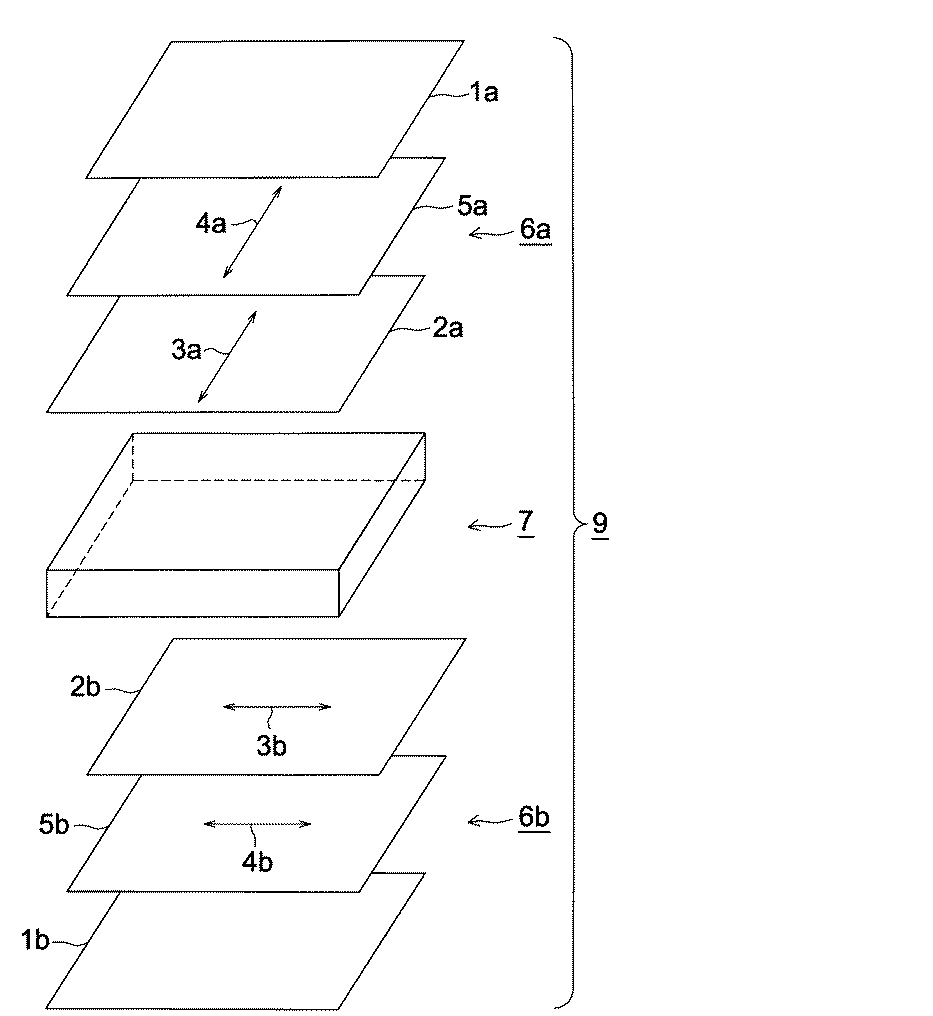
上表から、セルロース樹脂と安定化剤との混合〜乾燥における温度、Tmix、Tm−a、Tdry、Tgの関係が本発明の範囲内である水準の光学フィルム101、103、104、112〜116は、ヘイズ、YI、分子量保持率、引き裂き強度に優れた光学フィルムであることが明らかである。 From the above table, optical films 101, 103, 104, 112 to 116 at a level in which the relationship between the temperature of mixing and drying of the cellulose resin and the stabilizer, Tmix, Tm-a, Tdry, and Tg is within the scope of the present invention. Is clearly an optical film excellent in haze, YI, molecular weight retention, and tear strength.
実施例2
(偏光板の作製)
厚さ120μmのポリビニルアルコールフィルムを沃素1質量部、沃化カリウム2質量部、ホウ酸4質量部を含む水溶液に浸漬し、50℃で4倍に延伸して偏光子を作製した。実施例1の光学フィルム101〜117を、40℃の2.5M/L−水酸化ナトリウム水溶液で60秒間アルカリ処理し、更に水洗乾燥して表面をアルカリ処理した。
Example 2
(Preparation of polarizing plate)
A 120 μm-thick polyvinyl alcohol film was immersed in an aqueous solution containing 1 part by mass of iodine, 2 parts by mass of potassium iodide, and 4 parts by mass of boric acid, and stretched 4 times at 50 ° C. to produce a polarizer. The optical films 101 to 117 of Example 1 were alkali-treated with a 2.5 M / L-sodium hydroxide aqueous solution at 40 ° C. for 60 seconds, further washed with water and dried to alkali-treat the surface.
前記偏光子の両面に、実施例1の光学フィルムのアルカリ処理面を、完全鹸化型ポリビニルアルコール5%水溶液を接着剤として両面から貼合し、保護フィルムが形成された偏光板101〜117を各々2部づつ作製した。 Polarizing plates 101 to 117 each having a protective film formed thereon were bonded to both sides of the polarizer by bonding the alkali-treated surface of the optical film of Example 1 from both sides using a 5% aqueous solution of completely saponified polyvinyl alcohol as an adhesive. Two copies were made.
《評価》
同じ偏光板2枚を透過軸に直交し、照明を介して正面より観察したところ、本発明の光学フィルム101、103、104、112〜116は光漏れがなく黒表示となったが、比較例の光学フィルムを用いた偏光板は、ヘイズによる散乱に基づき光漏れが認められ、ディスプレイ用途に用いることは出来なかった。
<Evaluation>
When the same two polarizing plates were perpendicular to the transmission axis and observed from the front through illumination, the optical films 101, 103, 104, and 112 to 116 of the present invention showed no light leakage and became a black display. In the polarizing plate using the optical film, light leakage was recognized based on scattering due to haze, and it could not be used for display applications.
実施例3
実施例1の光学フィルム104の作製において幅方向の延伸倍率を1.3倍に変更した以外は同様にして、本発明の光学フィルム118を作製した。
Example 3
An optical film 118 of the present invention was prepared in the same manner as in the production of the optical film 104 of Example 1, except that the draw ratio in the width direction was changed to 1.3.
光学フィルム118の最大屈折率は幅方向に一致しており、下記式より求められるリターデーション値はRo=43nm、Rt=132nmであった。 The maximum refractive index of the optical film 118 coincided with the width direction, and the retardation values obtained from the following formulas were Ro = 43 nm and Rt = 132 nm.
測定は、自動複屈折計KOBRA−21ADH(王子計測機器(株)製)を用いて、23℃、55%RHの環境下24時間放置したフィルムにおいて、同環境下、波長が590nmにおけるフィルムのリターデーション測定を行った。アッベ屈折率計で測定したフィルム構成材料の平均屈折率と膜厚d(nm)を入力し、面内リターデーション(Ro)及び厚み方向のリターデーション(Rth)の値を得た。また、上記装置によって3次元屈折率nx、ny、nzの値が算出される。 The measurement was carried out using an automatic birefringence meter KOBRA-21ADH (manufactured by Oji Scientific Instruments Co., Ltd.). Measurement of foundation was performed. The average refractive index and film thickness d (nm) of the film constituent material measured with an Abbe refractometer were input, and in-plane retardation (Ro) and thickness direction retardation (Rth) were obtained. Further, the values of the three-dimensional refractive indexes nx, ny and nz are calculated by the above device.
式(i) Ro=(nx−ny)×d
式(ii) Rth={(nx+ny)/2−nz}×d
(式中、nxはフィルム面内の遅相軸方向の屈折率であり、nyはフィルム面内の進相軸方向の屈折率であり、nzはフィルムの厚み方向の屈折率であり、dはフィルムの厚さ(nm)を表す。)
次いで、偏光板の作製を行ったが、光学フィルム101〜118及びコニカミノルタタックKC8UCR−3(コニカミノルタオプト(株)製、表2中ではUCR−3と記す。)を用いて、図2で示される偏光板6a、6bを表2に記載の構成にて偏光板6a−101〜118、及び偏光板6b−101〜118を作製した。
Formula (i) Ro = (nx−ny) × d
Formula (ii) Rth = {(nx + ny) / 2−nz} × d
(Where nx is the refractive index in the slow axis direction in the film plane, ny is the refractive index in the fast axis direction in the film plane, nz is the refractive index in the thickness direction of the film, and d is Represents film thickness (nm).)
Next, a polarizing plate was prepared. The optical films 101 to 118 and Konica Minolta Tack KC8UCR-3 (manufactured by Konica Minolta Opto Co., Ltd., referred to as UCR-3 in Table 2) were used in FIG. Polarizing
(液晶表示装置としての特性評価)
富士通製15型ディスプレイVL−150SDの予め貼合されていた両面の偏光板を剥がして、上記作製した偏光板6a−101〜118、及び偏光板6b−101〜118をそれぞれ液晶セルのサイズに合わせて断裁しガラス面に貼合した。
(Characteristic evaluation as a liquid crystal display device)
The polarizing plates on both sides of the 15-inch display VL-150SD manufactured by Fujitsu were previously peeled off, and the above-prepared
前記作製した偏光板2枚を図2のように偏光板の偏光軸が元と変わらないように互いに直交するように貼り付け、液晶表示装置101〜118を各々作製した。 As shown in FIG. 2, the two produced polarizing plates were attached so as to be orthogonal to each other so that the polarizing axes of the polarizing plates did not change, and liquid crystal display devices 101 to 118 were produced.
本発明の偏光板を用いた液晶表示装置101、103、104、112〜116、118はコントラストも高く、優れた表示性を示した。これにより、液晶ディスプレイなどの画像表示装置用の偏光板として優れていることが確認された。 The liquid crystal display devices 101, 103, 104, 112 to 116 and 118 using the polarizing plate of the present invention had high contrast and showed excellent display properties. Thereby, it was confirmed that it is excellent as a polarizing plate for image display apparatuses, such as a liquid crystal display.
1 原料ホッパー
2 添加剤ホッパー
1a 保護フィルム
1b 保護フィルム
2a 位相差フィルム
2b 位相差フィルム
5a、5b 偏光子
3a、3b フィルムの遅相軸方向
4a、4b 偏光子の透過軸方向
6a、6b 偏光板
7 液晶セル
9 液晶表示装置
DESCRIPTION OF
Claims (2)
Tmix<Tm−a≦Tdry<Tg
(式中、Tmixはセルロース樹脂粉体と少なくとも1種の安定化剤との粉体混合時の温度、Tm−aは安定化剤の融点、Tdryは粉体混合物の乾燥温度、Tgはセルロース樹脂のガラス転移温度を表す。) In a method for producing an optical film comprising at least one stabilizer, at least one plasticizer, and cellulose resin powder, the cellulose resin powder and the at least one stabilizer are powdered at a temperature Tmix. A method for producing an optical film, characterized in that a film constituent material mixed and then dried at a drying temperature Tdry having the following relationship is formed into a film by a melt casting method.
Tmix <Tm−a ≦ Tdry <Tg
(Wherein, Tmix is the temperature during powder mixing of the cellulose resin powder and at least one stabilizer, Tm-a is the melting point of the stabilizer, Tdry is the drying temperature of the powder mixture, and Tg is the cellulose resin. Represents the glass transition temperature of.
Priority Applications (1)
| Application Number | Priority Date | Filing Date | Title |
|---|---|---|---|
| JP2005119512A JP4586617B2 (en) | 2004-12-13 | 2005-04-18 | Manufacturing method of optical film |
Applications Claiming Priority (2)
| Application Number | Priority Date | Filing Date | Title |
|---|---|---|---|
| JP2004360231 | 2004-12-13 | ||
| JP2005119512A JP4586617B2 (en) | 2004-12-13 | 2005-04-18 | Manufacturing method of optical film |
Publications (2)
| Publication Number | Publication Date |
|---|---|
| JP2006195407A JP2006195407A (en) | 2006-07-27 |
| JP4586617B2 true JP4586617B2 (en) | 2010-11-24 |
Family
ID=36801516
Family Applications (1)
| Application Number | Title | Priority Date | Filing Date |
|---|---|---|---|
| JP2005119512A Expired - Fee Related JP4586617B2 (en) | 2004-12-13 | 2005-04-18 | Manufacturing method of optical film |
Country Status (1)
| Country | Link |
|---|---|
| JP (1) | JP4586617B2 (en) |
Families Citing this family (3)
| Publication number | Priority date | Publication date | Assignee | Title |
|---|---|---|---|---|
| JP2008112127A (en) * | 2006-10-04 | 2008-05-15 | Konica Minolta Opto Inc | Polarizing plate protection film, polarizing plate, and liquid crystal display device |
| JP5164103B2 (en) * | 2007-04-24 | 2013-03-13 | 太平化学製品株式会社 | Resin composition, retardation film, and method for producing retardation film |
| JP6123677B2 (en) * | 2011-11-28 | 2017-05-10 | コニカミノルタ株式会社 | Optical film and manufacturing method thereof, polarizing plate and liquid crystal display device |
Family Cites Families (3)
| Publication number | Priority date | Publication date | Assignee | Title |
|---|---|---|---|---|
| JP2000352620A (en) * | 1999-03-31 | 2000-12-19 | Konica Corp | Optical film, polarizing plate and liquid crystal display |
| JP4272802B2 (en) * | 2000-08-17 | 2009-06-03 | 富士フイルム株式会社 | Method for producing cellulose acylate film |
| JP2003043252A (en) * | 2001-07-31 | 2003-02-13 | Sekisui Chem Co Ltd | Polarizer protective film |
-
2005
- 2005-04-18 JP JP2005119512A patent/JP4586617B2/en not_active Expired - Fee Related
Also Published As
| Publication number | Publication date |
|---|---|
| JP2006195407A (en) | 2006-07-27 |
Similar Documents
| Publication | Publication Date | Title |
|---|---|---|
| KR101231371B1 (en) | Plasticizer, Cellulose Ester Film and Process for Preparing the Same, Polarizing Plate and Liquid Crystal Display | |
| JP2007298648A (en) | Cellulose ester optical film, method for producing the same, and polarizing plate and liquid crystal display device using the same | |
| JP2006328298A (en) | Optical film, polarizing plate and liquid crystal display device | |
| KR101314030B1 (en) | Optical film and polarizer and liquid-crystal display each employing the same | |
| KR101352739B1 (en) | Optical film, process for producing optical film, polarizer, and liquid-crystal display | |
| JP4687158B2 (en) | Method for producing cellulose ester film | |
| JP4631383B2 (en) | Cellulose ester film, optical film, polarizing plate, and liquid crystal display device | |
| JP2006123513A (en) | Method for producing cellulose ester film, and cellulose ester film, optical film, polarizing plate and liquid crystal display device | |
| JP4665460B2 (en) | Cellulose ester film and method for producing the same, and polarizing plate and liquid crystal display device using the same | |
| JP5024284B2 (en) | Manufacturing method of optical film | |
| JP2007016137A (en) | Optical film polarizing plate liquid crystal display device | |
| JP4586617B2 (en) | Manufacturing method of optical film | |
| JP4687145B2 (en) | Manufacturing method of optical film, polarizing plate and liquid crystal display device | |
| JP4609031B2 (en) | Method for producing optical film for display | |
| JP5194790B2 (en) | Cellulose ester film and manufacturing method thereof, optical film, polarizing plate and liquid crystal display device | |
| JP2006301500A (en) | Optical film, method for manufacturing optical film, polarizing plate, and liquid crystal display apparatus | |
| JP4552593B2 (en) | Method for producing optical film for display | |
| JP4556697B2 (en) | Optical film, polarizing plate and liquid crystal display device | |
| JP4935415B2 (en) | Optical film and manufacturing method thereof, polarizing plate and liquid crystal display device | |
| JP4650159B2 (en) | Method for producing polarizing plate protective film | |
| JP4815617B2 (en) | Optical film and manufacturing method thereof, polarizing plate and liquid crystal display device | |
| JP2006077113A (en) | Cellulose ester film, manufacturing method, therefor polarizing plate, and liquid crystal display | |
| JP2006124629A (en) | Cellulosic resin film and its manufacturing method | |
| JP4453631B2 (en) | Method for producing optical film for display | |
| JP2006341434A (en) | Optical film, its manufacturing method, polarizing plate and liquid crystal display device |
Legal Events
| Date | Code | Title | Description |
|---|---|---|---|
| A621 | Written request for application examination |
Free format text: JAPANESE INTERMEDIATE CODE: A621 Effective date: 20080401 |
|
| A977 | Report on retrieval |
Free format text: JAPANESE INTERMEDIATE CODE: A971007 Effective date: 20100513 |
|
| A131 | Notification of reasons for refusal |
Free format text: JAPANESE INTERMEDIATE CODE: A131 Effective date: 20100525 |
|
| A521 | Request for written amendment filed |
Free format text: JAPANESE INTERMEDIATE CODE: A523 Effective date: 20100715 |
|
| TRDD | Decision of grant or rejection written | ||
| A01 | Written decision to grant a patent or to grant a registration (utility model) |
Free format text: JAPANESE INTERMEDIATE CODE: A01 Effective date: 20100810 |
|
| A01 | Written decision to grant a patent or to grant a registration (utility model) |
Free format text: JAPANESE INTERMEDIATE CODE: A01 |
|
| A61 | First payment of annual fees (during grant procedure) |
Free format text: JAPANESE INTERMEDIATE CODE: A61 Effective date: 20100823 |
|
| R150 | Certificate of patent or registration of utility model |
Free format text: JAPANESE INTERMEDIATE CODE: R150 |
|
| FPAY | Renewal fee payment (event date is renewal date of database) |
Free format text: PAYMENT UNTIL: 20130917 Year of fee payment: 3 |
|
| S111 | Request for change of ownership or part of ownership |
Free format text: JAPANESE INTERMEDIATE CODE: R313111 |
|
| R350 | Written notification of registration of transfer |
Free format text: JAPANESE INTERMEDIATE CODE: R350 |
|
| LAPS | Cancellation because of no payment of annual fees |