JP4483784B2 - Binder for electric double layer capacitor electrode - Google Patents
Binder for electric double layer capacitor electrode Download PDFInfo
- Publication number
- JP4483784B2 JP4483784B2 JP2005514970A JP2005514970A JP4483784B2 JP 4483784 B2 JP4483784 B2 JP 4483784B2 JP 2005514970 A JP2005514970 A JP 2005514970A JP 2005514970 A JP2005514970 A JP 2005514970A JP 4483784 B2 JP4483784 B2 JP 4483784B2
- Authority
- JP
- Japan
- Prior art keywords
- electrode
- binder
- double layer
- electric double
- layer capacitor
- Prior art date
- Legal status (The legal status is an assumption and is not a legal conclusion. Google has not performed a legal analysis and makes no representation as to the accuracy of the status listed.)
- Expired - Fee Related
Links
Classifications
-
- H—ELECTRICITY
- H01—ELECTRIC ELEMENTS
- H01G—CAPACITORS; CAPACITORS, RECTIFIERS, DETECTORS, SWITCHING DEVICES, LIGHT-SENSITIVE OR TEMPERATURE-SENSITIVE DEVICES OF THE ELECTROLYTIC TYPE
- H01G11/00—Hybrid capacitors, i.e. capacitors having different positive and negative electrodes; Electric double-layer [EDL] capacitors; Processes for the manufacture thereof or of parts thereof
- H01G11/22—Electrodes
- H01G11/30—Electrodes characterised by their material
- H01G11/32—Carbon-based
- H01G11/38—Carbon pastes or blends; Binders or additives therein
-
- H—ELECTRICITY
- H01—ELECTRIC ELEMENTS
- H01G—CAPACITORS; CAPACITORS, RECTIFIERS, DETECTORS, SWITCHING DEVICES, LIGHT-SENSITIVE OR TEMPERATURE-SENSITIVE DEVICES OF THE ELECTROLYTIC TYPE
- H01G11/00—Hybrid capacitors, i.e. capacitors having different positive and negative electrodes; Electric double-layer [EDL] capacitors; Processes for the manufacture thereof or of parts thereof
- H01G11/22—Electrodes
-
- Y—GENERAL TAGGING OF NEW TECHNOLOGICAL DEVELOPMENTS; GENERAL TAGGING OF CROSS-SECTIONAL TECHNOLOGIES SPANNING OVER SEVERAL SECTIONS OF THE IPC; TECHNICAL SUBJECTS COVERED BY FORMER USPC CROSS-REFERENCE ART COLLECTIONS [XRACs] AND DIGESTS
- Y02—TECHNOLOGIES OR APPLICATIONS FOR MITIGATION OR ADAPTATION AGAINST CLIMATE CHANGE
- Y02E—REDUCTION OF GREENHOUSE GAS [GHG] EMISSIONS, RELATED TO ENERGY GENERATION, TRANSMISSION OR DISTRIBUTION
- Y02E60/00—Enabling technologies; Technologies with a potential or indirect contribution to GHG emissions mitigation
- Y02E60/13—Energy storage using capacitors
-
- Y—GENERAL TAGGING OF NEW TECHNOLOGICAL DEVELOPMENTS; GENERAL TAGGING OF CROSS-SECTIONAL TECHNOLOGIES SPANNING OVER SEVERAL SECTIONS OF THE IPC; TECHNICAL SUBJECTS COVERED BY FORMER USPC CROSS-REFERENCE ART COLLECTIONS [XRACs] AND DIGESTS
- Y02—TECHNOLOGIES OR APPLICATIONS FOR MITIGATION OR ADAPTATION AGAINST CLIMATE CHANGE
- Y02T—CLIMATE CHANGE MITIGATION TECHNOLOGIES RELATED TO TRANSPORTATION
- Y02T10/00—Road transport of goods or passengers
- Y02T10/60—Other road transportation technologies with climate change mitigation effect
- Y02T10/70—Energy storage systems for electromobility, e.g. batteries
Landscapes
- Engineering & Computer Science (AREA)
- Power Engineering (AREA)
- Microelectronics & Electronic Packaging (AREA)
- Chemical & Material Sciences (AREA)
- Materials Engineering (AREA)
- Electric Double-Layer Capacitors Or The Like (AREA)
Description
本発明は電気二重層キャパシタ電極用バインダー、該バインダーを含有する電気二重層キャパシタ電極用バインダー組成物および電気二重層キャパシタ電極用スラリー組成物、ならびに該スラリー組成物を用いて製造された電極および該電極を有する電気二重層キャパシタに関する。 The present invention relates to a binder for an electric double layer capacitor electrode, a binder composition for an electric double layer capacitor electrode containing the binder, a slurry composition for an electric double layer capacitor electrode, an electrode produced using the slurry composition, and the The present invention relates to an electric double layer capacitor having an electrode.
分極性電極と電解質との界面で形成される電気二重層を利用した電気二重層キャパシタは、メモリバックアップ電源として近年急速に需要が伸びている。また、電気自動車用電源等の大容量を必要とする用途へもその適用が注目されており、大容量化のために高い電極密度が求められている。 In recent years, demand for an electric double layer capacitor using an electric double layer formed at the interface between a polarizable electrode and an electrolyte has been rapidly increasing as a memory backup power source. In addition, its application is attracting attention for uses that require a large capacity, such as a power source for electric vehicles, and a high electrode density is required to increase the capacity.
電気二重層キャパシタ用の電極は、通常、バインダーを水または有機溶媒に溶解または分散させ、これに電極活物質および必要に応じ加えられる導電性付与材などを混合して電気二重層キャパシタ電極用スラリー組成物とし、これをアルミニウム箔などの集電体に塗布、乾燥して製造される。従来は、バインダーとしては、一般的にポリテトラフルオロエチレン、ポリフッ化ビニリデンなどのフッ素系ポリマーが使われてきたが、フッ素系ポリマーを用いて製造した電極は電極活物質と集電体との結着性が十分ではなく、また、電極密度が低いものであった。 The electrode for an electric double layer capacitor is usually a slurry for an electric double layer capacitor electrode in which a binder is dissolved or dispersed in water or an organic solvent, and an electrode active material and a conductivity imparting material added as necessary are mixed therewith. A composition is prepared and applied to a current collector such as an aluminum foil and dried. Conventionally, fluorine-based polymers such as polytetrafluoroethylene and polyvinylidene fluoride have been generally used as binders. However, an electrode manufactured using a fluorine-based polymer is a binder between an electrode active material and a current collector. Wearability was not sufficient and the electrode density was low.
少量の使用でも結着力に優れたバインダーとして特定のガラス転移温度と粒子径を有する重合体を用いたバインダーが提案されている(特許文献1参照)。しかしこのバインダーを用いても電極活物質と集電体との結着性は十分ではなく、また電極密度も低かった。
ここで、電極層を形成する際は、電極層を均一化し、かつ電極密度を高めるためにプレスを行うのが通常である。しかしながら、本発明者らの検討によると、上記従来技術のバインダーを用いた場合は、プレスによって電極の密度を高めるためにプレス圧を上げると、集電体のアルミニウム箔が損傷したり、電極の内部抵抗が増大したりする傾向が見られ、所望の密度に高められた電極層を得ることが困難であった。 Here, when forming an electrode layer, it is normal to press in order to make an electrode layer uniform and to raise an electrode density. However, according to the study by the present inventors, when the above-mentioned conventional binder is used, if the press pressure is increased to increase the density of the electrode by pressing, the aluminum foil of the current collector is damaged, There was a tendency for the internal resistance to increase, and it was difficult to obtain an electrode layer with a desired density.
そこで本発明は、電極密度が高く、かつ結着力が高い電極を与える電気二重層キャパシタ電極用バインダー、該バインダーを含有する電気二重層キャパシタ電極用バインダー組成物および電気二重層キャパシタ電極用スラリー組成物を提供することを課題とする。また本発明は、該スラリー組成物を用いて製造された電極および該電極を有する電気二重層キャパシタを提供することを課題とする。 Accordingly, the present invention provides an electric double layer capacitor electrode binder that provides an electrode having a high electrode density and high binding force, an electric double layer capacitor electrode binder composition and an electric double layer capacitor electrode slurry composition containing the binder. It is an issue to provide. Another object of the present invention is to provide an electrode produced using the slurry composition and an electric double layer capacitor having the electrode.
本発明者らは、上記課題を解決すべく鋭意検討の結果、引張応力が小さく、かつ切断時伸びが大きいポリマーフィルムを与えるポリマーをバインダーとして用いると、結着力が高く、かつ電極密度が高い電極が得られることを見出し、この知見に基づき本発明を完成するに至った。 As a result of intensive studies to solve the above problems, the present inventors have used a polymer that gives a polymer film having a small tensile stress and a large elongation at break as an binder, and an electrode having a high binding force and a high electrode density. And the present invention has been completed based on this finding.
かくして本発明によれば、下記(1)〜(6)が提供される。
(1)共役ジエン又はそれを水素化してなる単量体単位を40重量%以上含み、全単量体100重量部に対して連鎖移動剤が0.01〜5重量部含まれて、100%伸び時の引張応力が2MPa以下であり、かつ切断時伸びが450%以上であるポリマーフィルムを与えるように調整されたポリマーからなる電気二重層キャパシタ電極用バインダー。本発明においては、共役ジエン又はそれを水素化してなる単量体単位を40重量%以上含み、全単量体100重量部に対して連鎖移動剤が0.01〜5重量部含んでいることにより、ポリマーを100%伸び時の引張応力が2MPa以下であり、かつ切断時伸びが450%以上であるポリマーフィルムを与えるように調整することができる。ここで、ポリマーフィルムは、ポリマーの水分散体からISO 498に記載の方法に基づき作成されるものである。また、引張応力および切断時伸びは、該ポリマーフィルムから作成されたダンベル状4号形試験片を用いてJIS K 6251により測定される値である。
Thus, according to the present invention, the following (1) to (6) are provided.
(1) Containing 40% by weight or more of a conjugated diene or a monomer unit obtained by hydrogenating the conjugated diene, and 0.01 to 5 parts by weight of a chain transfer agent with respect to 100 parts by weight of all monomers, A binder for an electric double layer capacitor electrode comprising a polymer adjusted to give a polymer film having a tensile stress at elongation of 2 MPa or less and an elongation at break of 450% or more. In the present invention, the conjugated diene or a monomer unit obtained by hydrogenating the conjugated diene is contained in an amount of 40% by weight or more, and the chain transfer agent is contained in an amount of 0.01 to 5 parts by weight with respect to 100 parts by weight of all monomers. Thus, the polymer can be adjusted to give a polymer film having a tensile stress at 100% elongation of 2 MPa or less and an elongation at break of 450% or more. Here, the polymer film is prepared from an aqueous dispersion of a polymer based on the method described in ISO 498. The tensile stress and elongation at break are values measured by JIS K 6251 using dumbbell-shaped No. 4 test pieces prepared from the polymer film.
また、前記ポリマーは、架橋性官能基を有するものであることが好ましい。 The polymer preferably has a crosslinkable functional group.
前記架橋性官能基は、N−メチロールアミド基であることが好ましい。The crosslinkable functional group is preferably an N-methylolamide group.
また、前記架橋性官能基は、スルホン酸基またはその塩とエポキシ基との組み合わせであることが好ましい。The crosslinkable functional group is preferably a combination of a sulfonic acid group or a salt thereof and an epoxy group.
或いは、一般式(1):CH Or, general formula (1): CH
22
=CR= CR
11
−COOR-COOR
22
(式中、R(Wherein R
11
は水素原子又はメチル基を、RIs a hydrogen atom or a methyl group, R
22
はアルキル基またはシクロアルキル基を表す。)で表される化合物を重合してなる単量体単位を合計で60重量%以上含み、全単量体における多官能単量体の量が1重量%以下とされ、架橋性官能基を有し、全単量体における架橋性官能基を有する単量体の総量が、0.1〜10重量%とされて、100%伸び時の引張応力が2MPa以下であり、かつ切断時伸びが450%以上であるポリマーフィルムを与えるように調整されたポリマーからなる電気二重層キャパシタ電極用バインダー。本発明においては、一般式(1):CHRepresents an alkyl group or a cycloalkyl group. ) In a total of 60% by weight or more of monomer units obtained by polymerizing the compounds represented by formula (1), the amount of polyfunctional monomers in all the monomers is 1% by weight or less, and has crosslinkable functional groups. The total amount of monomers having crosslinkable functional groups in all monomers is 0.1 to 10% by weight, the tensile stress at 100% elongation is 2 MPa or less, and the elongation at break is 450 % A binder for an electric double layer capacitor electrode comprising a polymer adjusted to give a polymer film that is at least%. In the present invention, the general formula (1): CH
22
=CR= CR
11
−COOR-COOR
22
(式中、R(Wherein R
11
は水素原子又はメチル基を、RIs a hydrogen atom or a methyl group, R
22
はアルキル基またはシクロアルキル基を表す。)で表される化合物を重合してなる単量体単位を合計で60重量%以上含み、全単量体における多官能単量体の量が1重量%以下とされ、架橋性官能基を有し、全単量体における架橋性官能基を有する単量体の総量が、0.1〜10重量%とされることで、ポリマーを100%伸び時の引張応力が2MPa以下であり、かつ切断時伸びが450%以上であるポリマーフィルムを与えるように調整することができる。ここで、ポリマーフィルムは、ポリマーの水分散体からISO 498に記載の方法に基づき作成されるものである。また、引張応力および切断時伸びは、該ポリマーフィルムから作成されたダンベル状4号形試験片を用いてJIS K 6251により測定される値である。Represents an alkyl group or a cycloalkyl group. ) In a total of 60% by weight or more of monomer units obtained by polymerizing the compounds represented by formula (1), the amount of polyfunctional monomers in all the monomers is 1% by weight or less, and has crosslinkable functional groups. The total amount of monomers having crosslinkable functional groups in all monomers is 0.1 to 10% by weight, so that the tensile stress at 100% elongation of the polymer is 2 MPa or less and cutting It can be adjusted to give a polymer film with a time elongation of 450% or more. Here, the polymer film is prepared from an aqueous dispersion of a polymer based on the method described in ISO 498. The tensile stress and elongation at break are values measured by JIS K 6251 using dumbbell-shaped No. 4 test pieces prepared from the polymer film.
また、前記架橋性官能基は、N−メチロールアミド基であることが好ましい。また、前記架橋性官能基は、スルホン酸基またはその塩とエポキシ基との組み合わせであることが好ましい。 The crosslinkable functional group is preferably an N-methylolamide group. The crosslinkable functional group is preferably a combination of a sulfonic acid group or a salt thereof and an epoxy group.
(2) (1)に記載の電極用バインダーが水に分散されてなる電気二重層キャパシタ電極用バインダー組成物。 (2) A binder composition for an electric double layer capacitor electrode, wherein the electrode binder according to (1) is dispersed in water.
(3) (2)に記載のバインダー組成物と、電極活物質とを含有してなる電気二重層キャパシタ電極用スラリー組成物。 (3) A slurry composition for an electric double layer capacitor electrode comprising the binder composition according to (2) and an electrode active material.
(4) (1)に記載のバインダーと、電極活物質とを含有する電極層が集電体に結着されてなる電気二重層キャパシタ用電極。 (4) An electrode for an electric double layer capacitor, wherein an electrode layer containing the binder according to (1) and an electrode active material is bound to a current collector.
(5) (3)に記載の電極用スラリー組成物を、集電体に塗布し、乾燥する工程を有する電気二重層キャパシタ用電極の製造方法。
本製造方法においては、さらにプレス処理する工程を有することが好ましい。
また、本製造方法においては、さらに150〜250℃で加熱処理する工程を有することが好ましい。(5) The manufacturing method of the electrode for electric double layer capacitors which has the process of apply | coating the slurry composition for electrodes as described in (3) to a collector, and drying.
In this manufacturing method, it is preferable to further have a step of pressing.
Moreover, in this manufacturing method, it is preferable to have the process of heat-processing at 150-250 degreeC further.
(6) (4)に記載の電極を有する電気二重層キャパシタ。 (6) An electric double layer capacitor having the electrode according to (4).
本発明のバインダーを用いて電極を製造すると、電極密度が大きく、かつ結着力が強い電極が得られる。そして該電極を用いると、静電容量が大きくかつ内部抵抗が小さい電気二重層キャパシタを得ることができる。 When an electrode is produced using the binder of the present invention, an electrode having a high electrode density and a strong binding force can be obtained. When this electrode is used, an electric double layer capacitor having a large capacitance and a small internal resistance can be obtained.
(1)電気二重層キャパシタ電極用バインダー
本発明の電気二重層キャパシタ電極用バインダー(以下、単に「バインダー」とも言う。)は、100%伸び時の引張応力が2MPa以下であり、かつ切断時伸びが450%以上であるポリマーフィルムを与えるポリマーからなる。ここで、ポリマーフィルムは、ポリマーの水分散体からISO 498に記載の方法に基づき作成されるものである。また、引張応力および切断時伸びは、該ポリマーフィルムから作成されたダンベル状4号形試験片を用いてJIS K6251により測定される値である。(1) Electric Double Layer Capacitor Electrode Binder The electric double layer capacitor electrode binder of the present invention (hereinafter also simply referred to as “binder”) has a tensile stress at 100% elongation of 2 MPa or less and an elongation at break. Is made of a polymer that gives a polymer film of 450% or more. Here, the polymer film is prepared from an aqueous dispersion of a polymer based on the method described in ISO 498. Further, the tensile stress and the elongation at break are values measured by JIS K6251 using a dumbbell-shaped No. 4 test piece prepared from the polymer film.
100%伸び時の引張応力は、好ましくは1.5MPa以下、より好ましくは0.1〜1MPaである。また、切断時伸びは、好ましくは500%以上、より好ましくは600〜2,000%である。100%伸び時の引張応力と切断時伸びがこの範囲であると、結着力が高く、かつ軽度のプレスにより容易に電極密度を高めることができる。 The tensile stress at 100% elongation is preferably 1.5 MPa or less, more preferably 0.1 to 1 MPa. The elongation at break is preferably 500% or more, more preferably 600 to 2,000%. When the tensile stress at 100% elongation and the elongation at cutting are in this range, the binding force is high, and the electrode density can be easily increased by a light press.
このようなポリマーとしては、具体的には、エラストマーを用いることができる。エラストマーとは、ガラス転移温度が常温(25℃)以下、好ましくは−10℃以下、より好ましくは−20℃以下のポリマーである。ガラス転移温度がこの範囲であると、特に結着力に優れる。 Specifically, an elastomer can be used as such a polymer. The elastomer is a polymer having a glass transition temperature of room temperature (25 ° C.) or lower, preferably −10 ° C. or lower, more preferably −20 ° C. or lower. When the glass transition temperature is within this range, the binding force is particularly excellent.
エラストマーとしては、ブタジエン、イソプレンなどの共役ジエンを重合してなる単量体単位またはそれを水素化してなる単量体単位を主成分とするジエン系エラストマー;アクリル酸エステルおよび/またはメタクリル酸エステルを重合してなる単量体単位を主成分とするアクリレート系エラストマー;などが好ましく、得られる電極の内部抵抗を小さくできるので、アクリレート系エラストマーがより好ましい。ここで、「主成分とする」とは、そのような単量体単位を40重量%以上含むことをいう。 As the elastomer, a diene elastomer mainly composed of a monomer unit obtained by polymerizing a conjugated diene such as butadiene or isoprene or a hydrogenated monomer unit; an acrylate ester and / or a methacrylate ester is used. An acrylate elastomer having a monomer unit formed by polymerization as a main component is preferable, and an acrylate elastomer is more preferable because the internal resistance of the obtained electrode can be reduced. Here, “main component” means containing 40% by weight or more of such a monomer unit.
前記ジエン系エラストマーとしては、例えば、ポリブタジエン、ポリイソプレン、カルボキシ変性されていてもよいスチレン・ブタジエン共重合体、アクリロニトリル・ブタジエン共重合体およびこれらの水素化物などが挙げられる。 Examples of the diene elastomer include polybutadiene, polyisoprene, carboxy-modified styrene / butadiene copolymer, acrylonitrile / butadiene copolymer, and hydrides thereof.
アクリレート系エラストマーとしては、一般式(1):CH2=CR1−COOR2(式中、R1は水素原子またはメチル基を、R2はアルキル基またはシクロアルキル基を表す。)で表される化合物を重合してなる単量体単位を合計で60重量%以上、さらには80重量%以上含むポリマーが好ましい。アクリレート系エラストマーは、一般式(1)で表される化合物と、これと共重合可能な単量体とを共重合して得られる。The acrylate elastomer is represented by the general formula (1): CH 2 = CR 1 -COOR 2 (wherein R 1 represents a hydrogen atom or a methyl group, and R 2 represents an alkyl group or a cycloalkyl group). Polymers containing 60% by weight or more, more preferably 80% by weight or more in total of monomer units obtained by polymerizing the above compounds are preferred. The acrylate elastomer is obtained by copolymerizing a compound represented by the general formula (1) and a monomer copolymerizable therewith.
一般式(1)で表される化合物の具体例としては、アクリル酸エチル、アクリル酸プロピル、アクリル酸イソプロピル、アクリル酸n−ブチル、アクリル酸イソブチル、アクリル酸t-ブチル、アクリル酸n−ペンチル、アクリル酸イソペンチル、アクリル酸n−ヘキシル、アクリル酸2−エチルヘキシル、アクリル酸ヘキシル、アクリル酸ノニル、アクリル酸ラウリル、アクリル酸ステアリルなどのアクリル酸アルキルエステル;アクリル酸イソボルニルなどのアクリル酸シクロアルキルエステル;メタクリル酸エチル、メタクリル酸プロピル、メタクリル酸イソプロピル、メタクリル酸n−ブチル、メタクリル酸イソブチル、メタクリル酸t-ブチル、メタクリル酸n−ペンチル、メタクリル酸イソペンチル、メタクリル酸n−ヘキシル、メタクリル酸2−エチルヘキシル、メタクリル酸オクチル、メタクリル酸イソデシル、メタクリル酸ラウリル、メタクリル酸トリデシル、メタクリル酸ステアリルなどのメタクリル酸アルキルエステル;メタクリル酸シクロヘキシルなどのメタクリル酸シクロアルキルエステル;等が挙げられる。これらの中でも、アクリル酸n−ブチルおよびアクリル酸2−エチルヘキシルが特に好ましい。 Specific examples of the compound represented by the general formula (1) include ethyl acrylate, propyl acrylate, isopropyl acrylate, n-butyl acrylate, isobutyl acrylate, t-butyl acrylate, n-pentyl acrylate, Acrylic acid alkyl esters such as isopentyl acrylate, n-hexyl acrylate, 2-ethylhexyl acrylate, hexyl acrylate, nonyl acrylate, lauryl acrylate, stearyl acrylate; cycloalkyl acrylate esters such as isobornyl acrylate; methacryl Ethyl acetate, propyl methacrylate, isopropyl methacrylate, n-butyl methacrylate, isobutyl methacrylate, t-butyl methacrylate, n-pentyl methacrylate, isopentyl methacrylate, n-hexyl methacrylate, Methacrylic acid cycloalkyl esters such as cyclohexyl methacrylate; methacrylic acid 2-ethylhexyl, octyl methacrylate, isodecyl methacrylate, lauryl methacrylate, tridecyl methacrylate, alkyl esters such as stearyl methacrylate, and the like. Among these, n-butyl acrylate and 2-ethylhexyl acrylate are particularly preferable.
一般式(1)で表される化合物と共重合可能な単量体としては、スチレン、α−メチルスチレン、2−メチルスチレン、3−メチルスチレン、4−メチルスチレンなどの芳香族ビニル化合物、;アクリロニトリル、メタクリロニトリルなどのα,β−不飽和ニトリル化合物;エチレン、プロピレン、1−ブテンなどの1−オレフィン;クロトン酸メチル、クロトン酸エチル、クロトン酸プロピル、クロトン酸ブチル、クロトン酸イソブチル、クロトン酸n−ペンチル、クロトン酸イソペンチル、クロトン酸n−ヘキシル、クロトン酸2−エチルヘキシルなどのクロトン酸エステル;マレイン酸ジメチル、マレイン酸ジブチル、マレイン酸ジ−2−エチルヘキシルなどのマレイン酸ジエステル;フマル酸ジメチル、フマル酸ジブチルなどのフマル酸ジエステル;イタコン酸ジメチル、イタコン酸ジブチルなどのイタコン酸ジエステル;アクリルアミド、メタクリルアミドなどのアクリルアミド化合物;等が挙げられる。また、後述の架橋性官能基を有する単量体も挙げることができる。 Examples of monomers copolymerizable with the compound represented by the general formula (1) include aromatic vinyl compounds such as styrene, α-methylstyrene, 2-methylstyrene, 3-methylstyrene, and 4-methylstyrene; Α, β-unsaturated nitrile compounds such as acrylonitrile and methacrylonitrile; 1-olefins such as ethylene, propylene and 1-butene; methyl crotonate, ethyl crotonate, propyl crotonate, butyl crotonate, isobutyl crotonate, croton Crotonic esters such as n-pentyl acid, isopentyl crotonic acid, n-hexyl crotonic acid and 2-ethylhexyl crotonic acid; maleic acid diesters such as dimethyl maleate, dibutyl maleate and di-2-ethylhexyl maleate; dimethyl fumarate , Fumarate such as dibutyl fumarate Diesters; dimethyl itaconate, itaconic acid diesters, such as dibutyl itaconate; and the like are; acrylamide, acrylamide compounds such as methacrylamide. Moreover, the monomer which has the below-mentioned crosslinkable functional group can also be mentioned.
本発明のバインダーであるポリマーの製法は特に限定されず、例えば、乳化重合法、懸濁重合法、分散重合法または溶液重合法などの公知の重合法により前記の各単量体を重合して得ることができる。中でも、乳化重合法で製造することが、バインダーの粒子径の制御が容易であるので好ましい。 The production method of the polymer which is the binder of the present invention is not particularly limited. For example, the above monomers are polymerized by a known polymerization method such as an emulsion polymerization method, a suspension polymerization method, a dispersion polymerization method or a solution polymerization method. Obtainable. Among these, it is preferable to produce by an emulsion polymerization method because it is easy to control the particle diameter of the binder.
本発明で用いるポリマーが上記範囲の引張応力および切断時伸びを有するためには、架橋構造が少ないことが好ましい。架橋構造が少ない重合体を用いると、軽度のプレスにより容易に電極密度を高めることができる。 In order for the polymer used in the present invention to have the tensile stress and elongation at break in the above ranges, it is preferable that the crosslinked structure is small. When a polymer having a small cross-linked structure is used, the electrode density can be easily increased by a light press.
架橋構造の含有割合は、ポリマー製造時の重合温度、時間、多官能単量体および連鎖移動剤の使用量などにより調節できる。例えば、ジエン系エラストマーを製造するときの重合温度は5〜90℃が好ましく、重合時間は2〜100時間が好ましい。連鎖移動剤としては、n−オクチルメルカプタン、n−ドデシルメルカプタン、t−ドデシルメルカプタンなどのメルカプタン類;四塩化炭素、四臭化炭素などのハロゲン化炭化水素類;などを用いることができる。これらの連鎖移動剤は重合開始前、または重合途中に添加することができる。連鎖移動剤の使用量は単量体100重量部に対して通常0.01〜5重量部であり、連鎖移動剤がメルカプタン類であるときの使用量は好ましくは単量体100重量部に対して0.01〜2重量部である。連鎖移動剤がハロゲン化炭化水素類であるときの使用量は好ましくは単量体100重量部に対して2〜5重量部であり、さらに0.01〜1重量部のメルカプタン類を併用することがより好ましい。 The content ratio of the crosslinked structure can be adjusted by the polymerization temperature, the time, the amount of the polyfunctional monomer and the chain transfer agent used at the time of producing the polymer. For example, the polymerization temperature when producing the diene elastomer is preferably 5 to 90 ° C., and the polymerization time is preferably 2 to 100 hours. As the chain transfer agent, mercaptans such as n-octyl mercaptan, n-dodecyl mercaptan and t-dodecyl mercaptan; halogenated hydrocarbons such as carbon tetrachloride and carbon tetrabromide; and the like can be used. These chain transfer agents can be added before the polymerization starts or during the polymerization. The amount of chain transfer agent used is usually 0.01 to 5 parts by weight per 100 parts by weight of the monomer, and the amount used when the chain transfer agent is a mercaptan is preferably 100 parts by weight of the monomer. 0.01 to 2 parts by weight. The amount used when the chain transfer agent is a halogenated hydrocarbon is preferably 2 to 5 parts by weight with respect to 100 parts by weight of the monomer, and further 0.01 to 1 part by weight of a mercaptan is used in combination. Is more preferable.
また、アクリレート系エラストマーを製造するときの、エチレングリコールジメタクリレート、トリメチロールプロパントリメタクリレートなどの多官能単量体の使用量は、全単量体中1重量%以下が好ましい。 Moreover, the amount of polyfunctional monomers such as ethylene glycol dimethacrylate and trimethylolpropane trimethacrylate used in the production of the acrylate elastomer is preferably 1% by weight or less in the total monomers.
また、本発明で用いるポリマーは、分子内に架橋性官能基を有していることが好ましい。架橋性官能基とは、電極層形成後に加熱や活性放射線照射などにより架橋構造を形成し得る官能基であり、加熱により架橋構造を形成し得る熱架橋性官能基がより好ましい。 Moreover, it is preferable that the polymer used by this invention has a crosslinkable functional group in a molecule | numerator. The crosslinkable functional group is a functional group that can form a crosslinked structure by heating or irradiation with actinic radiation after the electrode layer is formed, and a thermally crosslinkable functional group that can form a crosslinked structure by heating is more preferable.
熱架橋性官能基としては、例えば、N−メチロールアミド基が挙げられる。また、カルボキシル基、酸無水物基、ヒドロキシル基またはスルホン酸基もしくはその塩とエポキシ基との組合せ、カルボキシル基とエチレンイミン基との組合せなど、二種以上の官能基の組合せにより架橋構造を形成し得るものであってもよい。また、活性放射線照射により架橋構造を形成し得る架橋性官能基としては、アクリロイル基、メタクリロイル基、アリル基などが挙げられる。 Examples of the thermally crosslinkable functional group include an N-methylolamide group. In addition, a cross-linked structure is formed by a combination of two or more functional groups such as a combination of a carboxyl group, an acid anhydride group, a hydroxyl group or a sulfonic acid group or a salt thereof and an epoxy group, or a combination of a carboxyl group and an ethyleneimine group. It may be possible. Examples of the crosslinkable functional group capable of forming a crosslinked structure by irradiation with actinic radiation include an acryloyl group, a methacryloyl group, and an allyl group.
分子内に架橋性官能基を有するポリマーは、ポリマーの製造において、架橋性官能基を有する単量体を共重合させて得られる。熱架橋性官能基を有する単量体としては、N−メチロールアクリルアミド、N−メチロールメタクリルアミドなどが挙げられる。 The polymer having a crosslinkable functional group in the molecule is obtained by copolymerizing a monomer having a crosslinkable functional group in the production of the polymer. Examples of the monomer having a thermally crosslinkable functional group include N-methylol acrylamide and N-methylol methacrylamide.
また、上記二種以上の官能基の組合せにより架橋構造を形成し得る官能基を有する単量体としては、アクリル酸、メタクリル酸、クロトン酸、イソクロトン酸などの不飽和モノカルボン酸;マレイン酸、フマル酸、シトラコン酸、メサコン酸、グルタコン酸、イタコン酸、などの不飽和ジカルボン酸;無水マレイン酸、無水シトラコン酸、無水イタコン酸などの不飽和ジカルボン酸無水物;アクリル酸ヒドロキシエチル、アクリル酸ヒドロキシプロピル、アクリル酸ヒドロキシブチル、メタクリル酸ヒドロキシエチル、メタクリル酸ヒドロキシプロピル、クロトン酸ヒドロキシプロピルなどのヒドロキシル基を有する不飽和カルボン酸エステル;ビニルスルホン酸、メチルビニルスルホン酸、アリルスルホン酸、メタアリルスルホン酸、スチレンスルホン酸、アクリル酸−2−スルホン酸エチル、メタクリル酸−2−スルホン酸エチル、2−アクリルアミド−2−メチルプロパンスルホン酸および3−アリロキシ−2−ヒドロキシプロパンスルホン酸などの不飽和有機スルホン酸、ならびにそのアルカリ金属塩およびアンモニウム塩;アクリル酸グリシジル、メタクリル酸グリシジルなどのエポキシ基を有する不飽和カルボン酸エステル;アリルグリシジルエーテルなどのエポキシ基を有する不飽和エーテル類;などが挙げられる。架橋性官能基を有する単量体の総量は、好ましくは全単量体中0.1〜10重量%である。 Examples of the monomer having a functional group capable of forming a crosslinked structure by a combination of two or more functional groups include unsaturated monocarboxylic acids such as acrylic acid, methacrylic acid, crotonic acid, and isocrotonic acid; maleic acid, Unsaturated dicarboxylic acids such as fumaric acid, citraconic acid, mesaconic acid, glutaconic acid, itaconic acid; unsaturated dicarboxylic anhydrides such as maleic anhydride, citraconic anhydride, itaconic anhydride; hydroxyethyl acrylate, hydroxy acrylate Unsaturated carboxylic acid ester having hydroxyl group such as propyl, hydroxybutyl acrylate, hydroxyethyl methacrylate, hydroxypropyl methacrylate, hydroxypropyl crotonic acid; vinyl sulfonic acid, methyl vinyl sulfonic acid, allyl sulfonic acid, methallyl sulfonic acid The sti Unsaturated organic sulfonic acids such as polysulfonic acid, ethyl acrylate-2-sulfonate, ethyl methacrylate-2-sulfonate, 2-acrylamido-2-methylpropane sulfonic acid and 3-allyloxy-2-hydroxypropane sulfonic acid, And alkali metal salts and ammonium salts thereof; unsaturated carboxylic acid esters having an epoxy group such as glycidyl acrylate and glycidyl methacrylate; unsaturated ethers having an epoxy group such as allyl glycidyl ether; and the like. The total amount of monomers having a crosslinkable functional group is preferably 0.1 to 10% by weight in the total monomers.
(2)電気二重層キャパシタ電極用バインダー組成物
本発明の電気二重層キャパシタ電極用バインダー組成物(以下、単に「バインダー組成物」とも言う。)は、上記のバインダーが水に分散されてなるものである。バインダーを水に分散させる方法は特に限定されない。例えば、スプレードライ法や微粉砕により微粒子状としたバインダーを常法に従い水と混合分散させればよい。また、乳化重合法によりバインダーを水分散体として得た場合は、必要に応じて濃縮、希釈などにより濃度を調整し、バインダーを単離せずにそのまま本発明のバインダー組成物として用いることができる。バインダー組成物の濃度(固形分量)は、通常20〜70重量%である。(2) Binder composition for electric double layer capacitor electrode The binder composition for electric double layer capacitor electrode of the present invention (hereinafter also simply referred to as “binder composition”) is obtained by dispersing the above binder in water. It is. The method for dispersing the binder in water is not particularly limited. For example, a binder formed into fine particles by spray drying or fine pulverization may be mixed and dispersed with water according to a conventional method. Moreover, when the binder is obtained as an aqueous dispersion by an emulsion polymerization method, the concentration can be adjusted by concentration, dilution, etc. as necessary, and the binder composition of the present invention can be used as it is without isolating the binder. The concentration (solid content) of the binder composition is usually 20 to 70% by weight.
(3)電気二重層キャパシタ電極用スラリー組成物
本発明の電気二重層キャパシタ電極用スラリー組成物(以下、単に「スラリー組成物」とも言う。)は、本発明のバインダー組成物と、電極活物質とを含有してなり、必要に応じて増粘剤および導電性付与材などが含まれる。(3) Slurry composition for electric double layer capacitor electrode The slurry composition for electric double layer capacitor electrode of the present invention (hereinafter, also simply referred to as “slurry composition”) includes the binder composition of the present invention and an electrode active material. And a thickener and a conductivity-imparting material are included as necessary.
本発明で用いる電極活物質は、電気二重層を形成し得る細孔を有する炭素の同素体であり、その比表面積は30m2/g以上、好ましくは500〜5,000m2/g、より好ましくは1,000〜3,000m2/gである。具体的には、活性炭、ポリアセン、カーボンウィスカ、グラファイト等の粉末あるいは繊維を使用することができる。電極活物質は好ましくは活性炭であり、活性炭としてはフェノール系、レーヨン系、アクリル系、ピッチ系、又はヤシガラ系等を使用することができる。また、特開平11−317333号公報や特開2002−25867号公報などに記載される、黒鉛類似の微結晶炭素を有しその微結晶炭素の相間距離が拡大された非多孔性炭素も電極活物質として用いることができる。電極活物質の粒子径は0.1〜100μm、さらに好ましくは1〜20μmであると、キャパシタ用電極の薄膜化が容易で、容量密度も高くできるので好ましい。The electrode active material used in the present invention is an allotrope of carbon having pores capable of forming an electric double layer, and the specific surface area is 30 m 2 / g or more, preferably 500 to 5,000 m 2 / g, more preferably 1,000 to 3,000 m 2 / g. Specifically, powders or fibers of activated carbon, polyacene, carbon whisker, graphite or the like can be used. The electrode active material is preferably activated carbon, and as the activated carbon, phenol, rayon, acrylic, pitch, coconut shell, or the like can be used. Further, non-porous carbon having microcrystalline carbon similar to graphite and having an increased interphase distance between the microcrystalline carbon described in JP-A-11-317333 and JP-A-2002-25867 is also used as an electrode active material. It can be used as a substance. It is preferable that the particle diameter of the electrode active material is 0.1 to 100 μm, more preferably 1 to 20 μm, because the capacitor electrode can be easily thinned and the capacity density can be increased.
本発明のスラリー組成物におけるバインダーの量は、電極活物質100重量部に対して、好ましくは0.1〜20重量部、より好ましくは0.5〜10重量部である。バインダー量が少なすぎると電極から電極活物質や導電性付与材が脱落しやすくなり、逆に多すぎると電極活物質がバインダーに覆い隠されて電極の内部抵抗が増大するおそれがある。 The amount of the binder in the slurry composition of the present invention is preferably 0.1 to 20 parts by weight, more preferably 0.5 to 10 parts by weight with respect to 100 parts by weight of the electrode active material. If the amount of the binder is too small, the electrode active material and the conductivity-imparting material easily fall off from the electrode. Conversely, if the amount is too large, the electrode active material is covered with the binder and the internal resistance of the electrode may increase.
本発明のスラリー組成物は、増粘剤を含有することが好ましい。増粘剤を添加することにより、スラリー組成物の塗工性や流動性が向上する。増粘剤の種類は特に限定されないが、水溶性のポリマーが好ましい。水溶性ポリマーの具体例としては、カルボキシメチルセルロース、メチルセルロース、ヒドロキシプロピルセルロースなどのセルロース系ポリマーおよびこれらのアンモニウム塩並びにアルカリ金属塩;ポリ(メタ)アクリル酸ナトリウムなどのポリ(メタ)アクリル酸塩、ポリビニルアルコール、ポリエチレンオキシド、ポリビニルピロリドン、アクリル酸又はアクリル酸塩とビニルアルコールとの共重合体、無水マレイン酸又はマレイン酸もしくはフマル酸とビニルアルコールとの共重合体、変性ポリビニルアルコール、変性ポリアクリル酸、ポリエチレングリコール、ポリカルボン酸、酸化スターチ、リン酸スターチ、カゼイン、各種変性デンプンなどが挙げられる。この中で、好ましく用いられるものはセルロース系ポリマーおよびその塩であり、さらに好ましいのは、セルロース系ポリマーのアンモニウム塩である。これらの水溶性ポリマーの好ましい使用量は、電極活物質に対して0.5〜5重量部である。 The slurry composition of the present invention preferably contains a thickener. By adding a thickener, the coating property and fluidity of the slurry composition are improved. The type of thickener is not particularly limited, but a water-soluble polymer is preferable. Specific examples of the water-soluble polymer include cellulosic polymers such as carboxymethylcellulose, methylcellulose, and hydroxypropylcellulose, and ammonium salts and alkali metal salts thereof; poly (meth) acrylates such as sodium poly (meth) acrylate, polyvinyl Alcohol, polyethylene oxide, polyvinylpyrrolidone, acrylic acid or a copolymer of acrylic acid salt and vinyl alcohol, maleic anhydride or a copolymer of maleic acid or fumaric acid and vinyl alcohol, modified polyvinyl alcohol, modified polyacrylic acid, Examples include polyethylene glycol, polycarboxylic acid, oxidized starch, phosphate starch, casein, and various modified starches. Of these, cellulose polymers and salts thereof are preferably used, and ammonium salts of cellulose polymers are more preferable. The preferable use amount of these water-soluble polymers is 0.5 to 5 parts by weight with respect to the electrode active material.
本発明のスラリー組成物は、本発明の目的を損なわない範囲で他のバインダーを含有していてもよい。具体的には、アクリロニトリルやメタクリロニトリルなどのα,β−不飽和ニトリル化合物の単独重合体;α,β−不飽和ニトリル化合物およびそれと共重合可能な単量体との共重合体樹脂;ポリフッ化ビニリデン、ポリテトラフルオロエチレン、ポリペンタフルオロプロピレンのようなフッ素系ポリマー;などが挙げられる。これらのバインダーの含有量は、前記本発明のバインダーに対し、好ましくは50重量%以下、より好ましくは20重量%以下である。 The slurry composition of the present invention may contain other binders as long as the object of the present invention is not impaired. Specifically, homopolymers of α, β-unsaturated nitrile compounds such as acrylonitrile and methacrylonitrile; copolymer resins of α, β-unsaturated nitrile compounds and monomers copolymerizable therewith; And fluorine-based polymers such as vinylidene chloride, polytetrafluoroethylene, and polypentafluoropropylene. The content of these binders is preferably 50% by weight or less, more preferably 20% by weight or less, based on the binder of the present invention.
本発明のスラリー組成物は、導電性付与材を含有することが好ましい。導電性付与材としては、アセチレンブラック、ケッチェンブラック、カーボンブラック等の導電性カーボンを使用することができ、これらは上記電極活物質と混合して使用する。導電性付与材を併用することにより、前記活物質同士の電気的接触が一段と向上し、電気二重層キャパシタの内部抵抗が低くなり、かつ容量密度を高くすることができる。導電性付与材の使用量は、電極活物質100重量部に対して通常0.1〜20重量部、好ましくは2〜10重量部である。 The slurry composition of the present invention preferably contains a conductivity imparting material. As the conductivity-imparting material, conductive carbon such as acetylene black, ketjen black, and carbon black can be used, and these are used by mixing with the electrode active material. By using the conductivity imparting material in combination, the electrical contact between the active materials is further improved, the internal resistance of the electric double layer capacitor is lowered, and the capacity density can be increased. The usage-amount of an electroconductivity imparting material is 0.1-20 weight part normally with respect to 100 weight part of electrode active materials, Preferably it is 2-10 weight part.
また、活性放射線により構造を形成し得る架橋性官能基を有するポリマーをバインダーとして用いる場合は、必要に応じて光架橋剤を添加してもよい。光架橋剤としては、例えば、ベンジルジメチルケタール、トリメチルシリルベンゾフェノン、ベンゾイン、4−メトキシベンゾフェノン、ベンゾインメチルエーテルアントラキノン等が挙げられる。 Moreover, when using the polymer which has a crosslinkable functional group which can form a structure with actinic radiation as a binder, you may add a photocrosslinking agent as needed. Examples of the photocrosslinking agent include benzyl dimethyl ketal, trimethylsilyl benzophenone, benzoin, 4-methoxybenzophenone, benzoin methyl ether anthraquinone, and the like.
本発明のスラリー組成物は、本発明のバインダー組成物および電極活物質と、必要に応じて添加されるその他の上記各成分とを、混合機を用いて混合して製造できる。混合機としては、ボールミル、サンドミル、顔料分散機、擂潰機、超音波分散機、ホモジナイザー、プラネタリーミキサー、ホバートミキサーなどを用いることができる。また、電極活物質と導電性付与材とを擂潰機、プラネタリーミキサー、ヘンシェルミキサー、オムニミキサーなどの混合機を用いて先ず混合し、次いでバインダー組成物を添加して均一に混合する方法も好ましい。この方法を採ることにより、容易に均一なスラリー組成物を得ることができる。 The slurry composition of the present invention can be produced by mixing the binder composition and electrode active material of the present invention with the other components added as necessary using a mixer. As the mixer, a ball mill, sand mill, pigment disperser, crusher, ultrasonic disperser, homogenizer, planetary mixer, Hobart mixer, or the like can be used. There is also a method in which the electrode active material and the conductivity-imparting material are first mixed using a mixer such as a crusher, a planetary mixer, a Henschel mixer, and an omni mixer, and then the binder composition is added and mixed uniformly. preferable. By adopting this method, a uniform slurry composition can be easily obtained.
(4)電気二重層キャパシタ用電極
本発明の電気二重層キャパシタ用電極(以下、単に「電極」とも言う。)は、前記本発明のバインダーと電極活物質とを含有する電極層が集電体に結着してなるものである。集電体は、導電性を有しかつ電気化学的に耐久性のある材料であれば特に制限されないが、耐熱性を有するとの観点から、アルミニウム、チタン、タンタル、ステンレス鋼、金、白金などの金属材料が好ましく、アルミニウムおよび白金が特に好ましい。集電体の形状は特に制限されないが、通常、厚さ0.001〜0.5mm程度のシート状のものを用いる。(4) Electrode for Electric Double Layer Capacitor The electrode for an electric double layer capacitor of the present invention (hereinafter also simply referred to as “electrode”) has an electrode layer containing the binder of the present invention and an electrode active material as a current collector. It is formed by binding. The current collector is not particularly limited as long as it has conductivity and is electrochemically durable, but from the viewpoint of heat resistance, aluminum, titanium, tantalum, stainless steel, gold, platinum, etc. These metal materials are preferable, and aluminum and platinum are particularly preferable. The shape of the current collector is not particularly limited, but a sheet-like material having a thickness of about 0.001 to 0.5 mm is usually used.
本発明の電極は、集電体に、上記本発明のスラリー組成物を塗布し、乾燥することにより製造することができる。スラリー組成物の集電体への塗布方法は特に制限されない。例えば、ドクターブレード法、ディップ法、リバースロール法、ダイレクトロール法、グラビア法、エクストルージョン法、ハケ塗り法などの方法が挙げられる。スラリー組成物の粘度は、塗工機の種類や塗工ラインの形状によっても異なるが、通常100〜100,000mPa・s、好ましくは、1,000〜50,000mPa・s、より好ましくは5,000〜20,000mPa・sである。塗布するスラリー組成物の量も特に制限されないが、乾燥した後に形成される、電極活物質、バインダーなどからなる電極層の厚さが、通常、0.005〜5mm、好ましくは0.01〜2mmになる量が一般的である。乾燥方法としては例えば温風、熱風、低湿風による乾燥、真空乾燥、(遠)赤外線や電子線などの照射による乾燥法が挙げられる。乾燥温度は、通常50〜250℃である。 The electrode of the present invention can be produced by applying the slurry composition of the present invention to a current collector and drying it. The method for applying the slurry composition to the current collector is not particularly limited. Examples thereof include a doctor blade method, a dip method, a reverse roll method, a direct roll method, a gravure method, an extrusion method, and a brush coating method. The viscosity of the slurry composition varies depending on the type of coating machine and the shape of the coating line, but is usually 100 to 100,000 mPa · s, preferably 1,000 to 50,000 mPa · s, more preferably 5, 000 to 20,000 mPa · s. The amount of the slurry composition to be applied is not particularly limited, but the thickness of the electrode layer made of an electrode active material and a binder formed after drying is usually 0.005 to 5 mm, preferably 0.01 to 2 mm. The amount that becomes is common. Examples of the drying method include drying by warm air, hot air, low-humidity air, vacuum drying, and drying by irradiation with (far) infrared rays or electron beams. The drying temperature is usually 50 to 250 ° C.
乾燥後の電極は、プレス処理することが好ましい。本発明の電極は、プレス処理により容易に電極密度を高めることができる。プレス方法は、金型プレスやロールプレスなどの方法が挙げられる。プレス温度は特に限定されず、通常は室温でよい。 The dried electrode is preferably pressed. The electrode of the present invention can easily increase the electrode density by pressing. Examples of the pressing method include a mold press and a roll press. The pressing temperature is not particularly limited, and may usually be room temperature.
プレス後の電極は、150〜250℃で加熱処理することが好ましい。プレス後に加熱処理することにより、電極中の水分を完全に除去することができる。また、分子内に熱架橋性官能基を有するポリマーをバインダーとして用いる場合は、加熱処理によりポリマーが架橋構造を形成し、電極の強度を向上させることができるので好ましい。加熱処理の時間は、通常10分〜20時間である。 The pressed electrode is preferably heat-treated at 150 to 250 ° C. By performing heat treatment after pressing, moisture in the electrode can be completely removed. Moreover, when using the polymer which has a heat crosslinkable functional group in a molecule | numerator as a binder, since a polymer forms a crosslinked structure by heat processing and can improve the intensity | strength of an electrode, it is preferable. The heat treatment time is usually 10 minutes to 20 hours.
さらに、活性放射線により構造を形成し得る架橋性官能基を有するポリマーをバインダーとして用いる場合は、紫外線、電子線などの活性放射線を照射することで架橋構造を形成せしめてもよい。 Further, when a polymer having a crosslinkable functional group capable of forming a structure by actinic radiation is used as a binder, a crosslinked structure may be formed by irradiation with actinic radiation such as ultraviolet rays or electron beams.
(5)電気二重層キャパシタ
本発明の電気二重層キャパシタは、上記本発明の電極を有するものである。電気二重層キャパシタは、上記の電極や電解液、セパレーター等の部品を用いて、常法に従って製造することができる。具体的には、例えば、セパレーターを介して電極を重ね合わせ、これをキャパシタ形状に応じて巻く、折るなどして容器に入れ、容器に電解液を注入して封口して製造できる。(5) Electric Double Layer Capacitor The electric double layer capacitor of the present invention has the electrode of the present invention. An electric double layer capacitor can be manufactured in accordance with a conventional method using components such as the above-mentioned electrode, electrolytic solution, and separator. Specifically, for example, it can be manufactured by stacking electrodes via a separator, winding the electrode in accordance with the shape of the capacitor, folding the electrode into the container, injecting the electrolyte into the container, and sealing.
セパレーターとしては、ポリエチレン、ポリプロピレンなどのポリオレフィン製の微孔膜または不織布;一般に電解コンデンサ紙と呼ばれるパルプを主原料とする多孔質膜;無機セラミック粉末を含む多孔質の樹脂;など公知のものを用いることができる。また、セパレーターに代えて固体電解質あるいはゲル電解質を用いてもよい。 As the separator, a known material such as a microporous membrane or nonwoven fabric made of polyolefin such as polyethylene or polypropylene; a porous membrane generally made of pulp called electrolytic capacitor paper; a porous resin containing inorganic ceramic powder; be able to. Further, a solid electrolyte or a gel electrolyte may be used instead of the separator.
電解液は、特に限定されないが、電解質を有機溶媒に溶解した非水電解液が好ましい。電解質としては、従来より公知のものがいずれも使用でき、テトラエチルアンモニウムテトラフルオロボレート、トリエチルモノメチルアンモニウムテトラフルオロボレート、テトラエチルアンモニウムヘキサフルオロフォスフェートなどが挙げられる。 The electrolytic solution is not particularly limited, but a nonaqueous electrolytic solution in which an electrolyte is dissolved in an organic solvent is preferable. As the electrolyte, any conventionally known electrolyte can be used, and examples thereof include tetraethylammonium tetrafluoroborate, triethylmonomethylammonium tetrafluoroborate, and tetraethylammonium hexafluorophosphate.
これらの電解質を溶解させる溶媒(電解液溶媒)も、一般的に電解液溶媒として用いられるものであれば特に限定されない。具体的には、プロピレンカーボネート、エチレンカーボネート、ブチレンカーボネートなどのカーボネート類;γ−ブチロラクトンなどのラクトン類;スルホラン類;アセトニトリルなどのニトリル類;が挙げられ、これらは単独または二種以上の混合溶媒として使用することができる。中でも、耐電圧が高いのでカーボネート類が好ましい。電解液の濃度は通常0.5モル/L以上、好ましくは0.8モル/L以上である。 The solvent for dissolving these electrolytes (electrolytic solution solvent) is not particularly limited as long as it is generally used as an electrolytic solution solvent. Specific examples include carbonates such as propylene carbonate, ethylene carbonate, and butylene carbonate; lactones such as γ-butyrolactone; sulfolanes; nitriles such as acetonitrile; and these are used alone or as a mixed solvent of two or more. Can be used. Of these, carbonates are preferred because of their high withstand voltage. The concentration of the electrolytic solution is usually 0.5 mol / L or more, preferably 0.8 mol / L or more.
以下に、実施例を挙げて本発明を説明するが、本発明はこれに限定されるものではない。なお、本実施例における部および%は、特に断りがない限り重量基準である。 Hereinafter, the present invention will be described with reference to examples, but the present invention is not limited thereto. In addition, the part and% in a present Example are a basis of weight unless there is particular notice.
実施例および比較例中の試験および評価は以下の方法で行った。
(1)ガラス転移温度(Tg)
バインダーとして用いたポリマーのガラス転移温度は、示差走査型熱量計(DSC)を用いて毎分5℃で昇温して測定した。The tests and evaluations in the examples and comparative examples were performed by the following methods.
(1) Glass transition temperature (Tg)
The glass transition temperature of the polymer used as the binder was measured by raising the temperature at 5 ° C. per minute using a differential scanning calorimeter (DSC).
(2)ポリマーフィルムの100%伸び時の引張応力および切断時伸び
バインダー組成物からISO 498に記載の方法に基づきポリマーフィルムを作成する。該ポリマーフィルムからダンベル状4号形試験片を作成し、JIS K6251によりポリマーフィルムの100%伸び時の引張応力および切断時伸びを測定した。(2) Tensile stress at 100% elongation and elongation at break of polymer film A polymer film is prepared from the binder composition based on the method described in ISO 498. A dumbbell-shaped No. 4 test piece was prepared from the polymer film, and the tensile stress at 100% elongation and elongation at break of the polymer film were measured according to JIS K6251.
(3)電極密度
電極を5cm×5cmに切り出してその重量および厚さを測定し、集電体の重量および厚さをそれぞれ差し引いて算出される電極層の密度(g/cm3)として求めた。(3) Electrode density The electrode was cut out to 5 cm × 5 cm, its weight and thickness were measured, and the density (g / cm 3 ) of the electrode layer calculated by subtracting the weight and thickness of the current collector was obtained. .
(4)電極のピール強度
電極を塗布方向が長辺となるようにして長さ100mm、幅25mmの長方形に切り出して試験片とし、電極層面を上にして固定する。試験片の電極層表面にセロハンテープを貼り付けた後、セロハンテープの一端を垂直方向に引張り速度50mm/分で引張って剥がしたときの応力を測定した。測定を3回行い、その平均値を求めてこれをピール強度とした。ピール強度が大きいほど電極層の集電体への結着力が大きいことを示す。(4) Peel strength of electrode The electrode is cut into a rectangle having a length of 100 mm and a width of 25 mm so that the coating direction is the long side, and is used as a test piece, and is fixed with the electrode layer surface facing upward. After applying the cellophane tape to the electrode layer surface of the test piece, the stress was measured when one end of the cellophane tape was pulled off in the vertical direction at a pulling speed of 50 mm / min. The measurement was performed three times, the average value was obtained, and this was taken as the peel strength. The higher the peel strength, the greater the binding force of the electrode layer to the current collector.
(5)電気二重層キャパシタの静電容量および内部抵抗
電気二重層キャパシタについて、25℃において、10mAの定電流で2.7Vまで10分間充電を行い、その後0Vまで、1mAの一定電流で放電を行った。得られた充放電曲線より静電容量を求め、電極の重量から集電体の重量を引いて得られる電極層の重量で除して、電極層の単位重量あたりの静電容量を求めた。また、内部抵抗は、充放電曲線より社団法人電子情報技術産業協会が定める規格RC−2377の計算方法に従って算出した。(5) Capacitance and internal resistance of the electric double layer capacitor The electric double layer capacitor is charged at a constant current of 10 mA to 2.7 V for 10 minutes at 25 ° C., and then discharged at a constant current of 1 mA up to 0 V. went. The capacitance was determined from the obtained charge / discharge curve, and the capacitance per unit weight of the electrode layer was determined by dividing the weight of the electrode by the weight of the electrode layer obtained by subtracting the weight of the current collector from the weight of the electrode. The internal resistance was calculated according to the calculation method of standard RC-2377 established by the Japan Electronics and Information Technology Industries Association from the charge / discharge curve.
参考例1
撹拌機を備えた反応器を窒素置換し、アクリロニトリル38部、1,3−ブタジエン59.5部、メタクリル酸2.5部、分子量調整剤としてt−ドデシルメルカプタン(TDM)0.4部、重合開始剤として1,1,3,3−テトラメチルブチルハイドロパーオキサイド0.1部と硫酸第一鉄0.008部、さらに軟水120部および乳化剤(ワロラートu:東振化学社製品)6部を供給し、5℃で40時間撹拌し重合した。重合転化率は95%であり、得られたポリマーの組成比は単量体の仕込み比と一致した。得られたポリマーのTgを表1に示す。次いで水酸化カリウムを添加してpHを7に調整し、その後スチームを導入して未反応の単量体を除去した。次いで濃縮して固形分濃度を40%とし、アクリロニトリル・ブタジエン系エラストマーの水分散体としてバインダー組成物Aを得た。このバインダー組成物Aを用いて得られたポリマーフィルムの100%伸び時の引張応力および切断時伸びを表1に示す。
Reference example 1
A reactor equipped with a stirrer was purged with nitrogen, 38 parts of acrylonitrile, 59.5 parts of 1,3-butadiene, 2.5 parts of methacrylic acid, 0.4 part of t-dodecyl mercaptan (TDM) as a molecular weight regulator, polymerization As an initiator, 0.1 part of 1,1,3,3-tetramethylbutyl hydroperoxide, 0.008 part of ferrous sulfate, 120 parts of soft water, and 6 parts of emulsifier (Walolato u: Toshin Chemical Co., Ltd.) The mixture was stirred and polymerized at 5 ° C. for 40 hours. The polymerization conversion was 95%, and the composition ratio of the obtained polymer coincided with the monomer charge ratio. Table 1 shows Tg of the obtained polymer. Subsequently, potassium hydroxide was added to adjust the pH to 7, and then steam was introduced to remove unreacted monomers. Next, the resultant was concentrated to a solid content concentration of 40% to obtain a binder composition A as an aqueous dispersion of an acrylonitrile-butadiene elastomer. Table 1 shows the tensile stress at 100% elongation and the elongation at break of the polymer film obtained using this binder composition A.
次に、導電性付与材としてアセチレンブラック(デンカブラック粉状:電気化学工業社製)50部、分散剤として5%カルボキシメチルセルロース水溶液(セロゲン7A:第一工業製薬社製)200部、および水50部をプラネタリーミキサーを用いて混合分散し、固形分濃度20%の導電性付与材分散液を得た。得られた分散液30部、電極活物質として平均粒径5μmで比表面積が2000m2/gの高純度活性炭粉末100部およびバインダー組成物A7.5部に適当量の水を加えてプラネタリーミキサーで混合してスラリー組成物を得た。Next, 50 parts of acetylene black (Denka black powder: manufactured by Denki Kagaku Kogyo Co., Ltd.) as the conductivity imparting material, 200 parts of 5% carboxymethyl cellulose aqueous solution (Serogen 7A: manufactured by Daiichi Kogyo Seiyaku Co., Ltd.), and water 50 The parts were mixed and dispersed using a planetary mixer to obtain a conductivity imparting material dispersion having a solid content of 20%. An appropriate amount of water is added to 30 parts of the obtained dispersion, 100 parts of high-purity activated carbon powder having an average particle diameter of 5 μm and a specific surface area of 2000 m 2 / g as electrode active material, and 7.5 parts of binder composition A, and a planetary mixer. To obtain a slurry composition.
得られたスラリー組成物を厚さ20μmのアルミニウム箔にドクターブレードを用いて塗布し、60℃で20分、次いで120℃でさらに20分乾燥した後、ロールプレスを行い、厚さ120μmの電極を得た。得られた電極を150℃で6時間減圧下に加熱処理した。得られた電極の電極密度およびピール強度を表1に示す。 The obtained slurry composition was applied to an aluminum foil having a thickness of 20 μm using a doctor blade, dried at 60 ° C. for 20 minutes, then at 120 ° C. for another 20 minutes, and then roll-pressed to form an electrode having a thickness of 120 μm. Obtained. The obtained electrode was heat-treated at 150 ° C. under reduced pressure for 6 hours. The electrode density and peel strength of the obtained electrode are shown in Table 1.
上記で得られた電極を、直径12mmの円形に切り抜いた。この2枚の電極の電極層面を対向させ、直径16mm、厚さ35μmの円形レーヨン系多孔膜からなるセパレータを挟んだ。これをステンレス鋼製スペーサと共にステンレス鋼製のコイン型外装容器(直径20mm、高さ1.8mm、ステンレス鋼厚さ0.25mm)内に収納し、空気が残らないように電解液を含浸させた後に密閉して電気二重層キャパシタを製造した。なお、電解液としては、トリエチルモノメチルアンモニウムテトラフルオロボレートをプロピレンカーボネートに1.8モル/リットルの濃度で溶解させた溶液を用いた。また、加熱処理後の電極の保管およびキャパシタの組み立ては、露点温度−60℃のドライルームで行った。得られた電気二重層キャパシタの静電容量および内部抵抗を表1に示す。 The electrode obtained above was cut into a circle having a diameter of 12 mm. The electrode layer surfaces of the two electrodes were opposed to each other, and a separator made of a circular rayon-based porous film having a diameter of 16 mm and a thickness of 35 μm was sandwiched. This was housed in a stainless steel coin-type outer container (diameter 20 mm, height 1.8 mm, stainless steel thickness 0.25 mm) together with a stainless steel spacer and impregnated with an electrolyte so that no air remained. Thereafter, it was sealed to produce an electric double layer capacitor. As the electrolytic solution, a solution in which triethyl monomethyl ammonium tetrafluoroborate was dissolved in propylene carbonate at a concentration of 1.8 mol / liter was used. The storage of the electrode after the heat treatment and the assembly of the capacitor were performed in a dry room having a dew point temperature of −60 ° C. Table 1 shows the capacitance and internal resistance of the obtained electric double layer capacitor.
参考例2
撹拌機を備えた反応器に、イオン交換水70部、ドデシルベンゼンスルホン酸ソーダ0.2部および過硫酸カリウム0.3部をそれぞれ供給し、気相部を窒素ガスで置換し、80℃ に昇温した。一方、別の容器でイオン交換水50部、ドデシルベンゼンスルホン酸ソーダ0.5部、アクリル酸2−エチルヘキシル85部、スチレン12部、メタクリル酸3部を混合して単量体混合物を得た。この単量体混合物を5時間かけて前記反応器に連続的に添加して重合を行った。添加中は、80℃で反応を行った。添加終了後、さらに85℃で3 時間撹拌して反応を終了した。重合転化率は98.3% であり、得られたポリマーの組成比は単量体の仕込み比と一致した。得られたポリマーのTgを表1 に示す。反応液を25℃に冷却後、水酸化カリウムを添加してpHを7に調整し、その後スチームを導入して未反応の単量体を除去した。次いで濃縮して固形分濃度を40%とし、アクリレート系エラストマーの水分散体としてバインダー組成物Bを得た。このバインダー組成物Bを用いて得られたポリマーフィルムの100%伸び時の引張応力および切断時伸びを測定した。また、このバインダー組成物Bを用いて参考例1と同様にスラリー組成物、電極および電気二重層キャパシタを製造し、各特性を測定した。結果を表1に示す。
Reference example 2
70 parts of ion-exchanged water, 0.2 part of sodium dodecylbenzenesulfonate and 0.3 part of potassium persulfate were respectively supplied to a reactor equipped with a stirrer, and the gas phase part was replaced with nitrogen gas. The temperature rose. On the other hand, 50 parts of ion-exchanged water, 0.5 part of sodium dodecylbenzenesulfonate, 85 parts of 2-ethylhexyl acrylate, 12 parts of styrene and 3 parts of methacrylic acid were mixed in another container to obtain a monomer mixture. This monomer mixture was continuously added to the reactor over 5 hours for polymerization. During the addition, the reaction was carried out at 80 ° C. After completion of the addition, the reaction was further completed by stirring at 85 ° C. for 3 hours. The polymerization conversion was 98.3%, and the composition ratio of the obtained polymer coincided with the charge ratio of the monomer. Table 1 shows Tg of the obtained polymer. After cooling the reaction solution to 25 ° C., potassium hydroxide was added to adjust the pH to 7, and then steam was introduced to remove unreacted monomers. Subsequently, it was concentrated to a solid content concentration of 40%, and a binder composition B was obtained as an aqueous dispersion of an acrylate elastomer. Tensile stress at 100% elongation and elongation at break of the polymer film obtained using this binder composition B were measured. In addition, a slurry composition, an electrode, and an electric double layer capacitor were produced using this binder composition B in the same manner as in Reference Example 1, and each characteristic was measured. The results are shown in Table 1.
実施例1
単量体混合物のアクリル酸2−エチルヘキシルの量を83部とし、N−メチロールアクリルアミド2部を用いた他は、参考例2と同様にしてバインダー組成物Cを得た。重合転化率は98.5%であり、得られたポリマーの組成比は単量体の仕込み比と一致した。得られたポリマーのTgを表1に示した。このバインダー組成物Cを用いて得られたポリマーフィルム、ならびにバインダー組成物Cを用いて参考例1と同様に製造したスラリー組成物、電極および電気二重層キャパシタについて、各特性を測定した。結果を表1に示す。
Example 1
A binder composition C was obtained in the same manner as in Reference Example 2 , except that the amount of 2-ethylhexyl acrylate in the monomer mixture was 83 parts and 2 parts of N-methylolacrylamide was used. The polymerization conversion was 98.5%, and the composition ratio of the obtained polymer coincided with the charging ratio of the monomer. Table 1 shows Tg of the obtained polymer. Each characteristic was measured about the polymer film obtained using this binder composition C, and the slurry composition, electrode, and electric double layer capacitor which were manufactured similarly to the reference example 1 using the binder composition C. The results are shown in Table 1.
実施例2
撹拌機を備えた反応器に、イオン交換水70部、ドデシルベンゼンスルホン酸ソーダ0.2部および過硫酸カリウム0.3部をそれぞれ供給し、気相部を窒素ガスで置換し、60℃に昇温した。一方、別の容器でイオン交換水50部、ドデシルベンゼンスルホン酸ソーダ0.5部、アクリル酸ブチル88.5部、アクリロニトリル10部、グリシジルメタクリレート1部、2−アクリルアミド−2−メチルプロパンスルホン酸0.5部を混合して単量体混合物を得た。この単量体混合物を4時間かけて前記反応器に連続的に添加して重合を行った。添加中は、60℃で反応を行った。添加終了後、さらに70℃で3時間撹拌して反応を終了した。重合転化率は98.5%であり、得られたポリマーの組成比は単量体の仕込み比と一致した。得られたポリマーのTgを表1に示す。反応液を25℃に冷却後、アンモニア水を添加してpHを8に調整し、その後スチームを導入して未反応の単量体を除去した。次いで濃縮して固形分濃度を40%とし、アクリレート系エラストマーの水分散体としてバインダー組成物Dを得た。このバインダー組成物Dを用いて得られたポリマーフィルムの100%伸び時の引張応力および切断時伸びを測定した。また、このバインダー組成物Dを用いて参考例1と同様にスラリー組成物、電極および電気二重層キャパシタを製造し、各特性を測定した。結果を表1に示す。
Example 2
In a reactor equipped with a stirrer, 70 parts of ion exchange water, 0.2 part of sodium dodecylbenzenesulfonate and 0.3 part of potassium persulfate were respectively supplied, the gas phase part was replaced with nitrogen gas, and the temperature was changed to 60 ° C. The temperature rose. On the other hand, in a separate container, 50 parts of ion exchanged water, 0.5 part of sodium dodecylbenzenesulfonate, 88.5 parts of butyl acrylate, 10 parts of acrylonitrile, 1 part of glycidyl methacrylate, 0 of 2-acrylamido-2-methylpropanesulfonic acid .5 parts were mixed to obtain a monomer mixture. This monomer mixture was continuously added to the reactor over 4 hours for polymerization. During the addition, the reaction was carried out at 60 ° C. After completion of the addition, the reaction was further completed by stirring at 70 ° C. for 3 hours. The polymerization conversion was 98.5%, and the composition ratio of the obtained polymer coincided with the charging ratio of the monomer. Table 1 shows Tg of the obtained polymer. After cooling the reaction solution to 25 ° C., aqueous ammonia was added to adjust the pH to 8, and then steam was introduced to remove unreacted monomers. Subsequently, it was concentrated to a solid content concentration of 40%, and a binder composition D was obtained as an aqueous dispersion of an acrylate elastomer. The tensile stress at 100% elongation and the elongation at break of the polymer film obtained using this binder composition D were measured. In addition, a slurry composition, an electrode and an electric double layer capacitor were produced using this binder composition D in the same manner as in Reference Example 1, and each characteristic was measured. The results are shown in Table 1.
比較例1
TDMを用いない他は参考例1と同様にしてバインダー組成物Eを得た。重合転化率は98.5%であり、得られたポリマーの組成比は単量体の仕込み比と一致した。得られたポリマーのTgを表1に示す。このバインダー組成物Eを用いて得られたポリマーフィルム、ならびにバインダー組成物Eを用いて参考例1と同様に製造したスラリー組成物、電極および電気二重層キャパシタについて、各特性を測定した。結果を表1に示す。
Comparative Example 1
A binder composition E was obtained in the same manner as in Reference Example 1 except that TDM was not used. The polymerization conversion was 98.5%, and the composition ratio of the obtained polymer coincided with the charging ratio of the monomer. Table 1 shows Tg of the obtained polymer. Each characteristic was measured about the polymer film obtained using this binder composition E, and the slurry composition manufactured similarly to the reference example 1 using the binder composition E, an electrode, and an electrical double layer capacitor. The results are shown in Table 1.
比較例2
単量体混合物のスチレンの量を9部とし、ジエチレングリコールジメタクリレート3部を用いた他は、参考例2と同様にしてバインダー組成物Fを得た。重合転化率は98.9%であり、得られたポリマーの組成比は単量体の仕込み比と一致した。得られたポリマーのTgを表1に示す。このバインダー組成物Fを用いて得られたポリマーフィルム、ならびにバインダー組成物Fを用いて参考例1と同様に製造したスラリー組成物、電極および電気二重層キャパシタについて、各特性を測定した。結果を表1に示す。
Comparative Example 2
A binder composition F was obtained in the same manner as in Reference Example 2 except that the amount of styrene in the monomer mixture was 9 parts and 3 parts of diethylene glycol dimethacrylate was used. The polymerization conversion was 98.9%, and the composition ratio of the obtained polymer coincided with the charge ratio of the monomer. Table 1 shows Tg of the obtained polymer. Each characteristic was measured about the polymer film obtained using this binder composition F, and the slurry composition manufactured similarly to the reference example 1 using the binder composition F, an electrode, and an electrical double layer capacitor. The results are shown in Table 1.
比較例3
単量体混合物としてイオン交換水50部、ドデシルベンゼンスルホン酸ソーダ0.5部、スチレン47部、ブタジエン39部、メチルメタクリレート10部、イタコン酸4部の混合物を用い、単量体混合物の添加時間を15時間、添加終了後の反応時間を5時間とした他は、参考例2と同様にしてバインダー組成物Gを得た。重合転化率は98.3%であり、得られたポリマーの組成比は単量体の仕込み比と一致した。得られたポリマーのTgを表1に示す。このバインダー組成物Gを用いて得られたポリマーフィルム、ならびにバインダー組成物Gを用いて参考例1と同様に製造したスラリー組成物、電極および電気二重層キャパシタについて、各特性を測定した。結果を表1 に示す。
Comparative Example 3
As a monomer mixture, a mixture of 50 parts of ion-exchanged water, 0.5 part of sodium dodecylbenzenesulfonate, 47 parts of styrene, 39 parts of butadiene, 10 parts of methyl methacrylate, and 4 parts of itaconic acid was used. Was made in the same manner as in Reference Example 2 except that the reaction time after the addition was changed to 5 hours. The polymerization conversion rate was 98.3%, and the composition ratio of the obtained polymer coincided with the monomer charge ratio. Table 1 shows Tg of the obtained polymer. Each characteristic was measured about the polymer film obtained using this binder composition G, the slurry composition manufactured similarly to the reference example 1 using the binder composition G, an electrode, and the electrical double layer capacitor. The results are shown in Table 1.
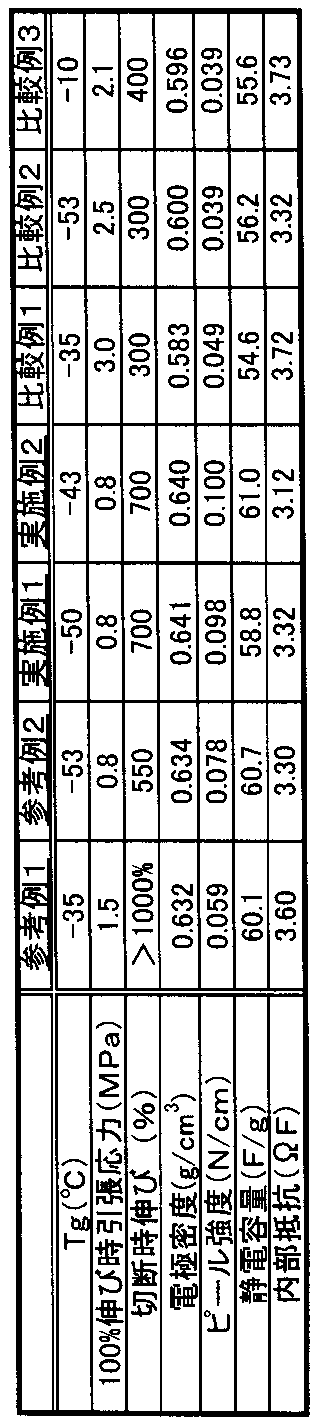
表1に示すように、本発明のバインダーを用いて製造した電極は電極密度が大きく、かつ結着力が強いことが分かる。そして該電極を用いると、静電容量が大きくかつ内部抵抗が小さい電気二重層キャパシタが得られた。
As shown in Table 1, it can be seen that the electrode manufactured using the binder of the present invention has a high electrode density and a strong binding force. And when this electrode was used, the electrical double layer capacitor with a large electrostatic capacitance and a small internal resistance was obtained.
Claims (8)
全単量体における多官能単量体の量が1重量%以下とされ、
N−メチロールアミド基、並びに、スルホン酸基又はその塩とエポキシ基との組み合わせ、からなる群より選ばれる、架橋性官能基を有し、
全単量体における前記架橋性官能基を有する単量体の総量が、0.1〜10重量%とされて、
100%伸び時の引張応力が2MPa以下であり、かつ切断時伸びが450%以上であるポリマーフィルムを与えるように調整されたポリマーからなる電気二重層キャパシタ電極用バインダー。 A compound represented by the general formula (1): CH 2 = CR 1 -COOR 2 ( wherein R 1 represents a hydrogen atom or a methyl group, and R 2 represents an alkyl group or a cycloalkyl group) is polymerized. A total of 60 wt% or more monomer units,
The amount of polyfunctional monomer in all monomers is 1% by weight or less,
Having a crosslinkable functional group selected from the group consisting of an N-methylolamide group, and a combination of a sulfonic acid group or a salt thereof and an epoxy group,
The total amount of monomers having the crosslinkable functional group in all monomers is 0.1 to 10% by weight,
A binder for an electric double layer capacitor electrode comprising a polymer adjusted to give a polymer film having a tensile stress at 100% elongation of 2 MPa or less and an elongation at break of 450% or more.
Applications Claiming Priority (3)
| Application Number | Priority Date | Filing Date | Title |
|---|---|---|---|
| JP2003365277 | 2003-10-24 | ||
| JP2003365277 | 2003-10-24 | ||
| PCT/JP2004/015600 WO2005041225A1 (en) | 2003-10-24 | 2004-10-21 | Binder for electrode of electric double layer capacitor |
Publications (2)
| Publication Number | Publication Date |
|---|---|
| JPWO2005041225A1 JPWO2005041225A1 (en) | 2007-06-21 |
| JP4483784B2 true JP4483784B2 (en) | 2010-06-16 |
Family
ID=34510163
Family Applications (1)
| Application Number | Title | Priority Date | Filing Date |
|---|---|---|---|
| JP2005514970A Expired - Fee Related JP4483784B2 (en) | 2003-10-24 | 2004-10-21 | Binder for electric double layer capacitor electrode |
Country Status (4)
| Country | Link |
|---|---|
| US (1) | US7939600B2 (en) |
| JP (1) | JP4483784B2 (en) |
| KR (1) | KR101062563B1 (en) |
| WO (1) | WO2005041225A1 (en) |
Families Citing this family (13)
| Publication number | Priority date | Publication date | Assignee | Title |
|---|---|---|---|---|
| WO2006101182A1 (en) * | 2005-03-23 | 2006-09-28 | Zeon Corporation | Binder for electrode of nonaqueous electrolyte secondary battery, electrode, and nonaqueous electrolyte secondary battery |
| KR100953615B1 (en) * | 2007-04-13 | 2010-04-20 | 삼성에스디아이 주식회사 | Anode active material for lithium secondary battery, manufacturing method thereof and lithium secondary battery comprising same |
| JP2010087314A (en) * | 2008-09-30 | 2010-04-15 | Nippon Chemicon Corp | Electrode for electric double layer capacitor |
| CA2770285C (en) * | 2009-08-07 | 2014-03-25 | Jsr Corporation | Electrochemical device and binder composition |
| US9966606B2 (en) | 2013-03-27 | 2018-05-08 | Jsr Corporation | Binder composition for power storage devices |
| CN103400705A (en) * | 2013-06-07 | 2013-11-20 | 山东精工电子科技有限公司 | Preparation method for slurry of super capacitor |
| JP5975953B2 (en) * | 2013-08-06 | 2016-08-23 | 日本バルカー工業株式会社 | Method for producing electrode film for electric double layer capacitor |
| US10256446B2 (en) * | 2014-02-27 | 2019-04-09 | Zeon Corporation | Binder composition for secondary battery porous membrane, slurry for secondary battery porous membrane, porous membrane for secondary battery, and secondary battery |
| MX2016013413A (en) | 2014-04-18 | 2017-04-06 | Maxwell Lab | ELECTRODE DEVICE FOR DRY ENERGY STORAGE AND METHODS TO MAKE THE SAME. |
| US10312028B2 (en) | 2014-06-30 | 2019-06-04 | Avx Corporation | Electrochemical energy storage devices and manufacturing methods |
| KR101802352B1 (en) * | 2015-09-24 | 2017-11-29 | 한국원자력연구원 | Carbon electrode material comprising radiation-crosslinkable poly(vinyl alcohol) and preparation method of carbon electrode |
| JP7061971B2 (en) | 2016-05-20 | 2022-05-02 | キョーセラ・エイブイエックス・コンポーネンツ・コーポレーション | Multicell ultracapacitor |
| CN114868284B (en) * | 2019-12-27 | 2025-02-11 | 日本瑞翁株式会社 | Electrochemical device, electrode for electrochemical device, coating liquid for electrochemical device and use thereof |
Family Cites Families (17)
| Publication number | Priority date | Publication date | Assignee | Title |
|---|---|---|---|---|
| DE3147007C2 (en) * | 1981-11-27 | 1983-10-06 | Roehm Gmbh, 6100 Darmstadt | Self-crosslinking aqueous plastic dispersion |
| JPH0855761A (en) * | 1994-08-16 | 1996-02-27 | Asahi Glass Co Ltd | Electric double layer capacitor and method of manufacturing the same |
| JP3669380B2 (en) | 1994-10-07 | 2005-07-06 | 日本ゼオン株式会社 | Electrode binder |
| JPH1021964A (en) * | 1996-07-05 | 1998-01-23 | Fuji Photo Film Co Ltd | Nonaqueous secondary battery and manufacture thereof |
| KR100582518B1 (en) * | 1997-03-04 | 2006-05-24 | 제온 코포레이션 | Battery Binder Composition, Battery Electrode Slurry, Lithium Secondary Battery Electrode and Lithium Secondary Battery |
| JP3661382B2 (en) * | 1997-12-01 | 2005-06-15 | Jsr株式会社 | Binder for electric double layer capacitor electrode |
| DE19835615A1 (en) * | 1998-08-06 | 2000-02-10 | Basf Ag | Compositions suitable for electrochemical cells |
| DE19939325A1 (en) * | 1999-08-19 | 2001-02-22 | Basf Ag | Aqueous copolymer dispersion, useful for the production of adhesives, is prepared by radical, emulsion polymerization of at least two different monomers with a varied rate of initiator addition |
| DE10014399A1 (en) * | 2000-03-23 | 2001-10-04 | Wacker Polymer Systems Gmbh | Crosslinkable polymer composition useful as a textile binder, comprises a carboxy-functional copolymer and a copolymer having carboxy-reactive groups |
| US6656633B2 (en) * | 2000-07-26 | 2003-12-02 | Zeon Corporation | Binder for electrode for lithium ion secondary battery, and utilization thereof |
| JP4280891B2 (en) * | 2000-07-26 | 2009-06-17 | 日本ゼオン株式会社 | Binder for lithium ion secondary battery electrode and use thereof |
| JP3911145B2 (en) * | 2000-11-10 | 2007-05-09 | 三洋化成工業株式会社 | Binder for electrode of electrochemical device and method for producing electrode |
| DE10062176A1 (en) * | 2000-12-14 | 2002-07-04 | Wacker Polymer Systems Gmbh | Polyvinyl acetal-grafted polymers |
| JP5164031B2 (en) * | 2001-04-27 | 2013-03-13 | 日本エイアンドエル株式会社 | Secondary battery negative electrode binder |
| JP4273687B2 (en) | 2001-09-21 | 2009-06-03 | 日本ゼオン株式会社 | Binder composition for secondary battery electrode and secondary battery |
| JP2003151554A (en) * | 2001-11-16 | 2003-05-23 | Hitachi Maxell Ltd | Electrode and electrochemical device using the same |
| JP4280802B2 (en) | 2002-05-15 | 2009-06-17 | 三洋化成工業株式会社 | Binder for electrode of electrochemical device and method for producing electrode |
-
2004
- 2004-10-21 KR KR1020067010016A patent/KR101062563B1/en not_active Expired - Fee Related
- 2004-10-21 US US10/576,676 patent/US7939600B2/en active Active
- 2004-10-21 JP JP2005514970A patent/JP4483784B2/en not_active Expired - Fee Related
- 2004-10-21 WO PCT/JP2004/015600 patent/WO2005041225A1/en not_active Ceased
Also Published As
| Publication number | Publication date |
|---|---|
| KR101062563B1 (en) | 2011-09-06 |
| US20070274023A1 (en) | 2007-11-29 |
| JPWO2005041225A1 (en) | 2007-06-21 |
| WO2005041225A1 (en) | 2005-05-06 |
| KR20060113713A (en) | 2006-11-02 |
| US7939600B2 (en) | 2011-05-10 |
Similar Documents
| Publication | Publication Date | Title |
|---|---|---|
| JP4483783B2 (en) | Binder for electric double layer capacitor electrode | |
| JP5098954B2 (en) | Method for producing electrode for electrochemical device and electrochemical device | |
| JP4483784B2 (en) | Binder for electric double layer capacitor electrode | |
| JP6314402B2 (en) | Binder composition for electrochemical capacitor, slurry composition for electrochemical capacitor, electrode for electrochemical capacitor, and electrochemical capacitor | |
| JP4543634B2 (en) | Electrode layer forming material | |
| JP4432906B2 (en) | Binder for electric double layer capacitor | |
| JP5522364B2 (en) | Slurry composition for electrode | |
| JP5663976B2 (en) | Polarized electrodes, electrochemical devices and lead-acid batteries | |
| WO2009123168A1 (en) | Porous film and secondary cell electrode | |
| JP4501857B2 (en) | Binder composition for electric double layer capacitor electrode | |
| JP2005166756A (en) | Binder for electrochemical devices | |
| JP2002353074A (en) | Electric double-layer capacitor, paste for electrode used for the capacitor, and elctrode | |
| JP2000100436A (en) | Polymer particles, polymer dispersion composition, slurry for battery electrode, electrode and battery | |
| JP5212094B2 (en) | Electrode for electrochemical element and electrochemical element | |
| JP4457606B2 (en) | Binder composition for electric double layer capacitor electrode | |
| JP2006269827A (en) | Electrochemical element electrode composition | |
| JP2005294575A (en) | Binder composition for electric double layer capacitor electrode and electric double layer capacitor | |
| JP2005064288A (en) | Binder for electric double layer capacitor electrode and use thereof | |
| JP4507517B2 (en) | Method for manufacturing electrode for electric double layer capacitor | |
| JPWO2014007142A1 (en) | Binder composition for electric double layer capacitor | |
| JP2005064293A (en) | Binder for electric double layer capacitor electrode | |
| JP2005064221A (en) | Binder for electric double layer capacitor electrode | |
| JP2005136265A (en) | Binder for electric double layer capacitor electrode | |
| JP2008072069A (en) | Electrode material for electric double layer capacitor and method of manufacturing the same |
Legal Events
| Date | Code | Title | Description |
|---|---|---|---|
| A621 | Written request for application examination |
Free format text: JAPANESE INTERMEDIATE CODE: A621 Effective date: 20070919 |
|
| A621 | Written request for application examination |
Free format text: JAPANESE INTERMEDIATE CODE: A621 Effective date: 20070919 |
|
| A131 | Notification of reasons for refusal |
Free format text: JAPANESE INTERMEDIATE CODE: A131 Effective date: 20090901 |
|
| A521 | Request for written amendment filed |
Free format text: JAPANESE INTERMEDIATE CODE: A523 Effective date: 20091029 |
|
| A131 | Notification of reasons for refusal |
Free format text: JAPANESE INTERMEDIATE CODE: A131 Effective date: 20091201 |
|
| A521 | Request for written amendment filed |
Free format text: JAPANESE INTERMEDIATE CODE: A523 Effective date: 20100129 |
|
| TRDD | Decision of grant or rejection written | ||
| A01 | Written decision to grant a patent or to grant a registration (utility model) |
Free format text: JAPANESE INTERMEDIATE CODE: A01 Effective date: 20100302 |
|
| A01 | Written decision to grant a patent or to grant a registration (utility model) |
Free format text: JAPANESE INTERMEDIATE CODE: A01 |
|
| A61 | First payment of annual fees (during grant procedure) |
Free format text: JAPANESE INTERMEDIATE CODE: A61 Effective date: 20100315 |
|
| R150 | Certificate of patent or registration of utility model |
Ref document number: 4483784 Country of ref document: JP Free format text: JAPANESE INTERMEDIATE CODE: R150 Free format text: JAPANESE INTERMEDIATE CODE: R150 |
|
| FPAY | Renewal fee payment (event date is renewal date of database) |
Free format text: PAYMENT UNTIL: 20130402 Year of fee payment: 3 |
|
| RD01 | Notification of change of attorney |
Free format text: JAPANESE INTERMEDIATE CODE: A7421 Effective date: 20101101 |
|
| A072 | Dismissal of procedure [no reply to invitation to correct request for examination] |
Free format text: JAPANESE INTERMEDIATE CODE: A072 Effective date: 20110301 |
|
| FPAY | Renewal fee payment (event date is renewal date of database) |
Free format text: PAYMENT UNTIL: 20130402 Year of fee payment: 3 |
|
| FPAY | Renewal fee payment (event date is renewal date of database) |
Free format text: PAYMENT UNTIL: 20140402 Year of fee payment: 4 |
|
| R250 | Receipt of annual fees |
Free format text: JAPANESE INTERMEDIATE CODE: R250 |
|
| R250 | Receipt of annual fees |
Free format text: JAPANESE INTERMEDIATE CODE: R250 |
|
| R250 | Receipt of annual fees |
Free format text: JAPANESE INTERMEDIATE CODE: R250 |
|
| R250 | Receipt of annual fees |
Free format text: JAPANESE INTERMEDIATE CODE: R250 |
|
| LAPS | Cancellation because of no payment of annual fees |