JP4213581B2 - Biologically active peptides - Google Patents
Biologically active peptides Download PDFInfo
- Publication number
- JP4213581B2 JP4213581B2 JP2003512262A JP2003512262A JP4213581B2 JP 4213581 B2 JP4213581 B2 JP 4213581B2 JP 2003512262 A JP2003512262 A JP 2003512262A JP 2003512262 A JP2003512262 A JP 2003512262A JP 4213581 B2 JP4213581 B2 JP 4213581B2
- Authority
- JP
- Japan
- Prior art keywords
- peptide
- group
- peptides
- day
- found
- Prior art date
- Legal status (The legal status is an assumption and is not a legal conclusion. Google has not performed a legal analysis and makes no representation as to the accuracy of the status listed.)
- Expired - Fee Related
Links
- 108090000765 processed proteins & peptides Proteins 0.000 title claims abstract description 377
- 102000004196 processed proteins & peptides Human genes 0.000 title abstract description 163
- 239000008194 pharmaceutical composition Substances 0.000 claims abstract description 17
- 125000003275 alpha amino acid group Chemical group 0.000 claims description 55
- 238000004519 manufacturing process Methods 0.000 claims description 9
- 238000002156 mixing Methods 0.000 claims description 5
- 239000003937 drug carrier Substances 0.000 claims description 4
- 150000007523 nucleic acids Chemical class 0.000 abstract description 24
- 108020004707 nucleic acids Proteins 0.000 abstract description 16
- 102000039446 nucleic acids Human genes 0.000 abstract description 16
- 230000000694 effects Effects 0.000 description 90
- FAPWRFPIFSIZLT-UHFFFAOYSA-M Sodium chloride Chemical group [Na+].[Cl-] FAPWRFPIFSIZLT-UHFFFAOYSA-M 0.000 description 87
- 210000004027 cell Anatomy 0.000 description 80
- 241000699670 Mus sp. Species 0.000 description 60
- 239000011780 sodium chloride Substances 0.000 description 59
- 238000000034 method Methods 0.000 description 55
- 108010002350 Interleukin-2 Proteins 0.000 description 47
- 102000000588 Interleukin-2 Human genes 0.000 description 47
- 238000011282 treatment Methods 0.000 description 45
- 241000700159 Rattus Species 0.000 description 35
- 108010034465 CMS 024 Proteins 0.000 description 34
- 239000013604 expression vector Substances 0.000 description 33
- 239000013598 vector Substances 0.000 description 33
- 238000012360 testing method Methods 0.000 description 31
- 108010085335 Pro-Thr-Thr-Lys-Thr-Tyr-Phe-Pro-His-Phe Proteins 0.000 description 30
- 210000000952 spleen Anatomy 0.000 description 29
- 241000699666 Mus <mouse, genus> Species 0.000 description 28
- 108090000623 proteins and genes Proteins 0.000 description 28
- 102100037850 Interferon gamma Human genes 0.000 description 27
- 108010074328 Interferon-gamma Proteins 0.000 description 27
- 210000001744 T-lymphocyte Anatomy 0.000 description 27
- 230000037396 body weight Effects 0.000 description 26
- 230000028327 secretion Effects 0.000 description 26
- 210000002966 serum Anatomy 0.000 description 26
- 230000004083 survival effect Effects 0.000 description 26
- 238000005119 centrifugation Methods 0.000 description 25
- 240000004808 Saccharomyces cerevisiae Species 0.000 description 24
- 239000000243 solution Substances 0.000 description 24
- 239000012980 RPMI-1640 medium Substances 0.000 description 23
- 239000006228 supernatant Substances 0.000 description 23
- 235000014680 Saccharomyces cerevisiae Nutrition 0.000 description 22
- 239000000126 substance Substances 0.000 description 21
- 201000008383 nephritis Diseases 0.000 description 20
- 230000009466 transformation Effects 0.000 description 19
- NHBKXEKEPDILRR-UHFFFAOYSA-N 2,3-bis(butanoylsulfanyl)propyl butanoate Chemical compound CCCC(=O)OCC(SC(=O)CCC)CSC(=O)CCC NHBKXEKEPDILRR-UHFFFAOYSA-N 0.000 description 18
- 241000894006 Bacteria Species 0.000 description 18
- 206010039491 Sarcoma Diseases 0.000 description 18
- 210000004369 blood Anatomy 0.000 description 18
- 239000008280 blood Substances 0.000 description 18
- DDRJAANPRJIHGJ-UHFFFAOYSA-N creatinine Chemical compound CN1CC(=O)NC1=N DDRJAANPRJIHGJ-UHFFFAOYSA-N 0.000 description 18
- 244000005700 microbiome Species 0.000 description 18
- 206010028980 Neoplasm Diseases 0.000 description 17
- 208000014018 liver neoplasm Diseases 0.000 description 17
- 201000001441 melanoma Diseases 0.000 description 17
- 108020004414 DNA Proteins 0.000 description 16
- 108010050904 Interferons Proteins 0.000 description 16
- 102000014150 Interferons Human genes 0.000 description 16
- 241001465754 Metazoa Species 0.000 description 16
- 150000001413 amino acids Chemical class 0.000 description 16
- 239000006285 cell suspension Substances 0.000 description 16
- 229940079322 interferon Drugs 0.000 description 16
- 238000003556 assay Methods 0.000 description 15
- 239000002773 nucleotide Substances 0.000 description 15
- 125000003729 nucleotide group Chemical group 0.000 description 15
- 210000004989 spleen cell Anatomy 0.000 description 15
- 239000012981 Hank's balanced salt solution Substances 0.000 description 14
- 208000002672 hepatitis B Diseases 0.000 description 14
- JYGXADMDTFJGBT-VWUMJDOOSA-N hydrocortisone Chemical compound O=C1CC[C@]2(C)[C@H]3[C@@H](O)C[C@](C)([C@@](CC4)(O)C(=O)CO)[C@@H]4[C@@H]3CCC2=C1 JYGXADMDTFJGBT-VWUMJDOOSA-N 0.000 description 14
- 208000015181 infectious disease Diseases 0.000 description 14
- 201000007270 liver cancer Diseases 0.000 description 14
- 229920001184 polypeptide Polymers 0.000 description 14
- 238000010171 animal model Methods 0.000 description 13
- 230000001580 bacterial effect Effects 0.000 description 13
- 208000006454 hepatitis Diseases 0.000 description 13
- 231100000283 hepatitis Toxicity 0.000 description 13
- 208000032839 leukemia Diseases 0.000 description 13
- 230000000242 pagocytic effect Effects 0.000 description 13
- 239000000523 sample Substances 0.000 description 13
- 230000015572 biosynthetic process Effects 0.000 description 12
- 201000011510 cancer Diseases 0.000 description 12
- 230000005907 cancer growth Effects 0.000 description 12
- 230000001472 cytotoxic effect Effects 0.000 description 12
- 230000005965 immune activity Effects 0.000 description 12
- 241000725618 Duck hepatitis B virus Species 0.000 description 11
- 108010076504 Protein Sorting Signals Proteins 0.000 description 11
- 210000000822 natural killer cell Anatomy 0.000 description 11
- 239000000902 placebo Substances 0.000 description 11
- 229940068196 placebo Drugs 0.000 description 11
- 238000011160 research Methods 0.000 description 11
- 206010003445 Ascites Diseases 0.000 description 10
- 235000014469 Bacillus subtilis Nutrition 0.000 description 10
- 239000001963 growth medium Substances 0.000 description 10
- 230000004071 biological effect Effects 0.000 description 9
- 229940109239 creatinine Drugs 0.000 description 9
- 238000002347 injection Methods 0.000 description 9
- 239000007924 injection Substances 0.000 description 9
- 239000002609 medium Substances 0.000 description 9
- 239000013642 negative control Substances 0.000 description 9
- 238000012453 sprague-dawley rat model Methods 0.000 description 9
- 210000002784 stomach Anatomy 0.000 description 9
- 239000000725 suspension Substances 0.000 description 9
- XLYOFNOQVPJJNP-UHFFFAOYSA-N water Chemical compound O XLYOFNOQVPJJNP-UHFFFAOYSA-N 0.000 description 9
- 108091003079 Bovine Serum Albumin Proteins 0.000 description 8
- 241000588724 Escherichia coli Species 0.000 description 8
- 108091028043 Nucleic acid sequence Proteins 0.000 description 8
- 241000283973 Oryctolagus cuniculus Species 0.000 description 8
- 239000003814 drug Substances 0.000 description 8
- 239000012894 fetal calf serum Substances 0.000 description 8
- 239000007928 intraperitoneal injection Substances 0.000 description 8
- JVTAAEKCZFNVCJ-UHFFFAOYSA-N lactic acid Chemical compound CC(O)C(O)=O JVTAAEKCZFNVCJ-UHFFFAOYSA-N 0.000 description 8
- 238000007726 management method Methods 0.000 description 8
- 210000002864 mononuclear phagocyte Anatomy 0.000 description 8
- 239000008188 pellet Substances 0.000 description 8
- 239000013641 positive control Substances 0.000 description 8
- 102000004169 proteins and genes Human genes 0.000 description 8
- CMSMOCZEIVJLDB-UHFFFAOYSA-N Cyclophosphamide Chemical compound ClCCN(CCCl)P1(=O)NCCCO1 CMSMOCZEIVJLDB-UHFFFAOYSA-N 0.000 description 7
- 229940079593 drug Drugs 0.000 description 7
- 230000012010 growth Effects 0.000 description 7
- 229960000890 hydrocortisone Drugs 0.000 description 7
- 238000001727 in vivo Methods 0.000 description 7
- 239000000203 mixture Substances 0.000 description 7
- 239000002547 new drug Substances 0.000 description 7
- 241000272525 Anas platyrhynchos Species 0.000 description 6
- 241000186660 Lactobacillus Species 0.000 description 6
- 208000008589 Obesity Diseases 0.000 description 6
- 239000002775 capsule Substances 0.000 description 6
- 238000004113 cell culture Methods 0.000 description 6
- 238000010367 cloning Methods 0.000 description 6
- 230000000295 complement effect Effects 0.000 description 6
- 235000005911 diet Nutrition 0.000 description 6
- 230000037213 diet Effects 0.000 description 6
- 210000001035 gastrointestinal tract Anatomy 0.000 description 6
- 239000002502 liposome Substances 0.000 description 6
- 239000000463 material Substances 0.000 description 6
- 235000020824 obesity Nutrition 0.000 description 6
- 239000013612 plasmid Substances 0.000 description 6
- 230000001225 therapeutic effect Effects 0.000 description 6
- 210000001541 thymus gland Anatomy 0.000 description 6
- 238000002965 ELISA Methods 0.000 description 5
- 241000711975 Vesicular stomatitis virus Species 0.000 description 5
- 210000003567 ascitic fluid Anatomy 0.000 description 5
- 238000004364 calculation method Methods 0.000 description 5
- 239000012895 dilution Substances 0.000 description 5
- 238000010790 dilution Methods 0.000 description 5
- 210000003743 erythrocyte Anatomy 0.000 description 5
- 230000006870 function Effects 0.000 description 5
- 238000001415 gene therapy Methods 0.000 description 5
- 230000002068 genetic effect Effects 0.000 description 5
- AKPUJVVHYUHGKY-UHFFFAOYSA-N hydron;propan-2-ol;chloride Chemical compound Cl.CC(C)O AKPUJVVHYUHGKY-UHFFFAOYSA-N 0.000 description 5
- 230000003053 immunization Effects 0.000 description 5
- 238000002649 immunization Methods 0.000 description 5
- 230000006698 induction Effects 0.000 description 5
- 239000007927 intramuscular injection Substances 0.000 description 5
- 238000010255 intramuscular injection Methods 0.000 description 5
- 238000010253 intravenous injection Methods 0.000 description 5
- 210000003734 kidney Anatomy 0.000 description 5
- JTEGQNOMFQHVDC-NKWVEPMBSA-N lamivudine Chemical compound O=C1N=C(N)C=CN1[C@H]1O[C@@H](CO)SC1 JTEGQNOMFQHVDC-NKWVEPMBSA-N 0.000 description 5
- 210000000056 organ Anatomy 0.000 description 5
- 230000001575 pathological effect Effects 0.000 description 5
- 239000012730 sustained-release form Substances 0.000 description 5
- 210000001215 vagina Anatomy 0.000 description 5
- 244000063299 Bacillus subtilis Species 0.000 description 4
- 239000006144 Dulbecco’s modified Eagle's medium Substances 0.000 description 4
- 150000008575 L-amino acids Chemical class 0.000 description 4
- 206010029120 Nephritis allergic Diseases 0.000 description 4
- 239000002671 adjuvant Substances 0.000 description 4
- 230000003247 decreasing effect Effects 0.000 description 4
- 239000000839 emulsion Substances 0.000 description 4
- 235000013305 food Nutrition 0.000 description 4
- 238000009472 formulation Methods 0.000 description 4
- 230000002496 gastric effect Effects 0.000 description 4
- 238000010353 genetic engineering Methods 0.000 description 4
- 230000001434 glomerular Effects 0.000 description 4
- 206010073071 hepatocellular carcinoma Diseases 0.000 description 4
- 230000036737 immune function Effects 0.000 description 4
- 238000011534 incubation Methods 0.000 description 4
- 210000004731 jugular vein Anatomy 0.000 description 4
- 235000014655 lactic acid Nutrition 0.000 description 4
- 239000004310 lactic acid Substances 0.000 description 4
- 229960001627 lamivudine Drugs 0.000 description 4
- 210000004185 liver Anatomy 0.000 description 4
- 238000005259 measurement Methods 0.000 description 4
- 238000010899 nucleation Methods 0.000 description 4
- 238000002360 preparation method Methods 0.000 description 4
- 230000008569 process Effects 0.000 description 4
- 239000011734 sodium Substances 0.000 description 4
- 238000007920 subcutaneous administration Methods 0.000 description 4
- 239000013589 supplement Substances 0.000 description 4
- 210000001519 tissue Anatomy 0.000 description 4
- 210000003437 trachea Anatomy 0.000 description 4
- 210000002700 urine Anatomy 0.000 description 4
- 210000003462 vein Anatomy 0.000 description 4
- 108020003215 DNA Probes Proteins 0.000 description 3
- 239000003298 DNA probe Substances 0.000 description 3
- 208000001382 Experimental Melanoma Diseases 0.000 description 3
- 206010018910 Haemolysis Diseases 0.000 description 3
- 206010020710 Hyperphagia Diseases 0.000 description 3
- 101000981253 Mus musculus GPI-linked NAD(P)(+)-arginine ADP-ribosyltransferase 1 Proteins 0.000 description 3
- 241001494479 Pecora Species 0.000 description 3
- 208000036142 Viral infection Diseases 0.000 description 3
- 125000000539 amino acid group Chemical group 0.000 description 3
- 239000000427 antigen Substances 0.000 description 3
- 230000003115 biocidal effect Effects 0.000 description 3
- 238000006243 chemical reaction Methods 0.000 description 3
- 239000003153 chemical reaction reagent Substances 0.000 description 3
- 239000003795 chemical substances by application Substances 0.000 description 3
- 239000006071 cream Substances 0.000 description 3
- 235000015872 dietary supplement Nutrition 0.000 description 3
- 239000012153 distilled water Substances 0.000 description 3
- 238000001647 drug administration Methods 0.000 description 3
- 239000000499 gel Substances 0.000 description 3
- 230000008588 hemolysis Effects 0.000 description 3
- 230000007366 host health Effects 0.000 description 3
- 238000009396 hybridization Methods 0.000 description 3
- 230000001900 immune effect Effects 0.000 description 3
- 230000028993 immune response Effects 0.000 description 3
- 238000002513 implantation Methods 0.000 description 3
- 238000012986 modification Methods 0.000 description 3
- 230000004048 modification Effects 0.000 description 3
- 239000002674 ointment Substances 0.000 description 3
- 235000020830 overeating Nutrition 0.000 description 3
- 239000000843 powder Substances 0.000 description 3
- 201000001474 proteinuria Diseases 0.000 description 3
- 238000011552 rat model Methods 0.000 description 3
- 108091008146 restriction endonucleases Proteins 0.000 description 3
- 241000894007 species Species 0.000 description 3
- 229910001220 stainless steel Inorganic materials 0.000 description 3
- 239000010935 stainless steel Substances 0.000 description 3
- 238000010561 standard procedure Methods 0.000 description 3
- 238000007619 statistical method Methods 0.000 description 3
- 230000000638 stimulation Effects 0.000 description 3
- 238000010254 subcutaneous injection Methods 0.000 description 3
- 239000007929 subcutaneous injection Substances 0.000 description 3
- 239000003826 tablet Substances 0.000 description 3
- 238000002560 therapeutic procedure Methods 0.000 description 3
- 230000000699 topical effect Effects 0.000 description 3
- 238000002054 transplantation Methods 0.000 description 3
- 230000009385 viral infection Effects 0.000 description 3
- 238000005303 weighing Methods 0.000 description 3
- 230000004584 weight gain Effects 0.000 description 3
- 235000019786 weight gain Nutrition 0.000 description 3
- 238000001262 western blot Methods 0.000 description 3
- 241000272522 Anas Species 0.000 description 2
- 241000700199 Cavia porcellus Species 0.000 description 2
- 108091026890 Coding region Proteins 0.000 description 2
- 241000194032 Enterococcus faecalis Species 0.000 description 2
- 206010018367 Glomerulonephritis chronic Diseases 0.000 description 2
- WQZGKKKJIJFFOK-GASJEMHNSA-N Glucose Natural products OC[C@H]1OC(O)[C@H](O)[C@@H](O)[C@@H]1O WQZGKKKJIJFFOK-GASJEMHNSA-N 0.000 description 2
- 241000282412 Homo Species 0.000 description 2
- 240000001046 Lactobacillus acidophilus Species 0.000 description 2
- 101001044384 Mus musculus Interferon gamma Proteins 0.000 description 2
- 241000235070 Saccharomyces Species 0.000 description 2
- 230000002411 adverse Effects 0.000 description 2
- 238000004458 analytical method Methods 0.000 description 2
- 239000003242 anti bacterial agent Substances 0.000 description 2
- 210000001099 axilla Anatomy 0.000 description 2
- 239000011324 bead Substances 0.000 description 2
- 230000008827 biological function Effects 0.000 description 2
- 239000006143 cell culture medium Substances 0.000 description 2
- 230000010261 cell growth Effects 0.000 description 2
- 230000001413 cellular effect Effects 0.000 description 2
- 230000007969 cellular immunity Effects 0.000 description 2
- 238000001816 cooling Methods 0.000 description 2
- 230000029087 digestion Effects 0.000 description 2
- 201000010099 disease Diseases 0.000 description 2
- 208000037265 diseases, disorders, signs and symptoms Diseases 0.000 description 2
- 239000002612 dispersion medium Substances 0.000 description 2
- 238000004520 electroporation Methods 0.000 description 2
- 230000002708 enhancing effect Effects 0.000 description 2
- 238000002474 experimental method Methods 0.000 description 2
- 230000037406 food intake Effects 0.000 description 2
- 238000004108 freeze drying Methods 0.000 description 2
- 238000001502 gel electrophoresis Methods 0.000 description 2
- 239000011521 glass Substances 0.000 description 2
- 239000008103 glucose Substances 0.000 description 2
- 230000036541 health Effects 0.000 description 2
- 230000004727 humoral immunity Effects 0.000 description 2
- 230000002209 hydrophobic effect Effects 0.000 description 2
- 206010020718 hyperplasia Diseases 0.000 description 2
- 208000026278 immune system disease Diseases 0.000 description 2
- 230000036039 immunity Effects 0.000 description 2
- 230000001939 inductive effect Effects 0.000 description 2
- 230000005764 inhibitory process Effects 0.000 description 2
- 230000000968 intestinal effect Effects 0.000 description 2
- 235000015122 lemonade Nutrition 0.000 description 2
- XIXADJRWDQXREU-UHFFFAOYSA-M lithium acetate Chemical compound [Li+].CC([O-])=O XIXADJRWDQXREU-UHFFFAOYSA-M 0.000 description 2
- 210000004698 lymphocyte Anatomy 0.000 description 2
- 239000003550 marker Substances 0.000 description 2
- 230000007246 mechanism Effects 0.000 description 2
- 238000010172 mouse model Methods 0.000 description 2
- 235000016709 nutrition Nutrition 0.000 description 2
- 238000007427 paired t-test Methods 0.000 description 2
- 231100000915 pathological change Toxicity 0.000 description 2
- 230000036285 pathological change Effects 0.000 description 2
- 229960001412 pentobarbital Drugs 0.000 description 2
- WEXRUCMBJFQVBZ-UHFFFAOYSA-N pentobarbital Chemical compound CCCC(C)C1(CC)C(=O)NC(=O)NC1=O WEXRUCMBJFQVBZ-UHFFFAOYSA-N 0.000 description 2
- 210000003200 peritoneal cavity Anatomy 0.000 description 2
- 125000002924 primary amino group Chemical group [H]N([H])* 0.000 description 2
- 239000000047 product Substances 0.000 description 2
- 230000001681 protective effect Effects 0.000 description 2
- 239000011541 reaction mixture Substances 0.000 description 2
- -1 retardants Substances 0.000 description 2
- 230000002441 reversible effect Effects 0.000 description 2
- 239000012898 sample dilution Substances 0.000 description 2
- 238000000926 separation method Methods 0.000 description 2
- 210000000329 smooth muscle myocyte Anatomy 0.000 description 2
- 239000002904 solvent Substances 0.000 description 2
- 238000006467 substitution reaction Methods 0.000 description 2
- 238000013268 sustained release Methods 0.000 description 2
- 238000003786 synthesis reaction Methods 0.000 description 2
- 210000005239 tubule Anatomy 0.000 description 2
- 230000004614 tumor growth Effects 0.000 description 2
- 230000002485 urinary effect Effects 0.000 description 2
- 230000003442 weekly effect Effects 0.000 description 2
- 235000013618 yogurt Nutrition 0.000 description 2
- FBOUIAKEJMZPQG-AWNIVKPZSA-N (1E)-1-(2,4-dichlorophenyl)-4,4-dimethyl-2-(1,2,4-triazol-1-yl)pent-1-en-3-ol Chemical compound C1=NC=NN1/C(C(O)C(C)(C)C)=C/C1=CC=C(Cl)C=C1Cl FBOUIAKEJMZPQG-AWNIVKPZSA-N 0.000 description 1
- 108091032973 (ribonucleotides)n+m Proteins 0.000 description 1
- QKNYBSVHEMOAJP-UHFFFAOYSA-N 2-amino-2-(hydroxymethyl)propane-1,3-diol;hydron;chloride Chemical compound Cl.OCC(N)(CO)CO QKNYBSVHEMOAJP-UHFFFAOYSA-N 0.000 description 1
- GOJUJUVQIVIZAV-UHFFFAOYSA-N 2-amino-4,6-dichloropyrimidine-5-carbaldehyde Chemical group NC1=NC(Cl)=C(C=O)C(Cl)=N1 GOJUJUVQIVIZAV-UHFFFAOYSA-N 0.000 description 1
- QFVHZQCOUORWEI-UHFFFAOYSA-N 4-[(4-anilino-5-sulfonaphthalen-1-yl)diazenyl]-5-hydroxynaphthalene-2,7-disulfonic acid Chemical compound C=12C(O)=CC(S(O)(=O)=O)=CC2=CC(S(O)(=O)=O)=CC=1N=NC(C1=CC=CC(=C11)S(O)(=O)=O)=CC=C1NC1=CC=CC=C1 QFVHZQCOUORWEI-UHFFFAOYSA-N 0.000 description 1
- 241000272517 Anseriformes Species 0.000 description 1
- 206010003210 Arteriosclerosis Diseases 0.000 description 1
- 101150076489 B gene Proteins 0.000 description 1
- 241000193755 Bacillus cereus Species 0.000 description 1
- 241000186000 Bifidobacterium Species 0.000 description 1
- 241000901050 Bifidobacterium animalis subsp. lactis Species 0.000 description 1
- 241000186016 Bifidobacterium bifidum Species 0.000 description 1
- 241001608472 Bifidobacterium longum Species 0.000 description 1
- 241000186015 Bifidobacterium longum subsp. infantis Species 0.000 description 1
- OKTJSMMVPCPJKN-UHFFFAOYSA-N Carbon Chemical compound [C] OKTJSMMVPCPJKN-UHFFFAOYSA-N 0.000 description 1
- 244000038022 Chenopodium capitatum Species 0.000 description 1
- 235000004391 Chenopodium capitatum Nutrition 0.000 description 1
- 241000700112 Chinchilla Species 0.000 description 1
- 108020004705 Codon Proteins 0.000 description 1
- 108010062580 Concanavalin A Proteins 0.000 description 1
- 150000008574 D-amino acids Chemical group 0.000 description 1
- 241000702421 Dependoparvovirus Species 0.000 description 1
- 206010012735 Diarrhoea Diseases 0.000 description 1
- LTMHDMANZUZIPE-AMTYYWEZSA-N Digoxin Natural products O([C@H]1[C@H](C)O[C@H](O[C@@H]2C[C@@H]3[C@@](C)([C@@H]4[C@H]([C@]5(O)[C@](C)([C@H](O)C4)[C@H](C4=CC(=O)OC4)CC5)CC3)CC2)C[C@@H]1O)[C@H]1O[C@H](C)[C@@H](O[C@H]2O[C@@H](C)[C@H](O)[C@@H](O)C2)[C@@H](O)C1 LTMHDMANZUZIPE-AMTYYWEZSA-N 0.000 description 1
- 108091092566 Extrachromosomal DNA Proteins 0.000 description 1
- 108010058643 Fungal Proteins Proteins 0.000 description 1
- 206010018364 Glomerulonephritis Diseases 0.000 description 1
- 206010019799 Hepatitis viral Diseases 0.000 description 1
- 101001002657 Homo sapiens Interleukin-2 Proteins 0.000 description 1
- 241000186713 Lactobacillus amylovorus Species 0.000 description 1
- 240000001929 Lactobacillus brevis Species 0.000 description 1
- 244000199866 Lactobacillus casei Species 0.000 description 1
- 241000218492 Lactobacillus crispatus Species 0.000 description 1
- 241001147746 Lactobacillus delbrueckii subsp. lactis Species 0.000 description 1
- 241000509544 Lactobacillus gallinarum Species 0.000 description 1
- 241000186606 Lactobacillus gasseri Species 0.000 description 1
- 241001468157 Lactobacillus johnsonii Species 0.000 description 1
- 241000186605 Lactobacillus paracasei Species 0.000 description 1
- 240000006024 Lactobacillus plantarum Species 0.000 description 1
- 241000186604 Lactobacillus reuteri Species 0.000 description 1
- 241000218588 Lactobacillus rhamnosus Species 0.000 description 1
- 208000018142 Leiomyosarcoma Diseases 0.000 description 1
- 241000713666 Lentivirus Species 0.000 description 1
- 241000124008 Mammalia Species 0.000 description 1
- 241001272720 Medialuna californiensis Species 0.000 description 1
- 206010027476 Metastases Diseases 0.000 description 1
- 206010027458 Metastases to lung Diseases 0.000 description 1
- 239000000020 Nitrocellulose Substances 0.000 description 1
- 206010030113 Oedema Diseases 0.000 description 1
- 208000031481 Pathologic Constriction Diseases 0.000 description 1
- 108010033276 Peptide Fragments Proteins 0.000 description 1
- 102000007079 Peptide Fragments Human genes 0.000 description 1
- BELBBZDIHDAJOR-UHFFFAOYSA-N Phenolsulfonephthalein Chemical compound C1=CC(O)=CC=C1C1(C=2C=CC(O)=CC=2)C2=CC=CC=C2S(=O)(=O)O1 BELBBZDIHDAJOR-UHFFFAOYSA-N 0.000 description 1
- 241000186428 Propionibacterium freudenreichii Species 0.000 description 1
- 102000007056 Recombinant Fusion Proteins Human genes 0.000 description 1
- 108010008281 Recombinant Fusion Proteins Proteins 0.000 description 1
- 241000204115 Sporolactobacillus inulinus Species 0.000 description 1
- 238000000692 Student's t-test Methods 0.000 description 1
- 241000700605 Viruses Species 0.000 description 1
- 210000000683 abdominal cavity Anatomy 0.000 description 1
- 230000002159 abnormal effect Effects 0.000 description 1
- 238000010521 absorption reaction Methods 0.000 description 1
- 230000009471 action Effects 0.000 description 1
- 239000004480 active ingredient Substances 0.000 description 1
- BFNBIHQBYMNNAN-UHFFFAOYSA-N ammonium sulfate Chemical compound N.N.OS(O)(=O)=O BFNBIHQBYMNNAN-UHFFFAOYSA-N 0.000 description 1
- 229910052921 ammonium sulfate Inorganic materials 0.000 description 1
- 235000011130 ammonium sulphate Nutrition 0.000 description 1
- 238000000540 analysis of variance Methods 0.000 description 1
- 238000002399 angioplasty Methods 0.000 description 1
- 230000000840 anti-viral effect Effects 0.000 description 1
- 229940088710 antibiotic agent Drugs 0.000 description 1
- 230000000890 antigenic effect Effects 0.000 description 1
- 102000036639 antigens Human genes 0.000 description 1
- 108091007433 antigens Proteins 0.000 description 1
- 210000000702 aorta abdominal Anatomy 0.000 description 1
- 230000036528 appetite Effects 0.000 description 1
- 235000019789 appetite Nutrition 0.000 description 1
- 238000013459 approach Methods 0.000 description 1
- 208000011775 arteriosclerosis disease Diseases 0.000 description 1
- 210000000601 blood cell Anatomy 0.000 description 1
- 210000004204 blood vessel Anatomy 0.000 description 1
- 235000014121 butter Nutrition 0.000 description 1
- 210000004899 c-terminal region Anatomy 0.000 description 1
- 229910052799 carbon Inorganic materials 0.000 description 1
- 125000003178 carboxy group Chemical group [H]OC(*)=O 0.000 description 1
- 210000001715 carotid artery Anatomy 0.000 description 1
- 239000000969 carrier Substances 0.000 description 1
- 239000012876 carrier material Substances 0.000 description 1
- 238000010523 cascade reaction Methods 0.000 description 1
- 230000006037 cell lysis Effects 0.000 description 1
- 230000005887 cellular phagocytosis Effects 0.000 description 1
- 230000004700 cellular uptake Effects 0.000 description 1
- 230000008859 change Effects 0.000 description 1
- 235000013351 cheese Nutrition 0.000 description 1
- 239000013611 chromosomal DNA Substances 0.000 description 1
- 230000002759 chromosomal effect Effects 0.000 description 1
- 210000000349 chromosome Anatomy 0.000 description 1
- 239000002299 complementary DNA Substances 0.000 description 1
- 239000000470 constituent Substances 0.000 description 1
- 239000013068 control sample Substances 0.000 description 1
- 125000000017 cortisol group Chemical group 0.000 description 1
- 235000014048 cultured milk product Nutrition 0.000 description 1
- 229960004397 cyclophosphamide Drugs 0.000 description 1
- 230000009089 cytolysis Effects 0.000 description 1
- 238000001514 detection method Methods 0.000 description 1
- 230000001627 detrimental effect Effects 0.000 description 1
- 238000011161 development Methods 0.000 description 1
- 238000000502 dialysis Methods 0.000 description 1
- 238000009792 diffusion process Methods 0.000 description 1
- LTMHDMANZUZIPE-PUGKRICDSA-N digoxin Chemical compound C1[C@H](O)[C@H](O)[C@@H](C)O[C@H]1O[C@@H]1[C@@H](C)O[C@@H](O[C@@H]2[C@H](O[C@@H](O[C@@H]3C[C@@H]4[C@]([C@@H]5[C@H]([C@]6(CC[C@@H]([C@@]6(C)[C@H](O)C5)C=5COC(=O)C=5)O)CC4)(C)CC3)C[C@@H]2O)C)C[C@@H]1O LTMHDMANZUZIPE-PUGKRICDSA-N 0.000 description 1
- 229960005156 digoxin Drugs 0.000 description 1
- LTMHDMANZUZIPE-UHFFFAOYSA-N digoxine Natural products C1C(O)C(O)C(C)OC1OC1C(C)OC(OC2C(OC(OC3CC4C(C5C(C6(CCC(C6(C)C(O)C5)C=5COC(=O)C=5)O)CC4)(C)CC3)CC2O)C)CC1O LTMHDMANZUZIPE-UHFFFAOYSA-N 0.000 description 1
- 230000010339 dilation Effects 0.000 description 1
- 230000003467 diminishing effect Effects 0.000 description 1
- UKWLRLAKGMZXJC-QIECWBMSSA-L disodium;[4-chloro-3-[(3r,5s)-1-chloro-3'-methoxyspiro[adamantane-4,4'-dioxetane]-3'-yl]phenyl] phosphate Chemical compound [Na+].[Na+].O1OC2([C@@H]3CC4C[C@H]2CC(Cl)(C4)C3)C1(OC)C1=CC(OP([O-])([O-])=O)=CC=C1Cl UKWLRLAKGMZXJC-QIECWBMSSA-L 0.000 description 1
- 239000003651 drinking water Substances 0.000 description 1
- 235000020188 drinking water Nutrition 0.000 description 1
- 230000000066 effect on nephritis Effects 0.000 description 1
- 229940032049 enterococcus faecalis Drugs 0.000 description 1
- 230000008508 epithelial proliferation Effects 0.000 description 1
- 230000008029 eradication Effects 0.000 description 1
- 210000003527 eukaryotic cell Anatomy 0.000 description 1
- 230000029142 excretion Effects 0.000 description 1
- 235000021001 fermented dairy product Nutrition 0.000 description 1
- 239000000945 filler Substances 0.000 description 1
- 239000000706 filtrate Substances 0.000 description 1
- 238000005558 fluorometry Methods 0.000 description 1
- 239000012634 fragment Substances 0.000 description 1
- 230000002538 fungal effect Effects 0.000 description 1
- 230000003779 hair growth Effects 0.000 description 1
- 230000035876 healing Effects 0.000 description 1
- 102000055277 human IL2 Human genes 0.000 description 1
- 210000005260 human cell Anatomy 0.000 description 1
- 230000028996 humoral immune response Effects 0.000 description 1
- 230000008348 humoral response Effects 0.000 description 1
- 230000007233 immunological mechanism Effects 0.000 description 1
- 229960001438 immunostimulant agent Drugs 0.000 description 1
- 239000003022 immunostimulating agent Substances 0.000 description 1
- 230000003308 immunostimulating effect Effects 0.000 description 1
- 230000001506 immunosuppresive effect Effects 0.000 description 1
- 238000009169 immunotherapy Methods 0.000 description 1
- 239000005414 inactive ingredient Substances 0.000 description 1
- 239000004615 ingredient Substances 0.000 description 1
- 230000002401 inhibitory effect Effects 0.000 description 1
- 239000003999 initiator Substances 0.000 description 1
- 238000003780 insertion Methods 0.000 description 1
- 230000037431 insertion Effects 0.000 description 1
- 230000010354 integration Effects 0.000 description 1
- 210000004347 intestinal mucosa Anatomy 0.000 description 1
- 238000001361 intraarterial administration Methods 0.000 description 1
- 238000007918 intramuscular administration Methods 0.000 description 1
- 238000001990 intravenous administration Methods 0.000 description 1
- 235000015141 kefir Nutrition 0.000 description 1
- 230000003907 kidney function Effects 0.000 description 1
- 235000021109 kimchi Nutrition 0.000 description 1
- 238000002372 labelling Methods 0.000 description 1
- 229940039696 lactobacillus Drugs 0.000 description 1
- 230000003902 lesion Effects 0.000 description 1
- 230000000670 limiting effect Effects 0.000 description 1
- 210000004072 lung Anatomy 0.000 description 1
- 230000021121 meiosis Effects 0.000 description 1
- 239000012528 membrane Substances 0.000 description 1
- 108020004999 messenger RNA Proteins 0.000 description 1
- 230000009401 metastasis Effects 0.000 description 1
- 230000001394 metastastic effect Effects 0.000 description 1
- 206010061289 metastatic neoplasm Diseases 0.000 description 1
- 238000000386 microscopy Methods 0.000 description 1
- 230000003278 mimic effect Effects 0.000 description 1
- 230000011278 mitosis Effects 0.000 description 1
- 229920001220 nitrocellulos Polymers 0.000 description 1
- 235000015097 nutrients Nutrition 0.000 description 1
- 230000035764 nutrition Effects 0.000 description 1
- 235000008935 nutritious Nutrition 0.000 description 1
- 239000003921 oil Substances 0.000 description 1
- 230000003287 optical effect Effects 0.000 description 1
- 239000002245 particle Substances 0.000 description 1
- 230000001717 pathogenic effect Effects 0.000 description 1
- 210000004303 peritoneum Anatomy 0.000 description 1
- 229960003531 phenolsulfonphthalein Drugs 0.000 description 1
- 230000035790 physiological processes and functions Effects 0.000 description 1
- 230000006461 physiological response Effects 0.000 description 1
- 239000002504 physiological saline solution Substances 0.000 description 1
- 238000013492 plasmid preparation Methods 0.000 description 1
- 239000002244 precipitate Substances 0.000 description 1
- 238000001556 precipitation Methods 0.000 description 1
- 238000002203 pretreatment Methods 0.000 description 1
- 230000002265 prevention Effects 0.000 description 1
- 230000037452 priming Effects 0.000 description 1
- 210000001236 prokaryotic cell Anatomy 0.000 description 1
- 230000002035 prolonged effect Effects 0.000 description 1
- 238000011002 quantification Methods 0.000 description 1
- 238000004445 quantitative analysis Methods 0.000 description 1
- 230000002829 reductive effect Effects 0.000 description 1
- 230000008085 renal dysfunction Effects 0.000 description 1
- 230000010076 replication Effects 0.000 description 1
- 238000005316 response function Methods 0.000 description 1
- 208000037803 restenosis Diseases 0.000 description 1
- 238000010839 reverse transcription Methods 0.000 description 1
- 238000012216 screening Methods 0.000 description 1
- 230000009291 secondary effect Effects 0.000 description 1
- 210000004739 secretory vesicle Anatomy 0.000 description 1
- 239000006152 selective media Substances 0.000 description 1
- 239000013605 shuttle vector Substances 0.000 description 1
- 238000002415 sodium dodecyl sulfate polyacrylamide gel electrophoresis Methods 0.000 description 1
- 125000006850 spacer group Chemical group 0.000 description 1
- 230000003393 splenic effect Effects 0.000 description 1
- 210000004988 splenocyte Anatomy 0.000 description 1
- 239000007921 spray Substances 0.000 description 1
- 230000036262 stenosis Effects 0.000 description 1
- 208000037804 stenosis Diseases 0.000 description 1
- 230000002459 sustained effect Effects 0.000 description 1
- 238000010189 synthetic method Methods 0.000 description 1
- 238000012353 t test Methods 0.000 description 1
- 229940124597 therapeutic agent Drugs 0.000 description 1
- 230000009772 tissue formation Effects 0.000 description 1
- 230000037317 transdermal delivery Effects 0.000 description 1
- 238000012546 transfer Methods 0.000 description 1
- 230000001131 transforming effect Effects 0.000 description 1
- 230000032258 transport Effects 0.000 description 1
- UFTFJSFQGQCHQW-UHFFFAOYSA-N triformin Chemical compound O=COCC(OC=O)COC=O UFTFJSFQGQCHQW-UHFFFAOYSA-N 0.000 description 1
- 239000003981 vehicle Substances 0.000 description 1
- 201000001862 viral hepatitis Diseases 0.000 description 1
- 230000003612 virological effect Effects 0.000 description 1
Classifications
-
- C—CHEMISTRY; METALLURGY
- C07—ORGANIC CHEMISTRY
- C07K—PEPTIDES
- C07K7/00—Peptides having 5 to 20 amino acids in a fully defined sequence; Derivatives thereof
- C07K7/04—Linear peptides containing only normal peptide links
- C07K7/06—Linear peptides containing only normal peptide links having 5 to 11 amino acids
-
- C—CHEMISTRY; METALLURGY
- C07—ORGANIC CHEMISTRY
- C07K—PEPTIDES
- C07K5/00—Peptides containing up to four amino acids in a fully defined sequence; Derivatives thereof
- C07K5/04—Peptides containing up to four amino acids in a fully defined sequence; Derivatives thereof containing only normal peptide links
- C07K5/08—Tripeptides
-
- A—HUMAN NECESSITIES
- A61—MEDICAL OR VETERINARY SCIENCE; HYGIENE
- A61P—SPECIFIC THERAPEUTIC ACTIVITY OF CHEMICAL COMPOUNDS OR MEDICINAL PREPARATIONS
- A61P1/00—Drugs for disorders of the alimentary tract or the digestive system
- A61P1/16—Drugs for disorders of the alimentary tract or the digestive system for liver or gallbladder disorders, e.g. hepatoprotective agents, cholagogues, litholytics
-
- A—HUMAN NECESSITIES
- A61—MEDICAL OR VETERINARY SCIENCE; HYGIENE
- A61P—SPECIFIC THERAPEUTIC ACTIVITY OF CHEMICAL COMPOUNDS OR MEDICINAL PREPARATIONS
- A61P13/00—Drugs for disorders of the urinary system
- A61P13/12—Drugs for disorders of the urinary system of the kidneys
-
- A—HUMAN NECESSITIES
- A61—MEDICAL OR VETERINARY SCIENCE; HYGIENE
- A61P—SPECIFIC THERAPEUTIC ACTIVITY OF CHEMICAL COMPOUNDS OR MEDICINAL PREPARATIONS
- A61P17/00—Drugs for dermatological disorders
- A61P17/14—Drugs for dermatological disorders for baldness or alopecia
-
- A—HUMAN NECESSITIES
- A61—MEDICAL OR VETERINARY SCIENCE; HYGIENE
- A61P—SPECIFIC THERAPEUTIC ACTIVITY OF CHEMICAL COMPOUNDS OR MEDICINAL PREPARATIONS
- A61P3/00—Drugs for disorders of the metabolism
- A61P3/04—Anorexiants; Antiobesity agents
-
- A—HUMAN NECESSITIES
- A61—MEDICAL OR VETERINARY SCIENCE; HYGIENE
- A61P—SPECIFIC THERAPEUTIC ACTIVITY OF CHEMICAL COMPOUNDS OR MEDICINAL PREPARATIONS
- A61P31/00—Antiinfectives, i.e. antibiotics, antiseptics, chemotherapeutics
- A61P31/12—Antivirals
-
- A—HUMAN NECESSITIES
- A61—MEDICAL OR VETERINARY SCIENCE; HYGIENE
- A61P—SPECIFIC THERAPEUTIC ACTIVITY OF CHEMICAL COMPOUNDS OR MEDICINAL PREPARATIONS
- A61P31/00—Antiinfectives, i.e. antibiotics, antiseptics, chemotherapeutics
- A61P31/12—Antivirals
- A61P31/20—Antivirals for DNA viruses
-
- A—HUMAN NECESSITIES
- A61—MEDICAL OR VETERINARY SCIENCE; HYGIENE
- A61P—SPECIFIC THERAPEUTIC ACTIVITY OF CHEMICAL COMPOUNDS OR MEDICINAL PREPARATIONS
- A61P35/00—Antineoplastic agents
-
- A—HUMAN NECESSITIES
- A61—MEDICAL OR VETERINARY SCIENCE; HYGIENE
- A61P—SPECIFIC THERAPEUTIC ACTIVITY OF CHEMICAL COMPOUNDS OR MEDICINAL PREPARATIONS
- A61P35/00—Antineoplastic agents
- A61P35/02—Antineoplastic agents specific for leukemia
-
- A—HUMAN NECESSITIES
- A61—MEDICAL OR VETERINARY SCIENCE; HYGIENE
- A61P—SPECIFIC THERAPEUTIC ACTIVITY OF CHEMICAL COMPOUNDS OR MEDICINAL PREPARATIONS
- A61P37/00—Drugs for immunological or allergic disorders
-
- A—HUMAN NECESSITIES
- A61—MEDICAL OR VETERINARY SCIENCE; HYGIENE
- A61P—SPECIFIC THERAPEUTIC ACTIVITY OF CHEMICAL COMPOUNDS OR MEDICINAL PREPARATIONS
- A61P37/00—Drugs for immunological or allergic disorders
- A61P37/02—Immunomodulators
-
- A—HUMAN NECESSITIES
- A61—MEDICAL OR VETERINARY SCIENCE; HYGIENE
- A61P—SPECIFIC THERAPEUTIC ACTIVITY OF CHEMICAL COMPOUNDS OR MEDICINAL PREPARATIONS
- A61P43/00—Drugs for specific purposes, not provided for in groups A61P1/00-A61P41/00
-
- A—HUMAN NECESSITIES
- A61—MEDICAL OR VETERINARY SCIENCE; HYGIENE
- A61P—SPECIFIC THERAPEUTIC ACTIVITY OF CHEMICAL COMPOUNDS OR MEDICINAL PREPARATIONS
- A61P9/00—Drugs for disorders of the cardiovascular system
- A61P9/10—Drugs for disorders of the cardiovascular system for treating ischaemic or atherosclerotic diseases, e.g. antianginal drugs, coronary vasodilators, drugs for myocardial infarction, retinopathy, cerebrovascula insufficiency, renal arteriosclerosis
-
- C—CHEMISTRY; METALLURGY
- C07—ORGANIC CHEMISTRY
- C07K—PEPTIDES
- C07K14/00—Peptides having more than 20 amino acids; Gastrins; Somatostatins; Melanotropins; Derivatives thereof
- C07K14/435—Peptides having more than 20 amino acids; Gastrins; Somatostatins; Melanotropins; Derivatives thereof from animals; from humans
- C07K14/46—Peptides having more than 20 amino acids; Gastrins; Somatostatins; Melanotropins; Derivatives thereof from animals; from humans from vertebrates
- C07K14/47—Peptides having more than 20 amino acids; Gastrins; Somatostatins; Melanotropins; Derivatives thereof from animals; from humans from vertebrates from mammals
- C07K14/4701—Peptides having more than 20 amino acids; Gastrins; Somatostatins; Melanotropins; Derivatives thereof from animals; from humans from vertebrates from mammals not used
- C07K14/4716—Muscle proteins, e.g. myosin, actin
-
- C—CHEMISTRY; METALLURGY
- C07—ORGANIC CHEMISTRY
- C07K—PEPTIDES
- C07K14/00—Peptides having more than 20 amino acids; Gastrins; Somatostatins; Melanotropins; Derivatives thereof
- C07K14/795—Porphyrin- or corrin-ring-containing peptides
- C07K14/805—Haemoglobins; Myoglobins
-
- C—CHEMISTRY; METALLURGY
- C07—ORGANIC CHEMISTRY
- C07K—PEPTIDES
- C07K5/00—Peptides containing up to four amino acids in a fully defined sequence; Derivatives thereof
- C07K5/04—Peptides containing up to four amino acids in a fully defined sequence; Derivatives thereof containing only normal peptide links
- C07K5/08—Tripeptides
- C07K5/0802—Tripeptides with the first amino acid being neutral
- C07K5/0804—Tripeptides with the first amino acid being neutral and aliphatic
- C07K5/0806—Tripeptides with the first amino acid being neutral and aliphatic the side chain containing 0 or 1 carbon atoms, i.e. Gly, Ala
-
- C—CHEMISTRY; METALLURGY
- C07—ORGANIC CHEMISTRY
- C07K—PEPTIDES
- C07K5/00—Peptides containing up to four amino acids in a fully defined sequence; Derivatives thereof
- C07K5/04—Peptides containing up to four amino acids in a fully defined sequence; Derivatives thereof containing only normal peptide links
- C07K5/08—Tripeptides
- C07K5/0802—Tripeptides with the first amino acid being neutral
- C07K5/0812—Tripeptides with the first amino acid being neutral and aromatic or cycloaliphatic
-
- C—CHEMISTRY; METALLURGY
- C07—ORGANIC CHEMISTRY
- C07K—PEPTIDES
- C07K5/00—Peptides containing up to four amino acids in a fully defined sequence; Derivatives thereof
- C07K5/04—Peptides containing up to four amino acids in a fully defined sequence; Derivatives thereof containing only normal peptide links
- C07K5/10—Tetrapeptides
- C07K5/1002—Tetrapeptides with the first amino acid being neutral
- C07K5/1016—Tetrapeptides with the first amino acid being neutral and aromatic or cycloaliphatic
-
- C—CHEMISTRY; METALLURGY
- C07—ORGANIC CHEMISTRY
- C07K—PEPTIDES
- C07K5/00—Peptides containing up to four amino acids in a fully defined sequence; Derivatives thereof
- C07K5/04—Peptides containing up to four amino acids in a fully defined sequence; Derivatives thereof containing only normal peptide links
- C07K5/10—Tetrapeptides
- C07K5/1024—Tetrapeptides with the first amino acid being heterocyclic
-
- C—CHEMISTRY; METALLURGY
- C07—ORGANIC CHEMISTRY
- C07K—PEPTIDES
- C07K7/00—Peptides having 5 to 20 amino acids in a fully defined sequence; Derivatives thereof
- C07K7/04—Linear peptides containing only normal peptide links
- C07K7/08—Linear peptides containing only normal peptide links having 12 to 20 amino acids
-
- A—HUMAN NECESSITIES
- A61—MEDICAL OR VETERINARY SCIENCE; HYGIENE
- A61K—PREPARATIONS FOR MEDICAL, DENTAL OR TOILETRY PURPOSES
- A61K38/00—Medicinal preparations containing peptides
Landscapes
- Health & Medical Sciences (AREA)
- Chemical & Material Sciences (AREA)
- Organic Chemistry (AREA)
- Life Sciences & Earth Sciences (AREA)
- General Health & Medical Sciences (AREA)
- Medicinal Chemistry (AREA)
- Public Health (AREA)
- Pharmacology & Pharmacy (AREA)
- Veterinary Medicine (AREA)
- Animal Behavior & Ethology (AREA)
- Chemical Kinetics & Catalysis (AREA)
- Nuclear Medicine, Radiotherapy & Molecular Imaging (AREA)
- General Chemical & Material Sciences (AREA)
- Engineering & Computer Science (AREA)
- Molecular Biology (AREA)
- Proteomics, Peptides & Aminoacids (AREA)
- Bioinformatics & Cheminformatics (AREA)
- Biochemistry (AREA)
- Biophysics (AREA)
- Genetics & Genomics (AREA)
- Immunology (AREA)
- Virology (AREA)
- Gastroenterology & Hepatology (AREA)
- Oncology (AREA)
- Hematology (AREA)
- Communicable Diseases (AREA)
- Urology & Nephrology (AREA)
- Child & Adolescent Psychology (AREA)
- Heart & Thoracic Surgery (AREA)
- Cardiology (AREA)
- Dermatology (AREA)
- Vascular Medicine (AREA)
- Obesity (AREA)
- Diabetes (AREA)
- Biotechnology (AREA)
- Toxicology (AREA)
- Zoology (AREA)
- Epidemiology (AREA)
- Medicines That Contain Protein Lipid Enzymes And Other Medicines (AREA)
- Peptides Or Proteins (AREA)
Abstract
Description
発明の分野
本発明は、免疫学の分野に関する。特に、本発明は、免疫応答を変調することのできるペプチドおよびその医薬組成物に向けられる。
The present invention relates to the field of immunology. In particular, the present invention is directed to peptides and pharmaceutical compositions thereof that can modulate an immune response.
発明の背景
ペプチドは、疾患の治療の分野において、医薬組成物として知られている。例えば、米国特許第6,191,113号は、平滑筋細胞の成長に対する阻害活性を有し、したがって、動脈硬化症、血管形成後の再狭窄、血管移植後の管腔狭窄および平滑筋肉腫などの平滑筋細胞の成長に関連する病理学的状態の予防および治療に有用なペプチドを開示する。米国特許第6,184,208号は、重量増加、上皮増殖帯の活性および毛髪成長などの生理学的プロセスを変調することが見出された別のペプチドを開示する。
BACKGROUND OF THE INVENTION Peptides are known as pharmaceutical compositions in the field of disease treatment. For example, US Pat. No. 6,191,113 has inhibitory activity on smooth muscle cell growth, and thus arteriosclerosis, restenosis after angioplasty, luminal stenosis after blood vessel transplantation and leiomyosarcoma, etc. Disclosed are peptides useful for the prevention and treatment of pathological conditions associated with smooth muscle cell growth. US Pat. No. 6,184,208 discloses another peptide that has been found to modulate physiological processes such as weight gain, epithelial proliferation zone activity and hair growth.
発明の概要
したがって、本発明の目的は、生物学的に活性なポリペプチドを同定することにある。多くのペプチドが、標準的な化学的方法によって合成され、その生物学的活性についてスクリーンされた。該ペプチドには、CMSの後に番号を付したコードを与える。全部で30個のペプチドが、イン・ビボ生物学的活性を有すると同定された。これらの生物学的に活性なペプチドの配列および対応するID番号を表Aに示す。
SUMMARY OF THE INVENTION Accordingly, an object of the present invention is to identify biologically active polypeptides. Many peptides were synthesized by standard chemical methods and screened for their biological activity. The peptide is given a code numbered after CMS. A total of 30 peptides were identified as having in vivo biological activity. The sequences of these biologically active peptides and the corresponding ID numbers are shown in Table A.
したがって、本発明の1の態様は、配列番号1ないし配列番号30として同定された配列を有する実質的に純粋なペプチドに関する。かくして、本発明は、また、配列番号1−30からなる群から選択されたアミノ酸配列を含む実質的に純粋なペプチドに関する。また、本質的に、配列番号1−30からなる群から選択されたアミノ酸配列からなる、実質的に純粋なペプチドに関する。特定の具体例において、該ペプチドは、限定するものではないが、免疫活性;限定するものではないが、B型肝炎感染を包含する肝炎感染;腎炎;限定するものではないが、肉腫、肝臓癌、白血病および黒色腫を包含する癌の成長;および体重のうち1以上を変調することができる。 Accordingly, one aspect of the present invention relates to substantially pure peptides having sequences identified as SEQ ID NO: 1 to SEQ ID NO: 30. Thus, the present invention also relates to a substantially pure peptide comprising an amino acid sequence selected from the group consisting of SEQ ID NOs: 1-30. It also relates to a substantially pure peptide consisting essentially of an amino acid sequence selected from the group consisting of SEQ ID NOs: 1-30. In certain embodiments, the peptide includes, but is not limited to, immune activity; hepatitis infection including but not limited to hepatitis B infection; nephritis; but not limited to sarcoma, liver cancer Cancer growth, including leukemia and melanoma; and one or more of body weight can be modulated.
本発明の別の態様は、配列番号1−30として同定された配列を有するペプチドの機能的誘導体である実質的に純粋なペプチドに関する。かくして、本発明は、また、配列番号1−30からなる群から選択されるアミノ酸の機能的誘導体であるアミノ酸配列を含む実質的に純粋なペプチドに関する。また、本質的に、配列番号1−30からなる群から選択されるアミノ酸配列の機能的誘導体であるアミノ酸配列からなる、実質的に純粋なペプチドに関する。特定の具体例において、機能的誘導体である該ペプチドは、限定するものではないが、免疫活性;限定するものではないが、B型肝炎感染を包含する肝炎感染;腎炎;限定するものではないが、肉腫、肝臓癌、白血病および黒色腫を包含する癌の成長;および体重のうち1以上を変調することができる。 Another aspect of the invention relates to a substantially pure peptide that is a functional derivative of a peptide having the sequence identified as SEQ ID NOs: 1-30. Thus, the present invention also relates to a substantially pure peptide comprising an amino acid sequence that is a functional derivative of an amino acid selected from the group consisting of SEQ ID NOs: 1-30. It also relates to a substantially pure peptide consisting essentially of an amino acid sequence that is a functional derivative of an amino acid sequence selected from the group consisting of SEQ ID NOs: 1-30. In certain embodiments, the peptide that is a functional derivative includes, but is not limited to, immunoreactivity; hepatitis infection, including but not limited to hepatitis B infection; nephritis; One or more of the following: growth of cancer, including sarcoma, liver cancer, leukemia and melanoma; and body weight.
本発明の別の態様は、配列番号1ないし30として上記で同定されたペプチドをコードしている配列を有する核酸に関する。本発明のさらなる態様は、配列番号1ないし30として下記に示されるペプチドの核酸配列を含有する発現ベクターに関する。かくして、本発明の該態様は、また、配列番号1−30からなる群から選択されるアミノ酸配列を含むペプチドをコードしているヌクレオチド配列を含む遺伝子ベクターに関する。また、本質的に、配列番号1−30からなる群から選択されるアミノ酸配列からなる、ペプチドをコードしているヌクレオチド配列を含む遺伝子ベクターに関する。本発明は、また、配列番号1−30からなる群から選択される生物学的に活性なアミノ酸配列の機能的誘導体を含むペプチドをコードしているヌクレオチド配列を含む遺伝子ベクターに関する。また、本質的に、配列番号1−30からなる群から選択される生物学的に活性なアミノ酸配列の機能的誘導体である機能的アミノ酸配列からなる、ペプチドをコードしているヌクレオチド配列を含む遺伝子ベクターに関する。 Another aspect of the present invention relates to a nucleic acid having a sequence encoding the peptide identified above as SEQ ID NOS: 1-30. A further aspect of the present invention relates to an expression vector containing the nucleic acid sequences of the peptides shown below as SEQ ID NOS: 1-30. Thus, this aspect of the invention also relates to a genetic vector comprising a nucleotide sequence encoding a peptide comprising an amino acid sequence selected from the group consisting of SEQ ID NOs: 1-30. The present invention also relates to a gene vector comprising a nucleotide sequence encoding a peptide consisting essentially of an amino acid sequence selected from the group consisting of SEQ ID NOs: 1-30. The present invention also relates to a gene vector comprising a nucleotide sequence encoding a peptide comprising a functional derivative of a biologically active amino acid sequence selected from the group consisting of SEQ ID NOs: 1-30. A gene comprising a nucleotide sequence encoding a peptide, consisting essentially of a functional amino acid sequence that is a functional derivative of a biologically active amino acid sequence selected from the group consisting of SEQ ID NOs: 1-30 Regarding vectors.
また、本発明の別の態様は、配列番号1−30からなる群から選択されるアミノ酸配列を含むペプチドの隣りにリーダーまたはシグナルペプチドを含有するハイブリッドペプチドに関する。本発明は、また、配列番号1−30からなる群から選択されるアミノ酸配列を有するペプチドの機能的誘導体を含むペプチドの隣りにリーダーペプチドを含有するハイブリッドペプチドに関する。 Another embodiment of the present invention relates to a hybrid peptide containing a leader or signal peptide next to a peptide comprising an amino acid sequence selected from the group consisting of SEQ ID NOs: 1-30. The present invention also relates to a hybrid peptide containing a leader peptide next to a peptide comprising a functional derivative of a peptide having an amino acid sequence selected from the group consisting of SEQ ID NOs: 1-30.
本発明は、また、配列番号1−30からなる群から選択される生物学的に活性なアミノ酸配列の機能的誘導体である機能的アミノ酸配列を含むペプチドの隣りにリーダーアミノ酸配列を含むペプチドをコードしているヌクレオチド配列を含む遺伝子ベクターに関する。また、本質的に、配列番号1−30からなる群から選択される生物学的に活性なアミノ酸配列の機能的誘導体である機能的アミノ酸配列からなる、ペプチドの隣りにリーダーアミノ酸配列を含むペプチドをコードしているヌクレオチド配列を含む遺伝子ベクターに関する。 The present invention also encodes a peptide comprising a leader amino acid sequence next to a peptide comprising a functional amino acid sequence that is a functional derivative of a biologically active amino acid sequence selected from the group consisting of SEQ ID NOs: 1-30 The present invention relates to a gene vector containing a nucleotide sequence. A peptide comprising a leader amino acid sequence adjacent to a peptide consisting essentially of a functional amino acid sequence which is a functional derivative of a biologically active amino acid sequence selected from the group consisting of SEQ ID NOs: 1-30. It relates to a gene vector comprising a coding nucleotide sequence.
特定の具体例において、上記の遺伝子ベクターのいずれかにおいて生産されたペプチドは、限定するものではないが、免疫活性;限定するものではないが、B型肝炎感染を包含する肝炎感染;腎炎;限定するものではないが、肉腫、肝臓癌、白血病および黒色腫を包含する癌の成長;および体重のうち1以上を変調することができる。
また、本発明の別の態様は、配列番号1−30からなる群から選択されるアミノ酸配列を含むペプチドをコードしているヌクレオチド配列を含むゲノムを有する微生物に関する。また、本質的に、配列番号1−30からなる群から選択されるアミノ酸配列からなる、ペプチドをコードしているヌクレオチド配列を含むゲノムを有する微生物に関する。
In certain embodiments, the peptide produced in any of the above gene vectors is not limited to immunological activity; hepatitis infection, including but not limited to hepatitis B infection; nephritis; Although not, the growth of cancers, including sarcomas, liver cancers, leukemias and melanomas; and one or more of the body weights can be modulated.
Another aspect of the present invention relates to a microorganism having a genome comprising a nucleotide sequence encoding a peptide comprising an amino acid sequence selected from the group consisting of SEQ ID NOs: 1-30. The present invention also relates to a microorganism having a genome comprising a nucleotide sequence encoding a peptide consisting essentially of an amino acid sequence selected from the group consisting of SEQ ID NOs: 1-30.
また、本発明の別の態様は、配列番号1−30からなる群から選択される生物学的に活性なアミノ酸配列の機能的誘導体である機能的アミノ酸配列を含む外来性ペプチドをコードしているヌクレオチド配列を含む遺伝物質を有する微生物に関する。また、本質的に、配列番号1−30からなる群から選択される生物学的に活性なアミノ酸配列の機能的誘導体である機能的アミノ酸配列からなる、外来性ペプチドをコードしているヌクレオチド配列を含む遺伝的構成物を有する微生物に関する。本明細書で使用される場合、外来性ペプチドなる語は、天然の非修飾形態の微生物によって正常に発現されるいずれか他のペプチドとは異なるアミノ酸配列を有するペプチドをいう。 Another aspect of the invention encodes a foreign peptide comprising a functional amino acid sequence that is a functional derivative of a biologically active amino acid sequence selected from the group consisting of SEQ ID NOs: 1-30. The present invention relates to a microorganism having a genetic material containing a nucleotide sequence. A nucleotide sequence encoding a foreign peptide consisting essentially of a functional amino acid sequence that is a functional derivative of a biologically active amino acid sequence selected from the group consisting of SEQ ID NOs: 1-30. It relates to a microorganism having a genetic composition comprising. As used herein, the term exogenous peptide refers to a peptide having a different amino acid sequence than any other peptide normally expressed by the natural unmodified form of the microorganism.
また、本発明の別の態様は、配列番号1−30からなる群から選択されるアミノ酸配列を含むペプチドの隣りにリーダーアミノ酸配列を含む外来性ハイブリッドペプチドをコードしているヌクレオチド配列を含む遺伝的構成物を有する微生物に関する。また、本質的に、配列番号1−30からなる群から選択されるアミノ酸配列からなる、ペプチドの隣りにリーダーアミノ酸配列を含むハイブリッドペプチドをコードしているヌクレオチド配列を含むゲノムを有する微生物に関する。 Another aspect of the present invention provides a genetic sequence comprising a nucleotide sequence encoding a foreign hybrid peptide comprising a leader amino acid sequence next to a peptide comprising an amino acid sequence selected from the group consisting of SEQ ID NOs: 1-30. The present invention relates to a microorganism having a constituent. The present invention also relates to a microorganism having a genome comprising a nucleotide sequence encoding a hybrid peptide comprising an amino acid sequence selected from the group consisting of SEQ ID NOs: 1-30 and comprising a leader amino acid sequence next to the peptide.
また、本発明の別の態様は、配列番号1−30からなる群から選択される生物学的に活性なアミノ酸配列の機能的誘導体である機能的アミノ酸配列を含むペプチドの隣りにリーダーアミノ酸配列を含む外来性ハイブリッドペプチドをコードしているヌクレオチド配列を含む遺伝的構成物を有する微生物に関する。また、本質的に、配列番号1−30からなる群から選択される生物学的に活性なアミノ酸配列の機能的誘導体である機能的アミノ酸配列からなる、ペプチドの隣りにリーダーアミノ酸配列を含む外来性ハイブリッドペプチドをコードしているヌクレオチド配列を含む遺伝的構成物を有する微生物に関する。 Another embodiment of the present invention provides a leader amino acid sequence next to a peptide comprising a functional amino acid sequence that is a functional derivative of a biologically active amino acid sequence selected from the group consisting of SEQ ID NOs: 1-30. The present invention relates to a microorganism having a genetic construct containing a nucleotide sequence encoding an exogenous hybrid peptide. Further, the foreign substance comprising a leader amino acid sequence next to the peptide consisting essentially of a functional amino acid sequence which is a functional derivative of a biologically active amino acid sequence selected from the group consisting of SEQ ID NOs: 1-30 The present invention relates to a microorganism having a genetic construct comprising a nucleotide sequence encoding a hybrid peptide.
特定の具体例において、上記の微生物のいずれかにおいて生産されたペプチドは、限定するものではないが、免疫活性;限定するものではないが、B型肝炎感染を包含する肝炎感染;腎炎;限定するものではないが、肉腫、肝臓癌、白血病および黒色腫を包含する癌の成長;および体重のうち1以上を変調することができる。 In certain embodiments, peptides produced in any of the above-mentioned microorganisms include, but are not limited to, immunoreactivity; hepatitis infections including but not limited to hepatitis B infection; nephritis; Although not, cancer growth, including sarcomas, liver cancer, leukemia and melanoma; and one or more of body weight can be modulated.
また、本発明の別の態様は、配列番号1−30からなる群から選択されるアミノ酸配列を含む実質的に純粋なペプチドを含む医薬組成物に関する。本発明は、また、本質的に、配列番号1−30からなる群から選択されるアミノ酸配列からなる、実質的に純粋なペプチドを含む医薬組成物に関する。
本発明は、また、配列番号1−30からなる群から選択されるアミノ酸配列の機能的誘導体を含む実質的に純粋なペプチドを含む医薬組成物に関する。また、本質的に、配列番号1−30からなる群から選択されるアミノ酸配列の機能的誘導体からなる、実質的に純粋なペプチドを含む医薬組成物に関する。さらに、本質的に、配列番号1−30からなる群から選択されるアミノ酸配列の機能的誘導体からなる、実質的に純粋なペプチドからなる医薬組成物に関する。
Another aspect of the invention also relates to a pharmaceutical composition comprising a substantially pure peptide comprising an amino acid sequence selected from the group consisting of SEQ ID NOs: 1-30. The present invention also relates to a pharmaceutical composition comprising a substantially pure peptide consisting essentially of an amino acid sequence selected from the group consisting of SEQ ID NOs: 1-30.
The present invention also relates to a pharmaceutical composition comprising a substantially pure peptide comprising a functional derivative of an amino acid sequence selected from the group consisting of SEQ ID NOs: 1-30. It also relates to a pharmaceutical composition comprising a substantially pure peptide consisting essentially of a functional derivative of an amino acid sequence selected from the group consisting of SEQ ID NOs: 1-30. Furthermore, it relates to a pharmaceutical composition consisting essentially of a pure peptide consisting essentially of a functional derivative of an amino acid sequence selected from the group consisting of SEQ ID NOs: 1-30.
特定の具体例において、上記の医薬組成物のいずれかにおいて存在するペプチドは、限定するものではないが、免疫活性;限定するものではないが、B型肝炎感染を包含する肝炎感染;腎炎;限定するものではないが、肉腫、肝臓癌、白血病および黒色腫を包含する癌の成長;および体重のうち1以上を変調することができる。 In certain embodiments, peptides present in any of the above pharmaceutical compositions include, but are not limited to, immune activity; hepatitis infections including but not limited to hepatitis B infection; nephritis; Although not, the growth of cancers, including sarcomas, liver cancers, leukemias and melanomas; and one or more of the body weights can be modulated.
また、本発明のさらに別の態様は、配列番号1−30からなる群から選択されるアミノ酸配列を含む実質的に純粋なペプチドを提供し;次いで、該実質的に純粋なペプチドを医薬上許容される担体と混合することを特徴とする、医薬組成物の製造法に関する。また、本質的に、配列番号1−30からなる群から選択されるアミノ酸配列からなる、実質的に純粋なペプチドを提供することを特徴とする、医薬組成物の製造法に関する。
本発明の別の態様は、配列番号1−30からなる群から選択されるアミノ酸配列の機能的誘導体であるアミノ酸配列を含む実質的に純粋なペプチドを提供し;次いで、該実質的に純粋なペプチドを医薬上許容される担体と混合することを特徴とする、医薬組成物の製造法である。
Yet another aspect of the invention provides a substantially pure peptide comprising an amino acid sequence selected from the group consisting of SEQ ID NOs: 1-30; then, said substantially pure peptide is pharmaceutically acceptable It is related with the manufacturing method of a pharmaceutical composition characterized by mixing with the carrier made. The present invention also relates to a method for producing a pharmaceutical composition, characterized by providing a substantially pure peptide consisting essentially of an amino acid sequence selected from the group consisting of SEQ ID NOs: 1-30.
Another aspect of the invention provides a substantially pure peptide comprising an amino acid sequence that is a functional derivative of an amino acid sequence selected from the group consisting of SEQ ID NOs: 1-30; A method for producing a pharmaceutical composition, comprising mixing a peptide with a pharmaceutically acceptable carrier.
さらに、本質的に、配列番号1−30からなる群から選択されるアミノ酸配列の機能的誘導体であるアミノ酸配列からなる、実質的に純粋なペプチドを提供することを特徴とする、医薬組成物の製造法に関する。
上記の方法のいずれかに関し、該ペプチドは、限定するものではないが、免疫活性;限定するものではないが、B型肝炎感染を包含する肝炎感染;腎炎;限定するものではないが、肉腫、肝臓癌、白血病および黒色腫を包含する癌の成長;および体重のうち1以上を変調することができる。
Furthermore, a substantially pure peptide consisting essentially of an amino acid sequence that is a functional derivative of an amino acid sequence selected from the group consisting of SEQ ID NOs: 1-30 is provided. It relates to the manufacturing method.
For any of the above methods, the peptide comprises, but is not limited to, immunoreactivity; hepatitis infection including but not limited to hepatitis B infection; nephritis; Cancer growth, including liver cancer, leukemia and melanoma; and one or more of body weight can be modulated.
また、本発明のさらなる態様は、配列番号1−30からなる群から選択されるアミノ酸配列を含む実質的に純粋なペプチドの医薬上有効量をヒトに投与することを特徴とする、ヒトの治療法に関する。また、配列番号1−30からなる群から選択されるアミノ酸配列の機能的誘導体であるアミノ酸配列を含む実質的に純粋なペプチドの医薬上有効量を投与することを特徴とする、ヒトの治療法に関する。
特定の具体例において、上記のヒトの治療に使用されるペプチドは、限定するものではないが、免疫活性;限定するものではないが、B型肝炎感染を包含する肝炎感染;腎炎;限定するものではないが、肉腫、肝臓癌、白血病および黒色腫を包含する癌の成長;および体重のうち1以上を変調するために使用されうる。
A further aspect of the present invention provides a human therapeutic comprising administering to a human a pharmaceutically effective amount of a substantially pure peptide comprising an amino acid sequence selected from the group consisting of SEQ ID NOs: 1-30. Regarding the law. A method for human treatment, comprising administering a pharmaceutically effective amount of a substantially pure peptide comprising an amino acid sequence that is a functional derivative of an amino acid sequence selected from the group consisting of SEQ ID NOs: 1-30. About.
In certain embodiments, the peptides used for human treatment described above include, but are not limited to, immunoreactivity; hepatitis infections including but not limited to hepatitis B infection; nephritis; Although not, it can be used to modulate one or more of the growth of cancers including sarcomas, liver cancers, leukemias and melanomas;
上記の核酸配列に関し、これらの核酸配列から発現されるペプチドおよび/またはハイブリッドペプチドは、限定するものではないが、免疫活性;限定するものではないが、B型肝炎感染を包含する肝炎感染;腎炎;限定するものではないが、肉腫、肝臓癌、白血病および黒色腫を包含する癌の成長;および体重のうち1以上を変調することができる。
本発明の別の態様は、配列番号1ないし配列番号30の配列を有する実質的に純粋なペプチドの医薬上有効量を投与することを特徴とする、疾患の治療法に関する。特定の具体例において、そのように投与されるペプチドは、限定するものではないが、免疫活性;限定するものではないが、B型肝炎感染を包含する肝炎感染;腎炎;限定するものではないが、肉腫、肝臓癌、白血病および黒色腫を包含する癌の成長;および体重のうち1以上を変調することができる。
With respect to the nucleic acid sequences described above, peptides and / or hybrid peptides expressed from these nucleic acid sequences include, but are not limited to, immune activity; hepatitis infection including but not limited to hepatitis B infection; nephritis One or more of: growth of cancer, including but not limited to sarcoma, liver cancer, leukemia and melanoma; and body weight can be modulated.
Another aspect of the invention relates to a method for treating a disease, characterized by administering a pharmaceutically effective amount of a substantially pure peptide having the sequence of SEQ ID NO: 1 to SEQ ID NO: 30. In certain embodiments, the peptides so administered are not limited to immunological activity; hepatitis infections including but not limited to hepatitis B infection; nephritis; One or more of the following: growth of cancer, including sarcoma, liver cancer, leukemia and melanoma; and body weight.
上記のように、本発明の別の具体例は、本質的に本発明のペプチドからなる、ペプチドまたはポリペプチドである。本明細書で使用される場合、「本質的に、・・・からなる」なる語は、カルボキシおよび/またはアミノ末端に付加的なアミノ酸を有する本発明のペプチドのアミノ酸配列を包含し、かつ、本明細書において提供される本発明のペプチドの活性を維持するペプチドまたはポリペプチドをいう。かくして、非制限的な例として、本発明のペプチドの活性が免疫活性を変調することである場合、「本質的に、本発明のペプチドからなる」ペプチドまたはポリペプチドは、該ペプチドに関して本明細書において提供されるような免疫活性を変調する活性を有し、かつ、該ペプチドまたはポリペプチドの免疫活性変調能を著しく減少するかまたは免疫活性のモジュレーターとしての該ペプチドの基本的かつ新規な特徴の具体的変化を構成するいずれの特徴も有さないであろう。かくして、上記の例において、免疫活性の変調以外の一次活性を有し、本発明のペプチドのアミノ酸配列をどこかに含有する全長の天然ポリペプチドは、「本質的に、本発明のペプチドからなる」ペプチドまたはポリペプチドを構成しない。同様に、上記の例において、免疫活性の変調以外の一次活性を有するが、本発明のペプチドのアミノ酸配列をどこかに含む遺伝子操作されたペプチドまたはポリペプチドは、「本質的に、本発明のペプチドからなる」ペプチドまたはポリペプチドを構成しない。 As noted above, another embodiment of the present invention is a peptide or polypeptide consisting essentially of the peptide of the present invention. As used herein, the term “consisting essentially of” encompasses the amino acid sequence of a peptide of the invention having additional amino acids at the carboxy and / or amino terminus, and A peptide or polypeptide that maintains the activity of a peptide of the invention provided herein. Thus, as a non-limiting example, a peptide or polypeptide “consisting essentially of a peptide of the invention” is defined herein with respect to that peptide, where the activity of the peptide of the invention is to modulate immune activity. The basic and novel characteristics of the peptide as a modulator of immune activity that has the activity of modulating immune activity as provided in and significantly reduces the ability of the peptide or polypeptide to modulate immune activity It will not have any of the features that make up the concrete change. Thus, in the above example, a full-length natural polypeptide having a primary activity other than modulation of immune activity and containing some amino acid sequence of the peptide of the present invention consists essentially of the peptide of the present invention. Does not constitute a peptide or polypeptide. Similarly, in the above example, a genetically engineered peptide or polypeptide that has a primary activity other than modulation of immune activity, but that includes somewhere in the amino acid sequence of the peptide of the present invention is “essentially, It does not constitute a "peptide" or peptide.
上記の説明に用いられた免疫活性変調の例のほかに、本発明のペプチドのために提供された活性に関する全てのペプチドに、上記の定義が適用される。特に、上記の定義は、下記に詳述されるように、ウイルス感染の程度の変調、肝炎感染の程度の変調、腎炎の程度の変調、癌の成長の変調または体重の変調における活性を有する本発明のペプチドに適用する。
当業者は、上記の定義のもとに、本発明の特定のペプチドに関して本明細書に提供される免疫活性の変調、ウイルス感染の程度の変調、肝炎感染の程度の変調、腎炎の程度の変調、癌の成長の程度の変調または体重の変調に関するアッセイを用いてペプチドまたはポリペプチドの活性を測定することによって、ペプチドまたはポリペプチドが本質的に本発明のペプチドからなるかどうかを容易に決定できる。
In addition to the example of immune activity modulation used in the above description, the above definition applies to all peptides related to the activity provided for the peptides of the invention. In particular, the above definitions, as detailed below, are books with activity in modulating the degree of viral infection, modulating the degree of hepatitis infection, modulating the degree of nephritis, modulating cancer growth or modulating body weight. Applies to the peptides of the invention.
Those skilled in the art, based on the above definitions, modulate the immune activity provided herein for a particular peptide of the invention, modulate the degree of viral infection, modulate the degree of hepatitis infection, modulate the degree of nephritis. By measuring the activity of a peptide or polypeptide using an assay for modulation of the degree of cancer growth or weight modulation, one can easily determine whether the peptide or polypeptide consists essentially of the peptide of the invention .
好ましい具体例において、「本質的に、・・・からなる」なる語は、本発明のペプチドのほかに20個未満のアミノ酸残基を有するペプチドまたはポリペプチドをいう。より好ましい具体例において、該用語は、本発明のペプチドのほかに15個未満のアミノ酸残基を有するペプチドをいう。まだより好ましい具体例において、該用語は、本発明のペプチドのほかに10個未満のアミノ酸残基を有するペプチドをいう。別の好ましい具体例において、該用語は、本発明のペプチドの1つのほかに6個未満のアミノ酸を有するペプチドまたはポリペプチドをいう。別の好ましい具体例において、該用語は、本発明のペプチドの1つのほかに4個未満のアミノ酸を有するペプチドまたはポリペプチドをいう。最も好ましい具体例において、本発明のペプチドの1つのほかに2個未満のアミノ酸を有するペプチドまたはポリペプチドをいう。 In preferred embodiments, the term “consisting essentially of” refers to peptides or polypeptides having less than 20 amino acid residues in addition to the peptides of the present invention. In a more preferred embodiment, the term refers to a peptide having less than 15 amino acid residues in addition to the peptide of the invention. In an even more preferred embodiment, the term refers to a peptide having less than 10 amino acid residues in addition to the peptide of the invention. In another preferred embodiment, the term refers to a peptide or polypeptide having less than 6 amino acids in addition to one of the peptides of the invention. In another preferred embodiment, the term refers to a peptide or polypeptide having less than 4 amino acids in addition to one of the peptides of the invention. In the most preferred embodiment, it refers to a peptide or polypeptide having less than 2 amino acids in addition to one of the peptides of the invention.
詳細な記載
ペプチドは、標準的な合成法によって、L−アミノ酸から容易に合成できるが、また、個々のペプチドをコードしている配列を有する核酸を用いて遺伝子操作方法によって合成してもよい。
DETAILED DESCRIPTION Peptides can be readily synthesized from L-amino acids by standard synthetic methods, but may also be synthesized by genetic engineering methods using nucleic acids having sequences encoding individual peptides.
I.生物学的活性
ペプチドの可能性のある生物学的活性を研究するために、動物モデルに対するペプチドの免疫学的影響を、中華人民共和国の衛生部によって発行された「新規薬物の前臨床研究の原理」[1]に従う手法で調べた。
Tリンパ球形質転換試験、NK細胞細胞毒活性試験およびTリンパ球IL−2およびIFN−γ分泌試験を用いて、特異的細胞免疫機能に対するペプチドのいずれかの可能性のある影響を検出した。炭素粒子クリアランス試験を用いて、非特異的細胞免疫機能に対するペプチドのいずれかの可能性のある影響を検出した。ヒツジ赤血球(SRBC)溶血試験を用いて、体液性免疫機能に対するペプチドのいずれかの可能性のある影響を検出した。免疫器官重量試験を用いて、該器官レベルにてペプチドのいずれかの可能性のある影響を検出した。
I. Biological activity In order to study the potential biological activity of peptides, the immunological effects of peptides on animal models were published by the Ministry of Health of the People's Republic of China, "Principles of Preclinical Research for New Drugs". The method according to [1] was used.
The T lymphocyte transformation test, the NK cell cytotoxic activity test and the T lymphocyte IL-2 and IFN-γ secretion test were used to detect any possible effects of the peptides on specific cellular immune function. A carbon particle clearance test was used to detect any possible effect of the peptides on non-specific cellular immune function. A sheep red blood cell (SRBC) hemolysis test was used to detect any possible effect of the peptides on humoral immune function. An immune organ weight test was used to detect any possible effects of the peptide at the organ level.
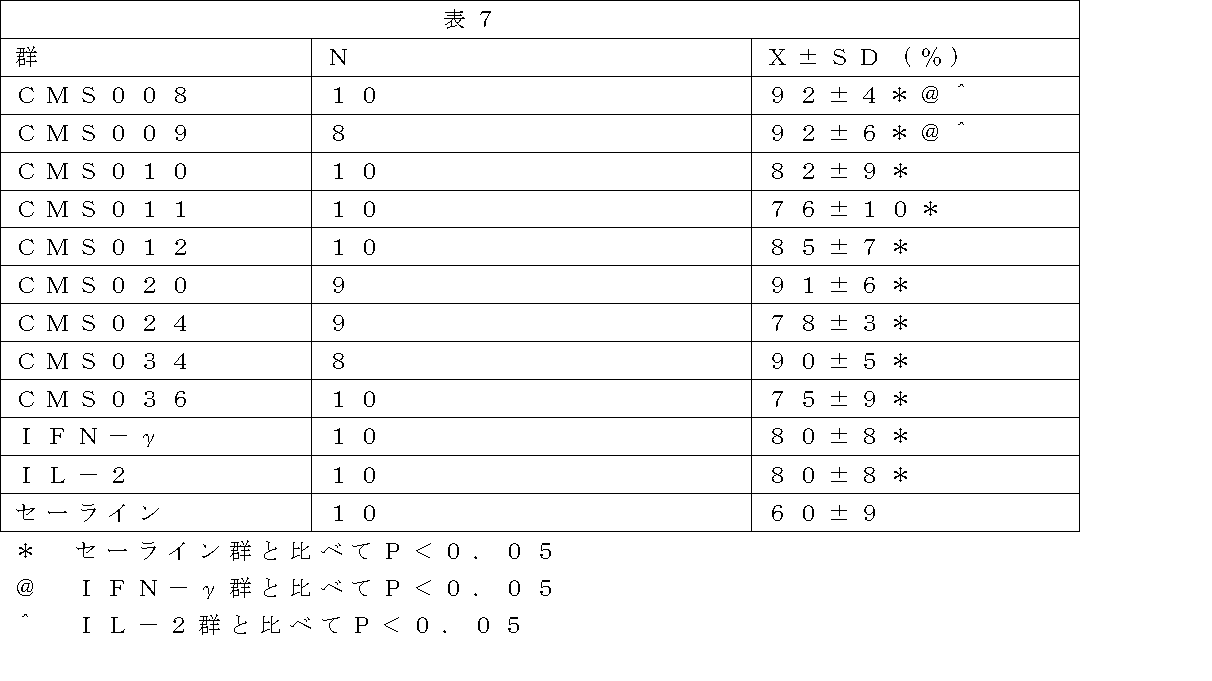
該研究において、セーライン群を負の対照として用い、一方、IL−2およびIFN−γはよく研究された免疫賦活剤なので[10]、IL−2およびIFN−γ群を正の対照として用いた。1000倍投与量範囲に及ぶまでの4つの任意の濃度の試料ペプチドを該研究に用いた。イン・ビボ免疫学的応答の内因性の複雑さのため、および投与量対応答機能における事前知識の欠如のため、いずれかの投与量群における負の対照を超えるいずれかの統計学的に有意な差を、正の生物学的活性として記録した。 In the study, the Saline group was used as a negative control, whereas IL-2 and IFN-γ were well studied immunostimulants [10] , and the IL-2 and IFN-γ groups were used as positive controls. . Four arbitrary concentrations of sample peptides up to the 1000-fold dose range were used in the study. Any statistically significant over negative control in any dose group due to intrinsic complexity of in vivo immunological response and lack of prior knowledge in dose vs response function Differences were recorded as positive biological activity.
該研究の結果は下記のとおりであった:
1.ペプチドCMS001、CMS002、CMS003、CMS007、CMS008、CMS009、CMS010、CMS011、CMS012、CMS015、CMS019、CMS021、CMS029およびCMS034は、Tリンパ球形質転換を増強することができ、セーライン正常対照群に対する統計学的に有意な差を有することが見いだされた。ペプチドCMS014およびCMS036はまた、Tリンパ球形質転換を阻害することができ、セーライン正常対照群に対する統計学的に有意な差を有することが見いだされた。
The results of the study were as follows:
1. Peptides CMS001, CMS002, CMS003, CMS007, CMS008, CMS009, CMS010, CMS011, CMS012, CMS015, CMS019, CMS021, CMS029 and CMS034 are able to enhance T lymphocyte transformation and are statistical against the normal saline control group Was found to have a significant difference. Peptides CMS014 and CMS036 were also found to be able to inhibit T lymphocyte transformation and have a statistically significant difference from the normal saline control group.
2.ペプチドCMS001、CMS002、CMS003、CMS008、CMS009、CMS010、CMS011、CMS012、CMS013、CMS015、CMS016、CMS020、CMS021、CMS022、CMS023、CMS024、CMS026、CMS027、CMS028、CMS029、CMS030、CMS032、CMS033、CMS034、CMS035およびCMS036は、NK細胞の細胞毒活性を増加することができ、セーライン正常対照群に対する統計学に有意な差を有することが見いだされた。ペプチドCMS008およびCMS012はまた、適当な濃度で、NK細胞の細胞毒活性を減少することができ、セーライン正常対照群に対する統計学的に有意な差を有することが見出された。 2. Peptides CMS001, CMS002, CMS003, CMS008, CMS009, CMS010, CMS011, CMS012, CMS013, CMS015, CMS016, CMS020, CMS021, CMS022, CMS023, CMS024, CMS03C, CMS03C, CMS03C, CMS03C, CMS03C And CMS036 were able to increase the cytotoxic activity of NK cells and were found to have significant differences in statistics relative to the normal saline control group. Peptides CMS008 and CMS012 were also found to be able to reduce the cytotoxic activity of NK cells at appropriate concentrations, with statistically significant differences from the normal saline control group.
3.ペプチドCMS001、CMS003、CMS007、CMS009、CMS010、CMS011、CMS012、CMS015、CMS020、CMS022およびCMS034は、Tリンパ球によるインターロイキン−2(IL−2)の分泌を増強することができ、セーライン正常対照群に対する統計学的に有意な差を有することが見出された。 3. Peptides CMS001, CMS003, CMS007, CMS009, CMS010, CMS011, CMS012, CMS015, CMS020, CMS022, and CMS034 can enhance the secretion of interleukin-2 (IL-2) by T lymphocytes and the normal normal control group Was found to have a statistically significant difference.
4.ペプチドCMS001、CMS003、CMS009、CMS010、CMS011、CMS012、CMS013、CMS016、CMS021、CMS022およびCMS028は、Tリンパ球によるIFNの分泌を増強することができ、セーライン正常対照群に対する統計学的に有意な差を有することが見出された。 4). Peptides CMS001, CMS003, CMS009, CMS010, CMS011, CMS012, CMS013, CMS016, CMS021, CMS022, and CMS028 can enhance the secretion of IFN by T lymphocytes and are statistically significant compared to the normal normal control group It was found to have
5.ペプチドCMS001、CMS002、CMS003、CMS007、CMS008、CMS009、CMS010、CMS011、CMS012、CMS013、CMS014、CMS015、CMS016、CMS018、CMS019、CMS020、CMS021、CMS022、CMS023、CMS024、CMS026、CMS027、CMS028、CMS029、CMS030、CMS032、CMS033、CMS034、CMS035およびCMS036は、抗原性攻撃における抗−SRBC抗体の合成を増強することができ、セーライン正常対照群に対する統計学的に有意な差を有することが見出された。ペプチドCMS002、CMS003、CMS009、CMS010、CMS011、CMS013、CMS014、CMS015、CMS018、CMS019、CMS020、CMS026、CMS028、CMS029、CMS030、CMS034およびCMS036は、適当な濃度にて、抗原性攻撃における抗−SRBC抗体の合成を阻害することができ、セーライン正常対照群に対する統計学的に有意な差を有することが見出された。 5). Peptides CMS001, CMS002, CMS003, CMS007, CMS008, CMS009, CMS010, CMS011, CMS012, CMS013, CMS014, CMS015, CMS016, CMS018, CMS019, CMS020, CMS021, CMS022, CMS02C02, CMS022, CMS02C02 , CMS032, CMS033, CMS034, CMS035 and CMS036 were found to be able to enhance the synthesis of anti-SRBC antibodies in antigenic challenge and to have statistically significant differences from the normal saline control group. Peptides CMS002, CMS003, CMS009, CMS010, CMS011, CMS013, CMS014, CMS015, CMS018, CMS019, CMS020, CMS026, CMS028, CMS029, CMS030, CMS034 and CMS036 at the appropriate concentration-antigen attack C in the anti-antigen C antibody Was found to have a statistically significant difference from the normal saline control group.
6.ペプチドCMS003、CMS008、CMS009、CMS010、CMS011、CMS013、CMS016、CMS018、CMS019、CMS020、CMS022、CMS024、CMS027、CMS030、CMS035、CMS036は、単核食細胞の食作用活性を増強することができ、セーライン正常対照群に対する統計学的有意差を有することが見出された。 6). Peptides CMS003, CMS008, CMS009, CMS010, CMS011, CMS013, CMS016, CMS018, CMS019, CMS020, CMS022, CMS024, CMS027, CMS030, CMS035, CMS036 can enhance the phagocytic activity of mononuclear phagocytes. It was found to have a statistically significant difference from the normal control group.
7.ペプチドCMS001、CMS002、CMS008、CMS010、CMS012、CMS013、CMS014、CMS015、CMS016、CMS018、CMS019、CMS020、CMS021、CMS022、CMS023、CMS024、CMS026、CMS027、CMS028、CMS029、CMS030、CMS032、CMS033、CMS034、CMS035およびCMS036は、胸腺の重量を増加することができ、セーライン正常対照群に対する統計学的に有意な差を有することが見出された。 7. Peptide CMS001, CMS002, CMS008, CMS010, CMS012, CMS013, CMS014, CMS015, CMS016, CMS018, CMS019, CMS020, CMS021, CMS022, CMS023, CMS024, CMS026, CMS03C, CMS037, CMS03C, CMS03C And CMS036 were found to be able to increase thymus weight and have a statistically significant difference from the normal saline control group.
8.ペプチドCMS019、CMS020およびCMS030は、脾臓の重量を増加することができ、セーライン正常対照群に対する統計学的に有意な差を有することが見出された。ペプチドCMS001、CMS003、CMS007、CMS008、CMS009、CMS010、CMS011、CMS013、CMS014、CMS015、CMS021、CMS023、CMS024、CMS027、CMS029およびCMS036はまた、適当な濃度にて、脾臓の重量を減少することができ、セーライン正常対照群に対する統計学的に有意な差を有することが見出された。 8). Peptides CMS019, CMS020 and CMS030 were found to be able to increase the weight of the spleen and have a statistically significant difference from the normal saline control group. Peptides CMS001, CMS003, CMS007, CMS008, CMS009, CMS010, CMS011, CMS013, CMS014, CMS015, CMS021, CMS023, CMS024, CMS027, CMS029 and CMS036 can also reduce spleen weight at appropriate concentrations. It was found to have a statistically significant difference from the normal saline control group.
マウスに対する該ペプチドの影響を分析するために使用された材料および方法を下記する。 The materials and methods used to analyze the effect of the peptide on mice are described below.
材料
1.実験動物
中華人民共和国の国立医学研究所(National Institute of Medical Science)、実験動物センターによって提供されたBALB/cマウス、体重18−22g、50%雌および50%雄。
2.投与
組み換えマウスIFN−γ(rmIFN−γ)群:3x10⁵IU/kg/日
組み換えヒトIL(rhIL)−2群:3x10⁵IU/kg/日
セーライン群:0.5ml/各/日
ペプチド投与量I群:500μg/kg/日
ペプチド投与量II群:50μg/kg/日
ペプチド投与量III群:5μg/kg/日
ペプチド投与量IV群:0.5μg/kg/日
上記物質を全て、0.5mlセーライン中に溶解し、1日に1回、15日間連続で、腹膜内(i.p.)注射した。
Materials 1. Experimental animals BALB / c mice provided by the National Institute of Medical Science, Laboratory Animal Center of the People's Republic of China, body weight 18-22 g, 50% female and 50% male.
2. Administration Recombinant mouse IFN-γ (rmIFN-γ) group: 3 × 10 5 IU / kg / day Recombinant human IL (rhIL) -2 group: 3 × 10 5 IU / kg / day Saline group: 0.5 ml / each / day Peptide dose Group I: 500 μg / kg / day Peptide dose group II: 50 μg / kg / day Peptide dose group III: 5 μg / kg / day Peptide dose group IV: 0.5 μg / kg / day Dissolved in 5 ml saline and injected intraperitoneally (ip) once a day for 15 consecutive days.
3.主要な試薬
ペプチドは、American Peptide Company, Inc., USAで注文製造した。
胎仔ウシ血清およびRPMI−1640細胞培養培地(Gibco, USA)
MTTおよびConA(Sigma, USA)
rmIFN−γ(Beijing Biotech Inc., China)
rhIL−2(Shanghai Huaxin Biotech Inc., China)
リンパ球分離溶液(Research Institute of Hematologic Disease, National Institute of Medical Science, PR China)
水疱性口内炎ウイルス(VSV)、IFN−γおよびIL−2標準試料(National Institute For Control of Pharmaceutical and Biological Products, PR China)
HT−2細胞およびL929細胞(中華人民共和国、北京大学免疫学部のWF Chen教授からの贈与物)
3. Main Reagents Peptides were custom-made by American Peptide Company, Inc., USA.
Fetal calf serum and RPMI-1640 cell culture medium (Gibco, USA)
MTT and ConA (Sigma, USA)
rmIFN-γ (Beijing Biotech Inc., China)
rhIL-2 (Shanghai Huaxin Biotech Inc., China)
Lymphocyte separation solution (Research Institute of Hematologic Disease, National Institute of Medical Science, PR China)
Vesicular stomatitis virus (VSV), IFN-γ and IL-2 standards (National Institute For Control of Pharmaceutical and Biological Products, PR China)
HT-2 cells and L929 cells (a gift from Professor WF Chen, Department of Immunology, Peking University, People's Republic of China)
方法
1.細胞性免疫に対するペプチドの影響
1.1脾臓細胞懸濁の調製[1,2]
BALB/cマウスを無作為に、ペプチド、IFN、IL−2、およびセーライン群に分けた。1群あたりマウス10匹。最後の試験物質投与の次の日に、マウスを頚部脱臼によって殺した。脾臓を無菌状態で単離し、注射針を用いて、冷D−Hank溶液中に手動で分散させた。分散した細胞懸濁をさらに、100ゲージ150μm直径のステンレススチールシーブにより篩い分けした。200gで10分間の遠心分離後、上清を廃棄した。細胞ペレットを10容量のTris−NH4Clバッファー中に再懸濁し、次いで、室温で10分間静置させた。懸濁した細胞を150gで10分間の遠心分離によって収集した。細胞を、再懸濁および上記条件の遠心分離による収集によって、冷D−Hank溶液で2−4回洗浄した。洗浄した細胞を次いで、10%胎仔ウシ血清を含有するRPMI−1640培養培地により、所望の細胞密度に希釈した。
Method 1. Effect of peptides on cellular immunity 1.1 Preparation of spleen cell suspension [1,2]
BALB / c mice were randomly divided into peptide, IFN, IL-2, and saline groups. 10 mice per group. The day after the last test substance administration, the mice were killed by cervical dislocation. The spleen was isolated aseptically and manually dispersed in cold D-Hank solution using a syringe needle. The dispersed cell suspension was further sieved through a 100 gauge 150 μm diameter stainless steel sieve. After centrifugation at 200 g for 10 minutes, the supernatant was discarded. The cell pellet was resuspended in Tris-NH 4 Cl buffer 10 volume, then allowed to stand at room temperature for 10 minutes. Suspended cells were collected by centrifugation at 150 g for 10 minutes. Cells were washed 2-4 times with cold D-Hank solution by resuspension and collection by centrifugation under the conditions described above. The washed cells were then diluted to the desired cell density with RPMI-1640 culture medium containing 10% fetal calf serum.
1.2Tリンパ球形質転換に対するペプチドの影響[1,2]
1x10⁶/ml密度の脾臓細胞を96ウェル細胞培養プレート上に、100μl/ウェルにて、マウス1匹あたりアッセイ試料および対照試料の各々を3つの並行したウェルに置いた。アッセイウェルに、RPMI−1640中100μg/mlのConA 100μl/ウェルを加え、無添加のRPMI−1640 100μl/ウェルを対照に用いた。細胞を37℃、5%CO2で66時間インキュベートした。次いで、細胞を150gで10分間遠心分離によりペレット化した。上清を収集し、サイトカインIL−2およびIFN測定のために、−20℃で保存した。
1.2 Effect of peptides on T lymphocyte transformation [1,2]
Splenocytes at a density of 1 × 10 6 / ml were placed on 96-well cell culture plates at 100 μl / well, each of assay and control samples per mouse in 3 parallel wells. To assay wells, 100 μg / ml ConA in RPMI-1640 was added at 100 μl / well, and 100 μl / well with no added RPMI-1640 was used as a control. Cells were incubated for 66 hours at 37 ° C., 5% CO 2 . The cells were then pelleted by centrifugation at 150 g for 10 minutes. The supernatant was collected and stored at −20 ° C. for cytokine IL-2 and IFN measurements.
RPMI−1640中1mg/mlのMTT 50μl/ウェルを細胞ペレットに加え、2分間の振盪によって細胞を再懸濁させた。インキュベーションを4時間続けた。150gで10分間の遠心分離後に、上清を廃棄した。120μlの40mM HCl−2−プロパノールを細胞ペレットに加え、3分間振盪して、630nmをリファレンスとして各ウェルのOD570nmを得た。ELISAリーダーを用いた。
計算:
各マウスは、3つのアッセイウェルおよび3つの対照ウェルを構成した。各マウスの刺激指数(Stimulation Index(SI))を、まず、3つの並行ウェルの平均ODを求め、次いで、アッセイウェルの値を対照ウェルで除することによって得た。
50 μl / well of 1 mg / ml MTT in RPMI-1640 was added to the cell pellet and the cells were resuspended by shaking for 2 minutes. Incubation was continued for 4 hours. After centrifugation at 150 g for 10 minutes, the supernatant was discarded. 120 μl of 40 mM HCl-2-propanol was added to the cell pellet and shaken for 3 minutes to obtain an OD 570 nm of each well using 630 nm as a reference. An ELISA reader was used.
Calculation:
Each mouse comprised 3 assay wells and 3 control wells. The stimulation index (SI) for each mouse was obtained by first determining the average OD of 3 parallel wells and then dividing the assay well value by the control well.
1.3NK細胞活性に対するペプチドの影響[3,4]
マウス脾臓細胞を上記セクション1.1に記載のように、4x10⁶/mlに調製した。標的細胞YAC−1を対数期に導き、1x105/mlに調整した。96ウェル細胞培養プレートを用い、100μlのマウス脾臓細胞および100μlの培養培地を、脾臓細胞のみを含有する対照ウェルに加え;100μlの標的細胞および100μlの培養培地を、標的細胞のみを含有する対照ウェルに加え;100μlのマウス脾臓細胞および100μlの標的細胞をNK活性アッセイウェルに加えた。上記の3つの並行セットをマウス毎に調製した。
試料を150gで10分間遠心分離して、細胞を収集した。上清を廃棄し、1mg/mlのMTT 50μl/ウェルを加えた。次いで、反応混合物を2分間振盪し、37℃、5%CO2で4時間インキュベートした。150gで10分間の遠心分離後に、上清を廃棄した。120μlの40mM HCL−2−プロパノールを加え、3分間振盪した。ELISAリーダーを用いて、630nmをリファレンスとして各ウェルのOD570nmを得た。
1.3 Effect of peptides on NK cell activity [3,4]
Mouse spleen cells were prepared at 4 × 10 6 / ml as described in section 1.1 above. Target cells YAC-1 were brought to log phase and adjusted to 1 × 10 5 / ml. Using a 96-well cell culture plate, 100 μl mouse spleen cells and 100 μl culture medium are added to control wells containing only spleen cells; 100 μl target cells and 100 μl culture medium are control wells containing only target cells 100 μl of mouse spleen cells and 100 μl of target cells were added to NK activity assay wells. The above three parallel sets were prepared for each mouse.
Samples were centrifuged at 150 g for 10 minutes to collect cells. The supernatant was discarded and 50 μl / well of 1 mg / ml MTT was added. The reaction mixture was then shaken for 2 minutes and incubated at 37 ° C., 5% CO 2 for 4 hours. After centrifugation at 150 g for 10 minutes, the supernatant was discarded. 120 μl of 40 mM HCL-2-propanol was added and shaken for 3 minutes. Using an ELISA reader, OD 570 nm of each well was obtained using 630 nm as a reference.
計算:
各マウスは、9ウェルを有した:3つが脾臓細胞のみの対照であり、3つが標的細胞のみの対照であり、3つが脾臓および標的細胞の両方を有するアッセイウェルであった。各マウスのNK細胞活性指数は、まず、各組合せの3つの並行ウェルの平均ODを求め、次いで、該平均ODを下記の式:
NK細胞活性指数=[1 − (脾臓および標的細胞ウェルの平均OD − 脾臓細胞のみのウェルの平均OD) ÷ (標的細胞のみのウェルの平均OD)] x 100%
に当てはめることによって得た。
Calculation:
Each mouse had 9 wells: 3 were controls for spleen cells only, 3 were controls for target cells only, and 3 were assay wells with both spleen and target cells. The NK cell activity index for each mouse was first determined by calculating the average OD of three parallel wells of each combination, and then calculating the average OD by the following formula:
NK cell activity index = [1-(average OD of spleen and target cell wells-average OD of spleen cell only wells) / (average OD of wells of only target cells)] x 100%
Obtained by applying to.
1.4 IL−2分泌における活性Tリンパ球に対するペプチドの影響[5]
対数期のHT−2細胞を150gで10分間の遠心分離によって収集し、再懸濁および遠心分離を用いて、冷Hank溶液で3回洗浄した。収集したHT−2細胞をRPMI−1640中に再懸濁し、37℃、5%CO2で30分間インキュベートした。再懸濁および遠心分離を用いて、細胞をRPMI−1640でさらに2回洗浄し、RPMI−1640を用いて2x10⁵/mlの最終濃度に再懸濁した。
セクション1.2で得られた上清を、RPMI−1640を用いて下記のパーセンテージに希釈した:100%、50%、25%、12.5%、6.25%および3.125%。
rIL−2を、RPMI−1640を用いて下記の濃度に希釈した:500IU/ml、250IU/ml、125IU/ml、62.5IU/ml、31.25IU/mlおよび15.51IU/ml。
96ウェル細胞培養プレートに、1つの組合せにつき3つの並行ウェルを準備した。
1.4 Effect of peptides on activated T lymphocytes in IL-2 secretion [5]
Log phase HT-2 cells were collected by centrifugation at 150 g for 10 minutes and washed 3 times with cold Hank solution using resuspension and centrifugation. Harvested HT-2 cells were resuspended in RPMI-1640 and incubated at 37 ° C., 5% CO 2 for 30 minutes. Cells were washed twice more with RPMI-1640 using resuspension and centrifugation and resuspended to a final concentration of 2 × 10 5 / ml using RPMI-1640.
The supernatant obtained in section 1.2 was diluted to the following percentages using RPMI-1640: 100%, 50%, 25%, 12.5%, 6.25% and 3.125%.
rIL-2 was diluted with RPMI-1640 to the following concentrations: 500 IU / ml, 250 IU / ml, 125 IU / ml, 62.5 IU / ml, 31.25 IU / ml and 15.51 IU / ml.
Three parallel wells were prepared for each combination in a 96 well cell culture plate.
負の対照:100μl RPMI−1640+100μl HT−2細胞懸濁
rIL−2標準:100μl rIL−2溶液+100μl HT−2細胞懸濁
アッセイウェル:100μl 希釈した上清+100μl HT−2細胞懸濁
プレートを37℃、5%CO2で68時間インキュベートし、次いで、150gで15分間遠心分離し、上清を除去した。フェノールスルホンフタレイン不含のRPMI−1640中における0.5mg/mlMTT 100μlを各ウェルに加えた。3−4分間振盪させて細胞を再懸濁した後、さらに4時間インキュベートを続けた。次いで、試料を150gにて15分間遠心分離し、上清を除去した。各ウェルに、40mM HCl−2−プロパノール 120μlを加え、3−4分間混合し、ELISAプレートリーダーを用いて、630nmをリファレンスとして570nmでODを分析した。
Negative control: 100 μl RPMI-1640 + 100 μl HT-2 cell suspension rIL-2 standard: 100 μl rIL-2 solution + 100 μl HT-2 cell suspension Assay well: 100 μl diluted supernatant + 100 μl HT-2 cell suspension Plate at 37 ° C. Incubate at 5% CO 2 for 68 hours, then centrifuge at 150 g for 15 minutes and remove the supernatant. 100 μl of 0.5 mg / ml MTT in RPMI-1640 without phenol sulfonephthalein was added to each well. After resuspending the cells by shaking for 3-4 minutes, the incubation was continued for an additional 4 hours. The sample was then centrifuged at 150 g for 15 minutes and the supernatant was removed. To each well, 120 μl of 40 mM HCl-2-propanol was added, mixed for 3-4 minutes, and OD was analyzed at 570 nm using an ELISA plate reader with 630 nm as a reference.
計算:
各希釈の3つの並行ウェルの平均ODを得、半対数方眼紙に濃度に対してプロットした(X軸に濃度)。50%OD飽和での濃度を、試験している上清およびrIL−2の両方について得た。
試料IL−2活性 = (50%最大作用での試料希釈度 ÷ 50%最大作用でのrIL−2標準希釈度) x 50%最大作用でのrIL−2標準の活性(IU/ml)
Calculation:
The average OD of 3 parallel wells at each dilution was obtained and plotted against concentration on a semi-log paper (concentration on the X axis). Concentrations at 50% OD saturation were obtained for both the supernatant being tested and rIL-2.
Sample IL-2 activity = (sample dilution at 50% maximum effect ÷ rIL-2 standard dilution at 50% maximum effect) x activity of rIL-2 standard at 50% maximum effect (IU / ml)
1.5インターフェロン(IFN)の分泌におけるTリンパ球の活性に対するペプチドの影響[6]
セクション1.2由来の上清をRPMI−1640培養培地を用いて下記のパーセンテージに希釈した:100%、50%、25%、12.5%、6.25%および3.125%。
組み換えインターフェロン(rIFN)標準をRPMI−1640を用いて下記の濃度に希釈した:500IU/ml、250IU/ml、125IU/ml、62.5IU/ml、31.25IU/mlおよび15.51IU/ml。
対数期の標的細胞L929を、セクション1.4に記載のHT−2細胞と同じ処理を用いて、RPMI−1640で2x10⁵/mlに調整した。ストックVSVもまた、RPMI−1640で100 TCID50に調整した。
1.5 Effect of peptides on the activity of T lymphocytes in the secretion of interferon (IFN) [6]
The supernatant from section 1.2 was diluted with RPMI-1640 culture medium to the following percentages: 100%, 50%, 25%, 12.5%, 6.25% and 3.125%.
Recombinant interferon (rIFN) standards were diluted with RPMI-1640 to the following concentrations: 500 IU / ml, 250 IU / ml, 125 IU / ml, 62.5 IU / ml, 31.25 IU / ml and 15.51 IU / ml.
Log phase target cells L929 were adjusted to 2 × 10 5 / ml with RPMI-1640 using the same treatment as HT-2 cells described in section 1.4. Stock VSV was also adjusted to 100 TCID 50 with RPMI-1640.
96ウェル培養プレートにおいて、下記のように、1組合せあたり3つの並行ウェルを準備した:
負の対照ウェル:150μl RPMI−1640 + 100μl L929
正の対照ウェル:100μl RPMI−1640 + 100μl L929 + 50μl VSV
rIFN活性ウェル:100μl rIFN標準 + 100μl L929 + 50μl VSV
アッセイウェル:100μl 希釈上清 + 100μl L929 + 50μl VSV
In a 96 well culture plate, 3 parallel wells were prepared per combination as follows:
Negative control well: 150 μl RPMI-1640 + 100 μl L929
Positive control well: 100 μl RPMI-1640 + 100 μl L929 + 50 μl VSV
rIFN active well: 100 μl rIFN standard + 100 μl L929 + 50 μl VSV
Assay well: 100 μl diluted supernatant + 100 μl L929 + 50 μl VSV
試料を37℃にて5%CO2で24時間インキュベートした。正の対照ウェルを倒立顕微鏡下で周期的に観察して細胞溶解を確認し、次いで、収集、洗浄し、全ウェルのODをセクション1.4に記載のように読み取った。
計算:
50%最大作用での濃度をセクション1.4と同様に得た。試料のIFN活性を下記のように計算する:
試料IFN活性 = (50%最大作用での試料希釈度 ÷ 50%最大作用でのrIFN標準希釈度) x 50%最大作用での標準rIFN活性(IU/ml)
Samples were incubated at 37 ° C. with 5% CO 2 for 24 hours. Positive control wells were observed periodically under an inverted microscope to confirm cell lysis, then collected, washed and the OD of all wells read as described in section 1.4.
Calculation:
Concentration at 50% maximal effect was obtained as in section 1.4. The IFN activity of the sample is calculated as follows:
Sample IFN activity = (Sample dilution at 50% maximum effect ÷ rIFN standard dilution at 50% maximum effect) x Standard rIFN activity at 50% maximum effect (IU / ml)
2.抗体形成に対するペプチドの影響[7]
ヒツジ赤血球(SRBC)を、頚静脈から血液を採取することによって調製し、ガラスビーズが入った滅菌フラスコ中に置いた。該フラスコを3分間振盪し、次いで、血液をAlsever溶液(グルコース2.05g、NaCl0.4g、Naレモネード0.8g、蒸留水で100mlに調整)と混合し、4℃で保存した。使用直前に、試料を130gで5分間遠心分離して、SRBCを収集した。細胞を正常セーライン中、再懸濁および遠心分離によって2回洗浄した。次いで、細胞ペレットを180gで10分間の遠心分離によって収集し、セーライン中で再懸濁して、最終的に用いられるSRBC懸濁2%(v/v)を作成した。
2. Effect of peptides on antibody formation [7]
Sheep red blood cells (SRBC) were prepared by drawing blood from the jugular vein and placed in a sterile flask containing glass beads. The flask was shaken for 3 minutes, then the blood was mixed with Alsever solution (glucose 2.05 g, NaCl 0.4 g, Na lemonade 0.8 g, adjusted to 100 ml with distilled water) and stored at 4 ° C. Immediately before use, samples were centrifuged at 130 g for 5 minutes to collect SRBC. Cells were washed twice in normal saline by resuspension and centrifugation. The cell pellet was then collected by centrifugation at 180 g for 10 minutes and resuspended in the saline to make the final SRBC suspension 2% (v / v) used.
補体は、10容量の新鮮なテンジクネズミ血清を1容量の遠心分離パックしたSRBCに加え、次いで、4℃で30分間穏やかに振盪することによって、調製された。SRBCを200gで10分間の遠心分離によって除去した。10容量の正常セーラインを加えて、補体溶液を得た。
BALB/cマウスを無作為に、ペプチド群、IFN群、IL−2群およびセーライン群に1群あたり10匹で分けた。試験物質をセクション1.1に記載のように投与し、さらに、12日目に、1マウスあたり0.2ml SRBCを腹膜内注射した。最後の試験物質投与の次の日(16日目)に、血液を眼角から採取し、血清滲出のために、室温で1時間放置した。200gで10分間の遠心分離後、正常セーラインで血清を500倍希釈した。
Complement was prepared by adding 10 volumes of fresh guinea pig serum to 1 volume of centrifuge packed SRBC and then gently shaking at 4 ° C. for 30 minutes. SRBC was removed by centrifugation at 200 g for 10 minutes. Ten volumes of normal saline were added to obtain a complement solution.
BALB / c mice were randomly divided into 10 groups per group into peptide group, IFN group, IL-2 group and saline group. Test substances were administered as described in section 1.1 and, on day 12, 0.2 ml SRBC per mouse was injected intraperitoneally. On the day after the last test substance administration (day 16), blood was collected from the eye corner and left at room temperature for 1 hour for serum exudation. After centrifugation at 200 g for 10 minutes, serum was diluted 500 times with normal saline.
各マウスの1mlの希釈したマウス血清に、0.5ml SRBC懸濁を加えた。氷冷した。次いで、1mlの補体溶液を加え、37℃水浴で10分間インキュベートした。氷冷によって反応を停止させた。次いで、試料を200gで10分間遠心分離して、上清を得た。
1mlの該上清に、3ml Drabkin溶液を加え、室温で10分間放置した。OD540nmを得た。
計算:
リファレンスOD540nmを、0.25ml SRBC懸濁をDrabkin溶液と4mlに混合することによって得、室温で10分間放置した後、OD540nmを得た。
試料血清指数 = (試験試料のOD540nm ÷ リファレンスOD540nm) x 500
0.5 ml SRBC suspension was added to 1 ml of diluted mouse serum of each mouse. Ice-cooled. Then 1 ml of complement solution was added and incubated in a 37 ° C. water bath for 10 minutes. The reaction was stopped by ice cooling. The sample was then centrifuged at 200 g for 10 minutes to obtain a supernatant.
To 1 ml of the supernatant, 3 ml Drabkin solution was added and left at room temperature for 10 minutes. An OD of 540 nm was obtained.
Calculation:
A reference OD of 540 nm was obtained by mixing 0.25 ml SRBC suspension with 4 ml of Drabkin solution and allowed to stand at room temperature for 10 minutes before obtaining OD 540 nm .
Sample serum index = (OD of test sample 540 nm ÷ reference OD 540 nm ) × 500
3.単核食細胞の食作用機能および免疫器官の重量に対するペプチドの影響[8,9]
最後の試験物質投与の次の日(16日目)に、マウスに0.1ml/kg体重の墨汁(正常セーラインでの5倍希釈物)を尾の静脈から注射した。
墨汁注射の1分および5分後、ヘパリン処理した管を用いて、20μlの血液を眼角から得た。血液を2ml 0.1%w/v Na2CO3と混合し、次いで、OD680nmを得た。アウトライン・クリア指数Kを下記の式から算出した:
K=(lgA1−lgA2)÷(t2−t1)
キー:
A1:1分目のOD680nm
A2:5分目のOD680nm
t2:5分
t2:1分
3. Effect of peptides on the phagocytic function of mononuclear phagocytes and the weight of immune organs [8, 9]
On the day after the last test substance administration (day 16), mice were injected with 0.1 ml / kg body weight of Indian ink (5-fold dilution with normal saline) via the tail vein.
One and five minutes after the sumi injection, 20 μl of blood was obtained from the eye corner using heparinized tubes. The blood was mixed with 2 ml 0.1% w / v Na 2 CO 3 and then OD 680 nm was obtained. The outline clear index K was calculated from the following formula:
K = (lgA 1 −lgA 2 ) ÷ (t 2 −t 1 )
Key:
A1: OD680nm at 1st minute
A2: OD680nm at the 5th minute
t2: 5 minutes t2: 1 minute
最後の試験物質投与の次の日(16日目)に、肝臓、脾臓および胸腺を分離し、ろ紙でブロットドライし、計量した。食作用指数αを下記のとおり算出した。
α=(3√K)(W÷WLS)
キー:
W:体重
WLS:肝臓および脾臓の重量
胸腺指数(%)=(胸腺重量/体重)x100%
脾臓指数(%)=(脾臓重量/体重)x100%
On the day following the last test substance administration (day 16), the liver, spleen and thymus were separated, blotted dry with filter paper and weighed. The phagocytic index α was calculated as follows.
α = (3√K) (W ÷ W LS )
Key:
W: body weight W LS : weight of liver and spleen Thymus index (%) = (thymus weight / body weight) × 100%
Spleen index (%) = (spleen weight / body weight) × 100%
結果
関与する大量の生データのため、実施した最終結果のみを提供する。また、セーライン負の対照に対する統計学的に有意な差のない群は省略する。
1.Tリンパ球形質転換に対するペプチドの影響
500μg/kg/日にて、CMS002、CMS007、CMS008、CMS010、CMS012、CMS015、CMS019、CMS021およびCMS029は、Tリンパ球形質転換を増加することができ、セーライン群に対する統計学的に有意な差(P<0.05)を有することが見出された。これらのペプチドの中でも、CMS010およびCMS015は、下記の表1に示すように、IFN−γ群およびIL−2群に対する統計学的に有意な差(P<0.05)を有することが見出された。
Results Due to the large amount of raw data involved, only the final results performed are provided. Groups with no statistically significant difference with respect to the saline negative control are omitted.
1. Effect of peptides on T lymphocyte transformation At 500 μg / kg / day, CMS002, CMS007, CMS008, CMS010, CMS012, CMS015, CMS019, CMS021, and CMS029 can increase T lymphocyte transformation and the Saline group Was found to have a statistically significant difference (P <0.05). Among these peptides, CMS010 and CMS015 were found to have a statistically significant difference (P <0.05) relative to the IFN-γ group and IL-2 group, as shown in Table 1 below. It was done.
50μg/kg/日にて、CMS001、CMS002およびCMS003は、Tリンパ球形質転換を刺激することができ、セーライン群、IFN−γ群およびIL−2群に対する統計学的に有意な差(P<0.05)を有することが見出された。CMS014およびCMS036は、Tリンパ球形質転換を阻害することができ、セーライン群に対する統計学的有意差(P<0.05)を有することが見出された。下記表2にデータを詳述する。 At 50 μg / kg / day, CMS001, CMS002 and CMS003 can stimulate T lymphocyte transformation, and statistically significant differences (P <<) compared to the Saline, IFN-γ and IL-2 groups. 0.05). CMS014 and CMS036 were found to be able to inhibit T lymphocyte transformation and have a statistically significant difference (P <0.05) relative to the saline group. Table 2 below details the data.
5μg/kg/日にて、CMS001、CMS003、CMS007およびCMS034は、Tリンパ形質転換を刺激することができ、表3に示すように、セーライン群に対する統計学的に有意な差(P<0.05)を有することが見出された。 At 5 μg / kg / day, CMS001, CMS003, CMS007, and CMS034 can stimulate T lymphoid transformation, and as shown in Table 3, statistically significant differences (P <0. 05).
0.5μg/kg/日にて、CMS008、CMS010およびCMS011は、表4に示すように、Tリンパ形質転換を刺激でき、セーライン群に対する統計学的に有意な差(P<0.05)を有することが見出された。 At 0.5 μg / kg / day, CMS008, CMS010 and CMS011 can stimulate T lymphoid transformation, as shown in Table 4, with a statistically significant difference (P <0.05) relative to the saline group. It was found to have.
2.NK細胞細胞毒活性に対するペプチドの影響
500μg/kg/日にて、CMS010、CMS013、CMS016、CMS023、CMS024、CMS026、CMS027、CMS028、CMS029、CMS030、CMS032、CMS033、CMS034、CMS035およびCMS036は、NK細胞細胞毒活性を増加することができ、セーライン群に対する統計学的に有意な差(P<0.05)を有することが見出された。これらのペプチドの中でも、CMS010、CMS016およびCMS030は、表5に示すように、IFN−γ群およびIL−2群に対する統計学的に有意な差(P<0.05)を有することが見出された。
2. Effect of peptide on NK cytotoxic activity 500 μg / kg / day, CMS010, CMS013, CMS016, CMS023, CMS024, CMS026, CMS027, CMS028, CMS029, CMS030, CMS032, CMS033, CMS034, CMS035 and CMS036, Cytotoxic activity can be increased and found to have a statistically significant difference (P <0.05) relative to the saline group. Among these peptides, CMS010, CMS016 and CMS030 were found to have a statistically significant difference (P <0.05) from the IFN-γ group and IL-2 group as shown in Table 5. It was done.
50μg/kg/日にて、CMS001、CMS003、CMS015、CMS021、CMS026およびCMS035は、NK細胞細胞毒活性を増加することができ、セーライン群に対する統計学的に有意な差(P<0.05)を有することが見出された。これらのペプチドの中でも、CMS021は、IFN−γ群およびIL−2群に対する統計学的に有意な差(P<0.05)を有することが見出された。CMS012は、NK細胞細胞毒活性を阻害することができ、セーライン群に対する統計学的に有意な差(P<0.05)を有することが見出された。下記表6にデータを詳述する。 At 50 μg / kg / day, CMS001, CMS003, CMS015, CMS021, CMS026, and CMS035 can increase NK cytotoxic activity and are statistically significant (P <0.05) compared to the saline group It was found to have Among these peptides, CMS021 was found to have a statistically significant difference (P <0.05) relative to the IFN-γ group and the IL-2 group. CMS012 was found to be able to inhibit NK cytotoxic activity and to have a statistically significant difference (P <0.05) relative to the saline group. Table 6 below details the data.
5μg/kg/日にて、CMS008、CMS009、CMS010、CMS011、CMS012、CMS020、CMS024、CMS034およびCMS036は、NK細胞細胞毒活性を増加することができ、セーライン群に対する統計学的に有意な差(P<0.05)を有することが見出された。これらのペプチドの中でも、CMS008およびCMS009は、表7に示すように、IFN−γ群およびIL−2群に対する統計学的に有意な差(P<0.05)を有するとが見出された。 At 5 μg / kg / day, CMS008, CMS009, CMS010, CMS011, CMS012, CMS020, CMS024, CMS034, and CMS036 can increase NK cytotoxic activity and have a statistically significant difference to the saline group ( P <0.05) was found. Among these peptides, CMS008 and CMS009 were found to have statistically significant differences (P <0.05) from the IFN-γ group and IL-2 group as shown in Table 7. .
0.5μg/kg/日にて、CMS002、CMS011、CMS012、CMS022、CMS028およびCMS035は、NK細胞細胞毒活性を増加することができ、セーライン群に対する統計学的に有意な差(P<0.05)を有することが見出された。CMS008は、NK細胞細胞毒活性を阻害することができ、セーライン群に対する統計学的有意差(P<0.05)を有することが見出された。下記表8にデータを詳述する。 At 0.5 μg / kg / day, CMS002, CMS011, CMS012, CMS022, CMS028 and CMS035 can increase NK cytotoxic activity and have statistically significant differences (P <0. 05). CMS008 was found to be able to inhibit NK cytotoxic activity and to have a statistically significant difference (P <0.05) relative to the saline group. Table 8 below details the data.
3.IL−2分泌におけるTリンパ球の活性に対するペプチドの影響
500μg/kg/日にて、CMS007、CMS009、CMS010およびCMS015は、Tリンパ球からのIL−2分泌を促進することができ、セーライン群に対する統計学的に有意な差(P<0.05)を有することが見出された。これらのペプチドの中でも、CMS007およびCMS015は、IL−2群に対する統計学的に有意な差(P<0.05)を有することが見出された。また、CMS009およびCMS010は、表9に示すように、IFN−γ群およびIL−2群の両方に対する統計学的に有意な差(P<0.05)を有することが見出された。
3. Effect of peptides on the activity of T lymphocytes in IL-2 secretion At 500 μg / kg / day, CMS007, CMS009, CMS010 and CMS015 are able to promote IL-2 secretion from T lymphocytes and to the saline group It was found to have a statistically significant difference (P <0.05). Among these peptides, CMS007 and CMS015 were found to have a statistically significant difference (P <0.05) relative to the IL-2 group. CMS009 and CMS010 were also found to have statistically significant differences (P <0.05) relative to both the IFN-γ and IL-2 groups, as shown in Table 9.
50μg/kg/日にて、CMS001およびCMS003は、IL−2分泌におけるTリンパ球の活性を促進することができ、セーライン群に対する統計学的に有意な差(P<0.05)を有することが見出された。これらのペプチドの中でも、CMS003は、表10に示すように、IL−2群に対する統計学的に有意な差(P<0.05)を有することが見出された。 At 50 μg / kg / day, CMS001 and CMS003 can promote the activity of T lymphocytes in IL-2 secretion and have a statistically significant difference (P <0.05) relative to the saline group Was found. Among these peptides, CMS003 was found to have a statistically significant difference (P <0.05) relative to the IL-2 group, as shown in Table 10.
5μg/kg/日にて、CMS007、CMS012およびCMS020は、表11に示すように、IL−2分泌においてTリンパ球を促進することができ、セーライン群に対する統計学的に有意な差(P<0.05)を有することが見出された。 At 5 μg / kg / day, CMS007, CMS012, and CMS020 are able to promote T lymphocytes in IL-2 secretion, as shown in Table 11, with a statistically significant difference (P < 0.05).
0.5μg/kg/日にて、CMS010、CMS011、CMS012、CMS022およびCMS034は、IL−2分泌においてTリンパ球を促進することがで、セーライン群に対する統計学的に有意な差(P<0.05)を有することが見出された。これらのペプチドの中でも、CMS034は、IL−2群に対する統計学的に有意な差(P<0.05)を有することが見出された。また、CMS011およびCMS022は、表12に示すように、IFN−γ群およびIL−2群の両方に対する統計学的に有意な差(P<0.05)を有することが見出された。 At 0.5 μg / kg / day, CMS010, CMS011, CMS012, CMS022, and CMS034 were able to promote T lymphocytes in IL-2 secretion, with a statistically significant difference (P <0) relative to the saline group. .05). Among these peptides, CMS034 was found to have a statistically significant difference (P <0.05) relative to the IL-2 group. CMS011 and CMS022 were also found to have a statistically significant difference (P <0.05) relative to both the IFN-γ group and the IL-2 group, as shown in Table 12.
4.IFN分泌におけるTリンパ球の活性に対するペプチドの影響
500μg/kg/日にて、CMS010、CMS013およびCMS016は、表13に示すように、インターフェロン(IFN)分泌においてTリンパ球を促進することができ、セーライン群、IFN−γ群およびIL−2群に対する統計学的に有意な差(P<0.05)を有することが見出された。
4). Effect of peptides on T lymphocyte activity in IFN secretion At 500 μg / kg / day, CMS010, CMS013 and CMS016 can promote T lymphocytes in interferon (IFN) secretion, as shown in Table 13, It was found to have a statistically significant difference (P <0.05) relative to the Saline group, the IFN-γ group and the IL-2 group.
50μg/kg/日にて、CMS001、CMS003およびCMS021は、IFN分泌においてTリンパ球を促進することができ、セーライン群に対する統計学的に有意な差(P<0.05)を有することが見出された。これらのペプチドの中でも、CMS021は、表14に示すように、IFN−γ群およびIL−2群に対する統計学的に有意な差(P<0.05)を有することが見出された。 At 50 μg / kg / day, CMS001, CMS003 and CMS021 were able to promote T lymphocytes in IFN secretion and were found to have statistically significant differences (P <0.05) relative to the saline group. It was issued. Among these peptides, CMS021 was found to have a statistically significant difference (P <0.05) relative to the IFN-γ group and the IL-2 group as shown in Table 14.
5μg/kg/日にて、CMS009およびCMS012は、IFN分泌においてTリンパ球を促進でき、セーライン群に対する統計学的に有意な差(P<0.05)を有することが見出された。これらのペプチドの中でも、CMS009は、表15に示すように、IL−2群に対する統計学的に有意な差(P<0.05)を有することが見出された。 At 5 μg / kg / day, CMS009 and CMS012 were found to be able to promote T lymphocytes in IFN secretion, with a statistically significant difference (P <0.05) relative to the saline group. Among these peptides, CMS009 was found to have a statistically significant difference (P <0.05) relative to the IL-2 group, as shown in Table 15.
0.5μg/kg/日にて、CMS010、CMS011、CMS022およびCMS028は、IFN分泌においてTリンパ球を促進することができ、セーライン群に対する統計学的に有意な差(P<0.05)を有することが見出された。これらのペプチドの中でも、CMS010およびCMS022は、表16に示すように、IFN−γ群およびIL−2群の両方に対する統計学的に有意な差(P<0.05)を有することが見出された。 At 0.5 μg / kg / day, CMS010, CMS011, CMS022, and CMS028 can promote T lymphocytes in IFN secretion, with a statistically significant difference (P <0.05) relative to the saline group. It was found to have. Among these peptides, CMS010 and CMS022 were found to have statistically significant differences (P <0.05) relative to both the IFN-γ and IL-2 groups, as shown in Table 16. It was done.
5.抗体形成に対するペプチドの影響
500μg/kg/日にて、CMS002、CMS003、CMS007、CMS008、CMS009、CMS010、CMS011、CMS012、CMS013、CMS014、CMS015、CMS016、CMS018、CMS019、CMS020、CMS022、CMS023、CMS024、CMS029、MS033およびCMS035は、抗−SRBC抗体形成を促進することができ、セーライン群に対する統計学的に有意な差(P<0.05)を有することが見出された。これらのペプチドの中でも、CMS002、CMS003、CMS007、CMS008、CMS013、CMS019、CMS024およびCMS035は、IFN−γ群に対する統計学的に有意な差(P<0.05)を有することが見出された。また、CMS009、CMS010、CMS011、CMS012、CMS014、CMS015、CMS016、CMS020、CMS023、CMS029およびCMS033は、表17に示すように、IFN−γ群およびIL−2群の両方に対する統計学的に有意な差(P<0.05)を有することが見出された。
5. Effect of peptide on antibody formation CMS002, CMS003, CMS007, CMS008, CMS009, CMS010, CMS011, CMS012, CMS013, CMS014, CMS015, CMS016, CMS018, CMS020, CMS022, CMS022, CMS022, CMS022, CMS022, CMS02C CMS029, MS033 and CMS035 were able to promote anti-SRBC antibody formation and were found to have statistically significant differences (P <0.05) relative to the saline group. Among these peptides, CMS002, CMS003, CMS007, CMS008, CMS013, CMS019, CMS024 and CMS035 were found to have a statistically significant difference (P <0.05) relative to the IFN-γ group. . CMS009, CMS010, CMS011, CMS012, CMS014, CMS015, CMS016, CMS020, CMS023, CMS029, and CMS033 are statistically significant for both the IFN-γ group and the IL-2 group as shown in Table 17. It was found to have a difference (P <0.05).
50μg/kg/日に、CMS003、CMS011、CMS012、CMS013、CMS015、CMS021、CMS022、CMS023、CMS026、CMS027、CMS029、CMS030、CMS032、CMS033、CMS034、CMS035およびCMS036は、抗−SRBC抗体形成を促進することができ、セーライン群に対する統計学的に有意な差(P<0.05)を有することが見出された。これらのペプチドの中でも、CMS011、CMS013およびCMS015は、IFN−γ群に対する統計学的に有意な差(P<0.05)を有することが見出された。また、CMS021、CMS022、CMS023、CMS026、CMS027、CMS029、CMS030、CMS032、CMS033、CMS034、CMS035およびCMS036は、IFN−γ群およびIL−2群の両方に対する統計学的に有意な差(P<0.05)を有することが見出された。CMS009は、抗−SRBC抗体形成を阻害することができ、セーライン群に対する統計学的有意差(P<0.05)を有することが見出された。表18にデータを詳述する。 50 μg / kg / day CMS003, CMS011, CMS012, CMS013, CMS015, CMS021, CMS022, CMS023, CMS026, CMS027, CMS029, CMS030, CMS032, CMS033, CMS034, CMS035 and CMS036 promote C-antibodies And was found to have a statistically significant difference (P <0.05) relative to the saline group. Among these peptides, CMS011, CMS013 and CMS015 were found to have a statistically significant difference (P <0.05) relative to the IFN-γ group. Also, CMS021, CMS022, CMS023, CMS026, CMS027, CMS029, CMS030, CMS032, CMS033, CMS034, CMS035 and CMS036 are statistically significant differences (P <0) from both the IFN-γ group and the IL-2 group. .05). CMS009 was found to be able to inhibit anti-SRBC antibody formation and to have a statistically significant difference (P <0.05) relative to the saline group. Table 18 details the data.
5μg/kg/日にて、CMS001、CMS003、CMS007、CMS008、CMS009、CMS011、CMS012、CMS013、CMS015、CMS016、CMS019、CMS020、CMS021、CMS023、CMS024、CMS026、CMS027、CMS028、CMS029、CMS030、CMS032、CMS033、CMS034、CMS035およびCMS036は、抗−SRBC抗体形成を促進することができ、セーライン群に対する統計学的に有意な差(P<0.05)を有することが見出された。これらのペプチドの中でも、CMS003、CMS008、CMS009、CMS012、CMS015、CMS016、CMS020およびCMS021は、IFN−γ群に対する統計学的に有意な差(P<0.05)を有することが見出された。また、CMS001、CMS007、CMS011、CMS019、CMS023、CMS024、CMS026、CMS027、CMS028、CMS029、CMS030、CMS032、CMS033、CMS034、CMS035およびCMS036は、表19に示すように、IFN−γ群およびIL−2群の両方に対する統計学的に有意な差(P<0.05)を有することが見出された。 5 μg / kg / day, CMS001, CMS003, CMS007, CMS008, CMS009, CMS011, CMS012, CMS013, CMS015, CMS016, CMS019, CMS020, CMS021, CMS023, CMS024, CMS026, CMS027, C02, CMS027, C02 CMS033, CMS034, CMS035 and CMS036 were found to be able to promote anti-SRBC antibody formation and have a statistically significant difference (P <0.05) relative to the saline group. Among these peptides, CMS003, CMS008, CMS009, CMS012, CMS015, CMS016, CMS020 and CMS021 were found to have statistically significant differences (P <0.05) relative to the IFN-γ group. . In addition, as shown in Table 19, CMS001, CMS007, CMS011, CMS019, CMS023, CMS024, CMS026, CMS027, CMS028, CMS029, CMS030, CMS032, CMS033, CMS034, CMS035, and CMS036 are as shown in Table 19. It was found to have a statistically significant difference (P <0.05) for both groups.
0.5μg/kg/日にて、CMS021、CMS023、CMS024、CMS027およびCMS033は、抗−SRBC抗体形成を促進することができ、セーライン群に対する統計学的に有意な差(P<0.05)を有することが見出された。これらのペプチドの中でも、CMS021およびCMS033は、IFN−γ群に対する統計学的に有意な差(P<0.05)を有することが見出された。また、CMS023、CMS024およびCMS027は、IFN−γ群およびIL−2群の両方に対する統計学的に有意な差(P<0.05)を有することが見出された。また、CMS002、CMS003、CMS009、CMS010、CMS011、CMS013、CMS014、CMS015、CMS018、CMS019、CMS020、CMS026、CMS028、CMS029、CMS030、CMS034およびCMS036は、抗−SRBC抗体形成を阻害することができ、セーライン群に対する統計学的に有意な差(P<0.05)を有することが見出された。下記表20にデータを詳述する。 At 0.5 μg / kg / day, CMS021, CMS023, CMS024, CMS027, and CMS033 can promote anti-SRBC antibody formation, and statistically significant differences (P <0.05) relative to the saline group It was found to have Among these peptides, CMS021 and CMS033 were found to have a statistically significant difference (P <0.05) relative to the IFN-γ group. CMS023, CMS024 and CMS027 were also found to have statistically significant differences (P <0.05) relative to both the IFN-γ group and the IL-2 group. Also, CMS002, CMS003, CMS009, CMS010, CMS011, CMS013, CMS014, CMS015, CMS018, CMS019, CMS020, CMS026, CMS028, CMS029, CMS030, CMS034 and CMS036 can inhibit anti-SRBC antibody formation, It was found to have a statistically significant difference (P <0.05) for the group. Table 20 below details the data.
6.単核食細胞の食作用活性に対するペプチドの影響
500μg/kg/日にて、CMS003、CMS008、CMS020、CMS022およびCMS024は、単核食細胞の食作用活性を増強することができ、セーライン群に対する統計学的に有意な差(P<0.05)を有することが見出された。これらのペプチドの中でも、CMS022は、表21に示すように、IFN−γ群およびIL−2群の両方に対する統計学的に有意な差(P<0.05)を有することが見出された。
6). Effect of peptides on the phagocytic activity of mononuclear phagocytes At 500 μg / kg / day, CMS003, CMS008, CMS020, CMS022, and CMS024 can enhance the phagocytic activity of mononuclear phagocytes, and statistics for the Saline group It was found to have a scientifically significant difference (P <0.05). Among these peptides, CMS022 was found to have a statistically significant difference (P <0.05) for both the IFN-γ and IL-2 groups, as shown in Table 21. .
50μg/kg/日にて、CMS019、CMS024およびCMS030は、単核食細胞の食作用活性を増強することができ、セーライン群に対する統計学的に有意な差(P<0.05)を有することが見出された。これらのペプチドの中でも、CMS019は、表22に示すように、IL−2群に対する統計学的に有意な差(P<0.05)を有することが見出された。 At 50 μg / kg / day, CMS019, CMS024 and CMS030 can enhance the phagocytic activity of mononuclear phagocytes and have a statistically significant difference (P <0.05) relative to the saline group Was found. Among these peptides, CMS019 was found to have a statistically significant difference (P <0.05) relative to the IL-2 group, as shown in Table 22.
5μg/kg/日にて、CMS003*、CMS008、CMS009、CMS010、CMS011、CMS013、CMS016、CMS018、CMS019およびCMS035は、単核食細胞の食作用活性を増強することができ、セーライン群に対する統計学的に有意な差(P<0.05)を有することが見出された。これらのペプチドの中でも、CMS003、CMS009、CMS010、CMS016、CMS019およびCMS035は、表23に示すように、IL−2群に対する統計学的に有意な差(P<0.05)を有することが見出された。 At 5 μg / kg / day, CMS003 *, CMS008, CMS009, CMS010, CMS011, CMS013, CMS016, CMS018, CMS019 and CMS035 can enhance the phagocytic activity of mononuclear phagocytes, and statistics for the saline group Were found to have significant differences (P <0.05). Among these peptides, CMS003, CMS009, CMS010, CMS016, CMS019 and CMS035 were found to have a statistically significant difference (P <0.05) from the IL-2 group as shown in Table 23. It was issued.
0.5μg/kg/日にて、CMS024、CMS027およびCMS036は、単核食細胞の食作用活性を増強することができ、セーライン群に対する統計学的に有意な差(P<0.05)を有することが見出された。これらのペプチドの中でも、CMS024は、表24に示すように、IL−2群に対する統計学的に有意な差(P<0.05)を有することが見出された。 At 0.5 μg / kg / day, CMS024, CMS027 and CMS036 can enhance the phagocytic activity of mononuclear phagocytes, with a statistically significant difference (P <0.05) relative to the saline group. It was found to have. Among these peptides, CMS024 was found to have a statistically significant difference (P <0.05) relative to the IL-2 group, as shown in Table 24.
7.免疫器官の重量に対するペプチドの影響
500μg/kg/日にて、CMS008、CMS010、CMS016、CMS019、CMS020、CMS022、CMS026、CMS027、CMS028、CMS029、CMS030、CMS032、CMS033、CMS034、CMS035およびCMS036は、胸腺の重量を増加することができ、セーライン群に対する統計学的に有意な差(P<0.05)を有することが見出された。これらのペプチドの中でも、CMS027およびCMS034は、IL−2群に対する統計学的に有意な差(P<0.05)を有することが見出された。また、CMS008、CMS022、CMS029、CMS030、CMS032、CMS033およびCMS035は、表25に示すように、IFN−γ群およびIL−2群の両方に対する統計学的に有意な差 (P<0.05)を有することが見出された。
7). Effect of peptide on immune organ weight 500 μg / kg / day, CMS008, CMS010, CMS016, CMS019, CMS020, CMS022, CMS026, CMS027, CMS028, CMS029, CMS030, CMS032, CMS033, CMS034, CMS035 and CMS036 Was found to have a statistically significant difference (P <0.05) relative to the saline group. Among these peptides, CMS027 and CMS034 were found to have a statistically significant difference (P <0.05) relative to the IL-2 group. In addition, CMS008, CMS022, CMS029, CMS030, CMS032, CMS033 and CMS035 are statistically significant differences (P <0.05) with respect to both IFN-γ group and IL-2 group as shown in Table 25. It was found to have
500μg/kg/日にて、CMS019は、表26に示すように、脾臓の重量を増加させることができ、セーライン対照群に対する統計学的に有意な差(P<0.05)を有することが見出された。CMS001、CMS003、CMS007、CMS009、CMS011、CMS013、CMS014、CMS015、CMS021、CMS023、CMS024、CMS027およびCMS036は、脾臓の重量を減少することができ、セーライン対照群に対する統計学的に有意な差(P<0.05)を有することが見出された。下記表26にデータを詳述する。 At 500 μg / kg / day, CMS019 can increase the weight of the spleen as shown in Table 26 and may have a statistically significant difference (P <0.05) relative to the saline control group. It was found. CMS001, CMS003, CMS007, CMS009, CMS011, CMS013, CMS014, CMS015, CMS021, CMS023, CMS024, CMS027 and CMS036 are able to reduce spleen weight and have a statistically significant difference (P <0.05) was found. The data is detailed in Table 26 below.
50μg/kg/日にて、CMS002、CMS008、CMS012、CMS014、CMS016、CMS018、CM019、CMS020、CMS022、CMS023、CMS024、CMS026、CMS027、CMS028、CMS029、CMS030、CMS032、CMS033、CMS034およびCMS036は、胸腺の重量を増加することができ、セーライン群に対する統計学的に有意な差(P<0.05)を有することが見出された。これらのペプチドの中でも、CMS034は、IL−2群に対する統計学的に有意な差(P<0.05)を有することが見出された。また、CMS002、CMS008、CMS012、CMS014、CMS016、CMS018、CMS019、CMS020、CMS022、CMS023、CMS024、CMS026、CMS027、CMS030、CMS032およびCMS036は、表27に示すように、IFN−γ群およびIL−2群の両方に対する統計学的に有意な差(P<0.05)を有することが見出された。 50 μg / kg / day, CMS002, CMS008, CMS012, CMS014, CMS016, CMS018, CM019, CMS020, CMS022, CMS023, CMS024, CMS026, CMS027, CMS028, CMS029, CMS030, CMS032, CMS03, CMS03, C03, C03 Was found to have a statistically significant difference (P <0.05) relative to the saline group. Among these peptides, CMS034 was found to have a statistically significant difference (P <0.05) relative to the IL-2 group. Further, CMS002, CMS008, CMS012, CMS014, CMS016, CMS018, CMS019, CMS020, CMS022, CMS023, CMS024, CMS026, CMS027, CMS030, CMS032, and CMS036, as shown in Table 27, the IFN-γ group and IL-2 It was found to have a statistically significant difference (P <0.05) for both groups.
50μg/kg/日にて、CMS008、CMS010およびCMS029は、脾臓の重量を減少することができ、セーライン対照群に対する統計学的に有意な差(P<0.05)を有することが見出された。下記表28にデータを詳述する。 At 50 μg / kg / day, CMS008, CMS010 and CMS029 were found to be able to reduce spleen weight and have a statistically significant difference (P <0.05) relative to the saline control group. It was. The data is detailed in Table 28 below.
5μg/kg/日にて、CMS001、CMS002、CMS010、CMS011、CMS012、CMS013、CMS014、CMS015、CMS016、CMS018、CMS019、CMS020、CMS021、CMS022、CMS023、CMS024、CMS026、CMS028、CMS029、CMS030、CMS032、CMS033、CMS034およびCMS036は、胸腺の重量を増加することができ、セーライン群に対する統計学的に有意な差(P<0.05)を有することが見出された。これらのペプチドの中でも、CMS002、CMS014、CMS024およびCMS030は、IL−2群に対する統計学的に有意な差(P<0.05)を有することが見出された。また、CMS010、CMS012、CMS018、CMS019、CMS020、CMS022、CMS026、CMS028、CMS032、CMS034およびCMS036は、表29に示すように、IFN−γ群およびIL−2群の両方に対する統計学的に有意な差(P<0.05)を有することが見出された。 5 μg / kg / day, CMS001, CMS002, CMS010, CMS011, CMS012, CMS013, CMS014, CMS015, CMS016, CMS018, CMS019, CMS020, CMS021, CMS022, CMS023, CMS024, CMS026, C02, C02 CMS033, CMS034 and CMS036 were found to be able to increase thymus weight and have a statistically significant difference (P <0.05) relative to the saline group. Among these peptides, CMS002, CMS014, CMS024 and CMS030 were found to have a statistically significant difference (P <0.05) relative to the IL-2 group. CMS010, CMS012, CMS018, CMS019, CMS020, CMS022, CMS026, CMS028, CMS032, CMS034 and CMS036 are statistically significant for both the IFN-γ group and the IL-2 group as shown in Table 29. It was found to have a difference (P <0.05).
5μg/kg/日にて、CMS030は、脾臓の重量を増加することができ、セーライン群に対する統計学的に有意な差(P<0.05)を有することが見出された。CMS015は、脾臓の重量を減少することができ、セーライン群に対する統計学的に有意な差(P<0.05)を有することが見出された。下記表30にデータを詳述する。 At 5 μg / kg / day, CMS030 was found to be able to increase spleen weight and have a statistically significant difference (P <0.05) relative to the saline group. CMS015 was found to be able to reduce spleen weight and have a statistically significant difference (P <0.05) relative to the saline group. Table 30 below details the data.
0.5μg/kg/日にて、CMS002、CMS008、CMS010、CMS012、CMS014、CMS018、CMS020、CMS022、CMS026、CMS028、CMS030およびCMS032は、胸腺の重量を増加することができ、セーライン群に対する統計学的に有意な差(P<0.05)を有することが見出された。これらのペプチドの中でも、CMS008およびCMS012は、IL−2群に対する統計学的に有意な差(P<0.05)を有することが見出された。また、CMS002、CMS020およびCMS030は、表31に示すように、IFN−γ群およびIL−2群の両方に対する統計学的に有意な差(P<0.05)を有することが見出された。 At 0.5 μg / kg / day, CMS002, CMS008, CMS010, CMS012, CMS014, CMS018, CMS020, CMS022, CMS026, CMS028, CMS030 and CMS032 can increase thymus weight and statistics for the saline group Were found to have significant differences (P <0.05). Among these peptides, CMS008 and CMS012 were found to have a statistically significant difference (P <0.05) relative to the IL-2 group. CMS002, CMS020 and CMS030 were also found to have statistically significant differences (P <0.05) relative to both the IFN-γ group and the IL-2 group as shown in Table 31. .
0.5μg/kg/日にて、CMS020は、脾臓の重量を増加することができ、セーライン群、IFN−γ群およびIL−2群に対する統計学的に有意な差(P<0.05)を有することが見出された。CMS001は、脾臓の重量を減少することができ、セーライン群に対する統計学的に有意な差(P<0.05)を有することが見出された。下記表32にデータを詳述する。 At 0.5 μg / kg / day, CMS020 can increase spleen weight, statistically significant difference (P <0.05) compared to the Saline, IFN-γ and IL-2 groups It was found to have CMS001 was found to be able to reduce spleen weight and to have a statistically significant difference (P <0.05) relative to the saline group. Table 32 below details the data.
まとめると、発明者らは、ペプチドCMS001、CMS002、CMS003、CMS007、CMS008、CMS009、CMS010、CMS011、CMS012、CMS013、CMS014、CMS015、CMS016、CMS018、CMS019、CMS020、CMS021、CMS022、CMS023、CMS024、CMS026、CMS027、CMS028、CMS029、CMS030、CMS032、CMS033、CMS034、CMS035およびCMS036は、試験した動物モデルにおいて、イン・ビボで生物学的活性を有することを見出した。 In summary, the inventors identified the peptides CMS001, CMS002, CMS003, CMS007, CMS008, CMS009, CMS010, CMS011, CMS012, CMS013, CMS014, CMS015, CMS016, CMS018, CMS019, CMS020, CMS021, CMS02, CMS021, CMS02, CMS021, CMS02 , CMS027, CMS028, CMS029, CMS030, CMS032, CMS033, CMS034, CMS035 and CMS036 were found to have biological activity in vivo in the animal models tested.
II.ペプチドのイン・ビボ抗ウイルス効果
これらのペプチドがウイルス感染に対して可能性のある治療効果を有するか否かを見出すために、発明者らは、該研究において、動物モデル アヒルB型肝炎感染を用いて、病気の動物に対する上記ペプチドのイン・ビボでの影響を試験した。
重慶(Chongqing)アヒルB型肝炎モデルを用意し、4週間、腹膜内注射(50μg/kg/日、1日1回)によってペプチド処理した。DHBV DNAの血清レベルを血清ドット−ブロットハイブリダイゼーションによって分析した。ラミブジン(lamivudine)および正常セーライン処理を各々、正および負の対照として用いた。ペプチドCMS001は、該処理の4週目に、DHBV DNAの血清レベルを減少させることができ、セーライン対照群に対する統計学的に有意な差(p<0.05)を有することが見出された。結果として、CMS001は適当な投与量レベルで、一部として、または単独で、ウイルス性肝炎感染管理に用いることができる。
II. In Vivo Antiviral Effects of Peptides In order to find out whether these peptides have a potential therapeutic effect against viral infections, the inventors in the study used an animal model duck hepatitis B infection. Used to test the in vivo effects of the above peptides on sick animals.
A Chongqing duck hepatitis B model was prepared and peptide treated by intraperitoneal injection (50 μg / kg / day, once daily) for 4 weeks. Serum levels of DHBV DNA were analyzed by serum dot-blot hybridization. Lamivudine and normal saline treatment were used as positive and negative controls, respectively. Peptide CMS001 was found to reduce serum levels of DHBV DNA at week 4 of the treatment and to have a statistically significant difference (p <0.05) relative to the saline control group. . As a result, CMS001 can be used in the management of viral hepatitis infection at an appropriate dosage level, in part or alone.
材料および方法
1.ペプチドは、American Peptide Company, Inc., USAでL−アミノ酸から注文製造した。
2.動物モデル[1]
1日齢の重慶アヒルに、アヒルB型肝炎ウイルス(DHBV)DNA陽性のストック血清(5×10⁷コピー/ml)0.1mlを腹膜内注射によって接種した。1週間後、血液試料を外頚静脈から採取し、感染を、ジゴキシンで標識したDHBV DNAプローブを用いるドット−ブロットハイブリダイゼーションによって確認した[2]。アヒルは、研究に入るために、2週齢まで飼育した。
Materials and Methods Peptides were custom made from L-amino acids at American Peptide Company, Inc., USA.
2. Animal model [1]
One-day-old Chongqing ducks were inoculated by intraperitoneal injection with 0.1 ml of duck hepatitis B virus (DHBV) DNA positive stock serum (5 × 10 7 copies / ml). One week later, blood samples were taken from the external jugular vein and infection was confirmed by dot-blot hybridization using a DHBV DNA probe labeled with digoxin [2] . Ducks were raised to 2 weeks of age to enter the study.
3.グループ分けおよび処理
DHBV感染アヒルを下記の群に無作為化した:
a)負の対照群(n=9):アヒル1匹当たり1mlの正常セーラインを1日に1回、腹膜内注射した。
b)ラミブジン群(n=8):正の対照群とする。ラミブジン[4]50mg/kg/日を1日に1回、経口投与した。
c)ペプチド群(n=9):50μg/kg/日のペプチド(正常セーラインを用いて、最終容量を0.5ないし1mlに調整)を1日に1回、腹膜内注射した。
処理を4週間続け、処理の終了後さらに1週間、観察を続けた。処理を開始したとき、0、7、14、21、28および35日目に、1mlの血液試料をアヒルの外頚静脈から採取した。血液試料の血清をすぐに単離し[3]、分析まで−20℃で保存した。
3. Grouping and treatment DHBV-infected ducks were randomized into the following groups:
a) Negative control group (n = 9): 1 ml of normal saline per duck was injected intraperitoneally once a day.
b) Lamivudine group (n = 8): Set as a positive control group. Lamivudine [4] 50 mg / kg / day was orally administered once a day.
c) Peptide group (n = 9): 50 μg / kg / day of peptide (normal saline adjusted to a final volume of 0.5 to 1 ml) was injected intraperitoneally once a day.
The treatment was continued for 4 weeks and the observation was continued for another week after the end of the treatment. A 1 ml blood sample was taken from the duck's external jugular vein on days 0, 7, 14, 21, 28, and 35 when treatment began. Serum from blood samples was immediately isolated [3] and stored at -20 ° C until analysis.
4.血清DHBV DNAレベル測定
キット製造元(Amersham Pharmacia Biotech Co.)の標識キットプロトコールにしたがって、DHBV DNAプローブを蛍光標識した。40μlのアヒル血清をニトロセルロース膜上にドット−ブロットし(1試料あたり2連のドット)、定量のために、蛍光標識したDHBV DNAプローブでハイブリダイズした[2]。ハイブリダイゼーション完了後、ブロットをCDP−Starフルオロメトリー試薬RPN3690中で発現させ、Vuego Scan(Brisa-620st)スキャナーでスキャンした。ImageMaster TotalLab v1.11.Inkソフトウェアをブロットの定量分析に用いた。統計分析は、SPSSソフトウェアを用いて、対応のあるt−検定によって行った。
4). Serum DHBV DNA Level Measurement The DHBV DNA probe was fluorescently labeled according to the labeling kit protocol of the kit manufacturer (Amersham Pharmacia Biotech Co.). 40 μl of duck serum was dot-blotted onto nitrocellulose membrane (2 dots per sample) and hybridized with a fluorescently labeled DHBV DNA probe for quantification [2] . After hybridization was complete, blots were expressed in CDP-Star fluorometry reagent RPN3690 and scanned with a Vuego Scan (Brisa-620st) scanner. ImageMaster TotalLab v1.11. Ink software was used for quantitative analysis of blots. Statistical analysis was performed by paired t-test using SPSS software.
結果
負(正常セーライン)および正(ラミブジン)の対照群は、肝炎動物モデルの確立の成功を示した。50μg/kg/日にて、ペプチドCMS001は、4週間の処理後の血清DHBV DNA力価を減少させることができ、同じ動物の処理前の値に対する統計学的に有意な差(p<0.05)を有することが見出された。処理終了時に、血清DHBV DNA力価は、処理前と統計学的差のない値にリバウンドし、それは、ペプチドCMS001の影響が可逆性であり、および/またはウイルス撲滅のためにより長い処理期間を必要としうることを示した。 Negative (normal saline) and positive (lamivudine) control groups showed successful establishment of the hepatitis animal model. At 50 μg / kg / day, peptide CMS001 can reduce serum DHBV DNA titers after 4 weeks of treatment, with statistically significant differences (p <0. 05). At the end of treatment, serum DHBV DNA titers rebound to values that are not statistically different from pre-treatment, which means that the effect of peptide CMS001 is reversible and / or requires a longer treatment period for virus eradication It showed that it can be.
考察
アヒル肝炎動物モデル[1]は、ヒトB型肝炎病因研究のため、およびB型肝炎治療剤のスクリーニングのための確立された実験モデルである。該研究において、CMS001は、4週間の処理後に、DHBV DNAの血清力価を減少させることができることが見出され、それは、ペプチドCMS001が適当な投与量レベルおよび適当な応用スキームで、単独または他の物質と組み合わせて、ヒトB型肝炎管理のための薬剤として有用であることを示した。
Discussion The duck hepatitis animal model [1] is an established experimental model for human hepatitis B etiology studies and for screening for hepatitis B therapeutic agents. In the study, CMS001 was found to be able to reduce the serum titer of DHBV DNA after 4 weeks of treatment, indicating that peptide CMS001 alone or other at the appropriate dose level and appropriate application scheme. In combination with these substances, it was shown to be useful as a drug for human hepatitis B management.
本研究において、腹膜内注射による投与が試験されたが、これは、他の別の経路を介して投与した場合の該ペプチドの可能性のある効果を除外するものではない。該ペプチドは、また、リポソーム、徐放性保護などの送達促進デバイスを用いて、または用いない、静脈内注射、筋内注射、皮下注射および皮下埋め込みによって投与してもよい。該ペプチドはまた、修飾を用いない通常の形態において、または徐放性形態において、または胃腸保護を用いてもしくは用いないで、錠剤、カプセル、懸濁、溶液などの経口投与のいずれかの形態で投与してもよい。該ペプチドは、さらに、経皮促進デバイスを用いるまたは用いない軟膏、クリーム、ゲルなどの局所塗布のいずれかの形態において、または粉末、溶液の吸入薬として、またはリポソーム保護形態として適用されてもよい。該ペプチドは、また、その遺伝子配列に解読され、単独または他のペプチド配列と組み合わせて発現系中にクローン化して、得られるペプチド分子を作成して、該得られるペプチドを精製して、または精製しないで、本明細書中に記載されるような該ペプチドの活性を利用してもよい。 In this study, administration by intraperitoneal injection was tested, but this does not exclude the possible effects of the peptide when administered via other alternative routes. The peptides may also be administered by intravenous injection, intramuscular injection, subcutaneous injection and subcutaneous implantation with or without delivery enhancing devices such as liposomes, sustained release protection. The peptides are also in any form for oral administration, such as tablets, capsules, suspensions, solutions, etc., in normal form without modification, or in sustained release form, or with or without gastrointestinal protection. It may be administered. The peptides may further be applied in any form of topical application such as ointments, creams, gels, etc. with or without a transdermal enhancement device, or as a powder, solution inhalant, or as a liposomal protective form. . The peptide can also be decoded into its gene sequence and cloned into an expression system alone or in combination with other peptide sequences to produce the resulting peptide molecule and the resulting peptide purified or purified Rather, the activity of the peptide as described herein may be utilized.
引用文献
1.Chen Yaxi, Guo shuhua, Zhang Dingfengら、「重慶アヒルB型肝炎モデルの基礎および応用(Foundation and application of Chongqing duck hepatitis B model)」、Chinese Journal of Hepatology. 1993; 1(2): 89-91
2.Chen Yaxi, Guo shuhua, Chen Xuehua、「ジゴキシンで標識したDHBV DNAプローブの調製および応用(Preparation and application of DHBV DNA probe labeled with digoxin)」、Journal of Chongqing University of Medical Sciences. 1994; 19(4): 295-297
3.Tang Ni, Huang Ailong, Guo shuhuaら、「アヒルB型肝炎ウイルスに対する体液性免疫の血清学的パラメーターの体系的基礎および応用(Systemic foundation and application of serological parameters of humoral immunity to duck hepatitis B virus)」、Chinese Journal of Hepatology. 2001; 9(1): 13-15
4.Chen Yaxi, Guo shuhua, Qi Zhenyuanら、「ファムシクロビルと組み合わせた、アヒルB型肝炎ウイルスに対するラミブジンの実験的研究(An experimental study of lamivudine against duck hepatitis B virus in combination with famciclovir)」、Chinese Journal of Hepatology. 2001; 9(4): 209-211
Cited Reference 1. Chen Yaxi, Guo shuhua, Zhang Dingfeng et al., “Foundation and application of Chongqing duck hepatitis B model”, Chinese Journal of Hepatology. 1993; 1 (2): 89-91
2. Chen Yaxi, Guo shuhua, Chen Xuehua, “Preparation and application of DHBV DNA probe labeled with digoxin”, Journal of Chongqing University of Medical Sciences. 1994; 19 (4): 295-297
3. Tang Ni, Huang Ailong, Guo Shuhua et al., “Systemic foundation and application of serological parameters of humoral immunity to duck hepatitis B virus”, Chinese Journal of Hepatology. 2001; 9 (1): 13-15
4). Chen Yaxi, Guo shuhua, Qi Zhenyuan et al., “An experimental study of lamivudine against duck hepatitis B virus in combination with famciclovir”, Chinese Journal of Hepatology. 2001; 9 (4): 209-211
III.腎炎に対するペプチドの影響
これらのペプチドが腎炎に対する可能性のある治療効果を有するか否かを見出すために、発明者らは、動物モデル ラットMasugi腎炎を該研究に用いて、病気の動物に対する上記ペプチドのイン・ビボでの影響を試験した[3,4]。
本研究の目的は、慢性糸球体腎炎に対するペプチドのイン・ビボでの治療効果を調べることにある。Masugi腎炎ラットモデルは、ウサギ抗−ラット−腎−皮質IgGを健康なSprague Dawleyラットに注射した後、直ちに、1日に1回、3週間、50μg/kg/日でペプチドの腹膜内注射で処理することによって構築された。ヒドロコルチゾンを正の対照として用いた。CMS014、CMS018、CMS030およびCMS036で処理したラットの蛋白尿、血清クレアチニンレベルおよび脾臓指数は、対照群と比べて低下しており、統計学的差を有した(p<0.05)。腎臓の死後顕微鏡試験は、これらのペプチドの治療効果がヒドロコルチゾン処理に類似していたことを示した。結果として、CMS014、CMS018、CMS030およびCMS036は慢性腎炎管理の手段として用いられうる。
III. Effect of peptides on nephritis In order to find out whether these peptides have a potential therapeutic effect on nephritis, the inventors used the animal model rat Masugi nephritis in the study and used the above peptides for diseased animals. In vivo effects were tested [3,4] .
The purpose of this study is to investigate the therapeutic effects of peptides in vivo on chronic glomerulonephritis. The Masugi nephritis rat model was injected with rabbit anti-rat-renal-cortical IgG into healthy Sprague Dawley rats, followed immediately by intraperitoneal injection of peptide once a day for 3 weeks at 50 μg / kg / day. Built by Hydrocortisone was used as a positive control. Proteinuria, serum creatinine levels and spleen index of rats treated with CMS014, CMS018, CMS030 and CMS036 were reduced compared to the control group, with statistical differences (p <0.05). Postmortem microscopic examination of the kidney showed that the therapeutic effects of these peptides were similar to hydrocortisone treatment. As a result, CMS014, CMS018, CMS030 and CMS036 can be used as a means of chronic nephritis management.
材料
Sprague Dawley(SD)ラット、雄、体重120±20gは、広州中医薬大学、実験動物センター(Center of Experimental Animal, Guangzhou University of Traditional Chinese Medicine)および第一軍医大学(First Military Medical University)から得た。体重3kgのチンチラウサギは、広州中医薬大学、実験動物センターから得た。
L−アミノ酸由来のペプチドは、American Peptide Company, Inc, USAで注文製造し、滅菌正常セーライン中10μg/mlに希釈した。ヒドロコルチゾンは、Yangzhou Pharmaceutical Factory, Chinaから得た。
血清クレアチニンレベル測定キットは、Shanghai Rongsheng Biological Technique Company, PR Chinaから得た。
Materials Sprague Dawley (SD) rats, male, body weight 120 ± 20 g, obtained from Guangzhou Chugoku Pharmaceutical University, Center of Experimental Animal, Guangzhou University of Traditional Chinese Medicine and First Military Medical University. It was. A chinchilla rabbit weighing 3 kg was obtained from Guangzhou Chugoku University of Medicine and Experimental Animal Center.
Peptides derived from L-amino acids were custom-made by American Peptide Company, Inc, USA and diluted to 10 μg / ml in sterile normal saline. Hydrocortisone was obtained from Yangzhou Pharmaceutical Factory, China.
Serum creatinine level measurement kit was obtained from Shanghai Rongsheng Biological Technique Company, PR China.
方法
1.ウサギ抗−ラット−腎−皮質抗血清の調製[1]:20匹の健康なSDラットを3%ペントバルビタールナトリウム40mg/kgの静脈内注射で麻酔した。腹部大動脈を露出し、血液が清浄するまで、腎臓を正常セーラインで潅流した。腎皮質を単離し、5容量の0.01M Tris−HClバッファー、pH8.1中でホモジナイズし、140−ゲージのステンレススチールメッシュでろ過した。ろ液を収集し、GIBCO−RRE完全または不完全フロイントアジュバンドのいずれかと1:1で混合し、乳化して、免疫化溶液を得た。
Method 1. Preparation of rabbit anti-rat-renal-cortical antiserum [1] : Twenty healthy SD rats were anesthetized with an intravenous injection of 3% sodium pentobarbital 40 mg / kg. The kidneys were perfused with normal saline until the abdominal aorta was exposed and the blood was clean. Renal cortex was isolated, homogenized in 5 volumes of 0.01 M Tris-HCl buffer, pH 8.1, and filtered through a 140-gauge stainless steel mesh. The filtrate was collected, mixed 1: 1 with either GIBCO-RRE complete or incomplete Freund's adjuvant and emulsified to obtain an immunization solution.
10匹の健康なウサギを、最初は完全フロイントアジュバンドを用いた該免疫化溶液、ついで、不完全フロイントアジュバンドを用いた該免疫化溶液で免疫した。抗原を6つの無作為な箇所から、1箇所につき0.1mlを10日に1回、皮下注射した。6週目以後、血液を耳静脈から採取し、抗体価を二重拡散法によって決定した[2]。免疫開始後8週目に、ウサギを3%ペントバルビタールナトリウム20mg/kgの静脈内注射で麻酔し、血液を頚動脈から採取した。次いで、抗−血清を滲出させ、単離した。 Ten healthy rabbits were initially immunized with the immunization solution using complete Freund's adjuvant and then with the immunization solution using incomplete Freund's adjuvant. Antigens were injected subcutaneously from 6 random locations, 0.1 ml per site once every 10 days. After 6 weeks, blood was collected from the ear vein and antibody titers were determined by the double diffusion method [2] . Eight weeks after the start of immunization, rabbits were anesthetized by intravenous injection of 3% sodium pentobarbital 20 mg / kg, and blood was collected from the carotid artery. The anti-serum was then leached and isolated.
全血を15匹の健康なSDラットから採取した。赤血球を単離し、正常セーラインで3回洗浄した。清浄した赤血球を250mlのウサギ抗血清と混合し、4℃で一晩インキュベートした。インキュベーション後、血液細胞を遠心分離によって除去し、上清をさらに56℃で30分間不活化した。遠心分離によっていずれかの沈殿物を除去後、粗IgGを単離し、3回の(NH4)2SO4沈殿(50%、33%および33%)によって上清から部分的に精製した[5]。粗IgGを125mlの2回蒸留した水中に再溶解し、硫酸アンモニウムで透析により清浄した。抗−ラット−腎−皮質抗体価を二重拡法によって決定した[2]。 Whole blood was collected from 15 healthy SD rats. Red blood cells were isolated and washed 3 times with normal saline. Cleaned red blood cells were mixed with 250 ml of rabbit antiserum and incubated overnight at 4 ° C. After incubation, blood cells were removed by centrifugation and the supernatant was further inactivated at 56 ° C. for 30 minutes. After removing any precipitate by centrifugation, the crude IgG was isolated and partially purified from the supernatant by three (NH 4 ) 2 SO 4 precipitations (50%, 33% and 33%) [5 ] The crude IgG was redissolved in 125 ml of twice distilled water and cleaned by dialysis with ammonium sulfate. Anti-rat-renal-cortical antibody titers were determined by double expansion [2] .
2.ラット糸球体腎炎の誘導[5]:誘導の5日前に、0.25mlのプライミング溶液(完全フロイントアジュバンドを用いた4mgの非特異的ウサギIgGを含有している)を健康なSDラットに腹膜内注射して、ラットをプライムした。正常セーラインを与えられた正常な健康な対照群を除き、全群はその後に、方法1において記載したように調製された1mlのウサギ抗−ラット−腎−皮質IgGの腹膜内注射によって誘導された。 2. Induction of rat glomerulonephritis [5] : Five days before induction, 0.25 ml of priming solution (containing 4 mg non-specific rabbit IgG with complete Freund's adjuvant) was applied to healthy SD rats in the peritoneum The rats were primed by internal injection. All groups were subsequently induced by intraperitoneal injection of 1 ml of rabbit anti-rat-renal-cortical IgG prepared as described in Method 1, except for normal healthy controls given normal saline. .
3.グループ分けおよび投与:雄SDラットを正常な健康対照(正常)、腎炎プラシーボ処理対照(プラシーボ)、腎炎ペプチド処理および腎炎ヒドロコルチゾン処理対照(ヒドロコルチゾン)の群に、1群につき12匹で無作為化した。処理は誘導日に開始した。ペプチド50μg/kg/日、ヒドロコルチゾン3.3mg/kg/日、およびプラシーボとして正常セーラインを用い、全て、1日に1回腹膜内投与し、3週間続けた。 3. Grouping and administration: Male SD rats were randomized into normal healthy controls (normal), nephritis placebo treated controls (placebo), nephritis peptide treated and nephritic hydrocortisone treated controls (hydrocortisone), 12 per group. . Treatment started on the day of induction. Peptides 50 μg / kg / day, hydrocortisone 3.3 mg / kg / day, and normal saline as placebo, all administered intraperitoneally once daily and continued for 3 weeks.
4.モニターされるパラメーター[4]:
(a)尿蛋白レベル:各ラットを個々に、1つのケージ中で維持した。十分な飲料水を供給した。1週間に1回、1回につき24時間、尿を収集した。尿の蛋白質含量は、クーマシーブルー法によって測定した。
(b)血清クレアチニンレベル:3週間の処理後に、血液を採取し、血清クレアチニンレベルを測定した。クレアチニンキットは、Shanghai Rongsheng Biological Technique Companyから供給された。
(c)脾臓重量指数:脾臓重量指数は、下記の式によって決定された:
脾臓重量指数=平均脾臓重量÷平均体重
(d)腎臓の病理学的顕微鏡試験:病理学的試験のために、6個の最大重量の腎臓を各群から選択した。
4). Parameter [4] to be monitored:
(A) Urine protein level: Each rat was maintained individually in one cage. Sufficient drinking water was supplied. Urine was collected once a week for 24 hours at a time. The protein content of urine was measured by the Coomassie Blue method.
(B) Serum creatinine level: After 3 weeks of treatment, blood was collected and the serum creatinine level was measured. The creatinine kit was supplied by Shanghai Rongsheng Biological Technique Company.
(C) Spleen weight index: The spleen weight index was determined by the following formula:
Spleen weight index = mean spleen weight ÷ mean body weight (d) Pathological microscopic examination of the kidneys: Six maximum weight kidneys were selected from each group for pathological examination.
統計分析
群間の比較のためにt−検定を用い、カットオフをp<0.05に定める。全群に関し、最も低い尿蛋白レベルを有する2匹のラットを統計分析から排除した。
Statistical analysis A t-test is used for comparison between groups and a cutoff is set at p <0.05. For all groups, the two rats with the lowest urine protein levels were excluded from statistical analysis.
結果
1.尿蛋白レベルに対するペプチド処理の影響
ペプチドCMS014、CMS018、CMS030およびCMS036は、1日に1回の50μg/kg/日にて、Masugi腎炎ラットモデルの尿蛋白レベルを低下させることができ、プラシーボ処理対照群に対する統計学的に有意な差を有することが見出された(p<0.05)。また、群CMS014、CMS030、CMS036およびヒドロコルチゾンは、正常群よりもゆっくりと成長することが注目された。ヒドロコルチゾン群の成長速度は、第1週後に、重篤な不耐性を回避するために、該処理投与量が二等分されなくてはならないような程度まで減少した。 Peptides CMS014, CMS018, CMS030 and CMS036 can reduce urinary protein levels in the Masugi nephritis rat model once daily at 50 μg / kg / day, which is statistically significant over the placebo-treated control group It was found to have a difference (p <0.05). It was also noted that groups CMS014, CMS030, CMS036 and hydrocortisone grew more slowly than the normal group. The growth rate of the hydrocortisone group decreased after the first week to such an extent that the treated dose had to be halved to avoid severe intolerance.
2.血清クレアチニンレベルに対するペプチド処理の影響
プラシーボ処理を受けているMasugi腎炎ラットの血清クレアチニンレベルは、正常対照群よりも非常に高く、腎炎ラットの腎機能が異常であることを示した。ペプチドCMS014、CMS018、CMS030およびCMS036は、1日に1回の50μg/kg/日にて、血清クレアチニンのレベルを低下させることができ、プラシーボ処理腎炎ラットに対する統計学的に有意な差を有することが見出された。 Serum creatinine levels in Masugi nephritic rats receiving placebo treatment were much higher than in the normal control group, indicating that renal function in nephritic rats was abnormal. Peptides CMS014, CMS018, CMS030 and CMS036 can reduce serum creatinine levels once a day at 50 μg / kg / day and have statistically significant differences against placebo-treated nephritic rats Was found.
3.脾臓指数に対するペプチドの影響
全ての誘導したラットの脾臓は、正常ラットと比較して大きく、腎炎の誘導が免疫応答に関連することを示した。ペプチドCMS014、CMS018、CMS030およびCMS036は、1日に1回の50μg/kg/日にて、脾臓指数を減少させることができ、プラシーボ処理を受けている腎炎ラットの群に対する統計学的に有意な差を有することが見出された(p<0.05)。これは、該ペプチドが免疫抑制メカニズムを介して腎炎に対するその矯正的な影響を働かせたかもしれないことを示唆した。 The spleens of all induced rats were large compared to normal rats, indicating that the induction of nephritis is related to the immune response. Peptides CMS014, CMS018, CMS030 and CMS036 are able to reduce spleen index once daily at 50 μg / kg / day and are statistically significant for the group of nephritic rats receiving placebo treatment It was found to have a difference (p <0.05). This suggested that the peptide may exert its corrective effect on nephritis via an immunosuppressive mechanism.
4.腎病理学的顕微鏡試験に対するペプチドの影響
正常ラットと比較すると、プラシーボ処理を受けている腎炎ラット(プラシーボ群)は、糸球体カプセルにおける繊維組織形成、糸球体上皮の過形成、半月の形成、糸球体キャピラリーの膨張および密集、近位曲尿細管上皮の浮腫、および遠位曲尿細管および集合管における円柱の形成の徴候を示した。これらの病理学的変化は、腎炎誘導の成功を確証した。群CMS014において、たった1匹のラットだけが糸球体カプセルにおける繊維組織形成および糸球体上皮の過形成の徴候を示したことが観察された。同じラットの他のパラメーターおよび同じ群の他のラットは、本質的に、正常ラットと同じ腎臓組織学を有した。群CMS018、CMS030およびCMS036において、全ラットの全ての病理学的パラメーターは正常であった。
4). Effect of peptides on renal pathological microscopy Examination of nephritic rats (placebo group) undergoing placebo treatment compared to normal rats in the formation of fibrous tissue in glomerular capsules, glomerular epithelial hyperplasia, half-moon formation, glomeruli We showed signs of capillary dilation and congestion, proximal convoluted tubule epithelial edema, and columnar formation in the distal convoluted tubule and collecting duct. These pathological changes confirmed the success of nephritis induction. In group CMS014, it was observed that only one rat showed signs of fibrous tissue formation and glomerular epithelial hyperplasia in the glomerular capsule. Other parameters in the same rat and other rats in the same group had essentially the same kidney histology as normal rats. In groups CMS018, CMS030 and CMS036, all pathological parameters of all rats were normal.
結論
結果として、50μg/kg/日にて1日1回、腹膜内投与されたペプチドCMS014、CMS018、CMS030およびCMS036は、実験的Masugi腎炎ラットモデルに対して治療効果を有することができた。処理されたラットの蛋白尿、クレアチニン排出および腎組織学は、これらのペプチドによって治され、プラシーボ処理を受けている対照群に対する統計学的に有意な差を有した。これらのペプチドは、脾臓重量指数に対するその影響によって示されるように、免疫学的メカニズムを介して作用しうるが、他のメカニズムを介するその作用の可能性を排除することはない。
Conclusion As a result, the peptides CMS014, CMS018, CMS030 and CMS036 administered intraperitoneally once daily at 50 μg / kg / day could have a therapeutic effect on the experimental Masugi nephritis rat model. The proteinuria, creatinine excretion and renal histology of the treated rats had a statistically significant difference from the control group cured by these peptides and receiving placebo treatment. These peptides can act through immunological mechanisms, as shown by their effect on spleen weight index, but do not exclude the possibility of their action through other mechanisms.
考察
ペプチドCMS014、CMS018、CMS030およびCMS036は、一部として、または単独で、ヒトにおける腎炎管理において有用でありうる。例えば、該ペプチドは、蛋白尿を治すために、または腎炎患者の排泄機能を復活させるために用いてもよい。該ペプチドは、また、腎炎患者におけるさらなる腎臓機能欠陥を予防するために用いてもよい。該ペプチドは、単独で、または2以上のペプチドを組み合わせて、または他の医薬もしくは食物サプリメントと組み合わせて、腎炎管理の全過程として用いてもよい。
Discussion Peptides CMS014, CMS018, CMS030 and CMS036 may be useful in part or alone in the management of nephritis in humans. For example, the peptide may be used to cure proteinuria or to restore the excretory function of a nephritic patient. The peptide may also be used to prevent further renal dysfunction in patients with nephritis. The peptides may be used as a whole process of nephritis management, alone or in combination of two or more peptides or in combination with other pharmaceutical or food supplements.
引用文献
1.SDA(State Drug Administration, P.R.China)、「新薬の前臨床リサーチのガイドライン(The guideline of preclinical researches of new drugs)」、1994, 第1版, Page 96
2.Xu Shuyunら、「薬理学的実験の方法(The methodology of pharmacological experiment)」、the People's Sanitation Publishing Company, Beijing, 第2版, 1991:1071
3.Chen Qiら、「漢方の薬理学的リサーチの方法(The methodology of pharmacological researches of traditional Chinese medicine)」、the People's Sanitation Publishing Company, Beijing, 第1版、1993:390
4.Du Guanhua、「薬理学的実験のためのガイドライン−新薬の発見と薬理学的評価(The guideline for pharmacological experiment ---the discovery and pharmacological evaluation of new drugs)」、Science Publishing Company, Beijing, 第1版, 2001:598
5.Wang Shuxian、「腎臓病学(Nephrology)」、the People’s Sanitation Publishing Company, Beijing, 第11版, 1987:244
Cited Reference 1. SDA (State Drug Administration, PRChina), “The guideline of preclinical researches of new drugs”, 1994, 1st edition, Page 96
2. Xu Shuyun et al., “The methodology of pharmacological experiment”, the People's Sanitation Publishing Company, Beijing, 2nd edition, 1991: 1071.
3. Chen Qi et al., “The methodology of pharmacological researches of traditional Chinese medicine”, the People's Sanitation Publishing Company, Beijing, 1st Edition, 1993: 390
4). Du Guanhua, “The guideline for pharmacological experiment --- the discovery and pharmacological evaluation of new drugs”, Science Publishing Company, Beijing, 1st Edition , 2001: 598
5. Wang Shuxian, “Nephrology”, the People's Sanitation Publishing Company, Beijing, 11th edition, 1987: 244
IV.癌に対するCMSペプチドの影響
これらのペプチドが癌を治療できるか否かを見出すために、発明者らは、種々の標準的動物癌モデルを該研究に用いて、病気の動物に対する上記ペプチドの生物学影響を試験した。
IV. Effects of CMS peptides on cancer To find out if these peptides can treat cancer, we have used various standard animal cancer models in the study to study the biology of the peptides against diseased animals. The effect was tested.
材料
1.実験動物
BALB/cマウス、C57BL/6マウス、およびDBA/2マウス、体重18−22g(China Medical Science Institute, PR China)。
2.細胞系統
マウス肉腫S180細胞、B16細胞およびL1210細胞(Cancer Research Department, China Medical Science Institute)。
YAC−1細胞(Yao Zhi教授、天津医科大学(Tianjin Medical University)からの贈与物)。
Materials 1. Experimental animals BALB / c mice, C 57 BL / 6 mice, and DBA / 2 mice, weighing 18-22 g (China Medical Science Institute, PR China).
2. Cell line Mouse sarcoma S 180 cells, B 16 cells and L 1210 cells (Cancer Research Department, China Medical Science Institute).
YAC-1 cells (gift from Prof. Yao Zhi, Tianjin Medical University).
3.主要な薬物および試薬
該研究に使用されたペプチドは、American Peptide Company, Inc., USAによって注文製造された。
胎仔ウシ血清、RPMI−1640細胞培養培地(Gibco, USA)。
MTT、ConA(Sigma, USA)。
組み換えマウスインターフェロン−γ(rmIFN−γ)(Beijing Biotech Inc., PR China)。
組み換えヒトインターロイキン−2(rhIL−2)(Shanghai Huaxin Biotech Inc., PR China)。
リンパ球分離溶液(Research Institute of Hematologic Disease, National Institute of Medical Science, PR China)。
シクロホスファミド(The 12th pharmaceutical factory of Shanghai, PR China)。
3. Major Drugs and Reagents The peptides used in the study were custom made by American Peptide Company, Inc., USA.
Fetal calf serum, RPMI-1640 cell culture medium (Gibco, USA).
MTT, Con A (Sigma, USA).
Recombinant mouse interferon-γ (rmIFN-γ) (Beijing Biotech Inc., PR China).
Recombinant human interleukin-2 (rhIL-2) (Shanghai Huaxin Biotech Inc., PR China).
Lymphocyte separation solution (Research Institute of Hematologic Disease, National Institute of Medical Science, PR China).
Cyclophosphamide (The 12th pharmaceutical factory of Shanghai, PR China).
方法
1.試験物質の投与
1日1回の腹膜内注射。シクロホスファミド群をのぞき、全群は、癌細胞を移植する5日前に処理を開始した。シクロホスファミド群は、癌細胞を移植した次の日に処理した。試験物質を用いる全群の処理は、別記しないかぎり、30日間または動物が死亡するまで続けた。
Method 1. Administration of test substance Intraperitoneal injection once a day. With the exception of the cyclophosphamide group, all groups started treatment 5 days before transplanting the cancer cells. The cyclophosphamide group was treated the day after transplantation of cancer cells. Treatment of all groups with the test substance was continued for 30 days or until the animal died unless otherwise stated.
2.BALB/cマウスにおける移植したS180肉腫細胞の成長速度に対するペプチドの影響、および宿主の免疫学的機能に対するその影響
BALB/cマウスは、ペプチド群、シクロホスファミド群、rmIFN−γ群、rhIL−2群、およびセーライン群に、1群につき20匹で無作為化した。
ストックS180に肉腫細胞を10%胎仔ウシ血清を補足したDMEM/F12培地中、37℃、5%CO2で72時間インキュベートし、次いで、Hank溶液で3−4回、室温で洗浄した。Hank溶液を用いて、細胞濃度を1リットルにつき1−2x109に調整した。0.2mlの細胞懸濁をいくつかのBALB/cマウスに、10−12日間、腋窩を介して移植した。マウスを頚椎脱臼によって殺した。活発に成長している非崩壊性の腫瘍塊が得られ、滅菌セーラインで清浄した。該組織をセーライン中に分散させて、4mlセーラインに対して組織1gの割合で均一な細胞懸濁を得た。肉腫を有するマウスモデルは、0.2mlの細胞懸濁を腋窩を介して注射して用意した[1]。試験物質の投与処理は、方法1のセクションに記載したとおりに開始した。
2. Effect of peptides on the growth rate S 180 sarcoma cells transplanted in BALB / c mice, and the effect BALB / c mice to a host immunological function, a peptide group, cyclophosphamide group, rmIFN-gamma group, rhIL -2 and Saline groups were randomized with 20 animals per group.
Sarcoma cells were incubated for 72 hours at 37 ° C., 5% CO 2 in DMEM / F12 medium supplemented with 10% fetal calf serum in Stock S 180 and then washed 3-4 times with Hank's solution at room temperature. Cell concentration was adjusted to 1-2 × 10 9 per liter using Hank's solution. 0.2 ml of cell suspension was implanted into several BALB / c mice via axilla for 10-12 days. Mice were killed by cervical dislocation. An actively growing non-disintegrating tumor mass was obtained and cleaned with sterile saline. The tissue was dispersed in a saline to obtain a uniform cell suspension at a rate of 1 g of tissue per 4 ml of the saline. A mouse model with sarcoma was prepared by injecting 0.2 ml of cell suspension through the axilla [1] . Test substance dosing started as described in Method 1 section.
2.1
S180肉腫を有するマウス[2,3]における単核食細胞の食作用機能に対するペプチドの影響を、最後の試験物質投与の2日後に、0.1ml/10g体重の墨汁(正常セーラインを用いる1:5希釈)を尾部静脈からマウスに注射することによって分析した。注射後1分および5分で、ヘパリン処理した管系を用いて、20μlの血液を眼角から得た。該血液を2mlの0.1%w/v Na2CO3と混合し、次いで、OD680nmを得た。アウトライン・クリア指数Kを下記の式から算出した:
K=(lgA1−lgA2)÷(t2−t1)
キー:
A1:1分目のOD680nm
A2:5分目のOD680nm
t2:5分
t2:1分
2.1
The effect of the peptide on the phagocytic function of mononuclear phagocytes in mice with S 180 sarcoma [2,3] was determined as follows: 2 days after administration of the last test substance : 5 dilution) was injected into the mouse via the tail vein. At 1 and 5 minutes after injection, 20 μl of blood was obtained from the eye corner using a heparinized tubing. The blood was mixed with 2 ml of 0.1% w / v Na 2 CO 3 and then OD 680 nm was obtained. The outline clear index K was calculated from the following formula:
K = (lgA 1 −lgA 2 ) ÷ (t 2 −t 1 )
Key:
A1: OD 680 nm at 1st minute
A2: OD 680 nm at the 5th minute
t2: 5 minutes t2: 1 minute
食作用指数研究の後、マウスを頚椎脱臼によって殺した。肝臓、脾臓および癌組織を切り出し、ブロットドライし、計量した。
食作用指数αは下記のように算出された:
α=(3√K)x(W÷WLS)
キー:
W:体重
WLS:肝臓および脾臓の重量
After phagocytic index studies, mice were killed by cervical dislocation. Liver, spleen and cancer tissues were excised, blotted dry and weighed.
The phagocytic index α was calculated as follows:
α = ( 3 √K) × (W ÷ W LS )
Key:
W: body weight W LS : weight of liver and spleen
2.2下記の式にしたがって、腫瘍成長阻害指数を算出した:
腫瘍成長阻害指数=(対照群の平均腫瘍重量−処理群の平均腫瘍重量)÷対照群の平均腫瘍重量
2.2 Tumor growth inhibition index was calculated according to the following formula:
Tumor growth inhibition index = (average tumor weight in control group−average tumor weight in treatment group) ÷ average tumor weight in control group
3.移植した腹水型肝臓癌H22を有するBALB/cマウスの生存に対するペプチドの影響
BALB/cマウスは、ペプチド群、シクロホスファミド群、rmIFN−γ群、rhIL−2群およびセーライン群に、1群につき20匹で無作為にグループ分けされた。
ストックH22細胞は、10%胎仔ウシ血清を補足したDMEM/F12培地中、37℃/5%CO2で72時間インキュベートし、次いで、Hank溶液を用いて3−4回、室温で洗浄した。Hank溶液を用いて、細胞濃度を1リットルあたり1−2x109に調整した。0.2mlの細胞懸濁を数匹のBALB/cマウスの腹腔に6−8日間移植した[1]。該マウスを頚椎脱臼により殺した。該マウスの腹水を無菌的に採取し、Hank溶液を用いて、細胞濃度を1mlあたり1x106に調整した。0.2mlの細胞懸濁を健康なマウスの腹腔に移植して、腹水型肝臓癌のH22担持マウスを作成した。試験物質の投与は、方法1のセクションに記載したとおりに開始した。マウスの生存データを記録した。動物が実験期間よりも長く生存した場合、生存日数を実験期間として記録した。平均生存日数は、SPSSソフトウェアのSurvivalオプションにおけるカプラン−マイヤー(Kaplan-meier)法によって得られた。生存指数は、下記の式にしたがって算出された:
生存指数=(処理群の平均生存日数−対照群の平均生存日数)÷対照群の平均生存日数x100%
3. Peptide effect BALB / c mice on the survival of BALB / c mice with ascitic fluid type liver cancer H 22 implanted, the peptide group, cyclophosphamide group, rmIFN-gamma group, the rhIL-2 group and saline group, 1 Randomly grouped with 20 animals per group.
Stock H 22 cells, 10% fetal calf serum DMEM / F12 medium supplemented with, and incubated at 37 ℃ / 5% CO 2 72 hours, then 3-4 times with Hank solution and washed at room temperature. The cell concentration was adjusted to 1-2 × 10 9 per liter using Hank's solution. 0.2 ml of cell suspension was transplanted into the peritoneal cavity of several BALB / c mice for 6-8 days [1]. The mice were killed by cervical dislocation. Ascites from the mice were aseptically collected and the cell concentration was adjusted to 1 × 10 6 per ml using Hank's solution. And transplanted 0.2ml of cell suspension into the abdominal cavity of healthy mice to create H 22 carrying mouse ascites type liver cancer. Test substance administration was initiated as described in the Method 1 section. Mouse survival data were recorded. If the animal survived longer than the experimental period, the survival days were recorded as the experimental period. Mean survival days were obtained by the Kaplan-meier method in the Survival option of SPSS software. The survival index was calculated according to the following formula:
Survival index = (average survival days of treatment group−average survival days of control group) ÷ average survival days of control group × 100%
4.移植した腹水型肝臓癌H22を有するBALB/cマウスの細胞性免疫に対するペプチドの影響
4.1脾臓細胞懸濁の調製[1,4]
健康なBALB/cマウスを、ペプチド群、rmIFN−γ群、rhIL−2群、およびセーライン群に1群あたり15匹で無作為化し、方法3のセクションに記載のとおりに、H22担持マウスモデルに調製した。癌細胞の移植後、試験物質を15日間投与し、マウスを頚脱臼によって殺した。脾臓を無菌的に単離し、注射針を用いて手動で冷D−Hank溶液中に分散させた。分散させた細胞懸濁をさらに、100−ゲージ150μm直径のステンレススチールシーブによって篩い分けした。200gで10分間の遠心分離後、上清を廃棄した。細胞ペレットを10容量のTris−NH4Clバッファー中で再懸濁し、次いで、室温で10分間静置した。懸濁した細胞を150gで10分間の遠心分離によって収集した。細胞を冷D−Hank溶液を用いて2−4回、再懸濁および上記条件の遠心分離による収集によって洗浄した。次いで、洗浄した細胞を、10%胎仔ウシ血清を含有するRPMI−1640培養培地によって、所望の細胞密度に希釈した。
4). Transplanted preparation of peptides of impact 4.1 Spleen cell suspensions for cellular immunity BALB / c mice with ascitic fluid type liver cancer H 22 [1,4]
Healthy BALB / c mice were randomized with 15 mice per group into the peptide group, rmIFN-γ group, rhIL-2 group, and saline group, and as described in the Method 3 section, the H 22- bearing mouse model Prepared. After transplantation of cancer cells, the test substance was administered for 15 days and the mice were killed by cervical dislocation. The spleen was isolated aseptically and dispersed manually in the cold D-Hank solution using a needle. The dispersed cell suspension was further sieved through a 100-gauge 150 μm diameter stainless steel sieve. After centrifugation at 200 g for 10 minutes, the supernatant was discarded. The cell pellet was resuspended in Tris-NH 4 Cl buffer 10 volume, then allowed to stand at room temperature for 10 minutes. Suspended cells were collected by centrifugation at 150 g for 10 minutes. Cells were washed 2-4 times with cold D-Hank solution by resuspension and collection by centrifugation under the above conditions. The washed cells were then diluted to the desired cell density with RPMI-1640 culture medium containing 10% fetal calf serum.
4.2腹水型肝臓癌H22を有するマウスにおけるTリンパ球形質転換に対するペプチドの影響
密度1x10⁶/mlの脾臓細胞を96ウェル細胞培養プレート上、100μl/ウェルにて、1マウスあたりアッセイ試料および対照試料毎に3つの並行ウェルに置いた。アッセイウェルに、RPMI−1640中における100μg/mlのConA 100μl/ウェルを加え、100μl/ウェルの無添加RPMI−1640を対照に用いた。細胞を37℃、5%CO2にて、66時間インキュベートした。次いで、細胞を150gで10分間の遠心分離によってペレット化した。上清を収集し、サイトカインIL−2およびIFN測定のために−20℃で保存した。
RPMI−1640中における1mg/mlのMTT 50μl/ウェルを細胞ペレットに加え、2分間の振盪によって細胞を再懸濁した。4時間インキュベーションを続けた。150gで10分間の遠心分離後に、上清を廃棄した。40mM HCl−2−プロパノール120μlを細胞ペレットに加え、3分間振盪させた。ELISAリーダーを用いて、630nmをリファレンスとして各ウェルのOD570nmを得た。
各マウスは、3つのアッセイウェルおよび3つの対照ウェルを形成した。各マウスの刺激指数(SI)は、まず、3つの並行ウェルの平均ODを求め、次いで、アッセイウェルの値を対照ウェルで除することによって得られた。
4.2 ascites type liver cancer H 22 peptide impact density 1x10 6 / ml of spleen cells to T lymphocyte transformation in mice with a 96-well cell culture plates at 100 [mu] l / well assay sample and per mouse Each control sample was placed in 3 parallel wells. To assay wells, 100 μg / ml ConA in RPMI-1640 was added 100 μl / well, and 100 μl / well no added RPMI-1640 was used as a control. Cells were incubated for 66 hours at 37 ° C., 5% CO 2 . The cells were then pelleted by centrifugation at 150 g for 10 minutes. The supernatant was collected and stored at −20 ° C. for cytokine IL-2 and IFN measurements.
50 mg / well of 1 mg / ml MTT in RPMI-1640 was added to the cell pellet and the cells were resuspended by shaking for 2 minutes. Incubation was continued for 4 hours. After centrifugation at 150 g for 10 minutes, the supernatant was discarded. 120 μl of 40 mM HCl-2-propanol was added to the cell pellet and shaken for 3 minutes. Using an ELISA reader, an OD 570 nm of each well was obtained using 630 nm as a reference.
Each mouse formed 3 assay wells and 3 control wells. The stimulation index (SI) for each mouse was obtained by first determining the average OD of three parallel wells and then dividing the assay well value by the control well.
4.3腹水型肝臓癌H22 [5,6]を有するマウスにおけるNK細胞活性に対するペプチドの影響
マウス脾臓細胞は、上記セクション4.1に記載のように、4x10⁶/mlに調製した。標的細胞YAC−1を対数期に導き、1x105/mlに調整した。96ウェル細胞培養プレートを用いて、100μlのマウス脾臓細胞および100μlの培養培地を、脾臓細胞のみを含有する対照ウェルに加え;100μlの標的細胞および100μlの培養培地を標的細胞のみを含有する対照ウェルに加え;100μlのマウス脾臓細胞および100μlの標的細胞をNK活性アッセイウェルに加えた。上記の3つの並行セットをマウス毎に調製した。その後、96ウェル細胞培養プレートを37℃、5%CO2にて4時間インキュベートした。
試料を150gで10分間遠心分離して、細胞を収集した。上清を廃棄し、1mg/mのMTT l50μl/ウェルを加えた。次いで、反応混合物を2分間振盪し、37℃、5%CO2にて4時間インキュベートした。150gで10分間の遠心分離後、上清を廃棄した。120μlの40mM HCl−2−プロパノールを加え、3分間振盪させた。ELISAリーダーを用いて、630nmをリファレンスとして各ウェルのOD570nmを得た。
各マウスは9ウェルを有した:脾臓細胞のみの対照が3つ、標的細胞のみの対照が3つ、脾臓および標的細胞の両方を含有するアッセイウェルが3つ。各マウスのNK細胞活性指数は、まず、各組合せの3つの並行ウェルの平均ODを求め、次いで、該平均ODを下記の式に当てはめることによって得られた:
NK細胞活性指数=[1−(脾臓および標的細胞ウェルの平均OD−脾臓細胞のみのウェルの平均OD)÷(標的細胞のみのウェルの平均OD)]x100%
4.3 Effect of peptides on NK cell activity in mice with ascites hepatoma H 22 [5,6] Mouse spleen cells were prepared at 4 × 10 6 / ml as described in section 4.1 above. Target cells YAC-1 were brought to log phase and adjusted to 1 × 10 5 / ml. Using 96-well cell culture plates, 100 μl mouse spleen cells and 100 μl culture medium are added to control wells containing only spleen cells; 100 μl target cells and 100 μl culture medium control wells containing only target cells 100 μl of mouse spleen cells and 100 μl of target cells were added to NK activity assay wells. The above three parallel sets were prepared for each mouse. The 96-well cell culture plate was then incubated for 4 hours at 37 ° C., 5% CO 2 .
Samples were centrifuged at 150 g for 10 minutes to collect cells. The supernatant was discarded and 1 mg / m MTT 150 μl / well was added. The reaction mixture was then shaken for 2 minutes and incubated for 4 hours at 37 ° C., 5% CO 2 . After centrifugation at 150 g for 10 minutes, the supernatant was discarded. 120 μl of 40 mM HCl-2-propanol was added and shaken for 3 minutes. Using an ELISA reader, OD 570 nm of each well was obtained using 630 nm as a reference.
Each mouse had 9 wells: 3 spleen cell only controls, 3 target cell only controls, 3 assay wells containing both spleen and target cells. The NK cell activity index for each mouse was obtained by first determining the average OD of three parallel wells of each combination and then fitting the average OD to the following formula:
NK cell activity index = [1− (average OD of spleen and target cell well−average OD of spleen cell-only well) ÷ (average OD of well of only target cell)] × 100%
5.移植したL1210白血病を有するDBA/2マウスの生存に対するペプチドの影響
DBA/2マウス、6−8週齢をペプチド群、シクロホスファミド群、rmIFN−γ群、rhIL−2群およびセーライン群に、1群あたり20匹で無作為化した。
ストックL1210細胞を、10%胎仔ウシ血清を補足したDMEM/F12培地中、37℃/5%CO2で72時間インキュベートし、次いで、Hank溶液で3−4回洗浄し、1リットルあたり1x105細胞に調整した。0.1mlの細胞懸濁を数匹の健康なDBAマウスの腹腔中に、6−8日間移植した。次いで、該マウスを頚椎脱臼によって殺し、その腹水を無菌的に収集した。収集した腹水の細胞濃度は、Hank溶液で1mlあたり1x105に調整した。0.1mlの細胞懸濁を各試験動物に移植し、動物の生存データを記録した。方法1のセクションに記載のとおりに、試験動物において処理を開始した。平均生存日数は、SPSSソフトウェアのSurvivalオプションにおけるカプラン−マイヤー法によって得られた。動物が実験期間よりも長く生存した場合、生存日数は実験期間として記入した。生存指数は下記の式にしたがって算出された:
生存指数=(処理群の平均生存日数−対照群の平均生存日数)÷対照群の平均生存日数
5. Effect of peptides on survival of transplanted DBA / 2 mice with L 1210 leukemia DBA / 2 mice, 6-8 weeks of age in peptide group, cyclophosphamide group, rmIFN-γ group, rhIL-2 group and saline group Randomized with 20 animals per group.
Stock L 1210 cells were incubated for 72 hours at 37 ° C./5% CO 2 in DMEM / F12 medium supplemented with 10% fetal calf serum, then washed 3-4 times with Hank's solution and 1 × 10 5 per liter. Adjusted to cells. 0.1 ml of cell suspension was implanted into the peritoneal cavity of several healthy DBA mice for 6-8 days. The mice were then killed by cervical dislocation and the ascites collected aseptically. The collected ascites cell concentration was adjusted to 1 × 10 5 per ml with Hank's solution. 0.1 ml of cell suspension was implanted into each test animal and animal survival data were recorded. Treatment was initiated in test animals as described in the Method 1 section. Mean survival days were obtained by the Kaplan-Meier method in the Survival option of SPSS software. If the animal survived longer than the experimental period, the survival days were entered as the experimental period. The survival index was calculated according to the following formula:
Survival index = (average survival days in treatment group-average survival days in control group) / average survival days in control group
6.移植したB16黒色腫を有するC57BL/6マウスの体液性免疫に対するペプチドの影響および接種した黒色腫細胞の転移ポテンシャルに対するその影響
C57BL/6マウス、6−8週齢、体重18−22gを、ペプチド群、シクロホスファミド群、rmIFN−γ群、rhIL−2群およびセーライン群に、1群あたり20匹で無作為化した。
ストックB16マウス黒色腫細胞を、10%胎仔ウシ血清を補足したDMEM/F12培地中、37℃/5%CO2で72時間インキュベートし、次いで、Hank溶液で3−4回洗浄した。細胞濃度をHank溶液で1mlあたり1x105に調整し、0.1mlの細胞懸濁を尾静脈を介して試験マウス中へ注射して、B16黒色腫担持動物モデルを作成した[7,8]。試験物質での処理は、方法1のセクションに記載のとおりに開始した。
6). Transplanted its effect C 57 BL / 6 mice to metastasis potential of C 57 BL / 6 mice humoral melanoma cells affected and inoculated peptide on the immune having B 16 melanoma, 6-8 weeks old, body weight 18 22 g were randomized with 20 animals per group to the peptide group, cyclophosphamide group, rmIFN-γ group, rhIL-2 group and the saline group.
Stock B 16 mouse melanoma cells were incubated for 72 hours at 37 ° C./5% CO 2 in DMEM / F12 medium supplemented with 10% fetal calf serum and then washed 3-4 times with Hank's solution. The cell concentration was adjusted to 1 × 10 5 per ml with Hank solution and 0.1 ml cell suspension was injected into the test mice via the tail vein to create a B 16 melanoma bearing animal model [7,8]. . Treatment with the test substance was started as described in the Method 1 section.
6.1移植したB16黒色腫を有するC57BL/6マウスの体液性免疫に対するペプチドの影響[9]
ヒツジ赤血球(SRBC)を頚静脈から血液を採取することによって調製し、ガラスビーズを有する滅菌フラスコ中に入れた。該フラスコを3分間振盪させ、次いで、該血液とAlsever溶液(グルコース2.05g、NaCl 0.4g、Naレモネード 0.8g、蒸留水で100mlに調整)を混合し、4℃で保存した。使用直前に、試料を130gで5分間遠心分離して、SRBCを収集した。正常セーライン中での再懸濁および遠心分離によって、細胞を2回洗浄した。次いで、細胞ペレットを180gで10分間の遠心分離によって収集し、セーライン中に再懸濁して、最終的なSRBC懸濁、2%(v/v)を作成した。
6.1 Effect of peptides on the humoral immunity of C 57 BL / 6 mice with transplanted B 16 melanoma [9]
Sheep red blood cells (SRBC) were prepared by drawing blood from the jugular vein and placed in a sterile flask with glass beads. The flask was shaken for 3 minutes, then the blood and Alsever solution (glucose 2.05 g, NaCl 0.4 g, Na lemonade 0.8 g, adjusted to 100 ml with distilled water) were mixed and stored at 4 ° C. Immediately before use, samples were centrifuged at 130 g for 5 minutes to collect SRBC. Cells were washed twice by resuspension and centrifugation in normal saline. The cell pellet was then collected by centrifugation at 180 g for 10 minutes and resuspended in a saline to create the final SRBC suspension, 2% (v / v).
補体を、新鮮なテンジクネズミ血清10容量を1容量の遠心分離パックしたSRBC中に加えることによって調製し、4℃で30分間、穏やかに振盪させた。SRBCを200gで10分間の遠心分離によって除去した。10容量の正常セーラインを加えて、補体溶液を得た。
試験動物において、試験物質処理27日目に、0.2mlのSRBC細胞懸濁を各動物に注射して抗体を産生させた。最後の試験物質投与の次の日に、血液を眼角から採取し、血清滲出のために室温で1時間放置した。200gで10分間の遠心分離後、収集した血清を正常セーラインで500倍に希釈した。
Complement was prepared by adding 10 volumes of fresh guinea pig serum into 1 volume of centrifuge-packed SRBC and gently shaken at 4 ° C. for 30 minutes. SRBC was removed by centrifugation at 200 g for 10 minutes. Ten volumes of normal saline were added to obtain a complement solution.
In test animals, on the 27th day of test substance treatment, 0.2 ml of SRBC cell suspension was injected into each animal to produce antibodies. On the day after the last test substance administration, blood was collected from the eye corner and left at room temperature for 1 hour for serum exudation. After centrifugation at 200 g for 10 minutes, the collected serum was diluted 500-fold with normal saline.
各マウスの1mlの希釈したマウス血清に、0.5mlのSRBC懸濁を加えた。氷冷した。次いで、1mlの補体溶液を加え、37℃水浴で10分間インキュベートした。氷冷によって反応を停止させた。次いで、試料を200gで10分間遠心分離して、上清を得た。
該上清1mlに、3mlのDrabkin溶液を加え、室温で10分間放置した。OD540nmを得た。
リファレンスOD540nmを、0.25mlのSRBC懸濁とDrabkin溶液とを4mlに混合し、室温で10分間放置後にOD540nmを測定することによって得た。
溶血指数=(試験試料のOD540nm÷リファレンスOD540nm)x500
0.5 ml of SRBC suspension was added to 1 ml of diluted mouse serum of each mouse. Ice-cooled. Then 1 ml of complement solution was added and incubated in a 37 ° C. water bath for 10 minutes. The reaction was stopped by ice cooling. The sample was then centrifuged at 200 g for 10 minutes to obtain a supernatant.
To 1 ml of the supernatant, 3 ml of Drabkin solution was added and left at room temperature for 10 minutes. An OD of 540 nm was obtained.
A reference OD of 540 nm was obtained by mixing 0.25 ml of SRBC suspension and Drabkin solution in 4 ml and allowing to stand at room temperature for 10 minutes before measuring OD 540 nm .
Hemolysis index = (OD of test sample 540 nm ÷ reference OD 540 nm ) × 500
6.2 体液性免疫研究後に、マウスを頚椎脱臼によって殺した。動物の死後試験を行った。病理学的変化を記録し、黒色腫肺転移病巣の数を数えた。 6.2 After humoral immunization studies, mice were killed by cervical dislocation. Animals were tested postmortem. Pathological changes were recorded and the number of melanoma lung metastases was counted.
結果
1.移植したS180肉腫を有するBALB/cマウスにおける細胞性食作用に対するペプチドの影響(方法2.1)
50μg/kg/日および5μg/kg/日のCMS001、および5μg/kg/日および0.5μg/kg/日のCMS034は、食作用指数を増加させることができ、セーライン群に対する統計学的に有意な差を有することが見出された。 CMS001 at 50 μg / kg / day and 5 μg / kg / day, and CMS034 at 5 μg / kg / day and 0.5 μg / kg / day can increase the phagocytic index and are statistically significant for the saline group It was found to have a significant difference.
2.BALB/cマウスにおける移植したS180肉腫の成長速度に対するペプチドの影響(方法2.2)
500μg/kg/日のCMS010、0.5μg/日のCMS034、および5μg/kg/日のCMS035は、移植したS180肉腫の成長を減少させることができ、セーライン群に対する統計学的に有意な差(P<0.05)を有することが見出された。 500 μg / kg / day CMS010, 0.5 μg / day CMS034, and 5 μg / kg / day CMS035 can reduce the growth of transplanted S 180 sarcomas, with statistically significant differences from the saline group (P <0.05) was found.
3.移植した腹水型肝臓癌H22を有するBALB/cマウスの生存に対するペプチドの影響(方法3)
5μg/kg/日のCMS008、5μg/kg/日のCMS011、50μg/kg/日のCMS024、0.5μg/kg/日のCMS024および0.5μg/kg/日のCMS032は、移植したH22腹水型肝臓癌を有するBALB/cマウスの生存を延長することができ、セーライン群に対する統計学的に有意な差(P<0.05)を有することが見出された。また、群CMS024 0.5μg/kg/日において、30%(n=6)以上のマウスが90日より長く生存することができた(実験が終わった後2ヶ月)ことが観察された。マウスの死後試験は、腫瘍確立の徴候を示さなかった。したがって、0.5μg/kg/日のCMS024は、その確立を妨害するか、またはその確立した癌の完全な治癒を誘導することにより、移植したH22の成長を妨害しうる。 5 μg / kg / day CMS008, 5 μg / kg / day CMS011, 50 μg / kg / day CMS024, 0.5 μg / kg / day CMS024 and 0.5 μg / kg / day CMS032 were implanted H 22 ascites It was found that the survival of BALB / c mice with type I liver cancer can be prolonged and has a statistically significant difference (P <0.05) relative to the saline group. It was also observed that in group CMS024 0.5 μg / kg / day, more than 30% (n = 6) mice could survive longer than 90 days (2 months after the experiment was completed). Postmortem testing of mice showed no signs of tumor establishment. Thus, 0.5 μg / kg / day of CMS024 may interfere with the growth of transplanted H 22 by preventing its establishment or inducing complete healing of the established cancer.
4.移植した腹水型肝臓癌H22を有するBALB/cマウスにおけるTリンパ球形質転換に対するペプチドの影響(方法4.2)
500μg/kg/日のCMS010、0.5μg/kg/日のCMS019、0.5μg/kg/日および5μg/kg/日のCMS024、および0.5μg/kg/日および5μg/kg/日のCMS035は、Tリンパ球の刺激指数を増加させることができ、セーライン群に対する統計学的に有意な差を有することが見出された(P<0.05)。 500 μg / kg / day CMS010, 0.5 μg / kg / day CMS019, 0.5 μg / kg / day and 5 μg / kg / day CMS024, and 0.5 μg / kg / day and 5 μg / kg / day CMS035 Was able to increase the stimulation index of T lymphocytes and was found to have a statistically significant difference with respect to the saline group (P <0.05).
5.移植した腹水型肝臓癌H22を有するBALB/cマウスにおけるNK細胞活性に対するペプチドの影響(方法4.3)
500μg/kg/日のCMS003、0.5μg/kg/日のCMS014、0.5μg/kg/日、5μg/kg/日および50μg/kg/日のCMS024、および50μg/kg/日のCMS034は、試験動物モデルにおいてNK細胞細胞毒活性を増加させることができ、セーライン群に対する統計学的に有意な差(P<0.05)を有することが見出された。 CMS003 of 500 μg / kg / day, CMS014 of 0.5 μg / kg / day, CMS024 of 0.5 μg / kg / day, 5 μg / kg / day and 50 μg / kg / day, and CMS034 of 50 μg / kg / day are: It was found that NK cell cytotoxic activity can be increased in the test animal model, with a statistically significant difference (P <0.05) relative to the saline group.
6.移植したL1210白血病を有するDBA/2マウスに対するペプチドの影響(方法5)
0.5μg/kg/日のCMS019、および0.5μg/kg/日のCMS035は、移植したL1210白血病を有するDBA/2マウスの生存を延長することができ、セーライン群に対する統計学的に有意な差(P<0.05)を有することが見出された。 0.5 μg / kg / day CMS019 and 0.5 μg / kg / day CMS035 can prolong the survival of DBA / 2 mice with transplanted L1210 leukemia and are statistically significant for the saline group It was found to have a difference (P <0.05).
7.移植したB16黒色腫を有するC57BL/6マウスの体液性免疫に対するペプチドの影響(方法6.1)
CMS001、CMS003、CMS008、CMS010、CMS011、CMS016、CMS019、CMS024、CMS034およびCMS035は、移植したB16黒色腫を有するC57BL/6マウスの体液性応答(溶血指数における増加)を表IV.7に示すような投与量で増強することができ、セーライン群に対する統計学的に有意な差(P<0.05)を有することが見出された。 CMS001, CMS003, CMS008, CMS010, CMS011, CMS016, CMS019, CMS024, CMS034 and CMS035 humoral response of C 57 BL / 6 mice with transplanted B 16 melanoma (increase in hemolysis index) Table IV. It was found that the dose can be enhanced at a dose as shown in FIG. 7, with a statistically significant difference (P <0.05) relative to the saline group.
8.C57BL/6マウスにおける接種したB16黒色腫細胞の生存に対するペプチドの影響(方法6.2)
試験物質処理の終了後の動物の死後試験は、0.5μg/kg/日、5μg/kg/日および50μg/kg/日のCMS008、および5μg/kg/日および500μg/kg/日のCMS016で処理したマウスの肺におけるB16転移病巣の存在のいずれの徴候も示さなかった。
8). Effect of peptides on the survival of B16 melanoma cells inoculated in C 57 BL / 6 mice (Method 6.2)
Post-mortem testing of animals after the end of test substance treatment is 0.5 μg / kg / day, 5 μg / kg / day and 50 μg / kg / day CMS008, and 5 μg / kg / day and 500 μg / kg / day CMS016. It did not show any signs of the presence of B16 metastatic lesions in the lungs of treated mice.
結論
1993年にBranch of Drug Administration, Department of Health, PR Chinaによって発行された「前臨床新薬リサーチガイダンス(the Preclinical New Drug Research Guidelines)」にしたがって、移植した癌細胞を有するマウスに対するペプチドの影響を研究した。結論として、
1.CMS010、CMS034およびCMS035は、適当な投与量で、マウスにおける移植したS180肉腫の発現を有意に阻害することができた;
2.CMS001およびCMS034は、適当な投与量で、S180肉腫を移植したマウスの食作用免疫活性を増強することができた;
3.CMS008、CMS011、CMS024およびCMS032は、適当な投与量で、腹水型肝臓癌H22を移植したマウスの生存を延長することができた;
4.CMS010、CMS019、CMS024、CMS034およびCMS035は、適当な投与量で、腹水型肝臓癌H22を移植したマウスにおいてTリンパ球形質転換を増強することができた;
5.CMS003、CMS014、CMS024、CMS032およびCMS034は、適当な投与量で、腹水型肝臓癌H22を移植したマウスのNK細胞細胞毒活性を増加することができた;
6.CMS019およびCMS035は、適当な投与量で、L1210白血病を移植したマウスの生存を延長することができた;
7.CMS008およびCMS016は、適当な投与量で、マウスにおいて移植したB16黒色腫の発現を阻害することができた;
8.CMS001、CMS003、CMS008、CMS010、CMS011、CMS016、CMS019、CMS024、CMS034およびCMS035は、適当な投与量で、B16黒色腫を移植したマウスの体液性免疫応答を増強することができた。
Conclusion Study the effect of peptides on mice with transplanted cancer cells according to the “Preclinical New Drug Research Guidelines” published by the Branch of Drug Administration, Department of Health, PR China in 1993 did. In conclusion,
1. CMS010, CMS034 and CMS035 is a suitable dosage could inhibit significantly the transplanted S 180 expression of sarcoma in mice;
2. CMS001 and CMS034 is a suitable dosage was able to enhance the phagocytic immune activity of mice transplanted with S 180 sarcoma;
3. CMS008, CMS011, CMS024 and CMS032 were able to prolong the survival of mice transplanted with ascites hepatoma H22 at appropriate doses;
4). CMS010, CMS019, CMS024, CMS034 and CMS035 were able to enhance T lymphocyte transformation in mice transplanted with ascites hepatoma H22 at appropriate doses;
5. CMS003, CMS014, CMS024, CMS032 and CMS034 were able to increase NK cytotoxic activity in mice transplanted with ascites hepatoma H22 at appropriate doses;
6). CMS019 and CMS035 were able to prolong the survival of mice transplanted with L1210 leukemia at appropriate doses;
7). CMS008 and CMS016 were able to inhibit the expression of transplanted B16 melanoma in mice at appropriate doses;
8). CMS001, CMS003, CMS008, CMS010, CMS011, CMS016, CMS019, CMS024, CMS034 and CMS035 were able to enhance the humoral immune response of mice transplanted with B16 melanoma at appropriate doses.
考察
CMS001、CMS003、CMS008、CMS010、CMS011、CMS014、CMS016、CMS019、CMS024、CMS032、CMS034、CMS035は、一部として、または単独で、ヒトにおける癌管理において有用でありうる。例えば、CMS001、CMS003、CMS008、CMS010、CMS011、CMS014、CMS016、CMS019、CMS024、CMS032、CMS034およびCMS035は、癌患者の免疫を増加するために使用されうる。CMS008、CMS010、CMS016、CMS034およびCMS035は、患者における癌細胞の成長を妨害するために使用されうる。CMS008、CMS011、CMS019、CMS024、CMS032およびCMS035は、癌患者の期待余命を延長するために使用されうる。該ペプチドは、単独で、2以上のペプチドを組み合わせて、または他の医薬もしくは食物サプリメントと組み合わせて、癌管理の全過程として使用されうる。
Discussion CMS001, CMS003, CMS008, CMS010, CMS011, CMS014, CMS016, CMS019, CMS024, CMS032, CMS034, CMS035 may be useful in part or alone in cancer management in humans. For example, CMS001, CMS003, CMS008, CMS010, CMS011, CMS014, CMS016, CMS019, CMS024, CMS032, CMS034 and CMS035 can be used to increase immunity in cancer patients. CMS008, CMS010, CMS016, CMS034 and CMS035 can be used to interfere with the growth of cancer cells in a patient. CMS008, CMS011, CMS019, CMS024, CMS032, and CMS035 can be used to extend the life expectancy of cancer patients. The peptides can be used as a whole process of cancer management, alone, in combination of two or more peptides, or in combination with other pharmaceutical or food supplements.
引用文献
1.「新薬の前臨床リサーチの原理(Principles of Pre-clinical Research of New Drugs)」、中華人民共和国、1993、7:137-143
2.「新薬の前臨床リサーチの原理(Principles of Pre-clinical Research of New Drugs)」、中華人民共和国、1993、7:128-129
3.Yuanpei Zhang, Huaide Su. 「薬理学的実験(第二版)(Pharmacological experiment (second edition))」、People's Health Publishing House、1998、137-138
4.Shuyun Xu, Rulian Bian, Xiu Chen、「薬理学的実験の方法(Methodology of pharmacological experiment)」、People's Health Publishing House、1991、1221-1234
5.「新薬の前臨床リサーチの原理(Principles of Pre-clinical Research of New Drugs)」、中華人民共和国、1993、7:140
6.Jinsheng He, Ruizhu Li, Tingyi Zong、「NK細胞活性を試験するMTT還元法における研究(The study on MTT reduction method of testing NK cell activity)」、China Immunology Journal、1996、1(6): 356-358
7.Yaoqin Yang, Huchuan Yang, Huihong Taoら、「高体温の抗腫瘍に対するTween−80の相乗効果−マウス黒色腫の実験的研究(The synergic effect of Tween-80 on the antitumor of hyperthermiaExperimental studies of mouse melanoma)」、Cancer Research on Prevention and Treatment、1999、26(4): 8-12
8.Jian Fu, Jie Zheng, Weigang Fangら、ネズミB16黒色腫細胞中へのインターロイキン−12遺伝子トランスフェクションは腫瘍形成を抑制し、転移ポテンシャルを減少させる(Interleukin-12 gene transfection into murine B16 melanoma cells suppresses tumorigenicity and decreases metastatic potential)」、National Medical Journal of China、1998、78(8): 627-629
9.Qian Wang、「現代の医学実験法(Modern medical experiment method)」、People's Health Publishing House、1998、482-483
10.Qichao Pan, Bin Xu、「癌薬理学および化学療法(Cancer pharmacology and chemotherapy)」、Henan medical university Publishing House、2000、66-69
11.Yuanpei Zhang, Huaide Su、「薬理学的実験(第二版)(Pharmacological experiment (second edition))」、People's Health Publishing House、1998、131
Cited Reference 1. "Principles of Pre-clinical Research of New Drugs", People's Republic of China, 1993, 7: 137-143
2. “Principles of Pre-clinical Research of New Drugs”, People's Republic of China, 1993, 7: 128-129.
3. Yuanpei Zhang, Huaide Su. “Pharmacological experiment (second edition)”, People's Health Publishing House, 1998, 137-138
4). Shuyun Xu, Rulian Bian, Xiu Chen, “Methodology of pharmacological experiment”, People's Health Publishing House, 1991, 1221-1234
5. "Principles of Pre-clinical Research of New Drugs", People's Republic of China, 1993, 7: 140
6). Jinsheng He, Ruizhu Li, Tingyi Zong, “The study on MTT reduction method for testing NK cell activity”, China Immunology Journal, 1996, 1 (6): 356-358
7). Yaoqin Yang, Huchuan Yang, Huihong Tao et al., “The synergic effect of Tween-80 on the antitumor of hyperthermia Experimental studies of mouse melanoma” , Cancer Research on Prevention and Treatment, 1999, 26 (4): 8-12
8). Jian Fu, Jie Zheng, Weigang Fang et al., Interleukin-12 gene transfection into murine B16 melanoma cells suppresses tumorigenicity suppresses tumorigenesis and decreases metastatic potential in murine B16 melanoma cells. and decreases metastatic potential) ", National Medical Journal of China, 1998, 78 (8): 627-629
9. Qian Wang, “Modern medical experiment method”, People's Health Publishing House, 1998, 482-483
10. Qichao Pan, Bin Xu, “Cancer pharmacology and chemotherapy”, Henan medical university Publishing House, 2000, 66-69
11. Yuanpei Zhang, Huaide Su, “Pharmacological experiment (second edition)”, People's Health Publishing House, 1998, 131
V.体重に対する影響
健康なラットに、同時にペプチド処理(筋内300μg/kg/日)を行って、または行わないで、高栄養食餌を5週間与えた。セーライン注射をした通常の食餌におけるラットを負の対照として用いた。処理の5週後、注射を止め、同じ食餌をさらに3週間維持した。週1回の間隔で、体重データを集めた。ラットの行動も観察した。ペプチドCMS015を受けているラットは、ペプチド処理過程の間、対照と比べて統計学的に有意に低い体重増加を有することが見出された。この減少した体重の傾向は、CMS015処理を止めた後に徐々に減少した。結論として、CMS015は、適当な投与量レベルで、食べ過ぎによって誘導される肥満発現を可逆的に調節することができる。
V. Effect on body weight Healthy rats were fed a high nutritional diet for 5 weeks with or without peptide treatment (300 μg / kg / day intramuscularly). Rats on a normal diet with a saline injection were used as negative controls. After 5 weeks of treatment, the injection was stopped and the same diet was maintained for an additional 3 weeks. Body weight data was collected at weekly intervals. Rat behavior was also observed. Rats receiving peptide CMS015 were found to have a statistically significantly lower weight gain compared to controls during the peptide treatment process. This decreased body weight trend gradually decreased after CMS015 treatment was discontinued. In conclusion, CMS015 can reversibly regulate obesity expression induced by overeating at appropriate dosage levels.
材料
体重145±10gのSprague−Dawley(SD)ラットは、中華人民共和国の広州中医薬大学の実験動物センター(the Center of Experimental Animal of Guangzhou University of Traditional Chinese Medicine)によって提供された(証明番号:2000A019)。ペプチドはAmerican Peptide Company, Inc., USAによって(L−アミノ酸起源から)注文製造され、正常セーライン中における10μg/mlに希釈された。高および並栄養食餌を、中華人民共和国のSDA(国家薬品監督管理局(State Drug Administration))によって発行された抗肥満薬の前臨床リサーチのためのガイドライン(the guideline for pre-clinical research of anti-obesity drug)にしたがって、調製した[1]。
Materials Sprague-Dawley (SD) rats weighing 145 ± 10 g were provided by the Center of Experimental Animal of Guangzhou University of Traditional Chinese Medicine (certification number: 2000A019). ). Peptides were custom made (from the L-amino acid source) by American Peptide Company, Inc., USA and diluted to 10 μg / ml in normal saline. The guideline for pre-clinical research of anti-therapeutic diet of high and medium nutrition is published by the SDA (State Drug Administration) of the People's Republic of China. obesity drug) [1] .
方法
健康なラットを、実験、正の対照および負の対照群に無作為化した。1群あたり10匹のラットであり、半分が雄、半分が雌であった。ラットの実験群に、高栄養食餌を5週間与え、同時に、1日に1回、300μg/kg/日のペプチドの筋内注射を行った。正の対照群は、同じ高栄養食餌を受けたが、プラシーボセーライン注射を受け、一方、肥満モデルの確立の成功を証明するために使用される負の対照群は、並栄養食餌およびプラシーボセーライン注射を受けた。5週間処理後、注射を止め、同じ食餌をさらに3週間維持した。週1回の間隔で、ラットを計量した。ラットの行動も観察した。
Methods Healthy rats were randomized into experimental, positive and negative control groups. There were 10 rats per group, half male and half female. The experimental group of rats was fed a high nutrient diet for 5 weeks and simultaneously received an intramuscular injection of 300 μg / kg / day of peptide once a day. The positive control group received the same highly nutritious diet but received a placebo-line injection, while the negative control group used to demonstrate the success of establishing the obesity model was a medium-nutrient diet and placebo I received a line injection. After 5 weeks of treatment, the injection was stopped and the same diet was maintained for an additional 3 weeks. Rats were weighed at weekly intervals. Rat behavior was also observed.
統計
データは、平均±標準偏差として表された。対応のあるt検定または単一因子ANOVAを、群間および群内比較に用いた。統計学的有意カットオフはP<0.05であった。
Statistical data were expressed as mean ± standard deviation. Paired t tests or single factor ANOVA were used for between-group and within-group comparisons. Statistical significance cutoff was P < 0.05.
結果
1.SDラットの体重に対するペプチドの影響
300μg/kg/日の投与量で、CMS015は、食べ過ぎによって誘導される肥満ラットの体重増加を制限することができ、対照群に対する統計学的に有意な差(p<0.05)を有することが見いだされた。処理群と対照群の差は、処理の長さによって増加した。処理群におけるペプチドCMS015処理の終了時、処理群と対照群の差は、徐々に減少し、3週後、統計学的に有意差がなくなり、このことは、SDラット体重に対するペプチドの影響が可逆的であることを示した。
実験の全過程の間、ラットの全群の食欲および活動は正常に維持されたことが観察された。
At a dose of 300 μg / kg / day, CMS015 can limit weight gain in obese rats induced by overeating and has a statistically significant difference (p <0.05) relative to the control group I found something. The difference between the treatment group and the control group increased with the length of treatment. At the end of the peptide CMS015 treatment in the treatment group, the difference between the treatment group and the control group gradually decreased, and after 3 weeks there was no statistically significant difference, indicating that the effect of the peptide on SD rat body weight was reversible. It was shown that
During the entire course of the experiment, it was observed that the appetite and activity of all groups of rats remained normal.
考察
結論として、CMS015は、適当な投与量レベルで、食べ過ぎによって誘導される肥満の発現を制限することができる。該ペプチドは、肥満の調節のためにヒトでの使用に付してもよい。該ペプチドは、単独で、2以上のペプチドを組み合わせて、または他の医薬もしくは食物サプリメントと組み合わせて、肥満管理の全過程として用いてもよい。
本研究において、筋内注射による投与が試験されたが、これは、他の別の経路を介して投与された場合のペプチドの可能性のある効力を排除するものではない。該ペプチドは、リポソーム、徐放性保護などの送達促進デバイスを用いる、または用いない、静脈内注射、筋内注射、腹膜内注射、皮下注射、および皮下埋め込みを介して投与されてもよい。該ペプチドは、また、錠剤、カプセル、懸濁、溶液などの経口投与のいずれかの形態において、修飾を用いない通常の形態または徐放性形態において、または胃腸保護を用いて、または用いないで、投与されてもよい。該ペプチドは、さらに、経皮促進デバイスを用るまたは用いない、軟膏、クリーム、ゲルなどの局所塗布のいずれかの形態において、または、粉末、溶液の吸入剤として、またはリポソーム保護形態として、塗布されてもよい。該ペプチドは、また、その遺伝子配列に解読され、単独または他のペプチド配列と組み合わせて発現系中にクローン化して、得られるペプチド分子を作成し、該得られるペプチドを精製して、または精製せずに、本明細書中に記載するようなペプチドの活性を利用してもよい。
In conclusion, CMS015 can limit the development of obesity induced by overeating at appropriate dosage levels. The peptide may be subjected to human use for the control of obesity. The peptide may be used as a whole process of obesity management, alone, in combination of two or more peptides, or in combination with other pharmaceutical or food supplements.
In this study, administration by intramuscular injection was tested, but this does not exclude the potential efficacy of the peptide when administered via other alternative routes. The peptide may be administered via intravenous injection, intramuscular injection, intraperitoneal injection, subcutaneous injection, and subcutaneous implantation, with or without delivery enhancing devices such as liposomes, sustained release protection. The peptide may also be used in any form of oral administration, such as tablets, capsules, suspensions, solutions, etc., in a normal or sustained release form without modification, or with or without gastrointestinal protection. May be administered. The peptide is further applied in any form of topical application such as ointments, creams, gels, etc., with or without a transdermal enhancement device, or as a powder, solution inhalant, or as a liposome protective form May be. The peptide can also be decoded into its gene sequence and cloned into an expression system alone or in combination with other peptide sequences to produce the resulting peptide molecule, and the resulting peptide can be purified or purified. Instead, the activity of the peptides as described herein may be utilized.
引用文献
1.SDA, 中華人民共和国、「新薬の前臨床リサーチのためのガイドライン(The guideline for pre-clinical research of new drugs)」、1993
Cited Reference 1. SDA, People's Republic of China, “The guideline for pre-clinical research of new drugs”, 1993
本発明を実施する別の方法として、上記に開示したペプチドのアミノ末端またはカルボキシ末端に付加的なアミノ酸を付加することが可能であることは理解される。例えば、1または2個のアミノ酸が、開示されたペプチドに、その生物学的機能に影響を及ぼさずに付加されうる。また、3または4個のアミノ酸を付加し、依然としてペプチドの機能を維持することも可能である。これらは全て、同じペプチドの変種といわれる。別法では、1または2個のアミノ酸を該ペプチドから、その生物学的活性に影響を及ぼさずに欠失させてもよい。さらに、3または4個のアミノ酸をそのペプチドの生物学的機能に影響を及ぼさずに欠失させることも可能である。これらは、該ペプチドのフラグメントといわれる。さらに、1のアミノ酸の同じ官能クラス内の別のアミノ酸での保存的置換などのペプチドの誘導体を用いて、本発明の別の態様を実施してもよい。例えば、非極性または疎水性側鎖を有するペプチドは、生物学的活性を減じることなく、1の側鎖基を別の基で置換することが可能である。さらなる例として、リンカー/スペーサーをペプチド中に挿入して、変種を形成してもよい。ただし、該変種は、該研究において用いられる元々のペプチドとして、その活性部分を依然として維持したままである。これらは、また、該ペプチドの変種と考えられる。本明細書で使用される場合、ペプチド類似体は、天然アミノ酸の構造を模倣するアミノ酸分子を有するペプチド、例えば、異なる骨格構造またはD−アミノ酸置換を有する類似体を包含する。さらなる例として、ペプチドの合成に用いられるアミノ酸はそのL光学異性体であるが、配列中、1以上のアミノ酸がD−形態で置換されたペプチドは類似の生物学的活性を有しうる。本請求の範囲で使用される場合、「機能的誘導体」なる語は、ペプチドのフラグメント、類似体または化学的誘導体を包含することを意味する。 It will be appreciated that as an alternative method of practicing the invention, additional amino acids can be added to the amino terminus or carboxy terminus of the peptides disclosed above. For example, one or two amino acids can be added to the disclosed peptide without affecting its biological function. It is also possible to add 3 or 4 amino acids and still maintain the function of the peptide. These are all referred to as variants of the same peptide. Alternatively, one or two amino acids may be deleted from the peptide without affecting its biological activity. In addition, 3 or 4 amino acids can be deleted without affecting the biological function of the peptide. These are referred to as fragments of the peptide. In addition, other aspects of the invention may be practiced with derivatives of peptides such as conservative substitutions of one amino acid with another amino acid within the same functional class. For example, peptides having nonpolar or hydrophobic side chains can substitute one side chain group with another without diminishing biological activity. As a further example, a linker / spacer may be inserted into the peptide to form a variant. However, the variant still retains its active portion as the original peptide used in the study. These are also considered variants of the peptide. As used herein, peptide analogs include peptides having amino acid molecules that mimic the structure of natural amino acids, eg, analogs with different backbone structures or D-amino acid substitutions. As a further example, the amino acid used in the synthesis of the peptide is its L optical isomer, but peptides in which one or more amino acids are substituted in the D-form in the sequence may have similar biological activity. As used in the claims, the term “functional derivative” is meant to encompass peptide fragments, analogs or chemical derivatives.
本明細書で使用される場合、「ハイブリッドペプチド」なる語は、配列番号1−30を有する元々の生物学的に活性なペプチド中に挿入された付加的なペプチドまたはその機能的誘導体を含有するが、依然として、実質的に類似の活性を維持しているペプチドをいう。付加的なペプチドは、例えば、細胞中または細胞外へのハイブリッド蛋白質の分泌のためのシグナルとして、1以上の原核生物または真核生物細胞によって認識されるアミノ酸配列を含有するリーダーペプチドを包含する。該分泌は、直接的な分泌であってもよく、または分泌小胞を介して間接的であってもよい。
「実質的に純粋なペプチド」なる語は、少なくとも10%w/w純粋、より好ましくは20%、さらにより好ましくは40%、非常により好ましくは60%、はるかにより好ましくは90%以上純粋であるペプチドをいう。最も好ましい具体例において、純粋とは、99%以上のことである。実質的に純粋なペプチドは、下記のような複雑な混合物であってもよい医薬および栄養処方を調製するために用いることができる。
As used herein, the term “hybrid peptide” contains an additional peptide or functional derivative thereof inserted into the original biologically active peptide having SEQ ID NOs: 1-30. Refers to peptides that still maintain substantially similar activity. Additional peptides include, for example, leader peptides that contain an amino acid sequence recognized by one or more prokaryotic or eukaryotic cells as a signal for secretion of the hybrid protein into or out of the cell. The secretion may be direct secretion or indirect via a secretory vesicle.
The term “substantially pure peptide” is at least 10% w / w pure, more preferably 20%, even more preferably 40%, very more preferably 60%, much more preferably 90% or more pure. Refers to a peptide. In the most preferred embodiment, pure is 99% or more. Substantially pure peptides can be used to prepare pharmaceutical and nutritional formulas that may be complex mixtures as described below.
医薬処方における上記で定義付けられたのペプチドの使用は、免疫に対する二次的影響を有する免疫学的障害または疾患、例えば、癌または感染または上記状態のいずれかのための可能性のある治療として用いてもよい。該処方は、他のペプチドを包含する他の活性または不活性な成分と混合した同定されたペプチドの1つを含有していてもよい。例えば、列挙されたペプチドのうち2ないし数個(例えば、3−5)を、他の成分を用いる、または用いない同じ処方に加えてもよい。別法では、列挙されたペプチドのうち1つを用いて、本明細書に列挙されていないペプチドと一緒に処方を調製してもよい。それらは、静脈内、筋内、皮内、皮下または皮内形態において投与することができる。投与様式は、また、目的の器官に直接導く動脈内注射であってもよい。他の投与様式は、経皮、粉末またはスプレーとして吸入、および当業者に知られた送達の他の形態である。該処方はまた、経口によって服用されてもよく、経口摂取後のペプチドの胃での消化を防ぐために用いることのできる担体または当該分野で既知のいずれか他の担体(リポソームなどの経皮のための)を含有していてもよい。 The use of a peptide as defined above in a pharmaceutical formulation is as a potential treatment for an immunological disorder or disease having a secondary effect on immunity, for example cancer or infection or any of the above conditions It may be used. The formulation may contain one of the identified peptides mixed with other active or inactive ingredients, including other peptides. For example, 2 to several of the listed peptides (eg, 3-5) may be added to the same formulation with or without other ingredients. Alternatively, one of the listed peptides may be used to prepare a formulation with a peptide not listed herein. They can be administered in intravenous, intramuscular, intradermal, subcutaneous or intradermal forms. The mode of administration may also be intraarterial injection leading directly to the organ of interest. Other modes of administration are transdermal, inhalation as a powder or spray, and other forms of delivery known to those skilled in the art. The formulation may also be taken orally and can be used to prevent digestion of the peptide in the stomach after ingestion or any other carrier known in the art (for transdermal delivery such as liposomes). Of) may be contained.
医薬処方は、既知の医薬担体のいずれかを包含しうる。適当な担体の例は、当業者に知られた標準的な医薬上許容される担体のいずれかを包含する。これらは、限定するものではないが、生理学的セーライン溶液、水、油および水混合物またはトリグリセリドエマルジョンを包含するエマルジョン、および他の型の薬剤、充填剤、被覆錠剤およびカプセルを包含する。適当な担体は、医薬組成物の投与様式に基づいて選択されうる。 The pharmaceutical formulation can include any of the known pharmaceutical carriers. Examples of suitable carriers include any of the standard pharmaceutically acceptable carriers known to those skilled in the art. These include, but are not limited to, physiological saline solutions, emulsions including water, oil and water mixtures or triglyceride emulsions, and other types of drugs, fillers, coated tablets and capsules. A suitable carrier can be selected based on the mode of administration of the pharmaceutical composition.
該ペプチドは、静脈内注射、筋内注射、腹膜内注射、皮下注射および皮下埋め込みを介して投与されうる。該ペプチドは、また、錠剤、カプセル、懸濁、溶液などの経口投与のいずれかの形態において、修飾を用いない通常の形態または徐放性形態において、あるいは胃腸保護を伴う、または伴わないで、投与されうる。さらに、該ペプチドは、軟膏、クリーム、ゲルなどの、経皮促進デバイスを用いるまたは用いない、局所塗布のいずれかの形態において塗布されてもよい。該ペプチドは、また、その遺伝子配列に解読され、単独または他のペプチド配列と組み合わせて発現系中にクローン化されて、得られるペプチド分子を作成して本明細書に記載のような該ペプチドの活性を利用してもよい。 The peptide can be administered via intravenous injection, intramuscular injection, intraperitoneal injection, subcutaneous injection and subcutaneous implantation. The peptide may also be in any form of oral administration, such as tablets, capsules, suspensions, solutions, etc., in a normal or sustained release form without modification, or with or without gastrointestinal protection. Can be administered. Furthermore, the peptide may be applied in any form of topical application, with or without a transdermal enhancement device, such as an ointment, cream, gel or the like. The peptide can also be decoded into its gene sequence and cloned into an expression system alone or in combination with other peptide sequences to create the resulting peptide molecule of the peptide as described herein. Activity may be used.
各ペプチドの投与量は、体重1kgあたり1ng−10gでありうる。好ましい投与量は、注射投与様式の場合、10ng−10mg/kg、より好ましくは1μg−1mg/kgである。しかしながら、1以上のペプチドが正常な生理学的応答のカスケードを包含するレセプターによって作動しうるので、有効量は、体重1kgあたり1ngと低くてもよい。別法では、1以上のペプチドは、単に、全カスケード反応の開始剤である。経口摂取の場合、該量は、体重1kgあたり1ng−10g、より好ましくは体重1kgあたり0.1μg−1g、さらにより好ましくは1μg−10mg/日であってもよい。 The dosage of each peptide can be 1 ng-10 g per kg body weight. A preferable dosage is 10 ng-10 mg / kg, more preferably 1 μg-1 mg / kg in the case of injection administration mode. However, the effective amount may be as low as 1 ng / kg body weight since one or more peptides can be acted upon by a receptor that includes a cascade of normal physiological responses. Alternatively, the one or more peptides are simply the initiator of the entire cascade reaction. For oral ingestion, the amount may be 1 ng-10 g / kg body weight, more preferably 0.1 μg-1 g / kg body weight, even more preferably 1 μg-10 mg / day.
VI.遺伝子療法および治療法
見出されたペプチド配列に基づく遺伝子療法は、これらのペプチドの1つをコードする核酸を設計することによって行う。核酸は、化学的に合成され、プロモーターに作動可能に連結され、発現ベクター中にクローン化されうる。次いで、該発現ベクターを、ヒト細胞中での発現のための遺伝子療法の形態として、人体に投与する。本明細書中で使用される場合、「遺伝子ベクター」なる語は、これらの発現ベクターを包含する。遺伝子療法に使用できるベクターは、アデノ随伴ウイルス (Mizuno, M.ら、(1998) Jpn J Cancer Res 89, 76-80) 、LNSXベクター (Miller, A.D.ら、(1993) Methods Enzymol 217, 581-599) およびレンチウイルス (Goldman, M.J. ら、 (1997) Hum Gene Ther 8, 2261-2268) を包含する。
VI. Gene therapy and therapy Gene therapy based on the found peptide sequences is carried out by designing nucleic acids encoding one of these peptides. Nucleic acids can be chemically synthesized, operably linked to a promoter, and cloned into an expression vector. The expression vector is then administered to the human body as a form of gene therapy for expression in human cells. As used herein, the term “gene vector” encompasses these expression vectors. Vectors that can be used for gene therapy include adeno-associated virus (Mizuno, M. et al. (1998) Jpn J Cancer Res 89, 76-80), LNSX vector (Miller, AD et al. (1993) Methods Enzymol 217, 581-599). ) And lentiviruses (Goldman, MJ et al. (1997) Hum Gene Ther 8, 2261-2268).
ペプチド送達のための他のビヒクルは、宿主生物の健康に対して重大な有害な影響を伴わないで該ペプチドを投与することが望まれる宿主生物中で複製することのできる生物中に運ばれることのできる所望のペプチドをコードしている発現ベクターを包含する。例えば、該発現ベクターは、該ペプチドを投与することが望まれる宿主生物に対して病原性ではない生物中に運ばれうる。いくつかの具体例において、該発現ベクターは、該ペプチドが投与されるべき宿主生物の健康に対して重大な有害な影響を有さない細菌または真菌生物中で、所望のペプチドを生産する。例えば、所望のペプチドをコードしている発現ベクターは、乳酸菌、イー・コリ(E.coli)または酵母のような生物中で所望のペプチドを生産する発現ベクターであってもよい。1の具体例において、発現ベクターは、哺乳動物の胃において通常見出される微生物または哺乳動物消化管に耐性のある微生物中で、所望のペプチドを生産する。所望のペプチドが発現されることのできる微生物種のいくつかは、限定するものではないが、乳酸桿菌(Lactobacillus)種、例えば、エル・アシドフィルス(L. acidophilus)、エル・アミロボルス(L. amylovorus)、エル・カセイ(L. casei)、エル・クリスパタス(L. crispatus)、エル・ガリナルム(L. gallinarum)、エル・ガセリ(L. gasseri)、エル・ジョンソニイ(L. johnsonii)、エル・パラカセイ(L. paracasei)、エル・プランタラム(L. plantarum)、エル・ロイテリ(L. reuteri)、エル・ラムノサス(L. rhamnosus)など;ビフィズス菌(Bifidobacterium)種、例えば、ビー・アドレスセンチス(B. adolescentis)、ビー・アニマルス(B. animalus)、ビー・ビフィダム(B. bifidum)、ビー・ブレブ(B. breve)、ビー・インファンティス(B. infantis)、ビー・ラクチス(B. lactis)、ビー・ロンガム(B. longum)など;エンテロカッカス・フェカリス(Enterococcus faecalis)またはエンテロカッカス・ファシウム(Ent. facium);スポロラクトバシラス・イヌリナス(Sporolactobacillus inulinus);バシラス・サチルス(Bacillus subtilis)またはバシラス・セレウス(Bacillus cereus;エシェリキア・コリ(Escherichia coli);プロピオニバクテリウム・フロイデンレイチ(Propionibacterium freudenreichii);またはサッカロミセス・セレビシエ(Saccharomyces cerevisiae)またはサッカロミセス・ボウラルディイ(Saccharomyces boulardii)を包含する。 Other vehicles for peptide delivery are transported into an organism that can replicate in the host organism where it is desired to administer the peptide without significant adverse effects on the health of the host organism. An expression vector encoding a desired peptide capable of For example, the expression vector can be carried into an organism that is not pathogenic to the host organism to which it is desired to administer the peptide. In some embodiments, the expression vector produces the desired peptide in a bacterial or fungal organism that does not have a significant adverse effect on the health of the host organism to which the peptide is to be administered. For example, the expression vector encoding the desired peptide may be an expression vector that produces the desired peptide in an organism such as lactic acid bacteria, E. coli or yeast. In one embodiment, the expression vector produces the desired peptide in a microorganism normally found in the mammalian stomach or a microorganism resistant to the mammalian digestive tract. Some of the microbial species in which the desired peptide can be expressed include, but are not limited to, Lactobacillus species such as L. acidophilus, L. amylovorus , L. casei, L. crispatus, L. gallinarum, L. gasseri, L. johnsonii, L. parason ( L. paracasei), L. plantarum, L. reuteri, L. rhamnosus, etc .; Bifidobacterium species such as B. address centis (B adolescentis, B. animalus, B. bifidum, B. breve, B. infantis, B. lactis ) Enterococcus faecalis or Enterococcus faecali; Sporolactobacillus inulinus; Bacillus subtilis or Bacillus subtilis or B. longum Bacillus cereus (Escherichia coli); Propionibacterium freudenreichii; or Saccharomyces cerevisiae or Saccharomyces boraldi (ular).
化学的に合成されたか、または限定するものではないが、mRNAの逆転写を包含するcDNA分子を製造するための他の手段によって製造された本発明のペプチドをコードする核酸配列は、当業者によく知られている遺伝子操作法によって、所望の生物中への遺伝子移入のための発現ベクター中に組み込まれる。該発現ベクターは、DNAベクターまたはRNAベクターであってもよい。例えば、発現ベクターは、プラスミドまたはウイルス性遺伝子エレメントに基づくベクターであってもよい。発現ベクターは、染色体外で複製するベクターであってもよく、または染色体中に一体化するベクターであってもよい。 Nucleic acid sequences encoding peptides of the invention that are chemically synthesized or produced by other means for producing cDNA molecules, including but not limited to reverse transcription of mRNA, are known to those skilled in the art. It is incorporated into an expression vector for gene transfer into the desired organism by well-known genetic engineering methods. The expression vector may be a DNA vector or an RNA vector. For example, the expression vector may be a vector based on a plasmid or viral genetic element. The expression vector may be a vector that replicates extrachromosomally or may be a vector that integrates into the chromosome.
発現ベクターは、本発明のペプチドをコードしている核酸に作動可能に連結されたプロモーターを含む。該プロモーターは、調節可能なプロモーター、例えば、誘導可能なプロモーター、または構造性プロモーターであってもよい。いくつかの具体例において、該プロモーターは、所望のレベルのペプチド発現を提供するために選択されうる。さらに、所望により、発現ベクターは、ペプチドの生産、提示および/または分泌を促進するための他の配列を含んでいてもよい。いくつかの具体例において、本発明のペプチドをコードしている核酸は、ペプチドの分泌を指示する核酸配列に作動可能に連結される。例えば、本発明のペプチドをコードしている核酸は、シグナルペプチドをコードしている核酸に作動可能に連結されうる。 The expression vector includes a promoter operably linked to a nucleic acid encoding a peptide of the invention. The promoter may be a regulatable promoter, such as an inducible promoter or a structural promoter. In some embodiments, the promoter can be selected to provide a desired level of peptide expression. In addition, if desired, the expression vector may include other sequences to facilitate peptide production, presentation and / or secretion. In some embodiments, a nucleic acid encoding a peptide of the invention is operably linked to a nucleic acid sequence that directs secretion of the peptide. For example, a nucleic acid encoding a peptide of the invention can be operably linked to a nucleic acid encoding a signal peptide.
いくつかの具体例において、本発明のペプチドをコードするように操作される発現ベクターは、哺乳動物の通常の腸管内菌叢を構成する細菌種、例えば、乳酸桿菌種およびバシラス・サチルス中で、本発明のペプチドを発現するように適応させた発現ベクターであってもよい。かかる発現ベクターの例は、Casasの米国特許第6,100,388号およびBelliniの米国特許第5,728,571号において、各々、見出すことができる。これらの特許文献は、出典明示により、全体として明白に本明細書の一部とされる。ペプチドが投与されるべき宿主生物の健康に対して有害ではない、生物中で本発明のペプチドの発現を容易にするいずれの発現ベクターを使用してもよいことは、当業者に明らかであろう。 In some embodiments, expression vectors engineered to encode the peptides of the present invention are in bacterial species that make up the normal gut flora of mammals, such as Lactobacillus species and Bacillus subtilis, It may be an expression vector adapted to express the peptide of the present invention. Examples of such expression vectors can be found in Casas US Pat. No. 6,100,388 and Bellini US Pat. No. 5,728,571, respectively. These patent documents are hereby expressly incorporated herein by reference in their entirety. It will be apparent to those skilled in the art that any expression vector that facilitates expression of the peptide of the invention in an organism that is not detrimental to the health of the host organism to which the peptide is to be administered may be used. .
いくつかの具体例において、本発明にペプチドをコードするように操作された発現ベクターは、ヒトの胃においてコロニーを形成することができ、ある特定の形態の下痢を治療するのに使用される、哺乳動物の胃に対してよく耐性のある酵母種、例えば、サッカロミセス・セレビシエ;または好ましくは、サッカロミセス・ボウラルディイ中において、本発明のペプチドを発現するように適応させた発現ベクターであってもよい。異種蛋白質およびペプチドを構造発現し、非常に安定しており、それゆえ、有糸分裂および減数分裂の間、子孫細胞によく伝達され、高レベルの組み換え蛋白質分泌を指示するシグナルペプチドのコーディング配列を含みうる酵母発現ベクターを使用することができる。かかる酵母ベクターの一例は、Jangらの米国特許第6,391,585号(出典明示により、全体として明白に本明細書の一部とされる)に提供される。 In some embodiments, an expression vector engineered to encode a peptide according to the invention is capable of colonizing in the human stomach and is used to treat certain forms of diarrhea. It may be an expression vector adapted to express a peptide of the invention in a yeast species that is well resistant to the mammalian stomach, such as Saccharomyces cerevisiae; or preferably, Saccharomyces boulevardii. It expresses heterologous proteins and peptides structurally and is very stable, and therefore is a signal peptide coding sequence that is well transmitted to progeny cells during mitosis and meiosis and directs high levels of recombinant protein secretion. Yeast expression vectors that can be used can be used. An example of such a yeast vector is provided in US Pat. No. 6,391,585 to Jang et al., Which is expressly incorporated herein by reference in its entirety.
本発明のペプチドをコードしている発現ベクターは、当該分野で既知の技術によって、ペプチドを発現することを意図された生物中に導入されうる。これらの技術は、化学的にコンピテントな細菌細胞、エレクトロポレーションまたは酢酸リチウム形質転換(酵母用)の使用によって、細菌、酵母または他の微生物を形質転換する伝統的な方法、ならびに、例えば、これらの手法に不応性の細菌種の形質転換における最近の進歩を包含する。いくつかの具体例において、発現ベクターは、Leerら(WO95/35389)に開示される方法を用いて(その開示は、出典明示により、全体として本明細書の一部とされる)、形質転換に対して不応性であることが知られた乳酸菌中に導入される。導入された配列は、微生物の染色体DNA中に組み込まれるか、または染色体外DNAエレメントとして留まっていてもよい。 An expression vector encoding the peptide of the present invention can be introduced into an organism intended to express the peptide by techniques known in the art. These techniques are traditional methods of transforming bacteria, yeast or other microorganisms by use of chemically competent bacterial cells, electroporation or lithium acetate transformation (for yeast), as well as, for example, These approaches encompass recent advances in transformation of refractory bacterial species. In some embodiments, the expression vector is transformed using the method disclosed in Leer et al. (WO 95/35389), the disclosure of which is hereby incorporated by reference in its entirety. It is introduced into lactic acid bacteria known to be refractory to. The introduced sequence may be integrated into the chromosomal DNA of the microorganism or may remain as an extrachromosomal DNA element.
該発現ベクターを含有するこの遺伝子操作された微生物を、次いで、消化管、膣、気管などに接種して、持続性免疫療法を達成することができる。いくつかの具体例において、本発明のペプチドを発現している生物は、不活性形態で、または好ましくは、生きている形態で摂取される。胃において、これらの微生物は、該ペプチドを生産し、分泌または微生物の溶解によって、管腔中にそれらを放出し、または別の方法で該ペプチドを宿主に提供し、それにより、該ペプチドはその目的の効果を宿主生物において生じる。他の具体例において、ペプチドは、鼻道、膣または小腸の粘膜にて宿主に提供される。 This genetically engineered microorganism containing the expression vector can then be inoculated into the digestive tract, vagina, trachea, etc. to achieve sustained immunotherapy. In some embodiments, the organism expressing the peptide of the invention is ingested in an inactive form, or preferably in a living form. In the stomach, these microorganisms produce the peptide, release them into the lumen by secretion or lysis of the microorganism, or otherwise provide the peptide to the host, whereby the peptide is The desired effect occurs in the host organism. In other embodiments, the peptide is provided to the host in the nasal passage, vagina or small intestinal mucosa.
別の治療法は、人体において細胞に特定の核酸を送達するための手段としてのリポソームの使用である。核酸(配列番号1〜30のペプチドをコードする核酸配列を含有する発現ベクターのような)は、Gao, X. および Huang, L. (1995) Gene Ther 2, 710-722およびUS6,207,456に記載のような細胞の取り込みおよび染色体の組み込みを促進する環境において送達される。別法では、US6,245,427に記載の方法を用いて、ペプチド自体がリポソーム中に包まれ、直接送達されることができる。上記の科学出版物および特許は全て、出典明示により本明細書の一部とされる。
上記の遺伝子療法および治療法に有用な核酸配列は、これらのペプチドおよびその機能的誘導体をコードする配列を包含する。多くの核酸配列のうちどれでも、これらのペプチドおよび縮重コドン系に基づくその誘導体をコードするために用いられうる。
Another therapy is the use of liposomes as a means for delivering specific nucleic acids to cells in the human body. Nucleic acids (such as expression vectors containing nucleic acid sequences encoding the peptides of SEQ ID NOs: 1-30) are described in Gao, X. and Huang, L. (1995) Gene Ther 2, 710-722 and US 6,207,456. In an environment that promotes cellular uptake and chromosomal integration. Alternatively, using the method described in US 6,245,427, the peptide itself can be encapsulated in liposomes and delivered directly. All the above scientific publications and patents are hereby incorporated by reference.
Nucleic acid sequences useful for the above gene therapies and therapies include sequences encoding these peptides and functional derivatives thereof. Any of a number of nucleic acid sequences can be used to encode these peptides and their derivatives based on the degenerate codon system.
下記の引用文献は、出典明示により、全体として本明細書の一部とされる。
1.「新薬の前臨床リサーチの原理(Principles of Pre-clinical Research of New Drugs)」、中華人民共和国、1993、7:134-135
2.Shuyun Xu, Rulian Bian, Xiu Chen、「薬理学的実験の方法(Methodology of pharmacological experiment)」、People's Health Publishing House、1991、1221-1234
3.中華人民共和国の衛生部によって発行された「前臨床における新薬リサーチの原理(Principle of new drug research in pre-clinic)」、1993、7:140
4.Jinsheng He, Ruizhu Li, Tingyi Zong、「NK細胞活性を試験するMTT還元法における研究(The study on MTT reduction method of testing NK cell activity)」、China Immunology Journal、1996、1(6): 356-358
5.Qian Wang、「現代の医学実験法(Modern medical experiment method)」、People's Health Publishing House、1998、482-483
6.中華人民共和国の衛生部によって発行された「前臨床における新薬リサーチの原理(Principle of new drug research in pre-clinic)」、1993、7: 141
7.中華人民共和国の衛生部によって発行された「前臨床における新薬リサーチの原理(Principle of new drug research in pre-clinic)」、1993、7: 132-133
8.中華人民共和国の衛生部によって発行された「前臨床における新薬リサーチの原理(Principle of new drug research in pre-clinic)」、1993、7: 128-129
9.Yuanpei Zhang, Huaide Su、「薬理学実験(第二版)(Phamalogical experiment (second edition)」、People's Health Publishing House、1998、137-138
10.Jiatai Li、「臨床薬理学(第二版)(clinical pharmacology(second edition))」、People's Health Publishing House、1998、1338-1339
The following citations are incorporated herein by reference in their entirety.
1. "Principles of Pre-clinical Research of New Drugs", People's Republic of China, 1993, 7: 134-135
2. Shuyun Xu, Rulian Bian, Xiu Chen, “Methodology of pharmacological experiment”, People's Health Publishing House, 1991, 1221-1234
3. "Principle of new drug research in pre-clinic", 1993, 7: 140, published by the Ministry of Health of the People's Republic of China
4). Jinsheng He, Ruizhu Li, Tingyi Zong, “The study on MTT reduction method for testing NK cell activity”, China Immunology Journal, 1996, 1 (6): 356-358
5. Qian Wang, “Modern medical experiment method”, People's Health Publishing House, 1998, 482-483
6). "Principle of new drug research in pre-clinic", 1993, 7: 141, published by the Ministry of Health of the People's Republic of China.
7). "Principle of new drug research in pre-clinic", 1993, 7: 132-133, published by the Ministry of Health of the People's Republic of China
8). "Principle of new drug research in pre-clinic", 1993, 7: 128-129, published by the Ministry of Health of the People's Republic of China.
9. Yuanpei Zhang, Huaide Su, “Phamalogical experiment (second edition)”, People's Health Publishing House, 1998, 137-138
10. Jiatai Li, “clinical pharmacology (second edition)”, People's Health Publishing House, 1998, 1338-1339
遺伝子操作した乳酸桿菌細菌種によるペプチドの送達
下記に、上記のような宿主へ本発明のペプチドを送達するための一例の方法を提供する。上記の表Aに列挙したペプチドのうち1つをコードするDNA配列は、化学的手段によって合成され、該DNA配列は、当業者によく知られた遺伝子操作の標準的技術を用いて、発現ベクター中へ挿入される。選択された発現ベクターは、乳酸桿菌において機能的な構造性プロモーター、特定の5’ないし3’配向におけるDNA配列の導入のためのマルチプルクローニングサイト、ならびに抗生物質耐性(クローニング法において助けるための)を与える選択マーカー遺伝子を含有し、ペプチドの生産および/または分泌を補助するための他の配列、例えば、シグナルペプチド配列を含みうる。かかるベクターの例は、Pavlaの米国特許第5,592,908号(出典明示により、全体として本明細書の一部とされる)によって提供される。簡単に言うと、該特許は、乳酸桿菌種において機能する数個の既知のプロモーター、ならびに該細菌中の新規なプロモーター(そのいずれも、乳酸桿菌中でペプチドを発現するように、本発明のペプチドをコードしている核酸に作動可能に連結されていてもよい)を見出す方法を論じる。上記の米国特許第5,529,908号に記載のようなラクトバシラス・ラクチス中で活性な16ないし35個のほとんど疎水性のアミノ酸よりなるペプチドのようなシグナルペプチドをコードしている核酸は、プロモーターと本発明のペプチドをコードしている核酸との間に挿入され、その結果、シグナルペプチドをコードしている核酸は、本発明のペプチドをコードしている核酸を有するフレーム内にある。
Delivery of peptides by genetically engineered Lactobacillus species See below is provided an exemplary method for delivering the peptides of the invention to a host as described above. A DNA sequence encoding one of the peptides listed in Table A above is synthesized by chemical means, and the DNA sequence is expressed using standard genetic engineering techniques well known to those skilled in the art. Inserted inside. The selected expression vector contains a structural promoter functional in lactobacilli, multiple cloning sites for the introduction of DNA sequences in specific 5 'to 3' orientations, and antibiotic resistance (to aid in cloning methods) It may contain other selectable marker genes, including other sequences to assist in peptide production and / or secretion, such as signal peptide sequences. Examples of such vectors are provided by Pavla, US Pat. No. 5,592,908, which is hereby incorporated by reference in its entirety. Briefly, the patent describes several known promoters that function in Lactobacillus species, as well as novel promoters in the bacterium (both of which the peptides of the present invention are expressed in Lactobacillus). And a method of finding a nucleic acid encoding). A nucleic acid encoding a signal peptide such as a peptide consisting of 16 to 35 almost hydrophobic amino acids active in Lactobacillus lactis as described in US Pat. No. 5,529,908 is a promoter And the nucleic acid encoding the peptide of the invention, so that the nucleic acid encoding the signal peptide is in frame with the nucleic acid encoding the peptide of the invention.
ペプチドのコーディング配列のほかに、合成されたDNA配列は、該DNAの発現ベクター中への連結およびクローニングにおいて助けとなる配列を含んでいてもよい。例えば、ベクターのマルチプルクローニングサイトにおいて見出される配列に対応する制限酵素認識部位を、該配列の5’および3’末端にて該合成DNA中に組み込むことができ、その結果、該配列をベクター内で適当な配向でクローン化することができる。ベクターおよび合成DNAの両方とも、特定の制限酵素で消化され、次いで、精製される。ベクターおよび合成DNAとの連結反応の後、イー・コリの適当な株に形質転換する。形質転換された細菌は、ベクターが耐性を与える抗生物質を含有する培地に植える。形質転換された細菌のコロニーを、生育培養およびプラスミド調製法について選択し;正しい配向の合成DNAの存在を確認する。 In addition to the peptide coding sequence, the synthesized DNA sequence may include sequences that aid in the ligation and cloning of the DNA into expression vectors. For example, restriction enzyme recognition sites corresponding to sequences found at the multiple cloning site of the vector can be incorporated into the synthetic DNA at the 5 ′ and 3 ′ ends of the sequence, so that the sequence is incorporated into the vector. It can be cloned in an appropriate orientation. Both vector and synthetic DNA are digested with specific restriction enzymes and then purified. After ligation reaction with vector and synthetic DNA, it is transformed into an appropriate strain of E. coli. Transformed bacteria are planted in a medium containing antibiotics to which the vector confers resistance. Transformed bacterial colonies are selected for growth culture and plasmid preparation methods; confirm the presence of synthetic DNA in the correct orientation.
次いで、発現ベクターを乳酸桿菌種、例えば、エル・アシドフィルスの細菌宿主細胞中に形質転換する。形質転換細胞は、ベクター配列内に見出される選択マーカーによって選択され、該ペプチドの分泌は、ウェスタン・ブロットを行い、成長培地中に存在するペプチドのゲル電気泳動を行い、または他の標準的な技術によって証明されうる。細菌の形質転換コロニーを選択し、遺伝子操作した細菌の大量培養を調製するために用いる。所望のペプチドを発現している遺伝子操作した細菌の培養物を増殖させ、少なくとも、その一部を、その中で細菌が複製することのできる宿主生物の消化管、膣、気管または他の領域に投与する。所望により、細菌培養物は、宿主による腸での消費のためのサプリメントを生産するための種々の方法において処理することができる。これらの処理は、凍結乾燥または細菌を保存するための他の方法を包含し、さらに、細菌と担体薬剤、例えば、溶液、溶媒、分散培地、遅延剤、エマルジョンなどと組み合わせる。サプリメントを調製するためのこれらの薬剤の使用は、当該分野でよく知られている。例えば、細菌を用いて、ヒト消費用の発酵乳製品または他の食品を製造することができ、その結果、該ペプチドを発現している生物は宿主生物の胃でコロニー形成する。乳酸菌の特定の株をヨーグルト、キムチ、チーズおよびバターなどの食品中に組み込むための多くの異なる方法が、Ohの米国特許第6,036,952号(出典明示により、全体として本明細書の一部とされる)において開示される。多くの経路のうち1つによる細菌の消費において、操作された生物は胃でコロニー形成でき、胃の粘膜層を介する本発明のペプチドの提示および/または吸収を可能にする。 The expression vector is then transformed into a bacterial host cell of a Lactobacillus species, such as L. acidophilus. Transformed cells are selected by a selectable marker found within the vector sequence, and secretion of the peptide is performed by Western blotting, gel electrophoresis of peptides present in the growth medium, or other standard techniques Can be proved by Bacterial transformed colonies are selected and used to prepare large-scale cultures of genetically engineered bacteria. Growing a genetically engineered bacterial culture expressing the desired peptide and at least a portion of it into the digestive tract, vagina, trachea or other region of the host organism in which the bacteria can replicate Administer. If desired, the bacterial culture can be treated in various ways to produce a supplement for intestinal consumption by the host. These treatments include lyophilization or other methods for preserving bacteria and are further combined with bacteria and carrier agents such as solutions, solvents, dispersion media, retardants, emulsions, and the like. The use of these agents to prepare supplements is well known in the art. For example, bacteria can be used to produce fermented milk products or other food products for human consumption so that organisms expressing the peptide colonize in the stomach of the host organism. Many different methods for incorporating specific strains of lactic acid bacteria into foods such as yogurt, kimchi, cheese and butter are described in Oh, US Pat. No. 6,036,952 (incorporated herein by reference in its entirety). Part). Upon consumption of bacteria by one of many routes, engineered organisms can colonize in the stomach, allowing presentation and / or absorption of the peptides of the invention through the gastric mucosal layer.
バシラス・サチルスの遺伝子操作形態によるペプチドの送達
下記に、上記のような宿主へ本発明のペプチドを送達するための別例の方法を提供する。上記の表Aに列挙したペプチドのうち1つをコードするDNA配列は、化学的手段によって合成され、該DNA配列は、遺伝子操作技術(全ての技術は当該分野で知られている)によって、発現ベクター中へ挿入される。選択される発現ベクターは、イー・コリおよびビー・サチルスの両方において増殖することができ、形質転換細菌のコロニーを選択するための抗生物質耐性遺伝子を含有するシャトルベクター、例えば、pTZ18R(Pharmacia, Piscataway, NJ)を含む。該ベクターは、ビー・サチルスにおいて活性な構造性プロモーター、例えば、ビー・サチルスのSac B遺伝子由来のプロモーターならびに細菌細胞からの発現した異種蛋白質の有効な輸送を指示するビー・サチルスにおいて活性なシグナルまたはリーダーペプチドをコードしているヌクレオチド配列を含有することができる。かかるベクターの一例は、Fahnestockの米国特許第6,268,169号(出典明示により、全体として本明細書の一部とされる)に開示される。簡単に言うと、上記のように、本発明のペプチドをコードしているDNAは、当業者によく知られた技術によって、DNAのクローニングを容易にするための制限酵素部位および/または他の配列を用いて合成されるであろう。イー・コリ中への形質転換、播種、選択およびプラスミドを増殖してプラスミドストックを作成後、該プラスミドをビー・サチルス中に形質転換し、播種培地において、形質転換体を抗生物質耐性によって選択する。
Delivery of peptides by Bacillus subtilis genetically engineered forms The following provides alternative methods for delivering the peptides of the invention to a host as described above. A DNA sequence encoding one of the peptides listed in Table A above is synthesized by chemical means, and the DNA sequence is expressed by genetic engineering techniques (all techniques are known in the art). Inserted into the vector. The selected expression vector can grow in both E. coli and B. subtilis and contains a shuttle vector containing an antibiotic resistance gene for selection of transformed bacterial colonies, such as pTZ18R (Pharmacia, Piscataway , NJ). The vector comprises a structural promoter active in B. subtilis, such as a promoter from B. subtilis Sac B gene and a signal active in B. subtilis directing efficient transport of expressed heterologous proteins from bacterial cells or It can contain a nucleotide sequence encoding a leader peptide. An example of such a vector is disclosed in US Pat. No. 6,268,169 to Fahnestock, which is hereby incorporated by reference in its entirety. Briefly, as described above, the DNA encoding the peptide of the present invention is a restriction enzyme site and / or other sequence for facilitating DNA cloning by techniques well known to those skilled in the art. Will be synthesized. After transformation into E. coli, seeding, selection and propagation of the plasmid to create a plasmid stock, the plasmid is transformed into B. subtilis and the transformant is selected by antibiotic resistance in the seeding medium .
遺伝子操作したビー・サチルスにおけるペプチドの生産および該細菌からのその分泌は、当業者によく知られた技術、例えば、SDS−PAGE分析またはウェスタンブロット後のオートラジオグラフィック検出のためのペプチドの放射能標識を用いて証明される。
遺伝子操作された細菌の培養物を増殖させ、少なくともその一部を細菌が増殖することのできる宿主生物の消化管、膣、気管または他の領域に投与する。
Production of the peptide in genetically engineered B. subtilis and its secretion from the bacterium is performed using techniques well known to those skilled in the art, such as radioactivity of the peptide for autoradiographic detection after SDS-PAGE analysis or Western blotting. Proved using signs.
A genetically engineered bacterial culture is grown and at least a portion of it is administered to the digestive tract, vagina, trachea or other area of the host organism where the bacteria can grow.
遺伝子操作されたサッカロミセス酵母種によるペプチドの送達
下記に、上記のような宿主へ本発明のペプチドを送達するための別例の方法を提供する。上記の表Aに列挙されたペプチドのうち1つをコードするDNA配列は、化学的手段によって合成され、該DNA配列は、遺伝子操作技術(全ての技術は当該分野で知られている)によって発現ベクター中へ挿入される。選択される発現ベクターは、安定に維持された酵母蛋白質発現ベクターを含み、それは、pADH1のような構造性酵母プロモーター、酵母およびイー・コリの両方におけるベクターの複製のための部位、選択目的のために栄養要求性酵母突然変異体に栄養を与える遺伝子、マルチプルクローニングサイト(MCS)および、所望により、シグナルペプチドをコードする配列を含む。このようなベクターは、商業的に入手可能であり、当該分野でよく知られているか、または標準的な技術を用いて容易に構築できる。合成DNAの酵母ベクター中への挿入、イー・コリ中への形質転換、形質転換したイー・コリの選択培地への播種、形質転換した細菌コロニーの選択および該コロニー由来の細菌の成長培養物からのプラスミドDNAの調製後、よく知られた技術、例えば、酢酸リチウム形質転換またはエレクトロポレーションによって、ベクターをサッカロミセス・セレビシエ中に形質転換する。形質転換のために選択されたサッカロミセス・セレビシエの株は、最少培地プレート上で生育するために、プラスミド上の遺伝子を必要とするであろう突然変異体栄養要求株である。形質転換された酵母コロニーは、ベクター上に提供される遺伝子を欠く成長培地上に酵母を播種することによって、単離される。ベクターおよびその選択遺伝子を受け取り、その遺伝子産物を発現している酵母だけが、最少培地上でコロニーに成長できるであろう。ペプチド分泌の証明は、ウェスタンブロットを行い、成長培地に存在するペプチドのゲル電気泳動を行うことによって、または他の標準的技術によって、得ることができる。
Delivery of peptides by genetically engineered Saccharomyces yeast species The following provides another method for delivering the peptides of the invention to a host as described above. A DNA sequence encoding one of the peptides listed in Table A above is synthesized by chemical means, and the DNA sequence is expressed by genetic engineering techniques (all techniques are known in the art). Inserted into the vector. Selected expression vectors include stably maintained yeast protein expression vectors, which are structural yeast promoters such as pADH1, sites for replication of the vector in both yeast and E. coli, for selection purposes A gene that nourishes an auxotrophic yeast mutant, a multiple cloning site (MCS), and optionally a sequence encoding a signal peptide. Such vectors are commercially available and are well known in the art or can be readily constructed using standard techniques. From insertion of synthetic DNA into a yeast vector, transformation into E. coli, seeding of transformed E. coli on selective medium, selection of transformed bacterial colonies and growth cultures of bacteria derived from these colonies After preparation of the plasmid DNA, the vector is transformed into Saccharomyces cerevisiae by well-known techniques such as lithium acetate transformation or electroporation. The strain of Saccharomyces cerevisiae selected for transformation is a mutant auxotroph that will require a gene on the plasmid to grow on a minimal medium plate. Transformed yeast colonies are isolated by seeding the yeast on a growth medium lacking the gene provided on the vector. Only yeasts that receive the vector and its selection gene and are expressing the gene product will be able to grow into colonies on minimal medium. Demonstration of peptide secretion can be obtained by performing Western blots, gel electrophoresis of peptides present in the growth medium, or by other standard techniques.
酵母の形質転換コロニーを選択し、大量培養物を調製するために使用する。所望のペプチドを発現している遺伝子操作した酵母の培養物を増殖させ、少なくともその一部を、細菌が複製することのできる宿主生物の消化管、膣、気管または他の領域に投与する。所望により、酵母培養物は、宿主による腸での消化のためのサプリメントを生産する種々の方法において処理できる。これらの処理は、凍結乾燥または酵母を保存する他の方法を包含し、さらに、溶液、溶媒、分散培地、遅延剤、エマルジョンなどの担体物質と細菌を組み合わせることを含む。サプリメントを調製するためのこれらの薬剤の使用は、当該分野でよく知られている。別の具体例において、形質転換した酵母を、当業者によく知られた技術によって、食品、例えば、ヨーグルトおよびケフィールなどの発酵乳製品の生産に用いる。これらの食品中の生きている乳酸菌培養物と同様に、形質転換した酵母は、少なくとも一時的に胃でコロニー形成し、胃の管腔を介してペプチドを宿主へ提供する。
Yeast transformed colonies are selected and used to prepare large cultures. A genetically engineered yeast culture expressing the desired peptide is grown and at least a portion thereof is administered to the digestive tract, vagina, trachea or other region of the host organism where the bacteria can replicate. If desired, the yeast culture can be processed in various ways to produce supplements for intestinal digestion by the host. These treatments include lyophilization or other methods of preserving yeast and further include combining bacteria with carrier materials such as solutions, solvents, dispersion media, retardants, emulsions and the like. The use of these agents to prepare supplements is well known in the art. In another embodiment, the transformed yeast is used for the production of food products such as fermented dairy products such as yogurt and kefir by techniques well known to those skilled in the art. Similar to live lactic acid bacteria cultures in these foods, the transformed yeast at least temporarily colonizes the stomach and provides the peptide to the host via the stomach lumen.
Claims (2)
Applications Claiming Priority (2)
| Application Number | Priority Date | Filing Date | Title |
|---|---|---|---|
| US90449201A | 2001-07-13 | 2001-07-13 | |
| PCT/GB2002/003203 WO2003006492A2 (en) | 2001-07-13 | 2002-07-11 | Biologically active peptides |
Related Child Applications (1)
| Application Number | Title | Priority Date | Filing Date |
|---|---|---|---|
| JP2007187713A Division JP2007312785A (en) | 2001-07-13 | 2007-07-19 | Biologically active peptides |
Publications (3)
| Publication Number | Publication Date |
|---|---|
| JP2004533846A JP2004533846A (en) | 2004-11-11 |
| JP2004533846A5 JP2004533846A5 (en) | 2008-06-26 |
| JP4213581B2 true JP4213581B2 (en) | 2009-01-21 |
Family
ID=25419251
Family Applications (3)
| Application Number | Title | Priority Date | Filing Date |
|---|---|---|---|
| JP2003512262A Expired - Fee Related JP4213581B2 (en) | 2001-07-13 | 2002-07-11 | Biologically active peptides |
| JP2007187713A Pending JP2007312785A (en) | 2001-07-13 | 2007-07-19 | Biologically active peptides |
| JP2008140488A Expired - Fee Related JP4316651B2 (en) | 2001-07-13 | 2008-05-29 | Biologically active peptides |
Family Applications After (2)
| Application Number | Title | Priority Date | Filing Date |
|---|---|---|---|
| JP2007187713A Pending JP2007312785A (en) | 2001-07-13 | 2007-07-19 | Biologically active peptides |
| JP2008140488A Expired - Fee Related JP4316651B2 (en) | 2001-07-13 | 2008-05-29 | Biologically active peptides |
Country Status (23)
| Country | Link |
|---|---|
| EP (3) | EP1947109A3 (en) |
| JP (3) | JP4213581B2 (en) |
| KR (2) | KR100889992B1 (en) |
| AT (2) | ATE466871T1 (en) |
| AU (1) | AU2002319423B2 (en) |
| BR (1) | BR0210252A (en) |
| CA (2) | CA2707767C (en) |
| DE (2) | DE60229883D1 (en) |
| DK (2) | DK1790655T3 (en) |
| ES (2) | ES2345842T3 (en) |
| IL (2) | IL159827A0 (en) |
| MX (1) | MXPA03011190A (en) |
| MY (1) | MY138219A (en) |
| NO (2) | NO332061B1 (en) |
| NZ (3) | NZ553507A (en) |
| PL (2) | PL211884B1 (en) |
| PT (2) | PT1790655E (en) |
| RU (2) | RU2305107C2 (en) |
| SA (1) | SA04240478B1 (en) |
| SG (2) | SG142165A1 (en) |
| UA (1) | UA83989C2 (en) |
| WO (1) | WO2003006492A2 (en) |
| ZA (2) | ZA200401108B (en) |
Families Citing this family (10)
| Publication number | Priority date | Publication date | Assignee | Title |
|---|---|---|---|---|
| CN1216069C (en) | 2001-07-13 | 2005-08-24 | 一泰医药研究(深圳)有限公司 | Sequence no.25 bioactive peptide |
| WO2004055042A1 (en) * | 2002-12-18 | 2004-07-01 | Pepharm R & D Limited | Biologically active peptide conjugates |
| TWI322815B (en) * | 2003-06-26 | 2010-04-01 | Cms Peptides Patent Holding Company Ltd | Biologically active peptide comprising tyrosyl-seryl-valine (ysv) |
| TWI353252B (en) * | 2004-04-28 | 2011-12-01 | Cms Peptides Patent Holding Company Ltd | Biologically active peptide vapeehptllteaplnpk der |
| CN1799623B (en) * | 2005-01-05 | 2011-01-26 | 康哲医药研究(深圳)有限公司 | Use of biologically active peptides in the preparation of medicines for preventing and treating arthritis |
| AU2006276083B2 (en) | 2005-07-26 | 2012-04-19 | Cms Peptides Patent Holding Company Limited | Novel biologically active peptides and their new uses |
| GB0918579D0 (en) * | 2009-10-22 | 2009-12-09 | Imp Innovations Ltd | Gadd45beta targeting agents |
| RU2429005C1 (en) * | 2010-10-07 | 2011-09-20 | Учреждение Российской академии наук Институт биоорганической химии им. академиков М.М. Шемякина и Ю.А. Овчинникова РАН | Method of stimulating anti-tumour activity of cytotoxic effectors of immune system |
| RU2615908C1 (en) * | 2016-05-16 | 2017-04-11 | Федеральное государственное бюджетное учреждение "Ростовский научно-исследовательский онкологический институт" Министерства здравоохранения Российской Федерации | Method for murine melanoma lymphatic and hematogenous metastasis b16 simulation for nonlinear white rats |
| TWI890506B (en) | 2024-06-27 | 2025-07-11 | 開曼群島商味丹國際(控股)有限公司 | Peptides with ACE inhibitory activity and combinations thereof |
Family Cites Families (23)
| Publication number | Priority date | Publication date | Assignee | Title |
|---|---|---|---|---|
| US5242821A (en) | 1989-07-10 | 1993-09-07 | Valio, Finnish Co-Operative Dairies' Association | Lactococcus promoter and signal sequences for expression in bacteria |
| IT1231156B (en) | 1989-07-19 | 1991-11-19 | Eniricerche Spa | EXPRESSION AND SECRETION OF INTERLEUCHINA 1 HUMAN BETA MATURE IN BACILLUS SUBTILIS AND MEANS AND METHODS FOR ITS OBTAINING. |
| WO1991009613A1 (en) * | 1989-12-22 | 1991-07-11 | The United States Of America, As Represented By The Secretary, U.S. Department Of Commerce | Synthetic peptides as modulators of functional responses of intact cells |
| US5556744A (en) * | 1992-05-29 | 1996-09-17 | The Trustees Of The University Of Pennsylvania | Methods and compositions for diagnosing and treating certain HIV infected patients |
| EP0707645B1 (en) | 1993-06-15 | 2003-11-05 | E.I. Du Pont De Nemours And Company | Novel, recombinantly produced spider silk analogs |
| JP3286420B2 (en) | 1993-09-28 | 2002-05-27 | 株式会社ユニシアジェックス | Intake and exhaust valve drive control device for internal combustion engine |
| EP0765397A1 (en) | 1994-06-17 | 1997-04-02 | Nederlandse Organisatie Voor Toegepast-Natuurwetenschappelijk Onderzoek Tno | Method for introduction of genetic material into microorganisms and transformants obtained therewith |
| US6184208B1 (en) | 1994-06-29 | 2001-02-06 | Immunotech Developments Inc. | Peptide, a method for its preparation and a pharmaceutical composition containing the peptide |
| US5958416A (en) * | 1994-12-16 | 1999-09-28 | Regents Of The University Of Minnesota | Heat shock protein peptides and methods for modulating autoimmune central nervous system disease |
| IL115199A (en) | 1995-09-07 | 2005-05-17 | Opperbas Holding Bv | Composition comprising a polynucleic acid molecule in a liposome and method using said composition |
| KR100465222B1 (en) | 1995-10-24 | 2005-05-17 | 자이단호진 가가쿠오요비겟세이료호겐쿠쇼 | Tissue factor coagulation inhibitor (TFPI) -derived peptide with smooth muscle cell proliferation inhibitory activity |
| GB9606016D0 (en) * | 1996-03-22 | 1996-05-22 | Smithkline Beecham Plc | Novel use |
| US5861483A (en) * | 1996-04-03 | 1999-01-19 | Pro-Neuron, Inc. | Inhibitor of stem cell proliferation and uses thereof |
| SE9603468D0 (en) * | 1996-09-23 | 1996-09-23 | Astra Ab | New compounds |
| GB9710762D0 (en) * | 1997-05-23 | 1997-07-23 | Cancer Res Inst Royal | Binding complexes |
| DE69732378D1 (en) | 1997-05-27 | 2005-03-03 | Hanil Synthetic Fiber Co Ltd | METHOD FOR THE PRODUCTION OF RECOMBINANT PROTEINS BY USING HIGHLY EFFICIENT EXPRESSION VECTORS FROM SACCHAROMYCES CEREVISIAE |
| KR19990024297A (en) | 1997-08-07 | 1999-04-06 | 오종석 | Novel Lactic Acid Bacteria Inhibit Plaque Formation in Human Oral cavity |
| US6100388A (en) | 1998-03-16 | 2000-08-08 | Biogaia Biologies Ab | Lactobacilli harboring aggregation gene as a vaccine delivery vehicle |
| US6245427B1 (en) | 1998-07-06 | 2001-06-12 | DüZGüNES NEJAT | Non-ligand polypeptide and liposome complexes as intracellular delivery vehicles |
| AU5585599A (en) * | 1998-08-31 | 2000-03-21 | University Of Washington | Stable isotope metabolic labeling for analysis of biopolymers |
| US6413530B1 (en) * | 1999-04-21 | 2002-07-02 | University Of Florida Research Foundation, Inc. | Pesticidal peptides |
| FR2794370B1 (en) * | 1999-06-03 | 2003-10-17 | Biovector Therapeutics | POLYEPITOPIC PROTEIN FRAGMENTS, THEIR OBTAINMENT AND THEIR USES IN PARTICULAR IN VACCINATION |
| WO2001032853A1 (en) * | 1999-10-29 | 2001-05-10 | Institute For Applied Biomedicine | B cell clonal toxins and methods for using the same |
-
2002
- 2002-07-11 JP JP2003512262A patent/JP4213581B2/en not_active Expired - Fee Related
- 2002-07-11 PT PT07000950T patent/PT1790655E/en unknown
- 2002-07-11 ES ES07000950T patent/ES2345842T3/en not_active Expired - Lifetime
- 2002-07-11 EP EP08005150A patent/EP1947109A3/en not_active Withdrawn
- 2002-07-11 DE DE60229883T patent/DE60229883D1/en not_active Expired - Lifetime
- 2002-07-11 RU RU2004104335/13A patent/RU2305107C2/en active
- 2002-07-11 DE DE60236330T patent/DE60236330D1/en not_active Expired - Lifetime
- 2002-07-11 PL PL383101A patent/PL211884B1/en unknown
- 2002-07-11 MY MYPI20022635A patent/MY138219A/en unknown
- 2002-07-11 KR KR1020077013319A patent/KR100889992B1/en not_active Expired - Fee Related
- 2002-07-11 NZ NZ553507A patent/NZ553507A/en not_active IP Right Cessation
- 2002-07-11 BR BR0210252-8A patent/BR0210252A/en active Search and Examination
- 2002-07-11 ES ES02749008T patent/ES2316586T3/en not_active Expired - Lifetime
- 2002-07-11 PT PT02749008T patent/PT1478659E/en unknown
- 2002-07-11 DK DK07000950.1T patent/DK1790655T3/en active
- 2002-07-11 PL PL368059A patent/PL208666B1/en unknown
- 2002-07-11 IL IL15982702A patent/IL159827A0/en active IP Right Grant
- 2002-07-11 NZ NZ529879A patent/NZ529879A/en not_active IP Right Cessation
- 2002-07-11 EP EP07000950A patent/EP1790655B1/en not_active Expired - Lifetime
- 2002-07-11 CA CA2707767A patent/CA2707767C/en not_active Expired - Fee Related
- 2002-07-11 KR KR1020047000499A patent/KR100889993B1/en not_active Expired - Fee Related
- 2002-07-11 SG SG200508362-1A patent/SG142165A1/en unknown
- 2002-07-11 SG SG2010039980A patent/SG185137A1/en unknown
- 2002-07-11 EP EP02749008A patent/EP1478659B1/en not_active Expired - Lifetime
- 2002-07-11 CA CA2452417A patent/CA2452417C/en not_active Expired - Lifetime
- 2002-07-11 AU AU2002319423A patent/AU2002319423B2/en not_active Ceased
- 2002-07-11 WO PCT/GB2002/003203 patent/WO2003006492A2/en not_active Ceased
- 2002-07-11 NZ NZ544079A patent/NZ544079A/en not_active IP Right Cessation
- 2002-07-11 AT AT07000950T patent/ATE466871T1/en not_active IP Right Cessation
- 2002-07-11 RU RU2007108896/10A patent/RU2425053C2/en not_active IP Right Cessation
- 2002-07-11 DK DK02749008T patent/DK1478659T3/en active
- 2002-07-11 MX MXPA03011190A patent/MXPA03011190A/en active IP Right Grant
- 2002-07-11 UA UA2004021049A patent/UA83989C2/en unknown
- 2002-07-11 AT AT02749008T patent/ATE414099T1/en not_active IP Right Cessation
-
2004
- 2004-01-12 NO NO20040134A patent/NO332061B1/en not_active IP Right Cessation
- 2004-01-17 SA SA04240478A patent/SA04240478B1/en unknown
- 2004-02-11 ZA ZA200401108A patent/ZA200401108B/en unknown
-
2005
- 2005-12-05 ZA ZA200509838A patent/ZA200509838B/en unknown
-
2007
- 2007-06-26 IL IL184227A patent/IL184227A/en not_active IP Right Cessation
- 2007-07-19 JP JP2007187713A patent/JP2007312785A/en active Pending
- 2007-07-25 NO NO20073914A patent/NO20073914L/en not_active Application Discontinuation
-
2008
- 2008-05-29 JP JP2008140488A patent/JP4316651B2/en not_active Expired - Fee Related
Also Published As
Similar Documents
| Publication | Publication Date | Title |
|---|---|---|
| JP4316651B2 (en) | Biologically active peptides | |
| US20080293641A1 (en) | Biologically active peptides | |
| AU2002319423A1 (en) | Biologically active peptides | |
| AU2007211899B2 (en) | Biologically active peptides | |
| TWI363092B (en) | Biologically active peptides (4) | |
| HK1098767B (en) | Biologically active peptides | |
| HK1066552B (en) | Biologically active peptides |
Legal Events
| Date | Code | Title | Description |
|---|---|---|---|
| A621 | Written request for application examination |
Free format text: JAPANESE INTERMEDIATE CODE: A621 Effective date: 20050607 |
|
| A711 | Notification of change in applicant |
Free format text: JAPANESE INTERMEDIATE CODE: A711 Effective date: 20061108 |
|
| A521 | Request for written amendment filed |
Free format text: JAPANESE INTERMEDIATE CODE: A821 Effective date: 20061108 |
|
| A521 | Request for written amendment filed |
Free format text: JAPANESE INTERMEDIATE CODE: A523 Effective date: 20070719 |
|
| A521 | Request for written amendment filed |
Free format text: JAPANESE INTERMEDIATE CODE: A821 Effective date: 20070719 |
|
| A131 | Notification of reasons for refusal |
Free format text: JAPANESE INTERMEDIATE CODE: A131 Effective date: 20080129 |
|
| A521 | Request for written amendment filed |
Free format text: JAPANESE INTERMEDIATE CODE: A523 Effective date: 20080425 |
|
| A524 | Written submission of copy of amendment under article 19 pct |
Free format text: JAPANESE INTERMEDIATE CODE: A524 Effective date: 20080425 |
|
| A131 | Notification of reasons for refusal |
Free format text: JAPANESE INTERMEDIATE CODE: A131 Effective date: 20080624 |
|
| A521 | Request for written amendment filed |
Free format text: JAPANESE INTERMEDIATE CODE: A523 Effective date: 20080922 |
|
| TRDD | Decision of grant or rejection written | ||
| A01 | Written decision to grant a patent or to grant a registration (utility model) |
Free format text: JAPANESE INTERMEDIATE CODE: A01 Effective date: 20081021 |
|
| A01 | Written decision to grant a patent or to grant a registration (utility model) |
Free format text: JAPANESE INTERMEDIATE CODE: A01 |
|
| A61 | First payment of annual fees (during grant procedure) |
Free format text: JAPANESE INTERMEDIATE CODE: A61 Effective date: 20081030 |
|
| FPAY | Renewal fee payment (event date is renewal date of database) |
Free format text: PAYMENT UNTIL: 20111107 Year of fee payment: 3 |
|
| R150 | Certificate of patent or registration of utility model |
Free format text: JAPANESE INTERMEDIATE CODE: R150 |
|
| FPAY | Renewal fee payment (event date is renewal date of database) |
Free format text: PAYMENT UNTIL: 20121107 Year of fee payment: 4 |
|
| FPAY | Renewal fee payment (event date is renewal date of database) |
Free format text: PAYMENT UNTIL: 20131107 Year of fee payment: 5 |
|
| R250 | Receipt of annual fees |
Free format text: JAPANESE INTERMEDIATE CODE: R250 |
|
| R250 | Receipt of annual fees |
Free format text: JAPANESE INTERMEDIATE CODE: R250 |
|
| LAPS | Cancellation because of no payment of annual fees |