JP4002635B2 - Intercellular adhesion inhibitor - Google Patents
Intercellular adhesion inhibitor Download PDFInfo
- Publication number
- JP4002635B2 JP4002635B2 JP13654997A JP13654997A JP4002635B2 JP 4002635 B2 JP4002635 B2 JP 4002635B2 JP 13654997 A JP13654997 A JP 13654997A JP 13654997 A JP13654997 A JP 13654997A JP 4002635 B2 JP4002635 B2 JP 4002635B2
- Authority
- JP
- Japan
- Prior art keywords
- group
- intercellular adhesion
- stratum corneum
- present
- adhesion
- Prior art date
- Legal status (The legal status is an assumption and is not a legal conclusion. Google has not performed a legal analysis and makes no representation as to the accuracy of the status listed.)
- Expired - Fee Related
Links
Landscapes
- Pyrane Compounds (AREA)
- Cosmetics (AREA)
- Pharmaceuticals Containing Other Organic And Inorganic Compounds (AREA)
Description
【0001】
【発明の属する技術分野】
本発明は、フラボノイド類を有効成分とし、皮膚疾患の治療・改善および角層トラブルの予防・改善に有用な細胞間接着抑制剤に関する。
【0002】
【従来の技術】
表皮は様々な種類の細胞によって構成されており、角化細胞(ケラチノサイト)が大部分を占める。このケラチノサイトが増殖し、上層に移行するに従い、分化過程(角化)により最外層の角層を形成する。このような表皮の正常な角化および角質層の維持には表皮細胞が重要な役割を果している。
【0003】
表皮におけるこれらケラチノサイトの細胞接着の異常は、水泡症、ある種の角化症などの皮膚疾患原因であることが言われている。また、ニキビ、フケ、日焼けによる落屑等の角層トラブルは細胞接着性の亢進により角層の重層化が進むことが原因であることが知られている。
【0004】
これら角層を含む表皮の接着機能装置として代表的なものにデスモゾームがある。デスモゾームは表皮細胞間および角質細胞間の接着に関与している蛋白質集合体であり、この中で直接接着に関与している蛋白質はデスモグレインおよびデスモコリンである。
【0005】
これまでに、唇荒れにおいて生じる角層剥離片、日焼けや乾燥により生じる角層の落屑、ニキビ内角層、フケにおいてデスモゾーム蛋白質の増加が認められている。ゆえに、これら角層のトラブルはデスモゾーム蛋白質の増加による角層接着機能異常が原因であると考えられ、これら角層トラブルの予防改善にデスモゾームによる細胞接着機能をコントロールすることが有効であると考えられる。
【0006】
デスモゾームをコントロールする方法として、角層に蓄積したデスモゾーム蛋白質をプロテアーゼにより分解し、ニキビ、フケ、落屑を改善する方法がこれまでに報告されている(特表平7−505383号、WO93/19732、WO95/07687、WO95/07688)。
【0007】
しかしながら、細胞自身に作用し細胞間接着を有効に阻害することにより、これら皮膚疾患の治療および角層トラブルの改善に用いることのできる物質は未だ見出されていない。
【0008】
【発明が解決しようとする課題】
従って、本発明の目的は、デスモゾームによる細胞間接着、とりわけ、皮膚において角層トラブルの原因となるデスモゾームの細胞間接着を抑制する薬剤を提供することにある。
【0009】
【課題を解決するための手段】
そこで本発明者らは前記目的を達成するため鋭意研究を重ねた結果、特定のフラボノイド類が、デスモゾームによる表皮細胞間接着を有効に抑制する活性を有することを見出し、本発明を完成するに至った。
【0010】
すなわち、本発明は、次の一般式(1)
【0011】
【化2】
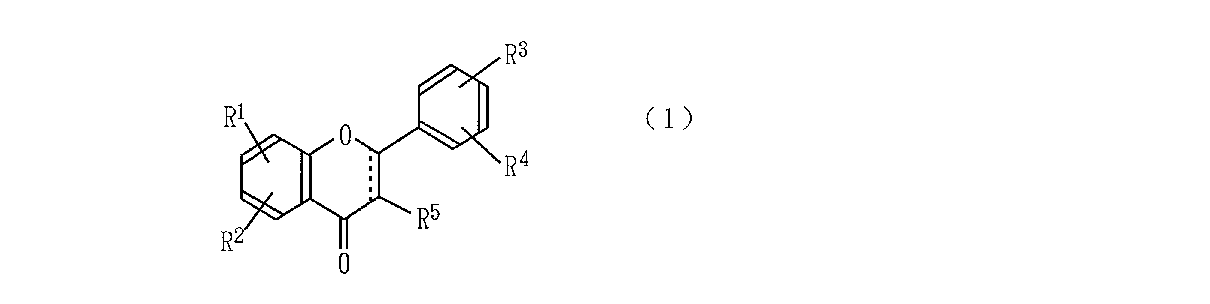
〔式中、R1 、R2 、R3 およびR4 はそれぞれ水素原子、水酸基、低級アルコキシル基又はアルケニル基を示し、R5 は水素原子又は水酸基を示し、破線と実線とからなる二重線はこの結合部が単結合又は二重結合であることを示す〕
で表されるフラボノイド類を有効成分とする細胞間接着抑制剤を提供するものである。
【0013】
【発明の実施の形態】
本発明で用いられる一般式(1)で表されるフラボノイド類は、公知のものであり、また、その一部は植物中に含まれ、生薬の有効成分として知られているが、細胞間接着抑制作用を有することは、知られていなかった。
【0014】
上記一般式(1)中、破線と実線とからなる二重線で示される結合が単結合の場合、母核はフラバノン骨格を示し、二重結合の場合はフラボン骨格を示し、また、それぞれ、複数の立体異性体および光学異性体が存在するが、本発明においては、そのいずれをも用いることができ、これらを単独又は複数組み合わせて用いることができる。
【0015】
上記一般式(1)中、R1 、R2 、R3 およびR4 は同一又は異なっていてもよく、それぞれ水素原子、水酸基、低級アルコキシル基又はアルケニル基を示すが、ここで低級アルコキシル基としては、炭素数1〜6の直鎖又は分岐鎖のアルコキシル基が挙げられ、具体的には、メトキシル基、エトキシル基、プロポキシル基、1−ブトキシル基、2−ブトキシル基等が挙げられる。またアルケニル基としては炭素数2〜6の直鎖又は分岐鎖のアルケニル基が挙げられ、具体的にはビニル基、アリル基、3−メチル−2−ブテニル基等が挙げられる。これらのうち、R1 、R2 、R3 およびR4 としては水素原子、水酸基、メトキシル基、3−メチル−2−ブテニル基が好ましい。
【0016】
また、R1 、R2 、R3 およびR4 の結合位置は、特に制限はなく、母核であるフラボン骨格又はフラバノン骨格に対し、R1 およびR2 は5位、6位、7位、8位、R3 およびR4 は2′位、3′位、4′位、5′位、6′位の位置に結合し得るが、R1 およびR2 がそれぞれ7位および8位、R3 およびR4 がそれぞれ3′位および4′位に結合したものが好ましい。
【0017】
本発明において用いられる一般式(1)で表されるフラボノイド類の好ましい具体例としては、以下に示すものが挙げられる。
【0018】
【化3】
【化4】
本発明で用いられる一般式(1)で表されるフラボノイド類は、植物等の天然物より抽出したもの又は抽出したものを常法に従い化学修飾したものを用いてもよく、また、公知の方法に従い合成したものを用いてもよい。ここで、天然物より抽出したものを用いる場合は、一般式(1)で表されるフラボノイド類が配糖体等の形態で存在する場合は、加水分解等の公知の手段で糖部等を除去すればよく、また、抽出後又は糖部等を除去後、精製したもののみならず、抽出したもの又は糖部等を除去したものをそのまま用いてもよい。
【0021】
本発明の細胞間接着抑制剤は細胞間接着が亢進することにより生じる種々の疾患の予防又は治療に対して有用であり、特に水泡症、角化症、角化不全症、ニキビ、フケ、肌荒れ、唇荒れ等の皮膚における細胞間接着の亢進が原因となる疾患に対し、特に有効である。かかる皮膚における疾患に対しては、皮膚外用剤、経口剤、注射剤等の形態で用いるのが好ましく、皮膚外用剤における一般式(1)で表されるフラボノイド類の配合量は0.001〜30重量%配合するのが好ましく、0.01〜10重量%配合するのが特に好ましい。また、経口剤としては、錠剤、顆粒剤、カプセル剤等が挙げられる。
【0022】
本発明の細胞間接着抑制剤には例えば殺菌消毒剤、収斂剤、皮膚軟化剤、ホルモン剤、ビタミン類等の他の薬効成分を配合することができる。
また、皮膚外用剤とする場合には、化粧料成分として一般に使用されている水性成分、粉体、油剤、保湿剤、アルコール類、pH調整剤、防腐剤、紫外線吸収剤、増粘剤、色素、香料等を適宜配合することができる。外用剤の形態としては、軟膏、乳液、クリーム、化粧水、美容液、クレンジング剤、パック剤、洗浄料、ファンデーション、口紅等が挙げられる。また、経口剤とする場合には、例えば結合剤、滑沢剤、崩壊剤、賦形剤等を適宜配合することができる。
【0023】
【実施例】
次に実施例を挙げて本発明をさらに詳細に説明するが、本発明は何らこれらの実施例に限定されるものではない。
【0024】
実施例1
フラボノイドの細胞接着抑制活性はデスモグレインを指標としたデスモゾーム形成および細胞間隙の変化を以下の方法により検討することで判定した。
ヒト培養表皮細胞をラブテックチャンバースライド上に継代し、37℃、5%CO2条件のインキュベーターにて培養した。細胞がコンフルエントに達する直前で培地をカルシウム濃度0.03mMのフラボノイドを重量濃度で0.001%溶解させた培地に交換した37℃、5%CO2で12時間培養し、塩化カルシウム溶液を加えることで培地中のカルシウム濃度を0.03mMから1.5mMに上昇させた。カルシウムスイッチ24時間後に細胞を固定し、細胞間デスモゾーム形成抑制効果を一次抗体にモノクローナル抗デスモグレイン抗体、二次抗体にFITCラベル抗マウスIgGを用いた免疫蛍光染色を行い、蛍光顕微鏡にて観察し、フラボノイド未添加群と比較することで判定した。
【0025】
その結果、カルシウム濃度スイッチ24時間後においてフラボノイド未添加群ではデスモグレインの存在を示す蛍光が細胞間に局在しているのが顕著に観察され、細胞間隙もほとんど認められなかった。これに比較して本発明フラボノイド添加群では細胞間のデスモグレインの蛍光染色が非常に弱く、細胞間隙が明らかに認められた。各フラボノイド化合物の顕微鏡観察により判断した活性強度を表1に示す。
従って、本発明におけるフラボノイド化合物はヒト表皮角化細胞のデスモゾーム形成を阻害し、細胞間接着を抑制することが判明した。
【0026】
【表1】
【発明の効果】
本発明の細胞間接着抑制剤は、水泡症、角化症、角化不全症、ニキビ、フケ、肌荒れ、唇荒れ等の各種皮膚疾患の治療・改善や角層トラブルの予防・改善に有効である。[0001]
BACKGROUND OF THE INVENTION
The present invention relates to an intercellular adhesion inhibitor useful for treating and improving skin diseases and preventing and improving stratum corneum troubles, comprising flavonoids as active ingredients.
[0002]
[Prior art]
The epidermis is composed of various types of cells, and keratinocytes are the majority. As this keratinocyte grows and moves to the upper layer, the outermost stratum corneum is formed by the differentiation process (keratinization). Epidermal cells play an important role in the normal keratinization and maintenance of the stratum corneum.
[0003]
It is said that the abnormal cell adhesion of keratinocytes in the epidermis is a cause of skin diseases such as blistering and certain keratosis. In addition, it is known that stratum corneum troubles such as acne, dandruff and sunburn are caused by the stratification of the stratum corneum due to enhanced cell adhesion.
[0004]
Desmosome is a representative example of an adhesion function device for the epidermis including these stratum corneum. Desmosomes are protein aggregates that are involved in adhesion between epidermal cells and corneocytes, and among these proteins that are directly involved in adhesion are desmoglein and desmocholine.
[0005]
Up to now, an increase in desmosome protein has been observed in exfoliated horny layer caused by rough lips, desquamation of horny layer caused by sunburn and drying, acne inner horny layer, and dandruff. Therefore, these stratum corneum troubles are thought to be due to abnormalities of the stratum corneum adhesion function due to an increase in desmosome protein, and it is considered effective to control the cell adhesion function by desmosome to prevent and improve these stratum corneum troubles. .
[0006]
As a method for controlling desmosome, a method for improving acne, dandruff and desquamation by degrading a desmosome protein accumulated in the stratum corneum with a protease has been reported so far (Japanese translations of PCT publication No. 7-505383, WO93 / 19732, WO95 / 07687, WO95 / 07688).
[0007]
However, a substance that can be used for treatment of these skin diseases and improvement of stratum corneum by acting on cells themselves and effectively inhibiting cell-cell adhesion has not yet been found.
[0008]
[Problems to be solved by the invention]
Accordingly, an object of the present invention is to provide a drug that suppresses cell-cell adhesion due to desmosomes, in particular, cell-cell adhesion of desmosomes that causes horny layer troubles in the skin.
[0009]
[Means for Solving the Problems]
Thus, as a result of intensive studies to achieve the above object, the present inventors have found that specific flavonoids have an activity of effectively suppressing adhesion between epidermal cells by desmosomes, and have completed the present invention. It was.
[0010]
That is, the present invention provides the following general formula (1)
[0011]
[Chemical 2]
[Wherein R 1 , R 2 , R 3 and R 4 each represent a hydrogen atom, a hydroxyl group, a lower alkoxyl group or an alkenyl group, R 5 represents a hydrogen atom or a hydroxyl group, and is a double line comprising a broken line and a solid line Indicates that this bond is a single bond or a double bond)
The intercellular adhesion inhibitor which uses the flavonoid represented by these as an active ingredient is provided.
[0013]
DETAILED DESCRIPTION OF THE INVENTION
The flavonoids represented by the general formula (1) used in the present invention are known, and some of them are contained in plants and are known as active ingredients of herbal medicines. It has not been known to have an inhibitory action.
[0014]
In the general formula (1), when the bond represented by a double line consisting of a broken line and a solid line is a single bond, the mother nucleus represents a flavanone skeleton, and in the case of a double bond, a flavone skeleton, Although there are a plurality of stereoisomers and optical isomers, any of them can be used in the present invention, and these can be used alone or in combination.
[0015]
In the general formula (1), R 1 , R 2 , R 3 and R 4 may be the same or different and each represents a hydrogen atom, a hydroxyl group, a lower alkoxyl group or an alkenyl group. Examples thereof include a linear or branched alkoxyl group having 1 to 6 carbon atoms, and specific examples include a methoxyl group, an ethoxyl group, a propoxyl group, a 1-butoxyl group, and a 2-butoxyl group. Examples of the alkenyl group include linear or branched alkenyl groups having 2 to 6 carbon atoms, and specific examples include a vinyl group, an allyl group, and a 3-methyl-2-butenyl group. Among these, R 1 , R 2 , R 3 and R 4 are preferably a hydrogen atom, a hydroxyl group, a methoxyl group, or a 3-methyl-2-butenyl group.
[0016]
The bonding positions of R 1 , R 2 , R 3 and R 4 are not particularly limited, and R 1 and R 2 are in the 5th, 6th, 7th position relative to the flavone skeleton or flavanone skeleton which is the mother nucleus. 8-position, R 3 and R 4 can be bonded to the positions of 2′-position, 3′-position, 4′-position, 5′-position and 6′-position, but R 1 and R 2 are respectively in the 7-position and 8-position, R Those in which 3 and R 4 are bonded to the 3′-position and the 4′-position, respectively, are preferred.
[0017]
Preferable specific examples of the flavonoids represented by the general formula (1) used in the present invention include the following.
[0018]
[Chemical 3]
[Formula 4]
As the flavonoids represented by the general formula (1) used in the present invention, those extracted from natural products such as plants or those extracted and chemically modified according to conventional methods may be used. You may use what was synthesize | combined according to this. Here, when using a product extracted from a natural product, when the flavonoids represented by the general formula (1) are present in the form of glycosides, the sugar portion and the like are removed by a known means such as hydrolysis. What is necessary is just to remove, and after extracting or removing a sugar part etc., you may use not only what was refine | purified but what was extracted or what removed the sugar part etc. as it is.
[0021]
The intercellular adhesion inhibitor of the present invention is useful for the prevention or treatment of various diseases caused by the enhancement of intercellular adhesion, and in particular, blistering, keratosis, keratosis, acne, dandruff, rough skin It is particularly effective against diseases caused by increased cell-cell adhesion in the skin such as rough lips. For such diseases in the skin, it is preferably used in the form of an external preparation for skin, oral preparation, injection or the like, and the blending amount of the flavonoids represented by the general formula (1) in the external preparation for skin is 0.001 to 0.001. 30 wt% is preferably blended, and 0.01 to 10 wt% is particularly preferred. Examples of oral preparations include tablets, granules, capsules and the like.
[0022]
In the cell adhesion inhibitor of the present invention, other medicinal components such as bactericidal disinfectant, astringent, emollient, hormone, vitamins and the like can be blended.
In addition, when used as a skin external preparation, aqueous components, powders, oils, moisturizers, alcohols, pH adjusters, preservatives, UV absorbers, thickeners, pigments that are commonly used as cosmetic ingredients A fragrance or the like can be appropriately blended. Examples of the external preparation include ointments, emulsions, creams, lotions, cosmetics, cleansing agents, packs, cleaning agents, foundations, lipsticks and the like. Moreover, when setting it as an oral agent, a binder, a lubricant, a disintegrating agent, an excipient | filler, etc. can be mix | blended suitably, for example.
[0023]
【Example】
EXAMPLES Next, although an Example is given and this invention is demonstrated further in detail, this invention is not limited to these Examples at all.
[0024]
Example 1
The cell adhesion inhibitory activity of flavonoids was determined by examining desmosome formation and cell gap changes using desmoglein as an index.
Human cultured epidermal cells were subcultured onto Lovetech chamber slides and cultured in an incubator under conditions of 37 ° C. and 5% CO 2 . Immediately before the cells reach confluence, the medium is replaced with a medium in which 0.001% of flavonoid with a calcium concentration of 0.03 mM is dissolved by weight, and cultured at 37 ° C., 5% CO 2 for 12 hours, and a calcium chloride solution is added. The calcium concentration in the medium was increased from 0.03 mM to 1.5 mM. Cells were fixed 24 hours after the calcium switch, and the intercellular desmosome formation inhibitory effect was immunofluorescent stained using a monoclonal anti-desmoglein antibody as the primary antibody and FITC-labeled anti-mouse IgG as the secondary antibody, and observed with a fluorescence microscope. It was determined by comparing with the flavonoid non-added group.
[0025]
As a result, after 24 hours of the calcium concentration switch, in the flavonoid non-added group, the fluorescence indicating the presence of desmoglein was remarkably localized between cells, and almost no cell gap was observed. Compared with this, in the flavonoid addition group of the present invention, the fluorescence staining of desmoglein between cells was very weak, and a cell gap was clearly recognized. The activity intensity determined by microscopic observation of each flavonoid compound is shown in Table 1.
Accordingly, it has been found that the flavonoid compounds in the present invention inhibit desmosome formation of human epidermal keratinocytes and suppress cell-cell adhesion.
[0026]
[Table 1]
【The invention's effect】
The intercellular adhesion inhibitor of the present invention is effective in treating and improving various skin diseases such as blistering, keratosis, keratosis, acne, dandruff, rough skin, and rough lips, as well as prevention and improvement of stratum corneum troubles. is there.
Claims (1)
で表されるフラボノイド類を有効成分とするヒト表皮角化細胞の細胞間接着抑制剤。General formula (1)
An inhibitor of intercellular adhesion of human epidermal keratinocytes , comprising a flavonoid represented by the formula:
Priority Applications (1)
| Application Number | Priority Date | Filing Date | Title |
|---|---|---|---|
| JP13654997A JP4002635B2 (en) | 1997-05-27 | 1997-05-27 | Intercellular adhesion inhibitor |
Applications Claiming Priority (1)
| Application Number | Priority Date | Filing Date | Title |
|---|---|---|---|
| JP13654997A JP4002635B2 (en) | 1997-05-27 | 1997-05-27 | Intercellular adhesion inhibitor |
Publications (2)
| Publication Number | Publication Date |
|---|---|
| JPH10330259A JPH10330259A (en) | 1998-12-15 |
| JP4002635B2 true JP4002635B2 (en) | 2007-11-07 |
Family
ID=15177821
Family Applications (1)
| Application Number | Title | Priority Date | Filing Date |
|---|---|---|---|
| JP13654997A Expired - Fee Related JP4002635B2 (en) | 1997-05-27 | 1997-05-27 | Intercellular adhesion inhibitor |
Country Status (1)
| Country | Link |
|---|---|
| JP (1) | JP4002635B2 (en) |
Families Citing this family (8)
| Publication number | Priority date | Publication date | Assignee | Title |
|---|---|---|---|---|
| AU3002299A (en) * | 1998-03-16 | 1999-10-11 | Procter & Gamble Company, The | Methods for regulating skin appearance |
| KR100371416B1 (en) | 1998-03-16 | 2003-02-07 | 더 프록터 앤드 갬블 캄파니 | Compositions for regulating skin appearance |
| KR100472694B1 (en) * | 2000-12-30 | 2005-03-07 | 한국생명공학연구원 | Flavanone derivatives and composition for preventing or treating blood lipid level-related diseases comprising same |
| DE10221741A1 (en) * | 2002-05-16 | 2003-12-04 | Cognis Deutschland Gmbh | Anti-dandruff shampoos |
| PL1893173T3 (en) * | 2005-03-12 | 2011-04-29 | Unilever Nv | Amino-oxo-indole-ylidene compounds for use in treating scalp skin itching |
| KR101238971B1 (en) | 2005-03-12 | 2013-03-04 | 유니레버 엔.브이. | Hair and/or scalp care compositions incorporating amino-oxo-indole-ylidene compounds |
| JP5164681B2 (en) * | 2008-06-12 | 2013-03-21 | 株式会社ナリス化粧品 | Lip cosmetics and candy and chewing gum |
| JP7308513B2 (en) * | 2019-06-17 | 2023-07-14 | 株式会社クラブコスメチックス | parakeratosis inhibitor |
-
1997
- 1997-05-27 JP JP13654997A patent/JP4002635B2/en not_active Expired - Fee Related
Also Published As
| Publication number | Publication date |
|---|---|
| JPH10330259A (en) | 1998-12-15 |
Similar Documents
| Publication | Publication Date | Title |
|---|---|---|
| JP3756838B2 (en) | Topical skin preparation | |
| JPH09263534A (en) | Promoter for melanogenesis | |
| JP2003300860A (en) | Skin care preparation | |
| JP2003300859A (en) | Skin care preparation | |
| JP4992164B2 (en) | Cosmetic composition | |
| KR20220127738A (en) | Cosmetic composition comprising PDRN isolated from trout and follicular fluid | |
| JP4002635B2 (en) | Intercellular adhesion inhibitor | |
| EP1252888B1 (en) | Biologically active labdane or labdene derivatives from Cistus | |
| JPH0692821A (en) | Cosmetic containing eucommia ulmoides leaf extract | |
| JP3753188B2 (en) | Novel salicylic acid derivatives and their use in cosmetic and / or dermatological compositions | |
| KR102204367B1 (en) | Cosmetic compositions for improving skin wrinkle | |
| JPH10167957A (en) | Cell adhesion inhibitor | |
| JPH05194175A (en) | Cosmetic | |
| JPH06256151A (en) | Skin cosmetic | |
| JP2008088075A (en) | Profilaggrin/filaggrin production promoter, epidermal keratinocyte proliferation promoter, skin care preparation for normalizing epidermis/horny cell layer, profilaggrin/filaggrin production-promoting method and epidermal keratinocyte proliferation-promoting method | |
| US8217074B2 (en) | Use of sargachromenol | |
| JP2002363038A (en) | Cosmetic | |
| KR102229259B1 (en) | Cosmetic Composition Containing Plumcot Extract | |
| JPH0873340A (en) | Skin external preparation | |
| JP5366358B2 (en) | Agent for acting on skin aging mechanism, anti-aging skin external preparation, and anti-aging method | |
| JP4173719B2 (en) | New steroid saponin | |
| JP5155543B2 (en) | Endothelin-1 production inhibitor, hexosaminidase release inhibitor, anti-inflammatory / whitening skin preparation, endothelin-1 production inhibition method, and hexosaminidase release inhibition method | |
| JP5167042B2 (en) | Ceramide production promoter, moisturizer and external preparation for skin | |
| JP2009215251A (en) | Anti-inflammatory agent and skin care preparation for anti-inflammation use | |
| JP2003277249A (en) | Skin care preparation, epidermal cell activator, dermal fibroblast activator and collagen production promotor |
Legal Events
| Date | Code | Title | Description |
|---|---|---|---|
| A131 | Notification of reasons for refusal |
Free format text: JAPANESE INTERMEDIATE CODE: A131 Effective date: 20070424 |
|
| A977 | Report on retrieval |
Free format text: JAPANESE INTERMEDIATE CODE: A971007 Effective date: 20070426 |
|
| A521 | Written amendment |
Free format text: JAPANESE INTERMEDIATE CODE: A523 Effective date: 20070625 |
|
| A521 | Written amendment |
Free format text: JAPANESE INTERMEDIATE CODE: A821 Effective date: 20070627 |
|
| TRDD | Decision of grant or rejection written | ||
| A01 | Written decision to grant a patent or to grant a registration (utility model) |
Free format text: JAPANESE INTERMEDIATE CODE: A01 Effective date: 20070814 |
|
| A61 | First payment of annual fees (during grant procedure) |
Free format text: JAPANESE INTERMEDIATE CODE: A61 Effective date: 20070820 |
|
| FPAY | Renewal fee payment (event date is renewal date of database) |
Free format text: PAYMENT UNTIL: 20100824 Year of fee payment: 3 |
|
| FPAY | Renewal fee payment (event date is renewal date of database) |
Free format text: PAYMENT UNTIL: 20100824 Year of fee payment: 3 |
|
| FPAY | Renewal fee payment (event date is renewal date of database) |
Free format text: PAYMENT UNTIL: 20110824 Year of fee payment: 4 |
|
| FPAY | Renewal fee payment (event date is renewal date of database) |
Free format text: PAYMENT UNTIL: 20110824 Year of fee payment: 4 |
|
| FPAY | Renewal fee payment (event date is renewal date of database) |
Free format text: PAYMENT UNTIL: 20120824 Year of fee payment: 5 |
|
| FPAY | Renewal fee payment (event date is renewal date of database) |
Free format text: PAYMENT UNTIL: 20120824 Year of fee payment: 5 |
|
| FPAY | Renewal fee payment (event date is renewal date of database) |
Free format text: PAYMENT UNTIL: 20130824 Year of fee payment: 6 |
|
| R250 | Receipt of annual fees |
Free format text: JAPANESE INTERMEDIATE CODE: R250 |
|
| LAPS | Cancellation because of no payment of annual fees |