JP3820999B2 - Proximity communication system and proximity communication method, data management apparatus and data management method, storage medium, and computer program - Google Patents
Proximity communication system and proximity communication method, data management apparatus and data management method, storage medium, and computer program Download PDFInfo
- Publication number
- JP3820999B2 JP3820999B2 JP2002017764A JP2002017764A JP3820999B2 JP 3820999 B2 JP3820999 B2 JP 3820999B2 JP 2002017764 A JP2002017764 A JP 2002017764A JP 2002017764 A JP2002017764 A JP 2002017764A JP 3820999 B2 JP3820999 B2 JP 3820999B2
- Authority
- JP
- Japan
- Prior art keywords
- control information
- data
- rewriting
- data block
- link
- Prior art date
- Legal status (The legal status is an assumption and is not a legal conclusion. Google has not performed a legal analysis and makes no representation as to the accuracy of the status listed.)
- Expired - Fee Related
Links
Images


Classifications
-
- B—PERFORMING OPERATIONS; TRANSPORTING
- B42—BOOKBINDING; ALBUMS; FILES; SPECIAL PRINTED MATTER
- B42D—BOOKS; BOOK COVERS; LOOSE LEAVES; PRINTED MATTER CHARACTERISED BY IDENTIFICATION OR SECURITY FEATURES; PRINTED MATTER OF SPECIAL FORMAT OR STYLE NOT OTHERWISE PROVIDED FOR; DEVICES FOR USE THEREWITH AND NOT OTHERWISE PROVIDED FOR; MOVABLE-STRIP WRITING OR READING APPARATUS
- B42D25/00—Information-bearing cards or sheet-like structures characterised by identification or security features; Manufacture thereof
- B42D25/20—Information-bearing cards or sheet-like structures characterised by identification or security features; Manufacture thereof characterised by a particular use or purpose
-
- G—PHYSICS
- G07—CHECKING-DEVICES
- G07F—COIN-FREED OR LIKE APPARATUS
- G07F7/00—Mechanisms actuated by objects other than coins to free or to actuate vending, hiring, coin or paper currency dispensing or refunding apparatus
- G07F7/08—Mechanisms actuated by objects other than coins to free or to actuate vending, hiring, coin or paper currency dispensing or refunding apparatus by coded identity card or credit card or other personal identification means
- G07F7/10—Mechanisms actuated by objects other than coins to free or to actuate vending, hiring, coin or paper currency dispensing or refunding apparatus by coded identity card or credit card or other personal identification means together with a coded signal, e.g. in the form of personal identification information, like personal identification number [PIN] or biometric data
- G07F7/1008—Active credit-cards provided with means to personalise their use, e.g. with PIN-introduction/comparison system
-
- B—PERFORMING OPERATIONS; TRANSPORTING
- B42—BOOKBINDING; ALBUMS; FILES; SPECIAL PRINTED MATTER
- B42D—BOOKS; BOOK COVERS; LOOSE LEAVES; PRINTED MATTER CHARACTERISED BY IDENTIFICATION OR SECURITY FEATURES; PRINTED MATTER OF SPECIAL FORMAT OR STYLE NOT OTHERWISE PROVIDED FOR; DEVICES FOR USE THEREWITH AND NOT OTHERWISE PROVIDED FOR; MOVABLE-STRIP WRITING OR READING APPARATUS
- B42D25/00—Information-bearing cards or sheet-like structures characterised by identification or security features; Manufacture thereof
- B42D25/20—Information-bearing cards or sheet-like structures characterised by identification or security features; Manufacture thereof characterised by a particular use or purpose
- B42D25/22—Information-bearing cards or sheet-like structures characterised by identification or security features; Manufacture thereof characterised by a particular use or purpose for use in combination with accessories specially adapted for information-bearing cards
-
- G—PHYSICS
- G06—COMPUTING OR CALCULATING; COUNTING
- G06K—GRAPHICAL DATA READING; PRESENTATION OF DATA; RECORD CARRIERS; HANDLING RECORD CARRIERS
- G06K1/00—Methods or arrangements for marking the record carrier in digital fashion
- G06K1/12—Methods or arrangements for marking the record carrier in digital fashion otherwise than by punching
- G06K1/128—Methods or arrangements for marking the record carrier in digital fashion otherwise than by punching by electric registration, e.g. electrolytic, spark erosion
-
- G—PHYSICS
- G06—COMPUTING OR CALCULATING; COUNTING
- G06Q—INFORMATION AND COMMUNICATION TECHNOLOGY [ICT] SPECIALLY ADAPTED FOR ADMINISTRATIVE, COMMERCIAL, FINANCIAL, MANAGERIAL OR SUPERVISORY PURPOSES; SYSTEMS OR METHODS SPECIALLY ADAPTED FOR ADMINISTRATIVE, COMMERCIAL, FINANCIAL, MANAGERIAL OR SUPERVISORY PURPOSES, NOT OTHERWISE PROVIDED FOR
- G06Q20/00—Payment architectures, schemes or protocols
- G06Q20/30—Payment architectures, schemes or protocols characterised by the use of specific devices or networks
- G06Q20/34—Payment architectures, schemes or protocols characterised by the use of specific devices or networks using cards, e.g. integrated circuit [IC] cards or magnetic cards
- G06Q20/341—Active cards, i.e. cards including their own processing means, e.g. including an IC or chip
-
- G—PHYSICS
- G07—CHECKING-DEVICES
- G07F—COIN-FREED OR LIKE APPARATUS
- G07F7/00—Mechanisms actuated by objects other than coins to free or to actuate vending, hiring, coin or paper currency dispensing or refunding apparatus
- G07F7/08—Mechanisms actuated by objects other than coins to free or to actuate vending, hiring, coin or paper currency dispensing or refunding apparatus by coded identity card or credit card or other personal identification means
- G07F7/0806—Details of the card
- G07F7/0813—Specific details related to card security
- G07F7/082—Features insuring the integrity of the data on or in the card
Landscapes
- Engineering & Computer Science (AREA)
- Physics & Mathematics (AREA)
- General Physics & Mathematics (AREA)
- Business, Economics & Management (AREA)
- Theoretical Computer Science (AREA)
- Computer Security & Cryptography (AREA)
- Microelectronics & Electronic Packaging (AREA)
- Computer Networks & Wireless Communication (AREA)
- Accounting & Taxation (AREA)
- Strategic Management (AREA)
- General Business, Economics & Management (AREA)
- Information Retrieval, Db Structures And Fs Structures Therefor (AREA)
- Techniques For Improving Reliability Of Storages (AREA)
- Credit Cards Or The Like (AREA)
Description
【0001】
【発明の属する技術分野】
本発明は、局所において適用される非接触・近接通信システムに係り、特に、非接触ICカード技術に代表される、ユーザが物理的に近接通信を行うデバイスどうしを近づけることにより少なくとも一方の機器が相手のデバイスを発見して自動的に動作する近接通信システムに関する。
【0002】
さらに詳しくは、本発明は、ユーザがデバイスどうしを物理的に近づけることにより自動的に動作するとともに、ユーザがデバイスどうしを引き離して任意のタイミングでデバイス間の通信が途絶しても動作を保証する近接通信システム及び近接通信方法、データ管理装置及びデータ管理方法、記憶媒体、並びにコンピュータ・プログラムに係り、特に、所定以上の大きさのデータを書き込む際に任意のタイミングでデバイス間通信が途絶しても、データの整合性を保証する近接通信システム及び近接通信方法、データ管理装置及びデータ管理方法、記憶媒体、並びにコンピュータ・プログラムに関する。
【0003】
【従来の技術】
局所でのみ適用可能な無線通信手段の一例として、非接触ICカードを挙げることができる。
【0004】
この種の無線通信には、例えば電磁誘導の原理に基づいて実現される。すなわち、無線通信システムは、メモリ機能を有するICカードと、ICカードのメモリに対して読み書きアクセスをするカード・リーダ/ライタで構成され、カード・リーダ/ライタ側のアンテナとICカード側のループ・コイルが系としては1個のトランスを形成している。
【0005】
カード・リーダ/ライタ側では、アンテナに流す電流を変調することで、ICカード上のループ・コイルの誘起電圧が変調を受けるという作用により、カード・リーダ/ライタからICカードへのデータ送信を行うことができる。また、ICカードは、ループ・コイルの端子間の負荷変動により、ICカード・リーダ/ライタ側のアンテナ端子間のインピーダンスが変化してアンテナの通過電流や電圧が変動するという作用により、カード・リーダ/ライタへの返信を行なう。
【0006】
ICカードに代表される非接触・近接通信システムは、操作上の手軽さから、広範に普及している。例えば、暗証コードやその他の個人認証情報、電子チケットなどの価値情報などをICカードに格納しておくことにより、キャッシュ・ディスペンサやコンサート会場の出入口、駅の改札口などに設置されたカード・リーダ/ライタは、利用者がかざしたICカードに非接触でアクセスして、認証処理を行なうことができる。
【0007】
最近では、微細化技術の向上とも相俟って、比較的大容量のメモリ空間を持つICカードが出現している。大容量メモリ付きのICカードによれば、複数のアプリケーション(又はサービス)を同時に格納しておくことができるので、1枚のICカードを複数の用途に利用することができる。例えば、1枚のICカード上に、電子決済を行なうための電子マネーや、特定のコンサート会場に入場するための電子チケットなど、多数のサービスを格納しておくことにより、1枚のICカードをさまざまな用途に適用させることができる。
【0008】
さらに、各デバイスにICカード及びカード・リーダ/ライタ双方の機能を装備することにより、ICカード技術を汎用性のある双方向の近接通信インターフェースとして利用することができる。
【0009】
例えば、コンピュータや情報家電機器のような機器どうしで近接通信システムが構成される場合には、通信は一対一で行われる。また、ある機器が非接触ICカードのような機器以外の相手デバイス(カードと呼ぶ)と通信することも可能であり、この場合においては、1つの機器と複数のカードにおける一対多の通信を行うアプリケーションも考えられる。
【0010】
このような近接通信システムでは、ユーザが物理的に近接通信を行うデバイスどうしを近づけることにより、少なくとも一方の機器は相手のデバイスを発見して自動的に動作を開始することができる。しかし、逆にデバイス間の距離が離れた場合、任意の時点で通信が途絶する。このため、任意のタイミングでユーザがデバイス同士を引き離すという状況においてもシステムが破綻しないような動作保証機構が必要となる。
【0011】
既存の近接通信システムにおいては、ICカード自体の機能により、一定の大きさ(例えば128バイト)のデータ書き込みに関しては動作を保証するものもある。しかしながら、この場合であっても、それ以上の大きさの情報を書き込む際には、タイミングによっては、データの不整合性が発生してしまう。
【0012】
とりわけ、通信範囲が局所に制限されるICカードのような近接通信においては、ユーザ操作によりデバイス間が引き離されたり障害物で干渉されるなど、通信が途切れてしまう可能性が極めて高い。ICカードの大メモリ化、多用途・多サービス化が進むに従い、比較的大きなデータをICカードに転送する機会がますます増えていくので、不意に通信が途絶した際のデータ保証の問題は重大である。
【0013】
【発明が解決しようとする課題】
本発明の目的は、ユーザが物理的に近接通信を行うデバイスどうしを近づけることにより少なくとも一方の機器が相手のデバイスを発見して自動的に動作することかできる、優れた近接通信システムを提供することにある。
【0014】
本発明のさらなる目的は、ユーザがデバイスどうしを物理的に近づけることにより自動的に動作するとともに、ユーザがデバイスどうしを引き離して任意のタイミングでデバイス間の通信が途絶しても動作を保証することができる、優れた近接通信システム及び近接通信方法、データ管理装置及びデータ管理方法、記憶媒体、並びにコンピュータ・プログラムを提供することにある。
【0015】
本発明のさらなる目的は、所定以上の大きさのデータを書き込む際に任意のタイミングでデバイス間通信が途絶しても、データの整合性を好適に保証することができる、優れた近接通信システム及び近接通信方法、データ管理装置及びデータ管理方法、記憶媒体、並びにコンピュータ・プログラムを提供することにある。
【0016】
【課題を解決するための手段及び作用】
本発明は、上記課題を参酌してなされたものであり、その第1の側面は、近接する外部装置からの要求に応じてデータの書き換えを行う近接通信システムであって、
外部装置からの要求に応じたデータの書き換えを行う1以上のデータ・ブロックと、各データ・ブロック毎に設けられた制御情報とで構成されるメモリ領域と、
外部装置からのデータ書き換え要求に応じて該当するデータ・ブロック及びその制御情報の書き換えを制御するデータ書き換え制御部とを備え、
1回のトランザクションで書き換え可能なデータ・サイズ以下での前記メモリ領域に対するデータ書き換え動作は保証され、且つ、制御情報K個分が1回のトランザクションに相当し、
前記データ書き換え制御部は、外部機器との近接通信が途切れる状況下においても、データ・ブロックの書き換えに関連する制御情報の書き換え動作を保証する、
ことを特徴とする近接通信システムである。
【0017】
但し、ここで言う「システム」とは、複数の装置(又は特定の機能を実現する機能モジュール)が論理的に集合した物のことを言い、各装置や機能モジュールが単一の筐体内にあるか否かは特に問わない。
【0018】
また、本発明の第2の側面は、近接する外部装置からの要求に応じてデータの書き換えを行う近接通信方法であって、
メモリ領域は、外部装置からの要求に応じたデータの書き換えを行う1以上のデータ・ブロックと、各データ・ブロック毎に設けられた制御情報とで構成され、
1回のトランザクションで書き換え可能なデータ・サイズ以下での前記メモリ領域に対するデータ書き換え動作はシステムで保証され、且つ、制御情報K個分が1回のトランザクションに相当しており、
外部機器との近接通信が途切れる状況下においてもデータ・ブロックの書き換えに関連する制御情報の書き換え動作を保証するステップを備える、
ことを特徴とする近接通信方法である。
【0019】
ここで、制御情報は、対応するデータ・ブロックへのリンク情報並びに後続するデータ・ブロックに対応する制御情報へのリンク情報を持つとともに、対応するデータ・ブロックが使用状態、未使用状態、書き込み中、消去可のうちいずれの状態であるかを示すように構成されている。
【0020】
また、メモリ領域は、先頭の制御情報に対するリンク情報を含んだブートストラップをさらに備えている。
【0021】
また、データ・ブロックは、関連するデータ・ブロックについての制御情報へのリンク情報を持つことができる。
【0022】
近接通信システムのトランスミッション・インターフェースとして非接触ICカード技術を適用した場合には、ユーザが物理的に近接通信を行うデバイスどうしを近づけることにより、少なくとも一方の機器は相手のデバイスを発見して自動的に動作することができ、操作性に優れている。その反面、デバイス間の距離が離れた場合、任意の時点で通信が途絶して、データの一貫性が失われてしまう。このため、データ書き込み中の任意のタイミングでユーザがデバイス同士を引き離してもメモリの内容が破壊されないような動作保証機構が必要となる。
【0023】
本発明の第1の側面に係る近接通信システム、又は、本発明の第2の側面に係る近接通信方法によれば、データ・ブロックの書き換えに関連する制御情報の合計が1回のトランザクションで書き換え可能なデータ・サイズ以下である場合には、その書き換え動作を1回のトランザクションでまとめて行なうことによって、制御情報の整合性を保証する。この結果、通信の途絶などにより仮にデータ・ブロックの書き換え動作に失敗した場合であっても、制御情報を基にデータを回復することができ、システムの破壊を防止することができる。
【0024】
また、本発明の第1の側面に係る近接通信システム、又は、本発明の第2の側面に係る近接通信方法によれば、データ・ブロックの書き換えに関連する制御情報の合計が1回のトランザクションで書き換え可能なデータ・サイズ(すなわちK個)を越えるときには、制御情報をリンクされた順序に従って1回のトランザクションで書き換え可能な個数のグループに分割するとともに、各トランザクションでは書き換え動作が途絶しても次のトランザクションを継続可能にするための情報を最後尾の制御情報に書き込むようにする。
【0025】
この結果、通信の途絶などにより一連の制御情報の書き換えが中断したとしても、中断した場所から書き換え動作を再開することができるので、制御情報の一貫性が保証される。また、通信の途絶などにより仮にデータ・ブロックの書き換え動作に失敗した場合であっても、制御情報を基にデータを回復することができ、システムの破壊を防止することができる。
【0026】
ブートストラップからリンクされているデータ・ブロック群について書き換えを行なう場合には、まず、新しく書き込みを行なうことができる容量を持った未使用状態のデータ・ブロック群を探索する。そして、該探索されたデータ・ブロック群の先頭に相当する制御情報を未使用状態から書き込み中に変更し、それ以外のデータ・ブロックの制御情報を使用状態に変更するとともに、先頭のデータ・ブロックから順次データ・ブロックをたどれるように各制御情報間にリンクを形成する。ここでの一連の制御情報の書き換えを、動作保証したトランザクションによって実行することによって、制御情報の整合性を保証する。
【0027】
次いで、書き換え要求されているデータを各制御情報間に形成されたリンクをたどりながら該探索されたデータ・ブロック群に書き込む。そして、該探索されたデータ・ブロック群の先頭の制御情報を書き込み中から使用状態に変更し、以前のデータ・ブロック群の先頭の制御情報を使用状態から消去可に変更するとともに、ブートストラップからのリンクを維持するために前記ブートストラップからのリンクを該探索されたデータ・ブロック群の先頭の制御情報を指すように変更する。ここでの一連の制御情報の書き換えを、1回のトランザクションによって実行することによって、制御情報の整合性を保証する。
【0028】
最後に消去可を示す制御情報及びそこからリンクされたすべての制御情報を未使用状態に変更して、以前のデータ・ブロックを再利用可能にする。また、ここでの一連の制御情報の書き換えを、動作保証したトランザクションによって実行することによって、制御情報の整合性を保証する。
【0029】
また、他のデータ・ブロックからリンクされているデータ・ブロック群について書き換えを行う場合には、まず、新しく書き込みを行なうことができる容量を持った未使用状態のデータ・ブロック群を探索する。そして、該探索されたデータ・ブロック群の先頭に相当する制御情報を未使用状態から書き込み中に変更し、それ以外のデータ・ブロックの制御情報を使用状態に変更するとともに、先頭のデータ・ブロックから順次データ・ブロックをたどれるように各制御情報間にリンクを形成する。ここでの一連の制御情報の書き換えを、動作保証したトランザクションによって実行することによって、制御情報の整合性を保証する。
【0030】
次いで、書き換え要求されているデータを各制御情報間に形成されたリンクをたどりながら該探索されたデータ・ブロック群に書き込む。そして、他のデータ・ブロックからリンクを維持するために該探索されたデータ・ブロック群の先頭の制御情報と以前のデータ・ブロック群の先頭の制御情報とを入れ替えるとともに、該探索されたデータ・ブロック群の先頭の制御情報を書き込み中から使用状態に変更し、以前のデータ・ブロック群の先頭の制御情報を使用状態から消去可に変更する。ここでの一連の制御情報の書き換えを、動作保証したトランザクションによって実行することによって、制御情報の整合性を保証する。
【0031】
最後に消去可を示す制御情報及びそこからリンクされたすべての制御情報を未使用状態に変更して、以前のデータ・ブロックを再利用可能にする。また、ここでの一連の制御情報の書き換えを、動作保証したトランザクションによって実行することによって、制御情報の整合性を保証する。
【0032】
ここで、該探索されたデータ・ブロック群の先頭に相当する制御情報を未使用状態から書き込み中に変更し、それ以外のデータ・ブロックの制御情報を使用状態に変更するとともに、先頭のデータ・ブロックから順次データ・ブロックをたどれるように各制御情報間にリンクを形成するという一連の制御情報の書き換えを行なう際、書き換える制御情報の合計が1回のトランザクションで書き換え可能なデータ・サイズ(すなわちK個)を越えるときには、制御情報をリンクされた順序に従って1回のトランザクションで書き換え可能な個数のグループに分割して、n回目のトランザクションでは、{(K−1)×n−(K−2)}番目から(K−1)×n番目までの制御情報のリンクがそれぞれ次の制御情報を指すようにするとともに{(K−1)×(n+1)−(K−2)}番目(すなわち{(K−1)×n+1}番目)の制御情報のリンクを0(又はヌル)にする書き換え動作を行なうようにしてもよい。
【0033】
この結果、通信の途絶などにより一連の制御情報の書き換えが中断したとしても、余分なリンクが形成されなくて済むので、制御情報の一貫性が保証される。また、通信の途絶などにより仮にデータ・ブロックの書き換え動作に失敗した場合であっても、制御情報を基にデータを回復することができ、システムの破壊を防止することができる。
【0034】
また、消去可を示す制御情報及びそこからリンクされたすべての制御情報を未使用状態に変更するという一連の制御情報の書き換えを行なう際、書き換える制御情報の合計が1回のトランザクションで書き換え可能なデータ・サイズ(すなわちK個)を越えるときには、制御情報をリンクされた順序に従って1回のトランザクションで書き換え可能な個数のグループに分割して、n回目の書き込みでは(K−1)×n番目までの制御情報を未使用状態にするとともに{(K−1)×n+1}番目の制御情報を消去可にする書き換え動作を行なうようにしてもよい。
【0035】
この結果、通信の途絶などにより一連の制御情報の書き換えが中断したとしても、消去可となっている制御情報を探し出して、中断した書き換え動作を再開することができるので、制御情報の一貫性が保証される。また、通信の途絶が生じても、もはや使用されなくなったデータ・ブロックの制御情報を確実に探し出して未使用状態に戻すことができるので、メモリ領域を無駄なく効率的に使用することができる。
【0036】
また、本発明の第3の側面は、1回のトランザクションの動作が保証されているシステムにおいてデータを管理するためのデータ管理装置であって、
システムのメモリ領域に、ユーザ・データを書き込むための1以上のデータ・ブロックと、各データ・ブロックを管理するための制御情報を設け、
各制御情報は1回のトランザクションでK個分を書き換え可能な固定データ・サイズであり、
データ・ブロックのユーザ・データの書き換えに伴い、書き換え動作を保証したトランザクションにより制御情報の書き換えを行う、
ことを特徴とするデータ管理装置である。
【0037】
また、本発明の第4の側面は、1回のトランザクションの動作が保証されているシステムにおいてデータを管理するためのデータ管理方法であって、
システムのメモリ領域に、ユーザ・データを書き込むための1以上のデータ・ブロックと、各データ・ブロックを管理するための制御情報を設け、
各制御情報は1回のトランザクションでK個分を書き換え可能な固定データ・サイズであり、
データ・ブロックのユーザ・データの書き換えるとともに、これに伴う書き換え動作を保証したトランザクションにより制御情報の書き換えを行う、
ことを特徴とするデータ管理方法である。
【0038】
ここで、制御情報は、対応するデータ・ブロックへのリンク情報並びに後続するデータ・ブロックに対応する制御情報へのリンク情報を持つとともに、対応するデータ・ブロックが使用状態、未使用状態、書き込み中、消去可のうちいずれの状態であるかを示すように構成されている。また、メモリ領域は、先頭の制御情報に対するリンク情報を含んだブートストラップをさらに備えている。また、データ・ブロックは、関連するデータ・ブロックについての制御情報へのリンク情報を持つことができる。
【0039】
メモリ領域に対するユーザ・データの書き換えを行なうために、書き換えデータのトランスミッション・インターフェースとして非接触ICカード技術を適用した場合には、デバイス間の距離が離れると、任意の時点で通信が途絶して、データの一貫性が失われてしまう。このため、データ書き込み中の任意のタイミングでユーザがデバイス同士を引き離してもメモリの内容が破壊されないような動作保証機構が必要となる。
【0040】
本発明の第3の側面に係るデータ管理装置、又は、本発明の第4の側面に係るデータ管理方法によれば、データ・ブロックの書き換えに関連する制御情報の合計が1回のトランザクションで書き換え可能なデータ・サイズ以下である場合には、その書き換え動作を1回のトランザクションでまとめて行なうことによって、制御情報の整合性を保証する。したがって、通信の途絶などにより仮にデータ・ブロックの書き換え動作に失敗しても、制御情報を基にデータを回復することができる。
【0041】
また、本発明の第3の側面に係るデータ管理装置、又は、本発明の第4の側面に係るデータ管理方法によれば、データ・ブロックの書き換えに関連する制御情報の合計が1回のトランザクションで書き換え可能なデータ・サイズ(すなわちK個)を越えるときには、制御情報をリンクされた順序に従って1回のトランザクションで書き換え可能な個数のグループに分割するとともに、各トランザクションでは書き換え動作が途絶しても次のトランザクションを継続可能にするための情報を最後尾の制御情報に書き込むようにする。したがって、通信の途絶などにより一連の制御情報の書き換えが中断したとしても、中断した場所から書き換え動作を再開することができるので、制御情報の一貫性が保証される。
【0042】
また、本発明の第5の側面は、近接する外部装置からの要求に応じてデータの書き換えを行うための処理をコンピュータ・システム上で実行するように記述されたコンピュータ・ソフトウェアをコンピュータ可読形式で物理的に格納した記憶媒体であって、
メモリ領域は、外部装置からの要求に応じたデータの書き換えを行う1以上のデータ・ブロックと、各データ・ブロック毎に設けられた制御情報とで構成され、
1回のトランザクションで書き換え可能なデータ・サイズ以下での前記メモリ領域に対するデータ書き換え動作はシステムで保証され、且つ、制御情報K個分が1回のトランザクションに相当しており、
前記コンピュータ・ソフトウェアは、制御情報におけるデータの整合性を保ちながら前記メモリ領域のデータ書き換え動作を行なうステップを備える、
ことを特徴とする記憶媒体である。
【0043】
また、本発明の第6の側面は、1回のトランザクションの動作が保証されているシステムにおけるデータ管理をコンピュータ・システム上で実行するように記述されたコンピュータ・ソフトウェアをコンピュータ可読形式で物理的に格納した記憶媒体であって、前記コンピュータ・ソフトウェアは、
システムのメモリ領域に、ユーザ・データを書き込むための1以上のデータ・ブロックと、各データ・ブロックを管理するための制御情報を設けるステップと、
データ・ブロックのユーザ・データの書き換えるとともに、これに伴う書き換え動作を保証したトランザクションにより制御情報の書き換えを行うステップと、
を具備することを特徴とする記憶媒体である。
【0044】
本発明の第5及び第6の各側面に係る記憶媒体は、例えば、さまざまなプログラム・コードを実行可能な汎用コンピュータ・システムに対して、コンピュータ・ソフトウェアをコンピュータ可読な形式で提供する媒体である。このような媒体は、例えば、DVD(Digital Versatile Disc)やCD(Compact Disc)、FD(Flexible Disk)、MO(Magneto-Optical disc)などの着脱自在で可搬性の記憶媒体である。あるいは、ネットワーク(ネットワークは無線、有線の区別を問わない)などの伝送媒体などを経由してコンピュータ・ソフトウェアを特定のコンピュータ・システムに提供することも技術的に可能である。
【0045】
また、本発明の第5及び第6の各側面に係る記憶媒体は、コンピュータ・システム上で所定のコンピュータ・ソフトウェアの機能を実現するための、コンピュータ・ソフトウェアと記憶媒体との構造上又は機能上の協働的関係を定義したものである。換言すれば、本発明の第5及び第6の各側面に係る記憶媒体を介して所定のコンピュータ・ソフトウェアをコンピュータ・システムにインストールすることによって、コンピュータ・システム上では協働的作用が発揮され、本発明の第2の側面に係る近接通信方法、又は本発明の第4の側面に係るデータ管理方法と同様の作用効果を得ることができる。
【0046】
また、本発明の第7の側面は、近接する外部装置からの要求に応じてデータの書き換えを行うための処理をコンピュータ・システム上で実行するように記述されたコンピュータ・プログラムであって、
メモリ領域は、外部装置からの要求に応じたデータの書き換えを行う1以上のデータ・ブロックと、各データ・ブロック毎に設けられた制御情報とで構成され、
1回のトランザクションで書き換え可能なデータ・サイズ以下での前記メモリ領域に対するデータ書き換え動作はシステムで保証され、且つ、制御情報K個分が1回のトランザクションに相当しており、
制御情報におけるデータの整合性を保ちながら前記メモリ領域のデータ書き換え動作を行なうステップを備える、
ことを特徴とするコンピュータ・プログラムである。
【0047】
また、本発明の第8の側面は、1回のトランザクションの動作が保証されているシステムにおけるデータ管理をコンピュータ・システム上で実行するように記述されたコンピュータ・プログラムであって、
システムのメモリ領域に、ユーザ・データを書き込むための1以上のデータ・ブロックと、各データ・ブロックを管理するための制御情報を設けるステップと、
データ・ブロックのユーザ・データの書き換えるとともに、これに伴う書き換え動作を保証したトランザクションにより制御情報の書き換えを行うステップと、
を具備することを特徴とするコンピュータ・プログラムである。
【0048】
本発明の本発明の第7及び第8の各側面に係るコンピュータ・プログラムは、コンピュータ・システム上で所定の処理を実現するようにコンピュータ可読形式で記述されたコンピュータ・プログラムを定義したものである。換言すれば、本発明の第7及び第8の各側面に係るコンピュータ・プログラムをコンピュータ・システムにインストールすることによって、コンピュータ・システム上では協働的作用が発揮され、本発明の第2の側面に係る近接通信方法、又は本発明の第4の側面に係るデータ管理方法方法と同様の作用効果を得ることができる。
【0049】
本発明のさらに他の目的、特徴や利点は、後述する本発明の実施形態や添付する図面に基づくより詳細な説明によって明らかになるであろう。
【0050】
【発明の実施の形態】
以下、図面を参照しながら本発明の実施形態について詳解する。
【0051】
A.近接通信システム
本実施形態に係る近接通信システムは、各デバイスにICカード及びカード・リーダ/ライタ双方の機能を装備することにより、ICカード技術を汎用性のある双方向の近接通信インターフェースとして利用するものである。
【0052】
例えば、コンピュータや情報家電機器のような機器どうしで近接通信システムが構成される場合には、通信は一対一で行われる。また、ある機器が非接触ICカードのような機器以外の相手デバイス(カードと呼ぶ)と通信することも可能であり、この場合においては、1つの機器と複数のカードにおける一対多の通信を行うアプリケーションも考えられる。
【0053】
このような近接通信システムでは、ユーザが物理的に近接通信を行うデバイスどうしを近づけることにより、少なくとも一方の機器は相手のデバイスを発見して自動的に動作する。但し、逆にデバイス間の距離が離れた場合、任意の時点で通信が途絶する。このため、任意のタイミングでユーザがデバイス同士を引き離すという状況においてもシステムが破綻しないような動作保証機構が必要となる。この動作保証機構の詳細については、後述に譲る。
【0054】
本実施形態に係る近接通信システムで提供されるサービスは、ICカードが通信対象である場合の親和性を考慮して、基本的には近接通信を介して"Description"の読み書きを行うメモリ・アクセス・モデルとして運用される。
【0055】
ここで、Descriptionには、機器やICカードの固有な情報や各サービスの情報を記述される。サービスの実現において、プロセスの開始及びDescriptionの読み書きにおける役割を決め、役割の異なるエンティティ間で種々のコマンドが運用される。
【0056】
本実施形態では、Descriptionは、XML(eXtended Markup Language)により記述される。XMLは、ユーザが独自のタグを使ってデータの属性情報や論理構造を定義することができるページ記述言語である。
【0057】
B.近接通信システムのインタラクション・モデル
本実施形態に係る近接通信システムでは、サービスを実現するにあたって、イニシエータ(Initiator)、コントローラ(Controller)、ターゲット(Target)という3つの役割を規定する。近接通信システム上で動作する各デバイスは、必要に応じてこれらの役割のうち幾つかを実現する。
【0058】
図1には、本実施形態に係る近接通信システムにおいて、各役割を持ったエンティティ間のインタラクション・モデルを模式的に示している。
【0059】
イニシエータは、近接通信インターフェースを利用して、局所において他のデバイスを探索して、コントローラ及びターゲットを決定・任命する。
【0060】
コントローラとして任命されたデバイスは、ターゲットに対してコマンドを発行することができる。
【0061】
また、ターゲットは、コントローラからのコマンドに応答してレスポンスを返す。また、ターゲットは、1以上のDescriptionを備えている。
【0062】
本実施形態に係る近接通信システムでは、ICカード及びカード・リーダ/ライタの両機能を備えた機器はイニシエータ、コントローラ、及びターゲットのいずれにもなり得る。これに対し、ICカード機能のみを備えた機器はターゲットにしかなれない。
【0063】
また、当該近接通信システムでは、機器間通信において一対一通信を対象としているので、実際にサービスを実行する際に、イニシエータ、コントローラ、ターゲットの各エンティティがどのデバイスに存在するかの組み合わせは幾つかに限定される。
【0064】
・ケース1
機器(イニシエータ+コントローラ) 対 機器又はICカード(ターゲット)
【0065】
・ケース2
機器(イニシエータ+ターゲット) 対 機器(コントローラ)
【0066】
また、機器対カードの場合一対多の通信もあり得るが、それはケース1の組み合わせが複数あると考えられる。
【0067】
ケース2は、サービスの設計要求又は電源や通信路といった物理的条件による特別な場合である。この場合、イニシエータからコントローラへのイニシエーションは、通信インターフェースを介して伝えられる。
【0068】
C.Description
Descriptionとは、当該近接通信システムに対応しているターゲットの情報を示すものである。本実施形態で扱われるDescriptionは、"General Description"と"Serveice Description"に大別される。ターゲットは、General Descriptionを必ず1つ持ち、対応しているサービスの数だけService Descriptionを持つ。General Descriptionからたどることによって、Service Descriptionを読むことができる(図2を参照のこと)。
【0069】
D.コマンド一覧
コマンド一覧を以下に示す。
【0070】
【表1】
以下、各コマンドについて説明する。
【0072】
(1)Search
コネクションの相手候補を得ることを目的とするコマンドであり、発見されたターゲットのIDが出力される。
【0073】
(2)Stand
イニシエータとして立候補することを目的とするコマンドであり、イニシエータになることができるときコマンドは成功する。コマンドが失敗したとき、イニシエータになることはできない。
【0074】
(3)Initiation
イニシエータが発行するコマンドであり、イニシエータがコントローラにしようとする機器に対してターゲットのIDを伝えることでそれを指示する。
【0075】
(4)Get General Description
General Descriptionを取得することを目的とするコマンドであり、対象とするターゲットから取得されたXMLデータが出力される。
【0076】
(5)Get Service Description
Service Descriptionを取得することを目的とするインターフェースであり、対象とするターゲットのID及び対象とするServiceDescriptionのURIを入力として与えることにより、取得されたXMLデータが出力される。
【0077】
(6)Set General Description
General Descriptionを更新することを目的とするインターフェースであり、対象とするターゲットのIDと書き込むXMLデータを入力として与え、結果が格納される。
【0078】
(7)Set Service Description
Service Descriptionを更新することを目的とするインターフェースであり、対象とするターゲットのIDと、対象とするServiceDescriptionのURIと、書き込むXMLデータを入力として与え、結果が格納される。
【0079】
(8)Add Service Description 1
Service Descriptionを仮書き込みすることを目的とするインターフェースであり、対象とするターゲットのIDと、書き込むService DescriptionのXMLデータを入力として与え、追加したService DescriptionのURIが出力として得られる。
【0080】
(9)Add Service Description 2
Service Descriptionを追加する(General Descriptionの更新及びService Descriptionの有効化)ことを目的とするインターフェースであり、対象とするターゲットのIDと書き込むGeneral DescriptionのXMLデータと、追加したService DescriptionのURIを入力として与え、結果が格納される。
【0081】
(10)Delete Service Description
Service Descriptionを削除することを目的とするインターフェースであり、対象とするターゲットのIDと対象とするService DescriptionのURIを入力として与え、結果が格納される。
【0082】
E.アクセス手順
ここでは、本実施形態に係る近接通信システムにおけるデバイス間のアクセス手順について説明する。
【0083】
E−1.イニシエータの決定
イニシエータは、対象を発見するために、Searchを発行する。
【0084】
これに対し、Searchを受け取ったエンティティはレスポンスを返す。
【0085】
そして、他のエンティティがコントローラの機能を持っている場合には、イニシエータはStandを発行して、イニシエータを決定する(図3を参照のこと)。
【0086】
E−2.イニシエータ
イニシエータは、コントローラの機能を持たせるものに対してイニシエーションを行なう。
【0087】
イニシエーションする際には、コントローラに利用させたいサービスのURIを通知する(図4を参照のこと)。
【0088】
E−3.コントローラ
コントローラは、イニシエータに通知されたターゲットに対して、Get General Descriptionを発行して、そのターゲットの情報を取得する。
【0089】
さらに必要な場合には、Get Service Descriptionを発行して、ターゲットからService Descriptionを取得する(図5を参照のこと)。
【0090】
E−4.状態遷移図
図6には、本実施形態に係る近接通信システムにおいて動作するデバイスの状態遷移図を示している。
【0091】
ターゲットは、イニシエーションを受信すると、イニシエーション・レスポンスを返して、コントローラに遷移する。
【0092】
また、ターゲットは、コントローラ機能を装備して、且つ、イニシエータになりたい場合には、Standコマンドを発行して、レスポンス待ち状態になる。ここで、拒絶されると(Reject)、ランダムな時間だけ待機してターゲットに戻る。また、Standコマンドが受理されるか、又はタイムアウトしたときには、イニシエータに遷移する。
【0093】
イニシエータは、コントローラになりたいときには、コントローラに遷移することができる。また、相手をコントローラにしたいときには、イニシエーションを発行して、ターゲットに遷移することができる。
【0094】
コントローラは、コントローラ機能が終了すると、ターゲットに戻る。
【0095】
F.メモリ管理
[従来の技術]の欄でも既に述べたように、近接通信システムのトランスミッション・インターフェースとして非接触ICカード技術を適用した場合には、ユーザが物理的に近接通信を行うデバイスどうしを近づけることにより、少なくとも一方の機器は相手のデバイスを発見して自動的に動作することができる。その反面、デバイス間の距離が離れた場合、任意の時点で通信が途絶する。このため、データ書き込み中の任意のタイミングでユーザがデバイス同士を引き離してもメモリの内容が破壊されないような動作保証機構が必要となる。
【0096】
本実施形態で適用する非接触ICカード・システムでは、情報の読み書きの単位として16バイトを1ブロックとし、最大の同時書き込みサイズは8ブロック(=128バイト)であり、それ以下のサイズの情報の書き込みは1回のトランザクションで行なわれるので、動作が保証されている。しかし、それ以上の大きさの情報を書き込む際には情報の正しい書き込みは保証されない。
【0097】
そこで、本実施形態では、TOCの仕組みをICカード内のメモリ領域に構築して、最大同時書き込みサイズを越える情報を書き込む際であっても、これに伴うTOCの書き換えを1回のトランザクションで済む、あるいは2回以上のトランザクションにまたがる場合には、書き換え動作が途切れても履歴を回復できるようにTOCの書き換えを行うようにする。この結果、書き込み中に任意のタイミングでカードが引き離されても、カード内の情報の整合性を維持することができ、正しい書き込み動作を保証することができる。
【0098】
F−1.メモリ空間
図7には、本実施形態に係る近接通信システムに適用される非接触ICカード内のメモリ空間の構造を模式的に示している。
【0099】
既に述べたように、ターゲットとして利用される非接触ICカード内では、ターゲットの情報を示すDescriptionの保持・管理が行なわれる。そして、DescriptionはGeneral DescriptionとServeice Descriptionに大別され、ターゲットは、General Descriptionを必ず1つ持つとともに、対応しているサービスの数だけService Descriptionを持つ。
【0100】
各Descriptionは、XML形式で記述されたデータ本体であり、それぞれ可変長又は固定長のデータ・ブロックに書き込まれる。
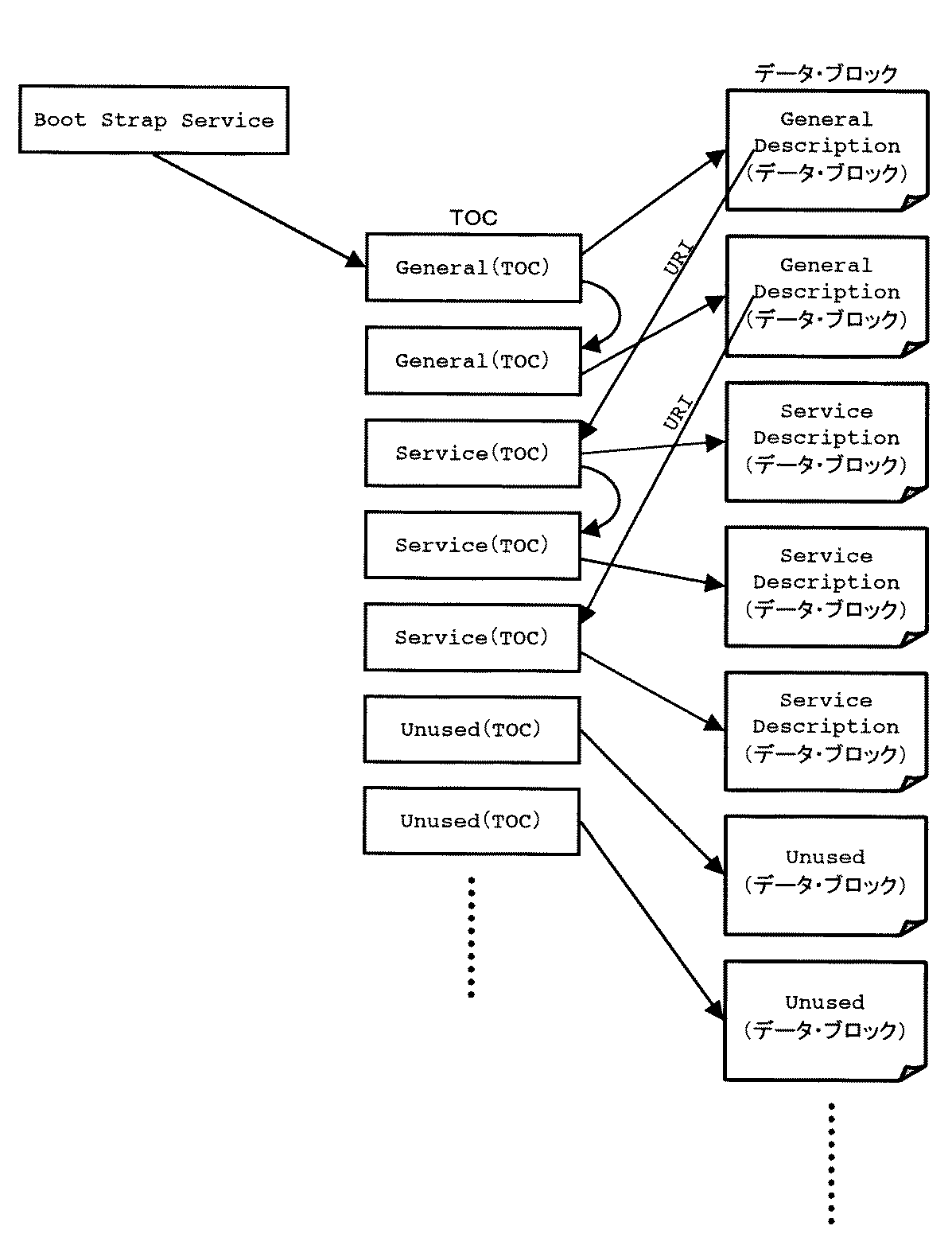
【0101】
本実施形態では、各データ・エリア毎にその制御情報であるTOCが1つずつ設けられる。TOCは該当するデータ・ブロックの開始位置(Start Address of Data Block)を持っているので、TOCを基に所望のデータ・ブロックをアドレスすることができる。また、データ・ブロックに続きがある場合には、次のTOCのアドレス情報(Address of NextTOC)もTOCに書き込まれる。
【0102】
非接触ICカード・システムが提供するBoot Strap Serviceは、General DescriptionのTOCの先頭位置に相当するStart Address of General Descriptionを備えているので、ブート処理時にカードのGeneral Descriptionの先頭位置を取得することができる。
【0103】
また、General Descriptionは、対応するService Descriptionへのアクセス方法であるURIを含んでいる。
【0104】
したがって、図7に示すように、非接触ICカード内のメモリ空間では、データ・ブロックはTOCによって管理され、且つ、すべてのデータ・ブロックがアドレス可能となるように構成されている。
【0105】
図8には、Boot Strap Serviceのデータ構造を模式的に示している。Boot Strap Serviceは、D0〜Dfの16バイトからなる。
【0106】
Media Typeフィールドには、当該ターゲット・デバイスがコントローラになり得るかどうかを示した情報が書き込まれる。
【0107】
Address of General Descriptionフィールドには、General DescriptionのTOCのスタート・アドレス(Service Code)が書き込まれている。
【0108】
Number of Entriesフィールドには、本メモリ空間上でのTOCのエントリ数が書き込まれている。
【0109】
Start Address of General Descriptionフィールドには、General DescriptionのTOCのアドレス(Service Code)が書き込まれている。
【0110】
Boot Strap ServiceはGeneral Descriptionに関する情報を含んでいるので、General Descriptionを更新したときにはBoot Strap Service書き換える必要がある。
【0111】
図9には、TOCエントリのデータ構造を模式的に示している。TOCエントリは、D0〜Dfの16バイトからなる。
【0112】
Typeフィールドには、対応するデータ・ブロックの状態が記述される。ここで言う状態としては、未使用状態を示す"Unused"、General Descriptionとして使用中であることを示す"General"、Service Descriptionとして使用中であることを示す"Service"、書き込み中であることを示す"Writing"、データ・ブロックが消去可能であることを示す"Erasing"が定義されている。
【0113】
Start Address of Data Blockフィールドには、対応するデータ・ブロックのスタート・アドレス(Service Code)が書き込まれている。
【0114】
Number of Blocksフィールドには、対応するデータ・ブロックが持つブロック数が書き込まれている。
【0115】
対応するDescriptionすなわちデータ・ブロックの続きがある場合には、Address of Next TOCフィールドには、次のTOCのスタート・アドレス(Service Code)が書き込まれる。
【0116】
Data Sizeフィールドには、対応するデータ・ブロック中に書き込まれているデータのサイズが書き込まれる。
【0117】
F−2.General Descriptionの取得
Boot Strap Serviceに含まれるStart Address of General Descriptionを読むことにより、General Descriptionの制御情報であるTOC(Table Of Contents)の先頭のアドレスが分かる。General DescriptionのTOCを読むことにより、Type、Start Address of Data BlockやNumber of Blocks、及びAddress of Next TOCを知ることができる。TypeがGeneral Descriptionを表していれば情報は有効である。
データはStart Address of Data Blockの指すアドレスからNumber of Blocks数分のブロックに記録されており、さらに続きがある場合にはAddress of Next TOCに次のTOCのアドレスが入る。値が0ならばこのTOCで終了である。
【0118】
F−3.Service Descriptionの取得
指定するURIはService DescriptionのTOCのアドレスを表しており、その領域を読むことにより、Type、Start Address of Data BlockやNumber of Blocks及びAddress of Next TOCを知ることができる。TypeがService Descriptionを表していれば情報は有効である。
データはStart Address of Data Blockの指すアドレスからNumber of Blocks数分のブロックに記録されており、さらに続きがある場合にはAddress of Next TOCに次のTOCのアドレスが入る。値が0ならばこのTOCで終了である。
【0119】
F−4.General Descriptionの更新
書き込み中に通信が途絶するような状況下でもデータの整合性を保証しながらGeneral Descriptionの更新を行なうための処理手順ついて、図10及び図11を参照しながら説明する。但し、図10は、GeneralDescriptionが1つのデータ・ブロックのみを使用する場合を表し、図11は、General Descriptionが2以上のデータ・ブロックにまたがる場合を表している。
【0120】
▲1▼まず、メモリ空間上で未使用のデータ・ブロックを探して、新しいGeneral Descriptionを書き込むだけの容量があることを確認する(図10を参照のこと)。General Descriptionが2以上のデータ・ブロックにまたがっている場合には、該当する個数だけ未使用のデータ・ブロックを探索する(図11を参照のこと)。
未使用データ・ブロックの探索処理は、TypeフィールドがUnusedに設定されているTOCを探索することと、そのNumber of Blocksを参照することによって、実現される。
また、見つけ出されたデータ・ブロックが更新後に新しいGeneral Descriptionのサイズ以上の空き容量ができることを確認する。これはGeneral Description更新後、それ以上の更新が不可能にならないための確認である。
【0121】
(2)次いで、データ・ブロックをGeneral Descriptionの書き換え先に割り当てるために、使用したいデータ・ブロックのTOCのTypeを、Unused(未使用)から、Writing(書き込み中)に変更すると同時に、その他のパラメータをセットする(図10を参照のこと)。
また、General Descriptionが2以上のデータ・ブロックにまたがっている場合には、先頭TOCのTypeをUnusedからWritingにするとともに、先頭TOC以外のTypeをGeneralに変更すると同時に、その他のパラメータをセットする。複数の領域にまたがる場合、次のTOCを順次たどれるようパラメータをセットする(図11を参照のこと)。
ここでのTOCの書き換え操作は、1回のトランザクションで行なうようにする。1回のトランザクションでは、非接触ICカードにおいて書き込みが保証されているので、TOCのデータ整合性が維持される。その後のデータ・ブロックの書き込み時に通信が途切れたとしても、TOCを基に回復することができる。
なお、General Descriptionが複数(9以上)のデータ・ブロックにまたがるために、すべてのTOCの書き換え操作が1回のトランザクションでは済まない場合には、書き換え動作が途切れても履歴を回復できるようにTOCの書き換えを行うようにするが、この点は後に詳解する。
【0122】
▲3▼次いで、新しいGeneral Descriptionの内容を、▲1▼で割り当てたデータ・ブロックに書き込む。
General DescriptionはXML形式で記述されているが(前述)、そのデータ・サイズは、通常、非接触ICカードにおいて書き込みが保証されている最大の同時書き込みサイズを越える大容量である。このため、General Descriptionの書き込み時に任意のタイミングでデバイス同士を引き離されて通信が途絶して、データの内容が破壊されてしまう可能性がある。但し、TOCを基に通信の履歴をたどることによって、データの回復を行うことができる。
【0123】
(4)次いで、新しく書き込んだデータ・ブロックのTOCのTypeをWritingからGeneralに更新するとともに、以前のGeneralDescriptionのTOCのTypeをErasingにする。これと同時に、Boot StrapのGeneralを指すパラメータを新しいGeneral DescriptionのTOCを指すように更新する。(図10を参照のこと)。
また、General Descriptionが2以上のデータ・ブロックにまたがっている場合には、先頭TOCのWritingをGeneralに更新し、以前のGeneralDescriptionの先頭TOCのTypeをErasingに更新すると同時に、Boot StrapのGeneralを指すパラメータを新しいGeneral DescriptionのTOCを指すように更新する(図11を参照のこと)。
ここでのTOCの書き換え操作は、1回のトランザクションで行なう。1回のトランザクションでは、非接触ICカードにおいて書き込みが保証されているので、TOCのデータ整合性が維持される。この場合、新旧のTOCの書き換えが同時に行なわれるので、General Descriptionは通信の途切れの影響を受けることがない。なお、General Descriptionが複数(9以上)のデータ・ブロックにまたがるため、すべてのTOCの書き換え操作が1回のトランザクションでは済まない場合には、書き換え動作が途切れても履歴を回復できるようにTOCの書き換えを行うようにする(同上)。
【0124】
(5)最後に、TOCのTypeがErasing(消去可)になっているTOC、及びそこからたどれるTOCのTypeをすべてUnusedにする(図10及び図11を参照のこと)。Unusedに戻すことにより、これらのTOCに対応するデータ・ブロックが再利用可能となる。
【0125】
F−5.Service Descriptionの更新
書き込み中に通信が途絶するような状況下でもデータの整合性を保証しながらService Descriptionの更新を行なうための処理手順ついて、図12及び図13を参照しながら説明する。但し、図12は、ServiceDescriptionが1つのデータ・ブロックのみを使用する場合を表し、図13は、Service Descriptionが2以上のデータ・ブロックにまたがる場合を表している。
【0126】
(1)まず、メモリ空間上で未使用のデータ・ブロックを探して、新しいService Descriptionを書き込むだけの容量があることを確認する(図12を参照のこと)。Service Descriptionが2以上のデータ・ブロックにまたがっている場合には、該当する個数だけ未使用のデータ・ブロックを探索する(図13を参照のこと)。
未使用データ・ブロックの探索処理は、TypeフィールドがUnusedに設定されているTOCを探索することと、そのNumber of Blocksを参照することによって、実現される。
また、見つけ出されたデータ・ブロックが更新後に新しいService Descriptionのサイズ以上の空き容量ができることを確認する。これはService Description更新後、それ以上の更新が不可能にならないための確認である。
【0127】
▲2▼次いで、データ・ブロックをService Descriptionの書き換え先に割り当てるために、使用したいデータ・ブロックのTOCのTypeを、Unused(未使用)から、Writing(書き込み中)に変更すると同時に、その他のパラメータをセットする(図12を参照のこと)。
また、Service Descriptionが2以上のデータ・ブロックにまたがっている場合には、先頭TOCのTypeをUnusedからWritingにするとともに、先頭TOC以外のTypeをServiceに変更すると同時に、その他のパラメータをセットする。複数の領域にまたがる場合、次のTOCを順次たどれるようパラメータをセットする(図13を参照のこと)。
ここでのTOCの書き換え操作は、1回のトランザクションで行なうので、TOCのデータ整合性が維持され、その後のデータ・ブロックの書き込み時に通信が途切れたとしても、TOCを基に回復することができる。なお、Service Descriptionが複数(9以上)のデータ・ブロックにまたがるために、すべてのTOCの書き換え操作が1回のトランザクションでは済まない場合には、書き換え動作が途切れても履歴を回復できるようにTOCの書き換えを行うようにする。
【0128】
(3)次いで、新しいService Descriptionの内容を、1で割り当てたデータ・ブロックに書き込む。
Service DescriptionはXML形式で記述されているが(前述)、そのデータ・サイズは、通常、非接触ICカードにおいて書き込みが保証されている最大の同時書き込みサイズを越える大容量である。このため、Service Descriptionの書き込み時に任意のタイミングでデバイス同士を引き離されて通信が途絶して、データの内容が破壊されてしまう可能性がある。但し、TOCを基に通信の履歴をたどることによって、データの回復を行うことができる。
【0129】
(4)次いで、新しく書き込んだデータ・ブロックのTOCの情報を以前のService DescriptionのTOCの情報と入れ替え、新しいServiceDescriptionのTOCのTypeをWritingからServiceに更新すると同時に、以前のService DescriptionのTOCのTypeをErasingにする(図12を参照のこと)。
また、Service Descriptionが2以上のデータ・ブロックにまたがっている場合には、Service Descriptionの先頭TOCの情報を以前のServiceDescriptionの先頭TOCの情報と入れ替え、新しいService DescriptionのTOCのTypeをWritingからServiceに更新すると同時に、以前のServiceDescriptionのTOCのTypeをErasingにする(図13を参照のこと)。
Service DescriptionのTOCは、General DescriptionからURIで参照されている。Service Descriptionの更新の度にGeneral Descriptionの書き換えを行わなくて済むように、新しいService Descriptionの書き込みを行なった後、新旧のTOCの入れ替えを行なって、TOCへの参照を変更しないようにしている。
ここでのTOCの書き換え操作は、1回のトランザクションで行なう。1回のトランザクションでは、非接触ICカードにおいて書き込みが保証されているので、TOCのデータ整合性が維持される。この場合、新旧のTOCの入れ替えが同時に行なわれるので、Service Descriptionは通信の途切れの影響を受けることがない。なお、Service Descriptionが複数(9以上)のデータ・ブロックにまたがるため、すべてのTOCの書き換え操作が1回のトランザクションでは済まない場合には、書き換え動作が途切れても履歴を回復できるようにTOCの書き換えを行うようにする(同上)。
【0130】
(5)最後に、TOCのTypeがErasing(消去可)になっているTOC、及びそこからたどれるTOCのTypeをすべてUnusedにする(図12及び図13を参照のこと)。Unusedに戻すことにより、これらのTOCに対応するデータ・ブロックが再利用可能となる。
【0131】
F−6.Service Descriptionの追加
書き込み中に通信が途絶するような状況下でもデータの整合性を保証しながらService Descriptionの追加を行なうための処理手順ついて、図14を参照しながら説明する。
【0132】
▲1▼まず、メモリ空間数で未使用のデータ・ブロックを探して、新しいService Description及びGeneral Descriptionを書くだけの容量があることを確認する。
また、更新後に新しいGeneral Descriptionのサイズと同じだけの空き容量ができることを確認する。これはService Description追加後、それ以上の更新が不可能にならないための確認である。
【0133】
▲2▼次いで、新しいService Descriptionに使用したい領域を割り当てるために、使用したい領域群の先頭TOCのTypeをUnusedからWritingにするとともに、先頭TOC以外のTypeをServiceに変更すると同時に、その他のパラメータをセットする。複数の領域にまたがる場合には、次のTOCをたどれるようにする。
ここでのTOCの書き換え操作は、1回のトランザクションで行なうので、TOCのデータ整合性が維持され、その後のデータ・ブロックの書き込み時に通信が途切れたとしても、TOCを基に回復することができる。また、Service Descriptionが複数(9以上)のデータ・ブロックにまたがるために、すべてのTOCの書き換え操作が1回のトランザクションでは済まない場合には、書き換え動作が途切れても履歴を回復できるようにTOCの書き換えを行うようにする。
【0134】
▲3▼次いで、新しいService Descriptionの内容を、▲1▼で割り当てた各データ・ブロックに書き込む。
Service DescriptionはXML形式で記述されているが(前述)、そのデータ・サイズは、通常、非接触ICカードにおいて書き込みが保証されている最大の同時書き込みサイズを越える大容量である。このため、General Descriptionの書き込み時に任意のタイミングでデバイス同士を引き離されて通信が途絶して、データの内容が破壊されてしまう可能性がある。但し、TOCを基に通信の履歴をたどることによって、データの回復を行うことができる。
【0135】
▲4▼次いで、以下に示す手順に従ってGeneral DescriptionにServiceを追加する。
(4-1)Serviceを追加した新しいGeneral Descriptionを用意するための未使用のデータ・ブロックを探索する。
(4-2)次いで、データ・ブロックをGeneral Descriptionの書き換え先に割り当てるために、使用したいデータ・ブロック群の先頭TOCのTypeをUnusedからWritingにするとともに、先頭TOC以外のTypeをGeneralに変更すると同時に、その他のパラメータをセットする。複数のデータ・ブロックにまたがる場合は次のTOCをたどれるようにする。
ここでのTOCの書き換え操作は、1回のトランザクションで行なうようにすることで、TOCのデータ整合性が維持される。その後のデータ・ブロックの書き込み時に通信が途切れたとしても、TOCを基に回復することができる。また、General Descriptionが複数(9以上)のデータ・ブロックにまたがるために、すべてのTOCの書き換え操作が1回のトランザクションでは済まない場合には、書き換え動作が途切れても履歴を回復できるようにTOCの書き換えを行うようにする。
(4-3)割り当てた各データ・ブロックに新しいGeneral Descriptionの内容を書き込む。
General Descriptionは非接触ICカードにおいて書き込みが保証されている最大の同時書き込みサイズを越える大容量であるため、General Descriptionの書き込み時に任意のタイミングでデバイス同士を引き離されて通信が途絶して、データの内容が破壊されてしまう可能性がある。但し、TOCを基に通信の履歴をたどることによって、データの回復を行うことができる。
(4-4)新しく書き込んだデータ・ブロックの先頭TOCのTypeをWritingからGeneralに更新し、以前のGeneral Descriptionの先頭TOCのTypeをErasingにするとともに、Boot StrapのGeneralを指すパラメータを新しいGeneral DescriptionのTOCを指すように更新する。そのとき同時に、新しく追加したServiceの先頭TOCのTypeをWritingからServiceに更新する。
ここでのTOCの書き換え操作は、1回のトランザクションで行なうので、TOCのデータ整合性が維持される。この場合、新旧のTOCの書き換えが同時に行なわれるので、通信の途切れの影響を受けることがない。なお、書き換え対象となるDescriptionが複数(9以上)のデータ・ブロックにまたがるため、すべてのTOCの書き換え操作が1回のトランザクションでは済まない場合には、書き換え動作が途切れても履歴を回復できるようにTOCの書き換えを行うようにする(同上)。
【0136】
(5)最後に、TOCのTypeがErasing(消去可)になっているTOC、及びそこからたどれるTOCのTypeをすべてUnusedにする。Unusedに戻すことにより、これらのTOCに対応するデータ・ブロックが再利用可能となる。
【0137】
上述したService Descriptionの追加処理は、Service Descriptionの更新と、General Descriptionの書き換えの各処理手順の組み合わせによって実現される。
【0138】
F−7.Service Descriptionの削除
書き込み中に通信が途絶するような状況下でもデータの整合性を保証しながらService Descriptionの削除を行なうための処理手順ついて、図15を参照しながら説明する。
【0139】
▲1▼以下に示す手順に従い、General DescriptionからServiceを削除する。
(1-1)Serviceを削除した新しいGeneral Descriptionを用意する。
(1-2)メモリ空間数で未使用のデータ・ブロックを探して、新しいGeneral Descriptionを書くだけの容量があることを確認する。
また、更新後に新しいGeneral Descriptionのサイズと同じだけの空き容量ができることを確認する。これはGeneral Description更新後、それ以上の更新が不可能にならないための確認である。
(1-3)次いで、データ・ブロックを割り当てるために、使用したいデータ・ブロック群の先頭TOCのTypeをUnusedからWritingにするとともに、先頭TOC以外のTypeをGeneralに変更すると同時に、その他のパラメータをセットする。複数のデータ・ブロックにまたがる場合は次のTOCをたどれるようにする。
ここでのTOCの書き換え操作は、1回のトランザクションで行なうようにすることで、TOCのデータ整合性が維持される。その後のデータ・ブロックの書き込み時に通信が途切れたとしても、TOCを基に回復することができる。また、General Descriptionが複数(9以上)のデータ・ブロックにまたがるために、すべてのTOCの書き換え操作が1回のトランザクションでは済まない場合には、書き換え動作が途切れても履歴を回復できるようにTOCの書き換えを行うようにする。
(1-4)割り当てた各データ・ブロックに新しいGeneral Descriptionの内容を書き込む。
General Descriptionは非接触ICカードにおいて書き込みが保証されている最大の同時書き込みサイズを越える大容量であるため、General Descriptionの書き込み時に任意のタイミングでデバイス同士を引き離されて通信が途絶して、データの内容が破壊されてしまう可能性がある。但し、TOCを基に通信の履歴をたどることによって、データの回復を行うことができる。
(1-5)新しいデータ・ブロックの先頭TOCのTypeをWritingからGeneralに更新し、以前のGeneral Descriptionの先頭TOCのTypeをErasingにするとともに、Boot Strap ServiceのGeneralを指すパラメータを新しいGeneral DescriptionのTOCを指すように更新する。このとき同時に、削除するデータ・ブロックのTOCのTypeをServiceからErasingに更新する。
ここでのTOCの書き換え操作は、1回のトランザクションで行なうので、TOCのデータ整合性が維持される。この場合、新旧のTOCの書き換えが同時に行なわれるので、通信の途切れの影響を受けることがない。なお、書き換え対象となるDescriptionが複数(9以上)のデータ・ブロックにまたがるため、すべてのTOCの書き換え操作が1回のトランザクションでは済まない場合には、書き換え動作が途切れても履歴を回復できるようにTOCの書き換えを行うようにする(同上)。
【0140】
(2)最後に、TOCのTypeがErasing(消去可)になっているTOC、及びそこからたどれるTOCのTypeをすべてUnusedにする。Unusedに戻すことにより、これらのTOCに対応するデータ・ブロックが再利用可能となる。
【0141】
上述したService Descriptionの削除処理は、基本的には、該当するGeneral DescriptionからService Descriptionへのリンクを削除するという、General Descriptionを更新する処理手順によって実現される。
【0142】
F−8.TOC群のTypeをWritingにする際の書き換え手順
本実施形態に係る近接通信システムのトランスミッション・インターフェースに非接触ICカードを適用した場合、情報の読み書きの単位として16バイトを1ブロックとし、最大の同時書き込みサイズは8ブロック(=128バイト)であり、そのサイズの情報の書き込みは保証されている。そこで、データすなわちDescriptionを更新、追加、削除する場合、これに伴うすべてのTOCの書き換えを1回のトランザクションで済ませることにより、データの保証を図る。
【0143】
ところが、TOCは16バイトすなわち1ブロックで構成されるので、Descriptionを更新、追加、削除が複数のデータ・ブロックにまたがって行なわれ、更新するTOCが9以上の場合には、1回のトランザクションだけですべてを書き換えることはできない。
【0144】
そこで、本実施形態では、TOCの書き換えが2回以上のトランザクションにまたがる場合には、通信が途中で途切れても履歴を回復できるようにTOCの書き換えを行うようにTOCの書き換え操作を行なう。この結果、書き込み中に任意のタイミングでカードが引き離されても、カード内の情報の整合性を維持することができ、正しい書き込み動作を保証することができる。
【0145】
上述したように、複数のデータ・ブロックにまたがるDescriptionを更新、追加、削除する場合、先頭TOCのTypeはWritingにし、先頭以外のTOCのTypeはGeneral(若しくはService)にする。
【0146】
そして、更新するTOCが9個以上の場合には、8ブロックずつの書き込みに分割する。n回目の書き込みでは(但しnは1以上の整数)、(7n−6)番目から7n番目までのTOCのAddress of Next TOCはそれぞれ次のTOCを指すようにし、(7n+1)番目のTOCのAddress of Next TOCは0(ヌル)にする。そして、次の回に(7n+1)番目のTOCから書き込むときに正しいアドレスを書き込むようにする。
【0147】
このように、各TOC書き換えトランザクション毎に、最後尾のTOCは次のTOCを指さないままにしておくことにより、このトランザクションが通信の途絶などにより失敗しても、不要なTOCの指定を行わなくて済む。
【0148】
他方、最後尾のTOCが次のTOCを指すようにした場合には、トランザクションに失敗した後には、次のTOCはTypeがUnusedであり、別のトランザクションによりまったく関係のないデータが書き込まれてしまった後もTOCのリンクが形成されているので、データの不整合を招来することになる。
【0149】
図16には、TOC群をWritingにする際の書き換えの手順をフローチャートの形式で示している。また、図17には、このときの各TOCに対する操作を図解している。
【0150】
まず、更新するTOCが9個以上か、すなわち、1回のトランザクションですべてのTOCの更新を完了できないかどうかを判断する(ステップS1)。
【0151】
ここで、更新するTOCが8個以下、すなわち1回のトランザクションですべてのTOCの更新を完了することができる場合には、最後のTOC以外のAddress of Next TOCはそれぞれ次のTOCを指すようにするとともに、最後のTOCは、どこも指さないように0(ヌル)を代入する(ステップS2)。これらのTOCの書き換え動作は1回のトランザクションだけで行なう。
【0152】
他方、更新するTOCが9個以上ある場合には、1番目のTOCのTypeをWritingにするとともに、他のTOCのタイプをGeneral(又はService)にする。また、8番目のTOC以外のAddress of Next TOCを次のTOCを指すようにするとともに、8番目のTOCについてはどこも指さないように0を代入する(ステップS3)。これらのTOCの書き換え動作は1回のトランザクション(T1)だけで行なう。
【0153】
以下、現在8番目のTOC以降に対して処理を行なう(ステップS4)。
【0154】
更新するTOCがまだ9個以上残っているか、すなわち、1回のトランザクションですべてのTOCの更新を更新できないかどうかを判断する(ステップS5)。
【0155】
ここで、更新するTOCが8個以下、すなわち1回のトランザクションですべてのTOCの更新を更新できる場合には、最後のTOC以外のAddress of Next TOCはそれぞれ次のTOCを指すようにするとともに、最後のTOCは、どこも指さないように0(ヌル)を代入する(ステップS2)。
【0156】
他方、更新するTOCが9個以上ある場合には、現在のTOCのTypeをWritingにするとともに、他のTOCのタイプをGeneral(又はService)にする。また、8番目のTOC以外のAddress of Next TOCを次のTOCを指すようにするとともに、8番目のTOCについてはどこも指さないように0を代入する(ステップS6)。これらのTOCの書き換え動作は1回のトランザクション(T2)だけで行なう。
【0157】
その後、ステップS4に戻って、すべてのTOCについて処理が終わるまで、上述と同様のTOC書き換え動作を繰り返し実行する。
【0158】
F−9.ガベージ・コレクション
本実施形態に係る近接通信システムのトランスミッション・インターフェースに非接触ICカードを適用した場合、データすなわちDescriptionの更新、追加、削除を行なうためには、新しいデータ・ブロックにデータを書き込んでから、古いデータ・ブロックとの入れ替えを行なう。
【0159】
そして、このようなデータ書き換えの間、通信の途絶に伴うデータを保証するために、新旧のデータ・ブロックのTOCのTypeをデータ書き換え手順の進捗状況に応じて逐次更新するようになっている。すなわち、新しいデータ・ブロックのTOCのTypeを、Unused(未使用)からWriting(書き込み中)を経て、General若しくはServiceへと遷移する(但し、先頭TOCの場合)。また、元のデータ・ブロックのTOCのTypeは、General若しくはServiceからErasing(消去可)へと遷移する(但し、先頭TOCの場合)。
【0160】
このようにデータの書き換え動作が成功裏に終了するまでは、TOCのTypeとしてWritingやErasingなどの中間的な状態を与えることにより、トランザクション中に通信が途絶しても、TOCのリンクをたどって書き込みに失敗したデータ・ブロックを追跡し特定することができる。
【0161】
また、TOCのTypeがWriting又はErasingになっているデータ・ブロックは、通信の途絶などにより使用できないことを示しているので、開放して再利用する。すなわち、TOCのTypeがWriting又はErasingのTOCからたどれるTOC群をUnusedにする。このように未使用のデータ・ブロックを確保するための処理のことを、本明細書では「ガベージ・コレクション」(Garbage Collection)と呼ぶ。
【0162】
データ・ブロックの更新、追加、削除の過程で通信の途絶などによりデータ書き込み動作が失敗に終わった場合、先頭TOCのTypeはWriting又はErasingに、先頭以外のTOCのTypeはGeneral(又はService)になっている(図11、図13、図14、並びに図15を参照のこと)。これらはすべてガベージ・コレクションの対象であり、Unusedに変更してデータ・ブロックの再利用を図る。
【0163】
本実施形態に適用される非接触ICカード・システムの仕様として8ブロックずつしか書き込み保証がされないので、更新するTOCが9個以上の場合、8ブロックずつの書き込みに分割する必要がある。そこで、n回目の書き込みでは7n番目までのTOCのTypeをUnusedに、(7n+1)番目のTOCのTypeをErasingにする。次の(n+1)回目の書き込みでは(7n+1)番目のTOCから7個のTOCのTypeをUnusedに、(7n+8)番目のTOCのTypeをErasingにする。
【0164】
このように、ガベージ・コレクションにおける各TOC書き換えトランザクション毎に、最後尾のTOCのTypeをUnusedとせず、Erasingすなわちガベージ・コレクションを行なっていない状態にしておくことにより、トランザクションが通信の途絶などにより、失敗しても、Erasing状態の最後尾のTOCを起点としてガベージ・コレクションを再開することができる。
【0165】
図18には、ガベージ・コレクションする際のTOC群の書き換えの手順をフローチャートの形式で示している。また、図19には、ガベージ・コレクションする際の各TOCに対する操作を図解している。
【0166】
まず、更新するTOCが9個以上か、すなわち、1回のトランザクションですべてのTOCの更新を完了できないかどうかを判断する(ステップS11)。
【0167】
ここで、更新するTOCが8個以下、すなわち1回のトランザクションでガベージ・コレクションを完了することができる場合には、残りのすべてのTOCのTypeをUnusedに書き換えて(ステップS12)、本処理ルーチン全体を終了する。これらのTOCの書き換え動作は1回のトランザクションだけで行なう。
【0168】
他方、更新するTOCが9個以上ある場合には、1〜7番目までのTOCのTypeをUnusedにするとともに、8番目のTOCのTypeはErasingにする(ステップS13)。これらのTOCの書き換え動作は1回のトランザクション(T11)だけで行なう。
【0169】
以下、現在8番目のTOC以降に対して処理を行なう(ステップS14)。
【0170】
すなわち、ステップS11に戻って、更新するTOCがまだ9個以上残っているか、すなわち、1回のトランザクションですべてのTOCの更新を更新できないかどうかを判断する。
【0171】
そして、更新するTOCがまだ9個以上残っている場合には、1〜7番目までのTOCのTypeをUnusedにするとともに、8番目のTOCのTypeはErasingにする(ステップS13)。これらのTOCの書き換え動作は1回のトランザクション(T12)だけで行なう(同上)。
【0172】
[追補]
以上、特定の実施形態を参照しながら、本発明について詳解してきた。しかしながら、本発明の要旨を逸脱しない範囲で当業者が該実施形態の修正や代用を成し得ることは自明である。
【0173】
本実施形態では、ICカード技術を利用して構築された近接通信システムを例にとってに説明したが、他のタイプの近接通信システムであっても、本発明が同様に実現可能であることは言うまでもない。勿論、局所的な近接通信ではなく、一般的なデバイス間通信、あるいは、メモリやその他の記憶装置へのデータ書込みにおいても、データの整合性を保証するために本発明を適用することができる。
【0174】
要するに、例示という形態で本発明を開示してきたのであり、本明細書の記載内容を限定的に解釈するべきではない。本発明の要旨を判断するためには、冒頭に記載した特許請求の範囲の欄を参酌すべきである。
【0175】
【発明の効果】
以上詳記したように、本発明によれば、ユーザがデバイスどうしを物理的に近づけることにより自動的に動作するとともに、ユーザがデバイスどうしを引き離して任意のタイミングでデバイス間の通信が途絶しても動作を保証することができる、優れた近接通信システム及び近接通信方法、データ管理装置及びデータ管理方法、記憶媒体、並びにコンピュータ・プログラムを提供することができる。
【0176】
また、本発明によれば、所定以上の大きさのデータを書き込む際に任意のタイミングでデバイス間通信が途絶しても、データの整合性を好適に保証することができる、優れた近接通信システム及び近接通信方法、データ管理装置及びデータ管理方法、記憶媒体、並びにコンピュータ・プログラムを提供することができる。
【図面の簡単な説明】
【図1】本実施形態に係る近接通信システムにおけるインタラクション・モデルを模式的に示した図である。
【図2】Descriptionの構造を模式的に示した図である。
【図3】イニシエータを決定するためのアクセス手順を示したシーケンス図である。
【図4】イニシエータがコントローラのイニシエーションを行なうためのアクセス手順を示したシーケンス図である。
【図5】コントローラのターゲットに対するアクセス手順を示したシーケンス図である。
【図6】本実施形態に係る近接通信システムにおいて動作するデバイスの状態遷移図を示した図である。
【図7】本実施形態に係る近接通信システムに適用される非接触ICカード内のメモリ空間の構造を模式的に示した図である。
【図8】Boot Strap Serviceのデータ構造を模式的に示した図である。
【図9】TOCエントリのデータ構造を模式的に示した図である。
【図10】General Descriptionの更新を行なうための処理手順を説明するための図である。
【図11】General Descriptionの更新を行なうための処理手順を説明するための図である。
【図12】Servive Descriptionの更新を行なうための処理手順を説明するための図である。
【図13】Servive Descriptionの更新を行なうための処理手順を説明するための図である。
【図14】Servive Descriptionの追加を行なうための処理手順を説明するための図である。
【図15】Servive Descriptionの削除を行なうための処理手順を説明するための図である。
【図16】TOC群をWritingにする際の書き換えの手順を示したフローチャートである。
【図17】TOC群をWritingにする際の各TOCに対する操作を示した図である。
【図18】TOC群のガーベジ・コレクションを行なう処理手順を示したフローチャートである。
【図19】TOC群のガーベジ・コレクションを行なう際の各TOCに対する操作を示した図である。[0001]
BACKGROUND OF THE INVENTION
The present invention relates to a contactless / proximity communication system applied locally, and in particular, at least one of the devices can be obtained by bringing a device in which a user performs physical proximity communication, such as a contactless IC card technology, close to each other. The present invention relates to a proximity communication system that automatically operates upon discovery of a partner device.
[0002]
More specifically, the present invention automatically operates when the user physically brings the devices close to each other, and guarantees operation even when the user disconnects the devices and communication between the devices is interrupted at an arbitrary timing. The present invention relates to a proximity communication system and a proximity communication method, a data management apparatus and a data management method, a storage medium, and a computer program. In particular, communication between devices is interrupted at an arbitrary timing when writing data of a predetermined size or more. The present invention also relates to a proximity communication system and a proximity communication method, a data management apparatus and a data management method, a storage medium, and a computer program that guarantee data consistency.
[0003]
[Prior art]
An example of a wireless communication means that can be applied only locally is a non-contact IC card.
[0004]
This type of wireless communication is realized based on the principle of electromagnetic induction, for example. That is, the wireless communication system includes an IC card having a memory function and a card reader / writer for reading / writing access to the memory of the IC card. The antenna on the card reader / writer side and the loop on the IC card side The coil forms one transformer as a system.
[0005]
On the card reader / writer side, data is transmitted from the card reader / writer to the IC card by modulating the current that flows through the antenna, thereby modulating the induced voltage of the loop coil on the IC card. be able to. In addition, the IC card has a card reader due to the effect that the impedance between the antenna terminals on the IC card reader / writer side changes due to the load fluctuation between the terminals of the loop coil and the passing current and voltage of the antenna fluctuate. / Reply to the writer.
[0006]
Non-contact / proximity communication systems represented by IC cards are widely used because of their ease of operation. For example, card readers installed at cash dispensers, entrances to concert venues, ticket gates at stations, etc. by storing PIN codes, other personal authentication information, value information such as electronic tickets, etc. on IC cards The / writer can access the IC card held by the user in a contactless manner and perform authentication processing.
[0007]
Recently, along with improvements in miniaturization technology, IC cards having a relatively large memory space have appeared. Since an IC card with a large-capacity memory can store a plurality of applications (or services) at the same time, one IC card can be used for a plurality of purposes. For example, by storing a large number of services such as electronic money for electronic payment and electronic ticket for entering a specific concert venue on a single IC card, It can be applied to various uses.
[0008]
Further, by providing each device with the functions of both an IC card and a card reader / writer, the IC card technology can be used as a versatile bidirectional proximity communication interface.
[0009]
For example, when a proximity communication system is configured by devices such as computers and information home appliances, communication is performed one-on-one. It is also possible for a certain device to communicate with a partner device (called a card) other than a device such as a non-contact IC card. In this case, an application that performs one-to-many communication between one device and a plurality of cards. Is also possible.
[0010]
In such a proximity communication system, when a user physically brings close proximity devices, at least one device can discover a partner device and automatically start operation. However, conversely, when the distance between devices increases, communication is interrupted at an arbitrary time. Therefore, an operation guarantee mechanism is required so that the system does not fail even in a situation where the user pulls the devices apart at an arbitrary timing.
[0011]
Some existing proximity communication systems guarantee the operation for writing data of a certain size (for example, 128 bytes) by the function of the IC card itself. However, even in this case, when writing information larger than that, data inconsistency may occur depending on the timing.
[0012]
In particular, in proximity communication such as an IC card in which the communication range is locally restricted, there is a very high possibility that communication will be interrupted, such as devices being separated from each other or interfered by an obstacle. As IC cards become larger and more versatile and service-oriented, there will be more opportunities to transfer relatively large data to IC cards, so the problem of data guarantee in the event of sudden communication disruption is significant. It is.
[0013]
[Problems to be solved by the invention]
SUMMARY OF THE INVENTION An object of the present invention is to provide an excellent proximity communication system in which at least one device can automatically detect a partner device and automatically operate by bringing the devices that physically perform proximity communication close to each other. There is.
[0014]
A further object of the present invention is to automatically operate when the user physically brings the devices close to each other, and to ensure operation even if the user disconnects the devices and communication between the devices is interrupted at an arbitrary timing. An excellent proximity communication system and proximity communication method, a data management apparatus and a data management method, a storage medium, and a computer program are provided.
[0015]
A further object of the present invention is to provide an excellent proximity communication system capable of suitably guaranteeing data consistency even when communication between devices is interrupted at an arbitrary timing when writing data of a predetermined size or more. A proximity communication method, a data management device and a data management method, a storage medium, and a computer program are provided.
[0016]
[Means and Actions for Solving the Problems]
The present invention has been made in consideration of the above problems, and a first aspect thereof is a proximity communication system that rewrites data in response to a request from a nearby external device,
A memory area composed of one or more data blocks for rewriting data in response to a request from an external device, and control information provided for each data block;
A data rewrite control unit that controls rewriting of the corresponding data block and its control information in response to a data rewrite request from an external device,
A data rewrite operation for the memory area with a data size less than or equal to a data size that can be rewritten in one transaction is guaranteed, and K control information corresponds to one transaction,
The data rewrite control unit guarantees a rewrite operation of control information related to rewrite of a data block even in a situation where proximity communication with an external device is interrupted.
This is a proximity communication system.
[0017]
However, “system” here refers to a logical collection of a plurality of devices (or functional modules that realize specific functions), and each device or functional module is in a single housing. It does not matter whether or not.
[0018]
The second aspect of the present invention is a proximity communication method for rewriting data in response to a request from a nearby external device,
The memory area is composed of one or more data blocks for rewriting data in response to a request from an external device, and control information provided for each data block.
The data rewriting operation for the memory area below the data size that can be rewritten in one transaction is guaranteed by the system, and K control information corresponds to one transaction.
Including a step of guaranteeing a rewriting operation of control information related to rewriting of a data block even in a situation where near field communication with an external device is interrupted,
This is a proximity communication method characterized by the above.
[0019]
Here, the control information has link information to the corresponding data block and link information to the control information corresponding to the subsequent data block, and the corresponding data block is in the used state, unused state, and being written. , It is configured to indicate which state is erasable.
[0020]
The memory area further includes a bootstrap including link information for the head control information.
[0021]
A data block can also have link information to control information about the associated data block.
[0022]
When contactless IC card technology is applied as a transmission interface of a proximity communication system, at least one device automatically discovers the partner device by automatically bringing the devices that perform physical proximity communication close to each other. It can be operated easily and has excellent operability. On the other hand, when the distance between the devices is increased, communication is interrupted at an arbitrary time, and data consistency is lost. For this reason, an operation guarantee mechanism is required so that the contents of the memory are not destroyed even if the user pulls the devices apart at any timing during data writing.
[0023]
According to the near field communication system according to the first aspect of the present invention or the near field communication method according to the second aspect of the present invention, the total of control information related to rewriting of data blocks is rewritten in one transaction. If the data size is less than or equal to the possible data size, the rewrite operation is performed in a single transaction to guarantee the consistency of the control information. As a result, even if the data block rewrite operation fails due to communication interruption or the like, the data can be recovered based on the control information, and the system can be prevented from being destroyed.
[0024]
In addition, according to the near field communication system according to the first aspect of the present invention or the near field communication method according to the second aspect of the present invention, the total of control information related to the rewriting of the data block is one transaction. When the data size exceeds the rewritable data size (that is, K), the control information is divided into groups that can be rewritten in one transaction according to the linked order, and the rewrite operation is interrupted in each transaction. Information for enabling the next transaction to continue is written in the control information at the end.
[0025]
As a result, even if rewriting of a series of control information is interrupted due to communication interruption or the like, the rewriting operation can be resumed from the interrupted location, so that consistency of control information is guaranteed. Further, even if the data block rewrite operation fails due to communication interruption or the like, data can be recovered based on the control information, and the system can be prevented from being destroyed.
[0026]
When rewriting a data block group linked from the bootstrap, first, an unused data block group having a capacity to be newly written is searched. Then, the control information corresponding to the head of the searched data block group is changed from the unused state to being written, the control information of other data blocks is changed to the used state, and the head data block is changed. A link is formed between each piece of control information so that data blocks are sequentially traced. The rewriting of a series of control information here is executed by a transaction whose operation is guaranteed, thereby ensuring the consistency of the control information.
[0027]
Next, the data requested to be rewritten is written into the searched data block group while following the link formed between the pieces of control information. Then, the control information at the head of the searched data block group is changed from being written to the use state, the control information at the head of the previous data block group is changed from the use state to erasable, and from the bootstrap. In order to maintain the link, the link from the bootstrap is changed to point to the control information at the head of the searched data block group. The rewriting of a series of control information here is executed by one transaction, thereby ensuring the consistency of the control information.
[0028]
Finally, the control information indicating that erasure is possible and all control information linked from the control information are changed to an unused state so that the previous data block can be reused. Further, the rewriting of a series of control information here is executed by a transaction whose operation is guaranteed, thereby ensuring the consistency of the control information.
[0029]
When rewriting a data block group linked from another data block, first, an unused data block group having a capacity to be newly written is searched. Then, the control information corresponding to the head of the searched data block group is changed from the unused state to being written, the control information of other data blocks is changed to the used state, and the head data block is changed. A link is formed between each piece of control information so that data blocks are sequentially traced. The rewriting of a series of control information here is executed by a transaction whose operation is guaranteed, thereby ensuring the consistency of the control information.
[0030]
Next, the data requested to be rewritten is written into the searched data block group while following the link formed between the pieces of control information. Then, in order to maintain a link from another data block, the head control information of the searched data block group is replaced with the control information of the head of the previous data block group, and the searched data block The control information at the head of the block group is changed from being written to the use state, and the control information at the head of the previous data block group is changed from the use state to erasable. The rewriting of a series of control information here is executed by a transaction whose operation is guaranteed, thereby ensuring the consistency of the control information.
[0031]
Finally, change the control information indicating that erasure is possible and all control information linked from it to the unused state, and change the previous data block.ReMake it available. Further, the rewriting of a series of control information here is executed by a transaction whose operation is guaranteed, thereby ensuring the consistency of the control information.
[0032]
Here, the control information corresponding to the head of the searched data block group is changed from the unused state to the writing state, the control information of other data blocks is changed to the used state, and the head data When rewriting a series of control information in which a link is formed between each control information so that the data blocks are sequentially traced from the block, the total control information to be rewritten is a data size that can be rewritten in one transaction (that is, K The control information is divided into groups that can be rewritten in one transaction according to the linked order. In the nth transaction, {(K-1) × n- (K-2) } The links of the control information from the (K−1) × nth to the (K−1) × nth point respectively indicate the next control information.{(K−1) × (n + 1) − (K−2)} th (that is, {(K−1) × n + 1} th)A rewrite operation may be performed to set the link of the control information to 0 (or null).
[0033]
As a result, even if rewriting of a series of control information is interrupted due to communication interruption or the like, an extra link does not need to be formed, so that consistency of control information is guaranteed. Further, even if the data block rewrite operation fails due to communication interruption or the like, data can be recovered based on the control information, and the system can be prevented from being destroyed.
[0034]
In addition, when rewriting a series of control information in which control information indicating erasure and all control information linked from the control information are changed to an unused state, the total of control information to be rewritten can be rewritten in one transaction. When the data size (ie, K) is exceeded, the control information is divided into groups that can be rewritten in one transaction according to the linked order, and up to (K−1) × n-th in the n-th writing. The control information may be made unused, and the rewrite operation may be performed so that the {(K−1) × n + 1} th control information can be erased.
[0035]
As a result, even if rewriting of a series of control information is interrupted due to communication interruption, etc., control information that can be deleted can be found and the rewriting operation that has been interrupted can be resumed. Guaranteed. Further, even if communication is interrupted, the control information of the data block that is no longer used can be reliably searched and returned to the unused state, so that the memory area can be used efficiently without waste.
[0036]
According to a third aspect of the present invention, there is provided a data management apparatus for managing data in a system in which a single transaction operation is guaranteed.
One or more data blocks for writing user data and control information for managing each data block are provided in the memory area of the system,
Each control information has a fixed data size that can be rewritten by K in one transaction.
As the user data in the data block is rewritten, the control information is rewritten by a transaction that guarantees the rewrite operation.
This is a data management device characterized by the above.
[0037]
A fourth aspect of the present invention is a data management method for managing data in a system in which operation of one transaction is guaranteed.
One or more data blocks for writing user data and control information for managing each data block are provided in the memory area of the system,
Each control information has a fixed data size that can be rewritten by K in one transaction.
In addition to rewriting user data in the data block, control information is rewritten by a transaction that guarantees the rewrite operation associated with this.
This is a data management method characterized by the above.
[0038]
Here, the control information has link information to the corresponding data block and link information to the control information corresponding to the subsequent data block, and the corresponding data block is in the used state, unused state, and being written. , It is configured to indicate which state is erasable. The memory area further includes a bootstrap including link information for the head control information. A data block can also have link information to control information about the associated data block.
[0039]
When non-contact IC card technology is applied as a rewrite data transmission interface in order to rewrite user data in the memory area, communication is interrupted at an arbitrary point when the distance between devices is increased. Data consistency is lost. For this reason, an operation guarantee mechanism is required so that the contents of the memory are not destroyed even if the user pulls the devices apart at any timing during data writing.
[0040]
According to the data management device according to the third aspect of the present invention or the data management method according to the fourth aspect of the present invention, the total of control information related to rewriting of data blocks is rewritten in one transaction. If the data size is less than or equal to the possible data size, the rewrite operation is performed in a single transaction to guarantee the consistency of the control information. Therefore, even if the data block rewrite operation fails due to communication interruption or the like, the data can be recovered based on the control information.
[0041]
In addition, according to the data management apparatus according to the third aspect of the present invention or the data management method according to the fourth aspect of the present invention, a transaction is performed with a total of control information related to rewriting of data blocks being one time. When the data size exceeds the rewritable data size (that is, K), the control information is divided into groups that can be rewritten in one transaction according to the linked order, and the rewrite operation is interrupted in each transaction. Information for enabling the next transaction to continue is written in the control information at the end. Therefore, even if rewriting of a series of control information is interrupted due to communication interruption or the like, the rewriting operation can be resumed from the interrupted location, so that the consistency of control information is guaranteed.
[0042]
According to a fifth aspect of the present invention, there is provided a computer readable form of computer software written to execute on a computer system a process for rewriting data in response to a request from a nearby external device. A storage medium physically stored,
The memory area is composed of one or more data blocks for rewriting data in response to a request from an external device, and control information provided for each data block.
The data rewriting operation for the memory area below the data size that can be rewritten in one transaction is guaranteed by the system, and K control information corresponds to one transaction.
The computer software comprises a step of performing a data rewrite operation of the memory area while maintaining data consistency in control information.
This is a storage medium characterized by the above.
[0043]
According to a sixth aspect of the present invention, computer software written to execute data management on a computer system in a system in which a single transaction is guaranteed is physically executed in a computer-readable format. A stored storage medium, wherein the computer software includes:
Providing one or more data blocks for writing user data and control information for managing each data block in a memory area of the system;
Rewriting the user data of the data block, and rewriting the control information by a transaction that guarantees the rewriting operation associated therewith;
It is a storage medium characterized by comprising.
[0044]
The storage medium according to each of the fifth and sixth aspects of the present invention is a medium that provides computer software in a computer-readable format to a general-purpose computer system capable of executing various program codes, for example. . Such a medium is a removable and portable storage medium such as a DVD (Digital Versatile Disc), a CD (Compact Disc), an FD (Flexible Disk), or an MO (Magneto-Optical disc). Alternatively, it is technically possible to provide computer software to a specific computer system via a transmission medium such as a network (whether the network is wireless or wired).
[0045]
The storage medium according to each of the fifth and sixth aspects of the present invention is the structure or function of the computer software and the storage medium for realizing predetermined computer software functions on the computer system. Is defined as a cooperative relationship. In other words, by installing predetermined computer software in the computer system via the storage medium according to the fifth and sixth aspects of the present invention, a cooperative action is exhibited on the computer system, Proximity communication method according to the second aspect of the present invention, or data management according to the fourth aspect of the present inventionMethodThe same effect can be obtained.
[0046]
According to a seventh aspect of the present invention, there is provided a computer program written to execute processing for rewriting data on a computer system in response to a request from a nearby external device,
The memory area is composed of one or more data blocks for rewriting data in response to a request from an external device, and control information provided for each data block.
The data rewriting operation for the memory area below the data size that can be rewritten in one transaction is guaranteed by the system, and K control information corresponds to one transaction.
A step of performing a data rewrite operation of the memory area while maintaining data consistency in the control information,
This is a computer program characterized by the above.
[0047]
According to an eighth aspect of the present invention, there is provided a computer program written to execute data management on a computer system in a system in which the operation of one transaction is guaranteed.
Providing one or more data blocks for writing user data and control information for managing each data block in a memory area of the system;
Rewriting the user data of the data block, and rewriting the control information by a transaction that guarantees the rewriting operation associated therewith;
A computer program characterized by comprising:
[0048]
The computer program according to each of the seventh and eighth aspects of the present invention defines a computer program described in a computer-readable format so as to realize predetermined processing on a computer system. . In other words, by installing the computer program according to the seventh and eighth aspects of the present invention in the computer system, a cooperative action is exhibited on the computer system, and the second aspect of the present invention. The same functions and effects as those of the near field communication method according to the present invention or the data management method method according to the fourth aspect of the present invention can be obtained.
[0049]
Other objects, features, and advantages of the present invention will become apparent from more detailed description based on embodiments of the present invention described later and the accompanying drawings.
[0050]
DETAILED DESCRIPTION OF THE INVENTION
Hereinafter, embodiments of the present invention will be described in detail with reference to the drawings.
[0051]
A. Proximity communication system
The proximity communication system according to the present embodiment uses the IC card technology as a versatile bidirectional proximity communication interface by equipping each device with functions of both an IC card and a card reader / writer. .
[0052]
For example, when a proximity communication system is configured by devices such as computers and information home appliances, communication is performed one-on-one. It is also possible for a certain device to communicate with a partner device (called a card) other than a device such as a non-contact IC card. In this case, an application that performs one-to-many communication between one device and a plurality of cards. Is also possible.
[0053]
In such a proximity communication system, when a user physically brings close proximity devices to each other, at least one device automatically detects the partner device and operates. However, if the distance between the devices increases, communication is interrupted at an arbitrary time. Therefore, an operation guarantee mechanism is required so that the system does not fail even in a situation where the user pulls the devices apart at an arbitrary timing. Details of this operation guarantee mechanism will be described later.
[0054]
The service provided by the proximity communication system according to the present embodiment is basically a memory access that reads and writes "Description" via proximity communication in consideration of the affinity when the IC card is a communication target.・ Operated as a model.
[0055]
Here, in the description, information unique to the device or IC card or information of each service is described. In the realization of a service, a role in starting a process and reading / writing a description is determined, and various commands are operated between entities having different roles.
[0056]
In the present embodiment, the description is described in XML (eXtended Markup Language). XML is a page description language in which a user can define attribute information and logical structure of data using a unique tag.
[0057]
B. Proximity communication system interaction model
In the proximity communication system according to the present embodiment, three roles of an initiator (Initiator), a controller (Controller), and a target (Target) are defined in realizing a service. Each device operating on a proximity communication system fulfills some of these roles as needed.
[0058]
FIG. 1 schematically shows an interaction model between entities having respective roles in the proximity communication system according to the present embodiment.
[0059]
The initiator searches for other devices locally using the proximity communication interface, and determines and assigns a controller and a target.
[0060]
A device appointed as a controller can issue commands to the target.
[0061]
The target returns a response in response to the command from the controller. The target also has one or more descriptions.
[0062]
In the proximity communication system according to this embodiment, a device having both functions of an IC card and a card reader / writer can be any of an initiator, a controller, and a target. On the other hand, a device having only an IC card function can only be a target.
[0063]
In addition, since the proximity communication system targets one-to-one communication in inter-device communication, there are several combinations of devices in which each entity of the initiator, the controller, and the target exists when actually executing the service. It is limited to.
[0064]
・ Case 1
Device (initiator + controller) vs. device or IC card (target)
[0065]
・
Device (initiator + target) vs. device (controller)
[0066]
In the case of device-to-card, there can be one-to-many communication, but it is considered that there are a plurality of combinations of case 1.
[0067]
[0068]
C. Description
The description indicates information on a target corresponding to the proximity communication system. The description handled in the present embodiment is broadly classified into “General Description” and “Service Description”. The target always has one General Description, and has the same number of Service Descriptions as the corresponding service. You can read the Service Description by following General Description (see Figure 2).
[0069]
D. List of commands
The command list is shown below.
[0070]
[Table 1]
Each command will be described below.
[0072]
(1) Search
This command is intended to obtain a connection partner candidate, and the ID of the discovered target is output.
[0073]
(2) Stand
The command is intended to run as an initiator, and the command succeeds when it can become the initiator. When a command fails, it cannot become an initiator.
[0074]
(3) Initiation
This is a command issued by the initiator, which is instructed by transmitting the target ID to the device to be used as the controller by the initiator.
[0075]
(4) Get General Description
This command is intended to acquire the General Description, and the XML data acquired from the target target is output.
[0076]
(5) Get Service Description
The interface is intended to acquire the Service Description, and the acquired XML data is output by providing the target ID of the target and the URI of the target Service Description as input.
[0077]
(6) Set General Description
The interface is intended to update the General Description, and it inputs the target target ID and the XML data to be written as inputs, and stores the result.
[0078]
(7) Set Service Description
The interface is intended to update the Service Description, and the target target ID, the target Service Description URI, and the XML data to be written are given as inputs, and the result is stored.
[0079]
(8) Add Service Description 1
The interface is intended to temporarily write the Service Description, and the ID of the target target and the XML data of the Service Description to be written are given as inputs, and the URI of the added Service Description is obtained as an output.
[0080]
(9) Add
This is an interface that aims to add Service Description (update General Description and enable Service Description). Target target ID and General Description XML data to be written, and added ServiceDescription XMLDescription Given, the result is stored.
[0081]
(10) Delete Service Description
The interface is intended to delete the Service Description, and the ID of the target and the URI of the target Service Description are given as inputs, and the result is stored.
[0082]
E. Access procedure
Here, an access procedure between devices in the proximity communication system according to the present embodiment will be described.
[0083]
E-1. Initiator determination
The initiator issues a search in order to find a target.
[0084]
On the other hand, the entity that receives the search returns a response.
[0085]
If another entity has a controller function, the initiator issues a stand to determine the initiator (see FIG. 3).
[0086]
E-2. initiator
The initiator initiates the controller function.
[0087]
At the time of initiation, the URI of the service desired to be used by the controller is notified (see FIG. 4).
[0088]
E-3. controller
The controller issues a Get General Description to the target notified to the initiator, and acquires information about the target.
[0089]
Further, if necessary, a Get Service Description is issued to obtain the Service Description from the target (see FIG. 5).
[0090]
E-4. State transition diagram
FIG. 6 shows a state transition diagram of devices operating in the proximity communication system according to the present embodiment.
[0091]
When the target receives the initiation, the target returns an initiation response and transitions to the controller.
[0092]
If the target is equipped with a controller function and wants to become an initiator, the target issues a Stand command and waits for a response. Here, if rejected (Reject), it waits for a random time and returns to the target. When the Stand command is accepted or timed out, the process transits to the initiator.
[0093]
An initiator can transition to a controller when it wants to become a controller. In addition, when the other party wants to be a controller, it can issue an initiation and transition to a target.
[0094]
The controller returns to the target when the controller function ends.
[0095]
F. Memory management
As already described in the section of [Prior Art], when the contactless IC card technology is applied as the transmission interface of the proximity communication system, the user physically brings the devices that perform proximity communication closer to each other, At least one of the devices can automatically detect the partner device and operate automatically. On the other hand, when the distance between the devices increases, communication is interrupted at an arbitrary time. For this reason, an operation guarantee mechanism is required so that the contents of the memory are not destroyed even if the user pulls the devices apart at any timing during data writing.
[0096]
In the non-contact IC card system applied in this embodiment, 16 bytes is one block as a unit for reading and writing information, and the maximum simultaneous writing size is 8 blocks (= 128 bytes). Since writing is performed in one transaction, the operation is guaranteed. However, when writing information of a larger size, correct writing of information is not guaranteed.
[0097]
Therefore, in the present embodiment, even when writing the information exceeding the maximum simultaneous writing size by constructing the TOC mechanism in the memory area in the IC card, the TOC rewriting associated with this is only one transaction. Alternatively, when the transaction spans two or more times, the TOC is rewritten so that the history can be recovered even if the rewriting operation is interrupted. As a result, even if the card is pulled apart at an arbitrary timing during writing, the consistency of information in the card can be maintained, and a correct writing operation can be ensured.
[0098]
F-1. Memory space
FIG. 7 schematically shows the structure of the memory space in the contactless IC card applied to the proximity communication system according to the present embodiment.
[0099]
As already described, in the non-contact IC card used as a target, the description indicating the target information is retained and managed. The description is broadly classified into general description and service description. The target always has one general description, and has the same number of service descriptions as the number of supported services.
[0100]
Each Description is a data body described in the XML format, and is written in a variable-length or fixed-length data block.
[0101]
In this embodiment, one TOC which is the control information is provided for each data area. Since the TOC has the start position (Start Address of Data Block) of the corresponding data block, a desired data block can be addressed based on the TOC. When there is a continuation in the data block, the address information (Address of Next TOC) of the next TOC is also written in the TOC.
[0102]
The Boot Strap Service provided by the non-contact IC card system has a Start Address of General Description equivalent to the top position of the TOC of the General Description, so that the general description of the card can be acquired at the time of boot processing. it can.
[0103]
Also GeneralDescriptionIncludes a URI which is an access method to the corresponding Service Description.
[0104]
Therefore, as shown in FIG. 7, in the memory space in the non-contact IC card, the data blocks are managed by the TOC, and all the data blocks can be addressed.
[0105]
FIG. 8 schematically shows the data structure of the boot strap service. The boot strap service consists of 16 bytes of D0 to Df.
[0106]
Information indicating whether or not the target device can be a controller is written in the Media Type field.
[0107]
In the Address of General Description field, the start address (Service Code) of the TOC of the General Description is written.
[0108]
In the Number of Entries field, the number of TOC entries in this memory space is written.
[0109]
The General Description TOC address (Service Code) is written in the Start Address of General Description field.
[0110]
Since Boot Snap Service includes information related to General Description, it is necessary to rewrite Boot Snap Service when General Description is updated.
[0111]
FIG. 9 schematically shows the data structure of the TOC entry. The TOC entry consists of 16 bytes D0 to Df.
[0112]
In the Type field, the state of the corresponding data block is described. The states referred to here are “Unused” indicating an unused state, “General” indicating that it is being used as a general description, “Service” indicating that it is being used as a service description, and “Service” indicating that it is being written. “Writing” indicating “Erasing” indicating that the data block can be erased is defined.
[0113]
The start address (Service Code) of the corresponding data block is written in the Start Address of Data Block field.
[0114]
In the Number of Blocks field, the number of blocks that the corresponding data block has is written.
[0115]
When there is a corresponding description, that is, a continuation of the data block, the start address (Service Code) of the next TOC is written in the Address of Next TOC field.
[0116]
In the Data Size field, the size of data written in the corresponding data block is written.
[0117]
F-2. General Acquisition of Description
By reading the Start Address of General Description included in the Boot Strap Service, the head address of the TOC (Table Of Contents), which is the control information of the General Description, can be found. By reading the TOC of the General Description, the Type, Start Address of Data Block, Number of Blocks, and Address of Next TOC can be known. Information is valid if Type represents General Description.
Data is recorded in blocks corresponding to the number of Number of Blocks from the address indicated by the Start Address of Data Block. If there is more data, the address of the next TOC is entered in the Address of Next TOC. If the value is 0, the process ends with this TOC.
[0118]
F-3. Service Acquisition of Description
The specified URI represents the address of the TOC of the Service Description. By reading the area, it is possible to know the Type, the Start Address of Data Block, the Number of Blocks, and the Address of Next TOC. The information is valid if Type represents Service Description.
Data is recorded in blocks corresponding to the number of Number of Blocks from the address indicated by the Start Address of Data Block. If there is more data, the address of the next TOC is entered in the Address of Next TOC. If the value is 0, the process ends with this TOC.
[0119]
F-4. Update General Description
A processing procedure for updating General Description while guaranteeing data consistency even in a situation where communication is interrupted during writing will be described with reference to FIGS. However, FIG. 10 shows a case where General Description uses only one data block, and FIG. 11 shows a case where General Description spans two or more data blocks.
[0120]
{Circle around (1)} First, an unused data block is searched in the memory space, and it is confirmed that there is enough capacity to write a new General Description (see FIG. 10). When General Description extends over two or more data blocks, the corresponding number of unused data blocks are searched (see FIG. 11).
The search process for unused data blocks is realized by searching for a TOC whose Type field is set to Unused, and referring to its Number of Blocks.
Also, it is confirmed that the found data block has a free space equal to or larger than the size of the new General Description after the update. This is confirmation to prevent further updating after the General Description update.
[0121]
(2) Next, in order to assign the data block to the general description rewrite destination, the TOC Type of the data block to be used is changed from Unused (not used) to Writing (while writing), and other parameters Is set (see FIG. 10).
If the general description extends over two or more data blocks, the type of the top TOC is changed from Unused to Writing, and the type other than the top TOC is changed to General, and other parameters are set at the same time. In case of extending over a plurality of areas, parameters are set so as to sequentially follow the next TOC (see FIG. 11).
The TOC rewrite operation here is performed in one transaction. In one transaction, writing is guaranteed in the non-contact IC card, so that TOC data consistency is maintained. Even if communication is interrupted when the data block is subsequently written, it can be recovered based on the TOC.
In addition, since the general description spans multiple (9 or more) data blocks, and if the rewriting operation of all TOCs is not completed in one transaction, the history of the TOC can be recovered even if the rewriting operation is interrupted. Although rewriting is performed, this point will be described in detail later.
[0122]
(3) Next, the contents of the new General Description are written into the data block allocated in (1).
The General Description is described in the XML format (described above), but the data size is usually larger than the maximum simultaneous writing size guaranteed for writing in the non-contact IC card. For this reason, there is a possibility that devices will be separated at an arbitrary timing when communication of General Description is written, communication will be interrupted, and data contents will be destroyed. However, data recovery can be performed by tracing the communication history based on the TOC.
[0123]
(4) Next, the type of TOC of the newly written data block is updated from Writing to General, and the type of TOC of the previous General Description is set to Erasing. At the same time, the parameter indicating the Boot Strap General is updated so that it points to the TOC of the new General Description. (See FIG. 10).
In addition, when the General Description extends over two or more data blocks, the writing of the first TOC is updated to General, the Type of the first TOC of the previous General Description is updated to Erasing, and at the same time, it indicates the General of the Boot Strap. Update the parameters to point to the new General Description TOC (see FIG. 11).
The TOC rewrite operation here is performed in one transaction. In one transaction, writing is guaranteed in the non-contact IC card, so that TOC data consistency is maintained. In this case, since the old and new TOCs are rewritten at the same time, the general description is not affected by the interruption of communication. In addition, since General Description extends over multiple (9 or more) data blocks, if all TOC rewrite operations are not completed in one transaction, the TOC rewrite is performed so that the history can be recovered even if the rewrite operation is interrupted. (Same as above)
[0124]
(5) Finally, all TOCs whose TOC type is Erasing (erasable) and all TOC types traced from the TOC are made Unused (see FIGS. 10 and 11). By returning to Unused, the data blocks corresponding to these TOCsReBe available.
[0125]
F-5. Service Description update
A processing procedure for updating Service Description while guaranteeing data consistency even in a situation where communication is interrupted during writing will be described with reference to FIGS. However, FIG. 12 shows a case where Service Description uses only one data block, and FIG. 13 shows a case where Service Description spans two or more data blocks.
[0126]
(1) First, an unused data block is searched in the memory space, and it is confirmed that there is enough capacity to write a new Service Description (see FIG. 12). When Service Description extends over two or more data blocks, the corresponding number of unused data blocks are searched (see FIG. 13).
The search process for unused data blocks is realized by searching for a TOC whose Type field is set to Unused, and referring to its Number of Blocks.
Also, the data block found is new after the updateService Confirm that there is free space equal to or larger than the size of the description. this isService This is a confirmation to prevent further updating after the Description update.
[0127]
(2) Next, in order to assign the data block to the Service Description rewrite destination, the TOC Type of the data block to be used is changed from Unused (not used) to Writing (during writing), and other parameters are also used. Is set (see FIG. 12).
When the Service Description extends over two or more data blocks, the type of the first TOC is changed from Unused to Writing, and the type other than the first TOC is changed to Service, and other parameters are set at the same time. In case of extending over a plurality of areas, parameters are set so as to sequentially follow the next TOC (see FIG. 13).
Since the TOC rewrite operation here is performed in one transaction, the data integrity of the TOC is maintained, and even if communication is interrupted when the data block is subsequently written, it can be recovered based on the TOC. . In addition, since the service description extends over a plurality of data blocks (9 or more) and all the TOC rewrite operations cannot be performed in one transaction, the history of the TOC can be recovered even if the rewrite operation is interrupted. Try to rewrite.
[0128]
(3) Next, the contents of the new Service Description are written into the data block allocated in 1.
The Service Description is described in the XML format (described above), but the data size is usually larger than the maximum simultaneous writing size guaranteed for writing in the non-contact IC card. For this reason,Service When writing a description, devices may be separated at an arbitrary timing, communication may be interrupted, and data contents may be destroyed. However, data recovery can be performed by tracing the communication history based on the TOC.
[0129]
(4) Next, the TOC information of the newly written data block is replaced with the TOC information of the previous Service Description, and the TYPE of the new Service Description TOC is updated from Writing to Service, and at the same time, the TOC of the previous Service Description is written. To Erasing (see FIG. 12).
In addition, when the Service Description extends over two or more data blocks, the information of the first TOC of the Service Description is replaced with the information of the first TOC of the previous Service Description, and the Permission of the TOC of the new Service Description is changed to the TOC Type of the Permission. At the same time as updating, the TOC Type of the previous Service Description is set to Erasing (see FIG. 13).
The TOC of Service Description is referred to by URI from General Description. In order to avoid rewriting the General Description each time the Service Description is updated, after writing the new Service Description, the old and new TOCs are replaced so that the reference to the TOC is not changed.
The TOC rewrite operation here is performed in one transaction. In one transaction, writing is guaranteed in the non-contact IC card, so that TOC data consistency is maintained. In this case, the old and new TOC are replaced at the same time.Service The description is not affected by the interruption of communication. In addition,Service Since the description extends over a plurality of (9 or more) data blocks, if all the TOC rewrite operations cannot be performed in one transaction, the TOC is rewritten so that the history can be recovered even if the rewrite operation is interrupted. (Same as above).
[0130]
(5) Finally, all TOCs whose TOC type is Erasing (erasable) and all TOC types traced from the TOC are made Unused (see FIGS. 12 and 13). By returning to Unused, the data blocks corresponding to these TOCsReBe available.
[0131]
F-6. Add Service Description
A processing procedure for adding Service Description while guaranteeing data consistency even in a situation where communication is interrupted during writing is shown in FIG.14Will be described with reference to FIG.
[0132]
(1) First, an unused data block is searched for in the number of memory spaces, and it is confirmed that there is enough capacity to write a new Service Description and General Description.
Also, it is confirmed that there is a free space that is the same as the size of the new General Description after the update. This is a confirmation to prevent further updating after the addition of Service Description.
[0133]
(2) Next, in order to assign an area to be used for a new Service Description, the type of the first TOC of the area group to be used is changed from Unused to Writing, and at the same time, the type other than the first TOC is changed to Service, and other parameters are changed. set. In case of straddling a plurality of areas, the next TOC is traced.
Since the TOC rewrite operation here is performed in one transaction, the data integrity of the TOC is maintained, and even if communication is interrupted when the data block is subsequently written, it can be recovered based on the TOC. . In addition, since the service description extends over a plurality of (9 or more) data blocks, if all the TOC rewrite operations cannot be performed in one transaction, the history of the TOC can be recovered even if the rewrite operation is interrupted. Try to rewrite.
[0134]
(3) Next, the contents of the new Service Description are written into each data block allocated in (1).
The Service Description is described in the XML format (described above), but the data size is usually larger than the maximum simultaneous writing size guaranteed for writing in the non-contact IC card. For this reason, there is a possibility that devices will be separated at an arbitrary timing when communication of General Description is written, communication will be interrupted, and data contents will be destroyed. However, data recovery can be performed by tracing the communication history based on the TOC.
[0135]
(4) Next, add a service to the general description according to the procedure shown below.
(4-1) Search for an unused data block for preparing a new General Description with Service added.
(4-2) Next, in order to assign the data block to the general description rewrite destination, when the type of the first TOC of the data block group to be used is changed from Unused to Writing, and the type other than the first TOC is changed to General. At the same time, other parameters are set. If it extends over multiple data blocks, the next TOC is traced.
The TOC rewrite operation here is performed in one transaction, so that the data consistency of the TOC is maintained. Even if communication is interrupted when the data block is subsequently written, it can be recovered based on the TOC. In addition, since the general description spans multiple (9 or more) data blocks, and the rewrite operation of all TOCs is not completed in one transaction, the history of the TOC can be recovered even if the rewrite operation is interrupted. Try to rewrite.
(4-3) Write the contents of the new General Description to each allocated data block.
General Description is a large capacity that exceeds the maximum simultaneous writing size guaranteed for non-contact IC cards, so when writing General Description, devices are disconnected at an arbitrary timing and communication is interrupted. The contents may be destroyed. However, data recovery can be performed by tracing the communication history based on the TOC.
(4-4) The type of the first TOC of the newly written data block is updated from Writing to General, the type of the first TOC of the previous General Description is set to Erasing, and the parameter indicating the General of Boot Strap is set to the new General Description. Update to point to TOC. At the same time, the type of the first TOC of the newly added Service is updated from Writing to Service.
Since the TOC rewriting operation here is performed in one transaction, TOC data consistency is maintained. In this case, since the old and new TOCs are rewritten at the same time, there is no influence of communication interruption. Since the description to be rewritten extends over a plurality of (9 or more) data blocks, the history can be recovered even if the rewriting operation is interrupted if all TOC rewriting operations are not completed in one transaction. The TOC is rewritten (same as above).
[0136]
(5) Finally, all the TOCs whose TOC type is Erasing (erasable) and the TOC types traced from the TOC are made Unused. By returning to Unused, the data blocks corresponding to these TOCsReBe available.
[0137]
The above-described Service Description addition process is realized by a combination of each process procedure of Service Description update and General Description rewrite.
[0138]
F-7. Remove Service Description
A processing procedure for deleting Service Description while guaranteeing data consistency even under a situation where communication is interrupted during writing will be described with reference to FIG.
[0139]
(1) Delete Service from General Description according to the following procedure.
(1-1) Prepare a new General Description with the Service deleted.
(1-2) Look for unused data blocks in the number of memory spaces, and confirm that there is enough capacity to write a new General Description.
Also, it is confirmed that there is a free space that is the same as the size of the new General Description after the update. This is confirmation to prevent further updating after the General Description update.
(1-3) Next, in order to allocate the data block, the type of the first TOC of the data block group to be used is changed from Unused to Writing, and the type other than the first TOC is changed to General, and other parameters are set at the same time. set. If it extends over multiple data blocks, the next TOC is traced.
The TOC rewrite operation here is performed in one transaction, so that the data consistency of the TOC is maintained. Even if communication is interrupted when the data block is subsequently written, it can be recovered based on the TOC. In addition, since the general description spans multiple (9 or more) data blocks, and the rewrite operation of all TOCs is not completed in one transaction, the history of the TOC can be recovered even if the rewrite operation is interrupted. Try to rewrite.
(1-4) Write the contents of the new general description to each allocated data block.
General Description is a large capacity that exceeds the maximum simultaneous writing size guaranteed for non-contact IC cards, so when writing General Description, devices are disconnected at an arbitrary timing and communication is interrupted. The contents may be destroyed. However, data recovery can be performed by tracing the communication history based on the TOC.
(1-5) The type of the first TOC of the new data block is updated from Writing to General, the Type of the first TOC of the previous General Description is set to Erasing, and the parameter indicating the General of the Boot Strap Service is set to the new General Descrip Update to point to TOC. At the same time, the TOC Type of the data block to be deleted is updated from Service to Erasing.
Since the TOC rewriting operation here is performed in one transaction, TOC data consistency is maintained. In this case, since the old and new TOCs are rewritten at the same time, there is no influence of communication interruption. Since the description to be rewritten extends over a plurality of (9 or more) data blocks, the history can be recovered even if the rewriting operation is interrupted if all TOC rewriting operations are not completed in one transaction. The TOC is rewritten (same as above).
[0140]
(2) Finally, all TOCs whose TOC Type is Erasing (erasable) and all TOC types traced from the TOC are set to Unused. By returning to Unused, the data blocks corresponding to these TOCsReBe available.
[0141]
The service description deletion process described above is basically realized by a process procedure for updating the general description that deletes the link from the corresponding general description to the service description.
[0142]
F-8. Rewriting procedure when writing TOC group Type
When a non-contact IC card is applied to the transmission interface of the proximity communication system according to this embodiment, 16 bytes is one block as a unit for reading and writing information, and the maximum simultaneous writing size is 8 blocks (= 128 bytes). The writing of information of that size is guaranteed. Therefore, when data, that is, Description, is updated, added, or deleted, the data is guaranteed by rewriting all the TOCs accompanying this in one transaction.
[0143]
However, since the TOC is composed of 16 bytes, that is, one block, the description is updated, added, or deleted over a plurality of data blocks. When the updated TOC is 9 or more, only one transaction is performed. It is not possible to rewrite everything.
[0144]
Therefore, in the present embodiment, when the TOC rewrite extends over two or more transactions, the TOC rewrite operation is performed so that the history can be recovered even if communication is interrupted. As a result, even if the card is pulled apart at an arbitrary timing during writing, the consistency of information in the card can be maintained, and a correct writing operation can be ensured.
[0145]
As described above, when a description that extends across a plurality of data blocks is updated, added, or deleted, the type of the first TOC is set to “Writing”, and the type of the TOC other than the first TOC is set to “General” (or “Service”).
[0146]
When the number of TOCs to be updated is 9 or more, the writing is divided into 8 blocks. In the n-th writing (where n is an integer equal to or greater than 1), the (7n-6) th to 7nth TOC Address of Next TOC points to the next TOC, and the (7n + 1) th TOC Address. of Next TOC is set to 0 (null). Then, the correct address is written when writing from the (7n + 1) th TOC at the next time.
[0147]
Thus, for each TOC rewrite transaction, the last TOC is left without pointing to the next TOC, so that even if this transaction fails due to communication interruption, an unnecessary TOC is specified. No need.
[0148]
On the other hand, if the last TOC points to the next TOC, after the transaction fails, the next TOC has a type of Unused, and another transaction has written unrelated data. After that, since the TOC link is formed, data inconsistency is caused.
[0149]
FIG. 16 shows a rewriting procedure in writing the TOC group in the form of a flowchart. FIG. 17 illustrates operations for each TOC at this time.
[0150]
First, it is determined whether or not there are nine or more TOCs to be updated, that is, whether or not updating of all TOCs can be completed in one transaction (step S1).
[0151]
Here, when the number of TOCs to be updated is 8 or less, that is, when updating of all TOCs can be completed in one transaction, the Address of Next TOC other than the last TOC points to the next TOC. At the same time, 0 (null) is substituted for the last TOC so as not to point anywhere (step S2). These TOC rewriting operations are performed in one transaction.
[0152]
On the other hand, when there are nine or more TOCs to be updated, the type of the first TOC is set to Writing, and the other TOC type is set to General (or Service). Further, Address of Next TOC other than the 8th TOC is pointed to the next TOC, and 0 is substituted so that nowhere is the 8th TOC pointed (step S3). These TOC rewriting operations are performed only in one transaction (T1).
[0153]
Thereafter, the process is performed for the eighth and subsequent TOCs (step S4).
[0154]
It is determined whether nine or more TOCs to be updated still remain, that is, whether or not all TOC updates can be updated in one transaction (step S5).
[0155]
Here, when the number of TOCs to be updated is eight or less, that is, when updating of all TOCs can be updated in one transaction, the Address of Next TOC other than the last TOC is set to point to the next TOC. The last TOC is substituted with 0 (null) so as not to point anywhere (step S2).
[0156]
On the other hand, when there are nine or more TOCs to be updated, the type of the current TOC is set to “Writing” and the type of other TOC is set to “General” (or “Service”). Further, Address of Next TOC other than the 8th TOC is pointed to the next TOC, and 0 is assigned to the 8th TOC so as not to point anywhere (step S6). These TOC rewriting operations are performed only in one transaction (T2).
[0157]
Thereafter, the process returns to step S4, and the same TOC rewriting operation as described above is repeatedly executed until the processing is completed for all TOCs.
[0158]
F-9. Garbage collection
When a contactless IC card is applied to the transmission interface of the proximity communication system according to the present embodiment, in order to update, add, or delete data, that is, a description, data is written to a new data block and then old data is written.・ Replace with the block.
[0159]
During such data rewriting, the TOC type of the old and new data blocks is sequentially updated according to the progress of the data rewriting procedure in order to guarantee the data accompanying the interruption of communication. That is, the TOC type of the new data block is changed from Unused (not used) to Writing (during writing) to General or Service (however, in the case of the first TOC). Also, the TOC Type of the original data block transitions from General or Service to Erasing (erasable) (however, in the case of the first TOC).
[0160]
In this way, until the data rewrite operation is completed successfully, an intermediate state such as writing or erasing is given as the TOC type, and even if communication is interrupted during the transaction, the TOC link is followed. Data blocks that fail to be written can be tracked and identified.
[0161]
In addition, a data block whose TOC type is “Writing” or “Erasing” indicates that it cannot be used due to a communication interruption or the like. That is, the TOC group whose TOC type is traced from the writing or erasing TOC is set to “unused”. In this specification, the process for securing unused data blocks is referred to as “garbage collection”.
[0162]
If the data write operation fails due to communication interruption in the process of updating, adding, or deleting a data block, the type of the first TOC is set to Writing or Erasing, and the type of the TOC other than the first TOC is set to General (or Service). (See FIGS. 11, 13, 14, and 15). These are all objects of garbage collection, and are changed to “Unused” to reuse data blocks.
[0163]
As the specification of the non-contact IC card system applied to this embodiment, only 8 blocks are guaranteed to be written. Therefore, when the TOC to be updated is 9 or more, it is necessary to divide into 8 blocks. Therefore, in the n-th writing, the type of the TOC up to the 7nth is set to Unused, and the type of the (7n + 1) th TOC is set to Erasing. In the next (n + 1) th writing, the type of 7 TOCs from the (7n + 1) th TOC is set to Unused, and the type of the (7n + 8) th TOC is set to Erasing.
[0164]
In this way, for each TOC rewrite transaction in garbage collection, the type of the last TOC is not set to Unused, and erasing, that is, garbage collection is not performed. Even if it fails, garbage collection can be resumed starting from the last TOC in the Erasing state.
[0165]
FIG. 18 shows a procedure for rewriting the TOC group at the time of garbage collection in the form of a flowchart. Further, FIG. 19 illustrates an operation for each TOC at the time of garbage collection.
[0166]
First, it is determined whether there are nine or more TOCs to be updated, that is, whether or not updating of all TOCs can be completed in one transaction (step S11).
[0167]
Here, when the number of TOCs to be updated is 8 or less, that is, when garbage collection can be completed in one transaction, the type of all remaining TOCs is rewritten to Unused (step S12), and this processing routine is executed. End the whole. These TOC rewriting operations are performed in one transaction.
[0168]
On the other hand, when there are nine or more TOCs to be updated, the types of the first to seventh TOCs are set to Unused, and the type of the eighth TOC is set to Erasing (step S).13). These TOC rewrite operations are performed only in one transaction (T11).
[0169]
Thereafter, the process is performed for the eighth and subsequent TOCs (step S14).
[0170]
That is, returning to step S11, it is determined whether nine or more TOCs to be updated still remain, that is, whether or not all TOC updates can be updated in one transaction.
[0171]
If there are still nine or more TOCs to be updated, the types of the first to seventh TOCs are set to Unused, and the type of the eighth TOC is set to Erasing (step S).13). These TOC rewriting operations are performed by only one transaction (T12) (same as above).
[0172]
[Supplement]
The present invention has been described in detail above with reference to specific embodiments. However, it is obvious that those skilled in the art can make modifications and substitutions of the embodiment without departing from the gist of the present invention.
[0173]
In the present embodiment, the proximity communication system constructed using the IC card technology has been described as an example, but it goes without saying that the present invention can be similarly realized even with other types of proximity communication systems. Yes. Of course, the present invention can be applied to guarantee data consistency not only in local proximity communication but also in general device-to-device communication or data writing to a memory or other storage device.
[0174]
In short, the present invention has been disclosed in the form of exemplification, and the description of the present specification should not be interpreted in a limited manner. In order to determine the gist of the present invention, the claims section described at the beginning should be considered.
[0175]
【The invention's effect】
As described above in detail, according to the present invention, the user automatically operates when the devices are physically brought close to each other, and communication between the devices is interrupted at an arbitrary timing by the user separating the devices. It is possible to provide an excellent proximity communication system and proximity communication method, a data management apparatus and a data management method, a storage medium, and a computer program that can guarantee operation.
[0176]
In addition, according to the present invention, an excellent proximity communication system that can suitably ensure data consistency even when communication between devices is interrupted at an arbitrary timing when data of a predetermined size or larger is written. And a proximity communication method, a data management device and a data management method, a storage medium, and a computer program.
[Brief description of the drawings]
FIG. 1 is a diagram schematically showing an interaction model in a proximity communication system according to the present embodiment.
FIG. 2 is a diagram schematically showing the structure of a description.
FIG. 3 is a sequence diagram showing an access procedure for determining an initiator.
FIG. 4 is a sequence diagram showing an access procedure for an initiator to initiate a controller.
FIG. 5 is a sequence diagram showing an access procedure for a target of a controller.
FIG. 6 is a diagram showing a state transition diagram of devices operating in the proximity communication system according to the present embodiment.
FIG. 7 is a diagram schematically showing the structure of a memory space in a contactless IC card applied to the proximity communication system according to the present embodiment.
FIG. 8 is a diagram schematically illustrating a data structure of a boot strap service.
FIG. 9 is a diagram schematically illustrating a data structure of a TOC entry.
FIG. 10 is a diagram for describing a processing procedure for updating a general description.
FIG. 11 is a diagram for explaining a processing procedure for updating a general description.
FIG. 12 is a diagram for explaining a processing procedure for updating a Service Description.
FIG. 13 is a diagram for explaining a processing procedure for updating a Service Description.
FIG. 14 is a diagram for explaining a processing procedure for adding a Service Description.
FIG. 15 is a diagram for explaining a processing procedure for deleting a Service Description.
FIG. 16 is a flowchart showing a rewriting procedure when writing a TOC group.
FIG. 17 is a diagram illustrating an operation for each TOC when the TOC group is set to Writing.
FIG. 18 is a flowchart showing a processing procedure for performing garbage collection of a TOC group.
FIG. 19 is a diagram illustrating operations for each TOC when performing garbage collection of TOC groups.
Claims (28)
近接する外部装置からの要求に応じたデータの書き換えを行う1以上のデータ・ブロックと、各データ・ブロック毎に設けられた前記所定のデータ・サイズのK分の1(但し、Kは2以上の整数)のサイズからなる制御情報とで構成されるメモリ領域と、
前記外部装置からのデータ書き換え要求に応じて該当するデータ・ブロック及びその制御情報の書き換えを制御するデータ書き換え制御部とを備え、
前記制御情報は、対応するデータ・ブロックへのリンク情報並びに後続するデータ・ブロックに対応する制御情報へのリンク情報を持つとともに、対応するデータ・ブロックが使用状態、未使用状態、中間的な状態(書き込み中又は消去可)のうちいずれの状態であるかを示し、
前記データ書き換え制御部は、K個の制御情報を前記1回のデータ書き換え動作で書き換えが可能であり、前記外部装置からの要求に応じて前記メモリ領域内の未使用状態のデータ・ブロックへの書き換えを行うことに伴って制御情報のデータ書き換え動作を行なう際に、
未使用状態のデータ・ブロックの書き換えに関連する制御情報がK個以下であれば該制御情報の書き換えを前記1回のデータ書き換え動作でまとめて行うが、
未使用状態のデータ・ブロックの書き換えに関連する制御情報がK個を越えるときには、リンク情報に従って先頭から順にK個ずつの制御情報の書き換えを前記1回のデータ書き換え動作で行なうが、n回目の前記1回のデータ書き換え動作では(但し、nは1以上の整数)、リンク情報に従って{(K−1)×n−(K−2)}番目から{(K−1)×(n+1)−(K−2)}番目(すなわち{(K−1)×n+1}番目)までのK個以内の制御情報のデータ書き換えを行い、{(K−1)×n−(K−2)}番目から(K−1)×n番目までの(K−1)個の制御情報に正しいリンク情報を書き込むとともに、{(K−1)×(n+1)−(K−2)}番目の制御情報にヌルを書き込み、
これらのデータ書き換えの際に、リンクの先頭となる制御情報を中間的な状態にし、以降の制御情報をすべて使用状態に書き換える、
ことを特徴とする近接通信システム。A proximity communication system that performs one data rewrite operation with a predetermined data size or less,
One or more data blocks for rewriting data in response to a request from a nearby external device, and 1 / K of the predetermined data size provided for each data block (where K is 2 or more) Memory area composed of control information having a size of
A data rewrite control unit that controls rewriting of the corresponding data block and its control information in response to a data rewrite request from the external device,
The control information includes link information to the corresponding data block and link information to the control information corresponding to the subsequent data block, and the corresponding data block is in a used state, an unused state, and an intermediate state. (While writing or erasing is possible)
The data rewrite control unit is capable of rewriting K control information by the one data rewrite operation, and in response to a request from the external device, to the unused data block in the memory area. When performing data rewriting operation of control information along with rewriting ,
Control information relating to rewriting data blocks unused state performs collectively rewriting of the control information if K or less in a data rewriting operation of the once,
When the control information related to the rewriting of data blocks unused state exceeds the K is rewritten control information from the beginning according to the link information by K or sequentially with the data rewriting operation of the one, n-th In the one-time data rewriting operation (where n is an integer of 1 or more), {(K−1) × n− (K−2)} th to {(K−1) × (n + 1) − according to link information. Rewrite data of up to K control information up to (K-2)}-th (that is, {(K-1) × n + 1} -th), and {(K-1) × n- (K-2)}-th The correct link information is written in (K-1) pieces of control information from (K-1) to (n-1) × n, and {(K-1) × (n + 1)-(K-2)}-th control information. Write null,
When rewriting these data, the control information at the head of the link is set to an intermediate state, and all subsequent control information is rewritten to the use state.
Proximity communication system characterized by the above.
ことを特徴とする請求項1に記載の近接通信システム。The memory area further includes a bootstrap that includes link information for head control information.
The proximity communication system according to claim 1.
ことを特徴とする請求項1に記載の近接通信システム。At least some of the data blocks have link information to control information about the associated data block,
The proximity communication system according to claim 1.
新しく書き込みを行うことができる容量を持った未使用状態のデータ・ブロック群を探索し、
該探索されたデータ・ブロック群の先頭に相当する制御情報を未使用状態から書き込み中に変更し、それ以外のデータ・ブロックの制御情報を使用状態に変更するとともに、先頭のデータ・ブロックから順次データ・ブロックをたどれるように各制御情報間にリンクを形成するために前記の制御情報のデータ書き換え動作を実行し、
書き換え要求されているデータを各制御情報間に形成されたリンクをたどりながら該探索されたデータ・ブロック群に書き込み、
該探索されたデータ・ブロック群の先頭の制御情報を書き込み中から使用状態に変更し、以前のデータ・ブロック群の先頭の制御情報を使用状態から消去可に変更するとともに、前記ブートストラップからのリンクを該探索されたデータ・ブロック群の先頭の制御情報を指すように変更するために前記の制御情報のデータ書き換え動作を実行し、
消去可を示す制御情報及びそこからリンクされたすべての制御情報を未使用状態に変更するために前記の制御情報のデータ書き換え動作を実行する、
ことを特徴とする請求項2に記載の近接通信システム。The data rewrite control unit is responsive to a data rewrite request for a data block group linked from the bootstrap,
Search for unused data blocks that have the capacity to be newly written,
The control information corresponding to the head of the searched data block group is changed from unused to being written, the control information of other data blocks is changed to used, and sequentially from the first data block. Performing a data rewrite operation of the control information to form a link between the control information so as to follow the data block ;
Write the data requested to be rewritten to the searched data block group while following the link formed between each control information,
The control information at the head of the searched data block group is changed from being written to the use state, the control information at the head of the previous data block group is changed from the use state to erasable, and from the bootstrap. Performing a data rewrite operation of the control information to change the link to point to the control information at the beginning of the searched data block group ;
Performing a data rewrite operation of the control information in order to change the control information indicating erasable and all control information linked from the control information to an unused state ;
The proximity communication system according to claim 2.
新しく書き込みを行うことができる容量を持った未使用状態のデータ・ブロック群を探索し、
該探索されたデータ・ブロック群の先頭に相当する制御情報を未使用状態から書き込み中に変更し、それ以外のデータ・ブロックの制御情報を使用状態に変更するとともに、先頭のデータ・ブロックから順次データ・ブロックをたどれるように各制御情報間にリンクを形成するために前記の制御情報のデータ書き換え動作を実行し、
書き換え要求されているデータを各制御情報間に形成されたリンクをたどりながら該探索されたデータ・ブロック群に書き込み、
該探索されたデータ・ブロック群の先頭の制御情報と以前のデータ・ブロック群の先頭の制御情報とを入れ替えるとともに、該探索されたデータ・ブロック群の先頭の制御情報を書き込み中から使用状態に変更し、以前のデータ・ブロック群の先頭の制御情報を使用状態から消去可に変更するために前記の制御情報のデータ書き換え動作を実行し、
消去可を示す制御情報及びそこからリンクされたすべての制御情報を未使用状態に変更するために前記の制御情報のデータ書き換え動作を実行する、
ことを特徴とする請求項3に記載の近接通信システム。In response to a data rewrite request for a data block group linked from another data block, the data rewrite control unit,
Search for unused data blocks that have the capacity to be newly written,
The control information corresponding to the head of the searched data block group is changed from unused to being written, the control information of other data blocks is changed to used, and sequentially from the first data block. Performing a data rewrite operation of the control information to form a link between the control information so as to follow the data block ;
Write the data requested to be rewritten to the searched data block group while following the link formed between each control information,
The control information at the head of the searched data block group is replaced with the control information at the head of the previous data block group, and the control information at the head of the searched data block group is changed from being written to being used. Change and execute the data rewrite operation of the control information in order to change the control information at the beginning of the previous data block group from the use state to erasable ,
Performing a data rewrite operation of the control information in order to change the control information indicating erasable and all control information linked from the control information to an unused state ;
The proximity communication system according to claim 3.
書き換える制御情報がK個以下であればその書き換え動作を前記1回のデータ書き換え動作でまとめて行うが、
書き換える制御情報がK個を越えるときには、リンク情報に従って先頭から順にK個ずつの制御情報の書き換えを前記1回のデータ書き換え動作で行なうが、n回目の前記1回のデータ書き換え動作では、リンク情報に従って{(K−1)×n−(K−2)}番目から{(K−1)×(n+1)−(K−2)}番目(すなわち{(K−1)×n+1}番目)までのK個以内の制御情報のデータ書き換えを行い、この際に、{(K−1)×n−(K−2)}番目から(K−1)×n番目までの制御情報を未使用状態にするとともに{(K−1)×n+1}番目の制御情報を消去可にする、
ことを特徴とする請求項4又は5のいずれかに記載の近接通信システム。The data rewrite control unit, when rewriting a series of control information to change the control information indicating erasable and all control information linked from it to an unused state,
If the number of control information to be rewritten is K or less, the rewrite operation is collectively performed by the one data rewrite operation.
When the number of pieces of control information to be rewritten exceeds K, the control information is rewritten in order from the top in accordance with the link information by the one data rewrite operation. However, in the first data rewrite operation, the link information From {(K−1) × n− (K−2)} to {(K−1) × (n + 1) − (K−2)} (that is, {(K−1) × n + 1}) Data of K or less control information is rewritten, and at this time, control information from {(K−1) × n− (K−2)} th to (K−1) × nth is unused. And the {(K−1) × n + 1} th control information is made erasable.
The proximity communication system according to claim 4 or 5, wherein
前記メモリ領域は、外部装置からの要求に応じたデータの書き換えを行う1以上のデータ・ブロックと、各データ・ブロック毎に設けられた前記所定のデータ・サイズのK分の1(但し、Kは2以上の整数)のサイズからなる制御情報とで構成され、
前記制御情報は、対応するデータ・ブロックへのリンク情報並びに後続するデータ・ブロックに対応する制御情報へのリンク情報を持つとともに、対応するデータ・ブロックが使用状態、未使用状態、中間的な状態(書き込み中又は消去可)のうちいずれの状態であるかを示し、
前記外部装置からの要求に応じて前記メモリ領域内の未使用状態のデータ・ブロックへの書き換えを行うことに伴って制御情報のデータ書き換え動作を行なう際に、
未使用状態のデータ・ブロックの書き換えに関連する制御情報がK個以下であるときに、該制御情報の書き換えを前記所定のデータ・サイズ以下の1回のデータ書き換え動作でまとめて行う第1の制御情報書き換えステップと、
未使用状態のデータ・ブロックの書き換えに関連する制御情報がK個を越えるときに、リンク情報に従って先頭から順にK個ずつの制御情報の書き換えを前記1回のデータ書き換え動作で行なうが、n回目の前記1回のデータ書き換え動作では(但し、nは1以上の整数)、リンク情報に従って{(K−1)×n−(K−2)}番目から{(K−1)×(n+1)−(K−2)}番目(すなわち{(K−1)×n+1}番目)までのK個以内の制御情報のデータ書き換えを行う第2の制御情報書き換えステップを備え、
いずれの制御情報書き換えステップにおいても、リンクの先頭となる制御情報を中間的な状態にし、以降の制御情報をすべて使用状態に書き換える、
ことを特徴とする近接通信方法。In a proximity communication system that performs a single data rewrite operation with a predetermined data size or less, a proximity communication method that rewrites data in a memory area in response to a request from a nearby external device,
The memory area includes one or more data blocks for rewriting data in response to a request from an external device, and 1 / K of the predetermined data size provided for each data block (K Is composed of control information having a size of 2).
The control information includes link information to the corresponding data block and link information to the control information corresponding to the subsequent data block, and the corresponding data block is in a used state, an unused state, and an intermediate state. (While writing or erasing is possible)
When performing a data rewrite operation of control information along with rewriting to an unused data block in the memory area in response to a request from the external device,
When the control information related to the rewriting of the unused data block is K or less, the rewriting of the control information is performed collectively by one data rewriting operation of the predetermined data size or less . A control information rewriting step;
When the control information related to the rewriting of the unused data block exceeds K pieces, the K pieces of control information are rewritten in order from the top in accordance with the link information in the first data rewriting operation. In the one-time data rewriting operation (where n is an integer of 1 or more), {(K−1) × n− (K−2)} th to {(K−1) × (n + 1) according to link information A second control information rewriting step for rewriting data of up to K pieces of control information up to (K-2)}-th (that is, {(K-1) × n + 1} -th) ;
In any control information rewriting step, the control information at the head of the link is set to an intermediate state, and all subsequent control information is rewritten to the use state.
Proximity communication method characterized by the above.
ことを特徴とする請求項7に記載の近接通信方法。The memory area further includes a bootstrap that includes link information for head control information.
The proximity communication method according to claim 7 .
ことを特徴とする請求項7に記載の近接通信方法。At least some of the data blocks have link information to control information about the associated data block,
The proximity communication method according to claim 7 .
前記ブートストラップからリンクされているデータ・ブロック群についてのデータ書き換え要求に応答して、新しく書き込みを行うことができる容量を持った未使用状態のデータ・ブロック群を探索するサブステップと、
該探索されたデータ・ブロック群の先頭に相当する制御情報を未使用状態から書き込み中に変更し、それ以外のデータ・ブロックの制御情報を使用状態に変更するとともに、先頭のデータ・ブロックから順次データ・ブロックをたどれるように各制御情報間にリンクを形成するための制御情報のデータ書き換え動作を、制御情報の個数に応じて前記第1又は第2の制御情報書き換えステップに基づいて実行するサブステップと、
書き換え要求されているデータを各制御情報間に形成されたリンクをたどりながら該探索されたデータ・ブロック群に書き込むサブステップと、
該探索されたデータ・ブロック群の先頭の制御情報を書き込み中から使用状態に変更し、以前のデータ・ブロック群の先頭の制御情報を使用状態から消去可に変更するとともに、前記ブートストラップからのリンクを該探索されたデータ・ブロック群の先頭の制御情報を指すように変更するための制御情報のデータ書き換え動作を、制御情報の個数に応じて前記第1又は第2の制御情報書き換えステップに基づいて実行するサブステップと、
消去可を示す制御情報及びそこからリンクされたすべての制御情報を未使用状態に変更するための制御情報のデータ書き換え動作を、制御情報の個数に応じて前記第1又は第2の制御情報書き換えステップに基づいて実行するサブステップと、
を備えることを特徴とする請求項8に記載の近接通信方法。When rewriting data in the memory area in response to a request from the external device,
In response to a data rewrite request for a data block group linked from the bootstrap, a sub-step for searching for an unused data block group having a capacity capable of newly writing;
The control information corresponding to the head of the searched data block group is changed from unused to being written, the control information of other data blocks is changed to used, and sequentially from the first data block. A sub- routine that executes a data rewriting operation of control information for forming a link between control information so as to follow a data block based on the first or second control information rewriting step according to the number of control information Steps,
A sub-step of writing the data requested to be rewritten into the searched data block group while following a link formed between the pieces of control information;
The control information at the head of the searched data block group is changed from being written to the use state, the control information at the head of the previous data block group is changed from the use state to erasable, and from the bootstrap. The control information data rewriting operation for changing the link to point to the head control information of the searched data block group is performed in the first or second control information rewriting step according to the number of control information. Substeps to perform based on ,
The control information rewriting operation for changing the control information indicating erasability and all the control information linked from the control information to the unused state is performed according to the number of control information. Substeps to execute based on the steps;
The proximity communication method according to claim 8 , further comprising:
他のデータ・ブロックからリンクされているデータ・ブロック群についてのデータ書き換え要求に応答して、新しく書き込みを行うことができる容量を持った未使用状態のデータ・ブロック群を探索するサブステップと、
該探索されたデータ・ブロック群の先頭に相当する制御情報を未使用状態から書き込み中に変更し、それ以外のデータ・ブロックの制御情報を使用状態に変更するとともに、先頭のデータ・ブロックから順次データ・ブロックをたどれるように各制御情報間にリンクを形成するための制御情報のデータ書き換え動作を、制御情報の個数に応じて前記第1又 は第2の制御情報書き換えステップに基づいて実行するサブステップと、
書き換え要求されているデータを各制御情報間に形成されたリンクをたどりながら該探索されたデータ・ブロック群に書き込むサブステップと、
該探索されたデータ・ブロック群の先頭の制御情報と以前のデータ・ブロック群の先頭の制御情報とを入れ替えるとともに、該探索されたデータ・ブロック群の先頭の制御情報を書き込み中から使用状態に変更し、以前のデータ・ブロック群の先頭の制御情報を使用状態から消去可に変更するための制御情報のデータ書き換え動作を、制御情報の個数に応じて前記第1又は第2の制御情報書き換えステップに基づいて実行するサブステップと、
消去可を示す制御情報及びそこからリンクされたすべての制御情報を未使用状態に変更するための制御情報のデータ書き換え動作を、制御情報の個数に応じて前記第1又は第2の制御情報書き換えステップに基づいて実行するサブステップと、
を備えることを特徴とする請求項9に記載の近接通信方法。When rewriting data in the memory area in response to a request from the external device,
In response to a data rewrite request for a data block group linked from another data block, a sub-step for searching for an unused data block group having a capacity capable of newly writing;
The control information corresponding to the head of the searched data block group is changed from unused to being written, the control information of other data blocks is changed to used, and sequentially from the first data block. traced as the data rewriting operation of the control information to form a link between the control information data blocks, the first or according to the number of the control information to execute based on the second control information rewriting step Substeps,
A sub-step of writing the data requested to be rewritten into the searched data block group while following a link formed between the pieces of control information;
The control information at the head of the searched data block group is replaced with the control information at the head of the previous data block group, and the control information at the head of the searched data block group is changed from being written to being used. The control information data rewrite operation for changing the control information at the head of the previous data block group from the use state to the erasable state is changed according to the number of control information. Substeps to execute based on the steps;
The control information rewriting operation for changing the control information indicating erasability and all the control information linked from the control information to the unused state is performed according to the number of control information. Substeps to execute based on the steps;
The proximity communication method according to claim 9 , further comprising:
書き換える制御情報がK個以下であればその書き換え動作を前記1回のデータ書き換え動作でまとめて行うが、
書き換える制御情報がK個を越えるときには、リンク情報に従って先頭から順にK個ずつの制御情報の書き換えを前記1回のデータ書き換え動作で行なうが、n回目の前記1回のデータ書き換え動作では、リンク情報に従って{(K−1)×n−(K−2)}番目から{(K−1)×(n+1)−(K−2)}番目(すなわち{(K−1)×n+1}番目)までのK個以内の制御情報のデータ書き換えを行い、この際に、{(K−1)×n−(K−2)}番目から(K−1)×n番目までの制御情報を未使用状態にするとともに{(K−1)×n+1}番目の制御情報を消去可にする、
ことを特徴とする請求項10又は11のいずれかに記載の近接通信方法。When rewriting a series of control information to change the control information indicating erasable and all control information linked from it to an unused state,
If the number of control information to be rewritten is K or less, the rewrite operation is collectively performed by the one data rewrite operation.
When the number of pieces of control information to be rewritten exceeds K, the control information is rewritten in order from the top in accordance with the link information by the one data rewrite operation. However, in the first data rewrite operation, the link information From {(K−1) × n− (K−2)} to {(K−1) × (n + 1) − (K−2)} (that is, {(K−1) × n + 1}) Data of K or less control information is rewritten, and at this time, control information from {(K−1) × n− (K−2)} th to (K−1) × nth is unused. And the {(K−1) × n + 1} th control information is made erasable.
12. The proximity communication method according to claim 10, wherein the proximity communication method is performed.
前記メモリ領域は、データの書き換えを行う1以上のデータ・ブロックと、各データ・ブロック毎に設けられた前記所定のデータ・サイズのK分の1(但し、Kは2以上の整数)のサイズからなる制御情報とで構成され、
前記制御情報は、対応するデータ・ブロックへのリンク情報並びに後続するデータ・ブロックに対応する制御情報へのリンク情報を持つとともに、対応するデータ・ブロックが使用状態、未使用状態、中間的な状態(書き込み中又は消去可)のうちいずれの状態であるかを示し、
前記システムのメモリ領域に、ユーザ・データを書き込むための1以上のデータ・ブロックと、各データ・ブロックを管理するための制御情報を設ける手段と、
データ・ブロックの書き換えに関連する制御情報がK個以下であるときに、該制御情報の書き換えを前記1回のデータ書き換え動作でまとめて行う第1の制御情報書き換え手段と、
データ・ブロックの書き換えに関連する制御情報がK個を越えるときに、リンク情報に従って先頭から順にK個ずつの制御情報の書き換えを前記1回のデータ書き換え動作で行なうが、n回目の前記1回のデータ書き換え動作では(但し、nは1以上の整数)、リンク情報に従って{(K−1)×n−(K−2)}番目から{(K−1)×(n+1)−(K−2)}番目(すなわち{(K−1)×n+1}番目)までのK個以内の制御情報のデータ書き換えを行い、{(K−1)×n−(K−2)}番目から(K−1)×n番目までの(K−1)個の制御情報に正しいリンク情報を書き込むとともに、{(K−1)×(n+1)−(K−2)}番目の制御情報にヌルを書き込む第2の制御情報書き換え動作手段を備え、
前記第1及び第2の制御情報書き換え手段は、リンクの先頭となる制御情報を中間的な 状態にし、以降の制御情報をすべて使用状態に書き換える、
ことを特徴とするデータ管理装置。A data management device for managing data on a memory area in a system that performs a data rewrite operation once with a predetermined data size or less,
The memory area has a size of one or more data blocks for rewriting data and 1 / K of the predetermined data size provided for each data block (where K is an integer of 2 or more). Control information consisting of
The control information includes link information to the corresponding data block and link information to the control information corresponding to the subsequent data block, and the corresponding data block is in a used state, an unused state, and an intermediate state. (While writing or erasing is possible)
Means for providing one or more data blocks for writing user data and control information for managing each data block in a memory area of the system;
When the control information relating to rewriting data block is K or less, and the first control information rewriting means for performing collectively rewriting of the control information in the single data rewrite operation,
When the number of pieces of control information related to data block rewriting exceeds K, rewriting of K pieces of control information in order from the top is performed by the one data rewriting operation in accordance with the link information. In the data rewriting operation (where n is an integer of 1 or more), {(K−1) × n− (K−2)} th to {(K−1) × (n + 1) − (K−) according to the link information. 2)} data rewrite of up to K pieces of control information up to {(K−1) × n + 1} th), and from {(K−1) × n− (K−2)} to (K -1) Write correct link information to (K-1) pieces of control information up to the nth and write null to {(K-1) × (n + 1)-(K-2)}-th control information. a second control information rewriting operation means,
The first and second control information rewriting means sets the control information at the head of the link to an intermediate state, and rewrites all subsequent control information to a use state.
A data management apparatus characterized by that.
ことを特徴とする請求項13に記載のデータ管理装置。The memory area further includes a bootstrap that includes link information for head control information.
The data management apparatus according to claim 13 .
ことを特徴とする請求項13に記載のデータ管理装置。At least some of the data blocks have link information to control information about the associated data block,
The data management apparatus according to claim 13 .
新しく書き込みを行うことができる容量を持った未使用状態のデータ・ブロック群を探索し、
該探索されたデータ・ブロック群の先頭に相当する制御情報を未使用状態から書き込み中に変更し、それ以外のデータ・ブロックの制御情報を使用状態に変更するとともに、先頭のデータ・ブロックから順次データ・ブロックをたどれるように各制御情報間にリンクを形成するための制御情報のデータ書き換え動作を、制御情報の個数に応じて前記第1又は第2の制御情報書き換え手段によって実行し、
書き換え要求されているデータを各制御情報間に形成されたリンクをたどりながら該探索されたデータ・ブロック群に書き込み、
該探索されたデータ・ブロック群の先頭の制御情報を書き込み中から使用状態に変更し、以前のデータ・ブロック群の先頭の制御情報を使用状態から消去可に変更するとともに、前記ブートストラップからのリンクを該探索されたデータ・ブロック群の先頭の制御情報を指すように変更するための制御情報のデータ書き換え動作を、制御情報の個数に応じて前記第1又は第2の制御情報書き換え手段によって実行し、
消去可を示す制御情報及びそこからリンクされたすべての制御情報を未使用状態に変更するための制御情報のデータ書き換え動作を、制御情報の個数に応じて前記第1又は第2の制御情報書き換え手段によって実行する、
ことを特徴とする請求項14に記載のデータ管理装置。In response to a data rewrite request for a data block group linked from the bootstrap,
Search for unused data blocks that have the capacity to be newly written,
The control information corresponding to the head of the searched data block group is changed from unused to writing, the control information of other data blocks is changed to used, and sequentially from the first data block. A data rewriting operation of control information for forming a link between the control information so as to follow the data block is executed by the first or second control information rewriting means according to the number of control information ,
Write the data requested to be rewritten to the searched data block group while following the link formed between each control information,
The control information at the head of the searched data block group is changed from being written to the use state, the control information at the head of the previous data block group is changed from the use state to erasable, and from the bootstrap. The control information data rewriting operation for changing the link to point to the head control information of the searched data block group is performed by the first or second control information rewriting means according to the number of control information . Run,
The control information rewriting operation for changing the control information indicating that erasure is possible and all control information linked from the control information to the unused state is performed according to the number of control information. Execute by means,
The data management apparatus according to claim 14 .
新しく書き込みを行うことができる容量を持った未使用状態のデータ・ブロック群を探索し、
該探索されたデータ・ブロック群の先頭に相当する制御情報を未使用状態から書き込み中に変更し、それ以外のデータ・ブロックの制御情報を使用状態に変更するとともに、先頭のデータ・ブロックから順次データ・ブロックをたどれるように各制御情報間にリンクを形成するための制御情報のデータ書き換え動作を、制御情報の個数に応じて前記第1又は第2の制御情報書き換え手段によって実行し、
書き換え要求されているデータを各制御情報間に形成されたリンクをたどりながら該探索されたデータ・ブロック群に書き込み、
該探索されたデータ・ブロック群の先頭の制御情報と以前のデータ・ブロック群の先頭の制御情報とを入れ替えるとともに、該探索されたデータ・ブロック群の先頭の制御情報を書き込み中から使用状態に変更し、以前のデータ・ブロック群の先頭の制御情報を使用状態から消去可に変更するための制御情報のデータ書き換え動作を、制御情報の個数に応じて前記第1又は第2の制御情報書き換え手段によって実行し、
消去可を示す制御情報及びそこからリンクされたすべての制御情報を未使用状態に変更するための制御情報のデータ書き換え動作を、制御情報の個数に応じて前記第1又は第2 の制御情報書き換え手段によって実行する、
ことを特徴とする請求項15に記載のデータ管理装置。In response to a data rewrite request for a data block group linked from another data block,
Search for unused data blocks that have the capacity to be newly written,
The control information corresponding to the head of the searched data block group is changed from unused to writing, the control information of other data blocks is changed to used, and sequentially from the first data block. A data rewriting operation of control information for forming a link between the control information so as to follow the data block is executed by the first or second control information rewriting means according to the number of control information ,
Write the data requested to be rewritten to the searched data block group while following the link formed between each control information,
The control information at the head of the searched data block group is replaced with the control information at the head of the previous data block group, and the control information at the head of the searched data block group is changed from being written to being used. The control information data rewrite operation for changing the control information at the head of the previous data block group from the use state to the erasable state is changed according to the number of control information. Executed by means ,
The control information rewriting operation for changing the control information indicating erasability and all the control information linked from the control information to the unused state is performed according to the number of control information. Execute by means,
The data management apparatus according to claim 15 .
書き換える制御情報がK個以下であればその書き換え動作を前記所定のデータ・サイズ以下の1回のデータ書き換え動作でまとめて行うが、
書き換える制御情報がK個を越えるときには、リンク情報に従って先頭から順にK個ずつの制御情報の書き換えを前記1回のデータ書き換え動作で行なうが、n回目の前記1回のデータ書き換え動作では、リンク情報に従って{(K−1)×n−(K−2)}番目から{(K−1)×(n+1)−(K−2)}番目(すなわち{(K−1)×n+1}番目)までのK個以内の制御情報のデータ書き換えを行い、この際に、{(K−1)×n−(K−2)}番目から(K−1)×n番目までの制御情報を未使用状態にするとともに{(K−1)×n+1}番目の制御情報を消去可にする、
ことを特徴とする請求項16又は17のいずれかに記載のデータ管理装置。When rewriting a series of control information to change the control information indicating erasable and all control information linked from it to an unused state,
If the number of control information to be rewritten is K or less, the rewriting operation is collectively performed by one data rewriting operation of the predetermined data size or less.
When the number of pieces of control information to be rewritten exceeds K, the control information is rewritten in order from the top in accordance with the link information by the one data rewrite operation. However, in the first data rewrite operation, the link information From {(K−1) × n− (K−2)} to {(K−1) × (n + 1) − (K−2)} (that is, {(K−1) × n + 1}) Data of K or less control information is rewritten, and at this time, control information from {(K−1) × n− (K−2)} th to (K−1) × nth is unused. And the {(K−1) × n + 1} th control information is made erasable.
The data management apparatus according to claim 16 or 17 , characterized by the above.
前記メモリ領域は、データの書き換えを行う1以上のデータ・ブロックと、各データ・ブロック毎に設けられた前記所定のデータ・サイズのK分の1(但し、Kは2以上の整数)のサイズからなる制御情報とで構成され、
前記制御情報は、対応するデータ・ブロックへのリンク情報並びに後続するデータ・ブロックに対応する制御情報へのリンク情報を持つとともに、対応するデータ・ブロックが使用状態、未使用状態、中間的な状態(書き込み中又は消去可)のうちいずれの状態であるかを示し、
前記システムのメモリ領域に、ユーザ・データを書き込むための1以上のデータ・ブロックと、各データ・ブロックを管理するための制御情報を設けるステップと、
データ・ブロックの書き換えに関連する制御情報がK個以下であるときに、該制御情報の書き換えを前記1回のデータ書き換え動作でまとめて行う第1の制御情報書き換えステップと、
データ・ブロックの書き換えに関連する制御情報がK個を越えるときに、リンク情報に従って先頭から順にK個ずつの制御情報の書き換えを前記1回のデータ書き換え動作で行なうが、n回目の前記1回のデータ書き換え動作では(但し、nは1以上の整数)、リンク情報に従って{(K−1)×n−(K−2)}番目から{(K−1)×(n+1)−(K−2)}番目(すなわち{(K−1)×n+1}番目)までのK個以内の制御情報のデータ書き換えを行い、{(K−1)×n−(K−2)}番目から(K−1)×n番目までの(K−1)個の制御情報に正しいリンク情報を書き込むとともに、{(K−1)×(n+1)−(K−2)}番目の制御情報にヌルを書き込む第2の制御情報書き換えステップを備え、
前記第1及び第2の制御情報書き換えステップでは、リンクの先頭となる制御情報を中間的な状態にし、以降の制御情報をすべて使用状態に書き換える、
ことを特徴とするデータ管理方法。A data management method for managing data on a memory area in a system that performs a single data rewrite operation with a predetermined data size or less,
The memory area has a size of one or more data blocks for rewriting data and 1 / K of the predetermined data size provided for each data block (where K is an integer of 2 or more). Control information consisting of
The control information includes link information to the corresponding data block and link information to the control information corresponding to the subsequent data block, and the corresponding data block is in a used state, an unused state, and an intermediate state. (While writing or erasing is possible)
Providing at least one data block for writing user data and control information for managing each data block in a memory area of the system;
When the control information relating to rewriting data block is K or less, and the first control information rewriting step of performing collectively rewriting of the control information in the single data rewrite operation,
When the number of pieces of control information related to data block rewriting exceeds K, rewriting of K pieces of control information in order from the top is performed by the one data rewriting operation according to the link information. In the data rewriting operation (where n is an integer of 1 or more), {(K−1) × n− (K−2)} th to {(K−1) × (n + 1) − (K−) according to the link information. 2)} rewrite data of up to K pieces of control information up to {(K−1) × n + 1} th), and {(K−1) × n− (K−2)} to (K -1) Write correct link information to (K-1) pieces of control information up to the (n-1) th and write null to {(K-1) x (n + 1)-(K-2)}-th control information. a second control information rewriting step,
In the first and second control information rewriting steps, the control information at the head of the link is set to an intermediate state, and all subsequent control information is rewritten to the use state.
A data management method characterized by the above.
ことを特徴とする請求項19に記載のデータ管理方法。The memory area further includes a bootstrap that includes link information for head control information.
The data management method according to claim 19 , wherein:
ことを特徴とする請求項19に記載のデータ管理方法。At least some of the data blocks have link information to control information about the associated data block,
The data management method according to claim 19 , wherein:
該探索されたデータ・ブロック群の先頭に相当する制御情報を未使用状態から書き込み中に変更し、それ以外のデータ・ブロックの制御情報を使用状態に変更するとともに、先頭のデータ・ブロックから順次データ・ブロックをたどれるように各制御情報間にリンクを形成するための制御情報のデータ書き換え動作を、制御情報の個数に応じて前記第1又は第2の制御情報書き換えステップによって実行するステップと、
書き換え要求されているデータを各制御情報間に形成されたリンクをたどりながら該探索されたデータ・ブロック群に書き込むステップと、
該探索されたデータ・ブロック群の先頭の制御情報を書き込み中から使用状態に変更し、以前のデータ・ブロック群の先頭の制御情報を使用状態から消去可に変更するとともに、前記ブートストラップからのリンクを該探索されたデータ・ブロック群の先頭の制御情報を指すように変更するための制御情報のデータ書き換え動作を、制御情報の個数に応じて前記第1又は第2の制御情報書き換えステップによって実行するステップと、
消去可を示す制御情報及びそこからリンクされたすべての制御情報を未使用状態に変更するための制御情報のデータ書き換え動作を、制御情報の個数に応じて前記第1又は第2の制御情報書き換えステップによって実行するステップと、
を備えることを特徴とする請求項20に記載のデータ管理方法。In response to a data rewrite request for a data block group linked from the bootstrap, searching for an unused data block group having a capacity capable of newly writing;
The control information corresponding to the head of the searched data block group is changed from unused to being written, the control information of other data blocks is changed to used, and sequentially from the first data block. Executing a data rewriting operation of control information for forming a link between the control information so as to follow the data block by the first or second control information rewriting step according to the number of control information ;
Writing the requested data to the group of searched data blocks while following the link formed between the control information;
The control information at the head of the searched data block group is changed from being written to the use state, the control information at the head of the previous data block group is changed from the use state to erasable, and from the bootstrap. The control information data rewriting operation for changing the link to point to the head control information of the searched data block group is performed by the first or second control information rewriting step according to the number of control information . Steps to perform;
The control information rewriting operation for changing the control information indicating erasability and all the control information linked from the control information to the unused state is performed according to the number of control information. Steps to be executed by steps;
The data management method according to claim 20 , further comprising:
該探索されたデータ・ブロック群の先頭に相当する制御情報を未使用状態から書き込み中に変更し、それ以外のデータ・ブロックの制御情報を使用状態に変更するとともに、先頭のデータ・ブロックから順次データ・ブロックをたどれるように各制御情報間にリンクを形成するための制御情報のデータ書き換え動作を、制御情報の個数に応じて前記第1又は第2の制御情報書き換えステップによって実行するステップと、
書き換え要求されているデータを各制御情報間に形成されたリンクをたどりながら該探索されたデータ・ブロック群に書き込むステップと、
該探索されたデータ・ブロック群の先頭の制御情報と以前のデータ・ブロック群の先頭の制御情報とを入れ替えるとともに、該探索されたデータ・ブロック群の先頭の制御情報を書き込み中から使用状態に変更し、以前のデータ・ブロック群の先頭の制御情報を使用状態から消去可に変更するための制御情報のデータ書き換え動作を、制御情報の個数に応じて前記第1又は第2の制御情報書き換えステップによって実行するステップと、
消去可を示す制御情報及びそこからリンクされたすべての制御情報を未使用状態に変更するための制御情報のデータ書き換え動作を、制御情報の個数に応じて前記第1又は第2の制御情報書き換えステップによって実行するステップと、
を備えることを特徴とする請求項21に記載のデータ管理方法。In response to a data rewrite request for a data block group linked from another data block, searching for an unused data block group having a capacity capable of newly writing;
The control information corresponding to the head of the searched data block group is changed from unused to being written, the control information of other data blocks is changed to used, and sequentially from the first data block. Executing a data rewriting operation of control information for forming a link between the control information so as to follow the data block by the first or second control information rewriting step according to the number of control information ;
Writing the requested data to the group of searched data blocks while following the link formed between the control information;
The control information at the head of the searched data block group is replaced with the control information at the head of the previous data block group, and the control information at the head of the searched data block group is changed from being written to being used. The control information data rewrite operation for changing the control information at the beginning of the previous data block group from the use state to the erasable state is changed according to the number of control information. Steps to be executed by steps;
The control information rewriting operation for changing the control information indicating erasability and all the control information linked from the control information to the unused state is performed according to the number of control information. Steps to be executed by steps;
The data management method according to claim 21 , further comprising:
書き換える制御情報がK個以下であればその書き換え動作を前記1回のデータ書き換え動作でまとめて行うサブステップと、
書き換える制御情報がK個を越えるときには、リンク情報に従って先頭から順にK個ずつの制御情報の書き換えを前記1回のデータ書き換え動作で行なうが、n回目の前記1回のデータ書き換え動作では、リンク情報に従って{(K−1)×n−(K−2)}番目から{(K−1)×(n+1)−(K−2)}番目(すなわち{(K−1)×n+1}番目 )までのK個以内の制御情報のデータ書き換えを行い、この際に、{(K−1)×n−(K−2)}番目から(K−1)×n番目までの制御情報を未使用状態にするとともに{(K−1)×n+1}番目の制御情報を消去可にするサブステップと、
をさらに備えることを特徴とする請求項22又は23のいずれかに記載のデータ管理方法。In the step of performing the data rewrite operation of the memory area, in the step of rewriting a series of control information for changing the control information indicating erasable and all control information linked from the control information to an unused state,
If the number of control information to be rewritten is less than or equal to K , the sub-step of performing the rewriting operation collectively by the one data rewriting operation;
When the number of control information to be rewritten exceeds K, rewriting of K pieces of control information in order from the top is performed in the one data rewriting operation according to the link information. From {(K−1) × n− (K−2)} to {(K−1) × (n + 1) − (K−2)} (that is, {(K−1) × n + 1} ) Data of K or less control information is rewritten, and at this time, control information from {(K−1) × n− (K−2)} th to (K−1) × nth is unused. And a sub-step for enabling erasure of the {(K−1) × n + 1} th control information;
The data management method according to claim 22 or 23 , further comprising:
前記メモリ領域は、外部装置からの要求に応じたデータの書き換えを行う1以上のデータ・ブロックと、各データ・ブロック毎に設けられた前記所定のデータ・サイズのK分の1(但し、Kは2以上の整数)のサイズからなる制御情報とで構成され、
前記制御情報は、対応するデータ・ブロックへのリンク情報並びに後続するデータ・ブロックに対応する制御情報へのリンク情報を持つとともに、対応するデータ・ブロックが使用状態、未使用状態、中間的な状態(書き込み中又は消去可)のうちいずれの状態であるかを示し、
前記コンピュータ・ソフトウェアは前記コンピュータ・システムに対し、前記外部装置からの要求に応じて前記メモリ領域内のデータの書き換えを行う際に、
未使用状態のデータ・ブロックの書き換えに関連する制御情報がK個以下であるときに、該制御情報の書き換えを前記所定のデータ・サイズ以下の1回のデータ書き換え動作でまとめて行う第1の制御情報書き換え手順と、
未使用状態のデータ・ブロックの書き換えに関連する制御情報がK個を越えるときに、リンク情報に従って先頭から順にK個ずつの制御情報の書き換えを前記1回のデータ書き換え動作で行なうが、n回目の前記1回のデータ書き換え動作では(但し、nは1以上の整数)、リンク情報に従って{(K−1)×n−(K−2)}番目から{(K−1)×(n+1)−(K−2)}番目(すなわち{(K−1)×n+1}番目)までのK個以内の制御情報のデータ書き換えを行う第2の制御情報書き換え手順を実行させ、
いずれの制御情報書き換え手順においても、リンクの先頭となる制御情報を中間的な状態にし、以降の制御情報をすべて使用状態に書き換える、
ことを特徴とする記憶媒体。In a proximity communication system that performs one data rewrite operation with a predetermined data size or less, a process for rewriting data in a memory area is executed on a computer system in response to a request from a nearby external device A computer-readable storage medium physically stored in a computer-readable format,
The memory area includes one or more data blocks for rewriting data in response to a request from an external device, and 1 / K of the predetermined data size provided for each data block (K Is composed of control information having a size of 2).
The control information includes link information to the corresponding data block and link information to the control information corresponding to the subsequent data block, and the corresponding data block is in a used state, an unused state, and an intermediate state. (While writing or erasing is possible)
When the computer software rewrites data in the memory area in response to a request from the external device to the computer system,
When the control information related to the rewriting of the unused data block is K or less, the rewriting of the control information is performed collectively by one data rewriting operation of the predetermined data size or less . Control information rewriting procedure;
When the control information related to the rewriting of the unused data block exceeds K pieces, the K pieces of control information are rewritten in order from the top in accordance with the link information in the first data rewriting operation. In the one-time data rewriting operation (where n is an integer of 1 or more), {(K−1) × n− (K−2)} th to {(K−1) × (n + 1) according to link information -(K-2)} to execute a second control information rewriting procedure for rewriting data of up to K pieces of control information up to {(K-1) × n + 1} th) ,
In any control information rewriting procedure, the control information at the head of the link is set to an intermediate state, and all subsequent control information is rewritten to the use state.
A storage medium characterized by that.
前記メモリ領域は、データの書き換えを行う1以上のデータ・ブロックと、各データ・ブロック毎に設けられた前記所定のデータ・サイズのK分の1(但し、Kは2以上の整数)のサイズからなる制御情報とで構成され、
前記制御情報は、対応するデータ・ブロックへのリンク情報並びに後続するデータ・ブロックに対応する制御情報へのリンク情報を持つとともに、対応するデータ・ブロックが使用状態、未使用状態、中間的な状態(書き込み中又は消去可)のうちいずれの状態であるかを示し、
前記コンピュータ・ソフトウェアは前記コンピュータ・システムに対し、
前記システムのメモリ領域に、ユーザ・データを書き込むための1以上のデータ・ブロックと、各データ・ブロックを管理するための制御情報を設ける手順と、
未使用状態のデータ・ブロックの書き換えに関連する制御情報がK個以下であるときに、該制御情報の書き換えを前記所定のデータ・サイズ以下の1回のデータ書き換え動作でまとめて行う第1の制御情報書き換え手順と、
未使用状態のデータ・ブロックの書き換えに関連する制御情報がK個を越えるときに、リンク情報に従って先頭から順にK個ずつの制御情報の書き換えを前記1回のデータ書き換え動作で行なうが、n回目の前記1回のデータ書き換え動作では(但し、nは1以上の整数)、リンク情報に従って{(K−1)×n−(K−2)}番目から{(K−1)×(n+1)−(K−2)}番目(すなわち{(K−1)×n+1}番目)までのK個以内の制御情報のデータ書き換えを行う第2の制御情報書き換え手順を実行させ、
いずれの制御情報書き換え手順においても、リンクの先頭となる制御情報を中間的な状態にし、以降の制御情報をすべて使用状態に書き換える、
ことを特徴とする記憶媒体。In a system that performs a data rewrite operation once with a predetermined data size or less, computer software written to execute data management for managing data in a memory area on a computer system is in a computer-readable format A storage medium physically stored in
The memory area has a size of one or more data blocks for rewriting data and 1 / K of the predetermined data size provided for each data block (where K is an integer of 2 or more). Control information consisting of
The control information includes link information to the corresponding data block and link information to the control information corresponding to the subsequent data block, and the corresponding data block is in a used state, an unused state, and an intermediate state. (While writing or erasing is possible)
The computer software for the computer system;
Providing one or more data blocks for writing user data and control information for managing each data block in a memory area of the system;
When the control information related to the rewriting of the unused data block is K or less, the rewriting of the control information is performed collectively by one data rewriting operation of the predetermined data size or less . Control information rewriting procedure;
When the control information related to the rewriting of the unused data block exceeds K pieces, the K pieces of control information are rewritten in order from the top in accordance with the link information in the first data rewriting operation. In the one-time data rewriting operation (where n is an integer of 1 or more), {(K−1) × n− (K−2)} th to {(K−1) × (n + 1) according to link information -(K-2)} to execute a second control information rewriting procedure for rewriting data of up to K pieces of control information up to {(K-1) × n + 1} th) ,
In any control information rewriting procedure, the control information at the head of the link is set to an intermediate state, and all subsequent control information is rewritten to the use state.
A storage medium characterized by that.
前記メモリ領域は、外部装置からの要求に応じたデータの書き換えを行う1以上のデータ・ブロックと、各データ・ブロック毎に設けられた前記所定のデータ・サイズのK分の1(但し、Kは2以上の整数)のサイズからなる制御情報とで構成され、
前記制御情報は、対応するデータ・ブロックへのリンク情報並びに後続するデータ・ブロックに対応する制御情報へのリンク情報を持つとともに、対応するデータ・ブロックが使用状態、未使用状態、中間的な状態(書き込み中又は消去可)のうちいずれの状態であるかを示し、
前記コンピュータ・ソフトウェアは前記コンピュータ・システムに対し、前記外部装置からの要求に応じて前記メモリ領域内のデータの書き換えを行う際に、
未使用状態のデータ・ブロックの書き換えに関連する制御情報がK個以下であるときに、該制御情報の書き換えを前記所定のデータ・サイズ以下の1回のデータ書き換え動作でまとめて行う第1の制御情報書き換え手順と、
未使用状態のデータ・ブロックの書き換えに関連する制御情報がK個を越えるときに、リンク情報に従って先頭から順にK個ずつの制御情報の書き換えを前記1回のデータ書き換え動作で行なうが、n回目の前記1回のデータ書き換え動作では(但し、nは1以上の整数)、リンク情報に従って{(K−1)×n−(K−2)}番目から{(K−1)×(n+1)−(K−2)}番目(すなわち{(K−1)×n+1}番目)までのK個以内の制御情報のデータ書き換えを行う第2の制御情報書き換え手順を実行させ、
いずれの制御情報書き換え手順においても、リンクの先頭となる制御情報を中間的な状態にし、以降の制御情報をすべて使用状態に書き換える、
ことを特徴とするコンピュータ・プログラム。In a proximity communication system that performs one data rewrite operation with a predetermined data size or less, processing for rewriting data in a memory area is executed on a computer system in response to a request from a nearby external device A computer program described in 1.
The memory area includes one or more data blocks for rewriting data in response to a request from an external device, and 1 / K of the predetermined data size provided for each data block (K Is composed of control information having a size of 2).
The control information includes link information to the corresponding data block and link information to the control information corresponding to the subsequent data block, and the corresponding data block is in a used state, an unused state, and an intermediate state. (While writing or erasing is possible)
When the computer software rewrites data in the memory area in response to a request from the external device to the computer system,
When the control information related to the rewriting of the unused data block is K or less, the rewriting of the control information is performed collectively by one data rewriting operation of the predetermined data size or less . Control information rewriting procedure;
When the control information related to the rewriting of the unused data block exceeds K pieces, the K pieces of control information are rewritten in order from the top in accordance with the link information in the first data rewriting operation. In the one-time data rewriting operation (where n is an integer of 1 or more), {(K−1) × n− (K−2)} th to {(K−1) × (n + 1) according to link information -(K-2)} to execute a second control information rewriting procedure for rewriting data of up to K pieces of control information up to {(K-1) × n + 1} th) ,
In any control information rewriting procedure, the control information at the head of the link is set to an intermediate state, and all subsequent control information is rewritten to the use state.
A computer program characterized by the above.
前記メモリ領域は、データの書き換えを行う1以上のデータ・ブロックと、各データ・ブロック毎に設けられた前記所定のデータ・サイズのK分の1(但し、Kは2以上の整数)のサイズからなる制御情報とで構成され、
前記制御情報は、対応するデータ・ブロックへのリンク情報並びに後続するデータ・ブロックに対応する制御情報へのリンク情報を持つとともに、対応するデータ・ブロックが使用状態、未使用状態、中間的な状態(書き込み中又は消去可)のうちいずれの状態であるかを示し、
前記コンピュータ・ソフトウェアは前記コンピュータ・システムに対し、
前記システムのメモリ領域に、ユーザ・データを書き込むための1以上のデータ・ブロックと、各データ・ブロックを管理するための制御情報を設ける手順と、
未使用状態のデータ・ブロックの書き換えに関連する制御情報がK個以下であるときに、該制御情報の書き換えを前記所定のデータ・サイズ以下の1回のデータ書き換え動作でまとめて行う第1の制御情報書き換え手順と、
未使用状態のデータ・ブロックの書き換えに関連する制御情報がK個を越えるときに、リンク情報に従って先頭から順にK個ずつの制御情報の書き換えを前記1回のデータ書き換え動作で行なうが、n回目の前記1回のデータ書き換え動作では(但し、nは1以上の整数)、リンク情報に従って{(K−1)×n−(K−2)}番目から{(K−1)×(n+1)−(K−2)}番目(すなわち{(K−1)×n+1}番目)までのK個以内の制御情報のデータ書き換えを行う第2の制御情報書き換え手順を実行させ、
いずれの制御情報書き換え手順においても、リンクの先頭となる制御情報を中間的な状態にし、以降の制御情報をすべて使用状態に書き換える、
ことを特徴とするコンピュータ・プログラム。A computer program written to execute data management for managing data in a memory area on a computer system in a system that performs a data rewrite operation once with a predetermined data size or less,
The memory area has a size of one or more data blocks for rewriting data and 1 / K of the predetermined data size provided for each data block (where K is an integer of 2 or more). Control information consisting of
The control information includes link information to the corresponding data block and link information to the control information corresponding to the subsequent data block, and the corresponding data block is in a used state, an unused state, and an intermediate state. (While writing or erasing is possible)
The computer software for the computer system;
Providing one or more data blocks for writing user data and control information for managing each data block in a memory area of the system;
When the control information related to the rewriting of the unused data block is K or less, the rewriting of the control information is performed collectively by one data rewriting operation of the predetermined data size or less . Control information rewriting procedure;
When the control information related to the rewriting of the unused data block exceeds K pieces, the K pieces of control information are rewritten in order from the top in accordance with the link information in the first data rewriting operation. In the one-time data rewriting operation (where n is an integer of 1 or more), {(K−1) × n− (K−2)} th to {(K−1) × (n + 1) according to link information -(K-2)} to execute a second control information rewriting procedure for rewriting data of up to K pieces of control information up to {(K-1) × n + 1} th) ,
In any control information rewriting procedure, the control information at the head of the link is set to an intermediate state, and all subsequent control information is rewritten to the use state.
A computer program characterized by the above.
Priority Applications (6)
| Application Number | Priority Date | Filing Date | Title |
|---|---|---|---|
| JP2002017764A JP3820999B2 (en) | 2002-01-25 | 2002-01-25 | Proximity communication system and proximity communication method, data management apparatus and data management method, storage medium, and computer program |
| US10/472,592 US7127570B2 (en) | 2002-01-25 | 2002-12-11 | Proximity communication system, proximity communication method, data managing apparatus and data management method, storage medium, and computer program |
| EP02786085A EP1469419B1 (en) | 2002-01-25 | 2002-12-11 | Proximity communication system, proximity communication method, data managing apparatus, data managing method, recording medium, and computer program |
| KR1020037012433A KR100909137B1 (en) | 2002-01-25 | 2002-12-11 | Near field communication systems and near field communication methods, data management apparatuses and data management methods, storage media, and computer readable media |
| CNB028089383A CN1270270C (en) | 2002-01-25 | 2002-12-11 | Proximity communication system, proximity communication method, data managing apparatus, data managing method, recording medium, and computer program |
| PCT/JP2002/012953 WO2003065298A1 (en) | 2002-01-25 | 2002-12-11 | Proximity communication system, proximity communication method, data managing apparatus, data managing method, recording medium, and computer program |
Applications Claiming Priority (1)
| Application Number | Priority Date | Filing Date | Title |
|---|---|---|---|
| JP2002017764A JP3820999B2 (en) | 2002-01-25 | 2002-01-25 | Proximity communication system and proximity communication method, data management apparatus and data management method, storage medium, and computer program |
Publications (3)
| Publication Number | Publication Date |
|---|---|
| JP2003216902A JP2003216902A (en) | 2003-07-31 |
| JP2003216902A5 JP2003216902A5 (en) | 2004-09-16 |
| JP3820999B2 true JP3820999B2 (en) | 2006-09-13 |
Family
ID=27653339
Family Applications (1)
| Application Number | Title | Priority Date | Filing Date |
|---|---|---|---|
| JP2002017764A Expired - Fee Related JP3820999B2 (en) | 2002-01-25 | 2002-01-25 | Proximity communication system and proximity communication method, data management apparatus and data management method, storage medium, and computer program |
Country Status (6)
| Country | Link |
|---|---|
| US (1) | US7127570B2 (en) |
| EP (1) | EP1469419B1 (en) |
| JP (1) | JP3820999B2 (en) |
| KR (1) | KR100909137B1 (en) |
| CN (1) | CN1270270C (en) |
| WO (1) | WO2003065298A1 (en) |
Families Citing this family (142)
| Publication number | Priority date | Publication date | Assignee | Title |
|---|---|---|---|---|
| JP4618494B2 (en) * | 2002-12-17 | 2011-01-26 | ソニー株式会社 | Communication apparatus and communication method |
| JP2004215225A (en) | 2002-12-17 | 2004-07-29 | Sony Corp | Communication system, communication method, and data processing device |
| JP4610557B2 (en) * | 2004-07-05 | 2011-01-12 | サイエンスパーク株式会社 | DATA MANAGEMENT METHOD, PROGRAM THEREOF, AND PROGRAM RECORDING MEDIUM |
| CN1312570C (en) * | 2004-08-06 | 2007-04-25 | 威盛电子股份有限公司 | Method and related device for performing hard disk array data migration |
| JP2008015802A (en) * | 2006-07-06 | 2008-01-24 | Sony Corp | Information processing system, information processing apparatus and method |
| JP4457240B2 (en) * | 2007-05-09 | 2010-04-28 | フェリカネットワークス株式会社 | Data management system, management server, data management method, and program |
| JP5659068B2 (en) | 2011-04-04 | 2015-01-28 | オリンパス株式会社 | Wireless communication apparatus, wireless communication method, and wireless communication program |
| JP5595327B2 (en) * | 2011-05-06 | 2014-09-24 | 株式会社Pfu | Information processing apparatus, information processing method, and program |
| CN102880841B (en) * | 2012-08-23 | 2016-05-18 | 陈国平 | Noncontact active card data type of seeding cheaply |
| CN103605939B (en) * | 2013-12-04 | 2017-01-11 | 东信和平科技股份有限公司 | Method, device and system for writing personal data in financial IC card |
| US11315114B2 (en) | 2016-12-28 | 2022-04-26 | Capital One Services, Llc | Dynamic transaction card protected by multi-factor authentication |
| US10546444B2 (en) | 2018-06-21 | 2020-01-28 | Capital One Services, Llc | Systems and methods for secure read-only authentication |
| US11216806B2 (en) | 2018-09-19 | 2022-01-04 | Capital One Services, Llc | Systems and methods for providing card interactions |
| US11210664B2 (en) | 2018-10-02 | 2021-12-28 | Capital One Services, Llc | Systems and methods for amplifying the strength of cryptographic algorithms |
| US10771254B2 (en) | 2018-10-02 | 2020-09-08 | Capital One Services, Llc | Systems and methods for email-based card activation |
| US10579998B1 (en) | 2018-10-02 | 2020-03-03 | Capital One Services, Llc | Systems and methods for cryptographic authentication of contactless cards |
| CA3114753A1 (en) | 2018-10-02 | 2020-04-09 | Capital One Services, Llc | Systems and methods for cryptographic authentication of contactless cards |
| US10949520B2 (en) | 2018-10-02 | 2021-03-16 | Capital One Services, Llc | Systems and methods for cross coupling risk analytics and one-time-passcodes |
| US10686603B2 (en) | 2018-10-02 | 2020-06-16 | Capital One Services, Llc | Systems and methods for cryptographic authentication of contactless cards |
| US10542036B1 (en) | 2018-10-02 | 2020-01-21 | Capital One Services, Llc | Systems and methods for signaling an attack on contactless cards |
| WO2020072583A1 (en) | 2018-10-02 | 2020-04-09 | Capital One Services, Llc | Systems and methods for establishing identity for order pick up |
| WO2020072537A1 (en) | 2018-10-02 | 2020-04-09 | Capital One Services, Llc | Systems and methods for cryptographic authentication of contactless cards |
| US10592710B1 (en) | 2018-10-02 | 2020-03-17 | Capital One Services, Llc | Systems and methods for cryptographic authentication of contactless cards |
| US10771253B2 (en) | 2018-10-02 | 2020-09-08 | Capital One Services, Llc | Systems and methods for cryptographic authentication of contactless cards |
| WO2020072694A1 (en) | 2018-10-02 | 2020-04-09 | Capital One Services, Llc | Systems and methods for cryptographic authentication of contactless cards |
| JP7682093B2 (en) | 2018-10-02 | 2025-05-23 | キャピタル・ワン・サービシーズ・リミテッド・ライアビリティ・カンパニー | System and method for cryptographic authentication of contactless cards - Patents.com |
| JP2022511281A (en) | 2018-10-02 | 2022-01-31 | キャピタル・ワン・サービシーズ・リミテッド・ライアビリティ・カンパニー | Systems and methods for cryptographic authentication of non-contact cards |
| US10505738B1 (en) | 2018-10-02 | 2019-12-10 | Capital One Services, Llc | Systems and methods for cryptographic authentication of contactless cards |
| MX2021003138A (en) | 2018-10-02 | 2021-05-14 | Capital One Services Llc | Systems and methods for cryptographic authentication of contactless cards. |
| US10607214B1 (en) | 2018-10-02 | 2020-03-31 | Capital One Services, Llc | Systems and methods for cryptographic authentication of contactless cards |
| US10565587B1 (en) | 2018-10-02 | 2020-02-18 | Capital One Services, Llc | Systems and methods for cryptographic authentication of contactless cards |
| US10630653B1 (en) | 2018-10-02 | 2020-04-21 | Capital One Services, Llc | Systems and methods for cryptographic authentication of contactless cards |
| US10489781B1 (en) | 2018-10-02 | 2019-11-26 | Capital One Services, Llc | Systems and methods for cryptographic authentication of contactless cards |
| WO2020072440A1 (en) | 2018-10-02 | 2020-04-09 | Capital One Services, Llc | Systems and methods for cryptographic authentication of contactless cards |
| US10554411B1 (en) | 2018-10-02 | 2020-02-04 | Capital One Services, Llc | Systems and methods for cryptographic authentication of contactless cards |
| US10909527B2 (en) | 2018-10-02 | 2021-02-02 | Capital One Services, Llc | Systems and methods for performing a reissue of a contactless card |
| WO2020072474A1 (en) | 2018-10-02 | 2020-04-09 | Capital One Services, Llc | Systems and methods for cryptographic authentication of contactless cards |
| AU2019355878A1 (en) | 2018-10-02 | 2021-02-25 | Capital One Services, Llc | Systems and methods for cryptographic authentication of contactless cards |
| US10582386B1 (en) | 2018-10-02 | 2020-03-03 | Capital One Services, Llc | Systems and methods for cryptographic authentication of contactless cards |
| US10511443B1 (en) | 2018-10-02 | 2019-12-17 | Capital One Services, Llc | Systems and methods for cryptographic authentication of contactless cards |
| AU2019351911A1 (en) | 2018-10-02 | 2021-02-25 | Capital One Services, Llc | Systems and methods for cryptographic authentication of contactless cards |
| US10581611B1 (en) | 2018-10-02 | 2020-03-03 | Capital One Services, Llc | Systems and methods for cryptographic authentication of contactless cards |
| US10783519B2 (en) | 2018-10-02 | 2020-09-22 | Capital One Services, Llc | Systems and methods for cryptographic authentication of contactless cards |
| US10664830B1 (en) | 2018-12-18 | 2020-05-26 | Capital One Services, Llc | Devices and methods for selective contactless communication |
| US11361302B2 (en) | 2019-01-11 | 2022-06-14 | Capital One Services, Llc | Systems and methods for touch screen interface interaction using a card overlay |
| US11037136B2 (en) | 2019-01-24 | 2021-06-15 | Capital One Services, Llc | Tap to autofill card data |
| US10467622B1 (en) | 2019-02-01 | 2019-11-05 | Capital One Services, Llc | Using on-demand applications to generate virtual numbers for a contactless card to securely autofill forms |
| US10510074B1 (en) | 2019-02-01 | 2019-12-17 | Capital One Services, Llc | One-tap payment using a contactless card |
| US11120453B2 (en) | 2019-02-01 | 2021-09-14 | Capital One Services, Llc | Tap card to securely generate card data to copy to clipboard |
| US10425129B1 (en) | 2019-02-27 | 2019-09-24 | Capital One Services, Llc | Techniques to reduce power consumption in near field communication systems |
| US10523708B1 (en) | 2019-03-18 | 2019-12-31 | Capital One Services, Llc | System and method for second factor authentication of customer support calls |
| US10984416B2 (en) | 2019-03-20 | 2021-04-20 | Capital One Services, Llc | NFC mobile currency transfer |
| US10535062B1 (en) | 2019-03-20 | 2020-01-14 | Capital One Services, Llc | Using a contactless card to securely share personal data stored in a blockchain |
| US10438437B1 (en) | 2019-03-20 | 2019-10-08 | Capital One Services, Llc | Tap to copy data to clipboard via NFC |
| US10643420B1 (en) | 2019-03-20 | 2020-05-05 | Capital One Services, Llc | Contextual tapping engine |
| US10970712B2 (en) | 2019-03-21 | 2021-04-06 | Capital One Services, Llc | Delegated administration of permissions using a contactless card |
| US10467445B1 (en) | 2019-03-28 | 2019-11-05 | Capital One Services, Llc | Devices and methods for contactless card alignment with a foldable mobile device |
| US11521262B2 (en) | 2019-05-28 | 2022-12-06 | Capital One Services, Llc | NFC enhanced augmented reality information overlays |
| US10516447B1 (en) | 2019-06-17 | 2019-12-24 | Capital One Services, Llc | Dynamic power levels in NFC card communications |
| US11392933B2 (en) | 2019-07-03 | 2022-07-19 | Capital One Services, Llc | Systems and methods for providing online and hybridcard interactions |
| US11694187B2 (en) | 2019-07-03 | 2023-07-04 | Capital One Services, Llc | Constraining transactional capabilities for contactless cards |
| US10871958B1 (en) | 2019-07-03 | 2020-12-22 | Capital One Services, Llc | Techniques to perform applet programming |
| US12086852B2 (en) | 2019-07-08 | 2024-09-10 | Capital One Services, Llc | Authenticating voice transactions with payment card |
| US10713649B1 (en) | 2019-07-09 | 2020-07-14 | Capital One Services, Llc | System and method enabling mobile near-field communication to update display on a payment card |
| US10885514B1 (en) | 2019-07-15 | 2021-01-05 | Capital One Services, Llc | System and method for using image data to trigger contactless card transactions |
| US10498401B1 (en) | 2019-07-15 | 2019-12-03 | Capital One Services, Llc | System and method for guiding card positioning using phone sensors |
| US10832271B1 (en) | 2019-07-17 | 2020-11-10 | Capital One Services, Llc | Verified reviews using a contactless card |
| US10733601B1 (en) | 2019-07-17 | 2020-08-04 | Capital One Services, Llc | Body area network facilitated authentication or payment authorization |
| US11182771B2 (en) | 2019-07-17 | 2021-11-23 | Capital One Services, Llc | System for value loading onto in-vehicle device |
| US11521213B2 (en) | 2019-07-18 | 2022-12-06 | Capital One Services, Llc | Continuous authentication for digital services based on contactless card positioning |
| US10506426B1 (en) | 2019-07-19 | 2019-12-10 | Capital One Services, Llc | Techniques for call authentication |
| US10541995B1 (en) | 2019-07-23 | 2020-01-21 | Capital One Services, Llc | First factor contactless card authentication system and method |
| EP4038587A4 (en) | 2019-10-02 | 2023-06-07 | Capital One Services, LLC | CUSTOMER DEVICE AUTHENTICATION USING EXISTING CONTACTLESS MAGNETIC STRIP DATA |
| US10733283B1 (en) | 2019-12-23 | 2020-08-04 | Capital One Services, Llc | Secure password generation and management using NFC and contactless smart cards |
| US11651361B2 (en) | 2019-12-23 | 2023-05-16 | Capital One Services, Llc | Secure authentication based on passport data stored in a contactless card |
| US10657754B1 (en) | 2019-12-23 | 2020-05-19 | Capital One Services, Llc | Contactless card and personal identification system |
| US11113685B2 (en) | 2019-12-23 | 2021-09-07 | Capital One Services, Llc | Card issuing with restricted virtual numbers |
| US10885410B1 (en) | 2019-12-23 | 2021-01-05 | Capital One Services, Llc | Generating barcodes utilizing cryptographic techniques |
| US10862540B1 (en) | 2019-12-23 | 2020-12-08 | Capital One Services, Llc | Method for mapping NFC field strength and location on mobile devices |
| US11615395B2 (en) | 2019-12-23 | 2023-03-28 | Capital One Services, Llc | Authentication for third party digital wallet provisioning |
| US11200563B2 (en) | 2019-12-24 | 2021-12-14 | Capital One Services, Llc | Account registration using a contactless card |
| US10853795B1 (en) | 2019-12-24 | 2020-12-01 | Capital One Services, Llc | Secure authentication based on identity data stored in a contactless card |
| US10664941B1 (en) | 2019-12-24 | 2020-05-26 | Capital One Services, Llc | Steganographic image encoding of biometric template information on a card |
| US10909544B1 (en) | 2019-12-26 | 2021-02-02 | Capital One Services, Llc | Accessing and utilizing multiple loyalty point accounts |
| US10757574B1 (en) | 2019-12-26 | 2020-08-25 | Capital One Services, Llc | Multi-factor authentication providing a credential via a contactless card for secure messaging |
| US11038688B1 (en) | 2019-12-30 | 2021-06-15 | Capital One Services, Llc | Techniques to control applets for contactless cards |
| US10860914B1 (en) | 2019-12-31 | 2020-12-08 | Capital One Services, Llc | Contactless card and method of assembly |
| US11455620B2 (en) | 2019-12-31 | 2022-09-27 | Capital One Services, Llc | Tapping a contactless card to a computing device to provision a virtual number |
| US11210656B2 (en) | 2020-04-13 | 2021-12-28 | Capital One Services, Llc | Determining specific terms for contactless card activation |
| US10915888B1 (en) | 2020-04-30 | 2021-02-09 | Capital One Services, Llc | Contactless card with multiple rotating security keys |
| US10861006B1 (en) | 2020-04-30 | 2020-12-08 | Capital One Services, Llc | Systems and methods for data access control using a short-range transceiver |
| US11030339B1 (en) | 2020-04-30 | 2021-06-08 | Capital One Services, Llc | Systems and methods for data access control of personal user data using a short-range transceiver |
| US11823175B2 (en) | 2020-04-30 | 2023-11-21 | Capital One Services, Llc | Intelligent card unlock |
| US11222342B2 (en) | 2020-04-30 | 2022-01-11 | Capital One Services, Llc | Accurate images in graphical user interfaces to enable data transfer |
| US10963865B1 (en) | 2020-05-12 | 2021-03-30 | Capital One Services, Llc | Augmented reality card activation experience |
| US11100511B1 (en) | 2020-05-18 | 2021-08-24 | Capital One Services, Llc | Application-based point of sale system in mobile operating systems |
| US11063979B1 (en) | 2020-05-18 | 2021-07-13 | Capital One Services, Llc | Enabling communications between applications in a mobile operating system |
| US11062098B1 (en) | 2020-08-11 | 2021-07-13 | Capital One Services, Llc | Augmented reality information display and interaction via NFC based authentication |
| US12165149B2 (en) | 2020-08-12 | 2024-12-10 | Capital One Services, Llc | Systems and methods for user verification via short-range transceiver |
| US11482312B2 (en) | 2020-10-30 | 2022-10-25 | Capital One Services, Llc | Secure verification of medical status using a contactless card |
| US11165586B1 (en) | 2020-10-30 | 2021-11-02 | Capital One Services, Llc | Call center web-based authentication using a contactless card |
| US11373169B2 (en) | 2020-11-03 | 2022-06-28 | Capital One Services, Llc | Web-based activation of contactless cards |
| US11216799B1 (en) | 2021-01-04 | 2022-01-04 | Capital One Services, Llc | Secure generation of one-time passcodes using a contactless card |
| US11682012B2 (en) | 2021-01-27 | 2023-06-20 | Capital One Services, Llc | Contactless delivery systems and methods |
| US11562358B2 (en) | 2021-01-28 | 2023-01-24 | Capital One Services, Llc | Systems and methods for near field contactless card communication and cryptographic authentication |
| US11687930B2 (en) | 2021-01-28 | 2023-06-27 | Capital One Services, Llc | Systems and methods for authentication of access tokens |
| US11792001B2 (en) | 2021-01-28 | 2023-10-17 | Capital One Services, Llc | Systems and methods for secure reprovisioning |
| US11438329B2 (en) | 2021-01-29 | 2022-09-06 | Capital One Services, Llc | Systems and methods for authenticated peer-to-peer data transfer using resource locators |
| US11777933B2 (en) | 2021-02-03 | 2023-10-03 | Capital One Services, Llc | URL-based authentication for payment cards |
| US11637826B2 (en) | 2021-02-24 | 2023-04-25 | Capital One Services, Llc | Establishing authentication persistence |
| US11245438B1 (en) | 2021-03-26 | 2022-02-08 | Capital One Services, Llc | Network-enabled smart apparatus and systems and methods for activating and provisioning same |
| US12143515B2 (en) | 2021-03-26 | 2024-11-12 | Capital One Services, Llc | Systems and methods for transaction card-based authentication |
| US12160419B2 (en) | 2021-04-15 | 2024-12-03 | Capital One Services, Llc | Authenticated messaging session with contactless card authentication |
| US11961089B2 (en) | 2021-04-20 | 2024-04-16 | Capital One Services, Llc | On-demand applications to extend web services |
| US11935035B2 (en) | 2021-04-20 | 2024-03-19 | Capital One Services, Llc | Techniques to utilize resource locators by a contactless card to perform a sequence of operations |
| US11902442B2 (en) | 2021-04-22 | 2024-02-13 | Capital One Services, Llc | Secure management of accounts on display devices using a contactless card |
| US11354555B1 (en) | 2021-05-04 | 2022-06-07 | Capital One Services, Llc | Methods, mediums, and systems for applying a display to a transaction card |
| US12301735B2 (en) | 2021-06-18 | 2025-05-13 | Capital One Services, Llc | Systems and methods for contactless card communication and multi-device key pair cryptographic authentication |
| US12335412B2 (en) | 2021-06-21 | 2025-06-17 | Capital One Services, Llc | Systems and methods for scalable cryptographic authentication of contactless cards |
| US12041172B2 (en) | 2021-06-25 | 2024-07-16 | Capital One Services, Llc | Cryptographic authentication to control access to storage devices |
| US12061682B2 (en) | 2021-07-19 | 2024-08-13 | Capital One Services, Llc | System and method to perform digital authentication using multiple channels of communication |
| US12495042B2 (en) | 2021-08-16 | 2025-12-09 | Capital One Services, Llc | Systems and methods for resetting an authentication counter |
| US12062258B2 (en) | 2021-09-16 | 2024-08-13 | Capital One Services, Llc | Use of a payment card to unlock a lock |
| US12069173B2 (en) | 2021-12-15 | 2024-08-20 | Capital One Services, Llc | Key recovery based on contactless card authentication |
| US12166750B2 (en) | 2022-02-08 | 2024-12-10 | Capital One Services, Llc | Systems and methods for secure access of storage |
| US12354077B2 (en) | 2022-06-23 | 2025-07-08 | Capital One Services, Llc | Mobile web browser authentication and checkout using a contactless card |
| US12511654B2 (en) | 2022-08-08 | 2025-12-30 | Capital One Services, Llc | Systems and methods for bypassing contactless payment transaction limit |
| US12354104B2 (en) | 2022-08-09 | 2025-07-08 | Capital One Services, Llc | Methods and arrangements for proof of purchase |
| US12505450B2 (en) | 2022-08-17 | 2025-12-23 | Capital One Services, Llc | Systems and methods for dynamic data generation and cryptographic card authentication |
| US12289396B2 (en) | 2022-08-18 | 2025-04-29 | Capital One Services, Llc | Parallel secret salt generation and authentication for encrypted communication |
| US12147983B2 (en) | 2023-01-13 | 2024-11-19 | Capital One Services, Llc | Systems and methods for multi-factor authentication using device tracking and identity verification |
| US12519652B2 (en) | 2023-02-24 | 2026-01-06 | Capital One Services, Llc | System and method for dynamic integration of user-provided data with one-time-password authentication cryptogram |
| US12248832B2 (en) | 2023-03-07 | 2025-03-11 | Capital One Services, Llc | Systems and methods for steganographic image encoding and identity verification using same |
| US12335256B2 (en) | 2023-03-08 | 2025-06-17 | Capital One Services, Llc | Systems and methods for device binding authentication |
| US12248928B2 (en) | 2023-03-13 | 2025-03-11 | Capital One Services, Llc | Systems and methods of secure merchant payment over messaging platform using a contactless card |
| US12511640B2 (en) | 2023-03-13 | 2025-12-30 | Capital One Services, Llc | Systems and methods of managing password using contactless card |
| US12124903B2 (en) | 2023-03-16 | 2024-10-22 | Capital One Services, Llc | Card with a time-sensitive element and systems and methods for implementing the same |
| US12299672B2 (en) | 2023-03-30 | 2025-05-13 | Capital One Services, Llc | System and method for authentication with transaction cards |
| US12499432B2 (en) | 2023-04-06 | 2025-12-16 | Capital One Services, Llc | Techniques to perform operations with a contactless card when in the presence of a trusted device |
| US12200135B2 (en) | 2023-06-13 | 2025-01-14 | Capital One Services, Llc | Contactless card-based authentication via web-browser |
| US12505448B2 (en) | 2023-08-09 | 2025-12-23 | Capital One Services, Llc | Systems and methods for fraud prevention in mobile application verification device enrollment process |
| US12511638B2 (en) | 2023-09-07 | 2025-12-30 | Capital One Services, Llc | Assignment of near-field communications applets |
Family Cites Families (15)
| Publication number | Priority date | Publication date | Assignee | Title |
|---|---|---|---|---|
| FR2591008B1 (en) * | 1985-11-30 | 1991-05-17 | Toshiba Kk | PORTABLE ELECTRONIC DEVICE |
| JPH03232029A (en) * | 1989-12-08 | 1991-10-16 | Fuji Photo Film Co Ltd | Storage managing system for memory card |
| JP2675429B2 (en) * | 1990-10-08 | 1997-11-12 | 富士写真フイルム株式会社 | Data management method for memory card |
| GB9118312D0 (en) * | 1991-08-24 | 1991-10-09 | Motorola Inc | Real time cache implemented by dual purpose on-chip memory |
| JP3471827B2 (en) * | 1992-09-08 | 2003-12-02 | 富士写真フイルム株式会社 | IC memory card control method and device |
| US5590306A (en) * | 1992-09-08 | 1996-12-31 | Fuji Photo Film Co., Ltd. | Memory card management system for writing data with usage and recording codes made significant |
| US5538436A (en) * | 1993-06-29 | 1996-07-23 | Intel Corporation | Two-part memory card socket connector and related interrupt handler |
| US5933847A (en) | 1995-09-28 | 1999-08-03 | Canon Kabushiki Kaisha | Selecting erase method based on type of power supply for flash EEPROM |
| JP3702923B2 (en) * | 1997-02-28 | 2005-10-05 | ソニー株式会社 | Information processing method and information processing apparatus |
| JP3721725B2 (en) * | 1997-07-09 | 2005-11-30 | ソニー株式会社 | Information processing method and information processing apparatus |
| JPH11161562A (en) * | 1997-12-01 | 1999-06-18 | Ntt Data Corp | IC card and IC card memory management method |
| FR2777371B1 (en) * | 1998-04-09 | 2001-10-26 | Innovatron Electronique | METHOD FOR INDIVISIBILY MODIFYING A PLURALITY OF LOCATIONS IN THE NON-VOLATILE MEMORY OF A MICROCIRCUIT CARD |
| JP2000099656A (en) | 1998-09-21 | 2000-04-07 | Toshiba Corp | Wireless card and its reader / writer |
| WO2001016759A1 (en) * | 1999-08-31 | 2001-03-08 | Cryptec Systems, Inc. | Smart card memory management system and method |
| JP2001188965A (en) * | 1999-12-28 | 2001-07-10 | Optrom Inc | Storage medium, information management method and information processing system using the storage medium |
-
2002
- 2002-01-25 JP JP2002017764A patent/JP3820999B2/en not_active Expired - Fee Related
- 2002-12-11 US US10/472,592 patent/US7127570B2/en not_active Expired - Fee Related
- 2002-12-11 WO PCT/JP2002/012953 patent/WO2003065298A1/en not_active Ceased
- 2002-12-11 KR KR1020037012433A patent/KR100909137B1/en not_active Expired - Fee Related
- 2002-12-11 EP EP02786085A patent/EP1469419B1/en not_active Expired - Lifetime
- 2002-12-11 CN CNB028089383A patent/CN1270270C/en not_active Expired - Fee Related
Also Published As
| Publication number | Publication date |
|---|---|
| EP1469419B1 (en) | 2012-02-08 |
| KR100909137B1 (en) | 2009-07-23 |
| EP1469419A1 (en) | 2004-10-20 |
| JP2003216902A (en) | 2003-07-31 |
| CN1505799A (en) | 2004-06-16 |
| WO2003065298A1 (en) | 2003-08-07 |
| KR20040071585A (en) | 2004-08-12 |
| US7127570B2 (en) | 2006-10-24 |
| EP1469419A4 (en) | 2008-12-17 |
| CN1270270C (en) | 2006-08-16 |
| US20040243990A1 (en) | 2004-12-02 |
Similar Documents
| Publication | Publication Date | Title |
|---|---|---|
| JP3820999B2 (en) | Proximity communication system and proximity communication method, data management apparatus and data management method, storage medium, and computer program | |
| US20060044113A1 (en) | Wireless tag system, wireless tag access control device, wireless tag access control method, wireless tag access control program and wireless tag | |
| RU2607622C2 (en) | Recording of data into smart card nonvolatile memory | |
| JP2010072965A (en) | Portable electronic device and data processing method in portable electronic device | |
| US7753281B2 (en) | System and method of updating a first version of a data file in a contactless flash memory device | |
| KR101455155B1 (en) | Method for Mobile Payment Card Priority Auto-Setting in Multi-SE and Mobile Device using the same | |
| CN114153394A (en) | Data storage management method, device and equipment | |
| WO2020195414A1 (en) | Information processing device, information processing system, information processing method, and program | |
| JP4486828B2 (en) | Semiconductor memory card, computer readable program | |
| JP2017027326A (en) | Storage system and storage system program | |
| JP5271816B2 (en) | System and method for writing data to IC tag | |
| JP4213258B2 (en) | IC card, IC card processing system, and IC card processing method | |
| JPH1139450A (en) | IC card | |
| JP2004348234A (en) | Portable electronic medium, portable electronic medium issuing apparatus, portable electronic medium issuing system, and portable electronic medium issuing method | |
| JP4060639B2 (en) | Data management device | |
| US20050234855A1 (en) | Portable electronic device | |
| CN101383014B (en) | Information processing system and device, reader/writer and access control management method | |
| JPH1027225A (en) | Non-contact IC card memory management system | |
| KR101346778B1 (en) | Method for approving card transactions and method for managing card transaction approval informaion | |
| JP5078380B2 (en) | Credit settlement terminal and negative data management method for credit settlement terminal | |
| CN112131893B (en) | A method for switching card reading and writing modes by automatic identification | |
| JP2835159B2 (en) | Portable storage media | |
| JP2009032249A (en) | Portable electronic device, file management method for portable electronic device, and IC card | |
| JP3645587B2 (en) | IC card access pattern file creation support device | |
| WO2024062816A1 (en) | Mobile electronic device, control method for same, and recording medium |
Legal Events
| Date | Code | Title | Description |
|---|---|---|---|
| A131 | Notification of reasons for refusal |
Free format text: JAPANESE INTERMEDIATE CODE: A131 Effective date: 20050330 |
|
| A521 | Written amendment |
Free format text: JAPANESE INTERMEDIATE CODE: A523 Effective date: 20050510 |
|
| A131 | Notification of reasons for refusal |
Free format text: JAPANESE INTERMEDIATE CODE: A131 Effective date: 20051108 |
|
| A521 | Written amendment |
Free format text: JAPANESE INTERMEDIATE CODE: A523 Effective date: 20051121 |
|
| TRDD | Decision of grant or rejection written | ||
| A01 | Written decision to grant a patent or to grant a registration (utility model) |
Free format text: JAPANESE INTERMEDIATE CODE: A01 Effective date: 20060530 |
|
| A61 | First payment of annual fees (during grant procedure) |
Free format text: JAPANESE INTERMEDIATE CODE: A61 Effective date: 20060612 |
|
| FPAY | Renewal fee payment (event date is renewal date of database) |
Free format text: PAYMENT UNTIL: 20090630 Year of fee payment: 3 |
|
| FPAY | Renewal fee payment (event date is renewal date of database) |
Free format text: PAYMENT UNTIL: 20100630 Year of fee payment: 4 |
|
| FPAY | Renewal fee payment (event date is renewal date of database) |
Free format text: PAYMENT UNTIL: 20100630 Year of fee payment: 4 |
|
| FPAY | Renewal fee payment (event date is renewal date of database) |
Free format text: PAYMENT UNTIL: 20110630 Year of fee payment: 5 |
|
| FPAY | Renewal fee payment (event date is renewal date of database) |
Free format text: PAYMENT UNTIL: 20120630 Year of fee payment: 6 |
|
| FPAY | Renewal fee payment (event date is renewal date of database) |
Free format text: PAYMENT UNTIL: 20130630 Year of fee payment: 7 |
|
| R250 | Receipt of annual fees |
Free format text: JAPANESE INTERMEDIATE CODE: R250 |
|
| R250 | Receipt of annual fees |
Free format text: JAPANESE INTERMEDIATE CODE: R250 |
|
| LAPS | Cancellation because of no payment of annual fees |