JP3812628B2 - Panty stocking - Google Patents
Panty stocking Download PDFInfo
- Publication number
- JP3812628B2 JP3812628B2 JP31415299A JP31415299A JP3812628B2 JP 3812628 B2 JP3812628 B2 JP 3812628B2 JP 31415299 A JP31415299 A JP 31415299A JP 31415299 A JP31415299 A JP 31415299A JP 3812628 B2 JP3812628 B2 JP 3812628B2
- Authority
- JP
- Japan
- Prior art keywords
- pressure
- wearing
- chair
- ankle
- less
- Prior art date
- Legal status (The legal status is an assumption and is not a legal conclusion. Google has not performed a legal analysis and makes no representation as to the accuracy of the status listed.)
- Expired - Lifetime
Links
- 210000003127 knee Anatomy 0.000 claims description 23
- 210000003423 ankle Anatomy 0.000 claims description 17
- 230000002706 hydrostatic effect Effects 0.000 claims description 14
- 210000000689 upper leg Anatomy 0.000 claims description 14
- 239000008280 blood Substances 0.000 claims description 10
- 210000004369 blood Anatomy 0.000 claims description 10
- 230000017531 blood circulation Effects 0.000 claims description 7
- 238000005452 bending Methods 0.000 claims description 5
- 230000005484 gravity Effects 0.000 claims description 5
- 210000003462 vein Anatomy 0.000 claims description 5
- 230000035479 physiological effects, processes and functions Effects 0.000 claims description 3
- 244000309466 calf Species 0.000 description 15
- 230000000694 effects Effects 0.000 description 14
- 230000000052 comparative effect Effects 0.000 description 10
- 230000006835 compression Effects 0.000 description 7
- 238000007906 compression Methods 0.000 description 7
- 238000011156 evaluation Methods 0.000 description 7
- 230000000747 cardiac effect Effects 0.000 description 5
- 208000037265 diseases, disorders, signs and symptoms Diseases 0.000 description 4
- 230000008961 swelling Effects 0.000 description 4
- 210000003403 autonomic nervous system Anatomy 0.000 description 3
- 238000006243 chemical reaction Methods 0.000 description 3
- 210000002683 foot Anatomy 0.000 description 3
- 238000005259 measurement Methods 0.000 description 3
- 210000003205 muscle Anatomy 0.000 description 3
- 229920002635 polyurethane Polymers 0.000 description 3
- 239000004814 polyurethane Substances 0.000 description 3
- 230000001737 promoting effect Effects 0.000 description 3
- 238000010586 diagram Methods 0.000 description 2
- 230000001629 suppression Effects 0.000 description 2
- 200000000007 Arterial disease Diseases 0.000 description 1
- BPQQTUXANYXVAA-UHFFFAOYSA-N Orthosilicate Chemical group [O-][Si]([O-])([O-])[O-] BPQQTUXANYXVAA-UHFFFAOYSA-N 0.000 description 1
- 239000000853 adhesive Substances 0.000 description 1
- 230000001070 adhesive effect Effects 0.000 description 1
- 230000002411 adverse Effects 0.000 description 1
- 238000013459 approach Methods 0.000 description 1
- 210000000467 autonomic pathway Anatomy 0.000 description 1
- 230000004087 circulation Effects 0.000 description 1
- 230000001934 delay Effects 0.000 description 1
- 210000004013 groin Anatomy 0.000 description 1
- 230000005764 inhibitory process Effects 0.000 description 1
- 238000009940 knitting Methods 0.000 description 1
- 210000003141 lower extremity Anatomy 0.000 description 1
- 238000000034 method Methods 0.000 description 1
- 230000036632 reaction speed Effects 0.000 description 1
- 208000037997 venous disease Diseases 0.000 description 1
Images


Landscapes
- Socks And Pantyhose (AREA)
Description
【0001】
【発明の属する技術分野】
本発明は、静脈の還流を阻害しないパンティストッキング(ストッキング、タイツを含む)に関するものである。
【0002】
【従来の技術】
着用時の快適性を追求するために、パンティストッキングの各部位の着圧を異ならせることは従来より様々なものが提案されており、例えば、特許2822090号公報(先行文献1)には、土踏まず部から足首部、ふくらはぎ部、大腿部に至るに従って順次その着用圧を低くなるようにして快適な着用感を与えるパンティストッキングが記載されている。
さらに、ストッキングによる静脈の制御を目的としたものも提案されており、例えば特公平7−98053号公報(先行文献2)や、特開平8−199404号公報(先行文献3)が存在する。
【0003】
先行文献2には、くるぶし、ふくらはぎ部(下腿の最大径部分)、大腿の順で圧縮力を弱くして静脈を制御する静脈疾患治療用ストッキングが記載されている。先行文献3には、ふくらはぎ部の着圧を他の部分と比較して最も強くしたパンティストッキングが記載されている。
【0004】
【発明が解決しようとする課題】
しかし、前記先行文献では、椅座時(椅子に座った時)などの姿勢変化時における圧迫の増大、特に椅座位におけるソケイ部、ヒザ、ヒップなどの過度の圧迫、に対して考慮するものではなかった。
したがって、立位では静脈還流が促進されるように設計されていても、姿勢変化時に発現する圧迫によって、椅座位などではむしろ血行を阻害してしまうこともあった。
【0005】
このように、従来のものでは、静脈の制御を目的としているにもかかわらず、静脈還流を阻害してしまう場合があった。
本発明は、このような問題に鑑みてなされたものであって、立位、椅座位にかかわらず静脈還流の促進効果を維持することを課題とする。
【0006】
【課題を解決するための手段】
本発明は、上記課題を解決するために、次の着想を得て、本発明に至った。
すなわち、本発明の着想は、静脈還流効果を有するパンティストッキングの「椅座位における着圧」に着目したものであって、椅座位における着圧を適切なものにすれば静脈還流の促進効果を維持できるであろう、ということである。
血液の循環系においては、人体生理学的に重力に抗する静水圧に準じた押し上げ力が必要である。このため、パンティストッキングによって静脈還流を促進するには、重力に抗して血液が還流しやすいようにある程度の締付け力を有し、その締付け力が心臓に近くなるほど弱くなるグラデーション状の着圧バランスに設計することが求められる(循環器系の考えに準じた静水圧理論の実現)。
【0007】
本発明では、これに加えて、椅座位(姿勢変化時)における着圧を血行障害が生じない値に設定している。
すなわち、本発明に係るパンティストッキングは、静脈が還流しやすいように重力に抗して血液を押し上げるための着圧を有するとともに、人体生理学上の静水圧バランスに従って足首から大腿に向かって弱くなる着圧バランスを有するパンティストッキングであって、屈曲を伴う部位への椅座位における着圧が当該部位の血行障害圧力を超えないように設定されている。
【0008】
この構成を採用することにより、静脈還流効果が発揮される。そして、屈曲を伴う部位への椅座位における着圧が当該部位の血行障害圧力を超えないように設定されているので、姿勢変化時において、静脈還流が阻害されず静脈還流効果を維持することができる。
屈曲を伴う部位としては、例えば、ソケイ部、ヒップ、ヒザがあり、これらの部位は姿勢変化により圧迫が増大する。
静脈還流を阻害しないためには、具体的には、屈曲を伴う部位、例えばソケイ部、ヒップ、ヒザ、への着圧がいずれも25gf/cm2以下とするのが好適である。さらには後述の実施例に基づけば21gf/cm2以下とするのが好適である。より具体的には、椅座位におけるソケイ部の着圧を25gf/cm2以下(さらには21gf/cm2以下)とし、椅座位におけるヒップの着圧を17gf/cm2以下とし、椅座位におけるヒザの着圧を17gf/cm2以下とするのが好適である。
【0009】
また、静脈還流効果を発揮するための好ましい着圧の範囲としては、立位における大腿の着圧が9〜17gf/cm2、下腿の着圧が14〜28gf/cm2、足首の着圧が17〜35gf/cm2の範囲内とし、足首から大腿に向かって弱くなるように設定することができる。
さらに、ふくらはぎ、すなわち下腿の最大径部(ふくらはぎ部分)の筋肉が静脈還流効果に有効に作用することを考慮してふくらはぎ部分の着圧が前記静水圧バランスに従った着圧バランスよりやや強めに設定されているのが好適である。この場合、静脈還流効果を一層高めることができる。
【0010】
なお、本発明においては、パンティストッキングとは、ストッキング、タイツを含む意である。
【0011】
【発明の実施の形態】
以下、本発明の実施形態を図面に基づいて説明する。
図1は、実施形態に係るパンティストッキング1の締付け力(着圧)の具合を、静水圧に準じた締付けパワーとの比較で示している。
静脈還流(血液の戻り)を促進するには、重力に負けない圧力(締付け力)により血液を押し上げる必要がある。その締付け具合は、心臓から遠い足首7側ほど強くし、心臓に近くなるほど弱くなるグラデーション状のバランスに設計する必要がある。
【0012】
図1の直線L1は、静水圧に準じた締付けのバランスを示しており、立位において足首7の締付け力を10とした場合に、下腿(ふくらはぎ部)6の締付け力が8、大腿4の締付け力が5に設定されている。なお、「10,8,5」といった数値はおおよその値であり、多少の幅をもつ。
【0013】
【表1】
具体的な着圧としては、大腿の着圧を9〜17gf/cm2、下腿(ふくらはぎ部)の着圧を14〜28gf/cm2、足首の着圧を17〜35gf/cm2の範囲内において、上記バランスに沿って各部位の着圧を設定することができる。このような着圧の範囲を快適ゾーンという。
なお、これらの数値を[Pa]に換算すると、大腿の着圧は883〜1667Pa、下腿(ふくらはぎ部)の着圧は1373〜2746Pa、足首の着圧は1667〜3432Paとなる(下記表2参照)。なお、この換算は、1kgf/m2=9.80665Paとして行った(以下、同様)。
【0015】
【表2】
これらの数値を四捨五入すると、大腿の着圧は900〜1700Pa、下腿(ふくらはぎ部)の着圧は1400〜2800Pa、足首の着圧は1700〜3400Paとなる。このような着圧の範囲が[Pa]での快適ゾーンといえる。
図1において直線L2は、実施形態に係るパンティストッキング1の締付けバランスを示しており、締付けバランスは、静水圧バランスに沿っているものの、完全には一致していない。
まず、下腿の最大径部であるふくらはぎ部の締付け力は、静水圧バランスL1に対してやや大きく設定されている。ふくらはぎ部は、静脈還流に対する筋ポンプ作用が特に有効に働くため、ふくらはぎ部の筋肉が血液を押し上げる働きをサポートするように、やや下方から当該部への締付け力をやや高めに設定するのが好ましい。なお、ふくらはぎ部の着圧を大きくすると、静脈還流促進効果に加えて、足首が細く見える効果も生ずる。
【0017】
さらに、椅子等への着座(椅座位)により圧迫が増大する部位(ヒップ3、ソケイ部2、ヒザ5)は、血行障害が生じない着圧に設定されている。
具体的には、椅座位における各部位の着圧を血行障害が生じない圧力である25gf/cm2以下とするのが好ましい(さらに好ましくは21gf/cm2)。さらに、椅座位におけるヒップの着圧は大腿よりソフトにするという観点から17gf/cm2以下とし、椅座位におけるヒザの着圧は大腿と同じレベルにするという観点(位置が平行にある)から17gf/cm2以下とするのが好適である(表1参照)。
【0018】
なお、これらの数値を[Pa]に換算すると、ソケイ部の着圧が2452Pa以下(21gf/cm2の場合2059Pa)、ヒップの着圧が1667Pa以下、ヒザの着圧が1667Pa以下となる(表2参照)。
さらにこれらの数値を四捨五入すると、ソケイ部の着圧は2500Pa以下(2100Pa以下)、ヒップ及びヒザの着圧は1700Pa以下となる。
これらの部位では、椅座位において着圧が増大して過度の圧迫が生ずる場合があり、ソケイ部、ヒップ、ヒザの着圧を前記の値より小さくすることで、静脈還流の阻害が軽減される。
【0019】
椅座位におけるソケイ部、ヒップ、ヒザの着圧を低くしたことから、図1のL2に示すように、立位においてもソケイ部、ヒップ、ヒザの着圧は、静水圧バランスL1に対してやや小さくなっている。
このように本実施形態に係るパンティストッキングの着圧は、静水圧バランスを基準としたある程度の締付け力を有しつつ、ソケイ部、ヒップ、ヒザでは締付け力がやや弱く設定され、ふくらはぎ部では締付け力がやや強めに設定されている。
【0020】
なお、静脈還流を阻害しないためには、特にソケイ部の着圧が重要である。図2に示すように、ソケイ部の圧迫は血液の戻りを阻害し、下肢全体に血がたまってしまうからである。
【0021】
【実施例】
40d(デニール)クラスのポリウレタンを芯糸としたSCY(シングルカバリングヤーン)で編成したパンティストッキングであって、先の表1及び表2に示すように、立位での大腿の着圧が10.5gf/cm2(1030Pa)、立位での下腿の着圧が14.5gf/cm2(1422Pa)、立位での足首の着圧が20.0gf/cm2(1961Pa)であり、椅座位でのヒップの着圧が16.5gf/cm2(1618Pa)、椅座位でのソケイ部の着圧が20.0gf/cm2(1961Pa)、椅座位でのヒザの着圧が11.6gf/cm2(1138Pa)であるものを得た。
【0022】
このような着圧の変化は、編成時において各部位毎の給糸量に変化を持たり、給糸張力、フィード量を変化させ、度目を変化させること等、公知の様々な手法により達成することができる。
この実施例について、静脈還流量の評価(1回心拍出量測定)、1日着用時のむくみの抑制効果(膝下の体積変化の測定)、1日着用による疲労度の評価(作業効率測定)を行い、比較例1(40dクラスのポリウレタンを芯糸としたSCYで編成したパンティストッキング)及び比較例2(20dクラスのポリウレタンを芯糸としたSCYで編成したパンティストッキング)との比較を行った。
【0023】
その結果、実施例ではいずれの評価でも良好な結果が得られたが、比較例1では、立位は快適ゾーンに収まっているが、椅座位時にヒップ、ソケイ部、ヒザの着圧がしきい値を超えてしまい、血行障害、自律神経への影響がみられる。また、比較例2では、全体的にソフトで静脈環流に寄与するだけのパワーが足りない。
以下、これらの評価について詳細に説明する。
(静脈還流量の評価について)
「スターリングの心臓の理論」によると、1回の拍出量は静脈還流量に依存することから、1回の拍出量をもって静脈還流の指標とした。
【0024】
図3は、着用前の1回心拍出量を100として、着用後椅座位において安静にしたときの心拍出量の変化率を示している。実施例の場合、着用後心拍出量が増加しており、静脈還流が促進されていることがわかる。一方、比較例1の場合、椅座位におけるヒップ、ソケイ部、ヒザの着圧が高く、着座により圧迫が増大しているため静脈還流が阻害され、心拍出量が減少している。
(1日着用時のむくみの抑制効果について)
図4は、素足、実施例、比較例2についてそれぞれ朝の膝下の体積に対する夕方の膝下の体積の変化を測定した結果を示している。
【0025】
実施例の場合、素足に比較して膝下体積の変化率が低く、むくみ難いことがわかる。一方、比較例2の場合、素足に比較して膝下体積の変化率が大きく、むくみ易いことがわかる。比較例2の場合、締付け力が不足しており、静脈還流の助けになっておらず、むくみが生じている。すなわち、比較例2では大腿、下腿、足首の着圧が不足しており、椅座位におけるソケイ部等の着圧は高くないものの、立位における着圧も低く、静脈還流効果が発揮されていない。
(1日着用による疲労度の評価について)
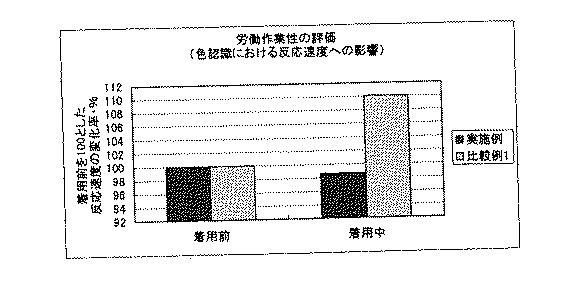
過度の圧迫は自律神経系にも影響し人の反応速度を遅らせることもある。図5は、色認識における反応速度への影響を測定した結果である。実施例では、反応が速くなっており、圧迫による自律神経系への影響がほとんどみられない。
【0026】
一方、比較例1の場合には、着座により過度の圧迫を受ける部位があるので、自律神経系に悪影響を与え人の反応を遅らせている。
【0027】
【発明の効果】
以上、本発明によれば、静水圧を基本にしつつ、立位だけでなく椅座位における着圧まで考慮し、屈曲を伴う部位への着圧が当該部位の血行障害圧力を超えないように設定したので、立位・椅座位にかかわらず静脈還流効果を維持できる。
【図面の簡単な説明】
【図1】 静水圧に準じた締付けパワーと実施形態に係るパンティストッキングの締付け具合の関係を示す図である。
【図2】 椅座位におけるソケイ部への圧迫により血がたまることを示す概念図である。
【図3】 1回心拍出量の変化を示すグラフである。
【図4】 膝下の体積変化率を示すグラフである。
【図5】 労働作業性の評価グラフである。
【符号の説明】
1 パンティストッキング
2 ソケイ部
3 ヒップ
4 大腿
5 ヒザ
6 下腿
7 足首[0001]
BACKGROUND OF THE INVENTION
The present invention relates to pantyhose (including stockings and tights) that does not inhibit venous return.
[0002]
[Prior art]
In order to pursue comfort at the time of wearing, various things have been proposed in the past to vary the pressure applied to each part of the pantyhose. For example, Japanese Patent No. 282090 (Patent Document 1) discloses an arch There is described a pantyhose that provides a comfortable wearing feeling by gradually reducing the wearing pressure from the upper part to the ankle part, the calf part, and the thigh part.
Furthermore, the thing for the purpose of the control of the vein by a stocking is proposed, for example, Japanese Patent Publication No. 7-98053 (prior art document 2) and Unexamined-Japanese-Patent No. 8-199404 (prior art document 3) exist.
[0003]
[0004]
[Problems to be solved by the invention]
However, in the above prior art documents, an increase in compression when posture change, such as when chair seat (when sitting on the chair), in particular inguinal portion in the chair seat position, knee, intended to take into account with respect to excessive compression, such as hip There wasn't.
Therefore, even in standing be designed to venous return is promoted by compression expressed during posture change, it was sometimes become rather inhibit blood circulation in such chair locus.
[0005]
As described above, in the conventional device, although the purpose is to control the vein, there are cases where the venous return is inhibited.
The present invention was made in view of such problems, standing, and aims to maintain the effect of promoting venous return regardless chair locus.
[0006]
[Means for Solving the Problems]
In order to solve the above problems, the present invention has reached the present invention with the following idea.
That is, conception of the present invention, which focuses on "arrival pressure in chair locus" pantyhose having venous return effect, maintains the effect of promoting venous return if the arrival pressure as appropriate in chair locus It will be possible.
In the blood circulatory system, a pushing force according to the hydrostatic pressure that resists gravity in terms of human physiology is required. For this reason, in order to promote venous return by pantyhose, there is a certain amount of tightening force so that blood can easily recirculate against gravity, and a gradation-like pressure balance that weakens as the tightening force approaches the heart (The realization of hydrostatic pressure theory based on the idea of the circulatory system).
[0007]
In the present invention, in addition to this, the wearing pressure of the chair seat position (when posture change) of blood circulation disorders are set to a value that does not occur.
That is, the pantyhose according to the present invention has a wearing pressure for pushing up blood against gravity so that the veins can easily recirculate, and wears from the ankle to the thigh in accordance with the hydrostatic balance in human physiology. a pantyhose with pressure balance, wearing pressure in chair locus to sites with bending is set so as not to exceed the blood circulation failure pressure of the portion.
[0008]
By adopting this configuration, a venous return effect is exhibited. Since wearing pressure in chair locus to sites with bending is set so as not to exceed the blood circulation failure pressure of the portion, during posture change, that venous return to maintain venous return effect not inhibited it can.
Examples of the portion that accompanies bending include a ridge portion, a hip, and a knee, and compression of these portions increases due to a change in posture.
In order not to inhibit the venous return, specifically, it is preferable that the pressure applied to the part with bending, for example, the ridge part, hip, knee, or the like is 25 gf / cm 2 or less. Further, it is preferably 21 gf / cm 2 or less based on the examples described later. More specifically, the the arrival pressure of the inguinal portion 25 gf / cm 2 or less (more 21 gf / cm 2 or less) in the chair locus, the hip wearing pressure in chair locus and 17gf / cm 2 or less, knee in chair locus It is preferable that the pressure of the adhesive is 17 gf / cm 2 or less.
[0009]
In addition, preferable pressure ranges for exerting the venous return effect include a thigh pressure of 9 to 17 gf / cm 2 in a standing position, a lower leg pressure of 14 to 28 gf / cm 2 and an ankle pressure. It can be set within a range of 17 to 35 gf / cm 2 and weaken from the ankle toward the thigh.
Furthermore, considering that the calf, that is, the muscle of the maximum diameter part (calf part) of the lower leg, effectively acts on the venous return effect, the pressure on the calf part is slightly stronger than the pressure balance according to the hydrostatic pressure balance. It is preferable that it is set. In this case, the venous return effect can be further enhanced.
[0010]
In the present invention, pantyhose includes stockings and tights.
[0011]
DETAILED DESCRIPTION OF THE INVENTION
Hereinafter, embodiments of the present invention will be described with reference to the drawings.
FIG. 1 shows the degree of tightening force (wearing pressure) of the
In order to promote venous return (return of blood), it is necessary to push up the blood with pressure (clamping force) that does not lose gravity. The tightening degree needs to be designed in a gradation-like balance that becomes stronger toward the
[0012]
A straight line L1 in FIG. 1 indicates a balance of tightening according to hydrostatic pressure. When the tightening force of the
[0013]
[Table 1]
Specifically, the pressure on the thigh is 9 to 17 gf / cm 2 , the pressure on the lower leg (calf) is 14 to 28 gf / cm 2 , and the pressure on the ankle is 17 to 35 gf / cm 2 . , The pressure applied to each part can be set along the balance. Such a pressure range is called a comfort zone.
When these numerical values are converted into [Pa], the thigh pressure is 883 to 1667 Pa, the lower leg (calf) pressure is 1373 to 2746 Pa, and the ankle pressure is 1667 to 3432 Pa (see Table 2 below). ). This conversion was performed with 1 kgf / m 2 = 9.80665 Pa (hereinafter the same).
[0015]
[Table 2]
If these numbers are rounded off, the pressure on the thigh is 900 to 1700 Pa, the pressure on the lower leg (calf) is 1400 to 2800 Pa, and the pressure on the ankle is 1700 to 3400 Pa. Such a pressure range can be said to be a comfortable zone in [Pa].
In FIG. 1, a straight line L2 indicates the tightening balance of the
First, the tightening force of the calf part, which is the maximum diameter part of the lower leg, is set slightly larger than the hydrostatic pressure balance L1. Since the muscle pump action on the venous return works particularly effectively in the calf, it is preferable to set the tightening force to the part slightly higher from below so that the muscle of the calf supports the action of pushing up blood. . When the pressure at the calf is increased, an effect of making the ankle look thin is produced in addition to the effect of promoting venous return.
[0017]
Furthermore, the parts where the pressure increases due to sitting on a chair or the like (chair position) (the
Specifically, preferable to be 25 gf / cm 2 or less is the pressure circulation disorder wearing pressure of each part does not occur in the chair locus (more preferably 21gf / cm 2). Furthermore, 17Gf from hip wearing pressure was set to 17gf / cm 2 or less from the viewpoint of software from the femoral, wearing pressure of the knee in the chair locus (in the parallel position) that the viewpoint is the same level as the femur in chair locus / cm 2 or less is preferable (see Table 1).
[0018]
When these numerical values are converted into [Pa], the pressure applied to the socket is 2452 Pa or less (2059 Pa for 21 gf / cm 2 ), the hip pressure is 1667 Pa or less, and the knee pressure is 1667 Pa or less (Table). 2).
Furthermore, when these numerical values are rounded off, the pressure applied to the ridge portion is 2500 Pa or less (2100 Pa or less), and the pressure applied to the hips and knees is 1700 Pa or less.
In these sites, there is a case where excessive compression occurs arrival pressure is increased in the chair seat position, the groin, hips, to be smaller than the value of the wearing pressure of the knee, the inhibition of venous return is reduced .
[0019]
Inguinal portion in the chair seat position, hip, since it has a low wearing pressure of the knee, as shown in L2 in FIG. 1, inguinal portion even in standing position, hip, wearing pressure of the knee is slightly against hydrostatic pressure balance L1 It is getting smaller.
As described above, the pressure of the pantyhose according to the present embodiment has a certain amount of tightening force based on the hydrostatic pressure balance, and the tightening force is set to be slightly weaker in the socket, hip and knee, and is tightened in the calf portion. The power is set slightly stronger.
[0020]
In addition, in order not to inhibit the venous return, the pressure applied to the silicate part is particularly important. This is because, as shown in FIG. 2, the pressure in the sock portion inhibits the return of blood and the blood accumulates in the entire lower limbs.
[0021]
【Example】
Pantyhose knitted with SCY (single covering yarn) with 40d (denier) class polyurethane as the core yarn, and as shown in Tables 1 and 2, the thigh pressure in the standing position is 10. 5gf / cm 2 (1030Pa), is a wearing pressure of the lower leg in a standing position is 14.5gf / cm 2 (1422Pa), wearing pressure of the ankle in the standing position is 20.0gf / cm 2 (1961Pa),椅座position Hip pressure at 16.5gf / cm 2 (1618Pa), pressure at the seat in the chair sitting position is 20.0gf / cm 2 (1961Pa), knee pressure at the chair sitting position is 11.6gf / What was cm < 2 > (1138Pa) was obtained.
[0022]
Such a change in the arrival pressure is achieved by various known methods such as changing the yarn feeding amount for each part during knitting, changing the yarn feeding tension and the feed amount, and changing the degree. be able to.
For this example, evaluation of venous return (single cardiac output measurement), suppression effect of swelling when worn for one day (measurement of volume change under knee), evaluation of fatigue level after wearing for one day (measurement of work efficiency) Comparison was made with Comparative Example 1 (panty stockings knitted with SCY using 40d class polyurethane as core yarn) and Comparative Example 2 (panty stockings knitted with SCY using 20d class polyurethane as core yarn). It was.
[0023]
As a result, good results were obtained in any of the evaluations in the examples. In Comparative Example 1, the standing position was in the comfort zone, but the hips, ridges, and knees had a threshold pressure when seated. Exceeding the value, blood circulation disorders and effects on autonomic nerves are observed. Moreover, in the comparative example 2, the power which contributes to the venous recirculation is not enough as a whole.
Hereinafter, these evaluations will be described in detail.
(Evaluation of venous return)
According to the “Theory of Stirling's heart”, since the stroke volume of one stroke depends on the venous return volume, the stroke volume was used as an index of venous return.
[0024]
FIG. 3 shows the rate of change in cardiac output when the cardiac output before wearing is set to 100 and the patient is rested in the chair sitting position after wearing. In the case of the Example, it turns out that the cardiac output after wearing increases and the venous return is accelerated | stimulated. On the other hand, in the case of Comparative Example 1, the wearing pressure of the hip, the ridge portion, and the knee in the chair sitting position is high, and since the compression is increased by the sitting, venous return is inhibited and the cardiac output is reduced.
(About the suppression effect of swelling when worn for 1 day)
FIG. 4 shows the results of measuring the change in the volume under the knee in the evening with respect to the volume under the knee in the morning for each of the bare feet, the example, and the comparative example 2.
[0025]
In the case of the example, it can be seen that the rate of change of the volume below the knee is lower than that of bare feet, and it is difficult to swell. On the other hand, in the case of the comparative example 2, it can be seen that the change rate of the volume below the knee is larger than that of the bare feet, and the swelling is easy. In the case of Comparative Example 2, the tightening force is insufficient, does not help the venous return, and swelling is generated. In other words, the thigh in Comparative Example 2, the lower leg, and the lack of wearing pressure of the ankle, although wearing pressure such as inguinal portion is not high in chair locus, wearing pressure in a standing position is low, venous return effect has not been demonstrated .
(About the evaluation of the fatigue level due to daily wear)
Excessive pressure can also affect the autonomic nervous system and slow down the human reaction rate. FIG. 5 shows the results of measuring the influence on the reaction speed in color recognition. In the examples, the response is fast and the autonomic nervous system is hardly affected by the compression.
[0026]
On the other hand, in the case of the comparative example 1, since there is a part which receives excessive pressure by sitting, it adversely affects the autonomic nervous system and delays human reaction.
[0027]
【The invention's effect】
As described above, according to the present invention, while the hydrostatic pressure to the base, consideration of the wearing pressure of the chair seat position not only standing, set so arrival pressure does not exceed arterial disease pressure of the site to a site with a bend since the can maintain venous return effect regardless of standing-chair locus.
[Brief description of the drawings]
FIG. 1 is a diagram showing a relationship between a tightening power according to a hydrostatic pressure and a tightening condition of a pantyhose according to an embodiment.
2 is a conceptual diagram showing that blood accumulates the pressure on the inguinal portion in the chair locus.
FIG. 3 is a graph showing changes in stroke output.
FIG. 4 is a graph showing a volume change rate under the knee.
FIG. 5 is an evaluation graph of labor workability.
[Explanation of symbols]
1
Claims (3)
かつ、椅座位において、屈曲を伴う部位への着圧が当該部位の血行障害圧力を超えないように設定されており、前記椅座位における屈曲を伴う部位への着圧が、いずれの部位においても25 gf/cm 2 以下であると共に椅座位におけるソケイ部の着圧が25 gf/cm 2 以下、同ヒップ部とヒザ部の着圧が17 gf/cm 2 以下であることを特徴とするパンティストッキング。 An ankle in the standing position from the ankle to the thigh according to the hydrostatic pressure balance in human physiology, and having the pressure to push up blood against gravity so that the veins can easily recirculate: lower leg: approximately 10 thighs: It has a pressure balance that weakens at a ratio of 8: 5,
And, in chair locus, wearing pressure to the site with a bending is set so as not to exceed the blood circulation failure pressure of the portion, wearing pressure to the site with a bend in the椅座-position, in any of the sites 25 gf / cm 2 or less wearing pressure of the inguinal portion in椅座position with it is 25 gf / cm 2 or less, panties wearing pressure of the hip portion and the knee portion, characterized in der Rukoto 17 gf / cm 2 or less stockings.
Priority Applications (1)
| Application Number | Priority Date | Filing Date | Title |
|---|---|---|---|
| JP31415299A JP3812628B2 (en) | 1999-11-04 | 1999-11-04 | Panty stocking |
Applications Claiming Priority (1)
| Application Number | Priority Date | Filing Date | Title |
|---|---|---|---|
| JP31415299A JP3812628B2 (en) | 1999-11-04 | 1999-11-04 | Panty stocking |
Publications (2)
| Publication Number | Publication Date |
|---|---|
| JP2001140104A JP2001140104A (en) | 2001-05-22 |
| JP3812628B2 true JP3812628B2 (en) | 2006-08-23 |
Family
ID=18049869
Family Applications (1)
| Application Number | Title | Priority Date | Filing Date |
|---|---|---|---|
| JP31415299A Expired - Lifetime JP3812628B2 (en) | 1999-11-04 | 1999-11-04 | Panty stocking |
Country Status (1)
| Country | Link |
|---|---|
| JP (1) | JP3812628B2 (en) |
Families Citing this family (7)
| Publication number | Priority date | Publication date | Assignee | Title |
|---|---|---|---|---|
| JP2006183195A (en) * | 2004-12-28 | 2006-07-13 | Gunze Ltd | Panty hose |
| JP2006200063A (en) * | 2005-01-19 | 2006-08-03 | Gunze Ltd | Stocking |
| JP2006200112A (en) * | 2005-06-03 | 2006-08-03 | Gunze Ltd | Stocking |
| JP5785379B2 (en) * | 2009-11-02 | 2015-09-30 | グンゼ株式会社 | Medical stockings |
| EA201290740A1 (en) * | 2010-02-02 | 2013-02-28 | Инвиста Текнолоджиз С.А.Р.Л. | TIGHTS WITH ASYMMETRIC TORSIC PART |
| JP5996248B2 (en) * | 2012-04-23 | 2016-09-21 | ピップ株式会社 | Body wear |
| JP2018071010A (en) * | 2016-10-26 | 2018-05-10 | 株式会社ワコール | Clothes covering calf |
-
1999
- 1999-11-04 JP JP31415299A patent/JP3812628B2/en not_active Expired - Lifetime
Also Published As
| Publication number | Publication date |
|---|---|
| JP2001140104A (en) | 2001-05-22 |
Similar Documents
| Publication | Publication Date | Title |
|---|---|---|
| CN101222890B (en) | Compressive orthosis for the lower limb in the form of a knitted article of the stocking, sock, or tights type | |
| JP4908025B2 (en) | Clothing with crotch | |
| EP0884036A1 (en) | Therapeutic socks | |
| ATE205380T1 (en) | COMPRESSION ORTHOSE IN SHOE SHAPE TO TREAT CIRCULATION DISEASES IN THE LOWER LIMBS AND ESPECIALLY TO IMMEDIATE THE LEG AFTER VEIN ULCERS | |
| US20110179555A1 (en) | Compression garment | |
| JP3812628B2 (en) | Panty stocking | |
| JP4105231B2 (en) | Elastic stocking type or elastic tights type compressible prosthesis | |
| US20160106157A1 (en) | Compression garment | |
| US20090240279A1 (en) | Knitted Compressive Orthosis of the Lower Limb for Treating Chronic Venous Insufficiency | |
| JP2000290806A (en) | Clothing having leg part | |
| JP2010100981A (en) | Socks | |
| JPH10310903A (en) | Hose | |
| JP2914614B2 (en) | Panty stocking | |
| US20220279866A1 (en) | Textile device for pregnant women | |
| JP2017051415A (en) | Elastic stocking | |
| JP3076289U (en) | Super support stocking | |
| JP3499814B2 (en) | Panty stocking | |
| JP2023062268A (en) | Mounting fixture | |
| CN218458249U (en) | Pressure socks | |
| JPH038801A (en) | Panty stocking | |
| JP2021014661A (en) | Wearing pressure supporter for lower limb | |
| KR20220101263A (en) | Compression taping socks | |
| JP2002339118A (en) | Leg supporter | |
| RU2835629C2 (en) | Elastic compression product for lower extremities of user, intended for treatment of obstructive sleep apnoea/hypopnea syndrome, application thereof and method of use thereof | |
| CN218356573U (en) | Comfortable and comfortable trousers |
Legal Events
| Date | Code | Title | Description |
|---|---|---|---|
| A61 | First payment of annual fees (during grant procedure) |
Free format text: JAPANESE INTERMEDIATE CODE: A61 Effective date: 20060523 |
|
| R150 | Certificate of patent or registration of utility model |
Ref document number: 3812628 Country of ref document: JP Free format text: JAPANESE INTERMEDIATE CODE: R150 Free format text: JAPANESE INTERMEDIATE CODE: R150 |
|
| FPAY | Renewal fee payment (event date is renewal date of database) |
Free format text: PAYMENT UNTIL: 20100609 Year of fee payment: 4 |
|
| R250 | Receipt of annual fees |
Free format text: JAPANESE INTERMEDIATE CODE: R250 |
|
| FPAY | Renewal fee payment (event date is renewal date of database) |
Free format text: PAYMENT UNTIL: 20110609 Year of fee payment: 5 |
|
| R250 | Receipt of annual fees |
Free format text: JAPANESE INTERMEDIATE CODE: R250 |
|
| FPAY | Renewal fee payment (event date is renewal date of database) |
Free format text: PAYMENT UNTIL: 20120609 Year of fee payment: 6 |
|
| R250 | Receipt of annual fees |
Free format text: JAPANESE INTERMEDIATE CODE: R250 |
|
| FPAY | Renewal fee payment (event date is renewal date of database) |
Free format text: PAYMENT UNTIL: 20130609 Year of fee payment: 7 |
|
| R250 | Receipt of annual fees |
Free format text: JAPANESE INTERMEDIATE CODE: R250 |
|
| FPAY | Renewal fee payment (event date is renewal date of database) |
Free format text: PAYMENT UNTIL: 20130609 Year of fee payment: 7 |
|
| FPAY | Renewal fee payment (event date is renewal date of database) |
Free format text: PAYMENT UNTIL: 20130609 Year of fee payment: 7 |
|
| R250 | Receipt of annual fees |
Free format text: JAPANESE INTERMEDIATE CODE: R250 |
|
| R250 | Receipt of annual fees |
Free format text: JAPANESE INTERMEDIATE CODE: R250 |
|
| R250 | Receipt of annual fees |
Free format text: JAPANESE INTERMEDIATE CODE: R250 |
|
| R250 | Receipt of annual fees |
Free format text: JAPANESE INTERMEDIATE CODE: R250 |
|
| R250 | Receipt of annual fees |
Free format text: JAPANESE INTERMEDIATE CODE: R250 |
|
| R250 | Receipt of annual fees |
Free format text: JAPANESE INTERMEDIATE CODE: R250 |
|
| R250 | Receipt of annual fees |
Free format text: JAPANESE INTERMEDIATE CODE: R250 |
|
| EXPY | Cancellation because of completion of term |