JP3749884B2 - Digital watermark embedding device, digital watermark analysis device, digital watermark embedding method, digital watermark analysis method, and program - Google Patents
Digital watermark embedding device, digital watermark analysis device, digital watermark embedding method, digital watermark analysis method, and program Download PDFInfo
- Publication number
- JP3749884B2 JP3749884B2 JP2002248941A JP2002248941A JP3749884B2 JP 3749884 B2 JP3749884 B2 JP 3749884B2 JP 2002248941 A JP2002248941 A JP 2002248941A JP 2002248941 A JP2002248941 A JP 2002248941A JP 3749884 B2 JP3749884 B2 JP 3749884B2
- Authority
- JP
- Japan
- Prior art keywords
- identification information
- embedded
- copy
- symbol
- digital content
- Prior art date
- Legal status (The legal status is an assumption and is not a legal conclusion. Google has not performed a legal analysis and makes no representation as to the accuracy of the status listed.)
- Expired - Fee Related
Links
Images




Classifications
-
- H—ELECTRICITY
- H04—ELECTRIC COMMUNICATION TECHNIQUE
- H04H—BROADCAST COMMUNICATION
- H04H20/00—Arrangements for broadcast or for distribution combined with broadcast
- H04H20/28—Arrangements for simultaneous broadcast of plural pieces of information
- H04H20/30—Arrangements for simultaneous broadcast of plural pieces of information by a single channel
- H04H20/31—Arrangements for simultaneous broadcast of plural pieces of information by a single channel using in-band signals, e.g. subsonic or cue signal
-
- G—PHYSICS
- G06—COMPUTING OR CALCULATING; COUNTING
- G06T—IMAGE DATA PROCESSING OR GENERATION, IN GENERAL
- G06T1/00—General purpose image data processing
- G06T1/0021—Image watermarking
- G06T1/005—Robust watermarking, e.g. average attack or collusion attack resistant
-
- G—PHYSICS
- G06—COMPUTING OR CALCULATING; COUNTING
- G06T—IMAGE DATA PROCESSING OR GENERATION, IN GENERAL
- G06T1/00—General purpose image data processing
- G06T1/0021—Image watermarking
- G06T1/005—Robust watermarking, e.g. average attack or collusion attack resistant
- G06T1/0071—Robust watermarking, e.g. average attack or collusion attack resistant using multiple or alternating watermarks
-
- H—ELECTRICITY
- H04—ELECTRIC COMMUNICATION TECHNIQUE
- H04N—PICTORIAL COMMUNICATION, e.g. TELEVISION
- H04N1/00—Scanning, transmission or reproduction of documents or the like, e.g. facsimile transmission; Details thereof
- H04N1/32—Circuits or arrangements for control or supervision between transmitter and receiver or between image input and image output device, e.g. between a still-image camera and its memory or between a still-image camera and a printer device
- H04N1/32101—Display, printing, storage or transmission of additional information, e.g. ID code, date and time or title
- H04N1/32144—Display, printing, storage or transmission of additional information, e.g. ID code, date and time or title embedded in the image data, i.e. enclosed or integrated in the image, e.g. watermark, super-imposed logo or stamp
- H04N1/32149—Methods relating to embedding, encoding, decoding, detection or retrieval operations
-
- H—ELECTRICITY
- H04—ELECTRIC COMMUNICATION TECHNIQUE
- H04N—PICTORIAL COMMUNICATION, e.g. TELEVISION
- H04N21/00—Selective content distribution, e.g. interactive television or video on demand [VOD]
- H04N21/80—Generation or processing of content or additional data by content creator independently of the distribution process; Content per se
- H04N21/83—Generation or processing of protective or descriptive data associated with content; Content structuring
- H04N21/835—Generation of protective data, e.g. certificates
- H04N21/8358—Generation of protective data, e.g. certificates involving watermark
-
- H—ELECTRICITY
- H04—ELECTRIC COMMUNICATION TECHNIQUE
- H04N—PICTORIAL COMMUNICATION, e.g. TELEVISION
- H04N7/00—Television systems
- H04N7/16—Analogue secrecy systems; Analogue subscription systems
- H04N7/167—Systems rendering the television signal unintelligible and subsequently intelligible
- H04N7/1675—Providing digital key or authorisation information for generation or regeneration of the scrambling sequence
-
- G—PHYSICS
- G06—COMPUTING OR CALCULATING; COUNTING
- G06T—IMAGE DATA PROCESSING OR GENERATION, IN GENERAL
- G06T2201/00—General purpose image data processing
- G06T2201/005—Image watermarking
- G06T2201/0063—Image watermarking in relation to collusion attacks, e.g. collusion attack resistant
-
- H—ELECTRICITY
- H04—ELECTRIC COMMUNICATION TECHNIQUE
- H04N—PICTORIAL COMMUNICATION, e.g. TELEVISION
- H04N2201/00—Indexing scheme relating to scanning, transmission or reproduction of documents or the like, and to details thereof
- H04N2201/32—Circuits or arrangements for control or supervision between transmitter and receiver or between image input and image output device, e.g. between a still-image camera and its memory or between a still-image camera and a printer device
- H04N2201/3201—Display, printing, storage or transmission of additional information, e.g. ID code, date and time or title
- H04N2201/3204—Display, printing, storage or transmission of additional information, e.g. ID code, date and time or title of data relating to a user, sender, addressee, machine or electronic recording medium
- H04N2201/3205—Display, printing, storage or transmission of additional information, e.g. ID code, date and time or title of data relating to a user, sender, addressee, machine or electronic recording medium of identification information, e.g. name or ID code
-
- H—ELECTRICITY
- H04—ELECTRIC COMMUNICATION TECHNIQUE
- H04N—PICTORIAL COMMUNICATION, e.g. TELEVISION
- H04N2201/00—Indexing scheme relating to scanning, transmission or reproduction of documents or the like, and to details thereof
- H04N2201/32—Circuits or arrangements for control or supervision between transmitter and receiver or between image input and image output device, e.g. between a still-image camera and its memory or between a still-image camera and a printer device
- H04N2201/3201—Display, printing, storage or transmission of additional information, e.g. ID code, date and time or title
- H04N2201/3225—Display, printing, storage or transmission of additional information, e.g. ID code, date and time or title of data relating to an image, a page or a document
- H04N2201/3233—Display, printing, storage or transmission of additional information, e.g. ID code, date and time or title of data relating to an image, a page or a document of authentication information, e.g. digital signature, watermark
- H04N2201/3236—Details of authentication information generation
Landscapes
- Engineering & Computer Science (AREA)
- Signal Processing (AREA)
- Multimedia (AREA)
- Physics & Mathematics (AREA)
- General Physics & Mathematics (AREA)
- Theoretical Computer Science (AREA)
- Computer Security & Cryptography (AREA)
- Editing Of Facsimile Originals (AREA)
- Image Processing (AREA)
- Television Systems (AREA)
Description
【0001】
【発明の属する技術分野】
本発明は、識別情報に対応する埋め込み符号を生成しコンテンツの複製物に埋め込む電子透かし埋め込み装置及び電子透かし埋め込み方法、結託攻撃に用いられたコンテンツの複製物に埋め込まれていた埋め込み符号に対応する識別情報を求める電子透かし解析装置及び方法並びにプログラムに関する。
【0002】
【従来の技術】
デジタルコンテンツ(例えば、静止画、動画、音声、音楽等)は、多数のデジタルデータで構成された構造を持つ。そして、その構造の中には、データを変更しても、当該デジタルコンテンツの作品の同一性あるいは経済的価値を保持できる部分がある。そのような許容された範囲内のデータを適宜変更するによって、デジタルコンテンツに、種々の情報を埋め込むことができる。このような技術は、電子透かしとして、良く知られている。
【0003】
電子透かし技術によって、デジタルコンテンツに、様々な透かし情報(例えば、コンテンツの著作権者やユーザを識別する情報、著作権者の権利情報、コンテンツの利用条件、その利用時に必要な秘密情報、コピー制御情報等、あるいはそれらを組み合わせたものなど)を、様々な目的(例えば、利用制御、コピー制御を含む著作権保護、二次利用の促進等)で埋め込み、検出・利用することができる。
【0004】
ここでは、例えば同一のデジタルコンテンツを多数のユーザを対象として配給するときに適用される技術として、デジタルコンテンツの複製物に、当該複製物を個々に識別するための情報(例えば、ユーザIDに一意に対応する透かし情報)を埋め込む場合を考える。
【0005】
デジタルコンテンツの複製物に固有の識別情報(に対応する符号)を埋め込む手法は、そのデジタルコンテンツの複製物が更に複製されて海賊版として出回ったときに、該海賊版から識別情報を検出することによって流出元ユーザを特定することができることから、デジタルコンテンツの違法コピーに対する事前の抑制として機能するとともに、著作権侵害が発生したときの事後の救済にも役立つことになる。
【0006】
また、あるユーザがデジタルコンテンツの複製物に埋め込まれた識別情報を無効にするためには、ユーザにはどの部分が識別情報(に対応する符号)を構成するビットであるか分からないので、当該デジタルコンテンツの複製物に相当の改変を加える必要があり、そうすると、当該デジタルコンテンツの経済的価値を損なってしまうので、違法コピーの動機付けを奪うことができる。
【0007】
このような状況において違法コピーを可能ならしめる方法として出現したのが、「結託攻撃(collusion attack)」である。
【0008】
結託攻撃は、異なる複製物には異なる識別情報が埋めこまれていることを利用するものである。例えば、複数人で複製物を持ち寄って、それらをビット単位で比較することによって、デジタルデータの値が異なる部分を見つけ出し、その部分を改ざん(例えば、多数決、少数決、ランダマイズ等)することによって、識別情報を改ざん、消失させる。あるいは、具体的な比較操作は行わず、コンテンツ間で画素値を平均化するなどの操作を行って、識別情報を改ざん、消失させる。
【0009】
例えば簡単な例で示すと、A氏、B氏、C氏の複製物にそれぞれ、
A : 10…00…
B : 00…11…
C : 11…01…
という識別情報(実際には、これに対応する符号)が埋め込まれていた場合に、例えば、多数決あるいは平均化等によって、
10…01…
というように、A氏、B氏、C氏のいずれとも異なる識別情報が検出されるようなコンテンツを出現させることができてしまう。
【0010】
そこで、結託攻撃に対する耐性、すなわち結託攻撃を受けても結託者の全部または一部を特定できるような性質を持つ符号(結託耐性符号と呼ばれる)を電子透かしとして埋め込む方法および該結託耐性符号に基づく追跡アルゴリズム(tracing algorithm;結託攻撃に用いられたコンテンツに埋め込まれた識別番号を特定し、結託者のユーザIDを特定するためのアルゴリズム)が種々提案されている。例えば、c−secure 符号(D. Boneh and J. Shaw,“Collusion-Secure Fingerprinting for Digital Data,” CRYPTO’95, 180-189, 1995.)やc−secure CRT 符号(Hirofumi Muratani,“A Collusion-Secure Fingerprinting Code Reduced by Chinese Remaindering and its Random-Error Resilience”,Information Hiding Workshop 2001, 301-315, 2001.や、特開2001−285623号公報)がその例である。
【0011】
ここで、c−secure CRT符号について簡単に説明する。
【0012】
c−secure CRT符号は、M個の成分符号を連接してなる連接符号の構造を持つ。例えば、第1番目の成分符号W(i)は、0のみからなるか、1のみからなるか、または0と1が混在する(ただし、0と1の境界はただ1つである)、所定長のビット列であって、識別情報uを法p(i)で除したときの剰余によって、成分符号W(i)に含まれる0のビット数及び1のビット数、すなわち、成分符号W(i)を構成するビット列における0の系列と1の系列との境界位置が決定されるような符号である。
【0013】
例えば、M=3とし、p(1)=3,p(2)=5,p(3)=7とし、成分符号W(i)としてΓ0(n,d)符号(1または0のみからなる連続したビットを一つの単位B(j)とし、B(0)〜B(n−2)を連結したもの;ただし、B(0)〜B(n−2)は、すべてが0のみからなるか、すべてが1のみからなるか、またはB(0)〜B(m−1)までは0のみからなり且つB(m)〜B(n−2)までは1のみからなるもの)を用いるものとし(d=3とする)、識別情報=ユーザIDとすると、
例えば、ユーザID=2に対応する符号は、
000000 000000111111 000000111111111111
となり、ユーザID=3に対応する符号は、
111111 000000000111 000000000111111111
となる。
【0014】
この場合に、ユーザID=2のユーザとユーザID=3の2人のユーザが持ちよったコンテンツを比較すると、上記36ビットのうち、左から1〜6番目、13〜15番目、25〜27番目が相違していることがわかる。そこで、それらが識別情報に対応する符号の一部と分かるため、1〜6番目、13〜15番目、25〜27番目のうちの一部に改ざんが施され、例えば、
010101 000000010111 000000101111111111
というように、ユーザID=2とユーザID=3のいずれとも異なる識別情報が検出されるようなコンテンツが作出される。
【0015】
ところが、正当なユーザIDに対応する符号は、予め定められたブロックのサイズd(上記の例の場合、3)ビット未満の数の1や0が孤立して存在する部分は存在しないが、これに対して、上記のように結託攻撃を受けたコンテンツから検出される符号は、持ち寄ったコンテンツ同士で相違する符号部分については、0と1が混在しており、すなわち、d(上記の例の場合、3)ビット未満の数の1や0が孤立して存在する部分が存在することが分かる。
【0016】
そこで、追跡アルゴリズムでは、検出された符号の各々の成分符号を調べ、予め定められたd(上記の例の場合、3)ビット未満の数の1や0が孤立して存在する成分符号が検出された場合に、結託攻撃がなされたものと判断することができる。
【0017】
ところで、c−secure CRT符号では、追跡対象コンテンツから検出された符号の第i番目の成分符号W(i)を、左端のビットからみていったときにはじめて出現する、0のみからなる要素と1を含む要素との境界の位置(を表す整数値)を最小剰余とし、右端のビットからみていったときにはじめて出現する、1のみからなる要素と0を含む要素との境界の位置(を表す整数値)を最大剰余とすると、最大剰余及び最小剰余(=剰余対)は、いずれかの結託者の識別情報uに対する剰余すなわちu mod p(i)と等しくなるという性質がある。なお、第i番目の成分符号W(i)が0のみからなる場合には、最小剰余=最大剰余=p(i)−1、第i番目の成分符号W(i)が1のみからなる場合には、最小剰余=最大剰余=0、0のみからなる要素と1を含む要素との境界がない場合には、最小剰余=0、1のみからなる要素と0を含む要素との境界がない場合には、最大剰余=p(i)−1とする。
【0018】
したがって、追跡対象コンテンツから検出されたc−secure CRT符号の各成分部号から求めた剰余対を解析することによって、結託攻撃に使用された複製物に埋め込まれていたであろう識別情報の一部又は全部を求めることができるようになる。
【0019】
上記の例の場合、
010101 000000010111 000000101111111111
という符号から、
結託者の識別情報として、ユーザID=2とユーザID=3を特定することができる。
【0020】
このc−secure CRT符号は、次のようなマーキング仮定に基づいている。すなわち、結託攻撃に参加している結託者の中に、ある成分符号中のあるビットに対して異なる値を持つ者がいる場合に、結託攻撃の結果、生成される成分符号におけるそのビットがいずれの値をとるかは、確率的に決まる。よって、ブロックのサイズdがある程度大きくなると、正しく最小剰余及び最大剰余を検出することができる。
【0021】
【発明が解決しようとする課題】
c−secure CRT符号において、具体的場合においては、追跡対象コンテンツから上記の最小剰余及び最大剰余を正しく検出できないケースが存在し得る。
【0022】
例えば、100人での結託攻撃を考えた場合、成分符号中あるブロックにおいて、99人にはビット列0が残りの一人にはビット列1が割り当てられていたとする。マーキング仮定では、0でも1でもないビット列がある確率で検出されることを期待している。ところが、電子透かしでは、ある測定量が所定のしきい値を越えるか否かでビット値の判定を行う場合が多く、結託攻撃がコンテンツの平均操作の場合、結託攻撃後の測定量は攻撃前の測定量の平均となると期待され、99対1の平均では、99人側の測定量の影響が大きく、ビット列は、99人側の値0として検出される確率が大きい。このブロックが最小剰余及び最大剰余を検出する境界のブロックならば、正しく最小剰余及び最大剰余を検出できないことになる。なお、これを符号感度の問題と呼ぶ。
【0023】
本発明は、上記事情を考慮してなされたもので、結託攻撃に用いられたコンテンツの複製物に埋め込まれていたであろう識別情報を、より感度の高い符号によって推定可能とした電子透かし埋め込み装置、電子透かし解析装置、電子透かし埋め込み方法、電子透かし解析方法及びプログラムを提供することを目的とする。
【0024】
【課題を解決するための手段】
本発明は、デジタルコンテンツの複製物に電子透かしとして埋め込むべき識別情報に一意に対応する、序列を持った複数のシンボルの並びからなるシンボル列を生成する第1の生成手段と、生成された前記シンボル列を構成する個々の序列のシンボルごとに、対応する埋め込み符号をそれぞれ生成する第2の生成手段と、生成された前記個々の序列のシンボルにそれぞれ対応する埋め込み符号を、前記デジタルコンテンツの複製物に電子透かしとして埋め込む符号埋め込み手段とを備え、前記第2の生成手段は、前記シンボル列の個々の序列において、同一の序列に属する互いに異なるシンボルに対応する埋め込み符号同士が、相互相関の無い又は小さい乱数列になるように、前記埋め込み符号を生成することを特徴とする。
また、本発明は、互いに異なる識別情報を電子透かしとして埋め込まれた複数のデジタルコンテンツの複製物をもとにして結託攻撃によって作出された不正のデジタルコンテンツの複製物を対象として、結託攻撃に用いられたデジタルコンテンツの複製物に埋め込まれていた識別情報を特定するための電子透かし解析装置であって、前記デジタルコンテンツの複製物から、序列を持った複数の埋め込み符号をそれぞれ抽出する第1の抽出手段と、抽出された前記複数の埋め込み符号にそれぞれ対応するシンボルを求め、求められた複数のシンボル列を、対応する埋め込み符号の序列に従って並べてシンボル列を求める第2の抽出手段と、前記結託攻撃に用いられたデジタルコンテンツの複製物から抽出された前記シンボル列及び各々の正当な識別情報に対してそれぞれ一意に割り当てられるシンボル列に基づいて、前記結託攻撃に用いられたデジタルコンテンツの複製物に埋め込まれていた識別情報を特定する追跡手段とを備え、前記第1の抽出手段は、個々の前記序列ごとに、前記結託攻撃において最も多く使用されたと評価される埋め込み符号を抽出することを特徴とする。
また、本発明は、互いに異なる識別情報を電子透かしとして埋め込まれた複数のデジタルコンテンツの複製物をもとにして結託攻撃によって作出された不正のデジタルコンテンツの複製物を対象として、結託攻撃に用いられたデジタルコンテンツの複製物に埋め込まれていた識別情報を特定するための電子透かし解析装置であって、前記デジタルコンテンツの複製物から、序列を持った複数の埋め込み符号をそれぞれ抽出する第1の抽出手段と、抽出された前記複数の埋め込み符号にそれぞれ対応するシンボルを求め、求められた複数のシンボル列を、対応する埋め込み符号の序列に従って並べてシンボル列を求める第2の抽出手段と、前記結託攻撃に用いられたデジタルコンテンツの複製物から抽出された前記シンボル列及び各々の正当な識別情報に対してそれぞれ一意に割り当てられるシンボル列に基づいて、前記結託攻撃に用いられたデジタルコンテンツの複製物に埋め込まれていた識別情報を特定する追跡手段とを備え、前記第2の抽出手段は、全ての識別情報について、当該識別情報に一意に対応するシンボル列と、前記対象となったデジタルコンテンツの複製物から求められた抽出シンボル列とを比較した結果に基づいて、前記結託攻撃に用いられたデジタルコンテンツの複製物に埋め込まれていた識別情報を特定することを特徴とする。
また、本発明は、互いに異なる識別情報を電子透かしとして埋め込まれた複数のデジタルコンテンツの複製物をもとにして結託攻撃によって作出された不正のデジタルコンテンツの複製物を対象として、結託攻撃に用いられたデジタルコンテンツの複製物に埋め込まれていた識別情報を特定するための電子透かし解析装置であって、前記デジタルコンテンツの複製物から、序列を持った複数の埋め込み符号をそれぞれ抽出する第1の抽出手段と、抽出された前記複数の埋め込み符号にそれぞれ対応するシンボルを求め、求められた複数のシンボル列を、対応する埋め込み符号の序列に従って並べてシンボル列を求める第2の抽出手段と、前記結託攻撃に用いられたデジタルコンテンツの複製物から抽出された前記シンボル列及び各々の正当な識別情報に対してそれぞれ一意に割り当てられるシンボル列に基づいて、前記結託攻撃に用いられたデジタルコンテンツの複製物に埋め込まれていた識別情報を特定する追跡手段とを備え、前記第2の抽出手段は、予め定められた最大結託数以下の結託数による任意の識別情報の組合せからなる結託グループのうち、前記対象となったデジタルコンテンツの複製物から抽出された前記シンボル列を作出可能な1又は複数の結託グループを特定し、該特定した1又は複数の結託グループをそれぞれ構成する識別情報の組合せに基づいて、前記結託攻撃に用いられたデジタルコンテンツの複製物に埋め込まれていた識別情報として特定することを特徴とする。
【0030】
なお、装置に係る本発明は方法に係る発明としても成立し、方法に係る本発明は装置に係る発明としても成立する。
また、装置または方法に係る本発明は、コンピュータに当該発明に相当する手順を実行させるための(あるいはコンピュータを当該発明に相当する手段として機能させるための、あるいはコンピュータに当該発明に相当する機能を実現させるための)プログラムとしても成立し、該プログラムを記録したコンピュータ読取り可能な記録媒体としても成立する。
【0031】
本発明によれば、結託攻撃に用いられたコンテンツの複製物に埋め込まれていたであろう識別情報を、より感度の高い符号によって推定することができるようになる。また、符号長の短縮にも有効である。
【0032】
【発明の実施の形態】
以下、図面を参照しながら発明の実施の形態を説明する。
【0033】
同一のデジタルコンテンツの複製物(例えば、静止画、動画、音声、音楽等)の各々に対して、当該複製物ごとに異なる識別情報を透かし情報として埋め込み、追跡する場合について説明する。以下では、識別情報として、当該複製物に対応するユーザすなわち当該複製物を利用することになるユーザ(例えば、当該複製物を記録媒体又は通信媒体を媒介として譲渡し若しくは貸し渡し又は提供する対象となるユーザ)のユーザ識別子(ユーザID)を用いる場合を主として説明するが、ユーザIDに対して所定の変換を施したものを識別情報としてもよいし、ユーザID以外の情報又はユーザID以外の情報を変換した情報を識別情報としてもよい。なお、ユーザIDには、利用の日時や利用場所等の情報を含めても良い。
【0034】
もちろん、デジタルコンテンツの複製物に対して、さらに、その他の様々な透かし情報(例えば、コンテンツの著作権者に関する情報、著作権等の権利に関する情報、コンテンツの利用条件に関する情報、その利用時に必要な秘密情報、コピー制御情報等、あるいはそれらを組み合わせたものなど)が様々な目的(例えば、利用制御、コピー制御を含む著作権保護、二次利用の促進等)で埋め込まれ、検出されてもよいが、その他の透かし情報を利用する場合における当該その他の透かし情報に関係する部分の構成は任意である。
【0035】
以下で示す構成図は、装置の機能ブロック図としても成立し、また、ソフトウェア(プログラム)の機能モジュール図あるいは手順図としても成立するものである。
【0036】
図1に、本発明の実施の形態に係る電子透かし埋込装置と電子透かし解析装置が適用されるシステムの概念図を示す。
【0037】
電子透かし埋込装置1と電子透かし解析装置2は、例えば、コンテンツ提供側に備えられ、管理される。
また、例えば、電子透かし埋込装置1は、ユーザ側に備えられ(例えば、コンテンツを利用するためのユーザ・システム(例えば、計算機システムや専用機器等に接続されあるいは組み込まれるなど)、電子透かし解析装置2は、コンテンツ提供側に備えられるようにしてもよい。
デジタルコンテンツの複製物への透かし情報の埋め込みは、前者の場合、該複製物がユーザへ渡されるのに先だって行われ、後者の場合、該複製物がユーザの利用に供されるのに先だって行われることになる。
【0038】
電子透かし埋込装置1においてデジタルコンテンツに所望の透かしデータを埋め込む方法や、電子透かし解析装置2においてデジタルコンテンツから該透かしデータ自体を取り出す方法は、どのような方法であってもよい(例えば、“松井甲子雄著、「電子透かしの基礎」、森北出版、1998年”等参照)。
電子透かし埋込装置1は、ソフトウェア(プログラム)としてもハードウェアとしても実現可能である。同様に、電子透かし解析装置2は、ソフトウェア(プログラム)としてもハードウェアとしても実現可能である。また、電子透かし埋込装置1および電子透かし解析装置2をコンテンツ提供側で用いる場合には、それらを一体化して実現することも可能である。
【0039】
図2に、電子透かし埋込装置1の構成例を示す。
【0040】
図2に示されるように、電子透かし埋込装置1は、埋め込むべき識別情報(例えば、ユーザID)に対応するシンボル列を生成するシンボル列生成部11と、シンボル列の各シンボルにそれぞれ対応する埋め込み符号(例えば、乱数列)を生成する埋め込み符号生成部12と、生成された埋め込み符号を対象コンテンツに埋め込む符号埋込部13とから構成される。
【0041】
電子透かし埋込装置1は、埋込対象コンテンツと、これに埋め込むべき識別情報(例えば、当該コンテンツを提供すべき対象ユーザのユーザID)とが与えられると、該識別情報に対応するシンボル列を生成し、生成されたシンボル列の各シンボルにそれぞれ対応する埋め込み符号を生成し、各埋め込み符号を対象コンテンツに埋め込んで、これを該識別情報に対応する複製物(例えば、該ユーザIDのユーザ向けの複製物)として出力する。他の透かし情報を利用する場合には、必要に応じて他の透かし情報も埋め込まれる。
【0042】
なお、例えば、識別情報≠ユーザIDであって、かつ、ユーザIDが与えられるような場合には、与えられたユーザIDを識別情報に変換する、などの前処理を行う。
【0043】
電子透かし埋込装置1により得られた当該識別情報に対応するコンテンツの複製物は、記憶媒体や通信媒体などを媒介とした流通経路3を経てそれぞれ流通する。複数の複製物を用いた結託攻撃は、この流通経路3にて行われる。
【0044】
ここでは、結託攻撃としては、例えば、複数の複製物の単純平均操作(結託させる全コンテンツの重みを同一にして平均する)あるいは重み付け平均操作(結託させる全コンテンツの重みが全て同一ではないようにして平均する)などを想定している。
【0045】
図3に、電子透かし解析装置2の構成例を示す。
【0046】
図3に示されるように、電子透かし解析装置2は、埋め込み符号抽出部21と、シンボル列抽出部22と、追跡部23とを備えている。
【0047】
埋め込み符号抽出部21は、追跡対象コンテンツから、抽出すべきシンボル列の各シンボルにそれぞれ対応する埋め込み符号を抽出する。
【0048】
シンボル列抽出部22は、抽出された各抽出埋め込み符号からそれぞれ対応する抽出シンボルを求め、それら各抽出シンボルからなるシンボル列を出力する。
【0049】
追跡部23は、抽出シンボル列に対して、所定の追跡アルゴリズムを適用することによって、結託攻撃がなかったこと、または結託攻撃に用いられた複数の複製物にそれぞれ埋め込まれていた全識別情報(例えば、ユーザID)のうちの全部又は一部を、特定(あるいは推測)しようとする。
【0050】
なお、例えば、識別情報≠ユーザIDであって、ユーザIDを求める必要があるような場合には、特定された識別情報を、さらに、ユーザIDに変換する、などの後処理を行う。
【0051】
なお、追跡アルゴリズム及びその前提となるシンボル列生成方法には種々のものがあり、例えば、一定の誤検出を許容して結託者の識別情報を求める確率論的方法や、誤検出なしに結託者の識別情報を求める決定論的方法などがある。
【0052】
以下、本実施形態についてより詳細に説明する。
【0053】
なお、以下では、識別情報=ユーザIDの場合を具体例にとって説明する(したがって、以下において、識別情報=ユーザIDとして説明している場合には、ユーザIDは一般的には識別情報のことを意味している)。
【0054】
また、以下では、各識別情報には、当該識別情報に固有となるシンボル列を割り当てるものとして説明する。なお、あるシンボル列に複数の識別情報が対応することを許す方法も可能である。
【0055】
まず、電子透かし埋込装置1について説明する。
【0056】
図4に、概略的な手順の一例を示す。
【0057】
シンボル列生成部11は、まず、対象複製物に埋め込むべき識別情報(本具体例では、ユーザID)に対応する、M(Mは複数)個のシンボルの並びからなるシンボル列{S(1),S(2),…,S(M)}を求める(ステップS1)。
【0058】
ここで、S(1)は、該識別情報に割り当てられたシンボル列すなわちシンボルの並びにおける第1番目の序列に位置するシンボルすなわち第1シンボル(の値)を表し、S(2)〜S(M)についても同様である。
【0059】
なお、該シンボル列は、各識別情報に対応して予め求めて記憶しておく方法と、必要時に生成する方法とがある。
【0060】
識別情報に対してシンボル列は一意に対応するので、ある正しい識別情報に対応するシンボル列{S(1),S(2),…,S(M)}が与えられると、該シンボル列に対応する識別情報が一意に特定されることになる。なお、結託攻撃を施された複製物から抽出した抽出シンボル列から、その結託攻撃に使用された識別情報を求めるのが、追跡アルゴリズムである。
【0061】
ここで、シンボルは、互いに区別できるものであれば、どのようなものでもよい。例えば、1つのシンボルとして、整数(または整数列)を用いてもよいし、アルファベット(またはアルファベット列)を用いてもよいし、英数字(または英数字列)を用いてもよいし、他のものでもよい。
【0062】
また、第1シンボルS(1)の取り得る値(すなわち第1シンボルS(1)の元)と、第2シンボルS(2)の取り得る値と、…、第MシンボルS(M)の取り得る値とは、互いに異なるものであってもよいし、全て同一でもよい。例えば、シンボルとして整数を用いる場合に、第1シンボルS(1)は0〜2のいずれかを取るものであり、第2シンボルS(2)は0〜4のいずれかを取るものであり、第3シンボルS(3)は0〜6のいずれかを取るものであり、…というように、互いに取り得る値の範囲の異なるものであってもよいし、第1シンボルS(1)と第2シンボルS(2)は1〜3のいずれかを取るものであり、第3シンボルS(3)は0〜6のいずれかを取るものであり、…というように、一部は同じで一部は異なるようなものであってもよいし、S(1),S(2),…,S(M)の全てが0〜14のいずれかを取るものというように、全て同一でもよい。また、第1シンボルS(1)には整数を用い、第2シンボルS(2)にはアルファベットを用い…、というような構成も可能である。
【0063】
以下では、具体例を用いて説明する場合には、シンボルに整数を用いる例を中心に説明する。なお、例えば、まず整数を求め、求められた整数を対応するアルファベットに変換してそれをシンボルとして用いるものとする場合には、以下の説明において整数とアルファベットとの間の変換処理を追加すればよい。
【0064】
さて、与えられた識別情報から、それに一意に対応するシンボル列{S(1),S(2),…,S(M)}を求める方法には、種々のバリエーションがある。
【0065】
例えば、第iのシンボルS(i)が、0〜N(i)−1の範囲内の整数値のいずれかを取るようにしてもよい。ここで、N(1)、N(2)、…、N(M)は、例えば、予め定められた相互に異なる正整数である(互いに素の関係にある整数とするのが望ましい)。なお、N(1)<N(2)<…<N(M)としてもよいし、また、N(1)=N(2)=…=N(M)とする方法もあるし、他の方法もある。
【0066】
識別情報に対応するシンボル列の第iシンボルS(i)(i=1〜M)の各々には、0〜N(i)−1の範囲でランダムに値を割り当てる方法と、0〜N(i)−1の範囲で一定の規則に従って値を割り当てる方法とがある。また、いずれの場合においても、各識別情報には、互いにS(1)、S(2)、…、S(M)のうちの少なくとも一つが相違するように、M個のシンボルの組を排他的に割り当てるものとする。
【0067】
各識別情報に固有のシンボル列を割り当てるシンボル列生成方法には、例えば、識別情報の値として、0〜N(1)×N(2)×…×N(M)−1の範囲の整数の全部または一部を使用するものとし、対象となる識別情報UをN(i)で割ったときの剰余U mod N(i)を、該識別情報に対応するS(i)の値とする方法がある。この場合、これらM個の数N(1)、N(2)、…、N(M)は、互いに素の関係にある整数とするのが望ましい(なお、以下の説明では、N(1)<N(2)<…<N(M)とする)。この場合に、詳しくは後述するように、想定する最大の結託者数cと、シンボル列の要素数Mと、使用する識別情報の範囲(例えば、0から始まる連番)との間に、一定の制約を与えるようにしてもよい。
【0068】
ここで、このS(i)=U mod N(i)によるシンボル列生成方法について数値を小さくとって簡単にした例を用いて説明する。
【0069】
例えば、シンボル列の要素の個数Mを3とし、N(1)=3,N(2)=5,N(3)=7とする。この場合、第1シンボルS(1)は0〜2のいずれか、第2シンボルS(2)は0〜4のいずれか、第3シンボルS(3)は0〜6のいずれかとなる。
【0070】
次に、N(1)×N(2)×N(3)−1=104であるので、0〜104の範囲の全部または一部をユーザIDとして用いる。ここでは、そのうち0〜14をユーザIDとして用いるものとする。
【0071】
例えば、ユーザID=7の場合、
S(1)=7 mod N(1)=7 mod 3=1、
S(2)=7 mod N(2)=7 mod 5=2、
S(3)=7 mod N(3)=7 mod 7=0、
となる。
【0072】
また、例えば、ユーザID=8の場合、
S(1)=8 mod N(1)=8 mod 3=2、
S(2)=8 mod N(2)=8 mod 5=3、
S(3)=8 mod N(3)=8 mod 7=1、
となる。
【0073】
図5(a)に、この例において各識別情報(ユーザID=0〜14)について求められたシンボル列の各序列のシンボルS(1),S(2),S(3)を示す。
【0074】
なお、シンボルにアルファベットを用いた場合には、例えば、図5(b)のようになる(なお、図5(b)では、S(1)=0にもS(2)=0にもS(3)=0にも全てaを対応させているが、例えば、S(1)=0にはaを対応させ、S(2)=0にはbを対応させ、S(3)=0にはcを対応させるような構成も可能である)。
【0075】
図5(a)において、例えば、ユーザID=7の場合、S(1)=1、S(2)=2、S(3)=0であるから、ユーザID=7に対応するシンボル列は、
{1,2,0}
となる。なお、シンボルにアルファベットを用いる場合には、例えば、
{b,c,a}
となる。
【0076】
また、例えば、ユーザID=8の場合、S(1)=2、S(2)=3、S(3)=1であるから、ユーザID=7に対応するシンボル列は、
{2,3,1}
となる。なお、シンボルにアルファベットを用いる場合には、例えば、
{c,d,b}
となる。
【0077】
図6に、図5の各識別情報(ユーザID=0〜14)に対応するシンボル列を示す(整数を用いた場合と、アルファベットを用いた場合の両方を示す)。
【0078】
さて、次に、埋め込み符号生成部12は、シンボル列生成部11により生成された、対象複製物に埋め込むべき識別情報(本具体例では、ユーザID)に対応するシンボル列{S(1)、S(2)、…、S(M)}を受けて、第1シンボルS(1)に対応する第1埋め込み符号R(1)、第2シンボルS(2)に対応する第2埋め込み符号R(2)、…、第MシンボルS(M)に対応する第M埋め込み符号R(M)をそれぞれ生成する(ステップS2)。各識別情報に対応するシンボル列の各シンボルに対応する埋め込み符号は、予め生成して記憶しておく方法と、必要時に生成する方法とがある。
【0079】
ここで、第1シンボルS(1)において、第1シンボルS(1)の値として取り得る各々の元iに対応する第1埋め込み符号w1(i)は、それぞれ互いに、相互相関が無いようにする(w1(i)は、第1シンボルにおいて、あるシンボルの元iに対応する埋め込み符号を表す)。つまり、i≠jならばw1(i)・w1(j)=0、i=jならばw1(i)・w1(i)=1とする。例えば、第1シンボルS(1)の取り得る値が{a}または{b}または{c}である場合に、第1シンボルS(1)={a}に対応する埋め込み符号と、第1シンボルS(1)={b}に対応する埋め込み符号と、第1シンボルS(1)={c}に対応する埋め込み符号とは、いずれの間にも、相互相関が無いようにする。第kシンボル(k=2〜M)についてもそれぞれ同様である(i≠jならばwk(i)・wk(j)=0、i=jならばwk(i)・wk(i)=1とする)。なお、相互相関が無いような符号を用いる代わりに、相互相関が非常に小さくなるような符号を用いるようにしてもよい(後者の方が実用的である)。
【0080】
なお、識別情報に対応するシンボル列を構成する第1〜第Mシンボルに対応する第1〜第M埋め込み符号をそれぞれコンテンツに埋め込むにあたって、それら第1〜第M埋め込み符号を互いに異なる箇所に埋め込むなど、互いに影響あるいは干渉を及ぼさない形態をとる場合には、互いに他の序列のシンボルに係る埋め込み符号との相互間、すなわち、第1シンボルに用いる埋め込み符号と、第2シンボルに用いる埋め込み符号と、…、第Mシンボルに用いる埋め込み符号との相互間には、特に上記のような相互相関についての制約はない。
【0081】
これに対して、識別情報に対応するシンボル列を構成する第1〜第Mシンボルに対応する第1〜第M埋め込み符号の全部又は一部の複数のものを同一の箇所に重畳するなど、通常であれば互いに影響あるいは干渉を及ぼし得る形態をとる場合には、それら埋め込み符号については、相互相関が無いようにするか、あるいは相互相関が非常に小さくなるようにするものとする。例えば、第1シンボルに対応する第1埋め込み符号〜第Mシンボルに対応する第M埋め込み符号の全てを同一の箇所に重畳する場合には、第1シンボルの全元に対応する埋め込み符号〜第Mシンボルの全元に対応する埋め込み符号の全ての埋め込み符号の相互間について、相互相関が無いようにするか、あるいは相互相関が非常に小さくなるようにする。
【0082】
この埋め込み符号としては、種々のものを用いることができる。
【0083】
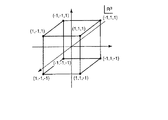
例えば、特開2001−285623号公報に記載されたシンプレクティック符号を用いることができる。シンプレックス符号とは、符号長n−1、符号語数nで、符号語間の相互相関が−1/(n−1)となる符号であり、n次のアダマール(Hadamard)行列を基に構成することができる。すなわち、符号語がn−1次元ユークリッド空間中のn−1次元単体の頂点に位置するような符号がシンプレックス符号である。例えば、3次元ユークリッド空間の場合は、図7に示すように(-1,-1,1),(1,-1,-1),(-1,1,-1)で示す3つの頂点に位置する符号がシンプレックス符号を構成する。
【0084】
さて、このようにして生成された識別情報に対応するシンボル列の各シンボルにそれぞれ対応する第1〜第M埋め込み符号は、電子透かし埋込装置1の符号埋込部13が、当該埋め込み符号の内容に従ってコンテンツを予め定められた方法で微少に変更することによって、対象コンテンツに埋め込まれる(ステップS3)。なお、コンテンツの変更の仕方には、まず埋め込み対象コンテンツに対して第1埋め込み符号R(1)を埋め込むようにコンテンツを変更し、次いで、該第1埋め込み符号R(1)を埋め込まれたコンテンツに対して第2埋め込み符号R(2)を埋め込むようにコンテンツを変更し…、というように、逐次的に埋め込みを行う方法や、埋め込み対象コンテンツに対して一挙に全埋め込み符号R(1)〜R(M)を埋め込むようにコンテンツを変更するようにする方法や、その他の方法がある。
【0085】
前述したように、生成された埋め込み符号を対象コンテンツに埋め込む方法(コンテンツのどのような量をどのように変更するか)には、特に限定はなく、どのような方法でも本発明は適用可能である。
【0086】
ただし、(識別情報に対応するシンボル列の)各シンボルにそれぞれ対応する埋め込み符号は、互いに影響が無いあるいは小さいように、符号構成や埋め込む場所や埋め込み方法等が選択されているようにする。
【0087】
次に、電子透かし解析装置2について説明する。
【0088】
ここで、結託攻撃及び結託者の追跡について、数値を小さくとって簡単にした例を用いて説明する。
【0089】
本実施形態では、結託攻撃として例えば複数の複製物の単純平均操作あるいは重み付け平均操作などを想定している。
【0090】
例えば、図6のユーザID=0,3,10の各ユーザが入手したコンテンツには、それぞれ、シンボル列として、
{a,a,a}
{a,d,d}
{b,a,d}
が埋め込まれている。
【0091】
ここで、上記の3人によって3つのコンテンツ複製物の単純平均操作による結託攻撃が行われたとする。
【0092】
本実施形態では、識別情報に対応するシンボル列の第1シンボル〜第Mシンボルのそれぞれにおいて、異なる元に対応する埋め込み符号を互いに相関の無いあるいは非常に小さい電子透かしとして埋め込まれている。しかして、抽出すべきシンボル列における第1シンボル〜第Mシンボルのそれぞれについて、最大剰余及び最小剰余(=剰余対)ではなく、埋め込み符号(すなわち、第1埋め込み符号〜第M埋め込み符号)を検出し、埋め込み符号をシンボルに戻して、シンボル列を抽出する。ここで、シンボル列における各序列のシンボルをそれぞれ検出するにあたって、結託攻撃に実際に使用されたコンテンツに埋め込まれていた複数のシンボルの元が検出されることがある(上記の具体例では、第1シンボルについて、aとb、第2シンボルについて、aとd、第3シンボルについて、aとdが検出され得る)。本実施形態では、第1〜第Mのシンボルの各々について、結託攻撃に最も数多く用いられたシンボルがいずれかを評価し、最大人口(highest population)と評価されるシンボルを検出し、その検出された最大人口シンボル(highestly populated alphabet)によるシンボル列に基づいて、結託者の識別情報を追跡する。
【0093】
なお、抽出すべきシンボル列のある序列のシンボルにおいて、最大人口シンボルとなる元が複数存在する場合には、いずれか1つのみを最大人口シンボルとして検出するようにしてもよいし、それら複数を最大人口シンボル(群)として検出するようにしてもよい。
【0094】
また、最大人口シンボル(群)に加えて、最大人口シンボル以外で検出されたシンボルをも考慮して、追跡を行うようにしてもよい。
【0095】
上記の具体例の場合、第1〜第3のシンボルのそれぞれについて、最も結託に用いられた数の多いシンボルの元が各シンボルの値として検出されるようなシンボル列が埋め込まれたコンテンツが作出されることになり、例えば、上記の例では、
{a,a,d}
というシンボル列が埋め込まれたコンテンツ複製物が作出される。この場合、本実施形態の電子透かし解析装置2は、{a,a,d}というシンボル列を検出する。
【0096】
ここで、図6を見てみると、{a,a,d}というシンボル列に対応する識別情報は存在しない。従って、正当な識別情報が改変されていることがわかる。また、最大人口シンボル以外にも、第1シンボルでは元b、第2シンボルでは元d、第3シンボルでは元aに対応する埋め込み符号を検出することができるので、このことからも、結託攻撃を受けたことがわかる。
【0097】
しかして、本実施形態の電子透かし解析装置2は、検出された最大人口シンボルによるシンボル列{a,a,d}(または、これに加えて、最大人口シンボル以外で検出されたシンボル)に基づいて、結託者の識別情報を追跡することができる。
【0098】
上記した例の場合、追跡アルゴリズム及びその前提となるシンボル列生成方法の構成方法に応じて、例えば、ある誤認識率を含んだ上で、例えばユーザID=0のみ(あるいは例えばID=0,3,10の全て)が特定され、あるいは誤認識なしに例えばユーザID=0のみ(あるいは例えばID=0,3,10の全て)が特定されることも可能になる。
【0099】
さて、追跡アルゴリズムとしては、様々なバリエーションが可能であるが、基本的には、抽出されたシンボル列に基づいて、結託攻撃に使用された複製物に埋め込まれていたであろう埋め込み符号/シンボル列に対応するユーザIDを求め、これを結託攻撃を行った結託者のユーザIDとして特定する。
【0100】
本実施形態では、結託攻撃後のコンテンツにおいて検出される最大人口によるシンボル列の第iシンボルの値は、結託攻撃を行った複数のユーザのうちのいずれかのユーザのユーザIDに対応するシンボル列の第iシンボルの値に一致する。よって、対象コンテンツから検出された最大人口による埋め込み符号から得られたシンボル列を解析することによって、かりにすべての結託者のユーザIDが特定できなかったとしても、一部の結託者のユーザIDを特定できることが期待される。
【0101】
また、抽出されたシンボル列が、いずれかの正当なユーザに対応するシンボル列と完全に一致する場合には、結託攻撃はなされていないことを特定することができる。ただし、抽出された最大人口によるシンボル列がいずれかの正当なユーザに対応するシンボル列と完全に一致しても、最大人口シンボル以外にも他のシンボルに対応する埋め込み符号が検出されている場合には、結託攻撃を行ったがシンボル列の改変に失敗したことが考えられ、この場合には、特定されたユーザIDは、結局、結託攻撃を行っていたことになる。
【0102】
追跡アルゴリズムの代表的な種類としては、確率論的方法や決定論的方法などがある。
【0103】
確率論的方法は、基本的には、対象コンテンツから検出されたシンボル列から選択された所定数のシンボルが、あるユーザIDを示していれば(すなわち、検出シンボル列から選択された所定数のシンボルの値と、あるユーザIDに対応する識別情報に対応するシンボル列の同じ序列位置のシンボルの値とがそれぞれ一致すれば)、それを結託者のユーザIDとして出力するものである。上記の所定数は、例えば、誤認識率等に応じて決定される(なお、誤認識は、例えば、該選択された所定数のシンボルが実際には一人のユーザにのみ属するものではなく、複数のユーザに分属するものである場合に、結託者でないユーザのユーザIDが偶然に出力されてしまうことで生じる)。誤認識をより低く抑えるためには、例えば、上記の所定数をより大きな値に設定すればよい。
【0104】
決定論的方法は、基本的には、検出されたシンボル列から、誤認識なしに結託者のユーザIDを特定できるようにするものである。すなわち、検出されたシンボル列が結託攻撃によって作出されるために必要不可欠であった結託者のユーザIDを解析的に特定するとともに、特定できない場合には追跡不能とする方法である。追跡不能(結託者のユーザIDがすべて特定不能)となるケースを0にするまたはより低く抑えるためには、例えば、ユーザIDの取り得る値の範囲を一定とした場合にシンボル列の要素数をより多くすればよい。
【0105】
図8に、概略的な手順の一例を示す。
【0106】
本実施形態の電子透かし解析装置2において、まず、埋め込み符号抽出部21は、検出対象となるコンテンツの複製物から埋め込み符号R’(1)、R’(2)、…、R’(M)を抽出する(ステップS21)。そして、シンボル列抽出部22は、抽出された埋め込み符号R’(1)、R’(2)、…、R’(M)から、対応するシンボル列{S’(1)、S’(2)、…、S’(M)}を求める(ステップS22)。
【0107】
図9に、埋め込み符号抽出部21の処理手順の一例を示す。
【0108】
埋め込み符号抽出部21は、追跡対象となるコンテンツの複製物から抽出すべきシンボル列の各シンボルS’(1)、S’(2)、…、S’(M)にそれぞれ対応する埋め込み符号R’(1)、R’(2)、…、R’(M)の各々について、当該埋め込み符号R’(i)として使用されている可能性のある各符号(すなわち、シンボルS’(i)の各元にそれぞれ対応する各埋め込み符号)の評価値をそれぞれ求め(評価値計算処理)(ステップS31)、各埋め込み符号R’(i)ごとに、求めた各符号の表価値に基づいて、第iの埋め込み符号を決定する(HPE(Highestly Populated Elements)計算処理)(ステップS32)。
【0109】
ここで、平均による結託攻撃の場合、Ω((L/ln n)1/2)人の結託によって電子透かしの消去が行えるという解析結果がある(例えば文献1「J.Kilian, F.T.Leighton, T.G.Shamoon, R.E.Tarjan and F.Zane, “Resistance of Digital Watermarks to Collusive Attacks”, NEC Research Institute, Technical Report TR-585-98, 1998.」)。ここで、Lはコンテンツのサイズ(電子透かしを埋め込める容量)、nは配布先となるユーザの総数とする。これより、最大結託サイズをcとすれば、長さL(Lはc2・ln nに比例する値)のコンテンツが必要となるため、cが大きくなると電子透かしが失われる。この解析は、電子透かしがランダムなガウシアンノイズとして重畳されることを仮定しており、平均による結託攻撃により電子透かしの平均は、中心極限定理によりcが大きくなると0になる。
【0110】
そこで、本実施形態では、前述したように、各ユーザIDに対応するシンボル列における第iシンボル(i=0〜M)に対して、N(i)個の元の集合={ai,0,ai,1,…,ai,N(i)-1}のうちから選択した1つの元ai,jに対応する埋め込み符号ri,j(ri,jは他の元ai,k(k≠j)に対応する埋め込み符号ri,k(k≠j)との間に相関の無いあるいは非常に小さい埋め込み符号)を電子透かしとして埋め込み、平均による結託攻撃が行われた場合には、剰余対(=最大剰余及び最小剰余)の集合ではなく、最大人口による第iシンボルを検出し、最大人口シンボルからなる抽出シンボル列を検出する方法をとっている。
【0111】
例えば文献1の解析では、電子透かしが一般的なガウシアンノイズとしてモデルされているが、この方法では、そのようなガウシアンノイズの成す空間のうち、非常に限定された(例えば、N(i)次元の)部分空間の中にしか電子透かしが値を取らない。しかも、それぞれの成分が直交しているため、平均をとっても、複数の電子透かしが相殺しあうことはない。
【0112】
最大人口シンボルに対応する埋め込み符号の抽出は、例えば、次のように行うことができる。
【0113】
抽出すべきシンボル列における第iシンボルに対して、上記の評価値計算処理として、各元ai,j(ここで、j=0〜N(i−1))に対して相互相関の無い埋め込み符号mi,jが対応している(つまり、mi,j・mi,k=δj・kとする)。第iシンボルについて、コンテンツIと、第iシンボルにおける各元ai,jに対応する埋め込み符号mi,jとの相互相関Ci,j=mi,j・Iを測定する。この相関値Ci,jを、第iシンボルに対応する第i埋め込み符号における当該符号mi,jの評価値とする。この値Ci,jが最大となるjmaxに係る埋め込み符号mi,jmaxが、第i埋め込み符号における最大人口シンボルに対応する埋め込み符号であり、これに対応する第iシンボルの元ai,jmaxが、求めるべき第iシンボルの最大人口シンボルとなる。
【0114】
図10は、抽出すべきシンボル列のある序列のシンボル(第1シンボルとする)に係る最大人口シンボルの決定を説明するための図である。第1シンボルの各元(本例では、a,b,c)にそれぞれ対応する第1の埋め込み符号の候補としての各符号についてそれぞれ求めれらた評価値を、ベクトルvで表すものとする。図10において、各軸は、第1シンボルの元に対応する。ベクトルvの方向が最も近い軸に対応する元を、求めるべきシンボル列における第1シンボルとして出力する。
【0115】
例えば、図11(a)のように、単純平均化法による結託攻撃に使用されたコンテンツの複製物の数が100(あるいは、重み付け平均化法による重みを考慮した延べ数が100)であり、第1シンボルにおいて、元a1,1,a1,2,a1,3,a1,4に対応する人口(結託攻撃に使用された当該元に係るコンテンツの複製物の数)がそれぞれ、53,23,8,13であったとすると、最大人口の第1シンボルa1,1に対応する埋め込み符号r1,1が、埋め込み符号抽出部21によって求められる。そして、シンボル列抽出部22は、抽出された第1の埋め込み符号r1,1を受け、これに対応するシンボルa1,1を第1シンボルとする。同様にして、最大人口による第2〜第Mシンボルが求められ、抽出すべきシンボル列が得られる。なお、結託攻撃に使用されたコンテンツの複製物に埋め込まれている識別情報の組み合わせによっては、図11(b)のように、ほとんど1つのシンボルに偏ることも、唯一のシンボルに偏ることもあり得る。
【0116】
なお、前述したように、抽出すべきシンボル列のある序列のシンボルにおいて、最大人口シンボルとなる元が複数存在する場合には、いずれか1つのみを最大人口シンボルとして検出するようにしてもよいし、それら複数を最大人口シンボル(群)として検出するようにしてもよい。
【0117】
また、最大人口シンボル(群)に加えて、最大人口シンボル以外で検出されたシンボルをも考慮して、追跡を行うようにしてもよい。
【0118】
次いで、追跡部23は、抽出されたシンボル列{S’(1)、S’(2)、…、S’(M)}に対して、追跡アルゴリズムを実行する(ステップS23)。
【0119】
まず、確率論的方法による追跡アルゴリズムの一例について説明する。
【0120】
最大人口シンボル(群)からなるシンボル列に基づいて確率論的に結託者を特定する方法は、例えば、c−secure CRT符号において、マーキング仮定を変更することで得られる。ここでは、第iシンボルにおいて、最大人口シンボルとしてある元ai,jが検出される確率は、1/N(i)であるという仮定をおく。これは、結託がランダムに構成されるとすれば妥当な仮定である(あるいは、第iシンボル内でシンボルの元の間でランダムな置換を行うこととし、検出時の確率は、すべてのランダムな置換にわたってとることとすれば、妥当な仮定となる)。
【0121】
図12に、この場合の処理手順の一例を示す。
【0122】
まず、すべてのユーザID(=Uiとする)について、D(Ui)を求める(ステップS41)。
【0123】
ここで、D(Ui)は、該ユーザID=Uiのユーザに割り当てられるシンボル列{S(1)、S(2)、…、S(M)}={Ui mod N(1)、Ui mod N(2)、…、Ui mod N(M)}と、抽出されたシンボル列{S’(1)、S’(2)、…、S’(M)}とを、両シンボル列で同一の序列に位地するもの同士でそれぞれ比較した場合に、一致したシンボルの個数を表す。
【0124】
次に、各ユーザID=Uiに対して求めたD(Ui)について、当該D(Ui)と、あらかじめ定められたしきい値Dthとを比較し、D(Ui)≧Dthならば、そのユーザID=Uiを、結託者のユーザIDと特定する(ステップS42)。
【0125】
なお、Dthは、例えば、Dth=k+lで、kは、N(0),…,N(k)の積を、ユーザID(識別情報)の総数以上とするような値(ここで、N(0)≦N(1)≦…≦N(M)とする)であり、lは、例えば、式(1)で与えられる。
[1−Π 1/N(i)]S≧1−ε2 (1)
ここで、Πをとるiの範囲は、i=0〜(l−1)あるいはi=k〜(k+l−1)、
S=MCk+l、
ε2は、結託者のユーザID(識別情報)における追跡誤り率で、0<ε2<1を満たす。
【0126】
例えば、前述の具体例において、図6のユーザID=0,3,10の各ユーザが入手したコンテンツには、それぞれ、シンボル列として、
{a,a,a}
{a,d,d}
{b,a,d}
が埋め込まれており、それら3人によって3つのコンテンツ複製物の単純平均操作による結託攻撃が行われて、
{a,a,d}
というシンボル列が埋め込まれたコンテンツ複製物が作出されたものとする。
【0127】
ここで、{a,a,d}という抽出シンボル列が得られたとする。
【0128】
ユーザID=0について、これに固有に割り当てられたシンボル列と、抽出シンボルとを比較すると、第1シンボルはいずれも{a}で一致し、第2シンボルはいずれも{a}で一致し、一方、第3シンボルは{a}と{d}で一致しないので、この場合、D(0)=2となる。同様に、D(3)=2、D(10)=2となる。
【0129】
ここで、かりにDth=2ならば、図6のユーザID=0〜14のうち、ユーザID=0,3,10の3人のみが、D(0)≧Dth、D(3)≧Dth、D(10)≧Dthを満たすので、この場合には、ユーザID=0,3,10が、結託者のユーザIDとして特定される。
【0130】
ここで、従来のc−secure CRT符号は、各内符号が複数のブロックで構成され、各ブロックのビット反転を観測することで、最大剰余及び最小剰余を検出しており、さらにブロックを構成する各ビットは、例えば、電子透かしとして埋め込まれることを想定していたのに対して、本実施形態では、シンボル列の元が電子透かしとして埋め込まれており、最大人口シンボルを検出することで、内符号感度の問題を軽減できるとともに、符号の構成が単純になったため符号長の短縮にもつながる。前述したように、外符号としては、c−secure CRT符号の外符号のマーキング仮定の変更を反映したc−secure性のための条件から決定された個数の内符号を用意することで、c−secure CRT符号と同様の追跡が行える。
【0131】
ここで、文献2「Y.Yacobi, “Improved Boneh-Shaw content fingerprinting”, Topics in Cryptology - C-RSA 2001, 378-391, 2001.」に提案されている方法との差異を述べておく。文献2では、内符号のブロックを電子透かしで置き換える方法を提案している。この場合、最大剰余及び最小剰余を求める内符号感度の問題は解決されていない。しかし、文献2では、外符号として、文献3「D.Boneh and J.Shaw, “Collusion-Secure Fingerprinting for Digital Data”, Advance in Cryptology: Proceedings of CRYPTO’95, Springer-Verlag, 452-465, 1995.」や文献4「D.Boneh and J.Shaw, “Collusion-Secure Fingerprinting for Digital Data”, IEEE Transactions on Information Theory, 44, 5, 1897-1905, 1998.」で提案されているような誤り訂正符号を用いた外符号、あるいは、ランダム符号による符号の構成を前提としている。これらの外符号では、最大剰余及び最小剰余は必要ではなく、剰余の中から1つ検出できていればよい。ただし、この外符号は、O(c2・log n)の長さを持つことから、cが大きくなると急速に符号長が大きくなる。
【0132】
次に、決定論的方法による追跡アルゴリズムの一例について説明する。
【0133】
決定論的方法による追跡アルゴリズムは、例えば、文献5「H.Muratani, “Combination Outer Codes for c-secure CRT Codes”, SCIS2002, 13D-3, 2002.」の方法を利用することができる。この場合、想定する最大の結託者数cが大きいときは埋め込み符号の符号長をある程度符号長を長くするのが好ましいが、cが小さいときは確率論的方法による追跡アルゴリズムにおける埋め込み符号よりも短い符号長で済むことになる。
【0134】
誤検出を0または非常に小さくするために、想定する最大の結託者数cと、シンボル列の要素数Mと、使用する識別情報の範囲(例えば、0から始まる連番)との間に、一定の制約を与えるようにしてもよい。例えば、M>c2・(K−1)とするようにしてもよい。
【0135】
ここで、追跡アルゴリズムでは、結託攻撃が行われる際の最大結託数をcと想定する。すなわち、2≦a≦cを満たす任意のa人の結託者すなわちa個の相互に異なる識別情報の埋め込まれたコンテンツの複製物により結託攻撃が行われる場合を考える(なお、ここでは、ユーザと識別情報とが1対1に対応するものとして考えているが、例えば、ユーザと識別情報とが1対多対応となり得る場合であって、実際に同一の結託者が自身に対応する2つの識別情報をそれぞれ埋め込まれた同一のコンテンツについての2つの複製物を当該結託攻撃に供する際には、結託者の数とは、異なる識別情報を埋め込まれたコンテンツの複数物ごとに考えることになる)。
【0136】
以下では、a(2≦a≦c)個の相互に異なる識別情報の埋め込まれたコンテンツの複製物により結託攻撃を行う際に供される当該複数のコンテンツの複製物にそれぞれ埋め込まれた識別情報により構成される識別情報群を、結託者グループと呼ぶものとする。例えば、図6の例では、識別情報=ユーザID=0〜14であるので、最大結託数c=3とすると(実際には識別情報の範囲や最大結託数はもっと大きく取られる)、結託者グループには、{0,1}、{0,2}、…、{0,14}、{1,1}、{1,2}、…、{1,14}、{2,3}、…{2,14}、{3,4}、…、{11,14}、{12,13}、{12,14}、{13,14}(以上、a=2による結託)、{0,1,2}、{0,1,3}、…、{0,1,14}、{0,2,3}、{0,2,4}、…、{0,2,14}、{0,3,4}、…、{10,11,14}、{11,12,13}、{11,12,14}、{12,13,14}(以上、a=3による結託)がある。最大結託数c=3以下での結託攻撃は、必ず、上記の結託者グループのいずれかによって行われる。
【0137】
次に、追跡対象コンテンツから抽出された抽出シンボル列を入力し、これに適合する結託者グループを出力する。
【0138】
ここで、ある結託者グループが抽出シンボル列に適合するとは、次の場合である。すなわち、その結託者グループを構成する複数の識別情報の各々に固有に対応するシンボル列を基にして、何らかの結託による操作(例えば平均操作)により、当該抽出シンボル列が作出され得るものと判断される場合に、当該ある結託者グループが、当該抽出シンボル列に適合すると判断する。
【0139】
例えば、図6の具体例において、あるコンテンツから、
{a,a,d}
というシンボル列が抽出された場合に、前述の図6のユーザID=0,3,10からなる結託者グループは、当該抽出シンボル列{a,a,d}に適合することになる。
【0140】
適合する結託者グループの数は、抽出シンボル列の内容によって、1つになる場合と、複数になる場合とがあり得る。
【0141】
なお、抽出されたシンボル列が、いずれかの正当なユーザに対応するシンボル列と完全に一致し、かつ、最大人口シンボル以外のシンボルが存在しない場合には、結託攻撃はなされていないことを特定することができる。ただし、抽出された最大人口によるシンボル列がいずれかの正当なユーザに対応するシンボル列と完全に一致しても、最大人口シンボル以外にも他のシンボルに対応する埋め込み符号が検出されている場合には、結託攻撃を行ったがシンボル列の改変に失敗したことが考えられ、この場合には、特定されたユーザIDは、結局、結託攻撃を行っていたことになる。
【0142】
また、何らかの理由により、適合する結託者グループが得られない場合は、、エラーとなる。
【0143】
さて、次に、抽出シンボル列に対して、1つの結託者グループのみが得られた場合には、該結託者グループを構成する識別情報を全て、結託者の識別情報とすればよい。
【0144】
一方、2以上の結託者グループが得られた場合には、得られた全ての結託者グループに共通に存在する(1又は複数の)識別情報のみを、結託者の識別情報とすればよい。なお、この共通に存在する識別情報を、共通識別情報と呼ぶものとする。
【0145】
ここで、同一の剰余対表現から複数の結託者グループが得られた場合には、いずれの結託者グループが、実際に結託攻撃に参加したであろう結託者のユーザID(識別情報)に対応するものかは、(抽出シンボル列のみからは)わからない。しかし、(結託攻撃が最大結託者数以下の結託者数で行われたとすれば)、それらのうちのいずれか1つの結託者グループが、求めるべき結託者グループである。したがって、得られた複数の結託者グループの全てに共通に存在する識別情報があれば、少なくともその識別情報(すなわち共通識別情報)は、実際に結託攻撃に参加したであろう結託者の識別情報である。
【0146】
なお、2以上の結託者グループが得られた場合であっても、共通識別情報が1つもないときは、特定不能とする。なお、得られた複数の結託者グループに共通識別情報が存在しないケースが理論的には発生しないように構成した場合には、得られた複数の結託者グループに共通識別情報が存在しないケースは何らかのエラーによってのみ発生することになる。
【0147】
このように、実際に結託攻撃に参加したであろう結託者が、たとえ全ては分からなくても、確実に一人でも分かるということは、デジタルコンテンツの違法コピーに対する事前の抑制や著作権侵害が発生したときの事後の救済のために、非常に大きな意味がある。
【0148】
ところで、複数の結託者グループが得られたものの共通識別情報が存在しないケースは、できるだけ少なく抑えらるのが望ましい。そして、このようなケースは、何らかの手段によって、少なくすることができる。
【0149】
例えば、複数の結託者グループが得られたものの、共通識別情報が存在しないようなケースを探索し、そのような結託者グループを構成する識別情報の全部又は一部を使用しないようにすることも、一つの方法である。
【0150】
また、例えば、想定する最大の結託者数cを一定とすれば、定性的には、整数の個数M(=成分符号の個数)を増加させるほど、あるいは使用する識別情報の範囲を減少させるほど、上記のケースを少なくすることができる。
【0151】
図13に、この場合の処理手順の一例を示す。
【0152】
まず、与えられた抽出シンボル列に適合する結託者グループを全て求める(ステップS51)。
【0153】
求められた結託者グループの数が1である場合(ステップS52)、求められた結託者グループを構成する全てのユーザIDを結託者のユーザID(結託者ID)とし(ステップS53)、求められた結託者IDを出力する(ステップS56)。
【0154】
求められた結託者グループの数が2以上である場合(ステップS52)、求められた全ての結託者グループに共通に存在するユーザIDがあれば(ステップS54)、求められた全ての結託者グループに共通に存在する(1又は複数の)ユーザIDのみを結託者IDとし(ステップS55)、求められた結託者IDを出力する(ステップS56)。一方、求められた全ての結託者グループに共通に存在するユーザIDがなければ(ステップS54)、結託者IDが得られなかった旨(またはその旨及び結託者グループを特定する情報、またはその旨及び抽出シンボル列)を出力する(ステップS57)。
【0155】
なお、ステップS2で結託者グループが1つも得られない場合には、エラーとなる。
【0156】
なお、ユーザIDの総数が大きい場合には、全ての結託者グループに対して、この処理を行うことは、コストが大きいので、例えば、結託者グループのサイズに関する条件や、現実の結託攻撃がそれを破る確率は十分に小さいと考えられる条件などによって、限定された結託者グループに対してのみ、この処理を行うようにしてもよい。
【0157】
さて、符号の構成方法としては、誤り訂正符号をc−secure CRT符号の外符号に用いる方法もある。この場合にも、決定論的な追跡を行う方法と、確率論的な追跡を行う方法がある。決定論的な追跡を行う外符号については、文献3,文献4,文献6「B.Chor, A.Fiat and M.Naor, “Tracing Traitors”, Advances in Cryptology-CRYPTO’94, LNCS 839, 257-270, 1994.」,文献7「H.D.L.Hollmann, J.H.van Lint, J.-P.Linnartz and L.M.G Tolhuizen, “On codes with the indentifiable parent property”, Jounal of Combinatorial Theory, 82, 121-133, 1998.」,文献8「J.N.Staddon, D.R.Stinson and R.Wei, “Combinational Properties of frameproof and treacability code”, 2000.」,文献9「R.Safavi-Naini and Y.Wang, “Collusion Secure q-ary Fingerprinting for Perceptual Content”, Warkshop on Security and Privacy in Digital Rights Management 2001, November, 2001.」に符号の提案がある。
【0158】
確率論的な追跡については、従来のc−secure CRT符号(例えば、文献10「H.Muratani, “Collusion Resilience of digital watermarking”, SCSI2000, C06, 2000.」や文献11「H.Muratani, “Collusion-Secure Fingerprinting Code Reduced by Chinese Remaindering and its Random-Error Resilisence”, infomation hiding, Proceedings of the 4th International Workshop, IH 2001, 303-315, 2001.」)の外符号の拡張を行うことで構成できる。
【0159】
以下、Reed−Solomon符号を使った例を説明する。
【0160】
ここで、N=c(k+l)とする。Cをnarrow sense[N,k,N−k+1]q Reed−Solomon符号とする。
【0161】
次の式(2)の条件が満たされるとき、この符号は、確率論的外符号とできる。
[1−1/ql]S≧1−ε (2)
ここで、S=MCk+l、
q=N(0)=N(1)=…=N(M)、
εは、結託者のユーザID(識別情報)における追跡誤り率で、0<ε<1なる実数とする。
【0162】
この場合に、先に例示した確率論的方法による追跡アルゴリズムの一例を適用することも可能である。なお、この場合には、先に例示した確率論的方法による追跡アルゴリズムの一例で、しきい値Dth=k+lにおいて、lは、式(1)の代わりに、例えば、式(2)で与えられるものとしてもよい。
【0163】
もちろん、この場合に、先に例示した決定論的方法による追跡アルゴリズムの一例を適用することも可能である。
【0164】
この符号は、AG(Algebraic Geometyr)符号をベースにした構成も可能である。
【0165】
以下では、本実施形態のハードウェア構成、ソフトウェア構成について説明する。
【0166】
本実施形態の電子透かし解析装置は、ハードウェアとしても、ソフトウェア((コンピュータに所定の手段を実行させるための、あるいはコンピュータを所定の手段として機能させるための、あるいはコンピュータに所定の機能を実現させるための)プログラム)としても、実現可能である。また、電子透かし解析装置をソフトウェアで実現する場合には、記録媒体によってプログラムを受け渡しすることも、通信媒体によってプログラムを受け渡しすることもできる。もちろん、それらは、電子透かし埋込装置についても同様である。
また、電子透かし埋込装置や電子透かし解析装置をハードウェアとして構成する場合、半導体装置として形成することができる。
また、本発明を適用した電子透かし解析装置を構成する場合、あるいは電子透かし解析プログラムを作成する場合に、同一構成(あるいは、共有もしくは使い回し可能な構成)を有するブロックもしくはモジュールがあっても、それらをすべて個別に作成することも可能であるが、同一構成(あるいは、共有もしくは使い回し可能な構成)を有するブロックもしくはモジュールについては1または適当数のみ用意しておいて、それをアルゴリズムの各部分で共有する(使い回す)ことも可能である。電子透かし埋込装置を構成する場合、あるいは電子透かし埋め込みプログラムを作成する場合も、同様である。また、電子透かし埋込装置および電子透かし解析装置を含むシステムを構成する場合、あるいは電子透かし埋め込みプログラムおよび電子透かし検出プログラムを含むシステムを作成する場合には、電子透かし埋込装置(あるいはプログラム)と電子透かし解析装置(あるいはプログラム)に渡って、同一構成(あるいは、共有もしくは使い回し可能な構成)を有するブロックもしくはモジュールについては1または適当数のみ用意しておいて、それをアルゴリズムの各部分で共有する(使い回す)ことも可能である。
【0167】
また、電子透かし埋込装置や電子透かし解析装置をソフトウェアで構成する場合には、マルチプロセッサを利用し、並列処理を行って、処理を高速化することも可能である。
【0168】
また、これまで説明してきた構成は、装置の一部としてだけでなく、それ自体が一つの装置として成立可能である。例えば、電子透かし解析装置の復号部22は、電子透かし解析装置を構成する一体不可分の構成部分としても、電子透かし解析装置を構成する部品あるいはモジュール等としも、独立した復号装置としても成立する。
【0169】
なお、この発明の実施の形態で例示した構成は一例であって、それ以外の構成を排除する趣旨のものではなく、例示した構成の一部を他のもので置き換えたり、例示した構成の一部を省いたり、例示した構成に別の機能あるいは要素を付加したり、それらを組み合わせたりすることなどによって得られる別の構成も可能である。また、例示した構成と論理的に等価な別の構成、例示した構成と論理的に等価な部分を含む別の構成、例示した構成の要部と論理的に等価な別の構成なども可能である。また、例示した構成と同一もしくは類似の目的を達成する別の構成、例示した構成と同一もしくは類似の効果を奏する別の構成なども可能である。
また、この発明の実施の形態で例示した各種構成部分についての各種バリエーションは、適宜組み合わせて実施することが可能である。
また、この発明の実施の形態は、個別装置としての発明、関連を持つ2以上の装置についての発明、システム全体としての発明、個別装置内部の構成部分についての発明、またはそれらに対応する方法の発明等、種々の観点、段階、概念またはカテゴリに係る発明を包含・内在するものである。
従って、この発明の実施の形態に開示した内容からは、例示した構成に限定されることなく発明を抽出することができるものである。
【0170】
本発明は、上述した実施の形態に限定されるものではなく、その技術的範囲において種々変形して実施することができる。
【0171】
【発明の効果】
本発明によれば、結託攻撃に用いられたコンテンツの複製物に埋め込まれていたであろう識別情報を、より感度の高い符号によって推定することができるようになる。
【図面の簡単な説明】
【図1】本発明の一実施形態に係る電子透かし埋込装置及び電子透かし解析装置を含むコンテンツ流通システムの概略構成を示す図
【図2】同実施形態に係る電子透かし埋込装置の構成例を示す図
【図3】同実施形態に係る電子透かし解析装置の構成例を示す図
【図4】同実施形態に係る電子透かし埋込装置の概略的な手順の一例を示すフローチャート
【図5】同実施形態に係る識別情報とシンボル列の具体例について説明するための図
【図6】同実施形態に係る識別情報とシンボル列の具体例について説明するための図
【図7】シンプレックス符号について説明するための図
【図8】同実施形態に係る電子透かし解析装置の概略的な手順の一例を示すフローチャート
【図9】同実施形態に係る埋め込み符号抽出部の処理手順の一例を示すフローチャート
【図10】同実施形態に係る最大人口シンボルについて説明するための図
【図11】同実施形態に係る最大人口シンボルについて説明するための図
【図12】同実施形態に係る追跡部の処理手順の一例を示すフローチャート
【図13】同実施形態に係る追跡部の処理手順の他の例を示すフローチャート
【符号の説明】
1…電子透かし埋込装置
2…電子透かし解析装置
3…流通経路
11…シンボル列生成部
12…埋め込み符号生成部
13…符号埋込部
21…埋め込み符号抽出部
22…シンボル列抽出部
23…追跡部[0001]
BACKGROUND OF THE INVENTION
The present invention corresponds to a digital watermark embedding device and a digital watermark embedding method for generating an embedded code corresponding to identification information and embedding it in a copy of the content, and an embedded code embedded in the copy of the content used in the collusion attack The present invention relates to a digital watermark analysis apparatus and method for obtaining identification information, and a program.
[0002]
[Prior art]
Digital content (for example, still images, moving images, audio, music, etc.) has a structure composed of a large number of digital data. In the structure, there is a portion that can maintain the identity or economic value of the digital content work even if the data is changed. Various information can be embedded in the digital content by appropriately changing data within such an allowable range. Such a technique is well known as a digital watermark.
[0003]
With digital watermark technology, various kinds of watermark information (for example, information for identifying the copyright holder or user of the content, copyright holder's rights information, content usage conditions, confidential information necessary for the use, copy control) It is possible to embed, detect, and use information or the like for a variety of purposes (for example, copyright control including copy control, promotion of secondary use, etc.).
[0004]
Here, for example, as a technique applied when distributing the same digital content to a large number of users, information for uniquely identifying the copy of the digital content (for example, unique to the user ID) Consider the case of embedding watermark information corresponding to.
[0005]
The method of embedding identification information (corresponding code) unique to a copy of a digital content is leaked by detecting the identification information from the pirated copy when the copy of the digital content is further copied and circulated as a pirated copy. Since the original user can be specified, it functions as a pre-suppression against illegal copying of digital contents, and also serves as a post-relief when copyright infringement occurs.
[0006]
In addition, in order for a user to invalidate identification information embedded in a copy of digital content, the user does not know which part is a bit constituting identification information (corresponding code). It is necessary to make considerable modifications to the copy of the digital content, and this will detract from the economic value of the digital content, thereby depriving the motivation of illegal copying.
[0007]
In this situation, “collusion attack” has emerged as a method for making illegal copying possible.
[0008]
The collusion attack uses the fact that different identification information is embedded in different copies. For example, by bringing duplicates with multiple people and comparing them bit by bit, finding parts with different digital data values and falsifying the parts (for example, majority vote, minority vote, randomize, etc.) Falsify and erase identification information. Alternatively, the identification information is falsified and lost by performing an operation such as averaging pixel values between contents without performing a specific comparison operation.
[0009]
For example, in a simple example, each copy of Mr. A, Mr. B, and Mr. C
A: 10:00 ... 00 ...
B: 00 ... 11 ...
C: 11 ... 01 ...
If the identification information (actually, the corresponding code) is embedded, for example, by majority vote or averaging,
10 ... 01 ...
In this way, it is possible to cause content in which identification information different from any of Mr. A, Mr. B, and Mr. C is detected.
[0010]
Therefore, resistance to collusion attacks, that is, a method of embedding a code (referred to as collusion-resistant code) having a property capable of specifying all or part of the collusioner even when subjected to a collusion attack as a digital watermark and the collusion-resistant code Various tracking algorithms (algorithms; algorithms for identifying an identification number embedded in content used in a collusion attack and identifying a colluder's user ID) have been proposed. For example, c-secure code (D. Boneh and J. Shaw, “Collusion-Secure Fingerprinting for Digital Data,” CRYPTO'95, 180-189, 1995.) and c-secure CRT code (Hirofumi Muratani, “A Collusion- Examples are “Secure Fingerprinting Code Reduced by Chinese Remaindering and its Random-Error Resilience”, Information Hiding Workshop 2001, 301-315, 2001, and JP 2001-285623 A).
[0011]
Here, the c-secure CRT code will be briefly described.
[0012]
The c-secure CRT code has a concatenated code structure formed by concatenating M component codes. For example, the first component code W (i) is composed of only 0, is composed of only 1, or is a mixture of 0 and 1 (however, there is only one boundary between 0 and 1). It is a long bit string, and by the remainder when the identification information u is divided by the modulus p (i), the number of 0 bits and the number of 1 bits included in the component code W (i), that is, the component code W (i ) To determine the boundary position between the 0 series and the 1 series.
[0013]
For example, M = 3, p (1) = 3, p (2) = 5, p (3) = 7, and component code W (i) as Γ 0 (n, d) code (consecutive bits consisting of only 1 or 0 are taken as one unit B (j) and B (0) to B (n-2) are connected; however, B (0) to B (N-2) is all 0 only, all 1 only, or B (0) -B (m-1) is only 0 and B (m) -B (n -2) is assumed to use only 1) (d = 3) and identification information = user ID.
For example, the code corresponding to user ID = 2 is
000000 000000111111 000000111111111111
The code corresponding to user ID = 3 is
111111 000000000111 000000000111111111
It becomes.
[0014]
In this case, comparing the contents held by the user with the user ID = 2 and the two users with the user ID = 3, the first to sixth, the 13th to the fifteenth, the 25th to the 27th among the 36 bits. You can see that the numbers are different. Therefore, in order to understand that they are part of the code corresponding to the identification information, some of the 1st to 6th, 13th to 15th, 25th to 27th are tampered, for example,
010101 000000010111 000000101111111111
In this way, a content is created in which identification information different from both user ID = 2 and user ID = 3 is detected.
[0015]
However, the code corresponding to the valid user ID does not have a portion where 1 or 0 of a number less than a predetermined block size d (in the above example, 3) bits is present in isolation. On the other hand, the code detected from the content subjected to the collusion attack as described above is a mixture of 0 and 1 for the code portion that is different between the brought contents, that is, d (in the above example) In this case, 3) it can be seen that there is a part where 1 or 0 of a number less than a bit exists in isolation.
[0016]
Therefore, in the tracking algorithm, each component code of the detected code is examined, and a component code in which a predetermined number of 1s and 0s less than d (in the above example, 3) is isolated is detected. If so, it can be determined that a collusion attack has been made.
[0017]
By the way, in the c-secure CRT code, the i-th component code W (i) of the code detected from the tracked content is the first element that appears only when viewed from the leftmost bit, and 1 and 1 Represents the position of the boundary between the element consisting only of 1 and the element including 0, which appears for the first time when viewed from the rightmost bit. Assuming that (integer value) is the maximum residue, the maximum residue and the minimum residue (= remainder pair) have the property of being equal to the residue for the identification information u of any colluder, i.e., u mod p (i). When the i-th component code W (i) consists only of 0, the minimum remainder = maximum remainder = p (i) −1, and the i-th component code W (i) consists of only 1 , There is no boundary between an element consisting only of 0 and 1 and an element including 0 if there is no boundary between an element consisting only of 0 and an element including 1 In this case, the maximum remainder = p (i) −1.
[0018]
Therefore, by analyzing the remainder pair obtained from each component part number of the c-secure CRT code detected from the tracking target content, one piece of identification information that would have been embedded in the duplicate used in the collusion attack. Part or all can be requested.
[0019]
In the above example,
010101 000000010111 000000101111111111
From the sign
As identification information of colluders, user ID = 2 and user ID = 3 can be specified.
[0020]
This c-secure CRT code is based on the following marking assumption. In other words, if there is a colluder participating in a collusion attack with a different value for a bit in a component code, the bit in the component code generated as a result of the collusion attack The value of is determined probabilistically. Therefore, when the block size d increases to some extent, the minimum residue and the maximum residue can be detected correctly.
[0021]
[Problems to be solved by the invention]
In the c-secure CRT code, in a specific case, there may be a case where the minimum residue and the maximum residue cannot be detected correctly from the tracked content.
[0022]
For example, when considering a collusion attack with 100 people, in a block in the component code, it is assumed that
[0023]
The present invention has been made in consideration of the above circumstances, and it embeds a digital watermark that makes it possible to estimate identification information that would have been embedded in a copy of content used in a collusion attack by a more sensitive code. It is an object to provide an apparatus, a digital watermark analysis apparatus, a digital watermark embedding method, a digital watermark analysis method, and a program.
[0024]
[Means for Solving the Problems]
The present invention provides a first generation means for generating a symbol string comprising a sequence of a plurality of symbols having an order, which uniquely corresponds to identification information to be embedded as a digital watermark in a copy of a digital content, A second generation means for generating a corresponding embedded code for each of the symbols in the respective ranks constituting the symbol string, and a copy of the digital content with the embedded codes respectively corresponding to the generated symbols of the respective ranks Code embedding means for embedding in a product as a digital watermark, and the second generation means has no cross-correlation between embedding codes corresponding to different symbols belonging to the same order in each order of the symbol series Alternatively, the embedded code is generated so as to be a small random number sequence.
In addition, the present invention is used for a collusion attack on a copy of an illegal digital content created by a collusion attack based on a copy of a plurality of digital contents in which different identification information is embedded as a digital watermark. A digital watermark analysis apparatus for specifying identification information embedded in a copy of a digital content, wherein a plurality of embedded codes having an order are extracted from the copy of the digital content, respectively. Extraction means; second extraction means for obtaining symbols respectively corresponding to the extracted embedded codes; and determining the symbol strings by arranging the determined symbol sequences in accordance with an order of corresponding embedded codes; and the collusion The symbol sequence extracted from the copy of the digital content used in the attack and each legitimate Tracking means for identifying identification information embedded in a copy of the digital content used in the collusion attack based on a symbol string uniquely assigned to each other information, the first extraction means Is characterized in that an embedded code evaluated to be most frequently used in the collusion attack is extracted for each of the ranks.
In addition, the present invention is used for a collusion attack on a copy of an illegal digital content created by a collusion attack based on a copy of a plurality of digital contents in which different identification information is embedded as a digital watermark. A digital watermark analysis apparatus for specifying identification information embedded in a copy of a digital content, wherein a plurality of embedded codes having an order are extracted from the copy of the digital content, respectively. Extraction means; second extraction means for obtaining symbols respectively corresponding to the extracted embedded codes; and determining the symbol strings by arranging the determined symbol sequences in accordance with an order of corresponding embedded codes; and the collusion The symbol sequence extracted from the copy of the digital content used in the attack and each legitimate Tracking means for identifying identification information embedded in a copy of the digital content used in the collusion attack based on a symbol string uniquely assigned to each of the different information, and the second extraction means For all the identification information, based on the result of comparing the symbol string uniquely corresponding to the identification information and the extracted symbol string obtained from the copy of the target digital content, The identification information embedded in the copy of the digital content used is specified.
In addition, the present invention is used for a collusion attack on a copy of an illegal digital content created by a collusion attack based on a copy of a plurality of digital contents in which different identification information is embedded as a digital watermark. A digital watermark analysis apparatus for specifying identification information embedded in a copy of a digital content, wherein a plurality of embedded codes having an order are extracted from the copy of the digital content, respectively. Extraction means; second extraction means for obtaining symbols respectively corresponding to the extracted embedded codes; and determining the symbol strings by arranging the determined symbol sequences in accordance with an order of corresponding embedded codes; and the collusion The symbol sequence extracted from the copy of the digital content used in the attack and each legitimate Tracking means for identifying identification information embedded in a copy of the digital content used in the collusion attack based on a symbol string uniquely assigned to each of the different information, and the second extraction means Is a collusion group consisting of a combination of arbitrary identification information based on a collusion number equal to or less than a predetermined maximum collusion number, or the symbol string extracted from a copy of the target digital content can be created 1 or Identify multiple collusion groups and identify them as identification information embedded in a copy of the digital content used in the collusion attack based on the combination of identification information that constitutes each of the identified collusion groups It is characterized by doing.
[0030]
The present invention relating to the apparatus is also established as an invention relating to a method, and the present invention relating to a method is also established as an invention relating to an apparatus.
Further, the present invention relating to an apparatus or a method has a function for causing a computer to execute a procedure corresponding to the invention (or for causing a computer to function as a means corresponding to the invention, or for a computer to have a function corresponding to the invention. It is also established as a program (for realizing) and also as a computer-readable recording medium on which the program is recorded.
[0031]
According to the present invention, identification information that would have been embedded in a duplicate of content used in a collusion attack can be estimated by a more sensitive code. It is also effective for shortening the code length.
[0032]
DETAILED DESCRIPTION OF THE INVENTION
Hereinafter, embodiments of the invention will be described with reference to the drawings.
[0033]
A case will be described in which different identification information is embedded as watermark information for each copy of the same digital content (for example, still images, moving images, audio, music, etc.) and traced. In the following, as identification information, a user corresponding to the copy, that is, a user who will use the copy (for example, an object to which the copy is transferred, leased or provided through a recording medium or a communication medium as an intermediary) The user identifier (user ID) of the user) will be mainly described. However, information obtained by performing a predetermined conversion on the user ID may be used as identification information, or information other than the user ID or information other than the user ID. Information obtained by converting may be used as identification information. Note that the user ID may include information such as the date of use and the place of use.
[0034]
Of course, various other watermark information (for example, information on the copyright holder of the content, information on the rights of the copyright, information on the usage conditions of the content, etc.) Confidential information, copy control information, etc., or a combination thereof may be embedded and detected for various purposes (eg, usage control, copyright protection including copy control, promotion of secondary use, etc.) However, when other watermark information is used, the configuration of the portion related to the other watermark information is arbitrary.
[0035]
The configuration diagram shown below is established as a functional block diagram of the apparatus, and also as a functional module diagram or procedure diagram of software (program).
[0036]
FIG. 1 shows a conceptual diagram of a system to which a digital watermark embedding apparatus and a digital watermark analysis apparatus according to an embodiment of the present invention are applied.
[0037]
The digital
Further, for example, the digital
In the former case, the watermark information is embedded in the copy of the digital content before the copy is delivered to the user. In the latter case, the watermark information is embedded before the copy is made available to the user. It will be.
[0038]
The digital
The digital
[0039]
FIG. 2 shows a configuration example of the digital
[0040]
As shown in FIG. 2, the digital
[0041]
When the electronic
[0042]
For example, when the identification information is not equal to the user ID and the user ID is given, preprocessing such as converting the given user ID into the identification information is performed.
[0043]
A copy of the content corresponding to the identification information obtained by the digital
[0044]
Here, as a collusion attack, for example, a simple average operation (average of all content to be collocated is averaged) or a weighted average operation (weight of all content to be collocated is not all the same). For example).
[0045]
FIG. 3 shows a configuration example of the digital
[0046]
As shown in FIG. 3, the digital
[0047]
The embedded
[0048]
The symbol string extraction unit 22 obtains corresponding extracted symbols from the extracted extracted embedded codes, and outputs a symbol string composed of the extracted symbols.
[0049]
The
[0050]
For example, when the identification information is not equal to the user ID and the user ID needs to be obtained, post-processing such as further converting the identified identification information into a user ID is performed.
[0051]
Note that there are various tracking algorithms and symbol string generation methods that serve as the premise thereof. For example, a stochastic method for obtaining identification information of a colluder by allowing a certain false detection, or a colluder without false detection. There is a deterministic method for obtaining the identification information.
[0052]
Hereinafter, this embodiment will be described in more detail.
[0053]
In the following, the case of identification information = user ID will be described as a specific example (therefore, in the following description, when identification information = user ID is described, the user ID generally refers to identification information). Meaning).
[0054]
In the following description, it is assumed that each identification information is assigned a symbol string that is unique to the identification information. A method of allowing a plurality of pieces of identification information to correspond to a certain symbol string is also possible.
[0055]
First, the digital
[0056]
FIG. 4 shows an example of a schematic procedure.
[0057]
First, the symbol
[0058]
Here, S (1) represents a symbol string assigned to the identification information, that is, a symbol located in the first rank in the symbol sequence, that is, a first symbol (value thereof), and S (2) to S ( The same applies to M).
[0059]
Note that there are a method of obtaining and storing the symbol string in advance corresponding to each identification information, and a method of generating the symbol sequence when necessary.
[0060]
Since the symbol sequence uniquely corresponds to the identification information, if a symbol sequence {S (1), S (2),..., S (M)} corresponding to certain correct identification information is given, Corresponding identification information is uniquely specified. The tracking algorithm obtains the identification information used for the collusion attack from the extracted symbol string extracted from the duplicate subjected to the collusion attack.
[0061]
Here, the symbols may be any symbols as long as they can be distinguished from each other. For example, an integer (or an integer string), an alphabet (or an alphabet string), an alphanumeric character (or an alphanumeric string), or other symbols may be used as one symbol. It may be a thing.
[0062]
Also, the value that the first symbol S (1) can take (that is, the element that the first symbol S (1) can take), the value that the second symbol S (2) can take, and so on, of the Mth symbol S (M) The possible values may be different from each other or all may be the same. For example, when an integer is used as a symbol, the first symbol S (1) takes one of 0 to 2, the second symbol S (2) takes one of 0 to 4, The third symbol S (3) takes one of 0 to 6, and may be different in the range of values that can be taken from each other, or the first symbol S (1) and the first symbol The two symbols S (2) take one of 1 to 3, the third symbol S (3) takes one of 0 to 6, and so on. The parts may be different, or all may be the same, such that all of S (1), S (2),..., S (M) take one of 0-14. Further, it is possible to adopt a configuration in which an integer is used for the first symbol S (1), an alphabet is used for the second symbol S (2), and so on.
[0063]
Hereinafter, when a description is given using a specific example, an example in which an integer is used as a symbol will be mainly described. For example, when an integer is first obtained, and the obtained integer is converted into a corresponding alphabet and used as a symbol, a conversion process between the integer and the alphabet is added in the following description. Good.
[0064]
There are various variations in the method for obtaining the symbol string {S (1), S (2),..., S (M)} uniquely corresponding to the given identification information.
[0065]
For example, the i-th symbol S (i) may take any integer value within the range of 0 to N (i) -1. Here, N (1), N (2),..., N (M) are, for example, predetermined positive integers that are different from each other (preferably integers that are relatively prime to each other). Note that N (1) <N (2) <... <N (M) may be used, and there is a method of N (1) = N (2) =. There is also a method.
[0066]
A method of randomly assigning a value in the range of 0 to N (i) −1 to each of the i-th symbol S (i) (i = 1 to M) of the symbol sequence corresponding to the identification information; i) There is a method of assigning a value according to a certain rule in the range of -1. In any case, each identification information is exclusive of a set of M symbols such that at least one of S (1), S (2),..., S (M) is different from each other. Shall be assigned automatically.
[0067]
In the symbol string generation method for assigning a unique symbol string to each identification information, for example, the identification information value is an integer in the range of 0 to N (1) × N (2) ×... × N (M) −1. A method in which all or part of the information is used, and the remainder U mod N (i) when the target identification information U is divided by N (i) is used as the value of S (i) corresponding to the identification information. There is. In this case, it is desirable that these M numbers N (1), N (2),..., N (M) are integers that are relatively prime to each other (in the following description, N (1) <N (2) <... <N (M)). In this case, as will be described in detail later, there is a constant between the assumed maximum number of colluders c, the number M of symbol string elements, and the range of identification information to be used (for example, a serial number starting from 0). You may make it give the restrictions of.
[0068]
Here, the symbol string generation method based on S (i) = U mod N (i) will be described using an example in which a numerical value is reduced and simplified.
[0069]
For example, the number M of symbol column elements is 3, and N (1) = 3, N (2) = 5, and N (3) = 7. In this case, the first symbol S (1) is any of 0-2, the second symbol S (2) is any of 0-4, and the third symbol S (3) is any of 0-6.
[0070]
Next, since N (1) × N (2) × N (3) −1 = 104, all or part of the range from 0 to 104 is used as the user ID. Here, 0 to 14 are used as user IDs.
[0071]
For example, when user ID = 7,
S (1) = 7 mod N (1) = 7
S (2) = 7 mod N (2) = 7
S (3) = 7 mod N (3) = 7
It becomes.
[0072]
For example, when user ID = 8,
S (1) = 8 mod N (1) = 8
S (2) = 8 mod N (2) = 8
S (3) = 8 mod N (3) = 8
It becomes.
[0073]
FIG. 5A shows symbols S (1), S (2), and S (3) of each rank of the symbol string obtained for each identification information (user ID = 0 to 14) in this example.
[0074]
When alphabets are used as symbols, for example, the symbol is as shown in FIG. 5B (in FIG. 5B, S (1) = 0 or S (2) = 0, S (3) = 0 is also associated with all a. For example, S (1) = 0 is associated with a, S (2) = 0 is associated with b, and S (3) = 0. Can be configured to correspond to c).
[0075]
In FIG. 5A, for example, when user ID = 7, S (1) = 1, S (2) = 2, and S (3) = 0, so the symbol string corresponding to user ID = 7 is ,
{1, 2, 0}
It becomes. In addition, when using an alphabet for a symbol, for example,
{B, c, a}
It becomes.
[0076]
For example, when the user ID = 8, since S (1) = 2, S (2) = 3, and S (3) = 1, the symbol string corresponding to the user ID = 7 is
{2, 3, 1}
It becomes. In addition, when using an alphabet for a symbol, for example,
{C, d, b}
It becomes.
[0077]
FIG. 6 shows a symbol string corresponding to each piece of identification information (user ID = 0 to 14) in FIG. 5 (both when an integer is used and when an alphabet is used).
[0078]
Next, the embedded
[0079]
Here, in the first symbol S (1), the first embedded code w corresponding to each element i that can be taken as the value of the first symbol S (1). 1 (I) make sure there is no cross-correlation with each other (w 1 (I) represents an embedded code corresponding to element i of a certain symbol in the first symbol). In other words, if i ≠ j, w 1 (I) ・ w 1 If (j) = 0, i = j, w 1 (I) ・ w 1 (I) = 1. For example, when the possible value of the first symbol S (1) is {a} or {b} or {c}, the embedded code corresponding to the first symbol S (1) = {a} and the first There is no cross-correlation between the embedded code corresponding to the symbol S (1) = {b} and the embedded code corresponding to the first symbol S (1) = {c}. The same applies to the k-th symbols (k = 2 to M) (if i ≠ j, w k (I) ・ w k If (j) = 0, i = j, w k (I) ・ w k (I) = 1). Instead of using a code with no cross-correlation, a code with a very small cross-correlation may be used (the latter is more practical).
[0080]
When embedding the first to M-th embedded codes corresponding to the first to M-th symbols constituting the symbol sequence corresponding to the identification information in the content, the first to M-th embedded codes are embedded in different places, etc. In the case of taking a form that does not affect or interfere with each other, between the embedded codes related to symbols of other ranks, that is, the embedded code used for the first symbol and the embedded code used for the second symbol, There is no restriction on the cross-correlation as described above between the embedded code used for the Mth symbol.
[0081]
On the other hand, it is usual to superimpose all or some of the first to Mth embedded codes corresponding to the first to Mth symbols constituting the symbol string corresponding to the identification information at the same location. If it takes a form that can influence or interfere with each other, these embedded codes are made to have no cross-correlation or to make the cross-correlation very small. For example, when superimposing all of the first embedded code corresponding to the first symbol to the Mth embedded code corresponding to the Mth symbol on the same location, the embedded code corresponding to the entire first symbol to the Mth There is no cross-correlation between all the embedded codes of the embedded codes corresponding to all symbols, or the cross-correlation is made very small.
[0082]
Various types of embedded codes can be used.
[0083]
For example, a symplectic code described in JP-A-2001-285623 can be used. A simplex code is a code having a code length of n-1, a codeword number of n, and a cross-correlation between codewords of -1 / (n-1), and is configured based on an nth-order Hadamard matrix. be able to. That is, a code in which a code word is located at the apex of an n-1 dimensional single unit in the n-1 dimensional Euclidean space is a simplex code. For example, in the case of a three-dimensional Euclidean space, three vertices indicated by (-1, -1,1), (1, -1, -1), (-1,1, -1) as shown in FIG. The code located at 1 constitutes a simplex code.
[0084]
Now, the
[0085]
As described above, the method for embedding the generated embedded code in the target content (how to change what amount of content is changed) is not particularly limited, and the present invention can be applied by any method. is there.
[0086]
However, the code configuration, the embedding location, the embedding method, and the like are selected so that the embedding codes corresponding to the respective symbols (in the symbol string corresponding to the identification information) have no influence on each other or are small.
[0087]
Next, the digital
[0088]
Here, the collusion attack and the tracking of the colluder will be described using an example in which a numerical value is reduced and simplified.
[0089]
In the present embodiment, for example, a simple average operation or a weighted average operation of a plurality of duplicates is assumed as a collusion attack.
[0090]
For example, the content obtained by each user with user IDs = 0, 3, and 10 in FIG.
{A, a, a}
{A, d, d}
{B, a, d}
Is embedded.
[0091]
Here, it is assumed that a collusion attack is performed by the above three people by a simple average operation of three content copies.
[0092]
In the present embodiment, in each of the first symbol to the Mth symbol of the symbol string corresponding to the identification information, the embedded codes corresponding to different elements are embedded as uncorrelated or very small digital watermarks. Therefore, for each of the first symbol to the Mth symbol in the symbol sequence to be extracted, the embedded code (that is, the first embedded code to the Mth embedded code) is detected instead of the maximum residue and the minimum residue (= residue pair). Then, the embedded code is returned to the symbol, and the symbol string is extracted. Here, in detecting each of the symbols in each order in the symbol sequence, the origin of a plurality of symbols embedded in the content actually used in the collusion attack may be detected (in the above specific example, the first A and b can be detected for one symbol, a and d for a second symbol, and a and d for a third symbol). In the present embodiment, for each of the first to Mth symbols, the most frequently used symbol in the collusion attack is evaluated, and the symbol evaluated as the highest population (highest population) is detected. The identification information of the colluder is traced based on a symbol string based on the highest populated alphabet.
[0093]
In addition, when there are a plurality of elements that become the maximum population symbol among the symbols in the order with the symbol sequence to be extracted, only one of them may be detected as the maximum population symbol, You may make it detect as a maximum population symbol (group).
[0094]
Further, in addition to the maximum population symbol (group), tracking may be performed in consideration of symbols detected other than the maximum population symbol.
[0095]
In the case of the above specific example, for each of the first to third symbols, a content in which a symbol string in which the element of the most used symbol is detected as the value of each symbol is created. For example, in the above example,
{A, a, d}
A content copy in which the symbol string is embedded is created. In this case, the digital
[0096]
Here, looking at FIG. 6, there is no identification information corresponding to the symbol string {a, a, d}. Therefore, it can be seen that the legitimate identification information has been altered. In addition to the maximum population symbol, an embedded code corresponding to the element b in the first symbol, the element d in the second symbol, and the element a in the third symbol can be detected. I understand that I received it.
[0097]
Therefore, the digital
[0098]
In the case of the above-described example, for example, only a user ID = 0 (or, for example, ID = 0, 3) is included in accordance with the configuration method of the tracking algorithm and the symbol string generation method as a premise thereof, for example, including a certain recognition rate. , 10) can be specified, or for example, only user ID = 0 (or, for example, all of ID = 0, 3, 10) can be specified without erroneous recognition.
[0099]
Now, although various variations are possible for the tracking algorithm, basically, the embedded code / symbol that would have been embedded in the duplicate used in the collusion attack based on the extracted symbol sequence The user ID corresponding to the column is obtained and specified as the user ID of the colluder who has performed the collusion attack.
[0100]
In the present embodiment, the value of the i-th symbol in the symbol string based on the maximum population detected in the content after the collusion attack is a symbol string corresponding to the user ID of any one of a plurality of users who have performed the collusion attack. Matches the value of the i-th symbol. Therefore, even if the user IDs of all colluders cannot be specified by analyzing the symbol string obtained from the embedded code with the maximum population detected from the target content, the user IDs of some colluders can be specified. Expected to be identifiable.
[0101]
Further, when the extracted symbol string completely matches the symbol string corresponding to any legitimate user, it can be specified that the collusion attack has not been made. However, even if the extracted symbol sequence based on the maximum population completely matches the symbol sequence corresponding to any legitimate user, embedded codes corresponding to other symbols other than the maximum population symbol are detected. In this case, it is considered that the collusion attack has been performed but the modification of the symbol string has failed. In this case, the identified user ID has eventually performed the collusion attack.
[0102]
Typical types of tracking algorithms include probabilistic methods and deterministic methods.
[0103]
Basically, the probabilistic method is that if a predetermined number of symbols selected from a symbol sequence detected from the target content indicates a certain user ID (that is, a predetermined number of symbols selected from the detected symbol sequence). If the value of the symbol and the value of the symbol in the same order position in the symbol sequence corresponding to the identification information corresponding to a certain user ID match each other), it is output as the collider's user ID. The predetermined number is determined according to, for example, an erroneous recognition rate (Note that erroneous recognition is not a case where the selected predetermined number of symbols actually belong to only one user, for example. This is because the user ID of a user who is not a colluder is accidentally output). In order to suppress erroneous recognition to a lower level, for example, the predetermined number may be set to a larger value.
[0104]
The deterministic method basically enables the user ID of the colluder to be identified from the detected symbol string without erroneous recognition. In other words, the user ID of the colluder, which has been indispensable for the detection of the detected symbol string by the collusion attack, is analytically specified, and when it cannot be specified, the tracking is impossible. In order to reduce the case where tracking is impossible (all collider's user IDs cannot be specified) to 0 or lower, for example, when the range of possible values of the user ID is constant, You can do more.
[0105]
FIG. 8 shows an example of a schematic procedure.
[0106]
In the digital
[0107]
FIG. 9 shows an example of the processing procedure of the embedded
[0108]
The embedded
[0109]
Here, in the case of an average collusion attack, Ω ((L / ln n) 1/2 ) There is an analysis result that digital watermarks can be erased by human collusion (for example, “J. Kilian, FTLeighton, TGShamoon, RETarjan and F. Zane,“ Resistance of Digital Watermarks to Collusive Attacks ”, NEC Research Institute, Technical Report TR-585-98, 1998. "). Here, L is the size of the content (capacity for embedding a digital watermark), and n is the total number of users to be distributed. From this, if the maximum collusion size is c, the length L (L is c 2 Since a content of (proportional to ln n) is required, the digital watermark is lost when c increases. This analysis assumes that the digital watermark is superimposed as random Gaussian noise, and the average of the digital watermark becomes 0 when c becomes large due to the central limit theorem due to the collusion attack by the average.
[0110]
Therefore, in the present embodiment, as described above, for the i-th symbol (i = 0 to M) in the symbol string corresponding to each user ID, N (i) original sets = {a i, 0 , A i, 1 , ..., a i, N (i) -1 }, One element a selected from i, j Embedded code r corresponding to i, j (R i, j Is the other original a i, k Embedded code r corresponding to (k ≠ j) i, k (Embedded code that has no correlation with (k ≠ j) or is embedded as a digital watermark) When an average collusion attack is performed, a set of residue pairs (= maximum residue and minimum residue) Instead, the i-th symbol based on the maximum population is detected, and an extracted symbol string composed of the maximum population symbols is detected.
[0111]
For example, in the analysis of
[0112]
The extraction of the embedded code corresponding to the maximum population symbol can be performed as follows, for example.
[0113]
For the i-th symbol in the symbol string to be extracted, each element a i, j (Where j = 0 to N (i-1)) i, j Corresponds to (that is, m i, j ・ M i, k = Δ j ・ k And). For the i-th symbol, content I and each element a in the i-th symbol i, j Embedded code m corresponding to i, j Cross-correlation C i, j = M i, j • Measure I. This correlation value C i, j Is the code m in the i-th embedded code corresponding to the i-th symbol. i, j The evaluation value of This value C i, j Embedded code m related to jmax that maximizes i, jmax Is an embedded code corresponding to the maximum population symbol in the i-th embedded code, and the element a of the i-th symbol corresponding thereto i, jmax Becomes the maximum population symbol of the i-th symbol to be obtained.
[0114]
FIG. 10 is a diagram for explaining the determination of the maximum population symbol related to an ordered symbol (referred to as a first symbol) of a symbol sequence to be extracted. Assume that a vector v represents an evaluation value obtained for each code as a first embedded code candidate corresponding to each element of the first symbol (a, b, c in this example). In FIG. 10, each axis corresponds to the element of the first symbol. The element corresponding to the axis with the closest direction of the vector v is output as the first symbol in the symbol string to be obtained.
[0115]
For example, as shown in FIG. 11 (a), the number of copies of content used in the collusion attack by the simple averaging method is 100 (or the total number considering the weight by the weighted averaging method is 100), and the first symbol In the original a 1,1 , A 1,2 , A 1,3 , A 1,4 If the population corresponding to (the number of copies of the content related to the original used in the collusion attack) is 53, 23, 8, 13 respectively, the first symbol a of the largest population a 1,1 Embedded code r corresponding to 1,1 Is obtained by the embedded
[0116]
As described above, when there are a plurality of elements that become the maximum population symbol among the symbols in the order of the symbol sequence to be extracted, only one of them may be detected as the maximum population symbol. A plurality of them may be detected as the maximum population symbol (group).
[0117]
Further, in addition to the maximum population symbol (group), tracking may be performed in consideration of symbols detected other than the maximum population symbol.
[0118]
Next, the
[0119]
First, an example of a tracking algorithm using a probabilistic method will be described.
[0120]
A method of probabilistically identifying a colluder based on a symbol string composed of a maximum population symbol (group) can be obtained by changing a marking assumption in, for example, a c-secure CRT code. Here, in the i-th symbol, the element a as the maximum population symbol i, j It is assumed that the probability that is detected is 1 / N (i). This is a reasonable assumption if the collusion is randomly constructed (or that random substitution is made between symbol elements within the i th symbol, and the probability of detection is all random. This is a reasonable assumption if it is taken over replacement).
[0121]
FIG. 12 shows an example of the processing procedure in this case.
[0122]
First, all user IDs (= U i And D (U i ) Is obtained (step S41).
[0123]
Where D (U i ) Is the user ID = U i Symbol sequence {S (1), S (2),..., S (M)} = {U i mod N (1), U i mod N (2), ..., U i mod N (M)} and the extracted symbol sequences {S ′ (1), S ′ (2),..., S ′ (M)} are located in the same order in both symbol sequences Represents the number of matched symbols.
[0124]
Next, each user ID = U i D (U i ) For D (U i ) And a predetermined threshold D th And D (U i ) ≧ D th Then, the user ID = U i Is identified as the colluder's user ID (step S42).
[0125]
D th For example, D th = K + 1, and k is a value that makes the product of N (0),..., N (k) equal to or greater than the total number of user IDs (identification information) (where N (0) ≦ N (1) ≦ ... ≦ N (M)), and l is given by, for example, equation (1).
[1-
Here, the range of i taking Π is i = 0 to (l−1) or i = k to (k + l−1),
S = M C k + l ,
ε 2 Is the tracking error rate for the colluder's user ID (identification information) and satisfies 0 <ε2 <1.
[0126]
For example, in the above-described specific example, the contents obtained by the users with user IDs = 0, 3, and 10 in FIG.
{A, a, a}
{A, d, d}
{B, a, d}
Are embedded, and a collusion attack by a simple average operation of three content copies is performed by these three people,
{A, a, d}
It is assumed that a content copy in which the symbol string is embedded is created.
[0127]
Here, it is assumed that an extracted symbol string {a, a, d} is obtained.
[0128]
Comparing the symbol sequence uniquely assigned to user ID = 0 and the extracted symbol, the first symbol matches with {a}, the second symbol matches with {a}, On the other hand, since the third symbol does not match {a} and {d}, D (0) = 2 in this case. Similarly, D (3) = 2 and D (10) = 2.
[0129]
Where D th = 2, only three of the user IDs = 0, 3, and 10 among the user IDs = 0 to 14 in FIG. 6 are D (0) ≧ D th , D (3) ≧ D th , D (10) ≧ D th In this case, user IDs = 0, 3, and 10 are specified as colluder user IDs.
[0130]
Here, in the conventional c-secure CRT code, each inner code is composed of a plurality of blocks, and by observing the bit inversion of each block, the maximum residue and the minimum residue are detected, and further blocks are configured. For example, each bit is assumed to be embedded as a digital watermark, but in this embodiment, the source of the symbol string is embedded as a digital watermark, and the maximum population symbol is detected by detecting the maximum population symbol. The problem of code sensitivity can be reduced, and the code structure is simplified, leading to shortening of the code length. As described above, as the outer code, by preparing the number of inner codes determined from the condition for the c-secure property reflecting the change of the marking assumption of the outer code of the c-secure CRT code, c− Tracking similar to the secure CRT code can be performed.
[0131]
Here, the difference from the method proposed in
[0132]
Next, an example of a tracking algorithm using a deterministic method will be described.
[0133]
As the tracking algorithm based on the deterministic method, for example, the method of
[0134]
In order to reduce the false detection to 0 or very small, between the assumed maximum number of colluders c, the number of elements M of the symbol string, and the range of identification information to be used (for example, serial numbers starting from 0), A certain restriction may be given. For example, M> c 2 -(K-1) may be used.
[0135]
Here, in the tracking algorithm, it is assumed that the maximum number of collusions when a collusion attack is performed is c. That is, consider a case in which a collusion attack is performed by an arbitrary a collusion satisfying 2 ≦ a ≦ c, that is, a copy of content in which a different identification information is embedded (here, the user and the collusion attack are performed). The identification information is considered to have a one-to-one correspondence. For example, there may be a one-to-many correspondence between the user and the identification information, and two identifications in which the same colluder actually corresponds to itself. (When two copies of the same content with information embedded therein are used for the collusion attack, the number of colluders will be considered for each of a plurality of contents embedded with different identification information) .
[0136]
In the following, the identification information embedded in the duplicates of the plurality of contents provided when performing a collusion attack with a replica of the contents in which a (2 ≦ a ≦ c) different identification information is embedded. The identification information group constituted by is called a colluder group. For example, in the example of FIG. 6, since identification information = user ID = 0-14, if the maximum number of collusions c = 3 (actually, the range of identification information and the maximum number of collusions are taken larger), the colluder Groups include {0, 1}, {0, 2}, ..., {0, 14}, {1, 1}, {1, 2}, ..., {1, 14}, {2, 3}, ... {2, 14}, {3, 4}, ..., {11, 14}, {12, 13}, {12, 14}, {13, 14} (the collusion with a = 2), {0 , 1, 2}, {0, 1, 3}, ..., {0, 1, 14}, {0, 2, 3}, {0, 2, 4}, ..., {0, 2, 14}, {0,3,4},..., {10,11,14}, {11,12,13}, {11,12,14}, {12,13,14} (the collusion with a = 3) There is. A collusion attack with the maximum collusion number c = 3 or less is always performed by one of the above collusion groups.
[0137]
Next, an extracted symbol string extracted from the tracking target content is input, and a colluder group matching the same is output.
[0138]
Here, a certain colluder group matches the extracted symbol string in the following case. That is, it is determined that the extracted symbol string can be created by some sort of collusion operation (for example, an average operation) based on the symbol string uniquely corresponding to each of the plurality of pieces of identification information constituting the colluder group. If it is determined that the certain colluder group matches the extracted symbol string.
[0139]
For example, in the specific example of FIG.
{A, a, d}
Is extracted, the colluder group consisting of the user IDs = 0, 3, and 10 shown in FIG. 6 matches the extracted symbol string {a, a, d}.
[0140]
The number of matching colluder groups may be one or plural depending on the content of the extracted symbol string.
[0141]
If the extracted symbol string completely matches the symbol string corresponding to any legitimate user and there is no symbol other than the maximum population symbol, it is determined that no collusion attack has been made. can do. However, even if the extracted symbol sequence based on the maximum population completely matches the symbol sequence corresponding to any legitimate user, embedded codes corresponding to other symbols other than the maximum population symbol are detected. In this case, it is considered that the collusion attack has been performed but the modification of the symbol string has failed. In this case, the identified user ID has eventually performed the collusion attack.
[0142]
Also, if for some reason a matching colluder group cannot be obtained, an error occurs.
[0143]
Now, when only one colluder group is obtained for the extracted symbol string, all the identification information constituting the colluder group may be used as the colluder identification information.
[0144]
On the other hand, when two or more colluder groups are obtained, only the identification information (one or a plurality) common to all obtained colluder groups may be used as the colluder identification information. This common identification information is called common identification information.
[0145]
Here, when multiple colluder groups are obtained from the same remainder pair expression, any colluder group corresponds to the user ID (identification information) of the colluder who would have actually participated in the collusion attack. It is not known (from only the extracted symbol sequence) what to do. However, if the collusion attack is performed with the number of colluders equal to or less than the maximum number of colluders, any one of them is the colluder group to be sought. Therefore, if there is identification information that exists in common in all of the obtained multiple colluder groups, at least the identification information (that is, common identification information) is identification information of the colluder who would actually participate in the collusion attack. It is.
[0146]
Even when two or more colluder groups are obtained, if there is no common identification information, the identification is impossible. In addition, when it is configured so that the case where the common identification information does not exist in the obtained plural colluder groups does not occur theoretically, the case where the common identification information does not exist in the obtained plural colluder groups It can only be caused by some kind of error.
[0147]
In this way, the fact that colluders who would actually participate in a collusion attack, even if they do not know everything, can be surely understood by one person, will lead to advance suppression against illegal copying of digital content and copyright infringement. There is a great meaning for ex-post relief when you do.
[0148]
By the way, it is desirable to suppress the case where a plurality of colluder groups are obtained but there is no common identification information as much as possible. Such cases can be reduced by some means.
[0149]
For example, it is possible to search for a case where a plurality of colluder groups are obtained but no common identification information exists, and not to use all or part of the identification information constituting such colluder groups. , One way.
[0150]
Also, for example, if the assumed maximum number of colluders c is constant, qualitatively, as the number of integers M (= number of component codes) is increased or the range of identification information to be used is decreased. The above case can be reduced.
[0151]
FIG. 13 shows an example of the processing procedure in this case.
[0152]
First, all colluder groups that match a given extracted symbol string are obtained (step S51).
[0153]
When the determined number of colluder groups is 1 (step S52), all user IDs constituting the obtained colluder group are set as the collider's user IDs (colluder ID) (step S53). The colluder ID is output (step S56).
[0154]
If the determined number of colluder groups is two or more (step S52), if there is a user ID that is common to all the requested colluder groups (step S54), all the requested colluder groups Only the user ID (one or a plurality) present in common is set as a colluder ID (step S55), and the obtained colluder ID is output (step S56). On the other hand, if there is no user ID that is common to all the requested colluder groups (step S54), the fact that the colluder ID has not been obtained (or information identifying the colluder group and the fact, or the fact to that effect) And the extracted symbol string) are output (step S57).
[0155]
If no colluder group is obtained in step S2, an error occurs.
[0156]
If the total number of user IDs is large, it is costly to perform this process for all colluder groups. For example, conditions regarding the size of colluder groups and actual collusion attacks This process may be performed only for a limited group of colluders depending on conditions that are considered to be sufficiently low.
[0157]
As a code configuration method, there is also a method of using an error correction code as an outer code of a c-secure CRT code. In this case, there are a deterministic tracking method and a probabilistic tracking method. For the outer code that performs deterministic tracking,
[0158]
For probabilistic tracking, conventional c-secure CRT codes (for example,
[0159]
Hereinafter, an example using the Reed-Solomon code will be described.
[0160]
Here, N = c (k + 1). C for narrow sense [N, k, N−k + 1] q Reed-Solomon code.
[0161]
When the condition of the following equation (2) is satisfied, this code can be a probabilistic outer code.
[1-1 / q l ] S ≧ 1-ε (2)
Where S = M C k + l ,
q = N (0) = N (1) =... = N (M),
ε is a tracking error rate in the colluder's user ID (identification information), and is a
[0162]
In this case, it is also possible to apply an example of the tracking algorithm by the probabilistic method exemplified above. In this case, the threshold D is an example of the tracking algorithm based on the probabilistic method exemplified above. th In = k + 1, l may be given by, for example, Expression (2) instead of Expression (1).
[0163]
Of course, in this case, an example of the tracking algorithm by the deterministic method exemplified above can be applied.
[0164]
This code may be configured based on an AG (Algebraic Geometyr) code.
[0165]
Below, the hardware configuration and software configuration of this embodiment will be described.
[0166]
The digital watermark analysis apparatus according to the present embodiment may be implemented by hardware or software ((for causing a computer to execute predetermined means, or for causing a computer to function as predetermined means, or for causing a computer to perform predetermined functions). For this purpose). When the digital watermark analysis apparatus is realized by software, the program can be delivered by a recording medium or the program can be delivered by a communication medium. Of course, the same applies to the digital watermark embedding apparatus.
Further, when the digital watermark embedding device or the digital watermark analysis device is configured as hardware, it can be formed as a semiconductor device.
Further, when configuring a digital watermark analysis apparatus to which the present invention is applied, or when creating a digital watermark analysis program, even if there are blocks or modules having the same configuration (or a configuration that can be shared or reused), Although it is possible to create all of them individually, only one or an appropriate number of blocks or modules having the same configuration (or a configuration that can be shared or reused) is prepared, and each of the algorithms or algorithms is prepared. It is also possible to share (reuse) parts. The same applies to the case where a digital watermark embedding apparatus is configured or a digital watermark embedding program is created. When configuring a system including a digital watermark embedding device and a digital watermark analysis device, or when creating a system including a digital watermark embedding program and a digital watermark detection program, a digital watermark embedding device (or program) For the digital watermark analysis device (or program), one or an appropriate number of blocks or modules having the same configuration (or a configuration that can be shared or reused) is prepared, and this is applied to each part of the algorithm. It is also possible to share (recycle).
[0167]
Further, when the digital watermark embedding device or the digital watermark analysis device is configured by software, it is possible to speed up the processing by using a multiprocessor and performing parallel processing.
[0168]
In addition, the configuration described so far can be established not only as a part of the apparatus but also as a single apparatus. For example, the decoding unit 22 of the digital watermark analysis apparatus can be configured as an integral part of the digital watermark analysis apparatus, a component or module constituting the digital watermark analysis apparatus, or an independent decoding apparatus.
[0169]
Note that the configuration illustrated in the embodiment of the present invention is an example, and is not intended to exclude other configurations, and a part of the illustrated configuration may be replaced with another or one of the illustrated configurations. Other configurations obtained by omitting a part, adding another function or element to the illustrated configuration, or combining them are also possible. Also, another configuration that is logically equivalent to the exemplified configuration, another configuration that includes a portion that is logically equivalent to the exemplified configuration, another configuration that is logically equivalent to the main part of the illustrated configuration, and the like are possible. is there. Further, another configuration that achieves the same or similar purpose as the illustrated configuration, another configuration that achieves the same or similar effect as the illustrated configuration, and the like are possible.
In addition, various variations of various components illustrated in the embodiment of the present invention can be implemented in appropriate combination.
Further, the embodiment of the present invention is an invention of an invention as an individual device, an invention of two or more related devices, an invention of the entire system, an invention of components within an individual device, or a method corresponding thereto. The invention includes inventions according to various viewpoints, stages, concepts, or categories.
Therefore, the present invention can be extracted from the contents disclosed in the embodiments of the present invention without being limited to the exemplified configuration.
[0170]
The present invention is not limited to the embodiment described above, and can be implemented with various modifications within the technical scope thereof.
[0171]
【The invention's effect】
According to the present invention, identification information that would have been embedded in a duplicate of content used in a collusion attack can be estimated by a more sensitive code.
[Brief description of the drawings]
FIG. 1 is a diagram showing a schematic configuration of a content distribution system including a digital watermark embedding device and a digital watermark analysis device according to an embodiment of the present invention.
FIG. 2 is a diagram showing a configuration example of a digital watermark embedding device according to the embodiment;
FIG. 3 is a view showing a configuration example of a digital watermark analysis apparatus according to the embodiment;
FIG. 4 is a flowchart showing an example of a schematic procedure of the digital watermark embedding apparatus according to the embodiment;
FIG. 5 is a diagram for explaining a specific example of identification information and a symbol string according to the embodiment;
FIG. 6 is a diagram for explaining a specific example of identification information and a symbol string according to the embodiment;
FIG. 7 is a diagram for explaining a simplex code;
FIG. 8 is a flowchart showing an example of a schematic procedure of the digital watermark analysis apparatus according to the embodiment;
FIG. 9 is a flowchart showing an example of a processing procedure of an embedded code extraction unit according to the embodiment;
FIG. 10 is a diagram for explaining a maximum population symbol according to the embodiment;
FIG. 11 is a diagram for explaining a maximum population symbol according to the embodiment;
FIG. 12 is a flowchart illustrating an example of a processing procedure of a tracking unit according to the embodiment.
FIG. 13 is a flowchart showing another example of the processing procedure of the tracking unit according to the embodiment;
[Explanation of symbols]
1 ... Digital watermark embedding device
2. Digital watermark analysis device
3 ... Distribution channel
11 ... Symbol string generation unit
12: Embedded code generator
13: Code embedding part
21: Embedded code extraction unit
22 ... Symbol string extraction unit
23. Tracking unit
Claims (28)
生成された前記シンボル列を構成する個々の序列のシンボルごとに、対応する埋め込み符号をそれぞれ生成する第2の生成手段と、
生成された前記個々の序列のシンボルにそれぞれ対応する埋め込み符号を、前記デジタルコンテンツの複製物に電子透かしとして埋め込む符号埋め込み手段とを備え、
前記第2の生成手段は、前記シンボル列の個々の序列において、同一の序列に属する互いに異なるシンボルに対応する埋め込み符号同士が、相互相関の無い又は小さい乱数列になるように、前記埋め込み符号を生成することを特徴とする電子透かし埋め込み装置。 First generation means for generating a symbol string composed of a sequence of a plurality of symbols having an order that uniquely corresponds to identification information to be embedded as a digital watermark in a copy of a digital content;
Second generation means for generating a corresponding embedded code for each of the symbols of the respective ranks constituting the generated symbol string;
Code embedding means for embedding embedded codes respectively corresponding to the generated symbols of the respective ranks as a digital watermark in a copy of the digital content,
Before Stories second generating means, in each sequence of said symbol columns, as embedded code to each other corresponding to different symbols to one another belonging to the same hierarchy becomes the no or less random sequence cross-correlation, the embedded code generating a feature and to that electronic watermark embedding apparatus.
前記シンボル列の各序列ごとに対応して特定の整数値が予め定められており、
前記第1の生成手段は、前記識別情報を前記シンボル列の個々の序列に対応する前記整数値でそれぞれ除し、これによって得られた個々の序列に対応する剰余値を当該序列に従って並べたものを、生成すべきシンボル列とすることを特徴とする請求項1に記載の電子透かし埋め込み装置。The identification information is an integer value,
A specific integer value is predetermined for each order of the symbol sequence,
The first generation means divides the identification information by the integer values corresponding to the individual ranks of the symbol string, and arranges the remainder values corresponding to the individual ranks obtained thereby according to the ranks. 2. The digital watermark embedding apparatus according to claim 1, wherein a symbol string to be generated is used.
前記シンボル列の各序列ごとに対応して特定の整数値が予め定められており、
前記第1の生成手段は、前記識別情報を前記シンボル列の個々の序列に対応する前記整数値でそれぞれ除し、これによって得られた個々の序列に対応する剰余値をそれぞれ一意に対応する情報に変換し、これによって得られた個々の序列に対応する情報を当該序列に従って並べたものを、生成すべきシンボル列とすることを特徴とする請求項1に記載の電子透かし埋め込み装置。The identification information is an integer value,
A specific integer value is predetermined for each order of the symbol sequence,
The first generation means divides the identification information by the integer values corresponding to the individual ranks of the symbol string, respectively, and the information corresponding to the uniquely obtained residue values corresponding to the individual ranks obtained thereby. 2. The digital watermark embedding apparatus according to claim 1, wherein a symbol string to be generated is obtained by converting the information corresponding to each order obtained by converting the information into the symbol order to be generated.
前記デジタルコンテンツの複製物から、序列を持った複数の埋め込み符号をそれぞれ抽出する第1の抽出手段と、
抽出された前記複数の埋め込み符号にそれぞれ対応するシンボルを求め、求められた複 数のシンボル列を、対応する埋め込み符号の序列に従って並べてシンボル列を求める第2の抽出手段と、
前記結託攻撃に用いられたデジタルコンテンツの複製物から抽出された前記シンボル列及び各々の正当な識別情報に対してそれぞれ一意に割り当てられるシンボル列に基づいて、前記結託攻撃に用いられたデジタルコンテンツの複製物に埋め込まれていた識別情報を特定する追跡手段とを備え、
前記第1の抽出手段は、個々の前記序列ごとに、前記結託攻撃において最も多く使用されたと評価される埋め込み符号を抽出することを特徴とする電子透かし解析装置。 A copy of digital content used in a collusion attack for a copy of an illegal digital content created by a collusion attack based on a copy of multiple digital contents embedded with different identification information as a digital watermark An electronic watermark analysis device for identifying identification information embedded in an object,
First extraction means for extracting a plurality of embedded codes each having an order from a copy of the digital content;
Each of the extracted plurality of embedded code seeking corresponding symbol, the symbol sequence of several obtained, a second extraction means for obtaining a symbol string arranged according sequence of the corresponding embedded code,
Based on the symbol sequence extracted from the copy of the digital content used in the collusion attack and the symbol sequence uniquely assigned to each legitimate identification information, the digital content used in the collusion attack Tracking means for identifying the identification information embedded in the replica,
Before SL first extracting means for each individual of the ranking, most extracts the embedded code that is used is assessed that you wherein electronic watermark analysis apparatus in the collusion attack.
前記デジタルコンテンツの複製物から、序列を持った複数の埋め込み符号をそれぞれ抽出する第1の抽出手段と、
抽出された前記複数の埋め込み符号にそれぞれ対応するシンボルを求め、求められた複数のシンボル列を、対応する埋め込み符号の序列に従って並べてシンボル列を求める第2の抽出手段と、
前記結託攻撃に用いられたデジタルコンテンツの複製物から抽出された前記シンボル列及び各々の正当な識別情報に対してそれぞれ一意に割り当てられるシンボル列に基づいて、前記結託攻撃に用いられたデジタルコンテンツの複製物に埋め込まれていた識別情報を特定する追跡手段とを備え、
前記第2の抽出手段は、全ての識別情報について、当該識別情報に一意に対応するシンボル列と、前記対象となったデジタルコンテンツの複製物から求められた抽出シンボル列とを比較した結果に基づいて、前記結託攻撃に用いられたデジタルコンテンツの複製物に埋め込まれていた識別情報を特定することを特徴とする電子透かし解析装置。 A copy of digital content used in a collusion attack for a copy of an illegal digital content created by a collusion attack based on a copy of multiple digital contents embedded with different identification information as a digital watermark An electronic watermark analysis device for identifying identification information embedded in an object,
First extraction means for extracting a plurality of embedded codes each having an order from a copy of the digital content;
Second extraction means for obtaining a symbol string by obtaining a symbol corresponding to each of the extracted embedded codes and arranging the obtained symbol strings in accordance with an order of the corresponding embedded code;
Based on the symbol sequence extracted from the copy of the digital content used in the collusion attack and the symbol sequence uniquely assigned to each legitimate identification information, the digital content used in the collusion attack Tracking means for identifying the identification information embedded in the replica,
Before Stories second extracting means for all of the identification information, to the identification and symbol sequence uniquely corresponds to the information, as a result of comparing the extracted symbol sequence obtained from copies of digital content has become the subject based on the collusion attack to that electronic watermark analysis apparatus characterized by specifying the identification information embedded in the replica digital content used in.
前記予め定められた個数を、k+lとする(ただし、kは、N(0),…,N(k)の積が前記識別情報の総数以上となるような値であり、lは[1−Π 1/N(i)]S≧1−ε2(ただし、Πをとるiの範囲は、i=0〜(l−1)又はi=k〜(k+l−1)であり、Sは、MCk+lであり、ε2(ただし、0<ε2<1)は、前記結託攻撃に用いられたデジタルコンテンツの複製物に埋め込まれていた識別情報として誤った識別情報を特定してしまう追跡誤り率である)により与えられる値である)ことを特徴とする請求項10に記載の電子透かし解析装置。The identification information is an integer value, and a specific integer value N (i) is determined in advance corresponding to each order i of the symbol string (where N (0) ≦ N (1 ) ≦ ... ≦ N (M)), and the first generation means sets a symbol S (i) corresponding to each order i of the symbol sequence from 0 based on the value of the identification information. When the symbol S (i) corresponding to each order i obtained by selecting in the range of N (i) -1 is arranged according to the order is a symbol string to be generated. ,
The predetermined number is k + 1 (where k is a value such that the product of N (0),..., N (k) is equal to or greater than the total number of the identification information, and l is [1- 1 / 1 / N (i)] S ≧ 1-ε 2 (where i is in the range i = 0 to (l−1) or i = k to (k + l−1), and S is MC k + 1 , and ε 2 (where 0 <ε 2 <1) specifies the wrong identification information as the identification information embedded in the copy of the digital content used in the collusion attack. The digital watermark analysis apparatus according to claim 10 , wherein the tracking error rate is a value given by:
前記予め定められた個数を、k+lとする(ただし、kは、N(0),…,N(k)の積が前記識別情報の総数以上となるような値であり、lは[1−1/ql]S≧1−ε(ただし、Sは、MCk+lであり、ε(ただし、0<ε<1)は、前記結託攻撃に用いられたデジタルコンテンツの複製物に埋め込まれていた識別情報として誤った識別情報を特定してしまう追跡誤り率である)により与えられる値である)ことを特徴とする請求項10に記載の電子透かし解析装置。The identification information is an integer value, and a specific integer value N (i) is determined in advance corresponding to each order i of the symbol string (where q = N (0) = N (1) =... = N (M)), and the first generation means selects a symbol S (i) corresponding to each order i of the symbol sequence based on the value of the identification information. A symbol string to be generated is selected from a range of 0 to N (i) -1 and symbols S (i) corresponding to the individual ranks i obtained thereby are arranged according to the rank. In case,
The predetermined number is k + 1 (where k is a value such that the product of N (0),..., N (k) is equal to or greater than the total number of identification information, and l is [1- 1 / ql] S ≧ 1-ε (where S is M C k + 1 , and ε (where 0 <ε <1) is embedded in a copy of the digital content used in the collusion attack. The digital watermark analysis apparatus according to claim 10 , wherein the identification information is a tracking error rate that specifies erroneous identification information as identification information.
前記デジタルコンテンツの複製物から、序列を持った複数の埋め込み符号をそれぞれ抽出する第1の抽出手段と、
抽出された前記複数の埋め込み符号にそれぞれ対応するシンボルを求め、求められた複数のシンボル列を、対応する埋め込み符号の序列に従って並べてシンボル列を求める第2の抽出手段と、
前記結託攻撃に用いられたデジタルコンテンツの複製物から抽出された前記シンボル列及び各々の正当な識別情報に対してそれぞれ一意に割り当てられるシンボル列に基づいて、前記結託攻撃に用いられたデジタルコンテンツの複製物に埋め込まれていた識別情報を特定する追跡手段とを備え、
前記第2の抽出手段は、予め定められた最大結託数以下の結託数による任意の識別情報の組合せからなる結託グループのうち、前記対象となったデジタルコンテンツの複製物から抽出された前記シンボル列を作出可能な1又は複数の結託グループを特定し、該特定した1又は複数の結託グループをそれぞれ構成する識別情報の組合せに基づいて、前記結託攻撃に用いられたデジタルコンテンツの複製物に埋め込まれていた識別情報として特定することを特徴とする電子透かし解析装置。 A copy of digital content used in a collusion attack for a copy of an illegal digital content created by a collusion attack based on a copy of multiple digital contents embedded with different identification information as a digital watermark An electronic watermark analysis device for identifying identification information embedded in an object,
First extraction means for extracting a plurality of embedded codes each having an order from a copy of the digital content;
Second extraction means for obtaining a symbol string by obtaining a symbol corresponding to each of the extracted embedded codes and arranging the obtained symbol strings in accordance with an order of the corresponding embedded code;
Based on the symbol sequence extracted from the copy of the digital content used in the collusion attack and the symbol sequence uniquely assigned to each legitimate identification information, the digital content used in the collusion attack Tracking means for identifying the identification information embedded in the replica,
Before Stories second extraction means, from among the collusion group consisting of a combination of any of the identification information by the maximum collusion number following collusion number of predetermined said symbols extracted from copies of digital content has become the subject One or a plurality of collusion groups capable of creating a column are specified, and embedded in a copy of the digital content used in the collusion attack based on a combination of identification information constituting each of the specified one or a plurality of collusion groups you wherein electronic watermark analysis apparatus that is identified as the identification information that has been.
前記デジタルコンテンツの複製物には、前記シンボル列を構成する個々の序列のシンボルごとにそれぞれ対応する埋め込み符号が電子透かしとして埋め込まれていることを特徴とする請求項8ないし5のいずれか1項に記載の電子透かし解析装置。The identification information embedded as a digital watermark in the copy of the digital content before being subjected to the collusion attack is assigned a symbol string consisting of a sequence of a plurality of symbols having an order that uniquely corresponds to the identification information. ,
Wherein the copy of the digital content, any one of claims 8, characterized in that the corresponding embedded code for each symbol of each hierarchy is embedded as an electronic watermark 5 constituting the symbol sequence electronic watermark analysis apparatus according to.
前記第1の抽出手段は、個々の前記序列ごとに、当該序列で使用される複数の埋め込み符号の各々について、前記デジタルコンテンツの複製物との相関を取り、相関値が最大であった埋め込み符号を抽出することを特徴とする請求項8ないし16のいずれか1項に記載の電子透かし解析装置。The embedded code is generated so that embedded codes corresponding to different symbols belonging to the same order in the individual order of the symbol sequence become a random number sequence having no cross-correlation or small,
The first extraction means correlates each of the plurality of embedding codes used in the order with the copy of the digital content, and the embedding code having the maximum correlation value. claims 8 and extracts the to electronic watermark analysis apparatus according to any one of 16.
生成された前記シンボル列を構成する個々の序列のシンボルごとに、対応する埋め込み符号をそれぞれ生成する第2の生成ステップと、
生成された前記個々の序列のシンボルにそれぞれ対応する埋め込み符号を、前記デジタルコンテンツの複製物に電子透かしとして埋め込む符号埋め込みステップとを有し、
前記第2の生成ステップは、前記シンボル列の個々の序列において、同一の序列に属する互いに異なるシンボルに対応する埋め込み符号同士が、相互相関の無い又は小さい乱数列になるように、前記埋め込み符号を生成することを特徴とする電子透かし埋め込み方法。Uniquely corresponding to the identification information to be embedded as a digital watermark to copies of digital content, a first generating step that generates a symbol sequence consisting of a sequence of a plurality of symbols with a hierarchy,
For each symbol in each hierarchy constituting the generated the symbol sequence, and a second generation step for each raw formed corresponding embedded codes,
Each symbol of the generated the individual ranking corresponding embedded code, and a embedding unsigned embedding step as a digital watermark to copies of the digital content,
In the second generation step, the embedded codes are set so that embedded codes corresponding to different symbols belonging to the same sequence in the individual sequences of the symbol sequences have no cross correlation or a small random number sequence. digital watermark embedding method comprising the generation child.
前記デジタルコンテンツの複製物から、序列を持った複数の埋め込み符号をそれぞれ抽出する第1の抽出ステップと、
抽出された前記複数の埋め込み符号にそれぞれ対応するシンボルを求め、求められた複数のシンボル列を、対応する埋め込み符号の序列に従って並べてシンボル列を求める第2の抽出ステップと、
前記結託攻撃に用いられたデジタルコンテンツの複製物から抽出された前記シンボル列及び各々の正当な識別情報に対してそれぞれ一意に割り当てられるシンボル列に基づいて、前記結託攻撃に用いられたデジタルコンテンツの複製物に埋め込まれていた識別情報を特定する追跡ステップとを有し、
前記第1の抽出ステップは、個々の前記序列ごとに、前記結託攻撃において最も多く使用されたと評価される埋め込み符号を抽出することを特徴とする電子透かし解析方法。A copy of digital content used in a collusion attack for a copy of an illegal digital content created by a collusion attack based on a copy of multiple digital contents embedded with different identification information as a digital watermark There is a digital watermark analysis method for identifying identification information embedded in an object,
From copies of the digital content, a first extraction step to extract a plurality of embedded code having ranking respectively,
Each of the extracted plurality of embedded code seeking corresponding symbol, a plurality of symbol sequences obtained, a calculated Mel second extraction step the symbol sequence arranged according to order of the corresponding embedded code,
Based on the symbol sequence extracted from the copy of the digital content used in the collusion attack and the symbol sequence uniquely assigned to each legitimate identification information, the digital content used in the collusion attack and a tracking step that identifies the identification information embedded in the copy or
It said first extraction step, for each individual of the ranking, most digital watermark analysis wherein the embedded code extraction child is evaluated to have been used in the collusion attack.
前記デジタルコンテンツの複製物から、序列を持った複数の埋め込み符号をそれぞれ抽出する第1の抽出ステップと、
抽出された前記複数の埋め込み符号にそれぞれ対応するシンボルを求め、求められた複数のシンボル列を、対応する埋め込み符号の序列に従って並べてシンボル列を求める第2の抽出ステップと、
前記結託攻撃に用いられたデジタルコンテンツの複製物から抽出された前記シンボル列及び各々の正当な識別情報に対してそれぞれ一意に割り当てられるシンボル列に基づいて、前記結託攻撃に用いられたデジタルコンテンツの複製物に埋め込まれていた識別情報を特定する追跡ステップとを有し、
前記第2の抽出ステップは、全ての識別情報について、当該識別情報に一意に対応するシンボル列と、前記対象となったデジタルコンテンツの複製物から求められた抽出シンボル列とを比較した結果に基づいて、前記結託攻撃に用いられたデジタルコンテンツの複製物に埋め込まれていた識別情報を特定することを特徴とする電子透かし解析方法。A copy of digital content used in a collusion attack for a copy of an illegal digital content created by a collusion attack based on a copy of multiple digital contents embedded with different identification information as a digital watermark There is a digital watermark analysis method for identifying identification information embedded in an object,
From copies of the digital content, a first extraction step to extract a plurality of embedded code having ranking respectively,
Each of the extracted plurality of embedded code seeking corresponding symbol, a plurality of symbol sequences obtained, a calculated Mel second extraction step the symbol sequence arranged according to order of the corresponding embedded code,
Based on the symbol sequence extracted from the copy of the digital content used in the collusion attack and the symbol sequence uniquely assigned to each legitimate identification information, the digital content used in the collusion attack and a tracking step that identifies the identification information embedded in the copy or
The second extraction step is based on a result of comparing, for all identification information, a symbol string uniquely corresponding to the identification information and an extracted symbol string obtained from a copy of the target digital content. Te, electronic watermark analysis wherein a specific child identification information embedded in the copy of the digital content used in the collusion attack.
前記デジタルコンテンツの複製物から、序列を持った複数の埋め込み符号をそれぞれ抽出する第1の抽出ステップと、
抽出された前記複数の埋め込み符号にそれぞれ対応するシンボルを求め、求められた複数のシンボル列を、対応する埋め込み符号の序列に従って並べてシンボル列を求める第2の抽出ステップと、
前記結託攻撃に用いられたデジタルコンテンツの複製物から抽出された前記シンボル列及び各々の正当な識別情報に対してそれぞれ一意に割り当てられるシンボル列に基づいて、前記結託攻撃に用いられたデジタルコンテンツの複製物に埋め込まれていた識別情報を特定する追跡ステップとを有し、
前記第2の抽出ステップは、予め定められた最大結託数以下の結託数による任意の識別情報の組合せからなる結託グループのうち、前記対象となったデジタルコンテンツの複製物から抽出された前記シンボル列を作出可能な1又は複数の結託グループを特定し、該特定した1又は複数の結託グループをそれぞれ構成する識別情報の組合せに基づいて、前記結託攻撃に用いられたデジタルコンテンツの複製物に埋め込まれていた識別情報として特定することを特徴とする電子透かし解析方法。A copy of digital content used in a collusion attack for a copy of an illegal digital content created by a collusion attack based on a copy of multiple digital contents embedded with different identification information as a digital watermark There is a digital watermark analysis method for identifying identification information embedded in an object,
From copies of the digital content, a first extraction step to extract a plurality of embedded code having ranking respectively,
Each of the extracted plurality of embedded code seeking corresponding symbol, a plurality of symbol sequences obtained, a calculated Mel second extraction step the symbol sequence arranged according to order of the corresponding embedded code,
Based on the symbol sequence extracted from the copy of the digital content used in the collusion attack and the symbol sequence uniquely assigned to each legitimate identification information, the digital content used in the collusion attack and a tracking step that identifies the identification information embedded in the copy or
In the second extraction step, the symbol string extracted from a copy of the target digital content in a collusion group including a combination of arbitrary identification information based on a collusion number equal to or less than a predetermined maximum collusion number Are identified in the digital content copy used for the collusion attack based on a combination of identification information constituting each of the identified collusion groups. digital watermark analysis wherein a specific child as it had identity.
デジタルコンテンツの複製物に電子透かしとして埋め込むべき識別情報に一意に対応する、序列を持った複数のシンボルの並びからなるシンボル列を生成する第1の生成機能と、
生成された前記シンボル列を構成する個々の序列のシンボルごとに、対応する埋め込み符号をそれぞれ生成する第2の生成機能と、
生成された前記個々の序列のシンボルにそれぞれ対応する埋め込み符号を、前記デジタルコンテンツの複製物に電子透かしとして埋め込む符号埋め込み機能とをコンピュータに実現させるものであるとともに、
前記第2の生成機能は、前記シンボル列の個々の序列において、同一の序列に属する互いに異なるシンボルに対応する埋め込み符号同士が、相互相関の無い又は小さい乱数列になるように、前記埋め込み符号を生成するものであることを特徴とするプログラム。A program for causing a computer to function as a digital watermark embedding device,
A first generation function for generating a symbol string composed of a sequence of a plurality of symbols having an order, which uniquely corresponds to identification information to be embedded as a digital watermark in a copy of digital content;
A second generation function for generating a corresponding embedded code for each of the symbols of the respective ranks constituting the generated symbol sequence;
Each symbol of the generated the individual ranking corresponding embedded code, as well as a shall to realize the code embedding function of embedding a digital watermark to a computer copy of the digital content,
In the second generation function, in the individual sequences of the symbol sequence, the embedded codes are set so that embedded codes corresponding to different symbols belonging to the same sequence become a random number sequence having no cross-correlation or small. program, characterized in that those to be generated.
前記デジタルコンテンツの複製物から、序列を持った複数の埋め込み符号をそれぞれ抽出する第1の抽出機能と、
抽出された前記複数の埋め込み符号にそれぞれ対応するシンボルを求め、求められた複数のシンボル列を、対応する埋め込み符号の序列に従って並べてシンボル列を求める第2の抽出機能と、
前記結託攻撃に用いられたデジタルコンテンツの複製物から抽出された前記シンボル列及び各々の正当な識別情報に対してそれぞれ一意に割り当てられるシンボル列に基づいて、前記結託攻撃に用いられたデジタルコンテンツの複製物に埋め込まれていた識別情報を特定する追跡機能とをコンピュータに実現させるためのものであるとともに、
前記第1の抽出機能は、個々の前記序列ごとに、前記結託攻撃において最も多く使用されたと評価される埋め込み符号を抽出することを特徴とするプログラム。A copy of digital content used in a collusion attack for a copy of an illegal digital content created by a collusion attack based on a copy of multiple digital contents embedded with different identification information as a digital watermark A program for causing a computer to function as an electronic watermark analysis device for identifying identification information embedded in an object,
A first extraction function for respectively extracting a plurality of embedded codes having an order from the copy of the digital content;
A second extraction function for obtaining symbols respectively corresponding to the plurality of extracted embedded codes, and obtaining a symbol string by arranging the obtained symbol strings in accordance with an order of corresponding embedded codes;
Based on the symbol sequence extracted from the copy of the digital content used in the collusion attack and the symbol sequence uniquely assigned to each legitimate identification information, the digital content used in the collusion attack In order for the computer to realize a tracking function for identifying the identification information embedded in the duplicate ,
The first extraction function, for each individual of the hierarchy, the program characterized by extracting the embedded code is evaluated as the most used in the collusion attack.
前記デジタルコンテンツの複製物から、序列を持った複数の埋め込み符号をそれぞれ抽出する第1の抽出機能と、
抽出された前記複数の埋め込み符号にそれぞれ対応するシンボルを求め、求められた複数のシンボル列を、対応する埋め込み符号の序列に従って並べてシンボル列を求める第2の抽出機能と、
前記結託攻撃に用いられたデジタルコンテンツの複製物から抽出された前記シンボル列及び各々の正当な識別情報に対してそれぞれ一意に割り当てられるシンボル列に基づいて、前記結託攻撃に用いられたデジタルコンテンツの複製物に埋め込まれていた識別情報を特定する追跡機能とをコンピュータに実現させるためのものであるとともに、
前記第2の抽出ステップは、全ての識別情報について、当該識別情報に一意に対応するシンボル列と、前記対象となったデジタルコンテンツの複製物から求められた抽出シンボル列とを比較した結果に基づいて、前記結託攻撃に用いられたデジタルコンテンツの複製物に埋め込まれていた識別情報を特定することを特徴とするプログラム。A copy of digital content used in a collusion attack for a copy of an illegal digital content created by a collusion attack based on a copy of multiple digital contents embedded with different identification information as a digital watermark A program for causing a computer to function as an electronic watermark analysis device for identifying identification information embedded in an object,
A first extraction function for respectively extracting a plurality of embedded codes having an order from the copy of the digital content;
A second extraction function for obtaining symbols respectively corresponding to the plurality of extracted embedded codes, and obtaining a symbol string by arranging the obtained symbol strings in accordance with an order of corresponding embedded codes;
Based on the symbol sequence extracted from the copy of the digital content used in the collusion attack and the symbol sequence uniquely assigned to each legitimate identification information, the digital content used in the collusion attack In order for the computer to realize a tracking function for identifying the identification information embedded in the duplicate ,
The second extraction step is based on a result of comparing, for all identification information, a symbol string uniquely corresponding to the identification information and an extracted symbol string obtained from a copy of the target digital content. Te, programs, characterized by identifying the identification information embedded in the copy of the digital content used in the collusion attack.
前記デジタルコンテンツの複製物から、序列を持った複数の埋め込み符号をそれぞれ抽出する第1の抽出機能と、
抽出された前記複数の埋め込み符号にそれぞれ対応するシンボルを求め、求められた複数のシンボル列を、対応する埋め込み符号の序列に従って並べてシンボル列を求める第2の抽出機能と、
前記結託攻撃に用いられたデジタルコンテンツの複製物から抽出された前記シンボル列及び各々の正当な識別情報に対してそれぞれ一意に割り当てられるシンボル列に基づいて、前記結託攻撃に用いられたデジタルコンテンツの複製物に埋め込まれていた識別情報を特定する追跡機能とをコンピュータに実現させるためのものであるとともに、
前記第2の抽出ステップは、予め定められた最大結託数以下の結託数による任意の識別 情報の組合せからなる結託グループのうち、前記対象となったデジタルコンテンツの複製物から抽出された前記シンボル列を作出可能な1又は複数の結託グループを特定し、該特定した1又は複数の結託グループをそれぞれ構成する識別情報の組合せに基づいて、前記結託攻撃に用いられたデジタルコンテンツの複製物に埋め込まれていた識別情報として特定することを特徴とするプログラム。A copy of digital content used in a collusion attack for a copy of an illegal digital content created by a collusion attack based on a copy of multiple digital contents embedded with different identification information as a digital watermark A program for causing a computer to function as an electronic watermark analysis device for identifying identification information embedded in an object,
A first extraction function for respectively extracting a plurality of embedded codes having an order from the copy of the digital content;
A second extraction function for obtaining symbols respectively corresponding to the plurality of extracted embedded codes, and obtaining a symbol string by arranging the obtained symbol strings in accordance with an order of corresponding embedded codes;
Based on the symbol sequence extracted from the copy of the digital content used in the collusion attack and the symbol sequence uniquely assigned to each legitimate identification information, the digital content used in the collusion attack In order for the computer to realize a tracking function for identifying the identification information embedded in the duplicate ,
In the second extraction step, the symbol string extracted from a copy of the target digital content in a collusion group including a combination of arbitrary identification information with a collusion number equal to or less than a predetermined maximum collusion number Are identified in the digital content copy used for the collusion attack based on a combination of identification information constituting each of the identified collusion groups. program, characterized in that specified as to have identification information.
Priority Applications (3)
| Application Number | Priority Date | Filing Date | Title |
|---|---|---|---|
| JP2002248941A JP3749884B2 (en) | 2002-08-28 | 2002-08-28 | Digital watermark embedding device, digital watermark analysis device, digital watermark embedding method, digital watermark analysis method, and program |
| US10/648,522 US7443999B2 (en) | 2002-08-28 | 2003-08-27 | Digital watermark embedding apparatus and method, and digital watermark analysis apparatus, method and program |
| US12/246,234 US7613320B2 (en) | 2002-08-28 | 2008-10-06 | Digital watermark embedding apparatus and method, and digital watermark analysis apparatus, method and program |
Applications Claiming Priority (1)
| Application Number | Priority Date | Filing Date | Title |
|---|---|---|---|
| JP2002248941A JP3749884B2 (en) | 2002-08-28 | 2002-08-28 | Digital watermark embedding device, digital watermark analysis device, digital watermark embedding method, digital watermark analysis method, and program |
Publications (2)
| Publication Number | Publication Date |
|---|---|
| JP2004088598A JP2004088598A (en) | 2004-03-18 |
| JP3749884B2 true JP3749884B2 (en) | 2006-03-01 |
Family
ID=32056184
Family Applications (1)
| Application Number | Title | Priority Date | Filing Date |
|---|---|---|---|
| JP2002248941A Expired - Fee Related JP3749884B2 (en) | 2002-08-28 | 2002-08-28 | Digital watermark embedding device, digital watermark analysis device, digital watermark embedding method, digital watermark analysis method, and program |
Country Status (2)
| Country | Link |
|---|---|
| US (2) | US7443999B2 (en) |
| JP (1) | JP3749884B2 (en) |
Families Citing this family (55)
| Publication number | Priority date | Publication date | Assignee | Title |
|---|---|---|---|---|
| US7644282B2 (en) | 1998-05-28 | 2010-01-05 | Verance Corporation | Pre-processed information embedding system |
| JP2001034666A (en) * | 1999-07-21 | 2001-02-09 | Sunmoretec Co Ltd | Copyright information management system |
| US6737957B1 (en) | 2000-02-16 | 2004-05-18 | Verance Corporation | Remote control signaling using audio watermarks |
| CA2499967A1 (en) | 2002-10-15 | 2004-04-29 | Verance Corporation | Media monitoring, management and information system |
| JP3873047B2 (en) * | 2003-09-30 | 2007-01-24 | 株式会社東芝 | Identification information embedding device, identification information analysis device, identification information embedding method, identification information analysis method, and program |
| US7616776B2 (en) | 2005-04-26 | 2009-11-10 | Verance Corproation | Methods and apparatus for enhancing the robustness of watermark extraction from digital host content |
| US7369677B2 (en) | 2005-04-26 | 2008-05-06 | Verance Corporation | System reactions to the detection of embedded watermarks in a digital host content |
| US9055239B2 (en) * | 2003-10-08 | 2015-06-09 | Verance Corporation | Signal continuity assessment using embedded watermarks |
| US20060239501A1 (en) * | 2005-04-26 | 2006-10-26 | Verance Corporation | Security enhancements of digital watermarks for multi-media content |
| US7817820B2 (en) * | 2003-11-25 | 2010-10-19 | Florida State University | Method and system for generating and using digital fingerprints for electronic documents |
| JP4025283B2 (en) * | 2003-12-05 | 2007-12-19 | 株式会社東芝 | Code embedding method, identification information restoring method and apparatus |
| JP4791710B2 (en) * | 2004-06-24 | 2011-10-12 | セイコーエプソン株式会社 | Printing apparatus, program, printing system, and printing control method |
| US7579224B2 (en) * | 2005-01-21 | 2009-08-25 | Semiconductor Energy Laboratory Co., Ltd. | Method for manufacturing a thin film semiconductor device |
| US8020004B2 (en) | 2005-07-01 | 2011-09-13 | Verance Corporation | Forensic marking using a common customization function |
| US8781967B2 (en) | 2005-07-07 | 2014-07-15 | Verance Corporation | Watermarking in an encrypted domain |
| JP2008171131A (en) * | 2007-01-10 | 2008-07-24 | Nippon Hoso Kyokai <Nhk> | Fingerprint detection apparatus and program thereof |
| JP4941912B2 (en) * | 2007-05-28 | 2012-05-30 | 日本放送協会 | Code data identification device and program thereof, and fingerprint detection device and program thereof |
| US7975313B2 (en) | 2007-08-14 | 2011-07-05 | International Business Machines Corporation | System and method for tracing Tardos fingerprint codes |
| US8953795B2 (en) * | 2007-11-30 | 2015-02-10 | Sony Corporation | Forensic decryption tools |
| US9729316B2 (en) | 2008-02-27 | 2017-08-08 | International Business Machines Corporation | Unified broadcast encryption system |
| US8108928B2 (en) * | 2008-06-20 | 2012-01-31 | International Business Machines Corporation | Adaptive traitor tracing |
| US8122501B2 (en) * | 2008-06-20 | 2012-02-21 | International Business Machines Corporation | Traitor detection for multilevel assignment |
| US8259938B2 (en) | 2008-06-24 | 2012-09-04 | Verance Corporation | Efficient and secure forensic marking in compressed |
| US8422684B2 (en) * | 2008-08-15 | 2013-04-16 | International Business Machines Corporation | Security classes in a media key block |
| US8365279B2 (en) * | 2008-10-31 | 2013-01-29 | Sandisk Technologies Inc. | Storage device and method for dynamic content tracing |
| US8571209B2 (en) | 2009-01-19 | 2013-10-29 | International Business Machines | Recording keys in a broadcast-encryption-based system |
| EP2410727B1 (en) * | 2009-03-19 | 2017-08-09 | Fujitsu Limited | Marker generation program, restoration program, marker generation device, restoration device, and marker generation method |
| US8429365B2 (en) * | 2009-06-26 | 2013-04-23 | Sandisk Technologies Inc. | Memory device and method for embedding host-identification information into content |
| US8533849B2 (en) * | 2010-09-07 | 2013-09-10 | International Business Machines Corporation | Traitor tracing in a content protection system |
| US8838977B2 (en) | 2010-09-16 | 2014-09-16 | Verance Corporation | Watermark extraction and content screening in a networked environment |
| GB201110254D0 (en) * | 2011-06-17 | 2011-08-03 | Irdeto Corporate Bv | Dynamic fingerprinting |
| US8923548B2 (en) | 2011-11-03 | 2014-12-30 | Verance Corporation | Extraction of embedded watermarks from a host content using a plurality of tentative watermarks |
| US8533481B2 (en) | 2011-11-03 | 2013-09-10 | Verance Corporation | Extraction of embedded watermarks from a host content based on extrapolation techniques |
| US8615104B2 (en) | 2011-11-03 | 2013-12-24 | Verance Corporation | Watermark extraction based on tentative watermarks |
| US8682026B2 (en) | 2011-11-03 | 2014-03-25 | Verance Corporation | Efficient extraction of embedded watermarks in the presence of host content distortions |
| US8745403B2 (en) | 2011-11-23 | 2014-06-03 | Verance Corporation | Enhanced content management based on watermark extraction records |
| US9323902B2 (en) | 2011-12-13 | 2016-04-26 | Verance Corporation | Conditional access using embedded watermarks |
| US9547753B2 (en) | 2011-12-13 | 2017-01-17 | Verance Corporation | Coordinated watermarking |
| CN102710603B (en) * | 2012-05-02 | 2014-10-08 | 华为技术有限公司 | Method, terminal, and server for generating media information and AHS (adaptive HTTP streaming) system |
| US9571606B2 (en) | 2012-08-31 | 2017-02-14 | Verance Corporation | Social media viewing system |
| US20140075469A1 (en) | 2012-09-13 | 2014-03-13 | Verance Corporation | Content distribution including advertisements |
| US8726304B2 (en) | 2012-09-13 | 2014-05-13 | Verance Corporation | Time varying evaluation of multimedia content |
| US8869222B2 (en) | 2012-09-13 | 2014-10-21 | Verance Corporation | Second screen content |
| US9262794B2 (en) | 2013-03-14 | 2016-02-16 | Verance Corporation | Transactional video marking system |
| US9251549B2 (en) | 2013-07-23 | 2016-02-02 | Verance Corporation | Watermark extractor enhancements based on payload ranking |
| KR102137686B1 (en) * | 2013-08-16 | 2020-07-24 | 삼성전자주식회사 | Method for controlling an content integrity and an electronic device |
| US9208334B2 (en) | 2013-10-25 | 2015-12-08 | Verance Corporation | Content management using multiple abstraction layers |
| CN106170988A (en) | 2014-03-13 | 2016-11-30 | 凡瑞斯公司 | The interactive content using embedded code obtains |
| US10643089B2 (en) | 2016-10-13 | 2020-05-05 | Ricoh Company, Ltd. | Information processing system to obtain and manage images of a property |
| CN108510424B (en) * | 2017-02-23 | 2022-11-29 | 腾讯科技(深圳)有限公司 | Image processing method and device |
| US10698988B2 (en) * | 2017-03-30 | 2020-06-30 | Cisco Technology, Inc. | Difference attack protection |
| US10887362B2 (en) * | 2017-04-10 | 2021-01-05 | Box, Inc. | Forensic watermarking of shared video content |
| CN111754377B (en) * | 2019-03-26 | 2023-05-12 | 宁波大学 | A Generation Method of Distortionless Check Matrix Set for Digital Steganography |
| CN113987430B (en) * | 2021-11-05 | 2025-07-22 | 江苏鑫合易家信息技术有限责任公司 | System and method for embedding watermark in chat content |
| CN114356919B (en) * | 2021-12-23 | 2025-08-22 | 绿盟科技集团股份有限公司 | A watermark embedding method, traceability method and device for structured database |
Family Cites Families (8)
| Publication number | Priority date | Publication date | Assignee | Title |
|---|---|---|---|---|
| JP3735521B2 (en) * | 1999-09-30 | 2006-01-18 | 株式会社東芝 | Embedded code generation method and apparatus, embedded code detection method and apparatus, and digital watermark embedding apparatus |
| US6807634B1 (en) * | 1999-11-30 | 2004-10-19 | International Business Machines Corporation | Watermarks for customer identification |
| JP3651777B2 (en) | 2000-11-28 | 2005-05-25 | 株式会社東芝 | Digital watermark system, digital watermark analysis apparatus, digital watermark analysis method, and recording medium |
| US20020181732A1 (en) * | 2001-04-10 | 2002-12-05 | Motorola, Inc | Method of collaborative watermarking of a digital content |
| US7047413B2 (en) * | 2001-04-23 | 2006-05-16 | Microsoft Corporation | Collusion-resistant watermarking and fingerprinting |
| JP3822501B2 (en) * | 2002-01-28 | 2006-09-20 | 株式会社東芝 | Identification information decoding apparatus, identification information decoding method, identification information embedding apparatus, identification information embedding method, and program |
| AU2003247423A1 (en) * | 2002-02-19 | 2003-09-09 | Koninklijke Philips Electronics N.V. | Collusion-robust watermarking |
| JP4406642B2 (en) * | 2003-06-23 | 2010-02-03 | ソニー株式会社 | Data fingerprinting method |
-
2002
- 2002-08-28 JP JP2002248941A patent/JP3749884B2/en not_active Expired - Fee Related
-
2003
- 2003-08-27 US US10/648,522 patent/US7443999B2/en not_active Expired - Fee Related
-
2008
- 2008-10-06 US US12/246,234 patent/US7613320B2/en not_active Expired - Fee Related
Also Published As
| Publication number | Publication date |
|---|---|
| US7443999B2 (en) | 2008-10-28 |
| US20040098593A1 (en) | 2004-05-20 |
| US20090049304A1 (en) | 2009-02-19 |
| JP2004088598A (en) | 2004-03-18 |
| US7613320B2 (en) | 2009-11-03 |
Similar Documents
| Publication | Publication Date | Title |
|---|---|---|
| JP3749884B2 (en) | Digital watermark embedding device, digital watermark analysis device, digital watermark embedding method, digital watermark analysis method, and program | |
| Li et al. | Fingerprinting relational databases: Schemes and specialties | |
| CN110457873B (en) | A watermark embedding and detection method and device | |
| Farfoura et al. | A novel blind reversible method for watermarking relational databases | |
| Halder et al. | Watermarking techniques for relational databases: Survey, classification and comparison | |
| JP3735521B2 (en) | Embedded code generation method and apparatus, embedded code detection method and apparatus, and digital watermark embedding apparatus | |
| US6807634B1 (en) | Watermarks for customer identification | |
| CN101222321A (en) | Content Distribution System and Tracking System | |
| Sion et al. | Resilient rights protection for sensor streams | |
| CN102301390B (en) | Collusion Resistant Watermarking Generation Method | |
| JP6533583B2 (en) | Model Watermarking Watermark | |
| CN109785217A (en) | Error Control core water mark method based on FPGA technology | |
| JP2002531977A (en) | Combining multiple messages with different properties for watermarking | |
| Khanduja et al. | Identification and proof of ownership by watermarkingrelational databases | |
| JP3873047B2 (en) | Identification information embedding device, identification information analysis device, identification information embedding method, identification information analysis method, and program | |
| JP3822501B2 (en) | Identification information decoding apparatus, identification information decoding method, identification information embedding apparatus, identification information embedding method, and program | |
| JP3651777B2 (en) | Digital watermark system, digital watermark analysis apparatus, digital watermark analysis method, and recording medium | |
| Zhang et al. | Collusion-resilient privacy-preserving database fingerprinting | |
| Ahmad et al. | Fingerprinting non-numeric datasets using row association and pattern generation | |
| Saikia et al. | Coded fingerprinting based watermarking to resist collusion attacks and trace colluders | |
| Alfagi et al. | Survey on relational database watermarking techniques | |
| KR102578606B1 (en) | Fingerprinting apparatus and method for storing and sharing data in the cloud | |
| Patel et al. | Multiple LSB data hiding based on pixel value and MSB value | |
| CN102005027B (en) | Anti-collusion multimedia fingerprint method based on quantization index modulation | |
| JP5182975B2 (en) | A method of constructing an inner code for forensic codes to counter collusion to embed a digital watermark in digital content |
Legal Events
| Date | Code | Title | Description |
|---|---|---|---|
| A977 | Report on retrieval |
Free format text: JAPANESE INTERMEDIATE CODE: A971007 Effective date: 20050308 |
|
| A131 | Notification of reasons for refusal |
Free format text: JAPANESE INTERMEDIATE CODE: A131 Effective date: 20050426 |
|
| A521 | Request for written amendment filed |
Free format text: JAPANESE INTERMEDIATE CODE: A523 Effective date: 20050627 |
|
| TRDD | Decision of grant or rejection written | ||
| A01 | Written decision to grant a patent or to grant a registration (utility model) |
Free format text: JAPANESE INTERMEDIATE CODE: A01 Effective date: 20051129 |
|
| A61 | First payment of annual fees (during grant procedure) |
Free format text: JAPANESE INTERMEDIATE CODE: A61 Effective date: 20051205 |
|
| FPAY | Renewal fee payment (event date is renewal date of database) |
Free format text: PAYMENT UNTIL: 20091209 Year of fee payment: 4 |
|
| FPAY | Renewal fee payment (event date is renewal date of database) |
Free format text: PAYMENT UNTIL: 20091209 Year of fee payment: 4 |
|
| FPAY | Renewal fee payment (event date is renewal date of database) |
Free format text: PAYMENT UNTIL: 20101209 Year of fee payment: 5 |
|
| FPAY | Renewal fee payment (event date is renewal date of database) |
Free format text: PAYMENT UNTIL: 20111209 Year of fee payment: 6 |
|
| FPAY | Renewal fee payment (event date is renewal date of database) |
Free format text: PAYMENT UNTIL: 20121209 Year of fee payment: 7 |
|
| FPAY | Renewal fee payment (event date is renewal date of database) |
Free format text: PAYMENT UNTIL: 20121209 Year of fee payment: 7 |
|
| FPAY | Renewal fee payment (event date is renewal date of database) |
Free format text: PAYMENT UNTIL: 20131209 Year of fee payment: 8 |
|
| LAPS | Cancellation because of no payment of annual fees |