JP3654908B2 - Acylaminoalkenylene-amide derivatives as NK1 and NK2 antagonists - Google Patents
Acylaminoalkenylene-amide derivatives as NK1 and NK2 antagonists Download PDFInfo
- Publication number
- JP3654908B2 JP3654908B2 JP51037198A JP51037198A JP3654908B2 JP 3654908 B2 JP3654908 B2 JP 3654908B2 JP 51037198 A JP51037198 A JP 51037198A JP 51037198 A JP51037198 A JP 51037198A JP 3654908 B2 JP3654908 B2 JP 3654908B2
- Authority
- JP
- Japan
- Prior art keywords
- methyl
- phenyl
- hydrogen
- amino
- indol
- Prior art date
- Legal status (The legal status is an assumption and is not a legal conclusion. Google has not performed a legal analysis and makes no representation as to the accuracy of the status listed.)
- Expired - Lifetime
Links
- 239000005557 antagonist Substances 0.000 title description 4
- 150000001875 compounds Chemical class 0.000 claims description 121
- -1 1H-indole-3- Yl Chemical class 0.000 claims description 56
- 239000001257 hydrogen Substances 0.000 claims description 41
- 229910052739 hydrogen Inorganic materials 0.000 claims description 40
- 150000003839 salts Chemical class 0.000 claims description 40
- UFHFLCQGNIYNRP-UHFFFAOYSA-N Hydrogen Chemical compound [H][H] UFHFLCQGNIYNRP-UHFFFAOYSA-N 0.000 claims description 29
- 125000001997 phenyl group Chemical group [H]C1=C([H])C([H])=C(*)C([H])=C1[H] 0.000 claims description 28
- 125000000217 alkyl group Chemical group 0.000 claims description 27
- 201000010099 disease Diseases 0.000 claims description 15
- 208000037265 diseases, disorders, signs and symptoms Diseases 0.000 claims description 15
- 239000008194 pharmaceutical composition Substances 0.000 claims description 15
- 150000001732 carboxylic acid derivatives Chemical class 0.000 claims description 13
- 125000002496 methyl group Chemical group [H]C([H])([H])* 0.000 claims description 13
- 125000001622 2-naphthyl group Chemical group [H]C1=C([H])C([H])=C2C([H])=C(*)C([H])=C([H])C2=C1[H] 0.000 claims description 12
- 150000002431 hydrogen Chemical class 0.000 claims description 12
- 238000002360 preparation method Methods 0.000 claims description 11
- 125000000814 indol-3-yl group Chemical group [H]C1=C([H])C([H])=C2N([H])C([H])=C([*])C2=C1[H] 0.000 claims description 9
- JBKVHLHDHHXQEQ-UHFFFAOYSA-N epsilon-caprolactam Chemical compound O=C1CCCCCN1 JBKVHLHDHHXQEQ-UHFFFAOYSA-N 0.000 claims description 8
- 229910052736 halogen Inorganic materials 0.000 claims description 8
- 150000002367 halogens Chemical class 0.000 claims description 8
- 125000003854 p-chlorophenyl group Chemical group [H]C1=C([H])C(*)=C([H])C([H])=C1Cl 0.000 claims description 8
- 125000004189 3,4-dichlorophenyl group Chemical group [H]C1=C([H])C(Cl)=C(Cl)C([H])=C1* 0.000 claims description 7
- 125000000113 cyclohexyl group Chemical group [H]C1([H])C([H])([H])C([H])([H])C([H])(*)C([H])([H])C1([H])[H] 0.000 claims description 7
- 125000003545 alkoxy group Chemical group 0.000 claims description 6
- 125000001424 substituent group Chemical group 0.000 claims description 6
- 125000002023 trifluoromethyl group Chemical group FC(F)(F)* 0.000 claims description 6
- 108010040718 Neurokinin-1 Receptors Proteins 0.000 claims description 5
- 102100037346 Substance-P receptor Human genes 0.000 claims description 5
- 125000001495 ethyl group Chemical group [H]C([H])([H])C([H])([H])* 0.000 claims description 5
- 125000005809 3,4,5-trimethoxyphenyl group Chemical group [H]C1=C(OC([H])([H])[H])C(OC([H])([H])[H])=C(OC([H])([H])[H])C([H])=C1* 0.000 claims description 4
- 125000001255 4-fluorophenyl group Chemical group [H]C1=C([H])C(*)=C([H])C([H])=C1F 0.000 claims description 4
- 108010040722 Neurokinin-2 Receptors Proteins 0.000 claims description 4
- 125000005059 halophenyl group Chemical group 0.000 claims description 4
- 102100037342 Substance-K receptor Human genes 0.000 claims description 3
- 230000008485 antagonism Effects 0.000 claims description 3
- 210000003169 central nervous system Anatomy 0.000 claims description 3
- 125000000753 cycloalkyl group Chemical group 0.000 claims description 3
- 208000027866 inflammatory disease Diseases 0.000 claims description 3
- 210000004072 lung Anatomy 0.000 claims description 3
- CZRKBWYUKKBUMS-HNNXBMFYSA-N (4r)-4-[[3,5-bis(trifluoromethyl)benzoyl]-methylamino]-5-(3,4-dichlorophenyl)pent-2-enoic acid Chemical compound C([C@@H](N(C)C(=O)C=1C=C(C=C(C=1)C(F)(F)F)C(F)(F)F)C=CC(O)=O)C1=CC=C(Cl)C(Cl)=C1 CZRKBWYUKKBUMS-HNNXBMFYSA-N 0.000 claims description 2
- 125000004361 3,4,5-trifluorophenyl group Chemical group [H]C1=C(F)C(F)=C(F)C([H])=C1* 0.000 claims description 2
- 210000001035 gastrointestinal tract Anatomy 0.000 claims description 2
- 208000030500 lower respiratory tract disease Diseases 0.000 claims description 2
- 125000001624 naphthyl group Chemical group 0.000 claims description 2
- 210000001428 peripheral nervous system Anatomy 0.000 claims description 2
- 230000000472 traumatic effect Effects 0.000 claims description 2
- 208000011479 upper respiratory tract disease Diseases 0.000 claims description 2
- 125000002887 hydroxy group Chemical group [H]O* 0.000 claims 3
- 125000006552 (C3-C8) cycloalkyl group Chemical group 0.000 claims 1
- LUHNRLWMHQQYAM-UHFFFAOYSA-N 2-benzylbut-2-enoic acid Chemical compound CC=C(C(O)=O)CC1=CC=CC=C1 LUHNRLWMHQQYAM-UHFFFAOYSA-N 0.000 claims 1
- 238000009833 condensation Methods 0.000 claims 1
- 230000005494 condensation Effects 0.000 claims 1
- 239000003937 drug carrier Substances 0.000 claims 1
- 230000002996 emotional effect Effects 0.000 claims 1
- 230000001939 inductive effect Effects 0.000 claims 1
- XEKOWRVHYACXOJ-UHFFFAOYSA-N Ethyl acetate Chemical compound CCOC(C)=O XEKOWRVHYACXOJ-UHFFFAOYSA-N 0.000 description 273
- YMWUJEATGCHHMB-UHFFFAOYSA-N Dichloromethane Chemical compound ClCCl YMWUJEATGCHHMB-UHFFFAOYSA-N 0.000 description 141
- VLKZOEOYAKHREP-UHFFFAOYSA-N hexane Substances CCCCCC VLKZOEOYAKHREP-UHFFFAOYSA-N 0.000 description 123
- OKKJLVBELUTLKV-UHFFFAOYSA-N Methanol Chemical compound OC OKKJLVBELUTLKV-UHFFFAOYSA-N 0.000 description 87
- RTZKZFJDLAIYFH-UHFFFAOYSA-N Diethyl ether Chemical compound CCOCC RTZKZFJDLAIYFH-UHFFFAOYSA-N 0.000 description 66
- 239000000243 solution Substances 0.000 description 66
- 239000000203 mixture Substances 0.000 description 61
- XLYOFNOQVPJJNP-UHFFFAOYSA-N water Substances O XLYOFNOQVPJJNP-UHFFFAOYSA-N 0.000 description 58
- 238000001704 evaporation Methods 0.000 description 56
- 230000008020 evaporation Effects 0.000 description 56
- CSNNHWWHGAXBCP-UHFFFAOYSA-L Magnesium sulfate Chemical compound [Mg+2].[O-][S+2]([O-])([O-])[O-] CSNNHWWHGAXBCP-UHFFFAOYSA-L 0.000 description 46
- LFQSCWFLJHTTHZ-UHFFFAOYSA-N Ethanol Chemical compound CCO LFQSCWFLJHTTHZ-UHFFFAOYSA-N 0.000 description 44
- 239000004480 active ingredient Substances 0.000 description 35
- CSCPPACGZOOCGX-UHFFFAOYSA-N Acetone Chemical compound CC(C)=O CSCPPACGZOOCGX-UHFFFAOYSA-N 0.000 description 33
- VEXZGXHMUGYJMC-UHFFFAOYSA-N Hydrochloric acid Chemical compound Cl VEXZGXHMUGYJMC-UHFFFAOYSA-N 0.000 description 30
- 239000012074 organic phase Substances 0.000 description 30
- WYURNTSHIVDZCO-UHFFFAOYSA-N Tetrahydrofuran Chemical compound C1CCOC1 WYURNTSHIVDZCO-UHFFFAOYSA-N 0.000 description 28
- 238000000034 method Methods 0.000 description 28
- VHYFNPMBLIVWCW-UHFFFAOYSA-N 4-Dimethylaminopyridine Chemical compound CN(C)C1=CC=NC=C1 VHYFNPMBLIVWCW-UHFFFAOYSA-N 0.000 description 27
- YXFVVABEGXRONW-UHFFFAOYSA-N Toluene Chemical compound CC1=CC=CC=C1 YXFVVABEGXRONW-UHFFFAOYSA-N 0.000 description 27
- WEVYAHXRMPXWCK-UHFFFAOYSA-N Acetonitrile Chemical compound CC#N WEVYAHXRMPXWCK-UHFFFAOYSA-N 0.000 description 24
- ZMANZCXQSJIPKH-UHFFFAOYSA-N Triethylamine Chemical compound CCN(CC)CC ZMANZCXQSJIPKH-UHFFFAOYSA-N 0.000 description 24
- DTQVDTLACAAQTR-UHFFFAOYSA-N Trifluoroacetic acid Chemical compound OC(=O)C(F)(F)F DTQVDTLACAAQTR-UHFFFAOYSA-N 0.000 description 24
- 239000002253 acid Substances 0.000 description 24
- 239000011541 reaction mixture Substances 0.000 description 24
- 229910052943 magnesium sulfate Inorganic materials 0.000 description 23
- 235000019341 magnesium sulphate Nutrition 0.000 description 23
- KFZMGEQAYNKOFK-UHFFFAOYSA-N isopropyl alcohol Natural products CC(C)O KFZMGEQAYNKOFK-UHFFFAOYSA-N 0.000 description 22
- VYPSYNLAJGMNEJ-UHFFFAOYSA-N Silicium dioxide Chemical compound O=[Si]=O VYPSYNLAJGMNEJ-UHFFFAOYSA-N 0.000 description 21
- FAPWRFPIFSIZLT-UHFFFAOYSA-M Sodium chloride Chemical class [Na+].[Cl-] FAPWRFPIFSIZLT-UHFFFAOYSA-M 0.000 description 20
- 239000000741 silica gel Substances 0.000 description 17
- 229910002027 silica gel Inorganic materials 0.000 description 17
- 239000007858 starting material Substances 0.000 description 17
- IAZDPXIOMUYVGZ-UHFFFAOYSA-N Dimethylsulphoxide Chemical compound CS(C)=O IAZDPXIOMUYVGZ-UHFFFAOYSA-N 0.000 description 15
- 239000006260 foam Substances 0.000 description 15
- 239000000725 suspension Substances 0.000 description 15
- GQHTUMJGOHRCHB-UHFFFAOYSA-N 2,3,4,6,7,8,9,10-octahydropyrimido[1,2-a]azepine Chemical compound C1CCCCN2CCCN=C21 GQHTUMJGOHRCHB-UHFFFAOYSA-N 0.000 description 14
- ZMXDDKWLCZADIW-UHFFFAOYSA-N N,N-dimethylformamide Substances CN(C)C=O ZMXDDKWLCZADIW-UHFFFAOYSA-N 0.000 description 13
- XKRFYHLGVUSROY-UHFFFAOYSA-N Argon Chemical compound [Ar] XKRFYHLGVUSROY-UHFFFAOYSA-N 0.000 description 12
- 239000012267 brine Substances 0.000 description 12
- HPALAKNZSZLMCH-UHFFFAOYSA-M sodium;chloride;hydrate Chemical compound O.[Na+].[Cl-] HPALAKNZSZLMCH-UHFFFAOYSA-M 0.000 description 12
- WMFOQBRAJBCJND-UHFFFAOYSA-M Lithium hydroxide Chemical compound [Li+].[OH-] WMFOQBRAJBCJND-UHFFFAOYSA-M 0.000 description 11
- 238000006243 chemical reaction Methods 0.000 description 11
- HQKMJHAJHXVSDF-UHFFFAOYSA-L magnesium stearate Substances [Mg+2].CCCCCCCCCCCCCCCCCC([O-])=O.CCCCCCCCCCCCCCCCCC([O-])=O HQKMJHAJHXVSDF-UHFFFAOYSA-L 0.000 description 11
- 239000007787 solid Substances 0.000 description 11
- YLQBMQCUIZJEEH-UHFFFAOYSA-N tetrahydrofuran Natural products C=1C=COC=1 YLQBMQCUIZJEEH-UHFFFAOYSA-N 0.000 description 11
- 238000004809 thin layer chromatography Methods 0.000 description 11
- 239000002585 base Substances 0.000 description 10
- 238000004587 chromatography analysis Methods 0.000 description 10
- 238000003756 stirring Methods 0.000 description 10
- FPQQSJJWHUJYPU-UHFFFAOYSA-N 3-(dimethylamino)propyliminomethylidene-ethylazanium;chloride Chemical compound Cl.CCN=C=NCCCN(C)C FPQQSJJWHUJYPU-UHFFFAOYSA-N 0.000 description 9
- PMZURENOXWZQFD-UHFFFAOYSA-L Sodium Sulfate Chemical compound [Na+].[Na+].[O-]S([O-])(=O)=O PMZURENOXWZQFD-UHFFFAOYSA-L 0.000 description 9
- PAFZNILMFXTMIY-UHFFFAOYSA-N cyclohexylamine Chemical compound NC1CCCCC1 PAFZNILMFXTMIY-UHFFFAOYSA-N 0.000 description 9
- 239000003921 oil Substances 0.000 description 9
- 239000003826 tablet Substances 0.000 description 9
- WAKMMQSMEDJRRI-UHFFFAOYSA-N 3,5-bis(trifluoromethyl)benzoyl chloride Chemical compound FC(F)(F)C1=CC(C(Cl)=O)=CC(C(F)(F)F)=C1 WAKMMQSMEDJRRI-UHFFFAOYSA-N 0.000 description 8
- GUBGYTABKSRVRQ-QKKXKWKRSA-N Lactose Natural products OC[C@H]1O[C@@H](O[C@H]2[C@H](O)[C@@H](O)C(O)O[C@@H]2CO)[C@H](O)[C@@H](O)[C@H]1O GUBGYTABKSRVRQ-QKKXKWKRSA-N 0.000 description 8
- 150000001412 amines Chemical class 0.000 description 8
- 150000002148 esters Chemical class 0.000 description 8
- 239000008101 lactose Substances 0.000 description 8
- KWGKDLIKAYFUFQ-UHFFFAOYSA-M lithium chloride Chemical compound [Li+].[Cl-] KWGKDLIKAYFUFQ-UHFFFAOYSA-M 0.000 description 8
- 235000019198 oils Nutrition 0.000 description 8
- XUYJLQHKOGNDPB-UHFFFAOYSA-N phosphonoacetic acid Chemical compound OC(=O)CP(O)(O)=O XUYJLQHKOGNDPB-UHFFFAOYSA-N 0.000 description 8
- 229910052938 sodium sulfate Inorganic materials 0.000 description 8
- 235000011152 sodium sulphate Nutrition 0.000 description 8
- 150000001299 aldehydes Chemical class 0.000 description 7
- 239000012230 colorless oil Substances 0.000 description 7
- 238000004128 high performance liquid chromatography Methods 0.000 description 7
- 239000000463 material Substances 0.000 description 7
- 239000000047 product Substances 0.000 description 7
- 125000006239 protecting group Chemical group 0.000 description 7
- 239000000454 talc Substances 0.000 description 7
- 235000012222 talc Nutrition 0.000 description 7
- 229910052623 talc Inorganic materials 0.000 description 7
- HBAQYPYDRFILMT-UHFFFAOYSA-N 8-[3-(1-cyclopropylpyrazol-4-yl)-1H-pyrazolo[4,3-d]pyrimidin-5-yl]-3-methyl-3,8-diazabicyclo[3.2.1]octan-2-one Chemical class C1(CC1)N1N=CC(=C1)C1=NNC2=C1N=C(N=C2)N1C2C(N(CC1CC2)C)=O HBAQYPYDRFILMT-UHFFFAOYSA-N 0.000 description 6
- QTBSBXVTEAMEQO-UHFFFAOYSA-N Acetic acid Chemical compound CC(O)=O QTBSBXVTEAMEQO-UHFFFAOYSA-N 0.000 description 6
- 102100024304 Protachykinin-1 Human genes 0.000 description 6
- CDBYLPFSWZWCQE-UHFFFAOYSA-L Sodium Carbonate Chemical compound [Na+].[Na+].[O-]C([O-])=O CDBYLPFSWZWCQE-UHFFFAOYSA-L 0.000 description 6
- HEMHJVSKTPXQMS-UHFFFAOYSA-M Sodium hydroxide Chemical compound [OH-].[Na+] HEMHJVSKTPXQMS-UHFFFAOYSA-M 0.000 description 6
- 239000007864 aqueous solution Substances 0.000 description 6
- 229910052786 argon Inorganic materials 0.000 description 6
- KRKNYBCHXYNGOX-UHFFFAOYSA-N citric acid Chemical compound OC(=O)CC(O)(C(O)=O)CC(O)=O KRKNYBCHXYNGOX-UHFFFAOYSA-N 0.000 description 6
- 238000001514 detection method Methods 0.000 description 6
- 125000004356 hydroxy functional group Chemical group O* 0.000 description 6
- INQOMBQAUSQDDS-UHFFFAOYSA-N iodomethane Chemical compound IC INQOMBQAUSQDDS-UHFFFAOYSA-N 0.000 description 6
- 239000007788 liquid Substances 0.000 description 6
- 235000019359 magnesium stearate Nutrition 0.000 description 6
- 238000004519 manufacturing process Methods 0.000 description 6
- 239000008259 solid foam Substances 0.000 description 6
- 239000001373 (E)-2-methylpent-2-enoic acid Substances 0.000 description 5
- 108010010803 Gelatin Proteins 0.000 description 5
- 230000009471 action Effects 0.000 description 5
- 239000008346 aqueous phase Substances 0.000 description 5
- 239000003153 chemical reaction reagent Substances 0.000 description 5
- 239000013078 crystal Substances 0.000 description 5
- 239000008273 gelatin Substances 0.000 description 5
- 229920000159 gelatin Polymers 0.000 description 5
- 235000019322 gelatine Nutrition 0.000 description 5
- 235000011852 gelatine desserts Nutrition 0.000 description 5
- 239000000546 pharmaceutical excipient Substances 0.000 description 5
- 229920001223 polyethylene glycol Polymers 0.000 description 5
- 230000008569 process Effects 0.000 description 5
- 238000012360 testing method Methods 0.000 description 5
- QDZOEBFLNHCSSF-PFFBOGFISA-N (2S)-2-[[(2R)-2-[[(2S)-1-[(2S)-6-amino-2-[[(2S)-1-[(2R)-2-amino-5-carbamimidamidopentanoyl]pyrrolidine-2-carbonyl]amino]hexanoyl]pyrrolidine-2-carbonyl]amino]-3-(1H-indol-3-yl)propanoyl]amino]-N-[(2R)-1-[[(2S)-1-[[(2R)-1-[[(2S)-1-[[(2S)-1-amino-4-methyl-1-oxopentan-2-yl]amino]-4-methyl-1-oxopentan-2-yl]amino]-3-(1H-indol-3-yl)-1-oxopropan-2-yl]amino]-1-oxo-3-phenylpropan-2-yl]amino]-3-(1H-indol-3-yl)-1-oxopropan-2-yl]pentanediamide Chemical compound C([C@@H](C(=O)N[C@H](CC=1C2=CC=CC=C2NC=1)C(=O)N[C@@H](CC(C)C)C(=O)N[C@@H](CC(C)C)C(N)=O)NC(=O)[C@@H](CC=1C2=CC=CC=C2NC=1)NC(=O)[C@H](CCC(N)=O)NC(=O)[C@@H](CC=1C2=CC=CC=C2NC=1)NC(=O)[C@H]1N(CCC1)C(=O)[C@H](CCCCN)NC(=O)[C@H]1N(CCC1)C(=O)[C@H](N)CCCNC(N)=N)C1=CC=CC=C1 QDZOEBFLNHCSSF-PFFBOGFISA-N 0.000 description 4
- 238000005160 1H NMR spectroscopy Methods 0.000 description 4
- 206010006482 Bronchospasm Diseases 0.000 description 4
- 229920002261 Corn starch Polymers 0.000 description 4
- 238000006546 Horner-Wadsworth-Emmons reaction Methods 0.000 description 4
- 241001465754 Metazoa Species 0.000 description 4
- JGFZNNIVVJXRND-UHFFFAOYSA-N N,N-Diisopropylethylamine (DIPEA) Chemical compound CCN(C(C)C)C(C)C JGFZNNIVVJXRND-UHFFFAOYSA-N 0.000 description 4
- 101800003906 Substance P Proteins 0.000 description 4
- 102000003141 Tachykinin Human genes 0.000 description 4
- DKGAVHZHDRPRBM-UHFFFAOYSA-N Tert-Butanol Chemical compound CC(C)(C)O DKGAVHZHDRPRBM-UHFFFAOYSA-N 0.000 description 4
- 125000003277 amino group Chemical group 0.000 description 4
- 208000006673 asthma Diseases 0.000 description 4
- SIPUZPBQZHNSDW-UHFFFAOYSA-N bis(2-methylpropyl)aluminum Chemical compound CC(C)C[Al]CC(C)C SIPUZPBQZHNSDW-UHFFFAOYSA-N 0.000 description 4
- 239000002775 capsule Substances 0.000 description 4
- 210000004027 cell Anatomy 0.000 description 4
- 239000012141 concentrate Substances 0.000 description 4
- 239000008120 corn starch Substances 0.000 description 4
- 229940099112 cornstarch Drugs 0.000 description 4
- 239000008298 dragée Substances 0.000 description 4
- 239000000839 emulsion Substances 0.000 description 4
- 238000009472 formulation Methods 0.000 description 4
- 239000007903 gelatin capsule Substances 0.000 description 4
- 239000008187 granular material Substances 0.000 description 4
- XNFNGGQRDXFYMM-UHFFFAOYSA-N hydron;methyl 2-amino-3-(1h-indol-3-yl)propanoate;chloride Chemical compound [Cl-].C1=CC=C2C(CC([NH3+])C(=O)OC)=CNC2=C1 XNFNGGQRDXFYMM-UHFFFAOYSA-N 0.000 description 4
- 239000000543 intermediate Substances 0.000 description 4
- 238000005342 ion exchange Methods 0.000 description 4
- 238000002844 melting Methods 0.000 description 4
- 230000008018 melting Effects 0.000 description 4
- CTSLXHKWHWQRSH-UHFFFAOYSA-N oxalyl chloride Chemical compound ClC(=O)C(Cl)=O CTSLXHKWHWQRSH-UHFFFAOYSA-N 0.000 description 4
- 239000012071 phase Substances 0.000 description 4
- 229920001592 potato starch Polymers 0.000 description 4
- 150000003141 primary amines Chemical class 0.000 description 4
- NDVLTYZPCACLMA-UHFFFAOYSA-N silver oxide Chemical compound [O-2].[Ag+].[Ag+] NDVLTYZPCACLMA-UHFFFAOYSA-N 0.000 description 4
- 239000002904 solvent Substances 0.000 description 4
- 239000000126 substance Substances 0.000 description 4
- DYHSDKLCOJIUFX-UHFFFAOYSA-N tert-butoxycarbonyl anhydride Chemical compound CC(C)(C)OC(=O)OC(=O)OC(C)(C)C DYHSDKLCOJIUFX-UHFFFAOYSA-N 0.000 description 4
- QIQSPJOYBJNDTR-UHFFFAOYSA-N 2-[(4-chlorophenyl)methyl]but-2-enoic acid Chemical compound CC=C(C(O)=O)CC1=CC=C(Cl)C=C1 QIQSPJOYBJNDTR-UHFFFAOYSA-N 0.000 description 3
- FBPFZTCFMRRESA-FSIIMWSLSA-N D-Glucitol Natural products OC[C@H](O)[C@H](O)[C@@H](O)[C@H](O)CO FBPFZTCFMRRESA-FSIIMWSLSA-N 0.000 description 3
- FBPFZTCFMRRESA-JGWLITMVSA-N D-glucitol Chemical compound OC[C@H](O)[C@@H](O)[C@H](O)[C@H](O)CO FBPFZTCFMRRESA-JGWLITMVSA-N 0.000 description 3
- PEDCQBHIVMGVHV-UHFFFAOYSA-N Glycerine Chemical compound OCC(O)CO PEDCQBHIVMGVHV-UHFFFAOYSA-N 0.000 description 3
- 101800000399 Neurokinin A Proteins 0.000 description 3
- 239000002202 Polyethylene glycol Substances 0.000 description 3
- UIIMBOGNXHQVGW-UHFFFAOYSA-M Sodium bicarbonate Chemical compound [Na+].OC([O-])=O UIIMBOGNXHQVGW-UHFFFAOYSA-M 0.000 description 3
- 229920002472 Starch Polymers 0.000 description 3
- 230000004913 activation Effects 0.000 description 3
- 125000005907 alkyl ester group Chemical group 0.000 description 3
- CJZGTCYPCWQAJB-UHFFFAOYSA-L calcium stearate Chemical compound [Ca+2].CCCCCCCCCCCCCCCCCC([O-])=O.CCCCCCCCCCCCCCCCCC([O-])=O CJZGTCYPCWQAJB-UHFFFAOYSA-L 0.000 description 3
- 235000013539 calcium stearate Nutrition 0.000 description 3
- 239000008116 calcium stearate Substances 0.000 description 3
- 239000006071 cream Substances 0.000 description 3
- 239000006185 dispersion Substances 0.000 description 3
- BVSRWCMAJISCTD-UHFFFAOYSA-N ethyl 2-diethoxyphosphorylpropanoate Chemical compound CCOC(=O)C(C)P(=O)(OCC)OCC BVSRWCMAJISCTD-UHFFFAOYSA-N 0.000 description 3
- 125000004494 ethyl ester group Chemical group 0.000 description 3
- 238000004992 fast atom bombardment mass spectroscopy Methods 0.000 description 3
- 239000007941 film coated tablet Substances 0.000 description 3
- 239000000706 filtrate Substances 0.000 description 3
- 238000003818 flash chromatography Methods 0.000 description 3
- 238000000338 in vitro Methods 0.000 description 3
- 238000001727 in vivo Methods 0.000 description 3
- 238000002156 mixing Methods 0.000 description 3
- 239000002674 ointment Substances 0.000 description 3
- 238000007911 parenteral administration Methods 0.000 description 3
- 229940124531 pharmaceutical excipient Drugs 0.000 description 3
- 235000013855 polyvinylpyrrolidone Nutrition 0.000 description 3
- 239000001267 polyvinylpyrrolidone Substances 0.000 description 3
- 229920000036 polyvinylpyrrolidone Polymers 0.000 description 3
- 239000011347 resin Substances 0.000 description 3
- 229920005989 resin Polymers 0.000 description 3
- 235000012239 silicon dioxide Nutrition 0.000 description 3
- 229910000029 sodium carbonate Inorganic materials 0.000 description 3
- 239000000600 sorbitol Substances 0.000 description 3
- 235000010356 sorbitol Nutrition 0.000 description 3
- 239000003381 stabilizer Substances 0.000 description 3
- 235000019698 starch Nutrition 0.000 description 3
- 108060008037 tachykinin Proteins 0.000 description 3
- 238000011200 topical administration Methods 0.000 description 3
- 150000003626 triacylglycerols Chemical class 0.000 description 3
- BOSAWIQFTJIYIS-UHFFFAOYSA-N 1,1,1-trichloro-2,2,2-trifluoroethane Chemical compound FC(F)(F)C(Cl)(Cl)Cl BOSAWIQFTJIYIS-UHFFFAOYSA-N 0.000 description 2
- RYHBNJHYFVUHQT-UHFFFAOYSA-N 1,4-Dioxane Chemical compound C1COCCO1 RYHBNJHYFVUHQT-UHFFFAOYSA-N 0.000 description 2
- HVFQJWGYVXKLTE-UHFFFAOYSA-N 3,5-bis(trifluoromethyl)benzoic acid Chemical compound OC(=O)C1=CC(C(F)(F)F)=CC(C(F)(F)F)=C1 HVFQJWGYVXKLTE-UHFFFAOYSA-N 0.000 description 2
- 125000006283 4-chlorobenzyl group Chemical group [H]C1=C([H])C(=C([H])C([H])=C1Cl)C([H])([H])* 0.000 description 2
- ZCYVEMRRCGMTRW-UHFFFAOYSA-N 7553-56-2 Chemical compound [I] ZCYVEMRRCGMTRW-UHFFFAOYSA-N 0.000 description 2
- QGZKDVFQNNGYKY-UHFFFAOYSA-N Ammonia Chemical compound N QGZKDVFQNNGYKY-UHFFFAOYSA-N 0.000 description 2
- 208000019901 Anxiety disease Diseases 0.000 description 2
- WKBOTKDWSSQWDR-UHFFFAOYSA-N Bromine atom Chemical compound [Br] WKBOTKDWSSQWDR-UHFFFAOYSA-N 0.000 description 2
- 208000009079 Bronchial Spasm Diseases 0.000 description 2
- 208000014181 Bronchial disease Diseases 0.000 description 2
- 206010006458 Bronchitis chronic Diseases 0.000 description 2
- 108090000932 Calcitonin Gene-Related Peptide Proteins 0.000 description 2
- 241000700199 Cavia porcellus Species 0.000 description 2
- ZAMOUSCENKQFHK-UHFFFAOYSA-N Chlorine atom Chemical compound [Cl] ZAMOUSCENKQFHK-UHFFFAOYSA-N 0.000 description 2
- DGAQECJNVWCQMB-PUAWFVPOSA-M Ilexoside XXIX Chemical compound C[C@@H]1CC[C@@]2(CC[C@@]3(C(=CC[C@H]4[C@]3(CC[C@@H]5[C@@]4(CC[C@@H](C5(C)C)OS(=O)(=O)[O-])C)C)[C@@H]2[C@]1(C)O)C)C(=O)O[C@H]6[C@@H]([C@H]([C@@H]([C@H](O6)CO)O)O)O.[Na+] DGAQECJNVWCQMB-PUAWFVPOSA-M 0.000 description 2
- FYYHWMGAXLPEAU-UHFFFAOYSA-N Magnesium Chemical compound [Mg] FYYHWMGAXLPEAU-UHFFFAOYSA-N 0.000 description 2
- 229920000168 Microcrystalline cellulose Polymers 0.000 description 2
- HSHXDCVZWHOWCS-UHFFFAOYSA-N N'-hexadecylthiophene-2-carbohydrazide Chemical compound CCCCCCCCCCCCCCCCNNC(=O)c1cccs1 HSHXDCVZWHOWCS-UHFFFAOYSA-N 0.000 description 2
- NQTADLQHYWFPDB-UHFFFAOYSA-N N-Hydroxysuccinimide Chemical compound ON1C(=O)CCC1=O NQTADLQHYWFPDB-UHFFFAOYSA-N 0.000 description 2
- 230000006181 N-acylation Effects 0.000 description 2
- 238000007126 N-alkylation reaction Methods 0.000 description 2
- 208000007920 Neurogenic Inflammation Diseases 0.000 description 2
- HEAUFJZALFKPBA-YRVBCFNBSA-N Neurokinin A Chemical compound C([C@@H](C(=O)N[C@H](C(=O)NCC(=O)N[C@@H](CC(C)C)C(=O)N[C@@H](CCSC)C(N)=O)C(C)C)NC(=O)[C@H](CO)NC(=O)[C@H](CC(O)=O)NC(=O)[C@@H](NC(=O)[C@H](CCCCN)NC(=O)[C@@H](N)CC=1NC=NC=1)C(C)O)C1=CC=CC=C1 HEAUFJZALFKPBA-YRVBCFNBSA-N 0.000 description 2
- 102400000097 Neurokinin A Human genes 0.000 description 2
- 108090000189 Neuropeptides Proteins 0.000 description 2
- 208000002193 Pain Diseases 0.000 description 2
- OFBQJSOFQDEBGM-UHFFFAOYSA-N Pentane Chemical compound CCCCC OFBQJSOFQDEBGM-UHFFFAOYSA-N 0.000 description 2
- NBIIXXVUZAFLBC-UHFFFAOYSA-N Phosphoric acid Chemical class OP(O)(O)=O NBIIXXVUZAFLBC-UHFFFAOYSA-N 0.000 description 2
- 229920001800 Shellac Polymers 0.000 description 2
- KEAYESYHFKHZAL-UHFFFAOYSA-N Sodium Chemical compound [Na] KEAYESYHFKHZAL-UHFFFAOYSA-N 0.000 description 2
- DBMJMQXJHONAFJ-UHFFFAOYSA-M Sodium laurylsulphate Chemical compound [Na+].CCCCCCCCCCCCOS([O-])(=O)=O DBMJMQXJHONAFJ-UHFFFAOYSA-M 0.000 description 2
- 239000004147 Sorbitan trioleate Substances 0.000 description 2
- PRXRUNOAOLTIEF-ADSICKODSA-N Sorbitan trioleate Chemical compound CCCCCCCC\C=C/CCCCCCCC(=O)OC[C@@H](OC(=O)CCCCCCC\C=C/CCCCCCCC)[C@H]1OC[C@H](O)[C@H]1OC(=O)CCCCCCC\C=C/CCCCCCCC PRXRUNOAOLTIEF-ADSICKODSA-N 0.000 description 2
- QAOWNCQODCNURD-UHFFFAOYSA-N Sulfuric acid Chemical class OS(O)(=O)=O QAOWNCQODCNURD-UHFFFAOYSA-N 0.000 description 2
- GWEVSGVZZGPLCZ-UHFFFAOYSA-N Titan oxide Chemical compound O=[Ti]=O GWEVSGVZZGPLCZ-UHFFFAOYSA-N 0.000 description 2
- 206010047700 Vomiting Diseases 0.000 description 2
- 230000002378 acidificating effect Effects 0.000 description 2
- 238000005917 acylation reaction Methods 0.000 description 2
- 208000026935 allergic disease Diseases 0.000 description 2
- 239000003708 ampul Substances 0.000 description 2
- IMNFDUFMRHMDMM-UHFFFAOYSA-N anhydrous n-heptane Natural products CCCCCCC IMNFDUFMRHMDMM-UHFFFAOYSA-N 0.000 description 2
- PASDCCFISLVPSO-UHFFFAOYSA-N benzoyl chloride Chemical compound ClC(=O)C1=CC=CC=C1 PASDCCFISLVPSO-UHFFFAOYSA-N 0.000 description 2
- 239000011230 binding agent Substances 0.000 description 2
- 230000015572 biosynthetic process Effects 0.000 description 2
- GDTBXPJZTBHREO-UHFFFAOYSA-N bromine Substances BrBr GDTBXPJZTBHREO-UHFFFAOYSA-N 0.000 description 2
- 229910052794 bromium Inorganic materials 0.000 description 2
- 206010006451 bronchitis Diseases 0.000 description 2
- 230000007885 bronchoconstriction Effects 0.000 description 2
- 125000004432 carbon atom Chemical group C* 0.000 description 2
- 125000003178 carboxy group Chemical group [H]OC(*)=O 0.000 description 2
- 125000002843 carboxylic acid group Chemical group 0.000 description 2
- 235000010980 cellulose Nutrition 0.000 description 2
- 229920002678 cellulose Polymers 0.000 description 2
- 239000001913 cellulose Substances 0.000 description 2
- 239000000460 chlorine Substances 0.000 description 2
- 229910052801 chlorine Inorganic materials 0.000 description 2
- 208000007451 chronic bronchitis Diseases 0.000 description 2
- 238000000576 coating method Methods 0.000 description 2
- NGFQXYLWQODUIL-UHFFFAOYSA-N cyclohexylazanide Chemical compound [NH-]C1CCCCC1 NGFQXYLWQODUIL-UHFFFAOYSA-N 0.000 description 2
- 125000004188 dichlorophenyl group Chemical group 0.000 description 2
- 125000004212 difluorophenyl group Chemical group 0.000 description 2
- 239000002552 dosage form Substances 0.000 description 2
- 230000000694 effects Effects 0.000 description 2
- 238000004945 emulsification Methods 0.000 description 2
- 239000002702 enteric coating Substances 0.000 description 2
- 238000009505 enteric coating Methods 0.000 description 2
- 230000032050 esterification Effects 0.000 description 2
- 238000005886 esterification reaction Methods 0.000 description 2
- 239000010685 fatty oil Substances 0.000 description 2
- 239000000945 filler Substances 0.000 description 2
- 229930195733 hydrocarbon Natural products 0.000 description 2
- 150000002430 hydrocarbons Chemical class 0.000 description 2
- 235000010979 hydroxypropyl methyl cellulose Nutrition 0.000 description 2
- 239000001866 hydroxypropyl methyl cellulose Substances 0.000 description 2
- 229920003088 hydroxypropyl methyl cellulose Polymers 0.000 description 2
- 239000004615 ingredient Substances 0.000 description 2
- 238000002347 injection Methods 0.000 description 2
- 239000007924 injection Substances 0.000 description 2
- 239000011630 iodine Substances 0.000 description 2
- 229910052740 iodine Inorganic materials 0.000 description 2
- 239000000314 lubricant Substances 0.000 description 2
- 229910052749 magnesium Inorganic materials 0.000 description 2
- FBHPVOLRIXZZMD-SECBINFHSA-N methyl (2r)-2-amino-3-(4-chlorophenyl)propanoate Chemical compound COC(=O)[C@H](N)CC1=CC=C(Cl)C=C1 FBHPVOLRIXZZMD-SECBINFHSA-N 0.000 description 2
- FCLCQOSGWAJGBJ-VIFPVBQESA-N methyl (2s)-2-amino-3-(3,4-dichlorophenyl)propanoate Chemical compound COC(=O)[C@@H](N)CC1=CC=C(Cl)C(Cl)=C1 FCLCQOSGWAJGBJ-VIFPVBQESA-N 0.000 description 2
- FBHPVOLRIXZZMD-UHFFFAOYSA-N methyl 2-amino-3-(4-chlorophenyl)propanoate Chemical compound COC(=O)C(N)CC1=CC=C(Cl)C=C1 FBHPVOLRIXZZMD-UHFFFAOYSA-N 0.000 description 2
- 229940016286 microcrystalline cellulose Drugs 0.000 description 2
- 235000019813 microcrystalline cellulose Nutrition 0.000 description 2
- 239000008108 microcrystalline cellulose Substances 0.000 description 2
- 206010027599 migraine Diseases 0.000 description 2
- 210000005036 nerve Anatomy 0.000 description 2
- 239000012188 paraffin wax Substances 0.000 description 2
- 230000000144 pharmacologic effect Effects 0.000 description 2
- 150000002993 phenylalanine derivatives Chemical class 0.000 description 2
- CHKVPAROMQMJNQ-UHFFFAOYSA-M potassium bisulfate Chemical compound [K+].OS([O-])(=O)=O CHKVPAROMQMJNQ-UHFFFAOYSA-M 0.000 description 2
- 229910000343 potassium bisulfate Inorganic materials 0.000 description 2
- 239000000843 powder Substances 0.000 description 2
- 239000003380 propellant Substances 0.000 description 2
- 238000000746 purification Methods 0.000 description 2
- 102000005962 receptors Human genes 0.000 description 2
- 108020003175 receptors Proteins 0.000 description 2
- 230000002829 reductive effect Effects 0.000 description 2
- 150000003335 secondary amines Chemical class 0.000 description 2
- 230000001953 sensory effect Effects 0.000 description 2
- 239000004208 shellac Substances 0.000 description 2
- ZLGIYFNHBLSMPS-ATJNOEHPSA-N shellac Chemical compound OCCCCCC(O)C(O)CCCCCCCC(O)=O.C1C23[C@H](C(O)=O)CCC2[C@](C)(CO)[C@@H]1C(C(O)=O)=C[C@@H]3O ZLGIYFNHBLSMPS-ATJNOEHPSA-N 0.000 description 2
- 229940113147 shellac Drugs 0.000 description 2
- 235000013874 shellac Nutrition 0.000 description 2
- 238000010898 silica gel chromatography Methods 0.000 description 2
- 239000000377 silicon dioxide Substances 0.000 description 2
- 229910001923 silver oxide Inorganic materials 0.000 description 2
- VFWRGKJLLYDFBY-UHFFFAOYSA-N silver;hydrate Chemical compound O.[Ag].[Ag] VFWRGKJLLYDFBY-UHFFFAOYSA-N 0.000 description 2
- 229910052708 sodium Inorganic materials 0.000 description 2
- 239000012312 sodium hydride Substances 0.000 description 2
- 229910000104 sodium hydride Inorganic materials 0.000 description 2
- 235000019333 sodium laurylsulphate Nutrition 0.000 description 2
- 235000019337 sorbitan trioleate Nutrition 0.000 description 2
- 229960000391 sorbitan trioleate Drugs 0.000 description 2
- 239000008107 starch Substances 0.000 description 2
- 235000000346 sugar Nutrition 0.000 description 2
- 239000000829 suppository Substances 0.000 description 2
- 239000002511 suppository base Substances 0.000 description 2
- 208000024891 symptom Diseases 0.000 description 2
- 125000000999 tert-butyl group Chemical group [H]C([H])([H])C(*)(C([H])([H])[H])C([H])([H])[H] 0.000 description 2
- HKRXAGGBDLAPEZ-UHFFFAOYSA-N tert-butyl n-methyl-n-(3-oxo-1,1-diphenylpropan-2-yl)carbamate Chemical compound C=1C=CC=CC=1C(C(C=O)N(C)C(=O)OC(C)(C)C)C1=CC=CC=C1 HKRXAGGBDLAPEZ-UHFFFAOYSA-N 0.000 description 2
- 230000001225 therapeutic effect Effects 0.000 description 2
- GGUBFICZYGKNTD-UHFFFAOYSA-N triethyl phosphonoacetate Chemical compound CCOC(=O)CP(=O)(OCC)OCC GGUBFICZYGKNTD-UHFFFAOYSA-N 0.000 description 2
- 230000008673 vomiting Effects 0.000 description 2
- RBGNOZINYUCSMY-MRXNPFEDSA-N (2r)-2-[(2-methylpropan-2-yl)oxycarbonylamino]-4-naphthalen-2-ylbutanoic acid Chemical compound C1=CC=CC2=CC(CC[C@@H](NC(=O)OC(C)(C)C)C(O)=O)=CC=C21 RBGNOZINYUCSMY-MRXNPFEDSA-N 0.000 description 1
- YLVSTHFZZCHRCL-ORUZXOCWSA-N (3s)-3-amino-4-[[(2s)-1-[[(2s)-1-[[(2s)-1-[[2-[[(2s)-1-[[(2s)-1-amino-4-methylsulfanyl-1-oxobutan-2-yl]amino]-4-methyl-1-oxopentan-2-yl]amino]-2-oxoethyl]amino]-3-methyl-1-oxobutan-2-yl]amino]-1-oxo-3-phenylpropan-2-yl]amino]-3-hydroxy-1-oxopropan-2-yl]am Chemical compound CSCC[C@@H](C(N)=O)NC(=O)[C@H](CC(C)C)NC(=O)CNC(=O)[C@H](C(C)C)NC(=O)[C@@H](NC(=O)[C@H](CO)NC(=O)[C@@H](N)CC(O)=O)CC1=CC=CC=C1 YLVSTHFZZCHRCL-ORUZXOCWSA-N 0.000 description 1
- VGNJYXMOOAYREE-GOSISDBHSA-N (4S)-4-[[3,5-bis(trifluoromethyl)benzoyl]-methylamino]-5-(1-methylindol-3-yl)pent-2-enoic acid Chemical compound CN([C@@H](CC=1C2=CC=CC=C2N(C)C=1)C=CC(O)=O)C(=O)C1=CC(C(F)(F)F)=CC(C(F)(F)F)=C1 VGNJYXMOOAYREE-GOSISDBHSA-N 0.000 description 1
- CZRKBWYUKKBUMS-OAHLLOKOSA-N (4S)-4-[[3,5-bis(trifluoromethyl)benzoyl]-methylamino]-5-(3,4-dichlorophenyl)pent-2-enoic acid Chemical compound C([C@H](N(C)C(=O)C=1C=C(C=C(C=1)C(F)(F)F)C(F)(F)F)C=CC(O)=O)C1=CC=C(Cl)C(Cl)=C1 CZRKBWYUKKBUMS-OAHLLOKOSA-N 0.000 description 1
- IVWLDVQMDTXYBB-CQSZACIVSA-N (4s)-4-[[3,5-bis(trifluoromethyl)benzoyl]-methylamino]-5-(3,4,5-trifluorophenyl)pent-2-enoic acid Chemical compound C([C@H](N(C)C(=O)C=1C=C(C=C(C=1)C(F)(F)F)C(F)(F)F)C=CC(O)=O)C1=CC(F)=C(F)C(F)=C1 IVWLDVQMDTXYBB-CQSZACIVSA-N 0.000 description 1
- YNSHGWWUZRMHMJ-OAHLLOKOSA-N (4s)-4-[[3,5-bis(trifluoromethyl)benzoyl]-methylamino]-5-(3,4-dibromophenyl)pent-2-enoic acid Chemical compound C([C@H](N(C)C(=O)C=1C=C(C=C(C=1)C(F)(F)F)C(F)(F)F)C=CC(O)=O)C1=CC=C(Br)C(Br)=C1 YNSHGWWUZRMHMJ-OAHLLOKOSA-N 0.000 description 1
- MYQBVMXROKWEBH-OAHLLOKOSA-N (4s)-4-[[3,5-bis(trifluoromethyl)benzoyl]-methylamino]-5-(3,4-difluorophenyl)pent-2-enoic acid Chemical compound C([C@H](N(C)C(=O)C=1C=C(C=C(C=1)C(F)(F)F)C(F)(F)F)C=CC(O)=O)C1=CC=C(F)C(F)=C1 MYQBVMXROKWEBH-OAHLLOKOSA-N 0.000 description 1
- DPDILRDBFJOFMO-QGZVFWFLSA-N (4s)-4-[[3,5-bis(trifluoromethyl)benzoyl]-methylamino]-5-(4-fluorophenyl)pent-2-enoic acid Chemical compound C([C@H](N(C)C(=O)C=1C=C(C=C(C=1)C(F)(F)F)C(F)(F)F)C=CC(O)=O)C1=CC=C(F)C=C1 DPDILRDBFJOFMO-QGZVFWFLSA-N 0.000 description 1
- DDMOUSALMHHKOS-UHFFFAOYSA-N 1,2-dichloro-1,1,2,2-tetrafluoroethane Chemical compound FC(F)(Cl)C(F)(F)Cl DDMOUSALMHHKOS-UHFFFAOYSA-N 0.000 description 1
- SJBBXFLOLUTGCW-UHFFFAOYSA-N 1,3-bis(trifluoromethyl)benzene Chemical compound FC(F)(F)C1=CC=CC(C(F)(F)F)=C1 SJBBXFLOLUTGCW-UHFFFAOYSA-N 0.000 description 1
- WORJRXHJTUTINR-UHFFFAOYSA-N 1,4-dioxane;hydron;chloride Chemical compound Cl.C1COCCO1 WORJRXHJTUTINR-UHFFFAOYSA-N 0.000 description 1
- IXPNQXFRVYWDDI-UHFFFAOYSA-N 1-methyl-2,4-dioxo-1,3-diazinane-5-carboximidamide Chemical compound CN1CC(C(N)=N)C(=O)NC1=O IXPNQXFRVYWDDI-UHFFFAOYSA-N 0.000 description 1
- TYJDOLCFYZSNQC-UHFFFAOYSA-N 2-[(2-methylpropan-2-yl)oxycarbonylamino]-3,3-diphenylpropanoic acid Chemical compound C=1C=CC=CC=1C(C(NC(=O)OC(C)(C)C)C(O)=O)C1=CC=CC=C1 TYJDOLCFYZSNQC-UHFFFAOYSA-N 0.000 description 1
- HZLCGUXUOFWCCN-UHFFFAOYSA-N 2-hydroxynonadecane-1,2,3-tricarboxylic acid Chemical compound CCCCCCCCCCCCCCCCC(C(O)=O)C(O)(C(O)=O)CC(O)=O HZLCGUXUOFWCCN-UHFFFAOYSA-N 0.000 description 1
- JMTMSDXUXJISAY-UHFFFAOYSA-N 2H-benzotriazol-4-ol Chemical compound OC1=CC=CC2=C1N=NN2 JMTMSDXUXJISAY-UHFFFAOYSA-N 0.000 description 1
- VDZJHCQPPWSRFX-UHFFFAOYSA-N 3,3-diphenylprop-2-en-1-ol Chemical group C=1C=CC=CC=1C(=CCO)C1=CC=CC=C1 VDZJHCQPPWSRFX-UHFFFAOYSA-N 0.000 description 1
- BUHYMJLFRZAFBF-UHFFFAOYSA-N 3,4,5-trimethoxybenzoyl chloride Chemical compound COC1=CC(C(Cl)=O)=CC(OC)=C1OC BUHYMJLFRZAFBF-UHFFFAOYSA-N 0.000 description 1
- JLJHTAFOYPSITN-UHFFFAOYSA-N 3-naphthalen-2-ylpropanal Chemical compound C1=CC=CC2=CC(CCC=O)=CC=C21 JLJHTAFOYPSITN-UHFFFAOYSA-N 0.000 description 1
- VTQGYRVGBASLDF-UHFFFAOYSA-N 4-aminoazepan-2-one Chemical compound NC1CCCNC(=O)C1 VTQGYRVGBASLDF-UHFFFAOYSA-N 0.000 description 1
- PXOWKXQUPZWVAI-UHFFFAOYSA-N 5,5-diphenylpent-2-enoic acid Chemical compound C=1C=CC=CC=1C(CC=CC(=O)O)C1=CC=CC=C1 PXOWKXQUPZWVAI-UHFFFAOYSA-N 0.000 description 1
- ODHCTXKNWHHXJC-GSVOUGTGSA-N 5-oxo-D-proline Chemical compound OC(=O)[C@H]1CCC(=O)N1 ODHCTXKNWHHXJC-GSVOUGTGSA-N 0.000 description 1
- 244000215068 Acacia senegal Species 0.000 description 1
- 229920001817 Agar Polymers 0.000 description 1
- GUBGYTABKSRVRQ-XLOQQCSPSA-N Alpha-Lactose Chemical compound O[C@@H]1[C@@H](O)[C@@H](O)[C@@H](CO)O[C@H]1O[C@@H]1[C@@H](CO)O[C@H](O)[C@H](O)[C@H]1O GUBGYTABKSRVRQ-XLOQQCSPSA-N 0.000 description 1
- 101000836182 Apis mellifera Tachykinins Proteins 0.000 description 1
- 241000416162 Astragalus gummifer Species 0.000 description 1
- 241000283690 Bos taurus Species 0.000 description 1
- 0 CC(C(*)*)(C=O)N(*)c1ccccc1 Chemical compound CC(C(*)*)(C=O)N(*)c1ccccc1 0.000 description 1
- UBUQWTFSDWVZLF-UHFFFAOYSA-N CC=CCCC1=CC=C(Cl)C=C1 Chemical compound CC=CCCC1=CC=C(Cl)C=C1 UBUQWTFSDWVZLF-UHFFFAOYSA-N 0.000 description 1
- 102000004414 Calcitonin Gene-Related Peptide Human genes 0.000 description 1
- 241000700198 Cavia Species 0.000 description 1
- VEXZGXHMUGYJMC-UHFFFAOYSA-M Chloride anion Chemical compound [Cl-] VEXZGXHMUGYJMC-UHFFFAOYSA-M 0.000 description 1
- 206010009900 Colitis ulcerative Diseases 0.000 description 1
- 206010010741 Conjunctivitis Diseases 0.000 description 1
- 201000003883 Cystic fibrosis Diseases 0.000 description 1
- FBPFZTCFMRRESA-KVTDHHQDSA-N D-Mannitol Chemical compound OC[C@@H](O)[C@@H](O)[C@H](O)[C@H](O)CO FBPFZTCFMRRESA-KVTDHHQDSA-N 0.000 description 1
- COLNVLDHVKWLRT-MRVPVSSYSA-N D-phenylalanine Chemical compound OC(=O)[C@H](N)CC1=CC=CC=C1 COLNVLDHVKWLRT-MRVPVSSYSA-N 0.000 description 1
- 229930182832 D-phenylalanine Natural products 0.000 description 1
- 208000020401 Depressive disease Diseases 0.000 description 1
- 229920002307 Dextran Polymers 0.000 description 1
- 206010012735 Diarrhoea Diseases 0.000 description 1
- 239000004338 Dichlorodifluoromethane Substances 0.000 description 1
- LVGKNOAMLMIIKO-UHFFFAOYSA-N Elaidinsaeure-aethylester Natural products CCCCCCCCC=CCCCCCCCC(=O)OCC LVGKNOAMLMIIKO-UHFFFAOYSA-N 0.000 description 1
- PXGOKWXKJXAPGV-UHFFFAOYSA-N Fluorine Chemical compound FF PXGOKWXKJXAPGV-UHFFFAOYSA-N 0.000 description 1
- 208000018522 Gastrointestinal disease Diseases 0.000 description 1
- 229920000084 Gum arabic Polymers 0.000 description 1
- 206010019233 Headaches Diseases 0.000 description 1
- 101000831616 Homo sapiens Protachykinin-1 Proteins 0.000 description 1
- CPELXLSAUQHCOX-UHFFFAOYSA-N Hydrogen bromide Chemical class Br CPELXLSAUQHCOX-UHFFFAOYSA-N 0.000 description 1
- 206010020751 Hypersensitivity Diseases 0.000 description 1
- 206010020772 Hypertension Diseases 0.000 description 1
- BOWUOGIPSRVRSJ-YFKPBYRVSA-N L-2-aminohexano-6-lactam Chemical compound N[C@H]1CCCCNC1=O BOWUOGIPSRVRSJ-YFKPBYRVSA-N 0.000 description 1
- 239000012448 Lithium borohydride Substances 0.000 description 1
- 206010025476 Malabsorption Diseases 0.000 description 1
- 208000004155 Malabsorption Syndromes Diseases 0.000 description 1
- 229930195725 Mannitol Natural products 0.000 description 1
- 206010027476 Metastases Diseases 0.000 description 1
- 208000019695 Migraine disease Diseases 0.000 description 1
- 208000019430 Motor disease Diseases 0.000 description 1
- 240000007594 Oryza sativa Species 0.000 description 1
- 235000007164 Oryza sativa Nutrition 0.000 description 1
- 229910019142 PO4 Inorganic materials 0.000 description 1
- 239000005662 Paraffin oil Substances 0.000 description 1
- 208000018737 Parkinson disease Diseases 0.000 description 1
- ZLMJMSJWJFRBEC-UHFFFAOYSA-N Potassium Chemical compound [K] ZLMJMSJWJFRBEC-UHFFFAOYSA-N 0.000 description 1
- 244000000231 Sesamum indicum Species 0.000 description 1
- 229930006000 Sucrose Natural products 0.000 description 1
- CZMRCDWAGMRECN-UGDNZRGBSA-N Sucrose Chemical compound O[C@H]1[C@H](O)[C@@H](CO)O[C@@]1(CO)O[C@@H]1[C@H](O)[C@@H](O)[C@H](O)[C@@H](CO)O1 CZMRCDWAGMRECN-UGDNZRGBSA-N 0.000 description 1
- 229920001615 Tragacanth Polymers 0.000 description 1
- 235000021307 Triticum Nutrition 0.000 description 1
- 244000098338 Triticum aestivum Species 0.000 description 1
- 201000006704 Ulcerative Colitis Diseases 0.000 description 1
- 238000007239 Wittig reaction Methods 0.000 description 1
- 240000008042 Zea mays Species 0.000 description 1
- 235000005824 Zea mays ssp. parviglumis Nutrition 0.000 description 1
- 235000002017 Zea mays subsp mays Nutrition 0.000 description 1
- SMEGJBVQLJJKKX-HOTMZDKISA-N [(2R,3S,4S,5R,6R)-5-acetyloxy-3,4,6-trihydroxyoxan-2-yl]methyl acetate Chemical compound CC(=O)OC[C@@H]1[C@H]([C@@H]([C@H]([C@@H](O1)O)OC(=O)C)O)O SMEGJBVQLJJKKX-HOTMZDKISA-N 0.000 description 1
- RSWGJHLUYNHPMX-ONCXSQPRSA-N abietic acid Chemical compound C([C@@H]12)CC(C(C)C)=CC1=CC[C@@H]1[C@]2(C)CCC[C@@]1(C)C(O)=O RSWGJHLUYNHPMX-ONCXSQPRSA-N 0.000 description 1
- 235000010489 acacia gum Nutrition 0.000 description 1
- 239000000205 acacia gum Substances 0.000 description 1
- DPXJVFZANSGRMM-UHFFFAOYSA-N acetic acid;2,3,4,5,6-pentahydroxyhexanal;sodium Chemical compound [Na].CC(O)=O.OCC(O)C(O)C(O)C(O)C=O DPXJVFZANSGRMM-UHFFFAOYSA-N 0.000 description 1
- 229940081735 acetylcellulose Drugs 0.000 description 1
- 230000010398 acute inflammatory response Effects 0.000 description 1
- 230000010933 acylation Effects 0.000 description 1
- 239000000443 aerosol Substances 0.000 description 1
- 239000008272 agar Substances 0.000 description 1
- 235000010419 agar Nutrition 0.000 description 1
- 229940040563 agaric acid Drugs 0.000 description 1
- 125000003158 alcohol group Chemical group 0.000 description 1
- 235000010443 alginic acid Nutrition 0.000 description 1
- 239000000783 alginic acid Substances 0.000 description 1
- 229920000615 alginic acid Polymers 0.000 description 1
- 229960001126 alginic acid Drugs 0.000 description 1
- 150000004781 alginic acids Chemical class 0.000 description 1
- 229910052783 alkali metal Inorganic materials 0.000 description 1
- 150000001340 alkali metals Chemical class 0.000 description 1
- 229910052784 alkaline earth metal Inorganic materials 0.000 description 1
- 150000001342 alkaline earth metals Chemical class 0.000 description 1
- 150000004791 alkyl magnesium halides Chemical class 0.000 description 1
- 201000009961 allergic asthma Diseases 0.000 description 1
- 230000000172 allergic effect Effects 0.000 description 1
- 229910000147 aluminium phosphate Chemical class 0.000 description 1
- 150000001408 amides Chemical class 0.000 description 1
- 229910021529 ammonia Inorganic materials 0.000 description 1
- 150000003863 ammonium salts Chemical class 0.000 description 1
- 230000033115 angiogenesis Effects 0.000 description 1
- 150000008064 anhydrides Chemical class 0.000 description 1
- 230000036506 anxiety Effects 0.000 description 1
- 238000003556 assay Methods 0.000 description 1
- 208000010668 atopic eczema Diseases 0.000 description 1
- 230000009286 beneficial effect Effects 0.000 description 1
- 210000004369 blood Anatomy 0.000 description 1
- 239000008280 blood Substances 0.000 description 1
- 210000004204 blood vessel Anatomy 0.000 description 1
- RDHPKYGYEGBMSE-UHFFFAOYSA-N bromoethane Chemical compound CCBr RDHPKYGYEGBMSE-UHFFFAOYSA-N 0.000 description 1
- 239000011575 calcium Substances 0.000 description 1
- FUFJGUQYACFECW-UHFFFAOYSA-L calcium hydrogenphosphate Chemical compound [Ca+2].OP([O-])([O-])=O FUFJGUQYACFECW-UHFFFAOYSA-L 0.000 description 1
- 239000001506 calcium phosphate Substances 0.000 description 1
- 235000011010 calcium phosphates Nutrition 0.000 description 1
- 229910000394 calcium triphosphate Inorganic materials 0.000 description 1
- 125000003917 carbamoyl group Chemical group [H]N([H])C(*)=O 0.000 description 1
- 239000001768 carboxy methyl cellulose Substances 0.000 description 1
- 150000001733 carboxylic acid esters Chemical class 0.000 description 1
- 150000001735 carboxylic acids Chemical class 0.000 description 1
- 125000002057 carboxymethyl group Chemical group [H]OC(=O)C([H])([H])[*] 0.000 description 1
- 239000000969 carrier Substances 0.000 description 1
- 229920002301 cellulose acetate Polymers 0.000 description 1
- 210000004978 chinese hamster ovary cell Anatomy 0.000 description 1
- 125000000068 chlorophenyl group Chemical group 0.000 description 1
- 239000011248 coating agent Substances 0.000 description 1
- 239000003086 colorant Substances 0.000 description 1
- 235000005822 corn Nutrition 0.000 description 1
- 238000002425 crystallisation Methods 0.000 description 1
- 230000008025 crystallization Effects 0.000 description 1
- 125000001995 cyclobutyl group Chemical group [H]C1([H])C([H])([H])C([H])(*)C1([H])[H] 0.000 description 1
- 125000000582 cycloheptyl group Chemical group [H]C1([H])C([H])([H])C([H])([H])C([H])([H])C([H])(*)C([H])([H])C1([H])[H] 0.000 description 1
- 125000000640 cyclooctyl group Chemical group [H]C1([H])C([H])([H])C([H])([H])C([H])([H])C([H])(*)C([H])([H])C([H])([H])C1([H])[H] 0.000 description 1
- 125000001511 cyclopentyl group Chemical group [H]C1([H])C([H])([H])C([H])([H])C([H])(*)C1([H])[H] 0.000 description 1
- 125000001559 cyclopropyl group Chemical group [H]C1([H])C([H])([H])C1([H])* 0.000 description 1
- 238000003745 diagnosis Methods 0.000 description 1
- 235000019700 dicalcium phosphate Nutrition 0.000 description 1
- PXBRQCKWGAHEHS-UHFFFAOYSA-N dichlorodifluoromethane Chemical compound FC(F)(Cl)Cl PXBRQCKWGAHEHS-UHFFFAOYSA-N 0.000 description 1
- 235000019404 dichlorodifluoromethane Nutrition 0.000 description 1
- 235000014113 dietary fatty acids Nutrition 0.000 description 1
- 235000013681 dietary sucrose Nutrition 0.000 description 1
- 238000010790 dilution Methods 0.000 description 1
- 239000012895 dilution Substances 0.000 description 1
- 239000007884 disintegrant Substances 0.000 description 1
- 229940079593 drug Drugs 0.000 description 1
- 239000003814 drug Substances 0.000 description 1
- 238000001035 drying Methods 0.000 description 1
- 238000010828 elution Methods 0.000 description 1
- 230000008451 emotion Effects 0.000 description 1
- WXYXVOBTLWKKMA-CCEZHUSRSA-N ethyl (e)-4-(methylamino)-5,5-diphenylpent-2-enoate Chemical compound C=1C=CC=CC=1C(C(NC)/C=C/C(=O)OCC)C1=CC=CC=C1 WXYXVOBTLWKKMA-CCEZHUSRSA-N 0.000 description 1
- WXYXVOBTLWKKMA-UHFFFAOYSA-N ethyl 4-(methylamino)-5,5-diphenylpent-2-enoate Chemical compound C=1C=CC=CC=1C(C(NC)C=CC(=O)OCC)C1=CC=CC=C1 WXYXVOBTLWKKMA-UHFFFAOYSA-N 0.000 description 1
- PJDKZFIQLUYTCB-UHFFFAOYSA-N ethyl 4-[[3,5-bis(trifluoromethyl)benzoyl]-methylamino]-5,5-diphenylpent-2-enoate Chemical compound C=1C(C(F)(F)F)=CC(C(F)(F)F)=CC=1C(=O)N(C)C(C=CC(=O)OCC)C(C=1C=CC=CC=1)C1=CC=CC=C1 PJDKZFIQLUYTCB-UHFFFAOYSA-N 0.000 description 1
- OOCVZKUWMPGXNI-UHFFFAOYSA-N ethyl 4-[methyl-[(2-methylpropan-2-yl)oxycarbonyl]amino]-5,5-diphenylpent-2-enoate Chemical compound C=1C=CC=CC=1C(C(C=CC(=O)OCC)N(C)C(=O)OC(C)(C)C)C1=CC=CC=C1 OOCVZKUWMPGXNI-UHFFFAOYSA-N 0.000 description 1
- LVGKNOAMLMIIKO-QXMHVHEDSA-N ethyl oleate Chemical compound CCCCCCCC\C=C/CCCCCCCC(=O)OCC LVGKNOAMLMIIKO-QXMHVHEDSA-N 0.000 description 1
- 229940093471 ethyl oleate Drugs 0.000 description 1
- AGMKVZDPATUSMS-UHFFFAOYSA-N ethyl pent-2-enoate Chemical compound CCOC(=O)C=CCC AGMKVZDPATUSMS-UHFFFAOYSA-N 0.000 description 1
- 239000000194 fatty acid Substances 0.000 description 1
- 229930195729 fatty acid Natural products 0.000 description 1
- 238000001914 filtration Methods 0.000 description 1
- 239000012467 final product Substances 0.000 description 1
- 239000011737 fluorine Substances 0.000 description 1
- 229910052731 fluorine Inorganic materials 0.000 description 1
- 125000001207 fluorophenyl group Chemical group 0.000 description 1
- 125000002485 formyl group Chemical group [H]C(*)=O 0.000 description 1
- 238000001640 fractional crystallisation Methods 0.000 description 1
- 238000004508 fractional distillation Methods 0.000 description 1
- 239000012458 free base Substances 0.000 description 1
- 239000000499 gel Substances 0.000 description 1
- 239000011521 glass Substances 0.000 description 1
- 231100000869 headache Toxicity 0.000 description 1
- 150000004677 hydrates Chemical class 0.000 description 1
- 150000003840 hydrochlorides Chemical class 0.000 description 1
- QAOWNCQODCNURD-UHFFFAOYSA-M hydrogensulfate Chemical compound OS([O-])(=O)=O QAOWNCQODCNURD-UHFFFAOYSA-M 0.000 description 1
- 230000007062 hydrolysis Effects 0.000 description 1
- 238000006460 hydrolysis reaction Methods 0.000 description 1
- NPZTUJOABDZTLV-UHFFFAOYSA-N hydroxybenzotriazole Substances O=C1C=CC=C2NNN=C12 NPZTUJOABDZTLV-UHFFFAOYSA-N 0.000 description 1
- 229920003132 hydroxypropyl methylcellulose phthalate Polymers 0.000 description 1
- 229940031704 hydroxypropyl methylcellulose phthalate Drugs 0.000 description 1
- 230000009610 hypersensitivity Effects 0.000 description 1
- 239000005457 ice water Substances 0.000 description 1
- 210000000987 immune system Anatomy 0.000 description 1
- 238000007373 indentation Methods 0.000 description 1
- 230000004968 inflammatory condition Effects 0.000 description 1
- 230000002757 inflammatory effect Effects 0.000 description 1
- 230000028709 inflammatory response Effects 0.000 description 1
- 238000001802 infusion Methods 0.000 description 1
- 208000030603 inherited susceptibility to asthma Diseases 0.000 description 1
- 238000003780 insertion Methods 0.000 description 1
- 230000002452 interceptive effect Effects 0.000 description 1
- 238000010253 intravenous injection Methods 0.000 description 1
- 201000010659 intrinsic asthma Diseases 0.000 description 1
- 238000004255 ion exchange chromatography Methods 0.000 description 1
- 201000004614 iritis Diseases 0.000 description 1
- 125000000959 isobutyl group Chemical group [H]C([H])([H])C([H])(C([H])([H])[H])C([H])([H])* 0.000 description 1
- 238000002955 isolation Methods 0.000 description 1
- 125000001449 isopropyl group Chemical group [H]C([H])([H])C([H])(*)C([H])([H])[H] 0.000 description 1
- 150000002576 ketones Chemical class 0.000 description 1
- DWKPPFQULDPWHX-VKHMYHEASA-N l-alanyl ester Chemical compound COC(=O)[C@H](C)N DWKPPFQULDPWHX-VKHMYHEASA-N 0.000 description 1
- 210000000265 leukocyte Anatomy 0.000 description 1
- 239000007791 liquid phase Substances 0.000 description 1
- 239000006210 lotion Substances 0.000 description 1
- 210000003563 lymphoid tissue Anatomy 0.000 description 1
- 239000011777 magnesium Substances 0.000 description 1
- 159000000003 magnesium salts Chemical class 0.000 description 1
- VXWPONVCMVLXBW-UHFFFAOYSA-M magnesium;carbanide;iodide Chemical compound [CH3-].[Mg+2].[I-] VXWPONVCMVLXBW-UHFFFAOYSA-M 0.000 description 1
- 239000000594 mannitol Substances 0.000 description 1
- 235000010355 mannitol Nutrition 0.000 description 1
- 230000009401 metastasis Effects 0.000 description 1
- JZHBYNKCRAKCEK-SNVBAGLBSA-N methyl (2r)-2-[4-chloro-n-[(2-methylpropan-2-yl)oxycarbonyl]anilino]propanoate Chemical compound COC(=O)[C@@H](C)N(C(=O)OC(C)(C)C)C1=CC=C(Cl)C=C1 JZHBYNKCRAKCEK-SNVBAGLBSA-N 0.000 description 1
- RHSKCXVRIKDHIV-GOSISDBHSA-N methyl (2r)-2-[methyl-[(2-methylpropan-2-yl)oxycarbonyl]amino]-4-naphthalen-2-ylbutanoate Chemical compound C1=CC=CC2=CC(CC[C@H](C(=O)OC)N(C)C(=O)OC(C)(C)C)=CC=C21 RHSKCXVRIKDHIV-GOSISDBHSA-N 0.000 description 1
- QXLOVPXUZAOKBL-CQSZACIVSA-N methyl (2r)-3-(1h-indol-3-yl)-2-[(2-methylpropan-2-yl)oxycarbonylamino]propanoate Chemical compound C1=CC=C2C(C[C@H](C(=O)OC)NC(=O)OC(C)(C)C)=CNC2=C1 QXLOVPXUZAOKBL-CQSZACIVSA-N 0.000 description 1
- JZHBYNKCRAKCEK-JTQLQIEISA-N methyl (2s)-2-[4-chloro-n-[(2-methylpropan-2-yl)oxycarbonyl]anilino]propanoate Chemical compound COC(=O)[C@H](C)N(C(=O)OC(C)(C)C)C1=CC=C(Cl)C=C1 JZHBYNKCRAKCEK-JTQLQIEISA-N 0.000 description 1
- HYHJFSYPNDHZFJ-UHFFFAOYSA-N methyl 2-[methyl-[(2-methylpropan-2-yl)oxycarbonyl]amino]-3,3-diphenylpropanoate Chemical compound C=1C=CC=CC=1C(C(C(=O)OC)N(C)C(=O)OC(C)(C)C)C1=CC=CC=C1 HYHJFSYPNDHZFJ-UHFFFAOYSA-N 0.000 description 1
- 229920000609 methyl cellulose Polymers 0.000 description 1
- 150000004702 methyl esters Chemical class 0.000 description 1
- 235000010981 methylcellulose Nutrition 0.000 description 1
- 239000001923 methylcellulose Substances 0.000 description 1
- 244000005700 microbiome Species 0.000 description 1
- 150000007522 mineralic acids Chemical class 0.000 description 1
- 230000004048 modification Effects 0.000 description 1
- 238000012986 modification Methods 0.000 description 1
- 210000003097 mucus Anatomy 0.000 description 1
- SYSQUGFVNFXIIT-UHFFFAOYSA-N n-[4-(1,3-benzoxazol-2-yl)phenyl]-4-nitrobenzenesulfonamide Chemical class C1=CC([N+](=O)[O-])=CC=C1S(=O)(=O)NC1=CC=C(C=2OC3=CC=CC=C3N=2)C=C1 SYSQUGFVNFXIIT-UHFFFAOYSA-N 0.000 description 1
- 125000004108 n-butyl group Chemical group [H]C([H])([H])C([H])([H])C([H])([H])C([H])([H])* 0.000 description 1
- 125000003136 n-heptyl group Chemical group [H]C([H])([H])C([H])([H])C([H])([H])C([H])([H])C([H])([H])C([H])([H])C([H])([H])* 0.000 description 1
- 125000001280 n-hexyl group Chemical group C(CCCCC)* 0.000 description 1
- 125000000740 n-pentyl group Chemical group [H]C([H])([H])C([H])([H])C([H])([H])C([H])([H])C([H])([H])* 0.000 description 1
- 125000004123 n-propyl group Chemical group [H]C([H])([H])C([H])([H])C([H])([H])* 0.000 description 1
- 125000001971 neopentyl group Chemical group [H]C([*])([H])C(C([H])([H])[H])(C([H])([H])[H])C([H])([H])[H] 0.000 description 1
- 239000002742 neurokinin 1 receptor antagonist Substances 0.000 description 1
- 239000002746 neurokinin 2 receptor antagonist Substances 0.000 description 1
- 108010010478 neurokinin A(4-10) Proteins 0.000 description 1
- 239000003960 organic solvent Substances 0.000 description 1
- 239000003791 organic solvent mixture Substances 0.000 description 1
- 230000007170 pathology Effects 0.000 description 1
- RFWLACFDYFIVMC-UHFFFAOYSA-D pentacalcium;[oxido(phosphonatooxy)phosphoryl] phosphate Chemical compound [Ca+2].[Ca+2].[Ca+2].[Ca+2].[Ca+2].[O-]P([O-])(=O)OP([O-])(=O)OP([O-])([O-])=O.[O-]P([O-])(=O)OP([O-])(=O)OP([O-])([O-])=O RFWLACFDYFIVMC-UHFFFAOYSA-D 0.000 description 1
- 239000003208 petroleum Substances 0.000 description 1
- NBIIXXVUZAFLBC-UHFFFAOYSA-K phosphate Chemical compound [O-]P([O-])([O-])=O NBIIXXVUZAFLBC-UHFFFAOYSA-K 0.000 description 1
- 239000010452 phosphate Substances 0.000 description 1
- 235000021317 phosphate Nutrition 0.000 description 1
- 239000008363 phosphate buffer Substances 0.000 description 1
- 239000008055 phosphate buffer solution Substances 0.000 description 1
- XNGIFLGASWRNHJ-UHFFFAOYSA-L phthalate(2-) Chemical compound [O-]C(=O)C1=CC=CC=C1C([O-])=O XNGIFLGASWRNHJ-UHFFFAOYSA-L 0.000 description 1
- 230000037074 physically active Effects 0.000 description 1
- 239000004014 plasticizer Substances 0.000 description 1
- 229920001467 poly(styrenesulfonates) Polymers 0.000 description 1
- 229910052700 potassium Inorganic materials 0.000 description 1
- 239000011591 potassium Substances 0.000 description 1
- KYKNRZGSIGMXFH-ZVGUSBNCSA-M potassium bitartrate Chemical compound [K+].OC(=O)[C@H](O)[C@@H](O)C([O-])=O KYKNRZGSIGMXFH-ZVGUSBNCSA-M 0.000 description 1
- 239000001472 potassium tartrate Substances 0.000 description 1
- 229940111695 potassium tartrate Drugs 0.000 description 1
- 235000011005 potassium tartrates Nutrition 0.000 description 1
- 229940116317 potato starch Drugs 0.000 description 1
- 239000002244 precipitate Substances 0.000 description 1
- 239000003755 preservative agent Substances 0.000 description 1
- 230000002265 prevention Effects 0.000 description 1
- 125000002924 primary amino group Chemical group [H]N([H])* 0.000 description 1
- 238000012545 processing Methods 0.000 description 1
- 238000000159 protein binding assay Methods 0.000 description 1
- 208000005069 pulmonary fibrosis Diseases 0.000 description 1
- 208000002815 pulmonary hypertension Diseases 0.000 description 1
- 238000001953 recrystallisation Methods 0.000 description 1
- 238000006268 reductive amination reaction Methods 0.000 description 1
- 238000010992 reflux Methods 0.000 description 1
- 210000002345 respiratory system Anatomy 0.000 description 1
- 208000023504 respiratory system disease Diseases 0.000 description 1
- 206010039073 rheumatoid arthritis Diseases 0.000 description 1
- 235000009566 rice Nutrition 0.000 description 1
- 229940100486 rice starch Drugs 0.000 description 1
- 201000000980 schizophrenia Diseases 0.000 description 1
- 125000002914 sec-butyl group Chemical group [H]C([H])([H])C([H])([H])C([H])(*)C([H])([H])[H] 0.000 description 1
- 150000003333 secondary alcohols Chemical class 0.000 description 1
- 230000028327 secretion Effects 0.000 description 1
- 238000000926 separation method Methods 0.000 description 1
- 239000008159 sesame oil Substances 0.000 description 1
- 235000011803 sesame oil Nutrition 0.000 description 1
- RMAQACBXLXPBSY-UHFFFAOYSA-N silicic acid Chemical compound O[Si](O)(O)O RMAQACBXLXPBSY-UHFFFAOYSA-N 0.000 description 1
- 239000011734 sodium Substances 0.000 description 1
- 235000010413 sodium alginate Nutrition 0.000 description 1
- 239000000661 sodium alginate Substances 0.000 description 1
- 229940005550 sodium alginate Drugs 0.000 description 1
- 235000017557 sodium bicarbonate Nutrition 0.000 description 1
- 229910000030 sodium bicarbonate Inorganic materials 0.000 description 1
- 235000019812 sodium carboxymethyl cellulose Nutrition 0.000 description 1
- 229920001027 sodium carboxymethylcellulose Polymers 0.000 description 1
- 239000011780 sodium chloride Substances 0.000 description 1
- 239000001433 sodium tartrate Substances 0.000 description 1
- 229960002167 sodium tartrate Drugs 0.000 description 1
- 235000011004 sodium tartrates Nutrition 0.000 description 1
- 239000007901 soft capsule Substances 0.000 description 1
- 239000008234 soft water Substances 0.000 description 1
- 239000008275 solid aerosol Substances 0.000 description 1
- 210000000952 spleen Anatomy 0.000 description 1
- 239000003890 substance P antagonist Substances 0.000 description 1
- 229960004793 sucrose Drugs 0.000 description 1
- 238000009495 sugar coating Methods 0.000 description 1
- 150000008163 sugars Chemical class 0.000 description 1
- UDYFLDICVHJSOY-UHFFFAOYSA-N sulfur trioxide-pyridine complex Substances O=S(=O)=O.C1=CC=NC=C1 UDYFLDICVHJSOY-UHFFFAOYSA-N 0.000 description 1
- LMBFAGIMSUYTBN-MPZNNTNKSA-N teixobactin Chemical compound C([C@H](C(=O)N[C@@H]([C@@H](C)CC)C(=O)N[C@@H](CO)C(=O)N[C@H](CCC(N)=O)C(=O)N[C@H]([C@@H](C)CC)C(=O)N[C@@H]([C@@H](C)CC)C(=O)N[C@@H](CO)C(=O)N[C@H]1C(N[C@@H](C)C(=O)N[C@@H](C[C@@H]2NC(=N)NC2)C(=O)N[C@H](C(=O)O[C@H]1C)[C@@H](C)CC)=O)NC)C1=CC=CC=C1 LMBFAGIMSUYTBN-MPZNNTNKSA-N 0.000 description 1
- LFKDJXLFVYVEFG-UHFFFAOYSA-N tert-butyl carbamate Chemical compound CC(C)(C)OC(N)=O LFKDJXLFVYVEFG-UHFFFAOYSA-N 0.000 description 1
- GZCQENLGVWFTQT-JLOHTSLTSA-N tert-butyl n-[(2r)-1-(4-chlorophenyl)-3-hydroxybutan-2-yl]carbamate Chemical compound CC(C)(C)OC(=O)N[C@@H](C(O)C)CC1=CC=C(Cl)C=C1 GZCQENLGVWFTQT-JLOHTSLTSA-N 0.000 description 1
- ZPTPYSUACNBCFZ-CYBMUJFWSA-N tert-butyl n-[(2r)-1-(4-chlorophenyl)-3-oxobutan-2-yl]carbamate Chemical compound CC(C)(C)OC(=O)N[C@@H](C(=O)C)CC1=CC=C(Cl)C=C1 ZPTPYSUACNBCFZ-CYBMUJFWSA-N 0.000 description 1
- YNEAFPHVAQJCHJ-CQSZACIVSA-N tert-butyl n-methyl-n-[(2r)-1-(1-methylindol-3-yl)-3-oxopropan-2-yl]carbamate Chemical compound C1=CC=C2C(C[C@@H](N(C)C(=O)OC(C)(C)C)C=O)=CN(C)C2=C1 YNEAFPHVAQJCHJ-CQSZACIVSA-N 0.000 description 1
- 125000005931 tert-butyloxycarbonyl group Chemical group [H]C([H])([H])C(OC(*)=O)(C([H])([H])[H])C([H])([H])[H] 0.000 description 1
- 238000010998 test method Methods 0.000 description 1
- 230000008719 thickening Effects 0.000 description 1
- 239000004408 titanium dioxide Substances 0.000 description 1
- 230000000699 topical effect Effects 0.000 description 1
- 235000010487 tragacanth Nutrition 0.000 description 1
- 239000000196 tragacanth Substances 0.000 description 1
- 229940116362 tragacanth Drugs 0.000 description 1
- QORWJWZARLRLPR-UHFFFAOYSA-H tricalcium bis(phosphate) Chemical class [Ca+2].[Ca+2].[Ca+2].[O-]P([O-])([O-])=O.[O-]P([O-])([O-])=O QORWJWZARLRLPR-UHFFFAOYSA-H 0.000 description 1
- 125000004360 trifluorophenyl group Chemical group 0.000 description 1
- 208000019553 vascular disease Diseases 0.000 description 1
- 230000024883 vasodilation Effects 0.000 description 1
- 239000003981 vehicle Substances 0.000 description 1
- 229940100445 wheat starch Drugs 0.000 description 1
Classifications
-
- C—CHEMISTRY; METALLURGY
- C07—ORGANIC CHEMISTRY
- C07D—HETEROCYCLIC COMPOUNDS
- C07D403/00—Heterocyclic compounds containing two or more hetero rings, having nitrogen atoms as the only ring hetero atoms, not provided for by group C07D401/00
- C07D403/02—Heterocyclic compounds containing two or more hetero rings, having nitrogen atoms as the only ring hetero atoms, not provided for by group C07D401/00 containing two hetero rings
- C07D403/12—Heterocyclic compounds containing two or more hetero rings, having nitrogen atoms as the only ring hetero atoms, not provided for by group C07D401/00 containing two hetero rings linked by a chain containing hetero atoms as chain links
-
- A—HUMAN NECESSITIES
- A61—MEDICAL OR VETERINARY SCIENCE; HYGIENE
- A61P—SPECIFIC THERAPEUTIC ACTIVITY OF CHEMICAL COMPOUNDS OR MEDICINAL PREPARATIONS
- A61P1/00—Drugs for disorders of the alimentary tract or the digestive system
-
- A—HUMAN NECESSITIES
- A61—MEDICAL OR VETERINARY SCIENCE; HYGIENE
- A61P—SPECIFIC THERAPEUTIC ACTIVITY OF CHEMICAL COMPOUNDS OR MEDICINAL PREPARATIONS
- A61P11/00—Drugs for disorders of the respiratory system
-
- A—HUMAN NECESSITIES
- A61—MEDICAL OR VETERINARY SCIENCE; HYGIENE
- A61P—SPECIFIC THERAPEUTIC ACTIVITY OF CHEMICAL COMPOUNDS OR MEDICINAL PREPARATIONS
- A61P25/00—Drugs for disorders of the nervous system
-
- A—HUMAN NECESSITIES
- A61—MEDICAL OR VETERINARY SCIENCE; HYGIENE
- A61P—SPECIFIC THERAPEUTIC ACTIVITY OF CHEMICAL COMPOUNDS OR MEDICINAL PREPARATIONS
- A61P29/00—Non-central analgesic, antipyretic or antiinflammatory agents, e.g. antirheumatic agents; Non-steroidal antiinflammatory drugs [NSAID]
-
- A—HUMAN NECESSITIES
- A61—MEDICAL OR VETERINARY SCIENCE; HYGIENE
- A61P—SPECIFIC THERAPEUTIC ACTIVITY OF CHEMICAL COMPOUNDS OR MEDICINAL PREPARATIONS
- A61P37/00—Drugs for immunological or allergic disorders
-
- A—HUMAN NECESSITIES
- A61—MEDICAL OR VETERINARY SCIENCE; HYGIENE
- A61P—SPECIFIC THERAPEUTIC ACTIVITY OF CHEMICAL COMPOUNDS OR MEDICINAL PREPARATIONS
- A61P37/00—Drugs for immunological or allergic disorders
- A61P37/08—Antiallergic agents
-
- A—HUMAN NECESSITIES
- A61—MEDICAL OR VETERINARY SCIENCE; HYGIENE
- A61P—SPECIFIC THERAPEUTIC ACTIVITY OF CHEMICAL COMPOUNDS OR MEDICINAL PREPARATIONS
- A61P43/00—Drugs for specific purposes, not provided for in groups A61P1/00-A61P41/00
-
- A—HUMAN NECESSITIES
- A61—MEDICAL OR VETERINARY SCIENCE; HYGIENE
- A61P—SPECIFIC THERAPEUTIC ACTIVITY OF CHEMICAL COMPOUNDS OR MEDICINAL PREPARATIONS
- A61P9/00—Drugs for disorders of the cardiovascular system
-
- C—CHEMISTRY; METALLURGY
- C07—ORGANIC CHEMISTRY
- C07C—ACYCLIC OR CARBOCYCLIC COMPOUNDS
- C07C237/00—Carboxylic acid amides, the carbon skeleton of the acid part being further substituted by amino groups
- C07C237/02—Carboxylic acid amides, the carbon skeleton of the acid part being further substituted by amino groups having the carbon atoms of the carboxamide groups bound to acyclic carbon atoms of the carbon skeleton
- C07C237/22—Carboxylic acid amides, the carbon skeleton of the acid part being further substituted by amino groups having the carbon atoms of the carboxamide groups bound to acyclic carbon atoms of the carbon skeleton having nitrogen atoms of amino groups bound to the carbon skeleton of the acid part, further acylated
-
- C—CHEMISTRY; METALLURGY
- C07—ORGANIC CHEMISTRY
- C07D—HETEROCYCLIC COMPOUNDS
- C07D209/00—Heterocyclic compounds containing five-membered rings, condensed with other rings, with one nitrogen atom as the only ring hetero atom
- C07D209/02—Heterocyclic compounds containing five-membered rings, condensed with other rings, with one nitrogen atom as the only ring hetero atom condensed with one carbocyclic ring
- C07D209/04—Indoles; Hydrogenated indoles
- C07D209/10—Indoles; Hydrogenated indoles with substituted hydrocarbon radicals attached to carbon atoms of the hetero ring
- C07D209/18—Radicals substituted by carbon atoms having three bonds to hetero atoms with at the most one bond to halogen, e.g. ester or nitrile radicals
- C07D209/20—Radicals substituted by carbon atoms having three bonds to hetero atoms with at the most one bond to halogen, e.g. ester or nitrile radicals substituted additionally by nitrogen atoms, e.g. tryptophane
-
- C—CHEMISTRY; METALLURGY
- C07—ORGANIC CHEMISTRY
- C07D—HETEROCYCLIC COMPOUNDS
- C07D209/00—Heterocyclic compounds containing five-membered rings, condensed with other rings, with one nitrogen atom as the only ring hetero atom
- C07D209/02—Heterocyclic compounds containing five-membered rings, condensed with other rings, with one nitrogen atom as the only ring hetero atom condensed with one carbocyclic ring
- C07D209/04—Indoles; Hydrogenated indoles
- C07D209/10—Indoles; Hydrogenated indoles with substituted hydrocarbon radicals attached to carbon atoms of the hetero ring
- C07D209/18—Radicals substituted by carbon atoms having three bonds to hetero atoms with at the most one bond to halogen, e.g. ester or nitrile radicals
- C07D209/24—Radicals substituted by carbon atoms having three bonds to hetero atoms with at the most one bond to halogen, e.g. ester or nitrile radicals with an alkyl or cycloalkyl radical attached to the ring nitrogen atom
-
- C—CHEMISTRY; METALLURGY
- C07—ORGANIC CHEMISTRY
- C07D—HETEROCYCLIC COMPOUNDS
- C07D223/00—Heterocyclic compounds containing seven-membered rings having one nitrogen atom as the only ring hetero atom
- C07D223/02—Heterocyclic compounds containing seven-membered rings having one nitrogen atom as the only ring hetero atom not condensed with other rings
- C07D223/06—Heterocyclic compounds containing seven-membered rings having one nitrogen atom as the only ring hetero atom not condensed with other rings with hetero atoms or with carbon atoms having three bonds to hetero atoms with at the most one bond to halogen, e.g. ester or nitrile radicals, directly attached to ring carbon atoms
- C07D223/12—Nitrogen atoms not forming part of a nitro radical
Landscapes
- Chemical & Material Sciences (AREA)
- Organic Chemistry (AREA)
- Health & Medical Sciences (AREA)
- Chemical Kinetics & Catalysis (AREA)
- Life Sciences & Earth Sciences (AREA)
- General Chemical & Material Sciences (AREA)
- Medicinal Chemistry (AREA)
- Nuclear Medicine, Radiotherapy & Molecular Imaging (AREA)
- Veterinary Medicine (AREA)
- Pharmacology & Pharmacy (AREA)
- Public Health (AREA)
- Animal Behavior & Ethology (AREA)
- General Health & Medical Sciences (AREA)
- Bioinformatics & Cheminformatics (AREA)
- Engineering & Computer Science (AREA)
- Pulmonology (AREA)
- Immunology (AREA)
- Heart & Thoracic Surgery (AREA)
- Cardiology (AREA)
- Pain & Pain Management (AREA)
- Rheumatology (AREA)
- Biomedical Technology (AREA)
- Neurology (AREA)
- Neurosurgery (AREA)
- Pharmaceuticals Containing Other Organic And Inorganic Compounds (AREA)
- Indole Compounds (AREA)
- Organic Low-Molecular-Weight Compounds And Preparation Thereof (AREA)
- Plural Heterocyclic Compounds (AREA)
- Other In-Based Heterocyclic Compounds (AREA)
- Acyclic And Carbocyclic Compounds In Medicinal Compositions (AREA)
- Medicines That Contain Protein Lipid Enzymes And Other Medicines (AREA)
- Hydrogenated Pyridines (AREA)
Description
本発明は、式I
Rは、非置換またはハロゲン、低級アルキル、トリフルオロメチル、ヒドロキシおよび低級アルコキシからなる群から選択される1、2または3置換基により置換されているフェニル、
R1は水素または低級アルキル、
R2は水素、低級アルキルまたは非置換またはハロゲン、低級アルキル、トリフルオロメチル、ヒドロキシおよび低級アルコキシからなる群から選択される1、2または3置換基により置換されているフェニル、
R3は非置換またはハロゲン、低級アルキル、トリフルオロメチル、ヒドロキシおよび低級アルコキシからなる群から選択される1、2または3置換基により置換されているフェニル;またはナフチル、1H−インドル−3−イルまたは1−低級アルキルインドル−3−イル、
R'4およびR″4は互いに独立して水素または低級アルキルであり、基R'4およびR″4の少なくとも一つが水素である、そして
R5はC3−C8シクロアルキル、D−アザシクロヘプタン−2−オン−3−イルまたはL−アザシクロヘプタン−2−オン−3−イル〕
の化合物およびその塩、これらの化合物の製造法、これらの化合物を含む医薬組成物、ヒトまたは動物の治療的処置または医薬組成物の製造におけるこれらの化合物の使用に関する。
上記および下記で使用する一般的用語は、好ましくは本明細書の範囲内で以下の意味を有する:
“低級”なる用語は、7個まで(7個を含む)、特に4個まで(4個を含む)の炭素原子を含む基を意味する。
低級アルキルは、例えば、C1−C7アルキル、好ましくはC1−C4アルキル、特にメチルおよびエチル、およびより特別にはメチルである。低級アルキルの例は、メチル、エチル、n−プロピル、イソプロピル、n−ブチル、イソブチル、sec−ブチル、tert−ブチル、n−ペンチル、ネオペンチル、n−ヘキシルおよびn−ヘプチルである。
ハロゲンは、例えば、フッ素、塩素、臭素またはヨウ素である。
ハロフェニルは、例えば、(フルオロ−、クロロ−、ブロモ−またはヨード−)フェニル、好ましくはフルオロフェニルまたはクロロフェニル、特に4−フルオロフェニルまたは4−クロロフェニルおよびより特別には4−クロロフェニルである。
ジハロフェニルは、例えば、ジクロロフェニル、ジフルオロフェニルまたクロロフルオロフェニル、好ましくはジクロロフェニルまたはジフルオロフェニル、特に3,4−ジクロロフェニルまたは3,4−ジフルオロフェニルおよびより特別には3,4−ジクロロフェニルである。
トリハロフェニルは、例えば、トリフルオロフェニルまたはトリクロロフェニルである。
1−低級アルキル−インドル−3−イルは、例えば、1−メチル−インドル−3−イルである。
C3−C8シクロアルキル−および類似のC5−C7シクロアルキル−は、いずれの場合も示された数の環炭素原子を有するシクロアルキル基である。C3−C8シクロアルキルは、従って、例えば、シクロプロピル、シクロブチル、シクロペンチル、シクロヘキシル、シクロへプチルまたはシクロオクチル、好ましくはシクロヘキシルである。
D−アザシクロヘプタン−2−オン−3−イルは、3位を(アミノ−)置換されたD(+)−イプシロン−カプロラクタムに由来する以下の基
式Iの化合物が酸性基を有する場合、対応する塩基、例えば、対応するアルカリ金属またはアルカリ土類金属との塩、例えば、ナトリウム、カリウムまたはマグネシウム塩、またはアンモニアまたは有機アミン、例えばアンモニウム塩がまた可能である。
式Iの化合物は有益な薬理学的特性を有する。特に、それらはニューロキニンアンタゴニスト(NKアンタゴニスト)として作用し、従って、とりわけサブスタンスP(NK1レセプター)およびニューロキニンA[=NKA](NK2レセプター)の生産によりもたらされる疾病症状の予防ができる。
呼吸管は、多くのニューロペプチド、特にタキキニンおよびCGRP(=カルシトニン遺伝子−関連ペプチド)を含む知覚神経を備える。知覚神経の活性化は肺内でのニューロペプチドの局所放出をもたらす。より特別には、サブスタンスPおよびニューロキニンAが産生され、これが神経性炎症と呼ばれる急性炎症反応の引き金を引く。この炎症反応は主にNK1レセプター活性化を介して進行し、特に血管拡張、微小血管漏出、炎症性白血球の集合および粘液の過剰な分泌、およびまた気管支収縮[主に、ニューロキニン2セレプター(NK2)の活性化を介して]を含む。これらのタキキニン作用は喘息の典型的特色である。
式Iの化合物の薬理学的作用は、特にNK1レセプターの拮抗作用、更に、一般的にまたNK2レセプターの拮抗作用に基づく。式Iの化合物は、従って、神経性炎症およびタキキニン−誘発気管支収縮の阻害ができる。
式Iの化合物の有利な作用は、種々のインビトロまたはインビボ試験法により証明できる。例えば、インビトロでそれらは、組換えヒトニューロキニン2レセプターを発現するチャイニーズハムスターの卵巣細胞への[ベータ−Ala8]NK4(4−10)−誘発Ca2+流入を、約10nMのIC50値で阻害する。更に、125I−NKAのhrNK2CHO細胞[hrNK2CHOの培養条件および細胞単離はN.Subramanian et al.,Biochem.Biophys.Res.Comm.200(1994)1512−1520参照]の結合を阻害する能力を試験するNK−2結合アッセイにおいて、それらは約1nMのIC50値を示す。加えて、例えば、[Sar9,Met(02)11]−サブスタンスP(=SarSP)3.0μg/kgの静脈内注射前、2、4、12または24時間に試験化合物を投与したインビボのモルモットのNK1気管支痙攣試験において、約0.05−1mg/kg p.o.のED50値で有効である。SarSPによる攻撃は、モルモットでの気管内圧の上昇を誘導する。更に、式Iの化合物のいくつかはモルモットのインビボNK2気管支痙攣試験でp.o.でも有効である。この場合、気管支内圧の上昇は[ベータ−Ala8]NKA(4−10)0.8μg/kgの投与により誘導し、試験化合物を、例えば、攻撃前2時間に投与する。
式Iの化合物は、特にNK1レセプターのアンタゴニストとして有効である。それらのこのクラスのレセプターにおける作用および関連レセプター系、例えばNK2における作用は、式Iの化合物を、多くの疾病、例えば、上部または下部呼吸管の疾病、例えば気管支喘息、アレルギー性喘息、非アレルギー性喘息、アレルギー性過敏症および分泌過多状態、例えば、慢性気管支炎および嚢胞性繊維症;種々の病因の肺繊維症;肺性高血圧、脈管形成、転移のような肺および気管支循環の疾病;クーロン病、ヒルスプルング病、下痢、吸収不良状態、炎症性状態のような胃腸管の疾病;鬱病、不安状態、偏頭痛および頭痛の他の形、脳卒中、嘔吐のような中枢および末梢神経系の感情的、外傷性または炎症性疾患;頭の血管のような血管の疾病;脾臓およびリンパ組織におけるような免疫系およびレティキュロヒストシタリー系の疾病;ニューロキニン、タキキニンまたは他の関連物質の作用が病因、病理および原因に関与している疼痛および他の疾病の状態の予防、処置または診断に有用とする。
上記に既に記載のように、式Iの化合物はサブスタンスPのアンタゴニストとして作用する。サブスタンスPは、種々の疾病、例えば疼痛の状態、偏頭痛および不安状態、嘔吐、精神分裂病および鬱病のような中枢神経系のある疾患、パーキンソン病のようなある運動性疾患、およびまた関節リウマチ、虹彩炎および結膜炎のような炎症性疾患、喘息および慢性気管支炎のような呼吸器官の疾病、潰瘍性大腸炎およびクーロン病のような胃腸管系の疾患および高血圧において重要な役割を担う。
サブスタンス−P−拮抗作用は、例えば、下記のように証明できる;インビトロで、例えば、H.Bittiger,Ciba Foundation Symposium 91(1982)196−199に従った放射性受容体アッセイにおける3H−サブスタンスPのウシ網膜への結合が約0.2nMのIC50値で阻害される。
本発明は、好ましくは、
Rがフェニル、3,5−ビストリフルオロメチル−フェニルまたは3,4,5−トリメトキシフェニル、
R1が水素または低級アルキル、
R2が水素またはフェニル、
R3がフェニル、ハロ−フェニル、ジハロ−フェニル、トリハロ−フェニル、2−ナフチル、1H−インドル−3−イルまたは1−低級アルキル−インドル−3−イル、
R'4およびR″4は互いに独立して水素または低級アルキルであり、基R'4およびR″4の少なくとも一つは水素である、そして
R5はC5−C7シクロアルキル、D−アザシクロヘプタン−2−オン−3−イルまたはL−アザシクロヘプタン−2−オン−3−イル;
である式Iの化合物およびその塩に関する。
本発明は、特に、
Rが3,5−ビストリフルオロメチル−フェニル、
R1が水素、メチルまたはエチル、
R2が水素またはフェニル、
R3がフェニル、4−クロロフェニル、4−フルオロフェニル、3,4−ジクロロ−フェニル、3,4−ジフルオロ−フェニル、3−フルオロ−4−クロロ−フェニル、3,4,5−トリフルオロ−フェニル、2−ナフチル、1H−インドル−3−イルまたは1−メチル−インドル−3−イル、
R'4およびR″4は互いに独立して水素またはメチルであり、基R'4およびR″4の少なくとも一つは水素である、そして
R5はシクロヘキシル、D−アザシクロヘプタン−2−オン−3−イルまたはL−アザシクロヘプタン−2−オン−3−イル;
である式Iの化合物および製薬学的に許容されるその塩に関する。
本発明は、より特別には、
Rが3,5−ビストリフルオロメチル−フェニル、
R1が水素またはメチル、
R2が水素またはフェニル、
R3がフェニル、4−クロロフェニル、3,4−ジクロロ−フェニル、2−ナフチル、1H−インドル−3−イルまたは1−メチル−インドル−3−イル、
R'4およびR″4は水素、そして
R5はシクロヘキシル、D−アザシクロヘプタン−2−オン−3−イルまたはL−アザシクロヘプタン−2−オン−3−イル;
である式Iの化合物および製薬学的に許容されるその塩に関する。
式Iの化合物のグループの内、下記のサブグループについて特記する:
(1)R5がD−アザシクロヘプタン−2−オン−3−イルである式Iの化合物;(2)R'4およびR″4が水素である式Iの化合物;(3)Rがフェニル、3,5−ビストリフルオロメチル−フェニルまたは3,4,5−トリメトキシフェニル;(4)遊離形、即ち、塩の形ではない式Iの化合物。
本発明は、特に、実施例に記載の具体的化合物に関する。
式Iの化合物は、それ自体既知の方法で、例えば、
(A)式II
(B)式III
(C)最終段階として、ウィティッヒ反応またはその変法、例えば、ウィティッヒホーナーにより二重結合を合成する;
そして、所望により、式Iの化合物を異なる式Iの化合物に変換するおよび/または所望により得られる塩を遊離化合物または異なる塩に変換するおよび/または所望により得られる塩形成特性を有する式Iの化合物を塩に変換するおよび/または得られる立体異性体、ジアステレオ異性体またはエナンチオマーを個々の立体異性体、ジアステレオマーまたはエナンチオマーに分離する
ことにより製造できる。
以下の方法の詳述において、特記しない限り、記号R、R1−R3、R'4、R″4およびR5は各々式Iで定義の通りである。
方法(A):方法(A)の反応はそれ自体既知の一級および二級アミンのN−アシル化、すなわち、対応するカルボン酸または誘導体および一級および二級アミンからのアリールカルボン酸アミドの形成に対応する。記載し得る多くの可能な方法の一つは、式IIの化合物のカルボン酸クロライドR1−COCl、例えば、3,5−ビストリフルオロメチル−安息香酸クロライドによる、例えば、トリエチルアミンおよび所望により4−ジメチルアミノピリジン(DMAP)存在下でのN−アシル化である。
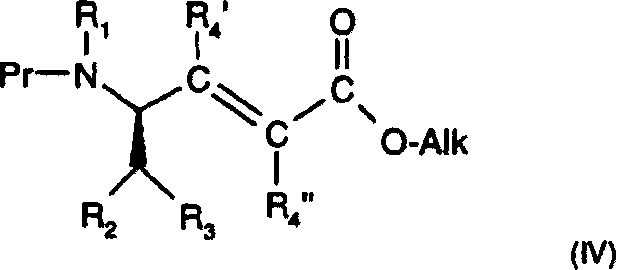
式IIの化合物は、例えば、下記のように製造する;使用する出発物質は式IV
の化合物である。アルキルエステルをカルボン酸に加水分解し、基−NHR5を対応するアミンH2NR5との反応により挿入し[−C(=O)−NHR5の形成]、最後に保護基−Prを除去する。
式IVの化合物は、例えば、出発物質として式V
上記の式IVの化合物の製造の有利な変法において、既知の式V b
アルデヒドV aがウィティッヒホーナー反応で式(AlkO)2P(=O)−CH(−Alk)−COOAlk(Alk=C1−C7アルキル)のホスホノアルカノン酸トリアルキルエステルと反応する場合、R″4が低級アルキルである式IVの化合物が得られる。
R'4が低級アルキルである式IVの化合物を製造する場合、例えば、式V aのアルデヒドを低級アルキル−マグネシウムハライド、例えば、メチル−マグネシウムヨージドと反応させ、二級アルコールを形成し、それを次いで、例えば、スワーン酸化(塩化オキザリル、DMSO)により式V c
後者を次いで同様にウィティッヒホーナー反応でアルデヒドV aと反応させ、式IVの化合物(式中、R'4=低級アルキル)を形成する。
方法(B):方法(B)の反応は、それ自体、対応するカルボン酸またはその反応性誘導体および一級アミンからのカルボン酸アミドの形成に対応する。多数の可能な方法の中で、以下の方法を記載し得る:(1)式IIIのカルボン酸と一級アミンH2NR5との、例えば、N−エチル−N'−(3−ジメチルアミノプロピル)−カルボジイミドヒドロクロライド(EDC)および4−ジメチルアミノピリジン(DMAP)の存在下での反応;(2)式IIIのカルボン酸と、最初、DMAP存在下でN−ヒドロキシスクシンイミドおよびN−エチル−N'−(3−ジメチルアミノプロピル)カルボジイミドヒドロクライドとの反応で対応するN−ヒドロキシ−スクシンイミドを形成し、次いで対応するアミンH2NR5と反応させる;(3)式IIIのカルボン酸とアミンH2NR5との、1−プロパンホスホン酸無水物の存在下での反応。
式IIIの化合物は、例えば、下記のように製造する:式IVの化合物から出発し、アミノ−保護基を、例えば、BOCの場合トリフルオロ酢酸との反応により除去し、アミノ基をカルボン酸R−COOH(例えば、3,5−ビストリフルオロメチル−安息香酸)またはその反応性誘導体でアシル化し、[方法(A)と同様に]、最後にアルキルエステル基を、例えば、メタノールおよびTHF中のLiOHで加水分解する。
方法(C):ウィティッヒ(−ホーナー)反応の可能な出発物質は、例えば、式V aのアルデヒドであり、このアミノ保護基を除去し、次いでカルボン酸R−COOH(例えば、3,5−ビストリフルオロメチル−安息香酸)またはその反応性誘導体でN−アシル化する[方法(A)と同様に]。このようなアルデヒドは、例えば、式(AlkO)2P(=O)−CO−NHR5のホスホノアルカノン酸ジアルキルエステルアミドとウィティッヒホーナー反応で反応できる。
式Iの化合物は、また、それ自体既知の方法で、他の式Iの化合物に変換できる。
例えば、R1が低級アルキルである式Iの化合物は、R1が水素である式Iの化合物を、化合物Y3−R1(式中、Y3はヒドロキシまたは反応性エステル化ヒドロキシ)でN−アルキル化することにより得ることができる。反応性エステル化ヒドロキシは、例えば、ハロゲン、特に臭素、ヨウ素または塩素、またはスルホニルオキシ、例えば、メチルスルホニルオキシまたはp−トルエンスルホニルオキシである。他の可能な方法は、R1が水素である式Iの化合物と、化合物Y4−R'1(式中、Y4はホルミルおよびR'1はCH2基を除くR1[R1=−CH2−R'1]である)の還元条件下での反応(還元的アミノ化)を含む。
中間体が妨害反応基、例えば、カルボキシ、ヒドロキシ、メルカプトまたはアミノ基を含む場合、これらの基は、容易に除去できる保護基により一時的に保護できる。適当な保護基の選択およびそれらを挿入し、除去する方法はそれ自体既知であり、例えば、J.F.W.McOmie,Protective Groups in Organic Chemistry,Plenum Press,London,New York 1973に記載されている。
化合物Iの塩は、それ自体既知の方法で製造できる。例えば、化合物Iの酸付加塩は適当な酸または適当なイオン交換試薬での処理により、および塩基との塩は適当な塩基または適当なイオン交換試薬での処置により得る。式Iの化合物の塩は、遊離化合物Iに慣用法で変換できる;酸付加塩は、例えば、適当な塩基性試薬または適当なイオン交換試薬での処理により、および塩基との塩は、例えば、適当な酸または適当なイオン交換試薬での処理による。
(式Iの塩形成化合物の)塩を含む式Iの化合物は、またその水和物の形で得られ得るおよび/または他の溶媒、例えば、化合物の結晶化に使用し得る溶媒を固体形で含み得る。
非対称の中心の可変性の性質および対応する数およびまた選択した出発物質および方法に依存して、式Iの化合物は立体異性体の混合物の形、例えば、ラセミ体のようなジアステレオマーの混合物またはエナンチオマーの混合物で、また恐らく純粋立体異性体の形で得られ得る。本方法またはある他の方法に従って得られるジアステレオ異性体の混合物は、慣用法で、エナンチオマーの混合物、例えばラセミ体、または個々のジアスレテオ異性体に、例えば、分画結晶化、蒸留および/またはクロマトグラフィーによる既知の方法の成分の物理化学的差異に基づいて分離できる。有利にはより活性な異性体を単離する。
本方法またはある他の方法に従って得られるエナンチオマーの混合物、特にラセミ体は、既知の方法、例えば、光学活性溶媒からの、微生物の助けを借りた再結晶化、クロマトグラフィーおよび/または光学活性補助化合物、例えば、塩基、酸、アルコールとの反応によりジアステレオ異性体塩またはエステルのような官能的誘導体を形成し、それを分離し、所望のエナンチオマーを遊離することにより個々のエナンチオマーに分離できる。有利には、より活性なエナンチオマーを単離する。
本発明はまた、方法の任意の段階で中間体として得られる化合物を出発物質として使用して残りの段階を行うか、出発物質を誘導体または塩の形として使用するか、特に、反応条件下で形成させる方法の形にも関する。本発明はまた下記実施例に記載の(4S)−立体配置を有する最終生産物にも関し、これは同様にNK1/NK2アンタゴニストとしての一定の作用を有する。
本発明の方法において、いずれの場合も遊離形または塩形である出発物質および中間体を、最初に特に有効であると記載した化合物Iまたはその塩をもたらすように使用するのが好ましい。本発明はまた、いずれの場合も遊離形または塩形である、新規出発物質および中間体、その使用およびその製造法にも関し、変数Rは化合物Iで定義の通りである。
本発明はまた、好ましくは、製薬学的に許容される組成物の形の、アレルギー性疾患および疾病の処置、特に、動物またはヒトの治療的処置法における化合物Iおよびその製薬学的に許容される塩の使用およびこのような処置法にも関する。
本発明は、同様に、活性成分として式Iの化合物または製薬学的に許容されるその塩を含む医薬組成物、およびその製造法にも関する。これらの医薬組成物は、温血動物、特にヒトへの経口または経直腸のような経腸投与、非経腸投与、局所投与および特に吸入による投与のための組成物に関し、本組成物は薬理学的活性成分単独かまたは慣用的製薬学的賦形剤を伴う。医薬組成物は(重量%で)、例えば、約0.001%から100%、好ましくは約0.1%から約50%の活性成分を含む。
経腸および非経腸投与用医薬組成物は、例えば、糖衣錠、錠剤、カプセルまたは坐薬およびまたアンプルのような単位投与形態である。それらは、それ自体既知の方法で、例えば、慣用の混合、粒状化、糖衣、溶解または凍結乾燥法により製造する。例えば、経口投与用医薬組成物は、活性成分と固体担体を合わせ、所望により得られる混合物を粒状化し、そして所望によりまたは必要に応じて、適当な賦形剤の添加後に混合物または顆粒を加工し、錠剤または糖衣錠コアを形成する。
適当な担体は、特に糖、例えば、ラクトース、サッカロース、マンニトールまたはソルビトール、セルロース製剤および/またはリン酸カルシウム、例えば三リン酸カルシウムまたは水素化リン酸カルシウムのような充填剤、およびまた例えば、トウモロコシ、小麦、米またはジャガイモ澱粉を使用した澱粉ペースト、ゼラチン、トラガカント、メチルセルロースおよび/またはポリビニルピロリドンのような結合剤、および所望により上記の澱粉、およびまたカルボキシメチル澱粉、架橋ポリビニルピロリドン、寒天、またはアルギン酸またはアルギン酸ナトリウムのようなその塩のような崩壊剤である。賦形剤は、特に流動調節剤および滑沢剤、例えば、珪酸、タルク、スレアリン酸またはステアリン酸マグネシウムまたはカルシウムのようなその塩、および/またはポリエチレングリコールである。糖衣錠コアは、適当な、所望により腸溶性コーティングを有し、それらはとりわけアラビアガム、タルク、ポリビニルピロリドン、ポリエチレングリコールおよび/または二酸化チタンを含む濃縮糖溶液、または適当な有機溶媒または溶媒混合物中のコーティング溶液または、腸溶性コーティングの製造のために、アセチルセルロースフタレートまたはヒドロキシプロピルメチルセルロースフタレートのような適当なセルロール製剤の溶液である。色素または着色剤を錠剤または糖衣錠コーティングに、例えば、同定目的で、または活性成分の異なる量の指示のために添加し得る。
他の経口投与可能医薬組成物は、硬ゼラチンカプセルおよびまたゼラチンおよびグリセロールまたはソルビトールのような可塑剤から成る軟、密封カプセルである。硬ゼラチンカプセルは、顆粒の形、例えば、ラクトースのような充填剤、澱粉のような結合剤および/またはタルクまたはステアリン酸マグネシウムのような滑沢剤および所望により安定化剤との混合物で、活性成分を含み得る。軟カプセルにおいて、活性成分は好ましくは脂肪油、パラフィン油または液体ポリエチレングリコールのような適当な液体に溶解または懸濁し、同様に安定化剤と加えることが可能である。
適当な経直腸投与可能医薬組成物は、例えば、活性成分と坐薬基剤物質からなる坐薬である。適当な坐薬基剤物質は、例えば、天然または合成トリグリセリド、パラフィン炭化水素、ポリエチレングリコールまたは高級アルカノールである。活性成分と基剤物質の組み合わせを含むゼラチン直腸カプセルの使用も可能である。適当な基剤物質は、例えば、液体トリグリセリド、ポリエチレングリコールまたはパラフィン炭化水素である。
非経口投与のために、特に、水溶性形の活性成分の水溶液およびまた、脂肪油、例えばゴマ油、または合成脂肪酸エステル、例えばオレイン酸エチルまたはトリグリセリドのような適当な親油性溶媒または媒体が使用されている対応する油性注射懸濁液のような活性成分の懸濁液、または増粘物質、例えば、ナトリウムカルボキシメチルセルロース、ソルビトールおよび/またはデキストランおよび所望によりまたは安定化剤を含む水性注射用懸濁液が適している。
局所投与用医薬組成物は、例えば、皮膚の局所処置用である:ローション、クリームおよび軟膏、即ち、水中の液体または半固体油または油中水型エマルジョン;無水である脂肪軟膏;ペースト、即ち、分泌物吸収粉末を有するクリームおよび軟膏;水性であり、低水分含量であるか、水を含まないそして膨張可能ジェル−形成物質を含むジェル;フォーム、即ち、加圧容器から投与するエアロゾル形の水中液体油形エマルジョン;および水性エタノール性基剤を有するチンキ;この組成物はそれぞれ、防腐剤のような慣用的製薬学的賦形剤を更に含み得る。局所投与用医薬組成物は、それ自体既知の、活性成分と製薬学的賦形剤との、例えば、活性成分を基剤物質または必要により、その一部に溶解または懸濁することによる混合により製造する。活性成分が液相の一つに溶解しているエマルジョンの製造に関して、活性成分を通常その相に乳化前に溶解する;活性成分がエマルジョンに懸濁している懸濁液の製造に関して、活性成分を乳化後に基剤物質の一部と混合し、次いで残りの製剤を添加する。
活性成分の量は、活性成分の活性および作用期間、処置する疾病の重症度およびその症状、投与形態、温血
動物の種、性、年齢および体重および/または個々の状態のような種々の因子に依存し得る。通常の場合、例えば、約75kgのオン結合物への、例えば、経口投与の一日量は、約1mgから約100mg、特に約5mgから約200mgと概算される。投与量は、例えば、1回量でまたは、例えば、10から100mgの数回分の量で投与し得る。
以下の実施例は上記の本発明を説明する。温度は摂氏で記載する;DMSO=ジメチルスルフオキシド;THF=テトラヒドロフラン;EtOH=エタノール;カルバモイル=−CONH2;ヘキサンは種々のヘキサンの異性体混合物を示す(例えば、Flukaにより供給);TLC=薄層クロマトグラフィー;RT=室温。
実施例1:(4R)−[N'−メチル−N'−(3,5−ビスト リフルオロメチル−ベンゾイル)−アミノ]−5−(1 −メチル−インドール−3−イル)−ペント−2−エン 酸N−[(R)−イプシロン−カプロラクタム−3−イ ル]−アミド:
0.525ml 3,5−ビストリフルオロメチル−ベンゾイル塩化物を、0.976g(4R)−(N'−メチル−アミノ)−5−(1−メチル−インドール−3−イル)−ペント−2−エン酸N−[(R)−イプシロン−カプロラクタム−3−イル]−アミドおよび1.1mlトリエチルアミンの20ml塩化メチレン溶液に0℃で滴下する。反応混合物を20℃で30分間攪拌し、蒸発により濃縮する。残渣を酢酸エチルに溶解し、水で1回、塩水で2回抽出する。全有機相を硫酸マグネシウムで乾燥し、蒸発により乾燥する。残渣をフラッシュ(flash)クロマトグラフする(85gシリカゲル、酢酸エチル/アセトン=3/1)。表題化合物は無色固体泡で得られる。Rf(酢酸エチル/アセトン=1/1)=0.4。HPLC:キラルセル(Chiralcel)OD、ヘプタン/イソプロピルアルコール=80/20+0.1%トリフルオロ酢酸、1ml/min、Rt=24.39min。[α]D 20=+54.2゜±3.8゜(c=0.26、EtOH)。
開始物質は以下のように製造し得る:
a)(4R)−(N'−メチル−アミノ)−5−(1−メチ ル−インドール−3−イル)−ペント−2−エン酸N− [(R)−イプシロン−カプロラクタム−3−イル]− アミド:ジオキサン中の27ml 4N塩酸を、1.24g(4R)−(N'−メチル−N'−tert−ブチルオキシカルボニル−アミノ)−5−(1−メチル−インドール−3−イル)−ペント−2−エン酸N−[(R)−イプシロン−カプロラクタム−3−イル]−アミドに0℃で添加する。生じた懸濁液を室温で15分間攪拌し、蒸発により濃縮する。残渣を少量の氷/水に溶解する;2N炭酸ナトリウム溶液を加え、抽出は酢酸エチルで3回行う。全有機相を塩水で2回洗浄し、流酸マグネシウムで乾燥し、蒸発により乾燥する。残渣を2回塩化メチレンに溶解し、再び蒸発により濃縮する。表題化合物は黄色い泡で得られる。Rf(酢酸エチル)=0.05。
b)(4R)−(N'−メチル−N'−tert−ブチルオキシカ ルボニル−アミノ)−5−(1−メチル−インドール− 3−イル)−ペント−2−エン酸N−[(R)−イプシ ロン−カプロラクタム−3−イル]−アミド:1.07g(4R)−(N'−メチル−N'−tert−ブチルオキシカルボニル−アミノ)−5−(1−メチル−インドール−3−イル)−ペント−2−エン酸、0.42g D−3−アミノ−イプシロン−カプロラクタム、0.63g N−エチル−N'−(3−ジメチルアミノ−プロピル)−カルボジイミドヒドロクロリド、0.48g 4−ジメチルアミノピリジンおよび15ml塩化メチレンの混合物を室温で4時間攪拌し、蒸発により濃縮する。残渣を酢酸エチルに溶解し、水で2回、1N塩酸で1回、そして塩水で2回抽出する。全有機相液を硫酸マグネシウムで乾燥し、蒸発により濃縮する。その方法で、表題化合物は無色の泡で得られる。Rf(塩化メチレン/エタノール=9/1)=0.45。
c)(4R)−(N−メチル−N−tert−ブチルオキシカ ルボニル−アミノ)−5−(1−メチル−インドール− 3−イル)−ペント−2−エン酸:4.26gリチウム水酸化物の27ml水溶液を、5.56g(4R)−(N−メチル−N−tert−ブチルオキシカルボニル−アミノ)−5−(1−メチル−インドール−3−イル)−ペント−2−エン酸エチルエステルの64mlテトラヒドロフランおよび64mlメタノール溶液に0℃で添加し、混合物を室温で45分間攪拌する。約25ml 4N塩酸で中性化し、蒸発により濃縮する。残渣を水に溶解し、4N塩酸でpH=2に酸性化し、酢酸エチルで抽出する。全有機相を水および飽和NaCl溶液で洗浄し、乾燥(硫酸マグネシウム)し蒸発により乾燥する。残渣を3回塩化メチレンに溶解し、再び蒸発により乾燥する。表題化合物は固体泡で得られる。Rf(酢酸エチル/ヘキサン=1/1)=0.07。
d)(4R)−(N−メチル−N−tert−ブチルオキシカ ルボニル−アミノ)−5−(1−メチル−インドール− 3−イル)−ペント−2−エン酸エチルエステル:0.848g乾燥LiCl、1.77g 1,8−ジアザバイシクロ[5.4.0]ウンデカ−7−エン(DBU)および5.75g(R)−N−メチル−N−tert−ブチルオキシカルボニル−アミノ−3−(1−メチル−インドール−3−イル)−プロパナールの100mlアセトニトリル溶液を、4.86gホスホノ酢酸トリエチルエステルの50ml無水アセトニトリル溶液に0℃で添加する。添加が完了したとき、混合物を室温で45分間攪拌する。生じた懸濁液を水に注ぎ、何れも500mlジエチルエーテルで2回抽出する。全有機相を水で3回、飽和NaCl溶液で2回洗浄し、乾燥(硫酸マグネシウム)し蒸発により濃縮する。残渣をクロマトグラフィーで精製(330gシリカゲル、ヘキサン/酢酸エチル=2/1)で精製する。その方法で、表題化合物は無色の樹脂で得られる。Rf(ヘキサン/酢酸エチル=2/1)=0.25。
e)(R)−N−メチル−N−tert−ブチルオキシカル ボニル−アミノ−3−(1−メチル−インドール−3− イル)−プロパナール:6.28g(R)−(N−メチル−N−tert−ブチルオキシカルボニル−アミノ−3−(1−メチル−インドール−3−イル)−プロパン−カルボン酸エチルエステルの117mlトルエン溶液を、アルゴン下、−78℃に冷却し、41.6ml 20%ジイソブチルアルミニウムヒドリドのトルエン溶液を、そこへ滴下する(40分間)。滴下が完了したとき、混合物を−78℃でさらに90分間攪拌する。5.9mlメタノールおよび200mlジエチルエーテルを−74℃で添加し、温度が−10℃を超えないように10gクエン酸の190ml水溶液を添加する。混合物を0℃で2時間力強く攪拌する。生じた懸濁液を吸引濾過する。濾液の相を分取し、水相をジエチルエーテルで1回以上抽出する。全有機相を水および飽和NaCl溶液で洗浄し、乾燥(硫酸ナトリウム)し蒸発により濃縮する。表題化合物は粘性のある油で得られる。Rf(ヘキサン/酢酸エチル=2/1)=0.37。
f)(R)−(N−メチル−N−tert−ブチルオキシカ ルボニル−アミノ−3−(1−メチル−インドール−3 −イル)−プロパンカルボン酸メチルエステル:55g酸化銀を5℃で攪拌しながら、14.3g tert−ブチルオキシカルボニル−D−トリプトファンメチルエステルの90ml N,N−ジメチルホルムアミド溶液に添加する。44mlヨウ化メチルおよび2ml酢酸(無水)を5℃で添加する。反応混合物を室温で72時間攪拌し、1リットルのジエチルエーテルで希釈し、濾過し蒸発により濃縮する。残渣をジエチルエーテルに溶解し、水および塩水で洗浄し、硫酸マグネシウムで乾燥し蒸発により濃縮する。
1kgシリカゲル(ヘキサン/酢酸エチル=2/1)による残渣のクロマトグラフィーにより、明黄色樹脂の表題化合物を得る。Rf(ヘキサン/酢酸エチル=2/1)=0.27。
g)tert−ブチルオキシカルボニル−D−トリプトファ ンメチルエステル:30mlテトラヒドロフランに溶解した10g tert−ブタノール、10.1g BOC無水物および12.27gジイソプロピルエチルアミンを、12.12g D−トリプトファンメチルエステル塩酸塩の80ml無水テトラヒドロフラン懸濁液に0℃で添加する。2時間室温で攪拌した後、反応混合物を氷/470ml 0.3N HClに注ぎ、酢酸エチルで3回抽出する。全有機相を水で1回、飽和NaCl溶液で2回洗浄し、乾燥(MgSO4)し蒸発により濃縮する。残渣をジエチルエーテル/石油エーテルでスラリーにし、吸引濾過する。表題化合物は融点148−149゜の無色結晶で得られる。Rf(塩化メチレン)=0.24。
D−3−アミノ−イプシロン−カプロラクタムの代わりに適当なアミンを用いる以外、実施例1の記載と同じ方法で、以下の化合物を得ることができる:
実施例2:(4R)−[N'−メチル−N'−(3,5−ビスト リフルオロメチル−ベンゾイル)−アミノ]−5−(1 −メチル−インドール−3−イル)−ペント−2−エン 酸N−[(S)−イプシロン−カプロラクタム−3−イ ル]−アミド:L−3−アミノ−イプシロン−カプロラクタムを用いる。固体泡、Rf(酢酸エチル/アセトン=1/1)=0.31、HPLC:キラルパック(Chiralpack)OD、ヘプタン/イソプロピルアルコール=80/20+0.1%トリフルオロ酢酸、1ml/min、Rt=29.96min。[α]D 20=+67゜±2.3゜(c=0.44、EtOH)。
実施例3:(4R)−[N'−メチル−N'−(3,5−ビスト リフルオロメチル−ベンゾイル)−アミノ]−5−(1 −メチル−インドール−3−イル)−ペント−2−エン 酸N−シクロヘキシル−アミド:シクロヘキシルアミンを用いる。Rf(酢酸エチル)=0.41。
実施例4:(4R)−[N'−メチル−N'−(3,5−ビスト リフルオロメチル−ベンゾイル)−アミノ]−5−(1 −メチル−インドール−3−イル)−2−メチル−ペン ト−2−エン酸N−シクロヘキシル−アミド:サブステップ1d)のトリエチルホスホノ酢酸エステルの代わりにトリエチル−2−ホスホノプロピオネートを用いる以外、実施例1に記載の方法と全く同じ方法で、表題化合物は製造され得る。表題化合物は無定形無色固体で得られる。Rf(酢酸エチル)=0.46。
同様にして、以下の生成物を製造し得る:
実施例5:(4R)−[N'−メチル−N'−(3,5−ビスト リフルオロメチル−ベンゾイル)−アミノ]−5−(1 −メチル−インドール−3−イル)−2−メチル−ペン ト−2−エン酸N−[(R)−イプシロン−カプロラク タム−3−イル]−アミド:無色泡、Rf(酢酸エチル/アセトン=1/1)=0.46;[α]D 20=−24.4゜±2.8゜(c=0.352、EtOH)。
実施例6:(4R)−[N'−メチル−N'−(3,5−ビスト リフルオロメチル−ベンゾイル)−アミノ]−5−(1 −メチル−インドール−3−イル)−2−メチル−ペン ト−2−エン酸N−[(S)−イプシロン−カプロラク タム−3−イル]−アミド:無色泡、Rf(酢酸エチル/アセトン=1/1)=0.46。L−3−アミノ−イプシロン−カプロラクタムを用いる。
3,5−ビストリフルオロメチル−ベンゾイル塩化物の代わりに塩化ベンゾイルを用いる以外、実施例5の記載と同じ方法で、以下の生成物を製造し得る:
実施例5/1:(4R)−(N'−メチル−N'−ベンゾイル− アミノ)−5−(1−メチル−インドール−3−イル) −2−メチル−ペント−2−エン酸N−[(R)−イプ シロン−カプロラクタム−3−イル]−アミド:無色泡、Rf(酢酸エチル/アセトン=1/1)=0.23;[α]D 20=−10.7゜±3.5゜(c=0.283、EtOH)。
実施例7:(4R)−[N'−メチル−N'−(3,5−ビスト リフルオロメチル−ベンゾイル)−アミノ]−5−(ナ フチ−2−イル)−ペント−2−エン酸N−[(R)− イプシロン−カプロラクタム−3−イル]−アミド
78.3mg(D)−3−アミノ−イプシロン−カプロラクタム、116.9mg N−エチル−N'−(3−ジメチルアミノプロピル)−カルボジイミド塩酸塩および88mg 4−ジメチルアミノピリジンを、0.275g(4R)−[N−メチル−N−(3,5−ビストリフルオロメチル−ベンゾイル)−アミノ]−5−(ナフチ−2−イル)−ペント−2−エン酸の6ml塩化メチレン溶液に添加する。反応混合物を20℃で3.5時間攪拌し、蒸発により濃縮する。残渣をフラッシュクロマトグラフする(40gシリカゲル、酢酸エチル)。表題化合物は明黄色固体で得られる。Rf(塩化メチレン/メタノール=15/1)=0.28。
出発物質は以下のように製造され得る:
a)(4R)−[N−メチル−N−(3,5−ビストリフル オロメチル−ベンゾイル)−アミノ]−5−(ナフチ− 2−イル)−ペント−2−エン酸:0.18gリチウム水酸化物の1.18ml水溶液を、0.325g(4R)−[N−メチル−N−(3,5−ビストリフルオロメチル−ベンゾイル)−アミノ]−5−(ナフチ−2−イル)−ペント−2−エン酸エチルエステルの3mlテトラヒドロフランおよび3mlメタノール溶液に0゜で添加し、混合物を室温で45分間攪拌し、少量の4N塩酸で中性化し、蒸発により濃縮する。残渣を水に溶解し、4N塩酸でpH=2に酸性化し酢酸エチルで抽出する。全有機相を水および飽和NaCl溶液で洗浄し、乾燥(硫酸マグネシウム)し蒸発により濃縮する。残渣を塩化メチレンに3回溶解し、再び蒸発により濃縮する。表題化合物は無色固体泡で得られる。Rf(酢酸エチル/ヘキサン=1/1)=0.15。
b)(4R)−[N−メチル−N−(3,5−ビストリフル オロメチル−ベンゾイル)−アミノ]−5−(ナフチ− 2−イル)−ペント−2−エン酸エチルエステル:0.229ml 3,5−ビストリフルオロメチル−ベンゾイル塩化物を、0.327g(4R)−N−メチル−アミノ−5−(ナフチ−2−イル)−ペント−2−エン酸エチルエステルおよび0.48mlトリエチルアミンの5ml塩化メチレン溶液に0゜で滴下する。反応混合物を20゜で60分間攪拌し、蒸発により濃縮する。残渣を酢酸エチルに溶解し、水で1回、塩水で2回抽出する。全有機相を硫酸マグネシウムで乾燥し、蒸発により濃縮する。残渣をフラッシュクロマトグラフする(40gシリカゲル、ヘキサン/酢酸エチル=2/1)。表題化合物は固体でオレンジ色の泡で得られる。Rf(ヘキサン/酢酸エチル=2/1)=0.59。
c)(4R)−N−メチル−アミノ−5−(ナフチ−2− イル)−ペント−2−エン酸エチルエステル:8ml 4N塩酸のジオキサンを、0.30g(4R)−(N−メチル−N−tert−ブチルオキシカルボニル−アミノ)−5−(ナフチ−2−イル)−ペント−2−エン酸エチルエステルに0゜で添加する。生じた懸濁液を室温で20分間攪拌し、蒸発により濃縮する。残渣を少量の氷/水に溶解する;2N炭酸ナトリウム溶液を添加し、抽出は酢酸エチルで3回行う。全有機相を塩水で2回洗浄し、硫酸マグネシウムで乾燥し蒸発により濃縮する。残渣を塩化メチレンに2回溶解し、再び蒸発により濃縮する。表題化合物は黄色泡で得られる。Rf(酢酸エチル)=0.65。
d)(4R)−(N−メチル−N−tert−ブチルオキシカ ルボニル−アミノ)−5−(ナフチ−2−イル)−ペン ト−2−エン酸エチルエステル:1.34g乾燥LiCl、4.37g 1,8−ジアザバイシクロ[5.4.0]ウンデカ−7−エン(DBU)、および9.0g(R)−(N−メチル−N−tert−ブチルオキシカルボニル−アミノ)−3−(ナフチ−2−イル)−プロパナールの150mlアセトニトリル溶液を、7.08gホスホノ酢酸トリエチルエステルの80ml無水アセトニトリル溶液に0゜で添加する。添加が完了したとき、混合物を室温でさらに45分間攪拌する。生じた懸濁液を水に注ぎ、何れも600mlジエチルエーテルを用いて2回抽出する。全有機相を水で3回、飽和NaCl溶液で2回洗浄し、乾燥(硫酸マグネシウム)し蒸発により濃縮する。残渣をクロマトグラフィーにより精製する(800gシリカゲル、ヘキサン/酢酸エチル=8/1)。その方法で、表題化合物は無色の樹脂で得られる。Rf(ヘキサン/酢酸エチル=8/1)=0.09。HPLC:キラルセル(Chiralcel)OJ、ヘキサン/イソプロピルアルコール=90/10+0.1%トリフルオロ酢酸、1ml/min、Rt=15.86min。
e)(R)−(N−メチル−N−tert−ブチルオキシカ ルボニル−アミノ)−3−(ナフチ−2−イル)−プロ パナール:21.8g(R)−N−メチル−N−tert−ブチルオキシカルボニル−アミノ−3−(ナフチ−2−イル)−プロパンカルボン酸メチルエステルの497mlトルエン溶液を、アルゴン下、−78゜に冷却し、146ml 20%ジイソ−ブチルアルミニウムヒドリドのトルエン溶液を、そこに滴下する(60分間)。滴下が完了したとき、混合物を−78゜でさらに60分間攪拌する。17.8mlメタノールを−74゜で添加し、温度が−10℃を超えないように35gクエン酸の665ml水溶液に添加する。混合物を0゜で2時間力強く攪拌し、ジエチルエーテルで希釈する。生じた懸濁液を吸引濾過する。濾液の相を分取し、水相をジエチルエーテルで1回以上抽出する。全有機相を水および飽和NaCl溶液で洗浄し、乾燥(硫酸ナトリウム)し蒸発により濃縮する。表題化合物は融点98−100゜のベージュ色の結晶で得られる。Rf(ヘキサン/酢酸エチル=3/2)=0.51。
f)(R)−N−メチル−N−tert−ブチルオキシカル ボニル−アミノ−3−(ナフチ−2−イル)−プロパン カルボン酸メチルエステル:76.4g酸化銀を、5゜で攪拌しながら、20.1g(R)−N−tert−ブチルオキシ−カルボニル−アミノ−3−(ナフチ−2−イル)−プロパンカルボン酸(例えばBachem)の191ml N,N−ジメチルホルムアミド溶液に添加する。12.5mlヨウ化メチルを5゜で添加する。反応混合物を室温で24時間攪拌し、それから1リットルのジエチルエーテルで希釈し、濾過し蒸発により濃縮する。残渣をジエチルエーテルに溶解し、水および塩水で洗浄し、硫酸マグネシウムで乾燥し蒸発により濃縮する。表題化合物は明黄色の油で得られる。Rf(ヘキサン/酢酸エチル=4/1)=0.47。HPLC:キラルセル(Chiralcel)OJ、ヘキサン/イソプロピルアルコール=90/10+0.1%トリフルオロ酢酸、1ml/min、Rt=11.32min。
ステップ7b)の3,5−ビストリフルオロメチル−ベンゾイル塩化物の代わりに塩化ベンゾイルを用いる以外、実施例7の記載と同じ方法で、以下の生成物を得る:
実施例7/1:(4R)−(N'−メチル−N'−ベンゾイル) −アミノ−5−(ナフチ−2−イル)−ペント−2−エ ン酸N−[(R)−イプシロン−カプロラクタム−3− イル]−アミド:Rf(酢酸エチル/アセトン=9/1)=0.13。
実施例8:(4R)−[N'−メチル−N'−(3,5−ビスト リフルオロメチル−ベンゾイル)−アミノ]−5−(ナ フチ−2−イル)−2−メチル−ペント−2−エン酸N −[(R)−イプシロン−カプロラクタム−3−イル] −アミド:
0.153ml 3,5−ビストリフルオロメチル−ベンゾイル塩化物を、0.27g(4R)−(N'−メチル−アミノ)−5−(ナフチ−2−イル)−2−メチル−ペント−2−エン酸N−[(R)−イプシロン−カプロラクタム−3−イル]−アミドおよび0.3mlトリエチルアミンの6ml塩化メチレン溶液に0゜で滴下する。反応混合物を20゜で90分間攪拌し、蒸発により濃縮する。残渣を酢酸エチルに溶解し、水で1回、塩水で2回抽出する。全有機相を硫酸マグネシウムで乾燥し、蒸発により濃縮する。残渣をフラッシュクロマトグラフする(150gシリカゲル、酢酸エチル/ヘキサン=4/1)。表題化合物は無色の固体泡で得られる。Rf(酢酸エチル)=0.43。HPLC:ADカラム、ヘキサン/イソプリピルアルコール=90/10+0.1%トリフルオロ酢酸、1ml/min、Rt=17.87min。
出発物質は以下のように製造され得る:
a)(4R)−(N'−メチル−アミノ)−5−(ナフチ− 2−イル)−2−メチル−ペント−2−エン酸N− [(R)−イプシロン−カプロラクタム−3−イル]− アミド:7.0ml 4N塩酸のジオキサン溶液を、0.342g(4R)−(N'−メチル−N'−tert−ブチルオキシカルボニル−アミノ)−5−(ナフチ−2−イル)−2−メチル−ペント−2−エン酸N−[(R)−イプシロン−カプロラクタム−3−イル]−アミドに0゜で添加する。生じた懸濁液を室温で20分間攪拌し、蒸発により濃縮する。残渣を少量の氷/水に溶解する;2N炭酸ナトリウム溶液を添加し、抽出は酢酸エチルで3回行う。全有機相を塩水で2回洗浄し、硫酸マグネシウムで乾燥し蒸発により濃縮する。残渣を塩化メチレンに2回溶解し、再び蒸発により濃縮する。表題化合物は黄色の泡で得られる。Rf(塩化メチレン/メタノール=95/5)=0.33。
b)(4R)−(N'−メチル−N'−tert−ブチルオキシカ ルボニル−アミノ)−5−(ナフチ−2−イル)−2− メチル−ペント−2−エン酸N−[(R)−イプシロン −カプロラクタム−3−イル]−アミド:500mg(4R)−(N−メチル−N−tert−ブチルオキシカルボニル−アミノ)−5−(ナフチ−2−イル)−2−メチル−ペント−2−エン酸、0.183g D−3−アミノ−イプシロン−カプロラクタム、0.265g N−エチル−N'−(3−ジメチルアミノ−プロピル)−カルボジイミドヒドロクロリド、0.200g 4−ジメチルアミノピリジンおよび16ml塩化メチレンの混合物を室温で1時間攪拌し、蒸発により濃縮する。残渣を酢酸エチルに溶解し、水で2回、1N塩酸で1回、そして塩水で2回抽出する。全有機相を硫酸マグネシウムで乾燥し、蒸発により濃縮する。残渣をフラッシュクロマトグラフする(80gシリカゲル、酢酸エチル/ヘキサン=7/3−9/1)。そのような方法で、表題化合物は無色の泡で得られる。Rf(酢酸エチル)=0.39。
c)(4R)−(N−メチル−N−tert−ブチルオキシカ ルボニル−アミノ)−5−(ナフチ−2−イル)−2− メチル−ペント−2−エン酸:2.6gリチウム水酸化物の17ml水溶液を、3.5g(4R)−(N−メチル−N−tert−ブチルオキシ−カルボニル−アミノ)−5−(ナフチ−2−イル)−2−メチル−ペント−2−エン酸エチルエステルの40mlテトラヒドロフランおよび40mlメタノール溶液に0゜で添加し、混合物を室温で45分間攪拌し、約15ml 4N塩酸で中性化し、蒸発により濃縮する。残渣を水に溶解し、4N塩酸でpH=2に酸性化し、酢酸エチルで抽出する。全有機相を水および飽和NaCl溶液で洗浄し、乾燥(硫酸マグネシウム)し、蒸発により濃縮する。残渣を3回塩化メチレンに溶解し、再び蒸発により濃縮する。表題化合物は固体泡で得られる。Rf(酢酸エチル/ヘキサン=1/1)=0.26。
d)(4R)−(N−メチル−N−tert−ブチルオキシカ ルボニル−アミノ)−5−(ナフチ−2−イル)−2− メチル−ペント−2−エン酸エチルエステル:1.36g乾燥LiCl、4.37g 1,8−ジアザバイシクロ[5.4.0]ウンデカ−7−エン(DBU)、および9g(R)−(N−メチル−N−tert−ブチルオキシカルボニル−アミノ−3−(ナフチ−2−イル)−プロパナールの150mlアセトニトリル溶液を、7.52g 2−ホスホノ−プロピオン酸トリエチルエステルの80ml無水アセトニトリル溶液に0゜で添加する。添加が完了したとき、混合物を10゜で40分間攪拌する。生じた懸濁液を水に注ぎ、何れも600mlジエチルエーテルを用いて2回抽出する。全有機相を水で3回、飽和NaCl溶液で2回洗浄し、乾燥(硫酸マグネシウム)し蒸発により濃縮する。残渣はクロマトグラフィー(600gシリカゲル、ヘキサン/酢酸エチル=95/5−93/7)で精製する。その方法で、表題化合物は無色樹脂で得られる。Rf(ヘキサン/酢酸エチル=7/3)=0.53。
3,5−ビストリフルオロメチル−ベンゾイル塩化物の代わりに3,4,5−トリメトキシ−ベンゾイル塩化物を用いる以外、実施例8の記載と同じ方法で、以下の生成物を製造し得る:
実施例8/1:(4R)−[N'−メチル−N'−(3,4,5−トリ メトキシ−ベンゾイル)−アミノ]−5−(ナフト−2 −イル)−2−メチル−ペント−2−エン酸N− [(R)−イプシロン−カプロラクタム−3−イル]− アミド:Rf(塩化メチレン/メタノール=95/5)=0.42
D−3−アミノ−イプシロン−カプロラクタムの代わりに適切なアミンを用いる以外は実施例8の記載と同様にして、次の生成物を得ることができる:
実施例9:(4R)−[N'−メチル−N'−(3,5−ビスト リフルオロメチル−ベンゾイル)−アミノ]−5−(ナ フト−2−イル)−2−メチル−ペント−2−エン酸N −[(S)−イプシロン−カプロラクタム−3−イル] −アミド:L−3−アミン−イプシロン−カプロラクタムを用いる。Rf(酢酸エチル)=0.44
実施例10:(4R)−[N'−メチル−N'−(3,5−ビスト リフルオロメチル−ベンゾイル)−アミノ]−5−(ナ フト−2−イル)−2−メチル−ペント−2−エン酸N −シクロヘキシル−アミド:シクロヘキシルアミンを用いる。Rf(ヘキサン/酢酸エチル=1/1)=0.43。HPLC:キラルセルAD、ヘキサン/イソプロピルアルコール=90/10+0.1%トリフルオロ酢酸、1ml/分。Rt=6.25分。
実施例11:(4R)−[N'−メチル−N'−(3,5−ビスト リフルオロメチル−ベンゾイル)−アミノ]−5−(1 −メチル−インドル−3−イル)−ペント−2−エン酸 N−[(S)−イプシロン−カプロラクタム−3−イ ル]−アミド(実施例2の化合物に対する別の製法)
表題化合物は、(D−トリプトファンメチルエステル塩酸塩の代わりに)ラセミD,L−トリプトファンメチルエステル塩酸塩を出発物質としても製造できる。D,L−トリプトファンメチルエステル塩酸塩は、実施例1の記載と類似の方法で反応させる。工程1b)ではL−3−アミノ−イプシロン−カプロラクタムを使用する。次いで、得られたジアステレオ異性体の混合物をシリカゲルでのクロマトグラフィー(酢酸エチル)により最終工程で分離する。こうして、(4R)−[N'−メチル−N'−(3,5−ビストリフルオロメチル−ベンゾイル)−アミノ]−5−(1−メチル−インドル−3−イル)−ペント−2−エン酸N−[(S)−イプシロン−カプロラクタム−3−イル]−アミド(Rf=0.31、酢酸エチル/アセトン=1/1)および(S)−4−[N'−メチル−N'−(3,5−ビストリフルオロメチル−ベンゾイル)−アミノ]−5−(1−メチル−インドル−3−イル)−ペント−2−エン酸N−[(S)−イプシロン−カプロラクタム−3−イル]−アミド{Rf=0.35、酢酸エチル/アセトン=1/1;[α]D 20=−44.3゜±4.5゜(c=0.221、EtOH)}を純粋な形で得る。
実施例12:(4R)−[N'−メチル−N'−(3,5−ビスト リフルオロメチル−ベンゾイル)−アミノ]−4−(4 −クロロベンジル−ブト−2−エン酸N−[(R)−イ プシロン−カプロラクタム−3−イル]−アミド
(塩化メチレン5ml中)3,5−ビストリフルオロメチルベンゾイルクロリド0.71gの溶液を塩化メチレン35ml中(4R)−(N'−メチル−アミノ)−4−(4−クロロベンジル−ブト−2−エン酸N−[(R)−イプシロン−カプロラクタム−3−イル]−アミド0.9gおよびトリエチルアミン0.75mlの溶液に0℃で滴下添加する。反応混合物を室温で2時間撹拌する。次いで、メタノール3mlを加え、反応混合物を塩化メチレン50mlで希釈する。この溶液を0.1NHCl、水(2回)および飽和NaCl溶液で洗浄し、乾燥(MgSO4)させ、蒸発濃縮させる。残渣をフラッシュクロマトグラフィー(シリカゲル85g、酢酸エチル/メタノール=98/2)にかける。表題化合物を白色無定形固体の形で得る。Rf=0.12(酢酸エチル)、[α]D 20=+42゜±1゜(c=1、EtOH)。Rt=20.38分。(キラルセル−OJ、0.46×25cm、検出210nm、ヘキサン:エタノール=90:10+0.1%TFA、流速1.0ml/分、30バー)
出発物質は、下記のようにして製造できる:
a)(4R)−(N'−メチル−アミノ)−4−(4−クロ ロベンジル−ブト−2−エン酸N−[(R)−イプシロ ン−カプロラクタム−3−イル]−アミド:塩化メチレン30ml中(4R)−(N'−メチル−N'−tert−ブチロキシカルボニル−アミノ)−4−(4−クロロベンジル)−ブト−2−エン酸N−[(R)−イプシロン−カプロラクタム−3−イル]−アミド1.2gおよびトリフルオロ酢酸8mlの溶液をアルゴン下室温で2時間撹拌する。次いで、反応混合物を蒸発濃縮させ、酢酸エチル200mlに溶かす。酢酸エチル溶液を0.05N水酸化ナトリウム溶液および飽和NaCl溶液で洗浄し、乾燥(硫酸ナトリウム)させ、蒸発濃縮して、更に精製することなく続いて反応させる。
b)(4R)−(N'−メチル−N'−tert−ブチロキシカル ボニル−アミノ)−4−(4−クロロベンジル)−ブト −2−エン酸N−[(R)−イプシロン−カプロラクタ ム−3−イル]−アミド:(4R)−(N'−メチル−N'−tert−ブチロオキシカルボニル−アミノ)−4−(4−クロロベンジル)−ブト−2−エン酸1.53g、D−3−アミノ−イプシロン−カプロラクタム0.94g、N−エチル−N'−(3−ジメチルアミノプロピル)−カルボジイミド塩酸塩0.58g、4−ジメチルアミノピリジン0.60g、ヒドロキシベンゾトリアゾール0.725gおよび塩化メチレン80mlの混合物を室温で16時間撹拌し、次いで蒸発濃縮させる。残渣をクロマトグラフィーにかける(シリカゲル、ヘキサン/酢酸エチル=1/1)。こうして、表題化合物を得る。融点154−156℃。
c)(4R)−(N'−メチル−N'−tert−ブチロキシカル ボニル−アミノ)−4−(4−クロロベンジル)−ブト −2−エン酸:テトラヒドロフラン/メタノール/水=3/3/1中(4R)−(N'−メチル−N'−tert−ブチロオキシカルボニル−アミノ)−4−(4−クロロベンジル)−ブト−2−エン酸エチルエステル1.64gおよび水酸化リチウム1.72gの溶液を室温で1時間撹拌し、次いで、水150mlに注ぐ。混合物に1N塩酸を加えてpH=2まで酸性化し、水相をジエチルエーテルで2回抽出する。集め合わせた有機相を水と飽和NaCl溶液で洗浄し、乾燥(硫酸マグネシウム)させ、蒸発濃縮して、無色油状物を形成させる。1H−NMR、400MHz、CDCl3、d(ppm):7.30(d,2H),7.20(d,2H),6.80(dd,1H),5.81(d,1H),4.85(m,1H),2.75(d,2H),2.63(s,3H),1.35(s,9H)。
d)(4R)−(N'−メチル−N'−tert−ブチロキシカル ボニル−アミノ)−4−(4−クロロベンジル)−ブト −2−エン酸エチルエステル:乾燥LiCl0.453gおよびDBU1.46gを無水アセトニトリル40ml中ホスホノ酢酸トリエチルエステル2.37gの溶液にRTで加える。次いで、(アセトニトリル10ml中)(R)−N'−メチル−N'−tert−ブチロオキシカルボニル−(4−クロロフェニル)−アラニナール2.86gの溶液をそこに滴下添加する。滴下添加が完了したら、この混合物をRTで2時間撹拌する。次いで、反応混合物を水に注ぎ、ジエチルエーテル100mlずつを用いて2回抽出する。集め合わせた有機相を水で3回および飽和NaCl溶液で1回洗浄し、乾燥(硫酸マグネシウム)させ、蒸発濃縮させる。残渣をクロマトグラフィー(シリカゲル、ヘキサン/酢酸エチル=3/1)で精製する。こうして、表題化合物を無色油状物の形で得る。1H−NMR、200MHz、CDCl3、d(ppm):7.35−7.05(m,4H),6.90(dd,1H),5.85(d,1H),5.15(m,0.5H),4.90(m,0.5H),4.17(q,2H),2.90(m,2H),2.68(s,3H),1.30(m,12H)。
e)(R)−N'−メチル−N'−tert−ブチロキシカルボ ニル−(4−クロロフェニル)−アラニナール:トルエン75ml中(R)−N'−メチル−N'−tert−ブチロキシカルボニル−(4−クロロフェニル)−アラニンメチルエステル2.95gの溶液をアルゴン下−78℃まで冷却する。そこにこの温度で(トルエン中)1M DIBAH溶液17mlをゆっくりと滴下添加する。滴下添加が完了したら、この混合物をその温度で2時間撹拌する。次いで、メタノール2mlと酒石酸ナトリウム/カリウム水溶液50ml(18g)を反応混合物に加える。混合物を勢いよく0℃で2時間撹拌する。次いで、相を分離し、水相をジエチルエーテルで1回以上抽出する。集め合わせた有機相を水および飽和NaCl溶液で洗浄し、乾燥(硫酸ナトリウム)させ、蒸発濃縮させる。残渣を精製せずに続いて反応させる(無色油状物)。1H−NMR、200MHz、CDCl3、d(ppm):7.30−7.05(m,4H),4.16(m,0.5H),3.93(m,0.5H),3.25(dd,2H),2.90(m,1H),2.70および2.62(2s,3H),1.40(2s,9H)。
f)(R)−N'−メチル−N'−tert−ブチロキシカルボ ニル−(4−クロロフェニル)−アラニンメチルエステ ル:酸化銀(I)9.5gを、N,N−ジメチルホルムアミド45ml中(R)−tert−ブチロキシカルボニル−(4−クロロフェニル)−アラニンメチルエステル3.1gの溶液に撹拌しながら加える。次いで、ヨウ化メチル23gと酢酸(無水)1mlを加える。反応混合物をRTで72時間撹拌し、次いで、ジエチルエーテル150mlで希釈し、濾過し、蒸発濃縮する。残渣をクロマトグラフィーで精製する(シリカゲル、ヘキサン/酢酸エチル=5/1)。こうして、表題化合物を無色油状物の形で得る。1H−NMR:7.25(d,2H),7.11(d,2H),4.90(bs,0.5H),4.47(bs,0.5H),3.72(s,3H),3.25(m,1H),3.00(dd,1H),2.70(s,3H),1.35(s,9H)。
g)(R)−tert−ブチロキシカルボニル−(4−クロ ロフェニル)−アラニンメチルエステル:tert−ブタノール4ml、BOC−無水物2.12gおよびジイソプロピルエチルアミン2.57gを無水THF40ml中D−4−クロロフェニルアラニンメチルエステル(例えば、Bachem)2.5gの懸濁液に加える。室温で4時間撹拌後、反応混合物を氷/0.1N HClに注ぎ、ジエチルエーテルで2回抽出する。集め合わせた有機相を水(3回)および飽和NaCl溶液で洗浄し、乾燥(MgSO4)させ、蒸発濃縮して、油状物を形成させ、これを放置して、完全に結晶化させる。Rf=0.19(ヘキサン:酢酸エチル=5:1)。
D−3−アミノ−イプシロン−カプロラクタムの製造:無水エタノール200ml中D,L−3−アミノ−イプシロン−カプロラクタム12.8gの溶液を(無水エタノール200ml中)D−ピログルタミン酸12.9gの溶液と混合し、室温で20時間放置する。得られた結晶を濾過し、エタノール:水=9:1に約65−70℃で溶かし、室温まで冷却し、再度20時間放置する。そこから形成した結晶を濾取し、水50mlに溶かす。イオン交換クロマトグラフィー(DOWEX 50W、酸性型、1N NH3溶液で遊離塩基の溶出)により、表題化合物を遊離アミンの形で得る。無色結晶。[α]D 20=+41゜(c=2.2、水)。
工程12b)において(D−3−アミノ−イプシロン−カプロラクタムの代わりに)適切なアミンを用いる以外は実施例12の記載と同様にして、次の生成物も得られる:
実施例13:(4R)−[N'−メチル−N'−(3,5−ビスト リフルオロメチル−ベンゾイル)−アミノ]−4−(4 −クロロベンジル−ブト−2−エン酸N−[(S)−イ プシロン−カプロラクタム−3−イル]−アミド:Rf=0.12(酢酸エチル)。L−3−アミノ−イプシロン−カプロラクタム(市販のもの、例えば:Fluka 07257)を用いる。Rt=35.2分。(キラルセル−OD、0.46×25cm、検出210nm、ヘキサン:イソプロパノール=80:20+0.1%TFA、流速1.0ml/分、30バー)。
実施例14:(4R)−[N'−メチル−N'−(3,5−ビスト リフルオロメチル−ベンゾイル)−アミノ]−4−(4 −クロロベンジル−ブト−2−エン酸N−シクロヘキシ ル−アミド:融点183−185℃。
シクロヘキシルアミンを用いる。Rt=10.5分(キラルセル−AC、0.46×25cm、検出210nm、ヘキサン:イソプロパノール=97:3+0.1%TFA、流速1.0ml/分、20バー)。[α]D 20=+60.4゜±4.4゜(c=0.227、EtOH)。
実施例12および14に記載の方法と同様に、適切なハロゲン化フェニルアラニン誘導体を出発物質として、下記の物質を製造することもできる:
実施例14A:(4R)−[N'−メチル−N'−(3,5−ビスト リフルオロメチル−ベンゾイル)−アミノ]−4−(3, 4−ジクロロベンジル)−ブト−2−エン酸N−シクロ ヘキシル−アミド:Rf=0.24(ヘキサン:酢酸エチル=1:1)。
実施例14B:(4R)−[N'−メチル−N'−(3,5−ビスト リフルオロメチル−ベンゾイル)−アミノ]−4−(3, 4−ジフルオロベンジル)−ブト−2−エン酸N−シク ロヘキシル−アミド:Rf=0.28(ヘキサン:酢酸エチル=1:1)。
実施例15:(4R)−[N'−メチル−N'−(3,5−ビスト リフルオロメチル−ベンゾイル)−アミノ]−5−(4 −クロロフェニル)−2−メチル−ペント−2−エン酸 N−シクロヘキシルアミド:表題化合物は、副工程12d)においてトリエチルホスホノ酢酸エステルの代わりにトリエチル2−ホスホノ−プロピオネートを用いる以外は、実施例14(および実施例12それぞれ)の記載と全く同様にして製造する。表題化合物は無定形無色固体の形で得られる。Rf=0.32(ヘキサン:酢酸エチル=1:1)。
実施例15と同様に、次の生成物を製造することもできる:
実施例16:(4R)−[N'−メチル−N'−(3,5−ビスト リフルオロメチル−ベンゾイル)−アミノ]−5−(4 −クロロフェニル)−2−メチル−ペント−2−エン酸 N−[(R)−イプシロン−カプロラクタム−3−イ ル]−アミド:Rf=0.14(酢酸エチル)。D−3−アミノ−イプシロン−カプロラクタムを用いる。Rt=6.24分。(キラルセル−AD、0.46×25cm、検出210nm、ヘキサン:エタノール=98:2+0.1%TFA、流速1.0ml/分、30バー)。[α]D 20=−10.7゜±4.4゜(c=0.225、EtOH)。
実施例17:(4R)−[N'−メチル−N'−(3,5−ビスト リフルオロメチル−ベンゾイル)−アミノ]−4−(4 −クロロベンジル)−2−メチル−ブト−2−エン酸 [(S)−イプシロン−カプロラクタム−3−イル]− アミド:Rf=0.14(酢酸エチル)。L−3−アミノ−イプシロン−カプロラクタムを用いる。
実施例18:(4R)−[N'−エチル−N'−(3,5−ビスト リフルオロメチル−ベンゾイル)−アミノ]−5−(4 −クロロフェニル)−ペント−2−エン酸N−[(S) −イプシロン−カプロラクタム−3−イル]−アミド:表題化合物は、実施例12の記載と全く同様に、(L−3−アミノ−イプシロン−カプロラクタムを用いて)(R)−N−エチル−N−tert−ブチロキシカルボニル−(4−クロロフェニル)−アラニンメチルエステルを出発物質として製造する。Rf=0.18(酢酸エチル)。
出発物質(R)−N−エチル−N−tert−ブチロキシカ ルボニル−(4−クロロフェニル)−アラニンメチルエ ステルは、次のように製造できる:水素化ナトリウム(純粋)118mgをアルゴン下0℃で、DMF25ml中N−tert−ブチロキシカルボニル−(4−クロロフェニル)−アラニンメチルエステル1.4gの溶液に少しずつ加える。混合物を0℃で30分間、RTで30分間撹拌する。次いで、臭化エチル1.07gを加え、反応混合物を50℃で16時間撹拌する。次いで、反応混合物を水200mlに注ぎ、水層をジエチルエーテルで2回抽出する。集め合わせた有機相を水と飽和塩化ナトリウム溶液で洗浄し、乾燥(MgSO4)させ、蒸発濃縮する。残渣をクロマトグラフィーにかける(ヘキサン/酢酸エチル=5/1)。こうして、表題化合物を無色油状物の形で得る。
実施例19:(4R)−[N'−メチル−N'−(3,5−ビスト リフルオロメチル−ベンゾイル)−アミノ]−5−(4 −クロロフェニル)−3−メチル−ペント−2−エン酸 N−シクロヘキシル−アミド:表題化合物は、(R)−N'−メチル−N'−tert−ブチロキシカルボニル−(4−クロロフェニル)−アラニナールの代わりに(R)−[1−(4−クロロベンジル)−2−オキソ−プロピル]−カルバミン酸tert−ブチルエステルを出発物質とする以外は、実施例12の記載と全く同様に製造できる。Rf=0.41(ヘキサン:酢酸エチル=1:1)。
出発物質(R)−[1−(4−クロロベンジル)−2− オキソ−プロピル]−カルバミン酸tert−ブチルエステ ルは、次のように製造できる:(塩化メチレン2.5ml中)DMSO0.77mlの溶液を、(塩化メチレン10ml中)塩化オキサリル0.45mlの溶液にアルゴン下−60℃で5分間滴下添加し、次いで、混合物を15分間撹拌する。同じく−60℃で、そこに(塩化メチレン4ml中)(R)−[1−(4−クロロベンジル)−2−ヒドロキシ−プロピル]−カルバミン酸tert−ブチルエステル1.4gの溶液を次いで滴下添加する。反応混合物を1時間撹拌し、トリエチルアミンを加え、混合物を室温まで加熱し、その温度で水25mlを加える。有機相を分離し、水相を塩化メチレンで2回以上抽出する。集め合わせた有機相を水および飽和塩化ナトリウム溶液で洗浄し、乾燥(MgSO4)させ、蒸発濃縮する。残渣をフラッシュクロマトグラフィー(トルエン/塩化メチレン/酢酸エチル=4/4/2)にかける。こうして、表題化合物を無色油状物の形で得る。
(R)−[1−(4−クロロベンジル)−2−ヒドロキ シ−プロピル]−カルバミン酸tert−ブチルエステル:(ジエチルエーテル20ml中でヨウ化メチル0.64mlとマグネシウム0.244gを混ぜて製造した)グリニヤール溶液10mlを、THF25ml中(R)−N'−メチル−N'−tert−ブチロキシカルボニル−(4−クロロフェニル)−アラニナール1.19gの溶液に滴下添加し、次いで、混合物を30分間撹拌する。次いで、反応混合物を水100mlに注ぎ、ジエチルエーテルで2回抽出する。集め合わせた有機相を水と飽和塩化ナトリウム溶液で洗浄し、乾燥(MgSO4)させ、蒸発濃縮する。残渣をフラッシュクロマトグラフィー(ヘキサン/酢酸エチル=1/1)にかける。こうして、表題化合物を無色油状物の形で得る。
実施例19と同様に、シクロヘキシルアミンの代わりにD−3−アミノ−イプシロン−カプロラクタムを用いて、次の化合物を得ることもできる:
実施例20:(4R)−[N'−メチル−N'−(3,5−ビスト リフルオロメチル−ベンゾイル)−アミノ]−4−(4 −クロロベンジル)−3−メチル−ブト−2−エン酸 [(R)−イプシロン−カプロラクタム−3−イル]− アミド:L−3−アミノ−イプシロン−カプロラクタムを用いる。Rf=0.16(酢酸エチル)。
実施例21:(4R)−[N'−メチル−N'−(3,5−ビスト リフルオロメチル−ベンゾイル)−アミノ]−4−(4 −クロロベンジル)−ブト−2−エン酸N−[(R)− イプシロン−カプロラクタム−3−イル]−アミド(実施例12の化合物に対する別の製法)
表題化合物は、(D−4−クロロフェニルアラニンメチルエステルの代わりに)ラセミ4−クロロフェニルアラニンメチルエステルを出発物質として製造することもできる。ラセミ4−クロロフェニルアラニンメチルエステルは、実施例12の記載と同様に反応させる。工程b)では、工程12b)のように、D−3−アミノ−イプシロン−カプロラクタムを用いる。次いで、得られたジアステレオ異性体の混合物を最終工程でシリカゲルクロマトグラフィー(酢酸エチル)により分離する。こうして、(4R)−[N'−メチル−N'−(3,5−ビストリフルオロメチル−ベンゾイル)−アミノ]−4−(4−クロロベンジル)−ブト−2−エン酸N−[(R)−イプシロン−カプロラクタム−3−イル]−アミド[Rf=0.12、酢酸エチル、Rt=20.38分(キラルセル−OJ、0.46×25cm、検出210nm、ヘキサン:エタノール=90:10+0.1%TFA、流速1.0ml/分、30バー)]および(4S)−[N'−メチル−N'−(3,5−ビストリフルオロメチル−ベンゾイル)−アミノ]−4−(4−クロロベンジル)−ブト−2−エン酸N−[(R)−イプシロン−カプロラクタム−3−イル]−アミド[Rf=0.09、酢酸エチル、Rt=23.6分(キラルセル−OJ、0.46×25cm、検出210nm、ヘキサン:イソプロパノール=80:20+0.1%TFA、流速1.0ml/分、30バー)]を純粋な形で得る。
実施例22:実施例21に記載の化合物の製造と同様に、(4R)−4−[N'−メチル−N'−(3,5−ビストリフル オロメチル−ベンゾイル)−アミノ]−4−(3,4−ジ クロロベンジル)−ブト−2−エン酸N−[(R)−イ プシロン−カプロラクタム−3−イル]−アミドも製造できる:
表題化合物は、ラセミ3,4−ジクロロフェニルアラニンメチルエステルを出発物質として製造する。ラセミ3,4−ジクロロフェニルアラニンメチルエステルは、実施例12[12g)]の記載と同様に反応させる。工程b)では、工程12b)のようにD−3−アミノ−イプシロン−カプロラクタムを用いる。次いで、形成したジアステレオ異性体の混合物を最終工程でシリカゲルクロマトグラフィー(酢酸エチル)により分離する。こうして、(4R)−4−[N'−メチル−N'−(3,5−ビストリフルオロメチル−ベンゾイル)−アミノ]−4−(3,4−ジクロロベンジル)−ブト−2−エン酸N−[(R)−イプシロン−カプロラクタム−3−イル]−アミド、Rf=0.12、酢酸エチル、融点115−120℃、[α]D 20=+39.4゜(c=0.97、エタノール);および(4S)−4−[N'−メチル−N'−(3,5−ビストリフルオロメチル−ベンゾイル)−アミノ]−4−(3,4−ジクロロベンジル)−ブト−2−エン酸N−[(R)−イプシロン−カプロラクタム−3−イル]−アミド、Rf=0.09、酢酸エチルを純粋な形で得る。
実施例21および22に記載の方法と同様に、適切なハロゲン化フェニルアラニン誘導体を出発物質として下記の物質を製造することもできる。
実施例22A:(4R)−および(4S)−4−[N'−メチル −N'−(3,5−ビストリフルオロメチル−ベンゾイル) −アミノ]−4−(3−フルオロ−4−クロロベンジ ル)−ブト−2−エン酸N−[(R)−イプシロン−カ プロラクタム−3−イル]−アミド:第1ジアステレオマー:Rf=0.24(酢酸エチル)および第2ジアステレオマー:Rf=0.28(酢酸エチル)
実施例22B:(4R)−および(4S)−4−[N'−メチル −N'−(3,5−ビストリフルオロメチル−ベンゾイル) −アミノ]−4−(3,4−ジフルオロベンジル)−ブト −2−エン酸N−[(R)−イプシロン−カプロラクタ ム−3−イル]−アミド:第1ジアステレオマー:Rf=0.4(酢酸エチル:アセトン=1:1)および第2ジアステレオマー:Rf=0.34(酢酸エチル:アセトン1:1)
実施例22C:(4R)−および(4S)−4−[N'−メチル −N'−(3,5−ビストリフルオロメチル−ベンゾイル) −アミノ]−4−(3,4−ジブロモベンジル)−ブト− 2−エン酸N−[(R)−イプシロン−カプロラクタム −3−イル]−アミド:第1ジアステレオマー:Rf=0.17(酢酸エチル)および第2ジアステレオマー:Rf=0.11(酢酸エチル)。
実施例22D:(4R)−および(4S)−4−[N'−メチル −N'−(3,5−ビストリフルオロメチル−ベンゾイル) −アミノ]−4−(3,4,5−トリフルオロベンジル)− ブト−2−エン酸N−[(R)−イプシロン−カプロラ クタム−3−イル]−アミド:第1ジアステレオマー:Rf=0.11(酢酸エチル)および第2ジアステレオマー:Rf=0.076(酢酸エチル)。
実施例22E:(4R)−および(4S)−4−[N'−メチル −N'−(3,5−ビストリフルオロメチル−ベンゾイル) −アミノ]−4−(4−フルオロベンジル)−ブト−2 −エン酸N−[(R)−イプシロン−カプロラクタム− 3−イル]−アミド:第1ジアステレオマー:Rf=0.175(酢酸エチル)および第2ジアステレオマー:Rf=0.14(酢酸エチル)。
実施例23:(4R)−または(4S)−[N'−(3,5−ビス トリフルオロメチル−ベンゾイル)−N'−メチル−アミ ノ]−5,5−ジフェニル−ペント−2−エン酸N− [(S)−イプシロン−カプロラクタム−3−イル]− アミド:[(4R)−誘導体であると推定される]
4−ジメチルアミノピリジン(DMAP)58mg(0.47mmol)、N−(3−ジメチルアミノプロピル)−N'−エチル−カルボジイミド塩酸塩(EDC・HCl)85mg(0.44mmol)および(S)−3−アミノ−ヘキサヒドロ−2−アゼピノン58mg(0.44mmol)を連続して、塩化メチレン5ml中(4R)−または(4S)−[N−(3,5−ビストリフルオロメチル−ベンゾイル)−N−メチル−アミノ]−5,5−ジフェニル−ペント−2−エン酸207mg(0.40mmol)の懸濁液に加える。室温で16時間撹拌後、混合物を蒸発濃縮し、残渣を、塩化メチレン/メタノール(95:5)を用いるシリカゲルクロマトグラフィーにかける。表題化合物を、クリーム色固体の形で得る。TLC:塩化メチレン/メタノール(95:5)Rf=0.32;ESI(+)−MS(M+H)+=632;[α]D 20=+41.9゜(c=1、メタノール)。
出発化合物は、下記のように製造する:
(a)2−(N−tert−ブトキシカルボニル−N−メチ ル−アミノ)−3,3−ジフェニルプロパン酸メチルエス テル:N,N−ジメチルホルムアミド250ml中、2−tert−ブトキシカルボニルアミノ−3,3−ジフェニルプロパン酸(J.Med.Chem.35,3364,1992)34.2g(0.10mol)の溶液に、連続して、酸化銀(I)121.9g(0.52mol)を1回添加し、ヨウ化メチル26ml(0.41mol)を20分かけて滴下添加する。室温で26時間撹拌後、混合物を酢酸エチルで希釈し、酸化物をHyfloで濾過し、次いで、酢酸エチルで洗浄する。有機相を、まずロータリーエバポレーターを用いて、次いで高真空下で蒸発濃縮する。残渣を酢酸エチルに溶かし、水で3回、塩水で1回洗浄し、硫酸ナトリウムで乾燥させ、蒸発濃縮する。表題化合物をベージュ色固体の形で得る。TLC:塩化メチレン/メタノール(95:5)Rf=0.28;FAB−MS(M+H)+=370。
(b)(1−ヒドロキシメチル−2,2−ジフェニル−エ チル)−メチル−カルバミン酸tert−ブチルエステル:エーテル400ml中、2−(N−tert−ブトキシカルボニル−N−メチル−アミノ)−3,3−ジフェニル−プロパン酸メチルエステル32.0g(86.6mmol)の溶液に、連続して、リチウムボロヒドリド3.0g(130.0mmol)を1回添加し、メタノール5.3ml(130mmol)を滴下(泡沫)添加する。反応混合物を環流下で3時間撹拌し、次いで、氷浴で冷却し、0.5N塩酸40mlを加える(泡沫)。更に水で希釈後、混合物を塩化メチレンで2回抽出する。集め合わせた有機相を硫酸ナトリウムで乾燥させ、蒸発濃縮して、白色泡沫の形で表題化合物を得る。TLC:塩化メチレン/メタノール(95:5)Rf=0.46;FAB−MS(M+H)+=342。
(c)(1−ホルミル−2,2−ジフェニル−エチル)− メチル−カルバミン酸tert−ブチルエステル:トリエチルアミン17.8ml(127mmol)および、ジメチルスルホキシド100ml中三酸化硫黄ピリジン錯体22.8g(127mmol)の溶液を連続して、ジメチルスルホキシド80ml中(1−ヒドロキシメチル−2,2−ジフェニル−エチル)−メチル−カルバミン酸tert−ブチルエステル14.5g(42.5mmol)の溶液に加える。45分後、反応混合物を氷水に注ぎ、エーテルで残らず抽出する。集め合わせた有機相を1M硫酸水素カリウムで2回、水で2回、1M炭酸水素ナトリウムで1回洗浄し、硫酸ナトリウムで乾燥させ、蒸発濃縮し、黄色油状物の形で表題化合物を得る。TLC:塩化メチレン/メタノール(95:5)Rf=0.88。
(d)4−(N−tert−ブトキシカルボニル−N−メチ ル−アミノ)−5,5−ジフェニル−ペント−2−エン酸 エチルエステル:テトラヒドロフラン130ml中ホスホノ酢酸トリエチルエステル14ml(68mmol)の溶液をテトラヒドロフラン130ml中55−65%水素化ナトリウム分散液(ペンタンで3回洗浄)3.7g(84mmol)の溶液に0℃で加える。1時間後、テトラヒドロフラン130ml中(1−ホルミル−2,2−ジフェニル−エチル)−メチル−カルバミン酸tert−ブチルエステル13.6g(40mmol)の溶液をそこに加える。4時間後、反応混合物を1M硫酸水素カリウムを用いて中性にし、次いで、水および酢酸エチルで希釈する。有機相を水で3回洗浄し、硫酸マグネシウムで乾燥させ、蒸発濃縮する。残渣を、塩化メチレン/メタノール(99:1から98:2)を用いるシリカゲルクロマトグラフィーにかける。表題化合物を黄色油状物の形で得る。TLC:塩化メチレン/メタノール(98:2)Rf=0.45。
(e)4−メチルアミノ−5,5−ジフェニル−ペント− 2−エン酸エチルエステル:トリフルオロ酢酸22ml(0.28mol)を、塩化メチレン100ml中4−(tert−ブトキシカルボニルメチル−アミノ)−5,5−ジフェニル−ペント−2−エン酸エチルエステル14.2g(34.7mmol)の溶液に滴下添加する。5時間後、反応混合物を蒸発濃縮し、次いで、トルエンを2回加え、混合物を蒸発濃縮する。残渣を塩化メチレンに溶かし、飽和炭酸水素ナトリウム溶液で洗浄し、硫酸ナトリウムで乾燥させ、再度蒸発濃縮する。表題化合物を黄色油状物の形で得る。TLC:塩化メチレン/メタノール(95:5)Rf=0.26。
(f)4−[N−(3,5−ビストリフルオロメチル−ベ ンゾイル)−N−メチル−アミノ]−5,5−ジフェニル −ペント−2−エン酸エチルエステル:4−メチルアミノ−5,5−ジフェニル−ペント−2−エン酸エチルエステル10.6g(34.3mmol)を塩化メチレン110mlに溶かした溶液を、0℃でカニューレを通して、3,5−ビストリフルオロメチル−ベンゾイルクロリド6.7ml(36.0mmol)を塩化メチレン110mlに溶かした溶液に加える。次いで、トリエチルアミン5.8ml(41.1mmol)および4−ジメチルアミノ−ピリジン0.4g(3.4mmol)を加える。1時間後、反応混合物を酢酸エチルで希釈し、水で2回、塩水で1回洗う。水層を酢酸エチルで1回逆抽出する。有機相を合わせ、次いで硫酸マグネシウムで乾燥し、蒸発濃縮する。残査を塩化メチレン/メタノール(100:0ないし98:2)を用いてシリカゲルクロマトグラフィーにかける。表題化合物が明るい黄色泡状物として得られる。TLC:塩化メチレン/メタノール(98:2)Rf=0.38;FAB−MS(M+H)+=550。
(g)(4R)−および(4S)−[N−(3,5−ビストリ フルオロメチル−ベンゾイル)−N−メチル−アミノ] −5,5−ジフェニル−ペント−2−エン酸エチルエステ ル:4−[N−(3,5−ビストリフルオロメチルーベンゾイル)−N−メチル−アミノ]−5,5−ジフェニル−ペント−2−エン酸エチルエステル4.38g(7.95mmol)を、キラルセル▲R▼OD−分取カラム上で、ヘキサン/イソプロパノール(99:1)を用いてクロマトグラフィーにかける。分離された表題化合物が明るい黄色泡状物として得られる。HPLC(キラルセル▲R▼OD−250×4.6mm):
ヘキサン/イソプロパノール(980:20)Rt(エナンチオマー1)=5.28分、Rt(エナンチオマー2)=7.57分。
(h)(4R)−または(4S)−[N−(3,5−ビストリ フルオロメチル−ベンゾイル)−N−メチル−アミノ] −5,5−ジフェニル−ペント−2−エン酸:(4R)−または(4S)−[N−(3,5−ビストリフルオロメチル−ベンゾイル)−N−メチル−アミノ]−5,5−ジフェニル−ペント−2−エン酸エチルエステル(エナンチオマー2)2.16g(3.93mmol)をテトラヒドロフラン/メタノール(2:1)30mlに溶かした溶液に、1N水酸化ナトリウム6.7mlを加える。4時間後、反応混合物を蒸発により濃縮し、水で希釈し、冷2N塩酸で酸性にする。白色沈殿をろ取し、水洗し、高真空下60℃で乾燥する。表題化合物が白色固体として得られる。TLC:塩化メチレン/メタノール(95:5)Rf=0.22;ESI(−)−MS(M−H)=520;[α]D 20=+38.5゜(c=1、メタノール)。
同様の方法で、[実施例23(g)のエナンチオマー1から製造した(4S)−または(4R)−[N−(3,5−ビストリフルオロメチル−ベンゾイル)−N−メチル−アミノ]−5,5−ジフェニル−ペント−2−エン酸から出発して](4S)−または(4R)−[N'−(3,5−ビストリ フルオロメチル−ベンゾイル)−N'−メチル−アミノ] −5,5−ジフェニル−ペント−2−エン酸N−[(S) −イプシロン−カプロラクタム−3−イル]−アミドを製造することができる[(4S)−誘導体と推定される];TLC:塩化メチレン/メタノール(95:5)Rf=0.36;ESI(+)−MS(M+H)+=632;[α]D 20=−31.2゜(c=1、メタノール)。
実施例AないしE:医薬組成物
実施例A:各有効成分50mg含有錠
組成物(10,000錠)
有効成分 500.0g
ラクトース 500.0g
ポテトスターチ 352.0g
ゼラチン 8.0g
タルク 60.0g
ステアリン酸マグネシウム 10.0g
二酸化ケイ素(高度に分散) 20.0g
エタノール 適量
有効成分をラクトースおよびポテトスターチ292gと混合し、混合物をエタノール性ゼラチン溶液で湿らせ、篩を通して顆粒化する。乾燥後、ポテトスターチの残量、ステアリン酸マグネシウム、タルクおよび二酸化ケイ素と混和し、混合物を圧縮打錠して有効成分各50mgを含有する各重量145mgの錠剤に成型する:この錠剤には必要に応じて、より少ない用量に適合させるため刻み目を設けてもよい。
実施例B:各有効成分100mg含有フィルム被覆錠、
組成物(1000フィルム被覆錠)
有効成分 100.0g
ラクトース 100.0g
コーンスターチ 70.0g
タルク 8.5g
ステアリン酸カルシウム 1.5g
ヒドロキシプロピルメチルセルロース 2.36g
シェラック 0.64g
水 適量
ジクロロメタン 適量
有効成分、ラクトースおよびコーンスターチ40gを一緒に混合し、混合物をコーンスターチ15gと水で調製したペーストで(加熱下に)湿らせ、顆粒化する。顆粒を乾燥し、コーンスターチの残量、タルク、ステアリン酸カルシウムを顆粒と混和する。混合物を圧縮打錠して錠剤(重量:各280mg)に成型したのち、ヒドロキシプロピルメチルセルロースおよびシェラックのジクロロメタン溶液でフィルム被覆する(各フィルム被覆錠の最終重量:283mg)。
実施例C:各有効成分100mg含有ハードゼラチンカプセル、
組成物(1000カプセル)
有効成分 100.0g
ラクトース 250.0g
微結晶セルロース 30.0g
ラウリル硫酸ナトリウム 2.0g
ステアリン酸マグネシウム 8.0g
凍結乾燥有効成分に、ラウリル硫酸ナトリウムを0.2mmメッシュサイズの篩を通して加える。2成分を良く混和する。次いで、まずラクトースを0.6mmメッシュサイズの篩を通して加え、さらに微結晶セルロースを0.9mmメッシュサイズの篩を通して加える。全4成分を10分間良く混和する。最後にステアリン酸マグネシウムを0.8mmメッシュサイズの篩を通して加える。さらに(3分間)混和し、得られた製剤のうち390mgづつを、サイズ0のハードゼラチンカプセル中に充填する。
実施例D:2.5mlアンプル中に有効成分5mgを含有する注射液または輸液
組成物(1000アンプル)
有効成分 5.0g
食塩 22.5g
燐酸塩緩衝液(pH:7.4) 300.0g
軟水化水 加えて2500.0mlにする。
有効成分と食塩を軟水化水1000ml中に溶かし、溶液をミクロフィルターでろ過する。ロ液に燐酸塩緩衝液を加え、混合液に軟水化水を加えて2500mlにする。混合液の2.5mlづつをガラスアンプル中に充填し有効成分5mgを含有する単位用量製剤形とする。
実施例E:噴霧剤を含有し固体エアゾルを形成する、0.1重量%の有効成分を含有する吸入用分散液
組成物 重量%
微粉末化有効成分 0.1
ソルビタントリオレエート 0.5
噴霧剤A(トリクロロトリフルオロエタン) 4.4
噴霧剤B(ジクロロジフルオロメタンおよび 15.0
1,2−ジクロロテトラフルオロエタン) 80.0
湿分を排除し、ソルビタントリオレエートを加え、常用のホモゲナイザーを用いて、有効成分をトリクロロトリフルオロエタン中に分散させ、分散液を、計量バルブを装着したエアゾル容器中に充填する。容器を閉止し、いっぱいになるまで噴霧剤Bを加圧下に充填する。The present invention provides compounds of formula I
R is phenyl which is unsubstituted or substituted by 1, 2 or 3 substituents selected from the group consisting of halogen, lower alkyl, trifluoromethyl, hydroxy and lower alkoxy,
R1Is hydrogen or lower alkyl,
R2Is phenyl substituted by 1, 2 or 3 substituents selected from the group consisting of hydrogen, lower alkyl or unsubstituted or halogen, lower alkyl, trifluoromethyl, hydroxy and lower alkoxy;
RThreeIs unsubstituted or phenyl substituted by 1, 2 or 3 substituents selected from the group consisting of halogen, lower alkyl, trifluoromethyl, hydroxy and lower alkoxy; or naphthyl, 1H-indol-3-yl or 1 -Lower alkyl indol-3-yl,
R 'FourAnd R ″4Independently of one another are hydrogen or lower alkyl and the group R ′FourAnd R ″4At least one of is hydrogen, and
RFiveIs CThree−C8Cycloalkyl, D-azacycloheptan-2-one-3-yl or L-azacycloheptan-2-one-3-yl]
And their salts, processes for the preparation of these compounds, pharmaceutical compositions containing these compounds, the therapeutic treatment of humans or animals or the use of these compounds in the manufacture of pharmaceutical compositions.
The general terms used above and below preferably have the following meanings within the scope of this description:
The term “lower” means a group containing up to 7 (including 7), in particular up to 4 (including 4) carbon atoms.
Lower alkyl is, for example, C1−C7Alkyl, preferably C1−CFourAlkyl, especially methyl and ethyl, and more particularly methyl. Examples of lower alkyl are methyl, ethyl, n-propyl, isopropyl, n-butyl, isobutyl, sec-butyl, tert-butyl, n-pentyl, neopentyl, n-hexyl and n-heptyl.
Halogen is, for example, fluorine, chlorine, bromine or iodine.
Halophenyl is, for example, (fluoro-, chloro-, bromo- or iodo-) phenyl, preferably fluorophenyl or chlorophenyl, in particular 4-fluorophenyl or 4-chlorophenyl and more particularly 4-chlorophenyl.
Dihalophenyl is, for example, dichlorophenyl, difluorophenyl or chlorofluorophenyl, preferably dichlorophenyl or difluorophenyl, in particular 3,4-dichlorophenyl or 3,4-difluorophenyl and more particularly 3,4-dichlorophenyl.
Trihalophenyl is, for example, trifluorophenyl or trichlorophenyl.
1-Lower alkyl-indol-3-yl is, for example, 1-methyl-indol-3-yl.
CThree−C8Cycloalkyl- and similar CFive−C7Cycloalkyl- is in each case a cycloalkyl group having the indicated number of ring carbon atoms. CThree−C8Cycloalkyl is therefore, for example, cyclopropyl, cyclobutyl, cyclopentyl, cyclohexyl, cycloheptyl or cyclooctyl, preferably cyclohexyl.
D-azacycloheptan-2-one-3-yl is a group derived from D (+)-epsilon-caprolactam substituted at the 3-position with (amino-):
Where the compound of formula I has an acidic group, a corresponding base, for example a salt with a corresponding alkali metal or alkaline earth metal, such as a sodium, potassium or magnesium salt, or ammonia or an organic amine, such as an ammonium salt, is also used. Is possible.
The compounds of formula I have valuable pharmacological properties. In particular, they act as neurokinin antagonists (NK antagonists) and can thus prevent disease symptoms caused by, inter alia, the production of substance P (NK1 receptor) and neurokinin A [= NKA] (NK2 receptor).
The respiratory tract is equipped with sensory nerves containing many neuropeptides, in particular tachykinin and CGRP (= calcitonin gene-related peptide). Sensory nerve activation results in local release of neuropeptides in the lung. More specifically, substance P and neurokinin A are produced, which triggers an acute inflammatory response called neurogenic inflammation. This inflammatory response proceeds primarily through NK1 receptor activation, particularly vasodilation, microvascular leakage, inflammatory leukocyte assembly and excessive secretion of mucus, and also bronchoconstriction [mainly neurokinin 2 selectors (NK2 ) Through the activation of]. These tachykinin actions are typical features of asthma.
The pharmacological action of the compounds of the formula I is in particular based on the antagonism of the NK1 receptor, more generally also on the antagonism of the NK2 receptor. The compounds of formula I are therefore able to inhibit neurogenic inflammation and tachykinin-induced bronchoconstriction.
The beneficial effects of the compounds of formula I can be demonstrated by various in vitro or in vivo test methods. For example, in vitro they are [beta-Ala8] NK4 (4-10) -induced Ca into Chinese hamster ovary cells expressing recombinant human neurokinin 2 receptor.2+Inflow about 10nM IC50Inhibits by value. Furthermore,125NK to test the ability of I-NKA to inhibit the binding of hrNK2CHO cells [see culture conditions and cell isolation of hrNK2CHO, N. Subramanian et al., Biochem. Biophys. Res. Comm. 200 (1994) 1512-1520] -2 binding assays, they are about 1 nM IC50Indicates the value. In addition, for example, [Sar9, Met (02) 11] -in vivo guinea pig NK1 administered test compound at 2, 4, 12 or 24 hours prior to intravenous injection of substance P (= SarSP) 3.0 μg / kg ED of about 0.05-1 mg / kg po in bronchospasm test50Valid in value. SarSP attacks induce an increase in intratracheal pressure in guinea pigs. In addition, some of the compounds of formula I are also effective in p.o. in the guinea pig in vivo NK2 bronchospasm test. In this case, the increase in intrabronchial pressure is induced by administration of [beta-Ala8] NKA (4-10) 0.8 μg / kg, and the test compound is administered, for example, 2 hours before challenge.
The compounds of formula I are particularly effective as antagonists of the NK1 receptor. Their action at this class of receptors and related receptor systems, such as NK2, makes compounds of formula I useful for many diseases such as upper or lower respiratory tract diseases such as bronchial asthma, allergic asthma, non-allergic Asthma, allergic hypersensitivity and hypersecretion conditions such as chronic bronchitis and cystic fibrosis; pulmonary fibrosis of various etiologies; lung and bronchial circulation diseases such as pulmonary hypertension, angiogenesis, metastasis; coulomb Diseases of the gastrointestinal tract such as illness, Hirsprung's disease, diarrhea, malabsorption, inflammatory conditions; depression, anxiety, other forms of migraine and headache, central and peripheral nervous system emotions such as stroke, vomiting Traumatic or inflammatory diseases; vascular diseases such as blood vessels in the head; immune system and reticulohistory as in spleen and lymphoid tissues Diseases of the system; neurokinin, etiology action of tachykinins or other related substances, the prevention of states of pain and other diseases have been implicated in the pathology and cause a useful for the treatment or diagnosis.
As already described above, compounds of formula I act as substance P antagonists. Substance P is associated with various diseases such as pain states, migraine and anxiety states, vomiting, certain diseases of the central nervous system such as schizophrenia and depression, certain motor diseases such as Parkinson's disease, and also rheumatoid arthritis. It plays an important role in inflammatory diseases such as iritis and conjunctivitis, respiratory diseases such as asthma and chronic bronchitis, gastrointestinal diseases such as ulcerative colitis and Coulomb disease and hypertension.
Substance-P-antagonism can be demonstrated, for example, as follows; in vitro, eg, in a radioreceptor assay according to H. Bittiger, Ciba Foundation Symposium 91 (1982) 196-199.ThreeIC with about 0.2 nM binding of H-Substance P to the bovine retina50Inhibited by value.
The present invention preferably comprises:
R is phenyl, 3,5-bistrifluoromethyl-phenyl or 3,4,5-trimethoxyphenyl,
R1Is hydrogen or lower alkyl,
R2Is hydrogen or phenyl,
RThreeIs phenyl, halo-phenyl, dihalo-phenyl, trihalo-phenyl, 2-naphthyl, 1H-indol-3-yl or 1-lower alkyl-indol-3-yl,
R 'FourAnd R ″4Independently of one another are hydrogen or lower alkyl and the group R ′FourAnd R ″4At least one of is hydrogen, and
RFiveIs CFive−C7Cycloalkyl, D-azacycloheptan-2-one-3-yl or L-azacycloheptan-2-one-3-yl;
Relates to compounds of formula I and salts thereof.
In particular, the present invention
R is 3,5-bistrifluoromethyl-phenyl,
R1Is hydrogen, methyl or ethyl,
R2Is hydrogen or phenyl,
RThreeIs phenyl, 4-chlorophenyl, 4-fluorophenyl, 3,4-dichloro-phenyl, 3,4-difluoro-phenyl, 3-fluoro-4-chloro-phenyl, 3,4,5-trifluoro-phenyl, 2 -Naphthyl, 1H-indol-3-yl or 1-methyl-indol-3-yl,
R 'FourAnd R ″4Independently of one another are hydrogen or methyl and the group R ′FourAnd R ″4At least one of is hydrogen, and
RFiveIs cyclohexyl, D-azacycloheptan-2-one-3-yl or L-azacycloheptan-2-one-3-yl;
And the pharmaceutically acceptable salts thereof.
The present invention more particularly includes:
R is 3,5-bistrifluoromethyl-phenyl,
R1Is hydrogen or methyl,
R2Is hydrogen or phenyl,
RThreeIs phenyl, 4-chlorophenyl, 3,4-dichloro-phenyl, 2-naphthyl, 1H-indol-3-yl or 1-methyl-indol-3-yl,
R 'FourAnd R ″4Is hydrogen, and
RFiveIs cyclohexyl, D-azacycloheptan-2-one-3-yl or L-azacycloheptan-2-one-3-yl;
And the pharmaceutically acceptable salts thereof.
Of the group of compounds of formula I, the following subgroups are noted:
(1) RFiveA compound of formula I, wherein is D-azacycloheptan-2-one-3-yl; (2) R ′FourAnd R ″4A compound of formula I wherein is hydrogen; (3) R is phenyl, 3,5-bistrifluoromethyl-phenyl or 3,4,5-trimethoxyphenyl; (4) a free form, ie, a salt form Compound of I.
The invention particularly relates to the specific compounds described in the examples.
The compounds of the formula I are known in a manner known per se, for example
(A) Formula II
(B) Formula III
(C) As a final step, a double bond is synthesized by a Wittig reaction or a modification thereof, such as Wittig Horner;
And optionally converting a compound of formula I to a different compound of formula I and / or optionally converting the resulting salt to a free compound or a different salt and / or optionally having the salt-forming properties of formula I Convert compounds to salts and / or separate the resulting stereoisomers, diastereoisomers or enantiomers into individual stereoisomers, diastereomers or enantiomers
Can be manufactured.
In the following detailed description of the method, the symbols R and R unless otherwise specified.1−RThree, R 'Four, R ″4And RFiveEach is as defined in Formula I.
Method (A):The reaction of method (A) corresponds to the N-acylation of primary and secondary amines known per se, ie the formation of arylcarboxylic amides from the corresponding carboxylic acids or derivatives and primary and secondary amines. One of the many possible ways that can be described is the carboxylic acid chloride R of the compound of formula II1N-acylation with -COCl, for example with 3,5-bistrifluoromethyl-benzoic acid chloride, for example in the presence of triethylamine and optionally 4-dimethylaminopyridine (DMAP).
The compound of formula II is prepared, for example, as follows; the starting material used is of formula IV
It is a compound of this. Hydrolysis of an alkyl ester to a carboxylic acid yields the group --NHRFiveThe corresponding amine H2NRFive[-C (= O) -NHRFiveFormation] and finally the protecting group -Pr is removed.
A compound of formula IV may be, for example, a compound of formula V
In an advantageous variant of the preparation of the compounds of formula IV above, the known formula V b
Aldehyde V a is a Wittig Horner reaction (AlkO)2P (= O) -CH (-Alk) -COOAlk (Alk = C1−C7R ″ when reacting with a phosphonoalkanonic acid trialkyl ester of alkyl)4A compound of formula IV is obtained wherein is lower alkyl.
R 'FourWhen preparing a compound of formula IV wherein is a lower alkyl, for example, an aldehyde of formula Va is reacted with a lower alkyl-magnesium halide, such as methyl-magnesium iodide, to form a secondary alcohol, which is then For example, by swarnidation (oxalyl chloride, DMSO), the formula V c
The latter is then similarly reacted with the aldehyde Va in a Wittig Horner reaction to give a compound of formula IV (wherein R ′Four= Lower alkyl).
Method (B):The reaction of method (B) itself corresponds to the formation of a carboxylic acid amide from the corresponding carboxylic acid or reactive derivative thereof and a primary amine. Among many possible methods, the following methods may be described: (1) Carboxylic acid of formula III and primary amine H2NRFiveReaction with, for example, N-ethyl-N ′-(3-dimethylaminopropyl) -carbodiimide hydrochloride (EDC) and 4-dimethylaminopyridine (DMAP); (2) carboxylic acid of formula III Reaction with N-hydroxysuccinimide and N-ethyl-N ′-(3-dimethylaminopropyl) carbodiimide hydrochloride in the presence of DMAP to form the corresponding N-hydroxy-succinimide and then the corresponding amine H2NRFive(3) Carboxylic acid of formula III and amine H2NRFiveIn the presence of 1-propanephosphonic anhydride.
Compounds of formula III are prepared, for example, as follows: Starting from a compound of formula IV, the amino-protecting group is removed, for example by reaction with trifluoroacetic acid in the case of BOC, and the amino group is carboxylic acid R Acylation with —COOH (eg 3,5-bistrifluoromethyl-benzoic acid) or a reactive derivative thereof [similar to method (A)] and finally alkyl ester groups, eg LiOH in methanol and THF Hydrolyze with
Method (C):Possible starting materials for the Wittig (-Horner) reaction are, for example, aldehydes of the formula Va, where the amino protecting group is removed and then the carboxylic acid R-COOH (for example 3,5-bistrifluoromethyl-benzoic acid). ) Or a reactive derivative thereof [similar to method (A)]. Such aldehydes are, for example, of the formula (AlkO)2P (= O) -CO-NHRFiveThe phosphonoalkanonic acid dialkyl ester amide can be reacted by Wittig Horner reaction.
Compounds of formula I can also be converted into other compounds of formula I in a manner known per se.
For example, R1A compound of formula I wherein is lower alkyl is R1A compound of formula I wherein is hydrogenThree−R1(Where YThreeCan be obtained by N-alkylation with hydroxy or reactive esterified hydroxy). Reactive esterified hydroxy is, for example, halogen, in particular bromine, iodine or chlorine, or sulfonyloxy, such as methylsulfonyloxy or p-toluenesulfonyloxy. The other possible way is R1A compound of formula I wherein is hydrogen; and compound YFour−R '1(Where YFourIs formyl and R '1Is CH2R excluding group1[R1= -CH2−R '1The reaction under reductive conditions (reductive amination).
If the intermediate contains interfering reactive groups such as carboxy, hydroxy, mercapto or amino groups, these groups can be temporarily protected by easily removable protecting groups. Selection of suitable protecting groups and methods for inserting and removing them are known per se and are described, for example, in J. F. W. McOmie, Protective Groups in Organic Chemistry, Plenum Press, London, New York 1973.
The salt of Compound I can be produced by a method known per se. For example, an acid addition salt of Compound I can be obtained by treatment with a suitable acid or a suitable ion exchange reagent, and a salt with a base can be obtained by treatment with a suitable base or a suitable ion exchange reagent. Salts of compounds of formula I can be converted to the free compounds I in a conventional manner; acid addition salts can be converted, for example, by treatment with a suitable basic reagent or a suitable ion exchange reagent, and salts with bases can, for example, By treatment with a suitable acid or a suitable ion exchange reagent.
Compounds of formula I, including salts (of salt-forming compounds of formula I), can also be obtained in the form of their hydrates and / or other solvents, for example solvents that can be used for crystallization of the compounds, in solid form Can be included.
Depending on the nature of the variable nature of the asymmetric center and the corresponding number and also the starting materials and methods chosen, the compounds of formula I may be in the form of a mixture of stereoisomers, for example a mixture of diastereomers such as racemates. Or it can be obtained as a mixture of enantiomers and possibly in the form of pure stereoisomers. A mixture of diastereoisomers obtained according to this method or some other method can be converted into a mixture of enantiomers, for example racemates, or individual diastereoisomers, for example by fractional crystallization, distillation and / or chromatography. Separation can be based on the physicochemical differences of the components of known methods by graphy. The more active isomer is advantageously isolated.
Mixtures of enantiomers obtained according to this method or some other method, in particular racemates, can be obtained by known methods, for example recrystallization with the aid of microorganisms, chromatography and / or optically active auxiliary compounds from optically active solvents. For example, reaction with a base, acid, alcohol forms a functional derivative such as a diastereoisomeric salt or ester, which can be separated and separated into the individual enantiomers by releasing the desired enantiomer. Advantageously, the more active enantiomer is isolated.
The invention also provides for the remaining steps using the compound obtained as an intermediate at any stage of the process as a starting material, or using the starting material as a derivative or salt form, particularly under reaction conditions. It also relates to the shape of the method to be formed. The invention also relates to the final product having the (4S) -configuration described in the examples below, which likewise has a certain effect as an NK1 / NK2 antagonist.
In the process according to the invention, it is preferred to use starting materials and intermediates, which are in either free or salt form in any case, in order to give compounds I or salts thereof which are initially described as being particularly effective. The present invention also relates to novel starting materials and intermediates, their use and their preparation, which are in each case in free or salt form, the variable R being as defined for compound I.
The present invention is also preferably compound I and its pharmaceutically acceptable in the treatment of allergic diseases and diseases, in particular therapeutic treatment of animals or humans, in the form of pharmaceutically acceptable compositions. And the use of such salts.
The present invention also relates to pharmaceutical compositions comprising a compound of formula I or a pharmaceutically acceptable salt thereof as an active ingredient, and a process for its preparation. These pharmaceutical compositions relate to compositions for enteral administration, such as oral or rectal administration to warm-blooded animals, especially humans, parenteral administration, topical administration and especially administration by inhalation, the composition comprising a drug Physically active ingredients alone or with conventional pharmaceutical excipients. The pharmaceutical composition (by weight) comprises, for example, from about 0.001% to 100%, preferably from about 0.1% to about 50% active ingredient.
Pharmaceutical compositions for enteral and parenteral administration are, for example, unit dosage forms such as dragees, tablets, capsules or suppositories and also ampoules. They are prepared in a manner known per se, for example by conventional mixing, granulating, sugar-coating, dissolving or lyophilizing methods. For example, a pharmaceutical composition for oral administration may be prepared by combining the active ingredient with a solid carrier, granulating the resulting mixture as desired, and processing the mixture or granules after addition of appropriate excipients as desired or necessary. Forming a tablet or dragee core.
Suitable carriers are in particular sugars such as lactose, saccharose, mannitol or sorbitol, cellulose preparations and / or fillers such as calcium phosphates such as calcium triphosphate or calcium hydrogen phosphate, and also eg corn, wheat, rice or potato starch Binders such as gelatin, tragacanth, methylcellulose and / or polyvinylpyrrolidone, and optionally the above starches, and also carboxymethyl starch, cross-linked polyvinylpyrrolidone, agar, or alginic acid or sodium alginate It is a disintegrant such as salt. Excipients are in particular flow regulators and lubricants, for example silicic acid, talc, srealic acid or salts thereof such as magnesium or calcium stearate, and / or polyethylene glycol. Dragee cores have suitable, optionally enteric coatings, which are inter alia in concentrated sugar solutions containing gum arabic, talc, polyvinyl pyrrolidone, polyethylene glycol and / or titanium dioxide, or in suitable organic solvents or solvent mixtures. For the production of coating solutions or enteric coatings, it is a solution of a suitable cellulose formulation such as acetylcellulose phthalate or hydroxypropylmethylcellulose phthalate. Dyestuffs or colorants may be added to the tablets or dragee coatings, for example for identification purposes or to indicate different amounts of active ingredient.
Other orally administrable pharmaceutical compositions are hard gelatin capsules and also soft, sealed capsules consisting of gelatin and a plasticizer such as glycerol or sorbitol. Hard gelatin capsules are active in the form of granules, for example, with fillers such as lactose, binders such as starch and / or lubricants such as talc or magnesium stearate and optionally stabilizers. Ingredients may be included. In soft capsules, the active ingredient is preferably dissolved or suspended in a suitable liquid, such as fatty oil, paraffin oil or liquid polyethylene glycol, and can also be added with a stabilizer.
A suitable rectal administrable pharmaceutical composition is, for example, a suppository comprising the active ingredient and a suppository base material. Suitable suppository base materials are, for example, natural or synthetic triglycerides, paraffin hydrocarbons, polyethylene glycols or higher alkanols. It is also possible to use gelatin rectal capsules containing a combination of active ingredient and base material. Suitable base materials are, for example, liquid triglycerides, polyethylene glycols or paraffin hydrocarbons.
For parenteral administration, in particular aqueous solutions of the active ingredient in water-soluble form and also suitable lipophilic solvents or vehicles such as fatty oils such as sesame oil or synthetic fatty acid esters such as ethyl oleate or triglycerides are used. Active ingredient suspensions such as corresponding oily injection suspensions or aqueous injectable suspensions containing thickening substances such as sodium carboxymethylcellulose, sorbitol and / or dextran and optionally or stabilizers Is suitable.
Pharmaceutical compositions for topical administration are for example for topical treatment of the skin: lotions, creams and ointments, ie liquid or semi-solid oils or water-in-oil emulsions in water; fat ointments that are anhydrous; pastes, ie Creams and ointments with secretion-absorbing powders; gels that are aqueous and have a low moisture content or are free of water and contain swellable gel-forming substances; foam, ie aerosol-form water administered from pressurized containers Liquid oil emulsions; and tinctures with aqueous ethanolic bases; each of these compositions may further comprise conventional pharmaceutical excipients such as preservatives. A pharmaceutical composition for topical administration is prepared by mixing the active ingredient and the pharmaceutical excipient known per se, for example by dissolving or suspending the active ingredient in a base substance or, if necessary, a part thereof. To manufacture. For the preparation of an emulsion in which the active ingredient is dissolved in one of the liquid phases, the active ingredient is usually dissolved in that phase prior to emulsification; for the preparation of a suspension in which the active ingredient is suspended in the emulsion, the active ingredient is After emulsification, it is mixed with a portion of the base material and then the remaining formulation is added.
The amount of active ingredient depends on the activity and duration of action of the active ingredient, the severity and symptoms of the disease being treated, the dosage form, warm blood
It may depend on various factors such as animal species, sex, age and weight and / or individual condition. In the usual case, for example, a daily dose of, for example, oral administration to about 75 kg of on-bond is estimated to be about 1 mg to about 100 mg, especially about 5 mg to about 200 mg. The dose can be administered, for example, in a single dose or in several doses, for example 10 to 100 mg.
The following examples illustrate the invention described above. Temperatures are given in degrees Celsius; DMSO = dimethylsulfoxide; THF = tetrahydrofuran; EtOH = ethanol; carbamoyl = -CONH2Hexane refers to a mixture of isomers of various hexanes (for example, supplied by Fluka); TLC = thin layer chromatography; RT = room temperature.
Example 1:(4R)-[N'-Methyl-N '-(3,5-Bist Lifluoromethyl-benzoyl) -amino] -5- (1 -Methyl-indol-3-yl) -pent-2-ene Acid N-[(R) -epsilon-caprolactam-3-i Lu] -amide:
0.525 ml 3,5-bistrifluoromethyl-benzoyl chloride was added to 0.976 g (4R)-(N′-methyl-amino) -5- (1-methyl-indol-3-yl) -pent-2-enoic acid N-[(R) -epsilon-caprolactam-3-yl] -amide and 1.1 ml triethylamine in 20 ml methylene chloride are added dropwise at 0 ° C. The reaction mixture is stirred at 20 ° C. for 30 minutes and concentrated by evaporation. The residue is dissolved in ethyl acetate and extracted once with water and twice with brine. The whole organic phase is dried over magnesium sulfate and dried by evaporation. The residue is flash chromatographed (85 g silica gel, ethyl acetate / acetone = 3/1). The title compound is obtained as a colorless solid foam. Rf(Ethyl acetate / acetone = 1/1) = 0.4. HPLC: Chiralcel OD, heptane / isopropyl alcohol = 80/20 + 0.1% trifluoroacetic acid, 1 ml / min, Rt= 24.39min. [Α]D 20= + 54.2 ° ± 3.8 ° (c = 0.26, EtOH).
The starting material can be made as follows:
a)(4R)-(N′-methyl-amino) -5- (1-methyl) Ru-indol-3-yl) -pent-2-enoic acid N- [(R) -epsilon-caprolactam-3-yl]- Amide: 27 ml 4N hydrochloric acid in dioxane, 1.24 g (4R)-(N′-methyl-N′-tert-butyloxycarbonyl-amino) -5- (1-methyl-indol-3-yl) -pent-2 Add to the enoic acid N-[(R) -epsilon-caprolactam-3-yl] -amide at 0 ° C. The resulting suspension is stirred at room temperature for 15 minutes and concentrated by evaporation. Dissolve the residue in a small amount of ice / water; add 2N sodium carbonate solution and extract three times with ethyl acetate. The whole organic phase is washed twice with brine, dried over magnesium sulfate and dried by evaporation. The residue is dissolved twice in methylene chloride and again concentrated by evaporation. The title compound is obtained as a yellow foam. Rf(Ethyl acetate) = 0.05.
b)(4R)-(N′-methyl-N′-tert-butyloxyca Rubonyl-amino) -5- (1-methyl-indole- 3-yl) -pent-2-enoic acid N-[(R) -epsi Ron-caprolactam-3-yl] -amide: 1.07 g (4R)-(N′-methyl-N′-tert-butyloxycarbonyl-amino) -5- (1-methyl-indol-3-yl) -pent-2-enoic acid, 0.42 g D- A mixture of 3-amino-epsilon-caprolactam, 0.63 g N-ethyl-N ′-(3-dimethylamino-propyl) -carbodiimide hydrochloride, 0.48 g 4-dimethylaminopyridine and 15 ml methylene chloride was stirred at room temperature for 4 hours. Concentrate by evaporation. The residue is dissolved in ethyl acetate and extracted twice with water, once with 1N hydrochloric acid and twice with brine. The whole organic phase liquid is dried over magnesium sulphate and concentrated by evaporation. In that way, the title compound is obtained as a colorless foam. Rf(Methylene chloride / ethanol = 9/1) = 0.45.
c)(4R)-(N-methyl-N-tert-butyloxyca Rubonyl-amino) -5- (1-methyl-indole- 3-yl) -pent-2-enoic acid: 4.26 g (4R)-(N-methyl-N-tert-butyloxycarbonyl-amino) -5- (1-methyl-indol-3-yl) -pent- Add 2-enoic acid ethyl ester in 64 ml tetrahydrofuran and 64 ml methanol at 0 ° C. and stir the mixture at room temperature for 45 min. Neutralize with about 25 ml 4N hydrochloric acid and concentrate by evaporation. The residue is dissolved in water, acidified with 4N hydrochloric acid to pH = 2 and extracted with ethyl acetate. The whole organic phase is washed with water and saturated NaCl solution, dried (magnesium sulfate) and dried by evaporation. The residue is dissolved three times in methylene chloride and again dried by evaporation. The title compound is obtained as a solid foam. Rf(Ethyl acetate / hexane = 1/1) = 0.07.
d)(4R)-(N-methyl-N-tert-butyloxyca Rubonyl-amino) -5- (1-methyl-indole- 3-yl) -pent-2-enoic acid ethyl ester: 0.848 g dry LiCl, 1.77 g 1,8-diazabicyclo [5.4.0] undec-7-ene (DBU) and 5.75 g (R) -N-methyl-N-tert-butyloxycarbonyl-amino-3- ( 1-Methyl-indol-3-yl) -propanal in 100 ml acetonitrile is added at 0 ° C. to 50 ml anhydrous acetonitrile in 4.86 g phosphonoacetic acid triethyl ester. When the addition is complete, the mixture is stirred at room temperature for 45 minutes. The resulting suspension is poured into water, both extracted twice with 500 ml diethyl ether. The whole organic phase is washed three times with water and twice with saturated NaCl solution, dried (magnesium sulfate) and concentrated by evaporation. The residue is purified by chromatography (330 g silica gel, hexane / ethyl acetate = 2/1). In that way, the title compound is obtained as a colorless resin. Rf(Hexane / ethyl acetate = 2/1) = 0.25.
e)(R) -N-methyl-N-tert-butyloxycal Bonyl-amino-3- (1-methyl-indole-3- Il) -propanal: 6.28 g of (R)-(N-methyl-N-tert-butyloxycarbonyl-amino-3- (1-methyl-indol-3-yl) -propane-carboxylic acid ethyl ester in 117 ml of toluene under argon Cool to −78 ° C. and add 41.6 ml 20% diisobutylaluminum hydride in toluene dropwise thereto (40 minutes) When the addition is complete, stir the mixture at −78 ° C. for an additional 90 minutes. And 200 ml diethyl ether are added at −74 ° C. and 190 ml aqueous solution of 10 g citric acid is added so that the temperature does not exceed −10 ° C. The mixture is stirred vigorously for 2 hours at 0 ° C. The resulting suspension is aspirated. The filtrate phase is separated and the aqueous phase is extracted once more with diethyl ether, the whole organic phase is washed with water and saturated NaCl solution, dried (sodium sulfate) and concentrated by evaporation. Obtained with viscous oil Rf(Hexane / ethyl acetate = 2/1) = 0.37.
f)(R)-(N-methyl-N-tert-butyloxyca) Rubonyl-amino-3- (1-methyl-indole-3 -Yl) -propanecarboxylic acid methyl ester: 55 g of silver oxide is added with stirring at 5 ° C. to a solution of 14.3 g tert-butyloxycarbonyl-D-tryptophan methyl ester in 90 ml N, N-dimethylformamide. 44 ml methyl iodide and 2 ml acetic acid (anhydrous) are added at 5 ° C. The reaction mixture is stirred at room temperature for 72 hours, diluted with 1 liter of diethyl ether, filtered and concentrated by evaporation. The residue is dissolved in diethyl ether, washed with water and brine, dried over magnesium sulfate and concentrated by evaporation.
Chromatography of the residue on 1 kg silica gel (hexane / ethyl acetate = 2/1) gives the title compound as a light yellow resin. Rf(Hexane / ethyl acetate = 2/1) = 0.27.
g)tert-Butyloxycarbonyl-D-tryptopha Methyl ester10 g tert-butanol, 10.1 g BOC anhydride and 12.27 g diisopropylethylamine dissolved in 30 ml tetrahydrofuran are added at 0 ° C. to an 80 ml anhydrous tetrahydrofuran suspension of 12.12 g D-tryptophan methyl ester hydrochloride. After stirring for 2 hours at room temperature, the reaction mixture is poured into ice / 470 ml 0.3N HCl and extracted three times with ethyl acetate. The whole organic phase is washed once with water and twice with saturated NaCl solution and dried (MgSO4).FourAnd concentrated by evaporation. The residue is slurried with diethyl ether / petroleum ether and suction filtered. The title compound is obtained as colorless crystals having a melting point of 148-149 °. Rf(Methylene chloride) = 0.24.
The following compounds can be obtained in the same manner as described in Example 1, except that the appropriate amine is used instead of D-3-amino-epsilon-caprolactam:
Example 2:(4R)-[N'-Methyl-N '-(3,5-Bist Lifluoromethyl-benzoyl) -amino] -5- (1 -Methyl-indol-3-yl) -pent-2-ene Acid N-[(S) -epsilon-caprolactam-3-i Lu] -amide: L-3-amino-epsilon-caprolactam is used. Solid foam, Rf(Ethyl acetate / acetone = 1/1) = 0.31, HPLC: Chiralpack OD, heptane / isopropyl alcohol = 80/20 + 0.1% trifluoroacetic acid, 1 ml / min, Rt= 29.96min. [Α]D 20= + 67 ° ± 2.3 ° (c = 0.44, EtOH).
Example 3:(4R)-[N'-Methyl-N '-(3,5-Bist Lifluoromethyl-benzoyl) -amino] -5- (1 -Methyl-indol-3-yl) -pent-2-ene Acid N-cyclohexyl-amide: Uses cyclohexylamine. Rf(Ethyl acetate) = 0.41.
Example 4:(4R)-[N'-Methyl-N '-(3,5-Bist Lifluoromethyl-benzoyl) -amino] -5- (1 -Methyl-indol-3-yl) -2-methyl-pen To-2-enoic acid N-cyclohexyl-amideThe title compound can be prepared in exactly the same manner as described in Example 1 except that triethyl-2-phosphonopropionate is used in place of the triethylphosphonoacetate of substep 1d). The title compound is obtained as an amorphous colorless solid. Rf(Ethyl acetate) = 0.46.
Similarly, the following products can be produced:
Example 5:(4R)-[N'-Methyl-N '-(3,5-Bist Lifluoromethyl-benzoyl) -amino] -5- (1 -Methyl-indol-3-yl) -2-methyl-pen To-2-enoic acid N-[(R) -epsilon-caprolac Tam-3-yl] -amide: Colorless foam, Rf(Ethyl acetate / acetone = 1/1) = 0.46; [α]D 20= -24.4 ° ± 2.8 ° (c = 0.352, EtOH).
Example 6:(4R)-[N'-Methyl-N '-(3,5-Bist Lifluoromethyl-benzoyl) -amino] -5- (1 -Methyl-indol-3-yl) -2-methyl-pen To-2-enoic acid N-[(S) -epsilon-caprolac Tam-3-yl] -amide: Colorless foam, Rf(Ethyl acetate / acetone = 1/1) = 0.46. L-3-amino-epsilon-caprolactam is used.
The following products can be prepared in the same manner as described in Example 5, except that benzoyl chloride is used in place of 3,5-bistrifluoromethyl-benzoyl chloride:
Example 5/1:(4R)-(N'-methyl-N'-benzoyl- Amino) -5- (1-methyl-indol-3-yl) -2-methyl-pent-2-enoic acid N-[(R) -ip Silon-caprolactam-3-yl] -amide: Colorless foam, Rf(Ethyl acetate / acetone = 1/1) = 0.23; [α]D 20= -10.7 ° ± 3.5 ° (c = 0.283, EtOH).
Example 7:(4R)-[N'-Methyl-N '-(3,5-Bist Lifluoromethyl-benzoyl) -amino] -5- (na Fut-2-yl) -pent-2-enoic acid N-[(R)- Epsilon-caprolactam-3-yl] -amide
78.3 mg (D) -3-amino-epsilon-caprolactam, 116.9 mg N-ethyl-N ′-(3-dimethylaminopropyl) -carbodiimide hydrochloride and 88 mg 4-dimethylaminopyridine were added to 0.275 g (4R)-[ N-methyl-N- (3,5-bistrifluoromethyl-benzoyl) -amino] -5- (naphth-2-yl) -pent-2-enoic acid is added to a 6 ml methylene chloride solution. The reaction mixture is stirred at 20 ° C. for 3.5 hours and concentrated by evaporation. The residue is flash chromatographed (40 g silica gel, ethyl acetate). The title compound is obtained as a light yellow solid. Rf(Methylene chloride / methanol = 15/1) = 0.28.
The starting material can be prepared as follows:
a)(4R)-[N-methyl-N- (3,5-bistrifl Oromethyl-benzoyl) -amino] -5- (naphthy- 2-yl) -pent-2-enoic acid: A 0.18 g aqueous solution of 0.18 g lithium hydroxide was added to 0.325 g (4R)-[N-methyl-N- (3,5-bistrifluoromethyl-benzoyl) -amino] -5- (naphth-2-yl) Add to a solution of pent-2-enoic acid ethyl ester in 3 ml tetrahydrofuran and 3 ml methanol at 0 °, stir the mixture at room temperature for 45 minutes, neutralize with a little 4N hydrochloric acid and concentrate by evaporation. The residue is dissolved in water, acidified with 4N hydrochloric acid to pH = 2 and extracted with ethyl acetate. The whole organic phase is washed with water and saturated NaCl solution, dried (magnesium sulfate) and concentrated by evaporation. The residue is dissolved three times in methylene chloride and again concentrated by evaporation. The title compound is obtained as a colorless solid foam. Rf(Ethyl acetate / hexane = 1/1) = 0.15.
b)(4R)-[N-methyl-N- (3,5-bistrifl Oromethyl-benzoyl) -amino] -5- (naphthy- 2-yl) -pent-2-enoic acid ethyl ester: 0.229 ml 3,5-bistrifluoromethyl-benzoyl chloride, 0.327 g (4R) -N-methyl-amino-5- (naphth-2-yl) -pent-2-enoic acid ethyl ester and 0.48 ml triethylamine In 5 ml of methylene chloride at 0 °. The reaction mixture is stirred for 60 minutes at 20 ° and concentrated by evaporation. The residue is dissolved in ethyl acetate and extracted once with water and twice with brine. The whole organic phase is dried over magnesium sulphate and concentrated by evaporation. The residue is flash chromatographed (40 g silica gel, hexane / ethyl acetate = 2/1). The title compound is obtained as a solid orange foam. Rf(Hexane / ethyl acetate = 2/1) = 0.59.
c)(4R) -N-methyl-amino-5- (naphth-2- Yl) -pent-2-enoic acid ethyl ester8 ml 4N hydrochloric acid dioxane to 0.30 g (4R)-(N-methyl-N-tert-butyloxycarbonyl-amino) -5- (naphth-2-yl) -pent-2-enoic acid ethyl ester Add at °. The resulting suspension is stirred at room temperature for 20 minutes and concentrated by evaporation. Dissolve the residue in a small amount of ice / water; add 2N sodium carbonate solution and extract three times with ethyl acetate. The whole organic phase is washed twice with brine, dried over magnesium sulphate and concentrated by evaporation. The residue is dissolved twice in methylene chloride and again concentrated by evaporation. The title compound is obtained as a yellow foam. Rf(Ethyl acetate) = 0.65.
d)(4R)-(N-methyl-N-tert-butyloxyca Rubonyl-amino) -5- (naphth-2-yl) -pen To-2-enoic acid ethyl ester: 1.34 g dry LiCl, 4.37 g 1,8-diazabicyclo [5.4.0] undec-7-ene (DBU), and 9.0 g (R)-(N-methyl-N-tert-butyloxycarbonyl-amino)- A 150 ml acetonitrile solution of 3- (naphth-2-yl) -propanal is added at 0 ° to an 80 ml anhydrous acetonitrile solution of 7.08 g phosphonoacetic acid triethyl ester. When the addition is complete, the mixture is stirred for an additional 45 minutes at room temperature. The resulting suspension is poured into water and extracted twice using 600 ml diethyl ether. The whole organic phase is washed three times with water and twice with saturated NaCl solution, dried (magnesium sulfate) and concentrated by evaporation. The residue is purified by chromatography (800 g silica gel, hexane / ethyl acetate = 8/1). In that way, the title compound is obtained as a colorless resin. Rf(Hexane / ethyl acetate = 8/1) = 0.09. HPLC: Chiralcel OJ, hexane / isopropyl alcohol = 90/10 + 0.1% trifluoroacetic acid, 1 ml / min, Rt= 15.86min.
e)(R)-(N-methyl-N-tert-butyloxyca) Rubonyl-amino) -3- (naphth-2-yl) -pro Panard: 21.8 g (R) -N-methyl-N-tert-butyloxycarbonyl-amino-3- (naphth-2-yl) -propanecarboxylic acid methyl ester in 497 ml toluene cooled to -78 ° under argon 146 ml of 20% diiso-butylaluminum hydride in toluene is then added dropwise (60 minutes). When the addition is complete, the mixture is stirred at -78 ° for an additional 60 minutes. 17.8 ml methanol is added at -74 ° and added to a 665 ml aqueous solution of 35 g citric acid so that the temperature does not exceed -10 ° C. The mixture is stirred vigorously at 0 ° for 2 hours and diluted with diethyl ether. The resulting suspension is filtered with suction. The filtrate phase is separated and the aqueous phase is extracted one or more times with diethyl ether. The whole organic phase is washed with water and saturated NaCl solution, dried (sodium sulfate) and concentrated by evaporation. The title compound is obtained as beige crystals with a melting point of 98-100 °. Rf(Hexane / ethyl acetate = 3/2) = 0.51.
f)(R) -N-methyl-N-tert-butyloxycal Bonyl-amino-3- (naphth-2-yl) -propane Carboxylic acid methyl ester: 76.4 g of silver oxide with stirring at 5 °, 191 ml N of 20.1 g (R) -N-tert-butyloxy-carbonyl-amino-3- (naphth-2-yl) -propanecarboxylic acid (eg Bachem) , Add to N-dimethylformamide solution. Add 12.5 ml methyl iodide at 5 °. The reaction mixture is stirred at room temperature for 24 hours, then diluted with 1 liter of diethyl ether, filtered and concentrated by evaporation. The residue is dissolved in diethyl ether, washed with water and brine, dried over magnesium sulfate and concentrated by evaporation. The title compound is obtained as a light yellow oil. Rf(Hexane / ethyl acetate = 4/1) = 0.47. HPLC: Chiralcel OJ, hexane / isopropyl alcohol = 90/10 + 0.1% trifluoroacetic acid, 1 ml / min, Rt= 11.32min.
The following product is obtained in the same manner as described in Example 7, except that benzoyl chloride is used instead of 3,5-bistrifluoromethyl-benzoyl chloride in step 7b):
Example 7/1:(4R)-(N'-methyl-N'-benzoyl) -Amino-5- (naphth-2-yl) -pent-2-ene Acid N-[(R) -epsilon-caprolactam-3- Il] -amide: Rf(Ethyl acetate / acetone = 9/1) = 0.13.
Example 8:(4R)-[N'-Methyl-N '-(3,5-Bist Lifluoromethyl-benzoyl) -amino] -5- (na Fut-2-yl) -2-methyl-pent-2-enoic acid N -[(R) -epsilon-caprolactam-3-yl] -Amide:
0.153 ml 3,5-bistrifluoromethyl-benzoyl chloride was dissolved in 0.27 g (4R)-(N′-methyl-amino) -5- (naphth-2-yl) -2-methyl-pent-2-enoic acid N-[(R) -epsilon-caprolactam-3-yl] -amide and 0.3 ml triethylamine in 6 ml methylene chloride are added dropwise at 0 °. The reaction mixture is stirred for 90 minutes at 20 ° and concentrated by evaporation. The residue is dissolved in ethyl acetate and extracted once with water and twice with brine. The whole organic phase is dried over magnesium sulphate and concentrated by evaporation. The residue is flash chromatographed (150 g silica gel, ethyl acetate / hexane = 4/1). The title compound is obtained as a colorless solid foam. Rf(Ethyl acetate) = 0.43. HPLC: AD column, hexane / isopropyl alcohol = 90/10 + 0.1% trifluoroacetic acid, 1 ml / min, Rt= 17.87min.
The starting material can be prepared as follows:
a)(4R)-(N'-methyl-amino) -5- (naphthy- 2-yl) -2-methyl-pent-2-enoic acid N- [(R) -epsilon-caprolactam-3-yl]- Amide: 7.0 ml of 4N hydrochloric acid in dioxane was added to 0.342 g (4R)-(N′-methyl-N′-tert-butyloxycarbonyl-amino) -5- (naphth-2-yl) -2-methyl-pent- Add 2-enoic acid N-[(R) -epsilon-caprolactam-3-yl] -amide at 0 °. The resulting suspension is stirred at room temperature for 20 minutes and concentrated by evaporation. Dissolve the residue in a small amount of ice / water; add 2N sodium carbonate solution and extract three times with ethyl acetate. The whole organic phase is washed twice with brine, dried over magnesium sulphate and concentrated by evaporation. The residue is dissolved twice in methylene chloride and again concentrated by evaporation. The title compound is obtained as a yellow foam. Rf(Methylene chloride / methanol = 95/5) = 0.33.
b)(4R)-(N′-methyl-N′-tert-butyloxyca Rubonyl-amino) -5- (naphth-2-yl) -2- Methyl-pent-2-enoic acid N-[(R) -epsilon -Caprolactam-3-yl] -amide: 500 mg (4R)-(N-methyl-N-tert-butyloxycarbonyl-amino) -5- (naphth-2-yl) -2-methyl-pent-2-enoic acid, 0.183 g D-3-amino A mixture of epsilon-caprolactam, 0.265 g N-ethyl-N ′-(3-dimethylamino-propyl) -carbodiimide hydrochloride, 0.200 g 4-dimethylaminopyridine and 16 ml methylene chloride is stirred at room temperature for 1 hour and evaporated. Concentrate. The residue is dissolved in ethyl acetate and extracted twice with water, once with 1N hydrochloric acid and twice with brine. The whole organic phase is dried over magnesium sulphate and concentrated by evaporation. The residue is flash chromatographed (80 g silica gel, ethyl acetate / hexane = 7 / 3-9 / 1). In such a way, the title compound is obtained as a colorless foam. Rf(Ethyl acetate) = 0.39.
c)(4R)-(N-methyl-N-tert-butyloxyca Rubonyl-amino) -5- (naphth-2-yl) -2- Methyl-pent-2-enoic acid: 17 g aqueous solution of 2.6 g lithium hydroxide was added to 3.5 g (4R)-(N-methyl-N-tert-butyloxy-carbonyl-amino) -5- (naphth-2-yl) -2-methyl-pent- 2-Enoic acid ethyl ester in 40 ml tetrahydrofuran and 40 ml methanol is added at 0 ° and the mixture is stirred at room temperature for 45 minutes, neutralized with about 15 ml 4N hydrochloric acid and concentrated by evaporation. The residue is dissolved in water, acidified with 4N hydrochloric acid to pH = 2 and extracted with ethyl acetate. The whole organic phase is washed with water and saturated NaCl solution, dried (magnesium sulfate) and concentrated by evaporation. The residue is dissolved three times in methylene chloride and again concentrated by evaporation. The title compound is obtained as a solid foam. Rf(Ethyl acetate / hexane = 1/1) = 0.26.
d)(4R)-(N-methyl-N-tert-butyloxyca Rubonyl-amino) -5- (naphth-2-yl) -2- Methyl-pent-2-enoic acid ethyl ester: 1.36 g dry LiCl, 4.37 g 1,8-diazabicyclo [5.4.0] undec-7-ene (DBU), and 9 g (R)-(N-methyl-N-tert-butyloxycarbonyl-amino-3- (Naphth-2-yl) -propanal in 150 ml acetonitrile is added to 7.52 g 2-phosphono-propionic acid triethyl ester in 80 ml anhydrous acetonitrile at 0 ° When addition is complete, the mixture is added at 10 ° to 40 ° C. The resulting suspension is poured into water, both extracted twice with 600 ml diethyl ether, the whole organic phase is washed 3 times with water and twice with saturated NaCl solution and dried (magnesium sulfate). The residue is purified by chromatography (600 g silica gel, hexane / ethyl acetate = 95 / 5-93 / 7), whereby the title compound is obtained as a colorless resin.f(Hexane / ethyl acetate = 7/3) = 0.53.
The following product can be prepared in the same manner as described in Example 8 except that 3,4,5-trimethoxy-benzoyl chloride is used in place of 3,5-bistrifluoromethyl-benzoyl chloride:
Example 8/1:(4R)-[N'-methyl-N '-(3,4,5-tri Methoxy-benzoyl) -amino] -5- (naphtho-2 -Yl) -2-methyl-pent-2-enoic acid N- [(R) -epsilon-caprolactam-3-yl]- Amide: Rf(Methylene chloride / methanol = 95/5) = 0.42
The following product can be obtained in the same manner as described in Example 8 except that the appropriate amine is used instead of D-3-amino-epsilon-caprolactam:
Example 9:(4R)-[N'-Methyl-N '-(3,5-Bist Lifluoromethyl-benzoyl) -amino] -5- (na Ft-2-yl) -2-methyl-pent-2-enoic acid N -[(S) -epsilon-caprolactam-3-yl] -Amide: L-3-amine-epsilon-caprolactam is used. Rf(Ethyl acetate) = 0.44
Example 10:(4R)-[N'-Methyl-N '-(3,5-Bist Lifluoromethyl-benzoyl) -amino] -5- (na Ft-2-yl) -2-methyl-pent-2-enoic acid N -Cyclohexyl-amide: Uses cyclohexylamine. Rf(Hexane / ethyl acetate = 1/1) = 0.43. HPLC: Chiralcel AD, hexane / isopropyl alcohol = 90/10 + 0.1% trifluoroacetic acid, 1 ml / min. Rt= 6.25 minutes.
Example 11:(4R)-[N'-Methyl-N '-(3,5-Bist Lifluoromethyl-benzoyl) -amino] -5- (1 -Methyl-indol-3-yl) -pent-2-enoic acid N-[(S) -epsilon-caprolactam-3-i Lu] -amide(Another production method for the compound of Example 2)
The title compound can also be prepared starting from racemic D, L-tryptophan methyl ester hydrochloride (instead of D-tryptophan methyl ester hydrochloride). D, L-tryptophan methyl ester hydrochloride is reacted in a manner similar to that described in Example 1. Step 1b) uses L-3-amino-epsilon-caprolactam. The resulting mixture of diastereoisomers is then separated in the final step by chromatography on silica gel (ethyl acetate). Thus, (4R)-[N′-methyl-N ′-(3,5-bistrifluoromethyl-benzoyl) -amino] -5- (1-methyl-indol-3-yl) -pent-2-enoic acid N-[(S) -epsilon-caprolactam-3-yl] -amide (Rf= 0.31, ethyl acetate / acetone = 1/1) and (S) -4- [N'-methyl-N '-(3,5-bistrifluoromethyl-benzoyl) -amino] -5- (1-methyl- Indol-3-yl) -pent-2-enoic acid N-[(S) -epsilon-caprolactam-3-yl] -amide {Rf= 0.35, ethyl acetate / acetone = 1/1; [α]D 20= -44.3 ° ± 4.5 ° (c = 0.221, EtOH)} in pure form.
Example 12:(4R)-[N'-Methyl-N '-(3,5-Bist Lifluoromethyl-benzoyl) -amino] -4- (4 -Chlorobenzyl-but-2-enoic acid N-[(R) -i Psilon-caprolactam-3-yl] -amide
A solution of 0.71 g of 3,5-bistrifluoromethylbenzoyl chloride (in 5 ml of methylene chloride) was added to (4R)-(N′-methyl-amino) -4- (4-chlorobenzyl-but-2-ene) in 35 ml of methylene chloride. A solution of 0.9 g of acid N-[(R) -epsilon-caprolactam-3-yl] -amide and 0.75 ml of triethylamine is added dropwise at 0 ° C. The reaction mixture is stirred at room temperature for 2 hours, then 3 ml of methanol are added. The reaction mixture is diluted with 50 ml of methylene chloride and the solution is washed with 0.1 N HCl, water (twice) and saturated NaCl solution and dried (MgSO 4).Four) And concentrated by evaporation. The residue is subjected to flash chromatography (silica gel 85 g, ethyl acetate / methanol = 98/2). The title compound is obtained in the form of a white amorphous solid. Rf= 0.12 (ethyl acetate), [α]D 20= + 42 ° ± 1 ° (c = 1, EtOH). Rt= 20.38 minutes. (Chiral Cell-OJ, 0.46 × 25 cm, detection 210 nm, hexane: ethanol = 90: 10 + 0.1% TFA, flow rate 1.0 ml / min, 30 bar)
The starting material can be prepared as follows:
a)(4R)-(N′-methyl-amino) -4- (4-chloro Robenzyl-but-2-enoic acid N-[(R) -epsiro N-caprolactam-3-yl] -amide:(4R)-(N'-methyl-N'-tert-butoxycarbonyl-amino) -4- (4-chlorobenzyl) -but-2-enoic acid N-[(R) -epsilon- in 30 ml of methylene chloride A solution of 1.2 g caprolactam-3-yl] -amide and 8 ml trifluoroacetic acid is stirred at room temperature under argon for 2 hours. The reaction mixture is then evaporated down and dissolved in 200 ml of ethyl acetate. The ethyl acetate solution is washed with 0.05N sodium hydroxide solution and saturated NaCl solution, dried (sodium sulfate), concentrated by evaporation and subsequently reacted without further purification.
b)(4R)-(N′-Methyl-N′-tert-butoxyxal Bonyl-amino) -4- (4-chlorobenzyl) -but 2-enoic acid N-[(R) -epsilon-caprolacta Mu-3-yl] -amide:(4R)-(N'-methyl-N'-tert-butyrooxycarbonyl-amino) -4- (4-chlorobenzyl) -but-2-enoic acid 1.53 g, D-3-amino-epsilon-caprolactam A mixture of 0.94 g, N-ethyl-N ′-(3-dimethylaminopropyl) -carbodiimide hydrochloride 0.58 g, 4-dimethylaminopyridine 0.60 g, hydroxybenzotriazole 0.725 g and methylene chloride 80 ml was stirred at room temperature for 16 hours. And then concentrated by evaporation. The residue is chromatographed (silica gel, hexane / ethyl acetate = 1/1). The title compound is thus obtained. Mp 154-156 ° C.
c)(4R)-(N′-Methyl-N′-tert-butoxyxal Bonyl-amino) -4- (4-chlorobenzyl) -but -2-enoic acid: Tetrahydrofuran / methanol / water = 3/3/1 (4R)-(N′-methyl-N′-tert-butyrooxycarbonyl-amino) -4- (4-chlorobenzyl) -but-2-ene A solution of 1.64 g of acid ethyl ester and 1.72 g of lithium hydroxide is stirred for 1 hour at room temperature and then poured into 150 ml of water. The mixture is acidified with 1N hydrochloric acid to pH = 2 and the aqueous phase is extracted twice with diethyl ether. The combined organic phases are washed with water and saturated NaCl solution, dried (magnesium sulfate) and concentrated by evaporation to form a colorless oil.1H-NMR, 400MHz, CDClThree, D (ppm): 7.30 (d, 2H), 7.20 (d, 2H), 6.80 (dd, 1H), 5.81 (d, 1H), 4.85 (m, 1H), 2.75 (d, 2H), 2.63 ( s, 3H), 1.35 (s, 9H).
d)(4R)-(N′-Methyl-N′-tert-butoxyxal Bonyl-amino) -4- (4-chlorobenzyl) -but 2-Enoic acid ethyl ester: 0.453 g dry LiCl and 1.46 g DBU are added to a solution of 2.37 g phosphonoacetic acid triethyl ester in 40 ml anhydrous acetonitrile at RT. A solution of 2.86 g of (R) -N'-methyl-N'-tert-butyrooxycarbonyl- (4-chlorophenyl) -alaninal (in 10 ml of acetonitrile) is then added dropwise thereto. When the dropwise addition is complete, the mixture is stirred at RT for 2 hours. The reaction mixture is then poured into water and extracted twice with 100 ml portions of diethyl ether. The combined organic phases are washed 3 times with water and once with saturated NaCl solution, dried (magnesium sulphate) and concentrated by evaporation. The residue is purified by chromatography (silica gel, hexane / ethyl acetate = 3/1). The title compound is thus obtained in the form of a colorless oil.1H-NMR, 200MHz, CDClThree, D (ppm): 7.35-7.05 (m, 4H), 6.90 (dd, 1H), 5.85 (d, 1H), 5.15 (m, 0.5H), 4.90 (m, 0.5H), 4.17 (q, 2H) ), 2.90 (m, 2H), 2.68 (s, 3H), 1.30 (m, 12H).
e)(R) -N′-Methyl-N′-tert-butyroxycarbo Nyl- (4-chlorophenyl) -alaninalA solution of 2.95 g of (R) -N′-methyl-N′-tert-butyroxycarbonyl- (4-chlorophenyl) -alanine methyl ester in 75 ml of toluene is cooled to −78 ° C. under argon. There, 17 ml of 1M DIBAH solution (in toluene) is slowly added dropwise at this temperature. When the dropwise addition is complete, the mixture is stirred at that temperature for 2 hours. Then 2 ml of methanol and 50 ml (18 g) of sodium / potassium tartrate aqueous solution are added to the reaction mixture. The mixture is vigorously stirred at 0 ° C. for 2 hours. The phases are then separated and the aqueous phase is extracted one or more times with diethyl ether. The combined organic phases are washed with water and saturated NaCl solution, dried (sodium sulfate) and concentrated by evaporation. The residue is subsequently reacted without purification (colorless oil).1H-NMR, 200MHz, CDClThree, D (ppm): 7.30-7.05 (m, 4H), 4.16 (m, 0.5H), 3.93 (m, 0.5H), 3.25 (dd, 2H), 2.90 (m, 1H), 2.70 and 2.62 (2s , 3H), 1.40 (2s, 9H).
f)(R) -N′-Methyl-N′-tert-butyroxycarbo Nyl- (4-chlorophenyl) -alanine methyl ester Le: 9.5 g of silver (I) oxide is added with stirring to a solution of 3.1 g of (R) -tert-butyloxycarbonyl- (4-chlorophenyl) -alanine methyl ester in 45 ml of N, N-dimethylformamide. Next, 23 g of methyl iodide and 1 ml of acetic acid (anhydrous) are added. The reaction mixture is stirred at RT for 72 hours, then diluted with 150 ml of diethyl ether, filtered and concentrated by evaporation. The residue is purified by chromatography (silica gel, hexane / ethyl acetate = 5/1). The title compound is thus obtained in the form of a colorless oil.1H-NMR: 7.25 (d, 2H), 7.11 (d, 2H), 4.90 (bs, 0.5H), 4.47 (bs, 0.5H), 3.72 (s, 3H), 3.25 (m, 1H), 3.00 ( dd, 1H), 2.70 (s, 3H), 1.35 (s, 9H).
g)(R) -tert-Butyloxycarbonyl- (4-chloro Rophenyl) -alanine methyl ester: 4 ml of tert-butanol, 2.12 g of BOC-anhydride and 2.57 g of diisopropylethylamine are added to a suspension of 2.5 g of D-4-chlorophenylalanine methyl ester (eg Bachem) in 40 ml of anhydrous THF. After stirring at room temperature for 4 hours, the reaction mixture is poured into ice / 0.1N HCl and extracted twice with diethyl ether. The combined organic phases are washed with water (3 times) and saturated NaCl solution and dried (MgSO4).FourAnd evaporate to form an oil which is allowed to crystallize completely. Rf= 0.19 (hexane: ethyl acetate = 5: 1).
D-3-amino-epsilon-caprolactamPreparation: A solution of 12.8 g of D, L-3-amino-epsilon-caprolactam in 200 ml of absolute ethanol is mixed with a solution of 12.9 g of D-pyroglutamic acid (in 200 ml of absolute ethanol) and left at room temperature for 20 hours. The obtained crystals are filtered, dissolved in ethanol: water = 9: 1 at about 65-70 ° C., cooled to room temperature and left again for 20 hours. The crystals formed there are collected by filtration and dissolved in 50 ml of water. Ion exchange chromatography (DOWEX 50W, acidic type, 1N NHThreeElution of the free base in solution) gives the title compound in the form of the free amine. Colorless crystals. [Α]D 20= + 41 ° (c = 2.2, water).
The following product is also obtained in the same manner as described in Example 12 except that in step 12b) the appropriate amine is used (instead of D-3-amino-epsilon-caprolactam):
Example 13:(4R)-[N'-Methyl-N '-(3,5-Bist Lifluoromethyl-benzoyl) -amino] -4- (4 -Chlorobenzyl-but-2-enoic acid N-[(S) -i Psylon-caprolactam-3-yl] -amide:Rf= 0.12 (ethyl acetate). L-3-amino-epsilon-caprolactam (commercially available, eg: Fluka 07257) is used. Rt= 35.2 minutes. (Chiral Cell-OD, 0.46 × 25 cm, detection 210 nm, hexane: isopropanol = 80: 20 + 0.1% TFA, flow rate 1.0 ml / min, 30 bar).
Example 14:(4R)-[N'-Methyl-N '-(3,5-Bist Lifluoromethyl-benzoyl) -amino] -4- (4 -Chlorobenzyl-but-2-enoic acid N-cyclohexyl Luamide:Melting point 183-185 ° C.
Cyclohexylamine is used. Rt= 10.5 min (Chiral Cell-AC, 0.46 x 25 cm, detection 210 nm, hexane: isopropanol = 97: 3 + 0.1% TFA, flow rate 1.0 ml / min, 20 bar). [Α]D 20= + 60.4 ° ± 4.4 ° (c = 0.227, EtOH).
Similar to the methods described in Examples 12 and 14, the following materials can also be prepared starting from the appropriate halogenated phenylalanine derivatives:
Example 14A:(4R)-[N'-Methyl-N '-(3,5-Bist Trifluoromethyl-benzoyl) -amino] -4- (3, 4-Dichlorobenzyl) -but-2-enoic acid N-cyclo Hexyl-amide:Rf= 0.24 (hexane: ethyl acetate = 1: 1).
Example 14B:(4R)-[N'-Methyl-N '-(3,5-Bist Trifluoromethyl-benzoyl) -amino] -4- (3, 4-Difluorobenzyl) -but-2-enoic acid N-cycl Rohexyl-amide:Rf= 0.28 (hexane: ethyl acetate = 1: 1).
Example 15:(4R)-[N'-Methyl-N '-(3,5-Bist Lifluoromethyl-benzoyl) -amino] -5- (4 -Chlorophenyl) -2-methyl-pent-2-enoic acid N-cyclohexylamide:The title compound is prepared exactly as described in Example 14 (and Example 12 respectively), except that triethyl 2-phosphono-propionate is used in substep 12d) instead of triethylphosphonoacetate. The title compound is obtained in the form of an amorphous colorless solid. Rf= 0.32 (hexane: ethyl acetate = 1: 1).
As in Example 15, the following product can also be prepared:
Example 16:(4R)-[N'-Methyl-N '-(3,5-Bist Lifluoromethyl-benzoyl) -amino] -5- (4 -Chlorophenyl) -2-methyl-pent-2-enoic acid N-[(R) -epsilon-caprolactam-3-i Lu] -amide:Rf= 0.14 (ethyl acetate). D-3-amino-epsilon-caprolactam is used. Rt= 6.24 minutes. (Chiral Cell-AD, 0.46 × 25 cm, detection 210 nm, hexane: ethanol = 98: 2 + 0.1% TFA, flow rate 1.0 ml / min, 30 bar). [Α]D 20= -10.7 ° ± 4.4 ° (c = 0.225, EtOH).
Example 17:(4R)-[N'-Methyl-N '-(3,5-Bist Lifluoromethyl-benzoyl) -amino] -4- (4 -Chlorobenzyl) -2-methyl-but-2-enoic acid [(S) -epsilon-caprolactam-3-yl]- Amide:Rf= 0.14 (ethyl acetate). L-3-amino-epsilon-caprolactam is used.
Example 18:(4R)-[N'-Ethyl-N '-(3,5-Bist Lifluoromethyl-benzoyl) -amino] -5- (4 -Chlorophenyl) -pent-2-enoic acid N-[(S) -Epsilon-caprolactam-3-yl] -amide:The title compound is (R) -N-ethyl-N-tert-butyroxycarbonyl- (4-chlorophenyl)-(using L-3-amino-epsilon-caprolactam) exactly as described in Example 12. Alanine methyl ester is prepared as starting material. Rf= 0.18 (ethyl acetate).
Starting material(R) -N-ethyl-N-tert-butoxyca Rubonyl- (4-chlorophenyl) -alanine methyl ester StealthCan be prepared as follows: 118 mg of sodium hydride (pure) is added in portions at 0 ° C. under argon to a solution of 1.4 g of N-tert-butyloxycarbonyl- (4-chlorophenyl) -alanine methyl ester in 25 ml of DMF. . The mixture is stirred at 0 ° C. for 30 minutes and at RT for 30 minutes. Then 1.07 g of ethyl bromide is added and the reaction mixture is stirred at 50 ° C. for 16 hours. The reaction mixture is then poured into 200 ml of water and the aqueous layer is extracted twice with diethyl ether. The combined organic phases are washed with water and saturated sodium chloride solution, dried (MgSO4) and concentrated by evaporation. The residue is chromatographed (hexane / ethyl acetate = 5/1). The title compound is thus obtained in the form of a colorless oil.
Example 19:(4R)-[N'-Methyl-N '-(3,5-Bist Lifluoromethyl-benzoyl) -amino] -5- (4 -Chlorophenyl) -3-methyl-pent-2-enoic acid N-cyclohexyl-amide:The title compound is (R)-[1- (4-chlorobenzyl) -2-oxo- in place of (R) -N′-methyl-N′-tert-butyoxycarbonyl- (4-chlorophenyl) -alaninal Propyl] -carbamic acid tert-butyl ester can be used to produce in exactly the same manner as described in Example 12. Rf= 0.41 (hexane: ethyl acetate = 1: 1).
Starting material(R)-[1- (4-Chlorobenzyl) -2- Oxo-propyl] -carbamic acid tert-butyl ester LeCan be prepared as follows: a solution of 0.77 ml of DMSO (in 2.5 ml of methylene chloride) is added dropwise to a solution of 0.45 ml of oxalyl chloride (in 10 ml of methylene chloride) under argon at −60 ° C. for 5 minutes, then The mixture is stirred for 15 minutes. Also at −60 ° C., a solution of 1.4 g of (R)-[1- (4-chlorobenzyl) -2-hydroxy-propyl] -carbamic acid tert-butyl ester (in 4 ml of methylene chloride) is then added dropwise. . The reaction mixture is stirred for 1 hour, triethylamine is added, the mixture is heated to room temperature and 25 ml of water are added at that temperature. The organic phase is separated and the aqueous phase is extracted twice more with methylene chloride. The combined organic phases are washed with water and saturated sodium chloride solution and dried (MgSOFour) And concentrated by evaporation. The residue is subjected to flash chromatography (toluene / methylene chloride / ethyl acetate = 4/4/2). The title compound is thus obtained in the form of a colorless oil.
(R)-[1- (4-Chlorobenzyl) -2-hydroxy Cypropyl] -carbamic acid tert-butyl ester: 10 ml of Grignard solution (prepared by mixing 0.64 ml of methyl iodide and 0.244 g of magnesium in 20 ml of diethyl ether) was added to (R) -N'-methyl-N'-tert-butoxycarbonyl- (4- Chlorophenyl) -alaninal is added dropwise to a solution of 1.19 g and then the mixture is stirred for 30 minutes. The reaction mixture is then poured into 100 ml of water and extracted twice with diethyl ether. The combined organic phases are washed with water and saturated sodium chloride solution and dried (MgSOFour) And concentrated by evaporation. The residue is subjected to flash chromatography (hexane / ethyl acetate = 1/1). The title compound is thus obtained in the form of a colorless oil.
As in Example 19, using D-3-amino-epsilon-caprolactam instead of cyclohexylamine, the following compound can also be obtained:
Example 20:(4R)-[N'-Methyl-N '-(3,5-Bist Lifluoromethyl-benzoyl) -amino] -4- (4 -Chlorobenzyl) -3-methyl-but-2-enoic acid [(R) -epsilon-caprolactam-3-yl]- Amide:L-3-amino-epsilon-caprolactam is used. Rf= 0.16 (ethyl acetate).
Example 21:(4R)-[N'-Methyl-N '-(3,5-Bist Lifluoromethyl-benzoyl) -amino] -4- (4 -Chlorobenzyl) -but-2-enoic acid N-[(R)- Epsilon-caprolactam-3-yl] -amide(Another production method for the compound of Example 12)
The title compound can also be prepared starting from racemic 4-chlorophenylalanine methyl ester (instead of D-4-chlorophenylalanine methyl ester). Racemic 4-chlorophenylalanine methyl ester is reacted as described in Example 12. In step b), D-3-amino-epsilon-caprolactam is used as in step 12b). The resulting mixture of diastereoisomers is then separated by silica gel chromatography (ethyl acetate) in the final step. Thus, (4R)-[N'-methyl-N '-(3,5-bistrifluoromethyl-benzoyl) -amino] -4- (4-chlorobenzyl) -but-2-enoic acid N-[(R ) -Epsilon-caprolactam-3-yl] -amide [Rf= 0.12, ethyl acetate, Rt= 20.38 min (chiralcel-OJ, 0.46 x 25 cm, detection 210 nm, hexane: ethanol = 90:10 + 0.1% TFA, flow rate 1.0 ml / min, 30 bar)] and (4S)-[N'-methyl-N ' -(3,5-bistrifluoromethyl-benzoyl) -amino] -4- (4-chlorobenzyl) -but-2-enoic acid N-[(R) -epsilon-caprolactam-3-yl] -amide [Rf= 0.09, ethyl acetate, Rt= 23.6 min (chiralcel-OJ, 0.46 x 25 cm, detection 210 nm, hexane: isopropanol = 80:20 + 0.1% TFA, flow rate 1.0 ml / min, 30 bar)] is obtained in pure form.
Example 22: Similar to the preparation of the compound described in Example 21,(4R) -4- [N'-methyl-N '-(3,5-bistrifl Oromethyl-benzoyl) -amino] -4- (3,4-di Chlorobenzyl) -but-2-enoic acid N-[(R) -i Psilon-caprolactam-3-yl] -amideCan also be manufactured:
The title compound is prepared starting from racemic 3,4-dichlorophenylalanine methyl ester. Racemic 3,4-dichlorophenylalanine methyl ester is reacted in the same manner as described in Example 12 [12 g)]. In step b), D-3-amino-epsilon-caprolactam is used as in step 12b). The formed mixture of diastereoisomers is then separated by silica gel chromatography (ethyl acetate) in the final step. Thus, (4R) -4- [N′-methyl-N ′-(3,5-bistrifluoromethyl-benzoyl) -amino] -4- (3,4-dichlorobenzyl) -but-2-enoic acid N -[(R) -epsilon-caprolactam-3-yl] -amide, Rf= 0.12, ethyl acetate, melting point 115-120 ° C, [α]D 20= + 39.4 ° (c = 0.97, ethanol); and (4S) -4- [N′-methyl-N ′-(3,5-bistrifluoromethyl-benzoyl) -amino] -4- (3,4 -Dichlorobenzyl) -but-2-enoic acid N-[(R) -epsilon-caprolactam-3-yl] -amide, Rf= 0.09, ethyl acetate is obtained in pure form.
Similar to the methods described in Examples 21 and 22, the following materials can also be prepared using appropriate halogenated phenylalanine derivatives as starting materials.
Example 22A:(4R)-and (4S) -4- [N'-methyl -N '-(3,5-bistrifluoromethyl-benzoyl) -Amino] -4- (3-fluoro-4-chlorobenze ) -But-2-enoic acid N-[(R) -epsilon-ca Prolactam-3-yl] -amide:First diastereomer: Rf= 0.24 (ethyl acetate) and the second diastereomer: Rf= 0.28 (ethyl acetate)
Example 22B:(4R)-and (4S) -4- [N'-methyl -N '-(3,5-bistrifluoromethyl-benzoyl) -Amino] -4- (3,4-difluorobenzyl) -but 2-enoic acid N-[(R) -epsilon-caprolacta Mu-3-yl] -amide:First diastereomer: Rf= 0.4 (ethyl acetate: acetone = 1: 1) and the second diastereomer: Rf= 0.34 (ethyl acetate: acetone 1: 1)
Example 22C:(4R)-and (4S) -4- [N'-methyl -N '-(3,5-bistrifluoromethyl-benzoyl) -Amino] -4- (3,4-dibromobenzyl) -but- 2-Enoic acid N-[(R) -epsilon-caprolactam -3-yl] -amide:First diastereomer: Rf= 0.17 (ethyl acetate) and the second diastereomer: Rf= 0.11 (ethyl acetate).
Example 22D:(4R)-and (4S) -4- [N'-methyl -N '-(3,5-bistrifluoromethyl-benzoyl) -Amino] -4- (3,4,5-trifluorobenzyl)- But-2-enoic acid N-[(R) -epsilon-caprola Cutam-3-yl] -amide:First diastereomer: Rf= 0.11 (ethyl acetate) and the second diastereomer: Rf= 0.076 (ethyl acetate).
Example 22E:(4R)-and (4S) -4- [N'-methyl -N '-(3,5-bistrifluoromethyl-benzoyl) -Amino] -4- (4-fluorobenzyl) -but-2 -Enoic acid N-[(R) -epsilon-caprolactam- 3-yl] -amide:First diastereomer: Rf= 0.175 (ethyl acetate) and the second diastereomer: Rf= 0.14 (ethyl acetate).
Example 23:(4R)-or (4S)-[N '-(3,5-bis Trifluoromethyl-benzoyl) -N'-methyl-amino No] -5,5-diphenyl-pent-2-enoic acid N- [(S) -epsilon-caprolactam-3-yl]- Amide:[It is presumed to be a (4R) -derivative]
4-dimethylaminopyridine (DMAP) 58 mg (0.47 mmol), N- (3-dimethylaminopropyl) -N′-ethyl-carbodiimide hydrochloride (EDC · HCl) 85 mg (0.44 mmol) and (S) -3-amino -58 mg (0.44 mmol) of hexahydro-2-azepinone in succession in (4R)-or (4S)-[N- (3,5-bistrifluoromethyl-benzoyl) -N-methyl-amino] in 5 ml of methylene chloride Add to a suspension of 207 mg (0.40 mmol) of -5,5-diphenyl-pent-2-enoic acid. After stirring for 16 hours at room temperature, the mixture is concentrated by evaporation and the residue is chromatographed on silica gel using methylene chloride / methanol (95: 5). The title compound is obtained in the form of a cream colored solid. TLC: methylene chloride / methanol (95: 5) Rf = 0.32; ESI (+)-MS (M + H) + = 632; [α]D 20= + 41.9 ° (c = 1, methanol).
The starting compound is prepared as follows:
(A)2- (N-tert-butoxycarbonyl-N-methyl) Ru-amino) -3,3-diphenylpropanoic acid methyl ester Tell: In a solution of 34.2 g (0.10 mol) of 2-tert-butoxycarbonylamino-3,3-diphenylpropanoic acid (J. Med. Chem. 35, 3364, 1992) in 250 ml of N, N-dimethylformamide Then, 121.9 g (0.52 mol) of silver (I) oxide is added once, and 26 ml (0.41 mol) of methyl iodide is added dropwise over 20 minutes. After stirring for 26 hours at room temperature, the mixture is diluted with ethyl acetate and the oxide is filtered through Hyflo and then washed with ethyl acetate. The organic phase is first concentrated using a rotary evaporator and then under high vacuum. The residue is dissolved in ethyl acetate, washed three times with water and once with brine, dried over sodium sulfate and concentrated by evaporation. The title compound is obtained in the form of a beige solid. TLC: Methylene chloride / methanol (95: 5) Rf= 0.28; FAB-MS (M + H)+= 370.
(B)(1-hydroxymethyl-2,2-diphenyl-ethylene Til) -methyl-carbamic acid tert-butyl esterA solution of 32.0 g (86.6 mmol) of 2- (N-tert-butoxycarbonyl-N-methyl-amino) -3,3-diphenyl-propanoic acid methyl ester in 400 ml of ether, successively with lithium borohydride 3.0 g (130.0 mmol) is added once and 5.3 ml (130 mmol) of methanol is added dropwise (foam). The reaction mixture is stirred at reflux for 3 hours, then cooled in an ice bath and 40 ml of 0.5N hydrochloric acid are added (foam). After further dilution with water, the mixture is extracted twice with methylene chloride. The combined organic phases are dried over sodium sulphate and evaporated to give the title compound in the form of a white foam. TLC: Methylene chloride / methanol (95: 5) Rf= 0.46; FAB-MS (M + H)+= 342.
(C)(1-formyl-2,2-diphenyl-ethyl)- Methyl-carbamic acid tert-butyl ester: 17.8 ml (127 mmol) of triethylamine and a solution of 22.8 g (127 mmol) of sulfur trioxide pyridine complex in 100 ml of dimethyl sulfoxide in succession in (1-hydroxymethyl-2,2-diphenyl-ethyl) -methyl in 80 ml of dimethyl sulfoxide. -Add to a solution of 14.5 g (42.5 mmol) of carbamic acid tert-butyl ester. After 45 minutes, the reaction mixture is poured into ice water and extracted with ether. The combined organic phases are washed twice with 1M potassium hydrogen sulfate, twice with water, once with 1M sodium hydrogen carbonate, dried over sodium sulfate and concentrated by evaporation to give the title compound in the form of a yellow oil. TLC: Methylene chloride / methanol (95: 5) Rf= 0.88.
(D)4- (N-tert-butoxycarbonyl-N-methyl) Ru-amino) -5,5-diphenyl-pent-2-enoic acid Ethyl esterA solution of 14 ml (68 mmol) of phosphonoacetic acid triethyl ester in 130 ml of tetrahydrofuran is added at 0 ° C. to a solution of 3.7 g (84 mmol) of 55-65% sodium hydride dispersion (washed 3 times with pentane) in 130 ml of tetrahydrofuran. After 1 hour, a solution of 13.6 g (40 mmol) of (1-formyl-2,2-diphenyl-ethyl) -methyl-carbamic acid tert-butyl ester in 130 ml of tetrahydrofuran is added thereto. After 4 hours, the reaction mixture is neutralized with 1M potassium hydrogen sulfate and then diluted with water and ethyl acetate. The organic phase is washed 3 times with water, dried over magnesium sulphate and concentrated by evaporation. The residue is chromatographed on silica gel using methylene chloride / methanol (99: 1 to 98: 2). The title compound is obtained in the form of a yellow oil. TLC: Methylene chloride / methanol (98: 2) Rf= 0.45.
(E)4-methylamino-5,5-diphenyl-pent- 2-Enoic acid ethyl ester: 22 ml (0.28 mol) of trifluoroacetic acid in a solution of 14.2 g (34.7 mmol) of 4- (tert-butoxycarbonylmethyl-amino) -5,5-diphenyl-pent-2-enoic acid ethyl ester in 100 ml of methylene chloride Add dropwise. After 5 hours, the reaction mixture is concentrated by evaporation, then toluene is added twice and the mixture is concentrated by evaporation. The residue is dissolved in methylene chloride, washed with saturated sodium bicarbonate solution, dried over sodium sulfate and concentrated again by evaporation. The title compound is obtained in the form of a yellow oil. TLC: Methylene chloride / methanol (95: 5) Rf= 0.26.
(F)4- [N- (3,5-bistrifluoromethyl-benzene Nzoyl) -N-methyl-amino] -5,5-diphenyl -Pent-2-enoic acid ethyl ester:A solution of 10.6 g (34.3 mmol) of 4-methylamino-5,5-diphenyl-pent-2-enoic acid ethyl ester in 110 ml of methylene chloride was passed through a cannula at 0 ° C. to give 3,5-bistrifluoromethyl-benzoyl. Add 6.7 ml (36.0 mmol) of chloride to a solution of 110 ml of methylene chloride. Then 5.8 ml (41.1 mmol) triethylamine and 0.4 g (3.4 mmol) 4-dimethylamino-pyridine are added. After 1 hour, the reaction mixture is diluted with ethyl acetate and washed twice with water and once with brine. The aqueous layer is back extracted once with ethyl acetate. The organic phases are combined, then dried over magnesium sulfate and concentrated by evaporation. The residue is chromatographed on silica gel using methylene chloride / methanol (100: 0 to 98: 2). The title compound is obtained as a bright yellow foam. TLC: Methylene chloride / methanol (98: 2) Rf= 0.38; FAB-MS (M + H)+= 550.
(G)(4R)-and (4S)-[N- (3,5-bistri Fluoromethyl-benzoyl) -N-methyl-amino] -5,5-Diphenyl-pent-2-enoic acid ethyl ester Le:4- [N- (3,5-bistrifluoromethyl-benzoyl) -N-methyl-amino] -5,5-diphenyl-pent-2-enoic acid ethyl ester (4.38 g, 7.95 mmol) was added to a chiral cell.▲ R ▼Chromatography on OD-prep column with hexane / isopropanol (99: 1). The isolated title compound is obtained as a bright yellow foam. HPLC (chiral cell▲ R ▼OD−250 × 4.6mm):
Hexane / isopropanol (980: 20) Rt(Enantiomer 1) = 5.28 minutes, Rt(Enantiomer 2) = 7.57 minutes.
(H)(4R)-or (4S)-[N- (3,5-bistri Fluoromethyl-benzoyl) -N-methyl-amino] −5,5-diphenyl-pent-2-enoic acid:(4R)-or (4S)-[N- (3,5-bistrifluoromethyl-benzoyl) -N-methyl-amino] -5,5-diphenyl-pent-2-enoic acid ethyl ester (Enantiomer 2) 2.16 To a solution of g (3.93 mmol) in 30 ml of tetrahydrofuran / methanol (2: 1) is added 6.7 ml of 1N sodium hydroxide. After 4 hours, the reaction mixture is concentrated by evaporation, diluted with water and acidified with cold 2N hydrochloric acid. The white precipitate is filtered, washed with water and dried at 60 ° C. under high vacuum. The title compound is obtained as a white solid. TLC: Methylene chloride / methanol (95: 5) Rf= 0.22; ESI (-)-MS (MH) = 520; [[alpha]]D 20= + 38.5 ° (c = 1, methanol).
In a similar manner [(4S)-or (4R)-[N- (3,5-bistrifluoromethyl-benzoyl) -N-methyl-amino] -5 prepared from enantiomer 1 of Example 23 (g) Starting from 5,5-diphenyl-pent-2-enoic acid](4S)-or (4R)-[N '-(3,5-bistri Fluoromethyl-benzoyl) -N′-methyl-amino] -5,5-diphenyl-pent-2-enoic acid N-[(S) -Epsilon-Caprolactam-3-yl] -amide[Estimated as (4S) -derivative]; TLC: methylene chloride / methanol (95: 5) Rf= 0.36; ESI (+)-MS (M + H)+= 632; [α]D 20= -31.2 ° (c = 1, methanol).
Examples A to E: Pharmaceutical composition
Example A:Tablets containing 50 mg of each active ingredient
Composition (10,000 tablets)
Active ingredient 500.0g
Lactose 500.0g
Potato starch 352.0g
Gelatin 8.0g
Talc 60.0g
Magnesium stearate 10.0g
Silicon dioxide (highly dispersed) 20.0g
Ethanol appropriate amount
The active ingredient is mixed with lactose and 292 g of potato starch, the mixture is moistened with an ethanolic gelatin solution and granulated through a sieve. After drying, mix with the remaining amount of potato starch, magnesium stearate, talc and silicon dioxide and compress the mixture into tablets of 145 mg weight each containing 50 mg of active ingredient: this tablet requires Accordingly, indentations may be provided to accommodate lower doses.
Example B:Film-coated tablets containing 100 mg of each active ingredient,
Composition (1000 film-coated tablets)
Active ingredient 100.0g
Lactose 100.0g
Cornstarch 70.0g
Talc 8.5g
Calcium stearate 1.5g
Hydroxypropyl methylcellulose 2.36g
Shellac 0.64g
Appropriate amount of water
Appropriate amount of dichloromethane
The active ingredient, lactose and 40 g corn starch are mixed together and the mixture is moistened (under heat) with a paste prepared with 15 g corn starch and water and granulated. Dry the granules and mix the remaining amount of corn starch, talc and calcium stearate with the granules. The mixture is compressed into tablets and formed into tablets (weight: 280 mg each) and then film-coated with a solution of hydroxypropylmethylcellulose and shellac in dichloromethane (final weight of each film-coated tablet: 283 mg).
Example C:Hard gelatin capsules containing 100 mg of each active ingredient,
Composition (1000 capsules)
Active ingredient 100.0g
Lactose 250.0g
Microcrystalline cellulose 30.0g
Sodium lauryl sulfate 2.0g
Magnesium stearate 8.0g
To the lyophilized active ingredient, sodium lauryl sulfate is added through a 0.2 mm mesh size sieve. Mix the two components well. Next, lactose is first added through a 0.6 mm mesh size sieve and further microcrystalline cellulose is added through a 0.9 mm mesh size sieve. Mix all 4 ingredients well for 10 minutes. Finally, magnesium stearate is added through a 0.8 mm mesh size sieve. Mix further (3 minutes) and fill 390 mg of the resulting formulation into size 0 hard gelatin capsules.
Example D:Injection or infusion containing 5 mg of active ingredient in a 2.5 ml ampoule
Composition (1000 ampoules)
Active ingredient 5.0g
Salt 22.5g
Phosphate buffer solution (pH: 7.4) 300.0g
Soften water Add to 2500.0ml.
The active ingredient and sodium chloride are dissolved in 1000 ml of soft water and the solution is filtered with a microfilter. Add phosphate buffer to the filtrate and add water softening water to the mixture to make 2500 ml. Each 2.5 ml of the mixture is filled into a glass ampoule to form a unit dose formulation containing 5 mg of the active ingredient.
Example E:Inhalation dispersion containing 0.1% by weight of active ingredient containing a propellant to form a solid aerosol
Composition weight%
Fine powder active ingredient 0.1
Sorbitan trioleate 0.5
Spray A (trichlorotrifluoroethane) 4.4
Spray B (dichlorodifluoromethane and 15.0
1,2-dichlorotetrafluoroethane) 80.0
Remove moisture, add sorbitan trioleate, use a conventional homogenizer to disperse the active ingredient in trichlorotrifluoroethane, and fill the dispersion into an aerosol container fitted with a metering valve. Close the container and fill under pressure with propellant B until it is full.
Claims (13)
R1は、水素または低級アルキルであり、
R2は、水素、低級アルキルまたはハロゲン、低級アルキル、トリフルオロメチル、ヒドロキシおよび低級アルコキシから選ばれた1、2または3個の置換基により置換されたまたは置換されていないフェニルであり、
R3は、ハロゲン、低級アルキル、トリフルオロメチル、ヒドロキシおよび低級アルコキシから選ばれた1、2または3個の置換基により置換されたまたは置換されていないフェニル、もしくはナフチル、1H−インドール−3−イルまたは1−低級アルキル−インドール−3−イルであり、
R4'およびR4"は、それぞれ他から独立して、水素または低級アルキルであるが、R4'およびR4"の少なくとも1個は水素であり、
R5は、C3−C8シクロアルキル、D−アザシクロヘプタン−2−オン−3−イルまたはL−アザシクロヘプタン−2−オン−3−イルである。〕
で表される化合物またはその塩。Formula I:
R 1 is hydrogen or lower alkyl,
R 2 is phenyl substituted or unsubstituted by 1, 2 or 3 substituents selected from hydrogen, lower alkyl or halogen, lower alkyl, trifluoromethyl, hydroxy and lower alkoxy;
R 3 is phenyl substituted by 1, 2 or 3 substituents selected from halogen, lower alkyl, trifluoromethyl, hydroxy and lower alkoxy, or unsubstituted or naphthyl, 1H-indole-3- Yl or 1-lower alkyl-indol-3-yl,
R 4 ′ and R 4 ″ are each independently of the other hydrogen or lower alkyl, but at least one of R 4 ′ and R 4 ″ is hydrogen,
R 5 is C 3 -C 8 cycloalkyl, D-azacycloheptan-2-one-3-yl or L-azacycloheptan-2-one-3-yl. ]
Or a salt thereof.
R5がシクロヘキシル、D−アザシクロヘプタン−2−オン−3−イルまたはL−アザシクロヘプタン−2−オン−3−イルである、請求項1に記載の化合物またはその医薬的に許容される塩。R is 3,5-bistrifluoromethyl-phenyl, R 1 is hydrogen, methyl or ethyl, R 2 is hydrogen or phenyl, R 3 is phenyl, 4-chlorophenyl, 4-fluorophenyl, 3, 4-dichloro-phenyl, 3,4-difluoro-phenyl, 2-naphthyl, 1H-indol-3-yl or 1-methyl-indol-3-yl, wherein R 4 ′ and R 4 ″ are independent of each other Hydrogen or methyl, but at least one of R 4 ′ and R 4 ″ is hydrogen,
The compound according to claim 1, wherein R 5 is cyclohexyl, D-azacycloheptan-2-one-3-yl or L-azacycloheptan-2-one-3-yl or a pharmaceutically acceptable salt thereof. salt.
(4R)−[N'−メチル−N'−(3,5−ビストリフルオロメチル−ベンゾイル)−アミノ]−5−(1−メチル−インドール−3−イル)−ペンタ−2−エノイック酸N−[(S)−イプシロン−カプロラクタム−3−イル]−アミドおよび
(4R)−[N'−メチル−N'−(3,5−ビストリフルオロメチル−ベンゾイル)−アミノ]−4−(4−クロロベンジル)−ブタ−2−エノイック酸N−[(R)−イプシロン−カプロラクタム−3−イル]−アミドからなる群から選択される、請求項1に記載の化合物またはその 医薬的に許容される塩。(4R)-[N'-Methyl-N '-(3,5-bistrifluoromethyl-benzoyl) -amino] -5- (1-methyl-indol-3-yl) -pent-2-enoic acid N- [(R) -epsilon-caprolactam-3-yl] -amide,
(4R)-[N'-Methyl-N '-(3,5-bistrifluoromethyl-benzoyl) -amino] -5- (1-methyl-indol-3-yl) -pent-2-enoic acid N- [(S) -epsilon-caprolactam-3-yl] -amide and (4R)-[N′-methyl-N ′-(3,5-bistrifluoromethyl-benzoyl) -amino] -4- (4-chloro The compound according to claim 1 or a pharmaceutically acceptable salt thereof selected from the group consisting of (benzyl) -but-2-enoic acid N-[(R) -epsilon-caprolactam-3-yl] -amide. .
Applications Claiming Priority (3)
| Application Number | Priority Date | Filing Date | Title |
|---|---|---|---|
| CH206196 | 1996-08-22 | ||
| CH2061/96 | 1996-08-22 | ||
| PCT/EP1997/004436 WO1998007694A1 (en) | 1996-08-22 | 1997-08-13 | Acylaminoalkenylene-amide derivatives as nk1 and nk2 antagonists |
Publications (2)
| Publication Number | Publication Date |
|---|---|
| JP2001503387A JP2001503387A (en) | 2001-03-13 |
| JP3654908B2 true JP3654908B2 (en) | 2005-06-02 |
Family
ID=4225003
Family Applications (1)
| Application Number | Title | Priority Date | Filing Date |
|---|---|---|---|
| JP51037198A Expired - Lifetime JP3654908B2 (en) | 1996-08-22 | 1997-08-13 | Acylaminoalkenylene-amide derivatives as NK1 and NK2 antagonists |
Country Status (31)
| Country | Link |
|---|---|
| US (1) | US6319917B1 (en) |
| EP (1) | EP0923550B1 (en) |
| JP (1) | JP3654908B2 (en) |
| KR (1) | KR100467402B1 (en) |
| CN (1) | CN1119328C (en) |
| AR (1) | AR009266A1 (en) |
| AT (1) | ATE224875T1 (en) |
| AU (1) | AU721850B2 (en) |
| BR (1) | BR9711350A (en) |
| CA (1) | CA2264065C (en) |
| CO (1) | CO4900047A1 (en) |
| CZ (1) | CZ294233B6 (en) |
| DE (1) | DE69715886T2 (en) |
| DK (1) | DK0923550T3 (en) |
| ES (1) | ES2184083T3 (en) |
| HU (1) | HU226395B1 (en) |
| ID (1) | ID18059A (en) |
| IL (1) | IL128631A (en) |
| MY (1) | MY132550A (en) |
| NO (1) | NO312292B1 (en) |
| NZ (1) | NZ334736A (en) |
| PE (1) | PE107498A1 (en) |
| PL (1) | PL193731B1 (en) |
| PT (1) | PT923550E (en) |
| RU (1) | RU2185375C2 (en) |
| SI (1) | SI0923550T1 (en) |
| SK (1) | SK283991B6 (en) |
| TR (1) | TR199900363T2 (en) |
| TW (1) | TW438777B (en) |
| WO (1) | WO1998007694A1 (en) |
| ZA (1) | ZA977493B (en) |
Families Citing this family (16)
| Publication number | Priority date | Publication date | Assignee | Title |
|---|---|---|---|---|
| US6281300B1 (en) * | 1998-03-20 | 2001-08-28 | Exxon Chemical Patents, Inc. | Continuous slurry polymerization volatile removal |
| GB0010958D0 (en) * | 2000-05-05 | 2000-06-28 | Novartis Ag | Organic compounds |
| GB0203061D0 (en) * | 2002-02-08 | 2002-03-27 | Novartis Ag | Organic compounds |
| GB2394417A (en) * | 2002-10-24 | 2004-04-28 | Novartis Ag | Solid dispersion comprising a piperidine substance P antagonist and a carrier |
| GB0224788D0 (en) * | 2002-10-24 | 2002-12-04 | Novartis Ag | Organic compounds |
| BRPI0415923A (en) | 2003-10-27 | 2006-12-26 | Novartis Ag | use of neurokinin antagonists in the treatment of urinary incontinence |
| WO2005053702A2 (en) * | 2003-12-01 | 2005-06-16 | Cambridge University Technical Services Limited | Anti-inflammatory agents |
| RU2365585C2 (en) * | 2003-12-01 | 2009-08-27 | Кембридж Энтерпрайз Лимитед | Antiinflammatory medications |
| GB0402679D0 (en) * | 2004-02-06 | 2004-03-10 | Novartis Ag | Organic compounds |
| GB0607532D0 (en) * | 2006-04-13 | 2006-05-24 | Novartis Ag | Organic compounds |
| JO2630B1 (en) * | 2006-04-13 | 2012-06-17 | نوفارتيس ايه جي | Organic Compounds |
| EP1938804A1 (en) * | 2006-12-22 | 2008-07-02 | Novartis AG | Pharmaceutical formulation comprising neurokinin antagonist |
| JP2010516731A (en) | 2007-01-24 | 2010-05-20 | グラクソ グループ リミテッド | Pharmaceutical composition comprising 2-methoxy-5- (5-trifluoromethyl-tetrazol-1-yl) -benzyl]-(2S-phenyl-piperidin-3S-yl) -amine |
| UA105182C2 (en) | 2008-07-03 | 2014-04-25 | Ньюрексон, Інк. | Benzoxazines, benzothiazines, and related compounds having nos inhibitory activity |
| AU2010217615C1 (en) * | 2009-02-24 | 2013-05-23 | Novartis Ag | Uses of NK receptor antagonists |
| RU2697414C1 (en) * | 2018-05-11 | 2019-08-14 | Общество с ограниченной ответственностью "АЙ БИ ДИ Терапевтикс" | Novel tachykinin receptor antagonist and use thereof |
Family Cites Families (6)
| Publication number | Priority date | Publication date | Assignee | Title |
|---|---|---|---|---|
| IE903957A1 (en) * | 1989-11-06 | 1991-05-08 | Sanofi Sa | Aromatic amine compounds, their method of preparation and¹pharmaceutical compositions in which they are present |
| CA2110514A1 (en) | 1991-07-05 | 1993-01-21 | Raymond Baker | Aromatic compounds, pharmaceutical compositions containing them and their use in therapy |
| MY110227A (en) * | 1991-08-12 | 1998-03-31 | Ciba Geigy Ag | 1-acylpiperindine compounds. |
| US5217996A (en) | 1992-01-22 | 1993-06-08 | Ciba-Geigy Corporation | Biaryl substituted 4-amino-butyric acid amides |
| EP0716077A1 (en) * | 1994-12-08 | 1996-06-12 | Ciba-Geigy Ag | Aromatically substituted omega amino alcanoic acid amides and alcanoic diamides and their use as renine inhibitors |
| CZ288345B6 (en) | 1995-02-22 | 2001-05-16 | Novartis Ag | Arylacylaminoethanes, process of their preparation and pharmaceutical preparation in which they are comprised |
-
1997
- 1997-08-08 MY MYPI97003625A patent/MY132550A/en unknown
- 1997-08-13 TR TR1999/00363T patent/TR199900363T2/en unknown
- 1997-08-13 CA CA002264065A patent/CA2264065C/en not_active Expired - Fee Related
- 1997-08-13 PT PT97918984T patent/PT923550E/en unknown
- 1997-08-13 SK SK221-99A patent/SK283991B6/en not_active IP Right Cessation
- 1997-08-13 HU HU0001165A patent/HU226395B1/en not_active IP Right Cessation
- 1997-08-13 AT AT97918984T patent/ATE224875T1/en active
- 1997-08-13 NZ NZ334736A patent/NZ334736A/en not_active IP Right Cessation
- 1997-08-13 DK DK97918984T patent/DK0923550T3/en active
- 1997-08-13 IL IL12863197A patent/IL128631A/en not_active IP Right Cessation
- 1997-08-13 WO PCT/EP1997/004436 patent/WO1998007694A1/en not_active Ceased
- 1997-08-13 ES ES97918984T patent/ES2184083T3/en not_active Expired - Lifetime
- 1997-08-13 DE DE69715886T patent/DE69715886T2/en not_active Expired - Lifetime
- 1997-08-13 RU RU99106157/04A patent/RU2185375C2/en not_active IP Right Cessation
- 1997-08-13 JP JP51037198A patent/JP3654908B2/en not_active Expired - Lifetime
- 1997-08-13 EP EP97918984A patent/EP0923550B1/en not_active Expired - Lifetime
- 1997-08-13 SI SI9730413T patent/SI0923550T1/en unknown
- 1997-08-13 KR KR10-1999-7001487A patent/KR100467402B1/en not_active Expired - Fee Related
- 1997-08-13 CZ CZ1999581A patent/CZ294233B6/en not_active IP Right Cessation
- 1997-08-13 CN CN97198633A patent/CN1119328C/en not_active Expired - Fee Related
- 1997-08-13 AU AU42993/97A patent/AU721850B2/en not_active Ceased
- 1997-08-13 BR BR9711350A patent/BR9711350A/en not_active IP Right Cessation
- 1997-08-19 AR ARP970103747A patent/AR009266A1/en active IP Right Grant
- 1997-08-20 PE PE1997000741A patent/PE107498A1/en not_active Application Discontinuation
- 1997-08-20 ID IDP972913A patent/ID18059A/en unknown
- 1997-08-21 ZA ZA977493A patent/ZA977493B/en unknown
- 1997-08-21 CO CO97048265A patent/CO4900047A1/en unknown
- 1997-08-22 TW TW086111854A patent/TW438777B/en not_active IP Right Cessation
-
1999
- 1999-02-19 NO NO19990786A patent/NO312292B1/en not_active IP Right Cessation
- 1999-02-19 PL PL97331740A patent/PL193731B1/en not_active IP Right Cessation
-
2000
- 2000-09-05 US US09/655,170 patent/US6319917B1/en not_active Expired - Fee Related
Also Published As
Similar Documents
| Publication | Publication Date | Title |
|---|---|---|
| RU2012556C1 (en) | Method of synthesis of cycloalkylglutaramide derivatives or theirs pharmaceutically acceptable salts | |
| JP3654908B2 (en) | Acylaminoalkenylene-amide derivatives as NK1 and NK2 antagonists | |
| JP2515019B2 (en) | Amino acid derivatives | |
| JP3507494B2 (en) | Tachykinin antagonist | |
| KR100504449B1 (en) | Cell adhesion inhibitors | |
| KR100254757B1 (en) | N-acyl-alpha-amino acid derivatives | |
| JP2001500850A (en) | Non-peptide bombesin receptor antagonist | |
| JP3506714B2 (en) | 1-Aryl-2-acylamino-ethane compounds and their use as neurokinins, in particular as neurokinin 1 antagonists | |
| HUT70936A (en) | Substituted dialkyl-thioethers, process for producing them and pharmaceutical compositions containing them | |
| WO1997009066A1 (en) | Fas LIGAND SOLUBILIZATION INHIBITOR | |
| IE55818B1 (en) | Pharmaceuticaly active n-acyl dipeptides | |
| HK1021372B (en) | Acylaminoalkenylene-amide derivatives as nk1 and nk2 antagonists | |
| MXPA99001768A (en) | Acylaminoalkenylene-amide derivatives as nk1 and nk2 antagonists | |
| JP2000191615A (en) | Aromatic amine derivative, its production and agent |
Legal Events
| Date | Code | Title | Description |
|---|---|---|---|
| A131 | Notification of reasons for refusal |
Free format text: JAPANESE INTERMEDIATE CODE: A131 Effective date: 20040309 |
|
| A521 | Request for written amendment filed |
Free format text: JAPANESE INTERMEDIATE CODE: A523 Effective date: 20040527 |
|
| TRDD | Decision of grant or rejection written | ||
| A01 | Written decision to grant a patent or to grant a registration (utility model) |
Free format text: JAPANESE INTERMEDIATE CODE: A01 Effective date: 20050222 |
|
| A61 | First payment of annual fees (during grant procedure) |
Free format text: JAPANESE INTERMEDIATE CODE: A61 Effective date: 20050302 |
|
| R150 | Certificate of patent or registration of utility model |
Free format text: JAPANESE INTERMEDIATE CODE: R150 |
|
| FPAY | Renewal fee payment (event date is renewal date of database) |
Free format text: PAYMENT UNTIL: 20080311 Year of fee payment: 3 |
|
| FPAY | Renewal fee payment (event date is renewal date of database) |
Free format text: PAYMENT UNTIL: 20090311 Year of fee payment: 4 |
|
| FPAY | Renewal fee payment (event date is renewal date of database) |
Free format text: PAYMENT UNTIL: 20100311 Year of fee payment: 5 |
|
| FPAY | Renewal fee payment (event date is renewal date of database) |
Free format text: PAYMENT UNTIL: 20110311 Year of fee payment: 6 |
|
| FPAY | Renewal fee payment (event date is renewal date of database) |
Free format text: PAYMENT UNTIL: 20110311 Year of fee payment: 6 |
|
| FPAY | Renewal fee payment (event date is renewal date of database) |
Free format text: PAYMENT UNTIL: 20120311 Year of fee payment: 7 |
|
| FPAY | Renewal fee payment (event date is renewal date of database) |
Free format text: PAYMENT UNTIL: 20130311 Year of fee payment: 8 |