JP3594980B2 - File management method - Google Patents
File management method Download PDFInfo
- Publication number
- JP3594980B2 JP3594980B2 JP31017293A JP31017293A JP3594980B2 JP 3594980 B2 JP3594980 B2 JP 3594980B2 JP 31017293 A JP31017293 A JP 31017293A JP 31017293 A JP31017293 A JP 31017293A JP 3594980 B2 JP3594980 B2 JP 3594980B2
- Authority
- JP
- Japan
- Prior art keywords
- file
- data
- information
- command
- identification information
- Prior art date
- Legal status (The legal status is an assumption and is not a legal conclusion. Google has not performed a legal analysis and makes no representation as to the accuracy of the status listed.)
- Expired - Lifetime
Links
Images




Classifications
-
- G—PHYSICS
- G07—CHECKING-DEVICES
- G07F—COIN-FREED OR LIKE APPARATUS
- G07F7/00—Mechanisms actuated by objects other than coins to free or to actuate vending, hiring, coin or paper currency dispensing or refunding apparatus
- G07F7/08—Mechanisms actuated by objects other than coins to free or to actuate vending, hiring, coin or paper currency dispensing or refunding apparatus by coded identity card or credit card or other personal identification means
- G07F7/10—Mechanisms actuated by objects other than coins to free or to actuate vending, hiring, coin or paper currency dispensing or refunding apparatus by coded identity card or credit card or other personal identification means together with a coded signal, e.g. in the form of personal identification information, like personal identification number [PIN] or biometric data
- G07F7/1008—Active credit-cards provided with means to personalise their use, e.g. with PIN-introduction/comparison system
-
- G—PHYSICS
- G06—COMPUTING OR CALCULATING; COUNTING
- G06Q—INFORMATION AND COMMUNICATION TECHNOLOGY [ICT] SPECIALLY ADAPTED FOR ADMINISTRATIVE, COMMERCIAL, FINANCIAL, MANAGERIAL OR SUPERVISORY PURPOSES; SYSTEMS OR METHODS SPECIALLY ADAPTED FOR ADMINISTRATIVE, COMMERCIAL, FINANCIAL, MANAGERIAL OR SUPERVISORY PURPOSES, NOT OTHERWISE PROVIDED FOR
- G06Q20/00—Payment architectures, schemes or protocols
- G06Q20/30—Payment architectures, schemes or protocols characterised by the use of specific devices or networks
- G06Q20/34—Payment architectures, schemes or protocols characterised by the use of specific devices or networks using cards, e.g. integrated circuit [IC] cards or magnetic cards
- G06Q20/341—Active cards, i.e. cards including their own processing means, e.g. including an IC or chip
-
- G—PHYSICS
- G06—COMPUTING OR CALCULATING; COUNTING
- G06Q—INFORMATION AND COMMUNICATION TECHNOLOGY [ICT] SPECIALLY ADAPTED FOR ADMINISTRATIVE, COMMERCIAL, FINANCIAL, MANAGERIAL OR SUPERVISORY PURPOSES; SYSTEMS OR METHODS SPECIALLY ADAPTED FOR ADMINISTRATIVE, COMMERCIAL, FINANCIAL, MANAGERIAL OR SUPERVISORY PURPOSES, NOT OTHERWISE PROVIDED FOR
- G06Q20/00—Payment architectures, schemes or protocols
- G06Q20/30—Payment architectures, schemes or protocols characterised by the use of specific devices or networks
- G06Q20/34—Payment architectures, schemes or protocols characterised by the use of specific devices or networks using cards, e.g. integrated circuit [IC] cards or magnetic cards
- G06Q20/357—Cards having a plurality of specified features
- G06Q20/3576—Multiple memory zones on card
Landscapes
- Engineering & Computer Science (AREA)
- Business, Economics & Management (AREA)
- Physics & Mathematics (AREA)
- General Physics & Mathematics (AREA)
- Microelectronics & Electronic Packaging (AREA)
- Computer Networks & Wireless Communication (AREA)
- Accounting & Taxation (AREA)
- Strategic Management (AREA)
- General Business, Economics & Management (AREA)
- Theoretical Computer Science (AREA)
- Information Retrieval, Db Structures And Fs Structures Therefor (AREA)
- Storage Device Security (AREA)
Description
【0001】
【産業上の利用分野】
本発明は、たとえば、不揮発性メモリ、および、これらを制御するCPUなどの制御素子を有するICチップを内蔵した、いわゆるICカードにおいて、上記メモリ内に分割設定される複数のファイルのデータ管理を行なうファイル管理方式に関する。
【0002】
【従来の技術】
最近、携帯可能なデータ記憶媒体として、不揮発性のデータメモリ、および、これらを制御するCPUなどの制御素子を有するICチップを内蔵したICカードが注目されている。
【0003】
この種のICカードは、たとえば、特開平3−224047号公報に記載されているように、内蔵するデータメモリを複数のファイルに分割し、かつ、個々のファイルには、利用アプリケーションの運用時に必要なデータなどが格納されるようになっており、外部装置からアプリケーション識別名などを入力することにより、選択的に対応するファイルのみが使用可能な状態となるようになっている。このため、複数のアプリケーションデータをファイル分けし、1枚のICカードに格納することにより、多目的利用が可能なようになっている。
【0004】
これらのアプリケーションファイルには、取引データなどのデータ格納のための複数のデータファイルと、暗証番号照合用のキー情報格納のためのキーファイルが所属できるようになっている。
【0005】
現在、これらのファイルへのアクセス方法として、アプリケーションファイルを選択する時点で、当該ファイルにカレント(使用可能)なファイル識別番号を割当て、以降の各コマンドにて該識別番号を指定することにより、コマンドが対象とするアプリケーションファイルを識別することが考えられる。
【0006】
【発明が解決しようとする課題】
ところで、各ファイルには、アクセス条件と呼ばれるファイル属性が設定されている。このアクセス条件とは、当該ファイルに対してアクセスする時点で必要とされるキー情報の照合状態を選択的に指定するものである。たとえば、あるファイルへのアクセスのために、ICカード内のキー情報Aの照合状態が必要であるとアクセス条件にて指定されていた場合には、このファイルへアクセスする以前に、キー情報Aの照合を行なわなければならない。
【0007】
前述したカレントなファイル識別番号を用いてアクセスを行なう場合、ファイル識別番号1にて当該ファイルへアクセスする際には、ファイルに対してファイル識別番号を設定した後に、このファイル識別番号を用いてキー情報Aを照合して、初めてファイルへのアクセスが可能となる。ただし、この後、異なる外部アプリケーションにより、異なるファイル識別番号(たとえば、識別番号2)が設定された場合、上記ファイル識別番号1にて確立されたキー情報Aの照合状態を受け継ぐとしたら、後者のアプリケーションは、キー情報Aの照合状態を要求している前記ファイルに対し、キー情報Aの照合を行なわずしてアクセス可能となり、セキュリティ維持に支障を来たす。
【0008】
そこで、本発明は、メモリ内の複数のファイルに対するアクセスが効率よく行なわれるファイル管理方式を提供することを目的とする。
また、本発明は、メモリ内の複数のファイルに対して複数のアプリケーションがアクセスする場合においても、各アプリケーション個々の有するセキュリティ環境を維持できるファイル管理方式を提供することを目的とする。
【0009】
【課題を解決するための手段】
本発明のファイル管理方式は、メモリを複数のファイル群に分割し、この分割した各ファイルを階層構造にして、各ファイルのデータ管理を行なうファイル管理方式であって、複数のファイル分設けられ、前記ファイルを利用可能にするための選択を行なった際、各ファイルに対して選択済であることを示す識別情報を付与する識別情報付与手段と、ファイルへのアクセス時に各アクセス命令に前記識別情報付与手段で付与された識別情報を付加して指定する指定手段と、この指定手段で指定された識別情報に基づきアクセスの対象となるファイルを認識するファイル認識手段と、外部から入力される認証キー照合命令に呼応して、前記指定手段で指定された識別情報に対応するファイルのキー情報を選択的に照合する照合手段と、前記ファイルの階層ごとに設けられ、前記照合手段の照合結果を前記メモリ内の前記指定手段で指定された識別情報に対応させて記憶する記憶手段と、外部から入力される命令に呼応して、前記指定手段で指定された識別情報に対応するファイルのアクセス条件情報を参照する参照手段と、この参照手段で参照したアクセス条件情報と、前記記憶手段に記憶され、前記指定手段で指定された識別情報に対応する照合結果とを比較する比較手段と、この比較手段の比較結果に応じて前記ファイルに対するアクセスの可否を決定するアクセス可否決定手段と、このアクセス可否決定手段によるアクセス可否決定結果を出力するアクセス可否決定結果出力手段とを具備している。
【0015】
【作用】
本発明によれば、上記構成により、アプリケーションにて、たとえば、ICカード内の複数のファイルに対するアクセスが、アプリケーションによって効率よく行なわれる。また、選択されたファイルに対するアクセス条件を満足するための各種キー情報の照合状態も、各選択ファイルに対してのみ作用させることが可能になる。したがって、1枚のICカードに対して複数のアプリケーションがアクセスする場合においても、個々の有するセキュリティ環境を維持できる。
【0016】
【実施例】
以下、本発明の一実施例について図面を参照して説明する。
図1は、本実施例に係るICカードが適用される、たとえば、金融システムあるいはショッピングシステムなどの端末装置として用いられるカード取扱装置の構成例を示すものである。すなわち、この装置は、ICカード1をカードリーダ・ライタ2を介してCPUなどからなる制御部3と接続可能とするとともに、制御部3にキーボード4、CRTディスプレイ装置5、プリンタ6、および、フロッピーディスク装置7を接続して構成される。
【0017】
図2は、ICカード1の構成例を示すものであり、制御部としての制御素子 (たとえば、CPU)11、記憶内容が消去可能な不揮発性のデータメモリ12、ワーキングメモリ13、プログラムメモリ14、および、カードリーダ・ライタ2との電気的接触を得るためのコンタクト部15によって構成されている。これらのうち、破線内の部分(制御素子11、データメモリ12、ワーキングメモリ13、プログラムメモリ14)は1つ(あるいは複数)のICチップで構成されてICカード本体内に埋設されている。
【0018】
データメモリ12は、各種データの記憶に使用され、たとえば、EEPROMなどで構成されている。ワーキングメモリ13は、制御素子11が処理を行なう際の処理データを一時的に保持するためのメモリであり、たとえば、RAMなどで構成される。プログラムメモリ14は、たとえば、マスクROMで構成されており、制御素子11のプログラムなどを記憶するものである。
【0019】
データメモリ12は、たとえば、図3に示すように、制御領域120、ディレクトリ121、空き領域122、および、エリア群123に分割されている。エリア群123は、複数のデータエリアおよびキーエリアを有することができ、かつ、データファイル(DF)と呼ばれる概念でグループ化することができる。なお、後述するMF(マスターファイル)は、データファイルの1つの形態として一括管理される。
【0020】
データファイルは、対応するアプリケーションにて使用されるデータエリア、および、キーエリアを一括して管理するためのファイルである。
データエリアは、たとえば、取引データなどのように、必要に応じて読み書きするためのデータを格納するエリアである。
【0021】
キーエリアは、たとえば、暗証番号などの格納に利用されているエリアであり、書込み/書換え/照合の対象になり、読出しはできないようになっている。
なお、これらのエリアは、図3に示すように、エリア群123として一括して割当てられている。また、これらのファイルあるいはエリアは、データメモリ 12内のディレクトリ121を用いることにより、それぞれの物理的位置などを制御素子11が認識するようになっている。
【0022】
さらに、図3の制御領域120には、エリア群123の先頭アドレス情報、および、空き領域122の先頭アドレス情報が格納されている。
図3のディレクトリ121は、図4に示すように、各データファイルおよびエリアに対応する各種定義情報が格納される。
【0023】
図4(a)は、データファイルの名称を定義する情報である。この定義情報は、ディレクトリ121内でデータファイル名定義情報を識別するためのデータ PTN、本データファイルに割当てられたファイル通し番号DFSN、本データファイルを識別するためのデータDFID、本データファイルに付与されたファイル名DFnameおよびその長さを示すデータNL、および、これらのデータ全ての正当性をチェックするためのデータBCCからなる。
【0024】
図4(b)は、データファイルの管理情報を定義する情報である。この定義情報は、ディレクトリ121内でデータファイル名定義情報を識別するためのデータPTN、本データファイルに割当てられたファイル通し番号DFSN、本データファイルの親ファイルの通し番号PFSN、データファイルのサイズデータ DFS、本データファイルのタイプを示すデータTYPE、データファイルのアクセス条件を示すデータDFAC、本データファイルの状態を保持するためのデータDFST、本データファイルの配下に位置するデータファイルおよびエリアにより使用されているバイト数US、および、これらのデータ全ての正当性をチェックするためのデータBCCからなる。
【0025】
なお、MF(マスターファイル)には上述したデータファイル名定義情報はない。
図5にデータTYPEのフォーマット例を示す。図示するように、データ TYPEは、1バイトによって構成されている。このうち、第1ビット目は、後述するキー情報の照合状態を共有させるか否かを示すものであり、本ビットが “0”となっていれば共有することが可能であり、“1”であれば不可能であることを示す。
【0026】
図4(c)は、各種取引データなどを格納するエリアを定義する情報である。この定義情報は、ディレクトリ121内でエリア定義情報を識別するためのデータPTN、本エリアが属するデータファイルの通し番号DFSN、エリアに対してアクセスする際の識別番号AID、エリアの先頭アドレスを示すデータ ATOP、エリアサイズを示すデータASIZ、エリアのアクセス条件を示すデータAAC、エリアの状態を保持するデータAST、および、これらのデータ全ての正当性をチェックするためのデータBCCからなる。
【0027】
図4(d)は、各種キー情報を格納するエリアを定義する情報である。この定義情報は、ディレクトリ121内でキーエリア定義情報を識別するためのデータPTN、本エリアが属するデータファイルの通し番号DFSN、エリアに対してアクセスする際の識別番号KID、エリアの先頭アドレスを示すデータKTOP、エリアサイズを示すデータKSIZ、キー情報の種別を示すデータCF、キー情報のアクセス条件を示すデータKAC、キー情報の状態を保持するデータKST、および、これらのデータ全ての正当性をチェックするためのデータBCCからなる。
【0028】
これらに使用されている識別情報PTNは、1バイトで構成されており、データファイルの名称を定義するもの(図4a)に対しては‘00’が、データファイルの管理情報を定義するもの(図4b)に対しては‘01’が、データエリアを定義するもの(図4c)に対しては‘02’が、また、キーエリアを定義するもの(図4d)に対しては‘03’が、それぞれ使用される。
【0029】
図6は、ファイルの構造例を示している。同図において、DFnnはデータファイル(DF)を、Dnnはデータエリアを、Knnはキーエリアを、それぞれ示している。また、各データファイル,データエリア,キーエリアにそれぞれ付与されている#nnは、図7にて説明する定義情報の通し番号を示しており、また、()カッコ内の数値はファイル識別情報(ID)、エリア識別情報(ID)である。
【0030】
図6に示すように、ICカード1内のデータメモリ12において、MF(マスターファイル)の配下には、DF1およびDF2(データファイル)、K00およびK01(キーエリア)、D00およびD01(データエリア)がそれぞれ設定されている。
【0031】
DF1の配下には、DF1−1およびDF1−2、K11およびK12、 D11およびD12がそれぞれ設定されている。
DF1−1の配下には、K111およびK112、D111およびD112が、また、DF1−2の配下には、K121およびK212、D121および
D122がそれぞれ設定されている。
【0032】
DF2の配下には、DF2−1およびDF2−2、K21およびK22、 D21およびD22がそれぞれ設定されている。
DF2−1の配下には、K211およびK212、D211およびD212が、また、DF2−2の配下には、K221およびK222、D221および
D222がそれぞれ設定されている。
【0033】
これらの各種定義情報は、一括して図7に示すようにディレクトリ121に格納される。図示するように、各定義情報には、ファイル創成時にDFSN(ファイル通し番号)が自動的に付与される。このDFSN、および、データファイル定義情報に格納される親ファイルのシーケンス番号PFSNにより、各ファイルの関連情報を制御素子11が定義する。
【0034】
たとえば、DF1−1のデータファイル定義情報(通し番号#13)は、 DFSNが‘03’、また、PFSNが‘01’となっている。すなわち、本データファイルは、ファイルシーケンス番号‘03’が創成時に付与され、同時に本データファイルがDF1の配下に創成されることを認識し、DF1のDFSN(‘01’)をPFSNとして付与する。
【0035】
次に、図8により、各種状態情報を一時的に格納するための、ファイルステータス格納エリアのフォーマットを説明する。本ステータス情報は、制御素子11内のメモリの所定領域にあり、図示するように、マトリクスとして制御素子11が識別可能なようになっている。図中、縦方向にファイルのレベル(MFを起点として、何階層目のDFかを示す)、および、横方向にサポートするファイル識別番号(識別情報)を対応付ける。
【0036】
各要素の交点には、対応するファイルの識別情報(FINFnm)、および、当該ファイルのステータス情報(STSnm)を対にして格納するようになっている。特に、ファイル識別情報は、図7に示す定義情報の通し番号、または、定義情報が格納されているアドレス情報を使用する。このとき、nはファイル識別番号、mはファイルのレベルを示すものであり、たとえば、図中、FINF21およびSTS21は、ファイル識別番号2にて規定されたファイル群のうち、レベル1に該当するファイルの識別情報およびステータスを格納する。
【0037】
図6によって例示したファイル構造例を用いて、ファイルステータスの格納例を説明する。たとえば、DF2−1に対し、ファイル識別番号2が割当てられた場合(ファイルの識別番号の割当てについては、後述するファイル選択コマンドにて行なわれる)には、図8中のFINF20にMFの通し番号#01が、また、FINF21にDF2の通し番号#08が、さらに、FINF22にDF2−1の通し番号#26が、それぞれ格納されることになる(図9参照)。
【0038】
図10は、複数のファイル識別番号を使用することにより、複数のDFを選択した後の状態を示したものである。この図は、識別番号0を使用してDF1−2(通し番号#18)を、識別番号1を使用してDF1(通し番号#06)を、また、識別番号2を用いてDF2−1(通し番号#26)を、それぞれ選択した後の状態を示しており、特に、これらの選択されたファイルを、その識別番号に対する“カレントDF”と称する。
【0039】
たとえば、識別番号0のカレントDFはDF1−2であり、以降の入力されたコマンド電文にて識別番号0の指定されたものは、このDF1−2がカレントファイルであるものとして内部的に選択される。
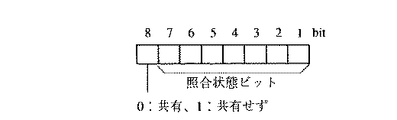
【0040】
これらの照合状態を格納するフォーマットの例を図11に示す。図示するように、第1ビット目から第7ビット目によってキー情報の照合状態を格納するとともに、第8ビット目の値により、この照合状態を他のファイル識別情報を用いたアクセスに対して参照させる(共有させる)か否かを規定するものである。特に、前者の照合状態は、後述するキー照合コマンドによって設定、解除される。また、共有されるか否かを示すビットは、後述するファイル選択コマンドによって選択されたファイルのパスを構成する各DFタイプ情報(TYPE)に基づき設定される。
【0041】
次に、各キーエリアに割当てられているキー情報の種別情報(CF)について説明する。このキー情報の種別情報は、たとえば、図12に示すようなフォーマットになっている。図中の照合状態指示ビットのうち、いずれか1つのビットが“1”となっていて、他のビットは全て“0”となっている。値が“1”となっているビットの位置は、キー情報ごとに異なる。たとえば、図7中のK00の CFは、第7ビット目のみが“1”となっており、また、K01のCFは、第6ビット目のみが“1”となっている。
【0042】
次に、図13によりICカード1の動作概念を説明する。図示するように、 ICカード1は、電気的活性化後に命令データ待ち状態に移る。この時点で命令データを待ち続け、入力されると、命令データの先頭にある機能コードを抽出し、対応する命令ルーチンに移る。この後、命令ルーチンにて処理を行ない、この処理結果を出力後、命令データ待ち状態に戻る。
【0043】
図14は、ファイルあるいはエリア創成コマンドの一例を示すものであり、 (a)はデータファイル創成コマンド、(b)はデータエリア創成コマンド、 (c)はキーエリア創成コマンドをそれぞれ示している。
【0044】
図15および図16は、ファイル創成のための動作を説明するフローチヤートを示している。ICカード1が、図14に示すようなコマンド電文を受信すると、これらの機能コードから、ファイル創成コマンドであることを認識し、図15および図16に示すフローチヤートにしたがって処理が実行される。
【0045】
まず、コマンド実行条件が整っているかを、コマンド電文中にて示されたファイル識別番号に対応する照合状態、および、カレントファイルに規定されているアクセス条件により判断する。この判断でアクセス不可と判断された場合には、アクセス条件異常を示す応答データを出力し、コマンド待ち状態に戻る。
【0046】
アクセス可能と判断した場合には、次にコマンドにて指定された割当てID (識別情報)が、現在のカレントデータファイル内に存在するかをチェックする。もし存在していれば、ID重複異常を示す応答データを出力し、コマンド待ち状態に戻る。そうでなければ、次のステップに移る。
【0047】
なお、この場合、特にデータファイル創成コマンドであった場合には、このチェックの外に、コマンドにて指定されたデータファイル名が、ICカード1内に存在しているかを更にチェックし、存在していれば、ID重複異常を示す応答データを出力し、コマンド待ち状態に戻る。
【0048】
次に、当該コマンドにて与えられたファイルのサイズが正当であるか否かをチェックする。この場合、指定されたファイルサイズに生成される定義情報が使用するバイト数を合計したバイト数が、チェックの対象になる。
【0049】
このとき、カレントとなっているデータファイルのファイルサイズを確認する。この場合、このカレントデータファイル定義情報にて規定されているファイルサイズ、および、使用サイズから、未使用サイズを計算することにより、コマンドにて指定されたファイルサイズを基に創成のために必要なサイズと比較する。これにより、未使用サイズよりも、創成に必要なサイズの方が大きい場合、ファイルサイズ異常を示す応答データを出力し、コマンド待ち状態に戻る。
【0050】
正常な場合には、次に当該コマンドがデータファイル創成を要求しているか否かをチェックし、そうであれば、現在、他のデータファイルにより使用されていないシーケンス番号のうち、最小の値を求める。このとき、未使用番号が見つからない場合には、ファイル個数異常を示す応答データを出力し、コマンド待ち状態に戻る。そうでなければ、定義情報作成処理に移行する。
【0051】
また、当該コマンドがデータファイル以外のファイル創成を要求していれば、コマンドにて指定されたファイルサイズ、および、制御領域120内に格納されているエリア群先頭アドレスにより、今回創成されるデータファイルの先頭アドレスを計算し、定義情報作成処理に移行する。
【0052】
定義情報作成処理においては、データファイル創成であれば、データファイル用パターンを示すPTN、前回の処理において検索したファイルシーケンス番号DFSN、当該ファイルの親ファイルが有するファイルシーケンス番号PFSN、コマンドにて指定されたデータファイル名の長さNL、データファイル名、ファイルサイズDFS、本ファイル選択時に出力すべきデータが格納されるデータファイルを特定するためのAID、および、アクセス条件DFACを使用して、これを生成する。なお、データファイルステータスDFST、および、使用サイズUSは、それぞれ初期値が設定される。
【0053】
また、データエリアであれば、データエリア用パターンを示すPTN、当該ファイルの親ファイルが有するファイルシーケンス番号DFSN、コマンドにて指定されたAID、サイズASIZ、キー情報の種別CF、アクセス条件AAC、および、前回の処理にて計算したエリア先頭アドレスATOPを使用して、これを生成する。なお、データエリアのステータスASTは、初期値が設定される。
【0054】
また、キーエリアであれば、キーエリア用パターンを示すPTN、当該ファイルの親ファイルが有するファイルシーケンス番号DFSN、コマンドにて指定されたKID、サイズKSIZ、アクセス条件KAC、および、前回の処理にて計算したエリア先頭アドレスKTOPを使用して、これを生成する。なお、データエリアのステータスKSTは、初期値が設定される。
【0055】
作成した定義情報は、制御領域120に格納されているディレクトリポインタ(空き領域先頭アドレス)から、当該ファイル創成により更新されるエリア群先頭アドレスの直前までを対象に、格納される。このとき、該定義情報の書込みが正常に終了しなかった場合には、書込み異常を示す応答データを出力し、コマンド待ち状態に戻る。
【0056】
定義情報の書込みが正常に終了すると、次にカレントファイルの使用サイズを更新する。このとき、更新が正常に終了しなかった場合には、書込み異常を示す応答データを出力し、コマンド待ち状態に戻る。
【0057】
これを正常に終了すると、ディレクトリポインタ、および、エリア群先頭アドレスを更新する。このとき、更新が正常に終了しなかった場合には、書込み異常を示す応答データを出力し、コマンド待ち状態に戻る。また、これを正常に終了すると、正常終了を示す応答データを出力し、コマンド待ち状態に戻る。
【0058】
次に、データファイルをカレント状態にするためのデータファイル選択動作について、図17に示すフローチャートを用いて説明する。図18に示すようなデータファイル選択コマンドを受信すると、当該コマンド内の機能コードにより、データファイル選択コマンドであることを認識し、図17に示すフローチャートにしたがって処理が実行される。
【0059】
まず、本コマンドにより指定されているファイル識別番号をサポートしているか否かを確認する。すなわち、図8の例では、識別番号0,1,2のいずれかであるかを確認する。もし、サポートしていないファイル識別番号であった場合には、ファイル識別番号異常を示す応答データを出力し、コマンド待ち状態に戻る。
【0060】
もし、サポートされているファイル識別番号であった場合には、次に、本コマンドによって通知されたデータファイル名情報を抽出し、ディレクトリ121を検索することにより、指定されたデータファイルが存在するか否かを確認する。もし、存在しなければ、該当データファイル名無しを示す応答データを出力し、コマンド待ち状態に戻る。
【0061】
もし、存在するのであれば、次のロジカルファイル識別番号割当て処理に移行する。ロジカルファイル識別番号割当て処理では、まず、本コマンドによって指定されたデータファイルのパスを確認する。図6におけるDF2−1は、ファイルレベルが2であり、直上のファイルはDF2、また、その直上にはMFが存在する。したがって、パスはMF,DF2となる。このパスの検索は、コマンドによって指定されたデータファイルの親ファイルのシーケンス番号PFSNを順に辿っていくと確認可能である。
【0062】
次に、このパスを構成する複数ファイルの確認情報をそれぞれ抽出し、今回割当てのために指定されたファイル識別番号に対応する図8中の欄を順に確認し、対応するレベルに、今回検索されたパスを構成する各ファイルの確認情報と一致する箇所を除き、新たにFINFを格納する。このとき、書換えられたFINFに対応するSTSは初期化される。この後、正常終了を示す応答データを出力し、コマンド待ち状態に戻る。
【0063】
なお、このとき、パスを構成するMFまたはDFのTYPEの第1ビット目を参照し、これに対応するビット値を各対応するSTSのMSBに格納する。
これにより、前述した全てのコマンドで参照されるカレントデータファイルの情報が、コマンド実行時点で認識できる。
【0064】
次に、キー情報の照合動作について、図19に示すフローチャートを用いて説明する。図20に示すようなキー照合コマンドが入力されると、まず、コマンド電文中のファイル識別番号を参照し、サポートしている値を指定したか否かをチェックする。もし、サポートしていなければ、ファイル識別番号指定異常を示す応答データを出力し、コマンド待ち状態に戻る。
【0065】
もし、サポートしていれば、図8に示すファイルステータス格納エリアの情報に基づいて、指定されたファイル識別情報に対応するカレントデータファイルを確認する。
【0066】
次に、カレントデータファイルのDFSNを有するキーエリア定義情報のうち、コマンドにて指定されたKIDを有する定義情報を検索する。もし、存在しなければ、該当キーエリア無し異常を示す応答データを出力し、コマンド待ち状態に戻る。
【0067】
なお、ここで識別番号とID指定部FID、および、実際にアクセスされるファイルの関係を図10の例で説明する。たとえば、識別番号を“1”として指定し、ID指定部で“03”を指定したとすると、識別番号“1”のFINFには#06が記憶されており、データファイルDF1が選択状態となっている。そして、ID指定部で“03”が指定されたことにより、データファイルD11がアクセスされることになる。
【0068】
一方、識別番号を“0”とし、ID指定部で“03”を指定すると、識別番号“0”のFINFには#18が記憶され、データファイルDF1−2が選択されている。そして、ID指定部で“03”を指定すると、データファイルD121がアクセスされる。
【0069】
このように、識別番号記憶部を複数設けることにより、複数のファイルを同時にカレント状態にすることができる。
上記定義情報の検索により、もし、見つかれば、この情報から、実際のキー情報が格納されている物理的位置を、KTOPおよびKSIZより認識し、格納されているキー情報を抽出する。そして、このキー情報とコマンド電文中にあるキー情報とを比較する。もし、両者が一致していれば、当該定義情報内のCFを参照し、これにより指示されているビットと同位置の、対応するステータス情報 STS(STS00〜STS22)内のビットを“1”にする。そして、正常終了を示す応答データを出力し、コマンド待ち状態に戻る。
【0070】
上記キー情報の比較によって、不一致と判断した場合には、同様に対応するステータス情報STS内のビットを“0”にして、キー不一致異常を示す応答データを出力し、コマンド待ち状態に戻る。
【0071】
次に、図21により照合状態を参照する方法を説明する。先にも述べたように、各識別番号の各レベル個別に、照合状態を格納する領域を有しており、それぞれ1バイトにて構成されている。たとえば、ファイル識別番号2のカレントファイルは#26を通し番号に有するDF2−1であるが、ファイル識別番号に対するレベル0の照合状態はCに、レベル1の照合状態はFに、そして、レベル2の照合状態はIに、それぞれ格納される。
【0072】
図22に、図8にて示したファイルステータス格納エリアに対するデータ格納例を示す。図示するように、ファイル識別番号0に対応する各レベルには、MF(通し番号#01)、DF1(通し番号#06)、および、DF1−1(通し番号13)のファイル確認情報が格納されている。これは、ファイル識別番号0に対応する最終カレントファイルが、DF1−1であることを示す。
【0073】
特に、レベル1および2におけるSTSnmには、K11*およびK111*が格納されており、レベル0に関しては空白(初期状態)になっている。これは、ファイル識別番号0を使用したキー照合コマンドによって、まず、DF1が選択された後にK11に格納されているキー情報が照合され、次に、DF1−1が選択された後にK111に格納されているキー情報が照合されたことを示している。
【0074】
また、特に、アスタリスク(*)が付加されているのは、ステータス情報 STSのMSBが“1”になっていることを示している。すなわち、DF1およびDF1−1に対応するTYPEが、キー情報の照合状態を“共有しない”という属性を示していることを表している。また、識別番号0においては、特に、レベル0に対応するステータス情報STSが空白になっている。これは、カレントファイルがMFの状態において、ファイル識別番号0を使用したキー照合コマンド処理が行なわれなかったことを示している。
【0075】
また、ファイル識別番号1に対応する各レベルには、MF(通し番号#01)、および、DF2(通し番号#08)のファイル確認情報が格納されている。そして、レベル2に該当する箇所は、初期状態になっている。これは、ファイル識別番号1に対応する最終カレントファイルが、DF2であることを示す。
【0076】
特に、レベル0におけるSTSnmは、K00およびK01が格納されている。これは、カレントファイルがMFの状態においてファイル識別番号1を使用したキー照合コマンドによって、MF配下のK00およびK01内のキー情報が照合されていることを示している。さらに、レベル1におけるSTSにはK21が格納されている。これは、ファイル識別番号1を使用したファイル選択コマンドにおいてDF2の選択を実行した後、やはりファイル識別番号1を使用したキー照合コマンドによって、DF2配下のK21に格納されているキー情報を照合したことを示す。
【0077】
なお、ファイル識別番号1に対応するレベル0および1におけるSTSには、アスタリスク(*)が付加されていない。これは、対応するステータス情報 STSのMSBが“0”であることを示している。すなわち、MFおよびDF2に対応するTYPEが、キー情報の照合状態を“共有する”という属性を示していることを表している。
【0078】
また、ファイル識別番号2に対応する各レベルには、MF(通し番号#01)、DF2(通し番号#08)、および、DF2−1(通し番号#26)のファイル確認情報が格納されている。これは、ファイル識別番号2に対応する最終カレントファイルが、DF2−1であることを示す。
【0079】
特に、レベル0およびレベル1におけるSTSは空白になっている。これは、MFおよびDF2配下のキー情報が照合されていないことを示している。また、レベル2にはK212が格納されている。これは、ファイル識別番号2を使用したファイル選択コマンドにてDF2−1の選択を実行した後、やはりファイル識別番号2を使用したキー照合コマンドによって、DF2−1配下のK212に格納されているキー情報を照合したことを示す。なお、このステータス情報STSには、アスタリスク(*)が付与されているのは、DF2−1のTYPEが、キー情報の照合状態を“共有しない”という属性を示していることを表している。
【0080】
ここで、これらのステータス情報STSの内容を、実際のコマンド受信により行なわれる、アクセス条件判定の際に参照する規則を以下に説明する。
規則(1) コマンドにて指定された識別番号に対応するレベル0のFINFが空白であった場合には、カレントファイル無しを意味する応答データを出力し、コマンド待ち状態に戻る。
【0081】
規則(2) 指定された識別番号に対応するパスを参照し、これの一部を他の識別番号に対応するパスと共有していた場合、指定された識別番号に対応する全レベルのステータス情報STSと、共有する部分に該当する他の識別番号内のステータス情報STSのうち、アスタリスクが付いていないものとを論理和(OR)し、アクセス判定に使用する。
【0082】
規則(3) 指定された識別番号に対応するパスを参照し、これの全てを含むパスを所有している他の識別番号に対応するパスが存在していた場合、他の識別番号内にあるアスタリスクが付いているステータス情報STSを除き、指定された識別番号に対応する全レベルのステータス情報STSと、当該他の識別番号に対応する全レベルのステータス情報STSとを論理和し、アクセス判定に使用する。
【0083】
たとえば、識別番号0を使用した場合、パスが#01/#06/#13となっている。このパスの一部を共有する最終的なキー情報の照合状態は、K00& K01&K11&K111となる。また、識別番号1を使用した場合においては、K00&K01&K21となり、また、識別番号2を使用した場合においては、K00&K01&K21&K212となる。
【0084】
なお、実施例では、キー情報の照合状態の共有の可否をデータファイルの属性(TYPE)として設定し、これを用いるようにしているが、たとえば、ICカード全体として、この属性を設定してもよい。
【0085】
また、前記実施例では、ファイルが選択されない限り、それに使用した識別番号に対応するレベル0のFINFが設定されないようになっているが、ICカードに対しての電気的活性化後、全ての識別番号に対応するレベル0のFINFを#01、すなわち、MFとしてもよい。
【0086】
また、照合状態を抽出する規則(3)においては、
規則(3′) 指定された識別番号に対応するパスを参照し、これの全てを含むパスを所有している他の識別番号に対応するパスが存在していた場合、他の識別番号内にあるアスタリスクが付いているステータス情報STSを除き、指定された識別番号に対応する全レベルのステータス情報STSと、当該他の識別番号に対応するパスを共有している部分のみのステータス情報STSとを論理和し、アクセス判定に使用する。
ようにしてもよい。
【0087】
また、前記実施例では、ファイル管理を行なう装置としてICカードを例示したが、筐体構成もカード状に限らず、棒状、ブロック状など、種々変更可能である。また、装置としても、携帯可能電子装置に限定されることなく、適用可能である。また、構成内容も、本発明の要旨を逸脱しない範囲で種々変更可能である。
【0088】
また、前記実施例にて例示したICカードは、外部装置とのデータ授受のためにコンタクト部を使用しているが、たとえば、光、電界、磁界などを用いて外部装置と接触せずに、これを行なう方法を用いてもよい。
【0089】
【発明の効果】
以上詳述したように本発明によれば、アプリケーションにて、たとえば、ICカード内の複数のファイルに対するアクセスが、アプリケーションによって効率よく行なわれるファイル管理方式を提供できる。
【0090】
また、本発明によれば、選択されたファイルに対するアクセス条件を満足するための各種キー情報の照合状態も、各選択ファイルに対してのみ作用させることが可能になり、したがって、1枚のICカードに対して複数のアプリケーションがアクセスする場合においても、個々の有するセキュリティ環境を維持できるファイル管理方式を提供できる。
【図面の簡単な説明】
【図1】本発明の一実施例に係るICカードが適用されるカード取扱装置の構成例を示すブロック図。
【図2】ICカードの構成例を示すブロック図。
【図3】データメモリの構成例を示すメモリマップ図。
【図4】各種定義情報のフォーマット例を示す図。
【図5】データTYPEのフォーマット例を示す図。
【図6】データメモリ内に設定されるファイルの構成例を示す図。
【図7】データメモリ内に設定されるディレクトリの構成例を示す図。
【図8】ファイルステータス格納エリアのフォーマット例を示す図。
【図9】ファイルステータス格納エリアのDF2−1を選択した後の状態を示す図。
【図10】ファイルステータス格納エリアの複数DFを選択した後の状態を示す図。
【図11】照合状態格納フォーマットの一例を示す図。
【図12】キー情報の種別情報のフォーマット例を示す図。
【図13】命令データ入力ルーチンを説明するフローチャート。
【図14】ファイルまたはエリア創成コマンドのフォーマット例を示す図。
【図15】ファイルおよびエリア創成動作を説明するフローチャート。
【図16】ファイルおよびエリア創成動作を説明するフローチャート。
【図17】データファイル選択動作を説明するフローチャート。
【図18】データファイル選択コマンドのフォーマット例を示す図。
【図19】キー情報照合動作を説明するフローチャート。
【図20】キー照合コマンドのフォーマット例を示す図。
【図21】ファイルステータス格納エリアの照合状態例を示す図。
【図22】ファイルステータス格納エリアのデータ格納例を示す図。
【符号の説明】
1……ICカード
2……カードリーダ・ライタ
3……制御部
4……キーボード
5……CRTディスプレイ装置
11……制御素子
12……データメモリ
13……ワーキングメモリ
14……プログラムメモリ
15……コンタクト部
120……制御領域
121……ディレクトリ
123……エリア群[0001]
[Industrial application fields]
The present invention performs data management of a plurality of files divided and set in the memory in a so-called IC card having a built-in IC chip having a non-volatile memory and a control element such as a CPU for controlling them. It relates to a file management method.
[0002]
[Prior art]
Recently, attention has been paid to an IC card incorporating a non-volatile data memory and an IC chip having a control element such as a CPU for controlling the nonvolatile data memory as a portable data storage medium.
[0003]
This type of IC card, for example, as described in JP-A-3-224047, divides the built-in data memory into a plurality of files, and each file is necessary when operating the application used. Such data is stored, and by inputting an application identification name or the like from an external device, only a corresponding file can be selectively used. For this reason, a plurality of application data is divided into files and stored in one IC card, thereby enabling multipurpose use.
[0004]
These application files can belong to a plurality of data files for storing data such as transaction data and a key file for storing key information for password verification.
[0005]
Currently, as an access method to these files, when an application file is selected, the current (usable) file identification number is assigned to the file, and the command is designated by specifying the identification number in each subsequent command. It is possible to identify an application file targeted by.
[0006]
[Problems to be solved by the invention]
By the way, a file attribute called an access condition is set for each file. This access condition is to selectively specify the collation state of key information required at the time of accessing the file. For example, if it is specified in the access condition that the collation state of the key information A in the IC card is necessary for accessing a certain file, the key information A of the key information A is accessed before accessing this file. Verification must be done.
[0007]
When accessing using the current file identification number described above, when accessing the file with the
[0008]
SUMMARY OF THE INVENTION An object of the present invention is to provide a file management system that allows efficient access to a plurality of files in a memory.
It is another object of the present invention to provide a file management system capable of maintaining the security environment of each application even when a plurality of applications access a plurality of files in the memory.
[0009]
[Means for Solving the Problems]
The file management system of the present invention A file management system for dividing a memory into a plurality of file groups and managing the data of each file by making each of the divided files into a hierarchical structure, in order to make the files available for use by a plurality of files Identification information giving means for giving identification information indicating that each file has been selected, and identification information given to each access command by the identification information giving means when the file is accessed In response to an authentication key verification command input from the outside, a file recognition unit for recognizing a file to be accessed based on identification information specified by the specification unit, A collation means for selectively collating key information of a file corresponding to the identification information designated by the designation means, and provided for each hierarchy of the files; A storage means for storing the collation result of the collation means in correspondence with the identification information designated by the designation means in the memory, and the identification information designated by the designation means in response to a command input from the outside. The reference means for referring to the access condition information of the corresponding file, the access condition information referred to by the reference means, and the collation result stored in the storage means and corresponding to the identification information designated by the designation means are compared. A comparison unit; an access permission determination unit that determines whether to access the file according to a comparison result of the comparison unit; an access permission determination result output unit that outputs an access permission determination result by the access permission determination unit; It has.
[0015]
[Action]
According to the present invention, with the above configuration, an application can efficiently access, for example, a plurality of files in the IC card. Also, the collation state of various key information for satisfying the access condition for the selected file can be applied only to each selected file. Therefore, even when a plurality of applications access one IC card, it is possible to maintain individual security environments.
[0016]
【Example】
An embodiment of the present invention will be described below with reference to the drawings.
FIG. 1 shows a configuration example of a card handling device used as a terminal device of a financial system or a shopping system, for example, to which an IC card according to the present embodiment is applied. That is, this apparatus enables the
[0017]
FIG. 2 shows a configuration example of the
[0018]
The
[0019]
For example, as shown in FIG. 3, the
[0020]
The data file is a file for collectively managing data areas and key areas used in the corresponding application.
The data area is an area for storing data for reading and writing as necessary, such as transaction data.
[0021]
The key area is, for example, an area used for storing a personal identification number, and is a target of writing / rewriting / collation, and cannot be read out.
These areas are collectively assigned as an
[0022]
Further, the
As shown in FIG. 4, the
[0023]
FIG. 4A shows information defining the name of the data file. This definition information is given to the data PTN for identifying the data file name definition information in the
[0024]
FIG. 4B is information defining management information of the data file. The definition information includes data PTN for identifying data file name definition information in the
[0025]
The MF (master file) does not have the data file name definition information described above.
FIG. 5 shows a format example of the data TYPE. As shown, the data TYPE is composed of 1 byte. Among these bits, the first bit indicates whether or not the collation state of key information described later is shared. If this bit is “0”, it can be shared. Indicates that it is impossible.
[0026]
FIG. 4C is information defining an area for storing various transaction data. This definition information includes data PTN for identifying area definition information in the
[0027]
FIG. 4D shows information defining an area for storing various key information. This definition information includes data PTN for identifying key area definition information in the
[0028]
The identification information PTN used for these is composed of 1 byte, and for the data file name definition (FIG. 4a), '00' defines the data file management information ( '01' for Fig. 4b), '02' for those defining data areas (Fig. 4c), and '03' for those defining key areas (Fig. 4d). Are used respectively.
[0029]
FIG. 6 shows an example of the structure of a file. In the figure, DFnn indicates a data file (DF), Dnn indicates a data area, and Knn indicates a key area. Further, #nn assigned to each data file, data area, and key area indicates the serial number of the definition information described in FIG. 7, and the numerical value in parentheses is the file identification information (ID ), Area identification information (ID).
[0030]
As shown in FIG. 6, in the
[0031]
DF1-1 and DF1-2, K11 and K12, and D11 and D12 are set under DF1, respectively.
Under the DF1-1, there are K111 and K112, D111 and D112, and under the DF1-2, K121 and K212, D121 and
D122 is set respectively.
[0032]
DF2-1 and DF2-2, K21 and K22, D21 and D22 are set under DF2, respectively.
Under the DF2-1, K211 and K212, D211 and D212, and under the DF2-2, K221 and K222, D221 and
D222 is set.
[0033]
These various types of definition information are collectively stored in the
[0034]
For example, in the data file definition information (serial number # 13) of DF1-1, DFSN is “03” and PFSN is “01”. That is, this data file is given file sequence number '03' at the time of creation, and at the same time, recognizes that this data file is created under DF1, and assigns DFSN ('01') of DF1 as PFSN.
[0035]
Next, the format of the file status storage area for temporarily storing various status information will be described with reference to FIG. This status information is in a predetermined area of the memory in the
[0036]
At the intersection of each element, the corresponding file identification information (FINFnm) and the status information (STSnm) of the file are stored in pairs. In particular, the file identification information uses the serial number of the definition information shown in FIG. 7 or the address information in which the definition information is stored. At this time, n indicates a file identification number, and m indicates a file level. For example, in the figure,
[0037]
A file status storage example will be described using the file structure example illustrated in FIG. For example, when
[0038]
FIG. 10 shows a state after selecting a plurality of DFs by using a plurality of file identification numbers. This figure shows DF1-2 (serial number # 18) using identification number 0, DF1 (serial number # 06) using
[0039]
For example, the current DF with the identification number 0 is DF1-2, and what is specified with the identification number 0 in the subsequent input command message is internally selected as the DF1-2 being the current file. The
[0040]
An example of a format for storing these collation states is shown in FIG. As shown in the figure, the collation state of the key information is stored by the first bit to the seventh bit, and the collation state is referred to for access using other file identification information by the value of the eighth bit. It is defined whether or not to allow (share). In particular, the former collation state is set and canceled by a key collation command described later. The bit indicating whether or not the file is shared is set based on each DF type information (TYPE) that constitutes the path of the file selected by the file selection command described later.
[0041]
Next, type information (CF) of key information assigned to each key area will be described. The type information of the key information has a format as shown in FIG. 12, for example. Of the collation state instruction bits in the figure, any one bit is “1”, and all other bits are “0”. The position of the bit whose value is “1” is different for each key information. For example, in the CF of K00 in FIG. 7, only the seventh bit is “1”, and in the CF of K01, only the sixth bit is “1”.
[0042]
Next, the operation concept of the
[0043]
FIG. 14 shows an example of a file or area creation command. (A) shows a data file creation command, (b) shows a data area creation command, and (c) shows a key area creation command.
[0044]
15 and 16 show a flow chart for explaining the operation for creating a file. When the
[0045]
First, it is determined whether or not the command execution condition is satisfied based on the collation state corresponding to the file identification number indicated in the command message and the access condition defined for the current file. If it is determined that access is not possible, response data indicating an abnormal access condition is output and the process returns to the command wait state.
[0046]
If it is determined that access is possible, it is checked whether the allocation ID (identification information) specified by the command exists in the current current data file. If it exists, response data indicating an ID duplication abnormality is output, and the process returns to the command waiting state. If not, go to the next step.
[0047]
In this case, particularly in the case of a data file creation command, in addition to this check, it is further checked whether the data file name specified by the command exists in the
[0048]
Next, it is checked whether or not the file size given by the command is valid. In this case, the total number of bytes used by the definition information generated for the specified file size is the target of the check.
[0049]
At this time, the file size of the current data file is confirmed. In this case, it is necessary for creation based on the file size specified by the command by calculating the unused size from the file size specified in the current data file definition information and the used size. Compare with size. As a result, when the size necessary for creation is larger than the unused size, response data indicating an abnormal file size is output, and the process returns to the command waiting state.
[0050]
If it is normal, the command next checks whether or not the command requires creation of a data file. If so, the smallest sequence number not currently used by another data file is set. Ask. At this time, if an unused number is not found, response data indicating an abnormal number of files is output, and the process returns to the command wait state. Otherwise, the process proceeds to definition information creation processing.
[0051]
If the command requests creation of a file other than a data file, the data file created this time is based on the file size specified by the command and the area group start address stored in the
[0052]
In the definition information creation process, if a data file is created, the PTN indicating the pattern for the data file, the file sequence number DFSN searched in the previous process, the file sequence number PFSN of the parent file of the file, specified by the command The data file name length NL, data file name, file size DFS, AID for specifying the data file in which the data to be output when this file is selected, and the access condition DFAC are used. Generate. Note that initial values are set for the data file status DFST and the usage size US, respectively.
[0053]
If it is a data area, the PTN indicating the pattern for the data area, the file sequence number DFSN of the parent file of the file, the AID specified by the command, the size ASIZ, the key information type CF, the access condition AAC, and This is generated using the area start address ATOP calculated in the previous process. The data area status AST is set to an initial value.
[0054]
In the case of a key area, the PTN indicating the key area pattern, the file sequence number DFSN of the parent file of the file, the KID specified by the command, the size KSIZ, the access condition KAC, and the previous processing This is generated using the calculated area head address KTOP. The data area status KST is set to an initial value.
[0055]
The created definition information is stored from the directory pointer (empty area head address) stored in the
[0056]
When the definition information has been written normally, the current file usage size is updated. At this time, if the update does not end normally, response data indicating a write error is output and the process returns to the command wait state.
[0057]
When this is completed normally, the directory pointer and the area group head address are updated. At this time, if the update does not end normally, response data indicating a write error is output and the process returns to the command wait state. When this is completed normally, response data indicating normal termination is output and the process returns to the command waiting state.
[0058]
Next, a data file selection operation for bringing a data file into a current state will be described with reference to the flowchart shown in FIG. When a data file selection command as shown in FIG. 18 is received, it is recognized as a data file selection command from the function code in the command, and the process is executed according to the flowchart shown in FIG.
[0059]
First, it is checked whether the file identification number specified by this command is supported. That is, in the example of FIG. 8, it is confirmed whether the identification number is 0, 1, or 2. If the file identification number is not supported, response data indicating that the file identification number is abnormal is output and the process returns to the command wait state.
[0060]
If the file identification number is supported, then the data file name information notified by this command is extracted, and the
[0061]
If it exists, the process proceeds to the next logical file identification number assignment process. In the logical file identification number assignment process, first, the path of the data file specified by this command is confirmed. The file level of DF2-1 in FIG. 6 is 2, DF2 is the file immediately above, and MF is immediately above it. Therefore, the path is MF, DF2. This path search can be confirmed by sequentially tracing the sequence number PFSN of the parent file of the data file specified by the command.
[0062]
Next, the confirmation information of the plurality of files constituting this path is extracted, the columns in FIG. 8 corresponding to the file identification numbers designated for the current allocation are sequentially checked, and the current level is searched to the corresponding level. The FINF is newly stored except for the part that matches the confirmation information of each file constituting the path. At this time, the STS corresponding to the rewritten FINF is initialized. Thereafter, response data indicating normal termination is output, and the process returns to the command waiting state.
[0063]
At this time, the first bit of the MF or DF type constituting the path is referred to, and the corresponding bit value is stored in the MSB of each corresponding STS.
Thereby, the information of the current data file referred to by all the commands described above can be recognized at the time of command execution.
[0064]
Next, the key information matching operation will be described with reference to the flowchart shown in FIG. When a key collation command as shown in FIG. 20 is input, first, it is checked whether or not a supported value is specified by referring to a file identification number in the command message. If not supported, response data indicating a file identification number designation error is output and the process returns to the command wait state.
[0065]
If it is supported, the current data file corresponding to the specified file identification information is confirmed based on the information in the file status storage area shown in FIG.
[0066]
Next, the definition information having the KID designated by the command is searched from the key area definition information having the DFSN of the current data file. If it does not exist, response data indicating the absence of the corresponding key area is output and the process returns to the command wait state.
[0067]
Here, the relationship between the identification number, the ID designation unit FID, and the actually accessed file will be described with reference to the example of FIG. For example, if the identification number is designated as “1” and “03” is designated in the ID designation section, # 06 is stored in the FINF with the identification number “1”, and the data file DF1 is selected. ing. Then, when “03” is designated by the ID designation unit, the data file D11 is accessed.
[0068]
On the other hand, when the identification number is “0” and “03” is designated by the ID designation unit, # 18 is stored in the FINF of the identification number “0”, and the data file DF1-2 is selected. When “03” is designated in the ID designation section, the data file D121 is accessed.
[0069]
In this way, by providing a plurality of identification number storage units, a plurality of files can be made into a current state at the same time.
If it is found by searching the definition information, the physical position where the actual key information is stored is recognized from the KTOP and KSIZ, and the stored key information is extracted from this information. Then, the key information is compared with the key information in the command message. If they match, the CF in the definition information is referred to, and the bit in the corresponding status information STS (STS00 to STS22) at the same position as the indicated bit is set to “1”. To do. Then, response data indicating normal termination is output, and the process returns to the command waiting state.
[0070]
If a mismatch is determined by comparing the key information, the corresponding bit in the status information STS is similarly set to “0”, response data indicating a key mismatch error is output, and the process returns to the command wait state.
[0071]
Next, a method for referring to the collation state will be described with reference to FIG. As described above, each level of each identification number has an area for storing a collation state, and is configured by 1 byte. For example, the current file of
[0072]
FIG. 22 shows an example of data storage for the file status storage area shown in FIG. As shown in the figure, file confirmation information of MF (serial number # 01), DF1 (serial number # 06), and DF1-1 (serial number 13) is stored in each level corresponding to the file identification number 0. This indicates that the final current file corresponding to the file identification number 0 is DF1-1.
[0073]
In particular, STSnm at
[0074]
In particular, the addition of an asterisk (*) indicates that the MSB of the status information STS is “1”. That is, TYPE corresponding to DF1 and DF1-1 indicates that the collation state of the key information indicates an attribute “not shared”. In the identification number 0, the status information STS corresponding to level 0 is particularly blank. This indicates that the key collation command processing using the file identification number 0 was not performed when the current file is in the MF state.
[0075]
In each level corresponding to the
[0076]
In particular, for STSnm at level 0, K00 and K01 are stored. This indicates that the key information in K00 and K01 under the MF is collated by the key collation command using the
[0077]
Note that an asterisk (*) is not added to the STSs at
[0078]
In each level corresponding to the
[0079]
In particular, the STS at level 0 and
[0080]
Here, the rules for referring to the contents of the status information STS when judging the access condition performed by actual command reception will be described below.
Rule (1) If the level 0 FINF corresponding to the identification number specified by the command is blank, response data indicating the absence of the current file is output, and the process returns to the command waiting state.
[0081]
Rule (2) When a path corresponding to a specified identification number is referenced and a part of the path is shared with a path corresponding to another identification number, all levels of status information corresponding to the specified identification number The STS and the status information STS in the other identification numbers corresponding to the shared part are logically ORed with those without an asterisk and used for access determination.
[0082]
Rule (3) When a path corresponding to the specified identification number is referenced and there is a path corresponding to another identification number that owns the path including all of them, it is within the other identification number. Except for status information STS with an asterisk, all levels of status information STS corresponding to the specified identification number and all levels of status information STS corresponding to the other identification numbers are logically ORed for access determination. use.
[0083]
For example, when the identification number 0 is used, the path is # 01 / # 06 / # 13. The final collation state of key information sharing a part of this path is K00 & K01 & K11 & K111. Further, when the
[0084]
In the embodiment, whether or not the collation status of the key information is shared is set as an attribute (TYPE) of the data file, and this is used. However, for example, even if this attribute is set for the entire IC card, Good.
[0085]
In the above embodiment, unless a file is selected, the level 0 FINF corresponding to the identification number used for the file is not set. However, after the electrical activation of the IC card, all identifications are made. The level 0 FINF corresponding to the number may be # 01, that is, MF.
[0086]
In the rule (3) for extracting the collation state,
Rule (3 ') When the path corresponding to the specified identification number is referenced and there is a path corresponding to another identification number that owns the path including all of the paths, it is included in the other identification number. Except for the status information STS with a certain asterisk, all levels of status information STS corresponding to the specified identification number and status information STS of only the part sharing the path corresponding to the other identification number ORed and used for access determination.
You may do it.
[0087]
In the above embodiment, the IC card is exemplified as the file management device. However, the housing configuration is not limited to the card shape, and various changes such as a rod shape and a block shape are possible. Further, the device is not limited to a portable electronic device and can be applied. In addition, the configuration contents can be variously changed without departing from the gist of the present invention.
[0088]
In addition, the IC card exemplified in the above embodiment uses a contact portion for data exchange with an external device, for example, without contacting the external device using light, electric field, magnetic field, etc. A method of doing this may be used.
[0089]
【The invention's effect】
As described above in detail, according to the present invention, it is possible to provide a file management system in which access to a plurality of files in an IC card, for example, is efficiently performed by an application.
[0090]
In addition, according to the present invention, the collation state of various key information for satisfying the access condition for the selected file can be applied only to each selected file. Therefore, one IC card is used. However, even when a plurality of applications access the file management system, it is possible to provide a file management system that can maintain the security environment of each individual application.
[Brief description of the drawings]
FIG. 1 is a block diagram showing a configuration example of a card handling apparatus to which an IC card according to an embodiment of the present invention is applied.
FIG. 2 is a block diagram illustrating a configuration example of an IC card.
FIG. 3 is a memory map diagram showing a configuration example of a data memory.
FIG. 4 is a diagram showing a format example of various definition information.
FIG. 5 is a diagram showing an example format of data TYPE.
FIG. 6 is a diagram showing a configuration example of a file set in a data memory.
FIG. 7 is a diagram showing a configuration example of a directory set in a data memory.
FIG. 8 is a diagram showing a format example of a file status storage area.
FIG. 9 is a diagram showing a state after selecting DF2-1 in the file status storage area.
FIG. 10 is a diagram showing a state after selecting a plurality of DFs in a file status storage area.
FIG. 11 is a diagram showing an example of a collation state storage format.
FIG. 12 is a diagram showing a format example of type information of key information.
FIG. 13 is a flowchart for explaining an instruction data input routine.
FIG. 14 is a diagram showing a format example of a file or area creation command.
FIG. 15 is a flowchart for explaining a file and area creation operation;
FIG. 16 is a flowchart for explaining a file and area creation operation;
FIG. 17 is a flowchart for explaining a data file selection operation;
FIG. 18 is a diagram showing a format example of a data file selection command.
FIG. 19 is a flowchart for explaining a key information collating operation.
FIG. 20 is a diagram showing a format example of a key collation command.
FIG. 21 is a diagram showing an example of a collation state in a file status storage area.
FIG. 22 is a diagram showing an example of data storage in a file status storage area.
[Explanation of symbols]
1 …… IC card
2 ... Card reader / writer
3. Control unit
4 ... Keyboard
5. CRT display device
11 …… Control element
12 …… Data memory
13 …… Working memory
14 …… Program memory
15 …… Contact section
120 …… Control area
121 …… Directory
123 …… Area group
Claims (1)
複数のファイル分設けられ、前記ファイルを利用可能にするための選択を行なった際、各ファイルに対して選択済であることを示す識別情報を付与する識別情報付与手段と、
ファイルへのアクセス時に各アクセス命令に前記識別情報付与手段で付与された識別情報を付加して指定する指定手段と、
この指定手段で指定された識別情報に基づきアクセスの対象となるファイルを認識するファイル認識手段と、
外部から入力される認証キー照合命令に呼応して、前記指定手段で指定された識別情報に対応するファイルのキー情報を選択的に照合する照合手段と、
前記ファイルの階層ごとに設けられ、前記照合手段の照合結果を前記メモリ内の前記指定手段で指定された識別情報に対応させて記憶する記憶手段と、
外部から入力される命令に呼応して、前記指定手段で指定された識別情報に対応するファイルのアクセス条件情報を参照する参照手段と、
この参照手段で参照したアクセス条件情報と、前記記憶手段に記憶され、前記指定手段で指定された識別情報に対応する照合結果とを比較する比較手段と、
この比較手段の比較結果に応じて前記ファイルに対するアクセスの可否を決定するアクセス可否決定手段と、
このアクセス可否決定手段によるアクセス可否決定結果を出力するアクセス可否決定結果出力手段と、
を具備したことを特徴とするファイル管理方式。A file management system that divides a memory into a plurality of file groups, and divides each divided file into a hierarchical structure, and manages data of each file,
Identification information providing means for providing identification information indicating that each file has been selected when a selection is made to make the file available for a plurality of files;
A designation means for adding and specifying the identification information given by the identification information giving means to each access command when accessing the file;
A file recognition means for recognizing a file to be accessed based on the identification information designated by the designation means;
In response to an authentication key collation command input from the outside, collation means for selectively collating key information of a file corresponding to the identification information designated by the designation means;
A storage unit that is provided for each level of the file, and stores the verification result of the verification unit in association with the identification information designated by the designation unit in the memory;
In response to a command input from the outside, a reference unit that refers to access condition information of a file corresponding to the identification information specified by the specifying unit;
A comparison means for comparing the access condition information referred to by the reference means and the matching result stored in the storage means and corresponding to the identification information designated by the designation means;
An access permission determination unit that determines whether to access the file according to a comparison result of the comparison unit;
An access permission determination result output means for outputting an access permission determination result by the access permission determination means;
A file management method characterized by comprising:
Priority Applications (4)
| Application Number | Priority Date | Filing Date | Title |
|---|---|---|---|
| JP31017293A JP3594980B2 (en) | 1993-12-10 | 1993-12-10 | File management method |
| DE69427070T DE69427070T2 (en) | 1993-12-10 | 1994-12-08 | File management system for a memory card |
| EP94119426A EP0657851B1 (en) | 1993-12-10 | 1994-12-08 | File management system for memory card |
| US08/352,581 US5608902A (en) | 1993-12-10 | 1994-12-09 | File management system for memory card |
Applications Claiming Priority (1)
| Application Number | Priority Date | Filing Date | Title |
|---|---|---|---|
| JP31017293A JP3594980B2 (en) | 1993-12-10 | 1993-12-10 | File management method |
Publications (2)
| Publication Number | Publication Date |
|---|---|
| JPH07160547A JPH07160547A (en) | 1995-06-23 |
| JP3594980B2 true JP3594980B2 (en) | 2004-12-02 |
Family
ID=18002043
Family Applications (1)
| Application Number | Title | Priority Date | Filing Date |
|---|---|---|---|
| JP31017293A Expired - Lifetime JP3594980B2 (en) | 1993-12-10 | 1993-12-10 | File management method |
Country Status (4)
| Country | Link |
|---|---|
| US (1) | US5608902A (en) |
| EP (1) | EP0657851B1 (en) |
| JP (1) | JP3594980B2 (en) |
| DE (1) | DE69427070T2 (en) |
Families Citing this family (25)
| Publication number | Priority date | Publication date | Assignee | Title |
|---|---|---|---|---|
| EP0757336B1 (en) * | 1995-08-04 | 2000-11-22 | Belle Gate Investment B.V. | Data exchange systems comprising portable data processing units |
| EP0818761A1 (en) * | 1996-07-12 | 1998-01-14 | Koninklijke KPN N.V. | Integrated circuit card, secure application module, system comprising a secure application module and a terminal and a method for controlling service actions to be carried out by the secure application module on the integrated circuit card |
| AU755388B2 (en) * | 1998-04-01 | 2002-12-12 | Chip Application Technologies Limited | Data carrying device and systems for use therewith |
| AUPP274098A0 (en) | 1998-04-01 | 1998-04-30 | Chip Application Technologies Limited | Data carrying device and systems for use therewith |
| AU784672B2 (en) | 1999-09-01 | 2006-05-25 | Matsushita Electric Industrial Co., Ltd. | Distribution system, semiconductor memory card, receiving apparatus, computer-readable recording medium and receiving method |
| WO2001031437A1 (en) * | 1999-10-27 | 2001-05-03 | Fujitsu Limited | Program management method for storage medium-mounted computer, computer, and storage medium |
| JP2001167241A (en) * | 1999-12-10 | 2001-06-22 | Fujitsu Ltd | Non-contact IC card and method of manufacturing the same |
| JP4240851B2 (en) | 2001-06-27 | 2009-03-18 | ソニー株式会社 | PIN code identification device and PIN code identification method |
| US7508946B2 (en) | 2001-06-27 | 2009-03-24 | Sony Corporation | Integrated circuit device, information processing apparatus, memory management method for information storage device, mobile terminal apparatus, semiconductor integrated circuit device, and communication method using mobile terminal apparatus |
| US7346973B2 (en) * | 2002-09-09 | 2008-03-25 | Nissin Manufacturing Co., Ltd. | Processing cell of automatic machining system and automatic honing system |
| FR2845538B1 (en) * | 2002-10-08 | 2005-09-16 | Tecban | APPARATUS PROVIDED WITH TRANSPONDERS CONTAINING DATA PARTICULARLY RELATING TO THE APPARATUS |
| EP1605415A1 (en) * | 2004-06-11 | 2005-12-14 | Axalto SA | File management system |
| US20060130154A1 (en) * | 2004-11-30 | 2006-06-15 | Wai Lam | Method and system for protecting and verifying stored data |
| JP2006251960A (en) * | 2005-03-09 | 2006-09-21 | Hitachi Ltd | Storage device |
| GB0511599D0 (en) * | 2005-06-07 | 2005-07-13 | Ecebs Group Ltd | ITSO FCV2 application monitor |
| JP4856400B2 (en) * | 2005-07-06 | 2012-01-18 | ルネサスエレクトロニクス株式会社 | Storage device and information processing terminal |
| JP5075404B2 (en) * | 2006-12-15 | 2012-11-21 | 株式会社東芝 | Portable electronic device, file access method and IC card in portable electronic device |
| US7966355B2 (en) * | 2007-02-13 | 2011-06-21 | Modu Ltd. | Interface for extending functionality of memory cards |
| JP4618259B2 (en) * | 2007-02-16 | 2011-01-26 | ソニー株式会社 | Data storage device and data storage method |
| JP4345830B2 (en) * | 2007-03-09 | 2009-10-14 | ソニー株式会社 | Information recording apparatus and information recording method |
| DE102010054783B4 (en) | 2010-12-16 | 2024-09-19 | Giesecke+Devrient Mobile Security Germany Gmbh | Method for storing a file in a portable storage device |
| FR2983622B1 (en) * | 2011-12-02 | 2014-01-24 | Morpho | WRITING DATA IN A NON-VOLATILE MEMORY OF A CHIP CARD |
| JP2014006631A (en) * | 2012-06-22 | 2014-01-16 | Toshiba Corp | Ic card and portable electronic device |
| US20190042808A1 (en) * | 2016-03-23 | 2019-02-07 | Sony Corporation | Information processing device and information processing method |
| JP2019121214A (en) * | 2018-01-09 | 2019-07-22 | 凸版印刷株式会社 | Method for issuing ic card medium, ic card medium, and program thereof |
Family Cites Families (31)
| Publication number | Priority date | Publication date | Assignee | Title |
|---|---|---|---|---|
| US4876835A (en) * | 1984-09-10 | 1989-10-31 | Herman Miller, Inc. | Work space management system |
| JPH0751379B2 (en) * | 1986-04-18 | 1995-06-05 | 日本電気株式会社 | Print control device |
| JPS6336490A (en) * | 1986-07-31 | 1988-02-17 | シャープ株式会社 | Electronic cash register |
| JPH0758500B2 (en) * | 1987-02-20 | 1995-06-21 | 株式会社東芝 | Portable electronic device |
| JP2514954B2 (en) * | 1987-03-13 | 1996-07-10 | 三菱電機株式会社 | IC card |
| FR2630838A2 (en) * | 1987-07-15 | 1989-11-03 | Centre Nat Rech Scient | MEMORY ACCESS MANAGEMENT UNIT WITH INVARIANT LOGIC IDENTIFIERS, IN PARTICULAR FOR MANAGING DATABASES, AND CORRESPONDING ACCESS MANAGEMENT METHOD |
| US5237682A (en) * | 1987-10-19 | 1993-08-17 | International Business Machines Corporation | File management system for a computer |
| JPH0250286A (en) * | 1988-08-12 | 1990-02-20 | Toshiba Corp | Portable electronic device |
| JP2672567B2 (en) * | 1988-04-28 | 1997-11-05 | キヤノン株式会社 | Information processing apparatus and method |
| JP2831660B2 (en) * | 1988-08-26 | 1998-12-02 | 株式会社東芝 | Portable electronic devices |
| JP3015377B2 (en) * | 1988-08-26 | 2000-03-06 | 株式会社東芝 | IC card |
| JP2695855B2 (en) * | 1988-08-26 | 1998-01-14 | 株式会社東芝 | Portable electronic devices |
| US5161256A (en) * | 1988-08-26 | 1992-11-03 | Kabushiki Kaisha Toshiba | Method and system for allocating file area in memory area of ic card |
| JP2695857B2 (en) * | 1988-08-31 | 1998-01-14 | 株式会社東芝 | Portable electronic devices |
| JP2974144B2 (en) * | 1988-08-31 | 1999-11-08 | 株式会社東芝 | Portable electronic devices |
| JPH0267651A (en) * | 1988-09-02 | 1990-03-07 | Hitachi Ltd | How to manage file system protection |
| US5060170A (en) * | 1989-08-09 | 1991-10-22 | International Business Machines Corp. | Space allocation and positioning method for screen display regions in a variable windowing system |
| JPH03232029A (en) * | 1989-12-08 | 1991-10-16 | Fuji Photo Film Co Ltd | Storage managing system for memory card |
| JPH0792775B2 (en) * | 1989-12-11 | 1995-10-09 | 株式会社日立製作所 | Space management method for external storage devices |
| JPH03224082A (en) * | 1990-01-30 | 1991-10-03 | Toshiba Corp | Portable electronic device |
| JPH03266039A (en) * | 1990-03-16 | 1991-11-27 | Fujitsu Ltd | Free format data link processing system |
| EP1210916B1 (en) * | 1990-10-19 | 2006-09-20 | ST. Louis University | System for indicating a location within a body of a patient |
| US5285200A (en) * | 1990-11-29 | 1994-02-08 | Kabushiki Kaisha Toshiba | Portable electronic device and a method for processing data therefore |
| FR2673476B1 (en) * | 1991-01-18 | 1996-04-12 | Gemplus Card Int | SECURE METHOD FOR LOADING MULTIPLE APPLICATIONS INTO A MICROPROCESSOR MEMORY CARD. |
| CA2035697A1 (en) * | 1991-02-05 | 1992-08-06 | Brian James Smyth | Encryption apparatus for computer device |
| JP2901767B2 (en) * | 1991-02-08 | 1999-06-07 | 株式会社東芝 | Cryptographic communication system and portable electronic device |
| FR2676294B1 (en) * | 1991-05-06 | 1993-07-16 | Gemplus Card Int | LOCKING METHOD FOR MEMORY CARD. |
| US5327497A (en) * | 1992-06-04 | 1994-07-05 | Integrated Technologies Of America, Inc. | Preboot protection of unauthorized use of programs and data with a card reader interface |
| US5289470A (en) * | 1992-12-14 | 1994-02-22 | International Business Machines Corp. | Flexible scheme for buffer space allocation in networking devices |
| JPH06274397A (en) * | 1993-03-24 | 1994-09-30 | Toshiba Corp | File management method |
| JPH06274398A (en) * | 1993-03-24 | 1994-09-30 | Toshiba Corp | File management method |
-
1993
- 1993-12-10 JP JP31017293A patent/JP3594980B2/en not_active Expired - Lifetime
-
1994
- 1994-12-08 EP EP94119426A patent/EP0657851B1/en not_active Expired - Lifetime
- 1994-12-08 DE DE69427070T patent/DE69427070T2/en not_active Expired - Lifetime
- 1994-12-09 US US08/352,581 patent/US5608902A/en not_active Expired - Lifetime
Also Published As
| Publication number | Publication date |
|---|---|
| JPH07160547A (en) | 1995-06-23 |
| DE69427070D1 (en) | 2001-05-17 |
| EP0657851A2 (en) | 1995-06-14 |
| DE69427070T2 (en) | 2001-12-06 |
| US5608902A (en) | 1997-03-04 |
| EP0657851B1 (en) | 2001-04-11 |
| EP0657851A3 (en) | 1996-07-31 |
Similar Documents
| Publication | Publication Date | Title |
|---|---|---|
| JP3594980B2 (en) | File management method | |
| JP3662946B2 (en) | File management system and portable electronic device | |
| JPH06274397A (en) | File management method | |
| JP2537199B2 (en) | IC card | |
| KR100386154B1 (en) | Data excange system comprising portable data processing units | |
| JP3015377B2 (en) | IC card | |
| US5293029A (en) | System for mutually certifying an IC card and an IC card terminal | |
| US5161256A (en) | Method and system for allocating file area in memory area of ic card | |
| JP3445304B2 (en) | File management device | |
| JP5329884B2 (en) | Portable electronic device and data processing method in portable electronic device | |
| JP3568970B2 (en) | IC card issuing device | |
| JPH0440588A (en) | Portable electronic equipment | |
| JP2575358B2 (en) | IC card | |
| EP0950982B1 (en) | Portable electronic apparatus | |
| US6363456B1 (en) | IC card, IC card processing system, and IC card processing method | |
| JP2677589B2 (en) | Portable electronic device and IC chip | |
| US7296289B2 (en) | Setting or changing an access condition for an access management apparatus and method of a portable electronic device | |
| JPH09114741A (en) | Portable information recording medium | |
| JPH10105472A (en) | Memory access management method | |
| JPH06274398A (en) | File management method | |
| JPH09293023A (en) | Memory access management method | |
| JP2501050Y2 (en) | IC card | |
| JP2856415B2 (en) | Portable electronic devices | |
| JPH01194093A (en) | Portable electronic device | |
| JP2537198B2 (en) | Portable electronic devices |
Legal Events
| Date | Code | Title | Description |
|---|---|---|---|
| A131 | Notification of reasons for refusal |
Free format text: JAPANESE INTERMEDIATE CODE: A131 Effective date: 20040217 |
|
| A521 | Request for written amendment filed |
Free format text: JAPANESE INTERMEDIATE CODE: A523 Effective date: 20040419 |
|
| TRDD | Decision of grant or rejection written | ||
| A01 | Written decision to grant a patent or to grant a registration (utility model) |
Free format text: JAPANESE INTERMEDIATE CODE: A01 Effective date: 20040831 |
|
| A61 | First payment of annual fees (during grant procedure) |
Free format text: JAPANESE INTERMEDIATE CODE: A61 Effective date: 20040902 |
|
| FPAY | Renewal fee payment (event date is renewal date of database) |
Free format text: PAYMENT UNTIL: 20070910 Year of fee payment: 3 |
|
| FPAY | Renewal fee payment (event date is renewal date of database) |
Free format text: PAYMENT UNTIL: 20080910 Year of fee payment: 4 |
|
| FPAY | Renewal fee payment (event date is renewal date of database) |
Free format text: PAYMENT UNTIL: 20080910 Year of fee payment: 4 |
|
| FPAY | Renewal fee payment (event date is renewal date of database) |
Free format text: PAYMENT UNTIL: 20090910 Year of fee payment: 5 |
|
| FPAY | Renewal fee payment (event date is renewal date of database) |
Free format text: PAYMENT UNTIL: 20090910 Year of fee payment: 5 |
|
| FPAY | Renewal fee payment (event date is renewal date of database) |
Free format text: PAYMENT UNTIL: 20100910 Year of fee payment: 6 |
|
| FPAY | Renewal fee payment (event date is renewal date of database) |
Free format text: PAYMENT UNTIL: 20110910 Year of fee payment: 7 |
|
| FPAY | Renewal fee payment (event date is renewal date of database) |
Free format text: PAYMENT UNTIL: 20110910 Year of fee payment: 7 |
|
| FPAY | Renewal fee payment (event date is renewal date of database) |
Free format text: PAYMENT UNTIL: 20120910 Year of fee payment: 8 |
|
| FPAY | Renewal fee payment (event date is renewal date of database) |
Free format text: PAYMENT UNTIL: 20120910 Year of fee payment: 8 |
|
| FPAY | Renewal fee payment (event date is renewal date of database) |
Free format text: PAYMENT UNTIL: 20130910 Year of fee payment: 9 |
|
| EXPY | Cancellation because of completion of term |