JP2025521584A - Application Traffic Flow Prediction Based on Multi-Stage Network Traffic Flow Scanning - Google Patents
Application Traffic Flow Prediction Based on Multi-Stage Network Traffic Flow Scanning Download PDFInfo
- Publication number
- JP2025521584A JP2025521584A JP2024575477A JP2024575477A JP2025521584A JP 2025521584 A JP2025521584 A JP 2025521584A JP 2024575477 A JP2024575477 A JP 2024575477A JP 2024575477 A JP2024575477 A JP 2024575477A JP 2025521584 A JP2025521584 A JP 2025521584A
- Authority
- JP
- Japan
- Prior art keywords
- pattern
- traffic flow
- application
- match
- database
- Prior art date
- Legal status (The legal status is an assumption and is not a legal conclusion. Google has not performed a legal analysis and makes no representation as to the accuracy of the status listed.)
- Pending
Links
Classifications
-
- H—ELECTRICITY
- H04—ELECTRIC COMMUNICATION TECHNIQUE
- H04L—TRANSMISSION OF DIGITAL INFORMATION, e.g. TELEGRAPHIC COMMUNICATION
- H04L41/00—Arrangements for maintenance, administration or management of data switching networks, e.g. of packet switching networks
- H04L41/08—Configuration management of networks or network elements
- H04L41/0894—Policy-based network configuration management
-
- H—ELECTRICITY
- H04—ELECTRIC COMMUNICATION TECHNIQUE
- H04L—TRANSMISSION OF DIGITAL INFORMATION, e.g. TELEGRAPHIC COMMUNICATION
- H04L43/00—Arrangements for monitoring or testing data switching networks
- H04L43/02—Capturing of monitoring data
- H04L43/026—Capturing of monitoring data using flow identification
-
- H—ELECTRICITY
- H04—ELECTRIC COMMUNICATION TECHNIQUE
- H04L—TRANSMISSION OF DIGITAL INFORMATION, e.g. TELEGRAPHIC COMMUNICATION
- H04L43/00—Arrangements for monitoring or testing data switching networks
- H04L43/02—Capturing of monitoring data
- H04L43/028—Capturing of monitoring data by filtering
-
- H—ELECTRICITY
- H04—ELECTRIC COMMUNICATION TECHNIQUE
- H04L—TRANSMISSION OF DIGITAL INFORMATION, e.g. TELEGRAPHIC COMMUNICATION
- H04L45/00—Routing or path finding of packets in data switching networks
- H04L45/302—Route determination based on requested QoS
- H04L45/306—Route determination based on the nature of the carried application
-
- H—ELECTRICITY
- H04—ELECTRIC COMMUNICATION TECHNIQUE
- H04L—TRANSMISSION OF DIGITAL INFORMATION, e.g. TELEGRAPHIC COMMUNICATION
- H04L45/00—Routing or path finding of packets in data switching networks
- H04L45/38—Flow based routing
-
- H—ELECTRICITY
- H04—ELECTRIC COMMUNICATION TECHNIQUE
- H04L—TRANSMISSION OF DIGITAL INFORMATION, e.g. TELEGRAPHIC COMMUNICATION
- H04L45/00—Routing or path finding of packets in data switching networks
- H04L45/74—Address processing for routing
- H04L45/745—Address table lookup; Address filtering
-
- H—ELECTRICITY
- H04—ELECTRIC COMMUNICATION TECHNIQUE
- H04L—TRANSMISSION OF DIGITAL INFORMATION, e.g. TELEGRAPHIC COMMUNICATION
- H04L47/00—Traffic control in data switching networks
- H04L47/10—Flow control; Congestion control
-
- H—ELECTRICITY
- H04—ELECTRIC COMMUNICATION TECHNIQUE
- H04L—TRANSMISSION OF DIGITAL INFORMATION, e.g. TELEGRAPHIC COMMUNICATION
- H04L47/00—Traffic control in data switching networks
- H04L47/10—Flow control; Congestion control
- H04L47/20—Traffic policing
-
- H—ELECTRICITY
- H04—ELECTRIC COMMUNICATION TECHNIQUE
- H04L—TRANSMISSION OF DIGITAL INFORMATION, e.g. TELEGRAPHIC COMMUNICATION
- H04L47/00—Traffic control in data switching networks
- H04L47/10—Flow control; Congestion control
- H04L47/24—Traffic characterised by specific attributes, e.g. priority or QoS
- H04L47/2475—Traffic characterised by specific attributes, e.g. priority or QoS for supporting traffic characterised by the type of applications
-
- H—ELECTRICITY
- H04—ELECTRIC COMMUNICATION TECHNIQUE
- H04L—TRANSMISSION OF DIGITAL INFORMATION, e.g. TELEGRAPHIC COMMUNICATION
- H04L47/00—Traffic control in data switching networks
- H04L47/10—Flow control; Congestion control
- H04L47/24—Traffic characterised by specific attributes, e.g. priority or QoS
- H04L47/2483—Traffic characterised by specific attributes, e.g. priority or QoS involving identification of individual flows
-
- H—ELECTRICITY
- H04—ELECTRIC COMMUNICATION TECHNIQUE
- H04L—TRANSMISSION OF DIGITAL INFORMATION, e.g. TELEGRAPHIC COMMUNICATION
- H04L63/00—Network architectures or network communication protocols for network security
- H04L63/02—Network architectures or network communication protocols for network security for separating internal from external traffic, e.g. firewalls
- H04L63/0272—Virtual private networks
-
- H—ELECTRICITY
- H04—ELECTRIC COMMUNICATION TECHNIQUE
- H04L—TRANSMISSION OF DIGITAL INFORMATION, e.g. TELEGRAPHIC COMMUNICATION
- H04L63/00—Network architectures or network communication protocols for network security
- H04L63/14—Network architectures or network communication protocols for network security for detecting or protecting against malicious traffic
- H04L63/1408—Network architectures or network communication protocols for network security for detecting or protecting against malicious traffic by monitoring network traffic
-
- H—ELECTRICITY
- H04—ELECTRIC COMMUNICATION TECHNIQUE
- H04L—TRANSMISSION OF DIGITAL INFORMATION, e.g. TELEGRAPHIC COMMUNICATION
- H04L63/00—Network architectures or network communication protocols for network security
- H04L63/14—Network architectures or network communication protocols for network security for detecting or protecting against malicious traffic
- H04L63/1408—Network architectures or network communication protocols for network security for detecting or protecting against malicious traffic by monitoring network traffic
- H04L63/1425—Traffic logging, e.g. anomaly detection
-
- H—ELECTRICITY
- H04—ELECTRIC COMMUNICATION TECHNIQUE
- H04L—TRANSMISSION OF DIGITAL INFORMATION, e.g. TELEGRAPHIC COMMUNICATION
- H04L69/00—Network arrangements, protocols or services independent of the application payload and not provided for in the other groups of this subclass
- H04L69/22—Parsing or analysis of headers
Landscapes
- Engineering & Computer Science (AREA)
- Computer Networks & Wireless Communication (AREA)
- Signal Processing (AREA)
- Computer Security & Cryptography (AREA)
- Computer Hardware Design (AREA)
- Computing Systems (AREA)
- General Engineering & Computer Science (AREA)
- Data Exchanges In Wide-Area Networks (AREA)
Abstract
ネットワーク制御プレーンにおいて、アプリケーションまたはアプリケーションレベルプロトコルを識別するために、パターンマッチングデータベースが構築されて、維持される。加えて、アプリケーション層/レベルプロトコルまたはデータプロトコルについて後続フローを予測するためのパターンマッチングデータベースが構築されて、維持される。データプレーンからミラーリングされたネットワークトラフィックにおけるフロー区別の後で、第1ステージにおいてネットワークトラフィックフローがスキャンされ、そして、次いで、シグナリングプロトコルメッセージが第1ステージのスキャンで検出された場合、第2ステージにおいてスキャンされる。第2ステージでは、第1ステージのスキャンで
検出されたシグナリングプロトコルメッセージに基づいて、スキャニングのた
めにアプリケーション/データプロトコルパターンデータベースのうちの1つが選択される。第2ステージのスキャンから一致が見つかった場合、シグナリングプロトコル識別子と、予測されたアプリケーショントラフィックフローの識別子との間のマッピングが作成され、そして、ポリシ選択および実施のためにデータプレーンに通信される。
A pattern matching database is constructed and maintained in the network control plane to identify applications or application level protocols. In addition, a pattern matching database is constructed and maintained to predict subsequent flows for application layer/level protocols or data protocols. After flow differentiation in the network traffic mirrored from the data plane, the network traffic flows are scanned in a first stage, and then scanned in a second stage if a signaling protocol message is detected in the first stage scan. In the second stage, one of the application/data protocol pattern databases is selected for scanning based on the signaling protocol message detected in the first stage scan. If a match is found from the second stage scan, a mapping between the signaling protocol identifier and the identifier of the predicted application traffic flow is created and communicated to the data plane for policy selection and enforcement.
Description
本開示は、一般的に、電子通信(例えば、CPCクラスH04)、および、ネットワークの保守、管理、または保守(例えば、サブクラスH04L 41/00)のためのデジタル伝送構成に関する。 This disclosure relates generally to digital transmission arrangements for electronic communications (e.g., CPC class H04) and network maintenance, administration, or maintenance (e.g., subclass H04L 41/00).
フロートラッキング(flow tracking)は、ネットワークトラフィックのパケットを異なるフローに分類するために、パケット(すなわち、トランスポート層プロトコルデータユニット)のヘッダ内の情報を検査する。フローは、5タプルまたは3タプルであり得る、タプルを用いて識別される。フロー分類のための5タプルは、ソースインターネットプロトコル(IP)アドレス、ソース伝送制御プロトコル(TCP)/ユーザデータグラムプロトコル(UDP)ポート、宛先IPアドレス、宛先TCP/UDPポート、および、IPプロトコルを含んでいる。フロー分類のための3タプルは、ソースIPアドレス、宛先IPアドレス、および、IPプロトコルを含んでいる。フロー分類の後で、ファイアウォールは、ポートおよびソース/宛先アドレスに基づいてフローのアプリケーションを識別するために、ステートフルインスペクションを使用することができる。ファイアウォールは、また、アプリケーションデータ内のアプリケーション署名/パターンに基づいてアプリケーションを識別するために、ディープパケットインスペクションも使用し得る。 Flow tracking examines information in the headers of packets (i.e., transport layer protocol data units) to classify packets of network traffic into different flows. Flows are identified using tuples, which can be 5-tuples or 3-tuples. The 5-tuple for flow classification includes source Internet Protocol (IP) address, source Transmission Control Protocol (TCP)/User Datagram Protocol (UDP) port, destination IP address, destination TCP/UDP port, and IP protocol. The 3-tuple for flow classification includes source IP address, destination IP address, and IP protocol. After flow classification, the firewall can use stateful inspection to identify the application of the flow based on the port and source/destination address. The firewall can also use deep packet inspection to identify the application based on the application signature/pattern in the application data.
本開示の実施形態は、添付の図面を参照することによってより良く理解され得る。
以下に続く説明は、本開示の理解を助けるために、例示的なシステム、方法、技法(technique)、および、プログラムフローを含むが、特許請求の範囲を限定するものではない。周知の命令インスタンス、プロトコル、構造、および、技法は、簡潔にするために詳細には示されていない。 The following description includes exemplary systems, methods, techniques, and program flows to aid in understanding the present disclosure, but are not intended to limit the scope of the claims. Well-known instruction instances, protocols, structures, and techniques have not been shown in detail for the sake of brevity.
概要overview
アプリケーションデータが検査ポイント(例えば、ファイアウォール)を横切って(across)流れ始める前に、アプリケーション層プロトコル(例えば、セッション開始プロトコル(SIP)またはファイル転送プロトコル(FTP))、もしくは、アプリケーションを識別することは、関連するポリシのタイムリーな実施を可能にし、そして、サイバー攻撃の機会を低減する。いくつかのアプリケーションおよびアプリケーション層プロトコルは、アプリケーショントラフィック/データが流れ始める前、シグナリングプロトコル(例えば、SIPまたはH.323)によるセッション確立に依存している。この説明は、データまたはアプリケーショントラフィックの後続のフローが予期され、または、予測され得るので、しばしば、データ/アプリケーショントラフィックに先行するアプリケーション層/レベルプロトコルを「予測器プロトコル(“predictor protocol”)」と呼ぶ。セキュリティ機器(例えば、アプリケーションレベルゲートウェイを有するファイアウォール)は、アプリケーションまたはアプリケーション層プロトコルのセッションを確立するシグナリングプロトコルメッセージの識別を使用することができ、データがアプリケーションまたはアプリケーション層プロトコルについてストリーミングを開始する前に、アプリケーションまたはアプリケーションプロトコルを識別するためにフロー識別情報を決定する。ネットワーク制御プレーンにおいて、アプリケーションまたはアプリケーションレベルプロトコル(例えば、SIP、ハイパーテキスト転送プロトコル(HTTP)、等)を識別するために、パターンマッチングデータベースが構築され、そして、維持される。加えて、アプリケーション層/レベルプロトコルまたはデータプロトコルについての後続フローを予測するためのパターンマッチングデータベースが構築され、そして、維持される。データプレーンからミラーリングされたネットワークトラフィックにおけるフロー分類の後で、制御プレーンにおけるプロセス(「アプリケーション識別エンジン(“application identification engine”)」)は、第1ステージにおいてフローをスキャンし、次いで、第1ステージのスキャニングにおいて予測器プロトコルメッセージ(predictor protocol message)が検出された場合に、第2ステージにおいてトラフィックをスキャンする。第2ステージについて、アプリケーション識別エンジンは、第1ステージのスキャニングで検出された予測器プロトコルメッセージに基づいて、スキャンするためのアプリケーション/データプロトコルパターンデータベースのうちの1つを選択する。第2ステージのスキャニングから一致(match)が見つかった場合に、アプリケーション識別エンジンは、予測器プロトコル識別子と予測されたアプリケーショントラフィックフローの識別子との間のマッピングを作成する。 Identifying an application layer protocol (e.g., Session Initiation Protocol (SIP) or File Transfer Protocol (FTP)) or application before application data begins to flow across an inspection point (e.g., a firewall) allows for timely enforcement of relevant policies and reduces the opportunity for cyber attacks. Some applications and application layer protocols rely on session establishment by a signaling protocol (e.g., SIP or H.323) before application traffic/data begins to flow. This description often refers to application layer/level protocols that precede data/application traffic as “predictor protocols” because the subsequent flow of data or application traffic can be anticipated or predicted. A security device (e.g., a firewall with an application level gateway) can use the identification of signaling protocol messages that establish a session for the application or application layer protocol to determine flow identification information to identify the application or application protocol before data begins to stream for the application or application layer protocol. In the network control plane, a pattern matching database is built and maintained to identify applications or application level protocols (e.g., SIP, Hypertext Transfer Protocol (HTTP), etc.). In addition, a pattern matching database is built and maintained to predict subsequent flows for application layer/level protocols or data protocols. After flow classification in the network traffic mirrored from the data plane, a process in the control plane (the “application identification engine”) scans the flows in a first stage, and then scans the traffic in a second stage if a predictor protocol message is detected in the first stage scanning. For the second stage, the application identification engine selects one of the application/data protocol pattern databases to scan based on the predictor protocol message detected in the first stage scanning. If a match is found from the second stage scanning, the application identification engine creates a mapping between the predictor protocol identifier and an identifier of the predicted application traffic flow.
例示的な説明Illustrative Description
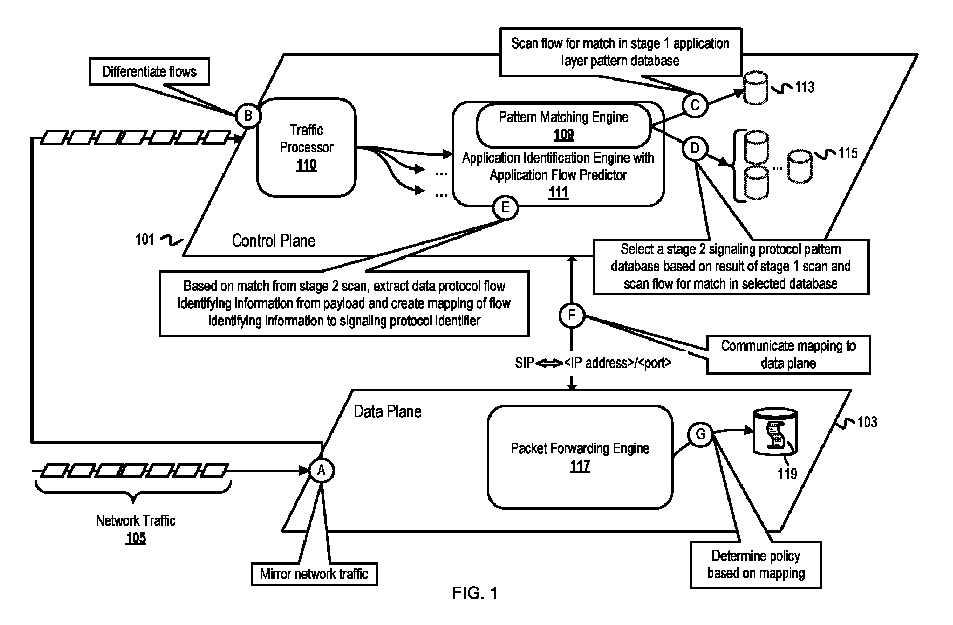
図1は、アプリケーションフロー予測のためにネットワークトラフィックに対してマルチステージパターンマッチングを使用するネットワークデバイス制御プレーンの図である。図1は、制御プレーン101およびデータプレーン103を示している。データプレーン103は、パケット転送エンジン117を含んでいる。制御プレーン101は、アプリケーションフロー予測器を有するアプリケーション識別エンジン111を含んでいる。アプリケーション識別エンジン111は、また、パターンマッチングエンジン109も含んでいる。制御プレーン101は、また、フロートラッキングを用いてディープパケットインスペクション(DPI)を実施する、トラフィックプロセッサ110も含んでいる。 FIG. 1 is a diagram of a network device control plane that uses multi-stage pattern matching on network traffic for application flow prediction. FIG. 1 shows a control plane 101 and a data plane 103. The data plane 103 includes a packet forwarding engine 117. The control plane 101 includes an application identification engine 111 that has an application flow predictor. The application identification engine 111 also includes a pattern matching engine 109. The control plane 101 also includes a traffic processor 110 that performs deep packet inspection (DPI) using flow tracking.
図1は、一連の文字A-Gを用いて注釈されている。各ステージは、1つ以上の動作を表している。これらのステージは、この例のために順序付けられているが、これらのステージは、本開示を理解するのを助けるために一つの例を示すものであり、特許請求の範囲を限定するために使用されるべきではない。特許請求の範囲内に含まれる技術的事項(subject matter)は、例示されているものとは異なることがある。 Figure 1 is annotated with a series of letters A-G. Each stage represents one or more operations. Although the stages are ordered for purposes of this example, the stages provide an example to aid in understanding the disclosure and should not be used to limit the scope of the claims. Subject matter encompassed within the scope of the claims may differ from that illustrated.
ステージAで、データプレーン103で受信されたネットワークトラフィックは、制御プレーン101にミラーリングされる。ミラーリングは、ポートミラーリングを用いて実施され得る。 At stage A, network traffic received on the data plane 103 is mirrored to the control plane 101. The mirroring can be performed using port mirroring.
ステージBで、トラフィックプロセッサ110は、ミラーリングされたネットワークトラフィックを、検出されたトラフィックフローへと区別(differentiate)する。例えば、トラフィックプロセッサ110は、フロー区別のために、検出されたネットワーク情報タプルを用いてデータ構造を作成する(または、作成するためのスレッドを生成する)。 In stage B, the traffic processor 110 differentiates the mirrored network traffic into detected traffic flows. For example, the traffic processor 110 creates (or spawns a thread to create) a data structure with the detected network information tuples for flow differentiation.
各フローについて、アプリケーション識別エンジン111は、対応するポリシが適用されることを確実にするために、フローのパケットをスキャンして、アプリケーションまたはアプリケーションレベルプロトコルを識別する。 For each flow, the application identification engine 111 scans the packets of the flow to identify the application or application-level protocol to ensure that the corresponding policy is applied.
ステージCで、アプリケーション識別エンジン111は、第1ステージのアプリケーション層パターンデータベース113における一致について、パターンマッチングエンジン109を使用して、トラフィックフローをスキャンする。パターンマッチングデータベース113およびパターンマッチングデータベース115は、予め構築されている。エキスパート/ドメイン知識は、アプリケーション、シグナリングプロトコル、等を表すメッセージのフィールドに基づいて、パターンまたは正規表現(regular expression)を選択し、そして、定義するために使用される。パターンマッチングデータベース115について、エキスパート/ドメイン知識は、データプロトコルまたはアプリケーションを表すメッセージのフィールドに基づいて、パターンを選択し、そして、定義するために使用される。この例示について、SIPメッセージがトランスポート層パケットペイロードまたはユーザデータペイロードにおいて検出されることを示すマッチングエントリを、第1ステージのスキャニングがもたらすものと仮定する。 At stage C, application identification engine 111 scans the traffic flow using pattern matching engine 109 for matches in first stage application layer pattern database 113. Pattern matching database 113 and pattern matching database 115 are pre-built. Expert/domain knowledge is used to select and define patterns or regular expressions based on fields of the message representing applications, signaling protocols, etc. For pattern matching database 115, expert/domain knowledge is used to select and define patterns based on fields of the message representing data protocols or applications. For this illustration, assume that the first stage scanning results in a matching entry indicating that a SIP message is detected in the transport layer packet payload or user data payload.
ステージDにおいて、アプリケーション識別エンジン111は、第1ステージのスキャニング結果に基づいて、SIPのためにパターンマッチングデータベース115のうちの1つを選択し、それに応じて、トラフィックフローをスキャンする。アプリケーション識別エンジン111は、データベース115の選択されたSIPパターンマッチングデータベースにおける一致について、パターンマッチングエンジン109(または、パターンマッチングエンジン109の別のインスタンス)を使用して、トラフィックフローをスキャンする。 In stage D, application identification engine 111 selects one of pattern matching databases 115 for SIP based on the scanning results of the first stage and scans the traffic flow accordingly. Application identification engine 111 scans the traffic flow using pattern matching engine 109 (or another instance of pattern matching engine 109) for matches in the selected SIP pattern matching database of database 115.
ステージEにおいて、アプリケーション識別エンジン111は、トラフィックフローにおいて示されるデータプロトコルを決定し、そして、選択された第2ステージのデータベースにおけるパターンの一致(pattern match)を見つけることに基づいて、一致したパケットペイロードからデータプロトコルのフロー識別情報を抽出する。一致するエントリ(matching entry)は、SIPメッセージと一致したペイロード内のフロー識別情報の位置を示すことができる。例えば、マッチングパターンは、SIPメッセージのセッション記述プロトコル(SDP)メッセージにおいて示されるリアルタイムプロトコル(RTP)に対するものであり得る。一致するエントリは、確立され、かつ、マルチメディアデータをストリーミングする、RTP接続のためのネットワークアドレス(例えば、IPアドレス)およびポートを配置するために、SIPメッセージ内のオフセットを示すことができる。以下は、データプロトコルの表示、および、データプロトコルのフロー識別情報を有するSIPメッセージに係る一つの例である。パターンに一致するトークンを有するSIPメッセージ内の行は、太字でマーク付けさている。 In stage E, the application identification engine 111 determines the data protocol indicated in the traffic flow and extracts the data protocol flow identification information from the matched packet payload based on finding a pattern match in the selected second stage database. The matching entry can indicate the location of the flow identification information in the matched payload with the SIP message. For example, the matching pattern can be for a Real Time Protocol (RTP) indicated in a Session Description Protocol (SDP) message of the SIP message. The matching entry can indicate an offset in the SIP message to locate the network address (e.g., IP address) and port for the RTP connection to be established and to stream the multimedia data. Below is an example of a SIP message with an indication of the data protocol and the data protocol flow identification information. The lines in the SIP message with tokens that match the pattern are marked in bold.
ステージFにおいて、制御プレーン101は、マッピングをデータプレーン103に対して通信する。一致するパターンが、SIPを表すデータベース115の1つにおいて見つかったと仮定すると、制御プレーン101は、例えば、「sip」のマッピングをインターネットプロトコル(IP)アドレスおよびポートに対して通信する。制御プレーン101は、プロセス間(interprocess)通信チャネルまたはインバンドインターフェイスを介してマッピングを通信することができる。 In stage F, the control plane 101 communicates the mapping to the data plane 103. Assuming a matching pattern is found in one of the databases 115 that represent SIP, the control plane 101 communicates, for example, a mapping of "sip" to an Internet Protocol (IP) address and port. The control plane 101 can communicate the mapping via an interprocess communication channel or an in-band interface.
ステージGにおいて、パケット転送エンジン117は、通信されたマッピングにおいて識別されたフローに適用するためのポリシを決定する。パケット転送エンジン117は、アプリケーション及び/又はデータプロトコルに割り当てられたポリシを示すリポジトリ(または、構造)119にアクセスする。パケット転送エンジン117は、構成され、または、割り当てられるポリシを決定するために、制御プレーン101から通信されたアプリケーションまたはプロトコル識別子を用いてリポジトリ119にアクセスする。パケット転送エンジン117は、次いで、通信されたマッピングにおいて識別されたフローにおける実施について決定されたポリシを示すために、データプレーン103のメモリまたは構造を更新する。 In stage G, the packet forwarding engine 117 determines a policy to apply to the flows identified in the communicated mapping. The packet forwarding engine 117 accesses a repository (or structure) 119 indicating policies assigned to applications and/or data protocols. The packet forwarding engine 117 accesses the repository 119 using the application or protocol identifier communicated from the control plane 101 to determine the policy to be configured or assigned. The packet forwarding engine 117 then updates a memory or structure in the data plane 103 to indicate the determined policy for enforcement on the flows identified in the communicated mapping.
図2-図3は、シグナリングプロトコルセットアップメッセージといった、サポートプロトコル及び/又は先行プロトコルのメッセージの検出に続く、アプリケーション/データプロトコルフローのマルチステージ予測に関連する例示的な動作に係るフローチャートである。先行する図はアプリケーション識別エンジンを参照しているが、一方、例示的な本動作は、アプリケーション識別エンジンのコンポーネント、もしくは、アプリケーション識別エンジンとインタラクションし、または、補足する別個のプログラムであり得る、アプリケーションフロー予測器を参照して説明されている。プログラムコードに対して選択された名称は、特許請求の範囲を限定するものではない。プログラムの構造および編成は、プラットフォーム、プログラマ/アーキテクトのプリファレンス、プログラミング言語、等によって変動し得る。加えて、コード単位(プログラム、モジュール、方法、関数、等)の名称は、同じ理由で異なり得る。そして、任意であり得る。 2-3 are flow charts of example operations related to multi-stage prediction of application/data protocol flows following detection of messages of supported and/or preceding protocols, such as signaling protocol setup messages. While the preceding figures refer to an application identification engine, the example operations are described with reference to an application flow predictor, which may be a component of the application identification engine or a separate program that interacts with or complements the application identification engine. The names chosen for the program code are not intended to limit the scope of the claims. The structure and organization of the programs may vary depending on the platform, programmer/architect preferences, programming language, etc. Additionally, names of code units (programs, modules, methods, functions, etc.) may differ for the same reasons and may be arbitrary.
図2は、マルチステージアプリケーションフロー予測のためのアプリケーション/データプロトコルデータベースを構築するための例示的な動作に係るフローチャートである。データベースのうち少なくともいくつかは、前もって構築されているが、一方、異なるアプリケーション/データプロトコルのための他のものは、後で追加され得る。加えて、データベース保守は、エントリを追加、削除、及び/又は、編集することを含み得る。その各々は、フロー識別情報抽出のための情報をパターンと関連付ける。 FIG. 2 is a flow chart of example operations for building an application/data protocol database for multi-stage application flow prediction. At least some of the databases are built up front, while others for different application/data protocols may be added later. Additionally, database maintenance may include adding, deleting, and/or editing entries, each of which associates information with patterns for flow identification extraction.
ブロック201で、アプリケーションフロー予測器は、シグナリングプロトコルによるセッション確立に続くことが予想または予測されるアプリケーション/データプロトコルについてのパターンマッチングデータベースを構築するための動作を開始する。例えば、アプリケーションフロー予測器は、各アプリケーション/データプロトコルについて正規(regex)マッチングデータベースを構築し得る。 At block 201, the application flow predictor begins operations to build a pattern matching database for application/data protocols that are expected or predicted to follow session establishment via a signaling protocol. For example, the application flow predictor may build a regular (regex) matching database for each application/data protocol.
ブロック203で、アプリケーションフロー予測器は、先行するセッションセットアップメッセージにおいて発生する、アプリケーション/データプロトコル識別子パターンを取得する。例えば、アプリケーションフロー予測器は、マルチチャネルアプリケーション層ゲートウェイ(ALG)プロトコル(例えば、SIP、ファイル転送プロトコル(FTP)、H.323プロトコル)のための正規表現(regular expression)を含むファイル/構造にわたり反復することができる。アプリケーションフロー予測器は、これらのファイル/構造の各々を並列に、または、順次に処理することができる。 At block 203, the application flow predictor obtains application/data protocol identifier patterns occurring in preceding session setup messages. For example, the application flow predictor can iterate over files/structures that contain regular expressions for multi-channel application layer gateway (ALG) protocols (e.g., SIP, File Transfer Protocol (FTP), H.323 protocols). The application flow predictor can process each of these files/structures in parallel or sequentially.
ブロック205で、アプリケーションフロー予測器は、識別子パターンと関連付けるためのフロー識別情報の位置を取得する。SIPの場合に、ネットワークアドレスは、一致するc行(c line)パターンに従い、かつ、ポートは、一致するm行(m line)パターンに従う。取得された位置(location)は、ペイロード/メッセージの開始からのオフセットを用いて、または、一致したパターンに関して示されるか、もしくは、表され得る。 At block 205, the application flow predictor obtains the location of the flow identification information to associate with the identifier pattern. In the case of SIP, the network address follows the matching c line pattern and the port follows the matching m line pattern. The obtained location may be indicated or expressed using an offset from the start of the payload/message or with respect to the matched pattern.
ブロック207で、アプリケーションフロー予測器は、アプリケーション/データプロトコルを表すために選択された識別子パターンを、データベースへとコンパイルする。例えば、アプリケーションフロー予測器は、アプリケーション/データプロトコルの正規表現を、正規マッチングデータベースへとコンパイルする。コンパイルは、使用される正規マッチングエンジンの実装に依存している。例えば、アプリケーション/データプロトコルのために選択された正規表現をコンパイルするために、ハイパースキャンライブラリのコンパイル機能が使用され得る。SIPパターンデータベースの場合、メディアフロー(例えば、オーディオ/ビデオ、RTP/AVP)を予測するために、SDPペイロードからのc行(c-line)トークンおよびm行(m-line)トークンが使用され得る。別の例として、パターンは、FTPポートコマンドに基づき得る。以下は、SIPセッションセットアップに従うことが期待/予測されるアプリケーション/データプロトコルについての正規データベースへとコンパイルされ得る、ワイルドカードを用いて定義された例示的なSIPパターンである。 At block 207, the application flow predictor compiles the selected identifier patterns to represent the application/data protocols into a database. For example, the application flow predictor compiles regular expressions of the application/data protocols into a regular matching database. The compilation depends on the implementation of the regular matching engine used. For example, the compilation function of the Hyperscan library can be used to compile the selected regular expressions for the application/data protocols. In the case of a SIP pattern database, c-line and m-line tokens from the SDP payload can be used to predict media flows (e.g., audio/video, RTP/AVP). As another example, the patterns can be based on FTP port commands. The following are exemplary SIP patterns defined with wildcards that can be compiled into a regular database for application/data protocols that are expected/predicted to follow a SIP session setup:
ブロック209で、アプリケーションフロー予測器は、取得されたフロー識別情報ロケーションを、対応するデータベースエントリにおけるコンパイルされたパターンと関連付ける。アプリケーションフロー予測器は、位置情報を示すために、ポインタまたはフィールドを更新することができる。このことは、位置情報が各シグナリングプロトコルに対して別個に定義され得るので、選択的な動作である。例えば、SIPパターンマッチングデータベースにおける一致は、アプリケーションフロー予測器に、データベース内に位置情報を有する代わりに、一致を見つけることに基づいて位置情報を検索(lookup)させる。 In block 209, the application flow predictor associates the obtained flow identification information location with the compiled pattern in the corresponding database entry. The application flow predictor may update a pointer or field to indicate the location information. This is an optional operation since location information may be defined separately for each signaling protocol. For example, a match in the SIP pattern matching database causes the application flow predictor to lookup the location information based on finding a match instead of having the location information in the database.
ブロック211で、アプリケーションフロー予測器は、フロー予測について追加的なアプリケーション/データプロトコルのためのパターンが存在するか否かを決定する。そうである場合、動作フローは、ブロック201に戻る。そうでなければ、動作フローは終了する。 In block 211, the application flow predictor determines whether a pattern exists for an additional application/data protocol for flow prediction. If so, the operational flow returns to block 201. Otherwise, the operational flow ends.
図3は、アプリケーションフロー予測のためのネットワークトラフィックのマルチステージスキャンのための例示的な動作に係るフローチャートである。例示的な動作は、データプレーンからミラーリングされたネットワークトラフィックのフロー差別化の後で実行する。従って、スキャニングは、個々のフローのスキャニングである。異なるスレッドが、実装に応じて、スキャンされる各フローに対して異なるスレッドがインスタンス化され得る。 FIG. 3 is a flow diagram of an example operation for multi-stage scanning of network traffic for application flow prediction. The example operation is performed after flow differentiation of network traffic mirrored from the data plane. Thus, the scanning is a scanning of individual flows. A different thread may be instantiated for each flow to be scanned, depending on the implementation.
ブロック301で、アプリケーション識別エンジンは、第1ステージのパターンデータベースに対して、トラフィックフローのミラーリングされたパケットをスキャンする。例えば、フロー内のパケットのペイロードをスキャンするために、スキャンモードにおけるハイパースキャン(Hyperscan)ライブラリを使用することができる。スキャンは、第1ステージのスキャン結果302を生成する。 In block 301, the application identification engine scans the mirrored packets of the traffic flow against a first stage pattern database. For example, the Hyperscan library in scan mode can be used to scan the payload of packets in the flow. The scan produces first stage scan results 302.
ブロック303で、アプリケーション識別エンジンは、第1ステージのスキャン結果302が、第1ステージのパターンデータベースにおける一致を示すか否かを決定する。第1ステージのスキャン結果が一致について否定的(negative)である場合に、動作フローは終了する。場合によっては、スキャンされたフローに対してデフォルトポリシが示される。第1ステージのスキャン結果が一致を示す場合に、動作フローはブロック305に進む。 In block 303, the application identification engine determines whether the first stage scan results 302 indicate a match in the first stage pattern database. If the first stage scan results are negative for a match, the operational flow ends. In some cases, a default policy is indicated for the scanned flow. If the first stage scan results indicate a match, the operational flow proceeds to block 305.
ブロック305で、アプリケーション識別エンジンは、第1ステージのスキャン結果が、「予測器(“predictor”)」プロトコルについての一致を示すか否かを決定する。予測器プロトコルは、アプリケーションレベルプロトコル(すなわち、トランスポート層より上)であり、おそらく、予測器プロトコルが後続のアプリケーション/データプロトコルのセッションまたは制御情報を確立しているので、適合メッセージ(conforming message)は、別のアプリケーションレベルプロトコルを事前に示す。この説明において頻繁に使用される予測器プロトコルの例は、SIPである。第1ステージのスキャニング結果は、一致に基づく識別子(例えば、「SIP」または「H.323」)を含んでいる。予測器プロトコルは、後続のデータフローのためのプロトコルとは必ずしも異なる必要はない。例えば、FTPは、制御接続を確立し、そして、次いで、データ接続を確立する。FTPプロセスは、コマンドを通信するために、制御接続を使用する。例示すると、予測器プロトコルとしてトラフィックフローにおけるFTPを検出するためのパターンの一致は、FTPコマンドまたは応答コードベースのパターン(例えば、USER、RETR、CDUP、CWD、XRCP、XRMD、220、227、332、421など)に一致する。予測器プロトコルが示されない場合に、動作フローは、ブロック307に進む。予測器プロトコルが第1ステージのスキャン結果において示される場合に、動作フローは、第2ステージのスキャニングのためにブロック309に進む。 At block 305, the application identification engine determines whether the first stage scanning results indicate a match for a "predictor" protocol. The predictor protocol is an application level protocol (i.e., above the transport layer) and the conforming message pre-indicates another application level protocol, presumably because the predictor protocol establishes session or control information for the subsequent application/data protocol. An example of a predictor protocol that is frequently used in this description is SIP. The first stage scanning results include an identifier based on the match (e.g., "SIP" or "H.323"). The predictor protocol does not necessarily have to be different from the protocol for the subsequent data flow. For example, FTP establishes a control connection and then a data connection. The FTP process uses the control connection to communicate commands. To illustrate, a pattern match to detect FTP in a traffic flow as a predictor protocol matches FTP command or response code based patterns (e.g., USER, RETR, CDUP, CWD, XRCP, XRMD, 220, 227, 332, 421, etc.). If a predictor protocol is not indicated, the operational flow proceeds to block 307. If a predictor protocol is indicated in the first stage scan results, the operational flow proceeds to block 309 for second stage scanning.
ブロック307で、アプリケーション識別エンジンは、識別されたアプリケーションをデータプレーンに通信する。識別されたアプリケーションに対応するアプリケーショントラフィックは、おそらく、既に検査ポイントを横切り流れ始めているが、データプレーンは、関連するポリシを実施し始めることができる。動作フローは、ブロック307の後で終了する。 In block 307, the application identification engine communicates the identified application to the data plane. The data plane can begin enforcing associated policies while application traffic corresponding to the identified application has likely already begun flowing across the inspection point. The operational flow ends after block 307.
ブロック309で、アプリケーション識別エンジンのアプリケーションフロー予測器は、第1ステージのスキャン結果に基づいて、第2ステージのデータベースを選択する。例えば、予測器プロトコルパターンマッチングデータベースは、第1ステージのパターンマッチングデータベース内のマッチングエントリから返される値によって、インデックス付けされ、または、識別される。 In block 309, the application flow predictor of the application identification engine selects a second stage database based on the first stage scan results. For example, the predictor protocol pattern matching database is indexed or identified by the value returned from the matching entry in the first stage pattern matching database.
ブロック311で、アプリケーションフロー予測器は、選択された予測器プロトコルデータベースにおける一致について、予測器プロトコルメッセージが検出されたトラフィックフローのミラーリングされたパケットをスキャンする。 In block 311, the application flow predictor scans the mirrored packets of the traffic flow in which the predictor protocol message was detected for a match in the selected predictor protocol database.
ブロック313で、アプリケーションフロー予測器は、選択されたデータベースにおいて一致が見つかったか否かを決定する。そうでない場合に、動作フローは、終了する。例えば、複数のパターンを並列にスキャンすることは、一致指示(match indication)または一致指示のセットを返すことができる。一つの例としてFTPを使用すると、FTPサーバがデータ転送のために使用するアドレスおよびポートを通信するFTPポートコマンドメッセージ「227パッシブモードに入る」を、第1ステージのスキャニングが検出した後で、第2ステージのスキャニングは、フロー識別情報に関連するパターンを見つける。一致が見つかった場合に、動作フローは、ブロック315に進む。 At block 313, the application flow predictor determines whether a match was found in the selected database. If not, the operational flow ends. For example, scanning multiple patterns in parallel can return a match indication or a set of match indications. Using FTP as an example, after the first stage scanning detects the FTP port command message "227 Enter Passive Mode," which communicates the address and port the FTP server uses for data transfer, the second stage scanning finds a pattern associated with the flow identification information. If a match is found, the operational flow proceeds to block 315.
ブロック315で、アプリケーションフロー予測器は、一致するエントリに基づいて、予測されたフロー情報を抽出する。選択された予測器プロトコルデータベースにおける一致は、少なくとも1つの後続のフロー(例えば、SIPセットアップ後のオーディオストリームについてのRTPフロー)が検査ポイントを横断し始めることを予測する。一致するエントリは、予測器プロトコルメッセージの中のフロー情報の位置(例えば、ネットワークアドレスおよびポートの位置)を示すことができる。実施形態は、予測器プロトコルデータベースにおける一致に基づいて、フロー情報の位置を別々に示し得る。例えば、予測器プロトコルXYZパターンマッチングデータベースにおける一致は、アプリケーションフロー予測器に、別個のテーブルにおけるネットワークアドレスおよびポートの位置情報をルックアップさせる。予測器プロトコルは、適合メッセージの中で複数のフローが示されることを可能にし得る。例えば、SIPメッセージ本体は、複数の接続および複数のメディアセッションを有する複数のフローについてのSDP記述を含むことができる。再び、FTPの例を参照すると、アプリケーションフロー予測器は、FTPポートコマンドメッセージの検出された部分を用いてネットワークアドレスおよびポートを形成することによって、フロー識別情報を抽出することができる。PORT-COMMAND-CODE(I1,I2,I3,I4,p1,p2)としてフォーマットされたコマンドメッセージを用いて、アプリケーションフロー予測器は、I1.I2.I3.I4を有するネットワークアドレス、および、(p1*256)+p2としてのポートを形成することができる。ポートコマンドメッセージ「227パッシブモード(192,168,20,101,117,254)に入る」を検出することに係るより具体的な例を用いて、アプリケーションフロー予測器は、ネットワークアドレス192.168.20.101を形成し、そして、30206としてポートを計算することができる。 At block 315, the application flow predictor extracts predicted flow information based on the matching entry. A match in the selected predictor protocol database predicts that at least one subsequent flow (e.g., an RTP flow for an audio stream after SIP setup) will begin to traverse the check point. The matching entry may indicate the location of the flow information in the predictor protocol message (e.g., network address and port location). An embodiment may separately indicate the location of the flow information based on a match in the predictor protocol database. For example, a match in the predictor protocol XYZ pattern matching database causes the application flow predictor to look up the network address and port location information in a separate table. The predictor protocol may allow multiple flows to be indicated in the matching message. For example, a SIP message body may include SDP descriptions for multiple flows with multiple connections and multiple media sessions. Referring again to the FTP example, the application flow predictor may extract flow identification information by forming the network address and port with the detected portion of the FTP port command message. With a command message formatted as PORT-COMMAND-CODE(I1,I2,I3,I4,p1,p2), the application flow predictor can form a network address having I1.I2.I3.I4 and a port as (p1*256)+p2. Using a more specific example of detecting a port command message "Enter 227 passive mode (192,168,20,101,117,254)", the application flow predictor can form a network address of 192.168.20.101 and calculate the port as 30206.
ブロック317で、アプリケーションフロー予測器は、予測器プロトコルの識別子に対する予測されたフロー情報のマッピング318を作成する。アプリケーションフロー予測器は、第1ステージのスキャン結果において示された、予測器プロトコル識別子を使用することができる。上記のFTPの例を使用して、アプリケーションフロー予測器は、マッピング192.168.20.101:30206<->FTPを作成する。 In block 317, the application flow predictor creates a mapping 318 of predicted flow information to predictor protocol identifiers. The application flow predictor can use the predictor protocol identifiers indicated in the first stage scan results. Using the FTP example above, the application flow predictor creates the mapping 192.168.20.101:30206<->FTP.
ブロック321で、アプリケーションフロー予測器(または、検査ポイントの制御プレーンにおける別のプロセス)は、マッピングをデータプレーンに通信する。これは、制御プレーンとデータプレーンとの間のインターフェイスを介して、プロセス間通信を用いて通信され得る、等。 In block 321, the application flow predictor (or another process in the control plane of the check point) communicates the mapping to the data plane. This may be communicated using inter-process communication, via an interface between the control plane and the data plane, etc.
変形例Variations
本説明は、第2ステージのスキャニングに分岐する(branching)前に、トラフィックフロー内のシグナリングプロトコルメッセージを検出または識別することを指すが、実施形態はそのように限定されない。シグナリングプロトコルは、しばしば、ALGアプリケーショントラフィックに先行するので、予測器プロトコルの代表的なタイプとして選択された。(例えば、SIPメッセージはRTPオーディオストリームに先行する)。 Although this description refers to detecting or identifying signaling protocol messages in a traffic flow before branching to second stage scanning, embodiments are not so limited. Signaling protocols were chosen as representative types of predictor protocols because they often precede ALG application traffic (e.g., SIP messages precede RTP audio streams).
フローチャートは、例示の理解を助けるために提供されており、そして、特許請求の範囲を限定するために使用されるべきではない。フローチャートは、特許請求の範囲内で変更することができる例示的な動作を示している。追加的な動作が実行されてよい。すなわち、より少ない動作が実行されてよく、動作が並行して実行されてよく、そして、動作が異なる順序で実行されてもよい。フローチャート図解及び/又はブロック図の各ブロック、および、フローチャート図解及び/又はブロック図内のブロックの組み合わせは、プログラムコードによって実装され得ることが理解されるだろう。プログラムコードは、汎用コンピュータ、専用コンピュータ、もしくは、他のプログラム可能な機械または装置のプロセッサに提供され得る。 The flowcharts are provided to aid in understanding the examples and should not be used to limit the scope of the claims. The flowcharts illustrate example operations that may be varied within the scope of the claims. Additional operations may be performed; i.e., fewer operations may be performed, operations may be performed in parallel, and operations may be performed in a different order. It will be understood that each block of the flowchart illustrations and/or block diagrams, and combinations of blocks in the flowchart illustrations and/or block diagrams, may be implemented by program code. The program code may be provided to a processor of a general purpose computer, a special purpose computer, or other programmable machine or device.
理解されるように、本開示の態様は、1つ以上の機械可読媒体において保管されたシステム、方法、または、プログラムコード/命令として具現化され得る。従って、態様は、ハードウェア、ソフトウェア(ファームウェア、常駐ソフトウェア、マイクロコード、等を含む)、もしくは、本明細書では全てが概して「回路(“circuit”)」、「モジュール(“module”)」、または「システム(“system”)」と呼ばれ得る、ソフトウェア態様とハードウェア態様との組合せの形態をとり得る。例示的な図において個々のモジュール/ユニットとして提示されている機能は、プラットフォーム(オペレーティングシステム及び/又はハードウェア)、アプリケーションエコシステム、インターフェイス、プログラマのプリファレンス、プログラミング言語、管理者のプリファレンス、等のうちいずれか1つに従って、異なるように編成され得る。 As will be appreciated, aspects of the present disclosure may be embodied as a system, method, or program code/instructions stored in one or more machine-readable media. Thus, aspects may take the form of hardware, software (including firmware, resident software, microcode, etc.), or a combination of software and hardware aspects, all of which may be generally referred to herein as a "circuit," "module," or "system." Functionality presented as individual modules/units in the exemplary diagrams may be organized differently according to any one of the following: platform (operating system and/or hardware), application ecosystem, interface, programmer preferences, programming language, administrator preferences, etc.
1つ以上の機械可読媒体の任意の組み合わせが利用され得る。機械可読媒体は、機械可読信号媒体または機械可読記憶媒体であり得る。機械可読記憶媒体は、例えば、これらに限定されるわけではないが、プログラムコードを保管するために電子、磁気、光学、電磁気、赤外線、または半導体技術のうちの任意の1つ、または、組み合わせを採用するシステム、装置、またはデバイスであり得る。機械可読記憶媒体のより具体的な例(非網羅的なリスト)は、以下を含むであろう。すなわち、ポータブルコンピュータディスケット、ハードディスク、ランダムアクセスメモリ(RAM)、読み出し専用メモリ(ROM)、消去可能プログラマブル読み出し専用メモリ(EPROMまたはフラッシュメモリ)、ポータブルコンパクトディスク読み出し専用メモリ(CD-ROM)、光記憶デバイス、磁気記憶デバイス、または、上記の任意の適切な組み合わせ、である。本明細書のコンテキストにおいて、機械可読記憶媒体は、命令実行システム、装置、またはデバイスによって、もしくは、それらと関連して使用するためのプログラムを含むか、または保管することができる、任意の有形媒体であり得る。機械可読記憶媒体は、機械可読信号媒体ではない。 Any combination of one or more machine-readable media may be utilized. The machine-readable medium may be a machine-readable signal medium or a machine-readable storage medium. The machine-readable storage medium may be, for example, but not limited to, a system, apparatus, or device employing any one or combination of electronic, magnetic, optical, electromagnetic, infrared, or semiconductor technologies to store program code. More specific examples (non-exhaustive list) of machine-readable storage media would include the following: a portable computer diskette, a hard disk, a random access memory (RAM), a read-only memory (ROM), an erasable programmable read-only memory (EPROM or flash memory), a portable compact disk read-only memory (CD-ROM), an optical storage device, a magnetic storage device, or any suitable combination of the above. In the context of this specification, a machine-readable storage medium may be any tangible medium that can contain or store a program for use by or in connection with an instruction execution system, apparatus, or device. The machine-readable storage medium is not a machine-readable signal medium.
機械可読信号媒体は、例えば、ベースバンド内に、または、搬送波の一部として、機械可読プログラムコードがその中に具現化された伝搬データ信号を含み得る。そうした伝搬信号は、これらに限定されるわけではないが、電磁、光学、または、それらの任意の適切な組合せを含む、様々な形態のいずれかをとることができる。機械可読信号媒体は、機械可読記憶媒体ではなく、そして、命令実行システム、装置、または、デバイスによって、もしくは、それに関連して使用するためのプログラムを通信、伝搬、または移送することができる、任意の機械可読媒体であり得る。 A machine-readable signal medium may include a propagated data signal having machine-readable program code embodied therein, for example in baseband or as part of a carrier wave. Such a propagated signal may take any of a variety of forms, including but not limited to electromagnetic, optical, or any suitable combination thereof. A machine-readable signal medium is not a machine-readable storage medium, and may be any machine-readable medium that can communicate, propagate, or transport a program for use by or in connection with an instruction execution system, apparatus, or device.
機械可読媒体上に具現化されたプログラムコードは、これらに限定されるわけではないが、無線、有線、光ファイバケーブル、RF、等、または、前述のものの任意の適切な組合せを含む、任意の適切な媒体を使用して、送信され得る。 The program code embodied on the machine-readable medium may be transmitted using any suitable medium, including but not limited to wireless, wired, fiber optic cable, RF, etc., or any suitable combination of the foregoing.
プログラムコード/命令は、また、機械可読媒体に保管された命令が、フローチャート及び/又はブロック図の1つ以上のブロックにおいて指定された機能/動作を実施する命令を含む製品を生成するように、機械に、特定の方法で機能するように指示することができる機械可読媒体に保管されてもよい。 Program code/instructions may also be stored on a machine-readable medium that can instruct a machine to function in a particular manner to produce a product that includes instructions that implement the functions/acts specified in one or more blocks of the flowcharts and/or block diagrams, such that the instructions stored on the machine-readable medium.
図4は、アプリケーションフロー予測器を含む、データプレーンおよび制御プレーンを有する例示的なコンピュータシステムを示している。コンピュータシステムは、制御プレーン401およびデータプレーン413を含んでいる。制御プレーン401は、プロセッサ403(おそらく、複数のプロセッサ、複数のコア、複数のノードを含み、及び/又は、マルチスレッドを実装している、等)を含んでいる。コンピュータシステムは、メモリ405を含む。メモリ405は、システムメモリ、または、機械可読媒体の上記の既に説明した可能な実現形態のうちの任意の1つ以上であり得る。制御プレーン401は、また、アプリケーションフロー予測器411を含むアプリケーション識別エンジン407も含んでいる。プロセッサ403は、アプリケーション識別エンジン411を実装し得る(例えば、プログラムコードの命令を実行し得る)。アプリケーション識別エンジン407は、プロセッサ403と結合されているが、プロセッサ403とは異なる、特定用途向け集積回路であり得る。通信チャネル410は、制御プレーン401をデータプレーン413に対して通信可能に結合する。データプレーン413は、スイッチファブリック419を介して通信するラインカード416A、416Bを含んでいる。ラインカード416Aは、パケット転送エンジン(PFE)417A、417Bを含む。ラインカード416Bは、PFE417C、417Dを含む。アプリケーション識別エンジン407は、PFE417A-417Dのうちの少なくとも1つからミラーリングされたネットワークトラフィックを区別し、そして、アプリケーション識別のために、一次データベースに対して区別されたフローをスキャンする。予測器プロトコルメッセージがアプリケーション識別からのフローにおいて検出される場合に、アプリケーションフロー予測器411は、アプリケーション/データプロトコル(例えば、クラウドベースの会議アプリケーションまたはプロトコル)のための今後のトラフィックを予測する、パターンの一致についてフローをスキャンし、そして、予測器プロトコルと予測されたフローとの間のマッピングを作成するために、予測されたフロー識別情報を抽出する。制御プレーン401は、次いで、ポリシの選択および実施のために、マッピングを適切なPFEに通信する。 FIG. 4 illustrates an exemplary computer system having a data plane and a control plane, including an application flow predictor. The computer system includes a control plane 401 and a data plane 413. The control plane 401 includes a processor 403 (possibly including multiple processors, multiple cores, multiple nodes, and/or implementing multi-threading, etc.). The computer system includes a memory 405. The memory 405 may be a system memory or any one or more of the above-described possible implementations of a machine-readable medium. The control plane 401 also includes an application identification engine 407 that includes the application flow predictor 411. The processor 403 may implement the application identification engine 411 (e.g., may execute instructions of a program code). The application identification engine 407 may be an application specific integrated circuit that is coupled to, but distinct from, the processor 403. A communication channel 410 communicatively couples the control plane 401 to the data plane 413. The data plane 413 includes line cards 416A, 416B that communicate through a switch fabric 419. Line card 416A includes packet forwarding engines (PFEs) 417A, 417B. Line card 416B includes PFEs 417C, 417D. The application identification engine 407 distinguishes mirrored network traffic from at least one of the PFEs 417A-417D and scans the distinguished flows against a primary database for application identification. When a predictor protocol message is detected in a flow from an application identification, the application flow predictor 411 scans the flow for a pattern match that predicts future traffic for the application/data protocol (e.g., a cloud-based conferencing application or protocol) and extracts the predicted flow identification information to create a mapping between the predictor protocol and the predicted flow. The control plane 401 then communicates the mapping to the appropriate PFE for policy selection and enforcement.
実施形態は、図4に示されるようなラインカードを有するネットワークデバイスにおける配備に限定されるものではない。実施形態は、例えば、仮想ファイアウォールまたはクラウドベースのファイアウォールとして展開され得る。 Embodiments are not limited to deployment in network devices having line cards such as those shown in FIG. 4. Embodiments may be deployed, for example, as a virtual firewall or a cloud-based firewall.
用語(Terminology)Terminology
接続詞「および(“and”)」を伴うリストに先行する「少なくとも1つの(“at least one of”)」という句の使用は、排他的なリストとして扱われるべきではなく、かつ、特に別段の記載がない限り、各カテゴリから1つの項目を有するカテゴリのリストとして解釈されるべきではない。「A、B、およびCのうちの少なくとも1つ(“at least one of A, B,and C”)」と記載された句は、リストされた項目のうちの1つだけ、リストされた項目のうちの複数、並びに、リストされた項目のうちの1つ以上およびリストされていない別の項目に違反することがある。
Use of the phrase "at least one of" preceding a list with the conjunction "and" should not be treated as an exclusive list and should not be construed as a list of categories having one item from each category unless specifically stated otherwise. A phrase stated as "at least one of A, B, and C" can violate only one of the listed items, more than one of the listed items, and one or more of the listed items and another unlisted item.
Claims (14)
複数のシグナリングプロトコルパターンデータベースから第1シグナリングプロトコルパターンデータベースを選択するステップであり、
前記選択は、少なくとも部分的に、第1ネットワークトラフィックフローにおいて前記第1シグナリングプロトコルのメッセージを検出することに基づいており、
前記複数のシグナリングプロトコルパターンデータベースは、複数の異なるシグナリングプロトコルに対応しているパターンを用いて構築されている、
ステップと、
制御プレーンにおいて、前記第1シグナリングプロトコルパターンデータベースにおけるパターンの一致について前記第1ネットワークトラフィックフローをスキャンするステップと、
前記第1シグナリングプロトコルパターンデータベースにおけるパターンの一致を示す前記スキャンに基づいて、前記パターンの一致に対応している前記第1ネットワークトラフィックフローのペイロードにおいて示されるアプリケーションまたはデータプロトコルに対する第1アプリケーショントラフィックフロー識別情報を抽出するステップと、
前記第1シグナリングプロトコルの識別子を、第1マッピングを生成するための情報を特定している前記第1アプリケーショントラフィックフロー識別情報に基づいている、第1アプリケーショントラフィックフロー識別子と関連付けるステップと、
前記第1マッピングを、前記制御プレーンからデータプレーンに通信するステップと、
前記データプレーンにおいて、前記第1マッピングに基づいて、複数のポリシのうちの第1ポリシを選択するステップと、
を含む、方法。 1. A method comprising:
selecting a first signaling protocol pattern database from the plurality of signaling protocol pattern databases;
the selecting is based, at least in part, on detecting messages of the first signaling protocol in a first network traffic flow;
The plurality of signaling protocol pattern databases are constructed using patterns corresponding to a plurality of different signaling protocols.
Steps and
scanning, in a control plane, the first network traffic flow for a match of a pattern in the first signaling protocol pattern database;
extracting, based on the scan indicating a pattern match in the first signaling protocol pattern database, a first application traffic flow identification information for an application or data protocol indicated in a payload of the first network traffic flow corresponding to the pattern match;
associating the first signaling protocol identifier with a first application traffic flow identifier based on the first application traffic flow identification information specifying information for generating a first mapping;
communicating the first mapping from the control plane to a data plane;
selecting, in the data plane, a first policy from a plurality of policies based on the first mapping;
A method comprising:
前記第1ネットワークトラフィックフローにおける前記第1シグナリングプロトコルの前記メッセージを検出するステップ、を含み、
前記メッセージを検出するステップは、
前記制御プレーンにおいて、アプリケーションおよびアプリケーション層プロトコルを識別するパターンを用いて構築された、第1パターンマッチングデータベースにおけるパターンの一致について、前記第1ネットワークトラフィックフローをスキャンするステップと、
前記第1パターンマッチングデータベースにおけるパターンの一致を示している、前記第1パターンマッチングデータベースにおけるパターンの一致についての前記スキャンするステップに基づいて、前記第1パターンマッチングデータベースにおける前記パターンの一致がシグナリングプロトコルを示すか否かを決定するステップと、を含み、
前記第1ネットワークトラフィックフローにおける前記第1シグナリングプロトコルの前記メッセージを検出するステップは、前記第1パターンマッチングデータベースにおける前記パターンの一致が前記第1シグナリングプロトコルについてのものであると決定することに基づいている、
請求項1に記載の方法。 The method further comprises:
detecting the message of the first signaling protocol in the first network traffic flow;
The step of detecting the message includes:
scanning, in the control plane, the first network traffic flow for a match of a pattern in a first pattern matching database constructed with patterns that identify applications and application layer protocols;
determining whether the pattern matches in the first pattern matching database are indicative of a signaling protocol based on the scanning for pattern matches in the first pattern matching database indicating a pattern match in the first pattern matching database;
detecting the message of the first signaling protocol in the first network traffic flow is based on determining that a match of the pattern in the first pattern matching database is for the first signaling protocol.
The method of claim 1.
前記第1ネットワークトラフィックフロー識別子は、ネットワークアドレスおよびポートを含む、
請求項1に記載の方法。 extracting a first network traffic flow identifier from the first network traffic flow based on an indication of an offset returned with the indication of a match of the pattern;
the first network traffic flow identifier includes a network address and a port;
The method of claim 1.
前記第1ネットワークトラフィックフローを、前記データプレーンから、前記制御プレーンにミラーリングステップ、
前記第1シグナリングプロトコルメッセージにおけるセッション記述プロトコル記述からのパターンを用いて、前記第1シグナリングプロトコルパターンデータベースを構築するステップ、及び/又は、
前記第1ポリシを、前記第1ネットワークトラフィックフロー識別子に対応するネットワークトラフィックに適用するステップ、
を含む、請求項2に記載の方法。 The method further comprises:
mirroring the first network traffic flow from the data plane to the control plane;
building said first signalling protocol pattern database using patterns from a Session Description Protocol Description in said first signalling protocol messages; and/or
applying the first policy to network traffic corresponding to the first network traffic flow identifier;
The method of claim 2 , comprising:
前記シグナリングプロトコルパターンデータベースにおける第2パターンの一致を示している前記スキャンするステップに基づいて、前記第1ネットワークトラフィックフローの前記ペイロードにおいて示される前記アプリケーションまたはデータプロトコルについて、第2アプリケーショントラフィックフロー識別情報を抽出するステップ、および、
前記第1アプリケーショントラフィックフロー識別情報および前記第2アプリケーショントラフィックフロー識別情報を用いて、第1アプリケーションフロー識別子を形成するステップ、
を含む、請求項1乃至4いずれか一項に記載の方法。 The method further comprises:
extracting second application traffic flow identification information for the application or data protocol indicated in the payload of the first network traffic flow based on the scanning step indicating a match of a second pattern in the signaling protocol pattern database; and
forming a first application flow identifier using the first application traffic flow identification information and the second application traffic flow identification information;
The method according to any one of claims 1 to 4, comprising:
制御プレーンにおいて、第1パターンデータベースにおけるパターンの一致について第1トランスポート層トラフィックフローのペイロードをスキャンし、
前記第1パターンデータベースにおけるパターンの一致の指示に基づいて、第1アプリケーションレベルプロトコルのセッション確立メッセージを検出し、
前記第1アプリケーションレベルプロトコルの前記セッション確立メッセージの検出に基づいて、第2パターンデータベースを選択し、前記第2パターンデータベースは、前記第1アプリケーションレベルプロトコルのパターンを用いて構築されたものであり、
前記第2パターンデータベースにおけるパターンの一致について前記ペイロードをスキャンし、
前記第2パターンデータベースにおける第1パターンの一致を示すスキャンに基づいて、前記第1アプリケーションレベルプロトコルの識別子と、前記第1パターンの一致に対応している前記ペイロードのうちの少なくとも第1ペイロードから決定された第1アプリケーショントラフィックフロー識別子との間の第1マッピングを作成し、かつ、
前記第1マッピングを、前記制御プレーンから、データプレーンに通信する、
非一時的機械可読記憶媒体。 One or more non-transitory machine-readable storage media having program code stored thereon, the program code including instructions that, when executed,
scanning, in the control plane, a payload of the first transport layer traffic flow for a match of a pattern in a first pattern database;
Detecting a session establishment message of a first application level protocol based on an indication of a pattern match in the first pattern database;
selecting a second pattern database based on detection of the session establishment message of the first application level protocol, the second pattern database being constructed using patterns of the first application level protocol;
scanning the payload for a match of a pattern in the second pattern database;
creating a first mapping between an identifier of the first application level protocol and a first application traffic flow identifier determined from at least a first one of the payloads corresponding to a match of the first pattern based on a scan indicating a match of a first pattern in the second pattern database; and
communicating the first mapping from the control plane to a data plane;
A non-transitory machine-readable storage medium.
前記データプレーンにおいて、前記第1マッピングに基づいて、複数のポリシのうちの第1ポリシを選択し、かつ、
前記第1ポリシを、前記第1トランスポート層トラフィックフローの後に続く、前記第1アプリケーショントラフィックフロー識別子に対応するネットワークトラフィックに適用する、
請求項6に記載の非一時的機械可読記憶媒体。 The program code further includes instructions that, when executed,
selecting, in the data plane, a first policy from a plurality of policies based on the first mapping; and
applying the first policy to network traffic subsequent to the first transport layer traffic flow and corresponding to the first application traffic flow identifier;
The non-transitory machine-readable storage medium of claim 6.
前記第1ペイロードから前記第1アプリケーショントラフィックフロー識別子を抽出し、
前記第1ペイロードから前記第1アプリケーショントラフィックフロー識別子を抽出するための前記命令は、実行されると、
前記第2パターンデータベースにおける前記第1パターンの一致を示す前記スキャンに基づいて、前記第1ペイロードからネットワークアドレスを抽出し、かつ、
前記第2パターンデータベースにおける第2パターンの一致の指示に基づいて、前記第1ペイロードからポートを抽出し、
前記ネットワークアドレスおよび前記ポートは、前記第1アプリケーショントラフィックフロー識別子を形成する、
請求項7に記載の非一時的機械可読記憶媒体。 The program code further includes instructions that, when executed,
Extracting the first application traffic flow identifier from the first payload;
The instructions, when executed, for extracting the first application traffic flow identifier from the first payload,
extracting a network address from the first payload based on the scan indicating a match of the first pattern in the second pattern database; and
extracting a port from the first payload based on an indication of a match of a second pattern in the second pattern database;
the network address and the port form the first application traffic flow identifier.
The non-transitory machine-readable storage medium of claim 7.
請求項6乃至8いずれか一項に記載の非一時的機械可読記憶媒体。 The second pattern database is a regular expression database.
A non-transitory machine-readable storage medium according to any one of claims 6 to 8.
プロセッサと、
命令が保管されている非一時的機械可読記憶媒体と、を含み、
前記命令がプロセッサによって実行されると、前記装置に、
第1パターンデータベースにおけるパターンの一致について第1トランスポート層トラフィックフローのペイロードをスキャンし、
前記第1パターンデータベースにおけるパターンの一致を指示するスキャンに基づいて、第1アプリケーションレベルプロトコルのセッション確立メッセージを検出し、
前記セッション確立メッセージの検出に基づいて、複数のパターンデータベースから第2パターンデータベースを選択し、前記複数のパターンデータベースは、アプリケーションレベルプロトコルのパターンを用いて構築されたものであり、
前記第2パターンデータベースにおける1つ以上の一致について第1ネットワークトラフィックフローをスキャンし、
前記第2パターンデータベースにおける少なくとも第1の一致を示す前記第2パターンデータベースにおける一致についての前記スキャンに基づいて、前記第1アプリケーションレベルプロトコルの識別子と、少なくとも部分的に前記第1の一致に基づいて決定された第1予測トラフィックフローとの間の第1マッピングを作成し、かつ、
前記第1マッピングを、データプレーンに通信する、
ようにさせる、装置。 1. An apparatus comprising:
A processor;
a non-transitory machine-readable storage medium having instructions stored thereon;
The instructions, when executed by a processor, cause the device to:
scanning a payload of the first transport layer traffic flow for a match of a pattern in a first pattern database;
Detecting a session establishment message of a first application level protocol based on scanning indicating a match of a pattern in the first pattern database;
selecting a second pattern database from a plurality of pattern databases based on detection of the session establishment message, the plurality of pattern databases being constructed using patterns of application level protocols;
scanning the first network traffic flow for one or more matches in the second pattern database;
creating a first mapping between an identifier of the first application level protocol and a first predicted traffic flow determined based at least in part on the first match based on the scan for matches in the second pattern database indicating at least a first match in the second pattern database; and
communicating the first mapping to a data plane;
A device that makes it possible to do so.
前記命令がプロセッサによって実行されると、前記装置に、
前記第1の一致に対応する前記第1ネットワークトラフィックフローにおける少なくとも第1ペイロードから、第1アプリケーショントラフィックフロー識別子を抽出する、
ようにさせる、請求項10に記載の装置。 The non-transitory machine-readable storage medium further comprises instructions:
The instructions, when executed by a processor, cause the device to:
extracting a first application traffic flow identifier from at least a first payload in the first network traffic flow corresponding to the first match;
The apparatus of claim 10 .
前記第2パターンデータベースにおける前記第1の一致を示す前記第2パターンデータベースにおける一致についての前記スキャンに基づいて、前記第1ペイロードから、ネットワークアドレスを抽出し、
前記第2パターンデータベースにおける第2の一致の指示に基づいて、前記第1ペイロードから、ポートを抽出する、
ようにさせる、命令を含み、
前記ネットワークアドレスおよび前記ポートは、前記第1アプリケーショントラフィックフロー識別子を形成し、かつ、
前記非一時的機械可読記憶媒体は、さらに、命令を保管しており、前記プロセッサによって実行されると、前記装置に、
少なくとも部分的に前記第1の一致に基づいて、前記ネットワークアドレスおよび前記ポートを抽出するためのオフセットを決定する、
ようにさせる、請求項11に記載の装置。 The instructions for extracting the first application traffic flow identifier from the first payload include:
extracting a network address from the first payload based on the scan for a match in the second pattern database indicating the first match in the second pattern database;
extracting a port from the first payload based on an indication of a second match in the second pattern database;
Including instructions to
the network address and the port form the first application traffic flow identifier; and
The non-transitory machine-readable storage medium further stores instructions that, when executed by the processor, cause the device to:
determining an offset for extracting the network address and the port based at least in part on the first match;
The apparatus of claim 11 .
請求項10に記載の装置。 the first application level protocol is a Session Initiation Protocol;
11. The apparatus of claim 10.
前記第1アプリケーションレベルプロトコルの前記識別子と、少なくとも部分的に前記第2パターンデータベースにおける第2の一致に基づいて決定された第2予測トラフィックフローの識別子との間の第2マッピングを作成する、
ようにさせる、請求項10に記載の装置。
The non-transitory machine-readable storage medium further stores instructions that, when executed by the processor, cause the device to:
creating a second mapping between the identifier of the first application level protocol and an identifier of a second predicted traffic flow determined based at least in part on a second match in the second pattern database.
The apparatus of claim 10 .
Applications Claiming Priority (5)
| Application Number | Priority Date | Filing Date | Title |
|---|---|---|---|
| US202263367029P | 2022-06-24 | 2022-06-24 | |
| US63/367,029 | 2022-06-24 | ||
| US17/819,708 | 2022-08-15 | ||
| US17/819,708 US12068950B2 (en) | 2022-06-24 | 2022-08-15 | Application traffic flow prediction based on multi-stage network traffic flow scanning |
| PCT/US2023/016575 WO2023249679A1 (en) | 2022-06-24 | 2023-03-28 | Application traffic flow prediction based on multi-stage network traffic flow scanning |
Publications (1)
| Publication Number | Publication Date |
|---|---|
| JP2025521584A true JP2025521584A (en) | 2025-07-10 |
Family
ID=89322578
Family Applications (1)
| Application Number | Title | Priority Date | Filing Date |
|---|---|---|---|
| JP2024575477A Pending JP2025521584A (en) | 2022-06-24 | 2023-03-28 | Application Traffic Flow Prediction Based on Multi-Stage Network Traffic Flow Scanning |
Country Status (5)
| Country | Link |
|---|---|
| US (2) | US12068950B2 (en) |
| EP (1) | EP4544735A1 (en) |
| JP (1) | JP2025521584A (en) |
| KR (1) | KR20250028409A (en) |
| CN (1) | CN119487789A (en) |
Families Citing this family (1)
| Publication number | Priority date | Publication date | Assignee | Title |
|---|---|---|---|---|
| US12068950B2 (en) | 2022-06-24 | 2024-08-20 | Palo Alto Networks, Inc. | Application traffic flow prediction based on multi-stage network traffic flow scanning |
Citations (6)
| Publication number | Priority date | Publication date | Assignee | Title |
|---|---|---|---|---|
| JP2006235876A (en) * | 2005-02-23 | 2006-09-07 | Nippon Telegr & Teleph Corp <Ntt> | DoS attack countermeasure system and DoS attack countermeasure method |
| JP2007235638A (en) * | 2006-03-02 | 2007-09-13 | Nec Infrontia Corp | Sip communication system, sip gateway device and sip communication control method used for the same |
| JP2008017075A (en) * | 2006-07-05 | 2008-01-24 | Nec Corp | Communication controller and communication control method used therefore, and program thereof |
| JP2016127394A (en) * | 2014-12-26 | 2016-07-11 | 株式会社Pfu | Information processing device, method and program |
| US20160285912A1 (en) * | 2015-03-23 | 2016-09-29 | Sonicwall, Inc. | Non rfc-compliant protocol classification based on real use |
| CN107872456A (en) * | 2017-11-09 | 2018-04-03 | 深圳市利谱信息技术有限公司 | Network intrusion prevention method, apparatus, system and computer-readable recording medium |
Family Cites Families (8)
| Publication number | Priority date | Publication date | Assignee | Title |
|---|---|---|---|---|
| US6839751B1 (en) * | 1999-06-30 | 2005-01-04 | Hi/Fn, Inc. | Re-using information from data transactions for maintaining statistics in network monitoring |
| US6789116B1 (en) * | 1999-06-30 | 2004-09-07 | Hi/Fn, Inc. | State processor for pattern matching in a network monitor device |
| US20030229708A1 (en) * | 2002-06-11 | 2003-12-11 | Netrake Corporation | Complex pattern matching engine for matching patterns in IP data streams |
| US7742406B1 (en) * | 2004-12-20 | 2010-06-22 | Packeteer, Inc. | Coordinated environment for classification and control of network traffic |
| US9392010B2 (en) * | 2011-11-07 | 2016-07-12 | Netflow Logic Corporation | Streaming method and system for processing network metadata |
| US10831619B2 (en) * | 2017-09-29 | 2020-11-10 | Oracle International Corporation | Fault-tolerant stream processing |
| US11057433B2 (en) * | 2018-08-01 | 2021-07-06 | Jpmorgan Chase Bank, N.A. | System for and method of determining data connections between software applications |
| US12068950B2 (en) | 2022-06-24 | 2024-08-20 | Palo Alto Networks, Inc. | Application traffic flow prediction based on multi-stage network traffic flow scanning |
-
2022
- 2022-08-15 US US17/819,708 patent/US12068950B2/en active Active
-
2023
- 2023-03-28 CN CN202380049194.1A patent/CN119487789A/en active Pending
- 2023-03-28 JP JP2024575477A patent/JP2025521584A/en active Pending
- 2023-03-28 KR KR1020257002354A patent/KR20250028409A/en active Pending
- 2023-03-28 EP EP23720198.3A patent/EP4544735A1/en active Pending
-
2024
- 2024-07-12 US US18/772,081 patent/US12413512B2/en active Active
Patent Citations (6)
| Publication number | Priority date | Publication date | Assignee | Title |
|---|---|---|---|---|
| JP2006235876A (en) * | 2005-02-23 | 2006-09-07 | Nippon Telegr & Teleph Corp <Ntt> | DoS attack countermeasure system and DoS attack countermeasure method |
| JP2007235638A (en) * | 2006-03-02 | 2007-09-13 | Nec Infrontia Corp | Sip communication system, sip gateway device and sip communication control method used for the same |
| JP2008017075A (en) * | 2006-07-05 | 2008-01-24 | Nec Corp | Communication controller and communication control method used therefore, and program thereof |
| JP2016127394A (en) * | 2014-12-26 | 2016-07-11 | 株式会社Pfu | Information processing device, method and program |
| US20160285912A1 (en) * | 2015-03-23 | 2016-09-29 | Sonicwall, Inc. | Non rfc-compliant protocol classification based on real use |
| CN107872456A (en) * | 2017-11-09 | 2018-04-03 | 深圳市利谱信息技术有限公司 | Network intrusion prevention method, apparatus, system and computer-readable recording medium |
Also Published As
| Publication number | Publication date |
|---|---|
| CN119487789A (en) | 2025-02-18 |
| US20230421488A1 (en) | 2023-12-28 |
| KR20250028409A (en) | 2025-02-28 |
| US12068950B2 (en) | 2024-08-20 |
| US20240372801A1 (en) | 2024-11-07 |
| EP4544735A1 (en) | 2025-04-30 |
| US12413512B2 (en) | 2025-09-09 |
Similar Documents
| Publication | Publication Date | Title |
|---|---|---|
| EP3195535B1 (en) | Chaining of network service functions in a communication network | |
| US9800491B1 (en) | Application based packet forwarding | |
| US8065719B2 (en) | Method and apparatus for reducing firewall rules | |
| US9800697B2 (en) | L2/L3 multi-mode switch including policy processing | |
| US20130294449A1 (en) | Efficient application recognition in network traffic | |
| US9596286B2 (en) | Method to process HTTP header with hardware assistance | |
| US7881291B2 (en) | Packet classification acceleration using spectral analysis | |
| CN105591973B (en) | Application identification method and device | |
| US20050240989A1 (en) | Method of sharing state between stateful inspection firewalls on mep network | |
| CN110300065B (en) | Application flow identification method and system based on software defined network | |
| CN106105115A (en) | The service chaining originated by service node in network environment | |
| CN103873356B (en) | Application and identification method, system and home gateway based on home gateway | |
| US10050892B2 (en) | Method and apparatus for packet classification | |
| EP1802023B1 (en) | System and method for controling ngn service-based firewall | |
| US11277384B2 (en) | Dynamic filter generation and distribution within computer networks | |
| JP2025521584A (en) | Application Traffic Flow Prediction Based on Multi-Stage Network Traffic Flow Scanning | |
| CN101465807A (en) | Control method and device for data stream | |
| US20110078283A1 (en) | Service providing system, filtering device, filtering method and method of confirming message | |
| CN102045131B (en) | Service linkage control system and method | |
| WO2023249679A1 (en) | Application traffic flow prediction based on multi-stage network traffic flow scanning | |
| CN1697443B (en) | A Method of Controlling Dynamic Data Flow | |
| JP2007228217A (en) | Traffic decision device, traffic decision method, and program therefor | |
| Mohammadkhan et al. | Protocols to support autonomy and control for NFV in software defined networks | |
| WO2025000335A1 (en) | Ip network qos enabled by application category detection and session association | |
| JP2024101094A (en) | NETWORK DESIGN SUPPORT DEVICE AND NETWORK DESIGN SUPPORT METHOD |
Legal Events
| Date | Code | Title | Description |
|---|---|---|---|
| A621 | Written request for application examination |
Free format text: JAPANESE INTERMEDIATE CODE: A621 Effective date: 20250210 |
|
| A977 | Report on retrieval |
Free format text: JAPANESE INTERMEDIATE CODE: A971007 Effective date: 20251205 |
|
| A131 | Notification of reasons for refusal |
Free format text: JAPANESE INTERMEDIATE CODE: A131 Effective date: 20260120 |