JP2025519168A - Intervention based on detected gait kinematics - Google Patents
Intervention based on detected gait kinematics Download PDFInfo
- Publication number
- JP2025519168A JP2025519168A JP2024569872A JP2024569872A JP2025519168A JP 2025519168 A JP2025519168 A JP 2025519168A JP 2024569872 A JP2024569872 A JP 2024569872A JP 2024569872 A JP2024569872 A JP 2024569872A JP 2025519168 A JP2025519168 A JP 2025519168A
- Authority
- JP
- Japan
- Prior art keywords
- gait
- data
- subject
- footwear
- sensor
- Prior art date
- Legal status (The legal status is an assumption and is not a legal conclusion. Google has not performed a legal analysis and makes no representation as to the accuracy of the status listed.)
- Pending
Links
Images




Classifications
-
- A—HUMAN NECESSITIES
- A61—MEDICAL OR VETERINARY SCIENCE; HYGIENE
- A61B—DIAGNOSIS; SURGERY; IDENTIFICATION
- A61B5/00—Measuring for diagnostic purposes; Identification of persons
- A61B5/68—Arrangements of detecting, measuring or recording means, e.g. sensors, in relation to patient
- A61B5/6801—Arrangements of detecting, measuring or recording means, e.g. sensors, in relation to patient specially adapted to be attached to or worn on the body surface
- A61B5/6802—Sensor mounted on worn items
- A61B5/6804—Garments; Clothes
- A61B5/6807—Footwear
-
- A—HUMAN NECESSITIES
- A43—FOOTWEAR
- A43B—CHARACTERISTIC FEATURES OF FOOTWEAR; PARTS OF FOOTWEAR
- A43B3/00—Footwear characterised by the shape or the use
- A43B3/34—Footwear characterised by the shape or the use with electrical or electronic arrangements
- A43B3/44—Footwear characterised by the shape or the use with electrical or electronic arrangements with sensors, e.g. for detecting contact or position
-
- A—HUMAN NECESSITIES
- A61—MEDICAL OR VETERINARY SCIENCE; HYGIENE
- A61B—DIAGNOSIS; SURGERY; IDENTIFICATION
- A61B5/00—Measuring for diagnostic purposes; Identification of persons
- A61B5/103—Measuring devices for testing the shape, pattern, colour, size or movement of the body or parts thereof, for diagnostic purposes
- A61B5/1036—Measuring load distribution, e.g. podologic studies
- A61B5/1038—Measuring plantar pressure during gait
-
- A—HUMAN NECESSITIES
- A61—MEDICAL OR VETERINARY SCIENCE; HYGIENE
- A61B—DIAGNOSIS; SURGERY; IDENTIFICATION
- A61B5/00—Measuring for diagnostic purposes; Identification of persons
- A61B5/103—Measuring devices for testing the shape, pattern, colour, size or movement of the body or parts thereof, for diagnostic purposes
- A61B5/11—Measuring movement of the entire body or parts thereof, e.g. head or hand tremor or mobility of a limb
- A61B5/112—Gait analysis
-
- A—HUMAN NECESSITIES
- A61—MEDICAL OR VETERINARY SCIENCE; HYGIENE
- A61B—DIAGNOSIS; SURGERY; IDENTIFICATION
- A61B5/00—Measuring for diagnostic purposes; Identification of persons
- A61B5/48—Other medical applications
- A61B5/486—Biofeedback
-
- A—HUMAN NECESSITIES
- A61—MEDICAL OR VETERINARY SCIENCE; HYGIENE
- A61B—DIAGNOSIS; SURGERY; IDENTIFICATION
- A61B5/00—Measuring for diagnostic purposes; Identification of persons
- A61B5/74—Details of notification to user or communication with user or patient; User input means
- A61B5/7455—Details of notification to user or communication with user or patient; User input means characterised by tactile indication, e.g. vibration or electrical stimulation
-
- A—HUMAN NECESSITIES
- A61—MEDICAL OR VETERINARY SCIENCE; HYGIENE
- A61N—ELECTROTHERAPY; MAGNETOTHERAPY; RADIATION THERAPY; ULTRASOUND THERAPY
- A61N1/00—Electrotherapy; Circuits therefor
- A61N1/02—Details
- A61N1/04—Electrodes
- A61N1/05—Electrodes for implantation or insertion into the body, e.g. heart electrode
- A61N1/0526—Head electrodes
- A61N1/0529—Electrodes for brain stimulation
- A61N1/0534—Electrodes for deep brain stimulation
-
- A—HUMAN NECESSITIES
- A61—MEDICAL OR VETERINARY SCIENCE; HYGIENE
- A61N—ELECTROTHERAPY; MAGNETOTHERAPY; RADIATION THERAPY; ULTRASOUND THERAPY
- A61N1/00—Electrotherapy; Circuits therefor
- A61N1/18—Applying electric currents by contact electrodes
- A61N1/32—Applying electric currents by contact electrodes alternating or intermittent currents
- A61N1/36—Applying electric currents by contact electrodes alternating or intermittent currents for stimulation
-
- A—HUMAN NECESSITIES
- A61—MEDICAL OR VETERINARY SCIENCE; HYGIENE
- A61N—ELECTROTHERAPY; MAGNETOTHERAPY; RADIATION THERAPY; ULTRASOUND THERAPY
- A61N1/00—Electrotherapy; Circuits therefor
- A61N1/18—Applying electric currents by contact electrodes
- A61N1/32—Applying electric currents by contact electrodes alternating or intermittent currents
- A61N1/36—Applying electric currents by contact electrodes alternating or intermittent currents for stimulation
- A61N1/36003—Applying electric currents by contact electrodes alternating or intermittent currents for stimulation of motor muscles, e.g. for walking assistance
-
- A—HUMAN NECESSITIES
- A61—MEDICAL OR VETERINARY SCIENCE; HYGIENE
- A61N—ELECTROTHERAPY; MAGNETOTHERAPY; RADIATION THERAPY; ULTRASOUND THERAPY
- A61N1/00—Electrotherapy; Circuits therefor
- A61N1/18—Applying electric currents by contact electrodes
- A61N1/32—Applying electric currents by contact electrodes alternating or intermittent currents
- A61N1/36—Applying electric currents by contact electrodes alternating or intermittent currents for stimulation
- A61N1/3605—Implantable neurostimulators for stimulating central or peripheral nerve system
- A61N1/3606—Implantable neurostimulators for stimulating central or peripheral nerve system adapted for a particular treatment
- A61N1/36062—Spinal stimulation
-
- G—PHYSICS
- G06—COMPUTING OR CALCULATING; COUNTING
- G06T—IMAGE DATA PROCESSING OR GENERATION, IN GENERAL
- G06T19/00—Manipulating 3D models or images for computer graphics
- G06T19/006—Mixed reality
-
- G—PHYSICS
- G16—INFORMATION AND COMMUNICATION TECHNOLOGY [ICT] SPECIALLY ADAPTED FOR SPECIFIC APPLICATION FIELDS
- G16H—HEALTHCARE INFORMATICS, i.e. INFORMATION AND COMMUNICATION TECHNOLOGY [ICT] SPECIALLY ADAPTED FOR THE HANDLING OR PROCESSING OF MEDICAL OR HEALTHCARE DATA
- G16H20/00—ICT specially adapted for therapies or health-improving plans, e.g. for handling prescriptions, for steering therapy or for monitoring patient compliance
- G16H20/30—ICT specially adapted for therapies or health-improving plans, e.g. for handling prescriptions, for steering therapy or for monitoring patient compliance relating to physical therapies or activities, e.g. physiotherapy, acupressure or exercising
-
- G—PHYSICS
- G16—INFORMATION AND COMMUNICATION TECHNOLOGY [ICT] SPECIALLY ADAPTED FOR SPECIFIC APPLICATION FIELDS
- G16H—HEALTHCARE INFORMATICS, i.e. INFORMATION AND COMMUNICATION TECHNOLOGY [ICT] SPECIALLY ADAPTED FOR THE HANDLING OR PROCESSING OF MEDICAL OR HEALTHCARE DATA
- G16H40/00—ICT specially adapted for the management or administration of healthcare resources or facilities; ICT specially adapted for the management or operation of medical equipment or devices
- G16H40/60—ICT specially adapted for the management or administration of healthcare resources or facilities; ICT specially adapted for the management or operation of medical equipment or devices for the operation of medical equipment or devices
- G16H40/63—ICT specially adapted for the management or administration of healthcare resources or facilities; ICT specially adapted for the management or operation of medical equipment or devices for the operation of medical equipment or devices for local operation
-
- G—PHYSICS
- G16—INFORMATION AND COMMUNICATION TECHNOLOGY [ICT] SPECIALLY ADAPTED FOR SPECIFIC APPLICATION FIELDS
- G16H—HEALTHCARE INFORMATICS, i.e. INFORMATION AND COMMUNICATION TECHNOLOGY [ICT] SPECIALLY ADAPTED FOR THE HANDLING OR PROCESSING OF MEDICAL OR HEALTHCARE DATA
- G16H40/00—ICT specially adapted for the management or administration of healthcare resources or facilities; ICT specially adapted for the management or operation of medical equipment or devices
- G16H40/60—ICT specially adapted for the management or administration of healthcare resources or facilities; ICT specially adapted for the management or operation of medical equipment or devices for the operation of medical equipment or devices
- G16H40/67—ICT specially adapted for the management or administration of healthcare resources or facilities; ICT specially adapted for the management or operation of medical equipment or devices for the operation of medical equipment or devices for remote operation
-
- G—PHYSICS
- G16—INFORMATION AND COMMUNICATION TECHNOLOGY [ICT] SPECIALLY ADAPTED FOR SPECIFIC APPLICATION FIELDS
- G16H—HEALTHCARE INFORMATICS, i.e. INFORMATION AND COMMUNICATION TECHNOLOGY [ICT] SPECIALLY ADAPTED FOR THE HANDLING OR PROCESSING OF MEDICAL OR HEALTHCARE DATA
- G16H50/00—ICT specially adapted for medical diagnosis, medical simulation or medical data mining; ICT specially adapted for detecting, monitoring or modelling epidemics or pandemics
- G16H50/20—ICT specially adapted for medical diagnosis, medical simulation or medical data mining; ICT specially adapted for detecting, monitoring or modelling epidemics or pandemics for computer-aided diagnosis, e.g. based on medical expert systems
-
- A—HUMAN NECESSITIES
- A61—MEDICAL OR VETERINARY SCIENCE; HYGIENE
- A61B—DIAGNOSIS; SURGERY; IDENTIFICATION
- A61B2560/00—Constructional details of operational features of apparatus; Accessories for medical measuring apparatus
- A61B2560/02—Operational features
- A61B2560/0204—Operational features of power management
- A61B2560/0214—Operational features of power management of power generation or supply
-
- A—HUMAN NECESSITIES
- A61—MEDICAL OR VETERINARY SCIENCE; HYGIENE
- A61B—DIAGNOSIS; SURGERY; IDENTIFICATION
- A61B2560/00—Constructional details of operational features of apparatus; Accessories for medical measuring apparatus
- A61B2560/02—Operational features
- A61B2560/0242—Operational features adapted to measure environmental factors, e.g. temperature, pollution
- A61B2560/0247—Operational features adapted to measure environmental factors, e.g. temperature, pollution for compensation or correction of the measured physiological value
- A61B2560/0252—Operational features adapted to measure environmental factors, e.g. temperature, pollution for compensation or correction of the measured physiological value using ambient temperature
-
- A—HUMAN NECESSITIES
- A61—MEDICAL OR VETERINARY SCIENCE; HYGIENE
- A61B—DIAGNOSIS; SURGERY; IDENTIFICATION
- A61B2560/00—Constructional details of operational features of apparatus; Accessories for medical measuring apparatus
- A61B2560/02—Operational features
- A61B2560/0242—Operational features adapted to measure environmental factors, e.g. temperature, pollution
- A61B2560/0247—Operational features adapted to measure environmental factors, e.g. temperature, pollution for compensation or correction of the measured physiological value
- A61B2560/0257—Operational features adapted to measure environmental factors, e.g. temperature, pollution for compensation or correction of the measured physiological value using atmospheric pressure
-
- A—HUMAN NECESSITIES
- A61—MEDICAL OR VETERINARY SCIENCE; HYGIENE
- A61B—DIAGNOSIS; SURGERY; IDENTIFICATION
- A61B2560/00—Constructional details of operational features of apparatus; Accessories for medical measuring apparatus
- A61B2560/04—Constructional details of apparatus
- A61B2560/0475—Special features of memory means, e.g. removable memory cards
-
- A—HUMAN NECESSITIES
- A61—MEDICAL OR VETERINARY SCIENCE; HYGIENE
- A61B—DIAGNOSIS; SURGERY; IDENTIFICATION
- A61B2562/00—Details of sensors; Constructional details of sensor housings or probes; Accessories for sensors
- A61B2562/02—Details of sensors specially adapted for in-vivo measurements
- A61B2562/0219—Inertial sensors, e.g. accelerometers, gyroscopes, tilt switches
-
- A—HUMAN NECESSITIES
- A61—MEDICAL OR VETERINARY SCIENCE; HYGIENE
- A61B—DIAGNOSIS; SURGERY; IDENTIFICATION
- A61B2562/00—Details of sensors; Constructional details of sensor housings or probes; Accessories for sensors
- A61B2562/02—Details of sensors specially adapted for in-vivo measurements
- A61B2562/0247—Pressure sensors
-
- A—HUMAN NECESSITIES
- A61—MEDICAL OR VETERINARY SCIENCE; HYGIENE
- A61B—DIAGNOSIS; SURGERY; IDENTIFICATION
- A61B2562/00—Details of sensors; Constructional details of sensor housings or probes; Accessories for sensors
- A61B2562/02—Details of sensors specially adapted for in-vivo measurements
- A61B2562/0271—Thermal or temperature sensors
Landscapes
- Health & Medical Sciences (AREA)
- Life Sciences & Earth Sciences (AREA)
- Engineering & Computer Science (AREA)
- Biomedical Technology (AREA)
- Public Health (AREA)
- General Health & Medical Sciences (AREA)
- Medical Informatics (AREA)
- Veterinary Medicine (AREA)
- Animal Behavior & Ethology (AREA)
- Biophysics (AREA)
- Pathology (AREA)
- Physics & Mathematics (AREA)
- Heart & Thoracic Surgery (AREA)
- Molecular Biology (AREA)
- Surgery (AREA)
- Epidemiology (AREA)
- Primary Health Care (AREA)
- Dentistry (AREA)
- Oral & Maxillofacial Surgery (AREA)
- Business, Economics & Management (AREA)
- General Business, Economics & Management (AREA)
- Neurology (AREA)
- Radiology & Medical Imaging (AREA)
- Nuclear Medicine, Radiotherapy & Molecular Imaging (AREA)
- Physical Education & Sports Medicine (AREA)
- Physiology (AREA)
- Neurosurgery (AREA)
- Psychology (AREA)
- Biodiversity & Conservation Biology (AREA)
- Microelectronics & Electronic Packaging (AREA)
- Databases & Information Systems (AREA)
- Data Mining & Analysis (AREA)
- Software Systems (AREA)
- Theoretical Computer Science (AREA)
- General Physics & Mathematics (AREA)
- Orthopedic Medicine & Surgery (AREA)
- General Engineering & Computer Science (AREA)
- Computer Hardware Design (AREA)
- Cardiology (AREA)
- Computer Graphics (AREA)
Abstract

歩行運動学の検出に基づく介入を、治療、トレーニング、ゲーム、又は移動補助のために提供するシステム。このシステムは、少なくとも1つのセンサを組み込んだ履物、データプロセッサ、及び無線通信ユニットと、履物を装着した対象者の反応を引き出すための介入を提供するよう構成される遠隔介入システムとを備える。センサは、対象者の動作に関連するセンサデータを生成するよう構成される。 データプロセッサは、センサデータを処理して、対象者の歩行運動学に関連する歩行パラメータデータを生成するように構成され、無線通信ユニットは、歩行パラメータデータを遠隔介入システムに通信するように構成される。
【選択図】図1a
A system for providing an intervention for therapy, training, gaming, or mobility assistance based on detection of gait kinematics, the system comprising footwear incorporating at least one sensor, a data processor, and a wireless communication unit, and a remote intervention system configured to provide an intervention to elicit a response from a subject wearing the footwear, the sensor configured to generate sensor data related to a motion of the subject, the data processor configured to process the sensor data to generate gait parameter data related to the gait kinematics of the subject, and the wireless communication unit configured to communicate the gait parameter data to the remote intervention system.
[Selected Figure] Figure 1a
Description
本開示は、検出された歩行運動学に基づく介入を、治療、トレーニング、ゲーム、又は移動補助のために提供することに関する。 The present disclosure relates to providing interventions based on detected gait kinematics for therapy, training, gaming, or mobility assistance.
治療上の理由から人間の足を振動で刺激する技術は当技術分野で知られている(例えば、「Subsensory vibrations to the feet reduce gait variability in elderly fallers」、Galica et alを参照)。 Techniques for vibratory stimulation of human feet for therapeutic reasons are known in the art (see, for example, Galica et al., "Subsensory vibrations to the feet reduce gait variability in elderly fallers").
通常、これらの技術では、対象者の歩行運動の特定の側面を監視して、振動刺激を適用すべき動きを認識し、その後、適切な振動を適用する。 Typically, these techniques involve monitoring certain aspects of a subject's locomotion to identify movements to which vibration stimulation should be applied, and then applying the appropriate vibration.
これらの技術は、多くの場合、運動解析の研究室で使用される。しかし、研究室以外でも使用できるシステムも提案されている。 These techniques are often used in motion analysis laboratories. However, systems have also been proposed that can be used outside the laboratory.
例えば国際公開第2017/023864号は、対象者の足に電気的又は振動触覚刺激を与えることで対象者の歩行運動を修正し、変形性膝関節症を支援するシステムを提案している。 For example, WO 2017/023864 proposes a system that provides electrical or vibrotactile stimulation to the subject's feet to modify the subject's walking motion and assist with knee osteoarthritis.
本開示の第1の側面によると、療法、トレーニング、ゲーム、又は移動補助のために、検出された歩行運動学に基づく介入を提供するシステムが提供され、前記システムは、1つ又は複数のセンサ、データプロセッサ、及び無線通信ユニットを組み込んだ少なくとも1つの履物と、履物を装着した対象者による反応を引き起こす介入を提供するよう構成される遠隔介入システムとを有する。前記1つ以上のセンサは、前記対象者の動きに関連するセンサデータを生成するように構成され、前記データプロセッサは、前記対象者の歩行運動学に関連する歩行パラメータデータを生成するように前記センサデータを処理するように構成され、前記無線通信ユニットは、前記歩行パラメータデータを前記遠隔介入システムに通信するように構成される。 According to a first aspect of the present disclosure, a system for providing an intervention based on detected gait kinematics for therapy, training, gaming, or mobility assistance is provided, the system comprising at least one footwear incorporating one or more sensors, a data processor, and a wireless communication unit, and a remote intervention system configured to provide an intervention that elicits a response by a subject wearing the footwear. The one or more sensors are configured to generate sensor data related to the subject's movements, the data processor is configured to process the sensor data to generate gait parameter data related to the subject's gait kinematics, and the wireless communication unit is configured to communicate the gait parameter data to the remote intervention system.
また、前記遠隔介入システムは感覚介入を提供するように構成される。 The remote intervention system is also configured to provide sensory intervention.
また、前記遠隔介入システムは、脊髄刺激装置、脳深部刺激装置、筋肉刺激装置などの少なくとも1つの刺激装置を有する。 The remote intervention system also has at least one stimulation device, such as a spinal cord stimulator, a deep brain stimulator, or a muscle stimulator.
また、前記遠隔介入システムは、仮想現実システムや拡張現実システムなどのシミュレータを有する。 The remote intervention system also includes a simulator such as a virtual reality system or an augmented reality system.
また、少なくとも1つの前記履物は、メモリを更に含み、メモリは、センサデータ及び/又は歩行パラメータデータを保存するように構成される。 In addition, at least one of the footwear items further includes a memory, the memory being configured to store the sensor data and/or the gait parameter data.
また、前記データプロセッサは、センサデータ及び/又は歩行パラメータデータを、前記センサデータ及び/又は歩行パラメータデータが歩行イベントに対応するかどうかを判断するために、保存されたセンサデータ及び/又は歩行パラメータデータと比較するように構成される。 The data processor is also configured to compare the sensor data and/or gait parameter data with stored sensor data and/or gait parameter data to determine whether the sensor data and/or gait parameter data corresponds to a gait event.
また、前記データプロセッサは、前記センサデータ及び/又は歩行パラメータデータが歩行イベントに対応すると判断された場合に、歩行パラメータデータを前記遠隔介入システムに通信するように前記無線通信ユニットを制御するように構成される。 The data processor is also configured to control the wireless communication unit to communicate gait parameter data to the remote intervention system when it is determined that the sensor data and/or gait parameter data corresponds to a gait event.
また、前記歩行イベントは、前記対象者にとって差し迫った転倒又は転倒リスクが高いこと、前記対象者にとって差し迫った歩行の停止又はすくみ足リスクが高いこと、前記対象者にとって望ましい動きからの逸脱、対象者にとって望ましい動きの形の維持の、少なくともいずれかである。 The walking event is at least one of the following: an imminent fall or high risk of a fall for the subject, an imminent halt in walking or high risk of freezing for the subject, a deviation from a desired movement for the subject, and/or maintenance of a desired movement form for the subject.
また、前記データプロセッサは、所定の間隔で歩行パラメータデータを周期的に生成し、前記生成した歩行パラメータデータをメモリに保存するように構成される。前記所定の間隔は、決定された前記歩行パラメータに適した間隔であってもよい。例えば、完全な歩幅/歩行の完了を必要とせずに決定できる歩行パラメータデータ(歩行安定性など)は、人間の反応時間よりも短い所定の間隔で周期的に生成されてもよい。 例えば、前記間隔は0.1秒未満であってもよい。完全なステップ/ストライド(歩幅など)の完了を必要とする歩行パラメータデータは、対象者のステップ/ストライド(歩調)の持続時間未満ではない所定の間隔で、又は 特定の動作を行う人間の典型的な歩幅/歩幅(人間の歩行リズム)の持続時間未満ではない所定の間隔、例えば0.5秒以上2秒以下、例えば1秒の所定の間隔で生成される。 The data processor is also configured to periodically generate gait parameter data at a predetermined interval and store the generated gait parameter data in a memory. The predetermined interval may be an interval appropriate for the determined gait parameters. For example, gait parameter data (e.g., gait stability) that can be determined without requiring the completion of a complete step/step may be periodically generated at a predetermined interval that is shorter than a human reaction time. For example, the interval may be less than 0.1 seconds. Gait parameter data that requires the completion of a complete step/stride (e.g., stride) is generated at a predetermined interval that is not less than the duration of the subject's step/stride (cadence), or at a predetermined interval that is not less than the duration of a typical step/stride (human walking rhythm) of a human performing a particular movement, for example, at a predetermined interval of 0.5 seconds to 2 seconds, for example, 1 second.
また、前記歩行パラメータデータには、歩行速度、ステップ/ストライド速度、ステップ/ストライド長、スイング時間のばらつき、ストライド長、ストライド持続時間、ステップ/ストライド幅、リズム、ばらつき、非対称性、姿勢制御、ステップ特性、歩調、歩行速度、スイング-立脚-比、踵離地、つま先離地、踵接地、足平接地、歩行のばらつき、歩行の安定性に関するデータが含まれる。 The walking parameter data also includes data on walking speed, step/stride speed, step/stride length, swing time variance, stride length, stride duration, step/stride width, rhythm, variance, asymmetry, postural control, step characteristics, cadence, walking speed, swing-stance ratio, heel-off, toe-off, heel-contact, foot-contact, gait variance, and gait stability.
また、1つ又は複数のセンサ、データプロセッサ、メモリ、及び無線通信ユニットが、前記履物のソール又はインソールに埋め込まれている。 In addition, one or more sensors, a data processor, a memory, and a wireless communication unit are embedded in the sole or insole of the footwear.
また、前記センサは、加速度計、ジャイロスコープ、及び磁力計のうちの1つ以上を含む1つ以上の慣性測定装置を有する。 The sensor also includes one or more inertial measurement units including one or more of an accelerometer, a gyroscope, and a magnetometer.
また、前記センサは、前記対象者が地面に接触することによって生じる圧力変化を検出するための足圧センサ、周囲温度を検出するための温度センサ、気圧を検出するための気圧センサ、及び音センサのうちの1つ以上を更に含む。 The sensors further include one or more of a foot pressure sensor for detecting pressure changes caused by the subject's contact with the ground, a temperature sensor for detecting ambient temperature, an air pressure sensor for detecting air pressure, and a sound sensor.
また、前記少なくとも1つの履物は、更に、前記履物が移動した距離に関連する移動距離データを生成するように構成された移動距離追跡手段を組み込み、前記データプロセッサは、前記移動距離データを処理して移動距離分析データを生成するように構成される。 The at least one footwear further incorporates distance traveled tracking means configured to generate distance traveled data relating to a distance traveled by the footwear, and the data processor is configured to process the distance traveled data to generate distance traveled analysis data.
また、前記無線通信ユニットは、前記遠隔介入システムに前記移動距離分析データを通信するように構成される。 The wireless communication unit is also configured to communicate the movement distance analysis data to the remote intervention system.
また、前記少なくとも1つの履物は、その中に組み込まれた部品に電力を供給するための充電式電池を有する。 The at least one footwear also has a rechargeable battery for powering components incorporated therein.
本開示の前記介入の第2の側面は、療法、トレーニング、ゲーム、又は移動補助のために、検出された歩行運動学に基づく介入を提供する方法が提供され、前記方法は、履物において、前記履物を着用する対象者の移動に関連するセンサデータを生成することと、 前記履物のセンサデータを処理して、前記対象者の歩行運動に関連する歩行パラメータデータを生成することと、介入を提供するために、前記履物から遠隔介入システムに前記歩行パラメータデータを通信することと、前記履物を装着した対象者の反応を引き起こす介入を提供するために、遠隔介入システムを制御することと、を含む。 A second aspect of the present disclosure provides a method for providing an intervention based on detected gait kinematics for therapy, training, gaming, or mobility assistance, the method including: generating, in footwear, sensor data related to the movement of a subject wearing the footwear; processing the footwear sensor data to generate gait parameter data related to the gait movement of the subject; communicating the gait parameter data from the footwear to a remote intervention system to provide the intervention; and controlling the remote intervention system to provide the intervention eliciting a response in the subject wearing the footwear.
本開示の前記介入の第3の側面では、履物に装着するための配備が提供され、前記配備は、1つ以上のセンサ、データプロセッサ、及び無線通信ユニットを含み、前記1つ又は複数のセンサは、前記履物を履いた対象者の動きに関連するセンサデータを生成するように構成され、前記データプロセッサは、前記対象者の歩行運動学に関連する歩行パラメータデータを生成するように前記センサデータを処理するように構成され、前記無線通信ユニットは、歩行パラメータデータを遠隔介入システムに通信するように構成される。 In a third aspect of the intervention of the present disclosure, an arrangement for mounting to footwear is provided, the arrangement including one or more sensors, a data processor, and a wireless communication unit, the one or more sensors configured to generate sensor data related to movement of a subject wearing the footwear, the data processor configured to process the sensor data to generate gait parameter data related to gait kinematics of the subject, and the wireless communication unit configured to communicate the gait parameter data to a remote intervention system.
本開示の前記介入の第4の側面では、本開示の前記介入の第3の側面による配備が取り付けられた履物が提供される。 In a fourth aspect of the intervention of the present disclosure, there is provided footwear fitted with a deployment according to the third aspect of the intervention of the present disclosure.
本開示の前記介入の第5の側面では、本開示の前記介入の第4の側面による左足用の履物と、本開示の前記介入の第4の側面による右足用の履物を有する一対の履物が提供される。 In a fifth aspect of the intervention of the present disclosure, a pair of footwear is provided, the pair having a left footwear according to the fourth aspect of the intervention of the present disclosure and a right footwear according to the fourth aspect of the intervention of the present disclosure.
本開示の前記介入の第6の側面では、履物の一部に組み込まれたデータプロセッサ上で実行されて、本開示の前記介入の第1の側面によるシステムで使用するためのコンピュータプログラムが提供され、前記コンピュータプログラムは、データプロセッサ上で実行されると、前記データプロセッサを制御して、履物において履物の着用者の動きに関連するセンサデータを生成し、前記履物でセンサデータを処理して、前記着用者の歩行運動学に関連する歩行パラメータデータを生成し、前記履物から遠隔介入システムに、履物の着用者による反応を誘発するための介入を提供するために、前記歩行パラメータデータを通信することを含む動作を行うよう指示する命令を含む。 In a sixth aspect of the intervention of the present disclosure, there is provided a computer program for use in a system according to the first aspect of the intervention of the present disclosure, the computer program comprising instructions, when executed on a data processor, for controlling the data processor to perform operations including generating sensor data at the footwear related to movements of a wearer of the footwear, processing the sensor data at the footwear to generate gait parameter data related to gait kinematics of the wearer, and communicating the gait parameter data from the footwear to a remote intervention system to provide an intervention to elicit a response by the wearer of the footwear.
本開示の介入の実施形態に従い、検出された歩行運動学に基づく、治療、トレーニング、ゲーム、又は移動補助のための、最適化されたシステムアーキテクチャを備えた、介入を提供するシステムが提供される。 In accordance with an intervention embodiment of the present disclosure, a system is provided for providing an intervention with an optimized system architecture for therapy, training, gaming, or mobility assistance based on detected gait kinematics.
本開示の実施形態に従って、対象者に関するデータを臨床環境外、例えば偏りのない条件を備えた馴染みのある環境で収集することができ、本来より優れた分析や関連療法につながる可能性が高い。本開示の実施形態に従うと、対象者の歩行を定量的に、客観的に、再現可能な方法で分析することができる。いくつかの用途では、治療士は、例えば、患者の症状が改善したかどうかを、客観的かつ偏りのない方法で判断することが可能である。 In accordance with embodiments of the present disclosure, data on a subject can be collected outside of a clinical environment, e.g., in a familiar environment with unbiased conditions, likely leading to better analysis and associated therapy. In accordance with embodiments of the present disclosure, a subject's gait can be analyzed in a quantitative, objective, and reproducible manner. In some applications, a therapist can, for example, determine whether a patient's condition has improved in an objective and unbiased manner.
本開示のその他の特徴及び側面は、特許請求の範囲に定義される。 Other features and aspects of the present disclosure are defined in the claims.
以下、添付の図面を参照しながら、例としてのみ、本開示の実施形態を説明する。同様の部分には対応する参照数字が付される。
図1aは、検知された歩行運動学に基づいて介入を提供するシステムの概略図であり、一対の履物101と、ネットワーク配備Nを有する。
FIG. 1a is a schematic diagram of a system for providing intervention based on sensed gait kinematics, comprising a pair of
前記履物101は、第1の靴101aと第2の靴101bを含む一対の靴101により提供される一対の履物を有する。通常、前記第1の靴101aと前記第2の靴101bは、対象者の右足と左足にそれぞれフィットするように構成されることを除いて、その他は同一である。
The
各靴101a、101bのソール102は空洞103を有し、その空洞内にセンサモジュール104が取り付けられる。
The sole 102 of each shoe 101a, 101b has a
図1bに示すように、センサモジュール104は、電源ユニット105、無線通信ユニット106、データプロセッサ107aと対応するメモリユニット107b、オプションの振動アクチュエータ108、及び、複数のセンサを有するセンサユニット109を、有する。
As shown in FIG. 1b, the
前記電源ユニット105は、当該技術分野において周知の適切な充電式バッテリによって提供されてもよい。バッテリは、例えば適切な電源ケーブル入力インターフェース、あるいはワイヤレス充電用の電源に組み込まれた誘導コイルといった、任意の適切な手段によって充電されてもよい。
The
前記ネットワーク配備Nは、データネットワーク110aと無線基地局111とを有し、無線基地局111を介して、センサモジュール104がデータを送信、或いは、遠隔介入システム112からのデータを受信するように構成される。
The network deployment N has a
前記遠隔介入システム112は、前記対象者の足の領域から離れた一部を刺激するように構成された、深部脳刺激装置又は脊髄刺激装置などの少なくとも1つ以上の電気刺激装置を含んでもよい。
The
代わりに、あるいはそれに加えて、前記遠隔介入システム112は、メタバースを提供するなどの仮想現実システム、及び/又は、対象のビデオ及び/又は対象のシミュレーションのイメージを表示できるスクリーンを有する拡張現実システム、などのシミュレータを含んでもよい。そのイメージは、メタバースの視覚情報や、対象に視覚的な手がかりを与えるグラフィックなどの視覚情報で拡張することができる。
Alternatively or in addition, the
一般的に、介入は、請求項に記載される意味において、望ましい方法での介入に対し対象者による反応を引き起こすための、履物101を履く対象者又は臨床医などの第三者への、あらゆる形態のフィードバックであるとみなされる。 介入は、例えば、電気刺激、触覚介入、ディスプレイ画面上のイメージなどの視覚介入、可聴介入などの感覚介入であり得る。本明細書で説明される実施形態では、遠隔介入とは、履物が装着される対象者の足又は両足の領域から離れた介入である。
In general, an intervention, in the sense of the claims, is considered to be any form of feedback to the subject wearing the
実施例では、データネットワーク110aは、例えばインターネットのような、コンピューティングデバイス間でデータを送信するための任意の適切なネットワークによって提供され得る。無線基地局111は、無線通信ユニット106と互換性があり、例えば適切に接続されたWi-Fiルーターのようなデータネットワーク110aにデータを通信し、データネットワーク110aからデータを受信することを可能にするのに適した、任意の適切な無線アクセスポイントによって提供され得る。代替の実施形態では、無線基地局111は、スマートフォン、同様のモバイルデバイス、タブレット、又は適切な通信機能を備えたその他の任意のデバイスによって提供され得る。
In an embodiment, the
使用時には、各靴内の各センサモジュール104について、前記センサユニット109の前記複数のセンサは、靴を履いた際の対象者の動きを検知し、この動きに関連する対応するセンサデータを生成するように構成される。一般的に、前記センサデータは、少なくとも1つ以上の直線加速度データ(加速度計により生成される)、角速度データ(ジャイロスコープにより生成される)、及び方位データ(磁力計により生成される)が含まれる。
In use, for each
データプロセッサ107aは、このセンサデータを処理して、対象者の歩行運動学に関連する歩行パラメータデータを生成する。 例えば、データプロセッサ107aは、図3に示されているように、各靴101a、101bのセンサモジュールからのセンサデータを処理して、対象者の歩行運動学の側面を特徴付けるように構成された歩行特徴付け機能113を実行する。
The
歩行特徴付け機能113は、センサデータを受信し、センサデータから導出可能な対象者の歩行に関連する歩行パラメータデータを生成する1つ又は複数の歩行特徴量アルゴリズムを実装する。このようなセンサデータを歩行パラメータデータに変換する技術は周知である。例えば、人間の動きを監視するセンサによって生成されたセンサデータにおけるピーク、バレー、ゼロクロスなどを使用して、つま先離地や踵接地などの「歩行イベント」を特定することは周知である。
The
歩行特徴付けアルゴリズム又は歩行特徴付けアルゴリズムによって生成された歩行パラメータデータは、歩行速度、ステップ速度、歩幅、歩行周期のばらつき、ストライド長、歩幅、リズム(ステップ時間、スイング時間、立脚時間、片足支持時間、両足支持時間など)、ばらつき(ステップ速度のばらつき、ステップ長のばらつき、ステップ時間のばらつき、立脚時間のばらつきなど)、 非対称性(スイング時間非対称性、ステップ時間非対称性、立脚時間非対称性など)、姿勢制御(ステップ長非対称性など)、ステップ特性(着地角度、最小つま先クリアランス、足部角度(回内角度、着地角度、リフトオフ角度、角速度など)、ピークパラメータ(ピーク推進力、ピーク制動力など)、力/圧力の値及びパワー、などのいずれか又は複数の組合せに関するデータを含み得る。歩行パラメータには、負荷強度及び周期、及び圧力分布の1つ1つ又は複数を更に含めることができる。 The gait characterization algorithm or the gait parameter data generated by the gait characterization algorithm may include data on any one or more combinations of walking speed, step speed, stride length, gait cycle variability, stride length, stride length, rhythm (step time, swing time, stance time, single support time, double support time, etc.), variability (step speed variability, step length variability, step time variability, stance time variability, etc.), asymmetry (swing time asymmetry, step time asymmetry, stance time asymmetry, etc.), postural control (step length asymmetry, etc.), step characteristics (landing angle, minimum toe clearance, foot angles (pronation angle, landing angle, lift-off angle, angular velocity, etc.), peak parameters (peak propulsion force, peak braking force, etc.), force/pressure values and power, etc. The gait parameters may further include one or more of load intensity and period, and pressure distribution.
歩行パラメータデータは、無線通信ユニット106から、無線基地局111及びデータネットワーク110aを経由して、遠隔介入システム112に伝達される。
The gait parameter data is transmitted from the
遠隔介入システム112は、遠隔介入システム112に接続されたプログラムパラメータデータベース117から、治療プログラム、動作補助プログラム、ゲームプログラム、又はトレーニングプログラムによって指定されたプログラムパラメータを受信するように更に構成されてもよい。これらのプログラムパラメータは、介入が必要な場合、対象者の歩行運動力学の側面が通常の動きからどのように変化するかを定量化する。
The
歩行パラメータの1つ、歩行パラメータの組合せ若しくは歩行パラメータのすべてと、治療プログラム、動作補助プログラム、ゲームプログラム、又はトレーニングプログラムによって指定された1つ以上のプログラムパラメータを使用して、遠隔介入システム112は、治療プログラム、動作補助プログラム、ゲームプログラム、又はトレーニングプログラムによって指定されたパラメータに従って適切な介入を決定するように構成される。
Using one of the gait parameters, a combination of the gait parameters, or all of the gait parameters and one or more program parameters specified by the treatment program, the movement assistance program, the game program, or the training program, the
例えば、遠隔介入システム112が電気刺激装置、例えば、脳深部刺激装置又は脊髄刺激装置を有する場合、介入システム112は、対象者が望ましい方法で反応するように対象者に適切な刺激を与える。
For example, if the
または、あるいはそれに加えて、データプロセッサ107aは、決定された歩行パラメータが歩行イベントを示しているか否かを判断するように構成される。例えば、データプロセッサ107aは、図3に示されているように、歩行イベント予測機能114を実行するように構成され、決定された歩行パラメータが、差し迫った転倒、すくみ足、などの所望の動作から逸脱する歩行イベントに対応した場合であるかを判断するように構成される。
Alternatively, or in addition,
歩行イベントが決定されると、データプロセッサ107aは、歩行イベントに関連付けられた歩行パラメータデータを遠隔介入システム112に通信するように、無線通信ユニット106を制御する。
Once a gait event is determined, the
例えば、歩行イベント予測機能114は、記憶ユニット107bに記憶された歩行パラメータデータから、1つ以上の歩行パラメータの移動平均データ又は移動分散データを決定してもよい。例えば、データプロセッサ107aは、所定の間隔で歩行パラメータデータを周期的に生成し、生成した歩行パラメータデータを記憶ユニット107bに記憶するように構成されてもよい。 所定の間隔は、決定される歩行パラメータに適した間隔であってもよい。例えば、完全な歩幅/歩行の完了を必要とせずに決定できる歩行パラメータデータ(例えば歩行安定性)は、人間の反応時間よりも短い所定の間隔で周期的に生成されてもよい。例えば、その間隔は0.1秒未満であってもよい。 完全な歩幅/歩行(歩幅長など)の完了を必要とする歩行パラメータデータは、対象者の歩幅/歩行(歩調)の持続時間未満ではない所定の間隔で、又は 特定の動作を行う人間の典型的な歩幅/歩幅(人間の歩行リズム)の持続時間未満ではない所定の間隔、例えば0.5秒以上2秒以下、例えば1秒の所定の間隔で、生成される。
For example, the walking
歩行パラメータを移動平均又は移動分散と比較することで、歩行イベントが発生したかどうかを判断できる。歩行イベントが発生した場合、適切な介入を行うために、その歩行イベントに対応する歩行パラメータデータが遠隔介入システム112に伝達される。
The gait parameters can be compared to the moving average or moving variance to determine whether a gait event has occurred. If a gait event has occurred, the gait parameter data corresponding to the gait event is communicated to the
さらに、データプロセッサ107aは、決定された歩行パラメータに基づいて、対象者の足に適用される適切な刺激を与えるために振動アクチュエータ108を制御することができる。介入、特に刺激での介入が遠隔介入システム112によって提供される場合には、振動アクチュエータ108による刺激は不要である可能性がある。通常、振動は、振動アクチュエータ108と対象者の足の間のソールの中間部分を介して対象者の足に伝達される。
Furthermore, the
一例として、システムを転倒防止支援プログラムに利用し、高齢者やその他の脆弱な対象者が転倒する可能性を低減するための適切な警告信号を生成することができる。 As an example, the system can be used in fall prevention assistance programs to generate appropriate warning signals to reduce the likelihood of falls for elderly and other vulnerable subjects.
使用中、対象者はその靴を履いて歩き、対応するセンサデータがセンサによって生成される。 During use, the subject walks in the shoe and corresponding sensor data is generated by the sensors.
歩行特徴付け機能113は、このセンサデータを使用して、対象者が歩行する際に歩行の振り子のタイミング(すなわち、対象者が歩幅を完了するのにかかる時間)に関連する歩行パラメータデータを生成する。
The
対象者のスイング時間は、通常、単純なアルゴリズムで信頼度高く求めることができる。スイング時間のパラメータは、歩行特徴付け機能113がセンサデータから各足の「つま先離地」と「踵着地」の間の時間遅れを特定することによって生成することができる。
A subject's swing time can usually be reliably determined with a simple algorithm. Swing time parameters can be generated by the
具体的には、センサデータから、歩行特徴付け関数113は、足首の角運動率に関連するセンサデータにピーク検出アルゴリズムを適用することで、つま先離地及び踵着地イベントを検出するように構成される。
Specifically, from the sensor data, the
ステップに関連するセンサデータは通常、つま先離地と踵着地の近辺で2つのピークを示す。この情報と垂直加速度に関連するセンサデータ(つま先離地でのリフトオフと踵着地でのインパクト)と組み合わせることで、つま先離地と踵着地のイベントをリアルタイムで推定し、生成することが可能になる。 Step-related sensor data typically shows two peaks near toe-off and heel-strike. Combining this information with sensor data related to vertical acceleration (lift-off at toe-off and impact at heel-strike) allows for real-time estimation and generation of toe-off and heel-strike events.
歩行特徴付け機能113は、スイング時間データ(すなわち歩行パラメータデータ)を生成するように構成される。スイング時間データは、その後、無線通信ユニット106によって遠隔介入システム112に伝達される。
The
受信したスイングデータに応じて、遠隔介入システム112は適切な介入を行う。例えば、遠隔介入システム112は、受信したスイング時間データを、対象者の通常の動作に対応するスイング時間データといった、プログラムパラメータデータベース117に格納されたスイング時間データと比較して、転倒が差し迫っていると判断することができる。
Depending on the received swing data, the
遠隔介入システム112が電気刺激装置、例えば脳深部刺激装置又は脊髄刺激装置を有する場合、遠隔介入システム112は、対象者に転倒の危険性があることを警告する感覚刺激を生成し、かつ/又は対象者の身体を刺激して転倒を防止するための適切な動作を行わせる。
If the
または、あるいはそれに加えて、歩行特徴付け機能113は、センサデータからいくつかのつま先離地及び踵着地イベントを識別し、複数のスイング時間値を生成するように構成される。
Alternatively, or in addition, the
そして、歩行特徴付け機能113は、この複数のスイング時間値から、複数のスイング時間値の平均である平均スイング時間値を生成するように構成される。
The
歩行特徴付け機能113は、更に、複数のスイング時間値を使用して、複数のスイング時間値のこの平均スイング時間値から1つの標準偏差に対応する時間値を計算するように構成される。複数のスイング時間値、平均スイング時間値、及びスイング時間値の標準偏差は、メモリユニット107bに保存されてもよい。
The
データプロセッサ107aは、歩行特徴付け機能113によって生成されたスイング時間歩行パラメータデータを処理し、歩行パラメータデータが差し迫った転倒を示しているかどうかを判断するように構成された歩行イベント予測機能114を実行する。例えば、歩行イベント予測機能114は、決定されたスイング時間データが、対象者の平均スイング時間から予め定められた標準偏差の数以内であるか否かを判断するように構成されてもよく、これにより、転倒が差し迫っていると予測される場合に対象者のスイング時間が増加する。
The
例えば、歩行特徴付け機能113は、センサデータから、対象者の平均スイング時間が700ミリ秒であり、スイング時間の分布は、平均スイング時間から一標準偏差が250ミリ秒であるようなものであると計算する可能性がある。よって、歩行特徴付け機能113から歩行イベント予測機能114に伝達される歩行パラメータデータは、平均スイング時間値700ミリ秒と、標準偏差時間値250ミリ秒の1標準偏差に相当する値を指定する。
For example,
さらに、プログラムパラメータデータベース117は、対象者のスイング時間が平均スイング時間から二偏差分だけ閾値を超えて増加した場合、差し迫った転倒の兆候であることを示すプログラムパラメータデータを含んでもよい。
Furthermore, the
したがって、この例では、歩行スイング時間は少なくとも以下の通りである。
700ミリ秒+(2×250ミリ秒)=1200ミリ秒
Therefore, in this example, the walking swing time is at least:
700 ms + (2 * 250 ms) = 1200 ms
このような例では、歩行イベント予測機能114は、対象者のスイング時間が1200ミリ秒以上となれば転倒が差し迫っていると判断するように構成されている。
In such an example, the gait
したがって、対象者の歩行スイング時間が1200ミリ秒を超えるように変化した場合、データプロセッサ107aは、決定されたスイング時間が歩行スイング時間閾値を超えていることを識別し、無線通信ユニット106を介して、スイング時間(すなわち歩行パラメータデータ)を遠隔介入システム112に通信する。
Thus, if the subject's walking swing time changes to exceed 1200 milliseconds, the
受信したスイング時間データに応じて、遠隔介入システム112は適切な介入を行う。例えば、遠隔介入システム112が、脳深部刺激装置や脊髄刺激装置などの電気刺激装置を有する場合、遠隔介入システム112は、対象者が転倒しそうであることを対象者に警告するための感覚刺激を生成し、かつ/又は、転倒を防止するための適切な動作を行うよう対象者の身体を刺激する。
Depending on the received swing time data, the
データプロセッサ107aは、対応する制御信号を生成し、この制御信号が振動アクチュエータ108によって受信されると、振動アクチュエータ108が対象者に転倒の危険性があることを警告する対応する感覚刺激を生成する。このように警告された対象者は、転倒する可能性が低くなる。
The
データプロセッサ107aによるスイング時間に関連するセンサデータの検出は、通常、人間の反応時間よりも速い速度で行われる。このように、設定された閾値を超えるとすぐに介入が開始され、対象者はスムーズで「即時的な」フィードバックを体験する。通常、人間の反応時間は約0.1秒であり、対象者の歩行スイング時間を100Hzで検出すると、スムーズな動作が実現する。
The detection of swing time related sensor data by
別の例では、多発性硬化症やパーキンソン病などの神経疾患に苦しみ、「すくみ足」を経験している対象者を支援する療法プログラムで、システムを使用することができる。 In another example, the system could be used in therapy programs to assist subjects who suffer from neurological disorders such as multiple sclerosis or Parkinson's disease and experience "freezing of gait."
このような例では、先の例と同様に、対象者はその靴を履いて歩き、対応するセンサデータがセンサによって生成される。 In such an example, as in the previous example, the subject walks in the shoes and corresponding sensor data is generated by the sensors.
歩行特徴付け機能113は、このセンサデータを使用して、前出の例のように、対象者の通常歩行時の歩行スイング時間に関連する歩行パラメータデータを含む歩行パラメータデータを生成する。
The
歩行特徴付け機能113は、スイング時間データ(すなわち歩行パラメータデータ)を生成するように構成さる。そして、スイング時間データは、無線通信ユニット106によって遠隔介入システム112に伝達される。
The
受信したスイングデータに応答して、遠隔介入システム112は適切な介入を提供する。 例えば、遠隔介入システム112は、受信したスイング時間データを、プログラムパラメータデータベース117に保存されているスイング時間データ、例えば、所定の期間(例えば60秒)にわたる平均スイング時間の所定以上の減少(例えば50%)などの差し迫ったすくみ足と相関するスイング時間データと比較して、差し迫ったすくみ足を判断することができる。
In response to the received swing data, the
遠隔介入システム112が電気刺激装置、例えば脳深部刺激装置や脊髄刺激装置を有する場合、遠隔介入システム112は、対象者に転倒の危険性があることを警告する感覚刺激を生成し、かつ/又はすくみ足を防ぐために適切な動きをするよう対象者の身体を刺激する。
If the
または、あるいはそれに加えて、記憶装置107bは、所定の期間(例えば60秒)にわたる平均スイング時間の所定の量(例えば50%)以上の減少が差し迫ったすくみ足の兆候であることを指定するプログラムパラメータを記憶する。差し迫ったすくみ足の症状を示す閾値期間(例えば60秒間)中に、対象者の平均スイング時間が少なくとも閾値量(例えば少なくとも50%)減少した場合、歩行イベント予測機能114は「すくみ足」の切迫歩行パラメータイベントデータを生成し、そのデータを遠隔介入システム112に伝達する。
Alternatively or additionally, the
受信した「すくみ足」の差し迫った歩行パラメータイベントデータに応答して、介入システム112は適切な介入を行う。例えば、介入システム112が脳深部刺激装置又は脊髄刺激装置などの電気刺激装置を含む場合、介入システム112は、対象者がすくみ足の症状に苛まれるかもしれないことを警告する感覚刺激を生成し、かつ/又は、すくみ足の症状を防止するための適切な動きをするよう対象者の身体を刺激する。
In response to the received "freezing of gait" impending gait parameter event data, the
データプロセッサ107aは、対応する制御信号も生成することができ、この制御信号が振動アクチュエータ108によって受信されると、振動アクチュエータ108が対応する感覚刺激を生成し、歩行を開始してすくみ足を解消するように対象者に警告する。このように警告された対象者は、すくみ足の症状に苛まれる可能性が低くなる。
The
別の例では、ランニングなどの活動を行う際に技術向上を目指す対象者を支援するトレーニングプログラムで、システムを使用することができる。 In another example, the system can be used in a training program to assist a subject in improving their technique when performing an activity such as running.
このような例では、先の例と同様に、対象者は靴を履いて動き回り、特に特定の望ましい動きのフォームで動き回る。対応するセンサデータはセンサによって生成される。 In such an example, as in the previous example, the subject puts on the shoes and moves around, specifically moving around in a particular desired form of movement, and corresponding sensor data is generated by the sensors.
歩行特徴付け機能113は、このセンサデータを使用して、例えば歩幅やスイング時間など、所望の動作形態に関連する1つ又は複数の歩行パラメータを示す歩行パラメータデータを生成する。
The
歩行特徴付け機能113は、スイング時間データ及び歩幅データ(すなわち歩行パラメータデータ)を生成するように構成される。スイング時間データ及び歩幅データは、その後、無線通信ユニット106を介して遠隔介入システム112に伝達される。
The
受信したスイング時間データ及び歩幅データに応じて、遠隔介入システム112は適切な介入を行う。例えば、遠隔介入システム112は、プログラムパラメータデータベース117に格納されている動作トレーニングプログラムで指定されたものに対して5%以上のスイング時間及び歩幅の変化を特定するために、受信したスイング時間データ及び歩幅データと、プログラムパラメータデータベース117に格納されているスイング時間データ及び歩幅データを比較してもよい。
Depending on the received swing time data and stride length data, the
遠隔介入システム112は、脳深部刺激装置、脊髄刺激装置、筋肉刺激装置などの電気刺激装置を有し、遠隔介入システム112は、対象者の動きが望ましい形から逸脱したことを対象者に警告し、かつ/又は、逸脱を修正するための適切な動きをするよう対象者の身体を刺激するために感覚刺激を生成する。
The
または、あるいはそれに加えて、記憶装置107bは、スイング時間データ及びステップ幅データパラメータを指定する動作トレーニングプログラムに関連するプログラムパラメータを記憶する。このパラメータは、受信したスイング時間データ及びステップ幅データと比較される。対象者の受信したスイング時間データ及び歩幅データが、運動トレーニングプログラムで指定されたものに対して5%以上変動して望ましい動作形態からの逸脱を示した場合、歩行イベント予測機能114は、フォーム逸脱歩行イベントデータを生成し、遠隔介入システム112に伝達する。
Alternatively or additionally, the
受信したフォーム逸脱歩行イベントデータに応答して、介入システム112は適切な介入を提供する。介入システム112は、脳深部刺激装置や脊髄刺激装置などの電気刺激装置で有し、介入システム112は、対象者が望ましいフォームから逸脱したことを対象者に警告し、かつ/又は対象者の身体を刺激して適切な修正動作を行わせるための感覚刺激を生成する。
In response to the received form deviation gait event data, the
データプロセッサ107aは、対応する制御信号も生成することができ、この制御信号が振動アクチュエータ108によって受信されると、振動アクチュエータ108が対象者に適切な修正動作を行うよう警告するための対応する感覚刺激を生成する。
The
しかし、いくつかの例では、フォーム逸脱歩行イベントを遠隔介入システム112に通信すると、遠隔介入システム112が介入適用を停止する。例えば、対象者(例えば、運動選手)に、所望のペースで動いていることを伝える定期的な介入を提供するトレーニングプログラムに従って、遠隔介入システム112が構成されてもよい。対象者がこのペースを下回ったか、又は上回ったと判定されると、対応するペースから逸脱した歩行イベントデータが生成されて遠隔介入システム112に通信され、その後、所望のペースが再び達成されるまで、定期的な介入の提供が停止される。
However, in some examples, communication of a form-deviation gait event to the
更なる例として、遠隔介入システム112は、現実世界の環境の画像がコンピュータ生成の感覚刺激(例えば、画像などの視覚刺激、可聴刺激、又は触覚刺激)によって拡張される拡張現実(AR)システム、又は仮想世界がシミュレートされる仮想現実(VR)システムを含んでもよい。 ARシステムには、現実世界の環境の画像内に空間的に登録された仮想オブジェクトが含まれる場合がある。仮想現実(VR)システムには、メタバースなど、対象者が表現されるシミュレーションが含まれる場合がある。この文脈において、AR/VRシステムを有する遠隔介入システムによって提供される介入は、人物、特に対象者が経験し得るあらゆる感覚刺激である。
As a further example, the
走るなどの活動を行う際に技術の向上を目指す対象者を支援するトレーニングプログラムで使用できるような特定のシステムにおいて、遠隔介入システム112は、拡張現実(AR)システム又は仮想現実(VR)システムを含む。
In certain systems, such as those that can be used in training programs to assist subjects in improving their skills when performing an activity such as running, the
歩行特徴付け機能113は、対象者が靴を履いて動き回っている間に取得したセンサデータを使用して、所望の動作形態に関連する1つ又は複数の歩行パラメータを示す歩行パラメータデータを生成する。
The
歩行パラメータデータは、データプロセッサ107aにより、無線通信ユニット106を介して遠隔介入システム112に伝達される。 歩行パラメータデータは、その後、遠隔介入システム112によって処理され、視覚フィードバックなどの感覚フィードバックの形態で介入を提供し、対象者はこれに応答する。例えば、視覚フィードバックは、AR/VRシステムのディスプレイ上に対象者(又は対象者の表現)の前方に表示され、対象者がこれに従うよう指示される仮想ターゲットであってもよい。 対象者の歩行速度が遅すぎると判断された場合、仮想ターゲットをAR/VRシステム内で対象者から遠ざけることで、対象者に歩行速度を上げるよう促すことができる。または、あるいはそれに加えて、視覚フィードバックは、あらかじめ設定されたトレーニングプログラムに従って仮想環境を修正することで与えられる。例えば、対象者の歩行をメタバースなどの仮想現実システム内で再現することができる。
The gait parameter data is communicated by the
プログラムパラメータデータベース117又はメモリユニット107bに保存されたプログラムパラメータは、提供されるプログラムの種類(例えば、トレーニングプログラム、療法プログラム、ゲームプログラム、又は動作補助プログラム)に基づいて定義される。いずれの場合も、プログラムパラメータは関連研究に基づいて選択される場合がある。例えば、すくみ足の発生を軽減又は減少させることを試みる治療プログラムのプログラムパラメータは、この症状の治療に有効であると示唆する研究に基づいて一部が定義される。
The program parameters stored in the
プログラムパラメータは、対象者に関連する過去のデータによって部分的に定義され得る。例えば、ある特定の対象者が、すくみ足の症状が発生する前に、ある歩行運動学のシーケンスを示していた可能性がある。このような例では、プログラムパラメータは、これらの歩行運動学を特定するように選択され得る。 The program parameters may be defined in part by historical data associated with a subject. For example, a particular subject may have exhibited a certain sequence of gait kinematics prior to the onset of freezing of gait symptoms. In such an instance, the program parameters may be selected to identify these gait kinematics.
図2は、上述のシステムの動作モードの1つをまとめた概略図を提供する。 Figure 2 provides a schematic diagram summarizing one mode of operation of the system described above.
第1段階のS201では、一組の靴のうち少なくとも一方の靴のセンサによってセンサデータが生成される。 In the first step, S201, sensor data is generated by a sensor in at least one shoe of a pair of shoes.
第2段階のS202では、歩行特徴付け機能113がセンサデータを処理し、対象者の歩行運動学に関連する歩行パラメータデータを生成する。
In a second step, S202, the
第3段階のS203において、歩行イベント予測機能114は、歩行パラメータデータが歩行イベントを示しているかどうかを判断し、歩行パラメータデータが歩行イベントを示している場合には、歩行パラメータデータを遠隔介入システムに通信する。
In the third step S203, the walking
第4段階のS204では、歩行パラメータデータの受信に応答して、遠隔介入システムが介入を生成し、対象者がこれに応答する。 In a fourth step, S204, in response to receiving the gait parameter data, the remote intervention system generates an intervention to which the subject responds.
このことは、トレーニングプログラム、動作補助プログラム、又は療法プログラムが、例えばトレーニングプログラムや療法プログラムによる変化によって対象者の歩行運動力学が時間とともに変化しても、効果的に適応し続けることができることを意味する。 This means that the training, movement assistance, or therapy program can continue to effectively adapt as the subject's gait mechanics change over time, for example due to changes in the training or therapy program.
図3は、本開示のあるいくつかの実施形態に従って配置されたセンサモジュール104のより詳細な図を示す概略図である。
Figure 3 is a schematic diagram showing a more detailed view of the
図示されているように、センサモジュール104は、いくつかの実施形態では、1つ又は複数の充電式電池105aと、ワイヤレス充電ユニットを介して充電式電池105aを充電するための誘導充電ループ105bとを備える電源ユニット105を有する。
As shown, the
センサモジュール104は、更に、任意の適切なプログラマブルマイクロプロセッサ、又は他の適切なデータ処理手段、例えばフィールドプログラマブルゲートアレイ(FPGA)などのカスタム設計の集積回路によって提供されるデータプロセッサ107aを含む。
The
データプロセッサ107aは、適した信号線を介してモータ出力制御回路に接続され、更に、適した信号線を介して振動アクチュエータ108に接続される。
The
振動アクチュエータは通常、モータのシャフト上に偏心して取り付けられたウェイトで構成される電気モータによって提供される。しかし、振動アクチュエータは、他の適切な電気機械装置、例えば圧電振動アクチュエータやボイスコイルのようなリニア電磁アクチュエータ(「タクター」)によって提供されてもよい。 The vibration actuator is typically provided by an electric motor consisting of a weight eccentrically mounted on the motor's shaft. However, the vibration actuator may also be provided by any other suitable electromechanical device, for example a piezoelectric vibration actuator or a linear electromagnetic actuator ("tactor") such as a voice coil.
センサユニット109は、適切な信号線を介してデータプロセッサ107aに接続される。センサユニット109は、通常、データプロセッサユニットに接続された加速度計、ジャイロスコープ、及び磁力計を有する慣性測定ユニット(IMU)によって提供される。
The
無線通信ユニット106は、適切な信号線を介してデータプロセッサ107aにも接続される。無線通信ユニット106は、Bluetooth、Zigbee、LoRa、NFC、WiFiなどの従来の無線プロトコルに従って動作する任意の適切な無線通信ユニットによって提供することができる。いくつかの例では、無線通信ユニット106は、加入者識別モジュール(SIM)を備え、セルラー移動電話ネットワークを介しデータネットワーク110aとの間でデータの送受信を可能にするデータ送信機、受信機、及び/又はトランシーバによって提供されてもよい。
The
センサモジュール104のすべての構成要素は、適切な電力線を介して電源ユニット105に接続される。
All components of the
図4は、あるいくつかの実施形態におけるセンサユニット109のセンサをより詳細に示す概略図である。図4から分かるように、センサユニット109は、加速度計401、ジャイロスコープ402、及び磁力計403を有する。このセンサの組合せは、通常、対象者の歩行速度、歩調速度、歩幅、スイング時間のばらつき、歩幅長、歩幅、リズム(歩調時間、スイング時間、立脚時間、片脚支持、両脚支持など)、ばらつき(歩調速度のばらつき、歩幅のばらつき、歩調時間のばらつき、立脚時間のばらつきなど)、非対称性(スイング時間の非対称性、歩調時間の非対称性、立脚時間の非対称性など)、姿勢制御(歩幅の非対称性など)、歩行特性(着地角度、つま先クリアランスの最小値、足部角度など)、非対称性(スイングタイム非対称性、ステップタイム非対称性、スタンスタイム非対称性など)、姿勢制御(ステップ長非対称性など)、ステップ特性(着地角度、最小つま先クリアランス、足部角度(回外角、着地角度、リフトオフ角度、角速度など)、ピークパラメータ(ピーク推進力、ピークブレーキなど)を含む歩行の特徴を明らかにするのに十分な情報を対象者の動きから提供する。
4 is a schematic diagram showing the sensors of the
いくつかの実施形態では、センサユニット109は、1つ又は複数の更なるセンサを含んでもよい。
In some embodiments, the
図5は、図4に示したセンサユニット109のセンサを更に含むセンサユニット501の更なる例を示す概略図であり、具体的には、温度センサ502、音センサ503、足圧センサ504、気圧センサ505を含む。
Figure 5 is a schematic diagram showing a further example of a sensor unit 501 that further includes the sensors of the
使用時、温度センサ502は温度を測定し、対応する温度データを生成するように構成される。この温度データはデータプロセッサ107aに伝達される。データプロセッサ107aは、必要に応じて、システムが曝される温度の変化に起因するセンサユニット109の出力の変化(ドリフト)を考慮して、センサユニット109からのセンサデータを校正するためにこの温度データを使用するように構成される。
In use, the temperature sensor 502 is configured to measure temperature and generate corresponding temperature data. This temperature data is communicated to the
いくつかの例では、データプロセッサ107aは、歩行パラメータデータを生成するために、音センサ503、足圧センサ504、及び気圧センサ505によって生成されたセンサデータを処理するように構成される。
In some examples, the
使用時、足圧センサ504は、通常、対象者が地面に接触することによって生じる圧力変化を検出できるように配置される。例えば、足圧センサ504は、対象者の足が地面に接触する際に足の異なる接触点の圧力を測定できるように、改良されたソールのベース全体、又はベースの一部にわたって配置されるように構成された二次元圧力感知パッドによって提供することができる。足圧センサ504は、圧力データを生成するように構成されている。歩行特徴付け機能113は、歩行パラメータを生成する際に圧力データを使用するように構成される。例えば、歩行特徴付け機能113は、対象者の足が地面と接触している時点を決定するために圧力データを使用することができ、また、対象者の足の特定の領域(例えば、母趾球と踵)が地面と接触している時点を決定するためにそれを使用することもできる。対象者の歩行分析に関連する更なる情報は、対象者が足又は足の特定の部位で地面に接触する衝撃力などの圧力データから決定することができる。
In use, the foot pressure sensor 504 is typically positioned to detect pressure changes caused by the subject's contact with the ground. For example, the foot pressure sensor 504 may be provided by a two-dimensional pressure sensing pad configured to be positioned across the entire base, or a portion of the base, of the modified sole to measure pressure at different contact points of the subject's foot as it contacts the ground. The foot pressure sensor 504 is configured to generate pressure data. The
使用時、音センサ503は、対象者の足の領域の音を検知し、対応する音データを生成するように構成される。いくつかの実施形態では、歩行特徴付け機能は、対象者が移動(歩行、走行)している表面の種類を分類するために、音データを使用するように構成されており、その分類結果は、対象者の歩行パラメータを推定するために使用されるアルゴリズムを改良するために使用することができる。いくつかの例では、音データは、対象者の活動の種類又は場所を検出するために使用することができる。 In use, the sound sensor 503 is configured to detect sounds in the region of the subject's feet and generate corresponding sound data. In some embodiments, the gait characterization function is configured to use the sound data to classify the type of surface the subject is moving (walking, running) on, which can be used to refine algorithms used to estimate the subject's gait parameters. In some examples, the sound data can be used to detect the type or location of the subject's activity.
使用時、気圧センサ505は、靴の周囲の大気圧を検知し、対応する気圧センサデータを生成するように構成される。この気圧センサデータは、気圧センサからセンサデータを受信して対応する高度データを生成するように構成されたデータプロセッサ107aの高度検出機能によって使用される場合がある。この高度データは、例えば運動プログラムの一部として、靴を履いている間の対象者の垂直方向の動きを追跡するために使用することができる。
In use, the air pressure sensor 505 is configured to sense the atmospheric pressure surrounding the shoe and generate corresponding air pressure sensor data. This air pressure sensor data may be used by an altitude detection function of the
いくつかの実施形態では、高度検出機能は、以下でより詳細に説明するように、移動距離分析機能に組み込むことができる。 In some embodiments, the altitude detection function can be incorporated into the distance traveled analysis function, as described in more detail below.
当業者であれば、システムの構成要素の配置は、本開示の実施形態に基づくシステムの配置方法の一例であり、システムの構成要素は、あらゆる適切な代替方法で明示できることを理解するだろう。 Those skilled in the art will appreciate that the arrangement of the system components is one example of how the system may be arranged in accordance with an embodiment of the present disclosure, and that the system components may be represented in any suitable alternative manner.
例えば、他の構成では、介入システムは、パーソナルコンピュータ(「PC」)、タブレットコンピュータ、スマートフォン、又は同様のパーソナルコンピューティングデバイス有し、そのようなデバイスに適切なメモリに保存されたプログラムパラメータが含まれ得る。 For example, in other configurations, the intervention system may include a personal computer ("PC"), tablet computer, smartphone, or similar personal computing device, and such device may include program parameters stored in a suitable memory.
いくつかの実施形態では、各センサモジュール及び遠隔介入システムは、図1aに示されるような中間データネットワーク及び/又は中間基地局を介さずに、すなわち、適切なデータリンクを介して直接通信することができる。例えば、遠隔介入システム及び各センサモジュールは、Bluetooth、WiFi、又は同様の近距離無線プロトコルを介して互いにデータを通信することができる。 In some embodiments, the sensor modules and the remote intervention system can communicate directly, i.e., via a suitable data link, without an intermediate data network and/or intermediate base station as shown in FIG. 1a. For example, the remote intervention system and the sensor modules can communicate data with each other via Bluetooth, WiFi, or a similar short-range wireless protocol.
本開示の実施形態では、センサモジュールは、(履物のソールに対する振動アクチュエータの位置決めにより)対象者の足の裏側(足底)の任意の適切な領域を刺激するように構成することができる。 In embodiments of the present disclosure, the sensor module can be configured to stimulate any suitable area on the underside (plantar) of the subject's foot (by positioning the vibration actuator relative to the sole of the footwear).
これらの領域には、第一中足趾節関節、第五中足趾節関節、かかとの領域、母指の領域、内側縦アーチが含まれる。これらの領域の例は、図6に示される。単一の振動アクチュエータを組み込んでいる履物の例では、アクチュエータは、いずれかの位置に配置することができるが、当業者であれば図6に示されていない他の位置も可能であることを認識するであろう。 These areas include the first metatarsophalangeal joint, the fifth metatarsophalangeal joint, the heel area, the big toe area, and the medial longitudinal arch. Examples of these areas are shown in FIG. 6. In the example footwear incorporating a single vibration actuator, the actuator may be located in any location, although one skilled in the art will recognize that other locations not shown in FIG. 6 are possible.
いくつかの例では、各履物に複数の振動アクチュエータが設けられる場合がある。そのような例では、振動アクチュエータが、対象者の足の裏側の領域の任意の適切な組合せに感覚刺激を与えるように配置されるように、センサモジュールを構成することができる。例えば、第1の振動アクチュエータは、第1中足趾節関節の領域における足の位置を刺激するように配置することができ、第2の振動アクチュエータは、第5中足趾節関節の領域における足の位置を刺激するように配置することができ、第3の振動アクチュエータは、かかとの領域における足の位置を刺激するように配置することができる。 特定の他の実施形態では、第4の振動アクチュエータを、親指の領域における足の位置を刺激するように配置することができる。 In some examples, multiple vibration actuators may be provided in each footwear. In such examples, the sensor module may be configured such that the vibration actuators are positioned to provide sensory stimulation to any suitable combination of areas on the sole of the subject's foot. For example, a first vibration actuator may be positioned to stimulate a foot position in the area of the first metatarsophalangeal joint, a second vibration actuator may be positioned to stimulate a foot position in the area of the fifth metatarsophalangeal joint, and a third vibration actuator may be positioned to stimulate a foot position in the area of the heel. In certain other embodiments, a fourth vibration actuator may be positioned to stimulate a foot position in the area of the big toe.
いくつかの実施形態では、対象者に施される治療又はトレーニングの種類に基づいて、振動アクチュエータの数及び位置が選択される。なぜなら、例えば、異なる場所への刺激は、異なる患者グループに異なる反応を誘発し得るからである。 In some embodiments, the number and location of vibration actuators are selected based on the type of treatment or training being administered to the subject, since, for example, stimulation at different locations may elicit different responses in different patient groups.
上記の例では、足への刺激の振動は「感覚的」であるため、対象者は振動を意識的に認識できる。これは「触覚による合図」の一例であり、対象者は意識的に検出可能な触覚刺激を通じて「合図」を受け取る。 In the above example, the vibration of the foot stimulus is "sensory" and therefore the subject is consciously aware of the vibration. This is an example of a "tactile cue" in which the subject receives a "cue" through a consciously detectable tactile stimulus.
しかし、いくつかの例で、例えば糖尿病性神経障害患者に対する治療として振動が適用される場合、又は転倒防止や足の凍りつきへの対応として振動が適用される場合など、対象者が振動を意識的に認識できない場合であっても、振動が神経刺激を生じさせ、バランスや歩行の改善などの所望の効果を生み出すような、知覚下の振動が適用され得る。このような例では、振動アクチュエータ又は振動アクチュエータによって生成された足刺激用振動は、対象者が意識的に感知できない知覚下の振動である。 However, in some instances, for example when vibration is applied as a treatment for patients with diabetic neuropathy, or when vibration is applied to prevent falls or in response to frozen feet, subliminal vibration may be applied such that the vibration produces nerve stimulation to produce a desired effect, such as improved balance or gait, even when the subject is not consciously aware of the vibration. In such instances, the vibration actuator or foot-stimulating vibrations generated by the vibration actuator are subliminal vibrations that are not consciously perceptible by the subject.
特に、知覚下の振動が生成される例では、各履物に関連付けられたデータプロセッサは、異なる対象者には異なる知覚閾値レベルがあることを考慮し、振動アクチュエータ(又は各振動アクチュエータ)が発生する振動を較正するように構成することができ、これらの知覚閾値は対象者の足の異なる領域によって異なる。 In particular, in examples where sub-perceptible vibrations are generated, the data processor associated with each footwear may be configured to calibrate the vibrations generated by the vibration actuator (or each vibration actuator) taking into account that different subjects have different perception threshold levels, and these perception thresholds vary for different regions of the subject's foot.
これを容易にするために、各履物に関連付けられたデータプロセッサは、振動アクチュエータ(又は各振動アクチュエータ)を制御して、振動レベルが特定されるまで、すなわち、振動アクチュエータが刺激する対象者の足の領域について、対象者の感覚知覚のすぐ下の振動レベルまで、異なる振動レベルのシーケンスを反復的にステップ実行するキャリブレーションプロセスを実行するように構成することができる。このキャリブレーションプロセスは、例えば、データトランシーバーと適切なワイヤレスリンクを介してデータプロセッサに接続されたスマートフォンなどのモバイルコンピューティングデバイスなどの外部デバイスと併用して実行することができる。 To facilitate this, a data processor associated with each footwear item may be configured to perform a calibration process that controls the vibration actuator (or each vibration actuator) to iteratively step through a sequence of different vibration levels until a vibration level is identified, i.e., a vibration level just below the subject's sensory perception, for the region of the subject's foot that the vibration actuator stimulates. This calibration process may be performed in conjunction with an external device, for example, a mobile computing device such as a smartphone connected to the data processor via a data transceiver and a suitable wireless link.
異なる振動レベルは、異なる周波数で振動する振動アクチュエータ(例えば、振動アクチュエータが、モータのシャフト上に偏心して取り付けられたウェイトを有する電動モータによって提供される場合)及び/又は異なる振幅で振動する振動アクチュエータ(例えば、振動アクチュエータがボイスコイルのようなリニア電磁アクチュエーター(「タクター」)によって提供される場合)によって提供することができる。 Different vibration levels can be provided by vibration actuators that vibrate at different frequencies (e.g., when the vibration actuator is provided by an electric motor having a weight eccentrically mounted on the motor's shaft) and/or by vibration actuators that vibrate at different amplitudes (e.g., when the vibration actuator is provided by a linear electromagnetic actuator ("tactor") such as a voice coil).
このようにして、キャリブレーションプロセスが完了すると、各振動アクチュエータについて振動レベル(通常は振動周波数及び/又は振動振幅で構成される)が決定され、システムの稼働中に使用される。 In this way, once the calibration process is complete, a vibration level (usually consisting of a vibration frequency and/or vibration amplitude) is determined for each vibration actuator and used during operation of the system.
いくつかの例では、各履物のデータプロセッサが振動アクチュエータ(又は各振動アクチュエータ)を制御し、「確率共鳴」を利用して足裏刺激用振動を発生させる。このような例では、ランダムパターン(通常、神経刺激に効果的)に従って足裏刺激用振動が生成される。例えば、振動アクチュエータは、足裏刺激用振動を「オン/オフ」パターンで適用するように構成することができ、「オン」と「オフ」の間の時間は、例えば0.01秒から0.09秒の間でランダムに変化する。 In some examples, a data processor in each piece of footwear controls the vibration actuator (or each vibration actuator) to generate foot-stimulating vibrations using "stochastic resonance." In such examples, the foot-stimulating vibrations are generated according to a random pattern (typically effective for nerve stimulation). For example, the vibration actuators can be configured to apply the foot-stimulating vibrations in an "on/off" pattern, with the time between "on" and "off" varying randomly, e.g., between 0.01 and 0.09 seconds.
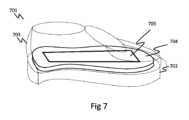
いくつかの例では、本開示の実施形態による感覚刺激装置は、履物に挿入及び取り外し可能な修正済みインソールに組み込むことができる。このような実施形態の一例が図7に示されている。図7は、ソール702及びアッパー703(ソール702及びアッパー703は破線で示され、透明に表示されている)を有し、それ以外は従来の、履物701を示す簡略化された概略図である。取り外し可能な修正済みインソール704が組み込まれており、その内部には振動発生装置を有するアセンブリ705が示される。
In some examples, a sensory stimulation device according to embodiments of the present disclosure can be incorporated into a modified insole that can be inserted into and removed from footwear. An example of such an embodiment is shown in FIG. 7, which is a simplified schematic diagram of an otherwise
理解されるように、取り外し可能な修正済みインソール704は履物701から取り外し、別の履物に入れることができる。これにより、例えば、修正済みインソール704を複数の対象者の履物で使用したり、同一の対象者の複数の履物で使用したりすることが可能になる。修正済みインソール704は、洗濯可能及び/又は消毒可能な外側を有してもよく、これにより、修正済みインソール704は、例えば、衛生上の目的で、第1の対象者の履物で使用した後、第2の対象者の履物で使用する前に、洗浄することが可能になる。
As will be appreciated, the removable modified
図1aを参照して説明した例では、対象者の動きを検知し、感覚刺激を適用することに関連するすべての構成要素が単一の感覚刺激ユニットに組み込まれる。しかし、他の例では、これらの構成要素は履物と異なる方法で統合される可能性がある。例えば、振動アクチュエータ又は振動アクチュエータは、修正されたソール又は修正されたインソールに取り付けることができる一方で、他の構成要素、例えばセンサ及びデータプロセッサは、履物の他の部分、例えば靴上部又は靴ベロに取り込むことができる。 In the example described with reference to FIG. 1a, all components related to sensing the subject's movements and applying sensory stimuli are integrated into a single sensory stimulation unit. However, in other examples, these components may be integrated differently with the footwear. For example, the vibration actuator or vibration actuator may be attached to a modified sole or modified insole, while other components, such as sensors and data processors, may be incorporated into other parts of the footwear, such as the shoe upper or the shoe tongue.
本開示の実施形態は、あらゆる適切な履物の形態で使用することができる。そのような履物には、トレーナー(スニーカー)、ブーツ、サンダルなどの靴が含まれる。いくつかの実施形態では、振動発生装置は、CAM(controlled ankle motion)ウォーキングブーツ(ムーンブーツ)などの特定の医療用履物に組み込むことができる。 Embodiments of the present disclosure may be used with any suitable form of footwear. Such footwear may include shoes such as trainers (sneakers), boots, sandals, etc. In some embodiments, the vibration generating device may be incorporated into certain medical footwear such as controlled ankle motion (CAM) walking boots (moon boots).
いくつかの実施形態では、一方又は両方の靴のセンサモジュールは、移動距離追跡機能を実行するように構成されている。移動距離追跡機能は、靴が移動した距離を追跡し、対応する移動距離データを生成するように構成される。 In some embodiments, the sensor module of one or both shoes is configured to perform a distance traveled tracking function. The distance traveled tracking function is configured to track a distance traveled by the shoe and generate corresponding distance traveled data.
移動距離分析機能は、移動距離データを分析して、靴の移動に関連する移動パターン(例えば、総移動距離、平均移動時間、一定期間における最大・最小移動距離など)を決定し、対応する移動距離分析データを生成するように設定することができる。そして、移動距離分析データは、システムが提供する治療、動作補助、ゲーム、トレーニングなどのプログラムを最適化するために利用することができる。例えば、専門家(医師など)は、対象者の移動距離パターンに基づいて、プログラムパラメータデータベースに保存されているプログラムパラメータを手動で変更することができる。 The movement distance analysis function can be configured to analyze the movement distance data to determine movement patterns associated with shoe movement (e.g., total movement distance, average movement time, maximum and minimum movement distances over a period of time, etc.) and generate corresponding movement distance analysis data. The movement distance analysis data can then be utilized to optimize programs such as treatments, movement assistance, games, and training provided by the system. For example, a professional (e.g., a physician) can manually modify program parameters stored in the program parameter database based on the subject's movement distance patterns.
移動距離追跡機能は、任意の適切な手段で実装することができる。例えば、移動距離追跡機能は、一方又は両方の靴のセンサモジュール上のデータプロセッサで実現することができ、センサモジュールは、位置追跡装置(例えば、全地球測位衛星システム(GNSS)受信機、例えばGPS受信機)を更に備えることができる。データプロセッサは、位置追跡装置から位置データを受信し、そこから移動距離データを生成するように構成される。他の例では、移動追跡機能は、センサユニットによって収集されたセンサデータ(例えば、対象者の歩数を推定して移動した総距離を推定する)を使用するように構成することができ、これに基づいて移動距離データを生成する。 The distance traveled tracking functionality may be implemented by any suitable means. For example, the distance traveled tracking functionality may be realized in a data processor on the sensor module of one or both shoes, which may further comprise a location tracking device (e.g., a Global Navigation Satellite System (GNSS) receiver, e.g., a GPS receiver). The data processor is configured to receive location data from the location tracking device and generate the distance traveled data therefrom. In other examples, the distance traveled tracking functionality may be configured to use sensor data collected by the sensor unit (e.g., to estimate the number of steps taken by the subject to estimate the total distance traveled) and generate the distance traveled data based thereon.
図8は、この目的のために配置されたセンサモジュールの概略図を提供する。図8は、図3に参されるセンサモジュールに対応するセンサモジュールを示し、更にGPS受信機などのGNSS受信機によって提供される位置追跡装置801を更に有する
Figure 8 provides a schematic diagram of a sensor module arranged for this purpose. Figure 8 shows a sensor module corresponding to the sensor module referred to in Figure 3, and further comprising a
上述の通り、いくつかの実施形態では、移動距離分析機能に高度検出機能を組み込むことで、移動距離分析データの生成時に、高度に関連する移動パターン(例えば、所定の期間に上昇及び/又は下降したメートル数)も考慮することができる。 As mentioned above, in some embodiments, the distance traveled analysis function may incorporate altitude detection functionality so that altitude-related movement patterns (e.g., the number of meters ascended and/or descended in a given period of time) may also be taken into account when generating the distance traveled analysis data.
いくつかの実施形態では、システムは、更なる目的のために感覚刺激を生成することを可能にする更なる機能を備える。 In some embodiments, the system includes additional functionality that allows for generating sensory stimuli for additional purposes.
例えば、いくつかの実施形態では、システムは、訓練又はテスト中に対象者を促すための触覚による合図を提供するように構成される。 For example, in some embodiments, the system is configured to provide tactile cues to prompt the subject during training or testing.
このような合図には、対象者に開始、停止、回転、座る、立つなどの動作を実行するように合図することも含まれる。 Such cues may include cueing the subject to perform actions such as start, stop, turn, sit, stand, etc.
このような実施形態は、あらゆる適切な方法で実装することができる。 Such embodiments may be implemented in any suitable manner.
センサユニットのデータプロセッサには、触覚合図生成機能が搭載される。 The sensor unit's data processor is equipped with a tactile cue generation function.
例えば、訓練や治療のセッション中に、触覚による合図の振動を順番に発生させることで、対象者に歩行を開始させ、歩行を停止させ、再び歩行を開始させる、といったことを繰り返させることができる。 For example, during a training or therapy session, a subject could be prompted to start walking, stop walking, then start walking again, and so on, by sequentially delivering vibration tactile cues.
上述の例示的な実施形態では、センサモジュールの振動アクチュエータは、感覚刺激が主として対象者の足の裏側(下側)すなわち足の裏に適用されるように位置決め及び構成される。 In the exemplary embodiment described above, the vibration actuator of the sensor module is positioned and configured so that the sensory stimulation is applied primarily to the plantar (underside) or sole of the subject's foot.
しかし、他の実施形態では、センサモジュールは、対象者の足の他の領域に感覚刺激を与えるように代替的又は追加的に構成されてもよい。例えば、いくつかの実施形態では、振動アクチュエータ又はセンサモジュールの振動アクチュエータが、対象者の足首又は対象者の足首に直近の領域に感覚刺激を与えるように位置決め及び構成されることを除いて、上述のものに実質的に対応するセンサモジュールを組み込んだ履物が提供される。 However, in other embodiments, the sensor module may alternatively or additionally be configured to provide sensory stimulation to other areas of the subject's foot. For example, in some embodiments, footwear is provided incorporating a sensor module substantially corresponding to that described above, except that the vibration actuator or vibration actuators of the sensor module are positioned and configured to provide sensory stimulation to the subject's ankle or an area proximate to the subject's ankle.
図9aは、そのような実施形態の簡略化された概略図を提供する。
図9aは、上述のタイプのセンサモジュール902を含み、例えば図3に描かれたすべての構成要素を含む履物901aを示す。
図9aから分かるように、センサモジュール902は、使用中に感覚刺激が対象者の足首遠位部に適用されるような位置で履物901aのアイテムに取り付けられる。
FIG. 9a provides a simplified schematic diagram of such an embodiment.
FIG. 9a illustrates
As can be seen in FIG. 9a, the
更なる実施形態では、上述のセンサモジュールと実質的に対応するセンサモジュールを組み込んだ履物が提供される。ただし、センサモジュールの振動アクチュエータ又は振動アクチュエータは、対象者の足の上部(上部)側に感覚刺激を与えるように位置決め及び構成されている。 In a further embodiment, footwear is provided incorporating a sensor module substantially corresponding to the sensor module described above, except that the vibration actuator or actuators of the sensor module are positioned and configured to provide sensory stimulation to the superior (top) side of the subject's foot.
図9bは、そのような実施形態の簡略化された概略図を提供する。図9bは、上述のタイプのセンサモジュール903を含み、例えば図3に描かれたすべての構成要素を含む履物901bのアイテムを示す。図9bから分かるように、センサモジュール902は、使用中に感覚刺激が対象者の足の上部(上方)側に適用されるような位置で履物901aに装着される。
Figure 9b provides a simplified schematic diagram of such an embodiment. Figure 9b shows an item of
本明細書に開示されたすべての機能(添付の特許請求の範囲、要約、及び図面を含む)、及び/又は、開示された方法若しくはプロセスのすべてのステップは、少なくとも一部の機能及び/又はステップが相互に排他的である組合せを除き、任意の組み合わせで組み合わせることができる。本明細書に開示された各機能(添付の特許請求の範囲、要約、及び図面を含む)は、別段の明示的な記載がない限り、同じ目的、同等の目的、又は類似の目的を果たす代替機能に置き換えることができる。したがって、別段の明示がない限り、開示された各特徴は、同等の又は類似の特徴の一般的な一連の特徴の単なる一例である。本明細書に開示された特徴(添付の特許請求の範囲、要約、及び図面を含む)の新規な一例、又は新規な組合せ、あるいは、開示された方法若しくはプロセスのステップの新規な一例、又は新規な組合せにまで、本件発明は及ぶ。 All features disclosed herein (including the accompanying claims, abstract, and drawings) and/or all steps of the disclosed methods or processes may be combined in any combination, except combinations in which at least some features and/or steps are mutually exclusive. Each feature disclosed herein (including the accompanying claims, abstract, and drawings) may be replaced with an alternative feature serving the same, equivalent, or similar purpose, unless expressly stated otherwise. Thus, unless expressly stated otherwise, each feature disclosed is merely an example of a generic series of equivalent or similar features. The present invention extends to any novel example or combination of features disclosed herein (including the accompanying claims, abstract, and drawings) or any novel example or combination of steps of the disclosed methods or processes.
本開示における複数形及び/又は単数形の用語の使用に関して、当分野の専門家は、文脈及び/又は用途に応じて、複数形から単数形、及び/又は単数形から複数形に変換することができる。明確にするために、本開示では、さまざまな単数形/複数形の組合せを明示的に規定することができる。 With respect to the use of plural and/or singular terms in this disclosure, those skilled in the art may convert from plural to singular and/or from singular to plural as appropriate to the context and/or application. For the sake of clarity, the present disclosure may expressly provide for various singular/plural combinations.
当業者であれば、一般的に、本明細書で使用される用語、特に添付の特許請求の範囲で使用される用語は、一般的に「オープン」な用語として意図されていることが理解できる(例えば、「~を含む」という用語は「~を含むが、これらに限定されない」と解釈すべきであり、「~を有する」という用語は「少なくとも~を有する」と解釈すべきであり、「~を含む」という用語は「~を含むが、これらに限定されない」と解釈すべきである、など)。当業者であれば、導入された特許請求の範囲の文言に特定の数値を意図する場合には、その意図は特許請求の範囲に明示的に記載されること、そのような記載がない場合にはそのような意図はないことを理解するであろう。理解を助けるために、例えば、以下の添付の特許請求の範囲には、特許請求の範囲の文言を導入する「少なくとも1つ」及び「1つ又は複数」という導入句が使用されている場合がある。しかし、このような表現の使用は、不定冠詞「a」又は「an」によるクレームの記載事項の導入が、その導入されたクレームの記載事項を含む特定のクレームを、そのような記載事項が1つだけ含まれる実施形態に限定することを暗示していると解釈されるべきではない。たとえ、同じクレームに「1つ又は複数」や「少なくとも1つ」といった導入句や「a」や「an」といった不定冠詞が含まれている場合でも(例えば、「a」及び/又は「an」は「少なくとも1つ」又は「1つ又は複数」を意味すると解釈されるべきである)、同様である。これは、クレーム記述を導入するために使用される定冠詞にも同様に当てはまる。さらに、導入されたクレームの特定の数が明示的に記載されていたとしても、当業者は、そのような記載は少なくとも記載された数(例えば、「2回」という単なる記載は、他の修飾語句がなければ、少なくとも2回、又は2回以上の記載を意味する)を意味すると解釈すべきであると理解する。 Those skilled in the art will understand that the terms used herein in general, and in the appended claims in particular, are generally intended as "open" terms (e.g., the term "including" should be interpreted as "including, but not limited to," the term "having" should be interpreted as "having at least," the term "including" should be interpreted as "including, but not limited to," etc.). Those skilled in the art will understand that if a specific numerical value is intended in the introduced claim language, then that intention will be expressly set forth in the claim, and that in the absence of such a statement, there is no such intention. To aid in understanding, for example, the appended claims below may use the introductory phrases "at least one" and "one or more" to introduce the claim language. However, the use of such language should not be interpreted as implying that the introduction of a claim statement by the indefinite article "a" or "an" limits a particular claim that includes the introduced claim statement to an embodiment that includes only one such statement. This is true even if the same claim contains an introductory phrase such as "one or more" or "at least one" or an indefinite article such as "a" or "an" (e.g., "a" and/or "an" should be interpreted to mean "at least one" or "one or more"). This also applies to definite articles used to introduce claim statements. Moreover, even if a specific number of introduced claims is explicitly recited, one of ordinary skill in the art will understand that such recitation should be interpreted to mean at least the recited number (e.g., the mere recitation of "two times" means at least two times, or more than two times, unless another modifier is present).
本開示の様々な実施形態が例示の目的で本明細書に記載されていること、及び、本開示の範囲から逸脱することなく様々な修正が可能であることが理解されるであろう。したがって、本明細書に開示されている様々な実施形態は限定的なものではなく、真の範囲は以下の特許請求の範囲によって示される。
It will be understood that various embodiments of the present disclosure have been described herein for purposes of illustration and that various modifications are possible without departing from the scope of the disclosure. Accordingly, the various embodiments disclosed herein are not intended to be limiting, with the true scope being indicated by the following claims.
Claims (21)
1つ又は複数のセンサ、データプロセッサ、及び無線通信ユニットを組み込んだ少なくとも1つの履物と、
前記履物を履いた対象者による反応を引き起こすための介入を提供するように構成される遠隔介入システムとを有し、
前記1つ又は複数のセンサは、前記対象者の運動に関連するセンサデータを生成するように構成され、
前記データプロセッサは、前記センサデータを処理して、前記対象者の歩行運動学に関連する歩行パラメータデータを生成するように構成され、
前記無線通信ユニットは、前記歩行パラメータデータを前記遠隔介入システムに通信するように構成される、
システム。 1. A system for providing an intervention based on detected gait kinematics for therapy, training, gaming, or mobility assistance, comprising:
At least one article of footwear incorporating one or more sensors, a data processor, and a wireless communication unit;
and a remote intervention system configured to provide an intervention to elicit a response by a subject wearing the footwear,
the one or more sensors are configured to generate sensor data related to movement of the subject;
the data processor is configured to process the sensor data to generate gait parameter data related to gait kinematics of the subject;
the wireless communication unit is configured to communicate the gait parameter data to the remote intervention system.
system.
前記データプロセッサが、前記移動距離データを処理して移動距離分析データを生成するように構成される、請求項1から13のいずれかに記載のシステム。 the at least one footwear further incorporating a distance traveled tracking function configured to generate distance traveled data relating to a distance traveled by the footwear;
The system of claim 1 , wherein the data processor is configured to process the distance traveled data to generate distance traveled analysis data.
履物にて当該履物を履く対象者の動作に関連するセンサデータを生成するステップと、
前記履物にて、前記センサデータを処理して前記対象者の歩行運動に関連する歩行パラメータデータを生成するためにステップと、
介入を提供するために前記履物から遠隔介入システムに歩行パラメータデータを通信するステップと、
前記履物を履く対象者の反応を引き起こす介入を提供するように前記遠隔介入システムを制御する、方法。 1. A method for providing an intervention based on detected gait kinematics for therapy, training, gaming, or mobility assistance, comprising:
generating sensor data associated with a subject's movements while wearing the footwear;
processing, at the footwear, the sensor data to generate gait parameter data related to the subject's walking motion;
communicating gait parameter data from the footwear to a remote intervention system to provide intervention;
A method of controlling the remote intervention system to provide an intervention that elicits a response in a subject wearing the footwear.
前記1つ又は複数のセンサは、履物を履いた対象者の動きに関連するセンサデータを生成するように構成され、
前記データプロセッサは、前記センサデータを処理して、前記対象者の歩行運動学に関連する歩行パラメータデータを生成するように構成され、
前記無線通信ユニットは、前記歩行パラメータデータを遠隔介入システムに通信するように構成される、構成。 An arrangement adapted to fit footwear, the arrangement including one or more sensors, a data processor, and a wireless communication unit;
the one or more sensors are configured to generate sensor data related to movement of a subject wearing the footwear;
the data processor is configured to process the sensor data to generate gait parameter data related to gait kinematics of the subject;
The wireless communication unit is configured to communicate the gait parameter data to a remote intervention system.
履物において履物を履いる対象者の動きに関連するセンサデータを生成するステップと、
履物にて前記センサデータを処理して前記対象者の歩行運動学に関連する歩行パラメータデータを生成するステップと、
前記履物を履いる対象者の反応を引き起こすための介入を提供するために前記歩行パラメータデータを前記履物から遠隔介入システムに通信するステップと、
を有する、
コンピュータプログラム。
2. A computer program for use in the system of claim 1, the computer program running on a data processor integrated into footwear, the computer program controlling the data processor to perform a method, the method comprising:
generating sensor data relating to movement of a subject wearing the footwear in the footwear;
processing the sensor data at the footwear to generate gait parameter data related to the gait kinematics of the subject;
communicating the gait parameter data from the footwear to a remote intervention system to provide an intervention to elicit a response in a subject wearing the footwear;
having
Computer program.
Applications Claiming Priority (3)
| Application Number | Priority Date | Filing Date | Title |
|---|---|---|---|
| GB2207798.6 | 2022-05-26 | ||
| GB2207798.6A GB2619069A (en) | 2022-05-26 | 2022-05-26 | Intervention based on detected gait kinematics |
| PCT/EP2023/063911 WO2023227659A1 (en) | 2022-05-26 | 2023-05-24 | Intervention based on detected gait kinematics |
Publications (1)
| Publication Number | Publication Date |
|---|---|
| JP2025519168A true JP2025519168A (en) | 2025-06-24 |
Family
ID=82324151
Family Applications (1)
| Application Number | Title | Priority Date | Filing Date |
|---|---|---|---|
| JP2024569872A Pending JP2025519168A (en) | 2022-05-26 | 2023-05-24 | Intervention based on detected gait kinematics |
Country Status (7)
| Country | Link |
|---|---|
| US (1) | US20250295359A1 (en) |
| EP (1) | EP4531654A1 (en) |
| JP (1) | JP2025519168A (en) |
| KR (1) | KR20250012663A (en) |
| CN (1) | CN119546222A (en) |
| GB (1) | GB2619069A (en) |
| WO (1) | WO2023227659A1 (en) |
Families Citing this family (1)
| Publication number | Priority date | Publication date | Assignee | Title |
|---|---|---|---|---|
| KR20250151034A (en) * | 2024-04-12 | 2025-10-21 | 솔티드 주식회사 | Apparatus and method for preventing and preventing gait freezing |
Family Cites Families (7)
| Publication number | Priority date | Publication date | Assignee | Title |
|---|---|---|---|---|
| US7610813B2 (en) * | 2006-09-29 | 2009-11-03 | Intel Corporation | Method and apparatus for a self-powered RFID-readable pedometer |
| WO2015164456A2 (en) * | 2014-04-22 | 2015-10-29 | The Trustees Of Columbia University In The City Of New York | Gait analysis devices, methods, and systems |
| WO2017023864A1 (en) | 2015-07-31 | 2017-02-09 | Cala Health, Inc. | Systems, devices, and method for the treatment of osteoarthritis |
| US20180092572A1 (en) * | 2016-10-04 | 2018-04-05 | Arthrokinetic Institute, Llc | Gathering and Analyzing Kinetic and Kinematic Movement Data |
| US20180263532A1 (en) * | 2017-03-20 | 2018-09-20 | Samantha Smulyan | Technologies for indicating detection of toe walking |
| WO2019086997A2 (en) * | 2017-10-31 | 2019-05-09 | Ori Elyada | Wearable biofeedback system |
| US20190269352A1 (en) * | 2018-03-05 | 2019-09-05 | International Business Machines Corporation | Providing corrective feedback for gait modification |
-
2022
- 2022-05-26 GB GB2207798.6A patent/GB2619069A/en active Pending
-
2023
- 2023-05-24 EP EP23728730.5A patent/EP4531654A1/en active Pending
- 2023-05-24 WO PCT/EP2023/063911 patent/WO2023227659A1/en not_active Ceased
- 2023-05-24 CN CN202380043108.6A patent/CN119546222A/en active Pending
- 2023-05-24 US US18/869,298 patent/US20250295359A1/en active Pending
- 2023-05-24 JP JP2024569872A patent/JP2025519168A/en active Pending
- 2023-05-24 KR KR1020247042973A patent/KR20250012663A/en active Pending
Also Published As
| Publication number | Publication date |
|---|---|
| CN119546222A (en) | 2025-02-28 |
| GB202207798D0 (en) | 2022-07-13 |
| GB2619069A (en) | 2023-11-29 |
| KR20250012663A (en) | 2025-01-24 |
| US20250295359A1 (en) | 2025-09-25 |
| EP4531654A1 (en) | 2025-04-09 |
| WO2023227659A1 (en) | 2023-11-30 |
Similar Documents
| Publication | Publication Date | Title |
|---|---|---|
| US20240197237A1 (en) | Systems, devices, and method for the treatment of osteoarthritis | |
| US8011229B2 (en) | Determining postural stability | |
| CA2882453C (en) | Method to determine physical properties of the ground, foot-worn sensor therefore, and method to advise a user of a risk of falling based thereon | |
| JP6777751B2 (en) | Gait disturbance support device and gait disturbance support method | |
| JP7163370B2 (en) | Artificial intelligence assistance for modifying biomechanical loads | |
| US20180126158A1 (en) | Systems and Methods for Functional Restoration and Rehabilitation of Posture, Gait and Movement | |
| US20090234254A1 (en) | Device and method for improving human motor function | |
| CN106691783A (en) | Program for generating and executing training course | |
| JP2023552741A (en) | sensory stimulation | |
| US11745083B2 (en) | Physical balance training system using foot sensors, real-time feedback, artificial intelligence, and optionally other body sensors | |
| TWI648010B (en) | Intelligent apparatus for improving the mobility and postural control for subjects with parkinson's disease and its method | |
| JP2025519168A (en) | Intervention based on detected gait kinematics | |
| JP2024521030A (en) | Apparatus and method for automatically controlling a transcutaneous electrical nerve stimulation (TENS) device based on TENS user's activity type, level, and duration - Patents.com | |
| CN119997877A (en) | Sensory modulation systems for improving gait function and/or balance control | |
| Pimenta | Motor Effects of Cueing in Parkinson’s Rehabilitation | |
| Giraldo Pedroza | Wearable Devices for Gait Retraining in Older Adults to Modify Performance in Locomotion | |
| Lieberman et al. | Determining postural stability | |
| Gonçalves | Functional feedback vibrotactile system for patients with Parkinson’s disease: freezing of gait |