JP2025516873A - Antibody-drug conjugates containing biologically active compounds of the proteolytic agent class and methods for their preparation and use - Patents.com - Google Patents
Antibody-drug conjugates containing biologically active compounds of the proteolytic agent class and methods for their preparation and use - Patents.com Download PDFInfo
- Publication number
- JP2025516873A JP2025516873A JP2024568819A JP2024568819A JP2025516873A JP 2025516873 A JP2025516873 A JP 2025516873A JP 2024568819 A JP2024568819 A JP 2024568819A JP 2024568819 A JP2024568819 A JP 2024568819A JP 2025516873 A JP2025516873 A JP 2025516873A
- Authority
- JP
- Japan
- Prior art keywords
- antibody
- group
- pharma
- linked
- ceutically acceptable
- Prior art date
- Legal status (The legal status is an assumption and is not a legal conclusion. Google has not performed a legal analysis and makes no representation as to the accuracy of the status listed.)
- Pending
Links
Images


Classifications
-
- A—HUMAN NECESSITIES
- A61—MEDICAL OR VETERINARY SCIENCE; HYGIENE
- A61K—PREPARATIONS FOR MEDICAL, DENTAL OR TOILETRY PURPOSES
- A61K47/00—Medicinal preparations characterised by the non-active ingredients used, e.g. carriers or inert additives; Targeting or modifying agents chemically bound to the active ingredient
- A61K47/50—Medicinal preparations characterised by the non-active ingredients used, e.g. carriers or inert additives; Targeting or modifying agents chemically bound to the active ingredient the non-active ingredient being chemically bound to the active ingredient, e.g. polymer-drug conjugates
- A61K47/51—Medicinal preparations characterised by the non-active ingredients used, e.g. carriers or inert additives; Targeting or modifying agents chemically bound to the active ingredient the non-active ingredient being chemically bound to the active ingredient, e.g. polymer-drug conjugates the non-active ingredient being a modifying agent
- A61K47/68—Medicinal preparations characterised by the non-active ingredients used, e.g. carriers or inert additives; Targeting or modifying agents chemically bound to the active ingredient the non-active ingredient being chemically bound to the active ingredient, e.g. polymer-drug conjugates the non-active ingredient being a modifying agent the modifying agent being an antibody, an immunoglobulin or a fragment thereof, e.g. an Fc-fragment
- A61K47/6801—Drug-antibody or immunoglobulin conjugates defined by the pharmacologically or therapeutically active agent
- A61K47/6803—Drugs conjugated to an antibody or immunoglobulin, e.g. cisplatin-antibody conjugates
-
- A—HUMAN NECESSITIES
- A61—MEDICAL OR VETERINARY SCIENCE; HYGIENE
- A61K—PREPARATIONS FOR MEDICAL, DENTAL OR TOILETRY PURPOSES
- A61K47/00—Medicinal preparations characterised by the non-active ingredients used, e.g. carriers or inert additives; Targeting or modifying agents chemically bound to the active ingredient
- A61K47/50—Medicinal preparations characterised by the non-active ingredients used, e.g. carriers or inert additives; Targeting or modifying agents chemically bound to the active ingredient the non-active ingredient being chemically bound to the active ingredient, e.g. polymer-drug conjugates
- A61K47/51—Medicinal preparations characterised by the non-active ingredients used, e.g. carriers or inert additives; Targeting or modifying agents chemically bound to the active ingredient the non-active ingredient being chemically bound to the active ingredient, e.g. polymer-drug conjugates the non-active ingredient being a modifying agent
- A61K47/68—Medicinal preparations characterised by the non-active ingredients used, e.g. carriers or inert additives; Targeting or modifying agents chemically bound to the active ingredient the non-active ingredient being chemically bound to the active ingredient, e.g. polymer-drug conjugates the non-active ingredient being a modifying agent the modifying agent being an antibody, an immunoglobulin or a fragment thereof, e.g. an Fc-fragment
- A61K47/6835—Medicinal preparations characterised by the non-active ingredients used, e.g. carriers or inert additives; Targeting or modifying agents chemically bound to the active ingredient the non-active ingredient being chemically bound to the active ingredient, e.g. polymer-drug conjugates the non-active ingredient being a modifying agent the modifying agent being an antibody, an immunoglobulin or a fragment thereof, e.g. an Fc-fragment the modifying agent being an antibody or an immunoglobulin bearing at least one antigen-binding site
- A61K47/6849—Medicinal preparations characterised by the non-active ingredients used, e.g. carriers or inert additives; Targeting or modifying agents chemically bound to the active ingredient the non-active ingredient being chemically bound to the active ingredient, e.g. polymer-drug conjugates the non-active ingredient being a modifying agent the modifying agent being an antibody, an immunoglobulin or a fragment thereof, e.g. an Fc-fragment the modifying agent being an antibody or an immunoglobulin bearing at least one antigen-binding site the antibody targeting a receptor, a cell surface antigen or a cell surface determinant
-
- A—HUMAN NECESSITIES
- A61—MEDICAL OR VETERINARY SCIENCE; HYGIENE
- A61K—PREPARATIONS FOR MEDICAL, DENTAL OR TOILETRY PURPOSES
- A61K47/00—Medicinal preparations characterised by the non-active ingredients used, e.g. carriers or inert additives; Targeting or modifying agents chemically bound to the active ingredient
- A61K47/50—Medicinal preparations characterised by the non-active ingredients used, e.g. carriers or inert additives; Targeting or modifying agents chemically bound to the active ingredient the non-active ingredient being chemically bound to the active ingredient, e.g. polymer-drug conjugates
- A61K47/51—Medicinal preparations characterised by the non-active ingredients used, e.g. carriers or inert additives; Targeting or modifying agents chemically bound to the active ingredient the non-active ingredient being chemically bound to the active ingredient, e.g. polymer-drug conjugates the non-active ingredient being a modifying agent
- A61K47/68—Medicinal preparations characterised by the non-active ingredients used, e.g. carriers or inert additives; Targeting or modifying agents chemically bound to the active ingredient the non-active ingredient being chemically bound to the active ingredient, e.g. polymer-drug conjugates the non-active ingredient being a modifying agent the modifying agent being an antibody, an immunoglobulin or a fragment thereof, e.g. an Fc-fragment
- A61K47/6835—Medicinal preparations characterised by the non-active ingredients used, e.g. carriers or inert additives; Targeting or modifying agents chemically bound to the active ingredient the non-active ingredient being chemically bound to the active ingredient, e.g. polymer-drug conjugates the non-active ingredient being a modifying agent the modifying agent being an antibody, an immunoglobulin or a fragment thereof, e.g. an Fc-fragment the modifying agent being an antibody or an immunoglobulin bearing at least one antigen-binding site
- A61K47/6851—Medicinal preparations characterised by the non-active ingredients used, e.g. carriers or inert additives; Targeting or modifying agents chemically bound to the active ingredient the non-active ingredient being chemically bound to the active ingredient, e.g. polymer-drug conjugates the non-active ingredient being a modifying agent the modifying agent being an antibody, an immunoglobulin or a fragment thereof, e.g. an Fc-fragment the modifying agent being an antibody or an immunoglobulin bearing at least one antigen-binding site the antibody targeting a determinant of a tumour cell
-
- A—HUMAN NECESSITIES
- A61—MEDICAL OR VETERINARY SCIENCE; HYGIENE
- A61K—PREPARATIONS FOR MEDICAL, DENTAL OR TOILETRY PURPOSES
- A61K47/00—Medicinal preparations characterised by the non-active ingredients used, e.g. carriers or inert additives; Targeting or modifying agents chemically bound to the active ingredient
- A61K47/50—Medicinal preparations characterised by the non-active ingredients used, e.g. carriers or inert additives; Targeting or modifying agents chemically bound to the active ingredient the non-active ingredient being chemically bound to the active ingredient, e.g. polymer-drug conjugates
- A61K47/51—Medicinal preparations characterised by the non-active ingredients used, e.g. carriers or inert additives; Targeting or modifying agents chemically bound to the active ingredient the non-active ingredient being chemically bound to the active ingredient, e.g. polymer-drug conjugates the non-active ingredient being a modifying agent
- A61K47/68—Medicinal preparations characterised by the non-active ingredients used, e.g. carriers or inert additives; Targeting or modifying agents chemically bound to the active ingredient the non-active ingredient being chemically bound to the active ingredient, e.g. polymer-drug conjugates the non-active ingredient being a modifying agent the modifying agent being an antibody, an immunoglobulin or a fragment thereof, e.g. an Fc-fragment
- A61K47/6835—Medicinal preparations characterised by the non-active ingredients used, e.g. carriers or inert additives; Targeting or modifying agents chemically bound to the active ingredient the non-active ingredient being chemically bound to the active ingredient, e.g. polymer-drug conjugates the non-active ingredient being a modifying agent the modifying agent being an antibody, an immunoglobulin or a fragment thereof, e.g. an Fc-fragment the modifying agent being an antibody or an immunoglobulin bearing at least one antigen-binding site
- A61K47/6851—Medicinal preparations characterised by the non-active ingredients used, e.g. carriers or inert additives; Targeting or modifying agents chemically bound to the active ingredient the non-active ingredient being chemically bound to the active ingredient, e.g. polymer-drug conjugates the non-active ingredient being a modifying agent the modifying agent being an antibody, an immunoglobulin or a fragment thereof, e.g. an Fc-fragment the modifying agent being an antibody or an immunoglobulin bearing at least one antigen-binding site the antibody targeting a determinant of a tumour cell
- A61K47/6855—Medicinal preparations characterised by the non-active ingredients used, e.g. carriers or inert additives; Targeting or modifying agents chemically bound to the active ingredient the non-active ingredient being chemically bound to the active ingredient, e.g. polymer-drug conjugates the non-active ingredient being a modifying agent the modifying agent being an antibody, an immunoglobulin or a fragment thereof, e.g. an Fc-fragment the modifying agent being an antibody or an immunoglobulin bearing at least one antigen-binding site the antibody targeting a determinant of a tumour cell the tumour determinant being from breast cancer cell
-
- A—HUMAN NECESSITIES
- A61—MEDICAL OR VETERINARY SCIENCE; HYGIENE
- A61K—PREPARATIONS FOR MEDICAL, DENTAL OR TOILETRY PURPOSES
- A61K47/00—Medicinal preparations characterised by the non-active ingredients used, e.g. carriers or inert additives; Targeting or modifying agents chemically bound to the active ingredient
- A61K47/50—Medicinal preparations characterised by the non-active ingredients used, e.g. carriers or inert additives; Targeting or modifying agents chemically bound to the active ingredient the non-active ingredient being chemically bound to the active ingredient, e.g. polymer-drug conjugates
- A61K47/51—Medicinal preparations characterised by the non-active ingredients used, e.g. carriers or inert additives; Targeting or modifying agents chemically bound to the active ingredient the non-active ingredient being chemically bound to the active ingredient, e.g. polymer-drug conjugates the non-active ingredient being a modifying agent
- A61K47/68—Medicinal preparations characterised by the non-active ingredients used, e.g. carriers or inert additives; Targeting or modifying agents chemically bound to the active ingredient the non-active ingredient being chemically bound to the active ingredient, e.g. polymer-drug conjugates the non-active ingredient being a modifying agent the modifying agent being an antibody, an immunoglobulin or a fragment thereof, e.g. an Fc-fragment
- A61K47/6889—Conjugates wherein the antibody being the modifying agent and wherein the linker, binder or spacer confers particular properties to the conjugates, e.g. peptidic enzyme-labile linkers or acid-labile linkers, providing for an acid-labile immuno conjugate wherein the drug may be released from its antibody conjugated part in an acidic, e.g. tumoural or environment
-
- A—HUMAN NECESSITIES
- A61—MEDICAL OR VETERINARY SCIENCE; HYGIENE
- A61P—SPECIFIC THERAPEUTIC ACTIVITY OF CHEMICAL COMPOUNDS OR MEDICINAL PREPARATIONS
- A61P35/00—Antineoplastic agents
-
- C—CHEMISTRY; METALLURGY
- C07—ORGANIC CHEMISTRY
- C07K—PEPTIDES
- C07K16/00—Immunoglobulins [IGs], e.g. monoclonal or polyclonal antibodies
- C07K16/18—Immunoglobulins [IGs], e.g. monoclonal or polyclonal antibodies against material from animals or humans
- C07K16/28—Immunoglobulins [IGs], e.g. monoclonal or polyclonal antibodies against material from animals or humans against receptors, cell surface antigens or cell surface determinants
- C07K16/2803—Immunoglobulins [IGs], e.g. monoclonal or polyclonal antibodies against material from animals or humans against receptors, cell surface antigens or cell surface determinants against the immunoglobulin superfamily
- C07K16/2827—Immunoglobulins [IGs], e.g. monoclonal or polyclonal antibodies against material from animals or humans against receptors, cell surface antigens or cell surface determinants against the immunoglobulin superfamily against B7 molecules, e.g. CD80, CD86
-
- C—CHEMISTRY; METALLURGY
- C07—ORGANIC CHEMISTRY
- C07K—PEPTIDES
- C07K16/00—Immunoglobulins [IGs], e.g. monoclonal or polyclonal antibodies
- C07K16/18—Immunoglobulins [IGs], e.g. monoclonal or polyclonal antibodies against material from animals or humans
- C07K16/28—Immunoglobulins [IGs], e.g. monoclonal or polyclonal antibodies against material from animals or humans against receptors, cell surface antigens or cell surface determinants
- C07K16/2863—Immunoglobulins [IGs], e.g. monoclonal or polyclonal antibodies against material from animals or humans against receptors, cell surface antigens or cell surface determinants against receptors for growth factors, growth regulators
-
- C—CHEMISTRY; METALLURGY
- C07—ORGANIC CHEMISTRY
- C07K—PEPTIDES
- C07K16/00—Immunoglobulins [IGs], e.g. monoclonal or polyclonal antibodies
- C07K16/18—Immunoglobulins [IGs], e.g. monoclonal or polyclonal antibodies against material from animals or humans
- C07K16/32—Immunoglobulins [IGs], e.g. monoclonal or polyclonal antibodies against material from animals or humans against translation products of oncogenes
-
- C—CHEMISTRY; METALLURGY
- C07—ORGANIC CHEMISTRY
- C07K—PEPTIDES
- C07K2317/00—Immunoglobulins specific features
- C07K2317/70—Immunoglobulins specific features characterized by effect upon binding to a cell or to an antigen
- C07K2317/77—Internalization into the cell
-
- C—CHEMISTRY; METALLURGY
- C07—ORGANIC CHEMISTRY
- C07K—PEPTIDES
- C07K2317/00—Immunoglobulins specific features
- C07K2317/90—Immunoglobulins specific features characterized by (pharmaco)kinetic aspects or by stability of the immunoglobulin
- C07K2317/92—Affinity (KD), association rate (Ka), dissociation rate (Kd) or EC50 value
Landscapes
- Health & Medical Sciences (AREA)
- Chemical & Material Sciences (AREA)
- Life Sciences & Earth Sciences (AREA)
- Immunology (AREA)
- General Health & Medical Sciences (AREA)
- Medicinal Chemistry (AREA)
- Engineering & Computer Science (AREA)
- Bioinformatics & Cheminformatics (AREA)
- Organic Chemistry (AREA)
- Public Health (AREA)
- Pharmacology & Pharmacy (AREA)
- Animal Behavior & Ethology (AREA)
- Veterinary Medicine (AREA)
- Epidemiology (AREA)
- Cell Biology (AREA)
- Molecular Biology (AREA)
- Proteomics, Peptides & Aminoacids (AREA)
- Biophysics (AREA)
- Genetics & Genomics (AREA)
- Biochemistry (AREA)
- Oncology (AREA)
- Nuclear Medicine, Radiotherapy & Molecular Imaging (AREA)
- General Chemical & Material Sciences (AREA)
- Chemical Kinetics & Catalysis (AREA)
- Medicinal Preparation (AREA)
- Peptides Or Proteins (AREA)
- Medicines Containing Antibodies Or Antigens For Use As Internal Diagnostic Agents (AREA)
- Pharmaceuticals Containing Other Organic And Inorganic Compounds (AREA)
Abstract

本開示は、式Iに示されるタンパク質分解剤クラスの生物学的活性化合物の抗体薬物複合体、その調製方法、並びに異常な細胞活動に関連する疾患の予防及び/又は治療における使用に関し、腫瘍性疾患の予防及び/又は治療における使用を含むが、これらに限定されない。
The present disclosure relates to antibody-drug conjugates of biologically active compounds of the proteolytic agent class as shown in Formula I, methods for their preparation, and their use in the prevention and/or treatment of diseases associated with abnormal cellular activity, including, but not limited to, in the prevention and/or treatment of neoplastic diseases.
Description
本開示は、医学の技術分野に属し、タンパク質分解剤クラスの生物学的活性化合物に対する抗体薬物複合体、タンパク質分解剤クラスの生物学的活性化合物、薬物リンカー複合体、及びその調製方法、並びに異常な細胞活動に関連する疾患の予防及び/又は治療における使用に関し、腫瘍性疾患の予防及び/又は治療における使用を含むが、これらに限定されない。 The present disclosure is in the field of medical technology and relates to antibody-drug conjugates to biologically active compounds of the proteolytic agent class, biologically active compounds of the proteolytic agent class, drug-linker conjugates, and methods for their preparation, and their use in the prevention and/or treatment of diseases associated with abnormal cellular activity, including, but not limited to, the prevention and/or treatment of neoplastic diseases.
多くの疾患は細胞内タンパク質の機能異常に関連しており、これらの疾患を治療するための主な手段は低分子化合物である。しかし、80%以上のタンパク質は、その創薬可能な作用を生み出す部位がないため、このような標的は従来の低分子により創薬できないと考えられている。 Many diseases are associated with abnormalities in the function of intracellular proteins, and small molecule compounds are the primary means of treating these diseases. However, more than 80% of proteins lack a site at which a druggable action can be exerted, and it is believed that such targets cannot be drugged by conventional small molecules.
タンパク質分解誘導キメラ分子(PROTAC)及び分子糊型分解剤(MGD)などの標的タンパク質分解誘導化合物(Targeted Protein Degradation、TPD)は、何れもユビキチン-プロテアソーム経路によって標的タンパク質分解を仲介し、タンパク質活性に影響を及ぼす部位に密接に結合する必要がなく機能することができ、その結果、上記「創薬不可能」なタンパク質は、新たな薬剤標的となり得る。同時に、標的タンパク質分解療法は、病原性タンパク質の迅速で高効率な分解を継続的に誘導し、標的タンパク質に対する耐性の産生を低下させることができる。 Targeted protein degradation (TPD) compounds such as protein degradation inducer chimeric molecules (PROTACs) and molecular glue degraders (MGDs) both mediate targeted protein degradation via the ubiquitin-proteasome pathway and can function without the need to bind closely to sites that affect protein activity, making the above "undruggable" proteins potential new drug targets. At the same time, targeted protein degradation therapy can continuously induce rapid and highly efficient degradation of pathogenic proteins, reducing the development of resistance to targeted proteins.
現在、標的タンパク質分解誘導化合物は既に臨床開発の段階に入っている。C4 Therapeuticsは、既に、IKZF1/3を標的とする分子糊CFT7455の臨床前のデータを2021年のAACRに示した。当該会社は、2022年4月のAACR会議で、CFT7455の臨床結果を示し、CFT7455は、深度標的分解の臨床的利益を示したが、好中球の減少は用量制限があった。 Currently, targeted protein degradation-inducing compounds are already in the clinical development stage. C4 Therapeutics has already presented preclinical data of the molecular glue CFT7455, which targets IKZF1/3, at the AACR in 2021. The company will present clinical results of CFT7455 at the AACR meeting in April 2022, showing that CFT7455 demonstrated clinical benefits of deep target degradation, but neutrophil reduction was dose-limiting.
現在、抗体薬物複合体(ADC)の分野において、マレイミドは、その高い選択性、高い反応活性、及びより優れた安定性のために、マイケル付加反応を介した抗体とのチオールカップリングによるADC分子の形成に広く適用されている。既に市販されている15種類のADC薬物のうち、9種類はマレイミドによってカップリングされている。チオスクシンイミド結合は、チオール含有物質(例えば、血漿中)の存在下で不安定であり、逆マイケル反応により切断され得るか、又はアルブミン(HAS)及びグルタチオン(GSH)などの内因性チオールと交換され得、薬力学、薬物動態及び安全性の望ましくない状態をもたらすことが、多くの文献において報告されている。 Currently, in the field of antibody-drug conjugates (ADCs), maleimides have been widely applied to form ADC molecules by thiol coupling with antibodies via Michael addition reaction due to their high selectivity, high reactivity, and better stability. Of the 15 ADC drugs already on the market, 9 are coupled by maleimides. It has been reported in many literatures that thiosuccinimide bonds are unstable in the presence of thiol-containing substances (e.g., in plasma) and can be cleaved by reverse Michael reaction or exchanged with endogenous thiols such as albumin (HAS) and glutathione (GSH), resulting in undesirable pharmacodynamics, pharmacokinetics, and safety conditions.
本発明は、式Iに示される抗体薬物複合体(ADC)及びその使用に関する。ADC薬物は、抗体の腫瘍標的化作用及び生物学的活性化合物の高活性を融合し、生物学的ミサイルとなり、非常に望ましい治療効果及び安全性の利点を有する。抗体は、標的細胞へのADCの結合を誘導し、腫瘍組織の富化を実現し、非標的組織への曝露を低減し、全身投与による生物学的活性化合物の潜在的毒性を低減する。腫瘍細胞と結合するADCは、腫瘍微小環境において生物学的活性分子を溶解放出し、腫瘍細胞を殺傷することができる。ADCはまた、腫瘍細胞によって内在化され、細胞内で特定の酵素の作用下で、酵素性分解を受けて低分子薬物を放出し、疾患を治療することができる。従って、タンパク質分解剤と腫瘍標的抗体とを組み合わせて構成されたADCは、腫瘍の富化、非疾患組織へのタンパク質分解剤の作用による毒性副作用の除去又は低減、及び治療効果の向上を実現することが期待される。ADC技術を利用してタンパク質分解剤の腫瘍標的化を実現し、その毒性副作用を低減することは、非常に高い臨床的価値を有する。 The present invention relates to an antibody-drug conjugate (ADC) as shown in formula I and its use. The ADC drug combines the tumor targeting action of an antibody and the high activity of a biologically active compound to become a biological missile, which has the advantages of highly desirable therapeutic effects and safety. The antibody induces the binding of the ADC to the target cells, realizing the enrichment of tumor tissues, reducing the exposure to non-target tissues, and reducing the potential toxicity of the biologically active compound due to systemic administration. The ADC that binds to tumor cells can dissolve and release biologically active molecules in the tumor microenvironment, killing the tumor cells. The ADC can also be internalized by tumor cells, and under the action of specific enzymes in the cells, undergo enzymatic degradation to release small molecule drugs and treat diseases. Therefore, the ADC composed of a combination of a proteolytic agent and a tumor-targeting antibody is expected to realize tumor enrichment, elimination or reduction of toxic side effects caused by the action of the proteolytic agent on non-disease tissues, and improvement of therapeutic effects. The use of ADC technology to realize tumor targeting of the proteolytic agent and reduce its toxic side effects has a very high clinical value.
そのため、本開示の一態様において、本開示は、式Iに示される抗体薬物複合体、

式中、
Tbは、抗体又はその抗原結合断片であり、
qは、L1-L2-L3-L4-DにカップリングしたTbの数であり、
Dは、タンパク質分解剤クラスの生物学的活性化合物の断片であり、
L1は、リンカーユニットであり、
L2は、連結ユニットであり、
L3は、AA1に示されるアミノ酸残基、又はAA1に示されるアミノ酸残基を含む2~10個のアミノ酸残基からなるショートペプチドから選ばれ、上記アミノ酸残基は、天然アミノ酸残基、非天然アミノ酸残基、AA1に示されるアミノ酸残基、又はその立体異性体から選ばれ、
AA1に示されるアミノ酸残基の構造は以下の通りである:

Ra、Rbは、それぞれ独立的に、水素又は

或いは、Ra及びRbは、それらに共通に連結している炭素原子と共に、4~10員複素環を形成し、上記4~10員複素環は、1個又は複数のR0によって任意選択的に置換され、
r、r1は、それぞれ独立的に、0~20の間の任意の整数から選ばれ、
Rm1、Rn1は、それぞれ独立的に、水素、C1-6アルキル基、又はC3-6シクロアルキル基から選ばれ、
或いは、Rm1及びRn1は、それらに共通に連結している窒素原子と共に、4~10員複素環を形成し、上記4~10員複素環は、1個又は複数のR0’によって任意選択的に置換され、
R0、R0’は、それぞれ独立的に、C1-6アルキル基、C3-6シクロアルキル基、-NRm2Rn2、又はC1-6アルキル基によって任意選択的に置換された4~10員複素環基から選ばれ、
Rm2、Rn2は、それぞれ独立的に、水素、又はC1-6アルキル基から選ばれ、
L4は存在しないか又は存在し、L4が存在する場合、L4は、

During the ceremony,
Tb is an antibody or an antigen-binding fragment thereof;
q is the number of Tb coupled to L 1 -L 2 -L 3 -L 4 -D;
D is a fragment of a biologically active compound of the proteolytic agent class;
L1 is a linker unit,
L2 is a linking unit;
L3 is selected from an amino acid residue represented by AA1 or a short peptide consisting of 2 to 10 amino acid residues including the amino acid residue represented by AA1 , and the amino acid residue is selected from a natural amino acid residue, a non-natural amino acid residue, an amino acid residue represented by AA1 , or a stereoisomer thereof;
The structures of the amino acid residues shown in AA 1 are as follows:
R a and R b each independently represent hydrogen or
or R a and R b together with the carbon atom to which they are commonly attached form a 4- to 10-membered heterocycle, said 4- to 10-membered heterocycle being optionally substituted by one or more R 0;
r and r1 are each independently selected from any integer between 0 and 20;
R m1 and R n1 are each independently selected from hydrogen, a C1-6 alkyl group, or a C3-6 cycloalkyl group;
or R m1 and R n1 together with the nitrogen atom to which they are commonly attached form a 4- to 10-membered heterocycle, said 4- to 10-membered heterocycle being optionally substituted by one or more R 0' ;
R 0 and R 0' are each independently selected from a C1-6 alkyl group, a C3-6 cycloalkyl group, -NR m2 R n2 , or a 4- to 10-membered heterocyclic group optionally substituted by a C1-6 alkyl group;
R m2 and R n2 are each independently selected from hydrogen or a C1-6 alkyl group;
L4 is absent or present, and when L4 is present, L4 is
いくつかの実施形態において、上記タンパク質分解剤クラスの生物学的活性化合物は、タンパク質分解誘導キメラ分子又は分子糊から選ばれる。 In some embodiments, the biologically active compound of the proteolytic agent class is selected from a proteolytically inducing chimeric molecule or a molecular glue.
いくつかの実施形態において、上記タンパク質分解剤クラスの生物学的活性化合物は、以下の1種又は複数種から選ばれる:
(1)GSPT1、IKZF1及び/又は3、CK1αなどのファミリータンパク質の分解を引き起こし得るタンパク質分解誘導キメラ分子。
In some embodiments, the biologically active compounds of the proteolytic agent class are selected from one or more of the following:
(1) A proteolysis-inducing chimeric molecule capable of inducing the degradation of family proteins such as GSPT1, IKZF1 and/or 3, and CK1α.
(2)GSPT1、IKZF1及び/又は3、CK1αなどのファミリータンパク質の結合の分解を引き起こし得る分子糊。 (2) A molecular glue that can cause degradation of the bonds of family proteins such as GSPT1, IKZF1 and/or 3, and CK1α.
いくつかの実施形態において、上記タンパク質分解剤クラスの生物学的活性化合物は、GSPT1ファミリータンパク質の分解をもたらすことができる分子である。 In some embodiments, the biologically active compounds of the protein degrader class are molecules capable of effecting degradation of GSPT1 family proteins.
いくつかの実施形態において、qは、0.1~12.0の間の任意の数値から選ばれる。 In some embodiments, q is selected from any number between 0.1 and 12.0.
いくつかの実施形態において、qは、1.0~10.0の間の任意の数値から選ばれる。 In some embodiments, q is selected from any number between 1.0 and 10.0.
いくつかの実施形態において、qは、1、2、3、4、5、6、7、8、9又は10から選ばれる。 In some embodiments, q is selected from 1, 2, 3, 4, 5, 6, 7, 8, 9, or 10.
いくつかの実施形態において、qは、2~8の間の任意の数値から選ばれる。 In some embodiments, q is selected from any number between 2 and 8.
いくつかの実施形態において、qは、2、4、6又は8から選ばれる。 In some embodiments, q is selected from 2, 4, 6, or 8.
いくつかの実施形態において、L1は

いくつかの実施形態において、L1は

いくつかの実施形態において、L2は

いくつかの実施形態において、L2は

いくつかの実施形態において、Yは、-CH2-又は-OCH2CH2-から選ばれる。 In some embodiments, Y is selected from -CH 2 - or -OCH 2 CH 2 -.
いくつかの実施形態において、Yは、-CH2-である。 In some embodiments, Y is -CH 2 -.
いくつかの実施形態において、nは、0~10の間の任意の整数から選ばれる。 In some embodiments, n is selected from any integer between 0 and 10.
いくつかの実施形態において、nは、0、1、2又は3から選ばれる。 In some embodiments, n is selected from 0, 1, 2, or 3.
いくつかの実施形態において、nは、1、2又は3から選ばれる。 In some embodiments, n is selected from 1, 2, or 3.
いくつかの実施形態において、Xは、-CRmRn-又は-NRm-から選ばれる。 In some embodiments, X is selected from -CR m R n - or -NR m -.
いくつかの実施形態において、Xは、-CH2-、-C(CH3)2-、-N(CH3)-又は-NH-から選ばれる。 In some embodiments, X is selected from -CH 2 -, -C(CH 3 ) 2 -, -N(CH 3 )-, or -NH-.
いくつかの実施形態において、Rm、Rnは、それぞれ独立的に、水素、C1-4アルキル基、C2-4アルケニル基、C2-4アルキニル基、C3-6シクロアルキル基、又は3~6員複素環基から選ばれ、
或いは、Rm及びRnは、それらに共通に連結している炭素原子と共に、3~6員炭素環又は3~6員複素環を形成する。
In some embodiments, R m and R n are each independently selected from hydrogen, a C1-4 alkyl group, a C2-4 alkenyl group, a C2-4 alkynyl group, a C3-6 cycloalkyl group, or a 3- to 6-membered heterocyclic group;
Alternatively, R m and R n together with the carbon atom to which they are commonly attached form a 3- to 6-membered carbocyclic or heterocyclic ring.
いくつかの実施形態において、Rm、Rnは、それぞれ独立的に、水素又はメチル基から選ばれる。 In some embodiments, R m and R n are each independently selected from hydrogen or a methyl group.
いくつかの実施形態において、L1-L2は

いくつかの実施形態において、L1-L2は

いくつかの実施形態において、L1-L2は

いくつかの実施形態において、L3は、AA1に示されるアミノ酸残基又はAA1に示されるアミノ酸残基を含むジペプチド、トリペプチド若しくはテトラペプチドから選ばれる。 In some embodiments, L3 is selected from an amino acid residue set forth in AA1 , or a dipeptide, tripeptide, or tetrapeptide comprising the amino acid residue set forth in AA1 .
いくつかの実施形態において、L3は、AA1、Val-Ala、Val-AA1、Ala-AA1、Gly-AA1、AA1-Gly、AA1-Ala、Val-AA1-Gly、Ala-AA1-Gly、Gly-AA1-Gly、又はVal-AA1-Alaに示されるアミノ酸残基、ジペプチド、又はトリペプチドから選ばれる。
In some embodiments, L3 is selected from the amino acid residues , dipeptides, or tripeptides set forth in AA 1 , Val-Ala, Val-AA 1 , Ala- AA 1 , Gly-
いくつかの実施形態において、L3は、AA1、Val-AA1、Ala-AA1、Gly-AA1、AA1-Gly、AA1-Ala、Val-AA1-Gly、Ala-AA1-Gly、Gly-AA1-Gly又はVal-AA1-Alaに示されるアミノ酸残基、ジペプチド、又はトリペプチドから選ばれる。 In some embodiments, L3 is selected from the amino acid residues, dipeptides , or tripeptides set forth in AA 1 , Val-AA 1 , Ala-AA 1 , Gly-AA 1 , AA 1 -Gly, AA 1 -Ala, Val-AA 1 -Gly, Ala-AA 1 -Gly, Gly-AA 1 -Gly, or Val-AA 1 -Ala.
いくつかの実施形態において、L3は、Val-AA1、Val-AA1-Ala又はVal-AA1-Glyに示されるジペプチド又はトリペプチドから選ばれる。 In some embodiments, L3 is selected from the dipeptides or tripeptides depicted as Val-AA 1 , Val-AA 1 -Ala, or Val-AA 1 -Gly.
いくつかの実施形態において、L3は、Val-AA1-Glyに示されるトリペプチドである。 In some embodiments, L3 is a tripeptide designated Val-AA 1 -Gly.
いくつかの実施形態において、L3は、

いくつかの実施形態において、L3は、

いくつかの実施形態において、L3は

いくつかの実施形態において、Ra、Rbのうち、何れか一方が水素であり、他方が

いくつかの実施形態において、Ra及びRbは、それらに共通に連結している炭素原子と共に、R0で置換された5~6員複素環を形成する。 In some embodiments, R a and R b together with the carbon atom to which they are commonly linked form a 5-6 membered heterocycle substituted with R 0 .
いくつかの実施形態において、Ra及びRbは、それらに共通に連結している炭素原子と共に、R0で置換されたピペリジン環又はピペラジン環を形成する。 In some embodiments, R a and R b together with the carbon atom to which they are commonly attached form a piperidine or piperazine ring substituted with R 0 .
いくつかの実施形態において、Ra及びRbは、それらに共通に連結している炭素原子と共に、R0で置換されたピペリジン環を形成する。 In some embodiments, R a and R b together with the carbon atom to which they are commonly attached form a piperidine ring substituted with R 0 .
いくつかの実施形態において、Ra及びRbは、それらに共通に連結している炭素原子と共に、

いくつかの実施形態において、r、r1は、それぞれ独立的に、0、1、2、3、4又は5から選ばれる。 In some embodiments, r, r 1 are each independently selected from 0, 1, 2, 3, 4, or 5.
いくつかの実施形態において、r、r1は、それぞれ独立的に、0又は4から選ばれる。 In some embodiments, r, r 1 are each independently selected from 0 or 4.
いくつかの実施形態において、rは0、r1は4である。 In some embodiments, r is 0 and r 1 is 4.
いくつかの実施形態において、Rm1、Rn1は、それぞれ独立的に、水素、又はC1-6アルキル基から選ばれる。 In some embodiments, R m1 , R n1 are each independently selected from hydrogen or a C1-6 alkyl group.
いくつかの実施形態において、Rm1、Rn1は、それぞれ独立的に、C1-6アルキル基から選ばれる。 In some embodiments, R m1 , R n1 are each independently selected from a C1-6 alkyl group.
いくつかの実施形態において、Rm1、Rn1は、それぞれ独立的に、水素、メチル基、エチル基、n-プロピル基、又はn-ブチル基から選ばれる。 In some embodiments, R m1 and R n1 are each independently selected from hydrogen, a methyl group, an ethyl group, an n-propyl group, or an n-butyl group.
いくつかの実施形態において、Rm1、Rn1は、それぞれ独立的に、メチル基、エチル基、n-プロピル基、又はn-ブチル基から選ばれる。 In some embodiments, R m1 and R n1 are each independently selected from a methyl group, an ethyl group, an n-propyl group, or an n-butyl group.
いくつかの実施形態において、Rm1及びRn1は、それらに共通に連結している炭素原子と共に、R0’で任意選択的に置換された5~6員複素環を形成する。 In some embodiments, R m1 and R n1 together with the carbon atom to which they are commonly linked form a 5-6 membered heterocycle optionally substituted with R 0′ .
いくつかの実施形態において、Rm1及びRn1は、それらに共通に連結している炭素原子と共に、R0’で任意選択的に置換されたピペリジン環又はピペラジン環を形成する。 In some embodiments, R m1 and R n1 together with the carbon atom to which they are commonly attached form a piperidine or piperazine ring optionally substituted with R 0′ .
いくつかの実施形態において、Rm1及びRn1は、それらに共通に連結している炭素原子と共に、

いくつかの実施形態において、R0、R0’はそれぞれ独立的に、C1-6アルキル基、-NRm2Rn2、又はC1-6アルキル基で任意選択的に置換された5~6員複素環基から選ばれる。 In some embodiments, R 0 , R 0' are each independently selected from a C1-6 alkyl group, -NR m2 R n2 , or a 5-6 membered heterocyclic group optionally substituted with a C1-6 alkyl group.
いくつかの実施形態において、R0は、C1-6アルキル基、又はC1-6アルキル基で置換された5~6員複素環基から選ばれ、上記5~6員複素環基は、ピペリジニル基及びピペラジニル基から選ばれる。 In some embodiments, R 0 is selected from a C1-6 alkyl group or a 5- to 6-membered heterocyclic group substituted with a C1-6 alkyl group, said 5- to 6-membered heterocyclic group being selected from a piperidinyl group and a piperazinyl group.
いくつかの実施形態において、R0は、メチル基、エチル基、又はメチル基で置換された5~6員複素環基から選ばれ、上記5~6員複素環基はピペリジニル基である。 In some embodiments, R 0 is selected from a methyl group, an ethyl group, or a 5- to 6-membered heterocyclic group substituted with a methyl group, wherein the 5- to 6-membered heterocyclic group is a piperidinyl group.
いくつかの実施形態において、R0は、メチル基、エチル基、又は

いくつかの実施形態において、R0’はC1-6アルキル基又は-NRm2Rn2から選ばれる。 In some embodiments, R 0' is selected from a C1-6 alkyl group or -NR m2 R n2 .
いくつかの実施形態において、R0’はメチル基又は-NRm2Rn2から選ばれる。 In some embodiments, R 0' is selected from a methyl group or -NR m2 R n2 .
いくつかの実施形態において、Rm2、Rn2は、メチル基である。 In some embodiments, R m2 and R n2 are methyl groups.
いくつかの実施形態において、AA1に示されるアミノ酸残基の構造は以下の通りである:

Ra、Rbのうち、何れか一方がHであり、他方が

或いは、Ra及びRbは、それらに共通に連結している炭素原子と共に、R0で置換された5~6員複素環を形成し、
Rm1、Rn1は、それぞれ独立的に、水素、C1-6アルキル基、又はC3-6シクロアルキル基から選ばれ、
R0は、C1-6アルキル基、C3-6シクロアルキル基、-NRm2Rn2、又はC1-6アルキル基で任意選択的に置換された5~6員複素環基から選ばれ、
Rm2、Rn2は、それぞれ独立的に、水素、又はC1-6アルキル基から選ばれる。
In some embodiments, the structure of the amino acid residue depicted in AA 1 is as follows:
Either R a or R b is H, and the other is
or R a and R b together with the carbon atom to which they are commonly attached form a 5- to 6-membered heterocycle substituted with R 0 ;
R m1 and R n1 are each independently selected from hydrogen, a C1-6 alkyl group, or a C3-6 cycloalkyl group;
R 0 is selected from a C1-6 alkyl group, a C3-6 cycloalkyl group, —NR m2 R n2 , or a 5- to 6-membered heterocyclic group optionally substituted with a C1-6 alkyl group;
R m2 and R n2 are each independently selected from hydrogen or a C1-6 alkyl group.
いくつかの実施形態において、AA1に示されるアミノ酸残基は、

いくつかの実施形態において、AA1に示されるアミノ酸残基は、

いくつかの実施形態において、AA1に示されるアミノ酸残基は、

いくつかの実施形態において、L4は存在しない。 In some embodiments, L4 is absent.
いくつかの実施形態において、L4は、

いくつかの実施形態において、L4は

いくつかの実施形態において、


1位がL2に連結され、2位がDに連結され、AA1の定義は、本開示の何れか1つの形態に記載された通りである。
いくつかの実施形態において、

いくつかの実施形態において、

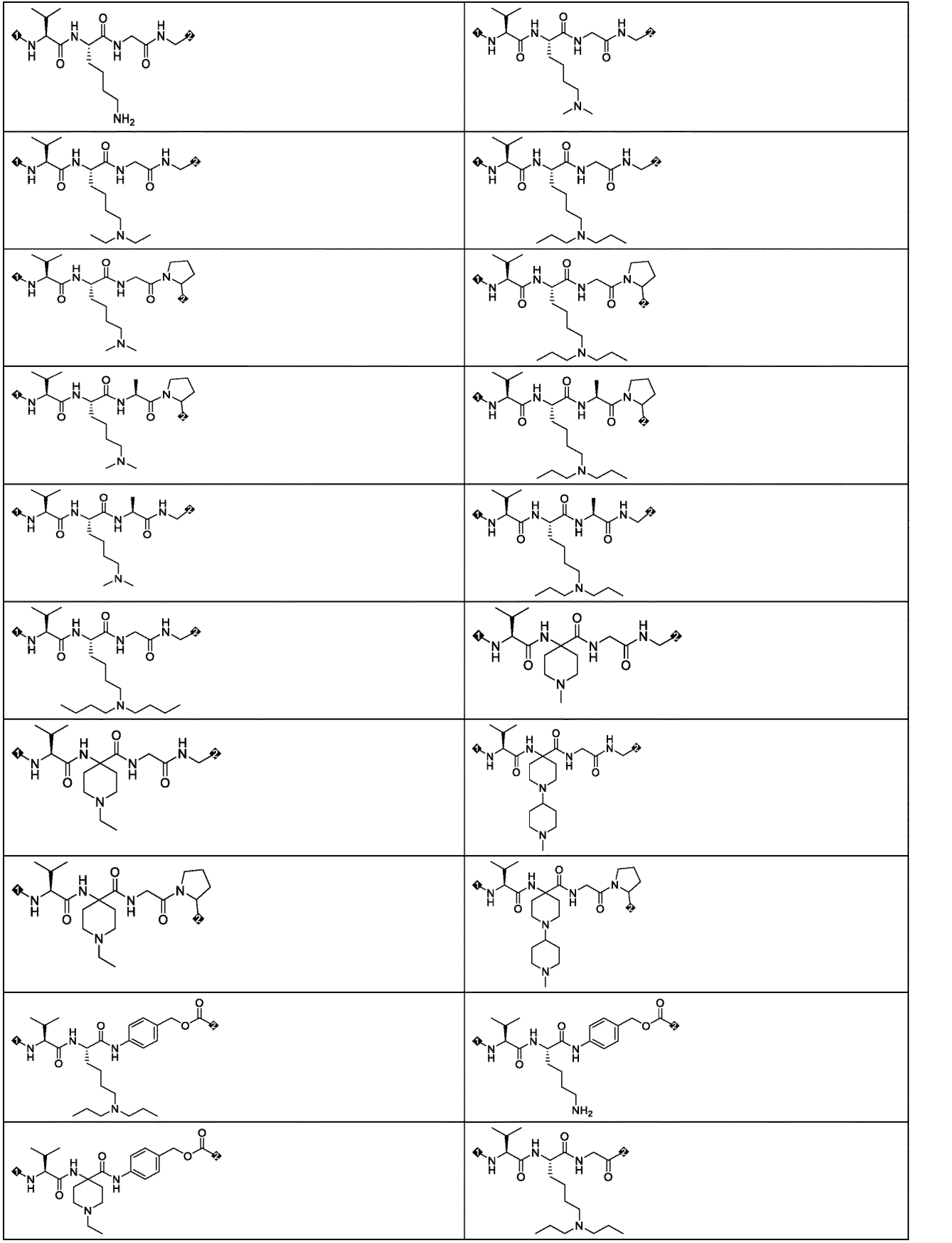
1位がL2に連結され、2位がDに連結される。
いくつかの実施形態において、


1位がL2に連結され、2位がDに連結される。
いくつかの実施形態において、

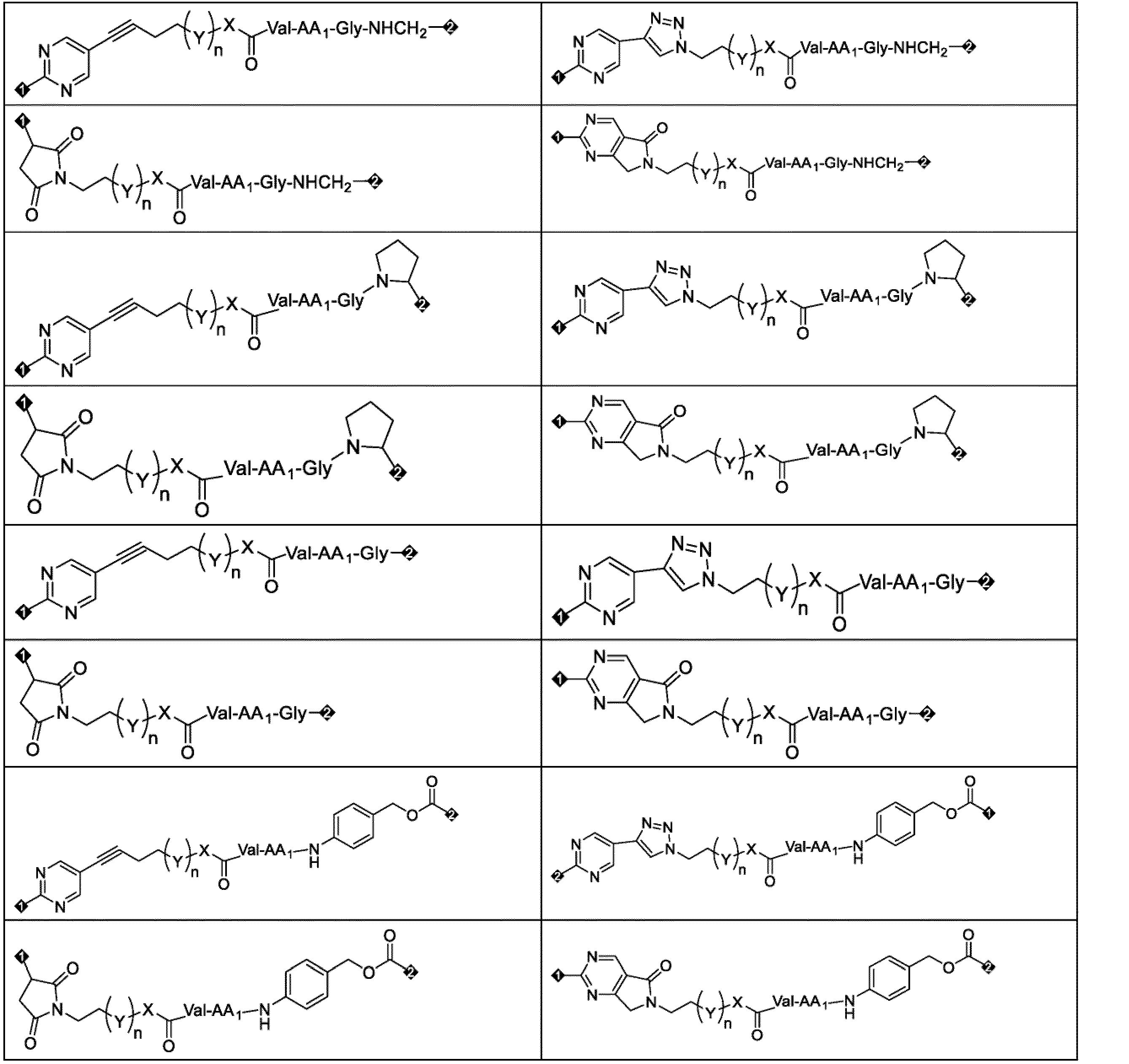
1位がS原子を介してTbに連結され、2位がDに連結され、Y、X、AA1及びnの定義は本開示の何れか1つの形態に記載された通りである。
いくつかの実施形態において、


1位がS原子を介してTbに連結され、2位がDに連結され、Y、X、AA1及びnの定義は本開示の何れか1つの形態に記載された通りである。
いくつかの実施形態において、


1位がS原子を介してTbに連結され、2位がDに連結される。
いくつかの実施形態において、


1位がS原子を介してTbに連結され、2位がDに連結される。
いくつかの実施形態において、Dは、式IIに示される構造ユニットであり、Dは、Aを介してL4又はL3に連結され、

R1は、水素、重水素、ハロゲン、シアノ基、アミノ基、ニトロ基、C1-4アルコキシ基、又はC1-4アルキル基から選ばれ、
Zは、-NH-、-CR2aR3a-、又は-C(O)-から選ばれ、
R2a、R3aは、それぞれ独立的に、F又はOHから選ばれ、
U1、U2は、それぞれ独立的に-CH2-又は-C(O)-から選ばれ、且つU1、U2は同時に-CH2-ではなく、
AはO、S、NR9、

R2、R3、R4、R5、R6、R7、R8は、それぞれ独立的に、水素、重水素、C1-4アルキル基、C3-6シクロアルキル基、又は3~6員複素環基から選ばれ、
或いは、R2、R3は、それらに連結している炭素原子と共に、3~7員炭素環又は3~7員複素環を形成し、
R4、R5は、それらに連結している炭素原子及び窒素原子と共に、4~7員複素環を形成し、
R5、R6は、それらに連結している炭素原子と共に、3~7員炭素環又は3~7員複素環を形成し、
R7、R8は、それらに連結している炭素原子と共に、3~7員炭素環又は3~7員複素環を形成し、
m、p、yは、それぞれ独立的に、0~8の間の任意の整数から選ばれ、
W、Vはそれぞれ独立的に、直接結合、O、S、又はNR9から選ばれ、
R9は、水素、重水素、C1-4アルキル基、又はC3-6シクロアルキル基から選ばれる。
In some embodiments, D is a structural unit shown in formula II, and D is linked to L4 or L3 via A:
R 1 is selected from hydrogen, deuterium, halogen, a cyano group, an amino group, a nitro group, a C1-4 alkoxy group, or a C1-4 alkyl group;
Z is selected from -NH-, -CR 2a R 3a -, or -C(O)-;
R 2a and R 3a are each independently selected from F or OH;
U 1 and U 2 are each independently selected from —CH 2 — or —C(O)—, and U 1 and U 2 are not simultaneously —CH 2 —;
A is O, S, NR 9 ,
R 2 , R 3 , R 4 , R 5 , R 6 , R 7 , and R 8 are each independently selected from hydrogen, deuterium, a C1-4 alkyl group, a C3-6 cycloalkyl group, or a 3- to 6-membered heterocyclic group;
or R 2 and R 3 together with the carbon atom to which they are attached form a 3- to 7-membered carbocyclic or heterocyclic ring;
R 4 and R 5 together with the carbon atom and nitrogen atom to which they are attached form a 4- to 7-membered heterocycle;
R 5 and R 6 together with the carbon atom to which they are linked form a 3- to 7-membered carbocyclic or 3- to 7-membered heterocyclic ring;
R 7 and R 8 together with the carbon atom to which they are attached form a 3- to 7-membered carbocyclic or 3- to 7-membered heterocyclic ring;
m, p, and y are each independently selected from any integer between 0 and 8;
W and V are each independently selected from a direct bond, O, S, or NR9 ;
R 9 is selected from hydrogen, deuterium, a C1-4 alkyl group, or a C3-6 cycloalkyl group.
いくつかの実施形態において、R1は、水素、ハロゲン、又はC1-4アルキル基から選ばれる。 In some embodiments, R 1 is selected from hydrogen, halogen, or a C1-4 alkyl group.
いくつかの実施形態において、R1は、ハロゲンである。 In some embodiments, R 1 is halogen.
いくつかの実施形態において、R1は、水素、メチル、又は塩素から選ばれる。 In some embodiments, R 1 is selected from hydrogen, methyl, or chlorine.
いくつかの実施形態において、R1は塩素である。 In some embodiments, R 1 is chlorine.
いくつかの実施形態において、Zは、-NH-である。 In some embodiments, Z is -NH-.
いくつかの実施形態において、U1、U2はそれぞれ独立的に、-CH2-又は-C(O)-から選ばれ、且つU1、U2は同一ではない。 In some embodiments, U 1 and U 2 are each independently selected from -CH 2 - or -C(O)-, and U 1 and U 2 are not the same.
いくつかの実施形態において、U1は-CH2-であり、U2は-C(O)-である。 In some embodiments, U 1 is --CH 2 -- and U 2 is --C(O)--.
いくつかの実施形態において、Aは

いくつかの実施形態において、Aは

いくつかの実施形態において、AはO、S、-NH-、-N(CH3)-、-O(CH2)m-、-S(CH2)m-、-NH(CH2)m-、-N(CH3)(CH2)m-、-O(CH2)mO-、-S(CH2)mO-、-S(CH2)mS-、-NH(CH2)mO-、-N(CH3)(CH2)mO-、-NH(CH2)mS-、-N(CH3)(CH2)mS-、-NH(CH2)mNH-、-N(CH3)(CH2)mNH-、-O(CH2)mC(O)NH(CH2)P-、-O(CH2)mC(O)N(CH3)(CH2)P-、-O(CH2)mC(O)NH(CH2)PO-、-O(CH2)mC(O)N(CH3)(CH2)PO-、-S(CH2)mC(O)NH(CH2)P-、-S(CH2)mC(O)N(CH3)(CH2)P-、-NH(CH2)mC(O)NH(CH2)P-、-NH(CH2)mC(O)N(CH3)(CH2)P-、-O(CH2)mC(O)NH(CH2)PO(CH2)y-、又は-O(CH2)mC(O)N(CH3)(CH2)PO(CH2)y-から選ばれる。 In some embodiments, A is O, S, -NH-, -N( CH3 )-, -O(CH2) m- , -S( CH2 ) m- , -NH(CH2)m-, -N( CH3 )( CH2 ) m- , -O( CH2 ) mO- , -S( CH2 ) mO- , -S( CH2 ) mS- , -NH( CH2 ) mO- , -N ( CH3 )( CH2 ) mO- , -NH( CH2 )mS- , -N( CH3 )( CH2 ) mS- , -NH ( CH2 ) mNH- , -N( CH3 )( CH2 ) mNH- , -O( CH2 ) m C(O)NH(CH 2 ) P -, -O(CH 2 ) m C(O)N(CH 3 )(CH 2 ) P -, -O(CH 2 ) m C(O)NH(CH 2 ) P O-, -O(CH 2 ) m C(O)N(CH 3 )(CH 2 ) P O-, -S(CH 2 ) m C(O)NH(CH 2 ) P -, -S(CH 2 ) m C(O)N(CH 3 ) (CH 2 ) P -, -NH(CH 2 ) m C(O)NH(CH 2 ) P -, -NH(CH 2 ) m C(O)N( CH3 )( CH2 ) P -,-O( CH2 ) mC (O)NH(CH 2 ) PO (CH 2 ) y- , or -O(CH 2 ) mC (O)N(CH 3 )(CH 2 ) PO (CH 2 ) y- .
いくつかの実施形態において、Aは、-O(CH2)mC(O)NH(CH2)P-、-O(CH2)mC(O)N(CH3)(CH2)P-、-O(CH2)mC(O)NH(CH2)PO-、-O(CH2)mC(O)N(CH3)(CH2)PO-、-S(CH2)mC(O)NH(CH2)P-、-S(CH2)mC(O)N(CH3)(CH2)P-、-NH(CH2)mC(O)NH(CH2)P-、-NH(CH2)mC(O)N(CH3)(CH2)P-、-O(CH2)mC(O)NH(CH2)PO(CH2)y-、又は-O(CH2)mC(O)N(CH3)(CH2)PO(CH2)y-から選ばれる。 In some embodiments, A is -O( CH2 ) mC (O)NH( CH2 ) P- , -O( CH2 ) mC (O)N( CH3 )(CH2)P-, -O( CH2 ) mC (O)NH( CH2 ) P O- , -O( CH2 ) mC (O)N( CH3 )( CH2 ) P O-, -S( CH2 ) mC (O)NH( CH2 ) P- , -S ( CH2 ) mC (O)N( CH3 )( CH2 ) P- , -NH( CH2 ) mC (O)NH( CH2 ) P- , -NH( CH2 ) mC (O)N( CH3 )(CH 2 ) P- , -O( CH2 ) mC (O)NH( CH2 ) PO ( CH2 ) y- , or -O( CH2 ) mC (O)N( CH3 )( CH2 ) PO ( CH2 ) y- .
いくつかの実施形態において、Aは、-N(CH3)(CH2)m-、-O(CH2)mC(O)N(CH3)(CH2)P-、又は-O(CH2)mC(O)N(CH3)(CH2)PO(CH2)y-から選ばれる。 In some embodiments, A is selected from -N( CH3 )( CH2 ) m- , -O( CH2 ) mC (O)N( CH3 )( CH2 ) P- , or -O(CH2) mC (O)N( CH3 )( CH2 ) PO ( CH2 ) y- .
いくつかの実施形態において、Aは、-O(CH2)mC(O)N(CH3)(CH2)P-、又は-O(CH2)mC(O)N(CH3)(CH2)PO(CH2)y-から選ばれる。 In some embodiments, A is selected from -O( CH2 ) mC (O)N( CH3 )( CH2 ) P- , or -O( CH2 ) mC (O)N( CH3 )( CH2 ) PO ( CH2 ) y- .
いくつかの実施形態において、Aは、-N(CH3)(CH2)3-、-OCH2C(O)N(CH3)(CH2)3-、又は-OCH2C(O)N(CH3)(CH2)2O(CH2)2-から選ばれる。 In some embodiments, A is selected from -N( CH3 )( CH2 ) 3- , -OCH2C (O)N( CH3 )( CH2 ) 3- , or -OCH2C (O)N( CH3 )( CH2 ) 2O ( CH2 ) 2- .
いくつかの実施形態において、Aは、-OCH2C(O)N(CH3)(CH2)3-、又は-OCH2C(O)N(CH3)(CH2)2O(CH2)2-から選ばれる。 In some embodiments, A is selected from -OCH2C (O)N( CH3 )( CH2 ) 3- , or -OCH2C (O)N( CH3 )( CH2 ) 2O ( CH2 ) 2- .
いくつかの実施形態において、R2、R3、R4、R5、R6、R7、R8は、それぞれ独立的に、水素、重水素、又はC1-4アルキル基から選ばれる。 In some embodiments, R 2 , R 3 , R 4 , R 5 , R 6 , R 7 , and R 8 are each independently selected from hydrogen, deuterium, or a C1-4 alkyl group.
いくつかの実施形態において、WはO、S又はNR9から選ばれる。 In some embodiments, W is selected from O, S, or NR9 .
いくつかの実施形態において、WはOである。 In some embodiments, W is O.
いくつかの実施形態において、Vは、直接結合、O、S、又はNR9から選ばれる。 In some embodiments, V is selected from a direct bond, O, S, or NR 9 .
いくつかの実施形態において、Vは、直接結合又はOから選ばれる。 In some embodiments, V is selected from a direct bond or O.
いくつかの実施形態において、m、p、yは、それぞれ独立的に、0、1、2、3又は4から選ばれる。 In some embodiments, m, p, and y are each independently selected from 0, 1, 2, 3, or 4.
いくつかの実施形態において、m、p、yは、それぞれ独立的に、1、2、3又は4から選ばれる。
いくつかの実施形態において、R9は、水素、重水素、又はメチル基から選ばれる。
In some embodiments, m, p, and y are each independently selected from 1, 2, 3, or 4.
In some embodiments, R 9 is selected from hydrogen, deuterium, or a methyl group.
いくつかの実施形態において、Dは、好ましくは、II-1、II-2又はII-3に示される構造ユニットである:

R1、A、Zの定義は本開示の何れか1つの形態に記載された通りであり、1位がL4又はL3に連結される。
In some embodiments, D is preferably a structural unit as shown in II-1, II-2, or II-3:
The definitions of R 1 , A, and Z are as described in any one of the embodiments of the present disclosure, and the 1-position is linked to L 4 or L 3 .
いくつかの実施形態において、Dは、以下の構造から選ばれ、1位がL4又はL3に連結され、

いくつかの実施形態において、Dは、以下の構造から選ばれ、1位がL4又はL3に連結され、

いくつかの実施形態において、上記抗体薬物複合体は、式IIIに示される構造であり、

In some embodiments, D is selected from the following structures, and is linked at
In some embodiments, the antibody-drug conjugate has the structure shown in formula III:
いくつかの実施形態において、上記抗体薬物複合体は、式III-1に示される構造である:

いくつかの実施形態において、上記抗体薬物複合体は、以下からなる群から選ばれる:

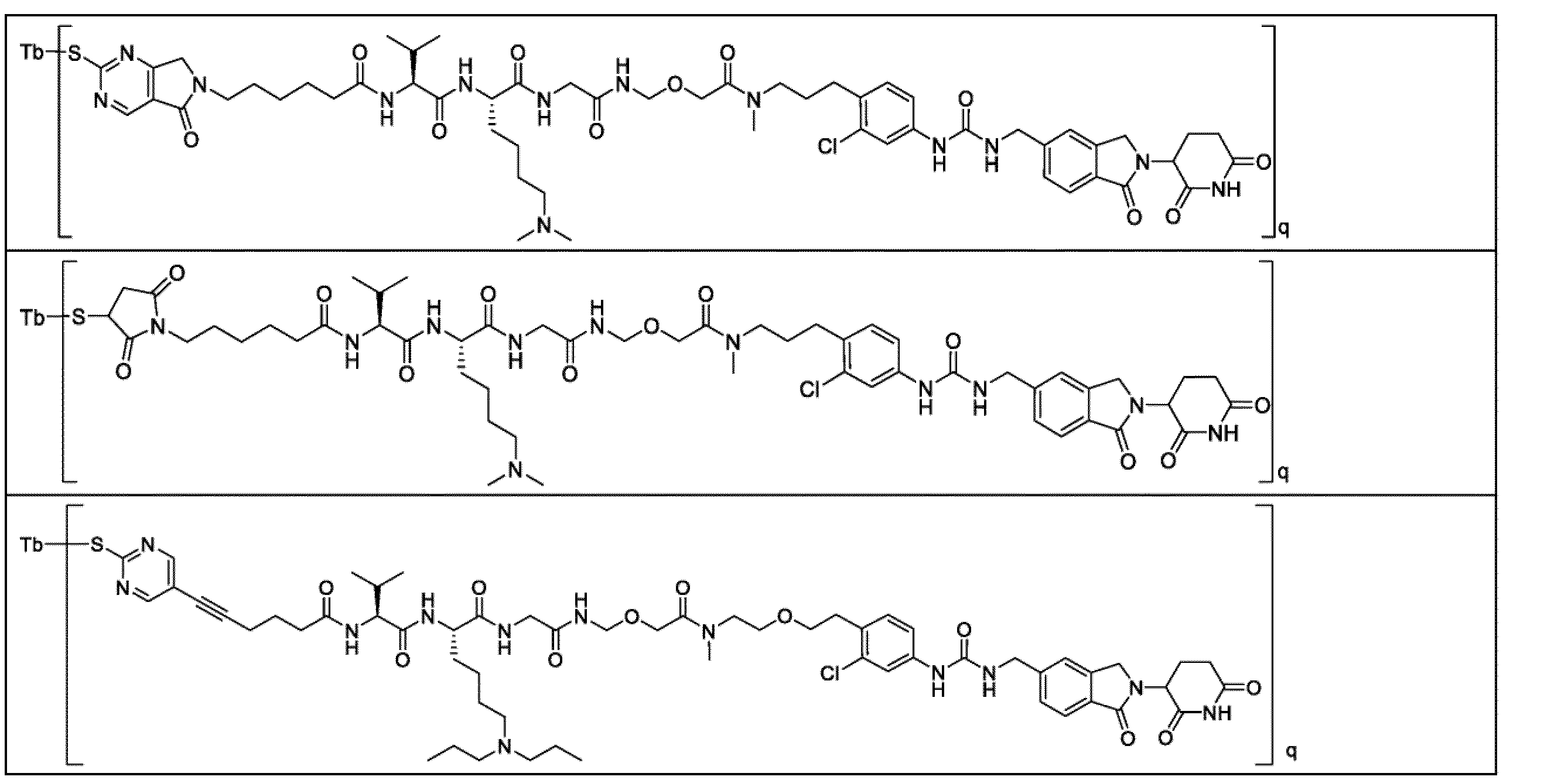
qは、1.0~10.0の間の任意の数値から選ばれる。 q is selected from any number between 1.0 and 10.0.
いくつかの好ましい実施形態において、上記抗体薬物複合体は、以下からなる群から選ばれる:

qは、1.0~10.0の間の任意の数値から選ばれる。 q is selected from any number between 1.0 and 10.0.
いくつかの好ましい実施形態において、qは、1、2、3、4、5、6、7、8、9又は10から選ばれる。 In some preferred embodiments, q is selected from 1, 2, 3, 4, 5, 6, 7, 8, 9, or 10.
いくつかのより好ましい実施形態において、qは、2、4、6又は8から選ばれる。 In some more preferred embodiments, q is selected from 2, 4, 6, or 8.
いくつかの実施形態において、上記Tbは、標的化部分、例えば、抗体及びその抗原結合断片、リガンド、タンパク質、ポリペプチド、非タンパク質試薬(例えば、糖、RNA、又はDNA)、抗体類似体などである。 In some embodiments, Tb is a targeting moiety, such as antibodies and antigen-binding fragments thereof, ligands, proteins, polypeptides, non-proteinaceous reagents (e.g., sugars, RNA, or DNA), antibody analogs, etc.
いくつかの実施形態において、Tbは、抗体又はその抗原結合断片である。 In some embodiments, Tb is an antibody or an antigen-binding fragment thereof.
いくつかの実施形態において、Tbはエンドサイトーシス活性を有する抗体又はその抗原結合断片である。 In some embodiments, Tb is an antibody or antigen-binding fragment thereof having endocytosis activity.
いくつかの実施形態において、Tbは、腫瘍細胞表面抗原に結合する活性を有する抗体又はその抗原結合断片である。 In some embodiments, Tb is an antibody or an antigen-binding fragment thereof that has activity binding to a tumor cell surface antigen.
いくつかの実施形態において、上記抗体又はその抗原結合断片は、腫瘍細胞表面抗原に結合する活性、且つ腫瘍細胞エンドサイトーシス活性を有する抗体、又はその抗原結合断片である。 In some embodiments, the antibody or antigen-binding fragment thereof is an antibody or antigen-binding fragment thereof that has tumor cell surface antigen binding activity and tumor cell endocytosis activity.
いくつかの実施形態において、上記抗体又はその抗原結合断片は、抗原結合活性を有し、且つ腫瘍細胞エンドサイトーシス活性がないか又は弱い抗体、若しくはその抗原結合断片である。 In some embodiments, the antibody or antigen-binding fragment thereof has antigen-binding activity and has no or weak tumor cell endocytosis activity, or an antigen-binding fragment thereof.
いくつかの実施形態において、上記抗体又はその抗原結合断片は、腫瘍細胞表面の非エンドサイトーシス抗原に結合する抗体、若しくはその抗原結合断片である。 In some embodiments, the antibody or antigen-binding fragment thereof is an antibody or antigen-binding fragment thereof that binds to a non-endocytic antigen on the surface of a tumor cell.
いくつかの実施形態において、上記抗体又はその抗原結合断片は、腫瘍細胞エンドサイトーシス活性を有しない抗体、若しくはその抗原結合断片である。 In some embodiments, the antibody or antigen-binding fragment thereof is an antibody or antigen-binding fragment thereof that does not have tumor cell endocytosis activity.
いくつかの好ましい実施形態において、上記抗体又はその抗原結合断片は、腫瘍細胞表面抗原に結合する活性を有し、且つ腫瘍細胞エンドサイトーシス活性を有する抗体、若しくはその抗原結合断片である。 In some preferred embodiments, the antibody or antigen-binding fragment thereof is an antibody or antigen-binding fragment thereof that has activity binding to a tumor cell surface antigen and has tumor cell endocytosis activity.
いくつかの実施形態において、上記抗体又はその抗原結合断片は、Fab、Fab’、F(ab’)2、Fd、Fv、dAb、相補性決定領域断片、一本鎖抗体(例えば、scFv)、非ヒト抗体、ヒト化抗体、キメラ抗体、完全ヒト抗体、プロボディ抗体(Probody)、二重特異性抗体、又は多重特異性抗体を含む。 In some embodiments, the antibody or antigen-binding fragment thereof includes a Fab, Fab', F(ab')2, Fd, Fv, dAb, a complementarity determining region fragment, a single chain antibody (e.g., scFv), a non-human antibody, a humanized antibody, a chimeric antibody, a fully human antibody, a probody antibody, a bispecific antibody, or a multispecific antibody.
いくつかの実施形態において、上記抗体又はその抗原結合断片は、非ヒト抗体、ヒト化抗体、キメラ抗体、又は完全ヒト抗体である。 In some embodiments, the antibody or antigen-binding fragment thereof is a non-human antibody, a humanized antibody, a chimeric antibody, or a fully human antibody.
いくつかの実施形態において、上記抗体又はその抗原結合断片は、プロボディ抗体(Probody)、二重特異性抗体、又は多重特異性抗体である。 In some embodiments, the antibody or antigen-binding fragment thereof is a probody, bispecific antibody, or multispecific antibody.
いくつかの実施形態において、上記抗体又はその抗原結合断片は、Fab、Fab’、F(ab’)2、Fd、Fv、dAb、相補性決定領域断片、一本鎖抗体(例えば、scFv)を含む。 In some embodiments, the antibody or antigen-binding fragment thereof includes Fab, Fab', F(ab')2, Fd, Fv, dAb, complementarity determining region fragment, or single chain antibody (e.g., scFv).
いくつかの実施形態において、Tbは、抗B7H3抗体又はその抗原結合断片、抗Trop-2抗体又はその抗原結合断片、抗Her2抗体又はその抗原結合断片、抗Her3抗体又はその抗原結合断片、若しくは抗EGFR抗体又はその抗原結合断片である。 In some embodiments, Tb is an anti-B7H3 antibody or an antigen-binding fragment thereof, an anti-Trop-2 antibody or an antigen-binding fragment thereof, an anti-Her2 antibody or an antigen-binding fragment thereof, an anti-Her3 antibody or an antigen-binding fragment thereof, or an anti-EGFR antibody or an antigen-binding fragment thereof.
本開示の一部の実施形態において、Tbは、抗B7H3モノクローナル抗体、又はその抗原結合断片である。いくつかの実施形態において、上記抗B7H3抗体は、全ての先行技術の抗B7H3抗体を含み、例えば、CN112521512、WO2021027674、WO2021021543、WO2021006619、CN111662384、CN111454357、WO2020151384、WO2020140094、WO2020103100、WO2020102779、WO2020063673、WO2020047257、WO2020041626、CN110684790、CN110642948、WO2019225787、WO2019226017、US20190338030、CN110305213、WO2018209346、WO2018177393、US9150656、WO2016106004、WO2016044383、WO2016033225、WO2015181267、US20120294796、WO2011109400、CN101104639、WO2004093894、WO2002010187、WO2001018021を参照されたい。 In some embodiments of the present disclosure, Tb is an anti-B7H3 monoclonal antibody, or an antigen-binding fragment thereof. In some embodiments, the anti-B7H3 antibody includes all prior art anti-B7H3 antibodies, such as CN112521512, WO2021027674, WO2021021543, WO2021006619, CN111662384, CN111454357, WO2020151384, WO2020140094, WO2020103100, WO2020102779, WO2020063673, WO2020047257, WO2020041626, CN110684790, CN110 See US 642948, WO2019225787, WO2019226017, US20190338030, CN110305213, WO2018209346, WO2018177393, US9150656, WO2016106004, WO2016044383, WO2016033225, WO2015181267, US20120294796, WO2011109400, CN101104639, WO2004093894, WO2002010187, WO2001018021.
いくつかの実施形態において、Tbは、抗B7H3抗体又はその抗原結合断片、例えば1D1-01、2E3-02抗体、enoblituzumab、mirzotamab、omburtamab、又はその抗原結合断片である。いくつかの好ましい実施形態において、Tbは2E3-02抗体である。 In some embodiments, Tb is an anti-B7H3 antibody or an antigen-binding fragment thereof, such as 1D1-01, 2E3-02 antibody, enoblituzumab, mirzotamab, omburtamab, or an antigen-binding fragment thereof. In some preferred embodiments, Tb is the 2E3-02 antibody.
いくつかの実施態様において、上記1D1-01のVH配列は、配列番号1に示され、VL配列は、配列番号2に示される。いくつかの実施形態において、上記1D1-01の重鎖配列は、配列番号3に示され、軽鎖配列は、配列番号4に示される。 In some embodiments, the VH sequence of 1D1-01 is shown in SEQ ID NO:1 and the VL sequence is shown in SEQ ID NO:2. In some embodiments, the heavy chain sequence of 1D1-01 is shown in SEQ ID NO:3 and the light chain sequence is shown in SEQ ID NO:4.
いくつかの実施態様において、上記2E3-02のVH配列は、配列番号5に示され、VL配列は、配列番号6に示される。いくつかの実施形態において、上記2E3-02の重鎖配列は、配列番号7に示され、軽鎖配列は、配列番号8に示される。 In some embodiments, the VH sequence of 2E3-02 is set forth in SEQ ID NO:5 and the VL sequence is set forth in SEQ ID NO:6. In some embodiments, the heavy chain sequence of 2E3-02 is set forth in SEQ ID NO:7 and the light chain sequence is set forth in SEQ ID NO:8.
いくつかの実施形態において、上記Tbは、配列番号1に示されるVH配列、及び配列番号2に示されるVL配列を有する抗B7H3抗体又はその抗原結合断片である。いくつかの好ましい実施形態において、上記Tbは、配列番号3に示される重鎖配列、及び配列番号4に示される軽鎖配列を有する抗B7H3抗体又はその抗原結合断片である。 In some embodiments, the Tb is an anti-B7H3 antibody or an antigen-binding fragment thereof having a VH sequence shown in SEQ ID NO: 1 and a VL sequence shown in SEQ ID NO: 2. In some preferred embodiments, the Tb is an anti-B7H3 antibody or an antigen-binding fragment thereof having a heavy chain sequence shown in SEQ ID NO: 3 and a light chain sequence shown in SEQ ID NO: 4.
いくつかの実施形態において、上記Tbは、配列番号5に示されるVH配列、及び配列番号6に示されるVL配列を有する抗B7H3抗体又はその抗原結合断片である。いくつかの好ましい実施形態において、上記Tbは、配列番号7に示される重鎖配列、及び配列番号8に示される軽鎖配列を有する抗B7H3抗体又はその抗原結合断片である。 In some embodiments, the Tb is an anti-B7H3 antibody or an antigen-binding fragment thereof having a VH sequence shown in SEQ ID NO:5 and a VL sequence shown in SEQ ID NO:6. In some preferred embodiments, the Tb is an anti-B7H3 antibody or an antigen-binding fragment thereof having a heavy chain sequence shown in SEQ ID NO:7 and a light chain sequence shown in SEQ ID NO:8.
いくつかの実施形態において、Tbは、抗Trop-2抗体又はその抗原結合断片、例えばdatopotamab、sacituzumab又はその抗原結合断片である。 In some embodiments, Tb is an anti-Trop-2 antibody or an antigen-binding fragment thereof, such as datopotamab, sacituzumab, or an antigen-binding fragment thereof.
いくつかの実施形態において、Tbは、抗Her2抗体又はその抗原結合断片、例えばanbenitamab、coprelotamab、disitamab、gancotamab、margetuximab、pertuzumab、timigutuzumab、zanidatamab、Trastuzumab、Pertuzumab又はその抗原結合断片である。いくつかの好ましい実施形態において、Tbは、Trastuzumab又はPertuzumabである。 In some embodiments, Tb is an anti-Her2 antibody or an antigen-binding fragment thereof, such as ambenitamab, coprelotamab, disitamab, gancotamab, mergetuximab, pertuzumab, timigutuzumab, zanidatamab, trastuzumab, pertuzumab, or an antigen-binding fragment thereof. In some preferred embodiments, Tb is trastuzumab or pertuzumab.
いくつかの実施形態において、Tbは、抗Her2抗体又はその抗原結合断片である。 In some embodiments, Tb is an anti-Her2 antibody or an antigen-binding fragment thereof.
いくつかの実施形態において、Tbは、抗Her2モノクローナル抗体又はその抗原結合断片である。 In some embodiments, Tb is an anti-Her2 monoclonal antibody or an antigen-binding fragment thereof.
いくつかの実施形態において、Tbは、Her2結合活性を有する二重特異性抗体又はその抗原結合断片である。 In some embodiments, Tb is a bispecific antibody or an antigen-binding fragment thereof that has Her2 binding activity.
いくつかの実施形態において、Tbは、Her2結合活性を有する多重特異性抗体又はその抗原結合断片である。 In some embodiments, Tb is a multispecific antibody or antigen-binding fragment thereof that has Her2 binding activity.
いくつかの好ましい実施形態において、Tbは、Trastuzumab又はその抗原結合断片である。 In some preferred embodiments, Tb is trastuzumab or an antigen-binding fragment thereof.
いくつかの好ましい実施形態において、Tbは、Pertuzumab又はその抗原結合断片である。 In some preferred embodiments, Tb is pertuzumab or an antigen-binding fragment thereof.
いくつかの実施形態において、Tbは、抗Her3抗体又はその抗原結合断片である。 In some embodiments, Tb is an anti-Her3 antibody or an antigen-binding fragment thereof.
いくつかの実施形態において、Tbは、抗EGFR抗体又はその抗原結合断片、例えば、demupitamab、depatuxizumab、futuximab、imgatuzumab、laprituximab、losatuxizumab、matuzumab、modotuximab、necitumumab、nimotuzumab、panitumumab、pimurutamab、serclutamab、tomuzotuximab、zalutumumab、Cetuximab、又はその抗原結合断片である。 In some embodiments, Tb is an anti-EGFR antibody or an antigen-binding fragment thereof, such as demupitamab, depatuxizumab, futuximab, imgatuximab, laprituximab, losatuxizumab, matuzumab, modotuximab, necitumumab, nimotuzumab, panitumumab, pimurutamab, serculutamab, tomuzotuximab, zalutumumab, cetuximab, or an antigen-binding fragment thereof.
いくつかの実施形態において、上記抗体は、エンドサイトーシス活性を有さずにB7H3抗原活性に結合する抗体を有する。例えば、WO2021168379A1のINV721及びI7-01。より具体的には、Anti-B7H3に対する抗体は、WO2021168379A1に記載される配列番号2のVH及び配列番号1のVLを有する。 In some embodiments, the antibody has an antibody that binds to B7H3 antigen activity without endocytic activity. For example, INV721 and I7-01 of WO2021168379A1. More specifically, the antibody against Anti-B7H3 has a VH of SEQ ID NO:2 and a VL of SEQ ID NO:1 described in WO2021168379A1.
いくつかの実施形態において、上記抗体は、エンドサイトーシス活性を有さずにCD20抗原活性に結合する抗体を有する。いわゆる「II型」CD20特異的抗体は、CD20陽性の標的細胞によって内在化されにくいことが示されているが、他のいわゆる「I型」CD20特異的抗体が、それと相互作用する標的細胞上のFc γRの活性化及び阻害の発現レベルに応じて、ある程度内在化されて分解されることが見出された。いくつかの実施形態において、上記抗体は、エンドサイトーシス活性を有さずにCD20抗原活性に結合する抗体は、「II型」CD20特異的抗体、例えば、obinutuzumabである。 In some embodiments, the antibody is one that binds to CD20 antigen activity without endocytic activity. So-called "type II" CD20-specific antibodies have been shown to be less likely to be internalized by CD20-positive target cells, whereas other so-called "type I" CD20-specific antibodies have been found to be internalized and degraded to some degree depending on the expression levels of activating and inhibiting FcγR on the target cell with which they interact. In some embodiments, the antibody is one that binds to CD20 antigen activity without endocytic activity is a "type II" CD20-specific antibody, e.g., obinutuzumab.
いくつかの実施形態において、上記抗体は、非エンドサイトーシス(例えば、ALCAM/CD166)抗原に結合する活性を有する抗体である。いくつかの実施形態において、上記抗体は、EP3911682A1における配列番号73のVH及び配列番号74のVL、配列番号75のVH及び配列番号76のVL、配列番号77のVH及び配列番号78のVLを含む抗体であり、又は配列番号79のVH及び配列番号88のVLに示される抗体である。 In some embodiments, the antibody is an antibody having activity binding to a non-endocytic (e.g., ALCAM/CD166) antigen. In some embodiments, the antibody is an antibody comprising a VH of SEQ ID NO: 73 and a VL of SEQ ID NO: 74, a VH of SEQ ID NO: 75 and a VL of SEQ ID NO: 76, a VH of SEQ ID NO: 77 and a VL of SEQ ID NO: 78 in EP3911682A1, or an antibody having a VH of SEQ ID NO: 79 and a VL of SEQ ID NO: 88.
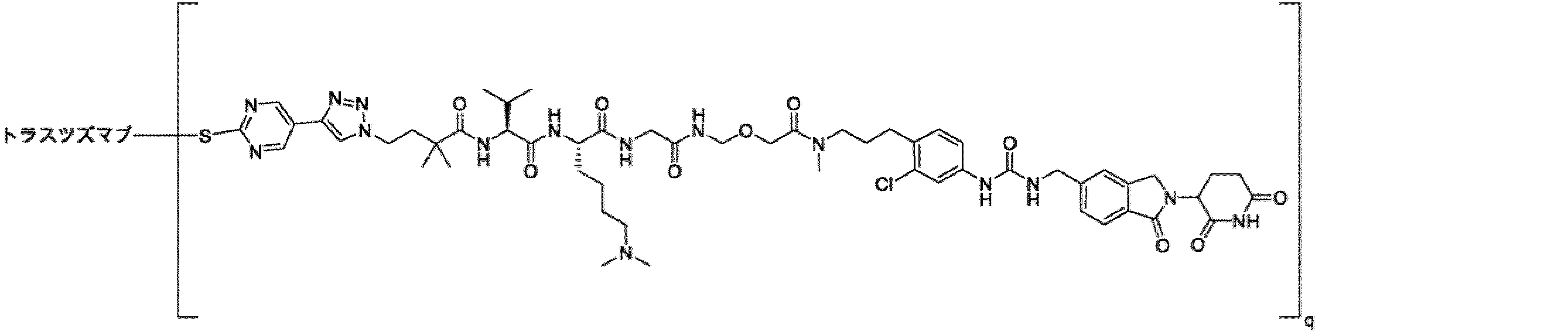
いくつかの実施形態において、上記抗体薬物複合体は以下の通りである:

いくつかの好ましい実施形態において、Tb1は2E3-02抗体である。 In some preferred embodiments, Tb 1 is the 2E3-02 antibody.
いくつかの実施形態において、上記抗体薬物複合体は以下の通りである:
いくつかの実施形態において、上記抗体薬物複合体は以下の通りである:

いくつかの好ましい実施形態において、Tb2は、Trastuzumabである。 In some preferred embodiments, Tb2 is trastuzumab.
いくつかの実施形態において、上記抗体薬物複合体は以下の通りである:

いくつかの実施形態において、上記抗体薬物複合体は以下の通りである:
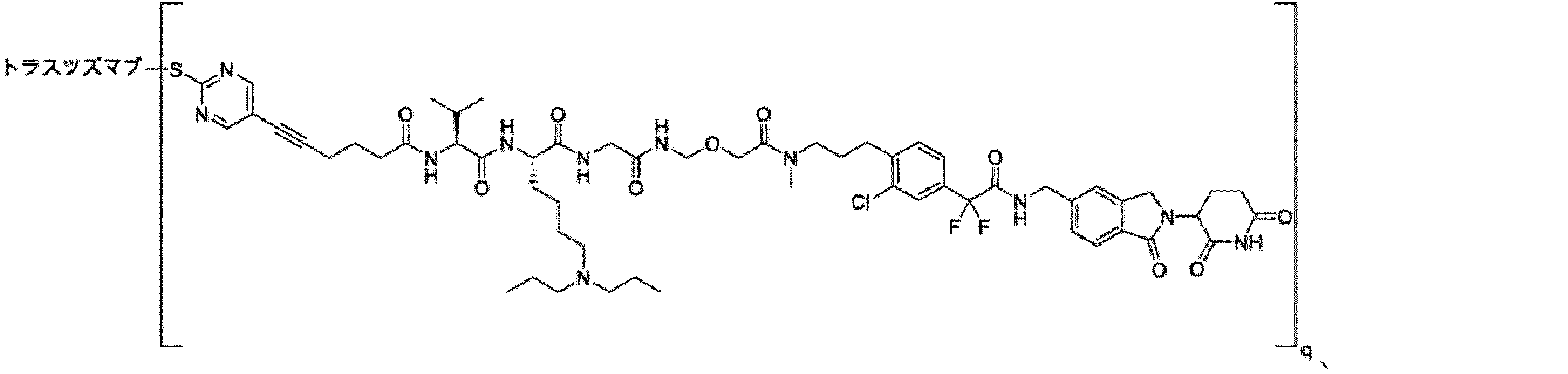
いくつかの実施形態において、上記抗体薬物複合体は以下の通りである:

いくつかの実施形態において、上記抗体薬物複合体は以下の通りである:

いくつかの実施形態において、上記抗体薬物複合体は以下の通りである:
本開示の第2の態様において、本開示は、式IVに示される薬物リンカー複合体、

式中、
L1が、

Lgは、抗体と反応させる際の脱離基であり、L2、L3、L4及びDの定義は、本開示の何れか1つの形態に記載された通りである。
In a second aspect of the present disclosure, the present disclosure provides a drug linker conjugate as shown in formula IV:
During the ceremony,
L1 is
Lg is a leaving group upon reaction with an antibody, and the definitions of L 2 , L 3 , L 4 and D are as described in any one of the embodiments of the present disclosure.
L1は


いくつかの実施形態において、Lgは、ハロゲン、スルホン、第三級アミン塩基(Me3N+、Et3N+)、ジアゾニウム塩基、-OMs、MeSO2-、又はCF3SO3-から選ばれる。 In some embodiments, Lg is selected from halogens, sulfones, tertiary amine bases (Me 3 N + , Et 3 N + ), diazonium bases, -OMs, MeSO 2 -, or CF 3 SO 3 -.
いくつかの実施形態において、LgはF、Cl又はMeSO2-から選ばれ、より好ましくは、Lgは、F又はMeSO2-から選ばれる。 In some embodiments, Lg is selected from F, Cl or MeSO 2 —, more preferably Lg is selected from F or MeSO 2 —.
いくつかの実施形態において、上記薬物リンカー複合体は、式Vに示される構造であり、

いくつかの実施形態において、上記薬物リンカー複合体は、式V-1示される構造である:

いくつかの実施形態において、上記薬物リンカー複合体は、以下からなる群から選ばれる:


本開示の第3の態様において、本開示は、式IIAに示されるタンパク質分解剤クラスの生物学的活性化合物、

式中、R1、A、Z、U1及びU2の定義は、本開示の何れか1つの形態に記載された通りである。
In a third aspect of the disclosure, the disclosure provides a biologically active compound of the proteolytic agent class as shown in formula IIA:
wherein the definitions of R 1 , A, Z, U 1 and U 2 are as described in any one of the embodiments of the present disclosure.
いくつかの実施形態において、上記タンパク質分解剤クラスの生物学的活性化合物は、式IIA-1に示される構造である:

いくつかの実施形態において、上記生物学的活性化合物は、以下からなる群から選ばれる:


好ましくは、上記抗体及び上記タンパク質分解剤クラスの生物学的活性化合物の断片の定義は、それぞれ、本開示の何れか1つの形態におけるTb及びDに記載のされた通りである。 Preferably, the definitions of the antibody and the fragments of the biologically active compounds of the proteolytic agent class are as described in Tb and D, respectively, in any one of the embodiments of the present disclosure.
本開示の第5の態様において、本開示は、式Iに示される抗体薬物複合体を調製する方法を提供し、それは以下を含む:
Tbを、式IVに示される薬物リンカー複合体

式中、
Tb、L1、L2、L3、L4、Lg及びDの定義は、本開示の何れか1つの形態に記載された通りである。
In a fifth aspect of the present disclosure, the present disclosure provides a method for preparing an antibody-drug conjugate as shown in formula I, comprising:
Tb is a drug-linker conjugate as shown in formula IV
During the ceremony,
The definitions of Tb, L 1 , L 2 , L 3 , L 4 , Lg and D are as described in any one of the embodiments of the present disclosure.
具体的には、上記方法は、Tbを式IVに示される薬物リンカー複合体

いくつかの実施形態において、上記Tbと上記薬物リンカー複合体の物質の量との比は、1:2、1:4、1:6、1:8、1:10、1:12、1:14、1:16、1:18、1:(10~20)、1:(12~20)、1:(14~20)、1:(16~20)又は1:(18~20)などの1:(1~20)である。 In some embodiments, the ratio of the Tb to the amount of material of the drug-linker conjugate is 1:(1-20), such as 1:2, 1:4, 1:6, 1:8, 1:10, 1:12, 1:14, 1:16, 1:18, 1:(10-20), 1:(12-20), 1:(14-20), 1:(16-20), or 1:(18-20).
いくつかの実施形態において、上記カップリング反応は、水及び/又は有機溶媒において行われる。 In some embodiments, the coupling reaction is carried out in water and/or an organic solvent.
いくつかの実施形態において、上記有機溶媒は、N,N-ジメチルホルムアミド、ジメチルスルホキシド、N-メチルピロリドン、ニトリル系(例えばアセトニトリル)、アルコール系(例えば、メタノール、エタノール)、又はそれらの任意の組み合わせから選ばれる。 In some embodiments, the organic solvent is selected from N,N-dimethylformamide, dimethylsulfoxide, N-methylpyrrolidone, nitriles (e.g., acetonitrile), alcohols (e.g., methanol, ethanol), or any combination thereof.
いくつかの実施形態において、上記方法は、複合生成物を精製するステップを更に含む。 In some embodiments, the method further comprises purifying the composite product.
いくつかの実施形態において、上記複合生成物はクロマトグラフィー法によって精製される。 In some embodiments, the conjugated product is purified by chromatography.
いくつかの実施形態において、上記クロマトグラフィー方法は、イオン交換クロマトグラフィー、疎水性クロマトグラフィー、逆相クロマトグラフィー、又はアフィニティークロマトグラフィーのうちの1種又は複数種を含む。 In some embodiments, the chromatography method includes one or more of ion exchange chromatography, hydrophobic chromatography, reverse phase chromatography, or affinity chromatography.
本開示の第6の態様において、本開示は、式IVに示される薬物リンカー複合体の調製方法を提供し、
一般式IV-E-1及び一般式IV-E-2に示される化合物を以下に示す反応を行い、


Lg2は、ヒドロキシ基、ハロゲン、活性化されたヒドロキシ基、例えば、ヒドロキシ基、塩素、臭素、

D2は、式VIに示される構造であり、R1、R4、R5、R6、R7、R8、V、Z、U1、U2、p、yの定義は、本開示の何れか1つの形態に記載された通りである。
In a sixth aspect of the present disclosure, the present disclosure provides a method for preparing a drug-linker conjugate as shown in formula IV:
The compounds represented by the general formulas IV-E-1 and IV-E-2 are reacted as shown below.
Lg2 is a hydroxy group, a halogen, an activated hydroxy group, e.g., a hydroxy group, a chlorine, a bromine,
D2 is a structure as shown in formula VI, wherein the definitions of R1 , R4 , R5 , R6 , R7 , R8 , V, Z, U1 , U2 , p, and y are as described in any one of the embodiments of the present disclosure.

いくつかの実施形態において、本開示は、一般式V-A-1及び一般式VIに示される化合物を以下のように反応させることを含む、式V-1に示される薬物リンカー複合体を調製する方法を提供する:

いくつかの実施形態において、本開示は、式DL-1に示される薬物リンカー複合体の調製方法を提供する。 In some embodiments, the present disclosure provides a method for preparing a drug-linker conjugate shown in formula DL-1.
具体的には、
一般式に示される化合物INT1を、化合物DL-1-1とアミド縮合反応させることにより、標的化合物(DL-1)を得る。INT1の類似体とDL-1-1の類似体とをカップリングさせることにより、様々な構造の薬物リンカー複合体が得られ得る。
in particular,
The target compound (DL-1) is obtained by amide condensation reaction of the compound INT1 represented by the general formula with the compound DL-1-1. Drug-linker conjugates of various structures can be obtained by coupling analogs of INT1 and DL-1-1.

本開示の第7の態様において、本開示は式V-A-1に示されるリンカーを提供し、


In a seventh aspect of the present disclosure, the present disclosure provides a linker according to formula VA-1:
いくつかの実施形態において、上記リンカーは、以下からなる群から選ばれる:

本開示は、抗体薬物複合体(ADC)の調製における、上記タンパク質分解剤クラスの生物学的活性化合物、又は上記化合物の立体異性体、そのプロドラッグ、その薬学的に許容される塩、若しくはその薬学的に許容される溶媒和物の使用を提供する。 The present disclosure provides the use of a biologically active compound of the above proteolytic class, or a stereoisomer of the above compound, a prodrug thereof, a pharma- ceutically acceptable salt thereof, or a pharma- ceutically acceptable solvate thereof, in the preparation of an antibody-drug conjugate (ADC).
本開示は、上記抗体薬物複合体、又は上記抗体薬物複合体の立体異性体、そのプロドラッグ、その薬学的に許容される塩、又はその薬学的に許容される溶媒和物、或いは上記タンパク質分解剤クラスの生物学的活性化合物、又は上記生物学的活性化合物の立体異性体、そのプロドラッグ、その薬学的に許容される塩、又はその薬学的に許容される溶媒和物、或いは上記薬物リンカー複合体、又は前記薬物リンカー複合体の立体異性体、そのプロドラッグ、その薬学的に許容される塩、若しくはその薬学的に許容される溶媒和物、及び任意選択の1種又は複数種の薬用補助材料を含む、医薬組成物を提供する。 The present disclosure provides a pharmaceutical composition comprising the antibody-drug conjugate, or a stereoisomer of the antibody-drug conjugate, a prodrug thereof, a pharma- ceutically acceptable salt thereof, or a pharma-ceutically acceptable solvate thereof, or a biologically active compound of the proteolytic agent class, or a stereoisomer of the biologically active compound, a prodrug thereof, a pharma-ceutically acceptable salt thereof, or a pharma-ceutically acceptable solvate thereof, or the drug-linker conjugate, or a stereoisomer of the drug-linker conjugate, a prodrug thereof, a pharma-ceutically acceptable salt thereof, or a pharma-ceutically acceptable solvate thereof, and optionally one or more pharmaceutical auxiliary materials.
いくつかの実施形態において、そのうち、上記薬物対抗体比(DAR)は、1.0~12.0の間の任意の数値である。 In some embodiments, the drug-to-antibody ratio (DAR) is any number between 1.0 and 12.0.
いくつかの実施形態において、そのうち、上記薬物対抗体比(DAR)は、1.0~10.0の間の任意の数値である。 In some embodiments, the drug-to-antibody ratio (DAR) is any number between 1.0 and 10.0.
いくつかの実施形態において、そのうち、上記薬物対抗体比(DAR)は、1.0~9.0の間の任意の数値である。 In some embodiments, the drug-to-antibody ratio (DAR) is any number between 1.0 and 9.0.
いくつかの実施形態において、そのうち、上記薬物対抗体比(DAR)は、1.0~8.5の間の任意の数値である。 In some embodiments, the drug-to-antibody ratio (DAR) is any value between 1.0 and 8.5.
いくつかの実施形態において、そのうち、上記薬物対抗体比(DAR)は、1.5~8.5の間の任意の数値である。 In some embodiments, the drug-to-antibody ratio (DAR) is any value between 1.5 and 8.5.
いくつかの実施形態において、そのうち、上記薬物対抗体比(DAR)は、2.0~8.0の間の任意の数値である。 In some embodiments, the drug-to-antibody ratio (DAR) is any value between 2.0 and 8.0.
いくつかの実施形態において、そのうち、上記薬物対抗体比(DAR)は、2±0.4、4±0.4、6±0.4、又は8±0.4内の任意の数値である。 In some embodiments, the drug-to-antibody ratio (DAR) is any value within the range of 2±0.4, 4±0.4, 6±0.4, or 8±0.4.
いくつかの実施形態において、そのうち、上記薬物対抗体比(DAR)は、約2.0、4.0、6.0又は8.0である。 In some embodiments, the drug-to-antibody ratio (DAR) is about 2.0, 4.0, 6.0, or 8.0.
用語「薬物対抗体比」又は「DAR」は、薬物の数量、例えば、ADCの抗体に結合した低分子毒素を指す。ADCのDARは、1~16の範囲内であってもよいが、抗体上の結合部位の数量に応じて、より高い負荷(例えば、20)も可能である。単一抗体に負荷された薬物の数量に言及する場合、又は代替的に、1組のADCの平均又は平均値DARに言及する場合、用語DARを使用することができる。いくつかの実施形態において、上記ADCは、1~8のDAR、例えば、1.5、2、4、6及び8の分布を有するADC(すなわち、1.5、2、4、6及び8の薬物負荷種類)を含む。注意すべきは、1、3、5及び7のDARもリガンド薬物複合体中に含まれ得るように、分解生成物が生成され得る。それ以外、上記ADCは、8より大きいDARを有することもできる。上記ADCは、鎖間ジスルフィド還元とその後のカップリングによって生成される。いくつかの実施形態において、上記ADCは、DARが4又はそれ以下(すなわち、薬物負荷種類が4又はそれ以下)であるADC及びDARが6又はそれ以上(すなわち、薬物負荷種が6又はそれ以上)であるADCという両方を含む。 The term "drug-to-antibody ratio" or "DAR" refers to the quantity of drug, e.g., a small molecule toxin, attached to an antibody in an ADC. The DAR of an ADC may range from 1 to 16, although higher loadings (e.g., 20) are possible depending on the number of binding sites on the antibody. The term DAR can be used when referring to the quantity of drug loaded onto a single antibody, or alternatively, when referring to the average or mean DAR of a set of ADCs. In some embodiments, the ADCs include ADCs with a DAR of 1 to 8, e.g., a distribution of 1.5, 2, 4, 6, and 8 (i.e., drug loading types of 1.5, 2, 4, 6, and 8). Of note, degradation products can be generated such that DARs of 1, 3, 5, and 7 can also be included in the ligand-drug conjugate. Alternatively, the ADCs can have a DAR greater than 8. The ADCs are generated by interchain disulfide reduction followed by coupling. In some embodiments, the ADCs include both ADCs with a DAR of 4 or less (i.e., drug loading types of 4 or less) and ADCs with a DAR of 6 or more (i.e., drug loading types of 6 or more).
本開示は、異常な細胞活動に関する疾患(例えば、がん疾患)の治療及び/又は予防のための医薬の調製における、上記抗体薬物複合体、又は上記抗体薬物複合体の立体異性体、そのプロドラッグ、その薬学的に許容される塩、若しくはその薬学的に許容される溶媒和物、或いは上記タンパク質分解剤クラスの生物学的活性化合物、又は上記生物学的活性化合物の立体異性体、そのプロドラッグ、その薬学的に許容される塩、若しくはその薬学的に許容される溶媒和物、或いは上記薬物リンカー複合体、又は上記薬物リンカー複合体の立体異性体、そのプロドラッグ、その薬学的に許容される塩、若しくはその薬学的に許容される溶媒和物、或いは上記医薬組成物の、使用を提供する。 The present disclosure provides the use of the antibody-drug conjugate, or a stereoisomer of the antibody-drug conjugate, a prodrug thereof, a pharma- ceutically acceptable salt, or a pharma- ceutically acceptable solvate thereof, or a biologically active compound of the proteolytic agent class, or a stereoisomer of the biologically active compound, a prodrug thereof, a pharma- ceutically acceptable salt, or a pharma- ceutically acceptable solvate thereof, or the drug-linker conjugate, or a stereoisomer of the drug-linker conjugate, a prodrug thereof, a pharma- ceutically acceptable salt, or a pharma- ceutically acceptable solvate thereof, or the pharmaceutical composition, in the preparation of a medicament for the treatment and/or prevention of a disease related to abnormal cellular activity (e.g., a cancer disease).
本開示は、異常な細胞活動に関する疾患(例えば、がん疾患)の治療及び/又は予防のための、上記抗体薬物複合体、又は上記抗体薬物複合体の立体異性体、そのプロドラッグ、その薬学的に許容される塩、若しくはその薬学的に許容される溶媒和物、或いは上記タンパク質分解剤クラスの生物学的活性化合物、又は上記生物学的活性化合物の立体異性体、そのプロドラッグ、その薬学的に許容される塩、若しくはその薬学的に許容される溶媒和物、或いは上記薬物リンカー複合体、又は前記薬物リンカー複合体の立体異性体、そのプロドラッグ、その薬学的に許容される塩、若しくはその薬学的に許容される溶媒和物、或いは上記医薬組成物、を提供する。 The present disclosure provides the antibody-drug conjugate, or a stereoisomer of the antibody-drug conjugate, a prodrug thereof, a pharma- ceutically acceptable salt thereof, or a pharma-ceutically acceptable solvate thereof, or a biologically active compound of the proteolytic agent class, or a stereoisomer of the biologically active compound, a prodrug thereof, a pharma-ceutically acceptable salt thereof, or a pharma-ceutically acceptable solvate thereof, or the drug-linker conjugate, or a stereoisomer of the drug-linker conjugate, a prodrug thereof, a pharma-ceutically acceptable salt thereof, or a pharma-ceutically acceptable solvate thereof, or the pharmaceutical composition, for the treatment and/or prevention of a disease related to abnormal cellular activity (e.g., a cancer disease).
本開示は、異常な細胞活動に関連する疾患(例えば、がん疾患)を予防及び/又は治療する方法であって、それを必要とする対象に、予防及び/又は治療有効量の上記抗体薬物複合体、又は上記抗体薬物複合体の立体異性体、そのプロドラッグ、その薬学的に許容される塩、若しくはその薬学的に許容される溶媒和物、或いは上記タンパク質分解剤クラス生物学的活性化合物、又は上記生物学的活性化合物の立体異性体、そのプロドラッグ、その薬学的に許容される塩、若しくはその薬学的に許容される溶媒和物、或いは上記薬物リンカー複合体、又は上記薬物リンカー複合体の立体異性体、そのプロドラッグ、その薬学的に許容される塩、若しくはその薬学的に許容される溶媒和物、或いは上記医薬組成物を投与することを含む、方法を提供する。 The present disclosure provides a method for preventing and/or treating a disease associated with abnormal cellular activity (e.g., a cancer disease), comprising administering to a subject in need thereof a prophylactically and/or therapeutically effective amount of the antibody-drug conjugate, or a stereoisomer of the antibody-drug conjugate, a prodrug thereof, a pharma- ceutically acceptable salt thereof, or a pharma-ceutically acceptable solvate thereof, or the proteolytic agent class biologically active compound, or a stereoisomer of the biologically active compound, a prodrug thereof, a pharma-ceutically acceptable salt thereof, or a pharma-ceutically acceptable solvate thereof, or the drug-linker conjugate, or a stereoisomer of the drug-linker conjugate, a prodrug thereof, a pharma-ceutically acceptable salt thereof, or a pharma-ceutically acceptable solvate thereof, or the pharmaceutical composition.
いくつかの実施形態において、本開示のがん疾患は、食道がん(例えば、食道腺がん又は食道扁平上皮がん)、脳腫瘍、肺がん(例えば、小細胞肺がん又は非小細胞肺がん)、扁平上皮がん、膀胱がん、胃がん、卵巣がん、腹膜がん、膵臓がん、乳がん、頭頸部がん、子宮頸がん、子宮内膜がん、結腸直腸がん、肝臓がん、腎臓がん、尿路上皮がん、実体腫瘍、非ホジキンリンパ腫、中枢神経系腫瘍(例えば、神経膠腫、多形膠芽腫、グリオーマ、又は肉腫)、前立腺がん、又は甲状腺がんから選ばれる。 In some embodiments, the cancer disease of the present disclosure is selected from esophageal cancer (e.g., esophageal adenocarcinoma or esophageal squamous cell carcinoma), brain tumor, lung cancer (e.g., small cell lung cancer or non-small cell lung cancer), squamous cell carcinoma, bladder cancer, gastric cancer, ovarian cancer, peritoneal cancer, pancreatic cancer, breast cancer, head and neck cancer, cervical cancer, endometrial cancer, colorectal cancer, liver cancer, kidney cancer, urothelial cancer, solid tumors, non-Hodgkin's lymphoma, central nervous system tumors (e.g., glioma, glioblastoma multiforme, glioma, or sarcoma), prostate cancer, or thyroid cancer.
いくつかの実施形態において、上記がん疾患は、HER2、TROP2、B7H3、HER3、EGFRに関連するがん疾患である。 In some embodiments, the cancer disease is a cancer disease associated with HER2, TROP2, B7H3, HER3, or EGFR.
いくつかの実施形態において、上記がんは固形腫瘍又は血液腫瘍である。 In some embodiments, the cancer is a solid tumor or a hematological tumor.
本開示において、特に言及しない限り、本開示で使用される科学用語及び技術用語は、当業者によって一般的に理解される意味を有する。また、本開示で用いられる細胞培養、分子遺伝学、核酸化学、免疫学的実験室操作手順は当該技術分野で広く使用されている通常手順である。同時に、本開示をより良く理解するために、以下に関連用語の定義及び説明を提供する。 In this disclosure, unless otherwise specified, the scientific and technical terms used in this disclosure have the meanings commonly understood by those skilled in the art. In addition, the cell culture, molecular genetics, nucleic acid chemistry, and immunological laboratory procedures used in this disclosure are common procedures widely used in the art. At the same time, the following provides definitions and explanations of relevant terms for a better understanding of this disclosure.
本開示で使用されるように、用語「タンパク質分解剤」は、関心のタンパク質を、E3リガーゼによって誘導してユビキチン化し、次いで、プロテアソームによって分解することができる化合物のクラスを指す。 As used in this disclosure, the term "protein degrader" refers to a class of compounds that can induce ubiquitination of a protein of interest by an E3 ligase and then degraded by the proteasome.
本開示で使用されるように、用語「タンパク質分解誘導キメラ分子(PROTAC)」は、一般に、3つの部分を含み、すなわち、1つのE3ユビキチンリガーゼリガンド及び1つの標的タンパク質リガンドは、2つの活性リガンドは、特別に設計されたLinker構造によって連結されており、標的タンパク質は、E3ユビキチンリガーゼを標的タンパク質上に動員することによって、標的タンパク質はユビキチン化され、更に分解される。 As used in this disclosure, the term "Proteolysis-inducing Chimeric Molecule (PROTAC)" generally includes three moieties, i.e., one E3 ubiquitin ligase ligand and one target protein ligand, the two active ligands are linked by a specially designed Linker structure, and the target protein is ubiquitinated and further degraded by recruiting an E3 ubiquitin ligase onto the target protein.
本開示で使用されるように、用語「分子糊型分解剤(MGD)」は、E3ユビキチンリガーゼと標的タンパク質との間の新規相互作用を誘導し、それにより、標的タンパク質の分解をもたらすことができる低分子のクラスを指す。 As used in this disclosure, the term "molecular glue degraders (MGDs)" refers to a class of small molecules that can induce a novel interaction between an E3 ubiquitin ligase and a target protein, thereby resulting in degradation of the target protein.
本開示で使用されるように、用語「薬学的に許容される塩」の例は、薬学的に許容されるアニオンを形成する有機酸から形成される有機酸付加塩であり、ギ酸塩、酢酸塩、プロピオン酸塩、安息香酸塩、マレイン酸塩、フマル酸塩、コハク酸塩、酒石酸塩、クエン酸塩、アスコルビン酸塩、α-ケトグルタル酸塩、α-グリセロリン酸塩、アルキルスルホン酸塩、又はアリールスルホン酸塩を含むが、これらに限定されなく、好ましくは、上記アルキルスルホン酸塩は、メタンスルホン酸塩又はエタンスルホン酸塩であり、上記アリールスルホン酸塩は、ベンゼンスルホン酸塩又はp-トルエンスルホン酸塩である。適切な無機塩も形成され得、塩酸塩、臭化水素酸塩、ヨウ化水素酸塩、硝酸塩、炭酸水素塩及び炭酸塩、硫酸塩、又はリン酸塩などを含むが、これらに限定されない。 As used in this disclosure, examples of the term "pharmaceutical acceptable salts" are organic acid addition salts formed from organic acids that form pharmaceutical acceptable anions, including, but not limited to, formates, acetates, propionates, benzoates, maleates, fumarates, succinates, tartrates, citrates, ascorbates, α-ketoglutarate, α-glycerophosphate, alkylsulfonates, or arylsulfonates, preferably the alkylsulfonates are methanesulfonates or ethanesulfonates, and the arylsulfonates are benzenesulfonates or p-toluenesulfonates. Suitable inorganic salts may also be formed, including, but not limited to, hydrochlorides, hydrobromides, hydroiodides, nitrates, bicarbonates and carbonates, sulfates, or phosphates.
薬学的に許容される塩は、当技術分野で周知の標準的手順を使用し、例えば、十分な量の塩基性化合物と、薬学的に許容されるアニオンを提供する適切な酸とを反応させることによって、得ることができる。 Pharmaceutically acceptable salts can be obtained using standard procedures well known in the art, for example, by reacting a sufficient amount of a basic compound with a suitable acid that provides a pharma- ceutically acceptable anion.
本開示で使用されるように、用語「立体異性体」は、少なくとも1個の不斉中心により形成される異性体を示す。1個又は複数個(例えば、1個、2個、3個、又は4個)の不斉中心を有する化合物では、それらは、ラセミ混合物、単一エナンチオマー、ジアステレオマー混合物、及び単独のジアステレオマーを生成することができる。特定の個々の分子はまた、幾何異性体(シス/トランス)で存在してもよい。同様に、本発明の化合物は、迅速に平衡状態にある2種又はそれ以上の構造的に異なる形態の混合物(一般に互変異性体と呼ばれる)として存在してもよい。互変異性体の代表的な実例は、ケト-エノール互変異性体、フェノール-ケト互変異性体、ニトロソ-オキシム互変異性体、イミン-エナミン互変異性体などを含む。本開示の範囲は、任意の割合(例えば、60%、65%、70%、75%、80%、85%、90%、95%、96%、97%、98%、99%)のそのような全ての異性体又はそれらの混合物をカバーすることが理解されるべきである。 As used in this disclosure, the term "stereoisomer" refers to an isomer formed by at least one asymmetric center. In compounds with one or more (e.g., one, two, three, or four) asymmetric centers, they can produce racemic mixtures, single enantiomers, diastereomeric mixtures, and single diastereomers. Certain individual molecules may also exist in geometric isomers (cis/trans). Similarly, compounds of the present invention may exist as mixtures of two or more structurally distinct forms (commonly referred to as tautomers) that are in rapid equilibrium. Representative examples of tautomers include keto-enol tautomers, phenol-keto tautomers, nitroso-oxime tautomers, imine-enamine tautomers, and the like. It should be understood that the scope of the present disclosure covers all such isomers in any percentage (e.g., 60%, 65%, 70%, 75%, 80%, 85%, 90%, 95%, 96%, 97%, 98%, 99%) or mixtures thereof.
本開示において、本発明の化合物の炭素-炭素結合は、実線(--)、実線の楔形、又は点線の楔形を使用して描写することができる。不斉炭素原子への結合を描くために、実線を使用することは、当該炭素原子における全ての可能な立体異性体(例えば、特定のエナンチオマー、ラセミ混合物など)を含むことを示している。不斉炭素原子への結合を描くために、実線又は点線の楔形を使用することは、示された立体異性体の存在を示している。ラセミ混合物中に存在する場合、絶対立体化学ではなく、相対立体化学を定義するために、実線及び点線の楔形が使用される。特に明記のない限り、本発明の化合物は、立体異性体(それは、シス及びトランス異性体、光学異性体(例えば、R及びSエナンチオマー)、ジアステレオマー、幾何異性体、回転異性体、配座異性体、アトロプ異性体、及びそれらの混合物を含む)の形態で存在してもよいことが意図される。本発明の化合物は、1種以上の異性化現象を示すことができ、且つその混合物(例えば、ラセミ混合物及びジアステレオマー対)からなる。 In this disclosure, the carbon-carbon bonds of the compounds of the invention can be depicted using a solid line (-), a solid wedge, or a dotted wedge. The use of a solid line to depict a bond to an asymmetric carbon atom indicates the inclusion of all possible stereoisomers at that carbon atom (e.g., a specific enantiomer, a racemic mixture, etc.). The use of a solid or dotted wedge to depict a bond to an asymmetric carbon atom indicates the presence of the depicted stereoisomer. When present in a racemic mixture, solid and dotted wedges are used to define the relative stereochemistry, rather than the absolute stereochemistry. Unless otherwise indicated, it is intended that the compounds of the invention may exist in the form of stereoisomers, which include cis and trans isomers, optical isomers (e.g., R and S enantiomers), diastereomers, geometric isomers, rotamers, conformational isomers, atropisomers, and mixtures thereof. The compounds of the invention can exhibit one or more isomerization phenomena and consist of mixtures thereof (e.g., racemic mixtures and diastereomeric pairs).
本開示の化合物は、溶剤和物(例えば、水和物)の形態で存在してもよく、そのうち、本開示の化合物は、上記化合物の結晶格子の構成要素とする極性溶剤、特に、例えば、水、メタノール又はエタノールを含む。極性溶剤、特に水の量は、化学量論比又は非化学量論比で存在してもよい。 The compounds of the present disclosure may exist in the form of solvates (e.g., hydrates) in which the compounds of the present disclosure contain a polar solvent, particularly, for example, water, methanol or ethanol, as a component of the crystal lattice of the compound. The amount of polar solvent, particularly water, may be present in a stoichiometric or non-stoichiometric ratio.
本開示は、本発明の化合物のプロドラッグをその範囲内に更に含む。通常、このようなプロドラッグは、インビボで所望の治療活性化合物に容易に変換される上記化合物の官能基誘導体である。従って、これらの状況において、本開示の治療方法に使用される用語「投与」は、様々な疾患又は病状を治療するために、1種又は複数種の請求される化合物のプロドラッグ形態を使用することを含むべきであるが、上記プロドラッグ形態は、対象への投与後にインビボで上記の化合物に変換される。例えば、「Design of Prodrug」、ed.H.Bundgaard,Elsevier,1985において、適切なプロドラッグ誘導体を選択及び調製するための従来の方法が記載されている。 The present disclosure further includes within its scope prodrugs of the compounds of the present invention. Typically, such prodrugs are functional derivatives of the compounds that are readily converted in vivo to the desired therapeutically active compound. Thus, in these contexts, the term "administration" as used in the therapeutic methods of the present disclosure should include the use of prodrug forms of one or more of the claimed compounds to treat various diseases or conditions, where the prodrug forms are converted to the compounds in vivo after administration to a subject. For example, "Design of Prodrug", ed. H. Bundgaard, Elsevier, 1985, describes conventional methods for selecting and preparing suitable prodrug derivatives.
本開示において、上記薬用補助材料とは、医薬品の調製及び処方の配合において使用される賦形剤及び添加剤を指し、活性成分以外に、安全性の面で合理的に評価され、且つ薬物製剤に含まれる物質を指す。薬用補助材料は賦形、担体として作用し、安定性を向上させる以外に、更に可溶化、溶解補助、徐放などの重要な機能を有し、医薬品の品質、安全性及び有効性に影響を与える可能性がある重要な成分である。その起源に応じて、天然物、半合成物及び全合成物に分けることができる。その作用及び使用に応じて、溶媒、噴射剤、可溶化剤、溶解補助剤、乳化剤、着色剤、結合剤、崩壊剤、充填剤、潤滑剤、湿潤剤、浸透圧調整剤、安定化剤、流動促進剤、矯味薬、防腐剤、懸濁化剤、コーティング材料、芳香剤、粘着防止剤、酸化防止剤、キレート剤、浸透促進剤、pH調整剤、緩衝剤、可塑剤、界面活性剤、発泡剤、消泡剤、増粘剤、包接剤、保湿剤、吸収剤、希釈剤、凝集剤及び凝集防止剤、ろ過助剤、放出遅延剤などに分けることができ、その投与経路に応じて、経口、注射、粘膜、経皮又は局所投与、経鼻又は経口吸入投与、及び眼投与などに分けることができる。同じ薬用補助材料は、異なる投与経路の医薬製剤に用いることができ、且つ異なる作用及び使用を有する。 In this disclosure, the above-mentioned medicinal auxiliary materials refer to excipients and additives used in the preparation and formulation of pharmaceuticals, and refer to substances other than active ingredients that have been reasonably evaluated in terms of safety and are included in drug formulations. In addition to acting as excipients and carriers and improving stability, medicinal auxiliary materials also have important functions such as solubilization, dissolution assistance, and sustained release, and are important components that may affect the quality, safety and efficacy of pharmaceuticals. According to their origin, they can be divided into natural products, semi-synthetic products, and fully synthetic products. According to their functions and uses, they can be divided into solvents, propellants, solubilizers, dissolution aids, emulsifiers, colorants, binders, disintegrants, fillers, lubricants, wetting agents, osmotic pressure regulators, stabilizers, glidants, flavorings, preservatives, suspending agents, coating materials, fragrances, anti-adhesives, antioxidants, chelating agents, penetration enhancers, pH adjusters, buffers, plasticizers, surfactants, foaming agents, defoamers, thickeners, encapsulants, moisturizers, absorbents, diluents, flocculants and flocculation inhibitors, filter aids, release retarders, etc. According to their administration routes, they can be divided into oral, injection, mucosal, transdermal or topical administration, nasal or oral inhalation administration, and ocular administration. The same medicinal auxiliary material can be used in pharmaceutical preparations with different administration routes and have different functions and uses.
上記医薬組成物は、投与経路に応じて、様々な適切な剤形に調製することができる。例えば、錠剤、カプセル剤、顆粒剤、経口溶液剤、経口懸濁剤、経口乳剤、粉末剤、チンキ剤、シロップ剤、注射剤、坐剤、軟膏剤、クリーム剤、ペースト剤、眼科用製剤、丸剤、インプラント剤、エアロゾル剤、粉末エアロゾル剤、噴霧剤などである。そのうち、上記医薬組成物又は適切な剤形は、0.01mg~1000mgの本開示の化合物又はその薬学的に許容される塩若しくは複合体を含有してもよく、適切には0.1mg~800mg、好ましくは0.5mg~500mg、好ましくは0.5mg~350mg、特に好ましくは1mg~250mg含有してもよい。 The pharmaceutical composition can be prepared in various suitable dosage forms depending on the route of administration. For example, tablets, capsules, granules, oral solutions, oral suspensions, oral emulsions, powders, tinctures, syrups, injections, suppositories, ointments, creams, pastes, ophthalmic preparations, pills, implants, aerosols, powder aerosols, sprays, etc. Among them, the pharmaceutical composition or suitable dosage form may contain 0.01 mg to 1000 mg of the compound of the present disclosure or a pharma- ceutically acceptable salt or complex thereof, suitably 0.1 mg to 800 mg, preferably 0.5 mg to 500 mg, preferably 0.5 mg to 350 mg, and particularly preferably 1 mg to 250 mg.
上記医薬組成物は、注射剤、注射用無菌粉末、及び注射用濃厚溶液を含む注射剤の形態で投与することができる。そのうち、使用できる担体及び溶媒は、水、リンゲル液、及び等張塩化ナトリウム溶液などを使用することができる。その他、滅菌された不揮発性油、例えばグリセリド又はジグリセリドは、溶媒又は懸濁媒体としても使用できる。上記医薬組成物は、注入形態で投与することができる。 The above pharmaceutical composition can be administered in the form of an injection, including an injection, a sterile powder for injection, and a concentrated solution for injection. Among them, the carrier and solvent that can be used include water, Ringer's solution, and isotonic sodium chloride solution. In addition, sterilized non-volatile oils, such as glycerides or diglycerides, can also be used as solvents or suspension media. The above pharmaceutical composition can be administered in the form of an injection.
本開示で使用される用語「治療」は、一般に、所望の薬理学的及び/又は生理学的効果を得ることを指す。当該効果は、疾患又はその症状の完全又は部分的な予防に基づいて、予防的であってもよく、及び/又は疾患の部分的若しくは完全な安定化若しくは治癒、及び/又は疾患による副作用に基づいて、治療的であってもよい。本開示で使用される「治療」は、(a)疾患又は症状に感染しやすいが、まだ疾患と診断されていない患者が発症する疾患又は症状を予防することと、(b)疾患の症状を阻害すること、すなわち、その進行を阻止することと、又は(c)疾患の症状を緩和すること、すなわち、疾患又は症状の劣化を引き起こすこと、とを含む、患者の疾患に対する任意の治療を包含する。 The term "treatment" as used in this disclosure generally refers to obtaining a desired pharmacological and/or physiological effect. The effect may be preventative, based on complete or partial prevention of the disease or its symptoms, and/or therapeutic, based on partial or complete stabilization or cure of the disease and/or side effects due to the disease. As used in this disclosure, "treatment" encompasses any treatment of a disease in a patient, including (a) preventing a disease or condition from developing in a patient susceptible to the disease or condition but not yet diagnosed with the disease, (b) inhibiting a symptom of the disease, i.e., arresting its progression, or (c) alleviating a symptom of the disease, i.e., causing a deterioration of the disease or condition.
本開示において、用語「個体」は、ヒト又は非ヒト動物を含む。例示的なヒト個体は、疾患(例えば、本開示に記載の疾患)に罹っているヒト個体(患者と呼ばれる)又は正常な個体を含む。本開示における用語「非ヒト動物」には、全ての脊椎動物、例えば非哺乳動物(例えば鳥類、両生類、爬虫類)及び哺乳動物、例えば非ヒト霊長類、家畜及び/又は家畜動物(例えばヒツジ、イヌ、ネコ、ウシ、ブタなど)が含まれる。 In this disclosure, the term "individual" includes a human or a non-human animal. Exemplary human individuals include human individuals (referred to as patients) suffering from a disease (e.g., a disease described in this disclosure) or normal individuals. In this disclosure, the term "non-human animal" includes all vertebrates, such as non-mammals (e.g., birds, amphibians, reptiles) and mammals, such as non-human primates, domestic and/or farm animals (e.g., sheep, dogs, cats, cows, pigs, etc.).
本開示において、用語「有効量」は、投与後に、治療状態の1種又は複数種の症状をある程度軽減する、抗体薬物複合体、薬物リンカー複合体、化合物、又は組成物の量を指す。 In this disclosure, the term "effective amount" refers to an amount of an antibody drug conjugate, drug linker conjugate, compound, or composition that, upon administration, relieves to some extent one or more symptoms of a treated condition.
本開示において、用語「抗体薬物複合体」「ADC」は、生物学的活性化合物の断片(薬物分子)が抗体又はその抗原結合断片部分に連結された物質を指す。本開示の一部の実施形態において、生物学的活性化合物の断片は、リンカーを介して標的部分に連結される。上記リンカーは、特定の環境(例えば、細胞内低pH環境)又は特定の作用下(例えば、リソソームプロテアーゼの作用)で切断することができ、それにより、生物学的活性化合物の断片を標的部分又は抗体若しくはその抗原結合断片から分離させることができる。本開示の一部の実施形態において、上記リンカーは、切断可能又は非切断可能なユニット、例えば、ペプチド又はジスルフィド結合を含む。本開示の一部の実施形態において、生物学的活性化合物の断片は直接共有結合介して、標的部分又は抗体若しくはその抗原結合断片に連結され、上記共有結合は、特定の環境又は作用下で切断することができ、それにより、生物学的活性化合物の断片を抗体又はその抗原結合断片部分から分離させる。 In the present disclosure, the term "antibody drug conjugate" or "ADC" refers to a substance in which a fragment of a biologically active compound (drug molecule) is linked to an antibody or its antigen-binding fragment portion. In some embodiments of the present disclosure, the fragment of the biologically active compound is linked to the targeting moiety via a linker. The linker can be cleaved in a specific environment (e.g., an intracellular low pH environment) or under a specific action (e.g., the action of a lysosomal protease), thereby separating the fragment of the biologically active compound from the targeting moiety or the antibody or its antigen-binding fragment. In some embodiments of the present disclosure, the linker comprises a cleavable or non-cleavable unit, e.g., a peptide or disulfide bond. In some embodiments of the present disclosure, the fragment of the biologically active compound is linked to the targeting moiety or the antibody or its antigen-binding fragment via a direct covalent bond, and the covalent bond can be cleaved under a specific environment or action, thereby separating the fragment of the biologically active compound from the antibody or its antigen-binding fragment portion.
本開示において、用語「薬物」は、細胞の機能を阻害又は防止する、及び/又は細胞死若しくは破壊を引き起こす物質を指す。 In this disclosure, the term "drug" refers to a substance that inhibits or prevents the function of a cell and/or causes cell death or destruction.
本開示において、「L1の1位がS原子を介してTbに連結される」ということは、当業者は、L1の1位が、ジスルフィド結合を開いた(例えば、還元剤TCEPによるジスルフィド結合の還元は、ジスルフィド結合を開いて、チオール-SHを生成することができる)後のTb(例えば、抗体)自体に含まれるチオール基に連結され、すなわち、L1とTbとの間の-S-が、別途外接する硫黄原子ではないことを理解することができる。例えば、そのうち、-S-は、別途外接する硫黄原子ではなく、ジスルフィド結合を開いた後のTb自体に含まれるチオール基がL1、例えば、

本開示において、用語「リンカー」は、生物学的活性化合物の断片(薬物分子)を抗体部分に連結する断片を指す。 In this disclosure, the term "linker" refers to a fragment that connects a biologically active compound fragment (drug molecule) to an antibody moiety.
本開示において、上記「….生物学的活性化合物の断片」とは、当該分野において公知の、抗体-薬物複合体(又は抗体薬物複合体(antibody-drug conjugate、ADC)と呼ばれる)において、腫瘍組織の間又は腫瘍細胞内のリンカーの切断/分解/酵素切断後に、生物学的活性を有する薬物(例えば、1つの原子又は原子団を失った後の基を含む低分子細胞傷害性薬物)又はその誘導体(例えば、その前駆体)を形成することができる部分(断片又は基)を指す。曖昧さを避けるために、「薬物」は、医薬品規制機関によって承認された「医薬品」のみを指すものではなく、臨床において、又は開発及び学術研究において、潜在的な治療的生物活性を有する何れかの化合物を更に含む。 In this disclosure, the above "fragment of a biologically active compound..." refers to a portion (fragment or group) of an antibody-drug conjugate (also called antibody-drug conjugate (ADC)) known in the art that can form a biologically active drug (e.g., a small molecule cytotoxic drug containing a group after losing one atom or group of atoms) or a derivative thereof (e.g., a precursor thereof) after cleavage/degradation/enzymatic cleavage of the linker between tumor tissues or within tumor cells. For the avoidance of ambiguity, "drug" does not refer only to "pharmaceutical products" approved by drug regulatory agencies, but further includes any compound with potential therapeutic biological activity in the clinic or in development and academic research.
本開示において、用語「抗体」は、それらが所望の生物学的活性を有する限り、完全なモノクローナル抗体、ポリクローナル抗体、及び少なくとも2つの完全な抗体から形成される多重特異性抗体(例えば、二重特異性抗体)を含む、その最も広い解釈をとる。本開示において、「抗体」及び「免疫グロブリン」は、互換的に使用することができる。 In this disclosure, the term "antibody" is taken in its broadest interpretation, including whole monoclonal antibodies, polyclonal antibodies, and multispecific antibodies (e.g., bispecific antibodies) formed from at least two whole antibodies, so long as they possess the desired biological activity. In this disclosure, "antibody" and "immunoglobulin" can be used interchangeably.
本開示において、用語「モノクローナル抗体」は、実質的に均一な抗体の集団に由来する抗体を指し、すなわち、当該集団を構成する各抗体は、存在し得る少量の天然変異を除いて、完全に同一である。モノクローナル抗体は、抗原の1つの決定基(エピトープ)に対する高い特異性を有するが、それに対向するポリクローナル抗体は、異なる決定基(エピトープ)に対する異なる抗体を含む。特異性に加えて、モノクローナル抗体は、合成時に他の抗体による汚染を受けないという利点もある。ここで、修飾語「モノクローナル」とは、その特徴として、当該抗体が実質的に均一な抗体の集団に由来するものであることを示すが、特定の方法によって調製されることを必要があると理解されるべきではない。 In this disclosure, the term "monoclonal antibody" refers to an antibody derived from a population of substantially homogeneous antibodies, i.e., each antibody in the population is completely identical, except for minor natural mutations that may be present. Monoclonal antibodies have high specificity for one determinant (epitope) of an antigen, whereas polyclonal antibodies contain different antibodies for different determinants (epitopes). In addition to specificity, monoclonal antibodies have the advantage that they are not contaminated by other antibodies during synthesis. The modifier "monoclonal" herein indicates that the antibody is derived from a population of substantially homogeneous antibodies, but should not be understood as requiring preparation by a particular method.
本開示の一部の実施形態において、モノクローナル抗体は、特に、キメラ抗体を更に含み、すなわち、重鎖及び/又は軽鎖の一部は、それらが所望の生物学的活性を有する限り(例えば、US 4,816,567、及びMorrison et al.、1984、PNAS、81:6851~6855を参照されたい)、ある種類、あるクラス、又はあるサブクラスの抗体と同一若しくは相同であり、残りの部分は、別の種類、別のクラス、又は別のサブクラスの抗体と同一若しくは相同である。本開示に用いられるキメラ抗体は、非ヒト霊長類(例えば、古サル、オランウータンなど)由来の可変領域抗原結合配列及びヒト定常領域配列を含む霊長類化(primatized)抗体が含まれる。 In some embodiments of the present disclosure, monoclonal antibodies further include, inter alia, chimeric antibodies, i.e., portions of the heavy and/or light chains are identical or homologous to antibodies of one species, class, or subclass, and the remaining portions are identical or homologous to antibodies of another species, class, or subclass, so long as they have the desired biological activity (see, e.g., US 4,816,567, and Morrison et al., 1984, PNAS, 81:6851-6855). Chimeric antibodies as used in the present disclosure include primatized antibodies that include variable region antigen-binding sequences derived from non-human primates (e.g., archaic monkeys, orangutans, etc.) and human constant region sequences.
用語「抗体断片」は、抗体の一部、好ましくは抗原結合領域又は可変領域を指す。抗体断片の実例は、Fab、Fab’、F(ab’)2、Fd、Fv、dAb及び相補性決定領域断片、ダイアボディー(diabody)、線状抗体及び一本鎖抗体分子を含む。 The term "antibody fragment" refers to a portion of an antibody, preferably the antigen binding or variable region. Examples of antibody fragments include Fab, Fab', F(ab') 2 , Fd, Fv, dAb, and complementarity determining region fragments, diabodies, linear antibodies, and single chain antibody molecules.
用語「二重特異性抗体」はまた、「二機能性抗体複合体」とも呼ばれ、第1の抗体(断片)及び第2の抗体(断片)が複合体アームを介して形成された複合体を指し、当該複合体は、各自の抗体の活性を保持するため、二機能性及び二重特異性を有する。 The term "bispecific antibody", also called "bifunctional antibody complex", refers to a complex formed by a first antibody (fragment) and a second antibody (fragment) via a complex arm, which complex retains the activity of each antibody and thus has bifunctionality and bispecificity.
用語「多重特異性抗体」は、例えば、3種類の異なる抗原結合特異性を有する抗体である三重特異性抗体と、4種類の異なる抗原結合特異性を有する抗体である四重特異性抗体などを含む。 The term "multispecific antibody" includes, for example, trispecific antibodies, which are antibodies with three different antigen-binding specificities, and tetraspecific antibodies, which are antibodies with four different antigen-binding specificities.
用語「完全な抗体」は、抗原結合可変領域及び軽鎖定常領域(CL)、重鎖定常領域(CH1、CH2及びCH3)を含む抗体を指す。定常領域は、天然配列(例えば、ヒト天然定常領域配列)又はそのアミノ酸配列変異体であってもよい。完全な抗体は、好ましくは、1種又は複数種のエフェクター機能を有する完全な抗体である。 The term "intact antibody" refers to an antibody that includes an antigen-binding variable region and a light chain constant region (CL), a heavy chain constant region (CH1, CH2, and CH3). The constant regions may be native sequences (e.g., human native constant region sequences) or amino acid sequence variants thereof. The intact antibody is preferably a complete antibody that has one or more effector functions.
用語「プロボディ抗体(Probody)」は、その標的に特異的に結合することができ、マスキング基に結合することができる抗体又は抗体断片を含む、修飾された抗体であり、そのうち、マスキング基は、抗体又は抗体断片のその標的に対する結合能力の切断定数が、マスキング基に結合していない抗体又は抗体断片のその標的に対する結合能力の切断定数よりも少なくとも100倍、1000倍、又は10000倍大きい。 The term "probody" refers to a modified antibody, including an antibody or antibody fragment capable of specifically binding to its target and capable of binding to a masking group, where the masking group provides a cleavage constant for the ability of the antibody or antibody fragment to bind to its target that is at least 100, 1000, or 10,000 times greater than the cleavage constant for the ability of the antibody or antibody fragment not bound to the masking group to bind to its target.
本開示において、非ヒト(例えば、マウス)抗体の「ヒト化」形態は、最小量の非ヒト免疫グロブリン配列を含むキメラ抗体を指す。ほとんどのヒト化抗体は、ヒトレシピエント免疫グロブリンの超可変領域残基が、所望の特異性、親和性、及び機能性を有する非ヒト(例えば、マウス、ラット、ウサギ、又は非ヒト霊長類)超可変領域残基に置換された(ドナー抗体)ものである。いくつかの実施形態において、ヒト免疫グロブリンのフレームワーク領域(FR)残基はまた、非ヒト残基に置換される。且つ、ヒト化抗体は、レシピエント抗体又はドナー抗体に存在しない残基を更に含んでもよい。これらの修飾は、抗体の性能を更に最適化するためである。ヒト化抗体は、一般に、少なくとも1つ、通常2つの可変領域を含み、そのうち、全て又はほぼ全ての超可変ループ(hypervanable loops)は非ヒト免疫グロブリンに対応し、FRは、完全に又はほぼ完全にヒト免疫グロブリンの配列である。ヒト化抗体は、免疫グロブリン定常領域(Fc、通常、ヒト免疫グロブリンFc)の少なくとも一部を更に含むことができる。関連する詳細は、例えば、Jones et al.、1986、Nature、321:522~525、Riechmann et al.、1988、Nature、332:323~329、及びPresta、1992、Curr Op Struct Bwl 2:593~596を参照されたい。 In this disclosure, a "humanized" form of a non-human (e.g., murine) antibody refers to a chimeric antibody that contains a minimal amount of non-human immunoglobulin sequence. Most humanized antibodies are those in which hypervariable region residues of a human recipient immunoglobulin are replaced by non-human (e.g., mouse, rat, rabbit, or non-human primate) hypervariable region residues having the desired specificity, affinity, and functionality (donor antibody). In some embodiments, framework region (FR) residues of the human immunoglobulin are also replaced by non-human residues. And, humanized antibodies may further contain residues that are not present in the recipient antibody or the donor antibody. These modifications are to further optimize the performance of the antibody. Humanized antibodies generally contain at least one, and usually two, variable regions, in which all or nearly all of the hypervariable loops correspond to those of a non-human immunoglobulin, and the FRs are entirely or almost entirely human immunoglobulin sequences. A humanized antibody can further comprise at least a portion of an immunoglobulin constant region (Fc, typically a human immunoglobulin Fc). For related details, see, e.g., Jones et al., 1986, Nature, 321:522-525; Riechmann et al., 1988, Nature, 332:323-329; and Presta, 1992, Curr Op Struct Bwl 2:593-596.
完全な抗体は、重鎖定常領域のアミノ酸配列に応じて、異なる「クラス」に分けることができる。主要な5つのクラスは、IgA、IgD、IgE、IgG、及びIgMであり、そのうちのいくつかのクラスはまた、IgG1、IgG2、IgG3、IgG4、IgA1、及びIgA2などの異なる「サブクラス」(アイソタイプ)に分けることができる。抗体の異なるクラスの重鎖定常領域は、それぞれα、β、ε、γ、及びμと称される。免疫グロブリンの異なるクラスのサブユニット構造及び三次元立体配置は、本分野において周知である。 Intact antibodies can be divided into different "classes" depending on the amino acid sequence of the heavy chain constant region. The five major classes are IgA, IgD, IgE, IgG, and IgM, with some of these classes also being divided into different "subclasses" (isotypes), such as IgG1, IgG2, IgG3, IgG4, IgA1, and IgA2. The heavy chain constant regions of the different classes of antibodies are called α, β, ε, γ, and μ, respectively. The subunit structures and three-dimensional configurations of the different classes of immunoglobulins are well known in the art.
本開示において、抗体におけるアミノ酸置換は、ほとんどの場合、L-アミノ酸で置換されるが、これに限定されない。いくつかの実施形態において、抗体ペプチド鎖は、1つ又は複数のD-アミノ酸を含んでもよい。D-アミノ酸を含むペプチドは、L-アミノ酸のみを含むペプチドよりも、口腔、腸管又は血漿中でより安定であり、分解しにくい。 In the present disclosure, amino acid substitutions in antibodies are most often, but not limited to, L-amino acids. In some embodiments, the antibody peptide chain may contain one or more D-amino acids. Peptides containing D-amino acids are more stable and less likely to degrade in the oral cavity, intestinal tract, or plasma than peptides containing only L-amino acids.
本開示に使用されるモノクローナル抗体は、多くの方法によって製造することができる。例えば、本開示に使用されるモノクローナル抗体は、多くの種(マウス、ハムスター、ラット、及びヒトの細胞を含む)を使用するハイブリドーマ法によって得ることができ(例えば、Kohler et al.、1975、Nature、256:495を参照)、又は、組換えDNA技術によって作製することができ(例えば、US 4,816,567を参照)、又は、ファージ抗体ライブラリーから単離することができる(例えば、Clackson et al.、1991、Nature、352:624~628、及びMarks et al.、1991、Journal of Molecular Biology、222:581~597を参照)。 The monoclonal antibodies used in the present disclosure can be produced by a number of methods. For example, the monoclonal antibodies used in the present disclosure can be obtained by the hybridoma method using many species (including mouse, hamster, rat, and human cells) (see, e.g., Kohler et al., 1975, Nature, 256:495), or can be produced by recombinant DNA techniques (see, e.g., US 4,816,567), or can be isolated from phage antibody libraries (see, e.g., Clackson et al., 1991, Nature, 352:624-628, and Marks et al., 1991, Journal of Molecular Biology, 222:581-597).
本開示において、特に明記しない限り、本開示全体にわたって使用される「各…は、独立的に選ばれる」及び「…は、それぞれ独立的に選ばれる」という記述は、互いに互換可能であり、何れも広義に理解されるべきであり、それは、異なる基において、同一又は異なる記号の間に表される具体的な選択肢の間が互いに影響しないことを指してもよく、同一の基において、同一又は異なる記号の間に表される具体的な選択肢の間が互いに影響しないことを表してもよい。 In this disclosure, unless otherwise specified, the descriptions "each ... is independently selected" and "each ... is independently selected" used throughout this disclosure are interchangeable and should be understood in a broad sense, which may refer to the fact that specific options represented between the same or different symbols in different groups do not affect each other, or that specific options represented between the same or different symbols in the same group do not affect each other.
AA1に示されるアミノ酸残基の構造


AA1に示されるアミノ酸残基の構造

本明細書の各部分において、本開示の化合物の置換基は、基の種類又は範囲により開示される。特に、本開示は、これら基の種類及び範囲の各メンバーのそれぞれの独立したサブコンビネーションを含む。例えば、用語「C1-6アルキル基」は、特に、独立的に開示されたメチル基、エチル基、C3アルキル基、C4アルキル基、C5アルキル基、及びC6アルキル基を指す。 Throughout this specification, the substituents of the compounds of the present disclosure are disclosed by group type or range. In particular, the present disclosure includes each independent subcombination of each member of these group types and ranges. For example, the term "C1-6 alkyl group" specifically refers to the independently disclosed methyl, ethyl, C3 alkyl, C4 alkyl, C5 alkyl, and C6 alkyl groups.
本開示において、用語「直接結合」は、示された置換基が存在せず、当該置換基の両端部分が直接連結して結合を形成することを意味する。 In this disclosure, the term "direct bond" means that the indicated substituent is not present and both ends of the substituent are directly connected to form a bond.
本開示において、用語「含む」、「包含する」、「有する」、「含有する」、又は「関する」、及びそれらの本明細書における他の変形は、包括的(inclusive)又は開放的であり、且つ言及されていない他の要素又は方法ステップを排除しない。 In this disclosure, the terms "comprise," "include," "have," "contain," or "relate to," and other variations thereof herein, are inclusive or open-ended and do not exclude other elements or method steps not mentioned.
本開示において、用語「C1-6アルキル基」は、直鎖又は分岐鎖の1~6個の炭素原子を含有するアルキル基を指し、例えば、「C1-3アルキル基」又は「C1-4アルキル基」、メチル基、エチル基などを含み、具体的な実例は、メチル基、エチル基、n-プロピル基、イソプロピル基、n-ブチル基、イソブチル基、sec-ブチル基、tert-ブチル基、ペンチル基、ヘキシル基を含むが、これらに限定されない。 In this disclosure, the term "C1-6 alkyl group" refers to an alkyl group containing 1 to 6 carbon atoms, either linear or branched, including, for example, a "C1-3 alkyl group" or a "C1-4 alkyl group", a methyl group, an ethyl group, and the like, with specific examples including, but not limited to, a methyl group, an ethyl group, an n-propyl group, an isopropyl group, an n-butyl group, an isobutyl group, a sec-butyl group, a tert-butyl group, a pentyl group, and a hexyl group.
本開示において、用語「C2-6アルケニル基」は、少なくとも1つの二重結合を含み、且つ炭素原子数が2~6の直鎖、分岐鎖又は環状のアルケニル基を指し、例えば、「C2-4アルケニル基」などを含む。その実例は、ビニル基、1-プロペニル基、2-プロペニル基、1-ブテニル基、2-ブテニル基、1,3-ブタジエニル基、1-ペンテニル基、2-ペンテニル基、3-ペンテニル基、1,3-ペンタジエニル基、1,4-ペンタジエン基、1-ヘキセニル基、2-ヘキセニル基、3-ヘキセニル基、1,4-ヘキサジエニル基、シクロペンテニル基、1,3-シクロペンタジエニル基、シクロヘキセニル基、1,4-シクロヘキサジエニル基などを含むが、これらに限定されない。 In this disclosure, the term "C2-6 alkenyl group" refers to a linear, branched or cyclic alkenyl group containing at least one double bond and having 2 to 6 carbon atoms, including, for example, a "C2-4 alkenyl group". Examples include, but are not limited to, vinyl, 1-propenyl, 2-propenyl, 1-butenyl, 2-butenyl, 1,3-butadienyl, 1-pentenyl, 2-pentenyl, 3-pentenyl, 1,3-pentadienyl, 1,4-pentadiene, 1-hexenyl, 2-hexenyl, 3-hexenyl, 1,4-hexadienyl, cyclopentenyl, 1,3-cyclopentadienyl, cyclohexenyl, 1,4-cyclohexadienyl, and the like.
本開示において、用語「C2-6アルキニル基」は、少なくとも1つの三重結合を含み、且つ炭素原子数が2~6の直鎖又は分岐鎖のアルキニル基を指し、例えば、「C2-4アルキニル基」などを含む。その実例は、エチニル基、プロピニル基、2-ブチニル基、2-ペンチニル基、3-ペンチニル基、4-メチル-2-ペンチニル基、2-ヘキシニル基、3-ヘキシニル基、5-メチル-2-ヘキシニル基などを含むが、これらに限定されない。 In this disclosure, the term "C2-6 alkynyl group" refers to a straight or branched alkynyl group containing at least one triple bond and having 2 to 6 carbon atoms, including, for example, a "C2-4 alkynyl group." Examples include, but are not limited to, ethynyl, propynyl, 2-butynyl, 2-pentynyl, 3-pentynyl, 4-methyl-2-pentynyl, 2-hexynyl, 3-hexynyl, 5-methyl-2-hexynyl, and the like.
本開示において、用語「ハロゲン」は、フッ素、塩素、臭素、ヨウ素を含む。 In this disclosure, the term "halogen" includes fluorine, chlorine, bromine, and iodine.
本開示において、用語「C3-6シクロアルキル基」は、3~6個の炭素原子を含有する飽和環状アルキル基を指す。任意選択的に、環状構造における炭素原子は、オキソ基で置換されてもよい。具体的な実例は、シクロプロパン基(すなわち、シクロプロピル基)、シクロブタン基(すなわち、シクロブチル基)、シクロペンタン基(すなわち、シクロペンチル基)、シクロヘキシル基を含むが、これらに限定されない。 In this disclosure, the term "C3-6 cycloalkyl group" refers to a saturated cyclic alkyl group containing 3 to 6 carbon atoms. Optionally, a carbon atom in the ring structure may be substituted with an oxo group. Specific examples include, but are not limited to, a cyclopropane group (i.e., a cyclopropyl group), a cyclobutane group (i.e., a cyclobutyl group), a cyclopentane group (i.e., a cyclopentyl group), and a cyclohexyl group.
本開示において、用語「C1-6アルコキシ基」は、酸素原子を介して親分子の一部に連結した上記で定義されたアルキル基を指し、例えば、「C1-3アルコキシ基」又は「C1-4アルコキシ基」を含む。具体的な実例は、メトキシ基、エトキシ基、プロポキシ基、i-プロポキシ基、n-プロポキシ基、i-プロポキシ基、n-ブトキシ基、i-ブトキシ基、t-ブトキシ基、ペンチルオキシ基、ヘキシルオキシ基などを含むが、これらに限定されない。 In this disclosure, the term "C1-6 alkoxy group" refers to an alkyl group as defined above linked to a portion of a parent molecule via an oxygen atom, including, for example, a "C1-3 alkoxy group" or a "C1-4 alkoxy group". Specific examples include, but are not limited to, a methoxy group, an ethoxy group, a propoxy group, an i-propoxy group, an n-propoxy group, an i-propoxy group, an n-butoxy group, an i-butoxy group, a t-butoxy group, a pentyloxy group, a hexyloxy group, and the like.
本開示において、用語「C1-6ハロアルキル基」は、上記で定義された1つ又は複数のハロゲンで置換された上記で定義されたアルキル基を指し、例えば、「C1-3ハロアルキル基」又は「C1-4ハロアルキル基」を含む。具体的な実例は、クロロメチル基、フルオロエチル基、ブロモプロピル基などを含むが、これらに限定されない。 In this disclosure, the term "C1-6 haloalkyl group" refers to an alkyl group as defined above substituted with one or more halogens as defined above, including, for example, a "C1-3 haloalkyl group" or a "C1-4 haloalkyl group". Specific examples include, but are not limited to, a chloromethyl group, a fluoroethyl group, a bromopropyl group, and the like.
本開示において、用語「4~10員複素環」は、4~10個の環原子(そのうち、少なくとも1個の環原子は、窒素原子、酸素原子、又は硫黄原子などのヘテロ原子である)を含有する環を指す。用語「3~6員複素環」は、3~6個の環原子(そのうち、少なくとも1個の環原子は、窒素原子、酸素原子、又は硫黄原子などのヘテロ原子である)を含有する環を指す。用語「3~7員複素環」は、3~7個の環原子(そのうち、少なくとも1個の環原子は、窒素原子、酸素原子、又は硫黄原子などのヘテロ原子である)を含有する環を指す。用語「5~6員複素環」は、5~6個の環原子(そのうち、少なくとも1個の環原子は、窒素原子、酸素原子、又は硫黄原子などのヘテロ原子である)を含有する環を指す。任意選択的に、環状構造における環原子(例えば、炭素原子、窒素原子、又は硫黄原子)はオキソ基で置換されてもよく、具体的な実例は、ピロリジン、テトラヒドロフラン、ピペリジン、ピペラジン、テトラヒドロピラニル、ピロリドンなどの環を含むが、これらに限定されない。 In this disclosure, the term "4- to 10-membered heterocyclic ring" refers to a ring containing 4 to 10 ring atoms, of which at least one ring atom is a heteroatom, such as a nitrogen atom, an oxygen atom, or a sulfur atom. The term "3- to 6-membered heterocyclic ring" refers to a ring containing 3 to 6 ring atoms, of which at least one ring atom is a heteroatom, such as a nitrogen atom, an oxygen atom, or a sulfur atom. The term "3- to 7-membered heterocyclic ring" refers to a ring containing 3 to 7 ring atoms, of which at least one ring atom is a heteroatom, such as a nitrogen atom, an oxygen atom, or a sulfur atom. The term "5- to 6-membered heterocyclic ring" refers to a ring containing 5 to 6 ring atoms, of which at least one ring atom is a heteroatom, such as a nitrogen atom, an oxygen atom, or a sulfur atom. Optionally, a ring atom (e.g., a carbon atom, a nitrogen atom, or a sulfur atom) in the ring structure may be substituted with an oxo group, and specific examples include, but are not limited to, rings such as pyrrolidine, tetrahydrofuran, piperidine, piperazine, tetrahydropyranyl, and pyrrolidone.
本開示において、用語「3~10員炭素環」は、炭素である3~10個の環原子を有する環を指す。任意選択的に、環状構造における炭素原子は、オキソ基で置換されてもよい。例えば、3~6員炭素環、3~7員炭素環、5~8員炭素環などであるが、具体的な実例は、シクロペンタン、シクロヘキサンなどを含むが、これらに限定されない。 In this disclosure, the term "3- to 10-membered carbocyclic ring" refers to a ring having 3 to 10 ring atoms that are carbon. Optionally, a carbon atom in the ring structure may be substituted with an oxo group. For example, 3- to 6-membered carbocyclic ring, 3- to 7-membered carbocyclic ring, 5- to 8-membered carbocyclic ring, etc., with specific examples including, but not limited to, cyclopentane, cyclohexane, etc.
本開示において、用語「4~10員複素環基」は、4~10個の環原子(そのうち、少なくとも1個の環原子は、酸素原子、窒素原子、又は硫黄原子などのヘテロ原子である)を含有する環状基を指す。用語「4~6員複素環基」は、4~6個の環原子(そのうち、少なくとも1個の環原子は、窒素原子、酸素原子、又は硫黄原子などのヘテロ原子である)を含有する環状基を指す。用語「3~6員複素環基」は、3~6個の環原子(そのうち、少なくとも1個の環原子は、酸素原子、窒素原子、又は硫黄原子などのヘテロ原子である)を含有する環状基を指す。任意選択的に、環状構造における環原子(例えば、炭素原子、窒素原子、又は硫黄原子)は、オキソ基で置換されてもよい。「4~8員複素環基」は、例えば、「4~8員含窒素複素環基」、「4~8員含酸素複素環基」、「4~7員複素環基」、「4~7員含酸素複素環基」、「4~7員複素環基」、「4~6員複素環基」、「5~7員複素環基」、「5~6員複素環基」、「5~6員含窒素複素環基」を含み、具体的な実例は、オキソシクロブタン基、ピロリジニル基、テトラヒドロフラニル基、ピペリジニル基、ピペラジニル基、テトラヒドロピラニル基、ホモピペラジニル基などを含むが、これらに限定されない。 In this disclosure, the term "4- to 10-membered heterocyclic group" refers to a cyclic group containing 4 to 10 ring atoms, of which at least one ring atom is a heteroatom, such as an oxygen atom, a nitrogen atom, or a sulfur atom. The term "4- to 6-membered heterocyclic group" refers to a cyclic group containing 4 to 6 ring atoms, of which at least one ring atom is a heteroatom, such as a nitrogen atom, an oxygen atom, or a sulfur atom. The term "3- to 6-membered heterocyclic group" refers to a cyclic group containing 3 to 6 ring atoms, of which at least one ring atom is a heteroatom, such as an oxygen atom, a nitrogen atom, or a sulfur atom. Optionally, a ring atom in the cyclic structure (e.g., a carbon atom, a nitrogen atom, or a sulfur atom) may be substituted with an oxo group. Examples of "4- to 8-membered heterocyclic groups" include "4- to 8-membered nitrogen-containing heterocyclic groups", "4- to 8-membered oxygen-containing heterocyclic groups", "4- to 7-membered heterocyclic groups", "4- to 7-membered oxygen-containing heterocyclic groups", "4- to 7-membered heterocyclic groups", "4- to 6-membered heterocyclic groups", "5- to 7-membered heterocyclic groups", "5- to 6-membered heterocyclic groups", and "5- to 6-membered nitrogen-containing heterocyclic groups". Specific examples include, but are not limited to, oxocyclobutane groups, pyrrolidinyl groups, tetrahydrofuranyl groups, piperidinyl groups, piperazinyl groups, tetrahydropyranyl groups, and homopiperazinyl groups.
本明細書において、用語「アリール基」は、芳香族性を有する単環式又は多環式炭化水素基を指し、例えば、6~10員アリール基、5~8員アリール基などである。具体的な実例は、フェニル基、ナフチル基、アントラセニル基、フェナントリル基などを含むが、これらに限定されない。上記「6~10員アリール基」は、6~10個の環原子を含むアリール基を指す。上記「C6-10アリール基」は、6~10個の炭素原子を含むアリール基を指す。 As used herein, the term "aryl group" refers to a monocyclic or polycyclic hydrocarbon group having aromaticity, such as a 6- to 10-membered aryl group, a 5- to 8-membered aryl group, etc. Specific examples include, but are not limited to, a phenyl group, a naphthyl group, an anthracenyl group, a phenanthryl group, etc. The above "6- to 10-membered aryl group" refers to an aryl group containing 6 to 10 ring atoms. The above "C6-10 aryl group" refers to an aryl group containing 6 to 10 carbon atoms.
本開示において、用語「ヘテロアリール基」は、少なくとも1個の環原子は、窒素原子、酸素原子、又は硫黄原子などのヘテロ原子である芳香族性を有する環状基を指す。任意選択的に、環状構造における環原子(例えば、炭素原子、窒素原子、又は硫黄原子)は、オキソ基で置換されてもよい。具体的な実例は、フラニル基、チエニル基、ピロリル基、チアゾリル基、イソチアゾリル基、チアジアゾリル基、オキサゾリル基、イソオキサゾリル基、オキサジアゾリル基、イミダゾリル基、ピラゾリル基、1,2,3-トリアゾール基、1,2,4-トリアゾール基、1,2,3-オキサジアゾリル基、1,2,4-オキサジアゾリル基、1,2,5-オキサジアゾリル基、1,3,4-オキサジアゾリル基、ピリジル基、2-ピリドニル基、4-ピリドニル基、ピリミジニル基、1,4-ジオキシヘテロシクロヘキセニル基、2H-1,2-オキサジニル基、4H-1,2-オキサジニル基、6H-1,2-オキサジニル基、4H-1,3-オキサジニル基、6H-1,3-オキサジニル基、4H-1,4-オキサジニル基、ピリダジニル基、ピラジニル基、1,2,3-トリアジニル基、1,3,5-トリアジニル基、1,2,4,5-テトラジニル基、アザシクロヘプタトリエニル基、1,3-ジアザシクロヘプタトリエニル基、アザシクロオクタテトラエニル基などの5~10員ヘテロアリール基、5~6員ヘテロアリール基、5~10員含窒素ヘテロアリール基、6~10員含酸素ヘテロアリール基、6~8員含窒素ヘテロアリール基、5~8員含酸素ヘテロアリール基などを含むが、これらに限定されない。 In this disclosure, the term "heteroaryl group" refers to a cyclic group having aromatic character in which at least one ring atom is a heteroatom, such as a nitrogen atom, an oxygen atom, or a sulfur atom. Optionally, a ring atom in the cyclic structure (e.g., a carbon atom, a nitrogen atom, or a sulfur atom) may be substituted with an oxo group. Specific examples include a furanyl group, a thienyl group, a pyrrolyl group, a thiazolyl group, an isothiazolyl group, a thiadiazolyl group, an oxazolyl group, an isoxazolyl group, an oxadiazolyl group, an imidazolyl group, a pyrazolyl group, a 1,2,3-triazole group, a 1,2,4-triazole group, a 1,2,3-oxadiazolyl group, a 1,2,4-oxadiazolyl group, a 1,2,5-oxadiazolyl group, a 1,3,4-oxadiazolyl group, a pyridyl group, a 2-pyridonyl group, a 4-pyridonyl group, a pyrimidinyl group, a 1,4-dioxyheterocyclohexenyl group, a 2H-1,2-oxazinyl group, a 4H-1,2-oxazinyl group, a 6H-1,2 -oxazinyl group, 4H-1,3-oxazinyl group, 6H-1,3-oxazinyl group, 4H-1,4-oxazinyl group, pyridazinyl group, pyrazinyl group, 1,2,3-triazinyl group, 1,3,5-triazinyl group, 1,2,4,5-tetrazinyl group, azacycloheptatrienyl group, 1,3-diazacycloheptatrienyl group, azacyclooctatetraenyl group, and other 5-10 membered heteroaryl groups, 5-6 membered heteroaryl groups, 5-10 membered nitrogen-containing heteroaryl groups, 6-10 membered oxygen-containing heteroaryl groups, 6-8 membered nitrogen-containing heteroaryl groups, 5-8 membered oxygen-containing heteroaryl groups, etc., but are not limited to these.
本開示の波線「~~」に示される構造式における結合は、当該構造はシス若しくはトランス異性体、又は任意の割合のシス及びトランス異性体の混合物を表すことを意味する。 A bond in a structural formula shown with a wavy line "..." in this disclosure means that the structure represents a cis or trans isomer, or a mixture of cis and trans isomers in any ratio.
本開示において、用語「連結ユニット」は、標的に結合した抗体又はその抗原結合断片を、抗体薬物複合体の残りの部分に連結させるように機能する、抗体薬物複合体又は薬物リンカー複合体若しくはリンカーの組成である。連結ユニットは、TbユニットをL2に連結することができ、具体的な実例は、

本開示において、用語「連結ユニット」は、連結ユニットをアミノ酸残基又は2~10個のアミノ酸残基からなるショートペプチドに結合するように作用する、抗体薬物複合体又は薬物リンカー複合体若しくはリンカーの組成である。連結ユニットが存在する場合、L1をL3に連結することができる。具体的な実例は、

本分野の常識から逸脱することなく、上記好ましい条件の各々を任意に組み合わせることができ、本発明の各好ましい実例が得られる。 Each of the above preferred conditions can be combined in any way without departing from the common knowledge of the art to obtain each preferred embodiment of the present invention.
本開示に用いる試薬及び原料は何れも市販されている。 All reagents and raw materials used in this disclosure are commercially available.
本開示は、多くの研究により、構造が新たなGSPT1タンパク質分解剤(生物学的活性化合物又はpayload)及びその抗体薬物複合体(ADC)を得て、両方とも極めて強い生物学的活性を有し、下記の多種類の技術的効果を実現することができる:
(1)GSPT1タンパク質分解剤は、異なる細胞に極めて強い増殖抑制活性を示し、対照化合物(3~40倍)よりも顕著に優れており、ADCを形成した後に強いバイスタンダー効果の可能性を有する。分子は、塩基性基を有さず、一方では、リソソーム捕獲現象を低減又は除去することができ(すなわち、塩基性基を含む分子は、比較的強い酸性を有するリソソーム中に束縛されるため、機能を果たさなくなる)、他方では、他の非腫瘍組織に迅速に分布して「off-target」毒性を引き起こすことがない。
Through extensive research, the present disclosure has obtained a novel GSPT1 protein degrading agent (biologically active compound or payload) and its antibody-drug conjugate (ADC), both of which have extremely strong biological activity and can achieve the following technical effects:
(1) GSPT1 protein degraders show extremely strong growth inhibitory activity in different cells, significantly superior to control compounds (3-40 times), and have the potential for strong bystander effects after forming ADC. The molecules do not have basic groups, which on the one hand can reduce or eliminate the lysosomal trapping phenomenon (i.e., molecules containing basic groups are bound in lysosomes, which have relatively strong acidity, and thus become non-functional), and on the other hand, do not rapidly distribute to other non-tumor tissues to cause "off-target" toxicity.
(2)従来のマレイミド複合リンカーの安定性の問題を克服するために、ADCは、循環系において安定性が高く、非標的組織における生物学的活性化合物の脱落を低減することができる。 (2) To overcome the stability issues of conventional maleimide-conjugated linkers, ADCs have high stability in the circulatory system and can reduce the shedding of biologically active compounds in non-target tissues.
(3)ADCは、腫瘍細胞の内外で同時にpayloadを放出し、腫瘍部位での生物学的活性化合物の効率的な放出を増加させることができ、生物学的活性化合物は、より高い腫瘍内と血液濃度比を有し、従って、より高い治療指数を有する。 (3) ADCs can simultaneously release payload inside and outside tumor cells, increasing the efficient release of biologically active compounds at tumor sites, and the biologically active compounds have a higher intratumoral to blood concentration ratio and therefore a higher therapeutic index.
(4)ADCは、細胞上で極めて強い増殖抑制活性を示し、インビボ薬効において対照化合物よりも顕著に優れた腫瘍抑制効果を示し、投与期間において、各群の動物は、明らかな体重減少及び明らかな薬物毒性がなく、良好な安全性を有する。 (4) The ADC exhibited extremely strong antiproliferative activity on cells, and in vivo efficacy showed a tumor-suppressing effect significantly superior to that of the control compound. During the administration period, animals in each group showed no obvious weight loss or obvious drug toxicity, and had good safety.
従って、本発明のGSPT1タンパク質分解剤及びADCは、非常に高い臨床応用価値を有する。 Therefore, the GSPT1 protein degrading agent and ADC of the present invention have extremely high clinical application value.
以下に、具体的な実施形態の説明により本開示を更に説明するが、これは本開示を限定するものではない。当業者は、本開示の基本的な思想及び範囲から逸脱することなく、本開示の示唆に基づいて、各種の修正や改良を行うことができる。使用される試薬又は機器は、生産メーカーが明記されていない場合、何れも市販されている通常の製品であってもよい。 The present disclosure will be further described below by way of a description of specific embodiments, but the present disclosure is not limited thereto. Those skilled in the art can make various modifications and improvements based on the suggestions of the present disclosure without departing from the basic idea and scope of the present disclosure. Reagents or equipment used may be ordinary products available on the market unless the manufacturer is specified.
本開示における略語は、以下の意味を有する:
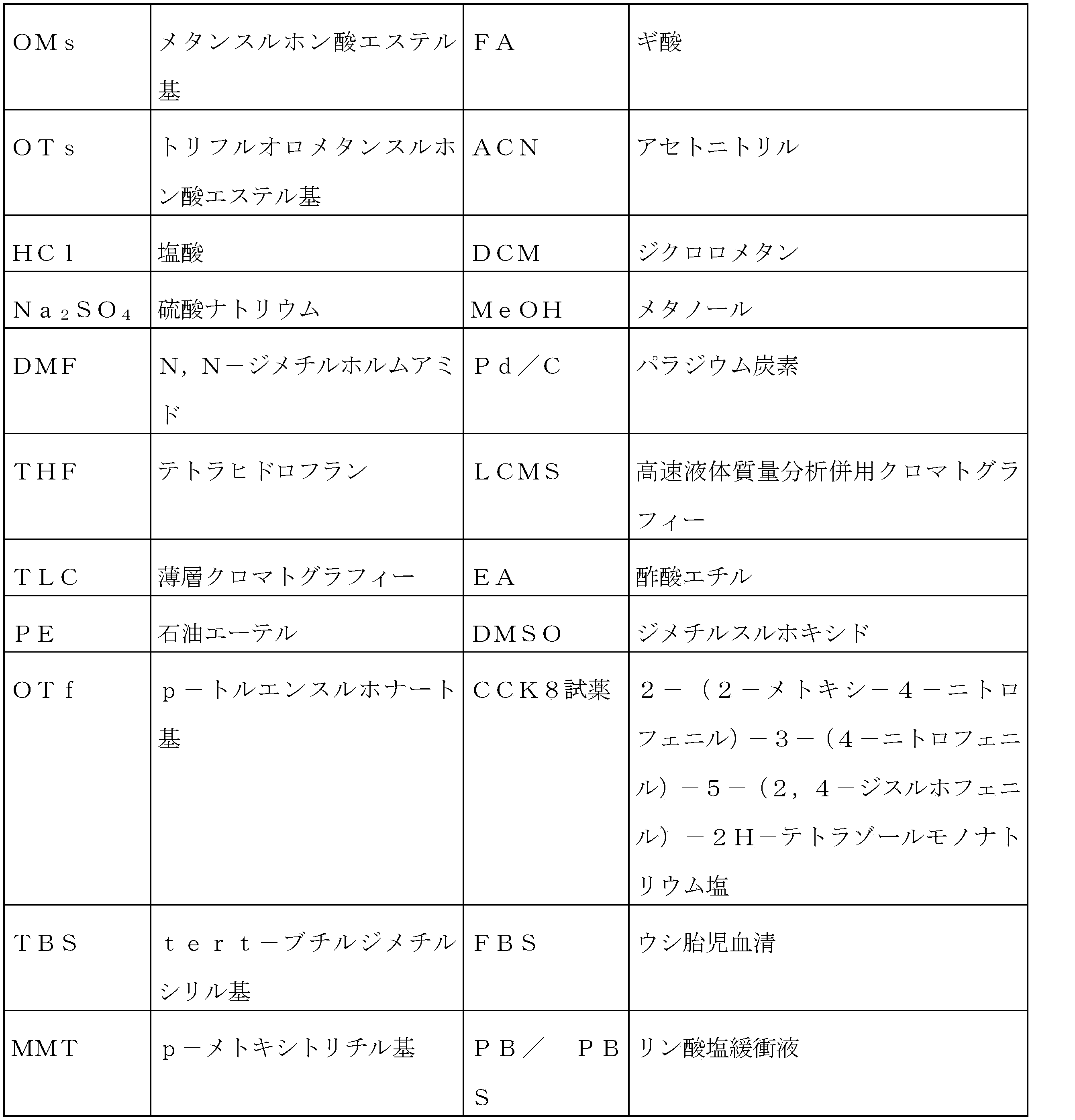
配列及びその具体的な情報
調製方法
以下の実施例に記載の化合物の構造は、核磁気共鳴(1H NMR)又は質量分析(MS)により特定される。
Methods of Preparation The structures of the compounds described in the following examples are identified by nuclear magnetic resonance ( 1 H NMR) or mass spectrometry (MS).
核磁気共鳴(1H NMR)の測定機器はBruker 400 MHz核磁気共鳴装置を使用し、測定溶媒が重水素化メタノール(CD3OD)、重水素化クロロホルム(CDCl3)、又はヘキサ重水素ジメチルスルホキシド(DMSO-d6)であり、内部標準物質がテトラメチルシラン(TMS)である。
The nuclear magnetic resonance ( 1 H NMR) was measured using a
実施例で使用した核磁気共鳴(NMR)スペクトルの略号を以下に示す。 The abbreviations for the nuclear magnetic resonance (NMR) spectra used in the examples are shown below.
s:一重線(singlet)、d:二重線(doublet)、t:三重線(triplet)、q:四重線(quartet)、dd:二重線の二重線(double doublet)、qd:四重線の二重線(quartet doublet)、ddd:二重線の二重線の二重線(double double doublet)、ddt:三重線の二重線の二重線(double double triplet)、dddd:二重線の二重線の二重線の二重線(double double double doublet)、m:多重線(multiplet)、br:幅広線(broad)、J:カップリング定数、Hz:ヘルツ、DMSO-d6:重水素化ジメチルスルホキシド。δ値はppm値で表される。 s: singlet, d: doublet, t: triplet, q: quartet, dd: double double, qd: quartet double, ddd: double double double, ddt: double double triple, dddd: double double double double, m: multiplet, br: broad, J: coupling constant, Hz: hertz, DMSO-d 6 : deuterated dimethyl sulfoxide. δ values are expressed in ppm.
質量分析(MS)のための測定機器は、型番がAgilent 6120BであるAgilent(ESI)質量分析計を使用した。 The measurement equipment used for mass spectrometry (MS) was an Agilent (ESI) mass spectrometer with model number Agilent 6120B.
超高速液体クロマトグラフィー(UPLC)のための測定機器は、型番がExionLCであるAB SCIEXを使用した。 The measurement equipment used for ultra-performance liquid chromatography (UPLC) was an AB SCIEX with the model number ExionLC.
高分解能質量の分析装置は、型番がX500BであるAB SCIEXを使用した。 The high-resolution mass spectrometer used was an AB SCIEX, model number X500B.
実施例1.中間体の合成
実施例1.1:(10S,13S)-10-(4-(ジプロピルアミノ)ブチル)-13-イソプロピル-20-(2-(メチルスルホニル)ピリミジン-5-イル)-6,9,12,15-テトラオキソ-3-オキサ-5,8,11,14-テトラアザエイコサン-19-イン酸(INT1)の合成

ステップ1:
化合物INT1-1(117g、206.2mmol)を、ジオキサン(1.5L)に加え、10分間撹拌した後、HCl(0.75L、4 N in dioxane)を更に加え、室温で一晩反応させた。反応液にメチルtert-ブチルエーテル(2L)を加えて30分間撹拌した後、ろ過し、固体を送風乾燥機に移して乾燥させ、標的化合物INT1-2の塩酸塩(94g、収率:91%、純度94%)を得た。
LCMS (ESI) [M+H]+ = 468.3.
1H NMR (400 MHz, DMSO-d6) δ 8.24 (d, J = 7.3 Hz, 1H), 8.07 (brs, 3H), 7.90 (d, J = 7.5 Hz, 2H), 7.77 (dd, J = 7.1, 3.4 Hz, 2H), 7.47 - 7.37 (m, 3H), 7.34 (td, J = 7.4, 1.7 Hz, 2H), 4.34 - 4.17 (m, 4H), 3.96 (dd, J = 8.6, 7.4 Hz, 1H), 2.83 - 2.65 (m, 2H), 2.04 (dd, J = 13.5, 6.7 Hz, 1H), 1.82 - 1.52 (m, 4H), 1.51 - 1.30 (m, 2H), 0.96 - 0.84 (m, 6H).
Step 1:
Compound INT1-1 (117 g, 206.2 mmol) was added to dioxane (1.5 L) and stirred for 10 minutes, and then HCl (0.75 L, 4 N in dioxane) was further added and reacted at room temperature overnight. Methyl tert-butyl ether (2 L) was added to the reaction solution and stirred for 30 minutes, and then filtered, and the solid was transferred to a blower dryer and dried to obtain the hydrochloride salt of the target compound INT1-2 (94 g, yield: 91%, purity 94%).
LCMS (ESI) [M+H] + = 468.3.
1 H NMR (400 MHz, DMSO-d 6 ) δ 8.24 (d, J = 7.3 Hz, 1H), 8.07 (brs, 3H), 7.90 (d, J = 7.5 Hz, 2H), 7.77 (dd, J = 7.1, 3.4 Hz, 2H), 7.47 - 7.37 (m, 3H), 7.34 (td, J = 7.4, 1.7 Hz, 2H), 4.34 - 4.17 (m, 4H), 3.96 (dd, J = 8.6, 7.4 Hz, 1H), 2.83 - 2.65 (m, 2H), 2.04 (dd, J = 13.5, 6.7 Hz, 1H), 1.82 - 1.52 (m, 4H), 1.51 - 1.30 (m, 2H), 0.96 - 0.84 (m, 6H).
ステップ2:
化合物INT1-2の塩酸塩(55.0g、109.1mmol)と酢酸(10mL)とをメタノール(500mL)に溶解し、氷水浴で、反応液にn-プロピオンアルデヒド(25.35g、436.4mmol)を加え、室温で30分間撹拌しながら反応させ、氷水浴で、反応液にシアノ水素化ホウ素ナトリウム(27.43g、436.4mmol)を更に加え、室温で1h撹拌しながら反応させた。次に、反応液にn-プロピオンアルデヒド(12.67g、218.2mmol)、シアノ水素化ホウ素ナトリウム(13.72g、218.2mmol)を更に加え、0.5h反応し続けた。反応液をろ過し、ろ液を濃縮し、濃縮液に精製水(300mL)を加え、DCM(300mL×2)で精製した。有機相を飽和食塩水で洗浄し、無水Na2SO4で乾燥した後、濃縮して粗製品を得た。粗製品をカラムクロマトグラフィーにより精製し(溶離液はMeOH及びDCMであり、そのうち、MeOH:DCM(V/V)=1:4~2:3である)、化合物INT1-3(39g、収率65%、純度98%)を得た。
LCMS (ESI) [M+H]+ = 552.3.
1H NMR (400 MHz, DMSO-d6) δ 7.95 - 7.85 (m, 3H), 7.76 (t, J = 7.3 Hz, 2H), 7.51 - 7.40 (m, 3H), 7.35 (t, J = 7.4 Hz, 2H), 4.34 - 4.22 (m, 3H), 4.13 (dd, J = 12.6, 7.2 Hz, 1H), 3.91 (dd, J = 8.8, 7.1 Hz, 1H), 2.52 - 2.41 (m, 6H), 2.03 (dt, J = 13.5, 6.7 Hz, 1H), 1.79 - 1.67 (m, 1H), 1.66 - 1.56 (m, 1H), 1.42 - 1.36 (m, 6H), 1.36 - 1.21 (m, 2H), 0.90 (t, J = 6.9 Hz, 6H), 0.82 (t, J = 6.9 Hz, 6H).
Step 2:
The hydrochloride salt of compound INT1-2 (55.0 g, 109.1 mmol) and acetic acid (10 mL) were dissolved in methanol (500 mL), and n-propionaldehyde (25.35 g, 436.4 mmol) was added to the reaction solution in an ice-water bath, and the mixture was reacted at room temperature for 30 minutes while stirring. Sodium cyanoborohydride (27.43 g, 436.4 mmol) was further added to the reaction solution in an ice-water bath, and the mixture was reacted at room temperature for 1 h while stirring. Next, n-propionaldehyde (12.67 g, 218.2 mmol) and sodium cyanoborohydride (13.72 g, 218.2 mmol) were further added to the reaction solution, and the reaction was continued for 0.5 h. The reaction solution was filtered, the filtrate was concentrated, and purified water (300 mL) was added to the concentrated solution, and the mixture was purified with DCM (300 mL x 2). The organic phase was washed with saturated saline, dried over anhydrous Na 2 SO 4 , and then concentrated to obtain a crude product. The crude product was purified by column chromatography (eluent was MeOH and DCM, of which MeOH:DCM (V/V)=1:4 to 2:3) to obtain compound INT1-3 (39 g, yield 65%, purity 98%).
LCMS (ESI) [M+H] + = 552.3.
1 H NMR (400 MHz, DMSO-d 6 ) δ 7.95 - 7.85 (m, 3H), 7.76 (t, J = 7.3 Hz, 2H), 7.51 - 7.40 (m, 3H), 7.35 (t, J = 7.4 Hz, 2H), 4.34 - 4.22 (m, 3H), 4.13 (dd, J = 12.6, 7.2 Hz, 1H), 3.91 (dd, J = 8.8, 7.1 Hz, 1H), 2.52 - 2.41 (m, 6H), 2.03 (dt, J = 13.5, 6.7 Hz, 1H), 1.79 - 1.67 (m, 1H), 1.66 - 1.56 (m, 1H), 1.42 - 1.36 (m, 6H), 1.36 - 1.21 (m, 2H), 0.90 (t, J = 6.9 Hz, 6H), 0.82 (t, J = 6.9 Hz, 6H).
ステップ3:
化合物INT1-3(6.6g、12mmol)をDMF(50mL)に溶解し、化合物INT1-4(3g、12mmol)、HATU(4g、11mmol)、N,N-ジイソプロピルエチルアミン(3.5g、30mmol)を順次加え、室温で1h撹拌した後、反応液に水(100mL)を加え、酢酸エチル(200mL×3)で精製し、有機相を合わせて飽和食塩水(200mL×2)で洗浄し、無水硫酸ナトリウムで乾燥させ、ろ過し、減圧下で濃縮して粗製品を得て、粗製品をカラムクロマトグラフィー(メタノール:ジクロロメタン=5%~10%)により精製し、標的化合物INT1-5(9g)を得た。
LCMS (ESI) [M+H]+ = 787.0、
1H NMR (400 MHz, DMSO-d6) δ 8.87 (s, 1H), 8.70 (t, J = 6.5 Hz, 1H), 8.27 - 8.18 (m, 1H), 8.06 (d, J = 7.4 Hz, 1H), 7.90 (d, J = 7.5 Hz, 2H), 7.73 (d, J = 7.2 Hz, 2H), 7.47 - 7.40 (m, 3H), 7.38 - 7.30 (m, 6H), 5.15 (s, 2H), 4.71 - 4.55 (m, 2H), 4.37 - 4.27 (m, 2H), 4.26 - 4.19 (m, 2H), 4.15 (s, 2H), 3.92 - 3.83 (m, 1H), 3.73 (d, J = 5.5 Hz, 2H), 3.04 - 2.89 (m, 6H), 2.01 - 1.94 (m, 1H), 1.81 - 1.63 (m, 2H), 1.61 - 1.52 (m, 6H), 1.36 - 1.27 (m, 2H), 0.91 - 0.82 (m, 12H).
Step 3:
Compound INT1-3 (6.6 g, 12 mmol) was dissolved in DMF (50 mL), and compound INT1-4 (3 g, 12 mmol), HATU (4 g, 11 mmol), and N,N-diisopropylethylamine (3.5 g, 30 mmol) were added in sequence. After stirring at room temperature for 1 h, water (100 mL) was added to the reaction solution, and the mixture was purified with ethyl acetate (200 mL x 3). The organic phases were combined and washed with saturated saline (200 mL x 2), dried over anhydrous sodium sulfate, filtered, and concentrated under reduced pressure to obtain a crude product. The crude product was purified by column chromatography (methanol:dichloromethane = 5% to 10%) to obtain the target compound INT1-5 (9 g).
LCMS (ESI) [M+H] + = 787.0,
1 H NMR (400 MHz, DMSO-d 6 ) δ 8.87 (s, 1H), 8.70 (t, J = 6.5 Hz, 1H), 8.27 - 8.18 (m, 1H), 8.06 (d, J = 7.4 Hz, 1H), 7.90 (d, J = 7.5 Hz, 2H), 7.73 (d, J = 7.2 Hz, 2H), 7.47 - 7.40 (m, 3H), 7.38 - 7.30 (m, 6H), 5.15 (s, 2H), 4.71 - 4.55 (m, 2H), 4.37 - 4.27 (m, 2H), 4.26 - 4.19 (m, 2H), 4.15 (s, 2H), 3.92 - 3.83 (m, 1H), 3.73 (d, J = 5.5 Hz, 2H), 3.04 - 2.89 (m, 6H), 2.01 - 1.94 (m, 1H), 1.81 - 1.63 (m, 2H), 1.61 - 1.52 (m, 6H), 1.36 - 1.27 (m, 2H), 0.91 - 0.82 (m, 12H).
ステップ4:
化合物INT1-5(3g、3.8mmol)をエタノール(20mL)と酢酸エチル(10mL)との混合溶媒に溶解し、窒素ガス保護で、Pd/C(1.5g)を加え、水素ガスで3回置換し、反応液を水素雰囲気下で、室温で一晩撹拌し、反応液をろ過し、ろ液を減圧下で濃縮し、標的化合物INT1-6(2.8g)を得て、そのまま次の反応に使用した。
LCMS (ESI) [M+H] + = 696.4.
1H NMR (400 MHz, DMSO-d6) δ 8.67 (t, J = 6.5 Hz, 1H), 8.25 (t, J = 5.7 Hz, 1H), 8.06 (d, J = 7.5 Hz, 1H), 7.90 (d, J = 7.5 Hz, 2H), 7.73 (d, J = 7.3 Hz, 2H), 7.49 - 7.39 (m, 3H), 7.33 (t, J = 7.4 Hz, 2H), 4.65 - 4.55 (m, 2H), 4.35 - 4.26 (m, 2H), 4.24 - 4.14 (m, 2H), 3.97 (s, 2H), 3.92 - 3.83 (m, 1H), 3.73 (d, J = 5.6 Hz, 2H), 2.94 - 2.84 (m, 6H), 1.73 - 1.64 (m, 1H), 1.63 - 1.47 (m, 8H), 1.34 - 1.26 (m, 3H), 0.89 - 0.82 (m, 12H).
Step 4:
Compound INT1-5 (3 g, 3.8 mmol) was dissolved in a mixed solvent of ethanol (20 mL) and ethyl acetate (10 mL), and Pd/C (1.5 g) was added under nitrogen gas protection, and the mixture was purged with hydrogen gas three times. The reaction solution was stirred overnight at room temperature under a hydrogen atmosphere, and the reaction solution was filtered. The filtrate was concentrated under reduced pressure to obtain the target compound INT1-6 (2.8 g), which was used as it was in the next reaction.
LCMS (ESI) [M+H] + = 696.4.
1 H NMR (400 MHz, DMSO-d 6 ) δ 8.67 (t, J = 6.5 Hz, 1H), 8.25 (t, J = 5.7 Hz, 1H), 8.06 (d, J = 7.5 Hz, 1H), 7.90 (d, J = 7.5 Hz, 2H), 7.73 (d, J = 7.3 Hz, 2H), 7.49 - 7.39 (m, 3H), 7.33 (t, J = 7.4 Hz, 2H), 4.65 - 4.55 (m, 2H), 4.35 - 4.26 (m, 2H), 4.24 - 4.14 (m, 2H), 3.97 (s, 2H), 3.92 - 3.83 (m, 1H), 3.73 (d, J = 5.6 Hz, 2H), 2.94 - 2.84 (m, 6H), 1.73 - 1.64 (m, 1H), 1.63 - 1.47 (m, 8H), 1.34 - 1.26 (m, 3H), 0.89 - 0.82 (m, 12H).
ステップ5:
化合物INT1-6(1g、1.43mmol)をTHF(30mL)に溶解し、ジエチルアミン(1.0g、14.3mmol)を加え、室温で1h撹拌し、反応液を減圧下で濃縮し、標的化合物INT1-7(680mg)を得て、そのまま次の反応に使用した。
LCMS (ESI) [M+H]+ = 474.1.
Step 5:
Compound INT1-6 (1 g, 1.43 mmol) was dissolved in THF (30 mL), diethylamine (1.0 g, 14.3 mmol) was added, and the mixture was stirred at room temperature for 1 h. The reaction solution was concentrated under reduced pressure to obtain the target compound INT1-7 (680 mg), which was used as it was in the next reaction.
LCMS (ESI) [M+H] + = 474.1.
ステップ6:
化合物INT1-8(340mg、1.27mmol)をDMF(50mL)に溶解し、HATU(4g、11mmol)、N,N-ジイソプロピルエチルアミン(3.5g、30mmol)を順次加え、室温で30min撹拌した後、化合物INT1-7(0.6g、1.27mmol)を加え、加入完了後、室温で1h撹拌し、反応液を分取高速液体クロマトグラフィー(アセトニトリル:水=5%~50%)により精製し、標的化合物INT1(200mg)を得た。
LCMS (ESI) [M+H]+ = 724.8、
1H NMR (400 MHz, DMSO-d6) δ 9.13 (s, 2H), 8.72 - 8.67 (m, 1H), 8.20 (t, J = 5.1 Hz, 1H), 8.11 (d, J = 7.3 Hz, 1H), 8.01 (d, J = 8.7 Hz, 1H), 4.62 (d, J = 6.2 Hz, 2H), 4.26 - 4.21 (m, 1H), 4.18 - 4.14 (m, 1H), 3.90 (s, 2H), 3.70 (d, J = 5.6 Hz, 2H), 3.42 (s, 3H), 3.17 (s, 2H), 2.42 - 2.32 (m, 4H), 2.05 - 1.94 (m, 3H), 1.87 - 1.78 (m, 2H), 1.75 - 1.67 (m, 2H), 1.63 - 1.53 (m, 2H), 1.48 - 1.40 (m, 9H), 0.87 - 0.84 (m, 12H).
Step 6:
Compound INT1-8 (340 mg, 1.27 mmol) was dissolved in DMF (50 mL), and HATU (4 g, 11 mmol) and N,N-diisopropylethylamine (3.5 g, 30 mmol) were added in that order. After stirring at room temperature for 30 min, compound INT1-7 (0.6 g, 1.27 mmol) was added. After addition was completed, the mixture was stirred at room temperature for 1 h. The reaction solution was purified by preparative high performance liquid chromatography (acetonitrile:water=5% to 50%) to obtain the target compound INT1 (200 mg).
LCMS (ESI) [M+H] + = 724.8,
1 H NMR (400 MHz, DMSO-d 6 ) δ 9.13 (s, 2H), 8.72 - 8.67 (m, 1H), 8.20 (t, J = 5.1 Hz, 1H), 8.11 (d, J = 7.3 Hz, 1H), 8.01 (d, J = 8.7 Hz, 1H), 4.62 (d, J = 6.2 Hz, 2H), 4.26 - 4.21 (m, 1H), 4.18 - 4.14 (m, 1H), 3.90 (s, 2H), 3.70 (d, J = 5.6 Hz, 2H), 3.42 (s, 3H), 3.17 (s, 2H), 2.42 - 2.32 (m, 4H), 2.05 - 1.94 (m, 3H), 1.87 - 1.78 (m, 2H), 1.75 - 1.67 (m, 2H), 1.63 - 1.53 (m, 2H), 1.48 - 1.40 (m, 9H), 0.87 - 0.84 (m, 12H).
実施例1.2:1-(3-クロロ-4-(3-(メチルアミノ)プロピル)フェニル)-3-((2-(2,6-ジオキソピペリジン-3-イル)-1-オキソイソインドリン-5-イル)メチル)ウレア(INT2)の合成
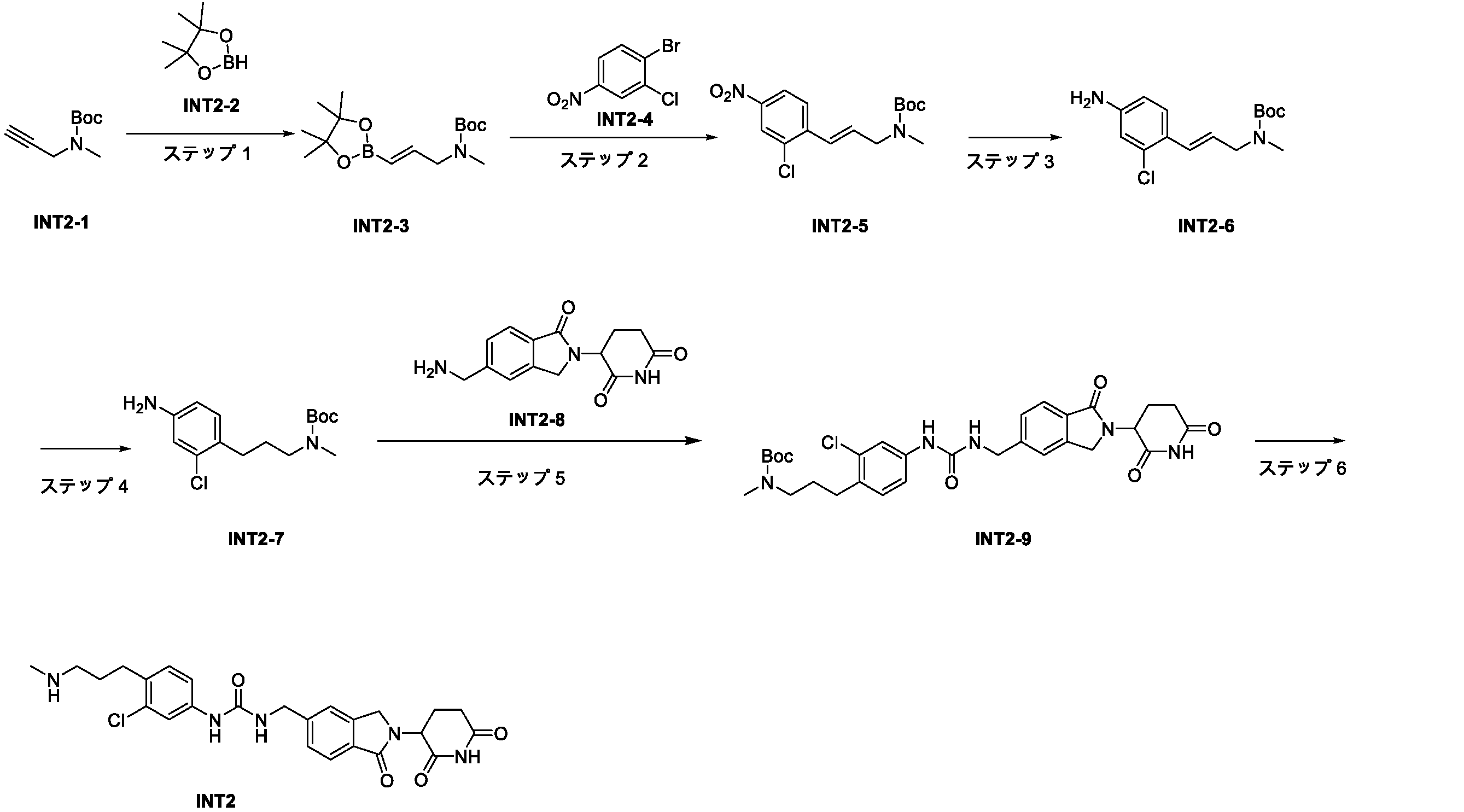
ステップ1:
化合物INT2-1(4.0g、23.65mmol)、トリエチルアミン(0.33mL、2.36mmol)を化合物INT2-2(3.18g、24.84mmol)に溶解し、水塩化ジルコニウム(691mg、2.36mmol)を加え、反応液を窒素ガス保護で60℃で8h撹拌しながら反応させた。LCMSにより反応をモニターした。反応液を直接減圧下で濃縮して粗製品を得て、粗製品をクロマトグラフィーカラム(石油エーテル:酢酸エチル=40:1)により精製し、標的化合物INT2-3(2.92g)を得た。
1H NMR (400 MHz, DMSO-d6) δ 6.38 (dt, J = 18.0, 4.3 Hz, 1H), 5.32 (d, J = 18.1 Hz, 1H), 3.83 (d, J = 3.7 Hz, 2H), 2.74 (s, 3H), 1.39 (s, 9H), 1.20 (s, 12H).
Step 1:
Compound INT2-1 (4.0 g, 23.65 mmol), triethylamine (0.33 mL, 2.36 mmol) were dissolved in compound INT2-2 (3.18 g, 24.84 mmol), and zirconium chloride hydrate (691 mg, 2.36 mmol) was added, and the reaction solution was reacted with stirring at 60° C. for 8 h under nitrogen gas protection. The reaction was monitored by LCMS. The reaction solution was directly concentrated under reduced pressure to obtain a crude product, which was purified by a chromatography column (petroleum ether: ethyl acetate = 40:1) to obtain the target compound INT2-3 (2.92 g).
1H NMR (400 MHz, DMSO- d6 ) δ 6.38 (dt, J = 18.0, 4.3 Hz, 1H), 5.32 (d, J = 18.1 Hz, 1H), 3.83 (d, J = 3.7 Hz, 2H), 2.74 (s, 3H), 1.39 (s, 9H), 1.20 (s, 12H).
ステップ2:
化合物INT2-4(1.86g、7.88mmol)、化合物INT2-3(2.34g、7.88mmol)、リン酸カリウム(5.02g、23.64mmol)、2-ジシクロヘキシルホスフィノ-2’,6’-ジイソプロポキシ-1,1’-ビフェニル(368mg、0.788mmol)を、1,4-ジオキサンと水との混合溶液(V:V=5:1、50mL)に溶解し、酢酸パラジウム(88mg、0.394mmol)を加え、反応液を窒素ガス保護で80℃で5h撹拌しながら反応させた。LCMSにより反応をモニターした。反応液を直接減圧下で濃縮して粗製品を得て、粗製品をクロマトグラフィーカラム(石油エーテル:酢酸エチル=40:1)により精製し、標的化合物INT2-5(1.0g)を得た。
1H NMR (400 MHz, DMSO-d6) δ 8.29 (d, J = 2.1 Hz, 1H), 8.16 - 8.14 (m, 1H), 8.02 (d, J = 8.7 Hz, 1H), 6.79 (d, J = 16.0 Hz, 1H), 6.19 - 6.05 (m, 1H), 3.78 (d, J = 5.7 Hz, 2H), 2.84 (s, 3H), 1.39 (s, 9H).
Step 2:
Compound INT2-4 (1.86 g, 7.88 mmol), compound INT2-3 (2.34 g, 7.88 mmol), potassium phosphate (5.02 g, 23.64 mmol), 2-dicyclohexylphosphino-2',6'-diisopropoxy-1,1'-biphenyl (368 mg, 0.788 mmol) were dissolved in a mixture of 1,4-dioxane and water (V:V=5:1, 50 mL), palladium acetate (88 mg, 0.394 mmol) was added, and the reaction solution was reacted with stirring at 80°C for 5 h under nitrogen gas protection. The reaction was monitored by LCMS. The reaction solution was directly concentrated under reduced pressure to obtain a crude product, which was purified by a chromatography column (petroleum ether: ethyl acetate=40:1) to obtain the target compound INT2-5 (1.0 g).
1 H NMR (400 MHz, DMSO-d 6 ) δ 8.29 (d, J = 2.1 Hz, 1H), 8.16 - 8.14 (m, 1H), 8.02 (d, J = 8.7 Hz, 1H), 6.79 (d, J = 16.0 Hz, 1H), 6.19 - 6.05 (m, 1H), 3.78 (d, J = 5.7 Hz, 2H), 2.84 (s, 3H), 1.39 (s, 9H).
ステップ3:
化合物INT2-5(500mg、1.53mmol)をテトラヒドロフラン、無水メタノール及び水の混合溶液(V:V:V=2:2:1、6mL)に溶解し、塩化アンモニウム(821mg、15.30mmol)、亜鉛末(997mg、15.30mmol)を順次加え、50℃で2h撹拌しながら反応させ、LCMSにより反応をモニターした。反応液をろ過し、ろ液を減圧下で濃縮して粗製品を得て、粗製品をクロマトグラフィーカラム(石油エーテル:酢酸エチル=10:1)により精製し、標的化合物INT2-6(320 mg)を得た。
LCMS (ESI) [M+H -56]+ = 241.0.
1H NMR (400 MHz, DMSO-d6) δ 7.36 (d, J = 8.5 Hz, 1H), 6.62 - 6.58 (m, 2H), 6.51 (d, J = 8.5 Hz, 1H), 5.95 - 5.93 (m, 1H), 5.50 (s, 2H), 3.89 (d, J = 5.4 Hz, 2H), 2.77 (s, 3H), 1.40 (s, 9H).
Step 3:
Compound INT2-5 (500 mg, 1.53 mmol) was dissolved in a mixed solution of tetrahydrofuran, anhydrous methanol and water (V:V:V = 2:2:1, 6 mL), ammonium chloride (821 mg, 15.30 mmol) and zinc powder (997 mg, 15.30 mmol) were added in sequence, and the reaction was carried out with stirring at 50 ° C. for 2 h, and the reaction was monitored by LCMS. The reaction solution was filtered, and the filtrate was concentrated under reduced pressure to obtain a crude product, which was purified by a chromatography column (petroleum ether: ethyl acetate = 10:1) to obtain the target compound INT2-6 (320 mg).
LCMS (ESI) [M+H -56] + = 241.0.
1 H NMR (400 MHz, DMSO- d6 ) δ 7.36 (d, J = 8.5 Hz, 1H), 6.62 - 6.58 (m, 2H), 6.51 (d, J = 8.5 Hz, 1H), 5.95 - 5.93 (m, 1H), 5.50 (s, 2H), 3.89 (d, J = 5.4 Hz, 2H), 2.77 (s, 3H), 1.40 (s, 9H).
ステップ4:
化合物INT2-6(300mg、1.01mmol)をTHF(10mL)に溶解し、反応液に二酸化白金(50mg)を加え、反応液を水素雰囲気下で1h撹拌しながら反応させた。LCMSにより反応をモニターした。反応液をろ過し、ろ液を減圧下で濃縮し、標的化合物INT2-7(200mg)を得て、そのまま次の反応に使用した。
LCMS (ESI) [M+H-100]+ = 199.0.
1H NMR (400 MHz, DMSO-d6) δ 6.95 (d, J = 8.2 Hz, 1H), 6.59 (d, J = 2.2 Hz, 1H), 6.45 (dd, J = 8.2, 2.2 Hz, 1H), 5.16 (s, 2H), 3.17 (t, J = 7.1 Hz, 2H), 2.77 (s, 3H), 2.48 - 2.43 (m, 2H), 1.66 (s, 2H), 1.37 (s, 9H).
Step 4:
Compound INT2-6 (300 mg, 1.01 mmol) was dissolved in THF (10 mL), platinum dioxide (50 mg) was added to the reaction solution, and the reaction solution was reacted under hydrogen atmosphere with stirring for 1 h. The reaction was monitored by LCMS. The reaction solution was filtered, and the filtrate was concentrated under reduced pressure to obtain the target compound INT2-7 (200 mg), which was used directly in the next reaction.
LCMS (ESI) [M+H-100] + = 199.0.
1H NMR (400 MHz, DMSO- d6 ) δ 6.95 (d, J = 8.2 Hz, 1H), 6.59 (d, J = 2.2 Hz, 1H), 6.45 (dd, J = 8.2, 2.2 Hz, 1H), 5.16 (s, 2H), 3.17 (t, J = 7.1 Hz, 2H), 2.77 (s, 3H), 2.48 - 2.43 (m, 2H), 1.66 (s, 2H), 1.37 (s, 9H).
ステップ5:
化合物INT2-7(200mg、0.67mmol)をテトラヒドロフラン(5mL)に溶解し、トリクロロメチルクロロホルメート(265mg、0.14mmol)を加え、反応液を室温で1.5h撹拌しながら反応させた。反応液を減圧下で濃縮して粗製品を得た。粗製品をDMF(5mL)に溶解し、次に、化合物INT2-8の塩酸塩(221mg、0.88mmol)、トリエチルアミン(670mg、6.70mmol)のDMF溶液を加えた。LCMSにより反応をモニターした。反応液に水(50mL)を加え、酢酸エチル(25mL×3)で精製し、有機相を合わせ、有機相を飽和食塩水(30mL×3)で洗浄し、無水Na2SO4で乾燥させ、ろ過し、ろ液を減圧下で濃縮して粗製品を得て、粗製品をカラムクロマトグラフィー(DCM:MeOH=10:1)により精製し、標的化合物INT2-9(150mg)を得た。
LCMS (ESI) [M+H-100]+ = 498.2.
1H NMR (400 MHz, DMSO-d6) δ 10.98 (s, 1H), 8.81 (s, 1H), 7.69 (d, J = 7.9 Hz, 1H), 7.66 (s, 1H), 7.51 (s, 1H), 7.44 (d, J = 8.2 Hz, 1H), 7.20 - 7.14 (m, 2H), 6.84 (t, J = 5.7 Hz, 1H), 5.17 - 5.03 (m, 1H), 4.43 - 4.39 (m, 2H), 4.34 - 4.27 (m, 1H), 3.21 - 3.17 (m, 2H), 2.96 - 2.86 (m, 1H), 2.77 (s, 3H), 2.64 - 2.52 (m, 4H), 2.43 - 2.33 (m, 1H), 2.03 - 1.98 (m, 1H), 1.76 - 1.67 (m, 2H), 1.37 (s, 9H).
Step 5:
Compound INT2-7 (200 mg, 0.67 mmol) was dissolved in tetrahydrofuran (5 mL), trichloromethyl chloroformate (265 mg, 0.14 mmol) was added, and the reaction solution was reacted at room temperature with stirring for 1.5 h. The reaction solution was concentrated under reduced pressure to obtain a crude product. The crude product was dissolved in DMF (5 mL), and then a DMF solution of compound INT2-8 hydrochloride (221 mg, 0.88 mmol) and triethylamine (670 mg, 6.70 mmol) was added. The reaction was monitored by LCMS. Water (50 mL) was added to the reaction solution, and the mixture was purified with ethyl acetate (25 mL x 3), and the organic phase was combined, the organic phase was washed with saturated saline (30 mL x 3), dried over anhydrous Na 2 SO 4 , filtered, and the filtrate was concentrated under reduced pressure to obtain a crude product, which was purified by column chromatography (DCM:MeOH = 10:1) to obtain the target compound INT2-9 (150 mg).
LCMS (ESI) [M+H-100] + = 498.2.
1H NMR (400 MHz, DMSO-d 6 ) δ 10.98 (s, 1H), 8.81 (s, 1H), 7.69 (d, J = 7.9 Hz, 1H), 7.66 (s, 1H), 7.51 (s, 1H), 7.44 (d, J = 8.2 Hz, 1H), 7.20 - 7.14 (m, 2H), 6.84 (t, J = 5.7 Hz, 1H), 5.17 - 5.03 (m, 1H), 4.43 - 4.39 (m, 2H), 4.34 - 4.27 (m, 1H), 3.21 - 3.17 (m, 2H), 2.96 - 2.86 (m, 1H), 2.77 (s, 3H), 2.64 - 2.52 (m, 4H), 2.43 - 2.33 (m, 1H), 2.03 - 1.98 (m, 1H), 1.76 - 1.67 (m, 2H), 1.37 (s, 9H).
ステップ6:
化合物INT2-9(120mg、0.20mmol)をDCM(6mL)に溶解させ、次に、トリフルオロ酢酸(2mL)を加えた。反応液を室温で1h撹拌しながら反応させた。LCMSにより反応をモニターした。反応液を減圧下で濃縮し、標的化合物INT2のトリフルオロ酢酸塩(100mg)を得た。
LCMS (ESI) [M+H]+ =498.1.
Step 6:
Compound INT2-9 (120 mg, 0.20 mmol) was dissolved in DCM (6 mL) and then trifluoroacetic acid (2 mL) was added. The reaction was allowed to react with stirring at room temperature for 1 h. The reaction was monitored by LCMS. The reaction was concentrated under reduced pressure to give the trifluoroacetic acid salt of target compound INT2 (100 mg).
LCMS (ESI) [M+H] + =498.1.
実施例1.3:2-(3-クロロ-4-(3-(メチルアミノ)プロピル)フェニル)-N-((2-(2,6-ジオキソピペリジン-3-イル)-1-オキソイソインドリン-5-イル)メチル)-2,2-ジフルオロアセトアミド(INT3)の合成

ステップ1:
窒素ガス保護で、化合物INT3-1(10.0g、31.50mmol)をジメチルスルホキシド(70mL)に溶解し、ジフルオロブロモ酢酸エチル(12.79g、63.00mmol)及び銅粉末(4.0g、63.00mmol)を反応液に順次加え、反応液を室温で48h撹拌しながら反応させ、TLCにより反応をモニターした。反応液を飽和塩化アンモニウム水溶液(200mL)にゆっくり注ぎ入れ、石油エーテル(200mL×2)で精製し、有機相を合わせて飽和食塩水(200mL×2)で洗浄し、無水Na2SO4で乾燥させ、吸引ろ過し、ろ液を減圧下で濃縮して粗製品を得て、粗製品をクロマトグラフィーカラム(石油エーテル:酢酸エチル=10:1)により精製し、標的化合物INT3-2(7.4g)を得た。
1H NMR (400 MHz, DMSO-d6) δ 7.98 (d, J = 8.3 Hz, 1H), 7.83 (s, 1H), 7.51 (d, J = 8.3 Hz, 1H), 4.35 - 4.30 (m, 2H), 1.24 (t, J = 7.1 Hz, 3H).
Step 1:
Under nitrogen gas protection, compound INT3-1 (10.0 g, 31.50 mmol) was dissolved in dimethyl sulfoxide (70 mL), and difluorobromoethyl acetate (12.79 g, 63.00 mmol) and copper powder (4.0 g, 63.00 mmol) were added to the reaction solution in sequence, and the reaction solution was reacted at room temperature for 48 h with stirring, and the reaction was monitored by TLC. The reaction solution was slowly poured into a saturated aqueous ammonium chloride solution (200 mL), purified with petroleum ether (200 mL x 2), the organic phase was combined, washed with saturated saline (200 mL x 2), dried over anhydrous Na 2 SO 4 , suction filtered, and the filtrate was concentrated under reduced pressure to obtain a crude product, which was purified by a chromatography column (petroleum ether: ethyl acetate = 10: 1) to obtain the target compound INT3-2 (7.4 g).
1H NMR (400 MHz, DMSO- d6 ) δ 7.98 (d, J = 8.3 Hz, 1H), 7.83 (s, 1H), 7.51 (d, J = 8.3 Hz, 1H), 4.35 - 4.30 (m, 2H), 1.24 (t, J = 7.1 Hz, 3H).
ステップ2:
窒素ガス保護で、化合物INT3-2(3.0g、9.57mmol)をDMF(50mL)に溶解し、メチル(プロピル-2-イン-1-イル)カルバミン酸tert-ブチル(3.2g、19.14mmol)、トリエチルアミン(4.8g、47.84mmol)、ヨウ化第一銅(182mg、0.96mmol)及びジ(トリフェニルホスフィン)二塩化パラジウム(672mg、0.96mmol)を順次加え、反応液を60℃で4h撹拌しながら反応させた。LCMSにより反応をモニターした。反応液を室温まで冷却し、反応液に水(150mL)を加え、酢酸エチルで精製し(150mL×3)、有機相を合わせ、飽和食塩水で洗浄し(200mL×3)、無水Na2SO4で乾燥し、吸引ろ過し、ろ液を減圧下で濃縮して粗製品を得て、粗製品をクロマトグラフィーカラム(石油エーテル:酢酸エチル=10:1)により精製し、標的化合物INT3-3(2.0g)を得た。
LCMS (ESI) [M+H-56]+ = 346.0.
1H NMR (400 MHz, DMSO-d6) δ 7.75 (d, J = 7.4 Hz, 2H), 7.58 (d, J = 8.2 Hz, 1H), 4.38 - 4.29 (m, 4H), 2.91 (s, 3H), 1.43 (s, 9H), 1.24 (t, J = 7.1 Hz, 3H).
Step 2:
Under nitrogen gas protection, compound INT3-2 (3.0 g, 9.57 mmol) was dissolved in DMF (50 mL), and tert-butyl methyl(propyl-2-yn-1-yl)carbamate (3.2 g, 19.14 mmol), triethylamine (4.8 g, 47.84 mmol), cuprous iodide (182 mg, 0.96 mmol), and di(triphenylphosphine)palladium dichloride (672 mg, 0.96 mmol) were added in sequence, and the reaction solution was reacted with stirring at 60° C. for 4 h. The reaction was monitored by LCMS. The reaction solution was cooled to room temperature, water (150 mL) was added to the reaction solution, and the mixture was purified with ethyl acetate (150 mL x 3). The organic phases were combined, washed with saturated saline (200 mL x 3), dried over anhydrous Na 2 SO 4 , suction filtered, and the filtrate was concentrated under reduced pressure to obtain a crude product. The crude product was purified by a chromatography column (petroleum ether: ethyl acetate = 10:1) to obtain the target compound INT3-3 (2.0 g).
LCMS (ESI) [M+H-56] + = 346.0.
1H NMR (400 MHz, DMSO- d6 ) δ 7.75 (d, J = 7.4 Hz, 2H), 7.58 (d, J = 8.2 Hz, 1H), 4.38 - 4.29 (m, 4H), 2.91 (s, 3H), 1.43 (s, 9H), 1.24 (t, J = 7.1 Hz, 3H).
ステップ3:
化合物INT3-3(1.2g、2.99mmol)をメタノール(10mL)に溶解し、窒素ガス保護で、ラネーニッケル(300mg)を加え、水素ガスで3回置換し、反応液を水素雰囲気下で、室温で6h撹拌しながら反応させた。LCMSにより反応をモニターした。反応液を珪藻土でろ過し、ろ液を減圧下で濃縮して次の反応に直接使用するための標的化合物INT3-4(930mg)を得て、そのまま次の反応に使用した。
LCMS (ESI) [M+H-56] + = 350.0.
1H NMR (400 MHz, DMSO-d6) δ 7.64 - 7.54 (m, 2H), 7.52 (s, 1H), 4.32 - 4.30 (m, 2H), 3.29 - 3.16 (m, 2H), 2.78 (s, 3H), 2.74 - 2.67 (m, 2H), 1.87 - 1.70 (m, 2H), 1.41 (s, 9H), 1.27 - 1.22 (m, 3H).
Step 3:
Compound INT3-3 (1.2 g, 2.99 mmol) was dissolved in methanol (10 mL), and under nitrogen gas protection, Raney nickel (300 mg) was added, and the mixture was purged with hydrogen gas three times, and the reaction mixture was reacted under hydrogen atmosphere at room temperature with stirring for 6 h. The reaction was monitored by LCMS. The reaction mixture was filtered through diatomaceous earth, and the filtrate was concentrated under reduced pressure to obtain the target compound INT3-4 (930 mg) for direct use in the next reaction, which was used as such in the next reaction.
LCMS (ESI) [M+H-56] + = 350.0.
1 H NMR (400 MHz, DMSO-d 6 ) δ 7.64 - 7.54 (m, 2H), 7.52 (s, 1H), 4.32 - 4.30 (m, 2H), 3.29 - 3.16 (m, 2H), 2.78 (s, 3H), 2.74 - 2.67 (m, 2H), 1.87 - 1.70 (m, 2H), 1.41 (s, 9H), 1.27 - 1.22 (m, 3H).
ステップ4:
化合物INT3-4(900mg、2.22mmol)をメタノール(15mL)と水(3mL)との混合溶液に溶解させ、水酸化リチウム一水和物(212mg、8.87mmol)を更に加え、室温で2h撹拌しながら反応させた。LCMSにより反応をモニターした。反応液に水(20mL)を加え、反応液を減圧下で濃縮してメタノールを除去し、1Nの塩酸水溶液でpH=4に調整し、酢酸エチルで精製し(20mL×2)、有機相を合わせて飽和食塩水で洗浄し(20mL×3)、無水Na2SO4で乾燥させ、吸引ろ過し、ろ液を減圧下で濃縮し、標的化合物INT3-5(700mg)を得て、そのまま次の反応に使用した。
LCMS (ESI) [M+H-56]+ = 322.2.
1H NMR (400 MHz, DMSO-d6) δ 7.49 (s, 1H), 7.40 (s, 2H), 3.23 - 3.20 (m, 2H), 2.78 (s, 3H), 2.68-2.64 (m, 2H), 1.77 - 1.73 (m, 2H), 1.36 (s, 9H).
Step 4:
Compound INT3-4 (900 mg, 2.22 mmol) was dissolved in a mixed solution of methanol (15 mL) and water (3 mL), lithium hydroxide monohydrate (212 mg, 8.87 mmol) was further added, and the mixture was reacted at room temperature for 2 h with stirring. The reaction was monitored by LCMS. Water (20 mL) was added to the reaction solution, the reaction solution was concentrated under reduced pressure to remove methanol, the pH was adjusted to 4 with 1N aqueous hydrochloric acid, and the mixture was purified with ethyl acetate (20 mL x 2). The organic phase was combined and washed with saturated saline (20 mL x 3), dried over anhydrous Na 2 SO 4 , suction filtered, and the filtrate was concentrated under reduced pressure to obtain the target compound INT3-5 (700 mg), which was used as it was in the next reaction.
LCMS (ESI) [M+H-56] + = 322.2.
1 H NMR (400 MHz, DMSO-d 6 ) δ 7.49 (s, 1H), 7.40 (s, 2H), 3.23 - 3.20 (m, 2H), 2.78 (s, 3H), 2.68-2.64 (m, 2H), 1.77 - 1.73 (m, 2H), 1.36 (s, 9H).
ステップ5:
化合物INT3-5(670mg、1.77mmol)、3-(6-アミノメチレン-3-オキソ-1H-イソインドール-2-イル)ピペリジン-2,6-ジオン塩酸塩(500mg、1.61mmol)をジクロロメタン(20mL)に溶解し、トリエチルアミン(765mg、7.57mmol)、プロピルホスホン酸三環酸無水物酢酸エチル溶液(2.87g、4.51mmol、質量分率50%)を加えた。反応液を室温で2h撹拌しながら反応させた。LCMSにより反応をモニターした。反応液を水(20mL)を加えて希釈し、酢酸エチル(30mL×3)で精製し、有機相を合わせて飽和食塩水(20mL×2)で洗浄し、無水Na2SO4で乾燥させ、吸引ろ過し、ろ液を減圧下で濃縮して粗製品を得て、粗製品をクロマトグラフィーカラム(石油エーテル:酢酸エチル=1:1)により精製し、標的化合物INT3-6(270mg)を得た。
LCMS (ESI) [M+Na]+ = 655.6.
1H NMR (400 MHz, DMSO-d6) δ 10.99 (s, 1H), 9.68 (t, J = 5.9 Hz, 1H), 7.68 (d, J = 7.8 Hz, 1H), 7.60 (s, 1H), 7.52 (d, J = 11.0 Hz, 2H), 7.43 (s, 1H), 7.37 (d, J = 7.8 Hz, 1H), 5.13 - 5.09 (m, 1H), 4.45 - 4.27 (m, 4H), 3.22 - 3.20 (m, 3H), 2.94 - 2.91 (m, 1H), 2.78 (s, 3H), 2.69 (d, J = 7.8 Hz, 2H), 2.67 - 2.62 (m, 1H), 2.42 - 2.35 (m, 1H), 1.77 (s, 2H), 1.33 (s, 9H).
Step 5:
Compound INT3-5 (670 mg, 1.77 mmol) and 3-(6-aminomethylene-3-oxo-1H-isoindol-2-yl)piperidine-2,6-dione hydrochloride (500 mg, 1.61 mmol) were dissolved in dichloromethane (20 mL), and triethylamine (765 mg, 7.57 mmol) and a solution of propylphosphonic tricyclic anhydride in ethyl acetate (2.87 g, 4.51 mmol, mass fraction 50%) were added. The reaction solution was reacted with stirring at room temperature for 2 h. The reaction was monitored by LCMS. The reaction solution was diluted by adding water (20 mL) and purified with ethyl acetate (30 mL × 3). The combined organic phase was washed with saturated brine (20 mL × 2), dried over anhydrous Na 2 SO 4 , suction filtered, and the filtrate was concentrated under reduced pressure to obtain a crude product. The crude product was purified by chromatography column (petroleum ether: ethyl acetate = 1:1) to obtain the target compound INT3-6 (270 mg).
LCMS (ESI) [M+Na] + = 655.6.
1H NMR (400 MHz, DMSO-d 6 ) δ 10.99 (s, 1H), 9.68 (t, J = 5.9 Hz, 1H), 7.68 (d, J = 7.8 Hz, 1H), 7.60 (s, 1H), 7.52 (d, J = 11.0 Hz, 2H), 7.43 (s, 1H), 7.37 (d, J = 7.8 Hz, 1H), 5.13 - 5.09 (m, 1H), 4.45 - 4.27 (m, 4H), 3.22 - 3.20 (m, 3H), 2.94 - 2.91 (m, 1H), 2.78 (s, 3H), 2.69 (d, J = 7.8 Hz, 2H), 2.67 - 2.62 (m, 1H), 2.42 - 2.35 (m, 1H), 1.77 (s, 2H), 1.33 (s, 9H).
ステップ6:
化合物INT3-6(205mg、0.32mmol)をHCl/1,4-dioxane溶液(5mL)に溶解した。反応液を室温で2h撹拌しながら反応させた。LCMSにより反応をモニターした。反応液を減圧下で濃縮し、標的化合物INT3の塩酸塩(165mg)を得た。
LCMS (ESI) [M+H]+ = 532.9.
Step 6:
Compound INT3-6 (205 mg, 0.32 mmol) was dissolved in HCl/1,4-dioxane solution (5 mL). The reaction solution was reacted with stirring at room temperature for 2 h. The reaction was monitored by LCMS. The reaction solution was concentrated under reduced pressure to give the hydrochloride salt of the target compound INT3 (165 mg).
LCMS (ESI) [M+H] + = 532.9.
実施例1.4:1-(3-クロロ-4-(3-(メチルアミノ)プロピル)フェニル)-3-((2-(2,6-ジオキソピペリジン-3-イル)-1,3-ジオキソイソインドリン-5-イル)メチル)ウレア(INT4)の合成

ステップ1:
化合物INT2-7(200mg、0.67mmol)をTHF(5mL)に溶解し、トリクロロメチルクロロホルメート(265mg、1.34mmol)を加え、反応液を室温で1h撹拌しながら反応させた。反応液を減圧下で濃縮し、粗製品中間体を得た。粗製品中間体をDMF(5mL)に溶解し、次に、化合物INT4-1(193mg、0.67mmol)、トリエチルアミン(670mg、6.70mmol)のDMF(5mL)溶液を加え、LCMSにより反応をモニターした。反応液に水(25mL)を加え、EA(30mL×3)で精製し、有機相を合わせ、有機相を飽和食塩水(30mL×2)で洗浄し、無水Na2SO4で乾燥させ、ろ過し、ろ液を減圧下で濃縮し、粗製品をカラムクロマトグラフィー(ジクロロメタン:メタノール=10:1)により精製し、標的化合物INT4-2(200mg)を得た。
LCMS (ESI) [M+H-100]+ =512.3.
1H NMR (400 MHz, DMSO-d6) δ 11.12 (s, 1H), 8.86 (s, 1H), 7.89 (d, J = 7.7 Hz, 1H), 7.85-7.75 (m, 2H), 7.64 (s, 1H), 7.18 (s, 2H), 6.91 (t, J = 6.1 Hz, 1H), 5.14 (dd, J = 12.9, 5.3 Hz, 1H), 4.46 (d, J = 6.1 Hz, 2H), 3.18 (t, J = 7.1 Hz, 2H), 2.94-2.85 (m, 1H), 2.77 (s, 3H), 2.64-2.52 (m, 4H), 2.09-2.03 (m, 1H), 1.77-1.64 (m, 2H), 1.36 (s, 9H).
Step 1:
Compound INT2-7 (200 mg, 0.67 mmol) was dissolved in THF (5 mL), trichloromethyl chloroformate (265 mg, 1.34 mmol) was added, and the reaction solution was reacted at room temperature with stirring for 1 h. The reaction solution was concentrated under reduced pressure to obtain a crude intermediate. The crude intermediate was dissolved in DMF (5 mL), and then a solution of compound INT4-1 (193 mg, 0.67 mmol) and triethylamine (670 mg, 6.70 mmol) in DMF (5 mL) was added, and the reaction was monitored by LCMS. Water (25 mL) was added to the reaction solution, and the mixture was purified with EA (30 mL x 3), and the organic phase was combined, the organic phase was washed with saturated saline (30 mL x 2), dried over anhydrous Na 2 SO 4 , filtered, and the filtrate was concentrated under reduced pressure, and the crude product was purified by column chromatography (dichloromethane:methanol = 10:1) to obtain the target compound INT4-2 (200 mg).
LCMS (ESI) [M+H-100] + =512.3.
1H NMR (400 MHz, DMSO-d 6 ) δ 11.12 (s, 1H), 8.86 (s, 1H), 7.89 (d, J = 7.7 Hz, 1H), 7.85-7.75 (m, 2H), 7.64 (s, 1H), 7.18 (s, 2H), 6.91 (t, J = 6.1 Hz, 1H), 5.14 (dd, J = 12.9, 5.3 Hz, 1H), 4.46 (d, J = 6.1 Hz, 2H), 3.18 (t, J = 7.1 Hz, 2H), 2.94-2.85 (m, 1H), 2.77 (s, 3H), 2.64-2.52 (m, 4H), 2.09-2.03 (m, 1H), 1.77-1.64 (m, 2H), 1.36 (s, 9H).
ステップ2:
化合物INT4-2(120mg、0.20mmol)をDCM(6mL)に溶解させ、次に、トリフルオロ酢酸(2mL)を加え、反応液を室温で1h撹拌しながら反応させ、LCMSにより反応をモニターし、反応液を減圧下で濃縮し、標的化合物INT4のトリフルオロ酢酸塩(100mg)を得た。
LCMS (ESI) [M+H]+ =512.3.
1H NMR (400 MHz, DMSO-d6) δ 11.12 (s, 1H), 8.98 (s, 1H), 8.34 (s, 2H), 7.90 (d, J = 7.7 Hz, 1H), 7.85-7.78 (m, 2H), 7.67 (d, J = 1.7 Hz, 1H), 7.23-7.17 (m, 2H), 7.04 (t, J = 6.0 Hz, 1H), 5.15 (dd, J = 12.8, 5.3 Hz, 1H), 4.47 (d, J = 5.8 Hz, 2H), 2.95-2.85 (m, 3H), 2.70-2.57 (m, 4H), 2.57-2.54 (m, 3H), 2.10-2.01 (m, 1H), 1.87-1.79 (m, 2H).
Step 2:
Compound INT4-2 (120 mg, 0.20 mmol) was dissolved in DCM (6 mL), then trifluoroacetic acid (2 mL) was added, and the reaction was allowed to react with stirring at room temperature for 1 h, the reaction was monitored by LCMS, and the reaction was concentrated under reduced pressure to give the trifluoroacetate salt of target compound INT4 (100 mg).
LCMS (ESI) [M+H] + =512.3.
1H NMR (400 MHz, DMSO-d 6 ) δ 11.12 (s, 1H), 8.98 (s, 1H), 8.34 (s, 2H), 7.90 (d, J = 7.7 Hz, 1H), 7.85-7.78 (m, 2H), 7.67 (d, J = 1.7 Hz, 1H), 7.23-7.17 (m, 2H), 7.04 (t, J = 6.0 Hz, 1H), 5.15 (dd, J = 12.8, 5.3 Hz, 1H), 4.47 (d, J = 5.8Hz, 2H), 2.95-2.85 (m, 3H), 2.70-2.57 (m, 4H), 2.57-2.54 (m, 3H), 2.10-2.01 (m, 1H), 1.87-1.79 (m, 2H).
実施例1.5:(5S,8S)-8-(4-(ジメチルアミノ)ブチル)-1-(9H-フルオレン-9-イル)-5-イソプロピル-3,6,9,12-テトラオキソ-2,15-ジオキサ-4,7,10,13テトラアザヘプタデカン-17-酸(INT5)の合成
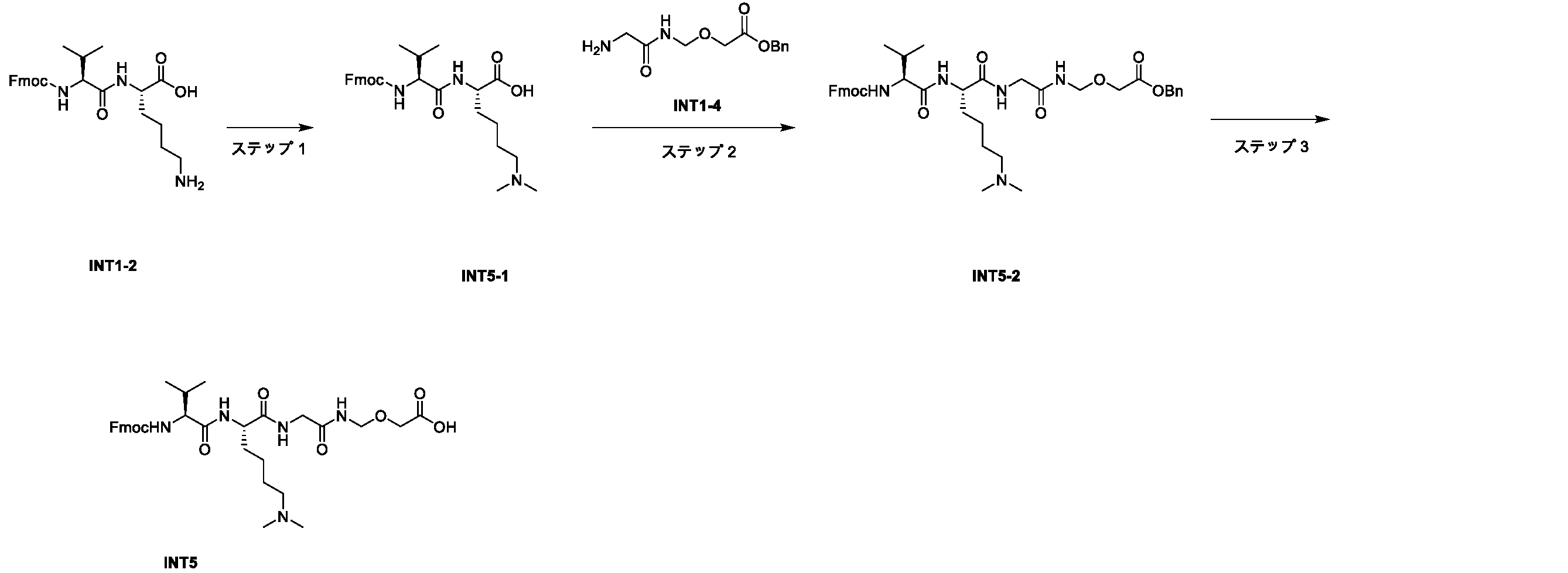
ステップ1:
化合物INT1-2(50.0g、107.07mmol)をMeOH(1000mL)に溶解し、酢酸ナトリウム(17.6g、214.1mmol)を加え、氷浴条件で、パラホルムアルデヒド(57.8g、642.4mmol)を加え、30min撹拌し、反応系にシアノ水素化ホウ素ナトリウム(13.5g、214.1mmol)を更に加え、加入完了後、室温まで回復し、反応液を室温で一晩撹拌しながら反応させ、LCMSにより反応をモニターし、反応液を減圧下で濃縮し、粗製品を分取高速液体クロマトグラフィー(アセトニトリル:H2O、0.05%のFA=5%~70%含有)により直接精製し、標的化合物INT5-1(25g)を得た。
LCMS (ESI) [M+H]+ = 496.6.
1H NMR (400 MHz, DMSO-d6) δ 9.96 (s, 1H), 8.19 (d, J = 7.5 Hz, 1H), 7.89 (d, J = 7.5 Hz, 2H), 7.75 (d, J = 7.4 Hz, 2H), 7.42-7.40 (m, 3H), 7.37-7.27 (m, 2H), 4.33-4.25 (m, 1H), 4.24-4.18 (m, 2H), 3.94-3.85 (m, 1H), 3.01-2.89 (m, 2H), 2.68 (d, J = 4.7 Hz, 6H), 2.06-1.91 (m, 2H), 1.78-1.68 (m, 1H), 1.65-1.58 (m, 2H), 1.38-1.28 (m, 2H), 1.27-1.22 (m, 1H), 0.93-0.83 (m, 6H).
Step 1:
Compound INT1-2 (50.0 g, 107.07 mmol) was dissolved in MeOH (1000 mL), sodium acetate (17.6 g, 214.1 mmol) was added, paraformaldehyde (57.8 g, 642.4 mmol) was added under ice bath conditions, and the mixture was stirred for 30 min. Sodium cyanoborohydride (13.5 g, 214.1 mmol) was further added to the reaction system, and after addition was completed, the reaction mixture was allowed to return to room temperature, and the reaction mixture was allowed to react overnight at room temperature while stirring. The reaction was monitored by LCMS, and the reaction mixture was concentrated under reduced pressure. The crude product was directly purified by preparative high performance liquid chromatography (acetonitrile: H 2 O, containing 0.05% FA = 5% to 70%) to obtain target compound INT5-1 (25 g).
LCMS (ESI) [M+H] + = 496.6.
1 H NMR (400 MHz, DMSO-d 6 ) δ 9.96 (s, 1H), 8.19 (d, J = 7.5 Hz, 1H), 7.89 (d, J = 7.5 Hz, 2H), 7.75 (d, J = 7.4 Hz, 2H), 7.42-7.40 (m, 3H), 7.37-7.27 (m, 2H), 4.33-4.25 (m, 1H), 4.24-4.18 (m, 2H), 3.94-3.85 (m, 1H), 3.01-2.89 (m, 2H), 2.68 (d, J = 4.7 Hz, 6H), 2.06-1.91 (m, 2H), 1.78-1.68 (m, 1H), 1.65-1.58 (m, 2H), 1.38-1.28 (m, 2H), 1.27-1.22 (m, 1H), 0.93-0.83 (m, 6H).
ステップ2:
化合物INT5-1(4.7g、9.5mmol)、化合物INT1-4(2.4g、9.5mmol)をDMF(50mL)に溶解し、2-(7-アザベンゾトリアゾール)-N,N,N’,N’-テトラメチルウロニウムヘキサフルオロホスフェート(3.2g、8.6mmol)、N,N-ジイソプロピルエチルアミン(3.7g、28.5mmol)を加え、反応液を室温で1h撹拌しながら反応させ、LCMSにより反応をモニターし、反応液に水(200mL)を加え、EA(200mL×3)で精製し、有機相を合わせ、有機相を飽和食塩水(150mL×3)で洗浄し、無水Na2SO4で乾燥してろ過させた後、ろ液を減圧下で濃縮し、粗製品をカラムクロマトグラフィー(DCM:MeOH=10:1)により精製し、標的化合物INT5-2(1.5g)を得た。
LCMS (ESI) [M+H]+ = 730.4.
1H NMR (400 MHz, DMSO-d6) δ 8.70 (t, J = 6.6 Hz, 1H), 8.25 (t, J = 6.2 Hz, 1H), 8.08 (d, J = 7.3 Hz, 1H), 7.90 (d, J = 7.5 Hz, 2H), 7.74 (d, J = 7.3 Hz, 2H), 7.43 - 7.32 (m, 10H), 5.15 (s, 2H), 4.66 - 4.60 (m, 2H), 4.33 - 4.24 (m, 2H), 4.24 - 4.19 (m, 2H), 4.16 (s, 2H), 3.92 - 3.86 (m, 1H), 3.73 (d, J = 5.9 Hz, 2H), 2.91 - 2.82 (m, 2H), 2.66 (s, 6H), 2.02 - 1.94 (m, 1H), 1.74 - 1.64 (m, 1H), 1.60-1.51 (m, 3H), 1.31 - 1.26 (m, 2H), 0.85 (t, J = 6.0 Hz, 6H).
Step 2:
Compound INT5-1 (4.7 g, 9.5 mmol) and compound INT1-4 (2.4 g, 9.5 mmol) were dissolved in DMF (50 mL), 2-(7-azabenzotriazole)-N,N,N',N'-tetramethyluronium hexafluorophosphate (3.2 g, 8.6 mmol) and N,N-diisopropylethylamine (3.7 g, 28.5 mmol) were added, and the reaction solution was reacted at room temperature with stirring for 1 h, and the reaction was monitored by LCMS, and water (200 mL) was added to the reaction solution, and the mixture was purified with EA (200 mL x 3), and the organic phase was combined, and the organic phase was washed with saturated saline (150 mL x 3), dried over anhydrous Na 2 SO 4 , and then filtered. The filtrate was concentrated under reduced pressure, and the crude product was purified by column chromatography (DCM:MeOH = 10:1) to obtain the target compound INT5-2 (1.5 g).
LCMS (ESI) [M+H] + = 730.4.
1 H NMR (400 MHz, DMSO-d 6 ) δ 8.70 (t, J = 6.6 Hz, 1H), 8.25 (t, J = 6.2 Hz, 1H), 8.08 (d, J = 7.3 Hz, 1H), 7.90 (d, J = 7.5 Hz, 2H), 7.74 (d, J = 7.3 Hz, 2H), 7.43 - 7.32 (m, 10H), 5.15 (s, 2H), 4.66 - 4.60 (m, 2H), 4.33 - 4.24 (m, 2H), 4.24 - 4.19 (m, 2H), 4.16 (s, 2H), 3.92 - 3.86 (m, 1H), 3.73 (d, J = 5.9 Hz, 2H), 2.91 - 2.82 (m, 2H), 2.66 (s, 6H), 2.02 - 1.94 (m, 1H), 1.74 - 1.64 (m, 1H), 1.60 - 1.51 (m, 3H), 1.31 - 1.26 (m, 2H), 0.85 (t, J = 6.0 Hz, 6H).
ステップ3:
化合物INT5-2(1.3g、1.7mmol)をEtOH(40mL)とEA(20mL)との混合溶媒に溶解させ、Pd/C(400mg)を加え、水素ガスで3回置換し、反応液を水素雰囲気下で16h撹拌しながら反応させ、LCMSにより反応をモニターし、反応液をろ過し、ろ液を減圧下で濃縮し、標的化合物INT5(780mg)を得た。
LCMS (ESI) [M+H]+ =640.4.
Step 3:
Compound INT5-2 (1.3 g, 1.7 mmol) was dissolved in a mixed solvent of EtOH (40 mL) and EA (20 mL), Pd/C (400 mg) was added, and the mixture was replaced with hydrogen gas three times. The reaction solution was reacted under a hydrogen atmosphere for 16 h with stirring, and the reaction was monitored by LCMS. The reaction solution was filtered, and the filtrate was concentrated under reduced pressure to obtain the target compound INT5 (780 mg).
LCMS (ESI) [M+H] + =640.4.
実施例1.6:1-((2-(2,6-ジオキソピペリジン-3-イル)-1-オキソイソインドール-5-イル)メチル)-3-(4-(3-(メチルアミノ)プロピル)フェニル)ウレア(INT6)の合成

ステップ1:
化合物INT6-1(3.0g、17.60mmol)をDMF(100mL)に溶解し、INT6-2(5.0g、17.60mmol)、トリエチルアミン(8.9g、88.20mmol)、ヨウ化第一銅(335mg、1.76mmol)及びトリフェニルホスフィン二塩化パラジウム(1.2g、1.76mmol)を反応液に順次加え、反応液を窒素ガス保護で室温で4h撹拌しながら反応させ、TLCにより反応をモニターし、反応液に水(100mL)を加えてクエンチし、酢酸エチルで精製し(100mL×3)、有機相を合わせて飽和食塩水で洗浄し(100mL×2)、水で洗浄し(100mL×2)、無水Na2SO4で乾燥させ、ろ過し、ろ液を減圧下で濃縮し、粗製品をカラムクロマトグラフィー(石油エーテル:酢酸エチル=10:1)により精製し、標的化合物INT6-3(3.5g)を得た。
1H NMR (400 MHz, DMSO-d6) δ 8.39 (d, J = 2.3Hz, 1H), 8.18 (dd, J = 8.8 Hz, 2.4 Hz, 1H), 7.84 (d, J = 8.6 Hz, 1H), 4.38 (s, 2H), 2.91 (s, 3H), 1.42 (s, 9H).
Step 1:
Compound INT6-1 (3.0 g, 17.60 mmol) was dissolved in DMF (100 mL), INT6-2 (5.0 g, 17.60 mmol), triethylamine (8.9 g, 88.20 mmol), cuprous iodide (335 mg, 1.76 mmol) and triphenylphosphine palladium dichloride (1.2 g, 1.76 mmol) were added to the reaction solution in sequence, the reaction solution was reacted under nitrogen gas protection at room temperature for 4 h while stirring, the reaction was monitored by TLC, the reaction solution was quenched by adding water (100 mL) to the reaction solution, purified with ethyl acetate (100 mL x 3), the organic phase was combined and washed with saturated saline (100 mL x 2), washed with water (100 mL x 2), dried over anhydrous Na 2 SO 4 , filtered, the filtrate was concentrated under reduced pressure, and the crude product was purified by column chromatography (petroleum ether: ethyl acetate = 10: 1) to obtain the target compound INT6-3 (3.5 g).
1 H NMR (400 MHz, DMSO-d 6 ) δ 8.39 (d, J = 2.3 Hz, 1H), 8.18 (dd, J = 8.8 Hz, 2.4 Hz, 1H), 7.84 (d, J = 8.6 Hz, 1H), 4.38 (s, 2H), 2.91 (s, 3H), 1.42 (s, 9H).
ステップ2:
化合物INT6-3(1.0g、3.09mmol)を無水MeOH(20mL)に溶解し、THF(20mL)、蒸留水(10mL)、亜鉛末(2.0g、30.86mmol)及び塩化アンモニウム(1.6g、30.86mmol)を反応液に順次加え、反応液を50℃で4h撹拌し、LCMSにより反応をモニターし、反応液をろ過し、ろ液を減圧下で濃縮した後、EAを加えて精製し(50mL×3)、有機相を合わせて順次飽和食塩水で洗浄し(50mL×2)、水で洗浄し(50mL×2)、無水Na2SO4で乾燥させ、ろ過し、ろ液を減圧下で濃縮し、粗製品をクロマトグラフィーカラム(石油エーテル:酢酸エチル=5:1)により精製し、標的化合物INT6-4(900mg)を得た。
LCMS (ESI) [M+H-56]+ = 239.0.
1H NMR (400 MHz, DMSO-d6) δ 7.16 (d, J = 8.4 Hz, 1H), 6.64 (d, J = 2.1 Hz, 1H), 6.45 (dd, J = 8.4 Hz, 2.0 Hz, 1H), 5.78 (s, 2H), 4.22 (s, 2H), 2.86 (s, 3H), 1.41 (s, 9H).
Step 2:
Compound INT6-3 (1.0 g, 3.09 mmol) was dissolved in anhydrous MeOH (20 mL), THF (20 mL), distilled water (10 mL), zinc powder (2.0 g, 30.86 mmol) and ammonium chloride (1.6 g, 30.86 mmol) were added to the reaction solution in sequence, the reaction solution was stirred at 50 ° C. for 4 h, the reaction was monitored by LCMS, the reaction solution was filtered, the filtrate was concentrated under reduced pressure, and then EA was added for purification (50 mL × 3), the organic phase was combined and washed with saturated saline (50 mL × 2), washed with water (50 mL × 2), dried over anhydrous Na 2 SO 4 , filtered, the filtrate was concentrated under reduced pressure, and the crude product was purified by chromatography column (petroleum ether: ethyl acetate = 5: 1) to obtain the target compound INT6-4 (900 mg).
LCMS (ESI) [M+H-56] + = 239.0.
1H NMR (400 MHz, DMSO- d6 ) δ 7.16 (d, J = 8.4 Hz, 1H), 6.64 (d, J = 2.1 Hz, 1H), 6.45 (dd, J = 8.4 Hz, 2.0 Hz, 1H), 5.78 (s, 2H), 4.22 (s, 2H), 2.86 (s, 3H), 1.41 (s, 9H).
ステップ3:
化合物INT6-4(5.0g、17.00mmol)をMeOH(50mL)に溶解させ、ギ酸アンモニウム(5.36g、85.00mmol)及びパラジウム炭素(360mg、3.40mmol)を順次加え、水素ガスで3回置換し、反応液を水素雰囲気下で60℃で一晩反応させ、LCMSにより反応をモニターし、反応液を珪藻土でろ過し、ろ液を減圧下で濃縮し、粗製品を分取高速液体クロマトグラフィー(アセトニトリル:H2O、0.05%のFA=5%~50%含有)により精製し、標的化合物INT6-5(2.6g)を得た。
LCMS (ESI) [M+H-100]+ = 165.1.
1H NMR (400 MHz, CDCl3) δ 6.97 (d, J = 8.2 Hz, 2H), 6.62 (d, J = 8.3 Hz, 2H), 3.18-3.23 (m, 2H), 2.83 (s, 3H), 2.52-2.44 (m, 2H), 1.83-1.72 (m, 2H), 1.45 (s, 9H).
Step 3:
Compound INT6-4 (5.0 g, 17.00 mmol) was dissolved in MeOH (50 mL), and ammonium formate (5.36 g, 85.00 mmol) and palladium carbon (360 mg, 3.40 mmol) were added in sequence. The mixture was purged with hydrogen gas three times, and the reaction solution was reacted overnight at 60° C. under a hydrogen atmosphere. The reaction was monitored by LCMS, and the reaction solution was filtered through diatomaceous earth. The filtrate was concentrated under reduced pressure, and the crude product was purified by preparative high performance liquid chromatography (acetonitrile:H 2 O, containing 0.05% FA=5% to 50%) to obtain the target compound INT6-5 (2.6 g).
LCMS (ESI) [M+H-100] + = 165.1.
1H NMR (400 MHz, CDCl3 ) δ 6.97 (d, J = 8.2 Hz, 2H), 6.62 (d, J = 8.3 Hz, 2H), 3.18-3.23 (m, 2H), 2.83 (s, 3H), 2.52-2.44 (m, 2H), 1.83-1.72 (m, 2H), 1.45 (s, 9H).
ステップ4:
化合物INT6-5(1.0g、3.78mmol)をTHF(20mL)に溶解し、トリホスゲン(1.50g、7.56mmol)を加え、加えてから室温で30min撹拌しながら反応させ、LCMSにより反応の中間状態の形成を検出し、反応液を減圧下で濃縮し、DMF(5mL)を加えて溶解させて使用に備え、化合物INT2-8の塩酸塩(1.04g、3.78mmol)、トリエチルアミン(3.03g、30.04mmol)をDMF(5mL)に溶解し、上記の予備反応液にゆっくり滴加し、滴加終了後、室温で2h撹拌しながら反応させ、LCMSにより反応をモニターし、反応液に水(10mL)を加えて反応をクエンチし、EAで精製し(10mL×3)、有機相を合わせて飽和食塩水で洗浄し(10mL×3)、無水Na2SO4で乾燥させ、ろ過し、ろ液を減圧下で濃縮し、粗製品をクロマトグラフィーカラム(メタノール:ジクロロメタン=0%~7%)により精製し、標的化合物INT6-6(800mg)を得た。
LCMS (ESI) [M+H-100]+ = 464.3.
1H NMR (400 MHz, CDCl3) δ 8.97 (s, 1H), 7.57-7.45 (m, 2H), 7.29 (s, 1H), 7.26-7.21 (m, 2H), 7.18 (d, J = 7.8 Hz, 1H), 7.04 (d, J = 7.7 Hz, 2H), 5.95 (s, 1H), 5.04 (dd, J = 13.1, 4.8 Hz, 1H), 4.43-4.30 (m, 2H), 4.24-4.11 (m, 2H), 3.21 (t, J = 7.0 Hz, 2H), 2.81 (s, 3H), 2.80-2.63 (m, 2H), 2.50 (t, J = 7.1 Hz, 2H), 2.27-2.05 (m, 2H), 1.79-1.74 (m, 2H), 1.43 (s, 9H).
Step 4:
Compound INT6-5 (1.0 g, 3.78 mmol) was dissolved in THF (20 mL), triphosgene (1.50 g, 7.56 mmol) was added, and the mixture was stirred at room temperature for 30 min after the addition, and the formation of the intermediate state of the reaction was detected by LCMS, and the reaction solution was concentrated under reduced pressure, and DMF (5 mL) was added to dissolve the mixture for use, and compound INT2-8 hydrochloride (1.04 g, 3.78 mmol) and triethylamine (3.03 g, 30.04 mmol) were dissolved in DMF (5 mL), and the mixture was slowly added dropwise to the above preliminary reaction solution, and after the addition, the mixture was stirred at room temperature for 2 h, and the reaction was monitored by LCMS, and water (10 mL) was added to the reaction solution to quench the reaction, and the mixture was purified with EA (10 mL x 3), and the organic phase was combined and washed with saturated saline (10 mL x 3), and anhydrous Na 2 SO The mixture was dried over 4 , filtered, and the filtrate was concentrated under reduced pressure. The crude product was purified by chromatography column (methanol:dichloromethane=0%-7%) to give the target compound INT6-6 (800 mg).
LCMS (ESI) [M+H-100] + = 464.3.
1 H NMR (400 MHz, CDCl 3 ) δ 8.97 (s, 1H), 7.57-7.45 (m, 2H), 7.29 (s, 1H), 7.26-7.21 (m, 2H), 7.18 (d, J = 7.8 Hz, 1H), 7.04 (d, J = 7.7 Hz, 2H), 5.95 (s, 1H), 5.04 (dd, J = 13.1, 4.8 Hz, 1H), 4.43-4.30 (m, 2H), 4.24-4.11 (m, 2H), 3.21 (t, J = 7.0 Hz, 2H), 2.81 (s, 3H), 2.80-2.63 (m, 2H), 2.50 (t, J = 7.1 Hz, 2H), 2.27-2.05 (m, 2H), 1.79-1.74 (m, 2H), 1.43 (s, 9H).
ステップ5:
化合物INT6-6(200mg、0.35mmol)をDCM(5mL)に溶解し、トリフルオロ酢酸(1mL)を反応液にゆっくりと滴加した後、室温で30min撹拌しながら反応させ、LCMSにより反応をモニターし、反応液を減圧下で濃縮し、標的化合物INT6のトリフルオロ酢酸塩(150mg)を得た。
LCMS (ESI) [M+H]+ = 464.2.
1H NMR (400 MHz, DMSO-d6) δ 10.90 (s, 1H), 8.54 (s, 1H), 8.25 (s, 2H), 7.63 (d, J = 7.8 Hz, 1H), 7.44 (s, 1H), 7.37 (d, J = 7.9 Hz, 1H), 7.27 (d, J = 8.4 Hz, 2H), 7.00 (d, J = 8.4 Hz, 2H), 6.69 (t, J = 6.0 Hz, 1H), 5.03 (dd, J = 13.3, 4.9 Hz, 1H), 4.42-4.24 (m, 4H), 2.90-2.83 (m, 2H), 2.82-2.75 (m, 2H), 2.62-2.47 (m, 5H), 2.37-2.24 (m, 1H), 1.96-1.90 (m, 1H), 1.81-1.70 (m, 2H).
Step 5:
Compound INT6-6 (200 mg, 0.35 mmol) was dissolved in DCM (5 mL), trifluoroacetic acid (1 mL) was slowly added dropwise to the reaction solution, and the mixture was allowed to react at room temperature for 30 min with stirring. The reaction was monitored by LCMS, and the reaction solution was concentrated under reduced pressure to obtain the trifluoroacetate salt of the target compound INT6 (150 mg).
LCMS (ESI) [M+H] + = 464.2.
1 H NMR (400 MHz, DMSO-d 6 ) δ 10.90 (s, 1H), 8.54 (s, 1H), 8.25 (s, 2H), 7.63 (d, J = 7.8 Hz, 1H), 7.44 (s, 1H), 7.37 (d, J = 7.9 Hz, 1H), 7.27 (d, J = 8.4 Hz, 2H), 7.00 (d, J = 8.4 Hz, 2H), 6.69 (t, J = 6.0 Hz, 1H), 5.03 (dd, J = 13.3, 4.9 Hz, 1H), 4.42-4.24 (m, 4H), 2.90-2.83 (m, 2H), 2.82-2.75 (m, 2H), 2.62-2.47 (m, 5H), 2.37-2.24 (m, 1H), 1.96-1.90 (m, 1H), 1.81-1.70 (m, 2H).
実施例1.7:2,2-ジメチル-4-(4-(2-(メチルスルホニル)ピリミジン-5-イル)-1H-1,2,3-トリアゾール-1-イル)酪酸(INT7)の合成

ステップ1:
化合物INT7-1(500mg、4.39mmol)を超乾燥DCM(5mL)に溶解し、0℃で三臭化ホウ素(1.15g、4.6mmol)を滴加し、滴下終了後に室温まで昇温し、24h撹拌し、0℃まで降温して反応液にメタノール(5mL)を滴下し、反応をクエンチし、反応液を室温で24h撹拌し続けた。反応液に飽和炭酸水素ナトリウム水溶液(30mL)を加え、次に、DCM(30mL×3)で精製し、有機相を合わせて無水Na2SO4で乾燥させ、ろ過し、ろ液を減圧下で濃縮し、標的化合物INT7-2(830mg)を得た。
1H NMR (400 MHz, CDCl3) δ 3.69 (s, 3H), 3.40-3.27 (m, 2H), 2.20-2.09 (m, 2H), 1.21 (s, 6H).
Step 1:
Compound INT7-1 (500 mg, 4.39 mmol) was dissolved in ultra-dry DCM (5 mL), and boron tribromide (1.15 g, 4.6 mmol) was added dropwise at 0° C. After the completion of the addition, the mixture was warmed to room temperature and stirred for 24 h. The mixture was cooled to 0° C., and methanol (5 mL) was added dropwise to the reaction solution to quench the reaction, and the reaction solution was stirred at room temperature for 24 h. Saturated aqueous sodium bicarbonate solution (30 mL) was added to the reaction solution, and then purified with DCM (30 mL×3). The organic phases were combined, dried over anhydrous Na 2 SO 4 , filtered, and the filtrate was concentrated under reduced pressure to obtain the target compound INT7-2 (830 mg).
1H NMR (400 MHz, CDCl3 ) δ 3.69 (s, 3H), 3.40-3.27 (m, 2H), 2.20-2.09 (m, 2H), 1.21 (s, 6H).
ステップ2:
化合物INT7-2(650mg、3.13mmol)をDMF(10mL)に溶解し、アジ化ナトリウム(1.02g、15.63mmol)を加え、80℃まで昇温し、一晩撹拌し、次に、室温まで降温し、反応液に水(30mL)を加え、次いでMTBE(30mL×3)で精製し、有機相を合わせ、無水Na2SO4で乾燥させ、ろ過し、ろ液を加圧濃縮し、標的化合物INT7-3(470mg)を得た。
1H NMR (400 MHz, CDCl3) δ 3.69 (s, 3H), 3.31-3.23 (m, 2H), 1.89-1.81 (m, 2H), 1.22 (s, 6H).
Step 2:
Compound INT7-2 (650 mg, 3.13 mmol) was dissolved in DMF (10 mL), sodium azide (1.02 g, 15.63 mmol) was added, the temperature was raised to 80° C., and the mixture was stirred overnight. Then, the temperature was lowered to room temperature, water (30 mL) was added to the reaction solution, and then purified with MTBE (30 mL×3). The organic phases were combined, dried over anhydrous Na 2 SO 4 , filtered, and the filtrate was concentrated under pressure to obtain the target compound INT7-3 (470 mg).
1H NMR (400 MHz, CDCl3 ) δ 3.69 (s, 3H), 3.31-3.23 (m, 2H), 1.89-1.81 (m, 2H), 1.22 (s, 6H).
ステップ3:
化合物INT7-3(365mg、2.13mmol)、INT7-4(320mg、2.13mmol)をtert-ブタノール(5mL)及び水(5mL)に溶解し、ビタミンCナトリウム(84mg、0.43mmol)、無水硫酸銅(34mg、0.21mmol)を加え、反応液を室温で1h撹拌した。反応液に水(25mL)を加え、次に、酢酸エチル(30mL×3)で精製し、有機相を合わせ、無水Na2SO4で乾燥させ、ろ過し、ろ液を減圧下で溶媒を蒸発乾燥させ、粗製品をカラムクロマトグラフィー(PE:EA=3:1)により精製し、標的化合物INT7-5(600mg)を得た。
LCMS (ESI) [M+H]+ = 322.1.
1H NMR (400 MHz, CDCl3) δ 8.95 (s, 2H), 7.85 (s, 1H), 4.53-4.39 (m, 2H), 3.69 (s, 3H), 2.61 (s, 3H), 2.29-2.17 (m, 2H), 1.31 (s, 6H).
Step 3:
Compounds INT7-3 (365 mg, 2.13 mmol) and INT7-4 (320 mg, 2.13 mmol) were dissolved in tert-butanol (5 mL) and water (5 mL), and sodium vitamin C (84 mg, 0.43 mmol) and anhydrous copper sulfate (34 mg, 0.21 mmol) were added, and the reaction solution was stirred at room temperature for 1 h. Water (25 mL) was added to the reaction solution, and then it was purified with ethyl acetate (30 mL x 3), and the organic phases were combined, dried over anhydrous Na 2 SO 4 , filtered, and the filtrate was evaporated to dryness under reduced pressure, and the crude product was purified by column chromatography (PE:EA = 3:1) to obtain the target compound INT7-5 (600 mg).
LCMS (ESI) [M+H] + = 322.1.
1 H NMR (400 MHz, CDCl 3 ) δ 8.95 (s, 2H), 7.85 (s, 1H), 4.53-4.39 (m, 2H), 3.69 (s, 3H), 2.61 (s, 3H), 2.29-2.17 (m, 2H), 1.31 (s, 6H).
ステップ4:
化合物INT7-5(500mg、1.60mmol)をTHF(5mL)及び水(5mL)に溶解し、水酸化リチウム(112mg、4.70mmol)を加え、反応液を室温で5h撹拌した。反応液に1Nの塩酸を加えてpH=3~4に調整し、大量の白色固体が析出し、ろ過し、ろ過ケーキを乾燥させ標的化合物INT7-6(450mg)を得た。
LCMS (ESI) [M+H]+ = 308.0.
1H NMR (400 MHz, DMSO-d6) δ 12.43 (s, 1H), 9.06 (s, 2H), 8.76 (s, 1H), 4.55-4.31 (m, 2H), 2.56 (s, 3H), 2.15-2.04 (m, 2H), 1.20 (s, 6H).
Step 4:
Compound INT7-5 (500 mg, 1.60 mmol) was dissolved in THF (5 mL) and water (5 mL), lithium hydroxide (112 mg, 4.70 mmol) was added, and the reaction solution was stirred at room temperature for 5 h. 1N hydrochloric acid was added to the reaction solution to adjust the pH to 3-4, and a large amount of white solid was precipitated, filtered, and the filter cake was dried to obtain the target compound INT7-6 (450 mg).
LCMS (ESI) [M+H] + = 308.0.
1 H NMR (400 MHz, DMSO-d 6 ) δ 12.43 (s, 1H), 9.06 (s, 2H), 8.76 (s, 1H), 4.55-4.31 (m, 2H), 2.56 (s, 3H), 2.15-2.04 (m, 2H), 1.20 (s, 6H).
ステップ5:
化合物INT7-6(1.5g、4.90mmol)をTHF(10mL)及び水(10mL)に溶解し、Oxane(15.0g、24.5mmol)を加え、反応液を室温で一晩撹拌した。反応液を水(200mL)に注ぎ入れ、ろ過し、ろ過ケーキを乾燥させ、標的化合物INT7(1.6g)を得た。
LCMS (ESI) [M+H]+ = 340.1.
1H NMR (400 MHz, DMSO-d6) δ 9.48 (s, 2H), 8.98 (s, 1H), 4.54-4.48 (m, 2H), 3.44 (s, 3H), 2.16-2.09 (m, 2H), 1.21 (s, 6H).
Step 5:
Compound INT7-6 (1.5 g, 4.90 mmol) was dissolved in THF (10 mL) and water (10 mL), Oxane (15.0 g, 24.5 mmol) was added, and the reaction was stirred at room temperature overnight. The reaction was poured into water (200 mL), filtered, and the filter cake was dried to give the target compound INT7 (1.6 g).
LCMS (ESI) [M+H] + = 340.1.
1 H NMR (400 MHz, DMSO-d 6 ) δ 9.48 (s, 2H), 8.98 (s, 1H), 4.54-4.48 (m, 2H), 3.44 (s, 3H), 2.16-2.09 (m, 2H), 1.21 (s, 6H).
実施例2.生物学的活性化合物(Payload)の合成
実施例2.1:N-(3-(2-クロロ-4-(3-((2-(2,6-ジオキソピペリジン-3-イル)-1-オキソイソインドリン-5-イル)メチル)ウレイド)フェニル)プロピル)-2-ヒドロキシ-N-メチルアセトアミド(PL-1)の合成

ステップ1:
化合物INT2のトリフルオロ酢酸塩(20mg、0.04mmol)、グリコール酸(3mg、0.04mmol)をDMF(3mL)に溶解し、トリエチルアミン(12mg、0.12mmol)、4-(4,6-ジメトキシトリアジン-2-イル)-4-メチルモルホリン塩酸塩(17mg、0.06mmol)を加えた。反応液を室温で2h撹拌しながら反応させた。LCMSにより反応をモニターした。反応液を直接分取高速液体クロマトグラフィー(アセトニトリル:H2O、0.05%のFA=5%~50%含有)により精製し、標的化合物PL-1(10mg)を得た。
LCMS (ESI) [M+H]+ =556.2、
1H NMR (400 MHz, DMSO-d6) δ 10.97 (s, 1H), 8.95 - 8.86 (m, 1H), 7.69 (d, J = 7.8 Hz, 1H), 7.66 (s, 1H), 7.51 (s, 1H), 7.44 (d, J = 7.7 Hz, 1H), 7.22 - 7.15 (m, 2H), 6.98 - 6.90 (m, 1H), 5.18 - 5.03 (m, 1H), 4.46 - 4.36 (m, 4H), 4.33 - 4.28 (m, 1H), 4.09 - 4.01 (m, 2H), 3.24 - 3.17 (m, 1H), 2.96 - 2.86 (m, 1H), 2.84 (s, 3H), 2.64 - 2.58 (m, 1H), 2.58 - 2.54 (m, 2H), 2.44 - 2.32 (m, 1H), 2.02 - 1.97 (m, 1H), 1.80 - 1.66 (m, 2H).
Step 1:
The trifluoroacetate salt of compound INT2 (20 mg, 0.04 mmol) and glycolic acid (3 mg, 0.04 mmol) were dissolved in DMF (3 mL), and triethylamine (12 mg, 0.12 mmol) and 4-(4,6-dimethoxytriazin-2-yl)-4-methylmorpholine hydrochloride (17 mg, 0.06 mmol) were added. The reaction solution was reacted with stirring at room temperature for 2 h. The reaction was monitored by LCMS. The reaction solution was directly purified by preparative high performance liquid chromatography (acetonitrile:H 2 O, containing 0.05% FA = 5% to 50%) to obtain the target compound PL-1 (10 mg).
LCMS (ESI) [M+H] + =556.2,
1 H NMR (400 MHz, DMSO-d 6 ) δ 10.97 (s, 1H), 8.95 - 8.86 (m, 1H), 7.69 (d, J = 7.8 Hz, 1H), 7.66 (s, 1H), 7.51 (s, 1H), 7.44 (d, J = 7.7 Hz, 1H), 7.22 - 7.15 (m, 2H), 6.98 - 6.90 (m, 1H), 5.18 - 5.03 (m, 1H), 4.46 - 4.36 (m, 4H), 4.33 - 4.28 (m, 1H), 4.09 - 4.01 (m, 2H), 3.24 - 3.17 (m, 1H), 2.96 - 2.86 (m, 1H), 2.84 (s, 3H), 2.64 - 2.58 (m, 1H), 2.58 - 2.54 (m, 2H), 2.44 - 2.32 (m, 1H), 2.02 - 1.97 (m, 1H), 1.80 - 1.66 (m, 2H).
実施例2.2:2-(3-クロロ-4-(3-(2-ヒドロキシ-N-メチルアセトアミド)プロピル)フェニル)-N-(2-(2,6-ジオキソピペリジン-3-イル)-1-オキソイソインドリン-5-イル)メチル)-2,2-ジフルオロアセトアミド(PL-2)の合成

ステップ1:
化合物INT3の塩酸塩(40mg、0.08mmol)、グリコール酸(6mg、0.08mmol)をDMF(2mL)に溶解し、トリエチルアミン(24mg、0.24mmol)、4-(4,6-ジメトキシトリアジン-2-イル)-4-メチルモルホリン塩酸塩(33mg、0.12mmol)を加えた。反応液を室温で2h撹拌しながら反応させた。LCMSにより反応をモニターした。反応液を直接分取高速液体クロマトグラフィー(CH3CN:H2O、0.05%のFA=5%~50%含有)により精製し、標的化合物PL-2(15mg)を得た。
LCMS (ESI) [M+H]+ =591.2、
1H NMR (400 MHz, DMSO-d6) δ 10.98 (s, 1H), 9.69 (t, J = 5.8 Hz, 1H), 7.68 (d, J = 7.8 Hz, 1H), 7.59 (s, 1H), 7.56 (d, J = 8.1 Hz, 1H), 7.49 (d, J = 8.0 Hz, 1H), 7.42 (s, 1H), 7.37 (d, J = 7.9 Hz, 1H), 5.16 - 5.05 (m, 1H), 4.45 (d, J = 6.1 Hz, 2H), 4.41 - 4.38 (m, 1H), 4.40 - 4.30 (m, 1H), 4.07 (t, J = 4.8 Hz, 2H), 3.30 - 3.23 (m, 2H), 2.97 - 2.88 (m, 1H), 2.86 (s, 3H), 2.74 - 2.67 (m, 2H), 2.64 - 2.57 (m, 1H), 2.44 - 2.32 (m, 1H), 2.03 - 1.98 (m, 1H), 1.84 - 1.72 (m, 2H).
Step 1:
Compound INT3 hydrochloride (40 mg, 0.08 mmol) and glycolic acid (6 mg, 0.08 mmol) were dissolved in DMF (2 mL), and triethylamine (24 mg, 0.24 mmol) and 4-(4,6-dimethoxytriazin-2-yl)-4-methylmorpholine hydrochloride (33 mg, 0.12 mmol) were added. The reaction solution was reacted with stirring at room temperature for 2 h. The reaction was monitored by LCMS. The reaction solution was directly purified by preparative high performance liquid chromatography (CH 3 CN:H 2 O, containing 0.05% FA = 5% to 50%) to obtain the target compound PL-2 (15 mg).
LCMS (ESI) [M+H] + =591.2,
1 H NMR (400 MHz, DMSO-d 6 ) δ 10.98 (s, 1H), 9.69 (t, J = 5.8 Hz, 1H), 7.68 (d, J = 7.8 Hz, 1H), 7.59 (s, 1H), 7.56 (d, J = 8.1 Hz, 1H), 7.49 (d, J = 8.0 Hz, 1H), 7.42 (s, 1H), 7.37 (d, J = 7.9 Hz, 1H), 5.16 - 5.05 (m, 1H), 4.45 (d, J = 6.1 Hz, 2H), 4.41 - 4.38 (m, 1H), 4.40 - 4.30 (m, 1H), 4.07 (t, J = 4.8 Hz, 2H), 3.30 - 3.23 (m, 2H), 2.97 - 2.88 (m, 1H), 2.86 (s, 3H), 2.74 - 2.67 (m, 2H), 2.64 - 2.57 (m, 1H), 2.44 - 2.32 (m, 1H), 2.03 - 1.98 (m, 1H), 1.84 - 1.72 (m, 2H).
実施例2.3:N-(3-(2-クロロ-4-(3-((2-(2,6-ジオキソピペリジン-3-イル)-1,3-ジオキソイソインドール-5-イル)メチル)ウレイド)フェニル)プロピル)-2-ヒドロキシ-N-メチルアセトアミド(PL-3)の合成

ステップ1:
化合物INT4(50.0mg、0.10mmol)をDMF(1mL)に溶解し、グリコール酸(7.0mg、0.10mmol)、2-(7-アザベンゾトリアゾール)-N,N,N’,N’-テトラメチルウロニウムヘキサフルオロホスフェート(38mg、0.10mmol)、N,N-ジイソプロピルエチルアミン(32mg、0.25mmol)を順次加え、反応液を室温で1h撹拌しながら反応させ、LCMSにより反応をモニターし、反応液を直接分取高速液体クロマトグラフィー(アセトニトリル:H2O、0.05%のFA=5%~50%含有)により精製し、標的化合物PL-3(15mg)を得た。
LCMS (ESI) [M+H]+ =570.3、
1H NMR (400 MHz, DMSO-d6) δ 11.11 (s, 1H), 8.86 (d, J = 5.0 Hz, 1H), 7.89 (d, J = 7.7 Hz, 1H), 7.82 (s, 1H), 7.79 (d, J = 7.7 Hz, 1H), 7.63 (d, J = 1.6 Hz, 1H), 7.24-7.15 (m, 2H), 6.92 (t, J = 6.4 Hz, 1H), 5.14 (dd, J = 13.0, 5.4 Hz, 1H), 4.51-4.44 (m, 2H), 4.44-4.32 (m, 1H), 4.08-3.99 (m, 2H), 3.37-3.35 (m, 1H), 3.25-3.16 (m, 1H), 2.95-2.86 (m, 1H), 2.84 (d, J = 5.1 Hz, 3H), 2.65 (d, J = 19.8 Hz, 1H), 2.59-2.53 (m, 3H), 2.11-2.01 (m, 1H), 1.81-1.65 (m, 2H).
Step 1:
Compound INT4 (50.0 mg, 0.10 mmol) was dissolved in DMF (1 mL), and glycolic acid (7.0 mg, 0.10 mmol), 2-(7-azabenzotriazole)-N,N,N',N'-tetramethyluronium hexafluorophosphate (38 mg, 0.10 mmol), and N,N-diisopropylethylamine (32 mg, 0.25 mmol) were added in sequence. The reaction solution was reacted at room temperature with stirring for 1 h, and the reaction was monitored by LCMS. The reaction solution was directly purified by preparative high performance liquid chromatography (acetonitrile:H 2 O, containing 0.05% FA = 5% to 50%) to obtain the target compound PL-3 (15 mg).
LCMS (ESI) [M+H] + =570.3,
1H NMR (400 MHz, DMSO- d6 ) δ 11.11 (s, 1H), 8.86 (d, J = 5.0 Hz, 1H), 7.89 (d, J = 7.7 Hz, 1H), 7.82 (s, 1H), 7.79 (d, J = 7.7 Hz, 1H), 7.63 (d, J = 1.6 Hz, 1H), 7.24-7.15 (m, 2H), 6.92 (t, J = 6.4 Hz, 1H), 5.14 (dd, J = 13.0, 5.4 Hz, 1H), 4.51-4.44 (m, 2H), 4.44-4.32 (m, 1H), 4.08-3.99 (m, 2H), 3.37-3.35 (m, 1H), 3.25-3.16 (m, 1H), 2.95-2.86 (m, 1H), 2.84 (d, J = 5.1 Hz, 3H), 2.65 (d, J = 19.8 Hz, 1H), 2.59-2.53 (m, 3H), 2.11-2.01 (m, 1H), 1.81-1.65 (m, 2H).
実施例2.4:N-(2-クロロ-4-(3-(2-(2,6-ジオキソピペリジン-3-イル)-1-オキソイソインドリン-5-メチル)ウレイド)フェニルエトキシ)エチル-2-ヒドロキシ-N-メチルアセトアミド(PL-4)の合成

ステップ1:
化合物PL-4-1(50.0mg、0.09mmol、特許文献WO2021198965参照にて調製)をDMF(1mL)に溶解し、グリコール酸(6.9mg、0.09mmol)、2-(7-アザベンゾトリアゾール)-N,N,N’,N’-テトラメチルウロニウムヘキサフルオロホスフェート(37mg、0.09mmol)、N,N-ジイソプロピルエチルアミン(31mg、0.22mmol)を順次加え、反応液を室温で1h撹拌しながら反応させ、LCMSにより反応をモニターし、反応液を直接分取高速液体クロマトグラフィー(アセトニトリル:H2O、0.05%のFA=5%~50%含有)により精製し、標的化合物PL-4(23mg)を得た。
LCMS (ESI) [M+H]+ = 586.4、
1H NMR (400 MHz, DMSO-d6) δ 10.97 (s, 1H), 8.77 (s, 1H), 7.68 (dd, J = 9.5, 4.8 Hz, 2H), 7.51 (s, 1H), 7.44 (d, J = 7.9 Hz, 1H), 7.20-7.11 (m, 2H), 6.80 (t, J = 5.8 Hz, 1H), 5.10 (dd, J = 13.3, 5.1 Hz, 1H), 4.48-4.26 (m, 4H), 4.05 (d, J = 17.8 Hz, 2H), 3.57-3.53 (m, 2H), 3.52-3.48 (m, 2H), 3.46-3.41 (m, 2H), 3.36-3.30 (m, 1H), 2.96-2.84 (m, 2H), 2.83 (d, J = 4.6 Hz, 3H), 2.60-2.51 (m, 1H), 2.45-2.30 (m, 1H), 2.02-1.95 (m, 1H).
Step 1:
Compound PL-4-1 (50.0 mg, 0.09 mmol, prepared with reference to patent document WO2021198965) was dissolved in DMF (1 mL), and glycolic acid (6.9 mg, 0.09 mmol), 2-(7-azabenzotriazole)-N,N,N',N'-tetramethyluronium hexafluorophosphate (37 mg, 0.09 mmol), and N,N-diisopropylethylamine (31 mg, 0.22 mmol) were added in sequence, and the reaction solution was reacted at room temperature with stirring for 1 h, and the reaction was monitored by LCMS, and the reaction solution was directly purified by preparative high performance liquid chromatography (acetonitrile:H 2 O, containing 0.05% FA = 5% to 50%) to obtain the target compound PL-4 (23 mg).
LCMS (ESI) [M+H] + = 586.4,
1H NMR (400 MHz, DMSO-d 6 ) δ 10.97 (s, 1H), 8.77 (s, 1H), 7.68 (dd, J = 9.5, 4.8 Hz, 2H), 7.51 (s, 1H), 7.44 (d, J = 7.9 Hz, 1H), 7.20-7.11 (m, 2H), 6.80 (t, J = 5.8 Hz, 1H), 5.10 (dd, J = 13.3, 5.1 Hz, 1H), 4.48-4.26 (m, 4H), 4.05 (d, J = 17.8 Hz, 2H), 3.57-3.53 (m, 2H), 3.52-3.48 (m, 2H), 3.46-3.41 (m, 2H), 3.36-3.30 (m, 1H), 2.96-2.84 (m, 2H), 2.83 (d, J = 4.6 Hz, 3H), 2.60-2.51 (m, 1H), 2.45-2.30 (m, 1H), 2.02-1.95 (m, 1H).
実施例2.5:N-(3-(4-(3-(2-(2,6-ジオキソピペリジン-3-イル)-1-オキソイソインドリン-5-メチル)ウレイド)フェニル)プロピル)-2-ヒドロキシ-N-メチルアセトアミド(PL-5)の合成

ステップ1:
化合物INT6のトリフルオロ酢酸塩(50.0mg、0.10mmol)をDMF(1mL)に溶解し、グリコール酸(8.0mg、0.10mmol)、2-(7-アザベンゾトリアゾール)-N,N,N’,N’-テトラメチルウロニウムヘキサフルオロホスフェート(41mg、0.10mmol)、N,N-ジイソプロピルエチルアミン(35mg、0.25mmol)を順次加え、反応液を室温で1h撹拌し、LCMSにより反応をモニターし、反応液を直接分取高速液体クロマトグラフィー(アセトニトリル:H2O、0.05%のFA=5%~50%含有)により精製し、標的化合物PL-5(18mg)を得た。
LCMS (ESI) [M+H]+ = 522.4.
1H NMR (400 MHz, DMSO-d6) δ 10.97 (s, 1H), 8.52 (d, J = 5.7 Hz, 1H), 7.69 (d, J = 7.8 Hz, 1H), 7.51 (s, 1H), 7.44 (d, J = 7.8 Hz, 1H), 7.35-7.27 (m, 2H), 7.07 (t, J = 6.8 Hz, 2H), 6.68 (t, J = 5.6 Hz, 1H), 5.10 (dd, J = 13.3, 5.0 Hz, 1H), 4.48-4.27 (m, 4H), 4.03-3.99 (m, 2H), 3.85 (s, 1H), 3.31 (t, J = 7.3 Hz, 1H), 3.20-3.10 (m, 1H), 2.97-2.86 (m, 1H), 2.83 (s, 3H), 2.61-2.57 (m, 1H), 2.49-2.42 (m, 2H), 2.41-2.30 (m, 1H), 2.04-1.93 (m, 1H), 1.82-1.67 (m, 2H).
Step 1:
The trifluoroacetate salt of compound INT6 (50.0 mg, 0.10 mmol) was dissolved in DMF (1 mL), and glycolic acid (8.0 mg, 0.10 mmol), 2-(7-azabenzotriazole)-N,N,N',N'-tetramethyluronium hexafluorophosphate (41 mg, 0.10 mmol), and N,N-diisopropylethylamine (35 mg, 0.25 mmol) were added in sequence. The reaction solution was stirred at room temperature for 1 h, and the reaction was monitored by LCMS. The reaction solution was directly purified by preparative high performance liquid chromatography (acetonitrile:H 2 O, containing 0.05% FA = 5% to 50%) to obtain the target compound PL-5 (18 mg).
LCMS (ESI) [M+H] + = 522.4.
1 H NMR (400 MHz, DMSO-d 6 ) δ 10.97 (s, 1H), 8.52 (d, J = 5.7 Hz, 1H), 7.69 (d, J = 7.8 Hz, 1H), 7.51 (s, 1H), 7.44 (d, J = 7.8 Hz, 1H), 7.35-7.27 (m, 2H), 7.07 (t, J = 6.8 Hz, 2H), 6.68 (t, J = 5.6 Hz, 1H), 5.10 (dd, J = 13.3, 5.0 Hz, 1H), 4.48-4.27 (m, 4H), 4.03-3.99 (m, 2H), 3.85 (s, 1H), 3.31 (t, J = 7.3 Hz, 1H), 3.20-3.10 (m, 1H), 2.97-2.86 (m, 1H), 2.83 (s, 3H), 2.61-2.57 (m, 1H), 2.49-2.42 (m, 2H), 2.41-2.30 (m, 1H), 2.04-1.93 (m, 1H), 1.82-1.67 (m, 2H).
実施例3.毒素-リンカーの合成
実施例3.1:N-((16S,19S)-1-(2-クロロ-4-(3-((2-(2,6-ジオキソピペリジン-3-イル)-1-オキソイソインドリン-5-イル)メチル)ウレイド)フェニル)-16-(4-(ジプロピルアミノ)ブチル)-6,20-ジメチル-7,12,15,18-テトラオキソ-3,9-ジオキサ-6,11,14,17-テトラアザウンデカン-19-イル)-6-(2-(メチルスルホニル)ピリミジン-5-イル)ヘキサ-5-インアミド(DL-1)の合成
方法1:

LCMS (ESI) [M+H]+ = 1233.6.
1H NMR (400 MHz, DMSO-d6) δ 10.97 (s, 1H), 9.11 (s, 2H), 8.82 (s, 1H), 8.63-8.57 (m, 1H), 8.16 (s, 2H), 8.03 (d,J= 7.2 Hz, 1H), 7.93 (d,J= 8.4 Hz, 1H), 7.70-7.66 (m, 2H), 7.51 (s, 1H), 7.44 (d,J= 8.1 Hz, 1H), 7.19-7.14 (m, 2H), 6.85 (s, 1H), 5.10 (dd,J= 13.3, 5.0 Hz, 1H), 4.60-4.55 (m, 2H), 4.48-4.38 (m, 4H), 4.34-4.28 (m, 1H), 4.24-4.16 (m, 2H), 4.11 (d,J= 15.5 Hz, 2H), 3.74-3.68 (m, 2H), 3.56-3.45 (m, 6H), 3.41 (s, 3H), 2.96-2.89 (m, 1H), 2.87-2.78 (m, 6H), 2.62 (s, 1H), 2.59-2.51 (m, 4H), 2.42-2.29 (m, 4H), 2.02-1.96 (m, 2H), 1.85-1.78 (m, 2H), 1.70-1.65 (m, 1H), 1.59-1.53 (m, 1H), 1.45-1.38 (m, 7H), 1.33-1.27 (m, 2H), 0.85-0.81 (m, 12H).
Example 3. Synthesis of Toxin-Linkers Example 3.1: Synthesis of N-((16S,19S)-1-(2-chloro-4-(3-((2-(2,6-dioxopiperidin-3-yl)-1-oxoisoindolin-5-yl)methyl)ureido)phenyl)-16-(4-(dipropylamino)butyl)-6,20-dimethyl-7,12,15,18-tetraoxo-3,9-dioxa-6,11,14,17-tetraazaundecan-19-yl)-6-(2-(methylsulfonyl)pyrimidin-5-yl)hex-5-ynamide (DL-1)
Method 1:
LCMS (ESI) [M+H] + = 1233.6.
1H NMR (400 MHz, DMSO-d6) δ 10.97 (s, 1H), 9.11 (s, 2H), 8.82 (s, 1H), 8.63-8.57 (m, 1H), 8.16 (s, 2H), 8.03 (d, J= 7.2 Hz, 1H), 7.93 (d, J= 8.4 Hz, 1H), 7.70-7.66 (m, 2H), 7.51 (s, 1H), 7.44 (d, J= 8.1 Hz, 1H), 7.19-7.14 (m, 2H), 6.85 (s, 1H), 5.10 (dd, J= 13.3, 5.0 Hz, 1H), 4.60-4.55 (m, 2H), 4.48-4.38 (m, 4H), 4.34-4.28 (m, 1H), 4.24-4.16 (m, 2H), 4.11 (d, J= 15.5 Hz, 2H), 3.74-3.68 (m, 2H), 3.56-3.45 (m, 6H), 3.41 (s, 3H), 2.96-2.89 (m, 1H), 2.87-2.78 (m, 6H), 2.62 (s, 1H), 2.59-2.51 (m, 4H), 2.42-2.29 (m, 4H), 2.02-1.96 (m, 2H), 1.85-1.78 (m, 2H), 1.70-1.65 (m, 1H), 1.59-1.53 (m, 1H), 1.45-1.38 (m, 7H), 1.33-1.27 (m, 2H), 0.85-0.81 (m, 12H).
方法2:Method 2:

ステップ1:
化合物PL-4-1(200mg、0.38mmol)をDMF(2mL)に溶解し、化合物IN1-6(263mg、0.38mmol)、2-(7-アザベンゾトリアゾール)-N,N,N’,N’-テトラメチルウロニウムヘキサフルオロホスフェート(144mg、0.38mmol)及びN,N-ジイソプロピルエチルアミン(122mg、0.95mmol)を順次加え、加入完了後、反応液を室温で1h撹拌しながら反応させ、LCMSにより反応をモニターし、反応液にメチルtert-ブチルエーテル(80mL)をゆっくり加えて希釈し、10min静置した後上清を捨て、残留物を直接オイルポンプで減圧下で濃縮して余分な溶媒を除去し、粗製品を分取TLC(ジクロロメタン:メタノール=8:1)により精製し、標的化合物DL-1-1(280mg)を得た。
LCMS (ESI) [M+H]+ = 1205.5.
1H NMR (400 MHz, DMSO-d6) δ 10.99 (s, 1H), 8.81 (s, 1H), 8.65 (t, J = 8.3 Hz, 1H), 8.30-8.18 (m, 1H), 8.04 (d, J = 7.7 Hz, 1H), 7.89 (d, J = 7.5 Hz, 2H), 7.74-7.70 (m, 2H), 7.67 (d, J = 5.7 Hz, 2H), 7.51 (s, 1H), 7.47-7.39 (m, 4H), 7.32 (t, J = 7.4 Hz, 2H), 7.20-7.13 (m, 2H), 6.83 (t, J = 5.4 Hz, 1H), 5.10 (dd, J = 13.3, 5.1 Hz, 1H), 4.61-4.54 (m, 2H), 4.43-4.39 (m, 2H), 4.35-4.29 (m, 2H), 4.21 (d, J = 6.8 Hz, 2H), 4.11 (d, J = 15.8 Hz, 2H), 3.92-3.85 (m, 1H), 3.72 (t, J = 6.0 Hz, 2H), 3.57-3.45 (m, 6H), 2.96-2.87 (m, 2H), 2.86 (s, 2H), 2.83 (d, J = 6.2 Hz, 2H), 2.78 (s, 2H), 2.61 (d, J = 4.5 Hz, 1H), 2.59-2.56 (m, 1H), 2.42-2.32 (m, 2H), 2.04-1.94 (m, 3H), 1.74-1.51 (m, 4H), 1.50-1.37 (m, 6H), 1.32-1.25 (m, 3H), 0.87-0.81 (m, 12H).
Step 1:
Compound PL-4-1 (200 mg, 0.38 mmol) was dissolved in DMF (2 mL), and compound IN1-6 (263 mg, 0.38 mmol), 2-(7-azabenzotriazole)-N,N,N',N'-tetramethyluronium hexafluorophosphate (144 mg, 0.38 mmol) and N,N-diisopropylethylamine (122 mg, 0.95 mmol) were added in sequence. After the addition was completed, the reaction solution was reacted at room temperature for 1 h while stirring, and the reaction was monitored by LCMS. Methyl tert-butyl ether (80 mL) was slowly added to the reaction solution to dilute it, and after leaving it for 10 min, the supernatant was discarded, and the residue was directly concentrated under reduced pressure with an oil pump to remove excess solvent, and the crude product was purified by preparative TLC (dichloromethane:methanol=8:1) to obtain the target compound DL-1-1 (280 mg).
LCMS (ESI) [M+H] + = 1205.5.
1 H NMR (400 MHz, DMSO-d 6 ) δ 10.99 (s, 1H), 8.81 (s, 1H), 8.65 (t, J = 8.3 Hz, 1H), 8.30-8.18 (m, 1H), 8.04 (d, J = 7.7 Hz, 1H), 7.89 (d, J = 7.5 Hz, 2H), 7.74-7.70 (m, 2H), 7.67 (d, J = 5.7 Hz, 2H), 7.51 (s, 1H), 7.47-7.39 (m, 4H), 7.32 (t, J = 7.4 Hz, 2H), 7.20-7.13 (m, 2H), 6.83 (t, J = 5.4 Hz, 1H), 5.10 (dd, J = 13.3, 5.1 Hz, 1H), 4.61-4.54 (m, 2H), 4.43-4.39 (m, 2H), 4.35-4.29 (m, 2H), 4.21 (d, J = 6.8 Hz, 2H), 4.11 (d, J = 15.8 Hz, 2H), 3.92-3.85 (m, 1H), 3.72 (t, J = 6.0 Hz, 2H), 3.57-3.45 (m, 6H), 2.96-2.87 (m, 2H), 2.86 (s, 2H), 2.83 (d, J = 6.2 Hz, 2H), 2.78 (s, 2H), 2.61 (d, J = 4.5 Hz, 1H), 2.59-2.56 (m, 1H), 2.42-2.32 (m, 2H), 2.04-1.94 (m, 3H), 1.74-1.51 (m, 4H), 1.50-1.37 (m, 6H), 1.32-1.25 (m, 3H), 0.87-0.81 (m, 12H).
ステップ2:
化合物DL-1-1(100 mg、0.08 mmol)をDMF(2 mL)に溶解し、ジエチルアミン(25.6 mg、0.32 mmol)を反応液に更に加え、反応液を室温で1 h撹拌しながら反応させ、LCMSにより反応をモニターし、反応液を直接オイルポンプで減圧下で濃縮し、標的化合物DL-1-2(60 mg)を得て、そのまま次の反応に使用した。
LCMS (ESI) [M+H]+ = 983.5.
Step 2:
Compound DL-1-1 (100 mg, 0.08 mmol) was dissolved in DMF (2 mL), diethylamine (25.6 mg, 0.32 mmol) was further added to the reaction solution, and the reaction solution was reacted with stirring at room temperature for 1 h. The reaction was monitored by LCMS, and the reaction solution was directly concentrated under reduced pressure using an oil pump to obtain the target compound DL-1-2 (60 mg), which was used directly in the next reaction.
LCMS (ESI) [M+H] + = 983.5.
ステップ3:
化合物DL-1-2(60mg、0.06mmol)、化合物INT1-8(18mg、0.06mmol)、2-(7-アザベンゾトリアゾール)-N,N,N’,N’-テトラメチルウロニウムヘキサフルオロホスフェート(25mg、0.06mmol)、N,N-ジイソプロピルエチルアミン(21mg、0.15mmol)をDMF(3mL)に溶解し、反応液を室温で1h撹拌しながら反応させ、LCMSにより反応をモニターし、反応液を直接分取高速液体クロマトグラフィー(アセトニトリル:H2O、0.05%のFA=5%~50%含有)により精製し、標的化合物DL-1のギ酸塩(23mg)を得た。
LCMS (ESI) [M+H]+ = 1233.9.
1H NMR (400 MHz, DMSO-d6) δ 10.97 (s, 1H), 9.11 (s, 2H), 8.82 (s, 1H), 8.63-8.57 (m, 1H), 8.16 (s, 2H), 8.03 (d,J= 7.2 Hz, 1H), 7.93 (d,J= 8.4 Hz, 1H), 7.70-7.66 (m, 2H), 7.51 (s, 1H), 7.44 (d,J= 8.1 Hz, 1H), 7.19-7.14 (m, 2H), 6.85 (s, 1H), 5.10 (dd,J= 13.3, 5.0 Hz, 1H), 4.60-4.55 (m, 2H), 4.48-4.38 (m, 4H), 4.34-4.28 (m, 1H), 4.24-4.16 (m, 2H), 4.11 (d,J= 15.5 Hz, 2H), 3.74-3.68 (m, 2H), 3.56-3.45 (m, 6H), 3.41 (s, 3H), 2.96-2.89 (m, 1H), 2.87-2.78 (m, 6H), 2.62 (s, 1H), 2.59-2.51 (m, 4H), 2.42-2.29 (m, 4H), 2.02-1.96 (m, 2H), 1.85-1.78 (m, 2H), 1.70-1.65 (m, 1H), 1.59-1.53 (m, 1H), 1.45-1.38 (m, 7H), 1.33-1.27 (m, 2H), 0.85-0.81 (m, 12H).
Step 3:
Compound DL-1-2 (60 mg, 0.06 mmol), compound INT1-8 (18 mg, 0.06 mmol), 2-(7-azabenzotriazole)-N,N,N',N'-tetramethyluronium hexafluorophosphate (25 mg, 0.06 mmol), and N,N-diisopropylethylamine (21 mg, 0.15 mmol) were dissolved in DMF (3 mL), and the reaction solution was reacted at room temperature with stirring for 1 h. The reaction was monitored by LCMS, and the reaction solution was directly purified by preparative high performance liquid chromatography (acetonitrile:H 2 O, containing 0.05% FA = 5% to 50%) to obtain the formate salt of target compound DL-1 (23 mg).
LCMS (ESI) [M+H] + = 1233.9.
1 H NMR (400 MHz, DMSO-d 6 ) δ 10.97 (s, 1H), 9.11 (s, 2H), 8.82 (s, 1H), 8.63-8.57 (m, 1H), 8.16 (s, 2H), 8.03 (d, J= 7.2 Hz, 1H), 7.93 (d, J= 8.4 Hz, 1H), 7.70-7.66 (m, 2H), 7.51 (s, 1H), 7.44 (d, J= 8.1 Hz, 1H), 7.19-7.14 (m, 2H), 6.85 (s, 1H), 5.10 (dd, J= 13.3, 5.0 Hz, 1H), 4.60-4.55 (m, 2H), 4.48-4.38 (m, 4H), 4.34-4.28 (m, 1H), 4.24-4.16 (m, 2H), 4.11 (d, J= 15.5 Hz, 2H), 3.74-3.68 (m, 2H), 3.56-3.45 (m, 6H), 3.41 (s, 3H), 2.96-2.89 (m, 1H), 2.87-2.78 (m, 6H), 2.62 (s, 1H), 2.59-2.51 (m, 4H), 2.42-2.29 (m, 4H), 2.02-1.96 (m, 2H), 1.85-1.78 (m, 2H), 1.70-1.65 (m, 1H), 1.59-1.53 (m, 1H), 1.45-1.38 (m, 7H), 1.33-1.27 (m, 2H), 0.85-0.81 (m, 12H).
実施例3.2:N-(14S,17S)-1-(2-クロロ-4-(3-(2-(2,6-ジオキソピペリジン-3-イル)-1-オキソイソインドリン-5-イル)メチル)ウレイド)フェニル)-14-(4-(ジプロピルアミノ)ブチル)-4,18-ジメチル-5,10,13,16-テトラオキソ-7-オキサ-4,9,12,15-テトラアザノナデカン-17-イル)-6-(2-(メチルスルホニル)ピリミジン-5-イル)ヘキサン-5-ヘキサンアミド(DL-2)の合成

ステップ1:
化合物INT2のトリフルオロ酢酸塩(100mg、0.20mmol)、化合物INT1-6(139mg、0.20mmol)をDMF(5mL)に溶解し、N,N-ジイソプロピルエチルアミン(77mg、0.60mmol)、2-(7-アザベンゾトリアゾール)-N,N,N’,N’-テトラメチルウロニウムヘキサフルオロホスフェート(76mg、0.20mmol)を加えた。反応液を室温で1h撹拌しながら反応させた。LCMSにより反応をモニターした。反応液を水(45mL)に加え、酢酸エチル(25mL×3)で精製し、有機相を合わせて、飽和食塩水(30mL×3)で洗浄し、無水Na2SO4で乾燥させ、ろ過し、ろ液を減圧下で濃縮して粗製品を得て、粗製品を分取薄層クロマトグラフィー(DCM:MeOH=10:1)によって精製し、標的化合物DL-2-1(100mg)を得た。
LCMS (ESI) [M+H]+ =1175.3.
1H NMR (400 MHz, DMSO-d6) δ 10.98 (s, 1H), 8.85 - 8.73 (m, 1H), 8.68 - 8.56 (m, 1H), 8.31 - 8.18 (m, 1H), 8.07 - 7.97 (m, 1H), 7.88 (d,J= 7.5 Hz, 2H), 7.74 - 7.64 (m, 4H), 7.51 (s, 1H), 7.46 - 7.39 (m, 4H), 7.31 (t,J= 6.2 Hz, 2H), 7.20 - 7.15 (m, 2H), 6.86 - 6.77 (m, 1H), 5.17 - 5.04 (m, 1H), 4.61 - 4.54 (m, 2H), 4.47 - 4.38 (m, 4H), 4.34 - 4.27 (m, 2H), 4.23 (d,J= 6.8 Hz, 2H), 4.10 (s, 2H), 3.92 - 3.84 (m, 1H), 3.76 - 3.67 (m, 2H), 2.97 - 2.86 (m, 2H), 2.81 (d,J= 21.5 Hz, 4H), 2.63 - 2.53 (m, 6H), 2.40 - 2.33 (m, 2H), 2.05 - 1.94 (m, 4H), 1.77 - 1.64 (m, 4H), 1.60 - 1.48 (m, 2H), 1.47 - 1.34 (m, 6H), 0.87 - 0.83 (m, 6H), 0.83 - 0.77 (m, 6H).
Step 1:
The trifluoroacetate salt of compound INT2 (100 mg, 0.20 mmol), compound INT1-6 (139 mg, 0.20 mmol) were dissolved in DMF (5 mL), and N,N-diisopropylethylamine (77 mg, 0.60 mmol), 2-(7-azabenzotriazole)-N,N,N',N'-tetramethyluronium hexafluorophosphate (76 mg, 0.20 mmol) were added. The reaction solution was reacted with stirring at room temperature for 1 h. The reaction was monitored by LCMS. The reaction solution was added to water (45 mL) and purified with ethyl acetate (25 mL x 3), the organic phase was combined, washed with saturated brine (30 mL x 3), dried over anhydrous Na 2 SO 4 , filtered, and the filtrate was concentrated under reduced pressure to obtain the crude product, which was purified by preparative thin layer chromatography (DCM:MeOH = 10:1) to obtain the target compound DL-2-1 (100 mg).
LCMS (ESI) [M+H] + =1175.3.
1 H NMR (400 MHz, DMSO-d 6 ) δ 10.98 (s, 1H), 8.85 - 8.73 (m, 1H), 8.68 - 8.56 (m, 1H), 8.31 - 8.18 (m, 1H), 8.07 - 7.97 (m, 1H), 7.88 (d, J= 7.5 Hz, 2H), 7.74 - 7.64 (m, 4H), 7.51 (s, 1H), 7.46 - 7.39 (m, 4H), 7.31 (t, J= 6.2 Hz, 2H), 7.20 - 7.15 (m, 2H), 6.86 - 6.77 (m, 1H), 5.17 - 5.04 (m, 1H), 4.61 - 4.54 (m, 2H), 4.47 - 4.38 (m, 4H), 4.34 - 4.27 (m, 2H), 4.23 (d, J= 6.8 Hz, 2H), 4.10 (s, 2H), 3.92 - 3.84 (m, 1H), 3.76 - 3.67 (m, 2H), 2.97 - 2.86 (m, 2H), 2.81 (d, J= 21.5 Hz, 4H), 2.63 - 2.53 (m, 6H), 2.40 - 2.33 (m, 2H), 2.05 - 1.94 (m, 4H), 1.77 - 1.64 (m, 4H), 1.60 - 1.48 (m, 2H), 1.47 - 1.34 (m, 6H), 0.87 - 0.83 (m, 6H), 0.83 - 0.77 (m, 6H).
ステップ2:
化合物DL-2-1(50mg、0.04mmol)をDMF(2mL)に溶解し、ジエチルアミン(15mg、0.20mmol)を加え、反応液を室温で2h撹拌しながら反応させた。LCMSにより反応をモニターした。反応液を減圧下で濃縮し、標的化合物DL-2-2(50mg)を得て、そのまま次の反応に使用した。
LCMS (ESI) [M+H]+ = 953.5.
Step 2:
Compound DL-2-1 (50 mg, 0.04 mmol) was dissolved in DMF (2 mL), diethylamine (15 mg, 0.20 mmol) was added, and the reaction was allowed to react with stirring at room temperature for 2 h. The reaction was monitored by LCMS. The reaction was concentrated under reduced pressure to give the target compound DL-2-2 (50 mg), which was used directly in the next reaction.
LCMS (ESI) [M+H] + = 953.5.
ステップ3:
化合物DL-2-2(50mg、0.04mmol)、化合物INT1-8(14mg、0.04mmol)をDMF(3mL)に溶解し、N,N-ジイソプロピルエチルアミン(15mg、0.12mmol)、2-(7-アザベンゾトリアゾール)-N,N,N’,N’-テトラメチルウロニウムヘキサフルオロホスフェート(15mg、0.04mmol)を加えた。反応液を室温で1h撹拌しながら反応させた。LCMSにより反応をモニターした。反応液を直接分取高速液体クロマトグラフィー(CH3CN:H2O、0.05%のFA=5%~50%含有)により精製し、標的化合物DL-2のギ酸塩(10mg)を得た。
LCMS (ESI) [M+H]+ = 1203.6.
1H NMR (400 MHz, DMSO-d6) δ 10.97 (s, 1H), 9.11 (s, 2H), 8.80 (d,J= 5.4 Hz, 1H), 8.61 (t,J= 6.5 Hz, 1H), 8.20 - 8.15 (m, 2H), 8.05 - 8.03 (m, 1H), 7.93 (d,J= 8.3 Hz, 1H), 7.69 (d,J= 7.8 Hz, 1H), 7.65 (s, 1H), 7.51 (s, 1H), 7.44 (d,J= 7.9 Hz, 1H), 7.21 - 7.16 (m, 2H), 6.86 - 6.80 (m, 1H), 5.10 (dd,J= 13.4, 5.0 Hz, 1H), 4.61 - 4.56 (m, 2H), 4.47 - 4.29 (m, 4H), 4.22 - 4.14 (m, 2H), 4.10 (s, 2H), 3.72 - 3.69 (m, 2H), 3.41 (s, 3H), 2.95 - 2.88 (m, 2H), 2.86 (s, 2H), 2.79 (s, 1H), 2.63 - 2.54 (m, 12H), 2.41 - 2.31 (m, 4H), 2.02 - 1.97 (m, 2H), 1.84 - 1.78 (m, 2H), 1.70 - 1.66 (m, 2H), 1.59 - 1.54 (m, 1H), 1.47 - 1.42 (m, 6H), 1.31 - 1.26 (m, 2H), 0.86 - 0.82 (m, 12H).
Step 3:
Compound DL-2-2 (50 mg, 0.04 mmol) and compound INT1-8 (14 mg, 0.04 mmol) were dissolved in DMF (3 mL), and N,N-diisopropylethylamine (15 mg, 0.12 mmol) and 2-(7-azabenzotriazole)-N,N,N',N'-tetramethyluronium hexafluorophosphate (15 mg, 0.04 mmol) were added. The reaction solution was reacted with stirring at room temperature for 1 h. The reaction was monitored by LCMS. The reaction solution was directly purified by preparative high performance liquid chromatography (CH 3 CN:H 2 O, containing 0.05% FA = 5% to 50%) to obtain the formate salt of target compound DL-2 (10 mg).
LCMS (ESI) [M+H] + = 1203.6.
1 H NMR (400 MHz, DMSO-d 6 ) δ 10.97 (s, 1H), 9.11 (s, 2H), 8.80 (d, J= 5.4 Hz, 1H), 8.61 (t, J= 6.5 Hz, 1H), 8.20 - 8.15 (m, 2H), 8.05 - 8.03 (m, 1H), 7.93 (d, J= 8.3 Hz, 1H), 7.69 (d, J= 7.8 Hz, 1H), 7.65 (s, 1H), 7.51 (s, 1H), 7.44 (d, J= 7.9 Hz, 1H), 7.21 - 7.16 (m, 2H), 6.86 - 6.80 (m, 1H), 5.10 (dd, J= 13.4, 5.0 Hz, 1H), 4.61 - 4.56 (m, 2H), 4.47 - 4.29 (m, 4H), 4.22 - 4.14 (m, 2H), 4.10 (s, 2H), 3.72 - 3.69 (m, 2H), 3.41 (s, 3H), 2.95 - 2.88 (m, 2H), 2.86 (s, 2H), 2.79 (s, 1H), 2.63 - 2.54 (m, 12H), 2.41 - 2.31 (m, 4H), 2.02 - 1.97 (m, 2H), 1.84 - 1.78 (m, 2H), 1.70 - 1.66 (m, 2H), 1.59 - 1.54 (m, 1H), 1.47 - 1.42 (m, 6H), 1.31 - 1.26 (m, 2H), 0.86 - 0.82 (m, 12H).
実施例3.3:N-((14S,17S)-1-(2-クロロ-4-(2-(((2-(2,6-ジオキソピペリジン-3-イル)-1-オキソイソインドリン-5-イル)メチル)アミノ)-1,1-ジフルオロ-2-オキソエチル)フェニル)-14-(4-(ジプロピルアミノ)ブチル)-4,18-ジメチル-5,10,13,16-テトラオキソ-7-オキサ-4,9,12,15-テトラアザノナデカン-17-イル)-6-(2-(メチルスルホニル)ピリミジン-5-イル)ヘキサ-5-インアミド(DL-3)の合成

ステップ1:
化合物INT3の塩酸塩(165mg、0.31mmol)をDMF(8mL)に溶解し、化合物INT1-6(216mg、0.31mmol)、N,N-ジイソプロピルエチルアミン(80mg、0.62mmol)、4-(4,6-ジメトキシトリアジン-2-イル)-4-メチルモルホリン塩酸塩(129mg、0.47mmol)を順次加えた。反応液を室温で1h撹拌しながら反応させた。LCMSにより反応をモニターした。反応液に水(45mL)を加え、酢酸エチル(25mL×3)で精製し、有機相を合わせ、飽和食塩水(30mL×3)で洗浄し、無水Na2SO4で乾燥させ、ろ過し、ろ液を減圧下で濃縮して粗製品を得て、粗製品を分取薄層クロマトグラフィー(DCM:MeOH=10:1)により精製し、標的化合物DL-3-1(150mg)を得た。
LCMS (ESI) [M+H]+ = 1210.2.
1H NMR (400 MHz, DMSO-d6) δ 10.98 (s, 1H), 9.68 (t,J= 6.0 Hz, 1H), 8.70 - 8.58 (m, 1H), 8.29 - 8.19 (m, 1H), 8.02 (t,J= 9.1 Hz, 1H), 7.88 (d,J= 7.6 Hz, 2H), 7.75 - 7.70 (m, 2H), 7.67 (d,J= 7.9 Hz, 1H), 7.58 (s, 1H), 7.56 - 7.52 (m, 1H), 7.51 - 7.44 (m, 2H), 7.44 - 7.37 (m, 4H), 7.31 (t,J= 7.0 Hz, 2H), 5.33 (t,J= 4.6 Hz, 1H), 5.13 - 5.06 (m, 1H), 4.61 - 4.55 (m, 2H), 4.45 (d,J= 5.9 Hz, 2H), 4.30 (s, 1H), 4.23 - 4.20 (m, 2H), 4.11 - 4.09 (m, 1H), 3.87 (t,J= 8.2 Hz, 1H), 3.77 - 3.65 (m, 2H), 2.94 - 2.89 (m, 1H), 2.87 - 2.79 (m, 3H), 2.69 - 2.66 (m, 2H), 2.64 - 2.60 (m, 1H), 2.59 - 2.56 (m, 1H), 2.43 - 2.35 (m, 2H), 2.34 - 2.32 (m, 1H), 2.28 - 2.22 (m, 2H), 2.05 - 1.93 (m, 6H), 1.78 - 1.71 (m, 2H), 1.68 - 1.61 (m, 2H), 1.56 - 1.52 (m, 1H), 1.47 - 1.44 (m, 1H), 1.37 - 1.26 (m, 8H), 0.86 - 0.78 (m, 12H).
Step 1:
Compound INT3 hydrochloride (165 mg, 0.31 mmol) was dissolved in DMF (8 mL), and compound INT1-6 (216 mg, 0.31 mmol), N,N-diisopropylethylamine (80 mg, 0.62 mmol), and 4-(4,6-dimethoxytriazin-2-yl)-4-methylmorpholine hydrochloride (129 mg, 0.47 mmol) were added in sequence. The reaction solution was reacted at room temperature with stirring for 1 h. The reaction was monitored by LCMS. Water (45 mL) was added to the reaction solution, and the mixture was purified with ethyl acetate (25 mL x 3), and the organic phases were combined, washed with saturated saline (30 mL x 3), dried over anhydrous Na 2 SO 4 , filtered, and the filtrate was concentrated under reduced pressure to obtain a crude product, which was purified by preparative thin layer chromatography (DCM:MeOH = 10:1) to obtain the target compound DL-3-1 (150 mg).
LCMS (ESI) [M+H] + = 1210.2.
1 H NMR (400 MHz, DMSO-d 6 ) δ 10.98 (s, 1H), 9.68 (t, J= 6.0 Hz, 1H), 8.70 - 8.58 (m, 1H), 8.29 - 8.19 (m, 1H), 8.02 (t, J= 9.1 Hz, 1H), 7.88 (d, J= 7.6 Hz, 2H), 7.75 - 7.70 (m, 2H), 7.67 (d, J= 7.9 Hz, 1H), 7.58 (s, 1H), 7.56 - 7.52 (m, 1H), 7.51 - 7.44 (m, 2H), 7.44 - 7.37 (m, 4H), 7.31 (t, J= 7.0 Hz, 2H), 5.33 (t, J= 4.6 Hz, 1H), 5.13 - 5.06 (m, 1H), 4.61 - 4.55 (m, 2H), 4.45 (d, J= 5.9 Hz, 2H), 4.30 (s, 1H), 4.23 - 4.20 (m, 2H), 4.11 - 4.09 (m, 1H), 3.87 (t, J= 8.2 Hz, 1H), 3.77 - 3.65 (m, 2H), 2.94 - 2.89 (m, 1H), 2.87 - 2.79 (m, 3H), 2.69 - 2.66 (m, 2H), 2.64 - 2.60 (m, 1H), 2.59 - 2.56 (m, 1H), 2.43 - 2.35 (m, 2H), 2.34 - 2.32 (m, 1H), 2.28 - 2.22 (m, 2H), 2.05 - 1.93 (m, 6H), 1.78 - 1.71 (m, 2H), 1.68 - 1.61 (m, 2H), 1.56 - 1.52 (m, 1H), 1.47 - 1.44 (m, 1H), 1.37 - 1.26 (m, 8H), 0.86 - 0.78 (m, 12H).
ステップ2:
化合物DL-3-1(100mg、0.08mmol)をDMF(2mL)に溶解し、ジエチルアミン(2mg、0.24mmol)を加えた。反応液を室温で2h撹拌しながら反応させた。LCMSにより反応をモニターした。反応液を減圧下で濃縮し、標的化合物DL-3-2(70mg)を得て、そのまま次の反応に使用した。
LCMS (ESI) [M+H]+ = 988.3.
Step 2:
Compound DL-3-1 (100 mg, 0.08 mmol) was dissolved in DMF (2 mL) and diethylamine (2 mg, 0.24 mmol) was added. The reaction was allowed to react with stirring at room temperature for 2 h. The reaction was monitored by LCMS. The reaction was concentrated under reduced pressure to give the target compound DL-3-2 (70 mg), which was used directly in the next reaction.
LCMS (ESI) [M+H] + = 988.3.
ステップ3:
化合物DL-3-2(70mg、0.06mmol)、化合物INT1-8(15mg、0.06mmol)をDMF(2mL)に溶解し、N,N-ジイソプロピルエチルアミン(23mg、0.18mmol)、2-(7-アザベンゾトリアゾール)-N,N,N’,N’-テトラメチルウロニウムヘキサフルオロホスフェート(23mg、0.06mmol)を加えた。反応液を室温で1h撹拌しながら反応させた。LCMSにより反応をモニターした。反応液を分取高速液体クロマトグラフィー(CH3CN:H2O、0.05%のFA=5%~50%含有)により精製し、標的化合物DL-3のギ酸塩(15mg)を得た。
LCMS (ESI) [M+H]+ = 1238.4.
1H NMR (400 MHz, DMSO-d6) δ 10.98 (s, 1H), 9.67 (t, J = 6.4 Hz, 1H), 9.11 (s, 2H), 8.59 (t, J = 6.0 Hz, 1H), 8.23 (s, 1H), 8.17 (t, J = 5.8 Hz, 1H), 8.02 (t, J = 7.2 Hz, 1H), 7.94 (d, J = 8.5 Hz, 1H), 7.68 (d, J = 7.8 Hz, 1H), 7.60 - 7.57 (m, 1H), 7.57 - 7.53 (m, 1H), 7.52 - 7.47 (m, 1H), 7.42 (d, J = 5.9 Hz, 1H), 7.37 (d, J = 7.9 Hz, 1H), 5.16 - 5.04 (m, 1H), 4.62 - 4.55 (m, 2H), 4.47 - 4.39 (m, 3H), 4.29 - 4.25 (m, 1H), 4.20 - 4.14 (m, 2H), 4.12 (d, J = 5.5 Hz, 2H), 3.75 - 3.66 (m, 2H), 3.41 (s, 3H), 2.96 - 2.89 (m, 1H), 2.87 (s, 3H), 2.72 - 2.69 (m, 1H), 2.68 - 2.66 (m, 1H), 2.64 - 2.58 (m, 1H), 2.57 - 2.52 (m, 4H), 2.42 - 2.36 (m, 2H), 2.35 - 2.31 (m, 2H), 2.31 - 2.25 (m, 6H), 2.04 - 1.96 (m, 3H), 1.84 - 1.72 (m, 4H), 1.40 - 1.28 (m, 8H), 0.85 - 0.78 (m, 12H).
Step 3:
Compound DL-3-2 (70 mg, 0.06 mmol) and compound INT1-8 (15 mg, 0.06 mmol) were dissolved in DMF (2 mL), and N,N-diisopropylethylamine (23 mg, 0.18 mmol) and 2-(7-azabenzotriazole)-N,N,N',N'-tetramethyluronium hexafluorophosphate (23 mg, 0.06 mmol) were added. The reaction solution was reacted with stirring at room temperature for 1 h. The reaction was monitored by LCMS. The reaction solution was purified by preparative high performance liquid chromatography (CH 3 CN:H 2 O, containing 0.05% FA = 5% to 50%) to obtain the formate salt of target compound DL-3 (15 mg).
LCMS (ESI) [M+H] + = 1238.4.
1H NMR (400 MHz, DMSO-d 6 ) δ 10.98 (s, 1H), 9.67 (t, J = 6.4 Hz, 1H), 9.11 (s, 2H), 8.59 (t, J = 6.0 Hz, 1H), 8.23 (s, 1H), 8.17 (t, J = 5.8 Hz, 1H), 8.02 (t, J = 7.2 Hz, 1H), 7.94 (d, J = 8.5 Hz, 1H), 7.68 (d, J = 7.8 Hz, 1H), 7.60 - 7.57 (m, 1H), 7.57 - 7.53 (m, 1H), 7.52 - 7.47 (m, 1H), 7.42 (d, J = 5.9 Hz, 1H), 7.37 (d, J = 7.9 Hz, 1H), 5.16 - 5.04 (m, 1H), 4.62 - 4.55 (m, 2H), 4.47 - 4.39 (m, 3H), 4.29 - 4.25 (m, 1H), 4.20 - 4.14 (m, 2H), 4.12 (d, J = 5.5 Hz, 2H), 3.75 - 3.66 (m, 2H), 3.41 (s, 3H), 2.96 - 2.89 (m, 1H), 2.87 (s, 3H), 2.72 - 2.69 (m, 1H), 2.68 - 2.66 (m, 1H), 2.64 - 2.58 (m, 1H), 2.57 - 2.52 (m, 4H), 2.42 - 2.36 (m, 2H), 2.35 - 2.31 (m, 2H), 2.31 - 2.25 (m, 6H), 2.04 - 1.96 (m, 3H), 1.84 - 1.72 (m, 4H), 1.40 - 1.28 (m, 8H), 0.85 - 0.78 (m, 12H).
実施例3.4:N-((13S,16S)-1-(2-クロロ-4-(3-((2-(2,6-ジオキソピペリジン-3-イル)-1-オキソイソインドリン-5-イル)メチル)ウレイド)フェノキシ)-13-(4-(ジプロピルアミノ)ブチル)-3,17-ジメチル-4,9,12,15-テトラオキソ-6-オキサ-3,8,11,14-テトラアザノナデカン-16-イル)-6-(2-(メチルスルホニル)ピリミジン-5-イル)ヘキサ-5-インアミド(DL-4)の合成

ステップ1:
化合物INT6(150mg、0.32mmol)をDMF(2mL)に溶解し、化合物INT1-6(192mg、0.32mmol)、2-(7-アザベンゾトリアゾール)-N,N,N’,N’-テトラメチルウロニウムヘキサフルオロホスフェート(123mg、0.32mmol)及びN,N-ジイソプロピルエチルアミン(104mg、0.80mmol)を順次加え、加入完了後、反応液を室温で1 h撹拌しながら反応させ、LCMSにより反応をモニターし、反応液にメチルtert-ブチルエーテル(80mL)をゆっくり加えて希釈し、10min静置した後上清を捨て、残留物は直接減圧下で濃縮して余分な溶媒を除去し、粗製品を分取TLC(ジクロロメタン:メタノール=8:1)により精製し、標的化合物DL-4-1(250mg)を得た。
LCMS (ESI) [M+H]+ = 1141.7.
1H NMR (400 MHz, DMSO-d6) δ 10.98 (s, 1H), 8.65 (t, J = 6.2 Hz, 1H), 8.54 (d, J = 5.3 Hz, 1H), 8.27-8.19 (m, 1H), 8.08-8.01 (m, 1H), 7.89 (d, J = 7.6 Hz, 2H), 7.75-7.66 (m, 3H), 7.51 (s, 1H), 7.46-7.39 (m, 4H), 7.35-7.29 (m, 4H), 7.07 (t, J = 9.1 Hz, 2H), 6.74-6.67 (m, 1H), 5.10 (dd, J = 13.3, 5.0 Hz, 1H), 4.63-4.53 (m, 2H), 4.41 (d, J = 6.2 Hz, 2H), 4.35-4.20 (m, 5H), 4.11-4.05 (m, 2H), 3.88 (t, J = 8.2 Hz, 1H), 3.73 (d, J = 2.5 Hz, 2H), 3.31-3.24 (m, 4H), 3.21-3.15 (m, 2H), 2.88-2.85 (m, 1H), 2.80-2.77 (m, 3H), 2.64-2.56 (m, 2H), 2.48-2.42 (m, 2H), 2.40-2.33 (m, 1H), 2.04-1.93 (m, 3H), 1.82-1.60 (m, 4H), 1.56-1.42 (m, 7H), 1.33-1.27 (m, 2H), 0.88-0.83 (m, 12H).
Step 1:
Compound INT6 (150 mg, 0.32 mmol) was dissolved in DMF (2 mL), and compound INT1-6 (192 mg, 0.32 mmol), 2-(7-azabenzotriazole)-N,N,N',N'-tetramethyluronium hexafluorophosphate (123 mg, 0.32 mmol) and N,N-diisopropylethylamine (104 mg, 0.80 mmol) were added in sequence. After the addition was completed, the reaction solution was reacted at room temperature for 1 h while stirring, and the reaction was monitored by LCMS. Methyl tert-butyl ether (80 mL) was slowly added to the reaction solution to dilute it, and after standing for 10 min, the supernatant was discarded, and the residue was directly concentrated under reduced pressure to remove excess solvent, and the crude product was purified by preparative TLC (dichloromethane:methanol=8:1) to obtain the target compound DL-4-1 (250 mg).
LCMS (ESI) [M+H] + = 1141.7.
1H NMR (400 MHz, DMSO- d6 ) δ 10.98 (s, 1H), 8.65 (t, J = 6.2 Hz, 1H), 8.54 (d, J = 5.3 Hz, 1H), 8.27-8.19 (m, 1H), 8.08-8.01 (m, 1H), 7.89 (d, J = 7.6 Hz, 2H), 7.75-7.66 (m, 3H), 7.51 (s, 1H), 7.46-7.39 (m, 4H), 7.35-7.29 (m, 4H), 7.07 (t, J = 9.1 Hz, 2H), 6.74-6.67 (m, 1H), 5.10 (dd, J = 13.3, 5.0 Hz, 1H), 4.63-4.53 (m, 2H), 4.41 (d, J = 6.2 Hz, 2H), 4.35-4.20 (m, 5H), 4.11-4.05 (m, 2H), 3.88 (t, J = 8.2 Hz, 1H), 3.73 (d, J = 2.5 Hz, 2H), 3.31-3.24 (m, 4H), 3.21-3.15 (m, 2H), 2.88-2.85 (m, 1H), 2.80-2.77 (m, 3H), 2.64-2.56 (m, 2H), 2.48-2.42 (m, 2H), 2.40-2.33 (m, 1H), 2.04-1.93 (m, 3H), 1.82-1.60 (m, 4H), 1.56-1.42 (m, 7H), 1.33-1.27 (m, 2H), 0.88-0.83 (m, 12H).
ステップ2:
化合物DL-4-1(100mg、0.08mmol)をDMF(2mL)に溶解し、ジエチルアミン(25.6mg、0.32mmol)を反応液に加え、反応液を室温で1h撹拌しながら反応させ、LCMSにより反応をモニターし、反応液を減圧下で濃縮して標的化合物DL-4-2(55mg)を得て、そのまま次の反応に使用した。
LCMS (ESI) [M+H]+ = 919.6.
Step 2:
Compound DL-4-1 (100 mg, 0.08 mmol) was dissolved in DMF (2 mL), diethylamine (25.6 mg, 0.32 mmol) was added to the reaction solution, and the reaction solution was reacted with stirring at room temperature for 1 h. The reaction was monitored by LCMS, and the reaction solution was concentrated under reduced pressure to obtain the target compound DL-4-2 (55 mg), which was used as it was in the next reaction.
LCMS (ESI) [M+H] + = 919.6.
ステップ3:
化合物DL-4-2(55mg、0.06mmol)、化合物INT1-8(18mg、0.06mmol)、2-(7-アザベンゾトリアゾール)-N,N,N’,N’-テトラメチルウロニウムヘキサフルオロホスフェート(25mg、0.06mmol)、N,N-ジイソプロピルエチルアミン(21mg、0.15mmol)をDMF(2mL)に加え、反応液を室温で1h撹拌しながら反応させ、LCMSにより反応をモニターし、反応液を直接分取高速液体クロマトグラフィー(アセトニトリル:H2O、0.05%のFA=5%~50%含有)により精製し、標的化合物DL-4のギ酸塩(15mg)を得た。
LCMS (ESI) [M+H]+ = 1169.7.
1H NMR (400 MHz, DMSO-d6) δ 10.97 (s, 1H), 9.11 (s, 2H), 8.67-8.57 (m, 2H), 8.23-8.17 (m, 2H), 8.09-8.03 (m, 1H), 7.95 (d, J = 8.5 Hz, 1H), 7.69 (d, J = 7.8 Hz, 1H), 7.51 (s, 1H), 7.44 (d, J = 7.9 Hz, 1H), 7.35-7.29 (m, 2H), 7.07 (t, J = 8.6 Hz, 2H), 6.85-6.78 (m, 1H), 5.10 (dd, J = 13.2, 5.0 Hz, 1H), 4.62-4.54 (m, 2H), 4.44-4.28 (m, 4H), 4.23-4.14 (m, 2H), 4.10-4.07 (m, 2H), 3.74-3.69 (m, 4H), 3.41 (s, 3H), 3.30-3.23 (m, 2H), 3.20-3.14 (m, 1H), 2.96-2.89 (m, 1H), 2.81-2.73 (m, 3H), 2.60-2.57 (m, 1H), 2.56-2.52 (m, 6H), 2.48-2.43 (m, 2H), 2.38-2.32 (m, 2H), 2.02-1.95 (m, 2H), 1.86-1.75 (m, 3H), 1.72-1.66 (m, 2H), 1.60-1.52 (m, 1H), 1.48-1.40 (m, 6H), 1.33-1.25 (m, 2H), 0.84 (t, J = 6.8 Hz, 12H).
Step 3:
Compound DL-4-2 (55 mg, 0.06 mmol), compound INT1-8 (18 mg, 0.06 mmol), 2-(7-azabenzotriazole)-N,N,N',N'-tetramethyluronium hexafluorophosphate (25 mg, 0.06 mmol), and N,N-diisopropylethylamine (21 mg, 0.15 mmol) were added to DMF (2 mL), and the reaction solution was reacted at room temperature with stirring for 1 h. The reaction was monitored by LCMS, and the reaction solution was directly purified by preparative high performance liquid chromatography (acetonitrile:H 2 O, containing 0.05% FA = 5% to 50%) to obtain the formate salt of target compound DL-4 (15 mg).
LCMS (ESI) [M+H] + = 1169.7.
1 H NMR (400 MHz, DMSO-d 6 ) δ 10.97 (s, 1H), 9.11 (s, 2H), 8.67-8.57 (m, 2H), 8.23-8.17 (m, 2H), 8.09-8.03 (m, 1H), 7.95 (d, J = 8.5 Hz, 1H), 7.69 (d, J = 7.8 Hz, 1H), 7.51 (s, 1H), 7.44 (d, J = 7.9 Hz, 1H), 7.35-7.29 (m, 2H), 7.07 (t, J = 8.6 Hz, 2H), 6.85-6.78 (m, 1H), 5.10 (dd, J = 13.2, 5.0 Hz, 1H), 4.62-4.54 (m, 2H), 4.44-4.28 (m, 4H), 4.23-4.14 (m, 2H), 4.10-4.07 (m, 2H), 3.74-3.69 (m, 4H), 3.41 (s, 3H), 3.30-3.23 (m, 2H), 3.20-3.14 (m, 1H), 2.96-2.89 (m, 1H), 2.81-2.73 (m, 3H), 2.60-2.57 (m, 1H), 2.56-2.52 (m, 6H), 2.48-2.43 (m, 2H), 2.38-2.32 (m, 2H), 2.02-1.95 (m, 2H), 1.86-1.75 (m, 3H), 1.72-1.66 (m, 2H), 1.60-1.52 (m, 1H), 1.48-1.40 (m, 6H), 1.33-1.25 (m, 2H), 0.84 (t, J = 6.8 Hz, 12H).
実施例3.5:(2S)-N-(2-(((2-((3-(2-クロロ-4-(3-((2-(2,6-ジオキソピペリジン-3-イル)-1-オキソイソインドリン-5-イル)メチル)ウレイド)フェニル)プロピル)(メチル)アミノ)-2-オキソエトキシ)メチル)アミノ)-2-オキソエチル)-2-((S)-2-(2,2-ジメチル-4-(4)-(2-(メチルスルホニル)ピリミジン-5-イル)-1H-1,2,3-トリアゾール-1-イル)ブタンアミド)-3-メチルブタンアミド)-6-(ジメチルアミノ)ヘキサンアミド(DL-5)の合成

ステップ1:
化合物INT2(100mg、0.20mmol)をDMF(2mL)に溶解し、次に、化合物INT5(128mg、0.20mmol)、2-(7-アザベンゾトリアゾール)-N,N,N’,N’-テトラメチルウロニウムヘキサフルオロホスフェート(76mg、0.20mmol)及びN,N-ジイソプロピルエチルアミン(26mg、0.50mmol)を順次加え、加入完了た後、反応液を室温で1h撹拌し、LCMSにより反応をモニターし、反応液にメチルtert-ブチルエーテル(80mL)を加え、10min静置した後、上清を捨て、残留物を直接オイルポンプで減圧下で濃縮し、余分な溶媒を除去し、粗製品を直接分取TLC(DCM:MeOH=8:1)により精製し、標的化合物DL-5-1(150mg)を得た。
LCMS (ESI) [M+H]+ = 1119.5.
1H NMR (400 MHz, DMSO-d6) δ 10.97 (s, 1H), 8.85 (t, J = 8.3 Hz, 1H), 8.67-8.61 (m, 1H), 8.38-8.21 (m, 2H), 8.19-8.10 (m, 1H), 8.07-7.98 (m, 1H), 7.89 (d, J = 7.5 Hz, 2H), 7.84 (d, J = 7.5 Hz, 1H), 7.75-7.70 (m, 1H), 7.70-7.64 (m, 2H), 7.51 (s, 1H), 7.44 (d, J = 7.9 Hz, 1H), 7.42-7.40 (m, 1H), 7.36 (d, J = 7.5 Hz, 1H), 7.33-7.29 (m, 1H), 7.20-7.16 (m, 2H), 6.92-6.83 (m, 1H), 5.10 (dd, J = 13.6, 5.2 Hz, 1H), 4.61-4.56 (m, 2H), 4.41 (d, J = 5.8 Hz, 2H), 4.35-4.28 (m, 2H), 4.24-4.20 (m, 1H), 4.10 (s, 2H), 3.92-3.84 (m, 1H), 3.75-3.68 (m, 3H), 3.63-3.59 (m, 2H), 2.94-2.90 (m, 1H), 2.86 (s, 2H), 2.79 (s, 1H), 2.59-2.54 (m, 2H), 2.41-2.37 (m, 2H), 2.29-2.26 (m, 6H), 2.02-1.97 (m, 2H), 1.71-1.66 (m, 2H), 1.45-1.41 (m, 2H), 1.31-1.28 (m, 2H), 0.91-0.78 (m, 12H).
Step 1:
Compound INT2 (100 mg, 0.20 mmol) was dissolved in DMF (2 mL), and then compound INT5 (128 mg, 0.20 mmol), 2-(7-azabenzotriazole)-N,N,N',N'-tetramethyluronium hexafluorophosphate (76 mg, 0.20 mmol) and N,N-diisopropylethylamine (26 mg, 0.50 mmol) were added in sequence. After the addition was completed, the reaction solution was stirred at room temperature for 1 h, and the reaction was monitored by LCMS. Methyl tert-butyl ether (80 mL) was added to the reaction solution, and after standing for 10 min, the supernatant was discarded, and the residue was directly concentrated under reduced pressure with an oil pump to remove excess solvent, and the crude product was directly purified by preparative TLC (DCM:MeOH=8:1) to obtain the target compound DL-5-1 (150 mg).
LCMS (ESI) [M+H] + = 1119.5.
1 H NMR (400 MHz, DMSO-d 6 ) δ 10.97 (s, 1H), 8.85 (t, J = 8.3 Hz, 1H), 8.67-8.61 (m, 1H), 8.38-8.21 (m, 2H), 8.19-8.10 (m, 1H), 8.07-7.98 (m, 1H), 7.89 (d, J = 7.5 Hz, 2H), 7.84 (d, J = 7.5 Hz, 1H), 7.75-7.70 (m, 1H), 7.70-7.64 (m, 2H), 7.51 (s, 1H), 7.44 (d, J = 7.9 Hz, 1H), 7.42-7.40 (m, 1H), 7.36 (d, J = 7.5 Hz, 1H), 7.33-7.29 (m, 1H), 7.20-7.16 (m, 2H), 6.92-6.83 (m, 1H), 5.10 (dd, J = 13.6, 5.2 Hz, 1H), 4.61-4.56 (m, 2H), 4.41 (d, J = 5.8 Hz, 2H), 4.35-4.28 (m, 2H), 4.24-4.20 (m, 1H), 4.10 (s, 2H), 3.92-3.84 (m, 1H), 3.75-3.68 (m, 3H), 3.63-3.59 (m, 2H), 2.94-2.90 (m, 1H), 2.86 (s, 2H), 2.79 (s, 1H), 2.59-2.54 (m, 2H), 2.41-2.37 (m, 2H), 2.29-2.26 (m, 6H), 2.02-1.97 (m, 2H), 1.71-1.66 (m, 2H), 1.45-1.41 (m, 2H), 1.31-1.28 (m, 2H), 0.91-0.78 (m, 12H).
ステップ2:
化合物DL-5-1(100mg、0.09mmol)をDMF(2mL)に溶解し、ジエチルアミン(26mg、0.36mmol)を反応液に更に加え、反応液を室温で1h撹拌しながら反応させ、LCMSにより反応をモニターし、反応液を直接オイルポンプで減圧下で濃縮し、標的化合物DL-5-2(80mg)を得て、そのまま次の反応に使用した。
LCMS (ESI) [M+H]+ = 897.5、
Step 2:
Compound DL-5-1 (100 mg, 0.09 mmol) was dissolved in DMF (2 mL), and diethylamine (26 mg, 0.36 mmol) was further added to the reaction solution. The reaction solution was reacted at room temperature with stirring for 1 h. The reaction was monitored by LCMS, and the reaction solution was directly concentrated under reduced pressure using an oil pump to obtain the target compound DL-5-2 (80 mg), which was used as it was in the next reaction.
LCMS (ESI) [M+H] + = 897.5,
ステップ3:
化合物DL-5-2(80mg、0.09mmol)、化合物INT7(23mg、0.09mmol)をDMF(3mL)に溶解し、N,N-ジイソプロピルエチルアミン(21mg、0.22mmol)、2-(7-アザベンゾトリアゾール)-N,N,N’,N’-テトラメチルウロニウムヘキサフルオロホスフェート(25mg、0.09mmol)を加えた。反応液を室温で1h撹拌しながら反応させ、LCMSにより反応をモニターし、反応液を直接分取高速液体クロマトグラフィー(アセトニトリル:H2O、0.05%のFA=5%~50%含有)により精製し、標的化合物DL-5のギ酸塩(13mg)を得た。
LCMS (ESI) [M+H]+ = 1218.8.
1H NMR (400 MHz, DMSO-d6) δ 10.98 (s, 1H), 9.47 (s, 2H), 8.93 (s, 1H), 8.85 (d, J = 7.0 Hz, 1H), 8.64 (t, J = 6.4 Hz, 1H), 8.27 (t, J = 5.3 Hz, 1H), 8.20 (s, 1H), 8.06 (d, J = 7.0 Hz, 1H), 7.69 (d, J = 7.8 Hz, 1H), 7.65 (s, 1H), 7.51 (s, 1H), 7.43 (t, J = 6.7 Hz, 2H), 7.23-7.13 (m, 2H), 6.93-6.84 (m, 1H), 5.10 (dd, J = 13.2, 5.0 Hz, 1H), 4.62-4.52 (m, 2H), 4.44-4.39 (m, 4H), 4.31 (d, J = 17.5 Hz, 1H), 4.28-4.22 (m, 1H), 4.14 (t, J = 7.9 Hz, 1H), 4.09 (s, 2H), 3.74-3.69 (m, 2H), 3.44 (s, 3H), 2.96-2.89 (m, 1H), 2.82 (d, J = 29.0 Hz, 3H), 2.64-2.53 (m, 4H), 2.43-2.36 (m, 2H), 2.35 (s, 6H), 2.21-2.10 (m, 2H), 2.05-1.96 (m, 2H), 1.80-1.72 (m, 1H), 1.71-1.63 (m, 2H), 1.62-1.38 (m, 4H), 1.30-1.23 (m, 4H), 1.22 (d, J = 3.2 Hz, 6H), 0.87 (t, J = 7.1 Hz, 6H).
Step 3:
Compound DL-5-2 (80 mg, 0.09 mmol) and compound INT7 (23 mg, 0.09 mmol) were dissolved in DMF (3 mL), and N,N-diisopropylethylamine (21 mg, 0.22 mmol) and 2-(7-azabenzotriazole)-N,N,N',N'-tetramethyluronium hexafluorophosphate (25 mg, 0.09 mmol) were added. The reaction solution was reacted with stirring at room temperature for 1 h, the reaction was monitored by LCMS, and the reaction solution was directly purified by preparative high performance liquid chromatography (acetonitrile:H 2 O, containing 0.05% FA = 5% to 50%) to obtain the formate salt of target compound DL-5 (13 mg).
LCMS (ESI) [M+H] + = 1218.8.
1 H NMR (400 MHz, DMSO-d 6 ) δ 10.98 (s, 1H), 9.47 (s, 2H), 8.93 (s, 1H), 8.85 (d, J = 7.0 Hz, 1H), 8.64 (t, J = 6.4 Hz, 1H), 8.27 (t, J = 5.3 Hz, 1H), 8.20 (s, 1H), 8.06 (d, J = 7.0 Hz, 1H), 7.69 (d, J = 7.8 Hz, 1H), 7.65 (s, 1H), 7.51 (s, 1H), 7.43 (t, J = 6.7 Hz, 2H), 7.23-7.13 (m, 2H), 6.93-6.84 (m, 1H), 5.10 (dd, J = 13.2, 5.0 Hz, 1H), 4.62-4.52 (m, 2H), 4.44-4.39 (m, 4H), 4.31 (d, J = 17.5 Hz, 1H), 4.28-4.22 (m, 1H), 4.14 (t, J = 7.9 Hz, 1H), 4.09 (s, 2H), 3.74-3.69 (m, 2H), 3.44 (s, 3H), 2.96-2.89 (m, 1H), 2.82 (d, J = 29.0 Hz, 3H), 2.64-2.53 (m, 4H), 2.43-2.36 (m, 2H), 2.35 (s, 6H), 2.21-2.10 (m, 2H), 2.05-1.96 (m, 2H), 1.80-1.72 (m, 1H), 1.71-1.63 (m, 2H), 1.62-1.38 (m, 4H), 1.30-1.23 (m, 4H), 1.22 (d, J = 3.2 Hz, 6H), 0.87 (t, J = 7.1 Hz, 6H).
実施例4.抗体の調製及び同定
4.1.1 B7H3抗原及び抗B7H3抗体の調製
ヒト2Ig B7H3の29-245位のアミノ酸(NCBIタンパク質番号NP_001316557.1)の核酸配列を選択し、そのうち、C末端に検出6×Hisタグを付加し、ヒトB7H3-2IgG-hisと命名された。ヒト4Ig B7H3の27-461位のアミノ酸(Uniprotタンパク質番号Q5ZPR3-1)の核酸配列を選択し、そのうち、C末端に精製6×Hisタグを付加し、ヒトB7H3-4IgG-hisと命名された。サルB7H3 4Igの27-465位のアミノ酸(Uniprotタンパク質番号F7G5V3)の核酸配列を選択し、そのうち、C末端に精製6×Hisタグを付加し、サルB7H3-4IgG-hisと命名された。B7H3-C1は、CN103687945Bにおける番号M30-H1-L4の抗体を参照し、B7H3-C2は、CN109069633Aの番号mAb-C-DUBAの抗体を参照した。
Example 4. Preparation and Identification of Antibodies 4.1.1 Preparation of B7H3 Antigen and Anti-B7H3 Antibody The nucleic acid sequence of amino acids 29-245 of human 2Ig B7H3 (NCBI protein number NP_001316557.1) was selected, of which a detection 6xHis tag was added to the C-terminus, and named human B7H3-2IgG-his. The nucleic acid sequence of amino acids 27-461 of human 4Ig B7H3 (Uniprot protein number Q5ZPR3-1) was selected, of which a purification 6xHis tag was added to the C-terminus, and named human B7H3-4IgG-his. The nucleic acid sequence of amino acids 27-465 of monkey B7H3 4Ig (Uniprot protein number F7G5V3) was selected, of which a purified 6xHis tag was added to the C-terminus, and named monkey B7H3-4IgG-his. B7H3-C1 refers to the antibody number M30-H1-L4 in CN103687945B, and B7H3-C2 refers to the antibody number mAb-C-DUBA in CN109069633A.
上記3種類のB7H3抗原の遺伝子をそれぞれ合成し、及びコドンを最適化してB7H3-C1及びB7H3-C2抗体の遺伝子(上海サンゴン・バイオテック有限公司)を合成し、PTT5発現ベクターに構築し、且つプラスミドを大量に抽出した。抽出により調製した発現ベクターをそれぞれHEK293Fで7日間一過性発現させ、発現上清をProteinA化することにより抗原タンパク質とB7H3-C1抗体及びB7H3-C2抗体を調製した。 The genes for the three types of B7H3 antigens were synthesized, and the codons were optimized to synthesize the genes for the B7H3-C1 and B7H3-C2 antibodies (Shanghai Sangon Biotech Co., Ltd.), which were then constructed into a PTT5 expression vector, and the plasmids were extracted in large quantities. The expression vectors prepared by extraction were each transiently expressed in HEK293F for 7 days, and the expression supernatants were converted to Protein A to prepare the antigen protein and the B7H3-C1 and B7H3-C2 antibodies.
VHアミノ酸配列の配列番号1及び配列番号5に、それぞれIgG1の定常領域アミノ酸配列(配列番号9)を加え、コドン最適化及び遺伝子合成(上海サンゴン・バイオテック有限公司)により、次にPTT5ベクターに構築し、それぞれPTT5-01-CH及びPPT5-02-CHと命名された。VLアミノ酸配列の配列番号2及び配列番号6に、Kappa定常領域配列(配列番号10)を加え、コドン最適化及び遺伝子合成(上海サンゴン・バイオテック有限公司)により、次にPTT5ベクターに構築し、それぞれPTT5-01-CL及びPTT5-02-CLと命名された。PEI max試薬によって抗体B7H3抗体発現プラスミドPTT5-01-CH/PTT5-01-CL、PTT5-02-CH/PTT5-02-CLをHEK293F細胞に同時トランスフェクトして発現させ、37℃で5%のCO2で7日間シェーカー発現させ、上清を収集し、ProA磁気ビーズにより精製し、得られた抗B7H3抗体をそれぞれ1D1-01(その重鎖配列は配列番号3であり、軽鎖配列が配列番号4である)及び2E3-02(その重鎖配列が配列番号7であり、軽鎖配列が配列番号8である)と命名された。 The VH amino acid sequences SEQ ID NO:1 and SEQ ID NO:5 were added with the amino acid sequence of the constant region of IgG1 (SEQ ID NO:9), and then constructed into the PTT5 vector by codon optimization and gene synthesis (Shanghai Sangon Biotech Co., Ltd.), which were named PTT5-01-CH and PPT5-02-CH, respectively. The VL amino acid sequences SEQ ID NO:2 and SEQ ID NO:6 were added with the sequence of the constant region of Kappa (SEQ ID NO:10), and then constructed into the PTT5 vector by codon optimization and gene synthesis (Shanghai Sangon Biotech Co., Ltd.), which were named PTT5-01-CL and PTT5-02-CL, respectively. The antibody B7H3 antibody expression plasmids PTT5-01-CH/PTT5-01-CL, PTT5-02-CH/PTT5-02-CL were co-transfected into HEK293F cells by PEI max reagent to express the antibody, and the expression was carried out on a shaker at 37°C and 5% CO2 for 7 days, the supernatant was collected, and purified by ProA magnetic beads, and the obtained anti-B7H3 antibodies were named 1D1-01 (whose heavy chain sequence is SEQ ID NO:3, its light chain sequence is SEQ ID NO:4) and 2E3-02 (whose heavy chain sequence is SEQ ID NO:7, its light chain sequence is SEQ ID NO:8), respectively.
4.1.2抗B7H3抗体タンパク質親和性の検出
ELISA実験方法により、ヒトB7H3-4IgG-his及びサルB7H3-4IgG-hisタンパク質に対するB7H3完全ヒト化抗体の親和性を検出した。具体的な実験操作:ヒトB7H3-4IgG-his又はサルB7H3-4IgG-hisタンパク質を、pH値が9.6の炭酸塩緩衝液で最終濃度が1μg/mLになるまで希釈し、100μL/ウェルでそれぞれ96ウェルマイクロプレートウェルに加え、4℃で一晩コーティングし、コーティング液を捨て、PBSTで1回洗浄し、各ウェルに100μLのPBS(2%のBSA含有)を加え、37℃で1時間ブロッキングし、次に、各ウェルに100μLのPBS(2%のBSA含有)で希釈したB7H3完全ヒト化抗体(10μgの開始、3倍希釈、2つの平行ウェル)、37℃で2hインキュベートし、PBSTで3回洗浄し、西洋ワサビペルオキシダーゼで標識された抗ヒトFc抗体(PBSで1:10000に希釈する)を加え、100μL/ウェルであり、37℃で1時間作用させ、プレートをPBSTで5回洗浄した。TMB発色液を加えて発色させ、100μL/ウェル、37℃、7minで停止液を加えて反応を停止させ、50μL/ウェルで450nmで吸光度を測定した。EC50値は、生データから計算した。
4.1.2 Detection of anti-B7H3 antibody protein affinity The affinity of B7H3 fully humanized antibody to human B7H3-4IgG-his and monkey B7H3-4IgG-his proteins was detected by ELISA experimental method. Specific experimental procedure: Human B7H3-4IgG-his or monkey B7H3-4IgG-his proteins were diluted with carbonate buffer with pH 9.6 to a final concentration of 1 μg/mL, added to 96-well microplate wells at 100 μL/well respectively, coated overnight at 4°C, discarded the coating solution, washed once with PBST, added 100 μL of PBS (containing 2% BSA) to each well, and blocked at 37°C for 1 hour. Then, B7H3 fully humanized antibody (10 μg starting, 3-fold dilution, 2 parallel wells) diluted in 100 μL PBS (containing 2% BSA) was added to each well, incubated for 2 h at 37°C, washed 3 times with PBST, anti-human Fc antibody labeled with horseradish peroxidase (diluted 1:10000 in PBS) was added, 100 μL/well, reacted for 1 h at 37°C, and the plate was washed 5 times with PBST. TMB color development solution was added to develop the color, and the reaction was stopped by adding stop solution at 100 μL/well, 37°C, 7 min, and the absorbance was measured at 450 nm with 50 μL/well. EC50 values were calculated from the raw data.
結果は図1A、1B、2A及び2Bに示され、詳細な結果は表1-1及び1-2に示され、1D1-01、2E3-02は、何れもヒトB7H3-4IgGに対して比較的高い親和性を有し、それぞれ43.56pM及び17.54pMであり、そのうち、2E3-02は、B7H3-C1の親和性51.85pMよりも強く、1D1-01、2E3-02は、サルB7H3-4IgGに対して比較的高い結合能力を有し、それぞれ35.82pM及び27.72pMである。


4.1.3 抗B7H3抗体細胞親和性の検出
B7H3タンパク質は、多種類の固形腫瘍細胞に高発現され、FACS実験方法により、B7H3完全ヒト化抗体と腫瘍細胞との親和性を検出する。具体的な実験操作:対数期まで成長したMCF-7乳がん細胞(南京科佰から、品番CBP60380)、A549ヒト非小細胞肺がん(ATCCから、品番CRM-CCL-185)、及びPC3ヒト前立腺がん細胞(ATCCから、品番CRL-1435)をパンクレアチンによって消化し、2%BSAを含むPBS緩衝液で、1ミリリットル当たり5×10⁵細胞に再懸濁し、100μLの細胞懸濁液を96ウェルプレートに加えた。2%BSAを含むPBS緩衝液でB7H3-C1、B7H3-C2、1D1-01及び2E3-02を希釈し、初期濃度は40μg/mLであり、3倍希釈し、次に、100μLの抗体懸濁液を96ウェルプレートに加えて均一に混合した。4℃で1時間インキュベートし、予冷したPBSで2回洗浄し、毎回300μL/ウェルであり、500gで5分間遠心分離した。1:50蛍光二次抗体APC抗ヒトIgG又はPE抗ヒトIgG(Biolegendから購入)100μL/ウェルを加え、均一に混合した。4℃で0.5時間インキュベートし、予冷したPBSで2回洗浄し、毎回300μL/ウェルであり、500gで5分間遠心分離し、500μLのPBSで再選択し、ベックマン・フローサイトメトリーで平均蛍光シグナル値を検出した。平均蛍光シグナル値によりEC50値を計算し、結果を図3A、図3B、図4A、図4B、及び図5に示し、具体的なデータを表2-1、表2-2に示される。


表2-1及び2-2に示されるように、B7H3高発現腫瘍細胞MCF-7において、1D1-01及び2E3-02の親和性は、それぞれ0.524nM及び0.398nMであり、何れもB7H3-C1より遥かに高く、同時に、最大蛍光シグナル値はB7H3-C1よりそれぞれ12%及び23%高く、そのうち、2E3-02の最大蛍光シグナル値は、対照抗体2より2.78倍高かった。B7H3における腫瘍細胞A549の発現において、1D1-01と2E3-02の親和性はそれぞれ0.322nM及び0.150nMであり、何れもB7H3-C1より遥かに高く、同時に、最大蛍光シグナル値はB7H3-C1よりそれぞれ36%及び77%高かった。B7H3低発現腫瘍細胞PC-3において、2E3-02の親和性0.06nMはB7H3-C1の親和性0.618nMより遥かに高く、また、B7H3-C1の親和性0.167nMより高く、同時に、最大蛍光シグナル値は、それぞれB7H3-C1及びB7H3-C2の1.51倍及び4.48倍であった。総合的に見ると、抗B7H3抗体1D1-01及び2E3-02は、B7H3-C1、B7H3-C1より、何れもより良好な腫瘍細胞親和性を有する。
As shown in Tables 2-1 and 2-2, in B7H3 highly expressing tumor cells MCF-7, the affinities of 1D1-01 and 2E3-02 were 0.524 nM and 0.398 nM, respectively, both of which were much higher than B7H3-C1, and at the same time, the maximum fluorescent signal values were 12% and 23% higher than B7H3-C1, respectively, among which, the maximum fluorescent signal value of 2E3-02 was 2.78 times higher than the
4.1.4抗B7H3抗体のエンドサイトーシス活性の検出
FACS方式を用いてA549ヒト非小細胞肺がん細胞の抗B7H3抗体に対する細胞エンドサイトーシスの強さを検出した。対数増殖期まで成長したA549細胞をパンクレアチンで消化し、細胞を遠心分離により収集し、予冷したPBSで3回洗浄した。PBS(1%BSAを含む)で細胞を再懸濁し、それぞれ検出対象の抗B7H3抗体を加え、濃度が10μg/mLであり、4℃で1時間インキュベートした。細胞を遠心分離により収集し、PBSで3回洗浄し、細胞をDMEM+10%FBSで再懸濁し、再懸濁後の細胞を4部に分け、それぞれ、37℃で0、1、2、4時間インキュベートした。インキュベーション相が完了した後、細胞を遠心分離により収集し、予冷したPBSで3回洗浄し、細胞を50μLの1%BSA(in PBS)で再懸濁し、各ウェルに1μLの蛍光二次抗体APC抗ヒトIgG(Biolegend)を加え、均一に混合し、4℃で0.5時間インキュベートした。遠心分離により細胞を収集し、予冷したPBSで3回洗浄し、細胞を200μLのPBSで再懸濁し、ローディングして検出した。式:エンドサイトーシス率(%)=[1-(当該時点で検出した試料の平均蛍光値-当該時点での陰性対照試料の平均蛍光値)/(0時間で検出した試料の平均蛍光値-0時間での陰性対照試料の平均蛍光値)×100に従う。1D1-01及び2E3-02の結果はそれぞれ図6A及び6Bに示され、抗B7H3抗体1D1-01及び2E3-02はA549腫瘍細胞に比較的強いエンドサイトーシス活性を有し、4時間で約40%に達し、抗体B7H3-C1と同等である。
4.1.4 Detection of endocytosis activity of anti-B7H3 antibody The FACS method was used to detect the strength of endocytosis of A549 human non-small cell lung cancer cells to anti-B7H3 antibody. A549 cells grown to logarithmic growth phase were digested with pancreatin, the cells were collected by centrifugation, and washed three times with pre-cooled PBS. The cells were resuspended in PBS (containing 1% BSA), and anti-B7H3 antibodies to be detected were added to the cells at a concentration of 10 μg/mL and incubated at 4° C. for 1 hour. The cells were collected by centrifugation, washed three times with PBS, the cells were resuspended in DMEM+10% FBS, and the resuspended cells were divided into four portions and incubated at 37° C. for 0, 1, 2, and 4 hours, respectively. After the incubation phase was completed, the cells were collected by centrifugation, washed three times with pre-chilled PBS, the cells were resuspended in 50 μL of 1% BSA (in PBS), 1 μL of fluorescent secondary antibody APC anti-human IgG (Biolegend) was added to each well, mixed evenly, and incubated at 4°C for 0.5 hours. The cells were collected by centrifugation, washed three times with pre-chilled PBS, the cells were resuspended in 200 μL of PBS, loaded and detected according to the formula: endocytosis rate (%) = [1-(mean fluorescence value of the sample detected at the time point-mean fluorescence value of the negative control sample at the time point)/(mean fluorescence value of the sample detected at 0 hours-mean fluorescence value of the negative control sample at 0 hours) x 100. The results for 1D1-01 and 2E3-02 are shown in Figures 6A and 6B, respectively, and show that the anti-B7H3 antibodies 1D1-01 and 2E3-02 have relatively strong endocytosis activity in A549 tumor cells, reaching approximately 40% at 4 hours, which is comparable to that of antibody B7H3-C1.
実施例5.抗体薬物複合体(ADC)の合成
実施例5.1 B7H3-ADCの調製
実施例5.1.1 B7H3-ADC-001の調製
25 mLの2E3-02抗体(抗B7H3、濃度28.5mg/mL、20mMの酢酸緩衝液)を取り、その中に20mMの酢酸緩衝液25mLを加えて希釈した後、0.25MのEDTAを含む水溶液1mLを加えて均一に混和し、0.5Mのリン酸水素二ナトリウム水溶液で試料pHを7.6に調整した後、抗体の4.5倍当量の20mMのTCEP(トリス(2-カルボキシエチル)ホスフィン塩酸塩)溶液を加えて均一に混和し、室温で90min反応させた。最後に、抗体の10倍当量の、DMSOに溶解した化合物DL-1を加え、均一に混合した後2h室温で反応を続けた。反応終了後、30KDaの限外ろ過管を用いてpH5.5の10mMヒスチジン緩衝液に試料を置換し、そして低分子物質を除去し、最後に試料を濃縮して抗B7H3抗体ADCを含有する溶液B7H3-ADC-001を得て、質量分析法により測定し、DAR値は8.0であった。

実施例5.2 HER2-ADCの調製
実施例5.2.1:HER2-ADC-001の調製
トラスツズマブ(20.4mg/mL)0.8mLを取り、20mMのPB+100mMエデト酸二ナトリウム溶液(pH7.6)0.008mLで希釈し、0.5MのNa2HPO4溶液でpHを7.81に調整し、20mMのTCEP(トリス(2-カルボキシエチル)ホスフィン、0.0303mL、0.606μmol)溶液を加えて均一に混合し、室温で90min放置した。上記溶液にDL-2(1.654mg)のジメチルスルホキシド(0.1323mL)溶液を加え、均一に混合し、室温で2h静置し、完了後、遠心ろ過管(Merck、Amicon Ultra-15)により換液した。DL-2とトラスツズマブとの複合生成物HER2-ADC-001を得た。質量分析法により測定し、DAR値は8.0であった。
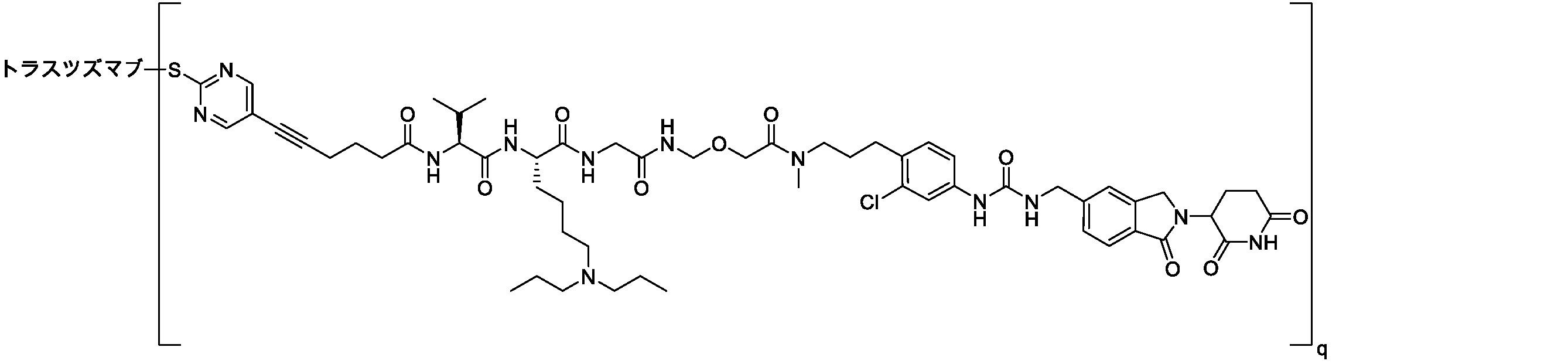

表において、LCは抗体軽鎖を表し、HCが抗体重鎖を表し、DAR1は軽鎖又は重鎖により複合された1つの薬物リンカーを含む複合体を表し、DAR2は軽鎖又は重鎖により複合された2つの薬物リンカーを含む複合体を表し、DAR3は軽鎖又は重鎖により複合された3つの薬物リンカーを含む複合体を表す。下記LC、HC、DAR1、DAR2、DAR3の説明は以上の通りである。 In the table, LC represents the antibody light chain, HC represents the antibody heavy chain, DAR1 represents a complex containing one drug linker conjugated to a light chain or a heavy chain, DAR2 represents a complex containing two drug linkers conjugated to a light chain or a heavy chain, and DAR3 represents a complex containing three drug linkers conjugated to a light chain or a heavy chain. The explanations of LC, HC, DAR1, DAR2, and DAR3 below are as above.
トラスツズマブ軽鎖を1つの毒素分子に複合し(LC+DAR1の比は100%)、重鎖を3つの毒素分子に複合し(HC+DAR3の比は100%)、それにより、HER2-ADC-001(DAR8)の抗体-薬物結合比(DAR値)は、8.0と計算された。 The trastuzumab light chain was conjugated to one toxin molecule (the ratio of LC+DAR1 was 100%) and the heavy chain was conjugated to three toxin molecules (the ratio of HC+DAR3 was 100%), so that the antibody-drug binding ratio (DAR value) of HER2-ADC-001 (DAR8) was calculated to be 8.0.
抗体-薬物結合比(DAR値)の検出方法:
ADC試料50μgを取り、超純水で0.5mg/mLに希釈した後、1 μLの1MのDTTを加え、均一に混合した後、遠心分離して上清を取ってサンプリング注入した。
Method for detecting antibody-drug binding ratio (DAR value):
50 μg of an ADC sample was diluted to 0.5 mg/mL with ultrapure water, and then 1 μL of 1 M DTT was added and mixed uniformly. The mixture was then centrifuged and the supernatant was collected and injected as a sample.
液相パラメータ:

質量分析パラメータ:

実施例5.2.2:HER2-ADC-002の調製
実施例5.2.1と同様の方法で、DL-2をDL-3に置換し、DL-3とトラスツズマブとの複合生成物HER2-ADC-002を得た。質量分析法により測定し、DAR値は8.0であった。
Example 5.2.2: Preparation of HER2-ADC-002 The same method as in Example 5.2.1 was used, except that DL-2 was replaced with DL-3 to obtain the conjugation product of DL-3 and trastuzumab, HER2-ADC-002, which had a DAR value of 8.0 as measured by mass spectrometry.


実施例5.2.3:HER2-ADC-003の調製
実施例5.2.1と同様の方法で、DL-2をDL-1に置換し、DL-1とトラスツズマブとの複合生成物HER2-ADC-003を得た。質量分析法により測定し、DAR値は8.0であった。


実施例5.2.4:HER2-ADC-004の調製
実施例5.2.1と同様の方法で、DL-2をDL-5に置換し、DL-5とトラスツズマブとの複合生成物HER2-ADC-004を得た。質量分析法により測定し、DAR値は8.0であった。
Example 5.2.4: Preparation of HER2-ADC-004 The same method as in Example 5.2.1 was used, except that DL-2 was replaced with DL-5 to obtain the conjugated product of DL-5 and trastuzumab, HER2-ADC-004, which had a DAR value of 8.0 as measured by mass spectrometry.


実施例5.2.5:HER2-ADC-005の調製
実施例5.2.1と同様の方法で、DL-2をDL-4に置換し、DL-4とトラスツズマブとの複合生成物HER2-ADC-005を得た。質量分析法により測定し、DAR値は7.0であった。
Example 5.2.5: Preparation of HER2-ADC-005 The same method as in Example 5.2.1 was used, except that DL-2 was replaced with DL-4 to obtain the conjugated product of DL-4 and trastuzumab, HER2-ADC-005, which had a DAR value of 7.0 as measured by mass spectrometry.


実施例5.2.6:HER2-ADC-006の調製

実施例5.2.1と同様の方法で、DL-2をDL-6に置換し、DL-6とトラスツズマブとの複合生成物HER2-ADC-006を得た。質量分析法により測定し、DAR値は9.0であった。
Example 5.2.6: Preparation of HER2-ADC-006
The same procedure as in Example 5.2.1 was used, substituting DL-6 for DL-2, to obtain the conjugation product of DL-6 and trastuzumab, HER2-ADC-006, which had a DAR value of 9.0 as measured by mass spectrometry.


実施例6.生物学的活性化合物(Payload)のインビトロ細胞活性試験
対照化合物1の構造は以下の通りである:

実施例6.1 N87、MCF7、NUGC4細胞増殖抑制活性に対する生物学的活性化合物(Payload)の試験
一、試験の方法:
N87(1640+10%FBS)、MCF7(DMEM+10%FBS+10μg/mLのインスリン)、NUGC4(1640+10%FBS)細胞を蘇生培養し、5000/ウェル、100μL/ウェルの密度で96ウェルの平底プレートに播種し、37℃のインキュベーターで一晩培養した。測定待ちのpayloadをDMSOで溶解し、分注して-80℃で凍結保存した。翌日、測定待ちのpayloadを、それぞれの完全培地を用いて、最高濃度が10000nMになるように希釈し、4倍で10点に希釈した。希釈後の薬物100μLを細胞培養ウェルに加えた(各ウェルに2本の並行)。37℃で4日間インキュベートした後、50μLのCell titer glo基質を各ウェルに加え、5分間インキュベートした後に蛍光値を検出した。そのうち、キー材料の供給元は表1に示される。
Example 6. In vitro cellular activity test of biologically active compounds (Payload) The structure of
Example 6.1 Test of biologically active compound (Payload) for the inhibitory activity against N87, MCF7, and NUGC4 cell proliferation. 1. Test method:
N87 (1640 + 10% FBS), MCF7 (DMEM + 10% FBS + 10 μg/mL insulin), NUGC4 (1640 + 10% FBS) cells were resuscitated and seeded in 96-well flat-bottom plates at a density of 5000/well, 100 μL/well, and incubated overnight in a 37°C incubator. The payloads awaiting measurement were dissolved in DMSO, aliquoted, and frozen at -80°C. The next day, the payloads awaiting measurement were diluted with the respective complete medium to a maximum concentration of 10000 nM, and diluted 4-fold to 10 points. 100 μL of diluted drug was added to cell culture wells (two parallels per well). After 4 days of incubation at 37°C, 50 μL of Cell titer glo substrate was added to each well, and fluorescence was detected after 5 minutes of incubation. Among them, the sources of key materials are shown in Table 1.

試験結果から、本開示のpayloadは、N87細胞、MCF7細胞及びNUGC4細胞に、何れも明らかな増殖抑制活性を有し、そのうち、PL-1及びPL-4の増殖抑制活性は対照化合物1よりも顕著に優れていることが示された。試験結果は表2に示される。
The test results showed that the payload of the present disclosure had clear growth inhibitory activity on all of N87 cells, MCF7 cells, and NUGC4 cells, and among them, the growth inhibitory activity of PL-1 and PL-4 was significantly superior to that of the

実施例7.抗体薬物複合体(ADC)のインビトロ細胞活性試験
実施例7.1 インビトロ細胞(NCI-H358腫瘍細胞)に対するADC増殖抑制活性試験
NCI-H358腫瘍細胞を、パンクレアチンを用いて通常の方法により消化し、細胞をチューブ内に収集してカウントし、対応する検出培地(2%FBS含有)で再懸濁し、5000細胞/ウェルを96ウェルプレートに加えた。2%FBS培地で希釈したADCを、96ウェルプレートに100μL加え、150μg/mLの濃度から開始し、3倍希釈した(12個の濃度勾配)。37℃で5%CO2で7日間培養した後、各ウェルにCCK8試薬20μLを加え、4時間反応させ、マイクロプレートリーダーで読み取った(検出波長が450nmである)。試験結果は、本開示のADC分子が腫瘍細胞殺傷効果を有することを示した。
Example 7. In Vitro Cell Activity Test of Antibody Drug Conjugates (ADC) Example 7.1 In Vitro Cell (NCI-H358 Tumor Cell) ADC Growth Inhibitory Activity Test NCI-H358 tumor cells were digested with pancreatin by a conventional method, cells were collected in a tube, counted, resuspended in the corresponding detection medium (containing 2% FBS), and 5000 cells/well were added to a 96-well plate. 100 μL of ADC diluted with 2% FBS medium was added to a 96-well plate, starting from a concentration of 150 μg/mL, and diluted 3-fold (12 concentration gradients). After culturing at 37° C. and 5% CO 2 for 7 days, 20 μL of CCK8 reagent was added to each well, reacted for 4 hours, and read by a microplate reader (detection wavelength is 450 nm). The test results showed that the ADC molecule of the present disclosure has a tumor cell killing effect.
実施例7.2:インビトロ細胞(N87腫瘍細胞)に対するADC増殖抑制活性試験
一、試験の方法:
N87細胞を1640+10%FBSで蘇生培養し、5000/ウェル、100μL/ウェルの密度で96ウェル平底プレートに播種し、37℃インキュベーターで一晩培養した。翌日、1640+10%FBSで測定待ちのADC分子を希釈し、測定待ちのADC分子-002の最高濃度が200nMであり、残りの4つの試料の最高濃度が2000nMであり、4倍で10点に希釈した。希釈後の薬物100μLを細胞培養ウェルに加えた。37℃で4日間インキュベートした後、50μLのCell titer glo基質を各ウェルに加え、5分間インキュベートした後に蛍光値を検出した。そのうち、キー材料の供給元は表3に示される。
Example 7.2: Antiproliferative activity test of ADC against cells (N87 tumor cells) in
N87 cells were resuscitated with 1640+10% FBS, seeded in a 96-well flat-bottom plate at a density of 5000/well, 100 μL/well, and cultured overnight in a 37°C incubator. The next day, the ADC molecules to be measured were diluted with 1640+10% FBS, the highest concentration of the ADC molecule-002 to be measured was 200nM, and the highest concentration of the remaining four samples was 2000nM, and they were diluted 4 times to 10 points. 100 μL of the diluted drug was added to the cell culture well. After incubation at 37°C for 4 days, 50 μL of Cell titer glo substrate was added to each well, and the fluorescence value was detected after incubation for 5 minutes. The sources of the key materials are shown in Table 3.

二、実験の結論:
試験結果は、本開示のADC分子は、N87腫瘍細胞株において何れも明らかな増殖抑制活性を有することを示した。試験結果は表4に示される。
Second, conclusions of the experiment:
The test results showed that the ADC molecules of the present disclosure all had significant growth inhibitory activity in the N87 tumor cell line. The test results are shown in Table 4.

実施例8.抗体薬物複合体(ADC)のインビボ活性試験
実施例8.1 NCI-N87移植腫瘍に対する抗体薬物複合体(ADC)の薬効実験(投与量1mg/kg)
1.実験材料
試験化合物:HER2-ADC-001、HER2-ADC-003、HER2-ADC-006であり、生理食塩水を陰性対照とした。
実験細胞:NCI-N87細胞、南京科佰生物から購入。
実験動物:Balb/c nuヌードマウス、雌、5~6週齢、維通利華実験動物有限公司から購入。
Example 8. In vivo activity test of antibody-drug conjugates (ADC) Example 8.1 Efficacy test of antibody-drug conjugates (ADC) against NCI-N87 transplanted tumors (
1. Experimental Materials Test compounds: HER2-ADC-001, HER2-ADC-003, HER2-ADC-006, and saline was used as a negative control.
Experimental cells: NCI-N87 cells, purchased from Nanjing Kebai Biological Products.
Experimental animals: Balb/c nu nude mice, female, 5-6 weeks old, purchased from Weitong Lihua Laboratory Animal Co., Ltd.
2.実験計画
2.1.細胞の処理
NCI-N87細胞を、10%FBSを含む1640培地で、直径15cmの培養皿に培養し、約80%~90%の融合度に達した時、トリプシン-EDTAで消化し、PBSで2回洗浄した後、遠心分離し、予冷したPBSに再懸濁し、細胞カウンターでカウントし、PBSを希釈して細胞濃度を5×10⁷/mLとした。
2.2.腫瘍細胞の移植
Balb/c nuマウスを実験室環境に2~5日間適応させ、右脇部にNCI-N87細胞を皮下接種し、接種細胞量は5×10⁶/匹であり、接種体積は0.2mL(50%のMatrigelを含む)であり、腫瘍が約200mm3に成長した時、実験を行った。
2.3.動物投与及び検出
群に入れた担腫瘍ヌードマウスは、以下の方法に従って投与された:

週2回腫瘍体積及び体重を測定し、T/C%及びTGI(%)を計算し、計算式は、相対腫瘍増殖率T/C(%)=TRTV/CRTV×100%(TRTV:治療群平均RTV、CRTV:対照群平均RTV、RTV=Vt/V0、V0は群分けした時の当該動物の腫瘍体積であり、Vtは治療後の当該動物の腫瘍体積である)であり、相対腫瘍抑制率TGI%=(1-T/C)×100%(T及びCは、それぞれ、ある特定の時点における治療群及び対照群の相対腫瘍体積(RTV)である)。
腫瘍体積(V)計算式は:V=1/2×L長×L短2であり、式中、L長、L短はそれぞれ腫瘍の長径、短径を表す。
2. Experimental Design 2.1. Cell Treatment NCI-N87 cells were cultured in 15 cm culture dishes in 1640 medium containing 10% FBS. When they reached approximately 80% to 90% confluence, they were digested with trypsin-EDTA, washed twice with PBS, centrifuged, resuspended in pre-chilled PBS, counted in a cell counter, and diluted with PBS to a cell concentration of 5 x 10⁷ /mL.
2.2. Tumor cell transplantation Balb/c nu mice were adapted to the laboratory environment for 2 to 5 days, and then subcutaneously inoculated with NCI-N87 cells in the right flank. The amount of inoculated cells was 5 x 10⁶ /mouse, and the inoculation volume was 0.2 mL (containing 50% Matrigel). When the tumors grew to approximately 200 mm3 , the experiment was performed.
2.3. Animal treatment and detection. Tumor-bearing nude mice were placed in groups and treated according to the following method:
Tumor volume and body weight were measured twice a week, and T/C% and TGI(%) were calculated using the following formula: relative tumor growth rate T/C(%)=TRTV/CRTV×100% (TRTV: mean RTV of treatment group, CRTV: mean RTV of control group, RTV=Vt/V0, V0 is the tumor volume of the animal at the time of grouping, and Vt is the tumor volume of the animal after treatment); and relative tumor inhibition rate TGI%=(1−T/C)×100% (T and C are the relative tumor volumes (RTV) of the treatment group and control group at a certain time point, respectively).
The formula for calculating tumor volume (V) is: V = 1/2 x L long x L short 2 , where L long and L short represent the long and short diameters of the tumor, respectively.
3.実験結果
試験結果は、本開示のADCが何れも比較的明らかな腫瘍抑制効果を示し、そのうち、HER2-ADC-001及びHER2-ADC-003の腫瘍抑制効果が対照化合物HER2-ADC-006より顕著に優れていることを示した。投与期間において、各群の動物は、明らかな体重減少及び明らかな薬物毒性がなかった。具体的な結果を表6、図7A及び図7Bに示される。
3. Experimental Results The test results showed that all of the ADCs of the present disclosure exhibited relatively obvious tumor-inhibiting effects, and among them, the tumor-inhibiting effects of HER2-ADC-001 and HER2-ADC-003 were significantly superior to that of the control compound HER2-ADC-006. During the administration period, the animals in each group did not suffer from obvious weight loss or obvious drug toxicity. Specific results are shown in Table 6, Figures 7A and 7B.
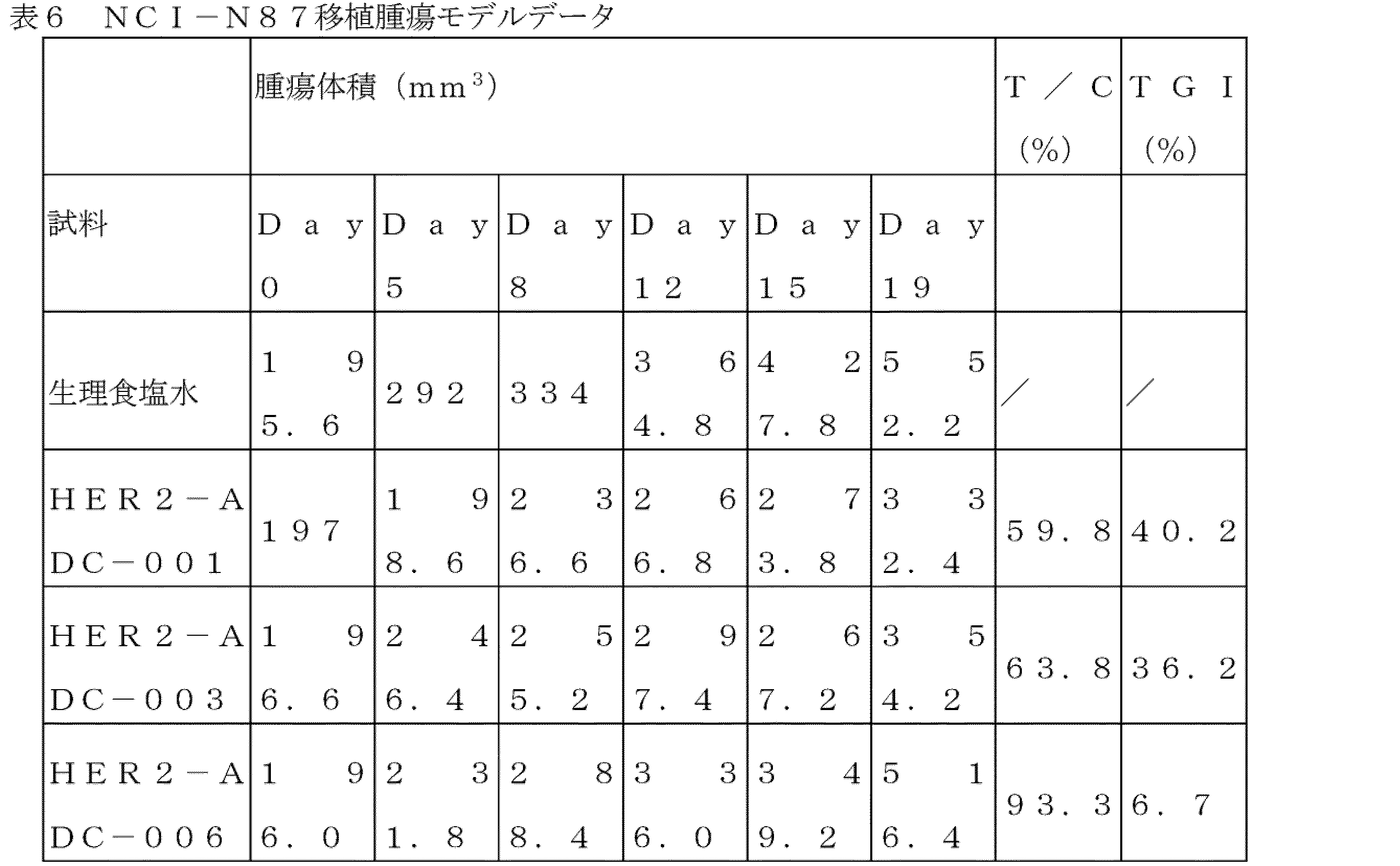
実施例8.2 NCI-N87移植腫瘍に対する抗体薬物複合体(ADC)の薬効実験(投与量2mg/kg及び6mg/kg)
1.実験材料
試験化合物:HER2-ADC-001、HER2-ADC-003であり、生理食塩水を陰性対照とした。
実験細胞:NCI-N87細胞、南京科佰生物から購入。
実験動物:Balb/c nuヌードマウス、雌、5~6週齢、維通利華実験動物有限公司から購入。
Example 8.2 Efficacy study of antibody-drug conjugates (ADCs) against NCI-N87 tumor transplants (dosages of 2 mg/kg and 6 mg/kg)
1. Experimental Materials Test compounds: HER2-ADC-001, HER2-ADC-003, and saline was used as a negative control.
Experimental cells: NCI-N87 cells, purchased from Nanjing Kebai Biological Products.
Experimental animals: Balb/c nu nude mice, female, 5-6 weeks old, purchased from Weitong Lihua Laboratory Animal Co., Ltd.
2.実験計画
2.1.細胞の処理
NCI-N87細胞を、10%FBSを含む1640培地で、直径15cmの培養皿に培養し、約80%~90%の融合度に達した時、トリプシン-EDTAで消化し、PBSで2回洗浄した後、遠心分離し、予冷したPBSに再懸濁し、細胞カウンターでカウントし、PBSを希釈して細胞濃度を5×10⁷/mLとした。
2.2.腫瘍細胞の移植
Balb/c nuマウスを実験室環境に2~5日間適応させ、右脇部にNCI-N87細胞を皮下接種し、接種細胞量は5×10⁶/匹であり、接種体積は0.2mL(50%のMatrigelを含む)であり、腫瘍が約165mm3に成長した時、実験を行った。
2.3.動物投与及び検出
群に入れた担腫瘍ヌードマウスは、以下の方法に従って投与された:

週2回腫瘍体積及び体重を測定し、T/C%及びTGI(%)を計算し、計算式は、相対腫瘍増殖率T/C(%)=TRTV/CRTV×100%(TRTV:治療群平均RTV、CRTV:対照群平均RTV、RTV=Vt/V0、V0は群分けした時の当該動物の腫瘍体積、Vtは治療後の当該動物の腫瘍体積である)であり、相対腫瘍抑制率TGI%=(1-T/C)×100%(T及びCは、それぞれ、ある特定の時点における治療群及び対照群の相対腫瘍体積(RTV)である)。
腫瘍体積(V)計算式は:V=1/2×L長×L短2であり、式中、L長、L短はそれぞれ腫瘍の長径、短径を表す。
2. Experimental Design 2.1. Cell Treatment NCI-N87 cells were cultured in 15 cm culture dishes in 1640 medium containing 10% FBS. When they reached approximately 80% to 90% confluence, they were digested with trypsin-EDTA, washed twice with PBS, centrifuged, resuspended in pre-chilled PBS, counted in a cell counter, and diluted with PBS to a cell concentration of 5 x 10⁷ /mL.
2.2. Tumor cell transplantation Balb/c nu mice were adapted to the laboratory environment for 2 to 5 days, and then subcutaneously inoculated with NCI-N87 cells in the right flank. The amount of inoculated cells was 5 x 10⁶ per mouse, and the inoculation volume was 0.2 mL (containing 50% Matrigel). When the tumor grew to approximately 165 mm3 , the experiment was performed.
2.3. Animal treatment and detection. Tumor-bearing nude mice were placed in groups and treated according to the following method:
The formula for calculating tumor volume (V) is: V = 1/2 x L long x L short 2 , where L long and L short represent the long and short diameters of the tumor, respectively.
3.実験結果
試験結果は、本開示のADCが何れも比較的明らかな腫瘍抑制効果を示し、そのうち、HER2-ADC-001の2mg/kgでの腫瘍抑制率が62.47%であり、6mg/kgでの腫瘍抑制率が98.30%であり、HER2-ADC-003の2mg/kgでの腫瘍抑制率が44.08%であり、6mg/kgでの腫瘍抑制率が94.15%であることを示した。投与期間において、各群の動物は、明らかな体重減少及び明らかな薬物毒性がなかった。具体的な結果を表8、図8A及び図8Bに示される。
3. Experimental Results The test results showed that all of the ADCs of the present disclosure showed relatively clear tumor inhibition effects, of which HER2-ADC-001 had a tumor inhibition rate of 62.47% at 2 mg/kg and 98.30% at 6 mg/kg, and HER2-ADC-003 had a tumor inhibition rate of 44.08% at 2 mg/kg and 94.15% at 6 mg/kg. During the administration period, the animals in each group did not suffer from obvious weight loss or obvious drug toxicity. Specific results are shown in Table 8, Figures 8A and 8B.

実施例9 ADC血漿安定性試験
溶液調製:実施例5で調製した各ADCを、PBSで2mg/mLの濃度に希釈した。
Example 9 ADC Plasma Stability Test Solution preparation: Each ADC prepared in Example 5 was diluted with PBS to a concentration of 2 mg/mL.
試料のインキュベーション:静菌剤ProClinをヒト血漿に加え、ProClinの最終濃度が0.1%であり、無菌的に操作した。実施例5で調製した各ADCを、それぞれ終濃度200μg/mLで上記の無菌血漿に加え、37℃細胞インキュベーターに置いて、振動速度80回/分間でインキュベートした。0日間、14日間インキュベートし、ADC試料を取り出し、各チューブに100μLのProteinAを加え、2h吸着し、溶出し、インキュベーション後のADCを得た。インキュベーション後のADCについてDAR値検出(検出及び計算方法は実施例5.2.1と同じ)を行い、試験試料の血漿安定性を判定した。 Sample incubation: The bacteriostatic agent ProClin was added to human plasma, and the final concentration of ProClin was 0.1%, and the procedure was performed aseptically. Each ADC prepared in Example 5 was added to the above-mentioned sterile plasma at a final concentration of 200 μg/mL, and incubated in a 37°C cell incubator at a vibration speed of 80 times/min. After incubation for 0 and 14 days, the ADC samples were taken out, 100 μL of Protein A was added to each tube, adsorbed for 2 hours, and eluted to obtain the ADC after incubation. DAR value detection (detection and calculation method is the same as in Example 5.2.1) was performed on the ADC after incubation, and the plasma stability of the test sample was determined.
試験結果は、実施例5で調製した各ADCが血漿インキュベーション過程において、DAR値が基本的に維持され、マレイミドリンカーを有するADC(例えば、対照化合物HER2-ADC-006)はインキュベーション14日後にDAR値が明らかなに低下することを示した。このことから、本発明によって提供されるADCは何れも、より良好な血漿安定性を有し、従って非標的組織における生物学的活性化合物の脱落を低減できることを示した。 The test results showed that the DAR value of each ADC prepared in Example 5 was basically maintained during the plasma incubation process, and the DAR value of the ADC having a maleimide linker (e.g., the control compound HER2-ADC-006) was obviously reduced after 14 days of incubation. This indicated that all the ADCs provided by the present invention have better plasma stability, and therefore can reduce the loss of biologically active compounds in non-target tissues.
実施例10 腫瘍組織ホモジネート液、筋肉組織ホモジネート液における抗体薬物複合体の安定性試験
特許WO2022/170971A1の実施例6.11を参照し、実施例5で調製した各ADCの腫瘍組織/腫瘍微小環境における溶解を模擬し、実施例5で調製した各ADCの22RV1 Balb/c nuヌードマウス腫瘍組織ホモジネート液、Balb/cマウス筋肉組織ホモジネート液、ホモジネート液マトリックス生理食塩水における安定性をインビトロで調べ、インキュベーション系でpayloadを測定した。腫瘍組織ホモジネート液の結果を血漿安定性の結果と比較し、腫瘍組織/腫瘍微小環境におけるpayloadの放出効率を評価した。
Example 10 Stability test of antibody-drug conjugate in tumor tissue homogenate and muscle tissue homogenate Referring to Example 6.11 of WO2022/170971A1, the dissolution of each ADC prepared in Example 5 in tumor tissue/tumor microenvironment was simulated, and the stability of each ADC prepared in Example 5 in 22RV1 Balb/c nu nude mouse tumor tissue homogenate, Balb/c mouse muscle tissue homogenate, and homogenate matrix saline was investigated in vitro, and payload was measured in an incubation system. The results of tumor tissue homogenate were compared with the results of plasma stability, and the release efficiency of payload in tumor tissue/tumor microenvironment was evaluated.
試験結果は、実施例5で調製した各ADCが、腫瘍組織ホモジネート液に、大量のpayloadを放出できるが、正常組織ホモジネート液の場合には、明らかな放出はないことを示した。従って、本発明によって提供されるADCは、腫瘍部位での生物学的活性化合物の効率的な放出を増加させることができるため、より高い治療指数を有することを示した。 The test results showed that each ADC prepared in Example 5 could release a large amount of payload into the tumor tissue homogenate, but there was no obvious release into the normal tissue homogenate. Therefore, the ADC provided by the present invention showed a higher therapeutic index because it could increase the efficient release of biologically active compounds at the tumor site.
特に断らない限り、本発明で使用される用語は何れも当業者に一般的に理解される意味を有する。 Unless otherwise specified, all terms used herein have the meaning commonly understood by those skilled in the art.
本発明に記載の実施形態は、例示的な目的のみに用いられ、本発明の請求範囲を限定するものではなく、当業者は、本発明の範囲内で様々な他の置換、変更及び改良を行うことができ、従って、本発明は上記実施形態に限定されず、請求項のみによって限定される。 The embodiments described in the present invention are used for illustrative purposes only and do not limit the scope of the claims of the present invention. Those skilled in the art can make various other substitutions, modifications and improvements within the scope of the present invention. Therefore, the present invention is not limited to the above embodiments, but is limited only by the claims.
Claims (24)

Tbは、抗体又はその抗原結合断片であり、
qは、L1-L2-L3-L4-DにカップリングしたTbの数であり、
Dは、タンパク質分解剤クラスの生物学的活性化合物の断片であり、
L1は、リンカーユニットであり、
L2は、連結ユニットであり、
L3は、AA1に示されるアミノ酸残基、又はAA1に示されるアミノ酸残基を含む2~10個のアミノ酸残基からなるショートペプチドから選ばれ、前記アミノ酸残基は、天然アミノ酸残基、非天然アミノ酸残基、AA1に示されるアミノ酸残基、又はその立体異性体から選ばれ、
AA1に示されるアミノ酸残基の構造は以下の通りである:

Ra、Rbは、それぞれ独立的に、水素又は

或いは、Ra及びRbは、それらに共通に連結している炭素原子と共に、4~10員複素環を形成し、前記4~10員複素環は、1個又は複数のR0によって任意選択的に置換され、
r、r1は、それぞれ独立的に、0~20の間の任意の整数から選ばれ、
Rm1、Rn1は、それぞれ独立的に、水素、C1-6アルキル基、又はC3-6シクロアルキル基から選ばれ、
或いは、Rm1及びRn1は、それらに共通に連結している窒素原子と共に、4~10員複素環を形成し、前記4~10員複素環は、1個又は複数のR0’によって任意選択的に置換され、
R0、R0’は、それぞれ独立的に、C1-6アルキル基、C3-6シクロアルキル基、-NRm2Rn2、又はC1-6アルキル基によって任意選択的に置換された4~10員複素環基から選ばれ、
Rm2、Rn2は、それぞれ独立的に、水素、又はC1-6アルキル基から選ばれ、
L4は存在しないか又は存在し、L4が存在する場合、L4は、

又は前記抗体薬物複合体の立体異性体、そのプロドラッグ、その薬学的に許容される塩、若しくはその薬学的に許容される溶媒和物。 An antibody-drug conjugate as shown in formula (I):
Tb is an antibody or an antigen-binding fragment thereof;
q is the number of Tb coupled to L 1 -L 2 -L 3 -L 4 -D;
D is a fragment of a biologically active compound of the proteolytic agent class;
L1 is a linker unit,
L2 is a linking unit;
L3 is selected from an amino acid residue represented by AA1 or a short peptide consisting of 2 to 10 amino acid residues including the amino acid residue represented by AA1 , and the amino acid residue is selected from a natural amino acid residue, a non-natural amino acid residue, an amino acid residue represented by AA1 , or a stereoisomer thereof;
The structures of the amino acid residues shown in AA 1 are as follows:
R a and R b each independently represent hydrogen or
or R a and R b together with the carbon atom to which they are commonly attached form a 4- to 10-membered heterocycle, said 4- to 10-membered heterocycle being optionally substituted by one or more R 0;
r and r1 are each independently selected from any integer between 0 and 20;
R m1 and R n1 are each independently selected from hydrogen, a C1-6 alkyl group, or a C3-6 cycloalkyl group;
or R m1 and R n1 together with the nitrogen atom to which they are commonly attached form a 4- to 10-membered heterocycle, said 4- to 10-membered heterocycle being optionally substituted by one or more R 0' ;
R 0 and R 0' are each independently selected from a C1-6 alkyl group, a C3-6 cycloalkyl group, -NR m2 R n2 , or a 4- to 10-membered heterocyclic group optionally substituted by a C1-6 alkyl group;
R m2 and R n2 are each independently selected from hydrogen or a C1-6 alkyl group;
L4 is absent or present, and when L4 is present, L4 is
Or a stereoisomer of the antibody-drug conjugate, a prodrug thereof, a pharma- ceutically acceptable salt thereof, or a pharma- ceutically acceptable solvate thereof.
(1)前記qは、0.1~12.0の間の任意の数値から選ばれ、好ましくは、前記qは、1.0~10.0の間の任意の数値から選ばれ、より好ましくは、前記qは、1、2、3、4、5、6、7、8、9、又は10から選ばれ、
(2)前記L1は、

(3)前記L2は、

好ましくは、前記L2は、

(4)前記nは、0~10の間の任意の整数から選ばれ、好ましくは、前記nは、0、1、2又は3から選ばれ、
(5)前記Yは、-CH2-又は-OCH2CH2-から選ばれ、
(6)前記Xは、-CRmRn-、又は-NRm-から選ばれ、
(7)前記Rm、Rnは、それぞれ独立的に、水素、C1-4アルキル基、C2-4アルケニル基、C2-4アルキニル基、C3-6シクロアルキル基、又は3~6員複素環基から選ばれ、
或いは、前記Rm及びRnは、それらに共通に連結している炭素原子と共に、3~6員炭素環、又は3~6員複素環を形成し、
好ましくは、前記Rm、Rnは、それぞれ独立的に、水素又はメチル基から選ばれ、
(8)前記L3は、AA1に示されるアミノ酸残基又はAA1に示されるアミノ酸残基を含むジペプチド、トリペプチド、若しくはテトラペプチドから選ばれ、好ましくは、前記L3は、AA1、Val-AA1、Ala-AA1、Gly-AA1、AA1-Gly、AA1-Ala、Val-AA1-Gly、Ala-AA1-Gly、Gly-AA1-Gly、又はVal-AA1-Alaに示されるアミノ酸残基、ジペプチド、若しくはトリペプチドから選ばれ、より好ましくは、前記L3は、Val-AA1、Val-AA1-Ala又はVal-AA1-Glyに示されるジペプチド、若しくはトリペプチドから選ばれ、特に好ましくは、L3は、Val-AA1-Glyに示されるトリペプチドであり、
(9)前記Ra、Rbのうち、何れか一方がHであり、他方が

(10)前記r、r1は、それぞれ独立的に、0、1、2、3、4、又は5から選ばれ、
好ましくは、前記r、r1は、それぞれ独立的に、0又は4から選ばれ、
より好ましくは、前記rは0であり、前記r1は4であり、
(11)前記Rm1、Rn1は、それぞれ独立的に、水素又はC1-6アルキル基から選ばれ、或いは、前記Rm1及びRn1は、それらに共通に連結している窒素原子と共に、R0’で任意選択的に置換された5~6員複素環を形成し、
好ましくは、前記Rm1、Rn1は、それぞれ独立的に、水素、メチル基、エチル基、n-プロピル基、又はn-ブチル基から選ばれ、或いは、前記Rm1及びRn1は、それらに共通に連結している窒素原子と共に、R0’で任意選択的に置換されたピペリジン環又はピペラジン環を形成し、より好ましくは、前記Rm1、Rn1は、それぞれ独立的に、メチル基、エチル基、n-プロピル基、又はn-ブチル基から選ばれ、
(12)前記R0、R0’は、それぞれ独立的に、C1-6アルキル基、-NRm2Rn2、又はC1-6アルキル基で任意選択的に置換された5~6員複素環基から選ばれ、
(13)前記Rm2、Rn2はメチル基であり、
(14)前記タンパク質分解剤クラスの生物学的活性化合物は、GSPT1ファミリータンパク質の分解をもたらすことができる分子である、
ことを特徴とする、請求項1に記載の抗体薬物複合体、又は前記抗体薬物複合体の立体異性体、そのプロドラッグ、その薬学的に許容される塩、若しくはその薬学的に許容される溶媒和物。 One or more of the following conditions are met:
(1) The q is selected from any number between 0.1 and 12.0, preferably, the q is selected from any number between 1.0 and 10.0, more preferably, the q is selected from 1, 2, 3, 4, 5, 6, 7, 8, 9, or 10;
(2) The L1 is
(3) L2 is
Preferably, L2 is
(4) The n is selected from any integer between 0 and 10, and preferably, the n is selected from 0, 1, 2, or 3;
(5) said Y is selected from -CH 2 - or -OCH 2 CH 2 -;
(6) The X is selected from -CR m R n - or -NR m -;
(7) R m and R n are each independently selected from hydrogen, a C1-4 alkyl group, a C2-4 alkenyl group, a C2-4 alkynyl group, a C3-6 cycloalkyl group, or a 3- to 6-membered heterocyclic group;
or R m and R n together with the carbon atom to which they are commonly attached form a 3- to 6-membered carbocyclic ring or a 3- to 6-membered heterocyclic ring;
Preferably, R m and R n are each independently selected from hydrogen or a methyl group;
(8) L 3 is selected from an amino acid residue represented by AA 1 or a dipeptide, tripeptide, or tetrapeptide containing the amino acid residue represented by AA 1 , preferably L 3 is selected from an amino acid residue , dipeptide, or tripeptide represented by AA 1 , Val-AA 1 , Ala-AA 1 , Gly-AA 1 , AA 1 - Gly, AA 1- Ala, Val-AA 1 -Gly, Ala-AA 1 -Gly, Gly-AA 1-Gly, or Val-AA 1 -Ala, more preferably L 3 is selected from a dipeptide or tripeptide represented by Val-AA 1 , Val-AA 1-Ala, or Val-AA 1 -Gly, particularly preferably L 3 is a tripeptide represented by Val-AA 1 -Gly,
(9) Either one of R a and R b is H, and the other is
(10) The r and r1 are each independently selected from 0, 1, 2, 3, 4, or 5;
Preferably, r and r1 are each independently selected from 0 or 4;
More preferably, r is 0 and r1 is 4;
(11) R m1 and R n1 are each independently selected from hydrogen or a C1-6 alkyl group, or R m1 and R n1 together with the nitrogen atom commonly bonded thereto form a 5- to 6-membered heterocycle optionally substituted with R 0' ;
Preferably, R m1 and R n1 are each independently selected from hydrogen, a methyl group, an ethyl group, an n-propyl group, or an n-butyl group; or R m1 and R n1 together with the nitrogen atom commonly bonded thereto form a piperidine ring or a piperazine ring optionally substituted with R 0' ; more preferably, R m1 and R n1 are each independently selected from a methyl group, an ethyl group, an n-propyl group, or an n-butyl group;
(12) The R 0 and R 0' are each independently selected from a C1-6 alkyl group, -NR m2 R n2 , or a 5- to 6-membered heterocyclic group optionally substituted with a C1-6 alkyl group;
(13) The R m2 and R n2 each represent a methyl group;
(14) The biologically active compounds of the protein degrader class are molecules capable of causing degradation of GSPT1 family proteins.
The antibody-drug conjugate according to claim 1, or a stereoisomer of the antibody-drug conjugate, a prodrug thereof, a pharma- ceutically acceptable salt thereof, or a pharma- ceutically acceptable solvate thereof.
(1)前記L1-L2は、

好ましくは、前記L1-L2は、

(2)前記L3は、

好ましくは、前記L3は、

(3)前記AA1に示されるアミノ酸残基は、

好ましくは、前記AA1に示されるアミノ酸残基は、
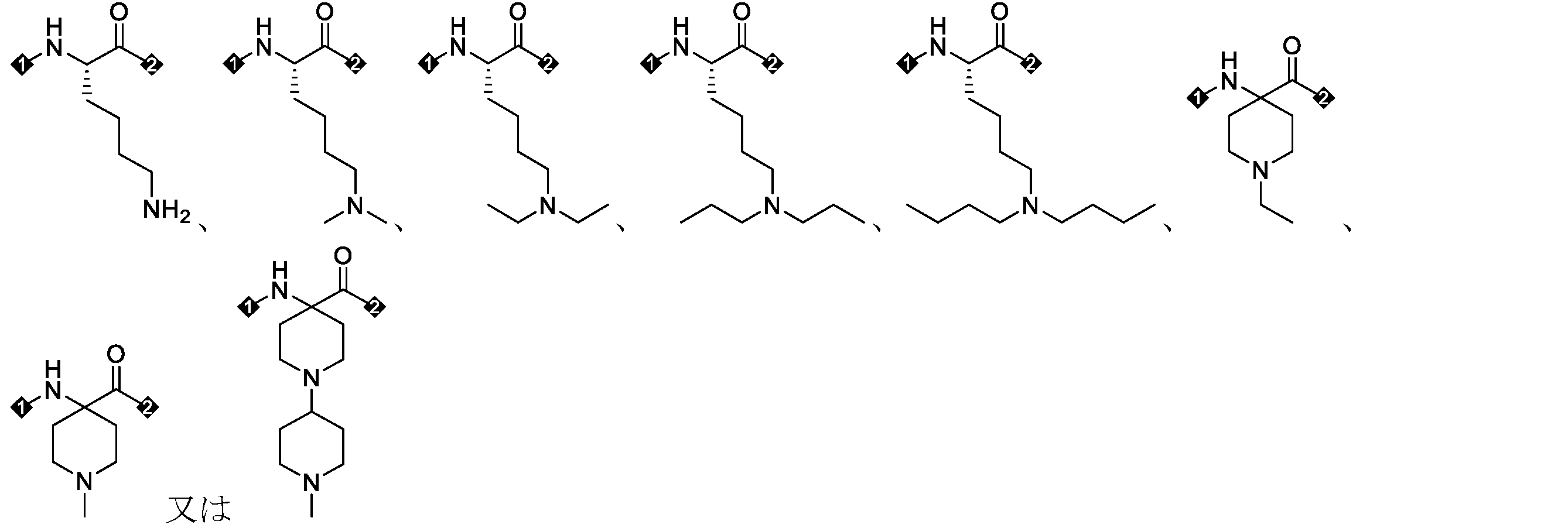
ことを特徴とする、請求項1又は2に記載の抗体薬物複合体、又は前記抗体薬物複合体の立体異性体、そのプロドラッグ、その薬学的に許容される塩、若しくはその薬学的に許容される溶媒和物。 One or more of the following conditions are met:
(1) The L 1 -L 2 is
Preferably, L 1 -L 2 are
(2) The L3 is
Preferably, L3 is
(3) The amino acid residue shown in AA 1 is
Preferably, the amino acid residue shown in AA 1 is
3. The antibody-drug conjugate according to claim 1 or 2, or a stereoisomer of the antibody-drug conjugate, a prodrug thereof, a pharma- ceutically acceptable salt thereof, or a pharma- ceutically acceptable solvate thereof.


好ましくは、


より好ましくは、

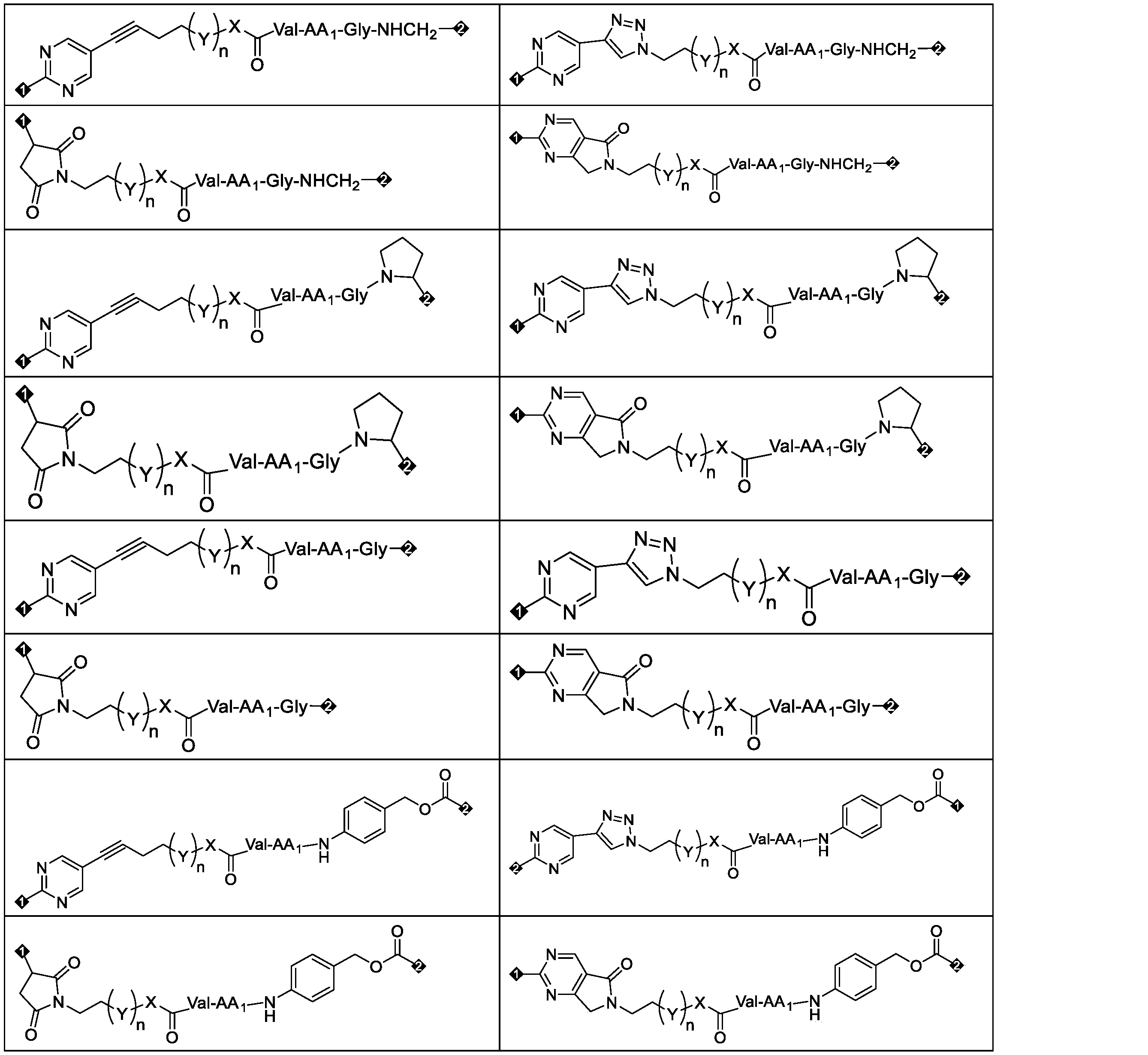
更に好ましくは、


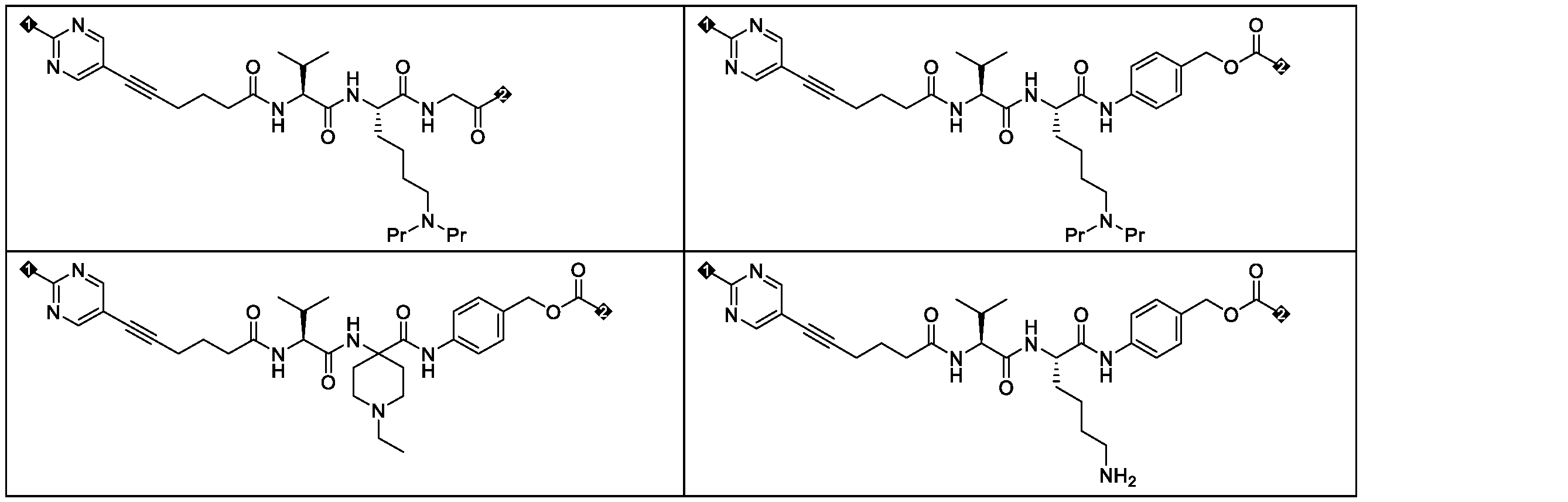
ことを特徴とする、請求項1~3の何れか一項に記載の抗体薬物複合体、又は前記抗体薬物複合体の立体異性体、そのプロドラッグ、その薬学的に許容される塩、若しくはその薬学的に許容される溶媒和物。
Preferably,
More preferably,
More preferably,
The antibody-drug conjugate according to any one of claims 1 to 3, or a stereoisomer of the antibody-drug conjugate, a prodrug thereof, a pharma- ceutically acceptable salt thereof, or a pharma- ceutically acceptable solvate thereof.

R1は、水素、重水素、ハロゲン、シアノ基、アミノ基、ニトロ基、C1-4アルコキシ基、又はC1-4アルキル基から選ばれ、
Zは、-NH-、-CR2aR3a-、又は-C(O)-から選ばれ、
R2a、R3aは、それぞれ独立的に、F又はOHから選ばれ、
U1、U2は、それぞれ独立的に-CH2-又は-C(O)-から選ばれ、且つU1、U2は同時に-CH2-ではなく、
AはO、S、NR9、

或いは、R2、R3は、それらに連結している炭素原子と共に、3~7員炭素環又は3~7員複素環を形成し、
R4、R5は、それらに連結している炭素原子及び窒素原子と共に、4~7員複素環を形成し、
R5、R6は、それらに連結している炭素原子と共に、3~7員炭素環又は3~7員複素環を形成し、
R7、R8は、それらに連結している炭素原子と共に、3~7員炭素環又は3~7員複素環を形成し、
m、p、yは、それぞれ独立的に、0~8の間の任意の整数から選ばれ、
W、Vはそれぞれ独立的に、直接結合、O、S、又はNR9から選ばれ、
R9は、水素、重水素、C1-4アルキル基、又はC3-6シクロアルキル基から選ばれる、
ことを特徴とする、請求項1~4の何れか一項に記載の抗体薬物複合体、又は前記抗体薬物複合体の立体異性体、そのプロドラッグ、その薬学的に許容される塩、若しくはその薬学的に許容される溶媒和物。 D is a structural unit as shown in formula II, in which the 1-position is linked to L4 or L3 ;
R 1 is selected from hydrogen, deuterium, halogen, a cyano group, an amino group, a nitro group, a C1-4 alkoxy group, or a C1-4 alkyl group;
Z is selected from -NH-, -CR 2a R 3a -, or -C(O)-;
R 2a and R 3a are each independently selected from F or OH;
U 1 and U 2 are each independently selected from —CH 2 — or —C(O)—, and U 1 and U 2 are not simultaneously —CH 2 —;
A is O, S, NR 9 ,
or R 2 and R 3 together with the carbon atom to which they are attached form a 3- to 7-membered carbocyclic or heterocyclic ring;
R 4 and R 5 together with the carbon atom and nitrogen atom to which they are attached form a 4- to 7-membered heterocycle;
R 5 and R 6 together with the carbon atom to which they are linked form a 3- to 7-membered carbocyclic or 3- to 7-membered heterocyclic ring;
R 7 and R 8 together with the carbon atom to which they are attached form a 3- to 7-membered carbocyclic or 3- to 7-membered heterocyclic ring;
m, p, and y are each independently selected from any integer between 0 and 8;
W and V are each independently selected from a direct bond, O, S, or NR9 ;
R 9 is selected from hydrogen, deuterium, a C1-4 alkyl group, or a C3-6 cycloalkyl group;
The antibody-drug conjugate according to any one of claims 1 to 4, or a stereoisomer of the antibody-drug conjugate, a prodrug thereof, a pharma- ceutically acceptable salt thereof, or a pharma- ceutically acceptable solvate thereof.
(1)前記R1は、水素、ハロゲン、又はC1-4アルキル基から選ばれ、好ましくは、前記R1はハロゲンであり、
(2)前記Zは-NH-であり、
(3)前記U1、U2は、それぞれ独立的に、-CH2-又は-C(O)-から選ばれ、且つU1、U2は同一ではなく、好ましくは、前記U1は-CH2-であり、前記U2は-C(O)-であり、
(4)前記Aは

(5)前記Wは、O、S又はNR9から選ばれ、好ましくは、前記WはOであり、
(6)前記Vは、直接結合、O、S、又はNR9から選ばれ、好ましくは、前記Vは、直接結合又はOから選ばれ、
(7)前記R2、R3、R4、R5、R6、R7、R8は、それぞれ独立的に、水素、重水素、又はC1-4アルキル基から選ばれ、
(8)前記m、p、yは、それぞれ独立的に、0、1、2、3、又は4から選ばれ、
(9)前記R9は、水素、重水素、又はメチル基から選ばれる、
ことを特徴とする、請求項5に記載の抗体薬物複合体、又は前記抗体薬物複合体の立体異性体、そのプロドラッグ、その薬学的に許容される塩、若しくはその薬学的に許容される溶媒和物。 One or more of the following conditions are met:
(1) R 1 is selected from hydrogen, halogen, or a C1-4 alkyl group, and preferably, R 1 is halogen;
(2) the Z is -NH-,
(3) each of U 1 and U 2 is independently selected from -CH 2 - or -C(O)-, and U 1 and U 2 are not the same, and preferably, U 1 is -CH 2 - and U 2 is -C(O)-;
(4) The above A is
(5) said W is selected from O, S or NR9 , preferably said W is O;
(6) The V is selected from a direct bond, O, S, or NR 9 , preferably, the V is selected from a direct bond or O;
(7) R 2 , R 3 , R 4 , R 5 , R 6 , R 7 , and R 8 are each independently selected from hydrogen, deuterium, and a C1-4 alkyl group;
(8) m, p, and y are each independently selected from 0, 1, 2, 3, or 4;
(9) The R 9 is selected from hydrogen, deuterium, and a methyl group;
The antibody-drug conjugate according to claim 5, or a stereoisomer of the antibody-drug conjugate, a prodrug thereof, a pharma- ceutically acceptable salt thereof, or a pharma- ceutically acceptable solvate thereof.

ことを特徴とする、請求項5又は6に記載の抗体薬物複合体、又は前記抗体薬物複合体の立体異性体、そのプロドラッグ、その薬学的に許容される塩、若しくはその薬学的に許容される溶媒和物。 D is a structural unit shown in II-1, II-2, or II-3;
The antibody-drug conjugate according to claim 5 or 6, or a stereoisomer of the antibody-drug conjugate, a prodrug thereof, a pharma- ceutically acceptable salt thereof, or a pharma- ceutically acceptable solvate thereof.


ことを特徴とする、請求項1~8の何れか一項に記載の抗体薬物複合体、又は前記抗体薬物複合体の立体異性体、そのプロドラッグ、その薬学的に許容される塩、若しくはその薬学的に許容される溶媒和物。 The antibody-drug conjugate has the structure shown in formula III:
The antibody-drug conjugate according to any one of claims 1 to 8, or a stereoisomer of the antibody-drug conjugate, a prodrug thereof, a pharma- ceutically acceptable salt thereof, or a pharma- ceutically acceptable solvate thereof.


ことを特徴とする、請求項1~9の何れか一項に記載の抗体薬物複合体、又は前記抗体薬物複合体の立体異性体、そのプロドラッグ、その薬学的に許容される塩、若しくはその薬学的に許容される溶媒和物。 The antibody-drug conjugate is selected from the group consisting of:
The antibody-drug conjugate according to any one of claims 1 to 9, or a stereoisomer of the antibody-drug conjugate, a prodrug thereof, a pharma- ceutically acceptable salt thereof, or a pharma- ceutically acceptable solvate thereof.
(1)前記Tbは、エンドサイトーシス活性を有する抗体又はその抗原結合断片であり、
(2)前記Tbは、腫瘍細胞表面抗原に結合する活性を有する抗体又はその抗原結合断片であり、
(3)前記Tbは、抗B7H3抗体又はその抗原結合断片、抗Trop-2抗体又はその抗原結合断片、抗Her2抗体又はその抗原結合断片、抗Her3抗体又はその抗原結合断片、若しくは抗EGFR抗体又はその抗原結合断片であり、
(4)前記Tbは、抗B7H3抗体又はその抗原結合断片、例えば、1D1-01、2E3-02抗体、enoblituzumab、mirzotamab、omburtamab又はその抗原結合断片であり、
(5)前記Tbは、抗Her2抗体又はその抗原結合断片、例えば、anbenitamab、coprelotamab、disitamab、gancotamab、margetuximab、pertuzumab、timigutuzumab、zanidatamab、Trastuzumab、Pertuzumab又はその抗原結合断片であり、好ましくは、前記Tbは、Trastuzumab又はPertuzumabであり、
(6)前記Tbは、抗EGFR抗体又はその抗原結合断片、例えば、demupitamab、depatuxizumab、futuximab、imgatuzumab、laprituximab、losatuxizumab、matuzumab、modotuximab、necitumumab、nimotuzumab、panitumumab、pimurutamab、serclutamab、tomuzotuximab、zalutumumab、Cetuximab又はその抗原結合断片であり、
(7)前記Tbは、配列番号1に示されるVH配列及び配列番号2に示されるVL配列を有する抗B7H3抗体又はその抗原結合断片であり、好ましくは、前記Tbは、配列番号3に示される重鎖配列及び配列番号4に示される軽鎖配列を有する抗B7H3抗体又はその抗原結合断片であり、
(8)前記Tbは、配列番号5に示されるVH配列及び配列番号6に示されるVL配列を有する抗B7H3抗体又はその抗原結合断片であり、好ましくは、前記Tbは、配列番号7に示される重鎖配列及び配列番号8に示される軽鎖配列を有する抗B7H3抗体又はその抗原結合断片である、
請求項1~10の何れか一項に記載の抗体薬物複合体、又は前記抗体薬物複合体の立体異性体、そのプロドラッグ、その薬学的に許容される塩、若しくはその薬学的に許容される溶媒和物。 The Tb is selected from one or more of the following:
(1) The Tb is an antibody or an antigen-binding fragment thereof having endocytosis activity,
(2) the Tb is an antibody or an antigen-binding fragment thereof having an activity of binding to a tumor cell surface antigen,
(3) the Tb is an anti-B7H3 antibody or an antigen-binding fragment thereof, an anti-Trop-2 antibody or an antigen-binding fragment thereof, an anti-Her2 antibody or an antigen-binding fragment thereof, an anti-Her3 antibody or an antigen-binding fragment thereof, or an anti-EGFR antibody or an antigen-binding fragment thereof;
(4) The Tb is an anti-B7H3 antibody or an antigen-binding fragment thereof, such as 1D1-01, 2E3-02 antibody, enoblituzumab, mirzotamab, omburtamab, or an antigen-binding fragment thereof;
(5) The Tb is an anti-Her2 antibody or an antigen-binding fragment thereof, such as anbenitamab, coprelotamab, disitamab, gancotamab, mergetuximab, pertuzumab, timigutuzumab, zanidatamab, trastuzumab, pertuzumab or an antigen-binding fragment thereof, preferably, the Tb is trastuzumab or pertuzumab;
(6) The Tb is an anti-EGFR antibody or an antigen-binding fragment thereof, such as demupitamab, depatuxizumab, futuximab, imgatuzumab, laprituximab, losatuxizumab, matuzumab, modotuximab, necitumumab, nimotuzumab, panitumumab, pimurutamab, serculutamab, tomuzotuximab, zalutumumab, cetuximab, or an antigen-binding fragment thereof;
(7) The Tb is an anti-B7H3 antibody or an antigen-binding fragment thereof having a VH sequence shown in SEQ ID NO: 1 and a VL sequence shown in SEQ ID NO: 2, and preferably, the Tb is an anti-B7H3 antibody or an antigen-binding fragment thereof having a heavy chain sequence shown in SEQ ID NO: 3 and a light chain sequence shown in SEQ ID NO: 4,
(8) The Tb is an anti-B7H3 antibody or an antigen-binding fragment thereof having a VH sequence shown in SEQ ID NO: 5 and a VL sequence shown in SEQ ID NO: 6, and preferably, the Tb is an anti-B7H3 antibody or an antigen-binding fragment thereof having a heavy chain sequence shown in SEQ ID NO: 7 and a light chain sequence shown in SEQ ID NO: 8.
11. The antibody-drug conjugate according to any one of claims 1 to 10, or a stereoisomer of the antibody-drug conjugate, a prodrug thereof, a pharma- ceutically acceptable salt thereof, or a pharma- ceutically acceptable solvate thereof.

L1が、

Lgは、抗体と反応させる際の脱離基であり、L2、L3、L4及びDは、請求項1~10の何れか一項に定義された通りであり、
L1が


又は前記薬物リンカー複合体の立体異性体、そのプロドラッグ、その薬学的に許容される塩、若しくはその薬学的に許容される溶媒和物。 A drug linker conjugate as shown in formula IV:
L1 is
Lg is a leaving group when reacting with an antibody, L 2 , L 3 , L 4 and D are as defined in any one of claims 1 to 10,
L1 is
Or a stereoisomer of said drug linker conjugate, a prodrug thereof, a pharma- ceutically acceptable salt thereof, or a pharma- ceutically acceptable solvate thereof.
ことを特徴とする、請求項12に記載の薬物リンカー複合体、又は前記薬物リンカー複合体の立体異性体、そのプロドラッグ、その薬学的に許容される塩、若しくはその薬学的に許容される溶媒和物。 The Lg is selected from halogen, a sulfone group, a tertiary amine base (Me 3 N + , Et 3 N + ), a diazonium base, -OMs, MeSO 2 -, or CF 3 SO 3 -, preferably, the Lg is selected from F, Cl, or MeSO 2 -, more preferably, the Lg is selected from F or MeSO 2 -;
The drug linker conjugate of claim 12, or a stereoisomer of the drug linker conjugate, a prodrug thereof, a pharma- ceutically acceptable salt thereof, or a pharma- ceutically acceptable solvate thereof.

ことを特徴とする、請求項12又は13に記載の薬物リンカー複合体、又は前記薬物リンカー複合体の立体異性体、そのプロドラッグ、その薬学的に許容される塩、若しくはその薬学的に許容される溶媒和物。 The drug-linker conjugate has the structure shown in Formula V:
A drug linker conjugate as described in claim 12 or 13, or a stereoisomer of the drug linker conjugate, a prodrug thereof, a pharma- ceutically acceptable salt thereof, or a pharma- ceutically acceptable solvate thereof.


R1は、水素、ハロゲン、又はC1-4アルキル基から選ばれ、好ましくは、前記R1はハロゲンであり、
Zは、-NH-であり、
U1、U2は、それぞれ独立的に、-CH2-又は-C(O)-から選ばれ、且つU1、U2は同一ではなく、好ましくは、前記U1が-CH2-であり、前記U2が-C(O)-であり、
Aは

WはO、S又はNR9から選ばれ、好ましくは、前記WはOであり、
Vは、直接結合、O、S、又はNR9から選ばれ、好ましくは、前記Vは、直接結合又はOから選ばれ、
R2、R3、R4、R5、R6、R7、R8は、それぞれ独立的に、水素、重水素、又はC1-4アルキル基から選ばれ、
m、p、yは、それぞれ独立的に、0、1、2、3又は4から選ばれ、
R9は、水素、重水素、又はメチル基から選ばれる、
又は前記生物学的活性化合物の立体異性体、そのプロドラッグ、その薬学的に許容される塩、若しくはその薬学的に許容される溶媒和物。 A biologically active compound according to formula IIA:
R 1 is selected from hydrogen, halogen, or a C1-4 alkyl group, preferably, R 1 is halogen;
Z is -NH-,
U 1 and U 2 are each independently selected from -CH 2 - or -C(O)-, and U 1 and U 2 are not the same. Preferably, U 1 is -CH 2 - and U 2 is -C(O)-;
A is
W is selected from O, S or NR9 , preferably, said W is O;
V is selected from a direct bond, O, S, or NR 9 , preferably, said V is selected from a direct bond or O;
R 2 , R 3 , R 4 , R 5 , R 6 , R 7 , and R 8 are each independently selected from hydrogen, deuterium, or a C1-4 alkyl group;
m, p, and y are each independently selected from 0, 1, 2, 3, or 4;
R 9 is selected from hydrogen, deuterium, or a methyl group;
Or a stereoisomer of said biologically active compound, a prodrug thereof, a pharma- ceutically acceptable salt thereof, or a pharma- ceutically acceptable solvate thereof.


前記Tbと前記薬物リンカー複合体とのモル比は、1:(1~20)、例えば、1:(2~20)、1:(4~20)、1:(6~20)、1:(8~20)、1:(10~20)、1:(12~20)、1:(14~20)、1:(16~20)、又は1:(18~20)であり、
前記カップリング反応は、好ましくは、水及び/又は有機溶媒中で行われ、前記有機溶媒は、好ましくは、N,N-ジメチルホルムアミド、ジメチルスルホキシド、N-メチルピロリドン、ニトリル系溶媒及びアルコール系溶媒のうちの1種又は複数種である、
ことを特徴とする、請求項18に記載の方法。 Tb is a drug-linker conjugate as shown in formula IV
the molar ratio of Tb to the drug-linker conjugate is 1:(1-20), for example, 1:(2-20), 1:(4-20), 1:(6-20), 1:(8-20), 1:(10-20), 1:(12-20), 1:(14-20), 1:(16-20), or 1:(18-20);
The coupling reaction is preferably carried out in water and/or an organic solvent, and the organic solvent is preferably one or more of N,N-dimethylformamide, dimethylsulfoxide, N-methylpyrrolidone, nitrile solvents and alcohol solvents;
20. The method according to claim 18.


医薬組成物。 A pharmaceutical composition comprising an antibody-drug conjugate according to any one of claims 1 to 11, or a stereoisomer of said antibody-drug conjugate, a prodrug thereof, a pharma- ceutically acceptable salt thereof, or a pharma-ceutically acceptable solvate thereof, or a drug-linker conjugate according to any one of claims 12 to 15, or a stereoisomer of said drug-linker conjugate, a prodrug thereof, a pharma-ceutically acceptable salt thereof, or a pharma-ceutically acceptable solvate thereof, or a biologically active compound according to any one of claims 16 to 17, or a stereoisomer of said biologically active compound, a prodrug thereof, a pharma-ceutically acceptable salt thereof, or a pharma-ceutically acceptable solvate thereof, and optionally one or more pharmaceutical auxiliary materials;
Pharmaceutical compositions.
請求項22に記載の医薬組成物。 In the antibody-drug conjugate, the drug-to-antibody ratio (DAR) is any value between 1.0 and 12.0, and preferably, the drug-to-antibody ratio (DAR) is any value within 2±0.4, 4±0.4, 6±0.4, or 8±0.4.
23. The pharmaceutical composition of claim 22.
好ましくは、前記がん疾患は、食道がん(例えば、食道腺がん又は食道扁平上皮がん)、脳腫瘍、肺がん(例えば、小細胞肺がん又は非小細胞肺がん)、扁平上皮細胞がん、膀胱がん、胃がん、卵巣がん、腹膜がん、膵臓がん、乳がん、頭頸部がん、子宮頸がん、子宮内膜がん、結腸直腸がん、肝臓がん、腎臓がん、尿路上皮がん、実体腫瘍、非ホジキンリンパ腫、中枢神経系腫瘍(例えば、神経膠腫、多形膠芽腫、グリオーマ、又は肉腫)、前立腺がん又は甲状腺がんから選ばれる。 Use of the antibody-drug conjugate according to any one of claims 1 to 11, or a stereoisomer of said antibody-drug conjugate, a prodrug thereof, a pharma- ceutically acceptable salt thereof, or a pharma- ceutically acceptable solvate thereof, or the drug-linker conjugate according to any one of claims 12 to 15, or a stereoisomer of said drug-linker conjugate, a prodrug thereof, a pharma- ceutically acceptable salt thereof, or a pharma- ceutically acceptable solvate thereof, or the biologically active compound according to any one of claims 16 to 17, or a stereoisomer of said biologically active compound, a prodrug thereof, a pharma- ceutically acceptable salt thereof, or a pharma- ceutical composition according to claim 22 or 23, in the preparation of a medicament for the treatment and/or prevention of a disease related to abnormal cellular activity (e.g., a cancer disease);
Preferably, the cancer disease is selected from esophageal cancer (e.g., esophageal adenocarcinoma or esophageal squamous cell carcinoma), brain tumor, lung cancer (e.g., small cell lung cancer or non-small cell lung cancer), squamous cell carcinoma, bladder cancer, gastric cancer, ovarian cancer, peritoneal cancer, pancreatic cancer, breast cancer, head and neck cancer, cervical cancer, endometrial cancer, colorectal cancer, liver cancer, kidney cancer, urothelial cancer, solid tumors, non-Hodgkin's lymphoma, central nervous system tumors (e.g., glioma, glioblastoma multiforme, glioma, or sarcoma), prostate cancer, or thyroid cancer.
Applications Claiming Priority (5)
| Application Number | Priority Date | Filing Date | Title |
|---|---|---|---|
| CN202210543924.0 | 2022-05-18 | ||
| CN202210543924 | 2022-05-18 | ||
| CN202211466328.3 | 2022-11-22 | ||
| CN202211466328 | 2022-11-22 | ||
| PCT/CN2023/094519 WO2023221975A1 (en) | 2022-05-18 | 2023-05-16 | Antibody-drug conjugate containing protein degradation agent bioactive compound, method for preparing same, and use thereof |
Publications (1)
| Publication Number | Publication Date |
|---|---|
| JP2025516873A true JP2025516873A (en) | 2025-05-30 |
Family
ID=88834666
Family Applications (1)
| Application Number | Title | Priority Date | Filing Date |
|---|---|---|---|
| JP2024568819A Pending JP2025516873A (en) | 2022-05-18 | 2023-05-16 | Antibody-drug conjugates containing biologically active compounds of the proteolytic agent class and methods for their preparation and use - Patents.com |
Country Status (5)
| Country | Link |
|---|---|
| US (1) | US20250325688A1 (en) |
| EP (1) | EP4527415A1 (en) |
| JP (1) | JP2025516873A (en) |
| CN (1) | CN119212733A (en) |
| WO (1) | WO2023221975A1 (en) |
Families Citing this family (1)
| Publication number | Priority date | Publication date | Assignee | Title |
|---|---|---|---|---|
| WO2025146112A1 (en) * | 2024-01-05 | 2025-07-10 | Primelink Biotherapeutics (Shenzhen) Co., Ltd. | Gspt1 degrading compounds and compositions and uses thereof |
Family Cites Families (39)
| Publication number | Priority date | Publication date | Assignee | Title |
|---|---|---|---|---|
| US4816567A (en) | 1983-04-08 | 1989-03-28 | Genentech, Inc. | Recombinant immunoglobin preparations |
| CA2389916A1 (en) | 1999-09-03 | 2001-03-15 | Human Genome Sciences, Inc. | B7-like polynucleotides, polypeptides, and antibodies |
| AU2001283507A1 (en) | 2000-07-27 | 2002-02-13 | Mayo Foundation For Medical Education And Research | B7-h3 and b7-h4, novel immunoregulatory molecules |
| US20050002935A1 (en) | 2003-04-17 | 2005-01-06 | Vincent Ling | Use of B7-H3 as an immunoregulatory agent |
| CN101104639A (en) | 2006-07-10 | 2008-01-16 | 苏州大学 | Preparation and application of anti-human B7-H3 monoclonal antibody |
| SI2358697T1 (en) * | 2008-10-29 | 2016-02-29 | Celgene Corporation | Isoindoline compounds for use in the treatment of cancer. |
| SG10201604336VA (en) | 2010-03-04 | 2016-07-28 | Macrogenics Inc | Antibodies Reactive With B7-H3, Immunologically Active Fragments Thereof And Uses Thereof |
| PH12012501751A1 (en) | 2010-03-04 | 2012-11-12 | Macrogenics Inc | Antibodies reactive with b7-h3, immunologically active fragments thereof and uses thereof |
| RS57279B1 (en) * | 2011-04-25 | 2018-08-31 | Daiichi Sankyo Co Ltd | Anti-b7-h3 antibody |
| WO2015181267A1 (en) | 2014-05-29 | 2015-12-03 | Spring Bioscience Corporation | Anti-b7-h3 antibodies and diagnostic uses thereof |
| US10316093B2 (en) | 2014-08-27 | 2019-06-11 | Memorial Sloan Kettering Cancer Center | Antibodies, compositions, and uses |
| EP3193933B1 (en) | 2014-09-17 | 2021-04-28 | The U.S.A. as represented by the Secretary, Department of Health and Human Services | Anti-cd276 antibodies (b7h3) |
| US10865245B2 (en) | 2014-12-23 | 2020-12-15 | Full Spectrum Genetics, Inc. | Anti-B7H3 binding compounds and uses thereof |
| WO2016106004A1 (en) | 2014-12-23 | 2016-06-30 | Full Spectrum Genetics, Inc. | Novel anti-b7h3 binding compounds and uses thereof |
| CR20180484A (en) | 2016-04-15 | 2019-03-05 | Macrogenics Inc | NEW B7-H3 UNON MOLECULES, ANTIBODY-DRUG CONJUGATES OF THE SAME AND METHODS OF USE OF THE SAME |
| WO2018177393A1 (en) | 2017-03-31 | 2018-10-04 | 江苏恒瑞医药股份有限公司 | B7-h3 antibody, antigen-binding fragment thereof and medical use thereof |
| RU2019140833A (en) | 2017-05-12 | 2021-06-15 | Мемориал Слоан-Кеттеринг Кэнсер Сентер | APPLICATION OF ANTIBODIES AGAINST B7H3 FOR TREATMENT OF MALIGNANT TUMORS IN THE CENTRAL NERVOUS SYSTEM |
| CN113683622B (en) * | 2017-12-15 | 2025-02-18 | 四川科伦博泰生物医药股份有限公司 | Bioactive substance conjugate and preparation method and use thereof |
| WO2019225787A1 (en) | 2018-05-24 | 2019-11-28 | 에이비엘바이오 주식회사 | Anti-b7-h3 antibody and use thereof |
| US12274759B2 (en) | 2018-08-23 | 2025-04-15 | Regents Of The University Of Minnesota | Affibody proteins specific for B7-H3 (CD276) |
| US12173071B2 (en) | 2018-08-31 | 2024-12-24 | Seattle Children's Hospital | Methods and compositions comprising B7H3 chimeric antigen receptors |
| MY209065A (en) | 2018-09-30 | 2025-06-18 | Jiangsu Hansoh Pharmaceutical Group Co Ltd | Anti-b7h3 antibody-exatecan analog conjugate and medicinal use thereof |
| CN110305213B (en) | 2018-11-09 | 2023-03-10 | 泰州复旦张江药业有限公司 | anti-B7-H3 antibody, preparation method thereof, conjugate thereof and application thereof |
| JP7682789B2 (en) | 2018-11-16 | 2025-05-26 | アルバート アインシュタイン カレッジ オブ メディスン | Monoclonal antibodies against the IgV domain of B7-H3 and uses thereof |
| AU2018449846B2 (en) | 2018-11-22 | 2023-12-14 | Beijing Kanova Biopharmaceutical Co., Ltd. | An anti-B7-H3 antibody |
| WO2020140094A1 (en) | 2018-12-27 | 2020-07-02 | Gigagen, Inc. | Anti-b7-h3 binding proteins and methods of use thereof |
| EP3911682A4 (en) | 2019-01-14 | 2023-03-15 | The Regents of the University of California | Compositions and methods for modulating cellular internalization |
| CN109851673B (en) | 2019-01-22 | 2023-07-25 | 苏州旭光科星抗体生物科技有限公司 | Preparation method of anti-human B7-H3 monoclonal antibody, immunohistochemical detection method and application thereof, and kit thereof |
| KR102732027B1 (en) | 2019-07-09 | 2024-11-20 | 주식회사 와이바이오로직스 | Antibody specifically binding to B7-H3(CD276) and Use thereof |
| WO2021021543A1 (en) | 2019-07-26 | 2021-02-04 | Corbus Pharmaceuticals, Inc. | Compositions and methods for attenuating side effects of immune checkpoint inhibitor therapy |
| CN111454357B (en) | 2019-08-14 | 2022-03-15 | 康诺亚生物医药科技(成都)有限公司 | Development and application of tumor therapeutic agent containing antibody |
| CN110642948B (en) | 2019-10-09 | 2021-06-29 | 达石药业(广东)有限公司 | B7-H3 nanobody, its preparation method and use |
| CN110684790A (en) | 2019-10-31 | 2020-01-14 | 山东兴瑞生物科技有限公司 | Encoding gene of anti-B7-H3 chimeric antigen receptor, preparation method, plasmid with encoding gene, immune cell and application of immune cell |
| US20230018670A1 (en) | 2020-02-20 | 2023-01-19 | Win Therapeutics, Inc. | Bispecific GD2 and B7H3 Binding Molecules and Methods of Use |
| US20230338564A1 (en) | 2020-03-31 | 2023-10-26 | Orum Therapeutics, Inc. | Neodegrader conjugates |
| CN112961241B (en) | 2020-06-30 | 2022-04-22 | 广州百暨基因科技有限公司 | anti-B7H 3 antibodies and uses thereof |
| CN113480668A (en) | 2020-12-14 | 2021-10-08 | 广州百暨基因科技有限公司 | anti-B7H3 chimeric antigen receptor and application thereof |
| CN120093940A (en) | 2021-02-09 | 2025-06-06 | 苏州宜联生物医药有限公司 | Bioactive substance conjugate and preparation method and use thereof |
| EP4346910A1 (en) * | 2021-06-03 | 2024-04-10 | Orum Therapeutics Inc. | Neodegrader-anti-cd33 antibody conjugates |
-
2023
- 2023-05-16 WO PCT/CN2023/094519 patent/WO2023221975A1/en not_active Ceased
- 2023-05-16 JP JP2024568819A patent/JP2025516873A/en active Pending
- 2023-05-16 CN CN202380040863.9A patent/CN119212733A/en active Pending
- 2023-05-16 US US18/866,364 patent/US20250325688A1/en active Pending
- 2023-05-16 EP EP23806927.2A patent/EP4527415A1/en active Pending
Also Published As
| Publication number | Publication date |
|---|---|
| CN119212733A (en) | 2024-12-27 |
| EP4527415A1 (en) | 2025-03-26 |
| US20250325688A1 (en) | 2025-10-23 |
| WO2023221975A1 (en) | 2023-11-23 |
Similar Documents
| Publication | Publication Date | Title |
|---|---|---|
| US12246196B2 (en) | Antibody-drug conjugates comprising substituted benzo[e]pyrrolo[1,2-a][1,4]diazepines | |
| JP7536188B2 (en) | Exatecan derivatives and their linker-payload and conjugates | |
| ES2852052T3 (en) | Cytotoxic peptides and antibody drug conjugates thereof | |
| CN117500527A (en) | Antibody drug conjugate, preparation method and application thereof | |
| EP4480499A1 (en) | Conjugate of antibody-eribulin or derivative thereof, intermediate thereof, preparation method therefor, pharmaceutical composition thereof and use thereof | |
| EP4552654A1 (en) | Antibody-drug conjugate, and preparation method therefor and use thereof | |
| TW202216215A (en) | Antibody-conjugated chemical inducers of degradation of brm and methods thereof | |
| JP7078405B2 (en) | Calicaremycin derivative and its antibody drug conjugate | |
| JP2025516873A (en) | Antibody-drug conjugates containing biologically active compounds of the proteolytic agent class and methods for their preparation and use - Patents.com | |
| CN121219013A (en) | Multi-warhead antibody-drug conjugates, their preparation methods and uses | |
| CN120569222A (en) | Antibody drug conjugate containing BCL-2 family protein degradation agent, and preparation method and application thereof | |
| WO2019032961A1 (en) | Trioxacarcin-antibody conjugates and uses thereof | |
| RU2852712C1 (en) | Brm splitting chemical inductors conjugated with anti-body and related methods | |
| TW202508638A (en) | Linker compounds and ligand-drug conjugates, preparation methods and uses thereof | |
| WO2025127150A1 (en) | Divalent bet decomposition agent and targeting molecule-drug complex | |
| TW202408590A (en) | Antibody drug conjugate, and preparation method and use thereof | |
| AU2024250850A1 (en) | Anti-cdh6 antibody-drug conjugate and use thereof | |
| CN119701002A (en) | Antibody-drug conjugates, pharmaceutical compositions and applications thereof | |
| CN119455000A (en) | A triazine compound, its conjugate, preparation method and use | |
| JP2020132531A (en) | Compounds inhibiting microtubule polymerization and antibody drug conjugates thereof |
Legal Events
| Date | Code | Title | Description |
|---|---|---|---|
| A521 | Request for written amendment filed |
Free format text: JAPANESE INTERMEDIATE CODE: A523 Effective date: 20241120 |