JP2025516089A - Genetically modified bacteria expressing aspartate dehydrogenase and method for producing vitamin B5 by fermentation - Google Patents
Genetically modified bacteria expressing aspartate dehydrogenase and method for producing vitamin B5 by fermentation Download PDFInfo
- Publication number
- JP2025516089A JP2025516089A JP2024553524A JP2024553524A JP2025516089A JP 2025516089 A JP2025516089 A JP 2025516089A JP 2024553524 A JP2024553524 A JP 2024553524A JP 2024553524 A JP2024553524 A JP 2024553524A JP 2025516089 A JP2025516089 A JP 2025516089A
- Authority
- JP
- Japan
- Prior art keywords
- nucleotide sequence
- sequence shown
- gene
- aspdh
- aspartate
- Prior art date
- Legal status (The legal status is an assumption and is not a legal conclusion. Google has not performed a legal analysis and makes no representation as to the accuracy of the status listed.)
- Pending
Links
Classifications
-
- C—CHEMISTRY; METALLURGY
- C12—BIOCHEMISTRY; BEER; SPIRITS; WINE; VINEGAR; MICROBIOLOGY; ENZYMOLOGY; MUTATION OR GENETIC ENGINEERING
- C12P—FERMENTATION OR ENZYME-USING PROCESSES TO SYNTHESISE A DESIRED CHEMICAL COMPOUND OR COMPOSITION OR TO SEPARATE OPTICAL ISOMERS FROM A RACEMIC MIXTURE
- C12P13/00—Preparation of nitrogen-containing organic compounds
- C12P13/02—Amides, e.g. chloramphenicol or polyamides; Imides or polyimides; Urethanes, i.e. compounds comprising N-C=O structural element or polyurethanes
-
- C—CHEMISTRY; METALLURGY
- C07—ORGANIC CHEMISTRY
- C07K—PEPTIDES
- C07K14/00—Peptides having more than 20 amino acids; Gastrins; Somatostatins; Melanotropins; Derivatives thereof
- C07K14/195—Peptides having more than 20 amino acids; Gastrins; Somatostatins; Melanotropins; Derivatives thereof from bacteria
-
- C—CHEMISTRY; METALLURGY
- C12—BIOCHEMISTRY; BEER; SPIRITS; WINE; VINEGAR; MICROBIOLOGY; ENZYMOLOGY; MUTATION OR GENETIC ENGINEERING
- C12N—MICROORGANISMS OR ENZYMES; COMPOSITIONS THEREOF; PROPAGATING, PRESERVING, OR MAINTAINING MICROORGANISMS; MUTATION OR GENETIC ENGINEERING; CULTURE MEDIA
- C12N1/00—Microorganisms, e.g. protozoa; Compositions thereof; Processes of propagating, maintaining or preserving microorganisms or compositions thereof; Processes of preparing or isolating a composition containing a microorganism; Culture media therefor
- C12N1/20—Bacteria; Culture media therefor
-
- C—CHEMISTRY; METALLURGY
- C12—BIOCHEMISTRY; BEER; SPIRITS; WINE; VINEGAR; MICROBIOLOGY; ENZYMOLOGY; MUTATION OR GENETIC ENGINEERING
- C12N—MICROORGANISMS OR ENZYMES; COMPOSITIONS THEREOF; PROPAGATING, PRESERVING, OR MAINTAINING MICROORGANISMS; MUTATION OR GENETIC ENGINEERING; CULTURE MEDIA
- C12N15/00—Mutation or genetic engineering; DNA or RNA concerning genetic engineering, vectors, e.g. plasmids, or their isolation, preparation or purification; Use of hosts therefor
- C12N15/09—Recombinant DNA-technology
- C12N15/11—DNA or RNA fragments; Modified forms thereof; Non-coding nucleic acids having a biological activity
- C12N15/52—Genes encoding for enzymes or proenzymes
-
- C—CHEMISTRY; METALLURGY
- C12—BIOCHEMISTRY; BEER; SPIRITS; WINE; VINEGAR; MICROBIOLOGY; ENZYMOLOGY; MUTATION OR GENETIC ENGINEERING
- C12N—MICROORGANISMS OR ENZYMES; COMPOSITIONS THEREOF; PROPAGATING, PRESERVING, OR MAINTAINING MICROORGANISMS; MUTATION OR GENETIC ENGINEERING; CULTURE MEDIA
- C12N15/00—Mutation or genetic engineering; DNA or RNA concerning genetic engineering, vectors, e.g. plasmids, or their isolation, preparation or purification; Use of hosts therefor
- C12N15/09—Recombinant DNA-technology
- C12N15/63—Introduction of foreign genetic material using vectors; Vectors; Use of hosts therefor; Regulation of expression
- C12N15/70—Vectors or expression systems specially adapted for E. coli
-
- C—CHEMISTRY; METALLURGY
- C12—BIOCHEMISTRY; BEER; SPIRITS; WINE; VINEGAR; MICROBIOLOGY; ENZYMOLOGY; MUTATION OR GENETIC ENGINEERING
- C12N—MICROORGANISMS OR ENZYMES; COMPOSITIONS THEREOF; PROPAGATING, PRESERVING, OR MAINTAINING MICROORGANISMS; MUTATION OR GENETIC ENGINEERING; CULTURE MEDIA
- C12N9/00—Enzymes; Proenzymes; Compositions thereof; Processes for preparing, activating, inhibiting, separating or purifying enzymes
- C12N9/0004—Oxidoreductases (1.)
- C12N9/0006—Oxidoreductases (1.) acting on CH-OH groups as donors (1.1)
-
- C—CHEMISTRY; METALLURGY
- C12—BIOCHEMISTRY; BEER; SPIRITS; WINE; VINEGAR; MICROBIOLOGY; ENZYMOLOGY; MUTATION OR GENETIC ENGINEERING
- C12N—MICROORGANISMS OR ENZYMES; COMPOSITIONS THEREOF; PROPAGATING, PRESERVING, OR MAINTAINING MICROORGANISMS; MUTATION OR GENETIC ENGINEERING; CULTURE MEDIA
- C12N9/00—Enzymes; Proenzymes; Compositions thereof; Processes for preparing, activating, inhibiting, separating or purifying enzymes
- C12N9/0004—Oxidoreductases (1.)
- C12N9/0012—Oxidoreductases (1.) acting on nitrogen containing compounds as donors (1.4, 1.5, 1.6, 1.7)
- C12N9/0014—Oxidoreductases (1.) acting on nitrogen containing compounds as donors (1.4, 1.5, 1.6, 1.7) acting on the CH-NH2 group of donors (1.4)
- C12N9/0016—Oxidoreductases (1.) acting on nitrogen containing compounds as donors (1.4, 1.5, 1.6, 1.7) acting on the CH-NH2 group of donors (1.4) with NAD or NADP as acceptor (1.4.1)
-
- C—CHEMISTRY; METALLURGY
- C12—BIOCHEMISTRY; BEER; SPIRITS; WINE; VINEGAR; MICROBIOLOGY; ENZYMOLOGY; MUTATION OR GENETIC ENGINEERING
- C12Y—ENZYMES
- C12Y104/00—Oxidoreductases acting on the CH-NH2 group of donors (1.4)
- C12Y104/01—Oxidoreductases acting on the CH-NH2 group of donors (1.4) with NAD+ or NADP+ as acceptor (1.4.1)
- C12Y104/01021—Aspartate dehydrogenase (1.4.1.21)
-
- C—CHEMISTRY; METALLURGY
- C12—BIOCHEMISTRY; BEER; SPIRITS; WINE; VINEGAR; MICROBIOLOGY; ENZYMOLOGY; MUTATION OR GENETIC ENGINEERING
- C12N—MICROORGANISMS OR ENZYMES; COMPOSITIONS THEREOF; PROPAGATING, PRESERVING, OR MAINTAINING MICROORGANISMS; MUTATION OR GENETIC ENGINEERING; CULTURE MEDIA
- C12N2800/00—Nucleic acids vectors
- C12N2800/10—Plasmid DNA
- C12N2800/101—Plasmid DNA for bacteria
-
- C—CHEMISTRY; METALLURGY
- C12—BIOCHEMISTRY; BEER; SPIRITS; WINE; VINEGAR; MICROBIOLOGY; ENZYMOLOGY; MUTATION OR GENETIC ENGINEERING
- C12R—INDEXING SCHEME ASSOCIATED WITH SUBCLASSES C12C - C12Q, RELATING TO MICROORGANISMS
- C12R2001/00—Microorganisms ; Processes using microorganisms
- C12R2001/01—Bacteria or Actinomycetales ; using bacteria or Actinomycetales
- C12R2001/185—Escherichia
- C12R2001/19—Escherichia coli
-
- C—CHEMISTRY; METALLURGY
- C12—BIOCHEMISTRY; BEER; SPIRITS; WINE; VINEGAR; MICROBIOLOGY; ENZYMOLOGY; MUTATION OR GENETIC ENGINEERING
- C12Y—ENZYMES
- C12Y104/00—Oxidoreductases acting on the CH-NH2 group of donors (1.4)
- C12Y104/01—Oxidoreductases acting on the CH-NH2 group of donors (1.4) with NAD+ or NADP+ as acceptor (1.4.1)
Landscapes
- Chemical & Material Sciences (AREA)
- Health & Medical Sciences (AREA)
- Life Sciences & Earth Sciences (AREA)
- Organic Chemistry (AREA)
- Genetics & Genomics (AREA)
- Engineering & Computer Science (AREA)
- Zoology (AREA)
- Wood Science & Technology (AREA)
- Bioinformatics & Cheminformatics (AREA)
- General Engineering & Computer Science (AREA)
- Biotechnology (AREA)
- Biochemistry (AREA)
- General Health & Medical Sciences (AREA)
- Biomedical Technology (AREA)
- Microbiology (AREA)
- Molecular Biology (AREA)
- Medicinal Chemistry (AREA)
- Biophysics (AREA)
- Plant Pathology (AREA)
- Physics & Mathematics (AREA)
- Chemical Kinetics & Catalysis (AREA)
- General Chemical & Material Sciences (AREA)
- Tropical Medicine & Parasitology (AREA)
- Virology (AREA)
- Gastroenterology & Hepatology (AREA)
- Proteomics, Peptides & Aminoacids (AREA)
- Micro-Organisms Or Cultivation Processes Thereof (AREA)
- Preparation Of Compounds By Using Micro-Organisms (AREA)
Abstract
本願は微生物の技術分野に関し、具体的には、アスパラギン酸デヒドロゲナーゼaspDHを発現する大腸菌、及び発酵によってビタミンB5を生産するための方法に関する。aspDH遺伝子の過剰発現は、VB5の発酵収量を比較することによって最も良好な結果を示す。ビタミンB5の生産のための高度に汚染性の化学的方法と比較して、本願のビタミンB5の生産のための生物学的方法は、再生可能な原材料、廃棄物残渣、廃水、及び廃ガスの容易な処理及び資源化利用という利点を有し、それゆえに実際のビタミンB5の産業生産に用いることができ、これは有意な利用価値がある。
【選択図】なし
The present application relates to the technical field of microorganisms, in particular to Escherichia coli expressing aspartate dehydrogenase aspDH and a method for producing vitamin B5 by fermentation. The overexpression of aspDH gene shows the best results by comparing the fermentation yield of VB5. Compared with the highly polluting chemical method for producing vitamin B5, the biological method for producing vitamin B5 of the present application has the advantages of renewable raw materials, easy treatment and resource utilization of waste residues, wastewater and waste gas, and therefore can be used for the actual industrial production of vitamin B5, which has significant application value.
[Selection diagram] None
Description
本願は微生物の技術分野に関し、具体的には、アスパラギン酸デヒドロゲナーゼを発現する遺伝子組換え細菌、及び発酵によってビタミンB5を生産するための方法に関する。 This application relates to the technical field of microorganisms, specifically to genetically modified bacteria expressing aspartate dehydrogenase and a method for producing vitamin B5 by fermentation.
D-パントテン酸としてもまた公知のビタミンB5(VB5)は、水溶性ビタミンであり、補酵素A及びアシルキャリア蛋白質の成分である。70個の酵素の補因子として、ビタミンB5は糖、脂肪、蛋白質、及びエネルギーの代謝に関与し、生理代謝制御上の重要な役割を演ずる。VB5は主に動物飼料添加物、食品添加物、及び製薬原材料に用いられる。VB5の新たな機能の発見及び利用技術分野の拡大によって、VB5の市場需要は依然として着実に増大する傾向にある。 Vitamin B5 (VB5), also known as D-pantothenic acid, is a water-soluble vitamin and a component of coenzyme A and acyl carrier protein. As a cofactor for 70 enzymes, vitamin B5 is involved in the metabolism of sugar, fat, protein, and energy, and plays an important role in regulating physiological metabolism. VB5 is mainly used in animal feed additives, food additives, and pharmaceutical raw materials. With the discovery of new functions of VB5 and the expansion of its application fields, the market demand for VB5 is still showing a steady increase trend.
中国はVB5の最大の生産及び輸出国であり、VB5の産業生産方法は化学合成である。企業は基本的にイソブチルアルデヒド-ホルムアルデヒド-シアン化水素酸法を用いてDL-パントラクトンを合成する。DL-パントラクトンをさらに化学的又は酵素的方法によって分割してL-パントラクトンを得る。最後に、原材料としてアクリロニトリルを用いることによって生産されたβ-アラニンとL-パントラクトンとが、VB5を合成する。VB5の化学合成の主な原材料は可燃性、爆発性、かつ高度に毒性であり、シアン廃水が生産プロセスにおいて生じるであろう。廃水は処理することが困難であり、結果的にVB5は重汚染産業になる。 China is the largest producer and exporter of VB5, and the industrial production method of VB5 is chemical synthesis. Enterprises basically use the isobutyraldehyde-formaldehyde-hydrocyanic acid method to synthesize DL-pantolactone. DL-pantolactone is further split by chemical or enzymatic methods to obtain L-pantolactone. Finally, β-alanine and L-pantolactone produced by using acrylonitrile as raw materials are used to synthesize VB5. The main raw materials for the chemical synthesis of VB5 are flammable, explosive, and highly toxic, and cyanide wastewater will be generated in the production process. The wastewater is difficult to treat, and as a result, VB5 has become a heavy-polluting industry.
近年、中国の経済発展はグリーンな環境の保護の新たな常態に入り、VB5産業に対する環境保護の影響が徐々に現れている。大規模なかつ高強度の環境保護及び管理の下では、高度に汚染性のVB5企業の生産は限定され、さらには停止され、市場供給は不足し、価格は急騰している。これは下流の飼料、食品、及び製薬産業の健全な発展を制約する。高度に汚染性のVB5生産技術が有意に改善されるまでは、かかる需要と供給の状況は長期間続くであろう。よって、VB5のグリーン製造技術のイノベーションは喫緊である。 In recent years, China's economic development has entered a new normal of green environmental protection, and the impact of environmental protection on the VB5 industry is gradually emerging. Under large-scale and intensive environmental protection and management, production of highly polluting VB5 enterprises has been limited or even stopped, market supply is insufficient, and prices are soaring. This restricts the healthy development of downstream feed, food, and pharmaceutical industries. Until the production technology of highly polluting VB5 is significantly improved, this demand and supply situation will continue for a long time. Therefore, innovation in green manufacturing technology of VB5 is urgent.
VB5生産のための微生物発酵方法は原材料として再生可能なグルコースを用いるのみならず、生産プロセスにおいて形成される廃棄物残渣、廃水、及び廃ガスもまた処理及び資源化利用が容易であり、それによって、VB5産業における高度な汚染の問題を有効に解決する。グルコースを用いる微生物によるVB5合成の代謝経路は複雑な制御メカニズムを有し、発酵収量は極めて低い。β-アラニンがC3基質としてD-パントイン酸と一緒に用いられてVB5を合成する。VB5の発酵収量を増大させるためには、大量のβ-アラニンを発酵培地に外因的に追加することが必要である(非特許文献1~3)。β-アラニンはL-アスパラギン酸の脱炭酸によって生産され得る。よって、アスパラギン酸の生合成を増強することは、発酵によって生産されるVB5の収量を増大させることが期待される。 The microbial fermentation method for VB5 production not only uses renewable glucose as raw material, but also the waste residue, wastewater, and waste gas formed in the production process are easy to treat and recycle, thereby effectively solving the high pollution problem in the VB5 industry. The metabolic pathway of VB5 synthesis by microorganisms using glucose has a complex control mechanism, and the fermentation yield is extremely low. β-alanine is used together with D-pantoic acid as the C3 substrate to synthesize VB5. In order to increase the fermentation yield of VB5, it is necessary to exogenously add a large amount of β-alanine to the fermentation medium (Non-Patent Documents 1-3). β-alanine can be produced by decarboxylation of L-aspartic acid. Therefore, enhancing the biosynthesis of aspartic acid is expected to increase the yield of VB5 produced by fermentation.
これに鑑みて、本願においては、3つの酵素が、発酵の手段によってVB5を生産するために大腸菌においてそれぞれ過剰発現され、AspDHはAspC及びAspAよりもVB5の発酵収量を改善するために有益であるということが見出される。 In view of this, in the present application, the three enzymes are each overexpressed in E. coli to produce VB5 by means of fermentation, and it is found that AspDH is more beneficial for improving the fermentation yield of VB5 than AspC and AspA.
本発明の目的を達成するために、本願は次の技術的解決策を提供する。 To achieve the objectives of the present invention, the present application provides the following technical solutions:
第1の態様において、本願は、ビタミンB5の生産におけるアスパラギン酸デヒドロゲナーゼ遺伝子aspDHの増強された発現の使用を提供し、好ましくは、アスパラギン酸デヒドロゲナーゼ遺伝子aspDHはデルフチアsp.Csl-4に由来する。 In a first aspect, the present application provides the use of enhanced expression of the aspartate dehydrogenase gene aspDH in the production of vitamin B5, preferably the aspartate dehydrogenase gene aspDH is derived from Delftia sp. Csl-4.
本願のいくつかの実施形態において、アスパラギン酸デヒドロゲナーゼ遺伝子aspDHは以下を有する:
(I)配列番号56として示されるヌクレオチド配列、或いは
(II)(I)として示されるヌクレオチド配列の1つ以上の塩基の置換、欠失、又は追加によって得られ、かつ(I)として示されるヌクレオチド配列と同じ又は類似の機能を有するヌクレオチド配列、或いは
(III)(I)又は(II)として示されるヌクレオチド配列に対して少なくとも80%の相同性を有するヌクレオチド配列。
In some embodiments of the present application, the aspartate dehydrogenase gene aspDH has the following:
(I) a nucleotide sequence shown as SEQ ID NO:56; or (II) a nucleotide sequence obtained by substitution, deletion, or addition of one or more bases of the nucleotide sequence shown as (I) and having the same or similar function as the nucleotide sequence shown as (I); or (III) a nucleotide sequence having at least 80% homology to the nucleotide sequence shown as (I) or (II).
本願のいくつかの実施形態においては、さらに以下を包含する:
(1)強力なプロモーター及び/又は強力なRBSをcadA遺伝子上に挿入し、ここで、強力なプロモーターはPgapAであり、強力なRBSはBCD2であり、
好ましくは、BCD2が以下を有すること:
(A)配列番号2として示されるヌクレオチド配列、或いは
(B)(A)として示されるヌクレオチド配列の1つ以上の塩基の置換、欠失、又は追加によって得られ、かつ(A)として示されるヌクレオチド配列と同じ又は類似の機能を有するヌクレオチド配列、或いは
(C)(A)又は(B)として示されるヌクレオチド配列に対して少なくとも80%の相同性を有するヌクレオチド配列、
並びに/或いは
(2)大腸菌BL21に由来するilvGM遺伝子を発現すること、
並びに/或いは
(3)バチルス・リケニフォルミス(Bacillus licheniformis)に由来するL-アスパラギン酸α-デカルボキシラーゼ遺伝子panDを発現し、及び/又は
好ましくは、バチルス・リケニフォルミスに由来するL-アスパラギン酸α-デカルボキシラーゼ遺伝子panDが以下を有すること:
(A)配列番号1として示されるヌクレオチド配列、或いは
(B)(A)として示されるヌクレオチド配列の1つ以上の塩基の置換、欠失、又は追加によって得られ、かつ(A)として示されるヌクレオチド配列と同じ又は類似の機能を有するヌクレオチド配列、或いは
(C)(A)又は(B)として示されるヌクレオチド配列に対して少なくとも80%の相同性を有するヌクレオチド配列、並びに/或いは
(4)panB遺伝子、panC遺伝子、及び/又はpanE遺伝子のコピー数を増大させること。
In some embodiments of the present application, further include:
(1) inserting a strong promoter and/or a strong RBS on the cadA gene, where the strong promoter is PgapA and the strong RBS is BCD2;
Preferably, BCD2 has:
(A) a nucleotide sequence shown as SEQ ID NO:2; or (B) a nucleotide sequence obtained by substitution, deletion, or addition of one or more bases of the nucleotide sequence shown as (A) and having the same or similar function as the nucleotide sequence shown as (A); or (C) a nucleotide sequence having at least 80% homology to the nucleotide sequence shown as (A) or (B),
and/or (2) expressing the ilvGM gene from E. coli BL21;
and/or (3) expressing the L-aspartate α-decarboxylase gene panD from Bacillus licheniformis, and/or preferably, the L-aspartate α-decarboxylase gene panD from Bacillus licheniformis has:
(A) a nucleotide sequence set forth as SEQ ID NO:1; or (B) a nucleotide sequence obtained by substitution, deletion, or addition of one or more bases of the nucleotide sequence set forth as (A) and having the same or similar function as the nucleotide sequence set forth as (A); or (C) a nucleotide sequence having at least 80% homology to the nucleotide sequence set forth as (A) or (B); and/or (4) increasing the copy number of the panB gene, panC gene, and/or panE gene.
第2の態様において、本願はアスパラギン酸デヒドロゲナーゼaspDH遺伝子を包含する発現ベクターを提供する。 In a second aspect, the present application provides an expression vector comprising an aspartate dehydrogenase aspDH gene.
好ましくは、アスパラギン酸デヒドロゲナーゼaspDH遺伝子はデルフチアsp.Csl-4に由来する。 Preferably, the aspartate dehydrogenase aspDH gene is derived from Delftia sp. Csl-4.
好ましくは、アスパラギン酸デヒドロゲナーゼaspDH遺伝子は以下を有する:
(I)配列番号56として示されるヌクレオチド配列、或いは
(II)(I)として示されるヌクレオチド配列の1つ以上の塩基の置換、欠失、又は追加によって得られ、かつ(I)として示されるヌクレオチド配列と同じ又は類似の機能を有するヌクレオチド配列、或いは
(III)(I)又は(II)として示されるヌクレオチド配列に対して少なくとも80%の相同性を有するヌクレオチド配列。
Preferably, the aspartate dehydrogenase aspDH gene has:
(I) a nucleotide sequence shown as SEQ ID NO:56; or (II) a nucleotide sequence obtained by substitution, deletion, or addition of one or more bases of the nucleotide sequence shown as (I) and having the same or similar function as the nucleotide sequence shown as (I); or (III) a nucleotide sequence having at least 80% homology to the nucleotide sequence shown as (I) or (II).
本願のいくつかの実施形態において、発現ベクターはさらに以下を包含する:
(I)強力なプロモーター及び/又は強力なRBS、
ここで、強力なプロモーターはPgapAであり、強力なRBSはBCD2であり、
好ましくは、BCD2は以下を有する:
(A)配列番号2として示されるヌクレオチド配列、或いは
(B)(A)として示されるヌクレオチド配列の1つ以上の塩基の置換、欠失、又は追加によって得られ、かつ(A)として示されるヌクレオチド配列と同じ又は類似の機能を有するヌクレオチド配列、或いは
(C)(A)又は(B)として示されるヌクレオチド配列に対して少なくとも80%の相同性を有するヌクレオチド配列、
並びに/或いは
(II)大腸菌BL21に由来するilvGM遺伝子、並びに/或いは
(III)バチルス・リケニフォルミスに由来するL-アスパラギン酸α-デカルボキシラーゼ遺伝子panD、並びに/或いは
好ましくは、バチルス・リケニフォルミスに由来するL-アスパラギン酸α-デカルボキシラーゼ遺伝子panDは以下を有する:
(A)配列番号1として示されるヌクレオチド配列、或いは
(B)(A)として示されるヌクレオチド配列の1つ以上の塩基の置換、欠失、又は追加によって得られ、かつ(A)として示されるヌクレオチド配列と同じ又は類似の機能を有するヌクレオチド配列、或いは
(C)(A)又は(B)として示されるヌクレオチド配列に対して少なくとも80%の相同性を有するヌクレオチド配列、
並びに/或いは
(IV)コピー数が増大したpanB遺伝子、panC遺伝子、及び/又はpanE遺伝子。
In some embodiments of the present application, the expression vector further comprises:
(I) a strong promoter and/or a strong RBS;
wherein the strong promoter is PgapA and the strong RBS is BCD2,
Preferably, BCD2 has:
(A) a nucleotide sequence shown as SEQ ID NO:2; or (B) a nucleotide sequence obtained by substitution, deletion, or addition of one or more bases of the nucleotide sequence shown as (A) and having the same or similar function as the nucleotide sequence shown as (A); or (C) a nucleotide sequence having at least 80% homology to the nucleotide sequence shown as (A) or (B),
and/or (II) the ilvGM gene from E. coli BL21, and/or (III) the L-aspartate α-decarboxylase gene panD from Bacillus licheniformis, and/or preferably, the L-aspartate α-decarboxylase gene panD from Bacillus licheniformis has:
(A) a nucleotide sequence shown as SEQ ID NO:1; or (B) a nucleotide sequence obtained by substitution, deletion, or addition of one or more bases of the nucleotide sequence shown as (A) and having the same or similar function as the nucleotide sequence shown as (A); or (C) a nucleotide sequence having at least 80% homology to the nucleotide sequence shown as (A) or (B),
and/or (IV) increased copy number of the panB, panC, and/or panE genes.
第3の態様において、本願はホストを提供し、ここで、ホストはアスパラギン酸デヒドロゲナーゼ遺伝子aspDHを発現する。 In a third aspect, the present application provides a host, wherein the host expresses an aspartate dehydrogenase gene aspDH.
好ましくは、アスパラギン酸デヒドロゲナーゼ遺伝子aspDHはデルフチアsp.Csl-4に由来する。 Preferably, the aspartate dehydrogenase gene aspDH is derived from Delftia sp. Csl-4.
好ましくは、アスパラギン酸デヒドロゲナーゼ遺伝子aspDHは以下を有する:
(I)配列番号56として示されるヌクレオチド配列、或いは
(II)(I)として示されるヌクレオチド配列の1つ以上の塩基の置換、欠失、又は追加によって得られ、かつ(I)として示されるヌクレオチド配列と同じ又は類似の機能を有するヌクレオチド配列、或いは
(III)(I)又は(II)として示されるヌクレオチド配列に対して少なくとも80%の相同性を有するヌクレオチド配列。
Preferably, the aspartate dehydrogenase gene aspDH has:
(I) a nucleotide sequence shown as SEQ ID NO:56; or (II) a nucleotide sequence obtained by substitution, deletion, or addition of one or more bases of the nucleotide sequence shown as (I) and having the same or similar function as the nucleotide sequence shown as (I); or (III) a nucleotide sequence having at least 80% homology to the nucleotide sequence shown as (I) or (II).
本願のいくつかの実施形態において、ホストはさらに以下を包含する:
(I)強力なプロモーター及び/又は強力なRBS、
ここで、強力なプロモーターはPgapAであり、強力なRBSはBCD2であり、
好ましくは、BCD2は以下を有する:
(A)配列番号2として示されるヌクレオチド配列、或いは
(B)(A)として示されるヌクレオチド配列の1つ以上の塩基の置換、欠失、又は追加によって得られ、かつ(A)として示されるヌクレオチド配列と同じ又は類似の機能を有するヌクレオチド配列、或いは
(C)(A)又は(B)として示されるヌクレオチド配列に対して少なくとも80%の相同性を有するヌクレオチド配列、
並びに/或いは
(II)大腸菌BL21に由来するilvGM遺伝子、
並びに/或いは
(III)バチルス・リケニフォルミスに由来するL-アスパラギン酸α-デカルボキシラーゼ遺伝子panD、並びに/或いは
好ましくは、バチルス・リケニフォルミスに由来するL-アスパラギン酸α-デカルボキシラーゼ遺伝子panDは以下を有する:
(A)配列番号1として示されるヌクレオチド配列、或いは
(B)(A)として示されるヌクレオチド配列の1つ以上の塩基の置換、欠失、又は追加によって得られ、かつ(A)として示されるヌクレオチド配列と同じ又は類似の機能を有するヌクレオチド配列、或いは
(C)(A)又は(B)として示されるヌクレオチド配列に対して少なくとも80%の相同性を有するヌクレオチド配列、
並びに/或いは
(IV)コピー数が増大したpanB遺伝子、panC遺伝子、及び/又はpanE遺伝子。
In some embodiments of the present application, the host further comprises:
(I) a strong promoter and/or a strong RBS;
wherein the strong promoter is PgapA and the strong RBS is BCD2,
Preferably, BCD2 has:
(A) a nucleotide sequence shown as SEQ ID NO:2; or (B) a nucleotide sequence obtained by substitution, deletion, or addition of one or more bases of the nucleotide sequence shown as (A) and having the same or similar function as the nucleotide sequence shown as (A); or (C) a nucleotide sequence having at least 80% homology to the nucleotide sequence shown as (A) or (B),
and/or (II) the ilvGM gene from Escherichia coli BL21;
and/or (III) the L-aspartate α-decarboxylase gene panD from Bacillus licheniformis, and/or preferably, the L-aspartate α-decarboxylase gene panD from Bacillus licheniformis has:
(A) a nucleotide sequence shown as SEQ ID NO:1; or (B) a nucleotide sequence obtained by substitution, deletion, or addition of one or more bases of the nucleotide sequence shown as (A) and having the same or similar function as the nucleotide sequence shown as (A); or (C) a nucleotide sequence having at least 80% homology to the nucleotide sequence shown as (A) or (B),
and/or (IV) increased copy number of the panB, panC, and/or panE genes.
本願のいくつかの実施形態において、ホストは請求項4又は5に従う発現ベクターによってトランスフェクション又は形質転換される。
好ましくは、ホストは大腸菌に由来し、より好ましくは、ホストは大腸菌K12に由来し、より好ましくは、ホストは大腸菌K12MG1655株に由来する。
In some embodiments of the present application, the host is transfected or transformed with an expression vector according to claim 4 or 5.
Preferably, the host is derived from E. coli, more preferably, the host is derived from E. coli K12, more preferably, the host is derived from the E. coli K12 strain MG1655.
第4の態様において、本願はビタミンB5の生産における発現ベクター又はホストの使用を提供する。 In a fourth aspect, the present application provides the use of an expression vector or host in the production of vitamin B5.
第5の態様において、本願はビタミンB5の生産のための方法を提供し、ここで、ホストは発酵株として用いられ、発酵させられ、発酵ブロスが収集され、上清が遠心分離されてビタミンB5を得る。 In a fifth aspect, the present application provides a method for the production of vitamin B5, wherein the host is used as a fermentation strain and allowed to ferment, the fermentation broth is collected, and the supernatant is centrifuged to obtain vitamin B5.
本願は、アスパラギン酸デヒドロゲナーゼ遺伝子aspDHを発現する大腸菌、及び発酵によってビタミンB5(VB5)を生産するための方法を開示する。本願は、それぞれ、VB5遺伝子組換え細菌において3つのL-アスパラギン酸合成経路を増強する。3つのL-アスパラギン酸合成経路は、それぞれ、aspC遺伝子によってコード化されるアスパラギン酸アミノトランスフェラーゼがグルタミン酸のアミノ基をオキサロ酢酸に転移させて、L-アスパラギン酸及びケトグルタル酸を生産すること、aspA遺伝子によってコード化されるアスパラギン酸アンモニアリアーゼがアンモニウム及びフマル酸からのアスパラギン酸の生産を触媒すること、並びにaspDH遺伝子によってコード化されるアスパラギン酸デヒドロゲナーゼがオキサロ酢酸及びアンモニウムからのアスパラギン酸の合成を触媒することである。VB5の発酵収量を比較することによって、aspDH遺伝子の過剰発現は最も良好な効果を示す。ビタミンB5の生産のための高度に汚染性の化学的方法と比較して、ビタミンB5を生産するための本願の生物学的方法は、再生可能な原材料、廃棄物残渣、廃水、及び廃ガスの容易な処理及び資源化利用などの利点を有する。よって、それは実際のビタミンB5の産業生産に用いることができ、重要な利用価値を有する。 This application discloses Escherichia coli expressing aspartate dehydrogenase gene aspDH and a method for producing vitamin B5 (VB5) by fermentation. This application enhances three L-aspartate synthesis pathways in VB5 gene recombinant bacteria, respectively. The three L-aspartate synthesis pathways are aspartate aminotransferase encoded by aspC gene transfers the amino group of glutamate to oxaloacetate to produce L-aspartate and ketoglutarate, aspartate ammonia lyase encoded by aspA gene catalyzes the production of aspartate from ammonium and fumarate, and aspartate dehydrogenase encoded by aspDH gene catalyzes the synthesis of aspartate from oxaloacetate and ammonium. By comparing the fermentation yield of VB5, overexpression of the aspDH gene shows the best effect. Compared with the highly polluting chemical methods for the production of vitamin B5, the biological method of the present application for producing vitamin B5 has advantages such as renewable raw materials, easy treatment and resource utilization of waste residues, wastewater, and waste gas. Therefore, it can be used in the actual industrial production of vitamin B5 and has important application value.
本願は、アスパラギン酸デヒドロゲナーゼを発現する遺伝子組換え細菌、及び発酵によってビタミンB5を生産するための方法を開示する。当業者は本文書の内容を参照し、プロセスパラメータを適切に改善し得る。全ての類似の置換及び改変は当業者には明らかであり、それらは全て本願に包含されると見なされるということは留意されるべきである。本願の方法及び使用は好ましい実施形態によって記載されており、担当者は、明らかに、本願の内容、趣旨、及び範囲から逸脱することなしに、本明細書に記載される方法及び使用を改変して又は適切に変更し組み合わせて、本願の技術を達成及び利用し得る。 This application discloses a genetically modified bacterium expressing aspartate dehydrogenase and a method for producing vitamin B5 by fermentation. Those skilled in the art may refer to the contents of this document and appropriately improve the process parameters. It should be noted that all similar substitutions and modifications are obvious to those skilled in the art and are all considered to be encompassed by this application. The method and use of this application are described by preferred embodiments, and the person in charge may obviously achieve and utilize the technology of this application by modifying or appropriately modifying and combining the method and use described herein without departing from the content, spirit and scope of this application.
大腸菌においてアスパラギン酸を生産するための2つの経路がある。経路の1つは、aspC遺伝子によってコード化されるアスパラギン酸アミノトランスフェラーゼがグルタミン酸のアミノ基をオキサロ酢酸に転移させて、L-アスパラギン酸及びケトグルタル酸を生産することである。他方は、aspA遺伝子によってコード化されるアスパラギン酸アンモニアリアーゼが、アンモニウム及びフマル酸からのアスパラギン酸の生産を触媒することである。加えて、オキサロ酢酸及びアンモニウムからのアスパラギン酸の合成を触媒するアスパラギン酸デヒドロゲナーゼ(AspDH)がいくつかの古細菌において見出されている。本願においては、上記の3つの酵素は発酵によってVB5を生産するために大腸菌においてそれぞれ過剰発現され、AspDHがVB5の発酵収量を改善することについてAspC及びAspAよりも有利であるということが見出される。 There are two pathways for producing aspartic acid in E. coli. In one pathway, aspartate aminotransferase encoded by the aspC gene transfers the amino group of glutamic acid to oxaloacetate to produce L-aspartic acid and ketoglutarate. In the other pathway, aspartate ammonia lyase encoded by the aspA gene catalyzes the production of aspartic acid from ammonium and fumarate. In addition, aspartate dehydrogenase (AspDH), which catalyzes the synthesis of aspartic acid from oxaloacetate and ammonium, has been found in some archaea. In this application, the above three enzymes are overexpressed in E. coli respectively to produce VB5 by fermentation, and it is found that AspDH is more advantageous than AspC and AspA in improving the fermentation yield of VB5.
VB5の効率的な合成の代謝のボトルネックを突破するために、本発明者らはアスパラギン酸の合成を改善するための3つの経路を比較し、異種のアスパラギン酸脱水素(aspDH遺伝子によってコード化される)がそれ自身のアスパラギン酸アミノ基転移経路(aspC遺伝子によってコード化される)及びアスパラギン酸アンモニア切断経路(aspA遺伝子によってコード化される)にとってより好適であるということを見出した。 To break through the metabolic bottleneck of efficient synthesis of VB5, we compared three pathways for improving the synthesis of aspartate and found that the heterologous aspartate dehydrogenation pathway (encoded by the aspDH gene) is more suitable than its own aspartate transamination pathway (encoded by the aspC gene) and aspartate ammonia cleavage pathway (encoded by the aspA gene).
アスパラギン酸デヒドロゲナーゼ(AspDH)は、アンモニウム及びNAD(P)Hとのオキサロ酢酸の可逆的反応を触媒してアスパラギン酸と水及びNAD(P)+を形成し、次の微生物の1つ以上によって生産される:シュードモナス・エルギノーザ(Pseudomonas aeruginosa)、クレブシエラ・ニューモニエ(Klebsiella pneumoniae)、セラチア・プロテアマキュランス(Serratia proteamaculans)、サーモトガ・マリティマ(Thermotoga maritima)、クロモハロバクター・サレキシゲンス(Chromohalobacter salexigens)、アシネトバクター・バウマニ(Acinetobacter baumannii)、デルフチアsp.Csl-4、オクロバクトラム・アンスロピ(Ochrobactrum anthropi)、カウロバクター(Caulobacter)sp.、メタノハロフィルス・マヒイ(Methanohalophilus mahii)、ディノロセオバクター・シバエ(Dinoroseobacter shibae)、メタノスフェルラ・パルストリス(Methanosphaerula palustris)、及びメタノブレビバクター・ルミナンチウム(Methanobrevibacter ruminantium)など。 Aspartate dehydrogenase (AspDH) catalyzes the reversible reaction of oxaloacetate with ammonium and NAD(P)H to form aspartate, water and NAD(P) + and is produced by one or more of the following microorganisms: Pseudomonas aeruginosa, Klebsiella pneumoniae, Serratia proteamaculans, Thermotoga maritima, Chromohalobacter salexigens, Acinetobacter baumannii, Delftia sp. Csl-4, Ochrobactrum anthropi, Caulobacter sp. , Methanohalophilus mahii, Dinoroseobacter shibae, Methanosphaerula palustris, and Methanobrevibacter ruminantium.
発現されるアスパラギン酸デヒドロゲナーゼに関して、本願は強力なプロモーターを用いてaspDH遺伝子の発現を制御する。プロモーターは強力なプロモーターであり得て、次のプロモーター又はそれらの変異体であり得る:Lプロモーター、trcプロモーター、T5プロモーター、lacプロモーター、tacプロモーター、T7プロモーター、又はgapAプロモーター。加えて、本願はaspDH遺伝子の翻訳開始を制御するためにより活性なRBS配列を用いる。 With regard to the aspartate dehydrogenase expressed, the present application uses a strong promoter to control the expression of the aspDH gene. The promoter can be a strong promoter and can be the following promoters or their variants: L promoter, trc promoter, T5 promoter, lac promoter, tac promoter, T7 promoter, or gapA promoter. In addition, the present application uses a more active RBS sequence to control the translation initiation of the aspDH gene.
本願は、発酵方法によるVB5生産のために上記の高強度の翻訳開始及び転写開始によって制御されるaspDH遺伝子を大腸菌染色体上に組み込んで、外来的な遺伝子の発現を実現する。組込み部位はcadA遺伝子であり、これはリジンデカルボキシラーゼをコード化し、VB5生合成に対する影響を理論上有さない。 In this application, the aspDH gene controlled by the high-strength translation initiation and transcription initiation described above is integrated into the E. coli chromosome to realize expression of a foreign gene for the production of VB5 by fermentation. The integration site is the cadA gene, which encodes lysine decarboxylase and theoretically has no effect on VB5 biosynthesis.
大腸菌の染色体上の同じcadA遺伝子座位にそれぞれaspA、aspC、及びaspDH遺伝子を組み込み、そこで発酵方法によってVB5を生産することによって、かつ同じプロモーターを用いて転写を制御することによって、aspA、aspC、及びaspDH遺伝子を過剰発現することのVB5合成の効果を比較した。 The effect of overexpressing the aspA, aspC, and aspDH genes on VB5 synthesis was compared by integrating the aspA, aspC, and aspDH genes into the same cadA locus on the E. coli chromosome, producing VB5 by a fermentation method, and controlling transcription using the same promoter.
発酵によるVB5生産のための本願に記載される大腸菌は、VB5末端合成経路のpanB、panC、及びpanE遺伝子をもまた過剰発現する。大腸菌のpanB遺伝子はケトパントイン酸ヒドロキシメチルトランスフェラーゼをコード化し、これは基質のa-ケトイソ吉草酸に対するメチル基の付加を触媒してケトパントイン酸を形成する。ケトパントイン酸は、panE遺伝子によってコード化されるケトパントイン酸還元酵素によってパントイン酸に還元される。panC遺伝子によってコード化されるパントテン酸合成酵素が、さらに、パントイン酸及びβ-アラニンの縮合を触媒してVB5を形成する。 The E. coli described herein for fermentative VB5 production also overexpresses the panB, panC, and panE genes of the VB5 terminal synthesis pathway. The E. coli panB gene encodes ketopantoic acid hydroxymethyltransferase, which catalyzes the addition of a methyl group to the substrate a-ketoisovaleric acid to form ketopantoic acid. Ketopantoic acid is reduced to pantoic acid by ketopantoic acid reductase, encoded by the panE gene. Pantothenic acid synthase, encoded by the panC gene, further catalyzes the condensation of pantoic acid and β-alanine to form VB5.
本願において用いられる大腸菌はK12MG1655株であり、これはilvG遺伝子の不活性化変異を有する。よって、本願は大腸菌BL21の活性なilvG遺伝子を導入し、これはVB5の前駆体アセト乳酸合成の供給を改善する。本願においては、大腸菌BL21に由来するilvG+M遺伝子が大腸菌K12MG1655の染色体上に挿入され、強力なtrcプロモーターがilvG+Mの転写開始を制御するために用いられ、ターミネーターTerがilvG+Mの転写終結を制御するために用いられる。染色体上のilvG+M遺伝子の挿入部位はavtA遺伝子のコード配列であり、これはAvtAの不活性化に至り、バリンの合成を弱め、それによってVB5の競合経路を弱め、VB5生合成を促す。 The E. coli used in this application is the K12MG1655 strain, which has an inactivation mutation of the ilvG gene. Thus, this application introduces the active ilvG gene of E. coli BL21, which improves the supply of acetolactate synthesis, the precursor of VB5. In this application, the ilvG + M gene from E. coli BL21 is inserted onto the chromosome of E. coli K12MG1655, a strong trc promoter is used to control the transcription initiation of ilvG + M, and a terminator Ter is used to control the transcription termination of ilvG + M. The insertion site of the ilvG + M gene on the chromosome is the coding sequence of the avtA gene, which leads to the inactivation of AvtA, which weakens the synthesis of valine, thereby weakening the competing pathway of VB5 and promoting VB5 biosynthesis.
バチルス・リケニフォルミスに由来するpanD遺伝子をもまた遺伝子組換え細菌のavtA遺伝子上に組み込んだ。同じ強力なプロモーターPPL及びBCD2を用いてそれぞれ転写及び翻訳開始を制御した。 The panD gene from Bacillus licheniformis was also integrated onto the avtA gene of the recombinant bacteria. The same strong promoters PPL and BCD2 were used to control transcription and translation initiation, respectively.
発酵によってVB5を生産するための方法、培養培地は、炭素源、窒素源、無機イオン、抗生物質、及び他の栄養因子を含有する。炭素源としては、例えばグルコース、ラクトース、ガラクトースなどの糖が用いられ得る。無機窒素源としては、例えばアンモニア水、硫酸アンモニウム、リン酸アンモニウム、塩化アンモニウムなどの無機窒素源が用いられ得る。有機窒素源としては、例えばコーンシロップ、大豆粕加水分解物、ヘアパウダー、酵母エキス、ペプトンなどの有機窒素源が用いられ得る。無機イオンは鉄、カルシウム、マグネシウム、マンガン、モリブデン、コバルト、銅、カリウム、及び他のイオンの1つ以上を包含する。 In the method for producing VB5 by fermentation, the culture medium contains a carbon source, a nitrogen source, inorganic ions, antibiotics, and other nutritional factors. As the carbon source, sugars such as glucose, lactose, and galactose can be used. As the inorganic nitrogen source, inorganic nitrogen sources such as aqueous ammonia, ammonium sulfate, ammonium phosphate, and ammonium chloride can be used. As the organic nitrogen source, organic nitrogen sources such as corn syrup, soybean meal hydrolysate, hair powder, yeast extract, and peptone can be used. The inorganic ions include one or more of iron, calcium, magnesium, manganese, molybdenum, cobalt, copper, potassium, and other ions.
次の実施形態における実験方法は別段の定めがない限り従来の方法である。次の実施形態において用いられる実験材料は、別段の定めがない限り、従来の生化学試薬販売店から購入した。次の実施形態における定量的な試験は三反復で設定し、結果を平均した。別段の定めがない限り、次の実施形態において用いられる技術手段は、当業者に周知の従来の手段並びに市販の機器及び試薬である。「分子克隆実験指南(第3版)」(科学出版社)、「微生物学実験(第4版)」(高等教育出版社)、並びに対応する機器及び試薬の製造者のマニュアルなどを参照。 The experimental methods in the following embodiments are conventional methods unless otherwise specified. The experimental materials used in the following embodiments were purchased from conventional biochemical reagent stores unless otherwise specified. The quantitative tests in the following embodiments were set up in triplicate and the results were averaged. Unless otherwise specified, the technical means used in the following embodiments are conventional means well known to those skilled in the art and commercially available instruments and reagents. Please refer to "Molecular Chemistry Experimental Guide (3rd Edition)" (Science Press), "Microbiology Experiments (4th Edition)" (Higher Education Press), and the corresponding instrument and reagent manufacturer's manuals, etc.
本明細書の配列が配列リストの配列と一致しない場合には、本明細書の配列が優先される。 In the event that the sequences herein do not match those in the Sequence Listing, the sequences herein shall control.
大腸菌K12MG1655:ATCC番号700926。pACYC184プラスミド:NEB、カタログ番号E4152S。プラスミドpcas9はAddgeneから購入した:カタログ番号62225。プラスミドpTargetFはAddgeneから購入した:カタログ番号62226。 E. coli K12 MG1655: ATCC number 700926. pACYC184 plasmid: NEB, catalog number E4152S. Plasmid pcas9 was purchased from Addgene: catalog number 62225. Plasmid pTargetF was purchased from Addgene: catalog number 62226.
本願を実施形態と併せてさらに下に例証する。 The present application is further illustrated below in conjunction with embodiments.
実施形態1 検出方法
発酵ブロスのVB5の収量をHPLCを用いて定量的に決定した。具体的な方法は次の通りである。発酵ブロスの上清を純水で適切な濃度に希釈し、0.22μm皮膜によって濾過した。クロマトグラフィーカラムは30℃のカラム温度のアジレントZORBAX-SB-Aq、4.6×250mmであり、検出波長は210nmであり、移動相の流量は1mL/minであり、移動相は3.12g/LのNaH2PO4-2H2Oであり、pHをリン酸によって2.2に調整し、0.1~0.5g/Lパントテン酸カルシウムの濃度及び吸光度の標準曲線を、標準としてシグマから購入したパントテン酸カルシウム(VB5)を用いて決定した。
Embodiment 1 Detection Method The yield of VB5 in the fermentation broth was quantitatively determined by HPLC. The specific method is as follows: The supernatant of the fermentation broth was diluted with pure water to an appropriate concentration and filtered through a 0.22 μm membrane. The chromatography column was Agilent ZORBAX-SB-Aq, 4.6×250 mm, with a column temperature of 30° C., the detection wavelength was 210 nm, the flow rate of the mobile phase was 1 mL/min, the mobile phase was 3.12 g/L NaH 2 PO 4 -2H 2 O, and the pH was adjusted to 2.2 by phosphoric acid. The concentration and absorbance standard curve of 0.1-0.5 g/L calcium pantothenate was determined using calcium pantothenate (VB5) purchased from Sigma as the standard.
実施形態2 VB5の発酵生産のための遺伝子組換え細菌の構築
PCRによって増幅したヌクレオチド配列を配列番号3で示し、P1及びP2をプライマーとして、野生型大腸菌株K12MG1655のゲノムDNAを鋳型として、ハイフィデリティポリメラーゼKAPA-HiFi(商標)HotStarを用い、これにおいて、10nt~45ntがプロモーターtrcで、74nt~868ntがpanB遺伝子のコード配列であり、880nt~1731ntがpanC遺伝子のコード配列である。プライマーP1は強力なプロモーターtrcを導入するように設計され、プライマーP1及びP2はBamHI及びSphI制限エンドヌクレアーゼ部位をそれぞれプライマーP1及びP2の5’端に導入するように設計された。PCRプログラムは以下であった:30秒間の98℃の変性、15秒間の65℃のアニーリング、90秒間の72℃の伸長、26サイクル。約1800bpのPtrc-panBC遺伝子断片が得られた。
Example 2: Construction of genetically modified bacteria for fermentative production of VB5 The nucleotide sequence amplified by PCR is shown in SEQ ID NO:3, with P1 and P2 as primers, genomic DNA of wild-type E. coli strain K12MG1655 as template, and high fidelity polymerase KAPA-HiFi™ HotStar, in which 10nt to 45nt is promoter trc, 74nt to 868nt is coding sequence of panB gene, and 880nt to 1731nt is coding sequence of panC gene. Primer P1 was designed to introduce a strong promoter trc, and primers P1 and P2 were designed to introduce BamHI and SphI restriction endonuclease sites at the 5' end of primers P1 and P2, respectively. The PCR program was as follows: denaturation at 98° C. for 30 seconds, annealing at 65° C. for 15 seconds, extension at 72° C. for 90 seconds, 26 cycles. A P trc -panBC gene fragment of approximately 1800 bp was obtained.

PCRによって増幅したPtrc-panBC産物をゲル電気泳動によって同定及び回収し、それからBamHI及びSphIを用いて二重消化した。pACYC184プラスミドを制限エンドヌクレアーゼBamHI及びSphIによって同時に二重消化した。二重切断されたPtrc-panBC及びpACYC184プラスミドをゲル電気泳動によって回収し、T4リガーゼによって連結し、連結産物を大腸菌DH5αコンピテントセルに化学的に形質転換した。これらを1時間回復培養し、クロラムフェニコールプレートにコーティングした。コーティングしたプレートを37℃インキュベータに12時間置き、シングルコロニーを継代のために拾い、組換えプラスミドを抽出し、シーケンシングして正しい組換えプラスミドpACYC184-panBCを得た。 The PCR amplified P trc -panBC product was identified and recovered by gel electrophoresis, then double digested with BamHI and SphI. The pACYC184 plasmid was simultaneously double digested with restriction endonucleases BamHI and SphI. The double-cleaved P trc -panBC and pACYC184 plasmids were recovered by gel electrophoresis, ligated by T4 ligase, and the ligation product was chemically transformed into E. coli DH5α competent cells. They were recovered for 1 hour and coated on chloramphenicol plates. The coated plates were placed in a 37°C incubator for 12 hours, and single colonies were picked for subculture, and the recombinant plasmid was extracted and sequenced to obtain the correct recombinant plasmid pACYC184-panBC.
大腸菌K12MG1655のゲノムを鋳型として用い、プライマーとしてP3及びP4を用いるPCR増幅によって得られた配列を配列番号4で示した。これにおいて、11nt~45ntがPJ23119のプロモーターであり、66nt~977ntがpanE遺伝子のコード配列であり、988nt~1731ntがターミネーター配列である。プロモーターPJ23119を増幅プライマーP3上に設計し、ターミネーターL3S2P56の配列をプライマーP4上に設計し、SphI及びBsaBI制限エンドヌクレアーゼ部位をそれぞれプライマーP3及びP4の5’端に設計した。増幅によって得られたPJ23119-panE産物を上に記載されたPCR反応条件を用いて同定し、ゲル電気泳動によって回収し、それからSphI及びBsaBIdによって消化した。同時に、pACYC184-Ptrc-panBCプラスミドをSphI及びBsaBIによって二重消化した。酵素消化後のプラスミドPJ23119-panE及びpACYC184--Ptrc-panBCをゲル電気泳動によって回収した。T4リガーゼを用いる連結後に、連結産物を大腸菌DH5αコンピテントセルに化学的に形質転換した。これらを1時間回復培養し、クロラムフェニコールプレートにコーティングした。コーティングしたプレートを37℃インキュベータに12時間置き、シングルコロニーを継代のために拾い、組換えプラスミドを抽出及びシーケンシングして正しい組換えプラスミドpACYC184-panBCEを得た。それによって、ビタミンB5末端合成経路遺伝子を過剰発現する組換えプラスミドを得た。 The sequence obtained by PCR amplification using the genome of E. coli K12MG1655 as a template and primers P3 and P4 is shown in SEQ ID NO: 4. In this, 11nt to 45nt is the promoter of PJ23119, 66nt to 977nt is the coding sequence of the panE gene, and 988nt to 1731nt is the terminator sequence. The promoter PJ23119 was designed into the amplification primer P3, the sequence of the terminator L3S2P56 was designed into the primer P4, and SphI and BsaBI restriction endonuclease sites were designed into the 5' ends of primers P3 and P4, respectively. The PJ23119-panE product obtained by amplification was identified using the PCR reaction conditions described above, recovered by gel electrophoresis, and then digested with SphI and BsaBId. At the same time, the pACYC184-Ptrc-panBC plasmid was double digested with SphI and BsaBI. The plasmids PJ23119-panE and pACYC184--Ptrc-panBC after enzyme digestion were recovered by gel electrophoresis. After ligation with T4 ligase, the ligation products were chemically transformed into E. coli DH5α competent cells. These were recovered for 1 hour and coated on chloramphenicol plates. The coated plates were placed in a 37°C incubator for 12 hours, and single colonies were picked for subculture, and the recombinant plasmid was extracted and sequenced to obtain the correct recombinant plasmid pACYC184-panBCE. Thereby, a recombinant plasmid overexpressing vitamin B5 terminal synthesis pathway genes was obtained.

pCas9及びpTargetFベクターを包含する既報のCRISPR-Cas9遺伝子編集システムの使用(Y.ジャン(Jiang),B.チェン(Chen),C.L.ドゥアン(Duan),B.B.サン(Sun),J.J.ヤン(Yang),及びS.ヤン(Yang)著(2015年)「CRISPR-Cas9システムによる大腸菌ゲノムの多重遺伝子編集(Multigene editing in the Escherichia coli genome via the CRISPR-Cas9 system)」,アプライド・アンド・エンバイロメンタル・マイクロバイオロジー(Applied and Environmental Microbiology),第81巻,p.2506-2514)
pTargetFベクターを、NEBからのQ5(登録商標)部位特異的変異導入キット(品番E0552S)を用いて、キットの説明書に従って設計されたプライマーP5及びP6によって変異させた。変異したN20配列はCTTTTCCAAGC TGGGTCTACCであり、avtA遺伝子を標的とする。変異したpTargetFはpTargetFavtAと呼称した。
Use of previously published CRISPR-Cas9 gene editing systems, including pCas9 and pTargetF vectors (Y. Jiang, B. Chen, C. L. Duan, B. B. Sun, J. J. Yang, and S. Yang, 2015. Multigene editing in the Escherichia coli genome via the CRISPR-Cas9 system. Applied and Environmental Microbiology, vol. 81, pp. 2506-2514).
The pTargetF vector was mutated using the Q5® Site-Directed Mutagenesis Kit from NEB (product number E0552S) with primers P5 and P6 designed according to the kit's instructions. The mutated N20 sequence was CTTTTCCAAGC TGGGTCTACC, targeting the avtA gene. The mutated pTargetF was designated pTargetFavtA.
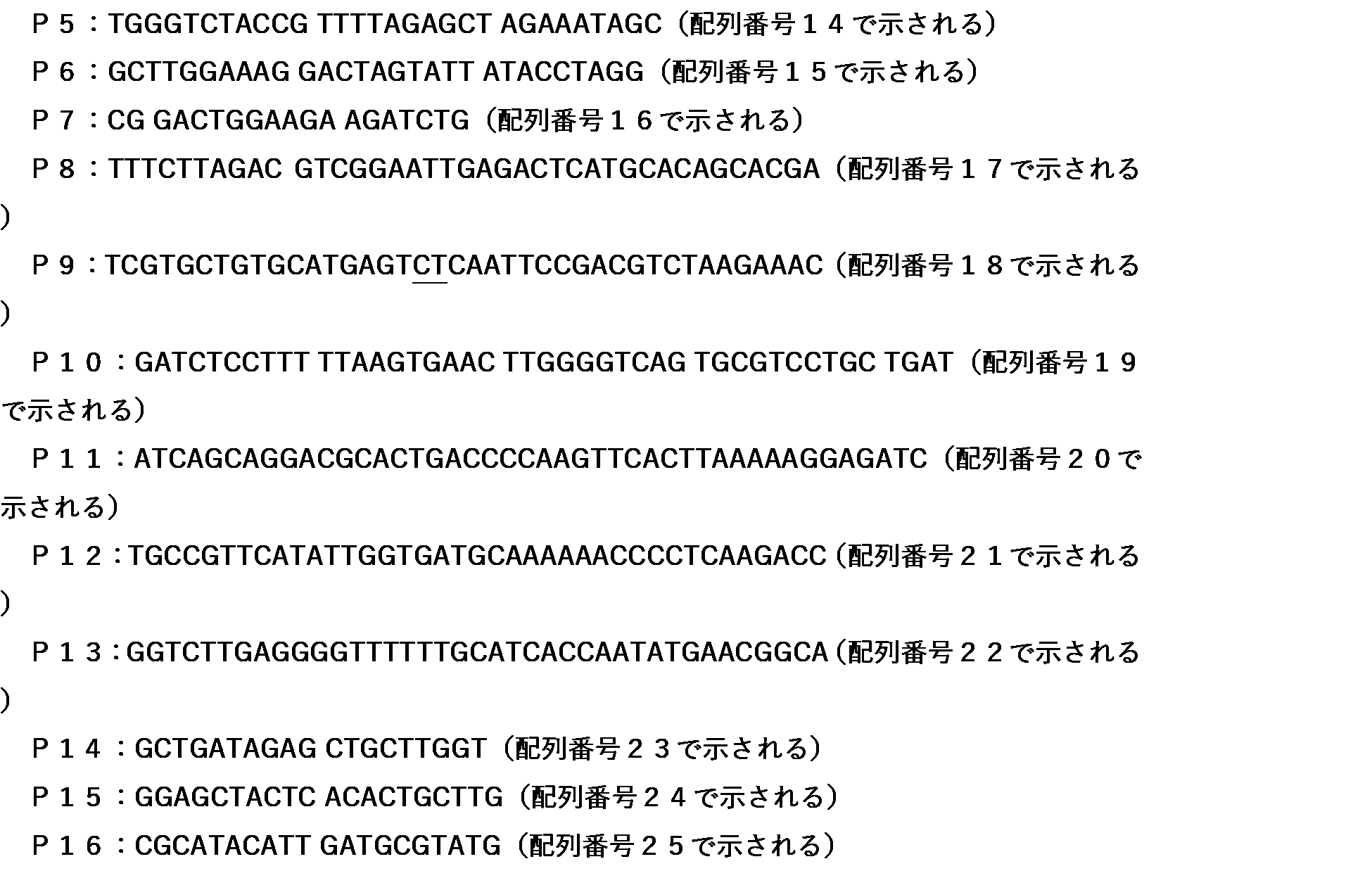
バチルス・リケニフォルミスに由来するリケニフォルミスアスパラギン酸α-デカルボキシラーゼ遺伝子panD(配列番号1で示される)を遺伝子合成企業において合成した。上記のpanD遺伝子配列をカスタマイズ及び合成する間に、XbaI及びHindIII制限エンドヌクレアーゼ配列を同義コドン置換によって除去した。上記のpanD遺伝子配列をカスタマイズ及び合成するときに、同じBCD2配列(配列番号2で示される)を各panD配列の前に同時に合成し、その間に、XbaI及びHindIII制限酵素切断部位をBCD2-panD配列の両端に追加した。合成された配列をベクターに連結した。上記の合成されたBCD2-panDベクター及びpET28a(+)プラスミドを制限エンドヌクレアーゼXbaI及びHindIIIによって二重消化した。酵素消化後のBCD2-panDの遺伝子断片及び直鎖化されたベクターセグメントをゲル電気泳動によって回収し、2つの断片をT4リガーゼを用いてさらに連結し、連結産物を大腸菌DH5αコンピテントセルに形質転換した。50mg/Lカナマイシンを含有するLBプレートを用いて、組換えプラスミドを含有する形質転換体をスクリーニングした。プラスミドを形質転換体増幅後に抽出し、シーケンシングに送って、正しいプラスミドpET28a-BCD2-panDBlが得られたということを確認した。 The Bacillus licheniformis aspartate α-decarboxylase gene panD (shown in SEQ ID NO: 1) derived from Bacillus licheniformis was synthesized in a gene synthesis company. During the customization and synthesis of the above panD gene sequence, the XbaI and HindIII restriction endonuclease sequences were removed by synonymous codon replacement. During the customization and synthesis of the above panD gene sequence, the same BCD2 sequence (shown in SEQ ID NO: 2) was simultaneously synthesized in front of each panD sequence, during which XbaI and HindIII restriction enzyme cleavage sites were added to both ends of the BCD2-panD sequence. The synthesized sequence was ligated into a vector. The above synthesized BCD2-panD vector and pET28a(+) plasmid were double-digested with restriction endonucleases XbaI and HindIII. The gene fragment of BCD2-panD after enzyme digestion and the linearized vector segment were recovered by gel electrophoresis, and the two fragments were further ligated using T4 ligase, and the ligation product was transformed into E. coli DH5α competent cells. LB plates containing 50 mg/L kanamycin were used to screen for transformants containing the recombinant plasmid. The plasmid was extracted after transformant amplification and sent for sequencing to confirm that the correct plasmid pET28a-BCD2-panDB1 was obtained.
avtA遺伝子の上流配列をプライマーP7及びP8を用いて増幅し、PLプロモーターをプライマーP9及びP10を用いて増幅し、BCD2-panDBl-Ter遺伝子断片をプライマーP11及びP12を用いてpET28a-BCD2-panDBlを鋳型とする増幅によって得た。avtA遺伝子の下流配列をプライマーP13及びP14を用いて増幅した。上記の4つの断片をオーバーラップPCRによって連結して、4つのDNA断片のアセンブリDonorBlを得た(配列番号5で示される)。これを遺伝子編集のための鋳型として用いた。それらのうち、配列番号5の1nt~312ntは標的遺伝子のavtA遺伝子の上流配列であり、313nt~474ntはPLプロモーターであり、475nt~560ntはBCD2配列であり、560nt~943ntはpanDBl配列であり、944nt~995ntはターミネーター配列であり、996~1261ntはavtA遺伝子の下流配列である。 The upstream sequence of the avtA gene was amplified using primers P7 and P8, the PL promoter was amplified using primers P9 and P10, and the BCD2-panDB1-Ter gene fragment was obtained by amplification using primers P11 and P12 with pET28a-BCD2-panDB1 as a template. The downstream sequence of the avtA gene was amplified using primers P13 and P14. The above four fragments were linked by overlap PCR to obtain an assembly of four DNA fragments, DonorBl (shown in SEQ ID NO:5). This was used as a template for gene editing. Of these, 1nt to 312nt of SEQ ID NO:5 is the upstream sequence of the avtA gene of the target gene, 313nt to 474nt is the PL promoter, 475nt to 560nt is the BCD2 sequence, 560nt to 943nt is the panDB1 sequence, 944nt to 995nt is the terminator sequence, and 996 to 1261nt is the downstream sequence of the avtA gene.
pCas9プラスミドをMG1655に形質転換し、50mg/Lカナマイシンを含有するカナマイシン耐性プレートにコーティングし、30℃で培養して株MG655/pCas9を得た。MG1655/pCas9菌苔を500mL振とうフラスコの50mLのカナマイシン含有LBに拾い、30℃、220rpmで培養した。培養培地が0.2のOD600になったときに、10mMの終濃度のアラビノースを誘導のために追加した。培養培地が0.45のOD600になったときに、コンピテントセルを調製した。2マイクロリットルのpTargetFavtAプラスミド及び10マイクロリットルのDonorBs鋳型DNAを取り、MG655/pCas9コンピテントセルに電気的に形質転換した。これらを50mg/Lカナマイシン及び50mg/Lスペクチノマイシンを含有する二重耐性プレートにコーティングし、30℃でインキュベーションした。avtA遺伝子上にPPL-BCD2-panD-Terを組み込んだシングルコロニーをプライマーP15及びP16を用いて同定し、正しいサイズのPCR産物をシーケンシングによって確認した。正しい配列のシングルコロニーを選択し、それぞれpTargetFavtAプラスミドを排除するために0.2mMのIPTGを追加することによって培養して、遺伝子組換え細菌大腸菌MG1655 avtA:panDBl/pCasを得て、依然として上の方法に従って使用可能なコンピテントセルを調製した。 The pCas9 plasmid was transformed into MG1655, coated on a kanamycin-resistant plate containing 50 mg/L kanamycin, and cultivated at 30°C to obtain strain MG655/pCas9. The MG1655/pCas9 bacteria was picked up into 50 mL of LB containing kanamycin in a 500 mL shake flask and cultivated at 30°C and 220 rpm. When the culture medium reached an OD 600 of 0.2, arabinose was added to a final concentration of 10 mM for induction. When the culture medium reached an OD 600 of 0.45, competent cells were prepared. Two microliters of pTargetFavtA plasmid and 10 microliters of DonorBs template DNA were taken and electrically transformed into MG655/pCas9 competent cells. These were coated on a double-resistant plate containing 50 mg/L kanamycin and 50 mg/L spectinomycin and incubated at 30° C. Single colonies that integrated PPL-BCD2-panD-Ter on the avtA gene were identified using primers P15 and P16, and the correct size of the PCR product was confirmed by sequencing. Single colonies with the correct sequence were selected and cultured by adding 0.2 mM IPTG to eliminate the pTargetFavtA plasmid, respectively, to obtain recombinant bacteria E. coli MG1655 avtA:panDB1/pCas, and competent cells that can still be used were prepared according to the above method.
遺伝子組換え細菌大腸菌MG1655 avtA:panDBl/pCasを非耐性のLB液体培地に接種し、37℃で12時間培養した。それから、培地を希釈し、LBプレートにコーティングした。pCasプラスミドが排除された遺伝子組換え細菌大腸菌MG1655 avta:panDBLがそれぞれ得られた。遺伝子panDは染色体avtA遺伝子のコード配列上に挿入され、これはAvtAの不活性化に至り、競合するバリン代謝経路を弱める。 The recombinant bacteria E. coli MG1655 avtA:panDBl/pCas was inoculated into non-resistant LB liquid medium and cultured at 37°C for 12 hours. Then, the medium was diluted and coated on LB plates. The recombinant bacteria E. coli MG1655 avta:panDBL, in which the pCas plasmid was eliminated, were obtained, respectively. The gene panD was inserted on the coding sequence of the chromosomal avtA gene, which leads to the inactivation of AvtA and attenuates the competing valine metabolic pathway.
野生型大腸菌K12MG1655はilvG遺伝子に変異を有し、これは不活性なアセト乳酸合成酵素をコード化する。本願においては、大腸菌BL21の活性なilvG遺伝子を大腸菌MG1655の染色体上に導入し、これはVB5の前駆体アセト乳酸の合成を改善した。大腸菌BL21に由来するilvG+M遺伝子を大腸菌K12MG1655の染色体上に挿入し、強力なtrcプロモーターを用いてilvG+Mの転写開始を制御し、ターミネーターTerを用いてilvG+Mの転写終結を制御した。ilvG+M遺伝子をavtA遺伝子の別のN20標的配列上に組み込んだ。pTargetFベクターをQ5(登録商標)変異導入キット並びにプライマーP17及びP18を用いて変異させた。変異後のpTargetFはpTargetFavtA1と呼称した。 Wild-type E. coli K12 MG1655 has a mutation in the ilvG gene, which encodes an inactive acetolactate synthase. In this application, the active ilvG gene of E. coli BL21 was introduced onto the chromosome of E. coli MG1655, which improved the synthesis of acetolactate, the precursor of VB5. The ilvG + M gene from E. coli BL21 was inserted onto the chromosome of E. coli K12 MG1655, and the transcription initiation of ilvG + M was controlled with a strong trc promoter, and the transcription termination of ilvG + M was controlled with a terminator Ter. The ilvG + M gene was integrated onto another N20 target sequence of the avtA gene. The pTargetF vector was mutated using the Q5® Mutagenesis Kit and primers P17 and P18. The mutated pTargetF was named pTargetFavtA1.

avtA遺伝子の上流配列をプライマーP19及びP20を用いて増幅し、大腸菌BL21のilvG+M配列をプライマーP21及びP22を用いて増幅し、avtA遺伝子の下流配列をプライマーP23及びP24を用いて増幅した。trcプロモーターTTGACAATTAATCATCCGGCTCGTATAATGTGTGTGGAをプライマーP20及びP21によって導入した。 The upstream sequence of the avtA gene was amplified using primers P19 and P20, the ilvG + M sequence of E. coli BL21 was amplified using primers P21 and P22, and the downstream sequence of the avtA gene was amplified using primers P23 and P24. The trc promoter TTGACAATTAATCATCCGGCTCGTATAATGTGTGTGGA was introduced by primers P20 and P21.

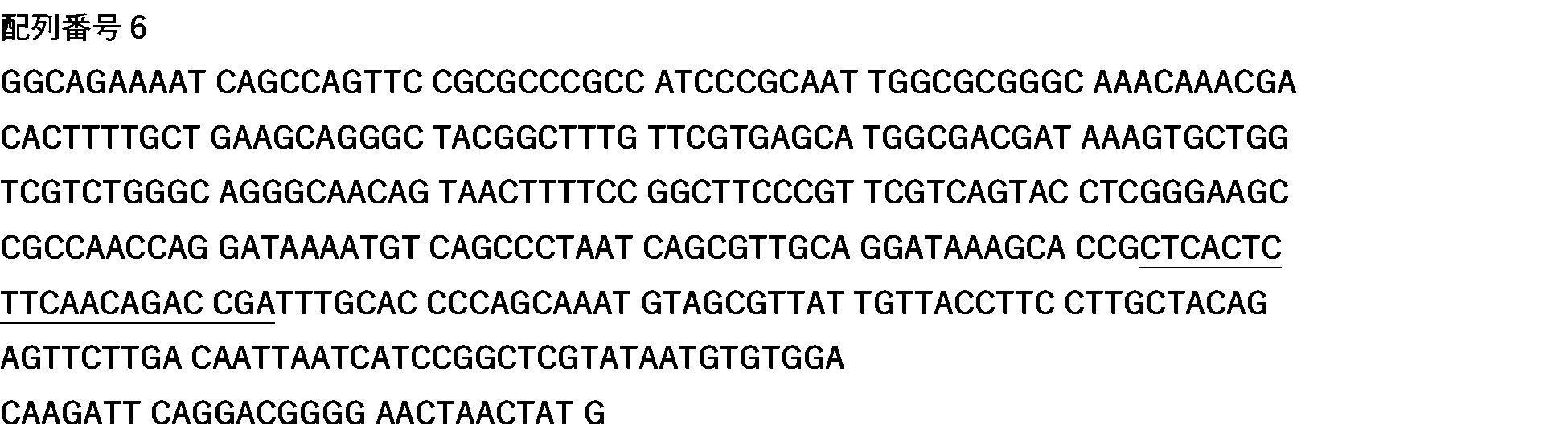
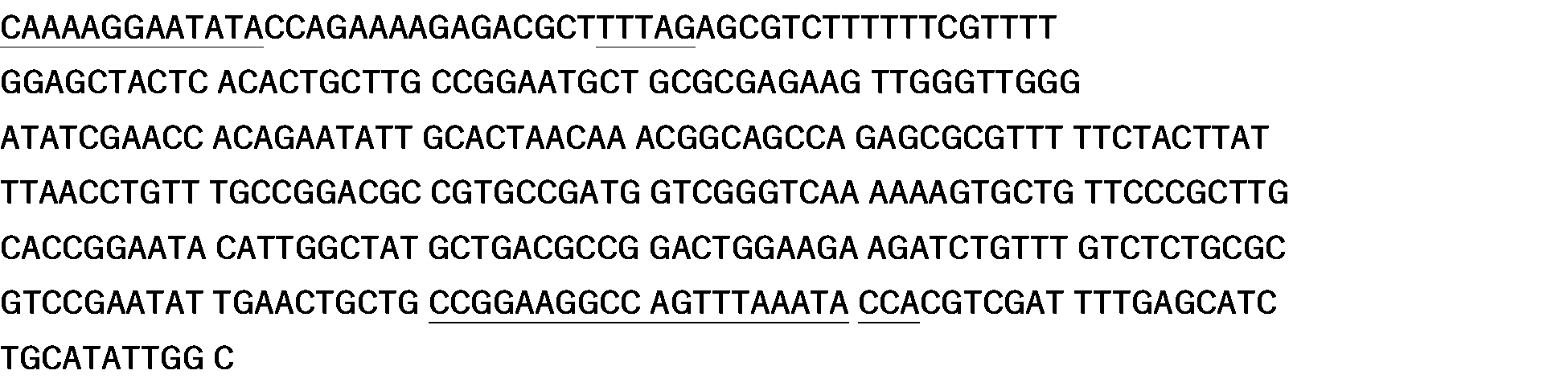
上記の3つの断片をオーバーラップPCRを用いて連結して、アセンブリされたDonorilvGMを得た(配列番号6で示される)。これを遺伝子編集のための鋳型として用いた。配列番号6の1~305ntは標的遺伝子avtAの上流配列であり、306nt~341ntはtrcプロモーターであり、367nt~2013ntは大腸菌BL21に由来するilvG+遺伝子のコード配列であり、2010nt~2273ntはilvM遺伝子のコード配列であり、2274~2328はターミネーター配列であり、2329~2629はavtA遺伝子の下流配列である。 The above three fragments were linked using overlap PCR to obtain assembled DonorilvGM (shown in SEQ ID NO: 6), which was used as a template for gene editing. In SEQ ID NO: 6, 1-305 nt is the upstream sequence of the target gene avtA, 306 nt-341 nt is the trc promoter, 367 nt-2013 nt is the coding sequence of the ilvG + gene derived from E. coli BL21, 2010 nt-2273 nt is the coding sequence of the ilvM gene, 2274-2328 is the terminator sequence, and 2329-2629 is the downstream sequence of the avtA gene.
2マイクロリットルのpTargetFavtA1プラスミド及び10マイクロリットルのDonorilvGM鋳型DNAを取り、大腸菌MG1655 avtA:panDBl/pCasコンピテントセルに電気的に形質転換した。これらを、50mg/Lカナマイシン及び50mg/Lスペクチノマイシンを含有する二重耐性プレートにコーティングし、30℃でインキュベーションした。avtA遺伝子上にPtrc-ilvG+M-Terを組み込んだシングルコロニーをプライマーP25及びP26を用いて同定し、正しいサイズのPCR産物をシーケンシングによって確認した。正しい配列のシングルコロニーを選択し、0.2mMのIPTGと共に培養して、pTargetFavtA1プラスミドを排除した。非耐性のLB液体培地をさらに追加し、37℃で12時間培養し、それから希釈し、それぞれLBプレートにコーティングして、pCasプラスミドを排除した遺伝子組換え細菌大腸菌MG1655 avtA:panDBl-ilvG+Mを得た。VB5前駆体アセト乳酸の合成は染色体上の活性なilvG+Mの組込みによって改善された。 Two microliters of pTargetFavtA1 plasmid and 10 microliters of DonorilvGM template DNA were taken and electrotransformed into E. coli MG1655 avtA:panDB1/pCas competent cells. These were coated on dual resistance plates containing 50 mg/L kanamycin and 50 mg/L spectinomycin and incubated at 30°C. Single colonies that integrated Ptrc-ilvG + M-Ter on the avtA gene were identified using primers P25 and P26, and the correct size of the PCR product was confirmed by sequencing. A single colony with the correct sequence was selected and cultured with 0.2 mM IPTG to eliminate the pTargetFavtA1 plasmid. Non-resistant LB liquid medium was further added and cultured at 37°C for 12 hours, then diluted and coated on LB plates respectively to obtain recombinant bacteria E. coli MG1655 avtA:panDB1-ilvG + M that had eliminated the pCas plasmid. The synthesis of the VB5 precursor acetolactate was improved by the integration of active ilvG + M on the chromosome.
pTargetFベクターのN20配列を、上記のQ5(登録商標)変異導入キット並びにプライマーP27及びP28を用いて変異させた。変異後のpTargetFはpTargetFcadAと呼称した。 The N20 sequence of the pTargetF vector was mutated using the above-mentioned Q5 (registered trademark) Mutagenesis Kit and primers P27 and P28. The mutated pTargetF was named pTargetFcadA.

大腸菌MG1655ゲノムを鋳型として用いて、プライマーP29及びP30を用いてcadA遺伝子の上流配列を増幅した。プライマーP31及びP32を用いてgapAプロモーターを増幅し、プライマーP35及びP36を用いてcadA遺伝子の下流配列を増幅した。RBS及びターミネーターを含有するaspDH遺伝子を遺伝子合成企業で合成し、RBS-aspDH-Ter配列をプライマーP33及びP34を用いることによって増幅した。上記の4つの断片をオーバーラップPCRによって連結して、アセンブリされたDonoraspDHを得た(配列番号7で示される)。これを遺伝子編集のための鋳型として用いた。配列番号7の1~210ntは標的遺伝子のcadA遺伝子の上流配列であり、211nt~480ntはgapAプロモーターであり、481nt~509ntはRBS配列である。510nt~1307ntはデルフチアsp.Csl-4に由来するaspDH遺伝子のコード配列であり(配列番号56で示される)、1308nt~1360ntはターミネーター配列であり、1361~1535はcadA遺伝子の下流配列である。 Using the E. coli MG1655 genome as a template, the upstream sequence of the cadA gene was amplified using primers P29 and P30. The gapA promoter was amplified using primers P31 and P32, and the downstream sequence of the cadA gene was amplified using primers P35 and P36. The aspDH gene containing the RBS and terminator was synthesized at a gene synthesis company, and the RBS-aspDH-Ter sequence was amplified by using primers P33 and P34. The above four fragments were linked by overlap PCR to obtain the assembled DonoraspDH (shown in SEQ ID NO: 7). This was used as a template for gene editing. 1 to 210 nt of SEQ ID NO: 7 is the upstream sequence of the cadA gene of the target gene, 211 nt to 480 nt is the gapA promoter, and 481 nt to 509 nt is the RBS sequence. 510nt to 1307nt is the coding sequence of the aspDH gene derived from Delftia sp. Csl-4 (shown in SEQ ID NO:56), 1308nt to 1360nt is the terminator sequence, and 1361 to 1535 is the downstream sequence of the cadA gene.
2マイクロリットルのpTargetFcadAプラスミド及び10マイクロリットルのDonoraspDH鋳型DNAを取り、大腸菌MG1655 avtA:panDBl-ilvG+M/pCasコンピテントセルに電気的に形質転換した。これを、50mg/Lカナマイシン及び50mg/Lスペクチノマイシンを含有する二重耐性プレートにコーティングし、30℃でインキュベーションした。cadA遺伝子上にPgapA-aspDH-Terを組み込んだシングルコロニーをプライマーP37及びP38を用いることによって同定し、正しいサイズのPCR産物をシーケンシングによって確認した。正しい配列のシングルコロニーを選択し、0.2mMのIPTGと共に培養して、pTargetFcadAプラスミドを排除した。非耐性のLB液体培地をさらに追加し、37℃で12時間培養し、それから希釈し、LBプレートにコーティングして、pCasプラスミドを排除した遺伝子組換え細菌大腸菌MG1655 avtA:panDBl-ilvG+M-aspDHを得た。 Two microliters of pTargetFcadA plasmid and 10 microliters of DonoraspDH template DNA were taken and electrotransformed into E. coli MG1655 avtA:panDBl-ilvG + M/pCas competent cells, which were coated onto a dual resistance plate containing 50 mg/L kanamycin and 50 mg/L spectinomycin and incubated at 30°C. Single colonies that integrated PgapA-aspDH-Ter on the cadA gene were identified by using primers P37 and P38, and the correct size of the PCR product was confirmed by sequencing. A single colony with the correct sequence was selected and cultured with 0.2 mM IPTG to eliminate the pTargetFcadA plasmid. The non-resistant LB liquid medium was further added, and the mixture was cultured at 37°C for 12 hours, then diluted and coated on an LB plate to obtain the recombinant bacteria E. coli MG1655 avtA:panDB1-ilvG + M-aspDH that had eliminated the pCas plasmid.
大腸菌MG1655ゲノムを鋳型として用いて、プライマーP29及びP30を用いてcadA遺伝子の上流配列を増幅し、プライマーP31及びP39を用いてgapAプロモーターを増幅し、プライマーP40及びP41を用いてaspC遺伝子を増幅し、プライマーP42及びP36を用いてcadA遺伝子の下流配列を増幅した。上記の4つの断片をオーバーラップPCRによって連結して、アセンブリされたDonoraspCを得た(配列番号8で示される)。これを遺伝子編集のための鋳型として用いた。配列番号8の1~210ntは標的遺伝子cadA遺伝子の上流配列であり、211nt~480ntはgapAプロモーターであり、611nt~1801ntはaspC遺伝子のコード配列であり、1992~2166はcadA遺伝子の下流配列である。 Using the E. coli MG1655 genome as a template, the upstream sequence of the cadA gene was amplified using primers P29 and P30, the gapA promoter was amplified using primers P31 and P39, the aspC gene was amplified using primers P40 and P41, and the downstream sequence of the cadA gene was amplified using primers P42 and P36. The above four fragments were linked by overlap PCR to obtain assembled DonoraspC (shown in SEQ ID NO: 8), which was used as a template for gene editing. 1-210nt of SEQ ID NO: 8 is the upstream sequence of the target gene cadA gene, 211nt-480nt is the gapA promoter, 611nt-1801nt is the coding sequence of the aspC gene, and 1992-2166 is the downstream sequence of the cadA gene.
2マイクロリットルのpTargetFcadAプラスミド及び10マイクロリットルのDonoraspC鋳型DNAを取り、大腸菌MG1655 avtA:panDBl-ilvG+M/pCasコンピテントセルに電気的に形質転換した。これを、50mg/Lカナマイシン及び50mg/Lスペクチノマイシンを含有する二重耐性プレートにコーティングし、30℃でインキュベーションした。cadA遺伝子上にPgapA-aspCを組み込んだシングルコロニーをプライマーP37及びP38を用いることによって同定し、正しいサイズのPCR産物をシーケンシングによって確認した。正しい配列のシングルコロニーを選択し、0.2mMのIPTGと共に培養してpTargetFcadAプラスミドを排除した。非耐性のLB液体培地をさらに追加し、37℃で12時間培養し、それから希釈し、LBプレートにコーティングして、pCasプラスミドを排除した遺伝子組換え細菌大腸菌MG1655 avtA:panDBl-ilvG+M-aspCを得た。 Two microliters of pTargetFcadA plasmid and 10 microliters of DonoraspC template DNA were taken and electrotransformed into E. coli MG1655 avtA:panDBl-ilvG + M/pCas competent cells, which were coated onto a dual resistance plate containing 50 mg/L kanamycin and 50 mg/L spectinomycin and incubated at 30°C. Single colonies that integrated PgapA-aspC on the cadA gene were identified by using primers P37 and P38, and the correct size of the PCR product was confirmed by sequencing. A single colony with the correct sequence was selected and cultured with 0.2 mM IPTG to eliminate the pTargetFcadA plasmid. The non-resistant LB liquid medium was further added, and the mixture was cultured at 37°C for 12 hours, then diluted and coated on an LB plate to obtain the recombinant bacteria E. coli MG1655 avtA:panDB1-ilvG + M-aspC that had eliminated the pCas plasmid.

大腸菌MG1655ゲノムを鋳型として用いて、プライマーP29及びP30を用いてcadA遺伝子の上流配列を増幅した。プライマーP31及びP43を用いてgapAプロモーターを増幅し、プライマーP44及びP45を用いてaspA遺伝子を増幅し、プライマーP46及びP36を用いてcadA遺伝子の下流配列を増幅した。上記の4つの断片をオーバーラップPCRによって連結して、アセンブリされたDonoraspAを得た(配列番号9で示される)。これを遺伝子編集のための鋳型として用いた。配列番号9の1~210ntは標的遺伝子のcadA遺伝子の上流配列であり、211nt~480ntはgapAプロモーターであり、504nt~1940ntはaspA遺伝子のコード配列であり、2004~2178はcadA遺伝子の下流配列である。 Using the E. coli MG1655 genome as a template, the upstream sequence of the cadA gene was amplified using primers P29 and P30. The gapA promoter was amplified using primers P31 and P43, the aspA gene was amplified using primers P44 and P45, and the downstream sequence of the cadA gene was amplified using primers P46 and P36. The above four fragments were linked by overlap PCR to obtain the assembled DonoraspA (shown in SEQ ID NO: 9), which was used as a template for gene editing. 1-210nt of SEQ ID NO: 9 is the upstream sequence of the cadA gene of the target gene, 211nt-480nt is the gapA promoter, 504nt-1940nt is the coding sequence of the aspA gene, and 2004-2178 is the downstream sequence of the cadA gene.
2マイクロリットルのpTargetFcadAプラスミド及び10マイクロリットルのDonoraspA鋳型DNAを取り、大腸菌MG1655 avtA:panDBl-ilvG+M/pCasコンピテントセルに電気的に形質転換した。これを、50mg/Lカナマイシン及び50mg/Lスペクチノマイシンを含有する二重耐性プレートにコーティングし、30℃でインキュベーションした。cadA遺伝子上にPgapA-aspAを組み込んだシングルコロニーをプライマーP37及びP38を用いることによって同定し、正しいサイズのPCR産物をシーケンシングによって確認した。正しい配列のシングルコロニーを選択し、0.2mMのIPTGと共にインキュベーションしてpTargetFcadAプラスミドを排除した。非耐性のLB液体培地をさらに追加し、37℃で12時間培養し、それから希釈し、LBプレートにコーティングして、pCasプラスミドを排除した遺伝子組換え細菌大腸菌MG1655 avtA:panDBl-ilvG+M-aspAを得た。 Two microliters of pTargetFcadA plasmid and 10 microliters of DonoraspA template DNA were taken and electrotransformed into E. coli MG1655 avtA:panDBl-ilvG + M/pCas competent cells, which were coated onto dual resistance plates containing 50 mg/L kanamycin and 50 mg/L spectinomycin and incubated at 30°C. Single colonies that integrated PgapA-aspA on the cadA gene were identified by using primers P37 and P38, and the correct size of the PCR product was confirmed by sequencing. A single colony with the correct sequence was selected and incubated with 0.2 mM IPTG to eliminate the pTargetFcadA plasmid. The non-resistant LB liquid medium was further added, and the mixture was cultured at 37°C for 12 hours, then diluted and coated on an LB plate to obtain the recombinant bacteria E. coli MG1655 avtA:panDB1-ilvG + M-aspA that had eliminated the pCas plasmid.

上記の構築されたベクターpACYC184-panBCEを、それぞれ、上記の遺伝子組換え細菌大腸菌MG1655 avtA:panDBl-ilvG+M-aspDH、大腸菌MG1655 avtA:panDBl-ilvG+M-aspC、及び大腸菌MG1655 avtA:panDBl-ilvG+M-aspAに形質転換した。それぞれ、VB5を生産するための発酵のための大腸菌MG1655 avtA:panDBl-ilvG+M-aspDH/pACYC184-panBCE、大腸菌MG1655 avtA:panDBl-ilvG+M-aspC/pACYC184-panBCE、及び大腸菌MG1655 avtA:panDBl-ilvG+M-aspA/pACYC184-panBCEが得られた。 The constructed vector pACYC184-panBCE was transformed into the recombinant bacteria E. coli MG1655 avtA:panDB1-ilvG + M-aspDH, E. coli MG1655 avtA:panDB1-ilvG + M-aspC, and E. coli MG1655 avtA:panDB1-ilvG + M-aspA, respectively. E. coli MG1655 avtA:panDBl-ilvG + M-aspDH/pACYC184-panBCE, E. coli MG1655 avtA:panDBl-ilvG + M-aspC/pACYC184-panBCE, and E. coli MG1655 avtA:panDBl-ilvG + M-aspA/pACYC184-panBCE were obtained for fermentation to produce VB5, respectively.
配列番号1
ATGTACCGTA CGTTAATGAG CGCAAAACTT CACAGAGCGA GAGTGACGGA AGCCAATTTG
AACTACGTCG GCAGCGTGAC AATTGATGAA GATTTGCTGG ATGCTGTCGG AATGATGGCA
AATGAAAAAG TGCAAATTGT GAATAATAAT AACGGGGCCC GGCTGGAAAC GTACATTATT
CCCGGTGAAA GGGGCAGCGG CGTCGTTTGT TTAAACGGAG CTGCCGCCCG CCTTGTCCAG
GTTGGAGATG TCGTCATCAT CGTGTCTTAT GCGATGATGT CTGAAGAGGA AGCAAAGACC
CATAAGCCGA AGGTTGCCGT TTTGAACGAG AGAAACGAAA TCGAGGAAAT GCTGGGTCAG
GAGCCAGCCC GTACCATTCT GTAA
SEQ ID NO:1
ATGTACCGTA CGTTAATGAG CGCAAAACTT CACAGAGCGA GAGTGACGGA AGCCAATTTG
AACTACGTCG GCACGTGAC AATTGATGAA GATTTGCTGG ATGCTGTCGG AATGATGGCA
AATGAAAAAG TGCAAATTGT GAATAATAAT AACGGGGCCC GGCTGGAAAC GTACATTATT
CCCGGTGAAA GGGGCAGCGG CGTCGTTTGT TTAAACGGAG CTGCCGCCCG CCTTGTCCAG
GTTGGAGATG TCGTCATCAT CGTGTCTTAT GCGATGATGT CTGAAGAGGA AGCAAAGACC
CATAAGCCGA AGGTTGCCGT TTTGAACGAG AGAAACGAAA TCGAGGAAAT GCTGGGTCAG
GAGCCAGCCC GTACCATTCT GTAA
配列番号2
CCAAGTTCACTTAAAAAGGAGATCAACAATGAAAGCAATTTTCGTACTGAAACATCTTAATCATGCTAAGGAGGTTTTCTAATG
SEQ ID NO:2
CCAAGTTCACTTAAAAAGGAGATCAACAATGAAAGCAATTTTCGTACTGAAACATCTTAATCATGCTAAGGAGGTTTTCTAATG





配列番号56
ATGAATATTGCTGTGATTGGCTGCGGTGCGATTGGCGCCA
GCGTGCTCGAACTGCTCAAGGGCCATGCCGCGGTGCAGGTGGGCTGGGTGCTTGTGCCCG
AAGTGACGGACGCCGTGCGCGCCACCCTGGCCCGGCATGCGCCCCAGGCGCGCGCACTGC
CTGCGCTGACGACTGAAGACCGGCCCGACCTTATCGTCGAATGCGCAGGCCATACCGCCA
TCGAAGAGCATGTGCTGCCCGCCCTGCGGCGCGGCATTCCTGCCGTCGTGGCCTCCATCG
GCGCACTCAGCGCCCCCGGCATGGCCGAGGCCGTTCAGGCCGCGGCCGAGGCCGGAGGCA
CCCAGGTGCAATTGCTGTCGGGCGCCATCGGCGGCGTGGATGCGCTGGCCGCAGCCCGCA
TCGGCGGCCTGGACGAAGTGGTCTACACCGGCCGCAAGCCGCCCCTGGCCTGGACCGGCA
CGCCCGCAGAACAGCGCTGCGACCTCGCCAGCCTCAAGGAAGCCTTCTGCATCTTCGAAG
GCAGCGCACGCGAGGCCGCCCAGCTCTACCCCAAGAACGCCAACGTGGCCGCCACCCTGT
CGCTGGCCGGCATGGGCCTGGACCGCACCACGGTGCGCCTGTACGCCGACCCGGCCGTGG
ACGAAAACGTGCACCATGTGGCCGCGCGCGGCGCCTTCGGTTCCATGGAATTGACCATGC
GCGGCAAGCCGCTGGAGGCCAACCCCAAGACCTCGGCCCTCACCGTCTACAGCGTGGTGC
GCGCCGTGCTCAACCAGGCCACGGCCATCGCCATCTAA
SEQ ID NO:56
ATGAATATTGCTGTGATTGGCTGCGGTGCGATTGGCGCCA
GCGTGCTCGAACTGCTCAAGGGCCATGCCGCGGTGCAGGTGGGCTGGGTGCTTGTGCCCG
AAGTGACGGACGCCGTGCGCGCCACCCTGGCCCGGCATGCGCCCAGGCGCGCGCACTGC
CTGCGCTGACGACTGAAGACCGGCCCGACCTTATCGTCGAATGCGCAGGCCATACCGCCA
TCGAAGAGCATGTGCTGCCCGCCCTGCGGCGCGGCATTCCTGCCGTCGTGGCCTCCATCG
GCGCACTCAGCGCCCCCGGCATGGCCGAGGCCGTTCAGGCCGCGGCCGAGGCCGGAGGCA
CCCAGGTGCAATTGCTGTCGGGCGCCATCGGCGGCGTGGATGCGCTGGCCGCAGCCCGCA
TCGGCGGCCTGGACGAAGTGGTCTACACCGGCCGCAAGCCGCCCCTGGCCTGGACCGGCA
CGCCCGCAGAACAGCGCTGCGACCTCGCCAGCCTCAAGGAAGCCTTCTGCATCTTCGAAG
GCAGCGCACGCGAGGCCGCCCAGCTCTACCCCAAGAACGCCAACGTGGCCGCCACCCTGT
CGCTGGCCGGCATGGGCCTGGACCGCACCACGGTGCGCCTGTACGCCGACCCGGCCGTGG
ACGAAAACGTGCACCATGTGGCCGCGCGGCGCCTTCGGTTCCATGGAATTGACCATGC
GCGGCAAGCCGCTGGAGGCCAACCCCAAGACCTCGGCCCTCACCGTCTACAGCGTGGTGC
GCGCCGTGCTCAACCAGGCCACGGCCATCGCCATCTAA
実施形態3 VB5遺伝子組換え細菌の発酵実験
試験株の遺伝子組換え細菌大腸菌MG1655 avtA:panDBl-ilvG+M-aspDH/pACYC184-panBCE、大腸菌MG1655 avtA:panDBl-ilvG+M-aspC/pACYC184-panBCE、及び大腸菌MG1655 avtA:panDBl-ilvG+M-aspA/pACYC184-panBCEを、34mg/Lクロラムフェニコールを含有する固体LB培地プレートにストリーク接種し、37℃で12時間インキュベーションした。プレート上の菌苔を拾い、LB培地スラントに接種し、37℃で10~12時間インキュベーションした。プレート上の菌苔を拾い、液体LB培地に接種し、37℃、220rpmで振とうしながら12時間培養して、種菌液を得た。種菌液を発酵培地に3%の接種量で接種し、37℃、220rpmで振とうしながら培養した。
Example 3 Fermentation experiment of VB5 recombinant bacteria The recombinant bacteria E. coli MG1655 avtA:panDBl-ilvG + M-aspDH/pACYC184-panBCE, E. coli MG1655 avtA:panDBl-ilvG + M-aspC/pACYC184-panBCE, and E. coli MG1655 avtA:panDBl-ilvG + M-aspA/pACYC184-panBCE of the test strain were streaked on a solid LB medium plate containing 34 mg/L chloramphenicol and incubated at 37°C for 12 hours. The fungus on the plate was picked up and inoculated on an LB medium slant and incubated at 37°C for 10-12 hours. The fungal moss on the plate was picked up, inoculated into a liquid LB medium, and cultured at 37° C. with shaking at 220 rpm for 12 hours to obtain a seed culture solution, which was then inoculated into a fermentation medium at 3% inoculum amount and cultured at 37° C. with shaking at 220 rpm.
発酵培地:MOPSを80g/L、グルコース20.0g/L、硫酸アンモニウム10.0g/L、リン酸二水素カリウム2.0g/L、硫酸マグネシウム七水和物2.0g/L、酵母エキス5.0g/L、微量元素混合溶液5mL/L。残りの量は水であった。微量元素混合溶液:FeSO4・7H2Oを10g/L、CaCl2を1.35g/L、ZnSO4・7H2Oを2.25g/L、MnSO4・4H2Oを0.5g/L、CuSO4・5H2Oを1g/L(NH4)6Mo7O24・4H2Oを0.106g/L、Na2B4O7・10H2Oを0.23g/L、CoCl2・6H2Oを0.48g/L、35%HClを10mL/L。残りの量は水であった。 Fermentation medium: MOPS 80 g/L, glucose 20.0 g/L, ammonium sulfate 10.0 g/L, potassium dihydrogen phosphate 2.0 g/L, magnesium sulfate heptahydrate 2.0 g/L, yeast extract 5.0 g/L, trace element mixture 5 mL/L. The remaining amount was water. Trace element mixed solution: 10g/ L of FeSO4.7H2O , 1.35g/L of CaCl2 , 2.25g /L of ZnSO4.7H2O , 0.5g/L of MnSO4.4H2O , 1g /L of CuSO4.5H2O ( NH4 ) 6Mo 0.106 g/L of 7 O 24.4H 2 O, 0.23 g/L of Na 2 B 4 O 7.10H 2 O, 0.48 g/L of CoCl 2.6H 2 O, and 10 mL/L of 35% HCl. The remaining amount was water.
インキュベーションプロセスの間は、サンプルを4時間毎に取った。反応系のpHをアンモニアによって調整して6.8~7.0に維持した。グルコース含量をバイオセンサー分析器SBA-40Dを用いて検出し、系のグルコース含量が5g/Lよりも低いときには、グルコースを追加して系のグルコース濃度を20g/Lにした。サンプルを24時間インキュベーション後に取り、12000gで2分間遠心分離し、上清を取ってVB5含量を検出した。上清を取り、VB5含量について試験した(次の通り)。 During the incubation process, samples were taken every 4 hours. The pH of the reaction system was adjusted with ammonia to maintain it at 6.8-7.0. The glucose content was detected using a biosensor analyzer SBA-40D, and when the glucose content of the system was lower than 5 g/L, glucose was added to bring the glucose concentration of the system to 20 g/L. Samples were taken after 24 hours of incubation, centrifuged at 12000 g for 2 minutes, and the supernatant was taken to detect the VB5 content. The supernatant was taken and tested for VB5 content (as follows).

本願は、発酵によるVB5生産のために大腸菌においてアスパラギン酸生産のための3つの異なる経路を増強し、aspDH遺伝子を過剰発現する遺伝子組換え細菌が、aspC及びaspAを過剰発現するよりもVB5の発酵収量を増大させるためには好都合であるということを見出した。 The present application enhances three different pathways for aspartic acid production in E. coli for fermentative production of VB5, and finds that genetically engineered bacteria overexpressing the aspDH gene are more advantageous for increasing the fermentation yield of VB5 than overexpressing aspC and aspA.
前述は本願の好ましい実施形態に過ぎず、当業者は本発明の原理から逸脱することなしに若干の改善及び修正をなすことができ、これらの改善及び修正もまた本発明の保護範囲と見なされるということは留意されるべきである。 It should be noted that the above is only a preferred embodiment of the present application, and those skilled in the art may make some improvements and modifications without departing from the principles of the present invention, and these improvements and modifications are also considered to be within the scope of protection of the present invention.
Claims (10)
好ましくは、前記アスパラギン酸デヒドロゲナーゼ遺伝子aspDHはデルフチアsp.Csl-4に由来する、
使用。 Use of enhanced expression of the aspartate dehydrogenase gene aspDH in the production of vitamin B5, comprising:
Preferably, the aspartate dehydrogenase gene aspDH is derived from Delftia sp. Csl-4.
use.
(I)配列番号56として示されるヌクレオチド配列、或いは
(II)(I)として示される前記ヌクレオチド配列の1つ以上の塩基の置換、欠失、又は追加によって得られ、かつ(I)として示される前記ヌクレオチド配列と同じ又は類似の機能を有するヌクレオチド配列、或いは
(III)(I)又は(II)として示される前記ヌクレオチド配列に対して少なくとも80%の相同性を有するヌクレオチド配列。 2. The use according to claim 1, wherein the aspartate dehydrogenase gene aspDH comprises:
(I) a nucleotide sequence as set forth in SEQ ID NO:56; or (II) a nucleotide sequence obtained by substitution, deletion, or addition of one or more bases of the nucleotide sequence as set forth in (I) and having the same or similar function as the nucleotide sequence as set forth in (I); or (III) a nucleotide sequence having at least 80% homology to the nucleotide sequence as set forth in (I) or (II).
(1)強力なプロモーター及び/又は強力なRBSをcadA遺伝子上に挿入し、ここで、前記強力なプロモーターはPgapAであり、前記強力なRBSはBCD2であり、
好ましくは、前記BCD2は以下を有すること:
(A)配列番号2として示されるヌクレオチド配列、或いは
(B)(A)として示される前記ヌクレオチド配列の1つ以上の塩基の置換、欠失、又は追加によって得られ、かつ(A)として示される前記ヌクレオチド配列と同じ又は類似の機能を有するヌクレオチド配列、或いは
(C)(A)又は(B)として示される前記ヌクレオチド配列に対して少なくとも80%の相同性を有するヌクレオチド配列、
並びに/或いは
(2)大腸菌BL21に由来するilvGM遺伝子を発現すること、
並びに/或いは
(3)バチルス・リケニフォルミスに由来するL-アスパラギン酸α-デカルボキシラーゼ遺伝子panDを発現すること、並びに/或いは
好ましくは、バチルス・リケニフォルミスに由来する前記L-アスパラギン酸α-デカルボキシラーゼ遺伝子は以下を有する:
(A)配列番号1として示されるヌクレオチド配列、或いは
(B)(A)として示される前記ヌクレオチド配列の1つ以上の塩基の置換、欠失、又は追加によって得られ、かつ(A)として示される前記ヌクレオチド配列と同じ又は類似の機能を有するヌクレオチド配列、或いは
(C)(A)又は(B)として示される前記ヌクレオチド配列に対して少なくとも80%の相同性を有するヌクレオチド配列、
並びに/或いは
(4)panB遺伝子、panC遺伝子、及び/又はpanE遺伝子のコピー数を増大させること。 3. The use according to claim 1 or 2, further comprising:
(1) inserting a strong promoter and/or a strong RBS on the cadA gene, wherein the strong promoter is PgapA and the strong RBS is BCD2;
Preferably, said BCD2 comprises:
(A) a nucleotide sequence shown as SEQ ID NO:2; or (B) a nucleotide sequence obtained by substitution, deletion or addition of one or more bases of said nucleotide sequence shown as (A) and having the same or similar function as said nucleotide sequence shown as (A); or (C) a nucleotide sequence having at least 80% homology to said nucleotide sequence shown as (A) or (B),
and/or (2) expressing the ilvGM gene from E. coli BL21;
and/or (3) expressing the L-aspartate α-decarboxylase gene panD from Bacillus licheniformis; and/or preferably, said L-aspartate α-decarboxylase gene from Bacillus licheniformis has:
(A) a nucleotide sequence shown as SEQ ID NO:1; or (B) a nucleotide sequence obtained by substitution, deletion or addition of one or more bases of said nucleotide sequence shown as (A) and having the same or similar function as said nucleotide sequence shown as (A); or (C) a nucleotide sequence having at least 80% homology to said nucleotide sequence shown as (A) or (B),
and/or (4) increasing the copy number of the panB, panC, and/or panE genes.
好ましくは、前記アスパラギン酸デヒドロゲナーゼ遺伝子aspDHはデルフチアsp.Csl-4に由来し、
好ましくは、前記アスパラギン酸デヒドロゲナーゼ遺伝子aspDHは以下を有する:
(I)配列番号56として示されるヌクレオチド配列、或いは
(II)(I)として示される前記ヌクレオチド配列の1つ以上の塩基の置換、欠失、又は追加によって得られ、かつ(I)として示される前記ヌクレオチド配列と同じ又は類似の機能を有するヌクレオチド配列、或いは
(III)(I)又は(II)として示される前記ヌクレオチド配列に対して少なくとも80%の相同性を有するヌクレオチド配列、
発現ベクター。 An expression vector comprising an aspartate dehydrogenase gene aspDH,
Preferably, the aspartate dehydrogenase gene aspDH is derived from Delftia sp. Csl-4,
Preferably, said aspartate dehydrogenase gene aspDH comprises:
(I) a nucleotide sequence shown as SEQ ID NO: 56; or (II) a nucleotide sequence obtained by substitution, deletion or addition of one or more bases of said nucleotide sequence shown as (I) and having the same or similar function as said nucleotide sequence shown as (I); or (III) a nucleotide sequence having at least 80% homology to said nucleotide sequence shown as (I) or (II),
Expression vector.
(I)強力なプロモーター及び/又は強力なRBS、
ここで、前記強力なプロモーターはPgapAであり、前記強力なRBSはBCD2であり、
好ましくは、前記BCD2は以下を有する:
(A)配列番号2として示されるヌクレオチド配列、或いは
(B)(A)として示される前記ヌクレオチド配列の1つ以上の塩基の置換、欠失、又は追加によって得られ、かつ(A)として示される前記ヌクレオチド配列と同じ又は類似の機能を有するヌクレオチド配列、或いは
(C)(A)又は(B)として示される前記ヌクレオチド配列に対して少なくとも80%の相同性を有するヌクレオチド配列、
並びに/或いは
(II)大腸菌BL21に由来するilvGM遺伝子、
並びに/或いは
(III)バチルス・リケニフォルミスに由来するL-アスパラギン酸α-デカルボキシラーゼ遺伝子panD、並びに/或いは
好ましくは、バチルス・リケニフォルミスに由来する前記L-アスパラギン酸α-デカルボキシラーゼ遺伝子panDは以下を有する:
(A)配列番号1として示されるヌクレオチド配列、或いは
(B)(A)として示される前記ヌクレオチド配列の1つ以上の塩基の置換、欠失、又は追加によって得られ、かつ(A)として示される前記ヌクレオチド配列と同じ又は類似の機能を有するヌクレオチド配列、或いは
(C)(A)又は(B)として示される前記ヌクレオチド配列に対して少なくとも80%の相同性を有するヌクレオチド配列、
並びに/或いは
(IV)コピー数が増大したpanB遺伝子、panC遺伝子、及び/又はpanE遺伝子。 The expression vector of claim 4, further comprising:
(I) a strong promoter and/or a strong RBS;
wherein said strong promoter is PgapA and said strong RBS is BCD2;
Preferably, said BCD2 comprises:
(A) a nucleotide sequence shown as SEQ ID NO:2; or (B) a nucleotide sequence obtained by substitution, deletion or addition of one or more bases of said nucleotide sequence shown as (A) and having the same or similar function as said nucleotide sequence shown as (A); or (C) a nucleotide sequence having at least 80% homology to said nucleotide sequence shown as (A) or (B),
and/or (II) the ilvGM gene from Escherichia coli BL21;
and/or (III) the L-aspartate α-decarboxylase gene panD from Bacillus licheniformis; and/or
(A) a nucleotide sequence shown as SEQ ID NO:1; or (B) a nucleotide sequence obtained by substitution, deletion or addition of one or more bases of said nucleotide sequence shown as (A) and having the same or similar function as said nucleotide sequence shown as (A); or (C) a nucleotide sequence having at least 80% homology to said nucleotide sequence shown as (A) or (B),
and/or (IV) increased copy number of the panB, panC, and/or panE genes.
好ましくは、前記アスパラギン酸デヒドロゲナーゼ遺伝子aspDHはデルフチアsp.Csl-4に由来し、
好ましくは、前記アスパラギン酸デヒドロゲナーゼ遺伝子aspDHは以下を有する:
(I)配列番号56として示されるヌクレオチド配列、或いは
(II)(I)として示される前記ヌクレオチド配列の1つ以上の塩基の置換、欠失、又は追加によって得られ、かつ(I)として示される前記ヌクレオチド配列と同じ又は類似の機能を有するヌクレオチド配列、或いは
(III)(I)又は(II)として示される前記ヌクレオチド配列に対して少なくとも80%の相同性を有するヌクレオチド配列、
ホスト。 a host, wherein said host expresses an aspartate dehydrogenase gene aspDH;
Preferably, the aspartate dehydrogenase gene aspDH is derived from Delftia sp. Csl-4,
Preferably, said aspartate dehydrogenase gene aspDH comprises:
(I) a nucleotide sequence shown as SEQ ID NO: 56; or (II) a nucleotide sequence obtained by substitution, deletion or addition of one or more bases of said nucleotide sequence shown as (I) and having the same or similar function as said nucleotide sequence shown as (I); or (III) a nucleotide sequence having at least 80% homology to said nucleotide sequence shown as (I) or (II),
host.
(I)強力なプロモーター及び/又は強力なRBS、
ここで、前記強力なプロモーターはPgapAであり、前記強力なRBSはBCD2であり、
好ましくは、前記BCD2は以下を有する:
(A)配列番号2として示されるヌクレオチド配列、或いは
(B)(A)として示される前記ヌクレオチド配列の1つ以上の塩基の置換、欠失、又は追加によって得られ、かつ(A)として示される前記ヌクレオチド配列と同じ又は類似の機能を有するヌクレオチド配列、或いは
(C)(A)又は(B)として示される前記ヌクレオチド配列に対して少なくとも80%の相同性を有するヌクレオチド配列、
並びに/或いは
(II)大腸菌BL21に由来するilvGM遺伝子、
並びに/或いは
(III)バチルス・リケニフォルミスに由来するL-アスパラギン酸α-デカルボキシラーゼ遺伝子panD、並びに/或いは
好ましくは、バチルス・リケニフォルミスに由来する前記L-アスパラギン酸α-デカルボキシラーゼ遺伝子panDは以下を有する:
(A)配列番号1として示されるヌクレオチド配列、或いは
(B)(A)として示される前記ヌクレオチド配列の1つ以上の塩基の置換、欠失、又は追加によって得られ、かつ(A)として示される前記ヌクレオチド配列と同じ又は類似の機能を有するヌクレオチド配列、或いは
(C)(A)又は(B)として示されるヌクレオチド配列に対して少なくとも80%の相同性を有するヌクレオチド配列、
並びに/或いは
(IV)コピー数が増大したpanB遺伝子、panC遺伝子、及び/又はpanE遺伝子。 The host of claim 6 further comprising:
(I) a strong promoter and/or a strong RBS;
wherein said strong promoter is PgapA and said strong RBS is BCD2;
Preferably, said BCD2 comprises:
(A) a nucleotide sequence shown as SEQ ID NO:2; or (B) a nucleotide sequence obtained by substitution, deletion or addition of one or more bases of said nucleotide sequence shown as (A) and having the same or similar function as said nucleotide sequence shown as (A); or (C) a nucleotide sequence having at least 80% homology to said nucleotide sequence shown as (A) or (B),
and/or (II) the ilvGM gene from Escherichia coli BL21;
and/or (III) the L-aspartate α-decarboxylase gene panD from Bacillus licheniformis; and/or
(A) a nucleotide sequence shown as SEQ ID NO:1; or (B) a nucleotide sequence obtained by substitution, deletion or addition of one or more bases of said nucleotide sequence shown as (A) and having the same or similar function as said nucleotide sequence shown as (A); or (C) a nucleotide sequence having at least 80% homology to the nucleotide sequence shown as (A) or (B),
and/or (IV) increased copy number of the panB, panC, and/or panE genes.
好ましくは、前記ホストは大腸菌に由来し、
より好ましくは、前記ホストは大腸菌K12に由来し、
より好ましくは、前記ホストは大腸菌K12MG1655株に由来する、
請求項6又は7に記載のホスト。 The expression vector according to claim 4 or 5 is transfected or transformed,
Preferably, the host is derived from Escherichia coli;
More preferably, the host is derived from E. coli K12,
More preferably, the host is derived from the E. coli K12 MG1655 strain.
The host according to claim 6 or 7.
Applications Claiming Priority (3)
| Application Number | Priority Date | Filing Date | Title |
|---|---|---|---|
| CN202210214588.5 | 2022-03-07 | ||
| CN202210214588.5A CN115595314B (en) | 2022-03-07 | 2022-03-07 | Engineering bacteria expressing aspartate dehydrogenase and method for producing vitamin B5 by fermentation |
| PCT/CN2023/076669 WO2023169176A1 (en) | 2022-03-07 | 2023-02-17 | Engineering bacterium for expressing aspartate dehydrogenase and method for producing vitamin b5 by fermentation |
Publications (2)
| Publication Number | Publication Date |
|---|---|
| JP2025516089A true JP2025516089A (en) | 2025-05-27 |
| JPWO2023169176A5 JPWO2023169176A5 (en) | 2025-12-12 |
Family
ID=84841728
Family Applications (1)
| Application Number | Title | Priority Date | Filing Date |
|---|---|---|---|
| JP2024553524A Pending JP2025516089A (en) | 2022-03-07 | 2023-02-17 | Genetically modified bacteria expressing aspartate dehydrogenase and method for producing vitamin B5 by fermentation |
Country Status (5)
| Country | Link |
|---|---|
| US (1) | US20260002182A1 (en) |
| EP (1) | EP4458960A1 (en) |
| JP (1) | JP2025516089A (en) |
| CN (1) | CN115595314B (en) |
| WO (1) | WO2023169176A1 (en) |
Families Citing this family (3)
| Publication number | Priority date | Publication date | Assignee | Title |
|---|---|---|---|---|
| CN115595314B (en) * | 2022-03-07 | 2025-06-24 | 中国科学院微生物研究所 | Engineering bacteria expressing aspartate dehydrogenase and method for producing vitamin B5 by fermentation |
| US20260002145A1 (en) * | 2022-03-07 | 2026-01-01 | Institute Of Microbiology, Chinese Academy Of Sciences | Application of aspartate decarboxylase in the production of vitamin b5 by fermentation |
| CN116024278B (en) * | 2022-12-16 | 2024-05-07 | 黑龙江新和成生物科技有限公司 | Method for preparing D-pantothenic acid by fermentation method |
Family Cites Families (9)
| Publication number | Priority date | Publication date | Assignee | Title |
|---|---|---|---|---|
| WO1997010340A1 (en) * | 1995-09-13 | 1997-03-20 | Takeda Chemical Industries, Ltd. | Process for producing d-pantoic acid and d-pantothenic acid or salts thereof |
| DE19855314A1 (en) * | 1998-12-01 | 2000-06-08 | Degussa | Process for the fermentative production of D-pantothenic acid using strains of the Enterobacteriaceae family |
| CA2385497A1 (en) * | 1999-09-21 | 2001-03-29 | Basf Aktiengesellschaft | Methods and microorganisms for production of panto-compounds |
| MXPA04012812A (en) * | 2002-07-03 | 2005-02-24 | Basf Ag | Microorganisms and processes for enhanced production of pantothenate. |
| JP2004254544A (en) * | 2003-02-25 | 2004-09-16 | Ajinomoto Co Inc | New lysine decaroboxylase gene and method for producing l-lysine |
| CN108728470B (en) * | 2017-04-14 | 2022-01-11 | 中国科学院微生物研究所 | Recombinant bacterium for producing beta-alanine and construction method and application thereof |
| CN109306343A (en) * | 2017-07-26 | 2019-02-05 | 中国科学院微生物研究所 | Novel aspartate dehydrogenase and its application in the production of aspartate amino acids |
| CN112625985B (en) * | 2020-12-04 | 2022-05-31 | 浙江工业大学 | A kind of genetic engineering bacteria with high β-alanine production and preparation of D-pantothenic acid by co-culture |
| CN115595314B (en) * | 2022-03-07 | 2025-06-24 | 中国科学院微生物研究所 | Engineering bacteria expressing aspartate dehydrogenase and method for producing vitamin B5 by fermentation |
-
2022
- 2022-03-07 CN CN202210214588.5A patent/CN115595314B/en active Active
-
2023
- 2023-02-17 US US18/841,611 patent/US20260002182A1/en active Pending
- 2023-02-17 EP EP23765754.9A patent/EP4458960A1/en active Pending
- 2023-02-17 WO PCT/CN2023/076669 patent/WO2023169176A1/en not_active Ceased
- 2023-02-17 JP JP2024553524A patent/JP2025516089A/en active Pending
Also Published As
| Publication number | Publication date |
|---|---|
| US20260002182A1 (en) | 2026-01-01 |
| CN115595314A (en) | 2023-01-13 |
| WO2023169176A1 (en) | 2023-09-14 |
| CN115595314B (en) | 2025-06-24 |
| EP4458960A1 (en) | 2024-11-06 |
Similar Documents
| Publication | Publication Date | Title |
|---|---|---|
| Buchholz et al. | Platform engineering of Corynebacterium glutamicum with reduced pyruvate dehydrogenase complex activity for improved production of L-lysine, L-valine, and 2-ketoisovalerate | |
| JP2025516089A (en) | Genetically modified bacteria expressing aspartate dehydrogenase and method for producing vitamin B5 by fermentation | |
| Xu et al. | Metabolic engineering Corynebacterium glutamicum for the L-lysine production by increasing the flux into L-lysine biosynthetic pathway | |
| EP2240574B1 (en) | A bacterium producing a product of a reaction catalyzed by a protein having 2-oxoglutarate-dependent enzyme activity and a method for manufacturing the product | |
| EP3257939B1 (en) | Novel lysine decarboxylase, and method for producing cadaverine by using same | |
| WO2003066863A1 (en) | α-SUBSTITUTED-α,β-UNSATURATED CARBONYL COMPOUND REDUCTASE GENE | |
| Kabus et al. | Role of cytochrome bd oxidase from Corynebacterium glutamicum in growth and lysine production | |
| US10415068B2 (en) | Microorganism for production of putrescine and methods for production of putrescine using the same | |
| CN108060114A (en) | A kind of Escherichia coli of fermenting and producing l-Alanine and its application | |
| EP3498854B1 (en) | Method for the fermentative production of l-lysine | |
| RU2395580C2 (en) | Method of building (2s,3r,4s)-4-hydroxy-l-isoleucine producing bacteria, (2s, 3r, 4s)-4-hydroxy-l-isoleucine producing bacteria and method of producing (2s, 3r, 4s)-hydroxy-l-isoleucine or salt thereof | |
| EP4538375A1 (en) | Ep6 promoter, related biomaterial, and use thereof | |
| CN117757713A (en) | High-yield D-pantothenic acid genetically engineered bacterium independent of beta-alanine addition, construction method and application | |
| EP3686277A1 (en) | Method for the fermentative production of l-lysine | |
| EP3670526A1 (en) | Method for the fermentative production of l-lysine using c. glutamicum strains with a mutated kup transporter | |
| CN119220576B (en) | D-pantothenic acid-producing genetically engineered bacterium supplied based on one carbon unit, construction and application | |
| CN106190997B (en) | A NADH-dependent diaminopimelate dehydrogenase and its application | |
| CN119120516A (en) | Engineering bacteria for fermentation production of vitamin B5 and its application | |
| Xu et al. | Metabolic engineering of Escherichia coli for agmatine production | |
| JP2025516090A (en) | Use of aspartate decarboxylase in the production of vitamin B5 by fermentation | |
| CN114350585B (en) | Genetically engineered bacterium for high yield of D-pantothenic acid, construction method and application thereof | |
| CN121160743A (en) | OmpR gene mutant and application thereof in fermentation production of VB5 | |
| CN119432692A (en) | An engineered strain for producing glycine and its construction method and application | |
| CN119242667A (en) | Genetically engineered bacteria for high production of D-pantothenic acid based on one-carbon unit supply and construction method and application thereof | |
| RU2468085C1 (en) | Method of obtaining hydroxylated l-leucine and bacterium, transformed with dioxygenase-encoding dna |
Legal Events
| Date | Code | Title | Description |
|---|---|---|---|
| A521 | Request for written amendment filed |
Free format text: JAPANESE INTERMEDIATE CODE: A523 Effective date: 20251203 |
|
| A621 | Written request for application examination |
Free format text: JAPANESE INTERMEDIATE CODE: A621 Effective date: 20251203 |