JP2025512022A - Encoding and decoding method, device, encoding device, decoding device, and storage medium - Google Patents
Encoding and decoding method, device, encoding device, decoding device, and storage medium Download PDFInfo
- Publication number
- JP2025512022A JP2025512022A JP2024560245A JP2024560245A JP2025512022A JP 2025512022 A JP2025512022 A JP 2025512022A JP 2024560245 A JP2024560245 A JP 2024560245A JP 2024560245 A JP2024560245 A JP 2024560245A JP 2025512022 A JP2025512022 A JP 2025512022A
- Authority
- JP
- Japan
- Prior art keywords
- parameter
- value
- color component
- template
- decoding
- Prior art date
- Legal status (The legal status is an assumption and is not a legal conclusion. Google has not performed a legal analysis and makes no representation as to the accuracy of the status listed.)
- Pending
Links
Images


Classifications
-
- H—ELECTRICITY
- H04—ELECTRIC COMMUNICATION TECHNIQUE
- H04N—PICTORIAL COMMUNICATION, e.g. TELEVISION
- H04N19/00—Methods or arrangements for coding, decoding, compressing or decompressing digital video signals
- H04N19/10—Methods or arrangements for coding, decoding, compressing or decompressing digital video signals using adaptive coding
- H04N19/102—Methods or arrangements for coding, decoding, compressing or decompressing digital video signals using adaptive coding characterised by the element, parameter or selection affected or controlled by the adaptive coding
- H04N19/103—Selection of coding mode or of prediction mode
- H04N19/105—Selection of the reference unit for prediction within a chosen coding or prediction mode, e.g. adaptive choice of position and number of pixels used for prediction
-
- H—ELECTRICITY
- H04—ELECTRIC COMMUNICATION TECHNIQUE
- H04N—PICTORIAL COMMUNICATION, e.g. TELEVISION
- H04N19/00—Methods or arrangements for coding, decoding, compressing or decompressing digital video signals
- H04N19/10—Methods or arrangements for coding, decoding, compressing or decompressing digital video signals using adaptive coding
- H04N19/189—Methods or arrangements for coding, decoding, compressing or decompressing digital video signals using adaptive coding characterised by the adaptation method, adaptation tool or adaptation type used for the adaptive coding
- H04N19/196—Methods or arrangements for coding, decoding, compressing or decompressing digital video signals using adaptive coding characterised by the adaptation method, adaptation tool or adaptation type used for the adaptive coding being specially adapted for the computation of encoding parameters, e.g. by averaging previously computed encoding parameters
- H04N19/197—Methods or arrangements for coding, decoding, compressing or decompressing digital video signals using adaptive coding characterised by the adaptation method, adaptation tool or adaptation type used for the adaptive coding being specially adapted for the computation of encoding parameters, e.g. by averaging previously computed encoding parameters including determination of the initial value of an encoding parameter
-
- H—ELECTRICITY
- H04—ELECTRIC COMMUNICATION TECHNIQUE
- H04N—PICTORIAL COMMUNICATION, e.g. TELEVISION
- H04N19/00—Methods or arrangements for coding, decoding, compressing or decompressing digital video signals
- H04N19/10—Methods or arrangements for coding, decoding, compressing or decompressing digital video signals using adaptive coding
- H04N19/134—Methods or arrangements for coding, decoding, compressing or decompressing digital video signals using adaptive coding characterised by the element, parameter or criterion affecting or controlling the adaptive coding
- H04N19/146—Data rate or code amount at the encoder output
- H04N19/147—Data rate or code amount at the encoder output according to rate distortion criteria
-
- H—ELECTRICITY
- H04—ELECTRIC COMMUNICATION TECHNIQUE
- H04N—PICTORIAL COMMUNICATION, e.g. TELEVISION
- H04N19/00—Methods or arrangements for coding, decoding, compressing or decompressing digital video signals
- H04N19/10—Methods or arrangements for coding, decoding, compressing or decompressing digital video signals using adaptive coding
- H04N19/169—Methods or arrangements for coding, decoding, compressing or decompressing digital video signals using adaptive coding characterised by the coding unit, i.e. the structural portion or semantic portion of the video signal being the object or the subject of the adaptive coding
- H04N19/17—Methods or arrangements for coding, decoding, compressing or decompressing digital video signals using adaptive coding characterised by the coding unit, i.e. the structural portion or semantic portion of the video signal being the object or the subject of the adaptive coding the unit being an image region, e.g. an object
- H04N19/176—Methods or arrangements for coding, decoding, compressing or decompressing digital video signals using adaptive coding characterised by the coding unit, i.e. the structural portion or semantic portion of the video signal being the object or the subject of the adaptive coding the unit being an image region, e.g. an object the region being a block, e.g. a macroblock
-
- H—ELECTRICITY
- H04—ELECTRIC COMMUNICATION TECHNIQUE
- H04N—PICTORIAL COMMUNICATION, e.g. TELEVISION
- H04N19/00—Methods or arrangements for coding, decoding, compressing or decompressing digital video signals
- H04N19/10—Methods or arrangements for coding, decoding, compressing or decompressing digital video signals using adaptive coding
- H04N19/169—Methods or arrangements for coding, decoding, compressing or decompressing digital video signals using adaptive coding characterised by the coding unit, i.e. the structural portion or semantic portion of the video signal being the object or the subject of the adaptive coding
- H04N19/182—Methods or arrangements for coding, decoding, compressing or decompressing digital video signals using adaptive coding characterised by the coding unit, i.e. the structural portion or semantic portion of the video signal being the object or the subject of the adaptive coding the unit being a pixel
-
- H—ELECTRICITY
- H04—ELECTRIC COMMUNICATION TECHNIQUE
- H04N—PICTORIAL COMMUNICATION, e.g. TELEVISION
- H04N19/00—Methods or arrangements for coding, decoding, compressing or decompressing digital video signals
- H04N19/10—Methods or arrangements for coding, decoding, compressing or decompressing digital video signals using adaptive coding
- H04N19/169—Methods or arrangements for coding, decoding, compressing or decompressing digital video signals using adaptive coding characterised by the coding unit, i.e. the structural portion or semantic portion of the video signal being the object or the subject of the adaptive coding
- H04N19/186—Methods or arrangements for coding, decoding, compressing or decompressing digital video signals using adaptive coding characterised by the coding unit, i.e. the structural portion or semantic portion of the video signal being the object or the subject of the adaptive coding the unit being a colour or a chrominance component
-
- H—ELECTRICITY
- H04—ELECTRIC COMMUNICATION TECHNIQUE
- H04N—PICTORIAL COMMUNICATION, e.g. TELEVISION
- H04N19/00—Methods or arrangements for coding, decoding, compressing or decompressing digital video signals
- H04N19/60—Methods or arrangements for coding, decoding, compressing or decompressing digital video signals using transform coding
- H04N19/61—Methods or arrangements for coding, decoding, compressing or decompressing digital video signals using transform coding in combination with predictive coding
-
- H—ELECTRICITY
- H04—ELECTRIC COMMUNICATION TECHNIQUE
- H04N—PICTORIAL COMMUNICATION, e.g. TELEVISION
- H04N19/00—Methods or arrangements for coding, decoding, compressing or decompressing digital video signals
- H04N19/85—Methods or arrangements for coding, decoding, compressing or decompressing digital video signals using pre-processing or post-processing specially adapted for video compression
- H04N19/89—Methods or arrangements for coding, decoding, compressing or decompressing digital video signals using pre-processing or post-processing specially adapted for video compression involving methods or arrangements for detection of transmission errors at the decoder
Landscapes
- Engineering & Computer Science (AREA)
- Multimedia (AREA)
- Signal Processing (AREA)
- Computing Systems (AREA)
- Theoretical Computer Science (AREA)
- Compression Or Coding Systems Of Tv Signals (AREA)
- Compression, Expansion, Code Conversion, And Decoders (AREA)
Abstract

本願の実施例は、符号化及び復号化方法、装置、符号化機器、復号化機器及び記憶媒体を提供し、前記復号化方法は、テンプレート領域に基づいて、第1復号化パラメータを決定するステップと、現在ブロックの第1色成分の参照サンプル値を決定するステップと、前記現在ブロックの第1色成分の参照サンプル値と前記第1復号化パラメータとに基づいて、第1重み付け係数を決定するステップと、前記第1重み付け係数と前記現在ブロックの第2色成分の参照サンプル値とに基づいて、前記現在ブロックの第2色成分の第1予測値を決定するステップと、を含む。
【選択図】図5
An embodiment of the present application provides an encoding and decoding method, an apparatus, an encoding device, a decoding device and a storage medium, and the decoding method includes a step of determining a first decoding parameter based on a template region, a step of determining a reference sample value of a first color component of a current block, a step of determining a first weighting coefficient based on the reference sample value of the first color component of the current block and the first decoding parameter, and a step of determining a first predicted value of a second color component of the current block based on the first weighting coefficient and a reference sample value of a second color component of the current block.
[Selected figure] Figure 5
Description
本願の実施例は、ビデオコーデックの技術分野に関し、特に、符号化及び復号化方法、装置、符号化機器、復号化機器及び記憶媒体に関するものである。 The embodiments of the present application relate to the technical field of video codecs, and in particular to encoding and decoding methods, devices, encoding equipment, decoding equipment, and storage media.
ビデオ表示の品質要件が高まるにつれ、ハイビジョンや超ハイビジョンなどの新しい形態のビデオアプリケーションが生まれている。国際標準組織ISO/IECとITU-Tの共同ビデオ探査チーム(JVET:Joint Video Exploration Team)は、次世代ビデオ符号化規格H.266/VVC(Versatile Video Coding)を制定した。 As video display quality requirements increase, new forms of video applications such as high definition and ultra high definition are emerging. The Joint Video Exploration Team (JVET) of the international standards organizations ISO/IEC and ITU-T has established the next-generation video coding standard H.266/Versatile Video Coding (VVC).
H.266/VVCには色成分間の予測技術が含まれている。しかしながら、H.266/VVCの色成分間の予測技術により算出された符号化待ちブロックの予測値とオリジナル値との間に大きな差異があり、これにより予測精度が低下し、復号化のビデオの品質が低下し、符号化性能が低下する。 H.266/VVC includes a prediction technique between color components. However, there is a large difference between the predicted value of the block to be coded calculated by the prediction technique between color components of H.266/VVC and the original value, which reduces the prediction accuracy, reduces the decoded video quality, and reduces the coding performance.
本願の実施例は、第2色成分の予測精度を向上させ、ビットレートを節約し、符号化及び復号化性能を向上させることができる符号化及び復号化方法、装置、符号化機器、復号化機器及び記憶媒体を提供する。 The embodiments of the present application provide an encoding and decoding method, apparatus, encoding device, decoding device, and storage medium that can improve prediction accuracy of the second color component, save bit rate, and improve encoding and decoding performance.
第1態様では、本願の実施例は、復号化方法を提供し、前記方法は、テンプレート領域に基づいて、第1復号化パラメータを決定するステップと、現在ブロックの第1色成分の参照サンプル値を決定するステップと、前記現在ブロックの第1色成分の参照サンプル値と前記第1復号化パラメータとに基づいて、第1重み付け係数を決定するステップと、前記第1重み付け係数と前記現在ブロックの第2色成分の参照サンプル値とに基づいて、前記現在ブロックの第2色成分の第1予測値を決定するステップと、を含む。 In a first aspect, an embodiment of the present application provides a decoding method, the method including the steps of: determining a first decoding parameter based on a template region; determining a reference sample value of a first color component of a current block; determining a first weighting factor based on the reference sample value of the first color component of the current block and the first decoding parameter; and determining a first predicted value of a second color component of the current block based on the first weighting factor and a reference sample value of a second color component of the current block.
第2態様では、本願の実施例は、符号化方法を提供し、前記方法は、テンプレート領域に基づいて、第1符号化パラメータを決定するステップと、現在ブロックの第1色成分の参照サンプル値を決定するステップと、前記現在ブロックの第1色成分の参照サンプル値と前記第1符号化パラメータとに基づいて、第1重み付け係数を決定するステップと、前記第1重み付け係数と前記現在ブロックの第2色成分の参照サンプル値とに基づいて、前記現在ブロックの第2色成分の第1予測値を決定するステップと、を含む。このようにして、テンプレート領域に基づいて、第1符号化パラメータが決定され、これに基づき、現在ブロックの特徴により適合する第1重み付け係数を得ることができ、これにより、第2色成分の予測精度を向上させ、ビットレートを節約し、符号化及び復号化性能を向上させる。 In a second aspect, an embodiment of the present application provides an encoding method, the method including: determining a first encoding parameter based on a template region; determining a reference sample value of a first color component of a current block; determining a first weighting factor based on the reference sample value of the first color component of the current block and the first encoding parameter; and determining a first predicted value of a second color component of the current block based on the first weighting factor and a reference sample value of a second color component of the current block. In this way, the first encoding parameter is determined based on the template region, and based on this, a first weighting factor that is more suitable for the characteristics of the current block can be obtained, thereby improving the prediction accuracy of the second color component, saving the bit rate, and improving the encoding and decoding performance.
第3態様では、本願の実施例は、符号化装置を提供し、前記装置は、第1決定モジュールと、第2決定モジュールと、第3決定モジュールと、第1予測モジュールとを備え、前記第1決定モジュールは、テンプレート領域に基づいて、第1符号化パラメータを決定するように構成され、前記第2決定モジュールは、現在ブロックの第1色成分の参照サンプル値を決定するように構成され、前記第3決定モジュールは、前記現在ブロックの第1色成分の参照サンプル値と前記第1符号化パラメータとに基づいて、第1重み付け係数を決定するように構成され、前記第1予測モジュールは、前記第1重み付け係数と前記現在ブロックの第2色成分の参照サンプル値とに基づいて、前記現在ブロックの第2色成分の第1予測値を決定するように構成される。 In a third aspect, an embodiment of the present application provides an encoding device, the device comprising a first determination module, a second determination module, a third determination module, and a first prediction module, the first determination module being configured to determine a first encoding parameter based on a template region, the second determination module being configured to determine a reference sample value of a first color component of a current block, the third determination module being configured to determine a first weighting factor based on the reference sample value of the first color component of the current block and the first encoding parameter, and the first prediction module being configured to determine a first predicted value of a second color component of the current block based on the first weighting factor and the reference sample value of a second color component of the current block.
第4態様では、本願の実施例は、符号化機器を提供し、前記符号化機器は、第1メモリと第1プロセッサとを備え、第1メモリには、第1プロセッサで実行可能なコンピュータプログラムが記憶され、第1プロセッサは、前記コンピュータプログラムを実行するときに、第2態様に記載の方法を実行する。 In a fourth aspect, an embodiment of the present application provides an encoding device, the encoding device comprising a first memory and a first processor, the first memory storing a computer program executable by the first processor, and the first processor executing the computer program to execute the method according to the second aspect.
第5態様では、本願の実施例は、復号化装置を提供し、前記装置は、第4決定モジュールと、第5決定モジュールと、第6決定モジュールと、第2予測モジュールと、を備え、前記第4決定モジュールは、テンプレート領域に基づいて、第1復号化パラメータを決定するように構成され、前記第5決定モジュールは、現在ブロックの第1色成分の参照サンプル値を決定するように構成され、前記第6決定モジュールは、前記現在ブロックの第1色成分の参照サンプル値と前記第1復号化パラメータとに基づいて、第1重み付け係数を決定するように構成され、前記第2予測モジュールは、前記第1重み付け係数と前記現在ブロックの第2色成分の参照サンプル値とに基づいて、前記現在ブロックの第2色成分の第1予測値を決定するように構成される。 In a fifth aspect, an embodiment of the present application provides a decoding device, the device comprising a fourth determination module, a fifth determination module, a sixth determination module, and a second prediction module, the fourth determination module being configured to determine a first decoding parameter based on a template region, the fifth determination module being configured to determine a reference sample value of a first color component of a current block, the sixth determination module being configured to determine a first weighting factor based on the reference sample value of the first color component of the current block and the first decoding parameter, and the second prediction module being configured to determine a first predicted value of a second color component of the current block based on the first weighting factor and the reference sample value of a second color component of the current block.
第6態様では、本願の実施例は、復号化機器を提供し、前記復号化機器は、第2メモリと第2プロセッサとを備え、第2メモリには、第2プロセッサで実行可能なコンピュータプログラムが記憶され、第2プロセッサは、前記コンピュータプログラムを実行するときに、第1態様に記載の方法を実行する。 In a sixth aspect, an embodiment of the present application provides a decoding device, the decoding device comprising a second memory and a second processor, the second memory storing a computer program executable by the second processor, and the second processor, when executing the computer program, executing the method according to the first aspect.
第7態様では、本願の実施例は、コンピュータ可読記憶媒体を提供し、前記コンピュータ可読記憶媒体にはコンピュータプログラムが記憶され、前記コンピュータプログラムは実行されるときに、第1態様に記載の方法、又は第2態様に記載の方法を実現する。 In a seventh aspect, an embodiment of the present application provides a computer-readable storage medium having a computer program stored therein, the computer program being capable of implementing the method according to the first aspect or the method according to the second aspect when executed.
本願の実施例の特徴及び技術的内容をより詳細に理解するために、以下では、図面を参照して本願の実施例の実現を詳細に説明し、添付の図面は、参照用のものに過ぎず、本願の実施例を限定することを意図するものではない。 In order to more fully understand the features and technical contents of the embodiments of the present application, the implementation of the embodiments of the present application is described in detail below with reference to the drawings, and the attached drawings are for reference purposes only and are not intended to limit the embodiments of the present application.
特に明記されていない限り、本明細書で使用されるすべての技術用語及び科学用語は、本願の当業者によって通常理解されるものと同じ意味を有する。本明細書で使用される用語は、本願の実施例を説明するためにのみ採用され、本願を限定することを意図するものではない。 Unless otherwise specified, all technical and scientific terms used herein have the same meaning as commonly understood by those skilled in the art of the present application. The terms used herein are used only to describe the embodiments of the present application and are not intended to limit the present application.
下記において、「いくつかの実施例」という記載は、すべての可能な実施例のサブセットを説明するが理解可能なこととして、「いくつかの実施例」は、すべての可能な実施例と同じサブセット又は異なるサブセットであり得、矛盾することなく互いに組み合わせることができる。さらに、説明すべきこととして、本願の実施例における「第1/第2/第3」などの用語は、特定の順番を限定するものではなく、類似する対象を区別するものである。理解可能なこととして、「第1/第2/第3」は、適切な場合において特定の順番又は前後順番を変換できるので、本明細書に記載の本願の実施例は、本明細書に図示又は記載されたもの以外の順番で実行することができる。 In the following, references to "some embodiments" describe a subset of all possible embodiments, but it is understood that "some embodiments" may be the same or different subsets of all possible embodiments and may be combined with each other without inconsistency. It is further understood that the terms "first/second/third" and the like in the embodiments of the present application are not intended to limit a particular order, but are intended to distinguish between similar objects. It is understood that "first/second/third" may be used to translate a particular order or sequence, where appropriate, so that the embodiments of the present application described herein may be performed in an order other than that shown or described herein.
ビデオ画像では、通常、3つの色成分を採用して符号化ブロック(CB:Coding Block)を表す。ここで、この3つの色成分は、それぞれ輝度成分、青色色度成分、及び赤色色度成分である。例示的に、輝度成分は、通常、記号Yで表され、青色色度成分は、通常、記号Cb又はUで表され、赤色色度成分は、通常、記号Cr又はVで表される。このように、ビデオ画像は、YCbCrフォーマットで表してもよく、YUVフォーマットで表してもよい。その他、ビデオ画像は、RGBフォーマット又はYCgCoフォーマットなどであってもよく、本願の実施例は特に限定しない。 In a video image, three color components are usually employed to represent a coding block (CB). Here, the three color components are a luminance component, a blue chrominance component, and a red chrominance component, respectively. For example, the luminance component is usually represented by the symbol Y, the blue chrominance component is usually represented by the symbol Cb or U, and the red chrominance component is usually represented by the symbol Cr or V. In this way, the video image may be represented in a YCbCr format or a YUV format. Alternatively, the video image may be in an RGB format or a YCgCo format, and the embodiment of the present application is not particularly limited.
理解可能なこととして、現在のビデオ画像又はビデオコーデックプロセスにおいて、クロス成分予測技術に対して、主にクロス成分線形モデル(CCLM:Cross-component Linear Model)予測モード及び多方向線形モデル(MDLM:Multi-Directional Linear Model)予測モードを含み、CCLM予測モードに基づいて導出されたモデルパラメータであっても、MDLM予測モードに基づいて導出されたモデルパラメータであっても、対応する予測モデルはいずれも、第1色成分から第2色成分へ、第2色成分から第1色成分へ、第1色成分から第3色成分へ、第3色成分から第1色成分へ、第2色成分から第3色成分へ、又は第3色成分から第2色成分へのような色成分間の予測を実現することができる。 It can be understood that in the current video image or video codec process, the cross-component prediction technology mainly includes a cross-component linear model (CCLM) prediction mode and a multi-directional linear model (MDLM) prediction mode. Whether the model parameters are derived based on the CCLM prediction mode or the MDLM prediction mode, the corresponding prediction model can realize prediction between color components such as from the first color component to the second color component, from the second color component to the first color component, from the first color component to the third color component, from the third color component to the first color component, from the second color component to the third color component, or from the third color component to the second color component.
第1色成分から第2色成分への予測を例として、第1色成分を輝度成分、第2色成分を色度成分と仮定すると、輝度成分と色度成分との冗長性を減らすために、VVCではCCLM予測モードを使用し、即ち、PredC(i,j)=α×RecL(i,j)+βのように、同一符号化ブロックの輝度再構築値に基づいて色度の予測値を構築する。 Taking prediction from the first color component to the second color component as an example, assuming that the first color component is a luma component and the second color component is a chroma component, in order to reduce the redundancy between the luma and chroma components, VVC uses the CCLM prediction mode, i.e., constructs a chroma prediction value based on the luma reconstruction value of the same coding block, as follows: Pred C (i,j) = α × Rec L (i,j) + β.
ここで、i,jは、符号化ブロック内の予測待ち画素の位置座標を表し、iは、水平方向を表し、jは、垂直方向を表し、PredC(i,j)は、符号化ブロック内の位置座標(i,j)の予測待ち画素に対応する色度予測値を表し、RecL(i,j)は、同一符号化ブロック内の(ダウンサンプリングされた)位置座標(i,j)の予測待ち画素に対応する輝度再構築値を表す。また、α及びβは、モデルパラメータであり、参照画素によって導出することができる。 Here, i, j represent the position coordinates of a pixel awaiting prediction in a coding block, i represents the horizontal direction, j represents the vertical direction, Pred C (i, j) represents a chrominance predicted value corresponding to a pixel awaiting prediction at position coordinates (i, j) in the coding block, and Rec L (i, j) represents a luminance reconstruction value corresponding to a pixel awaiting prediction at (downsampled) position coordinates (i, j) in the same coding block. In addition, α and β are model parameters that can be derived by reference pixels.
符号化ブロックについて、その隣接領域は、左側隣接領域、上側隣接領域、左下側隣接領域、左上側隣接領域、及び右上側隣接領域の5つの部分に分けることができる。H.266/VVCには、3つのクロス成分線形モデル予測モードが含まれ、それぞれ左側及び上側に隣接するイントラCCLM予測モード(INTRA_LT_CCLMで表すことができる)、左側及び左下側に隣接するイントラCCLM予測モード(INTRA_L_CCLMで表すことができる)、及び上側及び右上側に隣接するイントラCCLM予測モード(INTRA_T_CCLMで表すことができる)である。これらの3つの予測モードでは、各予測モードは、モデルパラメータα及びβを導出するために、所定数量(例えば4つ)の参照画素を選択することができ、これら3つの予測モードの最大の違いは、モデルパラメータα及びβを導出するための参照画素に対応する選択領域が異なることである。 For a coding block, its neighboring region can be divided into five parts: the left neighboring region, the upper neighboring region, the lower left neighboring region, the upper left neighboring region, and the upper right neighboring region. H.266/VVC includes three cross-component linear model prediction modes, which are the left and upper adjacent intra-CCLM prediction mode (which can be represented by INTRA_LT_CCLM), the left and lower left adjacent intra-CCLM prediction mode (which can be represented by INTRA_L_CCLM), and the upper and upper right adjacent intra-CCLM prediction mode (which can be represented by INTRA_T_CCLM). In these three prediction modes, each prediction mode can select a predetermined number (e.g., four) of reference pixels to derive the model parameters α and β, and the biggest difference between these three prediction modes is that the selection regions corresponding to the reference pixels for deriving the model parameters α and β are different.
具体的には、色度成分に対応する符号化ブロックのサイズはW×Hであり、参照画素に対応する上側選択領域をW’、参照画素に対応する左側選択領域をH’と仮定すると、
このように、INTRA_LT_CCLMモードの場合、参照画素は、上側隣接領域及び左側隣接領域で選択でき、即ち、W’=W、H’=Hとなり、INTRA_L_CCLMモードの場合、参照画素は、左側隣接領域及び左下側隣接領域で選択でき、即ち、H’=W+Hとなり、W’=0と設定し、INTRA_T_CCLMモードの場合、参照画素は、上側隣接領域及び右上側隣接領域で選択でき、即ち、W’=W+Hとなり、H’=0と設定する。
Specifically, assuming that the size of the coding block corresponding to the chrominance components is W×H, the upper selection area corresponding to the reference pixels is W′, and the left selection area corresponding to the reference pixels is H′,
Thus, in the INTRA_LT_CCLM mode, reference pixels can be selected from the upper adjacent region and the left adjacent region, i.e., W' = W, H' = H; in the INTRA_L_CCLM mode, reference pixels can be selected from the left adjacent region and the lower left adjacent region, i.e., H' = W + H, and W' = 0 is set; and in the INTRA_T_CCLM mode, reference pixels can be selected from the upper adjacent region and the upper right adjacent region, i.e., W' = W + H, and H' = 0 is set.
注意すべきこととして、VTM5.0では、右上側隣接領域内には最大、W範囲の画素点しか格納されておらず、左下側隣接領域内には最大、H範囲の画素点しか格納されていない。したがって、INTRA_L_CCLMモード及びINTRA_T_CCLMモードの選択領域の範囲はW+Hと定義されているが、実際の適用では、INTRA_L_CCLMモードの選択領域はH+H内に制限され、INTRA_T_CCLMモードの選択領域はW+W内に制限される。 It should be noted that in VTM5.0, only pixel points in the maximum, W range are stored in the upper right adjacent region, and only pixel points in the maximum, H range are stored in the lower left adjacent region. Therefore, although the range of the selection region for INTRA_L_CCLM mode and INTRA_T_CCLM mode is defined as W+H, in actual application, the selection region for INTRA_L_CCLM mode is limited to within H+H, and the selection region for INTRA_T_CCLM mode is limited to within W+W.
このように、INTRA_L_CCLMモードの場合、参照画素は、左側隣接領域及び左下側隣接領域で選択でき、H’=min{W+H,H+H}となり、
INTRA_T_CCLMモードの場合、参照画素は、上側隣接領域及び右上側隣接領域で選択でき、W’=min{W+H,W+W}となる。
Thus, in the case of INTRA_L_CCLM mode, the reference pixels can be selected in the left adjacent region and the lower left adjacent region, and H′=min{W+H, H+H},
For INTRA_T_CCLM mode, the reference pixels can be selected in the upper and upper right neighboring regions, with W'=min{W+H, W+W}.
図1を参照すると、図1は、有効隣接領域の分布を示す模式図である。図1では、左側隣接領域、左下側隣接領域、上側隣接領域、及び右上側隣接領域はいずれも有効である。また、灰色で塗りつぶされたブロックは、符号化ブロック内の位置座標が(i,j)である予測待ち画素である。 Referring to Figure 1, Figure 1 is a schematic diagram showing the distribution of valid adjacent regions. In Figure 1, the left adjacent region, the lower left adjacent region, the upper adjacent region, and the upper right adjacent region are all valid. Also, the blocks filled in gray are pixels awaiting prediction, with position coordinates (i, j) in the coding block.
このように、図1に基づいて、3つの予測モードの選択領域を図2に示す。ここで、図2では、(a)は、INTRA_LT_CCLMモードの選択領域を表し、左側隣接領域及び上側隣接領域を含み、(b)は、INTRA_L_CCLMモードの選択領域を表し、左側隣接領域及び左下側隣接領域を含み、(c)は、INTRA_T_CCLMモードの選択領域を表し、上側隣接領域及び右上側隣接領域を含む。このようにして、3つの予測モードの選択領域を決定した後、選択領域内でモデルパラメータ導出のための画素選択を行うことができる。このように選択された画素は、参照画素と呼ばれ得、通常、参照画素の個数は4つであり、サイズが決定された1つのW×Hの符号化ブロックにとって、参照画素の位置は一般的に決定されているものである。 Thus, based on FIG. 1, the selection areas of the three prediction modes are shown in FIG. 2. Here, in FIG. 2, (a) represents the selection area of the INTRA_LT_CCLM mode, including the left adjacent area and the upper adjacent area, (b) represents the selection area of the INTRA_L_CCLM mode, including the left adjacent area and the lower left adjacent area, and (c) represents the selection area of the INTRA_T_CCLM mode, including the upper adjacent area and the upper right adjacent area. After the selection areas of the three prediction modes are determined in this way, pixel selection for model parameter derivation can be performed within the selection area. The pixels selected in this way can be called reference pixels, and the number of reference pixels is usually four, and the position of the reference pixels is generally determined for one coding block of W×H size.
所定数量の参照画素を取得した後、現在は図3に示すモデルパラメータ導出方法のフローチャートに従って色度予測が行われている。図3に示すプロセスによれば、所定数量を4つと仮定すると、前記プロセスは、以下のステップを含み得る。 After obtaining the predetermined number of reference pixels, chromaticity prediction is now performed according to the flowchart of the model parameter derivation method shown in FIG. 3. According to the process shown in FIG. 3, assuming the predetermined number is four, the process may include the following steps:
S301において、選択領域で参照画素を取得する。
S302において、有効参照画素の個数を判断する。
S303において、有効参照画素の個数が0である場合、モデルパラメータαを0、βをデフォルト値に設定する。
S304において、色度予測値をデフォルト値に設定する。
S305において、有効参照画素の個数が4である場合、比較により輝度成分の大きい値の2つの参照画素及び小さい値の2つの参照画素を取得する。
S306において、大きい値に対応する平均点及び小さい値に対応する平均点を計算する。
S307において、2つの平均点からモデルパラメータα及びβを導出する。
S308において、α及びβにより構築された予測モデルを使用して色度予測を行う。
In S301, reference pixels are obtained in a selected area.
In S302, the number of valid reference pixels is determined.
In S303, if the number of valid reference pixels is 0, the model parameter α is set to 0, and β is set to a default value.
At S304, the chromaticity prediction value is set to a default value.
In S305, if the number of valid reference pixels is four, two reference pixels with larger luminance component values and two reference pixels with smaller luminance component values are obtained by comparison.
At S306, the average score corresponding to the larger value and the average score corresponding to the smaller value are calculated.
In S307, model parameters α and β are derived from the two average points.
At S308, chromaticity prediction is performed using the prediction model constructed by α and β.
説明すべきこととして、VVCでは、有効参照画素が0であるというステップは、隣接領域の有効性に基づいて判断される。 It should be noted that in VVC, the step where the valid reference pixel is 0 is determined based on the validity of the neighboring region.
さらに、説明すべきこととして、「2点で1本の直線を決定する」という原則を利用して予測モデルを構築し、ここで、2点は、フィッティングポイントと呼ばれ得る。現在の技術的解決策では、4つの参照画素を取得した後、比較により輝度成分の大きい値の2つの参照画素及び小さい値の2つの参照画素を取得し、次に、大きい値の2つの参照画素に基づいて、1つの平均点(meanmaxで表すことができる)を求め、小さい値の2つの参照画素に基づいて、もう1つの平均点(meanminで表すことができる)を求め、即ち、2つの平均点meanmax及びmeanminを求めることができ、さらに、meanmax及びmeanminを2つのフィッティングポイントとして、モデルパラメータ(α及びβで表す)を導出することができ、最後に、α及びβに基づいて予測モデルを構築し、この予測モデルに基づいて色度成分の予測処理を行う。 It should be further explained that the principle of "determining one straight line by two points" is used to construct a prediction model, where the two points can be called fitting points. In the current technical solution, after obtaining four reference pixels, two reference pixels with large values and two reference pixels with small values of luminance components are obtained by comparison, then one average point (which can be represented as mean max) is obtained based on the two reference pixels with large values, and another average point (which can be represented as mean min ) is obtained based on the two reference pixels with small values, that is, two average points mean max and mean min can be obtained, and model parameters (represented as α and β) can be derived using mean max and mean min as two fitting points, and finally , a prediction model is constructed based on α and β, and the prediction process of chrominance components is carried out based on this prediction model.
しかしながら、関連技術では、各符号化ブロックに対して単純な線形モデルPredC(i,j)=α・RecL(i,j)+βを使用して色度成分を予測し、各符号化ブロックの任意位置の画素は、同じモデルパラメータα及びβを使用して予測される。これにより、次のような問題が生じ、即ち、(1)異なるコンテンツ特性の符号化ブロックは、単純な線形モデルを利用して輝度から色度へのマッピングを行うことで、色度予測を実現するが、任意の符号化ブロック内の輝度から色度へのマッピング関数がこの単純な線形モデルによって正確にフィッティングできるわけではないため、一部の符号化ブロック予測効果が不正確になる。(2)予測中に、符号化ブロック内の異なる位置の画素点は、いずれも同じモデルパラメータα及びβを使用し、符号化ブロック内の異なる位置の予測精度にも大きな差異がある。(3)CCLM予測中に、異なるコンテンツと異なるサイズの符号化ブロックの特性を十分に考慮していないため、現在ブロックの再構築輝度情報と参照領域の参照情報の高い相関性が失われ、そのため、このような技術において、一部の符号化ブロックは正確に予測できず、その結果、このような技術の利得効果に影響を与える。要するに、CCLM技術の関連方案において、一部の符号化ブロックの予測値とオリジナル値との間に大きな差異があるため、予測精度が低下し、復号化のビデオの品質が低下し、符号化性能が低下する。 However, in the related art, a simple linear model Pred C (i,j)=α·Rec L (i,j)+β is used to predict the chrominance components for each coding block, and pixels at any position of each coding block are predicted using the same model parameters α and β. This causes the following problems: (1) coding blocks with different content characteristics use a simple linear model to map luminance to chrominance to achieve chrominance prediction, but the mapping function from luminance to chrominance in any coding block cannot be accurately fitted by this simple linear model, so the prediction effect of some coding blocks is inaccurate. (2) During prediction, pixel points at different positions in the coding block all use the same model parameters α and β, and there is also a large difference in the prediction accuracy of different positions in the coding block. (3) During CCLM prediction, the characteristics of coding blocks with different contents and different sizes are not fully taken into account, so the high correlation between the reconstructed luminance information of the current block and the reference information of the reference area is lost, and therefore some coding blocks cannot be accurately predicted in such a technology, which affects the gain effect of such a technology. In summary, in the related solutions of CCLM technology, there is a large discrepancy between the predicted value and the original value of some coding blocks, which reduces the prediction accuracy, reduces the decoded video quality, and reduces the coding performance.
これに基づき、本願の実施例は、符号化及び復号化方法を提供し、符号化側でも復号化側でも、その方法の原理は同じである。符号化側を例にとると、テンプレート領域に基づいて、第1符号化パラメータを決定し、前記現在ブロックの第1色成分の参照サンプル値を決定し、前記現在ブロックの第1色成分の参照サンプル値と前記第1符号化パラメータとに基づいて、第1重み付け係数を決定し、前記第1重み付け係数と前記現在ブロックの第2色成分の参照サンプル値とに基づいて、前記現在ブロックの第2色成分の第1予測値を決定する。このようにして、テンプレート領域に基づいて、第1符号化パラメータが決定され、これに基づき、現在ブロックの特徴により適合する第1重み付け係数を得ることができ、これにより、現在ブロックの第2色成分の予測精度を向上させ、ビットレートを節約し、符号化性能を向上させる。 Based on this, the embodiment of the present application provides an encoding and decoding method, and the principle of the method is the same whether it is the encoding side or the decoding side. Taking the encoding side as an example, a first encoding parameter is determined based on a template region, a reference sample value of the first color component of the current block is determined, a first weighting factor is determined based on the reference sample value of the first color component of the current block and the first encoding parameter, and a first predicted value of the second color component of the current block is determined based on the first weighting factor and the reference sample value of the second color component of the current block. In this way, the first encoding parameter is determined based on the template region, and a first weighting factor that is more suitable for the characteristics of the current block can be obtained based on this, thereby improving the prediction accuracy of the second color component of the current block, saving the bit rate, and improving the encoding performance.
以下では、図面を参照して本願の各実施例について詳細に説明する。 Below, each embodiment of the present application will be described in detail with reference to the drawings.
図4Aを参照すると、図4Aは、本願の実施例によるエンコーダの構成を示すブロック図である。図4Aに示すように、エンコーダ(具体的には「ビデオエンコーダ」)100は、変換及び量子化ユニット101、イントラ推定ユニット102、イントラ予測ユニット103、動き補償ユニット104、動き推定ユニット105、逆変換及び逆量子化ユニット106、フィルタ制御分析ユニット107、フィルタリングユニット108、符号化ユニット109、及び復号化画像バッファユニット110などを含み得、ここで、フィルタリングユニット108は、デブロックフィルタリング及びサンプル適応オフセット(SAO:Sample Adaptive 0ffset)フィルタリングを実現することができ、符号化ユニット109は、ヘッダ情報符号化及びコンテキスト適応モデリングに基づく2値算術符号化(CABAC:Context-based Adaptive Binary Arithmetic Coding)を実現することができる。入力されたオリジナルビデオ信号について、符号化ツリーブロック(CTU:Coding Tree Unit)の分割によって1つのビデオ符号化ブロックが得られ、次に、イントラ予測又はインター予測を経て得られた残差画素情報について、変換及び量子化ユニット101によって前記ビデオ符号化ブロックを変換する。この変換には、ビットレートをさらに低減するために、残差情報を画素ドメインから変換ドメインに変換し、得られた変換係数を量子化することを含む。イントラ推定ユニット102及びイントラ予測ユニット103は、前記ビデオ符号化ブロックに対してイントラ予測を行うように構成され、明示的に、イントラ推定ユニット102及びイントラ予測ユニット103は、前記ビデオ符号化ブロックを符号化するために使用されるイントラ予測モードを決定するように構成される。動き補償ユニット104及び動き推定ユニット105は、1つ又は複数の参照フレーム内の1つ又は複数のブロックに対する受信されたビデオ符号化ブロックのインター予測符号化を実行して、時間予測情報を提供するように構成され、動き推定ユニット105によって実行される動き推定は、動きベクトルを生成するプロセスであり、前記動きベクトルは、前記ビデオ符号化ブロックの動きを推定することができ、次に、動き補償ユニット104は、動き推定ユニット105によって決定された動きベクトルに基づいて動き補償を行い、イントラ予測モードを決定した後、イントラ予測ユニット103はさらに、選択されたイントラ予測データを符号化ユニット109に提供するように構成され、動き推定ユニット105は、計算により決定された動きベクトルデータも符号化ユニット109に送信する。また、逆変換及び逆量子化ユニット106は、前記ビデオ符号化ブロックの再構築のためのもので、画素ドメインで残差ブロックを再構築するように構成され、この再構築された残差ブロックは、フィルタ制御分析ユニット107及びフィルタリングユニット108によってブロッキング効果アーチファクトを除去され、次に、この再構築された残差ブロックは、再構築されたビデオ符号化ブロックを生成するために復号化画像バッファユニット110のフレーム内の1つの予測ブロックに追加される。符号化ユニット109は、様々な符号化パラメータ及び量子化された変換係数を符号化するように構成され、CABACベースの符号化アルゴリズムでは、コンテキストコンテンツは、隣接符号化ブロックに基づくことができ、決定されたイントラ予測モードを指示する情報を符号化して、このビデオ信号のビットストリームを出力するために使用され得、復号化画像バッファユニット110は、予測参照のために、再構築されたビデオ符号化ブロックを格納するように構成される。ビデオ画像符号化が進むにつれて、新しい再構築されたビデオ符号化ブロックが継続的に生成され、これらの再構築されたビデオ符号化ブロックは、復号化画像バッファユニット110内に格納される。 Referring to FIG. 4A, FIG. 4A is a block diagram showing the configuration of an encoder according to an embodiment of the present application. As shown in FIG. 4A, the encoder (specifically, a "video encoder") 100 may include a transform and quantization unit 101, an intra estimation unit 102, an intra prediction unit 103, a motion compensation unit 104, a motion estimation unit 105, an inverse transform and inverse quantization unit 106, a filter control analysis unit 107, a filtering unit 108, an encoding unit 109, and a decoded image buffer unit 110, etc., where the filtering unit 108 can realize deblock filtering and sample adaptive offset (SAO: Sample Adaptive Offset) filtering, and the encoding unit 109 can realize header information encoding and binary arithmetic coding based on context adaptive modeling (CABAC: Context-based Adaptive Binary Arithmetic Coding). For an input original video signal, one video coding block is obtained by splitting a coding tree unit (CTU), and then the video coding block is transformed by a transform and quantization unit 101 for residual pixel information obtained through intra prediction or inter prediction, including transforming the residual information from a pixel domain to a transform domain and quantizing the resulting transform coefficients to further reduce the bit rate. The intra estimation unit 102 and the intra prediction unit 103 are configured to perform intra prediction on the video coding block, and explicitly, the intra estimation unit 102 and the intra prediction unit 103 are configured to determine an intra prediction mode to be used for encoding the video coding block. The motion compensation unit 104 and the motion estimation unit 105 are configured to perform inter-prediction coding of the received video coding block relative to one or more blocks in one or more reference frames to provide temporal prediction information, where the motion estimation performed by the motion estimation unit 105 is a process of generating a motion vector, which can estimate the motion of the video coding block, and then the motion compensation unit 104 performs motion compensation based on the motion vector determined by the motion estimation unit 105, and after determining the intra prediction mode, the intra prediction unit 103 is further configured to provide the selected intra prediction data to the coding unit 109, and the motion estimation unit 105 also transmits the motion vector data determined by calculation to the coding unit 109. The inverse transform and inverse quantization unit 106 is for the reconstruction of the video coding block and is configured to reconstruct a residual block in the pixel domain, the reconstructed residual block is filtered out of blocking effect artifacts by the filter control analysis unit 107 and the filtering unit 108, and then the reconstructed residual block is added to one prediction block in the frame of the decoded image buffer unit 110 to generate a reconstructed video coding block. The encoding unit 109 is configured to encode various encoding parameters and quantized transform coefficients, and in a CABAC-based encoding algorithm, the context content may be based on neighboring coding blocks and may be used to encode information indicating the determined intra-prediction mode to output a bitstream of the video signal, and the decoded image buffer unit 110 is configured to store the reconstructed video coding block for prediction reference. As the video image encoding proceeds, new reconstructed video coding blocks are continuously generated, and these reconstructed video coding blocks are stored in the decoded image buffer unit 110.
図4Bを参照すると、図4Bは、本願の実施例によるデコーダの構成を示すブロック図である。図4Bに示すように、デコーダ(具体的には「ビデオデコーダ」)200は、復号化ユニット201、逆変換及び逆量子化ユニット202、イントラ予測ユニット203、動き補償ユニット204、フィルタリングユニット205、及び復号化画像バッファユニット206などを含み、ここで、復号化ユニット201は、ヘッダ情報復号化及びCABAC復号化を実現することができ、フィルタリングユニット205は、デブロックフィルタリング及びSAOフィルタリングを実現することができる。入力されたビデオ信号は、図4Aの符号化処理を経た後、このビデオ信号のビットストリームを出力する。このビットストリームは、デコーダ200に入力され、まず、復号化された変換係数を得るために復号化ユニット201を通過し、この変換係数は、画素ドメインにおいて残差ブロックを生成するために逆変換及び逆量子化ユニット202によって処理され、イントラ予測ユニット203は、決定されたイントラ予測モードと、現在フレーム又はピクチャからの以前に復号化されたブロックのデータとに基づいて、現在ビデオ復号化ブロックの予測データを生成するように構成され得、動き補償ユニット204は、動きベクトル及び他の関連構文要素を解析することによって、ビデオ復号化ブロック用の予測情報を決定し、この予測情報を使用して復号化中のビデオ復号化ブロックの予測ブロックを生成する。逆変換及び逆量子化ユニット202からの残差ブロックと、イントラ予測ユニット203又は動き補償ユニット204によって生成された対応する予測ブロックとを合計することによって、復号化されたビデオブロックを形成し、この復号化されたビデオ信号は、ブロッキング効果アーチファクトを除去するようにフィルタリングユニット205を通過し、これによりビデオ品質を改善することができる。次に、復号化されたビデオブロックは、復号化画像バッファユニット206内に格納され、復号化画像バッファユニット206は、後続のイントラ予測又は動き補償のための参照画像を格納するとともに、ビデオ信号を出力するように構成され、即ち、復元されたオリジナルビデオ信号が得られる。 Referring to FIG. 4B, FIG. 4B is a block diagram showing the configuration of a decoder according to an embodiment of the present application. As shown in FIG. 4B, the decoder (specifically, a "video decoder") 200 includes a decoding unit 201, an inverse transform and inverse quantization unit 202, an intra prediction unit 203, a motion compensation unit 204, a filtering unit 205, and a decoded image buffer unit 206, etc., where the decoding unit 201 can realize header information decoding and CABAC decoding, and the filtering unit 205 can realize deblock filtering and SAO filtering. After the input video signal undergoes the encoding process of FIG. 4A, the decoder outputs a bit stream of the video signal. The bitstream is input to the decoder 200, and first passes through a decoding unit 201 to obtain decoded transform coefficients, which are processed by an inverse transform and inverse quantization unit 202 to generate residual blocks in the pixel domain; an intra prediction unit 203 may be configured to generate prediction data for a current video decoded block based on a determined intra prediction mode and data of previously decoded blocks from a current frame or picture; and a motion compensation unit 204 determines prediction information for a video decoded block by analyzing motion vectors and other related syntax elements, and uses the prediction information to generate a prediction block for the video decoded block being decoded. A decoded video block is formed by summing the residual block from the inverse transform and inverse quantization unit 202 with the corresponding prediction block generated by the intra prediction unit 203 or the motion compensation unit 204; and the decoded video signal passes through a filtering unit 205 to remove blocking effect artifacts, which can improve the video quality. The decoded video blocks are then stored in a decoded image buffer unit 206, which is configured to store reference images for subsequent intra-prediction or motion compensation and to output a video signal, i.e., a reconstructed original video signal is obtained.
説明すべきこととして、本願の実施例の方法は、主に、図4Aに示すイントラ予測ユニット103部分及び図4Bに示すイントラ予測ユニット203部分に適用される。つまり、本願の実施例は、エンコーダに適用されてもよく、デコーダに適用されてもよく、さらには、エンコーダ及びデコーダに同時に適用されてもよいが、本願の実施例は特に限定されない。 It should be noted that the method of the embodiment of the present application is mainly applied to the intra prediction unit 103 portion shown in FIG. 4A and the intra prediction unit 203 portion shown in FIG. 4B. That is, the embodiment of the present application may be applied to an encoder, may be applied to a decoder, or may be applied to an encoder and a decoder simultaneously, but the embodiment of the present application is not particularly limited.
さらに、説明すべきこととして、イントラ予測ユニット103に適用される場合、「現在ブロック」は、具体的には、現在イントラ予測待ちの符号化ブロックを指し、イントラ予測ユニット203に適用される場合、「現在ブロック」は、具体的には、現在イントラ予測待ちの復号化ブロックを指す。 Furthermore, it should be noted that when applied to intra prediction unit 103, "current block" specifically refers to the encoded block currently awaiting intra prediction, and when applied to intra prediction unit 203, "current block" specifically refers to the decoded block currently awaiting intra prediction.
まず、本願の実施例で提供される符号化方法について説明する。図5は、本願の実施例による符号化方法の実現フローチャートであり、図5に示すように、前記符号化方法は、以下のステップ51~ステップ54を含み得る。
First, the encoding method provided in the embodiment of the present application will be described. FIG. 5 is a flowchart illustrating the implementation of the encoding method according to the embodiment of the present application. As shown in FIG. 5, the encoding method may include the following
ステップ51において、テンプレート領域に基づいて、第1符号化パラメータを決定する。
ステップ52において、前記現在ブロックの第1色成分の参照サンプル値を決定する。
ステップ53において、前記現在ブロックの第1色成分の参照サンプル値と前記第1符号化パラメータとに基づいて、第1重み付け係数を決定する。
ステップ54において、前記第1重み付け係数と前記現在ブロックの第2色成分の参照サンプル値とに基づいて、前記現在ブロックの第2色成分の第1予測値を決定する。
In
In
In
In
本願の実施例では、第1符号化パラメータは、所定の固定値ではなく、テンプレート領域に基づいて決定されるため、得られる第1重み付け係数は、現在ブロックの特徴により適合し、これにより、現在ブロックの第2色成分の予測精度を向上させ、ビットレートを節約し、符号化性能を向上させることができる。 In the embodiment of the present application, since the first encoding parameter is determined based on the template region, rather than a predetermined fixed value, the resulting first weighting factor is more adapted to the characteristics of the current block, thereby improving the prediction accuracy of the second color component of the current block, saving bit rate, and improving encoding performance.
以下では、上記の各ステップの更なる代替的な実施形態及び関連名詞などについてそれぞれ説明する。 Below, further alternative embodiments of each of the above steps and related nouns are described.
ステップ51では、テンプレート領域に基づいて、第1符号化パラメータを決定する。
In
本願の実施例では、テンプレート領域は、現在ブロックの一部の領域又は全部の領域と、現在ブロックの参照領域とを含んでもよく、テンプレート領域は、現在ブロックを含まずに、テンプレート領域の参照領域を含んでもよい。いくつかの実施例では、テンプレート領域は、符号化済みの領域である。 In embodiments of the present application, the template region may include some or all of the current block and the reference region of the current block, or the template region may include the reference region of the template region without including the current block. In some embodiments, the template region is a coded region.
最初にテンプレート領域を決定してもよい。例えば、前記現在ブロックの隣接領域の画素利用可能性に基づいて、前記テンプレート領域を決定し、前記現在ブロックとの相対的な位置関係に基づき、前記隣接領域は、前記現在ブロックの上側領域、前記現在ブロックの左側領域、前記現在ブロックの上右側領域、前記現在ブロックの左下側領域、前記現在ブロックの左上側領域のうちの少なくとも1つを含む。 A template region may be determined first. For example, the template region may be determined based on pixel availability of neighboring regions of the current block, and based on a relative positional relationship with the current block, the neighboring regions may include at least one of the following: an upper region of the current block, a left region of the current block, an upper right region of the current block, a lower left region of the current block, and an upper left region of the current block.
理解可能なこととして、利用不可能な画素は、テンプレート領域の画素として設定されない。いくつかの実施例では、隣接領域内の画素の位置及び/又はこの画素の符号化状態に基づいて、この画素の画素利用可能性を決定することができる。例えば、この画素の位置が定義されたエッジ領域に属する場合、この画素は利用不可能であると決定する。別の例では、この画素の符号化状態が符号化されていない状態で場合、この画素は利用不可能であると決定し、さらに別の例では、この画素の位置が定義されたエッジ領域に属し、この画素の符号化状態が符号化されていない状態で場合、この画素は利用不可能であると決定する。 As can be appreciated, unavailable pixels are not set as template region pixels. In some embodiments, pixel availability can be determined based on the pixel's location in the neighboring regions and/or the coding state of the pixel. For example, if the pixel's location falls within a defined edge region, the pixel is determined to be unavailable. In another example, if the coding state of the pixel is uncoded, the pixel is determined to be unavailable, and in yet another example, if the pixel's location falls within a defined edge region and the coding state of the pixel is uncoded, the pixel is determined to be unavailable.
本願の実施例では、現在ブロックの隣接領域は、現在ブロックと接している領域及び/又は接していない領域を含み得る。現在ブロックと接している領域を例にとると、図6に示すように、隣接領域は、図示された各方位の領域のうちの少なくとも1つを含み得る。 In the present embodiment, the neighboring region of the current block may include a region that borders the current block and/or a region that does not border the current block. Taking a region that borders the current block as an example, as shown in FIG. 6, the neighboring region may include at least one of the regions in each of the illustrated orientations.
別の例では、構成された予測モードに含まれるテンプレート種類に基づいて、テンプレート領域を決定することもできる。 In another example, the template region can be determined based on the template type included in the configured prediction mode.
いくつかの実施例では、前記テンプレート種類は、少なくとも、上側テンプレート、左側テンプレート、上右側テンプレート、左下側テンプレート、左上側テンプレートのうちの少なくとも1つを含む。 In some embodiments, the template types include at least one of an upper template, a left template, an upper right template, a lower left template, and an upper left template.
さらに、いくつかの実施例では、構成された予測モードに含まれるテンプレートを前記テンプレート領域とすることができる。 Furthermore, in some embodiments, the template region may be a template included in the configured prediction mode.
テンプレート領域は、現在ブロックと接している領域を含んでもよく、現在ブロックと接していない領域を含んでもよい。例えば、図7に示すように、図7は、上側テンプレートと左側テンプレートが現在ブロックと接していない場合を示し、また、図8に示すように、図8は、上側テンプレート、左側テンプレート、上右側テンプレート、左下側テンプレート及び左上側テンプレートが現在ブロックと接している場合を示す。 The template region may include a region that borders the current block, or may include a region that does not border the current block. For example, as shown in FIG. 7, FIG. 7 shows a case where the top template and the left template do not border the current block, and as shown in FIG. 8, FIG. 8 shows a case where the top template, the left template, the top right template, the bottom left template, and the top left template border the current block.
説明すべきこととして、隣接領域の幅及び高さについては、ビットレートなどの指標の要件に基づいて構成することができる。同様に、テンプレート領域の幅及び高さについても、ビットレートなどの指標の要件に基づいて構成することができる。 It should be noted that the width and height of the neighboring region can be configured based on the requirements of a metric such as bit rate. Similarly, the width and height of the template region can be configured based on the requirements of a metric such as bit rate.
前記テンプレート領域を決定した後、いくつかの実施例では、図9に示すように、以下のステップ511及びステップ512によってステップ51を実現することができる。 After determining the template region, in some embodiments, step 51 can be achieved by the following steps 511 and 512, as shown in FIG. 9.
ステップ511において、前記テンプレート領域の参照サンプル値を決定する。 In step 511, a reference sample value for the template region is determined.
いくつかの実施例では、前記テンプレート領域の参照サンプル値は、前記テンプレート領域の第1色成分の再構築値、前記テンプレート領域の第2色成分の再構築値、前記テンプレート領域の参照領域の第1色成分の再構築値、及び前記テンプレート領域の参照領域の第2色成分の再構築値を含む。 In some embodiments, the reference sample values of the template region include a reconstructed value of a first color component of the template region, a reconstructed value of a second color component of the template region, a reconstructed value of a first color component of a reference region of the template region, and a reconstructed value of a second color component of a reference region of the template region.
テンプレート領域の参照領域は、テンプレート領域の種類に応じて変化し、しかもテンプレート領域はその参照領域と重なっても良い。いくつかの実施例では、前記テンプレート領域の参照領域は、前記テンプレート領域の上側隣接領域、前記テンプレート領域の下側隣接領域、前記テンプレート領域の左側隣接領域、前記テンプレート領域の右側隣接領域、前記テンプレート領域のうちの少なくとも1つを含み、ここで、前記テンプレート領域の参照領域が前記テンプレート領域を含む場合、前記参照領域の面積は、前記テンプレート領域の面積より大きい。本願の実施例では、テンプレート領域の上側、下側、左側、右側の隣接領域の大きさは限定されず、テンプレート領域の種類に応じて隣接領域の大きさを予め設定してもよい。テンプレート領域の上側隣接領域及び下側隣接領域の左右のエッジは、上側テンプレートの左右のエッジに位置合わせされていてもよく、位置合わせされていなくてもよい。同様に、テンプレート領域の左側隣接領域及び右側隣接領域の上下のエッジは、上側テンプレートの上下のエッジに位置合わせされていてもよく、位置合わせされていなくてもよい。 The reference area of a template area varies depending on the type of the template area, and the template area may overlap its reference area. In some embodiments, the reference area of the template area includes at least one of the upper adjacent area of the template area, the lower adjacent area of the template area, the left adjacent area of the template area, the right adjacent area of the template area, and the template area, and in this case, when the reference area of the template area includes the template area, the area of the reference area is larger than the area of the template area. In the embodiments of the present application, the size of the upper, lower, left, and right adjacent areas of the template area is not limited, and the size of the adjacent areas may be preset depending on the type of the template area. The left and right edges of the upper and lower adjacent areas of the template area may be aligned with the left and right edges of the upper template, or may not be aligned with them. Similarly, the top and bottom edges of the left and right adjacent areas of the template area may be aligned with the top and bottom edges of the upper template, or may not be aligned with them.
例えば、図10に示すように、図10は、左側テンプレートが参照領域と重なる例、及び右テンプレートが参照領域と重なる例を示す図である。上側テンプレートの参照領域は、上側テンプレートを含み、左側テンプレートの参照領域は、左側テンプレートを含む。また、図11に示すように、図11は、左側テンプレート及び右テンプレートの参照領域を示し、前記参照領域は、上側テンプレートの上側隣接領域及び左側テンプレートの左側隣接領域を含む。さらに、図12Aに示すように、図12Aは、左側テンプレート及び右テンプレートの参照領域を示し、前記参照領域は、上側テンプレートの下側隣接領域及び左側テンプレートの右側隣接領域を含む。 For example, as shown in FIG. 10, FIG. 10 is a diagram showing an example where the left template overlaps with the reference region, and an example where the right template overlaps with the reference region. The reference region of the upper template includes the upper template, and the reference region of the left template includes the left template. Also, as shown in FIG. 11, FIG. 11 shows the reference regions of the left template and the right template, and the reference region includes the upper adjacent region of the upper template and the left adjacent region of the left template. Furthermore, as shown in FIG. 12A, FIG. 12A shows the reference regions of the left template and the right template, and the reference region includes the lower adjacent region of the upper template and the right adjacent region of the left template.
ステップ512において、前記テンプレート領域の参照サンプル値に基づいて、前記第1符号化パラメータを決定する。 In step 512, the first encoding parameters are determined based on the reference sample values of the template region.
いくつかの実施例では、ステップ5121及びステップ5122によってステップ512を実現することができる。 In some embodiments, step 512 can be achieved by steps 5121 and 5122.
ステップ5121において、前記テンプレート領域の第1差異値を決定し、前記テンプレート領域の第1差異値は、前記テンプレート領域の第1色成分の参照値と前記テンプレート領域の参照領域の第1色成分の参照値との差の絶対値に等しく設定される。 In step 5121, a first difference value for the template region is determined, and the first difference value for the template region is set equal to the absolute value of the difference between the reference value for the first color component of the template region and the reference value for the first color component of the reference region of the template region.
さらに、いくつかの実施例では、前記テンプレート領域の第1色成分の参照値は、前記テンプレート領域の第1色成分の再構築値、又は前記テンプレート領域の第1色成分の再構築値をフィルタリング処理して得られる値であり、前記テンプレート領域の参照領域の第1色成分の参照値は、前記テンプレート領域の参照領域の第1色成分の再構築値、又は前記テンプレート領域の参照領域の第1色成分の再構築値をフィルタリング処理して得られる値である。 Furthermore, in some embodiments, the reference value of the first color component of the template region is a reconstructed value of the first color component of the template region or a value obtained by filtering the reconstructed value of the first color component of the template region, and the reference value of the first color component of the reference region of the template region is a reconstructed value of the first color component of the reference region of the template region or a value obtained by filtering the reconstructed value of the first color component of the reference region of the template region.
ステップ5122において、前記テンプレート領域の第1差異値に基づいて、前記第1符号化パラメータを決定する。 In step 5122, the first encoding parameter is determined based on the first difference value of the template region.
さらに、いくつかの実施例では、予め設定された第1差異値と第1符号化パラメータとのマッピングテーブルを照会することによって、前記第1符号化パラメータを決定することができ、前記マッピングテーブルには、異なる第1差異値にそれぞれ対応する、ビットレートが最大になる際に対応する第1符号化パラメータが記録される。さらにいくつかの実施例では、ステップ5122-1~ステップ5122-3によってステップ5122を実現することができる。 Furthermore, in some embodiments, the first encoding parameters can be determined by consulting a mapping table of preset first difference values and first encoding parameters, and the mapping table records first encoding parameters corresponding to different first difference values when the bit rate is maximized. Further, in some embodiments, step 5122 can be implemented by steps 5122-1 to 5122-3.
ステップ5122-1において、前記第1差異値と候補第1符号化パラメータとに基づいて、前記テンプレート領域の第2色成分の第2予測値を決定する。 In step 5122-1, a second predicted value of a second color component of the template region is determined based on the first difference value and the candidate first encoding parameter.
いくつかの実施例では、前記テンプレート領域の第2色成分の第2予測値は、前記テンプレート領域の参照領域の第2色成分の参照値と第2重み付け係数との重み付け和に等しく設定される。 In some embodiments, the second predicted value of the second color component of the template region is set equal to a weighted sum of the reference value of the second color component of the reference region of the template region and a second weighting factor.
さらに、いくつかの実施例では、前記テンプレート領域の第1差異値と前記候補第1符号化パラメータとに基づいて、所定の対応関係を使用して、前記第2重み付け係数を決定する。 Furthermore, in some embodiments, the second weighting factor is determined based on the first difference value of the template region and the candidate first encoding parameter using a predetermined correspondence relationship.
いくつかの実施例では、所定の対応関係は限定されず、様々な種類の関数モデルであってもよく、候補第1符号化パラメータは、この関数モデルの1つのモデルパラメータであり、第2重み付け係数の大きさに影響を与える。所定の対応関係は、関数モデルを使用して得ることもでき、例えば、この所定の対応関係は、第1差異値及び候補第1符号化パラメータに対応する第2重み付け係数である。 In some embodiments, the predetermined correspondence is not limited and may be various kinds of functional models, and the candidate first encoding parameter is one model parameter of the functional model that influences the magnitude of the second weighting coefficient. The predetermined correspondence may also be obtained using a functional model, for example, the predetermined correspondence is the first difference value and the second weighting coefficient corresponding to the candidate first encoding parameter.
さらに、いくつかの実施例では、前記所定の対応関係は、softmax関数であり、前記softmax関数の入力は、前記第1差異値と前記候補第1符号化パラメータとの比、前記第1差異値と前記候補第1符号化パラメータとの積、前記第1差異値をビットシフト処理して得られる値のうちの1つであり、前記ビットシフトのビット数は、前記候補第1符号化パラメータに等しい。前記ビットシフトの方向は、左への方向であっても右への方向であってもよい。 Furthermore, in some embodiments, the predetermined correspondence is a softmax function, and an input to the softmax function is one of the ratio of the first difference value to the candidate first encoding parameter, the product of the first difference value and the candidate first encoding parameter, and a value obtained by bit-shifting the first difference value, and the number of bits of the bit shift is equal to the candidate first encoding parameter. The direction of the bit shift may be to the left or to the right.
例えば、以下の式1は、softmax関数の一例を示す。 For example, the following formula 1 shows an example of a softmax function:

[式2]
diffTempY[a][j][k]=abs(refTempY[k]-recTempY[i][j])
ここで、refTempY[k]は、テンプレート領域の参照領域のk番目の画素の第1色成分の参照値を表し、recTempY[i][j]は、テンプレート領域内の画素座標が(i,j)である画素の第1色成分の参照値を表す。
[Formula 2]
diffTempY[a][j][k]=abs(refTempY[k]-recTempY[i][j])
Here, refTempY[k] represents the reference value of the first color component of the kth pixel in the reference area of the template area, and recTempY[i][j] represents the reference value of the first color component of the pixel with pixel coordinates (i, j) in the template area.
これに基づき、式3に示すように、テンプレート領域内の画素座標が(i,j)である画素の第2色成分の第2予測値を計算する。 Based on this, a second predicted value of the second color component of the pixel with pixel coordinates (i, j) in the template region is calculated as shown in Equation 3.

いくつかの実施例では、前記所定の対応関係が、softmax関数を使用して得ることもできる。まず、softmax関数に従って所定の対応関係(例えば、所定のマッピングテーブル)を予め算出し、次に、第2重み付け係数を決定する際に、前記所定の対応関係を照会することにより、前記テンプレート領域の第1差異値及び前記候補復号化パラメータに対応する第2重み付け係数を得ることができる。 In some embodiments, the predetermined correspondence can be obtained using a softmax function. First, a predetermined correspondence (e.g., a predetermined mapping table) is pre-calculated according to a softmax function, and then, when determining the second weighting coefficient, the predetermined correspondence can be referenced to obtain the first difference value of the template region and the second weighting coefficient corresponding to the candidate decoding parameter.
いくつかの実施例では、前記候補第1符号化パラメータは、1つ又は複数の候補第1符号化パラメータを含む。各候補第1符号化パラメータについて、ステップ5122-1及びステップ5122-2によって、対応する第1予測誤差を算出することができる。 In some embodiments, the candidate first encoding parameters include one or more candidate first encoding parameters. For each candidate first encoding parameter, a corresponding first prediction error may be calculated by steps 5122-1 and 5122-2.
ステップ5122-2において、前記テンプレート領域の第2色成分の第1予測誤差を決定し、前記第1予測誤差は、前記テンプレート領域の第2色成分の参照値と前記テンプレート領域の第2色成分の第2予測値との誤差であり、前記テンプレート領域の第2色成分の参照値は、前記テンプレート領域の第2色成分の再構築値、又は前記テンプレート領域の第2色成分の再構築値をフィルタリング処理して得られる値である。 In step 5122-2, a first prediction error of the second color component of the template region is determined, the first prediction error being the error between a reference value of the second color component of the template region and a second predicted value of the second color component of the template region, and the reference value of the second color component of the template region being a reconstructed value of the second color component of the template region or a value obtained by filtering the reconstructed value of the second color component of the template region.
いくつかの実施例では、前記第1予測誤差を決定するための第2予測値を、前記テンプレート領域の第2色成分の第2予測値に対する補正操作によって得られる第2予測値に等しく設定する。 In some embodiments, the second predicted value for determining the first prediction error is set equal to a second predicted value obtained by a correction operation on a second predicted value of a second color component of the template region.
ステップ5122-3において、前記第1予測誤差に基づいて、前記第1符号化パラメータを決定する。 In step 5122-3, the first encoding parameter is determined based on the first prediction error.
本願の実施例では、ステップ5122-3を実現するための実施例は限定されず、様々なものであってもよい。例えば、以下の実施例1~実施例4のいずれかにより実現することができる。 In the embodiment of the present application, the embodiment for realizing step 5122-3 is not limited and may be various. For example, it may be realized by any of the following embodiments 1 to 4.
実施例1では、次のようにステップ5122-3を実現することができる。即ち、前記第1符号化パラメータを、前記第1予測誤差が第1条件を満す時に対応する前記候補第1符号化パラメータの値に等しく設定し、前記テンプレート領域の参照領域の第2色成分の参照値は、前記テンプレート領域の参照領域の第2色成分の再構築値、又は前記テンプレート領域の参照領域の第2色成分の再構築値をフィルタリング処理して得られる値である。 In the first embodiment, step 5122-3 can be realized as follows. That is, the first encoding parameter is set equal to the value of the candidate first encoding parameter corresponding to when the first prediction error satisfies a first condition, and the reference value of the second color component of the reference area of the template area is a reconstructed value of the second color component of the reference area of the template area or a value obtained by filtering the reconstructed value of the second color component of the reference area of the template area.
いくつかの実施例では、前記第1条件は、第1予測誤差が最小であること、第1予測誤差が第1閾値より小さいこと、第1予測誤差が最大であること、又は第1予測誤差が第3閾値より大きいことを含む。 In some embodiments, the first condition includes the first prediction error being a minimum, the first prediction error being less than a first threshold, the first prediction error being a maximum, or the first prediction error being greater than a third threshold.
説明すべきこととして、異なる評価基準の第1予測誤差は、異なる第1条件に対応する。例えば、絶対差の和(SAD)という評価基準では、第1条件は、第1予測誤差が最小であること、又は第1予測誤差が第1閾値より小さいことを含み、別の例では、ピーク信号対雑音比(PSNR)という評価基準では、第1条件は、第1予測誤差が最大であること、又は第1予測誤差が第3閾値より大きいことを含む。 It should be noted that the first prediction error for different evaluation criteria corresponds to different first conditions. For example, for the evaluation criterion Sum of Absolute Differences (SAD), the first condition includes that the first prediction error is minimal or that the first prediction error is smaller than a first threshold, and in another example, for the evaluation criterion Peak Signal-to-Noise Ratio (PSNR), the first condition includes that the first prediction error is maximal or that the first prediction error is larger than a third threshold.
実施例2では、次のようにステップ5122-3(即ち、前記第1予測誤差に基づいて、前記第1符号化パラメータを決定するステップ)を実現することもできる。即ち、前記テンプレート領域の各候補第1符号化パラメータの中から、第1予測誤差が第1条件を満たすパラメータを選択し、前記テンプレート領域に対応する、第1予測誤差が第1条件を満たすパラメータに基づいて、前記第1符号化パラメータを決定する。 In the second embodiment, step 5122-3 (i.e., determining the first encoding parameter based on the first prediction error) can also be realized as follows. That is, from among the candidate first encoding parameters of the template region, a parameter whose first prediction error satisfies a first condition is selected, and the first encoding parameter is determined based on the parameter corresponding to the template region whose first prediction error satisfies the first condition.
さらに、以下の例1、例2、例3又は例4により、「前記テンプレート領域に対応する、第1予測誤差が第1条件を満たすパラメータに基づいて、前記第1符号化パラメータを決定する」ステップを実現することができる。 Furthermore, the step of "determining the first encoding parameter based on a parameter corresponding to the template region and for which the first prediction error satisfies a first condition" can be realized by the following Example 1, Example 2, Example 3, or Example 4.
例1では、前記現在ブロックの第1色成分の参照サンプル値と、第1予測誤差が第1条件を満たす候補第1符号化パラメータとに基づいて、第6重み付け係数を決定し、前記第6重み付け係数と前記現在ブロックの第2色成分の参照サンプル値とに基づいて、前記現在ブロックの第2色成分の第3予測値を決定し、前記現在ブロックの第2色成分の第3予測値とオリジナル値とに基づいて、対応する第1予測誤差が第1条件を満たす候補第1符号化パラメータの第2予測誤差を決定し、第1予測誤差が第1条件を満たす候補第1符号化パラメータの第2予測誤差に基づいて、前記第1符号化パラメータを決定する。 In Example 1, a sixth weighting coefficient is determined based on a reference sample value of a first color component of the current block and a candidate first encoding parameter whose first prediction error satisfies a first condition, a third predicted value of the second color component of the current block is determined based on the sixth weighting coefficient and a reference sample value of a second color component of the current block, a second prediction error of a candidate first encoding parameter whose corresponding first prediction error satisfies a first condition is determined based on the third predicted value of the second color component of the current block and an original value, and the first encoding parameter is determined based on the second prediction error of a candidate first encoding parameter whose corresponding first prediction error satisfies the first condition.
ここで、第6重み付け係数の計算原理は、第2重み付け係数の計算原理と一致し、式1及び式2を参照することができる。したがって、第6重み付け係数の具体的な計算方法については、ここでは繰り返して説明しない。いくつかの実施例では、前記現在ブロックの第1色成分の参照サンプル値は、前記現在ブロックの参照領域の第1色成分の再構築値(又は前記再構築値をフィルタリング処理して得られる値)と、前記現在ブロックの第1色成分の再構築値(又は前記再構築値をフィルタリング処理して得られる値)とを含む。前記現在ブロックの第2色成分の参照サンプル値は、前記現在ブロックの参照領域の第2色成分の再構築値、前記現在ブロックの参照領域の第2色成分の再構築値をフィルタリング処理して得られる値、又は前記現在ブロックの参照領域の第2色成分のオリジナル値又は、前記現在ブロックの参照領域の第2色成分のオリジナル値をフィルタリング処理して得られる値を含む。 Here, the calculation principle of the sixth weighting coefficient is consistent with the calculation principle of the second weighting coefficient, and Equation 1 and Equation 2 may be referred to. Therefore, the specific calculation method of the sixth weighting coefficient will not be described again here. In some embodiments, the reference sample value of the first color component of the current block includes a reconstructed value of the first color component of the reference area of the current block (or a value obtained by filtering the reconstructed value) and a reconstructed value of the first color component of the current block (or a value obtained by filtering the reconstructed value). The reference sample value of the second color component of the current block includes a reconstructed value of the second color component of the reference area of the current block, a value obtained by filtering the reconstructed value of the second color component of the reference area of the current block, or an original value of the second color component of the reference area of the current block, or a value obtained by filtering the original value of the second color component of the reference area of the current block.
いくつかの実施例では、第1予測誤差が第1条件を満たす候補第1符号化パラメータの中から、第2予測誤差が第3条件を満たす候補第1符号化パラメータを選択し、前記第2予測誤差が第3条件を満たす候補第1符号化パラメータに基づいて、前記第1符号化パラメータを決定する。 In some embodiments, a candidate first encoding parameter whose second prediction error satisfies a third condition is selected from among the candidate first encoding parameters whose first prediction error satisfies a first condition, and the first encoding parameter is determined based on the candidate first encoding parameter whose second prediction error satisfies the third condition.
例えば、前記第1符号化パラメータを、前記第2予測誤差が第3条件を満たす候補第1符号化パラメータに等しく設定する。ここで、前記第2予測誤差が第3条件を満たす候補第1符号化パラメータの数は、1つであってもよく、複数であってもよい。複数の場合、前記第1符号化パラメータを、前記第2予測誤差が第3条件を満たす候補第1符号化パラメータのいずれかに等しく設定する。 For example, the first encoding parameter is set equal to a candidate first encoding parameter for which the second prediction error satisfies the third condition. Here, the number of candidate first encoding parameters for which the second prediction error satisfies the third condition may be one or more. In the case of a plurality of candidate first encoding parameters, the first encoding parameter is set equal to one of the candidate first encoding parameters for which the second prediction error satisfies the third condition.
別の例では、前記第1符号化パラメータを、前記第2予測誤差が第3条件を満たす候補第1符号化パラメータの融合値に等しく設定する。さらに、いくつかの実施例では、第2予測誤差の大きさに基づいて、対応する候補第1符号化パラメータの重み付け係数を決定することができ、これに基づき、前記第1符号化パラメータを、前記第2予測誤差が第3条件を満たす候補第1符号化パラメータと、対応する重み付け係数との重み付け和に等しく設定する
いくつかの実施例では、前記第3条件は、第2予測誤差が最小であること、又は第2予測誤差が最大であることを含む。
In another example, the first coding parameter is set equal to a blended value of a candidate first coding parameter for which the second prediction error satisfies a third condition. Furthermore, in some embodiments, a weighting factor for the corresponding candidate first coding parameter can be determined based on the magnitude of the second prediction error, and based thereon, the first coding parameter is set equal to a weighted sum of the candidate first coding parameter for which the second prediction error satisfies a third condition and the corresponding weighting factor. In some embodiments, the third condition includes the second prediction error being a minimum or the second prediction error being a maximum.
説明すべきこととして、第2予測誤差の異なる評価基準は、異なる第3条件に対応する。例えば、絶対差の和(SAD)という評価基準では、第3条件は、第2予測誤差が最小であることを含み、別の例では、ピーク信号対雑音比(PSNR)という評価基準では、第3条件は、第2予測誤差が最大であることを含む。 It should be noted that different evaluation criteria of the second prediction error correspond to different third conditions. For example, for the evaluation criterion Sum of Absolute Differences (SAD), the third condition includes that the second prediction error is the smallest, and in another example, for the evaluation criterion Peak Signal-to-Noise Ratio (PSNR), the third condition includes that the second prediction error is the largest.
例2では、次のように「前記テンプレート領域に対応する、第1予測誤差が第1条件を満たすパラメータに基づいて、前記第1符号化パラメータを決定する」ステップを実現することができる。即ち、第1予測誤差が第1条件を満たす候補第1符号化パラメータを拡張して、第1拡張パラメータを得、前記現在ブロックの第1色成分の参照サンプル値と、第1予測誤差が第1条件を満たす候補第1符号化パラメータと、前記第1拡張パラメータとに基づいて、第7重み付け係数を決定し、前記第7重み付け係数と前記現在ブロックの第2色成分の参照サンプル値とに基づいて、前記現在ブロックの第2色成分の第4予測値を決定し、前記現在ブロックの第2色成分の第4予測値とオリジナル値とに基づいて、対応するパラメータの第3予測誤差を決定し、各前記候補第1符号化パラメータと前記第1拡張パラメータの第3予測誤差とに基づいて、前記第1符号化パラメータを決定する。 In Example 2, the step of "determining the first encoding parameter based on a parameter corresponding to the template region and whose first prediction error satisfies a first condition" can be realized as follows: That is, a candidate first encoding parameter whose first prediction error satisfies a first condition is expanded to obtain a first expansion parameter, a seventh weighting factor is determined based on a reference sample value of a first color component of the current block, a candidate first encoding parameter whose first prediction error satisfies a first condition, and the first expansion parameter, a fourth predicted value of a second color component of the current block based on the seventh weighting factor and a reference sample value of a second color component of the current block, a third prediction error of a corresponding parameter is determined based on the fourth predicted value of the second color component of the current block and an original value, and the first encoding parameter is determined based on each of the candidate first encoding parameters and the third prediction error of the first expansion parameter.
同様に、第7重み付け係数の計算原理は、第2重み付け係数の計算原理と一致し、上記の式1及び式2を参照でき、ここでも繰り返して説明しない。1つの第7重み付け係数は、1つの候補第1符号化パラメータ又は1つの第1拡張パラメータに対応し、即ち、1つの候補第1符号化パラメータ又は1つの第1拡張パラメータ、前記現在ブロックの第1色成分の参照サンプル値に基づいて、第7重み付け係数を決定する。 Similarly, the calculation principle of the seventh weighting factor is consistent with the calculation principle of the second weighting factor, and can refer to the above Equation 1 and Equation 2, which will not be described again here. One seventh weighting factor corresponds to one candidate first encoding parameter or one first extension parameter, that is, the seventh weighting factor is determined based on one candidate first encoding parameter or one first extension parameter, the reference sample value of the first color component of the current block.
いくつかの実施例では、第1予測誤差が第1条件を満たす候補第1符号化パラメータを中心に、所定ステップ長に基づいて左及び/又は右に拡張することによって、少なくとも1つの第1拡張パラメータを得る。 In some embodiments, at least one first extension parameter is obtained by extending left and/or right based on a predetermined step length around a candidate first encoding parameter for which the first prediction error satisfies the first condition.
いくつかの実施例では、各前記候補第1符号化パラメータ及び前記第1拡張パラメータの中から、第3予測誤差が第4条件を満たすパラメータを選択し、前記第3予測誤差が第4条件を満たすパラメータに基づいて、前記第1符号化パラメータを決定することができる。 In some embodiments, from among the candidate first encoding parameters and the first extension parameters, a parameter for which the third prediction error satisfies a fourth condition is selected, and the first encoding parameter can be determined based on the parameter for which the third prediction error satisfies the fourth condition.
例えば、前記第1符号化パラメータを、前記第3予測誤差が第4条件を満たすパラメータに等しく設定し、ここで、前記第3予測誤差が第4条件を満たすパラメータの数は、1つであってもよく、複数であってもよい。複数の場合、前記第1符号化パラメータを、前記第3予測誤差が第4条件を満たすパラメータのいずれかに等しく設定する。 For example, the first encoding parameter is set equal to a parameter for which the third prediction error satisfies a fourth condition, and the number of parameters for which the third prediction error satisfies the fourth condition may be one or more. In the case of more than one, the first encoding parameter is set equal to any one of the parameters for which the third prediction error satisfies the fourth condition.
別の例では、前記第1符号化パラメータを、前記第3予測誤差が第4条件を満たすパラメータの融合値に等しく設定する。さらに、いくつかの実施例では、第3予測誤差の大きさに基づいて、対応するパラメータの重み付け係数を決定することができ、これに基づき、前記第1符号化パラメータを、前記第3予測誤差が第4条件を満たすパラメータと、対応する重み付け係数との重み付け和に等しく設定する。 In another example, the first coding parameter is set equal to a blended value of the parameters for which the third prediction error satisfies a fourth condition. Furthermore, in some embodiments, a weighting factor for the corresponding parameter can be determined based on the magnitude of the third prediction error, and based thereon, the first coding parameter is set equal to a weighted sum of the parameters for which the third prediction error satisfies a fourth condition and the corresponding weighting factor.
いくつかの実施例では、前記第4条件は、第3予測誤差が最小であること、又は第3予測誤差が最大であることを含む。 In some embodiments, the fourth condition includes the third prediction error being a minimum or the third prediction error being a maximum.
説明すべきこととして、第3予測誤差の異なる評価基準は、異なる第4条件に対応する。例えば、絶対差の和(SAD)という評価基準では、第4条件は、第3予測誤差が最小であることを含み、別の例では、ピーク信号対雑音比(PSNR)という評価基準では、第4条件は、第3予測誤差が最大であることを含む。 It should be noted that different evaluation criteria of the third prediction error correspond to different fourth conditions. For example, for the evaluation criterion Sum of Absolute Differences (SAD), the fourth condition includes that the third prediction error is the smallest, and in another example, for the evaluation criterion Peak Signal-to-Noise Ratio (PSNR), the fourth condition includes that the third prediction error is the largest.
例3では、次のように「前記テンプレート領域に対応する、第1予測誤差が第1条件を満たすパラメータに基づいて、前記第1符号化パラメータを決定する」ステップを実現することもできる。即ち、前記第1符号化パラメータを、第1予測誤差が第1条件を満たすパラメータに等しく設定し、又は、前記第1符号化パラメータを、第1予測誤差が第1条件を満たすパラメータの融合値に等しく設定する。 In Example 3, the step of "determining the first encoding parameter based on a parameter corresponding to the template region for which the first prediction error satisfies a first condition" can also be implemented as follows: That is, the first encoding parameter is set equal to a parameter for which the first prediction error satisfies a first condition, or the first encoding parameter is set equal to a blended value of parameters for which the first prediction error satisfies a first condition.
さらに、いくつかの実施例では、前記第1符号化パラメータを、第1予測誤差が第1条件を満たすパラメータと第3重み付け係数との重み付け和に等しく設定する。 Furthermore, in some embodiments, the first encoding parameter is set equal to a weighted sum of the parameter for which the first prediction error satisfies the first condition and a third weighting factor.
いくつかの実施例では、第1予測誤差が第1条件を満たすパラメータに対応する第1予測誤差に基づいて、対応する第3重み付け係数を決定し、又は、前記第3重み付け係数を所定定数値に設定することができる。 In some embodiments, a corresponding third weighting factor can be determined based on the first prediction error corresponding to the parameter for which the first prediction error satisfies the first condition, or the third weighting factor can be set to a predetermined constant value.
例4では、次のように「前記テンプレート領域に対応する、第1予測誤差が第1条件を満たすパラメータに基づいて、前記第1符号化パラメータを決定する」ステップを実現することもできる。即ち、第1予測誤差が第1条件を満たすパラメータを拡張して、第1拡張パラメータを得、前記第1拡張パラメータ及び/又は第1予測誤差が第1条件を満たすパラメータを融合して、前記第1符号化パラメータを得る。 In Example 4, the step of "determining the first encoding parameter based on a parameter corresponding to the template region and for which the first prediction error satisfies a first condition" can also be implemented as follows. That is, a parameter for which the first prediction error satisfies a first condition is expanded to obtain a first expanded parameter, and the first expanded parameter and/or a parameter for which the first prediction error satisfies the first condition are combined to obtain the first encoding parameter.
いくつかの実施例では、第1予測誤差の大きさに基づいて、対応するパラメータの重み付け係数を決定することができ、第1拡張パラメータの重み付け係数は、所定定数値であってもよく、対応する候補第1符号化パラメータの重み付け係数であってもよい。これに基づき、前記第1拡張パラメータ及び/又は第1予測誤差が第1条件を満たすパラメータに対して重み付け計算を行い、前記第1符号化パラメータを得る。 In some embodiments, a weighting factor for the corresponding parameter can be determined based on the magnitude of the first prediction error, and the weighting factor for the first extension parameter can be a predetermined constant value or a weighting factor for the corresponding candidate first coding parameter. Based on this, a weighting calculation is performed for the parameters for which the first extension parameter and/or the first prediction error satisfy a first condition to obtain the first coding parameter.
実施例3では、さらに、次のようにステップ5122-3(即ち、前記第1予測誤差に基づいて、前記第1符号化パラメータを決定するステップ)を実現することができる。即ち、前記第1符号化パラメータを、各前記候補第1符号化パラメータと第4重み付け係数との重み付け和に等しく設定する。 In the third embodiment, step 5122-3 (i.e., determining the first encoding parameter based on the first prediction error) can be further implemented as follows: the first encoding parameter is set equal to a weighted sum of each of the candidate first encoding parameters and a fourth weighting factor.
いくつかの実施例では、前記第1予測誤差に基づいて、対応する前記候補第1符号化パラメータの第4重み付け係数を決定する。 In some embodiments, a fourth weighting factor for the corresponding candidate first coding parameter is determined based on the first prediction error.
実施例4では、さらに、次のようにステップ5122-3(即ち、前記第1予測誤差に基づいて、前記第1符号化パラメータを決定するステップ)を実現することができる。即ち、前記テンプレート領域の同一候補第1符号化パラメータのそれぞれに対応する第1予測誤差に基づいて、対応する候補第1符号化パラメータの性能を表す評価パラメータを決定し、各前記候補第1符号化パラメータの評価パラメータに基づいて、前記第1符号化パラメータを決定する。 In the fourth embodiment, step 5122-3 (i.e., determining the first encoding parameters based on the first prediction errors) can be further implemented as follows. That is, based on the first prediction errors corresponding to each of the same candidate first encoding parameters in the template region, an evaluation parameter representing the performance of the corresponding candidate first encoding parameters is determined, and the first encoding parameters are determined based on the evaluation parameters of each of the candidate first encoding parameters.
さらに、いくつかの実施例では、前記評価パラメータを、前記テンプレート領域の同一候補第1符号化パラメータのそれぞれに対応する第1予測誤差の融合値に等しく設定する。この融合値は、これらの第1予測誤差の和又は積などであってもよい。 Furthermore, in some embodiments, the evaluation parameter is set equal to a fusion value of the first prediction errors corresponding to each of the same candidate first coding parameters of the template region. This fusion value may be the sum or product of these first prediction errors, etc.
さらに、いくつかの実施例では、前記評価パラメータを、前記テンプレート領域の同一候補第1符号化パラメータのそれぞれに対応する第1予測誤差の和に等しく設定する。 Furthermore, in some embodiments, the evaluation parameter is set equal to the sum of first prediction errors corresponding to each of the same candidate first coding parameters for the template region.
さらに、いくつかの実施例では、次のように「各前記候補第1符号化パラメータの評価パラメータに基づいて、前記第1符号化パラメータを決定する」ステップを実現することもできる。即ち、各前記候補第1符号化パラメータの中から、評価パラメータが第2条件を満たすパラメータを選択し、評価パラメータが第2条件を満たすパラメータに基づいて、前記第1符号化パラメータを決定する。 Furthermore, in some embodiments, the step of "determining the first encoding parameters based on the evaluation parameters of each of the candidate first encoding parameters" can be implemented as follows. That is, from each of the candidate first encoding parameters, a parameter whose evaluation parameter satisfies a second condition is selected, and the first encoding parameters are determined based on the parameter whose evaluation parameter satisfies the second condition.
さらに、以下の例5又は例6により、「評価パラメータが第2条件を満たすパラメータに基づいて、前記第1符号化パラメータを決定する」ステップを実現することができる。 Furthermore, the step of "determining the first encoding parameter based on the evaluation parameter that satisfies the second condition" can be realized by the following Example 5 or Example 6.
例5では、前記現在ブロックの第1色成分の参照サンプル値と、評価パラメータが第2条件を満たすパラメータとに基づいて、第8重み付け係数を決定し、前記第8重み付け係数と前記現在ブロックの第2色成分の参照サンプル値とに基づいて、前記現在ブロックの第2色成分の第5予測値を決定し、前記現在ブロックの第2色成分の第5予測値とオリジナル値とに基づいて、対応する評価パラメータが第2条件を満たすパラメータの第4予測誤差を決定し、各候補第1符号化パラメータの第4予測誤差に基づいて、前記第1符号化パラメータを決定する。 In Example 5, an eighth weighting coefficient is determined based on the reference sample value of the first color component of the current block and a parameter whose evaluation parameter satisfies the second condition, a fifth predicted value of the second color component of the current block is determined based on the eighth weighting coefficient and the reference sample value of the second color component of the current block, a fourth prediction error of a parameter whose corresponding evaluation parameter satisfies the second condition is determined based on the fifth predicted value and the original value of the second color component of the current block, and the first encoding parameter is determined based on the fourth prediction error of each candidate first encoding parameter.
さらに、いくつかの実施例では、評価パラメータが第2条件を満たすパラメータを拡張して、第2拡張パラメータを得、前記現在ブロックの第1色成分の参照サンプル値と、評価パラメータが第2条件を満たすパラメータと、第2拡張パラメータとに基づいて、第9重み付け係数を決定し、前記第9重み付け係数と前記現在ブロックの第2色成分の参照サンプル値とに基づいて、前記現在ブロックの第2色成分の第6予測値を決定し、前記現在ブロックの第2色成分の第6予測値とオリジナル値とに基づいて、対応するパラメータの第5予測誤差を決定し、各候補第1符号化パラメータと前記第2拡張パラメータの第5予測誤差とに基づいて、前記第1符号化パラメータを決定する。 Furthermore, in some embodiments, the parameter whose evaluation parameter satisfies the second condition is expanded to obtain a second expanded parameter, a ninth weighting factor is determined based on the reference sample value of the first color component of the current block, the parameter whose evaluation parameter satisfies the second condition, and the second expanded parameter, a sixth predicted value of the second color component of the current block is determined based on the ninth weighting factor and the reference sample value of the second color component of the current block, a fifth prediction error of the corresponding parameter is determined based on the sixth predicted value of the second color component of the current block and the original value, and the first encoding parameter is determined based on each candidate first encoding parameter and the fifth prediction error of the second expanded parameter.
同様に、第8重み付け係数及び第9重み付け係数の計算原理は、第2重み付け係数の計算原理と一致し、上記の式1及び式2を参照することができ、ここでも繰り返して説明しない。1つの第9重み付け係数は、1つの候補第1符号化パラメータ又は1つの第2拡張パラメータに対応し、即ち、1つの候補第1符号化パラメータ又は1つの第2拡張パラメータと前記現在ブロックの第1色成分の参照サンプル値とに基づいて、第9重み付け係数を決定する。 Similarly, the calculation principle of the eighth weighting factor and the ninth weighting factor is consistent with the calculation principle of the second weighting factor, and can refer to the above Equation 1 and Equation 2, and will not be repeated here. One ninth weighting factor corresponds to one candidate first encoding parameter or one second extension parameter, that is, the ninth weighting factor is determined based on one candidate first encoding parameter or one second extension parameter and the reference sample value of the first color component of the current block.
例6では、次のように「評価パラメータが第2条件を満たすパラメータに基づいて、前記第1符号化パラメータを決定する」ステップを実現することができる。即ち、前記第1符号化パラメータを、評価パラメータが第2条件を満たすパラメータに等しく設定し、又は、前記第1符号化パラメータを、評価パラメータが第2条件を満たすパラメータの融合値に等しく設定する。いくつかの実施例では、前記第1符号化パラメータを、評価パラメータが第2条件を満たすパラメータと第5重み付け係数との重み付け和に等しく設定する。 In Example 6, the step of "determining the first encoding parameter based on the parameter whose evaluation parameter satisfies the second condition" can be implemented as follows: i.e., by setting the first encoding parameter equal to the parameter whose evaluation parameter satisfies the second condition, or by setting the first encoding parameter equal to a blended value of the parameters whose evaluation parameter satisfies the second condition. In some embodiments, the first encoding parameter is set equal to a weighted sum of the parameter whose evaluation parameter satisfies the second condition and a fifth weighting factor.
さらに、例7又は例8により、第5重み付け係数を取得する。 Furthermore, the fifth weighting coefficient is obtained by using Example 7 or Example 8.
例7では、評価パラメータが第2条件を満たすパラメータに対応するテンプレート領域に基づいて、対応するパラメータの第5重み付け係数を決定する。 In Example 7, a fifth weighting coefficient for the corresponding parameter is determined based on the template region corresponding to the parameter whose evaluation parameter satisfies the second condition.
さらに、いくつかの実施例では、評価パラメータが第2条件を満たすパラメータに対応するテンプレート領域の画素数及び/又はテンプレート種類に基づいて、対応するパラメータの第5重み付け係数を決定する。 Furthermore, in some embodiments, a fifth weighting coefficient for the corresponding parameter is determined based on the number of pixels in the template region and/or the template type corresponding to the evaluation parameter that satisfies the second condition.
いくつかの実施例では、前記第2条件は、評価パラメータが最小であること、評価パラメータが第2閾値より小さいこと、評価パラメータが最大であること、又は評価パラメータが第4閾値より大きいことを含む。理解可能なこととして、異なる評価基準の第1予測誤差は、異なる第2条件に対応する。例えば、絶対差の和(SAD)という評価基準では、第2条件は、評価パラメータが最小であること、又は評価パラメータが第2閾値より小さいことを含み、別の例では、ピーク信号対雑音比(PSNR)という評価基準では、第2条件は、評価パラメータが最大であること、又は評価パラメータが第4閾値より大きいことを含む。 In some embodiments, the second condition includes the evaluation parameter being a minimum, the evaluation parameter being less than a second threshold, the evaluation parameter being a maximum, or the evaluation parameter being greater than a fourth threshold. As can be appreciated, the first prediction errors for different evaluation criteria correspond to different second conditions. For example, for the evaluation criterion Sum of Absolute Differences (SAD), the second condition includes the evaluation parameter being a minimum or the evaluation parameter being less than a second threshold, and in another example, for the evaluation criterion Peak Signal-to-Noise Ratio (PSNR), the second condition includes the evaluation parameter being a maximum or the evaluation parameter being greater than a fourth threshold.
例8では、前記第5重み付け係数は、所定定数値である。 In Example 8, the fifth weighting factor is a predetermined constant value.
ある現在ブロックに対してイントラ予測を行う際に、テンプレート領域が存在しない場合があり得る。いくつかの実施例では、前記テンプレート領域が存在しない場合、デフォルト値を前記現在ブロックの第2色成分の予測値とする。別のいくつかの実施例では、前記テンプレート領域が存在しない場合、前記方法とは異なる別の予測方法を採用して、前記現在ブロックの第2色成分を予測することを決定することもできる。前記方法とは異なる別の予測方法は、例えば、クロス成分線形モデル(CCLM:Cross-component Linear Model)ベースの予測方法である。 When performing intra prediction on a current block, a template region may not exist. In some embodiments, if the template region does not exist, a default value is set as the predicted value of the second color component of the current block. In other embodiments, if the template region does not exist, it may be determined to predict the second color component of the current block using a prediction method different from the above method. The prediction method different from the above method may be, for example, a prediction method based on a cross-component linear model (CCLM).
いくつかの実施例では、第1符号化パラメータを得た後、前記第1符号化パラメータ又は前記第1符号化パラメータのインデックスを符号化し、得られた符号化ビットをビットストリームに書き込むことができる。 In some embodiments, after obtaining the first encoding parameters, the first encoding parameters or an index of the first encoding parameters may be coded and the resulting coded bits may be written to a bitstream.
ステップ52において、前記現在ブロックの第1色成分の参照サンプル値を決定する。
In
いくつかの実施例では、前記現在ブロックの第1色成分の参照サンプル値は、前記現在ブロックの第1色成分の再構築値と、前記現在ブロックの参照領域の第1色成分の再構築値とを含む。 In some embodiments, the reference sample value of the first color component of the current block includes a reconstructed value of the first color component of the current block and a reconstructed value of the first color component of a reference region of the current block.
ステップ53では、現在ブロックの第1色成分の参照サンプル値と前記第1符号化パラメータとに基づいて、第1重み付け係数を決定する。
In
いくつかの実施例では、前記現在ブロックの第2差異値を決定することができ、ここで、前記現在ブロックの第2差異値を、前記現在ブロックの第1色成分の参照値と前記現在ブロックの参照領域の第1色成分の参照値との差の絶対値に等しく設定し、前記現在ブロックの第2差異値と前記第1符号化パラメータとに基づいて、第1重み付け係数を決定する。ここで、前記現在ブロックの第1色成分の参照値は、前記現在ブロックの第1色成分の再構築値、又は前記現在ブロックの第1色成分の再構築値をフィルタリング処理して得られる値であり、前記現在ブロックの参照領域の第1色成分の参照値は、前記現在ブロックの参照領域の第1色成分の再構築値、又は前記現在ブロックの参照領域の第1色成分の再構築値をフィルタリング処理して得られる値である。 In some embodiments, a second difference value for the current block may be determined, where the second difference value for the current block is set equal to an absolute value of a difference between a reference value for the first color component of the current block and a reference value for the first color component of the reference region of the current block, and a first weighting factor is determined based on the second difference value for the current block and the first encoding parameter. Wherein the reference value for the first color component of the current block is a reconstructed value for the first color component of the current block or a value obtained by filtering the reconstructed value for the first color component of the current block, and the reference value for the first color component of the reference region of the current block is a reconstructed value for the first color component of the reference region of the current block or a value obtained by filtering the reconstructed value for the first color component of the reference region of the current block.
さらに、いくつかの実施例では、前記現在ブロックの第2差異値と前記第1符号化パラメータとに基づいて、所定の対応関係を使用して、第1重み付け係数を決定することができる。 Furthermore, in some embodiments, a first weighting factor may be determined based on the second difference value of the current block and the first encoding parameter using a predetermined correspondence relationship.
さらに、いくつかの実施例では、前記所定の対応関係は、softmax関数であり、又は、前記所定の対応関係は、softmax関数を使用して得られるものであり、前記softmax関数の入力は、前記第2差異値と前記第1符号化パラメータとの比、前記第2差異値と前記候補第1復号化パラメータとの積、前記第2差異値をビットシフト処理して得られる値のうちの1つであり、前記ビットシフトのビット数は、前記候補第1復号化パラメータに等しい。 Furthermore, in some embodiments, the predetermined correspondence is a softmax function, or the predetermined correspondence is obtained using a softmax function, and an input to the softmax function is one of the ratio of the second difference value to the first encoding parameter, the product of the second difference value and the candidate first decoding parameter, and a value obtained by bit-shifting the second difference value, and the number of bits of the bit shift is equal to the candidate first decoding parameter.
例えば、以下の式4は、softmax関数の一例を示す。 For example, the following formula 4 shows an example of the softmax function:

[式5]
diffY[i][j][k]=abs(refY[k]-recY[i][j])
ここで、refY[k]は、現在ブロックの参照領域のk番目の画素の第1色成分の参照値(例えば、再構築値、再構築値をフィルタリング処理して得られる値、オリジナル値又はオリジナル値をフィルタリング処理して得られる値)を表し、recY[i][j]は、現在ブロック内の画素座標が(i,j)である画素の第1色成分の参照値(例えば、再構築値、再構築値をフィルタリング処理して得られる値、オリジナル値又はオリジナル値をフィルタリング処理して得られる値)を表す。
[Formula 5]
diffY[i][j][k]=abs(refY[k]-recY[i][j])
Here, refY[k] represents a reference value of the first color component of the kth pixel in the reference area of the current block (e.g., the reconstructed value, the value obtained by filtering the reconstructed value, the original value, or the value obtained by filtering the original value), and recY[i][j] represents a reference value of the first color component of the pixel whose pixel coordinates in the current block are (i, j) (e.g., the reconstructed value, the value obtained by filtering the reconstructed value, the original value, or the value obtained by filtering the original value).
ステップ54では、前記第1重み付け係数と前記現在ブロックの第2色成分の参照サンプル値とに基づいて、前記現在ブロックの第2色成分の第1予測値を決定する。
In
いくつかの実施例では、前記現在ブロックの第2色成分の参照サンプル値は、前記現在ブロックの参照領域の第2色成分の再構築値、又は再構築値をフィルタリング処理して得られる値、又は前記現在ブロックの参照領域の第2色成分のオリジナル値、又はオリジナル値をフィルタリング処理して得られる値を含む。 In some embodiments, the reference sample value of the second color component of the current block comprises a reconstructed value of the second color component of the reference area of the current block, or a value obtained by filtering the reconstructed value, or an original value of the second color component of the reference area of the current block, or a value obtained by filtering the original value.
式5に基づき、式6のように、現在ブロック内の画素座標が(i,j)である画素の第2色成分の第1予測値を計算する。 Based on Equation 5, calculate the first predicted value of the second color component of the pixel whose pixel coordinates are (i, j) in the current block as shown in Equation 6.

いくつかの実施例では、ステップ54により、前記現在ブロックの第2色成分の第1予測値を得た後、前記符号化方法は、以下のステップ55~ステップ57をさらに含む。
In some embodiments, after obtaining a first predicted value of the second color component of the current block by
ステップ55において、前記現在ブロックの第2色成分のオリジナル値を取得する。 In step 55, the original value of the second color component of the current block is obtained.
ステップ56において、前記現在ブロックの第2色成分のオリジナル値と前記第2色成分の第1予測値とに基づいて、前記現在ブロックの第2色成分の残差値を決定する。 In step 56, a residual value of the second color component of the current block is determined based on the original value of the second color component of the current block and the first predicted value of the second color component.
ステップ57において、前記現在ブロックの第2色成分の残差値を符号化し、得られた符号化ビットをビットストリームに書き込む。 In step 57, the residual value of the second color component of the current block is encoded and the resulting encoded bits are written to the bitstream.
別のいくつかの実施例では、ステップ54により、前記現在ブロックの第2色成分の第1予測値を得た後、前記符号化方法は、以下のステップ515~ステップ518をさらに含む。
In some other embodiments, after obtaining a first predicted value of the second color component of the current block by
ステップ515において、前記現在ブロックの第2色成分の第1予測値に対して補正操作を行い、補正後の第1予測値を得る。 In step 515, a correction operation is performed on the first predicted value of the second color component of the current block to obtain a corrected first predicted value.
現在ブロックの第2色成分の第1予測値は限定された範囲内にあるはずであり、限定された範囲を超える場合、対応する補正操作を行うべきである。例えば、
現在ブロックの第2色成分の第1予測値に対してクリップ操作を行うことができ、具体的には、
Cpred[i][j]の値が0より小さい場合、0に設定し、ここで、Cpred[i][j]は、現在ブロックの画素座標が(i,j)である画素の第2色成分の第1予測値を表す。
The first predicted value of the second color component of the current block should be within a limited range, and if it exceeds the limited range, a corresponding correction operation should be performed. For example,
A clipping operation may be performed on the first predicted value of the second color component of the current block, specifically,
If the value of C pred [i][j] is less than 0, it is set to 0, where C pred [i][j] represents the first predicted value of the second color component of the pixel with pixel coordinates (i,j) of the current block.
Cpred[i][j]の値が(1<<BitDepth)-1より大きい場合、(1<<BitDepth)-1に設定する。 If the value of C pred [i][j] is greater than (1<<BitDepth)-1, set it to (1<<BitDepth)-1.
これにより、predWcp内のすべての予測値が0~(1<<BitDepth)-1にあることを保証する。 This ensures that all prediction values in predWcp are between 0 and (1<<BitDepth)-1.
即ち、
[式7]
Cpred[i][j]=Clip3(0,(1≪BitDepth)-1,Cpred[i][j])
ここで、

[Formula 7]
C pred [i][j]=Clip3(0,(1≪BitDepth)-1,C pred [i][j])
Where:
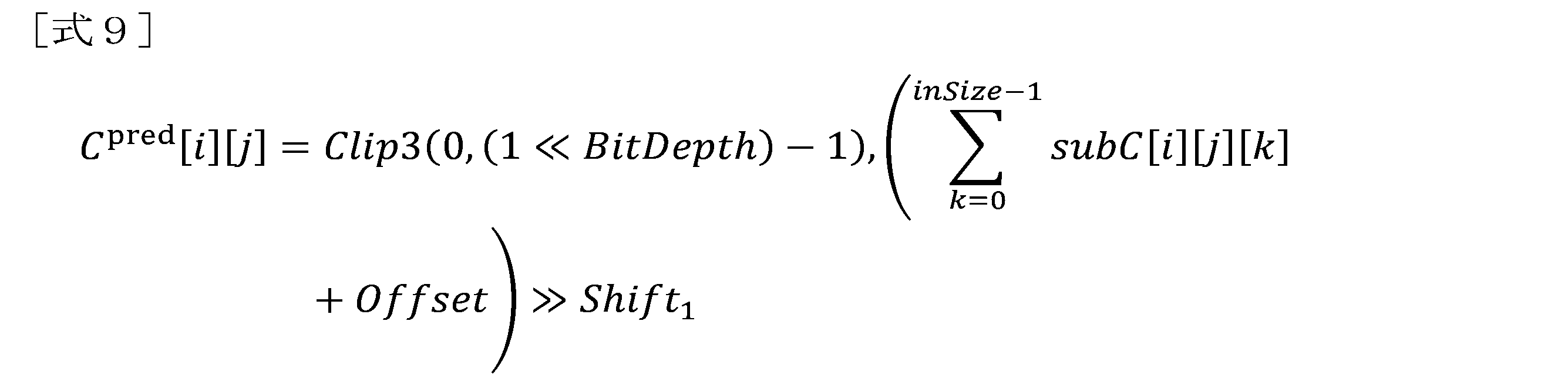
ステップ517において、前記現在ブロックの第2色成分のオリジナル値と前記補正後の第1予測値とに基づいて、前記現在ブロックの第2色成分の残差値を決定する。 In step 517, a residual value of the second color component of the current block is determined based on the original value of the second color component of the current block and the corrected first predicted value.
ステップ518において、前記現在ブロックの第2色成分の残差値を符号化し、得られた符号化ビットをビットストリームに書き込む。 In step 518, the residual value of the second color component of the current block is encoded and the resulting encoded bits are written to the bitstream.
以下では、復号化側の実施例を提供し、本願の実施例によって提供される復号化方法は、上記の符号化方法と同様であり、上記の第1符号化パラメータは、以下の実施例に記載の第1復号化パラメータに相当し、本質的に同じであり、上記の候補第1符号化パラメータは、以下の実施例に記載の候補第1復号化パラメータに相当し、本質的に同じであり、いずれも重み付け係数の大きさを制御するために使用される。以下の実施例で提供される復号化方法は、上記実施例の符号化方法と同様の有益な効果を有する。本願の復号化方法の実施例に開示されていない技術的詳細については、上記の符号化方法の実施例の説明を参照することによって理解できる。したがって、本願の復号化方法の実施例に開示されていない技術的詳細及び具体的な実施例については繰り返して説明しない。 The following provides an example of the decoding side, where the decoding method provided by the embodiment of the present application is similar to the encoding method described above, the above first encoding parameter corresponds to the first decoding parameter described in the following embodiment and is essentially the same, and the above candidate first encoding parameter corresponds to the candidate first decoding parameter described in the following embodiment and is essentially the same, both of which are used to control the magnitude of the weighting coefficient. The decoding method provided in the following embodiment has the same beneficial effects as the encoding method of the above embodiment. The technical details not disclosed in the embodiment of the decoding method of the present application can be understood by referring to the description of the embodiment of the encoding method above. Therefore, the technical details and specific examples not disclosed in the embodiment of the decoding method of the present application will not be described repeatedly.
本願の実施例は、復号化方法を提供し、図13は、本願の実施例による復号化方法の実現フローチャートであり、図13に示すように、前記方法は、以下のステップ131~ステップ134を含み得る。 An embodiment of the present application provides a decoding method, and FIG. 13 is a flowchart illustrating an implementation of the decoding method according to the embodiment of the present application. As shown in FIG. 13, the method may include the following steps 131 to 134.
ステップ131において、テンプレート領域に基づいて、第1復号化パラメータを決定する。 In step 131, a first decoding parameter is determined based on the template region.
ステップ132において、前記現在ブロックの第1色成分の参照サンプル値を決定する。 In step 132, a reference sample value for the first color component of the current block is determined.
ステップ133において、前記現在ブロックの第1色成分の参照サンプル値と前記第1復号化パラメータとに基づいて、第1重み付け係数を決定する。 In step 133, a first weighting factor is determined based on the reference sample value of the first color component of the current block and the first decoding parameter.
ステップ134において、前記第1重み付け係数と前記現在ブロックの第2色成分の参照サンプル値とに基づいて、前記現在ブロックの第2色成分の第1予測値を決定する。 In step 134, a first predicted value of the second color component of the current block is determined based on the first weighting coefficient and a reference sample value of the second color component of the current block.
以下では、上記の各ステップの更なる代替的な実施形態及び関連名詞などについてそれぞれ説明する。 Below, further alternative embodiments of each of the above steps and related nouns are described.
ステップ131では、テンプレート領域に基づいて、第1復号化パラメータを決定する。 In step 131, a first decoding parameter is determined based on the template region.
いくつかの実施例では、最初にテンプレート領域を決定してもよい。例えば、前記現在ブロックの隣接領域の画素利用可能性に基づいて、前記テンプレート領域を決定することができ、前記現在ブロックとの相対的な位置関係に基づき、前記隣接領域は、前記現在ブロックの上側領域、前記現在ブロックの左側領域、前記現在ブロックの上右側領域、前記現在ブロックの左下側領域、前記現在ブロックの左上側領域のうちの少なくとも1つを含む。 In some embodiments, a template region may be determined first. For example, the template region may be determined based on pixel availability of neighboring regions of the current block, including at least one of the following neighboring regions based on their relative position to the current block: a top region of the current block, a left region of the current block, a top right region of the current block, a bottom left region of the current block, and a top left region of the current block.
別の例では、構成された予測モードに含まれるテンプレート種類に基づいて、テンプレート領域を決定することもできる。 In another example, the template region can be determined based on the template type included in the configured prediction mode.
いくつかの実施例では、前記テンプレート種類は、少なくとも、上側テンプレート、左側テンプレート、上右側テンプレート、左下側テンプレート、左上側テンプレートのうちの少なくとも1つを含む。 In some embodiments, the template types include at least one of an upper template, a left template, an upper right template, a lower left template, and an upper left template.
さらに、いくつかの実施例では、構成された予測モードに含まれるテンプレートを前記テンプレート領域とすることができる。 Furthermore, in some embodiments, the template region may be a template included in the configured prediction mode.
前記テンプレート領域を決定した後、いくつかの実施例では、以下のステップ111及びステップ112によってステップ131を実現することができる。 After determining the template region, in some embodiments, step 131 can be achieved by the following steps 111 and 112.
ステップ111において、前記テンプレート領域の参照サンプル値を決定する。 In step 111, a reference sample value for the template region is determined.
いくつかの実施例では、前記参照サンプル値は、前記テンプレート領域の第1色成分の再構築値、前記テンプレート領域の第2色成分の再構築値、前記テンプレート領域の参照領域の第1色成分の再構築値、及び前記テンプレート領域の参照領域の第2色成分の再構築値を含む。 In some embodiments, the reference sample values include a reconstructed value of a first color component of the template region, a reconstructed value of a second color component of the template region, a reconstructed value of a first color component of a reference region of the template region, and a reconstructed value of a second color component of a reference region of the template region.
さらに、いくつかの実施例では、前記テンプレート領域の参照領域は、前記テンプレート領域の上側隣接領域、前記テンプレート領域の下側隣接領域、前記テンプレート領域の左側隣接領域、前記テンプレート領域の右側隣接領域、前記テンプレート領域のうちの少なくとも1つを含む。 Furthermore, in some embodiments, the reference region of the template region includes at least one of an upper adjacent region of the template region, a lower adjacent region of the template region, a left adjacent region of the template region, a right adjacent region of the template region, and the template region.
ステップ112において、前記テンプレート領域の参照サンプル値に基づいて、前記第1復号化パラメータを決定する。 In step 112, the first decoding parameters are determined based on the reference sample values of the template region.
いくつかの実施例では、ステップ1121及びステップ1122によってステップ112を実現することができる。 In some embodiments, step 112 can be achieved by steps 1121 and 1122.
ステップ1121において、前記テンプレート領域の第1差異値を決定し、前記テンプレート領域の第1差異値は、前記テンプレート領域の第1色成分の参照値と前記テンプレート領域の参照領域の第1色成分の参照値との差の絶対値に等しく設定される。 In step 1121, a first difference value for the template region is determined, and the first difference value for the template region is set equal to the absolute value of the difference between the reference value for the first color component of the template region and the reference value for the first color component of the reference region of the template region.
さらに、いくつかの実施例では、前記テンプレート領域の第1色成分の参照値は、前記テンプレート領域の第1色成分の再構築値、又は前記テンプレート領域の第1色成分の再構築値をフィルタリング処理して得られる値であり、前記テンプレート領域の参照領域の第1色成分の参照値は、前記テンプレート領域の参照領域の第1色成分の再構築値、又は前記テンプレート領域の参照領域の第1色成分の再構築値をフィルタリング処理して得られる値である。 Furthermore, in some embodiments, the reference value of the first color component of the template region is a reconstructed value of the first color component of the template region or a value obtained by filtering the reconstructed value of the first color component of the template region, and the reference value of the first color component of the reference region of the template region is a reconstructed value of the first color component of the reference region of the template region or a value obtained by filtering the reconstructed value of the first color component of the reference region of the template region.
ステップ1122において、前記テンプレート領域の第1差異値に基づいて、前記第1復号化パラメータを決定する。 In step 1122, the first decoding parameter is determined based on the first difference value of the template region.
さらに、いくつかの実施例では、ステップ1122-1~ステップ1122-3によってステップ1122を実現することができる。 Furthermore, in some embodiments, step 1122 can be achieved by steps 1122-1 to 1122-3.
ステップ1122-1において、前記第1差異値と候補第1復号化パラメータとに基づいて、前記テンプレート領域の第2色成分の第2予測値を決定する。 In step 1122-1, a second predicted value of a second color component of the template region is determined based on the first difference value and the candidate first decoding parameter.
いくつかの実施例では、前記候補第1符号化パラメータは、1つ又は複数の候補第1復号化パラメータを含む。 In some embodiments, the candidate first encoding parameters include one or more candidate first decoding parameters.
ステップ1122-2において、前記テンプレート領域の第2色成分の第1予測誤差を決定し、前記第1予測誤差は、前記テンプレート領域の第2色成分の参照値と前記テンプレート領域の第2色成分の第2予測値との誤差であり、前記テンプレート領域の第2色成分の参照値は、前記テンプレート領域の第2色成分の再構築値、又は前記テンプレート領域の第2色成分の再構築値をフィルタリング処理して得られる値である。 In step 1122-2, a first prediction error of the second color component of the template region is determined, the first prediction error being the error between a reference value of the second color component of the template region and a second predicted value of the second color component of the template region, and the reference value of the second color component of the template region being a reconstructed value of the second color component of the template region or a value obtained by filtering the reconstructed value of the second color component of the template region.
いくつかの実施例では、前記第1予測誤差を決定するための第2予測値を、前記テンプレート領域の第2色成分の第2予測値に対する補正操作によって得られる第2予測値に等しく設定する。 In some embodiments, the second predicted value for determining the first prediction error is set equal to a second predicted value obtained by a correction operation on a second predicted value of a second color component of the template region.
ステップ1122-3において、前記第1予測誤差に基づいて、前記第1復号化パラメータを決定する。 In step 1122-3, the first decoding parameter is determined based on the first prediction error.
本願の実施例では、ステップ1122-3を実現するための実施例は限定されず、様々なものであってもよい。例えば、以下の実施例5~実施例8のいずれかにより実現することができる。 In the embodiment of the present application, the embodiment for realizing step 1122-3 is not limited and may be various. For example, it may be realized by any of the following embodiments 5 to 8.
実施例5では、次のようにステップ1122-3を実現することができる。即ち、前記テンプレート領域の第2色成分の第2予測値を、前記テンプレート領域の参照領域の第2色成分の参照値と第2重み付け係数との重み付け和に等しく設定し、前記第1復号化パラメータを、前記第1予測誤差が第1条件を満す時に対応する前記候補第1復号化パラメータの値に等しく設定し、前記テンプレート領域の参照領域の第2色成分の参照値は、前記テンプレート領域の参照領域の第2色成分の再構築値、又は前記テンプレート領域の参照領域の第2色成分の再構築値をフィルタリング処理して得られる値である。 In the fifth embodiment, step 1122-3 can be realized as follows. That is, the second predicted value of the second color component of the template region is set equal to the weighted sum of the reference value of the second color component of the reference region of the template region and a second weighting coefficient, the first decoding parameter is set equal to the value of the candidate first decoding parameter corresponding to when the first prediction error satisfies a first condition, and the reference value of the second color component of the reference region of the template region is the reconstructed value of the second color component of the reference region of the template region or a value obtained by filtering the reconstructed value of the second color component of the reference region of the template region.
さらに、いくつかの実施例では、前記テンプレート領域の第1差異値及び前記候補第1復号化パラメータに基づいて、所定の対応関係を使用して、前記第2重み付け係数を決定する。 Furthermore, in some embodiments, the second weighting factor is determined based on the first difference value of the template region and the candidate first decoding parameter using a predetermined correspondence relationship.
さらに、いくつかの実施例では、前記所定の対応関係は、softmax関数であり、又は、前記所定の対応関係は、softmax関数を使用して得られるものであり、前記softmax関数の入力は、前記第1差異値と前記候補第1復号化パラメータとの比、前記第1差異値と前記候補第1復号化パラメータとの積、前記第1差異値をビットシフト処理して得られる値のうちの1つであり、前記ビットシフトのビット数は、前記候補第1復号化パラメータに等しい。 Furthermore, in some embodiments, the predetermined correspondence is a softmax function, or the predetermined correspondence is obtained using a softmax function, and an input to the softmax function is one of the ratio of the first difference value to the candidate first decoding parameter, the product of the first difference value and the candidate first decoding parameter, and a value obtained by bit-shifting the first difference value, and the number of bits of the bit shift is equal to the candidate first decoding parameter.
いくつかの実施例では、前記第1条件は、第1予測誤差が最小であること、第1予測誤差が第1閾値より小さいこと、第1予測誤差が最大であること、又は第1予測誤差が第3閾値より大きいことを含む。 In some embodiments, the first condition includes the first prediction error being a minimum, the first prediction error being less than a first threshold, the first prediction error being a maximum, or the first prediction error being greater than a third threshold.
実施例6では、次のようにステップ1122-3(即ち、前記第1予測誤差に基づいて、前記第1復号化パラメータを決定するステップ)を実現することもできる。即ち、前記テンプレート領域の各候補第1復号化パラメータの中から、第1予測誤差が第1条件を満たすパラメータを選択し、前記テンプレート領域に対応する、第1予測誤差が第1条件を満たすパラメータに基づいて、前記第1復号化パラメータを決定する。 In the sixth embodiment, step 1122-3 (i.e., the step of determining the first decoding parameter based on the first prediction error) can also be realized as follows. That is, from among the candidate first decoding parameters of the template region, a parameter whose first prediction error satisfies a first condition is selected, and the first decoding parameter is determined based on the parameter corresponding to the template region whose first prediction error satisfies the first condition.
さらに、以下の例9又は例10によって「前記テンプレート領域に対応する、第1予測誤差が第1条件を満たすパラメータに基づいて、前記第1復号化パラメータを決定する」ステップを実現することができる。 Furthermore, the step of "determining the first decoding parameter based on a parameter corresponding to the template region and for which the first prediction error satisfies a first condition" can be realized by the following Example 9 or Example 10.
例9では、次のように「前記テンプレート領域に対応する、第1予測誤差が第1条件を満たすパラメータに基づいて、前記第1復号化パラメータを決定する」ステップを実現することもできる。即ち、前記第1復号化パラメータを、第1予測誤差が第1条件を満たすパラメータに等しく設定し、又は、前記第1復号化パラメータを、第1予測誤差が第1条件を満たすパラメータの融合値に等しく設定する。 In Example 9, the step of "determining the first decoding parameter based on a parameter corresponding to the template region for which the first prediction error satisfies a first condition" can also be implemented as follows: i.e., setting the first decoding parameter equal to a parameter for which the first prediction error satisfies a first condition, or setting the first decoding parameter equal to a blended value of parameters for which the first prediction error satisfies a first condition.
さらに、いくつかの実施例では、前記第1復号化パラメータを、第1予測誤差が第1条件を満たすパラメータと第3重み付け係数との重み付け和に等しく設定する。 Furthermore, in some embodiments, the first decoding parameter is set equal to a weighted sum of the parameter for which the first prediction error satisfies the first condition and a third weighting factor.
いくつかの実施例では、第1予測誤差が第1条件を満たすパラメータに対応する第1予測誤差に基づいて、対応する第3重み付け係数を決定し、又は、前記第3重み付け係数を所定定数値に設定することができる。 In some embodiments, a corresponding third weighting factor can be determined based on the first prediction error corresponding to the parameter for which the first prediction error satisfies the first condition, or the third weighting factor can be set to a predetermined constant value.
例10では、次のように「前記テンプレート領域に対応する、第1予測誤差が第1条件を満たすパラメータに基づいて、前記第1復号化パラメータを決定する」ステップを実現することもできる。即ち、第1予測誤差が第1条件を満たすパラメータを拡張して、第1拡張パラメータを得、前記第1拡張パラメータ及び/又は第1予測誤差が第1条件を満たすパラメータを融合して、前記第1復号化パラメータを得る。 In Example 10, the step of "determining the first decoding parameter based on a parameter corresponding to the template region and for which the first prediction error satisfies a first condition" can also be implemented as follows: That is, a parameter for which the first prediction error satisfies a first condition is expanded to obtain a first expanded parameter, and the first expanded parameter and/or a parameter for which the first prediction error satisfies the first condition are combined to obtain the first decoding parameter.
実施例7では、さらに、次のようにステップ1122-3(即ち、前記第1予測誤差に基づいて、前記第1復号化パラメータを決定するステップ)を実現することができる。即ち、前記第1復号化パラメータを、各前記候補第1復号化パラメータと第4重み付け係数との重み付け和に等しく設定する。 In the seventh embodiment, step 1122-3 (i.e., determining the first decoding parameter based on the first prediction error) can be further implemented as follows: the first decoding parameter is set equal to a weighted sum of each of the candidate first decoding parameters and a fourth weighting factor.
いくつかの実施例では、前記第1予測誤差に基づいて、対応する前記候補第1復号化パラメータの第4重み付け係数を決定する。 In some embodiments, a fourth weighting factor for the corresponding candidate first decoding parameter is determined based on the first prediction error.
実施例8では、さらに、次のようにステップ1122-3(即ち、前記第1予測誤差に基づいて、前記第1復号化パラメータを決定するステップ)を実現することができる。即ち、前記テンプレート領域の同一候補第1復号化パラメータのそれぞれに対応する第1予測誤差に基づいて、対応する候補第1復号化パラメータの性能を表す評価パラメータを決定し、各前記候補第1復号化パラメータの評価パラメータに基づいて、前記第1復号化パラメータを決定する。 In the eighth embodiment, step 1122-3 (i.e., the step of determining the first decoding parameters based on the first prediction errors) can be further implemented as follows. That is, based on the first prediction errors corresponding to each of the same candidate first decoding parameters in the template region, an evaluation parameter representing the performance of the corresponding candidate first decoding parameters is determined, and the first decoding parameters are determined based on the evaluation parameters of each of the candidate first decoding parameters.
さらに、いくつかの実施例では、前記評価パラメータを、前記テンプレート領域の同一候補第1復号化パラメータのそれぞれに対応する第1予測誤差の融合値に等しく設定する。 Furthermore, in some embodiments, the evaluation parameter is set equal to a blended value of the first prediction errors corresponding to each of the same candidate first decoding parameters of the template region.
さらに、いくつかの実施例では、前記評価パラメータを、前記テンプレート領域の同一候補第1復号化パラメータのそれぞれに対応する第1予測誤差の和に等しく設定する。 Furthermore, in some embodiments, the evaluation parameter is set equal to the sum of first prediction errors corresponding to each of the same candidate first decoding parameters for the template region.
さらに、いくつかの実施例では、次のように「各前記候補第1復号化パラメータの評価パラメータに基づいて、前記第1復号化パラメータを決定する」ステップを実現することもできる。即ち、各前記候補第1復号化パラメータの中から、評価パラメータが第2条件を満たすパラメータを選択し、評価パラメータが第2条件を満たすパラメータに基づいて、前記第1復号化パラメータを決定する。 Furthermore, in some embodiments, the step of "determining the first decoding parameters based on the evaluation parameters of each of the candidate first decoding parameters" can be implemented as follows. That is, from each of the candidate first decoding parameters, a parameter whose evaluation parameter satisfies a second condition is selected, and the first decoding parameter is determined based on the parameter whose evaluation parameter satisfies the second condition.
さらに、以下の例11によって「評価パラメータが第2条件を満たすパラメータに基づいて、前記第1復号化パラメータを決定する」ステップを実現することができる。 Furthermore, the step of "determining the first decoding parameter based on the evaluation parameter that satisfies the second condition" can be realized by the following Example 11.
例11では、前記第1復号化パラメータを、評価パラメータが第2条件を満たすパラメータに等しく設定し、又は、前記第1復号化パラメータを、評価パラメータが第2条件を満たすパラメータの融合値に等しく設定する。 In Example 11, the first decoding parameter is set equal to a parameter whose evaluation parameter satisfies the second condition, or the first decoding parameter is set equal to a fusion value of parameters whose evaluation parameter satisfies the second condition.
いくつかの実施例では、前記第1復号化パラメータを、評価パラメータが第2条件を満たすパラメータと第5重み付け係数との重み付け和に等しく設定する。 In some embodiments, the first decoding parameter is set equal to a weighted sum of the parameter for which the evaluation parameter satisfies the second condition and a fifth weighting factor.
さらに、例12又は例13により、第5重み付け係数を取得する。 Furthermore, the fifth weighting coefficient is obtained by using Example 12 or Example 13.
例12では、評価パラメータが第2条件を満たすパラメータに対応するテンプレート領域に基づいて、対応するパラメータの第5重み付け係数を決定する。 In Example 12, a fifth weighting coefficient for the corresponding parameter is determined based on the template region corresponding to the parameter whose evaluation parameter satisfies the second condition.
さらに、いくつかの実施例では、評価パラメータが第2条件を満たすパラメータに対応するテンプレート領域の画素数及び/又はテンプレート種類に基づいて、対応するパラメータの第5重み付け係数を決定する。 Furthermore, in some embodiments, a fifth weighting coefficient for the corresponding parameter is determined based on the number of pixels in the template region and/or the template type corresponding to the evaluation parameter that satisfies the second condition.
いくつかの実施例では、前記第2条件は、評価パラメータが最小であること、評価パラメータが第2閾値より小さいこと、評価パラメータが最大であること、又は評価パラメータが第4閾値より大きいことを含む。 In some embodiments, the second condition includes the evaluation parameter being a minimum, the evaluation parameter being less than a second threshold, the evaluation parameter being a maximum, or the evaluation parameter being greater than a fourth threshold.
例13では、前記第5重み付け係数は、所定定数値である。 In Example 13, the fifth weighting factor is a predetermined constant value.
ある現在ブロックに対してイントラ予測を行う際に、テンプレート領域が存在しない場合があり得る。いくつかの実施例では、前記テンプレート領域が存在しない場合、デフォルト値を前記現在ブロックの第2色成分の予測値とする。別のいくつかの実施例では、前記テンプレート領域が存在しない場合、前記方法とは異なる別の予測方法を採用して、前記現在ブロックの第2色成分を予測することを決定することもできる。 When performing intra prediction on a current block, a template region may not exist. In some embodiments, if the template region does not exist, a default value is set as the predicted value of the second color component of the current block. In other embodiments, if the template region does not exist, it may be decided to adopt a prediction method different from the above method to predict the second color component of the current block.
いくつかの実施例では、前記復号化方法は、ビットストリームを解析して、前記第1復号化パラメータのインデックスを得、前記第1復号化パラメータのインデックスに基づいて、前記第1復号化パラメータを取得するステップをさらに含む。 In some embodiments, the decoding method further includes parsing a bitstream to obtain an index of the first decoding parameter, and obtaining the first decoding parameter based on the index of the first decoding parameter.
いくつかの実施例では、前記復号化方法は、ビットストリームを解析して、前記第1復号化パラメータを得るステップをさらに含む。 In some embodiments, the decoding method further includes parsing the bitstream to obtain the first decoding parameters.
いくつかの実施例では、前記復号化方法は、ビットストリームを解析して、前記現在ブロックの第2色成分の残差値を得るステップと、前記第2色成分の残差値と前記現在ブロックの第2色成分の第1予測値とに基づいて、前記現在ブロックの第2色成分の再構築値を決定するステップと、をさらに含む。 In some embodiments, the decoding method further includes analyzing the bitstream to obtain a residual value of a second color component of the current block, and determining a reconstructed value of the second color component of the current block based on the residual value of the second color component and a first predicted value of the second color component of the current block.
いくつかの実施例では、前記復号化方法は、前記現在ブロックの第2色成分の第1予測値に対して補正操作を行い、補正後の第1予測値を得るステップと、前記第2色成分の残差値と前記補正後の第1予測値とに基づいて、前記現在ブロックの第2色成分の再構築値を決定するステップと、をさらに含む。 In some embodiments, the decoding method further includes performing a correction operation on a first predicted value of a second color component of the current block to obtain a corrected first predicted value, and determining a reconstructed value of the second color component of the current block based on the residual value of the second color component and the corrected first predicted value.
本願の実施例では、第1色成分と第2色成分とは異なる種類である。例えば、第1色成分は、輝度成分であり、第2色成分は、色度成分である。別の例では、第1色成分は、色度成分であり、第2色成分は、輝度成分である。 In an embodiment of the present application, the first color component and the second color component are different types. For example, the first color component is a luminance component and the second color component is a chrominance component. In another example, the first color component is a chrominance component and the second color component is a luminance component.
現在ブロックに対して色度予測を行う場合、現在ブロックの再構築輝度情報、隣接参照領域の再構築輝度情報、及び隣接参照領域の再構築色度情報は、いずれも符号化済みの再構築情報である。したがって、上記の再構築情報を利用して、重みに基づく色度予測技術(WCP)を採用し、重みに基づく色度予測プロセスの前にテンプレートマッチングのステップを加え、異なるサイズと異なるコンテンツの現在のブロックに基づいて最適モデルパラメータを選択することを目的としている。ここで、重要なのは、テンプレートマッチングの方式を採用して、隣接領域内で重みベクトルの計算に使用される重みモデルの最適モデルパラメータを探すことであり、復号化側にとって、前記最適モデルパラメータは、上記の実施例に記載の第1復号化パラメータの一例であり、符号化側にとって、前記最適モデルパラメータは、上記の実施例に記載の第1符号化パラメータの一例である。 When chrominance prediction is performed on the current block, the reconstructed luminance information of the current block, the reconstructed luminance information of the adjacent reference region, and the reconstructed chrominance information of the adjacent reference region are all encoded reconstruction information. Therefore, by utilizing the above reconstruction information, a weight-based chrominance prediction technique (WCP) is adopted, and a template matching step is added before the weight-based chrominance prediction process, with the aim of selecting optimal model parameters based on current blocks of different sizes and different contents. Here, the key point is to adopt a template matching method to find optimal model parameters of the weight model used to calculate the weight vector in the adjacent region, and for the decoding side, the optimal model parameters are an example of the first decoding parameters described in the above embodiment, and for the encoding side, the optimal model parameters are an example of the first encoding parameters described in the above embodiment.
いくつかの実施例では、WCP技術の色度予測プロセスの詳細なステップは以下の通りであり、即ち、
WCPの入力:現在ブロックの位置(xTbCmp,yTbCmp)、現在ブロックの幅nTbW、及び現在ブロックの高nTbHである。
In some embodiments, the detailed steps of the chromaticity prediction process of the WCP technique are as follows:
Inputs of WCP: position of current block (xTbCmp, yTbCmp), width of current block nTbW, and height of current block nTbH.
WCPの出力:現在ブロックの色度予測値predSamples[x][y]であり、ここで、現在ブロック内の左上隅画素の位置を座標原点とし、x=0,…,nTbW-1、y=0,…,nTbH-1である。説明すべきこととして、色度成分は、上記の実施例に記載の第2色成分の一例であり、以下に述べる輝度成分は、上記の実施例に記載の第1色成分の一例である。 Output of WCP: Chroma predictions for the current block, predSamples[x][y], where the coordinate origin is the position of the top left pixel in the current block, and x = 0, ..., nTbW-1, y = 0, ..., nTbH-1. It should be noted that the chroma components are an example of the second color components described in the above examples, and the luma components described below are an example of the first color components described in the above examples.
図14に示すように、WCP技術の予測プロセスは、以下のステップ141~ステップ145、即ち、コアパラメータの設定、入力情報の取得、重みに基づく色度予測及び後処理を含み、入力情報の取得と重みに基づく色度予測の2つのステップの間に、テンプレートマッチングステップを追加する。以上のステップによって、現在ブロックの色度予測値を得ることができる。 As shown in FIG. 14, the prediction process of the WCP technique includes the following steps 141 to 145, namely, setting core parameters, obtaining input information, weight-based chromaticity prediction, and post-processing, and a template matching step is added between the two steps of obtaining input information and weight-based chromaticity prediction. Through the above steps, the chromaticity prediction value of the current block can be obtained.
ステップ141において、WCPコアパラメータを決定し、これらのパラメータは予め設定され得る。 In step 141, the WCP core parameters are determined, and these parameters may be preset.
ステップ142において、決定されたコアパラメータに基づいて入力情報を取得し、これには、参照色度情報、参照輝度情報、及び現在ブロックの再構築輝度情報を取得することが含まれる。 In step 142, input information is obtained based on the determined core parameters, which includes obtaining reference chrominance information, reference luma information, and reconstructed luma information for the current block.
ステップ143において、テンプレートマッチングによって制御パラメータを決定し、ここで、復号化側の場合、前記制御パラメータは、上記の実施例に記載の第1復号化パラメータの一例に相当し、符号化側の場合、上記の実施例に記載の第1符号化パラメータの一例に相当する。 In step 143, a control parameter is determined by template matching, where, in the case of the decoding side, the control parameter corresponds to an example of the first decoding parameter described in the above embodiment, and in the case of the encoding side, the control parameter corresponds to an example of the first encoding parameter described in the above embodiment.
ステップ144において、取得した入力情報に基づいて、重みに基づく色度予測計算を行う。
In
ステップ145において、前記色度予測計算結果に対して後処理を行う。 In step 145, post-processing is performed on the chromaticity prediction calculation results.
上記の図14に示す各ステップについて詳細に説明する。 Each step shown in Figure 14 above will be explained in detail.
ステップ141では、WCPコアパラメータを決定する。 In step 141, the WCP core parameters are determined.
ここで、WCPに関わるコアパラメータが決定され、即ち、WCPコアパラメータは、構成によって、又は何らかの方法で取得又は推論され得る。例えば、復号化側は、ビットストリームからWCPコアパラメータを取得する。具体的な適用については、後で詳細に説明する。 Here, the core parameters related to the WCP are determined; that is, the WCP core parameters can be obtained or inferred by configuration or in some other way. For example, the decoding side obtains the WCP core parameters from the bitstream. A specific application will be described in detail later.
WCPコアパラメータの決定は、制御パラメータ(T)、重みに基づく色度予測のための様々な入力情報の個数inSize、及び重みに基づく色度予測の出力(predWcp)の個数を決定することを含むが、これらに限定されない。predWcpは、predSizeW×predSizeHと配列される。ここで、重みに基づく色度予測の出力(predWcp)の個数は、同じ値(例えば、predSizeW=predSizeH=S/4)に設定することができ、又は現在ブロックのサイズに関連付けて設定することができる(例えば、predSizeW=nTbW,predSizeH=nTbH)。ここで、制御パラメータ(T)は、後続の段階の非線形関数を調整し、又は後続の段階に関わるデータを調整するために使用され得る。 Determining the WCP core parameters includes, but is not limited to, determining a control parameter (T), the number of various input information for weight-based chroma prediction, inSize, and the number of outputs of weight-based chroma prediction (predWcp). predWcp is arranged as predSizeW x predSizeH. Here, the number of outputs of weight-based chroma prediction (predWcp) can be set to the same value (e.g., predSizeW = predSizeH = S/4) or can be set relative to the size of the current block (e.g., predSizeW = nTbW, predSizeH = nTbH). Here, the control parameter (T) can be used to adjust the nonlinear function of a subsequent stage or to adjust data related to a subsequent stage.
WCPコアパラメータの決定は、一定の条件下で、ブロックのサイズ又はブロックコンテンツの影響を受ける。現在ブロックのサイズ又はブロックコンテンツ又はブロック内の画素数に基づいて分類することができ、異なる類別に基づいて、同じ又は異なるコアパラメータを構成することができる。即ち、異なる類別に対応するinSize又はpredWcp(predSizeW×predSizeHに配列される)は、例えば、predSizeW=predSizeH=s/4のように同じであってもよく、predWcpは、predSizeW=nTbW、predSizeH=nTbHのように、現在ブロックのサイズに関連付けられてもよい。注意することとして、predSizeWとpredSizeHは、同じでも異なってもよい。異なるサイズ又は異なるコンテンツ又はブロック内の異なる画素数の現在ブロックに対応する制御パラメータ(T)は、ステップ143のテンプレートマッチングによって決定される。 The determination of the WCP core parameters is affected by the size of the block or the block contents under certain conditions. The current block may be classified based on its size or block contents or the number of pixels in the block, and the same or different core parameters may be configured based on different categories. That is, inSize or predWcp (arranged as predSizeW x predSizeH) corresponding to different categories may be the same, for example, predSizeW = predSizeH = s/4, and predWcp may be related to the size of the current block, for example, predSizeW = nTbW, predSizeH = nTbH. It is noted that predSizeW and predSizeH may be the same or different. The control parameters (T) corresponding to the current block of different sizes or different contents or different numbers of pixels in the block are determined by template matching in step 143.
ステップ142では、入力情報を取得する。 In step 142, the input information is obtained.
現在ブロックを予測する場合、現在予測ブロックの上方の領域、左上方の領域、及び左方の領域は、現在ブロックの参照領域と呼ばれ、図15に示すように、現在ブロックの参照領域内の画素は、再構築された画素であり、参照画素と呼ばれる。 When predicting the current block, the regions above, to the upper left, and to the left of the current prediction block are called the reference region of the current block, and the pixels in the reference region of the current block are reconstructed pixels and are called reference pixels, as shown in FIG. 15.
参照領域から参照色度情報refC及び参照輝度情報refYを取得する。取得した参照色度情報refCは、選択された現在ブロックの上方の領域の参照再構築色度値、及び左方の領域の参照再構築色度値を含むが、これらに限定されない。取得した参照輝度情報refYは、参照色度情報位置に基づいて取得した対応する参照輝度情報を含むが、これらに限定されない。 Reference chromaticity information refC and reference luminance information refY are obtained from the reference region. The obtained reference chromaticity information refC includes, but is not limited to, the reference reconstructed chromaticity values of the region above the selected current block and the reference reconstructed chromaticity values of the region to the left. The obtained reference luminance information refY includes, but is not limited to, the corresponding reference luminance information obtained based on the reference chromaticity information position.
現在ブロックの再構築輝度情報recYを取得する方式は、現在ブロックの色度情報位置に基づいて、対応する再構築輝度情報を取得して、現在ブロックの再構築輝度情報とすることを含むが、これらに限定されない。 Methods for obtaining the reconstructed luminance information recY of the current block include, but are not limited to, obtaining corresponding reconstructed luminance information based on the chromaticity information position of the current block and setting it as the reconstructed luminance information of the current block.
説明すべきこととして、参照色度情報refCは、現在ブロックの第2色成分の参照サンプル値の一例であり、参照輝度情報refY及び現在ブロックの再構築輝度情報recYは、現在ブロックの第1色成分の参照サンプル値の一例である。 It should be noted that the reference chromaticity information refC is an example of a reference sample value of the second color component of the current block, and the reference luma information refY and the reconstructed luma information recY of the current block are examples of reference sample values of the first color component of the current block.
入力情報を取得することは、inSize数量の参照色度情報refC(前処理が必要な場合、前処理操作後の)を取得すること、inSize数量の参照輝度情報refY(前処理が必要な場合、前処理操作後の)を取得すること、及び現在ブロックの再構築輝度情報recY(前処理が必要な場合、前処理操作後の)を取得することを含む。 Obtaining the input information includes obtaining reference chromaticity information refC (after a preprocessing operation, if preprocessing is required) of the inSize quantity, obtaining reference luma information refY (after a preprocessing operation, if preprocessing is required) of the inSize quantity, and obtaining reconstructed luma information recY (after a preprocessing operation, if preprocessing is required) of the current block.
ステップ143では、テンプレートマッチングによって制御パラメータを決定する。 In step 143, the control parameters are determined by template matching.
テンプレート領域の再構築輝度画素、再構築色度画素、テンプレート領域の参照領域における再構築輝度画素及び再構築色度画素を利用して、WCPの予測プロセスをシミュレートし、その中から最適制御パラメータ(best_T)を選択する。図16に示すように、具体的には、以下のステップ1431ステップ1433を含む。 The prediction process of the WCP is simulated using the reconstructed luma pixels, reconstructed chroma pixels of the template region, and the reconstructed luma pixels and chroma pixels in the reference region of the template region, and the optimal control parameter (best_T) is selected from the simulation. As shown in FIG. 16, specifically, the process includes the following steps 1431 and 1433.
ステップ1431において、テンプレート領域とテンプレートの参照領域を決定する。 In step 1431, the template area and the template reference area are determined.
現在ブロックの隣接領域の画素利用可能性に基づいて、テンプレート領域及びテンプレート領域の参照領域の画素が利用可能であるか否かを判断し、再構築輝度情報と再構築色度情報が含まれる。テンプレート領域と現在ブロックとの相対的な位置関係に基づいて、テンプレート領域を、上側テンプレート、左側テンプレート、上右側テンプレート、左下側テンプレート、及び左上側テンプレートなどのテンプレート種類に分類することができるが、これらに限定されない。テンプレート領域の参照領域は、テンプレート領域の種類に応じて変化し、テンプレート領域がその参照領域と重なることが許可される。また、図10、図11、及び図12Aに示すように、異なる現在ブロックのニーズを満たすために、テンプレート種類とテンプレート領域に対応する参照領域を柔軟に組み合わせることができる。異なる現在ブロックの異なる種類のテンプレートサイズは、同じに固定されていてもよく、異なっていてもよい。例えば、現在ブロックの異なるサイズに基づいて異なるテンプレートサイズなどを選択することができる。図11のテンプレートを例に説明すると、テンプレートのサイズ設定条件は、以下の式で示しており、nTbW及びnTbHは、現在ブロックの幅及び高さであり、iTempW及びiTempHは、決定されたテンプレートの幅及び高さである。 Based on the pixel availability of the neighboring regions of the current block, it is determined whether the pixels of the template region and the reference region of the template region are available, and the reconstructed luminance information and the reconstructed chrominance information are included. Based on the relative positional relationship between the template region and the current block, the template region can be classified into template types such as, but not limited to, upper template, left template, upper right template, lower left template, and upper left template. The reference region of the template region changes according to the type of the template region, and the template region is allowed to overlap with its reference region. Also, as shown in FIG. 10, FIG. 11, and FIG. 12A, the template types and the reference regions corresponding to the template regions can be flexibly combined to meet the needs of different current blocks. The template sizes of different types of different current blocks may be fixed to be the same or different. For example, different template sizes, etc. can be selected according to different sizes of the current block. Using the template in Figure 11 as an example, the template size setting conditions are shown in the following formula, where nTbW and nTbH are the width and height of the current block, and iTempW and iTempH are the width and height of the determined template.

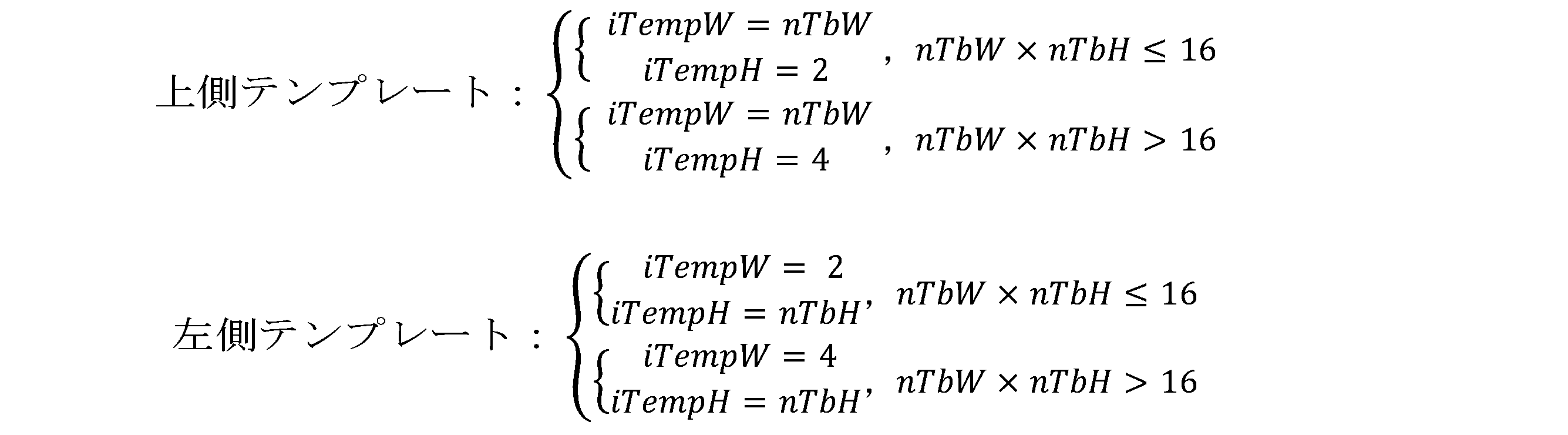
図10、図11、及び図12Aは、それぞれ3つの種類のテンプレート位置及びそれに対応する参照領域の位置を示す模式図であり、以下の実施例のテンプレートは、いずれも図11の上側テンプレート及び左側テンプレートを例に説明し、実際の適用プロセスでは、このステップにおいて、より多くの異なるテンプレート種類及び対応する参照領域が使用されてもよい。 Figures 10, 11, and 12A are schematic diagrams showing three types of template positions and the positions of the corresponding reference regions, respectively. The templates in the following examples are all described using the upper template and the left template in Figure 11 as examples. In the actual application process, more different template types and corresponding reference regions may be used in this step.
ステップ1432において、テンプレート領域内でWCP予測を行う。 In step 1432, WCP prediction is performed within the template region.
異なるテンプレート種類において、テンプレート領域の再構築輝度情報、テンプレート領域の再構築色度情報、テンプレート領域の参照領域の再構築輝度情報、及び再構築色度情報は、いずれも符号化済みの再構築情報である。したがって、WCPの基本的なプロセスは、テンプレート領域で行われ得、ここで、テンプレート領域の再構築輝度情報及びテンプレート領域の参照領域の再構築輝度情報は、テンプレート領域の第1色成分の参照サンプル値の一例であり、テンプレート領域の再構築色度情報及びテンプレート領域の参照領域の再構築色度情報は、テンプレート領域の第2色成分の参照サンプル値の一例である。 In different template types, the reconstructed luminance information of the template region, the reconstructed chrominance information of the template region, the reconstructed luminance information of the reference region of the template region, and the reconstructed chrominance information are all encoded reconstruction information. Thus, the basic process of WCP can be performed in the template region, where the reconstructed luminance information of the template region and the reconstructed luminance information of the reference region of the template region are examples of reference sample values of the first color component of the template region, and the reconstructed chrominance information of the template region and the reconstructed chrominance information of the reference region of the template region are examples of reference sample values of the second color component of the template region.
まず、上側テンプレートのWCP予測を行う。詳細なプロセスは以下の通りであり、即ち、
テンプレートのWCPの入力:上側テンプレートの位置(xTemp,yTemp)、上側テンプレートの幅nTbW、及び上側テンプレートの高さiTempHである。
First, perform WCP prediction of the top template. The detailed process is as follows:
Template WCP inputs: upper template position (xTemp, yTemp), upper template width nTbW, and upper template height iTempH.
テンプレートのWCPの出力:上側テンプレートの色度予測値predTempSamples[x][y]、即ち、テンプレート領域の第2色成分の第2予測値の一例であり、ここで、上側テンプレートの左上隅画素の位置を座標原点とし、x=0,…,nTbW-1、y=0,…,nTbH-1である。 Template WCP output: Chroma prediction value predTempSamples[x][y] of the upper template, i.e., an example of the second prediction value of the second color component of the template region, where the position of the upper left corner pixel of the upper template is the coordinate origin, x = 0, ..., nTbW-1, y = 0, ..., nTbH-1.
WCPコアパラメータの決定:制御パラメータ(T)、重みに基づく色度予測の様々な種類の入力情報の個数inTempSize、重みに基づく色度予測の出力(predTempWcp)の個数(predTempSizeW×predTempSizeHに配列される)の決定を含むが、これらに限定されない。上記のinTempSize、predTempSizeW、及びpredTempSizeHパラメータは、異なるテンプレート種類に応じて変化してもよく、現在ブロックのWCP予測プロセス中に構成されたWCPコアパラメータに応じて変化してもよい。 Determination of WCP core parameters: including but not limited to determination of the control parameter (T), the number of various types of input information for weight-based chroma prediction (inTempSize), and the number of outputs (predTempWcp) for weight-based chroma prediction (arranged as predTempSizeW×predTempSizeH). The above inTempSize, predTempSizeW, and predTempSizeH parameters may vary according to different template types and may vary according to the WCP core parameters configured during the WCP prediction process of the current block.
入力情報の取得:上側テンプレートの参照領域から、参照色度情報refTempC及び参照輝度情報refTempYを取得する。参照色度情報refTempCを取得することは、上側テンプレートの参照領域の参照再構築色度値を選択することを含むが、これに限定なれない。参照輝度情報refTempYを取得することは、参照色度情報の位置に基づいて、対応する参照輝度情報を取得することを含むが、これに限定されない。 Obtaining input information: Obtaining reference chromaticity information refTempC and reference luminance information refTempY from the reference area of the upper template. Obtaining reference chromaticity information refTempC includes, but is not limited to, selecting a reference reconstructed chromaticity value of the reference area of the upper template. Obtaining reference luminance information refTempY includes, but is not limited to, obtaining corresponding reference luminance information based on the position of the reference chromaticity information.
テンプレートの再構築色度情報recTempCを取得する方式は、現在テンプレート内の再構築色度情報を選択することを含むが、これに限定されない。 Methods for obtaining the reconstructed chromaticity information recTempC of the template include, but are not limited to, selecting the reconstructed chromaticity information within the current template.
テンプレートの再構築輝度情報recTempYを取得する方式は、現在テンプレート内の再構築色度情報の位置に基づいて、対応する再構築輝度情報を取得して、現在テンプレートの再構築輝度情報とすることを含むが、これに限定されない。このプロセスでは、異なる要求に応じて前処理を行うこともでき、例えば、異なる入力色フォーマット情報に基づいてアップ・ダウンサンプリングを行い、参照領域の一部のみを選択したり、参照領域で点選択を実行したりする。 The manner of obtaining the reconstructed luminance information recTempY of the template includes, but is not limited to, obtaining the corresponding reconstructed luminance information based on the position of the reconstructed chromaticity information in the current template, and using it as the reconstructed luminance information of the current template. In this process, preprocessing can also be performed according to different requirements, such as performing up-down sampling based on different input color format information, selecting only a part of the reference area, or performing point selection in the reference area.
次に、構成されたパラメータで規定されたサイズ内のテンプレート色度予測値CpredT[i][j](i=0…predTempSizeW-1、j=0…predTempSizeH-1)を1つずつ取得する。注意することとして、predTempSizeH及びpredTempSizeWは、決定されたWCPコアパラメータであり、現在テンプレートの高さ又は幅と同じであっても異なってもよい。 Then, obtain template chromaticity prediction values C predT [i][j] (i=0...predTempSizeW-1, j=0...predTempSizeH-1) one by one within the size defined by the configured parameters. Note that predTempSizeH and predTempSizeW are determined WCP core parameters, which may be the same as or different from the height or width of the current template.
詳細な計算プロセスは以下の通りである。 The detailed calculation process is as follows:
i=0,…,predTempSizeW-1、j=0,…,predTempSizeH-1を処理対象とし、
k=0,1,…,inTempSize-1を処理対象とし、
輝度差ベクトル内の各要素diffTempY[i][j][k]を構築し、
重みベクトル内の各要素cTempWeight[i][j][k](又はcTempWeightFloat[i][j][k])を計算し、
cTempWeight[i][j](又はcTempWeightFloat[i][j][k])及びrefTempCによって色度予測値CpredT[i][j]を計算する。
i=0,...,predTempSizeW-1, j=0,...,predTempSizeH-1 are the processing targets,
k=0, 1, ..., inTempSize-1 is the processing target,
Construct each element diffTempY[i][j][k] in the luminance difference vector,
Calculate for each element cTempWeight[i][j][k] (or cTempWeightFloat[i][j][k]) in the weight vector;
Calculate the chromaticity prediction value C predT [i][j] according to cTempWeight[i][j] (or cTempWeightFloat[i][j][k]) and refTempC.
輝度差ベクトルの構築:WCPコアパラメータで規定されたサイズ内のテンプレートの各予測待ち色度画素CpredT[i][j]に対して、それに対応する再構築輝度情報recTempY[i][j]をinTempSize数量の参照輝度情報refTempYから減算し、その絶対値を取って輝度差ベクトルdiffTempY[i][j][k]を得る。計算式は、式10で示され、ここで、k=0,1…inTempSize-1である。同様に、得られた輝度差ベクトルに対して、線形又は非線形数値処理を行ってもよい。ここで、輝度差ベクトル内の要素は、第1差異値の一例である。 Constructing a luminance difference vector: For each prediction-to-be-predicted chromaticity pixel C predT [i][j] of the template within the size specified by the WCP core parameters, subtract the corresponding reconstructed luminance information recTempY[i][j] from the inTempSize quantity of reference luminance information refTempY, and take the absolute value to obtain a luminance difference vector diffTempY[i][j][k]. The calculation formula is shown in Equation 10, where k=0, 1...inTempSize-1. Similarly, linear or nonlinear numerical processing may be performed on the obtained luminance difference vector. Here, the elements in the luminance difference vector are an example of the first difference value.
[式10]
diffTempY[i][j][k]=abs(refTempY[k]-recTempY[i][j])
ここで、

diffTempY[i][j][k]=abs(refTempY[k]-recTempY[i][j])
Where:

[式12]
cTempWeight[i][j][k]=round(cTempWeightFloat[i][j][k]×2Shift)
ここで、
round(x)=Sign(x)×Floor(Abs(x)+0.5)

cTempWeight[i][j][k]=round(cTempWeightFloat[i][j][k]×2 Shift )
Where:
round(x)=Sign(x)×Floor(Abs(x)+0.5)

k=0,1…inSize-1とすると、
[式13]
subTempCFloat[i][j][k]=(cTempWeightFloat[i][j][k]×refTempC[k])
計算が完了した後、subTempCFloatに対して固定小数点演算を行うことができ、固定小数点演算プロセスでは、一定の計算精度を保持するために、式14及び式15のように1つの係数と乗算することができる。
If k=0, 1...inSize-1,
[Formula 13]
subTempCFloat[i][j][k]=(cTempWeightFloat[i][j][k]×refTempC[k])
After the calculation is completed, fixed-point arithmetic can be performed on subTempCFloat, and in the fixed-point arithmetic process, in order to maintain a certain calculation accuracy, it can be multiplied by one coefficient as in Equation 14 and Equation 15.
[式14]
subTempC[i][j][k]=round(subTempCFloat[i][j][k]×2Shift)
又は、
[式15]
subTempC[i][j][k]=(cTempWeight[i][j][k]×refTempC[k])
i=0…predSizeW-1、j=0…predSizeH-1とすると、

subTempC[i][j][k]=round(subTempCFloat[i][j][k]×2 Shift )
Or,
[Formula 15]
subTempC[i][j][k]=(cTempWeight[i][j][k]×refTempC[k])
Let i=0...predSizeW-1, j=0...predSizeH-1,
[式17]
CpredT[i][j]=round(CpredTFloat[i][j])
又は式18のように固定小数点演算されたsubTempC[i][j][k]を使用して計算する。
[Formula 17]
C predT [i][j]=round(C predT Float[i][j])
Alternatively, it is calculated using subTempC[i][j][k] calculated by fixed point arithmetic as in Equation 18.


各予測待ち画素の色度予測値CpredT[i][j]を個別のスペースに記憶し、重みに基づく色度予測の出力predTempWcpとする。 The chromaticity prediction value C predT [i][j] of each pixel waiting to be predicted is stored in a separate space, which is the output of the weight-based chromaticity prediction, predTempWcp.
predTempWcpの補正:predTempWcp内の色度予測値は限定された範囲内にあるはずであり、限定された範囲を超える場合、前記対応する補正操作を行うべきである。前記補正操作は、後述するステップ1444の現在ブロックに採用される補正操作と一致しなければならない。
Correction of predTempWcp: The chromaticity prediction value in predTempWcp should be within a limited range, and if it exceeds the limited range, the corresponding correction operation should be performed. The correction operation should be consistent with the correction operation applied to the current block in
例えば、
CpredT[i][j]内の色度予測値に対してクリップ操作を行うことができ、具体的には、以下の通りである。
for example,
A clipping operation can be performed on the chrominance predictions in C predT [i][j], specifically as follows:
CpredT[i][j]の値が0より小さい場合、0に設定し、
CpredT[i][j]の値が(1<<BitDepth)-1より大きい場合、(1<<BitDepth)-1に設定する。
If the value of C predT [i][j] is less than 0, set it to 0;
If the value of C predT [i][j] is greater than (1<<BitDepth)-1, set it to (1<<BitDepth)-1.
これにより、predTempWcp内のすべての予測値が0~(1<<BitDepth)-1にあることを保証する。 This ensures that all prediction values in predTempWcp are between 0 and (1<<BitDepth)-1.
即ち、

図12Bは、WCPのプロセスを示しており、図12Bは、図12Aに示すテンプレート領域及びテンプレート領域の参照領域に基づいて行われるWCPプロセスであってもよく、図12Bは、他の種類のテンプレート領域及び対応する参照領域に基づいて行われるWCPプロセスであってもよい。図12Bに示すように、ダウンサンプリングされた輝度ブロック内の各サンプルrecTempY[i][j]を対象として、まず、recTempY[i][j]と隣接輝度ベクトルrefTempY[k]との差の絶対値に基づいて、輝度差ベクトルdiffTempY[i][j][k]を得、次に、diffTempY[i][j][k]に関連付けられた非線形マッピングモデルに基づいて、正規化重みベクトルcTempWeight[i][j][k]を導出し、第3に、重みベクトルを利用して、重みベクトルと隣接色度ベクトルとをベクトル乗算して、予測色度サンプルCpredT[i][j]を得る。 Fig. 12B shows the process of WCP, which may be the WCP process based on the template region and the reference region of the template region shown in Fig. 12A, or may be the WCP process based on other types of template regions and corresponding reference regions. As shown in Fig. 12B, for each sample recTempY[i][j] in the downsampled luma block, first, obtain a luma difference vector diffTempY[i][j][k] based on the absolute value of the difference between recTempY[i][j] and the adjacent luma vector refTempY[k], then derive a normalized weight vector cTempWeight[i][j][k] based on the nonlinear mapping model associated with diffTempY[i][j][k], and thirdly, use the weight vector to vector-multiply the weight vector and the adjacent chroma vector to obtain a predicted chroma sample C predT [i][j].
左側テンプレートのWCP予測プロセスでは、上側テンプレートのWCP予測プロセスのWCPの入力、出力、コアパラメータの構成、入力情報の取得のみについて説明するか、他の操作は一致している。 In the WCP prediction process of the left template, we only describe the WCP input, output, core parameter configuration, and input information acquisition of the WCP prediction process of the upper template, while other operations are consistent.
テンプレートのWCPの入力:左側テンプレートの位置(xTemp,yTemp)、左側テンプレートの幅iTempW、及び左側テンプレートの高さnTbHである。 Template WCP inputs: Left template position (xTemp, yTemp), left template width iTempW, and left template height nTbH.
テンプレートのWCPの出力:左側テンプレートの色度予測値predTempSamples[x][y]であり、ここで、左側テンプレートの左上隅画素の位置を座標原点とし、x=0,…,iTempW-1、y=0,…,nTbH-1である。 Template WCP output: Chroma prediction value predTempSamples[x][y] of the left template, where the position of the top left corner pixel of the left template is the coordinate origin, x = 0, ..., iTempW-1, y = 0, ..., nTbH-1.
コアパラメータの構成:制御パラメータ(T)、重みに基づく色度予測の様々な種類の入力情報の個数inTempSize、重みに基づく色度予測の出力(predTempWcp)の個数(predTempSizeW×predTempSizeWに配列される)の決定を含むが、これらに限定されない。上記のinTempSize、predTempSizeW、及びpredTempSizeWパラメータは、上側テンプレートの構成されたパラメータと同じであってもよく、自体のテンプレート種類に基づいて異なるパラメータを選択してもよい。 Core parameter configuration: including but not limited to determining the control parameter (T), the number of various types of input information for weight-based chromaticity prediction (inTempSize), and the number of outputs (predTempWcp) for weight-based chromaticity prediction (arranged as predTempSizeW x predTempSizeW). The above inTempSize, predTempSizeW, and predTempSizeW parameters may be the same as the configured parameters of the upper template, or different parameters may be selected based on the template type itself.
入力情報の取得:上側テンプレート及び左側テンプレートの参照領域は同じであってもよく、それぞれ異なる参照領域を選択してもよい。同様に、異なる要求に応じて前処理操作を行ってもよい。 Obtaining input information: The reference regions of the upper template and the left template may be the same, or different reference regions may be selected. Similarly, pre-processing operations may be performed according to different requirements.
左側テンプレートに対するWCPの予測プロセスが完了すると、同様に自体の重みに基づく色度予測の出力が保存される。 Once the WCP prediction process for the left template is complete, the output of the chromaticity prediction based on its own weights is also saved.
ステップ1433において、最適制御パラメータbest_Tを選択する。 In step 1433, the optimal control parameter best_T is selected.
上記により、上側テンプレート及び左側テンプレートのWCP予測プロセスについて説明しており、このようにして、それぞれのテンプレート内の再構築色度情報recTempC[i][j]と、ある制御パラメータ(T)に対応する予測色度情報predTempWcp[i][j]が取得される。 The above describes the WCP prediction process for the top and left templates, in which reconstructed chromaticity information recTempC[i][j] in each template and predicted chromaticity information predTempWcp[i][j] corresponding to a certain control parameter (T) are obtained.
異なる制御パラメータ(T)において、テンプレートWCP予測プロセスをループ走査することにより、対応する複数組の予測色度情報が得られ、ある評価基準に従って1つの最適制御パラメータ(T)を選択することができる。例えば、絶対差の和(SAD)、絶対変換差の和(SATD)、誤差の二乗和(SSE)、平均絶対差(MAD)、平均絶対誤差(MAE)、平均二乗誤差(MSE)、レート歪み関数(RDO)などという評価基準、即ち、第1予測誤差の一例を選択することができる。後述する各評価基準は、上記のいずれかの基準から選択することができ、MAEという評価基準を例にとると、計算式は、式20に示す通りである。 By looping through the template WCP prediction process for different control parameters (T), corresponding sets of predicted chromaticity information can be obtained, and one optimal control parameter (T) can be selected according to a certain evaluation criterion. For example, the sum of absolute differences (SAD), the sum of absolute transformed differences (SATD), the sum of squared errors (SSE), the mean absolute difference (MAD), the mean absolute error (MAE), the mean squared error (MSE), the rate distortion function (RDO), etc., that is, an example of the first prediction error, can be selected. Each evaluation criterion described later can be selected from any of the above criteria. Taking the evaluation criterion MAE as an example, the calculation formula is as shown in Equation 20.

テンプレートが1つしか得られない場合、上側テンプレート又は左側テンプレートのどちらでも使用可能であり、この場合、1つの最適制御パラメータしか選択できず、この制御パラメータは保存され、best_Tと記録される。 If only one template is available, either the top or left template can be used, in which case only one optimal control parameter can be selected, and this control parameter is saved and recorded as best_T.
2つのテンプレートがいずれも得ることができる場合、上側テンプレートの最適パラメータabove_T及び左側テンプレートの最適パラメータleft_Tを選択することができ、次に、両者を処理する。処理方法は、以下の方法を含むが、これらに限定されない。 If both of the two templates can be obtained, the optimal parameters above_T of the upper template and the optimal parameters left_T of the left template can be selected, and then both are processed. The processing methods include, but are not limited to, the following methods:
第1の方法は、above_T及びleft_Tの両方を1つの最適パラメータbest_Tに重み付け融合する方法であり、式21に示す。 The first method is to weight and fuse both above_T and left_T into one optimal parameter best_T, as shown in Equation 21.
[式21]
best_T=w0×above_T+w1×left_T
重み付け融合の基準としては、固定重み付け係数を選択してもよく、各自のテンプレートの再構築色度と予測色度の平均絶対誤差に基づいて重み付け係数などを割り当ててもよい。前者の固定重み付け係数は{0.5,0.5}であり、後者は、式22を使用して重み付け係数を計算し、MAEAは、上側テンプレートの平均絶対誤差であり、MAELは、左側テンプレートの平均絶対誤差であり、MAEAは、上側テンプレートの平均絶対誤差であり、ここで、MAEL及びMAEAは、いずれも第1予測誤差の一例である。
[Formula 21]
best_T=w 0 ×above_T+w 1 ×left_T
As a criterion for weighted fusion, a fixed weighting factor may be selected, or a weighting factor may be assigned based on the mean absolute error of the reconstructed chromaticity and the predicted chromaticity of each template, etc. The fixed weighting factor of the former is {0.5, 0.5}, and the latter uses

第3の方法は、同様に、above_T及びleft_Tを保持し、ステップ144の重みに基づく色度予測中に、above_T及びleft_Tに値の近傍のパラメータ値を走査する方法である。符号化側は、ある評価基準に従って現在ブロックのオリジナル色度値と予測色度値を処理し、縮小されたパラメータ区間から最適制御パラメータを選択し、符号化されたビットストリームで縮小されたパラメータ区間内の最適制御パラメータのインデックスを伝送することも、パラメータ値を直接伝送することもできる。第2の方法及び第3の方法のように複数の最適制御パラメータの場合、ステップ144では特に説明しない。
The third method is to similarly hold above_T and left_T, and scan the parameter values near the values above_T and left_T during the weight-based chroma prediction in
テンプレート選択プロセスにおいて、2つ以上のテンプレートを選択して後続の操作を行う場合、上記の場合に従って処理を行うようにしてもよい。 In the template selection process, if two or more templates are selected for subsequent operations, processing may be performed according to the above cases.
ステップ144では、取得した入力情報に基づいて、重みに基づく色度予測計算を行う。
In
構成されたパラメータで規定されたサイズ内の色度予測値Cpred[i][j](i=0,…,predSizeW-1、j=0,…,predSizeH-1)を1つずつ取得する。注意することとして、predSizeH及びpredSizeWは、決定されたWCPコアパラメータであり、現在テンプレートの高さnTbH又は幅nTbWと同じであっても異なってもよい。このように、一定の条件下で、現在ブロック内の予測待ち画素の一部のみに対して以下の計算を行う。 The chromaticity prediction values C pred [i][j] (i=0,...,predSizeW-1, j=0,...,predSizeH-1) within the size defined by the configured parameters are obtained one by one. Note that predSizeH and predSizeW are determined WCP core parameters, and may be the same as or different from the height nTbH or width nTbW of the current template. Thus, under certain conditions, the following calculation is performed for only a portion of the pixels waiting to be predicted in the current block.
図17に示すように、ステップ144は、以下のステップ1441~ステップ1444を含む。
As shown in FIG. 17,
ステップ1441において、各予測待ち画素に対して、取得した参照色度情報、参照輝度情報、及び現在ブロックの再構築輝度情報を利用して、輝度差ベクトルを構築する。
In
ステップ1442において、各予測待ち画素に対して、前記輝度差ベクトルに基づいて、非線形関数を利用して重みベクトルを計算する。
In
ステップ1443において、各予測待ち画素に対して、前記重みベクトルと取得した参照色度情報とに基づいて、重み付けにより色度予測値を計算する。
In
ステップ1444において、各予測待ち画素に対して、前記算出された色度予測値を補正し、前記補正はclip操作を含む。
In
即ち、重みを取得し、重みに基づいて重み付け予測を行うことにより、重みに基づく色度予測値を得、それに対して補正を行う。重みの取得プロセスは、輝度差ベクトルを構築することと、重みベクトルを計算することとを含む。 That is, the weights are obtained, and a weighted prediction is performed based on the weights to obtain a weight-based chromaticity prediction value, which is then corrected. The weight obtaining process includes constructing a luminance difference vector and calculating a weight vector.
詳細な計算プロセスは以下の通りである。 The detailed calculation process is as follows:
i=0…predSizeW-1、j=0…predSizeH-1を処理対象とし、
k=0,1…inSize-1を処理対象とし、
輝度差ベクトル内の各要素diffY[i][j][k]を構築し、
重みベクトル内の各要素cWeight[i][j][k](又はcWeightFloat[i][j][k])を計算し、
cWeight[i][j](又はcWeightFloat[i][j][k])及びrefCによって色度予測値Cpred[i][j]を計算する。
i=0...predSizeW-1, j=0...predSizeH-1 are the processing targets,
k=0, 1...inSize-1 is the processing target,
Construct each element diffY[i][j][k] in the luminance difference vector,
Calculate for each element cWeight[i][j][k] (or cWeightFloat[i][j][k]) in the weight vector;
Calculate the chromaticity prediction value Cpred[i][j] using cWeight[i][j] (or cWeightFloat[i][j][k]) and refC.
ステップ1441では、各予測待ち画素に対して、取得した参照色度情報、参照輝度情報、及び現在ブロックの再構築輝度情報を利用して、輝度差ベクトルを構築する。
In
WCPコアパラメータで規定されたサイズ内の各予測待ち色度画素Cpred[i][j]に対して、それに対応する再構築輝度情報recY[i][j]をinSize数量の参照輝度情報refYから減算し、その絶対値を取って輝度差ベクトルdiffY[i][j][k]を求める。計算式は、式23に示し、ここで、k=0,1…inSize-1である。 For each chromaticity pixel C pred [i][j] to be predicted within the size defined by the WCP core parameters, the corresponding reconstructed luminance information recY[i][j] is subtracted from the inSize quantity of reference luminance information refY, and the absolute value is taken to obtain a luminance difference vector diffY[i][j][k]. The calculation formula is shown in Equation 23, where k = 0, 1 ... inSize - 1.
[式23]
diffY[i][j][k]=abs(refY[k]-recY[i][j])
ここで、

diffY[i][j][k]=abs(refY[k]-recY[i][j])
Where:
例えば、WCPコアパラメータ内のWCP制御パラメータTに基づいて、予測待ち画素の輝度差ベクトルの数値をスケーリングすることができる。 For example, the numerical value of the luminance difference vector of the pixel waiting to be predicted can be scaled based on the WCP control parameter T in the WCP core parameters.
ステップ1442では、各予測待ち画素に対して、前記輝度差ベクトルに基づいて、非線形関数を利用して重みベクトルを計算する。
In
ステップ143で得られた最適制御パラメータ(best_T)に基づいて、非線形重みモデルを採用して、各予測待ち画素Cpred[i][j]に対応する輝度差ベクトルdiffY[i][j]を処理して、対応する重みベクトルcWeightFloat[i][j]を得る。重みモデルは、非線形正規化関数、非線形指数正規化関数などを含むが、これらに限定されない。 Based on the optimal control parameter (best_T) obtained in step 143, a nonlinear weighting model is adopted to process the luminance difference vector diffY[i][j] corresponding to each pixel to be predicted C pred [i][j] to obtain a corresponding weighting vector cWeightFloat[i][j]. The weighting model includes, but is not limited to, a nonlinear normalization function, a nonlinear exponential normalization function, etc.
例えば、
非線形Softmax関数を重みモデルとして採用し、各予測待ち画素Cpred[i][j]に対応する輝度差ベクトルdiffY[i][j]を重みモデルの入力とし、最適制御パラメータ(best_T)を、モデルの調整パラメータとすることができ、モデルは、各予測待ち画素に対応する重みベクトルcWeightFloat[i][j]を出力する。計算式は、式24に示し、ここで、k=0,1,…,inSize-1である。
for example,
A nonlinear Softmax function is adopted as a weighting model, a luminance difference vector diffY[i][j] corresponding to each pixel waiting to be predicted C pred [i][j] is the input of the weighting model, an optimal control parameter (best_T) can be the adjustment parameter of the model, and the model outputs a weighting vector cWeightFloat[i][j] corresponding to each pixel waiting to be predicted. The calculation formula is shown in Equation 24, where k=0, 1, ..., inSize-1.

[式25]
cWeight[i][j][k]=round(cWeightFloat[i][j][k]×2Shift)
ここで、
Round(x)=Sign(x)×Floor(Abs(x)+0.5)

cWeight[i][j][k]=round(cWeightFloat[i][j][k]×2 Shift )
Where:
Round(x)=Sign(x)×Floor(Abs(x)+0.5)

各予測待ち画素に対応する重みベクトルcWeight[i][j](又はcWeightFloat[i][j])及び参照色度情報refCに基づいて、予測待ち画素の色度予測値を計算する。具体的には、各予測待ち画素Cpred[i][j]の参照色度情報refCに、各予測待ち画素に対応する重みベクトル要素を1つずつ対応させて乗算して、subC[i][j](又はsubCFloat[i][j])を得、乗算結果を累積して各予測待ち画素の色度予測値Cpred[i][j](即ち、重み付け予測)とする。計算式は、以下の式26に示す。 Based on the weight vector cWeight[i][j] (or cWeightFloat[i][j]) corresponding to each pixel awaiting prediction and the reference chromaticity information refC, the chromaticity predicted value of the pixel awaiting prediction is calculated. Specifically, the reference chromaticity information refC of each pixel awaiting prediction Cpred [i][j] is multiplied by the weight vector elements corresponding to each pixel awaiting prediction one by one to obtain subC[i][j] (or subCFloat[i][j]), and the multiplication results are accumulated to obtain the chromaticity predicted value Cpred [i][j] (i.e., weighted prediction) of each pixel awaiting prediction. The calculation formula is shown in the following formula 26.
k=0,1…inSize-1とすると、
[式26]
subCFloat[i][j][k]=(cWeightFloat[i][j][k]×refC[k])
計算が完了した後、subCFloatに対して固定小数点演算を行うことができ、固定小数点演算プロセスでは、一定の計算精度を保持するために、式27のように1つの係数と乗算することができる。
If k=0, 1...inSize-1,
[Formula 26]
subCFloat[i][j][k]=(cWeightFloat[i][j][k]×refC[k])
After the calculation is completed, subCFloat can be subjected to fixed-point arithmetic, and in the fixed-point arithmetic process, it can be multiplied by one coefficient as in Equation 27 in order to maintain a certain calculation accuracy.
[式27]
subC[i][j][k]=round(subCFloat[i][j][k]×2Shift)
又は式28に示す通りである。
[Formula 27]
subC[i][j][k]=round(subCFloat[i][j][k]×2 Shift )
or as shown in Equation 28.
[式28]
subC[i][j][k]=(cWeight[i][j][k]×refC[k])
i=0…predSizeW-1、j=0…predSizeH-1とすると、

subC[i][j][k]=(cWeight[i][j][k]×refC[k])
Let i=0...predSizeW-1, j=0...predSizeH-1,
[式30]
Cpred[i][j]=round(CpredFloat[i][j])
又は式31に示すように固定小数点演算されたsubC[i][j][k]を使用して計算する。
[Formula 30]
C pred [i][j]=round(C pred Float[i][j])
Or, as shown in Equation 31, it is calculated using subC[i][j][k] calculated by fixed point arithmetic.

各予測待ち画素の色度予測値Cpred[i][j]を個別のスペースに記憶し、重みに基づく色度予測の出力predWcpとする。 The chromaticity prediction value C pred [i][j] of each pixel waiting to be predicted is stored in a separate space, which is the output of the weight-based chromaticity prediction, predWcp.
ステップ1444では、各予測待ち画素に対して、前記算出された色度予測値を補正し、前記補正はclip操作を含む。
In
predWcp内の色度予測値は限定された範囲内にあるはずであり、限定された範囲を超える場合、前記対応する補正操作を行うべきである。例えば、
Cpred[i][j]の色度予測値に対してクリップ操作を行うことができ、具体的には、以下の通りである。
The chromaticity prediction value in predWcp should be within a limited range, and if it exceeds the limited range, the corresponding correction operation should be performed. For example,
A clipping operation can be performed on the chromaticity prediction value of C pred [i][j], specifically as follows:
Cpred[i][j]の値が0より小さい場合、0に設定し、
Cpred[i][j]の値が1<<BitDepth)-1より大きい場合、(1<<BitDepth)-1に設定する。
If the value of C pred [i][j] is less than 0, set it to 0;
If the value of C pred [i][j] is greater than 1<<BitDepth)-1, set it to (1<<BitDepth)-1.
これにより、predWcp内のすべての予測値が0~(1<<BitDepth)-1にあることを保証する。 This ensures that all prediction values in predWcp are between 0 and (1<<BitDepth)-1.
即ち、
[式32]
Cpred[i][j]=Clip3(0,(1≪BitDepth)-1,Cpred[i][j])
ここで、

[Formula 32]
C pred [i][j]=Clip3(0,(1≪BitDepth)-1,C pred [i][j])
Where:

重みに基づく色度予測の出力predWcpは、一定の条件下で、後処理を行ってから最終的な色度予測値predSamplesを得る必要があり、そうでなければ、最終的な色度予測値predSamplesは、predWcpとなる。 The output of the weight-based chromaticity prediction, predWcp, must be post-processed under certain conditions to obtain the final chromaticity prediction value predSamples, otherwise the final chromaticity prediction value predSamples will be predWcp.
上記の解決策は、WCP予測技術の精度を向上させることができる。WCPコアパラメータ内の制御パラメータ(T)を最適化することにより、現在ブロックのコンテンツ特性が異なる場合、本技術的解決策は自己適応的に最適制御パラメータを選択し、ステップ144における重みモデルをさらに改善し、それにより、より正確な色度予測値を得ることができる。WCP予測プロセスで採用された重みモデルは、現在ブロックのコンテンツ特性と空間相関性によりマッチングするため、予測値をより正確にすることができる。
The above solution can improve the accuracy of the WCP prediction technology. By optimizing the control parameter (T) in the WCP core parameters, when the content characteristics of the current block are different, the technical solution can self-adaptively select the optimal control parameter, and further improve the weight model in
本技術的解決策の重要な革新点は、WCP予測プロセス中の制御パラメータ構成の最適化にある。 The key innovation of this technical solution lies in the optimization of the control parameter configuration during the WCP prediction process.
(1)現在ブロックのコンテンツ特性を十分に利用して、予測プロセスの精度を向上させる。 (1) Make full use of the content characteristics of the current block to improve the accuracy of the prediction process.
(2)隣接領域の既存の再構築画素情報を十分に利用して、予測モデルの精度を向上させる。 (2) Improve the accuracy of the prediction model by making full use of existing reconstructed pixel information from adjacent regions.
(3)異なる方向の予測ブロックの特性情報を十分に考慮して、異なるテンプレートマッチング方法を設計する。 (3) Design different template matching methods by fully considering the characteristic information of prediction blocks in different directions.
拡張方案1:上記の解決策の「3、テンプレートマッチング」に関する変更は、あくまで実現方法であり、主な考え方は、WCP色度予測モードにおいて、テンプレートマッチングによって1つの最適制御パラメータを直接選択することである。エンコーダには複数のWCP色度予測モードが定義されており、異なるテンプレート種類と異なるテンプレート参照領域との組み合わせに対応している。現在ブロックがすべての色度予測モードを走査して、レート歪みを除去して最適化のために最適な色度予測モードを選択するとき、あるテンプレート種類とマッチングするWCP色度予測モードが見つかった場合、ステップ1431のテンプレート選択プロセスでは、1つ又は比較的に少ないテンプレート種類、及びそれに対応するテンプレート参照領域のみを選択する。 Extension Scheme 1: The change in the above solution regarding "3. Template matching" is merely an implementation method, and the main idea is to directly select one optimal control parameter through template matching in the WCP chrominance prediction mode. Multiple WCP chrominance prediction modes are defined in the encoder, corresponding to combinations of different template types and different template reference regions. When the current block scans all chrominance prediction modes to remove rate distortion and select the optimal chrominance prediction mode for optimization, if a WCP chrominance prediction mode that matches a certain template type is found, the template selection process of step 1431 only selects one or a relatively small number of template types and their corresponding template reference regions.
上側テンプレート及び左側テンプレートを例にとると、既存の色度予測モードに、WCP_L、WCP_T、WCP_LTの3つのテンプレートマッチングされるWCP色度予測モードが追加される。WCP_Lは、WCP予測プロセスのテンプレートマッチングステップにおいて、左側テンプレートのみを使用して、現在ブロックのWCP予測の重みモデルのパラメータとして最適制御パラメータを選択することを意味し、WCP_Tは、WCP予測プロセスのテンプレートマッチングステップにおいて、上側テンプレートのみを使用して、現在ブロックのWCP予測の重みモデルのパラメータとして最適制御パラメータを選択することを意味し、WCP_LTは、WCP予測プロセスのテンプレートマッチングステップにおいて、左側テンプレート及び上側テンプレートのみを使用して、現在ブロックのWCP予測の重みモデルのパラメータとして最適制御パラメータを選択することを意味し、ここで、最適制御パラメータの選択は、上記の解決策における複数のテンプレート種類の場合と同じである。他の操作は、上記の実施例の解決策と同様である。 Taking the upper and left templates as an example, three template-matched WCP chrominance prediction modes, WCP_L, WCP_T, and WCP_LT, are added to the existing chrominance prediction modes. WCP_L means that in the template matching step of the WCP prediction process, only the left template is used to select the optimal control parameters as the parameters of the weight model of the WCP prediction of the current block, WCP_T means that in the template matching step of the WCP prediction process, only the upper template is used to select the optimal control parameters as the parameters of the weight model of the WCP prediction of the current block, and WCP_LT means that in the template matching step of the WCP prediction process, only the left and upper templates are used to select the optimal control parameters as the parameters of the weight model of the WCP prediction of the current block, where the selection of the optimal control parameters is the same as in the case of multiple template types in the above solution. Other operations are similar to the solution of the above embodiment.
拡張方案2:上記の実施例の解決策の主な考えは、取得したすべてのテンプレート内でそれぞれの最適パラメータを探すことを前提に、様々な重み付け融合を行い、又は複数の最適パラメータを保持して後続の操作を行う。しかしながら、この実現方法では、現在ブロックの最適パラメータと常に等しくなることができない状況が存在し得る。ここでは、別の実現方法について簡単に説明する。 Extension method 2: The main idea of the solution in the above embodiment is to find the optimal parameters in all the acquired templates, perform various weighting fusion, or keep multiple optimal parameters for subsequent operations. However, in this implementation method, there may be situations where the optimal parameters cannot always be equal to the current block's parameters. Here, we will briefly explain another implementation method.
上側テンプレート及び左側テンプレートの両方が取得される場合を例とし、拡張方案1のWCP_LTモードを例にとると、「3.3、最適パラメータの選択」を以下のように変更する。 Taking the case where both the upper and left templates are acquired as an example, and taking the WCP_LT mode of extension method 1 as an example, "3.3. Selection of optimal parameters" is changed as follows:
ステップ1432では、上側テンプレート及び左側テンプレートのWCP予測プロセスを説明しており、このようにして、それぞれのテンプレート内の再構築色度情報と、ある制御パラメータ(T)に対応する予測色度情報が取得される。上側テンプレートのある制御パラメータ(Tk)に対応する予測色度情報は、predAboveTempWcpkであり、左側テンプレートのある制御パラメータ(Tk)に対応する予測色度情報は、predLeftTempWcpkである。MAEを例にとると、上側テンプレート及び左側テンプレートのMAEA及びMAELをそれぞれ計算し、ここで、別の評価基準を採用してもよい。 Step 1432 describes the WCP prediction process of the upper template and the left template, thus obtaining the reconstructed chromaticity information in each template and the predicted chromaticity information corresponding to a certain control parameter (T). The predicted chromaticity information corresponding to a certain control parameter (T k ) of the upper template is predAboveTempWcp k , and the predicted chromaticity information corresponding to a certain control parameter (T k ) of the left template is predLeftTempWcp k . Take MAE as an example, the MAE A and MAE L of the upper template and the left template are calculated respectively, where different evaluation criteria may be adopted.
MAEAとMAELとを加算して、上側テンプレートと左側テンプレートとの評価の和MAESum(即ち、評価パラメータの一例である)が得られ、これは制御パラメータ(Tk)に対応する。異なる制御パラメータ(T)を走査し、上記の操作を繰り返すことにより、複数のMAESumを得ることができ、その中から最小のMAESumに対応する制御パラメータ(best_T)を選択して、ステップ144の重みに基づく色度予測を行う。
The MAE A and MAE L are added to obtain the sum of the evaluations of the upper and left templates, MAE Sum (i.e., an example of an evaluation parameter), which corresponds to the control parameter (T k ). By scanning different control parameters (T) and repeating the above operation, multiple MAE Sum can be obtained, and the control parameter (best_T) corresponding to the smallest MAE Sum is selected from them to perform the weight-based chromaticity prediction in
複数の制御パラメータに対応するMAESumが等しい場合、処理操作は、以下の方法を含むが、これらに限定されない。 When the MAE Sums corresponding to multiple control parameters are equal, the processing operations include, but are not limited to, the following methods.
第1の方法は、これらの複数の制御パラメータを1つの最適パラメータbest_Tに重み付け融合する方法である。重み付け融合の基準は、固定重み付け係数を選択したり、テンプレート内の画素数に基づいて重み付け係数を割り当てたりするなどである。 The first method is to weight-fuse these multiple control parameters into one optimal parameter best_T. The criteria for weight-fusing include selecting a fixed weighting factor or assigning a weighting factor based on the number of pixels in the template.
第2の方法は、これらの複数の制御パラメータを保持し、ステップ144の重みに基づく色度予測を継続する方法である。符号化側は、ある評価基準に従って現在ブロックのオリジナル色度値と予測色度値を処理し、その中から、最適制御パラメータを選択する。符号化されたビットストリームで上側テンプレート又は左側テンプレートのインデックスを伝送することも、パラメータ値を直接伝送することもできる。
The second method is to keep these multiple control parameters and continue with the weight-based chrominance prediction in
第3の方法は、同様に、これらの複数の制御パラメータを保持し、ステップ144の重みに基づく色度予測中に、これらの値の近傍のパラメータ値を走査する方法である。符号化側は、ある評価基準に従って現在ブロックのオリジナル色度値と予測色度値を処理し、縮小されたパラメータ区間から最適なパラメータを選択し、符号化されたビットストリームで縮小されたパラメータ区間内の最適制御パラメータインデックスを伝送することも、パラメータ値を直接伝送することもできる。
The third method is to similarly keep these multiple control parameters and scan the parameter values in the neighborhood of these values during the weight-based chroma prediction of
上記の解決策1において、2つ以上のテンプレートを選択して後続の操作を行う場合、上記の場合に従って処理を行うようにしてもよい。 In solution 1 above, if two or more templates are selected for subsequent operations, processing may be performed according to the above case.
注意すべきこととして、本願の方法の各ステップが、図面において特定の順序で説明されているが、これは、ステップが特定の順序で実行されなければならないこと、又は所望の結果を達成するために図示されたステップのすべてが実行されなければならないことを要求又は示唆するものではない。さらに、又は代替的に、いくつかのステップが省略されてもよく、複数のステップが実行するための1つのステップに組み合わされてもよく、及び/又は1つのステップが実行するための複数のステップに分解されてもよい。又は、異なる実施例におけるステップを組み合わせて新たな技術的解決策としてもよい。 It should be noted that although the steps of the method of the present application are described in a particular order in the drawings, this does not require or imply that the steps must be performed in a particular order or that all of the illustrated steps must be performed to achieve a desired result. Additionally or alternatively, some steps may be omitted, multiple steps may be combined into one step to perform, and/or one step may be decomposed into multiple steps to perform, or steps in different embodiments may be combined into a new technical solution.
本願の実施例は、符号化装置を提供し、図18は、本願の実施例による符号化装置の構成を示す模式図であり、図18に示すように、符号化装置18は、第1決定モジュール181と、第2決定モジュール182と、第3決定モジュール183と、第1予測モジュール184と、を備え、
第1決定モジュール181は、テンプレート領域に基づいて、第1符号化パラメータを決定するように構成され、
第2決定モジュール182は、前記現在ブロックの第1色成分の参照サンプル値を決定するように構成され、
第3決定モジュール183は、前記現在ブロックの第1色成分の参照サンプル値と前記第1符号化パラメータとに基づいて、第1重み付け係数を決定するように構成され、
第1予測モジュール184は、前記第1重み付け係数と前記現在ブロックの第2色成分の参照サンプル値とに基づいて、前記現在ブロックの第2色成分の第1予測値を決定するように構成される。
An embodiment of the present application provides an encoding device. FIG. 18 is a schematic diagram showing a configuration of an encoding device according to an embodiment of the present application. As shown in FIG. 18, the encoding device 18 includes a first determination module 181, a second determination module 182, a third determination module 183, and a first prediction module 184;
The first determination module 181 is configured to determine a first encoding parameter based on the template region;
a second determination module 182 configured to determine a reference sample value of a first color component of the current block;
a third determination module 183 configured to determine a first weighting factor based on the reference sample value of a first color component of the current block and the first coding parameter;
The first prediction module 184 is configured to determine a first predicted value of a second color component of the current block based on the first weighting coefficient and a reference sample value of a second color component of the current block.
いくつかの実施例では、第1決定モジュール181は、第1決定ユニットと第2決定ユニットとを備え、第1決定ユニットは、前記テンプレート領域の参照サンプル値を決定するように構成され、第2決定ユニットは、前記テンプレート領域の参照サンプル値に基づいて、前記第1符号化パラメータを決定するように構成される。 In some embodiments, the first determination module 181 comprises a first determination unit and a second determination unit, the first determination unit configured to determine a reference sample value of the template region, and the second determination unit configured to determine the first encoding parameter based on the reference sample value of the template region.
いくつかの実施例では、第1決定ユニットは、前記テンプレート領域の第1色成分の再構築値、及び前記テンプレート領域の第2色成分の再構築値を決定し、前記テンプレート領域の参照領域の第1色成分の再構築値、及び前記テンプレート領域の参照領域の第2色成分の再構築値を決定するように構成される。 In some embodiments, the first determination unit is configured to determine a reconstruction value of a first color component of the template region and a reconstruction value of a second color component of the template region, and to determine a reconstruction value of a first color component of a reference region of the template region and a reconstruction value of a second color component of the reference region of the template region.
いくつかの実施例では、第2決定ユニットは、第1サブユニットと第2サブユニットとを備え、第1サブユニットは、前記テンプレート領域の第1差異値を決定するように構成され、前記テンプレート領域の第1差異値は、前記テンプレート領域の第1色成分の参照値と前記テンプレート領域の参照領域の第1色成分の参照値との差の絶対値に等しく設定され、第2サブユニットは、前記テンプレート領域の第1差異値に基づいて、前記第1符号化パラメータを決定するように構成される。 In some embodiments, the second determination unit comprises a first subunit and a second subunit, the first subunit configured to determine a first difference value for the template region, the first difference value for the template region being set equal to an absolute value of a difference between a reference value for a first color component of the template region and a reference value for a first color component of a reference region of the template region, and the second subunit configured to determine the first encoding parameter based on the first difference value for the template region.
いくつかの実施例では、第2サブユニットは、前記第1差異値と候補第1符号化パラメータとに基づいて、前記テンプレート領域の第2色成分の第2予測値を決定し、前記テンプレート領域の第2色成分の第1予測誤差を決定し、前記第1予測誤差に基づいて、前記第1符号化パラメータを決定するように構成され、前記第1予測誤差は、前記テンプレート領域の第2色成分の参照値と前記テンプレート領域の第2色成分の第2予測値との誤差であり、前記テンプレート領域の第2色成分の参照値は、前記テンプレート領域の第2色成分の再構築値、又は前記テンプレート領域の第2色成分の再構築値をフィルタリング処理して得られる値である。 In some embodiments, the second subunit is configured to determine a second predicted value of the second color component of the template region based on the first difference value and the candidate first encoding parameter, determine a first prediction error of the second color component of the template region, and determine the first encoding parameter based on the first prediction error, the first prediction error being an error between a reference value of the second color component of the template region and the second predicted value of the second color component of the template region, and the reference value of the second color component of the template region being a reconstructed value of the second color component of the template region or a value obtained by filtering the reconstructed value of the second color component of the template region.
いくつかの実施例では、第2サブユニットはさらに、前記テンプレート領域の第1差異値と前記候補第1符号化パラメータとに基づいて、所定の対応関係を使用して、前記第2重み付け係数を決定するように構成される。 In some embodiments, the second subunit is further configured to determine the second weighting factor based on the first difference value of the template region and the candidate first encoding parameter using a predetermined correspondence relationship.
いくつかの実施例では、第2サブユニットは、前記テンプレート領域の各候補第1符号化パラメータの中から、第1予測誤差が第1条件を満たすパラメータを選択し、前記テンプレート領域に対応する、第1予測誤差が第1条件を満たすパラメータに基づいて、前記第1符号化パラメータを決定するように構成される。 In some embodiments, the second subunit is configured to select, from among each candidate first encoding parameter of the template region, a parameter whose first prediction error satisfies a first condition, and to determine the first encoding parameter based on the parameter corresponding to the template region whose first prediction error satisfies the first condition.
いくつかの実施例では、第2サブユニットは、前記現在ブロックの第1色成分の参照サンプル値と、第1予測誤差が第1条件を満たす候補第1符号化パラメータとに基づいて、第6重み付け係数を決定し、前記第6重み付け係数と前記現在ブロックの第2色成分の参照サンプル値とに基づいて、前記現在ブロックの第2色成分の第3予測値を決定し、前記現在ブロックの第2色成分の第3予測値とオリジナル値とに基づいて、対応する第1予測誤差が第1条件を満たす候補第1符号化パラメータの第2予測誤差を決定し、第1予測誤差が第1条件を満たす候補第1符号化パラメータの第2予測誤差に基づいて、前記第1符号化パラメータを決定するように構成される。 In some embodiments, the second subunit is configured to determine a sixth weighting factor based on a reference sample value of a first color component of the current block and a candidate first encoding parameter whose first prediction error satisfies a first condition, determine a third predicted value of the second color component of the current block based on the sixth weighting factor and a reference sample value of a second color component of the current block, determine a second prediction error of a candidate first encoding parameter whose corresponding first prediction error satisfies a first condition based on the third predicted value of the second color component of the current block and an original value, and determine the first encoding parameter based on the second prediction error of a candidate first encoding parameter whose corresponding first prediction error satisfies the first condition.
いくつかの実施例では、第2サブユニットは、第1予測誤差が第1条件を満たす候補第1符号化パラメータの中から、第2予測誤差が第3条件を満たす候補第1符号化パラメータを選択し、前記第2予測誤差が第3条件を満たす候補第1符号化パラメータに基づいて、前記第1符号化パラメータを決定するように構成される。 In some embodiments, the second subunit is configured to select a candidate first encoding parameter for which the second prediction error satisfies a third condition from among the candidate first encoding parameters for which the first prediction error satisfies a first condition, and to determine the first encoding parameter based on the candidate first encoding parameter for which the second prediction error satisfies the third condition.
いくつかの実施例では、第2サブユニットは、前記第1符号化パラメータを、前記第2予測誤差が第3条件を満たす候補第1符号化パラメータに等しく設定し、又は前記第1符号化パラメータを、前記第2予測誤差が第3条件を満たす候補第1符号化パラメータの融合値に等しく設定するように構成される。 In some embodiments, the second subunit is configured to set the first encoding parameter equal to a candidate first encoding parameter for which the second prediction error satisfies a third condition, or to set the first encoding parameter equal to a blended value of a candidate first encoding parameter for which the second prediction error satisfies a third condition.
いくつかの実施例では、第2サブユニットは、第1予測誤差が第1条件を満たす候補第1符号化パラメータを拡張して、第1拡張パラメータを得、前記現在ブロックの第1色成分の参照サンプル値と、第1予測誤差が第1条件を満たす候補第1符号化パラメータと、前記第1拡張パラメータとに基づいて、第7重み付け係数を決定し、前記第7重み付け係数と前記現在ブロックの第2色成分の参照サンプル値とに基づいて、前記現在ブロックの第2色成分の第4予測値を決定し、前記現在ブロックの第2色成分の第4予測値とオリジナル値とに基づいて、対応するパラメータの第3予測誤差を決定し、各前記候補第1符号化パラメータと前記第1拡張パラメータの第3予測誤差とに基づいて、前記第1符号化パラメータを決定するように構成される。 In some embodiments, the second subunit is configured to extend the candidate first coding parameter whose first prediction error satisfies the first condition to obtain a first extension parameter, determine a seventh weighting factor based on the reference sample value of the first color component of the current block, the candidate first coding parameter whose first prediction error satisfies the first condition, and the first extension parameter, determine a fourth predicted value of the second color component of the current block based on the seventh weighting factor and the reference sample value of the second color component of the current block, determine a third prediction error of a corresponding parameter based on the fourth predicted value of the second color component of the current block and an original value, and determine the first coding parameter based on each of the candidate first coding parameters and the third prediction error of the first extension parameter.
いくつかの実施例では、第2サブユニットは、各前記候補第1符号化パラメータ及び前記第1拡張パラメータの中から、第3予測誤差が第4条件を満たすパラメータを選択し、前記第3予測誤差が第4条件を満たすパラメータに基づいて、前記第1符号化パラメータを決定するように構成される。 In some embodiments, the second subunit is configured to select, from among each of the candidate first encoding parameters and the first extension parameters, a parameter for which a third prediction error satisfies a fourth condition, and to determine the first encoding parameter based on the parameter for which the third prediction error satisfies the fourth condition.
いくつかの実施例では、第2サブユニットは、前記第1符号化パラメータを、前記第3予測誤差が第4条件を満たすパラメータに等しく設定し、又は、前記第1符号化パラメータを、前記第3予測誤差が第4条件を満たすパラメータの融合値に等しく設定するように構成される。 In some embodiments, the second subunit is configured to set the first coding parameter equal to a parameter for which the third prediction error satisfies a fourth condition, or to set the first coding parameter equal to a blended value of parameters for which the third prediction error satisfies a fourth condition.
いくつかの実施例では、第2サブユニットは、前記第1符号化パラメータを、第1予測誤差が第1条件を満たすパラメータに等しく設定し、又は、前記第1符号化パラメータを、第1予測誤差が第1条件を満たすパラメータの融合値に等しく設定するように構成される。 In some embodiments, the second subunit is configured to set the first encoding parameter equal to a parameter for which the first prediction error satisfies a first condition, or to set the first encoding parameter equal to a blended value of parameters for which the first prediction error satisfies a first condition.
いくつかの実施例では、第2サブユニットは、前記第1符号化パラメータを、第1予測誤差が第1条件を満たすパラメータと第3重み付け係数との重み付け和に等しく設定するように構成される。 In some embodiments, the second subunit is configured to set the first encoding parameter equal to a weighted sum of the parameter for which the first prediction error satisfies the first condition and a third weighting factor.
いくつかの実施例では、第2サブユニットはさらに、第1予測誤差が第1条件を満たすパラメータに対応する第1予測誤差に基づいて、対応する第3重み付け係数を決定し、又は、前記第3重み付け係数を所定定数値に設定するように構成される。 In some embodiments, the second subunit is further configured to determine a corresponding third weighting factor based on the first prediction error corresponding to the parameter for which the first prediction error satisfies the first condition, or to set the third weighting factor to a predetermined constant value.
いくつかの実施例では、第2サブユニットは、第1予測誤差が第1条件を満たすパラメータを拡張して、第1拡張パラメータを得、前記第1拡張パラメータ及び/又は第1予測誤差が第1条件を満たすパラメータを融合して、前記第1符号化パラメータを得るように構成される。 In some embodiments, the second subunit is configured to extend a parameter for which the first prediction error satisfies a first condition to obtain a first extended parameter, and to fuse the first extended parameter and/or the parameter for which the first prediction error satisfies the first condition to obtain the first coding parameter.
いくつかの実施例では、第2サブユニットは、前記第1符号化パラメータを、各前記候補第1符号化パラメータと第4重み付け係数との重み付け和に等しく設定するように構成される。 In some embodiments, the second subunit is configured to set the first encoding parameter equal to a weighted sum of each of the candidate first encoding parameters and a fourth weighting factor.
いくつかの実施例では、第2サブユニットはさらに、前記第1予測誤差に基づいて、対応する前記候補第1符号化パラメータの第4重み付け係数を決定するように構成される。 In some embodiments, the second subunit is further configured to determine a fourth weighting factor for the corresponding candidate first coding parameter based on the first prediction error.
いくつかの実施例では、第2サブユニットは、前記テンプレート領域の同一候補第1符号化パラメータのそれぞれに対応する第1予測誤差に基づいて、対応する候補第1符号化パラメータの性能を表す評価パラメータを決定し、各前記候補第1符号化パラメータの評価パラメータに基づいて、前記第1符号化パラメータを決定するように構成される。 In some embodiments, the second subunit is configured to determine, based on a first prediction error corresponding to each of the same candidate first encoding parameters of the template region, an evaluation parameter representative of the performance of the corresponding candidate first encoding parameter, and to determine the first encoding parameter based on the evaluation parameter of each of the candidate first encoding parameters.
いくつかの実施例では、第2サブユニットは、前記評価パラメータを、前記テンプレート領域の同一候補第1符号化パラメータのそれぞれに対応する第1予測誤差の融合値に等しく設定するように構成される。 In some embodiments, the second subunit is configured to set the evaluation parameter equal to a blended value of first prediction errors corresponding to each of the same candidate first coding parameters of the template region.
いくつかの実施例では、第2サブユニットは、前記評価パラメータを、前記テンプレート領域の同一候補第1符号化パラメータのそれぞれに対応する第1予測誤差の和に等しく設定するように構成されるように構成される。 In some embodiments, the second subunit is configured to set the evaluation parameter equal to the sum of first prediction errors corresponding to each of the same candidate first coding parameters of the template region.
いくつかの実施例では、第2サブユニットは、各前記候補第1符号化パラメータの中から、評価パラメータが第2条件を満たすパラメータを選択し、評価パラメータが第2条件を満たすパラメータに基づいて、前記第1符号化パラメータを決定するように構成される。 In some embodiments, the second subunit is configured to select, from among the candidate first encoding parameters, a parameter whose evaluation parameter satisfies a second condition, and to determine the first encoding parameter based on the parameter whose evaluation parameter satisfies the second condition.
いくつかの実施例では、第2サブユニットは、前記第1符号化パラメータを、評価パラメータが第2条件を満たすパラメータに等しく設定し、又は、前記第1符号化パラメータを、評価パラメータが第2条件を満たすパラメータの融合値に等しく設定するように構成される。 In some embodiments, the second subunit is configured to set the first encoding parameter equal to a parameter whose evaluation parameter satisfies a second condition, or to set the first encoding parameter equal to a blended value of parameters whose evaluation parameter satisfies a second condition.
いくつかの実施例では、第2サブユニットは、前記第1符号化パラメータを、評価パラメータが第2条件を満たすパラメータと第5重み付け係数との重み付け和に等しく設定するように構成される。 In some embodiments, the second subunit is configured to set the first encoding parameter equal to a weighted sum of the parameter for which the evaluation parameter satisfies the second condition and a fifth weighting factor.
いくつかの実施例では、第2サブユニットはさらに、評価パラメータが第2条件を満たすパラメータに対応するテンプレート領域に基づいて、対応するパラメータの第5重み付け係数を決定するように構成される。 In some embodiments, the second subunit is further configured to determine a fifth weighting factor for the corresponding parameter based on the template region corresponding to the parameter whose evaluation parameter satisfies the second condition.
いくつかの実施例では、第2サブユニットは、評価パラメータが第2条件を満たすパラメータに対応するテンプレート領域の画素数及び/又はテンプレート種類に基づいて、対応するパラメータの第5重み付け係数を決定するように構成される。 In some embodiments, the second subunit is configured to determine a fifth weighting coefficient for the corresponding parameter based on the number of pixels in the template region and/or the template type corresponding to the parameter for which the evaluation parameter satisfies the second condition.
いくつかの実施例では、第2サブユニットは、前記現在ブロックの第1色成分の参照サンプル値と、評価パラメータが第2条件を満たすパラメータとに基づいて、第8重み付け係数を決定し、前記第8重み付け係数と前記現在ブロックの第2色成分の参照サンプル値とに基づいて、前記現在ブロックの第2色成分の第5予測値を決定し、前記現在ブロックの第2色成分の第5予測値とオリジナル値とに基づいて、対応する評価パラメータが第2条件を満たすパラメータの第4予測誤差を決定し、各候補第1符号化パラメータの第4予測誤差に基づいて、前記第1符号化パラメータを決定するように構成される。 In some embodiments, the second subunit is configured to determine an eighth weighting factor based on a reference sample value of the first color component of the current block and a parameter whose evaluation parameter satisfies a second condition, determine a fifth predicted value of the second color component of the current block based on the eighth weighting factor and the reference sample value of the second color component of the current block, determine a fourth prediction error of a parameter whose corresponding evaluation parameter satisfies a second condition based on the fifth predicted value and an original value of the second color component of the current block, and determine the first encoding parameter based on the fourth prediction error of each candidate first encoding parameter.
いくつかの実施例では、第2サブユニットは、評価パラメータが第2条件を満たすパラメータを拡張して、第2拡張パラメータを得、前記現在ブロックの第1色成分の参照サンプル値と、評価パラメータが第2条件を満たすパラメータと、第2拡張パラメータとに基づいて、第9重み付け係数を決定し、前記第9重み付け係数と前記現在ブロックの第2色成分の参照サンプル値とに基づいて、前記現在ブロックの第2色成分の第6予測値を決定し、前記現在ブロックの第2色成分の第6予測値とオリジナル値とに基づいて、対応するパラメータの第5予測誤差を決定し、各候補第1符号化パラメータと前記第2拡張パラメータの第5予測誤差とに基づいて、前記第1符号化パラメータを決定するように構成される。 In some embodiments, the second subunit is configured to extend the parameters whose evaluation parameters satisfy the second condition to obtain second extension parameters, determine a ninth weighting factor based on the reference sample value of the first color component of the current block, the parameters whose evaluation parameters satisfy the second condition, and the second extension parameters, determine a sixth predicted value of the second color component of the current block based on the ninth weighting factor and the reference sample value of the second color component of the current block, determine a fifth prediction error of a corresponding parameter based on the sixth predicted value and the original value of the second color component of the current block, and determine the first encoding parameter based on each candidate first encoding parameter and the fifth prediction error of the second extension parameter.
いくつかの実施例では、第1決定モジュール181はさらに、構成された予測モードに含まれるテンプレート種類に基づいて、前記テンプレート領域を決定するように構成される。 In some embodiments, the first determination module 181 is further configured to determine the template region based on a template type included in the configured prediction mode.
いくつかの実施例では、第1決定モジュール181は、構成された予測モードに含まれるテンプレートを前記テンプレート領域とするように構成される。 In some embodiments, the first determination module 181 is configured to determine that the template region is a template included in the configured prediction mode.
いくつかの実施例では、第1決定モジュール181はさらに、前記現在ブロックの隣接領域の画素利用可能性に基づいて、前記テンプレート領域を決定するように構成され、前記現在ブロックとの相対的な位置関係に基づき、前記隣接領域は、前記現在ブロックの上側領域、前記現在ブロックの左側領域、前記現在ブロックの上右側領域、前記現在ブロックの左下側領域、前記現在ブロックの左上側領域のうちの少なくとも1つを含む。 In some embodiments, the first determination module 181 is further configured to determine the template region based on pixel availability of neighboring regions of the current block, where the neighboring regions include at least one of an upper region of the current block, a left region of the current block, an upper right region of the current block, a lower left region of the current block, and an upper left region of the current block based on a relative positional relationship with the current block.
いくつかの実施例では、第1予測モジュール184はさらに、前記テンプレート領域が存在しない場合、デフォルト値を前記現在ブロックの第2色成分の予測値とするように構成される。 In some embodiments, the first prediction module 184 is further configured to set a default value as the predicted value of the second color component of the current block if the template region does not exist.
いくつかの実施例では、第1予測モジュール184はさらに、前記テンプレート領域が存在しない場合、前記方法とは異なる別の予測方法を採用して、前記現在ブロックの第2色成分を予測することを決定するように構成される。 In some embodiments, the first prediction module 184 is further configured to determine, if the template region does not exist, to adopt another prediction method different from the above method to predict the second color component of the current block.
いくつかの実施例では、第2サブユニットは、前記第1予測誤差を決定するための第2予測値を、前記テンプレート領域の第2色成分の第2予測値に対する補正操作によって得られる第2予測値に等しく設定するように構成される。 In some embodiments, the second subunit is configured to set a second predicted value for determining the first prediction error equal to a second predicted value obtained by a correction operation on a second predicted value of a second color component of the template region.
いくつかの実施例では、符号化装置18は、第1取得モジュールと、第7決定モジュールと、符号化モジュールとをさらに備え、前記第1取得モジュールは、前記現在ブロックの第2色成分のオリジナル値を取得するように構成され、前記第7決定モジュールは、前記現在ブロックの第2色成分のオリジナル値と前記第2色成分の第1予測値とに基づいて、前記現在ブロックの第2色成分の残差値を決定するように構成され、前記符号化モジュールは、前記現在ブロックの第2色成分の残差値を符号化し、得られた符号化ビットをビットストリームに書き込むように構成される。 In some embodiments, the encoding device 18 further comprises a first obtaining module, a seventh determining module, and an encoding module, the first obtaining module being configured to obtain an original value of the second color component of the current block, the seventh determining module being configured to determine a residual value of the second color component of the current block based on the original value of the second color component of the current block and the first predicted value of the second color component, and the encoding module being configured to encode the residual value of the second color component of the current block and write the resulting encoded bits to a bitstream.
いくつかの実施例では、符号化装置18は、第1補正モジュールと、第1取得モジュールと、第8決定モジュールと、符号化モジュールとをさらに備え、前記第1補正モジュールは、前記現在ブロックの第2色成分の第1予測値に対して補正操作を行い、補正後の第1予測値を得るように構成され、前記第1取得モジュールは、前記現在ブロックの第2色成分のオリジナル値を取得するように構成され、前記第8決定モジュールは、前記現在ブロックの第2色成分のオリジナル値と前記補正後の第1予測値とに基づいて、前記現在ブロックの第2色成分の残差値を決定するように構成され、前記符号化モジュールは、前記現在ブロックの第2色成分の残差値を符号化し、得られた符号化ビットをビットストリームに書き込むように構成される。 In some embodiments, the encoding device 18 further comprises a first correction module, a first acquisition module, an eighth determination module, and an encoding module, the first correction module being configured to perform a correction operation on a first predicted value of a second color component of the current block to obtain a corrected first predicted value, the first acquisition module being configured to obtain an original value of the second color component of the current block, the eighth determination module being configured to determine a residual value of the second color component of the current block based on the original value of the second color component of the current block and the corrected first predicted value, and the encoding module being configured to encode the residual value of the second color component of the current block and write the resulting encoded bits to a bitstream.
いくつかの実施例では、符号化装置18は符号化モジュールをさらに備え、前記符号化モジュールは、前記第1符号化パラメータ又は前記第1符号化パラメータのインデックスを符号化し、得られた符号化ビットをビットストリームに書き込むように構成される。 In some embodiments, the encoding device 18 further comprises an encoding module configured to encode the first encoding parameter or an index of the first encoding parameter and to write the resulting encoded bits to a bitstream.
理解可能なこととして、本願の実施例では、「モジュール」は、回路の一部、プロセッサの一部、プログラムの一部、又はソフトウェアなどであってもよく、もちろん、ユニットであってもよいし、非ユニット式ものであってもよい。また、本実施例における各構成要素は、1つの処理ユニットに統合されてもよく、各モジュールが物理的に別個に存在してもよく、2つ又は2つ以上のモジュールが1つのユニットに統合されてもよい。上記統合されたモジュールは、ハードウェアの形で実現されてもよいし、ソフトウェア機能モジュールの形で実現されてもよい。 As can be understood, in the embodiments of the present application, a "module" may be a part of a circuit, a part of a processor, a part of a program, or software, and may of course be a unit or a non-unit type. Also, each component in the present embodiment may be integrated into one processing unit, each module may exist physically separately, or two or more modules may be integrated into one unit. The integrated module may be realized in the form of hardware or in the form of a software functional module.
前記統合されたモジュールが、ソフトウェア機能モジュールの形で実現され、独立した製品として販売又は使用されない場合、1つのコンピュータ可読記憶媒体に記憶することができる。このような理解に基づいて、本実施例の技術的解決策の本質的な部分、即ち、従来技術に貢献のある部分、又は当該技術の解決策の全部又は一部は、ソフトウェア製品の形で具現されることができ、前記コンピュータソフトウェア製品は、1つの記憶媒体に記憶され、一台のコンピュータ機器(パーソナルコンピュータ、サーバ、又はネットワーク機器などであリ得る)又はprocessor(プロセッサ)に、本実施例に記載の方法のステップの全部又は一部を実行させるためのいくつかの命令を含む。前述した記憶媒体は、Uディスク、モバイルハードディスク、読み取り専用メモリ(ROM:Read Only Memory)、ランダムアクセスメモリ(RAM:Random Access Memory)、磁気ディスク又は光ディスクなど、プログラムコードを記憶できる様々な媒体を含む。 If the integrated module is realized in the form of a software functional module and is not sold or used as an independent product, it can be stored in one computer-readable storage medium. Based on this understanding, the essential part of the technical solution of this embodiment, i.e., the part that contributes to the prior art, or all or part of the solution of the technology, can be embodied in the form of a software product, and the computer software product is stored in one storage medium and includes several instructions for causing a computer device (which may be a personal computer, a server, or a network device, etc.) or a processor to execute all or part of the steps of the method described in this embodiment. The aforementioned storage medium includes various media that can store program code, such as a U disk, a mobile hard disk, a read only memory (ROM), a random access memory (RAM), a magnetic disk, or an optical disk.
したがって、本願の実施例は、コンピュータ可読記憶媒体を提供し、前記コンピュータ可読記憶媒体にはコンピュータプログラムが記憶され、前記コンピュータプログラムは、第1プロセッサによって実行されるときに、上記の実施例のいずれか一項に記載の方法を実現する。 Thus, an embodiment of the present application provides a computer-readable storage medium having a computer program stored therein, the computer program realizing a method according to any one of the above embodiments when executed by a first processor.
前記符号化装置18の構成及びコンピュータ記憶媒体に基づき、図19を参照すると、図19は、本願の実施例による符号化機器の具体的なハードウェア構成を示す模式図である。図19に示すように、符号化機器19は、第1通信インターフェース191、第1メモリ192、及び第1プロセッサ193を備えることができ、各コンポーネントは、第1バスシステム194を介して結合される。理解可能なこととして、第1バスシステム194は、これらのコンポーネント間の接続通信を実現するために使用される。データバスに加えて、第1バスシステム194は、電力バス、制御バス及びステータス信号バスを含む。しかしながら、説明を明確にするために、図19では、各種バスをすべて第1バスシステム194として表記している。ここで、
第1通信インターフェース191は、他の外部ネットワーク要素と情報を送受信するプロセスで、信号を送受信するように構成される。
Based on the configuration of the encoding device 18 and the computer storage medium, refer to FIG. 19, which is a schematic diagram showing a specific hardware configuration of an encoding device according to an embodiment of the present application. As shown in FIG. 19, the
The first communication interface 191 is configured to send and receive signals in the process of transmitting and receiving information to and from other external network elements.
第1メモリ192は、第1プロセッサ193で実行可能なコンピュータプログラムを記憶するように構成される。
The
第1プロセッサ193は、前記コンピュータプログラムを実行するときに、テンプレート領域に基づいて、第1符号化パラメータを決定するステップと、
前記現在ブロックの第1色成分の参照サンプル値を決定し、前記現在ブロックの第1色成分の参照サンプル値と前記第1符号化パラメータとに基づいて、第1重み付け係数を決定するステップと、前記第1重み付け係数と前記現在ブロックの第2色成分の参照サンプル値とに基づいて、前記現在ブロックの第2色成分の第1予測値を決定するステップと、を実行する。
determining a first encoding parameter based on the template region when the
The method performs the steps of: determining a reference sample value of a first color component of the current block; determining a first weighting coefficient based on the reference sample value of the first color component of the current block and the first encoding parameter; and determining a first predicted value of a second color component of the current block based on the first weighting coefficient and a reference sample value of a second color component of the current block.
理解可能なこととして、本願の実施例における第1メモリ192は、揮発性メモリ又は不揮発性メモリであってもよく、又は揮発性と不揮発性メモリの両方を含んでもよい。ここで、不揮発性メモリは、読み取り専用メモリ(ROM:Read-Only Memory)、プログラマブル読み取り専用メモリ(PROM:Programmable ROM)、消去可能なプログラマブル読み取り専用メモリ(EPROM:Erasable PROM)、電気的に消去可能なプログラマブル読み取り専用メモリ(EEPROM:Electrically EPROM)又はフラッシュメモリであり得る。揮発性メモリは、外部キャッシュとして使用されるランダムアクセスメモリ(RAM:Random Access Memory)であり得る。例示的であるが限定的ではない例示によれば、多くの形のRAM、例えば、静的ランダムアクセスメモリ(SRAM:Static RAM)、ダイナミックランダムアクセスメモリ(DRAM:Dynamic RAM)、同期ダイナミックランダムアクセスメモリ(SDRAM:Synchronous DRAM)、ダブルデータレートの同期ダイナミックランダムアクセスメモリ(DDRSDRAM:Double Data Rate SDRAM)、拡張された同期ダイナミックランダムアクセスメモリ(ESDRAM:Enhanced SDRAM)、同期接続ダイナミックランダムアクセスメモリ(SLDRAM:Synchlink DRAM)、ダイレクトメモリバスランダムアクセスメモリ(DRRAM:Direct Rambus RAM)などが利用可能である。本明細書で説明されるシステム及び方法における第1メモリ222は、これら及び他の任意の適切な種類のメモリを含むが、これらに限定されないことを意図している。
As can be understood, the
第1プロセッサ193は、信号処理機能を備えた集積回路チップであり得る。実現プロセスにおいて、上記方法の各ステップは、第1プロセッサ193におけるハードウェアの集積論理回路又はソフトウェアの形の命令によって完了され得る。上記の第1プロセッサ193は、汎用プロセッサ、デジタル信号プロセッサ(DSP:Digital Signal Processor)、特定用途向け集積回路(ASIC:Application Specific Integrated Circuit)、フィールドプログラマブルゲートアレイ(FPGA:Field Programmable Gate Array)又は他のプログラマブルロジックデバイス、ディスクリートゲート又はトランジスタロジックデバイス、ディスクリートハードウェアコンポ―ネットなどであってもよい。本願の実施例で開示される各方法、ステップ及び論理ブロックを実現又は実行することができる。汎用プロセッサは、マイクロプロセッサであってもよく、又は当該プロセッサは、任意の従来のプロセッサなどであってもよい。本願の実施例で開示される方法のステップは、ハードウェア復号化プロセッサによって直接実行されてもよく、復号化プロセッサ内のハードウェアとソフトウェアモジュールの組み合わせによって実行されてもよい。ソフトウェアモジュールは、ランダムアクセスメモリ、フラッシュメモリ、読み取り専用メモリ、プログラマブル読み取り専用メモリ、又は電気的に消去可能なプログラマブルメモリ、レジスタなどの従来の記憶媒体に配置することができる。前記記憶媒体は、第1メモリ192に配置され、第1プロセッサ193は、第1メモリ192内の情報を読み取り、そのハードウェアと組み合わせて上記の方法のステップを完成する。
The
理解可能なこととして、本願で説明されるこれらの実施例は、ハードウェア、ソフトウェア、ファームウェア、ミドルウェア、マイクロコード又はそれらの組み合わせで実現され得る。ハードウェアの実現に対して、処理ユニットは、1つ又は複数の特定用途向け集積回路(ASIC:Application Specific Integrated Circuits)、デジタル信号プロセッサ(DSP:Digital Signal Processing)、デジタル信号処理機器(DSPD:DSP Device)、プログラマブルロジックデバイス(PLD:Programmable Logic Device)、フィールドプログラマブルゲートアレイ(FPGA:Field-Programmable Gate Array)、汎用プロセッサ、コントローラ、マイクロコントローラ、マイクロプロセッサ、本出願に記載の機能を実行するように構成される他の電子ユニット又はその組み合わせに実現される。ソフトウェア実現の場合、本明細書に記載の機能のモジュール(プロセス、関数など)を実行することによって、本明細書で説明された技術的解決策を実現することができる。ソフトウェアコードは、メモリに記憶され、プロセッサによって実行されることができる。メモリは、プロセッサに実現することも、プロセッサの外部に実現することもできる。 As can be understood, the embodiments described herein may be implemented in hardware, software, firmware, middleware, microcode, or a combination thereof. For a hardware implementation, the processing unit may be implemented in one or more Application Specific Integrated Circuits (ASICs), Digital Signal Processing (DSPs), Digital Signal Processing Devices (DSPDs), Programmable Logic Devices (PLDs), Field-Programmable Gate Arrays (FPGAs), general-purpose processors, controllers, microcontrollers, microprocessors, other electronic units configured to perform the functions described herein, or a combination thereof. In the case of software realization, the technical solutions described in this specification can be realized by executing modules of functions (processes, functions, etc.) described in this specification. The software code can be stored in a memory and executed by a processor. The memory can be realized in the processor or external to the processor.
任意選択的に、別の実施例として、第1プロセッサ193はさらに、前記コンピュータプログラムを実行するときに、前述した実施例のいずれかに記載の方法を実行するように構成される。
Optionally, as another embodiment, the
本願のさらに別の実施例では、前述した実施例と同じ発明構想に基づき、図20を参照すると、図20は、本願の実施例による復号化装置の構成を示す模式図である。図20に示すように、前記復号化装置200は、第4決定モジュール2001と、第5決定モジュール2002と、第6決定モジュール2003と、第2予測モジュール2004とを備え、
第4決定モジュール2001は、テンプレート領域に基づいて、第1復号化パラメータを決定するように構成され、
第5決定モジュール2002は、前記現在ブロックの第1色成分の参照サンプル値を決定するように構成され、
第6決定モジュール2003は、前記現在ブロックの第1色成分の参照サンプル値と前記第1復号化パラメータとに基づいて、第1重み付け係数を決定するように構成され、
第2予測モジュール2004は、前記第1重み付け係数と前記現在ブロックの第2色成分の参照サンプル値とに基づいて、前記現在ブロックの第2色成分の第1予測値を決定するように構成される。
In another embodiment of the present application, based on the same inventive concept as the above embodiment, refer to Fig. 20, which is a schematic diagram showing the configuration of a decoding device according to an embodiment of the present application. As shown in Fig. 20, the decoding device 200 includes a fourth decision module 2001, a fifth decision module 2002, a sixth decision module 2003 and a second prediction module 2004;
The fourth determination module 2001 is configured to determine a first decoding parameter based on the template region;
a fifth determination module 2002 configured to determine a reference sample value of a first color component of the current block;
a sixth determination module 2003 configured to determine a first weighting factor according to the reference sample value of a first color component of the current block and the first decoding parameter;
The second prediction module 2004 is configured to determine a first predicted value of a second color component of the current block based on the first weighting coefficient and a reference sample value of a second color component of the current block.
いくつかの実施例では、第4決定モジュール2001は、第3決定ユニットと第4決定ユニットとを備え、前記第3決定ユニットは、前記テンプレート領域の参照サンプル値を決定するように構成され、前記第4決定ユニットは、前記テンプレート領域の参照サンプル値に基づいて、前記第1復号化パラメータを決定するように構成される。 In some embodiments, the fourth determination module 2001 comprises a third determination unit and a fourth determination unit, the third determination unit configured to determine a reference sample value of the template region, and the fourth determination unit configured to determine the first decoding parameter based on the reference sample value of the template region.
いくつかの実施例では、第3決定ユニットは、前記テンプレート領域の第1色成分の再構築値、及び前記テンプレート領域の第2色成分の再構築値を決定し、前記テンプレート領域の参照領域の第1色成分の再構築値、及び前記テンプレート領域の参照領域の第2色成分の再構築値を決定するように構成される。 In some embodiments, the third determination unit is configured to determine a reconstruction value of a first color component of the template region and a reconstruction value of a second color component of the template region, and to determine a reconstruction value of a first color component of a reference region of the template region and a reconstruction value of a second color component of the reference region of the template region.
いくつかの実施例では、第4決定ユニットは、第3サブユニットと第4サブユニットとを備え、前記第3サブユニットは、前記テンプレート領域の第1差異値を決定するように構成され、前記テンプレート領域の第1差異値は、前記テンプレート領域の第1色成分の参照値と前記テンプレート領域の参照領域の第1色成分の参照値との差の絶対値に等しく設定され、前記第4サブユニットは、前記テンプレート領域の第1差異値に基づいて、前記第1復号化パラメータを決定するように構成される。 In some embodiments, the fourth determination unit comprises a third subunit and a fourth subunit, the third subunit configured to determine a first difference value of the template region, the first difference value of the template region being set equal to an absolute value of a difference between a reference value of a first color component of the template region and a reference value of a first color component of a reference region of the template region, and the fourth subunit configured to determine the first decoding parameter based on the first difference value of the template region.
いくつかの実施例では、前記テンプレート領域の第1色成分の参照値は、前記テンプレート領域の第1色成分の再構築値、又は前記テンプレート領域の第1色成分の再構築値をフィルタリング処理して得られる値であり、前記テンプレート領域の参照領域の第1色成分の参照値は、前記テンプレート領域の参照領域の第1色成分の再構築値、又は前記テンプレート領域の参照領域の第1色成分の再構築値をフィルタリング処理して得られる値である。 In some embodiments, the reference value of the first color component of the template region is a reconstructed value of the first color component of the template region or a value obtained by filtering the reconstructed value of the first color component of the template region, and the reference value of the first color component of the reference region of the template region is a reconstructed value of the first color component of the reference region of the template region or a value obtained by filtering the reconstructed value of the first color component of the reference region of the template region.
いくつかの実施例では、第4サブユニットは、前記第1差異値及び候補第1復号化パラメータに基づいて、前記テンプレート領域の第2色成分の第2予測値を決定し、前記テンプレート領域の第2色成分の第1予測誤差を決定し、前記第1予測誤差に基づいて、前記第1復号化パラメータを決定するように構成され、前記第1予測誤差は、前記テンプレート領域の第2色成分の参照値と前記テンプレート領域の第2色成分の第2予測値との誤差であり、前記テンプレート領域の第2色成分の参照値は、前記テンプレート領域の第2色成分の再構築値、又は前記テンプレート領域の第2色成分の再構築値をフィルタリング処理して得られる値である。 In some embodiments, the fourth subunit is configured to determine a second predicted value of the second color component of the template region based on the first difference value and the candidate first decoding parameter, determine a first prediction error of the second color component of the template region, and determine the first decoding parameter based on the first prediction error, the first prediction error being an error between a reference value of the second color component of the template region and the second predicted value of the second color component of the template region, and the reference value of the second color component of the template region being a reconstructed value of the second color component of the template region or a value obtained by filtering the reconstructed value of the second color component of the template region.
いくつかの実施例では、第4サブユニットは、前記テンプレート領域の第2色成分の第2予測値を、前記テンプレート領域の参照領域の第2色成分の参照値と第2重み付け係数との重み付け和に等しく設定し、前記第1復号化パラメータを、前記第1予測誤差が第1条件を満す時に対応する前記候補第1復号化パラメータの値に等しく設定するように構成され、前記テンプレート領域の参照領域の第2色成分の参照値は、前記テンプレート領域の参照領域の第2色成分の再構築値、又は前記テンプレート領域の参照領域の第2色成分の再構築値をフィルタリング処理して得られる値である。 In some embodiments, the fourth subunit is configured to set a second predicted value of the second color component of the template region equal to a weighted sum of a reference value of the second color component of the reference region of the template region and a second weighting coefficient, and to set the first decoding parameter equal to a value of the candidate first decoding parameter corresponding to when the first prediction error satisfies a first condition, and the reference value of the second color component of the reference region of the template region is a reconstructed value of the second color component of the reference region of the template region or a value obtained by filtering the reconstructed value of the second color component of the reference region of the template region.
いくつかの実施例では、第4サブユニットはさらに、前記テンプレート領域の第1差異値及び前記候補第1復号化パラメータに基づいて、所定の対応関係を使用して、前記第2重み付け係数を決定するように構成される。 In some embodiments, the fourth subunit is further configured to determine the second weighting factor based on the first difference value of the template region and the candidate first decoding parameter using a predetermined correspondence relationship.
いくつかの実施例では、第4サブユニットは、前記テンプレート領域の各候補第1復号化パラメータの中から、第1予測誤差が第1条件を満たすパラメータを選択し、前記テンプレート領域に対応する、第1予測誤差が第1条件を満たすパラメータに基づいて、前記第1復号化パラメータを決定するように構成される。 In some embodiments, the fourth subunit is configured to select, from among each candidate first decoding parameter of the template region, a parameter whose first prediction error satisfies a first condition, and determine the first decoding parameter based on the parameter corresponding to the template region whose first prediction error satisfies the first condition.
いくつかの実施例では、第4サブユニットは、前記第1復号化パラメータを、第1予測誤差が第1条件を満たすパラメータに等しく設定し、又は、前記第1復号化パラメータを、第1予測誤差が第1条件を満たすパラメータの融合値に等しく設定するように構成される。 In some embodiments, the fourth subunit is configured to set the first decoding parameter equal to a parameter for which the first prediction error satisfies a first condition, or to set the first decoding parameter equal to a blended value of parameters for which the first prediction error satisfies a first condition.
いくつかの実施例では、第4サブユニットは、前記第1復号化パラメータを、第1予測誤差が第1条件を満たすパラメータと第3重み付け係数との重み付け和に等しく設定するように構成される。 In some embodiments, the fourth subunit is configured to set the first decoding parameter equal to a weighted sum of the parameter for which the first prediction error satisfies the first condition and a third weighting factor.
いくつかの実施例では、第4サブユニットはさらに、第1予測誤差が第1条件を満たすパラメータに対応する第1予測誤差に基づいて、対応する第3重み付け係数を決定し、又は、前記第3重み付け係数を所定定数値に設定するように構成される。 In some embodiments, the fourth subunit is further configured to determine a corresponding third weighting factor based on the first prediction error corresponding to the parameter for which the first prediction error satisfies the first condition, or to set the third weighting factor to a predetermined constant value.
いくつかの実施例では、第4サブユニットは、第1予測誤差が第1条件を満たすパラメータを拡張して、第1拡張パラメータを得、前記第1拡張パラメータ及び/又は第1予測誤差が第1条件を満たすパラメータを融合して、前記第1復号化パラメータを得るように構成される。 In some embodiments, the fourth subunit is configured to extend a parameter for which the first prediction error satisfies a first condition to obtain a first extended parameter, and to fuse the first extended parameter and/or the parameter for which the first prediction error satisfies the first condition to obtain the first decoded parameter.
いくつかの実施例では、第4サブユニットは、前記第1復号化パラメータを、各前記候補第1復号化パラメータと第4重み付け係数との重み付け和に等しく設定するように構成される。 In some embodiments, the fourth subunit is configured to set the first decoding parameter equal to a weighted sum of each of the candidate first decoding parameters and a fourth weighting factor.
いくつかの実施例では、第4サブユニットはさらに、前記第1予測誤差に基づいて、対応する前記候補第1復号化パラメータの第4重み付け係数を決定するように構成される。 In some embodiments, the fourth subunit is further configured to determine a fourth weighting factor for the corresponding candidate first decoding parameter based on the first prediction error.
いくつかの実施例では、前記第1条件は、第1予測誤差が最小であること、又は第1予測誤差が第1閾値より小さいことを含む。 In some embodiments, the first condition includes the first prediction error being a minimum or the first prediction error being less than a first threshold.
いくつかの実施例では、第4サブユニットは、前記テンプレート領域の同一候補第1復号化パラメータのそれぞれに対応する第1予測誤差に基づいて、対応する候補第1復号化パラメータの性能を表す評価パラメータを決定し、各前記候補第1復号化パラメータの評価パラメータに基づいて、前記第1復号化パラメータを決定するように構成される。 In some embodiments, the fourth subunit is configured to determine, based on a first prediction error corresponding to each of the same candidate first decoding parameters of the template region, an evaluation parameter representative of the performance of the corresponding candidate first decoding parameter, and to determine the first decoding parameter based on the evaluation parameter of each of the candidate first decoding parameters.
いくつかの実施例では、第4サブユニットは、前記評価パラメータを、前記テンプレート領域の同一候補第1復号化パラメータのそれぞれに対応する第1予測誤差の融合値に等しく設定するように構成される。 In some embodiments, the fourth subunit is configured to set the evaluation parameter equal to a blended value of first prediction errors corresponding to each of the same candidate first decoding parameters of the template region.
いくつかの実施例では、第4サブユニットは、前記評価パラメータを、前記テンプレート領域の同一候補第1復号化パラメータのそれぞれに対応する第1予測誤差の和に等しく設定するように構成される。 In some embodiments, the fourth subunit is configured to set the evaluation parameter equal to a sum of first prediction errors corresponding to each of the same candidate first decoding parameters of the template region.
いくつかの実施例では、第4サブユニットは、各前記候補第1復号化パラメータの中から、評価パラメータが第2条件を満たすパラメータを選択し、評価パラメータが第2条件を満たすパラメータに基づいて、前記第1復号化パラメータを決定するように構成される。 In some embodiments, the fourth subunit is configured to select, from among the candidate first decoding parameters, a parameter whose evaluation parameter satisfies a second condition, and determine the first decoding parameter based on the parameter whose evaluation parameter satisfies the second condition.
いくつかの実施例では、第4サブユニットは、前記第1復号化パラメータを、評価パラメータが第2条件を満たすパラメータに等しく設定し、又は、前記第1復号化パラメータを、評価パラメータが第2条件を満たすパラメータの融合値に等しく設定するように構成される。 In some embodiments, the fourth subunit is configured to set the first decoding parameter equal to a parameter whose evaluation parameter satisfies the second condition, or to set the first decoding parameter equal to a fusion value of parameters whose evaluation parameter satisfies the second condition.
いくつかの実施例では、第4サブユニットは、前記第1復号化パラメータを、評価パラメータが第2条件を満たすパラメータと第5重み付け係数との重み付け和に等しく設定するように構成される。 In some embodiments, the fourth subunit is configured to set the first decoding parameter equal to a weighted sum of the parameter for which the evaluation parameter satisfies the second condition and a fifth weighting factor.
いくつかの実施例では、第4サブユニットはさらに、評価パラメータが第2条件を満たすパラメータに対応するテンプレート領域に基づいて、対応するパラメータの第5重み付け係数を決定するように構成される。 In some embodiments, the fourth subunit is further configured to determine a fifth weighting factor for the corresponding parameter based on the template region corresponding to the parameter whose evaluation parameter satisfies the second condition.
いくつかの実施例では、第4サブユニットは、評価パラメータが第2条件を満たすパラメータに対応するテンプレート領域の画素数及び/又はテンプレート種類に基づいて、対応するパラメータの第5重み付け係数を決定するように構成される。 In some embodiments, the fourth subunit is configured to determine a fifth weighting coefficient for the corresponding parameter based on the number of pixels in the template region and/or the template type corresponding to the parameter for which the evaluation parameter satisfies the second condition.
いくつかの実施例では、復号化装置200は、解析モジュールと、第2取得モジュールとをさらに備え、前記解析モジュールは、ビットストリームを解析して、前記第1復号化パラメータのインデックスを得るように構成され、前記第2取得モジュールは、前記第1復号化パラメータのインデックスに基づいて、前記第1復号化パラメータを取得するように構成され、又は、前記解析モジュールは、ビットストリームを解析して、前記第1復号化パラメータを得るように構成される。 In some embodiments, the decoding device 200 further comprises a parsing module and a second obtaining module, the parsing module being configured to parse the bitstream to obtain an index of the first decoding parameter, the second obtaining module being configured to obtain the first decoding parameter based on the index of the first decoding parameter, or the parsing module being configured to parse the bitstream to obtain the first decoding parameter.
いくつかの実施例では、第4決定モジュール2001はさらに、構成された予測モードに含まれるテンプレート種類に基づいて、前記テンプレート領域を決定するように構成される。 In some embodiments, the fourth determination module 2001 is further configured to determine the template region based on a template type included in the configured prediction mode.
いくつかの実施例では、前記テンプレート種類は、少なくとも、上側テンプレート、左側テンプレート、上右側テンプレート、左下側テンプレート、左上側テンプレートのうちの少なくとも1つを含む。 In some embodiments, the template types include at least one of an upper template, a left template, an upper right template, a lower left template, and an upper left template.
いくつかの実施例では、第4決定モジュール2001は、前記テンプレート領域を、前記構成された予測モードに含まれるテンプレート種類に対応する領域として設定するように構成される。 In some embodiments, the fourth determination module 2001 is configured to set the template region as a region corresponding to a template type included in the configured prediction mode.
いくつかの実施例では、第4決定モジュール2001はさらに、前記現在ブロックの隣接領域の画素利用可能性に基づいて、テンプレート領域を決定するように構成され、前記隣接領域は、前記現在ブロックの上側領域、前記現在ブロックの左側領域、前記現在ブロックの上右側領域、前記現在ブロックの左下側領域、前記現在ブロックの左上側領域のうちの少なくとも1つを含む。 In some embodiments, the fourth determination module 2001 is further configured to determine the template region based on pixel availability of adjacent regions of the current block, the adjacent regions including at least one of an upper region of the current block, a left region of the current block, an upper right region of the current block, a lower left region of the current block, and an upper left region of the current block.
いくつかの実施例では、第2予測モジュール2004はさらに、前記テンプレート領域が存在しないと決定することに基づいて、デフォルト値を前記現在ブロックの第2色成分の予測値とするように構成される。 In some embodiments, the second prediction module 2004 is further configured to set a default value as the predicted value of the second color component of the current block based on determining that the template region does not exist.
いくつかの実施例では、第2予測モジュール2004はさらに、前記テンプレート領域が存在しないと決定することに基づいて、前記方法とは異なる別の予測方法を採用して、前記現在ブロックの第2色成分を予測することを決定するように構成される。 In some embodiments, the second prediction module 2004 is further configured to determine, based on determining that the template region does not exist, to employ another prediction method different from the above method to predict a second color component of the current block.
いくつかの実施例では、第4サブユニットは、前記第1予測誤差を決定するための第2予測値を、前記テンプレート領域の第2色成分の第2予測値に対する補正操作によって得られる第2予測値に等しく設定するように構成される。 In some embodiments, the fourth subunit is configured to set a second predicted value for determining the first prediction error equal to a second predicted value obtained by a correction operation on a second predicted value of a second color component of the template region.
いくつかの実施例では、復号化装置200は、解析モジュールと、第9決定モジュールとをさらに備え、前記解析モジュールは、ビットストリームを解析して、前記現在ブロックの第2色成分の残差値を得るように構成され、前記第9決定モジュールは、前記第2色成分の残差値と前記現在ブロックの第2色成分の第1予測値とに基づいて、前記現在ブロックの第2色成分の再構築値を決定するように構成される。 In some embodiments, the decoding device 200 further comprises an analysis module and a ninth decision module, the analysis module being configured to analyze the bitstream to obtain a residual value of the second color component of the current block, and the ninth decision module being configured to determine a reconstructed value of the second color component of the current block based on the residual value of the second color component and a first predicted value of the second color component of the current block.
いくつかの実施例では、復号化装置200は、第2補正モジュールと第10決定モジュールとをさらに備え、前記第2補正モジュールは、前記現在ブロックの第2色成分の第1予測値に対して補正操作を行い、補正後の第1予測値を得るように構成され、前記第10決定モジュールは、前記第2色成分の残差値と前記補正後の第1予測値とに基づいて、前記現在ブロックの第2色成分の再構築値を決定するように構成される。 In some embodiments, the decoding device 200 further comprises a second correction module and a tenth determination module, the second correction module being configured to perform a correction operation on a first predicted value of a second color component of the current block to obtain a corrected first predicted value, and the tenth determination module being configured to determine a reconstructed value of the second color component of the current block based on a residual value of the second color component and the corrected first predicted value.
理解可能なこととして、本願の実施例では、「モジュール」は、回路の一部、プロセッサの一部、プログラムの一部、又はソフトウェアなどであってもよく、もちろん、ユニットであってもよいし、非ユニット式ものであってもよい。また、本実施例における各構成要素は、1つの処理ユニットに統合されてもよく、各モジュールが物理的に別個に存在してもよく、2つ又は2つ以上のモジュールが1つのユニットに統合されてもよい。上記統合されたモジュールは、ハードウェアの形で実現されてもよいし、ソフトウェア機能モジュールの形で実現されてもよい。 As can be understood, in the embodiments of the present application, a "module" may be a part of a circuit, a part of a processor, a part of a program, or software, and may of course be a unit or a non-unit type. Also, each component in the present embodiment may be integrated into one processing unit, each module may exist physically separately, or two or more modules may be integrated into one unit. The integrated module may be realized in the form of hardware or in the form of a software functional module.
前記統合されたモジュールが、ソフトウェア機能モジュールの形で実現され、独立した製品として販売又は使用されない場合、1つのコンピュータ可読記憶媒体に記憶することができる。このような理解に基づき、本実施例は、コンピュータ可読記憶媒体を提供し、前記コンピュータ可読記憶媒体にはコンピュータプログラムが記憶され、前記コンピュータプログラムは、第2プロセッサによって実行されるときに、上記の実施例のいずれか一項に記載の方法を実現する。 When the integrated module is realized in the form of a software functional module and is not sold or used as an independent product, it can be stored in one computer-readable storage medium. Based on this understanding, this embodiment provides a computer-readable storage medium, in which a computer program is stored, and the computer program, when executed by a second processor, realizes the method according to any one of the above embodiments.
前記復号化装置200の構成及びコンピュータ記憶媒体に基づき、図21を参照すると、図21は、本願の実施例による復号化機器の具体的なハードウェア構成を示す模式図である。図21に示すように、復号化機器21は、第2通信インターフェース211、第2メモリ212、及び第2プロセッサ213を備えることができ、各コンポーネントは、第2バスシステム214を介して結合される。理解可能なこととして、第2バスシステム214は、これらのコンポーネント間の接続通信を実現するために使用される。データバスに加えて、第2バスシステム214は、電力バス、制御バス及びステータス信号バスを含む。しかしながら、説明を明確にするために、図21では、各種バスをすべて第2バスシステム214として表記している。ここで、
第2通信インターフェース211は、他の外部ネットワーク要素と情報を送受信するプロセスで、信号を送受信するように構成され、第2メモリ212は、第2プロセッサ213で実行可能なコンピュータプログラムを記憶するように構成され、第2プロセッサ213は、前記コンピュータプログラムを実行するときに、前述した実施例のいずれか一項に記載の方法を実行するように構成される。
Based on the configuration of the decoding device 200 and the computer storage medium, refer to FIG. 21, which is a schematic diagram showing a specific hardware configuration of a decoding device according to an embodiment of the present application. As shown in FIG. 21, the decoding device 21 may include a second communication interface 211, a second memory 212, and a second processor 213, and each component is coupled via a second bus system 214. It can be understood that the second bus system 214 is used to realize the connection communication between these components. In addition to the data bus, the second bus system 214 includes a power bus, a control bus, and a status signal bus. However, for the sake of clarity, all the various buses are represented as the second bus system 214 in FIG. 21. Here,
The second communication interface 211 is configured to send and receive signals in the process of transmitting and receiving information to and from other external network elements, the second memory 212 is configured to store a computer program executable by the second processor 213, and the second processor 213 is configured to perform the method according to any one of the above-mentioned embodiments when executing the computer program.
任意選択的に、別の実施例として、第2プロセッサ213はさらに、前記コンピュータプログラムを実行するときに、前述した実施例のいずれか一項に記載の方法を実行するように構成される。 Optionally, as another embodiment, the second processor 213 is further configured to execute a method according to any one of the preceding embodiments when executing the computer program.
理解可能なこととして、第2メモリ212は、第1メモリ222と同様のハードウェア機能を有し、第2プロセッサ213は、第1プロセッサ223と同様のハードウェア機能を有し、ここでは繰り返して説明しない。
As can be understood, the second memory 212 has the same hardware functions as the
本願の別の実施例では、図22を参照すると、図22は本願の実施例によるコーデックシステムの構成を示す模式図である。図22に示すように、コーデックシステム22は、エンコーダ221及びデコーダ222を含み得る。ここで、エンコーダ221は、前述の実施例で説明した符号化装置18が組み込まれた機器であってもよく、前述の実施例で説明した符号化機器19が組み込まれた機器であってもよく、デコーダ222は、前述の実施例で説明した復号化装置200が組み込まれた機器であってもよく、前述の実施例で説明した復号化機器21が組み込まれた機器であってもよい。
In another embodiment of the present application, reference is made to FIG. 22, which is a schematic diagram showing the configuration of a codec system according to an embodiment of the present application. As shown in FIG. 22, the
説明すべきこととして、本願において、「備える」、「含む」という用語、又はその任意の他の変形は、非排他的な包含を網羅することを意図しており、それによって、一連の要素を含むプロセス、方法、物品又は装置は、それらの要素だけでなく、明示的に列挙されていない他の要素、又は、そのようなプロセス、方法、物品、又は装置に固有の要素も含む。特に限定されていない場合、「……を含む」という表現で定義される要素は、その要素を含むプロセス、方法、物品、又は装置に、別の同じ要素が存在することを排除するものではない。 It should be clarified that, in this application, the terms "comprising," "including," or any other variation thereof, are intended to cover a non-exclusive inclusion, whereby a process, method, article, or apparatus that includes a set of elements includes not only those elements, but also other elements not expressly listed or that are inherent to such process, method, article, or apparatus. Unless otherwise limited, an element defined with the phrase "comprising..." does not exclude the presence of other identical elements in the process, method, article, or apparatus that includes the element.
上記の本願の実施例の番号は、説明のためのものに過ぎず、実施例の優劣を表すものではない。本願で提供されるいくつかの方法の実施例で開示される方法は、矛盾することなく任意に組み合わせて、新しい方法の実施例を取得することができる。本願で提供されるいくつかの製品の実施例で開示される特徴は、矛盾することなく任意に組み合わせて、新しい製品の実施例を取得することができる。本願で提供されるいくつかの方法又は機器の実施例で開示される特徴は、矛盾することなく任意に組み合わせて、新しい方法の実施例又は機器の実施例を取得することができる。上記の内容は、本願の実施形態に過ぎず、本発明の保護範囲はこれに限定されない。本願で開示された技術的範囲内で、当業者が容易に想到し得る変形又は置換はすべて、本願の保護範囲内に含まれるべきである。したがって、本願の保護範囲は、特許請求の保護範囲に従うものとする。 The numbers of the above examples of the present application are merely for explanation and do not represent the superiority or inferiority of the examples. The methods disclosed in some method examples provided in the present application can be arbitrarily combined without contradiction to obtain new method examples. The features disclosed in some product examples provided in the present application can be arbitrarily combined without contradiction to obtain new product examples. The features disclosed in some method or device examples provided in the present application can be arbitrarily combined without contradiction to obtain new method examples or device examples. The above content is merely an embodiment of the present application, and the protection scope of the present invention is not limited thereto. Any modifications or substitutions that can be easily conceived by a person skilled in the art within the technical scope disclosed in the present application should be included in the protection scope of the present application. Therefore, the protection scope of the present application shall be subject to the protection scope of the claims.
Claims (93)
テンプレート領域に基づいて、第1復号化パラメータを決定するステップと、
現在ブロックの第1色成分の参照サンプル値を決定するステップと、
前記現在ブロックの第1色成分の参照サンプル値と前記第1復号化パラメータとに基づいて、第1重み付け係数を決定するステップと、
前記第1重み付け係数と前記現在ブロックの第2色成分の参照サンプル値とに基づいて、前記現在ブロックの第2色成分の第1予測値を決定するステップと、を含む、復号化方法。 1. A method of decoding, comprising:
determining a first decoding parameter based on the template region;
determining a reference sample value of a first color component of the current block;
determining a first weighting factor based on a reference sample value of a first color component of the current block and the first decoding parameter;
determining a first predicted value of a second color component of the current block based on the first weighting coefficient and a reference sample value of a second color component of the current block.
前記テンプレート領域の参照サンプル値を決定するステップと、
前記テンプレート領域の参照サンプル値に基づいて、前記第1復号化パラメータを決定するステップと、を含む、
請求項1に記載の復号化方法。 The step of determining a first decoding parameter based on the template region includes:
determining a reference sample value of the template region;
determining the first decoding parameter based on reference sample values of the template region.
The method of decoding according to claim 1 .
前記テンプレート領域の第1色成分の再構築値、及び前記テンプレート領域の第2色成分の再構築値を決定するステップと、
前記テンプレート領域の参照領域の第1色成分の再構築値、及び前記テンプレート領域の参照領域の第2色成分の再構築値を決定するステップと、を含む、
請求項2に記載の復号化方法。 The step of determining a reference sample value of the template region comprises:
determining a reconstruction value for a first color component of the template region and a reconstruction value for a second color component of the template region;
determining a reconstruction value of a first color component of a reference area of the template area and a reconstruction value of a second color component of a reference area of the template area;
The decoding method according to claim 2.
前記テンプレート領域の第1差異値を決定するステップであって、前記テンプレート領域の第1差異値は、前記テンプレート領域の第1色成分の参照値と前記テンプレート領域の参照領域の第1色成分の参照値との差の絶対値に等しく設定される、ステップと、
前記テンプレート領域の第1差異値に基づいて、前記第1復号化パラメータを決定するステップと、を含む、
請求項3に記載の復号化方法。 The step of determining the first decoding parameter based on the reference sample value of the template region includes:
determining a first difference value for the template region, the first difference value for the template region being set equal to an absolute value of a difference between a reference value for a first color component of the template region and a reference value for a first color component of a reference region of the template region;
determining the first decoding parameter based on a first difference value of the template region.
The decoding method according to claim 3.
前記テンプレート領域の参照領域の第1色成分の参照値は、前記テンプレート領域の参照領域の第1色成分の再構築値、又は前記テンプレート領域の参照領域の第1色成分の再構築値をフィルタリング処理して得られる値である、
請求項4に記載の復号化方法。 the reference value of the first color component of the template region is a reconstructed value of the first color component of the template region or a value obtained by filtering the reconstructed value of the first color component of the template region;
the reference value of the first color component of the reference area of the template area is a reconstructed value of the first color component of the reference area of the template area, or a value obtained by filtering the reconstructed value of the first color component of the reference area of the template area;
The decoding method according to claim 4.
前記第1差異値及び候補第1復号化パラメータに基づいて、前記テンプレート領域の第2色成分の第2予測値を決定するステップと、
前記テンプレート領域の第2色成分の第1予測誤差を決定するステップと、
前記第1予測誤差に基づいて、前記第1復号化パラメータを決定するステップと、を含み、
前記第1予測誤差は、前記テンプレート領域の第2色成分の参照値と前記テンプレート領域の第2色成分の第2予測値との誤差であり、前記テンプレート領域の第2色成分の参照値は、前記テンプレート領域の第2色成分の再構築値、又は前記テンプレート領域の第2色成分の再構築値をフィルタリング処理して得られる値である、
請求項4に記載の復号化方法。 determining the first decoding parameter based on a first difference value of the template region,
determining a second prediction value for a second color component of the template region based on the first difference value and candidate first decoding parameters;
determining a first prediction error for a second color component of the template region;
determining the first decoding parameters based on the first prediction error;
the first prediction error is an error between a reference value of a second color component of the template region and a second predicted value of the second color component of the template region, and the reference value of the second color component of the template region is a reconstructed value of the second color component of the template region or a value obtained by filtering the reconstructed value of the second color component of the template region.
The decoding method according to claim 4.
前記第1復号化パラメータを、前記第1予測誤差が第1条件を満す時に対応する前記候補第1復号化パラメータの値に等しく設定し、
前記テンプレート領域の参照領域の第2色成分の参照値は、前記テンプレート領域の参照領域の第2色成分の再構築値、又は前記テンプレート領域の参照領域の第2色成分の再構築値をフィルタリング処理して得られる値である、
請求項6に記載の復号化方法。 setting a second predicted value of a second color component of the template region equal to a weighted sum of a reference value of the second color component of a reference region of the template region and a second weighting factor;
setting the first decoding parameter equal to a value of the candidate first decoding parameter corresponding to when the first prediction error satisfies a first condition;
the reference value of the second color component of the reference area of the template area is a reconstructed value of the second color component of the reference area of the template area, or a value obtained by filtering the reconstructed value of the second color component of the reference area of the template area;
The decoding method according to claim 6.
請求項7に記載の復号化方法。 determining the second weighting factors based on the first difference values of the template region and the candidate first decoding parameters using a predetermined correspondence relationship;
The decoding method according to claim 7.
前記第1差異値と前記候補第1復号化パラメータとの比、
前記第1差異値と前記候補第1復号化パラメータとの積、
前記第1差異値をビットシフト処理して得られる値のうちの1つであり、前記ビットシフトのビット数は、前記候補第1復号化パラメータに等しい、
請求項8に記載の復号化方法。 The predetermined correspondence is a softmax function, or the predetermined correspondence is obtained using a softmax function, and the input of the softmax function is
a ratio between the first difference value and the candidate first decoding parameter;
the product of the first difference value and the candidate first decoding parameter;
one of values obtained by bit-shifting the first difference value, the number of bits of the bit shift being equal to the candidate first decoding parameter;
The decoding method according to claim 8.
請求項6に記載の復号化方法。 the candidate first decoding parameters include one or more candidate first decoding parameters;
The decoding method according to claim 6.
前記テンプレート領域の上側隣接領域、
前記テンプレート領域の下側隣接領域、
前記テンプレート領域の左側隣接領域、
前記テンプレート領域の右側隣接領域、
前記テンプレート領域のうちの少なくとも1つを含む、
請求項3に記載の復号化方法。 The reference region of the template region is
an upper adjacent region of the template region;
a lower adjacent region of the template region;
a left adjacent region of the template region;
a right adjacent region of the template region;
at least one of the template regions;
The decoding method according to claim 3.
前記テンプレート領域の各候補第1復号化パラメータの中から、第1予測誤差が第1条件を満たすパラメータを選択するステップと、
前記テンプレート領域に対応する、第1予測誤差が第1条件を満たすパラメータに基づいて、前記第1復号化パラメータを決定するステップと、を含む、
請求項6に記載の復号化方法。 determining the first decoding parameter based on the first prediction error,
selecting, from among the candidate first decoded parameters of the template region, a parameter whose first prediction error satisfies a first condition;
determining the first decoding parameter based on a parameter corresponding to the template region for which a first prediction error satisfies a first condition;
The decoding method according to claim 6.
前記第1復号化パラメータを、第1予測誤差が第1条件を満たすパラメータの融合値に等しく設定する、
請求項12に記載の復号化方法。 setting the first decoding parameter equal to a parameter for which the first prediction error satisfies a first condition, or
setting the first decoding parameter equal to a blended value of parameters for which the first prediction error satisfies a first condition;
The method of decoding according to claim 12.
請求項13に記載の復号化方法。 setting the first decoding parameter equal to a weighted sum of a parameter for which the first prediction error satisfies a first condition and a third weighting factor;
The method of decoding according to claim 13.
第1予測誤差が第1条件を満たすパラメータに対応する第1予測誤差に基づいて、対応する第3重み付け係数を決定し、又は、前記第3重み付け係数を所定定数値に設定するステップをさらに含む、
請求項14に記載の復号化方法。 The decoding method includes:
and determining a corresponding third weighting factor based on the first prediction error corresponding to the parameter for which the first prediction error satisfies the first condition, or setting the third weighting factor to a predetermined constant value.
15. The method of decoding according to claim 14.
第1予測誤差が第1条件を満たすパラメータを拡張して、第1拡張パラメータを得るステップと、
前記第1拡張パラメータ及び/又は第1予測誤差が第1条件を満たすパラメータを融合して、前記第1復号化パラメータを得るステップと、を含む、
請求項12に記載の復号化方法。 The step of determining the first decoding parameter based on a parameter corresponding to the template region for which a first prediction error satisfies a first condition includes:
expanding the parameters for which the first prediction error satisfies the first condition to obtain first expanded parameters;
fusing the first extension parameters and/or the parameters for which the first prediction error satisfies a first condition to obtain the first decoding parameters;
The method of decoding according to claim 12.
請求項6に記載の復号化方法。 setting the first decoding parameter equal to a weighted sum of each of the candidate first decoding parameters and a fourth weighting factor;
The decoding method according to claim 6.
前記第1予測誤差に基づいて、対応する前記候補第1復号化パラメータの第4重み付け係数を決定するステップをさらに含む、
請求項17に記載の復号化方法。 The decoding method includes:
determining a fourth weighting factor for the corresponding candidate first decoding parameter based on the first prediction error;
18. The method of decoding according to claim 17.
請求項12~16のいずれか一項に記載の復号化方法。 the first condition includes the first prediction error being a minimum, the first prediction error being smaller than a first threshold, the first prediction error being a maximum, or the first prediction error being larger than a third threshold.
A decoding method according to any one of claims 12 to 16.
前記テンプレート領域の同一候補第1復号化パラメータのそれぞれに対応する第1予測誤差に基づいて、対応する候補第1復号化パラメータの性能を表す評価パラメータを決定するステップと、
各前記候補第1復号化パラメータの評価パラメータに基づいて、前記第1復号化パラメータを決定するステップと、を含む、
請求項6に記載の復号化方法。 determining the first decoding parameter based on the first prediction error,
determining an evaluation parameter representing the performance of each of the first decoding parameters of the same candidate according to a first prediction error corresponding to each of the first decoding parameters of the template region;
determining the first decoding parameters based on evaluation parameters of each of the candidate first decoding parameters;
The decoding method according to claim 6.
請求項20に記載の復号化方法。 setting the evaluation parameter equal to a blended value of first prediction errors corresponding to each of the same candidate first decoding parameters of the template region;
21. The method of decoding according to claim 20.
請求項21に記載の復号化方法。 setting the evaluation parameter equal to a sum of first prediction errors corresponding to each of the same candidate first decoding parameters of the template region;
22. The method of decoding according to claim 21.
各前記候補第1復号化パラメータの中から、評価パラメータが第2条件を満たすパラメータを選択するステップと、
評価パラメータが第2条件を満たすパラメータに基づいて、前記第1復号化パラメータを決定するステップと、を含む、
請求項20に記載の復号化方法。 The step of determining the first decoding parameters based on evaluation parameters of each of the candidate first decoding parameters includes:
selecting, from among the candidate first decoding parameters, a parameter whose evaluation parameter satisfies a second condition;
determining the first decoding parameter based on the evaluation parameter satisfying a second condition;
21. The method of decoding according to claim 20.
前記第1復号化パラメータを、評価パラメータが第2条件を満たすパラメータの融合値に等しく設定する、
請求項23に記載の復号化方法。 setting the first decoding parameter equal to the parameter for which the evaluation parameter satisfies a second condition, or
setting the first decoding parameter equal to a fusion value of parameters for which the evaluation parameter satisfies a second condition;
24. The method of decoding according to claim 23.
請求項24に記載の復号化方法。 setting the first decoding parameter equal to a weighted sum of the parameter for which the evaluation parameter satisfies the second condition and a fifth weighting factor;
25. The method of decoding according to claim 24.
評価パラメータが第2条件を満たすパラメータに対応するテンプレート領域に基づいて、対応するパラメータの第5重み付け係数を決定するステップをさらに含む、
請求項25に記載の復号化方法。 The decoding method includes:
and determining a fifth weighting factor for the corresponding parameter based on the template region corresponding to the parameter whose evaluation parameter satisfies the second condition.
26. The method of decoding according to claim 25.
評価パラメータが第2条件を満たすパラメータに対応するテンプレート領域の画素数及び/又はテンプレート種類に基づいて、対応するパラメータの第5重み付け係数を決定するステップを含む、
請求項26に記載の復号化方法。 The step of determining a fifth weighting factor of the corresponding parameter based on the template region corresponding to the parameter whose evaluation parameter satisfies the second condition includes:
determining a fifth weighting coefficient for the corresponding parameter based on the number of pixels in the template region and/or the template type corresponding to the evaluation parameter that satisfies the second condition;
27. The method of decoding according to claim 26.
請求項25に記載の復号化方法。 The fifth weighting factor is a predetermined constant value.
26. The method of decoding according to claim 25.
請求項23~28のいずれか一項に記載の復号化方法。 the second condition includes the evaluation parameter being a minimum, the evaluation parameter being smaller than a second threshold, the evaluation parameter being a maximum, or the evaluation parameter being larger than a fourth threshold;
A decoding method according to any one of claims 23 to 28.
ビットストリームを解析して、前記第1復号化パラメータのインデックスを得、前記第1復号化パラメータのインデックスに基づいて、前記第1復号化パラメータを取得するステップ、又は、
ビットストリームを解析して、前記第1復号化パラメータを得るステップをさらに含む、
請求項1に記載の復号化方法。 The decoding method includes:
Parsing a bitstream to obtain an index of the first decoding parameter, and obtaining the first decoding parameter based on the index of the first decoding parameter; or
and further comprising the step of parsing the bitstream to obtain the first decoding parameters.
The method of decoding according to claim 1 .
構成された予測モードに含まれるテンプレート種類に基づいて、前記テンプレート領域を決定するステップをさらに含む、
請求項1に記載の復号化方法。 The decoding method includes:
determining the template region based on a template type included in a configured prediction mode;
The method of decoding according to claim 1 .
請求項31に記載の復号化方法。 The template types include at least one of an upper template, a left template, an upper right template, a lower left template, and an upper left template.
32. The method of decoding according to claim 31.
請求項32に記載の復号化方法。 setting the template region as a region corresponding to a template type included in the configured prediction mode;
33. The method of decoding according to claim 32.
前記現在ブロックの隣接領域の画素利用可能性に基づいて、テンプレート領域を決定するステップをさらに含み、
前記隣接領域は、前記現在ブロックの上側領域、前記現在ブロックの左側領域、前記現在ブロックの上右側領域、前記現在ブロックの左下側領域、前記現在ブロックの左上側領域のうちの少なくとも1つを含む、
請求項1に記載の復号化方法。 The decoding method includes:
determining a template region based on pixel availability of neighboring regions of the current block;
the neighboring region includes at least one of an upper region of the current block, a left region of the current block, an upper right region of the current block, a lower left region of the current block, and an upper left region of the current block;
The method of decoding according to claim 1 .
前記テンプレート領域が存在しないと決定することに基づいて、デフォルト値を前記現在ブロックの第2色成分の予測値とするステップをさらに含む、
請求項1に記載の復号化方法。 The decoding method includes:
and determining, based on determining that the template region does not exist, that a default value is a predicted value of the second color component of the current block.
The method of decoding according to claim 1 .
前記テンプレート領域が存在しないと決定することに基づいて、前記復号化方法とは異なる別の予測方法を採用して、前記現在ブロックの第2色成分を予測することを決定するステップをさらに含む、
請求項1に記載の復号化方法。 The decoding method includes:
and determining, based on determining that the template region does not exist, to predict a second color component of the current block by adopting another prediction method different from the decoding method.
The method of decoding according to claim 1 .
請求項6に記載の復号化方法。 setting a second predicted value for determining the first prediction error equal to a second predicted value obtained by a correction operation on a second predicted value of a second color component of the template region;
The decoding method according to claim 6.
ビットストリームを解析して、前記現在ブロックの第2色成分の残差値を得るステップと、
前記第2色成分の残差値と前記現在ブロックの第2色成分の第1予測値とに基づいて、前記現在ブロックの第2色成分の再構築値を決定するステップと、をさらに含む、
請求項1に記載の復号化方法。 The decoding method includes:
parsing the bitstream to obtain a residual value of a second color component of the current block;
determining a reconstructed value of the second color component of the current block based on the residual value of the second color component and a first predicted value of the second color component of the current block.
The method of decoding according to claim 1 .
前記現在ブロックの第2色成分の第1予測値に対して補正操作を行い、補正後の第1予測値を得るステップと、
前記第2色成分の残差値と前記補正後の第1予測値とに基づいて、前記現在ブロックの第2色成分の再構築値を決定するステップと、をさらに含む、
請求項1に記載の復号化方法。 The decoding method includes:
performing a correction operation on a first predicted value of a second color component of the current block to obtain a corrected first predicted value;
determining a reconstructed value of a second color component of the current block based on the residual value of the second color component and the corrected first predicted value.
The method of decoding according to claim 1 .
テンプレート領域に基づいて、第1符号化パラメータを決定するステップと、
現在ブロックの第1色成分の参照サンプル値を決定するステップと、
前記現在ブロックの第1色成分の参照サンプル値と前記第1符号化パラメータとに基づいて、第1重み付け係数を決定するステップと、
前記第1重み付け係数と前記現在ブロックの第2色成分の参照サンプル値とに基づいて、前記現在ブロックの第2色成分の第1予測値を決定するステップと、を含む、符号化方法。 1. A method of encoding, comprising:
determining a first encoding parameter based on the template region;
determining a reference sample value of a first color component of the current block;
determining a first weighting factor based on a reference sample value of a first color component of the current block and the first coding parameter;
determining a first predicted value of a second color component of the current block based on the first weighting coefficient and a reference sample value of a second color component of the current block.
前記テンプレート領域の参照サンプル値を決定するステップと、
前記テンプレート領域の参照サンプル値に基づいて、前記第1符号化パラメータを決定するステップと、を含む、
請求項1に記載の符号化方法。 The step of determining a first encoding parameter based on the template region includes:
determining a reference sample value of the template region;
determining the first encoding parameters based on reference sample values of the template region.
The encoding method according to claim 1 .
前記テンプレート領域の第1色成分の再構築値、及び前記テンプレート領域の第2色成分の再構築値を決定するステップと、
前記テンプレート領域の参照領域の第1色成分の再構築値、及び前記テンプレート領域の参照領域の第2色成分の再構築値を決定するステップと、を含む、
請求項41に記載の符号化方法。 The step of determining a reference sample value of the template region comprises:
determining a reconstruction value for a first color component of the template region and a reconstruction value for a second color component of the template region;
determining a reconstruction value of a first color component of a reference area of the template area and a reconstruction value of a second color component of a reference area of the template area;
42. The encoding method of claim 41.
前記テンプレート領域の第1差異値を決定するステップであって、前記テンプレート領域の第1差異値は、前記テンプレート領域の第1色成分の参照値と前記テンプレート領域の参照領域の第1色成分の参照値との差の絶対値に等しく設定される、ステップと、
前記テンプレート領域の第1差異値に基づいて、前記第1符号化パラメータを決定するステップと、を含む、
請求項42に記載の符号化方法。 determining the first encoding parameter based on reference sample values of the template region,
determining a first difference value for the template region, the first difference value for the template region being set equal to an absolute value of a difference between a reference value for a first color component of the template region and a reference value for a first color component of a reference region of the template region;
determining the first encoding parameter based on a first difference value of the template region.
43. The encoding method of claim 42.
前記テンプレート領域の参照領域の第1色成分の参照値は、前記テンプレート領域の参照領域の第1色成分の再構築値、又は前記テンプレート領域の参照領域の第1色成分の再構築値をフィルタリング処理して得られる値である、
請求項43に記載の符号化方法。 the reference value of the first color component of the template region is a reconstructed value of the first color component of the template region or a value obtained by filtering the reconstructed value of the first color component of the template region, or the reference value of the first color component of the template region is an original value of the first color component of the template region or a value obtained by filtering the original value of the first color component of the template region,
the reference value of the first color component of the reference area of the template area is a reconstructed value of the first color component of the reference area of the template area, or a value obtained by filtering the reconstructed value of the first color component of the reference area of the template area;
44. The encoding method of claim 43.
前記第1差異値と候補第1符号化パラメータとに基づいて、前記テンプレート領域の第2色成分の第2予測値を決定するステップと、
前記テンプレート領域の第2色成分の第1予測誤差を決定するステップと、
前記第1予測誤差に基づいて、前記第1符号化パラメータを決定するステップと、を含み、
前記第1予測誤差は、前記テンプレート領域の第2色成分の参照値と前記テンプレート領域の第2色成分の第2予測値との誤差であり、前記テンプレート領域の第2色成分の参照値は、前記テンプレート領域の第2色成分の再構築値、又は前記テンプレート領域の第2色成分の再構築値をフィルタリング処理して得られる値である、
請求項43に記載の符号化方法。 determining the first encoding parameter based on a first difference value of the template region,
determining a second prediction value of a second color component for the template region based on the first difference value and candidate first coding parameters;
determining a first prediction error for a second color component of the template region;
determining the first coding parameter based on the first prediction error;
the first prediction error is an error between a reference value of a second color component of the template region and a second predicted value of the second color component of the template region, and the reference value of the second color component of the template region is a reconstructed value of the second color component of the template region or a value obtained by filtering the reconstructed value of the second color component of the template region.
44. The encoding method of claim 43.
前記第1符号化パラメータを、前記第1予測誤差が第1条件を満す時に対応する前記候補第1符号化パラメータの値に等しく設定し、
前記テンプレート領域の参照領域の第2色成分の参照値は、前記テンプレート領域の参照領域の第2色成分の再構築値、又は前記テンプレート領域の参照領域の第2色成分の再構築値をフィルタリング処理して得られる値である、
請求項45に記載の符号化方法。 setting a second predicted value of a second color component of the template region equal to a weighted sum of a reference value of the second color component of a reference region of the template region and a second weighting factor;
setting the first coding parameter equal to a value of the candidate first coding parameter that corresponds when the first prediction error satisfies a first condition;
the reference value of the second color component of the reference area of the template area is a reconstructed value of the second color component of the reference area of the template area, or a value obtained by filtering the reconstructed value of the second color component of the reference area of the template area;
46. The encoding method of claim 45.
請求項46に記載の符号化方法。 determining the second weighting factors based on the first difference values of the template regions and the candidate first encoding parameters using a predetermined correspondence relationship;
47. The encoding method of claim 46.
前記第1差異値と前記候補第1符号化パラメータとの比、
前記第1差異値と前記候補第1符号化パラメータとの積、
前記第1差異値をビットシフト処理して得られる値のうちの1つであり、前記ビットシフトのビット数は、前記候補第1符号化パラメータに等しい、
請求項47に記載の符号化方法。 The predetermined correspondence is a softmax function, or the predetermined correspondence is obtained using a softmax function, and the input of the softmax function is
a ratio of the first difference value to the candidate first coding parameter;
the product of the first difference value and the candidate first encoding parameter;
one of values obtained by bit-shifting the first difference value, the number of bits of the bit shift being equal to the candidate first encoding parameter;
48. The encoding method of claim 47.
請求項45に記載の符号化方法。 the candidate first encoding parameters include one or more candidate first encoding parameters;
46. The encoding method of claim 45.
前記テンプレート領域の上側隣接領域、
前記テンプレート領域の下側隣接領域、
前記テンプレート領域の左側隣接領域、
前記テンプレート領域の右側隣接領域、
前記テンプレート領域のうちの少なくとも1つを含む、
請求項42に記載の符号化方法。 The reference region of the template region is
an upper adjacent region of the template region;
a lower adjacent region of the template region;
a left adjacent region of the template region;
a right adjacent region of the template region;
at least one of the template regions;
43. The encoding method of claim 42.
前記テンプレート領域の各候補第1符号化パラメータの中から、第1予測誤差が第1条件を満たすパラメータを選択するステップと、
前記テンプレート領域に対応する、第1予測誤差が第1条件を満たすパラメータに基づいて、前記第1符号化パラメータを決定するステップと、を含む、
請求項45に記載の符号化方法。 determining the first coding parameter based on the first prediction error,
selecting, from among the candidate first encoding parameters of the template region, a parameter whose first prediction error satisfies a first condition;
determining the first encoding parameter based on a parameter corresponding to the template region for which a first prediction error satisfies a first condition;
46. The encoding method of claim 45.
前記現在ブロックの第1色成分の参照サンプル値と、第1予測誤差が第1条件を満たす候補第1符号化パラメータとに基づいて、第6重み付け係数を決定するステップと、
前記第6重み付け係数と前記現在ブロックの第2色成分の参照サンプル値とに基づいて、前記現在ブロックの第2色成分の第3予測値を決定するステップと、
前記現在ブロックの第2色成分の第3予測値とオリジナル値とに基づいて、対応する第1予測誤差が第1条件を満たす候補第1符号化パラメータの第2予測誤差を決定するステップと、
第1予測誤差が第1条件を満たす候補第1符号化パラメータの第2予測誤差に基づいて、前記第1符号化パラメータを決定するステップと、を含む、
請求項51に記載の符号化方法。 The step of determining the first encoding parameter based on a parameter corresponding to the template region and for which a first prediction error satisfies a first condition includes:
determining a sixth weighting factor based on a reference sample value of a first color component of the current block and a candidate first coding parameter for which a first prediction error satisfies a first condition;
determining a third predicted value of a second color component of the current block based on the sixth weighting coefficient and a reference sample value of the second color component of the current block;
determining second prediction errors of candidate first coding parameters whose corresponding first prediction errors satisfy a first condition according to a third predicted value and an original value of a second color component of the current block;
determining the first encoding parameter based on a second prediction error of a candidate first encoding parameter whose first prediction error satisfies a first condition;
52. The encoding method of claim 51.
第1予測誤差が第1条件を満たす候補第1符号化パラメータの中から、第2予測誤差が第3条件を満たす候補第1符号化パラメータを選択するステップと、
前記第2予測誤差が第3条件を満たす候補第1符号化パラメータに基づいて、前記第1符号化パラメータを決定するステップと、を含む、
請求項52に記載の符号化方法。 The step of determining the first encoding parameter based on a second prediction error of a candidate first encoding parameter for which the first prediction error satisfies a first condition includes:
selecting a candidate first encoding parameter whose second prediction error satisfies a third condition from among the candidate first encoding parameters whose first prediction error satisfies a first condition;
determining the first encoding parameter based on candidate first encoding parameters for which the second prediction error satisfies a third condition;
53. The encoding method of claim 52.
前記第1符号化パラメータを、前記第2予測誤差が第3条件を満たす候補第1符号化パラメータの融合値に等しく設定する、
請求項53に記載の符号化方法。 setting the first coding parameter equal to a candidate first coding parameter for which the second prediction error satisfies a third condition, or setting the first coding parameter equal to a blended value of a candidate first coding parameter for which the second prediction error satisfies a third condition.
54. The encoding method of claim 53.
請求項53に記載の符号化方法。 the third condition is that the second prediction error is the smallest or the second prediction error is the largest;
54. The encoding method of claim 53.
第1予測誤差が第1条件を満たす候補第1符号化パラメータを拡張して、第1拡張パラメータを得るステップと、
前記現在ブロックの第1色成分の参照サンプル値と、第1予測誤差が第1条件を満たす候補第1符号化パラメータと、前記第1拡張パラメータとに基づいて、第7重み付け係数を決定するステップと、
前記第7重み付け係数と前記現在ブロックの第2色成分の参照サンプル値とに基づいて、前記現在ブロックの第2色成分の第4予測値を決定するステップと、
前記現在ブロックの第2色成分の第4予測値とオリジナル値とに基づいて、対応するパラメータの第3予測誤差を決定するステップと、
各前記候補第1符号化パラメータと前記第1拡張パラメータの第3予測誤差とに基づいて、前記第1符号化パラメータを決定するステップと、を含む、
請求項51に記載の符号化方法。 The step of determining the first encoding parameter based on a parameter corresponding to the template region and for which a first prediction error satisfies a first condition includes:
expanding the candidate first coding parameters for which the first prediction errors satisfy a first condition to obtain first expanded parameters;
determining a seventh weighting factor according to a reference sample value of a first color component of the current block, a candidate first coding parameter for which a first prediction error satisfies a first condition, and the first extension parameter;
determining a fourth predicted value of a second color component of the current block based on the seventh weighting coefficient and a reference sample value of the second color component of the current block;
determining a third prediction error of a corresponding parameter according to a fourth predicted value of a second color component of the current block and an original value;
determining the first coding parameters based on each of the candidate first coding parameters and a third prediction error of the first extension parameter;
52. The encoding method of claim 51.
各前記候補第1符号化パラメータ及び前記第1拡張パラメータの中から、第3予測誤差が第4条件を満たすパラメータを選択するステップと、
前記第3予測誤差が第4条件を満たすパラメータに基づいて、前記第1符号化パラメータを決定するステップと、を含む、
請求項56に記載の符号化方法。 determining the first encoding parameter based on each of the candidate first encoding parameters and a third prediction error of the first extension parameter,
selecting, from among the candidate first encoding parameters and the first extension parameters, a parameter for which a third prediction error satisfies a fourth condition;
determining the first coding parameter based on a parameter for which the third prediction error satisfies a fourth condition;
57. The encoding method of claim 56.
前記第1符号化パラメータを、前記第3予測誤差が第4条件を満たすパラメータの融合値に等しく設定する、
請求項57に記載の符号化方法。 setting the first coding parameter equal to a parameter for which the third prediction error satisfies a fourth condition, or
setting the first coding parameter equal to a blended value of parameters for which the third prediction error satisfies a fourth condition;
58. The encoding method of claim 57.
請求項57に記載の符号化方法。 the fourth condition includes that the third prediction error is the smallest or that the third prediction error is the largest;
58. The encoding method of claim 57.
前記第1符号化パラメータを、第1予測誤差が第1条件を満たすパラメータの融合値に等しく設定する、
請求項51に記載の符号化方法。 setting the first coding parameter equal to a parameter for which the first prediction error satisfies a first condition, or
setting the first coding parameter equal to a blended value of parameters for which the first prediction error satisfies a first condition;
52. The encoding method of claim 51.
請求項60に記載の符号化方法。 setting the first encoding parameter equal to a weighted sum of a parameter for which the first prediction error satisfies a first condition and a third weighting factor;
61. The encoding method of claim 60.
第1予測誤差が第1条件を満たすパラメータに対応する第1予測誤差に基づいて、対応する第3重み付け係数を決定し、又は、前記第3重み付け係数を所定定数値に設定するステップをさらに含む、
請求項61に記載の符号化方法。 The encoding method comprises:
and determining a corresponding third weighting factor based on the first prediction error corresponding to the parameter for which the first prediction error satisfies the first condition, or setting the third weighting factor to a predetermined constant value.
62. The encoding method of claim 61.
第1予測誤差が第1条件を満たすパラメータを拡張して、第1拡張パラメータを得るステップと、
前記第1拡張パラメータ及び/又は第1予測誤差が第1条件を満たすパラメータを融合して、前記第1符号化パラメータを得るステップと、を含む、
請求項51に記載の符号化方法。 The step of determining the first encoding parameter based on a parameter corresponding to the template region and for which a first prediction error satisfies a first condition includes:
expanding the parameters for which the first prediction error satisfies the first condition to obtain first expanded parameters;
fusing the first extension parameters and/or the parameters for which the first prediction error satisfies a first condition to obtain the first coding parameters;
52. The encoding method of claim 51.
請求項45に記載の符号化方法。 setting the first encoding parameter equal to a weighted sum of each of the candidate first encoding parameters and a fourth weighting factor;
46. The encoding method of claim 45.
前記第1予測誤差に基づいて、対応する前記候補第1符号化パラメータの第4重み付け係数を決定するステップをさらに含む、
請求項64に記載の符号化方法。 The encoding method comprises:
determining a fourth weighting factor for the corresponding candidate first coding parameter based on the first prediction error;
65. The encoding method of claim 64.
請求項46に記載の符号化方法。 the first condition includes the first prediction error being a minimum, the first prediction error being smaller than a first threshold, the first prediction error being a maximum, or the first prediction error being larger than a third threshold.
47. The encoding method of claim 46.
前記テンプレート領域の同一候補第1符号化パラメータのそれぞれに対応する第1予測誤差に基づいて、対応する候補第1符号化パラメータの性能を表す評価パラメータを決定するステップと、
各前記候補第1符号化パラメータの評価パラメータに基づいて、前記第1符号化パラメータを決定するステップと、を含む、
請求項45に記載の符号化方法。 determining the first coding parameter based on the first prediction error,
determining an evaluation parameter representing the performance of each of the first encoding parameters of the template region according to a first prediction error corresponding to the first encoding parameters of the template region;
determining the first encoding parameters based on evaluation parameters of each of the candidate first encoding parameters;
46. The encoding method of claim 45.
請求項67に記載の符号化方法。 setting the evaluation parameter equal to a blended value of first prediction errors corresponding to each of the same candidate first coding parameters of the template region;
68. The encoding method of claim 67.
請求項68に記載の符号化方法。 setting the evaluation parameter equal to a sum of first prediction errors corresponding to each of the same candidate first coding parameters of the template region;
69. The encoding method of claim 68.
各前記候補第1符号化パラメータの中から、評価パラメータが第2条件を満たすパラメータを選択するステップと、
評価パラメータが第2条件を満たすパラメータに基づいて、前記第1符号化パラメータを決定するステップと、を含む、
請求項67に記載の符号化方法。 The step of determining the first encoding parameter based on an evaluation parameter of each of the candidate first encoding parameters comprises:
selecting, from among the candidate first encoding parameters, a parameter whose evaluation parameter satisfies a second condition;
determining the first encoding parameter based on the evaluation parameter satisfying a second condition;
68. The encoding method of claim 67.
前記第1符号化パラメータを、評価パラメータが第2条件を満たすパラメータの融合値に等しく設定する、
請求項70に記載の符号化方法。 setting the first encoding parameter equal to the parameter for which the evaluation parameter satisfies a second condition, or
setting the first encoding parameter equal to a blended value of parameters for which the evaluation parameter satisfies a second condition;
71. The encoding method of claim 70.
請求項71に記載の符号化方法。 setting the first encoding parameter equal to a weighted sum of the parameter for which the evaluation parameter satisfies the second condition and a fifth weighting factor;
72. The encoding method of claim 71.
評価パラメータが第2条件を満たすパラメータに対応するテンプレート領域に基づいて、対応するパラメータの第5重み付け係数を決定するステップをさらに含む、
請求項72に記載の符号化方法。 The encoding method comprises:
and determining a fifth weighting factor for the corresponding parameter based on the template region corresponding to the parameter whose evaluation parameter satisfies the second condition.
73. The encoding method of claim 72.
評価パラメータが第2条件を満たすパラメータに対応するテンプレート領域の画素数及び/又はテンプレート種類に基づいて、対応するパラメータの第5重み付け係数を決定するステップを含む、
請求項73に記載の符号化方法。 The step of determining a fifth weighting factor of the corresponding parameter based on the template region corresponding to the parameter whose evaluation parameter satisfies the second condition includes:
determining a fifth weighting coefficient for the corresponding parameter based on the number of pixels in the template region and/or the template type corresponding to the evaluation parameter that satisfies the second condition;
74. The encoding method of claim 73.
請求項72に記載の符号化方法。 The fifth weighting factor is a predetermined constant value.
73. The encoding method of claim 72.
請求項70~75のいずれか一項に記載の符号化方法。 the second condition includes the evaluation parameter being a minimum, the evaluation parameter being smaller than a second threshold, the evaluation parameter being a maximum, or the evaluation parameter being larger than a fourth threshold;
Encoding method according to any one of claims 70 to 75.
前記現在ブロックの第1色成分の参照サンプル値と、評価パラメータが第2条件を満たすパラメータとに基づいて、第8重み付け係数を決定するステップと、
前記第8重み付け係数と前記現在ブロックの第2色成分の参照サンプル値とに基づいて、前記現在ブロックの第2色成分の第5予測値を決定するステップと、
前記現在ブロックの第2色成分の第5予測値とオリジナル値とに基づいて、対応する評価パラメータが第2条件を満たすパラメータの第4予測誤差を決定するステップと、
各候補第1符号化パラメータの第4予測誤差に基づいて、前記第1符号化パラメータを決定するステップと、を含む、
請求項70に記載の符号化方法。 The step of determining the first encoding parameter based on the evaluation parameter satisfying a second condition includes:
determining an eighth weighting coefficient according to the reference sample value of the first color component of the current block and the evaluation parameter satisfying a second condition;
determining a fifth predicted value of a second color component of the current block based on the eighth weighting coefficient and a reference sample value of a second color component of the current block;
determining a fourth prediction error of a parameter whose corresponding evaluation parameter satisfies a second condition according to a fifth predicted value and an original value of the second color component of the current block;
determining the first encoding parameters based on a fourth prediction error of each candidate first encoding parameter;
71. The encoding method of claim 70.
評価パラメータが第2条件を満たすパラメータを拡張して、第2拡張パラメータを得るステップと、
前記現在ブロックの第1色成分の参照サンプル値と、評価パラメータが第2条件を満たすパラメータと、第2拡張パラメータとに基づいて、第9重み付け係数を決定するステップと、
前記第9重み付け係数と前記現在ブロックの第2色成分の参照サンプル値とに基づいて、前記現在ブロックの第2色成分の第6予測値を決定するステップと、
前記現在ブロックの第2色成分の第6予測値とオリジナル値とに基づいて、対応するパラメータの第5予測誤差を決定するステップと、
各候補第1符号化パラメータと前記第2拡張パラメータの第5予測誤差とに基づいて、前記第1符号化パラメータを決定するステップと、を含む、
請求項77に記載の符号化方法。 determining the first encoding parameter based on a fourth prediction error of each of the candidate first encoding parameters,
expanding the evaluation parameters that satisfy the second condition to obtain second expanded parameters;
determining a ninth weighting coefficient according to a reference sample value of the first color component of the current block, a parameter whose evaluation parameter satisfies a second condition, and a second extension parameter;
determining a sixth predicted value of a second color component of the current block based on the ninth weighting coefficient and a reference sample value of the second color component of the current block;
determining a fifth prediction error of a corresponding parameter according to a sixth predicted value and an original value of a second color component of the current block;
determining the first coding parameters based on each candidate first coding parameter and a fifth prediction error of the second extension parameter;
78. The encoding method of claim 77.
構成された予測モードに含まれるテンプレート種類に基づいて、前記テンプレート領域を決定するステップをさらに含む、
請求項40に記載の符号化方法。 The encoding method comprises:
determining the template region based on a template type included in a configured prediction mode;
41. The encoding method of claim 40.
請求項79に記載の符号化方法。 The template types include at least one of an upper template, a left template, an upper right template, a lower left template, and an upper left template.
80. The encoding method of claim 79.
構成された予測モードに含まれるテンプレートを前記テンプレート領域とするステップを含む、
請求項80に記載の符号化方法。 The step of determining the template region based on a template type included in the configured prediction mode includes:
A step of determining a template included in a configured prediction mode as the template region.
81. The encoding method of claim 80.
前記現在ブロックの隣接領域の画素利用可能性に基づいて、前記テンプレート領域を決定するステップをさらに含み、
前記現在ブロックとの相対的な位置関係に基づき、前記隣接領域は、前記現在ブロックの上側領域、前記現在ブロックの左側領域、前記現在ブロックの上右側領域、前記現在ブロックの左下側領域、前記現在ブロックの左上側領域のうちの少なくとも1つを含む、
請求項40に記載の符号化方法。 The encoding method comprises:
determining the template region based on pixel availability of neighboring regions of the current block;
Based on a relative positional relationship with the current block, the neighboring region includes at least one of an upper region of the current block, a left region of the current block, an upper right region of the current block, a lower left region of the current block, and an upper left region of the current block;
41. The encoding method of claim 40.
前記テンプレート領域が存在しない場合、デフォルト値を前記現在ブロックの第2色成分の予測値とするステップをさらに含む、
請求項40に記載の符号化方法。 The encoding method comprises:
If the template region does not exist, a default value is set as the predicted value of the second color component of the current block.
41. The encoding method of claim 40.
前記テンプレート領域が存在しない場合、前記符号化方法とは異なる別の予測方法を採用して、前記現在ブロックの第2色成分を予測することを決定するステップをさらに含む、
請求項40に記載の符号化方法。 The encoding method comprises:
and determining, when the template region does not exist, to predict a second color component of the current block by adopting a prediction method different from the encoding method.
41. The encoding method of claim 40.
請求項45に記載の符号化方法。 setting a second predicted value for determining the first prediction error equal to a second predicted value obtained by a correction operation on a second predicted value of a second color component of the template region;
46. The encoding method of claim 45.
前記現在ブロックの第2色成分のオリジナル値を取得するステップと、
前記現在ブロックの第2色成分のオリジナル値と前記第2色成分の第1予測値とに基づいて、前記現在ブロックの第2色成分の残差値を決定するステップと、
前記現在ブロックの第2色成分の残差値を符号化し、得られた符号化ビットをビットストリームに書き込むステップと、をさらに含む。
請求項40に記載の符号化方法。 The encoding method comprises:
obtaining an original value of a second color component of the current block;
determining a residual value of a second color component of the current block based on an original value of the second color component of the current block and a first predicted value of the second color component;
The method further includes the step of encoding a residual value of a second color component of the current block and writing the resulting encoded bits into a bitstream.
41. The encoding method of claim 40.
前記現在ブロックの第2色成分の第1予測値に対して補正操作を行い、補正後の第1予測値を得るステップと、
前記現在ブロックの第2色成分のオリジナル値を取得するステップと、
前記現在ブロックの第2色成分のオリジナル値と前記補正後の第1予測値とに基づいて、前記現在ブロックの第2色成分の残差値を決定するステップと、
前記現在ブロックの第2色成分の残差値を符号化し、得られた符号化ビットをビットストリームに書き込むステップと、をさらに含む、
請求項40に記載の符号化方法。 The encoding method comprises:
performing a correction operation on a first predicted value of a second color component of the current block to obtain a corrected first predicted value;
obtaining an original value of a second color component of the current block;
determining a residual value of a second color component of the current block based on the original value of the second color component of the current block and the corrected first predicted value;
encoding a residual value of a second color component of the current block and writing the resulting encoded bits into a bitstream.
41. The encoding method of claim 40.
前記第1符号化パラメータ又は前記第1符号化パラメータのインデックスを符号化し、得られた符号化ビットをビットストリームに書き込むステップをさらに含む、
請求項40に記載の符号化方法。 The encoding method comprises:
encoding the first coding parameter or an index of the first coding parameter and writing the resulting coded bits into a bitstream.
41. The encoding method of claim 40.
前記第1決定モジュールは、テンプレート領域に基づいて、第1符号化パラメータを決定するように構成され、
前記第2決定モジュールは、現在ブロックの第1色成分の参照サンプル値を決定するように構成され、
前記第3決定モジュールは、前記現在ブロックの第1色成分の参照サンプル値と前記第1符号化パラメータとに基づいて、第1重み付け係数を決定するように構成され、
前記第1予測モジュールは、前記第1重み付け係数と前記現在ブロックの第2色成分の参照サンプル値とに基づいて、前記現在ブロックの第2色成分の第1予測値を決定するように構成される、符号化装置。 An encoding device, comprising: a first determination module, a second determination module, a third determination module, and a first prediction module;
The first determination module is configured to determine a first encoding parameter based on a template region;
The second determination module is configured to determine a reference sample value of a first color component of a current block;
The third determination module is configured to determine a first weighting factor based on a reference sample value of a first color component of the current block and the first coding parameter;
The first prediction module is configured to determine a first predicted value of a second color component of the current block based on the first weighting coefficient and a reference sample value of a second color component of the current block.
前記第1メモリには、前記第1プロセッサで実行可能なコンピュータプログラムが記憶され、
前記第1プロセッサは、前記プログラムを実行するときに、請求項40~88のいずれか一項に記載の符号化方法を実現する、符号化機器。 An encoding device, the encoding device comprising: a first memory; and a first processor;
the first memory stores a computer program executable by the first processor;
An encoding device, wherein the first processor realizes the encoding method according to any one of claims 40 to 88 when executing the program.
前記第4決定モジュールは、テンプレート領域に基づいて、第1復号化パラメータを決定するように構成され、
前記第5決定モジュールは、現在ブロックの第1色成分の参照サンプル値を決定するように構成され、
前記第6決定モジュールは、前記現在ブロックの第1色成分の参照サンプル値と前記第1復号化パラメータとに基づいて、第1重み付け係数を決定するように構成され、
前記第2予測モジュールは、前記第1重み付け係数と前記現在ブロックの第2色成分の参照サンプル値とに基づいて、前記現在ブロックの第2色成分の第1予測値を決定するように構成される、復号化装置。 A decoding device, comprising: a fourth determination module, a fifth determination module, a sixth determination module, and a second prediction module;
The fourth determination module is configured to determine a first decoding parameter based on a template region;
The fifth determining module is configured to determine a reference sample value of a first color component of a current block;
The sixth determination module is configured to determine a first weighting factor based on the reference sample value of a first color component of the current block and the first decoding parameter;
The second prediction module is configured to determine a first predicted value of a second color component of the current block based on the first weighting coefficient and a reference sample value of a second color component of the current block.
前記第2メモリには、前記第2プロセッサで実行可能なコンピュータプログラムが記憶され、
前記第2プロセッサは、前記プログラムを実行するときに、請求項1~39のいずれか一項に記載の復号化方法を実現する、復号化機器。 A decoding device, the decoding device comprising: a second memory; and a second processor;
the second memory stores a computer program executable by the second processor;
A decoding device, wherein the second processor, when executing the program, realizes the decoding method according to any one of claims 1 to 39.
Applications Claiming Priority (1)
| Application Number | Priority Date | Filing Date | Title |
|---|---|---|---|
| PCT/CN2022/086470 WO2023197193A1 (en) | 2022-04-12 | 2022-04-12 | Coding method and apparatus, decoding method and apparatus, and coding device, decoding device and storage medium |
Publications (1)
| Publication Number | Publication Date |
|---|---|
| JP2025512022A true JP2025512022A (en) | 2025-04-16 |
Family
ID=88328754
Family Applications (1)
| Application Number | Title | Priority Date | Filing Date |
|---|---|---|---|
| JP2024560245A Pending JP2025512022A (en) | 2022-04-12 | 2022-04-12 | Encoding and decoding method, device, encoding device, decoding device, and storage medium |
Country Status (6)
| Country | Link |
|---|---|
| US (1) | US20250039415A1 (en) |
| EP (1) | EP4510590A4 (en) |
| JP (1) | JP2025512022A (en) |
| CN (1) | CN119013990A (en) |
| MX (1) | MX2024012689A (en) |
| WO (1) | WO2023197193A1 (en) |
Citations (1)
| Publication number | Priority date | Publication date | Assignee | Title |
|---|---|---|---|---|
| US20220094940A1 (en) * | 2018-12-21 | 2022-03-24 | Vid Scale, Inc. | Methods, architectures, apparatuses and systems directed to improved linear model estimation for template based video coding |
Family Cites Families (25)
| Publication number | Priority date | Publication date | Assignee | Title |
|---|---|---|---|---|
| CN101335902B (en) * | 2007-06-25 | 2010-06-02 | 华为技术有限公司 | Weighted prediction method and device in video codec |
| JP2015192381A (en) * | 2014-03-28 | 2015-11-02 | ソニー株式会社 | Image processing apparatus and image processing method |
| CN108293131B (en) * | 2015-11-20 | 2021-08-31 | 联发科技股份有限公司 | Method and Apparatus for Predictor Derivation Based on Priority Motion Vector |
| CN108432250A (en) * | 2016-01-07 | 2018-08-21 | 联发科技股份有限公司 | Affine inter-frame prediction method and device for video coding and decoding |
| WO2018128223A1 (en) * | 2017-01-03 | 2018-07-12 | 엘지전자 주식회사 | Inter-prediction method and apparatus in image coding system |
| US10602180B2 (en) * | 2017-06-13 | 2020-03-24 | Qualcomm Incorporated | Motion vector prediction |
| US20190007699A1 (en) * | 2017-06-28 | 2019-01-03 | Futurewei Technologies, Inc. | Decoder Side Motion Vector Derivation in Video Coding |
| KR102355841B1 (en) * | 2017-06-30 | 2022-02-08 | 후아웨이 테크놀러지 컴퍼니 리미티드 | Search area for motion vector refinement |
| WO2019001741A1 (en) * | 2017-06-30 | 2019-01-03 | Huawei Technologies Co., Ltd. | Motion vector refinement for multi-reference prediction |
| US10523948B2 (en) * | 2018-02-05 | 2019-12-31 | Tencent America LLC | Method and apparatus for video coding |
| WO2019190338A1 (en) * | 2018-03-26 | 2019-10-03 | Huawei Technologies Co., Ltd. | A video image encoder, a video image decoder and corresponding methods for motion information coding |
| EP3777167B1 (en) * | 2018-03-30 | 2025-01-15 | InterDigital VC Holdings, Inc. | Template-based inter prediction techniques based on encoding and decoding latency reduction |
| KR20210021971A (en) * | 2018-06-22 | 2021-03-02 | 소니 주식회사 | Image processing apparatus and method |
| US10638153B2 (en) * | 2018-07-02 | 2020-04-28 | Tencent America LLC | For decoder side MV derivation and refinement |
| CN118200554A (en) * | 2018-12-27 | 2024-06-14 | 英迪股份有限公司 | Image encoding/decoding method and apparatus |
| CN119520777A (en) * | 2019-08-28 | 2025-02-25 | 株式会社Kt | Method for decoding or encoding video and device for transmitting compressed video data |
| US11477437B2 (en) * | 2021-01-28 | 2022-10-18 | Lemon Inc. | Coding of motion information |
| US11895321B2 (en) * | 2021-03-29 | 2024-02-06 | Qualcomm Incorporated | Template matching based advanced motion vector predictor (AMVP) candidate list construction with non-adjacent candidates and AMVP index signaling |
| US12452448B2 (en) * | 2021-05-06 | 2025-10-21 | Apple Inc. | Enhanced motion vector prediction |
| CN113365067B (en) * | 2021-05-21 | 2023-03-14 | 中山大学 | Chroma linear prediction method, device, equipment and medium based on position weighting |
| US11956453B2 (en) * | 2021-06-15 | 2024-04-09 | Tencent America LLC | Content-adaptive online training for DNN-based cross component prediction with scaling factors |
| US11909956B2 (en) * | 2021-06-15 | 2024-02-20 | Tencent America LLC | DNN-based cross component prediction |
| US12047583B2 (en) * | 2021-06-25 | 2024-07-23 | Qualcomm Incorporated | Hybrid inter bi-prediction in video coding |
| WO2023051532A1 (en) * | 2021-09-29 | 2023-04-06 | Beijing Bytedance Network Technology Co., Ltd. | Method, device, and medium for video processing |
| CN114299193B (en) * | 2021-12-30 | 2024-05-03 | 山东大学 | Black-white video coloring method, system, equipment and storage medium based on neural network |
-
2022
- 2022-04-12 JP JP2024560245A patent/JP2025512022A/en active Pending
- 2022-04-12 CN CN202280094515.5A patent/CN119013990A/en active Pending
- 2022-04-12 EP EP22936847.7A patent/EP4510590A4/en active Pending
- 2022-04-12 WO PCT/CN2022/086470 patent/WO2023197193A1/en not_active Ceased
-
2024
- 2024-10-10 US US18/912,041 patent/US20250039415A1/en active Pending
- 2024-10-11 MX MX2024012689A patent/MX2024012689A/en unknown
Patent Citations (1)
| Publication number | Priority date | Publication date | Assignee | Title |
|---|---|---|---|---|
| US20220094940A1 (en) * | 2018-12-21 | 2022-03-24 | Vid Scale, Inc. | Methods, architectures, apparatuses and systems directed to improved linear model estimation for template based video coding |
Also Published As
| Publication number | Publication date |
|---|---|
| EP4510590A4 (en) | 2026-02-11 |
| WO2023197193A1 (en) | 2023-10-19 |
| CN119013990A (en) | 2024-11-22 |
| EP4510590A1 (en) | 2025-02-19 |
| US20250039415A1 (en) | 2025-01-30 |
| MX2024012689A (en) | 2024-11-08 |
Similar Documents
| Publication | Publication Date | Title |
|---|---|---|
| CN114830651B (en) | Intra-frame prediction method, encoder, decoder and computer storage medium | |
| US11843781B2 (en) | Encoding method, decoding method, and decoder | |
| US20250310517A1 (en) | Image component prediction method and device, and computer storage medium | |
| JP7481332B2 (en) | Prediction method and apparatus for decoding, and computer storage medium - Patents.com | |
| WO2021196228A1 (en) | Inter-frame prediction method, encoder, decoder and storage medium | |
| WO2023197195A1 (en) | Video encoding and decoding method, encoder, decoder and storage medium | |
| TW202404358A (en) | Coding and decoding methods, devices, encoding equipment, decoding equipment and storage media | |
| CN121217916A (en) | Image prediction method, encoder, decoder, and storage medium | |
| JP2025512022A (en) | Encoding and decoding method, device, encoding device, decoding device, and storage medium | |
| JP2025513048A (en) | Encoding/decoding method and device, encoding device, decoding device, and storage medium | |
| WO2023197189A1 (en) | Coding method and apparatus, decoding method and apparatus, and coding device, decoding device and storage medium | |
| WO2023197194A1 (en) | Coding method and apparatus, decoding method and apparatus, coding device, decoding device, and storage medium | |
| CN120548703A (en) | Coding and decoding method, code stream, encoder, decoder and storage medium | |
| JP2025512523A (en) | Decoding method, encoding method, decoder, encoder | |
| CN120476592A (en) | Coding and decoding method, code stream, encoder, decoder and storage medium | |
| WO2020258053A1 (en) | Image component prediction method and apparatus, and computer storage medium | |
| JP2025512013A (en) | Encoding and decoding method, device, encoding device, decoding device, and storage medium | |
| JP2026016758A (en) | Prediction method and apparatus for decoding, and computer storage medium | |
| WO2024098263A1 (en) | Encoding method, decoding method, code stream, encoders, decoders, and storage medium | |
| WO2026008781A1 (en) | Neural network for image processing | |
| WO2024119521A1 (en) | Encoding and decoding method, code stream, encoder, decoder and storage medium | |
| JP2026016759A (en) | Prediction method and apparatus for decoding, and computer storage medium | |
| CN121002846A (en) | Encoding/decoding methods, bitstreams, encoders, decoders, and storage media | |
| CN121486565A (en) | Image prediction method, encoder, decoder, and storage medium |
Legal Events
| Date | Code | Title | Description |
|---|---|---|---|
| A521 | Request for written amendment filed |
Free format text: JAPANESE INTERMEDIATE CODE: A523 Effective date: 20250317 |
|
| A621 | Written request for application examination |
Free format text: JAPANESE INTERMEDIATE CODE: A621 Effective date: 20250317 |
|
| A977 | Report on retrieval |
Free format text: JAPANESE INTERMEDIATE CODE: A971007 Effective date: 20251112 |
|
| A131 | Notification of reasons for refusal |
Free format text: JAPANESE INTERMEDIATE CODE: A131 Effective date: 20260106 |