JP2025509102A - Method, device and system for assessing the reliability of an estimated metric related to a user's physiological state - Patents.com - Google Patents
Method, device and system for assessing the reliability of an estimated metric related to a user's physiological state - Patents.com Download PDFInfo
- Publication number
- JP2025509102A JP2025509102A JP2024549624A JP2024549624A JP2025509102A JP 2025509102 A JP2025509102 A JP 2025509102A JP 2024549624 A JP2024549624 A JP 2024549624A JP 2024549624 A JP2024549624 A JP 2024549624A JP 2025509102 A JP2025509102 A JP 2025509102A
- Authority
- JP
- Japan
- Prior art keywords
- metric
- sensor
- signal
- value
- boundary
- Prior art date
- Legal status (The legal status is an assumption and is not a legal conclusion. Google has not performed a legal analysis and makes no representation as to the accuracy of the status listed.)
- Pending
Links
Images


Classifications
-
- A—HUMAN NECESSITIES
- A61—MEDICAL OR VETERINARY SCIENCE; HYGIENE
- A61B—DIAGNOSIS; SURGERY; IDENTIFICATION
- A61B5/00—Measuring for diagnostic purposes; Identification of persons
- A61B5/72—Signal processing specially adapted for physiological signals or for diagnostic purposes
- A61B5/7221—Determining signal validity, reliability or quality
-
- A—HUMAN NECESSITIES
- A61—MEDICAL OR VETERINARY SCIENCE; HYGIENE
- A61B—DIAGNOSIS; SURGERY; IDENTIFICATION
- A61B5/00—Measuring for diagnostic purposes; Identification of persons
- A61B5/02—Detecting, measuring or recording for evaluating the cardiovascular system, e.g. pulse, heart rate, blood pressure or blood flow
- A61B5/0205—Simultaneously evaluating both cardiovascular conditions and different types of body conditions, e.g. heart and respiratory condition
-
- A—HUMAN NECESSITIES
- A61—MEDICAL OR VETERINARY SCIENCE; HYGIENE
- A61B—DIAGNOSIS; SURGERY; IDENTIFICATION
- A61B5/00—Measuring for diagnostic purposes; Identification of persons
- A61B5/02—Detecting, measuring or recording for evaluating the cardiovascular system, e.g. pulse, heart rate, blood pressure or blood flow
- A61B5/024—Measuring pulse rate or heart rate
- A61B5/02438—Measuring pulse rate or heart rate with portable devices, e.g. worn by the patient
-
- A—HUMAN NECESSITIES
- A61—MEDICAL OR VETERINARY SCIENCE; HYGIENE
- A61B—DIAGNOSIS; SURGERY; IDENTIFICATION
- A61B5/00—Measuring for diagnostic purposes; Identification of persons
- A61B5/103—Measuring devices for testing the shape, pattern, colour, size or movement of the body or parts thereof, for diagnostic purposes
- A61B5/11—Measuring movement of the entire body or parts thereof, e.g. head or hand tremor or mobility of a limb
- A61B5/1118—Determining activity level
-
- A—HUMAN NECESSITIES
- A61—MEDICAL OR VETERINARY SCIENCE; HYGIENE
- A61B—DIAGNOSIS; SURGERY; IDENTIFICATION
- A61B5/00—Measuring for diagnostic purposes; Identification of persons
- A61B5/68—Arrangements of detecting, measuring or recording means, e.g. sensors, in relation to patient
- A61B5/6801—Arrangements of detecting, measuring or recording means, e.g. sensors, in relation to patient specially adapted to be attached to or worn on the body surface
- A61B5/6802—Sensor mounted on worn items
-
- A—HUMAN NECESSITIES
- A61—MEDICAL OR VETERINARY SCIENCE; HYGIENE
- A61B—DIAGNOSIS; SURGERY; IDENTIFICATION
- A61B5/00—Measuring for diagnostic purposes; Identification of persons
- A61B5/68—Arrangements of detecting, measuring or recording means, e.g. sensors, in relation to patient
- A61B5/6801—Arrangements of detecting, measuring or recording means, e.g. sensors, in relation to patient specially adapted to be attached to or worn on the body surface
- A61B5/6802—Sensor mounted on worn items
- A61B5/681—Wristwatch-type devices
-
- A—HUMAN NECESSITIES
- A61—MEDICAL OR VETERINARY SCIENCE; HYGIENE
- A61B—DIAGNOSIS; SURGERY; IDENTIFICATION
- A61B5/00—Measuring for diagnostic purposes; Identification of persons
- A61B5/68—Arrangements of detecting, measuring or recording means, e.g. sensors, in relation to patient
- A61B5/6887—Arrangements of detecting, measuring or recording means, e.g. sensors, in relation to patient mounted on external non-worn devices, e.g. non-medical devices
- A61B5/6898—Portable consumer electronic devices, e.g. music players, telephones, tablet computers
-
- G—PHYSICS
- G01—MEASURING; TESTING
- G01C—MEASURING DISTANCES, LEVELS OR BEARINGS; SURVEYING; NAVIGATION; GYROSCOPIC INSTRUMENTS; PHOTOGRAMMETRY OR VIDEOGRAMMETRY
- G01C22/00—Measuring distance traversed on the ground by vehicles, persons, animals or other moving solid bodies, e.g. using odometers, using pedometers
- G01C22/006—Pedometers
-
- G—PHYSICS
- G16—INFORMATION AND COMMUNICATION TECHNOLOGY [ICT] SPECIALLY ADAPTED FOR SPECIFIC APPLICATION FIELDS
- G16H—HEALTHCARE INFORMATICS, i.e. INFORMATION AND COMMUNICATION TECHNOLOGY [ICT] SPECIALLY ADAPTED FOR THE HANDLING OR PROCESSING OF MEDICAL OR HEALTHCARE DATA
- G16H40/00—ICT specially adapted for the management or administration of healthcare resources or facilities; ICT specially adapted for the management or operation of medical equipment or devices
- G16H40/60—ICT specially adapted for the management or administration of healthcare resources or facilities; ICT specially adapted for the management or operation of medical equipment or devices for the operation of medical equipment or devices
- G16H40/67—ICT specially adapted for the management or administration of healthcare resources or facilities; ICT specially adapted for the management or operation of medical equipment or devices for the operation of medical equipment or devices for remote operation
-
- A—HUMAN NECESSITIES
- A61—MEDICAL OR VETERINARY SCIENCE; HYGIENE
- A61B—DIAGNOSIS; SURGERY; IDENTIFICATION
- A61B5/00—Measuring for diagnostic purposes; Identification of persons
- A61B5/02—Detecting, measuring or recording for evaluating the cardiovascular system, e.g. pulse, heart rate, blood pressure or blood flow
- A61B5/024—Measuring pulse rate or heart rate
-
- A—HUMAN NECESSITIES
- A61—MEDICAL OR VETERINARY SCIENCE; HYGIENE
- A61B—DIAGNOSIS; SURGERY; IDENTIFICATION
- A61B5/00—Measuring for diagnostic purposes; Identification of persons
- A61B5/103—Measuring devices for testing the shape, pattern, colour, size or movement of the body or parts thereof, for diagnostic purposes
- A61B5/11—Measuring movement of the entire body or parts thereof, e.g. head or hand tremor or mobility of a limb
- A61B5/112—Gait analysis
-
- A—HUMAN NECESSITIES
- A61—MEDICAL OR VETERINARY SCIENCE; HYGIENE
- A61B—DIAGNOSIS; SURGERY; IDENTIFICATION
- A61B5/00—Measuring for diagnostic purposes; Identification of persons
- A61B5/48—Other medical applications
- A61B5/4866—Evaluating metabolism
Landscapes
- Health & Medical Sciences (AREA)
- Life Sciences & Earth Sciences (AREA)
- Engineering & Computer Science (AREA)
- Biomedical Technology (AREA)
- Public Health (AREA)
- Medical Informatics (AREA)
- General Health & Medical Sciences (AREA)
- Physics & Mathematics (AREA)
- Veterinary Medicine (AREA)
- Heart & Thoracic Surgery (AREA)
- Molecular Biology (AREA)
- Surgery (AREA)
- Animal Behavior & Ethology (AREA)
- Pathology (AREA)
- Biophysics (AREA)
- Physiology (AREA)
- Cardiology (AREA)
- Signal Processing (AREA)
- Artificial Intelligence (AREA)
- Psychiatry (AREA)
- Computer Vision & Pattern Recognition (AREA)
- General Business, Economics & Management (AREA)
- Primary Health Care (AREA)
- Epidemiology (AREA)
- Business, Economics & Management (AREA)
- Pulmonology (AREA)
- Multimedia (AREA)
- General Physics & Mathematics (AREA)
- Radar, Positioning & Navigation (AREA)
- Remote Sensing (AREA)
- Dentistry (AREA)
- Oral & Maxillofacial Surgery (AREA)
- Measurement Of The Respiration, Hearing Ability, Form, And Blood Characteristics Of Living Organisms (AREA)
Abstract

本発明は、ユーザの生理学的状態に関する推定されるメトリックの信頼性を評価するための方法、デバイス及びシステムに関する。前記方法は、ユーザの生理学的状態に関する1つ以上のセンサ信号を取得するステップ、1つ以上のセンサ信号に基づいて、異なる方法及び/又はアルゴリズムを使用して、第1のメトリック及び第2のメトリックを互いに独立して推定するステップであって、第1のメトリックは、第1数学関数によって第2のメトリックに関連付けられる、推定するステップ、第1の値を、第1の値の境界と比較するステップ、比較に基づいて第1のメトリック及び/又は第2のメトリックの推定に対する信頼性評価を評価するステップ、並びに評価された信頼性評価を出力するステップを有する。
The present invention relates to a method, device and system for assessing the reliability of an estimated metric related to a physiological condition of a user, said method comprising the steps of acquiring one or more sensor signals related to the physiological condition of a user, estimating a first metric and a second metric independently of each other using different methods and/or algorithms based on the one or more sensor signals, the first metric being related to the second metric by a first mathematical function, comparing the first value with a boundary of the first value, evaluating a reliability assessment for the estimation of the first metric and/or the second metric based on the comparison, and outputting the evaluated reliability assessment.
Description
本発明は、ユーザの生理学的状態に関する推定されるメトリック(指標)の信頼性を評価するための方法、デバイス及びシステムに関する。 The present invention relates to methods, devices and systems for assessing the reliability of estimated metrics related to a user's physiological state.
患者ケアを改善する、入院を減らす及び患者の転帰を高めるために、活動及び生体メトリックを連続的に、目立たずに、そして遠隔的に監視することがますます普及している。歩行速度、すなわち歩くスピードは、第6の生体サインと考えられ、臨床診療における患者の身体能力を評価し、虚弱及び関連する健康リスクを決定するために使用することができる。(例えば、歩数計測の形式のような)活動レベルは、病院での患者の可動性の全体的なレベルを評価し、その活動に対する生理学的反応の状況を説明するのを助けることができる。これら全てのメトリックは、例えば、退院準備に関するような病院の意思決定プロセスを強化するために、歩行患者を監視するデバイスに特に関連するようになっていて、この意思決定プロセスは、今までのところ、ほとんどの場合、活動及び患者の状態に関する看護師からの主観的な入力に頼っている。 Continuous, unobtrusive and remote monitoring of activity and biometrics is becoming increasingly popular to improve patient care, reduce hospitalizations and enhance patient outcomes. Gait speed, i.e. walking speed, is considered the sixth vital sign and can be used to assess the physical capabilities of patients in clinical care and to determine frailty and associated health risks. Activity levels (e.g. in the form of pedometry) can help assess the overall level of a patient's mobility in hospital and to describe the physiological response to that activity. All these metrics become particularly relevant for devices monitoring ambulatory patients to enhance hospital decision-making processes, e.g. regarding discharge readiness, which so far mostly relies on subjective input from nurses regarding activity and patient condition.
生理学的及び解剖学的メトリック、特に歩行メトリックを推定するための幾つかのアルゴリズムが存在する。これらのアルゴリズムのほとんどは、(例えば、身体上にある加速度計、フォトプレチスモグラフィ(PPG)及び心電図(ECG)によって取得される)加速度及び心血管信号の特徴、並びにデータ分析技術(例えば、線形回帰及び機械学習)を使用して、これらメトリック(例えば、歩行速度、歩数計測及び歩行経済性)を推定する。 Several algorithms exist for estimating physiological and anatomical metrics, especially gait metrics. Most of these algorithms use acceleration and cardiovascular signal features (e.g., acquired by on-body accelerometers, photoplethysmography (PPG) and electrocardiogram (ECG)) and data analysis techniques (e.g., linear regression and machine learning) to estimate these metrics (e.g., walking speed, step counts and walking economy).
米国特許出願公開第2013/0138007号明細書は、ユーザの心拍数を測定する技術を記載している。開示される心拍測定装置は、ユーザ特有の心拍数に関する独自の情報又は検出された心拍に関する情報を記憶する情報記憶ユニット、及びこの情報記憶ユニットに記憶された前記独自の情報又は前記心拍に関する情報に基づいて、ユーザの心拍測定の状態が正常であるかどうかを決定する決定ユニットを有する。 US Patent Application Publication No. 2013/0138007 describes a technique for measuring a user's heart rate. The disclosed heart rate measurement device has an information storage unit that stores unique information about a user's specific heart rate or information about a detected heart rate, and a decision unit that decides whether the user's heart rate measurement status is normal based on the unique information or the information about the heart rate stored in the information storage unit.
米国特許出願公開第2015/0099945号明細書及び米国特許出願公開第2013/0080255号明細書には、生理学的又は解剖学的メトリックを推定するためのさらなる方法が記載されている。 Further methods for estimating physiological or anatomical metrics are described in U.S. Patent Application Publication No. 2015/0099945 and U.S. Patent Application Publication No. 2013/0080255.
全てのアルゴリズムに関して、前記推定は、使用される特徴及びデータ分析技術の予期せぬデータ又は固有の限界によって、実際の値から外れることがある。実際に、歩行メトリックの推定は、常に、ある程度の誤差によって特徴付けられる。しかしながら、上述した推定方法の推定結果を改善することは、必ずしも可能ではない場合があり、それが新しいデータに推定誤差が生じないことを保証するものではない。残念ながら、これらの推定誤差は、患者の状態の誤った評価につながる可能性がある。臨床決定における前記厳しい結果とは別に、ユーザの生理学的又は解剖学的メトリックの誤った推定は、ユーザの健康レベルの誤った評価につながる、故に、不適切な訓練プログラムにつながる可能性がある。さらに、そのような誤った推定は、不適切又はさらには有害な食事計画をもたらす可能性がある。 As with all algorithms, the estimations may deviate from the actual values due to unexpected data or inherent limitations of the characteristics and data analysis techniques used. In fact, the estimation of gait metrics is always characterized by a certain degree of error. However, it may not always be possible to improve the estimation results of the above mentioned estimation methods, which does not guarantee that estimation errors will not occur on new data. Unfortunately, these estimation errors may lead to an incorrect assessment of the patient's condition. Apart from the severe consequences in clinical decisions, incorrect estimation of the user's physiological or anatomical metrics may lead to an incorrect assessment of the user's fitness level and hence to an inappropriate training program. Moreover, such incorrect estimations may result in inappropriate or even harmful diet plans.
従って、生理学的及び解剖学的メトリック、特に歩行メトリックを正確に推定することは、患者の状態、又は人の健康状態を高い(又は少なくとも既知の)信頼性で評価するために重要である。従って、これらの誤差を最小限に抑える必要がある。特に、推定される生理学的メトリックの品質を保証するために、前記信頼性を評価することが最も重要になる。 Accurate estimation of physiological and anatomical metrics, especially gait metrics, is therefore important to assess the patient's condition, or the health status of a person, with high (or at least known) confidence. It is therefore necessary to minimize these errors. In particular, it is of utmost importance to assess said confidence in order to ensure the quality of the estimated physiological metrics.
本発明の目的は、ユーザの生理学的状態に関する推定されるメトリックの信頼性を向上させること、故に、ユーザの健康状態をより正確に評価することである。特に、本発明の目的は、ユーザの歩行能力に関する推定されるメトリックの信頼性を向上させることである。 The object of the present invention is to improve the reliability of estimated metrics regarding the physiological state of a user, and thus to more accurately assess the health status of the user. In particular, the object of the present invention is to improve the reliability of estimated metrics regarding the walking ability of a user.
本発明の第1の態様において、ユーザの生理学的状態に関する推定されるメトリックの信頼性を評価するための方法が示され、この方法は、
ユーザの生理学的状態に関する1つ以上のセンサ信号を取得するステップ、
1つ以上のセンサ信号に基づいて、異なる方法及び/又はアルゴリズムを使用して、第1のメトリック及び第2のメトリックを互いに独立して推定するステップあって、前記第1のメトリックは、第1数学関数によって第2のメトリックに関連付けられる、推定するステップ、
前記第1数学関数の第1の値を決定するステップ、
前記第1の値を、当該第1の値の境界と比較するステップ、
前記比較に基づいて、前記第1のメトリック及び/又は前記第2のメトリックの推定に対する信頼性評価を評価するステップ、及び
前記評価された信頼性評価を出力するステップ
を有する。
In a first aspect of the present invention, a method for assessing the reliability of an estimated metric related to a physiological state of a user is presented, the method comprising:
acquiring one or more sensor signals related to a physiological condition of a user;
estimating a first metric and a second metric independently of each other using different methods and/or algorithms based on one or more sensor signals, the first metric being related to the second metric by a first mathematical function;
determining a first value of the first mathematical function;
comparing said first value to a boundary for said first value;
evaluating a reliability assessment for the estimation of the first metric and/or the second metric based on the comparison; and outputting the evaluated reliability assessment.
本発明のさらなる態様において、ユーザの生理学的状態に関する推定されるメトリックの信頼性を評価するためのデバイスが示され、前記デバイスは、
ユーザの生理学的状態に関する1つ以上のセンサ信号を取得するように構成されるセンサ入力、
プロセッサであって、
1つ以上のセンサ信号に基づいて、異なる方法及び/又はアルゴリズムを使用して第1のメトリック及び第2のメトリックを互いに独立して推定し、ここで第1のメトリックは第1数学関数によって第2のメトリックに関連付けられ、
前記第1数学関数の第1の値を決定し、
前記第1の値を、当該第1の値の境界と比較し、及び
前記比較に基づいて、前記第1のメトリック及び/又は前記第2のメトリックの推定に対する信頼性評価を評価する
ように構成されるプロセッサ、及び
前記評価された信頼性評価を出力するように構成される情報出力部
を有する。
In a further aspect of the present invention, a device for assessing reliability of an estimated metric related to a physiological state of a user is presented, said device comprising:
a sensor input configured to acquire one or more sensor signals related to a physiological condition of the user;
1. A processor comprising:
estimating a first metric and a second metric independently from each other using different methods and/or algorithms based on the one or more sensor signals, where the first metric is related to the second metric by a first mathematical function;
determining a first value of the first mathematical function;
a processor configured to compare the first value with a boundary for the first value; and evaluate a reliability assessment for the estimation of the first metric and/or the second metric based on the comparison; and an information output unit configured to output the evaluated reliability assessment.
本発明のさらに別の態様において、ユーザの生理学的状態に関する推定されるメトリックの信頼性を評価するためのシステムが示され、前記システムは、
ユーザの生理学的状態に関する1つ以上のセンサ信号を測定するように構成されるセンサ、
本明細書に開示されるようなデバイス、及び
前記デバイスの信頼性評価を出すように構成されるユーザインターフェース
を有する。
In yet another aspect of the present invention, a system for assessing reliability of an estimated metric related to a physiological state of a user is provided, the system comprising:
a sensor configured to measure one or more sensor signals related to a physiological condition of a user;
A device as disclosed herein; and a user interface configured to provide a trustworthiness assessment of said device.
本発明のさらなる態様において、対応するコンピュータプログラムであって、前記コンピュータプログラムがコンピュータ上で実行されるとき、コンピュータに本明細書に開示される方法のステップを行わせるためのプログラムコード手段を有する前記対応するコンピュータプログラム、並びにプロセッサによって実行されるとき、本明細書に開示される方法を行うコンピュータプログラム製品を記憶する非一時的コンピュータ可読記録媒体を提供する。 In a further aspect of the invention, there is provided a non-transitory computer readable recording medium storing a corresponding computer program having program code means for causing a computer to perform the steps of the method disclosed herein when said computer program is executed on a computer, as well as a computer program product which, when executed by a processor, performs the method disclosed herein.
本発明の好ましい実施形態は、従属請求項に定義される。請求されるデバイス、システム、コンピュータプログラム及び媒体は、特に従属請求項に定義され、本明細書に開示されるように、請求される方法と類似の及び/又は同一の好ましい実施形態を持つことが理解されるべきである。 Preferred embodiments of the invention are defined in the dependent claims. It is to be understood that the claimed devices, systems, computer programs and media have similar and/or identical preferred embodiments as the claimed methods, in particular as defined in the dependent claims and as disclosed herein.
生理学的又は解剖学的なメトリック、特に歩行メトリックを推定するために使用される従来の方法は、必要とされるほど正確ではない。特に、実際の値から大きく外れた推定は、しばしば認識されない。このことは、加速度の推定から心臓信号の推定までに及ぶ生理学的及び解剖学的パラメタの多くの種類の推定に当てはまる。 Conventional methods used to estimate physiological or anatomical metrics, particularly gait metrics, are not as accurate as needed. In particular, estimates that deviate significantly from the actual values often go unrecognized. This is true for many types of estimation of physiological and anatomical parameters, ranging from estimating acceleration to estimating cardiac signals.
本発明は、互いに関連する2つ以上の推定されるメトリックの信頼性が、これらメトリックの関係の生体力学的及び生理学的境界に基づいて推定される方法を提案する。言い換えると、それらの関係の生体力学的、生理学的又は解剖学的境界に基づいて、互いに関連する異なるメトリックを照合(cross-check)することによって、生理学的(又は解剖学的)メトリック、特に歩行メトリックの推定の信頼性を評価することが提案される。 The present invention proposes a method in which the reliability of two or more estimated metrics relative to each other is estimated based on the biomechanical and physiological boundaries of the relationship of these metrics. In other words, it is proposed to assess the reliability of the estimation of physiological (or anatomical) metrics, in particular gait metrics, by cross-checking different metrics relative to each other based on the biomechanical, physiological or anatomical boundaries of their relationship.
多くの臨床的意思決定プロセスにおいて、ユーザの健康状態に関係している決定は、信頼できるメトリックに基づくべきであるため、推定がいつ正しいかを決定することが重要である。さらに、メトリックの信頼性(すなわち、使用される推定アルゴリズムの出力、又は言い換えると、活動又は生体パラメタの推定)が正確に分かっている場合にのみ、実際の値から大幅に外れているメトリックは、却下される、すなわち、選別され、さらなる考慮において無視される。さらに、推定されるメトリックの信頼性に関する知識は、アルゴリズムを改善して、さらに信頼性の高い結果を得るのに役立つ。 In many clinical decision-making processes, it is important to determine when an estimation is correct, since decisions related to the health status of the user should be based on reliable metrics. Furthermore, only if the reliability of the metric (i.e. the output of the estimation algorithm used, or in other words the estimate of the activity or bio-parameter) is precisely known, metrics that deviate significantly from the actual value can be rejected, i.e. screened out and ignored in further consideration. Furthermore, knowledge of the reliability of the estimated metric can help to improve the algorithm to obtain even more reliable results.
提案される方法において、ユーザ活動(及び/又は生体パラメタ)が監視され、監視デバイスの信号から、少なくとも2つの境界関連の生理学的(又は解剖学的)メトリックが、計算される(又はより正確に推定される)。メトリックを推定するために、1つ以上の方法、特にアルゴリズムが使用される。次いで、あるメトリックが他のメトリックによって決まる境界を守っているかどうか(好ましくはその逆)が評価される。境界が守られない場合、対応するメトリックは、そのような信頼できないメトリックがさらなる考慮において無視されるように、特定の方法でフラグ/ラベルを付けることができる。例えば、別のメトリックの境界を守っていないメトリックは、“信頼できない”とラベルが付けられる、及び/又は特定の信頼性スコアが、前記メトリックに提供される。 In the proposed method, user activity (and/or bio-parameters) are monitored and at least two boundary-related physiological (or anatomical) metrics are calculated (or more accurately estimated) from the monitoring device signals. To estimate the metrics, one or more methods, in particular algorithms, are used. Then, it is evaluated whether a metric respects a boundary determined by the other metric (preferably vice versa). If the boundary is not respected, the corresponding metric can be flagged/labeled in a specific way so that such unreliable metric is ignored in further consideration. For example, a metric that does not respect the boundary of another metric is labeled as "unreliable" and/or a specific reliability score is provided for said metric.
より正確には、第1のメトリックAは、方法gを使用して推定され、第2のメトリックBは、方法hを使用して推定され、ここでg及びhは、1つ以上のセンサ信号の1つ以上の特徴を使用する方法(又はアルゴリズム)である。関数g及びhの特徴の組は、同じでも又は異なってもよい。特に、各々の特徴の組の部分は同じもよい。しかし、メトリックは、一般に、互いに独立して推定される。述べられる1つ以上の特徴は、例えば、加速度信号の周期性、加速度信号の標準偏差、(例えば、気圧計からの)圧力信号の傾き、平均心拍数、最大心拍数及び呼吸数範囲の何れかを含むことができる。 More precisely, a first metric A is estimated using a method g and a second metric B is estimated using a method h, where g and h are methods (or algorithms) that use one or more features of one or more sensor signals. The feature sets of functions g and h may be the same or different. In particular, parts of each feature set may be the same. However, the metrics are generally estimated independently of each other. The one or more features mentioned may include, for example, any of the periodicity of the acceleration signal, the standard deviation of the acceleration signal, the slope of the pressure signal (e.g. from a barometer), the mean heart rate, the maximum heart rate and the respiration rate range.
第1のメトリックA及び第2のメトリックBは、第1数学関数によって互いに関連付けられる。例えば、A及びBは、第3のメトリックf(A,B)を介して、f(A,B)=A/Bとなるように互いに関係付けられる。メトリックの値を関数f(A,B)に挿入することによって、第1の値Cを決定することができる。次いで、前記第1の値Cは、当該第1の値の境界(又はより正確には関数の可能な値の境界)と比較され、この比較の結果に基づいて、第1のメトリック及び/又は第2のメトリックが信頼できるかどうかが評価される。 The first metric A and the second metric B are related to each other by a first mathematical function. For example, A and B are related to each other via a third metric f(A,B) such that f(A,B)=A/B. By inserting the values of the metrics into the function f(A,B), a first value C can be determined. The first value C is then compared to the boundaries of the first value (or more precisely, the boundaries of the possible values of the function) and, based on the results of this comparison, it is assessed whether the first metric and/or the second metric are reliable.
提案される考えは、異なる生理学的メトリックの値が互いに境界を付ける(すなわち、あるメトリックは、別のメトリックの最小値及び/又は最大値を定義する)という事実に起因する。第1の値Cの最大値及び最小値に基づいてメトリックの各々に対する境界を画定する代わりに、推定される第1の値Cは、f(A,B)=A/Bを介して取得され、メトリックA及びBの両方の信頼度を得るために境界が付けられる。 The proposed idea stems from the fact that the values of different physiological metrics are bounded against each other (i.e. one metric defines the minimum and/or maximum of another metric). Instead of defining the boundaries for each of the metrics based on the maximum and minimum of the first value C, the estimated first value C is obtained via f(A,B)=A/B and bounded to obtain the confidence of both metrics A and B.
一例として、歩行メトリックの歩行速度及び歩行率(すなわち、歩調)は、歩幅に基づいて互いに関係付けられる。
歩行速度[t]=測定される歩行率[t]*測定される歩幅
さらに、両方のメトリックは、互いに境界が付けられている。例として、第1のメトリック及び第2のメトリックの夫々のメトリックは、1つ以上のセンサ信号から抽出される。例えば、歩行速度は、例えば、加速度計又はジャイロスコープのような慣性センサによって提供される信号に基づいて推定される。同時に、ユーザの歩行率は、同じセンサ信号から、又は別のセンサ信号から(同じ又は他の信号特徴を使用して)推定されることができる。第1のメトリックの歩行速度は、両方のメトリックの推定から歩幅関数によって第2のメトリックの歩行率に関連付けられるので、歩幅関数の値(すなわち、第1の値)が計算される。歩幅は、(上及び下の両方に境界を付ける)境界のある値を表すので、推定される(すなわち、計算される)歩幅は、その境界と比較される。
As an example, the walking metrics walking speed and walking rate (ie, cadence) are related to each other based on stride length.
Walking speed [t] = measured walking rate [t] * measured stride length
Moreover, both metrics are bounded by each other. As an example, each metric of the first metric and the second metric is extracted from one or more sensor signals. For example, the walking speed is estimated based on a signal provided by an inertial sensor, such as an accelerometer or a gyroscope. At the same time, the walking rate of the user can be estimated from the same sensor signal or from another sensor signal (using the same or other signal features). The walking speed of the first metric is related to the walking rate of the second metric by a stride function from the estimation of both metrics, so that a value of the stride function (i.e., a first value) is calculated. Since the stride represents a bounded value (bounded both above and below), the estimated (i.e., calculated) stride is compared to the bounds.
一般に、第1の値とその境界との比較は、直接的な比較及び間接的な比較を含む。 In general, the comparison of the first value to the boundary includes a direct comparison and an indirect comparison.
直接的な比較において、第1の値がその境界を守っているかどうか、すなわち、第1の値が境界よりも低い、等しい又は高いかどうかをチェックすることができる。直接的な比較は、第1の値とその境界との間の差を計算することも含むことができる。上述した例において、例えば、歩幅の推定される値が、歩幅の上方境界よりも小さいかどうかをチェックすることができる。同様に、歩幅の上方境界と歩幅の推定される値との差を計算することもできる。 In a direct comparison, it can be checked whether the first value respects the boundary, i.e. whether the first value is lower, equal or higher than the boundary. A direct comparison can also involve calculating the difference between the first value and the boundary. In the above example, it can be checked for example whether the estimated value of the stride length is smaller than the upper stride length boundary. Similarly, the difference between the upper stride length boundary and the estimated value of the stride length can also be calculated.
他方、間接的な比較において、第1の値は、境界と直接比較するのではなく、第1の値をこの境界の関数と比較することによって、間接的に比較されてもよい。この境界の関数は、例えば、境界と第1の値との間の差の関数でもよい。上記の例において、歩幅の推定される値とその境界との差を含む関数を計算することができる。さらに、前記関数の評価の結果が境界と比較されてもよい。 On the other hand, in an indirect comparison, the first value may not be compared directly with the boundary, but indirectly by comparing the first value with a function of this boundary. This function of the boundary may for example be a function of the difference between the boundary and the first value. In the above example, a function may be calculated that includes the difference between the estimated value of the stride length and its boundary. Furthermore, the result of the evaluation of said function may be compared with the boundary.
次いで、この比較の結果を使用して、第1のメトリック及び/又は第2のメトリックに関する推定の信頼性評価を評価することができる。この信頼性評価は、直接出力されてもよいし、又は出力する前にフィルタリングされてもよい。例えば、所定の限界値を下回る(又は上回る)信頼性評価は、信頼性がないとして選別され、従って、出力されない。他方、所定の限界値を下回る(又は上回る)信頼性評価のみが出力されてもよい。 The results of this comparison can then be used to evaluate a reliability assessment of the estimate for the first metric and/or the second metric. This reliability assessment may be output directly or may be filtered before being output. For example, reliability assessments below (or above) a predefined limit may be screened out as unreliable and therefore not output. On the other hand, only reliability assessments below (or above) a predefined limit may be output.
一般に、異なる方法/アルゴリズムを使用して、複数の第1のメトリック及び/又は第2のメトリック(の値)が決定されてもよい。従って、数学関数の複数の第1の値は、これらのメトリックを使用して決定され、これら複数の第1の値は、第1の値の境界と比較される。従って、前記比較に基づく第1のメトリック及び/又は第2のメトリックの推定に対する複数の信頼性評価が評価される。次いで、複数の信頼性評価が分析され、メトリックを決定するために使用される方法が、信頼性評価に従って選択される。特に、対応するメトリックの信頼性評価が所定のしきい値よりも高い結果となったメトリックを推定するための方法のみをさらに使用することができる。従って、メトリックの推定の信頼性をさらに向上させることができる。 In general, (values of) a plurality of first and/or second metrics may be determined using different methods/algorithms. Thus, a plurality of first values of a mathematical function are determined using these metrics, and these first values are compared with first value boundaries. Thus, a plurality of reliability assessments for the estimation of the first and/or second metric based on said comparison are evaluated. Then, the plurality of reliability assessments are analyzed, and the method used to determine the metric is selected according to the reliability assessments. In particular, only those methods for estimating metrics that result in a reliability assessment of the corresponding metric higher than a predefined threshold can be further used. Thus, the reliability of the estimation of the metric can be further improved.
本発明の主な用途は、特に睡眠及び呼吸治療、生体サインの検知及び連結検知に焦点を当てた、病院及び家庭における健康監視に関する。 The main applications of the invention relate to health monitoring in hospitals and at home, with a particular focus on sleep and respiratory therapy, vital sign sensing and connectivity sensing.
本方法の一実施形態において、第1の値を、この第1の値の境界と比較することは、この第1の値が第1数学関数と前記境界との間の関係を満たすかどうかを決定すること有する。 In one embodiment of the method, comparing the first value to a boundary for the first value includes determining whether the first value satisfies a relationship between a first mathematical function and the boundary.
第1数学関数と境界との間の前記関係は、方程式又は不等式を有することができる。従って、第1の値が前記方程式又は不等式を満たすかどうかがチェックされる。例えば、第1の値はA/Bであり、ここでAは第1のメトリックであり、Bは第2のメトリックであり、A/B<Cであるかどうかがチェックされ、Cは境界値を表す。一般に、第1数学関数と境界との間の前記関係は、第1数学関数と境界との間の差、第1数学関数と境界との和、第1数学関数と境界との分数、及び第1の数学関数と境界との積の何れを有する。 The relationship between the first mathematical function and the boundary may comprise an equation or an inequality. Thus, it is checked whether the first value satisfies the equation or inequality. For example, the first value is A/B, where A is a first metric and B is a second metric, and it is checked whether A/B<C, where C represents the boundary value. In general, the relationship between the first mathematical function and the boundary comprises any of the following: a difference between the first mathematical function and the boundary, a sum of the first mathematical function and the boundary, a fraction of the first mathematical function and the boundary, and a product of the first mathematical function and the boundary.
前記境界は、時間依存でもよいし、又はユーザ依存でてもよい。ユーザ依存は、年齢、体重、身長、性別、脚の長さ、足のサイズ又はユーザの他の任意の生理学的若しくは解剖学的特徴の何れかへの依存を有する。 The boundaries may be time-dependent or user-dependent, including dependence on either age, weight, height, sex, leg length, foot size or any other physiological or anatomical characteristic of the user.
一実施形態において、前記境界は、下方境界及び/又は上方境界である。 In one embodiment, the boundary is a lower boundary and/or an upper boundary.
例えば、第1のメトリックは、歩行速度であり、第2のメトリックは、歩行率である。両方のメトリックは、歩幅によって関連付けられる。ユーザの歩幅に対する値は、ユーザ(又は一般的には人々)の脚の長さのような生理学的/解剖学的制約によって境界が付けられる。従って、第1の値の境界は、歩幅の上方境界でもよい。同様に、歩幅の値又は別の第1の値に対する下方境界が画定されてもよい。 For example, a first metric is walking speed and a second metric is walking rate. Both metrics are related by stride length. The value for the user's stride length is bounded by physiological/anatomical constraints such as the leg length of the user (or people in general). Thus, the bound of the first value may be an upper bound of the stride length. Similarly, a lower bound for the stride length value or another first value may be defined.
別の例において、第1のメトリックは、ユーザの心拍数であり、第2のメトリックは、ユーザの(特定の活動中の)活動量である。これらのメトリック間の関係は、ユーザの健康レベルに大きく依存する。この健康は、VO2max(すなわち、漸増運動中に測定された酸素消費の最大量)に関して表すことができ、これは、境界が付けられる。VO2maxの下方境界及び上方境界は、例えば、体重、BMI、除脂肪量及び年齢のようなユーザの身体特性に基づいて決定される。 In another example, a first metric is the user's heart rate and a second metric is the user's amount of activity (during a particular activity). The relationship between these metrics depends heavily on the user's level of fitness. This fitness can be expressed in terms of VO2max (i.e., the maximum amount of oxygen consumption measured during incremental exercise), which is bounded. Lower and upper bounds of VO2max are determined based on the user's physical characteristics, such as, for example, weight, BMI, lean mass, and age.
一例として、下方境界は0に設定され、上方境界は、(正の)無限大に設定される。 As an example, the lower bound is set to 0 and the upper bound is set to (positive) infinity.
別の実施形態において、第1の値を、この第1の値の境界と比較することは、この第1の値が下方境界よりも高いかどうか、及び/又は上方境界よりも低いかを決定することを有する。 In another embodiment, comparing the first value to a boundary of the first value includes determining whether the first value is higher than a lower boundary and/or lower than an upper boundary.
同様に、第1の値が下方境界に等しい或いはそれより低いかどうか、及び/又は第1の値が上方境界に等しい或いはそれより高いかどうかが決定される。例えば、推定される歩幅の値は、推定される歩幅の値が前記下方境界よりも高いかどうかを決定することを含む、下方境界と比較される。 Similarly, it may be determined whether the first value is equal to or lower than a lower boundary and/or whether the first value is equal to or higher than an upper boundary. For example, the estimated stride length value may be compared to a lower boundary, including determining whether the estimated stride length value is higher than the lower boundary.
前記方法の別の実施形態において、境界が予め決定される、又は前記方法は、以前の第1のメトリック、以前の第2のメトリック、以前の第1の値或いは1つ以上のセンサ信号の何れかに基づいて、境界を推定することをさらに有する。 In another embodiment of the method, the boundary is predetermined, or the method further comprises estimating the boundary based on any of a previous first metric, a previous second metric, a previous first value, or one or more sensor signals.
前記境界、特に下方境界及び/又は上方境界は、文献から決定されてもよい。例えば、文献から分かるように、歩行中、人の最小の歩幅は30cmであり、最大の歩幅は90cmである。しかしながら、文献のデータが示すように、ランニング中、これらの境界は異なる可能性がある。 The boundaries, in particular the lower and/or upper boundaries, may be determined from the literature. For example, it can be seen from the literature that when walking, the minimum stride length of a person is 30 cm and the maximum stride length is 90 cm. However, as data from the literature shows, when running, these boundaries may be different.
しかしながら、前記境界は、経験的に決定されてもよい。特に、境界は、取得される1つ以上の信号、及び/又はこれらの信号に基づく推定されるメトリックに依存することができる。実際、歩幅の下方境界及び上方境界は、取得される加速度計信号に基づいて、又はこの信号から推定されるメトリックに基づいて変化してもよい。前記境界は、記録されたデータからの統計値として外挿されることができる(例えば、ユーザAに対して、分数(歩行速度/歩行率)<Nの99%、このときNは上方境界である)。実際、経験的知識に基づいて、常識によって又は以前に収集したデータに基づいて、固定のしきい値を外挿することができる。 However, the boundaries may also be determined empirically. In particular, the boundaries may depend on one or more acquired signals and/or estimated metrics based on these signals. In fact, the lower and upper stride length boundaries may vary based on the acquired accelerometer signal or on metrics estimated from this signal. The boundaries may be extrapolated as statistics from the recorded data (e.g., for user A, fraction (walking speed/walking rate) < 99% of N, where N is the upper boundary). In fact, fixed thresholds may be extrapolated based on empirical knowledge, by common sense or based on previously collected data.
さらに、前記境界は、1つ以上の所定のパラメタに依存する。 Furthermore, the boundary depends on one or more predetermined parameters.
何れの場合も、特に推定される、すなわち経験的に決定される下方境界及び上方境界に対し、起こり得る推定誤差をさらに考慮することができる。従って、主として歩幅が過大評価されると、境界、特に歩幅に対する上方境界を低くすることができる。 In any case, possible estimation errors can be taken into account further, especially for the estimated, i.e. empirically determined, lower and upper bounds. Thus, mainly when the stride length is overestimated, the bounds, especially the upper bound for the stride length, can be lowered.
前記方法のさらに別の実施形態において、第1のメトリック、第2のメトリック及び第1数学関数の何れかを時間依存にすることができる。例えば、第1のメトリック、すなわち推定される歩行速度と、第2のメトリック、すなわち推定される歩行率との間の関係は、日中又は歩行中に経過した時間に従って変化する。 In yet another embodiment of the method, any of the first metric, the second metric, and the first mathematical function can be time dependent. For example, the relationship between the first metric, i.e., the estimated walking speed, and the second metric, i.e., the estimated walking rate, varies according to time elapsed during the day or walk.
さらに、第1のメトリック、第2のメトリック及び第1数学関数の何れかが、ユーザの生理学的パラメタに依存してもよい。 Furthermore, any of the first metric, the second metric and the first mathematical function may depend on a physiological parameter of the user.
前記方法のさらなる実施形態において、前記方法は、第1数学関数を境界に関連付ける第2数学関数の第2の値を決定することをさらに有し、ここで、第1のメトリック及び/又は第2のメトリックの推定に対する信頼性評価を評価することは、第2の値に基づいている。 In a further embodiment of the method, the method further comprises determining a second value of a second mathematical function relating the first mathematical function to the boundary, wherein assessing the confidence assessment for the estimate of the first metric and/or the second metric is based on the second value.
第2数学関数は、特に、(第1及び第2のメトリックが挿入されるとき)第1の値の境界と、第1数学関数の値との差を含むことができる。例えば、第1数学関数が歩幅を表す場合、第2数学関数は、歩幅の下限MIN_SLと、推定される歩幅の値との差を含むことができる。同様に、第2数学関数は、歩幅の上方境界MAX_SLと、推定される歩幅の値との差を含むことができる。例えば、第2関数は、

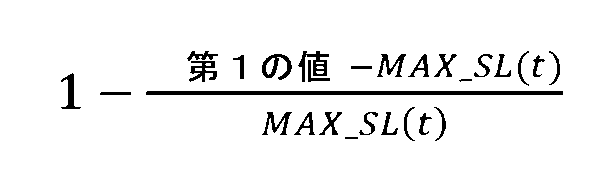
この例から分かるように、第2数学関数は、時間依存とすることができる。特に、第2数学関数は、第1の値の時間依存の境界の関数とすることができる。しかしながら、第2数学関数は、時間依存の第1の数学関数を含んでもよい。しかしながら、第2数学関数は、同様に、時間依存でなくてもよい。 As can be seen from this example, the second mathematical function can be time-dependent. In particular, the second mathematical function can be a function of a time-dependent boundary of the first value. However, the second mathematical function may include the first mathematical function that is time-dependent. However, the second mathematical function may not be time-dependent as well.
別の実施形態において、信頼性評価を評価することは、2値(バイナリ)又は連続的尺度のスコアを第1のメトリック及び/又は第2のメトリックの推定に割り当てることを有する。 In another embodiment, evaluating the reliability assessment includes assigning a binary or continuous score to the estimate of the first metric and/or the second metric.
例えば、メトリックの信頼性評価は、“信頼できる”及び“信頼できない”の2値のスコアで表すことができる。例えば、2つのメトリックが推定される速度及び推定される歩行率である場合、第1関数は、推定される歩幅として定義される。歩幅の第1の値は、最小の歩幅MIN_SL及び最大の歩幅MAX_SLと比較される。言い換えると、以下の関係

他方、前記第1の値が当該第1の値に対する上方境界よりも高い場合、信頼性は0に設定され、そうでなければ1に設定される。さらに、前記第1の値が当該第1の値に対する下方境界よりも低い場合、信頼性は0に設定され、そうでなければ1に設定され、ここで、0の信頼性評価は、信頼性のない推定される第1の値に対応し、1の信頼性評価は、信頼性のある推定される第1の値に対応する。 On the other hand, if the first value is higher than an upper bound for the first value, the reliability is set to 0, otherwise it is set to 1. Furthermore, if the first value is lower than a lower bound for the first value, the reliability is set to 0, otherwise it is set to 1, where a reliability rating of 0 corresponds to an unreliable estimated first value and a reliability rating of 1 corresponds to a reliable estimated first value.
別の例として、2つの第2関数、特に“より低い歩幅の信頼性”を表す第1の第2関数


前記第1の第2関数又は前記第2の第2関数が0よりも小さい場合、前記第1の第2関数又は前記第2の第2関数は、夫々0に設定されてもよい。他方、前記第1の第2関数又は前記第2の第2関数が1よりも大きい場合、前記第1の第2関数又は前記第2の第2関数は、夫々の値は1に設定されてもよい。信頼性評価は、前記第1の第2関数及び前記第2の第2関数の値の小さい方の値に設定されてもよく、すなわち、信頼性評価は、

従って、信頼性評価は、0から1までの範囲のスコアによって表される。 The reliability rating is therefore represented by a score ranging from 0 to 1.
さらに別の(異なる)例において、信頼性評価は、例えば、第1の値と境界との差に応じて、0から1(又は他の任意の数)までの任意のスコアとすることができる。第1の値と上方境界との差、及び第1の値と下方境界との差が等しい場合、すなわち、第1の値が下方境界と上方境界との中間にある場合、信頼性は1に設定される。他方、信頼性評価のスコアは、第1の値が下方境界から離れるにつれて、上方境界に近づくにつれて減少し、逆もまた同様であり、ここで、第1の値が下方境界よりも低い又は上方境界よりも高い場合、信頼性評価のスコアは、このような第1の値は信頼性がないことを示唆する0に設定される。 In yet another (different) example, the reliability assessment can be any score between 0 and 1 (or any other number), depending on, for example, the difference between the first value and the boundary. If the difference between the first value and the upper boundary and the difference between the first value and the lower boundary are equal, i.e., if the first value is halfway between the lower and upper boundaries, the reliability is set to 1. On the other hand, the score of the reliability assessment decreases as the first value moves away from the lower boundary and closer to the upper boundary, and vice versa, where if the first value is lower than the lower boundary or higher than the upper boundary, the score of the reliability assessment is set to 0, suggesting that such a first value is not reliable.
さらに別の代替例において、下方境界と上方境界との間にある任意の第1の値は、信頼できると見なすことができ、これら境界の何れかの外側にある第1の値は、これら境界からの距離が増えるにつれて減少していく信頼性評価を割り当てることができる。 In yet another alternative, any first value that is between a lower and upper bound can be considered reliable, and first values that are outside either of these bounds can be assigned a reliability rating that decreases with increasing distance from the bounds.
さらなる実施形態において、前記方法は、信頼性評価に基づいて第1のメトリック及び/又は第2のメトリックを推定するための方法を適応又は変更することをさらに有する。言い換えると、第1及び/又は第2のメトリックの推定を更新するために、信頼性の推定が使用される。一般に、これらメトリックの一方(又は両方)の推定のために、2つ以上の推定方法が使用される。例えば、方法Aは、歩行速度を推定するために使用されるのに対し、方法A及びBは、歩行率の推定するために使用されてもよい、又は、方法X及びYが、速度の推定のために使用され、方法A及びB(並びにCなど)が、歩行率の推定のために使用されてもよい。そのような場合、対応する信頼性評価を使用して、さらなる考慮、特にさらなる信頼性の評価のために使用することができる、予測される、すなわち推定されるメトリック(例えば、アルゴリズムA又はBの歩行率の推定)又は推定されるメトリックの組合せ(例えば、アルゴリズムXの速度の推定と組み合わされたアルゴリズムAの歩行率の推定)を選択することができる。さらに、信頼性評価に基づいて、どのメトリックを直接出力するか、又は健康評価のさらなる入力として使用するかを決定することができる。このようにして、メトリックの精度が向上する一方、網羅率(カバレッジ)も高く保つことができる。 In a further embodiment, the method further comprises adapting or modifying the method for estimating the first metric and/or the second metric based on the reliability assessment. In other words, the reliability assessment is used to update the estimate of the first and/or second metric. In general, more than one estimation method is used for the estimation of one (or both) of these metrics. For example, method A may be used to estimate walking speed, while methods A and B may be used to estimate walking rate, or methods X and Y may be used for speed estimation, and methods A and B (as well as C, etc.) may be used for walking rate estimation. In such a case, the corresponding reliability assessment can be used to select a predicted, i.e. estimated metric (e.g., an estimate of the walking rate of algorithm A or B) or a combination of estimated metrics (e.g., an estimate of the walking rate of algorithm A combined with an estimate of the speed of algorithm X) that can be used for further consideration, in particular for further reliability assessment. Furthermore, based on the reliability assessment, it can be decided which metric to output directly or to use as a further input for the health assessment. In this way, the accuracy of the metric can be improved while still maintaining high coverage.
別の例として、アルゴリズムA1は、推定される速度a1をもたらす速度の推定のために使用されることができ、アルゴリズムA2は、推定される速度a2をもたらす速度の推定のために使用されることができ、及びアルゴリズムA3は、推定される速度a3をもたらす速度の推定のために使用されることができるなど、である。アルゴリズムが互いに異なると仮定すると、これらのアルゴリズムの全てが、適用される様々な可能な歩行速度又は歩行パターンに対して等しく良好に機能するとは限らない。例えば、低い速度には、アルゴリズムA1が最も正確なアルゴリズムであるが、より高い速度には、アルゴリズムA2がより適切であり、歩行補助器などを用いた歩行には、アルゴリズムA3が最良の選択とすることができる。速度の推定a1は、(上述した方法に基づいて)信頼できない場合、ユーザを評価するために使用されるべきではないことは明らかである。従って、アルゴリズムA1は、速度の推定に対し却下(除外)される。従って、アルゴリズムA1の除外、故に推定a1の除外は、速度の推定の網羅率を減少させる(すなわち、1つのデータポイントが少なくなる)。しかしながら、これは、他のアルゴリズム(A2、A3、…An)を並行して使用することによって克服することができる。これらの方法は、信頼性をチェックし、アルゴリズムA1の代わりに、最良の信頼性を持つ方法が使用される。 As another example, algorithm A1 can be used for speed estimation resulting in estimated speed a1, algorithm A2 can be used for speed estimation resulting in estimated speed a2, and algorithm A3 can be used for speed estimation resulting in estimated speed a3, etc. Given that the algorithms are different from each other, not all of these algorithms will perform equally well for the various possible walking speeds or walking patterns applied. For example, for low speeds, algorithm A1 is the most accurate algorithm, while for higher speeds, algorithm A2 is more appropriate, and for walking with a walking aid, etc., algorithm A3 may be the best choice. It is clear that the speed estimate a1 should not be used to evaluate the user if it is not reliable (based on the method described above). Therefore, algorithm A1 is rejected (excluded) for speed estimation. Thus, the exclusion of algorithm A1, and therefore of estimate a1, reduces the coverage of the speed estimate (i.e., one data point less). However, this can be overcome by using other algorithms (A2, A3, ... An) in parallel. These methods are checked for reliability and the method with the best reliability is used instead of algorithm A1.
さらに、速度の推定a1を除外した後、他のアルゴリズムの速度の推定を(例えば、速度の推定を平均化することによって)混合することができる。実際、歩行速度、並びに個人内及び個人間で測定されるときのユーザの生理学的又は解剖学的特徴を表す他のパラメタは、互いに同様の境界及び関係を示し、故に、典型的には、特定の境界内に留まるが、多くの場合、関係の種類を決める特定のパラメタが存在する。Latt, M. D., Menz, H. B., Fung, V. S., & Lord, S. R.:”Walking speed, cadence and step length are selected to optimize the stability of head and pelvis accelerations”, Experimental brain research, 184(2), 201-209は、例えば、自己選択した歩行速度(すなわち、ユーザが経験する歩行速度)と、幾つかの歩幅に関連するメトリックとの様々な関係を開示している。前記文献から分かるように、測定される速度と歩行率のとの間の関係は、約2.0m/sまで線形であり、約150歩数/分の歩行率に対応している。しかしながら、この時点でのエラーバーは非常に大きい。実際、より速い歩行速度に対しては、2つのメトリックの関係は変化する。これは、この時点で、ユーザの活動が歩きからジョギングに変化したという事実によるものである。2つのメトリックの関係は、幾つかの人間依存の生体力学的特性及び状況変数(contextual variables)によって調節される。主な要因の1つは、歩幅の変動性である。実際、歩幅は、同じ速度であっても人毎に及び人の中で一定ではない。このため、歩行率を介した速度の推定は、(2m/s未満の速度であっても)かなりの誤差を持つ可能性がある。この“脆弱な”関係は、歩幅を知ることによって、速度に基づく歩行率の正確な計算を可能にしない(逆もまた同様である)。しかしながら、最小及び最大の可能な歩幅の値に基づいて、前記メトリックの各メトリックに境界を設定することが可能である。さらに、開示されるデータを使用して、信頼性の推定に対する境界を適応させることができる。さらに、使用されるアルゴリズムは、以前に推定されるメトリックの値に従って、より正確には、そのメトリックが依存するパラメタに従って、又は第1の値に従って変更されてもよい。 Furthermore, after excluding the speed estimate a1, the speed estimates of other algorithms can be mixed in (e.g., by averaging the speed estimates). In fact, walking speed, as well as other parameters that describe the physiological or anatomical characteristics of the user when measured intra- and inter-individual, show similar boundaries and relationships with each other and therefore typically remain within certain boundaries, but there are often specific parameters that determine the type of relationship. Latt, M. D., Menz, H. B., Fung, V. S., & Lord, S. R.:”Walking speed, cadence and step length are selected to optimize the stability of head and pelvis accelerations”, Experimental brain research, 184(2), 201-209, for example, discloses various relationships between self-selected walking speed (i.e., the walking speed experienced by the user) and several stride-related metrics. As can be seen from the literature, the relationship between the measured speed and walking rate is linear up to about 2.0 m/s, corresponding to a walking rate of about 150 steps/min. However, the error bars at this point are very large. In fact, for faster walking speeds, the relationship between the two metrics changes. This is due to the fact that at this point, the user's activity has changed from walking to jogging. The relationship between the two metrics is regulated by several human-dependent biomechanical characteristics and contextual variables. One of the main factors is the variability of the stride length. In fact, the stride length is not constant from person to person and within a person even at the same speed. For this reason, the estimation of speed via the walking rate can have a significant error (even at speeds below 2 m/s). This "weak" relationship does not allow an accurate calculation of the walking rate based on the speed by knowing the stride length (and vice versa). However, it is possible to set boundaries for each of said metrics based on the minimum and maximum possible stride length values. Furthermore, the disclosed data can be used to adapt the boundaries for the reliability estimation. Furthermore, the algorithm used may be modified according to the value of the metric previously estimated, more precisely according to the parameters on which it depends, or according to the first value.
さらなる実施形態において、1つ以上のセンサ信号は、加速度信号、ジャイロスコープ信号、心拍数信号、呼吸信号、酸素飽和度(SpO2)信号、動き信号、力信号、圧力信号、筋電図検査(EMG)信号、温度信号、カロリー消費信号、全地球測位システム(GPS)信号、カメラ信号、レーダー信号、速度測定信号、トルク測定信号、心電図(ECG)信号、脳波(EEG)信号、フォトプレチスモグラフィ(PPG)信号、気圧計信号、筋緊張信号、発汗レベル信号、ストレスレベル信号、皮膚コンダクタンス信号、ガルバニック皮膚反応信号、慣性計測信号及び血圧信号の何れかを有する、及び/又は第1のメトリック及び/又は第2のメトリックは、歩行速度、歩行率、歩幅、心拍数、エネルギー消費量及び活動の種類の何れかを有する。 In further embodiments, the one or more sensor signals comprise any of an acceleration signal, a gyroscope signal, a heart rate signal, a respiration signal, an oxygen saturation ( SpO2 ) signal, a movement signal, a force signal, a pressure signal, an electromyography (EMG) signal, a temperature signal, a calorie consumption signal, a global positioning system (GPS) signal, a camera signal, a radar signal, a speed measurement signal, a torque measurement signal, an electrocardiogram (ECG) signal, an electroencephalography (EEG) signal, a photoplethysmography (PPG) signal, a barometer signal, a muscle tension signal, a sweat level signal, a stress level signal, a skin conductance signal, a galvanic skin response signal, an inertial measurement signal and a blood pressure signal, and/or the first metric and/or the second metric comprise any of walking speed, walking rate, stride length, heart rate, energy consumption and activity type.
ユーザの生理学的又は解剖学的状態に関する他の任意のメトリックも同様に考えられる。 Any other metric relating to the user's physiological or anatomical condition is contemplated as well.
前記システムの一実施形態において、センサは、加速度計、ジャイロスコープ、心拍数センサ、呼吸センサ、酸素飽和度(SpO2)センサ、動きセンサ、力センサ、圧力センサ、筋電図検査(EMG)センサ、温度センサ、カロリー消費センサ、全地球測位システム(GPS)センサ、カメラ、レーダー、速度測定センサ、トルク測定センサ、心電図(ECG)センサ、脳波(EEG)センサ、フォトプレチスモグラフィ(PPG)センサ、気圧計、筋緊張センサ、発汗レベルセンサ、ストレスレベルセンサ、皮膚コンダクタンスセンサ、ガルバニック皮膚反応センサ、慣性計測センサ及び血圧センサの何れかを有する。 In one embodiment of the system, the sensor comprises any of an accelerometer, a gyroscope, a heart rate sensor, a respiration sensor, an oxygen saturation ( SpO2 ) sensor, a motion sensor, a force sensor, a pressure sensor, an electromyography (EMG) sensor, a temperature sensor, a calorie expenditure sensor, a global positioning system (GPS) sensor, a camera, a radar, a speed measurement sensor, a torque measurement sensor, an electrocardiogram (ECG) sensor, an electroencephalography (EEG) sensor, a photoplethysmography (PPG) sensor, a barometer, a muscle tension sensor, a sweat level sensor, a stress level sensor, a skin conductance sensor, a galvanic skin response sensor, an inertial measurement sensor, and a blood pressure sensor.
前記システムの別の実施形態において、センサは、遠隔センサ又はウェアラブルセンサである。センサは、特に接触センサでもよい。遠隔センサは、例えば、(ユーザの活動を記録する)カメラ又は靴センサを含む。ウェアラブルセンサは、例えば、ペンダント又はズボンのポケットのような着用可能な物体に組み込まれてもよいし、又は手首、指先、耳たぶ、インイヤー(in-ear)部分、胴体などの何れかに取り付けられてもよく、例えば、スマートフォン、スマートウォッチ及びインイヤー装置の何れかを含むことができる。 In another embodiment of the system, the sensor is a remote sensor or a wearable sensor. The sensor may in particular be a contact sensor. Remote sensors include, for example, a camera (recording the user's activity) or a shoe sensor. Wearable sensors may be incorporated into a wearable object, for example, a pendant or a trouser pocket, or may be attached to the wrist, fingertip, earlobe, in-ear portion, torso, etc., and may include, for example, any of a smartphone, a smartwatch, and an in-ear device.
前記システムは、1つ以上のセンサを有することができる。複数のセンサを有するシステムの場合、これらセンサの1つ以上をウェアラブルセンサとすることができる。ウェアラブルセンサは、かなり控えめであり、特に長期の使用に便利である。特に、歩行メトリックは、ウェアラブルセンサを使用することによって推定される。 The system may have one or more sensors. In the case of a system having multiple sensors, one or more of the sensors may be wearable sensors. Wearable sensors are fairly unobtrusive and particularly convenient for long-term use. In particular, gait metrics are estimated by using wearable sensors.
本発明のこれら及び他の態様は、以下に記載される実施形態から明らかであり、この実施形態を参照して説明される。
図1は、本発明による方法の実施形態のフローチャートを示す。この方法のステップは、デバイス10によって実行されることができ、ここで、この方法の主なステップは、プロセッサ14によって実行される。この方法は、例えば、コンピュータ又はプロセッサ上で実行されるコンピュータプログラムとして実装されてもよい。
Figure 1 shows a flow chart of an embodiment of a method according to the invention. The steps of the method can be performed by a
第1のステップS2において、複数のセンサ信号が複数のセンサから取得される。これらセンサ信号は、ユーザの生理学的状態に関する。特に、これら信号は、ユーザの歩行能力に関する。第2のステップS4において、前記信号から第1のメトリック及び第2のメトリックが抽出される。言い換えると、センサ信号を使用して、第1のメトリック及び第2のメトリックが推定される。この実施形態において、第1のメトリックは、アルゴリズムA及びアルゴリズムBを使用して推定され、第2のメトリックは、アルゴリズムA及びアルゴリズムBを使用して推定される。従って、実際には、第1のメトリックの2つの値、及び第2のメトリックの2つの値が推定される。第1のメトリック及び第2のメトリックは、その値が境界を付ける数学関数によって、これらのメトリックが互いに関連付けられるように選択される。次のステップS6において、アルゴリズムAによって推定される第1及び第2のメトリックを挿入することによって、前記数学関数の第1の値が導出(計算)される。さらに、アルゴリズムBによって推定される第1及び第2のメトリックを挿入することによって、前記数学関数の別の第1の値が導出される。次に、ステップS8において、前記第1の値は、各々がこれらの値に対する境界と比較される。この実施形態において、前記境界は事前に決定されている。比較の結果に応じて、ステップS10において、推定される前記第1の値の各々に対する、故に、第1のメトリック及び第2のメトリックの推定に対する信頼性評価を評価する。従って、2つの信頼性評価が取得される。1つは、アルゴリズムAに基づくメトリックに対するものであり、もう1つは、アルゴリズムBに基づくメトリックに対するものである。この実施形態において、信頼性評価は2値である。第1のメトリックは、“信頼できる”とラベルが付けられるか、又は“信頼できない”とラベルが付けられるかの何れかである。同じことが第2のメトリックにも適用する。任意選択のステップS12において、取得した信頼性評価は、選別が行われる特定の評価を用いてフィルタリングされる。より正確には、“信頼できない”という評価に対応する推定されるメトリックが選別される。ステップS14において、評価された信頼性評価(及び対応するメトリック)が出力され、ここで、ステップS12において“信頼できない”メトリックが選別された場合、“信頼できる”評価(及びメトリック)のみが出力される。 In a first step S2, a number of sensor signals are obtained from a number of sensors. These sensor signals relate to the physiological state of the user. In particular, these signals relate to the walking ability of the user. In a second step S4, a first metric and a second metric are extracted from the signals. In other words, the sensor signals are used to estimate a first metric and a second metric. In this embodiment, the first metric is estimated using algorithm A and algorithm B, and the second metric is estimated using algorithm A and algorithm B. Thus, in practice, two values of the first metric and two values of the second metric are estimated. The first metric and the second metric are selected such that they are related to each other by a mathematical function whose values are bounded. In a next step S6, a first value of the mathematical function is derived (calculated) by inserting the first and second metrics estimated by algorithm A. Furthermore, another first value of the mathematical function is derived by inserting the first and second metrics estimated by algorithm B. Then, in step S8, the first values are compared with a boundary for each of these values. In this embodiment, the boundary is pre-determined. Depending on the result of the comparison, in step S10, a reliability assessment is evaluated for each of the estimated first values, and thus for the estimation of the first and second metrics. Thus, two reliability assessments are obtained, one for the metric based on algorithm A and one for the metric based on algorithm B. In this embodiment, the reliability assessment is binary. The first metric is either labeled as "trusted" or as "untrusted". The same applies to the second metric. In optional step S12, the obtained reliability assessments are filtered using the specific assessments for which the culling is performed. More precisely, the estimated metrics that correspond to the assessments "untrusted" are culled. In step S14, the assessed reliability assessments (and corresponding metrics) are output, where if in step S12 an "untrusted" metric was culled, only the "trusted" assessments (and metrics) are output.
ステップS10において、第1の値に対し評価された信頼性評価(及び対応するメトリック)は、ステップS4における入力として(任意選択的に)使用されてもよい。特に、アルゴリズムAを使用して推定されるメトリックに対する信頼性評価は、アルゴリズムBを使用して推定されるメトリックに対する信頼性評価よりも高い場合、今後は、アルゴリズムBを使用する推定は省略される。 In step S10, the reliability assessment (and corresponding metric) evaluated for the first value may (optionally) be used as input in step S4. In particular, if the reliability assessment for the metric estimated using algorithm A is higher than the reliability assessment for the metric estimated using algorithm B, then future estimations using algorithm B are omitted.
図2A及び2Bは、第1のデータセットに対して測定された、歩行速度と歩幅との間の(実際の)関係、並びに歩行速度とユーザの高さに対する歩幅の比率との間の(実際の)関係を夫々示し、ここで、高さとはユーザの身長を意味する。言い換えると、示されるデータ点は、測定値に対応する点であり、アルゴリズムを使用して推定されていない。特に、図2Aの図表は、測定されるユーザの歩幅をメートル(m)単位でy軸に示し、測定されるユーザの歩行速度をメートル毎秒(m/s)単位でx軸に示す。図2Bの図表は、測定されるユーザの身長に対する歩幅の比率をy軸に示し、測定されるユーザの歩行速度をメートル毎秒単位でx軸に示す。これらの(参照)測定値から、尤度境界が決定される。図2A及び図2Bに示される実線は、線形回帰の95%の推定区間を示す、すなわち、これらデータ点の真の最良適合線が、実線でマークされた信頼区間内にある確率が95%である。この実施形態において、線形回帰の95%の推定区間は、速度/歩行率に依存する境界として使用される。 2A and 2B respectively show the (actual) relationship between walking speed and stride length, and between walking speed and the ratio of stride length to the user's height, where height means the user's height, measured for a first data set. In other words, the data points shown are points corresponding to measured values and are not estimated using an algorithm. In particular, the diagram in FIG. 2A shows the measured user's stride length in meters (m) on the y-axis and the measured user's walking speed in meters per second (m/s) on the x-axis. The diagram in FIG. 2B shows the measured ratio of stride length to the user's height on the y-axis and the measured user's walking speed in meters per second on the x-axis. From these (reference) measurements, likelihood boundaries are determined. The solid lines shown in FIG. 2A and FIG. 2B show the 95% estimation interval of the linear regression, i.e. there is a 95% probability that the true best fit line of these data points lies within the confidence interval marked by the solid line. In this embodiment, the 95% estimation interval of the linear regression is used as the speed/walking rate dependent boundary.
同様に、破線は、示されるデータの上方しきい値を示す。特に、図2Aから分かるように、絶対的な推定される歩幅の上方境界は、0.9m(Max_SL=90cm)に設定されることができる。同様に、ユーザの身長に対する歩幅の比率の上方境界は、0.5(Max_SL/height=0.5)(図2Bの破線を参照)に設定されることができる。 Similarly, the dashed lines indicate upper thresholds for the data shown. In particular, as can be seen from FIG. 2A, the upper boundary for the absolute estimated stride length can be set to 0.9 m (Max_SL=90 cm). Similarly, the upper boundary for the ratio of stride length to the user's height can be set to 0.5 (Max_SL/height=0.5) (see dashed lines in FIG. 2B).
図2C及び2Dは、(境界を決定するために使用した第1のデータセットとは異なる)第2のデータセットに対して予測される、すなわち推定される速度(加速度計データ、すなわち加速度計信号を入力として利用するアルゴリズムを使用する)と、予測される、すなわち推定される歩幅との間の関係、及び前記速度と、身長に対する歩幅の比率(加速度計データを入力として利用するアルゴリズムも使用する)との間の関係を夫々示す。特に、図2Cの図表は、推定されるユーザの歩幅をメートル単位でy軸に示し、推定されるユーザの歩行速度をメートル毎秒単位でx軸に示す。図2Dの表図は、推定されるユーザの身長に対する歩幅の比率をy軸に示し、推定されるユーザの歩行速度をメートル毎秒単位でx軸に示す。 2C and 2D respectively show the relationship between predicted or estimated speed (using an algorithm that uses accelerometer data, i.e., accelerometer signals, as input) and predicted or estimated stride length, and between said speed and stride length to height ratio (also using an algorithm that uses accelerometer data as input) for a second data set (different from the first data set used to determine the boundaries). In particular, the diagram of FIG. 2C shows the estimated user stride length in meters on the y-axis and the estimated user walking speed in meters per second on the x-axis. The diagram of FIG. 2D shows the estimated user stride length to height ratio on the y-axis and the estimated user walking speed in meters per second on the x-axis.
歩幅、及び身長に対する歩幅の比率の推定は、推定される歩幅が、推定される歩行速度と、推定される歩行率との比率として表されるという事実に基づくことができる。この実施形態における歩行速度及び身長に対する歩幅の比率の測定に使用される加速度計は、ペンダント装着型の加速度計である。図2C及び2Dに示される境界は、図2A及び2Bに示される測定されるデータの境界に対応する。図2A及び図2Bと夫々比較して図2C及び2Dから分かるように、推定される値は、幾つかの外れ値を除いては、測定される値と同様の関係を互いに持ち、これは、歩幅及び身長に対する歩幅の比率の推定に使用されるアルゴリズム(又はより正確には、歩行速度及び歩行率のためのアルゴリズム)が所望通りに動作していることを示すインジケータとみなすことができる。他方、予測される値が測定される値とは大きく異なる関係を互いに持つ場合、これは、使用されるアルゴリズムの少なくとも1つ(歩行速度を推定するためのアルゴリズム又は歩行率を推定するためのアルゴリズムの何れか)が、誤った予測/推定を生成し、故に、欠陥があることを示すインジケータとなる。 The estimation of step length and step length to height ratio can be based on the fact that the estimated step length is expressed as a ratio between an estimated walking speed and an estimated walking rate. The accelerometer used for measuring the walking speed and the step length to height ratio in this embodiment is a pendant-mounted accelerometer. The boundaries shown in Figs. 2C and 2D correspond to the boundaries of the measured data shown in Figs. 2A and 2B. As can be seen from Figs. 2C and 2D compared to Figs. 2A and 2B, respectively, the estimated values, except for some outliers, bear a similar relationship to each other as the measured values, which can be considered as an indicator that the algorithms used to estimate the step length and step length to height ratio (or more precisely, the algorithms for walking speed and walking rate) are working as desired. On the other hand, if the predicted values bear a significantly different relationship to each other than the measured values, this is an indicator that at least one of the algorithms used (either the algorithm for estimating walking speed or the algorithm for estimating walking rate) produces erroneous predictions/estimations and is therefore defective.
図2E及び2Fにおいて、(参照)速度及び歩行率に対して、推定される速度及び推定される歩行率が夫々プロットされる。より正確には、図2Eの図表は、測定される歩行速度[m/s](x軸)に対する推定される歩行速度[m/s](y軸)を示し、図2Fの図表は、測定される歩行率[step/s](x軸)に対する推定される歩行率[step/s](y軸)を示す。図2E及び2Fに示される図表は、第2のデータセットに基づいている。 In Figures 2E and 2F (see) the estimated speed and the estimated walking rate are plotted against the speed and the walking rate, respectively. More precisely, the diagram in Figure 2E shows the estimated walking speed [m/s] (y-axis) against the measured walking speed [m/s] (x-axis) and the diagram in Figure 2F shows the estimated walking rate [step/s] (y-axis) against the measured walking rate [step/s] (x-axis). The diagrams shown in Figures 2E and 2F are based on the second data set.
歩行速度及び歩行率の推定に使用されるアルゴリズムが、所望通りに動作した場合、示される全てのデータ点は、黒い実線上にある。従って、データ点がこの黒線から離れるほど、推定されつ値は悪くなる。図2A及び図2Bによって決定される境界に基づいて、境界を守っていないデータ点は、信頼できないとマークされる。言い換えると、この実施形態において、2値の信頼性評価の手法が歩行活動のメトリックに適用される。 If the algorithms used to estimate walking speed and rate work as desired, all data points shown will be on the solid black line. Thus, the further a data point is from this black line, the worse the estimated value will be. Based on the boundaries determined by Figures 2A and 2B, data points that do not adhere to the boundaries are marked as unreliable. In other words, in this embodiment, a binary reliability assessment approach is applied to the walking activity metrics.
例えば、図2Cから2Fにおいて、白丸で示されるデータ点は、大きすぎる歩幅に対応するデータ点、すなわちこの歩幅の上方境界の外側にあるデータ点に対応する。大きすぎる推定される歩幅-身長の比率に対応する推定されるデータ点は、三角で示される。その境界の範囲外にある歩幅の推定に対応する推定されるデータ点は、×印で示され、その境界の範囲外にある推定される身長に対する歩幅の比率に対応する推定されるデータ点は、星印で示される。このようにして、4つの歩幅に関連する境界を使用して、信頼できないデータ点を決定することができる。 For example, in Figures 2C to 2F, data points indicated with open circles correspond to data points that correspond to a stride length that is too large, i.e., data points that are outside the upper stride length boundary. Estimated data points that correspond to an estimated stride length-height ratio that is too large are indicated with triangles. Estimated data points that correspond to stride length estimates that are outside the boundary are indicated with crosses, and estimated data points that correspond to estimated stride length to height ratios that are outside the boundary are indicated with stars. In this way, the four stride length related boundaries can be used to determine unreliable data points.
図2E及び2Fから分かるように、信頼できないとマークされたデータ点は、(ほとんどの場合)黒線からかなり遠くにある前記推定される歩行率に対するものであり、従って、これらデータ点は実際に不正確であるのに対し、推定される歩行速度については、これはあまり明確ではない。この結果は、以下の表に示される性能メトリックによっても確認される。
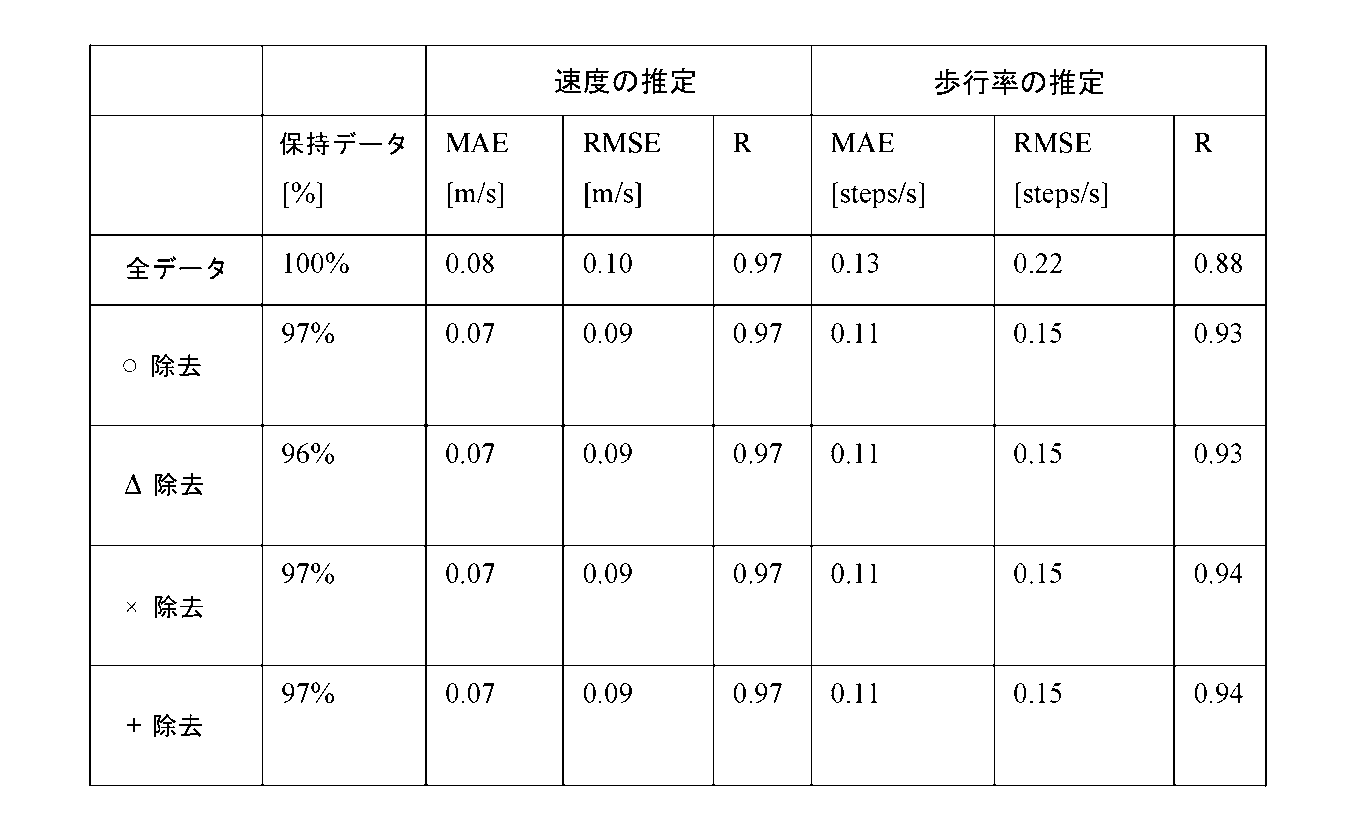
表は、全てのデータが保持される場合(3行目)、及び課された夫々の境界の外側にあるデータ点を取り除いた後(4行目~7行目)の、速度及び歩行率の推定の結果を示す。略語“MAE”は、“平均絶対誤差”を表し、略語“RMSE”は、“二乗平均平方根誤差”を表し、略語“R”は、“ピアソンの相関”を表す(ここで、“R”は、測定される値と予測/推定される値との間の相関を表す)。 The table shows the results of the speed and gait rate estimation when all data are retained (row 3) and after removing data points that are outside the respective imposed boundaries (rows 4-7). The abbreviation "MAE" stands for "Mean Absolute Error", the abbreviation "RMSE" stands for "Root Mean Square Error", and the abbreviation "R" stands for "Pearson's Correlation" (where "R" stands for the correlation between measured and predicted/estimated values).
表から分かるように、前記メトリックの信頼性は、推定される歩幅(比率)に基づいてデータを除外すると、特に歩行率の改善を示す(表の右側部分を参照)。実際、全ての予測/推定がまさにその通りであった場合、表に示される全ての誤差は0であり、“R”は1である。ランダム点のみを取り除いたとしても、データの精度はそれほど改善しなかったであろう。データの特定の部分に対する結果を推定しないことを犠牲にすることで改善がもたらされるが、この効果は、せいぜい4%(第1の列を参照)で、比較的限られていることが分かる。 As can be seen from the table, the reliability of the metrics shows an improvement when removing data based on estimated stride length (ratio), especially for step rate (see the right part of the table). Indeed, if all predictions/estimations were exactly as they were, all errors shown in the table would be 0 and "R" would be 1. Removing only random points would not have improved the accuracy of the data much. An improvement comes at the expense of not estimating the results for certain parts of the data, but this effect appears to be relatively limited, at most 4% (see the first column).
上記の例において、両方の推定されるメトリック、すなわち、推定される歩幅及び推定される歩行率の両方は、歩幅及び身長に対する歩幅の比率の第1の値がそれらの課された境界の内側にない場合、信頼できないと見なされる一方、(例えば、以前に計算した結果に基づいて)最も信頼できると見なされた推定されるメトリックを、他のメトリックのためのガイドラインとして使用することができ、従って、境界が守られていない場合、後者だけを信頼できないと見なされる他の実施形態が考えられる。例えば、上記の例において、速度の推定は、歩行率の推定よりも概して正確である。従って、推定される速度は維持されるように、推定される歩行率だけが信頼できないと見なされる。さらに、歩行率の推定は、速度の推定と、歩幅及び/又は身長に対する歩幅の比率の境界とに基づいて更新されることができる。 While in the above example both estimated metrics, i.e. estimated stride length and estimated walking rate, are deemed unreliable if the first values of stride length and stride length to height ratio are not inside their imposed boundaries, other embodiments are conceivable in which the estimated metric deemed most reliable (e.g. based on previously calculated results) can be used as a guideline for the other metric, and thus only the latter is deemed unreliable if the boundaries are not respected. For example, in the above example, the speed estimate is generally more accurate than the walking rate estimate. Thus, only the estimated walking rate is deemed unreliable, such that the estimated speed is maintained. Furthermore, the walking rate estimate can be updated based on the speed estimate and the stride length and/or stride length to height ratio boundaries.
図3は、本発明によるデバイス10の実施形態の概略図を示す。デバイス10は、センサ入力12、プロセッサ14及び情報出力部16を有する。
Figure 3 shows a schematic diagram of an embodiment of a
センサ入力12は、少なくとも1つのセンサから少なくとも1つのセンサ信号を取得するように構成され、このセンサ信号は、ユーザの生理学的状態に関する。センサ入力12は、センサに直接結合或いは接続されてもよいし、又は記憶装置、バッファ、ネットワーク又はバスなどから前記センサ信号を取得(すなわち、取り込む又は受信)してもよい。従って、センサ入力12は、例えば、Bluetooth(登録商標)インターフェース、WiFiインターフェース、LANインターフェース、HDMIインターフェース、直接ケーブル接続、又はデバイス10への信号転送を可能にする他の任意の適切なインターフェースのような(有線又は無線の)通信インターフェース又はデータインターフェースとすることができる。
The
プロセッサ14は、第1のメトリック及び第2のメトリックを推定するために、前記信号及びその特徴に少なくとも1つのアルゴリズムを適用し、前記メトリックは、数学的関係によって互いに関係付けられる。特に、プロセッサ14は、推定されるメトリックを第1数学関数に挿入することによって、この第1数学関数の第1の値を決定するように構成される。次いで、前記第1の値は、この第1の値に対する境界と比較される。この比較の結果に基づいて、プロセッサ14は、第1のメトリック及び/又は第2のメトリックの推定に対する信頼性評価を評価する。
The
続いて、情報出力部16は、さらなる処理のために前記評価された信頼性評価を提供する。情報出力部16は、一般に、前記評価された信頼性評価を提供する、例えば、この評価を(別のデバイスに)送信する、又は(別のデバイス、例えば、スマートフォン、コンピュータ、タブレットなどよる)検索のためにこの評価を提供する、任意のインターフェースとすることができる。従って、それは、一般に、任意の(有線又は無線)通信又はデータインターフェースとすることができる。
The
図4は、本発明によるシステム100の実施形態の概略図を示す。このシステムは、2つのセンサ20a及び20b、デバイス10並びにユーザインターフェース40を有する。両方のセンサ20a及び20bは、ユーザの生理学的状態に関する少なくとも1つのセンサ信号を測定するように構成される。この実施形態において、センサ20aは、ユーザが着用するように構成されるスマートウォッチであり、センサ20bは、ユーザが着用するように構成されるスマートフォンである。センサ20aは、ユーザの心拍数に関する少なくとも1つの信号を測定するように構成され、センサ20bは、特定の活動中のユーザの活動量に関する信号を測定するように構成される。デバイス10は、両方のセンサ20a及び20bの信号を取得し、これらの信号に基づいてユーザの心拍数及び活動量を推定するように構成される。心拍数のメトリックと活動量のメトリックとの間の関係は、人の健康レベルに大きく依存する。この健康レベルは、VO2maxに関して表すことができ、このVO2maxは、一般に特定の境界値を上回る又は下回ることができない。従って、VO2maxの境界を使用する場合、システム100のデバイス10は、心拍数及び活動量の推定されるメトリックに信頼性評価を割り当てるように構成される。次いで、この信頼性評価は、デバイス10の信頼性評価を出すように構成されるユーザインターフェース40に供給される。ユーザインターフェース40は、一般に、信頼性評価を視覚的又は聴覚的な形式で、例えば、テキスト形式で、画像又は図表として、音又は話し言葉などとして出力する任意の手段とすることができる。例えば、ユーザインターフェース40は、ディスプレイ、スピーカ、タッチ式スクリーン、コンピュータのモニター、スマートフォン又はタブレットのスクリーンなどとすることができる。
4 shows a schematic diagram of an embodiment of a
本発明は、図面及び上記の説明において詳細に例示及び説明されてきたが、そのような例示及び説明は、例示的又は説明的であり、限定的ではない、つまり、本発明は開示される実施形態に限定されるものではないと考えられるべきである。開示される実施形態に対する他の変形は、図面、本開示及び添付の特許請求の範囲を検討することにより、請求される発明を実施する際に当業者によって理解及び実施されることができる。 While the invention has been illustrated and described in detail in the drawings and the foregoing description, such illustration and description should be considered as exemplary or explanatory and not restrictive, i.e., the invention is not limited to the disclosed embodiments. Other variations to the disclosed embodiments can be understood and effected by those skilled in the art in practicing the claimed invention, from a study of the drawings, the disclosure, and the appended claims.
請求項において、“有する”という言葉は、他の要素又はステップを排除するものではなく、複数あることを述べなくても、それが複数あることを排除するものではない。単一の要素又は他のユニットが、請求項に列挙される幾つかの項目の機能を果たすことができる。特定の手段が相互に異なる従属請求項に記載されているという単なる事実は、これらの手段の組み合わせが有利に使用されることができないことを示すものではない。 In the claims, the word "comprise" does not exclude other elements or steps, nor does it exclude a plurality of them. A single element or other unit may fulfill the functions of several items recited in the claims. The mere fact that certain measures are recited in mutually different dependent claims does not indicate that a combination of these measures cannot be used to advantage.
コンピュータプログラムが、例えば、他のハードウェアと一緒に或いはその一部として提供される光記憶媒体又はソリッドステート媒体のような適切な非一時的な媒体に記憶/分散されてもよいが、例えば、インターネット又は他の有線若しくは無線通信システムを介するような、他の形式で配布されてもよい。 The computer program may be stored/distributed on a suitable non-transitory medium, such as an optical storage medium or a solid-state medium, provided together with or as part of other hardware, but may also be distributed in other forms, such as via the Internet or other wired or wireless communication systems.
請求項における如何なる参照符号も、その範囲を限定するものとして解釈されるべきではない。 Any reference signs in the claims shall not be construed as limiting the scope.
Claims (15)
前記ユーザの生理学的状態に関する1つ以上のセンサ信号を取得するステップ、
前記1つ以上のセンサ信号に基づいて、異なる方法及び/又はアルゴリズムを使用して、互いに独立して第1のメトリック及び第2のメトリックを推定するステップであって、前記第1のメトリックは、第1数学関数によって第2のメトリックに関連付けられる、前記推定するステップ、
前記第1数学関数の第1の値を決定するステップ、
前記第1の値を、前記第1の値の境界と比較するステップ、
前記比較に基づいて、前記第1のメトリック及び/又は前記第2のメトリックの推定に対する信頼性評価を評価するステップ、並びに
前記評価された信頼性評価を出力するステップ
を有する、方法。 1. A method for assessing reliability of an estimated metric related to a physiological state of a user, the method comprising:
obtaining one or more sensor signals related to a physiological condition of the user;
estimating a first metric and a second metric independently of each other using different methods and/or algorithms based on the one or more sensor signals, the first metric being related to the second metric by a first mathematical function;
determining a first value of the first mathematical function;
comparing said first value to a boundary of said first value;
evaluating a confidence rating for the estimation of the first metric and/or the second metric based on the comparison; and outputting the evaluated confidence rating.
第1のメトリック及び/又は第2のメトリックは、歩行速度、歩行率、歩幅、心拍数、エネルギー消費量及び活動の種類の何れかを有する、
請求項1乃至9の何れか一項に記載の方法。 the one or more sensor signals comprise any of an acceleration signal, a gyroscope signal, a heart rate signal, a respiration signal, an oxygen saturation signal, a movement signal, a force signal, a pressure signal, an electromyogram signal, a temperature signal, a calorie consumption signal, a global positioning system signal, a camera signal, a radar signal, a speed measurement signal, a torque measurement signal, an electrocardiogram signal, an electroencephalogram signal, a photoplethysmography signal, a barometer signal, a muscle tension signal, a sweat level signal, a stress level signal, a skin conductance signal, a galvanic skin response signal, an inertial measurement signal, and a blood pressure signal; and/or the first metric and/or the second metric comprise any of walking speed, walking rate, stride length, heart rate, energy expenditure, and activity type.
10. The method according to any one of claims 1 to 9.
前記ユーザの生理学的状態に関する1つ以上のセンサ信号を取得するように構成されるセンサ入力、
プロセッサであって、
前記1つ以上のセンサ信号に基づいて、異なる方法及び/又はアルゴリズムを使用して、第1のメトリック及び第2のメトリックを互いに独立して推定し、前記第1のメトリックは、第1数学関数によって前記第2のメトリックに関連付けられ、
前記第1数学関数の第1の値を決定し、
前記第1の値を、前記第1の値の境界と比較し、並びに
前記比較に基づいて、前記第1のメトリック及び/又は前記第2のメトリックの推定に対する信頼性評価を評価する
するように構成されるプロセッサ、並びに
前記評価された信頼性評価を出力するように構成される情報出力部
を有する、デバイス。 1. A device for assessing the reliability of an estimated metric related to a physiological state of a user, the device comprising:
a sensor input configured to obtain one or more sensor signals related to a physiological condition of the user;
1. A processor comprising:
estimating a first metric and a second metric independently from each other using different methods and/or algorithms based on the one or more sensor signals, the first metric being related to the second metric by a first mathematical function;
determining a first value of the first mathematical function;
a processor configured to compare the first value with a boundary of the first value; and evaluate a reliability rating for the estimation of the first metric and/or the second metric based on the comparison; and an information output unit configured to output the evaluated reliability rating.
前記ユーザの生理学的状態に関する1つ以上のセンサ信号を測定するように構成されるセンサ、
請求項11に記載のデバイス、及び
前記デバイスの信頼性評価を出すように構成されるユーザインターフェース
を有する、システム。 1. A system for assessing reliability of an estimated metric related to a physiological state of a user, the system comprising:
a sensor configured to measure one or more sensor signals related to a physiological condition of the user;
A system comprising: a device according to claim 11; and a user interface configured to provide a trustworthiness assessment of the device.
Applications Claiming Priority (3)
| Application Number | Priority Date | Filing Date | Title |
|---|---|---|---|
| EP22163495.9A EP4248857A1 (en) | 2022-03-22 | 2022-03-22 | Method, device and system for assessing reliability of estimated metrics relating to a physiological state of a user |
| EP22163495.9 | 2022-03-22 | ||
| PCT/EP2023/056649 WO2023180145A1 (en) | 2022-03-22 | 2023-03-15 | Method, device and system for assessing reliability of estimated metrics relating to a physiological state of a user |
Publications (2)
| Publication Number | Publication Date |
|---|---|
| JP2025509102A true JP2025509102A (en) | 2025-04-11 |
| JPWO2023180145A5 JPWO2023180145A5 (en) | 2026-02-04 |
Family
ID=81327754
Family Applications (1)
| Application Number | Title | Priority Date | Filing Date |
|---|---|---|---|
| JP2024549624A Pending JP2025509102A (en) | 2022-03-22 | 2023-03-15 | Method, device and system for assessing the reliability of an estimated metric related to a user's physiological state - Patents.com |
Country Status (5)
| Country | Link |
|---|---|
| US (1) | US20250195010A1 (en) |
| EP (2) | EP4248857A1 (en) |
| JP (1) | JP2025509102A (en) |
| CN (1) | CN118891004A (en) |
| WO (1) | WO2023180145A1 (en) |
Families Citing this family (1)
| Publication number | Priority date | Publication date | Assignee | Title |
|---|---|---|---|---|
| FI20236137A1 (en) * | 2023-10-12 | 2025-04-13 | Vire Health Oy | Wearable health measurement device and a method for determining a health status of a user |
Family Cites Families (4)
| Publication number | Priority date | Publication date | Assignee | Title |
|---|---|---|---|---|
| US8831909B2 (en) * | 2011-09-22 | 2014-09-09 | Microsoft Corporation | Step detection and step length estimation |
| JP6017251B2 (en) * | 2011-11-24 | 2016-10-26 | セイコーインスツル株式会社 | Heart rate measuring device, heart rate measuring method |
| US10285625B2 (en) * | 2013-10-07 | 2019-05-14 | Wahoo Fitness Llc | Activity monitoring computing device and system |
| DE102015004304A1 (en) * | 2015-04-01 | 2016-10-06 | Thomas Dinter | Method for estimating a missing model parameter for a model of a movement sequence |
-
2022
- 2022-03-22 EP EP22163495.9A patent/EP4248857A1/en not_active Withdrawn
-
2023
- 2023-03-15 EP EP23710908.7A patent/EP4496511A1/en active Pending
- 2023-03-15 JP JP2024549624A patent/JP2025509102A/en active Pending
- 2023-03-15 CN CN202380028499.4A patent/CN118891004A/en active Pending
- 2023-03-15 US US18/849,748 patent/US20250195010A1/en active Pending
- 2023-03-15 WO PCT/EP2023/056649 patent/WO2023180145A1/en not_active Ceased
Also Published As
| Publication number | Publication date |
|---|---|
| EP4248857A1 (en) | 2023-09-27 |
| US20250195010A1 (en) | 2025-06-19 |
| CN118891004A (en) | 2024-11-01 |
| WO2023180145A1 (en) | 2023-09-28 |
| EP4496511A1 (en) | 2025-01-29 |
Similar Documents
| Publication | Publication Date | Title |
|---|---|---|
| US12097049B2 (en) | Methods, apparatus and systems for adaptable presentation of sensor data | |
| US10966616B2 (en) | Assessing system and method for characterizing resting heart rate of a subject | |
| US20140324459A1 (en) | Automatic health monitoring alerts | |
| CN110366387B (en) | Measuring and assessing sleep quality | |
| US20170351825A1 (en) | Method and apparatus for quantifying and monitoring the frailty of a subject | |
| US10765374B2 (en) | Methods and apparatus for adaptable presentation of sensor data | |
| EP2845539B1 (en) | Device and method for automatically normalizing the physiological signals of a living being | |
| US20210321883A1 (en) | Modular ambulatory health status and performance tracking system | |
| JP2024501861A (en) | Systems, methods and devices for generating estimated blood glucose levels from real-time photoplethysmography data | |
| JP2025509102A (en) | Method, device and system for assessing the reliability of an estimated metric related to a user's physiological state - Patents.com | |
| US10506980B2 (en) | Scale for displaying workout readiness | |
| JP7608264B2 (en) | Biometric data-related index measurement system | |
| US12201443B2 (en) | Determining a sleep state of a user | |
| Mohammadzadeh et al. | Prediction of physiological response over varying forecast lengths with a wearable health monitoring platform | |
| GB2512305A (en) | Apparatus and method for estimating energy expenditure | |
| JP7777720B2 (en) | Musculoskeletal strain | |
| US20240298965A1 (en) | Method and apparatus providing an ongoing and real time indicator for survival and major medical events | |
| US20240164678A1 (en) | Fatigue Evaluation Based On Sleep Quality And Physical Activity | |
| EP4170666A1 (en) | Device, system and method for generating information on recovery of a subject | |
| GB2512304A (en) | Apparatus and method for estimating energy expenditure | |
| JP2026020203A (en) | Musculoskeletal strain | |
| WO2021141572A1 (en) | Methods and systems for adaptable presentation of sensor data | |
| JP2023038142A (en) | Information system, server, information processing method and program |
Legal Events
| Date | Code | Title | Description |
|---|---|---|---|
| A521 | Request for written amendment filed |
Free format text: JAPANESE INTERMEDIATE CODE: A523 Effective date: 20260127 |
|
| A621 | Written request for application examination |
Free format text: JAPANESE INTERMEDIATE CODE: A621 Effective date: 20260127 |