JP2025508321A - Pharmaceutical Compositions Comprising Budesonide for Treating IgA Nephropathy - Patent application - Google Patents
Pharmaceutical Compositions Comprising Budesonide for Treating IgA Nephropathy - Patent application Download PDFInfo
- Publication number
- JP2025508321A JP2025508321A JP2024543526A JP2024543526A JP2025508321A JP 2025508321 A JP2025508321 A JP 2025508321A JP 2024543526 A JP2024543526 A JP 2024543526A JP 2024543526 A JP2024543526 A JP 2024543526A JP 2025508321 A JP2025508321 A JP 2025508321A
- Authority
- JP
- Japan
- Prior art keywords
- composition
- budesonide
- dissolution medium
- dissolution
- minutes
- Prior art date
- Legal status (The legal status is an assumption and is not a legal conclusion. Google has not performed a legal analysis and makes no representation as to the accuracy of the status listed.)
- Pending
Links
Images


Classifications
-
- A—HUMAN NECESSITIES
- A61—MEDICAL OR VETERINARY SCIENCE; HYGIENE
- A61K—PREPARATIONS FOR MEDICAL, DENTAL OR TOILETRY PURPOSES
- A61K31/00—Medicinal preparations containing organic active ingredients
- A61K31/56—Compounds containing cyclopenta[a]hydrophenanthrene ring systems; Derivatives thereof, e.g. steroids
- A61K31/58—Compounds containing cyclopenta[a]hydrophenanthrene ring systems; Derivatives thereof, e.g. steroids containing heterocyclic rings, e.g. danazol, stanozolol, pancuronium or digitogenin
-
- A—HUMAN NECESSITIES
- A61—MEDICAL OR VETERINARY SCIENCE; HYGIENE
- A61K—PREPARATIONS FOR MEDICAL, DENTAL OR TOILETRY PURPOSES
- A61K9/00—Medicinal preparations characterised by special physical form
- A61K9/20—Pills, tablets, discs, rods
- A61K9/28—Dragees; Coated pills or tablets, e.g. with film or compression coating
- A61K9/2806—Coating materials
- A61K9/2833—Organic macromolecular compounds
- A61K9/284—Organic macromolecular compounds obtained by reactions only involving carbon-to-carbon unsaturated bonds, e.g. polyvinyl pyrrolidone
- A61K9/2846—Poly(meth)acrylates
-
- A—HUMAN NECESSITIES
- A61—MEDICAL OR VETERINARY SCIENCE; HYGIENE
- A61K—PREPARATIONS FOR MEDICAL, DENTAL OR TOILETRY PURPOSES
- A61K9/00—Medicinal preparations characterised by special physical form
- A61K9/48—Preparations in capsules, e.g. of gelatin, of chocolate
-
- A—HUMAN NECESSITIES
- A61—MEDICAL OR VETERINARY SCIENCE; HYGIENE
- A61K—PREPARATIONS FOR MEDICAL, DENTAL OR TOILETRY PURPOSES
- A61K9/00—Medicinal preparations characterised by special physical form
- A61K9/48—Preparations in capsules, e.g. of gelatin, of chocolate
- A61K9/4891—Coated capsules; Multilayered drug free capsule shells
-
- A—HUMAN NECESSITIES
- A61—MEDICAL OR VETERINARY SCIENCE; HYGIENE
- A61K—PREPARATIONS FOR MEDICAL, DENTAL OR TOILETRY PURPOSES
- A61K9/00—Medicinal preparations characterised by special physical form
- A61K9/48—Preparations in capsules, e.g. of gelatin, of chocolate
- A61K9/50—Microcapsules having a gas, liquid or semi-solid filling; Solid microparticles or pellets surrounded by a distinct coating layer, e.g. coated microspheres, coated drug crystals
-
- A—HUMAN NECESSITIES
- A61—MEDICAL OR VETERINARY SCIENCE; HYGIENE
- A61K—PREPARATIONS FOR MEDICAL, DENTAL OR TOILETRY PURPOSES
- A61K9/00—Medicinal preparations characterised by special physical form
- A61K9/48—Preparations in capsules, e.g. of gelatin, of chocolate
- A61K9/50—Microcapsules having a gas, liquid or semi-solid filling; Solid microparticles or pellets surrounded by a distinct coating layer, e.g. coated microspheres, coated drug crystals
- A61K9/5005—Wall or coating material
- A61K9/5021—Organic macromolecular compounds
- A61K9/5036—Polysaccharides, e.g. gums, alginate; Cyclodextrin
- A61K9/5042—Cellulose; Cellulose derivatives, e.g. phthalate or acetate succinate esters of hydroxypropyl methylcellulose
- A61K9/5047—Cellulose ethers containing no ester groups, e.g. hydroxypropyl methylcellulose
-
- A—HUMAN NECESSITIES
- A61—MEDICAL OR VETERINARY SCIENCE; HYGIENE
- A61K—PREPARATIONS FOR MEDICAL, DENTAL OR TOILETRY PURPOSES
- A61K9/00—Medicinal preparations characterised by special physical form
- A61K9/48—Preparations in capsules, e.g. of gelatin, of chocolate
- A61K9/50—Microcapsules having a gas, liquid or semi-solid filling; Solid microparticles or pellets surrounded by a distinct coating layer, e.g. coated microspheres, coated drug crystals
- A61K9/5073—Microcapsules having a gas, liquid or semi-solid filling; Solid microparticles or pellets surrounded by a distinct coating layer, e.g. coated microspheres, coated drug crystals having two or more different coatings optionally including drug-containing subcoatings
- A61K9/5078—Microcapsules having a gas, liquid or semi-solid filling; Solid microparticles or pellets surrounded by a distinct coating layer, e.g. coated microspheres, coated drug crystals having two or more different coatings optionally including drug-containing subcoatings with drug-free core
-
- A—HUMAN NECESSITIES
- A61—MEDICAL OR VETERINARY SCIENCE; HYGIENE
- A61P—SPECIFIC THERAPEUTIC ACTIVITY OF CHEMICAL COMPOUNDS OR MEDICINAL PREPARATIONS
- A61P13/00—Drugs for disorders of the urinary system
- A61P13/12—Drugs for disorders of the urinary system of the kidneys
Landscapes
- Health & Medical Sciences (AREA)
- Public Health (AREA)
- Veterinary Medicine (AREA)
- Chemical & Material Sciences (AREA)
- Medicinal Chemistry (AREA)
- Pharmacology & Pharmacy (AREA)
- General Health & Medical Sciences (AREA)
- Life Sciences & Earth Sciences (AREA)
- Animal Behavior & Ethology (AREA)
- Engineering & Computer Science (AREA)
- Bioinformatics & Cheminformatics (AREA)
- Epidemiology (AREA)
- Urology & Nephrology (AREA)
- Chemical Kinetics & Catalysis (AREA)
- General Chemical & Material Sciences (AREA)
- Nuclear Medicine, Radiotherapy & Molecular Imaging (AREA)
- Organic Chemistry (AREA)
- Pharmaceuticals Containing Other Organic And Inorganic Compounds (AREA)
- Medicinal Preparation (AREA)
- Medicines Containing Antibodies Or Antigens For Use As Internal Diagnostic Agents (AREA)
- Acyclic And Carbocyclic Compounds In Medicinal Compositions (AREA)
Abstract

本発明は、IgA腎症の治療方法を提供し、この方法は、(i)ブデソニドと、消化管への投与後に該ブデソニドの放出調節をもたらす1つ以上の薬学的に許容される賦形剤と、を含む、IgA腎症を治療することを目的とする薬学的に許容される組成物を特定することであって、この組成物が、標準のインビトロUSP<711>/Ph.Eur.2.9.3溶出試験の装置2(パドル装置)に従う溶出装置を使用する該試験において以下の要件を満たす、(a)溶出媒体が水性であり、かつ約1.2のpHを有する場合、組成物は、約120分以内に、ブデソニドの約10%以下が溶出媒体中に放出されるという要件を満たし、(b)溶出媒体が水性であり、かつ約6.8のpHを有する場合、組成物は、約30分以内に、ブデソニドの約10%以下が溶出媒体中に放出されるという要件を満たし、(c)溶出媒体が水性であり、かつ約6.8のpHを有する場合、組成物は、約120分以内に、ブデソニドの少なくとも約70%が溶出媒体中に放出されるという要件を満たす、特定することを含み、(ii)この方法は、該治療を必要とするIgA腎症を有する患者に該組成物を投与するステップを含む。
【選択図】図5
The present invention provides a method for treating IgA nephropathy, comprising: (i) identifying a pharma- ceutically acceptable composition for treating IgA nephropathy comprising budesonide and one or more pharma- ceutically acceptable excipients that provide a modified release of said budesonide following administration to the gastrointestinal tract, said composition being capable of being administered in accordance with standard in vitro USP <711>/Ph. Eur. 2.9.3 Dissolution Test using Apparatus 2 (Paddle Apparatus) satisfies the following requirements in said test: (a) when the dissolution medium is aqueous and has a pH of about 1.2, the composition satisfies the requirement that no more than about 10% of the budesonide is released in the dissolution medium within about 120 minutes; (b) when the dissolution medium is aqueous and has a pH of about 6.8, the composition satisfies the requirement that no more than about 10% of the budesonide is released in the dissolution medium within about 30 minutes; and (c) when the dissolution medium is aqueous and has a pH of about 6.8, the composition satisfies the requirement that at least about 70% of the budesonide is released in the dissolution medium within about 120 minutes; and (ii) the method comprises the step of administering the composition to a patient with IgA nephropathy in need of said treatment.
[Selected figure] Figure 5
Description
本発明は、IgA腎症の治療方法、及び医薬組成物がIgA腎症を安全かつ有効に治療することができるかどうかを決定する方法に関する。本発明はまた、IgA腎症の治療に使用するための組成物、及びそれらの組成物を産生するための方法に関する。 The present invention relates to methods for treating IgA nephropathy and methods for determining whether a pharmaceutical composition can safely and effectively treat IgA nephropathy. The present invention also relates to compositions for use in treating IgA nephropathy and methods for producing those compositions.
本明細書における明らかに以前に公開された文書の列挙又は考察は、文書が最新技術又は共通の一般知識の一部であるという承認として必ずしも受け取られるべきではない。 The listing or discussion of an apparently prior-published document in this specification should not necessarily be taken as an acknowledgement that the document is part of the state of the art or common general knowledge.
ベルジェ病と称されることがあるIgA腎症(IgAN)は、腎臓の重篤な進行性自己免疫疾患であり、患者の最大50%が10~20年以内に末期腎不全(ESRD)を発症するリスクがある。 IgA nephropathy (IgAN), sometimes referred to as Berger's disease, is a severe, progressive autoimmune disease of the kidneys that puts up to 50% of patients at risk of developing end-stage renal disease (ESRD) within 10-20 years.
IgANは希少疾患であり、この疾患に米国では約13万~15万人が罹患し、欧州では約20万人が罹患していると推定される。IgANが歴史的にESRDの主要な原因となっている大中華圏を含むアジアでは、著しく高い有病率が観察されている。IgANは、大中華圏では約200万人に影響を及ぼしていると推定されている。 IgAN is a rare disease, with an estimated 130,000-150,000 people in the United States and 200,000 in Europe. A significantly higher prevalence has been observed in Asia, including Greater China, where IgAN has historically been the leading cause of ESRD. IgAN is estimated to affect approximately 2 million people in Greater China.
IgANは腎臓で現れるが、ほとんどの科学的研究では、IgANの病因は、大腸の前の小腸の最後の部分である回腸で始まることが見出されている。パイエル板として知られるリンパ組織の塊は、主に回腸に見出され、そこで分泌型IgA抗体を産生する。IgA抗体は、食物由来の因子、細菌、ウイルスなどの異物から体を保護することによる、免疫システムにおいて重要な役割を果たしている。 Although IgAN manifests in the kidneys, most scientific studies have found that the pathogenesis of IgAN begins in the ileum, the last part of the small intestine before the large intestine. Clusters of lymphoid tissue known as Peyer's patches are found primarily in the ileum, where they produce secretory IgA antibodies. IgA antibodies play a vital role in the immune system by protecting the body from foreign substances such as food-borne agents, bacteria, and viruses.
IgANを有する患者は、腸内で産生される、そのヒンジ領域にガラクトースの単位を欠くIgA抗体のサブクラスのレベルが上昇している。ヒンジ領域は、IgA抗体の重鎖の中央部分における柔軟なアミノ酸ストレッチである。IgAN患者では、遺伝的素因と環境的、細菌的又は食事的要因との組み合わせは、これらのガラクトース欠損IgA抗体の産生の増加をもたらし、潜在的に、腸透過性の増加と相まって、これらの抗体が血液中に出現することにつながると推定される。ガラクトース欠損IgA抗体(本明細書においてO-ガラクトシル化不十分IgA1とも称される)は、循環において見出される場合に免疫原性であり、自己抗体、又はそれ自体の組織の構成要素に応答して体によって作製される抗体を誘発する。これは次に、腎臓の濾過装置である糸球体の膜に沈着する、病原性免疫複合体の形成、すなわち抗体のクラスターの形成をもたらす。これらの閉じ込められた免疫複合体は、膜を損傷する炎症性カスケードを開始し、タンパク質及び血液が尿中に漏出する。最終的に糸球体が破壊され、血液から廃棄物を除去する腎臓の能力が低下する。病気が進行するにつれて、通常は血液から除去される廃棄物が蓄積し、多くの患者において透析又は腎移植に対する必要性につながる潜在的に生命を脅かす合併症をもたらす。 Patients with IgAN have elevated levels of a subclass of IgA antibodies produced in the intestine that lacks galactose units in its hinge region. The hinge region is a flexible stretch of amino acids in the central part of the heavy chain of IgA antibodies. It is presumed that in IgAN patients, a combination of genetic predisposition and environmental, bacterial or dietary factors leads to increased production of these galactose-deficient IgA antibodies, potentially coupled with increased intestinal permeability, leading to their appearance in the blood. Galactose-deficient IgA antibodies (also referred to herein as O-galactosylated under-IgA1) are immunogenic when found in the circulation, eliciting autoantibodies, or antibodies made by the body in response to components of its own tissues. This in turn leads to the formation of pathogenic immune complexes, i.e. clusters of antibodies, that are deposited in the membranes of the glomeruli, the filtering apparatus of the kidney. These trapped immune complexes initiate an inflammatory cascade that damages the membranes, allowing proteins and blood to leak into the urine. Eventually the glomeruli are destroyed, reducing the kidneys' ability to remove waste products from the blood. As the disease progresses, waste products that are normally removed from the blood build up, leading to potentially life-threatening complications that lead to the need for dialysis or a kidney transplant in many patients.
ESRDの標準のケアは、透析又は腎臓移植であり、これは、患者の生活の質に重大な影響を及ぼすだけでなく、著しい医療経済的負担となる。 The standard of care for ESRD is dialysis or kidney transplantation, which not only severely impacts patients' quality of life but also represents a significant medical economic burden.
新しい治療法に対する必要性にもかかわらず、過去10年間で慢性腎疾患のために開発された新しい薬物はほとんどなく、最近まで、IgAN自体の直接治療のための承認された治療法はない。IgANを有する患者は、典型的には、最初に降圧薬を投与される。この治療レジメンは、最初は血圧を下げ、タンパク質尿を低減させることによってIgANの症状を管理しようとするが、IgANの根本的な原因に対処することは証明されていない。医師は、時間をかけて、スタチン、オメガ3酸、及び利尿剤などの様々な適応症外治療で疾患進行を抑制しようとするが、患者の著しい割合が腎機能の継続的な悪化を経験し、最近まで、承認された治療選択肢は利用可能ではない。 Despite the need for new therapies, few new drugs have been developed for chronic kidney disease in the past decade, and until recently, there were no approved therapies for the direct treatment of IgAN itself. Patients with IgAN are typically initially administered antihypertensive drugs. This treatment regimen initially attempts to manage the symptoms of IgAN by lowering blood pressure and reducing proteinuria, but has not been proven to address the underlying cause of IgAN. Over time, physicians attempt to inhibit disease progression with a variety of off-label therapies, such as statins, omega-3 acids, and diuretics, but a significant proportion of patients experience continued deterioration of kidney function, and until recently, no approved treatment options were available.
疾患が進行したIgAN患者の場合、臨床医は、主にプレドニゾン、プレドニゾロン及びメチルプレドニゾロンなどの高用量の全身コルチコステロイドからなる全身免疫抑制剤で患者を治療する場合がある。いくつかの公表された報告は、これらの薬剤がタンパク質尿を低減させる可能性があることを示しているが、この全身性コルチコステロイドの高用量は、高血圧、体重増加、糖尿病、重篤な感染症、及び骨粗しょう症を含む幅広い有害事象にも関連している。また、推定糸球体濾過率(eGFR)によって測定されるように、腎機能の観点からの基礎疾患への潜在的な影響はまだ証明されていない。 For IgAN patients with advanced disease, clinicians may treat patients with systemic immunosuppressants, consisting mainly of high doses of systemic corticosteroids such as prednisone, prednisolone, and methylprednisolone. Although some published reports have shown that these agents may reduce proteinuria, this high dose of systemic corticosteroids is also associated with a wide range of adverse events, including hypertension, weight gain, diabetes, serious infections, and osteoporosis. Additionally, the potential impact on the underlying disease in terms of renal function, as measured by estimated glomerular filtration rate (eGFR), remains to be proven.
したがって、IgANの効果的な治療のための現在の臨床的必要性を満たす試みにおいて、そのような望ましくない副作用のない免疫抑制剤による効果的な局所治療が得られる、IgANのための新しい及び/又は改善された治療に対する明確な必要性が存在する。 Therefore, there is a clear need for new and/or improved treatments for IgAN that provide effective localized treatment with immunosuppressants without such undesirable side effects in an attempt to meet the current clinical need for effective treatment of IgAN.
パイエル板(集合リンパ小節)は、小腸の回腸領域全体に見られるリンパ組織の小さい塊である。それらは、腸内細菌集団を監視し、腸内の病原性細菌の増殖を防止するため、免疫系の重要な部分である。 Peyer's patches (collecting lymphoid follicles) are small clusters of lymphoid tissue found throughout the ileal region of the small intestine. They are an important part of the immune system as they monitor the gut bacterial population and prevent the growth of pathogenic bacteria in the intestine.
パイエル板は、体内のIgAの大部分の合成に関与しているため、パイエル板が主に見られる回腸(及び特に末端/遠位回腸)への局所作用性免疫抑制剤の標的投与は、分泌性ガラクトース欠損IgA抗体の形成及び血液中のそれらの出現を低減させることによって、IgANにおける免疫複合体形成を最終的に推進するIgA分子の形成を低減させるのに役立ち得る。このような標的放出はまた、望ましくない副作用を回避するために、特定のコルチコステロイドなどの局所作用性免疫抑制剤の全身曝露を制限する可能性が高い。 Because Peyer's patches are responsible for the synthesis of most of the IgA in the body, targeted administration of locally acting immunosuppressants to the ileum (and especially the terminal/distal ileum), where Peyer's patches are primarily found, may help to reduce the formation of secretory galactosyl IgA antibodies and their appearance in the blood, thereby reducing the formation of IgA molecules that ultimately drive immune complex formation in IgAN. Such targeted release is also likely to limit systemic exposure of locally acting immunosuppressants, such as certain corticosteroids, to avoid undesirable side effects.
パイエル板は、ヒトの体内でB細胞の強力な活性化部位である。したがって、B細胞活性化に関連する生存因子をモニタリングすることで、局所作用性免疫抑制剤による治療の有効性に関する指標を提供するであろうことは当然である。 Peyer's patches are potent sites of B cell activation in humans. It stands to reason, therefore, that monitoring survival factors associated with B cell activation would provide an indication of the efficacy of treatment with locally acting immunosuppressants.
腫瘍壊死因子(TNF)ファミリーメンバー、B細胞活性化因子(BAFF)、及びその相同体である増殖誘導リガンド(APRIL)は、末梢B細胞にとって重要な生存因子であり、単球、樹状細胞、好中球、好塩基球、間質細胞、活性化T細胞、腸粘膜細胞、活性化及び悪性B細胞、並びに上皮細胞を含む細胞によって発現される(Mackay and Schneider,2009.Nat.Rev.Immunol.,9:491-502、Schneider et al.,1999.J.Exp.Med.,189:1747-1756、Yu et al,2000.Nat.Immunol.,1:252-256)。 The tumor necrosis factor (TNF) family members, B cell-activating factor (BAFF) and its homolog proliferation-inducing ligand (APRIL), are important survival factors for peripheral B cells and are expressed by cells including monocytes, dendritic cells, neutrophils, basophils, stromal cells, activated T cells, intestinal mucosal cells, activated and malignant B cells, and epithelial cells (Mackay and Schneider, 2009. Nat. Rev. Immunol., 9:491-502; Schneider et al., 1999. J. Exp. Med., 189:1747-1756; Yu et al., 2000. Nat. Immunol., 1:252-256).
BAFFは、受容体、膜貫通活性化因子及びCAML相互作用因子(TACI)(腫瘍壊死因子受容体スーパーファミリーメンバー13B(TNFRSF13B)としても知られている)、B細胞成熟抗原(BCMA)(腫瘍壊死因子受容体スーパーファミリーメンバー17(TNFRSF17)としても知られている)、及びB細胞活性化因子受容体(BAFF-R)(腫瘍壊死因子受容体スーパーファミリーメンバー13C(TNFRSF13C)としても知られている)のリガンドである。BAFF-RはBAFFに特異的であるが、TACI及びBCMAもまたAPRILに結合する(Mackay and Schneider,2009.Nat.Rev.Immunol.,9:491-502)。 BAFF is a ligand for receptor, transmembrane activator and CAML interactor (TACI) (also known as tumor necrosis factor receptor superfamily member 13B (TNFRSF13B)), B cell maturation antigen (BCMA) (also known as tumor necrosis factor receptor superfamily member 17 (TNFRSF17)), and B cell activating factor receptor (BAFF-R) (also known as tumor necrosis factor receptor superfamily member 13C (TNFRSF13C)). BAFF-R is specific for BAFF, but TACI and BCMA also bind APRIL (Mackay and Schneider, 2009. Nat. Rev. Immunol., 9:491-502).
BAFFは強力なB細胞活性化剤であり、B細胞の恒常性及びB細胞選択の調節に不可欠である。過剰なBAFFは、動物モデルにおいて、IgAN等の自己免疫障害の発症と関連していることが示されており、高レベルのBAFFが、様々な自己免疫状態を有する患者の血清中で検出されている。BAFFのレベルの上昇は、B細胞及び免疫グロブリンのレベルの上昇による体液性免疫の上方制御と関連付けられている(Steri et al,2017.N.Engl.J.Med.,376:1615-1626)。 BAFF is a potent B cell activator and is essential for regulating B cell homeostasis and B cell selection. Excess BAFF has been shown to be associated with the development of autoimmune disorders such as IgAN in animal models, and high levels of BAFF have been detected in the serum of patients with various autoimmune conditions. Elevated levels of BAFF are associated with upregulation of humoral immunity through increased levels of B cells and immunoglobulins (Steri et al, 2017. N. Engl. J. Med., 376:1615-1626).
BAFF及びAPRILの血清レベルの増加は、IgANを患っている患者に見出され、これは、これらの分子を阻害しようとする薬物の開発につながった。これらの薬物の焦点は、BAFF及び/又はAPRILとそれらの受容体との間の相互作用を妨害することである。例えば、これに限定されないが、BAFF阻害剤ブリシビモド(Blisibimod)(Anthera Pharmaceuticals、中止)は、ヒト抗体のFc領域のN末端に融合した4つのBAFF結合ドメインからなる融合タンパク質であり、BAFFに結合し、BAFF受容体との相互作用を阻害する。同様に、BAFF/APRIL組み合わせアンタゴニスト、アタキセプト(Atacicept)(Merck Serono,Vera Therapeuticsがライセンス取得)もまた、BAFF及びAPRIL結合ドメインを抗体Fc領域と組み合わせた組み換え融合タンパク質であり、TACIとの相互作用をブロックする。APRILアンタゴニストVIS649(Visterra、大塚製薬の子会社)及びBAFF阻害剤部ベリムマブ(GlaxoSmithKline)は、それぞれ、APRIL及びBAFFに直接結合し、それらの受容体との相互作用を遮断するモノクローナル抗体である。したがって、BAFF及びAPRILを標的とする薬物は、B細胞の活性化及び増殖、並びに関連する免疫学的効果を低減するために、内因性BAFF/APRIL分子の活性を遮断しようとする。 Increased serum levels of BAFF and APRIL have been found in patients with IgAN, which has led to the development of drugs that attempt to inhibit these molecules. The focus of these drugs is to disrupt the interaction between BAFF and/or APRIL and their receptors. For example, but not limited to, the BAFF inhibitor Blisibimod (Anthera Pharmaceuticals, discontinued) is a fusion protein consisting of four BAFF-binding domains fused to the N-terminus of the Fc region of a human antibody, which binds to BAFF and inhibits its interaction with the BAFF receptor. Similarly, the BAFF/APRIL combination antagonist, Ataxcept (Merck Serono, licensed by Vera Therapeutics), is also a recombinant fusion protein that combines BAFF and APRIL binding domains with an antibody Fc region to block the interaction with TACI. The APRIL antagonist VIS649 (Visterra, a subsidiary of Otsuka Pharmaceuticals) and the BAFF inhibitor belimumab (GlaxoSmithKline) are monoclonal antibodies that directly bind APRIL and BAFF, respectively, and block their interaction with their receptors. Thus, drugs that target BAFF and APRIL attempt to block the activity of endogenous BAFF/APRIL molecules to reduce B cell activation and proliferation and the associated immunological effects.
IgANの病因及び現在の治療法に関する現在の理解は、J.Barratt et al.,Treatment of IgA Nephropathy:Evolution Over Half a Century,Seminars in Nephrology,2018,38(5),531-540にまとめられており、またBoyd et al.,Kidney International,2012,81,833-843も参照されたい。IgANの病因に関する現在の理解は、Seikrit et al.,The Immune Landscape of IgA Induction in the Gut,Seminars in Immunopathology,2021,43,627-637にも概説されている。 The current understanding of the pathogenesis of IgAN and current treatments are summarized in J. Barratt et al., Treatment of IgA Nephropathy: Evolution Over Half a Century, Seminars in Nephrology, 2018, 38(5), 531-540; see also Boyd et al., Kidney International, 2012, 81, 833-843. The current understanding of the pathogenesis of IgAN is summarized in Seikrit et al. , The Immune Landscape of IgA Induction in the Gut, Seminars in Immunopathology, 2021, 43, 627-637.
驚くべきことに、我々は、独特なインビトロ放出プロファイルを有するブデソニド製剤の経口投与が、ブデソニドの投与前に観察されたレベルと比較して、これらの対象におけるBAFFの血清レベルの顕著な減少をもたらすことを見出した。更に、血清BAFFレベルの観察された減少は、B細胞活性化及び増殖に関連するバイオマーカーのレベルの減少と同時に生じ得る。したがって、インビトロ放出プロファイルは、対象の腸内での成功した標的放出(すなわち、遠位回腸への成功した標的放出)を示す。 Surprisingly, we have found that oral administration of a budesonide formulation having a unique in vitro release profile results in a significant decrease in serum levels of BAFF in these subjects compared to levels observed prior to administration of budesonide. Furthermore, the observed decrease in serum BAFF levels can occur concomitantly with a decrease in levels of biomarkers associated with B cell activation and proliferation. Thus, the in vitro release profile indicates successful targeted release within the subject's intestine (i.e., successful targeted release to the distal ileum).
加えて、特に興味深いのは、全身性グルココルチコイドによるIgANの治療が、総血清IgA及びO-ガラクトシル化不十分IgA1の両方を低下させることが示されていることである(Kosztyu P et al.,:Glucocorticoids Reduce Aberrant O-Glycosylation of IgA1 in IgA Nephropathy Patients.Kidney Blood Press Res 2018;43:350-359。しかしながら、本明細書に定義されるブデソニド製剤の経口投与の本治療では、ブデソニドカプセル治療でのIgA1及びIgGを含む機能性IgA抗体の総レベルに差異は観察されなかったが、ガラクトース欠損IgA(O-ガラクトシル化不十分IgA)の血清レベルは低下した。この所見は、ブデソニドカプセルによる局所回腸治療の効果は、病原性抗体に対しては選択的であったが、IgA、IgA1、及びIgGの一般的なプールに対しては有効ではないという結論に至った。 In addition, it is of particular interest that treatment of IgAN with systemic glucocorticoids has been shown to reduce both total serum IgA and O-galactosylated underactive IgA1 (Kosztyu P et al., Glucocorticoids Reduce Aberrant O-Glycosylation of IgA1 in IgA Nephropathy Patients. Kidney Blood Press Res. 2018;43:350-359. However, in this treatment with oral administration of the budesonide formulation defined herein, no difference was observed in the total levels of functional IgA antibodies, including IgA1 and IgG, with budesonide capsule treatment, but serum levels of galactosyl-deficient IgA (O-galactosylated under-IgA) were reduced. This finding led to the conclusion that the effect of local ileal treatment with budesonide capsules was selective for pathogenic antibodies, but not effective against the general pool of IgA, IgA1, and IgG.
これらの結果は、本明細書に定義されるブデソニド製剤による治療がIgANにおける根本的な病原性経路に対する直接的な効果を支持すること、及びブデソニドペイロードが全身的効果ではなく主に局所的効果を有し、ネフェコンブデソニドで治療される場合の患者に対する副作用の軽減をもたらすことを示す。 These results support a direct effect of treatment with the budesonide formulations defined herein on the underlying pathogenic pathway in IgAN and demonstrate that the budesonide payload has a primarily local rather than systemic effect, resulting in reduced side effects for patients treated with nefecomedone budesonide.
これを裏付けるために、独特なインビトロ放出プロファイルを有するブデソニド製剤のインシリコモデリングは、ペイロードが主に回腸、特に遠位回腸に放出されることを示す。ブデソニドは、主に小腸における腸壁代謝を通して、高い初回通過率を有するため(Seidegard J et.al.、Presystemic elimination of budesonide in man when administered locally at different levels in the gut,with and without local inhibition by ketoconazole.Eur J PharmSci.2008 Nov15;35(4):264-70、Raje et al.Evaluation of separate role of intestine and liver in first pass metabolism of budesonide in rat Xenobiotica.2018 Dec;48(12):1206-1214))、これらの結果は、ブデソニド製剤が全身的効果ではなく局所的効果を有することを更に示している。 In support of this, in silico modeling of a budesonide formulation with a unique in vitro release profile indicates that the payload is released primarily in the ileum, particularly the distal ileum. Budesonide has a high first-pass rate, mainly through intestinal wall metabolism in the small intestine (Seidegard J et al., Presystemic elimination of budesonide in man when administered locally at different levels in the gut, with and without local inhibition by ketoconazole. Eur J PharmSci. 2008 Nov15; 35(4): 264-70, Raje et al. Evaluation of separate role of intestine and liver in first pass metabolism of budesonide in rats Xenobiotica. 2018 Dec;48(12):1206-1214) These results further indicate that budesonide formulations have local rather than systemic effects.
総合すると、本明細書に記載の結果は、本明細書に定義される独特なインビトロ放出プロファイルを呈するブデソニド製剤がIgANの有効な治療であることを示す。それらの標的とする局所放出及び局所コルチコステロイドの効果のために、望ましくない副作用のより低いレベルが得られる。 Taken together, the results described herein indicate that budesonide formulations exhibiting the unique in vitro release profile defined herein are effective treatments for IgAN. Due to their targeted local release and topical corticosteroid effects, lower levels of undesirable side effects are obtained.
コルチコステロイドブデソニドの製剤は、国際特許出願第2009/138716A1号で以前に説明されている。 Formulations of the corticosteroid budesonide have been previously described in International Patent Application No. WO 2009/138716 A1.
本発明の第1の態様によると、IgA腎症の治療方法が提供され、この方法は、
(i)ブデソニドと、消化管への投与後に該ブデソニドの放出調節(modified release)をもたらす1つ以上の薬学的に許容される賦形剤と、を含む、IgA腎症を治療することを目的とする薬学的に許容される組成物を特定することであって、この組成物が、標準のインビトロUSP<711>/Ph.Eur.2.9.3溶出試験の装置2(パドル装置)に従う溶出装置を使用する該試験(以下に記載される)において、以下の要件を満たす、
(a)溶出媒体が水性であり、かつ約1.2のpHを有する場合、組成物は、約120分以内に、ブデソニドの約10%以下が溶出媒体中に放出されるという要件を満たし、
(b)組成物は、約30分以内に、ブデソニドの約10%以下が薬学的に関連する溶出媒体中に放出されるという要件を満たし、
(c)組成物は、約120分以内に、ブデソニドの少なくとも約70%が薬学的に関連する溶出媒体中に放出されるという要件を満たす、特定することと、次いで、
(ii)該組成物を、該治療を必要とするIgA腎症を有する患者に投与することと、を含み、
この方法を以下、「本発明の方法」と称する。
According to a first aspect of the present invention there is provided a method for treating IgA nephropathy comprising the steps of:
(i) To identify a pharma- ceutically acceptable composition intended for treating IgA nephropathy, comprising budesonide and one or more pharma- ceutically acceptable excipients that provide a modified release of said budesonide following administration to the gastrointestinal tract, which composition satisfies the following requirements in a standard in vitro USP <711>/Ph. Eur. 2.9.3 dissolution test using a dissolution apparatus according to Apparatus 2 (paddle apparatus) (described below):
(a) when the dissolution medium is aqueous and has a pH of about 1.2, the composition meets the requirement that about 10% or less of the budesonide is released into the dissolution medium within about 120 minutes;
(b) the composition meets the requirement that no more than about 10% of the budesonide is released into a pharma- ceutical relevant dissolution medium within about 30 minutes;
(c) identifying that the composition satisfies the requirement that at least about 70% of the budesonide is released into a pharma- ceutical relevant dissolution medium within about 120 minutes; and then
(ii) administering the composition to a patient with IgA nephropathy in need of the treatment;
This method is hereinafter referred to as the "method of the present invention."
「薬学的に関連する溶出媒体」という用語には、腸管の関連する部分でのインビボ放出を示す結果をもたらすインビトロ溶出アッセイでの使用に好適である媒体が含まれる。例えば、薬学的に関連する溶出媒体は、代替として、「腸溶性の薬学的に関連する溶出媒体」又は「薬学的に関連する腸溶性溶出媒体」と呼称されてもよく、小腸又はその関連する部分における溶出及び放出を模擬する任意のそのような媒体であってもよい。 The term "pharmaceutical relevant dissolution media" includes media that are suitable for use in in vitro dissolution assays that provide results indicative of in vivo release in the relevant parts of the intestinal tract. For example, a pharmaceutical relevant dissolution medium may alternatively be referred to as an "enteric pharmaceutical relevant dissolution medium" or an "enteric pharmaceutical relevant dissolution medium" and may be any such medium that simulates dissolution and release in the small intestine or relevant parts thereof.
薬学的に関連する溶出媒体は、水性であることが好ましい。 Pharmaceutically relevant dissolution media are preferably aqueous.
薬学的に関連する溶出媒体は、約6.2~約7.5、例えば、約6.5~約6.8のpHを有し得る。 Pharmaceutically relevant dissolution media may have a pH of about 6.2 to about 7.5, for example, about 6.5 to about 6.8.
薬学的に関連する溶出媒体は、約6.2のpHでのリン酸緩衝媒体、約6.5のpHでのレベル1絶食状態模擬腸液(FaSSIF)(例えば、「約6.5のpHでのレベル1絶食状態模擬腸液における放出」の見出しの下で以下に定義されるFaSSIF緩衝液)、約6.8のpHでのリン酸緩衝液(例えば、「pH6.8での媒体における放出」の見出しの下で以下に定義されるリン酸緩衝液)、又は約7.2若しくは約7.5のpHでのリン酸緩衝媒体であり得る。
Pharmaceutically relevant dissolution media can be phosphate buffered media at a pH of about 6.2,
本発明の方法は、(I)IgA腎症を治療することを目的とした薬学的に許容される組成物を作製するために、ブデソニドを、消化管への投与後に該ブデソニドの放出調節をもたらす1つ以上の薬学的に許容される賦形剤と組み合わせることと、次いで(II)上記の標準のインビトロUSP<711>/Ph.Eur.2.9.3溶出試験で組成物を試験することと、組成物が上記の要件(a)~(c)を満たす場合、該組成物を、該治療を必要とするIgA腎症を有する患者に投与することと、を含んでもよい。 The method of the present invention may include (I) combining budesonide with one or more pharma- ceutically acceptable excipients that provide a modified release of said budesonide following administration to the gastrointestinal tract to produce a pharma- ceutically acceptable composition for treating IgA nephropathy, and then (II) testing the composition in the standard in vitro USP <711>/Ph. Eur. 2.9.3 dissolution test described above, and if the composition meets the requirements (a)-(c) above, administering the composition to a patient with IgA nephropathy in need of said treatment.
本発明の代替の実施形態として、ブデソニドと、消化管への投与後に該ブデソニドの放出調節をもたらす1つ以上の薬学的に許容される賦形剤との組み合わせを含む組成物が提供され、該組成物は、IgA腎症の治療に使用するために上で概説されたステップ(i)の溶出プロファイルを満たす。 As an alternative embodiment of the present invention, there is provided a composition comprising a combination of budesonide and one or more pharma- ceutically acceptable excipients that provide a modified release of said budesonide following administration to the gastrointestinal tract, said composition meeting the dissolution profile of step (i) outlined above for use in the treatment of IgA nephropathy.
本発明の更なる代替の実施形態として、ブデソニドと、消化管への投与後に該ブデソニドの放出調節をもたらす1つ以上の薬学的に許容される賦形剤との組み合わせを含む組成物の使用が提供され、該組成物は、IgA腎症の治療のための薬剤の製造のために上で概説されたステップ(i)の溶出プロファイルを満たす。 As a further alternative embodiment of the present invention, there is provided the use of a composition comprising a combination of budesonide and one or more pharma- ceutically acceptable excipients that provide a modified release of said budesonide following administration to the gastrointestinal tract, said composition meeting the dissolution profile of step (i) outlined above for the manufacture of a medicament for the treatment of IgA nephropathy.
本明細書で言及する場合、IgA腎症の「治療」という用語は、治療的、対症的、及び/又は緩和的治療に加えて、関連する状態の予防、又は診断も更に含まれる。 As referred to herein, the term "treatment" of IgA nephropathy includes curative, symptomatic, and/or palliative treatment, as well as prevention or diagnosis of associated conditions.
疑義を避けるために、USP<711>を参照する場合、2016年5月1日に公開された試験を参照し、Ph.Eur.2.9.3を参照する場合、ヨーロッパ薬局方(European Pharmacopoeia)10.0の第2.9.3章を参照している。米国及び欧州以外の管轄区域は、中国薬局方など、USP及びPh.Eur.に概説されているのと同じ、又は類似の試験を反映する同等の薬局方を有する場合があることを理解されたい。 For the avoidance of doubt, references to USP <711> are to the tests published on May 1, 2016, and references to Ph. Eur. 2.9.3 are to Chapter 2.9.3 of the European Pharmacopoeia 10.0. It is understood that jurisdictions outside the United States and Europe may have equivalent pharmacopoeias that reflect the same or similar tests as outlined in the USP and Ph. Eur., such as the Chinese Pharmacopoeia.
疑義を避けるために、組成物を患者に投与するステップ(ii)は、試験された組成物の平均(average)(平均(mean))がステップ(i)の基準(a)、(b)、及び(c)の各々及び全てを満たす場合にのみ行われる。 For the avoidance of doubt, step (ii) of administering the composition to a patient is performed only if the average (mean) of the compositions tested satisfies each and all of criteria (a), (b), and (c) of step (i).
本明細書で使用される場合、「ブデソニド」という用語は、式Iに従う化合物を指す:

ブデソニドはまた、一般的に、そのIUPAC名(16α,17-[(1RS)-ブチリデンビス(オキシ)]-11β,21-ジヒドロキシプレグナ-1,4-ジエン-3,20-ジオン)とも称される。 Budesonide is also commonly referred to by its IUPAC name: 16α,17-[(1RS)-butylidenebis(oxy)]-11β,21-dihydroxypregna-1,4-diene-3,20-dione.
本発明の組成物はブデソニドを含むが、組成物は、ブデソニドと同様の様式で局所作用を有することができる異なるコルチコステロイドを代替的に含み得ることが理解される。そのような好適な代替コルチコステロイドとしては、これらに限定されないが、アクロメタゾン(aclometasone)、ベクロメタゾン、ベタメタゾン、クロベタゾール、ヒドロコルチゾン、デキサメタゾン、フルニソリド、メチルプレドニゾロン、モメタゾン、プレドニゾロン、トリアムシノロン、フルチカゾン、シクレソニド、フルドロコルチゾン、及びブデソニドを含むそれらの混合物が挙げられる。 While the compositions of the present invention include budesonide, it is understood that the compositions may alternatively include a different corticosteroid that may have a local effect in a manner similar to budesonide. Such suitable alternative corticosteroids include, but are not limited to, aclometasone, beclomethasone, betamethasone, clobetasol, hydrocortisone, dexamethasone, flunisolide, methylprednisolone, mometasone, prednisolone, triamcinolone, fluticasone, ciclesonide, fludrocortisone, and mixtures thereof including budesonide.
装置2のパドル装置は、約50回転/分(rpm)、約75rpm、又は約100rpmで動作させることができる。好ましくは、装置2のパドル装置は、約100rpm、又は約50rpmで動作させることができる。
The paddle device of
基準b)及び基準c)の薬学的に関連する溶出媒体は、約0.5mg/mL(0.05%w/v)の量の界面活性剤を含んでもよい。界面活性剤は、ポリソルベートであってもよく、好ましくは、界面活性剤は、ポリソルベート80(例えば、Tween80)である。 The pharma- ceutically relevant dissolution media of criteria b) and c) may contain a surfactant in an amount of about 0.5 mg/mL (0.05% w/v). The surfactant may be a polysorbate, preferably the surfactant is polysorbate 80 (e.g., Tween 80).
本方法のステップ(i)の基準a)では、放出されるブデソニドの量は、約120分以内に、約5%以下、例えば、約2.5%以下であってもよい。 In criterion a) of step (i) of the method, the amount of budesonide released may be about 5% or less, e.g., about 2.5% or less, within about 120 minutes.
本方法のステップ(i)の基準a)では、放出されるブデソニドの量は、約120分以内に、約0%~約10%、例えば、約0%~約5%、例えば、約0%~約2.5%であってもよい。 In criterion a) of step (i) of the method, the amount of budesonide released may be from about 0% to about 10%, e.g., from about 0% to about 5%, e.g., from about 0% to about 2.5%, within about 120 minutes.
本方法のステップ(i)の基準b)では、放出されるブデソニドの量は、約30分以内に、約5%以下、例えば、約2.5%以下であってもよい。 In criterion b) of step (i) of the method, the amount of budesonide released may be about 5% or less, e.g., about 2.5% or less, within about 30 minutes.
本方法のステップ(i)の基準b)では、放出されるブデソニドの量は、約30分以内に、約0%~約10%、例えば、約0%~約5%、例えば、約0%~約2.5%であってもよい。 In criterion b) of step (i) of the method, the amount of budesonide released may be from about 0% to about 10%, e.g., from about 0% to about 5%, e.g., from about 0% to about 2.5%, within about 30 minutes.
本方法のステップ(i)の基準c)では、放出されるブデソニドの量は、約120分以内に少なくとも約75%、例えば、約80%、例えば、約84%又は約85%であってもよい。 In criterion c) of step (i) of the method, the amount of budesonide released may be at least about 75%, e.g., about 80%, e.g., about 84% or about 85%, within about 120 minutes.
本方法のステップ(i)の基準c)では、放出されるブデソニドの量は、約120分以内に、約70%~約100%、例えば、約75%~約100%、例えば、約84%~約100%、例えば、約85%~100%であってもよい。 In criterion c) of step (i) of the method, the amount of budesonide released may be from about 70% to about 100%, e.g., from about 75% to about 100%, e.g., from about 84% to about 100%, e.g., from about 85% to 100%, within about 120 minutes.
本方法のステップ(i)の基準b)では、組成物は、約37.5分以内にブデソニドの約10%以下が薬学的に関連する溶出媒体中に放出されるという要件、例えば、約37.5分以内にブデソニドの約5%以下、例えば、2.5%以下が薬学的に関連する溶出媒体中に放出されるという要件を更に満たしてもよい。例えば、薬学的に関連する溶出媒体中に放出されるブデソニドの量は、約37.5分以内に約0%~約10%、例えば、約0%~約5%、例えば、約0%~約2.5%であり得る。任意選択的に、約37.5分以内の放出は、溶出媒体に界面活性剤が存在せず、パドル装置2のパドル回転速度が50rpmである。
In criterion b) of step (i) of the method, the composition may further satisfy the requirement that about 10% or less of the budesonide is released into the pharma-
ceutically relevant dissolution medium within about 37.5 minutes, e.g., about 5% or less, e.g., about 2.5% or less of the budesonide is released into the pharma-ceutically relevant dissolution medium within about 37.5 minutes. For example, the amount of budesonide released into the pharma-ceutically relevant dissolution medium may be about 0% to about 10%, e.g., about 0% to about 5%, e.g., about 0% to about 2.5%, within about 37.5 minutes. Optionally, the release within about 37.5 minutes is when no surfactant is present in the dissolution medium and the paddle rotation speed of the
方法のステップ(i)の基準b)では、組成物は、約75分以内にブデソニドの少なくとも約20%が薬学的に関連する溶出媒体中に放出されるという要件、例えば、約75分以内にブデソニドの少なくとも約21%、例えば、少なくとも約22%又は23%が薬学的に関連する溶出媒体中に放出されるという要件を更に満たしてもよい。例えば、薬学的に関連する溶出媒体中に放出されるブデソニドの量は、約75分以内に約23%~約74%であってもよい。任意選択的に、約75分以内の放出は、溶出媒体に界面活性剤が存在せず、パドル装置2のパドル回転速度が50rpmである。
In criterion b) of step (i) of the method, the composition may further satisfy the requirement that at least about 20% of the budesonide is released into the pharma-
ceutically relevant dissolution medium within about 75 minutes, e.g., at least about 21%, e.g., at least about 22% or 23%, of the budesonide is released into the pharma-ceutically relevant dissolution medium within about 75 minutes. For example, the amount of budesonide released into the pharma-ceutically relevant dissolution medium may be from about 23% to about 74% within about 75 minutes. Optionally, the release within about 75 minutes is achieved when no surfactant is present in the dissolution medium and the paddle rotation speed of the
本方法の基準c)では、組成物は、約150分以内にブデソニドの少なくとも約75%が薬学的に関連する溶出媒体中に放出されるという要件、例えば、約150分以内にブデソニドの少なくとも約76%、例えば、少なくとも約77%が薬学的に関連する溶出媒体中に放出されるという要件を更に満たしてもよい。例えば、薬学的に関連する溶出媒体中に放出されるブデソニドの量は、約150分以内に約77%~約100%であってもよい。任意選択的に、約150分以内の放出は、溶出媒体に界面活性剤が存在せず、パドル装置2のパドル回転速度が50rpmである。
In criterion c) of the method, the composition may further meet the requirement that at least about 75% of the budesonide is released into the pharma-
ceutically relevant dissolution medium within about 150 minutes, e.g., at least about 76%, e.g., at least about 77%, of the budesonide is released into the pharma-ceutically relevant dissolution medium within about 150 minutes. For example, the amount of budesonide released into the pharma-ceutically relevant dissolution medium may be from about 77% to about 100% within about 150 minutes. Optionally, the release within about 150 minutes is achieved when no surfactant is present in the dissolution medium and the paddle rotation speed of the
本方法の基準b)では、組成物は、約45分以内にブデソニドの約10%以下が薬学的に関連する溶出媒体中に放出されるという要件、例えば、約45分以内にブデソニドの約5%以下、例えば、約2.5%以下が薬学的に関連する溶出媒体中に放出されるという要件を更に満たし得る。例えば、薬学的に関連する溶出媒体中に放出されるブデソニドの量は、約45分以内に約0%~約10%、例えば、約0%~約5%、例えば、約0%~約2.5%であり得る。任意選択的に、約45分以内の放出は、薬学的に関連する溶出媒体に界面活性剤が存在せず、パドル装置2のパドル回転速度が50、75又は100rpmである。
In criterion b) of the method, the composition may further meet the requirement that about 10% or less of the budesonide is released into the pharma-
ceutically relevant dissolution medium within about 45 minutes, e.g., about 5% or less, e.g., about 2.5% or less of the budesonide is released into the pharma-ceutically relevant dissolution medium within about 45 minutes. For example, the amount of budesonide released into the pharma-ceutically relevant dissolution medium may be about 0% to about 10%, e.g., about 0% to about 5%, e.g., about 0% to about 2.5%, within about 45 minutes. Optionally, the release within about 45 minutes is when no surfactant is present in the pharma-ceutically relevant dissolution medium and the paddle rotation speed of the
本方法の基準b)では、組成物は、約60分以内にブデソニドの約10%以下が薬学的に関連する溶出媒体中に放出されるという要件、例えば、約60分以内にブデソニドの約5%以下、例えば、約2.5%以下が薬学的に関連する溶出媒体中に放出されるという要件を更に満たし得る。例えば、薬学的に関連する溶出媒体中に放出されるブデソニドの量は、約60分以内に約0%~約10%、例えば、約0%~約5%、例えば、約0%~約2.5%であり得る。任意選択的に、約60分以内の放出は、薬学的に関連する溶出媒体に界面活性剤が存在せず、パドル装置2のパドル回転速度が50、75又は100rpmである。
In criterion b) of the method, the composition may further meet the requirement that about 10% or less of the budesonide is released into the pharma-
ceutically relevant dissolution medium within about 60 minutes, e.g., about 5% or less, e.g., about 2.5% or less of the budesonide is released into the pharma-ceutically relevant dissolution medium within about 60 minutes. For example, the amount of budesonide released into the pharma-ceutically relevant dissolution medium may be about 0% to about 10%, e.g., about 0% to about 5%, e.g., about 0% to about 2.5%, within about 60 minutes. Optionally, the release within about 60 minutes is when no surfactant is present in the pharma-ceutically relevant dissolution medium and the paddle rotation speed of the
方法の基準b)では、組成物は、約90分以内に、ブデソニドの50~90%が薬学的に関連する溶出媒体中に放出されるという要件を更に満たしてもよい。任意選択的に、約90分以内の放出は、薬学的に関連する溶出媒体に界面活性剤が存在せず、パドル装置2のパドル回転速度が50、75又は100rpmである。
In method criterion b), the composition may further meet the requirement that 50-90% of the budesonide is released into a pharma-
ceutical relevant dissolution medium within about 90 minutes. Optionally, the release within about 90 minutes is in the absence of a surfactant in the pharma-ceutical relevant dissolution medium and the paddle rotation speed of the
本方法の基準c)では、組成物は、約180分以内にブデソニドの少なくとも約80%が薬学的に関連する溶出媒体中に放出されるという要件、例えば約180分以内にブデソニドの少なくとも約85%、例えば、約80%~約100%、又は約85%~約100%が薬学的に関連する溶出媒体中に放出されるという要件を更に満たしてもよい。任意選択的に、約180分以内の放出は、薬学的に関連する溶出媒体に界面活性剤が存在せず、パドル装置2のパドル回転速度が50、75又は100rpmである。
In criterion c) of the method, the composition may further meet the requirement that at least about 80% of the budesonide is released into the pharma-
ceutically relevant dissolution medium within about 180 minutes, e.g., at least about 85%, e.g., about 80% to about 100%, or about 85% to about 100%, of the budesonide is released into the pharma-ceutically relevant dissolution medium within about 180 minutes. Optionally, the release within about 180 minutes is achieved when no surfactant is present in the pharma-ceutically relevant dissolution medium and the paddle rotation speed of the
本方法の基準c)では、組成物は、約240分以内にブデソニドの少なくとも約85%が薬学的に関連する溶出媒体中に放出されるという要件、例えば、約240分以内にブデソニドの少なくとも約90%、例えば、約90%~約100%が薬学的に関連する溶出媒体中に放出されるという要件を更に満たしてもよい。任意選択的に、約240分以内の放出は、薬学的に関連する溶出媒体に界面活性剤が存在せず、パドル装置2のパドル回転速度が50、75又は100rpmである。
In criterion c) of the method, the composition may further meet the requirement that at least about 85% of the budesonide is released into the pharma-
ceutically relevant dissolution medium within about 240 minutes, e.g., at least about 90%, e.g., about 90% to about 100%, of the budesonide is released into the pharma-ceutically relevant dissolution medium within about 240 minutes. Optionally, the release within about 240 minutes is achieved when no surfactant is present in the pharma-ceutically relevant dissolution medium and the paddle rotation speed of the
本方法の基準c)では、組成物は、約360分以内にブデソニドの少なくとも約90%が薬学的に関連する溶出媒体中に放出されるという要件、例えば、約360分以内にブデソニドの少なくとも約95%、例えば、約95%~約100%が薬学的に関連する溶出媒体中に放出されるという要件を更に満たしてもよい。任意選択的に、約360分以内の放出は、薬学的に関連する溶出媒体に界面活性剤が存在せず、パドル装置2のパドル回転速度が50、75又は100rpmである。
In criterion c) of the method, the composition may further meet the requirement that at least about 90% of the budesonide is released into the pharma-
ceutically relevant dissolution medium within about 360 minutes, e.g., at least about 95%, e.g., about 95% to about 100%, of the budesonide is released into the pharma-ceutically relevant dissolution medium within about 360 minutes. Optionally, the release within about 360 minutes is achieved when no surfactant is present in the pharma-ceutically relevant dissolution medium and the paddle rotation speed of the
本方法の基準c)では、組成物は、約480分以内にブデソニドの少なくとも約90%が薬学的に関連する溶出媒体中に放出されるという要件、例えば、約480分以内にブデソニドの少なくとも約95%、例えば、約95%~約100%が薬学的に関連する溶出媒体中に放出されるという要件を更に満たしてもよい。任意選択的に、約480分以内の放出は、薬学的に関連する溶出媒体に界面活性剤が存在せず、パドル装置2のパドル回転速度が50、75又は100rpmである。
In criterion c) of the method, the composition may further meet the requirement that at least about 90% of the budesonide is released into the pharma-
ceutically relevant dissolution medium within about 480 minutes, e.g., at least about 95%, e.g., about 95% to about 100%, of the budesonide is released into the pharma-ceutically relevant dissolution medium within about 480 minutes. Optionally, the release within about 480 minutes is achieved when no surfactant is present in the pharma-ceutically relevant dissolution medium and the paddle rotation speed of the
本方法の基準c)では、組成物は、約600分以内にブデソニドの少なくとも約90%が薬学的に関連する溶出媒体中に放出されるという要件、例えば、約600分以内にブデソニドの少なくとも約95%、例えば、約95%~約100%が薬学的に関連する溶出媒体中に放出されるという要件を更に満たしてもよい。任意選択的に、約600分以内の放出は、薬学的に関連する溶出媒体に界面活性剤が存在せず、パドル装置2のパドル回転速度が50、75又は100rpmである。
In criterion c) of the method, the composition may further meet the requirement that at least about 90% of the budesonide is released into the pharma-
ceutically relevant dissolution medium within about 600 minutes, e.g., at least about 95%, e.g., about 95% to about 100%, of the budesonide is released into the pharma-ceutically relevant dissolution medium within about 600 minutes. Optionally, the release within about 600 minutes is achieved when no surfactant is present in the pharma-ceutically relevant dissolution medium and the paddle rotation speed of the
一実施形態では、方法のステップ(i)の基準a)において、耐酸性媒体における溶出は、USP<711>の許容表2及び/又は許容表3/Ph.Eur.2.9.3の表2.9.3.-2及び/又は表2.9.3.-3の許容基準に従って評価することができる。 In one embodiment, in criterion a) of step (i) of the method, dissolution in an acid-resistant medium can be evaluated according to the acceptance criteria of Acceptance Table 2 and/or Acceptance Table 3 of USP<711>/Table 2.9.3.-2 and/or Table 2.9.3.-3 of Ph.Eur. 2.9.3.
一実施形態では、方法のステップ(i)の基準b)において、薬学的に関連する溶出媒体における溶出は、USP<711>の許容表2及び/又は許容表3/Ph.Eur.2.9.3の表2.9.3.-2及び/又は表2.9.3.-3の許容基準に従って評価することができる。 In one embodiment, in criterion b) of step (i) of the method, dissolution in a pharma- ceutically relevant dissolution medium can be evaluated according to the acceptance criteria of Acceptance Table 2 of USP<711> and/or Acceptance Table 3/Ph. Eur. 2.9.3, Table 2.9.3.-2 and/or Table 2.9.3.-3.
一実施形態では、方法のステップ(i)の基準c)において、薬学的に関連する溶出媒体における溶出は、USP<711>の許容表2及び/又は許容表4/Ph.Eur.2.9.3の表2.9.3.-2及び/又は表2.9.3.-4の許容基準に従って評価することができる。 In one embodiment, in criterion c) of step (i) of the method, dissolution in a pharma- ceutically relevant dissolution medium can be evaluated according to the acceptance criteria of Acceptance Table 2 and/or Acceptance Table 4 of USP<711>/Table 2.9.3.-2 and/or Table 2.9.3.-4 of Ph. Eur. 2.9.3.
疑義を避けるために、30分での基準b)及び120分での基準c)において放出されたブデソニドの量は、例えば、薬学的に関連する溶出媒体に約0.5mg/mLの濃度で添加されたポリソルベート80(例えば、Tween80)などの添加された界面活性剤の存在下及び不在下で達成される。加えて、37.5分、60分、75分、90分、及び150分での放出されるブデソニドの量は、例えば、薬学的に関連する溶出媒体に約0.5mg/mLの濃度で添加されたポリソルベート80(例えば、Tween80)などの、添加された界面活性剤の存在下及び不在下で達成される。 For the avoidance of doubt, the amount of budesonide released in criteria b) at 30 minutes and in criteria c) at 120 minutes is achieved in the presence and absence of an added surfactant, such as, for example, polysorbate 80 (e.g., Tween 80) added to a pharma- ceutical relevant dissolution medium at a concentration of about 0.5 mg/mL. In addition, the amount of budesonide released at 37.5 minutes, 60 minutes, 75 minutes, 90 minutes, and 150 minutes is achieved in the presence and absence of an added surfactant, such as, for example, polysorbate 80 (e.g., Tween 80) added to a pharma-ceutical relevant dissolution medium at a concentration of about 0.5 mg/mL.
一実施形態では、方法は、
(i)ブデソニドと、消化管への投与後に該ブデソニドの放出調節をもたらす1つ以上の薬学的に許容される賦形剤と、を含む、IgA腎症を治療することを目的とする薬学的に許容される組成物を特定することであって、この組成物が、50rpmで動作する、標準のインビトロUSP<711>/Ph.Eur.2.9.3溶出試験の装置2(以下に記載されるパドル装置)に従う溶出装置を使用する該試験において、以下の要件を満たす、
(a)溶出媒体が水性であり、かつ約1.2のpHを有する場合、組成物は、約120分以内に、ブデソニドの約10%以下が溶出媒体中に放出されるという要件を満たし、
(b)薬学的に関連する溶出媒体が界面活性剤を含まない場合、組成物は、約30分以内にブデソニドの約10%以下が薬学的に関連する溶出媒体中に放出されるという要件を満たし、
(c)薬学的に関連する溶出媒体が界面活性剤を含まない場合、組成物は、約37.5分以内にブデソニドの約10%以下が薬学的に関連する溶出媒体中に放出されるという要件を満たし、
(d)薬学的に関連する溶出媒体が界面活性剤を含まない場合、組成物は、約75分以内にブデソニドの約23%~約74%が薬学的に関連する溶出媒体中に放出されるという要件を満たし、
(e)薬学的に関連する溶出媒体が界面活性剤を含まない場合、組成物は、約150分以内にブデソニドの少なくとも約77%が薬学的に関連する溶出媒体中に放出されるという要件を満たし、任意選択的に
(f)薬学的に関連する溶出媒体が界面活性剤を含まない場合、組成物は、約120分以内にブデソニドの少なくとも約70%が薬学的に関連する溶出媒体中に放出されるという要件を満たし、特定すること、を含む。
In one embodiment, the method comprises:
(i) To identify a pharma- ceutically acceptable composition intended for treating IgA nephropathy, comprising budesonide and one or more pharma- ceutically acceptable excipients that provide a modified release of said budesonide following administration to the gastrointestinal tract, which composition satisfies the following requirements in a standard in vitro USP <711>/Ph. Eur. 2.9.3 dissolution test using a dissolution apparatus according to Apparatus 2 (paddle apparatus described below) operating at 50 rpm:
(a) when the dissolution medium is aqueous and has a pH of about 1.2, the composition meets the requirement that about 10% or less of the budesonide is released into the dissolution medium within about 120 minutes;
(b) when the pharma- ceutical relevant dissolution medium does not contain a surfactant, the composition satisfies the requirement that no more than about 10% of the budesonide is released in the pharma-ceutical relevant dissolution medium within about 30 minutes;
(c) the composition meets the requirement that no more than about 10% of the budesonide is released in a pharma- ceutical relevant dissolution medium within about 37.5 minutes when the pharma-ceutical relevant dissolution medium does not contain a surfactant;
(d) when the pharma- ceutical relevant dissolution medium does not contain a surfactant, the composition meets the requirement that about 23% to about 74% of the budesonide is released in the pharma-ceutical relevant dissolution medium within about 75 minutes;
(e) when the pharma- ceutical relevant dissolution medium does not contain a surfactant, the composition satisfies the requirement that at least about 77% of the budesonide is released in the pharma-ceutical relevant dissolution medium within about 150 minutes, and optionally (f) when the pharma-ceutical relevant dissolution medium does not contain a surfactant, the composition satisfies the requirement that at least about 70% of the budesonide is released in the pharma-ceutical relevant dissolution medium within about 120 minutes.
別の実施形態では、方法は、
(i)ブデソニドと、消化管への投与後に該ブデソニドの放出調節をもたらす1つ以上の薬学的に許容される賦形剤を含む、IgA腎症を治療することを目的とする薬学的に許容される組成物を特定することであって、この組成物が、100rpmで動作する、標準のインビトロUSP<711>/Ph.Eur.2.9.3溶出試験の装置2(以下に記載されるパドル装置)に従う溶出装置を使用する該試験において、以下の要件を満たす、
(a)溶出媒体が水性であり、かつ約1.2のpHを有する場合、組成物は、約120分以内に、ブデソニドの約10%以下が溶出媒体中に放出されるという要件を満たし、
(b)薬学的に関連する溶出媒体が界面活性剤を含まない場合、組成物は、約30分以内にブデソニドの約10%以下が薬学的に関連する溶出媒体中に放出されるという要件を満たし、
(c)薬学的に関連する溶出媒体が界面活性剤を含まない場合、組成物は、約60分以内にブデソニドの約10%以下が薬学的に関連する溶出媒体中に放出されるという要件を満たし、
(d)薬学的に関連する溶出媒体が界面活性剤を含まない場合、組成物は、約90分以内にブデソニドの約50%~約90%が薬学的に関連する溶出媒体中に放出されるという要件を満たす、
(e)薬学的に関連するt溶出媒体が界面活性剤を含まない場合、組成物は、約120分以内にブデソニドの少なくとも約70%、例えば少なくとも約75%が薬学的に関連する溶出媒体中に放出されるという要件を満たす、特定すること、を含む。
In another embodiment, the method comprises:
(i) To identify a pharma- ceutically acceptable composition intended for treating IgA nephropathy, comprising budesonide and one or more pharma- ceutically acceptable excipients that provide a modified release of said budesonide following administration to the gastrointestinal tract, which composition satisfies the following requirements in a standard in vitro USP <711>/Ph. Eur. 2.9.3 dissolution test using a dissolution apparatus according to Apparatus 2 (paddle apparatus described below) operating at 100 rpm:
(a) when the dissolution medium is aqueous and has a pH of about 1.2, the composition meets the requirement that about 10% or less of the budesonide is released into the dissolution medium within about 120 minutes;
(b) when the pharma- ceutical relevant dissolution medium does not contain a surfactant, the composition satisfies the requirement that no more than about 10% of the budesonide is released in the pharma-ceutical relevant dissolution medium within about 30 minutes;
(c) when the pharma- ceutical relevant dissolution medium does not contain a surfactant, the composition satisfies the requirement that no more than about 10% of the budesonide is released in the pharma-ceutical relevant dissolution medium within about 60 minutes;
(d) when the pharma- ceutical relevant dissolution medium does not contain a surfactant, the composition meets the requirement that about 50% to about 90% of the budesonide is released in the pharma-ceutical relevant dissolution medium within about 90 minutes;
(e) specifying that the composition satisfies the requirement that at least about 70%, e.g., at least about 75%, of the budesonide is released into the pharma- ceutical relevant dissolution medium within about 120 minutes when the pharma-ceutical relevant dissolution medium does not contain a surfactant.
絶食状態での薬物吸収に関する薬物動態学的研究から、200~250mLの水を剤形と共に摂取すると、約300~500mLの最大総体積が近位小腸で利用可能になることが知られている(Klein,AAPS J.,12,397,(2010)を参照されたい)。したがって、本発明の方法で用いられる溶出試験は、少なくとも約500mL(例えば、約900mL)の溶出媒体の体積を用いるべきである。基準a)、b)、及びc)で使用される溶出媒体の初期体積は、約900mLであってもよい。 It is known from pharmacokinetic studies of drug absorption in the fasted state that when 200-250 mL of water is ingested with the dosage form, a maximum total volume of about 300-500 mL becomes available to the proximal small intestine (see Klein, AAPS J., 12, 397, (2010)). Thus, the dissolution test used in the method of the present invention should use a volume of dissolution medium of at least about 500 mL (e.g., about 900 mL). The initial volume of dissolution medium used in criteria a), b), and c) may be about 900 mL.
組成物を試験するために使用される手順は、基本的に、USP<711>/Ph.Eur.2.9.3の遅延放出固体剤形方法Bに従うことができる。 The procedure used to test the composition may essentially follow delayed release solid dosage form method B of USP <711>/Ph. Eur. 2.9.3.
基準a)、b)、及びc)における溶出媒体の温度は、約37℃±0.5℃で保持されてもよい。 The temperature of the dissolution medium in criteria a), b), and c) may be maintained at about 37°C ± 0.5°C.
試験される組成物の数は、6であってもよく、又は6より大きくてもよく、例えば、12又は24であってもよい。 The number of compositions tested may be 6 or may be greater than 6, for example 12 or 24.
基準(a)、(b)及び(c)の各時点において、溶出媒体から抜き取られる体積の量は、10mL又は15mLであってもよく、任意選択的に、抜き取られた体積は、置き換えられない。溶出媒体の抜き取りは、組成物の全体的な溶出プロファイルに影響しない。すなわち、好ましくは溶出試験はシンク条件下で行われ、溶媒の量が溶質の量を上回ることは、分析目的のための少量の抜き取りが溶出には影響しないことを意味する。 At each time point for criteria (a), (b) and (c), the amount of volume withdrawn from the dissolution medium may be 10 mL or 15 mL, and optionally the withdrawn volume is not replaced. Withdrawal of dissolution medium does not affect the overall dissolution profile of the composition; that is, preferably the dissolution test is performed under sink conditions, and the amount of solvent exceeds the amount of solute, meaning that withdrawal of a small amount for analytical purposes does not affect dissolution.
pH6.8の媒体における放出
本発明の代替的な態様によれば、IgA腎症の治療方法が提供され、この方法は、
(i)ブデソニドと、消化管への投与後に該ブデソニドの放出調節をもたらす1つ以上の薬学的に許容される賦形剤と、を含む、IgA腎症を治療することを目的とする薬学的に許容される組成物を特定することであって、この組成物が、標準インビトロUSP<711>/Ph.Eur.2.9.3溶出試験の装置2(以下に記載されるパドル装置)従う溶出装置を使用する該試験において、以下の要件を満たす、
(a)溶出媒体が水性であり、かつ約1.2のpHを有する場合、組成物は、約120分以内に、ブデソニドの約10%以下が溶出媒体中に放出されるという要件を満たし、
(b)溶出媒体が水性であり、かつ約6.8のpHを有する場合、組成物は、約30分以内にブデソニドの約10%以下が溶出媒体中に放出されるという要件を満たし、
(c)溶出媒体が水性であり、かつ約6.8のpHを有する場合、組成物は、約120分以内にブデソニドの少なくとも約70%が溶出媒体中に放出されるという要件を満たす、特定することと、次いで、
(ii)該組成物を、該治療を必要とするIgA腎症を有する患者に投与することと、を含み、この方法を以下、「本発明の方法」と称する。
Release in a medium at pH 6.8 According to an alternative aspect of the present invention, there is provided a method for treating IgA nephropathy, the method comprising:
(i) To identify a pharma- ceutically acceptable composition intended for treating IgA nephropathy, comprising budesonide and one or more pharma- ceutically acceptable excipients that provide a modified release of said budesonide following administration to the gastrointestinal tract, which composition satisfies the following requirements in a standard in vitro USP <711>/Ph. Eur. 2.9.3 dissolution test using a dissolution apparatus according to Apparatus 2 (paddle apparatus described below):
(a) when the dissolution medium is aqueous and has a pH of about 1.2, the composition meets the requirement that about 10% or less of the budesonide is released into the dissolution medium within about 120 minutes;
(b) when the dissolution medium is aqueous and has a pH of about 6.8, the composition meets the requirement that no more than about 10% of the budesonide is released into the dissolution medium within about 30 minutes;
(c) identifying that the composition meets the requirement that, when the dissolution medium is aqueous and has a pH of about 6.8, at least about 70% of the budesonide is released into the dissolution medium within about 120 minutes; and then
(ii) administering said composition to a patient with IgA nephropathy in need of said treatment, which method is hereinafter referred to as "the method of the present invention."
本発明の方法は、(I)IgA腎症を治療することを目的とした薬学的に許容される組成物を作製するために、ブデソニドを、消化管への投与後に該ブデソニドの放出調節をもたらす1つ以上の薬学的に許容される賦形剤と組み合わせることと、次いで(II)上記の標準インビトロUSP<711>/Ph.Eur.2.9.3溶出試験で組成物を試験し、組成物が上記の要件(a)~(c)(すなわち、pH6.8での媒体における放出に関して)を満たす場合、該組成物を、該治療を必要とするIgA腎症を有する患者に投与することと、を含んでもよい。 The method of the present invention may include (I) combining budesonide with one or more pharma- ceutically acceptable excipients that provide a modified release of said budesonide following administration to the gastrointestinal tract to produce a pharma- ceutically acceptable composition for treating IgA nephropathy, and then (II) testing the composition in the standard in vitro USP <711>/Ph. Eur. 2.9.3 dissolution test described above, and if the composition meets the requirements (a)-(c) above (i.e., with respect to release in a medium at pH 6.8), administering the composition to a patient with IgA nephropathy in need of said treatment.
代替の実施形態として、IgA腎症の治療に使用するための、ブデソニドと、消化管への投与後に該ブデソニドの放出調節をもたらす1つ以上の薬学的に許容される賦形剤との組み合わせを含む組成物が提供され、該組成物は、上で概説されたステップ(i)の溶出プロファイル(すなわち、pH6.8での上記の薬学的に関連する媒体における放出に関して)を満たす。 In an alternative embodiment, there is provided a composition for use in the treatment of IgA nephropathy comprising a combination of budesonide and one or more pharma- ceutically acceptable excipients that provide a modified release of said budesonide following administration to the gastrointestinal tract, said composition meeting the dissolution profile of step (i) outlined above (i.e. for release in said pharma- ceutically relevant media at pH 6.8).
更なる代替の実施形態として、IgA腎症の治療のための薬剤の製造のための、ブデソニドと、消化管への投与後に該ブデソニドの放出調節をもたらす1つ以上の薬学的に許容される賦形剤との組み合わせを含む組成物の使用が提供され、該組成物が、上で概説されたステップ(i)の溶出プロファイル(すなわち、pH6.8での薬学的に関連する媒体における放出に関して)を満たす。 As a further alternative embodiment, there is provided the use of a composition comprising a combination of budesonide and one or more pharma- ceutically acceptable excipients providing a modified release of said budesonide following administration to the gastrointestinal tract for the manufacture of a medicament for the treatment of IgA nephropathy, said composition meeting the dissolution profile of step (i) outlined above (i.e. for release in a pharma- ceutically relevant medium at pH 6.8).
疑義を避けるために、組成物を患者に投与するステップ(ii)は、試験された組成物の平均(average)(平均(mean))がステップ(i)の基準(a)、(b)、及び(c)の全てを満たす場合にのみ行われる。 For the avoidance of doubt, step (ii) of administering the composition to a patient is performed only if the average (mean) of the compositions tested satisfies all of criteria (a), (b), and (c) of step (i).
装置2のパドル装置は、約50回転/分(rpm)、約75rpm、又は約100rpmで動作させることができる。好ましくは、装置2のパドル装置は、約100rpm、又は約50rpmで動作させることができる。
The paddle device of
基準b)及び基準c)の水性溶出媒体は、約0.5mg/mL(0.05%w/v)の量の界面活性剤を含んでもよい。界面活性剤は、ポリソルベートであってもよく、好ましくは、界面活性剤は、ポリソルベート80(例えば、Tween80)である。 The aqueous dissolution medium of criteria b) and c) may contain a surfactant in an amount of about 0.5 mg/mL (0.05% w/v). The surfactant may be a polysorbate, and preferably the surfactant is polysorbate 80 (e.g., Tween 80).
基準b)及び基準c)の水性溶出媒体は、リン酸緩衝媒体、例えば、約50mMの濃度のリン酸ナトリウム緩衝溶液であってもよい。 The aqueous dissolution medium for criteria b) and c) may be a phosphate buffer medium, for example a sodium phosphate buffer solution at a concentration of about 50 mM.
約6.8のpHでのリン酸緩衝液は、最初に0.2Mの三塩基性リン酸ナトリウム溶液を調製し、次に1部の0.2Mのリン酸ナトリウム三塩基性溶液を、3部の0.1Nの塩酸溶液に加えることによって調製され得る。2つの溶液を一緒に混合した後、pHをチェックし、必要に応じて塩酸又は水酸化ナトリウムのいずれかを添加することによって、約6.8のpHに調整してもよい。 A phosphate buffer at a pH of about 6.8 may be prepared by first preparing a 0.2 M sodium phosphate tribasic solution, then adding one part of the 0.2 M sodium phosphate tribasic solution to three parts of a 0.1 N hydrochloric acid solution. After mixing the two solutions together, the pH may be checked and adjusted to a pH of about 6.8 by adding either hydrochloric acid or sodium hydroxide as necessary.
本方法のステップ(i)の基準a)では、放出されるブデソニドの量は、約120分以内に、約5%以下、例えば、約2.5%以下であってもよい。 In criterion a) of step (i) of the method, the amount of budesonide released may be about 5% or less, e.g., about 2.5% or less, within about 120 minutes.
本方法のステップ(i)の基準a)では、放出されるブデソニドの量は、約120分以内に、約0%~約10%、例えば、約0%~約5%、例えば、約0%~約2.5%であってもよい。 In criterion a) of step (i) of the method, the amount of budesonide released may be from about 0% to about 10%, e.g., from about 0% to about 5%, e.g., from about 0% to about 2.5%, within about 120 minutes.
本方法のステップ(i)の基準b)では、放出されるブデソニドの量は、約30分以内に、約5%以下、例えば、約2.5%以下であってもよい。 In criterion b) of step (i) of the method, the amount of budesonide released may be about 5% or less, e.g., about 2.5% or less, within about 30 minutes.
本方法のステップ(i)の基準b)では、放出されるブデソニドの量は、約30分以内に、約0%~約10%、例えば、約0%~約5%、例えば、約0%~約2.5%であってもよい。 In criterion b) of step (i) of the method, the amount of budesonide released may be from about 0% to about 10%, e.g., from about 0% to about 5%, e.g., from about 0% to about 2.5%, within about 30 minutes.
本方法のステップ(i)の基準c)では、放出されるブデソニドの量は、約120分以内に少なくとも約75%、例えば、約80%、例えば、約84%又は約85%であってもよい。 In criterion c) of step (i) of the method, the amount of budesonide released may be at least about 75%, e.g., about 80%, e.g., about 84% or about 85%, within about 120 minutes.
本方法のステップ(i)の基準c)では、ブデソニドの放出量は、約120分以内に、約70%~約100%、例えば、約75%~約100%、例えば、約84%~約100%、例えば、約85%~100%であってもよい。 In criterion c) of step (i) of the method, the amount of budesonide released may be about 70% to about 100%, e.g., about 75% to about 100%, e.g., about 84% to about 100%, e.g., about 85% to 100%, within about 120 minutes.
本方法のステップ(i)の基準b)では、組成物は、溶出媒体が水性であり、かつ約6.8のpHを有する場合、約37.5分以内にブデソニドの約10%以下が溶出媒体中に放出されるという要件、例えば、溶出媒体が水性であり、かつ約6.8のpHを有する場合、約37.5分以内にブデソニドの約5%以下、例えば、約2.5%以下が溶出媒体中に放出されるという要件を更に満たしてもよい。例えば、溶出媒体が水性であり、かつ約6.8のpHを有する場合、放出されるブデソニドの量は、約37.5分以内に、約0%~約10%、例えば、約0%~約5%、例えば、約0%~約2.5%であり得る。任意選択的に、約37.5分以内の放出は、溶出媒体に界面活性剤が存在せず、パドル装置2のパドル回転速度が50rpmである。
In criterion b) of step (i) of the method, the composition may further satisfy the requirement that, when the dissolution medium is aqueous and has a pH of about 6.8, about 10% or less of the budesonide is released into the dissolution medium within about 37.5 minutes, e.g., when the dissolution medium is aqueous and has a pH of about 6.8, about 5% or less, e.g., about 2.5% or less of the budesonide is released into the dissolution medium within about 37.5 minutes. For example, when the dissolution medium is aqueous and has a pH of about 6.8, the amount of budesonide released may be about 0% to about 10%, e.g., about 0% to about 5%, e.g., about 0% to about 2.5%, within about 37.5 minutes. Optionally, the release within about 37.5 minutes is when no surfactant is present in the dissolution medium and the paddle rotation speed of the
方法のステップ(i)の基準b)では、組成物は、溶出媒体が水性であり、かつ約6.8のpHを有する場合、約75分以内にブデソニドの少なくとも約20%が溶出媒体中に放出されるという要件、例えば、溶出媒体が水性であり、かつ約6.8のpHを有する場合、約75分以内にブデソニドの少なくとも約21%、例えば、少なくとも約22%又は23%が溶出媒体中に放出される要件を更に満たしてもよい。例えば、溶出媒体が水性であり、かつ約6.8のpHを有する場合、約75分以内に放出されるブデソニドの量は、約23%~約74%であり得る。任意選択的に、約75分以内の放出は、溶出媒体に界面活性剤が存在せず、パドル装置2のパドル回転速度が50rpmである。
In criterion b) of step (i) of the method, the composition may further satisfy the requirement that, when the dissolution medium is aqueous and has a pH of about 6.8, at least about 20% of the budesonide is released into the dissolution medium within about 75 minutes, e.g., when the dissolution medium is aqueous and has a pH of about 6.8, at least about 21%, e.g., at least about 22% or 23%, of the budesonide is released into the dissolution medium within about 75 minutes. For example, when the dissolution medium is aqueous and has a pH of about 6.8, the amount of budesonide released within about 75 minutes may be about 23% to about 74%. Optionally, the release within about 75 minutes is achieved when no surfactant is present in the dissolution medium and the paddle rotation speed of the
本方法の基準c)では、組成物は、溶出媒体が水性であり、かつ約6.8のpHを有する場合、約150分以内にブデソニドの少なくとも約75%が溶出媒体中に放出されるという要件、例えば、溶出媒体が水性であり、かつ約6.8のpHを有するときに、約150分以内に放出されるブデソニドの少なくとも約76%、例えば、少なくとも約77%が溶出媒体中に放出されるという要件を更に満たしてもよい。例えば、溶出媒体が水性であり、かつ約6.8のpHを有する場合、約150分以内に放出されるブデソニドの量は、約77%~約100%であり得る。任意選択的に、約150分以内の放出は、溶出媒体に界面活性剤が存在せず、パドル装置2のパドル回転速度が50rpmである。
In criterion c) of the method, the composition may further satisfy the requirement that when the dissolution medium is aqueous and has a pH of about 6.8, at least about 75% of the budesonide is released into the dissolution medium within about 150 minutes, e.g., when the dissolution medium is aqueous and has a pH of about 6.8, at least about 76%, e.g., at least about 77%, of the budesonide released within about 150 minutes may be from about 77% to about 100% when the dissolution medium is aqueous and has a pH of about 6.8. Optionally, the release within about 150 minutes is achieved when no surfactant is present in the dissolution medium and the paddle rotation speed of the
本方法の基準b)では、組成物は、溶出媒体が水性であり、かつ約6.8のpHを有する場合、約60分以内にブデソニドの約10%以下が溶出媒体中に放出されるという要件、例えば、溶出媒体が水性であり、かつ約6.8のpHを有する場合、約60分以内にブデソニドの約5%以下、例えば、約2.5%以下が溶出媒体中に放出されるという要件を更に満たしてもよい。例えば、溶出媒体が水性であり、かつ約6.8のpHを有する場合、放出されるブデソニドの量は、約60分以内に、約0%~約10%、例えば、約0%~約5%、例えば、約0%~約2.5%であり得る。任意選択的に、約60分以内の放出は、溶出媒体に界面活性剤が存在せず、パドル装置2のパドル回転速度が100rpmである。
In criterion b) of the method, the composition may further satisfy the requirement that when the dissolution medium is aqueous and has a pH of about 6.8, about 10% or less of the budesonide is released into the dissolution medium within about 60 minutes, e.g., when the dissolution medium is aqueous and has a pH of about 6.8, about 5% or less, e.g., about 2.5% or less of the budesonide is released into the dissolution medium within about 60 minutes. For example, when the dissolution medium is aqueous and has a pH of about 6.8, the amount of budesonide released may be about 0% to about 10%, e.g., about 0% to about 5%, e.g., about 0% to about 2.5%, within about 60 minutes. Optionally, the release within about 60 minutes is when no surfactant is present in the dissolution medium and the paddle rotation speed of the
本方法の基準b)では、組成物は、溶出媒体が水性であり、かつ約6.8のpHを有する場合、約90分以内にブデソニドの50~90%が放出されるという要件を更に満たしてもよい。任意選択的に、約90分以内の放出は、溶出媒体に界面活性剤が存在せず、パドル装置2のパドル回転速度が100rpmである。
In criterion b) of the method, the composition may further satisfy the requirement that 50-90% of the budesonide is released within about 90 minutes when the dissolution medium is aqueous and has a pH of about 6.8. Optionally, the release within about 90 minutes occurs when no surfactant is present in the dissolution medium and the paddle rotation speed of the
一実施形態では、方法のステップ(i)の基準a)において、耐酸性媒体における溶出は、USP<711>の許容表2及び/又は許容表3/Ph.Eur.2.9.3の表2.9.3.-2及び/又は表2.9.3.-3の許容基準に従って評価することができる。 In one embodiment, in criterion a) of step (i) of the method, dissolution in an acid-resistant medium can be evaluated according to the acceptance criteria of Acceptance Table 2 and/or Acceptance Table 3 of USP<711>/Table 2.9.3.-2 and/or Table 2.9.3.-3 of Ph.Eur. 2.9.3.
一実施形態では、方法のステップ(i)の基準b)において、緩衝段階の媒体における溶出は、USP<711>の許容表2及び/又は許容表3/Ph.Eur.2.9.3の表2.9.3.-2及び/又は表2.9.3.-3の許容基準に従って評価することができる。 In one embodiment, in criterion b) of step (i) of the method, dissolution in the buffer stage medium can be evaluated according to the acceptance criteria of Acceptance Table 2 and/or Acceptance Table 3 of USP<711>/Table 2.9.3.-2 and/or Table 2.9.3.-3 of Ph. Eur. 2.9.3.
一実施形態では、方法のステップ(i)の基準c)において、緩衝段階の媒体における溶出は、USP<711>の許容表2及び/又は許容表4/Ph.Eur.2.9.3の表2.9.3.-2及び/又は表2.9.3.-4の許容基準に従って評価することができる。 In one embodiment, in criterion c) of step (i) of the method, dissolution in the buffer stage medium can be evaluated according to the acceptance criteria of Acceptance Table 2 and/or Acceptance Table 4 of USP<711>/Table 2.9.3.-2 and/or Table 2.9.3.-4 of Ph.Eur. 2.9.3.
疑義を避けるために、30分での基準b)及び120分での基準c)において放出されたブデソニドの量は、例えば、溶出媒体に約0.5mg/mLの濃度で添加されたポリソルベート80(例えば、Tween80)などの添加された界面活性剤の存在下及び不在下で達成される。加えて、37.5分、60分、75分、90分、及び150分での放出されるブデソニドの量は、例えば、溶出媒体に約0.5mg/mLの濃度で添加されたポリソルベート80(例えば、Tween80)などの、添加された界面活性剤の存在下及び不在下で達成される。 For the avoidance of doubt, the amount of budesonide released in criteria b) at 30 minutes and in criteria c) at 120 minutes is achieved in the presence and absence of an added surfactant, such as, for example, polysorbate 80 (e.g., Tween 80) added to the dissolution medium at a concentration of about 0.5 mg/mL. In addition, the amount of budesonide released at 37.5 minutes, 60 minutes, 75 minutes, 90 minutes, and 150 minutes is achieved in the presence and absence of an added surfactant, such as, for example, polysorbate 80 (e.g., Tween 80) added to the dissolution medium at a concentration of about 0.5 mg/mL.
一実施形態では、方法は、
(i)ブデソニドと、消化管への投与後に該ブデソニドの放出調節をもたらす1つ以上の薬学的に許容される賦形剤と、を含む、IgA腎症を治療することを目的とする薬学的に許容される組成物を特定することであって、この組成物が、50rpmで動作する、標準のインビトロUSP<711>/Ph.Eur.2.9.3溶出試験の装置2(以下に記載されるパドル装置)に従う溶出装置を使用する該試験において、以下の要件を満たす、
(a)溶出媒体が水性であり、かつ約1.2のpHを有する場合、組成物は、約120分以内に、ブデソニドの約10%以下が溶出媒体中に放出されるという要件を満たし、
(b)溶出媒体が水性であり、界面活性剤を含まず、かつ約6.8のpHを有する場合、組成物は、約30分以内に、ブデソニドの約10%以下が溶出媒体中に放出されるという要件を満たす、
(c)溶出媒体が水性であり、界面活性剤を含まず、かつ約6.8のpHを有する場合、組成物は、約37.5分以内に、ブデソニドの約10%以下が溶出媒体中に放出されるという要件を満たす、
(d)溶出媒体が水性であり、界面活性剤を含まず、かつ約6.8のpHを有する場合、組成物は、約75分以内にブデソニドの約23%~約74%が溶出媒体中に放出されるという要件を満たす、
(e)溶出媒体が水性であり、界面活性剤を含まず、かつ約6.8のpHを有する場合、組成物は、約150分以内にブデソニドの少なくとも約77%が、溶出媒体中に放出されるという要件を満たす、任意選択的に
(f)溶出媒体が水性であり、界面活性剤を含まず、かつ約6.8のpHを有する場合、組成物は、約120分以内にブデソニドの少なくとも約70%が溶出媒体中に放出されるという要件を満たす。
In one embodiment, the method comprises:
(i) To identify a pharma- ceutically acceptable composition intended for treating IgA nephropathy, comprising budesonide and one or more pharma- ceutically acceptable excipients that provide a modified release of said budesonide following administration to the gastrointestinal tract, which composition satisfies the following requirements in a standard in vitro USP <711>/Ph. Eur. 2.9.3 dissolution test using a dissolution apparatus according to Apparatus 2 (paddle apparatus described below) operating at 50 rpm:
(a) when the dissolution medium is aqueous and has a pH of about 1.2, the composition meets the requirement that about 10% or less of the budesonide is released into the dissolution medium within about 120 minutes;
(b) the composition meets the requirement that no more than about 10% of the budesonide is released into the dissolution medium within about 30 minutes, when the dissolution medium is aqueous, does not contain a surfactant, and has a pH of about 6.8;
(c) the composition meets the requirement that no more than about 10% of the budesonide is released into the dissolution medium within about 37.5 minutes, when the dissolution medium is aqueous, does not contain a surfactant, and has a pH of about 6.8;
(d) the composition meets the requirement that about 23% to about 74% of the budesonide is released into the dissolution medium within about 75 minutes, when the dissolution medium is aqueous, does not contain a surfactant, and has a pH of about 6.8;
(e) when the dissolution medium is aqueous, surfactant-free and has a pH of about 6.8, the composition meets the requirement that at least about 77% of the budesonide is released into the dissolution medium within about 150 minutes, and optionally (f) when the dissolution medium is aqueous, surfactant-free and has a pH of about 6.8, the composition meets the requirement that at least about 70% of the budesonide is released into the dissolution medium within about 120 minutes.
別の実施形態では、方法は、
(i)ブデソニドと、消化管への投与後に該ブデソニドの放出調節をもたらす1つ以上の薬学的に許容される賦形剤を含む、IgA腎症を治療することを目的とする薬学的に許容される組成物を特定することであって、この組成物が、100rpmで動作する、標準のインビトロUSP<711>/Ph.Eur.2.9.3溶出試験の装置2(以下に記載されるパドル装置)に従う溶出装置を使用する該試験において、以下の要件を満たす、
(a)溶出媒体が水性であり、かつ約1.2のpHを有する場合、組成物は、約120分以内に、ブデソニドの約10%以下が溶出媒体中に放出されるという要件を満たし、
(b)溶出媒体が水性であり、界面活性剤を含まず、かつ約6.8のpHを有する場合、組成物は、約30分以内に、ブデソニドの約10%以下が溶出媒体中に放出されるという要件を満たす、
(c)溶出媒体が水性であり、界面活性剤を含まず、かつ約6.8のpHを有する場合、組成物は、約60分以内に、ブデソニドの約10%以下が溶出媒体中に放出されるという要件を満たす、
(d)溶出媒体が水性であり、界面活性剤を含まず、かつ約6.8のpHを有する場合、組成物は、約90分以内にブデソニドの約50%~約90%が溶出媒体中に放出されるという要件を満たす、
(e)溶出媒体が水性であり、界面活性剤を含まず、かつ約6.8のpHを有する場合、組成物は、約120分以内にブデソニドの少なくとも約70%、例えば、少なくとも75%が溶出媒体中に放出されるという要件を満たす。
In another embodiment, the method comprises:
(i) To identify a pharma- ceutically acceptable composition intended for treating IgA nephropathy, comprising budesonide and one or more pharma- ceutically acceptable excipients that provide a modified release of said budesonide following administration to the gastrointestinal tract, which composition satisfies the following requirements in a standard in vitro USP <711>/Ph. Eur. 2.9.3 dissolution test using a dissolution apparatus according to Apparatus 2 (paddle apparatus described below) operating at 100 rpm:
(a) when the dissolution medium is aqueous and has a pH of about 1.2, the composition meets the requirement that about 10% or less of the budesonide is released into the dissolution medium within about 120 minutes;
(b) the composition meets the requirement that no more than about 10% of the budesonide is released into the dissolution medium within about 30 minutes, when the dissolution medium is aqueous, does not contain a surfactant, and has a pH of about 6.8;
(c) the composition meets the requirement that no more than about 10% of the budesonide is released into the dissolution medium within about 60 minutes, when the dissolution medium is aqueous, does not contain a surfactant, and has a pH of about 6.8;
(d) the composition meets the requirement that about 50% to about 90% of the budesonide is released into the dissolution medium within about 90 minutes, when the dissolution medium is aqueous, does not contain a surfactant, and has a pH of about 6.8;
(e) The composition meets the requirement that at least about 70%, e.g., at least 75%, of the budesonide is released into the dissolution medium within about 120 minutes, when the dissolution medium is aqueous, surfactant-free, and has a pH of about 6.8.
絶食状態での薬物吸収に関する薬物動態学的研究から、200~250mLの水を剤形と共に摂取すると、約300~500mLの最大総体積が近位小腸で利用可能になることが知られている(Klein,AAPSJ.,12,397,(2010)を参照されたい)。したがって、本発明の方法で用いられる溶出試験は、少なくとも約500mL(例えば、約900mL)の溶出媒体の体積を用いるべきである。基準a)、b)、及びc)で使用される溶出媒体の初期体積は、約900mLであってもよい。 It is known from pharmacokinetic studies of drug absorption in the fasted state that when 200-250 mL of water is ingested with the dosage form, a maximum total volume of about 300-500 mL becomes available to the proximal small intestine (see Klein, AAPS J., 12, 397, (2010)). Thus, the dissolution test used in the method of the present invention should use a volume of dissolution medium of at least about 500 mL (e.g., about 900 mL). The initial volume of dissolution medium used in criteria a), b), and c) may be about 900 mL.
組成物を試験するために使用される手順は、基本的に、USP<711>/Ph.Eur.2.9.3の長期放出及び/又は遅延放出固体剤形方法Bに従って行われ得る。 The procedures used to test the compositions may be essentially performed according to USP <711>/Ph. Eur. 2.9.3, Extended and/or Delayed Release Solid Dosage Forms Method B.
基準a)、b)、及びc)における溶出媒体の温度は、約37℃±0.5℃で保持されてもよい。 The temperature of the dissolution medium in criteria a), b), and c) may be maintained at about 37°C ± 0.5°C.
試験される組成物の数は、6であってもよく、又は6より大きくてもよく、例えば、12又は24であってもよい。 The number of compositions tested may be 6 or may be greater than 6, for example 12 or 24.
基準(a)、(b)及び(c)の各時点において、溶出媒体から抜き取られる体積の量は、10mL又は15mLであってもよく、任意選択的に、抜き取られた体積は、置き換えられない。溶出媒体の抜き取りは、組成物の全体的な溶出プロファイルに影響しない。すなわち、好ましくは溶出試験はシンク条件下で行われ、溶媒の量が溶質の量を上回ることは、分析目的のための少量の抜き取りが溶出には影響しないことを意味する。 At each time point for criteria (a), (b) and (c), the amount of volume withdrawn from the dissolution medium may be 10 mL or 15 mL, and optionally the withdrawn volume is not replaced. Withdrawal of dissolution medium does not affect the overall dissolution profile of the composition; that is, preferably the dissolution test is performed under sink conditions, and the amount of solvent exceeds the amount of solute, meaning that withdrawal of a small amount for analytical purposes does not affect dissolution.
約6.5のpHでのレベル1絶食状態模擬腸液における放出
本発明の更なる代替的な態様によると、IgA腎症の治療方法が提供され、方法は、
(i)ブデソニドと、該消化管への投与後に該ブデソニドの放出調節をもたらす1つ以上の薬学的に許容される賦形剤と、を含む、IgA腎症を治療することを目的とする薬学的に許容される組成物を特定することであって、この組成物が、標準のインビトロUSP<711>/Ph.Eur.2.9.3溶出試験の装置2(パドル装置)に従う溶出装置を使用する該試験において、以下の要件を満たす、
(a)溶出媒体が水性であり、かつ約1.2のpHを有する場合、組成物は、約120分以内にブデソニドの約10%以下が溶出媒体中に放出されるという要件を満たし、
(b)組成物は、約30分以内に、ブデソニドの約10%以下が、約6.5でのpHで、レベル1絶食状態模擬腸液を含む溶出媒体中に放出されるという要件を満たし、
(c)組成物は、約120分以内に、ブデソニドの少なくとも約70%が、約6.5のpHで、レベル1絶食状態模擬腸液を含む溶出媒体中に放出されるという要件を満たす、特定することと、次いで、
(ii)該組成物を、該治療を必要とするIgA腎症を有する患者に投与することと、を含み、
この方法を以下、「本発明の方法」と称する。
Release in
(i) To identify a pharma- ceutically acceptable composition intended for treating IgA nephropathy, comprising budesonide and one or more pharma- ceutically acceptable excipients that provide a modified release of said budesonide after administration to the gastrointestinal tract, which composition satisfies the following requirements in a standard in vitro USP <711>/Ph. Eur. 2.9.3 dissolution test using a dissolution apparatus according to Apparatus 2 (paddle apparatus):
(a) when the dissolution medium is aqueous and has a pH of about 1.2, the composition meets the requirement that no more than about 10% of the budesonide is released into the dissolution medium within about 120 minutes;
(b) the composition meets the requirement that about 10% or less of the budesonide is released in a dissolution
(c) identifying that the composition meets the requirement that at least about 70% of the budesonide is released in a dissolution
(ii) administering the composition to a patient with IgA nephropathy in need of the treatment;
This method is hereinafter referred to as the "method of the present invention."
本発明の方法は、(I)IgA腎症を治療することを目的とした薬学的に許容される組成物を作製するために、ブデソニドを、消化管への投与後に該ブデソニドの放出調節もたらす1つ以上の薬学的に許容される賦形剤と組み合わせることと、次いで(II)上記の標準インビトロUSP<711>/Ph.Eur.2.9.3溶出試験で組成物を試験することと、組成物が上記の要件(a)~(c)を満たす場合(すなわち、約6.5のpHにおけるレベル1絶食状態模擬腸液における放出に関して)、該組成物を、該治療を必要とするIgA腎症を有する患者に投与することと、を含んでもよい。
The method of the present invention may include (I) combining budesonide with one or more pharma-
ceutically acceptable excipients that provide a modified release of the budesonide following administration to the gastrointestinal tract to produce a pharma-
ceutically acceptable composition for treating IgA nephropathy, and then (II) testing the composition in the standard in vitro USP <711>/Ph. Eur. 2.9.3 dissolution test described above, and if the composition meets the requirements (a)-(c) above (i.e., with respect to release in
代替の実施形態として、IgA腎症の治療に使用するための、ブデソニドと、消化管への投与後に該ブデソニドの放出調節をもたらす1つ以上の薬学的に許容される賦形剤との組み合わせを含む組成物が提供され、該組成物は、上で概説されたステップ(i)の溶出プロファイル(すなわち、約6.5のpHでのレベル1絶食状態模擬腸液おける放出に関して)を満たす。
In an alternative embodiment, there is provided a composition for use in the treatment of IgA nephropathy comprising a combination of budesonide and one or more pharma-
ceutically acceptable excipients that provide a modified release of said budesonide following administration to the gastrointestinal tract, said composition meeting the dissolution profile of step (i) outlined above (i.e. for release in
更なる代替の実施形態として、IgA腎症の治療のための薬剤の製造のための、ブデソニドと、消化管への投与後に該ブデソニドの放出調節もたらす1つ以上の薬学的に許容される賦形剤との組み合わせを含む組成物の使用が提供され、該組成物は、上で概説されたステップ(i)の溶出プロファイルを満たす(すなわち、約6.5のpHでのレベル1空腹状態模擬腸液における放出に関して)。
As a further alternative embodiment, there is provided the use of a composition comprising a combination of budesonide and one or more pharma-
ceutically acceptable excipients that provide a modified release of said budesonide following administration to the gastrointestinal tract, said composition meeting the dissolution profile of step (i) outlined above (i.e. for release in
本明細書で言及する場合、IgA腎症の「治療」という用語は、治療的、対症的、及び/又は緩和的治療に加えて、関連する状態の予防、又は診断も更に含まれる。 As referred to herein, the term "treatment" of IgA nephropathy includes curative, symptomatic, and/or palliative treatment, as well as prevention or diagnosis of associated conditions.
「レベル1絶食状態模擬腸液」(レベル1FaSSIF-V1)という用語は、当業者によって、標準の模擬腸液(標準のUSP/Ph.Eur.testsで典型的に用いられる媒体;pH6.8)よりも低いpH及び緩衝能を有する生体関連性溶出媒体であり、近位小腸における絶食状態を模擬するために特別に開発されているものを含むと理解される(例えば、Markopoulous et al,In-vitro simulation of luminal conditions for evaluation of performance of oral drug products:Choosing the appropriate test media,European Journal of Pharmaceutics and Biopharmaceutics,93,2015,173-182を参照されたい)。
The term "
レベル1FaSSIF-V1は、約270mOsmol/kgの浸透圧濃度及び約12mEq/pH/Lの緩衝能を有する媒体を生成する、NaH2PO4(約28.5mMの濃度で)、NaOH(約13.8mMの濃度で)、HCl(適量(qs))及び脱イオン水(適量)を含むものなどのリン酸緩衝液系を含む。
本発明の本方法では、界面活性剤は、FaSSIF媒体に添加され得る。界面活性剤は、ポリソルベート80(例えば、Tween80)などのポリソルベートであってもよい。分析を容易にするために、界面活性剤は、約0.05%w/v(0.5mg/mL)の濃度で存在し得る。 In the method of the invention, a surfactant may be added to the FaSSIF medium. The surfactant may be a polysorbate, such as polysorbate 80 (e.g., Tween 80). For ease of analysis, the surfactant may be present at a concentration of about 0.05% w/v (0.5 mg/mL).
したがって、
上記で定義された本発明の方法と、
IgA腎症の治療に使用するために上で概説されたステップ(i)の溶出プロファイルを満たす組成物と、
IgA腎症の治療のための薬剤の製造のための、上で概説されたステップ(i)の溶出プロファイルを満たす組成物の使用と、を更に提供し、
ただし、いずれの場合も、ステップ(i)で用いられるFaSSIF媒体に、分析を容易にするために、任意選択的に約0.05%w/v(0.5mg/mL)の濃度で存在する、ポリソルベート80(例えば、Tween80)を含むポリソルベートなどの界面活性剤を含むことを条件とする。
therefore,
The method of the invention as defined above,
a composition that satisfies the elution profile of step (i) outlined above for use in the treatment of IgA nephropathy;
and the use of a composition meeting the dissolution profile of step (i) outlined above for the manufacture of a medicament for the treatment of IgA nephropathy.
provided, in all cases, that the FaSSIF medium used in step (i) contains a surfactant such as a polysorbate, including polysorbate 80 (e.g., Tween 80), optionally present at a concentration of about 0.05% w/v (0.5 mg/mL), to facilitate analysis.
疑義を避けるために、組成物を患者に投与するステップ(ii)は、試験された組成物の平均(average)(平均(mean))がステップ(i)の基準(a)、(b)、及び(c)の全てを満たす場合にのみ行われる。 For the avoidance of doubt, step (ii) of administering the composition to a patient is performed only if the average (mean) of the compositions tested satisfies all of criteria (a), (b), and (c) of step (i).
本方法のステップ(i)の基準a)では、放出されるブデソニドの量は、約120分以内に、約5%以下、例えば、約2.5%以下であってもよい。 In criterion a) of step (i) of the method, the amount of budesonide released may be about 5% or less, e.g., about 2.5% or less, within about 120 minutes.
本方法のステップ(i)の基準a)では、放出されるブデソニドの量は、約120分以内に、約0%~約10%、例えば、約0%~約5%、例えば、約0%~約2.5%であってもよい。 In criterion a) of step (i) of the method, the amount of budesonide released may be from about 0% to about 10%, e.g., from about 0% to about 5%, e.g., from about 0% to about 2.5%, within about 120 minutes.
本方法のステップ(i)の基準b)では、放出されるブデソニドの量は、約30分以内に、約5%以下、例えば、約2.5%以下であってもよい。 In criterion b) of step (i) of the method, the amount of budesonide released may be about 5% or less, e.g., about 2.5% or less, within about 30 minutes.
本方法のステップ(i)の基準b)では、放出されるブデソニドの量は、約30分以内に、約0%~約10%、例えば、約0%~約5%、例えば、約0%~約2.5%であってもよい。 In criterion b) of step (i) of the method, the amount of budesonide released may be from about 0% to about 10%, e.g., from about 0% to about 5%, e.g., from about 0% to about 2.5%, within about 30 minutes.
本方法のステップ(i)の基準c)では、放出されるブデソニドの量は、約120分以内に少なくとも約75%、例えば、約80%、例えば、約84%又は約85%であってもよい。 In criterion c) of step (i) of the method, the amount of budesonide released may be at least about 75%, e.g., about 80%, e.g., about 84% or about 85%, within about 120 minutes.
本方法のステップ(i)の基準c)では、放出されるブデソニドの量は、約120分以内に約70%~約99%、例えば、約70%~約90%であってもよい。 In criterion c) of step (i) of the method, the amount of budesonide released may be from about 70% to about 99%, e.g., from about 70% to about 90%, within about 120 minutes.
疑義を避けるために、30分での基準b)及び120分での基準c)において放出されるブデソニドの量は、例えばFaSSIF媒体中に約0.05%w/v(約0.5mg/mL)の濃度で添加されたポリソルベート80(例えば、Tween80)の存在下及び不在下で達成される。 For the avoidance of doubt, the amounts of budesonide released in criteria b) at 30 minutes and in criteria c) at 120 minutes are achieved in the presence and absence of polysorbate 80 (e.g., Tween 80) added, for example, to the FaSSIF medium at a concentration of about 0.05% w/v (about 0.5 mg/mL).
本方法のステップ(i)の基準b)では、組成物は、約60分以内にブデソニドの約10%以下が溶出媒体中に放出されるという要件、例えば、約60分以内にブデソニドの約5%以下、例えば、約2.5%以下が放出されるという要件を更に満たし得る。例えば、放出されるブデソニドの量は、約60分以内に、約0%~約10%、例えば、約0%~約5%、例えば、約0%~約2.5%であり得る。約60分以内に放出されるブデソニドの量は、例えばFaSSIF媒体中に約0.05%w/v(約0.5mg/mL)の濃度で添加されたポリソルベート80(例えば、Tween 80)の存在下及び不在下で達成される。 In criterion b) of step (i) of the method, the composition may further meet the requirement that no more than about 10% of the budesonide is released into the dissolution medium within about 60 minutes, e.g., no more than about 5%, e.g., no more than about 2.5%, of the budesonide is released within about 60 minutes. For example, the amount of budesonide released may be from about 0% to about 10%, e.g., from about 0% to about 5%, e.g., from about 0% to about 2.5%, within about 60 minutes. The amount of budesonide released within about 60 minutes is achieved in the presence and absence of polysorbate 80 (e.g., Tween 80), added, for example, to the FaSSIF medium at a concentration of about 0.05% w/v (about 0.5 mg/mL).
本方法のステップ(i)の基準c)では、FaSSIF媒体中に約0.05%w/v(約0.5mg/mL)の濃度で添加されたポリソルベート80(例えば、Tween80)の存在下で、組成物は、約90分以内に、ブデソニドの少なくとも約20%、例えば、25%、又は30%、例えば35%が溶出媒体中に放出され、例えば、ブデソニドの少なくとも約40%が放出され、例えば、ブデソニドの約30%~約65%が放出され、例えばブデソニドの約35%~約65%が放出される(溶出媒体中に、ブデソニドの約40%~約60%が放出され、例えば、ブデソニドの約45%~約55%が放出されることを含む)という要件を更に満たしてもよい。 In criterion c) of step (i) of the method, in the presence of polysorbate 80 (e.g., Tween 80) added to the FaSSIF medium at a concentration of about 0.05% w/v (about 0.5 mg/mL), the composition may further meet the requirement that within about 90 minutes, at least about 20%, e.g., 25%, or 30%, e.g., 35%, of the budesonide is released into the dissolution medium, e.g., at least about 40% of the budesonide is released, e.g., about 30% to about 65% of the budesonide is released, e.g., about 35% to about 65% of the budesonide is released (including about 40% to about 60% of the budesonide is released into the dissolution medium, e.g., about 45% to about 55% of the budesonide is released).
本方法のステップ(i)の基準c)では、FaSSIF媒体中に約0.05%(約0.5mg/mL)w/vの濃度で添加されたポリソルベート80(例えば、Tween80)の不在下で、組成物は、約90分以内に、溶出媒体中に、ブデソニドの少なくとも約10%、例えば、少なくとも約15%が放出され、例えば、ブデソニドの約10%~約50%が放出され、例えばブデソニドの約10%~約40%が放出される(ブデソニドの約10%~約30%が放出され、例えばブデソニドの約15%~約30%が放出されることを含む)という要件を更に満たしてもよい。 In criterion c) of step (i) of the method, in the absence of polysorbate 80 (e.g., Tween 80) added to the FaSSIF medium at a concentration of about 0.05% (about 0.5 mg/mL) w/v, the composition may further meet the requirement that at least about 10% of the budesonide is released, e.g., at least about 15%, e.g., about 10% to about 50% of the budesonide is released, e.g., about 10% to about 40% of the budesonide is released (including about 10% to about 30% of the budesonide is released, e.g., about 15% to about 30% of the budesonide is released) into the dissolution medium within about 90 minutes.
本方法のステップ(i)の基準c)では、組成物は、約180分以内にブデソニドの少なくとも約90%が溶出媒体中に放出されるという要件、例えば、約180分以内にブデソニドの少なくとも約95%が放出されるという要件を更に満たしてもよい。約180分以内に放出されるブデソニドの量は、FaSSIF媒体に約0.05%w/v(約0.5mg/mL)の濃度で、添加されたポリソルベート80(例えば、Tween80)の存在下及び不在下で達成される。 In criterion c) of step (i) of the method, the composition may further meet the requirement that at least about 90% of the budesonide is released into the dissolution medium within about 180 minutes, e.g., at least about 95% of the budesonide is released within about 180 minutes. The amount of budesonide released within about 180 minutes is achieved at a concentration of about 0.05% w/v (about 0.5 mg/mL) in the FaSSIF medium, in the presence and absence of added polysorbate 80 (e.g., Tween 80).
装置2のパドル装置は、約50rpm、約75rpm、又は約100rpmで動作させることができる。好ましくは、装置2のパドル装置は、約100rpmで動作させる。
The paddle device of
絶食状態での薬物吸収に関する薬物動態学的研究から、200~250mLの水を剤形と共に摂取すると、約300~500mLの最大総体積が近位小腸で利用可能になることが知られている(Klein,AAPSJ.,12,397,(2010)を参照されたい)。したがって、本発明の方法で用いられる溶出試験は、少なくとも約500mL(例えば、約900mL)である溶出媒体(FaSSIFを含む)の体積を用いるべきである。好ましくは、基準a)、b)及びc)で使用される溶出媒体の初期体積は、約900mLである。 It is known from pharmacokinetic studies of drug absorption in the fasted state that when 200-250 mL of water is ingested with the dosage form, a maximum total volume of about 300-500 mL becomes available to the proximal small intestine (see Klein, AAPS J., 12, 397, (2010)). Thus, the dissolution test used in the method of the present invention should use a volume of dissolution medium (containing FaSSIF) that is at least about 500 mL (e.g., about 900 mL). Preferably, the initial volume of dissolution medium used in criteria a), b) and c) is about 900 mL.
組成物を試験するために使用される手順は、基本的に、USP<711>/Ph.Eur.2.9.3の遅延放出固体剤形方法Bに従うことができる。 The procedure used to test the composition may essentially follow USP <711>/Ph. Eur. 2.9.3 Delayed Release Solid Dosage Forms Method B.
基準a)、b)、及びc)における溶出媒体の温度は、約37℃±0.5℃で保持されてもよい。 The temperature of the dissolution medium in criteria a), b), and c) may be maintained at about 37°C ± 0.5°C.
試験される組成物の数は、少なくとも3であってもよく、例えば、6であってもよく、又は6より大きくてもよく、例えば、12又は24であってもよい。 The number of compositions tested may be at least 3, for example 6, or may be greater than 6, for example 12 or 24.
基準(a)、(b)及び(c)の各時点において、溶出媒体から抜き取られる体積の量は、10mL又は15mLであってもよく、任意選択的に、抜き取られた体積は、置き換えられない。溶出媒体の抜き取りは、組成物の全体的な溶出プロファイルに影響しない。すなわち、好ましくは溶出試験はシンク条件下で行われ、溶媒の量が溶質の量を上回ることは、分析目的のための少量の抜き取りが溶出には影響しないことを意味する。 At each time point for criteria (a), (b) and (c), the amount of volume withdrawn from the dissolution medium may be 10 mL or 15 mL, and optionally the withdrawn volume is not replaced. Withdrawal of dissolution medium does not affect the overall dissolution profile of the composition; that is, preferably the dissolution test is performed under sink conditions, and the amount of solvent exceeds the amount of solute, meaning that withdrawal of a small amount for analytical purposes does not affect dissolution.
特に、本発明の組成物が以下に定義されるコアシェル組成物である場合、これに限定されるわけではないが、本明細書に定義される本発明の方法は、以下の追加のステップ、
(1)本明細書に記載されるように、遅延放出性賦形剤の不在下で、ブデソニドを同じ持続放出性賦形剤と共に提供するステップと、
(2)標準のインビトロUSP<711>/Ph.Eur.2.9.3溶出試験の装置2(パドル装置)に従う溶出装置を使用する該試験において組成物が、約15分以内に、ブデソニドの約20~約60%、例えば約25~約50%が、約6.5のpHでのレベル1絶食状態模擬腸液を含む溶出媒体中に放出されるという要件を満たすことを特定するステップと、を含んでもよい。
In particular, but not exclusively, when the composition of the invention is a core-shell composition as defined below, the method of the invention as defined herein may further comprise the following additional steps:
(1) providing budesonide in the absence of delayed release excipients with the same sustained release excipients, as described herein;
(2) determining that the composition meets the requirement in a standard in vitro USP <711>/Ph. Eur. 2.9.3 dissolution test using a dissolution apparatus according to Apparatus 2 (paddle apparatus) that within about 15 minutes, about 20 to about 60%, e.g., about 25 to about 50%, of the budesonide is released in a dissolution
一実施形態では、遅延放出性コーティングの不在下で(例えば、腸溶性コーティングなしで)、約30分以内に、ブデソニドの約70~約90%が、本明細書で定義されるレベル1FaSSIF-V1溶出媒体中に放出され、より好ましくは、約45分以内に、ブデソニドの約75~約85%が、その溶出媒体中に放出される。
In one embodiment, in the absence of a delayed release coating (e.g., without an enteric coating), within about 30 minutes, about 70 to about 90% of the budesonide is released into the
遅延放出性(例えば、腸溶性)コーティングの不在下では、約60分以内に、ブデソニドの約80%~約90%が本明細書で定義されるレベル1FaSSIF-V1溶出媒体中に放出されてもよく、より特別には、約90分以内に、例えば、約120分以内に、約180分以内などに、ブデソニドの約90%から(例えば、約95%(約97%及び約100%を含む)が、その溶出媒体中に放出されてもよい。
In the absence of a delayed-release (e.g., enteric) coating, about 80% to about 90% of the budesonide may be released into the
上記のような溶出プロファイルを有する遅延放出性賦形剤の不在下でのブデソニド組成物は、ブデソニドの大部分がインビボで回腸に放出されることを更に確認するものである。 Budesonide compositions in the absence of delayed release excipients having dissolution profiles as described above further confirm that the majority of budesonide is released in the ileum in vivo.
バイオマーカーへの影響
本発明の方法は、上で概説された全ての態様において、治療前の対象における血清B細胞活性化因子(BAFF)(腫瘍壊死因子リガンドスーパーファミリーメンバー13B(TNFSF13B)としても知られる)のベースラインレベルと比較して、対象における血清BAFFのレベルの統計的に有意な低下をもたらし得る。
Effect on Biomarkers The methods of the invention, in all aspects outlined above, may result in a statistically significant reduction in the level of serum B-cell activating factor (BAFF) (also known as tumor necrosis factor ligand superfamily member 13B (TNFSF13B)) in a subject compared to the baseline level of serum BAFF in the subject prior to treatment.
「統計的に有意な低下」とは、治療された患者群で見られた変化をプラセボを受けた患者で見られた変化と比較した場合、一元配置分散分析(ANOVA)の使用後、p値<0.05に対して統計的に有意である低下の意味を含む。 "Statistically significant reduction" includes the meaning of a reduction that is statistically significant to a p-value of <0.05 after using a one-way analysis of variance (ANOVA) when comparing the change seen in the treated patient group with the change seen in patients receiving a placebo.
「ベースラインレベルと比較して」とは、分子の測定されたレベル(例えば、BAFF)が、研究の開始時(すなわち、薬物の投与前)に測定されたレベルよりも低いことを意味する。ベースラインレベルは、治療の開始直前のレベルであり、その後測定されたレベル(例えば、治療の経過直後、又は治療の経過の終了後の時点)の比較基準として使用される。したがって、そのような低下は、問題の対象又は対象群に特異的であり、絶対値ではない。 "Compared to baseline levels" means that the measured level of a molecule (e.g., BAFF) is lower than the level measured at the beginning of the study (i.e., before administration of the drug). The baseline level is the level immediately prior to the initiation of treatment and is used as a comparison standard for subsequently measured levels (e.g., immediately after the course of treatment or at the end of the course of treatment). Thus, such reduction is specific to the subject or group of subjects in question, and is not absolute.
対象におけるBAFFの血清レベルの低下は、治療前の対象におけるベースラインのBAFFの血清レベルと比較して、少なくとも約1%、2%、3%、4%、5%、6%、7%、8%、9%、10%、11%、12%、13%、14%、15%、16%、17%、18%、19%、20%、21%、22%、23%、24%、25%、30%、35%、40%、45%、50%、55%、60%、65%、70%、75%、80%、85%、90%、95%、96%、97%、98%、又は99%であり得る。例えば、対象におけるBAFFの血清レベルの低下は、少なくとも約5%であり得る。特に、対象における血清BAFFレベルの低下は、少なくとも約10%であってもよく、例えば、対象における血清BAFFレベルの低下は、少なくとも約14%であってもよい。 The reduction in the serum level of BAFF in the subject can be at least about 1%, 2%, 3%, 4%, 5%, 6%, 7%, 8%, 9%, 10%, 11%, 12%, 13%, 14%, 15%, 16%, 17%, 18%, 19%, 20%, 21%, 22%, 23%, 24%, 25%, 30%, 35%, 40%, 45%, 50%, 55%, 60%, 65%, 70%, 75%, 80%, 85%, 90%, 95%, 96%, 97%, 98%, or 99% compared to the baseline serum level of BAFF in the subject prior to treatment. For example, the reduction in the serum level of BAFF in the subject can be at least about 5%. In particular, the reduction in serum BAFF levels in a subject may be at least about 10%, for example, the reduction in serum BAFF levels in a subject may be at least about 14%.
対象におけるBAFFの血清レベルの低下は、約1%~約70%であり得る。例えば、対象におけるBAFFの血清レベルの低下は、約5%~約50%であり得る。特に、対象におけるBAFFの血清レベルの低下は、約5%~約25%であり得、例えば、対象におけるBAFFの血清レベルの低下は、約10%~約25%であり得る。例えば、対象におけるBAFFの血清レベルの低下は、約14%~約23%であり得る。 The reduction in serum levels of BAFF in a subject can be from about 1% to about 70%. For example, the reduction in serum levels of BAFF in a subject can be from about 5% to about 50%. In particular, the reduction in serum levels of BAFF in a subject can be from about 5% to about 25%, for example, the reduction in serum levels of BAFF in a subject can be from about 10% to about 25%. For example, the reduction in serum levels of BAFF in a subject can be from about 14% to about 23%.
本発明の方法の後に観察される血清BAFFのレベルの統計的に有意な低下は、治療前の対象における1つ以上のバイオマーカーの血清ベースラインレベルと比較して、B細胞活性化及び/又は増殖に関連する1つ以上のバイオマーカーの血清レベルの統計的に有意な低下と関連する可能性がある。B細胞の活性化及び/又は増殖に関連する1つ以上のバイオマーカーの血清レベルの低下は、B細胞の過剰活性、過剰量(overabundance)、及び/又は過剰増殖が病原性に関連する疾患の治療における有益な効果を示している。例えば、活性及び/又は増殖性B細胞によって産生されるバイオマーカーの血清レベルの低下は、B細胞の活性/増殖が低下していることを示し得、B細胞の過剰活性、過剰量、及び/又は過剰増殖が病原性に関連するIgANなどの疾患の治療における有益な効果の指標となる可能性がある。 A statistically significant decrease in serum BAFF levels observed following the methods of the invention may be associated with a statistically significant decrease in serum levels of one or more biomarkers associated with B cell activation and/or proliferation, as compared to the serum baseline level of the one or more biomarkers in the subject prior to treatment. A decrease in serum levels of one or more biomarkers associated with B cell activation and/or proliferation is indicative of a beneficial effect in the treatment of a disease in which B cell hyperactivity, excess, and/or hyperproliferation is associated with pathogenesis. For example, a decrease in serum levels of a biomarker produced by active and/or proliferating B cells may indicate decreased B cell activity/proliferation and may be indicative of a beneficial effect in the treatment of a disease in which B cell hyperactivity, excess, and/or hyperproliferation is associated with pathogenesis, such as IgAN.
1つ以上のバイオマーカーは、膜貫通活性化因子及びCAML相互作用因子(TACI)(腫瘍壊死因子受容体スーパーファミリーメンバー13B(TNFRSF13B)としても知られる)、B細胞成熟抗原(BCMA)(腫瘍壊死因子受容体スーパーファミリーメンバー17(TNFRSF17)としても知られる)、BAFF-R(腫瘍壊死因子受容体スーパーファミリーメンバー13C(TNFRSF13C)としても知られる)、CD27、CD30、C-X-Cモチーフケモカイン12(CXCL12)、C-X-Cモチーフケモカイン13(CXCL13)、ケモカイン(C-Cモチーフ)リガンド19(CCL19)、インターロイキン2(IL-2)、インターロイキン6(IL-6)、ケモカイン(C-Cモチーフ)リガンド3(CCL3)、ケモカイン(C-Cモチーフ)リガンド4(CCL4)、可溶性CD23(sCD23)、分泌型IgA、IgA-IgG免疫複合体、O-ガラクトシル化不十分IgA1、又はそれらの組み合わせを含み得る。 One or more biomarkers may be transmembrane activating factor and CAML interactor (TACI) (also known as tumor necrosis factor receptor superfamily member 13B (TNFRSF13B)), B-cell maturation antigen (BCMA) (also known as tumor necrosis factor receptor superfamily member 17 (TNFRSF17)), BAFF-R (also known as tumor necrosis factor receptor superfamily member 13C (TNFRSF13C)), CD27, CD30, C-X-C motif chemokine, or the like. chemokine 12 (CXCL12), C-X-C motif chemokine 13 (CXCL13), chemokine (C-C motif) ligand 19 (CCL19), interleukin 2 (IL-2), interleukin 6 (IL-6), chemokine (C-C motif) ligand 3 (CCL3), chemokine (C-C motif) ligand 4 (CCL4), soluble CD23 (sCD23), secretory IgA, IgA-IgG immune complexes, under-O-galactosylated IgA1, or combinations thereof.
「バイオマーカー」(「生物学的マーカー」としても知られる)には、何らかの生物学的状態又は状況の測定可能な指標の意味が含まれる。多くの場合、バイオマーカーは、天然に存在する生物学的分子、例えば、タンパク質、アミノ酸、抗体、核酸(例えば、RNA又はDNA)、ヌクレオチド、脂質、炭水化物/糖、一次代謝産物、又は二次代謝産物である。そのようなバイオマーカーは、特定の病理学的又は生理学的プロセス、疾患、薬物に対する薬理学的応答に関連付けることができ、疾患の発生率及び有病率を予測するため、又は疾患及び治療介入の転帰を予測するためなどに使用され得る。 "Biomarker" (also known as "biological marker") includes the meaning of a measurable indicator of some biological state or condition. Often, a biomarker is a naturally occurring biological molecule, such as a protein, amino acid, antibody, nucleic acid (e.g., RNA or DNA), nucleotide, lipid, carbohydrate/sugar, primary metabolite, or secondary metabolite. Such biomarkers can be associated with specific pathological or physiological processes, diseases, pharmacological responses to drugs, and can be used to predict the incidence and prevalence of disease, or to predict the outcome of disease and therapeutic interventions, etc.
対象におけるバイオマーカーの血清レベルの低下は、治療前の対象におけるバイオマーカーのベースライン血清レベルと比較して、少なくとも約1%、2%、3%、4%、5%、6%、7%、8%、9%、10%、11%、12%、13%、14%、15%、16%、17%、18%、19%、20%、21%、22%、23%、24%、25%、30%、35%、40%、45%、50%、55%、60%、65%、70%、75%、80%、85%、90%、95%、96%、97%、98%、又は99%であり得る。例えば、バイオマーカーの血清レベルの低下は、約1%~約90%、又は約5~約70%、又は約10~約50%であってもよい。 The reduction in serum level of the biomarker in the subject can be at least about 1%, 2%, 3%, 4%, 5%, 6%, 7%, 8%, 9%, 10%, 11%, 12%, 13%, 14%, 15%, 16%, 17%, 18%, 19%, 20%, 21%, 22%, 23%, 24%, 25%, 30%, 35%, 40%, 45%, 50%, 55%, 60%, 65%, 70%, 75%, 80%, 85%, 90%, 95%, 96%, 97%, 98%, or 99% compared to the baseline serum level of the biomarker in the subject prior to treatment. For example, the reduction in serum level of the biomarker can be from about 1% to about 90%, or from about 5 to about 70%, or from about 10 to about 50%.
対象におけるTACIの血清レベルの低下は、治療前の対象におけるTACIのベースライン血清レベルと比較して、少なくとも約1%、2%、3%、4%、5%、6%、7%、8%、9%、10%、11%、12%、13%、14%、15%、16%、17%、18%、19%、20%、21%、22%、23%、24%、25%、30%、35%、40%、45%、50%、60%、65%、70%、又は75%であり得る。例えば、対象におけるTACIの血清レベルの低下は、少なくとも約5%であり得る。特に、対象におけるTACIの血清レベルの低下は、少なくとも約11%であり得る。 The reduction in the serum level of TACI in the subject may be at least about 1%, 2%, 3%, 4%, 5%, 6%, 7%, 8%, 9%, 10%, 11%, 12%, 13%, 14%, 15%, 16%, 17%, 18%, 19%, 20%, 21%, 22%, 23%, 24%, 25%, 30%, 35%, 40%, 45%, 50%, 60%, 65%, 70%, or 75% compared to the baseline serum level of TACI in the subject prior to treatment. For example, the reduction in the serum level of TACI in the subject may be at least about 5%. In particular, the reduction in the serum level of TACI in the subject may be at least about 11%.
対象におけるTACIの血清レベルの低下は、約1%~約70%であり得る。例えば、対象におけるTACIの血清レベルの低下は、約5%~約50%であり得る。特に、対象におけるTACIの血清レベルの低下は、約5%~約20%であり得、例えば、対象におけるTACIの血清レベルの低下は、約10%~約20%であり得る。例えば、対象におけるTACIの血清レベルの低下は、約11%~約17%であり得る。 The reduction in serum levels of TACI in a subject may be from about 1% to about 70%. For example, the reduction in serum levels of TACI in a subject may be from about 5% to about 50%. In particular, the reduction in serum levels of TACI in a subject may be from about 5% to about 20%, for example, the reduction in serum levels of TACI in a subject may be from about 10% to about 20%. For example, the reduction in serum levels of TACI in a subject may be from about 11% to about 17%.
対象におけるBCMAの血清レベルの低下は、治療前の対象におけるBCMAのベースライン血清レベルと比較して、少なくとも約1%、2%、3%、4%、5%、6%、7%、8%、9%、10%、11%、12%、13%、14%、15%、16%、17%、18%、19%、20%、21%、22%、23%、24%、25%、30%、35%、40%、45%、50%、55%、又は60%であり得る。例えば、対象におけるBCMAの血清レベルの低下は、少なくとも約1%であり得る。特に、対象におけるBCMAの血清レベルの低下は、少なくとも約6%であり得る。 The reduction in the serum level of BCMA in the subject can be at least about 1%, 2%, 3%, 4%, 5%, 6%, 7%, 8%, 9%, 10%, 11%, 12%, 13%, 14%, 15%, 16%, 17%, 18%, 19%, 20%, 21%, 22%, 23%, 24%, 25%, 30%, 35%, 40%, 45%, 50%, 55%, or 60% compared to the baseline serum level of BCMA in the subject prior to treatment. For example, the reduction in the serum level of BCMA in the subject can be at least about 1%. In particular, the reduction in the serum level of BCMA in the subject can be at least about 6%.
更に、対象におけるBCMAの血清レベルの低下は、約1%~約60%であり得る。例えば、対象におけるBCMAの血清レベルの低下は、約1%~約20%であり得る。特に、対象におけるBCMAの血清レベルの低下は、約1%~約10%であり得、例えば、対象におけるBCMAの血清レベルの低下は、約5%~約10%であり得る。例えば、対象におけるBCMAの血清レベルの低下は、約6%~約7%であり得る。 Furthermore, the reduction in serum levels of BCMA in a subject can be from about 1% to about 60%. For example, the reduction in serum levels of BCMA in a subject can be from about 1% to about 20%. In particular, the reduction in serum levels of BCMA in a subject can be from about 1% to about 10%, for example, the reduction in serum levels of BCMA in a subject can be from about 5% to about 10%. For example, the reduction in serum levels of BCMA in a subject can be from about 6% to about 7%.
対象におけるBAFF-Rの血清レベル低下は、治療前の対象におけるBAFF-Rのベースライン血清レベルと比較して、少なくとも1%、2%、3%、4%、5%、6%、7%、8%、9%、10%、11%、12%、13%、14%、15%、16%、17%、18%、19%、20%、21%、22%、23%、24%、25%、30%、35%、40%、45%、50%、55%、60%、65%、70%、75%、80%、85%、90%、95%、96%、97%、98%、又は99%であり得る。 The reduction in the serum level of BAFF-R in the subject can be at least 1%, 2%, 3%, 4%, 5%, 6%, 7%, 8%, 9%, 10%, 11%, 12%, 13%, 14%, 15%, 16%, 17%, 18%, 19%, 20%, 21%, 22%, 23%, 24%, 25%, 30%, 35%, 40%, 45%, 50%, 55%, 60%, 65%, 70%, 75%, 80%, 85%, 90%, 95%, 96%, 97%, 98%, or 99% compared to the baseline serum level of BAFF-R in the subject prior to treatment.
対象におけるCD27の血清レベルの低下は、治療前の対象におけるCD27のベースライン血清レベルと比較して、少なくとも約1%、2%、3%、4%、5%、6%、7%、8%、9%、10%、11%、12%、13%、14%、15%、16%、17%、18%、19%、20%、21%、22%、23%、24%、25%、30%、35%、40%、45%、50%、55%、60%、又は65%であり得る。例えば、対象におけるCD27の血清レベルの低下は、少なくとも約5%であり得る。特に、対象におけるCD27の血清レベルの低下は、少なくとも約10%であり得、例えば、対象におけるCD27の血清レベルの低下は、少なくとも約15%であり得る。 The reduction in serum levels of CD27 in the subject can be at least about 1%, 2%, 3%, 4%, 5%, 6%, 7%, 8%, 9%, 10%, 11%, 12%, 13%, 14%, 15%, 16%, 17%, 18%, 19%, 20%, 21%, 22%, 23%, 24%, 25%, 30%, 35%, 40%, 45%, 50%, 55%, 60%, or 65% compared to the baseline serum level of CD27 in the subject prior to treatment. For example, the reduction in serum levels of CD27 in the subject can be at least about 5%. In particular, the reduction in serum levels of CD27 in the subject can be at least about 10%, for example, the reduction in serum levels of CD27 in the subject can be at least about 15%.
対象におけるCD27の血清レベルの低下は、約1%~約60%であり得る。例えば、対象におけるCD27の血清レベルの低下は、約1%~約25%であり得る。特に、対象におけるCD27の血清レベルの低下は、約5%~約25%であり得、例えば、対象におけるCD27の血清レベルの低下は、約10%~約20%であり得る。例えば、対象におけるCD27の血清レベルの低下は、約15%~約19%であり得る。 The reduction in serum levels of CD27 in a subject can be from about 1% to about 60%. For example, the reduction in serum levels of CD27 in a subject can be from about 1% to about 25%. In particular, the reduction in serum levels of CD27 in a subject can be from about 5% to about 25%, for example, the reduction in serum levels of CD27 in a subject can be from about 10% to about 20%. For example, the reduction in serum levels of CD27 in a subject can be from about 15% to about 19%.
対象におけるCD30の血清レベルの低下は、治療前の対象におけるCD30のベースライン血清レベルと比較して、少なくとも約1%、2%、3%、4%、5%、6%、7%、8%、9%、10%、11%、12%、13%、14%、15%、16%、17%、18%、19%、20%、21%、22%、23%、24%、25%、30%、40%、45%、50%、55%、60%、65%、70%、又は75%であり得る。例えば、対象における血清CD30のレベルの低下は、少なくとも約1%であり得る。特に、対象におけるCD30の血清レベルの低下は、少なくとも約3%であり得、例えば、対象におけるCD30の血清レベルの低下は、少なくとも約5%であり得る。 The reduction in serum levels of CD30 in the subject can be at least about 1%, 2%, 3%, 4%, 5%, 6%, 7%, 8%, 9%, 10%, 11%, 12%, 13%, 14%, 15%, 16%, 17%, 18%, 19%, 20%, 21%, 22%, 23%, 24%, 25%, 30%, 40%, 45%, 50%, 55%, 60%, 65%, 70%, or 75% compared to the baseline serum level of CD30 in the subject prior to treatment. For example, the reduction in serum levels of CD30 in the subject can be at least about 1%. In particular, the reduction in serum levels of CD30 in the subject can be at least about 3%, e.g., the reduction in serum levels of CD30 in the subject can be at least about 5%.
対象におけるCD30の血清レベルの低下は、約1%~約75%であり得る。例えば、対象におけるCD30の血清レベルの低下は、約1%~約25%であり得る。特に、対象における血清CD30レベルの低下が、約1%~約10%であり得、例えば、対象における血清CD30レベルの低下が、約5%~約10%であり得る。例えば、対象におけるCD30の血清レベルの低下は、約5%~約8%であり得る。 The reduction in serum levels of CD30 in a subject can be from about 1% to about 75%. For example, the reduction in serum levels of CD30 in a subject can be from about 1% to about 25%. In particular, the reduction in serum levels of CD30 in a subject can be from about 1% to about 10%, for example, the reduction in serum levels of CD30 in a subject can be from about 5% to about 10%. For example, the reduction in serum levels of CD30 in a subject can be from about 5% to about 8%.
対象における分泌型IgAの血清レベルの低下は、治療前の対象における分泌型IgAのベースライン血清レベルと比較して、少なくとも約1%、2%、3%、4%、5%、6%、7%、8%、9%、10%、11%、12%、13%、14%、15%、16%、17%、18%、19%、20%、21%、22%、23%、24%、25%、30%、40%、45%、50%、55%、60%、65%、70%、又は75%であり得る。例えば、対象における分泌型IgAの血清レベルの低下は、少なくとも約1%であり得る。特に、対象における分泌型IgAの血清レベルの低下は、少なくとも約2%であり得、例えば、対象における分泌型IgAの血清レベルの低下は、少なくとも約3%であり得る。 The reduction in the serum level of secretory IgA in the subject may be at least about 1%, 2%, 3%, 4%, 5%, 6%, 7%, 8%, 9%, 10%, 11%, 12%, 13%, 14%, 15%, 16%, 17%, 18%, 19%, 20%, 21%, 22%, 23%, 24%, 25%, 30%, 40%, 45%, 50%, 55%, 60%, 65%, 70%, or 75% compared to the baseline serum level of secretory IgA in the subject prior to treatment. For example, the reduction in the serum level of secretory IgA in the subject may be at least about 1%. In particular, the reduction in the serum level of secretory IgA in the subject may be at least about 2%, e.g., the reduction in the serum level of secretory IgA in the subject may be at least about 3%.
対象における分泌型IgAの血清レベルの低下は、約1%~約75%であり得る。例えば、対象における分泌型IgAの血清レベルの低下は、約1%~約25%であり得る。特に、対象における血清分泌IgAのレベルの低下は、約1%~約10%であり得、例えば、対象における血清分泌IgAのレベルの低下は、約1%~約5%であり得る。例えば、対象における分泌型IgAの血清レベルの低下は、約1%~約3%であり得る。 The reduction in serum levels of secretory IgA in a subject can be from about 1% to about 75%. For example, the reduction in serum levels of secretory IgA in a subject can be from about 1% to about 25%. In particular, the reduction in serum levels of secretory IgA in a subject can be from about 1% to about 10%, for example, the reduction in serum levels of secretory IgA in a subject can be from about 1% to about 5%. For example, the reduction in serum levels of secretory IgA in a subject can be from about 1% to about 3%.
対象におけるIgA-IgG免疫複合体の血清レベルの低下は、治療前の対象におけるIgA-IgG免疫複合体のベースライン血清レベルと比較して、少なくとも約1%、2%、3%、4%、5%、6%、7%、8%、9%、10%、11%、12%、13%、14%、15%、16%、17%、18%、19%、20%、21%、22%、23%、24%、25%、30%、40%、45%、50%、55%、60%、65%、70%、又は75%であり得る。例えば、対象におけるIgA-IgG免疫複合体の血清レベルの低下は、少なくとも約1%であり得る。特に、対象におけるIgA-IgG免疫複合体の血清レベルの低下は、少なくとも約5%であり得、対象におけるIgA-IgG免疫複合体の血清レベルの低下は、少なくとも約8%であり得る。 The reduction in serum levels of IgA-IgG immune complexes in the subject can be at least about 1%, 2%, 3%, 4%, 5%, 6%, 7%, 8%, 9%, 10%, 11%, 12%, 13%, 14%, 15%, 16%, 17%, 18%, 19%, 20%, 21%, 22%, 23%, 24%, 25%, 30%, 40%, 45%, 50%, 55%, 60%, 65%, 70%, or 75% compared to the baseline serum level of IgA-IgG immune complexes in the subject prior to treatment. For example, the reduction in serum levels of IgA-IgG immune complexes in the subject can be at least about 1%. In particular, the reduction in serum levels of IgA-IgG immune complexes in the subject can be at least about 5%, and the reduction in serum levels of IgA-IgG immune complexes in the subject can be at least about 8%.
対象におけるIgA-IgG免疫複合体の血清レベルの低下は、約1%~約75%であり得る。例えば、対象におけるIgA-IgG免疫複合体の血清レベルの低下は、約1%~約25%であり得る。特に、対象における血清IgA-IgG免疫複合体のレベルの低下は、約1%~約20%であり得、例えば対象におけるIgA-IgG免疫複合体の血清レベルの低下は約2%~約20%であり得る。例えば、対象におけるIgA-IgG免疫複合体の血清レベルの低下は、約2%~約15%であり得る。 The reduction in serum levels of IgA-IgG immune complexes in a subject can be from about 1% to about 75%. For example, the reduction in serum levels of IgA-IgG immune complexes in a subject can be from about 1% to about 25%. In particular, the reduction in serum levels of IgA-IgG immune complexes in a subject can be from about 1% to about 20%, for example, the reduction in serum levels of IgA-IgG immune complexes in a subject can be from about 2% to about 20%. For example, the reduction in serum levels of IgA-IgG immune complexes in a subject can be from about 2% to about 15%.
対象におけるO-ガラクトシル化不十分IgA1の血清レベルの低下は、治療前の対象におけるO-ガラクトシル化不十分IgA1のベースライン血清レベルと比較して、少なくとも約1%、2%、3%、4%、5%、6%、7%、8%、9%、10%、11%、12%、13%、14%、15%、16%、17%、18%、19%、20%、21%、22%、23%、24%、25%、30%、40%、45%、50%、55%、60%、65%、70%、又は75%であり得る。例えば、対象におけるO-ガラクトシル化不十分IgA1の血清レベルの低下は、少なくとも約1%であり得る。特に、対象におけるO-ガラクトシル化不十分IgA1の血清レベルの低下は、少なくとも約5%であり得、対象におけるO-ガラクトシル化不十分IgA1の血清レベルの低下は、少なくとも約8%であり得る。 The reduction in serum levels of O-galactosylated under-IgA1 in the subject can be at least about 1%, 2%, 3%, 4%, 5%, 6%, 7%, 8%, 9%, 10%, 11%, 12%, 13%, 14%, 15%, 16%, 17%, 18%, 19%, 20%, 21%, 22%, 23%, 24%, 25%, 30%, 40%, 45%, 50%, 55%, 60%, 65%, 70%, or 75% compared to the baseline serum level of O-galactosylated under-IgA1 in the subject prior to treatment. For example, the reduction in serum levels of O-galactosylated under-IgA1 in the subject can be at least about 1%. In particular, the reduction in serum levels of O-galactosylated under-IgA1 in a subject can be at least about 5%, and the reduction in serum levels of O-galactosylated under-IgA1 in a subject can be at least about 8%.
対象における血清レベルのO-ガラクトシル化不十分IgA1の低下は、約1%~約75%であり得る。例えば、対象におけるO-ガラクトシル化不十分IgA1の血清レベルの低下は、約1%~約25%であり得る。特に、対象におけるO-ガラクトシル化不十分IgA1の血清レベルの低下は、約1%~約20%であり得、例えば、対象におけるO-ガラクトシル化不十分IgA1の血清レベルの低下が約2%~約20%であり得る。例えば、対象におけるO-ガラクトシル化不十分IgA1の血清レベルの低下は、約2%~約15%であり得る。 The reduction in serum levels of O-galactosylated under-IgA1 in a subject can be from about 1% to about 75%. For example, the reduction in serum levels of O-galactosylated under-IgA1 in a subject can be from about 1% to about 25%. In particular, the reduction in serum levels of O-galactosylated under-IgA1 in a subject can be from about 1% to about 20%, for example, the reduction in serum levels of O-galactosylated under-IgA1 in a subject can be from about 2% to about 20%. For example, the reduction in serum levels of O-galactosylated under-IgA1 in a subject can be from about 2% to about 15%.
バイオマーカーの上記の低下は、本発明の方法に関連し、ブデソニド含有組成物が、特定のインビトロ放出プロファイルを示すことと、IgANの治療を意図する及び/又はIgANを治療可能であることとの両方を示すことを要求する。 The above reduction in biomarkers is relevant to the methods of the present invention and requires that the budesonide-containing composition both exhibits a particular in vitro release profile and is intended to treat and/or is capable of treating IgAN.
インビトロ放出プロファイルを示す組成物はまた、関連するバイオマーカーにおいて適切な低下を示すことが見出されたため、これは、次のことを示している:
・ブデソニドが、パイエル板が主に位置する消化管の領域(例えば、回腸)に放出されている、
・したがって、そのような組成物は、適切な用量のブデソニドで安全かつ有効にIgANを治療することができる。
Compositions exhibiting in vitro release profiles were also found to exhibit appropriate reductions in relevant biomarkers, indicating that:
budesonide is released in the region of the gastrointestinal tract where Peyer's patches are primarily located (e.g., the ileum);
- Thus, such compositions can safely and effectively treat IgAN with appropriate doses of budesonide.
ブデソニド含有組成物
本発明の方法で用いられ得る組成物は、本明細書に記載の全ての態様において所望のインビトロ放出プロファイルを生じるブデソニドと1つ以上の賦形剤との任意の組み合わせを含み得る。これは、持続及び/又は遅延放出性コーティングの組み合わせであり得、以下に記載されるように、様々な処方原理によって適用され得る。
Budesonide-Containing Compositions The compositions that may be used in the methods of the present invention may comprise any combination of budesonide and one or more excipients that results in the desired in vitro release profile in all aspects described herein. This may be a combination of sustained and/or delayed release coatings and may be applied according to various formulation principles, as described below.
いずれにせよ、組成物は、活性成分が胃内及び/又は小腸に到達するまで放出されないことを確実にするために、組成物の外部に好ましくは位置する少なくとも1つの遅延放出性コーティングを含むことが好ましい。 In any case, the composition preferably includes at least one delayed release coating, preferably located on the exterior of the composition, to ensure that the active ingredient is not released until it reaches the stomach and/or small intestine.
そのような遅延放出性コーティングは、したがって、いわゆる「腸溶性コーティング」を含み得、これは、胃耐性特性を有する材料を指し、すなわち、材料は、胃環境における溶出又は崩壊を防止し、それによって、組成物が小腸の回腸領域に向かって胃を通過することを可能にする。 Such delayed release coatings may therefore include so-called "enteric coatings," which refer to materials that have gastroresistant properties, i.e., the materials prevent dissolution or disintegration in the gastric environment, thereby allowing the composition to pass through the stomach towards the ileal region of the small intestine.
腸溶性コーティングは、アゾポリマー、ジスルフィドポリマー、酢酸セルロース、セルロースアセテートサクシネート、酢酸フタル酸セルロース、セルロースアセテートテトラヒドロフタレート、ポリビニルアセテートフタレート、ヒドロキシエチルエチルセルロースフタレート、メタクリル酸コポリマー、ポリメタクリル酸/アクリル酸コポリマー、スチロールマレイン酸コポリマー、ヒドロキシプロピルメチルセルロースフタレート、アクリル樹脂、セルロースアセテートトリメリテート、ヒドロキシプロピルメチルセルローストリメリテート、シェラック、ヒドロキシエチルエチルセルロースフタレート、カルボキシメチルセルロース及びヒドロキシプロピルメチルセルロースアセテートサクシネートを含み得る。 Enteric coatings may include azopolymers, disulfide polymers, cellulose acetate, cellulose acetate succinate, cellulose acetate phthalate, cellulose acetate tetrahydrophthalate, polyvinyl acetate phthalate, hydroxyethyl ethylcellulose phthalate, methacrylic acid copolymers, polymethacrylic acid/acrylic acid copolymers, styrene maleic acid copolymers, hydroxypropyl methylcellulose phthalate, acrylic resins, cellulose acetate trimellitate, hydroxypropyl methylcellulose trimellitate, shellac, hydroxyethyl ethylcellulose phthalate, carboxymethylcellulose, and hydroxypropyl methylcellulose acetate succinate.
特定の腸溶性コーティング物質としては、酢酸セルロース、セルロースアセテートサクシネート、酢酸フタル酸セルロース、セルロースアセテートテトラヒドロフタレート、ポリビニルアセテートフタレート、ヒドロキシエチルエチルセルロースフタレート、メタクリル酸コポリマー、ポリメタクリル酸/アクリル酸コポリマー、スチロールマレイン酸コポリマー、ヒドロキシプロピルメチルセルロースフタレート、アクリル樹脂、セルロースアセテートトリメリテート、ヒドロキシプロピルメチルセルローストリメリテート、シェラック、ヒドロキシエチルエチルセルロースフタレート、カルボキシメチルセルロース及びヒドロキシプロピルメチルセルロースアセテートサクシネートが挙げられる。 Specific enteric coating materials include cellulose acetate, cellulose acetate succinate, cellulose acetate phthalate, cellulose acetate tetrahydrophthalate, polyvinyl acetate phthalate, hydroxyethyl ethylcellulose phthalate, methacrylic acid copolymers, polymethacrylic acid/acrylic acid copolymers, styrene maleic acid copolymers, hydroxypropyl methylcellulose phthalate, acrylic resins, cellulose acetate trimellitate, hydroxypropyl methylcellulose trimellitate, shellac, hydroxyethyl ethylcellulose phthalate, carboxymethylcellulose, and hydroxypropyl methylcellulose acetate succinate.
好ましい腸溶性コーティング物質としては、ポリビニルアセテートフタレート、特にメタクリル酸コポリマーが挙げられる。 Preferred enteric coating materials include polyvinyl acetate phthalate, especially methacrylic acid copolymers.
当業者は、腸溶性コーティングが、(可塑剤としての)タルク、(可塑剤としての)セバシン酸ジブチル、並びにサブコーティング剤としてのHMPC及びPEGのブレンドなどの他の一般的に使用される材料を含むことができることを理解するであろう。 Those skilled in the art will appreciate that the enteric coating can include other commonly used materials such as talc (as a plasticizer), dibutyl sebacate (as a plasticizer), and blends of HMPC and PEG as subcoating agents.
組成物は、小腸の遠位領域(例えば、遠位回腸などの回腸)に到達するまで、該組成物の内容物の放出を実質的に防止するために、遅延放出及び持続放出性賦形剤の組み合わせによってカプセル化されるブデソニドを含む1つ以上のコアを含んでもよい。そのような組成物は、以下、「ビーズ」及び「カプセル化されたコア」を包含する「本発明のコア-シェル組成物」と称される。 The composition may comprise one or more cores comprising budesonide encapsulated by a combination of delayed release and sustained release excipients to substantially prevent release of the contents of the composition until the distal region of the small intestine (e.g., the ileum, such as the distal ileum). Such compositions are hereinafter referred to as "core-shell compositions of the invention", which encompass "beads" and "encapsulated cores".
ブデソニドを含むコアは、カプセルに装填されてもよい。カプセルを使用する場合、遅延放出性コーティング(例えば、腸溶性コーティング)は、カプセル上にあってもよく、コア上に直接でなくてもよい。 The core containing budesonide may be loaded into a capsule. If a capsule is used, the delayed release coating (e.g., an enteric coating) may be on the capsule and not directly on the core.
腸溶性コーティングが、サイズ1のカプセルなどのカプセル上にあるとき、腸溶性コーティングは、1カプセル当たり約34~約46mg、例えば、1カプセル当たり約34~約42mg、例えば、1カプセル当たり約36~約40mgの量で存在し得る。
When the enteric coating is on a capsule, such as a
本発明のそのようなコアシェル組成物において、ブデソニドの大部分が小腸の遠位領域(例えば、遠位回腸などの回腸)に実質的に放出されることを確実にするために、それらは、持続放出性ポリマーコーティングで個々にコーティングすることができる(又は更にコーティングすることができる)。 In such core-shell compositions of the invention, they can be individually coated (or further coated) with a sustained release polymer coating to ensure that a majority of the budesonide is substantially released in the distal region of the small intestine (e.g., the ileum, such as the distal ileum).
疑義を避けるために、持続放出性ポリマーコーティングは、遅延放出性コーティングとは異なる。 For the avoidance of doubt, a sustained release polymer coating is different from a delayed release coating.
そのような持続放出性コーティングは、ブデソニドの大部分が回腸全体に広範囲に放出されることを確実にし得、遅延放出性コーティング(例えば、腸溶性コーティング)と組み合わせて、そのような放出が実質的に、及び/又は主に、小腸の回腸領域に得られることを更に確実にし得る。 Such sustained release coatings can ensure that the majority of the budesonide is released broadly throughout the ileum, and in combination with a delayed release coating (e.g., an enteric coating) can further ensure that such release is substantially and/or primarily in the ileal region of the small intestine.
「回腸領域に実質的に放出される」とは、組成物内の活性成分の初期含有量の少なくとも約51%、例えば、少なくとも約60%、例えば、少なくとも約70%など又は少なくとも75%、例えば、少なくとも約80%、例えば少なくとも約90%などがその領域に放出されることを含む。 "Substantially released to the ileal region" includes at least about 51%, such as at least about 60%, such as at least about 70%, or at least 75%, such as at least about 80%, such as at least about 90%, of the initial content of the active ingredient in the composition being released to that region.
当業者は、医薬組成物のいずれも処方ガイダンスに従って服用されるべきであり、処方情報とは異なる様態で服用される場合、所望の効果が達成されない場合があることを理解するであろう。本発明の文脈において、組成物は、食事の少なくとも1時間前に経口で摂取されることが好ましく、より好ましくは、組成物は、その日の最初の食事の少なくとも1時間前の朝に経口で摂取されることが好ましい。 Those skilled in the art will understand that any pharmaceutical composition should be taken according to the prescription guidance, and if taken in a manner different from the prescription information, the desired effect may not be achieved. In the context of the present invention, the composition is preferably taken orally at least one hour before a meal, more preferably, the composition is taken orally in the morning at least one hour before the first meal of the day.
持続放出性コーティングは、水不溶性ポリマーと、ブデソニド含有コアに直接塗布される細孔形成ポリマーとを含む、薬学的に許容されるポリマーブレンドを含むことができる。得られたコア、又は複数のコアを含む組成物は次いで、遅延放出性コーティング内にカプセル化されてもよく、この賦形剤の組み合わせは、小腸の回腸領域に到達するまで、該組成物の内容物の放出を実質的に防止する。 The sustained release coating may comprise a pharma- ceutically acceptable polymer blend comprising a water-insoluble polymer and a pore-forming polymer applied directly to the budesonide-containing core. The resulting core, or a composition comprising multiple cores, may then be encapsulated within a delayed release coating, the combination of excipients substantially preventing release of the contents of the composition until the ileal region of the small intestine is reached.
本明細書で使用される場合、「水不溶性ポリマー」という用語は、約25℃で水等の水性溶媒中約0.1mgmL-1未満の溶解度を有するポリマーを指す。水不溶性ポリマーの存在は、組成物中のブデソニドの放出速度を制御することを可能にする。 As used herein, the term "water-insoluble polymer" refers to a polymer that has a solubility of less than about 0.1 mg mL in an aqueous solvent, such as water, at about 25° C. The presence of the water-insoluble polymer makes it possible to control the release rate of budesonide in the composition.
水不溶性ポリマーは、アルキルセルロース又はその誘導体であってもよく、例えば、水不溶性ポリマーは、エチルセルロース(又はその誘導体)であってもよい。 The water-insoluble polymer may be an alkyl cellulose or a derivative thereof, for example, the water-insoluble polymer may be ethyl cellulose (or a derivative thereof).
「アルキルセルロース又はその誘導体」という用語は、セルロースヒドロキシ基のうちの少なくとも一部におけるプロトンがアルキル基で置換されているセルロースに由来する化合物を指す。 The term "alkylcellulose or derivatives thereof" refers to a compound derived from cellulose in which the protons in at least some of the cellulose hydroxy groups are replaced with alkyl groups.
本明細書で使用される場合、「細孔形成ポリマー」という用語は、水不溶性ポリマーよりも高い水溶性を有し、したがって、最初に溶解してコーティング内に細孔を残すことができ、したがって、一定量の水がコアに向かって浸透することを可能にするポリマーを指す。 As used herein, the term "pore-forming polymer" refers to a polymer that has a higher water solubility than a water-insoluble polymer and therefore is able to dissolve first leaving pores in the coating, thus allowing a certain amount of water to penetrate towards the core.
したがって、細孔形成ポリマーは、「水溶性」であると定義され得る。すなわち、細孔形成ポリマーは、25℃で水などの水性溶媒中少なくとも約10mgmL-1の溶解度を有する。 Thus, the pore-forming polymer may be defined as being "water-soluble", that is, the pore-forming polymer has a solubility of at least about 10 mg mL -1 in an aqueous solvent, such as water, at 25°C.
細孔形成ポリマーは、約1~約300mPa*s、例えば、約1~約50mPa*s、例えば、約1~約30mPa*s、例えば、約1~約20mPa*s、例えば、約2~約9mPa*s、例えば、約2~約7mPa*s、好ましくは約2~約6mPa*sの公称粘度を有し得る。細孔形成ポリマーの公称粘度は、標準Ph.Eur.2.2.9キャピラリー粘度計法によって、水中2重量%のポリマーの溶液として20℃で測定することができる。 The pore-forming polymer may have a nominal viscosity of about 1 to about 300 mPa*s, such as about 1 to about 50 mPa*s, such as about 1 to about 30 mPa*s, such as about 1 to about 20 mPa*s, such as about 2 to about 9 mPa*s, such as about 2 to about 7 mPa*s, preferably about 2 to about 6 mPa*s. The nominal viscosity of the pore-forming polymer may be measured at 20°C as a 2 wt% solution of the polymer in water by the standard Ph. Eur. 2.2.9 capillary viscometer method.
更に、細孔形成ポリマーは、約35~約65℃、例えば、約55~約65℃、例えば、約58~約64℃のゲル化温度を有し得る。 Further, the pore-forming polymer may have a gel temperature of about 35 to about 65°C, e.g., about 55 to about 65°C, e.g., about 58 to about 64°C.
細孔形成ポリマーは、ポリエチレングリコール(PEG)、ヒドロキシプロピルメチルセルロース(HPMC)、及びヒドロキシプロピルセルロース(HPC)からなるリストから選択されるポリマーを含み得る。好ましくは、細孔形成ポリマーは、ヒドロキシプロピルメチルセルロースである。 The pore-forming polymer may include a polymer selected from the list consisting of polyethylene glycol (PEG), hydroxypropyl methylcellulose (HPMC), and hydroxypropyl cellulose (HPC). Preferably, the pore-forming polymer is hydroxypropyl methylcellulose.
メトキシ基によるHPMCの置換度は、約15~約35重量%、例えば、約25~約35重量%、又は約27~約31重量%、例えば、約27~約30重量%であり得る。更に、ヒドロキシプロピル基によるHPMCの置換度は、約4~約32重量%、例えば、約4~約20重量%、又は約5~約15重量%、例えば、約7~約12重量%であり得る。 The degree of substitution of HPMC with methoxy groups can be about 15 to about 35% by weight, for example, about 25 to about 35% by weight, or about 27 to about 31% by weight, for example, about 27 to about 30% by weight. Additionally, the degree of substitution of HPMC with hydroxypropyl groups can be about 4 to about 32% by weight, for example, about 4 to about 20% by weight, or about 5 to about 15% by weight, for example, about 7 to about 12% by weight.
「HPMCの置換度」という用語は、セルロース鎖上のヒドロキシ基の平均置換レベルを指し、本明細書では、パーセンテージ、すなわち、問題の部分で置換されているヒドロキシ基のパーセンテージで表される。 The term "degree of substitution of HPMC" refers to the average substitution level of hydroxy groups on the cellulose chains and is expressed herein as a percentage, i.e., the percentage of hydroxy groups that are substituted with the moiety in question.
水不溶性ポリマーは、持続放出性コーティング全体の約45重量%~約90重量%の量で存在し得、細孔形成ポリマーは、持続放出性コーティング全体の約35重量%~約5重量%の量で存在し得る。例えば、水不溶性ポリマーは、持続放出性コーティング全体の約45重量%~約65重量%の量で存在し得、細孔形成ポリマーは、持続放出性コーティング全体の約35重量%~約15重量%の量で存在し得る。例えば、水不溶性ポリマーは、持続放出性コーティング全体の約47重量%~約56重量%の量で存在し得、細孔形成ポリマーは、持続放出性コーティング全体の約32重量%~約22重量%の量で存在し得る。 The water-insoluble polymer may be present in an amount of about 45% to about 90% by weight of the total sustained release coating, and the pore-forming polymer may be present in an amount of about 35% to about 5% by weight of the total sustained release coating. For example, the water-insoluble polymer may be present in an amount of about 45% to about 65% by weight of the total sustained release coating, and the pore-forming polymer may be present in an amount of about 35% to about 15% by weight of the total sustained release coating. For example, the water-insoluble polymer may be present in an amount of about 47% to about 56% by weight of the total sustained release coating, and the pore-forming polymer may be present in an amount of about 32% to about 22% by weight of the total sustained release coating.
持続放出性コーティングの薬学的に許容されるポリマーブレンドは、持続放出性コーティング全体の約2重量%~約8重量%、例えば、約3重量%~約7重量%の量の脂肪酸を含み得る。 The pharma- ceutically acceptable polymer blend of the sustained release coating may include fatty acids in an amount of about 2% to about 8% by weight, e.g., about 3% to about 7% by weight, of the total sustained release coating.
脂肪酸は、不飽和脂肪酸、例えば、C4~C28不飽和脂肪酸、例えばC13~C22不飽和脂肪酸などであり得る。例えば、不飽和脂肪酸は、ミリストレイン酸、パルミトレイン酸、サピエン酸、オレイン酸、エライジン酸、バクセン酸、及びエルカ酸からなる群から選択され得る。好ましくは、不飽和脂肪酸は、オレイン酸である。 The fatty acid may be an unsaturated fatty acid, such as a C 4 -C 28 unsaturated fatty acid, such as a C 13 -C 22 unsaturated fatty acid. For example, the unsaturated fatty acid may be selected from the group consisting of myristoleic acid, palmitoleic acid, sapienic acid, oleic acid, elaidic acid, vaccenic acid, and erucic acid. Preferably, the unsaturated fatty acid is oleic acid.
持続放出性コーティングの薬学的に許容されるポリマーブレンドは、持続放出性コーティング全体の約3重量%~約12重量%、例えば、約5重量%~約12重量%、例えば、約5~約8重量%の量で中鎖トリグリセリドを含み得る。 The pharma- ceutically acceptable polymer blend of the sustained release coating may include medium chain triglycerides in an amount of about 3% to about 12% by weight, e.g., about 5% to about 12% by weight, e.g., about 5 to about 8% by weight, of the total sustained release coating.
「中鎖トリグリセリド」という用語は、6~12個の炭素の脂肪族末端を有するトリグリセリドを指す。例えば、中鎖トリグリセリドは、カプロン酸、カプリル酸、カプリン酸、及びラウリン酸からなるリストから選択され得る。 The term "medium chain triglyceride" refers to a triglyceride having an aliphatic tail of 6 to 12 carbons. For example, the medium chain triglyceride may be selected from the list consisting of caproic acid, caprylic acid, capric acid, and lauric acid.
持続放出性コーティングの薬学的に許容されるポリマーブレンドは、持続放出性コーティング全体の約1重量%~約5重量%、例えば、約2重量%~約3重量%の量の更なる水溶性ポリマーを含んでもよい。疑義を避けるために、更なる水溶性ポリマーは、細孔形成ポリマーとは異なる。好ましくは、更なる水溶性ポリマーは、約200~約1000g/molの範囲の分子量を有するポリ(エチレングリコール)である。 The pharma- ceutically acceptable polymer blend of the sustained release coating may include an additional water-soluble polymer in an amount of about 1% to about 5% by weight, e.g., about 2% to about 3% by weight, of the total sustained release coating. For the avoidance of doubt, the additional water-soluble polymer is different from the pore-forming polymer. Preferably, the additional water-soluble polymer is a poly(ethylene glycol) having a molecular weight in the range of about 200 to about 1000 g/mol.
1つ以上のコアをコーティングするポリマーブレンドは、合体性(coalescable)であり得る。「合体性」という用語は、持続放出性ポリマーブレンドに言及する場合、これは、持続放出性ブレンドのポリマーがブレンドされて単一のポリマー相コーティングを形成することができることを指す。 The polymer blends coating one or more cores may be coalescable. The term "coalescable," when referring to a sustained release polymer blend, refers to the fact that the polymers of the sustained release blend can be blended to form a single polymer phase coating.
したがって、1つ以上のコアをコーティングする持続放出性ポリマーブレンドは、1つ以上の合体性ポリマーを含み得る。1つ以上の合体性ポリマーは、水不溶性ポリマーを含んでもよい。 Thus, the sustained release polymer blend coating one or more cores may include one or more coalescing polymers. The one or more coalescing polymers may include water-insoluble polymers.
持続放出性ポリマーブレンドは、ビーズ/コア全体の約5~約18重量%、例えば、ビーズ/コア全体の約6~約16重量%、例えば、ビーズ/コア全体の約6~約13重量%、例えば、約6~約12重量%の量で存在し得る。 The sustained release polymer blend may be present in an amount of about 5 to about 18% by weight of the total beads/cores, e.g., about 6 to about 16% by weight of the total beads/cores, e.g., about 6 to about 13% by weight of the total beads/cores, e.g., about 6 to about 12% by weight.
持続放出性コーティングのポリマーブレンドでは、細孔形成ポリマーは、水不溶性ポリマーの前に、まず水溶液中に溶解し、コーティング内に細孔を残し、したがって、一定量の水が制御された様式でコアに向かって浸透することを可能にすることが見出されている。 In the polymer blend of the sustained release coating, it has been found that the pore-forming polymer dissolves first in the aqueous solution before the water-insoluble polymer, leaving behind pores in the coating, thus allowing a certain amount of water to permeate towards the core in a controlled manner.
コアは、約0.5~約3mm、例えば、約0.5~約2mm、例えば、約0.8~約1.5mmの範囲の平均サイズを有し得る。 The core may have an average size ranging from about 0.5 to about 3 mm, e.g., from about 0.5 to about 2 mm, e.g., from about 0.8 to about 1.5 mm.
本発明のコアシェル組成物は、以下を含むプロセスによって調製することができ、
(a)ブデソニドを含む1つ以上のコアを提供し、
(b)この1つ以上のコアが、約45重量%~約90重量%の量で水不溶性ポリマー及び約35重量%~約5重量%の量で細孔形成ポリマーを含む、持続放出性の薬学的に許容されるポリマーブレンドによって個々にコーティングされ、
この組成物が、小腸の回腸領域に到達するまで、該組成物の内容物の放出を実質的に防止するように、遅延放出性コーティング内にカプセル化される。
The core-shell composition of the present invention can be prepared by a process comprising:
(a) providing one or more cores comprising budesonide;
(b) the one or more cores are individually coated with a sustained release pharma- ceutically acceptable polymer blend comprising a water-insoluble polymer in an amount of about 45% to about 90% by weight and a pore-forming polymer in an amount of about 35% to about 5% by weight;
The composition is encapsulated within a delayed release coating that substantially prevents release of the contents of the composition until the composition reaches the ileal region of the small intestine.
上記のプロセスのコアシェル組成物は、本発明の方法に関して上で概説された特徴のいずれかを含み得る。 The core-shell composition of the above process may include any of the features outlined above with respect to the method of the present invention.
コアは、不活性(例えば、砂糖)ビーズを提供し、それらを水性ブデソニド懸濁液でコーティングすることによって調製され得る。不活性ビーズは、約1~約2mm、例えば約1~約1.5mm、例えば約1~約1.2mmのサイズを有し得る。 The cores may be prepared by providing inert (e.g., sugar) beads and coating them with an aqueous budesonide suspension. The inert beads may have a size of about 1 to about 2 mm, e.g., about 1 to about 1.5 mm, e.g., about 1 to about 1.2 mm.
本明細書で言及する場合、「不活性ビーズ」という用語は、本発明のコアシェル組成物の調製のための出発物質を提供する単一の薬学的に不活性なビーズを含む。 As referred to herein, the term "inert bead" includes a single pharma- ceutically inert bead that provides the starting material for the preparation of the core-shell composition of the present invention.
不活性ビーズは、好ましくは、市販の砂糖球(しばしばノンパレイユ(non-pareil)と呼称される)である。砂糖球は、主にスクロースで構成され、デンプンなどの他の材料が少量添加される。砂糖球の供給元には、Paulaur Corporation(米国)、Chr.Hansen(デンマーク)、NP Pharm(フランス)、Emilio Castelli(イタリア)及びJRS Pharma(ドイツ)が挙げられる。 The inert beads are preferably commercially available sugar spheres (often called non-pareils). Sugar spheres are composed primarily of sucrose with small amounts of other materials such as starch added. Suppliers of sugar spheres include Paulaur Corporation (USA), Chr. Hansen (Denmark), NP Pharm (France), Emilio Castelli (Italy) and JRS Pharma (Germany).
持続放出性ポリマーブレンドを添加する前に、コアは、安定化ポリマー及び水溶性ポリマーを含むシールコーティングでコーティングされ得る。安定剤は、酸であってもよく、酸は、好ましくはクエン酸であり、可溶性ポリマーは、ポリマーブレンド中の細孔形成ポリマーとして使用されるポリマーと同じポリマーである。シールコーティングに含めるための代替の安定剤には、ポリ(ビニルピロリドン)(PVP)が含まれ、可溶性ポリマーは、ポリマーブレンド中の細孔形成ポリマーとして使用されるポリマーと同じポリマーである。 Prior to adding the sustained release polymer blend, the core may be coated with a seal coating comprising a stabilizing polymer and a water soluble polymer. The stabilizer may be an acid, preferably citric acid, and the soluble polymer is the same polymer used as the pore-forming polymer in the polymer blend. Alternative stabilizers for inclusion in the seal coating include poly(vinylpyrrolidone) (PVP), and the soluble polymer is the same polymer used as the pore-forming polymer in the polymer blend.
持続放出性ポリマーブレンドは、水性ポリマー懸濁液としてコアに塗布され、懸濁液をコアに噴霧することができる。水性ポリマーブレンドは、約30℃~約65℃、例えば約30℃~約50℃の温度でコア上に噴霧されてもよい。 The sustained release polymer blend may be applied to the core as an aqueous polymer suspension, and the suspension may be sprayed onto the core. The aqueous polymer blend may be sprayed onto the core at a temperature of about 30°C to about 65°C, for example about 30°C to about 50°C.
この領域の上限に向かって、例えば約50~約65℃などの温度で噴霧することは、以下に概説されるように、別個の硬化/合体ステップの必要性を回避することができる場合がある。 Towards the higher end of this range, spraying at temperatures such as about 50 to about 65°C may avoid the need for a separate curing/coalescence step, as outlined below.
本発明のコアシェル組成物は、上記に定義される流動層装置内でコアをコーティングするプロセスによって得ることができる。すなわち、持続放出性ポリマーブレンドによるコーティングは、流動層装置で実施され得る。好適な流動層装置は、Glatt GmbHなどの供給元から容易に入手可能である。 The core-shell composition of the present invention can be obtained by a process of coating a core in a fluidized bed apparatus as defined above. That is, the coating with the sustained release polymer blend can be carried out in a fluidized bed apparatus. Suitable fluidized bed apparatus are readily available from suppliers such as Glatt GmbH.
ポリマーブレンドでコーティングした後、ポリマーは合体され得、合体は硬化によって実施され得る。 After coating with the polymer blend, the polymers may be allowed to coalesce, which may be accomplished by curing.
硬化は、約55℃~約75℃、例えば、約60℃~約70℃、例えば、約63℃~約66℃の温度で実施することができる。更に、硬化は、約1時間~約10時間、例えば、約1時間~約5時間、例えば、約2時間~約4時間実施することができる。 The curing can be carried out at a temperature of about 55°C to about 75°C, for example, about 60°C to about 70°C, for example, about 63°C to about 66°C. Furthermore, the curing can be carried out for about 1 hour to about 10 hours, for example, about 1 hour to about 5 hours, for example, about 2 hours to about 4 hours.
持続放出性ポリマーコーティングブレンドが、流動層装置を使用してブデソニドコアを経済的に調製することを可能にし、同時に所望の放出プロファイルを有する組成物に到達することがわかった。 It has been found that the sustained release polymer coating blend allows for economical preparation of budesonide cores using fluidized bed equipment while at the same time arriving at a composition with the desired release profile.
したがって、加えて、本発明のコアシェル組成物の硬化は、流動層装置において行われ得る。 Accordingly, in addition, the curing of the core-shell composition of the present invention can be carried out in a fluidized bed apparatus.
本発明の更なる態様によれば、本明細書に記載の全ての態様において所望のインビトロ放出プロファイルを生じさせる組成物が提供され、この組成物は、複数のビーズであって、
(a)ブデソニド含有コアであって、コアのブデソニドが、本明細書に記載されるように、複数の不活性コア基材(例えば、砂糖ビーズ)のうちの1つの上にコーティングとして存在される、ブデソニド含有コアと、
(b)持続放出性コーティングであって、該ブデソニド含有コア上にビーズ重量全体の約6~約12重量%の量で存在し、このコーティングが以下の少なくとも2つのポリマー(i)及び(ii)の合体ブレンドを含み、
(i)本明細書に記載の水不溶性ポリマーのうちのいずれか1つ(例えば、エチルセルロース)、及び
(ii)本明細書に記載の細孔形成ポリマーのうちのいずれか1つ(例えば、約27~約30重量%のメトキシ基による置換度及び/又は約7~約12重量%のヒドロキシプロピル基による置換度を有するヒドロキシプロピルメチルセルロース)、
ポリマー(i)及び(ii)のこのブレンドが、前述の割合のうちのいずれか1つ(例えば、各々が、持続放出性コーティング全体の、約47重量%~約56重量%の量の水不溶性ポリマー(i)及び、約32重量%~約22重量%の量の細孔形成ポリマー(ii))である、持続放出性コーティングと、を含む、複数のビーズを含み、
次いで、このビーズは、遅延放出性コーティング(例えば、ポリビニルアセテートフタレート、又は特にメタクリル酸コポリマーなどの、本明細書に記載の腸溶性コーティングのうちのいずれか1つ)でコーティングされたカプセルに装填される。
According to a further aspect of the present invention there is provided a composition which produces a desired in vitro release profile in all aspects described herein, the composition comprising a plurality of beads, the plurality of beads comprising:
(a) a budesonide-containing core, wherein the budesonide of the core is present as a coating on one of a plurality of inert core substrates (e.g., sugar beads) as described herein;
(b) a sustained release coating present on said budesonide-containing cores in an amount of about 6 to about 12% by weight of the total bead weight, said coating comprising a combined blend of at least two polymers (i) and (ii) as follows:
(i) any one of the water-insoluble polymers described herein (e.g., ethyl cellulose), and (ii) any one of the pore-forming polymers described herein (e.g., hydroxypropyl methylcellulose having a degree of substitution of about 27 to about 30% by weight with methoxy groups and/or a degree of substitution of about 7 to about 12% by weight with hydroxypropyl groups),
a sustained release coating, wherein this blend of polymers (i) and (ii) is in any one of the foregoing proportions (e.g., the water-insoluble polymer (i) in an amount of about 47% to about 56% by weight of the total sustained release coating, and the pore-forming polymer (ii) in an amount of about 32% to about 22% by weight of the total sustained release coating, respectively);
The beads are then loaded into a capsule which is coated with a delayed release coating (e.g., any one of the enteric coatings described herein, such as polyvinyl acetate phthalate, or methacrylic acid copolymers, among others).
上記組成物は、以下のような、本明細書に記載されるコアシェル組成物及び/又はビーズに関して開示される他の好ましい特徴のうちの1つ以上を含み得、例えば、
・本明細書に記載の脂肪酸のいずれか1つを、例えば、持続放出性コーティング全体の約3重量%~約7重量%の量で、
・本明細書に記載の中鎖トリグリセリドのいずれか1つを、例えば、持続放出性コーティング全体の約5~8重量%の量で、
・約200~約1000g/molの範囲の分子量を有するポリ(エチレングリコール)などの1つ以上の更なる水溶性ポリマーを、持続放出性コーティング全体の2重量%~約3重量%の量で、含み得る。
The composition may include one or more of the other preferred features disclosed for the core-shell compositions and/or beads described herein, such as, for example:
any one of the fatty acids described herein, for example in an amount of about 3% to about 7% by weight of the total sustained release coating;
Any one of the medium chain triglycerides described herein, for example in an amount of about 5-8% by weight of the total sustained release coating;
- May include one or more additional water soluble polymers, such as poly(ethylene glycol) having a molecular weight in the range of about 200 to about 1000 g/mol, in an amount of 2% to about 3% by weight of the total sustained release coating.
上記組成物はまた、ブデソニド含有コアと持続放出性コーティングとの間に位置する、適切な酸(例えば、クエン酸)のシールコーティング溶液も含み得る。 The composition may also include a seal coating solution of a suitable acid (e.g., citric acid) located between the budesonide-containing core and the sustained release coating.
各カプセルは、約4mgのブデソニドを含んでもよく、患者に投与する場合、4つのカプセルを服用する患者によって、合計約16mgを経口で送達することができる。 Each capsule may contain approximately 4 mg of budesonide, and when administered to a patient, a total of approximately 16 mg can be delivered orally by a patient taking four capsules.
コーティングされたビーズをカプセルに装填する前に得られる少なくとも2つのポリマー(i)及び(ii)の合体ブレンドは、好ましくは、流動層装置内で上記で定義されるポリマー(i)及び(ii)を含む水性分散液を、約30℃~約65℃、例えば、約30℃~約50℃、特に約50~約65℃の温度で塗布することによりブデソニド含有コアをコーティングし、その後、必要に応じて、流動層装置内で約60℃~約70℃(例えば、約63℃~約66℃)の温度で適切な時間(例えば、約2~約4時間)塗布することによって、このようにコーティングされたポリマー持続放出性コーティングをそれを硬化させるために更に合体させることにより、得られる。 The combined blend of at least two polymers (i) and (ii) obtained before loading the coated beads into capsules is preferably obtained by coating the budesonide-containing cores by applying an aqueous dispersion comprising the polymers (i) and (ii) as defined above in a fluidized bed apparatus at a temperature of about 30°C to about 65°C, for example about 30°C to about 50°C, in particular about 50 to about 65°C, and then, if necessary, further combining the thus coated polymeric sustained release coating to harden it by applying it in a fluidized bed apparatus at a temperature of about 60°C to about 70°C (for example about 63°C to about 66°C) for a suitable time (for example about 2 to about 4 hours).
代替的に、ポリマーブレンドを、有機溶液として噴霧してもよい。この実施形態では、更なる硬化ステップを実施する必要はない。 Alternatively, the polymer blend may be sprayed as an organic solution. In this embodiment, no additional curing step needs to be performed.
上述のように、前述の持続放出性ポリマーブレンドによってコーティングされたコア(複数可)は、カプセルに装填され得、カプセルは、該遅延放出性コーティングでコーティングされてもよい。 As described above, the core(s) coated with the aforementioned sustained release polymer blend may be loaded into a capsule, and the capsule may be coated with the delayed release coating.
しかしながら、それらがどのように作製されても、本発明の方法で用いられ得る組成物は、それらが上記に定義されるインビトロ放出特性を満たすため、IgANの治療に有用であり得る。 However, regardless of how they are made, the compositions that may be used in the methods of the present invention may be useful in treating IgAN because they meet the in vitro release characteristics defined above.
したがって、
・IgANの治療に使用するための本明細書に定義される組成物うちのいずれか1つ、
・IgANの治療のための薬剤の製造のために、本明細書に定義される組成物のいずれか1つの使用、
・IgANの治療方法であって、この方法は、そのような治療を必要とする患者に、本明細書に定義される組成物のうちのいずれか1つを投与することを含む、方法を、更に提供する。
therefore,
Any one of the compositions defined herein for use in the treatment of IgAN,
- the use of any one of the compositions defined herein for the manufacture of a medicament for the treatment of IgAN;
- Further provided is a method of treating IgAN, the method comprising administering to a patient in need of such treatment any one of the compositions defined herein.
本発明の更なる態様よれば、前述のような本発明のコアシェル組成物を提供する。 According to a further aspect of the present invention, there is provided a core-shell composition of the present invention as described above.
コアシェル組成物の代替として、組成物は、ブデソニドを含む錠剤を含んでもよく、その錠剤は、小腸の回腸領域に到達するまで、該組成物の内容物の放出を実質的に防止する1つ以上の賦形剤内にカプセル化される。このような組成物は、以下、「本発明のカプセル化錠剤組成物」と称される。 As an alternative to a core-shell composition, the composition may comprise a tablet containing budesonide, which is encapsulated within one or more excipients that substantially prevent release of the contents of the composition until the tablet reaches the ileal region of the small intestine. Such compositions are hereinafter referred to as "encapsulated tablet compositions of the present invention."
小腸の回腸領域に到達するまで、該組成物の内容物の放出を実質的に防止するために、錠剤をカプセル化する1つ以上の賦形剤は、上で定義される腸溶性コーティングであってもよい。 One or more excipients encapsulating the tablet may be an enteric coating, as defined above, to substantially prevent release of the contents of the composition until the composition reaches the ileal region of the small intestine.
錠剤組成物中の腸溶性コーティングは、錠剤全体の約5重量%~約15重量%、例えば、約7重量%~約13重量%、例えば、約8重量%~約12重量%の量で存在し得る。 The enteric coating in the tablet composition may be present in an amount of about 5% to about 15% by weight of the total tablet, e.g., about 7% to about 13% by weight, e.g., about 8% to about 12% by weight.
本発明の錠剤組成物は、ブデソニドの湿潤顆粒をフィラーと共に含んでもよい。任意選択的に、フィラーは、リン酸二カルシウム、微結晶セルロース、マンニトール、又はそれらの混合物を含む。 The tablet composition of the present invention may comprise a wet granulation of budesonide together with a filler. Optionally, the filler comprises dicalcium phosphate, microcrystalline cellulose, mannitol, or a mixture thereof.
フィラーは、錠剤全体の約50重量%~約80重量%、例えば、約60重量%~約75重量%、例えば、約65重量%~約75重量%の量で存在し得る。 The filler may be present in an amount of about 50% to about 80% by weight, e.g., about 60% to about 75% by weight, e.g., about 65% to about 75% by weight, of the total tablet.
本発明の錠剤組成物は、滑沢剤を更に含む圧縮錠剤であってもよく、任意選択的に、滑沢剤は、ステアリン酸マグネシウム、ステアリン酸アルミニウム、ステアリン酸カルシウム、ステアリン酸ナトリウム、ステアリン酸亜鉛、ステアリン酸、デカン酸、ドデカン酸、フマル酸ステアリルナトリウム、又はそれらの混合物である。 The tablet composition of the present invention may be a compressed tablet further comprising a lubricant, optionally the lubricant being magnesium stearate, aluminum stearate, calcium stearate, sodium stearate, zinc stearate, stearic acid, decanoic acid, dodecanoic acid, sodium stearyl fumarate, or mixtures thereof.
滑沢剤は、錠剤全体の約0.1重量%~約2重量%、例えば、約0.1重量%~約1重量%の量で存在し得る。 The lubricant may be present in an amount of about 0.1% to about 2% by weight of the total tablet, for example, about 0.1% to about 1% by weight.
本発明の錠剤組成物は、崩壊剤を更に含んでもよく、任意選択的に、崩壊剤は、クロスポビドン、クロスカルメロースナトリウム、又はデンプングリコール酸ナトリウムから選択される。代替的に、錠剤は崩壊剤を含まなくてもよい。 The tablet composition of the present invention may further comprise a disintegrant, optionally selected from crospovidone, croscarmellose sodium, or sodium starch glycolate. Alternatively, the tablet may be free of a disintegrant.
崩壊剤は、錠剤全体の約0.5重量%~約5重量%、例えば、約0.5重量%~約4重量%、例えば、約0.8重量%~約3.5重量%の量で存在し得る。 The disintegrant may be present in an amount of about 0.5% to about 5% by weight of the total tablet, e.g., about 0.5% to about 4% by weight, e.g., about 0.8% to about 3.5% by weight.
本発明の錠剤組成物は、結合剤を更に含んでもよく、任意選択的に、結合剤は、ヒドロキシエチルセルロース、ヒドロキシプロピルセルロース、コポビドン、又はそれらの混合物から選択される。 The tablet composition of the present invention may further comprise a binder, optionally selected from hydroxyethyl cellulose, hydroxypropyl cellulose, copovidone, or a mixture thereof.
結合剤は、錠剤全体の約5重量%~約10重量%、例えば、約6重量%~約9重量%、例えば、約7重量%~約9重量%の量で存在し得る。 The binder may be present in an amount of about 5% to about 10% by weight, e.g., about 6% to about 9% by weight, e.g., about 7% to about 9% by weight, of the total tablet.
このような本発明の錠剤組成物は、低分子量HPMC(例えば、ヒプロメロース)等のゲル化マトリックス材料を更に含むゲル化マトリックス錠剤であってもよい。 Such a tablet composition of the present invention may be a gelling matrix tablet further comprising a gelling matrix material such as low molecular weight HPMC (e.g., hypromellose).
ゲル化マトリックス材料は、錠剤全体の約10~約25重量%、例えば、約10~約20重量%、例えば、約15~約20重量%の量で存在し得る。 The gelling matrix material may be present in an amount of about 10 to about 25% by weight, e.g., about 10 to about 20% by weight, e.g., about 15 to about 20% by weight, of the total tablet.
ゲル化マトリックス材料は、水溶性フィラーで希釈することができ、水溶性フィラーは、ラクトース、デキストロース、マンニトール、及びそれらの組み合わせを含み得る。 The gelling matrix material can be diluted with water soluble fillers, which can include lactose, dextrose, mannitol, and combinations thereof.
錠剤は、上で概説された材料のいずれかを含む腸溶性コーティングを含んでもよい。腸溶性コーティングは、錠剤全体の約5~約15重量%、例えば、錠剤全体の約8~約12重量%の量で存在し得る。 The tablet may include an enteric coating comprising any of the materials outlined above. The enteric coating may be present in an amount of about 5 to about 15% by weight of the whole tablet, for example about 8 to about 12% by weight of the whole tablet.
各錠剤は、約2~約20mgのブデソニド、例えば、約4~約16mgのブデソニドを含んでもよい。好ましくは、各錠剤は、約4mgのブデソニドを含む。 Each tablet may contain about 2 to about 20 mg of budesonide, e.g., about 4 to about 16 mg of budesonide. Preferably, each tablet contains about 4 mg of budesonide.
組成物は、(全ての態様において)本発明の方法によって特徴付けられる場合、それらがIgANのより効果的な治療となるため、有用である。本明細書に記載のこのような組成物、医薬製剤、使用、及び方法は、IgANの治療に使用するかそうではないかにかかわらず、先行技術で既知である類似の製剤若しくは方法(治療)よりも、医師、及び/若しくは患者にとってより便利であり得、より効果的であり得、より低い毒性であり得、より広範囲の活性を有し得、より強力であり得、より少ない副作用を生じ得、より低い患者間変動を有し得るか、又はその類似の製剤若しくは方法(治療)を上回る他の有用な薬理学的特性を有し得るという利点も有し得る。 The compositions, when characterized by the methods of the invention (in all aspects), are useful because they are more effective treatments of IgAN. Such compositions, pharmaceutical formulations, uses, and methods described herein, whether or not used to treat IgAN, may also have the advantage that they may be more convenient for the physician and/or patient, more effective, less toxic, have a broader spectrum of activity, be more potent, produce fewer side effects, have lower interpatient variability, or have other useful pharmacological properties over similar formulations or methods (treatments) known in the prior art.
「約」という単語が、組成物又は組成物の成分(濃度及び比率を含む)、時間枠、及び温度などのパラメータにおける個々の構成要素の量、例えば、重量、体積、サイズ、直径などの絶対量、又は相対量(例えば、パーセンテージ)の文脈で本明細書において用いられる場合はいつでも、そのような変数は近似的であり、そのため、本明細書に指定される実際の数字から±10%、例えば±5%、好ましくは±2%(例えば、±1%)変動し得ることを理解されたい。これは、このような数字が最初にパーセンテージとして示される場合であっても当てはまる(例えば、「約10%」は、数字10について±10%を意味し得、9%~11%の間のいずれかである)。
Whenever the word "about" is used herein in the context of absolute amounts, such as weight, volume, size, diameter, etc., or relative amounts (e.g., percentages), of the amounts of individual components of a composition or components of a composition (including concentrations and ratios), parameters such as time frames, and temperatures, it is to be understood that such variables are approximate and therefore may vary by ±10%, such as ±5%, preferably ±2% (e.g., ±1%) from the actual numbers specified herein. This is true even when such numbers are initially presented as percentages (e.g., "about 10%" may mean ±10% for the
実施例1:コアシェル組成物の製造
以下で言及されるOpadry OY-7240は、以下の成分を有する乾燥粉末ポリマーブレンドである。

Sureleaseは、以下の成分を有するポリマー分散液である。

疑義を避けるために、上の表の最小値及び最大値は、異なるバッチのSureleaseにおけるこれらの成分の最小値及び最大値を指す。 For the avoidance of doubt, the minimum and maximum values in the above table refer to the minimum and maximum values of these ingredients for different batches of Surelease.
本発明のコア-シェル組成物に従うブデソニドビーズの調製を詳細に説明する流れ図を図1に提供し、以下で更に詳細に説明する。 A flow diagram detailing the preparation of budesonide beads according to the core-shell composition of the present invention is provided in FIG. 1 and described in further detail below.
ブデソニドコーティング懸濁液は、Opadry OY-7240 Clear(2.29kg)を精製水(26.5kg)に溶解し、次いで連続的に混合しながら微粒子化ブデソニド(0.640kg)を溶液に添加することによって調製した。 The budesonide coating suspension was prepared by dissolving Opadry OY-7240 Clear (2.29 kg) in purified water (26.5 kg) and then adding micronized budesonide (0.640 kg) to the solution with continuous mixing.
16~18のメッシュサイズを有する砂糖球(Sugar sphere)(40.3kg)を流動層の予熱された製品ボウルに装填した。生成物温度が目標の45℃に達したとき、活性コーティング懸濁液を砂糖球/不活性コアに噴霧した。操作は、プロセスコンピュータによって監視及び制御された。必要量の活性コーティング懸濁液の噴霧が完了した後、活性コーティングされたビーズを乾燥させ、冷却した。 Sugar spheres (40.3 kg) with mesh size 16-18 were loaded into the preheated product bowl of the fluidized bed. When the product temperature reached the target of 45°C, the active coating suspension was sprayed onto the sugar spheres/inert cores. The operation was monitored and controlled by a process computer. After spraying of the required amount of active coating suspension was completed, the active coated beads were dried and cooled.
クエン酸一水和物(0.093kg)及びOpadry OY-7240 Clear(2.26kg)を精製水(21.8kg)中に連続的に混合しながら溶解させることによって、シールコーティング溶液を調製した。 A seal coating solution was prepared by dissolving citric acid monohydrate (0.093 kg) and Opadry OY-7240 Clear (2.26 kg) in purified water (21.8 kg) with continuous mixing.
シールコーティング溶液を、予め温めた活性コーティングビーズ上に塗布した。操作は、プロセスコンピュータによって監視及び制御された。必要量の溶液が噴霧された時点でコーティングを停止し、シールコーティングされたビーズを乾燥させ、冷却した。流動層を空にし、ビーズを1.4mm(14メッシュ)及び0.5mm(35メッシュ)スクリーンを使用してふるいにかけ、オーバーサイズ及びアンダーサイズの粒子はいずれも除去した。ビーズを計量し、許容画分の収量を計算した。 The seal coating solution was applied onto the pre-warmed activated coated beads. The operation was monitored and controlled by a process computer. When the required amount of solution had been sprayed, the coating was stopped and the seal coated beads were dried and cooled. The bed was emptied and the beads were sieved using 1.4 mm (14 mesh) and 0.5 mm (35 mesh) screens to remove both oversized and undersized particles. The beads were weighed and the yield of the acceptable fraction was calculated.
持続放出性コーティング溶液は、Opadry OY-7240(1.37kg)を精製水(16.3kg)に、連続的に混合しながら添加することによって、調製した。エチルセルロース懸濁分散液B型(Surelease、12.8kg)を、連続的に混合しながら、Opadry溶液に加えた。 The sustained release coating solution was prepared by adding Opadry OY-7240 (1.37 kg) to purified water (16.3 kg) with continuous mixing. Ethylcellulose Suspension Dispersion Type B (Surelease, 12.8 kg) was added to the Opadry solution with continuous mixing.
シールコーティングされたビーズの許容画分を、Wursterカラム備えた流動層の予熱された製品ボウルに投入した。製品温度が標的温度に達したとき、持続放出性ポリマーコーティング懸濁液をビーズ上に塗布した。操作は、プロセスコンピュータによって監視及び制御された。噴霧された量を、前のステップからのシールコーティングされたビーズの許容画分の量から計算した。 The acceptable fraction of the seal-coated beads was charged into the preheated product bowl of a fluidized bed equipped with a Wurster column. When the product temperature reached the target temperature, the sustained release polymer coating suspension was applied onto the beads. The operation was monitored and controlled by a process computer. The amount sprayed was calculated from the amount of the acceptable fraction of the seal-coated beads from the previous step.
ビーズ上の持続放出性コーティングの得られたポリマーブレンドは、ブレンド全体の約27.3重量%のHPMC及びブレンド全体の約51.8重量%のエチルセルロースを含んでいた。エチルセルロースは、上記に定義される水不溶性ポリマーであり、HPMCは、細孔形成ポリマーとして機能する。 The resulting polymer blend of the sustained release coating on the beads contained about 27.3% HPMC by weight of the total blend and about 51.8% ethylcellulose by weight of the total blend. Ethylcellulose is a water insoluble polymer as defined above, and HPMC functions as a pore forming polymer.
噴霧が完了した後、ビーズを乾燥させ、冷却した。流動層を空にし、ビーズを1.4mm(14メッシュ)及び0.5mm(35メッシュ)スクリーンを使用してふるいにかけ、オーバーサイズ及びアンダーサイズの粒子はいずれも除去した。ビーズを計量し、許容画分の収量を計算した。 After spraying was completed, the beads were dried and cooled. The bed was emptied and the beads were sieved using 1.4 mm (14 mesh) and 0.5 mm (35 mesh) screens to remove both oversized and undersized particles. The beads were weighed and the yield of the acceptable fraction was calculated.
ポリマーコーティングされたビーズの許容画分を、流動層装置の予熱された乾燥ボウルに投入した。ビーズを、65℃の目標温度で3時間硬化させた。操作は、プロセスコンピュータによって監視及び制御された。流動層を空にし、硬化ビーズの試料をアッセイ及び溶出試験のために採取した。硬化ビーズを計量し、収量を計算した。ビーズをステンレス鋼のインビンホッパー(in bin hopper)に充填した。 An acceptable fraction of the polymer coated beads was charged into the preheated drying bowl of the fluid bed apparatus. The beads were cured for 3 hours at a target temperature of 65°C. The operation was monitored and controlled by a process computer. The fluid bed was emptied and a sample of the cured beads was taken for assay and dissolution testing. The cured beads were weighed and the yield was calculated. The beads were loaded into a stainless steel in bin hopper.
次いで、硬化ビーズを、自動カプセル化装置を使用してサイズ1のカプセルに充填し、次いで、カプセルを腸溶性コーティングでコーティングした。使用したカプセルの腸溶性コーティングは、メタクリル酸及びメタクリル酸メチルコポリマー1:1、及び1:2のブレンドであった。各カプセルに塗布した腸溶性コーティングの量は、1カプセル当たり約34~約42mgの範囲であった。各カプセル中のブデソニドの総量は約4mgであった。
The hardened beads were then filled into
実施例2:緩衝液段階で界面活性剤の存在下、及び100rpmのパドル回転速度での、USP<711>/Ph.Eur.2.9.3に従う標準インビトロ溶出試験のための、一般的なプロセス
実施例1のカプセル化されたブデソニドコアシェルビーズのインビトロ溶出を、Ph.Eur.2.9.3固体剤形の溶出試験(装置2を使用する)に記載されているとおりに、及びUSP<711>溶出(装置2を使用する)に記載されているとおりに分析した。測定を以下に記載のとおり実施した。

ブデソニドの放出を、超高速液体クロマトグラフィー(UPLC)を使用して測定した。 Budesonide release was measured using ultra-performance liquid chromatography (UPLC).
試薬及び標準
標準及び参照物質:
ブデソニド、Ph.Eur.CSR又は好適な二次標準物質。
Reagents and Standards Standards and Reference Materials:
Budesonide, Ph. Eur. CSR or suitable secondary standard.
他の試薬:
Tween80、(ポリオキシエチレン(20)、ポリソルベート(80)、Fisher Scientific又は同等品。
Other reagents:
溶出媒体及び希釈液
耐酸性媒体
0.1NのHCl溶液。6Lの耐酸性媒体を調製するために、50mLの濃HClを6000mLの水と合わせ、得られた溶液をよく混合した。
Dissolution Media and Diluents Acid-Resistant Media 0.1 N HCl solution. To prepare 6 L of acid-resistant media, 50 mL of concentrated HCl was combined with 6000 mL of water and the resulting solution was mixed well.
0.2Mリン酸ナトリウム三塩基性緩衝溶液
1Lの0.2Mリン酸ナトリウム三塩基性緩衝溶液を調製するために、約76.02gのリン酸ナトリウム三塩基性を1000mLの水に添加し、溶解させ、続いて混合した。
0.2 M Sodium Phosphate Tribasic Buffer Solution To prepare 1 L of 0.2 M sodium phosphate tribasic buffer solution, approximately 76.02 g of sodium phosphate tribasic was added to 1000 mL of water, dissolved, and then mixed.
緩衝液溶出媒体:50mMのリン酸ナトリウム緩衝液、pH6.8、Tween80配合。
6Lの緩衝液溶出媒体を作製するために、4500mLの耐酸性媒体を、1500mLの0.2Mリン酸ナトリウム三塩基性緩衝溶液及び3gのTween80を合わせ、続いて混合した。PHをチェックし、必要に応じて、塩酸又は水酸化ナトリウムのいずれかを使用してpHを6.8±0.05に調整した。
Buffer dissolution medium: 50 mM sodium phosphate buffer, pH 6.8, with
To make 6 L of buffer dissolution medium, 4500 mL of acid-resistant medium was combined with 1500 mL of 0.2 M sodium phosphate tribasic buffer solution and 3 g of
分析手順
耐酸性手順
注:シンカーに入れるときは、カプセルをこするか又は損傷しないように注意する。
Analytical Procedures Acid Resistance Procedure Note: Be careful not to scrape or damage the capsule when placing it in the sinker.
各6つの溶出容器内に、900mLの予熱した脱気酸耐性媒体を入れた。媒体を37℃±0.5℃の温度で保持した。 In each of the six dissolution vessels, 900 mL of preheated degassed acid-resistant media was placed. The media was maintained at a temperature of 37°C ± 0.5°C.
装置は、USP<711>/薬局方試験番号2.9.3回転パドル装置法に従って100rpmで操作した。 The apparatus was operated at 100 rpm according to USP <711>/Pharmacopeia Test No. 2.9.3 Rotating Paddle Apparatus Method.
次に、6つのカプセルを各々別々のコイルシンカーに入れ、次いで個別の容器に入れた。 The six capsules were then each placed into a separate coil sinker and then into individual containers.
2時間で、15mLのアリコートの耐酸性溶液を、シリンジを使用して取り出した。 At 2 hours, a 15 mL aliquot of the acid-resistant solution was removed using a syringe.
試験溶液をGMFフィルターを備えたWhatman GF/Fで濾過し、最初の5mLを廃棄し、残りの溶液を試験管に回収した。 The test solution was filtered through a Whatman GF/F with a GMF filter, the first 5 mL was discarded, and the remaining solution was collected in a test tube.
以下の2つのステップは、緩衝液段階溶出が、開始された後に完了した。 The following two steps were completed after the buffer step elution was initiated.
5.0mLの濾過された耐酸性試料溶液を10mLの容量フラスコにピペットで移し、アセトニトリルで希釈して容量に合わせた。 5.0 mL of the filtered acid-resistant sample solution was pipetted into a 10 mL volumetric flask and diluted to volume with acetonitrile.
溶液を十分に混合し、アリコートをHPPLCバイアルに移して分析した。 The solution was mixed thoroughly and an aliquot was transferred to an HPLC vial for analysis.
酸耐性段階におけるブデソニド放出を、USP<711>/Ph.Eur.2.9.3の許容基準に基づいて評価した。 Budesonide release during the acid resistance stage was evaluated based on the USP<711>/Ph. Eur. 2.9.3 acceptance criteria.
緩衝液段階溶出手順
耐酸性試料を採取後、ピンセットを使用して、ブデソニドカプセルを含む各コイルシンカーを、温度37℃±0.5℃で900mLの緩衝液溶出媒体を含む異なる一組の溶出容器に移した。
Buffer Step Dissolution Procedure After collecting the acid-resistant samples, tweezers were used to transfer each coil sinker containing the budesonide capsules into a different set of dissolution vessels containing 900 mL of buffer dissolution medium at a temperature of 37° C.±0.5° C.
装置は、USP<711>/薬局方試験番号2.9.3回転パドル装置法に従って100rpmで操作した。 The apparatus was operated at 100 rpm according to USP <711>/Pharmacopeia Test No. 2.9.3 Rotating Paddle Apparatus Method.
指定された時点のサンプリング:0.5及び2時間で、15mLのアリコートの溶出溶液を、シリンジを使用して採取した。採取した液体は置き換えられなかった。 Sampling at designated time points: At 0.5 and 2 hours, 15 mL aliquots of the elution solution were collected using a syringe. The collected liquid was not replaced.
試験溶液をGMFフィルターを備えたWhatman GF/Fで濾過し、最初の5mLを廃棄し、残りの溶液を試験管に回収した。 The test solution was filtered through a Whatman GF/F with a GMF filter, the first 5 mL was discarded, and the remaining solution was collected in a test tube.
5.0mLの濾過した溶出試料溶液を10mLの容量フラスコにピペットで移し、アセトニトリルで希釈して容量に合わせた。 5.0 mL of the filtered eluted sample solution was pipetted into a 10 mL volumetric flask and diluted to volume with acetonitrile.
溶液を十分に混合し、アリコートをHPLCバイアルに移した。 The solution was mixed thoroughly and an aliquot was transferred to an HPLC vial.
緩衝液段階におけるブデソニド放出を、USP<711>/Ph.Eur.2.9.3の許容基準に基づいて評価した。 Budesonide release in the buffer phase was evaluated based on USP<711>/Ph. Eur. 2.9.3 acceptance criteria.
実施例3:緩衝液段階で界面活性剤の存在下、及びパドル回転速度が100rpmでの、インビトロUSP<711>/薬局方試験番号2.9.3に従う、溶出プロファイル解析
実施例1で調製されたカプセル(「ブデソニドカプセル」又は「nefeconブデソニド」)を、実施例2に概説された溶出条件下で試験した。
Example 3: Dissolution profile analysis according to in vitro USP <711>/pharmacopoeia test number 2.9.3 in the presence of surfactant in the buffer step and at a paddle rotation speed of 100 rpm. The capsules prepared in Example 1 ("budesonide capsules" or "nefecon budesonide") were tested under the dissolution conditions outlined in Example 2.
3つの別々のバッチの全体的な溶出プロファイルは図2で見ることができ、0~2時間の時間は酸性pH(pH1.2)であり、2~4時間の時間は緩衝pH6.8である。図3は、図2の時間2~4時間に対応する、図3の時間0~120分の緩衝pH6.8での溶出のみを示す、図2の繰り返しである。1バッチ当たり12個のカプセルを試験した。 The overall dissolution profiles of three separate batches can be seen in Figure 2, with the time period 0-2 hours being at acidic pH (pH 1.2) and the time period 2-4 hours being at buffered pH 6.8. Figure 3 is a repeat of Figure 2, showing only the dissolution at buffered pH 6.8 from time 0-120 minutes in Figure 3, which corresponds to time 2-4 hours in Figure 2. 12 capsules were tested per batch.
PH1.2で2時間、pH6.8で0.5時間、及びpH6.8で2時間の時点での様々な媒体におけるブデソニドの溶出の定量的結果を以下の表1に提供する。

耐酸性段階及び緩衝液段階におけるブデソニド放出を、<711>/Ph.Eur.2.9.3の許容基準に基づいて評価した。 Budesonide release in the acid-resistant and buffer-solution stages was evaluated based on the acceptance criteria of <711>/Ph. Eur. 2.9.3.
実施例4:緩衝液段階で界面活性剤の不在下、及び50rpmのパドル回転速度での、USP<711>/Ph.Eur.2.9.3従う標準インビトロ溶出試験の一般的なプロセス
実施例1のカプセル化されたブデソニドコアシェルビーズのインビトロ溶出を、Ph.Eur.2.9.3固体剤形の溶出試験(装置2を使用する)に記載されているとおりに、及びUSP<711>溶出(装置2を使用する)に記載されているとおりに分析した。測定を以下に記載のとおり実施した。

ブデソニドの放出を、超高速液体クロマトグラフィー(UPLC)を使用して測定した。 Budesonide release was measured using ultra-performance liquid chromatography (UPLC).
試薬及び標準
標準及び参照物質:
ブデソニド、Ph.Eur.CSR又は好適な二次標準物質。
Reagents and Standards Standards and Reference Materials:
Budesonide, Ph. Eur. CSR or suitable secondary standard.
溶出媒体及び希釈液
耐酸性媒体
0.1NのHCl溶液。6Lの耐酸性媒体を調製するために、50mLの濃HClを6000mLの水と合わせ、得られた溶液をよく混合した。
Dissolution Media and Diluents Acid-Resistant Media 0.1 N HCl solution. To prepare 6 L of acid-resistant media, 50 mL of concentrated HCl was combined with 6000 mL of water and the resulting solution was mixed well.
0.2Mリン酸ナトリウム三塩基性緩衝溶液
1Lの0.2Mリン酸ナトリウム三塩基性緩衝溶液を調製するために、約76.02gのリン酸ナトリウム三塩基性を1000mLの水に添加し、溶解させ、続いて混合した。
0.2 M Sodium Phosphate Tribasic Buffer Solution To prepare 1 L of 0.2 M sodium phosphate tribasic buffer solution, approximately 76.02 g of sodium phosphate tribasic was added to 1000 mL of water, dissolved, and then mixed.
緩衝液溶出媒体:50mMのリン酸ナトリウム緩衝液、pH6.8、Tween80配合。
6Lの緩衝液溶出媒体を作製するために、4500mLの耐酸性媒体を1500mLの0.2Mのリン酸ナトリウム三塩基性緩衝溶液と合わせた。PHをチェックし、必要に応じて、塩酸又は水酸化ナトリウムのいずれかを使用してpHを6.8±0.05に調整した。
Buffer dissolution medium: 50 mM sodium phosphate buffer, pH 6.8, with
To make 6 L of buffer dissolution medium, 4500 mL of acid-resistant medium was combined with 1500 mL of 0.2 M sodium phosphate tribasic buffer solution. The pH was checked and adjusted to 6.8±0.05 if necessary using either hydrochloric acid or sodium hydroxide.
分析手順
耐酸性手順
注:シンカーに入れるときは、カプセルをこするか又は損傷しないように注意する。
Analytical Procedures Acid Resistance Procedure Note: Take care not to scrape or damage the capsule when placing it in the sinker.
各6つの溶出容器内に、900mLの予熱した脱気酸耐性媒体を入れた。媒体を37℃±0.5℃の温度で保持した。 In each of the six dissolution vessels, 900 mL of preheated degassed acid-resistant media was placed. The media was maintained at a temperature of 37°C ± 0.5°C.
装置は、USP<711>/薬局方試験番号2.9.3回転パドル装置法に従って50rpmで操作した。 The apparatus was operated at 50 rpm according to USP <711>/Pharmacopeia Test No. 2.9.3 Rotating Paddle Apparatus Method.
次に、6つのカプセルを各々別々のコイルシンカーに入れ、次いで個別の容器に入れた。 The six capsules were then each placed into a separate coil sinker and then into individual containers.
2時間で、15mLのアリコートの耐酸性溶液を、シリンジを使用して取り出した。 At 2 hours, a 15 mL aliquot of the acid-resistant solution was removed using a syringe.
試験溶液をGMFフィルターを備えたWhatman GF/Fで濾過し、最初の5mLを廃棄し、残りの溶液を試験管に回収した。 The test solution was filtered through a Whatman GF/F with a GMF filter, the first 5 mL was discarded, and the remaining solution was collected in a test tube.
以下の2つのステップは、緩衝液段階溶出が、開始された後に完了した。 The following two steps were completed after the buffer step elution was initiated.
5.0mLの濾過された耐酸性試料溶液を10mLの容量フラスコにピペットで移し、アセトニトリルで希釈して容量に合わせた。 5.0 mL of the filtered acid-resistant sample solution was pipetted into a 10 mL volumetric flask and diluted to volume with acetonitrile.
溶液を十分に混合し、アリコートをHPPLCバイアルに移して分析した。 The solution was mixed thoroughly and an aliquot was transferred to an HPLC vial for analysis.
酸耐性段階におけるブデソニド放出を、USP<711>/Ph.Eur.2.9.3の許容基準に基づいて評価した。 Budesonide release during the acid resistance stage was evaluated based on the USP<711>/Ph. Eur. 2.9.3 acceptance criteria.
実施例1で調製したカプセル(「ブデソニドカプセル」又は「nefeconブデソニド」)を、この実施例に概説された溶出条件下で試験した。 The capsules prepared in Example 1 ("budesonide capsules" or "nefecon budesonide") were tested under the dissolution conditions outlined in this example.
7つの別々のバッチの全体的な溶出プロファイルは図4で見ることができ、0~2時間の時間は酸性pH(pH1.2)であり、2~4.5時間の時間は緩衝pH6.8である。 The overall dissolution profile of seven separate batches can be seen in Figure 4, with the time period from 0 to 2 hours being at acidic pH (pH 1.2) and the time period from 2 to 4.5 hours being at buffered pH 6.8.
全ての試料について、0.625時間の時点でブデソニドの10%以下が放出された。 For all samples, less than 10% of the budesonide was released at 0.625 hours.
PH6.8での1.25時間(75分)の時点でのブデソニドの溶出の定量的結果を、以下の表に示す。

1.25時間(75分)で、ブデソニドの23~74%が放出される。 23-74% of the budesonide is released in 1.25 hours (75 minutes).
PH6.8での2.5時間(150分)の時点でのブデソニドの溶出の定量的結果を、以下の表に示す。

2.5時間で観察された放出の最低量は、77%であった。 The lowest release observed at 2.5 hours was 77%.
実施例5:緩衝液段階で界面活性剤が存在下、100rpmのパドル回転速度でのUSP<711>/Ph.Eur.2.9.3に従う比較試験
以下に概説するのは、実施例2のインビトロ試験のバリエーションである。この試験では、本発明によるブデソニド放出調節カプセルを、他の3つの市販のブデソニド含有製剤と共に分析した。3つの製剤は、Entocort(登録商標)(Tillotts Pharma)、Budenofalk(登録商標)(Dr Falk Pharma GmbH)及びCortiment(登録商標)(Ferring Pharmaceuticals,CH)である。

標準及び参照物質
ブデソニド、Ph.Eur.CSR.
Standards and Reference Materials Budesonide, Ph. Eur. CSR.
他の試薬:
Tween80、(Polysorbate(80))、Fisher Scientific又は同等品
Other reagents:
溶出媒体、移動相及び希釈液
耐酸性媒体
0.1NのHCl溶液。例えば、10Lを調製するために、82mLの濃HClと10000mLの水を合わせ、十分に混合する。
Elution Media, Mobile Phases and Diluents Acid-Resistant Media 0.1 N HCl solution. For example, to prepare 10 L, combine 82 mL of concentrated HCl with 10,000 mL of water and mix thoroughly.
緩衝液溶出媒体
PH6.80のリン酸ナトリウム溶出媒体を、1ボトル(961.5mL)のReagecon DBC09-960濃縮液を全体積25Lに希釈することによって調製した。
Buffer Dissolution Medium Sodium phosphate dissolution medium, pH 6.80, was prepared by diluting one bottle (961.5 mL) of Reagecon DBC09-960 concentrate to a total volume of 25 L.
詳細については、リン酸ナトリウムpH6.80溶出媒体6×961.5ml(reagecon.com)を参照されたい。 For more information, see Sodium Phosphate pH 6.80 Dissolution Media 6 x 961.5 ml (reagecon.com).
緩衝溶液のpHは、調製後にチェックした。 The pH of the buffer solution was checked after preparation.
耐酸性試料を採取した後、カプセルをピンセットで溶液から取り出し、容器を空にし、洗浄し、予熱した緩衝液を充填する間、脇に置いた。各溶出容器に0.05%Tween80(又は同等物)を添加し、例えば、溶出容器に900mLの予熱緩衝液を充填した後、450mgのTween80を添加して、0.05%w/vの界面活性剤濃度にした。
After the acid-resistant samples were taken, the capsules were removed from the solution with tweezers and set aside while the vessels were emptied, washed, and filled with pre-heated buffer. 0.05% Tween 80 (or equivalent) was added to each dissolution vessel, e.g., after filling the dissolution vessel with 900 mL of pre-heated buffer, 450 mg of
全ての容器が目標温度に達した後、各容器にカプセルを添加することによって実験を開始した。 After all containers had reached the target temperature, the experiment began by adding a capsule to each container.
Budenofalkでの手順の変更
酸段階中にカプセルが破損した場合、異なる手順を使用した。酸相の大部分を慎重にデカントし、次いで容器からできるだけ少ないペレットを除去するために、残りの酸をピペットで慎重に除去した。緩衝液段階は、900mLの予熱した緩衝媒体を添加することによって開始し、続いてTweenを添加した。
Procedure Changes at Budenofalk If the capsule broke during the acid stage, a different procedure was used. Most of the acid phase was carefully decanted, then the remaining acid was carefully removed with a pipette to remove as little pellet as possible from the vessel. The buffer stage was initiated by adding 900 mL of pre-heated buffer medium, followed by the addition of Tween.
両段階のサンプリング
10mLを吸引し、8mLを廃棄し(Whatmanフィルター(0.7μm)を通して)、1mLをHPLCバイアルにサンプリングした。
Sampling for both stages: 10 mL was aspirated, 8 mL was discarded (passed through a Whatman filter (0.7 μm)) and 1 mL was sampled into an HPLC vial.
この試験における実施例2と比較した変動は、試験した生成物の全体的な溶出プロファイルに影響を及ぼさず、他の3つの市販のブデソニド含有製剤の比較溶出プロファイルを図5に見ることができる。 The variations in this study compared to Example 2 did not affect the overall dissolution profile of the product tested, and comparative dissolution profiles of three other commercially available budesonide-containing formulations can be seen in Figure 5.
実施例6:緩衝液段階での界面活性剤の不在下、及び100RPMのパドル回転速度でのUSP<711>/Ph.Eur.2.9.3に従う比較試験 Example 6: Comparative study according to USP <711>/Ph. Eur. 2.9.3 in the absence of surfactant in the buffer stage and at a paddle rotation speed of 100 RPM
以下に概説するのは、実施例2及び実施例5のインビトロ試験のバリエーションである。この試験では、実施例1のコアシェルビーズを充填した腸溶性コーティングカプセルを、他の3つの市販のブデソニド含有製剤と共に、pH6.8の緩衝段階溶液中及び100rpmのパドル回転速度で、分析した。3つの製剤は、Entocort(登録商標)(Tillotts Pharma)、Budenofalk(登録商標)(Dr Falk Pharma GmbH)及びCortiment(登録商標)(Ferring Pharmaceuticals,CH)である。

標準及び参照物質
ブデソニド、Ph.Eur.CSR.
Standards and Reference Materials Budesonide, Ph. Eur. CSR.
溶出媒体、移動相及び希釈液
耐酸性媒体
Dissolution media, mobile phases and diluents Acid-resistant media
0.1NのHCl溶液。例えば、10Lを調製するために、82mLの濃HClと10000mLの水を合わせ、十分に混合する。 0.1 N HCl solution. For example, to prepare 10 L, combine 82 mL of concentrated HCl with 10,000 mL of water and mix thoroughly.
緩衝液溶出媒体
PH6.80のリン酸ナトリウム溶出媒体を、1ボトル(961.5mL)のReagecon DBC09-960濃縮液を全体積25Lに希釈することによって調製した。
詳細については、リン酸ナトリウムpH6.80溶出媒体6×961.5ml(reagecon.com)を参照されたい。
Buffer Dissolution Medium Sodium phosphate dissolution medium, pH 6.80, was prepared by diluting one bottle (961.5 mL) of Reagecon DBC09-960 concentrate to a total volume of 25 L.
For more details see Sodium Phosphate pH 6.80 Dissolution Media 6 x 961.5 ml (reagecon.com).
緩衝溶液のpHは、調製後にチェックした。 The pH of the buffer solution was checked after preparation.
耐酸性試料を採取した後、カプセルをピンセットで溶液から取り出し、容器を空にし、洗浄し、900mLの予熱した緩衝液を充填する間、脇に置いた。 After the acid-resistant sample was taken, the capsule was removed from the solution with tweezers and set aside while the container was emptied, washed, and filled with 900 mL of pre-warmed buffer.
全ての容器が目標温度に達した後、各容器にカプセルを添加することによって実験を開始した。 After all containers had reached the target temperature, the experiment began by adding a capsule to each container.
Budenofalkでの手順の変更
酸段階中にカプセルが破損した場合、異なる手順を使用した。酸相の大部分を慎重にデカントし、次いで容器からできるだけ少ないペレットを除去するために、残りの酸をピペットで慎重に除去した。緩衝液段階は、900mLの予熱した緩衝媒体を加えることによって開始した。
Procedure changes at Budenofalk If the capsule broke during the acid stage, a different procedure was used. Most of the acid phase was carefully decanted, then the remaining acid was carefully removed with a pipette to remove as little pellet as possible from the vessel. The buffer stage was started by adding 900 mL of pre-heated buffer medium.
両段階のサンプリング
10mLを吸引し、8mLを廃棄し(Whatmanフィルター(0.7μm)を通して)、1mLをHPLCバイアルにサンプリングした。
Sampling for both stages: 10 mL was aspirated, 8 mL was discarded (passed through a Whatman filter (0.7 μm)) and 1 mL was sampled into an HPLC vial.
試験した生成物の溶出プロファイル、並びに実施例1のブデソニドコア-シェルビーズ及び他の3つの市販のブデソニド含有製剤の比較溶出プロファイルは、図6で見ることができる。 The dissolution profile of the tested product, as well as the comparative dissolution profiles of the budesonide core-shell beads of Example 1 and three other commercially available budesonide-containing formulations, can be seen in Figure 6.
以下の表は、この方法で試験された本発明によるブデソニドカプセルを他の市販製品の各々と比較するためのf2値を示す。プロファイルの類似性を明らかに示すには、50以上のf2値が必要である(FDA SUPACガイダンス1995、1997)。

ブデソニドの放出プロファイルは、4つの市販製品の間で大きく異なることは明らかである。Nefeconと他の製品との間のf2比較のいずれも類似性を示しておらず、類似性を明らかに示すには50以上のf2値が必要である。実際、f2評価並びにグラフィカルプロファイルの目視検査に基づいて、それらの放出プロファイルは、強く異なっているとみなされなければならない。 It is clear that the release profiles of budesonide are significantly different between the four marketed products. None of the f2 comparisons between Nefecon and the other products show similarity, with f2 values of 50 or greater being required to clearly show similarity. Indeed, based on the f2 assessment as well as visual inspection of the graphical profiles, the release profiles must be considered as strongly different.
実施例7:ビーズ充填カプセルの投与及びバイオマーカーの測定
実施例7~16に詳述する研究では、実施例1に記載されている、硬化ビーズで満たされた腸溶性コーティングカプセルを使用した。カプセルは、以下では、互換的に、「ブデソニドカプセル」又は「nefeconブデソニド」と称される。
Example 7: Administration of Bead-Filled Capsules and Measurement of Biomarkers The studies detailed in Examples 7-16 used enteric coated capsules filled with hardened beads as described in Example 1. The capsules are hereinafter referred to interchangeably as "budesonide capsules" or "nefecon budesonide".
研究デザイン
無作為化された二重盲検プラセボ対照実験を実施され、生検で確認された原発性IgA腎症及び顕性タンパク尿を有する被験者に、ブデソニドカプセルを投与し、治療の開始前、治療の完了時、及び治療の完了後の時点で、それらの患者から採取された血液中の様々なバイオマーカーのレベルを測定した。
Study Design A randomized, double-blind, placebo-controlled study was conducted in which subjects with biopsy-confirmed primary IgA nephropathy and overt proteinuria were administered budesonide capsules and the levels of various biomarkers were measured in blood taken from the patients before the start of treatment, at the completion of treatment, and after the completion of treatment.
患者
生検で確認された原発性IgA腎症及び顕性タンパク尿を有する少なくとも18歳の男性又は女性を、導入期間(run-in phase)のために募集した。全ての患者は、登録前に書面によるインフォームドコンセントを受けた。治療への無作為化のための選択基準には、1.73m2当たり少なくとも45mL/分の推定GFR(eGFR)、0.5g/gを超える尿タンパク質クレアチニン比(UPCR)、又は少なくとも0.75g/日の尿総タンパク質が含まれ、これらのレベルは、末期腎疾患への進行のリスクを増加させると考えられる。24時間のタンパク質排泄又は24時間の尿の収集におけるUPCRのいずれかを使用して、可能性のある収集誤差及び正常なクレアチニン排泄からの逸脱(例えば、身体的に活動的で筋肉のある男性)を克服する適格性を決定し、これにより、患者を意図せずに除外するリスクを最小限に抑えた。
Patients Males or females, at least 18 years of age, with biopsy-confirmed primary IgA nephropathy and overt proteinuria were recruited for the run-in phase. All patients provided written informed consent prior to enrollment. Inclusion criteria for randomization to treatment included an estimated GFR (eGFR) of at least 45 mL/min per 1.73 m2 , a urinary protein creatinine ratio (UPCR) of more than 0.5 g/g, or urinary total protein of at least 0.75 g/day, levels considered to increase the risk of progression to end-stage renal disease. Either 24-h protein excretion or UPCR on a 24-h urine collection was used to determine eligibility to overcome possible collection errors and deviations from normal creatinine excretion (e.g. physically active, muscular men), thus minimizing the risk of unintentionally excluding patients.
手順
薬物は、実施例1(ブデソニドカプセル)に記載される経口カプセル製剤又はプラセボであり、上で概説されたようにインビトロ溶出プロファイルで設計され、カプセルが回腸、特に遠位回腸に到達するまで遅延された活性化合物の徐放をもたらし、高密度のパイエル板を有する部位を標的とする。
Procedure The drug was an oral capsule formulation as described in Example 1 (budesonide capsule) or placebo, designed with an in vitro dissolution profile as outlined above to provide a sustained release of the active compound that was delayed until the capsule reached the ileum, particularly the distal ileum, targeting sites with dense Peyer's patches.
スクリーニング後、適格な患者は、6か月の導入期間、9か月の治療期間、及び3か月のフォローアップ期間に登録され、患者の適格性は、導入期間及び治療期間の前に評価された。導入期間中、ACE阻害剤(ACEI)及びアンジオテンシンII受容体遮断剤(ARB)を最大推奨用量又は最大耐容用量(確立された臨床診療に沿って)まで徐々に増量し、目標の130/80mmHg未満の血圧、0.5g/g未満のUPCR、及び0.75g/日未満の尿タンパク質にすることによって、RAS遮断が最適化された。導入期間の終わりに、最適化されたRAS遮断、eGFR(慢性腎疾患疫学共同研究[CKD-EPI]血清クレアチニン方程式≧45mL/分によって推定される)又は測定されたGFR≧45mL/分/1.73m2、及び血圧160/100mmHg以下にもかかわらず、持続性タンパク質尿(UPCR≧0.5g/g又はタンパク質尿≧0.75g/日)を有する患者は、治療への無作為化に適格性があった。 After screening, eligible patients were enrolled for a 6-month run-in period, a 9-month treatment period, and a 3-month follow-up period, and patient eligibility was assessed prior to the run-in and treatment periods. During the run-in period, RAS blockade was optimized by gradually increasing ACE inhibitors (ACEI) and angiotensin II receptor blockers (ARB) to maximum recommended or maximum tolerated doses (in line with established clinical practice) to target blood pressure <130/80 mmHg, UPCR <0.5 g/g, and urinary protein <0.75 g/day. At the end of the run-in period, patients with persistent proteinuria (UPCR ≥ 0.5 g/g or proteinuria ≥ 0.75 g/day) despite optimized RAS blockade, eGFR (estimated by the Chronic Kidney Disease Epidemiology Collaboration [CKD-EPI] serum creatinine equation ≥ 45 mL/min ) or measured GFR ≥ 45 mL/min/1.73 m , and blood pressure ≤ 160/100 mmHg were eligible for randomization to treatment.
独立したデータ安全性モニタリング委員会(DSMB)は、全ての安全性の問題をモニタリングし、中間解析時にデータをレビューした。 An independent Data Safety Monitoring Board (DSMB) monitored all safety issues and reviewed the data at the interim analysis.
ランダム化及びマスキング
患者は、0か月(ベースライン)でのベースラインUPCR(≦0.9g/gかつ及び>0.9g/g)に従って、層別化した。置換ブロックのコンピュータアルゴリズム法を使用して、患者を治療群にランダムに割り当てた。各ブロック内で、患者は、16mg/日のブデソニドカプセル、8mg/日のブデソニドカプセル、又はプラセボに対して1:1:1の比で割り当てられた。全ての患者は、治療段階を通して最適化されたRAS遮断治療を継続した。
Randomization and Masking Patients were stratified according to baseline UPCR (≦0.9 g/g and >0.9 g/g) at month 0 (baseline). Patients were randomly assigned to treatment groups using a permuted block computer algorithm method. Within each block, patients were assigned in a 1:1:1 ratio to 16 mg/day budesonide capsules, 8 mg/day budesonide capsules, or placebo. All patients continued optimized RAS blockade therapy throughout the treatment phase.
合計で、50人の患者にプラセボが投与され、51人の患者に8mg/日のブデソニドカプセルが投与され、48人の患者に16mg/日のブデソニドカプセルが投与された。無作為化は、Pharma Consulting Group AB(Uppsala,Sweden)によって行われた。募集した患者の人口統計学的特徴及びベースライン特性を表2に示す。 In total, 50 patients received placebo, 51 patients received 8 mg/day budesonide capsules, and 48 patients received 16 mg/day budesonide capsules. Randomization was performed by Pharma Consulting Group AB (Uppsala, Sweden). Demographic and baseline characteristics of recruited patients are shown in Table 2.
実験は二重盲検法であった。したがって、実験及び解析全体を通して、治療群への割り当ては、各患者、全ての実験スタッフ(無作為化及び解析を実施した治験責任医師及び他のスタッフを含む)、治験依頼者、及びDSMB(DSMBがマスクされた安全性データを検討し及びマスクされていないデータは、懸念がある場合に利用可能であった)に知らされていなかった。 The study was double-blind; therefore, throughout the study and analysis, the treatment group assignment was blinded to each patient, all study staff (including the investigator and other staff who performed the randomization and analysis), the sponsor, and the DSMB (DSMB reviewed masked safety data and unmasked data were available in case of concerns).
マスキングを確実にするために、治験依頼者によって提供されたプラセボカプセルは、活性カプセルと同じ外観及び投与経路を有していた。患者は、治療期間中の朝食の1時間前に、1日1回マスクカプセルを自己投与した。フォローアップ期間中(9~12か月目)、0~9か月中に16mg/日のブデソニドカプセルを投与された患者は2週間かけて8mg/日に漸減されたが、全ての他の患者(すなわち、0~9か月中に8mg/日のブデソニドカプセルを投与された患者、又はプラセボを投与された患者)はマスキングを維持するためにプラセボを投与された。漸減後、更なる実験薬は投与されなかった。

血液試料は、治療期間の開始時(0か月目、任意の治療が行われる前)、治療期間の終了時(9か月目)、及びフォローアップ期間の終了時(12か月目)に、患者から採取した。得られた試料は、以下を含むいくつかのバイオマーカーのレベルについて検査した:BAFF、APRIL、TACI、BCMA、CD27、CD30、分泌型IgA、IgA-IgG免疫複合体、及びO-ガラクトシル化不十分IgA1。
Blood samples were taken from patients at the beginning of the treatment period (
各無作為化された患者について、治療コード封筒を提供した。緊急の場合、コード封筒を開くことができる。あらゆるマスクされていない患者は、実験から除外される必要があった。 For each randomized patient, a treatment-coded envelope was provided. In case of emergency, the coded envelope could be opened. Any unmasked patient had to be excluded from the study.
実施例8:ブデソニドカプセルによる患者の治療は、BAFFの血清レベルの低下をもたらす
材料及び方法
バイオマーカーを、製造業者の指示に従って、カスタム設計されたビーズベースのマルチプレックスLuminex(登録商標)アッセイ(R&D Systems)を使用して測定した。
Example 8: Treatment of patients with budesonide capsules results in a reduction in serum levels of BAFF Materials and Methods Biomarkers were measured using custom designed bead-based multiplex Luminex® assays (R&D Systems) according to the manufacturer's instructions.
Luminex(登録商標)アッセイの概念は、目的の分子に選択的に結合する蛍光タグ付きマイクロスフェアに基づいており、したがって、非常に少量の血清中で複数のバイオマーカーを同時に検出及び定量化することが可能になる。 The concept of the Luminex® assay is based on fluorescently tagged microspheres that selectively bind to molecules of interest, thus enabling the simultaneous detection and quantification of multiple biomarkers in very small volumes of serum.
この研究では、アッセイのダイナミックレンジに応じて、バイオマーカーを選択しパネルに分割された(パネル1:BAFF、APRIL;パネル2:TACI、BCMA、CD27、CD30)。 In this study, biomarkers were selected and divided into panels according to the dynamic range of the assay (Panel 1: BAFF, APRIL; Panel 2: TACI, BCMA, CD27, CD30).
パネル1特異的タグ付き微粒子カクテル、又はパネル2特異的タグ付き微粒子カクテルを試薬希釈剤(R&D Systemsによって微粒子と共に提供される)で1:10に希釈し、血清試料を試薬希釈剤で1:2に希釈し、標準溶液(R&D Systemsによって微粒子と共に提供される)の連続希釈を使用して標準曲線を作成した。
50μlの微粒子カクテルをLuminex(登録商標)アッセイプレートに適用し、続いて50μlの標準又は試料を適用した。プレートをマイクロプレートシェーカーで800rpm、室温で2時間インキュベートした。マイクロビーズに結合していないタンパク質を、洗浄緩衝液(R&D Systemsによって微粒子と共に提供される)で洗浄することによって除去した。 50 μl of the microparticle cocktail was applied to the Luminex® assay plate, followed by 50 μl of standards or samples. The plate was incubated for 2 hours at room temperature on a microplate shaker at 800 rpm. Proteins not bound to the microbeads were removed by washing with wash buffer (provided with the microparticles by R&D Systems).
ビオチン化抗体カクテル(R&D Systemsによって微粒子と共に提供される)を各ウェルに加え、室温で1時間インキュベートした。プレートを洗浄緩衝液(R&D Systemsによって微粒子と共に提供される)で洗浄し、次いで1ウェル当たり50μlのストレプトアビジン-フィコエリトリン(R&D Systemsによって微粒子と共に提供される)と30分間インキュベートした後、最終洗浄ステップを行った。 Biotinylated antibody cocktail (provided with the microparticles by R&D Systems) was added to each well and incubated for 1 hour at room temperature. Plates were washed with wash buffer (provided with the microparticles by R&D Systems) and then incubated with 50 μl of streptavidin-phycoerythrin (provided with the microparticles by R&D Systems) per well for 30 minutes, followed by a final wash step.
微粒子を100μlの洗浄緩衝液中に再懸濁し、各ウェルの蛍光をMAGPIX(登録商標)Luminex装置で90分以内に読み取った。 The microparticles were resuspended in 100 μl of wash buffer and the fluorescence of each well was read within 90 minutes on a MAGPIX® Luminex instrument.
バイオマーカーレベルの違いの比較は、p値<0.05での一元配置分散分析(ANOVA)統計検定を使用して実施した。 Comparisons of differences in biomarker levels were performed using one-way analysis of variance (ANOVA) statistical test with a p-value <0.05.
結果
図7及び表3に見ることができるように、8mg/日及び16mg/日のブデソニドカプセルによる患者の治療は、9か月の治療期間の終了時に採取された試料において、プラセボ治療患者と比較して、BAFFの血清レベルに統計的に有意な減少をもたらした。

更に、図8及び表4は、追加期間(follow-on phase)の完了後(すなわち、治療期間の終了後3か月)に採取された血清試料において、16mg/日のブデソニドカプセルで以前に治療された患者におけるBAFFの血清レベルが再び増加し、観察された低下はブデソニドカプセルへの曝露に依存していたことを示している。
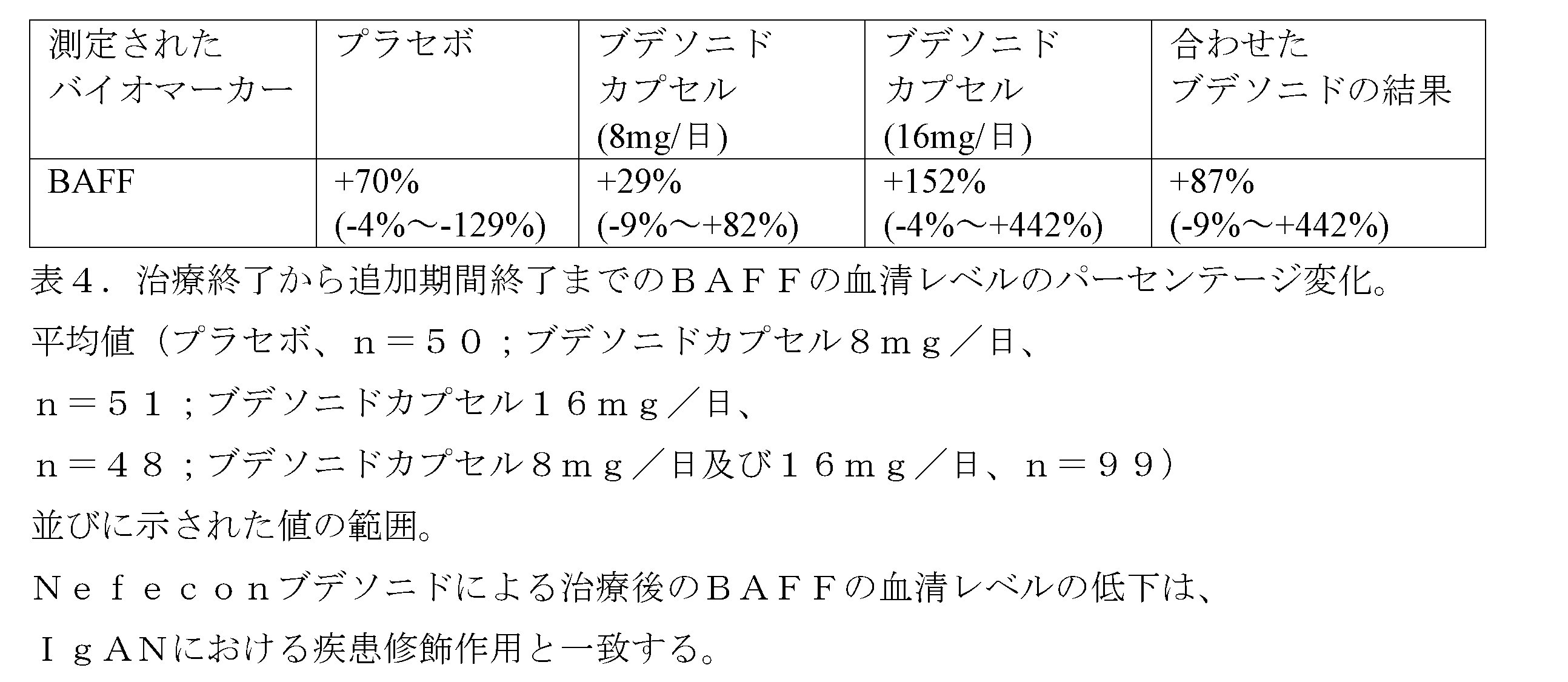
実施例9:ブデソニドカプセルによる患者の治療は、APRILの血清レベルの低下にはつながらない
材料及び方法
上記の実施例8に記載されているものと同じ材料及び方法を使用した。
Example 9: Treatment of patients with budesonide capsules does not lead to a decrease in serum levels of APRIL Materials and Methods The same materials and methods were used as described in Example 8 above.
APRILレベルの違いの比較は、p値<0.05での一元配置分散分析(ANOVA)統計検定を使用して実施した。 Comparison of differences in APRIL levels was performed using a one-way analysis of variance (ANOVA) statistical test with a p-value <0.05.
結果
図9及び表5に見ることができるように、8mg/日及び16mg/日のブデソニドカプセルによる患者の治療は、9か月の治療期間の終了時に採取された試料におけるAPRILの血清レベルの観察可能な変化をもたらさず、ブデソニドカプセルでの治療によってもたらされる効果がBAFFに特異的であることを示唆した。同様に、プラセボ群において変化は観察されなかった。

実施例10:ブデソニドカプセル治療後のBAFFの血清レベルの減少は、TACIの血清レベルの低下と関連している
材料及び方法
上記の実施例8に記載されているものと同じ材料及び方法を使用した。
Example 10: Decreased serum levels of BAFF following budesonide capsule treatment are associated with decreased serum levels of TACI Materials and Methods The same materials and methods were used as described in Example 8 above.
TACIレベルの違いの比較は、p値<0.05での一元配置分散分析(ANOVA)統計検定を使用して実施した。 Comparison of differences in TACI levels was performed using a one-way analysis of variance (ANOVA) statistical test with a p-value <0.05.
結果
図10及び表6で見ることができるように、8mg/日及び16mg/日のブデソニドカプセルでの患者の治療は、9か月の治療期間の終了時に採取された試料において、プラセボ治療患者と比較して、TACIの血清レベルに統計的に有意な減少をもたらした。プラセボ群では、TACIのレベルは、実際にはベースラインレベルと比較してわずかに増加することが見られた。

実施例11:ブデソニドカプセル治療後のBAFFの血清レベルの減少は、BCMAの血清レベルの低下と関連している。
材料及び方法
上記の実施例6に記載されているものと同じ材料及び方法を使用した。
Example 11: Decreased serum levels of BAFF following budesonide capsule treatment are associated with decreased serum levels of BCMA.
Materials and Methods The same materials and methods were used as described in Example 6 above.
BCMAレベルの違いの比較は、p値<0.05での一元配置分散分析(ANOVA)統計検定を使用して実施した。 Comparisons of differences in BCMA levels were performed using a one-way analysis of variance (ANOVA) statistical test with a p-value <0.05.
結果
図11及び表7で見ることができるように、8mg/日及び16mg/日のブデソニドカプセルでの患者の治療は、9か月の治療期間の終了時に採取された試料において、プラセボ治療患者と比較して、BCMAの血清レベルに統計的に有意な減少をもたらした。プラセボ群では、BCMAのレベルは、実際には、ベースラインレベルと比較して非常にわずかに増加することが見られた。

実施例12:ブデソニドカプセル治療後のBAFFの血清レベルの減少は、CD27の血清レベルの低下と関連している。
この研究は、各バイオマーカーの組織レベルではなく、循環レベルの変化を評価することに限定され、したがって、調節が生じた実際の部位が不確実であったため、Nefeconブデソニドによって著しく調節されたバイオマーカー(免疫細胞活性化のそれらの代替バイオマーカー(sCD27及びsCD30を含む(実施例13を参照))を含む)が、任意の特定の生物学的プロセス及び経路と関連しているかどうかを決定するために経路解析を行った。
Example 12: Decreased serum levels of BAFF following budesonide capsule treatment are associated with decreased serum levels of CD27.
Because this study was limited to evaluating changes in circulating levels rather than tissue levels of each biomarker, and therefore the actual site where modulation occurred was uncertain, pathway analysis was performed to determine whether biomarkers significantly modulated by Nefecon budesonide, including those surrogate biomarkers of immune cell activation, including sCD27 and sCD30 (see Example 13), were associated with any specific biological processes and pathways.
材料及び方法
上記の実施例8に記載されているものと同じ材料及び方法を使用した。
Materials and Methods The same materials and methods were used as described in Example 8 above.
CD27レベルの違いの比較は、p値<0.05での一元配置分散分析(ANOVA)統計検定を使用して実施した。 Comparison of differences in CD27 levels was performed using a one-way analysis of variance (ANOVA) statistical test with a p-value <0.05.
結果
図12及び表8で見ることができるように、8mg/日及び16mg/日のブデソニドカプセルでの患者の治療は、9か月の治療期間の終了時に採取された試料において、プラセボ治療患者と比較して、CD27の血清レベルに統計的に有意な減少をもたらした。プラセボ群では、CD27のレベルは、実際にはベースラインレベルと比較してわずかに増加することが見られた。

更に、図13及び表9は、追加期間の完了後(すなわち、治療期間の終了後3か月)に採取された血清試料において、16mg/日のブデソニドカプセルで以前に治療された患者におけるCD27の血清レベルが再び増加し、観察された低下はブデソニドカプセルへの曝露に依存していたことを示している。

実施例13:ブデソニドカプセル治療後のBAFFの血清レベルの減少は、CD30の血清レベルの低下と関連している。
材料及び方法
上記の実施例8に記載されているものと同じ材料及び方法を使用した。
Example 13: Decreased serum levels of BAFF following budesonide capsule treatment are associated with decreased serum levels of CD30.
Materials and Methods The same materials and methods were used as described in Example 8 above.
CD30レベルの違いの比較は、p値<0.05での一元配置分散分析(ANOVA)統計検定を使用して実施した。 Comparison of differences in CD30 levels was performed using a one-way analysis of variance (ANOVA) statistical test with a p-value <0.05.
結果
図14及び表10で見ることができるように、8mg/日及び16mg/日のブデソニドカプセルでの患者の治療は、9か月の治療期間の終了時に採取された試料において、プラセボ治療患者と比較して、CD30の血清レベルにわずかながら統計的に有意な減少をもたらした。プラセボ群では、CD30のレベルは、実際にはベースラインレベルと比較してわずかに増加することが見られた。

ゲノムワイド関連(GWA)解析(Gesualdo L,Di Leo V,Coppo R.The mucosal immune system and IgA nephropathy.Semin Immunopathol.2021;43:657-668; Coppo R.The gut-renal connection in IgA nephropathy.Semin Nephrol.2018;38:504-512.)の大規模メタアナリシスと一致して、本研究は、IgA産生のための腸管免疫ネットワークを、最も豊富なKyoto Encyclopaedia of Genes and Genomes(KEGG)経路の1つとして特定し、Nefeconブデソニドの作用機序が、少なくとも部分的には、回腸腸関連リンパ組織(GALT)内の効果によって駆動されていることが示された。 In agreement with large-scale meta-analyses of genome-wide association (GWA) studies (Gesualdo L, Di Leo V, Coppo R. The mucosal immune system and IgA nephropathy. Semin Immunopathol. 2021; 43: 657-668; Coppo R. The gut-renal connection in IgA nephropathy. Semin Nephrol. 2018; 38: 504-512.), this study identifies the gut immune network for IgA production as the most abundant Kyoto Encyclopedia of Genes and We identified Nefecon budesonide as one of the KEGG pathways in the ileal gut-associated lymphoid tissue (GALT) and demonstrated that the mechanism of action of Nefecon budesonide is driven, at least in part, by effects in the ileal gut-associated lymphoid tissue (GALT).
実施例14:-ブデソニドカプセル治療後の分泌型IgAレベルの分析
材料及び方法
コーティング緩衝液中で1:10,000に希釈したモノクローナルマウス抗ヒト分泌成分(Sigma)を免疫プレートのウェルに適用し、4℃で一晩インキュベートした。次いで、プレートを洗浄し、2%BSAで室温で1時間ブロックした。血清試料及び標準品(高、中、及び低)をPBS中で1:10に希釈し、洗浄後にプレートに適用し、4℃で一晩インキュベーションした。その後、プレートを洗浄し、ポリクローナルウサギ抗ヒトIgA HRP(Sigma、1:2000)を各ウェルに添加し、プレートを室温で90分間インキュベートした。次いで、プレートを再度洗浄し、分泌型IgAのレベルを、o-フェニレンジアミン二塩酸塩基質で可視化した。各プレートの高、中、及び低標準のOD492を使用して、プレートの値を標準プレートに正規化した。
Example 14: - Analysis of secretory IgA levels after budesonide capsule treatment Materials and Methods Monoclonal mouse anti-human secretory component (Sigma) diluted 1:10,000 in coating buffer was applied to wells of the immunoplate and incubated overnight at 4°C. Plates were then washed and blocked with 2% BSA for 1 hour at room temperature. Serum samples and standards (high, medium, and low) were diluted 1:10 in PBS and applied to the plates after washing and incubated overnight at 4°C. Plates were then washed and polyclonal rabbit anti-human IgA HRP (Sigma, 1:2000) was added to each well and plates were incubated for 90 minutes at room temperature. Plates were then washed again and secretory IgA levels were visualized with o-phenylenediamine dihydrochloride substrate. Plate values were normalized to the standard plate using the OD492 of the high, medium, and low standards of each plate.
結果
分泌型IgAの血清レベルが、ブデソニドカプセル依存的に著しく(p<0.05)低下した。分泌型IgAの血清レベルは変化しなかった(図15)。これは、ブデソニドの全身曝露ではなく、ブデソニドカプセルの標的放出による局所放出及び局所腸管作用を示す。
Results: Serum levels of secretory IgA were significantly (p<0.05) decreased in a budesonide capsule-dependent manner. Serum levels of secretory IgA were unchanged (FIG. 15). This indicates a local release and local gut effect due to the targeted release of the budesonide capsules, rather than a systemic exposure of budesonide.
実施例15:ブデソニドカプセル治療後のIgA-IgG免疫複合体及びO-ガラクトシル化不十分IgA1レベルの分析
材料及び方法
IgA-IgG免疫複合体:96ウェルの免疫プレートからのウェルを、コーティング緩衝液中で5μg/mLに希釈したAffiniPure F(ab’)2断片ヤギ抗ヒト血清IgA(α鎖特異的)(Jackson Immunology)でコーティングした。4℃で一晩インキュベートした後、プレートを洗浄しPBS中の2%BSAで、非特異的タンパク質結合を、室温で1時間ブロックした。試験血清試料及び標準(高、中、及び低)をPBS中で1:500に希釈し、二連でウェルに添加し、4℃で一晩インキュベーションした。次いで、プレートを洗浄し、PBS中で1:2000に希釈したポリクローナルウサギ抗ヒトIgG-HRP(Dako)で90分間インキュベートした。プレートを再び4サイクル洗浄し、o-フェニレンジアミン二塩酸塩基質を使用して、血清試料中のIgA/IgGICのレベルを可視化した。各プレートの高、中、及び低標準のOD492を使用して、プレートの値を標準プレートに正規化した。
Example 15: Analysis of IgA-IgG immune complexes and O-galactosylated under-IgA1 levels after budesonide capsule treatment Materials and Methods IgA-IgG immune complexes: Wells from a 96-well immunoplate were coated with AffiniPure F(ab')2 fragment goat anti-human serum IgA (alpha chain specific) (Jackson Immunology) diluted to 5 μg/mL in coating buffer. After overnight incubation at 4°C, plates were washed and non-specific protein binding was blocked with 2% BSA in PBS for 1 hour at room temperature. Test serum samples and standards (high, medium, and low) were diluted 1:500 in PBS and added to wells in duplicate and incubated overnight at 4°C. Plates were then washed and incubated for 90 minutes with polyclonal rabbit anti-human IgG-HRP (Dako) diluted 1:2000 in PBS. The plates were washed again for 4 cycles and the levels of IgA/IgGI C in the serum samples were visualized using o-phenylenediamine dihydrochloride substrate. Plate values were normalized to the standard plate using the OD492 of the high, medium, and low standards of each plate.
低ガラクトシル化(Undergalactosylated)IgA:市販のKM55 ELISA(カタログ番号27600、Immuno-Biological Laboratories,Inc.Minneapolis,MN55432,USA)を使用して、O-ガラクトシル化不十分IgA1のレベルを測定した。 Undergalactosylated IgA: Levels of O-undergalactosylated IgA1 were measured using a commercially available KM55 ELISA (catalog number 27600, Immuno-Biological Laboratories, Inc. Minneapolis, Minn. 55432, USA).
結果
治療の終了時に、IgA-IgG免疫複合体の血清レベルに著しい(p<0.05)ブデソニドカプセル用量依存的な減少があった。IgA-IgG免疫複合体レベルは、ブデソニドカプセル治療の中止後3か月でベースラインレベルに戻った(図16)。O-ガラクトシル化不十分IgA1のレベルには、それほど顕著ではないが、同様の変化があった(図17)。
Results: At the end of treatment, there was a significant (p<0.05) budesonide capsule dose-dependent decrease in serum levels of IgA-IgG immune complexes. IgA-IgG immune complex levels returned to
特に興味深いのは、全身性グルココルチコイドによるIgANの治療が、総血清IgA及びO-ガラクトシル化IgA1の両方を低下させることが示されていることである(Kosztyu P et al.,:Glucocorticoids Reduce Aberrant O-Glycosylation of IgA1 in IgA Nephropathy Patients.Kidney Blood Press Res 2018;43:350-359。しかしながら、本治療では、ブデソニドカプセル治療による総IgA、IgA1及びIgGのレベルの差は観察されず(図18)、これにより、ブデソニドカプセルによる局所回腸治療の効果は、病原性抗体に対しては選択的であったが、IgA、IgA1及びIgGの一般的なプールに対しては有効ではないという結論に至った。 Of particular interest is that treatment of IgAN with systemic glucocorticoids has been shown to reduce both total serum IgA and O-galactosylated IgA1 (Kosztyu P et al., Glucocorticoids Reduce Aberrant O-Glycosylation of IgA1 in IgA Nephropathy Patients. Kidney Blood Press Res. 2018; 43: 350-359. However, in this treatment, no difference in the levels of total IgA, IgA1 and IgG was observed with budesonide capsule treatment (Figure 18), leading to the conclusion that the effect of local ileal treatment with budesonide capsules was selective against pathogenic antibodies but not effective against the general pool of IgA, IgA1 and IgG.
これらの結果は、Nefeconブデソニドでの治療が、IgANの根底にある病原性経路に対するNefeconブデソニドの直接的な効果を支持し、ブデソニドペイロードが全身効果ではなく主に局所効果を有し、Nefeconブデソニドで治療した場合の患者の副作用を軽減させることを示す。 These results support the direct effect of Nefecon budesonide treatment on the pathogenic pathways underlying IgAN and indicate that the budesonide payload has a primarily local rather than systemic effect, reducing side effects in patients when treated with Nefecon budesonide.
実施例16:ブデソニドカプセルと参照市販製品との間の血漿プロファイルの発現までの遅延時間(lag time)の比較
同じ活性成分を含有するブデソニドカプセル(上記の実施例1に従って得られた)及び参照市販製品(Entocort(登録商標)EC、AstraZeneca)の試験製品を、無作為化されたクロスオーバー臨床試験において絶食状態にある24人の被験者に投与した。
Example 16: Comparison of lag time to onset of plasma profile between budesonide capsules and a reference commercial product. Test products, budesonide capsules (obtained according to Example 1 above) containing the same active ingredient and a reference commercial product (Entocort® EC, AstraZeneca), were administered to 24 subjects in the fasting state in a randomized crossover clinical trial.
試験製剤を2回に分けて投与した後、及び参照(REF)製品の投与後(好適なウォッシュアウト期間は7~14日)の各被験者の血中レベルの発現までの遅延時間(時間)を、以下の表11に示す。

統計分析
Sigmaplot for Windows、バージョン11.0でデータを分析した。
Statistical Analysis Data were analyzed with Sigmaplot for Windows, version 11.0.
記述統計
研究の各アームの血漿レベルの発現までの遅延時間について中央値が計算され、以下の表12に示される。(これらは離散型データであるため、平均値ではなく中央値が報告され、すなわち、遅延時間は、研究におけるサンプリング時間にのみ対応することができる)。

血漿レベルの発現までの遅延時間の中央値(50パーセンタイル)は、試験製剤の両方の投与で4時間、参照市販製剤で1時間であると結論付けられた。 It was concluded that the median (50th percentile) lag time to onset of plasma levels was 4 hours for both doses of the test formulations and 1 hour for the reference commercial formulation.
試験製剤について観察された遅延時間が参照製品の遅延時間と統計的に異なるかどうかを決定するために、二反復測定分散分析(two Repeated Measures Analysis of Variance)(ANOVA)検定をデータに適用した-1つはデータが正規分布であると仮定し、もう1つはデータがどのように分布するかについての仮定を有さないものである。 To determine whether the lag times observed for the test formulations were statistically different from those of the reference product, a two Repeated Measures Analysis of Variance (ANOVA) test was applied to the data - one that assumes the data are normally distributed and one that makes no assumptions about how the data are distributed.
正規分布データセットを仮定した反復測定分散分析は、F値51.815及びP値P<0.001をもたらし、これは統計的に非常に有意である。研究のどのアームが互いに異なるかを決定するためにテューキー検定を使用した事後比較により、以下の表13に提示される結果が得られた:

これは、試験製剤を別々に投与した場合には、血漿レベルの発現までの遅延時間に差はないが、試験製剤の投与後の血漿レベルの発現までの遅延時間は、市販の対照製品を投与した場合と比較して、統計的に非常に異なることを示した(P<0.001)。 This showed that there was no difference in the lag time to onset of plasma levels when the test formulations were administered separately, but the lag time to onset of plasma levels after administration of the test formulation was statistically significantly different compared to administration of the commercial control product (P<0.001).
反復測定分散分析は、フリードマン検定を用いる個々の遅延時間値のランキングにも適用された(例えば、Stanton.A Glanz,Primer of Biostatistics,5th Edition,McGraw Hill 2002,ISBN0-07-137946-0,370~380ページを参照)。 Repeated measures analysis of variance was also applied to rank the individual delay time values using the Friedman test (see, for example, Stanton. A Glanz, Primer of Biostatistics, 5th Edition, McGraw Hill 2002, ISBN 0-07-137946-0, pages 370-380).
この検定を使用した場合、カイ二乗値は52.950であり、p値は0.001未満であり、これは統計的に非常に有意である。研究のどのアームが互いに異なるかを決定するためにテューキー検定を使用した事後比較により、以下の表14に提示される結果が得られた:

この試験は、試験製剤を投与した場合、血漿レベルの発現までの遅延時間に差はないが、試験製剤を投与した場合の血漿レベルの発現までの遅延時間は、市販の対照製剤を投与した場合と統計的に異なる(P<0.05)ことが(再び)示される。 This study shows (again) that there is no difference in the lag time to onset of plasma levels when the test formulation is administered, but that the lag time to onset of plasma levels when the test formulation is administered is statistically different (P<0.05) from when the commercial control formulation is administered.
結論として、適用される統計分析の種類に関係なく、試験製剤は、市販の参照製剤、Entocort(登録商標)ECと比較して、著しく異なる、血漿レベルの発現までの遅延時間を有する。血漿レベルの発現までの遅延時間の中央値は、Nefecon Fが投与された研究の各アームで4時間であったが、Entocort(登録商標)ECの遅延時間の中央値は1時間であった。 In conclusion, regardless of the type of statistical analysis applied, the test formulations have significantly different lag times to onset of plasma levels compared to the commercial reference formulation, Entocort® EC. The median lag time to onset of plasma levels was 4 hours in each arm of the study where Nefecon F was administered, whereas the median lag time for Entocort® EC was 1 hour.
この分析は、参照製品とは異なり、本明細書に記載され、特許請求される試験製剤は、小腸の遠位部分(例えば、遠位回腸などの回腸)に到達するまで、その活性成分の大部分を放出しないことを明確に実証している。 This analysis clearly demonstrates that, unlike the reference product, the test formulation described and claimed herein does not release a substantial portion of its active ingredient until it reaches the distal portion of the small intestine (e.g., the ileum, such as the distal ileum).
実施例17:添加された界面活性剤Tween80の存在下でのUSP<711>/Ph.Eur.2.9.3に従う標準インビトロ溶出試験のための一般的なプロセス
実施例1のカプセル化されたブデソニドコアシェルビーズのインビトロ溶出を、Ph.Eur.2.9.3固体剤形の溶出試験(装置2を使用する)に記載されているとおりに、及びUSP<711>溶出(装置2を使用する)に記載されているとおりに分析した。測定を以下に記載のとおり実施した。
Example 17: General process for standard in vitro dissolution testing according to USP <711>/Ph. Eur. 2.9.3 in the presence of added
この試験では、市販されている3つのブデソニド含有製剤も分析した。3つの製剤は、Entocort(登録商標)(Tillotts Pharma)、Budenofalk(登録商標)(Dr Falk Pharma GmbH)及びCortiment(登録商標)(Ferring Pharmaceuticals,CH)である。

ブデソニドの放出を、超高速液体クロマトグラフィー(UPLC)を使用して測定した。 Budesonide release was measured using ultra-performance liquid chromatography (UPLC).
試薬及び標準
標準及び参照物質:
ブデソニド、Ph.Eur.CSR又は好適な二次標準物質。
Reagents and Standards Standards and Reference Materials:
Budesonide, Ph. Eur. CSR or suitable secondary standard.
他の試薬:
Tween80、(Polysorbate(80))、Fisher Scientific又は同等品
Other reagents:
溶出媒体及び希釈液
耐酸性媒体
Dissolution media and diluents Acid-resistant media
0.1NのHCl溶液。6Lの耐酸性媒体を調製するために、50mLの濃HClを6000mLの水と合わせ、得られた溶液をよく混合した。 0.1 N HCl solution. To prepare 6 L of acid-resistant medium, 50 mL of concentrated HCl was combined with 6000 mL of water and the resulting solution was mixed well.
緩衝液溶出媒体
FaSSIF緩衝液濃縮物(Biorelevant.comから、製品コードFASBUF01)を使用して、緩衝溶液を調製した。
Buffer Elution Media FaSSIF Buffer Concentrate (from Biorelevant.com, product code FASBUF01) was used to prepare the buffer solution.
この緩衝溶液に対し0.05w/v%(0.5mg/mL)のTween80:例えば、6Lの緩衝液溶出媒体を作製するためには、3gのTween80を6Lの緩衝溶液に添加して、0.05w/v%のTween80濃度に到達させる。
0.05% w/v (0.5 mg/mL)
得られた溶液をよく混合し、pHをチェックした。必要に応じて、塩酸又は水酸化ナトリウムのいずれかを使用して、pHを6.5±0.05に調整した。 The resulting solution was mixed well and the pH was checked. If necessary, the pH was adjusted to 6.5±0.05 using either hydrochloric acid or sodium hydroxide.
ブデソニド放出を、USP<711>/Ph.Eur.2.9.3の許容基準に基づいて評価した。 Budesonide release was evaluated based on USP <711>/Ph. Eur. 2.9.3 acceptance criteria.
実施例18:添加された界面活性剤Tween80の存在下でのインビトロUSP<711>/薬局方試験番号2.9.3に従うブデソニドカプセルの溶出プロファイル分析
上記実施例1に記載したように調製された硬化ビーズを充填した腸溶性コーティングカプセル(「ブデソニドカプセル」)を、実施例17に概説された溶出条件下で試験した。
Example 18: Dissolution Profile Analysis of Budesonide Capsules According to In Vitro USP <711>/Pharmacopeia Test No. 2.9.3 in the Presence of Added
緩衝液段階における3つの試料の全体的な平均溶出プロファイルは、図19に見ることができる。2時間のサンプリング時点では、耐酸性段階においてブデソニド放出は観察されなかった。 The overall average dissolution profile of the three samples in the buffer phase can be seen in Figure 19. No budesonide release was observed in the acid-resistant phase at the 2 hour sampling time point.
PH1.2で2時間、及びpH6.5の緩衝液段階での15、30、45、60、90、120、及び180分の時点での様々な媒体におけるブデソニドの溶出の定量的結果を以下の表に示す。

ブデソニド放出を、USP<711>/Ph.Eur.2.9.3の許容基準に基づいて評価した。 Budesonide release was evaluated based on USP <711>/Ph. Eur. 2.9.3 acceptance criteria.
比較のために、ブデソニドカプセル及び他の3つのブデソニド含有製剤の溶出プロファイルを以下に概説するプロトコルに従って得た。他の3つのブデソニド含有製剤は、Entocort(登録商標)(Tillots Pharma)、Budenofalk(登録商標)(Dr Falk Pharma GmbH)及びCortiment(登録商標)(Ferring Pharmaceuticals,CH)である。

標準及び参照物質
ブデソニド、Ph.Eur.CSR.
Standards and Reference Materials Budesonide, Ph. Eur. CSR.
他の試薬:
Tween80、(Polysorbate(80))、Fisher Scientific又は同等品。
Other reagents:
溶出媒体、移動相及び希釈液
耐酸性媒体
Dissolution media, mobile phases and diluents Acid-resistant media
0.1NのHCl溶液。例えば、10Lを調製するために、82mLの濃HClを10000mLの水と合わせ、十分に混合した。 0.1N HCl solution. For example, to prepare 10 L, combine 82 mL of concentrated HCl with 10,000 mL of water and mix thoroughly.
緩衝液溶出媒体
Biorelevant.comからのFaSSIF緩衝液濃縮物を使用して、提供される説明書に従って緩衝溶液を調製した。得られた溶液を十分に混合した。緩衝溶液のpHは、調製後にチェックした。必要に応じて、塩酸又は水酸化ナトリウムのいずれかを使用して、pHを6.5±0.05に調整した。
Buffer Dissolution Media Buffer solutions were prepared using FaSSIF buffer concentrate from biorelevant.com according to the instructions provided. The resulting solution was mixed thoroughly. The pH of the buffer solutions was checked after preparation. If necessary, the pH was adjusted to 6.5±0.05 using either hydrochloric acid or sodium hydroxide.
耐酸性試料を引っ張った後、カプセルをピンセットで溶液から取り出し、容器を空にし、洗浄し、予熱した緩衝液を充填する間、脇に置いた。各溶出容器に0.05w/v%のTween80(又は同等物)を添加し、例えば、溶出容器に900mLの予熱緩衝液を充填した後、450mgのTween80を添加して、0.05%の界面活性剤濃度にした。
After pulling the acid-resistant samples, the capsules were removed from the solution with tweezers and set aside while the vessels were emptied, washed, and filled with pre-heated buffer. 0.05% w/v Tween 80 (or equivalent) was added to each dissolution vessel, e.g., after filling the dissolution vessel with 900 mL of pre-heated buffer, 450 mg of
全ての容器が目標温度に達した後、各容器にカプセルを添加することによって実験を開始した。 After all containers had reached the target temperature, the experiment began by adding a capsule to each container.
Budenofalkでの手順の変更
酸段階中にカプセルが破損した場合、異なる手順を使用した。酸相の大部分を慎重にデカントし、次いで容器からできるだけ少ないペレットを除去するために、残りの酸をピペットで慎重に除去した。緩衝液段階は、900mLの予熱した緩衝媒体を添加することによって開始し、続いてTweenを添加した。
Procedure Changes at Budenofalk If the capsule broke during the acid stage, a different procedure was used. Most of the acid phase was carefully decanted, then the remaining acid was carefully removed with a pipette to remove as little pellet as possible from the vessel. The buffer stage was initiated by adding 900 mL of pre-heated buffer medium, followed by the addition of Tween.
両段階のサンプリング
10mLを吸引し、8mLを廃棄し(Whatmanフィルターを通して)、1mLをHPLCバイアルにサンプリングした。
Sampling for both stages: 10 mL was aspirated, 8 mL was discarded (through a Whatman filter) and 1 mL was sampled into an HPLC vial.
疑義を避けるために、実施例2と比較したこの試験の変動は、試験した製品の全体的な溶出プロファイルに影響を及ぼさない。 For the avoidance of doubt, the variations in this study compared to Example 2 do not affect the overall dissolution profile of the product tested.
図20は、他の3つのブデソニド含有製剤と比較したブデソニドカプセルの溶出プロファイルを示す。この図から、小腸内の環境を模倣するFaSSIF媒体内で、ブデソニドカプセルが、全ての他の市販のブデソニド含有製剤と区別される放出プロファイルを有することを明確に理解することができる。 Figure 20 shows the dissolution profile of the budesonide capsule compared to three other budesonide-containing formulations. From this figure, it can be clearly seen that in the FaSSIF medium, which mimics the environment in the small intestine, the budesonide capsule has a release profile that distinguishes it from all other commercially available budesonide-containing formulations.
実施例19:腸溶性コーティングカプセルの不在下におけるインビトロUSP<711>/薬局方試験番号2.9.3に従うコアシェルビーズの溶出プロファイル分析
腸溶性コーティングカプセルの不在下で実施例1で調製した硬化したコア-シェルビーズもまた、実施例17に概説された緩衝液段階の溶出条件下で(のみ)試験した。
Example 19: Dissolution Profile Analysis of Core-Shell Beads According to In Vitro USP <711>/Pharmacopeia Test No. 2.9.3 in the Absence of an Enteric Coated Capsule The hardened core-shell beads prepared in Example 1 in the absence of an enteric coated capsule were also tested under the buffer step dissolution conditions (only) outlined in Example 17.
緩衝液段階における3つの試料の全体的な平均溶出プロファイルは、図21に見ることができる。 The overall average elution profile of the three samples in the buffer stage can be seen in Figure 21.
15、30、45、60、90、120、及び180分の時点でのpH6.5の緩衝液段階におけるコア-シェルビーズからのブデソニドの溶出の定量的結果を以下の表に示す。

FaSSIF緩衝液濃縮物中の腸溶性コーティングされたカプセルの不在下でのコアシェルビーズの放出プロファイルは、ブデソニドの大部分がインビボで回腸に放出されることを更に確認する。すなわち、ビーズからの放出の大部分は、90分間にわたって発生し、腸溶性コーティングからの放出の遅延と組み合わされて、製剤全体の所望の溶出プロファイルに到達するため、ブデソニドの大部分は、得られたバイオマーカーデータ及び実施例25で以下に提供されるモデリング結果によって確認されるように、インビボで回腸に放出される。 The release profile of the core-shell beads in the absence of an enteric coated capsule in FaSSIF buffer concentrate further confirms that the majority of the budesonide is released in the ileum in vivo. That is, most of the release from the beads occurs over a 90 minute period, which, combined with the delayed release from the enteric coating to arrive at the desired dissolution profile of the overall formulation, results in the majority of the budesonide being released in the ileum in vivo, as confirmed by the biomarker data obtained and the modeling results provided below in Example 25.
実施例20:添加された界面活性剤Tween80の不在下でのUSP<711>/Ph.Eur.2.9.3に従う標準インビトロ溶出試験のための一般的なプロセス
実施例1のカプセル化されたブデソニドコアシェルビーズのインビトロ溶出を、Ph.Eur.2.9.3固体剤形の溶出試験(装置2を使用する)に記載されているとおりに、及びUSP<711>溶出(装置2を使用する)に記載されているとおりに分析した。測定を以下に記載のとおり実施した。
Example 20: General process for standard in vitro dissolution testing according to USP <711>/Ph. Eur. 2.9.3 in the absence of added
この試験で、市販されている3つのブデソニド含有製剤も分析した。3つの製剤は、Entocort(登録商標)(Tillotts Pharma)、Budenofalk(登録商標)(Dr Falk Pharma GmbH)及びCortiment(登録商標)(Ferring Pharmaceuticals,CH)である。

ブデソニドの放出を、超高速液体クロマトグラフィー(UPLC)を使用して測定した。 Budesonide release was measured using ultra-performance liquid chromatography (UPLC).
試薬及び標準
標準及び参照物質:
ブデソニド、Ph.Eur.CSR又は好適な二次標準物質。
Reagents and Standards Standards and Reference Materials:
Budesonide, Ph. Eur. CSR or suitable secondary standard.
溶出媒体及び希釈液
耐酸性媒体
Dissolution media and diluents Acid-resistant media
0.1NのHCl溶液。10Lの耐酸性媒体を調製するために、82mLの濃HClを10000mLの水と合わせ、得られた溶液を十分に混合した。 0.1 N HCl solution. To prepare 10 L of acid-resistant medium, 82 mL of concentrated HCl was combined with 10,000 mL of water and the resulting solution was mixed thoroughly.
緩衝液溶出媒体
Biorelevant.comからのFaSSIF緩衝液濃縮物を使用して、提供される説明書に従って緩衝溶液を調製した。得られた溶液を十分に混合した。緩衝溶液のpHは、調製後にチェックした。必要に応じて、塩酸又は水酸化ナトリウムのいずれかを使用して、pHを6.5±0.05に調整した。
Buffer Dissolution Media Buffer solutions were prepared using FaSSIF buffer concentrate from biorelevant.com according to the instructions provided. The resulting solution was mixed thoroughly. The pH of the buffer solutions was checked after preparation. If necessary, the pH was adjusted to 6.5±0.05 using either hydrochloric acid or sodium hydroxide.
耐酸性試料を引っ張った後、カプセルをピンセットで溶液から取り出し、容器を空にし、洗浄し、900mLの予熱緩衝液を充填する間、脇に置いた。 After pulling the acid-resistant sample, the capsule was removed from the solution with tweezers and set aside while the container was emptied, washed, and filled with 900 mL of pre-warmed buffer.
全ての容器が目標温度に達した後、各容器にカプセルを添加することによって実験を開始した。 After all containers had reached the target temperature, the experiment began by adding a capsule to each container.
Budenofalkでの手順の変更
酸段階中にカプセルが破損した場合、異なる手順を使用した。酸相の大部分を慎重にデカントし、次いで容器からできるだけ少ないペレットを除去するために、残りの酸をピペットで慎重に除去した。緩衝液段階は、900mLの予熱した緩衝媒体を加えることによって開始した。
Procedure changes at Budenofalk If the capsule broke during the acid stage, a different procedure was used. Most of the acid phase was carefully decanted, then the remaining acid was carefully removed with a pipette to remove as little pellet as possible from the vessel. The buffer stage was started by adding 900 mL of pre-heated buffer medium.
両段階のサンプリング
10mLを吸引し、8mLを廃棄し(Whatmanフィルターを通して)、1mLをHPLCバイアルにサンプリングした。
Sampling for both stages: 10 mL was aspirated, 8 mL was discarded (through a Whatman filter) and 1 mL was sampled into an HPLC vial.
ブデソニド放出を、USP<711>/Ph.Eur.2.9.3の許容基準に基づいて評価した。 Budesonide release was evaluated based on USP <711>/Ph. Eur. 2.9.3 acceptance criteria.
実施例21:添加された界面活性剤Tween80の不在下でのインビトロUSP<711>/薬局方試験番号2.9.3に従うブデソニドカプセルの溶出プロファイル分析
上記実施例1に記載したように調製された硬化ビーズを充填した腸溶性コーティングカプセル(「ブデソニドカプセル」)を、実施例20に概説された溶出条件下で試験した。
Example 21: Dissolution Profile Analysis of Budesonide Capsules According to In Vitro USP <711>/Pharmacopeia Test No. 2.9.3 in the Absence of Added
ブデソニドカプセルの全体的な平均溶出プロファイルは、図22に見ることができる。図22にはまた、比較例としての同じ試験下での他の3つのブデソニド含有製剤の溶出プロファイルも含む。この図から、小腸内の環境を模倣するFaSSIF媒体内で、ブデソニドカプセルが、全ての他の市販のブデソニド含有製剤と区別される放出プロファイルを有することが明確に理解することができる。 The overall average dissolution profile of the budesonide capsule can be seen in Figure 22, which also includes the dissolution profiles of three other budesonide-containing formulations under the same test as comparative examples. From this figure, it can be clearly seen that in the FaSSIF medium, which mimics the environment in the small intestine, the budesonide capsule has a release profile that distinguishes it from all other commercially available budesonide-containing formulations.
ブデソニドカプセル及びCortimentについては、2時間のサンプリング時点で、耐酸性段階においてブデソニド放出は観察されなかった。2時間のサンプリング時点での酸耐性段階で、Entocortについては、0.8%に達するブデソニドの放出が観察され、Budenofalkについては、0.6%に達するブデソニドの放出が観察された。 For budesonide capsules and Cortiment, no budesonide release was observed in the acid-resistant phase at the 2-hour sampling time point. For Entocort, budesonide release amounting to 0.8% was observed, and for Budenofalk, budesonide release amounting to 0.6% was observed in the acid-resistant phase at the 2-hour sampling time point.
ブデソニドカプセル及び3つの比較製剤の両方についての、PH1.2での2時間、及びpH6.5での緩衝液段階での15、30、45、60、90、120、及び180分の時点での様々な媒体中でのブデソニドの溶出の定量的結果を、以下の表に示す。

ブデソニド放出を、USP<711>/Ph.Eur.2.9.3の許容基準に基づいて評価した。 Budesonide release was evaluated based on USP <711>/Ph. Eur. 2.9.3 acceptance criteria.
以下の表は、この方法で試験された本発明によるブデソニドカプセルを他の市販製品の各々と比較するためのf2値を示す。プロファイルの類似性を明らかに示すには、50以上のf2値が必要である(FDA SUPACガイダンス1995、1997)。

ブデソニドの放出プロファイルは、4つの市販製品の間で大きく異なることは明らかである。Nefeconと他の製品との間のf2比較のいずれも類似性を示しておらず、類似性を明らかに示すには50以上のf2値が必要である。実際、f2評価並びにグラフィカルプロファイルの目視検査に基づいて、それらの放出プロファイルは、強く異なっているとみなされなければならない。 It is clear that the release profiles of budesonide are significantly different between the four marketed products. None of the f2 comparisons between Nefecon and the other products show similarity, with f2 values of 50 or greater being required to clearly show similarity. Indeed, based on the f2 assessment as well as visual inspection of the graphical profiles, the release profiles must be considered as strongly different.
実施例22:第1の錠剤処方
錠剤は、以下のプロセスステップによって製造される。
1.湿式造粒。ブデソニド、マンニトール、ヒドロキシエチルセルロース、ヒドロキシプロピルセルロース、及びデンプングリコール酸ナトリウムをブレンドする。その後、ブレンド中にエタノール-水混合物を粉末に噴霧する。その後、得られた顆粒を乾燥させる。
2.最終ブレンディング。乾燥した顆粒を、フマル酸ステアリルナトリウムとブレンドする。
3.錠剤化。錠剤は、打錠機を使用して圧縮される。
4.腸溶性コーティング。混合中、メタクリル酸とメタクリル酸メチルのコポリマー、タルク及びセバシン酸ジブチルをイソプロピルアルコール-水混合物中に分散させる。その後、コーティング分散液は、流動層装置を使用して錠剤上に噴霧される。
Example 22: First tablet formulation Tablets are manufactured by the following process steps.
1. Wet granulation. Budesonide, mannitol, hydroxyethyl cellulose, hydroxypropyl cellulose, and sodium starch glycolate are blended. Then, an ethanol-water mixture is sprayed onto the powders while blending. The resulting granules are then dried.
2. Final Blending: Blend the dried granules with the sodium stearyl fumarate.
3. Tableting: Tablets are compressed using a tablet press.
4. Enteric Coating: Methacrylic acid and methyl methacrylate copolymer, talc, and dibutyl sebacate are dispersed in an isopropyl alcohol-water mixture while mixing. The coating dispersion is then sprayed onto the tablets using a fluid bed apparatus.
本発明による錠剤組成物の一例を、以下の表に示す。

実施例23:第2の錠剤処方
錠剤は、以下のプロセスステップによって製造される。
1.湿式造粒。最初に、ブデソニドをコロイダルシリカとブレンドする。その後、微結晶性セルロース及びリン酸カルシウム二塩基性を添加し、続いて追加のブレンドを行う。その後、エタノール-水混合物中のヒドロキシプロピルセルロースの溶液を、ブレンド中に粉末に噴霧する。その後、得られた顆粒を乾燥させる。
2.ブレンディング。乾燥した顆粒を、微結晶セルロース、デンプングリコール酸ナトリウム、及びコポビドンとブレンドする。最終ブレンディングステップとして、ステアリン酸マグネシウムをブレンドに添加し、続いて最終ブレンドする。
3.錠剤化。錠剤は、打錠機を使用して圧縮される。
4.腸溶性コーティング。混合中、メタクリル酸とメタクリル酸メチルのコポリマー、タルク及びセバシン酸ジブチルをイソプロピルアルコール-水混合物中に分散させる。その後、コーティング分散液は、パンコーターを使用して錠剤上に噴霧される。
Example 23: Second tablet formulation Tablets are manufactured by the following process steps.
1. Wet granulation. Budesonide is first blended with colloidal silica. Microcrystalline cellulose and calcium phosphate dibasic are then added, followed by additional blending. A solution of hydroxypropyl cellulose in an ethanol-water mixture is then sprayed onto the powders during blending. The resulting granules are then dried.
2. Blending: The dried granules are blended with microcrystalline cellulose, sodium starch glycolate, and copovidone. As a final blending step, magnesium stearate is added to the blend followed by final blending.
3. Tableting: Tablets are compressed using a tablet press.
4. Enteric Coating: While mixing, copolymer of methacrylic acid and methyl methacrylate, talc and dibutyl sebacate are dispersed in an isopropyl alcohol-water mixture. The coating dispersion is then sprayed onto the tablets using a pan coater.
本発明による錠剤組成物の一例を、以下の表に示す。

実施例24:第3の錠剤処方

素錠の製造(200gバッチサイズ)
1.ブデソニド及びフマル酸ステアリルナトリウムを除く全ての賦形剤を、Turbulaミキサーでブレンドした(46rpmで75分間ブレンディング)。
2.ブレンド中、粉末に水を噴霧することによって粉末ブレンドを造粒した。噴霧された水の量は、乾燥粉末の重量の15%であった。
3.顆粒を、50℃で一晩乾燥させた。
4.乾燥した顆粒を、Turbulaミキサーを使用して、フマル酸ステアリルナトリウム(滑沢剤)と46rpmで10分間、混合した。
5.錠剤を、素錠重量が100mgになるように圧縮した。
Manufacturing of uncoated tablets (200 g batch size)
1. All excipients except budesonide and sodium stearyl fumarate were blended in a Turbula mixer (blending at 46 rpm for 75 minutes).
2. The powder blend was granulated by spraying water onto the powder during blending. The amount of water sprayed was 15% of the weight of the dry powder.
3. The granules were dried at 50° C. overnight.
4. The dried granules were mixed with Sodium Stearyl Fumarate (lubricant) using a Turbula mixer at 46 rpm for 10 minutes.
5. Tablets were compressed to a core weight of 100 mg.
コーティング分散液の調製
以下の表に示される組成でコーティング分散液を調製した。以下のステップに従って、分散液を調製した。
1.イソプロピルアルコール、水、及びセバシン酸ジブチルを容器(容器A)内でブレンドすることによって、希釈混合物を調製した。
2.Eudragit懸濁液を、(容器A内の)希釈混合物の約半分を別の容器(容器B)に移すことによって調製した。その後、混合中にEudragitL100及びEudragitS100を容器Bにゆっくりと添加した。その後、容器B内のEudragit懸濁液を更に30~60分間混合した。
3.高剪断ミキサーで混合しながら、容器A内の残りの希釈混合物に、タルクをゆっくりと添加した。その後、タルク懸濁液を、高剪断ミキサーで更に10分間混合した。
4.その後、混合中に容器Aのタルク懸濁液をEudragit懸濁液(容器B)にゆっくりと注いだ。
5.その後、容器B内の混合物を室温で24時間撹拌した。
6.混合物を0.5mmのふるいに通した。
7.その後、最終的なコーティング分散液を、コーティングするまで及びコーティング中は連続的に撹拌しながら室温で貯蔵した。
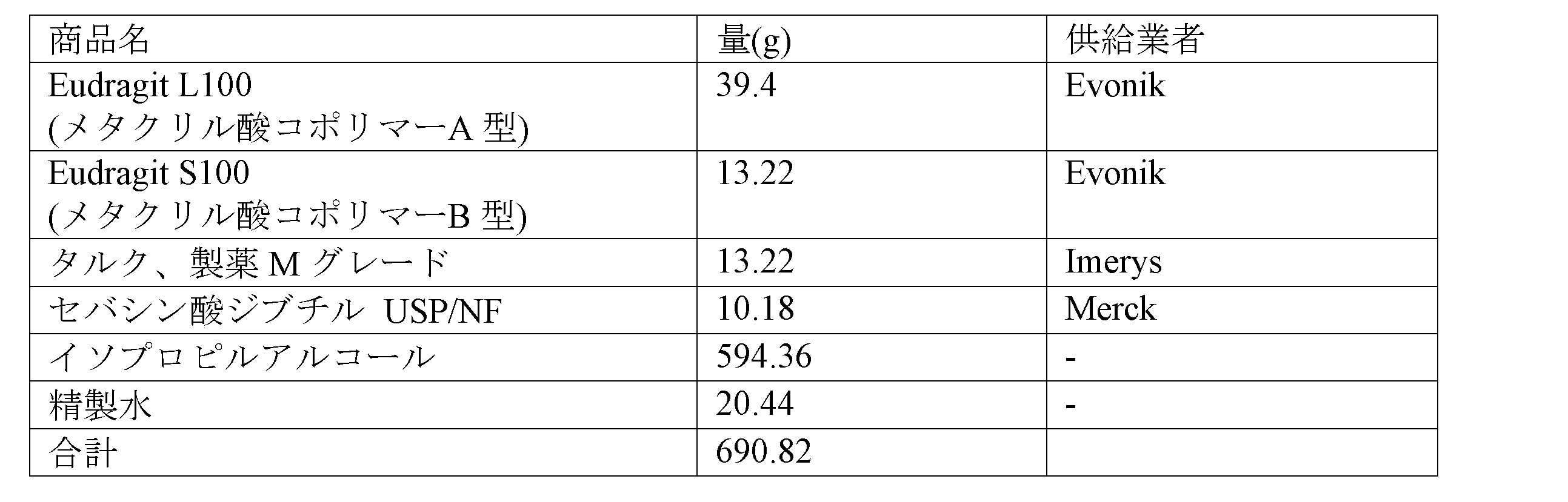
1. A dilute mixture was prepared by blending isopropyl alcohol, water, and dibutyl sebacate in a container (Container A).
2. A Eudragit suspension was prepared by transferring approximately half of the diluted mixture (in Container A) to another container (Container B). Then, while mixing, Eudragit L100 and Eudragit S100 were slowly added to Container B. The Eudragit suspension in Container B was then mixed for an additional 30-60 minutes.
3. While mixing with the high shear mixer, the talc was slowly added to the remaining diluted mixture in container A. The talc suspension was then mixed with the high shear mixer for an additional 10 minutes.
4. The talc suspension from Container A was then slowly poured into the Eudragit suspension (Container B) while mixing.
5. The mixture in vessel B was then stirred at room temperature for 24 hours.
6. The mixture was passed through a 0.5 mm sieve.
7. The final coating dispersion was then stored at room temperature with continuous stirring until and during coating.
錠剤のコーティング(50gバッチサイズ)
錠剤は、直径12cmのステンレスパンコーター、及び標準のスプレーノズルを使用してコーティングした。コーティング重量の増加は、異なるコーティング期間後に錠剤試料の重量を量ることによって決定した。以下の噴霧パラメータを使用した:
コーティングパンの回転速度:20~30rpm
製品温度:24~27℃。
ポンプ流量:250~260μl/分
スプレーノズルの空気圧:0.25bar
Tablet Coating (50g batch size)
The tablets were coated using a 12 cm diameter stainless steel pan coater and a standard spray nozzle. The coating weight gain was determined by weighing the tablet samples after different coating periods. The following spray parameters were used:
Coating pan rotation speed: 20-30 rpm
Product temperature: 24-27℃.
Pump flow rate: 250-260 μl/min. Air pressure of spray nozzle: 0.25 bar.
錠剤のインビトロ溶出
錠剤のインビトロ溶出プロファイルを、上記実施例6に概説されたプロトコル(リン酸緩衝液段階で界面活性剤の不在下、100rpmのパドル回転速度でのUSP<711>/Ph.Eur.2.9.3に従う比較試験)及び上記実施例20に概説されたプロトコル(添加された界面活性剤Tween80の不在下、100rpmでのFaSSIF緩衝液におけるUSP<711>/Ph.Eur.2.9.3に従う標準インビトロ溶出試験のための一般プロセス)に従って分析した。特定の時点での溶出値は、以下で見ることができる。

これらの錠剤からのブデソニド放出は、回腸への放出が大部分となるのを達成するために必要な溶出プロファイルと一致する。ゲル化剤(ヒプロメロース)と崩壊剤(クロスポビドン)の組み合わせが、正しいインビトロ溶出プロファイルの達成を可能にしたことは特に驚くべきことである。ただし、他の錠剤処方でも所望の放出プロファイルを達成することが可能であると予想される。 The budesonide release from these tablets is consistent with the dissolution profile required to achieve predominantly ileal release. It is particularly surprising that the combination of gelling agent (hypromellose) and disintegrant (crospovidone) allowed the correct in vitro dissolution profile to be achieved. However, it is expected that other tablet formulations will be able to achieve the desired release profile.
実施例25:ブデソニドカプセルの放出部位のインシリコモデリング
実施例1で調製したカプセル(「ブデソニドカプセル」又は「nefeconブデソニド」)の生理学的薬物動態(PBPK)モデルを、GastroPlus(登録商標)ソフトウェア(Simulations Plus,CA;バージョン9.8.3002)を使用して実行した。
Example 25: In silico modeling of release site of budesonide capsule A physiologically based pharmacokinetic (PBPK) model of the capsule prepared in Example 1 ("budesonide capsule" or "nefecon budesonide") was performed using GastroPlus® software (Simulations Plus, CA; version 9.8.3002).
実施例2に概説されたプロトコルに従って、酸段階(最初の2時間)、続いて緩衝液段階を伴うブデソニドカプセルのインビトロ放出をPBPKソフトウェアにアップロードした。PBPKモデル予測と測定された薬物動態結果との相関させるため、IVIVC(インビトロインビボ相関)を得た。予測されたCmaxは、観察されたものよりも速く、高かった。しかしながら、ブデソニドは、小腸において腸壁代謝を受けることが知られている(Seidegard Jet.al.Presystemic elimination of budesonide in man when administered locally at different levels in the gut, with and without local inhibition by ketoconazole.Eur J Pharm Sci.2008 Nov15;35(4):264-70、Raje et al.Evaluation of separate role of intestine and liver in first pass metabolism of budesonide in rat Xenobiotica.2018 Dec;48(12):1206-1214)。腸壁代謝をPBPKモデルに導入した後、データの良好な適合を達成した。 Following the protocol outlined in Example 2, the in vitro release of budesonide capsules with an acid phase (first 2 hours) followed by a buffer phase was uploaded into the PBPK software. To correlate the PBPK model predictions with the measured pharmacokinetic results, an IVIVC (in vitro in vivo correlation) was obtained. The predicted Cmax was faster and higher than that observed. However, budesonide is known to be metabolized in the small intestine (Seidegard Jet et al. Presystemic elimination of budesonide in man when administered locally at different levels in the gut, with and without local inhibition by ketoconazole. Eur J Pharm Sci. 2008 Nov15; 35(4): 264-70, Raje et al. Evaluation of separate role of intestine and liver intestine. First pass metabolism of budsonide in rats Xenobiotica. 2018 Dec;48(12):1206-1214). After introducing gut wall metabolism into the PBPK model, a good fit of the data was achieved.
図23(a)に見ることができるように、IVIVC PBPKモデルは、ブデソニドカプセルが回腸に到達したときにのみブデソニドの放出を開始し、ブデソニドの少なくとも約90%が回腸全体にわたって放出され、残りのわずかな量が回腸に続く腸のセクション(すなわち、盲腸)で放出されることを確認した。したがって、このモデルは、本発明によって定義されるインビトロ放出プロファイルを有する組成物が、腸管内のパイエル板の最高集中部位である回腸へのブデソニドペイロードの放出を達成すること、したがって、この放出プロファイルに適合する任意の組成物が、IgA腎症の治療に有効であることを確認する。 As can be seen in FIG. 23(a), the IVIVC PBPK model confirmed that the budesonide capsule only begins to release budesonide when it reaches the ileum, with at least about 90% of the budesonide being released throughout the ileum, with a small remaining amount being released in the section of the intestine following the ileum (i.e., the cecum). Thus, this model confirms that a composition having an in vitro release profile defined by the present invention achieves release of the budesonide payload to the ileum, the site of highest concentration of Peyer's patches in the intestinal tract, and therefore any composition that fits this release profile is effective in treating IgA nephropathy.
Entocort(登録商標)(Tillotts Pharma)からのブデソニドの放出もまた、GastroPlus(登録商標)ソフトウェアを使用してモデル化し、結果は、全てのブデソニドが、製剤が小腸の回腸切片に入る前に放出されたことを示した(図23(b)を参照されたい)。 The release of budesonide from Entocort® (Tillotts Pharma) was also modeled using GastroPlus® software, and the results showed that all budesonide was released before the formulation entered the ileal segment of the small intestine (see FIG. 23(b)).
実施例26:カプセル内容物のインビボ放出の研究
実施例1に記載のカプセルと同じ腸溶性コーティングでコーティングされたカプセルが、消化管内でその内容物を放出する場所及び時期を評価するために、研究を実施した。
Example 26: In vivo release study of capsule contents A study was conducted to evaluate where and when a capsule coated with the same enteric coating as the capsule described in Example 1 would release its contents within the gastrointestinal tract.
この研究では、VCaps plusサイズ1HPMCカプセルに、75mgのカフェイン、10mgの黒色酸化鉄、及び87.5mgのグルコン酸マンガン脱水物を充填した。実施例1に記載されるカプセル中のコアの総重量を再現するために、140.9mgの砂糖ビーズ(ペレットとも呼ばれる)を添加した。次いで、実施例1に記載のカプセルと同じコーティングプロセス及び同じ装置及び設備を使用して、カプセルを同じ腸溶性コーティングでコーティングした。
In this study, VCaps plus
カフェインは、様々な時点での唾液中のカフェインの出現を測定することによって、カプセルの内容物がいつ放出されたかを決定するためのマーカーとして使用するためにカプセル内に入れられた。カフェインは腸管で放出された後に急速に吸収されるため、唾液中のカフェインの出現は、カプセル開放の感受性マーカーを提供する(Sager et al.Low dose caffeine as a salivary tracer for the determination of gastric water emptying in fed and fasted state:A MRI validation study.Eur J Pharm Biopharm 127:443-452(2018))。酸化鉄をカプセル内に入れ、磁気共鳴画像法(MRI)を使用して、酸化鉄を視覚化することによって、消化管を通って移動するカプセルの位置を特定することができるようにした。 Caffeine was placed in the capsules to use as a marker to determine when the capsule contents were released by measuring the appearance of caffeine in saliva at various time points. Because caffeine is rapidly absorbed after release in the intestinal tract, the appearance of caffeine in saliva provides a sensitive marker of capsule release (Sager et al. Low dose caffeine as a salivary tracer for the determination of gastric water emptying in fed and fasted state: A MRI validation study. Eur J Pharm Biopharm 127:443-452 (2018)). The iron oxide was placed inside a capsule, and magnetic resonance imaging (MRI) was used to visualize the iron oxide, allowing the location of the capsule as it traveled through the digestive tract to be pinpointed.
この研究は、12人の健康な若いヒト被験者を対象とした非盲検の単一施設研究として、ドイツのグライフスヴァルトにあるユニバーシティクリニック(University Clinic in Greifswald, Germany)で実施した。被験者は、研究に参加する前3日間にカフェイン含有食品及び飲料を摂取することを中止し、研究前に一晩少なくとも10時間絶食した。 The study was conducted at the University Clinic in Greifswald, Germany as an open-label, single-center study in 12 healthy young human subjects. Subjects had stopped consuming caffeine-containing foods and beverages for 3 days prior to study inclusion and had fasted overnight for at least 10 hours prior to the study.
各参加者がコップ1杯の水で腸溶性コーティングされたカプセルを摂取する前に、MRIスキャンを行い、唾液試料を得た。その後、最初の4時間は15分毎にMRIスキャンを行い、その後、研究が完了するまで30分毎にMRIスキャンを行った。唾液試料は、各MRIスキャンの1分後に得た。MRI画像化は、1.5テスラの場の強度のSiemens MAGNETOM Avanto MRスキャナ(Siemens Healthcare、Erlangen,Germany)で実施し、Horos2.2.0(The Horos Project)を使用して画像データを解析した。全ての測定は、被験者を仰臥位(仰向けで、頭を上にした状態)で行った。唾液試料を、LCMS8060システム(島津製作所、京都、日本)を使用して解析し、この目的のために適切に準備した。 Before each participant ingested the enteric-coated capsule with a glass of water, an MRI scan was performed and a saliva sample was obtained. MRI scans were then performed every 15 minutes for the first 4 hours, and then every 30 minutes until the study was completed. Saliva samples were obtained 1 minute after each MRI scan. MRI imaging was performed on a Siemens MAGNETOM Avanto MR scanner (Siemens Healthcare, Erlangen, Germany) with a field strength of 1.5 Tesla, and imaging data were analyzed using Horos 2.2.0 (The Horos Project). All measurements were performed with the subjects in a supine position (lying on their backs, head up). Saliva samples were analyzed using an LCMS8060 system (Shimadzu, Kyoto, Japan) and appropriately prepared for this purpose.
図24は、消化管内の様々な位置のMRI画像を示す。15分及び90分で、カプセルは無傷であり、それぞれ、胃及び空腸内に位置し、270分でカプセルはその内容物を放出し、酸化鉄は回腸内に分散している。
カプセルの平均胃内容排出時間(カプセルが胃から出た時間)は、58±30分であった(観察された最も高い胃内容排出時間は112.5分であった)。これらの値は、大型の非崩壊性剤形の通常の胃内容排出時間と一致する(Wilson et al.Chapter 3.Gastrointestinal Transit and Drug Absorption(41~65ページ) In“Oral Drug Absorption:Prediction and Assessment”J.Dressman及びC.Reppas編-2nd.Edition Drug and the Pharmaceutical Sciences Vol.193 Marcel Dekker,NY,NY ISBN-13:978-1-4200-7733-9(2010))。いずれのカプセルも胃内での崩壊を示さなかった。
Figure 24 shows MRI images of various locations within the gastrointestinal tract: at 15 and 90 minutes, the capsule is intact and located in the stomach and jejunum, respectively, and at 270 minutes, the capsule has released its contents and the iron oxide is dispersed in the ileum.
The mean gastric emptying time (time the capsule leaves the stomach) of the capsules was 58±30 minutes (the highest gastric emptying time observed was 112.5 minutes). These values are consistent with normal gastric emptying times for large, non-disintegrating dosage forms (Wilson et al.
未希釈の唾液中のカフェインの測定濃度が≧10ng/mlの最初の時点が、「唾液カフェイン出現」とみなされた。以下の表に示されるように、唾液中のカフェインの最初の出現までの平均時間は、カプセル摂取後238分であり、標準偏差は47分であり、範囲は158~345分であった。カフェインが唾液中に最初に出現した時間から個体の胃内容排出時間を差し引いた後、小腸に入った後のカフェインの放出時間は平均181±31分(範囲120~233分)として計算された。これらの値は、腸溶性コーティングされたカプセルの開封及びカフェインの放出が、通常の小腸通過時間(3.5~4.5時間(210~270分))の範囲内に十分に収まったことを示す(Wilson et al.Chapter 3.Gastrointestinal Transit and Drug Absorption(41~65ページ) In“Oral Drug Absorption:Prediction and Assessment”J.Dressman及びC.Reppas編-2nd.Edition Drug and the Pharmaceutical Sciences Vol.193 Marcel Dekker,NY,NY ISBN-13:978-1-4200-7733-9(2010))。
The first time point at which the measured concentration of caffeine in undiluted saliva was ≥ 10 ng/ml was considered "salivary caffeine appearance." As shown in the table below, the mean time to first appearance of caffeine in saliva was 238 minutes after capsule ingestion, with a standard deviation of 47 minutes, and a range of 158-345 minutes. After subtracting the individual's gastric emptying time from the time caffeine first appeared in saliva, the time of caffeine release after entering the small intestine was calculated as a mean of 181 ± 31 minutes (range 120-233 minutes). These values indicate that the opening of the enteric coated capsule and the release of caffeine were well within the normal small intestinal transit time of 3.5 to 4.5 hours (210 to 270 minutes) (Wilson et al.
以下の表は、胃内容排出時間(MRIによって決定される)、唾液カフェイン出現時間、及び胃内容排出後の唾液カフェイン出現時間の個別結果及び平均結果を示す。

唾液中にカフェインが初めて出現した時間及び対応するMRI画像中の酸化鉄の位置に基づいて、腸溶性コーティングされたカプセルは、12人の被験者のうち11人において回腸内で開封され、内容物が放出された。したがって、本研究では、実施例1に記載される腸溶性コーティング及びカプセルが一貫して、カプセルの内容物を回腸に放出することが確認される。実施例1に含まれるビーズは、カプセル開封後にブデソニドの放出を開始し、放出の大部分は1時間以内に発生する。3.5~4.5時間のビーズの平均小腸通過時間(Wilson et al.Chapter 3.Gastrointestinal Transit and Drug Absorption(41~65ページ) In“Oral Drug Absorption:Prediction and Assessment”J.Dressman及びC.Reppas編-2nd.Edition Drug and the Pharmaceutical Sciences Vol.193 Marcel Dekker,NY,NY ISBN-13:978-1-4200-7733-9(2010))と、カプセルが小腸に到達してから開封するまでの平均時間(本研究では181分)と、更にビーズからのブデソニドの大部分の放出に必要な時間(約1時間)とを比較すると、ブデソニドの大部分がビーズから遠位回腸に放出され、したがってそこに位置するパイエル板を標的とすると結論付けることができる。
Based on the time of first appearance of caffeine in saliva and the location of iron oxide in the corresponding MRI images, the enteric coated capsule was opened and released in the ileum in 11 of 12 subjects. Thus, this study confirms that the enteric coating and capsule described in Example 1 consistently releases the capsule contents into the ileum. The beads contained in Example 1 begin to release budesonide after capsule opening, with the majority of the release occurring within 1 hour. The mean small intestinal transit time of the beads was 3.5 to 4.5 hours (Wilson et al.
Claims (30)
(i)ブデソニドと、消化管への投与後に前記ブデソニドの放出調節をもたらす1つ以上の薬学的に許容される賦形剤と、を含む、IgA腎症を治療することを目的とする薬学的に許容される組成物を特定することであって、前記組成物が、標準のインビトロUSP<711>/Ph.Eur.2.9.3溶出試験の装置2(パドル装置)に従う溶出装置を使用する前記試験において、以下の要件を満たす、
(a)溶出媒体が水性であり、かつ約1.2のpHを有する場合、前記組成物は、約120分以内に、前記ブデソニドの約10%以下が前記溶出媒体中に放出されるという要件を満たし、
(b)前記溶出媒体が水性であり、かつ約6.8のpHを有する場合、前記組成物は、約30分以内に、前記ブデソニドの約10%以下が前記溶出媒体中に放出されるという要件を満たし、
(c)前記溶出媒体が水性であり、かつ約6.8のpHを有する場合、前記組成物は、約120分以内に、前記ブデソニドの少なくとも約70%が前記溶出媒体中に放出されるという要件を満たす、特定することを含み、
(ii)前記方法が、前記治療を必要とするIgA腎症を有する患者に、前記組成物を投与するステップを含む、方法。 1. A method for treating IgA nephropathy, the method comprising:
(i) To identify a pharma- ceutically acceptable composition intended for treating IgA nephropathy, comprising budesonide and one or more pharma- ceutically acceptable excipients providing a modified release of said budesonide after administration to the gastrointestinal tract, said composition meeting the following requirements in said test using a dissolution apparatus according to the standard in vitro USP<711>/Ph. Eur. 2.9.3 dissolution test apparatus 2 (paddle apparatus):
(a) when the dissolution medium is aqueous and has a pH of about 1.2, the composition satisfies the requirement that no more than about 10% of the budesonide is released into the dissolution medium within about 120 minutes;
(b) when the dissolution medium is aqueous and has a pH of about 6.8, the composition satisfies the requirement that no more than about 10% of the budesonide is released into the dissolution medium within about 30 minutes;
(c) specifying that when the dissolution medium is aqueous and has a pH of about 6.8, the composition satisfies the requirement that at least about 70% of the budesonide is released into the dissolution medium within about 120 minutes;
(ii) The method comprises the step of administering the composition to a patient having IgA nephropathy in need of said treatment.
(i)標準のインビトロUSP<711>/Ph.Eur.2.9.3溶出試験の装置2(パドル装置)に従う溶出装置を使用する前記試験において、以下の要件を満たす、
(a)溶出媒体が水性であり、かつ約1.2のpHを有する場合、前記組成物は、約120分以内に、前記ブデソニドの約10%以下が前記溶出媒体中に放出されるという要件を満たし、
(b)前記溶出媒体が水性であり、かつ約6.8のpHを有する場合、前記組成物は、約30分以内に、前記ブデソニドの約10%以下が前記溶出媒体中に放出されるという要件を満たし、
(c)前記溶出媒体が水性であり、かつ約6.8のpHを有する場合、前記組成物は、約120分以内に、前記ブデソニドの少なくとも約70%が前記溶出媒体中に放出されるという要件を満たす、
使用。 1. Use of a composition comprising budesonide in combination with one or more pharma- ceutically acceptable excipients that provide a modified release of said budesonide after administration to the gastrointestinal tract, for the manufacture of a medicament for the treatment of IgA nephropathy, said composition comprising:
(i) Meets the following requirements in said test using a dissolution apparatus according to Apparatus 2 (paddle apparatus) of the standard in vitro USP <711>/Ph. Eur. 2.9.3 dissolution test:
(a) when the dissolution medium is aqueous and has a pH of about 1.2, the composition satisfies the requirement that no more than about 10% of the budesonide is released into the dissolution medium within about 120 minutes;
(b) when the dissolution medium is aqueous and has a pH of about 6.8, the composition satisfies the requirement that no more than about 10% of the budesonide is released into the dissolution medium within about 30 minutes;
(c) when the dissolution medium is aqueous and has a pH of about 6.8, the composition meets the requirement that at least about 70% of the budesonide is released into the dissolution medium within about 120 minutes.
use.
(i)標準のインビトロUSP<711>/Ph.Eur.2.9.3溶出試験の装置2(パドル装置)に従う溶出装置を使用する前記試験において、以下の要件を満たす、
(a)溶出媒体が水性であり、かつ約1.2のpHを有する場合、前記組成物は、約120分以内に、前記ブデソニドの約10%以下が前記溶出媒体中に放出されるという要件を満たし、
(b)前記溶出媒体が水性であり、かつ約6.8のpHを有する場合、前記組成物は、約30分以内に、前記ブデソニドの約10%以下が前記溶出媒体中に放出されるという要件を満たし、
(c)前記溶出媒体が水性であり、かつ約6.8のpHを有する場合、前記組成物は、約120分以内に、前記ブデソニドの少なくとも約70%が前記溶出媒体中に放出されるという要件を満たす、
組成物。 1. A composition comprising a combination of budesonide and one or more pharma- ceutically acceptable excipients that provide a modified release of said budesonide following administration to the gastrointestinal tract for use in the treatment of IgA nephropathy, said composition comprising:
(i) Meets the following requirements in said test using a dissolution apparatus according to Apparatus 2 (paddle apparatus) of the standard in vitro USP <711>/Ph. Eur. 2.9.3 dissolution test:
(a) when the dissolution medium is aqueous and has a pH of about 1.2, the composition satisfies the requirement that no more than about 10% of the budesonide is released into the dissolution medium within about 120 minutes;
(b) when the dissolution medium is aqueous and has a pH of about 6.8, the composition satisfies the requirement that no more than about 10% of the budesonide is released into the dissolution medium within about 30 minutes;
(c) when the dissolution medium is aqueous and has a pH of about 6.8, the composition meets the requirement that at least about 70% of the budesonide is released into the dissolution medium within about 120 minutes.
Composition.
(a)溶出媒体が水性であり、かつ約1.2のpHを有する場合、前記組成物は、約120分以内に、前記ブデソニドの約10%以下が前記溶出媒体中に放出されるという要件を満たし、
(b)前記溶出媒体が水性であり、かつ約6.8のpHを有する場合、前記組成物は、約30分以内に、前記ブデソニドの約10%以下が前記溶出媒体中に放出されるという要件を満たし、
(c)前記溶出媒体が水性であり、かつ約6.8のpHを有する場合、前記組成物は、約120分以内に、前記ブデソニドの少なくとも約70%が前記溶出媒体中に放出されるという要件を満たす、組成物。 A composition comprising a combination of budesonide and one or more pharma- ceutically acceptable excipients that provide a modified release of said budesonide after administration to the gastrointestinal tract, said composition meeting the following requirements in said test using a dissolution apparatus according to the standard in vitro USP<711>/Ph. Eur. 2.9.3 dissolution test apparatus 2 (paddle apparatus):
(a) when the dissolution medium is aqueous and has a pH of about 1.2, the composition satisfies the requirement that no more than about 10% of the budesonide is released into the dissolution medium within about 120 minutes;
(b) when the dissolution medium is aqueous and has a pH of about 6.8, the composition satisfies the requirement that no more than about 10% of the budesonide is released into the dissolution medium within about 30 minutes;
(c) When the dissolution medium is aqueous and has a pH of about 6.8, the composition meets the requirement that at least about 70% of the budesonide is released into the dissolution medium within about 120 minutes.
Applications Claiming Priority (9)
| Application Number | Priority Date | Filing Date | Title |
|---|---|---|---|
| US202263302216P | 2022-01-24 | 2022-01-24 | |
| US202263302226P | 2022-01-24 | 2022-01-24 | |
| US63/302,216 | 2022-01-24 | ||
| US63/302,226 | 2022-01-24 | ||
| GBGB2217146.6A GB202217146D0 (en) | 2022-11-16 | 2022-11-16 | New pharmaceutical compositions |
| GB2217150.8 | 2022-11-16 | ||
| GB2217146.6 | 2022-11-16 | ||
| GBGB2217150.8A GB202217150D0 (en) | 2022-11-16 | 2022-11-16 | New pharmaceutical compositions |
| PCT/EP2023/051680 WO2023139285A1 (en) | 2022-01-24 | 2023-01-24 | Pharmaceutical composition comprising budesonide for treating iga nephropathy |
Publications (1)
| Publication Number | Publication Date |
|---|---|
| JP2025508321A true JP2025508321A (en) | 2025-03-26 |
Family
ID=85076189
Family Applications (1)
| Application Number | Title | Priority Date | Filing Date |
|---|---|---|---|
| JP2024543526A Pending JP2025508321A (en) | 2022-01-24 | 2023-01-24 | Pharmaceutical Compositions Comprising Budesonide for Treating IgA Nephropathy - Patent application |
Country Status (14)
| Country | Link |
|---|---|
| US (10) | US11896719B2 (en) |
| EP (1) | EP4469060A1 (en) |
| JP (1) | JP2025508321A (en) |
| KR (1) | KR20250008979A (en) |
| CN (4) | CN120053463A (en) |
| AU (1) | AU2023210461A1 (en) |
| CA (1) | CA3249575A1 (en) |
| CL (1) | CL2024002201A1 (en) |
| CO (1) | CO2024009565A2 (en) |
| GE (1) | GEAP202416588A (en) |
| IL (1) | IL314067A (en) |
| MX (1) | MX2024009024A (en) |
| TW (1) | TWI896928B (en) |
| WO (1) | WO2023139285A1 (en) |
Families Citing this family (1)
| Publication number | Priority date | Publication date | Assignee | Title |
|---|---|---|---|---|
| US11896719B2 (en) * | 2022-01-24 | 2024-02-13 | Calliditas Therapeutics Ab | Pharmaceutical compositions |
Family Cites Families (69)
| Publication number | Priority date | Publication date | Assignee | Title |
|---|---|---|---|---|
| US4123403A (en) | 1977-06-27 | 1978-10-31 | The Dow Chemical Company | Continuous process for preparing aqueous polymer microsuspensions |
| US4502888A (en) | 1982-12-13 | 1985-03-05 | The Dow Chemical Company | Aqueous dispersions of plasticized polymer particles |
| SE8903914D0 (en) | 1989-11-22 | 1989-11-22 | Draco Ab | ORAL COMPOSITION FOR THE TREATMENT OF INFLAMMATORY BOWEL DISEASES |
| DK0621032T3 (en) | 1993-04-23 | 2000-10-23 | Novartis Ag | Medicinal product with controlled release |
| DE4332394A1 (en) | 1993-09-23 | 1995-03-30 | Falk Pharma Gmbh | Controlled release budesonide pellets and method of making the same |
| US5482718A (en) * | 1994-03-23 | 1996-01-09 | Hoffmann-La Roche Inc. | Colon-targeted delivery system |
| GB9412394D0 (en) | 1994-06-21 | 1994-08-10 | Danbiosyst Uk | Colonic drug delivery composition |
| DE4446891A1 (en) | 1994-12-27 | 1996-07-04 | Falk Pharma Gmbh | Stable aqueous budesonide solution |
| SG80553A1 (en) | 1995-07-20 | 2001-05-22 | Tanabe Seiyaku Co | Pharmaceutical preparation in form of coated capsule releasable at lower part of digestive tract |
| GB9516268D0 (en) | 1995-08-08 | 1995-10-11 | Danbiosyst Uk | Compositiion for enhanced uptake of polar drugs from the colon |
| GB9722426D0 (en) | 1997-10-23 | 1997-12-24 | Univ London Pharmacy | Controlled release formulations |
| US6239120B1 (en) | 1998-03-17 | 2001-05-29 | Pharmalink Ab | Method and means for treating glomerulonephritis |
| SE514128C2 (en) * | 1998-03-17 | 2001-01-08 | Pharmalink Ab | Use of a glucocorticoid for the manufacture of a medicament for the treatment of glomerulonephritis |
| US8895064B2 (en) * | 1999-06-14 | 2014-11-25 | Cosmo Technologies Limited | Controlled release and taste masking oral pharmaceutical composition |
| EP1183014B1 (en) | 1999-06-14 | 2003-10-08 | Cosmo S.p.A. | Controlled release and taste masking oral pharmaceutical compositions |
| DE10004939C1 (en) | 2000-02-05 | 2001-08-23 | Lothar Moerl | Gas flow unit, for jet layer apparatus, comprises jet inlet wall, return flow wall, cylinder, and fluidizing chamber |
| DE10013029A1 (en) | 2000-03-17 | 2001-09-20 | Roehm Gmbh | Multilayer formulation for controlled drug release in colon, comprising drug-containing core having inner and outer coatings of acrylic copolymers with quaternary ammonium and anionic groups respectively |
| ITRM20010614A1 (en) | 2001-10-16 | 2003-04-16 | Italchimici S P A | PHARMACEUTICAL PREPARATION OF A BUDESONIDE HYDRO / PROPYLENE SOLUTION AND ITS PREPARATION PROCEDURE. |
| DE10162781A1 (en) | 2001-12-20 | 2003-07-03 | Glatt Ingtech Gmbh | Jet layer apparatus used for continuous and batch processes comprises process regions joined together by overflows |
| DE10214002A1 (en) | 2002-03-27 | 2003-10-09 | Roehm Gmbh | Pharmaceutical formulation for the active substance budesonide |
| DE10250543A1 (en) | 2002-10-29 | 2004-05-19 | Röhm GmbH & Co. KG | Multilayer dosage form |
| AU2003298945A1 (en) | 2002-12-10 | 2004-06-30 | Cps Orocel Llc | Method of preparing biologically active formulations |
| DE10322062A1 (en) | 2003-05-15 | 2004-12-02 | Glatt Ingenieurtechnik Gmbh | Method and device for applying liquids in a solid flow of a spouted bed apparatus |
| DE10325989A1 (en) | 2003-06-07 | 2005-01-05 | Glatt Gmbh | Process for the preparation of and resulting micropellets and their use |
| AR041873A1 (en) | 2003-10-30 | 2005-06-01 | Pablo Cassara Srl Lab | A PHARMACEUTICAL FORMULATION IN ADEQUATE AEROSOL FOR ORAL OR NASAL INHALATION CONTAINING GLUCOCORTICOIDS IN A STABLE SOLUTION TO STORAGE; A METHOD FOR STABILIZING FORMULATIONS AND USE OF A STABILIZING AGENT |
| DE102004043863A1 (en) | 2004-09-10 | 2006-03-16 | Nitec Pharma Ag | Tablets with local and time-controlled drug release in the gastrointestinal tract |
| DE102005037630A1 (en) | 2005-08-09 | 2007-02-15 | Glatt Gmbh | Process for the preparation of particles of pharmaceutical substances, particles of pharmaceutical substances and their use |
| DE102005060393A1 (en) | 2005-12-16 | 2007-06-21 | Add Advanced Drug Delivery Technologies Ltd. | Pharmaceutical pellet, useful for the production of tablet, comprises a spherical active agent, preferably metroprololsuccinate, comprising core with smooth surface and a coat on the core, where the active agent release is pH-independent |
| CN101108171A (en) | 2006-07-17 | 2008-01-23 | 复旦大学 | A kind of budesonide enteric-coated sustained-release pellets and preparation method thereof |
| EP2002835A1 (en) | 2007-06-04 | 2008-12-17 | GenKyo Tex | Pyrazolo pyridine derivatives as NADPH oxidase inhibitors |
| US20090004281A1 (en) | 2007-06-26 | 2009-01-01 | Biovail Laboratories International S.R.L. | Multiparticulate osmotic delivery system |
| CA2709561A1 (en) | 2007-12-17 | 2009-06-25 | Combinatorx, Incorporated | Therapeutic regimens for the treatment of immunoinflammatory disorders |
| GB0808537D0 (en) | 2008-05-12 | 2008-06-18 | Archimedes Dev Ltd | Compositions |
| EP2166010A1 (en) | 2008-09-23 | 2010-03-24 | Genkyo Tex Sa | Pyrazolo pyridine derivatives as NADPH oxidase inhibitors |
| EP2166009A1 (en) | 2008-09-23 | 2010-03-24 | Genkyo Tex Sa | Pyrazolo pyridine derivatives as nadph oxidase inhibitors |
| EP2166008A1 (en) | 2008-09-23 | 2010-03-24 | Genkyo Tex Sa | Pyrazolo pyridine derivatives as NADPH oxidase inhibitors |
| EP2165707A1 (en) | 2008-09-23 | 2010-03-24 | Genkyo Tex Sa | Pyrazolo pyridine derivatives as NADPH oxidase inhibitors |
| US8945616B2 (en) * | 2009-02-17 | 2015-02-03 | Mylan Pharmaceuticals Inc. | Controlled release budesonide minitablets |
| ES2908689T3 (en) | 2009-11-03 | 2022-05-03 | Lipidor Ab | Lipid layer-forming composition for administration on the surface of a living organism |
| JP2014510064A (en) | 2011-02-25 | 2014-04-24 | ザ ジョンズ ホプキンス ユニバーシティ | Chalcone derivatives as NRF2 activators |
| CA2834301A1 (en) | 2011-05-02 | 2012-11-08 | Lipidor Ab | Treatment of psoriasis |
| EP2591782A1 (en) | 2011-11-11 | 2013-05-15 | Johann Wolfgang Goethe-Universität | Nadph oxidase 4 inhibitors and use thereof |
| WO2013078261A1 (en) | 2011-11-22 | 2013-05-30 | The University Of Maryland, Baltimore | Treatment of muscular conditions and muscular dystrophies |
| EP2857399A1 (en) | 2013-10-03 | 2015-04-08 | GenKyoTex SA | Compounds useful for the treatment of PDE5 inhibitor-poorly responsive erectile dysfunction |
| IN2013MU03373A (en) | 2013-10-25 | 2015-07-17 | Cadila Healthcare Ltd | |
| ES2745093T5 (en) | 2013-11-14 | 2022-11-10 | Lipidor Ab | Sprayable topical carrier and composition comprising phosphatidylcholine |
| WO2015071812A1 (en) | 2013-11-18 | 2015-05-21 | Wockhardt Limited | Solid oral modified-release composition comprising budesonide or salt thereof |
| GB201419257D0 (en) | 2014-10-29 | 2014-12-10 | Jagotec Ag | Pharmaceutical compositions |
| EP3034500A1 (en) | 2014-12-17 | 2016-06-22 | Genkyotex Sa | Amido thiazole derivatives as NADPH oxidase inhibitors |
| WO2016123482A2 (en) | 2015-01-30 | 2016-08-04 | Mylan, Inc. | Sustained-release oral dosage forms for low aqueous solubility compounds |
| EP3098220A1 (en) | 2015-05-28 | 2016-11-30 | GenKyoTex SA | Process for the preparation of a nadph oxidase inhibitor and its polymorphs and uses thereof |
| RU2018111690A (en) | 2015-09-11 | 2019-10-11 | Сан Фармасьютикл Индастриз Лтд. | ORAL DOSAGE FORM OF BUDESONID |
| UY36948A (en) | 2015-10-13 | 2017-05-31 | Flexion Therapeutics Inc | CORTICOSTEROID FORMULATIONS TO MAINTAIN CORTICOSTEROID CONCENTRATIONS IN THE SYNOVIAL LIQUID |
| CN105663091A (en) | 2016-01-28 | 2016-06-15 | 上海信谊百路达药业有限公司 | Budesonide enteric-coated sustained-release capsules and preparation method thereof |
| US11590084B2 (en) | 2016-05-02 | 2023-02-28 | Roman Bielski | Microcapsules for controlled delivery of an active pharmaceutical ingredient |
| US10286036B2 (en) | 2017-05-12 | 2019-05-14 | Aurinia Pharmaceuticals Inc. | Protocol for treatment of lupus nephritis |
| EP3479843A1 (en) | 2017-11-01 | 2019-05-08 | GenKyoTex Suisse SA | Use of nox inhibitors for treatment of cancer |
| AU2019224084A1 (en) | 2018-02-22 | 2020-09-10 | Avior, Inc. | Transmucosal film composition and methods of making and using the same |
| EP3553081A1 (en) | 2018-04-12 | 2019-10-16 | Bayer Aktiengesellschaft | Atrial natriuretic peptide engrafted antibodies |
| WO2020011938A1 (en) | 2018-07-11 | 2020-01-16 | Medizinische Universität Wien | Glucocorticoids for the topical treatment of autoimmune gastritis |
| EP3628669A1 (en) | 2018-09-28 | 2020-04-01 | GenKyoTex Suisse SA | Novel compounds as nadph oxidase inhibitors |
| CN110507627B (en) | 2019-09-29 | 2021-11-02 | 重庆医药高等专科学校 | A kind of oral controlled-release pharmaceutical composition of budesonide |
| WO2021127003A1 (en) | 2019-12-16 | 2021-06-24 | Children's Medical Center Corporation | Treating heart disease in muscular dystrophy patients |
| CN112999229B (en) | 2019-12-19 | 2023-01-24 | 江苏恒瑞医药股份有限公司 | Oral pharmaceutical composition containing budesonide |
| TW202302116A (en) | 2021-04-20 | 2023-01-16 | 大陸商江蘇恒瑞醫藥股份有限公司 | Oral enteric-coated corticosteroid pharmaceutical composition |
| CA3216303A1 (en) | 2021-04-20 | 2022-10-27 | Jiangsu Hengrui Pharmaceuticals Co., Ltd. | Capsule for specific drug delivery and preparation method therefor |
| CN115737597A (en) | 2021-09-02 | 2023-03-07 | 江苏豪森药业集团有限公司 | Oral enteric fast-release pharmaceutical composition, preparation method and application thereof |
| US20240033225A1 (en) * | 2022-01-24 | 2024-02-01 | Calliditas Therapeutics Ab | Pharmaceutical compositions |
| US11896719B2 (en) * | 2022-01-24 | 2024-02-13 | Calliditas Therapeutics Ab | Pharmaceutical compositions |
-
2023
- 2023-01-23 US US18/100,396 patent/US11896719B2/en active Active
- 2023-01-24 CN CN202510116905.3A patent/CN120053463A/en active Pending
- 2023-01-24 KR KR1020247043208A patent/KR20250008979A/en active Pending
- 2023-01-24 CA CA3249575A patent/CA3249575A1/en active Pending
- 2023-01-24 IL IL314067A patent/IL314067A/en unknown
- 2023-01-24 GE GEAP202416588A patent/GEAP202416588A/en unknown
- 2023-01-24 CN CN202510935869.3A patent/CN120754112A/en active Pending
- 2023-01-24 JP JP2024543526A patent/JP2025508321A/en active Pending
- 2023-01-24 WO PCT/EP2023/051680 patent/WO2023139285A1/en not_active Ceased
- 2023-01-24 CN CN202510943983.0A patent/CN120754113A/en active Pending
- 2023-01-24 CN CN202510929056.3A patent/CN120754111A/en active Pending
- 2023-01-24 EP EP23701946.8A patent/EP4469060A1/en active Pending
- 2023-01-24 AU AU2023210461A patent/AU2023210461A1/en active Pending
- 2023-01-30 TW TW112103187A patent/TWI896928B/en active
- 2023-12-21 US US18/392,602 patent/US12171882B2/en active Active
- 2023-12-21 US US18/392,666 patent/US12171883B2/en active Active
-
2024
- 2024-07-19 CO CONC2024/0009565A patent/CO2024009565A2/en unknown
- 2024-07-19 MX MX2024009024A patent/MX2024009024A/en unknown
- 2024-07-22 CL CL2024002201A patent/CL2024002201A1/en unknown
- 2024-11-01 US US18/934,978 patent/US12311057B2/en active Active
-
2025
- 2025-04-30 US US19/195,082 patent/US20250255824A1/en active Pending
- 2025-04-30 US US19/194,972 patent/US20250268835A1/en active Pending
- 2025-06-18 US US19/242,380 patent/US20250312283A1/en active Pending
- 2025-06-18 US US19/242,077 patent/US20250312282A1/en active Pending
- 2025-08-19 US US19/303,799 patent/US20250381146A1/en active Pending
- 2025-08-19 US US19/304,103 patent/US20250381147A1/en active Pending
Also Published As
| Publication number | Publication date |
|---|---|
| GEAP202416588A (en) | 2024-11-25 |
| IL314067A (en) | 2024-09-01 |
| CN120754113A (en) | 2025-10-10 |
| TW202339765A (en) | 2023-10-16 |
| EP4469060A1 (en) | 2024-12-04 |
| US20250057775A1 (en) | 2025-02-20 |
| US20250255824A1 (en) | 2025-08-14 |
| CN120053463A (en) | 2025-05-30 |
| US20250381146A1 (en) | 2025-12-18 |
| WO2023139285A1 (en) | 2023-07-27 |
| US20240173264A1 (en) | 2024-05-30 |
| US20240122863A1 (en) | 2024-04-18 |
| US12171883B2 (en) | 2024-12-24 |
| CL2024002201A1 (en) | 2025-01-03 |
| US20250381147A1 (en) | 2025-12-18 |
| US12311057B2 (en) | 2025-05-27 |
| CN120754111A (en) | 2025-10-10 |
| CO2024009565A2 (en) | 2024-09-19 |
| US20250268835A1 (en) | 2025-08-28 |
| CN120754112A (en) | 2025-10-10 |
| US20230293444A1 (en) | 2023-09-21 |
| AU2023210461A1 (en) | 2024-07-18 |
| US12171882B2 (en) | 2024-12-24 |
| US20250312282A1 (en) | 2025-10-09 |
| MX2024009024A (en) | 2024-11-08 |
| US20250312283A1 (en) | 2025-10-09 |
| TWI896928B (en) | 2025-09-11 |
| KR20240141771A (en) | 2024-09-27 |
| KR20250008979A (en) | 2025-01-16 |
| US11896719B2 (en) | 2024-02-13 |
| CA3249575A1 (en) | 2023-07-27 |
Similar Documents
| Publication | Publication Date | Title |
|---|---|---|
| JP7328207B2 (en) | Cholestyramine pellets, oral cholestyramine preparations, and their uses | |
| EP3413878B1 (en) | Oral cholestyramine formulation and use thereof | |
| US10799527B2 (en) | Oral cholestyramine formulation and use thereof | |
| JP2020530448A (en) | Cholestyramine granules, oral cholestyramine preparations, and their use | |
| JP2008543845A (en) | Modified release and immediate release memantine bead formulations | |
| US20240033225A1 (en) | Pharmaceutical compositions | |
| JP2023510604A (en) | Therapeutic tyrosine kinase inhibitors for relapsing multiple sclerosis (RMS) | |
| CN102869349A (en) | Alcohol resistant enteric pharmaceutical compositions | |
| US20250381146A1 (en) | Pharmaceutical compositions | |
| CN110693890A (en) | Method for treating intestinal diseases presenting at least one inflammatory component | |
| KR102919268B1 (en) | Pharmaceutical composition comprising budesonide for treating IGA nephropathy | |
| TW202547520A (en) | New pharmaceutical compositions | |
| HK40111255A (en) | Pharmaceutical composition comprising budesonide for treating iga nephropathy | |
| HK40125809A (en) | Pharmaceutical composition comprising budesonide for treating iga nephropathy | |
| CN118591376A (en) | Pharmaceutical composition comprising budesonide for treating IgA nephropathy | |
| TW201022215A (en) | Compositions comprising 4-(2-(5-bromo-4-(1-cyclopropylnaphthalen-4-yl)-4H-1,2,4-triazol-3-ylthio)acetamido)-3-chlorobenzoic acid and pharmaceutically acceptable salts thereof, and methods for preparing and using same | |
| EP4116710A1 (en) | Use of a group of markers for diagnosing and adjusting treatment of primary biliary cholangitis, pharmaceutical composition and solid dosage form for treating primary biliary cholangitis | |
| EA049118B1 (en) | APPLICATION OF A GROUP OF MARKERS FOR DIAGNOSIS AND CORRECTION OF TREATMENT OF PRIMARY BILIARY CHOLANGITIS, PHARMACEUTICAL COMPOSITION AND SOLID DOSAGE FORM FOR TREATMENT OF PRIMARY BILIARY CHOLANGITIS | |
| McKeage et al. | Budesonide (Entocort [sup®] EC Capsules) Use of tradename is for product identification purposes only, and does not imply endorsement. Unless stated otherwise, the use of budesonide throughout this review refers to Entocort [sup®] EC... | |
| HK40001801B (en) | Oral cholestyramine formulation and use thereof |
Legal Events
| Date | Code | Title | Description |
|---|---|---|---|
| A621 | Written request for application examination |
Free format text: JAPANESE INTERMEDIATE CODE: A621 Effective date: 20260123 |