JP2025505824A - Dipeptidyl peptidase 1 inhibitor crystalline polymorphs and their production method and use - Google Patents
Dipeptidyl peptidase 1 inhibitor crystalline polymorphs and their production method and use Download PDFInfo
- Publication number
- JP2025505824A JP2025505824A JP2024549145A JP2024549145A JP2025505824A JP 2025505824 A JP2025505824 A JP 2025505824A JP 2024549145 A JP2024549145 A JP 2024549145A JP 2024549145 A JP2024549145 A JP 2024549145A JP 2025505824 A JP2025505824 A JP 2025505824A
- Authority
- JP
- Japan
- Prior art keywords
- crystalline polymorph
- crystalline form
- crystalline
- powder
- ray diffraction
- Prior art date
- Legal status (The legal status is an assumption and is not a legal conclusion. Google has not performed a legal analysis and makes no representation as to the accuracy of the status listed.)
- Pending
Links
Images


Classifications
-
- C—CHEMISTRY; METALLURGY
- C07—ORGANIC CHEMISTRY
- C07D—HETEROCYCLIC COMPOUNDS
- C07D413/00—Heterocyclic compounds containing two or more hetero rings, at least one ring having nitrogen and oxygen atoms as the only ring hetero atoms
- C07D413/02—Heterocyclic compounds containing two or more hetero rings, at least one ring having nitrogen and oxygen atoms as the only ring hetero atoms containing two hetero rings
- C07D413/12—Heterocyclic compounds containing two or more hetero rings, at least one ring having nitrogen and oxygen atoms as the only ring hetero atoms containing two hetero rings linked by a chain containing hetero atoms as chain links
-
- A—HUMAN NECESSITIES
- A61—MEDICAL OR VETERINARY SCIENCE; HYGIENE
- A61K—PREPARATIONS FOR MEDICAL, DENTAL OR TOILETRY PURPOSES
- A61K31/00—Medicinal preparations containing organic active ingredients
- A61K31/33—Heterocyclic compounds
- A61K31/395—Heterocyclic compounds having nitrogen as a ring hetero atom, e.g. guanethidine or rifamycins
- A61K31/55—Heterocyclic compounds having nitrogen as a ring hetero atom, e.g. guanethidine or rifamycins having seven-membered rings, e.g. azelastine, pentylenetetrazole
- A61K31/553—Heterocyclic compounds having nitrogen as a ring hetero atom, e.g. guanethidine or rifamycins having seven-membered rings, e.g. azelastine, pentylenetetrazole having at least one nitrogen and one oxygen as ring hetero atoms, e.g. loxapine, staurosporine
-
- A—HUMAN NECESSITIES
- A61—MEDICAL OR VETERINARY SCIENCE; HYGIENE
- A61P—SPECIFIC THERAPEUTIC ACTIVITY OF CHEMICAL COMPOUNDS OR MEDICINAL PREPARATIONS
- A61P11/00—Drugs for disorders of the respiratory system
-
- C—CHEMISTRY; METALLURGY
- C07—ORGANIC CHEMISTRY
- C07D—HETEROCYCLIC COMPOUNDS
- C07D267/00—Heterocyclic compounds containing rings of more than six members having one nitrogen atom and one oxygen atom as the only ring hetero atoms
- C07D267/02—Seven-membered rings
- C07D267/08—Seven-membered rings having the hetero atoms in positions 1 and 4
- C07D267/10—Seven-membered rings having the hetero atoms in positions 1 and 4 not condensed with other rings
-
- C—CHEMISTRY; METALLURGY
- C07—ORGANIC CHEMISTRY
- C07B—GENERAL METHODS OF ORGANIC CHEMISTRY; APPARATUS THEREFOR
- C07B2200/00—Indexing scheme relating to specific properties of organic compounds
- C07B2200/13—Crystalline forms, e.g. polymorphs
Landscapes
- Chemical & Material Sciences (AREA)
- Organic Chemistry (AREA)
- Health & Medical Sciences (AREA)
- Veterinary Medicine (AREA)
- Medicinal Chemistry (AREA)
- Pharmacology & Pharmacy (AREA)
- Life Sciences & Earth Sciences (AREA)
- Animal Behavior & Ethology (AREA)
- General Health & Medical Sciences (AREA)
- Public Health (AREA)
- Epidemiology (AREA)
- Engineering & Computer Science (AREA)
- Bioinformatics & Cheminformatics (AREA)
- Pulmonology (AREA)
- Chemical Kinetics & Catalysis (AREA)
- General Chemical & Material Sciences (AREA)
- Nuclear Medicine, Radiotherapy & Molecular Imaging (AREA)
- Pharmaceuticals Containing Other Organic And Inorganic Compounds (AREA)
- Nitrogen Condensed Heterocyclic Rings (AREA)
- Organic Low-Molecular-Weight Compounds And Preparation Thereof (AREA)
Abstract

本発明は、式Iの化合物の結晶多形体、その製造方法及び用途を開示した。本発明の結晶多形体は、結晶形Bと、結晶形Cと、結晶形Dとを含み、前記結晶多形体は、純度が高く、溶解性が良く、物理的及び化学的性質が安定しており、高温、高湿及び強光照射に耐えられ、吸湿性が低いなどの優れた特性を有する。
[化1]

The present invention discloses a crystalline polymorph of the compound of formula I, its preparation method and use. The crystalline polymorph of the present invention includes crystalline form B, crystalline form C and crystalline form D, and the crystalline polymorph has excellent properties such as high purity, good solubility, stable physical and chemical properties, resistance to high temperature, high humidity and strong light irradiation, low hygroscopicity, etc.
[Chemical formula 1]
Description
本発明は、薬物分野に属し、具体的にはジペプチジルペプチダーゼ1阻害剤結晶多形体、及びその製造方法と用途に関する。
The present invention belongs to the pharmaceutical field, and specifically relates to a crystalline polymorph of a
ジペプチジルペプチダーゼ1(Dipeptidyl peptidase 1、DPP1)は、カテプシンCとも呼ばれ、リソソームパパインファミリーのシステインプロテアーゼであり、細胞内タンパク質分解に関与する。好中球の成熟中、DPP1は、標的タンパク質N末端ジペプチドを切断することによって好中球セリンプロテアーゼ(NSPs)を活性化し、好中球エラスターゼ(neutrophil elastase、NE)と、プロテアーゼ3(proteinase 3、Pr3)と、カテプシンG(cathepsin G、CatG)とを含む。DPP1は、Wegener肉芽腫症、関節リウマチ、肺部炎症及びウイルス感染などの疾患を含む多くの炎症性疾患に関連している。研究によると、DPP1を阻害することは、好中球によって引き起こされる高度な炎症性肺疾患、例えば、気管支拡張症、慢性閉塞性肺疾患(COPD)、急性肺損傷などに対して優れた治療効果を有することが示された。そのため、DPP1を標的とすることで、NSPsの過剰活性化を抑制すると、気管支拡張症に対して潜在的な治療効果を有する可能性がある。 Dipeptidyl peptidase 1 (DPP1), also known as cathepsin C, is a lysosomal papain family cysteine protease involved in intracellular protein degradation. During neutrophil maturation, DPP1 activates neutrophil serine proteases (NSPs) by cleaving N-terminal dipeptides of target proteins, including neutrophil elastase (NE), proteinase 3 (Pr3), and cathepsin G (CatG). DPP1 is associated with many inflammatory diseases, including diseases such as Wegener's granulomatosis, rheumatoid arthritis, pulmonary inflammation, and viral infections. Studies have shown that inhibiting DPP1 has a good therapeutic effect on severe inflammatory lung diseases caused by neutrophils, such as bronchiectasis, chronic obstructive pulmonary disease (COPD), and acute lung injury. Therefore, suppressing the overactivation of NSPs by targeting DPP1 may have a potential therapeutic effect on bronchiectasis.
特許出願PCT/CN2020/114500には、下記式のDPP1小分子阻害剤が製造されており、該化合物は、非常に高いDPP1阻害活性を示し、優れた生物利用度と薬物動態学的特徴を有し、そして毒性が小さく、安全性が高く、非嚢胞性線維症気管支拡張症、慢性閉塞性肺疾患(COPD)、急性肺損傷及び嚢胞性線維症気管支拡張症などの肺疾患の治療に使用する予定である。化合物の、薬物の形成により適する薬物結晶形、特に安定性、吸湿性、保存性及び/又は薬効などが改善された結晶形を開発することによって、製薬において良好な効果を取得することは、早急に解決すべき課題となっている。

本発明は、医薬品としての適用性が高い式Iの化合物の結晶多形体を提供し、前記結晶多形体は、純度が高く、溶解性が良く、物理的及び化学的性質が安定しており、高温、高湿及び強光照射に耐えられ、吸湿性が低いなどの優れた特性を有する。 The present invention provides a crystalline polymorph of the compound of formula I that is highly applicable as a pharmaceutical, and the crystalline polymorph has excellent properties such as high purity, good solubility, stable physical and chemical properties, resistance to high temperatures, high humidity and strong light exposure, and low hygroscopicity.
式Iの化合物の結晶多形体であって、

いくつかの実施形態において、式Iの化合物の結晶多形体は、無水結晶形であり、即ちnは0であり、前記結晶多形体は、結晶形Bとして記述され、Cu-Kα線を採用し、その粉末X-線回折パターンは、12.32±0.2°、14.30±0.2°、15.43±0.2°、16.38±0.2°、18.56±0.2°という2θ位置に特徴的な回折ピークを有する。 In some embodiments, the crystalline polymorph of the compound of formula I is an anhydrous crystalline form, i.e., n is 0, and the crystalline polymorph is described as crystalline form B, and its powder X-ray diffraction pattern employing Cu-Kα radiation has characteristic diffraction peaks at the following 2θ positions: 12.32±0.2°, 14.30±0.2°, 15.43±0.2°, 16.38±0.2°, and 18.56±0.2°.
更に、いくつかの実施形態において、前記結晶形Bの粉末X-線回折パターンは、さらに17.06±0.2°、18.21±0.2°、18.94±0.2°、19.59±0.2°、20.79±0.2°、21.19±0.2°、22.55±0.2°、22.97±0.2°、23.37±0.2°、24.25±0.2°、25.46±0.2°という2θ位置に特徴的な回折ピークを有する。 Furthermore, in some embodiments, the powder X-ray diffraction pattern of crystalline form B further has characteristic diffraction peaks at the following 2θ positions: 17.06±0.2°, 18.21±0.2°, 18.94±0.2°, 19.59±0.2°, 20.79±0.2°, 21.19±0.2°, 22.55±0.2°, 22.97±0.2°, 23.37±0.2°, 24.25±0.2°, and 25.46±0.2°.
更に、いくつかの実施形態において、結晶形Bの粉末X-線回折パターンは、以下の2θ位置に特徴的な回折ピークを有する。 Furthermore, in some embodiments, the powder X-ray diffraction pattern of crystalline form B has characteristic diffraction peaks at the following 2θ positions:

更に、いくつかの実施形態において、前記結晶形Bの粉末X-線回折パターンは、基本的に図1に示すとおりである。 Furthermore, in some embodiments, the powder X-ray diffraction pattern of crystalline form B is essentially as shown in Figure 1.
更に、いくつかの実施形態において、前記結晶形Bは、図2のDSC図及び/又は図3のTGA図を有する。 Further, in some embodiments, the crystalline form B has a DSC diagram in FIG. 2 and/or a TGA diagram in FIG. 3.
いくつかの実施形態において、式Iの化合物の結晶多形体は、一水和物結晶形であり、即ちnは1であり、前記結晶多形体は、結晶形Cとして記述され、Cu-Kα線を採用し、その粉末X-線回折パターンは、8.93±0.2°、12.10±0.2°、14.14±0.2°、20.38±0.2°、23.86±0.2°、25.07±0.2°という2θ位置に特徴的な回折ピークを有する。 In some embodiments, the crystalline polymorph of the compound of formula I is a monohydrate crystalline form, i.e., n is 1, and said crystalline polymorph is described as crystalline form C, and its powder X-ray diffraction pattern employing Cu-Kα radiation has characteristic diffraction peaks at the following 2θ positions: 8.93±0.2°, 12.10±0.2°, 14.14±0.2°, 20.38±0.2°, 23.86±0.2°, and 25.07±0.2°.
更に、いくつかの実施形態において、前記結晶形Cの粉末X-線回折パターンは、さらに15.19±0.2°、15.92±0.2°、16.06±0.2°、17.55±0.2°、17.90±0.2°、18.90±0.2°、19.10±0.2°、20.81±0.2°、24.33±0.2°という2θ位置に特徴的な回折ピークを有する。 Furthermore, in some embodiments, the powder X-ray diffraction pattern of crystalline form C further has characteristic diffraction peaks at the following 2θ positions: 15.19±0.2°, 15.92±0.2°, 16.06±0.2°, 17.55±0.2°, 17.90±0.2°, 18.90±0.2°, 19.10±0.2°, 20.81±0.2°, and 24.33±0.2°.
更に、いくつかの実施形態において、前記結晶形Cの粉末X-線回折パターンは、以下の2θ位置に特徴的な回折ピークを有する。 Furthermore, in some embodiments, the powder X-ray diffraction pattern of crystalline form C has characteristic diffraction peaks at the following 2θ positions:

更に、いくつかの実施形態において、前記結晶形Cの粉末X-線回折パターンは、基本的に図6に示すとおりである。 Furthermore, in some embodiments, the powder X-ray diffraction pattern of crystalline form C is essentially as shown in Figure 6.
更に、いくつかの実施形態において、前記結晶形Cは、図7のDSC図及び/又は図8のTGA図を有する。 Further, in some embodiments, the crystalline form C has a DSC diagram in FIG. 7 and/or a TGA diagram in FIG. 8.
いくつかの実施形態において、式Iの化合物の結晶多形体は、無水結晶形であり、即ちnは0であり、前記結晶多形体は、結晶形Dとして記述され、Cu-Kα線を採用し、その粉末X-線回折パターンは、8.68±0.2°、11.74±0.2°、13.64±0.2°、17.40±0.2°、18.23±0.2°、20.12±0.2°、26.21±0.2°という2θ位置に特徴的な回折ピークを有する。 In some embodiments, the crystalline polymorph of the compound of formula I is an anhydrous crystalline form, i.e., n is 0, and the crystalline polymorph is described as crystalline form D, and its powder X-ray diffraction pattern employing Cu-Kα radiation has characteristic diffraction peaks at the following 2θ positions: 8.68±0.2°, 11.74±0.2°, 13.64±0.2°, 17.40±0.2°, 18.23±0.2°, 20.12±0.2°, and 26.21±0.2°.
更に、いくつかの実施形態において、前記結晶形Dの粉末X-線回折パターンは、さらに8.99±0.2°、13.51±0.2°、27.49±0.2°、32.19±0.2°、32.97±0.2°という2θ位置に特徴的な回折ピークを有する。 Furthermore, in some embodiments, the powder X-ray diffraction pattern of crystalline form D further has characteristic diffraction peaks at 2θ positions of 8.99±0.2°, 13.51±0.2°, 27.49±0.2°, 32.19±0.2°, and 32.97±0.2°.
更に、いくつかの実施形態において、前記結晶形Dの粉末X-線回折パターンは、以下の2θ位置に特徴的な回折ピークを有する。 Furthermore, in some embodiments, the powder X-ray diffraction pattern of crystalline form D has characteristic diffraction peaks at the following 2θ positions:

更に、いくつかの実施形態において、前記結晶形Dの粉末X-線回折パターンは、基本的に図9に示すとおりである。 Furthermore, in some embodiments, the powder X-ray diffraction pattern of crystalline form D is essentially as shown in FIG. 9.
更に、いくつかの実施形態において、本発明に記載の結晶形B、結晶形C又は結晶形Dについて、その結晶の粒径は、100μmよりも小さく、いくつかの実施形態において、結晶の粒径は、90μmよりも小さく、いくつかの実施形態において、結晶の粒径は、80μmよりも小さく、いくつかの実施形態において、結晶の粒径は、70μmよりも小さく、いくつかの実施形態において、結晶の粒径は、60μmよりも小さく、いくつかの実施形態において、結晶の粒径は、50μmよりも小さく、いくつかの実施形態において、結晶の粒径は、40μmよりも小さく、いくつかの実施形態において、結晶の粒径は、30μmよりも小さく、いくつかの実施形態において、結晶の粒径は、20μmよりも小さい。 Furthermore, in some embodiments, for crystalline form B, crystalline form C, or crystalline form D described in the present invention, the crystal grain size is smaller than 100 μm, in some embodiments, the crystal grain size is smaller than 90 μm, in some embodiments, the crystal grain size is smaller than 80 μm, in some embodiments, the crystal grain size is smaller than 70 μm, in some embodiments, the crystal grain size is smaller than 60 μm, in some embodiments, the crystal grain size is smaller than 50 μm, in some embodiments, the crystal grain size is smaller than 40 μm, in some embodiments, the crystal grain size is smaller than 30 μm, and in some embodiments, the crystal grain size is smaller than 20 μm.
本発明は、医薬組成物をさらに提供し、それは、治療有効量の結晶形B、結晶形C又は結晶形D、及び薬学的に許容可能なキャリア及び/又は賦形剤を含有する。 The present invention further provides a pharmaceutical composition, which contains a therapeutically effective amount of crystalline form B, crystalline form C or crystalline form D, and a pharma- ceutically acceptable carrier and/or excipient.
本発明は、結晶形B、結晶形C又は結晶形D、又はそれらを含有する医薬組成物の、DPP1媒介性疾患を治療する薬物の製造における用途をさらに提供する。 The present invention further provides a use of crystalline form B, crystalline form C or crystalline form D, or a pharmaceutical composition containing them, in the manufacture of a drug for treating a DPP1-mediated disease.
更に、DPP1媒介性疾患は、非嚢胞性線維症気管支拡張症、嚢胞性線維症気管支拡張症、急性肺損傷、気道閉塞性疾患、気管支拡張、嚢胞性線維症、喘息、肺気腫及び慢性閉塞性肺疾患を含むが、それらに限らない。 Further, DPP1-mediated diseases include, but are not limited to, non-cystic fibrosis bronchiectasis, cystic fibrosis bronchiectasis, acute lung injury, airway obstructive disease, bronchiectasis, cystic fibrosis, asthma, emphysema, and chronic obstructive pulmonary disease.
本発明に記載の結晶形B、結晶形C又は結晶形Dは、APIの約5重量%から約100重量%で存在し、いくつかの実施形態において、APIの約10重量%から約100重量%で存在し、いくつかの実施形態において、APIの約15重量%から約100重量%で存在し、いくつかの実施形態において、APIの約20重量%から約100重量%で存在し、いくつかの実施形態において、APIの約25重量%から約100重量%で存在し、いくつかの実施形態において、APIの約30重量%から約100重量%で存在し、いくつかの実施形態において、APIの約35重量%から約100重量%で存在し、いくつかの実施形態において、APIの約40重量%から約100重量%で存在し、いくつかの実施形態において、APIの約45重量%から約100重量%で存在し、いくつかの実施形態において、APIの約50重量%から約100重量%で存在し、いくつかの実施形態において、APIの約55重量%から約100重量%で存在し、いくつかの実施形態において、APIの約60重量%から約100重量%で存在し、いくつかの実施形態において、APIの約65重量%から約100重量%で存在し、いくつかの実施形態において、APIの約70重量%から約100重量%で存在し、いくつかの実施形態において、APIの約75重量%から約100重量%で存在し、いくつかの実施形態において、APIの約80重量%から約100重量%で存在し、いくつかの実施形態において、APIの約85重量%から約100重量%で存在し、いくつかの実施形態において、APIの約90重量%から約100重量%で存在し、いくつかの実施形態において、APIの約95重量%から約100重量%で存在し、いくつかの実施形態において、APIの約98重量%から約100重量%で存在し、いくつかの実施形態において、APIの約99重量%から約100重量%で存在し、いくつかの実施形態において、基本的にすべてのAPIは、結晶形B、結晶形C又は結晶形Dであり、即ちAPIは、基本的に純粋な結晶である。 The crystalline form B, crystalline form C or crystalline form D described herein is present at about 5% to about 100% by weight of the API, in some embodiments, at about 10% to about 100% by weight of the API, in some embodiments, at about 15% to about 100% by weight of the API, in some embodiments, at about 20% to about 100% by weight of the API, in some embodiments, at about 25% to about 100% by weight of the API, and in some embodiments, at about In some embodiments, the glycerol is present at about 30% to about 100% by weight, in some embodiments, at about 35% to about 100% by weight of the API, in some embodiments, at about 40% to about 100% by weight of the API, in some embodiments, at about 45% to about 100% by weight of the API, in some embodiments, at about 50% to about 100% by weight of the API, in some embodiments, at about 55% to about 100% by weight of the API, is present at about 60% to about 100% by weight of the API, in some embodiments, at about 65% to about 100% by weight of the API, in some embodiments, at about 70% to about 100% by weight of the API, in some embodiments, at about 75% to about 100% by weight of the API, in some embodiments, at about 80% to about 100% by weight of the API, and in some embodiments, at about 85% to about 100% by weight of the API. , in some embodiments, from about 90% to about 100% by weight of the API, in some embodiments, from about 95% to about 100% by weight of the API, in some embodiments, from about 98% to about 100% by weight of the API, in some embodiments, from about 99% to about 100% by weight of the API, and in some embodiments, essentially all of the API is in crystalline form B, crystalline form C, or crystalline form D, i.e., the API is essentially pure crystalline.
本発明は、前記結晶形B、結晶形C又は結晶形Dの製造方法をさらに提供し、前記方法は、
(1)式Iの化合物の遊離塩基粗体を溶媒に入れ、懸濁させ撹拌し、濾過し、結晶形を得ること、又は、
(2)式Iの化合物の遊離塩基粗体を溶媒に入れ、昇温し溶解させ、降温し晶析し、濾過し、結晶形を得ることを含む。
The present invention further provides a method for preparing said crystalline form B, crystalline form C or crystalline form D, said method comprising the steps of:
(1) Adding a crude free base of the compound of formula I to a solvent, suspending and stirring, and filtering to obtain a crystalline form; or
(2) The method includes adding a crude free base of the compound of formula I to a solvent, dissolving the crude free base by raising the temperature, crystallizing the crude free base by lowering the temperature, and filtering the crude free base to obtain a crystalline form.
いくつかの実施形態において、結晶形Bは、化合物Iの遊離塩基をIPAc 溶媒に懸濁させ、2~5日間撹拌することで得られる。 In some embodiments, crystalline form B is obtained by suspending the free base of compound I in IPAc solvent and stirring for 2-5 days.
いくつかの実施形態において、結晶形Bは、化合物Iの遊離塩基をニトリル系溶媒とアルコール系溶媒との混合溶媒中で昇温し溶解させ、さらに降温し晶析することで得られる。 In some embodiments, crystalline form B is obtained by dissolving the free base of compound I in a mixed solvent of a nitrile solvent and an alcohol solvent at elevated temperature, and then crystallizing the solution by lowering the temperature.
いくつかの実施形態において、ニトリル系溶媒は、アセトニトリルから選択され、アルコール系溶媒は、メタノール、エタノール、プロパノール、イソプロパノール又はそれらの組み合わせから選択される。 In some embodiments, the nitrile solvent is selected from acetonitrile and the alcohol solvent is selected from methanol, ethanol, propanol, isopropanol, or combinations thereof.
いくつかの実施形態において、溶媒は、アセトニトリルとエタノールとの混合溶媒である。 In some embodiments, the solvent is a mixture of acetonitrile and ethanol.
いくつかの実施形態において、ニトリル系溶媒とアルコール系溶媒との体積比は、(1~3):(1~3)であり、いくつかの実施形態において、ニトリル系溶媒とアルコール系溶媒との体積比は、(1~2):(1~2)であり、いくつかの実施形態において、ニトリル系溶媒とアルコール系溶媒との体積比は、1:1である。 In some embodiments, the volume ratio of the nitrile solvent to the alcohol solvent is (1-3):(1-3), in some embodiments, the volume ratio of the nitrile solvent to the alcohol solvent is (1-2):(1-2), and in some embodiments, the volume ratio of the nitrile solvent to the alcohol solvent is 1:1.
いくつかの実施形態において、まず清澄溶液を50~60℃まで降温し、そして種結晶(他の方法から得られてもよく、例えば、前の形態に記載の方法で製造されたもの)を加え、さらに降温晶析を続けて得られる。 In some embodiments, the clear solution is first cooled to 50-60°C, and seed crystals (which may be obtained by other methods, for example, those produced by the method described in the previous embodiment) are added, and crystallization is continued by cooling.
いくつかの実施形態において、結晶形Cは、化合物Iの遊離塩基をH2Oに懸濁させ、2~5日間撹拌することで得られる。 In some embodiments, crystalline form C is obtained by suspending the free base of compound I in H 2 O and stirring for 2-5 days.
いくつかの実施形態において、結晶形Dは、化合物Iの遊離塩基をアルコール系溶媒中で昇温し溶解させ、さらにゆっくりと降温し晶析することで得られる。いくつかの実施形態において、アルコール系溶媒は、メタノール、エタノール、プロパノール、イソプロパノール又はそれらの組み合わせから選択される。いくつかの実施形態において、溶媒は、メタノールである。 In some embodiments, crystalline form D is obtained by dissolving the free base of compound I in an alcoholic solvent at elevated temperature and then slowly cooling the solution to allow crystallization. In some embodiments, the alcoholic solvent is selected from methanol, ethanol, propanol, isopropanol, or a combination thereof. In some embodiments, the solvent is methanol.
本発明は、以下の有益な効果を有する。 The present invention has the following beneficial effects:
本発明の結晶形は、優れた物理化学的性質を有し、例えば、良好な流動性と明かに改善された粘着性などにより、本発明の結晶形は、製剤中に濾過時間を明かに低減させ、生産周期を短縮し、コストを節約することができ、良好な光安定性、熱安定性と湿安定性は、前記結晶形の保存と輸送時の信頼性を保証することができ、それによって製剤の安全性と長期貯蔵後の有効性を保証し、そして前記結晶形は、光照射、温度と湿度からの影響を防止するために特別な包装処理をする必要がないことによって、コストを低減させ、前記結晶形は、光照射、高温と高湿によって分解することはなく、前記結晶形を服用する患者は日光に曝されることによる製剤の感光反応を心配することはなく、前記結晶形は、高い溶解度をさらに有し、薬物の溶出に有利であり、生物利用度を向上させる。 The crystalline form of the present invention has excellent physicochemical properties, such as good fluidity and significantly improved adhesion, which can significantly reduce the filtration time during preparation, shorten the production cycle, and save costs; the good light stability, heat stability, and humidity stability can ensure the reliability of the crystalline form during storage and transportation, thereby ensuring the safety of the preparation and its effectiveness after long-term storage; the crystalline form does not require special packaging treatment to prevent the effects of light irradiation, temperature, and humidity, thereby reducing costs; the crystalline form will not decompose due to light irradiation, high temperature, and high humidity, so patients who take the crystalline form do not need to worry about the photosensitivity reaction of the preparation due to exposure to sunlight; and the crystalline form further has high solubility, which is favorable for the dissolution of the drug and improves bioavailability.
本発明の結晶形は、良好な安定性をさらに有し、例えば、本発明の結晶形が、DVSテスト((60%RH-95%RH-0%RH-95%RH 又は0%RH-95%RH-0%RH))後に、又は25℃/60%RH及び40℃/75%RH 条件下で1週間から1ヶ月間放置した後に、結晶形はいずれも変化せず、研磨安定性をさらに有する。 The crystalline form of the present invention further has good stability, for example, the crystalline form of the present invention does not change after a DVS test ((60% RH-95% RH-0% RH-95% RH or 0% RH-95% RH-0% RH)) or after being left for one week to one month under 25°C/60% RH and 40°C/75% RH conditions, and further has polishing stability.
なお、本発明の結晶形の製造方法は簡単かつ効率的であり、拡大生産が容易である。結晶形の流動性が良く、圧縮性が良く、嵩密度が大きく、吸湿性が低く、粒度分布が均一で、製剤の生産への使用に便利である。 The method for producing the crystalline form of the present invention is simple and efficient, and allows for easy scale-up production. The crystalline form has good flowability, good compressibility, high bulk density, low hygroscopicity, and uniform particle size distribution, making it convenient for use in the production of formulations.
本発明の結晶形を用いて製造された製剤は、刺激性を減少させ、吸収を向上させることができ、代謝速度の問題が解決され、毒性が著しく低減し、安全性が向上し、製剤の品質及び効能を効果的に確保した。 The formulation produced using the crystalline form of the present invention can reduce irritation and improve absorption, resolve the problem of metabolic rate, significantly reduce toxicity, improve safety, and effectively ensure the quality and efficacy of the formulation.
理解できるように、熱重量分析(TGA)と示差走査熱量測定(DSC)は、当分野で良く知られており、TGA曲線とDSC曲線の溶融ピークの高さは、サンプル製造と計器の幾何形状に関連する多くの要因に依存し、ピーク位置は、実験の詳細に相対的に敏感ではない。そのため、くつかの実施形態において、本発明の結晶性化合物は、特徴的なピーク位置のTGA図とDSC図を有し、本発明の図面によるTGA図とDSC図と実質的に同じ性質を有し、測定値誤差許容範囲は±5℃以内であり、一般的に±3℃以内であることが要求される。 As can be appreciated, thermogravimetric analysis (TGA) and differential scanning calorimetry (DSC) are well known in the art, and the height of the melting peaks in the TGA and DSC curves depend on many factors related to sample preparation and instrument geometry, and the peak positions are relatively insensitive to experimental details. Thus, in some embodiments, the crystalline compounds of the present invention have TGA and DSC patterns with characteristic peak positions and have substantially the same properties as the TGA and DSC patterns according to the drawings of the present invention, and the measurement error tolerance is within ±5°C, and typically within ±3°C.
理解できるように、本発明で記述されて保護される数値は、近似値である。数値内の変化は、機器の校正、機器の誤差、結晶の純度、結晶の大きさ、検体の大きさ及びその他の要因に起因する可能性がある。 As will be understood, the numerical values described and protected herein are approximations. Variations in the numerical values may be due to instrument calibration, instrument error, crystal purity, crystal size, sample size, and other factors.
理解できるように、本発明の結晶形は、本発明の開示した図面に記載された特性スペクトルと全く同じである特性スペクトル、例えばXRPD、DSC、TGA、DVS、等温吸着曲線図に限定されず、図面に記載されたスペクトルと基本的に同じ又は本質的に同じである特性スペクトルを有する任意の結晶形は、いずれも本発明の範囲内に含まれる。 As can be appreciated, the crystalline forms of the present invention are not limited to those having characteristic spectra, e.g., XRPD, DSC, TGA, DVS, isothermal adsorption curve diagrams, that are exactly the same as the characteristic spectra depicted in the drawings of the present disclosure, and any crystalline form having characteristic spectra that are basically the same or essentially the same as the spectra depicted in the drawings is within the scope of the present invention.
「治療有効量」とは、組織、系統又は被験者の生理的又は医学的反応を引き起こす化合物の量であり、この量は、求められたものであり、被治療者に投与される時に、治療された疾患又は病症の1つ又は複数の症状の発生を予防し又はある程度まで軽減するのに十分な化合物の量を含む。 A "therapeutically effective amount" is an amount of a compound that elicits a physiological or medical response in a tissue, system, or subject, which is desired, and includes an amount of a compound that, when administered to a subject, is sufficient to prevent the occurrence of, or to alleviate to some extent, one or more symptoms of the disease or condition being treated.
「室温」:10℃~30℃。 "Room temperature": 10°C to 30°C.
「キャリア」とは、生体に顕著な刺激を与えることがなく、与えられた化合物の生物学的活性と特性を消失させることがなく、且つ薬物の人体への投与形態方式と体内での分布を変え、薬物の放出速度を制御するとともに薬物を標的臓器へ送達できる体系を指し、非制限性の実例は、マイクロカプセル及びマイクロスフェア、ナノ粒子、リポソームなどを含む。 "Carrier" refers to a system that does not significantly stimulate the living body, does not eliminate the biological activity and properties of a given compound, and can change the administration form and distribution of a drug in the human body, control the release rate of the drug, and deliver the drug to the target organ. Non-limiting examples include microcapsules and microspheres, nanoparticles, liposomes, etc.
「賦形剤」とは、それ自体が治療剤ではなく、希釈剤、補助剤、接着剤及び/又は媒介物として医薬組成物に添加されることで、その処置や保存性質を改善し、又は化合物や医薬組成物が投与用剤型を形成するように許容又は促進するためのものを指す。当業者に知られているように、薬用賦形剤は、様々な機能を提供でき、湿潤剤、緩衝剤、懸濁助剤、潤滑剤、乳化剤、崩壊剤、吸収剤、防腐剤、界面活性剤、着色剤、矯味剤及び甘味料として記述されてもよい。薬用賦形剤の実例は、以下を含むが、これらに限らず、即ち、(1)糖、例えば乳糖、グルコース及びショ糖、(2)デンプン、例えばコーンスターチ及び馬鈴薯デンプン、(3)セルロース及びその誘導体、例えばカルボキシメチルセルロースナトリウム、エチルセルロース、酢酸セルロース、ヒドロキシプロピルメチルセルロース、ヒドロキシプロピルセルロース、微結晶セルロース及び架橋カルボキシメチルセルロース(例えば架橋カルボキシメチルセルロースナトリウム)、(4)トラガントガム粉末、(5)麦芽、(6)ゼラチン、(7)タルク、(8)賦形剤、例えばカカオ脂、坐剤ワックス、(9)油、例えばピーナッツ油、綿実油、べに花油、ゴア油、オリーブ油、コーン油及び大豆油、(10)グリコール、例えばプロピレングリコール、(11)ポリオール、例えばグリセリン、ソルビトール、マンニトール及びポリエチレングリコール、(12)エステル、例えばオレイン酸エチル及びラウリン酸エチル、(13)寒天、(14)緩衝剤、例えば水酸化マグネシウム及び水酸化アルミニウム、(15)アルギン酸、(16)エンドトキシン試験用水、(17)等張塩水、(18)リンガー溶液(Ringer’s solution)、(19)エタノール、(20)pH緩衝溶液、(21)ポリエステル、ポリカーボネート及び/又はポリ無水物、及び、(22)薬物製剤に使用される他の非毒性で適合性のある物質である。 "Excipient" refers to a substance that is not itself a therapeutic agent, but is added to a pharmaceutical composition as a diluent, adjuvant, adhesive, and/or vehicle to improve its processing or storage properties, or to permit or facilitate the compound or pharmaceutical composition to form a dosage form for administration. As known to those skilled in the art, pharmaceutical excipients can serve a variety of functions and may be described as wetting agents, buffers, suspending aids, lubricants, emulsifiers, disintegrants, absorbents, preservatives, surfactants, colorants, flavoring agents, and sweeteners. Examples of pharmaceutical excipients include, but are not limited to, the following: (1) sugars, such as lactose, glucose, and sucrose; (2) starches, such as corn starch and potato starch; (3) cellulose and its derivatives, such as sodium carboxymethylcellulose, ethylcellulose, cellulose acetate, hydroxypropylmethylcellulose, hydroxypropylcellulose, microcrystalline cellulose, and crosslinked carboxymethylcellulose (e.g., crosslinked sodium carboxymethylcellulose); (4) tragacanth gum powder; (5) malt; (6) gelatin; (7) talc; (8) excipients. Excipients, such as cocoa butter, suppository wax, (9) oils, such as peanut oil, cottonseed oil, safflower oil, goa oil, olive oil, corn oil and soybean oil, (10) glycols, such as propylene glycol, (11) polyols, such as glycerin, sorbitol, mannitol and polyethylene glycol, (12) esters, such as ethyl oleate and ethyl laurate, (13) agar, (14) buffers, such as magnesium hydroxide and aluminum hydroxide, (15) alginic acid, (16) water for endotoxin testing, (17) isotonic saline, (18) Ringer's solution, (19) ethanol, (20) pH buffer solutions, (21) polyesters, polycarbonates and/or polyanhydrides, and (22) other non-toxic and compatible substances used in drug formulations.
「結晶形」又は「結晶」又は「結晶多形体」とは、三次元配列を呈する任意の固体物質を指し、無定形固体物質とは逆に、境界がはっきりしたピークを有する特徴的なXRPDパターンを生成する。 "Crystal form" or "crystal" or "crystalline polymorph" refers to any solid material that exhibits three-dimensional arrangement and produces a characteristic XRPD pattern with well-defined peaks, as opposed to an amorphous solid material.
「種結晶」とは、結晶化法において、不溶性添加物を加えることにより、結晶核を形成し、その結晶形又は立体配置と同じエナンチオマー結晶の成長を加速又は促進することを指す。 "Seed crystal" refers to the addition of an insoluble additive in a crystallization method to form a crystal nucleus and accelerate or promote the growth of a crystal of the same enantiomer with the same crystal shape or configuration.
「X線粉末回折パターン(XRPDパターン)」とは、実験で観察された回折パターン又はそれに由来するパラメータ、データ又は値を指す。XRPDパターンは、一般的にピーク位置(横座標)及び/又はピーク強度(縦座標)で特徴付けられる。 "X-ray powder diffraction pattern (XRPD pattern)" refers to an experimentally observed diffraction pattern or parameters, data, or values derived therefrom. XRPD patterns are typically characterized by peak positions (abscissa) and/or peak intensities (ordinate).
「2θ」とは、X線回折実験で設定した度数(°)で表されるピーク位置を指し、そして一般的に回折パターンにおける横座標単位である。入射ビームがある格子面とθ角をなす時に反射が回折される場合、実験設定では2θ角で反射ビームを記録する必要がある。理解すべきこととして、本明細書で言及された特定の結晶形の特定の2θ値は、本明細書に記載のX線回折実験条件を用いて測定した2θ値(度数で表す)を表すことを意図している。 "2θ" refers to the peak position, expressed in degrees (°), set up in an X-ray diffraction experiment, and is typically the abscissa unit in a diffraction pattern. If a reflection is diffracted when the incident beam makes a θ angle with a lattice plane, then the experimental set up requires recording the reflected beam at 2θ angles. It should be understood that the specific 2θ values of a particular crystal form referred to herein are intended to represent 2θ values (in degrees) measured using the X-ray diffraction experimental conditions described herein.
X線回折ピークに対する用語である「基本的に同じ」又は「基本的に図XXに示すとおりである」は、代表的なピーク位置と強度の変化を考慮することを意味する。例えば、当業者であれば理解できるように、ピーク位置(2θ)がいくつかの変化、一般的には0.1~0.2°までを示すとともに、回折を測定するための計器もいくつかの変化をもたらす。また、当業者であれば理解できるように、相対的なピーク強度は、計器間の差異及び結晶性の程度、優先配向、製造されたサンプル表面及び当業者に公知の他の要因によって変わり、それは、単に定性測定とみなされるべきである。 The terms "essentially the same" or "essentially as shown in Figure XX" for X-ray diffraction peaks are meant to take into account the typical peak position and intensity variations. For example, as one of ordinary skill in the art would understand, the peak positions (2θ) will show some variation, typically up to 0.1-0.2°, and the instrument used to measure the diffraction will also introduce some variation. Also, as one of ordinary skill in the art would understand, the relative peak intensities will vary depending on instrument differences and the degree of crystallinity, preferred orientation, sample surface prepared, and other factors known to one of ordinary skill in the art, and should be considered merely a qualitative measurement.
以下、実施例により本発明の内容を詳細に説明する。実施例に具体的な条件が明記されていない場合、一般的な条件の実験方法に従って実行した。挙げられている実施例は、本発明の内容をよりよく説明するためのものであり、本発明の内容が挙げられた実例に限らないことが理解されるべきである。当業者が上記発明内容に基づいて実施態様に対して行った非本質的な改良と調整は、依然として本発明の保護範囲に属する。 The present invention will be described in detail below with reference to examples. Unless specific conditions are specified in the examples, the experiments were carried out according to general conditions. It should be understood that the examples given are provided to better explain the present invention, and the present invention is not limited to the examples given. Non-essential improvements and adjustments made to the embodiments by those skilled in the art based on the above invention content still fall within the scope of protection of the present invention.

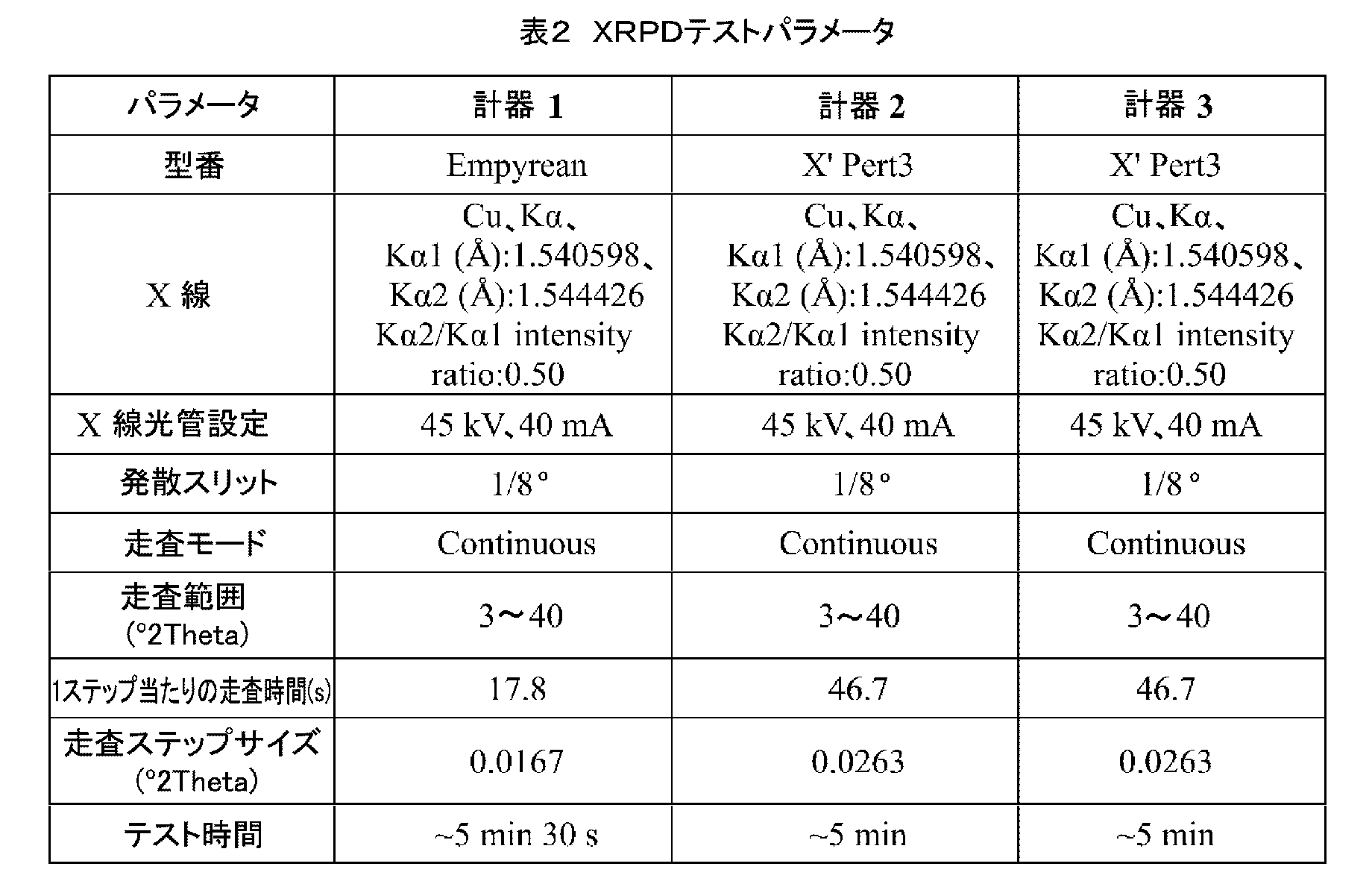
XRPDの測定は、X線粉末回折装置 Panalytical EMPYREANを用いて分析を行った。走査パラメータは、表2に示すとおりである。 XRPD measurements were performed using a Panalytical EMPYREAN X-ray powder diffractometer. Scanning parameters are shown in Table 2.
TGAとDSCの測定は、それぞれTA Q5000/5500 熱重量分析計とTA 2500 示差走査熱量計で採取され、テストパラメータは、表3に示すとおりである。
TGA and DSC measurements were taken on a TA Q5000/5500 thermogravimetric analyzer and a

本発明の既知の出発原料は、当分野の既知の方法を用いるか、もしくはそれに従って合成してもよいし、又は泰坦科技、安耐吉化学、上海徳黙、成都科龍化工、韶遠化学科技、百霊威科技などの会社から購入してもよい。 The known starting materials of the present invention may be synthesized using or according to methods known in the art, or may be purchased from companies such as Taitan Technology, Ananji Chemical, Shanghai Demo, Chengdu Kelong Chemical, Shaoyuan Chemical Technology, and Bailingwei Technology.
実施例には特に説明がない限り、溶液は、水溶液である。 Unless otherwise specified in the examples, the solutions are aqueous solutions.
実施例1 化合物Iの製造
(S)-N-((S)-1-シアノ-2-(2-フルオロ-4-(3-メチル-2-オキソ-2,3-ジヒドロベンゾ[d]オキサゾール-5-イル)フェニル)エチル)-1,4-オキサゼパン-2-カルボキサミド(化合物I)
ステップ1:

Step 1:
反応:50Lの反応釜において、撹拌しながら、10.005kgの1,4-ジオキサン、1.600kgの化合物a-1(特許WO 2015110826A1の方法を参照)及び2.000kgの化合物a-2(特許WO 2016139355A1の方法を参照)を加え、さらに6.605kgの炭酸カリウム水溶液(1.600kgの炭酸カリウムが5.005kgの精製水に溶解された)を加えた。完了後に、窒素ガスで三回置換した。100.0gの[1,1’-ビス(ジフェニルホスフィン)フェロセン]二塩化パラジウムジクロロメタン錯体を加え、窒素ガスで一回置換した。窒素ガスの保護下で、反応液を80±5℃に昇温し、約2時間反応させた後に、サンプリングしてHPLCでモニタリングし、センターコントロール目的値化合物a-2の含有量≦1.0%であり、反応を停止した。 Reaction: In a 50L reaction vessel, 10.005 kg of 1,4-dioxane, 1.600 kg of compound a-1 (see method of patent WO 2015110826A1) and 2.000 kg of compound a-2 (see method of patent WO 2016139355A1) were added with stirring, and 6.605 kg of potassium carbonate aqueous solution (1.600 kg of potassium carbonate was dissolved in 5.005 kg of purified water) was added. After completion, the atmosphere was purged with nitrogen gas three times. 100.0 g of [1,1'-bis(diphenylphosphine)ferrocene]dichloride palladium dichloromethane complex was added and purged with nitrogen gas once. Under the protection of nitrogen gas, the reaction solution was heated to 80±5°C and reacted for about 2 hours, after which a sample was taken and monitored by HPLC. The center control target value for the content of compound a-2 was ≦1.0%, and the reaction was stopped.
後処理:反応液に5.000kgの精製水を加え、10±5℃まで降温し、10.005kgの精製水を加え、10±5℃で約1時間撹拌晶析し、濾過し、濾過ケーキを2.500kgの精製水/回で二回洗浄し、濾過ケーキを収集した。12.605kgの無水エタノール及び濾過ケーキを50Lの反応釜に加え、20±5℃で約0.5時間撹拌し、濾過し、濾過ケーキを1.000kgの無水エタノール/回で二回洗浄し、濾過ケーキを収集した。 Post-treatment: 5.000 kg of purified water was added to the reaction liquid, the temperature was lowered to 10±5°C, 10.005 kg of purified water was added, and the mixture was stirred and crystallized at 10±5°C for about 1 hour, filtered, the filter cake was washed twice with 2.500 kg of purified water each time, and the filter cake was collected. 12.605 kg of absolute ethanol and the filter cake were added to a 50L reaction kettle, stirred at 20±5°C for about 0.5 hours, filtered, the filter cake was washed twice with 1.000 kg of absolute ethanol each time, and the filter cake was collected.
乾燥:濾過ケーキを55±5℃、真空≦-0.07MPaで約16時間乾燥させ、2.143kgの化合物aを得、モル収率は、89.4%であった。 Drying: The filter cake was dried at 55±5°C and vacuum ≦-0.07 MPa for approximately 16 hours to obtain 2.143 kg of compound a, with a molar yield of 89.4%.
1H NMR (400MHz,DMSO) δ 7.90 (s,1H),7.72-7.30 (m,6H),4.72 (s,1H),3.41 (d,3H),3.09-3.21(m,2H),1.37 (s,9H)。 1 H NMR (400 MHz, DMSO) δ 7.90 (s, 1H), 7.72-7.30 (m, 6H), 4.72 (s, 1H), 3.41 (d, 3H), 3.09-3.21 (m, 2H), 1.37 (s, 9H).
LCMS m/z =356.1[M-56+H]+。
ステップ2:

Step 2:
反応:50Lのガラス反応釜において、撹拌しながら、16.785kgのアセトニトリル、2.1381kgの化合物a及び2.950kgのp-トルエンスルホン酸一水和物を加えた。完了後に、温度を25±5℃に制御し、約2時間反応させた後に、サンプリングしてHPLCでモニタリングし、センターコントロール目的値化合物aの含有量≦1.0%であり、反応を停止した。 Reaction: In a 50L glass reaction vessel, 16.785 kg of acetonitrile, 2.1381 kg of compound a, and 2.950 kg of p-toluenesulfonic acid monohydrate were added while stirring. After completion, the temperature was controlled at 25±5°C and the reaction was allowed to proceed for about 2 hours. After sampling and monitoring by HPLC, the center control target value of the compound a content was ≦1.0%, and the reaction was stopped.
後処理:濾過し、濾過ケーキを1.670kgのアセトニトリルで洗浄し、濾過ケーキを収集した。2.1381kgのアセトニトリル及び濾過ケーキを反応釜に加え、80±5℃に昇温し、3時間撹拌した。さらに20±5℃まで降温し、1時間撹拌した。濾過し、濾過ケーキを1.670kgのアセトニトリルで洗浄し、濾過ケーキを収集した。 Post-treatment: Filtration was performed, the filter cake was washed with 1.670 kg of acetonitrile, and the filter cake was collected. 2.1381 kg of acetonitrile and the filter cake were added to the reaction vessel, heated to 80±5°C, and stirred for 3 hours. The temperature was further lowered to 20±5°C, and stirred for 1 hour. Filtration was performed, the filter cake was washed with 1.670 kg of acetonitrile, and the filter cake was collected.
乾燥:濾過ケーキを55±5℃、真空≦-0.07MPaで約16時間乾燥させた。2.141kgの化合物bを得、収率は、85.5%であった。 Drying: The filter cake was dried at 55±5°C and vacuum ≦-0.07 MPa for about 16 hours. 2.141 kg of compound b was obtained, with a yield of 85.5%.
1H NMR (400MHz,DMSO) δ 9.04 (s,3H),7.70-7.37 (m,8H),7.13 (d,2H),4.90 (dd,1H),3.41 (s,3H),3.29 (t,2H),2.29 (s,3H)。 1 H NMR (400 MHz, DMSO) δ 9.04 (s, 3H), 7.70-7.37 (m, 8H), 7.13 (d, 2H), 4.90 (dd, 1H), 3.41 (s, 3H), 3.29 (t, 2H), 2.29 (s, 3H).
LCMS m/z =312.2 [M-172+H]+。
ステップ3:

Step 3:
反応:100Lの反応釜において、撹拌しながら、19.060kgの酢酸エチル、2.1413kgの化合物b及び1.1300kgの化合物b-1(南京薬石科技股▲ふん▼有限公司から購入)を加え、さらに1.725kgのN,N-ジイソプロピルエチルアミンを加えた。完了後に、窒素ガスの保護下で、反応液を5±5℃まで降温し、温度を10±5℃に制御し、4.240kgのプロピルホスホン酸無水物を滴加し、完了後に、25±5℃に保温し、約3~8時間反応させた。 Reaction: In a 100L reaction vessel, 19.060 kg of ethyl acetate, 2.1413 kg of compound b, and 1.1300 kg of compound b-1 (purchased from Nanjing Yaoshi Technology Co., Ltd.) were added while stirring, and 1.725 kg of N,N-diisopropylethylamine was further added. After completion, under the protection of nitrogen gas, the reaction solution was cooled to 5±5°C, the temperature was controlled at 10±5°C, and 4.240 kg of propylphosphonic anhydride was added dropwise, and after completion, the mixture was kept at 25±5°C and reacted for about 3 to 8 hours.
後処理:反応液を順に炭酸水素ナトリウム溶液(1.070kgの炭酸水素ナトリウムが20.350kgの水に溶解された)、クエン酸溶液(2.150kgのクエン酸一水和物が19.275kgの水に溶解された)、塩化ナトリウム(4.300kgの塩化ナトリウムが17.135kgの水に溶解された)で洗浄した。有機相に0.210kgの薬用炭を加え、約0.5時間撹拌した。0.540kgの珪藻土を敷いて濾過を行い、濾過ケーキを酢酸エチル1.905kgで洗浄した。有機相に1.070kgの無水硫酸ナトリウムを加え、約0.5時間乾燥させた。濾過し、酢酸エチル1.905kgで濾過ケーキを洗浄し、濾液を合わせた。 Post-treatment: The reaction solution was washed with sodium bicarbonate solution (1.070 kg of sodium bicarbonate was dissolved in 20.350 kg of water), citric acid solution (2.150 kg of citric acid monohydrate was dissolved in 19.275 kg of water), and sodium chloride (4.300 kg of sodium chloride was dissolved in 17.135 kg of water), in that order. 0.210 kg of medicinal charcoal was added to the organic phase and stirred for about 0.5 hours. 0.540 kg of diatomaceous earth was placed on the surface and filtered, and the filter cake was washed with 1.905 kg of ethyl acetate. 1.070 kg of anhydrous sodium sulfate was added to the organic phase and dried for about 0.5 hours. Filtration was performed, and the filter cake was washed with 1.905 kg of ethyl acetate, and the filtrates were combined.
濃縮:濾液を50±5℃で、明かな留分が流れ出ないまで減圧下で濃縮して、2.385kgの化合物c(超重量、収率100%で計算)を得た。次のステップの反応で直接使用した。 Concentration: The filtrate was concentrated under reduced pressure at 50±5°C until no clear fractions were obtained, yielding 2.385 kg of compound c (extra-weight, calculated at 100% yield), which was used directly in the next step reaction.
1H NMR (400MHz,CDCl3) δ 7.54-7.01 (m,7H),5.18 (s,1H),4.25-3.94 (m,3H),3.54 (dd,2H),3.46 (s,3H),3.39-3.04 (m,4H),1.99 (d,2H),1.54-1.39 (m,9H)。 1 H NMR (400MHz, CDCl 3 ) δ 7.54-7.01 (m, 7H), 5.18 (s, 1H), 4.25-3.94 (m, 3H), 3.54 (dd, 2H), 3.46 (s, 3H), 3.39-3.04 (m, 4H), 1.99 (d, 2H), 1.54-1.39 (m, 9H).
LCMS m/z =483.2 [M-56+1]+。
ステップ4:

Step 4:
反応:化合物cの濃縮物が入れられた50Lの二重ガラス反応釜において、撹拌しながら、9.305kgのアセトニトリル、2.530kgのp-トルエンスルホン酸一水和物を加えた。完了後に、25±5℃に保温し、約2時間反応させた後に、サンプリングしてHPLCでモニタリングし、センターコントロール目的値化合物cの含有量≦1.0%であり、反応を停止した。 Reaction: In a 50 L double-glazed reaction vessel containing the concentrate of compound c, 9.305 kg of acetonitrile and 2.530 kg of p-toluenesulfonic acid monohydrate were added while stirring. After completion, the mixture was kept at 25±5°C and reacted for about 2 hours, after which a sample was taken and monitored by HPLC. The center control target value for the content of compound c was ≦1.0%, and the reaction was stopped.
後処理:反応液を10±5℃まで降温し、希アンモニア水(1.075kgのアンモニア水と36.000kgの精製水とを混合した)を滴加し、滴加中に温度を25℃以下に制御した。完了後に、さらに10±5℃まで降温し、2時間晶析した。濾過し、濾過ケーキを11.930kgの精製水で洗浄した。濾過ケーキと14.890kgのエタノールを50Lの二重ガラス反応釜に加え、20±5℃で0.5時間撹拌し、濾過し、濾過ケーキを1.860kgのエタノールで洗浄し、濾過ケーキを収集した。濾過ケーキを55±5℃、真空度≦-0.07MPaで約13時間乾燥させ、1.6627kgの化合物I粗体を得、モル収率は、85.6%であった。 Post-treatment: The reaction solution was cooled to 10±5°C, and dilute aqueous ammonia (a mixture of 1.075 kg aqueous ammonia and 36.000 kg purified water) was added dropwise, and the temperature was controlled to 25°C or less during the addition. After completion, the temperature was further lowered to 10±5°C, and crystallization was carried out for 2 hours. Filtered, and the filter cake was washed with 11.930 kg purified water. The filter cake and 14.890 kg of ethanol were added to a 50L double-glazed reaction kettle, stirred at 20±5°C for 0.5 hours, filtered, and the filter cake was washed with 1.860 kg of ethanol, and the filter cake was collected. The filter cake was dried at 55±5°C and a vacuum degree of ≦-0.07 MPa for about 13 hours to obtain 1.6627 kg of crude compound I, with a molar yield of 85.6%.
精製:100Lの反応釜において、撹拌しながら、9.100kgのアセトニトリル、9.220kgの無水エタノール及び1.6627kgの化合物(1粗体を加え、内部温度75±5℃に加熱し、溶解するまで撹拌し、熱いうちに濾過した。濾液を100Lの反応釜に移し(濾液に製品が析出した場合、加熱して溶解する必要がある)、撹拌しながら、35±5℃まで降温し、明らかな固体が析出するまで保温し、さらに約0.5時間保温撹拌した。さらに5±5℃まで降温し、2時間保温晶析した。濾過し、濾過ケーキを1.300kgのエタノールで洗浄し、濾過ケーキを収集した。 Purification: In a 100L reactor, 9.100 kg of acetonitrile, 9.220 kg of anhydrous ethanol, and 1.6627 kg of compound (1 crude) were added while stirring, heated to an internal temperature of 75±5°C, stirred until dissolved, and filtered while hot. The filtrate was transferred to a 100L reactor (if the product precipitates in the filtrate, it needs to be heated to dissolve), cooled to 35±5°C while stirring, kept warm until a clear solid precipitates, and further stirred while keeping warm for about 0.5 hours. The temperature was further lowered to 5±5°C, and crystallized while keeping warm for 2 hours. Filtered, washed the filter cake with 1.300 kg of ethanol, and collected the filter cake.
乾燥:濾過ケーキを55±5℃、真空度≦-0.07MPaで約25時間乾燥させ、1.4060kgの化合物の式1の遊離塩基を得、収率は、84.6%であった。
Drying: The filter cake was dried at 55±5°C and vacuum ≦-0.07MPa for about 25 hours to obtain 1.4060 kg of the free base of compound of
1H NMR (400MHz,DMSO) δ 8.69 (d,1H),7.64 (d,1H),7.61-7.51 (m,2H),7.46 (t,2H),7.39 (d,1H),5.06 (q,1H),4.01 (dd,1H),3.87 (ddd,1H),3.73 (ddd,1H),3.40 (s,3H),3.34-3.28 (m,1H),3.20 (dd,1H),3.06 (dd,1H),2.78 (ddd,1H),2.69-2.54 (m,2H),2.21 (s,1H),1.84-1.63 (m,2H)。 1 H NMR (400MHz, DMSO) δ 8.69 (d, 1H), 7.64 (d, 1H), 7.61-7.51 (m, 2H), 7.46 (t, 2H), 7.39 (d, 1H), 5.06 (q, 1H), 4.01 (dd, 1H), 3.87 (ddd, 1H), 3.73 (ddd, 1H), 3.40 (s, 3H), 3.34-3.28 (m, 1H), 3.20 (dd, 1H), 3.06 (dd, 1H), 2.78 (ddd, 1H), 2.69-2.54 (m, 2H), 2.21 (s, 1H), 1.84-1.63 (m, 2H).
LCMS m/z =439.2 [M+1]+。 LCMS m/z =439.2 [M+1] + .
実施例2 化合物Iの結晶形Bの製造
実施例1で製造された化合物200mgを量り取り、IPAc溶媒中に室温で懸濁させ、3日間撹拌し、濾過し、乾燥させた。サンプルに対してXRPDテストを行い、該遊離塩基結晶形が結晶形Bとして記述された。
Example 2 Preparation of Crystal Form B of Compound I 200 mg of the compound prepared in Example 1 was weighed out, suspended in IPAc solvent at room temperature, stirred for 3 days, filtered and dried. XRPD test was performed on the sample, and the free base crystal form was described as crystal form B.
そのXRPD図は、図1に示すとおりであり、XRPD 回折ピークのピーク位置は、表4に示された。 The XRPD pattern is shown in Figure 1, and the peak positions of the XRPD diffraction peaks are shown in Table 4.

DSC/TGA結果は、図2と3に示され、サンプルが150℃に加熱される場合にサンプルには2.3%の重量減少があり、181.9℃(開始温度)に1つの吸熱ピークを有することが示された。核磁気結果(図4)によると、サンプル中の残留溶媒IPAcとAPIとのモル比が0.01(重量減少0.1wt%に対応する)であることが示された。結晶形BのTGA重量減少の研究のために、それに対して変温XRPDテストを行った結果(図5)は、遊離塩基結晶形Bが窒素ガスで20分間パージされ、120℃に加熱され、30℃まで降温される場合に、結晶形がいずれも変化しない(120℃で回折ピークの一部がシフトしており、高温での格子膨張によるものと推測される)ことを示していることから、遊離塩基結晶形Bは無水結晶形であると推測された。 The DSC/TGA results are shown in Figures 2 and 3, which indicate that the sample has a weight loss of 2.3% when heated to 150°C, and has one endothermic peak at 181.9°C (onset temperature). Nuclear magnetic results (Figure 4) indicate that the molar ratio of the residual solvent IPAc to API in the sample is 0.01 (corresponding to a weight loss of 0.1 wt%). For the TGA weight loss study of Form B, a variable temperature XRPD test was performed on it (Figure 5) which shows that when the free base Form B is purged with nitrogen gas for 20 minutes, heated to 120°C, and cooled down to 30°C, none of the crystal forms change (some of the diffraction peaks at 120°C are shifted, which is presumed to be due to lattice expansion at high temperatures), and therefore it is presumed that the free base Form B is an anhydrous form.
実施例3 化合物Iの結晶形Bの製造
実施例1で製造された化合物I.0gを量り取り、5mlのアセトニトリル、5mlのエタノールを加えた。溶解するまで昇温し、50~60℃までゆっくりと降温し、種結晶(実施例2)を加え、室温まで降温し続け、濾過し、乾燥させた。サンプルは、XRPD、DSC及びTGAにより特徴付けられ、結晶形Bであった。
Example 3 Preparation of Crystalline Form B of Compound I Compound I.0 g prepared in Example 1 was weighed out, and 5 ml of acetonitrile and 5 ml of ethanol were added. The temperature was raised until it was dissolved, and the temperature was slowly lowered to 50-60°C, seed crystals (Example 2) were added, the temperature was continued to be lowered to room temperature, filtered, and dried. The sample was characterized by XRPD, DSC, and TGA, and was crystalline form B.
実施例4 化合物Iの結晶形Bの製造
実施例1で製造された化合物4.0gを量り取り、15mlのジメチルスルホキシドを加え、75℃に昇温し、溶解させた。溶解後に70mlのエタノールを加え、30min保温撹拌し、実施例3で得られた種結晶を加え、室温まで降温し、濾過し、乾燥させて、3.36gの結晶形Bを得、収率は、84.0%であった。
Example 4 Preparation of Crystal Form B of Compound I 4.0 g of the compound prepared in Example 1 was weighed out, 15 ml of dimethyl sulfoxide was added, and the mixture was heated to 75° C. to dissolve it. After dissolution, 70 ml of ethanol was added, and the mixture was stirred while keeping the temperature at 75° C., and the seed crystals obtained in Example 3 were added, and the mixture was cooled to room temperature, filtered, and dried to obtain 3.36 g of Crystal Form B, with a yield of 84.0%.
実施例5 化合物Iの一水和物結晶形Cの製造
実施例1で製造された化合物200mgを量り取って、H2O中に室温で懸濁させ、3日間撹拌し、濾過し、乾燥させた。サンプルに対してXRPDテストを行い、該結晶形が結晶形Cとして記述された。
Example 5 Preparation of Monohydrate Crystal Form C of Compound I 200 mg of the compound prepared in Example 1 was weighed out, suspended in H2O at room temperature, stirred for 3 days, filtered and dried. XRPD test was performed on the sample, and the crystal form was described as crystal form C.
そのXRPD図は、図6に示すとおりであり、XRPD回折ピークのピーク位置は、表5に示された。 The XRPD pattern is shown in Figure 6, and the peak positions of the XRPD diffraction peaks are shown in Table 5.

DSC/TGA結果は、図7と8に示され、結果によると、サンプルが150℃に加熱される場合に4.5%の重量減少があり、103.5、113.4及び183.0℃(ピーク温度)に3つの吸熱ピークを有することが示された。それを120℃に加熱し、室温まで冷却した後にXRPDをテストした結果、結晶形Cが加熱された後に結晶形Bに転換したことが示された。サンプルが加熱された後に結晶転換されるため、TGAの段階的な重量減少と結びつけて、結晶形Cが一水和物であると推測された。 DSC/TGA results are shown in Figures 7 and 8, and the results show that the sample has a weight loss of 4.5% when heated to 150°C, and has three endothermic peaks at 103.5, 113.4, and 183.0°C (peak temperatures). It was heated to 120°C and cooled to room temperature, after which XRPD was tested, which showed that form C transformed into form B after heating. Due to the crystalline transformation of the sample after heating, coupled with the gradual weight loss of the TGA, it was inferred that form C is a monohydrate.
実施例6 化合物Iの結晶形Dの製造
実施例1で製造された化合物200mgを量り取り、20mgのメタノールに加えた。還流するまで昇温し、熱いうちに濾過した。室温までゆっくりと降温し、晶析し、濾過し、乾燥させた。XRPD特徴付けにより、該結晶形が結晶形Dとして記述された。
Example 6 Preparation of Crystalline Form D of Compound I 200 mg of the compound prepared in Example 1 was weighed and added to 20 mg of methanol. The mixture was heated to reflux and filtered while hot. The mixture was cooled slowly to room temperature, crystallized, filtered and dried. The crystal form was described as Crystalline Form D by XRPD characterization.
そのXRPD図は、図9に示すとおりであり、XRPD回折ピークのピーク位置は、表6に示された。 The XRPD pattern is shown in Figure 9, and the peak positions of the XRPD diffraction peaks are shown in Table 6.

結晶形の評価試験
1. 結晶形の転換
水和物結晶形Cと無水結晶形Bとの転換関係を研究するために、懸濁競合試験を行った。一定量の遊離塩基を量り取り、対応する溶媒を加えて室温で懸濁させ、約2時間撹拌した後に、0.45μm PTFE濾過膜で濾過して飽和溶液を得た。5~7mgの遊離塩基結晶形Bと結晶形Cサンプルを量り取ってHPLCバイアルに入れ、1.0mLの飽和溶液を加え、室温で懸濁させ撹拌した後に、固体XRPDをテストした。結果は、表7にまとめられ、結果によると、水分活性0~0.2の系において遊離塩基結晶形Bが得られ、水分活性0.4~1の系において結晶形Cが得られたことが示された。
Crystal

2. PLM
結晶形Bと結晶形Cに対してPLM特徴付けを行った結果(図10から図11)によると、各サンプルの粒径がいずれも20μmよりも小さいことが示された。
2. PLM
PLM characterization of Forms B and C (FIGS. 10-11) showed that the particle size of each sample was smaller than 20 μm.
3. 吸湿性
動的水分吸着計(DVS)により、結晶形BとCに対して吸湿性評価を行った。結晶形Cは、環境湿度(~60%RH)を開始とし、結晶形Bは、0%相対湿度(0%RH)を開始とし、テストにおいて、25℃の恒温条件下で、湿度変化(60%RH-95%RH-0%RH-95%RH又は0%RH-95%RH-0%RH)に伴ったサンプルの質量変化パーセントを収集した。テスト結果はそれぞれ図12と13に示すとおりであり、結果によると、結晶形Bと結晶形Cは、25℃/80%RHの場合に水分吸着がそれぞれ0.19%と0.97%であり、全てのサンプルがDVSテスト後に結晶形がいずれも変化していなかったことが示された。本発明の結晶形の吸湿性が低く、薬品の包装と貯蔵条件に対する要求が低いことが示された。
3. Hygroscopicity The hygroscopicity of crystal forms B and C was evaluated by dynamic moisture sorption meter (DVS). Crystal form C was started with ambient humidity (~60% RH), and crystal form B was started with 0% relative humidity (0% RH). In the test, the percent mass change of the sample with humidity change (60% RH-95% RH-0% RH-95% RH or 0% RH-95% RH-0% RH) was collected under constant temperature condition of 25°C. The test results are shown in Figures 12 and 13, respectively. The results show that crystal forms B and C have moisture adsorption of 0.19% and 0.97% respectively at 25°C/80% RH, and all samples had no change in crystal form after DVS test. It is shown that the hygroscopicity of the crystal forms of the present invention is low, and the requirements for packaging and storage conditions of pharmaceuticals are low.
4. 固体の安定性
本実験に用いられた化合物のうち、結晶形Bは、実施例3からのものであり、結晶形Cは、実施例5からのものであった
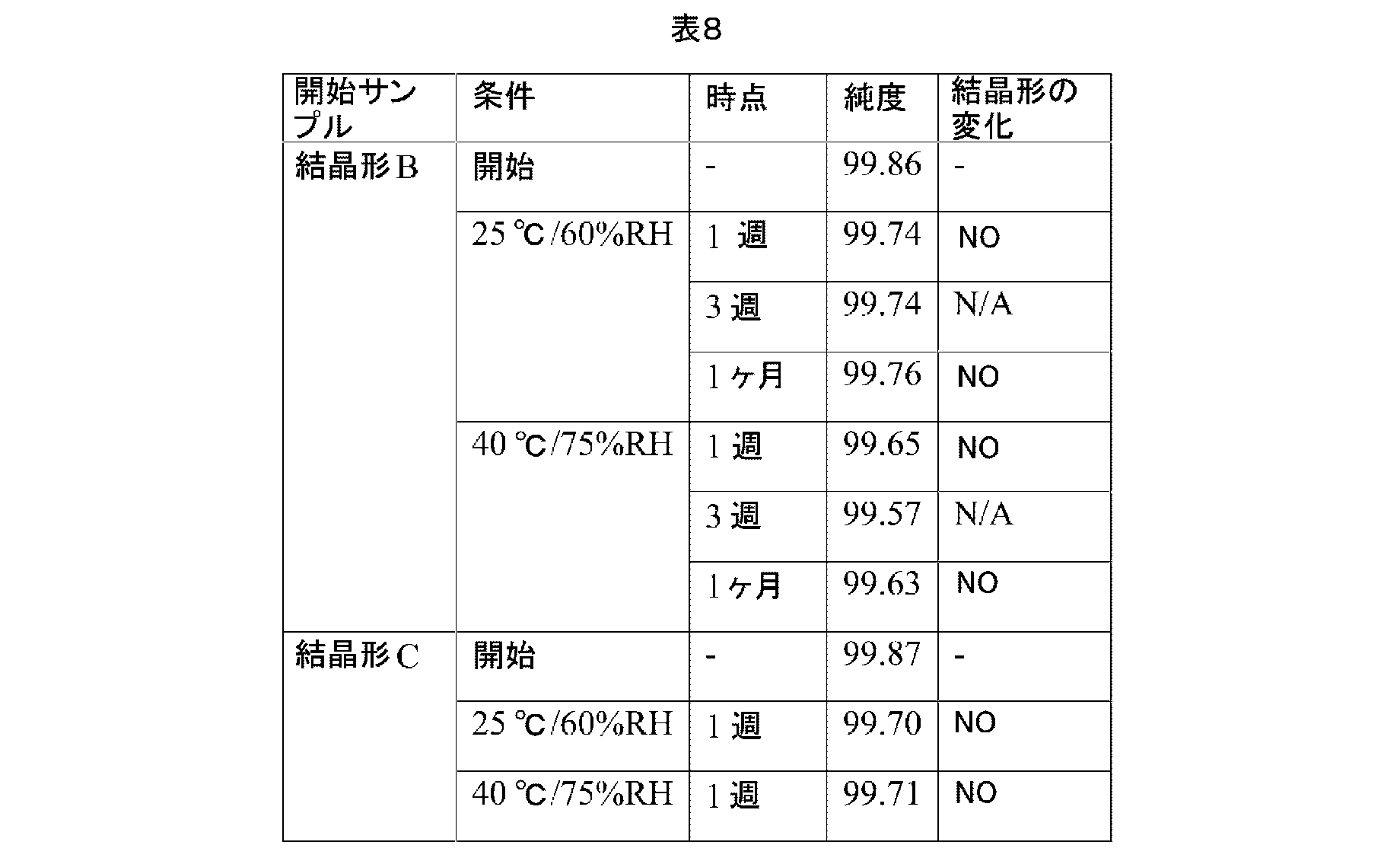
結晶形BとCを25℃/60%RHと40℃/75%RHの条件下で裸に放置した後に、それぞれXRPDとUPLCによりその物理的及び化学的安定性をテストした。結果は、表8にまとめられた。結果によると、各サンプルが25℃/60%RHと40℃/75%RHの条件下で1週間から1ヶ月間放置した後に、結晶形がいずれも変化せず、且つ純度が明かに低下しておらず、安定性が良いことが示された。
4. Stability of Solid State Among the compounds used in this experiment, crystalline form B was from Example 3, and crystalline form C was from Example 5. After leaving crystalline forms B and C naked under the conditions of 25°C/60% RH and 40°C/75% RH, their physical and chemical stability was tested by XRPD and UPLC, respectively. The results are summarized in Table 8. The results show that after each sample was left under the conditions of 25°C/60% RH and 40°C/75% RH for one week to one month, none of the crystalline forms changed, and the purity did not obviously decrease, indicating good stability.
5. 安定性データ
本実験に用いられた化合物は、実施例4からのものであった。
5. Stability Data The compound used in this experiment was from Example 4.
5.1 加速試験
考察条件:40℃±2℃、75%RH±5% RH。
5.1 Accelerated test Conditions: 40°C ± 2°C, 75% RH ± 5% RH.
包装:内包材は、二重薬用低密度ポリエチレン袋であり、外包材は、ポリエステル/アルミニウム/ポリエチレン薬用複合袋であった。 Packaging: The inner packaging material was a double layered low density polyethylene bag, and the outer packaging material was a polyester/aluminum/polyethylene composite bag.

5.2 長期試験1
考察条件:25℃±2℃、60%RH±5% RH。
5.2 Long-
Consideration conditions: 25°C ± 2°C, 60% RH ± 5% RH.
包装:内包材は、二重薬用低密度ポリエチレン袋であり、外包材は、ポリエステル/アルミニウム/ポリエチレン薬用複合袋であった。 Packaging: The inner packaging material was a double layered low density polyethylene bag, and the outer packaging material was a polyester/aluminum/polyethylene composite bag.

5.3 長期試験2
考察条件:30℃±2℃、65%RH±5%RH。
5.3 Long-
Consideration conditions: 30°C ± 2°C, 65% RH ± 5% RH.
包装:内包材は、二重薬用低密度ポリエチレン袋であり、外包材は、ポリエステル/アルミニウム/ポリエチレン薬用複合袋であった。 Packaging: The inner packaging material was a double layered low density polyethylene bag, and the outer packaging material was a polyester/aluminum/polyethylene composite bag.

5.4 長期試験3
考察条件:2~8℃。
5.4 Long-term study 3
Consideration conditions: 2-8°C.
包装:内包材は、二重薬用低密度ポリエチレン袋であり、外包材は、ポリエステル/アルミニウム/ポリエチレン薬用複合袋であった。 Packaging: The inner packaging material was a double layered low density polyethylene bag, and the outer packaging material was a polyester/aluminum/polyethylene composite bag.


生物実験
1. インビトロDPP1酵素活性検出実験
最終濃度100μg/mLの組換えヒトDPP1酵素(R&D Systems 、Cat.No 1071-CY)と最終濃度20μg/mLの組換えヒトカテプシンL(R&D System、Cat.No 952CY)とを混合した後に、室温で1時間インキュベートし、DPP1酵素を活性化させた。活性化後のDPP1酵素を100倍希釈し、384ウェルプレートにおいて5μLの異なる濃度の化合物と5μLの希釈後のDPP1酵素を加え、室温で30分間インキュベートした。10μLの濃度20μMの基質Gly-Arg-AMC(bachem、Cat.No I-1215)を加えた後に、室温で60分間インキュベートし続け、マイクロプレートリーダーで蛍光強度を検出し、ここで、励起光は、380nmであり、発射光は、460nmであった。Origin2019ソフトウェアDosResp関数を用いてIC50値を計算した。

結論: 化合物Iは、DPP1受容体に対して非常に高い阻害活性を示した。 Conclusion: Compound I exhibited highly inhibitory activity against the DPP1 receptor.
2. ラットの薬物動態試験
1.1試験動物:雄性SDラット、220g程度、6~8週齢、6匹/化合物。成都達碩実験動物有限公司から購入された。
2. Pharmacokinetic study in rats 1.1 Test animals: male SD rats, about 220 g, 6-8 weeks old, 6 rats/compound. Purchased from Chengdu Dashuo Experimental Animal Co., Ltd.
1.2試験設計:試験当日、6匹のSDラットを体重に応じて無作為にグループ分けした。投与1日前に禁水なしで12~14h絶食させ、投与後4hに給食した。 1.2 Study design: On the day of the study, six SD rats were randomly divided into groups according to body weight. One day before administration, they were fasted for 12-14 h without water prohibition, and fed 4 h after administration.

静脈投与用溶媒:5%DMA+5%Solutol+90%Saline、胃内投与用溶媒:0.5%MC、対照化合物INS1007は、特許WO 2015110826A1における化合物2であり、特許の方法で製造された。 Solvent for intravenous administration: 5% DMA + 5% Solutol + 90% Saline, Solvent for intragastric administration: 0.5% MC, Control compound INS1007 is compound 2 in patent WO 2015110826A1 and was produced by the patented method.
投与前及び投与後に、イソフルラン麻酔下で眼窩から0.1ml採血し、EDTAK2遠心管に入れ、5000rpm、4℃で10min遠心分離し、血漿を収集した。静脈群の採血時点は、0、5、15、30min、1、2、4、6、8、24hであり、胃内投与群の採血時点は、0、5、15、30min、1、2、4、6、8、24hであった。分析検出前に、すべてのサンプルは、-80℃で保存した。 Before and after administration, 0.1 ml of blood was collected from the orbit under isoflurane anesthesia, placed in an EDTAK2 centrifuge tube, and centrifuged at 5000 rpm and 4°C for 10 min to collect plasma. Blood was collected at 0, 5, 15, 30 min, 1, 2, 4, 6, 8, and 24 h for the intravenous group, and at 0, 5, 15, 30 min, 1, 2, 4, 6, 8, and 24 h for the intragastric group. All samples were stored at -80°C before analytical detection.

結論:本発明の化合物は、良好な生物利用度と薬物動態学的特徴を有した。 Conclusion: The compounds of the present invention have good bioavailability and pharmacokinetic properties.
3. ラットに14日間経口投与することによる繰り返し投与の毒性試験テスト
SDラットを体重に応じて無作為にグループ分けし、それぞれ溶媒対照群(0.5%MC)、INS1007(30、100、300mg/kg)群、化合物I (30、100、300mg/kg)群とし、各投与群16匹とし、溶媒対照群10匹とし、雌雄は半々であった。毎日経口胃内投与により該当する濃度の薬物又は溶媒を投与し、14日間連続投与し、回復期は、7日間であった。投与期間中に各群に対して一般的な症状の観察、体重と摂食量の検出を行い、投与期間終了後と回復期終了後に、それぞれ各群に対して血液学的、血清生化学的及び肉眼解剖学的検出を行った。
3. Repeated administration toxicity test by oral administration to rats for 14 days SD rats were randomly divided into groups according to body weight, and divided into a solvent control group (0.5% MC), an INS1007 (30, 100, 300 mg/kg) group, and a compound I (30, 100, 300 mg/kg) group, with 16 rats in each administration group and 10 rats in the solvent control group, with half of the rats being male and half female. The corresponding concentration of drug or solvent was administered by oral intragastric administration every day for 14 consecutive days, with a recovery period of 7 days. During the administration period, general symptoms were observed for each group, and body weight and food intake were detected. After the end of the administration period and the end of the recovery period, hematological, serum biochemical, and gross anatomical detections were performed for each group.
結論:同等の用量では、本発明の化合物の毒性はINS1007よりも小さく、安全性がより高かった。 Conclusion: At comparable doses, the compounds of the present invention were less toxic and safer than INS1007.
Claims (15)

Applications Claiming Priority (3)
| Application Number | Priority Date | Filing Date | Title |
|---|---|---|---|
| CN202210160848 | 2022-02-22 | ||
| CN202210160848.5 | 2022-02-22 | ||
| PCT/CN2023/077649 WO2023160579A1 (en) | 2022-02-22 | 2023-02-22 | Dipeptidyl peptidase 1 inhibitor polymorph, preparation method and use therefor |
Publications (1)
| Publication Number | Publication Date |
|---|---|
| JP2025505824A true JP2025505824A (en) | 2025-02-28 |
Family
ID=87764771
Family Applications (1)
| Application Number | Title | Priority Date | Filing Date |
|---|---|---|---|
| JP2024549145A Pending JP2025505824A (en) | 2022-02-22 | 2023-02-22 | Dipeptidyl peptidase 1 inhibitor crystalline polymorphs and their production method and use |
Country Status (12)
| Country | Link |
|---|---|
| US (1) | US20250163036A1 (en) |
| EP (1) | EP4484424A4 (en) |
| JP (1) | JP2025505824A (en) |
| KR (1) | KR20240151762A (en) |
| CN (1) | CN118696040A (en) |
| AU (1) | AU2023224769A1 (en) |
| CA (1) | CA3244653A1 (en) |
| CL (1) | CL2024002492A1 (en) |
| MX (1) | MX2024010266A (en) |
| TW (1) | TW202333739A (en) |
| WO (1) | WO2023160579A1 (en) |
| ZA (1) | ZA202406504B (en) |
Families Citing this family (3)
| Publication number | Priority date | Publication date | Assignee | Title |
|---|---|---|---|---|
| CN118742547A (en) * | 2022-02-22 | 2024-10-01 | 西藏海思科制药有限公司 | A method for preparing nitrogen-containing heterocyclic compound |
| AU2024206233A1 (en) | 2023-01-06 | 2025-08-21 | Insmed Incorporated | Novel, reversible dpp1 inhibitors and uses thereof |
| WO2026012369A1 (en) * | 2024-07-09 | 2026-01-15 | 西藏海思科制药有限公司 | Crystal form of pde3/4 dual inhibitor, and preparation method therefor and use thereof |
Family Cites Families (3)
| Publication number | Priority date | Publication date | Assignee | Title |
|---|---|---|---|---|
| NO2699580T3 (en) * | 2014-01-24 | 2018-02-24 | ||
| WO2016139355A1 (en) | 2015-03-05 | 2016-09-09 | Prozymex A/S | N-substituted 3,3'-(biphenyl-4,4'-diyl)bis-2-aminopropanenitriles as dppi inhibitors |
| CN114591315A (en) * | 2020-12-04 | 2022-06-07 | 瑞石生物医药有限公司 | A small molecule inhibitor of cathepsin C |
-
2023
- 2023-02-22 JP JP2024549145A patent/JP2025505824A/en active Pending
- 2023-02-22 EP EP23759204.3A patent/EP4484424A4/en active Pending
- 2023-02-22 WO PCT/CN2023/077649 patent/WO2023160579A1/en not_active Ceased
- 2023-02-22 CA CA3244653A patent/CA3244653A1/en active Pending
- 2023-02-22 TW TW112106541A patent/TW202333739A/en unknown
- 2023-02-22 MX MX2024010266A patent/MX2024010266A/en unknown
- 2023-02-22 KR KR1020247027090A patent/KR20240151762A/en active Pending
- 2023-02-22 AU AU2023224769A patent/AU2023224769A1/en active Pending
- 2023-02-22 US US18/840,731 patent/US20250163036A1/en active Pending
- 2023-02-22 CN CN202380021619.8A patent/CN118696040A/en active Pending
-
2024
- 2024-08-20 CL CL2024002492A patent/CL2024002492A1/en unknown
- 2024-08-23 ZA ZA2024/06504A patent/ZA202406504B/en unknown
Also Published As
| Publication number | Publication date |
|---|---|
| ZA202406504B (en) | 2025-05-28 |
| EP4484424A1 (en) | 2025-01-01 |
| US20250163036A1 (en) | 2025-05-22 |
| EP4484424A4 (en) | 2026-02-11 |
| CA3244653A1 (en) | 2025-01-24 |
| TW202333739A (en) | 2023-09-01 |
| KR20240151762A (en) | 2024-10-18 |
| MX2024010266A (en) | 2024-08-28 |
| AU2023224769A1 (en) | 2024-08-29 |
| WO2023160579A1 (en) | 2023-08-31 |
| CN118696040A (en) | 2024-09-24 |
| CL2024002492A1 (en) | 2024-12-20 |
Similar Documents
| Publication | Publication Date | Title |
|---|---|---|
| JP2025505824A (en) | Dipeptidyl peptidase 1 inhibitor crystalline polymorphs and their production method and use | |
| CN103923169B (en) | Crystalline Forms Of ( 3 S ) -3- [n- (n' - (2-tert-butylphenyl) Oxamyl) Alaniwyl] Amino-5- (2 ', 3 ', 5 ', 6 ' -tetrafluoro Phenoxy) -4-0x0penta Noic Acid | |
| JP6211072B2 (en) | Multi-component crystals comprising dasatinib and a selected co-crystal former | |
| JP2016509031A (en) | Toleragliptin solid form and production method and use thereof | |
| TW201313703A (en) | Novel crystalline forms of Azilsartan and preparation thereof | |
| WO2014082354A1 (en) | Crystal form of chidamide, preparation method and use thereof | |
| JP6501773B2 (en) | Salt of dasatinib in crystalline form | |
| WO2019062854A1 (en) | Co-crystals of ribociclib and co-crystals of ribociclib mono-succinate, preparation method therefor, compositions thereof, and uses thereof | |
| CN116987069B (en) | Cocrystals of fruquintinib, their preparation methods, compositions and uses | |
| US20250188067A1 (en) | Salt and crystal form of dipeptidyl peptidase inhibitor compound | |
| JP2017524004A (en) | Bicomponent crystals of bismodegib and selected co-crystal formers or solvents | |
| CN115073331A (en) | Metformin cinnamate monohydrate, preparation method, composition and application thereof | |
| CN116041324B (en) | A deuterated pyrazole dichlorobenzamide compound, pharmaceutical composition and use thereof | |
| JP5265876B2 (en) | Andlast's new and stable crystal structure | |
| JP3920041B2 (en) | Hydrates and crystals of neuraminic acid compounds | |
| CN101353343A (en) | Preparation method of high-purity noratrexed hydrochloride dihydrate | |
| CN120004890B (en) | A kind of gemagliptin hydrochloride microcrystal and its preparation method and application | |
| EP3412661A1 (en) | Cocrystals of vortioxetine hydrobromide and resorcinol | |
| JP2025505211A (en) | Crystalline polymorphs and their uses as thyroid hormone receptor agonists - Patents.com | |
| JP4424644B2 (en) | Medicine containing neuraminic acid compound | |
| HK40114040A (en) | Therapeutic cocrystals of 3-{[5-(azetidine-1-ylcarbonyl)pyrazin-2-yl]oxy}-5-{[(1 s)-1 -methyl-2- (methyloxy)ethyl]oxy)-n-(5-methylpyrazin-2-yl)benzamide | |
| CN104693191A (en) | Cocrystal I as well as preparation method and application thereof |