JP2025505546A - Chimeric ILT Receptor Compositions and Methods - Google Patents
Chimeric ILT Receptor Compositions and Methods Download PDFInfo
- Publication number
- JP2025505546A JP2025505546A JP2024545105A JP2024545105A JP2025505546A JP 2025505546 A JP2025505546 A JP 2025505546A JP 2024545105 A JP2024545105 A JP 2024545105A JP 2024545105 A JP2024545105 A JP 2024545105A JP 2025505546 A JP2025505546 A JP 2025505546A
- Authority
- JP
- Japan
- Prior art keywords
- cells
- domain
- cell
- ilt4
- ilt2
- Prior art date
- Legal status (The legal status is an assumption and is not a legal conclusion. Google has not performed a legal analysis and makes no representation as to the accuracy of the status listed.)
- Pending
Links
Images


Classifications
-
- A—HUMAN NECESSITIES
- A61—MEDICAL OR VETERINARY SCIENCE; HYGIENE
- A61K—PREPARATIONS FOR MEDICAL, DENTAL OR TOILETRY PURPOSES
- A61K40/00—Cellular immunotherapy
- A61K40/10—Cellular immunotherapy characterised by the cell type used
- A61K40/11—T-cells, e.g. tumour infiltrating lymphocytes [TIL] or regulatory T [Treg] cells; Lymphokine-activated killer [LAK] cells
-
- A—HUMAN NECESSITIES
- A61—MEDICAL OR VETERINARY SCIENCE; HYGIENE
- A61K—PREPARATIONS FOR MEDICAL, DENTAL OR TOILETRY PURPOSES
- A61K40/00—Cellular immunotherapy
- A61K40/10—Cellular immunotherapy characterised by the cell type used
- A61K40/15—Natural-killer [NK] cells; Natural-killer T [NKT] cells
-
- A—HUMAN NECESSITIES
- A61—MEDICAL OR VETERINARY SCIENCE; HYGIENE
- A61K—PREPARATIONS FOR MEDICAL, DENTAL OR TOILETRY PURPOSES
- A61K40/00—Cellular immunotherapy
- A61K40/30—Cellular immunotherapy characterised by the recombinant expression of specific molecules in the cells of the immune system
- A61K40/31—Chimeric antigen receptors [CAR]
-
- A—HUMAN NECESSITIES
- A61—MEDICAL OR VETERINARY SCIENCE; HYGIENE
- A61K—PREPARATIONS FOR MEDICAL, DENTAL OR TOILETRY PURPOSES
- A61K40/00—Cellular immunotherapy
- A61K40/40—Cellular immunotherapy characterised by antigens that are targeted or presented by cells of the immune system
- A61K40/41—Vertebrate antigens
- A61K40/42—Cancer antigens
- A61K40/4202—Receptors, cell surface antigens or cell surface determinants
-
- A—HUMAN NECESSITIES
- A61—MEDICAL OR VETERINARY SCIENCE; HYGIENE
- A61K—PREPARATIONS FOR MEDICAL, DENTAL OR TOILETRY PURPOSES
- A61K40/00—Cellular immunotherapy
- A61K40/40—Cellular immunotherapy characterised by antigens that are targeted or presented by cells of the immune system
- A61K40/41—Vertebrate antigens
- A61K40/42—Cancer antigens
- A61K40/4202—Receptors, cell surface antigens or cell surface determinants
- A61K40/4224—Molecules with a "CD" designation not provided for elsewhere
-
- A—HUMAN NECESSITIES
- A61—MEDICAL OR VETERINARY SCIENCE; HYGIENE
- A61P—SPECIFIC THERAPEUTIC ACTIVITY OF CHEMICAL COMPOUNDS OR MEDICINAL PREPARATIONS
- A61P35/00—Antineoplastic agents
-
- C—CHEMISTRY; METALLURGY
- C07—ORGANIC CHEMISTRY
- C07K—PEPTIDES
- C07K14/00—Peptides having more than 20 amino acids; Gastrins; Somatostatins; Melanotropins; Derivatives thereof
- C07K14/435—Peptides having more than 20 amino acids; Gastrins; Somatostatins; Melanotropins; Derivatives thereof from animals; from humans
- C07K14/705—Receptors; Cell surface antigens; Cell surface determinants
-
- C—CHEMISTRY; METALLURGY
- C07—ORGANIC CHEMISTRY
- C07K—PEPTIDES
- C07K14/00—Peptides having more than 20 amino acids; Gastrins; Somatostatins; Melanotropins; Derivatives thereof
- C07K14/435—Peptides having more than 20 amino acids; Gastrins; Somatostatins; Melanotropins; Derivatives thereof from animals; from humans
- C07K14/705—Receptors; Cell surface antigens; Cell surface determinants
- C07K14/70503—Immunoglobulin superfamily
-
- C—CHEMISTRY; METALLURGY
- C07—ORGANIC CHEMISTRY
- C07K—PEPTIDES
- C07K14/00—Peptides having more than 20 amino acids; Gastrins; Somatostatins; Melanotropins; Derivatives thereof
- C07K14/435—Peptides having more than 20 amino acids; Gastrins; Somatostatins; Melanotropins; Derivatives thereof from animals; from humans
- C07K14/705—Receptors; Cell surface antigens; Cell surface determinants
- C07K14/70503—Immunoglobulin superfamily
- C07K14/7051—T-cell receptor (TcR)-CD3 complex
-
- C—CHEMISTRY; METALLURGY
- C07—ORGANIC CHEMISTRY
- C07K—PEPTIDES
- C07K14/00—Peptides having more than 20 amino acids; Gastrins; Somatostatins; Melanotropins; Derivatives thereof
- C07K14/435—Peptides having more than 20 amino acids; Gastrins; Somatostatins; Melanotropins; Derivatives thereof from animals; from humans
- C07K14/705—Receptors; Cell surface antigens; Cell surface determinants
- C07K14/70503—Immunoglobulin superfamily
- C07K14/70521—CD28, CD152
-
- C—CHEMISTRY; METALLURGY
- C07—ORGANIC CHEMISTRY
- C07K—PEPTIDES
- C07K14/00—Peptides having more than 20 amino acids; Gastrins; Somatostatins; Melanotropins; Derivatives thereof
- C07K14/435—Peptides having more than 20 amino acids; Gastrins; Somatostatins; Melanotropins; Derivatives thereof from animals; from humans
- C07K14/705—Receptors; Cell surface antigens; Cell surface determinants
- C07K14/70596—Molecules with a "CD"-designation not provided for elsewhere
-
- C—CHEMISTRY; METALLURGY
- C07—ORGANIC CHEMISTRY
- C07K—PEPTIDES
- C07K16/00—Immunoglobulins [IGs], e.g. monoclonal or polyclonal antibodies
- C07K16/18—Immunoglobulins [IGs], e.g. monoclonal or polyclonal antibodies against material from animals or humans
- C07K16/28—Immunoglobulins [IGs], e.g. monoclonal or polyclonal antibodies against material from animals or humans against receptors, cell surface antigens or cell surface determinants
- C07K16/2803—Immunoglobulins [IGs], e.g. monoclonal or polyclonal antibodies against material from animals or humans against receptors, cell surface antigens or cell surface determinants against the immunoglobulin superfamily
- C07K16/2833—Immunoglobulins [IGs], e.g. monoclonal or polyclonal antibodies against material from animals or humans against receptors, cell surface antigens or cell surface determinants against the immunoglobulin superfamily against MHC-molecules, e.g. HLA-molecules
-
- C—CHEMISTRY; METALLURGY
- C12—BIOCHEMISTRY; BEER; SPIRITS; WINE; VINEGAR; MICROBIOLOGY; ENZYMOLOGY; MUTATION OR GENETIC ENGINEERING
- C12N—MICROORGANISMS OR ENZYMES; COMPOSITIONS THEREOF; PROPAGATING, PRESERVING, OR MAINTAINING MICROORGANISMS; MUTATION OR GENETIC ENGINEERING; CULTURE MEDIA
- C12N15/00—Mutation or genetic engineering; DNA or RNA concerning genetic engineering, vectors, e.g. plasmids, or their isolation, preparation or purification; Use of hosts therefor
- C12N15/09—Recombinant DNA-technology
- C12N15/63—Introduction of foreign genetic material using vectors; Vectors; Use of hosts therefor; Regulation of expression
-
- C—CHEMISTRY; METALLURGY
- C07—ORGANIC CHEMISTRY
- C07K—PEPTIDES
- C07K2317/00—Immunoglobulins specific features
- C07K2317/60—Immunoglobulins specific features characterized by non-natural combinations of immunoglobulin fragments
- C07K2317/62—Immunoglobulins specific features characterized by non-natural combinations of immunoglobulin fragments comprising only variable region components
- C07K2317/622—Single chain antibody (scFv)
-
- C—CHEMISTRY; METALLURGY
- C07—ORGANIC CHEMISTRY
- C07K—PEPTIDES
- C07K2319/00—Fusion polypeptide
- C07K2319/01—Fusion polypeptide containing a localisation/targetting motif
-
- C—CHEMISTRY; METALLURGY
- C07—ORGANIC CHEMISTRY
- C07K—PEPTIDES
- C07K2319/00—Fusion polypeptide
- C07K2319/01—Fusion polypeptide containing a localisation/targetting motif
- C07K2319/02—Fusion polypeptide containing a localisation/targetting motif containing a signal sequence
-
- C—CHEMISTRY; METALLURGY
- C07—ORGANIC CHEMISTRY
- C07K—PEPTIDES
- C07K2319/00—Fusion polypeptide
- C07K2319/01—Fusion polypeptide containing a localisation/targetting motif
- C07K2319/03—Fusion polypeptide containing a localisation/targetting motif containing a transmembrane segment
Landscapes
- Health & Medical Sciences (AREA)
- Life Sciences & Earth Sciences (AREA)
- Chemical & Material Sciences (AREA)
- Organic Chemistry (AREA)
- Immunology (AREA)
- General Health & Medical Sciences (AREA)
- Genetics & Genomics (AREA)
- Medicinal Chemistry (AREA)
- Zoology (AREA)
- Biochemistry (AREA)
- Biophysics (AREA)
- Molecular Biology (AREA)
- Proteomics, Peptides & Aminoacids (AREA)
- Veterinary Medicine (AREA)
- Public Health (AREA)
- Animal Behavior & Ethology (AREA)
- Gastroenterology & Hepatology (AREA)
- Toxicology (AREA)
- Cell Biology (AREA)
- Epidemiology (AREA)
- Engineering & Computer Science (AREA)
- General Chemical & Material Sciences (AREA)
- Chemical Kinetics & Catalysis (AREA)
- Nuclear Medicine, Radiotherapy & Molecular Imaging (AREA)
- Pharmacology & Pharmacy (AREA)
- Bioinformatics & Cheminformatics (AREA)
- Biomedical Technology (AREA)
- Biotechnology (AREA)
- General Engineering & Computer Science (AREA)
- Wood Science & Technology (AREA)
- Plant Pathology (AREA)
- Physics & Mathematics (AREA)
- Microbiology (AREA)
- Micro-Organisms Or Cultivation Processes Thereof (AREA)
- Peptides Or Proteins (AREA)
- Medicines Containing Material From Animals Or Micro-Organisms (AREA)
- Medicines That Contain Protein Lipid Enzymes And Other Medicines (AREA)
- Medicines Containing Antibodies Or Antigens For Use As Internal Diagnostic Agents (AREA)
Abstract
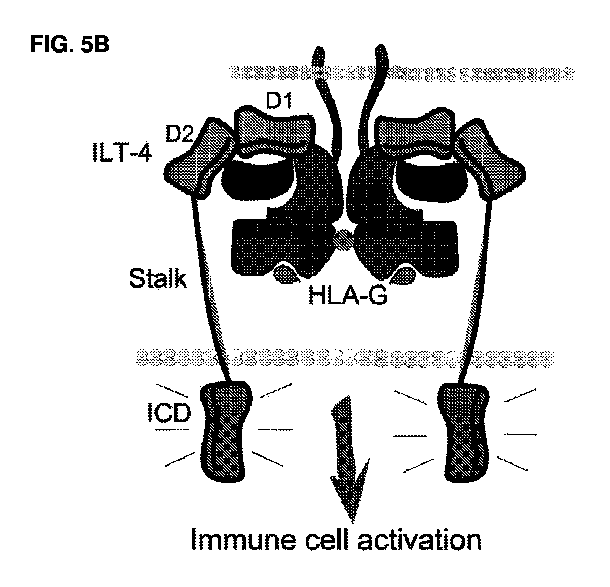
ILT2又はILT4からのターゲティング領域と、膜貫通ドメインと、細胞内ドメイン(ICD)とを含むキメラILT受容体(CIR)が提供される。前記ICDは、シグナル伝達領域(例えば、CD3ゼータ(CD3z))及び任意選択的に共刺激領域(例えば、CD28、4-1BB、OX40など)を含む。主題のCIRをコードする核酸(例えば、発現ベクター)、並びに主題のCIRを発現する遺伝子改変細胞(例えば、NK細胞、T細胞、iNKT細胞、マクロファージなどの免疫細胞)も提供される。例えば、ILT2又はILT4 CIRをコードする核酸を含むNK細胞などの遺伝子改変免疫細胞が提供される。本主題のCIRは、HLA-Gを発現するがんに対するNK細胞、T細胞、iNKT細胞、及びマクロファージなどの免疫細胞による細胞傷害性を活性化するように設計される。
【選択図】図5B
Chimeric ILT receptors (CIRs) are provided that include a targeting domain, a transmembrane domain, and an intracellular domain (ICD) from ILT2 or ILT4. The ICD includes a signaling domain (e.g., CD3 zeta (CD3z)) and optionally a costimulatory domain (e.g., CD28, 4-1BB, OX40, etc.). Nucleic acids (e.g., expression vectors) encoding the subject CIRs are also provided, as well as genetically modified cells (e.g., immune cells such as NK cells, T cells, iNKT cells, macrophages, etc.) that express the subject CIRs. For example, genetically modified immune cells such as NK cells that include nucleic acids encoding ILT2 or ILT4 CIRs are provided. The subject CIRs are designed to activate cytotoxicity by immune cells such as NK cells, T cells, iNKT cells, and macrophages against cancers that express HLA-G.
[Selected Figure] Figure 5B
Description
相互参照
本出願は、2022年2月4日に出願された米国仮特許出願第63/306,514号の利益を主張するものであり、この出願は、その全体が参照により本明細書に組み込まれる。
CROSS-REFERENCE This application claims the benefit of U.S. Provisional Patent Application No. 63/306,514, filed February 4, 2022, which is incorporated by reference herein in its entirety.
XMLファイルとして提供される配列表の参照による組み込み
配列表は、2023年2月3日に作成され、142,627バイトのサイズを有する配列表XML「NKLT-001WO_SEQ_LIST.xml」として本明細書とともに提供される。配列表XMLの内容は、その全体が参照により本明細書に組み込まれる。
INCORPORATION BY REFERENCE OF SEQUENCE LISTING PROVIDED AS AN XML FILE The Sequence Listing is provided herewith as the Sequence Listing XML "NKLT-001WO_SEQ_LIST.xml", created on Feb. 3, 2023, and having a size of 142,627 bytes. The contents of the Sequence Listing XML are incorporated herein by reference in their entirety.
I.序論
免疫細胞療法は、疾患細胞を特異的に標的にするのに役立つ。この治療は、悪性及び非悪性状態の両方を治癒できる可能性がある。例えば、ドナーリンパ球注入、同種T細胞、及び同種ナチュラルキラー(NK)細胞を使用して、白血病の増殖を制御することができる。更に、遺伝子改変は、治療目的で、T細胞、ナチュラルキラー(NK)細胞、γδT細胞、誘導性NKT細胞、及びマクロファージを含む免疫細胞の特異性を、所与の標的細胞集団に向けることができる。例えば、キメラ抗原受容体(CAR)T細胞を使用して、T細胞特異性を、ヒト白血球抗原(HLA)とは独立して、腫瘍関連細胞表面分子に再指示することができる。臨床試験では、多発性骨髄腫に対するCD19又はB細胞成熟抗原(BCMA)などの抗原を標的とすることによって、特に、B細胞白血病及びリンパ腫などの血液悪性腫瘍におけるCAR-T療法の有効性が示されている。これらの標的は、B細胞及び形質細胞、並びにそれらのそれぞれの腫瘍タイプにおいて別個の発現を有し、CD19及びBCMA CAR-T細胞による腫瘍外ターゲティングに起因する形成不全は、免疫グロブリン置き換え療法によって置き換えることができる。3つの自己CD19 CAR-T細胞療法産物が、米国FDAによって承認されている。より最近では、CD19に対して指向されたCARを発現するNK(CAR-NK)細胞によって、治療有効性が示されている。
I. Introduction Immune cell therapy serves to specifically target diseased cells. This treatment may be curative for both malignant and non-malignant conditions. For example, donor lymphocyte infusion, allogeneic T cells, and allogeneic natural killer (NK) cells can be used to control the growth of leukemia. Furthermore, genetic modification can direct the specificity of immune cells, including T cells, natural killer (NK) cells, γδ T cells, inducible NKT cells, and macrophages, to a given target cell population for therapeutic purposes. For example, chimeric antigen receptor (CAR) T cells can be used to redirect T cell specificity to tumor-associated cell surface molecules independent of human leukocyte antigen (HLA). Clinical trials have shown the efficacy of CAR-T therapy, particularly in hematological malignancies such as B-cell leukemia and lymphoma, by targeting antigens such as CD19 or B-cell maturation antigen (BCMA) for multiple myeloma. These targets have distinct expression in B cells and plasma cells and their respective tumor types, and hypoplasia resulting from extratumoral targeting by CD19 and BCMA CAR-T cells can be replaced by immunoglobulin replacement therapy. Three autologous CD19 CAR-T cell therapy products have been approved by the US FDA. More recently, NK cells expressing a CAR directed against CD19 (CAR-NK) have shown therapeutic efficacy.
急性骨髄性白血病(acute myelogenous leukemia)とも呼ばれる急性骨髄性白血病(acute myeloid leukemia:AML)は、形質転換した骨髄前駆細胞及び単球系統に向かってより分化した細胞の疾患である。AML芽球上に発現されたCD33及びCD123などの標的に対するCAR-T療法は、正常な骨髄系前駆細胞上の標的の発現に課題があり、治療による除去が非常に有害な血球減少をもたらす。AMLのより別個に発現された標的に対するCAR又は他の指向性細胞療法が必要である。1つのかかる標的は、クラス1B(又は非古典的)MHC-1タンパク質であるHLA-Gである。 Acute myeloid leukemia (AML), also called acute myeloid leukemia, is a disease of transformed myeloid progenitor cells and cells that are more differentiated toward the monocytic lineage. CAR-T therapy against targets such as CD33 and CD123 expressed on AML blasts has challenges with expression of targets on normal myeloid progenitor cells, and therapeutic ablation leads to highly deleterious cytopenias. CAR or other directed cell therapy against the more distinctly expressed targets of AML is needed. One such target is HLA-G, a class 1B (or non-classical) MHC-1 protein.
HLA-Gは、胎児胎盤の栄養膜細胞の表面に豊富に発現され、ほとんどのクラスのリンパ系及び骨髄系細胞の強力な阻害によって、母親による免疫攻撃から胎児にバリアを提供する。免疫攻撃を回避し、それによって腫瘍の増殖を促進するメカニズムとして、HLA-Gは、AMLを含む多様な腫瘍タイプで過剰発現しているが、造血前駆細胞は、免疫攻撃からの先天的な寛容性のためにHLA-Gを発現しない。 HLA-G is abundantly expressed on the surface of trophoblast cells in the fetal placenta and provides a barrier to the fetus from maternal immune attack by potent inhibition of most classes of lymphoid and myeloid cells. HLA-G is overexpressed in a variety of tumor types, including AML, as a mechanism to evade immune attack and thereby promote tumor growth, whereas hematopoietic progenitor cells do not express HLA-G due to innate tolerance from immune attack.
HLA-G遺伝子は、選択的mRNAスプライシングを介して複数の異なるRNA転写産物を産生し、次いで、少なくとも7つの異なるタンパク質産物を産生する。これらのタンパク質産物は、腫瘍細胞の形質膜上、又はβ2-ミクログロブリン(β2-M)との複合体形成の有無にかかわらず、腫瘍微小環境内に分泌形態として存在し得る。更に、HLA-Gは、改変された三次構造を有する単量体又はジスルフィド結合ホモ二量体として存在し得る。従来のCAR-T産物は、抗体に由来する一本鎖断片(scFv)又はキメラ受容体におけるラクダ類由来VhHドメインを用いて、抗原を標的にする。HLA-G上の所与のscFvによってターゲティングされたエピトープは、いくつかのHLA-Gアイソフォームにおいて除去又は排除される可能性が高く、このエピトープを含むアイソフォームの発現を除去するが、HLA-Gの免疫抑制活性を保持するアイソフォームを発現する腫瘍細胞を選択する。免疫抑制が可能な全てのアイソフォームを含む、HLA-Gに対する細胞療法のためのターゲティング剤が必要である。 The HLA-G gene produces multiple different RNA transcripts through alternative mRNA splicing, which in turn produces at least seven different protein products. These protein products can exist as secreted forms on the plasma membrane of tumor cells or in the tumor microenvironment, with or without complexation with β2-microglobulin (β2-M). Furthermore, HLA-G can exist as a monomer or disulfide-linked homodimer with an altered tertiary structure. Conventional CAR-T products target antigens using single-chain fragments (scFv) derived from antibodies or camelid-derived VhH domains in chimeric receptors. The epitope targeted by a given scFv on HLA-G is likely to be removed or eliminated in some HLA-G isoforms, eliminating the expression of the isoform containing this epitope but selecting for tumor cells expressing an isoform that retains the immunosuppressive activity of HLA-G. There is a need for targeting agents for cell therapy against HLA-G, including all isoforms capable of immunosuppression.
II.概要
本開示によって提供されるのは、キメラ受容体タンパク質を発現するように操作された遺伝子改変細胞であり、キメラ受容体タンパク質は、改変細胞が対象において免疫応答を刺激することができるような親和性及び特異性を有する。例えば、キメラ受容体タンパク質は、形質転換されていない正常組織と比較して、腫瘍組織において高レベルで発現されたタンパク質を標的にし、腫瘍に対する細胞傷害応答又は炎症応答を生成し得る。CARは、抗体-抗原相互作用によって可能になる親和性及び特異性に基づいて、腫瘍組織の抗原特異的認識を生成するために頻繁に用いられる。本開示の組成物及び方法について、親和性及び特異性は、抗体又はVhH関係の使用によって、又はランダムに生成されたペプチドの標的抗原への結合によって維持されるのではなく、むしろ、親和性及び特異性が進化によって維持されるリガンド:受容体相互作用の使用によって維持される。
II. Overview Provided by the present disclosure are genetically modified cells engineered to express chimeric receptor proteins with affinity and specificity such that the modified cells can stimulate an immune response in a subject. For example, the chimeric receptor proteins can target proteins expressed at higher levels in tumor tissues compared to non-transformed normal tissues, generating a cytotoxic or inflammatory response against the tumor. CARs are frequently used to generate antigen-specific recognition of tumor tissues based on the affinity and specificity enabled by antibody-antigen interactions. For the compositions and methods of the present disclosure, affinity and specificity are not maintained by the use of antibodies or VhH relationships, or by binding of randomly generated peptides to target antigens, but rather by the use of ligand:receptor interactions where affinity and specificity are maintained by evolution.
例えば、好ましい実施形態では、遺伝子改変細胞は、HLA-Gに対して高い親和性を有するキメラ受容体を発現する。HLA-Gは、選択的mRNAスプライシング及び翻訳後改変によって生成された7つの既知の形態のうちの1つ以上で腫瘍組織において存在し得る標的タンパク質である。HLA-Gは、免疫細胞の表面上の負のシグナル伝達を行う免疫グルリン(immunoglulin)様転写産物2(ILT2)及びILT4受容体との関与を通して、免疫応答を抑制する作用物質として天然に機能する。これらの好ましい実施形態では、ILT2又はILT4による活性型HLA-Gの認識が代わりに活性化シグナルを生成するように、T細胞、NK細胞、iNKT細胞、又はマクロファージが操作される。これらの好ましい実施形態では、ILT2又はILT4の細胞内シグナル伝達要素が取り除かれ、免疫細胞活性化及び細胞傷害性を駆動するCD3ζ鎖のITAM含有シグナル伝達ドメインで置き換えられる。そのようなタンパク質は、「キメラILT受容体」又は「CIR」と呼ばれる。 For example, in preferred embodiments, genetically modified cells express chimeric receptors with high affinity for HLA-G, a target protein that can exist in tumor tissue in one or more of seven known forms generated by alternative mRNA splicing and post-translational modifications. HLA-G naturally functions as an agent that suppresses immune responses through engagement with the negatively signaling immunoglulin-like transcript 2 (ILT2) and ILT4 receptors on the surface of immune cells. In these preferred embodiments, T cells, NK cells, iNKT cells, or macrophages are engineered such that recognition of activated HLA-G by ILT2 or ILT4 instead generates an activation signal. In these preferred embodiments, the intracellular signaling elements of ILT2 or ILT4 are removed and replaced with the ITAM-containing signaling domain of the CD3 zeta chain that drives immune cell activation and cytotoxicity. Such proteins are referred to as "chimeric ILT receptors" or "CIRs."
したがって、ILT2又はILT4からのターゲティング領域、膜貫通ドメイン、ならびに細胞内ドメイン(ICD)(シグナル伝達領域(例えば、CD3ゼータ(CD3ζ))及び任意選択的に共刺激領域(例えば、CD28、4-1BB、OX40など)を含む)を含む、キメラILT受容体(CIR)[加えて、それらをコードする核酸及びそれらを発現する免疫細胞などの遺伝子改変細胞]が提供される。本発明者らは、このアプローチが、抗体ベースのターゲティング領域(例えば、scFv)を使用することよりも有利であることを理解する。抗体ベースのターゲティングアプローチは、標的にされたエピトープを欠くHLA-Gアイソフォームを発現する腫瘍細胞の選択を引き起こし、したがって、がんが治療を回避できる可能性がある。反対に、主題のILT2又はILT4ベースのキメラILT受容体は、ILT2及びILT4がそれらのアイソフォームに天然に結合するため、より多くの、及びおそらく全てのHLA-Gアイソフォームを標的にするはずである。これにより、特定のHLA-Gアイソフォームの選択によって治療を回避するがん細胞の能力が大幅に低下し、おそらく除去されるであろう。 Thus, provided are chimeric ILT receptors (CIRs) [as well as nucleic acids encoding them and genetically modified cells, such as immune cells, that express them] that comprise a targeting domain, a transmembrane domain, and an intracellular domain (ICD) from ILT2 or ILT4, including a signaling domain (e.g., CD3 zeta (CD3ζ)) and optionally a costimulatory domain (e.g., CD28, 4-1BB, OX40, etc.). The inventors realize that this approach is advantageous over using antibody-based targeting domains (e.g., scFvs). Antibody-based targeting approaches may result in the selection of tumor cells that express HLA-G isoforms that lack the targeted epitope, thus allowing the cancer to evade treatment. In contrast, the subject ILT2 or ILT4-based chimeric ILT receptors should target more, and possibly all, HLA-G isoforms, since ILT2 and ILT4 naturally bind to those isoforms. This would significantly reduce, and perhaps eliminate, the ability of cancer cells to evade treatment by selecting specific HLA-G isoforms.
ILT2及びILT4は、細胞外領域において構造的に類似しており、細胞の原形質膜に対して遠位から近位に配置された4つの折り畳まれたドメイン(D1、D2、D3、及びD4)で構成される。HLA-Gは、ILT2及びILT4のD1及びD2ドメインと相互作用し、これらのD1及びD2ドメインは、HLA-Gとの相互作用を維持しながら、ILTタンパク質の残りの部分から分離することができる。HLA-G以外の細胞タンパク質は、ILT4のD3及びD4ドメインと相互作用することができる。治療設定で毒性を生成する可能性のあるこれらのタンパク質とのオフターゲット相互作用を防止するために、かかるオフHLA-G相互作用を消失させることが望ましい。したがって、いくつかの実施形態では、ILT2又はILT4 D3~D4は、キメラ受容体融合物において、ストーク及び膜貫通ドメインとして機能する別の細胞外ドメインと置き換えられ、ILT2又はILT4 D1~D2をHLA-G発現標的細胞に提示する。D1~D2を提示するストークタンパク質の例は、CD28、CD8α、IgG4のCH2-CH3領域、HER2膜近位、及びmGluR2に由来する。他の実施形態では、ILT2及びILT4のD3~D4ドメインは、単に欠失される。したがって、いくつかの実施形態では、主題のキメラILT受容体は、ILT2のD1~D2を含むが、ILT2のD3~D4を欠く。いくつかの実施形態では、主題のキメラILT受容体は、ILT4のD1~D2を含み、ILT4のD3~D4を欠く。 ILT2 and ILT4 are structurally similar in their extracellular regions, composed of four folded domains (D1, D2, D3, and D4) arranged distal to proximal to the plasma membrane of the cell. HLA-G interacts with the D1 and D2 domains of ILT2 and ILT4, which can be separated from the rest of the ILT protein while maintaining their interaction with HLA-G. Cellular proteins other than HLA-G can interact with the D3 and D4 domains of ILT4. It is desirable to eliminate such off-HLA-G interactions to prevent off-target interactions with these proteins that may generate toxicity in a therapeutic setting. Thus, in some embodiments, ILT2 or ILT4 D3-D4 are replaced with another extracellular domain that functions as the stalk and transmembrane domain in a chimeric receptor fusion to present ILT2 or ILT4 D1-D2 to HLA-G expressing target cells. Examples of stalk proteins that display D1-D2 are derived from CD28, CD8α, the CH2-CH3 region of IgG4, HER2 membrane proximal, and mGluR2. In other embodiments, the D3-D4 domains of ILT2 and ILT4 are simply deleted. Thus, in some embodiments, a subject chimeric ILT receptor comprises D1-D2 of ILT2, but lacks D3-D4 of ILT2. In some embodiments, a subject chimeric ILT receptor comprises D1-D2 of ILT4, but lacks D3-D4 of ILT4.
いくつかのタンパク質は、ILT4のD1及びD4領域との結合相互作用を行うことができる。D4の除去の状況では、そのようなD1単独との相互作用が弱くなる可能性が高い。HLA-G以外の他の細胞タンパク質との望ましくない相互作用を更に低減するために、いくつかの実施形態では、ILT4のD1におけるアミノ酸の置き換えをコードする変異が作製される。例えば、チロシン96は、アラニンを含む任意のアミノ酸で置き換えることができる。 Several proteins can undergo binding interactions with the D1 and D4 regions of ILT4. In the context of D4 removal, such interactions with D1 alone are likely to be weaker. To further reduce undesirable interactions with other cellular proteins other than HLA-G, in some embodiments, mutations are made that code for amino acid replacements in D1 of ILT4. For example, tyrosine 96 can be replaced with any amino acid, including alanine.
更に別の実施形態では、免疫応答の一部としての生存、持続性、細胞傷害性、及びサイトカインを分泌する能力を改善するための共刺激要素が、キメラ受容体の細胞内部分の一部として含まれ、他の実施形態では、共刺激要素は、キメラ受容体とは別個に発現するように操作される。これらの共刺激要素は、以下のタンパク質のうちのいずれか又はそれらの組み合わせに由来し得る:4-1BB、OX40、ICOS、CD28、CD27、MyD88、IL-1Rα、HVEM、TRANCE、IL-1Rβ、IL-18Rα、CD40、IL-18Rβ、CD30、IL-33Rα、BCMA、又はIL-33β。 In yet another embodiment, costimulatory elements are included as part of the intracellular portion of the chimeric receptor to improve survival, persistence, cytotoxicity, and ability to secrete cytokines as part of an immune response, and in other embodiments, costimulatory elements are engineered to be expressed separately from the chimeric receptor. These costimulatory elements can be derived from any of the following proteins or combinations thereof: 4-1BB, OX40, ICOS, CD28, CD27, MyD88, IL-1Rα, HVEM, TRANCE, IL-1Rβ, IL-18Rα, CD40, IL-18Rβ, CD30, IL-33Rα, BCMA, or IL-33β.
いくつかの実施形態では、安全スイッチは、同じ細胞でキメラ受容体タンパク質と共発現することができる。このスイッチの目的は、CIRを含む遺伝子改変細胞によって生成される可能性のある毒性を低減することである。そのような毒性は、サイトカイン放出症候群(CRS)、免疫細胞活性化神経毒性症候群(ICANS)、オフターゲット腫瘍外相互作用、又はHLA-Gを発現する可能性のある正常組織に対するターゲティングを引き起こす活動亢進に起因し得る。そのような一実施形態では、安全スイッチは、誘導性カスパーゼ9(iC9)であり、カスパーゼのアポトーシス促進活性が合成ダイマライザーリガンドであるリミドゥシド(rimiducid)の制御下にあるように、バリアントFKBP12とカスパーゼ9の切断型との融合物である。
In some embodiments, the safety switch can be co-expressed with the chimeric receptor protein in the same cell. The purpose of this switch is to reduce toxicity that may be generated by genetically modified cells containing the CIR. Such toxicity may result from cytokine release syndrome (CRS), immune cell activation neurotoxicity syndrome (ICANS), off-target extratumoral interactions, or hyperactivity causing targeting to normal tissues that may express HLA-G. In one such embodiment, the safety switch is inducible caspase 9 (iC9), a fusion of a variant FKBP12 with a truncated form of
キメラILT受容体に関する試薬、組成物、キット/系、及び方法が提供される。例えば、遺伝子改変細胞の作製方法及び治療方法(例えば、個体に主題のCIRを発現するNK細胞、T細胞、又はマクロファージなどの免疫細胞を投与すること)が提供される。 Reagents, compositions, kits/systems, and methods relating to chimeric ILT receptors are provided, including methods for making genetically modified cells and methods of treatment (e.g., administering to an individual immune cells such as NK cells, T cells, or macrophages that express a subject CIR).
III.図面の簡単な説明
本発明の実施形態の以下の詳細な説明は、添付の図面と併せて読むとよりよく理解されるであろう。本発明は、図面に示される実施形態の正確な配置及び手段に限定されないことが理解されるべきである。図面は、技術のある特定の実施形態を示しており、限定的ではない。説明を明確にし、容易にするために、図面は縮尺に応じて作られておらず、場合によっては、特定の実施形態の理解を容易にするために、様々な態様が誇張又は拡大されて示されている場合がある。
IV.詳細な説明
ILT2又はILT4からのターゲティング領域と、膜貫通ドメインと、細胞内ドメイン(ICD)とを含むキメラILT受容体(CIR)が提供される。ICDは、シグナル伝達領域(例えば、CD3ゼータ(CD3ζ))及び任意選択的に共刺激領域(例えば、CD28、4-1BB、OX40など)を含む。主題のCIRをコードする核酸(例えば、発現ベクター)、並びに主題のCIRを発現する遺伝子改変細胞(例えば、NK細胞、T細胞、iNKT細胞、マクロファージなどの免疫細胞)も提供される。例えば、ILT2又はILT4 CIRをコードする核酸を含むNK細胞などの遺伝子改変免疫細胞が提供される。また、遺伝子改変細胞の作製方法及び治療方法(例えば、個体に主題のCIRを発現するNK細胞、T細胞、又はマクロファージなどの免疫細胞を投与すること)も提供される。
IV. DETAILED DESCRIPTION Chimeric ILT receptors (CIRs) are provided that include a targeting region from ILT2 or ILT4, a transmembrane domain, and an intracellular domain (ICD). The ICD includes a signaling region (e.g., CD3 zeta (CD3ζ)) and optionally a costimulatory region (e.g., CD28, 4-1BB, OX40, etc.). Nucleic acids (e.g., expression vectors) encoding the subject CIRs are also provided, as well as genetically modified cells (e.g., immune cells such as NK cells, T cells, iNKT cells, macrophages, etc.) that express the subject CIRs. Genetically modified immune cells, such as NK cells, that include nucleic acids encoding ILT2 or ILT4 CIRs, are provided. Methods of making the genetically modified cells and methods of treatment (e.g., administering to an individual immune cells such as NK cells, T cells, or macrophages that express a subject CIR) are also provided.
本発明を更に説明する前に、本発明は記載された特定の実施形態に限定されず、それ自体は勿論、変化し得ることを理解されたい。また、本発明の範囲は、添付の特許請求の範囲によってのみ限定されることになるため、本明細書で使用される用語は、特定の実施形態のみを説明する目的のためのものであり、限定することが意図されるものではないことも理解されるべきである。 Before the present invention is further described, it is to be understood that this invention is not limited to particular embodiments described, as such may, of course, vary. It is also to be understood that the terminology used herein is for the purpose of describing particular embodiments only, and is not intended to be limiting, since the scope of the present invention will be limited only by the appended claims.
値の範囲が提供される場合、文脈が別段明示しない限り、各介在値は、その範囲の上限及び下限と、その記載された範囲内の任意の他の記載値又は介在値との間に、下限の単位の10分の1まで包含されることが理解されよう。これらのより小さな範囲の上限及び下限は、独立して、より小さな範囲に含まれ得、また、記述の範囲内の任意の特定の除外された制限に従うことを条件として、本発明内に包含される。記載された範囲が限定の一方又は両方を含む場合、それらの含まれる限定のいずれか又は両方を除外する範囲も、同様に本発明に含まれる。 Where a range of values is provided, unless the context clearly indicates otherwise, it is understood that each intervening value is included, to the tenth of the unit of the lower limit, between the upper and lower limit of that range and any other stated or intervening value in that stated range. The upper and lower limits of these smaller ranges may independently be included in the smaller ranges and are also encompassed within the invention, subject to any specific excluded limit in the stated range. Where a stated range includes one or both of the limits, ranges excluding either or both of those included limits are also encompassed in the invention.
ある特定の範囲は、「約」という用語が数値に先行して本明細書で提示される。本明細書では、「約」という用語は、それが先行する正確な数、及びその用語が先行する数に近い、又は近似する数について文字通りの支持を提供するために使用される。ある数が具体的に列挙された数に近いか、又は近似するかどうかを決定する際に、その近い又は近似する列挙されていない数は、それが提示されている文脈において、具体的に列挙された数の実質的な等価物を提供する数であってもよい。 Certain ranges are presented herein with the term "about" preceding the numerical values. In this specification, the term "about" is used to provide literal support for the exact number it precedes, as well as a number that is near or approximately the number it precedes. In determining whether a number is near or approximately a specifically recited number, the near or approximately unrecited number may be a number that, in the context in which it is presented, provides the substantial equivalent of the specifically recited number.
別段に定義されない限り、本明細書で使用される全ての技術用語及び科学用語は、本発明が属する当業者によって一般的に理解される意味と同じ意味を有する。本明細書に記載されるものと類似又は同等の任意の方法及び材料も、本発明の実施又は試験で使用することができるが、代表的な例示的な方法及び材料がここで説明される。 Unless otherwise defined, all technical and scientific terms used herein have the same meaning as commonly understood by one of ordinary skill in the art to which this invention belongs. Although any methods and materials similar or equivalent to those described herein can also be used in the practice or testing of the present invention, representative exemplary methods and materials are described herein.
本明細書で引用される全ての刊行物及び特許は、各個々の刊行物又は特許が、参照により組み込まれると具体的かつ個々に示されるかのように参照により本明細書に組み込まれ、方法及び/又は材料を刊行物が引用されるものに関して開示及び記載するために参照により本明細書に組み込まれる。いかなる刊行物の引用も、本出願日以前のその開示に関するものであり、本発明が以前の発明によってそのような刊行物に先行する資格を与えられないことを容認するものとして解釈されるべきではない。更に、提供される刊行物の日付は、独立して確認する必要があり得る実際の刊行日とは異なる場合がある。 All publications and patents cited herein are incorporated by reference as if each individual publication or patent was specifically and individually indicated to be incorporated by reference, and are incorporated by reference herein to disclose and describe the methods and/or materials in connection with which the publications are cited. The citation of any publication is for its disclosure prior to the filing date of the present application and should not be construed as an admission that the present invention is not entitled to antedate such publication by virtue of prior invention. Further, the dates of publication provided may be different from the actual publication dates which may need to be independently confirmed.
本明細書及び添付の特許請求の範囲で使用される場合、単数形「1つの(a)」、「1つの(an)」、及び「その(the)」は、文脈において明確に別段の指示がない限り、複数の指示対象を含むことに留意されたい。したがって、「1つの(a)」及び「1つの(an)」という冠詞は、本明細書では、その冠詞の文法的目的語の1つ又は複数(すなわち、少なくとも1つ)を指すために使用される。例として、「要素(an element)」は、1つの要素又は複数の要素を意味する。したがって、例えば、「細胞(a cell)」への参照は、複数のかかる細胞を含み、「ポリペプチド(the polypeptide)」への参照は、当業者に既知の1つ以上のポリペプチド及びその等価物などを含む。特許請求の範囲は、任意の任意選択的な要素を除外するように起草される場合があることに更に留意されたい。したがって、この記述は、特許請求要素の列挙に関連した「もっぱら(solely)」及び「のみ(only)」などの排他的用語の使用のための、又は「消極的な」限定の使用のための先行詞として機能することが意図される。 It should be noted that, as used herein and in the appended claims, the singular forms "a," "an," and "the" include plural referents unless the context clearly dictates otherwise. Thus, the articles "a" and "an" are used herein to refer to one or more (i.e., at least one) of the grammatical object of the article. By way of example, "an element" means one element or more than one element. Thus, for example, a reference to "a cell" includes a plurality of such cells, a reference to "the polypeptide" includes one or more polypeptides and equivalents thereof known to those skilled in the art, and so forth. It should be further noted that the claims may be drafted to exclude any optional element. As such, this statement is intended to serve as a predicate for the use of exclusive terminology, such as "solely" and "only," in connection with the recitation of claim elements, or for the use of a "negative" limitation.
本開示を読むと当業者には明らかであるように、本明細書に記載及び例示される個々の実施形態の各々は、本発明の範囲又は趣旨から逸脱することなく、他のいくつかの実施形態のうちのいずれかの特徴から容易に分離され得るか、又はこれらと組み合わされ得る別個の構成要素及び特徴を有する。任意の列挙された方法は、列挙された事象の順序、又は論理的に可能な任意の他の順序で実行され得る。明確にするために、別個の実施形態の文脈で説明される本発明のある特定の特徴はまた、単一の実施形態では組み合わせて提供され得ることが理解される。逆に、簡潔にするために、単一の実施形態の文脈で説明される本発明の様々な特徴はまた、別個に又は任意の好適な部分的組み合わせで提供され得る。本発明に係る実施形態の全ての組み合わせもまた、本発明によって具体的に包含され、あたかもありとあらゆる組み合わせが本明細書に個別にかつ明示的に開示されているかのように本明細書に開示される。加えて、様々な実施形態及びその要素の全ての部分的組み合わせも本発明に具体的に包含され、あたかもありとあらゆるそのような部分的組み合わせが本明細書に個別にかつ明示的に開示されているかのように本明細書に開示される。 As will be apparent to one of skill in the art upon reading this disclosure, each of the individual embodiments described and illustrated herein has distinct components and features that may be readily separated from or combined with the features of any of the other several embodiments without departing from the scope or spirit of the present invention. Any recited method may be carried out in the order of events recited or in any other order that is logically possible. It is understood that certain features of the invention that are described in the context of separate embodiments for clarity may also be provided in combination in a single embodiment. Conversely, various features of the invention that are described in the context of a single embodiment for brevity may also be provided separately or in any suitable subcombination. All combinations of the embodiments according to the present invention are also specifically embraced by the present invention and are disclosed herein as if each and every combination were individually and expressly disclosed herein. In addition, all subcombinations of the various embodiments and elements thereof are also specifically embraced by the present invention and are disclosed herein as if each and every such subcombination were individually and expressly disclosed herein.
装置及び方法は、文法的流動性のために、機能的な説明で記載されているか又は記載されるが、特許請求の範囲は、米国特許法第112条下で明確に記載されない限り、「手段」又は「ステップ」限定の構文によって必然的に限定されるとなんら解釈されるべきでなく、司法均等論下で特許請求の範囲によって提供される定義の意味及び均等物の完全な範囲を付与されるべきであり、特許請求の範囲は、米国特許法第112条下で明確に記載される場合、米国特許法第112条下で完全な法定による均等物が付与されるべきであることを明確に理解されたい。 Although the apparatus and methods have been or will be described in functional descriptions for grammatical fluidity, it is expressly understood that the claims should not be construed as necessarily limited in any way by the syntax of "means" or "step" limitations unless expressly recited under 35 U.S.C. 112, but should be given the full scope of meaning and equivalents of the definitions provided by the claims under the doctrine of judicial equivalents, and that the claims, if expressly recited under 35 U.S.C. 112, should be given the full statutory equivalents under 35 U.S.C. 112.
本明細書で参照される各特許、特許出願、刊行物、及び文書の全体は、参照により本明細書に組み込まれる。特許、特許出願、刊行物、及び文書の引用は、前述のうちのいずれかが関連する先行技術であることを承認するものではなく、これらの刊行物又は文書の内容又は日付に関するいかなる承認を構成するものでもない。これらの引用は、関連する開示の検索を示すものではない。文書の日付又は内容に関する全ての記述は、入手可能な情報に基づいており、その正確性又は正当性を認めるものではない。 The entirety of each patent, patent application, publication, and document referenced herein is incorporated herein by reference. Citation of patents, patent applications, publications, and documents is not an admission that any of the foregoing is relevant prior art, nor does it constitute any admission as to the contents or dates of such publications or documents. Such citations do not indicate a search for the relevant disclosures. All statements as to the dates or contents of documents are based on the information available and do not constitute an admission as to their accuracy or correctness.
技術の基本的な態様から逸脱することなく、前述に対して変更を行うことができる。本技術は、1つ以上の特定の実施形態を参照して実質的に詳細に記載されているが、当業者は、本出願に具体的に開示された実施形態に変更が行われ得ることを認識するであろう。しかし、これらの修正及び改善は、本技術の範囲及び趣旨内である。 Changes may be made to the foregoing without departing from the fundamental aspects of the technology. While the technology has been described in substantial detail with reference to one or more specific embodiments, those skilled in the art will recognize that changes may be made to the embodiments specifically disclosed in this application. However, such modifications and improvements are within the scope and spirit of the technology.
本明細書に例示的に記載された技術は、本明細書に具体的に開示されていない任意の要素の不在下で好適に実施することができる。したがって、例えば、本明細書の各事例において、「含む」、「から本質的になる」、及び「からなる」という用語のいずれも、他の2つの用語のいずれかに置き換えることができる。用いられた用語及び表現は、限定ではなく、説明の用語として使用され、そのような用語及び表現の使用は、示され説明された特徴又はその一部のいずれかの均等物を排除するものではなく、特許請求される技術の範囲内で様々な修正が可能である。「1つの(a)」又は「1つの(an)」という用語は、説明される要素のうちの1つ又は2つ以上が文脈的に明確でない限り、それが改変する要素のうちの1つ又は複数を指し得る(例えば、「試薬(a reagent)」は、1つ以上の試薬を意味し得る)。本明細書で使用される「約」という用語は、基礎となるパラメータの10%以内の値(すなわち、プラス又はマイナス10%)を指し、一連の値の先頭で「約」という用語を使用すると、値の各々が変更される(すなわち、「約1、2、及び3」は、約1、約2、及び約3を指す)。例えば、「約100グラム」の重量は、90グラム~110グラムの重量を含み得る。更に、値のリストが本明細書に記載されている場合(例えば、約50%、60%、70%、80%、85%、又は86%)、リストは、その全ての中間値及び分数値(例えば、54%、85.4%)を含む。したがって、本技術は、代表的な実施形態及び任意選択的な特徴によって具体的に開示されているが、本明細書に開示される概念の修正及び変形は、当業者によって行われ得、そのような修正及び変形は、本技術の範囲内であると考えられることが理解されるべきである。 The technology illustratively described herein may be suitably practiced in the absence of any element not specifically disclosed herein. Thus, for example, in each instance herein, any of the terms "comprising," "consisting essentially of," and "consisting of" may be replaced with either of the other two terms. The terms and expressions used are used as terms of description, not of limitation, and the use of such terms and expressions does not exclude any equivalent of the features shown and described or portions thereof, and various modifications are possible within the scope of the claimed technology. The term "a" or "an" may refer to one or more of the elements it modifies, unless one or more of the elements described are clear from the context (e.g., "a reagent" may mean one or more reagents). The term "about" as used herein refers to a value within 10% (i.e., plus or minus 10%) of the underlying parameter, and the use of the term "about" at the beginning of a series of values modifies each of the values (i.e., "about 1, 2, and 3" refers to about 1, about 2, and about 3). For example, a weight of "about 100 grams" can include weights between 90 grams and 110 grams. Furthermore, when a list of values is set forth herein (e.g., about 50%, 60%, 70%, 80%, 85%, or 86%), the list includes all intermediate and fractional values (e.g., 54%, 85.4%). Thus, while the present technology has been specifically disclosed by representative embodiments and optional features, it should be understood that modifications and variations of the concepts disclosed herein may be made by those skilled in the art, and such modifications and variations are considered to be within the scope of the present technology.
1.MHCクラスI(「MHC-I」)分子
ヒトにおけるMHC-I分子としては、古典的なHLA-A、HLA-B、又はHLA-C α鎖、並びに非古典的なHLA-E、HLA-F、HLA-G、及びHLA-H α鎖が挙げられる。古典的なMHC-I分子は、細胞内から細胞傷害性T細胞にペプチド断片を提示する。非自己抗原がMHC-I複合体に提示されると、MHC:ペプチド複合体に特異的な細胞傷害性T細胞は、MHC-I提示細胞を認識し、殺滅することができる。これらの細胞傷害性シグナルはまた、共刺激シグナル伝達と組み合わせてT細胞の増殖能力を活性化する。
1. MHC Class I ("MHC-I") Molecules MHC-I molecules in humans include classical HLA-A, HLA-B, or HLA-C α chains, and non-classical HLA-E, HLA-F, HLA-G, and HLA-H α chains. Classical MHC-I molecules present peptide fragments to cytotoxic T cells from within cells. When non-self antigens are presented on the MHC-I complex, cytotoxic T cells specific for the MHC:peptide complex can recognize and kill the MHC-I presenting cell. These cytotoxic signals also activate the proliferative capacity of T cells in combination with costimulatory signaling.
MHCクラスI分子は、2つのポリペプチド鎖(α及びβ2-ミクログロブリンβ2-M)からなるヘテロ二量体である。2本の鎖は、β2-M及びα3ドメインの相互作用を介して非共有結合的に連結される。α鎖(HLA遺伝子によってコードされる)は、高度に多型であるが、β2-Mサブユニット(β2-マイクログロブリン遺伝子によってコードされる)は、そうではない。α3ドメインは、形質膜貫通型であり、T細胞のCD8+共受容体と相互作用する。α3-CD8相互作用は、MHC-I分子を所定の位置に保持し、細胞傷害性T細胞の表面のT細胞受容体(TCR)は、そのα1-α2ヘテロ二量体リガンドに結合し、カップリングしたペプチドの抗原性をチェックする。α1及びα2ドメインが折り畳まれて、ペプチドが結合するためのαヘリックス溝を形成する[Bjorkman et al,(1987)Nature 329:506]。 MHC class I molecules are heterodimers consisting of two polypeptide chains (α and β 2 -microglobulin β2-M). The two chains are non-covalently linked through the interaction of the β2-M and α 3 domains. The α chain (encoded by the HLA genes) is highly polymorphic, whereas the β2-M subunit (encoded by the β 2 -microglobulin gene) is not. The α 3 domain is plasma membrane spanning and interacts with the CD8+ coreceptor of T cells. The α 3 -CD8 interaction holds the MHC-I molecule in place, while the T cell receptor (TCR) on the surface of cytotoxic T cells binds to its α 1 -α 2 heterodimeric ligand and checks the antigenicity of the coupled peptide. The α1 and α2 domains fold to form an α-helical groove for peptide binding [Bjorkman et al, (1987) Nature 329:506].
ドナー及びレシピエントを、それらのHLAサブタイプ(例えば、A、B、又はC)に基づいて一致させることが可能であるが、細胞表面に提示されたMHC-I:ペプチド複合体は、依然として非自己として認識され得る。同種T細胞療法の場合、移植片対宿主病(GvHD)につながる正常な宿主組織の同種認識を防ぎ、宿主対移植片(HvG)応答を緩和することによって移植細胞の持続性を改善するために、古典的なHLAタイプを一致させることが有益である。しかしながら、がんに対する同種ナチュラルキラー細胞療法は、特にNK細胞によるKIR認識の不一致及びそれらの先天性細胞傷害性応答の増強を促進することができる対立遺伝子を含むHLA-C1、HLA-C2、及びHLA-Bw4上の古典的なHLAサブタイプの不一致から恩恵を受ける。 Although it is possible to match donors and recipients based on their HLA subtype (e.g., A, B, or C), MHC-I:peptide complexes presented on the cell surface may still be recognized as non-self. For allogeneic T cell therapy, it is beneficial to match classical HLA types to prevent allorecognition of normal host tissues that lead to graft-versus-host disease (GvHD) and improve the persistence of transplanted cells by mitigating host-versus-graft (HvG) responses. However, allogeneic natural killer cell therapy for cancer benefits from classical HLA subtype mismatches, especially on HLA-C1, HLA-C2, and HLA-Bw4, which contain alleles that can promote mismatches of KIR recognition by NK cells and augment their innate cytotoxic response.
非古典的MHC-Iタンパク質(MHCクラスIbタンパク質とも呼ばれる)も同様のドメイン構造で構成され、一般に、β2-Mと結合している[Clements et al.,(2005)Proc Natl Acad Sci 102:3360]。それらはまた、細胞内部からのペプチド断片に結合するが、結合したペプチドの多様性は限定され、これらのペプチドをCD3-TCR複合体に提示して細胞傷害性を指示することはない。代わりに、これらのタンパク質は、免疫細胞のサブセット上で発現された抑制性受容体に関与して、免疫細胞の機能を阻害又は減弱する。HLA-Eは、細胞傷害性T細胞及びNK細胞上のCD94/NKG2A複合体と関与し、HLA-Gは、多様なグループの免疫エフェクター上のILTタンパク質と相互作用する。 Non-classical MHC-I proteins (also called MHC class Ib proteins) are composed of a similar domain structure and generally bind β2-M [Clements et al., (2005) Proc Natl Acad Sci 102:3360]. They also bind peptide fragments from inside cells, but the diversity of bound peptides is limited and they do not present these peptides to the CD3-TCR complex to direct cytotoxicity. Instead, these proteins engage inhibitory receptors expressed on subsets of immune cells to inhibit or attenuate immune cell function. HLA-E associates with the CD94/NKG2A complex on cytotoxic T cells and NK cells, and HLA-G interacts with ILT proteins on a diverse group of immune effectors.
2.HLA-G
非古典的MHC-Iタンパク質HLA-Gは、母体-胎児発生に対する免疫寛容性の維持における主要な因子である[Kovats et al.Science(1990)248:220、Ferreira et al,(2017)I 38:272]。その正常な発現は、胎児胎盤の絨毛外栄養膜細胞で最も高く、ほとんどのタイプの母体免疫細胞(特に、ハプロタイプ一致MHCハプロタイプを有する胎児からのT細胞及びNK細胞)の活性化及び浸潤を遮断するように機能する。それは、角膜、間葉系幹細胞のサブセット[Chapel et al.(2006)Blood 108:4257、Selmani et al.(2008)Stem Cells 26:212]及び内分泌膵臓[Le Discorede et al.(2003)Human Immunology 64:1039、Cirulli et al.(2006)Diabetes 55:1214]を含む他の免疫特権組織において、はるかに低いレベルで維持されている。HLA-Gは、多様なセットの固形腫瘍タイプ及び白血病[Lin and Yan(2018)Front Imm.9:Art 2164で概説]で発現されており、これには、黒色腫[Paul et al,(1998)Proc Natl Acad Sci 95:4510]、大腸がん、AML、ALL、腎細胞がん[Tronik-Le Roux et al,(2017)Mol.Oncol.11:1561]、乳がん、及び肺がんが含まれる。がんにおけるその機能は、免疫攻撃を直接回避することであるが、HLA-Gは、寛容原性DC-10樹状細胞でも発現されており、この細胞は、抑制性サイトカインの分泌によってリンパ球応答を抑制し、Treg細胞及び骨髄系由来サプレッサー細胞(MDSC)を活性化して免疫抑制性腫瘍微小環境を生成する[Carosella et al,Blood(2011)118:6499、Gao et al,(2018)BBA 1869:278で概説]。したがって、HLA-Gは、腫瘍促進の重要なチェックポイントメディエーターとみなすことができる。
2. HLA-G
The non-classical MHC-I protein HLA-G is a major factor in maintaining immune tolerance during maternal-fetal development [Kovats et al. Science (1990) 248:220; Ferreira et al, (2017) I 38:272]. Its normal expression is highest in the extravillous trophoblast cells of the fetal placenta, where it functions to block activation and infiltration of most types of maternal immune cells, particularly T and NK cells from the fetus with a haploidentical MHC haplotype. It is expressed in the cornea, a subset of mesenchymal stem cells [Chapel et al. (2006) Blood 108:4257; Selmani et al. (2008) Stem Cells 26:212] and the endocrine pancreas [Le Discorede et al. (2003) Human Immunology 64:1039, Cirulli et al. (2006) Diabetes 55:1214] are maintained at much lower levels in other immune-privileged tissues. HLA-G is expressed in a diverse set of solid tumor types and leukemias [Lin and Yan (2018) Front Imm. 9:Art 2164], including melanoma [Paul et al, (1998) Proc Natl Acad Sci 95:4510], colorectal cancer, AML, ALL, renal cell carcinoma [Tronik-Le Roux et al, (2017) Mol. Oncol. 11:1561], breast cancer, and lung cancer. Its function in cancer is to directly evade immune attack, but HLA-G is also expressed on tolerogenic DC-10 dendritic cells, which suppress lymphocytic responses by secreting inhibitory cytokines and activate Treg cells and myeloid-derived suppressor cells (MDSCs) to generate an immunosuppressive tumor microenvironment [reviewed in Carosella et al, Blood (2011) 118:6499; Gao et al, (2018) BBA 1869:278]. HLA-G can therefore be considered as a key checkpoint mediator of tumor promotion.
HLA-G遺伝子は、少なくとも7つの異なるタンパク質産物をコードする複数のmRNA転写産物を産生する[Ishitani et al(1992)Proc.Natl.Acad.Sci 89:3947](配列番号9、15、17、19、21)。HLA-G1は、αヘリックスペプチド結合溝を有するα1-α2-α3ドメイン構造と、膜貫通ドメインと、短い細胞内カルボキシ末端ドメインと、を含む(図1を参照)。このドメイン構造は、MHC-I産物にとって標準的である。他の発現されたスプライス産物は、ドメイン全体が欠失しており、例えば、HLA-G2は、α1、α3、及び膜貫通ドメインをコードし、α2が欠失している。HLA-G4は、α3ドメインが欠失し、HLA-G3は、α1ドメインのみをコードする。導入遺伝子としてM8細胞で発現させた場合、これらの形態のHLA-Gの各々は、NK細胞攻撃に向けて免疫抑制活性を示すことが報告された[Riteau et al(2001)J.Immunology 166:5018]。選択的スプライシングによって生成された分泌形態としては、HLA-G5及びHLA-G6が挙げられ、これらは、それぞれHLA-G1及びG2のドメイン構造を維持するが、イントロン4のスプライスドナー部位を使用せず、代わりにイントロン4に由来する短い分泌型ペプチドをコードする。同様に、HLA-G7は、イントロン2に由来する3つのアミノ酸ペプチドを使用する。一部のHLA-G1の細胞表面を除くために、マトリックスメタロプロテイナーゼによる膜貫通ドメインでの切断によって、HLA-G1の更なる分泌形態が生成される[Rizzo et al(2012)Mol Cell Biochem 381:243]。
The HLA-G gene produces multiple mRNA transcripts that code for at least seven different protein products [Ishitani et al (1992) Proc. Natl. Acad. Sci 89:3947] (SEQ ID NOs: 9, 15, 17, 19, 21). HLA-G1 contains an α1-α2-α3 domain structure with an α-helical peptide-binding groove, a transmembrane domain, and a short intracellular carboxy-terminal domain (see FIG. 1). This domain structure is standard for MHC-I products. Other expressed splice products lack entire domains, e.g., HLA-G2 encodes the α1, α3, and transmembrane domains, and lacks α2. HLA-G4 lacks the α3 domain, and HLA-G3 encodes only the α1 domain. When expressed as a transgene in M8 cells, each of these forms of HLA-G was reported to exhibit immunosuppressive activity toward NK cell attack [Riteau et al (2001) J. Immunology 166:5018]. Secreted forms generated by alternative splicing include HLA-G5 and HLA-G6, which maintain the domain structure of HLA-G1 and G2, respectively, but do not use the splice donor site in
HLA-Gは、単量体形態及びオリゴマー形態で存在する。オリゴマーは、主に、(α1における)Cys42又は(α2における)Cys147でのジスルフィド結合によって指向された二量体である[Gonen-Gross et al,(2005)J.Imm.175:4866、Boyson et al,Proc.Natl.Acad.Sci 99:16180]。HLA-Gの二量体形態が主な免疫抑制形態であり、天然の単量体の二量体形態と比較して、ねじれた四次構造をとるという証拠が存在する[Shiroishi et al(2006)Proc Natl Acad Sci 103:10095、Clements et al(2005)Proc Natl Acad Sci 102:3360、Wang et al(2020)Cel and Mol.Imm.17:966]。 HLA-G exists in monomeric and oligomeric forms. The oligomers are primarily dimers oriented by disulfide bonds at Cys42 (in α1) or Cys147 (in α2) [Gonen-Gross et al, (2005) J. Imm. 175:4866; Boyson et al, Proc. Natl. Acad. Sci 99:16180]. There is evidence that the dimeric form of HLA-G is the predominant immunosuppressive form and adopts a twisted quaternary structure compared to the native monomeric dimeric form [Shiroishi et al (2006) Proc Natl Acad Sci 103:10095, Clements et al (2005) Proc Natl Acad Sci 102:3360, Wang et al (2020) Cel and Mol. Imm. 17:966].
異なるHLA-G形態は一緒に、ターゲティング剤としての抗体由来scFv又はVhHドメインの結合に依存するCARベースの療法に対する課題を生み出す。異なるスプライス形態は、所与の抗体のエピトープを削除するため、免疫抑制活性を保持しながら、CARのバインダーによって認識されないエピトープのみを発現するために、CAR療法によって選択が行われる。更に、オリゴマー化は、構造変化により、scFvのエピトープを覆い隠す可能性がある。同様に、HLA-G 4H84及び87Gのための一般的に使用される抗体試薬のうちの2つは、CAR-T又はCAR-NK細胞のオフターゲット、腫瘍外ターゲティングにつながり得る他のHLA種に対する交差反応性を示す[Attia et al(2021)Int.J.Mol.Sci 21:8678、Polakova et al(2004)Hum.Imm.65:157、Swets et al(2018)Clin.Imm 194:80、Furukawa et al(2019)Int J.Mol.Sci 20:5947]。 The different HLA-G forms together create challenges for CAR-based therapies that rely on the binding of antibody-derived scFv or VhH domains as targeting agents. Different splice forms are selected by CAR therapies to delete epitopes of a given antibody and therefore express only epitopes not recognized by the CAR binder while retaining immunosuppressive activity. Furthermore, oligomerization may mask the epitopes of the scFv due to conformational changes. Similarly, two of the commonly used antibody reagents for HLA-G 4H84 and 87G show cross-reactivity to other HLA types that may lead to off-target, extratumoral targeting of CAR-T or CAR-NK cells [Attia et al (2021) Int. J. Mol. Sci 21:8678, Polakova et al (2004) Hum. Imm. 65:157, Swets et al (2018) Clin. Imm 194:80, Furukawa et al (2019) Int J. Mol. Sci 20:5947].
3.ILT2及びILT4
HLA-Gは、標的免疫細胞上の抑制性受容体免疫グロブリン様転写産物2(ILT2)及びILT4(それぞれ、LIRB1及びLIRB2、又はCD85j及びCD85dとも呼ばれる)の膜結合リガンドとしてのその免疫抑制活性を指示する[Colonna et al(1998)J.Immunology 160:3096、Gao et al(2018)BBA 1869:278で概説]。ILT2(配列番号29)は、ナチュラルキラー細胞、iNKT細胞、T細胞、B細胞、及び樹状細胞のサブセットで発現される。ILT4(配列番号53)は、主に骨髄系細胞及び幹細胞(マクロファージ、骨髄系由来サプレッサー細胞を含む)(単球系統上の低分化細胞の集団)、顆粒球(好中球、単球、造血幹細胞を含む)、及び一部のニューロンにおいてより広範な発現パターンを有する。
3. ILT2 and ILT4
HLA-G directs its immunosuppressive activity as a membrane-bound ligand of the inhibitory receptors immunoglobulin-like transcript 2 (ILT2) and ILT4 (also called LIRB1 and LIRB2, or CD85j and CD85d, respectively) on target immune cells [reviewed in Colonna et al (1998) J. Immunology 160:3096, Gao et al (2018) BBA 1869:278]. ILT2 (SEQ ID NO:29) is expressed on a subset of natural killer cells, iNKT cells, T cells, B cells, and dendritic cells. ILT4 (SEQ ID NO:53) has a broader expression pattern, primarily in myeloid cells and stem cells (including macrophages, myeloid-derived suppressor cells) (a population of less differentiated cells on the monocytic lineage), granulocytes (including neutrophils, monocytes, hematopoietic stem cells), and some neurons.
ILT2は、膜遠位D1からほとんどの膜近位D4までの列状に配置された免疫グロブリンドメイン(Igドメイン)と配列相同性及び構造相同性を有する4つのドメインからなる細胞外ドメイン構造、続いて、膜貫通ドメイン、及び4つの反復免疫受容抑制性チロシンモチーフ(ITIM)を含む細胞内シグナル伝達ドメインを有する。ILT4は、同様の細胞外及び膜貫通アーキテクチャを有するが、その細胞内ドメインには3つのITIMのみを有する。 ILT2 has an extracellular domain structure consisting of four domains with sequence and structural homology to immunoglobulin domains (Ig domains) arranged in a row from the membrane-distal D1 to the most membrane-proximal D4, followed by a transmembrane domain and an intracellular signaling domain containing four repeated immunoreceptor tyrosine-based inhibitory motifs (ITIMs). ILT4 has a similar extracellular and transmembrane architecture, but has only three ITIMs in its intracellular domain.
ILT2(例えば、配列番号37及び71を参照)及びILT4(例えば、配列番号57及び75を参照)のD1及びD2ドメインは、HLA-Gとの相互作用を支配し、D3及びD4ドメインから分離され得る[Donadi et al(2011)Cell.Mol.Life Sci.68:369、Morales(2007)122:179、HoWanYin et al(2012)Cell.Mol.Life Sci.69:4041、Shiroishi et al(2006)Proc Natl Acad Sci 103:10095、Wang et al(2020)Cel and Mol.Imm.17:966]。古典的なMHC-Iを有するCD3複合体によって形成された活性化相互作用とは異なり、NK細胞のILT2及びILT4のKIRタンパク質によって形成される抑制性及び活性化相互作用は、ペプチド結合溝を含むα1-α2ドメインとは結合しないが、代わりに、膜近位α3ドメイン及びβ2-ミクログロブリンと相互作用する(図1Bを参照)。ILT2は、β2-Mと広範な接触を行い、HLA-Gのα3と比較的少ない接触を行い、たとえ低い親和性相互作用を維持するにもβ2-MのHLA-Gとの会合を必要とする。逆に、ILT4は、α3と広範な接触を行い、おそらく、α1ドメインのみを含むHLA-G3/G7を除いて、HLA-Gの全ての既知の能動的な免疫抑制形態との相互作用を維持することができる。 The D1 and D2 domains of ILT2 (see, e.g., SEQ ID NOs: 37 and 71) and ILT4 (see, e.g., SEQ ID NOs: 57 and 75) govern the interaction with HLA-G and can be separated from the D3 and D4 domains [Donadi et al (2011) Cell. Mol. Life Sci. 68:369, Morales (2007) 122:179, HoWanYin et al (2012) Cell. Mol. Life Sci. 69:4041, Shiroishi et al (2006) Proc Natl Acad Sci 103:10095, Wang et al (2020) Cel and Mol. Imm. 17:966]. Unlike the activating interactions formed by the CD3 complex with classical MHC-I, the inhibitory and activating interactions formed by the ILT2 and ILT4 KIR proteins of NK cells do not bind the α1-α2 domains that contain the peptide-binding groove, but instead interact with the membrane-proximal α3 domain and β2-microglobulin (see Figure 1B). ILT2 makes extensive contacts with β2-M and relatively few contacts with α3 of HLA-G, and requires the association of β2-M with HLA-G even to maintain a low affinity interaction. Conversely, ILT4 makes extensive contacts with α3 and is probably able to maintain interactions with all known active immunosuppressive forms of HLA-G, except for HLA-G3/G7, which contains only the α1 domain.
ILT2及びILT4は、他のMHC-I及びMHCI様タンパク質、特に、HLA-A2、HLA-B、HLA-C、並びにHLA-F、CD1d、及びUL18と相互作用することができる。UL18、サイトメガロウイルスからのデコイMHC-I[Wilcox et al(2002)BMC Struct.Biol 2:6]を除いて、これらは、2μM~40μMの解離定数(KD)を有する低親和性相互作用である。免疫抑制シグナル伝達の関連性は、これほど弱い親和性では実証されていない。同様に、ILT2及びILT4とHLA-Gの単量体形態との相互作用は、μM範囲で弱い。しかしながら、二量体HLA-G形態は、ILT2及びILT4との高い親和性(2~4nM)相互作用を示すが、これはおそらく、更なる接触部位の提示、又は代替的に、ILT解離の解離速度を低下させるアビディティ効果によるものである[Shiroishi et al,(2006)J.Biol.Chem 281:10440、Gao et al(2020)Cell Mol Imm 17:966]。したがって、HLA-Gの二量体形態は、生物活性である可能性が最も高く[Gonen-Gross et al,(2005)J.Imm.175:4866]、腫瘍環境で免疫抑制のために機能し、更に、キメラ受容体による細胞ベースの免疫療法のために標的にされた分子として関連する可能性が最も高い。 ILT2 and ILT4 can interact with other MHC-I and MHCI-like proteins, particularly HLA-A2, HLA-B, HLA-C, and HLA-F, CD1d, and UL18. With the exception of UL18, a decoy MHC-I from cytomegalovirus [Wilcox et al (2002) BMC Struct. Biol 2:6], these are low affinity interactions with dissociation constants (K D ) between 2 μM and 40 μM. Relevance of immunosuppressive signaling has not been demonstrated with such weak affinities. Similarly, the interaction of ILT2 and ILT4 with the monomeric form of HLA-G is weak, in the μM range. However, the dimeric HLA-G form shows high affinity (2-4 nM) interactions with ILT2 and ILT4, possibly due to the presentation of additional contact sites or, alternatively, an avidity effect that reduces the dissociation rate of ILT dissociation [Shiroishi et al, (2006) J. Biol. Chem 281:10440, Gao et al (2020) Cell Mol Imm 17:966]. Thus, the dimeric form of HLA-G is most likely to be biologically active [Gonen-Gross et al, (2005) J. Imm. 175:4866], function for immunosuppression in the tumor environment, and furthermore be relevant as a targeted molecule for cell-based immunotherapy with chimeric receptors.
ILT4は、アンジオポエチン様タンパク質2及び5を含む非MHCリガンドの受容体である[Zheng et al(2012)Nature 485:656、Deng et al(2014)Blood 124:924]。可溶性ANGPTL2及びANGPTL5による調節は、ILT4を発現する造血幹細胞の自己再生及び生存のための骨髄間質からの保護シグナルを提供すると考えられる。ILT4とANGLPとの間の相互作用は、ILT4のD4ドメインと協調してD1ドメインによって指向され、D1又はD4のいずれかの特異的残基は、高い親和性相互作用を維持するために不可欠である。特に、チロシン96のアラニンへの変異は、ANGPTL2/5の結合を減少させたが、全長ILT4とのHLA-G1の相互作用を低減させなかった[Deng et al(2014)Blood 124:924]。
ILT4 is a receptor for non-MHC ligands including angiopoietin-
ILT4は、ミエリンに由来する抑制性Nogo受容体リガンドに対する中程度の親和性で相互作用する[Atwal et al(2008)Science 322:967、Matsushita et al,(2014)J.Biol.Chem 286:25739]。ILTタンパク質のマウスオーソログであるPIRBは、ニューロンのサブセットにも見出され、ミエリンベースのMAG、Nogo、及びOMgp[米国特許第2010/0047232号]、並びにSema4a[Lu et al.(2018)Nat.Comm.7:742]との相互作用によって軸索伸長を調節し得る。高親和性相互作用を、ILT4、PIRBについてのマウスオーソログにおいて特徴付けられ、HLA-G結合D1及びD2ドメインにはマッピングされず、むしろPIRBの膜近位ドメインにマッピングされた[Matsushita et al,(2014)J.Biol.Chem 286:25739]。 ILT4 interacts with moderate affinity to myelin-derived inhibitory Nogo receptor ligands [Atwal et al (2008) Science 322:967, Matsushita et al, (2014) J. Biol. Chem 286:25739]. PIRB, the mouse ortholog of ILT proteins, is also found in a subset of neurons and may regulate axonal outgrowth by interacting with myelin-based MAG, Nogo, and OMgp [US 2010/0047232], as well as Sema4a [Lu et al. (2018) Nat. Comm. 7:742]. A high affinity interaction was characterized in ILT4, the mouse orthologue for PIRB, that did not map to the HLA-G binding D1 and D2 domains, but rather to the membrane proximal domain of PIRB [Matsushita et al, (2014) J. Biol. Chem 286:25739].
4.キメラ抗原受容体
キメラ抗原受容体(又はCAR)は、細胞に抗原特異性を与えるように設計された人工受容体である。それらは、一般に、細胞を活性化するために選択された抗原特異的成分、膜貫通成分、及び細胞内成分を含む。CARを発現する細胞は、がん療法を含む様々な療法で使用され得る。
4. Chimeric Antigen Receptors Chimeric antigen receptors (or CARs) are artificial receptors designed to confer antigen specificity to cells. They generally contain an antigen-specific component, a transmembrane component, and an intracellular component selected to activate the cell. Cells expressing CARs can be used in a variety of therapies, including cancer therapies.
CARは、例えば、膜貫通ポリペプチドと、細胞を活性化するために選択され、それによって特異的免疫を提供する細胞内ドメインポリペプチドと、に連結された標的抗原(抗原認識ドメイン)を認識するポリペプチド配列を含むキメラポリペプチドである。抗原認識ドメインは、単鎖可変断片(scFv)であってもよく、例えば、T細胞受容体又はラクダ類VhHメインなどの他の分子に由来してもよい。細胞内ドメインは、細胞の活性化を引き起こす少なくとも1つのポリペプチド(「シグナル伝達領域」)を含み、例えば、限定されないが、CD3ゼータ(CD3ζ)(例えば、配列番号33を参照)、及び任意選択的に、共刺激分子(「共刺激領域」)(例えば、限定されないが、CD28(例えば、配列番号49を参照)、OX40、及び4-1BB(例えば、配列番号35を参照))を含む。 CARs are chimeric polypeptides that include a polypeptide sequence that recognizes a target antigen (antigen recognition domain) linked to, for example, a transmembrane polypeptide and an intracellular domain polypeptide that is selected to activate the cell, thereby providing specific immunity. The antigen recognition domain may be a single chain variable fragment (scFv) or may be derived from other molecules, such as, for example, T cell receptors or camelid VhH domains. The intracellular domain includes at least one polypeptide that causes activation of the cell (the "signaling domain"), such as, for example, but not limited to, CD3 zeta (CD3ζ) (see, for example, SEQ ID NO:33), and optionally, a costimulatory molecule (the "costimulatory domain") (such as, but not limited to, CD28 (see, for example, SEQ ID NO:49), OX40, and 4-1BB (see, for example, SEQ ID NO:35)).
したがって、CARの使用の典型的な例では、細胞は、リンカー領域を含む膜貫通ドメイン及びCD3ゼータ成分(例えば、配列番号33を参照)に由来する細胞内ドメインに融合された一本鎖抗体可変断片(scFv)を含むCARを発現するように改変される。天然T細胞及びNK細胞では、CD3ゼータからのシグナルは、NF-ATc転写因子へのシグナル伝達を通して、T細胞の初期活性化を駆動する。これらのシグナルは、細胞傷害性Tリンパ球における標的にされた細胞の殺滅を駆動し、共刺激シグナル伝達経路と相乗作用して、T細胞免疫応答の堅牢な細胞増殖を駆動する。遺伝子改変細胞は、CARを発現する核酸、及びキメラシグナル伝達ポリペプチドをコードするポリヌクレオチドを含む核酸(同じ又は異なる)による形質導入又はトランスフェクションによって改変され得る(以下を参照)。他の実施形態では、CARは、キメラシグナル伝達ポリペプチドも発現することなく発現する。 Thus, in a typical example of the use of CAR, cells are engineered to express a CAR comprising a single chain antibody variable fragment (scFv) fused to a transmembrane domain including a linker region and an intracellular domain derived from a CD3 zeta component (see, e.g., SEQ ID NO: 33). In natural T cells and NK cells, signals from CD3 zeta drive the initial activation of T cells through signaling to the NF-ATc transcription factor. These signals drive targeted cell killing in cytotoxic T lymphocytes and synergize with costimulatory signaling pathways to drive robust cell proliferation in T cell immune responses. Genetically engineered cells can be engineered by transduction or transfection with a nucleic acid expressing the CAR and a nucleic acid (same or different) comprising a polynucleotide encoding a chimeric signaling polypeptide (see below). In other embodiments, the CAR is expressed without also expressing a chimeric signaling polypeptide.
キメラ抗原受容体は、NK細胞、iNKT細胞、又はマクロファージで発現させて、抗原特異的細胞傷害を生成することができる。 Chimeric antigen receptors can be expressed in NK cells, iNKT cells, or macrophages to generate antigen-specific cytotoxicity.
CARには、抗体に由来するキメラ受容体が含まれるが、キメラT細胞受容体も含まれる。これらのキメラT細胞受容体は、標的抗原を認識するポリペプチド配列を含んでもよく、認識配列は、例えば、限定されないが、T細胞受容体又はscFvに由来する認識配列であってもよい。細胞内ドメインポリペプチドは、T細胞を活性化するように作用するものである。キメラT細胞受容体は、例えば、Gross & Eshar FASEB Journal(1992)6:3370-3378及びZhang et al.,(2010)PLOS Pathogens 6:1-13で議論されている。 CARs include chimeric receptors derived from antibodies, but also chimeric T cell receptors. These chimeric T cell receptors may include a polypeptide sequence that recognizes a target antigen, which may be, for example, but not limited to, a recognition sequence derived from a T cell receptor or an scFv. The intracellular domain polypeptide acts to activate the T cell. Chimeric T cell receptors are discussed, for example, in Gross & Eshar FASEB Journal (1992) 6:3370-3378 and Zhang et al., (2010) PLOS Pathogens 6:1-13.
5.ILTタンパク質によってターゲティングされたキメラ受容体(すなわち、「キメラILT受容体」又は「CIR」)
T細胞又はNK細胞の細胞傷害特異性の再指示は、抗原scFv(又はTCR)相互作用の関与によって制御され得るが、標的リガンドの受容体が、免疫細胞を活性化するためのシグナルの伝達を可能に維持しながら、細胞との高い親和性相互作用を維持することができるキメラタンパク質に形成され得るように、受容体-リガンド対合によっても制御され得る(以下では例として、T細胞及びNK細胞を使用する)。CAR様タンパク質の結合物質としてのそのような受容体の使用に不可欠なのは、標的タンパク質との高い親和性相互作用(50nM未満)であり、免疫細胞の標的との安定した接着、及びT細胞又はNK細胞を活性化するための安定したシグナル伝達を可能にする。更に、非常に好ましい実施形態では、標的と関与するために使用される受容体又は受容体の一部は、腫瘍外ターゲティングを防ぐために標的のみに特異的である。第三に、scFv及び類似のバインダーと同様に、標的タンパク質又はリガンドの高レベルの発現が、正常組織と比較して標的組織(例えば、腫瘍)に対して維持されることが不可欠である。
5. Chimeric Receptors Targeted by ILT Proteins (i.e., "Chimeric ILT Receptors" or "CIRs")
The redirection of the cytotoxic specificity of T cells or NK cells can be controlled by the engagement of antigen-scFv (or TCR) interactions, but also by receptor-ligand pairing, such that the receptor of the target ligand can be formed into a chimeric protein that can maintain a high affinity interaction with the cell while remaining capable of transmitting a signal to activate the immune cell (in the following we use T cells and NK cells as examples). Essential for the use of such receptors as binders of CAR-like proteins is a high affinity interaction with the target protein (less than 50 nM), allowing stable adhesion of the immune cell to the target and stable signal transduction to activate the T cells or NK cells. Moreover, in a highly preferred embodiment, the receptor or part of the receptor used to engage the target is specific only for the target to prevent extratumoral targeting. Third, as with scFv and similar binders, it is essential that a high level of expression of the target protein or ligand is maintained on the target tissue (e.g., tumor) compared to normal tissue.
(i)ターゲティング領域
ILT2の細胞外ドメイン(D1~D4)(例えば、D1~D4に加えてILT2の膜貫通領域を含む、配列番号31を参照)は、HLA-G発現腫瘍細胞を標的にし、かつ、天然に抑制性のITIM含有ILT2細胞内ドメイン(ICD)を活性化シグナルを駆動するシグナル伝達成分(例えば、CD3ζ及び4-1BBのICD)に置き換えるキメラバージョンのILT2を発現する免疫細胞において活性化シグナルの伝達を生成するように、操作され得る。
(i) Targeting Regions The extracellular domains (D1-D4) of ILT2 (e.g., including D1-D4 plus the transmembrane region of ILT2, see SEQ ID NO:31) can be engineered to target HLA-G expressing tumor cells and generate transduction of activation signals in immune cells expressing a chimeric version of ILT2 that replaces the naturally inhibitory ITIM-containing ILT2 intracellular domain (ICD) with signaling components that drive activation signals (e.g., the ICDs of CD3ζ and 4-1BB).
同様に、ILT4の細胞外ドメイン(D1~D4)(例えば、D1~D4に加えてILT4の膜貫通領域を含む、配列番号55を参照)は、ILT4 ICDを活性化シグナル伝達部分(例えば、CD3ζ及び4-1BBのICD)に置き換えることによって、免疫細胞で活性化シグナルを生成するように操作され得る。ターゲティング領域にILT2又はILT4のD1~D4細胞外ドメインを使用すると、ILT2 D1~D4キメラ受容体(すなわち、ILT2 D1~D4 CIR)又はILT4 D1~D4キメラ受容体(すなわち、ILT4 D1~D4 CIR)が生成される(図4Aを参照)。したがって、いくつかの場合では、主題のキメラILT受容体(CIR)のターゲティング領域は、ILT2又はILT4 D1~D4ドメイン(したがって、HLA-Gを標的にする)を含む。 Similarly, the extracellular domain (D1-D4) of ILT4 (e.g., including D1-D4 plus the transmembrane region of ILT4, see SEQ ID NO:55) can be engineered to generate an activation signal in immune cells by replacing the ILT4 ICD with an activation signaling moiety (e.g., the ICDs of CD3ζ and 4-1BB). Using the D1-D4 extracellular domain of ILT2 or ILT4 in the targeting region generates an ILT2 D1-D4 chimeric receptor (i.e., ILT2 D1-D4 CIR) or an ILT4 D1-D4 chimeric receptor (i.e., ILT4 D1-D4 CIR) (see FIG. 4A). Thus, in some cases, the targeting region of the subject chimeric ILT receptor (CIR) includes an ILT2 or ILT4 D1-D4 domain (thus targeting HLA-G).
ILT4は、HLA重鎖上のα3とのより多くの接触を維持し、HLA-Gの遊離重鎖形態と相互作用することができるが、ILT2 D1/D2は、HLA-Gとの相互作用を維持するためにβ2-M及びα3との接触を必要とする(図4B)。 ILT4 maintains more contact with α3 on the HLA heavy chain and can interact with the free heavy chain form of HLA-G, whereas ILT2 D1/D2 requires contact with β2-M and α3 to maintain interaction with HLA-G (Figure 4B).
ILT2及びILT4は、二量体HLA-G及び低親和性(KDは、単量体HLA-G及びCD1dを含む他のMHC-Iタンパク質との相互作用に対してμMである)との高い親和性(KD 低nM)相互作用を維持するため、高レベルのHLA-Gを保有する腫瘍に対する特異性は、二量体形態でのHLA-Gの量を比例して増加し、高レベルの古典的MHC-Iを発現するが、HLA-Gはほとんど又はまったく発現しない正常組織よりも腫瘍組織の選択を可能にする。HLA-G1の、Cys42位からSerへの変異又はCys147位からSerへの変異は、HLA-G1の二量体化を遮断し、ILT2又はILT4 CIR-T細胞又はCIR-NK細胞によるターゲティングを著しく低下させる。 Because ILT2 and ILT4 maintain a high affinity (KD low nM) interaction with dimeric HLA- G and low affinity (KD is μM for interactions with monomeric HLA-G and other MHC-I proteins including CD1d), specificity for tumors carrying high levels of HLA-G is proportional to the amount of HLA-G in dimeric form, allowing selection of tumor tissue over normal tissues expressing high levels of classical MHC-I but little or no HLA-G. Mutation of HLA-G1 at Cys42 to Ser or Cys147 to Ser blocks dimerization of HLA-G1 and significantly reduces targeting by ILT2 or ILT4 CIR-T or CIR-NK cells.
本発明者らは、HLA-Gがいくつかの異なるアイソフォームで存在することを認識している。抗体ベースのターゲティング領域(scFvなど)を含むCARは、抗原結合領域(例えば、scFv)によってターゲティングされたエピトープを含むHLA-Gアイソフォームのみを標的にすることができるであろう。これにより、標的にされたエピトープを欠くHLA-Gアイソフォームを発現する腫瘍細胞が選択される可能性があり、したがって、がんが治療を回避できる可能がある。反対に、主題のILT2又はILT4ベースのキメラ受容体タンパク質(HLA-Gを標的とする)は、ILT2及びILT4がそれらのアイソフォームに天然に結合するため、より多くの、及びおそらく全てのHLA-Gアイソフォームを標的にするはずである。 The inventors recognize that HLA-G exists in several different isoforms. A CAR containing an antibody-based targeting region (such as an scFv) would be able to target only those HLA-G isoforms that contain the epitope targeted by the antigen-binding region (e.g., scFv). This could result in the selection of tumor cells expressing HLA-G isoforms that lack the targeted epitope, thus allowing the cancer to evade treatment. Conversely, the subject ILT2 or ILT4-based chimeric receptor proteins (targeting HLA-G) should target many more, and possibly all, HLA-G isoforms, since ILT2 and ILT4 naturally bind to those isoforms.
ILT2 D1/D2 CIR及びILT4 D1/D2 CIRの構築
D1及びD2ドメインは、ILT2及びILT4のHLA-Gへの直接結合に十分であるが、D3及びD4ドメインは、D1及びD2をHLA-Gに提示する足場として機能する可能性が高い[Shiroishi et al,(2006)J.Biol.Chem Apr 14;281(15):10439-47]。いくつかの実施形態では、D3及びD4ドメインは、ILT2 CIR又は及びILT4 CIRから欠失され得、HLA-G形態(図4Aを参照)を有するILT2(例えば、配列番号71を参照)又はILT4(例えば、配列番号75を参照)からのD1~D2ドメインを介して機能的相互作用を維持する。したがって、いくつかの場合では、主題のILT2又はILT4キメラ受容体のターゲティング領域は、ILT2又はILT4のD1~D2ドメインを含み(例えば、ILT2のD1~D2については配列番号71、ILT4のD1~D2については配列番号75を参照)、場合によっては、ターゲティング領域は、D3~D4ドメインを含まない(すなわち、欠く)であろう。
Construction of ILT2 D1/D2 CIR and ILT4 D1/D2 CIR The D1 and D2 domains are sufficient for direct binding of ILT2 and ILT4 to HLA-G, while the D3 and D4 domains likely function as a scaffold to present D1 and D2 to HLA-G [Shiroishi et al, (2006) J. Biol. Chem Apr 14;281(15):10439-47]. In some embodiments, the D3 and D4 domains can be deleted from the ILT2 CIR or ILT4 CIR and maintain functional interaction via the D1-D2 domains from ILT2 (see, e.g., SEQ ID NO:71) or ILT4 (see, e.g., SEQ ID NO:75) with HLA-G morphology (see FIG. 4A). Thus, in some cases, the targeting region of a subject ILT2 or ILT4 chimeric receptor will comprise the D1-D2 domains of ILT2 or ILT4 (see, e.g., SEQ ID NO:71 for D1-D2 of ILT2, and SEQ ID NO:75 for D1-D2 of ILT4), and in some cases, the targeting region will not comprise (i.e., lack) the D3-D4 domains.
いくつかの実施形態では、主題のILT2キメラ受容体のターゲティング領域(D1~D2ドメインを含む領域)は、配列番号37、70、71、及び72(その配列は以下のとおりである)のうちのいずれか1つに示されるILT2配列と80%以上(例えば、85%以上、90%以上、95%以上、96%以上、97%以上、98%以上、99%以上、又は100%)の配列同一性を有するアミノ酸配列を含む。
MHLPKPTLWAEPGSVITQGSPVTLRCQGGQETQEYRLYREKKTAPWITRIPQELVKKGQFPIPSITWEHTGRYRCYYGSDTAGRSESSDPLELVVTGAYIKPTLSAQPSPVVNSGGNVTLQCDSQVAFDGFILCKEGEDEHPQCLNSQPHARGSSRAIFSVGPVSPSRRWWYRCYAYDSNSPYEWSLPSDLLELLVLG(配列番号37)
MHLPKPTLWAEPGSVITQGSPVTLRCQGGQETQEYRLYREKKTALWITRIPQELVKKGQFPIPSITWEHAGRYRCYYGSDTAGRSESSDPLELVVTGAYIKPTLSAQPSPVVNSGGNVILQCDSQVAFDGFSLCKEGEDEHPQCLNSQPHARGSSRAIFSVGPVSPSRRWWYRCYAYDSNSPYEWSLPSDLLELLVLG(配列番号70)
PKPTLWAEPGSVITQGSPVTLRCQGGQETQEYRLYREKKTAPWITRIPQELVKKGQFPIPSITWEHTGRYRCYYGSDTAGRSESSDPLELVVTGAYIKPTLSAQPSPVVNSGGNVTLQCDSQVAFDGFILCKEGEDEHPQCLNSQPHARGSSRAIFSVGPVSPSRRWWYRCYAYDSNSPYEWSLPSDLLELLVLG(配列番号71)
PKPTLWAEPGSVITQGSPVTLRCQGGQETQEYRLYREKKTALWITRIPQELVKKGQFPIPSITWEHAGRYRCYYGSDTAGRSESSDPLELVVTGAYIKPTLSAQPSPVVNSGGNVILQCDSQVAFDGFSLCKEGEDEHPQCLNSQPHARGSSRAIFSVGPVSPSRRWWYRCYAYDSNSPYEWSLPSDLLELLVLG(配列番号72)
In some embodiments, the targeting region of a subject ILT2 chimeric receptor (the region including the D1-D2 domains) comprises an amino acid sequence having 80% or more (e.g., 85% or more, 90% or more, 95% or more, 96% or more, 97% or more, 98% or more, 99% or more, or 100%) sequence identity to an ILT2 sequence set forth in any one of SEQ ID NOs: 37, 70, 71, and 72, the sequences of which are as follows:
MHLPKPTLWAEPGSVITQGSPVTLRCQGGQETQEYRLYREKKTAPWITRIPQELVKKGQFPIPSITWEHTGRYRCYYGSDTAGRSESSDPLELVVTGAYIKPTLSAQPSPVVNSGGNVTLQCDSQVAFDGFILCKEGEDEHPQCLNSQPHARGSSRAIFSVGPVSPSRWWYRCYAYDSNSPYEWSLPSDLLELLVLG (SEQ ID NO: 37)
MHLPKPTLWAEPGSVITQGSPVTLRCQGGQETQEYRLYREKKTALWITRIPQELVKKGQFPIPSITWEHAGRYRCYYGSDTAGRSESSDPLELVVTGAYIKPTLSAQPSPVVNSGGNVILQCDSQVAFDGFSLCKEGEDEHPQCLNSQPHARGSSRAIFSVGPVSPSRWWYRCYAYDSNSPYEWSLPSDLLELLVLG (SEQ ID NO: 70)
PKPTLWAEPGSVITQGSPVTLRCQGGQETQEYRLYREKKTAPWITRIPQELVKKGQFPIPSITWEHTGRYRCYYGSDTAGRSESSDPLELVVTGAYIKPTLSAQPSPVVNSGGNVTLQCDSQVAFDGFILCKEGEDEHPQCLNSQPHARGSSRAIFSVGPVSPSRWWYRCYAYDSNSPYEWSLPSSLELLVLG (SEQ ID NO: 71)
PKPTLWAEPGSVITQGSPVTLRCQGGQETQEYRLYREKKTALWITRIPQELVKKGQFPIPSITWEHAGRYRCYYGSDTAGRSESSDPLELVVTGAYIKPTLSAQPSPVVNSGGNVILQCDSQVAFDGFSLCKEGEDEHPQCLNSQPHARGSSRAIFSVGPVSPSRWWYRCYAYDSNSPYEWSLPSSLELLVLG (SEQ ID NO: 72)
いくつかの場合では、ターゲティング領域は、配列番号37、70、71、及び72のうちのいずれか1つに示される配列と90%以上(例えば、95%以上、96%以上、97%以上、98%以上、99%以上、又は100%)の配列同一性を有するアミノ酸配列を含む。いくつかの場合では、ターゲティング領域は、配列番号37、70、71、及び72のうちのいずれか1つに示される配列と95%以上(例えば、96%以上、97%以上、98%以上、99%以上、又は100%)の配列同一性を有するアミノ酸配列を含む。いくつかの場合では、ターゲティング領域は、配列番号37、70、71、及び72のうちのいずれか1つに示されるアミノ酸配列を含む。 In some cases, the targeting region comprises an amino acid sequence having 90% or more (e.g., 95% or more, 96% or more, 97% or more, 98% or more, 99% or more, or 100%) sequence identity to a sequence set forth in any one of SEQ ID NOs: 37, 70, 71, and 72. In some cases, the targeting region comprises an amino acid sequence having 95% or more (e.g., 96% or more, 97% or more, 98% or more, 99% or more, or 100%) sequence identity to a sequence set forth in any one of SEQ ID NOs: 37, 70, 71, and 72. In some cases, the targeting region comprises an amino acid sequence set forth in any one of SEQ ID NOs: 37, 70, 71, and 72.
いくつかの場合では、ILT2キメラ受容体のターゲティング領域(D1~D2ドメインを含む領域)は、配列番号37として示される配列と80%以上(例えば、85%以上、90%以上、95%以上、96%以上、97%以上、98%以上、99%以上、又は100%)の配列同一性を有するアミノ酸配列を含む。いくつかの場合では、ターゲティング領域は、配列番号37として示される配列と90%以上(例えば、95%以上、96%以上、97%以上、98%以上、99%以上、又は100%)の配列同一性を有するアミノ酸配列を含む。いくつかの場合では、ターゲティング領域は、配列番号37として示される配列と95%以上(例えば、96%以上、97%以上、98%以上、99%以上、又は100%)の配列同一性を有するアミノ酸配列を含む。いくつかの場合では、ターゲティング領域は、配列番号37として示されるアミノ酸配列を含む。 In some cases, the targeting region of the ILT2 chimeric receptor (the region including the D1-D2 domain) comprises an amino acid sequence having 80% or more (e.g., 85% or more, 90% or more, 95% or more, 96% or more, 97% or more, 98% or more, 99% or more, or 100%) sequence identity to the sequence set forth as SEQ ID NO:37. In some cases, the targeting region comprises an amino acid sequence having 90% or more (e.g., 95% or more, 96% or more, 97% or more, 98% or more, 99% or more, or 100%) sequence identity to the sequence set forth as SEQ ID NO:37. In some cases, the targeting region comprises an amino acid sequence having 95% or more (e.g., 96% or more, 97% or more, 98% or more, 99% or more, or 100%) sequence identity to the sequence set forth as SEQ ID NO:37. In some cases, the targeting region comprises an amino acid sequence set forth as SEQ ID NO:37.
いくつかの実施形態では、主題のILT4キメラ受容体のターゲティング領域(D1~D2ドメインを含む領域)は、配列番号57、74、及び75(それらの配列は以下のとおりである)のうちのいずれか1つに示されるILT4配列と80%以上(例えば、85%以上、90%以上、95%以上、96%以上、97%以上、98%以上、99%以上、又は100%)の配列同一性を有するアミノ酸配列を含む。
MTPIVTVLICLGLSLGPRTHVQTGTIPKPTLWAEPDSVITQGSPVTLSCQGSLEAQEYRLYREKKSASWITRIRPELVKNGQFHIPSITWEHTGRYGCQYYSRARWSELSDPLVLVMTGAYPKPTLSAQPSPVVTSGGRVTLQCESQVAFGGFILCKEGEDEHPQCLNSQPHARGSSRAIFSVGPVSPNRRWSHRCYGYDLNSPYVWSSPSDLLELLVPG(配列番号57)
MTPIVTVLICLGLSLGPRTRVQTGTIPKPTLWAEPDSVITQGSPVTLSCQGSLEAQEYRLYREKKSASWITRIRPELVKNGQFHIPSITWEHTGRYGCQYYSRARWSELSDPLVLVMTGAYPKPTLSAQPSPVVTSGGRVTLQCESQVAFGGFILCKEGEDEHPQCLNSQPHARGSSRAIFSVGPVSPNRRWSHRCYGYDLNSPYVWSSPSDLLELLVPG(配列番号74)
PKPTLWAEPDSVITQGSPVTLSCQGSLEAQEYRLYREKKSASWITRIRPELVKNGQFHIPSITWEHTGRYGCQYYSRARWSELSDPLVLVMTGAYPKPTLSAQPSPVVTSGGRVTLQCESQVAFGGFILCKEGEDEHPQCLNSQPHARGSSRAIFSVGPVSPNRRWSHRCYGYDLNSPYVWSSPSDLLELLVPG(配列番号75)
In some embodiments, the targeting region of a subject ILT4 chimeric receptor (the region including the D1-D2 domains) comprises an amino acid sequence having 80% or more (e.g., 85% or more, 90% or more, 95% or more, 96% or more, 97% or more, 98% or more, 99% or more, or 100%) sequence identity to an ILT4 sequence set forth in any one of SEQ ID NOs: 57, 74, and 75, the sequences of which are as follows:
MTPIVTVLICLGLSLGPRTHVQTGTIPKPTLWAEPDSVITQGSPVTLSCQGSLEAQEYRLYREKKSASWITRIRPELVKNGQFHIPSITWEHTGRYGCQYYSRARWSELSDPLVLVMTGAYPKPTLSAQPSPVVTSGGRVTLQCESQVAFGGFILCKEGEDEHPQCLNSQPHARGSSRAIFSVGPVSPNRRWSHRCYGYDLNSPYVWSPSDLLELLVPG (SEQ ID NO: 57)
MTPIVTVLICLGLSLGPRTRVQTGTIPKPTLWAEPDSVITQGSPVTLSCQGSLEAQEYRLYREKKSASWITRIRPELVKNGQFHIPSITWEHTGRYGCQYYSRARWSELSDPLVLVMTGAYPKPTLSAQPSPVVTSGGRVTLQCESQVAFGGFILCKEGEDEHPQCLNSQPHARGSSRAIFSVGPVSPNRRWSHRCYGYDLNSPYVWSPSDLLELLVPG (SEQ ID NO: 74)
PKPTLWAEPDSVITQGSPVTLSCQGSLEAQEYRLYREKKSASWITRIRPELVKNGQFHIPSITWEHTGRYGCQYYSRARWSELSDPLVLVMTGAYPKPTLSAQPSPVVTSGGRVTLQCESQVAFGGFILCKEGEDEHPQCLNSQPHARGSSRAIFSVGPVSPNRRWSHRCYGYDLNSPYVWSPSDLLELLVPG (SEQ ID NO: 75)
いくつかの場合では、ターゲティング領域は、配列番号57、74、及び75のうちのいずれか1つに示される配列と90%以上(例えば、95%以上、96%以上、97%以上、98%以上、99%以上、又は100%)の配列同一性を有するアミノ酸配列を含む。いくつかの場合では、ターゲティング領域は、配列番号57、74、及び75のうちのいずれか1つに示される配列と95%以上(例えば、96%以上、97%以上、98%以上、99%以上、又は100%)の配列同一性を有するアミノ酸配列を含む。いくつかの場合では、ターゲティング領域は、配列番号57、74、及び75のうちのいずれか1つに示されるアミノ酸配列を含む。 In some cases, the targeting region comprises an amino acid sequence having 90% or more (e.g., 95% or more, 96% or more, 97% or more, 98% or more, 99% or more, or 100%) sequence identity to a sequence set forth in any one of SEQ ID NOs: 57, 74, and 75. In some cases, the targeting region comprises an amino acid sequence having 95% or more (e.g., 96% or more, 97% or more, 98% or more, 99% or more, or 100%) sequence identity to a sequence set forth in any one of SEQ ID NOs: 57, 74, and 75. In some cases, the targeting region comprises an amino acid sequence set forth in any one of SEQ ID NOs: 57, 74, and 75.
いくつかの場合では、ILT4キメラ受容体のターゲティング領域(D1~D2ドメインを含む領域)は、配列番号57として示される配列と80%以上(例えば、85%以上、90%以上、95%以上、96%以上、97%以上、98%以上、99%以上、又は100%)の配列同一性を有するアミノ酸配列を含む。いくつかの場合では、ターゲティング領域は、配列番号57として示される配列と90%以上(例えば、95%以上、96%以上、97%以上、98%以上、99%以上、又は100%)の配列同一性を有するアミノ酸配列を含む。いくつかの場合では、ターゲティング領域は、配列番号57として示される配列と95%以上(例えば、96%以上、97%以上、98%以上、99%以上、又は100%)の配列同一性を有するアミノ酸配列を含む。いくつかの場合では、ターゲティング領域は、配列番号57として示されるアミノ酸配列を含む。 In some cases, the targeting region of the ILT4 chimeric receptor (the region including the D1-D2 domain) comprises an amino acid sequence having 80% or more (e.g., 85% or more, 90% or more, 95% or more, 96% or more, 97% or more, 98% or more, 99% or more, or 100%) sequence identity to the sequence set forth as SEQ ID NO:57. In some cases, the targeting region comprises an amino acid sequence having 90% or more (e.g., 95% or more, 96% or more, 97% or more, 98% or more, 99% or more, or 100%) sequence identity to the sequence set forth as SEQ ID NO:57. In some cases, the targeting region comprises an amino acid sequence having 95% or more (e.g., 96% or more, 97% or more, 98% or more, 99% or more, or 100%) sequence identity to the sequence set forth as SEQ ID NO:57. In some cases, the targeting region comprises an amino acid sequence set forth as SEQ ID NO:57.
本セクションで論じられる上記の実施形態のうちのいずれかについて、いくつかの場合では、本主題のILT2又はILT4キメラ受容体は、D3及びD4ドメインを欠く(すなわち、それぞれ、ILT2(配列番号73)又はILT4(配列番号76)のD3~D4ドメインに対応する領域を欠く)。ILT2の場合、D3~D4ドメインを有する領域は、以下のとおりである:
PLDILIAGQFYDRVSLSVQPGPTVASGENVTLLCQSQGWMQTFLLTKEGAADDPWRLRSTYQSQKYQAEFPMGPVTSAHAGTYRCYGSQSSKPYLLT(配列番号73)。
ILT4の場合、D3~D4ドメインを有する領域は、以下のとおりである:
QPGPVMAPGESLTLQCVSDVGYDRFVLYKEGERDLRQLPGRQPQAGLSQANFTLGPVSRSYGGQYRCYGAHNLSSECSAPSDPLDILITGQIRGTPFISVQPGPTVASGENVTLLCQSWRQFHTFLLTKAGAADAPLRLRSIHEYPKYQAEFPMSPVTSAHAGTYRCYGSLNSDPYLLSHPSEPLEL(配列番号76)。
For any of the above embodiments discussed in this section, in some cases, the subject ILT2 or ILT4 chimeric receptors lack the D3 and D4 domains (i.e., lack the regions corresponding to the D3-D4 domains of ILT2 (SEQ ID NO:73) or ILT4 (SEQ ID NO:76), respectively). In the case of ILT2, the region having the D3-D4 domains is as follows:
PLDILIAGQFYDRVSLSVQPGPTVASGENVTLLCQSQGWMQTFLLTKEGAADDPWRLRSTYQSQKYQAEFPMGPVTSAAHAGTYRCYGSQSSKPYLLT (sequence number 73).
In the case of ILT4, the region containing the D3-D4 domains is as follows:
QPGPVMAPGESLTLQCVSDVGYDRFVLYKEGERDLRQLPGRQPQAGLSQANFTLGPVSRSYGGQYRCYGAHNLSSECSAPSDPLDILITGQIRGTPFISVQPGPTVASGENVTLLCQSWRQFHTFLLTKAGAADAPLLRLRSIHEYPKYQAEFPMSPVTSAAHAGTYRCYGSLNSDPYLLSHPSEPLEL (sequence number 76).
いくつかの場合では、主題のCIRは、配列番号73として示される配列と85%以上(例えば、90%以上、95%以上、98%以上、99%以上、又は100%)の配列同一性を有するアミノ酸配列を欠く。いくつかの場合では、主題のCIRは、配列番号76として示される配列と85%以上(例えば、90%以上、95%以上、98%以上、99%以上、又は100%)の配列同一性を有するアミノ酸配列を欠く。いくつかの場合では、主題のCIRは、配列番号73及び76のうちのいずれか1つに示される配列と85%以上(例えば、90%以上、95%以上、98%以上、99%以上、又は100%)の配列同一性を有するアミノ酸配列を欠く。 In some cases, the subject CIR lacks an amino acid sequence having 85% or more (e.g., 90% or more, 95% or more, 98% or more, 99% or more, or 100%) sequence identity to the sequence set forth as SEQ ID NO:73. In some cases, the subject CIR lacks an amino acid sequence having 85% or more (e.g., 90% or more, 95% or more, 98% or more, 99% or more, or 100%) sequence identity to the sequence set forth as SEQ ID NO:76. In some cases, the subject CIR lacks an amino acid sequence having 85% or more (e.g., 90% or more, 95% or more, 98% or more, 99% or more, or 100%) sequence identity to the sequence set forth in any one of SEQ ID NOs:73 and 76.
いくつかの実施形態では、リンカーは、ILT2又はILT4からのD1~D2ドメインと原形質膜とのキメラとして融合され得、D3及びD4ドメインを置き換えるストークとして機能する。これらの実施形態では、D3~D4の欠失は、例えば、ANGPTL2及びANGPTL5とILT4 D4との相互作用、並びにnogo、Omgp、及びMAGとILT4 D3~D4との相互作用など、D3又はD4ドメインを介して天然ILT2又はILT4と相互作用するHLA-G以外のタンパク質とのCIRの相互作用を妨げ得る。そのような相互作用の防止により、CIRを発現する細胞と骨髄間質、ミエリン、及び内皮などの非腫瘍組織との潜在的に有毒な誤ターゲティングが減少する可能性がある。 In some embodiments, the linker may be fused as a chimera with the D1-D2 domains from ILT2 or ILT4 and the plasma membrane, functioning as a stalk replacing the D3 and D4 domains. In these embodiments, the deletion of D3-D4 may prevent the interaction of CIR with proteins other than HLA-G that interact with native ILT2 or ILT4 through the D3 or D4 domains, such as the interaction of ANGPTL2 and ANGPTL5 with ILT4 D4, and the interaction of nogo, Omgp, and MAG with ILT4 D3-D4. Prevention of such interactions may reduce potentially toxic mistargeting of CIR-expressing cells to non-tumor tissues such as bone marrow stroma, myelin, and endothelium.
ストークドメイン
上記の実施形態では、D3~D4の置き換えは、別個の細胞上で発現されたHLA-Gの状況で、ILT2又はILT4 D1~D2バインダーを適切に提示する任意のタンパク質又はタンパク質の一部で行うことができる。ある特定の実施形態では、短いポリペプチドリンカーは、膜貫通ドメインとキメラILT受容体の細胞内ドメインとの間の結合を形成し得る。したがって、キメラILT受容体は、ストーク(すなわち、細胞外ドメインと膜貫通ドメインとの間のアミノ酸の細胞外領域)を更に含み得る。ストークドメインの目的は、D1/D2ドメインを形質膜から離れて、標的タンパク質HLA-Gに向かって延長することである。例えば、ストークは、選択された膜貫通ドメインに天然に会合するアミノ酸の配列であり得る。いくつかの実施形態では、キメラILT受容体は、CD8膜貫通ドメインを含み、ある特定の実施形態では、キメラILT受容体は、膜貫通ドメインの細胞外部分における追加のアミノ酸とともにCD8膜貫通ドメインを含む。ある特定の実施形態では、CARは、CD8膜貫通ドメイン及びCD8ストークを含む。特定の実施形態では、CD8膜貫通ドメインは、本明細書に開示される配列を含む(又はそれからなる)(表4~42を参照)。別の特定の実施形態では、CD8ストークは、本明細書に開示される配列を含む(又はそれからなる)(表4~42を参照)。キメラILT受容体は、膜貫通ドメインと細胞質ドメインとの間のアミノ酸の領域を更に含み得、これは、膜貫通ドメインが由来するポリペプチドと天然に会合する。
Stalk domain In the above embodiments, replacement of D3-D4 can be with any protein or portion of a protein that adequately presents an ILT2 or ILT4 D1-D2 binder in the context of HLA-G expressed on a separate cell. In certain embodiments, a short polypeptide linker can form the bond between the transmembrane domain and the intracellular domain of the chimeric ILT receptor. Thus, the chimeric ILT receptor can further comprise a stalk (i.e., an extracellular region of amino acids between the extracellular and transmembrane domains). The purpose of the stalk domain is to extend the D1/D2 domain away from the plasma membrane and towards the target protein HLA-G. For example, the stalk can be a sequence of amino acids that naturally associate with the selected transmembrane domain. In some embodiments, the chimeric ILT receptor comprises a CD8 transmembrane domain, and in certain embodiments, the chimeric ILT receptor comprises a CD8 transmembrane domain with additional amino acids in the extracellular portion of the transmembrane domain. In certain embodiments, the CAR comprises a CD8 transmembrane domain and a CD8 stalk. In certain embodiments, the CD8 transmembrane domain comprises (or consists of) a sequence disclosed herein (see Tables 4-42). In another specific embodiment, the CD8 stalk comprises (or consists of) a sequence disclosed herein (see Tables 4-42). The chimeric ILT receptor may further comprise a region of amino acids between the transmembrane domain and the cytoplasmic domain that is naturally associated with the polypeptide from which the transmembrane domain is derived.
形質導入後、細胞は今やその表面でCIRを発現し、HLA-Gとの接触及び連結時に、細胞傷害性及び細胞活性化を誘導するCD3ゼータ鎖を介したシグナルを発現する。かかるドメインが他のタンパク質に対して親和性を有さず、それによって、CIRを発現する免疫細胞の潜在的な誤ターゲティングを引き起こすことが重要である。そのようなキメラストーク部分の例としては、CD8αの膜近位部分(例えば、配列番号43及び107を参照)、IgGのCH2/CH3ドメイン(例えば、IgG1、IgG4)(例えば、配列番号51及び98を参照)、IgGのCH3ドメイン(例えば、IgG1、IgG4)(例えば、配列番号102を参照)、HER2、mGluR2、CD28(例えば、配列番号47及び106を参照)、及びCTLA4(図5Aを参照)が挙げられるが、これらに限定されない。 After transduction, the cells now express the CIR on their surface and, upon contact and ligation with HLA-G, signal via the CD3 zeta chain that induces cytotoxicity and cell activation. It is important that such domains have no affinity for other proteins, thereby causing potential mistargeting of immune cells expressing the CIR. Examples of such chimeric stalk moieties include, but are not limited to, the membrane proximal portion of CD8α (see, e.g., SEQ ID NOs: 43 and 107), the CH2/CH3 domains of IgG (e.g., IgG1, IgG4) (see, e.g., SEQ ID NOs: 51 and 98), the CH3 domains of IgG (e.g., IgG1, IgG4) (see, e.g., SEQ ID NO: 102), HER2, mGluR2, CD28 (see, e.g., SEQ ID NOs: 47 and 106), and CTLA4 (see FIG. 5A).
例えば、いくつかの場合では、主題のCIRのストークドメインは、ILT2、ILT4、CD28、CH2/CH3、CH3、及びCD8ストークドメインから選択される。例えば、以下を参照されたい:
VVSGPSGGPSSPTTGPTSTSGPEDQPLTPTGSDPQSGLGRHLGVVIGILVAVILLLLLLLLLFLILRHRRQ(配列番号39)、これには、ILT2ストーク及びTMドメインが含まれる;
PAPRPPTPAPTIASQPLSLRPEACRPAAGGAVHTRGLDFACD(配列番号107)、これには、CD8ストークドメインが含まれる;
PAPRPPTPAPTIASQPLSLRPEACRPAAGGAVHTRGLDFACDIYIWAPLAGTCGVLLLSLVITLYCNHRNRRRVCKCPR(配列番号43)、これには、CD8ストーク及びTMが含まれる;
IEVMYPPPYLDNEKSNGTIIHVKGKHLCPSPLFPGPSKP(配列番号106)、これには、CD28ストークが含まれる;
IEVMYPPPYLDNEKSNGTIIHVKGKHLCPSPLFPGPSKPFWVLVVVGGVLACYSLLVTVAFIIFWV(配列番号47)、これには、CD28ストーク及びTMドメインが含まれる;
VDKRVESKYGPPCPSCPAPPVAGPSVFLFPPKPKDTLMISRTPEVTCVVVDVSQEDPEVQFNWYVDGVEVHNAKTKPREEQFQSTYRVVSVLTVLHQDWLNGKEYKCKVSNKGLPSSIEKTISKAKGQPREPQVYTLPPSQEEMTKNQVSLTCLVKGFYPSDIAVEWESNGQPENNYKTTPPVLDSDGSFFLYSRLTVDKSRWQEGNVFSCSVMHEALHNHYTQKSLSLSLEL(配列番号98)、これには、CH2CH3ストークが含まれる;
VDKRVESKYGPPCPGQPREPQVYTLPPSQEEMTKNQVSLTCLVKGFYPSDIAVEWESNGQPENNYKTTPPVLDSDGSFFLYSRLTVDKSRWQEGNVFSCSVMHEALHNHYTQKSLSLSLEL(配列番号102)、これには、CH3ストークが含まれる;
DPAEPKSPDKTHTCPPCPAPELLGGPSVFLFPPKPKDTLMISRTPEVTCVVVDVSHEDPEVKFNWYVDGVEVHNAKTKPREEQYNSTYRVVSVLTVLHQDWLNGKEYKCKVSNKALPAPIEKTISKAKGQPREPQVYTLPPSRDELTKNQVSLTCLVKGFYPSDIAVEWESNGQPENNYKTTPPVLDSDGSFFLYSKLTVDKSRWQQGNVFSCSVMHEALHNHYTQKSLSLSPGKKDPFWVLVVVGGVLACYSLLVTVAFIIFWV(配列番号51)、これには、CH2CH3ストーク及びCD28 TMドメインが含まれる;
VVSGPSMGSSPPPTGPISTPAGPEDQPLTPTGSDPQSGLGRHLGVVIGILVAVVLLLLLLLLLFLILRHRRQ(配列番号59)、これには、ILT4ストーク及びTMドメインが含まれる。
For example, in some cases, the stalk domain of a subject CIR is selected from an ILT2, ILT4, CD28, CH2/CH3, CH3, and CD8 stalk domain.
VVSGPSGGPSSPTTGPTSTSGPEDQPLTPTGSDPQSGLGRHLGVVIGILVAVILLLLLLLLLLFLILRHRRQ (SEQ ID NO:39), which includes the ILT2 stalk and TM domains;
PAPRPPTPAPTIA SQPLSLRPEACRPAAGGAVHTRGLDFACD (SEQ ID NO: 107), which includes the CD8 stalk domain;
PAPRPPTPAPTIASQPLSLRPEACRPAAGGAVHTRGLDFACDIYIWAPLAGTCGVLLLSLVITLYCNHRNRRRVCKCPR (SEQ ID NO: 43), which includes the CD8 stalk and TM;
IEVMYPPPYLDNEKSNGTIIHVKGKHLCPSPLFGPSKP (SEQ ID NO: 106), which includes the CD28 stalk;
IEVMYPPPYLDNEKSNGTIIHVKGKHLCPSPLFGPSKPFWVLVVVGGVLACYSLLVTVAFIIFWV (SEQ ID NO: 47), which includes the CD28 stalk and TM domains;
VDKRVESKYGPPCPSCPAPPVAGPSVFLFPPKPKDTLMISRTPEVTCVVVDVSQEDPEVQFNWYVDGVEVHNAKTKPREEQFQSTYRVVSVLTVLHQDWLNGKEYKCKVSNKGLPSSIEKTISKAKGQPREPQVYTLPPSQEEMTKNQVSLTCLVKGFYPSDIAVEWESNGQPENNYKTTPPVLDSDGSFFLYSRLTVDKSRWQEGNVFSCSVMHEALHNHYTQKSLSLSLEL (SEQ ID NO: 98), which includes the CH2CH3 stalk;
VDKRVESKYGPPCPGQPREPQVYTLPPSQEEMTKNQVSLTCLVKGFYPSDIAVEWESNGQPENNYKTTPPVLDSDGSFFLYSRLTVDKSRWQEGNVFSCSVMHEALHNHYTQKSLSLSLEL (SEQ ID NO: 102), which includes the CH3 stalk;
DPAEPKSPDKTHTCPPCPAPELLGGPSVFLFPPKPKDTLMISRTPEVTCVVDVDVSHEDPEVKFNWYVDGVEVH NAKTKPREEQYNSTYRVVSVLTVLHQDWLNGKEYKCKVSNKALPAPIEKTISKAKGQPREPQVYTLPPSRDELT KNQVSLTCLVKGFYPSDIAVEWESNGQPENNYKTTPPVLDSDGSFFLYSKLTVDKSRWQQGNVFSCSVMHEALHNHYTQKSLSLSPGKKDPFWVLVVVGGVLACYSLLVTVAFIIFWV (SEQ ID NO:51), which includes the CH2CH3 stalk and CD28 TM domain;
VVSGPSMGSSPPPPTGPISTPAGPEDQPLTPTGSDPQSGLGRHLGVVIGILVAVVLLLLLLLLLLFLILRHRRQ (SEQ ID NO:59), which includes the ILT4 stalk and TM domains.
いくつかの実施形態では、主題のCIRのドメインのストークは、配列番号39、43、47、51、及び59のうちのいずれか1つに示されるアミノ酸配列のストーク配列部分と80%以上(例えば、85%以上、90%以上、95%以上、96%以上、97%以上、98%以上、99%以上、又は100%)の配列同一性を有するアミノ酸配列を含む。いくつかの実施形態では、主題のCIRのドメインのストークは、配列番号39、43、47、51、及び59のうちのいずれか1つに示されるアミノ酸配列のストーク配列部分と95%以上(例えば、96%以上、97%以上、98%以上、99%以上、又は100%)の配列同一性を有するアミノ酸配列を含む。いくつかの実施形態では、主題のCIRのドメインのストークは、配列番号39、43、47、51、及び59のうちのいずれか1つに示されるアミノ酸配列のストーク配列部分を含む。 In some embodiments, the stalk of a subject CIR domain comprises an amino acid sequence having 80% or more (e.g., 85% or more, 90% or more, 95% or more, 96% or more, 97% or more, 98% or more, 99% or more, or 100%) sequence identity to a stalk sequence portion of an amino acid sequence set forth in any one of SEQ ID NOs: 39, 43, 47, 51, and 59. In some embodiments, the stalk of a subject CIR domain comprises an amino acid sequence having 95% or more (e.g., 96% or more, 97% or more, 98% or more, 99% or more, or 100%) sequence identity to a stalk sequence portion of an amino acid sequence set forth in any one of SEQ ID NOs: 39, 43, 47, 51, and 59. In some embodiments, the stalk of a subject CIR domain comprises a stalk sequence portion of an amino acid sequence set forth in any one of SEQ ID NOs: 39, 43, 47, 51, and 59.
いくつかの実施形態では、主題のCIRのドメインのストークは、配列番号98、102、106、及び107のうちのいずれか1つに示されるストーク配列と80%以上(例えば、85%以上、90%以上、95%以上、96%以上、97%以上、98%以上、99%以上、又は100%)の配列同一性を有するアミノ酸配列を含む。いくつかの実施形態では、主題のCIRのドメインのストークは、配列番号98、102、106、及び107のうちのいずれか1つに示されるストーク配列と95%以上(例えば、96%以上、97%以上、98%以上、99%以上、又は100%)の配列同一性を有するアミノ酸配列を含む。いくつかの実施形態では、主題のCIRのドメインのストークは、配列番号98、102、106、及び107のうちのいずれか1つに示されるストーク配列を含む。 In some embodiments, the stalk of a subject CIR domain comprises an amino acid sequence having 80% or more (e.g., 85% or more, 90% or more, 95% or more, 96% or more, 97% or more, 98% or more, 99% or more, or 100%) sequence identity to the stalk sequence set forth in any one of SEQ ID NOs: 98, 102, 106, and 107. In some embodiments, the stalk of a subject CIR domain comprises an amino acid sequence having 95% or more (e.g., 96% or more, 97% or more, 98% or more, 99% or more, or 100%) sequence identity to the stalk sequence set forth in any one of SEQ ID NOs: 98, 102, 106, and 107. In some embodiments, the stalk of a subject CIR domain comprises a stalk sequence set forth in any one of SEQ ID NOs: 98, 102, 106, and 107.
D1/D2ストーク含有CIRと二量体HLA-Gとの相互作用は、ある特定の実施形態ではICDの活性化及び細胞シグナル伝達を刺激することができる細胞内シグナル伝達ドメインを二量体化する効果を有するであろう(図5B)。 Interaction of D1/D2 stalk-containing CIR with dimeric HLA-G will have the effect of dimerizing intracellular signaling domains that, in certain embodiments, can stimulate ICD activation and cell signaling (Figure 5B).
ILT2 D1/D2 CIR又はILT4 D1/D2 CIRの変異体形態
更なる実施形態では、変異は、CIR内に含まれるILT2又はILT4 D1又はD2ドメイン内で行われ得、他の潜在的に相互作用するタンパク質よりも、HLA-Gに対するCIRの特異性を増加させる。例えば、変異は、ILT4(配列番号57)の天然アミノ酸96(Y96)又はILT2(配列番号31)(例えば、Y96A)の相関する位置で、チロシン以外のアミノ酸をコードするように作製され得る。そのような変異体形態の効果は、HLA-Gに対する結合親和性を保持しながら、ANGPTL2及びANGPTL5との潜在的な相互作用を低減することである。更に別の実施形態では、同様の変異を、ドメインD4における変異(配列番号55のチロシン394(Y394)に対応する位置)とともに、D1~D4ドメインを含む全長ILT4 CIRに配置し、ANGPTL2及びANGPTL5との相互作用を更に不安定化することができる(例えば、Y394A変異、配列番号61を参照)。ILT2の対応する位置は、配列番号31のチロシン395(Y395)である。
Mutant forms of ILT2 D1/D2 CIR or ILT4 D1/D2 CIR In further embodiments, mutations may be made within the ILT2 or ILT4 D1 or D2 domains contained within the CIR to increase the specificity of the CIR for HLA-G over other potentially interacting proteins. For example, mutations may be made to encode an amino acid other than tyrosine at the native amino acid 96 (Y96) of ILT4 (SEQ ID NO:57) or the correlated position of ILT2 (SEQ ID NO:31) (e.g., Y96A). The effect of such mutant forms is to reduce potential interactions with ANGPTL2 and ANGPTL5 while retaining binding affinity for HLA-G. In yet another embodiment, a similar mutation can be placed in the full length ILT4 CIR including domains D1-D4, along with a mutation in domain D4 (position corresponding to tyrosine 394 (Y394) in SEQ ID NO:55) to further destabilize interactions with ANGPTL2 and ANGPTL5 (e.g., Y394A mutation, see SEQ ID NO:61). The corresponding position in ILT2 is tyrosine 395 (Y395) in SEQ ID NO:31.
したがって、いくつかの場合では、主題のILT4 CIRは、配列番号57のY96に対応するアミノ酸位置に変異(例えば、Y96A)を含む。いくつかの場合では、主題のILT2 CIRは、配列番号31のY96に対応するアミノ酸位置に変異(例えば、Y96A)を含む。いくつかの場合では、主題のILT4 CIRは、配列番号55のY394に対応するアミノ酸位置に変異(例えば、Y394A)を含む。いくつかの場合では、主題のILT2 CIRは、配列番号31のY395に対応するアミノ酸位置に変異(例えば、Y395A)を含む。いくつかの場合では、主題のILT4 CIRは、配列番号55のY96に対応するアミノ酸位置での変異(例えば、Y96A)及び配列番号55のY394に対応するアミノ酸位置での変異(例えば、Y394A)(例えば、Y96A/Y394A)を含む。いくつかの場合では、主題のILT2 CIRは、配列番号31のY96に対応するアミノ酸位置での変異(例えば、Y96A)及び配列番号31のY395に対応するアミノ酸位置での変異(例えば、Y395A)(例えば、Y96A/Y395A)を含む。 Thus, in some cases, a subject ILT4 CIR includes a mutation (e.g., Y96A) at an amino acid position corresponding to Y96 in SEQ ID NO:57. In some cases, a subject ILT2 CIR includes a mutation (e.g., Y96A) at an amino acid position corresponding to Y96 in SEQ ID NO:31. In some cases, a subject ILT4 CIR includes a mutation (e.g., Y394A) at an amino acid position corresponding to Y394 in SEQ ID NO:55. In some cases, a subject ILT2 CIR includes a mutation (e.g., Y395A) at an amino acid position corresponding to Y395 in SEQ ID NO:31. In some cases, a subject ILT4 CIR includes a mutation (e.g., Y96A) at an amino acid position corresponding to Y96 in SEQ ID NO:55 and a mutation (e.g., Y394A) at an amino acid position corresponding to Y394 in SEQ ID NO:55 (e.g., Y96A/Y394A). In some cases, a subject ILT2 CIR includes a mutation at an amino acid position corresponding to Y96 in SEQ ID NO:31 (e.g., Y96A) and a mutation at an amino acid position corresponding to Y395 in SEQ ID NO:31 (e.g., Y395A) (e.g., Y96A/Y395A).
他の実施形態は、同様に、HLA-Gに対する結合を保持しながら、古典的HLAタンパク質又はCD1との相互作用を制限し得る。これらの変異は、これらのHLAの重鎖に特異的であるか、又は表面でβ2-Mに結合したα3ドメインで相互作用部位を置き換えることができる。 Other embodiments may similarly limit interactions with classical HLA proteins or CD1 while retaining binding to HLA-G. These mutations may be specific to the heavy chains of these HLAs or may replace interaction sites with the α3 domain bound to β2-M on the surface.
(ii)膜貫通(TM)領域
CIRは、一回膜貫通又は複数回膜貫通配列(例えば、キメラタンパク質のN末端若しくはC末端、又はタンパク質内、例えば、細胞外ターゲティング領域を細胞内ドメインに接続する)を含み得る。一回膜貫通領域は、ある特定のCD分子、チロシンキナーゼ受容体、セリン/スレオニンキナーゼ受容体、TGFβ、BMP、アクチビン、及びホスファターゼに見出される。一回膜貫通領域は、多くの場合、約20~約25個のアミノ酸のシグナルペプチド領域及び膜貫通領域を含み、その多くは、疎水性アミノ酸であり、αヘリックスを形成することができる。正に荷電したアミノ酸の短いトラックは、多くの場合、膜にタンパク質をアンカーする膜貫通スパンが続く。複数回膜貫通タンパク質は、イオンポンプ、イオンチャネル、及びトランスポーターを含み、膜を複数回貫通する2つ以上のヘリックスを含む。複数回膜貫通タンパク質の全て又は実質的に全てが、キメラタンパク質に組み込まれる。一回膜貫通及び複数回膜貫通領域の配列は既知であり、キメラタンパク質分子への組み込みのために選択することができる。
(ii) Transmembrane (TM) region CIR may contain a single-pass or multiple-pass transmembrane sequence (e.g., at the N- or C-terminus of the chimeric protein, or within the protein, e.g., connecting the extracellular targeting region to the intracellular domain). Single-pass transmembrane regions are found in certain CD molecules, tyrosine kinase receptors, serine/threonine kinase receptors, TGFβ, BMPs, activins, and phosphatases. Single-pass transmembrane regions often contain a signal peptide region and a transmembrane region of about 20 to about 25 amino acids, many of which are hydrophobic amino acids and capable of forming an alpha-helix. A short track of positively charged amino acids is often followed by a transmembrane span that anchors the protein to the membrane. Multiple-pass transmembrane proteins include ion pumps, ion channels, and transporters, and contain two or more helices that span the membrane multiple times. All or substantially all of the multiple-pass transmembrane protein is incorporated into the chimeric protein. The sequences of single- and multiple-transmembrane regions are known and can be selected for incorporation into the chimeric protein molecule.
いくつかの実施形態では、膜貫通ドメインは、CIRの細胞外ドメインに融合される。いくつかの実施形態では、膜貫通ドメインは、細胞外領域及び細胞内領域に融合され、それによって、細胞外及び細胞内領域が互いに接続される。一実施形態では、CIRのドメインのうちの1つに天然に会合している膜貫通ドメインが使用される。他の実施形態では、CIRのドメインのうちの1つと天然に会合していない膜貫通ドメインが使用される。いくつかの場合では、膜貫通ドメインは、同じ又は異なる表面膜タンパク質の膜貫通ドメインへのそのようなドメインの結合を回避して、受容体複合体の他のメンバーとの相互作用を最小限に抑えるために、アミノ酸置換(例えば、典型的には、疎水性残基に変更される)によって選択又は改変され得る。 In some embodiments, the transmembrane domain is fused to the extracellular domain of the CIR. In some embodiments, the transmembrane domain is fused to the extracellular region and the intracellular region, thereby connecting the extracellular and intracellular regions to each other. In one embodiment, a transmembrane domain that is naturally associated with one of the domains of the CIR is used. In other embodiments, a transmembrane domain that is not naturally associated with one of the domains of the CIR is used. In some cases, the transmembrane domain may be selected or modified by amino acid substitution (e.g., typically changed to hydrophobic residues) to avoid binding of such domains to transmembrane domains of the same or different surface membrane proteins and minimize interactions with other members of the receptor complex.
膜貫通(TM)ドメインは、例えば、T細胞受容体のアルファ、ベータ、又はゼータ鎖、CD3ε、CD3ζ、CD4、CD5、CD8、CD8α、CD9、CD16、CD22、CD28、CD33、CD38、CD64、CD80、CD86、CD134、CD137、ILT2、HER2、ILT4、若しくはCD154に由来するか、又はその構造(例えば、膜貫通)特性の実質的な部分を保持するものなどのその機能的バリアントを含む膜貫通領域であり得、それを使用することができる。例えば、Kahlon et al.(2004)Cancer Res.64:9160-9166、Schambach et al.(2009)Methods Mol.Biol.506:191-205、Jensen et al.(1998)Biol.Blood Marrow Transplant 4:75-83、Patel et al.(1999)Gene Ther.6:412、Song et al.(2012)Blood 119:696-706、Carpenito et al.(2009)Proc.Natl.Acad.Sci.USA 106:3360-5、Hombach et al.(2012)Oncoimmunology 1:458-66)、及びGeiger et al.(2001)Blood 98:2364-71を参照されたい。 The transmembrane (TM) domain can be, for example, a transmembrane region derived from the alpha, beta, or zeta chain of the T cell receptor, CD3ε, CD3ζ, CD4, CD5, CD8, CD8α, CD9, CD16, CD22, CD28, CD33, CD38, CD64, CD80, CD86, CD134, CD137, ILT2, HER2, ILT4, or CD154, or a functional variant thereof that retains a substantial portion of its structural (e.g., transmembrane) properties, and can be used. For example, Kahlon et al. (2004) Cancer Res. 64:9160-9166, Schambach et al. (2009) Methods Mol. Biol. 506:191-205, Jensen et al. (1998) Biol. Blood Marrow Transplant 4:75-83; Patel et al. (1999) Gene Ther. 6:412; Song et al. (2012) Blood 119:696-706; Carpenito et al. (2009) Proc. Natl. Acad. Sci. USA 106:3360-5; Hombach et al. (2012) Oncoimmunology 1:458-66); and Geiger et al. (2001) Blood 98:2364-71.
又は、いくつかの例では、膜貫通ドメインは、例えば、ロイシン、イソロイシン、フェニルアラニン、及びバリンなどの疎水性残基を大部分含む、新規に合成され得る。本発明で使用するための好適なCD8ストーク配列、膜貫通配列、及びCD3ζ配列は、表4~42に開示される。 Alternatively, in some instances, the transmembrane domain may be synthesized de novo, containing a majority of hydrophobic residues, such as, for example, leucine, isoleucine, phenylalanine, and valine. Suitable CD8 stalk, transmembrane, and CD3 zeta sequences for use in the present invention are disclosed in Tables 4-42.
例えば、いくつかの場合では、主題のCIRのTMドメインは、ILT2(例えば、配列番号39を参照)、ILT4(例えば、配列番号59を参照)、CD28(例えば、配列番号47及び104を参照)、及びCD8(例えば、配列番号43及び100を参照)のTMドメインから選択される。例えば、以下を参照されたい:
VVSGPSGGPSSPTTGPTSTSGPEDQPLTPTGSDPQSGLGRHLGVVIGILVAVILLLLLLLLLFLILRHRRQ(配列番号39)、これには、ILT2ストーク及びTMドメインが含まれる;
IYIWAPLAGTCGVLLLSLVITLYCNHRNRRRVCKCPR(配列番号100)、これには、CD8 TMドメインが含まれる;
PAPRPPTPAPTIASQPLSLRPEACRPAAGGAVHTRGLDFACDIYIWAPLAGTCGVLLLSLVITLYCNHRNRRRVCKCPR(配列番号43)、これには、CD8ストーク及びTMドメインが含まれる;
FWVLVVVGGVLACYSLLVTVAFIIFWV(配列番号104)、これには、CD28TMドメインが含まれる;
IEVMYPPPYLDNEKSNGTIIHVKGKHLCPSPLFPGPSKPFWVLVVVGGVLACYSLLVTVAFIIFWV(配列番号47)、これには、CD28ストーク及びTMドメインが含まれる;
DPAEPKSPDKTHTCPPCPAPELLGGPSVFLFPPKPKDTLMISRTPEVTCVVVDVSHEDPEVKFNWYVDGVEVHNAKTKPREEQYNSTYRVVSVLTVLHQDWLNGKEYKCKVSNKALPAPIEKTISKAKGQPREPQVYTLPPSRDELTKNQVSLTCLVKGFYPSDIAVEWESNGQPENNYKTTPPVLDSDGSFFLYSKLTVDKSRWQQGNVFSCSVMHEALHNHYTQKSLSLSPGKKDPFWVLVVVGGVLACYSLLVTVAFIIFWV(配列番号51)、これには、CH2CH3ストーク及びCD28 TMドメインが含まれる;並びに
VVSGPSMGSSPPPTGPISTPAGPEDQPLTPTGSDPQSGLGRHLGVVIGILVAVVLLLLLLLLLFLILRHRRQ(配列番号59)、これには、ILT4ストーク及びTMドメインが含まれる。
For example, in some cases, the TM domain of a subject CIR is selected from the TM domains of ILT2 (see, e.g., SEQ ID NO: 39), ILT4 (see, e.g., SEQ ID NO: 59), CD28 (see, e.g., SEQ ID NOs: 47 and 104), and CD8 (see, e.g., SEQ ID NOs: 43 and 100).
VVSGPSGGPSSPTTGPTSTSGPEDQPLTPTGSDPQSGLGRHLGVVIGILVAVILLLLLLLLLLFLILRHRRQ (SEQ ID NO:39), which includes the ILT2 stalk and TM domains;
IYIWAPLAGTCGVLLLSLVITLYCNHRNRRRVCKCPR (SEQ ID NO: 100), which includes the CD8 TM domain;
PAPRPPTPAPTIASQPLSLRPEACRPAAGGAVHTRGLDFACDIYIWAPLAGTCGVLLLSLVITLYCNHRNRRRVCKCPR (SEQ ID NO: 43), which includes the CD8 stalk and TM domains;
FWVLVVVGGVLACYSLLVTVAFIIFWV (SEQ ID NO: 104), which includes the CD28TM domain;
IEVMYPPPYLDNEKSNGTIIHVKGKHLCPSPLFGPSKPFWVLVVVGGVLACYSLLVTVAFIIFWV (SEQ ID NO: 47), which includes the CD28 stalk and TM domains;
DPAEPKSPDKTHTCPPCPAPELLGGPSVFLFPPKPKDTLMISRTPEVTCVVDVDVSHEDPEVKFNWYVDGVEVH NAKTKPREEQYNSTYRVVSVLTVLHQDWLNGKEYKCKVSNKALPAPIEKTISKAKGQPREPQVYTLPPSRDELT KNQVSLTCLVKGFYPSDIAVEWESNGQPENNYKTTPPVLDSDGSFFLYSKLTVDKSRWQQGNVFSCSVMHEALHNHYTQKSLSLSPGKKDPFWVLVVVGGVLACYSLLVTVAFIIFWV (SEQ ID NO:51), which includes the CH2CH3 stalk and CD28 TM domain; and VVSGPSMGSSPPPPTGPISTPAGPEDQPLTPTGSDPQSGLGRHLGVVIGILVAVVLLLLLLLLLLFLILRHRRQ (SEQ ID NO:59), which includes the ILT4 stalk and TM domain.
いくつかの実施形態では、主題のCIRのTMドメインは、配列番号39、43、47、51、及び59のうちのいずれか1つに示されるアミノ酸配列のTMドメイン配列部分と80%以上(例えば、85%以上、90%以上、95%以上、96%以上、97%以上、98%以上、99%以上、又は100%)の配列同一性を有するアミノ酸配列を含む。いくつかの実施形態では、主題のCIRのTMドメインは、配列番号39、43、47、51、及び59のうちのいずれか1つに示されるアミノ酸配列のTMドメイン配列部分と95%以上(例えば、96%以上、97%以上、98%以上、99%以上、又は100%)の配列同一性を有するアミノ酸配列を含む。いくつかの実施形態では、主題のCIRのTMドメインは、配列番号39、43、47、51、及び59のうちのいずれか1つに示されるアミノ酸配列のTMドメイン配列部分を含む。 In some embodiments, the TM domain of a subject CIR comprises an amino acid sequence having 80% or more (e.g., 85% or more, 90% or more, 95% or more, 96% or more, 97% or more, 98% or more, 99% or more, or 100%) sequence identity with a TM domain sequence portion of an amino acid sequence set forth in any one of SEQ ID NOs: 39, 43, 47, 51, and 59. In some embodiments, the TM domain of a subject CIR comprises an amino acid sequence having 95% or more (e.g., 96% or more, 97% or more, 98% or more, 99% or more, or 100%) sequence identity with a TM domain sequence portion of an amino acid sequence set forth in any one of SEQ ID NOs: 39, 43, 47, 51, and 59. In some embodiments, the TM domain of a subject CIR comprises a TM domain sequence portion of an amino acid sequence set forth in any one of SEQ ID NOs: 39, 43, 47, 51, and 59.
いくつかの実施形態では、主題のCIRのストークドメインに加えてTMドメイン(ストーク/TMドメイン)は、配列番号39、43、47、51、及び59のうちのいずれか1つに示されるアミノ酸配列と80%以上(例えば、85%以上、90%以上、95%以上、96%以上、97%以上、98%以上、99%以上、又は100%)の配列同一性を有するアミノ酸配列を含む。いくつかの実施形態では、主題のCIRのストークドメインに加えてTMドメイン(ストーク/TMドメイン)は、配列番号39、43、47、51、及び59のうちのいずれか1つに示されるアミノ酸配列と95%以上(例えば、96%以上、97%以上、98%以上、99%以上、又は100%)の配列同一性を有するアミノ酸配列を含む。いくつかの実施形態では、主題のCIRのストークドメインに加えてTMドメイン(ストーク/TMドメイン)は、配列番号39、43、47、51、及び59のうちのいずれか1つに示されるアミノ酸配列を有するアミノ酸配列を含む。 In some embodiments, the stalk domain plus the TM domain (stalk/TM domain) of a subject CIR comprises an amino acid sequence having 80% or more (e.g., 85% or more, 90% or more, 95% or more, 96% or more, 97% or more, 98% or more, 99% or more, or 100%) sequence identity to the amino acid sequence set forth in any one of SEQ ID NOs: 39, 43, 47, 51, and 59. In some embodiments, the stalk domain plus the TM domain (stalk/TM domain) of a subject CIR comprises an amino acid sequence having 95% or more (e.g., 96% or more, 97% or more, 98% or more, 99% or more, or 100%) sequence identity to the amino acid sequence set forth in any one of SEQ ID NOs: 39, 43, 47, 51, and 59. In some embodiments, the stalk domain plus the TM domain (stalk/TM domain) of a subject CIR comprises an amino acid sequence having an amino acid sequence set forth in any one of SEQ ID NOs: 39, 43, 47, 51, and 59.
いくつかの実施形態では、主題のCIRのTMドメインは、配列番号100及び104のうちのいずれか1つに示されるTMドメイン配列と80%以上(例えば、85%以上、90%以上、95%以上、96%以上、97%以上、98%以上、99%以上、又は100%)の配列同一性を有するアミノ酸配列を含む。いくつかの実施形態では、主題のCIRのTMドメインは、配列番号100及び104のうちのいずれか1つに示されるTMドメイン配列と95%以上の配列同一性(例えば、96%以上、97%以上、98%以上、99%以上、又は100%の配列同一性)を有するアミノ酸配列を含む。いくつかの実施形態では、主題のCIRのTMドメインは、配列番号100及び104のうちのいずれか1つに示されるTMドメイン配列を含む。 In some embodiments, the TM domain of a subject CIR comprises an amino acid sequence having 80% or more sequence identity (e.g., 85% or more, 90% or more, 95% or more, 96% or more, 97% or more, 98% or more, 99% or more, or 100%) to a TM domain sequence set forth in any one of SEQ ID NOs: 100 and 104. In some embodiments, the TM domain of a subject CIR comprises an amino acid sequence having 95% or more sequence identity (e.g., 96% or more, 97% or more, 98% or more, 99% or more, or 100% sequence identity) to a TM domain sequence set forth in any one of SEQ ID NOs: 100 and 104. In some embodiments, the TM domain of a subject CIR comprises a TM domain sequence set forth in any one of SEQ ID NOs: 100 and 104.
(iii)細胞内ドメイン(ICD)
上記のように、主題のキメラILT受容体(ILT2又はILT4に基づく)は、抑制性であるILT2又はILT4の天然の細胞内部分を、活性化しているCARのICDで置き換える細胞内領域(細胞内ドメイン又はICD)を含む。したがって、主題のCIR(ILT2バージョン又はILT4バージョン)のICDは、細胞の活性化を引き起こす少なくとも1つのシグナル伝達ドメインを有する「シグナル伝達領域」を含み、任意選択的に、1つ以上の共刺激ドメインを含み得る「共刺激領域」を含み得る。
(iii) Intracellular Domain (ICD)
As noted above, a subject chimeric ILT receptor (based on ILT2 or ILT4) comprises an intracellular region (intracellular domain or ICD) that replaces the native intracellular portion of ILT2 or ILT4, which is inhibitory, with the ICD of an activating CAR. Thus, the ICD of a subject CIR (ILT2 or ILT4 version) comprises a "signaling region" having at least one signaling domain that causes activation of a cell, and may optionally include a "co-stimulatory region" that may include one or more costimulatory domains.
シグナル伝達領域
CIRの「シグナル伝達領域」(又は「細胞内シグナル伝達ドメイン」)とは、標的分子(主題のCIRの場合はHLA-G)へのCIR結合からのシグナルを、免疫エフェクター細胞の内部に伝達して、エフェクター細胞機能(例えば、CIR結合標的細胞への細胞傷害性因子の放出又は細胞外CIRドメインに結合する標的分子によって誘発される他の細胞応答を含む、活性化、サイトカイン産生、増殖、及び/又は細胞傷害活性)を誘発することに関与するCIRの部分を指す。したがって、「シグナル伝達領域」(「細胞内シグナル伝達ドメイン」)という用語は、エフェクター機能シグナルを伝達し、細胞に特定の機能を行うように指示するタンパク質の部分を指す。細胞内シグナル伝達ドメインの切断部分が使用される限り、かかる切断部分がエフェクター機能シグナルを伝達する限り、全長細胞内シグナル伝達ドメインの代わりに使用され得る。シグナル伝達領域という用語は、エフェクター機能シグナルを伝達するのに十分な細胞内シグナル伝達ドメインの任意の短縮部分を含むことを意味する。いくつかの場合では、シグナル伝達領域は、免疫受容体チロシンベースの活性化モチーフ(又は「ITAM」)として知られているシグナル伝達モチーフを含む。
Signaling Region The "signaling region" (or "intracellular signaling domain") of a CIR refers to the portion of the CIR that is involved in transmitting a signal from CIR binding to a target molecule (HLA-G in the case of the subject CIRs) to the interior of an immune effector cell to induce effector cell function (e.g., activation, cytokine production, proliferation, and/or cytotoxic activity, including release of cytotoxic factors to a CIR-bound target cell or other cellular response elicited by a target molecule binding to the extracellular CIR domain). Thus, the term "signaling region"("intracellular signaling domain") refers to the portion of a protein that transmits an effector function signal and instructs a cell to perform a particular function. To the extent that a truncated portion of the intracellular signaling domain is used, such a truncated portion may be used in place of the full-length intracellular signaling domain, so long as it transmits an effector function signal. The term signaling region is meant to include any truncated portion of the intracellular signaling domain sufficient to transmit an effector function signal. In some cases, the signaling region includes a signaling motif known as an immunoreceptor tyrosine-based activation motif (or "ITAM").
主題のCIRのシグナル伝達領域において使用され得る細胞内ドメイン配列の例としては、リンパ球受容体鎖の細胞内シグナル伝達ドメイン、TCR/CD3複合体タンパク質、Fc受容体サブユニット、IL-2受容体サブユニット、CD3ζ、FcRγ、FcRβ、CD3γ、CD3δ、CD3ε、CD5、CD22、CD79a、CD79b、CD66d、CD278(ICOS)、FcsRl、DAP10、及びDAP12に由来するものが挙げられる。 Examples of intracellular domain sequences that may be used in the signaling regions of the subject CIRs include those derived from the intracellular signaling domains of lymphocyte receptor chains, TCR/CD3 complex proteins, Fc receptor subunits, IL-2 receptor subunits, CD3ζ, FcRγ, FcRβ, CD3γ, CD3δ, CD3ε, CD5, CD22, CD79a, CD79b, CD66d, CD278 (ICOS), FcsRl, DAP10, and DAP12.
いくつかの実施形態では、主題のCIRのシグナル伝達領域は、CD3ゼータ(CD3ζ)シグナル伝達ドメインを含む(例えば、配列番号33を参照)。したがって、いくつかの場合では、主題のキメラILT受容体のICD(ILT2バージョン又はILT4バージョン)は、配列番号33と80%以上(例えば、85%以上、90%以上、95%以上、96%以上、97%以上、98%以上、99%以上、又は100%)の配列同一性を有するアミノ酸配列を含むシグナル伝達領域を含む。いくつかの実施形態では、シグナル伝達領域は、配列番号33と90%以上(例えば、95%以上、96%以上、97%以上、98%以上、99%以上、又は100%)の配列同一性を有するアミノ酸配列を含む。いくつかの実施形態では、シグナル伝達領域は、配列番号33と95%以上(例えば、96%以上、97%以上、98%以上、99%以上、又は100%)の配列同一性を有するアミノ酸配列を含む。いくつかの実施形態では、シグナル伝達領域は、配列番号33として示されるアミノ酸配列を含む。 In some embodiments, the signaling region of a subject CIR comprises a CD3 zeta (CD3ζ) signaling domain (see, e.g., SEQ ID NO:33). Thus, in some cases, the ICD of a subject chimeric ILT receptor (ILT2 version or ILT4 version) comprises a signaling region comprising an amino acid sequence having 80% or more (e.g., 85% or more, 90% or more, 95% or more, 96% or more, 97% or more, 98% or more, 99% or more, or 100%) sequence identity to SEQ ID NO:33. In some embodiments, the signaling region comprises an amino acid sequence having 90% or more (e.g., 95% or more, 96% or more, 97% or more, 98% or more, 99% or more, or 100%) sequence identity to SEQ ID NO:33. In some embodiments, the signaling region comprises an amino acid sequence having 95% or more (e.g., 96% or more, 97% or more, 98% or more, 99% or more, or 100%) sequence identity to SEQ ID NO:33. In some embodiments, the signaling region comprises the amino acid sequence set forth as SEQ ID NO:33.
いくつかの実施形態では、主題のCIRのシグナル伝達領域は、DAP10シグナル伝達ドメインを含む。いくつかの実施形態では、主題のCIRのシグナル伝達領域は、DAP12シグナル伝達ドメインを含む。 In some embodiments, the signaling region of a subject CIR comprises a DAP10 signaling domain. In some embodiments, the signaling region of a subject CIR comprises a DAP12 signaling domain.
共刺激領域
いくつかの実施形態では、主題CIRのICDは、共刺激領域も含む。共刺激領域は、少なくとも1つの共刺激ドメイン(例えば、1、2、3つ、1つ以上、2つ以上、又は3つ以上の共刺激ドメイン)を含む。共刺激ドメインの例としては、以下が挙げられるが、これらに限定されない:CD40、CD27、CD28、4-1BB、HVEM、TRANCE、RANK、OX40、DAP10、及びICOS共刺激ドメイン。共刺激ドメインの例としては、以下が挙げられるが、これらに限定されない:4-1BB、OX40、ICOS、CD28、CD27、MyD88、IL-1Rα、HVEM、TRANCE、IL-1Rβ、CD70、IL-18Rα、CD40、IL-18Rβ、IL-33Rα、CD30、及びIL-33Rβ。共刺激ドメインの例としては、以下が挙げられるが、これらに限定されない:4-1BB、OX40、ICOS、RANK、DAP10、DAP12、CD28、CD27、MyD88、IL-1Rα、HVEM、TRANCE、IL-1Rβ、CD70、IL-18Rα、CD40、IL-18Rβ、IL-33Rα、CD30、及びIL-33Rβ。いくつかの場合では、共刺激領域は、以下からなる群から選択される1つ以上(例えば、1、2、3つ、1つ以上、又は2つ以上)の共刺激ドメインを含む:CD28(例えば、配列番号49を参照)、4-1BB(例えば、配列番号35を参照)、及びOX40、又はそれらの任意の組み合わせ。いくつかの場合では、CD28共刺激ドメインが使用される。いくつかの場合では、4-1BB共刺激ドメインが使用される。いくつかの場合では、CD28共刺激ドメイン及び4-1BB共刺激ドメインの両方が使用される(すなわち、それらは両方とも使用される)。いくつかの場合では、CD28共刺激ドメイン及びOX40共刺激ドメインが使用される。
Costimulatory Regions In some embodiments, the ICD of a subject CIR also comprises a costimulatory region. The costimulatory region comprises at least one costimulatory domain (e.g., 1, 2, 3, more than 1, more than 2, or more than 3 costimulatory domains). Examples of costimulatory domains include, but are not limited to, CD40, CD27, CD28, 4-1BB, HVEM, TRANCE, RANK, OX40, DAP10, and ICOS costimulatory domains. Examples of costimulatory domains include, but are not limited to, 4-1BB, OX40, ICOS, CD28, CD27, MyD88, IL-1Rα, HVEM, TRANCE, IL-1Rβ, CD70, IL-18Rα, CD40, IL-18Rβ, IL-33Rα, CD30, and IL-33Rβ. Examples of costimulatory domains include, but are not limited to, 4-1BB, OX40, ICOS, RANK, DAP10, DAP12, CD28, CD27, MyD88, IL-1Rα, HVEM, TRANCE, IL-1Rβ, CD70, IL-18Rα, CD40, IL-18Rβ, IL-33Rα, CD30, and IL-33Rβ. In some cases, the costimulatory region comprises one or more (e.g., 1, 2, 3, one or more, or two or more) costimulatory domains selected from the group consisting of CD28 (see, e.g., SEQ ID NO:49), 4-1BB (see, e.g., SEQ ID NO:35), and OX40, or any combination thereof. In some cases, a CD28 costimulatory domain is used. In some cases, a 4-1BB costimulatory domain is used. In some cases, both a CD28 costimulatory domain and a 4-1BB costimulatory domain are used (i.e., they are both used). In some cases, a CD28 costimulatory domain and an OX40 costimulatory domain are used.
いくつかの場合では、共刺激領域は、例えば、CD40、CD27、CD28、4-1BB、HVEM、TRANCE、RANK、OX40、又はICOSなどの共刺激の受容体メディエーターのシグナル伝達ドメインと融合された切断型MyD88ポリペプチドを含む。いくつかの場合では、共刺激領域は、MyD88ポリペプチド又は切断型MyD88ポリペプチド、並びにCD27、ICOS、RANK、TRANCE、CD28、4-1BB、OX40、及びDAP10からなる群から選択される共刺激ドメインを含む。 In some cases, the costimulatory region comprises a truncated MyD88 polypeptide fused to a signaling domain of a receptor mediator of costimulation, such as, for example, CD40, CD27, CD28, 4-1BB, HVEM, TRANCE, RANK, OX40, or ICOS. In some cases, the costimulatory region comprises a MyD88 polypeptide or a truncated MyD88 polypeptide and a costimulatory domain selected from the group consisting of CD27, ICOS, RANK, TRANCE, CD28, 4-1BB, OX40, and DAP10.
いくつかの実施形態では、主題のキメラILT受容体のICD(ILT2バージョン又はILT4バージョン)は、番号49と80%以上(例えば、85%以上、90%以上、95%以上、96%以上、97%以上、98%以上、99%以上、又は100%)の配列同一性を有するアミノ酸配列を含む共刺激領域を含む。いくつかの実施形態では、シグナル伝達領域は、配列番号49と90%以上(例えば、95%以上、96%以上、97%以上、98%以上、99%以上、又は100%)の配列同一性を有するアミノ酸配列を含む。いくつかの実施形態では、シグナル伝達領域は、配列番号49と95%以上(例えば、96%以上、97%以上、98%以上、99%以上、又は100%)の配列同一性を有するアミノ酸配列を含む。いくつかの実施形態では、シグナル伝達領域は、配列番号49として示されるアミノ酸配列を含む。 In some embodiments, the ICD of a subject chimeric ILT receptor (ILT2 version or ILT4 version) comprises a costimulatory region comprising an amino acid sequence having 80% or more (e.g., 85% or more, 90% or more, 95% or more, 96% or more, 97% or more, 98% or more, 99% or more, or 100%) sequence identity to SEQ ID NO:49. In some embodiments, the signaling region comprises an amino acid sequence having 90% or more (e.g., 95% or more, 96% or more, 97% or more, 98% or more, 99% or more, or 100%) sequence identity to SEQ ID NO:49. In some embodiments, the signaling region comprises an amino acid sequence having 95% or more (e.g., 96% or more, 97% or more, 98% or more, 99% or more, or 100%) sequence identity to SEQ ID NO:49. In some embodiments, the signaling region comprises the amino acid sequence set forth as SEQ ID NO:49.
いくつかの実施形態では、主題のキメラILT受容体のICD(ILT2バージョン又はILT4バージョン)は、番号35と80%以上(例えば、85%以上、90%以上、95%以上、96%以上、97%以上、98%以上、99%以上、又は100%)の配列同一性を有するアミノ酸配列を含む共刺激領域を含む。いくつかの実施形態では、シグナル伝達領域は、配列番号35と90%以上(例えば、95%以上、96%以上、97%以上、98%以上、99%以上、又は100%)の配列同一性を有するアミノ酸配列を含む。いくつかの実施形態では、シグナル伝達領域は、配列番号35と95%以上(例えば、96%以上、97%以上、98%以上、99%以上、又は100%)の配列同一性を有するアミノ酸配列を含む。いくつかの実施形態では、シグナル伝達領域は、配列番号35として示されるアミノ酸配列を含む。 In some embodiments, the ICD of a subject chimeric ILT receptor (ILT2 version or ILT4 version) comprises a costimulatory region comprising an amino acid sequence having 80% or more (e.g., 85% or more, 90% or more, 95% or more, 96% or more, 97% or more, 98% or more, 99% or more, or 100%) sequence identity to SEQ ID NO:35. In some embodiments, the signaling region comprises an amino acid sequence having 90% or more (e.g., 95% or more, 96% or more, 97% or more, 98% or more, 99% or more, or 100%) sequence identity to SEQ ID NO:35. In some embodiments, the signaling region comprises an amino acid sequence having 95% or more (e.g., 96% or more, 97% or more, 98% or more, 99% or more, or 100%) sequence identity to SEQ ID NO:35. In some embodiments, the signaling region comprises an amino acid sequence set forth as SEQ ID NO:35.
いくつかの実施形態では、主題のキメラILT受容体のICD(ILT2バージョン又はILT4バージョン)は、番号35と80%以上(例えば、85%以上、90%以上、95%以上、96%以上、97%以上、98%以上、99%以上、又は100%)の配列同一性を有するアミノ酸配列と、番号49と80%以上(例えば、85%以上、90%以上、95%以上、96%以上、97%以上、98%以上、99%以上、又は100%)の配列同一性を有するアミノ酸配列と、を含む共刺激領域を含む。いくつかの実施形態では、シグナル伝達領域は、番号35と90%以上(例えば、95%以上、96%以上、97%以上、98%以上、99%以上、又は100%)の配列同一性を有するアミノ酸配列と、番号49と90%以上(例えば、95%以上、96%以上、97%以上、98%以上、99%以上、又は100%)の配列同一性を有するアミノ酸配列と、を含む。いくつかの実施形態では、シグナル伝達領域は、番号35と95%以上(例えば、96%以上、97%以上、98%以上、99%以上、又は100%)の配列同一性を有するアミノ酸配列と、番号49と95%以上(例えば、96%以上、97%以上、98%以上、99%以上、又は100%)の配列同一性を有するアミノ酸配列と、を含む。いくつかの実施形態では、シグナル伝達領域は、配列番号35に記載されるアミノ酸配列と、配列番号49に記載されるアミノ酸配列と、を含む。 In some embodiments, the ICD of a subject chimeric ILT receptor (ILT2 version or ILT4 version) comprises a costimulatory region comprising an amino acid sequence having 80% or more (e.g., 85% or more, 90% or more, 95% or more, 96% or more, 97% or more, 98% or more, 99% or more, or 100%) sequence identity to number 35 and an amino acid sequence having 80% or more (e.g., 85% or more, 90% or more, 95% or more, 96% or more, 97% or more, 98% or more, 99% or more, or 100%) sequence identity to number 49. In some embodiments, the signaling region comprises an amino acid sequence having 90% or more (e.g., 95% or more, 96% or more, 97% or more, 98% or more, 99% or more, or 100%) sequence identity to number 35 and an amino acid sequence having 90% or more (e.g., 95% or more, 96% or more, 97% or more, 98% or more, 99% or more, or 100%) sequence identity to number 49. In some embodiments, the signaling region comprises an amino acid sequence having 95% or more (e.g., 96% or more, 97% or more, 98% or more, 99% or more, or 100%) sequence identity to number 35 and an amino acid sequence having 95% or more (e.g., 96% or more, 97% or more, 98% or more, 99% or more, or 100%) sequence identity to number 49. In some embodiments, the signaling region comprises the amino acid sequence set forth in SEQ ID NO: 35 and the amino acid sequence set forth in SEQ ID NO: 49.
いくつかの実施形態では、主題のCIRのシグナル伝達領域は、CD3ゼータ(CD3ζ)シグナル伝達ドメインを含み、共刺激領域は、CD28共刺激ドメインを含む。いくつかの実施形態では、主題のCIRのシグナル伝達領域は、CD3ゼータ(CD3ζ)シグナル伝達ドメインを含み、共刺激領域は、4-1BB共刺激ドメインを含む。いくつかの実施形態では、主題のCIRのシグナル伝達領域は、CD3ゼータ(CD3ζ)シグナル伝達ドメインを含み、共刺激領域は、4-1BB共刺激ドメイン及びCD28共刺激ドメインを含む。いくつかの実施形態では、主題のCIRのシグナル伝達領域は、CD3ゼータ(CD3ζ)シグナル伝達ドメインを含み、共刺激領域は、CD28共刺激ドメイン及びOX40共刺激ドメインを含む。 In some embodiments, the signaling region of a subject CIR comprises a CD3 zeta (CD3ζ) signaling domain and the costimulatory region comprises a CD28 costimulatory domain. In some embodiments, the signaling region of a subject CIR comprises a CD3 zeta (CD3ζ) signaling domain and the costimulatory region comprises a 4-1BB costimulatory domain. In some embodiments, the signaling region of a subject CIR comprises a CD3 zeta (CD3ζ) signaling domain and the costimulatory region comprises a 4-1BB costimulatory domain and a CD28 costimulatory domain. In some embodiments, the signaling region of a subject CIR comprises a CD3 zeta (CD3ζ) signaling domain and the costimulatory region comprises a CD28 costimulatory domain and an OX40 costimulatory domain.
4-1BB、CD28、及びOX40共刺激シグナル伝達ドメインの非限定的な例は、U.S.2013/0266551、米国特許第5,686,281号、Geiger,T.L. et al.,Blood 98:2364-2371(2001)、Hombach A.et al.,J Immunol 167:6123-6131(2001)、Maher J.et al.Nat Biotechnol 20:70-75(2002)、Haynes N.M.et al.,J Immunol 169:5780-5786(2002)、Haynes N.M.et al.,Blood 100:3155-3163(2002)、U.S.2012/20148552に見出すことができる(これらは全て、共刺激ドメインに関連するそれらの教示について、参照により本明細書に組み込まれる)。 Non-limiting examples of 4-1BB, CD28, and OX40 costimulatory signaling domains are described in U.S. 2013/0266551, U.S. Patent No. 5,686,281, Geiger, T. L. et al., Blood 98:2364-2371 (2001), Hombach A. et al., J Immunol 167:6123-6131 (2001), Maher J. et al. Nat Biotechnol 20:70-75 (2002), Haynes N. M. et al., J Immunol 169:5780-5786 (2002), Haynes N. M. et al. , Blood 100:3155-3163 (2002), U.S. 2012/20148552, all of which are incorporated by reference herein for their teachings related to costimulatory domains.
細胞活性化を誘導するのに有用なキメラポリペプチドの非限定的な例、及び例えば、発現構築物、ベクターを構築するための方法、及び活性又は機能のアッセイを含む治療用細胞の活性化を誘導するための関連する方法は、以下の特許及び特許出願にも見出され得る:US2014-0286987-A1、WO2014/151960、US2016/0046700、WO2015/123527、US2004/0209836、米国特許第7,404,950号、WO2004/073641、US2011/0033388、米国特許第8,691,210号、WO2008/049113、US2014/0087468、米国特許第9,315,559号、WO2010/033949、US2011/0287038、WO2011/130566、US2016/0175359、WO2016/036746、WO2016/100241、US2017/0166877、WO2017/106185、及びWO2018/208849(これらの各々は、細胞活性化ドメイン(例えば、細胞シグナル伝達ドメイン及び共刺激ドメイン)の記載に関連する目的を含めて、全ての目的のために、全てのテキスト、表、及び図面を含めて、その全体が参照により本明細書に組み込まれる)。 Non-limiting examples of chimeric polypeptides useful for inducing cell activation, and related methods for inducing therapeutic cell activation, including, for example, expression constructs, methods for constructing vectors, and activity or function assays, may also be found in the following patents and patent applications: US 2014-0286987-A1, WO 2014/151960, US 2016/0046700, WO 2015/123527, US 2004/0209836, U.S. Pat. No. 7,404,950, WO 2004/073641, US 2011/0033388, U.S. Pat. No. 8,691,210, WO 2008/049113, U.S. Pat. No. 6,223,663, and U.S. Pat. No. 6,223,663. No. 9,315,559, WO2010/033949, US2011/0287038, WO2011/130566, US2016/0175359, WO2016/036746, WO2016/100241, US2017/0166877, WO2017/106185, and WO2018/208849 (each of which is incorporated by reference in its entirety, including all text, tables, and figures, for all purposes, including those related to the description of cell activation domains (e.g., cell signaling domains and costimulatory domains)).
例示的なCIR
主題のCIRの異なる領域/ドメインは、モジュール式であり、便利なように組み合わせることができる。図6A及び図10は、主題のCIRがとることができる様々な形態の例を提供し、図に示されているものは、実施例セクション全体を通して様々なアッセイで生成及び試験された。例えば、図6Aでは、フォーマットCIR1、CIR2、CIR3、及びCIR4が導入され、図10では、フォーマットCIR6、CIR7、CIR8、CIR9、及びCIR10が導入される。図10は、ILT4のためのこれらのフォーマットのみを示すが、当業者は、必要に応じて、同じフォーマットを使用してILT2 CIRが生成され得ることを理解するであろう。
Exemplary CIRs
The different regions/domains of the subject CIRs are modular and can be conveniently combined. Figures 6A and 10 provide examples of the various forms that the subject CIRs can take, and those shown in the figures have been generated and tested in various assays throughout the Examples section. For example, in Figure 6A, formats CIR1, CIR2, CIR3, and CIR4 are introduced, and in Figure 10, formats CIR6, CIR7, CIR8, CIR9, and CIR10 are introduced. Figure 10 shows only these formats for ILT4, but one of skill in the art will understand that ILT2 CIRs can be generated using the same formats, if desired.
いくつかの場合では、主題のCIRは、ILT2 CIR4 又はILT4 CIR4(すなわち、ILT2又はILT4 D1~D2ターゲティングドメイン、CD8ストーク及びTM、CD3ゼータ(CD3ζ)シグナル伝達ドメイン、並びに4-1BB共刺激ドメイン(T2A-デルタ-CD19領域は任意選択的であり、すなわち、いくつかの場合では不在となる)。例えば、図6Aを参照されたい。 In some cases, the subject CIR is an ILT2 CIR4 or an ILT4 CIR4 (i.e., an ILT2 or ILT4 D1-D2 targeting domain, a CD8 stalk and TM, a CD3 zeta (CD3ζ) signaling domain, and a 4-1BB costimulatory domain (the T2A-delta-CD19 region is optional, i.e., absent in some cases). See, e.g., FIG. 6A.
いくつかの場合では、主題のCIRは、ILT2 CIR3 又はILT4 CIR3(すなわち、ILT2又はILT4 D1~D4ターゲティングドメイン、CD8ストーク及びTM、CD3ゼータ(CD3ζ)シグナル伝達ドメイン、並びに4-1BB共刺激ドメイン(T2A-デルタ-CD19領域は任意選択的であり、すなわち、いくつかの場合では不在となる)。図6Aを参照されたい。 In some cases, the subject CIR is an ILT2 CIR3 or an ILT4 CIR3 (i.e., an ILT2 or ILT4 D1-D4 targeting domain, a CD8 stalk and TM, a CD3 zeta (CD3ζ) signaling domain, and a 4-1BB costimulatory domain (the T2A-delta-CD19 region is optional, i.e., absent in some cases). See FIG. 6A.
いくつかの場合では、主題のCIRは、ILT2 CIR2又はILT4 CIR2(すなわち、ILT2又はILT4 D1~D2ターゲティングドメイン、ILT2又はILT4ストーク及びTM、CD3ゼータ(CD3ζ)シグナル伝達ドメイン、並びに4-1BB共刺激ドメイン(T2A-デルタ-CD19領域は任意選択的であり、すなわち、いくつかの場合では不在となる)。図6Aを参照されたい。 In some cases, the subject CIR is an ILT2 CIR2 or an ILT4 CIR2 (i.e., an ILT2 or ILT4 D1-D2 targeting domain, an ILT2 or ILT4 stalk and TM, a CD3 zeta (CD3ζ) signaling domain, and a 4-1BB costimulatory domain (the T2A-delta-CD19 region is optional, i.e., absent in some cases). See FIG. 6A.
いくつかの場合では、主題のCIRは、ILT2 CIR1又はILT4 CIR1(すなわち、ILT2又はILT4 D1~D4ターゲティングドメイン、ILT2又はILT4ストーク及びTM、CD3ゼータ(CD3ζ)シグナル伝達ドメイン、並びに4-1BB共刺激ドメイン(T2A-デルタ-CD19領域は任意選択的であり、すなわち、いくつかの場合では不在となる)。図6Aを参照されたい。 In some cases, the subject CIR is an ILT2 CIR1 or an ILT4 CIR1 (i.e., an ILT2 or ILT4 D1-D4 targeting domain, an ILT2 or ILT4 stalk and TM, a CD3 zeta (CD3ζ) signaling domain, and a 4-1BB costimulatory domain (the T2A-delta-CD19 region is optional, i.e., absent in some cases). See FIG. 6A.
CIRバリエーション
本発明の範囲には、本明細書に記載の本発明のCIRの機能部分が含まれる。「機能部分」という用語は、CIRに関して使用される場合、本発明のCIRの任意の部分又は断片を指し、その部分又は断片は、それが一部であるCIR(親CIR)の生物学的活性を保持する。機能部分は、例えば、親CIRと同様の程度、同じ程度、又はより高い程度で、標的(HLA-G)若しくは標的細胞を認識する能力を保持するか、又は疾患を検出、治療、若しくは予防する能力を保持する、CIRの部分を包含する。親CIRに関して、機能部分は、例えば、約10%、25%、30%、50%、68%、80%、90%、95%、又はそれ以上の親CIRを含むことができる。
CIR Variations The scope of the present invention includes functional portions of the CIRs of the present invention as described herein. The term "functional portion", when used in reference to a CIR, refers to any portion or fragment of a CIR of the present invention, which portion or fragment retains the biological activity of the CIR of which it is a part (the parent CIR). A functional portion encompasses, for example, a portion of a CIR that retains the ability to recognize a target (HLA-G) or target cell, or to detect, treat, or prevent disease, to a similar, equal, or greater extent than the parent CIR. With respect to a parent CIR, a functional portion can include, for example, about 10%, 25%, 30%, 50%, 68%, 80%, 90%, 95%, or more of the parent CIR.
機能部分は、その部分のアミノ末端若しくはカルボキシ末端、又は両方の末端に追加のアミノ酸を含むことができ、その追加のアミノ酸は、親CIRのアミノ酸配列に見出されない。望ましくは、追加のアミノ酸は、生物学的機能を妨げず、例えば、標的細胞の認識、がんの検出、がんの治療、又は予防などを妨げない。より望ましくは、追加のアミノ酸は、親CIRの生物学的活性と比較して、生物学的活性を増強する。 A functional portion can include additional amino acids at the amino or carboxy terminus, or both, of the portion, that are not found in the amino acid sequence of the parent CIR. Desirably, the additional amino acids do not interfere with a biological function, such as target cell recognition, cancer detection, cancer treatment, or prevention. More desirably, the additional amino acids enhance a biological activity compared to the biological activity of the parent CIR.
本発明の範囲には、本明細書に開示される本発明のCIRの機能的バリアント又は生物学的均等物が含まれる。機能的バリアントは、例えば、少なくとも1つの保存的アミノ酸置換を有する親ポリペプチドのアミノ酸配列を含み得る。代替的又は追加的に、機能的バリアントは、少なくとも1つの非保存的アミノ酸置換を有する親ポリペプチドのアミノ酸配列を含み得る。この場合、非保存的アミノ酸置換は、機能的バリアントの生物学的活性を妨害又は阻害しないことが好ましい。非保存的アミノ酸置換は、親ポリペプチドと比較して、機能的バリアントの生物学的活性が増加するように、機能的バリアントの生物学的活性を増強させ得る。 The scope of the present invention includes functional variants or biological equivalents of the CIRs of the present invention disclosed herein. A functional variant may, for example, comprise an amino acid sequence of a parent polypeptide with at least one conservative amino acid substitution. Alternatively or additionally, a functional variant may comprise an amino acid sequence of a parent polypeptide with at least one non-conservative amino acid substitution. In this case, the non-conservative amino acid substitution preferably does not interfere with or inhibit the biological activity of the functional variant. The non-conservative amino acid substitution may enhance the biological activity of the functional variant such that the biological activity of the functional variant is increased compared to the parent polypeptide.
このような生物学的バリアント(その機能部分を含む)は、1つ以上の天然に存在するアミノ酸の代わりに合成アミノ酸を含み得る。 Such biological variants (including functional portions thereof) may contain synthetic amino acids in place of one or more naturally occurring amino acids.
そのような生物学的バリアント(その機能部分を含む)は、グリコシル化、アミド化、カルボキシル化、リン酸化、エステル化、N-アシル化、環化(例えば、ジスルフィド架橋を介した)、又は酸付加塩への変換、及び/あるいは任意選択的に二量体化若しくは重合、又はコンジュゲートされ得る。 Such biological variants (including functional portions thereof) may be glycosylated, amidated, carboxylated, phosphorylated, esterified, N-acylated, cyclized (e.g., via disulfide bridges), or converted into acid addition salts, and/or optionally dimerized or polymerized, or conjugated.
そのような生物学的バリアント(その機能部分を含む)は、当該技術分野で既知の方法によって得ることができる。ポリペプチドは、ポリペプチド又はタンパク質を作製する任意の好適な方法によって作製され得る。ポリペプチド及びタンパク質を新規に合成する好適な方法は、例えば、Chan et al.,Fmoc Solid Phase Peptide Synthesis,Oxford University Press,Oxford,United Kingdom,2000、Peptide and Protein Drug Analysis,ed.Reid,R.,Marcel Dekker,Inc.,2000、Epitope Mapping,ed.Westwood et al.,Oxford University Press,Oxford,United Kingdom,2001、及び米国特許第5,449,752号に記載されている。また、ポリペプチド及びタンパク質は、標準的な組換え方法を使用して、本明細書に記載の核酸を使用して組換え的に産生され得る。例えば、Sambrook et al,Molecular Cloning:A Laboratory Manual,3rd ed.,Cold Spring Harbor Press,Cold Spring Harbor,N.Y.2001、及びAusubel et al.,Current Protocols in Molecular Biology,Greene Publishing Associates and John Wiley & Sons,NY,1994を参照されたい。 Such biological variants (including functional portions thereof) can be obtained by methods known in the art. The polypeptides can be made by any suitable method of making polypeptides or proteins. Suitable methods for synthesizing polypeptides and proteins de novo are described, for example, in Chan et al., Fmoc Solid Phase Peptide Synthesis, Oxford University Press, Oxford, United Kingdom, 2000; Peptide and Protein Drug Analysis, ed. Reid, R., Marcel Dekker, Inc., 2000; Epitope Mapping, ed. Westwood et al. , Oxford University Press, Oxford, United Kingdom, 2001, and U.S. Patent No. 5,449,752. Polypeptides and proteins can also be produced recombinantly using the nucleic acids described herein, using standard recombinant methods. See, for example, Sambrook et al., Molecular Cloning: A Laboratory Manual, 3rd ed., Cold Spring Harbor Press, Cold Spring Harbor, N.Y. 2001, and Ausubel et al. , Current Protocols in Molecular Biology, Greene Publishing Associates and John Wiley & Sons, NY, 1994.
6.共刺激ポリペプチド
主題のキメラILT受容体(CIR)を発現する遺伝子改変細胞は、共刺激ポリペプチドを更に発現し得る(例えば、CIRを発現することに加えて)。共刺激ポリペプチドの発現は、誘導性又は構成的であり得る。
6. Costimulatory Polypeptides Genetically modified cells expressing a subject chimeric ILT receptor (CIR) may further express a costimulatory polypeptide (e.g., in addition to expressing the CIR). Expression of a costimulatory polypeptide may be inducible or constitutive.
共刺激ポリペプチドは、CD27、ICOS、RANK、IL-18R、DAP12、HVEM、TRANCE、CD28、4-1BB、IL-1R、OX40、DAP10、IL-33R、MyD88、若しくはCD40などの1つ以上の共刺激シグナル伝達領域、又は例えば、その細胞質領域を含み得る。共刺激ポリペプチドは、CD27、ICOS、RANK、IL-18R、DAP-12、HVEM、TRANCE、CD28、4-1BB、IL-1R、OX40、DAP10、IL-33R、MyD88、又はCD40によって活性化されたシグナル伝達経路を活性化する1つ以上の好適な共刺激シグナル伝達領域を含み得る。共刺激ポリペプチドには、腫瘍壊死因子受容体(TNFR)ファミリー(すなわち、CD40、RANK/TRANCE-R、OX40、4-1BB)、及びCD28ファミリーメンバー(CD28、ICOS)のNF-κB経路、MyD88経路、STAT5経路、STAT1経路、Akt経路、及び/又はp38経路を活性化する任意の分子又はポリペプチドが含まれる。複数の共刺激ポリペプチド又は共刺激ポリペプチドの細胞質領域が、改変細胞で発現され得る。 A costimulatory polypeptide may include one or more costimulatory signaling domains, such as CD27, ICOS, RANK, IL-18R, DAP12, HVEM, TRANCE, CD28, 4-1BB, IL-1R, OX40, DAP10, IL-33R, MyD88, or CD40, or, for example, cytoplasmic domains thereof. A costimulatory polypeptide may include one or more suitable costimulatory signaling domains that activate a signaling pathway activated by CD27, ICOS, RANK, IL-18R, DAP-12, HVEM, TRANCE, CD28, 4-1BB, IL-1R, OX40, DAP10, IL-33R, MyD88, or CD40. Costimulatory polypeptides include any molecule or polypeptide that activates the tumor necrosis factor receptor (TNFR) family (i.e., CD40, RANK/TRANCE-R, OX40, 4-1BB), and CD28 family members (CD28, ICOS), the NF-κB pathway, the MyD88 pathway, the STAT5 pathway, the STAT1 pathway, the Akt pathway, and/or the p38 pathway. Multiple costimulatory polypeptides or cytoplasmic domains of costimulatory polypeptides can be expressed in the modified cells.
本発明とともに使用するための好適なCD28、OX40、4-1BB、及びICOS配列は、表4d-36に開示されている。 Suitable CD28, OX40, 4-1BB, and ICOS sequences for use with the present invention are disclosed in Tables 4d-36.
細胞は、例えば、切断型MyD88ポリペプチドが、例えば、CD40、CD27、CD28、4-1BB、OX40、又はICOSなどの共刺激の受容体メディエーターのシグナル伝達ドメインと融合されているキメラシグナル伝達ポリペプチドを含む、キメラシグナル伝達ポリペプチドを含み得る。 The cells can include chimeric signaling polypeptides, including, for example, chimeric signaling polypeptides in which a truncated MyD88 polypeptide is fused to a signaling domain of a costimulatory receptor mediator, such as, for example, CD40, CD27, CD28, 4-1BB, OX40, or ICOS.
7.安全スイッチ
主題のキメラILT受容体(CIR)を発現する遺伝子改変細胞はまた、誘導性自殺遺伝子又は自殺スイッチとしても知られている安全スイッチを発現することができる。これは、必要に応じて、例えば、GvHDが発症する場合、インビボで治療用細胞を根絶するために使用することができる。いくつかの例では、治療用細胞は、CIRに起因するオフターゲット毒性などの有害事象を誘発し得るか、若しくは改変細胞を使用する治療中に患者が陰性症状を経験し得るか、若しくは健康な組織に対する非特異的攻撃に起因する副作用が存在し得るか、又は、時には、治療用細胞はもはや必要ではない可能性があるか、若しくは療法が特定の期間意図され、例えば、治療用細胞が腫瘍細胞若しくは腫瘍サイズを減少させるように機能してもよく、もはや必要ではない可能性もある。したがって、遺伝子改変細胞がまた、誘導性カスパーゼ9ポリペプチドなどの細胞を死滅させるポリペプチドを誘導的に発現する可能性がある場合に有用であり得る。例えば、治療用細胞の数を低減する必要がある場合、スイッチを誘発することができる。
7. Safety Switch Genetically modified cells expressing the subject chimeric ILT receptor (CIR) can also express a safety switch, also known as an inducible suicide gene or suicide switch. This can be used to eradicate therapeutic cells in vivo, if necessary, for example, when GvHD develops. In some instances, the therapeutic cells may induce adverse events, such as off-target toxicity due to CIR, or the patient may experience negative symptoms during treatment with the modified cells, or there may be side effects due to non-specific attack on healthy tissue, or sometimes the therapeutic cells may no longer be needed, or the therapy is intended for a certain period of time, for example, the therapeutic cells may function to reduce tumor cells or tumor size, and may no longer be needed. Thus, it may be useful if the genetically modified cells can also inducibly express a polypeptide that kills cells, such as an
これらのスイッチは、治療用細胞を根絶することが望まれる場合に供給され、細胞死を引き起こす(例えば、壊死又はアポトーシスを引き起こす)薬理学的作用物質などの誘発物質に応答する。これらの作用物質は、毒性遺伝子産物の新規発現をもたらす可能性があるが、遺伝子改変細胞が既に作用物質に応答して毒性形態に切り替えられているタンパク質を発現している場合、より迅速な応答を得ることができる。 These switches are delivered when it is desired to eradicate the therapeutic cells and respond to inducers such as pharmacological agents that cause cell death (e.g., cause necrosis or apoptosis). These agents can result in de novo expression of a toxic gene product, but a more rapid response can be obtained if the genetically modified cell already expresses a protein that is switched to a toxic form in response to the agent.
いくつかの実施形態では、安全スイッチは、対象に誘発分子(リガンド誘導剤とも称される)を投与することによって誘発され得るアポトーシス促進性タンパク質に基づく。アポトーシス促進性タンパク質が、誘発分子に結合するポリペプチド配列に融合される場合、この誘発分子の送達により、2つのアポトーシス促進性タンパク質が接近し、それにより、アポトーシスが誘発され得る。例えば、カスパーゼ9を、薬理学的作用物質リミドゥシド(AP1903)に応答して二量体化するように誘導され得る改変ヒトFK結合タンパク質に融合してもよい。例えば、カスパーゼ9などのヒトアポトーシス促進タンパク質に基づく安全スイッチの使用は、スイッチを発現する細胞が、ヒト対象の免疫系によって異物として認識されるリスクを最小限に抑える。したがって、対象へのリミドゥシドの送達により、カスパーゼ9スイッチを発現する細胞のアポトーシスを誘発することができる。
In some embodiments, the safety switch is based on a pro-apoptotic protein that can be triggered by administering a triggering molecule (also referred to as a ligand inducer) to a subject. If the pro-apoptotic protein is fused to a polypeptide sequence that binds to the triggering molecule, delivery of the triggering molecule can bring the two pro-apoptotic proteins into close proximity, thereby inducing apoptosis. For example,
細胞死又はアポトーシスを誘導するのに有用なキメラポリペプチドの更なる非限定的な例は、以下の特許及び特許出願に見出され得る(それらの各々は、全ての目的のために、その全体が参照により本明細書に組み込まれる)。米国特許出願US2011/0286980、米国特許9,089,520、米国特許出願US2014/0255360、米国特許第9,434,935号、WO2014/16438、US2016/0151465、WO2014/197638、US2015/0328292、WO2015/134877、US2016/0166613、WO2016/100236、US2016/0175359、WO2016/100241、US2017/0166877、WO2017/106185(これらの各々は、全ての目的のために、全てのテキスト、表、及び図面を含めて、その全体が参照により本明細書に組み込まれる)。いくつかの特定のスイッチ及びアプローチの詳細も以下に与えられる。 Further non-limiting examples of chimeric polypeptides useful for inducing cell death or apoptosis can be found in the following patents and patent applications (each of which is incorporated by reference in its entirety for all purposes): No. 9,089,520, U.S. Patent Application No. US 2014/0255360, U.S. Patent No. 9,434,935, WO 2014/16438, US 2016/0151465, WO 2014/197638, US 2015/0328292, WO 2015/134877, US 2016/0166613, WO 2016/100236, US 2016/0175359, WO 2016/100241, US 2017/0166877, WO 2017/106185 (each of which is incorporated by reference in its entirety, including all text, tables, and figures, for all purposes). Details of some specific switches and approaches are also provided below.
誘導性カスパーゼ9(iC9):このアポトーシス促進性スイッチは、カスパーゼ9とFKBP12又は誘導体との融合物を含む。リガンドの不在下では潜在的であるが、細胞のアポトーシスの固有の経路からのイニシエーターカスパーゼであるカスパーゼ9の二量体化を駆動する。二量体化は、カスパーゼ9の活性化、エフェクターカスパーゼであるカスパーゼ-3の切断及び活性化、並びにアポトーシスによる急速な細胞死をもたらす。誘導性カスパーゼ9は、毒性応答を遮断するための細胞療法における安全スイッチとして特に有用である。
Inducible caspase 9 (iC9) : This pro-apoptotic switch comprises a fusion of
カスパーゼ9スイッチ:例は、上記のDi Stasi et al.(2011)に記載されている。また、Yagyu et al.(2015)Mol Ther 23(9):1475-85、Rossigloni et al.(2018)Cancer Gene Ther doi.org/10.1038/s41417-018-0034-1、Jones et al.(2014)Front Pharmacol doi.org/10.3389/fphar.2014.00254、米国特許第9,434,935号、米国特許第9,913,882号、米国特許第9,393,292号、及び米国特許出願2015/0328292も参照されたい。
安全スイッチは、改変された活性、例えば、ホモ二量体リガンドの不在下で基底活性が低減した改変されたカスパーゼ9ポリペプチドを含み得る。改変されたカスパーゼ9ポリペプチドは、例えば、上記の米国特許第9,913,882号及び米国特許第2015/0328292号に記載されており、例えば、330位のアミノ酸置換(例えば、D330E若しくはD330A)又は例えば、450位のアミノ酸置換(例えば、N405Q)、又はそれらの組み合わせ(例えば、D330E-N405Q及びD330A-N405Qを含む)を含み得る。基底活性が低いカスパーゼ9ポリペプチドは、例えば、米国特許第9,434,935号、同第9,932,572号、及び同第9,913,882号、並びに米国特許出願第62/668,223号、同第62/756,442号、同第62/816,799号、同第15/901,556号、同第15/888,948号に以前に記載されている。
The safety switch may include a modified caspase-9 polypeptide having altered activity, e.g., reduced basal activity in the absence of a homodimeric ligand. Modified caspase-9 polypeptides are described, for example, in U.S. Pat. No. 9,913,882 and U.S. Pat. No. 2015/0328292, supra, and may include, for example, an amino acid substitution at position 330 (e.g., D330E or D330A) or, for example, an amino acid substitution at position 450 (e.g., N405Q), or combinations thereof (e.g., including D330E-N405Q and D330A-N405Q).
いくつかの実施形態では、安全スイッチは、例えば、上記のDi Stasi et al.(2011)で論じられているiCasp9であり得、これは、その内因性カスパーゼの活性化及び動員ドメインを欠く改変されたヒトカスパーゼ9(CASP9)にSGGGSリンカーを介して接続された、F36V変異を有するヒトFK506結合タンパク質(FKBP12)(GenBank AH002 818)の配列からなる。F36V変異は、FKBP12の、合成ホモ二量体AP20187及びリミドゥシドに対する結合親和性を増加させる。 In some embodiments, the safety switch can be, for example, iCasp9, discussed above in Di Stasi et al. (2011), which consists of the sequence of human FK506 binding protein (FKBP12) with the F36V mutation (GenBank AH002 818) connected via a SGGGS linker to a modified human caspase 9 (CASP9) that lacks its endogenous caspase activation and recruitment domains. The F36V mutation increases the binding affinity of FKBP12 to the synthetic homodimers AP20187 and rimiduside.
リミドゥシドによるFKBP12対立遺伝子特異的結合:リミドゥシドは、FKBP12のバリン36対立遺伝子に高い親和性(約0.1nM)で結合するが、野生型フェニルアラニン36 FKBP12対立遺伝子には低い親和性(約500nM)で結合する。ラパマイシン及びラパログは、いずれかのFKBP対立遺伝子に結合することができる。リミドゥシドは、バリン36形態(FKBP12(F36V)、FKBP12v36、FKBPV、FV36、又は単にFvとして様々に知られている)に対して各々高い親和性及び特異性を有する2つの同一のタンパク質結合表面が逆方向に配置されている。Jemal et al.,CA Cancer J.Clinic.58,71-96(2008)、Scher & Kelly Journal of Clinical Oncology 11,1566-72(1993))を参照されたい。タンパク質の2つのタンデムコピーも、リミドゥシドによる架橋時に高次オリゴマーが誘導されるように、構築物において使用され得る。ホモ二量体化に通常依存する1つ以上の細胞シグナル伝達分子に1つ以上のFVドメインを結合すると、そのタンパク質がリミドゥシド制御スイッチに変換され得る。FKBP12バリアントも使用され得る。バリアントは、ラパマイシン又はラパログに結合し得るが、例えば、FKBP12v36よりもリミドゥシドに対する親和性が低い。FKBP12バリアントの例としては、例えば、酵母を含む多くの種からのものが挙げられる。一実施形態では、FKBP12バリアントは、FKBP12.6(カルスタブリン)である。 FKBP12 allele-specific binding by rimducaside : Rimiducide binds with high affinity (~0.1 nM) to the valine 36 allele of FKBP12, but with low affinity (~500 nM) to the wild-type phenylalanine 36 FKBP12 allele. Rapamycin and rapalogs can bind to either FKBP allele. Rimiducide has two identical protein-binding surfaces arranged in opposite orientation, each with high affinity and specificity for the valine 36 form (variously known as FKBP12(F36V), FKBP12v36, FKBPV, F V36 , or simply F v ). Jemal et al., CA Cancer J. Clinic. 58, 71-96 (2008); Scher & Kelly Journal of Clinical Oncology 11, 1566-72 (1993). Two tandem copies of the protein may also be used in the construct, such that higher order oligomers are induced upon cross-linking by rimiduside. Binding of one or more FV domains to one or more cell signaling molecules that normally rely on homodimerization may convert the protein into a rimiduside-controlled switch. FKBP12 variants may also be used. The variants may bind to rapamycin or a rapalog, but have a lower affinity for rimiduside than, for example, FKBP12v36. Examples of FKBP12 variants include those from many species, including, for example, yeast. In one embodiment, the FKBP12 variant is FKBP12.6 (calstabulin).
自殺スイッチは、誘発分子(二量体化又は多量体化リガンドなど)を含む薬学的組成物によって制御されてもよい。誘発分子を含む薬学的組成物の有効量は、遺伝子改変細胞を殺滅する所望の結果を達成する量である。殺滅の程度は、高い(例えば、60%、70%、80%、85%、90%、95%、又は97%超)か又は完全であり得、逆に、時には、部分的な除去のみ(例えば、80%、70%、60%、50%、40%、30%、20%、又は10%未満の遺伝子改変細胞が殺滅される)が望まれるであろう。このため、遺伝子改変は、誘発分子に対する様々な感受性を示し得る。したがって、誘発分子を使用して、一部の細胞(例えば、少なくとも10%)を生存させながら、一部の細胞のみ(例えば、少なくとも10%)を根絶することができる。誘発分子の濃度は、細胞の生死の所望のバランスに従って選択することができ、例えば、より高い割合の細胞の根絶(又は完全な根絶)が望まれる場合、より高い濃度が送達される。 The suicide switch may be controlled by a pharmaceutical composition containing a triggering molecule (such as a dimerizing or multimerizing ligand). An effective amount of a pharmaceutical composition containing a triggering molecule is an amount that achieves the desired result of killing the genetically modified cells. The degree of killing may be high (e.g., more than 60%, 70%, 80%, 85%, 90%, 95%, or 97%) or complete; conversely, sometimes only partial removal (e.g., less than 80%, 70%, 60%, 50%, 40%, 30%, 20%, or 10% of the genetically modified cells are killed) may be desired. Thus, genetic modifications may exhibit different sensitivities to the triggering molecule. Thus, triggering molecules can be used to eradicate only some cells (e.g., at least 10%) while allowing some cells (e.g., at least 10%) to survive. The concentration of the inducer molecule can be selected according to the desired balance of cell life and death, e.g., if eradication of a higher percentage of cells (or complete eradication) is desired, a higher concentration is delivered.
これらの濃度は、誘発分子に応答して細胞死のレベルを監視する単純な用量範囲実験によって決定することができる。任意の適切なアッセイを使用して、殺滅される遺伝子改変細胞のパーセントを決定することができる。アッセイは、誘発分子の投与前に対象から第1の試料を得るステップと、誘発分子の投与後に対象から第2の試料を得るステップと、第1の試料及び第2の試料における治療用細胞の数又は濃度を比較して、殺滅される治療用細胞のパーセントを決定するステップと、を含み得る。過度の実験をすることなく、本明細書に提示される特定の組成物の有効量を経験的に決定することができる。 These concentrations can be determined by simple dose ranging experiments monitoring the level of cell death in response to the inducer molecule. Any suitable assay can be used to determine the percentage of genetically modified cells killed. The assay can include obtaining a first sample from the subject prior to administration of the inducer molecule, obtaining a second sample from the subject after administration of the inducer molecule, and comparing the number or concentration of therapeutic cells in the first and second samples to determine the percentage of therapeutic cells killed. Effective amounts of the particular compositions presented herein can be empirically determined without undue experimentation.
細胞は、例えば、切断型MyD88ポリペプチドが、例えば、CD40、CD27、CD28、4-1BB、HVEM、TRANCE、RANK、OX40、又はICOSなどの共刺激の受容体メディエーターのシグナル伝達ドメインと融合されているキメラシグナル伝達ポリペプチドを含む、キメラシグナル伝達ポリペプチドを含み得る。 The cells can include chimeric signaling polypeptides, including, for example, chimeric signaling polypeptides in which a truncated MyD88 polypeptide is fused to a signaling domain of a receptor mediator of costimulation, such as, for example, CD40, CD27, CD28, 4-1BB, HVEM, TRANCE, RANK, OX40, or ICOS.
いくつかの実施形態では、キメラシグナル伝達ポリペプチドは、例えば、4-1BB及びCD28などの2つの共刺激ポリペプチド、又はCD27、ICOS、RANK、TRANCE、CD28、4-1BB、OX40、DAP10からなる群から選択される1つ若しくは2つ以上の共刺激ポリペプチド細胞質シグナル伝達領域からの細胞質シグナル伝達領域を含む。いくつかの実施形態では、キメラシグナル伝達ポリペプチドは、MyD88ポリペプチド又は切断型MyD88ポリペプチドと、CD27、ICOS、RANK、TRANCE、CD28、4-1BB、OX40、及びDAP10からなる群から選択される共刺激ポリペプチド細胞質シグナル伝達領域とを含む。 In some embodiments, the chimeric signaling polypeptide comprises a cytoplasmic signaling region from two costimulatory polypeptides, e.g., 4-1BB and CD28, or one or more costimulatory polypeptide cytoplasmic signaling regions selected from the group consisting of CD27, ICOS, RANK, TRANCE, CD28, 4-1BB, OX40, DAP10. In some embodiments, the chimeric signaling polypeptide comprises a MyD88 polypeptide or a truncated MyD88 polypeptide and a costimulatory polypeptide cytoplasmic signaling region selected from the group consisting of CD27, ICOS, RANK, TRANCE, CD28, 4-1BB, OX40, and DAP10.
上記のように、細胞活性化を誘導するのに有用なキメラポリペプチドの非限定的な例、及び例えば、発現構築物、ベクターを構築するための方法、及び活性又は機能のアッセイを含む治療用細胞の活性化を誘導するための関連する方法は、以下の特許及び特許出願にも見出され得る(これらの各々は、あらゆる目的のために、その全体が参照により本明細書に組み込まれる):US2014-0286987-A1、WO2014/151960、US2016/0046700、WO2015/123527、US2004/0209836、米国特許第7,404,950号、WO2004/073641、US2011/0033388、米国特許第8,691,210号、WO2008/049113、US2014/0087468、米国特許第9,315,559号、WO2010/033949、US2011/0287038、WO2011/130566、US2016/0175359、WO2016/036746、WO2016/100241、US2017/0166877、WO2017/106185、及びWO2018/208849(これらの各々は、全ての目的のために、全てのテキスト、表、及び図面を含めて、その全体が参照により本明細書に組み込まれる)。 As described above, non-limiting examples of chimeric polypeptides useful for inducing cell activation, and related methods for inducing therapeutic cell activation, including, for example, expression constructs, methods for constructing vectors, and activity or function assays, may also be found in the following patents and patent applications (each of which is incorporated by reference herein in its entirety for all purposes): US 2014-0286987-A1, WO 2014/151960, US 2016/0046700, WO 2015/123527, US 2004/0209836, U.S. Pat. No. 7,404,950, WO 2004/0736 ... 641, US 2011/0033388, U.S. Pat. No. 8,691,210, WO 2008/049113, US 2014/0087468, U.S. Pat. No. 9,315,559, WO 2010/033949, US 2011/0287038, WO 2011/130566, US 2016/0175359, WO 2016/036746, WO 2016/100241, US 2017/0166877, WO 2017/106185, and WO 2018/208849 (each of which is incorporated by reference in its entirety, including all text, tables, and figures, for all purposes).
いくつかの実施形態では、細胞は、構成的に活性な療法を提供するように設計される。いくつかの実施形態では、遺伝子改変細胞は、キメラILT2又はILT4受容体(又はCIR)をコードする第1のポリヌクレオチドと、キメラシグナル伝達ポリペプチドをコードする第2のポリヌクレオチドと、を含む核酸を含む。いくつかの実施形態では、第2のポリヌクレオチドは、第1のポリヌクレオチドの5’に位置する。いくつかの実施形態では、第2のポリヌクレオチドは、第1のポリヌクレオチドの3’に位置する。いくつかの実施形態では、リンカーポリペプチドをコードする第3のポリヌクレオチドは、第1のポリヌクレオチドと第2のポリヌクレオチドとの間に位置する。第3のポリヌクレオチドが第1のポリヌクレオチドの3’及び第2のポリヌクレオチドの5’に位置する場合、リンカーポリペプチドは、翻訳後も無傷のまま残ってもよく、又は翻訳中若しくは翻訳後に第1のポリヌクレオチド及び第2のポリヌクレオチドによってコードされるポリペプチドを分離してもよい。いくつかの実施形態では、リンカーポリペプチドは、翻訳中又は翻訳後に、第1のポリヌクレオチド及び第2のポリヌクレオチドによってコードされるポリペプチドを分離することができる2Aポリペプチド(本明細書の他箇所を参照)である。高レベルの共刺激は、リーキーな2A共翻訳配列(本明細書の他箇所を参照)を使用して、キメラシグナル伝達ポリペプチドからCIRを分離する代替的なメカニズムを介して構成的に提供される。2Aの(例えば、リーキー2A配列からの)分離が不完全である場合、発現されたキメラシグナル伝達ポリペプチド分子の大部分は、キメラ抗原受容体ポリペプチドから分離され、細胞質に留まってもよく、いくつかの部分又はキメラシグナル伝達ポリペプチド分子は、CIRに結合又は連結されたままである。 In some embodiments, the cells are engineered to provide a constitutively active therapy. In some embodiments, the genetically modified cells comprise a nucleic acid comprising a first polynucleotide encoding a chimeric ILT2 or ILT4 receptor (or CIR) and a second polynucleotide encoding a chimeric signaling polypeptide. In some embodiments, the second polynucleotide is located 5' of the first polynucleotide. In some embodiments, the second polynucleotide is located 3' of the first polynucleotide. In some embodiments, a third polynucleotide encoding a linker polypeptide is located between the first polynucleotide and the second polynucleotide. When the third polynucleotide is located 3' of the first polynucleotide and 5' of the second polynucleotide, the linker polypeptide may remain intact after translation or may separate the polypeptides encoded by the first and second polynucleotides during or after translation. In some embodiments, the linker polypeptide is a 2A polypeptide (see elsewhere herein) that can separate the polypeptides encoded by the first and second polynucleotides during or after translation. High levels of costimulation are constitutively provided through an alternative mechanism of segregating the CIR from the chimeric signaling polypeptide using a leaky 2A cotranslational sequence (see elsewhere herein). If segregation of 2A (e.g., from the leaky 2A sequence) is incomplete, the majority of the expressed chimeric signaling polypeptide molecule may be separated from the chimeric antigen receptor polypeptide and remain in the cytoplasm, with some portions or chimeric signaling polypeptide molecules remaining bound or linked to the CIR.
「構成的に活性な」とは、キメラ刺激ポリペプチドの細胞活性化の活性が、誘導剤の不在下でさえ活性であることを意味する。構成的に活性なシグナル伝達を生成する1つの方法は、膜貫通ドメイン又は脂質ターゲティング部分を介して、活性化タンパク質因子を原形質膜に繋ぎ止めることである。 "Constitutively active" means that the cell activation activity of the chimeric stimulatory polypeptide is active even in the absence of an inducer. One way to generate constitutively active signaling is to tether an activator protein factor to the plasma membrane via a transmembrane domain or lipid targeting moiety.
免疫細胞療法はまた、構成的に活性なT細胞又はNK細胞などの構成的に活性な療法を提供するように設計され得るが、誘導性の安全スイッチを提供して、必要に応じて、療法を停止又はレベルを低減させることができる(上記参照)。いくつかの実施形態では、CIR-T細胞又はCIR-NK細胞などの免疫細胞は、キメラ抗原受容体及びキメラシグナル伝達ポリペプチドを発現する。 Immune cell therapies can also be designed to provide a constitutively active therapy, such as constitutively active T cells or NK cells, but provide an inducible safety switch to stop therapy or reduce levels if needed (see above). In some embodiments, immune cells, such as CIR-T cells or CIR-NK cells, express a chimeric antigen receptor and a chimeric signaling polypeptide.
8.リンカーポリペプチド
2つのポリペプチドが単一の転写産物においてコードされるように、それらが単一の遺伝子にコードされることが望まれる場合、2つのポリペプチドは、リンカーポリペプチドによって結合され得る。例えば、これらは、MyD88-CD40キメラポリペプチドにおけるMyD88とCD40との間、又はCAR又はCIRの共刺激ポリペプチド細胞質シグナル伝達領域とCD3ζ部分との間に含まれ得る。必要に応じて、リンカーは、本明細書に記載の領域/ドメインのうちのいずれかの間に位置し得る。例えば、いくつかの場合では、リンカーは、TMドメインとシグナル伝達領域若しくは共刺激領域との間、ILT2若しくはILT4ターゲティング領域(例えば、D1~D2ドメイン)とストークとの間、シグナル伝達領域と共刺激領域との間、2つの共刺激ドメインとの間、共刺激若しくはシグナル伝達領域とT2A配列との間、又はそれらの任意の組み合わせの間に配置される。
8. Linker Polypeptides If it is desired that two polypeptides are encoded by a single gene such that they are encoded in a single transcript, the two polypeptides may be joined by a linker polypeptide. For example, these may be included between MyD88 and CD40 in a MyD88-CD40 chimeric polypeptide, or between a costimulatory polypeptide cytoplasmic signaling region and the CD3ζ portion of a CAR or CIR. Optionally, a linker may be located between any of the regions/domains described herein. For example, in some cases, a linker is placed between the TM domain and a signaling or costimulatory region, between an ILT2 or ILT4 targeting region (e.g., D1-D2 domains) and the stalk, between a signaling region and a costimulatory region, between two costimulatory domains, between a costimulatory or signaling region and a T2A sequence, or any combination thereof.
リンカーポリペプチドは、切断可能及び切断不能なリンカーポリペプチドを含む。リンカーの例としては、以下が挙げられるが、これらに限定されない:SGR、GS、VD、及びPRGSG(配列番号67)。追加のリンカーは、当業者に既知であり、任意の好都合なリンカーが使用され得る。 Linker polypeptides include cleavable and non-cleavable linker polypeptides. Examples of linkers include, but are not limited to, SGR, GS, VD, and PRGSG (SEQ ID NO:67). Additional linkers are known to those of skill in the art, and any convenient linker may be used.
リンカーポリペプチドとしては、例えば、約2~約30個のアミノ酸(例えば、フーリン切断部位(GGGGS)n)からなるリンカーが挙げられる。いくつかの実施形態では、リンカーポリペプチドは、約2、3、4、5、6、7、8、9、10、11、12、13、14、15、16、17、18、19、20、21、22、23、24、25、26、27、28、29、又は30個のアミノ酸からなる。いくつかの実施形態では、リンカーポリペプチドは、約18~22個のアミノ酸からなる。いくつかの実施形態では、リンカーポリペプチドは、20個のアミノ酸からなる。 Linker polypeptides include, for example, linkers consisting of about 2 to about 30 amino acids (e.g., a furin cleavage site (GGGGS) n ). In some embodiments, the linker polypeptide consists of about 2, 3, 4, 5, 6, 7, 8, 9, 10, 11, 12, 13, 14, 15, 16, 17, 18, 19, 20, 21, 22, 23, 24, 25, 26, 27, 28, 29, or 30 amino acids. In some embodiments, the linker polypeptide consists of about 18-22 amino acids. In some embodiments, the linker polypeptide consists of 20 amino acids.
切断可能なリンカーには、改変細胞における酵素によって切断されるリンカーが含まれる。酵素は、細胞に対して外因性であり得る。例えば、酵素は、リンカーをコードするポリヌクレオチドと同時又は異なる時間のいずれかでのトランスフェクション又は形質導入によって細胞に導入されるポリヌクレオチドによってコードされる。いくつかの実施形態では、切断可能なリンカーは、例えば、細胞内で天然に発現される酵素、及び細胞に対して天然のポリヌクレオチドによってコードされる酵素(例えば、リゾチームなど)を含む、集団内の改変細胞に対して内因性の酵素によって切断されるリンカーを含む。「切断可能なリンカー」という用語は、例えば、ペプチドスキッピングなどの非酵素的手段を含む任意の手段によって切断されるリンカーにも及ぶ。 Cleavable linkers include linkers that are cleaved by an enzyme in the modified cell. The enzyme can be exogenous to the cell. For example, the enzyme is encoded by a polynucleotide that is introduced into the cell by transfection or transduction, either at the same time as the polynucleotide encoding the linker or at a different time. In some embodiments, cleavable linkers include linkers that are cleaved by an enzyme endogenous to the modified cells in the population, including, for example, enzymes that are naturally expressed in the cell and enzymes that are encoded by a polynucleotide native to the cell (e.g., lysozyme, etc.). The term "cleavable linker" also extends to linkers that are cleaved by any means, including, for example, non-enzymatic means such as peptide skipping.
切断可能なリンカーの1つの利点は、2つのポリペプチドの発現の本質的に固定された化学量論比(2つの成熟したポリペプチドが単一の切断可能なリンカーによって連結されている場合は1:1の比率)を可能にすることである。 One advantage of a cleavable linker is that it allows for an essentially fixed stoichiometric ratio of expression of the two polypeptides (a 1:1 ratio when the two mature polypeptides are linked by a single cleavable linker).
リンカーポリペプチドは、例えば、トセア・アシグナ(Thosea asigna)昆虫ウイルスを含む多くの異なるウイルスに由来し得る2A様配列であってもよい。これらの配列は、「ペプチドスキッピング配列」としても知られることがある。このタイプの配列が、分離されることが意図された2つのポリペプチド間のシストロン内に配置されると、リボソームは、ペプチド結合をスキップするように見え、トセア・アシグナ配列の場合、カルボキシ末端「P-G-P」でのGly及びProアミノ酸間の結合が省略される。これにより、2~3個のポリペプチド、例えば、誘導性キメラアポトーシス促進性ポリペプチド及びキメラ抗原受容体、又は、例えば、マーカーポリペプチド及び誘導性キメラアポトーシス促進性ポリペプチドが残る可能性がある。この配列を使用する場合、2A配列の5’にコードされるポリペプチドは、カルボキシ末端で追加のアミノ酸(Gly残基及び2A配列における任意の上流残基を含む)で終わる可能性がある。2A配列の3’にコードされるペプチドは、Pro残基及び2A配列に続く任意の下流残基を含む、アミノ末端での追加のアミノ酸で終わる可能性がある。 The linker polypeptide may be a 2A-like sequence, which may be derived from many different viruses, including, for example, Thosea asigna insect virus. These sequences are sometimes known as "peptide skipping sequences." When this type of sequence is placed in a cistron between two polypeptides that are intended to be separated, the ribosome appears to skip the peptide bond, and in the case of the Thosea asigna sequence, the bond between the Gly and Pro amino acids at the carboxy-terminus "P-G-P" is omitted. This may leave two to three polypeptides, e.g., an inducible chimeric pro-apoptotic polypeptide and a chimeric antigen receptor, or, for example, a marker polypeptide and an inducible chimeric pro-apoptotic polypeptide. When this sequence is used, the polypeptide encoded 5' of the 2A sequence may end with additional amino acids at the carboxy-terminus, including a Gly residue and any upstream residues in the 2A sequence. The peptide encoded 3' of the 2A sequence may end with additional amino acids at the amino-terminus, including a Pro residue and any downstream residues following the 2A sequence.
いくつかの実施形態では、切断可能なリンカーは、ブタテッショウウイルス-1(P2A)に由来する2Aポリペプチドである。いくつかの実施形態では、2A共翻訳配列は、2A様配列である。いくつかの実施形態では、2A共翻訳配列は、T2A(トセア・アシグナウイルス2A)、F2A(口蹄疫ウイルス2A)、P2A(ブタテッショウウイルス-1 2A)、BmCPV 2A(細胞質多角体病ウイルス2A)、BmIFV 2A(B.モリ(B.mori)の軟化病ウイルス2A)、又はE2A(ウマ鼻炎Aウイルス2A)である。いくつかの実施形態では、2A共翻訳配列は、T2A-GSG、F2A-GSG、P2A-GSG、又はE2A-GSGである。いくつかの実施形態では、2A共翻訳配列は、T2A、P2A、及びF2Aからなる群から選択される。特定の実施形態では、2TAは、本明細書に開示される配列を含む(又はそれからなる)。本明細書に開示される配列(例えば、以下の実施例に開示される配列)を含む(又はそれからなる)。 In some embodiments, the cleavable linker is a 2A polypeptide derived from porcine teschovirus-1 (P2A). In some embodiments, the 2A cotranslational sequence is a 2A-like sequence. In some embodiments, the 2A cotranslational sequence is T2A (Tosea asignavirus 2A), F2A (Foot and Mouth Disease virus 2A), P2A (porcine teschovirus-1 2A), BmCPV 2A (cytoplasmic polyhedrosis virus 2A), BmIFV 2A (B. mori flacherie virus 2A), or E2A (equine rhinitis A virus 2A). In some embodiments, the 2A cotranslational sequence is T2A-GSG, F2A-GSG, P2A-GSG, or E2A-GSG. In some embodiments, the 2A cotranslational sequence is selected from the group consisting of T2A, P2A, and F2A. In certain embodiments, 2TA comprises (or consists of) a sequence disclosed herein. It comprises (or consists of) a sequence disclosed herein (e.g., a sequence disclosed in the Examples below).
2A様配列は、ポリペプチドのうちのいくつかが翻訳中に分離されず、代わりに、翻訳後に1つの長いポリペプチドとして残るという点で、時には「リーキー」である。リーキーリンカーの原因に関する1つの理論は、短い2A配列が、リボソームスキッピングを促進する必要な構造に折り畳まれない場合がある(「2A折り畳み」)ということである。これらの事例では、リボソームは、プロリンペプチド結合を見逃すことなく、次いで、融合タンパク質がもたらされる。リーキーなレベルを低減し、したがって、形成される融合タンパク質の数を低減するために、GSG(又は同様の)リンカーが、2Aポリペプチドのアミノ末端側に付加されてもよい。このGSGリンカーは、新たに翻訳されたポリペプチドの二次構造が自発的に折り畳まれ、「2A折り畳み」を破壊することを遮断する。例えば、同じコードされたポリペプチドを細胞表面に指向され得るが、他の場合では細胞質に残るように、リーキーな2A配列を使用することができる。 2A-like sequences are sometimes "leaky" in that some of the polypeptides are not separated during translation, but instead remain as one long polypeptide after translation. One theory for the cause of leaky linkers is that short 2A sequences may not fold into the necessary structure that promotes ribosome skipping ("2A fold"). In these cases, the ribosome does not miss the proline peptide bond, and a fusion protein then results. To reduce the leaky level, and therefore the number of fusion proteins formed, a GSG (or similar) linker may be added to the amino-terminal side of the 2A polypeptide. This GSG linker blocks the secondary structure of the newly translated polypeptide from spontaneously folding and disrupting the "2A fold". For example, a leaky 2A sequence can be used so that the same encoded polypeptide can be directed to the cell surface but otherwise remain in the cytoplasm.
ある特定の実施形態では、2Aリンカーは、配列番号11のアミノ酸配列を含む。ある特定の実施形態では、2Aリンカーは、ポリペプチドのアミノ末端にGSGアミノ酸配列を更に含み、他の実施形態では、2Aリンカーは、ポリペプチドのアミノ末端にGSGPR(配列番号68)アミノ酸配列を含む。したがって、「2A」配列によって、この用語は、本明細書に記載の実施例における2A配列を指し得るか、又はリンカーのアミノ末端にGSG若しくはGSGPR(配列番号68)配列を更に含む本明細書に列挙される2A配列を指し得る。 In certain embodiments, the 2A linker comprises the amino acid sequence of SEQ ID NO: 11. In certain embodiments, the 2A linker further comprises a GSG amino acid sequence at the amino terminus of the polypeptide, and in other embodiments, the 2A linker comprises a GSGPR (SEQ ID NO: 68) amino acid sequence at the amino terminus of the polypeptide. Thus, by "2A" sequence, the term may refer to the 2A sequences in the examples described herein, or may refer to the 2A sequences listed herein that further comprise a GSG or GSGPR (SEQ ID NO: 68) sequence at the amino terminus of the linker.
いくつかの実施形態では、リンカー、例えば、2Aリンカーは、翻訳されたポリペプチドの約10、20、30、40、50、60、70、75、80、85、90、95、98、又は99%で切断される。 In some embodiments, the linker, e.g., a 2A linker, is cleaved at about 10, 20, 30, 40, 50, 60, 70, 75, 80, 85, 90, 95, 98, or 99% of the translated polypeptide.
本発明で使用するための好適なリンカーポリペプチド(T2Aリンカーを含む)は、表4~42(「フレックス」リンカーポリペプチド配列を含む)に開示される。 Suitable linker polypeptides (including T2A linkers) for use in the present invention are disclosed in Tables 4-42 (including "flex" linker polypeptide sequences).
9.膜ターゲティング配列
膜ターゲティング配列は、細胞表面膜へのキメラタンパク質の輸送を提供する。細胞膜と会合する分子は、膜会合を促進するある特定の領域を含み、そのような領域をキメラタンパク質分子に組み込んで、膜標的分子を生成することができる。いくつかの実施形態では、CIRは、ILT2又はILT4の天然シグナルペプチドを介した小胞体の管腔へのシグナル依存性翻訳を通して細胞表面に輸送され得る。他の実施形態では、この天然シグナルペプチドは、他の分泌タンパク質のもので置き換えることができる。これらの実施形態では、シグナルペプチドは、GM-CSF又は免疫グロブリン軽鎖に由来し得るが、これらのタンパク質からの誘導に限定されない。
9. Membrane Targeting Sequence The membrane targeting sequence provides for transport of the chimeric protein to the cell surface membrane. Molecules that associate with cell membranes contain certain regions that promote membrane association, and such regions can be incorporated into chimeric protein molecules to generate membrane-targeted molecules. In some embodiments, the CIR can be transported to the cell surface through signal-dependent translation into the lumen of the endoplasmic reticulum via the native signal peptide of ILT2 or ILT4. In other embodiments, this native signal peptide can be replaced with that of other secreted proteins. In these embodiments, the signal peptide can be derived from GM-CSF or immunoglobulin light chain, but is not limited to being derived from these proteins.
例えば、いくつかのタンパク質は、アシル化されたN末端又はC末端に配列を含み、これらのアシル部分は、膜会合を促進する。そのような配列は、アシルトランスフェラーゼによって認識され、多くの場合、特定の配列モチーフに適合する。ある特定のアシル化モチーフは、単一のアシル部分(多くの場合、アニオン性脂質頭部基との会合を改善するためのいくつかの正荷電残基(例えば、ヒトc-Src:MGSNKSKPKDASQRRR、配列番号69)が続く)で改変されることができ、他のアシル化モチーフは、複数のアシル部分で改変することができる。例えば、タンパク質チロシンキナーゼSrcのN末端配列は、単一のミリストイル部分を含み得る。二重アシル化領域は、ある特定のタンパク質キナーゼ(例えば、Srcファミリーメンバーのサブセット(例えば、Yes、Fyn、Lck))及びGタンパク質アルファサブユニットのN末端領域内に位置する。かかる二重アシル化領域は、多くの場合、かかるタンパク質の最初の18個のアミノ酸内に位置し、配列モチーフMet-Gly-Cys-Xaa-Cysに準拠し、Metは切断され、GlyはN-アシル化され、Cys残基のうちの1つはS-アシル化される。多くの場合、Glyはミリストイル化され、Cysはパルミトイル化され得る。配列モチーフCys-Ala-Ala-Xaa(いわゆる「CAAXボックス」)に準拠するアシル化領域は、Gタンパク質ガンマサブユニット及び他のタンパク質のC末端からのC15又はC10イソプレニル部分で改変され得(例えば、https://www.ebi.ac.uk/interpro/entry/InterPro/IPR031771/or https://prosite.expasy.org/PS00294)、これも用いられ得る。これら及び他のアシル化モチーフには、例えば、Gauthier-Campbell et al.,Molecular Biology of the Cell 15:2205-2217(2004)、Glabati et al.,Biochem.J.303:697-700(1994)、及びZlakine et al.,J.Cell Science 110:673-679(1997)で論じられているものが含まれ、キメラ分子に組み込んで膜局在化を誘導することができる。 For example, some proteins contain sequences at the N- or C-terminus that are acylated, and these acyl moieties promote membrane association. Such sequences are recognized by acyltransferases and often fit specific sequence motifs. Certain acylation motifs can be modified with a single acyl moiety (often followed by several positively charged residues to improve association with anionic lipid head groups (e.g., human c-Src: MGSNKSKPKDASQRRR, SEQ ID NO: 69)), while other acylation motifs can be modified with multiple acyl moieties. For example, the N-terminal sequence of the protein tyrosine kinase Src can contain a single myristoyl moiety. Dual acylation regions are located within the N-terminal regions of certain protein kinases, such as a subset of Src family members (e.g., Yes, Fyn, Lck) and G protein alpha subunits. Such dual acylation regions are often located within the first 18 amino acids of such proteins and conform to the sequence motif Met-Gly-Cys-Xaa-Cys, where Met is truncated, Gly is N-acylated, and one of the Cys residues is S-acylated. Often, Gly is myristoylated and Cys may be palmitoylated. Acylation regions conforming to the sequence motif Cys-Ala-Ala-Xaa (the so-called "CAAX box") can be modified with C15 or C10 isoprenyl moieties from the C-terminus of G protein gamma subunits and other proteins (e.g., https://www.ebi.ac.uk/interpro/entry/InterPro/IPR031771/or https://prosite.expasy.org/PS00294) can also be used. These and other acylation motifs include those described, for example, in Gauthier-Campbell et al., Molecular Biology of the Cell 15:2205-2217 (2004); Glabati et al., Biochem. J. 303:697-700 (1994), and Zlakine et al., J. Cell Science 110:673-679 (1997), which can be incorporated into chimeric molecules to induce membrane localization.
いくつかの実施形態では、膜ターゲティング領域は、ミリストイル化領域を含む。いくつかの実施形態では、膜ターゲティング領域は、受容体からのミリストイル化ターゲティング配列、パルミトイル化ターゲティング配列、プレニル化配列(すなわち、ファルネシル化、ゲラニル-ゲラニル化、CAAXボックス)、タンパク質-タンパク質相互作用モチーフ、又は膜貫通配列(シグナルペプチドを用いる)からなる群から選択される。例としては、例えば、ten Klooster et al,Biology of the Cell(2007)99,1-12、又はVincent et al.,Nature Biotechnology 21:936-40,1098(2003)で論じられているものが挙げられる。 In some embodiments, the membrane targeting region comprises a myristoylation region. In some embodiments, the membrane targeting region is selected from the group consisting of a myristoylation targeting sequence from a receptor, a palmitoylation targeting sequence, a prenylation sequence (i.e., farnesylation, geranyl-geranylation, CAAX box), a protein-protein interaction motif, or a transmembrane sequence (using a signal peptide). Examples include, for example, those discussed in ten Klooster et al, Biology of the Cell (2007) 99, 1-12, or Vincent et al., Nature Biotechnology 21:936-40, 1098 (2003).
ポリペプチドが膜ターゲティング領域を含まないか、又は本明細書に提供されるある特定のキメラポリペプチドなどの膜ターゲティング領域を欠く場合、ポリペプチドは、キメラタンパク質の細胞膜への輸送を提供する領域を含まない。ポリペプチドは、例えば、ポリペプチドを細胞表面膜に輸送する配列を含まなくてもよく、又はポリペプチドは、例えば、ポリペプチドを細胞表面膜に輸送しない機能不全の膜ターゲティング領域(例えば、ミリストイル化ターゲティング領域の機能を破壊するプロリンを含むミリストイル化領域)を含んでもよい。(例えば、Resh,M.D.,Biochim.Biophys.Acta.1451:1-16(1999)を参照されたい)。膜に輸送されないポリペプチドは、細胞質ポリペプチドと考えられる。 If a polypeptide does not include a membrane targeting region or lacks a membrane targeting region, such as certain chimeric polypeptides provided herein, the polypeptide does not include a region that provides for transport of the chimeric protein to the cell membrane. The polypeptide may, for example, not include a sequence that transports the polypeptide to the cell surface membrane, or the polypeptide may, for example, include a dysfunctional membrane targeting region that does not transport the polypeptide to the cell surface membrane (e.g., a myristoylation region that includes a proline that disrupts the function of the myristoylation targeting region). (See, e.g., Resh, M.D., Biochim. Biophys. Acta. 1451:1-16 (1999)). Polypeptides that are not transported to the membrane are considered to be cytoplasmic polypeptides.
本発明で使用するのに好適なミリストイル化配列は、表4~42に開示されている。 Myristoylation sequences suitable for use in the present invention are disclosed in Tables 4-42.
10.遺伝子改変細胞
遺伝子改変細胞(例えば、主題のキメラILT受容体(コードする核酸を含む)を発現する免疫細胞などの細胞)は、細胞療法に有用な任意の細胞、例えば、免疫細胞であり得る。細胞は、例えば、T細胞、ナチュラルキラー(NK)細胞、B細胞、マクロファージ、末梢血細胞、造血前駆細胞、又は骨髄細胞であり得る。好ましい実施形態では、改変細胞は、T細胞、ナチュラルキラー細胞、又はナチュラルキラーT細胞である。
10. Genetically Modified Cells The genetically modified cell (e.g., a cell such as an immune cell that expresses a subject chimeric ILT receptor (including an encoding nucleic acid)) can be any cell useful for cell therapy, e.g., an immune cell. The cell can be, for example, a T cell, a natural killer (NK) cell, a B cell, a macrophage, a peripheral blood cell, a hematopoietic progenitor cell, or a bone marrow cell. In preferred embodiments, the modified cell is a T cell, a natural killer cell, or a natural killer T cell.
本明細書に開示されるように遺伝子改変されている細胞(例えば、主題のキメラILT受容体(例えば、コードする核酸を含む)を発現する免疫細胞などの細胞)は、それらの投与から利益を得ることができる(例えば、ドナーリンパ球の投与から利益を得ることができる)対象に投与するのに有用である。これらの対象は典型的にはヒトであり、そのため、本発明は典型的にはヒト細胞を使用して行われることになる。 Cells that have been genetically modified as disclosed herein (e.g., cells such as immune cells that express a subject chimeric ILT receptor (e.g., including an encoding nucleic acid)) are useful for administration to subjects who may benefit from their administration (e.g., who may benefit from the administration of donor lymphocytes). These subjects are typically humans, and thus the invention will typically be practiced using human cells.
細胞の供給源
遺伝子改変される細胞は、自己、同系、又は同種であり得る。同種細胞は、任意の健康なドナーに由来し得、同系細胞は、意図されたレシピエントに適切に関連する任意の健康なドナーに由来し得る。ドナーは、一般に、成人(少なくとも18歳)であるが、子供もまた、細胞ドナーとして好適である(例えば、Styczynski 2018,Transfus Apher Sci 57(3):323-330を参照されたい)。
Source of Cells The cells to be genetically modified can be autologous, syngeneic, or allogeneic. Allogeneic cells can be derived from any healthy donor, and syngeneic cells can be derived from any healthy donor appropriately related to the intended recipient. Donors are generally adults (at least 18 years of age), although children are also suitable as cell donors (see, e.g., Styczynski 2018, Transfus Apher Sci 57(3):323-330).
「自己」という用語は、それが後で投与される同じ個体に由来する細胞を意味する。「同種」という用語は、宿主細胞とドナー細胞との間で抗原的に異なるHLA又はMHC遺伝子座を指す。したがって、同じ種からの細胞は、抗原的に異なる可能性がある。「同系」という用語は、組織移植を可能にするのに十分に同一若しくは密接に関連する遺伝子型を有するか、又は免疫学的に適合する細胞を指す。例えば、一卵性双生児又は近親者は、同系であり得る。 The term "autologous" refers to cells derived from the same individual to whom they are subsequently administered. The term "allogeneic" refers to HLA or MHC loci that are antigenically distinct between host and donor cells. Thus, cells from the same species may be antigenically distinct. The term "syngeneic" refers to cells that have a sufficiently identical or closely related genotype or are immunologically compatible to allow tissue transplantation. For example, identical twins or close relatives may be syngeneic.
細胞は、血液細胞であり得る。例えば、細胞の供給源は、例えば、臍帯血、骨髄、又は末梢血であり得、それらは、末梢血単核細胞(PBMC)であり得る。これらには、リンパ球(例えば、T細胞、B細胞、NK細胞)、又は単球が含まれる。本明細書で使用される場合、「末梢血」という用語は、血液の細胞成分(例えば、赤血球、白血球、及び血小板)を指し、これらは、血液の循環プールから取得又は調製され、リンパ系、脾臓、肝臓、又は骨髄内に隔離されない。臍帯血は、リンパ系、脾臓、肝臓又は骨髄内に隔離された末梢血及び血液とは異なり、出産後に胎盤及び付着した臍帯に残存する血液を指す。臍帯血は、多くの場合、造血細胞を含む幹細胞を含む。 The cells may be blood cells. For example, the source of the cells may be, for example, umbilical cord blood, bone marrow, or peripheral blood, which may be peripheral blood mononuclear cells (PBMCs). These include lymphocytes (e.g., T cells, B cells, NK cells), or monocytes. As used herein, the term "peripheral blood" refers to the cellular components of blood (e.g., red blood cells, white blood cells, and platelets) that are obtained or prepared from the circulating pool of blood and are not sequestered in the lymphatic system, spleen, liver, or bone marrow. Umbilical cord blood refers to the blood that remains in the placenta and attached umbilical cord after birth, as opposed to peripheral blood and blood that is sequestered in the lymphatic system, spleen, liver, or bone marrow. Umbilical cord blood often contains stem cells, including hematopoietic cells.
ヒトからT細胞を得るための好適なプロセスは、Di Stasi et al.(2011)N Engl J Med 365:1673-83(「プロトコル」)に付随する公開されたプロトコルに記載されている。一般的に言えば、T細胞が得られ、遺伝子改変及び選択に供され、次いで、レシピエント対象に投与され得る。T細胞の有用な供給源は、ヒトの末梢血である。末梢血試料は、一般に、白血球について濃縮された試料を提供するために、白血球分離に供されることになる。この濃縮された試料(ロイコパックとしても知られている)は、単球、リンパ球、血小板、血漿、及び赤血球を含む様々な血液細胞から構成され得る。ロイコパックは、典型的には、静脈穿刺又はバフィーコート製品と比較して、より高い濃度の細胞を含む。 A suitable process for obtaining T cells from humans is described in the published protocol accompanying Di Stasi et al. (2011) N Engl J Med 365:1673-83 ("Protocol"). Generally speaking, T cells may be obtained, subjected to genetic modification and selection, and then administered to a recipient subject. A useful source of T cells is human peripheral blood. A peripheral blood sample will generally be subjected to leukopheresis to provide a sample enriched for white blood cells. This enriched sample (also known as a leukopack) may be composed of a variety of blood cells including monocytes, lymphocytes, platelets, plasma, and red blood cells. Leukopacks typically contain a higher concentration of cells compared to venipuncture or buffy coat products.
試料は、(プロトコルで論じられているように)同種枯渇(allodepletion)に供され得るが、試料は同種枯渇に供されないことが好ましい。したがって、好ましい試料は、Zhou et al.(2015)Blood 125:4103-13で論じられているように、同種充満(alloreplete)である。これらの集団は、治療目的でより堅牢なT細胞レパートリーを提供することができる。したがって、本発明の好ましい組成物は、T細胞同種枯渇されておらず、同種枯渇のステップに供されていない。 Although the sample may be subjected to allodepletion (as discussed in the protocol), it is preferred that the sample is not subjected to allodepletion. Thus, the preferred sample is alloreplete, as discussed in Zhou et al. (2015) Blood 125:4103-13. These populations can provide a more robust T cell repertoire for therapeutic purposes. Thus, the preferred compositions of the present invention are not T cell allodepleted and are not subjected to a step of allodepletion.
T細胞は、一般に、遺伝子改変される前に(通常、活性化条件下で、例えば、抗CD3及び/又は抗CD28抗体を使用して、任意選択的にIL-2とともに)培養される。このステップは、改変プロセスの終了時にT細胞のより高い収率をもたらす。 T cells are generally cultured (usually under activating conditions, e.g., using anti-CD3 and/or anti-CD28 antibodies, optionally with IL-2) before being genetically modified. This step results in a higher yield of T cells at the end of the modification process.
ヒトからNK細胞を取得及び増殖するためのプロセスは、Cho & Campana(2009)Korean J Lab Med 29:89-96、Somanchi et al.(2011)J Vis Exp 48:2540 and in Wang et al(2020)Blood Adv.4:1950に記載されている。 The process for obtaining and expanding NK cells from humans is described in Cho & Campana (2009) Korean J Lab Med 29:89-96, Somanchi et al. (2011) J Vis Exp 48:2540 and in Wang et al. (2020) Blood Adv. 4:1950.
CD4+及びCD8+T細胞
主題の組成物は、CD4+T細胞及びCD8+T細胞を含み得る。ロイコパックにおけるCD4+細胞とCD8+細胞の比率は、典型的には2を上回るが、いくつかの実施形態では、本発明の組成物における遺伝子改変CD4+細胞と遺伝子改変CD8+細胞の比率は、2未満、例えば、1.5未満である。理想的には、組成物中に、遺伝子改変CD8+T細胞が遺伝子改変CD4+T細胞よりも多く存在し、すなわち、比率は、1未満、例えば、0.9未満、0.8未満、0.7未満、0.6未満、又は好ましくは0.5未満である。したがって、ドナー細胞から始まり、遺伝子改変T細胞を産生する全体的な手順は、理想的に、CD4+T細胞と比較して、CD8+細胞T細胞を濃縮する。好ましくは、遺伝子改変T細胞の少なくとも60%は、CD8+T細胞であり、より好ましくは、少なくとも65%である。遺伝子遺伝子改変CD3+T細胞の集団内で、CD8+T細胞の好ましい範囲は、55~75%(例えば、63~73%)である。CD8+及びCD4+T細胞の割合は、フローサイトメトリーによって容易に評価することができ、CD4+及びCD8+T細胞を選別及び計数する方法は、当該技術分野において従来のものである。
CD4+ and CD8+ T cells The subject compositions may comprise CD4+ and CD8+ T cells. The ratio of CD4+ to CD8+ cells in a leukopack is typically greater than 2, but in some embodiments, the ratio of genetically modified CD4+ to genetically modified CD8+ cells in the compositions of the invention is less than 2, e.g., less than 1.5. Ideally, there are more genetically modified CD8+ T cells in the composition than genetically modified CD4+ T cells, i.e., the ratio is less than 1, e.g., less than 0.9, less than 0.8, less than 0.7, less than 0.6, or preferably less than 0.5. Thus, the overall procedure starting from donor cells and producing genetically modified T cells ideally enriches for CD8+ T cells compared to CD4+ T cells. Preferably, at least 60% of the genetically modified T cells are CD8+ T cells, more preferably at least 65%. Within a population of genetically modified CD3+ T cells, a preferred range of CD8+ T cells is 55-75% (e.g., 63-73%). The percentage of CD8+ and CD4+ T cells can be readily assessed by flow cytometry, and methods for sorting and enumerating CD4+ and CD8+ T cells are conventional in the art.
メモリーT細胞サブセット(Mahnke et al.(2013)Eur J Immunol 43:2797-809を参照されたい)
遺伝子改変T細胞の集団には、ターミナルエフェクターメモリーT細胞(CD45RA+CD45RO-CCR7-細胞として定義される、「TEMRA」)、Tエフェクターメモリー細胞(CD45RA-CD45RO+CCR7-細胞として定義される、「EM」)、Tセントラルメモリー細胞(CD45RA-CD45RO+CCR7+細胞として定義される、「CM」)、及びナイーブT細胞(CD45RA+CD45RO-CCR7+細胞として定義される)が含まれ得る。これらの細胞は、CD45RA/RO及びCCR7マーカーを使用して、フローサイトメトリーによって評価することができる。CCR7を認識し、CD45RA及びCD45ROアイソフォームを区別できる標識試薬は、商業サプライヤーから容易に入手可能である。
Memory T cell subsets (see Mahnke et al. (2013) Eur J Immunol 43:2797-809)
The population of genetically modified T cells may include terminal effector memory T cells (defined as CD45RA+CD45RO-CCR7- cells, "TEMRA"), T effector memory cells (defined as CD45RA-CD45RO+CCR7- cells, "EM"), T central memory cells (defined as CD45RA-CD45RO+CCR7+ cells, "CM"), and naive T cells (defined as CD45RA+CD45RO-CCR7+ cells). These cells can be assessed by flow cytometry using CD45RA/RO and CCR7 markers. Labeling reagents that recognize CCR7 and can distinguish between CD45RA and CD45RO isoforms are readily available from commercial suppliers.
平均的なロイコパックは、典型的には、ターミナルエフェクター細胞及びTエフェクターメモリー細胞の各々を約20%含む。ドナー細胞から遺伝子改変T細胞までの全体的な手順は、Tエフェクターメモリー細胞と比較して、ターミナルエフェクターメモリーT細胞を濃縮し得る。 An average leukopack typically contains about 20% each of terminal effector cells and T effector memory cells. The entire process from donor cells to genetically modified T cells may enrich for terminal effector memory T cells compared to T effector memory cells.
いくつかの実施形態では、遺伝子改変T細胞の60%未満は、例えば、58%未満、好ましくは55%未満、より好ましくは50%未満のナイーブT細胞である。遺伝子改変CD3+T細胞の集団内で、ナイーブT細胞の好ましい範囲は、30~60%、より好ましくは42~49%、最も好ましくは43~46%である。ナイーブT細胞のこの割合は、T細胞レシピエントにおいて良好な転帰と相関することが見出されている。ナイーブEM細胞は、CD45RA/RO及びCCR7マーカーを使用して、フローサイトメトリーによって評価することができる。 In some embodiments, less than 60% of the genetically modified T cells are naive T cells, e.g., less than 58%, preferably less than 55%, more preferably less than 50%. Within a population of genetically modified CD3+ T cells, a preferred range of naive T cells is 30-60%, more preferably 42-49%, and most preferably 43-46%. This percentage of naive T cells has been found to correlate with a good outcome in the T cell recipient. Naive EM cells can be assessed by flow cytometry using CD45RA/RO and CCR7 markers.
遺伝子改変T細胞の集団内では、TEMRA、EM、及びナイーブT細胞に加えて、Tセントラルメモリー細胞の割合は、一般に、10%未満である。 Within a population of genetically modified T cells, the proportion of T central memory cells, in addition to TEMRA, EM, and naive T cells, is generally less than 10%.
いくつかの実施形態では、組成物中の遺伝子改変T細胞の集団は、約10%~約40%のCD4+T細胞及び約60%~約90%のCD8+T細胞を含む。遺伝子改変CD3+T細胞の集団は、約15%~約40%のCD4+T細胞及び約60%~約85%のCD8+T細胞、より好ましくは約20%~約40%のCD4+T細胞及び約60%~約80%のCD8+T細胞を含み得る。 In some embodiments, the population of genetically modified T cells in the composition comprises about 10% to about 40% CD4+ T cells and about 60% to about 90% CD8+ T cells. The population of genetically modified CD3+ T cells may comprise about 15% to about 40% CD4+ T cells and about 60% to about 85% CD8+ T cells, more preferably about 20% to about 40% CD4+ T cells and about 60% to about 80% CD8+ T cells.
NK細胞
NK細胞は、ナチュラルキラー細胞又は大顆粒リンパ球(LGL)としても知られ、自然免疫系にとって重要な細胞傷害性リンパ球である。NK細胞の役割は、脊椎動物の適応免疫応答における細胞傷害性T細胞の役割に類似している。NK細胞は、ウイルスに感染した細胞に迅速な応答を提供し、腫瘍形成に応答する。
NK Cells NK cells, also known as natural killer cells or large granular lymphocytes (LGLs), are cytotoxic lymphocytes important to the innate immune system. The role of NK cells is similar to that of cytotoxic T cells in the adaptive immune response of vertebrates. NK cells provide a rapid response to virus-infected cells and respond to tumor formation.
T細胞は、T細胞活性化に必要な最初のステップとして、標的細胞上のT細胞受容体(TCR)とMHC-ペプチド複合体との間のプライミング相互作用に依存する。結果として、T細胞は、単一の抗原を認識することができ、腫瘍細胞は、抗原提示を大幅に低減させる変異によって、T細胞の認識を回避することができる。対照的に、NK細胞は、単一の抗原の提示に依存することなく、多数の形質転換細胞及び感染細胞を認識することができる。したがって、NK細胞による治療は、T細胞ベースの治療に対する耐性メカニズムのいくつかをバイパスすることができる。 T cells rely on a priming interaction between the T cell receptor (TCR) on a target cell and the MHC-peptide complex as the first step required for T cell activation. As a result, T cells can recognize a single antigen, and tumor cells can evade T cell recognition by mutations that greatly reduce antigen presentation. In contrast, NK cells can recognize a large number of transformed and infected cells without relying on the presentation of a single antigen. Thus, NK cell therapy can bypass some of the resistance mechanisms to T cell-based therapy.
自然細胞として、NK細胞は、炎症誘発性ケモカイン及びサイトカインを分泌して、T細胞及びB細胞からなる体の適応免疫系を動員及び活性化し、持続的な抗腫瘍応答の第2波を生み出すことができる。更に、NK細胞は、サイトカイン放出症候群及び中枢神経系毒性などのCAR-T細胞療法に関連するある特定の毒性とは関連しない。 As innate cells, NK cells can secrete proinflammatory chemokines and cytokines to recruit and activate the body's adaptive immune system, consisting of T and B cells, to generate a second wave of sustained anti-tumor responses. Furthermore, NK cells are not associated with certain toxicities related to CAR-T cell therapy, such as cytokine release syndrome and central nervous system toxicity.
NK細胞は、それらの先天性の細胞傷害メカニズムのために、抗原又は受容体ベースの指向性細胞療法の供給源として有用であり得る。NK細胞は、典型的なドナーの末梢血中に約10~15%のリンパ球を含み、容易に精製、増殖、及びウイルス形質導入することができる。腫瘍内の細胞に対する指向性細胞療法(例えば、HLA-G)の標的が失われた場合、活性化NK細胞は、NKG2D、p46、p44、p30、DNAM、及びCD16を含む細胞傷害機能を指示するための代替的な先天性のメカニズムを有する。 NK cells may be useful as a source of antigen or receptor-based directed cell therapy due to their innate cytotoxicity mechanisms. NK cells comprise approximately 10-15% of lymphocytes in the peripheral blood of a typical donor and can be easily purified, expanded, and virally transduced. When targets for directed cell therapy to cells within the tumor (e.g., HLA-G) are lost, activated NK cells have alternative innate mechanisms for directing cytotoxic function, including NKG2D, p46, p44, p30, DNAM, and CD16.
細胞の遺伝子改変
細胞は、それに(主題のキメラILT受容体をコードする)発現構築物を導入ことによって遺伝子改変される。そのような導入は、遺伝子導入のウイルス法又は非ウイルス法を用いることができる。このセクションでは、遺伝子導入の方法及び組成について説明する。
Genetic Modification of Cells Cells are genetically modified by introducing into them an expression construct (encoding a subject chimeric ILT receptor). Such introduction can employ viral or non-viral methods of gene transfer. This section describes gene transfer methods and compositions.
発現ベクターは、様々な手段によって細胞に導入することができる。「トランスフェクション」及び「形質導入」という用語は、互換的であり、外因性核酸配列が真核宿主細胞に導入されるプロセスを指す。トランスフェクション(又は形質導入)は、エレクトロポレーション、マイクロインジェクション、遺伝子銃送達、レトロウイルス感染、リポフェクション、スーパーフェクションなどを含むいくつかの手段のうちのいずれか1つによって達成され得る。 Expression vectors can be introduced into cells by a variety of means. The terms "transfection" and "transduction" are interchangeable and refer to the process by which exogenous nucleic acid sequences are introduced into eukaryotic host cells. Transfection (or transduction) can be accomplished by any one of several means, including electroporation, microinjection, gene gun delivery, retroviral infection, lipofection, superfection, etc.
任意の適切な方法を使用して、細胞(例えば、T細胞又はNK細胞)をトランスフェクト又は形質転換することができる。ある特定の非限定的な例が本明細書に提示される。いくつかの実施形態では、ウイルスベクターは、Tey et al.(2007)Biol Blood Marrow Transpl 13:913-24及びDi Stasi et al.,(2011)N Engl J Med 365:1673-83で論じられているように、SFGベースのウイルスベクターである。 Any suitable method can be used to transfect or transform cells (e.g., T cells or NK cells). Certain non-limiting examples are provided herein. In some embodiments, the viral vector is a SFG-based viral vector, as discussed in Tey et al. (2007) Biol Blood Marrow Transpl 13:913-24 and Di Stasi et al., (2011) N Engl J Med 365:1673-83.
細胞は、本明細書に記載のポリペプチドをコードするウイルスベクターを使用して形質導入することができる。好適な形質導入技術は、フィブロネクチン断片CH-296を含み得る。ウイルスベクターを使用する形質導入の代替として、細胞は、例えば、リン酸カルシウム、カチオン性ポリマー(例えば、PEI)、磁気ビーズ、エレクトロポレーション、及び市販の脂質ベースの試薬(例えば、Lipofectamine(商標)及びFugene(商標))を使用して、関連するポリペプチドをコードするDNAなどを用いて、当該技術分野で既知の任意の好適な方法でトランスフェクトされ得る。形質導入/トランスフェクションステップの1つの結果は、様々なドナー細胞が、CIR及び任意の他の所望のポリペプチドを発現することができる遺伝子改変細胞となることである。 Cells can be transduced using viral vectors encoding the polypeptides described herein. Suitable transduction techniques may include the fibronectin fragment CH-296. As an alternative to transduction using viral vectors, cells can be transfected by any suitable method known in the art, such as with DNA encoding the relevant polypeptide, using, for example, calcium phosphate, cationic polymers (e.g., PEI), magnetic beads, electroporation, and commercially available lipid-based reagents (e.g., Lipofectamine™ and Fugene™). One outcome of the transduction/transfection step is that the various donor cells become genetically modified cells capable of expressing CIR and any other desired polypeptides.
いくつかの実施形態では、形質導入に使用されるウイルスベクターは、上記のTey et al.(2007)Biol Blood Marrow Transpl 13:913-24及びDi Stasi et al.(2011)によって開示されているレトロウイルスベクターである。このベクターは、iCasp9自殺スイッチ及びΔCD19細胞表面導入遺伝子マーカーをコードする、テナガザル白血病ウイルス(Gal-V)シュードタイプレトロウイルスに基づく(更に以下を参照されたい)。上記のTey et al.(2007)によって論じられているように、PG13パッケージング細胞株で産生され得る。また、所望のタンパク質をコードする他のウイルスベクターも使用され得る。いくつかの実施形態では、細胞当たり高コピー数のプロウイルス組み込み体を提供することができるレトロウイルスベクターが、形質導入に使用される。 In some embodiments, the viral vector used for transduction is a retroviral vector as disclosed by Tey et al. (2007) Biol Blood Marrow Transpl 13:913-24, supra, and Di Stasi et al. (2011). This vector is based on a gibbon ape leukemia virus (Gal-V) pseudotyped retrovirus that encodes the iCasp9 suicide switch and the ΔCD19 cell surface transgene marker (see further below). It can be produced in the PG13 packaging cell line, as discussed by Tey et al. (2007), supra. Other viral vectors encoding the desired protein can also be used. In some embodiments, a retroviral vector capable of providing a high copy number of proviral integrants per cell is used for transduction.
形質導入/トランスフェクション後、細胞を形質導入/トランスフェクション材料から分離し、再び培養して、遺伝子改変細胞を増殖させることができる。細胞は、所望の最小数の遺伝子改変細胞が達成されるように増殖させることができる。 After transduction/transfection, the cells can be separated from the transduction/transfection material and cultured again to grow the genetically modified cells. The cells can be grown to achieve the desired minimum number of genetically modified cells.
次いで、遺伝子改変細胞は、得られた細胞集団から選択され得る。CIRは、所望の細胞の陽性選択に好適ではない可能性があるため、いくつかの実施形態では、遺伝子改変細胞に、目的の細胞表面導入遺伝子マーカーを発現させる必要がある(以下を参照)。この表面マーカーを発現する細胞は、例えば、免疫磁気技法を使用して選択することができる。例えば、目的の細胞表面導入遺伝子マーカーを認識するモノクローナル抗体にコンジュゲートされた常磁性ビーズを使用(例えば、CliniMACS系(Miltenyi Biotecから入手可能)を使用)することができる。 The genetically modified cells can then be selected from the resulting cell population. Because CIR may not be suitable for positive selection of the desired cells, in some embodiments, the genetically modified cells must express a cell surface transgene marker of interest (see below). Cells expressing this surface marker can be selected, for example, using immunomagnetic techniques. For example, paramagnetic beads conjugated to a monoclonal antibody that recognizes the cell surface transgene marker of interest can be used (e.g., using the CliniMACS system (available from Miltenyi Biotec)).
代替手順では、遺伝子改変細胞は、形質導入のステップの後に選択され、培養され、次いで供給される。したがって、形質導入、供給、及び選択の順序を変更することができる。 In an alternative procedure, the genetically modified cells are selected, cultured and then fed after the transduction step. Thus, the order of transduction, feeding and selection can be changed.
これらの手順の結果は、遺伝子改変細胞を含み、したがって、キメラILT受容体(及び任意の他の所望のポリペプチド(例えば、共刺激ポリペプチド)、自殺スイッチ、細胞表面導入遺伝子マーカーなど)を発現することができる組成物である。これらの遺伝子改変細胞は、レシピエントに投与され得るが、それらは、投与される前に、任意選択的に、更なる増殖の後に、最初に保存され得る(例えば、凍結保存され得る)。 The result of these procedures is a composition that contains genetically modified cells and is therefore capable of expressing the chimeric ILT receptor (and any other desired polypeptides (e.g., costimulatory polypeptides), suicide switches, cell surface transgenic markers, etc.). These genetically modified cells can be administered to a recipient, although they may first be stored (e.g., cryopreserved), optionally after further expansion, before being administered.
選択マーカー
細胞は、その発現をインビトロ又はインビボで特定され得るポリペプチドを発現するように改変され得、それによって、例えば、遺伝子改変細胞を未改変細胞から分離するために、遺伝子改変細胞の選択を可能にする。そのようなマーカーは、細胞に特定可能な変化を付与し、所望の発現構築物を含む細胞の容易な特定を可能にする。
Selection Markers Cells can be engineered to express a polypeptide whose expression can be identified in vitro or in vivo, thereby allowing for the selection of genetically engineered cells, e.g., to separate genetically engineered cells from unmodified cells. Such markers confer an identifiable change to the cells, allowing easy identification of cells containing the desired expression construct.
薬物選択マーカーの包含は、クローニング及び形質転換体の選択を補助する。例えば、ネオマイシン、ピューロマイシン、ハイグロマイシン、DHFR、GPT、ゼオシン、及びヒスチジノールに対する耐性を付与する遺伝子は、有用な選択マーカーである。代替的に、単純ヘルペスウイルスチミジンキナーゼ(tk)などの酵素が用いられる。 The inclusion of a drug selection marker aids in cloning and selection of transformants. For example, genes that confer resistance to neomycin, puromycin, hygromycin, DHFR, GPT, zeocin, and histidinol are useful selection markers. Alternatively, enzymes such as herpes simplex virus thymidine kinase (tk) are used.
細胞外非シグナル伝達ドメイン、又は様々なタンパク質(例えば、CD34、CD19、LNGFR)を含む免疫学的表面マーカーを使用することもでき、磁気又は蛍光抗体媒介性選別のための簡単な方法を可能にする。これらのマーカーは、例えば、タンパク質に結合する標識された抗体を使用して検出することができる。 Immunological surface markers can also be used, including extracellular non-signaling domains or various proteins (e.g., CD34, CD19, LNGFR), allowing simple methods for magnetic or fluorescent antibody-mediated selection. These markers can be detected, for example, using labeled antibodies that bind to the proteins.
用いられる選択マーカーは、所望の遺伝子産物(例えば、主題のCIR)をコードする核酸と同時に発現され得る限り、重要であるとは考えられない。更に、マーカーは、理想的には、初期(ドナー)細胞によって発現されないポリペプチドであるべきであるが、マーカーが実際に初期細胞に対して内因性である状況では、発現レベルの違いを利用することができる。 The selectable marker employed is not believed to be important so long as it can be expressed simultaneously with the nucleic acid encoding the desired gene product (e.g., a subject CIR). Furthermore, the marker should ideally be a polypeptide that is not expressed by the initial (donor) cells, although in situations where the marker is in fact endogenous to the initial cells, differences in expression levels can be exploited.
理想的には、マーカーを発現する細胞がヒト対象の免疫系によって外来物として認識されるリスクを最小限に抑えるため(例えば、それらが治療的に投与された後)、マーカーはヒトタンパク質に基づく。例えば、T細胞が所望のタイプの細胞である場合、T細胞によって天然に発現されないヒトCDタンパク質を、この目的のために使用することができる。 Ideally, the markers are based on human proteins to minimize the risk that cells expressing the markers will be recognized as foreign by the immune system of a human subject (e.g., after they are administered therapeutically). For example, if T cells are the desired type of cell, a human CD protein that is not naturally expressed by T cells can be used for this purpose.
本明細書に提供される遺伝子改変細胞は、主題のCIRを発現する発現ベクター上に存在する細胞表面導入遺伝子マーカーを発現することができ、かつ/又はいくつかの実施形態では、例えば、CAR、アポトーシス促進ポリペプチド安全スイッチ、又は共刺激ポリペプチドなどのCIR以外のタンパク質をコードする発現ベクター上に存在し得る。 The genetically modified cells provided herein can express a cell surface transgene marker present on an expression vector expressing a subject CIR, and/or in some embodiments, can be present on an expression vector encoding a protein other than a CIR, such as, for example, a CAR, a pro-apoptotic polypeptide safety switch, or a costimulatory polypeptide.
一実施形態では、細胞表面導入遺伝子マーカーは、細胞質内ドメインの大部分を除去するためにアミノ酸333で切断されたヒトCD19を含む切断型CD19(ΔCD19)ポリペプチド(上記のDi Stasi et al.(2011))である(例えば、配列番号12(ヌクレオチド)及び13(タンパク質)を参照)。細胞外CD19ドメインは、依然として認識することができる(例えば、フローサイトメトリー、FACS、又はMACSにおいて)が、細胞内シグナル伝達を誘発する可能性は最小限に抑えられる。CD19は、通常、T細胞又はNK細胞ではなく、B細胞によって発現されるため、CD19+細胞の選択は、遺伝子改変細胞(例えば、T細胞、NK細胞、又はNKT細胞)を未改変細胞から分離することを可能にする。 In one embodiment, the cell surface transgene marker is a truncated CD19 (ΔCD19) polypeptide (Di Stasi et al. (2011) supra), which comprises human CD19 truncated at amino acid 333 to remove most of the cytoplasmic domain (see, e.g., SEQ ID NOs: 12 (nucleotide) and 13 (protein)). The extracellular CD19 domain can still be recognized (e.g., in flow cytometry, FACS, or MACS), but the potential to induce intracellular signaling is minimized. Because CD19 is typically expressed by B cells, but not T cells or NK cells, selection of CD19+ cells allows for the separation of genetically modified cells (e.g., T cells, NK cells, or NKT cells) from unmodified cells.
別の有用なマーカーは、CD34であり、これは、マーカーとして有用である16アミノ酸の最小エピトープ(配列番号41)を有する。 Another useful marker is CD34, which has a minimal epitope of 16 amino acids (SEQ ID NO:41) that is useful as a marker.
コード遺伝子の5’末端に所望のタンパク質をコードし、3’末端にマーカーをコードすることにより、(例えば、翻訳の早期終了による)所望のポリペプチドを有しない細胞を選択するリスクを最小限に抑える。このようにして、マーカー及び所望のポリペプチドの発現は並行して実行される。 By encoding the desired protein at the 5' end of the coding gene and the marker at the 3' end, the risk of selecting cells that do not have the desired polypeptide (e.g., due to premature termination of translation) is minimized. In this way, expression of the marker and the desired polypeptide is carried out in parallel.
本発明で使用するための好適なCD34マーカー配列は、表4~42に開示されている。 Suitable CD34 marker sequences for use in the present invention are disclosed in Tables 4-42.
11.操作された発現構築物
主題のキメラILT受容体(CIR)をコードするヌクレオチド配列を含む核酸が提供される。いくつかの場合では、そのような核酸は、発現構築物である。キメラILT受容体(及び任意選択的に、キメラ抗原受容体、シグナル伝達ポリペプチド、安全スイッチなどの他の所望のポリペプチド)を発現させるための発現構築物が、本明細書に提供される。いくつかの例では、1つ以上のポリペプチドが、プロモーターに「作動可能に連結された」と言われる。これは、プロモーター配列が第2の配列に機能的に連結され、プロモーター配列が、第2の配列に対応してRNAポリメラーゼ開始及びDNAの転写を制御し、それによって、得られた転写物が目的のポリペプチドをコードするように、その第2の配列に関して正しい位置及び配向にあることを示す。
11. Engineered Expression Constructs Nucleic acids are provided that include a nucleotide sequence encoding a subject chimeric ILT receptor (CIR). In some cases, such nucleic acids are expression constructs. Provided herein are expression constructs for expressing a chimeric ILT receptor (and optionally other desired polypeptides, such as a chimeric antigen receptor, a signaling polypeptide, a safety switch, etc.). In some instances, one or more polypeptides are said to be "operably linked" to a promoter. This indicates that the promoter sequence is operably linked to a second sequence and is in the correct position and orientation with respect to the second sequence such that the promoter sequence controls RNA polymerase initiation and transcription of DNA in response to the second sequence, whereby the resulting transcript encodes a polypeptide of interest.
「プロモーター」は、遺伝子の特異的な転写を開始するために必要とされる、細胞の合成機構によって認識されたか、又は合成機構に導入されたDNA配列である。いくつかの実施形態では、プロモーターは、発生的に調節されたプロモーター、すなわち、発生プログラム又は経路によって制御、開始、又は影響されるある特定の条件下で発現される遺伝子を転写するためのRNAポリメラーゼの初期結合部位として機能するプロモーターである。 A "promoter" is a DNA sequence recognized by or introduced into the synthetic machinery of a cell that is required to initiate specific transcription of a gene. In some embodiments, the promoter is a developmentally regulated promoter, i.e., a promoter that serves as an initial binding site for RNA polymerase to transcribe a gene that is expressed under certain conditions that are controlled, initiated, or influenced by a developmental program or pathway.
「発現構築物」という用語は、核酸コード配列の一部又は全てが転写され得る遺伝子産物をコードする核酸を含む任意のタイプの遺伝子構築物である。転写産物は、タンパク質に翻訳され得るが、翻訳される必要はない。ある特定の実施形態では、発現は、遺伝子の転写とmRNAの遺伝子産物への翻訳との両方を含む。他の実施形態では、発現は、目的の遺伝子をコードする核酸の転写のみを含む。発現ベクターは、特定の宿主生物において作動可能に連結されたコード配列の転写及び場合によっては翻訳に必要な核酸配列を指す、様々な制御配列を含むことができる。 The term "expression construct" refers to any type of genetic construct that contains a nucleic acid encoding a gene product in which some or all of the nucleic acid coding sequence can be transcribed. The transcript can be translated into a protein, but need not be. In certain embodiments, expression includes both transcription of the gene and translation of the mRNA into a gene product. In other embodiments, expression includes only transcription of the nucleic acid encoding the gene of interest. Expression vectors can contain a variety of control sequences, which refer to nucleic acid sequences necessary for the transcription and possibly translation of an operably linked coding sequence in a particular host organism.
「ベクター」は、核酸配列を標的細胞(例えば、ウイルスベクター、非ウイルスベクター、粒子状担体、及びリポソーム)に導入することができる。典型的には、「ベクター構築物」、「発現ベクター」、「発現構築物」、及び「遺伝子導入ベクター」は、目的の核酸の発現を誘導することができ、核酸配列を標的細胞に導入することができる任意の核酸構築物を意味する。したがって、この用語は、クローニング及び発現ビヒクル、並びにウイルスベクターを含む。 A "vector" is capable of introducing a nucleic acid sequence into a target cell (e.g., viral vectors, non-viral vectors, particulate carriers, and liposomes). Typically, "vector construct", "expression vector", "expression construct", and "gene transfer vector" refer to any nucleic acid construct capable of inducing expression of a nucleic acid of interest and introducing a nucleic acid sequence into a target cell. Thus, the term includes cloning and expression vehicles, as well as viral vectors.
ある特定の例では、CIRをコードするポリヌクレオチドは、第二のポリペプチドをコードするポリヌクレオチドと同じベクター(例えば、ウイルス又はプラスミドベクター)に含まれる。この第2のポリペプチドは、例えば(及び本明細書の他箇所に記載されるように)、内因性タンパク質の下方調節因子、抑制性受容体に対する遮断抗体若しくはscFv、シグナル伝達ポリペプチド、誘導性自殺スイッチ、又はマーカーポリペプチドであり得る。他の例では、追加の発現転写産物は、タンパク質をコードしないが、代わりに、細胞産物中の望ましくないタンパク質をコードするある特定の内因性RNAの発現を除去するように設計された短いヘアピンRNA産物を生成してもよい。 In certain instances, the polynucleotide encoding the CIR is included in the same vector (e.g., a viral or plasmid vector) as a polynucleotide encoding a second polypeptide. This second polypeptide can be, for example (and as described elsewhere herein), a downregulator of an endogenous protein, a blocking antibody or scFv against an inhibitory receptor, a signaling polypeptide, an inducible suicide switch, or a marker polypeptide. In other instances, the additional expression transcript does not code for a protein, but instead may generate a short hairpin RNA product designed to eliminate expression of a particular endogenous RNA that codes for an undesirable protein in the cellular product.
構築物は、リンカーポリペプチド(例えば、2Aポリペプチドなどの切断可能なリンカーポリペプチド)によって連結された、ポリペプチドの融合タンパク質をコードするポリヌクレオチドを含む核酸に動作可能に連結された1つのプロモーターで設計され得る。この例では、第1及び第2のポリペプチドは、単一の翻訳事象中に産生されるが、次いで、それらは、分離されてもよい。他の例では、2つのポリペプチドは、同じベクターから別々に発現されてもよく、ポリペプチドのうちの1つをコードするポリヌクレオチドを含む各核酸は、別個のプロモーターに作動可能に連結される。更に他の例では、1つのプロモーターは、2つの別個のRNA転写産物(したがって、2つのポリペプチド)の産生を指示する2つのポリヌクレオチドに作動可能に連結されてもよく、1つの例では、プロモーターは、双方向であってもよく、コード領域は、反対方向5’-3’であってもよい。したがって、本明細書で論じられる発現構築物は、少なくとも1つ、又は少なくとも2つのプロモーターを含み得る。 The construct may be designed with one promoter operably linked to a nucleic acid comprising a polynucleotide encoding a fusion protein of polypeptides linked by a linker polypeptide (e.g., a cleavable linker polypeptide such as a 2A polypeptide). In this example, the first and second polypeptides are produced during a single translation event, but they may then be separated. In other examples, the two polypeptides may be expressed separately from the same vector, with each nucleic acid comprising a polynucleotide encoding one of the polypeptides operably linked to a separate promoter. In yet other examples, one promoter may be operably linked to two polynucleotides that direct the production of two separate RNA transcripts (and thus two polypeptides); in one example, the promoter may be bidirectional, with the coding regions in opposite orientations 5'-3'. Thus, the expression constructs discussed herein may comprise at least one, or at least two promoters.
更に他の例では、2つのポリペプチド(例えば、CIR及びマーカータンパク質など)は、2つの別個のベクターを使用して細胞で発現され得る。細胞は、ベクターと共トランスフェクト又は共形質転換されてもよく、又はベクターが異なる時間に細胞に導入されてもよい。 In yet other examples, two polypeptides (e.g., a CIR and a marker protein) can be expressed in a cell using two separate vectors. The cell can be co-transfected or co-transformed with the vectors, or the vectors can be introduced into the cell at different times.
これらのアプローチの任意の組み合わせは、遺伝子改変細胞における所望のポリペプチドの発現を達成するために使用され得る。 Any combination of these approaches can be used to achieve expression of the desired polypeptide in the genetically modified cell.
いくつかの実施形態では、核酸構築物は、ウイルスベクター内に含まれる。ある特定の実施形態では、ウイルスベクターは、レトロウイルスベクターである。ある特定の実施形態では、ウイルスベクターは、アデノウイルスベクター又はレンチウイルスベクターである。いくつかの実施形態では、細胞は、エクスビボでウイルスベクターと接触し、いくつかの実施形態では、細胞は、インビボでウイルスベクターと接触することが理解される。したがって、発現構築物は、ベクター(例えば、ウイルスベクター又はプラスミド)に挿入され得る。提供される方法のステップは、任意の好適な方法を使用して行われてもよく、これらの方法は、限定されないが、本明細書に記載の核酸を形質導入する、形質転換する、又はそうでなければ細胞に提供する方法を含む。 In some embodiments, the nucleic acid construct is contained within a viral vector. In certain embodiments, the viral vector is a retroviral vector. In certain embodiments, the viral vector is an adenoviral vector or a lentiviral vector. It is understood that in some embodiments, the cell is contacted with the viral vector ex vivo, and in some embodiments, the cell is contacted with the viral vector in vivo. Thus, the expression construct may be inserted into a vector (e.g., a viral vector or a plasmid). The steps of the provided methods may be performed using any suitable method, including, but not limited to, the methods of transducing, transforming, or otherwise providing a cell with a nucleic acid described herein.
目的のポリヌクレオチド配列の発現を制御するために用いられる特定のプロモーターは、一般に、所望の細胞におけるポリヌクレオチドの発現を指示することができる限り、特に重要ではない。したがって、ヒト細胞が標的にされる場合、ポリヌクレオチド配列のコード領域は、例えば、ヒト細胞で発現され得るプロモーターに隣接し、その制御下に置かれ得る。一般的に言えば、そのようなプロモーターは、ヒトプロモーター又はウイルスプロモーターのいずれかを含み得る。本明細書に提供されるCIR及び他のポリペプチドを発現するために使用されるベクターに適切なプロモーターを選択することができる。 The particular promoter used to control expression of a polynucleotide sequence of interest is generally not particularly important, so long as it is capable of directing expression of the polynucleotide in the desired cells. Thus, if a human cell is targeted, the coding region of the polynucleotide sequence may be adjacent to and under the control of, for example, a promoter capable of being expressed in a human cell. Generally speaking, such promoters may include either human or viral promoters. Appropriate promoters may be selected for the vectors used to express the CIR and other polypeptides provided herein.
例えば、発現ベクターがレトロウイルスである様々な実施形態では、適切なプロモーターの例は、マウスモロニー白血病ウイルスプロモーターである。他の実施形態では、プロモーターは、例えば、CMV最初期遺伝子プロモーター、SV40初期プロモーター、ラウス肉腫ウイルス長鎖末端反復、β2-ミクログロブリン、リボソームタンパク質31、ホスホグリセリン酸キナーゼ、EF1α、□-アクチン、ラットインスリンプロモーター、及びグリセルアルデヒド-3-リン酸デヒドロゲナーゼを使用して、目的のコード配列の高レベルの発現を得ることができる。目的のコード配列の発現を達成するために当該技術分野で周知である他のウイルス又は哺乳動物細胞プロモーターの使用も企図されるが、発現レベルが所与の目的に十分であることであることを条件とする。周知の特性を有するプロモーターを用いることによって、トランスフェクション又は形質転換後の目的のポリペプチドの発現レベル及びパターンを最適化することができる。 For example, in various embodiments in which the expression vector is a retrovirus, an example of a suitable promoter is the murine Moloney leukemia virus promoter. In other embodiments, promoters such as the CMV immediate early gene promoter, SV40 early promoter, Rous sarcoma virus long terminal repeat, β2-microglobulin, ribosomal protein 31, phosphoglycerate kinase, EF1α, □-actin, rat insulin promoter, and glyceraldehyde-3-phosphate dehydrogenase can be used to obtain high levels of expression of the coding sequence of interest. The use of other viral or mammalian cell promoters known in the art to achieve expression of the coding sequence of interest is also contemplated, provided that the expression level is sufficient for a given purpose. By using a promoter with well-known properties, the expression level and pattern of the polypeptide of interest following transfection or transformation can be optimized.
他の実施形態では、発現ベクターは、CIR及び関連するマーカータンパク質、共活性化タンパク質若しくは内因性因子の阻害剤、又は腫瘍微小環境をコードする遺伝子要素が、一過性に共発現されたトランスポザーゼによって認識される要素を担持するプラスミドベクター上に担持されるようなトランスポゾンである。トランスポザーゼの作用は、トランスポザーゼによって認識される反復要素と細胞ゲノムとの間で運ばれる導入遺伝子の融合を触媒することである。これらの実施形態で使用され得るトランスポゾン系の例は、Sleeping Beauty系及びPiggyback系である。トランスポゾン内に担持されるプロモーター要素が導入遺伝子の発現を指示する。プロモーターは、例えば、CMV最初期遺伝子プロモーター、SV40初期プロモーター、ラウス肉腫ウイルス長鎖末端反復、β2-ミクログロブリン、リボソームタンパク質31、ホスホグリセリン酸キナーゼ、EF1α、β-アクチン、ラットインスリンプロモーター、及びグリセルアルデヒド-3-リン酸デヒドロゲナーゼであり得る。トランスポゾン及びトランスポザーゼのプラスミドを細胞に導入するための方法は、ウイルス形質導入ではなくトランスフェクションである。 In other embodiments, the expression vector is a transposon in which genetic elements encoding CIR and related marker proteins, coactivator proteins or inhibitors of endogenous factors, or the tumor microenvironment are carried on a plasmid vector carrying an element recognized by a transiently coexpressed transposase. The action of the transposase is to catalyze the fusion of the carried transgene between the repetitive element recognized by the transposase and the cellular genome. Examples of transposon systems that can be used in these embodiments are the Sleeping Beauty system and the Piggyback system. A promoter element carried within the transposon directs the expression of the transgene. The promoter can be, for example, the CMV immediate early gene promoter, the SV40 early promoter, the Rous sarcoma virus long terminal repeat, β2-microglobulin, ribosomal protein 31, phosphoglycerate kinase, EF1α, β-actin, the rat insulin promoter, and glyceraldehyde-3-phosphate dehydrogenase. The method for introducing transposons and transposase plasmids into cells is transfection rather than viral transduction.
プロモーター及び他の調節要素は、所望の細胞又は組織においてそれらが機能するように選択される。更に、このプロモーターのリストは、網羅的又は限定的あると解釈されるべきではない。本明細書に開示されるプロモーター及び方法と併せて使用される他のプロモーター。 Promoters and other regulatory elements are selected such that they function in the desired cells or tissues. Furthermore, this list of promoters should not be construed as exhaustive or limiting. Other promoters that may be used in conjunction with the promoters and methods disclosed herein.
ポリヌクレオチドの順序は変動してもよく、任意の特定の方法に対する構築物の好適性を決定するために試験されてもよく、したがって、核酸は、成分(a)~(d)の順序の変動も考慮される様々な順序のポリヌクレオチドを含んでもよいことが理解される。そして、核酸は、以下の順序のうちのいずれかにおいて第1~第4のポリヌクレオチドを含んでもよく、1、2、3、及び4(例えば、細胞内領域、例えば、(1)シグナル伝達領域、(2)第1の共刺激ドメイン、(3)第2の共刺激ドメイン、及び(4)表面マーカーにおける成分の配置を表す)は、5’から3’方向の核酸におけるポリヌクレオチドの第1、第2、第3、及び第4の順序を示す。他のポリヌクレオチド、例えば、2Aポリペプチドをコードするものなどは、該当する場合、列挙されたポリヌクレオチドの間に存在し得ることが理解される。 It is understood that the order of the polynucleotides may vary and may be tested to determine the suitability of the construct for any particular method, and thus the nucleic acid may comprise various orders of polynucleotides, with variations in the order of components (a)-(d) also being considered. And the nucleic acid may comprise first through fourth polynucleotides in any of the following orders, where 1, 2, 3, and 4 (representing the arrangement of components in, e.g., an intracellular region, e.g., (1) a signaling region, (2) a first costimulatory domain, (3) a second costimulatory domain, and (4) a surface marker) indicate the first, second, third, and fourth orders of polynucleotides in the nucleic acid in the 5' to 3' direction. It is understood that other polynucleotides, such as those encoding 2A polypeptides, may be present between the listed polynucleotides, if applicable.
(表1)
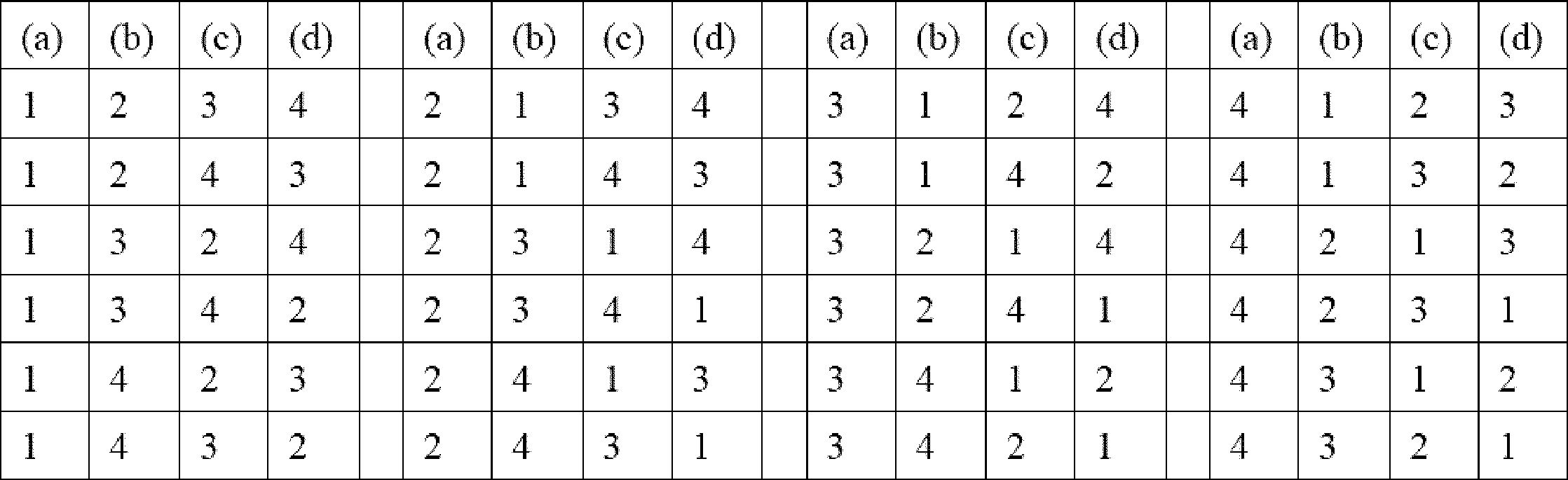
同様に、核酸は、上記の表に提供される3つのポリペプチドをコードする3つのポリヌクレオチドのみを含み得る。いくつかの実施例では、細胞は、上記の表1に含まれる4つのポリヌクレオチドを含む核酸でトランスフェクト又は形質導入される。他の例では、細胞は、例えば、表2に提供される3つのポリペプチドをコードする3つのポリヌクレオチドをコードする核酸でトランスフェクト又は形質導入される。 Similarly, the nucleic acid may include only three polynucleotides encoding the three polypeptides provided in the table above. In some examples, the cell is transfected or transduced with a nucleic acid that includes four polynucleotides included in Table 1 above. In other examples, the cell is transfected or transduced with a nucleic acid that encodes three polynucleotides encoding, for example, the three polypeptides provided in Table 2.
(表2)

同様に、核酸は、上記の表に提供される2つのポリペプチドをコードする2つのポリヌクレオチドのみを含んでもよい。 Similarly, a nucleic acid may contain only two polynucleotides encoding the two polypeptides provided in the table above.
(表3)

様々なポリペプチド要素の順序の変更は、例えば、表4~42に見られる。 Changes in the order of various polypeptide elements can be seen, for example, in Tables 4-42.
いくつかの実施形態では、細胞は、2つのポリヌクレオチドをコードする核酸でトランスフェクト又は形質導入され、細胞はまた、第3のポリペプチドをコードするポリヌクレオチドを含む核酸を含み、かつ/又は細胞はまた、第4のポリペプチドをコードするポリヌクレオチドを含む核酸を含む。いくつかの実施形態では、細胞は、3つのポリヌクレオチドをコードする核酸でトランスフェクト又は形質導入され、細胞はまた、第4のポリペプチドをコードするポリヌクレオチドを含む核酸を含む。例えば、細胞は、第1、第2、及び第3のポリヌクレオチドを含む核酸を含んでもよく、細胞はまた、キメラカスパーゼ9ポリペプチドをコードするポリヌクレオチドを含む核酸を含んでもよい。また、細胞は、第1、第2、及び第4のポリヌクレオチドを含む核酸を含んでもよく、細胞はまた、キメラILT受容体をコードするポリヌクレオチド、天然ILT2機能のscFvモジュレーター又はインターロイキン15を含む核酸を含んでもよい。
In some embodiments, the cell is transfected or transduced with a nucleic acid encoding two polynucleotides, the cell also includes a nucleic acid comprising a polynucleotide encoding a third polypeptide, and/or the cell also includes a nucleic acid comprising a polynucleotide encoding a fourth polypeptide. In some embodiments, the cell is transfected or transduced with a nucleic acid encoding three polynucleotides, the cell also includes a nucleic acid comprising a polynucleotide encoding a fourth polypeptide. For example, the cell may include a nucleic acid comprising a first, second, and third polynucleotide, the cell may also include a nucleic acid comprising a polynucleotide encoding a
12.疾患を治療するための方法
例えば、注入による細胞(例えば、主題のCIRを発現する細胞)の投与が有益であり得る疾患の治療方法又は予防方法も提供される。細胞は、例えば、例えば、疾患細胞の機能を置き換えるために、再生に使用され得る。本明細書に記載の遺伝子改変細胞は、細胞療法に使用され得る。
12. Methods for Treating Disease Methods for treating or preventing diseases in which administration of cells (e.g., cells expressing a subject CIR), e.g., by injection, may be beneficial. The cells may be used, for example, for regeneration, e.g., to replace the function of diseased cells. The genetically modified cells described herein may be used for cell therapy.
本明細書で使用される場合、「治療」、「治療する」などの用語は、所望される薬理学的及び/又は生理学的効果を得ることを指す。効果は、疾患若しくはその症状を完全に又は部分的に予防するという点では予防的であり得、かつ/あるいは疾患及び/若しくは疾患に起因する有害作用に対する部分的又は完全な治癒という点では治療的であり得る。本明細書で使用される「治療」は、哺乳動物、特にヒトにおける疾患の任意の治療を網羅し、(a)疾患の素因があるか又は疾患を獲得する危険性があるが、それを有するとまだ診断されていない対象において疾患の発生を防止すること、(b)疾患を阻害すること、すなわち、その発達を阻止すること、及び(c)疾患を緩和すること、すなわち、疾患の退行を引き起こすことを含む。 As used herein, the terms "treatment", "treating" and the like refer to obtaining a desired pharmacological and/or physiological effect. The effect may be prophylactic in that it completely or partially prevents the disease or its symptoms, and/or may be therapeutic in that it partially or completely cures the disease and/or the adverse effects caused by the disease. As used herein, "treatment" encompasses any treatment of disease in a mammal, particularly a human, and includes (a) preventing the onset of disease in a subject predisposed to or at risk of acquiring the disease, but not yet diagnosed as having it, (b) inhibiting the disease, i.e., arresting its development, and (c) alleviating the disease, i.e., causing regression of the disease.
「個体」、「対象」、及び「患者」という用語は、本明細書において互換的に使用され、ヒト及び非ヒト霊長類(サル及びヒトを含む)、哺乳動物競技動物(例えば、ウマ)、哺乳動物家畜(例えば、ヒツジ、ヤギなど)、哺乳動物愛玩動物(イヌ、ネコなど)、及びげっ歯動物(例えば、マウス、ラットなど)を含むがこれらに限定されない哺乳動物を指す。 The terms "individual," "subject," and "patient" are used interchangeably herein and refer to mammals, including, but not limited to, humans and non-human primates (including monkeys and humans), mammalian sports animals (e.g., horses), mammalian farm animals (e.g., sheep, goats, etc.), mammalian pets (dogs, cats, etc.), and rodents (e.g., mice, rats, etc.).
「有効量」又は「十分量」は、単回又は複数回用量で、単独で又は1つ以上の他の組成物(治療剤、例えば、薬物)、治療、プロトコル、若しくは治療レジメンとの組み合わせで、任意の持続期間(長期又は短期)の検出可能な応答、任意の測定可能若しくは検出可能な程度の、又は任意の持続期間の(例えば、数分、数時間、数日間、数か月間、数年間、若しくは治癒)、対象における予期若しくは所望される転帰又は対象への利益を提供する量(例えば、有効量の細胞)を指す。 An "effective amount" or "sufficient amount" refers to an amount (e.g., an effective amount of cells) that, in single or multiple doses, alone or in combination with one or more other compositions (therapeutic agents, e.g., drugs), treatments, protocols, or treatment regimens, provides an expected or desired outcome in a subject or benefit to a subject, of any duration (long-term or short-term), of any measurable or detectable degree, or of any duration (e.g., minutes, hours, days, months, years, or cure).
治療のための(例えば、寛解させるか、又は治療的利益若しくは改善を提供するための)「有効量」又は「十分量」の用量は、典型的には、疾患の1つ、複数又は全ての有害な症状、帰結又は合併症、例えば、疾患によって引き起こされるか又はそれに関連する1つ以上の有害な症状、障害、疾病、病態、又は合併症に対する、測定可能な程度の応答を提供するのに有効であるが、疾患の進行又は悪化の減少、低減、阻害、抑制、制限又は制御もまた、満足のいく転帰である。 An "effective amount" or "sufficient amount" of a therapeutic dose (e.g., to ameliorate or provide a therapeutic benefit or improvement) is typically effective to provide a measurable degree of response to one, more than one, or all adverse symptoms, consequences, or complications of a disease, e.g., one or more adverse symptoms, disorders, diseases, conditions, or complications caused by or associated with a disease, although a decrease, reduction, inhibition, suppression, limiting, or control of the progression or worsening of a disease is also a satisfactory outcome.
本明細書に提供される遺伝子改変細胞(すなわち、主題のCIRを発現する細胞)は、その必要のあるヒト対象を治療するための方法で使用され得、そのような対象を治療するための薬剤を調製するために使用され得る。細胞は、通常、注入によってレシピエント対象に送達されることになる。 The genetically modified cells provided herein (i.e., cells expressing a subject CIR) can be used in methods for treating human subjects in need thereof and can be used to prepare medicaments for treating such subjects. The cells will typically be delivered to the recipient subject by injection.
遺伝子改変細胞は、T細胞、iNKT細胞、マクロファージ、又はNK細胞であり得る。対象における療法のためのT細胞又はNK細胞の典型的な用量は、105~107細胞/kgである。小児患者は、一般に、約106細胞/kgの用量を投与されるが、成人患者は、例えば、3×106細胞/kgのより高い用量を投与されることになる。 The genetically modified cells can be T cells, iNKT cells, macrophages, or NK cells. A typical dose of T cells or NK cells for therapy in a subject is 10 to 10 cells/kg. Pediatric patients generally receive a dose of about 10 cells/kg, while adult patients will receive a higher dose, for example, 3× 10 cells/kg.
一般的に言えば、本発明の遺伝子改変T細胞及びNK細胞は、既知のドナー白血球注入(DLI)と同じ方法で使用され得るが、それらは、CIRの更なる利点を有する。 Generally speaking, the genetically modified T cells and NK cells of the present invention can be used in the same manner as known donor leukocyte infusions (DLI), but they have the added advantage of CIR.
遺伝子改変T細胞又はNK細胞を投与される対象は、典型的には、同種ドナーから他の組織も投与されることになり、例えば、造血細胞及び/又は造血幹細胞(例えば、CD34+細胞)が投与され得る。この同種移植組織及び遺伝子改変T細胞は、理想的には、それらが遺伝的に一致するように、同じドナーに由来する。更に、ドナー及びレシピエントは、好ましくは、例えば、一致した無関係のドナー、又は好適な家族メンバーである。例えば、ドナーは、レシピエントの親又は子であり得る。したがって、対象が遺伝子改変T細胞を必要とすると特定される場合、好適なドナーをT細胞ドナーとして特定され得る。 A subject receiving genetically modified T cells or NK cells will typically also receive other tissues from an allogeneic donor, for example, hematopoietic cells and/or hematopoietic stem cells (e.g., CD34+ cells). The allogeneic tissue and genetically modified T cells are ideally derived from the same donor, such that they are genetically matched. Furthermore, the donor and recipient are preferably, for example, matched unrelated donors, or suitable family members. For example, the donor can be a parent or child of the recipient. Thus, when a subject is identified as needing genetically modified T cells, a suitable donor can be identified as the T cell donor.
レシピエントは、遺伝子改変T細胞を投与される前に(及び同種移植片を投与される前に)リンパ枯渇コンディショニングを受ける場合がある。したがって、レシピエント自身のα/β T細胞(及びB細胞)は、遺伝子改変T細胞又はNK細胞を投与される前に枯渇され得る。 The recipient may undergo lymphodepletion conditioning prior to receiving the genetically modified T cells (and prior to receiving the allograft). Thus, the recipient's own α/β T cells (and B cells) may be depleted prior to receiving the genetically modified T cells or NK cells.
レシピエントは、血液がん(治療抵抗性血液がんなど)又は遺伝性血液疾患を有し得る。例えば、レシピエントは、急性リンパ芽球性白血病(ALL)、急性骨髄性白血病(AML)、重症複合免疫不全(SCID)、ウィスコット・アルドリッチ症候群(WA)、ファンコニ貧血、慢性骨髄性白血病(CML)、非ホジキンリンパ腫(NHL)、ホジキンリンパ腫(HL)、又は多発性骨髄腫を有し得る。 The recipient may have a blood cancer (such as a treatment-resistant blood cancer) or a genetic blood disorder. For example, the recipient may have acute lymphoblastic leukemia (ALL), acute myeloid leukemia (AML), severe combined immunodeficiency (SCID), Wiskott-Aldrich syndrome (WA), Fanconi anemia, chronic myelogenous leukemia (CML), non-Hodgkin's lymphoma (NHL), Hodgkin's lymphoma (HL), or multiple myeloma.
CIRを発現するT細胞又はNK細胞のレシピエントは、HLA-Gを発現する非血液がんを有し得る。例えば、レシピエントは、腎細胞がん(RCC)、非小細胞肺がん(NSCLC)、大腸がん(CRC)、乳がん、神経芽腫、肝細胞がん(HCC)を有し得る。 Recipients of T cells or NK cells expressing CIR may have a non-hematological cancer expressing HLA-G. For example, the recipient may have renal cell carcinoma (RCC), non-small cell lung cancer (NSCLC), colorectal cancer (CRC), breast cancer, neuroblastoma, or hepatocellular carcinoma (HCC).
他の細胞型もまた、療法で使用することができ、所望の治療結果のために患者に投与される任意の細胞を含む。治療用細胞は、例えば、T細胞、ナチュラルキラー細胞、B細胞、腫瘍浸潤リンパ球、又はマクロファージなどの免疫細胞、又はそれらの組み合わせであり得、治療用細胞は、例えば、末梢血細胞、造血前駆細胞、骨髄細胞、又は腫瘍細胞であり得る。より免疫原性であるように腫瘍微小環境を更に改善するために、治療を、1つ以上のアジュバント(例えば、IL-12、TLR、IDO阻害剤など)と組み合わせてもよい。いくつかの実施形態では、細胞は、例えば、腫瘍床への細胞の送達などの固形腫瘍を治療するために送達されてもよい。 Other cell types can also be used in therapy, including any cells administered to a patient for a desired therapeutic outcome. Therapeutic cells can be, for example, immune cells such as T cells, natural killer cells, B cells, tumor infiltrating lymphocytes, or macrophages, or combinations thereof, and therapeutic cells can be, for example, peripheral blood cells, hematopoietic progenitor cells, bone marrow cells, or tumor cells. To further improve the tumor microenvironment to be more immunogenic, the therapy can be combined with one or more adjuvants (e.g., IL-12, TLR, IDO inhibitors, etc.). In some embodiments, cells can be delivered to treat solid tumors, such as, for example, delivery of cells to the tumor bed.
いくつかの実施形態では、核酸も提供され、これを対象に投与し、それによって、標的細胞をインビボで形質転換又は形質導入して、インサイツで遺伝子改変細胞を形成することができる。 In some embodiments, a nucleic acid is also provided that can be administered to a subject, thereby transforming or transducing target cells in vivo to form genetically modified cells in situ.
有効量の遺伝子改変細胞が投与される。有効量のリガンド又は改変細胞が投与されるかどうかを決定するために、標的細胞の数、又は標的抗原の量、又は腫瘍のサイズをアッセイ又は測定する任意の手段を使用して、標的細胞の数、標的抗原の量、又は腫瘍のサイズが増加しているか、減少しているか、又は同じままであるかどうかを決定することができる。改変細胞又はリガンドの投与前に取得された試料、画像、又は他の測定手段を使用して、改変細胞又はリガンドの投与後に取得された試料、画像、又は他の測定手段と比較してもよい。したがって、例えば、標的抗原を発現する細胞の量又は濃度が増加しているか、減少しているか、又は同じままであるかどうかを決定するために、第1の試料を、リガンド又は改変細胞の投与前に対象から得てもよく、第2の試料を、リガンド又は改変細胞の投与後に対象から得てもよい。第1の試料における標的抗原を発現する細胞の量又は濃度は、リガンド又は改変細胞の投与後、標的抗原を発現する細胞の量又は濃度が増加しているか、減少しているか、又は同じままであるかどうかを決定するために、第2の試料における標的抗原を発現する細胞の量又は濃度と比較され得る。 An effective amount of genetically modified cells is administered. To determine whether an effective amount of the ligand or modified cells is administered, any means of assaying or measuring the number of target cells, or the amount of target antigen, or the size of the tumor can be used to determine whether the number of target cells, the amount of target antigen, or the size of the tumor is increased, decreased, or remains the same. A sample, image, or other measurement taken before administration of the modified cells or ligand may be used to compare with a sample, image, or other measurement taken after administration of the modified cells or ligand. Thus, for example, to determine whether the amount or concentration of cells expressing the target antigen is increased, decreased, or remains the same, a first sample may be obtained from the subject before administration of the ligand or modified cells, and a second sample may be obtained from the subject after administration of the ligand or modified cells. The amount or concentration of cells expressing the target antigen in the first sample may be compared to the amount or concentration of cells expressing the target antigen in the second sample to determine whether the amount or concentration of cells expressing the target antigen is increased, decreased, or remains the same after administration of the ligand or modified cells.
任意の特定の用途の有効量は、治療される疾患又は状態、投与される特定の組成物、対象のサイズ、及び/又は疾患若しくは状態の重症度などの因子に応じて変動し得る。本明細書に提示される特定の組成物の有効量を経験的に決定することができる。 The effective amount for any particular application may vary depending on factors such as the disease or condition being treated, the particular composition being administered, the size of the subject, and/or the severity of the disease or condition. Effective amounts of the particular compositions presented herein can be determined empirically.
本明細書に提示される改変細胞の有効性を高めるために、これらの組成物及び方法を、疾患の治療に有効な作用物質と組み合わせることが望ましい場合がある。 To enhance the effectiveness of the modified cells presented herein, it may be desirable to combine these compositions and methods with agents effective in treating disease.
薬学的組成物の投与は、数分から数週間の範囲の間隔で他の作用物質に先行、並行、及び/又は後行してもよい。薬学的組成物及び他の作用物質が別々に細胞、組織又は生物に適用される実施形態では、一般に、各送達の時間の間に著しい期間が満了しないことを確実にして、その結果、薬学的組成物及び作用物質が、依然として、細胞、組織、又は生物に対する有利に組み合わされた効果を発揮することができる。例えば、そのような場合、細胞、組織、又は生物を、実質的に同時に(すなわち、約1分以内に)2つ、3つ、4つ、又はそれ以上のモダリティで、薬学的組成物と接触させることができることが企図される。他の態様では、1つ以上の作用物質は、発現ベクターを投与する前及び/又は投与した後に、実質的に同時に、約1分間から、約24時間まで約7日間まで約1週間まで約8週間またはそれ以上まで、及びその中で導出可能な任意の範囲で投与され得る。更に、本明細書に提示される薬学的組成物の様々な併用レジメン、及び1つ以上の作用物質が用いられ得る。 Administration of the pharmaceutical composition may precede, parallel, and/or follow the other agent by intervals ranging from minutes to weeks. In embodiments in which the pharmaceutical composition and the other agent are applied separately to the cell, tissue, or organism, it is generally ensured that no significant period of time expires between the time of each delivery, so that the pharmaceutical composition and the agent can still exert their advantageously combined effect on the cell, tissue, or organism. For example, in such cases, it is contemplated that the cell, tissue, or organism can be contacted with the pharmaceutical composition in two, three, four, or more modalities substantially simultaneously (i.e., within about one minute). In other aspects, the one or more agents may be administered substantially simultaneously, before and/or after administration of the expression vector, for about one minute to about 24 hours to about seven days to about one week to about eight weeks or more, and any range derivable therein. Additionally, various combination regimens of pharmaceutical compositions and one or more agents presented herein may be used.
治療又は予防され得る疾患には、ウイルス、細菌、酵母、寄生虫、原虫、がん細胞などによって引き起こされる疾患が含まれる。治療及び/又は予防され得る例示的な疾患としては、HIV、インフルエンザ、ヘルペス、ウイルス性肝炎、エプスタインバー、ポリオ、ウイルス性脳炎、麻疹、水痘、パピローマウイルスなどのウイルス性病因の感染症;又は肺炎、結核、梅毒などの細菌性病因の感染症;又はマラリア、トリパノソーマ症、リーシュマニア症、トリコモナス症、アメーバ症などの寄生虫性病因の感染症が挙げられるが、これらに限定されない。薬学的組成物(形質導入細胞、発現ベクター、発現構築物など)を使用して治療又は予防され得る前腫瘍状態又は過形成状態には、結腸ポリープ、クローン病、潰瘍性大腸炎、乳房病変などの前腫瘍状態又は過形成状態が含まれるが、これらに限定されない。 Diseases that may be treated or prevented include diseases caused by viruses, bacteria, yeasts, parasites, protozoa, cancer cells, and the like. Exemplary diseases that may be treated and/or prevented include, but are not limited to, infections of viral etiology, such as HIV, influenza, herpes, viral hepatitis, Epstein-Barr, polio, viral encephalitis, measles, chickenpox, papillomavirus, and the like; or infections of bacterial etiology, such as pneumonia, tuberculosis, syphilis, and the like; or infections of parasitic etiology, such as malaria, trypanosomiasis, leishmaniasis, trichomoniasis, amebiasis, and the like. Preneoplastic or hyperplastic conditions that may be treated or prevented using pharmaceutical compositions (transduced cells, expression vectors, expression constructs, and the like) include, but are not limited to, preneoplastic or hyperplastic conditions, such as colonic polyps, Crohn's disease, ulcerative colitis, breast lesions, and the like.
細胞を使用して治療され得る固形腫瘍を含むがんには、原発性又は転移性黒色腫、腺がん、扁平上皮がん、腺扁平上皮がん、胸腺腫、リンパ腫、肉腫、肺がん、肝がん、非ホジキンリンパ腫、ホジキンリンパ腫、白血病、子宮がん、乳がん、前立腺がん、卵巣がん、膵臓がん、結腸がん、多発性骨髄腫、神経芽腫、NPC、膀胱がん、子宮頸がんなど含まれるが、これらに限定されない。 Cancers, including solid tumors, that may be treated using the cells include, but are not limited to, primary or metastatic melanoma, adenocarcinoma, squamous cell carcinoma, adenosquamous cell carcinoma, thymoma, lymphoma, sarcoma, lung cancer, liver cancer, non-Hodgkin's lymphoma, Hodgkin's lymphoma, leukemia, uterine cancer, breast cancer, prostate cancer, ovarian cancer, pancreatic cancer, colon cancer, multiple myeloma, neuroblastoma, NPC, bladder cancer, and cervical cancer.
本明細書に提示される治療用細胞及び他の治療用細胞活性化系を使用して治療され得る固形腫瘍を含む他の過増殖性疾患には、関節リウマチ、炎症性腸疾患、変形性関節症、平滑筋腫、腺腫、脂肪腫、血管腫、線維腫、血管閉塞、再狭窄、アテローム性動脈硬化、前腫瘍性病変(例えば、腺腫様過形成及び前立腺上皮内腫瘍)、上皮内がん、口腔毛状白板症、又は乾癬が含まれるが、これらに限定されない。 Other hyperproliferative diseases, including solid tumors, that may be treated using the therapeutic cells and other therapeutic cell activation systems presented herein include, but are not limited to, rheumatoid arthritis, inflammatory bowel disease, osteoarthritis, leiomyomas, adenomas, lipomas, hemangiomas, fibromas, vascular occlusions, restenosis, atherosclerosis, preneoplastic lesions (e.g., adenomatous hyperplasia and prostatic intraepithelial neoplasia), carcinoma in situ, oral hairy leukoplakia, or psoriasis.
標的抗原、例えば、血管系において、例えば、HLA-Gを発現する任意の腫瘍、例えば、肺、骨、肝臓、前立腺、又は脳、また、例えば、乳房、卵巣、腸、精巣、結腸、膵臓、腎臓、膀胱、神経内分泌系、軟組織、骨塊、及びリンパ系に存在する固形腫瘍を含む、任意の組織又は臓器由来の固形腫瘍は、本方法を使用して治療され得る。治療され得る他の固形腫瘍には、例えば、膠芽腫、及び悪性多発性骨髄腫が含まれる。 Solid tumors of any tissue or organ origin can be treated using the present methods, including any tumor expressing a target antigen, e.g., HLA-G, e.g., in the vasculature, e.g., lung, bone, liver, prostate, or brain, as well as solid tumors residing in, e.g., breast, ovary, intestine, testis, colon, pancreas, kidney, bladder, neuroendocrine system, soft tissue, bone mass, and lymphatic system. Other solid tumors that can be treated include, e.g., glioblastoma, and malignant multiple myeloma.
対象は、CIRに含まれる任意の亜鉛依存性因子又はCIRを含む細胞療法産物において発現される補因子が、完全な活性を可能にするためのこのイオンの適切な供給源を有することを確実にするために、亜鉛サプリメントが投与され得る。 The subject may be administered zinc supplements to ensure that any zinc-dependent factors contained in the CIR or cofactors expressed in cell therapy products containing the CIR have an adequate source of this ion to allow for full activity.
また、本開示の細胞を作製する方法も提供される。いくつかの実施形態では、かかる方法は、本開示の核酸又は発現ベクター(例えば、主題のCIRをコードするもの)で細胞をトランスフェクト又は形質導入することを含む。「トランスフェクション」という用語は、細胞による外来DNAの取り込みを指すために使用される。細胞膜内に外因性DNAが導入された場合、細胞は「トランスフェクション」されている。いくつかのトランスフェクション技術は、一般に、当該技術分野で既知である。例えば、Sambrook et al.(2001)Molecular Cloning,a laboratory manual,3rd edition,Cold Spring Harbor Laboratories,New York、Davis et al.(1995)Basic Methods in Molecular Biology,2nd edition,McGraw-Hill、及びChu et al.(1981)Gene 13:197を参照されたい。そのような技術は、1つ以上の外因DNA部分を好適な宿主細胞に導入するために使用され得る。この用語は、遺伝材料の安定した取り込み及び一過性の取り込みの両方を指す。 Also provided are methods of making the cells of the present disclosure. In some embodiments, such methods include transfecting or transducing a cell with a nucleic acid or expression vector of the present disclosure (e.g., encoding a subject CIR). The term "transfection" is used to refer to the uptake of foreign DNA by a cell. A cell is "transfected" when exogenous DNA is introduced into the cell membrane. Several transfection techniques are generally known in the art. See, for example, Sambrook et al. (2001) Molecular Cloning, a laboratory manual, 3rd edition, Cold Spring Harbor Laboratories, New York, Davis et al. (1995) Basic Methods in Molecular Biology, 2nd edition, McGraw-Hill, and Chu et al. (1981) Gene 13:197. Such techniques can be used to introduce one or more exogenous DNA moieties into a suitable host cell. The term refers to both stable and transient uptake of genetic material.
いくつかの実施形態では、本開示の細胞は、CIRをコードするウイルスベクターで細胞を形質導入することによって産生される。ある特定の態様では、ポリペプチドはCIRを含み、細胞はT細胞であり、そのため、CIR T細胞を産生する方法が提供される。いくつかの実施形態では、かかる方法は、T細胞の集団(例えば、CIR T細胞療法が投与されるであろう個体から得られたT細胞)を活性化することと、T細胞の集団を刺激して増殖させることと、CIRを含むポリペプチドをコードするウイルスベクターでT細胞を形質導入することと、を含む。いくつかの実施形態では、免疫細胞(例えば、T細胞、NK細胞、マクロファージ)は、レトロウイルスベクター(例えば、ガンマレトロウイルスベクター若しくはレンチウイルスベクター)又はCIRをコードするAAVで形質導入される。ある特定の態様では、免疫細胞のT細胞は、ポリペプチドをコードするレンチウイルスベクターで形質導入される。ある特定の態様では、ポリペプチドはCIRを含み、細胞はCIR NK細胞であり、そのため、(例えば、AAV、レンチウイルス、又はレトロウイルスベクターなどのウイルスベクターを使用することによって)CIR NK細胞を産生する方法が提供される。 In some embodiments, the cells of the disclosure are produced by transducing the cells with a viral vector encoding the CIR. In certain aspects, the polypeptide comprises the CIR and the cells are T cells, thus providing a method of producing a CIR T cell. In some embodiments, such a method comprises activating a population of T cells (e.g., T cells obtained from an individual to whom the CIR T cell therapy will be administered), stimulating the population of T cells to proliferate, and transducing the T cells with a viral vector encoding a polypeptide comprising the CIR. In some embodiments, immune cells (e.g., T cells, NK cells, macrophages) are transduced with a retroviral vector (e.g., a gamma retroviral vector or a lentiviral vector) or an AAV encoding the CIR. In certain aspects, the immune cells, T cells, are transduced with a lentiviral vector encoding the polypeptide. In certain aspects, the polypeptide comprises a CIR and the cell is a CIR NK cell, and thus methods of producing a CIR NK cell (e.g., by using a viral vector such as an AAV, lentiviral, or retroviral vector) are provided.
13.一般
「含む(comprising)」という用語は、「含む(including)」並びに「からなる(consisting)」を包含する。例えば、Xを「含む(comprising)」組成物は、排他的にXからなり得るか、又は追加のものが含まれ得る(例えば、X+Y)。
13. General The term "comprising" encompasses "including" as well as "consisting." For example, a composition "comprising" X may consist exclusively of X or may include additional items (e.g., X+Y).
数値xに関する「約」という用語は、任意選択的であり、例えば、x±10%を意味する。 The term "about" in reference to a numerical value x is optional and means, for example, x±10%.
「実質的に」という単語は、「完全に」を除外するものではない。例えば、Yを「実質的に含まない」組成物は、Yを完全に含まなくてもよい。必要に応じて、「実質的に」という単語は、本発明の定義から省略される場合がある。 The word "substantially" does not exclude "completely". For example, a composition that is "substantially free" of Y may be completely free of Y. Where appropriate, the word "substantially" may be omitted from the definition of the invention.
2つの値に関して「間」という用語は、それら2つの値、例えば、10mg~20mgの「間」の範囲は、とりわけ10、15、及び20mgを包含する。 The term "between" in reference to two values means that a range "between" those two values, e.g., 10 mg to 20 mg, includes 10, 15, and 20 mg, among others.
特に明記されない限り、2つ以上の成分を混合するステップを含む方法は、混合の任意の特定の順序を必要としない。したがって、成分は、任意の順序で混合することができる。3つの成分が存在する場合、2つの成分を互いに組み合わせることができ、次いで、その組み合わせを、第3の成分などと組み合わせることができる。 Unless otherwise specified, methods that include mixing two or more components do not require any particular order of mixing. Thus, the components can be mixed in any order. If there are three components, two components can be combined with each other, and then that combination can be combined with a third component, etc.
方法の様々なステップは、同じ又は異なる時間で、同じ又は異なる地理的位置(例えば、国)で、及び同じ又は異なる人々又は団体によって実行され得る。 The various steps of the method may be performed at the same or different times, in the same or different geographic locations (e.g., countries), and by the same or different people or entities.
「薬学的に許容される」という用語は、動物又はヒトに投与された場合に望ましくない有害反応、アレルギー反応、又は他の有害反応を生じさせない分子実体及び組成物を指す。 The term "pharmaceutical acceptable" refers to molecular entities and compositions that do not produce undesirable adverse, allergic, or other untoward reactions when administered to animals or humans.
2つの配列間の類似性の程度は、配列同一性パーセントに基づくことができる。本明細書における「配列同一性」とは、2つのヌクレオチド又はアミノ酸配列が不変である程度を意味する。「配列アラインメント」とは、類似性の程度を評価する目的で、最大レベルの同一性を達成するように2つ以上の配列を整列させるプロセスを意味する。配列をアラインメントし、類似性/同一性を評価するための多数の方法は、例えば、クラスター法など、当該技術分野で既知であり、類似性が、MEGALIGNアルゴリズム、並びにBLASTN、BLASTP、及びFASTAに基づいている。これらのプログラムのうちのいずれかを使用する場合、最も高い配列類似性をもたらす設定が選択され得る。 The degree of similarity between two sequences can be based on percent sequence identity. "Sequence identity" herein means the degree to which two nucleotide or amino acid sequences are invariant. "Sequence alignment" means the process of aligning two or more sequences to achieve the maximum level of identity for the purpose of assessing the degree of similarity. Numerous methods for aligning sequences and assessing similarity/identity are known in the art, such as, for example, cluster methods and similarity based algorithms such as the MEGALIGN algorithm, as well as BLASTN, BLASTP, and FASTA. When using any of these programs, the settings that result in the highest sequence similarity can be selected.
14.特定の核酸及びアミノ酸配列の例
以下のセクション及び表は、キメラシグナル伝達ポリペプチドをコードするポリペプチド及びヌクレオチド配列の例を含む。例えば、切断型ILT2及びILT4ポリペプチド、共刺激ポリペプチド細胞質シグナル伝達領域、安全スイッチなどの、これらの実施例で提供される個々のポリペプチドの配列を使用して、本実施形態のキメラシグナル伝達ポリペプチドをコードする他の発現ベクターを構築することができることが理解される。
表4は、マーカータンパク質ΔCD19とともにHLA-G1配列を含むγ-レトロウイルスの送達のための完全なベクター配列の例を含む。表5~20は、同じ例のγ-レトロウイルスベクターによって発現された導入遺伝子のみを含む。
14. Examples of Specific Nucleic Acid and Amino Acid Sequences The following sections and tables contain examples of polypeptides and nucleotide sequences that encode chimeric signaling polypeptides. It is understood that the sequences of the individual polypeptides provided in these examples, such as, for example, truncated ILT2 and ILT4 polypeptides, costimulatory polypeptide cytoplasmic signaling regions, safety switches, etc., can be used to construct other expression vectors that encode the chimeric signaling polypeptides of the present embodiments.
Table 4 contains examples of complete vector sequences for gamma-retroviral delivery containing the HLA-G1 sequence along with the marker protein ΔCD19. Tables 5-20 contain only the transgenes expressed by the same example gamma-retroviral vectors.
(表4)プラスミドA:pNT101-SFG-HLAG1-T2A-ΔCD19

(表5)プラスミドB:pNT102-SFG-HLAG2-T2A-ΔCD19
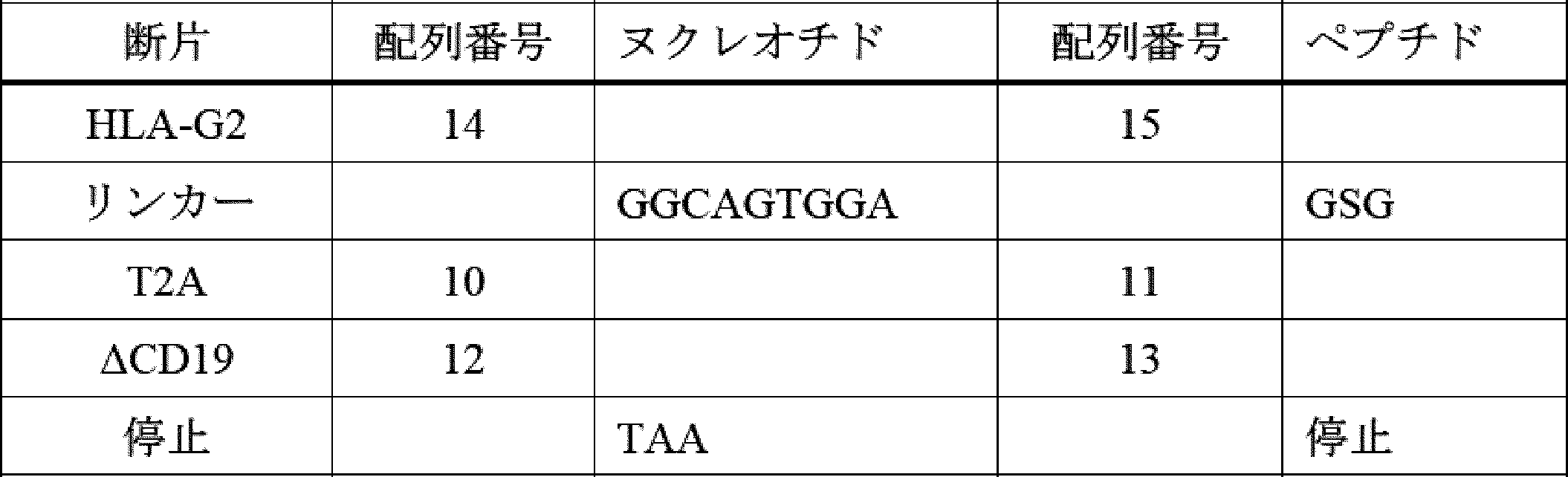
(表6)プラスミドC:pNT103-SFG-HLAG3-T2A-ΔCD19
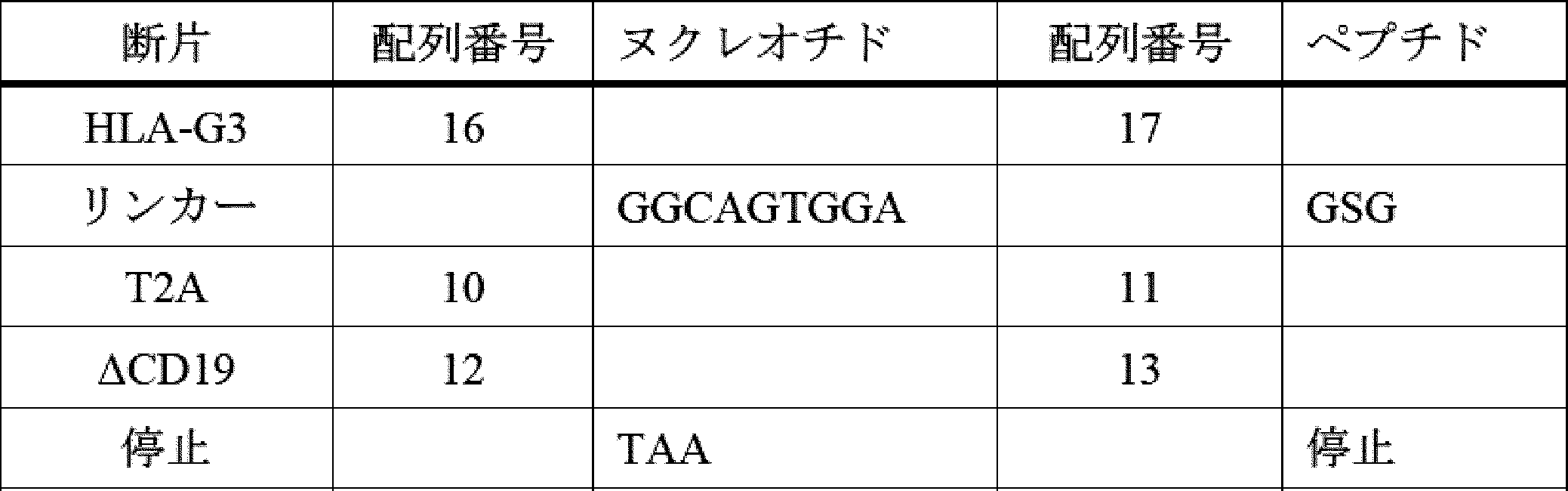
(表7)プラスミドD:pNT104-SFG-HLAG4-T2A-ΔCD19
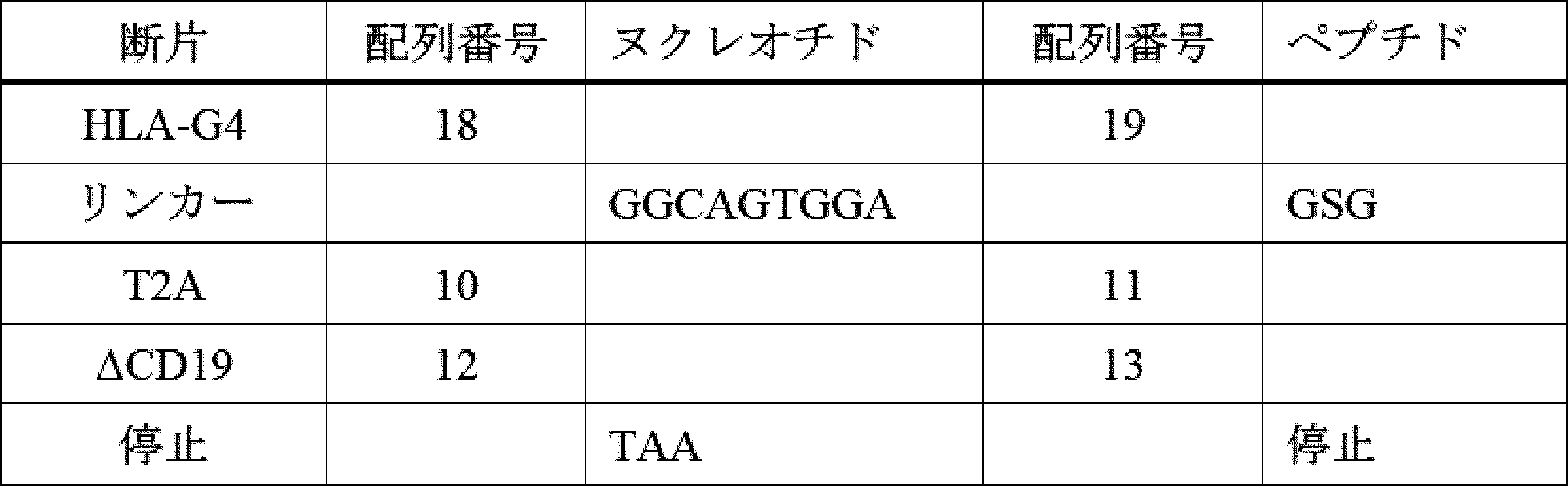
(表8)プラスミドE:pNT105-SFG-HLAG5-T2A-ΔCD19
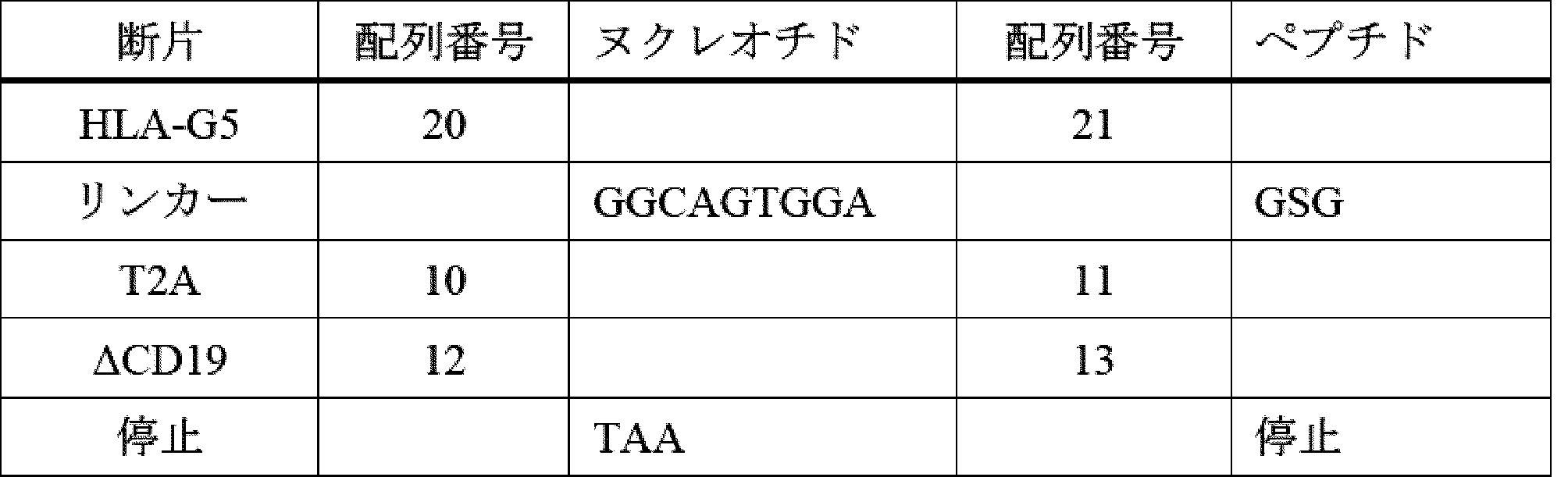
(表9)プラスミドF:pNT106-SFG-HLAG5C42S-T2A-ΔCD19

(表10)プラスミドG:pNT107-SFG-HLAG1C42S-T2A-ΔCD19
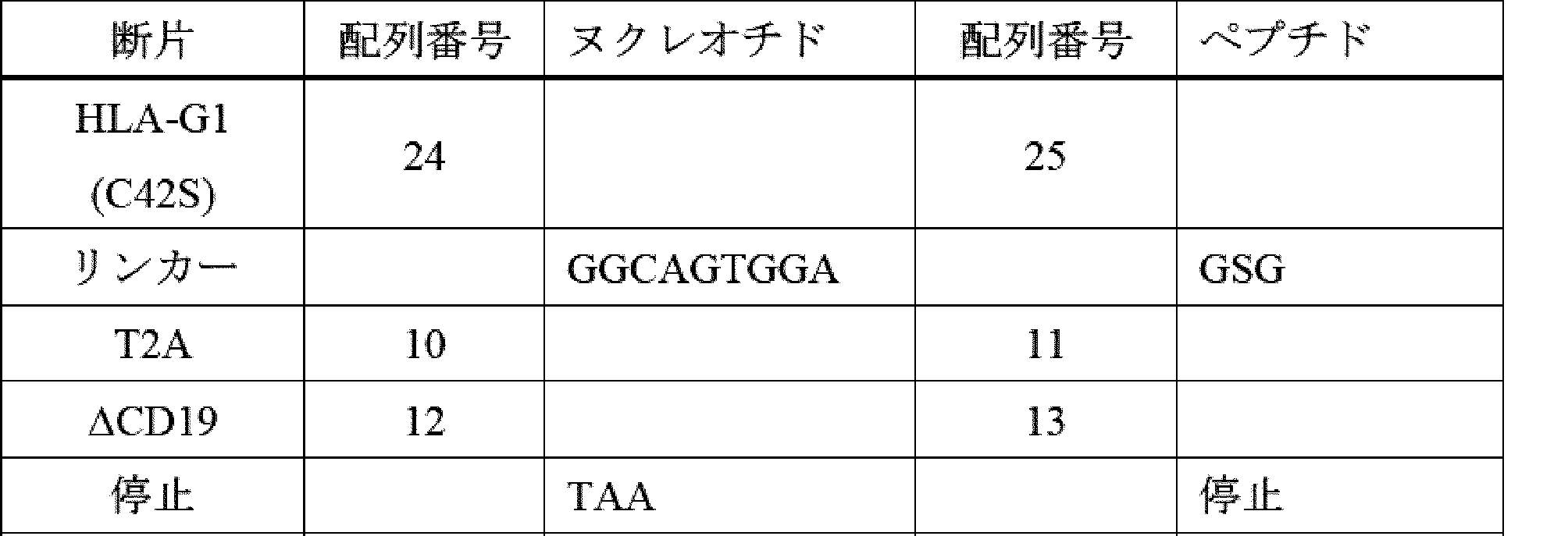
(表11)プラスミドH:pNT108-SFG-HLAG1C42SC147S-T2A-ΔCD19
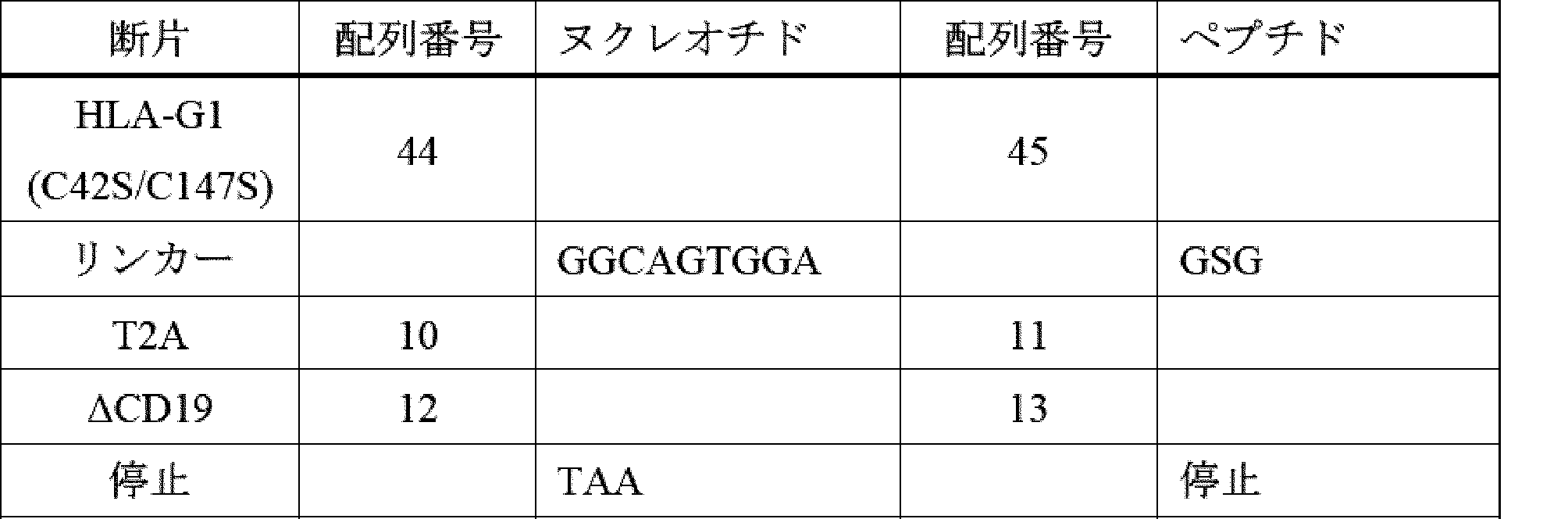
(表12)プラスミドI:pNT109-SFG-HLAG1C147S-T2A-ΔCD19
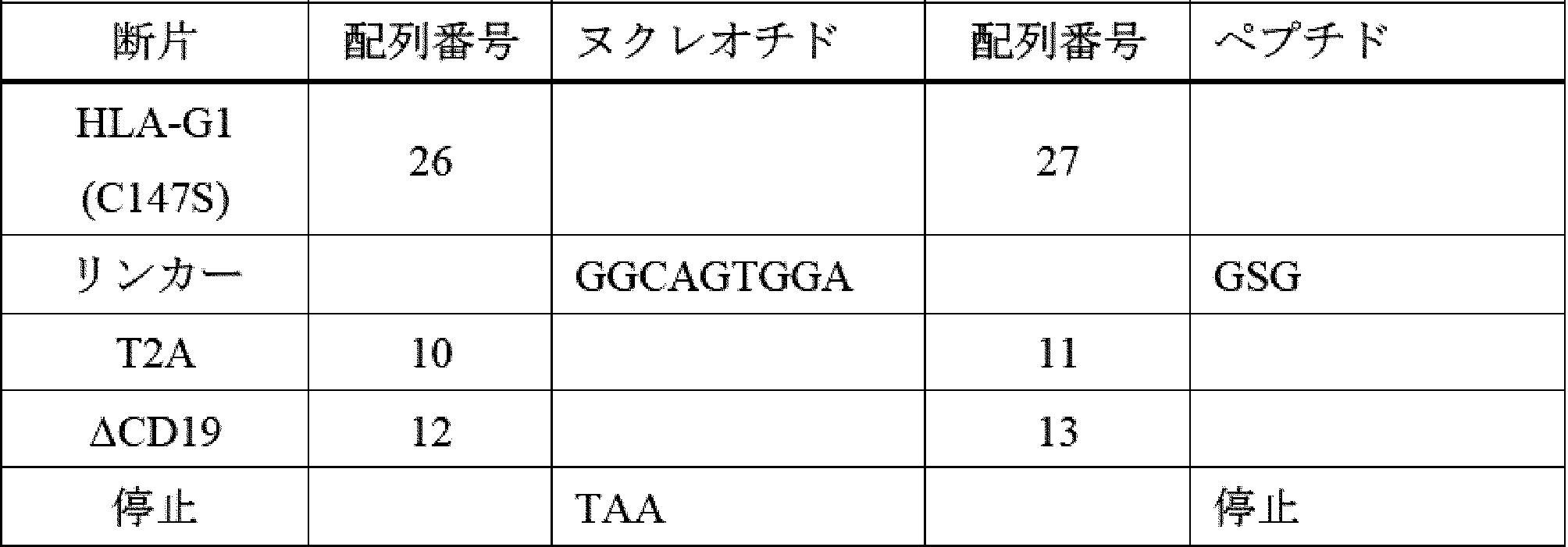
(表13A)プラスミドK:pNT-110 SFG-ILT2-T2A-ΔCD19

(表13B)プラスミドK:pNT-110 SFG-ILT2-T2A-ΔCD19
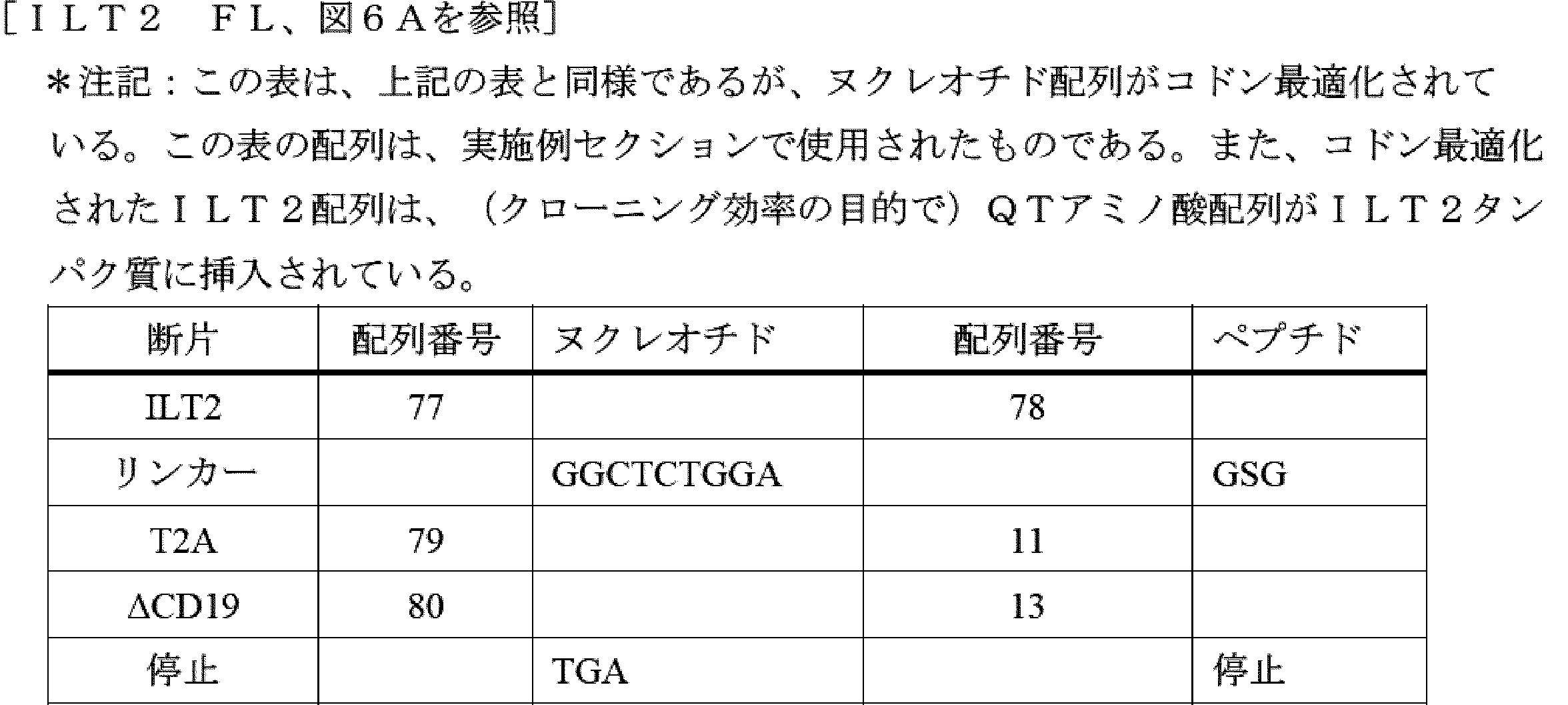
(表14)プラスミドL:pNT-111 SFG-ILT2.ζ-T2A-ΔCD19
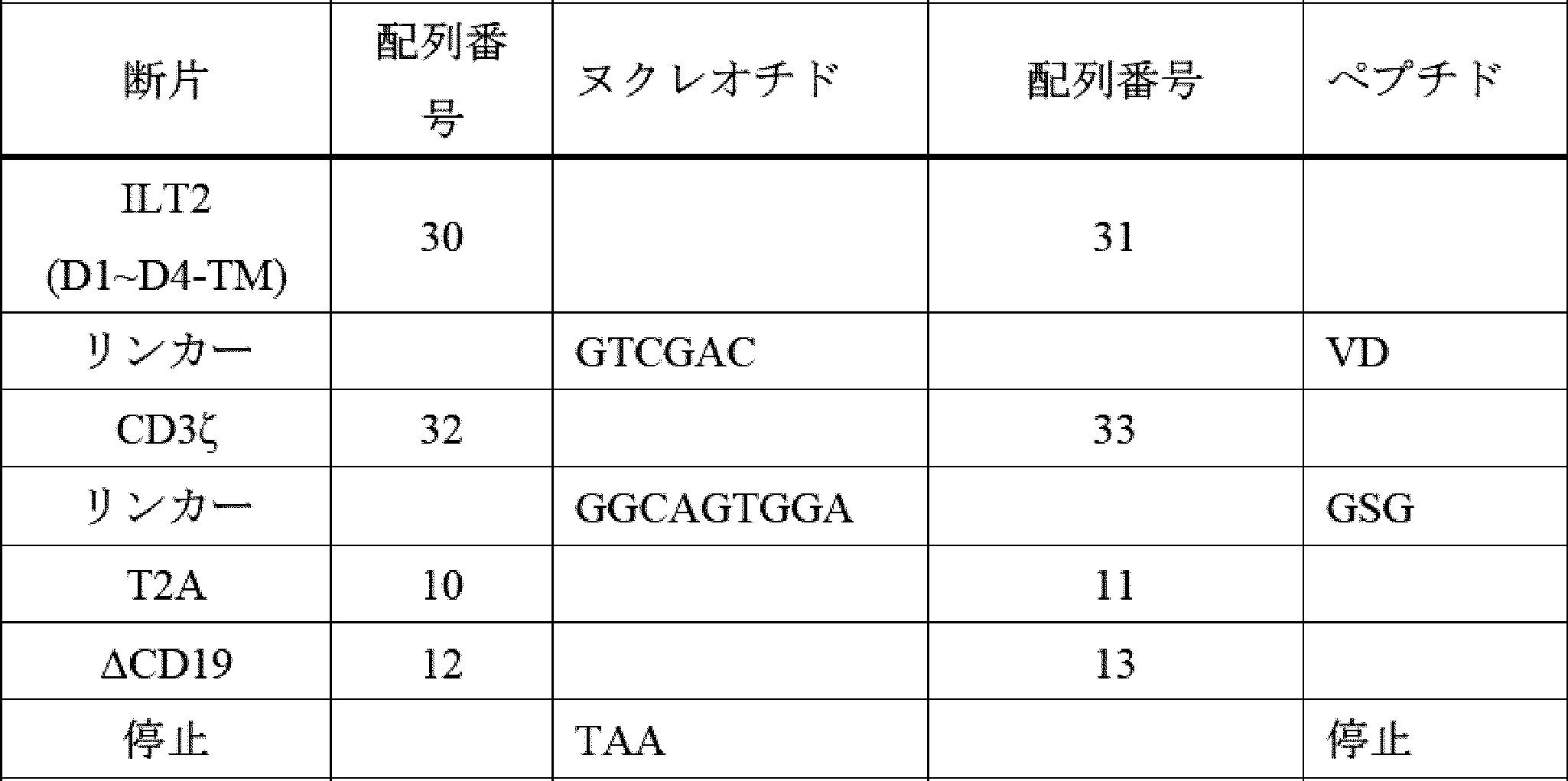
(表15A)プラスミドM:pNT-112 SFG-ILT2.BB.ζ-T2A-ΔCD19

(表15B)プラスミドM:pNT-112 SFG-ILT2.BB.ζ-T2A-ΔCD19
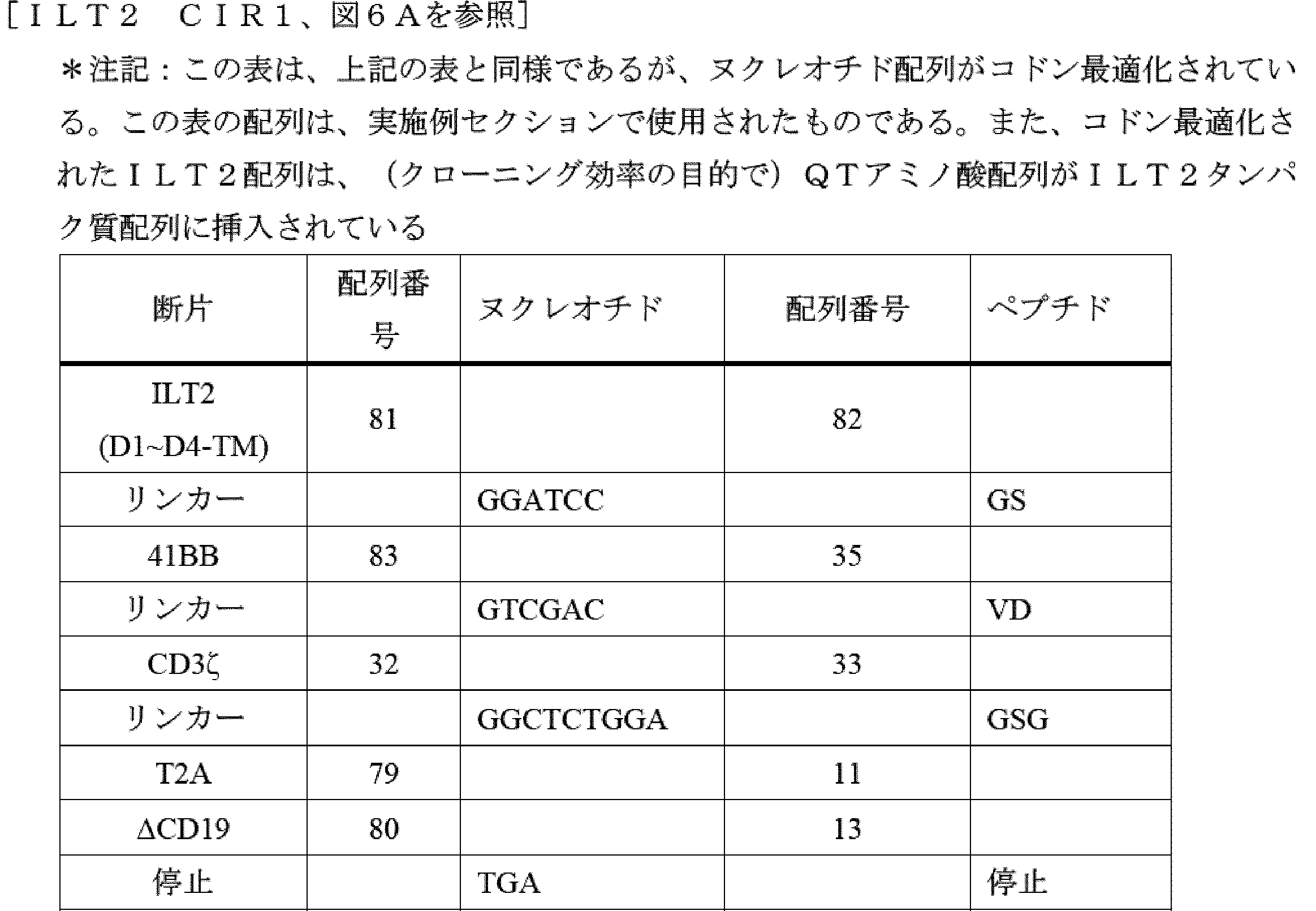
(表16A)プラスミドN:pNT-113 SFG-ILT2D1D2STM.BB.ζ-T2A-ΔCD19
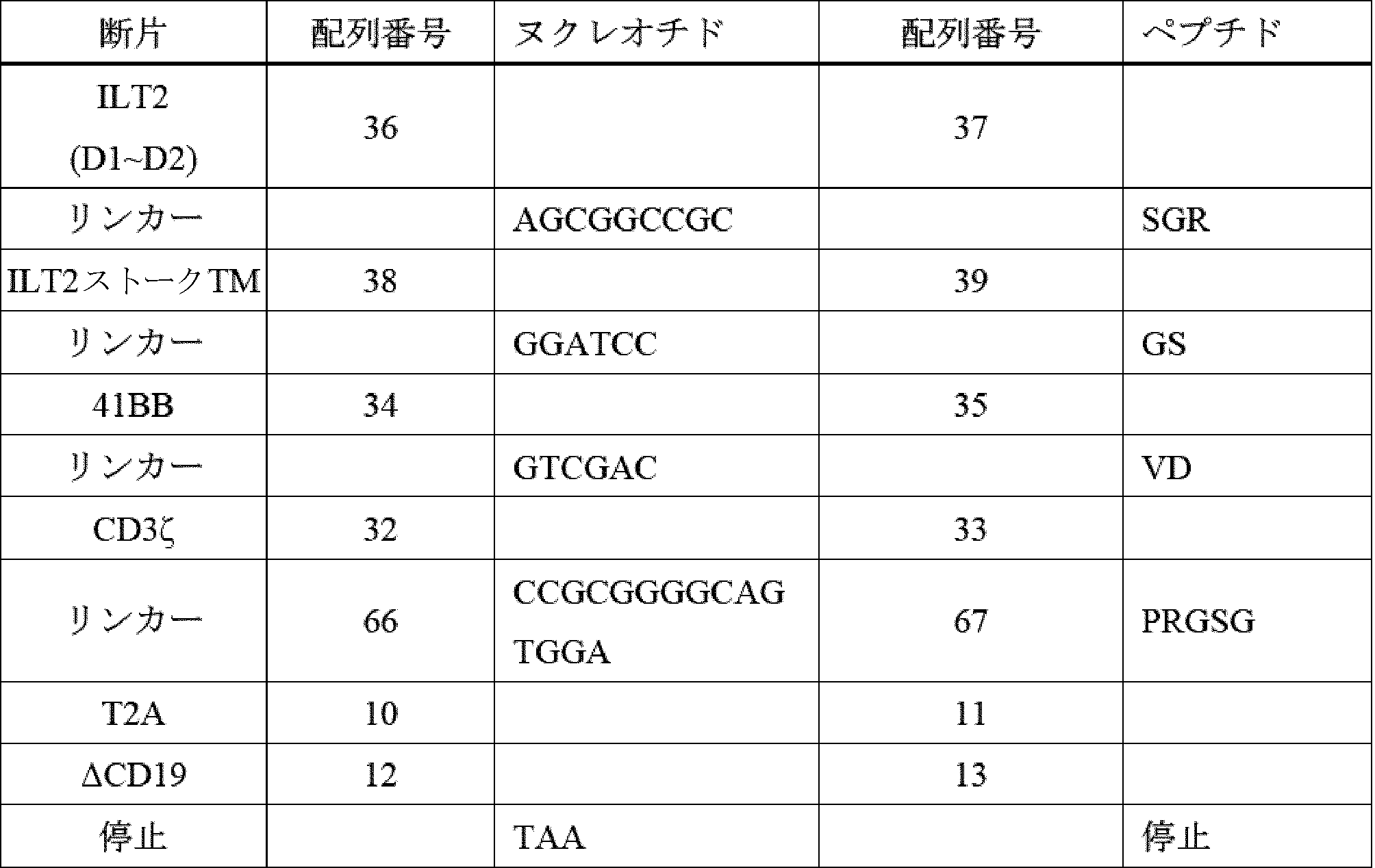
(表16B)プラスミドN:pNT-113 SFG-ILT2D1D2STM.BB.ζ-T2A-ΔCD19
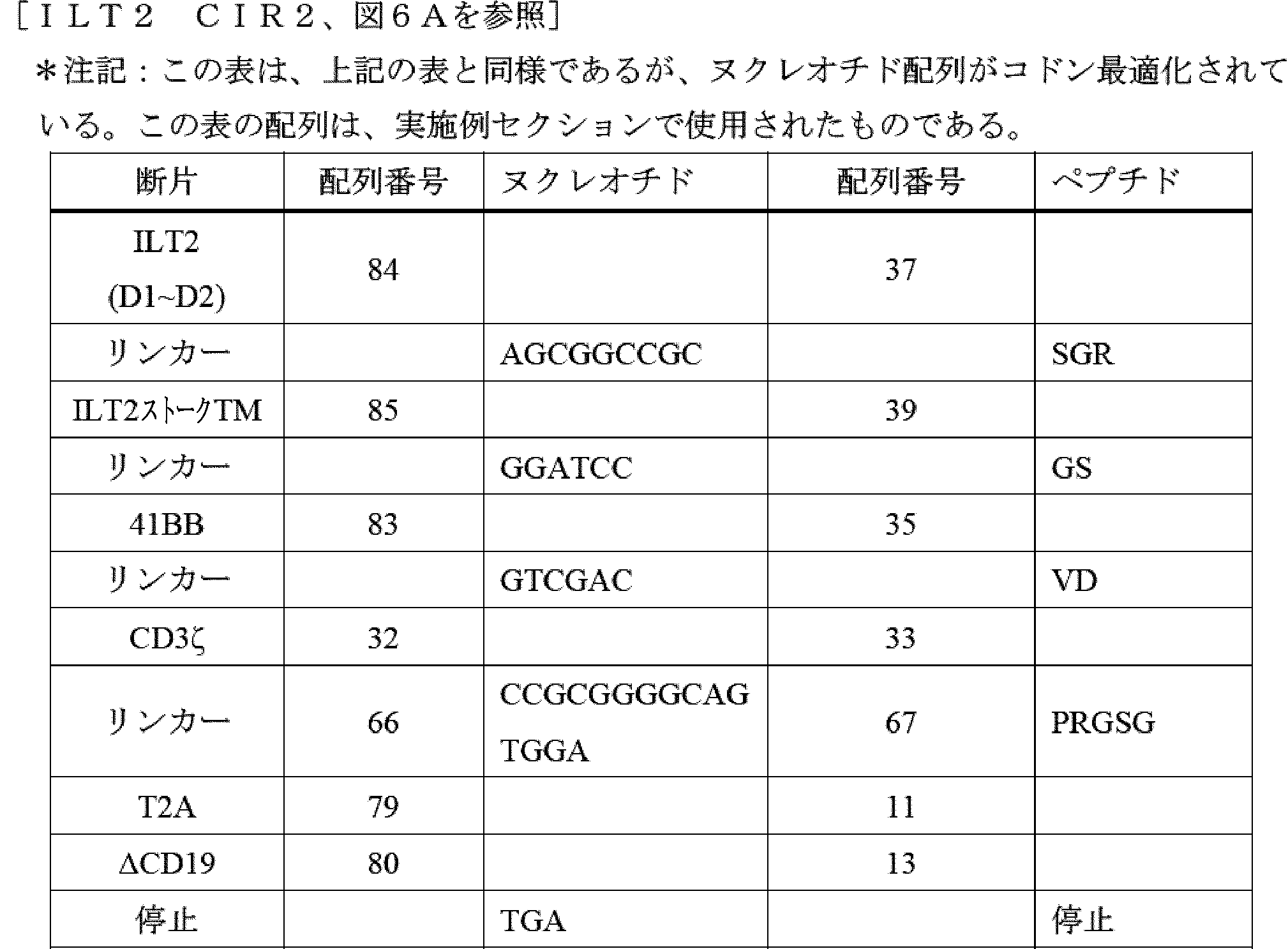
(表17)プラスミド0:pNT-114 SFG-ILT2D1D2.Q.8STM.BB.ζ-T2A-ΔCD19
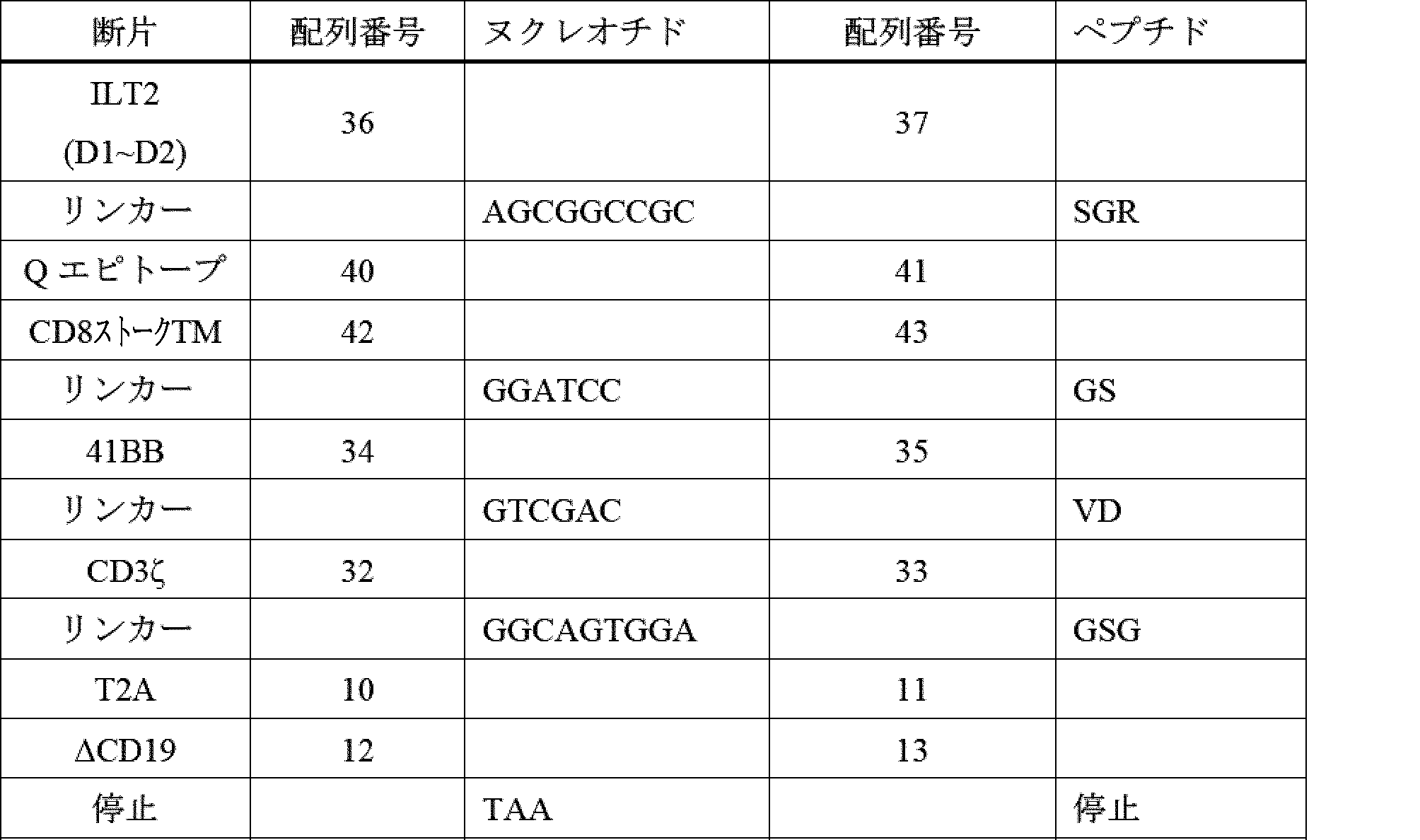
(表18)プラスミドP:pNT-115 SFG-ILT2D1D2.Q.28STM.CD28.ζ-T2A-ΔCD19
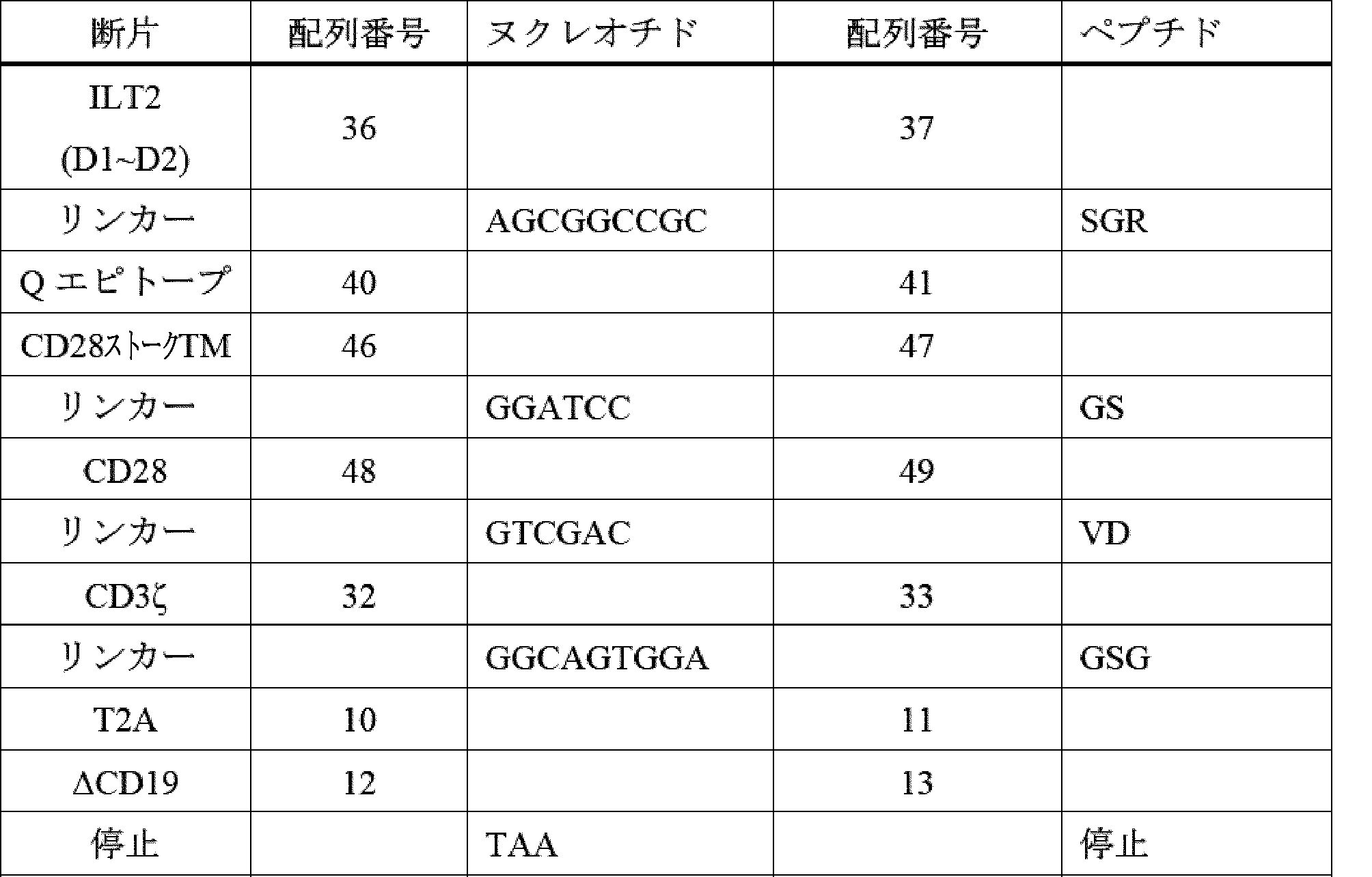
(表19)プラスミドR:pNT-116 SFG-ILT2D1D2.Q.CH2CH3.8TM.BB.ζ-T2A-ΔCD19

(表20A)プラスミドS:pNT-117 SFG-ILT2D1D2.CD8STM.BB.ζ-T2A-ΔCD19
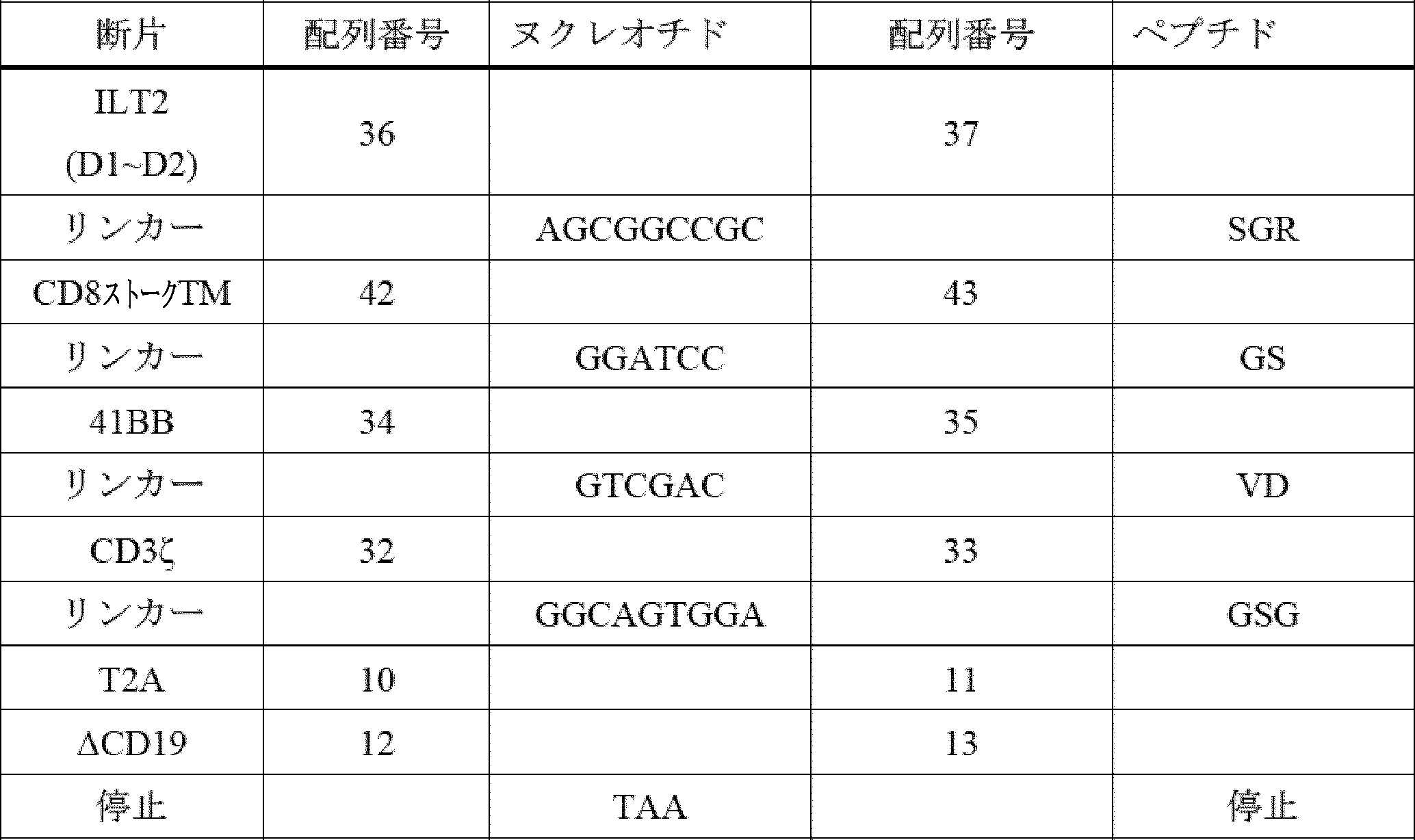
(表20B)プラスミドS:pNT-117 SFG-ILT2D1D2.CD8STM.BB.ζ-T2A-ΔCD19
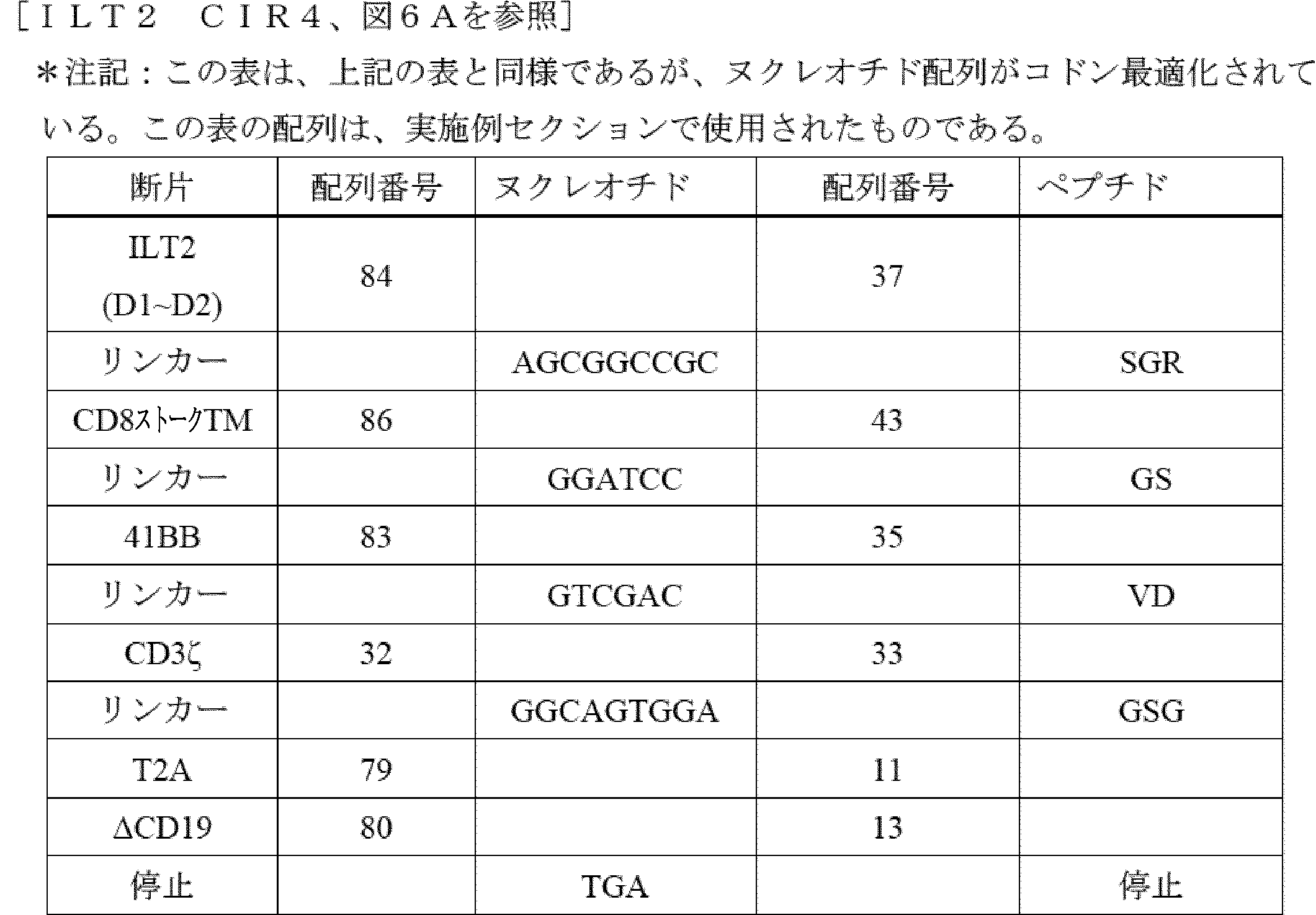
(表21A)プラスミドT:pNT-118 SFG-ILT4-T2A-ΔCD19
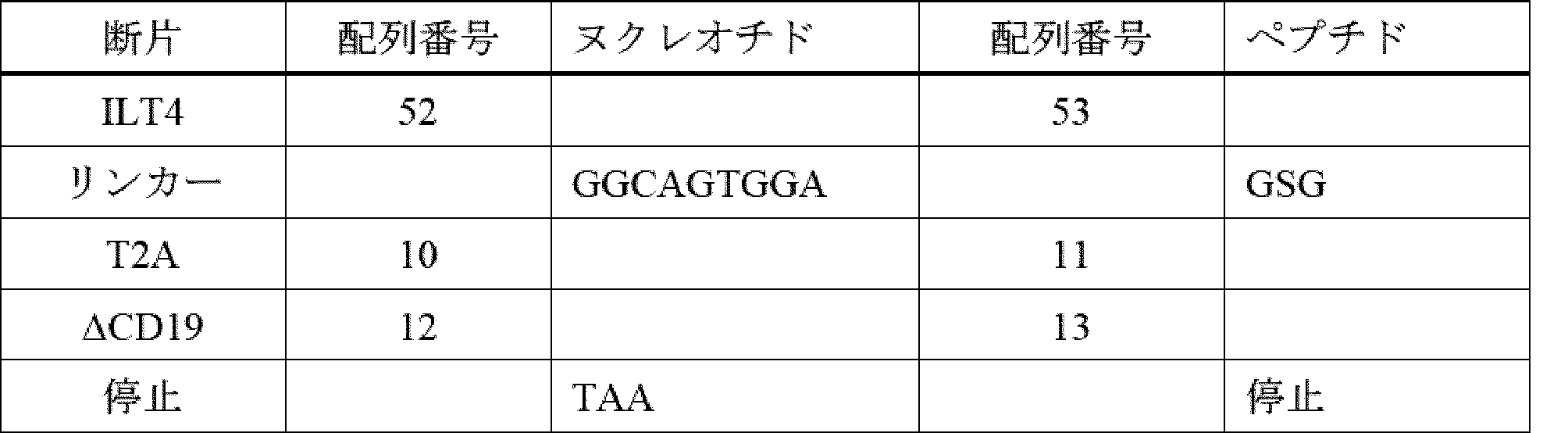
(表21B)プラスミドT:pNT-118 SFG-ILT4-T2A-ΔCD19
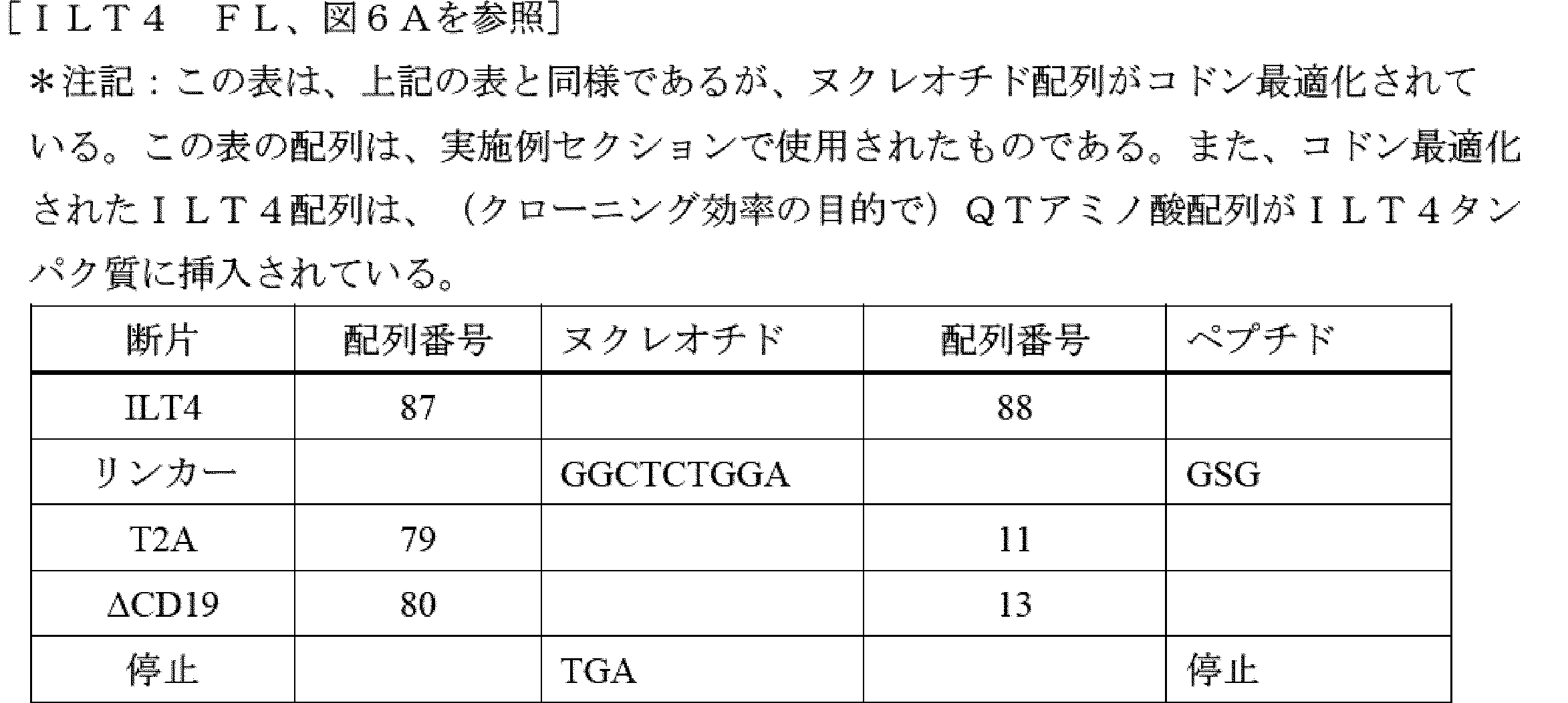
(表22)プラスミドU:pNT-119 SFG-ILT4.ζ-T2A-ΔCD19

(表23A)プラスミドV:pNT-120 SFG-ILT4.BB.ζ-T2A-ΔCD19

(表23B)プラスミドV:pNT-120 SFG-ILT4.BB.ζ-T2A-ΔCD19

(表24A)プラスミドW:pNT-121 SFG-ILT4D1D2STM.BB.ζ-T2A-ΔCD19
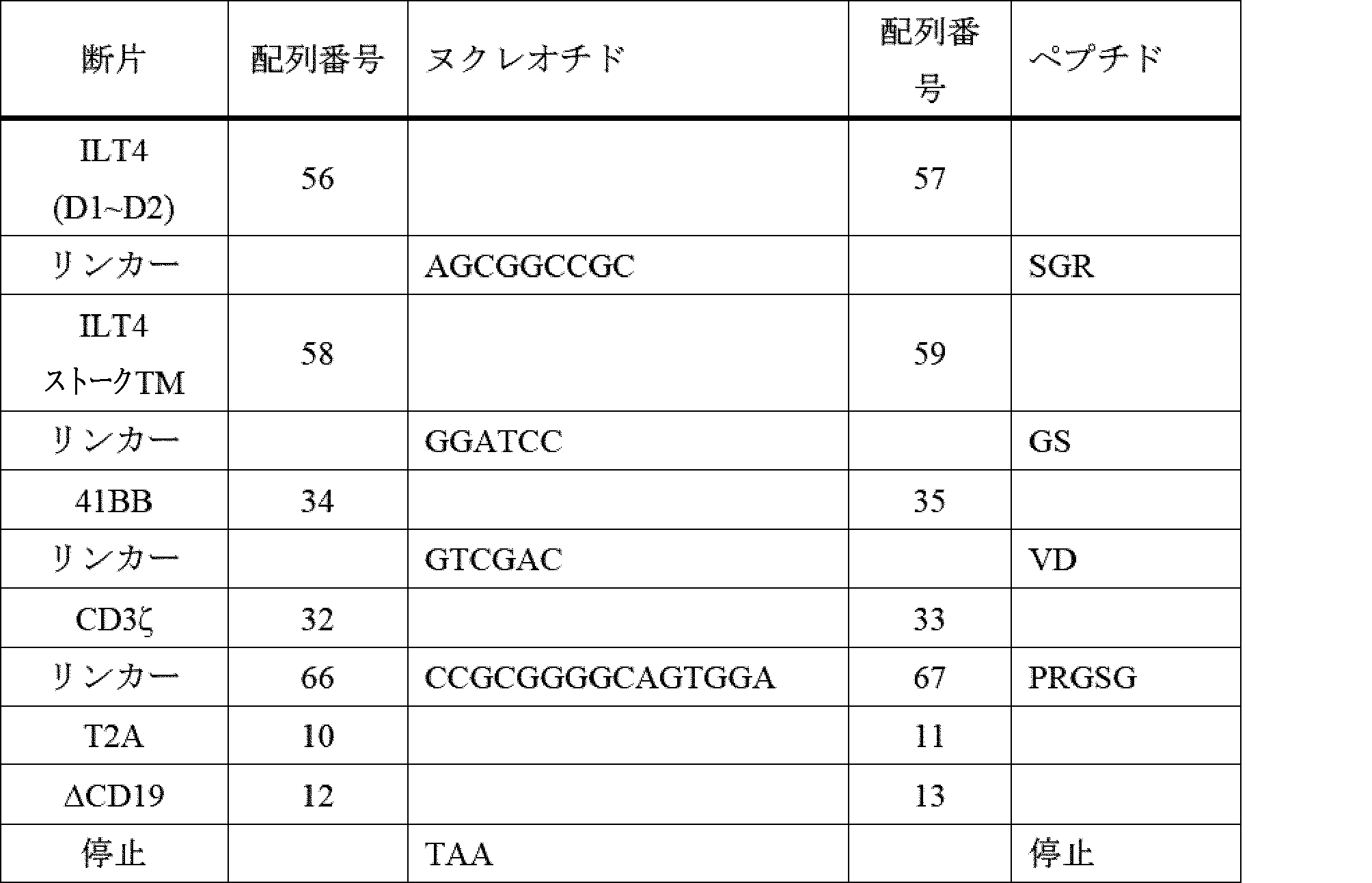
(表24B)プラスミドW:pNT-121 SFG-ILT4D1D2STM.BB.ζ-T2A-ΔCD19
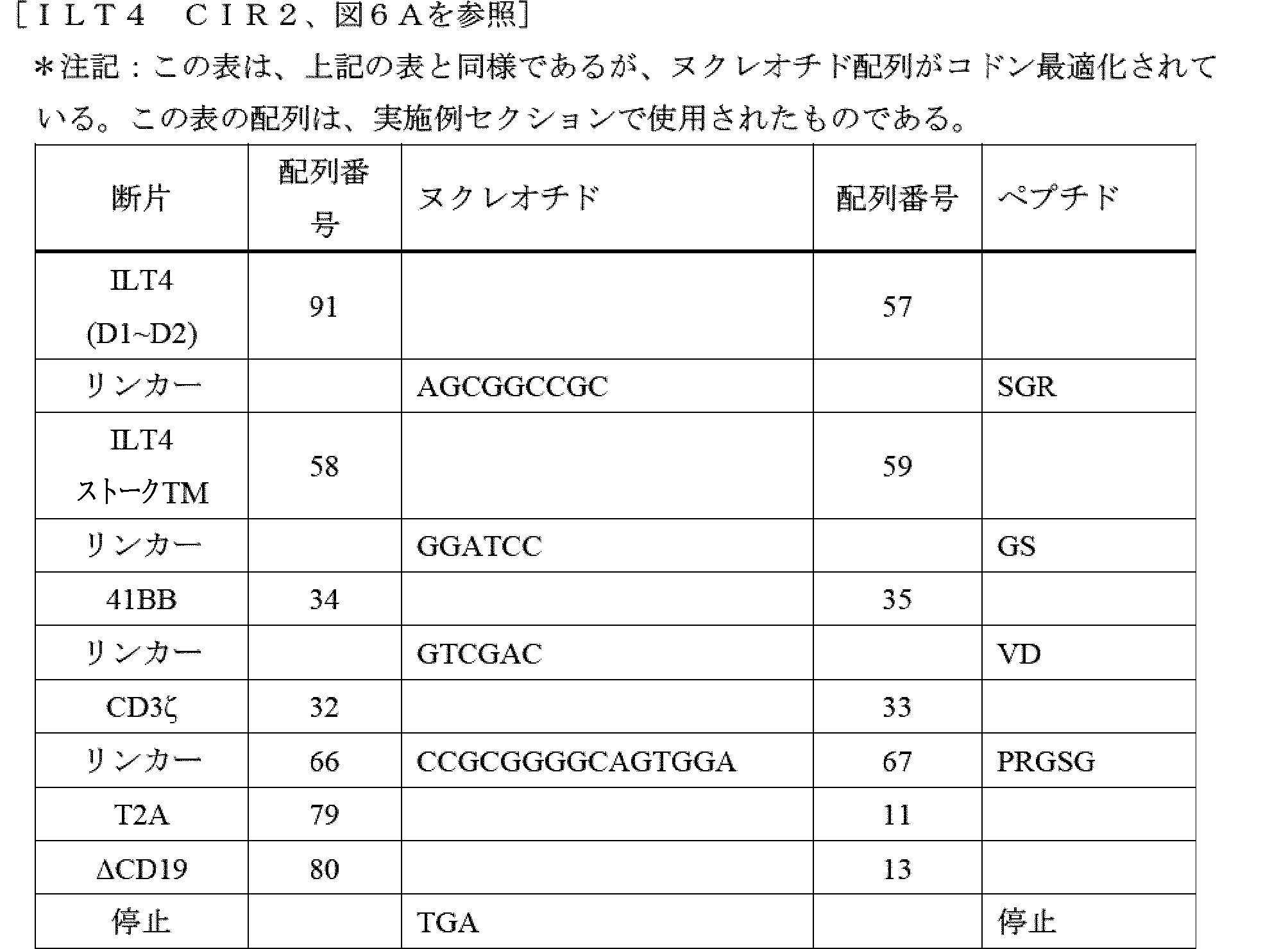
(表25)プラスミドX:pNT-122 SFG-ILT4D1D2.Q.8STM.BB.ζ-T2A-ΔCD19
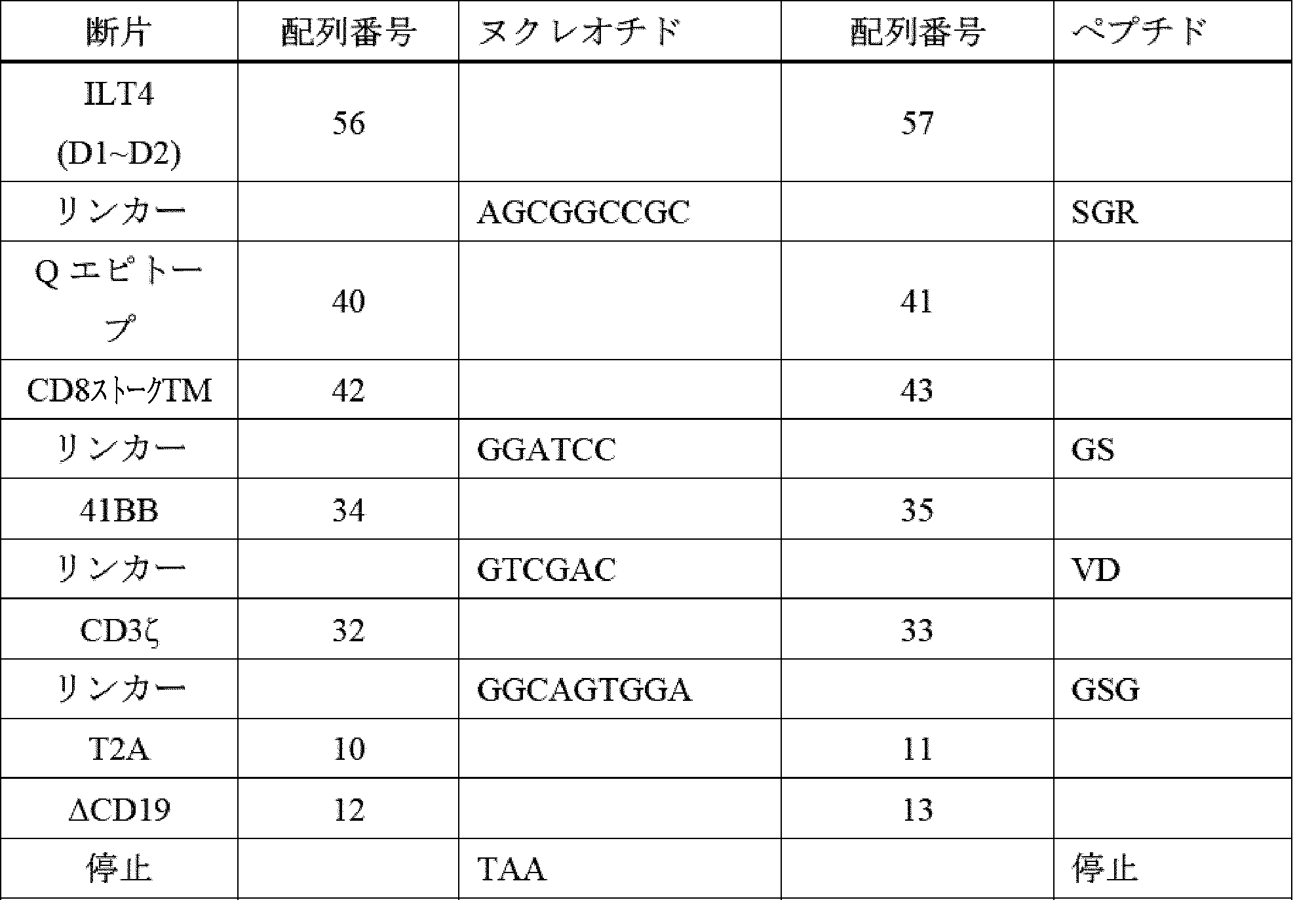
(表26)プラスミドY:pNT-123 SFG-ILT4D1D2.Q.28STM.CD28.ζ-T2A-ΔCD19
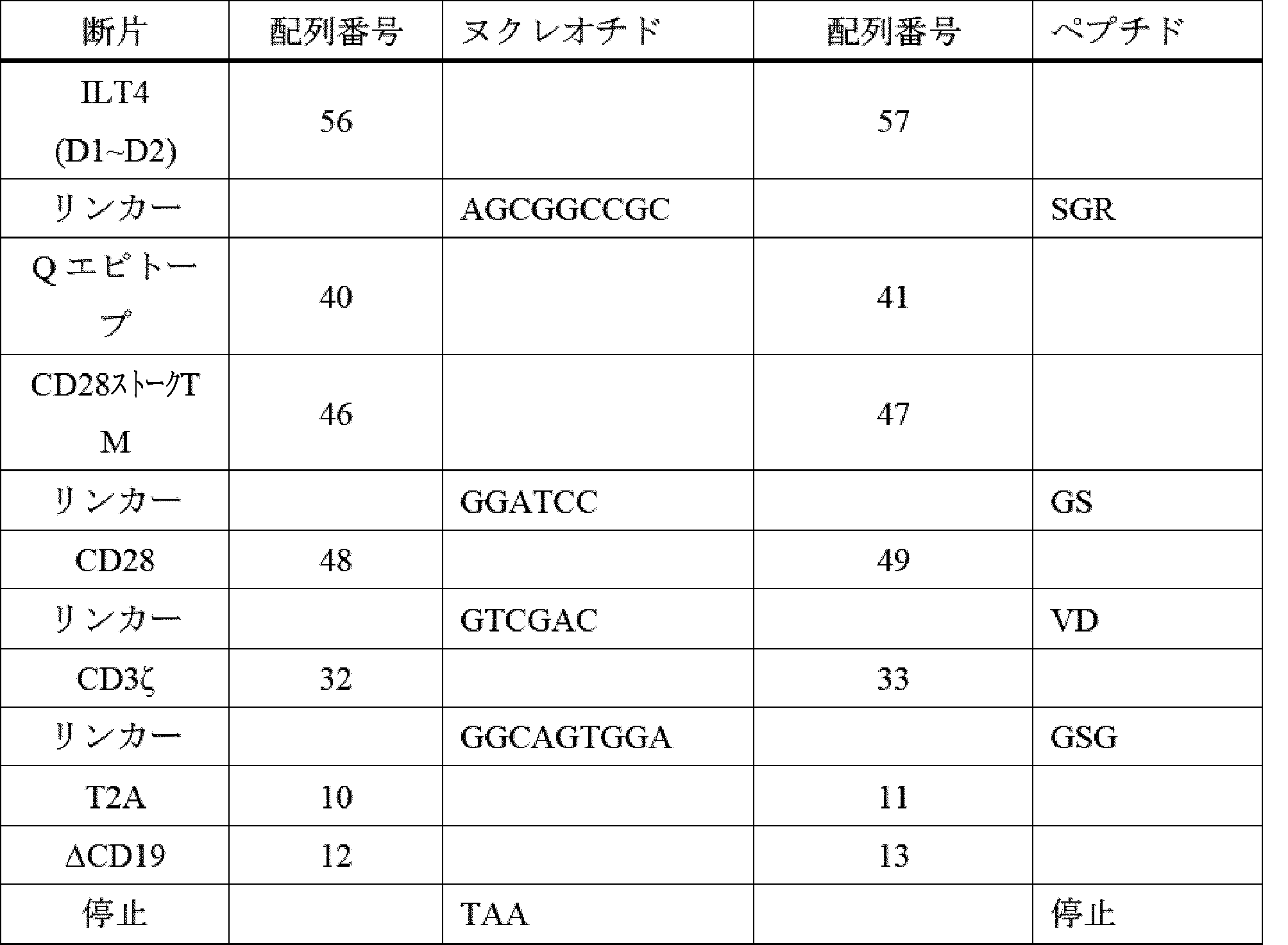
(表27)プラスミドZ:pNT-124 SFG-ILT4D1D2.Q.CH2CH3.8TM.BB.ζ-T2A-ΔCD19
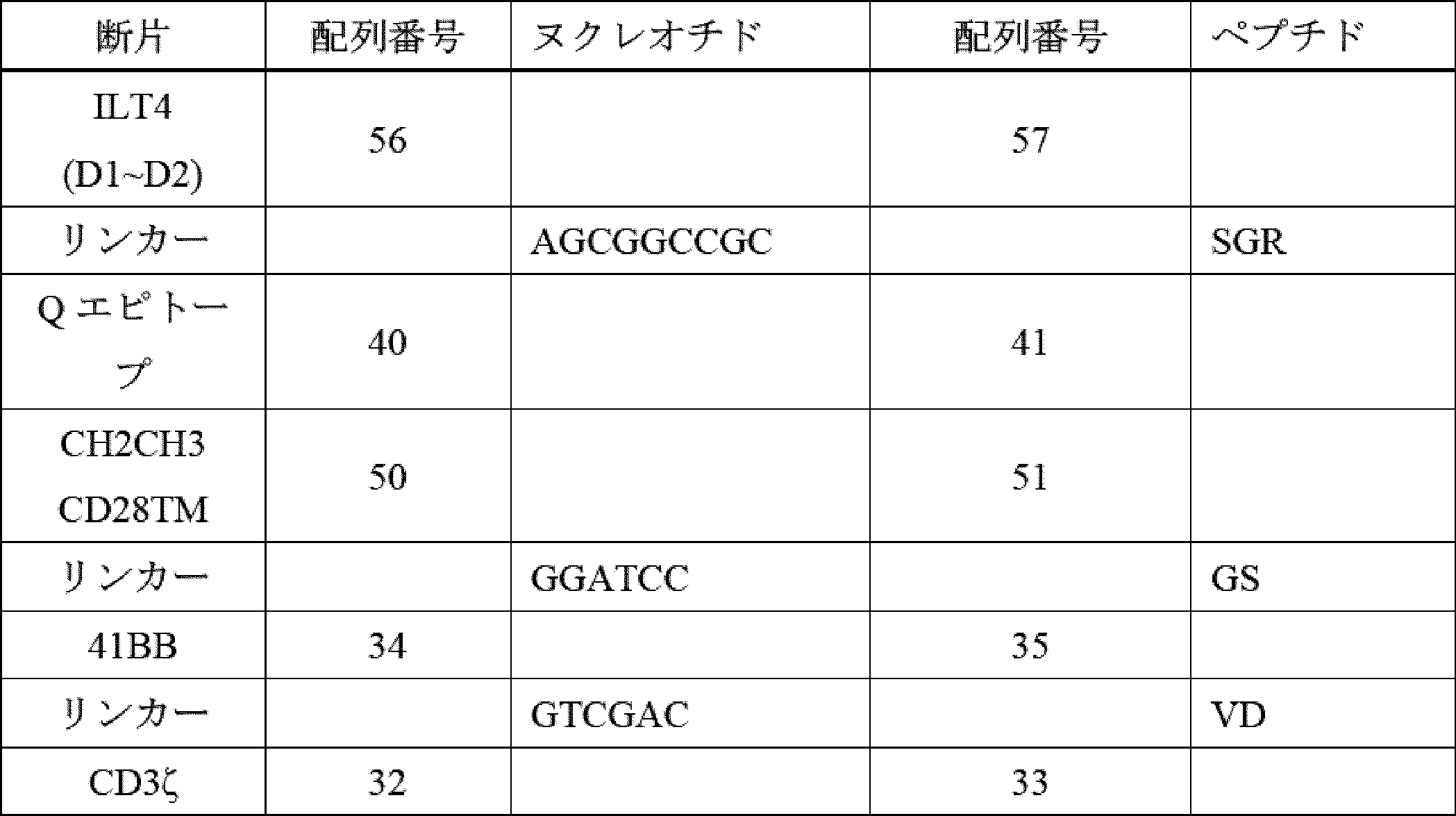
(表28A)プラスミドAA:pNT-124 SFG-ILT4D1D2.CD8STM.BB.ζ-T2A-ΔCD19

(表28B)プラスミドAA:pNT-124 SFG-ILT4D1D2.CD8STM.BB.ζ-T2A-ΔCD19
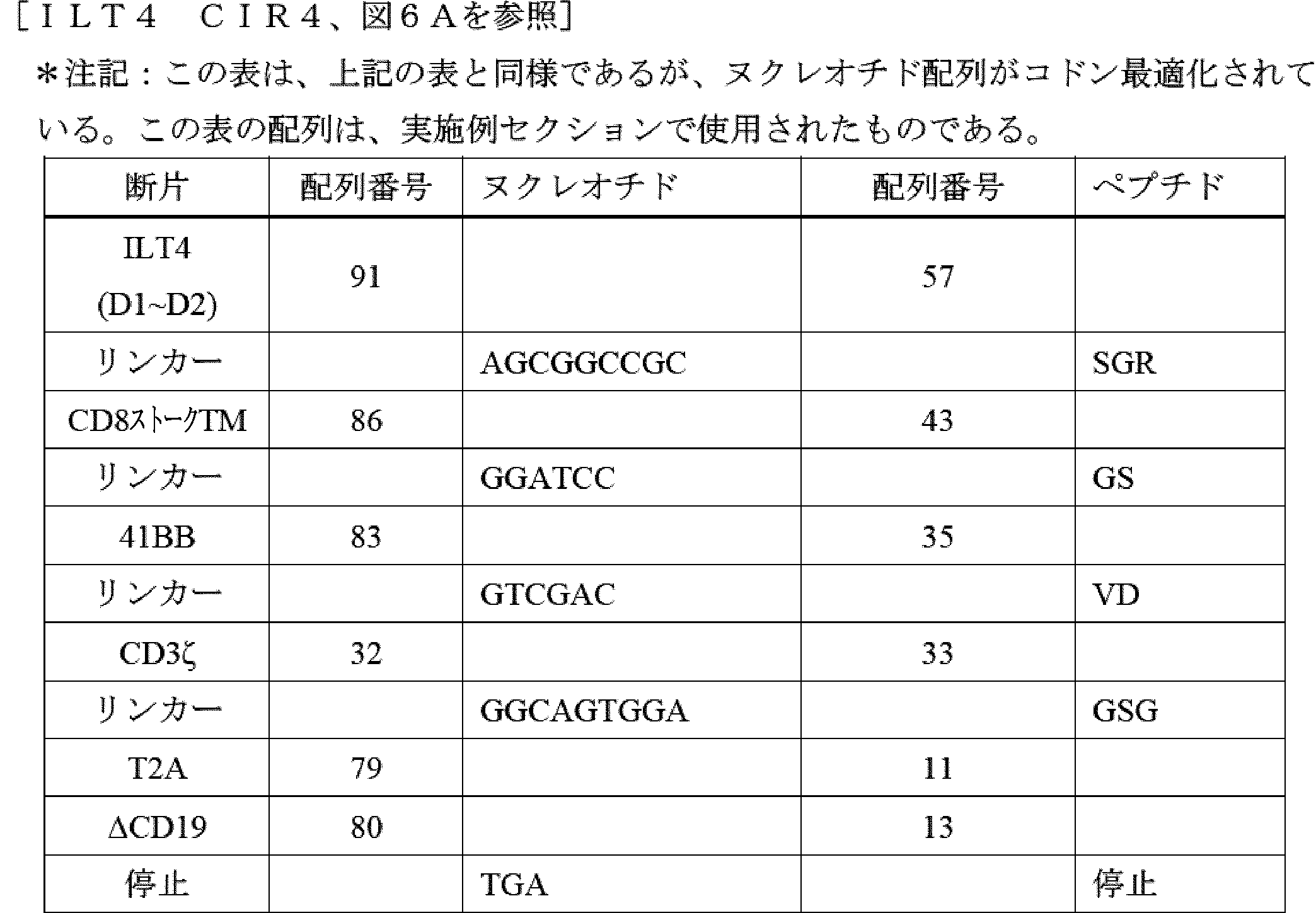
(表29)プラスミドU:pNT-119 SFG-ILT4Y394A.ζ-T2A-ΔCD19

(表30)プラスミドAC:pNT-126 SFG-ILT4Y394A.BB.ζ-T2A-ΔCD19

(表31)プラスミドAD:pNT-128 SFG-ILT4D1D2Y96A.STM.BB.ζ-T2A-ΔCD19

(表32)プラスミドAE:pNT-129 SFG-ILT4D1D2Y96A.Q.8STM.BB.ζ-T2A-ΔCD19

(表33)プラスミドAF:pNT-130 SFG-ILT4D1D2Y96A.Q.28STM.CD28.ζ-T2A-ΔCD19
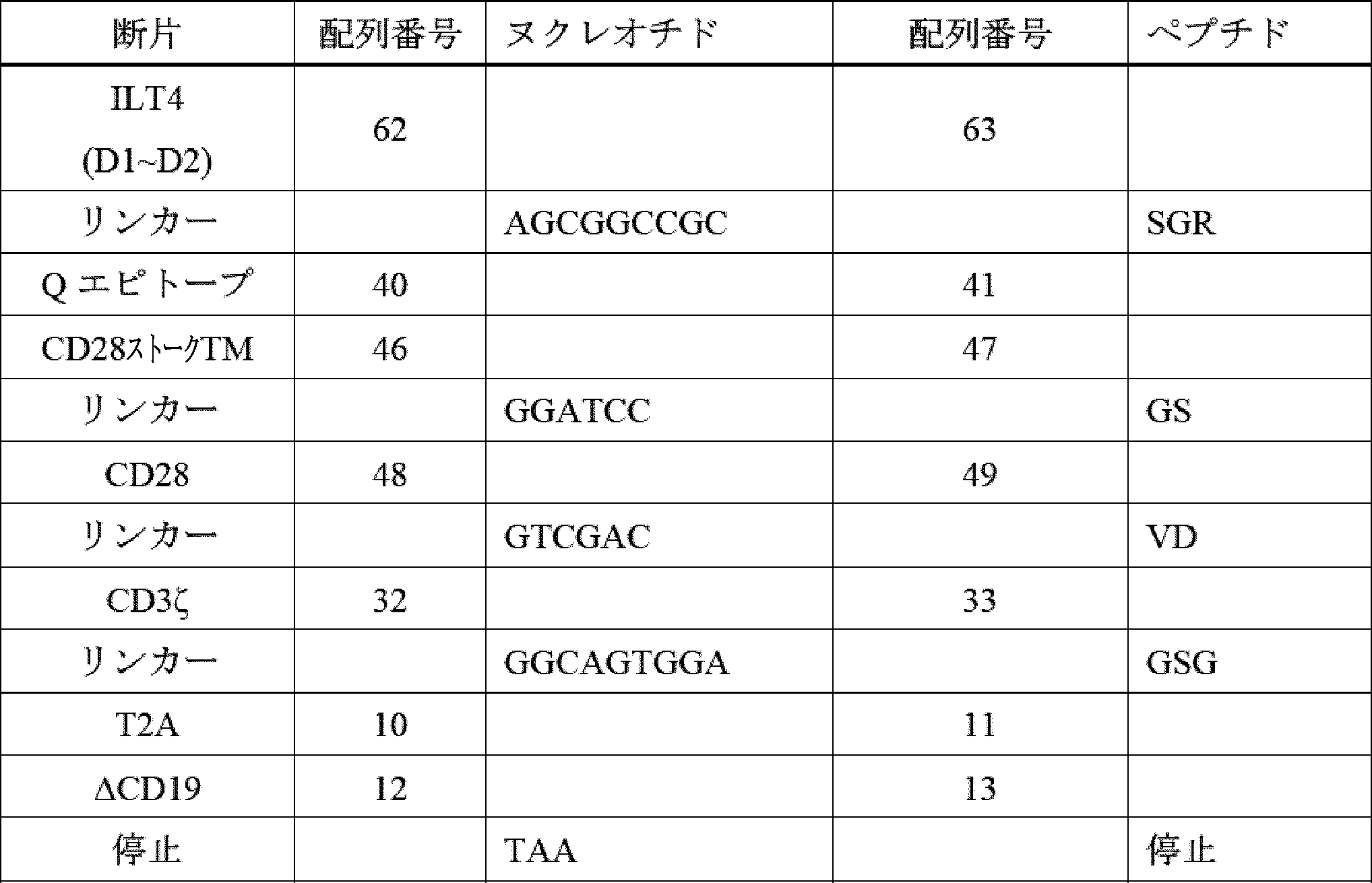
(表34)プラスミドAG:pNT-131 SFG-ILT4D1D2Y96A.Q.CH2CH3.8TM.BB.ζ-T2A-ΔCD19
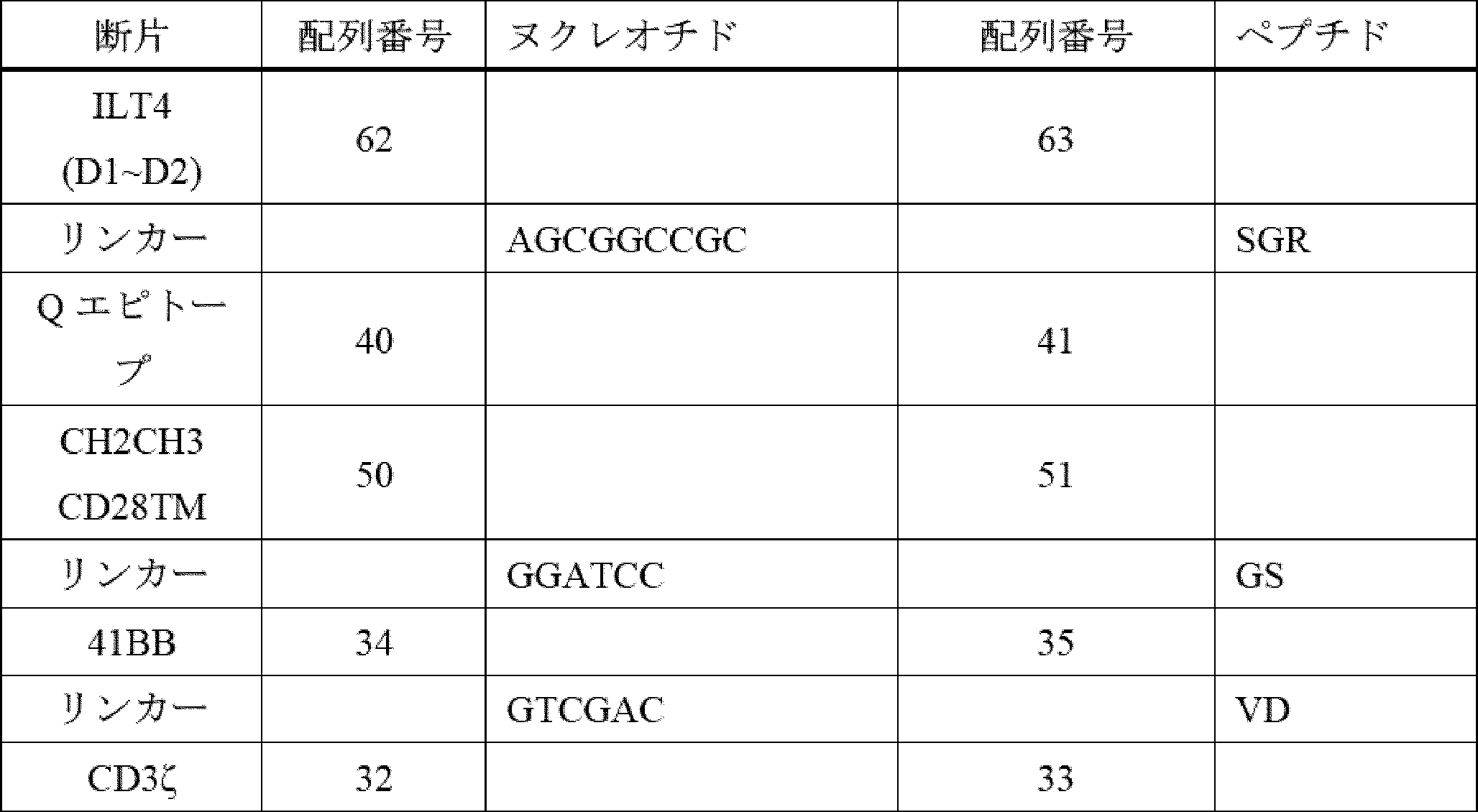
(表35)プラスミドAH:pNT-132 SFG-ILT4D1D2Y96A.CD8STM.BB.ζ-T2A-ΔCD19
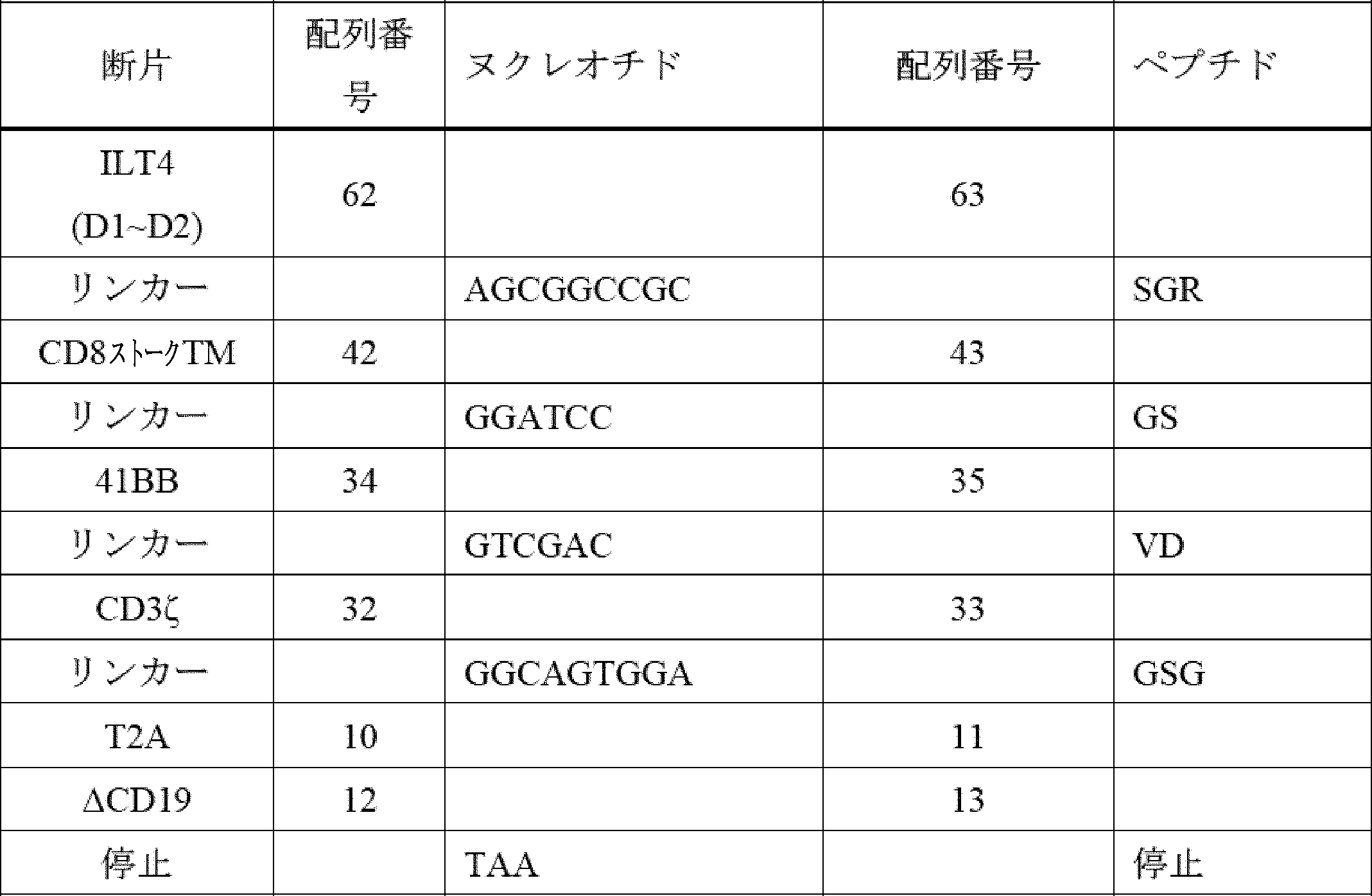
(表36)pNT133-pSFG-ILT2(D1-D4).CD8ストークTM.BB.z.T2A-dCD19

(表37)pNT134-pSFG-ILT4(D1-D4).CD8ストークTM.BB.z.T2A-dCD19

(表38)pNT138 SFG-ILT4(D1-D2).CH2CH3(4-2NQ).CD8TM.BB.z.T2A-dCD19
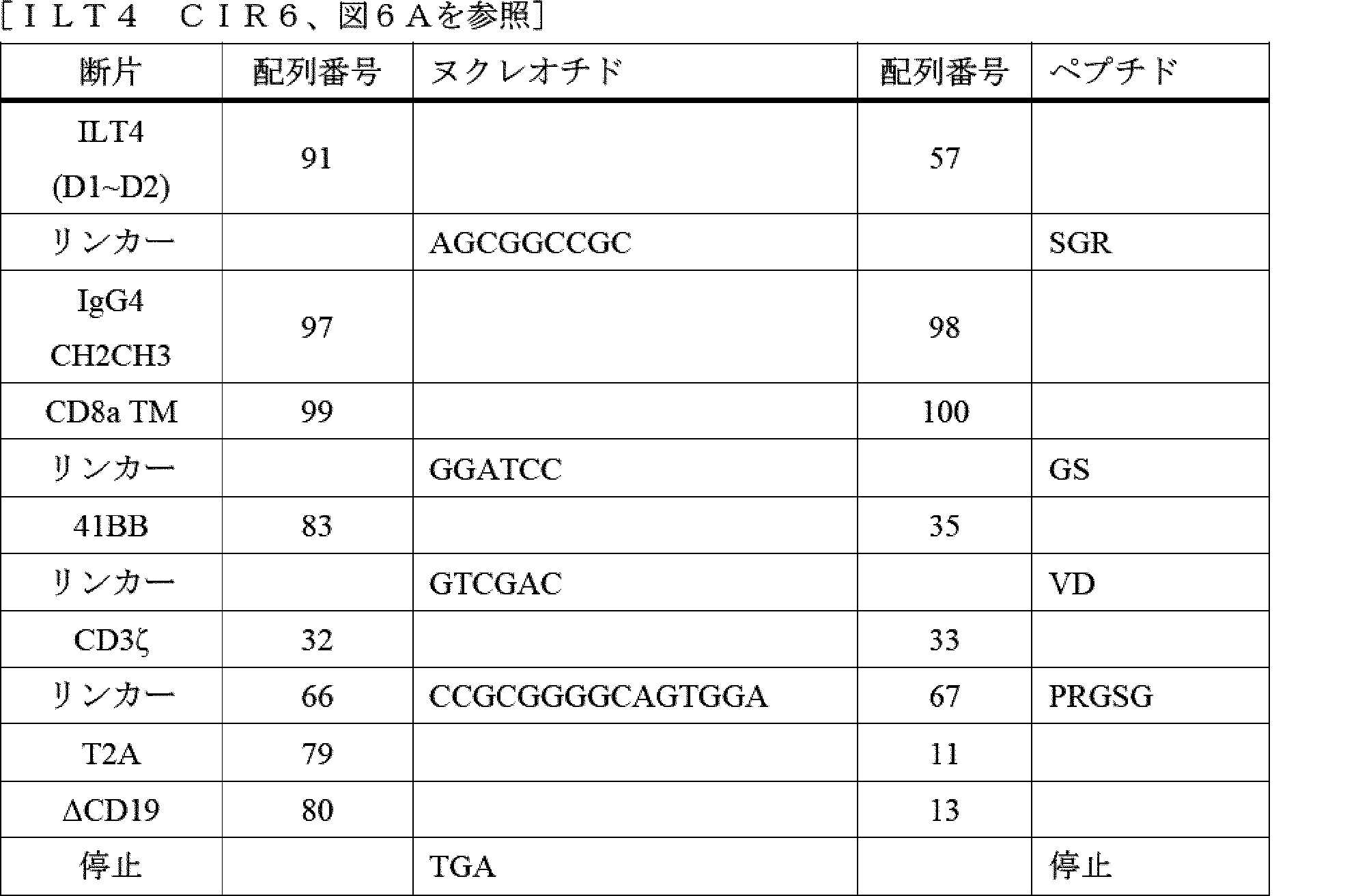
(表39)pNT139 SFG- ILT4(D1-D2).CH3.CD8tm.BB.z.T2A-dCD19
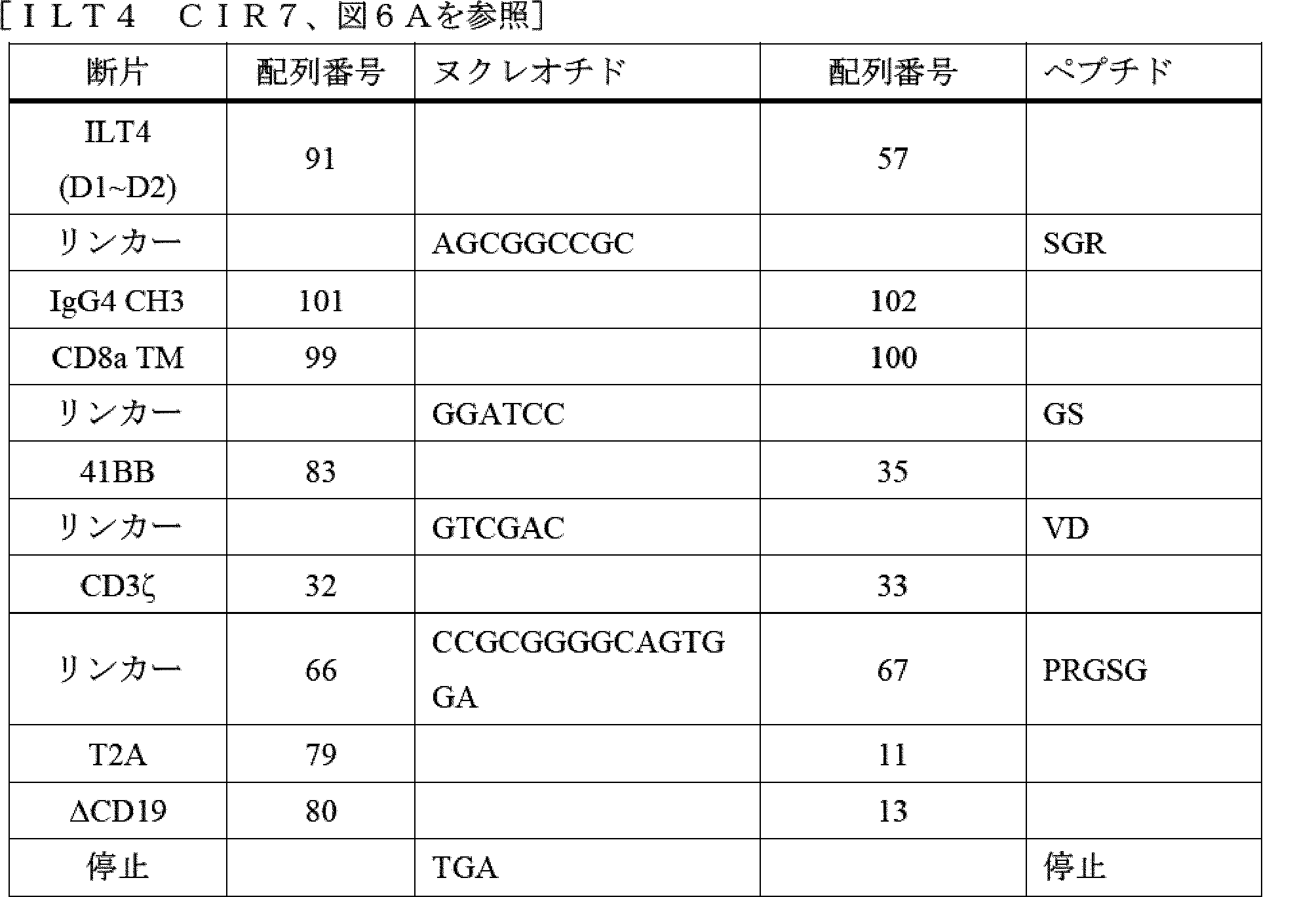
(表40)pNT-159 SFG-ILT4(D1-D2).CH2CH3(4-2NQ)s.CD28tm.BB.z.T2A-dCD19
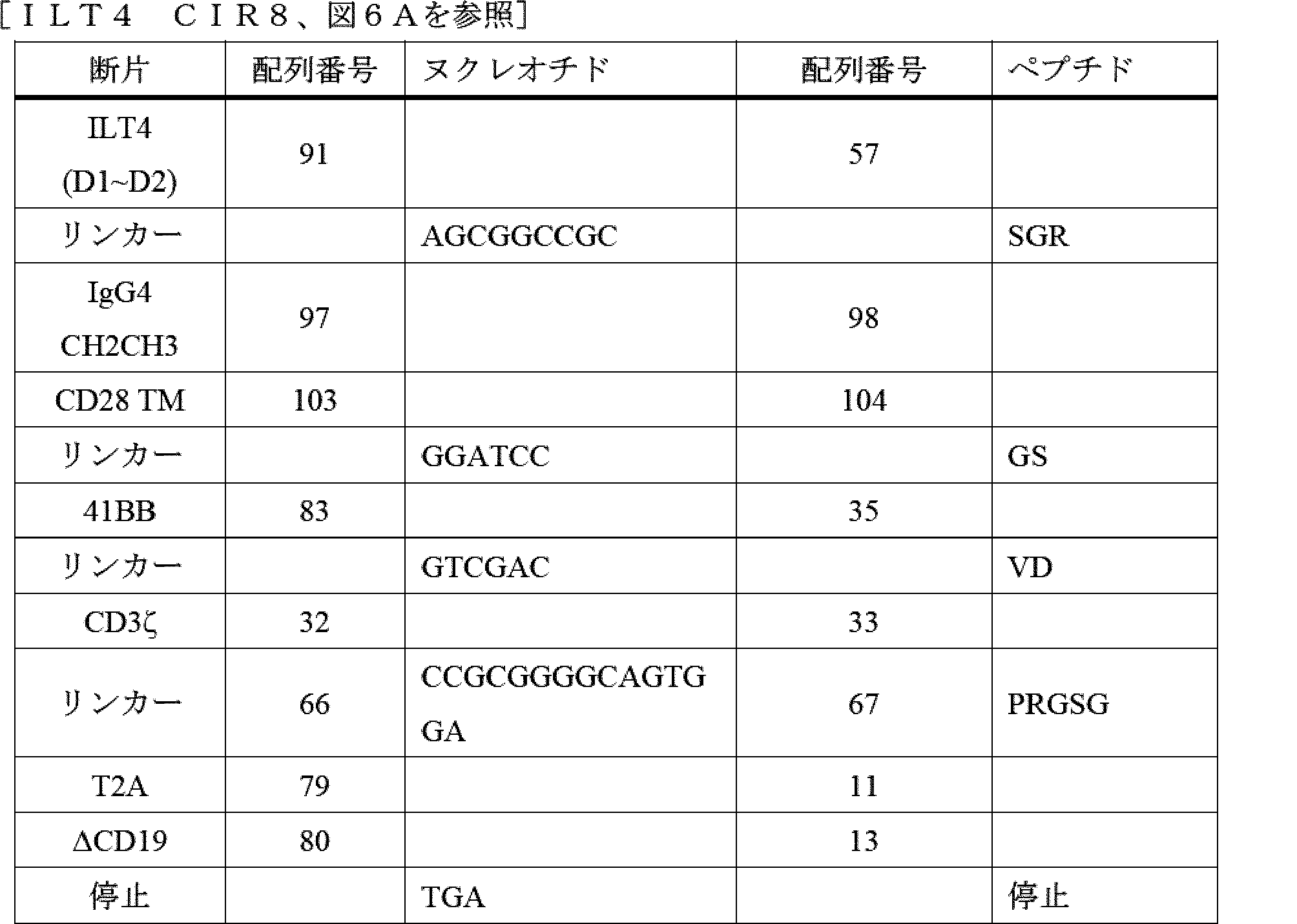
(表41)pNT-160 SFG-ILT4(D1-D2).CH3s.CD28tm.BB.z.T2A-dCD19
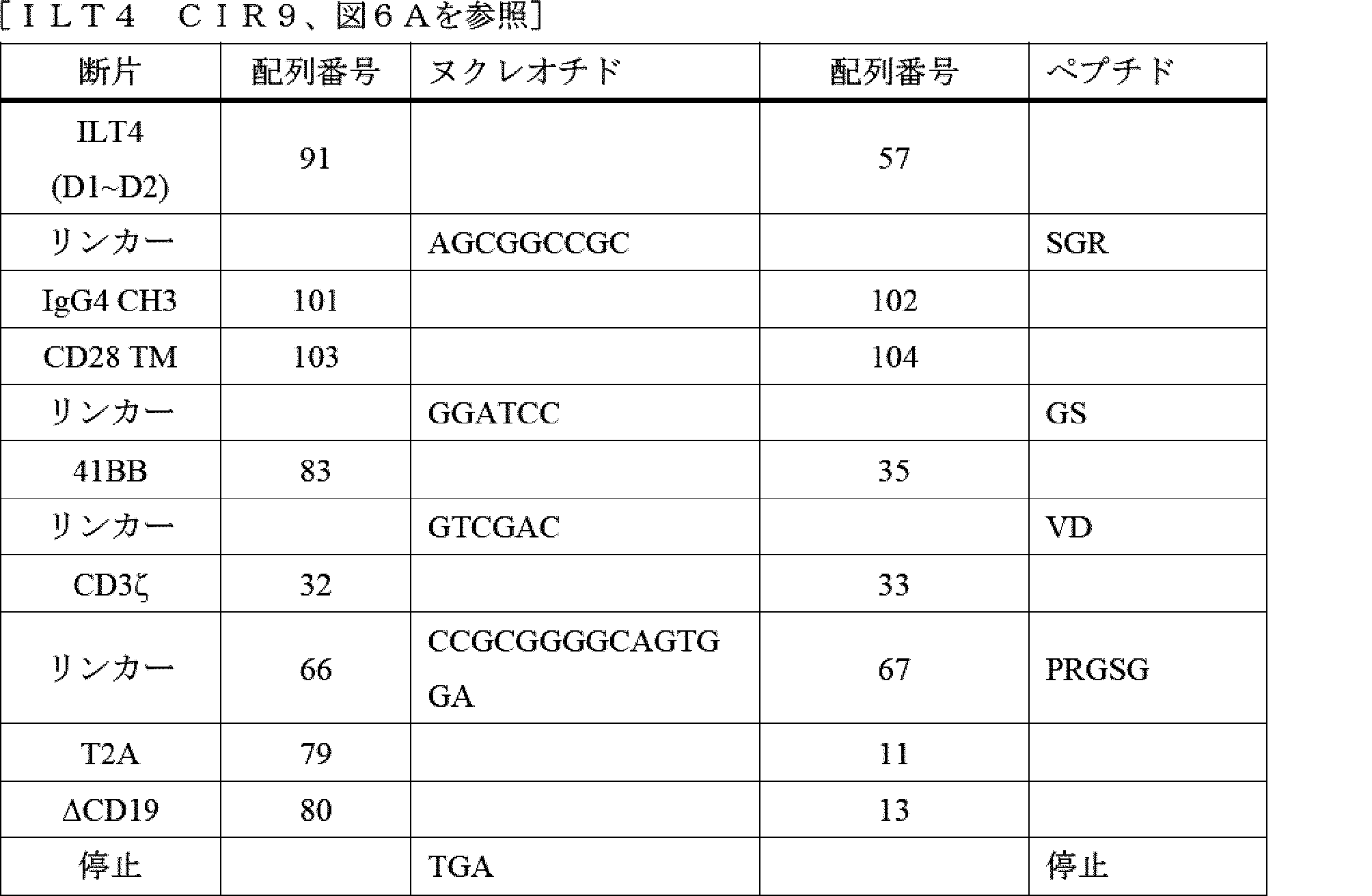
(表42)pNT-158 SFG- ILT4(D1-D2).CD28s.CD28tm.BB.z.T2A-dCD19

本開示の例示的な非限定的な態様
上記の本主題の実施形態を含む態様は、単独で、又は1つ以上の他の態様若しくは実施形態との組み合わせで有益であり得る。上記の説明を限定することなく、本開示のある特定の非限定的な態様を以下に提供する(セットA及びセットBを参照)。本開示を読んだ際に当業者に明らかになるように、個々に番号付けされた態様の各々は、それに先行するか又はそれに続く個々に番号付けされた態様のうちのいずれかとともに使用又は組み合わされ得る。これは、態様の全てのそのような組み合わせの支持を提供することを意図しており、以下に明示的に提供される態様の組み合わせには限定されない。本発明の趣旨又は範囲から逸脱することなく、様々な変更及び修正が行われ得ることは、当業者には明白であろう。
セットA
1.遺伝子改変細胞が、抗体、VhHドメイン、又は合成的に誘導されたポリペプチドに由来しない結合ドメインを有するタンパク質又は炭水化物を特異的に標的にするキメラ受容体タンパク質を発現する、組成物。
2.キメラ受容体タンパク質が、抗体、VhHドメイン、又は合成的に誘導されたポリペプチドに由来しないHLA-Gを標的にする認識ドメイン又は結合ドメインを用いる、1に記載の組成物。
3.キメラ受容体タンパク質が、それらの生物学的作用機序の一部として、HLA-Gを含む標的タンパク質を天然に認識するヒト受容体タンパク質を用いる、1又は2に記載の組成物。
4.キメラ受容体タンパク質が、ヒト又はサル配列に由来するILT2を用いる、3に記載の組成物。
5.キメラ受容体タンパク質が、ヒト又はサル配列に由来するILT4を用いる、3に記載の組成物。
6.キメラ受容体タンパク質が、ヒト又はサル配列に由来するILT2の天然多型形態を用いる、4に記載の組成物。
7.キメラ受容体タンパク質が、ヒト又はサル配列に由来するILT4の天然多型形態を用いる、5に記載の組成物。
8.キメラ受容体タンパク質が、ILT2に由来するD1及びD2ドメインを用いる、4及び6に記載の組成物。
9.キメラ受容体タンパク質が、ILT4に由来するD1及びD2ドメインを用いる、5及び7に記載の組成物。
10.ILT2又はILT4のD1又はD2ドメインが、HLA-G以外のタンパク質の親和性を低減しながら、キメラ受容体の活性化に十分なHLA-Gに対する親和性を保持する目的で、代替アミノ酸をコードするように変異導入される、先行項目のいずれか一項に記載の組成物。
11.変異が、ILT4におけるアミノ酸96又は394に対応する位置にアミノ酸置換を生成する、10に記載の組成物。
12.遺伝子改変細胞が、安全スイッチを更に発現する、先行請求項のいずれか一項に記載の組成物。
13.安全スイッチが、誘導性である、12に記載の組成物。
14.安全スイッチが、リミドゥシドによって、又はラパマイシン若しくはラパマイシンの類似体によって誘発される、12に記載の組成物。
15.遺伝子改変細胞が、第2のキメラ抗原受容体を更に発現する、先行請求項のいずれか一項に記載の組成物。
16.遺伝子改変細胞が、1~11のいずれか1つに記載の組成物を有する融合要素として、NK細胞又はT細胞に対する細胞傷害性の活性化を駆動する細胞質シグナル伝達ドメインを更に発現する、1~11のいずれかに記載の組成物。
17.融合された細胞傷害性シグナル伝達要素が、ITAM配列を含む、16に記載の組成物。
18.融合されたシグナル伝達要素が、CD3ζ、DAP10、又はDAP12に由来する、16又は17に記載の組成物。
19.遺伝子改変細胞が、キメラ受容体の一部として共刺激ポリペプチドを更に発現する、先行請求項のいずれか一項に記載の組成物。
20.遺伝子改変細胞が、キメラ受容体タンパク質から分離された単位として共刺激ポリペプチドを更に発現する、先行請求項のいずれか一項に記載の組成物。
21.共刺激ポリペプチドが、4-1BB、OX40、ICOS、CD28、CD27、MyD88、IL-1Rα、HVEM、TRANCE、IL-1Rβ、CD70、IL-18Rα、CD40、IL-18Rβ、IL-33Rα、CD30、又はIL-33Rβに由来するシグナル伝達要素を含む、19及び20に記載の組成物。
22.遺伝子改変細胞が、(i)T細胞、(ii)NK細胞、(iii)iNKT細胞、又は(iv)マクロファージである、先行請求項のいずれか一項に記載の組成物。
23.ヒト対象を治療する方法であって、先行請求項のいずれか一項に記載の組成物を患者に投与することを含む、方法。
24.ヒト対象を治療する方法であって、対象ががん患者である場合、任意の先行項目に記載の組成物を患者に投与することを含む、方法。
25.1~21のいずれか1つに記載のキメラ受容体タンパク質をコードするポリヌクレオチドを含む、発現構築物。
26.レトロウイルスベクター、レンチウイルスベクター、又はプラスミドベクターである、25に記載の発現構築物を含む、ベクター。
セットB
1.
(a)HLA-Gを標的とし、免疫グルリン様転写産物2(ILT2)又は免疫グルリン様転写産物4(ILT4)のD1~D2細胞外ドメインを含む、ターゲティング領域と、
(b)膜貫通アミノ酸配列を含む、膜貫通(TM)領域と、
(c)HLA-Gへの当該ターゲティング領域の結合により免疫エフェクター細胞の内部にシグナルを伝達してエフェクター細胞の機能を誘発することができるシグナル伝達領域を含む、細胞内ドメイン(ICD)と
を含む、キメラ受容体タンパク質。
2.ターゲティング領域が、配列番号57に示されるILT4アミノ酸配列のY96又は配列番号31に示されるILT2アミノ酸配列のY96に対応する位置にアミノ酸変異を含む、1に記載のキメラ受容体タンパク質。
3.D1~D2細胞外ドメインが、ILT2 D1~D2細胞外ドメインである、1又は2に記載のキメラ受容体タンパク質。
4.D1~D2細胞外ドメインが、ILT4 D1~D2細胞外ドメインである、1又は2に記載のキメラ受容体タンパク質。
5.ターゲティング領域が、ILT2又はILT4のD3~D4細胞外ドメインを含む、1~4のいずれか1つに記載のキメラ受容体タンパク質。
6.ターゲティング領域が、配列番号55に示されるILT4アミノ酸配列のY394又は配列番号31に示されるILT2アミノ酸配列のY395に対応する位置にアミノ酸変異を含む、5に記載のキメラ受容体タンパク質。
7.ターゲティング領域が、ILT2又はILT4 D3~D4細胞外ドメインを欠く、1~4のいずれか1つに記載のキメラ受容体タンパク質。
8.ストークドメインを含む、5に記載のキメラ受容体タンパク質。
9.ストークドメインが、ILT2、ILT4、CD28、CH2/CH3、CH3、又はCD8ストークドメインを含む、8に記載のキメラ受容体タンパク質。
10.TMドメインが、ILT2、ILT4、CD28、又はCD8 TMドメインである、1~9のいずれか1つに記載のキメラ受容体タンパク質。
11.当該シグナル伝達領域が、免疫受容体チロシンベースの活性化モチーフ(ITAM)を含む、1~10のいずれか1つに記載のキメラ受容体タンパク質。
12.当該シグナル伝達領域が、CD3ζシグナル伝達ドメイン、DAP10シグナル伝達ドメイン、DAP12シグナル伝達ドメイン、又はそれらの任意の組み合わせを含む、1~10のいずれか1つに記載のキメラ受容体タンパク質。
13.当該シグナル伝達領域が、CD3ζシグナル伝達ドメインを含む、1~10のいずれか1つに記載のキメラ受容体タンパク質。
14.ICDが、少なくとも1つの共刺激ドメインを含む共刺激領域を更に含む、1~13のいずれか1つに記載のキメラ受容体タンパク質。
15.当該少なくとも1つの共刺激ドメインが、CD28共刺激ドメインを含む、14に記載のキメラ受容体タンパク質。
16.当該少なくとも1つの共刺激ドメインが、4-1BB共刺激ドメインを含む、14又は15に記載のキメラ受容体タンパク質。
17.当該少なくとも1つの共刺激ドメインが、4-1BB、OX40、CD28、ICOS、RANK、DAP10、DAP12、CD27、MyD88、IL-1Rα、HVEM、TRANCE、IL-1Rβ、CD70、IL-18Rα、CD40、IL-18Rβ、IL-33Rα、CD30、若しくはIL-33Rβ共刺激ドメイン、又はそれらの任意の組み合わせを含む、14に記載のキメラ受容体タンパク質。
18.
D1~D2細胞外ドメインが、ILT2 D1~D2細胞外ドメインであり、
細胞外ドメインが、ILT2 D3~D4細胞外ドメインを欠き、
キメラ受容体タンパク質が、CD8ストークドメインを含み、
TM領域が、CD TMであり、
シグナル伝達領域が、CD3ζシグナル伝達ドメインを含み、
キメラ受容体タンパク質が、4-1BB共刺激ドメインを含む、
1に記載のキメラ受容体タンパク質。
19.
D1~D2細胞外ドメインが、ILT4 D1~D2細胞外ドメインであり、
細胞外ドメインが、ILT4 D3~D4細胞外ドメインを欠き、
キメラ受容体タンパク質が、CD8ストークドメインを含み、
TM領域が、CD TMであり、
シグナル伝達領域が、CD3ζシグナル伝達ドメインを含み、
キメラ受容体タンパク質が、4-1BB共刺激ドメインを含む、
1に記載のキメラ受容体タンパク質。
20.
D1~D2細胞外ドメインが、ILT2 D1~D2細胞外ドメインであり、
細胞外ドメインが、ILT2 D3~D4細胞外ドメインを含み、
キメラ受容体タンパク質が、CD8ストークドメインを含み、
TM領域が、CD TMであり、
シグナル伝達領域が、CD3ζシグナル伝達ドメインを含み、
キメラ受容体タンパク質が、4-1BB共刺激ドメインを含む、
1に記載のキメラ受容体タンパク質。
21.
D1~D2細胞外ドメインが、ILT4 D1~D2細胞外ドメインであり、
細胞外ドメインが、ILT4 D3~D4細胞外ドメインを含み、
キメラ受容体タンパク質が、CD8ストークドメインを含み、
TM領域が、CD TMであり、
シグナル伝達領域が、CD3ζシグナル伝達ドメインを含み、
キメラ受容体タンパク質が、4-1BB共刺激ドメインを含む、
1に記載のキメラ受容体タンパク質。
22.1~21のいずれか1つに記載のキメラ受容体タンパク質をコードするヌクレオチド配列を含む、核酸。
23.当該ヌクレオチド配列が、構成的プロモーターに作動可能に連結されている、22に記載の核酸。
24.当該ヌクレオチド配列が、誘導性プロモーターに作動可能に連結されている、22に記載の核酸。
25.発現ベクターである、22~24のいずれか1つに記載の核酸。
26.発現ベクターが、レトロウイルスベクター、レンチウイルスベクター、又はプラスミドベクターである、25に記載の核酸。
27.1~22のいずれか1つに記載のキメラ受容体タンパク質を発現する、遺伝子改変細胞。
28.免疫細胞である、27に記載の遺伝子改変細胞。
29.免疫細胞が、ナチュラルキラー(NK)細胞、T細胞、iNKT細胞、又はマクロファージである、28に記載の遺伝子改変細胞。
30.免疫細胞が、ナチュラルキラー(NK)細胞である、28に記載の遺伝子改変細胞。
31.免疫細胞が、T細胞である、28に記載のシステム。
32.安全スイッチを発現する、27~31のいずれか1つに記載の遺伝子改変細胞。
33.安全スイッチが、誘導性である、32に記載の遺伝子改変細胞。
34.安全スイッチが、リミドゥシドによって、又はラパマイシン若しくはラパマイシンの類似体によって誘発される、33に記載の遺伝子改変細胞。
35.キメラ抗原受容体を更に発現する、27~34のいずれか1つに記載の遺伝子改変細胞。
36.キメラ受容体タンパク質に融合されていない共刺激ポリペプチドを更に発現する、27~35のいずれか1つに記載の遺伝子改変細胞。
37.当該キメラ受容体タンパク質に融合されていない共刺激ポリペプチドが、4-1BB、OX40、CD28、ICOS、RANK、DAP10、DAP12、CD27、MyD88、IL-1Rα、HVEM、TRANCE、IL-1Rβ、CD70、IL-18Rα、CD40、IL-18Rβ、IL-33Rα、CD30、若しくはIL-33Rβ共刺激ドメイン、又はそれらの任意の組み合わせを含む、36に記載の遺伝子改変細胞。
38.27~37のいずれか1つに記載の遺伝子改変細胞を、必要のある個体に投与することを含む、治療方法。
39.遺伝子改変細胞が、個体に対して自己である、38に記載の方法。
40.遺伝子改変細胞が、個体に対して同種である、38に記載の方法。
41.個体が、がんを有する、38~40のいずれか1つに記載の方法。
42.個体が、固形腫瘍を有する、41に記載の方法。
43.遺伝子改変細胞を産生する方法であって、
22~26のいずれか1つに記載の核酸を細胞に導入し、それによって、遺伝子改変細胞を産生することを含む、方法。
44.遺伝子改変細胞が、免疫細胞である、43に記載の方法。
45.免疫細胞が、ナチュラルキラー(NK)細胞、T細胞、iNKT細胞、又はマクロファージである、44に記載の方法。
46.免疫細胞が、ナチュラルキラー(NK)細胞である、44に記載の方法。
47.免疫細胞が、T細胞である、44に記載の方法。
Exemplary non-limiting aspects of the present disclosure The aspects including the embodiments of the present subject matter described above may be useful alone or in combination with one or more other aspects or embodiments. Without limiting the above description, certain non-limiting aspects of the present disclosure are provided below (see Set A and Set B). Each individually numbered aspect may be used or combined with any of the individually numbered aspects that precede or follow it, as will be apparent to one of skill in the art upon reading this disclosure. This is intended to provide support for all such combinations of aspects, and is not limited to the combinations of aspects explicitly provided below. It will be apparent to one of skill in the art that various changes and modifications may be made without departing from the spirit or scope of the present invention.
Set A
1. A composition in which genetically engineered cells express chimeric receptor proteins that specifically target proteins or carbohydrates having binding domains that are not derived from antibodies, VhH domains, or synthetically derived polypeptides.
2. The composition of 1, wherein the chimeric receptor protein employs a recognition or binding domain that targets HLA-G that is not derived from an antibody, a VhH domain, or a synthetically derived polypeptide.
3. The composition of 1 or 2, wherein the chimeric receptor proteins employ human receptor proteins that naturally recognize target proteins including HLA-G as part of their biological mechanism of action.
4. The composition of claim 3, wherein the chimeric receptor protein uses an ILT2 derived from a human or monkey sequence.
5. The composition of claim 3, wherein the chimeric receptor protein uses ILT4 derived from human or monkey sequences.
6. The composition of
7. The composition of
8. The composition of 4 and 6, wherein the chimeric receptor protein uses the D1 and D2 domains derived from ILT2.
9. The composition of 5 and 7, wherein the chimeric receptor protein uses the D1 and D2 domains derived from ILT4.
10. The composition of any one of the preceding paragraphs, wherein the D1 or D2 domain of ILT2 or ILT4 is mutated to encode alternative amino acids in order to retain sufficient affinity for HLA-G to activate the chimeric receptor, while reducing affinity for proteins other than HLA-G.
11. The composition of
12. The composition of any one of the preceding claims, wherein the genetically modified cell further expresses a safety switch.
13. The composition of claim 12, wherein the safety switch is inducible.
14. The composition according to 12, wherein the safety switch is triggered by rimiduside or by rapamycin or an analogue of rapamycin.
15. The composition of any one of the preceding claims, wherein the genetically modified cell further expresses a second chimeric antigen receptor.
16. The composition of any one of 1 to 11, wherein the genetically modified cell further expresses, as a fusion element with the composition of any one of 1 to 11, a cytoplasmic signaling domain that drives cytotoxic activation of NK cells or T cells.
17. The composition of claim 16, wherein the fused cytotoxic signaling element comprises an ITAM sequence.
18. The composition of claim 16 or 17, wherein the fused signaling element is derived from CD3ζ, DAP10, or DAP12.
19. The composition of any one of the preceding claims, wherein the genetically modified cell further expresses a costimulatory polypeptide as part of the chimeric receptor.
20. The composition of any one of the preceding claims, wherein the genetically modified cell further expresses a costimulatory polypeptide as a separate entity from the chimeric receptor protein.
21. The composition of
22. The composition of any one of the preceding claims, wherein the genetically modified cell is (i) a T cell, (ii) a NK cell, (iii) an iNKT cell, or (iv) a macrophage.
23. A method of treating a human subject, comprising administering to the patient a composition according to any one of the preceding claims.
24. A method of treating a human subject, wherein the subject is a cancer patient, comprising administering to the patient a composition described in any preceding paragraph.
25. An expression construct comprising a polynucleotide encoding a chimeric receptor protein according to any one of 1 to 21.
26. A vector comprising the expression construct according to 25, which is a retroviral vector, a lentiviral vector, or a plasmid vector.
Set B
1.
(a) a targeting region that targets HLA-G and includes the D1-D2 extracellular domain of immunoglurin-like transcript 2 (ILT2) or immunoglurin-like transcript 4 (ILT4);
(b) a transmembrane (TM) region comprising a transmembrane amino acid sequence; and
(c) an intracellular domain (ICD) that includes a signal transduction region that can transmit a signal to the inside of an immune effector cell upon binding of the targeting region to HLA-G to induce the function of the effector cell.
2. The chimeric receptor protein of 1, wherein the targeting region comprises an amino acid mutation at a position corresponding to Y96 of the ILT4 amino acid sequence set forth in SEQ ID NO:57 or Y96 of the ILT2 amino acid sequence set forth in SEQ ID NO:31.
3. The chimeric receptor protein according to 1 or 2, wherein the D1-D2 extracellular domain is an ILT2 D1-D2 extracellular domain.
4. The chimeric receptor protein according to 1 or 2, wherein the D1-D2 extracellular domain is an ILT4 D1-D2 extracellular domain.
5. A chimeric receptor protein according to any one of 1 to 4, wherein the targeting region comprises the D3-D4 extracellular domains of ILT2 or ILT4.
6. The chimeric receptor protein of 5, wherein the targeting region comprises an amino acid mutation at a position corresponding to Y394 of the ILT4 amino acid sequence set forth in SEQ ID NO:55 or Y395 of the ILT2 amino acid sequence set forth in SEQ ID NO:31.
7. A chimeric receptor protein according to any one of 1 to 4, wherein the targeting region lacks the ILT2 or ILT4 D3-D4 extracellular domains.
8. The chimeric receptor protein of 5, comprising a stalk domain.
9. The chimeric receptor protein of 8, wherein the stalk domain comprises an ILT2, ILT4, CD28, CH2/CH3, CH3, or CD8 stalk domain.
10. The chimeric receptor protein of any one of 1 to 9, wherein the TM domain is an ILT2, ILT4, CD28, or CD8 TM domain.
11. The chimeric receptor protein of any one of 1 to 10, wherein said signaling region comprises an immunoreceptor tyrosine-based activation motif (ITAM).
12. The chimeric receptor protein of any one of 1 to 10, wherein the signaling region comprises a CD3ζ signaling domain, a DAP10 signaling domain, a DAP12 signaling domain, or any combination thereof.
13. The chimeric receptor protein of any one of 1 to 10, wherein the signaling region comprises a CD3ζ signaling domain.
14. The chimeric receptor protein of any one of 1 to 13, wherein the ICD further comprises a costimulatory region comprising at least one costimulatory domain.
15. The chimeric receptor protein of claim 14, wherein said at least one costimulatory domain comprises a CD28 costimulatory domain.
16. The chimeric receptor protein of 14 or 15, wherein the at least one costimulatory domain comprises a 4-1BB costimulatory domain.
17. The chimeric receptor protein of claim 14, wherein the at least one costimulatory domain comprises a 4-1BB, OX40, CD28, ICOS, RANK, DAP10, DAP12, CD27, MyD88, IL-1Rα, HVEM, TRANCE, IL-1Rβ, CD70, IL-18Rα, CD40, IL-18Rβ, IL-33Rα, CD30, or IL-33Rβ costimulatory domain, or any combination thereof.
18.
the D1-D2 extracellular domain is an ILT2 D1-D2 extracellular domain;
the extracellular domain lacks the ILT2 D3-D4 extracellular domain;
the chimeric receptor protein comprises a CD8 stalk domain;
the TM region is CD TM;
the signaling region comprises a CD3ζ signaling domain;
The chimeric receptor protein comprises a 4-1BB costimulatory domain.
2. A chimeric receptor protein according to
19.
the D1-D2 extracellular domain is an ILT4 D1-D2 extracellular domain;
the extracellular domain lacks the ILT4 D3-D4 extracellular domain;
the chimeric receptor protein comprises a CD8 stalk domain;
the TM region is CD TM;
the signaling region comprises a CD3ζ signaling domain;
The chimeric receptor protein comprises a 4-1BB costimulatory domain.
2. A chimeric receptor protein according to
20.
the D1-D2 extracellular domain is an ILT2 D1-D2 extracellular domain;
the extracellular domain comprises an ILT2 D3-D4 extracellular domain;
the chimeric receptor protein comprises a CD8 stalk domain;
the TM region is CD TM;
the signaling region comprises a CD3ζ signaling domain;
The chimeric receptor protein comprises a 4-1BB costimulatory domain.
2. A chimeric receptor protein according to
21.
the D1-D2 extracellular domain is an ILT4 D1-D2 extracellular domain;
the extracellular domain comprises an ILT4 D3-D4 extracellular domain;
the chimeric receptor protein comprises a CD8 stalk domain;
the TM region is CD TM;
the signaling region comprises a CD3ζ signaling domain;
The chimeric receptor protein comprises a 4-1BB costimulatory domain.
2. A chimeric receptor protein according to
22. A nucleic acid comprising a nucleotide sequence encoding a chimeric receptor protein according to any one of 1 to 21.
23. The nucleic acid of 22, wherein the nucleotide sequence is operably linked to a constitutive promoter.
24. The nucleic acid of 22, wherein the nucleotide sequence is operably linked to an inducible promoter.
25. The nucleic acid according to any one of 22 to 24, which is an expression vector.
26. The nucleic acid according to 25, wherein the expression vector is a retroviral vector, a lentiviral vector, or a plasmid vector.
27. A genetically modified cell expressing a chimeric receptor protein according to any one of 1 to 22.
28. The genetically modified cell according to 27, which is an immune cell.
29. The genetically modified cell according to 28, wherein the immune cell is a natural killer (NK) cell, a T cell, an iNKT cell, or a macrophage.
30. The genetically modified cell according to 28, wherein the immune cell is a natural killer (NK) cell.
31. The system according to
32. The genetically modified cell of any one of 27 to 31, which expresses a safety switch.
33. The genetically modified cell of 32, wherein the safety switch is inducible.
34. The genetically modified cell according to 33, wherein the safety switch is triggered by rimiduside or by rapamycin or an analogue of rapamycin.
35. The genetically modified cell according to any one of 27 to 34, further expressing a chimeric antigen receptor.
36. The genetically modified cell of any one of 27 to 35, further expressing a costimulatory polypeptide that is not fused to the chimeric receptor protein.
37. The genetically modified cell of 36, wherein the costimulatory polypeptide that is not fused to the chimeric receptor protein comprises a 4-1BB, OX40, CD28, ICOS, RANK, DAP10, DAP12, CD27, MyD88, IL-1Rα, HVEM, TRANCE, IL-1Rβ, CD70, IL-18Rα, CD40, IL-18Rβ, IL-33Rα, CD30, or IL-33Rβ costimulatory domain, or any combination thereof.
38. A method of treatment comprising administering to an individual in need thereof a genetically modified cell according to any one of 27 to 37.
39. The method of claim 38, wherein the genetically modified cells are autologous to the individual.
40. The method of claim 38, wherein the genetically modified cells are allogeneic to the individual.
41. The method of any one of 38 to 40, wherein the individual has cancer.
42. The method of claim 41, wherein the individual has a solid tumor.
43. A method for producing a genetically modified cell, comprising:
27. A method comprising introducing a nucleic acid according to any one of claims 22 to 26 into a cell, thereby producing a genetically modified cell.
44. The method of claim 43, wherein the genetically modified cell is an immune cell.
45. The method according to 44, wherein the immune cell is a natural killer (NK) cell, a T cell, an iNKT cell, or a macrophage.
46. The method according to 44, wherein the immune cells are natural killer (NK) cells.
47. The method of claim 44, wherein the immune cell is a T cell.
実験実施例
以下の実施例は、単に例示の目的のために提供され、特に指定されない限り、限定することを意図するものではない。したがって、本発明は、決して以下の実施例に限定されるものと解釈されるべきではなく、むしろ本明細書に提供される教示の結果として明らかになるあらゆる変形例を包含するものと解釈されるべきである。
EXPERIMENTAL EXAMPLES The following examples are provided for illustrative purposes only and are not intended to be limiting unless otherwise specified. Thus, the present invention should not be construed as being limited in any way to the following examples, but rather as embracing any and all variations that become evident as a result of the teachings provided herein.
更なる説明なしに、当業者は、前述の説明及び以下の例示的な実施例を使用して、本発明を作成及び用い、特許請求される方法を実施することができると考えられる。したがって、以下の実施例は、本開示の残りの部分を決して限定するものとして解釈されるべきではない。 Without further description, it is believed that one of ordinary skill in the art can, using the preceding description and the following illustrative examples, make and use the present invention and practice the claimed methods. Thus, the following examples are not to be construed as limiting in any way to the remainder of the disclosure.
分子生化学及び細胞生化学における一般的な方法は、Molecular Cloning:A Laboratory Manual,3rd Ed.(Sambrook et al.,HaRBor Laboratory Press 2001)、Short Protocols in Molecular Biology,4th Ed.(Ausubel et al.eds.,John Wiley&Sons 1999)、Protein Methods(Bollag et al.,John Wiley&Sons 1996)、Nonviral Vectors for Gene Therapy(Wagner et al.eds.,Academic Press 1999)、Viral Vectors(Kaplift&Loewy eds.,Academic Press 1995)、Immunology Methods Manual(I.Lefkovits ed.,Academic Press,1997)、及びCell and Tissue Culture:Laboratory Procedures in Biotechnology(Doyle&Griffiths,John Wiley&Sons 1998)などの標準的なテキストブックにおいて見出され得、これらの開示は参照により本明細書に組み込まれる。本開示において言及されるか又はそれに関連する方法のための試薬、クローニングベクター、細胞、及びキットは、BioRad、Agilent Technologies、Thermo Fisher Scientific、Sigma-Aldrich、New England Biolabs(NEB)、Takara Bio USA,Inc.などのような商業的販売会社、並びに、例えば、Addgene,Inc.、アメリカン・タイプ・カルチャー・コレクション(ATCC)などのような貯蔵所から入手可能である。 General methods in molecular and cellular biochemistry are described in Molecular Cloning: A Laboratory Manual, 3rd Ed. (Sambrook et al., Harbor Laboratory Press 2001), Short Protocols in Molecular Biology, 4th Ed. (Ausubel et al. eds., John Wiley & Sons 1999), Protein Methods (Bollag et al., John Wiley & Sons 1996), Nonviral Vectors for Gene Therapy (Wagner et al. eds., Academic Press 1999), Viral Vectors (Kaplift & Loewy eds., Academic Press 1995), Immunology Methods Manual (I. Lefkovits ed., Academic Methods for the preparation of endothelial cells can be found in standard textbooks such as Cell and Tissue Culture: Laboratory Procedures in Biotechnology (Doyle & Griffiths, John Wiley & Sons 1997), and Cell and Tissue Culture: Laboratory Procedures in Biotechnology (Doyle & Griffiths, John Wiley & Sons 1998), the disclosures of which are incorporated herein by reference. Reagents, cloning vectors, cells, and kits for the methods mentioned in or related to this disclosure are available from BioRad, Agilent Technologies, Thermo Fisher Scientific, Sigma-Aldrich, New England Biolabs (NEB), Takara Bio USA, Inc. and others, as well as from repositories such as Addgene, Inc., the American Type Culture Collection (ATCC), and others.
実施例1:初代ヒトT細胞における操作されたCIR構築物の発現
HLA-Gを標的とするキメラ受容体の発現の有用性を実証するために、免疫機能対抑制性シグナル伝達を活性化するシグナルを生成するように変更されたその天然受容体への結合を介して、組換えDNA構築物をSFG γ-レトロウイルスベクターにおいて操作した(図6Aの概略図を参照)。一実施例では、ILT4をコードする全長遺伝子を、CD19の細胞外ドメインをコードする遺伝子(ΔCD19)の5’側にクローニングした(表21Bを参照)。全長ΔCD19は、このベクターで導入された導入遺伝子の発現をマークするのに有用であった。ILT4及びCD19をコードするシストロンを、トセア・アシグナウイルスに由来するT2A共翻訳切断部位によって分離して、個々のmRNA分子から別個のタンパク質を発現できるようにした。他の全ての例は、T2A配列によって分離された、同様にマークされたΔCD19であった。
Example 1: Expression of engineered CIR constructs in primary human T cells To demonstrate the utility of expressing a chimeric receptor targeting HLA-G, through binding to its native receptor altered to generate a signal that activates immune function versus inhibitory signaling, recombinant DNA constructs were engineered in the SFG γ-retroviral vector (see schematic in FIG. 6A). In one example, a full-length gene encoding ILT4 was cloned 5′ to a gene encoding the extracellular domain of CD19 (ΔCD19) (see Table 21B). Full-length ΔCD19 was useful for marking the expression of transgenes introduced with this vector. The cistrons encoding ILT4 and CD19 were separated by a T2A cotranslational cleavage site derived from Tosea asigna virus to allow expression of distinct proteins from individual mRNA molecules. All other examples were similarly marked ΔCD19, separated by a T2A sequence.
発現構築物の別の例は、ILT4のD1~D4ドメイン及び膜貫通ドメインをコードするが、ILT4の天然の細胞内ドメインをヒト4-1BBに由来する共刺激ドメイン及びヒトCD3ζ(BB.ζ)に由来するシグナル伝達ドメインに置き換えたキメラILT受容体(CIR)をコードした。この構築物は、この実施例ではCIR1を示すCIRタンパク質をコードした(表23Bを参照)。更なる例は、D3及びD4ドメインではなく、HLA-Gと直接相互作用するD1及びD2ドメインのみをコードする配列を含むCIR2をコードした。これらの配列を、ILT4膜貫通ドメイン並びに4-1BB及びCD3ζシグナル伝達ドメインの共刺激ドメインをコードする配列と融合させた(表24Bを参照)。更なる実施例は、ILT4ストーク及び膜貫通ドメインをコードする配列を、CD8αのストーク及び膜貫通ドメインをコードする配列に置き換えた。これらの構築物は、ILT4 CIR3(表37を参照)及びCIR4(表28Bを参照)をコードした。 Another example of an expression construct encoded a chimeric ILT receptor (CIR) encoding the D1-D4 and transmembrane domains of ILT4, but replacing the native intracellular domain of ILT4 with a costimulatory domain derived from human 4-1BB and a signaling domain derived from human CD3ζ (BB.ζ). This construct encoded a CIR protein, designated CIR1 in this example (see Table 23B). A further example encoded CIR2, which contains sequences encoding only the D1 and D2 domains that directly interact with HLA-G, but not the D3 and D4 domains. These sequences were fused to sequences encoding the ILT4 transmembrane domain and the costimulatory domains of 4-1BB and the CD3ζ signaling domain (see Table 24B). A further example replaced sequences encoding the ILT4 stalk and transmembrane domain with sequences encoding the stalk and transmembrane domains of CD8α. These constructs encoded ILT4 CIR3 (see Table 37) and CIR4 (see Table 28B).
また更なる例では、ILT4のD1~D4ドメインをコードする配列を、ILT2又はILT2のD1及びD2ドメインのみをコードする配列に置き換えた。これらの構築物は、ILT2 CIR1、CIR2、CIR3、及びCIR4をコードした(それぞれ、表15B、16B、36、及び20Bを参照)。ILT2 CIR1及びCIR2では、ILT2のストーク及び膜貫通ドメインをコードする配列を用い、CIR3及びCIR4は、これらの配列を、CD8αストーク及び膜貫通ドメインをコードする配列に置き換えた。更なる実験では、2つの更なる構築物が陽性対照として生成された。それらは、CD8αストーク並びにCD8α及びBB.ζ細胞内ドメインの膜貫通ドメインと融合されたHLA-G特異的抗体15E7の結合要素をコードした(米国特許第11312774B2号を参照)。これは、ともに、及びHLA-Gキメラ抗原受容体(HLA-G CAR)をコードする。第2の陽性対照の構築物は、CD33に対して指向されたCARをコードし(Duong et al,Mol.Ther.Onc.12:124)、CD33は、急性骨髄性白血病細胞(AML)によって一般的に発現された標的タンパク質である。 In yet further examples, sequences encoding the D1-D4 domains of ILT4 were replaced with sequences encoding ILT2 or only the D1 and D2 domains of ILT2. These constructs encoded ILT2 CIR1, CIR2, CIR3, and CIR4 (see Tables 15B, 16B, 36, and 20B, respectively). For ILT2 CIR1 and CIR2, sequences encoding the stalk and transmembrane domains of ILT2 were used, while for CIR3 and CIR4, these sequences were replaced with sequences encoding the CD8α stalk and transmembrane domains. In further experiments, two additional constructs were generated as positive controls. They encoded the binding elements of the HLA-G specific antibody 15E7 fused to the CD8α stalk and transmembrane domains of the CD8α and BB.ζ intracellular domains (see U.S. Pat. No. 1,312,774 B2). This encodes both an HLA-G chimeric antigen receptor (HLA-G CAR). The second positive control construct encodes a CAR directed against CD33 (Duong et al, Mol. Ther. Onc. 12:124), a target protein commonly expressed by acute myeloid leukemia cells (AML).
γ-レトロウイルスを、逆転写酵素並びにウイルスカプシド及びエンベロープタンパク質をコードするヘルパープラスミドとともに、HEK293細胞にトランスフェクションすることによって、これらのDNA構築物から産生した。これらのレトロウイルスベクターを使用して、2人の健康なドナーに由来する初代ヒトT細胞を形質導入した。形質導入の効率は、フローサイトメトリーによって検出されたΔCD19マーカータンパク質の発現によって特徴付けられた(図6Bを参照)。形質導入の効率は、各組換えレトロウイルスについて80%を超えた(図6C)。ILT4及びILT2の細胞外ドメインを含むCIR構築物の発現は、染色された形質導入細胞の集団の平均蛍光強度によって定量化された、ILT4(図6D)及びILT2(図6E)に特異的な抗体を用いたフローサイトメトリーによって決定された。ILT2 CIR4の発現レベルは、他のCIRタンパク質と比較して顕著に低減したが、CIRタンパク質の安定した発現は、容易に検出可能であった。 γ-Retroviruses were produced from these DNA constructs by transfection into HEK293 cells together with helper plasmids encoding reverse transcriptase and viral capsid and envelope proteins. These retroviral vectors were used to transduce primary human T cells derived from two healthy donors. Transduction efficiency was characterized by the expression of the ΔCD19 marker protein detected by flow cytometry (see Figure 6B). Transduction efficiency exceeded 80% for each recombinant retrovirus (Figure 6C). Expression of CIR constructs containing the extracellular domains of ILT4 and ILT2 was determined by flow cytometry using antibodies specific for ILT4 (Figure 6D) and ILT2 (Figure 6E), quantified by the mean fluorescence intensity of the population of stained transduced cells. Although the expression level of ILT2 CIR4 was significantly reduced compared to the other CIR proteins, stable expression of the CIR proteins was readily detectable.
この実施例に記載される実験は、ILT2及びILT4に由来するCIRタンパク質をコードする組換えレトロウイルスを生成することができること、並びにこれらのレトロウイルスによる初代ヒト免疫細胞の形質導入を行って、CIRタンパク質を安定的に発現する免疫細胞を生成できることを実証した。 The experiments described in this Example demonstrate that recombinant retroviruses encoding the CIR proteins derived from ILT2 and ILT4 can be generated, and that primary human immune cells can be transduced with these retroviruses to generate immune cells that stably express the CIR proteins.
方法:DNA構築物をSnapGeneソフトウェアで設計し、DNA配列を、IDT LaboratoriesによってGBlock断片から合成した。合成DNA断片を、モロニーマウス白血病ウイルスに基づくレトロウイルスの産生のための組換えDNAのSFG DNAベクターへのアセンブリについての標準的なクローニング技法でクローニングした。 Methods: DNA constructs were designed with SnapGene software and DNA sequences were synthesized from GBlock fragments by IDT Laboratories. The synthetic DNA fragments were cloned with standard cloning techniques for assembly of recombinant DNA into SFG DNA vectors for the production of Moloney Murine Leukemia Virus-based retroviruses.
実施例2:CIR-T細胞による抗腫瘍有効性
HLA-Gの異なるアイソフォームを安定して発現する腫瘍細胞株を生成するために、HLA-GアイソフォームであるHLA-G1、HLA-G2、及びHLA-G5をコードする組換えレトロウイルスを生成した。これらのレトロウイルスの各々はまた、マーカータンパク質ΔEGFRをコードし、これは、ウイルス形質導入の効率を検出するために、T2A共翻訳切断要素を用いてHLA-Gから分離される。これらのγ-レトロウイルスを使用して、安定した高レベル発現HLA-GアイソフォームのためのTHP1 AML細胞を形質導入した。EGFRに対する抗体で染色することによって特徴付けられる形質導入効率は、フローサイトメトリーによって検出され、各組換えレトロウイルスについて高かった。形質導入THP1細胞におけるHLA-Gの発現はまた、HLA-G1に特異的であり、HLA-G2には特異的ではないMEM-G/9抗体を用いたフローサイトメトリーによって決定され、発現は、形質導入細胞で高レベルであった。
Example 2: Antitumor Efficacy by CIR-T Cells To generate tumor cell lines stably expressing different isoforms of HLA-G, recombinant retroviruses were generated encoding the HLA-G isoforms HLA-G1, HLA-G2, and HLA-G5. Each of these retroviruses also encoded a marker protein, ΔEGFR, which was separated from HLA-G using the T2A cotranslational cleavage element to detect the efficiency of viral transduction. These γ-retroviruses were used to transduce THP1 AML cells for stable high-level expression of HLA-G isoforms. Transduction efficiency, characterized by staining with an antibody against EGFR, was detected by flow cytometry and was high for each recombinant retrovirus. Expression of HLA-G in transduced THP1 cells was also determined by flow cytometry using the MEM-G/9 antibody, which is specific for HLA-G1, but not for HLA-G2, and expression was at a high level in the transduced cells.
HLA-G1も発現するTHP1-GFP細胞におけるGFP-fflucマーカータンパク質の発現は、高レベルであった(図7B)。GFPffルシフェラーゼの発現は、経時的な緑色蛍光の減少又はルシフェラーゼ酵素活性の喪失によって、CIR-T細胞との共培養実験におけるTHP1細胞の生存能の喪失を間接的に測定するのに有用であった。したがって、HLA-Gを発現するTHP1細胞は、CIRを発現するT細胞の細胞傷害性の決定のための適切な標的細胞であった。 Expression of the GFP-ffluc marker protein in THP1-GFP cells, which also express HLA-G1, was at a high level (Figure 7B). Expression of GFPff luciferase was useful to indirectly measure the loss of viability of THP1 cells in co-culture experiments with CIR-T cells by the decrease in green fluorescence over time or the loss of luciferase enzyme activity. Thus, HLA-G-expressing THP1 cells were suitable target cells for the determination of the cytotoxicity of CIR-expressing T cells.
2人の健康なドナーからの初代ヒトT細胞を、実施例1に記載されるCIR及びCARをコードするレトロウイルスの同じコホートで形質導入した。CIR-T、CAR-T、又はモック形質導入(NT)T細胞を、THP1-GFP細胞を発現するHLA-G1と5:1のエフェクター対標的比率で共培養し、2日間にわたって定期的に撮像することができる顕微鏡を備えたIncucyteインキュベーターに配置した。THP1-HLAG1 GFP細胞からの緑色蛍光を、腫瘍の増殖又は腫瘍細胞の殺滅の間接的尺度として、共培養期間中12時間ごとに定量した(図8)。モック形質導入T細胞との共培養又は天然抑制性シグナル伝達ドメインを含む完全長ILT2若しくはILT4を発現するように形質導入されたT細胞との共培養(陰性対照、Neg ctl)は、腫瘍標的においてGFPの安定した発現を示した。HLA-G CAR-T細胞又はCD33 CAR-T細胞との共培養は、腫瘍制御を示す最初の12時間の時点から始まるGFP蛍光の減少を示した。これらのCAR-T細胞は、この実験において陽性対照として機能した。各ドナーに由来するILT2 CIR-T細胞も、低減したGFP蛍光及び効果的な腫瘍制御を示した。CIR4構築物は、おそらく、この構築物の発現レベルの低下に起因して、その抗腫瘍有効性が低減したことに留意されたい(図6Eを参照)。ILT4 CIR-T細胞はまた、THP-1 HLA-G1の増殖の効果的な制御を示した。 Primary human T cells from two healthy donors were transduced with the same cohort of retroviruses encoding CIR and CAR as described in Example 1. CIR-T, CAR-T, or mock-transduced (NT) T cells were co-cultured with HLA-G1 expressing THP1-GFP cells at an effector-to-target ratio of 5:1 and placed in an Incucyte incubator equipped with a microscope capable of periodic imaging over a 2-day period. Green fluorescence from THP1-HLAG1 GFP cells was quantified every 12 hours during the co-culture period as an indirect measure of tumor growth or tumor cell killing (Figure 8). Co-culture with mock-transduced T cells or with T cells transduced to express full-length ILT2 or ILT4 containing the native inhibitory signaling domain (negative control, Neg ctl) showed stable expression of GFP in tumor targets. Co-culture with HLA-G CAR-T cells or CD33 CAR-T cells showed a decrease in GFP fluorescence starting from the first 12 hour time point, indicating tumor control. These CAR-T cells served as positive controls in this experiment. ILT2 CIR-T cells from each donor also showed reduced GFP fluorescence and effective tumor control. Note that the CIR4 construct had reduced anti-tumor efficacy, likely due to reduced expression levels of this construct (see FIG. 6E). ILT4 CIR-T cells also showed effective control of THP-1 HLA-G1 proliferation.
同じTHP-1 HLA-G1に対する短い24時間経過にわたる抗腫瘍有効性は、形質導入されたヒトT細胞との共培養での腫瘍標的におけるGFP-ルシフェラーゼ発現に関連するルシフェラーゼ活性の測定によって決定された(図9)。全長ILT2(Neg Ctl)を発現するT細胞(E:T - 5:1及び1:1)との共培養は、10万光単位を超える測定可能なルシフェラーゼ活性を有し、THP1-HLA-G1-GFPffluc標的を殺滅する他のILT2 CIR構築物の能力の参照として機能した。ILT2 CIR-T細胞共培養は、ルシフェラーゼ活性を著しく低減させ、ILT2 CIR-T細胞の殺滅能力を実証した。ILT2 CIR4細胞は、おそらくCIR発現の低減に起因して、他のCIR-T細胞及びCAR-T細胞陽性対照と比較して、低減した抗腫瘍細胞傷害性を示したことに再び留意されたい。ILT4 CIR-T細胞との共培養はまた、全長ILT4(Neg Ctl)と比較して、増強された抗THP1-HLAG1細胞傷害性を示した。この場合、CIR4-T細胞は、他のCIR-T細胞及びCD33 CAR-T細胞と比較して、優れた抗腫瘍細胞傷害性を有することに留意されたい。 Antitumor efficacy over a short 24-hour time course against the same THP-1 HLA-G1 was determined by measuring luciferase activity associated with GFP-luciferase expression in tumor targets in co-culture with transduced human T cells (Figure 9). Co-culture with T cells expressing full-length ILT2 (Neg Ctl) (E:T - 5:1 and 1:1) had measurable luciferase activity of over 100,000 light units and served as a reference for the ability of other ILT2 CIR constructs to kill THP1-HLA-G1-GFPffluc targets. ILT2 CIR-T cell co-culture significantly reduced luciferase activity, demonstrating the killing capacity of ILT2 CIR-T cells. Note again that ILT2 CIR4 cells showed reduced anti-tumor cytotoxicity compared to other CIR-T cells and CAR-T cell positive controls, likely due to reduced CIR expression. Co-culture with ILT4 CIR-T cells also showed enhanced anti-THP1-HLAG1 cytotoxicity compared to full length ILT4 (Neg Ctl). Note that in this case, CIR4-T cells have superior anti-tumor cytotoxicity compared to other CIR-T cells and CD33 CAR-T cells.
この実施例に記載の実験は、ヒト免疫細胞(この特定の例示的な実施形態でのT細胞)におけるCIRタンパク質の発現が、免疫細胞(例えば、T細胞)の特異性をHLA-G発現腫瘍標的に再指示することができることを実証する。更に、これらの実験は、HLA-GとILT2又はILT4配列との間の結合相互作用が、抗腫瘍有効性に十分ではなく、むしろ、T細胞機能を活性化するドメインによる天然ILT2又はILT4細胞内シグナル伝達ドメインの置き換えが、細胞傷害性の増強に必要であることを実証する。更に、ILT2又はILT4のD1及びD2ドメインは、キメラILT受容体(CIR)構築物におけるHLA-Gを標的とするのに十分であることが実証された。 The experiments described in this example demonstrate that expression of the CIR protein in human immune cells (T cells in this particular exemplary embodiment) can redirect the specificity of immune cells (e.g., T cells) to HLA-G-expressing tumor targets. Furthermore, these experiments demonstrate that binding interactions between HLA-G and ILT2 or ILT4 sequences are not sufficient for anti-tumor efficacy, but rather replacement of native ILT2 or ILT4 intracellular signaling domains with domains that activate T cell function is necessary for enhanced cytotoxicity. Furthermore, it has been demonstrated that the D1 and D2 domains of ILT2 or ILT4 are sufficient to target HLA-G in chimeric ILT receptor (CIR) constructs.
実施例3:CIR構築物におけるストーク及び膜貫通ドメインの改変
標的細胞との結合相互作用及び関与時の細胞内シグナルの伝達の両方を促進するように設計された、操作されたキメラタンパク質において、最適なリンカードメインの選択は、効率の向上を得るために重要であり得る。ストークドメインは、細胞膜から標的特異的結合要素を伸長し、標的タンパク質との関与を阻害しない状況で結合要素を提示する。膜貫通ドメインは、関与時に細胞内ドメインへのシグナルの伝達を促進し、形質膜における安定した発現を維持する。
Example 3: Modification of Stalk and Transmembrane Domains in CIR Constructs In engineered chimeric proteins designed to promote both binding interactions with target cells and transduction of intracellular signals upon engagement, the selection of an optimal linker domain can be important for obtaining improved efficiency. The stalk domain extends the target-specific binding element from the cell membrane, presenting the binding element in a context that does not inhibit engagement with the target protein. The transmembrane domain facilitates transduction of signals to the intracellular domain upon engagement and maintains stable expression in the plasma membrane.
実施例1及び2は、ILT4 CIR4が、ヒトT細胞における形質導入時に適切な発現レベルを示し、他のCIR構築物と比較して、増強された抗腫瘍細胞傷害性を示した。ILT4のD1及びD2ドメインをBB.ζシグナル伝達要素と一緒に含むこの構築物設計は、CD8αストーク及び膜貫通ドメインを他のシグナル伝達受容体のストーク及び膜貫通ドメインに置き換える「組み合わせ」実験で使用された。作成された構築物は、図10に示されている。一例として、CIR6は、CD8αストークを、ヒト免疫グロブリンタンパク質IgG4に由来するCH2及びCH3ドメインに置き換えた。2つ目の例は、CD8α膜貫通ドメインと融合されたヒトIgG4のCH3ドメインのみをコードすることによって、ストークの長さを低減させた。別の例は、CH3CH2ストークをヒトCD28に由来する膜貫通ドメインと融合させ、4つ目の例はまた、ストークの長さをCH3ドメインのみに短縮し、また、CD28 TMと融合させた。また更なる例は、CD28膜貫通ドメインと融合された短いCD28由来ストークをコードした。これらのCIR構築物を、CIR6、CIR7、CIR8、CIR9、及びCIR10で示した(それぞれ、表38~42を参照)。これらの代替的なILT4 CIR誘導体をコードするレトロウイルス構築物はまた、T2A共翻訳切断部位によって分離されたΔCD19マーカータンパク質をコードした。 Examples 1 and 2 show that ILT4 CIR4 showed adequate expression levels upon transduction in human T cells and enhanced antitumor cytotoxicity compared to other CIR constructs. This construct design, which includes the D1 and D2 domains of ILT4 together with the BB.ζ signaling element, was used in a "combination" experiment in which the CD8α stalk and transmembrane domain were replaced with the stalk and transmembrane domain of other signaling receptors. The constructs created are shown in FIG. 10. As an example, CIR6 replaced the CD8α stalk with the CH2 and CH3 domains derived from human immunoglobulin protein IgG4. A second example reduced the length of the stalk by encoding only the CH3 domain of human IgG4 fused to the CD8α transmembrane domain. Another example fused the CH3CH2 stalk with a transmembrane domain derived from human CD28, and a fourth example also reduced the length of the stalk to only the CH3 domain, also fused to CD28 TM. Yet further examples encoded short CD28-derived stalks fused to the CD28 transmembrane domain. These CIR constructs were designated CIR6, CIR7, CIR8, CIR9, and CIR10 (see Tables 38-42, respectively). Retroviral constructs encoding these alternative ILT4 CIR derivatives also encoded a ΔCD19 marker protein separated by a T2A cotranslational cleavage site.
ILT4 CIR構築物をコードするγ-レトロウイルスを作製し、初代ヒトT細胞を形質導入した。低及び高多重度の感染には、2又は8ミリリットル(mL)のレトロウイルス上清を用いて形質導入を行った。全体的な形質導入効率を、フローサイトメトリーによって監視して、形質導入後7日目及び14日目のΔCD19マーカーの発現を検出した(図11A)。形質導入効率は、ILT2 CIR4、ILT4 CIR4(親構築物)、及びHLA-G CARをコードする対照構築物について、60%よりも大きかった。形質導入効率は、CD28膜貫通ドメインを含むILT4 CIR誘導体と同等であった。しかしながら、CH2CH3又はCH3ストークと一致するCD8α膜貫通ドメインをコードするCIR構築物については、形質導入効率が比較的低かった。ILT4 CIR誘導体の発現レベルを、ILT4特異的抗体を用いたフローサイトメトリーによって調べた(図11B、図11C)。CD8αストーク及び膜貫通ドメインを含むCIR4の発現は、バックグラウンド以上でゲーティングされた細胞の%として(図11B)、又はシグナルの平均蛍光強度(MFI)として調べた場合に堅牢であった。逆に、代替的なストーク又は膜貫通ドメインを有するILT4 CIR誘導体のMFIは、ILT4 CIRを発現しないHLA-G CAR又はILT2 CIR4などの対照構築物で形質導入されたT細胞で観察されたバックグラウンドシグナルよりも上昇しなかった。 γ-retroviruses encoding ILT4 CIR constructs were generated to transduce primary human T cells. For low and high multiplicity of infection, transduction was performed with 2 or 8 milliliters (mL) of retroviral supernatant. Overall transduction efficiency was monitored by flow cytometry to detect expression of the ΔCD19 marker 7 and 14 days after transduction (FIG. 11A). Transduction efficiency was greater than 60% for ILT2 CIR4, ILT4 CIR4 (parental construct), and control constructs encoding HLA-G CAR. Transduction efficiency was comparable to ILT4 CIR derivatives containing the CD28 transmembrane domain. However, transduction efficiency was relatively low for CIR constructs encoding CD8α transmembrane domains matching the CH2CH3 or CH3 stalks. Expression levels of ILT4 CIR derivatives were examined by flow cytometry using an ILT4-specific antibody (Figure 11B, Figure 11C). Expression of CIR4 containing the CD8α stalk and transmembrane domain was robust when examined as % of cells gated above background (Figure 11B) or as the mean fluorescence intensity (MFI) of the signal. Conversely, the MFI of ILT4 CIR derivatives with alternative stalk or transmembrane domains was not elevated above background signal observed in T cells transduced with control constructs such as HLA-G CAR or ILT2 CIR4, which do not express ILT4 CIR.
この実施例に記載される実験は、ILT4のD1及びD2ドメインの提示の状況が、CIRの安定した発現、及びひいてはCIR-T細胞の最適な機能性にとって重要であり得ることを示す。 The experiments described in this example show that the context of presentation of the D1 and D2 domains of ILT4 may be important for stable expression of CIR and thus optimal functionality of CIR-T cells.
実施例4:HLA-GアイソフォームのCIR-T細胞ターゲティングに対する幅広い特異性
キメラ抗原受容体(CAR)は、典型的には抗体に由来する結合ドメイン、抗体に類似するVhHドメイン、又はそれほど一般的ではないが、標的親和性について選択され標的特異性についてスクリーニングされた合成ペプチドを介して、その巨大分子標的に関与する。これらの場合の各々において、結合ドメインは、ランダムに特異性及び親和性を達成し、バインダーは、潜在的なバインダーのプールの幅広い多様性から選択される。重要なことに、バインダーによって関与される標的上のエピトープは、最も頻繁に、選択的mRNAスプライシング又は翻訳後改変によって産生された標的タンパク質の異なる機能的アイソフォームの配列同一性の変化によって除去又は再構築され得るアミノ酸の直鎖状グループである。HLA-Gの場合、HLA-G2アイソフォームは、α2ドメイン全体を除去し、α2の曝露を必要とするエピトープを使用する任意の抗体は、HLA-G2との相互作用からマスクされるであろう。本発明者らは、逆に、タンパク質間の受容体-リガンド相互作用が、天然に選択されるであろう結合相互作用の幅広い領域を有する傾向があることに気付いた。ILT2及びILT4とのHLA-G相互作用の例では、本発明者らは、胎児胎盤又は腫瘍細胞による免疫回避の作用物質としてのHLA-Gの機能の性能が、ILT2及びILT4と相互作用する各機能的アイソフォームを必要とする可能性が高いことに気付いた。したがって、幅広い特異性に対するこの自然選択が、キメラILT受容体(CIR)が、典型的なHLA-G標的キメラ抗原受容体(CAR)よりもHLA-Gアイソフォームに対して幅広い特異性を有することを意味するかどうかを試験するように実験を設計した。
Example 4: Broad specificity for CIR-T cell targeting of HLA-G isoforms Chimeric antigen receptors (CARs) typically engage their macromolecular targets via binding domains derived from antibodies, antibody-like VhH domains, or, less commonly, synthetic peptides selected for target affinity and screened for target specificity. In each of these cases, the binding domain achieves specificity and affinity randomly, and binders are selected from a broad diversity of a pool of potential binders. Importantly, the epitopes on the target engaged by the binders are most frequently linear groups of amino acids that can be removed or remodeled by changes in sequence identity of different functional isoforms of the target protein produced by alternative mRNA splicing or post-translational modifications. In the case of HLA-G, the HLA-G2 isoform removes the entire α2 domain, and any antibodies using epitopes that require exposure of α2 will be masked from interaction with HLA-G2. The inventors have noted that, conversely, receptor-ligand interactions between proteins tend to have broad regions of binding interactions that would be naturally selected for. In the example of HLA-G interactions with ILT2 and ILT4, the inventors have noted that the performance of HLA-G's function as an agent of immune evasion by fetal placenta or tumor cells likely requires each functional isoform to interact with ILT2 and ILT4. Therefore, experiments were designed to test whether this natural selection for broad specificity means that chimeric ILT receptors (CIRs) have broader specificity for HLA-G isoforms than typical HLA-G-targeted chimeric antigen receptors (CARs).
Molm13-GFPffluc及びMolm14-GFPffluc細胞は、AML腫瘍に由来し、各々を安定的に形質導入して、ホタルルシフェラーゼとの融合物としてGFPを発現させた。フローサイトメトリーによって、各々をHLA-Gの発現について評価し、Molm14細胞がHLA-G陽性であることを見出した(図12)。2人のドナーからの初代ヒトT細胞を、CD8α膜貫通ドメイン及びCD8αストーク(CIR4)、CH2CH3ストーク(CIR6)、又はCH3ストーク(CIR7)を有するHLA-Gバインダーとして、ILT4 D1及びD2ドメインをコードするILT4 CIR4、CIR6、及びCIR7構築物で形質導入した。これらの実験では、HLA-G CAR-T細胞も産生された。 Molm13-GFPffluc and Molm14-GFPffluc cells were derived from AML tumors and each was stably transduced to express GFP as a fusion with firefly luciferase. Each was assessed for HLA-G expression by flow cytometry, and Molm14 cells were found to be HLA-G positive (Figure 12). Primary human T cells from two donors were transduced with ILT4 CIR4, CIR6, and CIR7 constructs encoding ILT4 D1 and D2 domains as HLA-G binders with CD8α transmembrane domain and CD8α stalk (CIR4), CH2CH3 stalk (CIR6), or CH3 stalk (CIR7). In these experiments, HLA-G CAR-T cells were also generated.
形質導入T細胞とHLAGを発現するMolm14標的との共培養を、5:1のE:T比率で行った。Incucyteインキュベーター/顕微鏡でGFP蛍光を監視することによって、CIR-T又はCAR-T細胞の腫瘍増殖を制御する能力について共培養を評価した(図13A)。CIR又はCARを発現しないモック形質導入T細胞は、48時間にわたってMolm14の増殖を制御しなかったが、ILT4 CIR4-T共培養物は、モック形質導入細胞と比較して、はるかに低減したGFP蛍光を示した。実施例3に示されたこれらの構築物の乏しい発現を考慮すると、CIR6及びCIR7-T細胞は、予想されるように、Molm14細胞の低い制御を示した。驚くべきことに、HLA-G CAR-T細胞はまた、Molm14-GFPffluc細胞の増殖を制御する能力が低いことを示した。 Co-cultures of transduced T cells with Molm14 targets expressing HLAG were performed at an E:T ratio of 5:1. Co-cultures were assessed for the ability of CIR-T or CAR-T cells to control tumor growth by monitoring GFP fluorescence in an Incucyte incubator/microscope (Figure 13A). Mock-transduced T cells not expressing CIR or CAR did not control Molm14 growth over 48 hours, whereas ILT4 CIR4-T co-cultures showed much reduced GFP fluorescence compared to mock-transduced cells. CIR6 and CIR7-T cells showed poor control of Molm14 cells, as expected, given the poor expression of these constructs shown in Example 3. Surprisingly, HLA-G CAR-T cells also showed poor ability to control the growth of Molm14-GFPffluc cells.
同様の共培養を行って、ルシフェラーゼ活性の低下によって、24時間にわたるMolm14-GFPffluc細胞に対するCIR-T及びHLA-G CAR-T細胞の細胞傷害性を決定した(図13B)。モック形質導入T細胞と共培養されたMolm14-GFPffluc細胞によって産生されたルシフェラーゼ活性は、単独で培養された腫瘍細胞のルシフェラーゼ活性と同一であった。産生されたHLA-G CAR-T細胞との共培養は、モック形質導入T細胞との共培養と非常に類似したルシフェラーゼ活性を有した。これは、細胞傷害性についての独立したアッセイにおいて、HLA-G CAR-T細胞がMolm14 AML細胞を標的にすることができなかったことを示す。逆に、ILT4 CIR4-T細胞は、Molm14-GFPffluc標的に対して実質的な細胞傷害性を有した。これらの結果は、HLA-G CAR-T細胞が、代わりにILT4 D1D2 CIRによって特定及びターゲティングされるMolm14細胞上に存在するHLA-Gアイソフォームを認識しない可能性があるという仮説につながった。 Similar co-cultures were performed to determine the cytotoxicity of CIR-T and HLA-G CAR-T cells against Molm14-GFPffluc cells over a 24-hour period by the decrease in luciferase activity (Figure 13B). The luciferase activity produced by Molm14-GFPffluc cells co-cultured with mock-transduced T cells was identical to that of tumor cells cultured alone. Co-cultures with produced HLA-G CAR-T cells had very similar luciferase activity to co-cultures with mock-transduced T cells, indicating that in an independent assay for cytotoxicity, HLA-G CAR-T cells were unable to target Molm14 AML cells. Conversely, ILT4 CIR4-T cells had substantial cytotoxicity against Molm14-GFPffluc targets. These results led to the hypothesis that HLA-G CAR-T cells may not recognize the HLA-G isoforms present on Molm14 cells that are instead identified and targeted by the ILT4 D1D2 CIR.
ILT4 CAR-T細胞がHLA-Gアイソフォームを標的にするための幅広い特異性を示すかどうかを決定するために、最適なストーク及び膜貫通ドメインを発現するILT4 CIR-T細胞(CIR4)又は発現を低減する最適以下のドメインを発現するILT4 CIR-T細胞(CIR6、CIR7)、又はHLA-G CAR-T細胞を、HLA-G1のみ(図14A)又はHLA-G2のみ(図14B)を発現するように形質導入されたTHP1-GFPluc細胞と共培養した。バインダーと標的タンパク質との関与及びシグナルの伝達の活性化に際して、炎症誘発性サイトカインの産生が誘導される。インターフェロンγ(IFN-γ)の培地への分泌を、共培養におけるT細胞の活性化状態の代わりとして使用した。実施例2に示された結果から予想されるように、HLA-G1発現標的細胞とILT4 CIR4-T細胞及びHLA-G CAR-T細胞との共培養は、両方とも、IFN-γ産生の増強を示した(図14A)。興味深いことに、IFN-γの産生は、THP1-HLA-G2-GFPffluc標的細胞と共培養されたILT4 CIR4-T細胞でのみ刺激され、IFN-γの分泌は、HLA-G CAR-T細胞とHLA-G2のみを発現する標的細胞との共培養では支持されなかった(図14B)。 To determine whether ILT4 CAR-T cells exhibit broad specificity for targeting HLA-G isoforms, ILT4 CIR-T cells expressing optimal stalk and transmembrane domains (CIR4) or suboptimal domains with reduced expression (CIR6, CIR7), or HLA-G CAR-T cells were co-cultured with THP1-GFPluc cells transduced to express HLA-G1 only (Figure 14A) or HLA-G2 only (Figure 14B). Upon engagement of the binder with the target protein and activation of signal transduction, production of proinflammatory cytokines is induced. Secretion of interferon gamma (IFN-γ) into the medium was used as a surrogate for the activation state of T cells in the co-culture. As expected from the results shown in Example 2, co-culture of HLA-G1-expressing target cells with both ILT4 CIR4-T cells and HLA-G CAR-T cells showed enhanced IFN-γ production (FIG. 14A). Interestingly, IFN-γ production was stimulated only in ILT4 CIR4-T cells co-cultured with THP1-HLA-G2-GFPffluc target cells, and IFN-γ secretion was not supported in co-culture of HLA-G CAR-T cells with target cells expressing only HLA-G2 (FIG. 14B).
この実施例で提示された結果は、古典的なキメラ抗原受容体(CAR)における抗体由来バインダーの特異性と比較して、ILT D1及びD2含有結合物質(ILT4 D1~D2がこの特定の例示的な実施形態で使用された)を使用することによって、HLA-Gアイソフォームのターゲティングの特異性を高めることができる(例えば、標的にされ得るアイソフォームの範囲を広げることができる)ことを示した。 The results presented in this example demonstrate that the specificity of HLA-G isoform targeting can be increased (e.g., the range of isoforms that can be targeted can be expanded) by using ILT D1 and D2-containing binding agents (ILT4 D1-D2 was used in this particular exemplary embodiment) compared to the specificity of antibody-derived binders in classical chimeric antigen receptors (CARs).
上記の発明は、明確な理解のために例示及び例によって多少詳しく説明されてきたが、当業者であれば、本発明の教示に照らして、添付の特許請求の範囲の趣旨又は範囲から逸脱することなく、それらの発明に対してある特定の変更及び修正が行われ得ることは、容易に明らかである。 Although the foregoing inventions have been described in some detail by way of illustration and example for clarity of understanding, it will be readily apparent to those skilled in the art, in light of the teachings of the present invention, that certain changes and modifications can be made thereto without departing from the spirit or scope of the appended claims.
したがって、上記は単に本発明の原理を例示するにすぎない。当業者は、本明細書に明示的に記載又は示されていないが、本発明の原理を具現化し、その趣旨及び範囲内に含まれる様々な配置を考案することができることが理解されるであろう。更に、本明細書に列挙された全ての例及び条件的文言は、主として本発明の原理及び発明者らにより当該技術の促進のために寄与された概念を理解する上で読者を助けることを意図しており、そのような具体的に列挙された例及び条件への限定ではないと解釈されるべきである。更に、本発明の原理、態様、及び実施形態、並びにその特定の例を記載する本明細書における全ての記述は、その構造的及び機能的等価物の両方を包含することを意図する。追加的に、そのような等価物は、現在既知の等価物及び将来開発される等価物の両方、すなわち、構造に関係なく、同じ機能を実施する開発される任意の要素を含むことが意図される。更に、本明細書に開示のいかなるものも、そのような開示が特許請求の範囲に明示的に列挙されているかどうかにかかわらず、公ともに供することを意図しない。 Therefore, the above merely illustrates the principles of the present invention. It will be understood that those skilled in the art can devise various arrangements that embody the principles of the present invention and are within the spirit and scope of the present invention, although not expressly described or shown herein. Furthermore, all examples and conditional language recited herein are intended primarily to aid the reader in understanding the principles of the present invention and the concepts contributed by the inventors to further the art, and should not be construed as limitations to such specifically recited examples and conditions. Furthermore, all statements herein that describe the principles, aspects, and embodiments of the present invention, as well as specific examples thereof, are intended to encompass both structural and functional equivalents thereof. Additionally, such equivalents are intended to include both currently known equivalents and equivalents developed in the future, i.e., any elements developed that perform the same function, regardless of structure. Furthermore, nothing disclosed herein is intended to be made public, regardless of whether such disclosure is expressly recited in the claims.
したがって、本発明の範囲は、本明細書に示され、説明された例示的な実施形態に限定されることを意図されていない。むしろ、本発明の範囲及び趣旨は、添付の特許請求の範囲によって具現化される。特許請求の範囲において、米国特許法第112条(f)又は米国特許法第112条(6)は、特許請求の範囲におけるそのような限定の冒頭に正確な語句「のための手段」又は正確な語句「のためのステップ」が列挙されるときにのみ、特許請求の範囲における限定のために引用されるものとして明示的に定義され、そのような正確な語句が特許請求の範囲における限定で使用されない場合、米国特許法第112条(f)又は米国特許法第112条(6)は引用されない。 Therefore, the scope of the present invention is not intended to be limited to the exemplary embodiments shown and described herein. Rather, the scope and spirit of the present invention is embodied by the appended claims. In the claims, 35 U.S.C. 112(f) or 35 U.S.C. 112(6) is expressly defined as being invoked for a limitation in a claim only when the precise phrase "means for" or the precise phrase "step for" is recited at the beginning of such limitation in the claim, and 35 U.S.C. 112(f) or 35 U.S.C. 112(6) is not invoked if such precise phrase is not used in a limitation in the claim.
Claims (47)
(b)膜貫通アミノ酸配列を含む、膜貫通(TM)領域と、
(c)HLA-Gへの前記ターゲティング領域の結合により免疫エフェクター細胞の内部にシグナルを伝達してエフェクター細胞の機能を誘発することができるシグナル伝達領域を含む、細胞内ドメイン(ICD)と
を含む、キメラ受容体タンパク質。 (a) a targeting region that targets HLA-G and includes the D1-D2 extracellular domain of immunoglulin-like transcript 2 (ILT2) or immunoglulin-like transcript 4 (ILT4);
(b) a transmembrane (TM) region comprising a transmembrane amino acid sequence; and
(c) an intracellular domain (ICD) that includes a signal transduction region that can transmit a signal to the inside of an immune effector cell upon binding of the targeting region to HLA-G to induce the function of the effector cell.
前記細胞外ドメインが、ILT2 D3~D4細胞外ドメインを欠き、
前記キメラ受容体タンパク質が、CD8ストークドメインを含み、
前記TM領域が、CD TMであり、
前記シグナル伝達領域が、CD3ζシグナル伝達ドメインを含み、
前記キメラ受容体タンパク質が、4-1BB共刺激ドメインを含む、
請求項1に記載のキメラ受容体タンパク質。 the D1-D2 extracellular domain is an ILT2 D1-D2 extracellular domain;
the extracellular domain lacks the ILT2 D3-D4 extracellular domain;
the chimeric receptor protein comprises a CD8 stalk domain;
the TM region is a CD TM;
the signaling region comprises a CD3ζ signaling domain;
the chimeric receptor protein comprises a 4-1BB costimulatory domain;
The chimeric receptor protein of claim 1.
前記細胞外ドメインが、ILT4 D3~D4細胞外ドメインを欠き、
前記キメラ受容体タンパク質が、CD8ストークドメインを含み、
前記TM領域が、CD TMであり、
前記シグナル伝達領域が、CD3ζシグナル伝達ドメインを含み、
前記キメラ受容体タンパク質が、4-1BB共刺激ドメインを含む、
請求項1に記載のキメラ受容体タンパク質。 the D1-D2 extracellular domain is an ILT4 D1-D2 extracellular domain;
the extracellular domain lacks the ILT4 D3-D4 extracellular domain;
the chimeric receptor protein comprises a CD8 stalk domain;
the TM region is a CD TM;
the signaling region comprises a CD3ζ signaling domain;
the chimeric receptor protein comprises a 4-1BB costimulatory domain;
The chimeric receptor protein of claim 1.
前記細胞外ドメインが、ILT2 D3~D4細胞外ドメインを含み、
前記キメラ受容体タンパク質が、CD8ストークドメインを含み、
前記TM領域が、CD TMであり、
前記シグナル伝達領域が、CD3ζシグナル伝達ドメインを含み、
前記キメラ受容体タンパク質が、4-1BB共刺激ドメインを含む、
請求項1に記載のキメラ受容体タンパク質。 the D1-D2 extracellular domain is an ILT2 D1-D2 extracellular domain;
the extracellular domain comprises an ILT2 D3-D4 extracellular domain;
the chimeric receptor protein comprises a CD8 stalk domain;
the TM region is a CD TM;
the signaling region comprises a CD3ζ signaling domain;
the chimeric receptor protein comprises a 4-1BB costimulatory domain;
The chimeric receptor protein of claim 1.
前記細胞外ドメインが、ILT4 D3~D4細胞外ドメインを含み、
前記キメラ受容体タンパク質が、CD8ストークドメインを含み、
前記TM領域が、CD TMであり、
前記シグナル伝達領域が、CD3ζシグナル伝達ドメインを含み、
前記キメラ受容体タンパク質が、4-1BB共刺激ドメインを含む、
請求項1に記載のキメラ受容体タンパク質。 the D1-D2 extracellular domain is an ILT4 D1-D2 extracellular domain;
the extracellular domain comprises an ILT4 D3-D4 extracellular domain;
the chimeric receptor protein comprises a CD8 stalk domain;
the TM region is a CD TM;
the signaling region comprises a CD3ζ signaling domain;
the chimeric receptor protein comprises a 4-1BB costimulatory domain;
The chimeric receptor protein of claim 1.
請求項22~26のいずれか一項に記載の核酸を細胞に導入し、それによって、遺伝子改変細胞を産生することを含む、前記方法。 1. A method for producing a genetically modified cell, comprising:
The method comprising introducing a nucleic acid according to any one of claims 22 to 26 into a cell, thereby producing a genetically modified cell.
Applications Claiming Priority (3)
| Application Number | Priority Date | Filing Date | Title |
|---|---|---|---|
| US202263306514P | 2022-02-04 | 2022-02-04 | |
| US63/306,514 | 2022-02-04 | ||
| PCT/US2023/061966 WO2023150698A2 (en) | 2022-02-04 | 2023-02-03 | Chimeric ilt receptor compositions and methods |
Publications (2)
| Publication Number | Publication Date |
|---|---|
| JP2025505546A true JP2025505546A (en) | 2025-02-28 |
| JPWO2023150698A5 JPWO2023150698A5 (en) | 2026-02-10 |
Family
ID=87553009
Family Applications (1)
| Application Number | Title | Priority Date | Filing Date |
|---|---|---|---|
| JP2024545105A Pending JP2025505546A (en) | 2022-02-04 | 2023-02-03 | Chimeric ILT Receptor Compositions and Methods |
Country Status (8)
| Country | Link |
|---|---|
| US (2) | US12269861B2 (en) |
| EP (1) | EP4473006A2 (en) |
| JP (1) | JP2025505546A (en) |
| KR (1) | KR20240156654A (en) |
| CN (1) | CN119053618A (en) |
| AU (1) | AU2023216270A1 (en) |
| CA (1) | CA3248806A1 (en) |
| WO (1) | WO2023150698A2 (en) |
Families Citing this family (4)
| Publication number | Priority date | Publication date | Assignee | Title |
|---|---|---|---|---|
| CN119569893B (en) * | 2023-09-06 | 2025-10-31 | 上海恩凯细胞技术有限公司 | Chimeric antigen receptor cells that specifically target tumors, their preparation methods and applications |
| CN119569892A (en) * | 2023-09-06 | 2025-03-07 | 上海恩凯细胞技术有限公司 | Use of chimeric antigen receptors specifically targeting tumor non-classical HLA molecules |
| CN119569891B (en) * | 2023-09-06 | 2025-09-05 | 上海恩凯细胞技术有限公司 | Application of chimeric antigen receptors targeting non-classical HLA molecules for cancer therapy |
| CN120248130A (en) * | 2023-12-28 | 2025-07-04 | 上海恩凯细胞技术有限公司 | Genetically modified recombinant immune cells specifically targeting tumors and their applications |
Family Cites Families (9)
| Publication number | Priority date | Publication date | Assignee | Title |
|---|---|---|---|---|
| GB201206559D0 (en) * | 2012-04-13 | 2012-05-30 | Ucl Business Plc | Polypeptide |
| EP2730588A1 (en) | 2012-11-12 | 2014-05-14 | Intelectys | Antibodies and fragments thereof raised against the alpha-3 domain of HLA-G protein, methods and means for their preparation, and uses thereof |
| US10316094B2 (en) * | 2014-10-24 | 2019-06-11 | The Board Of Trustees Of The Leland Stanford Junior University | Compositions and methods for inducing phagocytosis of MHC class I positive cells and countering anti-CD47/SIRPA resistance |
| US20190233520A1 (en) | 2016-06-03 | 2019-08-01 | Invectys | Anti hla-g specific antibodies |
| KR20180064612A (en) * | 2016-12-05 | 2018-06-15 | 삼성디스플레이 주식회사 | Display device |
| CN112912105B (en) | 2018-08-31 | 2024-07-16 | 因维克蒂斯股份有限公司 | Chimeric antigen receptors targeting multiple HLA-G isotypes |
| US20200190163A1 (en) * | 2018-10-26 | 2020-06-18 | Lijun Wu | Humanized bcma-car-t cells |
| JP7379654B2 (en) * | 2019-03-15 | 2023-11-14 | カーティザン セラピューティクス,インコーポレーテッド | Anti-BCMA chimeric antigen receptor |
| JP7739261B2 (en) | 2019-08-09 | 2025-09-16 | エイ2・バイオセラピューティクス・インコーポレイテッド | Cell surface receptors that respond to loss of heterozygosity |
-
2023
- 2023-02-03 AU AU2023216270A patent/AU2023216270A1/en active Pending
- 2023-02-03 JP JP2024545105A patent/JP2025505546A/en active Pending
- 2023-02-03 EP EP23750451.9A patent/EP4473006A2/en active Pending
- 2023-02-03 KR KR1020247029752A patent/KR20240156654A/en active Pending
- 2023-02-03 WO PCT/US2023/061966 patent/WO2023150698A2/en not_active Ceased
- 2023-02-03 CA CA3248806A patent/CA3248806A1/en active Pending
- 2023-02-03 CN CN202380026753.7A patent/CN119053618A/en active Pending
- 2023-02-03 US US18/164,417 patent/US12269861B2/en active Active
-
2025
- 2025-02-28 US US19/067,503 patent/US20250257114A1/en active Pending
Also Published As
| Publication number | Publication date |
|---|---|
| WO2023150698A2 (en) | 2023-08-10 |
| CA3248806A1 (en) | 2023-08-10 |
| US12269861B2 (en) | 2025-04-08 |
| US20230348560A1 (en) | 2023-11-02 |
| EP4473006A2 (en) | 2024-12-11 |
| WO2023150698A3 (en) | 2023-10-05 |
| KR20240156654A (en) | 2024-10-30 |
| CN119053618A (en) | 2024-11-29 |
| US20250257114A1 (en) | 2025-08-14 |
| AU2023216270A1 (en) | 2024-08-15 |
Similar Documents
| Publication | Publication Date | Title |
|---|---|---|
| JP7068459B2 (en) | NYESO TCR | |
| AU2016277883B2 (en) | PD-1-CD28 fusion proteins and their use in medicine | |
| CA2984484C (en) | Compositions and methods of chimeric autoantibody receptor t cells | |
| JP2025024103A (en) | MAGE A4 T cell receptor | |
| US12269861B2 (en) | Chimeric ILT receptor compositions and methods | |
| US20180319862A1 (en) | Chimeric receptors containing traf-inducing domains and related compositions and methods | |
| EP3577134A1 (en) | Treatment of cancer using chimeric t cell receptor proteins having multiple specificities | |
| WO2021042072A1 (en) | Methods and compositions for the modification and delivery of lymphocytes | |
| US11634498B2 (en) | Chimeric antigen receptors and uses thereof | |
| WO2021030153A2 (en) | Engineered t cell receptors and uses thereof | |
| JP2023525049A (en) | Chimeric Antigen Receptor (CAR) Targeting Natural Killer Cells | |
| AU2019333324A1 (en) | Methods and compositions for genetically modifying lymphocytes in blood or in enriched PBMCs | |
| WO2020047527A2 (en) | Methods and compositions for genetically modifying lymphocytes in blood or in enriched pbmcs | |
| US20230399402A1 (en) | Hla class ii-restricted tcrs against the kras g12>v activating mutation | |
| US12071467B2 (en) | Specific binding molecules for hTERT | |
| CN117202921A (en) | Single-and multi-chain synthetic antigen receptors for a variety of immune cells | |
| US20220267420A1 (en) | Foxp3 targeting agent compositions and methods of use for adoptive cell therapy | |
| CN116033919A (en) | System for inducible expression of adapters in immune cells | |
| KR20240111754A (en) | Chimeric adapter polypeptide | |
| WO2025029597A1 (en) | Chimeric ilt receptor compositions and methods | |
| JP2024531430A (en) | Combination of antigen-specific T cell receptor and chimeric costimulatory receptor | |
| HK40063360A (en) | Compositions and methods of chimeric autoantibody receptor t cells | |
| HK40001773A (en) | Chimeric antigen receptors targeting fc receptor-like 5 and uses thereof |
Legal Events
| Date | Code | Title | Description |
|---|---|---|---|
| A521 | Request for written amendment filed |
Free format text: JAPANESE INTERMEDIATE CODE: A523 Effective date: 20260202 |
|
| A621 | Written request for application examination |
Free format text: JAPANESE INTERMEDIATE CODE: A621 Effective date: 20260202 |