JP2025503242A - 1,2,3-triazolecarbonylsulfonylamide compounds and uses thereof - Google Patents
1,2,3-triazolecarbonylsulfonylamide compounds and uses thereof Download PDFInfo
- Publication number
- JP2025503242A JP2025503242A JP2024544830A JP2024544830A JP2025503242A JP 2025503242 A JP2025503242 A JP 2025503242A JP 2024544830 A JP2024544830 A JP 2024544830A JP 2024544830 A JP2024544830 A JP 2024544830A JP 2025503242 A JP2025503242 A JP 2025503242A
- Authority
- JP
- Japan
- Prior art keywords
- group
- alkyl
- formula
- cycloalkyl
- compound
- Prior art date
- Legal status (The legal status is an assumption and is not a legal conclusion. Google has not performed a legal analysis and makes no representation as to the accuracy of the status listed.)
- Pending
Links
Classifications
-
- C—CHEMISTRY; METALLURGY
- C07—ORGANIC CHEMISTRY
- C07D—HETEROCYCLIC COMPOUNDS
- C07D249/00—Heterocyclic compounds containing five-membered rings having three nitrogen atoms as the only ring hetero atoms
- C07D249/02—Heterocyclic compounds containing five-membered rings having three nitrogen atoms as the only ring hetero atoms not condensed with other rings
- C07D249/04—1,2,3-Triazoles; Hydrogenated 1,2,3-triazoles
-
- A—HUMAN NECESSITIES
- A01—AGRICULTURE; FORESTRY; ANIMAL HUSBANDRY; HUNTING; TRAPPING; FISHING
- A01N—PRESERVATION OF BODIES OF HUMANS OR ANIMALS OR PLANTS OR PARTS THEREOF; BIOCIDES, e.g. AS DISINFECTANTS, AS PESTICIDES OR AS HERBICIDES; PEST REPELLANTS OR ATTRACTANTS; PLANT GROWTH REGULATORS
- A01N43/00—Biocides, pest repellants or attractants, or plant growth regulators containing heterocyclic compounds
- A01N43/64—Biocides, pest repellants or attractants, or plant growth regulators containing heterocyclic compounds having rings with three nitrogen atoms as the only ring hetero atoms
- A01N43/647—Triazoles; Hydrogenated triazoles
-
- A—HUMAN NECESSITIES
- A01—AGRICULTURE; FORESTRY; ANIMAL HUSBANDRY; HUNTING; TRAPPING; FISHING
- A01P—BIOCIDAL, PEST REPELLANT, PEST ATTRACTANT OR PLANT GROWTH REGULATORY ACTIVITY OF CHEMICAL COMPOUNDS OR PREPARATIONS
- A01P5/00—Nematocides
-
- C—CHEMISTRY; METALLURGY
- C07—ORGANIC CHEMISTRY
- C07D—HETEROCYCLIC COMPOUNDS
- C07D249/00—Heterocyclic compounds containing five-membered rings having three nitrogen atoms as the only ring hetero atoms
- C07D249/02—Heterocyclic compounds containing five-membered rings having three nitrogen atoms as the only ring hetero atoms not condensed with other rings
-
- C—CHEMISTRY; METALLURGY
- C07—ORGANIC CHEMISTRY
- C07D—HETEROCYCLIC COMPOUNDS
- C07D249/00—Heterocyclic compounds containing five-membered rings having three nitrogen atoms as the only ring hetero atoms
- C07D249/02—Heterocyclic compounds containing five-membered rings having three nitrogen atoms as the only ring hetero atoms not condensed with other rings
- C07D249/04—1,2,3-Triazoles; Hydrogenated 1,2,3-triazoles
- C07D249/06—1,2,3-Triazoles; Hydrogenated 1,2,3-triazoles with aryl radicals directly attached to ring atoms
Landscapes
- Chemical & Material Sciences (AREA)
- Life Sciences & Earth Sciences (AREA)
- Organic Chemistry (AREA)
- Environmental Sciences (AREA)
- Zoology (AREA)
- Engineering & Computer Science (AREA)
- Pest Control & Pesticides (AREA)
- Plant Pathology (AREA)
- Wood Science & Technology (AREA)
- Chemical Kinetics & Catalysis (AREA)
- General Health & Medical Sciences (AREA)
- Dentistry (AREA)
- Health & Medical Sciences (AREA)
- General Chemical & Material Sciences (AREA)
- Agronomy & Crop Science (AREA)
- Agricultural Chemicals And Associated Chemicals (AREA)
- Pharmaceuticals Containing Other Organic And Inorganic Compounds (AREA)
- Plural Heterocyclic Compounds (AREA)
- Pretreatment Of Seeds And Plants (AREA)
- Catching Or Destruction (AREA)
- Medicines That Contain Protein Lipid Enzymes And Other Medicines (AREA)
Abstract

1,2,3-トリアゾールカルボニルスルホニルアミド化合物及びその使用
本発明は、式(I)の新規な1,2,3-トリアゾールカルボニルスルホニルアミド化合物を提供する。
【化62】
式(I)
ここで、R1、R2及びZは、詳細な説明において定義される通りである。本発明はさらに、それらの調製及び線虫のような望ましくない害虫から作物を保護するためのそれらの使用に関する。
【選択図】なし
1,2,3-Triazolecarbonylsulfonylamide Compounds and Uses Thereof The present invention provides novel 1,2,3-triazolecarbonylsulfonylamide compounds of formula (I).
embedded image
Formula (I)
wherein R 1 , R 2 and Z are as defined in the detailed description.The present invention further relates to their preparation and their use for protecting crops from unwanted pests such as nematodes.
[Selection diagram] None
Description
本発明は、式(I)の新規な殺線虫性化合物に関する。より詳細には、本発明は、式(I)の新規な1,2,3-トリアゾールカルボニルスルホニルアミド化合物及びその製造方法に関する。本発明はさらに、そのような新規な1,2,3-トリアゾールカルボニルスルホニルアミド化合物を含む組成物及び組み合わせ、ならびに植物寄生線虫のような害虫の防除のための作物保護剤としてのそれらの使用に関する。 The present invention relates to novel nematicidal compounds of formula (I). More particularly, the present invention relates to novel 1,2,3-triazole carbonyl sulfonyl amide compounds of formula (I) and a process for their preparation. The present invention further relates to compositions and combinations comprising such novel 1,2,3-triazole carbonyl sulfonyl amide compounds and their use as crop protection agents for the control of pests such as plant parasitic nematodes.
植物病原性微生物及び動物害虫、特に植物寄生線虫によって引き起こされる植物への被害の防除は、高い作物効率を達成するために極めて重要である。線虫は、農産食品及び工業作物に実質的な損失を引き起こし、したがって、線虫殺活性を有する化合物によって対処される。このような被害を防除するために多くの製品が市販されているが、より効果的で、毒性が低く、低コストで、環境的に安全で、及び/又は異なる作用様式を有する新しい化合物の必要性は続いている。 The control of damage to plants caused by phytopathogenic microbial and animal pests, especially plant parasitic nematodes, is crucial to achieving high crop efficiency. Nematodes cause substantial losses to agro-food and industrial crops and are therefore combated by compounds with nematicidal activity. Although many products are commercially available to control such damage, there is a continuing need for new compounds that are more effective, less toxic, less costly, environmentally safer, and/or have a different mode of action.
文献では、スルホニルアミドとその農薬としての適合性が記載されている。例えば、特許文献1は、除草剤及び/又は植物成長調節剤としての縮合トリアゾールアシルスルホンアミドを開示している。 The literature describes sulfonylamides and their suitability as pesticides. For example, US Pat. No. 5,399,633 discloses condensed triazole acylsulfonamides as herbicides and/or plant growth regulators.
さらなる先行技術文献である特許文献2~4は、有害な線虫の防除を可能にする縮合イミダゾールピリジンアシルスルホンアミド化合物を記載している。 Further prior art documents, US Pat. Nos. 5,299,410, 5,303,521, 5,303,631 and 5,402,773, describe condensed imidazole pyridine acylsulfonamide compounds that enable the control of harmful nematodes.
上記の先行技術文献に加えて、特許文献5及び6は、線虫駆除剤として使用できる二置換ピラゾール/イミダゾールアシルスルホンアミドを開示している。 In addition to the above prior art documents, US Pat. Nos. 5,993,333 and 5,363,633 disclose disubstituted pyrazole/imidazole acylsulfonamides that can be used as nematicides.
農業条件下では、先行技術に記載されている置換スルホニルアミドの有効性は、線虫駆除活性、適用速度、処理コスト及び毒性などの様々な側面において完全に満足できるものではない。したがって、より優れた経済的及び環境的特性を有する線虫などの害虫の防除のための新規な農薬化合物を見出すことは常に高い関心を集めている。目的は、既に知られている化合物と比較して、少なくとも同等又は可能であれば改善された方法で、有効性、長期持続活性及び環境及びヒトの健康関連適合性を維持しながら、より低い適用速度でより活性であり、環境的に安全な新規な化合物を提供することである。 Under agricultural conditions, the efficacy of the substituted sulfonylamides described in the prior art is not entirely satisfactory in various aspects such as nematicidal activity, application rate, treatment costs and toxicity. There is therefore always a high interest in finding new agrochemical compounds for the control of pests such as nematodes, which have better economic and environmental properties. The aim is to provide new compounds which are more active at lower application rates and which are environmentally safer, while maintaining efficacy, long-lasting activity and environmental and human health-related compatibility, at least in an equivalent or possibly improved manner, compared to the already known compounds.
本発明は、上記の効果又は利点を示す式(I)の化合物を記載する。式(I)の化合物、すなわち、置換複素環を有する新規な1,2,3-トリアゾールカルボニルスルホニルアミド化合物は、植物寄生性線虫などの望ましくない害虫に対して驚くほど有意に高い活性レベルを示すことによって、この目的を達成している。 The present invention describes compounds of formula (I) that exhibit the above-mentioned effects or advantages. The compounds of formula (I), i.e., novel 1,2,3-triazole carbonylsulfonylamide compounds having a substituted heterocycle, achieve this objective by exhibiting surprisingly significantly high levels of activity against undesirable pests such as plant parasitic nematodes.
<発明の概要>
本発明は、式(I)の新規な1,2,3トリアゾールカルボニルスルホニルアミド化合物を提供する。
ここで、R1、R2及びZは、詳細な説明において定義される通りである。
<Summary of the Invention>
The present invention provides novel 1,2,3 triazole carbonylsulfonylamide compounds of formula (I).
wherein R 1 , R 2 and Z are as defined in the Detailed Description.
1つの実施形態において、本発明は、式(I)の化合物を調製するための方法を提供する。 In one embodiment, the present invention provides a method for preparing a compound of formula (I).
別の実施形態において、本発明は、生物学的に有効な量の式(I)の化合物又はその塩、立体異性体、多形又はN-酸化物、ならびに界面活性剤及び助剤からなる群から選択される少なくとも1つの追加成分を含む、線虫などの植物寄生生物を防除又は予防するための組成物を提供する。 In another embodiment, the present invention provides a composition for controlling or preventing plant parasites, such as nematodes, comprising a biologically effective amount of a compound of formula (I) or a salt, stereoisomer, polymorph or N-oxide thereof, and at least one additional component selected from the group consisting of surfactants and adjuvants.
さらに別の実施形態において、本組成物は、殺菌剤、殺虫剤、線虫駆除剤、殺ダニ剤、殺生物剤、除草剤、植物成長調節剤、抗生物質、肥料又は栄養素から選択される少なくとも1つの追加の生物学的に活性で適合性のある化合物をさらに含む。 In yet another embodiment, the composition further comprises at least one additional biologically active and compatible compound selected from a fungicide, an insecticide, a nematicide, an acaricide, a biocide, a herbicide, a plant growth regulator, an antibiotic, a fertilizer, or a nutrient.
さらに別の実施形態において、本発明は、線虫などの植物寄生生物の制御のための式(I)の化合物又はその塩、立体異性体、多形又はN-酸化物、組成物又は組み合わせの使用を提供する。 In yet another embodiment, the present invention provides the use of a compound of formula (I) or a salt, stereoisomer, polymorph or N-oxide thereof, composition or combination for the control of plant parasites such as nematodes.
さらに別の実施形態において、本発明は、生物学的に有効な量の式(I)の化合物又はその塩、立体異性体、多形又はN-酸化物、ならびにそれらの組成物又は組み合わせで、線虫などの植物寄生生物と戦う方法を提供する。 In yet another embodiment, the present invention provides a method of combating plant parasites, such as nematodes, with a biologically effective amount of a compound of formula (I) or its salts, stereoisomers, polymorphs or N-oxides, as well as compositions or combinations thereof.
<定義>
本開示において使用される用語は、例示のみを目的としており、本開示において開示される本発明の範囲を決して限定しない。
<Definition>
The terminology used in this disclosure is for purposes of illustration only and in no way limits the scope of the inventions disclosed in this disclosure.
本明細書中で使用される場合、用語「含む(comprises)」、「含む(comprising)」、「含む(includes)」、「含む(including)」、「有する(has)」、「有する(having)」、「含む(contains)」、「によって特徴付けられる(characterized by)」又はその任意の他の変形は、明示的に示された制限に従うことを条件として、非排他的な包含をカバーすることを意図している。例えば、元素のリストを含む組成物、混合物、製法又は方法は、必ずしもそれらの元素のみに限定されるものではなく、明示的にリストされていない又はそのような組成物、混合物、製法又は方法に固有の他の元素を含むことができる。 As used herein, the terms "comprises," "comprising," "includes," "including," "has," "having," "contains," "characterized by," or any other variation thereof, are intended to cover a non-exclusive inclusion, subject to any limitations expressly stated. For example, a composition, mixture, formula, or method that includes a list of elements is not necessarily limited to only those elements, but may include other elements not expressly listed or inherent to such composition, mixture, formula, or method.
移行句「からなる(consisting of)」は、特定されていない任意の元素、工程又は成分を除外する。請求項に記載されている場合、通常それに関連する不純物を除き、記載されている材料以外の材料の包含する請求項を閉じることになる。用語「からなる(consisting of)」は、前提部分の直後ではなく、請求項本文の箇条に記載されている場合、その箇条に記載されている要素のみを限定するものであり、その他の要素は、請求項全体から除外されない。 The transitional phrase "consisting of" excludes any element, step, or ingredient not specified. When recited in a claim, it closes the claim to include materials other than those recited, except for impurities ordinarily associated with them. When the term "consisting of" appears in a clause in the body of a claim rather than immediately following a preamble, it limits only the elements recited in that clause and does not exclude other elements from the claim as a whole.
さらに、明確に反対の記載がない限り、「又は(or)」は包括的な「又は(or)」を指し、排他的な「又は(or)」を指すものではない。例えば、条件A「又は」Bは、Aが真(又は存在する)かつBが偽(又は存在しない)であり、Aが偽(又は存在しない)かつBが真(又は存在する)であり、AとBの両方が真(又は存在する)である。 Furthermore, unless expressly stated to the contrary, "or" refers to an inclusive "or" and not an exclusive "or." For example, condition A "or" B is when A is true (or exists) and B is false (or does not exist), when A is false (or does not exist) and B is true (or exists), or when both A and B are true (or exist).
また、本発明の要素又は構成要素の前にある不定冠詞「a」及び「an」は、その要素又は構成要素の実態(instances)(即ち、発生(occurrences))の数に関して非限定的であることを意図している。したがって、「a」又は「an」は、1つ又は少なくとも1つを含むように読まれるべきであり、要素又は構成要素の単数形は、その数が明らかに単数形であることを意味しない限り、複数形も含む。 Additionally, the indefinite articles "a" and "an" preceding an element or component of the invention are intended to be non-limiting with respect to the number of instances (i.e., occurrences) of that element or component. Thus, "a" or "an" should be read to include one or at least one, and the singular form of an element or component also includes the plural, unless the number is clearly intended to be singular.
本開示において言及されるように、各場合における用語「農薬(pesticide)」は、常に用語「作物保護剤(crop protection agent)」も含む。 As referred to in this disclosure, the term "pesticide" in each case always also includes the term "crop protection agent."
本開示で言及されるように、用語「無脊椎動物の有害生物」は、有害生物として経済的に重要な節足動物、腹足動物及び線虫を含む。用語「節足動物」は、昆虫、ダニ、クモ、サソリ、ムカデ、ヤスデ、ダンゴムシ及びシンフィランを含む。用語「腹足類」は、巻貝、ナメクジ及び他の茎虫類を含む。 As referred to in this disclosure, the term "invertebrate pests" includes arthropods, gastropods, and nematodes that are economically important as pests. The term "arthropods" includes insects, mites, spiders, scorpions, centipedes, millipedes, pillbugs, and symphylans. The term "gastropods" includes snails, slugs, and other stem worms.
用語「線虫」は、線虫門の生きている生物を指す。用語「蠕虫類」は、回虫類、糸状虫類、植食性線虫類(Nematoda)、吸虫類(Trematoda)、棘頭虫類及び条虫類(Cestoda)を含む。 The term "nematodes" refers to living organisms of the phylum Nematoda. The term "helminths" includes roundworms, filarial worms, phytophagous nematodes (Nematoda), trematoda, acanthocephalans, and cestoda.
本開示の文脈において、「無脊椎動物有害生物防除」とは、無脊椎動物の有害生物の発育阻害(死亡率、摂餌量の減少及び/又は交配中断を含む)を意味し、関連する表現は同様に定義される。 In the context of this disclosure, "invertebrate pest control" means the inhibition of development (including mortality, reduced feeding and/or disruption of mating) of invertebrate pests, and related expressions are similarly defined.
用語「農学的」は、食品及び繊維用などの畑作物の生産を指し、トウモロコシ、大豆及び他の豆類、米、穀物(例えば、小麦、オート麦、大麦、ライ麦、米、トウモロコシ)、葉野菜(例えば、レタス、キャベツ、及び他のコール作物)、結実性野菜(例えば、トマト、コショウ、ナス、アブラナ、ウリ)、ジャガイモ、サツマイモ、ブドウ、綿、樹木果実(例えば、ナシ状果、核果、柑橘類)、小果実(ベリー、サクランボ)及び他の特殊作物(例えば、キャノーラ、ヒマワリ、オリーブ)の栽培を含む。 The term "agronomic" refers to the production of field crops, such as for food and fiber, and includes the growing of corn, soybeans and other legumes, rice, grains (e.g., wheat, oats, barley, rye, rice, corn), leafy vegetables (e.g., lettuce, cabbage, and other cole crops), fruiting vegetables (e.g., tomatoes, peppers, eggplant, canola, melons), potatoes, sweet potatoes, grapes, cotton, tree fruits (e.g., pome fruits, stone fruits, citrus fruits), small fruits (berries, cherries), and other specialty crops (e.g., canola, sunflowers, olives).
用語「非農学的」は、畑作物以外の作物、例えば、園芸作物(例えば、野外で栽培されていない温室植物、苗床植物、観賞植物)、住宅用、農業用、商業用及び工業用構造物、芝(例えば、芝生農場、牧草地、ゴルフコース、芝生、スポーツフィールド)、木材製品、貯蔵品、森林農業及び植生管理、公衆衛生(即ち、人間)及び動物衛生(例えば、ペット、家畜、家禽などの家畜、野生動物などの非家畜)用途などを指す。 The term "non-agronomic" refers to crops other than field crops, such as horticultural crops (e.g., greenhouse plants, nursery plants, ornamental plants not grown outdoors), residential, agricultural, commercial and industrial structures, turf (e.g., turf farms, pastures, golf courses, lawns, sports fields), wood products, storage products, forestry and vegetation management, public health (i.e., humans) and animal health (e.g., domestic animals such as pets, livestock, poultry, non-domestic animals such as wildlife) uses, etc.
非農学的用途は、典型的には獣医用に処方された組成物の形態である本発明の化合物の寄生虫駆除有効量(即ち、生物学的に有効な)を、保護されるべき動物に投与することによって、動物を無脊椎動物寄生害虫から保護することを含む。本開示及び特許請求の範囲で言及されているように、用語「寄生虫駆除の」及び「寄生虫駆除的に」は、無脊椎動物寄生害虫に対する観察可能な効果を指し、害虫から動物を保護する。寄生虫駆除効果は、典型的には、標的無脊椎動物寄生害虫の発生又は活性を減少させることに関する。害虫に対するそのような効果には、壊死、死、成長遅延、移動性の低下又は宿主動物上又は宿主動物内に留まる能力の低下、摂食の減少及び生殖の阻害が含まれる。無脊椎動物寄生害虫に対するこれらの効果は、動物の寄生又は感染の制御(予防、削減又は除去を含む)を提供する。 Non-agricultural uses include protecting animals from invertebrate parasitic pests by administering to the animal to be protected a parasiticidal effective amount (i.e., biologically effective) of the compounds of the invention, typically in the form of a veterinary formulated composition. As referred to in this disclosure and claims, the terms "parasiticidal" and "parasiticidal" refer to an observable effect on invertebrate parasitic pests to protect the animal from the pest. A parasiticidal effect typically relates to reducing the occurrence or activity of the target invertebrate parasitic pest. Such effects on pests include necrosis, death, growth retardation, reduced mobility or reduced ability to persist on or within the host animal, reduced feeding and inhibition of reproduction. These effects on invertebrate parasitic pests provide control (including prevention, reduction or elimination) of infestation or infection of the animal.
用語「立体異性体」は、空間における原子の配置が異なる同一配置の異性体を指す。エナンチオマー及びジアステレオマーは、立体異性体の例である。用語「エナンチオマー」は、互いに鏡像であり、重ね合わせられない一対の分子種を指す。用語「ジアステレオマー」は、鏡像ではない立体異性体を指す。用語「ラセミ体」又は「ラセミ混合物」は、光学活性ではない等モル量の2つのエナンチオマー種からなる組成物を指す。 The term "stereoisomer" refers to an isomer of the same arrangement of atoms in space that differs. Enantiomers and diastereomers are examples of stereoisomers. The term "enantiomer" refers to a pair of molecular species that are mirror images of each other and are not superimposable. The term "diastereomer" refers to a stereoisomer that is not a mirror image. The term "racemate" or "racemic mixture" refers to a composition consisting of equimolar amounts of two enantiomeric species that are not optically active.
本開示の化合物は、純粋な形態で、又は立体異性体や構造異性体のような異なる可能な異性体形態の混合物として存在してもよい。種々の立体異性体には、エナンチオマー、ジアステレオマー、キラル異性体、アトロピソマー、配座異性体、回転異性体、互変異性体、光学異性体、多形体、及び幾何異性体が含まれる。これらの異性体の任意の所望の混合物は、本開示の特許請求の範囲に含まれる。当業者は、一方の立体異性体が他方の異性体に対して濃縮された場合、又は他方の異性体から分離された場合に、より活性であり、及び/又は有益な効果を示してもよいことを理解するであろう。さらに、当業者は、前記異性体を分離し、濃縮し、及び/又は選択的に調製する製法又は方法又は技術を知っている。 The compounds of the present disclosure may exist in pure form or as a mixture of different possible isomeric forms, such as stereoisomers and structural isomers. The various stereoisomers include enantiomers, diastereomers, chiral isomers, atropisomers, conformers, rotamers, tautomers, optical isomers, polymorphs, and geometric isomers. Any desired mixture of these isomers is within the scope of the claims of the present disclosure. Those skilled in the art will understand that one stereoisomer may be more active and/or exhibit beneficial effects when enriched relative to or separated from other isomers. Furthermore, those skilled in the art will know the processes or methods or techniques to separate, enrich, and/or selectively prepare said isomers.
ここで、明細書で使用されている様々な用語の意味を説明する。 Here we explain the meaning of various terms used in the specification.
上記の説明において、用語「アルキル」は、単独で又は「アルキルチオ」又は「ハロアルキル」又は-N(アルキル)又はアルキルカルボニルアルキル又はアルキルスルホニルアミノのような複合語で使用され、直鎖又は分枝鎖のC1~C12アルキル、好ましくはC1~C8アルキル、より好ましくはC1~C6アルキルを含む。アルキルの比限定的な例としては、メチル、エチル、プロピル、1-メチルエチル、ブチル、1-メチルプロピル、2-メチルプロピル、1,1-ジメチルエチル、ペンチル、1-メチルブチル、2-メチルブチル、3-メチルブチル、2,2-ジメチルプロピル、1-エチルプロピル、ヘキシル、1,1-ジメチルプロピル、1,2-ジメチルプロピル、1-メチルペンチル、2-メチルペンチル、3-メチルペンチル、4-メチルペンチル、1,1-ジメチルブチル、1,2-ジメチルブチル、1,3-ジメチルブチル、2,2-ジメチルブチル、2,3-ジメチルブチル、3,3-ジメチルブチル、1-エチルブチル、2-エチルブチル、1,1,2-トリメチルプロピル、1,2,2-トリメチルプロピル、1-エチル-1-メチルプロピル及び1-エチル-2-メチルプロピル又はこれらの異性体が挙げられる。アルキルが複合置換基の末端にある場合、例えば、アルキルシクロアルキルのように、複合置換基の末端の部分、例えば、シクロアルキルは、アルキルによって同一に又は異なってかつ独立に、一置換又は多置換されてもよい。同様のことは、他のラジカル、例えば、アルケニル、アルキニル、ヒドロキシル、ハロゲン、カルボニル、カルボニルオキシなどが末端にある複合置換基にも適用される。 In the above description, the term "alkyl" used alone or in compound words such as "alkylthio" or "haloalkyl" or -N(alkyl) or alkylcarbonylalkyl or alkylsulfonylamino includes straight or branched chain C 1 -C 12 alkyl, preferably C 1 -C 8 alkyl, more preferably C 1 -C 6 alkyl. Non-limiting examples of alkyl include methyl, ethyl, propyl, 1-methylethyl, butyl, 1-methylpropyl, 2-methylpropyl, 1,1-dimethylethyl, pentyl, 1-methylbutyl, 2-methylbutyl, 3-methylbutyl, 2,2-dimethylpropyl, 1-ethylpropyl, hexyl, 1,1-dimethylpropyl, 1,2-dimethylpropyl, 1-methylpentyl, 2-methylpentyl, 3-methylpentyl, 4-methylpentyl, 1,1-dimethylbutyl, 1,2-dimethylbutyl, 1,3-dimethylbutyl, 2,2-dimethylbutyl, 2,3-dimethylbutyl, 3,3-dimethylbutyl, 1-ethylbutyl, 2-ethylbutyl, 1,1,2-trimethylpropyl, 1,2,2-trimethylpropyl, 1-ethyl-1-methylpropyl, and 1-ethyl-2-methylpropyl, or isomers thereof. When alkyl is at the terminal of a composite substituent, the terminal portion of the composite substituent, e.g., cycloalkyl, may be mono- or polysubstituted, identically or differently and independently, by alkyl, such as, for example, alkylcycloalkyl. The same applies to composite substituents terminated by other radicals, e.g., alkenyl, alkynyl, hydroxyl, halogen, carbonyl, carbonyloxy, etc.
用語「アルケニル」は、単独又は複合語で使用され、直鎖又は分枝鎖のC2~C12-アルケン、好ましくはC2~C18-アルケン、より好ましくはC2~C6-アルケンを含む。アルケンの比限定的な例としては、エテニル、1-プロペニル、2-プロペニル、1-メチルエテニル、1-ブテニル、2-ブテニル、3-ブテニル、1-メチル-1-プロペニル、2-メチル-1-プロペニル、1-メチル-2-プロペニル、2-メチル-2-プロペニル、1-ペンテニル、2-ペンテニル、3-ペンテニル、4-ペンテニル、1-メチル-1-ブテニル、2-メチル-1-ブテニル、3-メチル-1-ブテニル、1-メチル-2-ブテニル、2-メチル-2-ブテニル、3-メチル-2-ブテニル、1-メチル-3-ブテニル、2-メチル-3-ブテニル、1,1-ジメチル-2-プロペニル、1,2-ジメチル-1-プロペニル、1,2-ジメチル-2-プロペニル、1-エチル-1-プロペニル、1-エチル-2-プロペ、1-ヘキセニル、2-ヘキセニル、3-ヘキセニル、4-ヘキセニル、5-ヘキセニル、1-メチル-1-ペンテニル、2-メチル-1-ペンテニル、3-メチル-1-ペンテニル、4-メチル-1-ペンテニル、1-メチル-2-ペンテニル、2-メチル-2-ペンテニル、3-メチル-2-ペンテニル、4-メチル-2-ペンテニル、1-メチル-3-ペンテニル、2-メチル-3-ペンテニル、3-メチル-3-ペンテニル、4-メチル-3-ペンテニル、1-メチル-4-ペンテニル、2-メチル-4-ペンテニル、3-メチル-4-ペンテニル、4-メチル-4-ペンテニル、1,1-ジメチル-2-ブテニル、1,1-ジメチル-3-ブテニル、1,2-ジメチル-1-ブテニル、1,2-ジメチル-2-ブテニル、1,2-ジメチル-3-ブテニル、1,3-ジ、3-ジメチル-2-ブテニル、1,3-ジメチル-3-ブテニル、2,2-ジメチル-3-ブテニル、2,3-ジメチル-1-ブテニル、2,3-ジメチル-2-ブテニル、2,3-ジメチル-3-ブテニル、3,3-ジメチル-2-ブテニル、1-エチル-1-ブテニル、1-エチル-2-ブテニル、1-エチル-3-ブテニル、2-エチル-1-ブテニル、2-エチル-2-ブテニル、2-エチル-3-ブテニル、1,1,2-トリメチル-2-プロペニル、1-エチル-1-メチル-2-プロペニル、1-エチル-2-メチル-1-プロペニル、1-エチル-2-メチル-2-プロペニル及び異なる異性体が挙げられる。用語「アルケニル」は、1,2-プロパジエニル及び2,4-ヘキサジエニルなどのポリエンも含む。この定義は、他で特に定義されない限り、複合置換基の一部としてのアルケニル、例えば、ハロアルケニルなどにも適用される。 The term "alkenyl", used alone or in combination, includes straight or branched C 2 -C 12 -alkenes, preferably C 2 -C 18 -alkenes, more preferably C 2 -C 6 -alkenes. Non-limiting examples of alkenes are ethenyl, 1-propenyl, 2-propenyl, 1-methylethenyl, 1-butenyl, 2-butenyl, 3-butenyl, 1-methyl-1-propenyl, 2-methyl-1-propenyl, 1-methyl-2-propenyl, 2-methyl-2-propenyl, 1-pentenyl, 2-pentenyl, 3-pentenyl, 4-pentenyl, 1-methyl-1-butenyl, 2-methyl-1-butenyl, 3-methyl-1-butenyl, 1-methyl-2-butenyl, 2-methyl-2-butenyl, 3-methyl-2-butenyl, 1-methyl-3- Butenyl, 2-methyl-3-butenyl, 1,1-dimethyl-2-propenyl, 1,2-dimethyl-1-propenyl, 1,2-dimethyl-2-propenyl, 1-ethyl-1-propenyl, 1-ethyl-2-propenyl, 1-hexenyl, 2-hexenyl, 3-hexenyl, 4-hexenyl, 5-hexenyl, 1-methyl-1-pentenyl, 2-methyl-1-pentenyl, 3-methyl-1-pentenyl, 4-methyl-1-pentenyl, 1-methyl-2-pentenyl, 2-methyl-2-pentenyl, 3-methyl-2-pentenyl, 4-methyl-2-pentenyl pentenyl, 1-methyl-3-pentenyl, 2-methyl-3-pentenyl, 3-methyl-3-pentenyl, 4-methyl-3-pentenyl, 1-methyl-4-pentenyl, 2-methyl-4-pentenyl, 3-methyl-4-pentenyl, 4-methyl-4-pentenyl, 1,1-dimethyl-2-butenyl, 1,1-dimethyl-3-butenyl, 1,2-dimethyl-1-butenyl, 1,2-dimethyl-2-butenyl, 1,2-dimethyl-3-butenyl, 1,3-di,3-dimethyl-2-butenyl, 1,3-dimethyl-3-butenyl, 2,2-dimethyl- Examples of alkenyl include 3-butenyl, 2,3-dimethyl-1-butenyl, 2,3-dimethyl-2-butenyl, 2,3-dimethyl-3-butenyl, 3,3-dimethyl-2-butenyl, 1-ethyl-1-butenyl, 1-ethyl-2-butenyl, 1-ethyl-3-butenyl, 2-ethyl-1-butenyl, 2-ethyl-2-butenyl, 2-ethyl-3-butenyl, 1,1,2-trimethyl-2-propenyl, 1-ethyl-1-methyl-2-propenyl, 1-ethyl-2-methyl-1-propenyl, 1-ethyl-2-methyl-2-propenyl, and the different isomers. The term "alkenyl" also includes polyenes such as 1,2-propadienyl and 2,4-hexadienyl. This definition also applies to alkenyl as part of a compound substituent, such as haloalkenyl, unless otherwise specifically defined.
用語「アルキニル」は、単独又は複合語で使用され、分枝鎖又は直鎖のC2~C12-アルキン、好ましくはC2~C18-アルキン、より好ましくはC2~C6-アルキンを含む。アルキンの非限定的な例としては、エチニル、1-プロピニル、2-プロピニル、1-ブチニル、2-ブチニル、3-ブチニル、1-メチル-2-プロピニル、1-ペンチニル、2-ペンチニル、3-ペンチニル、4-ペンチニル、1-メチル-2-ブチニル、1-メチル-3-ブチニル、2-メチル-3-ブチニル、3-メチル-1-ブチニル、1,1-ジメチル-2-プロピニル、1-エチル-2-プロピニル、1-ヘキシニル、2-ヘキシニル、3-ヘキシニル、4-ヘキシニル、5-ヘキシニル、1-メチル-2-ペンチニル、1-メチル-3-ペンチニル、1-メチル-4-ペンチニル、2-メチル-3-ペンチニル、2-メチル-4-ペンチニル、3-メチル-1-ペンチニル、3-メチル-4-ペンチニル、4-メチル-1-ペンチニル、4-メチル-2-ペンチニル、1,1-ジメチル-2-ブチニル、1,1-ジメチル-3-ブチニル、1,2-ジメチル-3-ブチニル、2,2-ジメチル-3-ブチニル、3,3-ジメチル-1-ブチニル、1-エチル-2-ブチニル、1-エチル-3-ブチニル、2-エチル-3-ブチニル及び1-エチル-1-メチル-2-プロピニルならびに異なる異性体が挙げられる。この定義はまた、他で特に定義されない限り、複合置換基の一部としてのアルキニル、例えば、ハロアルキニルなどにも適用される。用語「アルキニル」また、2,5-ヘキサジイニルなどの多重三重結合からなる部分を含むことができる。 The term "alkynyl", used alone or in combination, includes branched or straight-chain C 2 -C 12 -alkynes, preferably C 2 -C 18 -alkynes, more preferably C 2 -C 6 -alkynes. Non-limiting examples of alkynes include ethynyl, 1-propynyl, 2-propynyl, 1-butynyl, 2-butynyl, 3-butynyl, 1-methyl-2-propynyl, 1-pentynyl, 2-pentynyl, 3-pentynyl, 4-pentynyl, 1-methyl-2-butynyl, 1-methyl-3-butynyl, 2-methyl-3-butynyl, 3-methyl-1-butynyl, 1,1-dimethyl-2-propynyl, 1-ethyl-2-propynyl, 1-hexynyl, 2-hexynyl, 3-hexynyl, 4-hexynyl, 5-hexynyl, 1-methyl-2-pentynyl, 1-methyl-3-pentynyl. , 1-methyl-4-pentynyl, 2-methyl-3-pentynyl, 2-methyl-4-pentynyl, 3-methyl-1-pentynyl, 3-methyl-4-pentynyl, 4-methyl-1-pentynyl, 4-methyl-2-pentynyl, 1,1-dimethyl-2-butynyl, 1,1-dimethyl-3-butynyl, 1,2-dimethyl-3-butynyl, 2,2-dimethyl-3-butynyl, 3,3-dimethyl-1-butynyl, 1-ethyl-2-butynyl, 1-ethyl-3-butynyl, 2-ethyl-3-butynyl and 1-ethyl-1-methyl-2-propynyl as well as the different isomers. This definition also applies to alkynyl as part of a compound substituent, such as haloalkynyl, unless otherwise specifically defined. The term "alkynyl" can also include moieties consisting of multiple triple bonds, such as 2,5-hexadiynyl.
用語「環状アルキル」又は「シクロアルキル」は、環基を形成するように閉じたアルキルを意味する。非限定的な例としては、シクロプロピル、シクロブチル、シクロペンチル及びシクロヘキシルが挙げられるが、これらに限定されない。この定義は、他で特に定義されない限り、複合置換基の一部としてのシクロアルキル、例えば、シクロアルキルアルキルなどにも適用される。 The term "cyclic alkyl" or "cycloalkyl" means an alkyl closed to form a ring group. Non-limiting examples include, but are not limited to, cyclopropyl, cyclobutyl, cyclopentyl, and cyclohexyl. This definition also applies to cycloalkyl as part of a compound substituent, such as cycloalkylalkyl, unless otherwise defined.
用語「シクロアルキルシクロアルキル」は、別のシクロアルキル環上のシクロアルキル置換を示し、各シクロアルキル環は独立して3~7個の炭素原子環員を有する。シクロアルキルシクロアルキルの例としては、シクロプロピルシクロプロピル(例えば、1,1’-ビシクロプロピル-1-イル、1,1’-ビシクロプロピル-2-イル)、シクロヘキシルシクロペンチル(例えば4-シクロペンチルシクロヘキシル)及びシクロヘキシルシクロヘキシル(例えば1,1’-ビシクロヘキシル-1-イル)、ならびに異なるシス-及びトランス-シクロアルキルシクロアルキル異性体((1R,2S)-1,1’-ビシクロプロピル-2-イル及び(1R,2R)-1,1’-ビシクロプロピル-2-イルなど)が挙げられる。 The term "cycloalkylcycloalkyl" denotes a cycloalkyl substitution on another cycloalkyl ring, each cycloalkyl ring independently having from 3 to 7 carbon atom ring members. Examples of cycloalkylcycloalkyl include cyclopropylcyclopropyl (e.g., 1,1'-bicyclopropyl-1-yl, 1,1'-bicyclopropyl-2-yl), cyclohexylcyclopentyl (e.g., 4-cyclopentylcyclohexyl), and cyclohexylcyclohexyl (e.g., 1,1'-bicyclohexyl-1-yl), as well as the different cis- and trans-cycloalkylcycloalkyl isomers, such as (1R,2S)-1,1'-bicyclopropyl-2-yl and (1R,2R)-1,1'-bicyclopropyl-2-yl.
用語「アルコキシ」は、単独又は複合語で使用され、C1~C12アルコキシ、より好ましくはC1~C18アルコキシ、最も好ましくはC1~C6アルコキシを含む。アルコキシの例としては、メトキシ、エトキシ、プロポキシ、1-メチルエトキシ、ブトキシ、1-メチルプロポキシ、2-メチルプロポキシ、1,1-ジメチルエトキシ、ペントキシ、1-メチルブトキシ、2-メチルブトキシ、3-メチルブトキシ、2,2-ジメチルプロポキシ、1-エチルプロポキシ、ヘキソキシ、1,1-ジメチルプロポキシ、1,2-ジメチルプロポキシ、1-メチルペントキシ、2-メチルペントキシ、3-メチルペントキシ、4-メチルペントキシ、1,1-ジメチルブトキシ、1,2-ジメチルブトキシ、1,3-ジメチルブトキシ、2,2-ジメチルブトキシ、2,3-ジメチルブトキシ、3,3-ジメチルブトキシ、1-エチルブトキシ、2-エチルブトキシ、1,1,2-トリメチルプロポキシ、1,2,2-トリメチルプロポキシ、1-エチル-1-メチルプロポキシ及び1-エチル-2-メチルプロポキシならびに異なる異性体が挙げられる。この定義は、他で特に定義されない限り、複合置換基の一部としてのアルコキシ、例えば、ハロアルコキシ、アルキニルアルコキシなどにも適用される。 The term "alkoxy", used alone or in combination, includes C 1 to C 12 alkoxy, more preferably C 1 to C 18 alkoxy, most preferably C 1 to C 6 alkoxy. Examples of alkoxy include methoxy, ethoxy, propoxy, 1-methylethoxy, butoxy, 1-methylpropoxy, 2-methylpropoxy, 1,1-dimethylethoxy, pentoxy, 1-methylbutoxy, 2-methylbutoxy, 3-methylbutoxy, 2,2-dimethylpropoxy, 1-ethylpropoxy, hexoxy, 1,1-dimethylpropoxy, 1,2-dimethylpropoxy, 1-methylpentoxy, 2-methylpentoxy, 3-methylbutoxy, 2,2-dimethylpropoxy, 1-ethylpropoxy, hexoxy, 1,1-dimethylpropoxy, 1,2-dimethylpropoxy, 1-methylpentoxy, 2-methylpentoxy, 3-methylpentoxy, 2,2-dimethylpropoxy, 1-ethylpropoxy, 2,2-dimethylpropoxy, 1-ethylpropoxy, 2,2-dimethylpropoxy, 1-methylpentoxy, 2 ... These include pentoxy, 4-methylpentoxy, 1,1-dimethylbutoxy, 1,2-dimethylbutoxy, 1,3-dimethylbutoxy, 2,2-dimethylbutoxy, 2,3-dimethylbutoxy, 3,3-dimethylbutoxy, 1-ethylbutoxy, 2-ethylbutoxy, 1,1,2-trimethylpropoxy, 1,2,2-trimethylpropoxy, 1-ethyl-1-methylpropoxy and 1-ethyl-2-methylpropoxy as well as the different isomers. This definition also applies to alkoxy as part of a compound substituent, such as haloalkoxy, alkynylalkoxy, etc., unless specifically defined otherwise.
用語「シクロアルコキシ」は同様に定義される。シクロアルコキシの非限定的な例としては、シクロプロピルオキシ、シクロペンチルオキシ及びシクロヘキシルオキシが挙げられる。この定義は、他のところで特に定義されていない限り、複合置換基の一部としてのシクロアルコキシ、例えば、シクロアルコキシアルキルなどにも適用される。 The term "cycloalkoxy" is similarly defined. Non-limiting examples of cycloalkoxy include cyclopropyloxy, cyclopentyloxy, and cyclohexyloxy. This definition also applies to cycloalkoxy as part of a compound substituent, such as cycloalkoxyalkyl, unless specifically defined elsewhere.
用語「アルキルチオ」は、分枝鎖又は直鎖のアルキルチオ部分、例えば、メチルチオ、エチルチオ、プロピルチオ、1-メチルエチルチオ、ブチルチオ、1-メチルプロピルチオ、2-メチルプロピルチオ、1,1-ジメチルエチルチオ、ペンチルチオ、1-メチルブチルチオ、2-メチルブチルチオ、3-メチルブチルチオ、2,2-ジメチルプロピルチオ、1-エチルプロピルチオ、ヘキシルチオ、1,1-ジメチルプロピルチオ、1,2-ジメチルプロピルチオ、1-メチルペンチルチオ、2-メチルペンチルチオ、3-メチルペンチルチオ、4-メチルペンチルチオ、1,1-ジメチルブチルチオ、1,2-ジメチルブチルチオ、1,3-ジメチルブチルチオ、2,2-ジメチルブチルチオ、3-ジメチルブチルチオ、3,3-ジメチルブチルチオ、1-エチルブチルチオ、2-エチルブチルチオ、1,1,2トリメチルプロピルチオ、1,2,2トリメチルプロピルチオ、1-エチル-1-メチルプロピルチオ及び1-エチル-2-メチルプロピルチオならびに異なる異性体が挙げられる。 The term "alkylthio" refers to a branched or straight chain alkylthio moiety, such as methylthio, ethylthio, propylthio, 1-methylethylthio, butylthio, 1-methylpropylthio, 2-methylpropylthio, 1,1-dimethylethylthio, pentylthio, 1-methylbutylthio, 2-methylbutylthio, 3-methylbutylthio, 2,2-dimethylpropylthio, 1-ethylpropylthio, hexylthio, 1,1-dimethylpropylthio, 1,2-dimethylpropylthio, 1-methylpentylthio, 2- These include methylpentylthio, 3-methylpentylthio, 4-methylpentylthio, 1,1-dimethylbutylthio, 1,2-dimethylbutylthio, 1,3-dimethylbutylthio, 2,2-dimethylbutylthio, 3-dimethylbutylthio, 3,3-dimethylbutylthio, 1-ethylbutylthio, 2-ethylbutylthio, 1,1,2 trimethylpropylthio, 1,2,2 trimethylpropylthio, 1-ethyl-1-methylpropylthio and 1-ethyl-2-methylpropylthio as well as different isomers.
「アルキルスルフィニル」の非限定的な例としては、メチルスルフィニル、エチルスルフィニル、プロピルスルフィニル、1-メチルエチルスルフィニル、ブチルスルフィニル、1-メチルプロピルスルフィニル、2-メチルプロピルスルフィニル、1,1-ジメチルエチルスルフィニル、ペンチルスルフィニル、1-メチルブチルスルフィニル、2-メチルブチルスルフィニル、3-メチルブチルスルフィニル、2,2-ジメチルプロピルスルフィニル、1-エチルプロピルスルフィニル、ヘキシルスルフィニル、1,1-ジメチルプロピルスルフィニル、1,2-ジメチルプロピルスルフィニル、1-メチルペンチルスルフィニル、2-メチルペンチルスルフィニル、3-メチルペンチルスルフィニル、4-メチルペンチルスルフィニル、1,1-ジメチルブチルスルフィニル、1,2-ジメチルブチルスルフィニル、3-ジメチルブチルスルフィニル、2,2-ジメチルブチルスルフィニル、2,3-ジメチルブチルスルフィニル、3,3-ジメチルブチルスルフィニル、1-エチルブチルスルフィニル、2-エチルブチルスルフィニル、1,1,2トリメチルプロピルスルフィニル、1,2,2トリメチルプロピルスルフィニル、1-エチル-1-メチルプロピルスルフィニル及び1-エチル-2-メチルプロピルスルフィニルならびに異なる異性体が挙げられる。用語「アリールスルホニル」は、Ar-S(O)を含み、ここで、Arは任意の炭素環又は複素環であってもよい。この定義は、他で特に定義されない限り、複合置換基の一部としてのアルキルスルフィニル、例えば、ハロアルキルスルフィニルなどにも適用される。 Non-limiting examples of "alkylsulfinyl" include methylsulfinyl, ethylsulfinyl, propylsulfinyl, 1-methylethylsulfinyl, butylsulfinyl, 1-methylpropylsulfinyl, 2-methylpropylsulfinyl, 1,1-dimethylethylsulfinyl, pentylsulfinyl, 1-methylbutylsulfinyl, 2-methylbutylsulfinyl, 3-methylbutylsulfinyl, 2,2-dimethylpropylsulfinyl, 1-ethylpropylsulfinyl, hexylsulfinyl, 1,1-dimethylpropylsulfinyl, 1,2-dimethylpropylsulfinyl, 1-methylpentylsulfinyl, Examples of the arylsulfinyl include 2-methylpentylsulfinyl, 3-methylpentylsulfinyl, 4-methylpentylsulfinyl, 1,1-dimethylbutylsulfinyl, 1,2-dimethylbutylsulfinyl, 3-dimethylbutylsulfinyl, 2,2-dimethylbutylsulfinyl, 2,3-dimethylbutylsulfinyl, 3,3-dimethylbutylsulfinyl, 1-ethylbutylsulfinyl, 2-ethylbutylsulfinyl, 1,1,2 trimethylpropylsulfinyl, 1,2,2 trimethylpropylsulfinyl, 1-ethyl-1-methylpropylsulfinyl, and 1-ethyl-2-methylpropylsulfinyl, as well as different isomers. The term "arylsulfonyl" includes Ar-S(O), where Ar may be any carbocyclic or heterocyclic ring. This definition also applies to alkylsulfinyl as part of a compound substituent, such as haloalkylsulfinyl, unless otherwise specifically defined.
「アルキルスルホニル」の非限定的な例としては、メチルスルホニル、エチルスルホニル、プロピルスルホニル、1-メチルエチルスルホニル、ブチルスルホニル、1-メチルプロピルスルホニル、2-メチルプロピルスルホニル、1,1-ジメチルエチルスルホニル、ペンチルスルホニル、1-メチルブチルスルホニル、2-メチルブチルスルホニル、3-メチルブチルスルホニル、2,2-ジメチルプロピルスルホニル、1-エチルプロピルスルホニル、ヘキシルスルホニル、1,1-ジメチルプロピルスルホニル、1,2-ジメチルプロピルスルホニル、1-メチルペンチルスルホニル、2-メチルペンチルスルホニル、3-メチルペンチルスルホニル、4-メチルペンチルスルホニル、1,1-ジメチルブチルスルホニル、1,2-ジメチルブチルスルホニル、3-ジメチルブチルスルホニル、2,2-ジメチルブチルスルホニル、2,3-ジメチルブチルスルホニル、3,3-ジメチルブチルスルホニル、1-エチルブチルスルホニル、2-エチルブチルスルホニル、1,1,2トリメチルプロピルスルホニル、1,2,2トリメチルプロピルスルホニル、1-エチル-1-メチルプロピルスルホニル及び1-エチル-2-メチルプロピルスルホニルならびに異なる異性体が挙げられる。 Non-limiting examples of "alkylsulfonyl" include methylsulfonyl, ethylsulfonyl, propylsulfonyl, 1-methylethylsulfonyl, butylsulfonyl, 1-methylpropylsulfonyl, 2-methylpropylsulfonyl, 1,1-dimethylethylsulfonyl, pentylsulfonyl, 1-methylbutylsulfonyl, 2-methylbutylsulfonyl, 3-methylbutylsulfonyl, 2,2-dimethylpropylsulfonyl, 1-ethylpropylsulfonyl, hexylsulfonyl, 1,1-dimethylpropylsulfonyl, 1,2-dimethylpropylsulfonyl, 1-methylpentylsulfonyl, 2-methyl These include ethylpentylsulfonyl, 3-methylpentylsulfonyl, 4-methylpentylsulfonyl, 1,1-dimethylbutylsulfonyl, 1,2-dimethylbutylsulfonyl, 3-dimethylbutylsulfonyl, 2,2-dimethylbutylsulfonyl, 2,3-dimethylbutylsulfonyl, 3,3-dimethylbutylsulfonyl, 1-ethylbutylsulfonyl, 2-ethylbutylsulfonyl, 1,1,2-trimethylpropylsulfonyl, 1,2,2-trimethylpropylsulfonyl, 1-ethyl-1-methylpropylsulfonyl and 1-ethyl-2-methylpropylsulfonyl as well as different isomers.
用語「アリールスルホニル」は、Ar-S(O)2を含み、ここで、Arは任意の炭素環又は複素環であってもよい。この定義は、他で定義されない限り、複合置換基の一部としてのアルキルスルホニル、例えば、アルキルスルホニルアルキルなどにも適用される。 The term "arylsulfonyl" includes Ar-S(O) 2 , where Ar may be any carbocyclic or heterocyclic ring. This definition also applies to alkylsulfonyl as part of a compound substituent, such as alkylsulfonylalkyl, unless otherwise defined.
用語「ハロゲン」は、単独で、又は「ハロアルキル」のような複合語で、フッ素、塩素、臭素又はヨウ素を含む。さらに、「ハロアルキル」などの複合語で使用される場合、前記アルキルは、同一であっても異なっていてもよいハロゲン原子で部分的又は完全に置換されていてもよい。 The term "halogen", either alone or in compound words such as "haloalkyl", includes fluorine, chlorine, bromine or iodine. Furthermore, when used in compound words such as "haloalkyl", said alkyl may be partially or fully substituted with halogen atoms, which may be the same or different.
「ハロアルキル」の非限定的な例としては、クロロメチル、ブロモメチル、ジクロロメチル、トリクロロメチル、フルオロメチル、ジフルオロメチル、トリフルオロメチル、クロロフルオロメチル、ジクロロジフルオロメチル、1-クロロエチル、1-ブロモエチル、1-フルオロエチル、2-フルオロエチル、2,2-ジフルオロエチル、2,2-トリフルオロエチル、2-クロロ-2-フルオロエチル、2-クロロ-2,2-ジフルオロエチル、2,2-ジクロロ-2-フルオロエチル、2,2,2-トリクロロエチル、ペンタフルオロエチル、1,1-ジクロロ-2,2,2トリフルオロエチル、及び1,1,1-トリフルオロプロプ-2-イルが挙げられる。この定義は、他の箇所で特に定義されていない限り、複合置換基の一部としてのハロアルキル、例えば、ハロアルキルアミノアルキルなどにも適用される。 Non-limiting examples of "haloalkyl" include chloromethyl, bromomethyl, dichloromethyl, trichloromethyl, fluoromethyl, difluoromethyl, trifluoromethyl, chlorofluoromethyl, dichlorodifluoromethyl, 1-chloroethyl, 1-bromoethyl, 1-fluoroethyl, 2-fluoroethyl, 2,2-difluoroethyl, 2,2-trifluoroethyl, 2-chloro-2-fluoroethyl, 2-chloro-2,2-difluoroethyl, 2,2-dichloro-2-fluoroethyl, 2,2,2-trichloroethyl, pentafluoroethyl, 1,1-dichloro-2,2,2 trifluoroethyl, and 1,1,1-trifluoroprop-2-yl. This definition also applies to haloalkyl as part of a compound substituent, such as haloalkylaminoalkyl, unless specifically defined elsewhere.
用語「ハロアルケニル」及び「ハロアルキニル」は、アルキル基の代わりに、アルケニル基及びアルキニル基が置換基の一部として存在することを除いて、同様に定義される。 The terms "haloalkenyl" and "haloalkynyl" are similarly defined, except that instead of an alkyl group, an alkenyl group and an alkynyl group are present as part of the substituent.
用語「ハロアルコキシ」は、直鎖又は分枝鎖のアルコキシ基を意味し、これらの基の水素原子の一部又は全部が、上記のようにハロゲン原子で置換されてもよい。ハロアルコキシの非限定的な例としては、クロロメトキシ、ブロモメトキシ、ジクロロメトキシ、トリクロロメトキシ、フルオロメトキシ、ジフルオロメトキシ、トリフルオロメトキシ、クロロフルオロメトキシ、ジクロロフルオロメトキシ、クロロジフルオロメトキシ、1-クロロエトキシ、1-ブロモエトキシ、1-フルオロエトキシ、2-フルオロエトキシ、2,2-ジフルオロエトキシ、2,2-トリフルオロエトキシ、2-クロロ-2-フルオロエトキシ、2-クロロ-2,2-ジフルオロエトキシ、2,2-ジクロロ-2-フルオロエトキシ、2,2-ジクロロ-2-フルオロエトキシ、2,2-トリクロロエトキシ、ペンタフルオロエトキシ及び1,1,1-トリフルオロプロプ-2-オキシが挙げられる。この定義は、他の箇所で特に定義されていない限り、複合置換基の一部としてのハロアルコキシ、例えば、ハロアルコキシアルキルなどにも適用される。 The term "haloalkoxy" refers to a straight or branched chain alkoxy group, some or all of the hydrogen atoms of which may be replaced with halogen atoms as described above. Non-limiting examples of haloalkoxy include chloromethoxy, bromomethoxy, dichloromethoxy, trichloromethoxy, fluoromethoxy, difluoromethoxy, trifluoromethoxy, chlorofluoromethoxy, dichlorofluoromethoxy, chlorodifluoromethoxy, 1-chloroethoxy, 1-bromoethoxy, 1-fluoroethoxy, 2-fluoroethoxy, 2,2-difluoroethoxy, 2,2-trifluoroethoxy, 2-chloro-2-fluoroethoxy, 2-chloro-2,2-difluoroethoxy, 2,2-dichloro-2-fluoroethoxy, 2,2-dichloro-2-fluoroethoxy, 2,2-trichloroethoxy, pentafluoroethoxy, and 1,1,1-trifluoroprop-2-oxy. This definition also applies to haloalkoxy, e.g., haloalkoxyalkyl, as part of a compound substituent, unless specifically defined elsewhere.
用語「ハロアルキルチオ」又は「ハロアルキルスルファニル」は、直鎖又は分枝鎖のアルキルチオ基を意味し、これらの基の水素原子の一部又は全部は、上記のようにハロゲン原子で置換されてもよい。ハロアルキルチオの非限定的な例としては、クロロメチルチオ、ブロモメチルチオ、ジクロロメチルチオ、トリクロロメチルチオ、フルオロメチルチオ、ジフルオロメチルチオ、トリフルオロメチルチオ、クロロフルオロメチルチオ、ジクロロフルオロメチルチオ、クロロジフルオロメチルチオ、1-クロロエチルチオ、1-ブロモエチルチオ、1-フルオロエチルチオ、2-フルオロエチルチオ、2,2-ジフルオロエチルチオ、2,2-トリフルオロエチルチオ、2-クロロ-2-フルオロエチルチオ、2-クロロ-2,2-ジフルオロエチルチオ、2,2-ジクロロ-2-フルオロエチルチオ、2,2-ジクロロ-2-フルオロエチルチオ、2,2,2-トリクロロエチルチオ、ペンタフルオロエチルチオ及び1,1,1-トリフルオロプロプ-2-イルチオが挙げられる。この定義は、他で特に定義されていない限り、複合置換基の一部としてのハロアルキルチオ、例えば、ハロアルキルチオアルキルなどにも適用される。 The term "haloalkylthio" or "haloalkylsulfanyl" refers to a straight or branched chain alkylthio group, some or all of the hydrogen atoms of which may be replaced with halogen atoms as described above. Non-limiting examples of haloalkylthio include chloromethylthio, bromomethylthio, dichloromethylthio, trichloromethylthio, fluoromethylthio, difluoromethylthio, trifluoromethylthio, chlorofluoromethylthio, dichlorofluoromethylthio, chlorodifluoromethylthio, 1-chloroethylthio, 1-bromoethylthio, 1-fluoroethylthio, 2-fluoroethylthio, 2,2-difluoroethylthio, 2,2-trifluoroethylthio, 2-chloro-2-fluoroethylthio, 2-chloro-2,2-difluoroethylthio, 2,2-dichloro-2-fluoroethylthio, 2,2-dichloro-2-fluoroethylthio, 2,2,2-trichloroethylthio, pentafluoroethylthio, and 1,1,1-trifluoroprop-2-ylthio. This definition also applies to haloalkylthio as part of a compound substituent, e.g., haloalkylthioalkyl, unless otherwise defined.
「ハロアルキルスルフィニル」の非限定的な例としては、CF3S(O)、CCl3S(O)、CF3CH2S(O)及びCF3CF2S(O)が挙げられる。「ハロアルキルスルホニル」の非限定的な例としては、CF3S(O)2、CCl3S(O)2、CF3CH2S(O)2及びCF3CF2S(O)2が挙げられる。 Non-limiting examples of "haloalkylsulfinyl" include CF3S (O), CCl3S (O), CF3CH2S (O) and CF3CF2S ( O). Non-limiting examples of "haloalkylsulfonyl" include CF3S (O ) 2 , CCl3S (O) 2 , CF3CH2S ( O ) 2 and CF3CF2S ( O) 2 .
式(I)の成分としての用語「環」又は「環系」は、カルボシクリル又はヘテロシクリルである。 The term "ring" or "ring system" as a component of formula (I) is carbocyclyl or heterocyclyl.
用語「環系」は、1つ以上の環を示す。 The term "ring system" refers to one or more rings.
用語「二環式環又は環系」は、2つ以上の共通原子からなる環系を示す。 The term "bicyclic ring or ring system" refers to a ring system consisting of two or more common atoms.
用語「芳香族」は、ヒュッケル則を満たすことを示し、用語「非芳香族」は、ヒュッケル則を満たさないことを示す。 The term "aromatic" indicates that the Hückel rule is satisfied, and the term "non-aromatic" indicates that the Hückel rule is not satisfied.
用語「炭素環(carbocycle)」又は「炭素環式(carbocyclic)」又は「炭素環式(carbocyclyl)」は、「芳香族炭素環式環系」及び「非芳香族炭素環式環系」、又は環が芳香族であっても非芳香族であってもよい多環式又は二環式(スピロ、縮合、架橋、非縮合)環化合物を含む。ここで、芳香族はヒュッケル則を満たしていることを示し、非芳香族はヒュッケル則を満たしていないことを示す。 The term "carbocycle" or "carbocyclic" or "carbocyclyl" includes "aromatic carbocyclic ring systems" and "non-aromatic carbocyclic ring systems", or polycyclic or bicyclic (spiro, fused, bridged, non-fused) ring compounds in which the rings may be aromatic or non-aromatic, where aromatic indicates that the Hückel rule is satisfied and non-aromatic indicates that the Hückel rule is not satisfied.
非芳香族炭素環式環系の非限定的な例は、シクロプロピル、シクロブチル、シクロペンチル、ノルボルニルなどである。 Non-limiting examples of non-aromatic carbocyclic ring systems are cyclopropyl, cyclobutyl, cyclopentyl, norbornyl, etc.
芳香族炭素環式環系の非限定的な例は、フェニル、ナフチルなどである。 Non-limiting examples of aromatic carbocyclic ring systems are phenyl, naphthyl, etc.
本明細書で使用される用語「アリール」は、限定されるものではないが、フェニル、ナフタレン、ビフェニルなど、好ましくはフェニル、を含む任意の炭素系芳香族基を含む基である。アリール基は、置換又は非置換であってもよい。さらに、アリール基は、単一の環構造であってもよく、又は縮合環構造であるか、又は炭素-炭素結合などの1つ以上の架橋基を介して結合している複数の環構造を含んでいてもよい。 As used herein, the term "aryl" refers to a group that includes any carbon-based aromatic group, including, but not limited to, phenyl, naphthalene, biphenyl, and the like, preferably phenyl. Aryl groups may be substituted or unsubstituted. Furthermore, aryl groups may be a single ring structure, or may be fused ring structures or may include multiple ring structures that are linked through one or more bridging groups, such as carbon-carbon bonds.
用語「アラルキル」は、上記で定義されたアルキル部分を含むアリール炭化水素ラジカルを指す。例としては、ベンジル、フェニルエチル及び6-ナフチルヘキシルが挙げられる。本明細書で使用される用語「アラルケニル」は、上記で定義されたアルケニル部分及び上記で定義されたアリール部分を含むアリール炭化水素ラジカルを指す。例としては、スチリル、3-(ベンジル)プロ-2-エニル及び6-ナフチルヘキサ-2-エニルが挙げられる。 The term "aralkyl" refers to an aryl hydrocarbon radical containing an alkyl portion as defined above. Examples include benzyl, phenylethyl, and 6-naphthylhexyl. As used herein, the term "aralkenyl" refers to an aryl hydrocarbon radical containing an alkenyl portion as defined above and an aryl portion as defined above. Examples include styryl, 3-(benzyl)prop-2-enyl, and 6-naphthylhex-2-enyl.
環に関連する用語「ヘテロ」は、少なくとも1つの環原子が炭素ではなく、窒素、酸素及び硫黄からなる群から独立して選択される1~4個のヘテロ原子を含有することができる環を指す。ただし、各環は、4個以下の窒素、2個以下の酸素及び2個以下の硫黄を含有する。 The term "hetero" in reference to a ring refers to a ring in which at least one ring atom is not carbon and which can contain from 1 to 4 heteroatoms independently selected from the group consisting of nitrogen, oxygen, and sulfur, provided that each ring contains no more than 4 nitrogens, no more than 2 oxygens, and no more than 2 sulfurs.
用語「複素環」又は「複素環式」は、環が芳香族であっても非芳香族であってもよい「芳香族複素環」又は「ヘテロアリール環系」、及び「非芳香族複素環式環系」又は多環式もしくは二環式(スピロ、縮合、架橋、非縮合)の環化合物を含み、ここで、複素環は、N、O、S(O)0~2から選択される少なくとも1つのヘテロ原子を含み、及び/又は複素環のC環員は、C(=O)、C(=S)、C(=CR*R*)及びC=NR*で置き換えることができ、*は整数を示す。 The term "heterocycle" or "heterocyclic" includes "aromatic heterocycles" or "heteroaryl ring systems" where the rings may be aromatic or non-aromatic, and "non-aromatic heterocyclic ring systems" or polycyclic or bicyclic (spiro, fused, bridged, non-fused) ring compounds, where the heterocycle contains at least one heteroatom selected from N, O, S(O) 0-2 and/or the C ring members of the heterocycle can be replaced by C(=O), C(=S), C(=CR*R*) and C=NR*, where * indicates an integer.
用語「非芳香族複素環」又は「非芳香族複素環」は、酸素、窒素及び硫黄の群から1~4個のヘテロ原子を含有する3~15員、好ましくは3~12員の飽和又は部分的不飽和複素環を意味し、炭素環員に加えて、1~3個の窒素原子及び/又は1個の酸素もしくは硫黄原子、又は1~2個の酸素及び/又は硫黄原子を含有する単環式、二環式又は三環式複素環、環が複数の酸素原子を含有する場合、それらは直接隣接していない。例えば、オキシラニル、アジリジニル、オキセタニル、アゼチジニル、チエタニル、2-テトラヒドロフラニル、3-テトラヒドロフラニル、2-テトラヒドロチエニル、3-テトラヒドロチエニル、1-ピロリジニル、2-ピロリジニル、3-ピロリジニル、3-イソオキサゾリジニル、4-イソオキサゾリジニル、5-イソオキサゾリジニル、3-イソチアゾリジニル、4-イソチアゾリジニル、5-イソチアゾリジニル、1-ピラゾリジニル、3-ピラゾリジニル、4-ピラゾリジニル、5-ピラゾリジニル、2-オキサゾリジニル、4-オキサゾリジニル、5-オキサゾリジニル、2-チアゾリジニル、4-チアゾリジニル、5-チアゾリジニル、1-イミダゾリジニル、2-イミダゾリジニル、4-イミダゾリジニル、1,2,4-オキサジアゾリジン-3-イル、1,2,4-オキサジアゾリジン-5-イル、1,2,4-チアジアゾリジン-3-イル、1,2,4-チアジアゾリジン-5-イル、1,2,4-トリアゾリジン-5-イル、1,2,4-トリアゾリジン-1-イル、1,2,4-トリアゾリジン-3-イル、1,3,4-オキサジアゾリジン-2-イル、1,3,4-チアジアゾリジン-2-イル、1,3,4-トリアゾリジン-1-イル、1,3,4-トリアゾリジン-2-イル、2,3-ジヒドロフール-2-イル、2,3-ジヒドロフール-3-イル、2,4-チアゾリジン-2-イル、1,3,4-ジヒドロフール-2-イル、2,4-ジヒドロフール-3-イル、2,3-ジヒドロチエン-2-イル、2,3-ジヒドロチエン-3-イル、2,4-ジヒドロチエン-2-イル、2,4-ジヒドロチエン-3-イル、ピロリニル、2-ピロリン-2-イル、2-ピロリン-3-イル、3-ピロリン-2-イル、3-ピロリン-3-イル、2-イソキサゾリン-3-イル、3-イソキサゾリン-3-イル、4-イソキサゾリン-3-イル、2-イソキサゾリン-4-イル、3-イソキサゾリン-4-イル、4-イソキサゾリン-4-イル、2-イソキサゾリン-5-イル、3-イソキサゾリン-5-イル、4-イソキサゾリン-5-イル、2-イソチアゾリン-3-イル、3-イソチアゾリン-3-イル、4-イソチアゾリン-3-イル、2-イソチアゾリン-4-イル、3-イソチアゾリン-4-イル、4-イソチアゾリン-4-イル、2-イソチアゾリン-5-イル、3-イソチアゾリン-5-イル、4-イソチアゾリン-5-イル、2,3-ジヒドロピラゾール-1-イル、2,3-ジヒドロピラゾール-2-イル、2,3-ジヒドロピラゾール-3-イル、2,3-ジヒドロピラゾール-4-イル、2,3-ジヒドロピラゾール-5-イル、3,4-ジヒドロピラゾール-1-イル、3,4-ジヒドロピラゾール-3-イル、3,4-ジヒドロピラゾール-4-イル、3,4-ジヒドロピラゾール-5-イル、4,5-ジヒドロピラゾール-1-イル、4,5-ジヒドロピラゾール-3-イル、4,5-ジヒドロピラゾール-4-イル、4,5-ジヒドロピラゾール-5-イル、2,3-ジヒドロオキサゾール-2-イル、2,3-ジヒドロオキサゾール-3-イル、2,3-ジヒドロオキサゾール-4-イル、2,3-ジヒドロオキサゾール-5-イル、3,4-ジヒドロオキサゾール-2-イル、3,4-ジヒドロオキサゾール-3-イル、3,4-ジヒドロオキサゾール-4-イル、3,4-ジヒドロオキサゾール-5-イル、3,4-ジヒドロオキサゾール-2-イル、3,4-ジヒドロオキサゾール-3-イル、3,4-ジヒドロオキサゾール-4-イル、ピペリジニル、2-ピペリジニル、3-ピペリジニル、4-ピペリジニル、ピラジニル、モルホリニル、チオモルフリニル、1,3-ジオキサン-5-イル、2-テトラヒドロピラニル、4-テトラヒドロピラニル、2-テトラヒドロチエニル、3-ヘキサヒドロピリダジニル、4-ヘキサヒドロピリダジニル、2-ヘキサヒドロピリミジニル、4-ヘキサヒドロピリミジニル、5-ヘキサヒドロピリミジニル、2-ピペラジニル、1,3,5-ヘキサヒドロトリアジン-2-イル、1,2,4-ヘキサヒドロトリアジン-3-イル、シクロセリンが挙げられるが、これらに限定されない。この定義は、他のところで特に定義されない限り、複合置換基の一部としてのヘテロシクリル、例えば、ヘテロシクリルアルキルなどにも適用される。 The term "non-aromatic heterocycle" or "non-aromatic heterocycle" means a 3-15-membered, preferably 3-12-membered, saturated or partially unsaturated heterocycle containing 1 to 4 heteroatoms from the group of oxygen, nitrogen and sulfur, and in addition to the carbon ring members, a monocyclic, bicyclic or tricyclic heterocycle containing 1 to 3 nitrogen atoms and/or 1 oxygen or sulfur atom, or 1 to 2 oxygen and/or sulfur atoms, where if a ring contains multiple oxygen atoms, they are not directly adjacent. For example, oxiranyl, aziridinyl, oxetanyl, azetidinyl, thietanyl, 2-tetrahydrofuranyl, 3-tetrahydrofuranyl, 2-tetrahydrothienyl, 3-tetrahydrothienyl, 1-pyrrolidinyl, 2-pyrrolidinyl, 3-pyrrolidinyl, 3-isoxazolidinyl, 4-isoxazolidinyl, 5-isoxazolidinyl, 3-isothiazolidinyl, 4-isothiazolidinyl, 5-isothiazolidinyl, 1-pyrazolidinyl, 3-pyrazolidinyl, 4-pyrazolidinyl, nyl, 5-pyrazolidinyl, 2-oxazolidinyl, 4-oxazolidinyl, 5-oxazolidinyl, 2-thiazolidinyl, 4-thiazolidinyl, 5-thiazolidinyl, 1-imidazolidinyl, 2-imidazolidinyl, 4-imidazolidinyl, 1,2,4-oxadiazolidin-3-yl, 1,2,4-oxadiazolidin-5-yl, 1,2,4-thiadiazolidin-3-yl, 1,2,4-thiadiazolidin-5-yl, 1,2,4-triazolidin-5-yl, 1,2,4-triazolidin- Lysin-1-yl, 1,2,4-triazolidin-3-yl, 1,3,4-oxadiazolidin-2-yl, 1,3,4-thiadiazolidin-2-yl, 1,3,4-triazolidin-1-yl, 1,3,4-triazolidin-2-yl, 2,3-dihydrofur-2-yl, 2,3-dihydrofur-3-yl, 2,4-thiazolidin-2-yl, 1,3,4-dihydrofur-2-yl, 2,4-dihydrofur-3-yl, 2,3-dihydrothien-2-yl, 2,3-dihydrothi 2-isoxazolin-3-yl, 2-isoxazolin-4-yl, 3-isoxazolin-4-yl, 4-isoxazolin-4-yl, 2-isoxazolin-5-yl, 3-isoxazolin-5-yl, 4 ... xazolin-5-yl, 2-isothiazolin-3-yl, 3-isothiazolin-3-yl, 4-isothiazolin-3-yl, 2-isothiazolin-4-yl, 3-isothiazolin-4-yl, 4-isothiazolin-4-yl, 2-isothiazolin-5-yl, 3-isothiazolin-5-yl, 4-isothiazolin-5-yl, 2,3-dihydropyrazol-1-yl, 2,3-dihydropyrazol-2-yl, 2,3-dihydropyrazol-3-yl, 2,3-dihydropyrazol-4-yl yl, 2,3-dihydropyrazol-5-yl, 3,4-dihydropyrazol-1-yl, 3,4-dihydropyrazol-3-yl, 3,4-dihydropyrazol-4-yl, 3,4-dihydropyrazol-5-yl, 4,5-dihydropyrazol-1-yl, 4,5-dihydropyrazol-3-yl, 4,5-dihydropyrazol-4-yl, 4,5-dihydropyrazol-5-yl, 2,3-dihydrooxazol-2-yl, 2,3-dihydrooxazol-3-yl, 2,3-dihydrooxazol-3-yl, 2,3-dihy 4-yl, 2,3-dihydrooxazol-5-yl, 3,4-dihydrooxazol-2-yl, 3,4-dihydrooxazol-3-yl, 3,4-dihydrooxazol-4-yl, 3,4-dihydrooxazol-5-yl, 3,4-dihydrooxazol-2-yl, 3,4-dihydrooxazol-3-yl, 3,4-dihydrooxazol-4-yl, piperidinyl, 2-piperidinyl, 3-piperidinyl, 4-piperidinyl, pyrazinyl, morpholinyl Examples of heterocyclyl include, but are not limited to, thiomorpholinyl, 1,3-dioxan-5-yl, 2-tetrahydropyranyl, 4-tetrahydropyranyl, 2-tetrahydrothienyl, 3-hexahydropyridazinyl, 4-hexahydropyridazinyl, 2-hexahydropyrimidinyl, 4-hexahydropyrimidinyl, 5-hexahydropyrimidinyl, 2-piperazinyl, 1,3,5-hexahydrotriazin-2-yl, 1,2,4-hexahydrotriazin-3-yl, and cycloserine. This definition also applies to heterocyclyl as part of a compound substituent, such as heterocyclylalkyl, unless otherwise defined elsewhere.
用語「ヘテロアリール」は、酸素、窒素及び硫黄の群から1~4個のヘテロ原子を含む5又は6員の完全不飽和単環系を意味し、環が複数の酸素原子を含む場合、それらは直接隣接しておらず、1~4個の窒素原子又は1~3個の窒素原子及び1個の硫黄原子又は酸素原子を含有する5員ヘテロアリール、炭素原子に加えて、環部材として1~4個の窒素原子又は1~3個の窒素原子及び1個の硫黄原子又は酸素原子を含有してもよい5員ヘテロアリール基である。例えば、フリル、チエニル、ピロリル、イソオキサゾリル、イソチアゾリル、ピラゾリル、オキサゾリル、チアゾリル、イミダゾリル、1,2,4-オキサジアゾリル、1,2,4-チアジアゾリル、1,2,4-トリアゾリル、1,2,3-トリアゾリル、1,3,4-オキサジアゾリル、1,3,4-チアジアゾリル、1,3,4-トリアゾリル、テトラゾリル、1~4個の窒素原子を含有する窒素結合5員ヘテロアリール、又は1~3個の窒素原子を含有するベンゾフューズ窒素結合5員ヘテロアリール、炭素原子に加えて、環部材として1~4個の窒素原子又は1~3個の窒素原子を含有することができ、2つの隣接する炭素環部材又は1つの窒素及び1つの隣接する炭素環部材が、1つ又は2つの炭素原子が窒素原子で置換されてもよいブタ-1,3-ジエン-1,4-ジイル基によって架橋されてもよい5員ヘテロアリール基が挙げられるが、これらに限定されない。ここで、これらの環は、窒素環部材の1つを介して骨格に結合され、例えば、1-ピロリル、1-ピラゾリル、1,2,4トリアゾール、1-イミダゾリル、1,2,3トリアゾール及び1,3,4トリアゾールが挙げられるが、これらに限定されない。 The term "heteroaryl" means a 5- or 6-membered fully unsaturated monocyclic ring system containing 1 to 4 heteroatoms from the group oxygen, nitrogen and sulfur, and if the ring contains more than one oxygen atom, they are not directly adjacent; a 5-membered heteroaryl containing 1 to 4 nitrogen atoms or 1 to 3 nitrogen atoms and 1 sulfur or oxygen atom; a 5-membered heteroaryl group which may contain, in addition to carbon atoms, 1 to 4 nitrogen atoms or 1 to 3 nitrogen atoms and 1 sulfur or oxygen atom as ring members. Examples include, but are not limited to, furyl, thienyl, pyrrolyl, isoxazolyl, isothiazolyl, pyrazolyl, oxazolyl, thiazolyl, imidazolyl, 1,2,4-oxadiazolyl, 1,2,4-thiadiazolyl, 1,2,4-triazolyl, 1,2,3-triazolyl, 1,3,4-oxadiazolyl, 1,3,4-thiadiazolyl, 1,3,4-triazolyl, tetrazolyl, nitrogen-linked 5-membered heteroaryl containing 1 to 4 nitrogen atoms, or benzofused nitrogen-linked 5-membered heteroaryl containing 1 to 3 nitrogen atoms, 5-membered heteroaryl groups which may contain 1 to 4 nitrogen atoms or 1 to 3 nitrogen atoms as ring members in addition to the carbon atoms, and in which two adjacent carbon ring members or one nitrogen and one adjacent carbon ring member may be bridged by a buta-1,3-diene-1,4-diyl group in which one or two carbon atoms may be replaced with a nitrogen atom. Here, these rings are attached to the backbone via one of the nitrogen ring members, and examples include, but are not limited to, 1-pyrrolyl, 1-pyrazolyl, 1,2,4 triazole, 1-imidazolyl, 1,2,3 triazole, and 1,3,4 triazole.
1~4個の窒素原子を含有する6員ヘテロアリールは、炭素原子に加えて、環員としてそれぞれ1~3個及び1~4個の窒素原子を含有することができる6員ヘテロアリール基、例えば、2-ピリジニル、3-ピリジニル、4-ピリジニル、3-ピリダジニル、4-ピリダジニル、2-ピリミジニル、4-ピリミジニル、5-ピリミジニル、2-ピラジニル、1,3,5-トリアジン-2-イル、1,2,4-トリアジン-3-イルおよび1,2,4,5-テトラジン-3-イルが挙げられるがこれらに限定されない。 6-membered heteroaryls containing 1 to 4 nitrogen atoms include, but are not limited to, 6-membered heteroaryl groups that can contain, in addition to carbon atoms, 1 to 3 and 1 to 4 nitrogen atoms as ring members, respectively, such as 2-pyridinyl, 3-pyridinyl, 4-pyridinyl, 3-pyridazinyl, 4-pyridazinyl, 2-pyrimidinyl, 4-pyrimidinyl, 5-pyrimidinyl, 2-pyrazinyl, 1,3,5-triazin-2-yl, 1,2,4-triazin-3-yl, and 1,2,4,5-tetrazin-3-yl.
この定義は、他で特に定義されない限り、複合置換基の一部としてのヘテロアリール、例えば、ヘテロアリールアルキルなどにも適用される。 This definition also applies to heteroaryls as part of a compound substituent, such as heteroarylalkyl, unless otherwise defined.
当業者であれば、窒素が酸化物に酸化されるために利用可能な孤立電子対を必要とすることから、すべての窒素含有複素環がN-酸化物を形成するわけではないことを理解するであろう。当業であれば、N-酸化物を形成できる窒素含有複素環を認識するであろう。当業者であれば、第三アミンがN-酸化物を形成できることも認識するであろう。複素環化合物及び第三級アミンのN-酸化物を調製するための合成方法は、過酢酸及び3-クロロ過安息香酸(MCPBA)のような過酸、過酸化水素、t-ブチルヒドロペルオキシドのようなアルキルヒドロペルオキシド、過ホウ酸ナトリウム、及びジメチルジオキシランのようなジオキシランによる複素環化合物及び第三級アミンの酸化を含めて、当業者には非常によく知られている。N-酸化物を調製するためのこれらの方法は、文献に広く記載、レビューされている。例えば、TL Gilchrist in Comprehensive Organic Synthesis, vol.7, pp748-750を参照。 Those skilled in the art will appreciate that not all nitrogen-containing heterocycles form N-oxides, since the nitrogen requires an available lone pair of electrons to be oxidized to the oxide. Those skilled in the art will recognize nitrogen-containing heterocycles that can form N-oxides. Those skilled in the art will also recognize that tertiary amines can form N-oxides. Synthetic methods for preparing N-oxides of heterocycles and tertiary amines are very well known to those skilled in the art, including oxidation of heterocycles and tertiary amines with peracids such as peracetic acid and 3-chloroperbenzoic acid (MCPBA), hydrogen peroxide, alkyl hydroperoxides such as t-butyl hydroperoxide, sodium perborate, and dioxiranes such as dimethyldioxirane. These methods for preparing N-oxides have been widely described and reviewed in the literature. See, for example, TL Gilchrist in Comprehensive Organic Synthesis, vol.7, pp748-750.
用語「アミド」はA-R’C=ONR’’-Bを意味し、ここで、R’及びR’’は置換基を示し、A及びBは任意の基を示す。 The term "amide" refers to A-R'C=ONR"-B, where R' and R" represent substituents and A and B represent optional groups.
用語「チオアミド」はA-R’C=SNR’’-Bを意味し、ここで、R’及びR’’は置換基を示し、A及びBは任意の基を示す。 The term "thioamide" refers to A-R'C=SNR"-B, where R' and R" represent substituents and A and B represent optional groups.
用語「脱離基(leaving group:LG)」は、一般的な反応条件下で十分な求核性を有するすべての置換基、又は求核的に置換可能な基を意味する。例えば、ハロゲン(クロロ、ヨード、ブロモ)、トリフラート、ノシラート、メシラート、トシラート又はSCh-Meが適切な脱離基として挙げられる。 The term "leaving group (LG)" refers to any substituent that has sufficient nucleophilicity under the prevailing reaction conditions, or a group that can be nucleophilically displaced. For example, halogens (chloro, iodo, bromo), triflates, nosylates, mesylates, tosylates, or SCh-Me are suitable leaving groups.
「Ci~Cj-シクロアルキル-Ci~Cj-アルキル」を説明する例としては、シクロプロピルメチル、シクロプロピルエチル、シクロブチルメチル、シクロブチルエチル、シクロペンチルメチル及びシクロペンチルエチルが挙げられるが、これらに限定されない。 Illustrative examples of "C i -C j -cycloalkyl - C i -C j -alkyl" include, but are not limited to, cyclopropylmethyl, cyclopropylethyl, cyclobutylmethyl, cyclobutylethyl, cyclopentylmethyl, and cyclopentylethyl.
置換基中の炭素原子の総数は「Ci~Cj」接頭辞で示され、ここで、i及びjは1~21の数である。例えば、C1~C4アルコキシは、メトキシからブチルオキシを意味する。上記記載において、式(I)の化合物が1つ以上の複素環を含む場合、全ての置換基は、前記炭素又は窒素上の水素の置換によって、任意の利用可能な炭素又は窒素を介してこれらの環に結合される。 The total number of carbon atoms in a substituent is indicated with the " Ci -Cj " prefix, where i and j are numbers from 1 to 21. For example, C1 - C4 alkoxy means methoxy to butyloxy. In the above description, when the compounds of formula (I) contain one or more heterocyclic rings, all substituents are attached to these rings through any available carbon or nitrogen by replacement of a hydrogen on said carbon or nitrogen.
化合物が、前記置換基の数が1を超えてもよいことを示す添字を有する置換基で置換される場合、前記置換基(1を超える場合)は、定義された置換基の群から独立に選択される。さらに、添字が、例えば(R)i~jの範囲を示す場合、置換基の数は、i~jの間の整数から選択されてもよい。 When a compound is substituted with a substituent having a subscript indicating that the number of said substituents may be more than one, said substituents (if more than one) are independently selected from the group of defined substituents. Further, when a subscript indicates a range, for example (R) i to j , the number of substituents may be selected from the integers between i and j.
基が水素であってもよい置換基、例えばR1又はR2を含む場合、この置換基を水素とすると、これは置換されていない基と等価であることが認められる。 Where a group contains a substituent which may be hydrogen, for example R1 or R2 , it is recognised that when this substituent is designated as hydrogen this is equivalent to the unsubstituted group.
したがって、本発明は、式(I)の化合物を提供する。
ここで、
R1は、
(ここで、
は、トリアゾール環への結合点を表す)、又は
R1は、C1~C6-ハロアルキル、C2~C6-アルケニル、C2~C6-アルキニル、C3~C8-シクロアルキル、C3~C8-ハロシクロアルキル及びC3~C8-シクロアルキル-C1~C6-アルキルからなる群から選択され、R1のC1~C6-ハロアルキル、C2~C6-アルケニル、C2~C6-アルキニル、C3~C8-シクロアルキル、C3~C8-ハロシクロアルキル及びC3~C8-シクロアルキル-C1~C6-アルキルの基は、ハロゲン、CN、R6a、OR6a、S(O)nR6a、N(R6a)2及びCOOR6aからなる群から選択される1つ以上の基によって任意に置換されてもよく、
R1aは、水素、ハロゲン、CN、OR6a、C1~C6-アルキル及びC1~C6-ハロアルキルからなる群から選択され、R1aの各基は、ハロゲン、CN、R6a、OR6a、S(O)nR6a、N(R6a)2、COOR6a及びCONR6aからなる群から選択される1つ以上の基によって任意に置換されてもよく、
R1bは、ハロゲン、CN、C1~C6-アルキル、C1~C6-ハロアルキル、C2~C6-アルケニル、C2~C6-アルキニル、C1~C6-アルコキシ、C1~C6-ハロアルコキシ、C3~C8-シクロアルキル、C3~C8-ハロシクロアルキル、S(O)nR6a及びC3~C8-シクロアルキル-C1~C6-アルキルからなる群から選択され、ここで、R1bの各基は、ハロゲン、R6a、OR6a、S(O)nR6a、N(R6a)2、COOR6a及びCONR6aからなる群から選択される1つ以上の基によって任意に置換されてもよく、
R2は、水素、ハロゲン、CN、C1~C6-アルキル、C1~C6-ハロアルキル、C1~C6-アルコキシ、C3~C6-シクロアルキル及びフェニルからなる群から選択され、ここで、前記フェニル環は、ハロゲン、CN、C1~C4-アルキル、C1~C4-アルコキシ及びC1~C4-ハロアルキルからなる群から選択される1つ以上の基によって任意に置換されてもよく、
Zは、Z-1又はZ-2であり、
R3は、水素、C1~C6-アルキル、C1~C6-ハロアルキル、C1~C6-アルコキシ、C3~C6-シクロアルキル及びC3~C8-シクロアルキル-C1~C6-アルキルからなる群から選択され、ここで、R3の各群は、任意にハロゲンで置換されてもよく、
A1、A2及びA3は、C又はNを表し、ここで、A1、A2及びA3の2つ以下は、Nを表し、
R4は、水素、ハロゲン、CN、OR6、C1~C6-アルキル、C1~C6-ハロアルキル、C2~C6-アルケニル、及びC2~C6-アルキニルからなる群より選択され、
R5は、水素、ハロゲン、CN、ニトロ、(C=O)-R6、O(C=O)-R6、OR6、N(R6)2、CR6=NR6、COOR6、CON(R6)2、(C=S)-N(R6)2、S(O)nR6、OS(O)nR6、S(O)nN(R6)2、-S(=O)0~1R7(=N-R6)、-N=S(=O)0~1(R7)2、C1~C6-アルキル、C1~C6-ハロアルキル、C2~C6-アルケニル、C2~C6-アルキニル、C3~C8-シクロアルキル、C3~C8-ハロシクロアルキル、C3~C8-シクロアルキル-C1~C6-アルキル、フェニル、C3~C6-カルボシクリル及び複素環式3~6員環からなる群から選択され、ここで、R5の各基は、ハロゲン、R6a、OR6a、S(O)nR6a、N(R6a)2、COOR6a及びCONR6aからなる群から選択される1つ以上の基によって任意に置換されてもよく、
R6は、水素、ヒドロキシ、C1~C6-アルキル、C1~C6-アルコキシ、C1~C6-ハロアルキル、C2~C6-アルケニル、C2~C6-アルキニル、C3~C8-シクロアルキル及びC3~C8-シクロアルキル-C1~C6-アルキルからなる群から選択され、
R6aは、水素、C1~C6-アルキル、C1~C6-ハロアルキル及びC3~C8-シクロアルキルからなる群から選択され、
R7及びR8は独立して、水素、C1~C6-アルキル、C1~C6-ハロアルキル、C2~C6-アルケニル及びC3~C8-シクロアルキル及びC3~C8-シクロアルキル-C1~C6-アルキルからなる群から選択され、
nは、0から2から選択される整数であり、
又は、その塩、立体異性体、多形又はN-酸化物、ただし、以下の化合物は、式(I)の化合物の定義から除外する。1H-1,2,3-トリアゾール-4-カルボキサミド、1-(2-シクロプロピルエチル)-N-[(2,3-ジフルオロフェニル)スルホニル]、1H-1,2,3-トリアゾール-4-カルボキサミド、N-[(4-ブロモ-2-クロロフェニル)スルホニル]-1-(2-シクロプロピルエチル)、1H-1,2,3-トリアゾール-4-カルボキサミド、1-(2-シクロプロピルエチル)-N-[[3-[(ジメチルアミノ)カルボニル]フェニル]スルホニル]、1H-1,2,3-トリアゾール-4-カルボキサミド、1-シクロヘキシル-N-[[3-(4-メチル-2-チアゾリル)フェニル]スルホニル]及び1H-1,2,3-トリアゾール-4-カルボキサミド、1-シクロプロピル-5-(ジフルオロメチル)-N-[[4-メチル-3-(トリフルオロメチル)フェニル]スルホニル]。
Thus, the present invention provides a compound of formula (I):
Where:
R1 is
(where:
represents the point of attachment to the triazole ring), or R 1 is selected from the group consisting of C 1 -C 6 -haloalkyl, C 2 -C 6 -alkenyl, C 2 -C 6 -alkynyl, C 3 -C 8 -cycloalkyl, C 3 -C 8 -halocycloalkyl and C 3 -C 8 -cycloalkyl-C 1 -C 6 -alkyl, the C 1 -C 6 -haloalkyl, C 2 -C 6 -alkenyl, C 2 -C 6 -alkynyl, C 3 -C 8 -cycloalkyl, C 3 -C 8 -halocycloalkyl and C 3 -C 8 -cycloalkyl-C 1 -C 6 -alkyl groups of R 1 are halogen, CN, R 6a , OR 6a , S(O) n R 6a , N(R 6a ) 2 and COOR 6a ,
R 1a is selected from the group consisting of hydrogen, halogen, CN, OR 6a , C 1-6 - alkyl and C 1-6 -haloalkyl, each group R 1a may be optionally substituted with one or more groups selected from the group consisting of halogen, CN, R 6a , OR 6a , S(O) n R 6a , N(R 6a ) 2 , COOR 6a and CONR 6a ;
R 1b is selected from the group consisting of halogen, CN, C 1 -C 6 -alkyl, C 1 -C 6 -haloalkyl, C 2 -C 6 -alkenyl, C 2 -C 6 -alkynyl, C 1 -C 6 -alkoxy, C 1 -C 6 -haloalkoxy, C 3 -C 8 -cycloalkyl, C 3 -C 8 -halocycloalkyl , S(O) n R 6a and C 3 -C 8 -cycloalkyl-C 1 -C 6 -alkyl, where each group R 1b may be optionally substituted by one or more groups selected from the group consisting of halogen, R 6a , OR 6a , S(O) n R 6a , N(R 6a ) 2 , COOR 6a and CONR 6a ;
R 2 is selected from the group consisting of hydrogen, halogen, CN, C 1 -C 6 -alkyl, C 1 -C 6 -haloalkyl, C 1 -C 6 -alkoxy, C 3 -C 6 -cycloalkyl and phenyl, where the phenyl ring may be optionally substituted by one or more groups selected from the group consisting of halogen, CN, C 1 -C 4 -alkyl, C 1 -C 4 -alkoxy and C 1 -C 4 -haloalkyl,
Z is Z-1 or Z-2;
R 3 is selected from the group consisting of hydrogen, C 1 -C 6 -alkyl, C 1 -C 6 -haloalkyl, C 1 -C 6 -alkoxy, C 3 -C 6 -cycloalkyl and C 3 -C 8 -cycloalkyl-C 1 -C 6 -alkyl, where each group of R 3 may be optionally substituted with halogen;
A 1 , A 2 and A 3 represent C or N, where no more than two of A 1 , A 2 and A 3 represent N;
R 4 is selected from the group consisting of hydrogen, halogen, CN, OR 6 , C 1 -C 6 -alkyl, C 1 -C 6 -haloalkyl, C 2 -C 6 -alkenyl, and C 2 -C 6 -alkynyl;
R 5 is hydrogen, halogen, CN, nitro, (C═O)—R 6 , O(C═O)—R 6 , OR 6 , N(R 6 ) 2 , CR 6═NR 6 , COOR 6 , CON(R 6 ) 2 , (C═S)—N(R 6 ) 2 , S(O) n R 6 , OS(O) n R 6 , S(O) n N(R 6 ) 2 , -S(═O) 0-1 R 7 (═N-R 6 ), -N═S(═O) 0-1 (R 7 ) 2 , C 1 -C 6 -alkyl , C 1 -C 6 -haloalkyl, C 2 -C 6 -alkenyl, C 2 -C 6 -alkynyl, C 3 -C8 -cycloalkyl, C3 - C8 -halocycloalkyl, C3 - C8 -cycloalkyl- C1 - C6 -alkyl, phenyl, C3 - C6 -carbocyclyl and heterocyclic 3- to 6-membered rings, wherein each group R5 may be optionally substituted by one or more groups selected from the group consisting of halogen , R6a , OR6a , S(O) nR6a , N( R6a ) 2 , COOR6a and CONR6a ;
R 6 is selected from the group consisting of hydrogen, hydroxy, C 1 -C 6 -alkyl, C 1 -C 6 -alkoxy, C 1 -C 6 -haloalkyl, C 2 -C 6 -alkenyl, C 2 -C 6 -alkynyl, C 3 -C 8 -cycloalkyl and C 3 -C 8 -cycloalkyl-C 1 -C 6 -alkyl;
R 6a is selected from the group consisting of hydrogen, C 1 -C 6 -alkyl, C 1 -C 6 -haloalkyl and C 3 -C 8 -cycloalkyl;
R 7 and R 8 are independently selected from the group consisting of hydrogen, C 1 -C 6 -alkyl, C 1 -C 6 -haloalkyl, C 2 -C 6 -alkenyl and C 3 -C 8 -cycloalkyl and C 3 -C 8 -cycloalkyl-C 1 -C 6 -alkyl;
n is an integer selected from 0 to 2;
or a salt, stereoisomer, polymorph or N-oxide thereof, except that the following compounds are excluded from the definition of compound of formula (I): 1H-1,2,3-triazole-4-carboxamide, 1-(2-cyclopropylethyl)-N-[(2,3-difluorophenyl)sulfonyl], 1H-1,2,3-triazole-4-carboxamide, N-[(4-bromo-2-chlorophenyl)sulfonyl]-1-(2-cyclopropylethyl), 1H-1,2,3-triazole-4-carboxamide, 1-(2-cyclopropylethyl)-N-[ [3-[(dimethylamino)carbonyl]phenyl]sulfonyl], 1H-1,2,3-triazole-4-carboxamide, 1-cyclohexyl-N-[[3-(4-methyl-2-thiazolyl)phenyl]sulfonyl] and 1H-1,2,3-triazole-4-carboxamide, 1-cyclopropyl-5-(difluoromethyl)-N-[[4-methyl-3-(trifluoromethyl)phenyl]sulfonyl].
1つの実施形態において、本発明は、式(Ia)の化合物を提供する。
ここで、R1a、R1b、R2、R3、R4、R5、A1、A2及びA3は上記の通りである。
In one embodiment, the invention provides a compound of formula (Ia):
wherein R 1a , R 1b , R 2 , R 3 , R 4 , R 5 , A 1 , A 2 and A 3 are as defined above.
別の実施形態において、本発明は、式(Ib)の化合物を提供する。
ここで、R1は、C1~C6-ハロアルキル、C2~C6-アルケニル、C2~C6-アルキニル、C3~C8-シクロアルキル、C3~C8-ハロシクロアルキル及びC3~C8-シクロアルキル-C1~C6-アルキルから選択され、R1の各基は、ハロゲン又はC1~C6-ハロアルキルで任意に置換されていてもよく、好ましくは、R1は、C1~C6-ハロアルキル、C3~C8-シクロアルキル及びC3~C8-シクロアルキル-C1~C6-アルキルであり、ハロゲン又はC1~C6-ハロアルキルで任意に置換されていてもよく、R2、R3、R4、R5、A1、A2及びA3は、上記で定義したとおりである。
In another embodiment, the present invention provides a compound of formula (Ib):
wherein R 1 is selected from C 1 -C 6 -haloalkyl, C 2 -C 6 -alkenyl, C 2 -C 6 -alkynyl, C 3 -C 8 -cycloalkyl, C 3 -C 8 -halocycloalkyl and C 3 -C 8 -cycloalkyl-C 1 -C 6 -alkyl, each group of R 1 may be optionally substituted with halogen or C 1 -C 6 -haloalkyl, preferably R 1 is C 1 -C 6 -haloalkyl, C 3 -C 8 -cycloalkyl and C 3 -C 8 -cycloalkyl-C 1 -C 6 -alkyl, optionally substituted with halogen or C 1 -C 6 -haloalkyl, and R 2 , R 3 , R 4 , R 5 , A 1 , A 2 and A 3 are as defined above.
好ましい実施形態では、A1、A2及びA3は、1つ以上のR5で任意に置換されていてもよい炭素原子を表す。 In a preferred embodiment, A 1 , A 2 and A 3 represent carbon atoms optionally substituted with one or more R 5 .
さらなる好ましい実施形態では、本発明は、式(Ia-1)の化合物を提供する。
ここで、R1a、R1b、R2、R3、R4及びR5は上述の通りである。
In a further preferred embodiment, the present invention provides compounds of formula (Ia-1):
Here, R 1a , R 1b , R 2 , R 3 , R 4 and R 5 are as defined above.
別の好ましい実施形態では、本発明は、式(Ia-2)の化合物を提供する。
ここで、R1b、R2、R3、R4及びR5は上述の通りである。
In another preferred embodiment, the present invention provides a compound of formula (Ia-2):
Here, R 1b , R 2 , R 3 , R 4 and R 5 are as defined above.
別の好ましい実施形態では、本発明は、式(Ia-3)の化合物を提供する。
ここで、R1b、R2、R3、R4及びR5は上で定義した通りである。
In another preferred embodiment, the present invention provides compounds of formula (Ia-3):
wherein R 1b , R 2 , R 3 , R 4 and R 5 are as defined above.
別の好ましい実施形態において、本発明は式(Ib-1)の化合物を提供する。
ここで、R1、R2、R3、R4及びR5は上で定義した通りである。
In another preferred embodiment, the present invention provides compounds of formula (Ib-1):
wherein R 1 , R 2 , R 3 , R 4 and R 5 are as defined above.
1つの実施形態において、本発明は式(Ic)の化合物を提供する。
ここで、R1a、R1b、R2、R4、R5、R8、A1、A2及びA3は上で定義した通りである。
In one embodiment, the present invention provides a compound of formula (Ic):
wherein R 1a , R 1b , R 2 , R 4 , R 5 , R 8 , A 1 , A 2 and A 3 are as defined above.
別の実施形態において、本発明は式(Id)の化合物を提供する。
ここで、R1、R2、R4、R5、R8、A1、A2及びA3は上記で定義した通りである。
In another embodiment, the present invention provides a compound of formula (Id):
wherein R 1 , R 2 , R 4 , R 5 , R 8 , A 1 , A 2 and A 3 are as defined above.
1つの好ましい実施形態において、A1、A2及びA3は、1つ以上のR5で任意に置換され得る炭素原子を表す。 In one preferred embodiment, A 1 , A 2 and A 3 represent carbon atoms which may be optionally substituted with one or more R 5 .
別の好ましい実施形態において、本発明は式(Ic-1)の化合物を提供する。
ここで、R1a、R1b、R2、R4、R5及びR8は上記で定義した通りである。
In another preferred embodiment, the present invention provides a compound of formula (Ic-1):
wherein R 1a , R 1b , R 2 , R 4 , R 5 and R 8 are as defined above.
さらに別の好ましい実施形態において、本発明は式(Ic-2)の化合物を提供する。
ここで、R1b、R2、R4、R5及びR8は上記で定義した通りである。
In yet another preferred embodiment, the present invention provides compounds of formula (Ic-2):
wherein R 1b , R 2 , R 4 , R 5 and R 8 are as defined above.
さらに別の好ましい実施形態において、本発明は式(Ic-3)の化合物を提供する。
ここで、R1b、R2、R4、R5及びR8は上記の通りである。
In yet another preferred embodiment, the present invention provides compounds of formula (Ic-3):
wherein R 1b , R 2 , R 4 , R 5 and R 8 are as defined above.
さらに別の好ましい実施形態において、本発明は式(Id-1)の化合物を提供する。
ここで、R1、R2、R4、R5及びR8は上記の通りである。
In yet another preferred embodiment, the present invention provides compounds of formula (Id-1):
wherein R 1 , R 2 , R 4 , R 5 and R 8 are as defined above.
以下のリストは、本発明の式(I)の化合物を参照して、置換基R1、R1a、R1b、R2、Z、A1、A2、A3、R3、R4、R5、R6、R6a、R7及びR8についての、好ましい定義を含む定義を提供する。これらの置換基のいずれか1つについて、以下に与えられる定義のいずれかを、以下に与えられる他の置換基のいずれかの定義又は本明細書の他の箇所に与えられる他の置換基のいずれかの定義と組み合わせることができる。 The following list provides definitions, including preferred definitions, for the substituents R1 , R1a , R1b , R2 , Z, A1 , A2 , A3 , R3 , R4 , R5 , R6 , R6a , R7 and R8 with reference to compounds of formula (I) of the present invention. For any one of these substituents, any of the definitions given below may be combined with any of the other substituent definitions given below or elsewhere in this specification.
本発明の1つの実施形態において、R1は、C1~C4-ハロアルキル、C2~C4-アルケニル、C2~C4-アルキニル、C3~C6-シクロアルキル、C3~C6-ハロシクロアルキル及びC3~C6-シクロアルキル-C1~C4-アルキルからなる群から選択される。ここで、R1の各基は、ハロゲン、CN、R6a、OR6a、S(O)nR6a、N(R6a)2及びCOOR6aからなる群から選択される1つ以上の基によって任意に置換されてもよい。 In one embodiment of the invention, R 1 is selected from the group consisting of C 1 -C 4 -haloalkyl, C 2 -C 4 -alkenyl, C 2 -C 4 -alkynyl, C 3 -C 6 -cycloalkyl, C 3 -C 6 -halocycloalkyl and C 3 -C 6 -cycloalkyl-C 1 -C 4 -alkyl, where each group of R 1 may be optionally substituted with one or more groups selected from the group consisting of halogen, CN, R 6a , OR 6a , S(O) n R 6a , N(R 6a ) 2 and COOR 6a .
本発明のさらに別の実施形態において、R1は、C1~C4-ハロアルキル、C2~C4-アルケニル、C2~C4-アルキニル、C3~C6-シクロアルキル、C3~C6-ハロシクロアルキル及びC3~C6-シクロアルキル-C1~C4-アルキルからなる群から選択される。ここで、R1の各基は、ハロゲン、CN及びR6aからなる群から選択される1つ以上の基によって任意に置換されてもよい。 In yet another embodiment of the present invention, R 1 is selected from the group consisting of C 1 -C 4 -haloalkyl, C 2 -C 4 -alkenyl, C 2 -C 4 -alkynyl, C 3 -C 6 -cycloalkyl, C 3 -C 6 -halocycloalkyl and C 3 -C 6 -cycloalkyl-C 1 -C 4 -alkyl, wherein each group of R 1 may be optionally substituted with one or more groups selected from the group consisting of halogen, CN and R 6a .
本発明のさらに別の実施形態において、R1は、C1~C4-ハロアルキル、C2~C4-アルケニル、C2~C4-アルキニル、C3~C6-シクロアルキル、C3~C6-ハロシクロアルキル及びC3~C6-シクロアルキル-C1~C4-アルキルからなる群から選択される。ここで、R1の各基は、ハロゲン、CN及びR6aからなる群から選択される1つ以上の基によって任意に置換されてもよい。 In yet another embodiment of the present invention, R 1 is selected from the group consisting of C 1 -C 4 -haloalkyl, C 2 -C 4 -alkenyl, C 2 -C 4 -alkynyl, C 3 -C 6 -cycloalkyl, C 3 -C 6 -halocycloalkyl and C 3 -C 6 -cycloalkyl-C 1 -C 4 -alkyl, wherein each group of R 1 may be optionally substituted with one or more groups selected from the group consisting of halogen, CN and R 6a .
本発明のさらに別の実施形態において、R1は、C1~C4-ハロアルキル、C2~C4-アルケニル、C2~C4-アルキニル、C3~C6-シクロアルキル、C3~C6-ハロシクロアルキル及びC3~C6-シクロアルキル-C1~C4-アルキルからなる群から選択される。 In yet another embodiment of the present invention, R 1 is selected from the group consisting of C 1 -C 4 -haloalkyl, C 2 -C 4 -alkenyl, C 2 -C 4 -alkynyl, C 3 -C 6 -cycloalkyl, C 3 -C 6 -halocycloalkyl and C 3 -C 6 -cycloalkyl-C 1 -C 4 -alkyl.
本発明の1つの実施形態において、R1は下記である。
本発明の好ましい実施形態において、R1は下記である。
本発明の好ましい実施形態において、R1は下記である。
本発明の別の好ましい実施形態において、R1は下記である。
本発明の1つの実施形態において、R1aは、水素、ハロゲン、CN、OR6a、C1~C4-アルキル及びC1~C4-ハロアルキルからなる群より選択される。ここで、R1aの各基は、ハロゲン、CN、R6a、OR6a、S(O)nR6a、N(R6a)2、COOR6a及びCONR6aからなる群より選択される1つ以上の基によって任意に置換されてもよい。 In one embodiment of the invention, R 1a is selected from the group consisting of hydrogen, halogen, CN, OR 6a , C 1 -C 4 -alkyl and C 1 -C 4 -haloalkyl, wherein each group R 1a may be optionally substituted with one or more groups selected from the group consisting of halogen, CN, R 6a , OR 6a , S(O) n R 6a , N(R 6a ) 2, COOR 6a and CONR 6a .
本発明の別の実施形態において、R1aは、水素、ハロゲン、CN、OR6a、C1~C4-アルキル及びC1~C4-ハロアルキルからなる群より選択される。ここで、R1aの各基は、ハロゲン、CN及びR6aからなる群より選択される1つ以上の基によって任意に置換されてもよい。 In another embodiment of the present invention, R 1a is selected from the group consisting of hydrogen, halogen, CN, OR 6a , C 1 -C 4 -alkyl and C 1 -C 4 -haloalkyl, wherein each group R 1a may be optionally substituted with one or more groups selected from the group consisting of halogen, CN and R 6a .
本発明の好ましい実施形態では、R1aは、水素、ハロゲン、CN、メトキシ、エトキシ、プロポキシ、ブチルオキシ、シクロプロピルオキシ、シクロブチルオキシ、シクロペンチルオキシ、フルオロメトキシ、ジフルオロメトキシ、ジフルオロエトキシ、フルオロエトキシ、トリフルオロメトキシ、トリフルオロエトキシ、メチル、エチル、n-プロピル、イソプロピル、n-ブチル、イソブチル、sec-ブチル、tert-ブチル、フルオロメチル、ジフルオロメチル、トリフルオロメチル、クロロメチル、ジクロロメチル、トリクロロメチル、2,2-トリフルオロエチル、2,2-ジフルオロエチル、1,1-ジフルオロエチル、1,1,2,2-テトラフルオロエチル、2-フルオロエチル、2-クロロエチル及びペンタフルオロエチルからなる群より選択される。 In a preferred embodiment of the invention, R 1a is selected from the group consisting of hydrogen, halogen, CN, methoxy, ethoxy, propoxy, butyloxy, cyclopropyloxy, cyclobutyloxy, cyclopentyloxy, fluoromethoxy, difluoromethoxy, difluoroethoxy, fluoroethoxy, trifluoromethoxy, trifluoroethoxy, methyl, ethyl, n-propyl, isopropyl, n-butyl, isobutyl, sec-butyl, tert-butyl, fluoromethyl, difluoromethyl, trifluoromethyl, chloromethyl, dichloromethyl, trichloromethyl, 2,2-trifluoroethyl, 2,2-difluoroethyl, 1,1-difluoroethyl, 1,1,2,2-tetrafluoroethyl, 2-fluoroethyl, 2-chloroethyl and pentafluoroethyl.
本発明の1つの実施形態において、R1bは、ハロゲン、CN、C1~C4-アルキル、C1~C4-ハロアルキル、C2~C4-アルケニル、C2~C4-アルキニル、C1~C4-アルコキシ、C1~C4-ハロアルコキシ、C3~C6-シクロアルキル、C3~C6-ハロシクロアルキル、S(O)nR6a及びC3~C6-シクロアルキル-C1~C4-アルキルからなる群より選択され、ここで、R1bの各基は、ハロゲン、R6a、OR6a、S(O)nR6a、N(R6a)2、COOR6a及びCONR6aからなる群から選択される1つ以上の基によって任意に置換されてもよい。 In one embodiment of the invention, R 1b is selected from the group consisting of halogen, CN, C 1 -C 4 -alkyl, C 1 -C 4 -haloalkyl, C 2 -C 4 -alkenyl, C 2 -C 4 -alkynyl, C 1 -C 4 -alkoxy, C 1 -C 4 -haloalkoxy, C 3 -C 6 -cycloalkyl, C 3 -C 6 -halocycloalkyl , S (O) n R 6a and C 3 -C 6 -cycloalkyl-C 1 -C 4 -alkyl, wherein each group R 1b may be optionally substituted by one or more groups selected from the group consisting of halogen, R 6a , OR 6a , S(O) n R 6a , N(R 6a ) 2, COOR 6a and CONR 6a .
本発明の好ましい実施形態において、R1bは、ハロゲン、CN、C1~C4-アルキル、C1~C4-ハロアルキル、C2~C4-アルケニル、C2~C4-アルキニル、C1~C4-アルコキシ、C1~C4-ハロアルコキシ、C3~C6-シクロアルキル、C3~C6-ハロシクロアルキル及びC3~C6-シクロアルキル-C1~C4-アルキルからなる群より選択され、ここで、R1bの各基は、ハロゲン、R6a、OR6a及びS(O)nR6aからなる群から選択される1つ以上の基によって任意に置換されてもよい。 In a preferred embodiment of the invention, R 1b is selected from the group consisting of halogen, CN, C 1 -C 4 -alkyl, C 1 -C 4 -haloalkyl, C 2 -C 4 -alkenyl, C 2 -C 4 -alkynyl, C 1 -C 4 -alkoxy, C 1 -C 4 -haloalkoxy, C 3 -C 6 -cycloalkyl, C 3 -C 6 -halocycloalkyl and C 3 -C 6 -cycloalkyl-C 1 -C 4 -alkyl, wherein each group R 1b may optionally be substituted by one or more groups selected from the group consisting of halogen, R 6a , OR 6a and S(O) n R 6a .
本発明のより好ましい実施形態では、R1bは、ハロゲン、CN、メチル、エチル、n-プロピル、イソプロピル、n-ブチル、イソブチル、sec-ブチル、tert-ブチル、フルオロメチル、ジフルオロメチル、トリフルオロメチル、クロロメチル、ジクロロメチル、トリクロロメチル、2,2,2-トリフルオロエチル、2,2-ジフルオロエチル、1,1-ジフルオロエチル、1,1,2,2-テトラフルオロエチル、2-フルオロエチル、2-クロロエチル、ペンタフルオロエチル、メトキシ、エトキシ、プロポキシ、ブチルオキシ、フルオロメトキシ、ジフルオロメトキシ、ジフルオロエトキシ、フルオロエトキシ、トリフルオロメトキシ、トリフルオロエトキシ、シクロプロピル、シクロブチル、シクロペンチル、シクロプロピルメチル、シクロプロピルエチル、シクロブチルメチル、シクロブチルエチル及びシクロペンチルメチルからなる群から選択される。 In a more preferred embodiment of the present invention, R 1b is selected from the group consisting of halogen, CN, methyl, ethyl, n-propyl, isopropyl, n-butyl, isobutyl, sec-butyl, tert-butyl, fluoromethyl, difluoromethyl, trifluoromethyl, chloromethyl, dichloromethyl, trichloromethyl, 2,2,2-trifluoroethyl, 2,2-difluoroethyl, 1,1-difluoroethyl, 1,1,2,2-tetrafluoroethyl, 2-fluoroethyl, 2-chloroethyl, pentafluoroethyl, methoxy, ethoxy, propoxy, butyloxy, fluoromethoxy, difluoromethoxy, difluoroethoxy, fluoroethoxy, trifluoromethoxy, trifluoroethoxy, cyclopropyl, cyclobutyl, cyclopentyl, cyclopropylmethyl, cyclopropylethyl, cyclobutylmethyl, cyclobutylethyl and cyclopentylmethyl.
本発明の1つの実施形態において、R6aは、水素、C1~C4-アルキル、C1~C4-ハロアルキル及びC3~C6-シクロアルキルからなる群から選択される。 In one embodiment of the present invention, R 6a is selected from the group consisting of hydrogen, C 1 -C 4 -alkyl, C 1 -C 4 -haloalkyl, and C 3 -C 6 -cycloalkyl.
本発明の別の実施形態では、R6aは、水素、メチル、エチル、n-プロピル、イソプロピル、フルオロメチル、ジフルオロメチル、トリフルオロメチル、クロロメチル、ジクロロメチル、トリクロロメチル、2,2,2トリフルオロエチル、2,2-ジフルオロエチル、1,1-ジフルオロエチル、1,1,2,2-テトラフルオロエチル、2-フルオロエチル、2-クロロエチル、ペンタフルオロエチル、シクロプロピル、シクロブチル及びシクロペンチルからなる群から選択される。 In another embodiment of the present invention, R 6a is selected from the group consisting of hydrogen, methyl, ethyl, n-propyl, isopropyl, fluoromethyl, difluoromethyl, trifluoromethyl, chloromethyl, dichloromethyl, trichloromethyl, 2,2,2 trifluoroethyl, 2,2-difluoroethyl, 1,1-difluoroethyl, 1,1,2,2-tetrafluoroethyl, 2-fluoroethyl, 2-chloroethyl, pentafluoroethyl, cyclopropyl, cyclobutyl, and cyclopentyl.
本発明の1つの実施形態において、OR6aは、ヒドロキシ、C1~C4-アルコキシ、C1~C4-ハロアルコキシ及びC3~C6-シクロアルキルオキシからなる群から選択される。 In one embodiment of the invention OR 6a is selected from the group consisting of hydroxy, C 1 -C 4 -alkoxy, C 1 -C 4 -haloalkoxy and C 3 -C 6 -cycloalkyloxy.
本発明の1つの好ましい実施形態において、OR6aは、ヒドロキシ、メトキシ、エトキシ、プロポキシ、ブチルオキシ、アリルオキシ、プロパルギルオキシ、シクロプロピルオキシ、シクロブチルオキシ、シクロペンチルオキシ、シクロプロピルメトキシ、シクロプロピルエトキシ、シクロブチルメトキシ、フルオロメトキシ、ジフルオロメトキシ、フルオロエトキシ、トリフルオロメトキシ及びトリフルオロエトキシからなる群から選択される。 In one preferred embodiment of the invention, OR 6a is selected from the group consisting of hydroxy, methoxy, ethoxy, propoxy, butyloxy, allyloxy, propargyloxy, cyclopropyloxy, cyclobutyloxy, cyclopentyloxy, cyclopropylmethoxy, cyclopropylethoxy, cyclobutylmethoxy, fluoromethoxy, difluoromethoxy, fluoroethoxy, trifluoromethoxy and trifluoroethoxy.
本発明の1つの実施形態において、-S(O)nR6aは、-SR6a、-S(O)R6a及び-S(O)2R6aからなる群から選択される。 In one embodiment of the present invention, --S(O) n R 6a is selected from the group consisting of --SR 6a , --S(O)R 6a and --S(O) 2 R 6a .
本発明の別の実施形態において、-SR6aは、メチルチオ、エチルチオ、プロピルチオ、イソプロピルチオ、n-ブチルチオ、イソブチルチオ、sec-ブチルチオ及びtert-ブチルチオ、好ましくはメチルチオ又はエチルチオからなる群から選択される。 In another embodiment of the present invention, --SR 6a is selected from the group consisting of methylthio, ethylthio, propylthio, isopropylthio, n-butylthio, isobutylthio, sec-butylthio and tert-butylthio, preferably methylthio or ethylthio.
本発明のさらに別の実施形態では、-S(O)R6aは、メチルスルフィニル、エチルスルフィニル、プロピルスルフィニル、イソプロピルスルフィニル、n-ブチルスルフィニル、イソブチルスルフィニル、sec-ブチルスルフィニル及びtert-ブチルスルフィニル、好ましくはメチルスルフィニル又はエチルスルフィニルからなる群より選択される。 In yet another embodiment of the present invention, -S(O)R 6a is selected from the group consisting of methylsulfinyl, ethylsulfinyl, propylsulfinyl, isopropylsulfinyl, n-butylsulfinyl, isobutylsulfinyl, sec-butylsulfinyl and tert-butylsulfinyl, preferably methylsulfinyl or ethylsulfinyl.
本発明のさらに別の実施形態では、-S(O)2R6aは、メチルスルホニル、エチルスルホニル、プロピルスルホニル、イソプロピルスルホニル、n-ブチルスルホニル、イソブチルスルホニル、sec-ブチルスルホニル及びtert-ブチルスルホニル、好ましくはメチルスルホニル又はエチルスルホニルからなる群より選択される。 In yet another embodiment of the present invention, -S(O) 2 R 6a is selected from the group consisting of methylsulfonyl, ethylsulfonyl, propylsulfonyl, isopropylsulfonyl, n-butylsulfonyl, isobutylsulfonyl, sec-butylsulfonyl and tert-butylsulfonyl, preferably methylsulfonyl or ethylsulfonyl.
本発明の1つの実施形態において、-N(R6a)2は、アミノ、ジメチルアミノ、ジエチルアミノ、ジイソプロピルアミノ及びジプロピルアミノからなる群より選択される。 In one embodiment of the present invention, --N(R 6a ) 2 is selected from the group consisting of amino, dimethylamino, diethylamino, diisopropylamino, and dipropylamino.
本発明の1つの実施形態において、-COOR6aは、-COOH、-COOMe、-COOEt、-COOPr及び-COOiPrからなる群より選択される。 In one embodiment of the present invention, --COOR 6a is selected from the group consisting of --COOH, --COOMe, --COOEt, --COOPr and --COOiPr.
本発明の1つの実施形態において、-CONR6aは、-CONH2、-CONHMe、-CON(Me)2、-CONHEt及び-CON(Et)2からなる群より選択される。 In one embodiment of the invention, -CONR 6a is selected from the group consisting of -CONH2 , -CONHMe, -CON(Me) 2, -CONHEt and -CON(Et) 2 .
本発明の1つの実施形態において、R2は、水素、ハロゲン、CN、C1~C4-アルキル、C1~C4-ハロアルキル、C1~C4-アルコキシ、C3~C6-シクロアルキル及びフェニルからなる群から選択され、ここで、前記フェニル環は、ハロゲン、CN、メチル、エチル、プロピル、イソプロピル、メトキシ、エトキシ、ジフルオロメチル及びトリフルオロメチルからなる群から選択される1つ以上の基によって任意に置換されてもよい。 In one embodiment of the invention, R2 is selected from the group consisting of hydrogen, halogen, CN, C1 - C4 -alkyl, C1 - C4 -haloalkyl, C1 - C4 -alkoxy, C3 - C6 -cycloalkyl and phenyl, wherein said phenyl ring may be optionally substituted with one or more groups selected from the group consisting of halogen, CN, methyl, ethyl, propyl, isopropyl, methoxy, ethoxy, difluoromethyl and trifluoromethyl.
本発明の別の実施形態において、R2は、水素、ハロゲン、CN、C1~C4-アルキル、C1~C4-ハロアルキル、C1~C4-アルコキシ、シクロプロピル及びフェニルからなる群から選択され、ここで、前記フェニル環は、ハロゲン、CN、メチル、エチル、プロピル、イソプロピル、メトキシ、エトキシ、ジフルオロメチル及びトリフルオロメチルからなる群から選択される1つ以上の基によって任意に置換されてもよい。 In another embodiment of the present invention, R2 is selected from the group consisting of hydrogen, halogen, CN, C 1 -C 4 -alkyl, C 1 -C 4 -haloalkyl, C 1 -C 4 -alkoxy, cyclopropyl and phenyl, wherein said phenyl ring may be optionally substituted with one or more groups selected from the group consisting of halogen, CN, methyl, ethyl, propyl, isopropyl, methoxy, ethoxy, difluoromethyl and trifluoromethyl.
本発明の好ましい実施形態において、R2は、水素、ハロゲン、CN、C1~C4-アルキル、C1~C4-ハロアルキル、C1~C4-アルコキシ、C3~C6-シクロアルキル及びフェニルからなる群から選択される。 In a preferred embodiment of the invention, R 2 is selected from the group consisting of hydrogen, halogen, CN, C 1 -C 4 -alkyl, C 1 -C 4 -haloalkyl, C 1 -C 4 -alkoxy, C 3 -C 6 -cycloalkyl and phenyl.
本発明の別の好ましい実施形態において、R2は、水素、メチル、エチル、プロピル、イソプロピル、メトキシ、エトキシ、シクロプロピル、フルオロメチル、ジフルオロメチル、トリフルオロメチル、クロロメチル、ジクロロメチル及びトリクロロメチルからなる群より選択される。 In another preferred embodiment of the present invention, R2 is selected from the group consisting of hydrogen, methyl, ethyl, propyl, isopropyl, methoxy, ethoxy, cyclopropyl, fluoromethyl, difluoromethyl, trifluoromethyl, chloromethyl, dichloromethyl and trichloromethyl.
本発明のより好ましい実施形態において、R2は、水素、メチル、エチル、シクロプロピル及びトリフルオロメチルからなる群より選択される。 In a more preferred embodiment of the present invention, R2 is selected from the group consisting of hydrogen, methyl, ethyl, cyclopropyl, and trifluoromethyl.
本発明の最も好ましい実施形態では、R2は、メチルである。 In the most preferred embodiment of the present invention, R2 is methyl.
本発明の1つの実施形態では、Zは、Z-1又はZ-2であり、ここで、A1、A2及びA3は、Cを表す。
本発明の別の実施形態では、Zは、Z-1又はZ-2であり、ここで、A1、A2及びA3は、Cを表し、R3は、Hを表し、R8は、メチルを表す。
本発明の好ましい実施形態では、Zは、Z-1である。 In a preferred embodiment of the present invention, Z is Z-1.
本発明の1つの実施形態では、R3は、水素、C1~C4-アルキル、C1~C4-ハロアルキル、C1~C4-アルコキシ、C3~C6-シクロアルキル及びC3~C8-シクロアルキル-C1~C4-アルキルからなる群から選択される。ここで、R3の各群は任意にハロゲンで置換されていてもよい。 In one embodiment of the present invention, R 3 is selected from the group consisting of hydrogen, C 1 -C 4 -alkyl, C 1 -C 4 -haloalkyl, C 1 -C 4 -alkoxy, C 3 -C 6 -cycloalkyl and C 3 -C 8 -cycloalkyl-C 1 -C 4 -alkyl, wherein each group of R 3 may be optionally substituted with halogen.
本発明の別の実施形態では、R3は、水素、C1~C4-アルキル、C1~C4-ハロアルキル及びC3~C8-シクロアルキル-C1~C4-アルキルからなる群から選択される。 In another embodiment of the present invention, R 3 is selected from the group consisting of hydrogen, C 1 -C 4 -alkyl, C 1 -C 4 -haloalkyl and C 3 -C 8 -cycloalkyl- C 1 -C 4 -alkyl.
本発明の好ましい実施形態では、R3は、水素、メチル、エチル、シクロプロピルメチル、シクロプロピルエチルからなる群から選択される。 In a preferred embodiment of the present invention, R3 is selected from the group consisting of hydrogen, methyl, ethyl, cyclopropylmethyl, cyclopropylethyl.
本発明のより好ましい実施形態では、R3は、水素である。 In a more preferred embodiment of the present invention, R3 is hydrogen.
本発明の1つの実施形態において、R4は、水素、ハロゲン、CN、OR6、C1~C6-アルキル及びC1~C6-ハロアルキルからなる群から選択される。 In one embodiment of the present invention, R 4 is selected from the group consisting of hydrogen, halogen, CN, OR 6 , C 1 -C 6 -alkyl and C 1 -C 6 -haloalkyl.
本発明の別の実施形態において、R4は、水素、ハロゲン、CN、OR6、C1~C4-アルキル及びC1~C4-ハロアルキルからなる群から選択される。 In another embodiment of the present invention, R 4 is selected from the group consisting of hydrogen, halogen, CN, OR 6 , C 1 -C 4 -alkyl and C 1 -C 4 -haloalkyl.
本発明の好ましい実施形態では、R4は、水素、ハロゲン、CN、メトキシ、エトキシ、プロポキシ、ブチルオキシ、シクロプロピルオキシ、シクロブチルオキシ、シクロペンチルオキシ、フルオロメトキシ、ジフルオロメトキシ、ジフルオロエトキシ、フルオロエトキシ、トリフルオロメトキシ、トリフルオロエトキシ、メチル、エチル、n-プロピル、イソプロピル、n-ブチル、イソブチル、sec-ブチル、tert-ブチル、フルオロメチル、ジフルオロメチル、トリフルオロメチル、クロロメチル、ジクロロメチル、トリクロロメチル、2,2-トリフルオロエチル、2,2-ジフルオロエチル、1,1-ジフルオロエチル、1,1,2,2-テトラフルオロエチル、2-フルオロエチル、2-クロロエチル及びペンタフルオロエチルからなる群から選択される。 In a preferred embodiment of the invention, R4 is selected from the group consisting of hydrogen, halogen, CN, methoxy, ethoxy, propoxy, butyloxy, cyclopropyloxy, cyclobutyloxy, cyclopentyloxy, fluoromethoxy, difluoromethoxy, difluoroethoxy, fluoroethoxy, trifluoromethoxy, trifluoroethoxy, methyl, ethyl, n-propyl, isopropyl, n-butyl, isobutyl, sec-butyl, tert-butyl, fluoromethyl, difluoromethyl, trifluoromethyl, chloromethyl, dichloromethyl, trichloromethyl, 2,2-trifluoroethyl, 2,2-difluoroethyl, 1,1-difluoroethyl, 1,1,2,2-tetrafluoroethyl, 2-fluoroethyl, 2-chloroethyl and pentafluoroethyl.
本発明のより好ましい実施形態において、R4は、水素、ハロゲン、CN、メトキシ、エトキシ、プロポキシ、ジフルオロメトキシ、ジフルオロエトキシ、トリフルオロメトキシ、トリフルオロエトキシ、メチル、エチル、n-プロピル、イソプロピル、ジフルオロメチル、トリフルオロメチル及びクロロメチルからなる群から選択される。 In a more preferred embodiment of the present invention, R4 is selected from the group consisting of hydrogen, halogen, CN, methoxy, ethoxy, propoxy, difluoromethoxy, difluoroethoxy, trifluoromethoxy, trifluoroethoxy, methyl, ethyl, n-propyl, isopropyl, difluoromethyl, trifluoromethyl and chloromethyl.
本発明の1つの実施形態において、R5は、水素、ハロゲン、CN、ニトロ、(C=O)-R6、OR6、N(R6)2、CR6=NR6、COOR6、CON(R6)2、S(O)nR6、S(O)nN(R6)2、-S(=O)0~1R7(=N-R6)、-N=S(=O)0~1(R7)2、C1~C6-アルキル、C1~C6-ハロアルキル、C2~C6-アルケニル、C2~C6-アルキニル、C3~C8-シクロアルキル、C3~C8-ハロシクロアルキル、C3~C8-シクロアルキル-C1~C6-アルキル、フェニル、C3~C6-カルボシクリル及び複素環式3~6員環からなる群から選択され、ここで、R5の各基は、ハロゲン、R6a、OR6a、S(O)nR6a、N(R6a)2、COOR6a及びCONR6aからなる群から選択される1つ以上の基によって任意に置換されてもよい。 In one embodiment of the invention R 5 is hydrogen, halogen, CN, nitro, (C═O)—R 6 , OR 6 , N(R 6 ) 2 , CR 6═NR 6 , COOR 6 , CON(R 6 ) 2 , S(O) n R 6 , S(O) n N(R 6 ) 2 , -S(═O) 0-1 R 7 (═N-R 6 ), -N═S(═O) 0-1 (R 7 ) 2 , C 1 -C 6 -alkyl, C 1 -C 6 -haloalkyl, C 2 -C 6 -alkenyl , C 2 -C 6 -alkynyl, C 3 -C 8 -cycloalkyl, C 3 -C 8 -halocycloalkyl , C 3 -C 8 -cycloalkyl-C 1 3-C 6 -alkyl, phenyl, C 3 -C 6 -carbocyclyl and heterocyclic 3- to 6-membered rings, wherein each group R 5 may be optionally substituted by one or more groups selected from the group consisting of halogen, R 6a , OR 6a , S(O) n R 6a , N(R 6a ) 2 , COOR 6a and CONR 6a .
本発明の別の実施形態では、R5は、水素、ハロゲン、CN、ニトロ、(C=O)-R6、OR6、N(R6)2、S(O)nR6、S(O)nN(R6)2、-S(=O)0~1R7(=N-R6)、-N=S(=O)0~1(R7)2、C1~C4-アルキル、C1~C4-ハロアルキル、C2~C4-アルケニル、C2~C4-アルキニル、C3~C6-シクロアルキル、C3~C6-ハロシクロアルキルC3~C6-シクロアルキル-C1~C4-アルキル、フェニル、C3~C6-カルボシクリル及び複素環式3~6員環からなる群から選択され、ここで、R5の各基は、ハロゲン及びR6aからなる群から選択される1つ以上の基によって任意に置換されてもよい。 In another embodiment of the invention R 5 is hydrogen, halogen, CN, nitro, (C═O)—R 6 , OR 6 , N(R 6 ) 2 , S(O) n R 6 , S(O) n N(R 6 ) 2 , -S(═O) 0-1 R 7 (═N-R 6 ), -N═S(═O) 0-1 (R 7 ) 2 , C 1 -C 4 -alkyl, C 1 -C 4 -haloalkyl, C 2 -C 4 -alkenyl, C 2 -C 4 -alkynyl, C 3 -C 6 -cycloalkyl, C 3 -C 6 -halocycloalkylC 3 -C 6 -cycloalkyl-C 1 -C 4 -alkyl, phenyl, C 3 -C 6 -carbocyclyl and heterocyclic 3-6 membered ring, where each group of R 5 may be optionally substituted with one or more groups selected from the group consisting of halogen and R 6a .
本発明のさらに別の実施形態において、R5は、水素、ハロゲン、CN、ニトロ、OR6、C1~C4-アルキル、C1~C4-ハロアルキル、C3~C6-シクロアルキル、C3~C6-シクロアルキル-C1~C4-アルキル及びC3~C6-カルボシクリルからなる群から選択され、ここで、R5の各基は、ハロゲン及びR6aからなる群から選択される1つ以上の基によって任意に置換されてもよい。 In yet another embodiment of the present invention, R 5 is selected from the group consisting of hydrogen, halogen, CN, nitro, OR 6 , C 1 -C 4 -alkyl, C 1 -C 4 -haloalkyl, C 3 -C 6 -cycloalkyl, C 3 -C 6 -cycloalkyl-C 1 -C 4 -alkyl and C 3 -C 6 -carbocyclyl, wherein each group of R 5 may be optionally substituted with one or more groups selected from the group consisting of halogen and R 6a .
本発明の好ましい実施形態において、R5は、水素、ハロゲン、CN、OR6、C1~C4-アルキル及びC1~C4-ハロアルキルからなる群から選択される。 In a preferred embodiment of the invention, R 5 is selected from the group consisting of hydrogen, halogen, CN, OR 6 , C 1 -C 4 -alkyl and C 1 -C 4 -haloalkyl.
本発明のより好ましい実施形態において、R5は、水素、ハロゲン、CN、メトキシ、エトキシ、プロポキシ、ジフルオロメトキシ、ジフルオロエトキシ、トリフルオロメトキシ、トリフルオロエトキシ、メチル、エチル、n-プロピル、イソプロピル、ジフルオロメチル、トリフルオロメチル及びクロロメチルからなる群から選択される。 In a more preferred embodiment of the present invention, R5 is selected from the group consisting of hydrogen, halogen, CN, methoxy, ethoxy, propoxy, difluoromethoxy, difluoroethoxy, trifluoromethoxy, trifluoroethoxy, methyl, ethyl, n-propyl, isopropyl, difluoromethyl, trifluoromethyl and chloromethyl.
本発明の1つの実施形態において、R6は、水素、ヒドロキシ、C1~C4-アルキル、C1~C4-アルコキシ、C1~C4-ハロアルキル、C2~C4-アルケニル、C2~C4-アルキニル、C3~C6-シクロアルキル及びC3~C6-シクロアルキル-C1~C4-アルキルからなる群から選択される。 In one embodiment of the present invention, R 6 is selected from the group consisting of hydrogen, hydroxy, C 1 -C 4 -alkyl, C 1 -C 4 -alkoxy, C 1 -C 4 -haloalkyl, C 2 -C 4 -alkenyl, C 2 -C 4 -alkynyl, C 3 -C 6 -cycloalkyl and C 3 -C 6 -cycloalkyl-C 1 -C 4 -alkyl.
本発明の別の実施形態では、R6は、水素、ヒドロキシ、メチル、エチル、n-プロピル、イソプロピル、メトキシ、エトキシ、プロポキシ、1-メチルエトキシ、ブトキシ、1-メチルプロポキシ、2-メチルプロポキシ、1,1-ジメチルエトキシ、フルオロメチル、ジフルオロメチル、トリフルオロメチル、クロロメチル、ジクロロメチル、トリクロロメチル、2,2,2-トリフルオロエチル、2,2-ジフルオロエチル、1,1-ジフルオロエチル、1,1,2,2-テトラフルオロエチル、2-フルオロエチル、2-クロロエチル、ペンタフルオロエチル、シクロプロピル、シクロブチル、シクロペンチル、シクロプロピルメチル、シクロプロピルエチル、シクロブチルメチル及びシクロブチルエチルからなる群から選択される。 In another embodiment of the present invention, R 6 is selected from the group consisting of hydrogen, hydroxy, methyl, ethyl, n-propyl, isopropyl, methoxy, ethoxy, propoxy, 1-methylethoxy, butoxy, 1-methylpropoxy, 2-methylpropoxy, 1,1-dimethylethoxy, fluoromethyl, difluoromethyl, trifluoromethyl, chloromethyl, dichloromethyl, trichloromethyl, 2,2,2-trifluoroethyl, 2,2-difluoroethyl, 1,1-difluoroethyl, 1,1,2,2-tetrafluoroethyl, 2-fluoroethyl, 2-chloroethyl, pentafluoroethyl, cyclopropyl, cyclobutyl, cyclopentyl, cyclopropylmethyl, cyclopropylethyl, cyclobutylmethyl, and cyclobutylethyl.
本発明の好ましい実施形態では、R6は、水素、ヒドロキシ、メチル、エチル、n-プロピル、イソプロピル、メトキシ、エトキシ、プロポキシ、1-メチルエトキシ、ブトキシ、フルオロメチル、ジフルオロメチル、トリフルオロメチル、クロロメチル、ジクロロメチル、トリクロロメチル、2,2,2-トリフルオロエチル、2,2-ジフルオロエチル、1,1-ジフルオロエチル、1,1,2,2-テトラフルオロエチル、2-フルオロエチル、2-クロロエチル、ペンタフルオロエチル、シクロプロピル、シクロブチル及びシクロペンチルからなる群から選択される。 In a preferred embodiment of the invention, R6 is selected from the group consisting of hydrogen, hydroxy, methyl, ethyl, n-propyl, isopropyl, methoxy, ethoxy, propoxy, 1-methylethoxy, butoxy, fluoromethyl, difluoromethyl, trifluoromethyl, chloromethyl, dichloromethyl, trichloromethyl, 2,2,2-trifluoroethyl, 2,2-difluoroethyl, 1,1-difluoroethyl, 1,1,2,2-tetrafluoroethyl, 2-fluoroethyl, 2-chloroethyl, pentafluoroethyl, cyclopropyl, cyclobutyl and cyclopentyl.
本発明の1つの実施形態において、OR6は、ヒドロキシ、C1~C6-アルコキシ、C1~C6-ハロアルコキシ、C3~C6-シクロアルキルオキシ又は-O-C1~C4-アルキル-C3~C6-シクロアルキルから選択される。 In one embodiment of the invention OR 6 is selected from hydroxy, C 1 -C 6 -alkoxy, C 1 -C 6 -haloalkoxy, C 3 -C 6 -cycloalkyloxy or —O—C 1 -C 4 -alkyl-C 3 -C 6 -cycloalkyl.
本発明の別の実施形態において、OR6は、ヒドロキシ、C1~C6-アルコキシ又はC1~C6-ハロアルコキシから選択される。 In another embodiment of the present invention OR 6 is selected from hydroxy, C 1 -C 6 -alkoxy or C 1 -C 6 -haloalkoxy.
本発明の1つの実施形態において、R7は、水素、C1~C4-アルキル、C1~C4-ハロアルキル、C2~C4-アルケニル及びC3~C6-シクロアルキル及びC3~C6-シクロアルキル-C1~C4-アルキルからなる群から選択される。 In one embodiment of the present invention, R 7 is selected from the group consisting of hydrogen, C 1 -C 4 -alkyl, C 1 -C 4 -haloalkyl, C 2 -C 4 -alkenyl, and C 3 -C 6 -cycloalkyl and C 3 -C 6 -cycloalkyl-C 1 -C 4 -alkyl.
本発明の別の実施形態では、R7は、水素、メチル、エチル、n-プロピル、イソプロピル、フルオロメチル、ジフルオロメチル、トリフルオロメチル、クロロメチル、ジクロロメチル、トリクロロメチル、2,2,2-トリフルオロエチル、2,2-ジフルオロエチル、1,1-ジフルオロエチル、1,1,2,2-テトラフルオロエチル、2-フルオロエチル、2-クロロエチル、ペンタフルオロエチル、シクロプロピル、シクロブチル、シクロペンチル、シクロプロピルメチル、シクロプロピルエチル、シクロブチルメチル及びシクロブチルエチルからなる群から選択される。 In another embodiment of the present invention, R 7 is selected from the group consisting of hydrogen, methyl, ethyl, n-propyl, isopropyl, fluoromethyl, difluoromethyl, trifluoromethyl, chloromethyl, dichloromethyl, trichloromethyl, 2,2,2-trifluoroethyl, 2,2-difluoroethyl, 1,1-difluoroethyl, 1,1,2,2-tetrafluoroethyl, 2-fluoroethyl, 2-chloroethyl, pentafluoroethyl, cyclopropyl, cyclobutyl, cyclopentyl, cyclopropylmethyl, cyclopropylethyl, cyclobutylmethyl, and cyclobutylethyl.
本発明の好ましい実施形態において、R7は、水素、メチル、エチル、n-プロピル、イソプロピル、フルオロメチル、ジフルオロメチル、トリフルオロメチル、クロロメチル、ジクロロメチル、シクロプロピル、シクロブチル、シクロペンチル、シクロプロピルメチル、シクロプロピルエチル、シクロブチルメチル及びシクロブチルエチルからなる群から選択される。 In a preferred embodiment of the invention, R7 is selected from the group consisting of hydrogen, methyl, ethyl, n-propyl, isopropyl, fluoromethyl, difluoromethyl, trifluoromethyl, chloromethyl, dichloromethyl, cyclopropyl, cyclobutyl, cyclopentyl, cyclopropylmethyl, cyclopropylethyl, cyclobutylmethyl and cyclobutylethyl.
本発明の好ましい実施形態において、R8は、水素、C1~C4-アルキル、C1~C4-ハロアルキル、C2~C4-アルケニル及びC3~C6-シクロアルキル及びC3~C6-シクロアルキル-C1~C4-アルキルからなる群から選択される。 In a preferred embodiment of the invention, R 8 is selected from the group consisting of hydrogen, C 1 -C 4 -alkyl, C 1 -C 4 -haloalkyl, C 2 -C 4 -alkenyl and C 3 -C 6 -cycloalkyl and C 3 -C 6 -cycloalkyl - C 1 -C 4 -alkyl.
本発明の別の実施形態では、R8は、水素、メチル、エチル、n-プロピル、イソプロピル、フルオロメチル、ジフルオロメチル、トリフルオロメチル、クロロメチル、ジクロロメチル、トリクロロメチル、2,2,2-トリフルオロエチル、2,2-ジフルオロエチル、1,1-ジフルオロエチル、1,1,2,2-テトラフルオロエチル、2-フルオロエチル、2-クロロエチル、ペンタフルオロエチル、シクロプロピル、シクロブチル、シクロペンチル、シクロプロピルメチル、シクロプロピルエチル、シクロブチルメチル及びシクロブチルエチルからなる群から選択される。 In another embodiment of the present invention, R 8 is selected from the group consisting of hydrogen, methyl, ethyl, n-propyl, isopropyl, fluoromethyl, difluoromethyl, trifluoromethyl, chloromethyl, dichloromethyl, trichloromethyl, 2,2,2-trifluoroethyl, 2,2-difluoroethyl, 1,1-difluoroethyl, 1,1,2,2-tetrafluoroethyl, 2-fluoroethyl, 2-chloroethyl, pentafluoroethyl, cyclopropyl, cyclobutyl, cyclopentyl, cyclopropylmethyl, cyclopropylethyl, cyclobutylmethyl, and cyclobutylethyl.
本発明の好ましい実施形態において、R8は、水素、メチル、エチル、n-プロピル、イソプロピル、フルオロメチル、ジフルオロメチル、トリフルオロメチル、クロロメチル、ジクロロメチル、シクロプロピル、シクロブチル、シクロペンチル、シクロプロピルメチル、シクロプロピルエチル、シクロブチルメチル及びシクロブチルエチルからなる群から選択される。 In preferred embodiments of the invention, R8 is selected from the group consisting of hydrogen, methyl, ethyl, n-propyl, isopropyl, fluoromethyl, difluoromethyl, trifluoromethyl, chloromethyl, dichloromethyl, cyclopropyl, cyclobutyl, cyclopentyl, cyclopropylmethyl, cyclopropylethyl, cyclobutylmethyl and cyclobutylethyl.
本発明の1つの好ましい実施形態において、nは、0~2から選択される整数である。 In one preferred embodiment of the present invention, n is an integer selected from 0 to 2.
本発明の1つの好ましい実施形態において、本発明は、式(Ia)の化合物を提供する。
ここで、R1aは、水素、ハロゲン、CN、OR6a、C1~C4-アルキル及びC1~C4-ハロアルキルからなる群から選択される。ここで、R1aの各基は、ハロゲン、CN及びR6aからなる群から選択される1つ以上の基によって任意に置換されていてもよく、
R1bは、ハロゲン、CN、C1~C4-アルキル、C1~C4-ハロアルキル、C2~C4-アルケニル、C2~C4-アルキニル、C1~C4-アルコキシ、C1~C4-ハロアルコキシ、C3~C6-シクロアルキル、C3~C6-ハロシクロアルキル及びC3~C6-シクロアルキル-C1~C4-アルキルからなる群から選択され、ここで、R1bの各基は、ハロゲン、R6a、OR6a及びS(O)nR6aからなる群から選択される1つ以上の基によって任意に置換されていてもよく、
R2は、水素、ハロゲン、CN、C1~C4-アルキル、C1~C4-ハロアルキル、C1~C4-アルコキシ、シクロプロピル及びフェニルからなる群から選択され、ここで、前記フェニル環は、ハロゲン、CN、C1~C4-アルキル、C1~C4-アルコキシ及びC1~C4-ハロアルキルからなる群から選択される1つ以上の基によって任意に置換されてもよく、
R3は、水素、C1~C4-アルキル、C1~C4-ハロアルキル及びC3~C8-シクロアルキル-C1~C4-アルキルからなる群から選択され、
A1、A2及びA3は、C又はNを表し、A1、A2及びA3のうち2つ以下は、Nを表し、
R4は、水素、ハロゲン、CN、OR6、C1~C4-アルキル及びC1~C4-ハロアルキルからなる群から選択され、
R5は、水素、ハロゲン、CN、ニトロ、(C=O)-R6、OR6、N(R6)2、S(O)nR6、C1~C4-アルキル、C1~C4-ハロアルキル、C3~C6-シクロアルキル、C3~C6-ハロシクロアルキル、C3~C6-シクロアルキル-C1~C4-アルキル、フェニル、C3~C6-カルボシクリル及び複素環式3~6員環からなる群より選択され、ここで、R5の各基は、ハロゲン、R6aからなる群から選択される1つ以上の基によって置換されていてもよく、
R6aは、水素、C1~C4-アルキル、C1~C4-ハロアルキル及びC3~C6-シクロアルキルからなる群から選択され、
R6は、水素、ヒドロキシ、C1~C4-アルキル、C1~C4-アルコキシ、C1~C4-ハロアルキル、C2~C4-アルケニル、C2~C4-アルキニル及びC3~C6-シクロアルキル及びC3~C6-シクロアルキル-C1~C4-アルキルからなる群から選択され、
nは、0~2から選択される整数であり、
又はその塩、立体異性体、多形又はN-酸化物である。
In one preferred embodiment of the invention, the invention provides a compound of formula (Ia):
wherein R 1a is selected from the group consisting of hydrogen, halogen, CN, OR 6a , C 1 -C 4 -alkyl and C 1 -C 4 -haloalkyl, wherein each group R 1a may be optionally substituted with one or more groups selected from the group consisting of halogen, CN and R 6a ;
R 1b is selected from the group consisting of halogen, CN, C 1 -C 4 -alkyl, C 1 -C 4 -haloalkyl, C 2 -C 4 -alkenyl, C 2 -C 4 -alkynyl, C 1 -C 4 -alkoxy, C 1 -C 4 -haloalkoxy, C 3 -C 6 -cycloalkyl, C 3 -C 6 -halocycloalkyl and C 3 -C 6 -cycloalkyl-C 1 -C 4 -alkyl, where each group R 1b may be optionally substituted by one or more groups selected from the group consisting of halogen, R 6a , OR 6a and S(O) n R 6a ,
R 2 is selected from the group consisting of hydrogen, halogen, CN, C 1 -C 4 -alkyl, C 1 -C 4 -haloalkyl, C 1 -C 4 -alkoxy, cyclopropyl and phenyl, where the phenyl ring may be optionally substituted with one or more groups selected from the group consisting of halogen, CN, C 1 -C 4 -alkyl, C 1 -C 4 -alkoxy and C 1 -C 4 -haloalkyl,
R 3 is selected from the group consisting of hydrogen, C 1 -C 4 -alkyl, C 1 -C 4 -haloalkyl and C 3 -C 8 -cycloalkyl- C 1 -C 4 -alkyl;
A 1 , A 2 and A 3 represent C or N, and not more than two of A 1 , A 2 and A 3 represent N;
R 4 is selected from the group consisting of hydrogen, halogen, CN, OR 6 , C 1 -C 4 -alkyl and C 1 -C 4 -haloalkyl;
R 5 is selected from the group consisting of hydrogen, halogen, CN, nitro, (C═O)—R 6 , OR 6 , N(R 6 ) 2 , S(O) n R 6 , C 1 -C 4 -alkyl, C 1 -C 4 -haloalkyl, C 3 -C 6 -cycloalkyl, C 3 -C 6 -halocycloalkyl, C 3 -C 6 -cycloalkyl-C 1 -C 4 -alkyl, phenyl, C 3 -C 6 -carbocyclyl and heterocyclic 3- to 6-membered rings, where each group of R 5 is optionally substituted by one or more groups selected from the group consisting of halogen, R 6a ,
R 6a is selected from the group consisting of hydrogen, C 1 -C 4 -alkyl, C 1 -C 4 -haloalkyl and C 3 -C 6 -cycloalkyl;
R 6 is selected from the group consisting of hydrogen, hydroxy, C 1 -C 4 -alkyl, C 1 -C 4 -alkoxy, C 1 -C 4 -haloalkyl, C 2 -C 4 -alkenyl, C 2 -C 4 -alkynyl and C 3 -C 6 -cycloalkyl and C 3 -C 6 -cycloalkyl-C 1 -C 4 -alkyl;
n is an integer selected from 0 to 2;
or a salt, stereoisomer, polymorph or N-oxide thereof.
本発明の別の好ましい実施形態では、本発明は、式(Ia-1)の化合物を提供する。
ここで、R1aは、水素、ハロゲン、CN、OR6a、C1~C4-アルキル及びC1~C4-ハロアルキルからなる群より選択され、ここで、R1aの各基は、ハロゲン、CN及びR6aからなる群より選択される1つ以上の基によって任意に置換されていてもよく、
R1bは、ハロゲン、CN、C1~C4-アルキル、C1~C4-ハロアルキル、C2~C4-アルケニル、C2~C4-アルキニル、C1~C4-アルコキシ、C1~C4-ハロアルコキシ、C3~C6-シクロアルキル、C3~C6-ハロシクロアルキル及びC3~C6-シクロアルキル-C1~C4-アルキルからなる群から選択され、ここで、R1bの各基は、ハロゲン、R6a、OR6a及びS(O)nR6aからなる群から選択される1つ以上の基によって置換されてもよく、
R2は、水素、ハロゲン、CN、C1~C4-アルキル、C1~C4-ハロアルキル、C1~C4-アルコキシ、シクロプロピル及びフェニルからなる群から選択され、ここで、前記フェニル環は、必要に応じて、ハロゲン、CN、C1~C4-アルキル、C1~C4-アルコキシ及びC1~C4-ハロアルキルからなる群から選択される1つ以上の基によって置換されてもよく、
R3は、水素、C1~C4-アルキル、C1~C4-ハロアルキル及びC3~C8-シクロアルキル-C1~C4-アルキルからなる群から選択され、
R4は、水素、ハロゲン、CN、OR6、C1~C4-アルキル及びC1~C4-ハロアルキルからなる群から選択され、
R5は、水素、ハロゲン、CN、ニトロ、(C=O)-R6、OR6、N(R6)2、S(O)nR6、C1~C4-アルキル、C1~C4-ハロアルキル、C3~C6-シクロアルキル、C3~C6-ハロシクロアルキル、C3~C6-シクロアルキル-C1~C4-アルキル、フェニル、C3~C6-カルボシクリル及び複素環式3~6員環からなる群より選択され、ここで、R5の各基は、ハロゲン、R6aからなる群から選択される1つ以上の基によって置換されていてもよく、
R6aは、水素、C1~C4-アルキル、C1~C4-ハロアルキル及びC3~C6-シクロアルキルからなる群から選択され、
R6は、水素、ヒドロキシ、C1~C4-アルキル、C1~C4-アルコキシ、C1~C4-ハロアルキル、C2~C4-アルケニル、C2~C4-アルキニル及びC3~C6-シクロアルキル及びC3~C6-シクロアルキル-C1~C4-アルキルからなる群から選択され、
nは、0~2から選択される整数であり、
又は、その塩、立体異性体、多形又はN-酸化物である。
In another preferred embodiment, the present invention provides a compound of formula (Ia-1):
wherein R 1a is selected from the group consisting of hydrogen, halogen, CN, OR 6a , C 1 -C 4 -alkyl and C 1 -C 4 -haloalkyl, wherein each group R 1a may be optionally substituted by one or more groups selected from the group consisting of halogen, CN and R 6a ;
R 1b is selected from the group consisting of halogen, CN, C 1 -C 4 -alkyl, C 1 -C 4 -haloalkyl, C 2 -C 4 -alkenyl, C 2 -C 4 -alkynyl, C 1 -C 4 -alkoxy, C 1 -C 4 -haloalkoxy, C 3 -C 6 -cycloalkyl, C 3 -C 6 -halocycloalkyl and C 3 -C 6 -cycloalkyl-C 1 -C 4 -alkyl, where each group R 1b may be substituted by one or more groups selected from the group consisting of halogen, R 6a , OR 6a and S(O) n R 6a ,
R 2 is selected from the group consisting of hydrogen, halogen, CN, C 1 -C 4 -alkyl, C 1 -C 4 -haloalkyl, C 1 -C 4 -alkoxy, cyclopropyl and phenyl, where the phenyl ring may optionally be substituted by one or more groups selected from the group consisting of halogen, CN, C 1 -C 4 -alkyl, C 1 -C 4 -alkoxy and C 1 -C 4 -haloalkyl,
R 3 is selected from the group consisting of hydrogen, C 1 -C 4 -alkyl, C 1 -C 4 -haloalkyl and C 3 -C 8 -cycloalkyl- C 1 -C 4 -alkyl;
R 4 is selected from the group consisting of hydrogen, halogen, CN, OR 6 , C 1 -C 4 -alkyl and C 1 -C 4 -haloalkyl;
R 5 is selected from the group consisting of hydrogen, halogen, CN, nitro, (C═O)—R 6 , OR 6 , N(R 6 ) 2 , S(O) n R 6 , C 1 -C 4 -alkyl, C 1 -C 4 -haloalkyl, C 3 -C 6 -cycloalkyl, C 3 -C 6 -halocycloalkyl, C 3 -C 6 -cycloalkyl-C 1 -C 4 -alkyl, phenyl, C 3 -C 6 -carbocyclyl and heterocyclic 3- to 6-membered rings, where each group of R 5 is optionally substituted by one or more groups selected from the group consisting of halogen, R 6a ,
R 6a is selected from the group consisting of hydrogen, C 1 -C 4 -alkyl, C 1 -C 4 -haloalkyl and C 3 -C 6 -cycloalkyl;
R 6 is selected from the group consisting of hydrogen, hydroxy, C 1 -C 4 -alkyl, C 1 -C 4 -alkoxy, C 1 -C 4 -haloalkyl, C 2 -C 4 -alkenyl, C 2 -C 4 -alkynyl and C 3 -C 6 -cycloalkyl and C 3 -C 6 -cycloalkyl-C 1 -C 4 -alkyl;
n is an integer selected from 0 to 2;
or a salt, stereoisomer, polymorph or N-oxide thereof.
本発明のさらに別の好ましい実施形態において、本発明は、式(Ia-2)の化合物を提供する。
ここで、R1bは、ハロゲン、CN、C1~C4-アルキル、C1~C4-ハロアルキル、C2~C4-アルケニル、C2~C4-アルキニル、C1~C4-アルコキシ、C1~C4-ハロアルコキシ、C3~C6-シクロアルキル、C3~C6-ハロシクロアルキル及びC3~C6-シクロアルキル-C1~C4-アルキルからなる群から選択され、ここで、R1bの各基は、ハロゲン、R6a、OR6a及びS(O)nR6aからなる群から選択される1つ以上の基によって任意に置換されてもよく、
R2は、水素、ハロゲン、CN、C1~C4-アルキル、C1~C4-ハロアルキル、C1~C4-アルコキシ、シクロプロピル及びフェニルからなる群から選択され、ここで、前記フェニル環は、ハロゲン、CN、C1~C4-アルキル、C1~C4-アルコキシ及びC1~C4-ハロアルキルからなる群から選択される1つ以上の基によって任意に置換されてもよく、
R3は、水素、C1~C4-アルキル、C1~C4-ハロアルキル及びC3~C8-シクロアルキル-C1~C4-アルキルからなる群から選択され、
R4は、水素、ハロゲン、CN、OR6、C1~C4-アルキル及びC1~C4-ハロアルキルからなる群から選択され、
R5は、水素、ハロゲン、CN、ニトロ、(C=O)-R6、OR6、N(R6)2、S(O)nR6、C1~C4-アルキル、C1~C4-ハロアルキル、C3~C6-シクロアルキル、C3~C6-ハロシクロアルキル、C3~C6-シクロアルキル-C1~C4-アルキル、フェニル、C3~C6-カルボシクリル及び複素環式3~6員環からなる群より選択され、ここで、R5の各基は、ハロゲン、R6aからなる群から選択される1つ以上の基によって置換されてもよく、
R6aは、水素、C1~C4-アルキル、C1~C4-ハロアルキル及びC3~C6-シクロアルキルからなる群から選択され、
R6は、水素、ヒドロキシ、C1~C4-アルキル、C1~C4-アルコキシ、C1~C4-ハロアルキル、C2~C4-アルケニル、C2~C4-アルキニル及びC3~C6-シクロアルキル及びC3~C6-シクロアルキル-C1~C4-アルキルからなる群から選択され、
nは、0~2から選択される整数であり、
又は、その塩、立体異性体、多形又はN-酸化物である。
In yet another preferred embodiment of the present invention, the present invention provides a compound of formula (Ia-2):
in which R 1b is selected from the group consisting of halogen, CN, C 1 -C 4 -alkyl, C 1 -C 4 -haloalkyl, C 2 -C 4 -alkenyl, C 2 -C 4 -alkynyl, C 1 -C 4 -alkoxy, C 1 -C 4 -haloalkoxy, C 3 -C 6 -cycloalkyl, C 3 -C 6 -halocycloalkyl and C 3 -C 6 -cycloalkyl -C 1 -C 4 -alkyl, in which each group R 1b may be optionally substituted by one or more groups selected from the group consisting of halogen, R 6a , OR 6a and S(O) n R 6a ,
R 2 is selected from the group consisting of hydrogen, halogen, CN, C 1 -C 4 -alkyl, C 1 -C 4 -haloalkyl, C 1 -C 4 -alkoxy, cyclopropyl and phenyl, where the phenyl ring may be optionally substituted with one or more groups selected from the group consisting of halogen, CN, C 1 -C 4 -alkyl, C 1 -C 4 -alkoxy and C 1 -C 4 -haloalkyl,
R 3 is selected from the group consisting of hydrogen, C 1 -C 4 -alkyl, C 1 -C 4 -haloalkyl and C 3 -C 8 -cycloalkyl- C 1 -C 4 -alkyl;
R 4 is selected from the group consisting of hydrogen, halogen, CN, OR 6 , C 1 -C 4 -alkyl and C 1 -C 4 -haloalkyl;
R 5 is selected from the group consisting of hydrogen, halogen, CN, nitro, (C═O)—R 6 , OR 6 , N(R 6 ) 2 , S(O) n R 6 , C 1 -C 4 -alkyl, C 1 -C 4 -haloalkyl, C 3 -C 6 -cycloalkyl, C 3 -C 6 -halocycloalkyl, C 3 -C 6 -cycloalkyl-C 1 -C 4 -alkyl, phenyl, C 3 -C 6 -carbocyclyl and heterocyclic 3- to 6-membered rings, where each group of R 5 may be substituted by one or more groups selected from the group consisting of halogen, R 6a,
R 6a is selected from the group consisting of hydrogen, C 1 -C 4 -alkyl, C 1 -C 4 -haloalkyl and C 3 -C 6 -cycloalkyl;
R 6 is selected from the group consisting of hydrogen, hydroxy, C 1 -C 4 -alkyl, C 1 -C 4 -alkoxy, C 1 -C 4 -haloalkyl, C 2 -C 4 -alkenyl, C 2 -C 4 -alkynyl and C 3 -C 6 -cycloalkyl and C 3 -C 6 -cycloalkyl-C 1 -C 4 -alkyl;
n is an integer selected from 0 to 2;
or a salt, stereoisomer, polymorph or N-oxide thereof.
本発明のさらに別の好ましい実施形態において、本発明は、式(Ia-3)の化合物を提供する。
ここで、R1bは、ハロゲン、CN、C1~C4-アルキル、C1~C4-ハロアルキル、C2~C4-アルケニル、C2~C4-アルキニル、C1~C4-アルコキシ、C1~C4-ハロアルコキシ、C3~C6-シクロアルキル、C3~C6-ハロシクロアルキル及びC3~C6-シクロアルキル-C1~C4-アルキルからなる群から選択され、ここで、R1bの各基は、ハロゲン、R6a、OR6a及びS(O)nR6aからなる群から選択される1つ以上の基によって任意に置換されてもよく、
R2は、水素、ハロゲン、CN、C1~C4-アルキル、C1~C4-ハロアルキル、C1~C4-アルコキシ、シクロプロピル及びフェニルからなる群から選択され、ここで、前記フェニル環は、ハロゲン、CN、C1~C4-アルキル、C1~C4-アルコキシ及びC1~C4-ハロアルキルからなる群から選択される1つ以上の基によって任意に置換されていてもよく、
R3は、水素、C1~C4-アルキル、C1~C4-ハロアルキル及びC3~C8-シクロアルキル-C1~C4-アルキルからなる群から選択され、
R4は、水素、ハロゲン、CN、OR6、C1~C4-アルキル及びC1~C4-ハロアルキルからなる群から選択され、
R5は、水素、ハロゲン、CN、ニトロ、(C=O)-R6、OR6、N(R6)2、S(O)nR6、C1~C4-アルキル、C1~C4-ハロアルキル、C3~C6-シクロアルキル、C3~C6-ハロシクロアルキル、C3~C6-シクロアルキル-C1~C4-アルキル、フェニル、C3~C6-カルボシクリル及び複素環式3~6員環からなる群より選択され、ここで、R5の各基は、ハロゲン、R6aからなる群から選択される1つ以上の基によって置換されてもよく、
R6aは、水素、C1~C4-アルキル、C1~C4-ハロアルキル及びC3~C6-シクロアルキルからなる群から選択され、
R6は、水素、ヒドロキシ、C1~C4-アルキル、C1~C4-アルコキシ、C1~C4-ハロアルキル、C2~C4-アルケニル、C2~C4-アルキニル及びC3~C6-シクロアルキル及びC3~C6-シクロアルキル-C1~C4-アルキルからなる群から選択され、
nは、0~2から選択される整数であり、
又は、その塩、立体異性体、多形又はN-酸化物である。
In yet another preferred embodiment of the present invention, the present invention provides a compound of formula (Ia-3):
in which R 1b is selected from the group consisting of halogen, CN, C 1 -C 4 -alkyl, C 1 -C 4 -haloalkyl, C 2 -C 4 -alkenyl, C 2 -C 4 -alkynyl, C 1 -C 4 -alkoxy, C 1 -C 4 -haloalkoxy, C 3 -C 6 -cycloalkyl, C 3 -C 6 -halocycloalkyl and C 3 -C 6 -cycloalkyl -C 1 -C 4 -alkyl, in which each group R 1b may be optionally substituted by one or more groups selected from the group consisting of halogen, R 6a , OR 6a and S(O) n R 6a ,
R 2 is selected from the group consisting of hydrogen, halogen, CN, C 1 -C 4 -alkyl, C 1 -C 4 -haloalkyl, C 1 -C 4 -alkoxy, cyclopropyl and phenyl, where the phenyl ring may be optionally substituted with one or more groups selected from the group consisting of halogen, CN, C 1 -C 4 -alkyl, C 1 -C 4 -alkoxy and C 1 -C 4 -haloalkyl,
R 3 is selected from the group consisting of hydrogen, C 1 -C 4 -alkyl, C 1 -C 4 -haloalkyl and C 3 -C 8 -cycloalkyl- C 1 -C 4 -alkyl;
R 4 is selected from the group consisting of hydrogen, halogen, CN, OR 6 , C 1 -C 4 -alkyl and C 1 -C 4 -haloalkyl;
R 5 is selected from the group consisting of hydrogen, halogen, CN, nitro, (C═O)—R 6 , OR 6 , N(R 6 ) 2 , S(O) n R 6 , C 1 -C 4 -alkyl, C 1 -C 4 -haloalkyl, C 3 -C 6 -cycloalkyl, C 3 -C 6 -halocycloalkyl, C 3 -C 6 -cycloalkyl-C 1 -C 4 -alkyl, phenyl, C 3 -C 6 -carbocyclyl and heterocyclic 3- to 6-membered rings, where each group of R 5 may be substituted by one or more groups selected from the group consisting of halogen, R 6a,
R 6a is selected from the group consisting of hydrogen, C 1 -C 4 -alkyl, C 1 -C 4 -haloalkyl and C 3 -C 6 -cycloalkyl;
R 6 is selected from the group consisting of hydrogen, hydroxy, C 1 -C 4 -alkyl, C 1 -C 4 -alkoxy, C 1 -C 4 -haloalkyl, C 2 -C 4 -alkenyl, C 2 -C 4 -alkynyl and C 3 -C 6 -cycloalkyl and C 3 -C 6 -cycloalkyl-C 1 -C 4 -alkyl;
n is an integer selected from 0 to 2;
or a salt, stereoisomer, polymorph or N-oxide thereof.
本発明の1つの実施形態では、R1aは、水素、ハロゲン、CN、OR6a、C1~C4-アルキル及びC1~C4-ハロアルキルからなる群から選択され、ここで、R1aの各基は、ハロゲン、CN及びR6aからなる群から選択される1つ以上の基によって任意に置換されてもよい。 In one embodiment of the present invention, R 1a is selected from the group consisting of hydrogen, halogen, CN, OR 6a , C 1 -C 4 -alkyl and C 1 -C 4 -haloalkyl, wherein each group R 1a may be optionally substituted with one or more groups selected from the group consisting of halogen, CN and R 6a .
R1bは、ハロゲン、CN、C1~C4-アルキル、C1~C4-ハロアルキル、C2~C4-アルケニル、C2~C4-アルキニル、C1~C4-アルコキシ、C1~C4-ハロアルコキシ、C3~C6-シクロアルキル、C3~C6-ハロシクロアルキル及びC3~C6-シクロアルキル-C1~C4-アルキルからなる群から選択され、ここで、R1bの各基は、ハロゲン、R6a、OR6a及びS(O)nR6aからなる群から選択される1つ以上の基によって任意に置換されてもよい。 R 1b is selected from the group consisting of halogen, CN, C 1 -C 4 -alkyl, C 1 -C 4 -haloalkyl, C 2 -C 4 -alkenyl, C 2 -C 4 -alkynyl, C 1 -C 4 -alkoxy, C 1 -C 4 -haloalkoxy, C 3 -C 6 -cycloalkyl, C 3 -C 6 -halocycloalkyl and C 3 -C 6 -cycloalkyl-C 1 -C 4 -alkyl, wherein each group R 1b may optionally be substituted by one or more groups selected from the group consisting of halogen, R 6a , OR 6a and S(O) n R 6a .
R4は、水素、ハロゲン、CN、OR6、C1~C4-アルキル及びC1~C4-ハロアルキルからなる群から選択される。 R 4 is selected from the group consisting of hydrogen, halogen, CN, OR 6 , C 1 -C 4 -alkyl and C 1 -C 4 -haloalkyl.
R5は、水素、ハロゲン、CN、ニトロ、OR6、C1~C4-アルキル、C1~C4-ハロアルキル、C3~C6-シクロアルキル、C3~C6-シクロアルキル-C1~C4-アルキル及びC3~C6-カルボシクリルからなる群から選択され、ここで、R5の各基は、ハロゲン及びR6aからなる群から選択される1つ以上の基によって任意に置換されてもよい。 R 5 is selected from the group consisting of hydrogen, halogen, CN, nitro, OR 6 , C 1 -C 4 -alkyl, C 1 -C 4 -haloalkyl, C 3 -C 6 -cycloalkyl, C 3 -C 6 -cycloalkyl-C 1 -C 4 -alkyl and C 3 -C 6 -carbocyclyl, where each group of R 5 may be optionally substituted with one or more groups selected from the group consisting of halogen and R 6a .
R6は、水素、ヒドロキシ、C1~C4-アルキル、C1~C4-アルコキシ、C1~C4-ハロアルキル、C2~C4-アルケニル、C2~C4-アルキニル、C3~C6-シクロアルキル及びC3~C6-シクロアルキル-C1~C4-アルキルからなる群から選択される。 R 6 is selected from the group consisting of hydrogen, hydroxy, C 1 -C 4 -alkyl, C 1 -C 4 -alkoxy, C 1 -C 4 -haloalkyl, C 2 -C 4 -alkenyl, C 2 -C 4 -alkynyl, C 3 -C 6 -cycloalkyl and C 3 -C 6 -cycloalkyl-C 1 -C 4 -alkyl.
R6aは、水素、C1~C4-アルキル、C1~C4-ハロアルキル及びC3~C6-シクロアルキルからなる群から選択される。 R 6a is selected from the group consisting of hydrogen, C 1 -C 4 -alkyl, C 1 -C 4 -haloalkyl and C 3 -C 6 -cycloalkyl.
本発明の1つの好ましい実施形態において、スルホンアミド基に結合したフェニル環は二置換である。 In one preferred embodiment of the invention, the phenyl ring attached to the sulfonamide group is disubstituted.
本発明の別の好ましい実施形態において、R4及びR5は、ハロゲン、OR6、C1~C6-アルキル又はC1~C6-ハロアルキルから独立して選択され、ここでOR6は、C1~C6-アルコキシ又はC1~C6-ハロアルコキシを表す。 In another preferred embodiment of the invention, R 4 and R 5 are independently selected from halogen, OR 6 , C 1 -C 6 -alkyl or C 1 -C 6 -haloalkyl, where OR 6 represents C 1 -C 6 -alkoxy or C 1 -C 6 -haloalkoxy.
本発明の1つの実施形態において、C3~C6-シクロアルキル基は、好ましくはシクロプロピルである。 In one embodiment of the invention, the C 3 -C 6 -cycloalkyl group is preferably cyclopropyl.
表1-19及び/又は表(A)に列挙された式(I)で定義される本発明の化合物は、以下のスキームに示されるように調製することができ、特に記載しない限り、各変数の定義は、本発明の詳細な説明において上記で定義されたとおりである。 The compounds of the present invention defined by formula (I) listed in Tables 1-19 and/or Table (A) can be prepared as shown in the following scheme, where, unless otherwise indicated, the definitions of each variable are as defined above in the detailed description of the present invention.
<スルホンアミドの一般スキーム>
Scheme-1に示すように、式Ia-aの化合物は、例えば、1-エチル-3-(3-ジメチルアミノプロピル)カルボジイミド、(1-[ビス(ジメチルアミノ)メチレン]-1H-1,2,3トリアゾロ[4、5-b]ピリジニウム3-オキシドヘキサフルオロホスフェート(HATU)のためのカップリング試薬のような適切な試薬の存在下、4-ジメチルアミノピリジン、N,N-ジイソプロピルエチルアミン、トリメチルアミン、水素化ナトリウム又はカリウムのような適切な有機又は無機塩基の存在下、及びジクロロメタン、テトラヒドロフラン、N,N-ジメチルホルムアミド又はtert-ブチルアルコール又はそれらの混合物のような適切な極性又は非極性溶媒の存在下で、式2の化合物と反応させることによって、式3x-yの化合物から調製することができる。 As shown in Scheme-1, the compound of formula Ia-a can be prepared from the compound of formula 3x-y by reacting with the compound of formula 2 in the presence of a suitable reagent such as a coupling reagent for 1-ethyl-3-(3-dimethylaminopropyl)carbodiimide, (1-[bis(dimethylamino)methylene]-1H-1,2,3 triazolo[4,5-b]pyridinium 3-oxide hexafluorophosphate (HATU), in the presence of a suitable organic or inorganic base such as 4-dimethylaminopyridine, N,N-diisopropylethylamine, trimethylamine, sodium or potassium hydride, and in the presence of a suitable polar or non-polar solvent such as dichloromethane, tetrahydrofuran, N,N-dimethylformamide or tert-butyl alcohol or a mixture thereof.
式2のスルホンアミド誘導体は市販されており、国際公開第2007/023186号又は国際公開第2007/144579号に開示されているような類似の手順に従って合成することができる。 The sulfonamide derivatives of formula 2 are commercially available or can be synthesized according to similar procedures as disclosed in WO 2007/023186 or WO 2007/144579.
<スルホキシミンの一般スキーム>
式15のスルホキシミン誘導体は、国際公開第2019/150219号に開示されているような類似の手順に従って合成することができる。 The sulfoximine derivatives of formula 15 can be synthesized according to a similar procedure as disclosed in WO 2019/150219.
上に示したように、式3x-yの化合物は、式3x及び3yの化合物を含む。式4x-yの化合物は、式4x及び4yの化合物を包含する。 As shown above, compounds of formula 3x-y include compounds of formula 3x and 3y. Compounds of formula 4x-y include compounds of formula 4x and 4y.
本発明による化合物のいずれも、化合物中の不斉中心の数に応じて1つ以上の光学異性体、幾何異性体、又はキラル異性体の形態で存在し得る。したがって、本発明は、すべての光学異性体及びそれらのラセミ又はスカレミック混合物(用語「スカレミック」は、異なる比率のエナンチオマーの混合物を示す)、ならびにすべての可能な立体異性体の混合物に、すべての比率で等しく関係する。ジアステレオ異性体及び/又は光学異性体は、当業者にそれ自体知られている方法に従って分離することができる。 Any of the compounds according to the invention may exist in the form of one or more optical, geometric or chiral isomers depending on the number of asymmetric centers in the compound. The invention therefore relates equally to all optical isomers and their racemic or scalemic mixtures (the term "scalemic" denotes a mixture of enantiomers in different ratios), as well as to mixtures of all possible stereoisomers, in all ratios. The diastereoisomers and/or optical isomers can be separated according to methods known per se to the person skilled in the art.
本発明による化合物のいずれも、化合物中の二重結合の数に応じて1つ以上の幾何異性体の形態で存在し得る。したがって、本発明は、すべての幾何異性体及びすべての可能な混合物に、すべての比率で等しく関係する。幾何異性体は、当業者にそれ自体知られている一般的な方法に従って分離することができる。 Any of the compounds according to the invention can exist in the form of one or more geometric isomers depending on the number of double bonds in the compound. The invention therefore relates equally to all geometric isomers and to all possible mixtures, in all ratios. The geometric isomers can be separated according to the general methods known per se to those skilled in the art.
本発明による化合物のいずれも、その調製、精製保存及び様々な他の影響因子に応じて、1つ以上の非晶質、同形又は多形の形態で存在し得る。したがって、本発明は、すべての可能な非晶質、同形及び多形の形態に、すべての比率で関係する。非晶質、同形及び多形は、当業者にそれ自体知られている一般的な方法に従って調製及び/又は分離及び/又は精製することができる。 Any of the compounds according to the invention may exist in one or more amorphous, isomorphic or polymorphic forms, depending on their preparation, purification storage and various other influencing factors. The invention therefore relates to all possible amorphous, isomorphic and polymorphic forms, in all proportions. The amorphous, isomorphic and polymorphic forms can be prepared and/or isolated and/or purified according to the general methods known per se to the skilled person.
化学変換を行うためには、アルキル化、ハロゲン化、アシル化、アミド化、オキシム化、酸化、還元など、多数の適切な標準的方法が知られている。特定の反応段階に適した調製方法の選択は、関与する中間体の置換基の特性(例えば反応性)に依存する。これらの反応は、主に溶媒中で都合よく行うことができる。通常は不活性雰囲気下で、様々な温度で都合よく行うことができる。反応物は、適切な塩基の存在下で反応させることができる。適当な塩基の例は、非限定的には、アルカリ金属又はアルカリ土類金属水酸化物、アルカリ金属又はアルカリ土類金属水素化物、アルカリ金属又はアルカリ土類金属アミド、アルカリ金属又はアルカリ土類金属アルコキシド、アルカリ金属又はアルカリ土類金属アセテート、アルカリ金属又はアルカリ土類金属炭酸塩、アルカリ金属又はアルカリ土類金属ジアルキルアミド又はアルカリ金属又はアルカリ土類金属アルキルシリルアミド、アルキルアミン、アルキレンジアミン、遊離又はN-アルキル化飽和又は不飽和シクロアルキルアミン、塩基性複素環化合物、水酸化アンモニウム及び炭素環式アミンである。挙げられる例は、水酸化ナトリウム、水素化ナトリウム、ナトリウムアミド、ナトリウムメトキシド、酢酸ナトリウム、炭酸ナトリウム、カリウムtert-ブトキシド、水酸化カリウム、炭酸カリウム、水素化カリウム、リチウムジイソプロピルアミド、カリウムビス(トリメチルシリル)アミド、水素化カルシウム、トリエチルアミン、N,N-ジイソプロピルエチルアミン、トリエチレンジアミン、シクロヘキシルアミン、N-シクロヘキシル-N,N-ジメチルアミン、N,N-ジエチルアニリン、ピリジン、4-(N,N-ジメチルアミノ)ピリジン、キヌクリジン、N-メチルモルホリン、ベンジルトリメチルアンモニウムヒドロキシド及び1,8-ジアザビシクロ[5.4.0]ウンデカ-7-エン(DBU)である。 A large number of suitable standard methods are known for carrying out chemical transformations, such as alkylation, halogenation, acylation, amidation, oximation, oxidation, reduction, etc. The choice of a suitable preparation method for a particular reaction step depends on the properties (e.g. reactivity) of the substituents of the intermediates involved. These reactions can be conveniently carried out mainly in a solvent. They can be conveniently carried out at various temperatures, usually under an inert atmosphere. The reactants can be reacted in the presence of a suitable base. Examples of suitable bases are, but are not limited to, alkali metal or alkaline earth metal hydroxides, alkali metal or alkaline earth metal hydrides, alkali metal or alkaline earth metal amides, alkali metal or alkaline earth metal alkoxides, alkali metal or alkaline earth metal acetates, alkali metal or alkaline earth metal carbonates, alkali metal or alkaline earth metal dialkylamides or alkali metal or alkaline earth metal alkylsilylamides, alkylamines, alkylenediamines, free or N-alkylated saturated or unsaturated cycloalkylamines, basic heterocyclic compounds, ammonium hydroxide and carbocyclic amines. Examples that may be mentioned are sodium hydroxide, sodium hydride, sodium amide, sodium methoxide, sodium acetate, sodium carbonate, potassium tert-butoxide, potassium hydroxide, potassium carbonate, potassium hydride, lithium diisopropylamide, potassium bis(trimethylsilyl)amide, calcium hydride, triethylamine, N,N-diisopropylethylamine, triethylenediamine, cyclohexylamine, N-cyclohexyl-N,N-dimethylamine, N,N-diethylaniline, pyridine, 4-(N,N-dimethylamino)pyridine, quinuclidine, N-methylmorpholine, benzyltrimethylammonium hydroxide, and 1,8-diazabicyclo[5.4.0]undec-7-ene (DBU).
反応物は、そのように、すなわち溶媒又は希釈剤を添加することなく、互いに反応させることができる。Scheme-1~スキーム9による反応は、約-20℃~約+50℃、好ましくは約0℃~約30℃の温度範囲で有利に実施される。 The reactants can be reacted with each other in this manner, i.e., without the addition of a solvent or diluent. The reactions according to Scheme-1 to Scheme-9 are advantageously carried out at a temperature range of about -20°C to about +50°C, preferably about 0°C to about 30°C.
式(I)の化合物は、通常の方法で式(I)の出発化合物の1つ以上の置換基を本発明による他の置換基で置換することにより、それ自体公知の方法で式(I)の別の化合物に変換することができる。それぞれの場合に適した反応条件及び出発物質の選択に応じて、例えば、1つの反応工程においてのみ、1つの置換基を本発明に係る他の置換基で置換することが可能であり、又は複数の置換基を同一反応工程において本発明に係る他の置換基で置換することが可能である。式(I)の化合物の塩は、それ自体公知の方法で製造することができる。したがって、例えば、式(I)の化合物の酸付加塩は、適切な酸又は適切なイオン交換試薬で処理することによって得られ、塩基との塩は、適切な塩基又は適切なイオン交換試薬で処理することによって得られる。塩は、化合物の使用に対する許容度、例えば、農業的又は生理的許容度に応じて選択される。式(I)の化合物の塩は、通常の方法で、例えば、適切な塩基性化合物又は適切なイオン交換試薬で処理することによって、式(I)の遊離化合物、酸付加塩、及び塩基との塩、例えば、適切な酸又は適切なイオン交換試薬で処理することによって、式(I)の遊離化合物に変換することができる。式(I)の化合物の塩は、それ自体公知の方法で、例えば、塩酸塩のような無機酸の塩を、ナトリウム、バリウム又は銀塩のような適切な金属塩で処理することによって、又は酸を、例えば、酢酸銀で処理することによって、他の酸付加塩に変換することができる。この場合、例えば、塩化銀を形成する無機塩は不溶性であり、したがって、反応混合物から沈殿する。 Compounds of formula (I) can be converted into other compounds of formula (I) in a manner known per se by replacing one or more of the substituents of the starting compound of formula (I) with other substituents according to the invention in the usual way. Depending on the reaction conditions and the choice of starting materials suitable in each case, it is possible, for example, to replace one substituent with other substituents according to the invention in only one reaction step, or to replace several substituents with other substituents according to the invention in the same reaction step. Salts of compounds of formula (I) can be prepared in a manner known per se. Thus, for example, acid addition salts of compounds of formula (I) are obtained by treatment with a suitable acid or a suitable ion exchange reagent, and salts with bases are obtained by treatment with a suitable base or a suitable ion exchange reagent. The salts are selected depending on the tolerance for use of the compounds, for example agricultural or physiological tolerance. Salts of compounds of formula (I) can be converted into free compounds of formula (I), acid addition salts, and salts with bases, for example, by treatment with a suitable acid or a suitable ion exchange reagent, in the usual way, for example, by treatment with a suitable basic compound or a suitable ion exchange reagent. The salts of the compounds of formula (I) can be converted into other acid addition salts in a manner known per se, for example by treating the salts of inorganic acids, such as the hydrochlorides, with suitable metal salts, such as sodium, barium or silver salts, or by treating the acids, for example, with silver acetate. In this case, inorganic salts that form, for example, silver chloride, are insoluble and therefore precipitate from the reaction mixture.
1つの実施形態において、本発明は、a)~d)から選択される工程を含む式(I)の化合物の合成方法を提供する。 In one embodiment, the present invention provides a method for synthesizing a compound of formula (I), comprising steps selected from a) to d).
式(11)の化合物を、適切な塩基及び適切な溶媒の存在下で、式(9)の化合物と反応させて式(13)の化合物を得、さらに、適切な溶媒の存在下で、加水分解試薬と反応させて、式(4y)の化合物を得る。
式(4y)の化合物を、適切な試薬、適切な溶媒及び適切な塩基の存在下で、式(2)の化合物と反応させて、式(Ib-b)の化合物を得る。
式(Ib)の化合物は、適切な溶媒及び適切な塩基の存在下で、式(Ib-b)の化合物と式(14)の化合物とを反応させることによって得られる。
式(Id)の化合物は、適切なカップリング試薬、適切な溶媒及び適切な塩基の存在下で、式(4y)の化合物を式(15)の化合物と反応させることによって得られる。
別の実施形態において、本発明の式(I)の化合物は、その塩を含むものとしても読まれる。例示的な塩としては、塩酸塩、臭化水素酸塩、ヨウ化水素酸塩、酢酸塩、トリフルオロ酢酸塩及びトリフルオロメタンスルホネートが挙げられるが、これらに限定されない。 In another embodiment, the compounds of formula (I) of the present invention are also to be read as including salts thereof. Exemplary salts include, but are not limited to, hydrochloride, hydrobromide, hydroiodide, acetate, trifluoroacetate, and trifluoromethanesulfonate.
さらに別の実施形態において、本発明は、表1~19に記載の式(I)の化合物を提供する。これらの化合物は、表Aに記載の化合物について上述の方法及び以下に記載の実験手順に従って調製することができる。以下の実施例は、本発明を説明することを意図しており、式(I-1)の化合物の形態で式(I)の好ましい化合物を示す。
Table Yは、式(I-1)の化合物の変数R2、R3、R4及びR5を記載している。

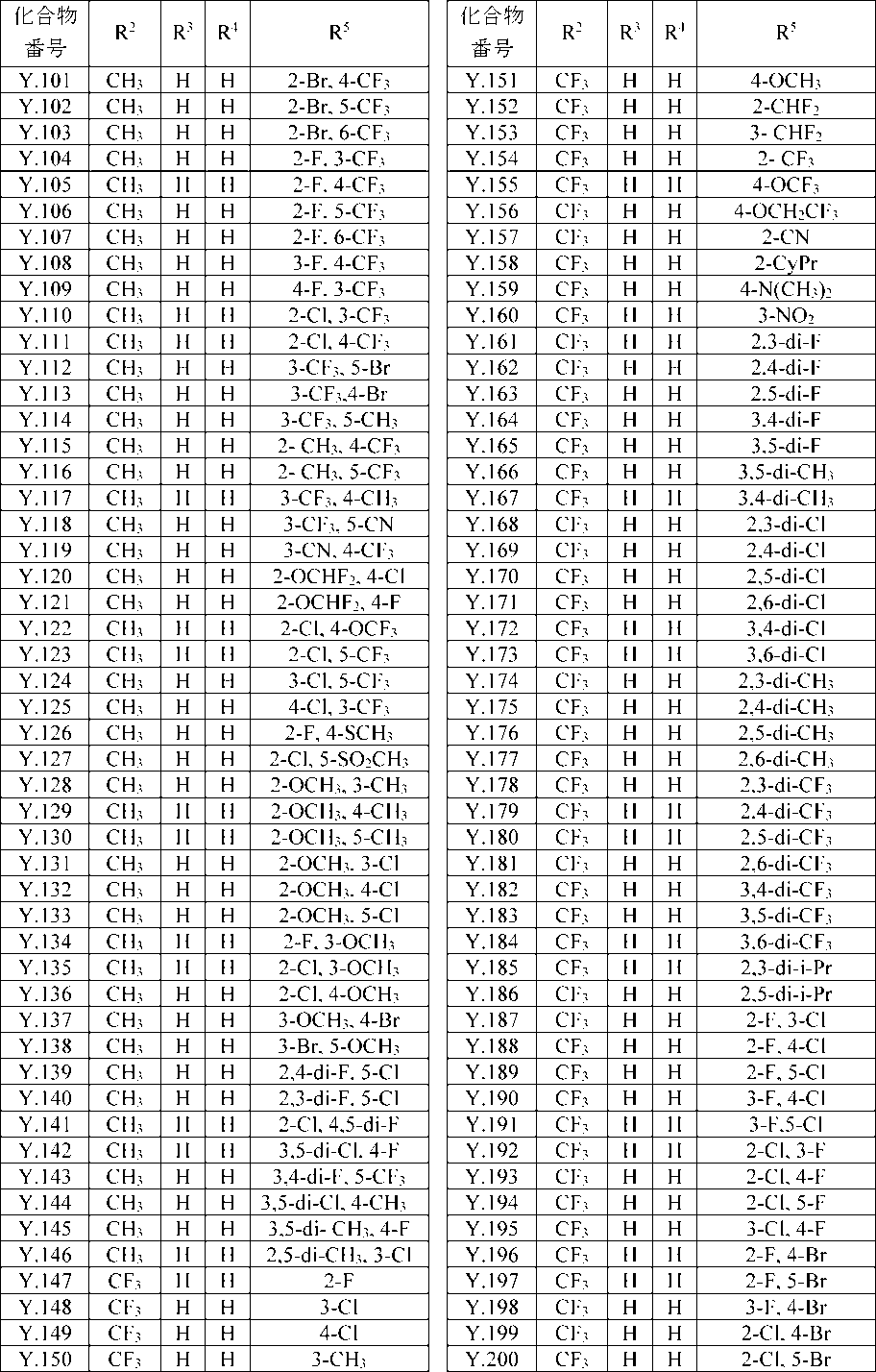


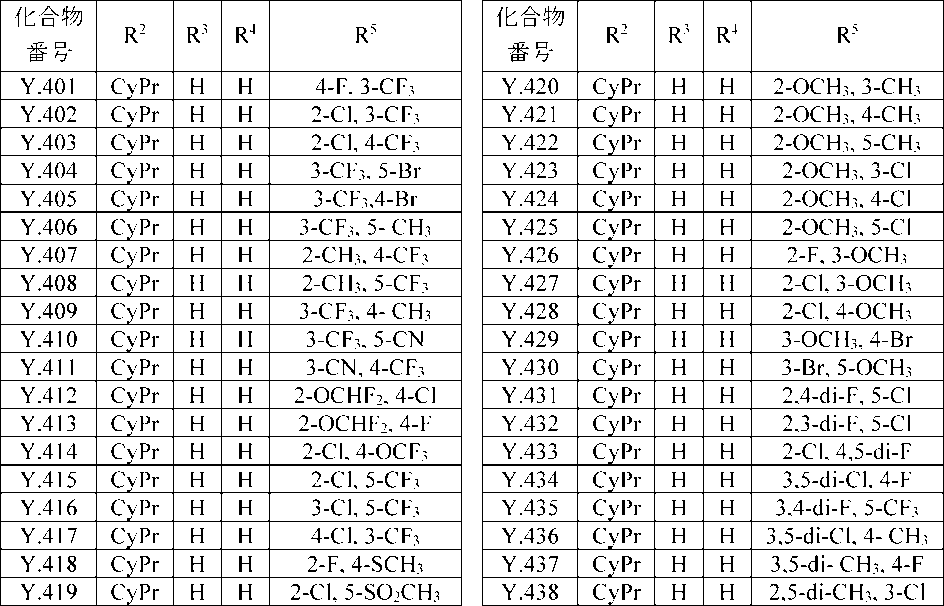
上記の表Yに続く表1~19の各々は、式(I-1)の化合物438種からなり、ここで、R2、R3、R4及びR5は、表Yの各行に与えられた値を有し、R1bは関連する表1~19に定義されている。 Each of Tables 1 to 19 following Table Y above consists of 438 compounds of formula (I-1), where R 2 , R 3 , R 4 and R 5 have the values given in each row of Table Y, and R 1b is defined in the associated Table 1 to 19.
したがって、化合物1.1は、式(I-1)の化合物に対応し、ここで、R2、R3、R4及びR5は、表Yの行1に定義されている通りであり、R1bは、表1に定義されている通りである。化合物1.2は、式(I-1)の化合物に対応し、ここで、R2、R3、R4及びR5は、表Yの行2に定義されている通りであり、Hetは表1に定義されている通りである、などである。 Thus, compound 1.1 corresponds to the compound of formula (I-1) where R 2 , R 3 , R 4 and R 5 are as defined in row 1 of Table Y, and R 1b is as defined in Table 1. Compound 1.2 corresponds to the compound of formula (I-1) where R 2 , R 3 , R 4 and R 5 are as defined in row 2 of Table Y, and Het is as defined in Table 1, etc.
表1:この表は、式の化合物1.1~1.438の438個の化合物を開示し、ここで、R1bは、2-Cl、4-OCF3である。R2、R3、R4及びR5は、表Yに定義されている通りである。例えば、化合物No.1.1は以下の構造を有する。
表2:この表は、式の化合物2.1~2.438の438個の化合物を開示し、ここで、R1bは、2-Cl、4-Clであり、R2、R3、R4及びR5は、表Yに定義されている通りである。 Table 2: This table discloses 438 compounds of formula 2.1 to 2.438, where R 1b is 2-Cl, 4-Cl, and R 2 , R 3 , R 4 and R 5 are as defined in Table Y.
表3:この表は、式の化合物3.1~3.438の438個の化合物を開示し、ここで、R1bは、2-CF3、4-Clであり、R2、R3、R4及びR5は、表Yに定義されている通りである。 Table 3: This table discloses 438 compounds of formula 3.1 to 3.438, where R 1b is 2-CF 3 , 4-Cl, and R 2 , R 3 , R 4 and R 5 are as defined in Table Y.
表4:この表は、式の化合物4.1~4.438の438個の化合物を開示し、ここで、R1bは2-Cl,4-CF3であり、R2、R3、R4及びR5は、表Yに定義されている通りである。 Table 4: This table discloses 438 compounds of formula 4.1 to 4.438, where R 1b is 2-Cl,4-CF 3 , and R 2 , R 3 , R 4 and R 5 are as defined in Table Y.
表5:この表は、式の化合物5.1~5.438の438個の化合物を開示し、ここで、R1bは2-Cl,4-CNであり、R2、R3、R4及びR5は、表Yに定義されている通りである。 Table 5: This table discloses 438 compounds of formula 5.1 to 5.438, where R 1b is 2-Cl,4-CN, and R 2 , R 3 , R 4 and R 5 are as defined in Table Y.
表6:この表は、式の化合物6.1~6.438の438個の化合物を開示し、ここで、R1bは2-Cl,4-Fであり、R2、R3、R4及びR5は、表Yに定義されている通りである。 Table 6: This table discloses 438 compounds of formula 6.1 to 6.438, where R 1b is 2-Cl,4-F, and R 2 , R 3 , R 4 and R 5 are as defined in Table Y.
表7:この表は、式の化合物7.1~7.438の438個の化合物を開示し、ここで、R1bは2-Cl,4-OCH3であり、R2、R3、R4及びR5は、表Yに定義されている通りである。 Table 7: This table discloses 438 compounds of formula 7.1 to 7.438, where R 1b is 2-Cl,4-OCH 3 , and R 2 , R 3 , R 4 and R 5 are as defined in Table Y.
表8:この表は、式の化合物8.1~8.438の438個の化合物を開示し、ここで、R1bは2-F,4-CNであり、R2、R3、R4及びR5は、表Yに定義されている通りである。 Table 8: This table discloses 438 compounds of formula 8.1 to 8.438, where R 1b is 2-F,4-CN, and R 2 , R 3 , R 4 and R 5 are as defined in Table Y.
表9:この表は、式の化合物9.1~9.438の438個の化合物を開示し、ここで、R1bは2-F,4-Clであり、R2、R3、R4及びR5は、表Yに定義されている通りである。 Table 9: This table discloses 438 compounds of formula 9.1 to 9.438, where R 1b is 2-F,4-Cl, and R 2 , R 3 , R 4 and R 5 are as defined in Table Y.
表10:この表は、式の化合物10.1~10.438の438個の化合物を開示し、ここで、R1bは2-F,4-Fであり、R2、R3、R4及びR5は、表Yに定義されている通りである。 Table 10: This table discloses 438 compounds of formula 10.1 to 10.438, where R 1b is 2-F,4-F, and R 2 , R 3 , R 4 and R 5 are as defined in Table Y.
表11:この表は、式の化合物11.1~11.438の438個の化合物を開示し、ここで、R1bは2-Cl,4-CH3であり、R2、R3、R4及びR5は、表Yに定義されている通りである。 Table 11: This table discloses 438 compounds of formula 11.1 to 11.438, where R 1b is 2-Cl,4-CH 3 , and R 2 , R 3 , R 4 and R 5 are as defined in Table Y.
表12:この表は、式の化合物12.1~12.438の438個の化合物を開示し、ここで、R1bは2-F,4-CH3であり、R2、R3、R4及びR5は、表Yに定義されている通りである。 Table 12: This table discloses 438 compounds of formula 12.1 to 12.438, where R 1b is 2-F,4-CH 3 and R 2 , R 3 , R 4 and R 5 are as defined in Table Y.
表13:この表は、式の化合物13.1~13.438の438個の化合物を開示し、ここで、R1bは2-CF3,4-Clであり、R2、R3、R4及びR5は、表Yに定義されている通りである。 Table 13: This table discloses 438 compounds of formula 13.1 to 13.438, where R 1b is 2-CF 3 ,4-Cl, and R 2 , R 3 , R 4 and R 5 are as defined in Table Y.
表14:この表は、式の化合物14.1~14.438の438個の化合物を開示し、ここで、R1bは2-Cl,4-OCF2であり、R2、R3、R4及びR5は、表Yに定義されている通りである。 Table 14: This table discloses 438 compounds of formula 14.1 to 14.438, where R 1b is 2-Cl,4-OCF 2 , and R 2 , R 3 , R 4 and R 5 are as defined in Table Y.
表15:この表は、式の化合物15.1~15.438の438個の化合物を開示し、ここで、R1bは3-Cl,5-Clであり、R2、R3、R4及びR5は、表Yに定義されている通りである。 Table 15: This table discloses 438 compounds of formula 15.1 to 15.438, where R 1b is 3-Cl, 5-Cl, and R 2 , R 3 , R 4 and R 5 are as defined in Table Y.
表16:この表は、式の化合物16.1~16.438の438個の化合物を開示し、ここで、R1bは3-Cl,5-OCF3であり、R2、R3、R4及びR5は、表Yに定義されている通りである。 Table 16: This table discloses 438 compounds of formula 16.1 to 16.438, where R 1b is 3-Cl,5-OCF 3 , and R 2 , R 3 , R 4 and R 5 are as defined in Table Y.
表17:この表は、式の化合物17.1~17.438の438個の化合物を開示し、ここで、R1bは3-CF3,5-Clであり、R2、R3、R4及びR5は、表Yに定義されている通りである。 Table 17: This table discloses 438 compounds of formula 17.1 to 17.438, where R 1b is 3-CF 3 ,5-Cl, and R 2 , R 3 , R 4 and R 5 are as defined in Table Y.
表18:この表は、式の化合物18.1~18.438の438個の化合物を開示し、ここで、R1bは3-CF3,5-CF3であり、R2、R3、R4及びR5は、表Yに定義されている通りである。 Table 18: This table discloses 438 compounds of formula 18.1 to 18.438, where R 1b is 3-CF 3 , 5-CF 3, and R 2 , R 3 , R 4 and R 5 are as defined in Table Y.
表19:この表は、式の化合物19.1~19.438の438個の化合物を開示し、ここで、R1bは3-Cl,5-Clであり、R2、R3、R4及びR5は、表Yに定義されている通りである。 Table 19: This table discloses 438 compounds of formula 19.1 to 19.438, where R 1b is 3-Cl, 5-Cl, and R 2 , R 3 , R 4 and R 5 are as defined in Table Y.
1つの実施形態において、本発明は、昆虫、線虫又はダニに対する農作物及び/又は園芸作物の防除又は予防のための、式(I)の化合物(その立体異性体、塩、多形もしくはN-酸化物又はそれらの組成物もしくはそれらの組み合わせを含む)の使用を提供する。 In one embodiment, the present invention provides the use of a compound of formula (I) (including its stereoisomers, salts, polymorphs or N-oxides or compositions thereof or combinations thereof) for the control or prevention of agricultural and/or horticultural crops against insects, nematodes or mites.
好ましい実施形態において、本発明は、線虫に対する農作物及び/又は園芸作物の防除又は予防のための、式(I)の化合物、その塩、立体異性体、多形もしくはN-酸化物又はそれらの組成物もしくはそれらの組み合わせを含む、の使用を提供する。 In a preferred embodiment, the present invention provides the use of a compound of formula (I), including its salts, stereoisomers, polymorphs or N-oxides or compositions thereof or combinations thereof, for the control or prevention of agricultural and/or horticultural crops against nematodes.
それぞれの農作物は、穀類、トウモロコシ、米、大豆及び他のマメ科植物、果実及び果樹、ナッツ及びナッツの木、柑橘類及び柑橘類の木、任意の園芸植物、ウリ科、油性植物、タバコ、コーヒー、茶、カカオ、テンサイ、サトウキビ、綿、ジャガイモ、トマト、タマネギ、コショウ、他の野菜又は装飾品から選択される。 Each crop is selected from cereals, maize, rice, soybeans and other legumes, fruits and fruit trees, nuts and nut trees, citrus and citrus trees, any horticultural plant, cucurbits, oil plants, tobacco, coffee, tea, cocoa, sugar beet, sugar cane, cotton, potato, tomato, onion, pepper, other vegetables or ornamentals.
本発明の化合物は、特に植物、特に農業及び園芸における有用な植物及び装飾品、又はそのような植物の果実、花、葉、茎、塊茎、種子又は根などの器官に発生する線虫などの害虫を防除又は破壊するために使用することができる。場合によっては、後の時点で形成される植物器官でさえ、これらの害虫から保護されたままである。 The compounds of the invention can be used to control or destroy pests, such as nematodes, which occur in plants, especially useful plants and ornamentals in agriculture and horticulture, or in organs of such plants, such as fruits, flowers, leaves, stems, tubers, seeds or roots. In some cases, even plant organs formed at a later time point remain protected from these pests.
本発明に係る式(I)の化合物は、害虫防除の分野において、たとえ低い施用率であっても、殺虫剤耐性線虫に対して使用することができる予防的及び/又は治療的に有用な活性成分である。本発明に係る式(I)の化合物は、非常に好ましい殺生物スペクトルを有し、温血動物種、魚類及び植物によって十分に許容される。したがって、本発明はまた、式(I)のような本発明の化合物を含む殺虫組成物を利用することができる。本発明に係る式(I)の化合物は、実用的な目的のために、線虫による攻撃及び損傷から動物及び有用植物を保護するための非常に有利な活性スペクトルを有することが見出されている。したがって、本発明はまた、式(I)のような本発明の化合物を含む殺線虫組成物を利用することができる。式(I)の化合物は、強力な殺菌活性を有することができ、農業又は園芸作物の保護において、望ましくない線虫の制御のために使用することができる。 The compounds of formula (I) according to the present invention are preventively and/or therapeutically useful active ingredients that can be used in the field of pest control against insecticide-resistant nematodes, even at low application rates. The compounds of formula (I) according to the present invention have a very favorable biocidal spectrum and are well tolerated by warm-blooded animal species, fish and plants. The present invention can therefore also make use of insecticidal compositions comprising the compounds of the present invention, such as formula (I). The compounds of formula (I) according to the present invention have been found, for practical purposes, to have a very advantageous activity spectrum for protecting animals and useful plants from attack and damage by nematodes. The present invention can therefore also make use of nematicidal compositions comprising the compounds of the present invention, such as formula (I). The compounds of formula (I) can have a strong fungicidal activity and can be used for the control of undesirable nematodes in the protection of agricultural or horticultural crops.
式(I)の化合物は、作物を保護するための殺線虫剤として、例えば、Tylenchida、Rhabditida、Dorylaimida及びTryplonchidaの制御のために使用することができる。 The compounds of formula (I) can be used as nematicides for crop protection, for example for the control of Tylenchida, Rhabditida, Dorylamida and Tryplonchida.
式(I)の化合物は、植物病原性線虫による農作物又は園芸作物の感染を防除又は予防するために使用することができる。 The compounds of formula (I) can be used to control or prevent infection of agricultural or horticultural crops by phytopathogenic nematodes.
式(I)の化合物は、作物を保護するために使用することができ、ここで、農作物は、穀類、トウモロコシ、米、大豆及び他のマメ科植物、果実及び果樹、ナッツ及びナッツの木、柑橘類及び柑橘類の木、任意の園芸植物、ウリ科、油性植物、タバコ、コーヒー、茶、カカオ、テンサイ、サトウキビ、綿、ジャガイモ、トマト、タマネギ、コショウ及び他の野菜及び装飾品である。 The compounds of formula (I) can be used to protect crops, where the crops are cereals, corn, rice, soybeans and other legumes, fruit and fruit trees, nuts and nut trees, citrus and citrus trees, any horticultural plant, cucurbits, oil plants, tobacco, coffee, tea, cocoa, sugar beet, sugar cane, cotton, potato, tomato, onion, pepper and other vegetables and ornamentals.
式(I)の化合物は線虫の防除に特に有用である。したがって、さらなる実施形態において、本発明はまた、植物寄生線虫(内部寄生線虫、半内部寄生線虫、外部寄生線虫)、特にネコブセンチュウ、Meloidogyne hapla、Meloidogyne incognita、Meloidogyne javanica、Meloidogyne arenaria及び他のMeloidogyne種のような植物寄生線虫による植物及びその一部に対する損傷を防除する方法に関する。
例として、シスト形成線虫、Globodera rostochiensis及び他のGlobodera種や、Heterodera avenae、Heterodera glycines、Heterodera schachtii、Heterodera trifolii及び他のHeterodera種や、タマセンチュウ、Anguina種や、茎及び葉の線虫、Aphelenchoides種や、センチュウ、Eelonolaimus longicaudatus及び他のBelonolaimus種や、マツノザイセンチュウ、Bursaphelenchus xylophilus及び他のBursaphelenchus種や、環状線虫、Criconema種、Criconemella種、Criconemoides種、Mesocriconema種や、茎及び球根線虫、Ditylenchus destructor、Ditylenchus dipsaci及び他のDitylenchus種や、千枚通し線虫、Dolichodorus種や、渦巻線虫、Heliocotylenchus multicinctus及び他のHelicotylenchus種や、鞘及び有鞘線虫、Hemicycliophora種及びHemicriconemoides種や、Hirshmanniella種や、Lance線虫、Hoploaimus種や、ネコブセンチュウ、Nacobbus種や、Needle線虫、Longidorus elongatus、その他Longidorus種や、Pin線虫、Pratylenchus種や、Lesion線虫、Pratylenchus neglectus、Pratylenchus penetrans、Pratylenchus curvitatus、Pratylenchus goodeyi、その他Pratylenchus種や、Burning線虫、Radopholus similis、その他Pratylenchus種や、Reniform線虫、Rotylenchus robustus、Rotylenchus reniformis、その他Rotylenchus種や、Scutellonema種や、Stubby root線虫、Trichodorus primitivus、その他Trichodorus種、Paratrichodorus種や、Stunt線虫、Tylenchorhynchus claytoni、Tylenchorhynchus dubius、その他Tylenchorhynchus種や、citrus線虫、Tylenchulus種や、Dagger線虫、Xiphinema種や、及び他の植物寄生線虫種、例えばSubanguina spp.、Hypsoperine spp.、Macropostonia spp.、Melinius spp.、Punctodera spp.、及びQuinisulcius spp.など。
The compounds of formula (I) are particularly useful for controlling nematodes. Thus, in a further embodiment, the present invention also relates to a method for controlling damage to plants and parts thereof caused by plant parasitic nematodes (endoparasitic, hemiendoparasitic, ectoparasitic nematodes), in particular plant parasitic nematodes such as root-knot nematodes, Meloidogyne hapla, Meloidogyne incognita, Meloidogyne javanica, Meloidogyne arenaria and other Meloidogyne species.
Examples include the cyst forming nematodes, Globodera rostochiensis and other Globodera species; Heterodera avenae, Heterodera glycines, Heterodera schachtii, Heterodera trifolii and other Heterodera species; the bollworm, Anguina species; the stem and leaf nematodes, Aphelenchoides species; the nematode, Eelonolaimus longicaudatus and other Belonolaimus species; the pinewood nematode, Bursaphelenchus xylophilus and other Bursaphelenchus species; ring nematodes, Criconema species, Criconemella species, Criconemoides species, Mesocriconema species; stem and bulb nematodes, Ditylenchus destructor, Ditylenchus dipsaci and other Ditylenchus species; awl nematodes, Dolichodorus species; spiral nematodes, Heliocotylenchus multicinctus and other Helicotylenchus species, encapsulated and sheathed nematodes, Hemicycliophora species and Hemicriconemoides species, Hirshmanniella species, Lance nematodes, Hoploaimus species, root-knot nematodes, Nacobbus species, Needle nematodes, Longidorus elongatus, other Longidorus species, Pin nematodes, Pratylenchus species, Lesion nematodes, Pratylenchus neglectus, Pratylenchus penetrans, Pratylenchus curvitatus, Pratylenchus goodeyi, other Pratylenchus species, Burning nematodes, Radophorus similis, other Pratylenchus species, Reniform nematodes, Rotylenchus robustus, Rotylenchus reniformis, other Rotylenchus species, Scutellonema species, Stubby root nematodes, Trichodorus primitiveus, other Trichodorus species, Paratrichodorus species, Stunt nematodes, Tylenchorhynchus claytoni, Tylenchorhynchus dubius, other Tylenchorhynchus spp., citrus nematodes, Tylenchulus spp., Dagger nematodes, Xiphiinema spp., and other plant parasitic nematode species such as Subanguina spp., Hypsoperine spp., Macropostonia spp., Melinius spp., Punctodera spp., and Quinisulcius spp.
特に、線虫種Meloidogyne spp.、Heterodera spp.、Rotylenchus spp.、Pratylenchus spp.及びRadopholus spp.は、本発明の化合物で制御することができる。 In particular, the nematode species Meloidogyne spp., Heterodera spp., Rotylenchus spp., Pratylenchus spp. and Radopholus spp. can be controlled with the compounds of the present invention.
1つの実施形態において、本発明は、式(I)の化合物、その立体異性体、塩、多形、又はN-酸化物及び1つ以上の不活性担体を含む、植物病原性線虫を防除又は予防するための組成物を提供する。 In one embodiment, the present invention provides a composition for controlling or preventing plant pathogenic nematodes comprising a compound of formula (I), a stereoisomer, salt, polymorph, or N-oxide thereof, and one or more inert carriers.
別の実施形態において、本組成物は、殺菌剤、殺虫剤、線虫駆除剤、ダニ駆除剤、殺生物剤、除草剤、植物成長調節剤、抗生物質、栄養素又は肥料から選択される1つ以上の活性適合性化合物をさらに含むことができる。 In another embodiment, the composition may further comprise one or more active compatible compounds selected from a fungicide, an insecticide, a nematicide, an acaricide, a biocide, a herbicide, a plant growth regulator, an antibiotic, a nutrient, or a fertilizer.
式(I)の化合物の濃度は、組成物の総重量に対して1~90%重量の範囲であり、好ましくは、組成物の総重量に対して5~50%重量の範囲である。 The concentration of the compound of formula (I) is in the range of 1 to 90% by weight based on the total weight of the composition, and preferably in the range of 5 to 50% by weight based on the total weight of the composition.
本発明はさらに、式(I)の化合物の少なくとも1つ及び1つ以上の不活性担体を含む、望ましくない線虫を制御するための組成物に関する。不活性担体はさらに、農業に適した助剤、溶媒、希釈剤、界面活性剤及び/又は増量剤などを含む。 The present invention further relates to a composition for controlling unwanted nematodes, comprising at least one compound of formula (I) and one or more inert carriers. The inert carrier further comprises agriculturally suitable auxiliaries, solvents, diluents, surfactants and/or extenders, etc.
本発明はさらに、式(I)の化合物の少なくとも1つ及び/又は殺菌剤、殺菌剤、殺ダニ剤、殺虫剤、線虫剤、除草剤、殺生物剤、植物成長調節剤、抗生物質、肥料及び/又はそれらの混合物から選択される1つ以上の活性な適合性化合物を含む、望ましくない線虫を制御するための組成物に関する。 The present invention further relates to a composition for controlling undesirable nematodes comprising at least one compound of formula (I) and/or one or more active compatible compounds selected from fungicides, bactericides, acaricides, insecticides, nematicides, herbicides, biocides, plant growth regulators, antibiotics, fertilizers and/or mixtures thereof.
一般に、本発明の化合物は、担体を含む組成物(例えば製剤)の形態で使用される。本発明の化合物及びその組成物は、エアゾールディスペンサー、カプセル懸濁液、低温霧化濃縮液、散布可能粉末、乳化可能濃縮液、水中乳化油、油中乳化水、カプセル化顆粒、細顆粒、種子処理用流動性濃縮液、ガス(加圧下)、ガス発生生成物、顆粒、高温霧化濃縮液、大顆粒、微小顆粒、油分散性粉末、油混和性流動性濃縮液、油混和性液体、ペースト、植物ロドレット、乾燥種子処理用粉末、農薬で被覆された種子、可溶性濃縮液、可溶性粉末、種子処理用溶液、懸濁濃縮液(流動性濃縮液)、超低容量(ulv)液体、超低容量(ulv)懸濁液、水分散性顆粒又は錠剤、スラリー処理用水分散性粉末、水溶性顆粒又は錠剤、種子処理用水溶性粉末及び湿潤性粉末などの種々の形態で使用することができる。 In general, the compounds of the present invention are used in the form of a composition (e.g., a formulation) containing a carrier. The compounds of the present invention and compositions thereof can be used in various forms, such as aerosol dispensers, capsule suspensions, cold mist concentrates, sprayable powders, emulsifiable concentrates, emulsified oil in water, emulsified water in oil, encapsulated granules, fine granules, flowable concentrates for seed treatment, gas (under pressure), gas-generating products, granules, hot mist concentrates, large granules, fine granules, oil-dispersible powders, oil-miscible flowable concentrates, oil-miscible liquids, pastes, plant rodlets, dry seed treatment powders, pesticide-coated seeds, soluble concentrates, soluble powders, seed treatment solutions, suspension concentrates (flowable concentrates), ultra-low volume (ulv) liquids, ultra-low volume (ulv) suspensions, water-dispersible granules or tablets, water-dispersible powders for slurry treatment, water-soluble granules or tablets, water-soluble powders for seed treatment, and wettable powders.
製剤は、典型的には、液体又は固体担体、及び任意に1種以上の慣用製剤補助剤を含み、これらは固体又は液体補助剤、例えば、エポキシ化されていない又はエポキシ化された植物油(エポキシ化ココナッツ油、菜種油、大豆油など)、消泡剤、例えば、シリコーン油、防腐剤、粘土、無機化合物、粘度調整剤、界面活性剤、結合剤及び/又は粘着付与剤であってもよい。組成物は、さらに、肥料、微量栄養素供与体、又は植物の成長に影響を与える他の製剤、ならびに本発明の化合物と、殺菌剤、殺菌剤、線虫剤、植物活性剤、殺ダニ剤及び殺虫剤などの1種以上の他の生物学的活性剤とを含む組み合わせを含んでもよい。 The formulations typically include a liquid or solid carrier and, optionally, one or more conventional formulation adjuvants, which may be solid or liquid adjuvants, such as non-epoxidized or epoxidized vegetable oils (epoxidized coconut oil, rapeseed oil, soybean oil, etc.), antifoaming agents, such as silicone oils, preservatives, clays, inorganic compounds, viscosity modifiers, surfactants, binders and/or tackifiers. The compositions may further include fertilizers, micronutrient donors, or other formulations that affect plant growth, as well as combinations comprising the compounds of the present invention and one or more other biologically active agents, such as fungicides, bactericides, nematicides, plant activators, acaricides and insecticides.
したがって、本発明はまた、本発明の化合物及び農業用担体、及び任意に1種以上の慣用製剤補助剤を含む組成物を利用可能にする。 The present invention therefore also makes available a composition comprising a compound of the present invention and an agricultural carrier, and optionally one or more conventional formulation adjuvants.
組成物は、それ自体公知の方法で、例えば、本発明の固体化合物を粉砕、スクリーニング及び/又は圧縮することによって、また、例えば、少なくとも1種の補助剤の存在下で、本発明の化合物を補助剤(補助剤)と密接に混合及び/又は粉砕することによって調製される。本発明の固体化合物の場合、化合物の粉砕/粉砕は、特定の粒径を確保するためである。これらの組成物の調製方法及びこれらの組成物の調製のための本発明の化合物の使用も本発明の主題である。 The compositions are prepared in a manner known per se, for example by grinding, screening and/or compressing the solid compounds of the invention, and also by intimately mixing and/or grinding the compounds of the invention with an auxiliary (auxiliary agent), for example in the presence of at least one auxiliary agent. In the case of the solid compounds of the invention, the grinding/grinding of the compounds is to ensure a specific particle size. The methods for the preparation of these compositions and the use of the compounds of the invention for the preparation of these compositions are also the subject of the present invention.
農業で使用するための組成物の例は、乳化可能な濃縮物、懸濁液濃縮物、マイクロエマルジョン、油分散物、直接噴霧可能又は希釈可能な溶液、散布可能なペースト、希釈エマルジョン、可溶性粉末、分散性粉末、濡れ性粉末、粉塵、顆粒又は高分子物質中のカプセルであり、これらは少なくとも本発明の化合物を含み、組成物のタイプは、意図された目的及び一般的な状況に適合するように選択される。 Examples of compositions for agricultural use are emulsifiable concentrates, suspension concentrates, microemulsions, oil dispersions, directly sprayable or dilutable solutions, spreadable pastes, dilute emulsions, soluble powders, dispersible powders, wettable powders, dusts, granules or capsules in polymeric substances, which contain at least the compound of the invention, the type of composition being selected to suit the intended purpose and the prevailing circumstances.
適切な液体担体の例は、非水素化又は部分水素化芳香族炭化水素、好ましくは、キシレン混合物、アルキル化ナフタレン又はテトラヒドロナフタレンのようなアルキルベンゼン、パラフィン又はシクロヘキサンのような脂肪族又は脂環式炭化水素、エタノール、プロパノール又はブタノールのようなアルコール、プロピレングリコール、ジプロピレングリコールエーテル、エチレングリコール又はエチレングリコールモノメチルエーテル又はエチレングリコールモノエチルエーテルのようなグリコール及びそのエーテル及びエステル、シクロヘキサノン、イソホロン又はジアセトンアルコールのようなケトン、N-メチルピロリド-2-オン、ジメチルスルホキシド又はN,N-ジメチルホルムアミドのような強極性溶媒、水、非エポキシ化又はエポキシ化植物油の画分C8~C12である、ナタネ油、ヒマシ油、ヤシ油、大豆油、シリコーン油などである。粉塵や分散性粉体などに使用される固体担体としては、原則として、カルサイト、タルク、カオリン、モンモリロナイト、アタパルジャイトなどの天然鉱物を粉砕したものが挙げられます。物理的性質を改善するために、高分散シリカ又は高分散吸収性ポリマーを添加することもできる。顆粒のための好適な粒子状吸着担体は、軽石、煉瓦グリット、セピオライト又はベントナイトのような多孔質タイプであり、好適な非吸着性担体材料は、方解石又は砂である。さらに、無機又は有機性質の多数の顆粒材料、特にドロマイト又は粉砕植物残渣を使用することができる。好適な界面活性化合物は、調合される活性成分のタイプに応じて、良好な乳化、分散及び湿潤特性を有する非イオン性、カチオン性及び/又はアニオン性界面活性剤又は界面活性剤混合物である。以下に述べる界面活性剤は、単に例として考慮されるべきである。調合の分野において慣用的に使用され、本発明に従って適切な多数のさらなる界面活性剤は、関連文献に記載されている。好適な非イオン性界面活性剤は、特に、脂肪族アルコール又は(シクロ)脂肪族アルコール、飽和脂肪酸又は不飽和脂肪酸又はアルキルフェノールのポリグリコールエーテル誘導体であり、これらは、約3~約30グリコールエーテル基及び約8~約20個の炭素原子を(シクロ)脂肪族炭化水素ラジカルに含有し、又はアルキルフェノールのアルキル部分に約6~約18個の炭素原子を含有し得る。また、アルキル鎖に1~約10個の炭素原子及び約20~約250個のエチレングリコールエーテル基及び約10~約100個のプロピレングリコールエーテル基を有する、ポリプロピレングリコール、エチレンジアミノポリプロピレングリコール又はアルキルポリプロピレングリコールとの水溶性ポリエチレンオキシド付加物も好適である。通常、上記化合物は、プロピレングリコール単位当たり1~約5個のエチレングリコール単位を含有する。挙げられる例は、ノニルフェノキシポリエトキシエタノール、ヒマシ油ポリグリコールエーテル、ポリプロピレングリコール/ポリエチレンオキシド付加物、トリブチルフェノキシポリエトキシエタノール、ポリエチレングリコール又はオクチルフェノキシポリエトキシエタノールである。また、ポリオキシエチレンソルビタントリオレエートなどのポリオキシエチレンソルビタンの脂肪酸エステルも好適である。陽イオン界面活性剤は、特に、一般に、置換基として、及びさらなる置換基(非ハロゲン化又はハロゲン化)として、約8~約22個の炭素原子の少なくとも一つのアルキルラジカル、低級アルキル基、ヒドロキシアルキル基又はベンジルラジカルを有する第四級アンモニウム塩である。塩は、好ましくは、ハロゲン化物、メチル硫酸塩又はエチル硫酸塩の形態である。例は、塩化ステアリルトリメチルアンモニウム及び臭化ベンジルビス(2-クロロエチル)エチルアンモニウムである。 Examples of suitable liquid carriers are non-hydrogenated or partially hydrogenated aromatic hydrocarbons, preferably xylene mixtures, alkylbenzenes such as alkylated naphthalenes or tetrahydronaphthalenes, aliphatic or cycloaliphatic hydrocarbons such as paraffins or cyclohexanes, alcohols such as ethanol, propanol or butanol, glycols and their ethers and esters such as propylene glycol, dipropylene glycol ether, ethylene glycol or ethylene glycol monomethyl ether or ethylene glycol monoethyl ether, ketones such as cyclohexanone, isophorone or diacetone alcohol, strongly polar solvents such as N-methylpyrrolid-2-one, dimethylsulfoxide or N,N-dimethylformamide, water, non-epoxidized or epoxidized vegetable oil fractions C 8 to C 12 , rapeseed oil, castor oil, coconut oil, soybean oil, silicone oils, etc. As solid carriers used for dusts, dispersible powders, etc., in principle, ground natural minerals such as calcite, talc, kaolin, montmorillonite, attapulgite, etc. are mentioned. To improve the physical properties, highly disperse silica or highly disperse absorbent polymers can also be added. Suitable particulate adsorbent carriers for the granules are of porous type, such as pumice, brick grit, sepiolite or bentonite, and suitable non-adsorbent carrier materials are calcite or sand. In addition, many granular materials of inorganic or organic nature can be used, in particular dolomite or crushed plant residues. Suitable surface-active compounds are non-ionic, cationic and/or anionic surfactants or surfactant mixtures with good emulsifying, dispersing and wetting properties, depending on the type of active ingredient to be formulated. The surfactants mentioned below should be considered merely as examples. Many further surfactants conventionally used in the field of formulation and suitable according to the present invention are described in the relevant literature. Suitable nonionic surfactants are in particular polyglycol ether derivatives of aliphatic or (cyclo)aliphatic alcohols, saturated or unsaturated fatty acids or alkylphenols, which may contain from about 3 to about 30 glycol ether groups and from about 8 to about 20 carbon atoms in the (cyclo)aliphatic hydrocarbon radical, or from about 6 to about 18 carbon atoms in the alkyl portion of the alkylphenol. Also suitable are water-soluble polyethylene oxide adducts with polypropylene glycol, ethylenediaminopolypropylene glycol or alkylpolypropylene glycols having from 1 to about 10 carbon atoms in the alkyl chain and from about 20 to about 250 ethylene glycol ether groups and from about 10 to about 100 propylene glycol ether groups. Typically, said compounds contain from 1 to about 5 ethylene glycol units per propylene glycol unit. Examples which may be mentioned are nonylphenoxypolyethoxyethanol, castor oil polyglycol ether, polypropylene glycol/polyethylene oxide adducts, tributylphenoxypolyethoxyethanol, polyethylene glycol or octylphenoxypolyethoxyethanol. Also suitable are fatty acid esters of polyoxyethylene sorbitan, such as polyoxyethylene sorbitan trioleate. The cationic surfactants are in particular quaternary ammonium salts, which generally have as substituents and as further substituents (non-halogenated or halogenated) at least one alkyl radical, lower alkyl radical, hydroxyalkyl radical or benzyl radical of from about 8 to about 22 carbon atoms. The salts are preferably in the form of halides, methyl sulfates or ethyl sulfates. Examples are stearyltrimethylammonium chloride and benzylbis(2-chloroethyl)ethylammonium bromide.
適切な陰イオン界面活性剤の例は、水溶性石鹸又は水溶性合成界面活性化合物である。適切な石鹸の例は、約10~約22個の炭素原子を有する脂肪酸のアルカリ、アルカリ土類又は(非置換又は置換)アンモニウム塩であり、例えば、オレイン酸又はステアリン酸のナトリウム塩又はカリウム塩、又は、例えば、ココナッツ油又はトール油から得られる天然脂肪酸混合物である。脂肪酸メチルタウレートについても言及しなければならない。しかし、合成界面活性剤、特に、脂肪スルホン酸塩、脂肪硫酸塩、スルホン化ベンズイミダゾール誘導体又はアルキルアリールスルホン酸塩がより頻繁に使用される。原則として、脂肪スルホン酸塩及び脂肪硫酸塩は、アルカリ、アルカリ土類又は(置換又は非置換)アンモニウム塩として存在し、それらは一般に約8~約22個の炭素原子のアルキルラジカルを有し、アルキルはまた、アシルラジカルのアルキル部分を含むものとして理解される。言及することができる例は、リグノスルホン酸、ドデシル硫酸エステル又は天然脂肪酸から調製された脂肪アルコール硫酸塩混合物のナトリウム塩又はカルシウム塩である。このグループはまた、脂肪アルコール/エチレンオキシド付加物の硫酸エステル及びスルホン酸塩を含む。スルホン化ベンズイミダゾール誘導体は、好ましくは、2個のスルホニル基及び約8~約22個の炭素原子の脂肪酸ラジカルを含む。アルキルアリールスルホン酸塩の例は、デシルベンゼンスルホン酸、ジブチルナフタレンスルホン酸又はナフタレンスルホン酸/ホルムアルデヒド縮合物のナトリウム塩、カルシウム塩又はトリエタノールアンモニウム塩である。さらに、p-ノニルフェノール/(4-14)エチレンオキシド付加物のリン酸エステルの塩のような適切なリン酸塩、又はリン脂質も可能である。 Examples of suitable anionic surfactants are water-soluble soaps or water-soluble synthetic surface-active compounds. Examples of suitable soaps are the alkali, alkaline earth or (unsubstituted or substituted) ammonium salts of fatty acids having from about 10 to about 22 carbon atoms, for example the sodium or potassium salts of oleic acid or stearic acid or natural fatty acid mixtures obtained, for example, from coconut oil or tall oil. Fatty acid methyl taurates must also be mentioned. However, synthetic surfactants are more frequently used, in particular fatty sulfonates, fatty sulfates, sulfonated benzimidazole derivatives or alkylarylsulfonates. As a rule, fatty sulfonates and fatty sulfates exist as alkali, alkaline earth or (substituted or unsubstituted) ammonium salts, which generally have an alkyl radical of from about 8 to about 22 carbon atoms, alkyl also being understood as including the alkyl part of the acyl radical. Examples that may be mentioned are the sodium or calcium salts of lignosulfonic acid, dodecyl sulfate or fatty alcohol sulfate mixtures prepared from natural fatty acids. This group also includes the sulfates and sulfonates of fatty alcohol/ethylene oxide adducts. The sulfonated benzimidazole derivatives preferably contain two sulfonyl groups and a fatty acid radical of about 8 to about 22 carbon atoms. Examples of alkylarylsulfonates are the sodium, calcium or triethanolammonium salts of decylbenzenesulfonic acid, dibutylnaphthalenesulfonic acid or naphthalenesulfonic acid/formaldehyde condensates. Furthermore, suitable phosphates, such as salts of the phosphoric acid ester of p-nonylphenol/(4-14)ethylene oxide adduct, or phospholipids are also possible.
原則として、組成物は、本発明の化合物を0.1~99%、特に0.1~95%、及び少なくとも1つの固体又は液体担体を1~99.9%、特に5~99.9%含み、原則として、組成物の0~25%、特に0.1~20%が界面活性剤であることが可能である(それぞれの場合、重量パーセントを意味する)。濃縮された組成物は市販品に好ましい傾向があるが、最終消費者は原則として、有効成分の濃度が実質的に低い希釈組成物を使用する。 As a rule, the composition comprises 0.1-99%, in particular 0.1-95%, of the compound of the invention and 1-99.9%, in particular 5-99.9%, of at least one solid or liquid carrier, and as a rule, 0-25%, in particular 0.1-20%, of the composition can be surfactants (meaning in each case percentages by weight). Concentrated compositions tend to be preferred for commercial products, but the end user as a rule uses dilute compositions in which the concentration of active ingredient is substantially lower.
プレミックス組成物のための葉状製剤のタイプの例は以下の通りである。

一方、プレミックス組成物のための種子処理製剤のタイプの例は以下の通りである。

タンクミックス組成物に適した製剤タイプの例は、溶液、希釈エマルジョン、懸濁液、又はこれらの混合物、及び粉塵である。 Examples of formulation types suitable for tank-mix compositions are solutions, dilute emulsions, suspensions, or mixtures thereof, and dusts.
製剤の性質と同様に、塗布方法、例えば、葉面、浸漬、噴霧、粉塵、散乱、コーティング、又は注入は、意図された目的及び一般的な状況に従って選択される。 The method of application, e.g., foliar, dipping, spraying, dusting, scattering, coating or injection, as well as the nature of the formulation, are selected according to the intended purpose and the prevailing circumstances.
タンクミックス組成物は、一般に、異なる農薬、及び任意にさらなる助剤を含有する1つ以上のプレミックス組成物を溶媒(例えば水)で希釈することによって調製される。適切な担体及びアジュバントは、固体又は液体であり得、製剤技術において通常使用される物質、例えば、天然又は再生鉱物物質、溶媒、分散剤、湿潤剤、粘着付与剤、増粘剤、結合剤又は肥料である。 Tank-mix compositions are generally prepared by diluting one or more premix compositions containing different pesticides and, optionally, further auxiliaries, with a solvent (e.g. water). Suitable carriers and adjuvants can be solid or liquid and are substances normally used in formulation technology, such as natural or regenerated mineral substances, solvents, dispersants, wetting agents, tackifiers, thickeners, binders or fertilizers.
一般に、葉面又は土壌塗布用のタンクミックス製剤は、所望の成分の0.1~20%、特に0.1~15%、及び固体又は液体の助剤(例えば、水のような溶媒を含む)の99.9~80%、特に99.9~85%を含み、ここで、助剤は、タンクミックス製剤に基づいて、0~20%、特に0.1~15%の量で界面活性剤であり得る。一般に、葉面塗布用のプレミックス製剤は、所望の成分の0.1~99.9%、特に1~95%、及び固体又は液体の助剤(例えば、水のような溶媒を含む)の99.9~0.1%、特に99~5%を含み、ここで、助剤は、プレミックス製剤に基づいて、0~50%、特に0.5~40%の量で界面活性剤であり得る。 Generally, tank-mix formulations for foliar or soil application contain 0.1-20%, particularly 0.1-15%, of the desired components and 99.9-80%, particularly 99.9-85%, of a solid or liquid auxiliary (including, for example, a solvent such as water), where the auxiliary may be a surfactant in an amount of 0-20%, particularly 0.1-15%, based on the tank-mix formulation. Generally, pre-mix formulations for foliar application contain 0.1-99.9%, particularly 1-95%, of the desired components and 99.9-0.1%, particularly 99-5%, of a solid or liquid auxiliary (including, for example, a solvent such as water), where the auxiliary may be a surfactant in an amount of 0-50%, particularly 0.5-40%, based on the pre-mix formulation.
通常、種子処理用のタンクミックス製剤は、所望の成分の0.25~80%、特に1~75%、及び固体又は液体の助剤(例えば、水のような溶媒を含む)の99.75~20%、特に99~25%を含み、ここで、助剤は、タンクミックス製剤に基づいて、0~40%、特に0.5~30%の量で界面活性剤であり得る。 Typically, tank-mix formulations for seed treatment contain 0.25-80%, especially 1-75%, of the desired components and 99.75-20%, especially 99-25%, of a solid or liquid auxiliary (including, for example, a solvent such as water), where the auxiliary may be a surfactant in an amount of 0-40%, especially 0.5-30%, based on the tank-mix formulation.
典型的には、種子処理適用のためのプレミックス製剤は、0.5~99.9%、特に1~95%の所望の成分、及び99.5~0.1%、特に99~5%の固体又は液体アジュバント(例えば、水のような溶媒を含む)を含み、補助剤はプレミックス製剤に基づいて0~50%、特に0.5~40%の量の界面活性剤であり得るが、市販製品は好ましくは濃縮物(例えば、プレミックス組成(処方))として製剤され、エンドユーザーは通常希釈製剤(例えば、タンク混合組成)を使用する。 Typically, premix formulations for seed treatment applications contain 0.5-99.9%, especially 1-95%, of the desired component and 99.5-0.1%, especially 99-5%, of a solid or liquid adjuvant (e.g. including a solvent such as water), which may be a surfactant in an amount of 0-50%, especially 0.5-40%, based on the premix formulation, although commercial products are preferably formulated as concentrates (e.g. premix compositions) and end users normally use dilute formulations (e.g. tank mix compositions).
好ましい種子処理プレミックス製剤は、水性懸濁濃縮物である。この製剤は、流動床技術、ローラーミル法、回転式静的種子処理装置、及びドラムコーターなどの従来の処理技術及び機械を使用して種子に適用することができる。噴流床などの他の方法も有用であり得る。種子は、コーティング前にプレサイズされてもよい。コーティング後、種子は典型的には乾燥され、次いでサイズ調整のためにサイズ調整機に移される。このような手順は当技術分野で公知であり、本発明の化合物は、土壌及び種子処理用途での使用に特に適している。 A preferred seed treatment premix formulation is an aqueous suspension concentrate. The formulation can be applied to the seeds using conventional treatment techniques and machinery, such as fluidized bed techniques, roller mill methods, rotary static seed treaters, and drum coaters. Other methods, such as spouted beds, may also be useful. The seeds may be presized before coating. After coating, the seeds are typically dried and then transferred to a sizer for sizing. Such procedures are known in the art, and the compounds of the present invention are particularly suitable for use in soil and seed treatment applications.
一般に、本発明のプレミックス組成物は、0.5~99.9%、特に1~95%、有利には1~50%の質量で、及び99.5~0.1%、特に99~5%の質量で固体又は液体アジュバント(例えば、水のような溶媒を含む)を含有し、補助剤(又はアジュバント)は、プレミックス製剤の質量に基づいて0~50%、特に0.5~40%の質量で界面活性剤であり得る。 In general, the premix compositions of the invention contain 0.5-99.9%, particularly 1-95%, advantageously 1-50% by weight of a solid or liquid adjuvant (including, for example, a solvent such as water) and 99.5-0.1%, particularly 99-5% by weight of a co-agent (or adjuvant) which may be a surfactant in an amount of 0-50%, particularly 0.5-40%, by weight based on the weight of the premix formulation.
好ましい実施形態における式(I)の化合物は、他のいずれの実施形態とも無関係に、植物増殖材料処理(又は保護)組成物の形態であり、ここで、前記植物増殖材料保護組成物は、さらに着色剤を含むことができる。植物増殖材料保護組成物又は混合物は、処理された植物増殖材料への活性成分の接着性を改善する水溶性及び水分散性フィルム形成ポリマーからの少なくとも一つのポリマーを含むこともでき、このポリマーは、一般に、少なくとも10,000~約100,000の平均分子量を有する。 In a preferred embodiment, the compound of formula (I) is in the form of a plant propagation material treatment (or protection) composition, independent of any other embodiment, wherein said plant propagation material protection composition may further comprise a colorant. The plant propagation material protection composition or mixture may also comprise at least one polymer from water-soluble and water-dispersible film-forming polymers that improve adhesion of the active ingredient to the treated plant propagation material, the polymer generally having an average molecular weight of at least 10,000 to about 100,000.
1つの実施形態では、本発明は、式(I)の化合物、その塩、立体異性体、多形若しくはN-酸化物又はその組成物若しくは組み合わせを、植物、その部分又はその遺伝子座に適用することを特徴とする、農作物及び/又は園芸作物における植物病原性線虫による有用植物の侵入を防除又は予防する方法を提供する。 In one embodiment, the present invention provides a method for controlling or preventing infestation of useful plants by phytopathogenic nematodes in agricultural and/or horticultural crops, comprising applying a compound of formula (I), a salt, stereoisomer, polymorph or N-oxide thereof, or a composition or combination thereof to the plant, part thereof or locus thereof.
別の実施形態では、本発明は、式(I)の化合物、その塩、立体異性体、多形若しくはN-酸化物又はその組成物若しくは組み合わせを、植物の種子に適用することを特徴とする、農作物及び/又は園芸作物における植物病原性線虫による有用植物の侵入を防除又は予防する方法を提供する。 In another embodiment, the present invention provides a method for controlling or preventing infestation of useful plants by phytopathogenic nematodes in agricultural and/or horticultural crops, comprising applying a compound of formula (I), its salt, stereoisomer, polymorph or N-oxide, or a composition or combination thereof, to the seeds of the plants.
さらに別の実施形態では、本発明は、式(I)の化合物、その塩、立体異性体、多形若しくはN-酸化物又はその組成物若しくは組み合わせを使用して、農作物及び/又は園芸作物における植物病原性線虫による感染を防除又は予防する方法を提供する。この方法は、化合物又は組成物又は組み合わせの有効用量を、農作物及び/又は園芸作物1ヘクタール当たり1g~5kgの範囲の量で適用する工程を含む。 In yet another embodiment, the present invention provides a method for controlling or preventing infection by phytopathogenic nematodes in agricultural and/or horticultural crops using a compound of formula (I), its salt, stereoisomer, polymorph or N-oxide, or a composition or combination thereof. The method comprises the step of applying an effective dose of the compound or composition or combination in an amount ranging from 1 g to 5 kg per hectare of the agricultural and/or horticultural crop.
本発明の化合物及びその組成物の適用方法の例、すなわち、農業における害虫を制御する方法は、噴霧、噴霧、散布、ブラシ掛け、ドレッシング、散布又は注入であり、これらは、一般的な状況の意図する目的に適合するように選択される。 Examples of methods of application of the compounds of the invention and their compositions, i.e., methods for controlling pests in agriculture, are spraying, misting, dusting, brushing, dressing, spraying or injecting, which are selected to suit the intended purpose of the prevailing situation.
農業における適用方法の1つは、植物の葉への適用(葉面適用)であり、問題の害虫の侵入の危険性に合わせて適用の頻度及び速度を選択することが可能である。あるいは、活性成分は、例えば、化合物を植物の遺伝子座に適用することによって(全身作用)、化合物の液体組成物を土壌中に適用することによって(浸漬による)、又は顆粒の形態の化合物の固体形態を土壌に適用することによって(土壌適用)、根系を介して植物に到達することができる。水稲の場合には、そのような顆粒を湛水した水田に計量することができる。本発明の化合物の土壌への適用は、好ましい適用方法である。 One method of application in agriculture is application to the leaves of the plant (foliar application), and it is possible to choose the frequency and rate of application to suit the risk of infestation by the pest in question. Alternatively, the active ingredient can reach the plant via the root system, for example by applying the compound to the plant locus (systemic action), by applying a liquid composition of the compound in the soil (by immersion), or by applying a solid form of the compound in the form of granules to the soil (soil application). In the case of rice, such granules can be metered into flooded rice fields. Application of the compounds of the invention to the soil is the preferred method of application.
ヘクタール当たりの典型的な適用速度は、一般に、ヘクタール当たり1~2000gの活性成分、特に10~1000g/ha、好ましくは10~600g/ha、例えば50~300g/haである。 Typical application rates per hectare are generally from 1 to 2000 g of active ingredient per hectare, especially from 10 to 1000 g/ha, preferably from 10 to 600 g/ha, for example from 50 to 300 g/ha.
1つの実施形態において、本発明は、式(I)の化合物又はその塩、立体異性体、多形もしくはN-酸化物、又はそれらの組成物もしくは組み合わせを含む種子を提供し、式(I)の化合物の量は、種子100kg当たり0.1g~10kgの範囲である。 In one embodiment, the present invention provides seeds comprising a compound of formula (I) or a salt, stereoisomer, polymorph or N-oxide thereof, or a composition or combination thereof, wherein the amount of the compound of formula (I) ranges from 0.1 g to 10 kg per 100 kg of seeds.
本発明の化合物及びその組成物はまた、植物繁殖材料、例えば果実、塊茎又は穀粒のような種子、又は苗木植物の上記タイプの害虫に対する保護に適している。繁殖材料は、植え付け前に化合物で処理することができ、例えば種子は播種前に処理することができる。あるいは、化合物は、種子の穀粒を液体組成物に浸漬することによって、又は固体組成物の層を適用することによって、種子の穀粒(コーティング)に適用することができる。また、繁殖材料を適用部位、例えば穿孔中の種子溝に植えるときに、組成物を適用することもできる。植物繁殖材料のこれらの処理方法及びこのように処理された植物繁殖材料は、本発明のさらなる主題である。典型的な処理速度は、制御される植物及び害虫に依存し、一般に、種子100kg当たり1~200gの間、好ましくは、種子100kg当たり5~150gの間、例えば、種子100kg当たり10~100gの間である。本発明の化合物の種子への適用は、好ましい適用方法である。 The compounds of the invention and their compositions are also suitable for the protection of plant propagation material, for example seeds such as fruits, tubers or grains, or seedling plants against the above-mentioned types of pests. The propagation material can be treated with the compounds before planting, for example seeds can be treated before sowing. Alternatively, the compounds can be applied to the seed kernel (coating) by immersing the seed kernel in a liquid composition or by applying a layer of a solid composition. The compositions can also be applied when the propagation material is planted at the application site, for example in the seed furrow during drilling. These methods of treatment of plant propagation material and the plant propagation material thus treated are further subjects of the invention. Typical treatment rates depend on the plants and pests to be controlled and are generally between 1 and 200 g per 100 kg of seeds, preferably between 5 and 150 g per 100 kg of seeds, for example between 10 and 100 g per 100 kg of seeds. Application of the compounds of the invention to the seeds is a preferred application method.
用語「種子」は、限定されるものではないが、真正種子、種子片、吸盤、トウモロコシ、球根、果実、塊茎、穀物、根茎、挿し木、カットシュートなどを含むあらゆる種類の種子及び植物繁殖体を含み、好ましい実施形態では、真正種子を意味する。 The term "seed" includes all types of seeds and plant propagation materials, including, but not limited to, true seeds, seed pieces, suckers, corn, bulbs, fruits, tubers, grains, rhizomes, cuttings, cut shoots, and the like, and in a preferred embodiment refers to true seeds.
本発明はまた、式(I)の化合物で被覆又は処理された、又は含有する種子を含む。用語「被覆又は処理された、及び/又は含有する」は、一般に、有効成分が適用時に種子の表面上に大部分存在することを意味するが、適用方法に応じて、成分の大部分又は小部分が種子材料に浸透し得る。前記種子生成物を(再)植すると、活性成分を吸収することができる。1つの実施形態において、本発明は、式(I)の化合物又は式(I)の化合物で処理された植物増殖材料を含む組成物をそれに付着させた植物増殖材料を提供する。 The present invention also includes seeds coated or treated with or containing a compound of formula (I). The term "coated or treated and/or containing" generally means that the active ingredient is present in large part on the surface of the seed upon application, although depending on the method of application, most or small portions of the ingredient may penetrate into the seed material. When the seed product is (re)planted, it is capable of absorbing the active ingredient. In one embodiment, the present invention provides a plant propagation material having attached thereto a composition comprising a compound of formula (I) or a plant propagation material treated with a compound of formula (I).
種子処理は、種子ドレッシング、種子コーティング、種子散布、種子浸漬及び種子ペレット化のような当技術分野で公知のすべての適切な種子処理技術を含む。好ましい適用方法である式(I)の化合物の種子処理適用は、播種前又は種子の播種/植付中に噴霧又は種子散布などの任意の公知の方法によって行うことができる。 Seed treatment includes all suitable seed treatment techniques known in the art such as seed dressing, seed coating, seed dusting, seed soaking and seed pelleting. Seed treatment application of the compounds of formula (I), which is the preferred application method, can be carried out by any known method such as spraying or seed dusting before sowing or during sowing/planting of the seed.
適切な標的植物は、特に、小麦、大麦、ライ麦、オート麦、米、トウモロコシ又はソルガムなどの穀物である。砂糖又は飼料用ビートなどのビートや、果物、例えばバナナ、ショウガ科の果物、石果又は柔らかい果物、例えばリンゴ、梨、プラム、桃、アーモンド、チェリー又はベリー、例えばイチゴ、ラズベリー又はブラックベリーや、豆、レンズ豆、エンドウ豆又は大豆などのマメ科植物や、アブラナ、マスタード、ポピー、オリーブ、ヒマワリ、ココナッツ、ヒマ、ココア又は挽いたナッツなどの油植物や、カボチャ、キュウリ、メロンなどのウリ科植物や、綿、亜麻、麻、ジュートなどの繊維植物や、オレンジ、レモン、グレープフルーツ、タンジェリンなどの柑橘類や、ほうれん草、レタス、アスパラガス、キャベツ、ニンジン、タマネギ、トマト、ジャガイモ、ピーマンなどの野菜や、アボカド、シナモン、樟脳などのクスノキ科や、タバコ、ナッツ、コーヒー、ナス、サトウキビ、茶、コショウ、ブドウ、ホップ、オオバコ科、ラテックス植物及び観賞植物(草花や芝など)。1つの実施形態において、植物は穀物、トウモロコシ、ダイズ、コメ、サトウキビ、野菜、及び油料植物から選択される。 Suitable target plants are in particular cereals such as wheat, barley, rye, oats, rice, maize or sorghum; beets such as sugar or fodder beets; fruits such as bananas, ginger fruits, stone fruits or soft fruits such as apples, pears, plums, peaches, almonds, cherries or berries such as strawberries, raspberries or blackberries; legumes such as beans, lentils, peas or soybeans; oil plants such as rapeseed, mustard, poppy, olive, sunflower, coconut, castor, cocoa or ground nuts; and wheat plants such as pumpkin, cucumber, melon. Licorice plants, fiber plants such as cotton, flax, hemp, jute, citrus fruits such as orange, lemon, grapefruit, tangerine, vegetables such as spinach, lettuce, asparagus, cabbage, carrot, onion, tomato, potato, pepper, Lauraceae such as avocado, cinnamon, camphor, tobacco, nuts, coffee, eggplant, sugarcane, tea, pepper, grape, hops, Plantago japonica, latex plants, and ornamental plants (such as flowers and grasses). In one embodiment, the plant is selected from cereals, corn, soybeans, rice, sugarcane, vegetables, and oil plants.
用語「植物」は、組換えDNA技術の使用によって形質転換されて、選択的に作用する1種以上の毒素を合成することができる植物、例えば、毒素産生細菌、特にバチルス属のものから知られているような植物、ならびに昆虫及び/又は線虫耐性などの所望の形質を維持及び/又は達成するために選択又はハイブリダイズされた植物も含むものとして理解される。そのようなトランスジェニック植物によって発現され得る毒素には、例えば、セレウス菌又はバチルスpopilliae由来の殺虫性タンパク質が含まれる。又は8-エンドトキシン、例えばCry1Ab、Cry1Ac、Cry1F、Cry1Fa2、Cry2Ab、Cry3A、Cry3Bb1又はCry9CなどのBacillus thuringiensis由来の殺虫性タンパク質、又はVip1、Vip2、Vip3又はVip3Aなどの増殖性殺虫性タンパク質(Vip)や、又は線虫に定着する細菌の殺虫タンパク質、例えばPhotorhabdus spp.又はXenorhabdus spp.(Photorhabdus luminescens、Xenorhabdus nematophilusなど)や、サソリ毒、クモ毒、スズメバチ毒、その他の昆虫特異的神経毒などの動物が産生する毒素や、放線菌毒素などの菌類が産生する毒素、エンドウ、オオムギ、スノードロップレクチンなどの植物レクチンや、凝集素や、トリプシン阻害剤、セリンプロテアーゼ阻害剤、パタチン、シスタチン、パパイン阻害剤などのプロテイナーゼ阻害剤や、リシン、トウモロコシ-RIP、アブリン、ルフィン、サポリン、ブリオジンなどのリボソーム不活性化タンパク質(RIP)や、3-ヒドロキシステロイドオキシダーゼ、エクジステロイド-UDP-グリコシルトランスフェラーゼ、コレステロールオキシダーゼ、エクジソン阻害剤、HMG-COA-レダクターゼ、ナトリウム又はカルシウムチャネルの遮断剤などのイオンチャネル遮断剤、幼若ホルモンエステラーゼ、利尿ホルモン受容体、スチルベン合成酵素、ビベンジルシンターゼ、キチナーゼ及びグルカナーゼ。本発明に関連して、8-エンドトキシン、例えばCry1Ab、Cry1Ac、Cry1F、Cry1Fa2、Cry2Ab、Cry3A、Cry3Bb1又はCry9C、又は栄養生食殺虫性タンパク質(Vip)、例えばVip1、Vip2、Vip3又はVip3Aは、ハイブリッド毒素、短縮毒素及び修飾毒素も明示的に存在することを理解すべきである。ハイブリッド毒素は、これらのタンパク質の異なるドメインの新たな組合せによって組換え的に産生される(例えば、国際公開第2002/15701号参照)。切断された毒素、例えば切断されたCry1Abが知られている。改変された毒素の場合、天然に存在する毒素の1つ以上のアミノ酸が置換される。そのようなアミノ酸置換において、好ましくは天然に存在しないプロテアーゼ認識配列が毒素に挿入される。例えば、Cry3A055の場合、カテプシン-G認識配列がCry3A毒素に挿入される(国際公開第2003/018810号参照)。そのような毒素又はそのような毒素を合成することができるトランスジェニック植物の例は、例えば、欧州特許出願公開第0374753号、国際公開第1993/07278号、国際公開第1995/34656、欧州特許出願公開第0427529号、欧州特許出願公開第451878号及び国際公開第2003/052073号に開示されている。そのようなトランスジェニック植物の調製方法は、一般に当業者に公知であり、例えば、上述の刊行物に記載されている。Cryl型デオキシリボ核酸及びその調製方法は、例えば、国際公開第1995/34656号、EP-A-0367474、欧州特許出願公開第0401979号及び国際公開第1990/13651号から公知である。トランスジェニック植物に含まれる毒素は、有害な昆虫に対する植物の耐性を付与する。そのような昆虫は、昆虫の任意の分類群に存在することができるが、特に甲虫(甲虫目)、双翅目の昆虫(双翅目)及び蝶(鱗翅目)に一般的に見られる。殺虫抵抗性をコードし、1つ以上の毒素を発現する1つ以上の遺伝子を含むトランスジェニック植物が知られており、それらのいくつかは市販されている。そのような植物の例:YieldGard(登録商標)(Cry1Ab毒素を発現するトウモロコシ品種)や、YieldGard Rootworm(登録商標)(Cry3Bb1毒素を発現するトウモロコシ品種)や、YieldGard Plus(登録商標)(Cry1Ab及びCry3Bb1毒素を発現するトウモロコシ品種)や、Starlink(登録商標)(Cry9C毒素を発現するトウモロコシ品種)や、HerculexI(登録商標)(Cry1Fa2毒素及びホスフィノトリシンN-アセチルトランスフェラーゼ(PAT)を発現し、除草剤グルホシナートアンモニウムに対する耐性を獲得するトウモロコシ品種)や、NuCOTN 33B(登録商標)(Cry1Ac毒素を発現する綿品種)や、Bollgard I(登録商標)(Cry1Ac毒素を発現する綿品種)や、Bollgard II(登録商標)(Cry1Ac及びCry2Ab毒素を発現する綿品種)や、VipCot(登録商標)(Vip3A及びCry1Ab毒素を発現する綿品種)や、Newleaf(登録商標)(Cry3A毒素を発現するジャガイモ品種)や、NatureGard(登録商標)、25Aggrisure(登録商標)GT Advantage(GA21グリホサート耐性形質)、Aggrisure(登録商標)CB Advantage(Bt11 corn borer(CB)形質)及びProtecta(登録商標)。このようなトランスジェニック植物のさらなる例は以下の通りである。
i)Syngenta Seeds SAS,Chemin de l’Hobit 27, F-3 790 St. Sauveur, France, 登録番号C/FR/96/05/10からのBt11トウモロコシ、切断されたCry1Ab毒素のトランスジェニック発現によって、ヨーロッパのアメリカンドウ(Ostrinia nubi/alis及びSesamia nonagrioides)による攻撃に耐性を与えられた遺伝子組換えZea mays。Bt11トウモロコシ、また、酵素PATをトランスジェニック発現して、除草剤グルホシナートアンモニウムに対する耐性を達成する。
ii)Syngenta Seeds SAS, Chemin de l’Hobit 27, F-3 790 St. Sauveur, France, 登録番号C/FR/96/05/10からのBt176トウモロコシ、Cry1Ab毒素のトランスジェニック発現によって、ヨーロッパのアメリカンドウ(Ostrinia nubi/alis及びSesamia nonagrioides)による攻撃に耐性を与えられた遺伝子組換えZea mays。Bt176トウモロコシ、また、酵素PATをトランスジェニック発現して、除草剤グルホシナートアンモニウムに対する耐性を達成する。
iii)Syngenta Seeds SAS, Chemin de l’Hobit 27, F-3 790 St. Sauveur, France, 登録番号C/FR/96/05/10からのMIR604トウモロコシ、改変されたCry3A毒素のトランスジェニック発現によって昆虫耐性を与えられたトウモロコシ、この毒素は、カテプシン-G-プロテアーゼ認識配列の挿入によって改変されたCry3A055である。このようなトランスジェニックトウモロコシ植物の調製は、国際公開第2003/018810号に記載されている。
iv)Monsanto Europe S.A. 270-272 Avenue de Tervuren, B-1150 Brussels, Belgium, 登録番号C/DE/02/9のMON863トウモロコシ、MON863はCry3Bb1毒素を発現し、特定の甲虫類に対して耐性を有する。
v)Monsanto Europe S.A. 270-272 Avenue de Tervuren, B-1150 Brussels, Belgium, 登録番号C/ES/96/02のIPC531コットン。
vi)Pioneer Overseas Corporation, Avenue Tedesco, 7 B-1160 Brussels, Belgium, 登録番号C/NL/00/10の1507トウモロコシ、特定の鱗翅目昆虫に対する耐性を達成するためのタンパク質Cry1Fの発現及び除草剤グルホシナートアンモニウムに対する耐性を達成するためのPATタンパク質の発現のための遺伝子組換えトウモロコシ。
vii)Monsanto Europe S.A. 270-272 Avenue de Tervuren, B-1150 Brussels, Belgium, 登録番号C/GB/02/M3/03のNK603×MON810トウモロコシ。遺伝子組換え品種NK603とMON810を交配した慣行的に育成されたハイブリッドトウモロコシ品種から成る。NK603xMON810トウモロコシは、Agrobacterium sp.から得られるタンパク質CP4EPSPSをトランスジェニックに発現し、CP4株は、除草剤Roundup(登録商標)(グリホサートを含有する)に対して耐性を付与し、またBacillus thuringiensis subsp.kurstakiから得られるCry1Ab毒素もまた、Bacillus thuringiensis subsp.から得られ、クルスタキは、特定の鱗翅目に対して耐性をもたらし、クルスタキは、ヨーロッパコーンボーラーを含む。
The term "plant" is understood to include plants that have been transformed by the use of recombinant DNA techniques to synthesize one or more selectively acting toxins, such as those known from toxin-producing bacteria, particularly those of the genus Bacillus, as well as plants that have been selected or hybridized to maintain and/or achieve desired traits, such as insect and/or nematode resistance. Toxins that can be expressed by such transgenic plants include, for example, insecticidal proteins from Bacillus cereus or Bacillus popilliae. or 8-endotoxins, such as insecticidal proteins from Bacillus thuringiensis, such as Cry1Ab, Cry1Ac, Cry1F, Cry1Fa2, Cry2Ab, Cry3A, Cry3Bb1 or Cry9C, or proliferative insecticidal proteins (Vip), such as Vip1, Vip2, Vip3 or Vip3A, or insecticidal proteins of bacteria colonizing nematodes, such as Photorhabdus spp. or Xenorhabdus spp. (Photorhabdus luminescens, Xenorhabdus nematophilus, etc.), animal produced toxins such as scorpion venom, spider venom, wasp venom and other insect specific neurotoxins, fungal produced toxins such as actinomycete toxins, plant lectins such as pea, barley and snowdrop lectins, agglutinins, proteinase inhibitors such as trypsin inhibitors, serine protease inhibitors, patatin, cystatin, papain inhibitors, ribosome inactivating proteins (RIPs) such as ricin, maize-RIP, abrin, rufin, saporin, bryodin, ion channel blockers such as 3-hydroxysteroid oxidase, ecdysteroid-UDP-glycosyltransferase, cholesterol oxidase, ecdysone inhibitors, HMG-COA-reductase, blockers of sodium or calcium channels, juvenile hormone esterase, diuretic hormone receptor, stilbene synthase, bibenzyl synthase, chitinase and glucanase. In the context of the present invention, it should be understood that 8-endotoxins, such as Cry1Ab, Cry1Ac, Cry1F, Cry1Fa2, Cry2Ab, Cry3A, Cry3Bb1 or Cry9C, or vegetative insecticidal proteins (Vip), such as Vip1, Vip2, Vip3 or Vip3A, also explicitly exist as hybrid toxins, truncated toxins and modified toxins. Hybrid toxins are produced recombinantly by new combinations of different domains of these proteins (see, for example, WO 2002/15701). Truncated toxins, such as truncated Cry1Ab, are known. In the case of modified toxins, one or more amino acids of the naturally occurring toxin are replaced. In such amino acid replacements, preferably non-naturally occurring protease recognition sequences are inserted into the toxin. For example, in the case of Cry3A055, a cathepsin-G recognition sequence is inserted into the Cry3A toxin (see WO 2003/018810). Examples of such toxins or transgenic plants capable of synthesizing such toxins are disclosed, for example, in EP 0 374 753, WO 1993/07278, WO 1995/34656, EP 0 427 529, EP 451 878 and WO 2003/052073. Methods for the preparation of such transgenic plants are generally known to those skilled in the art and are described, for example, in the above-mentioned publications. Cryl-type deoxyribonucleic acids and methods for their preparation are known, for example, from WO 1995/34656, EP-A-0 367 474, EP-A-0 401 979 and WO 1990/13651. The toxins contained in the transgenic plants confer resistance to the plant against harmful insects. Such insects can be found in any taxonomic group of insects, but are particularly common among beetles (Coleoptera), dipteran insects (Diptera) and butterflies (Lepidoptera). Transgenic plants containing one or more genes encoding insecticidal resistance and expressing one or more toxins are known, some of which are commercially available. Examples of such plants are: YieldGard® (a corn variety expressing the Cry1Ab toxin), YieldGard Rootworm® (a corn variety expressing the Cry3Bb1 toxin), YieldGard Plus® (a corn variety expressing the Cry1Ab and Cry3Bb1 toxins), Starlink® (a corn variety expressing the Cry9C toxin), HerculexI® (a corn variety expressing the Cry1Fa2 toxin and phosphinothricin N-acetyltransferase (PAT) and resistant to the herbicide glufosinate ammonium), NuCOTN 33B® (a cotton variety expressing the Cry1Ac toxin), Bollgard I® (a cotton variety expressing the Cry1Ac toxin), Bollgard II® (cotton variety expressing Cry1Ac and Cry2Ab toxins), VipCot® (cotton variety expressing Vip3A and Cry1Ab toxins), Newleaf® (potato variety expressing Cry3A toxin), NatureGard®, 25Aggrissure® GT Advantage (GA21 glyphosate tolerance trait), Aggrisure® CB Advantage (Bt11 corn borer (CB) trait) and Protecta®. Further examples of such transgenic plants are as follows:
i) Bt11 maize from Syngenta Seeds SAS, Chemin de l'Hobit 27, F-3 790 St. Sauveur, France, registration number C/FR/96/05/10, a genetically modified Zea mays rendered resistant to attack by European black dwarf ducks (Ostrinia nubi/alis and Sesamia nonagrioides) by the transgenic expression of a truncated Cry1Ab toxin. Bt11 maize also transgenic expresses the enzyme PAT to achieve resistance to the herbicide glufosinate ammonium.
ii) Bt176 maize from Syngenta Seeds SAS, Chemin de l'Hobit 27, F-3 790 St. Sauveur, France, registration number C/FR/96/05/10, a genetically modified Zea mays rendered resistant to attack by European black dough (Ostrinia nubi/alis and Sesamia nonagrioides) by the transgenic expression of the Cry1Ab toxin. Bt176 maize also transgenic expresses the enzyme PAT to achieve tolerance to the herbicide glufosinate ammonium.
iii) MIR604 maize from Syngenta Seeds SAS, Chemin de l'Hobit 27, F-3 790 St. Sauveur, France, registration number C/FR/96/05/10, a maize made insect-resistant by transgenic expression of a modified Cry3A toxin, this toxin being Cry3A055 modified by the insertion of a cathepsin-G-protease recognition sequence. The preparation of such transgenic maize plants is described in WO 2003/018810.
iv) MON863 maize from Monsanto Europe SA 270-272 Avenue de Tervuren, B-1150 Brussels, Belgium, registration number C/DE/02/9, MON863 expresses the Cry3Bb1 toxin and confers resistance to certain beetles.
v) IPC 531 Cotton, Monsanto Europe SA 270-272 Avenue de Tervuren, B-1150 Brussels, Belgium, registration number C/ES/96/02.
vi) Pioneer Overseas Corporation, Avenue Tedesco, 7 B-1160 Brussels, Belgium, 1507 maize with registration number C/NL/00/10, a genetically modified maize for the expression of the protein Cry1F to achieve resistance to certain lepidopteran insects and for the expression of the PAT protein to achieve resistance to the herbicide glufosinate ammonium.
vii) NK603xMON810 maize, Monsanto Europe SA 270-272 Avenue de Tervuren, B-1150 Brussels, Belgium, registration number C/GB/02/M3/03, consisting of a conventionally bred hybrid maize variety resulting from a cross between the transgenic varieties NK603 and MON810. NK603xMON810 maize transgenically expresses the protein CP4EPSPS obtained from Agrobacterium sp., the CP4 strain conferring tolerance to the herbicide Roundup® (containing glyphosate) and also expressing the protein CP4EPSPS obtained from Bacillus thuringiensis subsp. The Cry1Ab toxin from Kurstaki is also obtained from Bacillus thuringiensis subsp., which confers resistance against certain Lepidoptera, including the European corn borer.
1つの実施形態において、本発明は、式(I)の化合物(その塩、立体異性体、多形又はN-酸化物を含む)、及び殺菌剤、殺虫剤、殺虫剤、線虫剤、殺ダニ剤、殺生物剤、除草剤、植物成長調節剤、抗生物質、栄養素又は肥料から選択される1つ以上の活性相溶性化合物を含む組み合わせを提供する。 In one embodiment, the present invention provides a combination comprising a compound of formula (I) (including salts, stereoisomers, polymorphs or N-oxides thereof) and one or more active compatible compounds selected from a fungicide, an insecticide, an insecticide, a nematicide, an acaricide, a biocide, a herbicide, a plant growth regulator, an antibiotic, a nutrient or a fertilizer.
本発明の化合物は、単独で使用した場合、生育中及び収穫された農業植物の線虫を制御するのに有効である。また、それらは、1つ以上の化学的線虫剤、生物学的線虫剤、殺虫剤、殺ダニ剤、殺菌剤、生物学的製剤、殺菌剤、植物活性剤、軟体動物駆除剤、及びフェロモン(化学的又は生物学的)など、農業に適用される他の生物学的活性剤と組み合わせて使用することもできる。本発明の化合物又はその組成物を殺虫剤としての使用形態で他の殺虫剤と混合すると、より広い殺虫作用スペクトルが得られることが多い。例えば、本発明の式(I)の化合物は、ピレスロイド、ネオニコチノイド、マクロライド、ジアミド、リン酸塩、カルバメート、シクロジエン、ホルムアミジン、フェノールスズ化合物、塩素化炭化水素、ベンゾイルフェニル尿素、ピロールなどと組み合わせて効果的に使用することができる。 The compounds of the present invention, when used alone, are effective in controlling nematodes in growing and harvested agricultural plants. They can also be used in combination with other biologically active agents applied in agriculture, such as one or more chemical nematodes, biological nematodes, insecticides, acaricides, fungicides, biological preparations, bactericides, plant activators, molluscicides, and pheromones (chemical or biological). A broader insecticidal spectrum of action is often obtained when the compounds of the present invention or compositions thereof are mixed with other insecticides in the form of their use as insecticides. For example, the compounds of formula (I) of the present invention can be effectively used in combination with pyrethroids, neonicotinoids, macrolides, diamides, phosphates, carbamates, cyclodienes, formamidines, phenolic tin compounds, chlorinated hydrocarbons, benzoylphenylureas, pyrroles, and the like.
本発明の組成物の活性は、例えば、1つ以上の殺虫剤、殺ダニ剤、殺線虫剤及び/又は殺菌活性剤を添加することによって、かなり拡大され、一般的な状況に適応させることができる。式(I)の化合物と、生物学的製剤を含む他の殺虫、殺ダニ、殺線虫及び/又は殺真菌活性剤との組み合わせは、さらに驚くべき利点を有し得る。例えば、植物によるより良い耐性、減少した植物毒性、害虫は、それらの異なる発生段階で制御することができ、又はそれらの生産中、例えば粉砕又は混合中、それらの貯蔵中又はそれらの使用中により良い挙動を制御することができる。 The activity of the compositions of the invention can be considerably broadened and adapted to the prevailing situation, for example by adding one or more insecticidal, acaricidal, nematicidal and/or fungicidal active agents. The combination of the compounds of formula (I) with other insecticidal, acaricidal, nematicidal and/or fungicidal active agents, including biological agents, can have further surprising advantages, for example better resistance by plants, reduced phytotoxicity, pests can be controlled at their different developmental stages or better behavior can be controlled during their production, for example during grinding or mixing, during their storage or during their use.
殺菌剤、殺虫剤、殺線虫剤、殺ダニ剤、殺生物剤、除草剤、安全剤、植物成長調節剤、抗生物質、肥料及び栄養素のような既知及び報告された活性化合物は、本発明の式(I)の少なくとも1つの化合物と組み合わせることができる。例えば、国際公開第2017/076739号(A~O)に開示及び報告された殺菌剤、殺虫剤、殺線虫剤、殺ダニ剤、殺生物剤、除草剤、安全剤、植物成長調節剤、抗生物質、肥料及び栄養素は、本発明の式(I)の化合物と組み合わせることができる。本発明はまた、本発明の化合物及び国際公開第2017/076739号に報告された活性適合性化合物を含むそのような組み合わせに関する。 Known and reported active compounds such as fungicides, insecticides, nematicides, acaricides, biocides, herbicides, safety agents, plant growth regulators, antibiotics, fertilizers and nutrients can be combined with at least one compound of formula (I) of the present invention. For example, the fungicides, insecticides, nematicides, acaricides, biocides, herbicides, safety agents, plant growth regulators, antibiotics, fertilizers and nutrients disclosed and reported in WO 2017/076739 (A-O) can be combined with the compound of formula (I) of the present invention. The present invention also relates to such combinations comprising the compound of the present invention and the active compatible compounds reported in WO 2017/076739.
上記の活性物質、それらの調製及び例えば有害な真菌/昆虫/線虫に対するそれらの活性は既知である(http://www.alanwood.net/pesticides/参照)。これらの物質はほとんどが市販されている。 The above-mentioned active substances, their preparation and their activity against, for example, harmful fungi/insects/nematodes are known (see http://www.alanwood.net/pesticides/). Most of these substances are commercially available.
各組み合わせにおける任意の2つの成分の質量比は、所望の効果、例えば増強された活性を与えるように選択される。一般に、質量比は、特定の成分及び組み合わせ中に存在する成分の数に応じて変化する。 The mass ratio of any two components in each combination is selected to provide the desired effect, e.g., enhanced activity. In general, the mass ratio will vary depending on the particular components and the number of components present in the combination.
二成分の組み合わせ及び組成物のさらなる実施形態によれば、成分1)と成分2)の重量比は、通常、1000:1~1:1の範囲にあり、しばしば100:1~1:1の範囲にあり、通常は50:1~1:1の範囲にある。 According to further embodiments of the two-component combinations and compositions, the weight ratio of component 1) to component 2) is typically in the range of 1000:1 to 1:1, often in the range of 100:1 to 1:1, and typically in the range of 50:1 to 1:1.
二成分の組み合わせ及び組成物のさらなる実施形態によれば、成分1)と成分2)の重量比は、通常、1:1~1:1000の範囲にあり、しばしば1:1~1:100の範囲にあり、通常は1:1~1:50の範囲にある。 According to further embodiments of the two-component combinations and compositions, the weight ratio of component 1) to component 2) is typically in the range of 1:1 to 1:1000, often in the range of 1:1 to 1:100, and typically in the range of 1:1 to 1:50.
混合比は、一方では質量比を含み、他方ではモル比も含むと理解される。 Mixing ratios are understood to include, on the one hand, mass ratios and, on the other hand, molar ratios.
本発明の組み合わせ(すなわち、本発明の化合物及び1つ以上の他の生物学的活性剤を含むもの)は、同時に又は順次適用することができる。 The combinations of the present invention (i.e., those comprising a compound of the present invention and one or more other biologically active agents) can be applied simultaneously or sequentially.
その場合、組み合わせの成分は、生物学的性能を達成するために、例えば数時間又は数日以内に、互いに合理的な期間内に順次適用される。組み合わせの成分を適用する順序は、本発明を実施するために必須ではない。 In that case, the components of the combination are applied sequentially within a reasonable time period of each other, e.g., within hours or days, to achieve biological performance. The order in which the components of the combination are applied is not essential to practicing the invention.
組み合わせの成分が本発明において同時に適用される場合、それらは、組み合わせを含む組成物として適用することができ、その場合、(A)式(I)の化合物及び組み合わせの1つ以上の他の成分は、別々の製剤源から得られ、一緒に混合することができ(タンクミックス、すぐに使えるスプレーブロス、又はスラリーとして知られています。)、又は(B)式(I)の化合物及び1つ以上の他の成分は、単一の製剤混合源として得ることができる(プレミックス、レディーミックス、濃縮物、配合物として知られている)。 When the components of a combination are applied simultaneously in the present invention, they may be applied as a composition comprising the combination, in which case (A) the compound of formula (I) and one or more other components of the combination may be obtained from separate formulation sources and mixed together (known as a tank mix, ready-to-use spray broth, or slurry), or (B) the compound of formula (I) and one or more other components may be obtained as a single formulation mixture source (known as a premix, ready mix, concentrate, formulation).
1つの実施形態において、他の実施形態とは無関係に、本発明による化合物は、組み合わせとして適用される。したがって、本発明はまた、本明細書に記載される本発明による化合物及び1つ以上の他の生物学的活性剤、及び任意に1つ以上の通常の製剤補助剤を含む組成物を提供し、これらはタンクミックス又はプレミックス組成物の形態であってよい。 In one embodiment, independently of other embodiments, the compounds according to the invention are applied as a combination. Thus, the invention also provides compositions comprising a compound according to the invention as described herein and one or more other biologically active agents, and optionally one or more conventional formulation adjuvants, which may be in the form of a tank mix or premix composition.
式(I)の化合物は、ウシ、ヒツジ、ブタ、ラクダ、シカ、ウマ、家禽、魚、ウサギ、ヤギ、ミンク、キツネ、チンチラ、イヌ、及びネコ、ならびにヒトなどの温血動物における蠕虫及び線虫のエンド及び外部寄生虫の侵入及び感染を制御及び予防するために特に有用である。温血動物における侵入及び感染の制御及び予防の文脈において、本発明の化合物は、蠕虫及び線虫の制御に特に有用である。蠕虫の例としては、吸虫又は扁形動物として一般的に知られている吸虫綱のメンバー、特に肝蛭属、肝蛭属、Paramphistomu属、Dicrocoelium属、Eurytrema属、Ophisthorchis属、肝蛭属、Echinostoma属及びParagonimus属のメンバーが挙げられる。式(I)の化合物によって制御され得る線虫は、Haemonchus属、Ostertagia属、Cooperia属、Oesphagastomu属、Nematodirus属、Dictyocaulus属、Trichuris属、Dirofilaria属、Ancyclostoma属、Ascaria属などを含む。温血動物への経口投与のために、本発明の化合物は、動物飼料、動物飼料プレミックス、動物飼料濃縮物、丸剤、溶液、ペースト、懸濁剤、ドレンチ、ゲル、錠剤、ボーラス及びカプセル剤として処方され得る。さらに、本発明の化合物は、飲料水中で動物に投与され得る。経口投与のために、選択された剤形は、本発明の化合物の約0.01mg/kg~10g/kgの動物体重/日を動物に提供すべきである。あるいは、本発明の化合物は、非経口的に、例えば、管腔内、筋肉内、静脈内又は皮下注射によって動物に投与され得る。本発明の化合物は、皮下注射のための生理学的に許容される担体に分散又は溶解され得る。あるいは、本発明の化合物は、皮下投与のためのインプラントに製剤化され得る。さらに、本発明の化合物は、動物に経皮投与され得る。非経口投与のために、選択された投与形態は、1日あたり本発明の化合物の約0.01mg/kg~100mg/kgを動物に提供すべきである。 The compounds of formula (I) are particularly useful for controlling and preventing endo- and ectoparasite infestations and infections of helminths and nematodes in warm-blooded animals such as cattle, sheep, pigs, camels, deer, horses, poultry, fish, rabbits, goats, minks, foxes, chinchillas, dogs, and cats, as well as humans. In the context of controlling and preventing infestations and infections in warm-blooded animals, the compounds of the present invention are particularly useful for controlling helminths and nematodes. Examples of helminths include members of the class Trematoda, commonly known as flukes or flatworms, particularly members of the genera Fasciola, Fasciola, Paramphistom, Dicrocoelium, Eurytrema, Ophisthorchis, Fasciola, Echinostoma, and Paragonimus. Nematodes which may be controlled by the compounds of formula (I) include the genera Haemonchus, Ostertagia, Cooperia, Oesphagastomu, Nematodirus, Dictyocaulus, Trichuris, Dirofilaria, Ancyclostoma, Ascaria, and the like. For oral administration to warm-blooded animals, the compounds of the present invention may be formulated as animal feed, animal feed premixes, animal feed concentrates, pills, solutions, pastes, suspensions, drenches, gels, tablets, boluses, and capsules. Additionally, the compounds of the present invention may be administered to animals in their drinking water. For oral administration, the dosage form selected should provide the animal with about 0.01 mg/kg to 10 g/kg of animal body weight/day of the compound of the present invention. Alternatively, the compounds of the invention may be administered to animals parenterally, for example, by intraluminal, intramuscular, intravenous or subcutaneous injection. The compounds of the invention may be dispersed or dissolved in a physiologically acceptable carrier for subcutaneous injection. Alternatively, the compounds of the invention may be formulated into an implant for subcutaneous administration. Additionally, the compounds of the invention may be administered transdermally to animals. For parenteral administration, the dosage form selected should provide the animal with about 0.01 mg/kg to 100 mg/kg of the compound of the invention per day.
本発明の化合物はまた、ディップ、ダスト、パウダー、カラー、メダリオン、スプレー及びポアオン製剤の形態で動物に局所的に適用され得る。局所適用については、ディップ及びスプレーは、通常、約0.5ppm~5,000ppm、好ましくは約1ppm~3,000ppmの本発明の化合物を含有する。さらに、本発明の化合物は、動物、特にウシ及びヒツジのような四足動物用の耳タグとして製剤化することができる。 The compounds of the present invention may also be applied topically to animals in the form of dips, dusts, powders, collars, medallions, sprays and pour-on formulations. For topical application, dips and sprays typically contain about 0.5 ppm to 5,000 ppm, preferably about 1 ppm to 3,000 ppm, of the compounds of the present invention. Additionally, the compounds of the present invention may be formulated as ear tags for animals, particularly quadrupeds such as cattle and sheep.
実施形態においては、他の実施形態とは無関係に、式(I)の化合物は、抗蠕虫化合物である。 In some embodiments, independent of other embodiments, the compound of formula (I) is an anti-helminthic compound.
実施形態においては、他の実施形態とは無関係に、式(I)の化合物は、殺虫性化合物、好ましくは殺線虫性化合物である。 In one embodiment, independent of other embodiments, the compound of formula (I) is an insecticidal compound, preferably a nematicidal compound.
本発明の化合物は、線虫害虫を効果的に制御するだけでなく、作物活力の増強、根の成長の増強、干ばつ、高塩、高温、寒冷、霜又は光照射に対する耐性の増強、開花の改善、効率的な水及び栄養物の利用(窒素同化の改善など)、植物生産物の品質の向上、生産性の高い有効分蘖数の増加、害虫に対する抵抗性の増強などの植物成長増強効果を示し、その結果、収量が増加する。 The compounds of the present invention not only effectively control nematode pests, but also exhibit plant growth enhancing effects such as increased crop vigor, increased root growth, increased resistance to drought, high salt, high temperature, cold, frost or light exposure, improved flowering, efficient water and nutrient utilization (e.g., improved nitrogen assimilation), improved plant product quality, increased number of productive tillers with high productivity, and increased resistance to pests, resulting in increased yields.
[化学的実施例]
以下の実施例は、本発明の化合物の製造方法及び工程を、それに限定されることなく記載し、本発明を実施するために本発明者らが企図した最良の実施形態を含む。
Chemical Examples
The following examples describe, without limitation, methods and processes for making the compounds of this invention and include the best modes contemplated by the inventors for carrying out their invention.
<実施例1>
1-(3,5-ジクロロフェニル)-N-((2,5-ジクロロフェニル)スルホニル)-1H-1,2,3-トリアゾール-4-カルボキサミド
3,5-ジクロロアニリン(8g、49.4mmol)のアセトニトリル(80mL)撹拌溶液に、アジドトリメチルシラン(9.87mL、74.1mmol)及び亜硝酸tert-ブチル(8.81mL、74.1mmol)を0℃で順次添加し、得られた混合物を同温度で3時間撹拌した。反応終了後、減圧濃縮して粗生成物を得、これをシリカゲルカラムクロマトグラフィーにて精製し、淡褐色固体として1-アジド-3,5-ジクロロベンゼン(8g、42.6mmol、収率86%)を得た。
LCMS(M-2):186.0。
Example 1
1-(3,5-dichlorophenyl)-N-((2,5-dichlorophenyl)sulfonyl)-1H-1,2,3-triazole-4-carboxamide
LCMS (M-2): 186.0.
Step-2:エチル1-(3,5-ジクロロフェニル)-1H-1,2,3-トリアゾール-4-カルボン酸塩の調製
ジメチルスルホキシド(2g、8.93mmol)20mL中の1-アジド-3,5-ジクロロベンゼンの撹拌溶液に、プロピオル酸エチル(6.47μl、63.8mmol)を25℃で加えた。硫酸銅(1.1g、4.3mmol)とL-アスコルビン酸ナトリウム塩(1.7g、8.5mmol)の水溶液。反応混合物を50℃で12時間撹拌した。反応終了後、反応混合物を冷却し、氷冷水に注いだ。得られた固体を濾過し、減圧乾燥し、シリカゲルカラムクロマトグラフィーにより精製し、エチル1-(3,5-ジクロロフェニル)-1H-1,2,3-トリアゾール-4-カルボン酸(2.49g、8.7mmol、収率82%)を得た。
(M-1):285.45。
Step-2: Preparation of ethyl 1-(3,5-dichlorophenyl)-1H-1,2,3-triazole-4-carboxylate To a stirred solution of 1-azido-3,5-dichlorobenzene in 20 mL of dimethylsulfoxide (2 g, 8.93 mmol), ethyl propiolate (6.47 μl, 63.8 mmol) was added at 25 ° C. An aqueous solution of copper sulfate (1.1 g, 4.3 mmol) and L-ascorbic acid sodium salt (1.7 g, 8.5 mmol). The reaction mixture was stirred at 50 ° C. for 12 hours. After the reaction was completed, the reaction mixture was cooled and poured into ice-cold water. The resulting solid was filtered, dried under reduced pressure, and purified by silica gel column chromatography to obtain ethyl 1-(3,5-dichlorophenyl)-1H-1,2,3-triazole-4-carboxylate (2.49 g, 8.7 mmol, 82% yield).
(M-1): 285.45.
Step-3:エチル1-(3,5-ジクロロフェニル)-1H-1,2,3-トリアゾール-4-カルボン酸の調製
エチル1-(3,5-ジクロロフェニル)-1H-1,2,3-トリアゾール-4-カルボン酸(9g、31.5mmol)のテトラヒドロフラン(80mL)/水(8mL)混合物の撹拌溶液に、25℃でLiOH(2.26g、94mmol)を分注し、25℃で16時間撹拌した。反応終了後、反応混合物を減圧下で濃縮した。得られた残渣を10%HCl水溶液で中和した。生成した固体を濾過し、減圧下で乾燥して、1-(3,5-ジクロロフェニル)-1H-1,2,3-トリアゾール-4-カルボン酸(8g、31.0mmol、収率99%)を得た。
(M-1):257.45。
Step-3: Preparation of ethyl 1-(3,5-dichlorophenyl)-1H-1,2,3-triazole-4-carboxylic acid. LiOH (2.26 g, 94 mmol) was dispensed into a stirred solution of ethyl 1-(3,5-dichlorophenyl)-1H-1,2,3-triazole-4-carboxylic acid (9 g, 31.5 mmol) in a mixture of tetrahydrofuran (80 mL)/water (8 mL) at 25° C., and the mixture was stirred at 25° C. for 16 hours. After completion of the reaction, the reaction mixture was concentrated under reduced pressure. The resulting residue was neutralized with a 10% aqueous HCl solution. The resulting solid was filtered and dried under reduced pressure to obtain 1-(3,5-dichlorophenyl)-1H-1,2,3-triazole-4-carboxylic acid (8 g, 31.0 mmol, yield 99%).
(M-1): 257.45.
Step-4:1-(3,5-ジクロロフェニル)-N-((2,5-ジクロロフェニル)スルホニル)-1H-1,2,3-トリアゾール-4-カルボキサミドの調製
N,N-ジメチルホルムアミド(5mL)中の1-(3,5-ジクロロフェニル)-1H-1,2,3-トリアゾール-4-カルボン酸(400mg、1.56mmol)の攪拌溶液に、1-(3-ジメチルアミノプロピル)-3-エチルカルボジイミド塩酸塩(594mg、3.10mmol)及び1-ヒドロキシ-1-H-ベンゾトリアゾール(419mg、3.10mmol)を25℃で添加した。得られた混合物に、4-ジメチルアミノピリジン(189mg、1.55mmol)を添加した。反応混合物を10分間攪拌した後、2,5-ジクロロベンゼンスルホンアミド(421mg、1.90mmol)を添加した。その後、反応混合物を25℃でさらに24時間攪拌した。反応終了後、反応混合物を氷水(40mL)に注いだ。水層を酢酸エチル(2×50mL)で抽出し、合わせた有機層を水(30mL)及びブライン(30mL)で洗浄し、無水硫酸ナトリウム上で乾燥し、減圧下で濃縮して粗生成物を得、これをシリカゲルカラムクロマトグラフィーで精製し、1-(3,5-ジクロロフェニル)-N-((2,5-ジクロロフェニル)スルホニル)-1H-1,2,3-トリアゾール-4-カルボキサミド(70mg、0.15mmol、収率10%)を得た。
LCMS(M+1):463.9。1H-NMR(400MHz、DMSO-d6):δ9.29(s、1H)、8.11(d,J=1.6Hz,2H)、8.03(d,J=2.4Hz,1H)、7.77(t,J=1.6Hz,1H)、7.62(dd,J=2Hz、1H)、7.55(d,J=8.4Hz,1H);LCMS(M+):466.8。
Step-4: Preparation of 1-(3,5-dichlorophenyl)-N-((2,5-dichlorophenyl)sulfonyl)-1H-1,2,3-triazole-4-carboxamide To a stirred solution of 1-(3,5-dichlorophenyl)-1H-1,2,3-triazole-4-carboxylic acid (400 mg, 1.56 mmol) in N,N-dimethylformamide (5 mL), 1-(3-dimethylaminopropyl)-3-ethylcarbodiimide hydrochloride (594 mg, 3.10 mmol) and 1-hydroxy-1-H-benzotriazole (419 mg, 3.10 mmol) were added at 25° C. To the resulting mixture, 4-dimethylaminopyridine (189 mg, 1.55 mmol) was added. The reaction mixture was stirred for 10 minutes, and then 2,5-dichlorobenzenesulfonamide (421 mg, 1.90 mmol) was added. The reaction mixture was then stirred at 25° C. for an additional 24 hours. After completion of the reaction, the reaction mixture was poured into ice water (40 mL). The aqueous layer was extracted with ethyl acetate (2×50 mL), and the combined organic layers were washed with water (30 mL) and brine (30 mL), dried over anhydrous sodium sulfate, and concentrated under reduced pressure to give the crude product, which was purified by silica gel column chromatography to give 1-(3,5-dichlorophenyl)-N-((2,5-dichlorophenyl)sulfonyl)-1H-1,2,3-triazole-4-carboxamide (70 mg, 0.15 mmol, 10% yield).
LCMS (M+1): 463.9. 1H -NMR (400MHz, DMSO-d6 ) : δ9.29 (s, 1H), 8.11 (d, J = 1.6Hz, 2H), 8.03 (d, J = 2.4Hz, 1H), 7.77 (t, J = 1 .6Hz, 1H), 7.62 (dd, J = 2Hz, 1H), 7.55 (d, J = 8.4Hz, 1H); LCMS (M+): 466.8.
<実施例2>
N-((2-クロロフェニル)スルホニル)-1-(3,5-ジクロロフェニル)-5-メチル-1H-1,2,3-トリアゾール-4-カルボキサミド
ジメチルスルホキシド(9mL)/水(1mL)混液中のエチル3-オキソブタン酸(0.415g、3.19mmol)の撹拌溶液に、ピペリジン(0.053mL、0.532mmol)を25℃で加え、次いで1-アジド-3,5-ジクロロベンゼン(0.50g、2.66mmol)を加えた。得られた混合物を25℃で24時間撹拌した。反応終了後、反応混合物を氷冷水に注ぎ、得られた固体を濾過し、減圧乾燥してエチル1-(3,5-ジクロロフェニル)-5-メチル-1H-1,2,3-トリアゾール-4-カルボン酸塩(0.45g、1.50mmol、収率56%)を得た。
(M+1):301.8。
Example 2
N-((2-chlorophenyl)sulfonyl)-1-(3,5-dichlorophenyl)-5-methyl-1H-1,2,3-triazole-4-carboxamide
(M+1): 301.8.
Step-3:1-(3,5-ジクロロフェニル)-5-メチル-1H-1,2,3-トリアゾール-4-カルボン酸の調製
1-(3,5-ジクロロフェニル)-5-メチル-1H-1,2,3-トリアゾール-4-カルボン酸エチル(0.123g、0.410mmol)のテトラヒドロフラン(9mL)/水混液(1mL)攪拌溶液に水酸化リチウム一水和物(0.052g、1.23mmol)を加えた。反応混合物を25℃でさらに16時間攪拌した。反応終了後、溶媒を蒸発させた。得られた残渣を水で希釈し、10%HCl水溶液を加えて中和した。得られた固体を濾過し、減圧乾燥して1-(3,5-ジクロロフェニル)-5-メチル-1H-1,2,3-トリアゾール-4-カルボン酸(0.08g、0.29mmol、収率72%)を得た。
(M+1):270.9。
Step-3: Preparation of 1-(3,5-dichlorophenyl)-5-methyl-1H-1,2,3-triazole-4-carboxylic acid Lithium hydroxide monohydrate (0.052 g, 1.23 mmol) was added to a stirred solution of ethyl 1-(3,5-dichlorophenyl)-5-methyl-1H-1,2,3-triazole-4-carboxylate (0.123 g, 0.410 mmol) in a tetrahydrofuran (9 mL)/water mixture (1 mL). The reaction mixture was stirred at 25° C. for an additional 16 hours. After completion of the reaction, the solvent was evaporated. The resulting residue was diluted with water and neutralized by adding a 10% aqueous HCl solution. The resulting solid was filtered and dried under reduced pressure to obtain 1-(3,5-dichlorophenyl)-5-methyl-1H-1,2,3-triazole-4-carboxylic acid (0.08 g, 0.29 mmol, yield 72%).
(M+1): 270.9.
Step-4:N-(3,5-ジクロロフェニル)-5-メチル-1H-1,2,3-トリアゾール-4-カルボキサミドの調製
1-(3,5-ジクロロフェニル)-5-メチル-1H-1,2,3-トリアゾール-4-カルボン酸(500mg、1.84mmol)のジクロロメタン(5mL)及びtert-ブタノール(5mL)混合物中の撹拌溶液に、1-エチル-3-(3-ジメチルアミノプロピル)カルボジイミド(528mg、2.76mmol)及び4-ジメチルアミノピリジン(674mg、5.51mmol)を加え、得られた反応混合物を25℃で15分間撹拌した。この反応混合物に、2-クロロベンゼンスルホンアミド(528mg、2.76mmol)を加え、同じ温度でさらに24時間撹拌した。反応終了後、反応混合物をジクロロメタン(20mL)で希釈し、有機層を水(10mL)及び10%HCl水溶液(10mL)で洗浄した。無水硫酸ナトリウムで乾燥し、減圧濃縮して粗生成物を得、これをシリカゲルカラムクロマトグラフィーにより精製し、N-(3,5-ジクロロフェニル)-1-(280mg、0.63mmol、収率34%)-5-メチル-1H-1,2,3-トリアゾール-4-カルボキサミドを得た。
1H-NMR(400MHz、DMSO-d6)δ8.16(dd,J=7.9,1.5Hz,1H)、7.93(t,J=1.8Hz,1H)、7.82(d,J=2.1Hz,2H)、7.71-7.57(m、3H)、2.41(s、3H);LCMS(M+1):446.9。
Step-4: Preparation of N-(3,5-dichlorophenyl)-5-methyl-1H-1,2,3-triazole-4-carboxamide To a stirred solution of 1-(3,5-dichlorophenyl)-5-methyl-1H-1,2,3-triazole-4-carboxylic acid (500 mg, 1.84 mmol) in a mixture of dichloromethane (5 mL) and tert-butanol (5 mL), 1-ethyl-3-(3-dimethylaminopropyl)carbodiimide (528 mg, 2.76 mmol) and 4-dimethylaminopyridine (674 mg, 5.51 mmol) were added, and the resulting reaction mixture was stirred for 15 minutes at 25° C. To this reaction mixture, 2-chlorobenzenesulfonamide (528 mg, 2.76 mmol) was added and stirred at the same temperature for an additional 24 hours. After the reaction was completed, the reaction mixture was diluted with dichloromethane (20 mL), and the organic layer was washed with water (10 mL) and 10% aqueous HCl solution (10 mL). It was dried over anhydrous sodium sulfate and concentrated under reduced pressure to obtain a crude product, which was purified by silica gel column chromatography to obtain N-(3,5-dichlorophenyl)-1-(280 mg, 0.63 mmol, yield 34%)-5-methyl-1H-1,2,3-triazole-4-carboxamide.
1H -NMR (400MHz, DMSO-d6 ) δ8.16 (dd, J=7.9, 1.5Hz, 1H), 7.93 (t, J=1.8Hz, 1H), 7.82 (d, J=2.1Hz, 2H), 7.71-7.57 (m, 3H), 2.41 (s, 3H); LCMS (M+1): 446.9.
<実施例3>
N-((2-クロロ-5-メトキシフェニル)スルホニル)-1-(3,5-ジクロロフェニル)-5-メチル-1H-1,2,3-トリアゾール-4-カルボキサミドの製造
1HNMR(400MHz、DMSO-d6):δ7.85(t,J=1.6Mz,1H)、7.78(d,J=1.6Mz,2H)、7.55(d,J=2.8Mz,1H)、7.29(d,J=8.8Mz,1H)、6.97(dd,J=2.8,3.2Mz,1H)、3.78(s、3H)、2.55(s、3H);LCMS(M+1):476.9。
Example 3
Preparation of N-((2-chloro-5-methoxyphenyl)sulfonyl)-1-(3,5-dichlorophenyl)-5-methyl-1H-1,2,3-triazole-4-carboxamide
1 HNMR (400MHz, DMSO-d6 ) : δ7.85 (t, J=1.6 Mz, 1H), 7.78 (d, J=1.6 Mz, 2H), 7.55 (d, J=2.8 Mz, 1H), 7.29 (d, J=8. LCMS (M+1): 476.9.
<実施例4>
N-((2-クロロ-5-メトキシフェニル)スルホニル)-1-(3,3,3-トリフルオロプロピル)-1H-1,2,3-トリアゾール-4-カルボキサミド
ジメチルスルホキシド(20mL)中の1,1,1-トリフルオロ-3-ヨードプロパン(2g、8.93mmol)の撹拌溶液に、アジ化ナトリウム(0.581g、8.93mmol)を加え、撹拌を25℃で12時間続けた。反応塊に水(10mL)を加えた後、プロピオン酸エチル(0.91mL、8.93mmol)、L-アスコルビン酸ナトリウム塩(0.531g、2.68mmol)を加え、硫酸銅水溶液(0.33g、1.34mmol)を滴下した。反応混合物をさらに12時間、25℃で撹拌した。反応終了後、反応混合物を水(20mL)で希釈した。水層を酢酸エチル(2×20mL)で抽出し、合わせた有機層を飽和水性ブライン溶液(20mL)で洗浄し、無水硫酸ナトリウム上で乾燥し、減圧下で濃縮して、褐色固体として1-(3,3,3-トリフルオロプロピル)-1H-1,2,3-トリアゾール-4-カルボン酸エチル(1.8g、7.59mmol、収率85%)を得た。
(M+1):238.0。
Example 4
N-((2-chloro-5-methoxyphenyl)sulfonyl)-1-(3,3,3-trifluoropropyl)-1H-1,2,3-triazole-4-carboxamide
(M+1):238.0.
Step-2:1-(3,3,3-トリフルオロプロピル)-1H-1,2,3-トリアゾール-4-カルボン酸の調製
テトラヒドロフラン(10mL)/水(2mL)混合物中の1-(3,3,3-トリフルオロプロピル)-1H-1,2,3-トリアゾール-4-カルボン酸エチル(1.50g、6.32mmol)の撹拌溶液に水酸化リチウム(0.76g、31.6mmol)を加え、25℃で12時間撹拌した。反応終了後、溶媒を蒸発させた。得られた残渣を水で希釈し、10%HCl水溶液を加えて酸性化した。得られた固体を濾過し、水洗し、減圧乾燥して白色固体として1-(3,3,3-トリフルオロプロピル)-1H-1,2,3-トリアゾール-4-カルボン酸(1.1g、5.26mmol、収率83%)を得た。
(M+1):209.90。
Step-2: Preparation of 1-(3,3,3-trifluoropropyl)-1H-1,2,3-triazole-4-carboxylic acid Lithium hydroxide (0.76 g, 31.6 mmol) was added to a stirred solution of ethyl 1-(3,3,3-trifluoropropyl)-1H-1,2,3-triazole-4-carboxylate (1.50 g, 6.32 mmol) in a tetrahydrofuran (10 mL)/water (2 mL) mixture and stirred at 25° C. for 12 hours. After completion of the reaction, the solvent was evaporated. The resulting residue was diluted with water and acidified by adding 10% aqueous HCl. The resulting solid was filtered, washed with water, and dried under reduced pressure to give 1-(3,3,3-trifluoropropyl)-1H-1,2,3-triazole-4-carboxylic acid (1.1 g, 5.26 mmol, 83% yield) as a white solid.
(M+1): 209.90.
ステップ-3:N-(3,3,3-トリフルオロプロピル)-1-(2-クロロ-5-メトキシフェニル)スルホニル)-1H-1,2,3-トリアゾール-4-カルボキサミドの調製
4-ジメチルアミノピリジン(438mg、3.59mmol)と1-エチル-3-(3-ジメチルアミノプロピル)カルボジイミド(573mg、2.99mmol)のtert-ブタノール(5mL)/ジクロロメタン(5mL)混合物撹拌溶液に、1-(3,3,3-トリフルオロプロピル)-1H-1,2,3-トリアゾール-4-カルボン酸(250mg、1.12mmol)を加え、25℃で15分間撹拌した。続いて、2-クロロ-5-メトキシベンゼンスルホンアミド(244mg、1.10mmol)を加え、25℃で12時間撹拌した。反応終了後、反応混合物を水(10mL)で希釈した。水層をジクロロメタン(2×10mL)で抽出し、合わせた有機層を10%HCl水溶液で洗浄した。無水硫酸ナトリウムで乾燥し、減圧濃縮して粗生成物を得、これをシリカゲルカラムクロマトグラフィーにより精製し、N-((2-クロロ-5-メトキシフェニル)スルホニル)-1-(3,3,3-トリフルオロプロピル)-1H-1,2,3-トリアゾール-4-カルボキサミド(270mg、0.65mmol、収率55%)を得た。
1HNMR(400MHz、DMSO-d6):δ8.85(s、1H)、7.60-7.55(m、2H)、7.28(dd,J=2.8,3.2Mz,1H)、4.73-4.67(m、2H)、3.84(s、3H)、3.06-2.95(m、2H);LCMS(M+1):412.9。
Step-3: Preparation of N-(3,3,3-trifluoropropyl)-1-(2-chloro-5-methoxyphenyl)sulfonyl)-1H-1,2,3-triazole-4-carboxamide 1-(3,3,3-trifluoropropyl)-1H-1,2,3-triazole-4-carboxylic acid (250 mg, 1.12 mmol) was added to a stirred solution of 4-dimethylaminopyridine (438 mg, 3.59 mmol) and 1-ethyl-3-(3-dimethylaminopropyl)carbodiimide (573 mg, 2.99 mmol) in tert-butanol (5 mL)/dichloromethane (5 mL), and the mixture was stirred at 25° C. for 15 minutes. Subsequently, 2-chloro-5-methoxybenzenesulfonamide (244 mg, 1.10 mmol) was added, and the mixture was stirred at 25° C. for 12 hours. After completion of the reaction, the reaction mixture was diluted with water (10 mL). The aqueous layer was extracted with dichloromethane (2×10 mL) and the combined organic layers were washed with 10% aqueous HCl, dried over anhydrous sodium sulfate and concentrated under reduced pressure to give the crude product, which was purified by silica gel column chromatography to give N-((2-chloro-5-methoxyphenyl)sulfonyl)-1-(3,3,3-trifluoropropyl)-1H-1,2,3-triazole-4-carboxamide (270 mg, 0.65 mmol, 55% yield).
1 HNMR (400MHz, DMSO-d6 ) : δ8.85 (s, 1H), 7.60-7.55 (m, 2H), 7.28 (dd, J=2.8, 3.2Mz, 1H), 4.73-4.67 (m, 2H), 3.84 (s, 3H), 3.06-2.95 (m, 2H); LCMS (M+1): 412.9.
<実施例5>
1-(3,5-ジクロロベンジル)-N-((2-フルオロフェニル)スルホニル)-1H-1,2,3-トリアゾール-4-カルボキサミド
ジメチルスルホキシド(1g、4.17mmol)10mL中の1-(ブロモメチル)-3,5-ジクロロベンゼンの撹拌溶液に、アジ化ナトリウム(0.27g、4.17mmol)を加え、得られた混合物を25℃で12時間撹拌した。水(10mL)を反応混合物に加え、次いでL-アスコルビン酸ナトリウム塩(0.25g、1.250mmol)、プロピオル酸エチル(0.42mL、4.17mmol)及び硫酸銅溶液(0.156g、0.63mmol)を加えた。反応混合物をさらに25℃で12時間撹拌した。反応終了後、反応混合物を水(10mL)で希釈した。水層を酢酸エチル(2×15mL)で抽出し、無水硫酸ナトリウム上で乾燥し、減圧下で濃縮して粗生成物を得、これをシリカゲルカラムクロマトグラフィーで精製して、緑色がかった液体として1-(3,5-ジクロロベンジル)-1H-1,2,3-トリアゾール-4-カルボン酸エチル(0.96g、3.20mmol、収率77%)を得た。
(M-1):299.95。
Example 5
1-(3,5-dichlorobenzyl)-N-((2-fluorophenyl)sulfonyl)-1H-1,2,3-triazole-4-carboxamide
(M-1): 299.95.
Step-2:1-(3,5-ジクロロベンジル)-1H-1,2,3-トリアゾール-4-カルボン酸の調製
1-(3,5-ジクロロベンジル)-1H-1,2,3-トリアゾール-4-カルボン酸エチル(1g、3.33mmol)のテトラヒドロフラン(30mL)/水(5mL)混液の攪拌溶液に水酸化リチウム(0.399g、16.66mmol)を加え、25℃で12時間攪拌した。反応終了後、溶媒を減圧留去した。得られた残渣を水で希釈し、10%塩酸溶液を加えて酸性化した。得られた固体を濾過し、水洗し、減圧乾燥して、白色固体として1-(3,5-ジクロロベンジル)-1H-1,2,3-トリアゾール-4-カルボン酸(512mg、1.88mmol、収率56%)を得た。
(M+1):270.9。
Step-2: Preparation of 1-(3,5-dichlorobenzyl)-1H-1,2,3-triazole-4-carboxylic acid Lithium hydroxide (0.399 g, 16.66 mmol) was added to a stirred solution of ethyl 1-(3,5-dichlorobenzyl)-1H-1,2,3-triazole-4-carboxylate (1 g, 3.33 mmol) in tetrahydrofuran (30 mL)/water (5 mL) and stirred at 25° C. for 12 hours. After completion of the reaction, the solvent was distilled off under reduced pressure. The resulting residue was diluted with water and acidified by adding a 10% hydrochloric acid solution. The resulting solid was filtered, washed with water, and dried under reduced pressure to obtain 1-(3,5-dichlorobenzyl)-1H-1,2,3-triazole-4-carboxylic acid (512 mg, 1.88 mmol, yield 56%) as a white solid.
(M+1): 270.9.
Step-3:1-(3,5-ジクロロベンジル)-N-((2-フルオロフェニル)スルホニル)-1H-1,2,3-トリアゾール-4-カルボキサミドの調製
4-ジメチルアミノピリジン(337mg、2.76mmol)及び1-エチル-3-(3-ジメチルアミノプロピル)カルボジイミド(440mg、2.297mmol)のtert-ブタノール(4mL)及びジクロロメタン(4mL)混合物中の撹拌溶液に、1-(3,5-ジクロロベンジル)-1H-1,2,3-トリアゾール-4-カルボン酸(250mg、0.92mmol)を加え、得られた反応混合物を25℃で15分間撹拌した後、2-フルオロベンゼンスルホンアミド(148mg、0.86mmol)を加えた。得られた反応混合物を25℃でさらに16時間撹拌した。反応終了後、反応混合物を水(10mL)で希釈した。水層をジクロロメタン(2×20mL)で抽出し、合わせた有機層を10%HCl水溶液で洗浄した。無水硫酸ナトリウムで乾燥し、減圧濃縮して粗生成物を得、これをシリカゲルカラムクロマトグラフィーにより精製し、白色固体として1-(3,5-ジクロロベンジル)-N-((2-フルオロフェニル)スルホニル)-1H-1,2,3-トリアゾール-4-カルボキサミド(110mg、0.256mmol、収率27.9%)を得た。
1HNMR(400MHz、DMSO-d6):δ8.85(s、1H)、8.0-7.96(m、1H)、7.79-7.73(m、1H)、7.63(t,J=4.0Mz,1H)、7.46-7.41(m、4H)、5.68(s、2H);LCMS(M+1):428.8。
Step-3: Preparation of 1-(3,5-dichlorobenzyl)-N-((2-fluorophenyl)sulfonyl)-1H-1,2,3-triazole-4-carboxamide 4-Dimethylaminopyridine (337 mg, 2.76 mmol) and 1-ethyl-3-(3-dimethylaminopropyl)carbodiimide (440 mg, 2.297 mmol) in a mixture of tert-butanol (4 mL) and dichloromethane (4 mL) was stirred to add 1-(3,5-dichlorobenzyl)-1H-1,2,3-triazole-4-carboxylic acid (250 mg, 0.92 mmol), and the resulting reaction mixture was stirred at 25 ° C. for 15 minutes, and then 2-fluorobenzenesulfonamide (148 mg, 0.86 mmol) was added. The resulting reaction mixture was stirred at 25 ° C. for an additional 16 hours. After completion of the reaction, the reaction mixture was diluted with water (10 mL). The aqueous layer was extracted with dichloromethane (2×20 mL) and the combined organic layers were washed with 10% aqueous HCl, dried over anhydrous sodium sulfate and concentrated under reduced pressure to give the crude product, which was purified by silica gel column chromatography to give 1-(3,5-dichlorobenzyl)-N-((2-fluorophenyl)sulfonyl)-1H-1,2,3-triazole-4-carboxamide (110 mg, 0.256 mmol, 27.9% yield) as a white solid.
1 HNMR (400MHz, DMSO-d6 ) : δ8.85 (s, 1H), 8.0-7.96 (m, 1H), 7.79-7.73 (m, 1H), 7.63 (t, J=4.0Mz, 1H), 7.46-7.41 (m, 4H), 5.68 (s, 2H); LCMS (M+1): 428.8.
<実施例6>
N-(3,5-ジクロロベンジル)-5-メチル-1H-1,2,3-トリアゾール-4-カルボキサミド
-3,5-ジクロロベンゼン(2.5g、10.42mmol)のジメチルスルホキシド(15mL)攪拌溶液に、アジ化ナトリウム(0.813g、12.50mmol)を加え、25℃で18時間攪拌した。反応終了後、反応混合物を酢酸エチル(30mL)で希釈し、水(30mL)及びブライン溶液(30mL)で洗浄し、無水硫酸ナトリウム上で乾燥し、減圧濃縮して粗生成物を得、これをシリカゲルカラムクロマトグラフィーにより精製し、-3,5-ジクロロベンゼン(1.80g、8.91mmol、収率86%)を得た。
(M-1):200.9。
Example 6
N-(3,5-dichlorobenzyl)-5-methyl-1H-1,2,3-triazole-4-carboxamide
(M-1): 200.9.
Step-2:1-(3,5-ジクロロベンジル)-5-メチル-1H-1,2,3-トリアゾール-4-カルボン酸エチルの調製
ジメチルスルホキシド(50mL)中のエチル3-オキソブタン酸(5.77mL、45.3mmol)の撹拌溶液に、炭酸カリウム(16.7g、121mmol)を添加し、次いで、1-(アジドメチル)-3,5-ジクロロベンゼン(6.10g、30.2mmol)を添加した。得られた反応混合物を40℃で8時間撹拌した。反応終了後、反応混合物を氷冷水に注いだ。得られた固体を濾過し、減圧乾燥して粗生成物を得、シリカゲル上のカラムクロマトグラフィーにより精製してエチル1-(3,5-ジクロロベンジル)-5-メチル-1H-1,2,3-トリアゾール-4-カルボン酸(7.8g、24.8mmol、収率82%)を得た。
(M+1):315.75。
Step-2: Preparation of ethyl 1-(3,5-dichlorobenzyl)-5-methyl-1H-1,2,3-triazole-4-carboxylate To a stirred solution of ethyl 3-oxobutanoate (5.77 mL, 45.3 mmol) in dimethylsulfoxide (50 mL), potassium carbonate (16.7 g, 121 mmol) was added, followed by 1-(azidomethyl)-3,5-dichlorobenzene (6.10 g, 30.2 mmol). The resulting reaction mixture was stirred at 40° C. for 8 hours. After completion of the reaction, the reaction mixture was poured into ice-cold water. The resulting solid was filtered and dried under reduced pressure to obtain the crude product, which was purified by column chromatography on silica gel to obtain ethyl 1-(3,5-dichlorobenzyl)-5-methyl-1H-1,2,3-triazole-4-carboxylate (7.8 g, 24.8 mmol, 82% yield).
(M+1): 315.75.
Step-3:1-(3,5-ジクロロベンジル)-5-メチル-1H-1,2,3-トリアゾール-4-カルボン酸の調製
1-(3,5-ジクロロベンジル)-5-メチル-1H-1,2,3-トリアゾール-4-カルボン酸エチル(800mg、2.55mmol)の水(10mL)、テトラヒドロフラン(30mL)及びエタノール(20mL)混合物中の撹拌溶液に水酸化リチウム(214mg、5.09mmol)を加えた。得られた溶液を25℃で6時間撹拌した。反応終了後、反応混合物を減圧濃縮した。残渣を水で希釈し、10%HCl水溶液を添加して酸性化した。得られた固体を濾過し、乾燥して淡黄色固体として1-(3,5-ジクロロベンジル)-5-メチル-1H-1,2,3-トリアゾール-4-カルボン酸(324mg、1.13mmol、収率44.5%)を得た。
(M+1):286.00。
Step-3: Preparation of 1-(3,5-dichlorobenzyl)-5-methyl-1H-1,2,3-triazole-4-carboxylic acid Lithium hydroxide (214 mg, 5.09 mmol) was added to a stirred solution of ethyl 1-(3,5-dichlorobenzyl)-5-methyl-1H-1,2,3-triazole-4-carboxylate (800 mg, 2.55 mmol) in a mixture of water (10 mL), tetrahydrofuran (30 mL) and ethanol (20 mL). The resulting solution was stirred at 25° C. for 6 hours. After completion of the reaction, the reaction mixture was concentrated under reduced pressure. The residue was diluted with water and acidified by adding 10% aqueous HCl. The resulting solid was filtered and dried to obtain 1-(3,5-dichlorobenzyl)-5-methyl-1H-1,2,3-triazole-4-carboxylic acid (324 mg, 1.13 mmol, yield 44.5%) as a pale yellow solid.
(M+1): 286.00.
Step-4:N-(3,5-ジクロロベンジル)-5-メチル-1H-1,2,3-トリアゾール-4-カルボキサミドの調製
tert-ブタノール(5mL)及びジクロロメタン(5mL)の混合物中の4-ジメチルアミノピリジン(448mg、3.67mmol)及び1-エチル-3-(3-ジメチルアミノプロピル)カルボジイミド(469mg、2.45mmol)の撹拌溶液に、1-(3,5-ジクロロベンジル)-5-メチル-1H-1,2,3-トリアゾール-4-カルボン酸(350mg、1.22mmol)を添加し、15分間撹拌した後、2-クロロベンゼンスルホンアミド(216mg、1.13mmol)を添加した。得られた混合物を25℃でさらに12時間撹拌した。反応終了後、反応混合物をジクロロメタン(10mL)で希釈し、10%HCl水溶液で洗浄した。無水硫酸ナトリウム上で乾燥し、減圧下で濃縮して粗生成物を得、これをシリカゲル上のカラムクロマトグラフィーで精製してN-((2-クロロフェニル)スルホニル)-1-(3,5-ジクロロベンジル)-5-メチル-1H-1,2,3-トリアゾール-4-カルボキサミド(386.7mg、0.84mmol、収率69%)を得た。
1H-NMR(400MHz、DMSO-d6)δ12.97(s、NH)、8.14(dd,J=7.8,1.5Hz,1H)、7.71-7.57(m、4H)、7.30(d,J=2.0Hz,2H)、5.63(s、2H)、2.38(s、3H);LCMS(M+1):460.80。
Step-4: Preparation of N-(3,5-dichlorobenzyl)-5-methyl-1H-1,2,3-triazole-4-carboxamide To a stirred solution of 4-dimethylaminopyridine (448 mg, 3.67 mmol) and 1-ethyl-3-(3-dimethylaminopropyl)carbodiimide (469 mg, 2.45 mmol) in a mixture of tert-butanol (5 mL) and dichloromethane (5 mL), 1-(3,5-dichlorobenzyl)-5-methyl-1H-1,2,3-triazole-4-carboxylic acid (350 mg, 1.22 mmol) was added, stirred for 15 minutes, and then 2-chlorobenzenesulfonamide (216 mg, 1.13 mmol) was added. The resulting mixture was stirred at 25° C. for an additional 12 hours. After completion of the reaction, the reaction mixture was diluted with dichloromethane (10 mL) and washed with 10% aqueous HCl. Drying over anhydrous sodium sulfate and concentration under reduced pressure gave the crude product, which was purified by column chromatography on silica gel to give N-((2-chlorophenyl)sulfonyl)-1-(3,5-dichlorobenzyl)-5-methyl-1H-1,2,3-triazole-4-carboxamide (386.7 mg, 0.84 mmol, 69% yield).
1H -NMR (400MHz, DMSO-d6 ) δ12.97 (s, NH), 8.14 (dd, J=7.8, 1.5 Hz, 1H), 7.71-7.57 (m, 4H), 7.30 (d, J=2.0Hz, 2H), 5.63 (s, 2H), 2.38 (s, 3H); LCMS (M+1): 460.80.
<実施例7>
N-((4-クロロフェニル)スルホニル)-1-(2,4-ジクロロベンジル)-1H-1,2,3-トリアゾール-4-カルボキサミド
ジメチルスルホキシド(5.0g、20.84mmol)25mL中の1-(ブロモメチル)-2,4-ジクロロベンゼンの撹拌溶液にアジ化ナトリウム(2.17g、33.3mmol)を加え、25℃で18時間撹拌した。反応終了後、反応混合物を酢酸エチルで希釈し、水で洗浄し、次いで食塩水で洗浄した。有機層を無水硫酸ナトリウムで乾燥し、ろ過し、減圧濃縮して粗生成物を得た。得られた粗生成物をカラムクロマトグラフィーで精製して、1-(2,4-ジクロロベンジル)-1H-1,2,3-トリアゾール-4-カルボン酸エチル(4.8g、16.0mmol、収率77%)を得た。
(M-1):200.1。
Example 7
N-((4-chlorophenyl)sulfonyl)-1-(2,4-dichlorobenzyl)-1H-1,2,3-triazole-4-carboxamide
(M-1):200.1.
Step-2:1-(2,4-ジクロロベンジル)-1H-1,2,3-トリアゾール-4-カルボン酸エチルの調製
1-(アジドメチル)-2,4-ジクロロベンゼン(2.70g、13.36mmol)のジメチルスルホキシド(15mL)、L-アスコルビン酸ナトリウム塩(0.32g、1.60mmol)、プロピオル酸エチル(1.36mL、13.36mmol)及び
硫酸銅(II)五水和物水溶液(0.334g、1.336mmol)をゆっくり加えた。得られた反応混合物を25℃で18時間撹拌した。反応終了後、反応混合物を氷水に注いだ。得られた固体を濾過し、減圧乾燥した後、シリカゲルカラムクロマトグラフィーにより精製し、1-(2,4-ジクロロベンジル)-1H-1,2,3-トリアゾール-4-カルボン酸エチル(1.5g、5.0mmol、収率37%)を得た。
(M+1):299.90。
Step-2: Preparation of 1-(2,4-dichlorobenzyl)-1H-1,2,3-triazole-4-ethyl carboxylate 1-(azidomethyl)-2,4-dichlorobenzene (2.70 g, 13.36 mmol) in dimethyl sulfoxide (15 mL), L-ascorbic acid sodium salt (0.32 g, 1.60 mmol), ethyl propiolate (1.36 mL, 13.36 mmol) and copper (II) sulfate pentahydrate aqueous solution (0.334 g, 1.336 mmol) were slowly added. The resulting reaction mixture was stirred at 25° C. for 18 hours. After the reaction was completed, the reaction mixture was poured into ice water. The resulting solid was filtered, dried under reduced pressure, and then purified by silica gel column chromatography to obtain 1-(2,4-dichlorobenzyl)-1H-1,2,3-triazole-4-ethyl carboxylate (1.5 g, 5.0 mmol, yield 37%).
(M+1): 299.90.
Step-3:1-(2,4-ジクロロベンジル)-1H-1,2,3-トリアゾール-4-カルボン酸の調製
1-(2,4-ジクロロベンジル)-1H-1,2,3-トリアゾール-4-カルボン酸エチル(1.40g、4.66mmol)の水(5mL)/テトラヒドロフラン(15mL)/エタノール(10mL)混合物攪拌溶液に水酸化リチウム水和物(0.4g、9.33mmol)を加え、25℃で6時間攪拌した。反応終了後、減圧濃縮して粗生成物を得、水で希釈し、10%HCl水溶液を加えて酸性化した。得られた固体を濾過し、乾燥して1-(2,4-ジクロロベンジル)-1H-1,2,3-トリアゾール-4-カルボン酸(1.2g、4.41mmol、収率95%)を得た。
(M+1):272.08。
Step-3: Preparation of 1-(2,4-dichlorobenzyl)-1H-1,2,3-triazole-4-carboxylic acid Lithium hydroxide hydrate (0.4 g, 9.33 mmol) was added to a stirred solution of ethyl 1-(2,4-dichlorobenzyl)-1H-1,2,3-triazole-4-carboxylate (1.40 g, 4.66 mmol) in water (5 mL)/tetrahydrofuran (15 mL)/ethanol (10 mL), and the mixture was stirred at 25 ° C. for 6 hours. After the reaction was completed, the mixture was concentrated under reduced pressure to obtain a crude product, which was diluted with water and acidified by adding a 10% aqueous HCl solution. The obtained solid was filtered and dried to obtain 1-(2,4-dichlorobenzyl)-1H-1,2,3-triazole-4-carboxylic acid (1.2 g, 4.41 mmol, yield 95%).
(M+1):272.08.
Step-4:N-((4-クロロフェニル)スルホニル)-1-(2,4-ジクロロベンジル)-1H-1,2,3-トリアゾール-4-カルボキサミドの調製
tert-ブタノール(5mL)及びジクロロメタン(5mL)の混合物中の4-ジメチルアミノピリジン(550mg、4.50mmol)及び1-エチル-3-(3-ジメチルアミノプロピル)カルボジイミド(493mg、2.57mmol)の撹拌溶液に、1-(2,4-ジクロロベンジル)-1H-1,2,3-トリアゾール-4-カルボン酸(350mg、1.3mmol)を添加し、反応混合物を15分間撹拌した後、4-クロロベンゼンスルホンアミド(247mg、1.286mmol)を添加した。反応混合物をさらに25℃で12時間撹拌し、反応終了後、反応混合物をジクロロメタン(10mL)で希釈し、10%HCl水溶液で洗浄した。無水硫酸ナトリウム上で乾燥し、減圧下で濃縮して粗生成物を得、これをシリカゲルカラムクロマトグラフィーで精製し、N-((4-クロロフェニル)スルホニル)-1-(2,4-ジクロロベンジル)-1H-1,2,3-トリアゾール-4-カルボキサミド(333.4mg、0.75mmol、収率58.2%)を得た。
1H-NMR(400MHz、DMSO-d6)δ8.77(s、1H)、7.98-7.95(m、2H)、7.73-7.69(m、3H)、7.48(dd,J=8.3,2.2Hz,1H)、7.35(d,J=8.3Hz,1H)、5.74(s、2H);LCMS(M+1):446.80。
Step-4: Preparation of N-((4-chlorophenyl)sulfonyl)-1-(2,4-dichlorobenzyl)-1H-1,2,3-triazole-4-carboxamide To a stirred solution of 4-dimethylaminopyridine (550 mg, 4.50 mmol) and 1-ethyl-3-(3-dimethylaminopropyl)carbodiimide (493 mg, 2.57 mmol) in a mixture of tert-butanol (5 mL) and dichloromethane (5 mL), 1-(2,4-dichlorobenzyl)-1H-1,2,3-triazole-4-carboxylic acid (350 mg, 1.3 mmol) was added, the reaction mixture was stirred for 15 minutes, and then 4-chlorobenzenesulfonamide (247 mg, 1.286 mmol) was added. The reaction mixture was further stirred at 25° C. for 12 hours, and after completion of the reaction, the reaction mixture was diluted with dichloromethane (10 mL) and washed with 10% HCl aqueous solution. Drying over anhydrous sodium sulfate and concentration under reduced pressure gave a crude product which was purified by silica gel column chromatography to give N-((4-chlorophenyl)sulfonyl)-1-(2,4-dichlorobenzyl)-1H-1,2,3-triazole-4-carboxamide (333.4 mg, 0.75 mmol, yield 58.2%).
1H -NMR (400MHz, DMSO-d6 ) δ8.77 (s, 1H), 7.98-7.95 (m, 2H), 7.73-7.69 (m, 3H), 7.48 (dd, J=8.3 , 2.2Hz, 1H), 7.35 (d, J = 8.3Hz, 1H), 5.74 (s, 2H); LCMS (M+1): 446.80.
<実施例8>
1-(2,4-ジクロロフェニル)-N-((2,5-ジメチルフェニル)(メチル)(オキソ)-λ6-スルファネイリデン)-5-メチル-1H-1,2,3-トリアゾール-4-カルボキサミド
2,5-ジメチルベンゼンチオール(500mg、3.62mmol)のN,N-ジメチルホルムアミド(10mL)中攪拌溶液に炭酸カリウム(1000mg、7.23mmol)を加え、0℃に冷却した。ヨードメタン(3.49ml、55.8mmol)を加え、得られた反応混合物を25℃で24時間攪拌した。反応終了後、反応混合物を氷冷水(20mL)中でクエンチした。水層を酢酸エチル(2×25mL)で抽出し、合わせた有機層を飽和塩水(30mL)で洗浄し、無水硫酸ナトリウム上で乾燥し、減圧下で濃縮して粗生成物を得、これをシリカゲルカラムクロマトグラフィーで精製し、所望の生成物(2,5-ジメチルフェニル)(メチル)スルファン(400mg、2.63mmol、収率72.6%)を得た。
(M+1):152.2。
Example 8
1-(2,4-dichlorophenyl)-N-((2,5-dimethylphenyl)(methyl)(oxo)-λ 6 -sulfaneilidene)-5-methyl-1H-1,2,3-triazole-4-carboxamide
(M+1): 152.2.
Step--2:(2,5-ジメチルフェニル)(イミノ)(メチル)-λ6-スルファノンの調製
(2,5-ジメチルフェニル)(メチル)スルファン(200mg、1.314mmol)のメタノール(30mL)中の撹拌溶液に、カルバミン酸アンモニウム(205mg、2.63mmol)を0℃で添加した。反応混合物を25℃に加温し、ジアセトキシヨードベンゼン(846mg、2.63mmol)を25℃で15分かけて部分的に添加した。得られた反応混合物を25℃で16時間撹拌した。反応終了後、反応混合物を減圧留去して粗生成物を得、これをジクロロメタン(50mL)で希釈した。有機層を水(100mL)及び飽和食塩水(50mL)で洗浄し、無水硫酸ナトリウム上で乾燥し、減圧濃縮して粗化合物を得、これをシリカゲルカラムクロマトグラフィーにて精製し、(2,5-ジメチルフェニル)(イミノ)(メチル)-λ6-スルファノン(144mg、0.788mmol、収率60%)を得た。
(M+1):183.2。
Step--2: Preparation of (2,5-dimethylphenyl)(imino)(methyl)-λ 6 -sulfanone To a stirred solution of (2,5-dimethylphenyl)(methyl)sulfane (200 mg, 1.314 mmol) in methanol (30 mL) was added ammonium carbamate (205 mg, 2.63 mmol) at 0° C. The reaction mixture was warmed to 25° C. and diacetoxyiodobenzene (846 mg, 2.63 mmol) was added in portions over 15 min at 25° C. The resulting reaction mixture was stirred at 25° C. for 16 h. After completion of the reaction, the reaction mixture was evaporated under reduced pressure to give the crude product, which was diluted with dichloromethane (50 mL). The organic layer was washed with water (100 mL) and saturated saline (50 mL), dried over anhydrous sodium sulfate, and concentrated under reduced pressure to obtain a crude compound, which was purified by silica gel column chromatography to obtain (2,5-dimethylphenyl)(imino)(methyl)-λ 6- sulfanone (144 mg, 0.788 mmol, yield 60%).
(M+1): 183.2.
Step-3:1-(2,4-ジクロロフェニル)-N-((2,5-ジメチルフェニル)(メチル)(オキソ)-λ6-スルファネイリデン)-5-メチル-1H-1,2,3-トリアゾール-4-カルボキサミドの調製
1-(2,4-ジクロロフェニル)-5-メチル-1H-1,2,3-トリアゾール-4-カルボン酸(223mg、0.818mmol)のジクロロエタン(6mL)攪拌溶液に、ヘキサフルオロリン酸アザベンゾトリアゾールテトラメチルウロニウム(HATU)(622mg、1.637mmol)及び4-ジメチルアミノピリジン(200mg、1.637mmol)を25℃で15分間攪拌した後、(2,5-ジメチルフェニル)(イミノ)(メチル)-λ6-スルファノン(150mg、0.818mmol)を添加した。得られた反応混合物を25℃でさらに16時間攪拌した。反応終了後、反応混合物を水(20mL)で希釈し、水層をジクロロメタン(2×30mL)で抽出した。合わせた有機層を分離し、10%HCl水溶液(15L)で洗浄した。無水硫酸ナトリウム上で乾燥し、減圧下で濃縮して粗生成物を得、これをシリカゲルカラムクロマトグラフィーで精製して、1-(2,4-ジクロロフェニル)-N-((2,5-ジメチルフェニル)(メチル)(オキソ)-λ6-スルファネイリデン)-5-メチル-1H-1,2,3-トリアゾール-4-カルボキサミド(215mg、0.492mmol、収率60.1%)を得た。
1H-NMR(400MHz、DMSO-d6)δ8.00(d,J=2.1Hz,1H)、7.91(d,J=8.9Hz,1H)、7.85(s、1H)、7.69(dq,J=8.9,1.2Hz,1H)、7.46(d,J=7.9Hz,1H)、7.37(d,J=7.9Hz,1H)、3.58(s、3H)、2.59(s、3H)、2.39(s、3H)、2.35(s、3H);LCMS(M+1):487.2。
Step-3: Preparation of 1-(2,4-dichlorophenyl)-N-((2,5-dimethylphenyl)(methyl)(oxo)-λ 6 -sulfaneilidene)-5-methyl-1H-1,2,3-triazole-4-carboxamide To a stirred solution of 1-(2,4-dichlorophenyl)-5-methyl-1H-1,2,3-triazole-4-carboxylic acid (223 mg, 0.818 mmol) in dichloroethane (6 mL), azabenzotriazole tetramethyluronium hexafluorophosphate (HATU) (622 mg, 1.637 mmol) and 4-dimethylaminopyridine (200 mg, 1.637 mmol) were added at 25° C. for 15 minutes, and then (2,5-dimethylphenyl)(imino)(methyl)-λ 6 -sulfanone (150 mg, 0.818 mmol) was added. The resulting reaction mixture was stirred at 25° C. for an additional 16 hours. After completion of the reaction, the reaction mixture was diluted with water (20 mL) and the aqueous layer was extracted with dichloromethane (2×30 mL). The combined organic layers were separated and washed with 10% aqueous HCl (15 L). It was dried over anhydrous sodium sulfate and concentrated under reduced pressure to give the crude product, which was purified by silica gel column chromatography to give 1-(2,4-dichlorophenyl)-N-((2,5-dimethylphenyl)(methyl)(oxo)-λ 6 -sulfaneilidene)-5-methyl-1H-1,2,3-triazole-4-carboxamide (215 mg, 0.492 mmol, yield 60.1%).
1H -NMR (400MHz, DMSO-d6 ) δ8.00 (d, J=2.1Hz, 1H), 7.91 (d, J=8.9Hz, 1H), 7.85 (s, 1H), 7.69 (dq, J=8.9, 1.2Hz, 1H), 7.46 (d, J=7.9 Hz, 1H), 7.37 (d, J = 7.9Hz, 1H), 3.58 (s, 3H), 2.59 (s, 3H), 2.39 (s, 3H), 2.35 (s, 3H); LCMS (M+1): 487.2.
<実施例9>
1.5NHCl(123mL、185mmol)及び2,4-ジクロロアニリン(10g、61.7mmol)のメチルtert-ブチルエーテル(50mL)中攪拌溶液に、亜硝酸ナトリウム(4.90g、71.0mmol)を水(25mL)溶液として0~5℃で30分かけて添加した。添加終了後、反応混合物を同温度で15分間攪拌し、次いでアジ化ナトリウム(4.41g、67.9mmol)を水(25mL)溶液として30分かけて添加した。添加終了後、反応混合物を同温度でさらに30分間攪拌した。反応終了後、有機層を水(60mL)で洗浄し、静置した。NaHCO3溶液(60mL)、次いでDMSO(30mL)及び水(3mL)で希釈した。得られた混合物を減圧下で濃縮してメチルtert-ブチルエーテルを除去し、そのままStep-2に使用した。
(M-1):187.01。
<Example 9>
(M-1): 187.01.
Step-2:エチル1-(2,4-ジクロロフェニル)-5-メチル-1H-1,2,3-トリアゾール-4-カルボン酸塩の調製
Step-1の1-アジド-2,4-ジクロロベンゼン(11.6g、61.7mmol)の粗溶液に、エチル-3-オキソブタノエート(9.45mL、74.0mmol)及びピペリジン(1.2mL、12.34mmol)を反応混合物に添加し、得られた混合物を25℃で16時間撹拌した。反応終了後、反応混合物を氷冷水(60mL)に注いだ。得られた沈殿を濾過し、濾過ケーキを水、次いでヘキサンで洗浄した。固体を減圧乾燥し、オフホワイト固体として1-(2,4-ジクロロフェニル)-5-メチル-1H-1,2,3-トリアゾール-4-カルボン酸エチル(16.62g、55.4mmol、収率90%)を得た。
M+1:300.10。
Step-2: Preparation of ethyl 1-(2,4-dichlorophenyl)-5-methyl-1H-1,2,3-triazole-4-carboxylate To the crude solution of 1-azido-2,4-dichlorobenzene (11.6 g, 61.7 mmol) from Step-1, ethyl-3-oxobutanoate (9.45 mL, 74.0 mmol) and piperidine (1.2 mL, 12.34 mmol) were added to the reaction mixture, and the resulting mixture was stirred at 25° C. for 16 hours. After completion of the reaction, the reaction mixture was poured into ice-cold water (60 mL). The resulting precipitate was filtered, and the filter cake was washed with water and then with hexane. The solid was dried under reduced pressure to obtain ethyl 1-(2,4-dichlorophenyl)-5-methyl-1H-1,2,3-triazole-4-carboxylate (16.62 g, 55.4 mmol, 90% yield) as an off-white solid.
M+1: 300.10.
Step-3:1-(2,4-ジクロロフェニル)-5-メチル-1H-1,2,3-トリアゾール-4-カルボン酸の製造
1-(2,4-ジクロロフェニル)-5-メチル-1H-1,2,3-トリアゾール-4-カルボン酸エチル(14.2g、52.2mmol、収率94%)を用いて、実施例2のStep-3と同様の手順に従って1-(2,4-ジクロロフェニル)-5-メチル-1H-1,2,3-トリアゾール-4-カルボン酸エチル(16.6g、55.3mmol)を合成した。
(M+1):271.90。
Step-3: Production of 1-(2,4-dichlorophenyl)-5-methyl-1H-1,2,3-triazole-4-carboxylic acid Using 1-(2,4-dichlorophenyl)-5-methyl-1H-1,2,3-triazole-4-carboxylate ethyl (14.2 g, 52.2 mmol, yield 94%), 1-(2,4-dichlorophenyl)-5-methyl-1H-1,2,3-triazole-4-carboxylate ethyl (16.6 g, 55.3 mmol) was synthesized according to the same procedure as in Step-3 of Example 2.
(M+1): 271.90.
Step-4:2,5-ジメチルベンゼンスルホニルクロリドの製造
ジクロロメタン(50mL)中のp-キシレン(11.03mL、89mmol)の撹拌溶液に、ジクロロメタン(50mL)中の溶液として、クロロ硫酸(17.87ml、268mmol)を0~5℃の反応混合物に1時間かけて滴下し、得られた混合物をさらに25℃で4時間撹拌した。反応終了後、反応混合物を氷水(150mL)に注いだ。水層をジクロロメタン(3×150mL)で抽出し、合わせた有機層を飽和炭酸水素ナトリウム溶液(100mL)、ブライン(100mL)で洗浄し、無水硫酸ナトリウム上で乾燥し、減圧下で濃縮して粗生成物2,5-ジメチルベンゼンスルホニルクロリド(17.8g、87mmol、収率97%)を得、精製せずに次のStepで使用した。
Step-4: Preparation of 2,5-dimethylbenzenesulfonyl chloride To a stirred solution of p-xylene (11.03 mL, 89 mmol) in dichloromethane (50 mL), chlorosulfuric acid (17.87 ml, 268 mmol) was added dropwise as a solution in dichloromethane (50 mL) to the reaction mixture at 0-5° C. over 1 h, and the resulting mixture was further stirred at 25° C. for 4 h. After completion of the reaction, the reaction mixture was poured into ice water (150 mL). The aqueous layer was extracted with dichloromethane (3×150 mL), and the combined organic layers were washed with saturated sodium bicarbonate solution (100 mL), brine (100 mL), dried over anhydrous sodium sulfate, and concentrated under reduced pressure to give the crude product 2,5-dimethylbenzenesulfonyl chloride (17.8 g, 87 mmol, 97% yield), which was used in the next step without purification.
Step-5:2,5-ジメチルベンゼンスルホニルアミドの調製
2,5-ジメチルベンゼンスルホニルクロリド(17g、83mmol)のテトラヒドロフラン(50mL)攪拌溶液に、アンモニア(32mL、415mmol)を0~5℃で30分かけて滴下し、さらに25℃で1時間攪拌した。反応終了後、反応混合物を減圧濃縮して白色固体を得、これを濾過し、濾過ケーキを水で洗浄した後、ヘキサン(50mL)を加えて減圧乾燥し、白色固体として2,5-ジメチルベンゼンスルホンアミド(14.5g、78mmol、収率94%)を得た。
(M-1):183.9。
Step-5: Preparation of 2,5-dimethylbenzenesulfonylamide Ammonia (32 mL, 415 mmol) was added dropwise to a stirred solution of 2,5-dimethylbenzenesulfonyl chloride (17 g, 83 mmol) in tetrahydrofuran (50 mL) at 0 to 5° C. over 30 minutes, and the mixture was further stirred at 25° C. for 1 hour. After completion of the reaction, the reaction mixture was concentrated under reduced pressure to obtain a white solid, which was filtered, and the filter cake was washed with water, after which hexane (50 mL) was added and the mixture was dried under reduced pressure to obtain 2,5-dimethylbenzenesulfonamide (14.5 g, 78 mmol, yield 94%) as a white solid.
(M-1): 183.9.
Step-6:1-(2,4-ジクロロフェニル)-N-((2,5-ジメチルフェニル)スルホニル)-5-メチル-1H-1,2,3トリアゾール-4-カルボキサミド
出発物質として1-(2,4-ジクロロフェニル)-N-((2,5-ジメチルフェニル)スルホニル)-5-メチル-1H-1,2,3トリアゾール-4-カルボン酸及び2,5-ジメチルベンゼンスルホンアミドを用い、実施例2のStep-4に記載の手順に従って1-(2,4-ジクロロフェニル)-5-メチル-1H-1,2,3トリアゾール-4-カルボキサミドを合成した。
1H-NMR(400MHz、DMSO-d6)δ12.94(s、1H)、8.05(d,J=1.8Hz,1H)、7.86(d,J=0.9Hz,1H)、7.78-7.72(m、2H)、7.39(d,J=7.6Hz,1H)、7.29(d,J=7.6Hz,1H)、2.59(s、3H)、2.36(s、3H)、2.25(s、3H);LCMS(M+1):440.0。
Step-6: 1-(2,4-dichlorophenyl)-N-((2,5-dimethylphenyl)sulfonyl)-5-methyl-1H-1,2,3-triazole-4-carboxamide Using 1-(2,4-dichlorophenyl)-N-((2,5-dimethylphenyl)sulfonyl)-5-methyl-1H-1,2,3-triazole-4-carboxylic acid and 2,5-dimethylbenzenesulfonamide as starting materials, 1-(2,4-dichlorophenyl)-5-methyl-1H-1,2,3-triazole-4-carboxamide was synthesized according to the procedure described in Step-4 of Example 2.
1H -NMR (400MHz, DMSO-d6 ) δ12.94 (s, 1H), 8.05 (d, J = 1.8Hz, 1H), 7.86 (d, J = 0.9Hz, 1H), 7.78-7.72 (m, 2H), 7.39 (d, J = 7 .6Hz, 1H), 7.29 (d, J=7.6Hz, 1H), 2.59 (s, 3H), 2.36 (s, 3H), 2.25 (s, 3H); LCMS (M+1): 440.0.
Table A:本開示の代表的な化合物を、それぞれのスキーム及び実施例に記載の適切な方法に従って調製した。


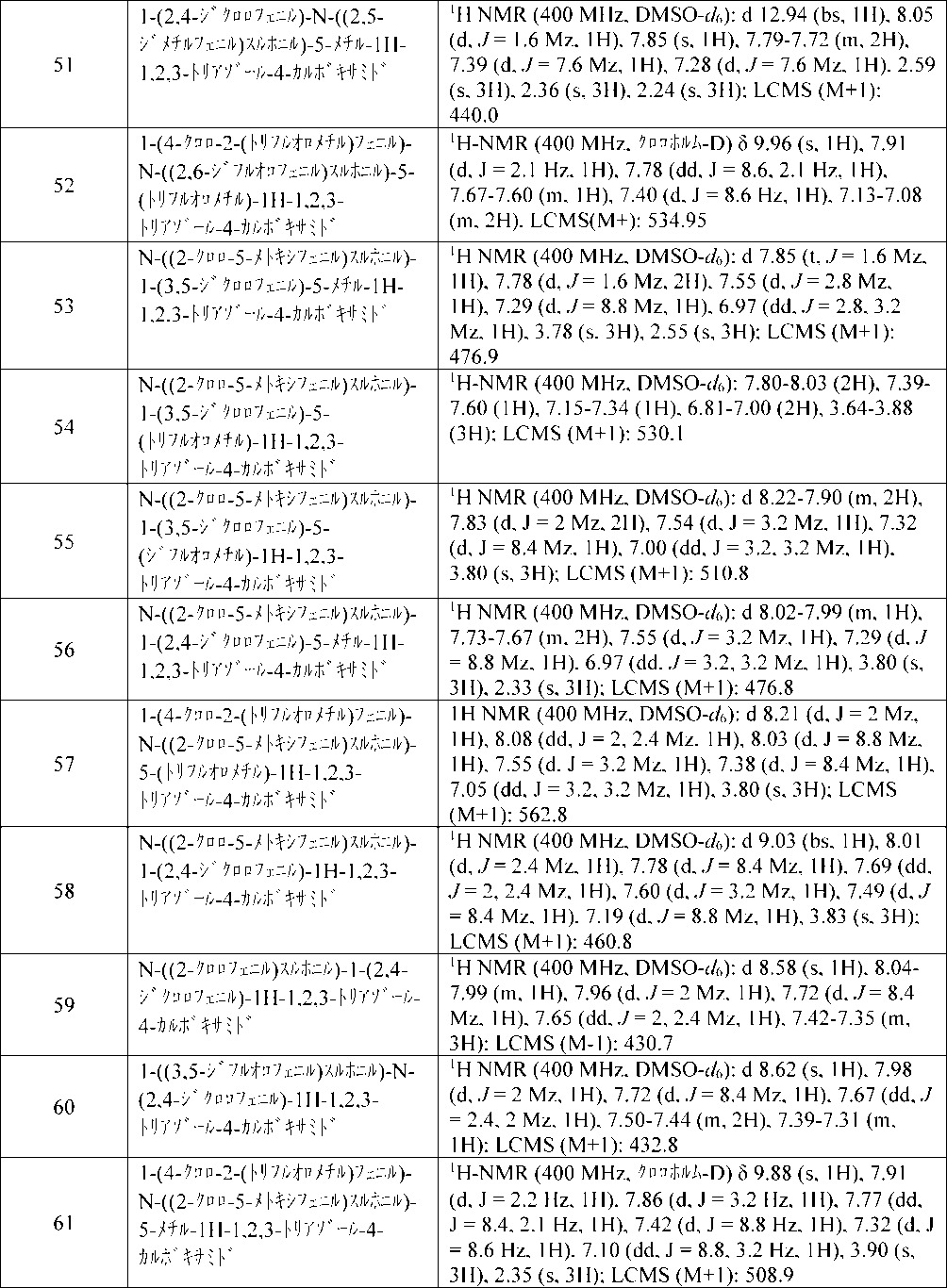
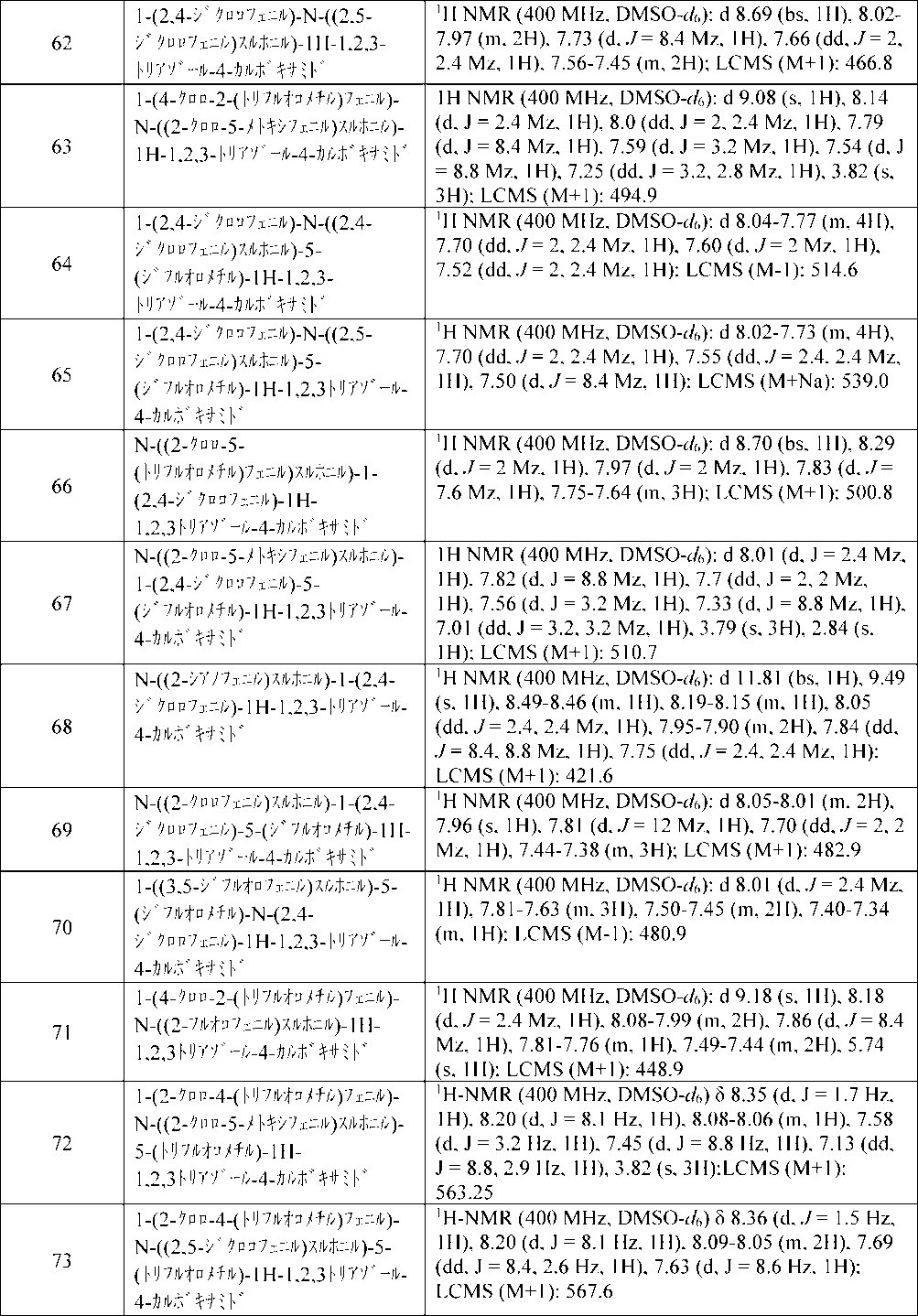


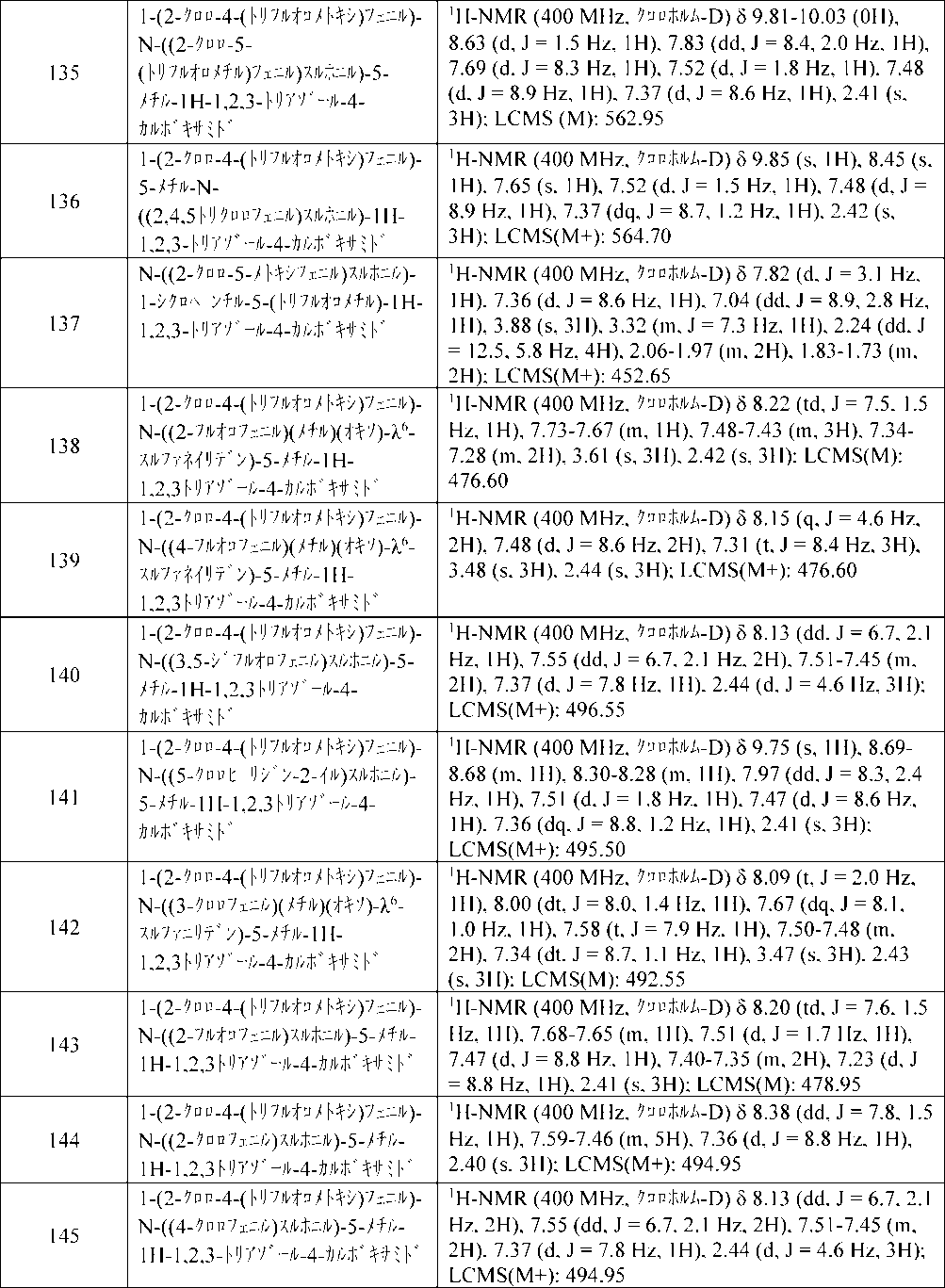


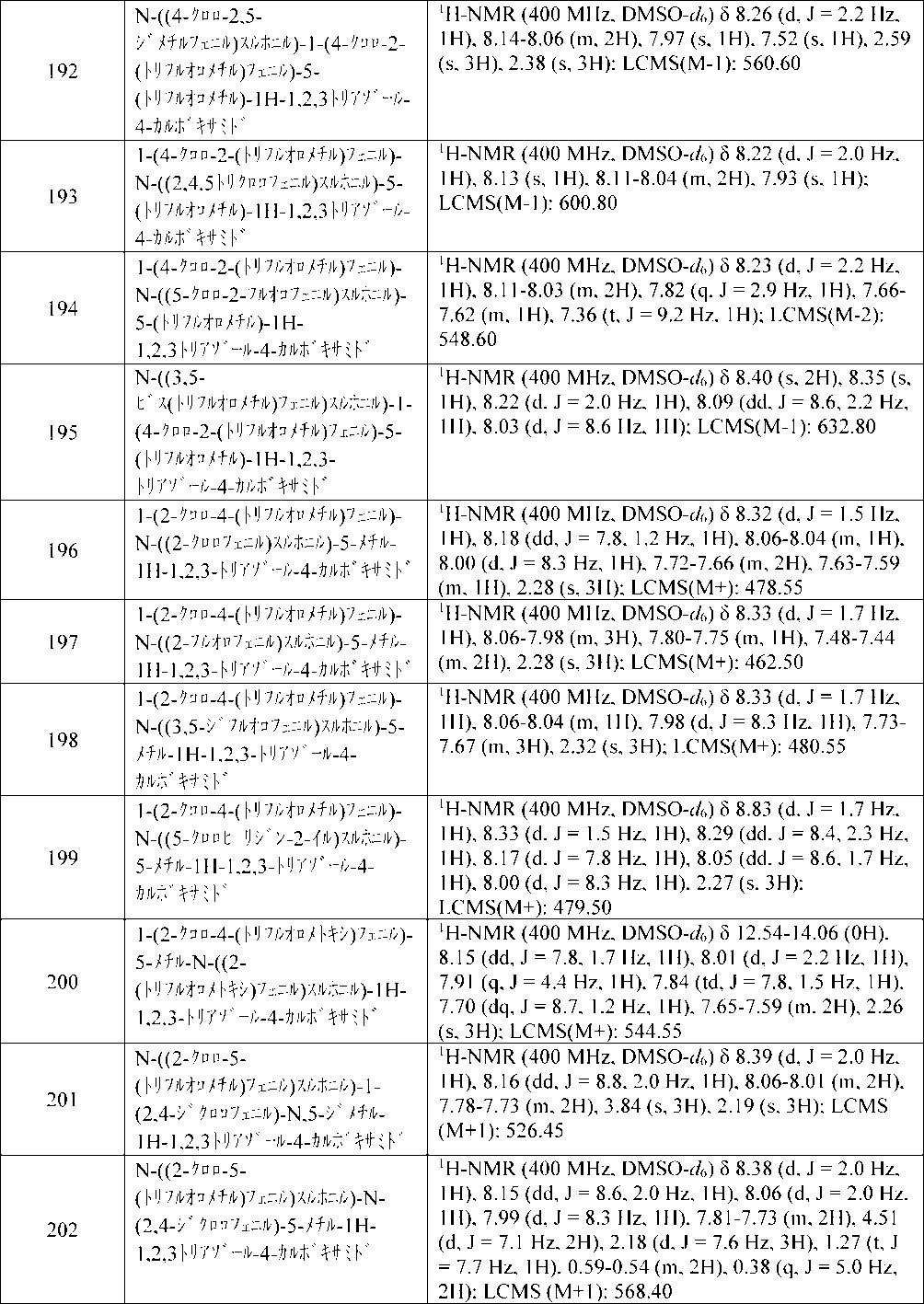
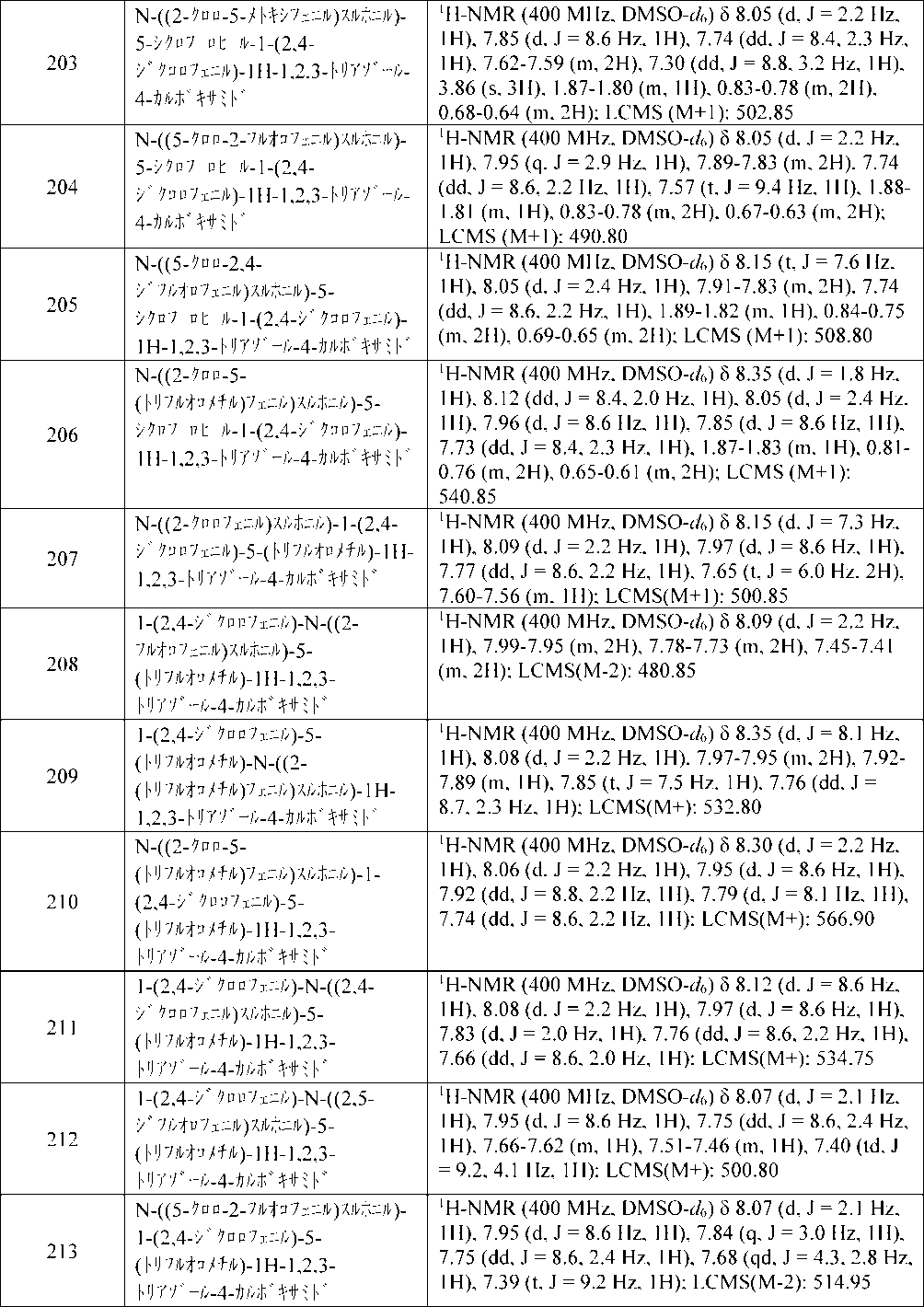
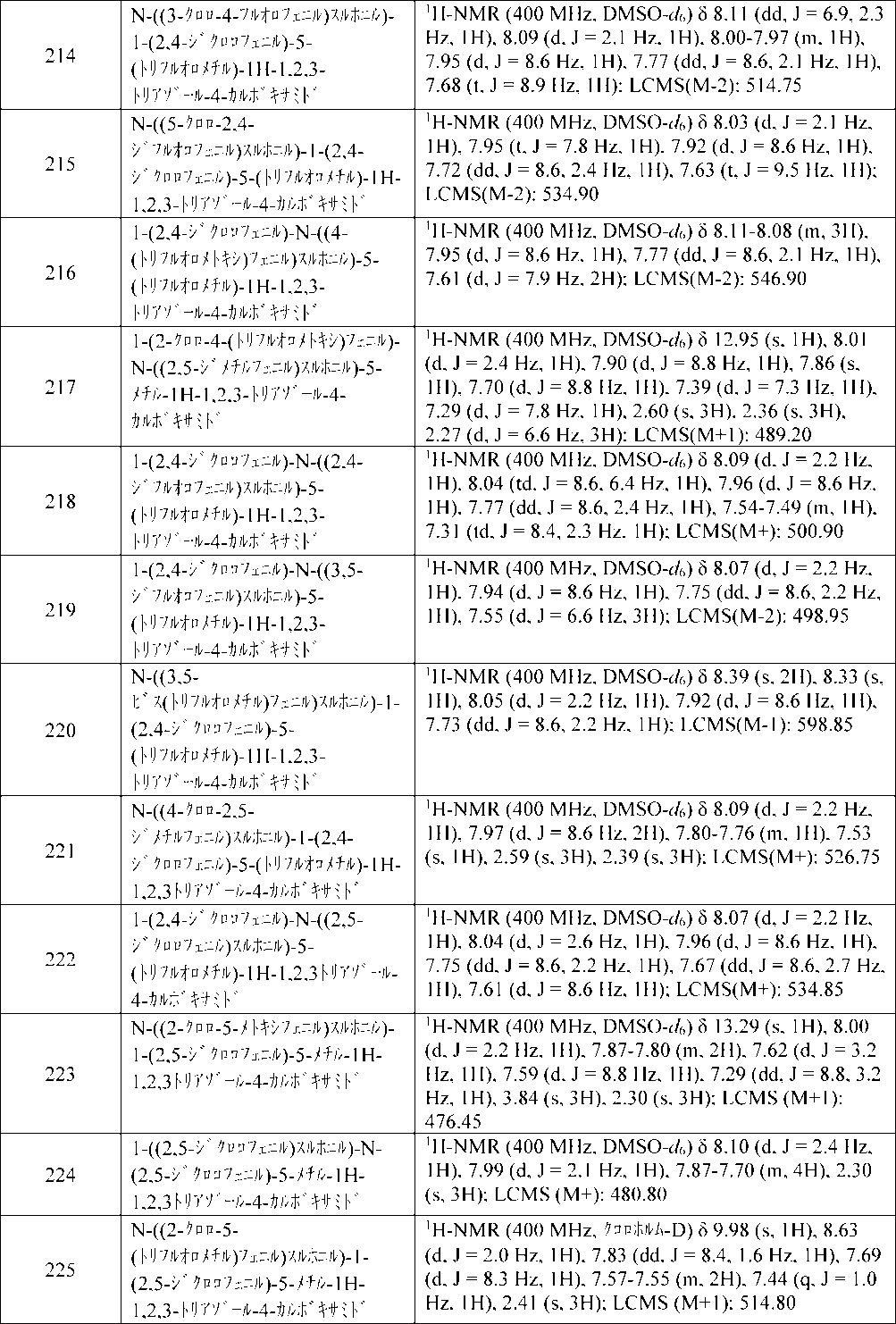


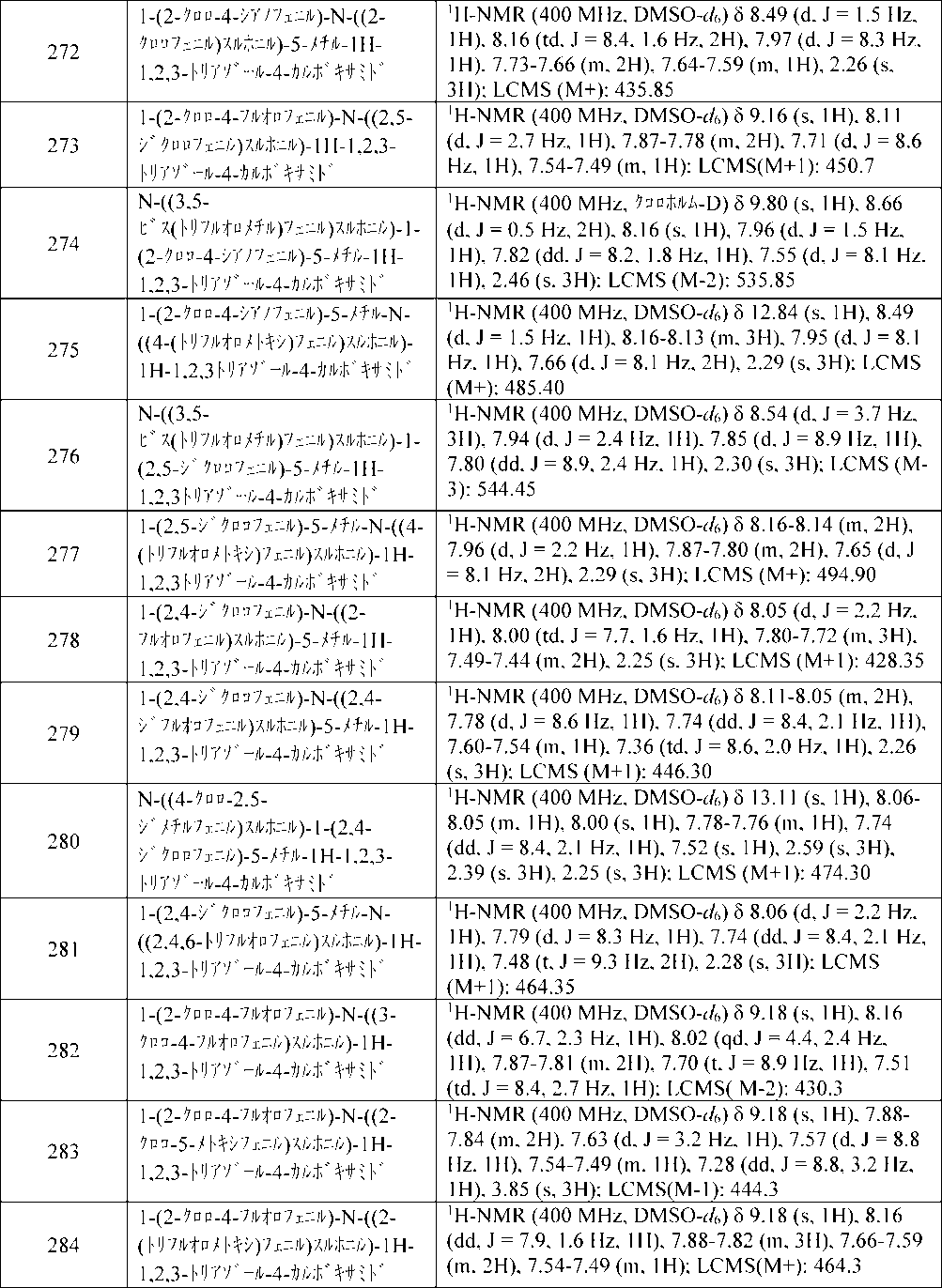
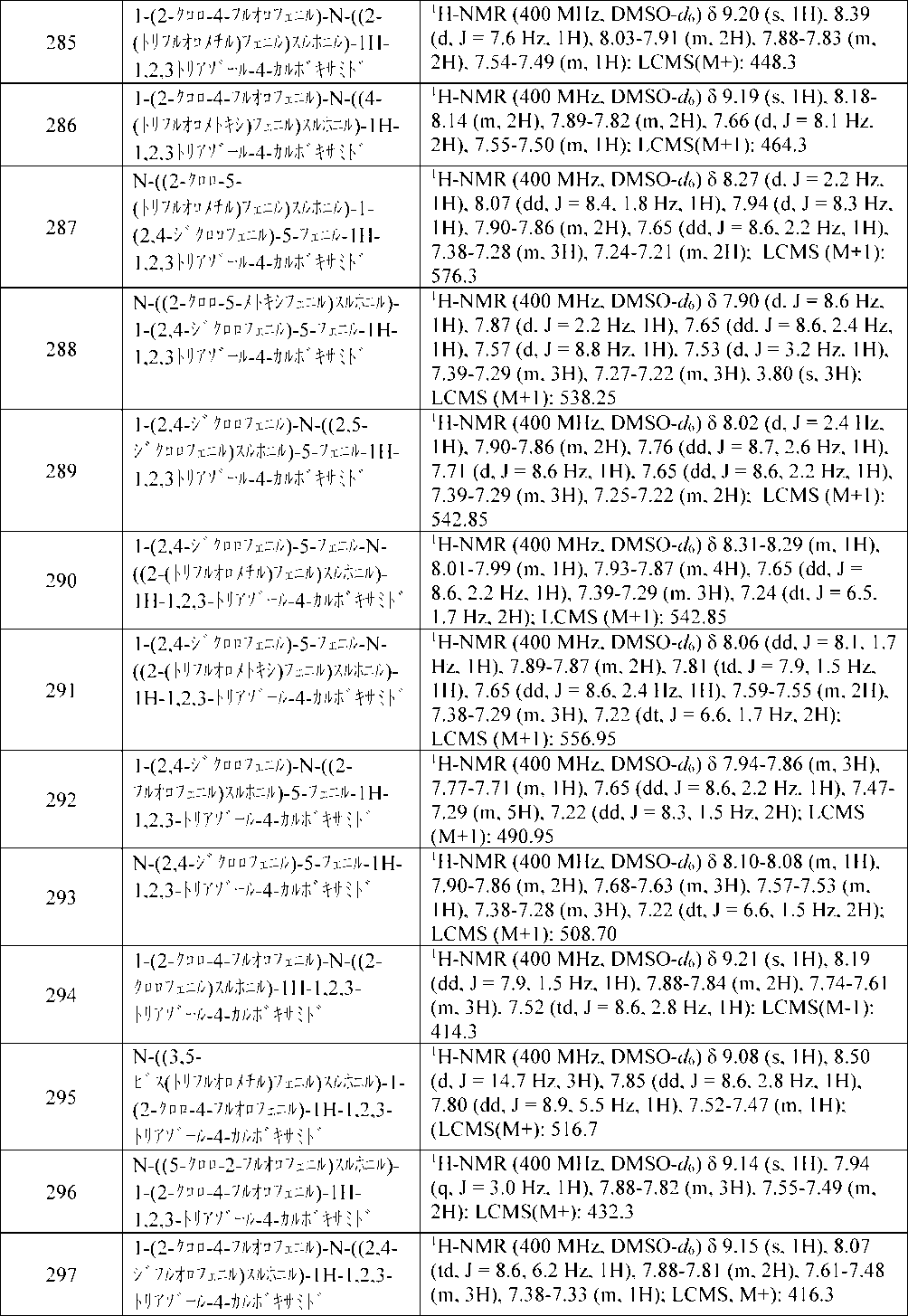
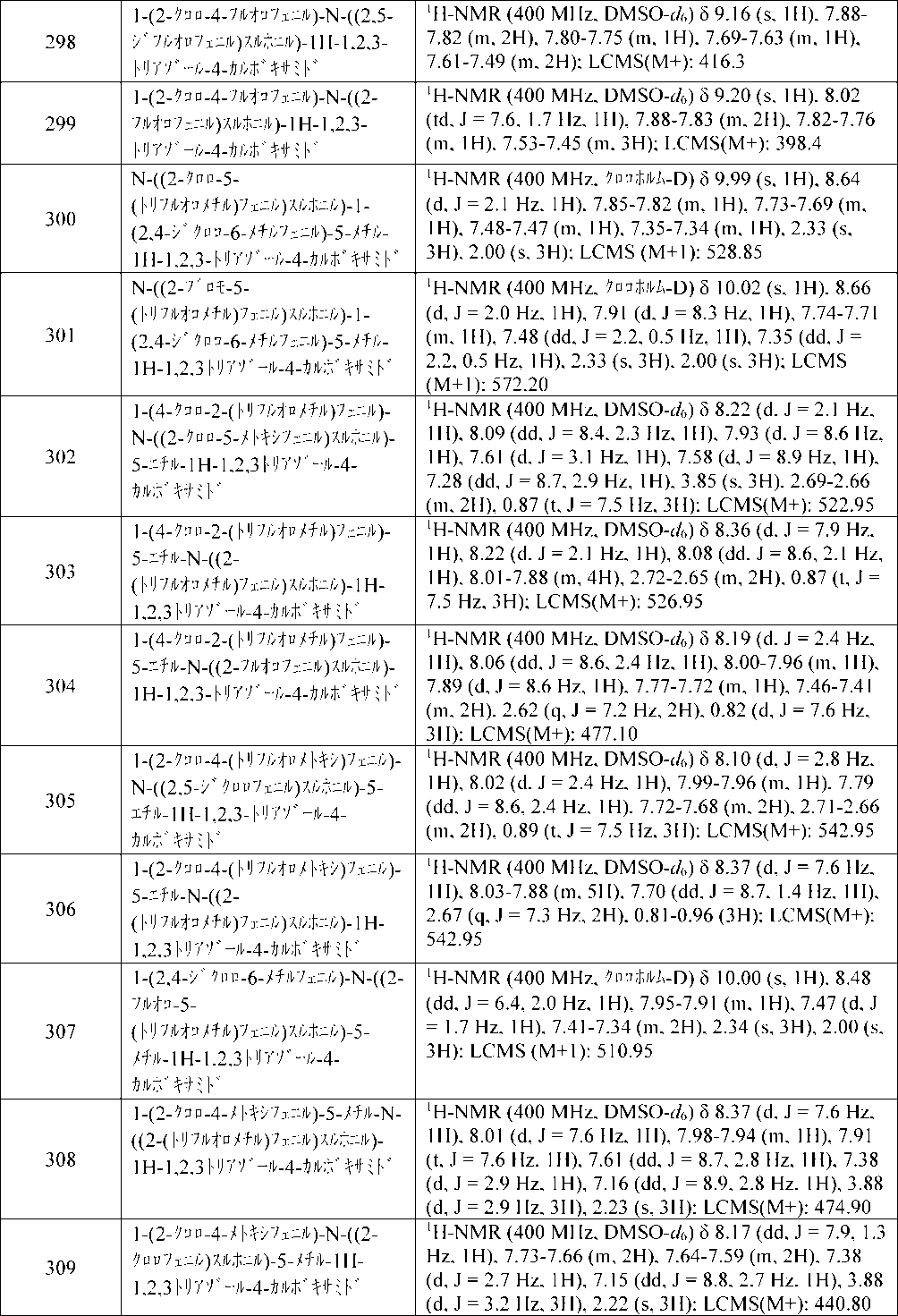

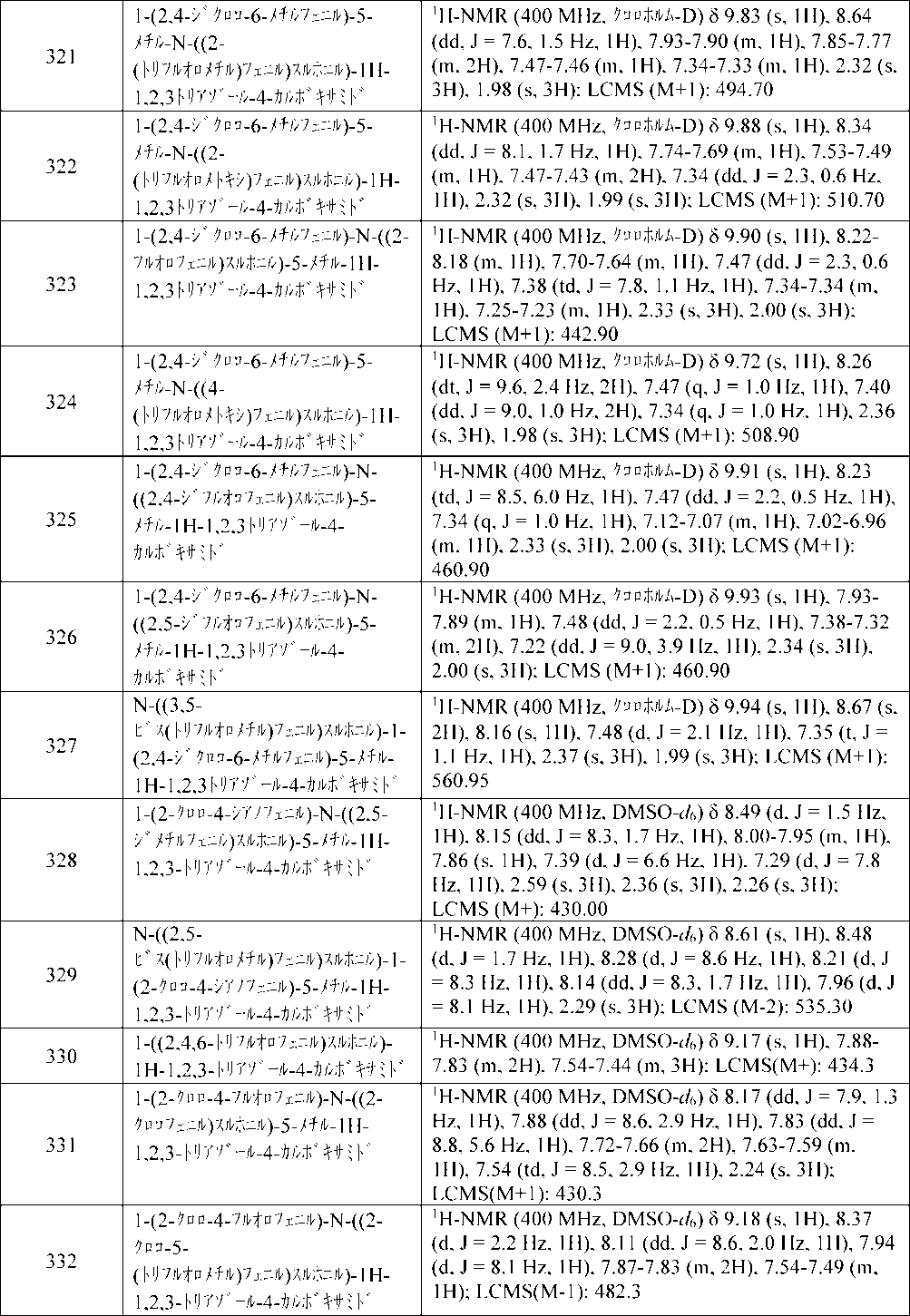


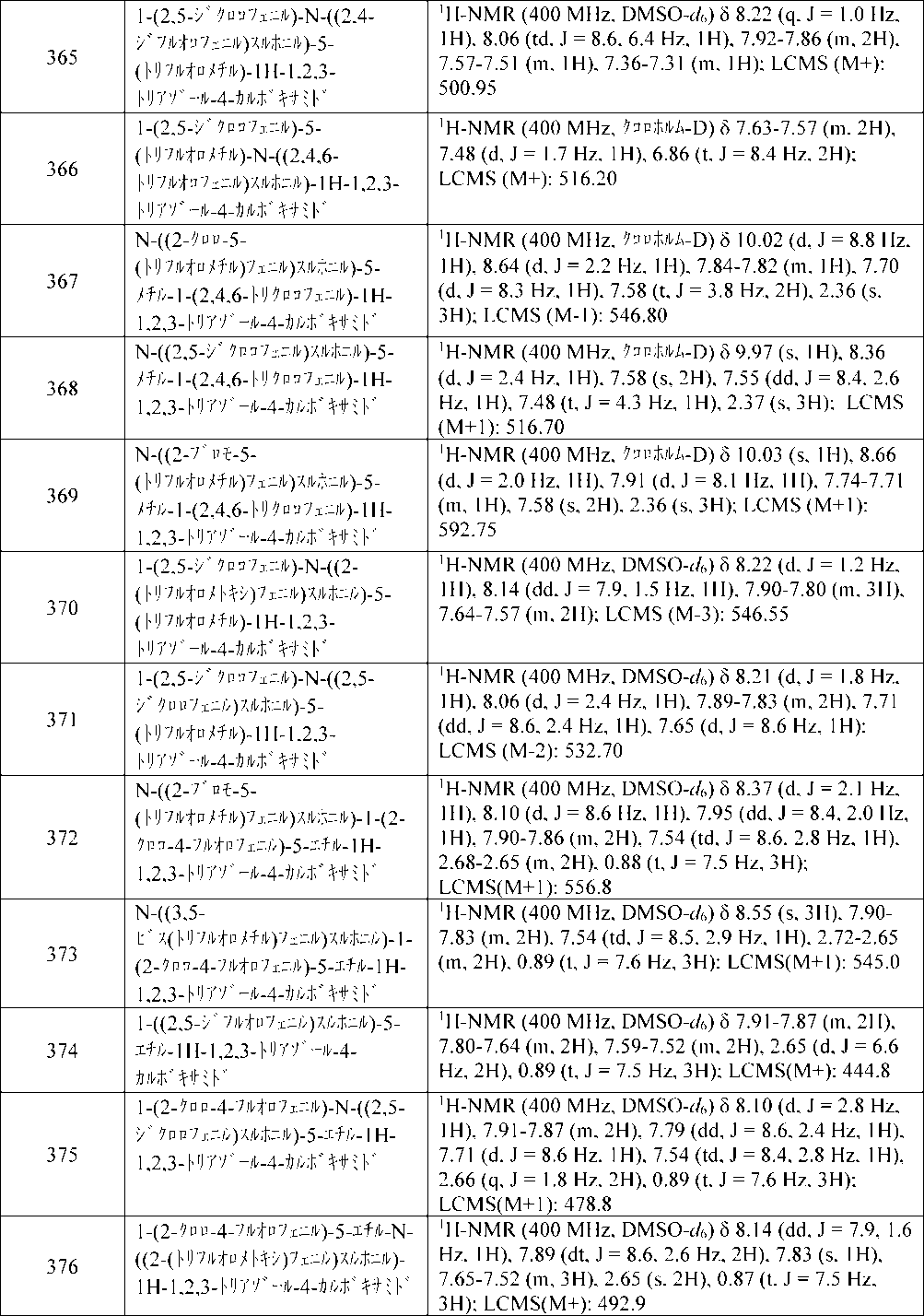
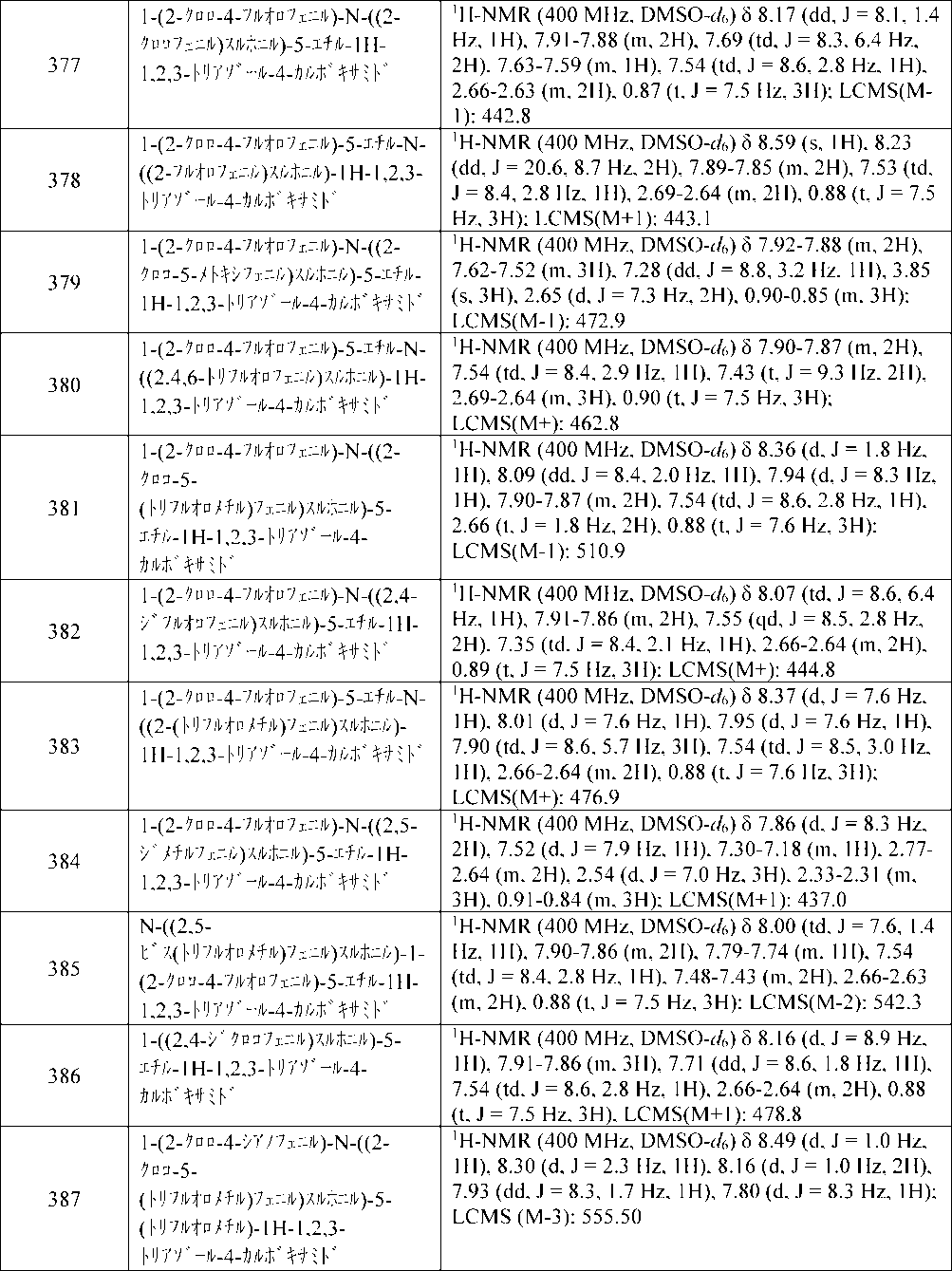


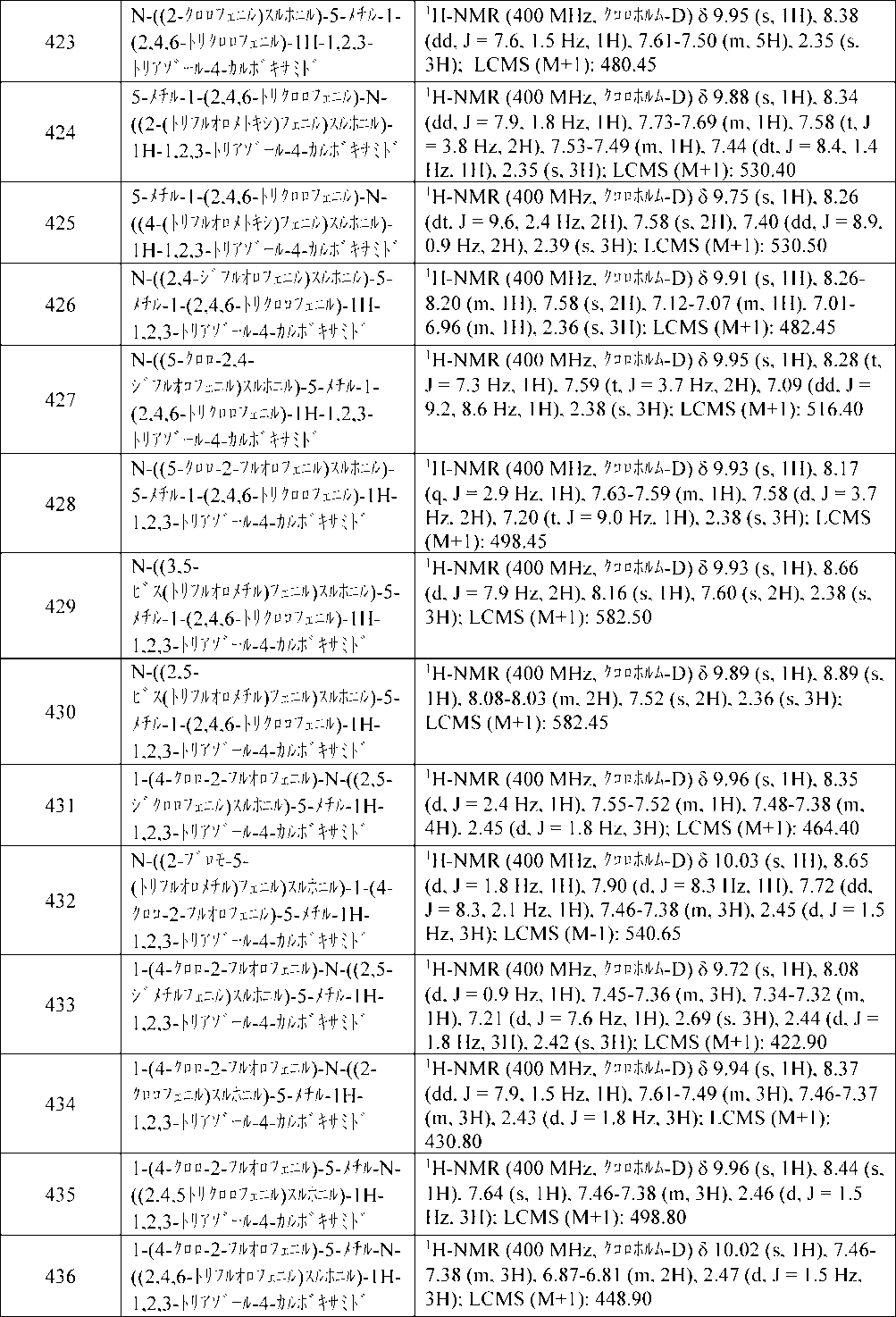
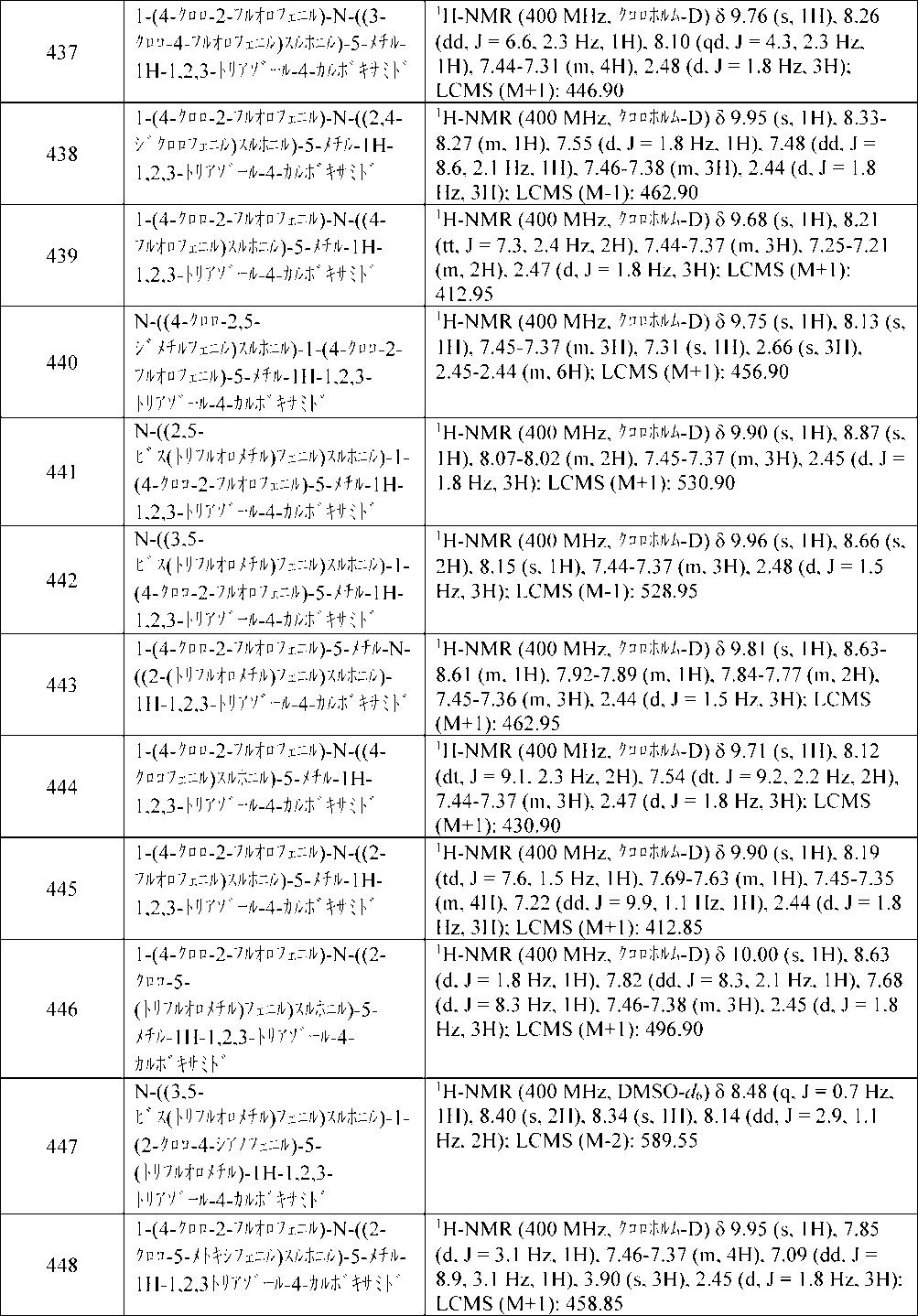
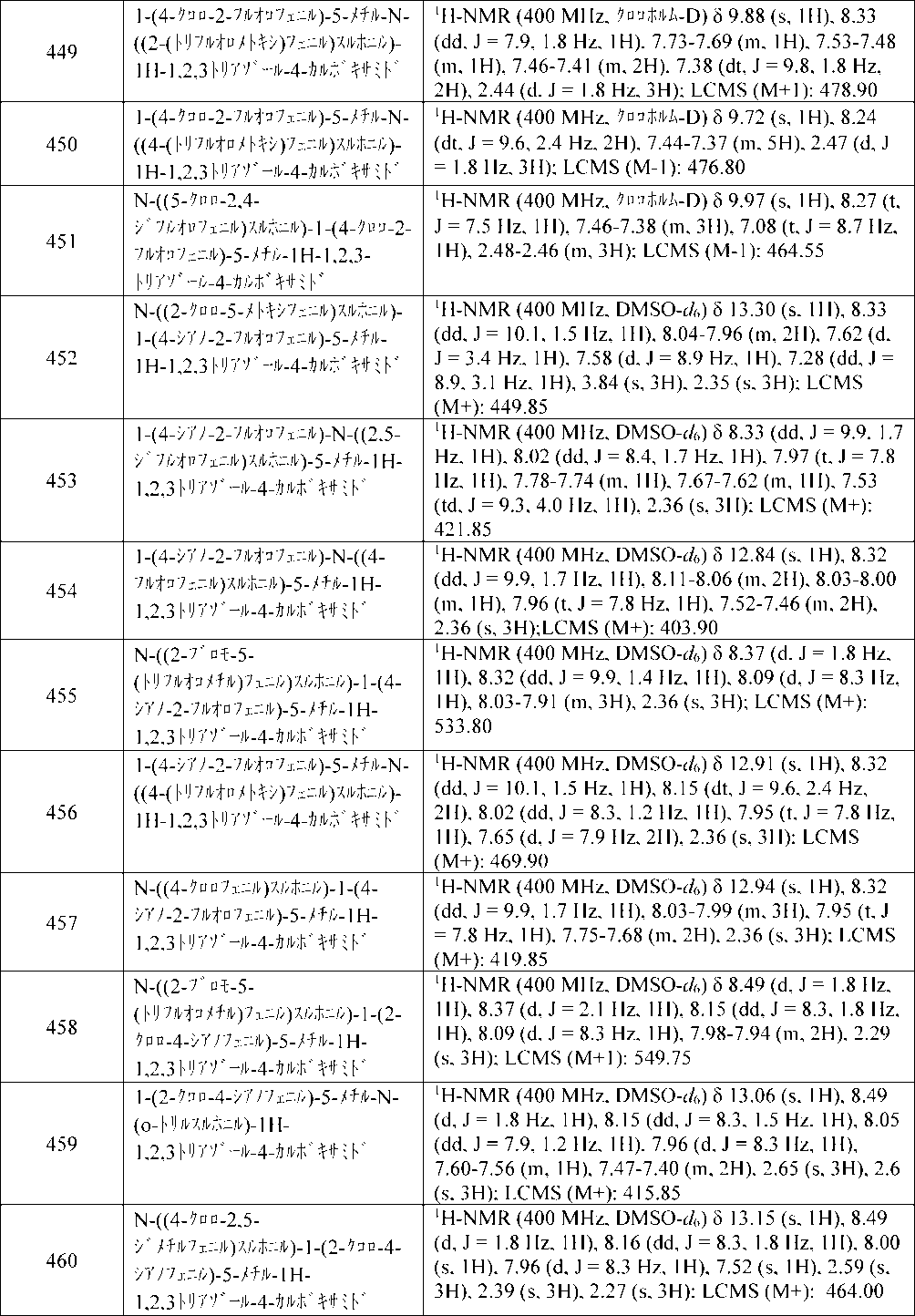


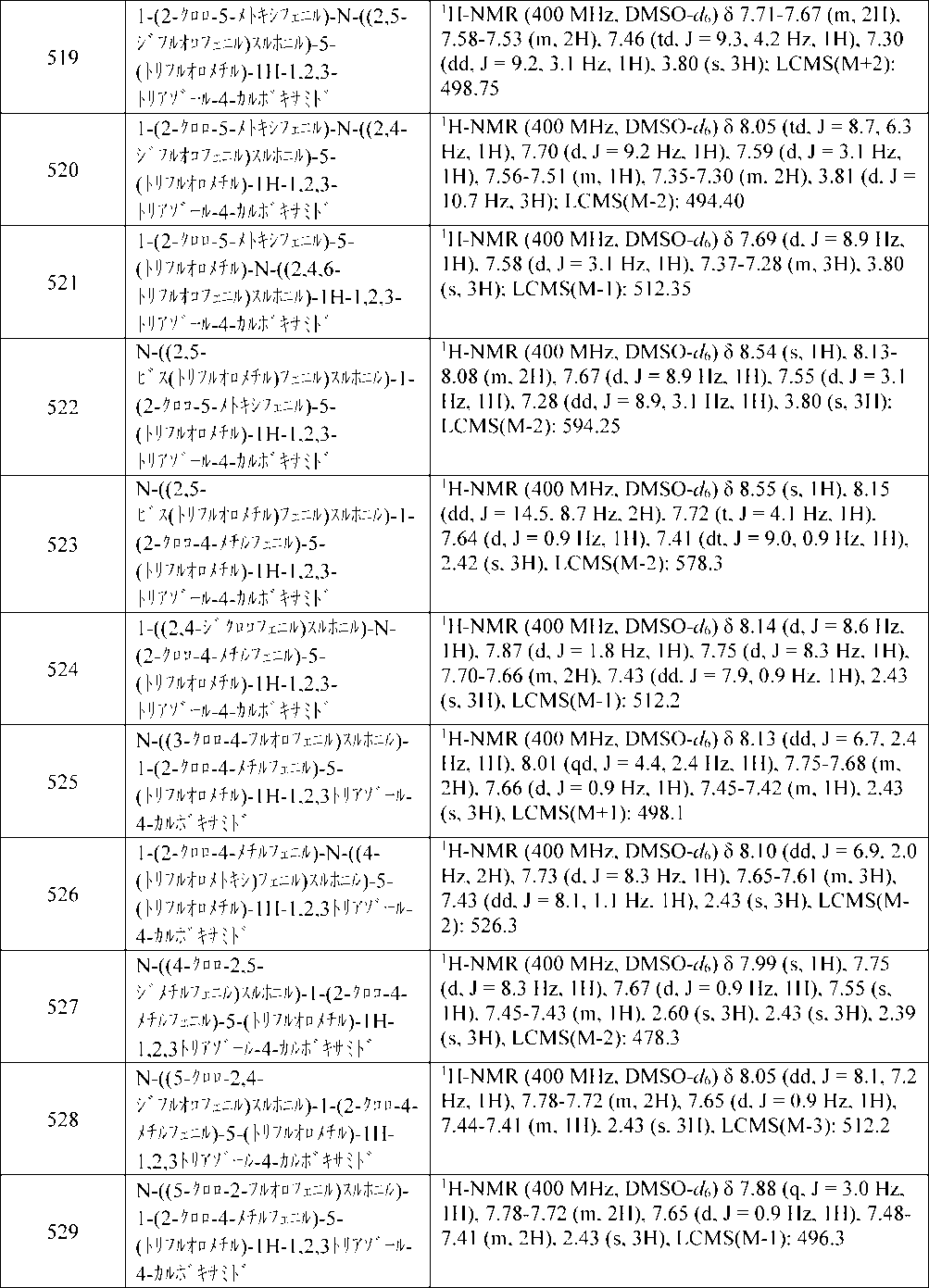
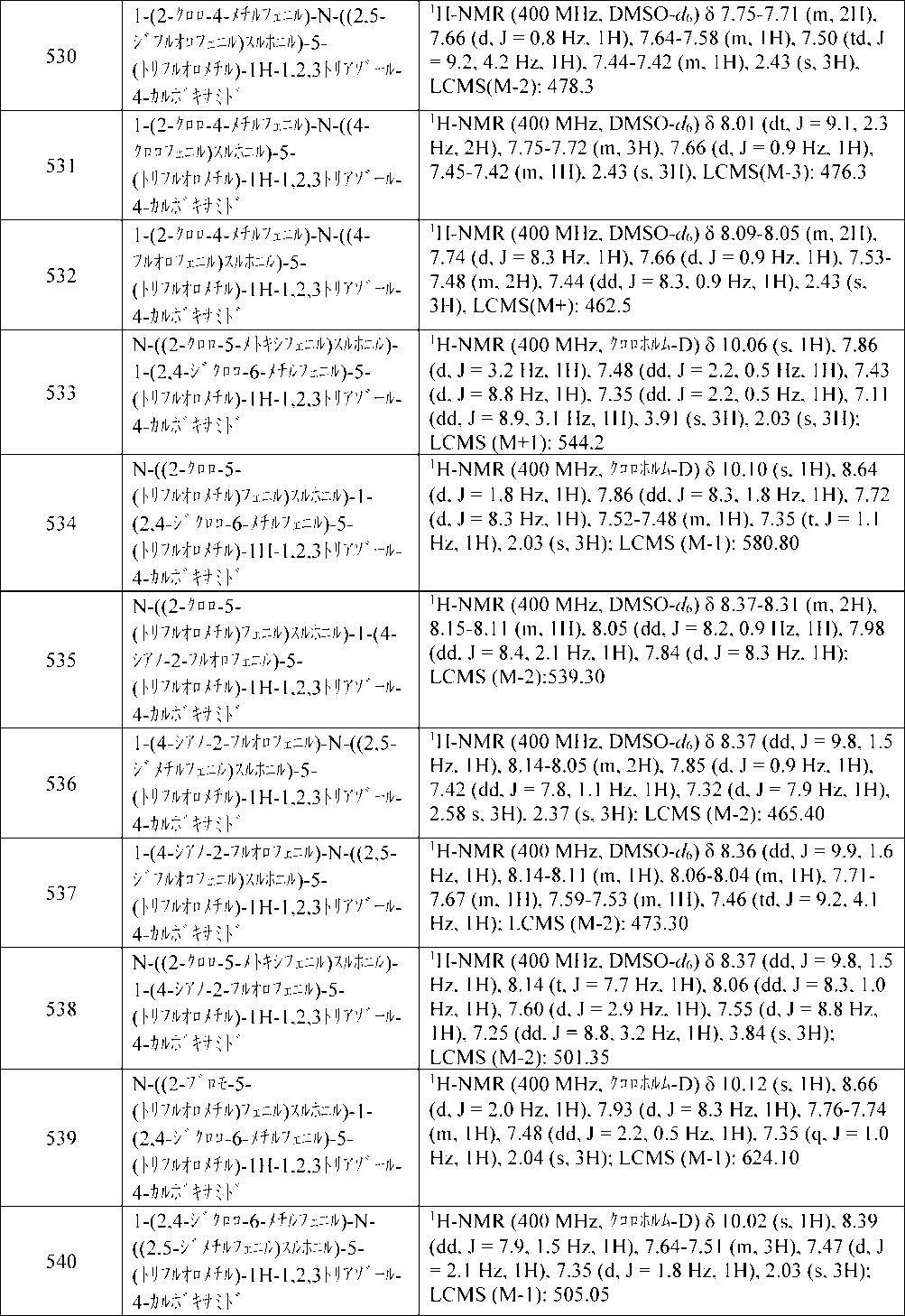


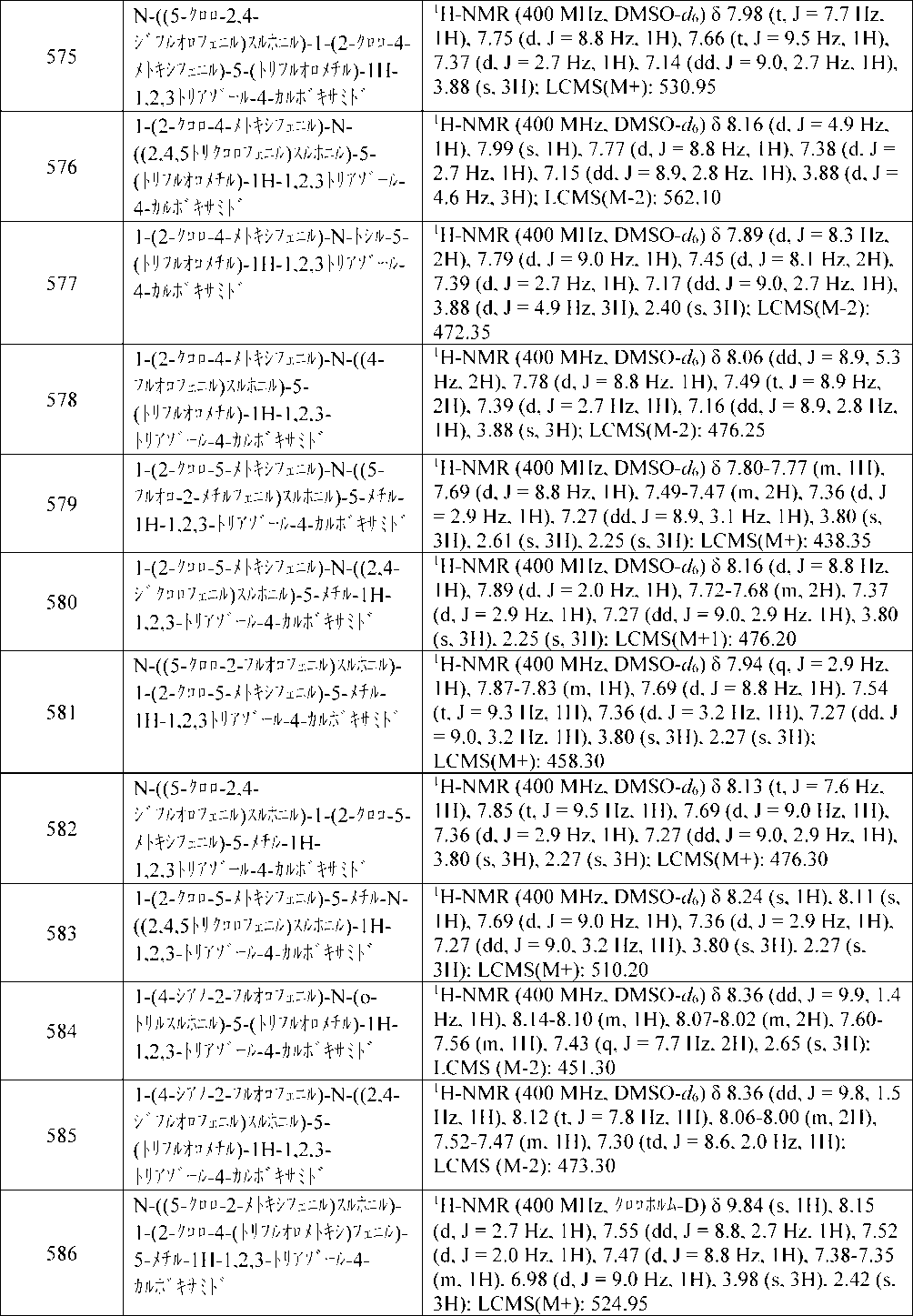


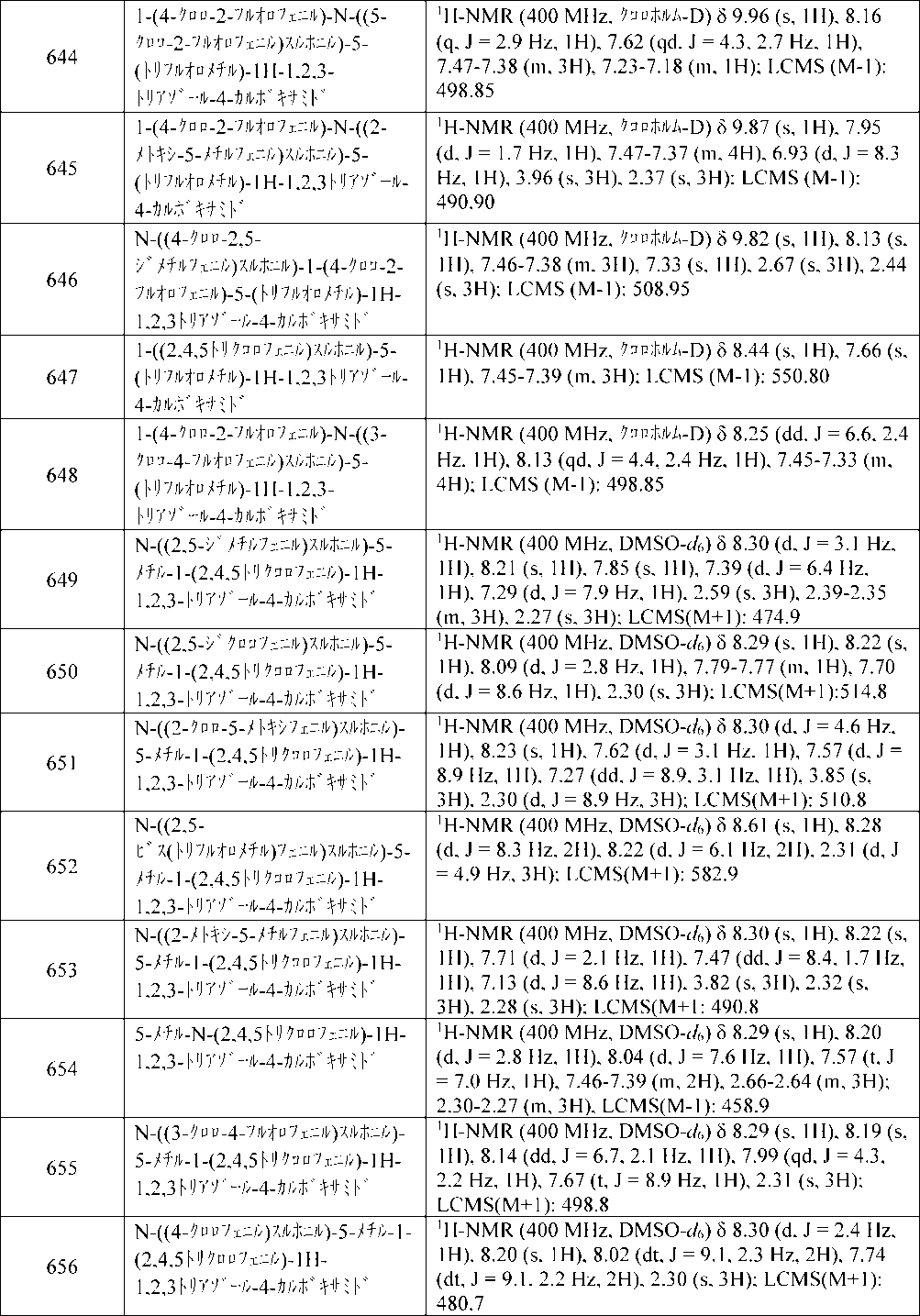

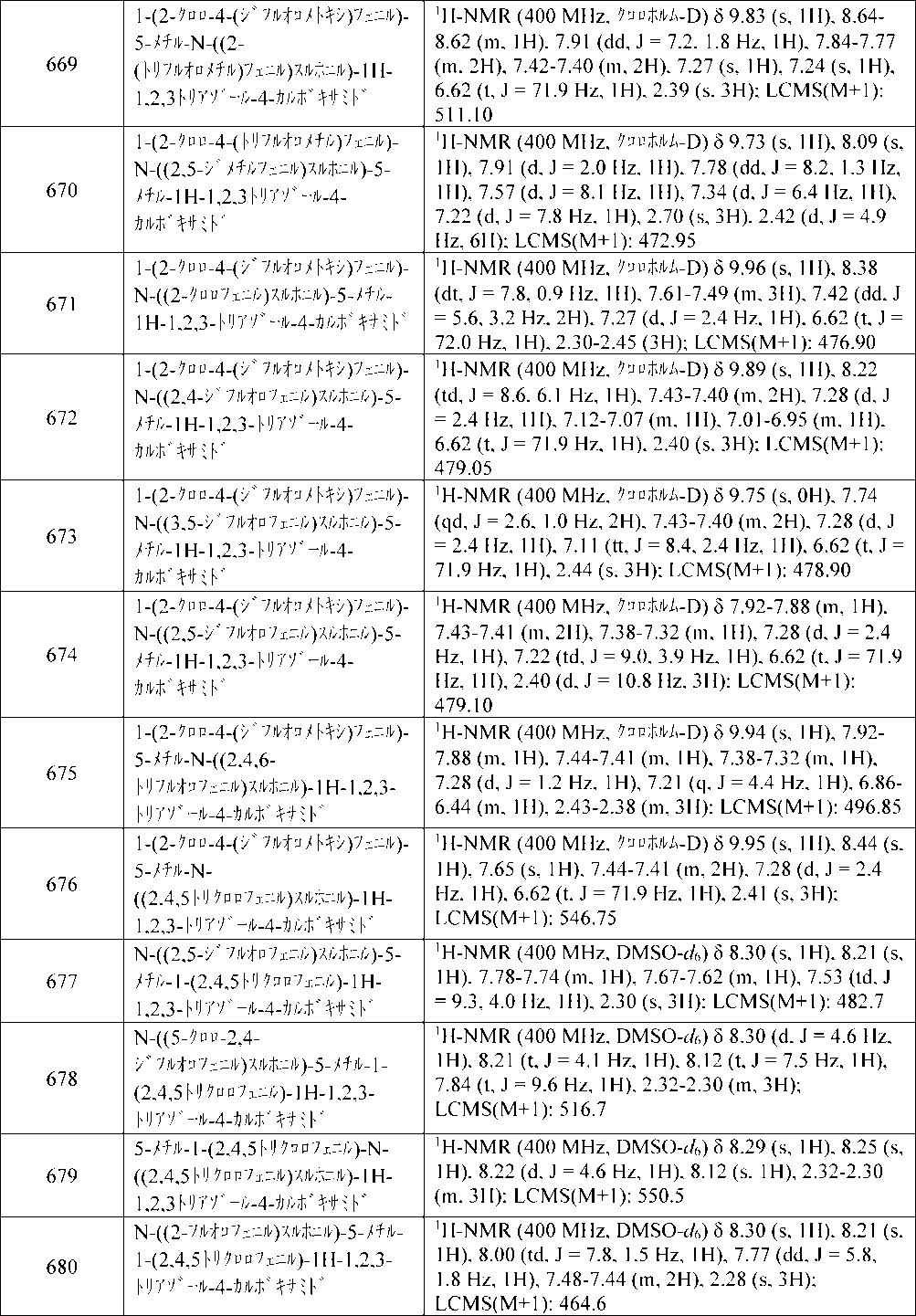

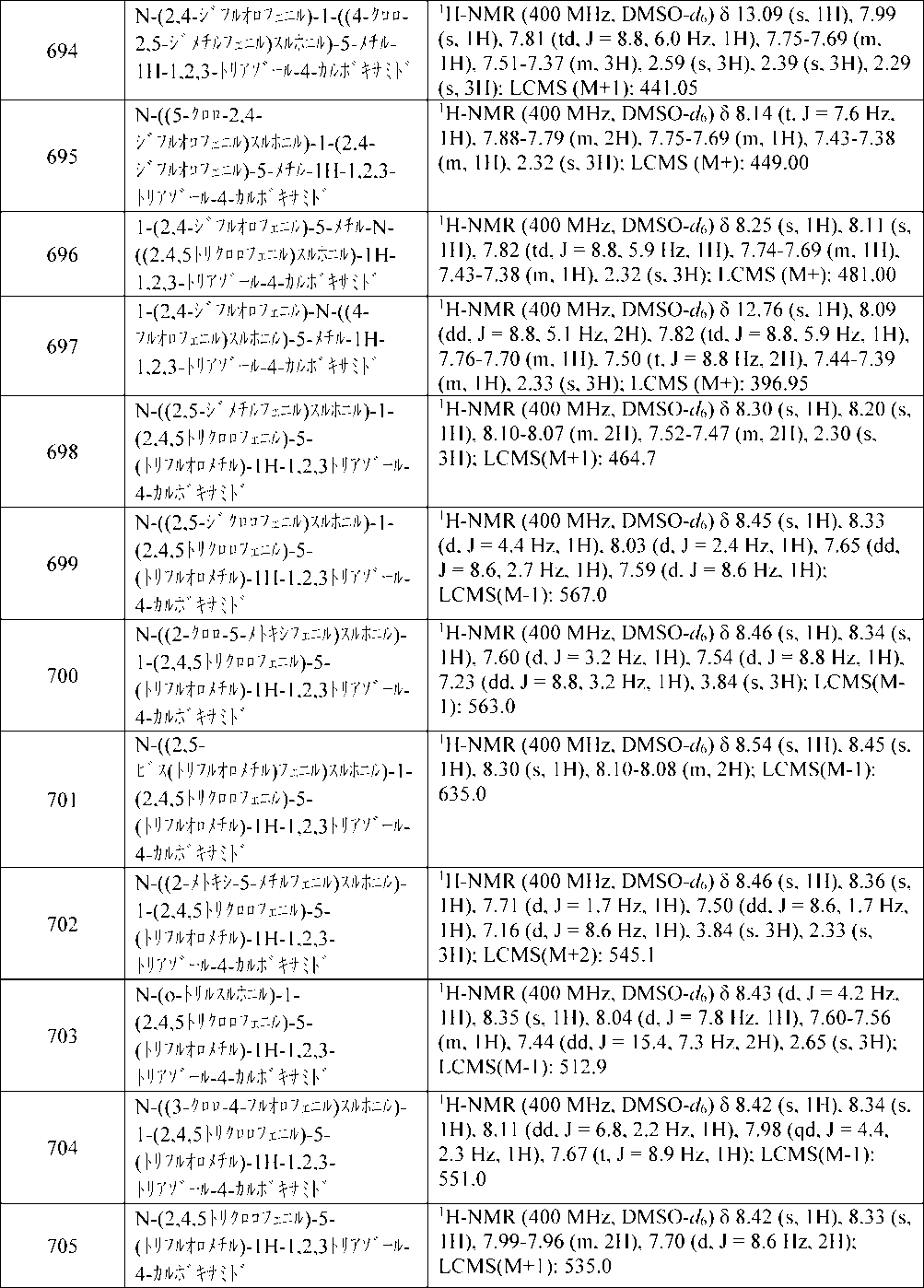

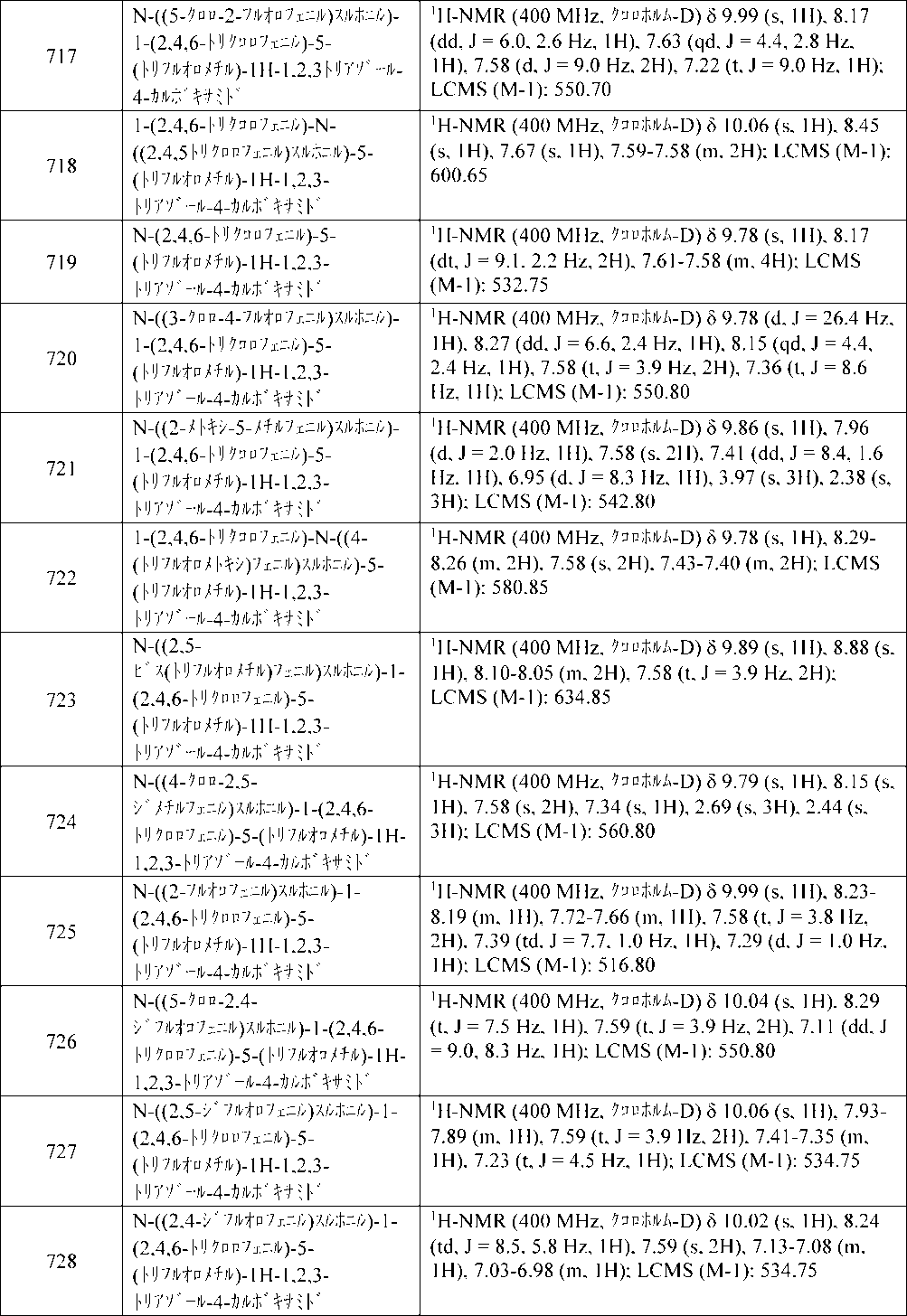


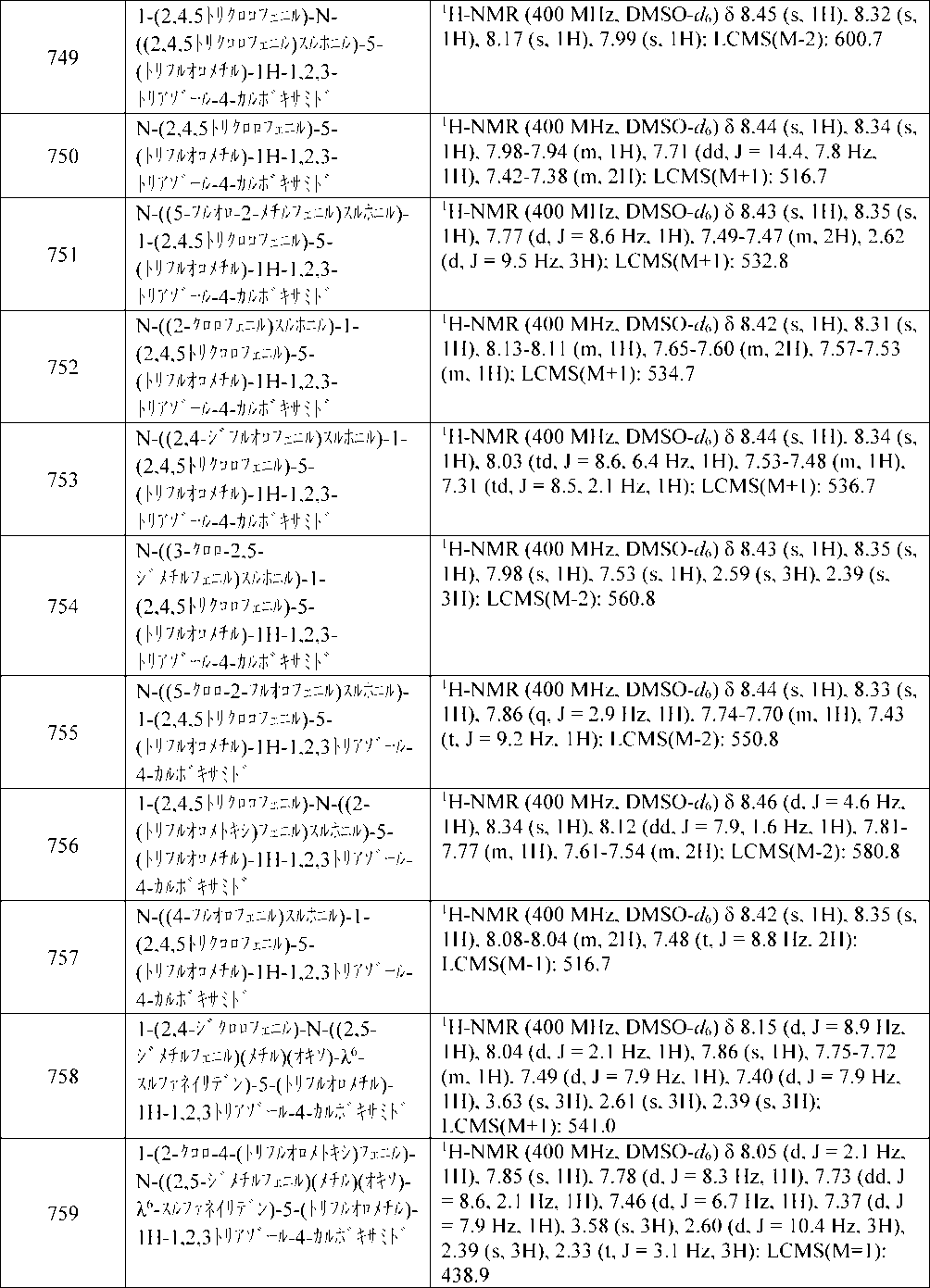


本明細書に記載されているように、式(I)の化合物は、重要な農作物を攻撃する線虫に対して発揮される高い殺線虫活性を示す。本発明の化合物は、以下の線虫の一つ以上に対するそれらの活性について評価された。 As described herein, the compounds of formula (I) exhibit high nematicidal activity against nematodes that attack important agricultural crops. The compounds of the present invention have been evaluated for their activity against one or more of the following nematodes:
[生物学的実施例]
植物寄生線虫の生物学的試験例
例1:Meloidogyne incognita試験
砂:土壌:ココピートを1:1:1の割合で混合した土壌を試験ポットに充填した。各ポットの土壌に5mLの線虫懸濁液(Meloidogyne incognita,5000卵とJ2の混合)を添加した。一時間後に規定濃度の各試験化合物を各ポットに適用した。10日齢のキュウリ苗を適用の翌日にポットに移植した。キュウリ苗は温室条件下にて27℃で生育させた。ゴール評価は適用の30日後に記録した。植物は注意深く根こそぎにされ、根は徹底的に洗浄された。虫こぶの評価は、Zeck(1971)が記述しているように、以下のように0~10のスケールで行われた。
0=虫こぶなし
1=非常に少数の小さな虫こぶ
2=多数の小さな虫こぶ
3=いくつかが一緒に成長している多数の小さな虫こぶ
4=多数の小さな虫えいといくつかの大きな虫えい
5=根の25%がひどく傷んでいる
6=根の50%がひどく傷んでいる
7=根の75%がひどく傷んでいる
8=健康な根はないが、植物はまだ緑色
9=根が腐って植物が枯れている
10=植物と根が枯れている
化合物2、7、8、17、25、33、35、52、56、57、61、76、96、97,108,132,133,134,135,140,143,168,171,209,210,217,218,227,228,229,230,231,240,241,242,245,246,250,252,253,254,259,260,261,269,271,272,278,279,280,281,311,315,316,328,335,336,337,338,339,364,370,371,378,389,390,394,395,396,410,413,415,430,432,433,441,443,445,446,458,459,460,497,499,513,516,536,538,563,586,587,588,590,596,597,598,599,610,630,631,640,657,664,665,666,667,668,669,670,671,672,673,674,675,676,683,687,689,690,691,709,736,774及び776は、1000ppmで4未満の虫こぶ評価尺度を記録したが、未処理の検査では重度の虫こぶ(最大8)があった。
Biological Examples
Examples of biological tests of plant parasitic nematodes Example 1: Meloidogyne incognita test Test pots were filled with a 1:1:1 mixture of sand:soil:coco peat. 5 mL of nematode suspension (a mixture of Meloidogyne incognita, 5000 eggs and J2) was added to the soil in each pot. After one hour, the specified concentration of each test compound was applied to each pot. Ten-day-old cucumber seedlings were transplanted into the pots the day after application. The cucumber seedlings were grown at 27°C under greenhouse conditions. Gall scores were recorded 30 days after application. The plants were carefully uprooted and the roots were thoroughly washed. Gall scores were scored on a 0 to 10 scale as described by Zeck (1971) as follows:
0 = no galls 1 = very few small galls 2 = many small galls 3 = many small galls some growing together 4 = many small galls and some larger galls 5 = 25% of the roots are severely damaged 6 = 50% of the roots are severely damaged 7 = 75% of the roots are severely damaged 8 = no healthy roots but plant is still green 9 = roots are rotten and plant is dead 10 = plant and roots are dead Compounds 2, 7, 8, 17, 25, 33, 35, 52, 56, 57, 61, 76, 96, 97, 108, 132, 133, 134, 135, 140, 143, 168, 171, 209, 210, 217, 218, 227, 228, 229, 230, 231, 240, 241, 242, 245, 246 , 250, 252, 253, 254, 259, 260, 261, 269, 271, 272, 278, 279, 280, 281, 311, 315, 31 6,328,335,336,337,338,339,364,370,371,378,389,390,394,395,396,410,4 13,415,430,432,433,441,443,445,446,458,459,460,497,499,513,516,536 , 538, 563, 586, 587, 588, 590, 596, 597, 598, 599, 610, 630, 631, 640, 657, 664, 66 No. 5, 666, 667, 668, 669, 670, 671, 672, 673, 674, 675, 676, 683, 687, 689, 690, 691, 709, 736, 774 and 776 recorded a gall rating scale of less than 4 at 1000 ppm, while untreated tests had severe galls (maximum 8).
Claims (20)
ここで、R1は、
であり、
ここで、
は、トリアゾール環への結合点を表し、又は
R1は、C1~C6-ハロアルキル、C2~C6-アルケニル、C2~C6-アルキニル、C3~C8-シクロアルキル、C3~C8-ハロシクロアルキル及びC3~C8-シクロアルキル-C1~C6-アルキルからなる群から選択され、R1のC1~C6-ハロアルキル、C2~C6-アルケニル、C2~C6-アルキニル、C3~C8-シクロアルキル、C3~C8-ハロシクロアルキル及びC3~C8-シクロアルキル-C1~C6-アルキルの基は、ハロゲン、CN、R6a、OR6a、S(O)nR6a、N(R6a)2及びCOOR6aからなる群から選択される1つ以上の基によって任意に置換されてもよく、
R1aは、水素、ハロゲン、CN、OR6a、C1~C6-アルキル及びC1~C6-ハロアルキルからなる群から選択され、R1aの各基は、ハロゲン、CN、R6a、OR6a、S(O)nR6a、N(R6a)2、COOR6a及びCONR6aからなる群から選択される1つ以上の基によって任意に置換されてもよく、
R1bは、ハロゲン、CN、C1~C6-アルキル、C1~C6-ハロアルキル、C2~C6-アルケニル、C2~C6-アルキニル、C1~C6-アルコキシ、C1~C6-ハロアルコキシ、C3~C8-シクロアルキル、C3~C8-ハロシクロアルキル、S(O)nR6a及びC3~C8-シクロアルキル-C1~C6-アルキルからなる群から選択され、ここで、R1bの各基は、ハロゲン、R6a、OR6a、S(O)nR6a、N(R6a)2、COOR6a及びCONR6aからなる群から選択される1つ以上の基によって任意に置換されてもよく、
R2は、水素、ハロゲン、CN、C1~C6-アルキル、C1~C6-ハロアルキル、C1~C6-アルコキシ、C3~C6-シクロアルキル及びフェニルからなる群から選択され、ここで、前記フェニル環は、ハロゲン、CN、C1~C4-アルキル、C1~C4-アルコキシ及びC1~C4-ハロアルキルからなる群から選択される1つ以上の基によって任意に置換されてもよく、
Zは、Z-1又はZ-2であり、
R3は、水素、C1~C6-アルキル、C1~C6-ハロアルキル、C1~C6-アルコキシ、C3~C6-シクロアルキル及びC3~C8-シクロアルキル-C1~C6-アルキルからなる群から選択され、ここで、R3の各群は、任意にハロゲンで置換されてもよく、
A1、A2及びA3は、C又はNを表し、ここで、A1、A2及びA3の2つ以下は、Nを表し、
R4は、水素、ハロゲン、CN、OR6、C1~C6-アルキル、C1~C6-ハロアルキル、C2~C6-アルケニル、及びC2~C6-アルキニルからなる群より選択され、
R5は、水素、ハロゲン、CN、ニトロ、(C=O)-R6、O(C=O)-R6、OR6、N(R6)2、CR6=NR6、COOR6、CON(R6)2、(C=S)-N(R6)2、S(O)nR6、OS(O)nR6、S(O)nN(R6)2、-S(=O)0~1R7(=N-R6)、-N=S(=O)0~1(R7)2、C1~C6-アルキル、C1~C6-ハロアルキル、C2~C6-アルケニル、C2~C6-アルキニル、C3~C8-シクロアルキル、C3~C8-ハロシクロアルキル、C3~C8-シクロアルキル-C1~C6-アルキル、フェニル、C3~C6-カルボシクリル及び複素環式3~6員環からなる群から選択され、ここで、R5の各基は、ハロゲン、R6a、OR6a、S(O)nR6a、N(R6a)2、COOR6a及びCONR6aからなる群から選択される1つ以上の基によって任意に置換されてもよく、
R6は、水素、ヒドロキシ、C1~C6-アルキル、C1~C6-アルコキシ、C1~C6-ハロアルキル、C2~C6-アルケニル、C2~C6-アルキニル、C3~C8-シクロアルキル及びC3~C8-シクロアルキル-C1~C6-アルキルからなる群から選択され、
R6aは、水素、C1~C6-アルキル、C1~C6-ハロアルキル及びC3~C8-シクロアルキルからなる群から選択され、
R7及びR8は独立して、水素、C1~C6-アルキル、C1~C6-ハロアルキル、C2~C6-アルケニル及びC3~C8-シクロアルキル及びC3~C8-シクロアルキル-C1~C6-アルキルからなる群から選択され、
nは、0から2から選択される整数であり、
又は、その塩、立体異性体、多形又はN-酸化物であり、ただし、1H-1,2,3-トリアゾール-4-カルボキサミド、1-(2-シクロプロピルエチル)-N-[(2,3-ジフルオロフェニル)スルホニル]、1H-1,2,3-トリアゾール-4-カルボキサミド、N-[(4-ブロモ-2-クロロフェニル)スルホニル]-1-(2-シクロプロピルエチル)、1H-1,2,3-トリアゾール-4-カルボキサミド、1-(2-シクロプロピルエチル)-N-[[3-[(ジメチルアミノ)カルボニル]フェニル]スルホニル]、1H-1,2,3-トリアゾール-4-カルボキサミド、1-シクロヘキシル-N-[[3-(4-メチル-2-チアゾリル)フェニル]スルホニル]及び1H-1,2,3-トリアゾール-4-カルボキサミド、1-シクロプロピル-5-(ジフルオロメチル)-N-[[4-メチル-3-(トリフルオロメチル)フェニル]スルホニル]は、式(I)の化合物の定義から除外される、
化合物。 A compound of formula (I)
Here, R1 is
and
Where:
represents the point of attachment to the triazole ring, or R 1 is selected from the group consisting of C 1 -C 6 -haloalkyl, C 2 -C 6 -alkenyl, C 2 -C 6 -alkynyl, C 3 -C 8 -cycloalkyl, C 3 -C 8 -halocycloalkyl and C 3 -C 8 -cycloalkyl-C 1 -C 6 -alkyl, the C 1 -C 6 -haloalkyl, C 2 -C 6 -alkenyl, C 2 -C 6 -alkynyl, C 3 -C 8 -cycloalkyl, C 3 -C 8 -halocycloalkyl and C 3 -C 8 -cycloalkyl - C 1 -C 6 -alkyl groups of R 1 are halogen, CN, R 6a , OR 6a , S(O) n R 6a , N(R 6a 2 and COOR 6a ,
R 1a is selected from the group consisting of hydrogen, halogen, CN, OR 6a , C 1-6 - alkyl and C 1-6 -haloalkyl, each group R 1a may be optionally substituted with one or more groups selected from the group consisting of halogen, CN, R 6a , OR 6a , S(O) n R 6a , N(R 6a ) 2 , COOR 6a and CONR 6a ;
R 1b is selected from the group consisting of halogen, CN, C 1 -C 6 -alkyl, C 1 -C 6 -haloalkyl, C 2 -C 6 -alkenyl, C 2 -C 6 -alkynyl, C 1 -C 6 -alkoxy, C 1 -C 6 -haloalkoxy, C 3 -C 8 -cycloalkyl, C 3 -C 8 -halocycloalkyl , S(O) n R 6a and C 3 -C 8 -cycloalkyl-C 1 -C 6 -alkyl, where each group R 1b may be optionally substituted by one or more groups selected from the group consisting of halogen, R 6a , OR 6a , S(O) n R 6a , N(R 6a ) 2 , COOR 6a and CONR 6a ;
R 2 is selected from the group consisting of hydrogen, halogen, CN, C 1 -C 6 -alkyl, C 1 -C 6 -haloalkyl, C 1 -C 6 -alkoxy, C 3 -C 6 -cycloalkyl and phenyl, where the phenyl ring may be optionally substituted by one or more groups selected from the group consisting of halogen, CN, C 1 -C 4 -alkyl, C 1 -C 4 -alkoxy and C 1 -C 4 -haloalkyl,
Z is Z-1 or Z-2;
R 3 is selected from the group consisting of hydrogen, C 1 -C 6 -alkyl, C 1 -C 6 -haloalkyl, C 1 -C 6 -alkoxy, C 3 -C 6 -cycloalkyl and C 3 -C 8 -cycloalkyl-C 1 -C 6 -alkyl, where each group of R 3 may be optionally substituted with halogen;
A 1 , A 2 and A 3 represent C or N, where no more than two of A 1 , A 2 and A 3 represent N;
R 4 is selected from the group consisting of hydrogen, halogen, CN, OR 6 , C 1 -C 6 -alkyl, C 1 -C 6 -haloalkyl, C 2 -C 6 -alkenyl, and C 2 -C 6 -alkynyl;
R 5 is hydrogen, halogen, CN, nitro, (C═O)—R 6 , O(C═O)—R 6 , OR 6 , N(R 6 ) 2 , CR 6═NR 6 , COOR 6 , CON(R 6 ) 2 , (C═S)—N(R 6 ) 2 , S(O) n R 6 , OS(O) n R 6 , S(O) n N(R 6 ) 2 , -S(═O) 0-1 R 7 (═N-R 6 ), -N═S(═O) 0-1 (R 7 ) 2 , C 1 -C 6 -alkyl , C 1 -C 6 -haloalkyl, C 2 -C 6 -alkenyl, C 2 -C 6 -alkynyl, C 3 -C8 -cycloalkyl, C3 - C8 -halocycloalkyl, C3 - C8 -cycloalkyl- C1 - C6 -alkyl, phenyl, C3 - C6 -carbocyclyl and heterocyclic 3- to 6 -membered rings, wherein each group R5 may be optionally substituted by one or more groups selected from the group consisting of halogen, R6a , OR6a , S(O) nR6a , N( R6a ) 2 , COOR6a and CONR6a ,
R 6 is selected from the group consisting of hydrogen, hydroxy, C 1 -C 6 -alkyl, C 1 -C 6 -alkoxy, C 1 -C 6 -haloalkyl, C 2 -C 6 -alkenyl, C 2 -C 6 -alkynyl, C 3 -C 8 -cycloalkyl and C 3 -C 8 -cycloalkyl-C 1 -C 6 -alkyl;
R 6a is selected from the group consisting of hydrogen, C 1 -C 6 -alkyl, C 1 -C 6 -haloalkyl and C 3 -C 8 -cycloalkyl;
R 7 and R 8 are independently selected from the group consisting of hydrogen, C 1 -C 6 -alkyl, C 1 -C 6 -haloalkyl, C 2 -C 6 -alkenyl and C 3 -C 8 -cycloalkyl and C 3 -C 8 -cycloalkyl-C 1 -C 6 -alkyl;
n is an integer selected from 0 to 2;
or a salt, stereoisomer, polymorph or N-oxide thereof, provided that 1H-1,2,3-triazole-4-carboxamide, 1-(2-cyclopropylethyl)-N-[(2,3-difluorophenyl)sulfonyl], 1H-1,2,3-triazole-4-carboxamide, N-[(4-bromo-2-chlorophenyl)sulfonyl]-1-(2-cyclopropylethyl), 1H-1,2,3-triazole-4-carboxamide, 1-(2-cyclopropylethyl) )-N-[[3-[(dimethylamino)carbonyl]phenyl]sulfonyl], 1H-1,2,3-triazole-4-carboxamide, 1-cyclohexyl-N-[[3-(4-methyl-2-thiazolyl)phenyl]sulfonyl] and 1H-1,2,3-triazole-4-carboxamide, 1-cyclopropyl-5-(difluoromethyl)-N-[[4-methyl-3-(trifluoromethyl)phenyl]sulfonyl] are excluded from the definition of the compound of formula (I);
Compound.
であり、
ここで、
は、トリアゾール環への結合点を表す、
請求項1に記載の式(I)の化合物。 R 1 is
and
Where:
represents the point of attachment to the triazole ring,
A compound of formula (I) according to claim 1.
請求項1又は2に記載の式(I)の化合物。 Z is Z-1;
A compound of formula (I) according to claim 1 or 2.
請求項1又は2に記載の式(I)の化合物。 Z is Z-2;
A compound of formula (I) according to claim 1 or 2.
請求項1~4のいずれか1項に記載の式(I)の化合物。 R 2 is selected from the group consisting of hydrogen, halogen, CN, C 1 -C 4 -alkyl, C 1 -C 4 -haloalkyl, C 1 -C 4 -alkoxy, cyclopropyl and phenyl, wherein the phenyl ring may be optionally substituted with one or more groups selected from the group consisting of halogen, CN, methyl, ethyl, propyl, isopropyl, methoxy, ethoxy, difluoromethyl and trifluoromethyl;
A compound of formula (I) according to any one of claims 1 to 4.
で表される、請求項1に記載の式(I)の化合物であって、
ここで、R1aは、水素、ハロゲン、CN、OR6a、C1~C4-アルキル及びC1~C4-ハロアルキルからなる群から選択される。ここで、R1aの各基は、ハロゲン、CN及びR6aからなる群から選択される1つ以上の基によって任意に置換されていてもよく、
R1bは、ハロゲン、CN、C1~C4-アルキル、C1~C4-ハロアルキル、C2~C4-アルケニル、C2~C4-アルキニル、C1~C4-アルコキシ、C1~C4-ハロアルコキシ、C3~C6-シクロアルキル、C3~C6-ハロシクロアルキル及びC3~C6-シクロアルキル-C1~C4-アルキルからなる群から選択され、ここで、R1bの各基は、ハロゲン、R6a、OR6a及びS(O)nR6aからなる群から選択される1つ以上の基によって任意に置換されていてもよく、
R2は、水素、ハロゲン、CN、C1~C4-アルキル、C1~C4-ハロアルキル、C1~C4-アルコキシ、シクロプロピル及びフェニルからなる群から選択され、ここで、前記フェニル環は、ハロゲン、CN、C1~C4-アルキル、C1~C4-アルコキシ及びC1~C4-ハロアルキルからなる群から選択される1つ以上の基によって任意に置換されてもよく、
R3は、水素、C1~C4-アルキル、C1~C4-ハロアルキル及びC3~C8-シクロアルキル-C1~C4-アルキルからなる群から選択され、
R4は、水素、ハロゲン、CN、OR6、C1~C4-アルキル及びC1~C4-ハロアルキルからなる群から選択され、
R5は、水素、ハロゲン、CN、ニトロ、(C=O)-R6、OR6、N(R6)2、S(O)nR6、C1~C4-アルキル、C1~C4-ハロアルキル、C3~C6-シクロアルキル、C3~C6-ハロシクロアルキル、C3~C6-シクロアルキル-C1~C4-アルキル、フェニル、C3~C6-カルボシクリル及び複素環式3~6員環からなる群より選択され、ここで、R5の各基は、ハロゲン、R6aからなる群から選択される1つ以上の基によって置換されていてもよく、
R6aは、水素、C1~C4-アルキル、C1~C4-ハロアルキル及びC3~C6-シクロアルキルからなる群から選択され、
R6は、水素、ヒドロキシ、C1~C4-アルキル、C1~C4-アルコキシ、C1~C4-ハロアルキル、C2~C4-アルケニル、C2~C4-アルキニル及びC3~C6-シクロアルキル及びC3~C6-シクロアルキル-C1~C4-アルキルからなる群から選択され、
nは、0~2から選択される整数であり、
又はその塩、立体異性体、多形又はN-酸化物である、
化合物。 The compound of formula (I) is represented by formula (Ia-1):
A compound of formula (I) according to claim 1, represented by
wherein R 1a is selected from the group consisting of hydrogen, halogen, CN, OR 6a , C 1 -C 4 -alkyl and C 1 -C 4 -haloalkyl, wherein each group R 1a may be optionally substituted with one or more groups selected from the group consisting of halogen, CN and R 6a ;
R 1b is selected from the group consisting of halogen, CN, C 1 -C 4 -alkyl, C 1 -C 4 -haloalkyl, C 2 -C 4 -alkenyl, C 2 -C 4 -alkynyl, C 1 -C 4 -alkoxy, C 1 -C 4 -haloalkoxy, C 3 -C 6 -cycloalkyl, C 3 -C 6 -halocycloalkyl and C 3 -C 6 -cycloalkyl-C 1 -C 4 -alkyl, where each group R 1b may be optionally substituted by one or more groups selected from the group consisting of halogen, R 6a , OR 6a and S(O) n R 6a ,
R 2 is selected from the group consisting of hydrogen, halogen, CN, C 1 -C 4 -alkyl, C 1 -C 4 -haloalkyl, C 1 -C 4 -alkoxy, cyclopropyl and phenyl, where the phenyl ring may be optionally substituted with one or more groups selected from the group consisting of halogen, CN, C 1 -C 4 -alkyl, C 1 -C 4 -alkoxy and C 1 -C 4 -haloalkyl,
R 3 is selected from the group consisting of hydrogen, C 1 -C 4 -alkyl, C 1 -C 4 -haloalkyl and C 3 -C 8 -cycloalkyl- C 1 -C 4 -alkyl;
R 4 is selected from the group consisting of hydrogen, halogen, CN, OR 6 , C 1 -C 4 -alkyl and C 1 -C 4 -haloalkyl;
R 5 is selected from the group consisting of hydrogen, halogen, CN, nitro, (C═O)—R 6 , OR 6 , N(R 6 ) 2 , S(O) n R 6 , C 1 -C 4 -alkyl, C 1 -C 4 -haloalkyl, C 3 -C 6 -cycloalkyl, C 3 -C 6 -halocycloalkyl, C 3 -C 6 -cycloalkyl-C 1 -C 4 -alkyl, phenyl, C 3 -C 6 -carbocyclyl and heterocyclic 3- to 6-membered rings, where each group of R 5 is optionally substituted by one or more groups selected from the group consisting of halogen, R 6a ,
R 6a is selected from the group consisting of hydrogen, C 1 -C 4 -alkyl, C 1 -C 4 -haloalkyl and C 3 -C 6 -cycloalkyl;
R 6 is selected from the group consisting of hydrogen, hydroxy, C 1 -C 4 -alkyl, C 1 -C 4 -alkoxy, C 1 -C 4 -haloalkyl, C 2 -C 4 -alkenyl, C 2 -C 4 -alkynyl and C 3 -C 6 -cycloalkyl and C 3 -C 6 -cycloalkyl-C 1 -C 4 -alkyl;
n is an integer selected from 0 to 2;
or a salt, stereoisomer, polymorph or N-oxide thereof;
Compound.
で表される、請求項1に記載の式(I)の化合物であって、
ここで、R1bは、ハロゲン、CN、C1~C4-アルキル、C1~C4-ハロアルキル、C2~C4-アルケニル、C2~C4-アルキニル、C1~C4-アルコキシ、C1~C4-ハロアルコキシ、C3~C6-シクロアルキル、C3~C6-ハロシクロアルキル及びC3~C6-シクロアルキル-C1~C4-アルキルからなる群から選択され、ここで、R1bの各基は、ハロゲン、R6a、OR6a及びS(O)nR6aからなる群から選択される1つ以上の基によって任意に置換されてもよく、
R2は、水素、ハロゲン、CN、C1~C4-アルキル、C1~C4-ハロアルキル、C1~C4-アルコキシ、シクロプロピル及びフェニルからなる群から選択され、ここで、前記フェニル環は、ハロゲン、CN、C1~C4-アルキル、C1~C4-アルコキシ及びC1~C4-ハロアルキルからなる群から選択される1つ以上の基によって任意に置換されてもよく、
R3は、水素、C1~C4-アルキル、C1~C4-ハロアルキル及びC3~C8-シクロアルキル-C1~C4-アルキルからなる群から選択され、
R4は、水素、ハロゲン、CN、OR6、C1~C4-アルキル及びC1~C4-ハロアルキルからなる群から選択され、
R5は、水素、ハロゲン、CN、ニトロ、(C=O)-R6、OR6、N(R6)2、S(O)nR6、C1~C4-アルキル、C1~C4-ハロアルキル、C3~C6-シクロアルキル、C3~C6-ハロシクロアルキル、C3~C6-シクロアルキル-C1~C4-アルキル、フェニル、C3~C6-カルボシクリル及び複素環式3~6員環からなる群より選択され、ここで、R5の各基は、ハロゲン、R6aからなる群から選択される1つ以上の基によって置換されてもよく、
R6aは、水素、C1~C4-アルキル、C1~C4-ハロアルキル及びC3~C6-シクロアルキルからなる群から選択され、
R6は、水素、ヒドロキシ、C1~C4-アルキル、C1~C4-アルコキシ、C1~C4-ハロアルキル、C2~C4-アルケニル、C2~C4-アルキニル及びC3~C6-シクロアルキル及びC3~C6-シクロアルキル-C1~C4-アルキルからなる群から選択され、
nは、0~2から選択される整数であり、
又は、その塩、立体異性体、多形又はN-酸化物である、
化合物。 The compound of formula (I) is represented by formula (Ia-2):
A compound of formula (I) according to claim 1, represented by
in which R 1b is selected from the group consisting of halogen, CN, C 1 -C 4 -alkyl, C 1 -C 4 -haloalkyl, C 2 -C 4 -alkenyl, C 2 -C 4 -alkynyl, C 1 -C 4 -alkoxy, C 1 -C 4 -haloalkoxy, C 3 -C 6 -cycloalkyl, C 3 -C 6 -halocycloalkyl and C 3 -C 6 -cycloalkyl -C 1 -C 4 -alkyl, in which each group R 1b may be optionally substituted by one or more groups selected from the group consisting of halogen, R 6a , OR 6a and S(O) n R 6a ,
R 2 is selected from the group consisting of hydrogen, halogen, CN, C 1 -C 4 -alkyl, C 1 -C 4 -haloalkyl, C 1 -C 4 -alkoxy, cyclopropyl and phenyl, where the phenyl ring may be optionally substituted with one or more groups selected from the group consisting of halogen, CN, C 1 -C 4 -alkyl, C 1 -C 4 -alkoxy and C 1 -C 4 -haloalkyl,
R 3 is selected from the group consisting of hydrogen, C 1 -C 4 -alkyl, C 1 -C 4 -haloalkyl and C 3 -C 8 -cycloalkyl- C 1 -C 4 -alkyl;
R 4 is selected from the group consisting of hydrogen, halogen, CN, OR 6 , C 1 -C 4 -alkyl and C 1 -C 4 -haloalkyl;
R 5 is selected from the group consisting of hydrogen, halogen, CN, nitro, (C═O)—R 6 , OR 6 , N(R 6 ) 2 , S(O) n R 6 , C 1 -C 4 -alkyl, C 1 -C 4 -haloalkyl, C 3 -C 6 -cycloalkyl, C 3 -C 6 -halocycloalkyl, C 3 -C 6 -cycloalkyl-C 1 -C 4 -alkyl, phenyl, C 3 -C 6 -carbocyclyl and heterocyclic 3- to 6-membered rings, where each group of R 5 may be substituted by one or more groups selected from the group consisting of halogen, R 6a,
R 6a is selected from the group consisting of hydrogen, C 1 -C 4 -alkyl, C 1 -C 4 -haloalkyl and C 3 -C 6 -cycloalkyl;
R 6 is selected from the group consisting of hydrogen, hydroxy, C 1 -C 4 -alkyl, C 1 -C 4 -alkoxy, C 1 -C 4 -haloalkyl, C 2 -C 4 -alkenyl, C 2 -C 4 -alkynyl and C 3 -C 6 -cycloalkyl and C 3 -C 6 -cycloalkyl-C 1 -C 4 -alkyl;
n is an integer selected from 0 to 2;
or a salt, stereoisomer, polymorph or N-oxide thereof;
Compound.
で表される、請求項1に記載の式(I)の化合物であって、
ここで、R1bは、ハロゲン、CN、C1~C4-アルキル、C1~C4-ハロアルキル、C2~C4-アルケニル、C2~C4-アルキニル、C1~C4-アルコキシ、C1~C4-ハロアルコキシ、C3~C6-シクロアルキル、C3~C6-ハロシクロアルキル及びC3~C6-シクロアルキル-C1~C4-アルキルからなる群から選択され、ここで、R1bの各基は、ハロゲン、R6a、OR6a及びS(O)nR6aからなる群から選択される1つ以上の基によって任意に置換されてもよく、
R2は、水素、ハロゲン、CN、C1~C4-アルキル、C1~C4-ハロアルキル、C1~C4-アルコキシ、シクロプロピル及びフェニルからなる群から選択され、ここで、前記フェニル環は、ハロゲン、CN、C1~C4-アルキル、C1~C4-アルコキシ及びC1~C4-ハロアルキルからなる群から選択される1つ以上の基によって任意に置換されていてもよく、
R3は、水素、C1~C4-アルキル、C1~C4-ハロアルキル及びC3~C8-シクロアルキル-C1~C4-アルキルからなる群から選択され、
R4は、水素、ハロゲン、CN、OR6、C1~C4-アルキル及びC1~C4-ハロアルキルからなる群から選択され、
R5は、水素、ハロゲン、CN、ニトロ、(C=O)-R6、OR6、N(R6)2、S(O)nR6、C1~C4-アルキル、C1~C4-ハロアルキル、C3~C6-シクロアルキル、C3~C6-ハロシクロアルキル、C3~C6-シクロアルキル-C1~C4-アルキル、フェニル、C3~C6-カルボシクリル及び複素環式3~6員環からなる群より選択され、ここで、R5の各基は、ハロゲン、R6aからなる群から選択される1つ以上の基によって置換されてもよく、
R6aは、水素、C1~C4-アルキル、C1~C4-ハロアルキル及びC3~C6-シクロアルキルからなる群から選択され、
R6は、水素、ヒドロキシ、C1~C4-アルキル、C1~C4-アルコキシ、C1~C4-ハロアルキル、C2~C4-アルケニル、C2~C4-アルキニル及びC3~C6-シクロアルキル及びC3~C6-シクロアルキル-C1~C4-アルキルからなる群から選択され、
nは、0~2から選択される整数であり、
又は、その塩、立体異性体、多形又はN-酸化物である、
化合物。 The compound of formula (I) is represented by formula (Ia-3):
A compound of formula (I) according to claim 1, represented by
in which R 1b is selected from the group consisting of halogen, CN, C 1 -C 4 -alkyl, C 1 -C 4 -haloalkyl, C 2 -C 4 -alkenyl, C 2 -C 4 -alkynyl, C 1 -C 4 -alkoxy, C 1 -C 4 -haloalkoxy, C 3 -C 6 -cycloalkyl, C 3 -C 6 -halocycloalkyl and C 3 -C 6 -cycloalkyl -C 1 -C 4 -alkyl, in which each group R 1b may be optionally substituted by one or more groups selected from the group consisting of halogen, R 6a , OR 6a and S(O) n R 6a ,
R 2 is selected from the group consisting of hydrogen, halogen, CN, C 1 -C 4 -alkyl, C 1 -C 4 -haloalkyl, C 1 -C 4 -alkoxy, cyclopropyl and phenyl, where the phenyl ring may be optionally substituted with one or more groups selected from the group consisting of halogen, CN, C 1 -C 4 -alkyl, C 1 -C 4 -alkoxy and C 1 -C 4 -haloalkyl,
R 3 is selected from the group consisting of hydrogen, C 1 -C 4 -alkyl, C 1 -C 4 -haloalkyl and C 3 -C 8 -cycloalkyl- C 1 -C 4 -alkyl;
R 4 is selected from the group consisting of hydrogen, halogen, CN, OR 6 , C 1 -C 4 -alkyl and C 1 -C 4 -haloalkyl;
R 5 is selected from the group consisting of hydrogen, halogen, CN, nitro, (C═O)—R 6 , OR 6 , N(R 6 ) 2 , S(O) n R 6 , C 1 -C 4 -alkyl, C 1 -C 4 -haloalkyl, C 3 -C 6 -cycloalkyl, C 3 -C 6 -halocycloalkyl, C 3 -C 6 -cycloalkyl-C 1 -C 4 -alkyl, phenyl, C 3 -C 6 -carbocyclyl and heterocyclic 3- to 6-membered rings, where each group of R 5 may be substituted by one or more groups selected from the group consisting of halogen, R 6a,
R 6a is selected from the group consisting of hydrogen, C 1 -C 4 -alkyl, C 1 -C 4 -haloalkyl and C 3 -C 6 -cycloalkyl;
R 6 is selected from the group consisting of hydrogen, hydroxy, C 1 -C 4 -alkyl, C 1 -C 4 -alkoxy, C 1 -C 4 -haloalkyl, C 2 -C 4 -alkenyl, C 2 -C 4 -alkynyl and C 3 -C 6 -cycloalkyl and C 3 -C 6 -cycloalkyl-C 1 -C 4 -alkyl;
n is an integer selected from 0 to 2;
or a salt, stereoisomer, polymorph or N-oxide thereof;
Compound.
ここで、R1aは、水素、ハロゲン、CN、OR6a、C1~C4-アルキル及びC1~C4-ハロアルキルからなる群より選択され、ここで、R1aの各基は、ハロゲン、CN及びR6aからなる群より選択される1つ以上の基によって任意に置換されてもよく、
R1bは、ハロゲン、CN、C1~C4-アルキル、C1~C4-ハロアルキル、C2~C4-アルケニル、C2~C4-アルキニル、C1~C4-アルコキシ、C1~C4-ハロアルコキシ、C3~C6-シクロアルキル、C3~C6-ハロシクロアルキル及びC3~C6-シクロアルキル-C1~C4-アルキルからなる群から選択され、ここで、R1bの各基は、ハロゲン、R6a、OR6a及びS(O)nR6aからなる群から選択される1つ以上の基によって任意に置換されてもよく、
R4は、水素、ハロゲン、CN、OR6、C1~C4-アルキル及びC1~C4-ハロアルキルからなる群から選択され、
R5は、水素、ハロゲン、CN、ニトロ、OR6、C1~C4-アルキル、C1~C4-ハロアルキル、C3~C6-シクロアルキル、C3~C6-シクロアルキル-C1~C4-アルキル及びC3~C6-カルボシクリルからなる群から選択され、ここで、R5の各基は、ハロゲン及びR6aからなる群から選択される1つ以上の基によって任意に置換されてもよく、
R6は、水素、ヒドロキシ、C1~C4-アルキル、C1~C4-アルコキシ、C1~C4-ハロアルキル、C2~C4-アルケニル、C2~C4-アルキニル、C3~C6-シクロアルキル及びC3~C6-シクロアルキル-C1~C4-アルキルからなる群から選択され、
R6aは、水素、C1~C4-アルキル、C1~C4-ハロアルキル及びC3~C6-シクロアルキルからなる群から選択される、
請求項1~5のいずれか一項に記載の式(I)の化合物。 A compound of formula (I) according to any one of claims 1 to 5,
wherein R 1a is selected from the group consisting of hydrogen, halogen, CN, OR 6a , C 1 -C 4 -alkyl and C 1 -C 4 -haloalkyl, wherein each group R 1a may be optionally substituted by one or more groups selected from the group consisting of halogen, CN and R 6a ;
R 1b is selected from the group consisting of halogen, CN, C 1 -C 4 -alkyl, C 1 -C 4 -haloalkyl, C 2 -C 4 -alkenyl, C 2 -C 4 -alkynyl, C 1 -C 4 -alkoxy, C 1 -C 4 -haloalkoxy, C 3 -C 6 -cycloalkyl, C 3 -C 6 -halocycloalkyl and C 3 -C 6 -cycloalkyl-C 1 -C 4 -alkyl, where each group R 1b may optionally be substituted by one or more groups selected from the group consisting of halogen, R 6a , OR 6a and S(O) n R 6a ;
R 4 is selected from the group consisting of hydrogen, halogen, CN, OR 6 , C 1 -C 4 -alkyl and C 1 -C 4 -haloalkyl;
R 5 is selected from the group consisting of hydrogen, halogen, CN, nitro, OR 6 , C 1 -C 4 -alkyl, C 1 -C 4 -haloalkyl, C 3 -C 6 -cycloalkyl, C 3 -C 6 -cycloalkyl-C 1 -C 4 -alkyl and C 3 -C 6 -carbocyclyl, where each group of R 5 may be optionally substituted by one or more groups selected from the group consisting of halogen and R 6a ,
R 6 is selected from the group consisting of hydrogen, hydroxy, C 1 -C 4 -alkyl, C 1 -C 4 -alkoxy, C 1 -C 4 -haloalkyl, C 2 -C 4 -alkenyl, C 2 -C 4 -alkynyl, C 3 -C 6 -cycloalkyl and C 3 -C 6 -cycloalkyl-C 1 -C 4 -alkyl;
R 6a is selected from the group consisting of hydrogen, C 1 -C 4 -alkyl, C 1 -C 4 -haloalkyl and C 3 -C 6 -cycloalkyl;
A compound of formula (I) according to any one of claims 1 to 5.
a)式(11)の化合物を、適切な塩基及び適切な溶媒の存在下で、式(9)の化合物と反応させて式(13)の化合物を得、さらに、適切な溶媒の存在下で、加水分解試薬と反応させて、式(4y)の化合物を得て、
a) reacting a compound of formula (11) with a compound of formula (9) in the presence of a suitable base and a suitable solvent to obtain a compound of formula (13), which is further reacted with a hydrolysis reagent in the presence of a suitable solvent to obtain a compound of formula (4y);
組成物。 A method for the preparation of a pharmaceutical composition comprising the compound of formula (I) according to claim 1 and one or more inert carriers.
Composition.
請求項11に記載の組成物。 The composition may further comprise one or more active compatible compounds selected from fungicides, insecticides, nematicides, acaricides, biocides, herbicides, plant growth regulators or fertilizers.
The composition of claim 11.
請求項11又は12に記載の組成物。 the concentration of the compound of formula (I) ranges from 1 to 90% by weight relative to the total weight of the composition, preferably from 5 to 50% by weight relative to the total weight of the composition;
13. The composition according to claim 11 or 12.
使用。 A compound of formula (I) according to claim 1, or a composition according to claim 11, or a combination according to claim 14 for the control or prevention of agricultural and/or horticultural crops against nematodes.
use.
請求項15に記載の式(I)の化合物の使用。 The agricultural crops are selected from cereals, corn, rice, soybeans and other legumes, fruits and fruit trees, nuts and nut trees, citrus and citrus trees, any horticultural plants, cucurbits, oil plants, tobacco, coffee, tea, cocoa, sugar beet, sugar cane, cotton, potato, tomato, onion, pepper, other vegetables and ornamentals,
Use of a compound of formula (I) according to claim 15.
種子。 The compound of formula (I) according to claim 1, or the composition according to claim 11, or the combination according to claim 14, wherein the amount of the compound of formula (I) ranges from 0.1 g to 10 kg per 100 kg of seeds.
seed.
請求項1に記載の式(I)の化合物、又は請求項11に記載の組成物、又は請求項14に記載の組み合わせを、前記植物、その一部又は遺伝子座に適用する、
方法。 A method for controlling or preventing the infestation of useful plants by phytopathogenic nematodes in agricultural and/or horticultural crops, comprising:
applying a compound of formula (I) as claimed in claim 1 or a composition as claimed in claim 11 or a combination as claimed in claim 14 to said plant, its part or locus;
method.
請求項1に記載の式(I)の化合物、又は請求項11に記載の組成物、又は請求項14に記載の組み合わせを、前記植物の種子に適用する、
方法。 A method for controlling or preventing the infestation of useful plants by phytopathogenic nematodes in agricultural and/or horticultural crops, comprising:
A compound of formula (I) as claimed in claim 1 or a composition as claimed in claim 11 or a combination as claimed in claim 14 is applied to the seeds of the plant.
method.
請求項1に記載の式(I)の化合物、請求項11に記載の組成物又は請求項14に記載の組み合わせを用いて、前記化合物又は前記組成物又は前記組み合わせの有効用量を、農作物及び/又は園芸作物1ヘクタール当たり1g~5kgの範囲の量で適用する工程を含む、
方法。 1. A method for controlling or preventing phytopathogenic nematodes in agricultural and/or horticultural crops, comprising:
with a compound of formula (I) according to claim 1, a composition according to claim 11 or a combination according to claim 14, comprising the step of applying an effective dose of said compound or said composition or said combination in an amount ranging from 1 g to 5 kg per hectare of agricultural and/or horticultural crops.
method.
Applications Claiming Priority (3)
| Application Number | Priority Date | Filing Date | Title |
|---|---|---|---|
| IN202211004549 | 2022-01-27 | ||
| IN202211004549 | 2022-01-27 | ||
| PCT/IB2023/050618 WO2023144711A1 (en) | 2022-01-27 | 2023-01-25 | 1,2,3-triazole carbonyl sulfonylamide compounds and use thereof |
Publications (1)
| Publication Number | Publication Date |
|---|---|
| JP2025503242A true JP2025503242A (en) | 2025-01-30 |
Family
ID=85382959
Family Applications (1)
| Application Number | Title | Priority Date | Filing Date |
|---|---|---|---|
| JP2024544830A Pending JP2025503242A (en) | 2022-01-27 | 2023-01-25 | 1,2,3-triazolecarbonylsulfonylamide compounds and uses thereof |
Country Status (11)
| Country | Link |
|---|---|
| US (1) | US20250129031A1 (en) |
| EP (1) | EP4469442A1 (en) |
| JP (1) | JP2025503242A (en) |
| KR (1) | KR20240141768A (en) |
| CN (1) | CN118696033A (en) |
| AR (1) | AR128358A1 (en) |
| IL (1) | IL314310A (en) |
| MX (1) | MX2024009226A (en) |
| TW (1) | TW202340156A (en) |
| UY (1) | UY40131A (en) |
| WO (1) | WO2023144711A1 (en) |
Family Cites Families (26)
| Publication number | Priority date | Publication date | Assignee | Title |
|---|---|---|---|---|
| BR8600161A (en) | 1985-01-18 | 1986-09-23 | Plant Genetic Systems Nv | CHEMICAL GENE, HYBRID, INTERMEDIATE PLASMIDIO VECTORS, PROCESS TO CONTROL INSECTS IN AGRICULTURE OR HORTICULTURE, INSECTICIDE COMPOSITION, PROCESS TO TRANSFORM PLANT CELLS TO EXPRESS A PLANTINIDE TOXIN, PRODUCED BY CULTURES, UNITED BY BACILLA |
| CA1273336A (en) | 1986-04-25 | 1990-08-28 | Chi-Ping Tseng | Herbicidal heterocyclic carbonyl sulfonamides |
| US5169629A (en) | 1988-11-01 | 1992-12-08 | Mycogen Corporation | Process of controlling lepidopteran pests, using bacillus thuringiensis isolate denoted b.t ps81gg |
| EP0374753A3 (en) | 1988-12-19 | 1991-05-29 | American Cyanamid Company | Insecticidal toxines, genes coding therefor, antibodies binding them, transgenic plant cells and plants expressing these toxines |
| GB8910624D0 (en) | 1989-05-09 | 1989-06-21 | Ici Plc | Bacterial strains |
| CA2015951A1 (en) | 1989-05-18 | 1990-11-18 | Mycogen Corporation | Novel bacillus thuringiensis isolates active against lepidopteran pests, and genes encoding novel lepidopteran-active toxins |
| ES2074547T3 (en) | 1989-11-07 | 1995-09-16 | Pioneer Hi Bred Int | LARVICID LECTINES, AND INDUCED RESISTANCE OF PLANTS TO INSECTS. |
| UA48104C2 (en) | 1991-10-04 | 2002-08-15 | Новартіс Аг | Dna fragment including sequence that codes an insecticide protein with optimization for corn, dna fragment providing directed preferable for the stem core expression of the structural gene of the plant related to it, dna fragment providing specific for the pollen expression of related to it structural gene in the plant, recombinant dna molecule, method for obtaining a coding sequence of the insecticide protein optimized for corn, method of corn plants protection at least against one pest insect |
| US5530195A (en) | 1994-06-10 | 1996-06-25 | Ciba-Geigy Corporation | Bacillus thuringiensis gene encoding a toxin active against insects |
| CN100353846C (en) | 2000-08-25 | 2007-12-12 | 辛根塔参与股份公司 | New insecticidal toxins from Bacillus thuringiensis insecticidal crystal proteins |
| US7230167B2 (en) | 2001-08-31 | 2007-06-12 | Syngenta Participations Ag | Modified Cry3A toxins and nucleic acid sequences coding therefor |
| WO2003052073A2 (en) | 2001-12-17 | 2003-06-26 | Syngenta Participations Ag | Novel corn event |
| ES2456000T3 (en) | 2005-08-26 | 2014-04-21 | Merck Serono Sa | Pyrazine derivatives and their use as PI3K inhibitors |
| WO2007113327A2 (en) * | 2006-04-05 | 2007-10-11 | Bayer Cropscience Sa | Fungicide n-cyclopropyl-sulfonylamide derivatives |
| WO2007144579A1 (en) | 2006-06-12 | 2007-12-21 | Sentinel Oncology Limited | N-oxides of diarylurea derivatives and their use as chk1 inhibitors for the treatment of cancer |
| TWI482771B (en) | 2009-05-04 | 2015-05-01 | Du Pont | Nematocidal sulfonamides |
| BR112013007604B1 (en) | 2010-10-18 | 2018-06-05 | E.I. Du Pont De Nemours And Company | COMPOUND, COMPOSITION, METHOD FOR CONTROLING A PARASITARY NEMATOID AND TREATED SEED |
| EP2540163A1 (en) * | 2011-06-30 | 2013-01-02 | Bayer CropScience AG | Nematocide N-cyclopropyl-sulfonylamide derivatives |
| WO2015007668A1 (en) * | 2013-07-17 | 2015-01-22 | Bayer Cropscience Ag | Heterocyclic sulfonylamino(thio)carbonyl-derivatives with nematicidal properties |
| PE20160749A1 (en) * | 2013-07-23 | 2016-08-06 | Bayer Cropscience Ag | IMIDAZOTHIAZOLE SULPHONAMIDES AS NEMATICIDES |
| US10059706B2 (en) | 2014-05-08 | 2018-08-28 | Bayer Cropscience Aktiengesellschaft | Pyrazolopyridine sulfonamides as nematicides |
| US20180317488A1 (en) | 2015-11-03 | 2018-11-08 | Basf Se | Use of Substituted Oxadiazoles for Combating Phytopathogenic Fungi |
| AU2017233739A1 (en) | 2016-03-15 | 2018-09-20 | Bayer Cropscience Aktiengesellschaft | Substituted sulfonyl amides for controlling animal pests |
| TW201822637A (en) * | 2016-11-07 | 2018-07-01 | 德商拜耳廠股份有限公司 | Substituted sulfonamides for controlling animal pests |
| CA3090133A1 (en) | 2018-01-30 | 2019-08-08 | Pi Industries Ltd. | Oxadiazoles for use in controlling phytopathogenic fungi |
| BR112022008883A2 (en) * | 2019-11-07 | 2022-08-23 | Bayer Ag | SUBSTITUTED SULFONYL AMIDES FOR ANIMAL PEST CONTROL |
-
2023
- 2023-01-25 EP EP23707462.0A patent/EP4469442A1/en active Pending
- 2023-01-25 KR KR1020247027446A patent/KR20240141768A/en active Pending
- 2023-01-25 IL IL314310A patent/IL314310A/en unknown
- 2023-01-25 WO PCT/IB2023/050618 patent/WO2023144711A1/en not_active Ceased
- 2023-01-25 CN CN202380018383.2A patent/CN118696033A/en active Pending
- 2023-01-25 US US18/833,125 patent/US20250129031A1/en active Pending
- 2023-01-25 MX MX2024009226A patent/MX2024009226A/en unknown
- 2023-01-25 JP JP2024544830A patent/JP2025503242A/en active Pending
- 2023-01-27 UY UY0001040131A patent/UY40131A/en unknown
- 2023-01-27 AR ARP230100183A patent/AR128358A1/en unknown
- 2023-01-30 TW TW112103183A patent/TW202340156A/en unknown
Also Published As
| Publication number | Publication date |
|---|---|
| US20250129031A1 (en) | 2025-04-24 |
| EP4469442A1 (en) | 2024-12-04 |
| AR128358A1 (en) | 2024-04-24 |
| MX2024009226A (en) | 2024-08-06 |
| KR20240141768A (en) | 2024-09-27 |
| UY40131A (en) | 2023-08-15 |
| WO2023144711A1 (en) | 2023-08-03 |
| IL314310A (en) | 2024-09-01 |
| CN118696033A (en) | 2024-09-24 |
| TW202340156A (en) | 2023-10-16 |
Similar Documents
| Publication | Publication Date | Title |
|---|---|---|
| EP2670747B1 (en) | Heteroaryl piperidine and heteroaryl piperazine derivatives as fungicides | |
| ES2961506T3 (en) | New oxadiazole compounds to control or prevent phytopathogenic fungi | |
| ES2962639T3 (en) | New oxadiazole compounds to control or prevent phytopathogenic fungi | |
| ES2984758T3 (en) | 5-(3-(Ethylsulfonyl)pyridin-2-yl)-pyrazolo[1,5-a]pyrimidine derivatives and related compounds as pesticidal and insecticidal agents for crop protection | |
| CA2812154A1 (en) | Imine substituted 2, 4 - diaryl - pyrroline derivatives as pesticides | |
| CN112004813A (en) | Oxadiazole compounds for controlling phytopathogenic fungi | |
| JP2023501518A (en) | Novel sulphyrimine sulphyrimine or sulphyximine-containing fungicidal heterocyclic compounds | |
| CN108349895A (en) | Substituted 2- difluoromethyls-nicotine (thio) formailide derivative and its purposes as fungicide | |
| BR112021005508A2 (en) | new oxadiazoles | |
| MX2012005612A (en) | Fluorinated oxa or thia heteroarylalkylsulfide derivatives for combating invertebrate pests. | |
| EP2042491A1 (en) | Pyridazines as fungicides | |
| JP2023502897A (en) | Novel substituted 6-membered heteroaryl piperidinyl ethanones | |
| US20200337311A1 (en) | Fluoralkenyl compounds, process for preparation and use thereof | |
| TW202229241A (en) | Nematocidal compounds and use thereof | |
| JP2025503242A (en) | 1,2,3-triazolecarbonylsulfonylamide compounds and uses thereof | |
| TW202328126A (en) | Isoxazoline compounds and their use as pest control agents | |
| KR20210150405A (en) | Novel oxadiazole compounds for controlling or preventing phytopathogenic fungi | |
| CN114341131B (en) | Novel oxadiazole compounds containing a 5-membered heteroaromatic ring for controlling or preventing phytopathogenic fungi | |
| RU2818085C2 (en) | Novel oxadiazole-based compounds for controlling phytopathogenic fungi or preventing damage by them | |
| RU2818085C9 (en) | Novel oxadiazole-based compounds for controlling phytopathogenic fungi or preventing damage by them | |
| WO2020095161A1 (en) | Nitrone compounds and use thereof | |
| WO2025177312A1 (en) | Fused heterocyclic compounds and its uses thereof | |
| CA3237229A1 (en) | Bicyclic heteroaromatic compounds and their use as pest control agents |
Legal Events
| Date | Code | Title | Description |
|---|---|---|---|
| A521 | Request for written amendment filed |
Free format text: JAPANESE INTERMEDIATE CODE: A523 Effective date: 20241002 |
|
| A621 | Written request for application examination |
Free format text: JAPANESE INTERMEDIATE CODE: A621 Effective date: 20260122 |