JP2025501761A - Cyclopentathiophene carboxamide derivatives as platelet-activating factor receptor antagonists - Google Patents
Cyclopentathiophene carboxamide derivatives as platelet-activating factor receptor antagonists Download PDFInfo
- Publication number
- JP2025501761A JP2025501761A JP2024538239A JP2024538239A JP2025501761A JP 2025501761 A JP2025501761 A JP 2025501761A JP 2024538239 A JP2024538239 A JP 2024538239A JP 2024538239 A JP2024538239 A JP 2024538239A JP 2025501761 A JP2025501761 A JP 2025501761A
- Authority
- JP
- Japan
- Prior art keywords
- alkyl
- optionally substituted
- heterocyclyl
- group
- alkylene
- Prior art date
- Legal status (The legal status is an assumption and is not a legal conclusion. Google has not performed a legal analysis and makes no representation as to the accuracy of the status listed.)
- Pending
Links
Classifications
-
- A—HUMAN NECESSITIES
- A61—MEDICAL OR VETERINARY SCIENCE; HYGIENE
- A61K—PREPARATIONS FOR MEDICAL, DENTAL OR TOILETRY PURPOSES
- A61K31/00—Medicinal preparations containing organic active ingredients
- A61K31/33—Heterocyclic compounds
- A61K31/395—Heterocyclic compounds having nitrogen as a ring hetero atom, e.g. guanethidine or rifamycins
- A61K31/55—Heterocyclic compounds having nitrogen as a ring hetero atom, e.g. guanethidine or rifamycins having seven-membered rings, e.g. azelastine, pentylenetetrazole
- A61K31/551—Heterocyclic compounds having nitrogen as a ring hetero atom, e.g. guanethidine or rifamycins having seven-membered rings, e.g. azelastine, pentylenetetrazole having two nitrogen atoms, e.g. dilazep
-
- A—HUMAN NECESSITIES
- A61—MEDICAL OR VETERINARY SCIENCE; HYGIENE
- A61P—SPECIFIC THERAPEUTIC ACTIVITY OF CHEMICAL COMPOUNDS OR MEDICINAL PREPARATIONS
- A61P29/00—Non-central analgesic, antipyretic or antiinflammatory agents, e.g. antirheumatic agents; Non-steroidal antiinflammatory drugs [NSAID]
-
- A—HUMAN NECESSITIES
- A61—MEDICAL OR VETERINARY SCIENCE; HYGIENE
- A61P—SPECIFIC THERAPEUTIC ACTIVITY OF CHEMICAL COMPOUNDS OR MEDICINAL PREPARATIONS
- A61P35/00—Antineoplastic agents
-
- A—HUMAN NECESSITIES
- A61—MEDICAL OR VETERINARY SCIENCE; HYGIENE
- A61P—SPECIFIC THERAPEUTIC ACTIVITY OF CHEMICAL COMPOUNDS OR MEDICINAL PREPARATIONS
- A61P9/00—Drugs for disorders of the cardiovascular system
-
- C—CHEMISTRY; METALLURGY
- C07—ORGANIC CHEMISTRY
- C07D—HETEROCYCLIC COMPOUNDS
- C07D495/00—Heterocyclic compounds containing in the condensed system at least one hetero ring having sulfur atoms as the only ring hetero atoms
- C07D495/12—Heterocyclic compounds containing in the condensed system at least one hetero ring having sulfur atoms as the only ring hetero atoms in which the condensed system contains three hetero rings
- C07D495/14—Ortho-condensed systems
-
- C—CHEMISTRY; METALLURGY
- C07—ORGANIC CHEMISTRY
- C07D—HETEROCYCLIC COMPOUNDS
- C07D519/00—Heterocyclic compounds containing more than one system of two or more relevant hetero rings condensed among themselves or condensed with a common carbocyclic ring system not provided for in groups C07D453/00 or C07D455/00
Landscapes
- Chemical & Material Sciences (AREA)
- Organic Chemistry (AREA)
- Health & Medical Sciences (AREA)
- General Health & Medical Sciences (AREA)
- Veterinary Medicine (AREA)
- Public Health (AREA)
- Medicinal Chemistry (AREA)
- Pharmacology & Pharmacy (AREA)
- Life Sciences & Earth Sciences (AREA)
- Animal Behavior & Ethology (AREA)
- Nuclear Medicine, Radiotherapy & Molecular Imaging (AREA)
- General Chemical & Material Sciences (AREA)
- Chemical Kinetics & Catalysis (AREA)
- Epidemiology (AREA)
- Cardiology (AREA)
- Engineering & Computer Science (AREA)
- Bioinformatics & Cheminformatics (AREA)
- Rheumatology (AREA)
- Heart & Thoracic Surgery (AREA)
- Pain & Pain Management (AREA)
- Pharmaceuticals Containing Other Organic And Inorganic Compounds (AREA)
- Medicines That Contain Protein Lipid Enzymes And Other Medicines (AREA)
- Heterocyclic Carbon Compounds Containing A Hetero Ring Having Nitrogen And Oxygen As The Only Ring Hetero Atoms (AREA)
- Plural Heterocyclic Compounds (AREA)
- Acyclic And Carbocyclic Compounds In Medicinal Compositions (AREA)
Abstract
式(I)のシクロペンタチオフェンカルボキサミド(R1、R2、R3、R4及びnは、本記載及び特許請求の範囲に定義される通りである)、及び薬学的に許容されるその塩は、血小板活性化因子受容体によって媒介される活性を拮抗することによって影響を受け得る疾患を処置する方法に使用することができる。JPEG2025501761000185.jpg5053【選択図】なしCyclopentathiophene carboxamides of formula (I), where R, R, R, R and n are as defined herein and in the claims, and pharma- ceutically acceptable salts thereof, can be used in methods of treating diseases that can be affected by antagonizing activity mediated by the platelet-activating factor receptor.
Description
本発明は、血小板活性化因子受容体アンタゴニストである、新規なシクロペンタチオフェンカルボキサミド誘導体及び薬学的に許容されるその塩に関する。さらに、本発明は、前記化合物を含む医薬組成物及び組合せ、並びに血小板活性化因子受容体を拮抗することによって影響を受け得る疾患を処置する方法におけるそれらの使用に関する。特に、本発明の医薬組成物は、眼疾患、アレルギー及び炎症に関連する状態並びに疾患、特に、萎縮型及び滲出型加齢黄斑変性、地図状萎縮、じんましん及びNASHの予防並びに/又は治療に好適である。 The present invention relates to novel cyclopentathiophene carboxamide derivatives and pharma- ceutically acceptable salts thereof, which are platelet activating factor receptor antagonists. Furthermore, the present invention relates to pharmaceutical compositions and combinations comprising said compounds and their use in methods of treating diseases that may be affected by antagonizing the platelet activating factor receptor. In particular, the pharmaceutical compositions of the present invention are suitable for the prevention and/or treatment of conditions and diseases associated with ocular diseases, allergies and inflammation, in particular dry and wet age-related macular degeneration, geographic atrophy, urticaria and NASH.
血小板活性化因子(PAF)は、エーテル-リン脂質であり、既知の最も強力な脂質メディエータである。PAFは、血小板、マクロファージ、単球、好中球、好塩基球、好酸球、肥満細胞及び内皮細胞のような様々な細胞によって構成的に、又は特定の刺激下で合成される。PAF、PAF様脂質(PAFLL)、及び一部の酸化されたリン脂質は、PAF受容体(PAFR)の構造が明確なリガンドである、Gタンパク質-共役型受容体である。PAFRの発現は、免疫、止血システム及び炎症システムの特定の標的細胞では限定的である。PAFのシグナル伝達機能は、実質的にすべての器官において、急性炎症及び慢性炎症と大部分が関わっている。
PAFは、いくつかの炎症性障害においてある役割を果たすと考えられており、眼疾患、心血管疾患、がん、神経学的障害及び神経変性障害、腎障害、肝疾患及びアレルギーにおいて、大きな関連性を有することができる。したがって、例えば、PAFRアンタゴニストによるPAFR活性化の抑制は、例えば、本明細書のこれ以前及び本明細書のこれ以降に言及されている通り、PAFRを拮抗することによって影響を受け得る、幅広い範囲の障害の処置に有用であると考えられる。特に、PAFRアンタゴニストは、眼疾患、例えば、萎縮型又は滲出型加齢黄斑変性、及び地図状萎縮又はアレルギー、及び炎症-関連障害、例えばじんましん及び非アルコール性脂肪性肝炎(NASH)の予防又は処置に有用となるはずである。
治療的使用に好適なPAFRアンタゴニストは、強力かつ高い選択性でPAFRに結合するはずである。PAFRアンタゴニストは、胃腸管から十分に吸収されて、十分な代謝安定性があり、有利な薬物動態特性を有するはずである。それらは、非毒性であるべきであり、副反応がまったく又はほとんどないことが実証されている。
Platelet-activating factor (PAF) is an ether-phospholipid and the most potent lipid mediator known. PAF is synthesized constitutively or under specific stimuli by a variety of cells such as platelets, macrophages, monocytes, neutrophils, basophils, eosinophils, mast cells, and endothelial cells. PAF, PAF-like lipids (PAFLL), and some oxidized phospholipids are structurally defined ligands of the PAF receptor (PAFR), a G protein-coupled receptor. Expression of PAFR is restricted to certain target cells of the immune, hemostatic, and inflammatory systems. The signaling functions of PAF are largely involved in acute and chronic inflammation in virtually all organs.
PAF is believed to play a role in several inflammatory disorders and may have major relevance in ophthalmic diseases, cardiovascular diseases, cancer, neurological and neurodegenerative disorders, renal disorders, liver diseases and allergies. Thus, inhibition of PAFR activation, for example, by PAFR antagonists, is believed to be useful in the treatment of a wide range of disorders that may be affected by antagonizing PAFR, for example, as mentioned hereinbefore and hereinafter. In particular, PAFR antagonists should be useful in the prevention or treatment of ophthalmic diseases, for example, dry or wet age-related macular degeneration, and geographic atrophy or allergies, and inflammation-related disorders, for example, urticaria and non-alcoholic steatohepatitis (NASH).
PAFR antagonists suitable for therapeutic use should bind to PAFR potently and with high selectivity. PAFR antagonists should be well absorbed from the gastrointestinal tract, have sufficient metabolic stability and have favorable pharmacokinetic properties. They should be non-toxic and have demonstrated no or few side effects.
例えば、Weber et al. (Med. Res. Rev.1989, 9, 181-218), Miyazawa et al. (Chem. Pharm. Bull. 1991, 39, 3215-3220)及びSummers et al. (Curr. Pharm. Des. 1995, 1, 161-190)によって、欧州特許出願公開第0194416号、欧州特許出願公開第0254245号、欧州特許出願公開第0368175号及び欧州特許出願公開第0480455号に記載されている化合物である低分子量PAFRアンタゴニストが、当分野において公知である。これらに開示されているチエノトリアゾロジアゼピンのクラスの化合物は、酸性溶液中で加水分解を受けることが報告されている(例えば、Gallo et al., J. Heterocyclic Chem. 1988, 25, 867-869; Legouin et al., J. Heterocyclic Chem. 2000, 37, 127-129)。 Low molecular weight PAFR antagonists are known in the art, for example the compounds described in EP 0 194 416, EP 0 254 245, EP 0 368 175 and EP 0 480 455 by Weber et al. (Med. Res. Rev. 1989, 9, 181-218), Miyazawa et al. (Chem. Pharm. Bull. 1991, 39, 3215-3220) and Summers et al. (Curr. Pharm. Des. 1995, 1, 161-190). The thienotriazolodiazepine class of compounds disclosed therein has been reported to undergo hydrolysis in acidic solutions (e.g., Gallo et al., J. Heterocyclic Chem. 1988, 25, 867-869; Legouin et al., J. Heterocyclic Chem. 2000, 37, 127-129).
前記化合物及び関連化合物の合成及び特徴付けに有用なさらなる方法が、欧州特許出願公開第0388789号、Sung et al. (Archiv der Pharmazie 1996, 329, 291-300), Fier et al. (Org. Lett. 2017, 19, 1454-1457)、Brenna et al. (Green Chem. 2017, 19, 5122-5130), Filippakopoulos et al. (Nature 2010, 468, 1067-1073)、Syeda at al. (Tetrahedron Lett. 2015, 56, 3454-3457)及びYeo et al. (Br. J. Clin. Pharmacol. 2004, 57, 687-688)に開示されている。 Further methods useful for the synthesis and characterization of said and related compounds are disclosed in EP 0 388 789, Sung et al. (Archiv der Pharmazie 1996, 329, 291-300), Fier et al. (Org. Lett. 2017, 19, 1454-1457), Brenna et al. (Green Chem. 2017, 19, 5122-5130), Filippakopoulos et al. (Nature 2010, 468, 1067-1073), Syeda at al. (Tetrahedron Lett. 2015, 56, 3454-3457) and Yeo et al. (Br. J. Clin. Pharmacol. 2004, 57, 687-688).
第1の態様では、本発明は、式(I)の化合物
R1は、C1-4-アルキル(1~3個のFにより置換されていてもよい)及びC3-4-シクロアルキルからなるR1-G1群から選択され、
nは、0、1、2及び3からなるn-G1群から選択され、
R2は、R2-G1群から独立して選択され、R2-G1群は、F、Cl、Br、I、C1-4-アルキル(1~3個のFにより置換されていてもよいか、又は1つの-CN、1つのOH若しくは1つのO-C1-4-アルキルにより置換されていてもよい)からなり、C3-4-シクロアルキル、-CN、-CONH2、-CONH(C1-4-アルキル)、-CON(C1-4-アルキル)2、-COOH、-COO-C1-4-アルキル、NH2、OH、-O-C1-4-アルキル(1~3個のFにより置換されていてもよい)からさらになり、-S(O)r-C1-4-アルキル(r=0、1又は2)からなり、
R3は、H、及び1~5個のFにより置換されていてもよいC1-4-アルキルからなるR3-G1群から選択され、
R4は、C1-6-アルキルからなるR4-G1a群から選択され、C1-6-アルキルは、
1~3個のFにより置換されていてもよく、-CN、-CONH2、-CONH(C1-4-アルキル)、-CON(C1-4-アルキル)2、-COOH、-COO-C1-4-アルキル、C1-3-アルキル-CO-NH-、C1-3-アルキル-S(=O)2-NH-、OH及び-O-C1-3-アルキル(1~3個のFにより置換されていてもよい)から独立して選択される1~2つの置換基により置換されていてもよいか、
又は
R4は、-C0-3-アルキレン-C3-10-シクロアルキル及び-C0-3-アルキレン-C3-10-ヘテロシクリルからなるR4-G1b群から選択され、
前記アルキレンは、F及びCH3から選択される1~2つの置換基により置換されていてもよく、
前記アルキレンの1つの>CH2基は、
前記シクロアルキル及びヘテロシクリルは、飽和の単環式又は二環式環系であり、
前記ヘテロシクリルは、N、NH、>N(C1-4-アルキル)、>NCO(C1-4-アルキル)、>NCOO(C1-4-アルキル)、>NS(=O)2(C1-4-アルキル)、>N-フェニル、>N-ピリジニル、>N-ピリミジニル及びOから独立して選択される1~2つの環員を含有し、>C=O、>S(=O)r(r=0、1又は2)から選択される1つの環員を含有してもよく、
ただし、前記ヘテロシクリルは、環員の間に、N-N、N-O及びN-S(=O)r=1,2以外のヘテロ原子-ヘテロ原子結合をまったく含有せず、
前記シクロアルキル及びヘテロシクリルは、1~2個のFにより置換されていてもよく、Cl、-CN、-CONH2、-CONH(C1-4-アルキル)、-CON(C1-4-アルキル)2、-COOH、-COO-C1-4-アルキル、OH、-O-C1-3-アルキル(1~3個のFにより置換されていてもよい)、>S(=O)2-C1-4-アルキル及びC1-4-アルキル(1~3個のFにより、又は-CN、OH、-O-C1-4-アルキルから選択される1つの置換基により置換されていてもよい)から独立して選択される1~2つの置換基により置換されていてもよいか、
又は
R4は、-C0-3-アルキレン-フェニル及び-C0-3-アルキレン-ヘテロアリールからなるR4-G1c群から選択され、
前記アルキレンは、F及びCH3から選択される1~2つの置換基により置換されていてもよく、
前記アルキレンの1つの>CH2基は、
前記アルキレンの1つの-CH2-CH2-基は、
前記ヘテロアリールは、N、NH、O及びSから選択される1つの環員を含有する5員の単環であって、1~2つの環員Nをさらに含有してもよい、5員の単環、又は1~2つの環員Nを含有する6員の単環であり、
前記フェニル及びヘテロアリールは、F、Cl、Br、C3-4-シクロアルキル、-CN、-CONH2、-CONH(C1-4-アルキル)、-CON(C1-4-アルキル)2、-COOH、-COO-C1-4-アルキル、-NHCO-C1-4-アルキル、-NHS(=O)2-C1-4-アルキル、-S(=O)r-C1-4-アルキル(r=0、1又は2)、-O-C1-4-アルキル(1~3個のFにより置換されていてもよい)、及びC1-4-アルキル(1~3個のFにより、又は-CN、OH及び-O-C1-4-アルキルから選択される1つの置換基により置換されていてもよい)から独立して選択される1~3つの置換基により置換されていてもよいか、
又は
R4は、7員~12員の縮合二環式アリール、ヘテロアリール又はヘテロシクリルからなるR4-G1d群から選択され、
前記二環式アリール、ヘテロアリール又はヘテロシクリルは、
式(I)におけるアミドN原子に結合している、1つの非芳香族環であって、>N-、>NH、>N(C1-4-アルキル)、>N(CO-C1-3-アルキル)、>N(S(=O)2-C1-3-アルキル)及びOから独立して選択される1~2つの環員を含有してもよく、
C=O及びS(=O)r(r=0、1又は2)から選択される1つの環員を含有してもよい、非芳香族環
及び
フェニル、ピロール、フラン及びチオフェンから選択される、1つの芳香族環であって、これらの各々において、1~2つのCH環員は、Nにより置き換えられていてもよい、1つの芳香族環からなり、
前記二環式アリール、ヘテロアリール又はヘテロシクリルは、1~4個のFにより置換されていてもよく、
1~4個のFにより置換されていてもよい1~4つのC1-3-アルキルにより置換されていてもよく、
Cl、-CN、-CONH2、-CONH(C1-4-アルキル)、-CON(C1-4-アルキル)2、-COOH、-COO-C1-4-アルキル、HO-C1-3-アルキレン-、C1-3-アルキル-O-C1-3-アルキレン-、NH2、C1-3-アルキル-CO-NH-、C1-3-アルキル-S(=O)2-NH-、OH及びC1-3-アルキル-O-(1~3個のFにより置換されていてもよい)からなる群から選択される1~2つの置換基により置換されていてもよいか、
又は
R3及びR4は、R3とR4が、それらが結合しているアミドN原子と一緒になって、3員~8員の飽和単環式ヘテロシクリルを形成するR3/4-G1a群から選択され、3員~8員の飽和単環式ヘテロシクリルは、
>NH、>N(C1-4-アルキル)、>N(CO-C1-3-アルキル)、>N(S(=O)2-C1-3-アルキル)及びOから独立して選択される1~2つの環員をさらに含有してもよく、
>C=O及び>S(=O)r(r=0、1又は2)から選択される1つの環員を含有してもよく、
ただし、前記ヘテロシクリルは、環員の間に、N-N、N-O及びN-S(=O)r=1,2以外のヘテロ原子-ヘテロ原子結合をまったく含有せず、
前記ヘテロシクリルは、1~4個のFにより置換されていてもよく、
1~3個のFにより置換されていてもよい1~4つのC1-3-アルキルにより置換されていてもよく、
Cl、-CN、-CONH2、-CONH(C1-4-アルキル)、-CON(C1-4-アルキル)2、-COOH、-COO-C1-4-アルキル、HO-C1-3-アルキレン-、C1-3-アルキル-O-C1-3-アルキレン-、C1-3-アルキル-CO-NH-、C1-3-アルキル-S(=O)2-NH-、OH及びC1-3-アルキル-O-(1~3個のFにより置換されていてもよい)から選択される1~2つの置換基により置換されていてもよいか、
又は
R3及びR4は、R3とR4が、それらが結合しているアミドN原子と一緒になって、5員~12員の飽和二環式ヘテロシクリルを形成する、R3/4-G1b群から選択され、5員~12員の飽和二環式ヘテロシクリルは、
>N-、>NH、>N(C1-4-アルキル)、>N(CO-C1-3-アルキル)、>N(S(=O)2-C1-3-アルキル)及びOから独立して選択される1~3つの環員をさらに含有してもよく、
>C=O及び>S(=O)r(r=0、1又は2)から選択される1つの環員を含有してもよく、
ただし、前記ヘテロシクリルは、環員の間に、N-N、N-O及びN-S(=O)r=1,2以外のヘテロ原子-ヘテロ原子結合をまったく含有せず、
前記ヘテロシクリルは、1~6個のFにより置換されていてもよく、
1~3個のFにより置換されていてもよい1~4つのC1-3-アルキルにより置換されていてもよく、
Cl、-CN、-CONH2、-CONH(C1-4-アルキル)、-CON(C1-4-アルキル)2、-COOH、-COO-C1-4-アルキル、HO-C1-3-アルキレン-、C1-3-アルキル-O-C1-3-アルキレン-、C1-3-アルキル-CO-NH-、C1-3-アルキル-S(=O)2-NH-、OH及びC1-3-アルキル-O-から選択される1~2つの置換基により置換されていてもよく、
本明細書のこれ以前に言及されるいずれの定義においても、特に指定されない場合、いずれのアルキル基又はアルキレン基も直鎖であってもよいし、又は分岐であってもよい)
異性体、立体異性体、互変異性体、代謝産物、プロドラッグ、溶媒和物、水和物、共結晶、及びそれらの塩、特に薬学的に許容されるそれらの塩又はそれらの組合せ
に関する。
In a first aspect, the present invention provides a compound of formula (I)
R 1 is selected from the group R 1 -G1 consisting of C 1-4 -alkyl (optionally substituted by 1 to 3 F) and C 3-4 -cycloalkyl;
n is selected from the group n-G1 consisting of 0, 1, 2 and 3;
R 2 is independently selected from the group R 2 -G1, which consists of F, Cl, Br , I, C 1-4 -alkyl (optionally substituted by 1 to 3 F or by one -CN, one OH or one O-C 1-4 -alkyl), further consisting of C 3-4 -cycloalkyl, -CN, -CONH 2 , -CONH(C 1-4 -alkyl), -CON(C 1-4 -alkyl) 2 , -COOH, -COO-C 1-4 -alkyl, NH 2 , OH, -O-C 1-4 -alkyl (optionally substituted by 1 to 3 F), and consists of -S(O) r -C 1-4 -alkyl (r=0, 1 or 2);
R 3 is selected from the group R 3 -G1 consisting of H and C 1-4 -alkyl optionally substituted with 1 to 5 F;
R 4 is selected from the group R 4 -G1a consisting of C 1-6 -alkyl, C 1-6 -alkyl being
optionally substituted by 1 to 3 F and by 1 to 2 substituents independently selected from -CN, -CONH2 , -CONH( C1-4 -alkyl), -CON( C1-4 -alkyl) 2 , -COOH, -COO- C1-4 -alkyl, C1-3 -alkyl-CO-NH-, C1-3 -alkyl-S(=O) 2- NH-, OH and -O- C1-3 -alkyl (optionally substituted by 1 to 3 F),
or R 4 is selected from the group R 4 -G1b consisting of -C 0-3 -alkylene-C 3-10 -cycloalkyl and -C 0-3 -alkylene-C 3-10 -heterocyclyl;
The alkylene is optionally substituted with 1 to 2 substituents selected from F and CH3 ;
One > CH2 group of said alkylene is
The cycloalkyl and heterocyclyl are saturated monocyclic or bicyclic ring systems,
said heterocyclyl contains 1 to 2 ring members independently selected from N, NH, >N(C 1-4 -alkyl), >NCO(C 1-4 -alkyl), >NCOO(C 1-4 -alkyl), >NS(═O) 2 (C 1-4 -alkyl), >N-phenyl, >N-pyridinyl, >N-pyrimidinyl and O, and optionally contains one ring member selected from >C═O, >S(═O) r (r=0, 1 or 2);
provided that said heterocyclyl does not contain any heteroatom-to-heteroatom bonds between ring members other than N-N, N-O and N-S(=O) r=1,2 ;
said cycloalkyl and heterocyclyl are optionally substituted by 1 to 2 F, by 1 to 2 substituents independently selected from Cl, -CN, -CONH2 , -CONH( C1-4 -alkyl), -CON( C1-4 -alkyl) 2 , -COOH, -COO- C1-4 -alkyl, OH, -O- C1-3 -alkyl (optionally substituted by 1 to 3 F), >S(=O) 2 - C1-4 -alkyl and C1-4 -alkyl (optionally substituted by 1 to 3 F or by one substituent selected from -CN, OH, -O- C1-4 -alkyl);
or R 4 is selected from the group R 4 -G1c consisting of -C 0-3 -alkylene-phenyl and -C 0-3 -alkylene-heteroaryl;
The alkylene is optionally substituted with 1 to 2 substituents selected from F and CH3 ;
One > CH2 group of said alkylene is
the heteroaryl is a 5-membered monocyclic ring containing one ring member selected from N, NH, O, and S, and optionally further containing 1-2 N ring members, or a 6-membered monocyclic ring containing 1-2 N ring members;
said phenyl and heteroaryl are optionally substituted by 1 to 3 substituents independently selected from F, Cl, Br, C 3-4 -cycloalkyl, -CN, -CONH 2 , -CONH(C 1-4 -alkyl), -CON(C 1-4 -alkyl) 2 , -COOH, -COO-C 1-4 -alkyl, -NHCO-C 1-4 -alkyl, -NHS(═O) 2 -C 1-4 -alkyl, -S(═O) r -C 1-4 -alkyl (r=0, 1 or 2), -O-C 1-4 -alkyl (optionally substituted by 1 to 3 F) and C 1-4 -alkyl (optionally substituted by 1 to 3 F or by one substituent selected from -CN, OH and -O-C 1-4 -alkyl);
or R 4 is selected from the group R 4 -G1d consisting of a 7- to 12-membered fused bicyclic aryl, heteroaryl, or heterocyclyl;
The bicyclic aryl, heteroaryl or heterocyclyl is
one non-aromatic ring attached to the amide N atom in formula (I) may contain 1 to 2 ring members independently selected from >N-, >NH, >N(C 1-4 -alkyl), >N(CO-C 1-3 -alkyl), >N(S(═O) 2 -C 1-3 -alkyl) and O,
a non-aromatic ring optionally containing one ring member selected from C=O and S(=O) r (r=0, 1 or 2), and one aromatic ring selected from phenyl, pyrrole, furan and thiophene, in each of which one to two CH ring members may be replaced by N;
The bicyclic aryl, heteroaryl or heterocyclyl is optionally substituted by 1 to 4 F;
optionally substituted by 1 to 4 C 1-3 -alkyl, optionally substituted by 1 to 4 F,
optionally substituted by 1 to 2 substituents selected from the group consisting of Cl, -CN, -CONH2 , -CONH( C1-4 -alkyl), -CON( C1-4 -alkyl) 2 , -COOH, -COO- C1-4 -alkyl, HO- C1-3 -alkylene-, C1-3 -alkyl-O- C1-3 -alkylene-, NH2 , C1-3 -alkyl-CO-NH-, C1-3 -alkyl-S(=O) 2- NH-, OH and C1-3 -alkyl-O-(optionally substituted by 1 to 3 F);
or R 3 and R 4 are selected from the group R 3/4 -G1a, where R 3 and R 4 together with the amide N atom to which they are attached form a 3- to 8-membered saturated monocyclic heterocyclyl, which is
may further contain 1 to 2 ring members independently selected from >NH, >N(C 1-4 -alkyl), >N(CO-C 1-3 -alkyl), >N(S(═O) 2 -C 1-3 -alkyl) and O;
It may contain one ring member selected from >C=O and >S(=O) r (r=0, 1 or 2);
provided that said heterocyclyl does not contain any heteroatom-to-heteroatom bonds between ring members other than N-N, N-O and N-S(=O) r=1,2 ;
The heterocyclyl is optionally substituted by 1 to 4 F;
optionally substituted by 1 to 4 C 1-3 -alkyl, optionally substituted by 1 to 3 F;
optionally substituted by 1 to 2 substituents selected from Cl, -CN, -CONH2 , -CONH( C1-4 -alkyl), -CON( C1-4 -alkyl) 2 , -COOH, -COO- C1-4 -alkyl, HO- C1-3 -alkylene-, C1-3 -alkyl-O- C1-3 -alkylene-, C1-3 -alkyl-CO-NH-, C1-3 -alkyl-S(=O) 2- NH-, OH and C1-3 -alkyl-O-(optionally substituted by 1 to 3 F),
or R 3 and R 4 are selected from the group R 3/4 -G1b, where R 3 and R 4 together with the amide N atom to which they are attached form a 5- to 12-membered saturated bicyclic heterocyclyl, which is
may further contain 1 to 3 ring members independently selected from >N-, >NH, >N(C 1-4 -alkyl), >N(CO-C 1-3 -alkyl), >N(S(═O) 2 -C 1-3 -alkyl) and O;
It may contain one ring member selected from >C=O and >S(=O) r (r=0, 1 or 2);
provided that said heterocyclyl does not contain any heteroatom-to-heteroatom bonds between ring members other than N-N, N-O and N-S(=O) r=1,2 ;
The heterocyclyl is optionally substituted by 1 to 6 F;
optionally substituted by 1 to 4 C 1-3 -alkyl, optionally substituted by 1 to 3 F,
optionally substituted by 1 to 2 substituents selected from Cl, -CN, -CONH2 , -CONH( C1-4 -alkyl), -CON( C1-4 -alkyl) 2 , -COOH, -COO- C1-4 -alkyl, HO- C1-3 -alkylene-, C1-3 -alkyl-O- C1-3 -alkylene-, C1-3 -alkyl-CO-NH-, C1-3 -alkyl-S(=O) 2- NH-, OH and C1-3 -alkyl-O-,
Unless otherwise specified in any definition referred to herein earlier, any alkyl or alkylene group may be linear or branched.
It relates to isomers, stereoisomers, tautomers, metabolites, prodrugs, solvates, hydrates, co-crystals, and salts thereof, particularly pharma- ceutically acceptable salts thereof, or combinations thereof.
第2の態様では、本発明は、本明細書のこれ以前若しくは本明細書のこれ以降に定義される1つ又は複数の式(I)の化合物、或いは薬学的に許容されるその塩を含む、医薬組成物であって、1種若しくは複数の不活性担体及び/又は希釈剤を一緒に含んでもよい、医薬組成物に関する。 In a second aspect, the present invention relates to a pharmaceutical composition comprising one or more compounds of formula (I) as defined hereinbefore or hereinafter, or a pharma- ceutically acceptable salt thereof, optionally together with one or more inert carriers and/or diluents.
第3の態様では、本発明は、本明細書のこれ以前若しくは本明細書のこれ以降に定義される1つ又は複数の式(I)の化合物、或いは薬学的に許容されるその塩、及び1種又は複数の追加の治療剤を含む、医薬組成物であって、1種若しくは複数の不活性担体及び/又は希釈剤を一緒に含んでもよい、医薬組成物に関する。 In a third aspect, the present invention relates to a pharmaceutical composition comprising one or more compounds of formula (I) as defined hereinbefore or hereinafter, or a pharma- ceutically acceptable salt thereof, and one or more additional therapeutic agents, optionally together with one or more inert carriers and/or diluents.
第4の態様では、本発明は、医薬として使用するための、本明細書のこれ以前若しくは本明細書のこれ以降に定義される式(I)の化合物、又は薬学的に許容されるその塩に関する。 In a fourth aspect, the present invention relates to a compound of formula (I) as defined hereinbefore or hereinafter, or a pharma- ceutically acceptable salt thereof, for use as a medicament.
第5の態様では、本発明は、それを必要とする患者における、血小板活性化因子受容体を拮抗することによって影響を受け得る疾患又は状態の処置のための方法であって、患者に、本明細書のこれ以前若しくは本明細書のこれ以降に定義される1つ又は複数の式(I)の化合物、或いは薬学的に許容されるその塩を投与するステップを含む、方法に関する。
さらに、本発明は、血小板活性化因子受容体を拮抗することによって影響を受け得る疾患又は状態を処置するための医薬の製造における、本明細書のこれ以前若しくは本明細書のこれ以降に定義される1つ又は複数の式(I)の化合物、或いは薬学的に許容されるその塩の使用に関する。
さらに、本発明は、それを必要とする患者において、血小板活性化因子受容体を拮抗することによって影響を受け得る疾患又は状態を処置する方法に使用するための、本明細書のこれ以前若しくは本明細書のこれ以降に定義される式(I)の化合物、又は薬学的に許容されるその塩に関する。
本発明のさらなる態様は、上述及び下記並びに実施例から直接、当業者に明白となろう。
In a fifth aspect, the present invention relates to a method for the treatment of a disease or condition that can be affected by antagonizing the platelet activating factor receptor, in a patient in need thereof, comprising the step of administering to the patient one or more compounds of formula (I) as defined hereinbefore or hereinafter, or a pharma- ceutically acceptable salt thereof.
Furthermore, the invention relates to the use of one or more compounds of formula (I) as defined hereinbefore or hereinafter, or a pharma- ceutically acceptable salt thereof, in the manufacture of a medicament for the treatment of a disease or condition that can be affected by antagonizing the platelet activating factor receptor.
Furthermore, the invention relates to a compound of formula (I) as defined hereinbefore or hereinafter, or a pharma- ceutically acceptable salt thereof, for use in a method of treating a disease or condition that can be affected by antagonizing the platelet activating factor receptor in a patient in need thereof.
Further aspects of the present invention will be apparent to those skilled in the art from the foregoing and following description as well as from the examples directly.
一般的な用語及び定義
本明細書において具体的に定義されていない用語は、本開示及び文脈に照らし合わせて、当業者によりこれらの用語に与えられていると思われる意味が与えられているはずである。しかし、本明細書に使用されている場合、反対に指定されていない限り、以下の用語が表示されている意味を有しており、以下の慣習に従う。
用語「本発明による化合物」、「式(I)の化合物」、「本発明の化合物」などは、本発明による式(I)の化合物であって、それらの互変異性体、立体異性体及びそれらの混合物、及びそれらの塩、特に薬学的に許容されるその塩、並びにこのような化合物の溶媒和物、水和物及び共結晶を含めた式(I)の化合物を意味し、このような互変異性体、立体異性体及びそれらの塩の溶媒和物、水和物及び共結晶を含む。
General Terms and Definitions Terms not specifically defined herein should be given the meaning that would be given to those terms by one of ordinary skill in the art in light of this disclosure and the context. However, as used herein, unless specified to the contrary, the following terms have the meanings indicated and follow the following conventions:
The terms "compound according to the invention", "compound of formula (I)", "compound of the invention" and the like mean compounds of formula (I) according to the invention, including their tautomers, stereoisomers and mixtures thereof, and salts thereof, in particular pharmaceutically acceptable salts thereof, as well as solvates, hydrates and co-crystals of such compounds, including solvates, hydrates and co-crystals of such tautomers, stereoisomers and salts thereof.
同様に、特に具体的に示さない限り、本明細書及び添付の特許請求の範囲全体にわたり、所与の化学式又は名称は、互変異性体、並びにすべての立体異性体、光学異性体及び幾何異性体(例えば、鏡像異性体、ジアステレオマー、E/Z異性体など)、並びにそれらのラセミ体、並びに個々の鏡像異性体の異なる割合の混合物、ジアステレオマーの混合物、又はこのような異性体及び鏡像異性体が存在する上述の形態のいずれかの混合物、並びに塩(薬学的に許容されるその塩を含む)、並びにその溶媒和物(例えば、本遊離化合物の溶媒和物又は本化合物の塩の溶媒和物を含めた水和物など)を包含するものとする。
「薬学的に許容される」という言い回しは、妥当な医療的判断の範囲内で、過度の毒性、刺激、アレルギー反応、又は他の問題、又は合併症なしに、ヒト及び動物の組織に接触して使用するのに好適な、妥当な利益/リスク比に見合う化合物、物質、組成物及び/又は剤形を指すために本明細書において使用される。
本明細書で使用する場合、「薬学的に許容される塩」とは、親化合物が、その酸塩又は塩基塩を作製することにより修飾されている、開示化合物の誘導体を指す。薬学的に許容される塩の例には、以下に限定されないが、アミンなどの塩基性残基の無機酸塩又は有機酸塩;カルボン酸などの酸性残基のアルカリ塩又は有機塩などを含む。
Similarly, unless specifically indicated otherwise, throughout this specification and the appended claims, a given chemical formula or name is intended to encompass tautomers, and all stereoisomers, optical isomers, and geometric isomers (e.g., enantiomers, diastereomers, E/Z isomers, etc.), as well as racemates thereof, as well as mixtures of different ratios of the individual enantiomers, mixtures of diastereomers, or mixtures of any of the above-mentioned forms in which such isomers and enantiomers exist, as well as salts, including pharma- ceutically acceptable salts thereof, and solvates thereof (e.g., solvates of the free compounds or hydrates, including solvates of salts of the compounds).
The phrase "pharmacologically acceptable" is used herein to refer to compounds, substances, compositions and/or dosage forms that are suitable, within the scope of sound medical judgment, for use in contact with the tissues of human beings and animals without undue toxicity, irritation, allergic response, or other problem or complication, commensurate with a reasonable benefit/risk ratio.
As used herein, "pharmaceutically acceptable salts" refers to derivatives of the disclosed compounds, where the parent compound is modified by making acid or base salts thereof. Examples of pharmaceutically acceptable salts include, but are not limited to, inorganic or organic acid salts of basic residues such as amines; alkali or organic salts of acidic residues such as carboxylic acids; and the like.
例えば、このような塩には、ベンゼンスルホン酸、安息香酸、クエン酸、エタンスルホン酸、フマル酸、ゲンチジン酸、臭化水素酸、塩酸、マレイン酸、リンゴ酸、マロン酸、マンデル酸、メタンスルホン酸、4-メチル-ベンゼンスルホン酸、リン酸、サリチル酸、コハク酸、硫酸、及び酒石酸からの塩を含む。
本発明の薬学的に許容される塩は、慣用的な化学方法により、塩基性部分又は酸性部分を含有する、親化合物から合成することができる。一般に、このような塩は、これらの化合物の遊離酸又は遊離塩基の形態を、水中、又はエーテル、EtOAc、EtOH、イソプロパノール若しくはMeCN、又はそれらの混合物などの有機希釈液中で、十分量の適切な塩基又は酸と反応させることによって調製することができる。
例えば、本発明の化合物を精製又は単離するために有用な上記のもの以外の酸の塩(例えば、トリフルオロ酢酸塩)もまた、本発明の一部を構成する。
本発明の化合物が、化学名の形態で、かつ式として図示される場合に、なんらかの相違がある場合、式が優先するものとする。
For example, such salts include salts from benzenesulfonic acid, benzoic acid, citric acid, ethanesulfonic acid, fumaric acid, gentisic acid, hydrobromic acid, hydrochloric acid, maleic acid, malic acid, malonic acid, mandelic acid, methanesulfonic acid, 4-methyl-benzenesulfonic acid, phosphoric acid, salicylic acid, succinic acid, sulfuric acid, and tartaric acid.
The pharma- ceutically acceptable salts of the present invention can be synthesized from the parent compound, which contains a basic or acidic moiety, by conventional chemical methods. Generally, such salts can be prepared by reacting the free acid or free base form of these compounds with a sufficient amount of the appropriate base or acid in water or in an organic diluent, such as ether, EtOAc, EtOH, isopropanol, or MeCN, or a mixture thereof.
For example, salts of acids other than those mentioned above that are useful for purifying or isolating the compounds of the invention (eg, trifluoroacetates) also form part of this invention.
When a compound of the invention is depicted in the form of a chemical name and as a formula, in the event of any discrepancy, the formula shall prevail.
以下に定義される基、ラジカル又は部分において、炭素原子数は、多くの場合、その基の前に指定されており、例えば、C1-6-アルキルとは、1~6個の炭素原子を有するアルキル基又はラジカルを意味する。
アスタリスクは、定義されるコア分子に結合している結合を示すために、部分式中に使用することができ、例えば、部分式中の、1つ超の結合点、すなわち1つ超のアスタリスクがある場合、これらのアスタリスクは、コア分子の結合部分の括弧内の表示によってさらに指定され得る。
置換基の原子の命名は、置換基が結合しているコア又は基に最も近い原子から開始する。
In the groups, radicals or moieties defined below, the number of carbon atoms is often specified preceding the group, for example C 1-6 -alkyl means an alkyl group or radical having 1 to 6 carbon atoms.
An asterisk may be used in a subformula to indicate a bond that is attached to the defined core molecule; for example, if there is more than one point of attachment, i.e. more than one asterisk, in a subformula, these asterisks may be further specified by a parenthetical indication of the attachment portion of the core molecule.
The naming of the atoms of a substituent begins with the atom closest to the core or group to which the substituent is attached.
例えば、用語「3-カルボキシプロピル基」は、以下の置換基を表す:
基の定義において、「X、Y及びZ基はそれぞれが、~により置換されていてもよい」などの用語は、X基のそれぞれ、Y基のそれぞれ及びZ基のそれぞれのいずれかが、それぞれ個別の基として又はそれぞれが構成される基の一部として、定義される通りに置換されていてもよいことを意味する。例えば、定義「Rexは、H、C1-3-アルキル、C3-6-シクロアルキル、C1-3-アルキル-C3-6-シクロアルキレン-又はC1-3-アルキル-O-を意味し、各アルキル基は、1つ又は複数のLexにより置換されていてもよい」などは、用語アルキルを含む上述の基の各々において、すなわち基C1-3-アルキル、C1-3-アルキル-C3-6-シクロアルキレン-及びC1-3-アルキル-O-の各々において、アルキル部分が、定義されるLexにより置換されていてもよいことを意味する。 In the definitions of the groups, terms such as "each of the X, Y and Z groups may be optionally substituted by" mean that either each of the X groups, each of the Y groups and each of the Z groups may be substituted as defined, either as an individual group or as part of the group of which each is composed. For example, the definition "R ex means H, C 1-3 -alkyl, C 3-6 -cycloalkyl, C 1-3 -alkyl- C 3-6 -cycloalkylene- or C 1-3 -alkyl-O-, each alkyl group may be substituted by one or more L ex " etc. means that in each of the above groups containing the term alkyl, i.e. in each of the groups C 1-3 -alkyl, C 1-3 -alkyl-C 3-6 -cycloalkylene- and C 1-3 -alkyl-O-, the alkyl moiety may be substituted by L ex as defined.
用語「C1-n-アルキル」(nは、1より大きい整数である)は、単独で、又は別のラジカルと組み合わせてのどちらかで、1~n個の炭素原子を有する、線状又は分岐状非環式飽和炭化水素ラジカルを意味する。例えば、用語C1-5-アルキルは、H3C-、H3C-CH2-、H3C-CH2-CH2-、H3C-CH(CH3)-、H3C-CH2-CH2-CH2-、H3C-CH2-CH(CH3)-、H3C-CH(CH3)-CH2-、H3C-C(CH3)2-、H3C-CH2-CH2-CH2-CH2-、H3C-CH2-CH2-CH(CH3)-、H3C-CH2-CH(CH3)-CH2-、H3C-CH(CH3)-CH2-CH2-、H3C-CH2-C(CH3)2-、H3C-C(CH3)2-CH2-、H3C-CH(CH3)-CH(CH3)-及びH3C-CH2-CH(CH2CH3)-を含む。
用語「C1-n-アルキレン」(nは1より大きい整数である)は、単独で、又は別のラジカルと組み合わせてのどちらかで、1~n個の炭素原子を有する、二価の線状又は分岐状非環式飽和アルキルラジカルを意味する。例えば、用語C1-4-アルキレンには、-CH2-、-CH2-CH2-、-CH(CH3)-、-CH2-CH2-CH2-、-C(CH3)2-、-CH(CH2CH3)-、-CH(CH3)-CH2-、-CH2-CH(CH3)-、-CH2-CH2-CH2-CH2-、-CH2-CH2-CH(CH3)-、-CH(CH3)-CH2-CH2-、-CH2-CH(CH3)-CH2-、-CH2-C(CH3)2-、-C(CH3)2-CH2-、-CH(CH3)-CH(CH3)-、-CH2-CH(CH2CH3)-、-CH(CH2CH3)-CH2-、-CH(CH2CH2CH3)-、-CH(CH(CH3))2-及び-C(CH3)(CH2CH3)-が含まれる。
The term "C 1-n -alkyl", where n is an integer greater than 1, either alone or in combination with another radical, means a linear or branched acyclic saturated hydrocarbon radical, having 1 to n carbon atoms. For example, the term C 1-5 -alkyl includes H 3 C-, H 3 C-CH 2 -, H 3 C-CH 2 -CH 2 -, H 3 C-CH(CH 3 )-, H 3 C-CH 2 -CH 2 -CH 2 -, H 3 C-CH 2 -CH (CH 3 )-, H 3 C-CH (CH 3 )-CH 2 -, H 3 C-C (CH 3 ) 2 -, H 3 C-CH 2 -CH 2 -CH 2 -CH 2 -, H 3 C-CH 2 -CH 2 -CH (CH 3 )-, H 3 C-CH 2 -CH(CH 3 )-CH 2 -, H 3 C-CH(CH 3 )-CH 2 -CH 2 --, H3C -- CH2 --C( CH3 ) 2-- , H3C-- C( CH3 ) 2 -- CH2-- , H3C --CH( CH3 )--CH( CH3 )-- and H3C -- CH2 -- CH ( CH2CH3 )--.
The term "C 1-n -alkylene," where n is an integer greater than 1, either alone or in combination with another radical, means a divalent linear or branched acyclic saturated alkyl radical, having 1 to n carbon atoms. For example, the term C 1-4 -alkylene includes -CH 2 -, -CH 2 -CH 2 -, -CH(CH 3 )-, -CH 2 -CH 2 -CH 2 -, -C(CH 3 ) 2 -, -CH(CH 2 CH 3 )-, -CH(CH 3 )-CH 2 -, -CH 2 -CH(CH 3 )-, -CH 2 -CH 2 -CH 2 -CH 2 -, -CH 2 -CH 2 -CH(CH 3 )-, -CH(CH 3 )-CH 2 -CH 2 -, -CH 2 -CH(CH 3 )-CH 2 -, -CH 2 -C(CH 3 ) 2 -, -C(CH 3 ) 2 -CH 2 -, -CH(CH 3 )-CH(CH 3 )-, -CH 2 -CH(CH 2 CH 3 )-, -CH(CH 2 CH 3 )-CH 2 -, -CH(CH 2 CH 2 CH 3 )-, -CH(CH(CH 3 )) 2 - and -C(CH 3 )(CH 2 CH 3 )- is included.
用語「C3-n-シクロアルキル」(nは、3より大きい整数である)は、単独で、又は別のラジカルと組み合わせてのどちらかで、3~n個の炭素原子を有する、非分岐状の、環式飽和炭化水素ラジカルを意味する。環式基は、単環式、二環式、三環式、又はスピロ環式であってもよく、最も好ましくは単環式である。このようなシクロアルキル基の例には、シクロプロピル、シクロブチル、シクロペンチル、シクロヘキシル、シクロヘプチル、シクロオクチル、シクロノニル、シクロドデシル、ビシクロ[3.2.1.]オクチル、スピロ[4.5]デシル、ノルピニル、ノルボニル、ノルカリル、アダマンチルなどが含まれる。 The term "C 3-n -cycloalkyl," where n is an integer greater than 3, either alone or in combination with another radical, means an unbranched, cyclic saturated hydrocarbon radical having 3 to n carbon atoms. The cyclic group may be monocyclic, bicyclic, tricyclic or spirocyclic, and is most preferably monocyclic. Examples of such cycloalkyl groups include cyclopropyl, cyclobutyl, cyclopentyl, cyclohexyl, cycloheptyl, cyclooctyl, cyclononyl, cyclododecyl, bicyclo[3.2.1.]octyl, spiro[4.5]decyl, norpinyl, norbornyl, norcaryl, adamantyl, and the like.
用語「ヘテロシクリル」は、N、O又はS(O)r(r=0、1又は2)から選択される1個又は複数のヘテロ原子を含有し、3~14個の環原子からなる芳香族環を含んでもよい、飽和若しくは不飽和な単環式又は多環式環系であって、ヘテロ原子のいずれも、芳香族環の一部ではない、飽和若しくは不飽和な単環式又は多環式環系を意味する。用語「ヘテロシクリル」は、可能な異性体のすべてを含むことが意図されている。
したがって、用語「ヘテロシクリル」は、以下の例示的な構造を含む。それらは、各形態が、適切な価数を維持している限り、あらゆる原子への共有結合を介して結合していてもよいので、ラジカルとして図示されていない:
Thus, the term "heterocyclyl" includes the following exemplary structures, which are not depicted as radicals because each form may be attached via a covalent bond to any atom as long as appropriate valence is maintained:
用語「アリール」は、本明細書で使用する場合、単独で、又は別のラジカルと組み合わせてのどちらかで、6個の炭素原子を含有する炭素環式芳香族単環式基であって、芳香族、飽和若しくは不飽和な、第2の5員又は6員の炭素環式基にさらに縮合していてもよい、炭素環式芳香族単環式基を意味する。アリールには、以下に限定されないが、フェニル、インダニル、インデニル、ナフチル、アントラセニル、フェナントレニル、テトラヒドロナフチル及びジヒドロナフチルが含まれる。 The term "aryl," as used herein, either alone or in combination with another radical, means a carbocyclic aromatic monocyclic group containing six carbon atoms, which may be further fused to a second five- or six-membered carbocyclic group, which may be aromatic, saturated or unsaturated. Aryl includes, but is not limited to, phenyl, indanyl, indenyl, naphthyl, anthracenyl, phenanthrenyl, tetrahydronaphthyl, and dihydronaphthyl.
用語「ヘテロアリール」は、N、O又はS(O)r(r=0、1又は2)から選択される1個又は複数のヘテロ原子を含有し、5~14個の環原子からなる少なくとも1つの芳香族環を含む単環式又は多環式環系であって、ヘテロ原子の少なくとも1個が、芳香族環の一部である、単環式又は多環式環系を意味する。用語「ヘテロアリール」は、可能な異性体をすべて含むことが意図されている。
したがって、用語「ヘテロアリール」は、以下の例示的な構造を含む。それらは、各形態が、適切な価数を維持している限り、あらゆる原子への共有結合を介して結合していてもよいので、ラジカルとして図示されていない:
The term "heteroaryl" means a monocyclic or polycyclic ring system containing one or more heteroatoms selected from N, O, or S(O) r , where r=0, 1, or 2, and at least one aromatic ring of 5 to 14 ring atoms, where at least one of the heteroatoms is part of an aromatic ring. The term "heteroaryl" is intended to include all the possible isomers.
Thus, the term "heteroaryl" includes the following exemplary structures, which are not depicted as radicals because each form may be attached via a covalent bond to any atom as long as appropriate valence is maintained:
用語「二環式環系」は、スピロ環式環系、縮合環系及び架橋環系を含めた、2つが一緒になった環式部分構造からなる基を意味する。
上に提示された用語の多くは、式又は基の定義において繰り返し使用されていることがあり、各場合において、上に提示された意味の1つを互いに独立して有する。
用語「処置」及び「処置すること」は、本明細書で使用する場合、治療的、すなわち治癒的及び/又は緩和的な処置と、予防的すなわち防止的処置の両方を包含する。
The term "bicyclic ring system" means a group consisting of two joined cyclic moieties, including spirocyclic, fused and bridged ring systems.
Many of the terms presented above may be used repeatedly in the definitions of formulas or groups and in each case have, independently of one of the meanings presented above.
The terms "treatment" and "treating" as used herein include both therapeutic, i.e., curative and/or palliative, and prophylactic, i.e., preventative, treatment.
治療的処置とは、発症形態、急性形態又は慢性形態にある前記状態の1つ又は複数を既に発症している患者の処置を指す。治療的処置は、特定の兆候の症状を軽減するための対症処置、又は兆候の状態を反転若しくは部分的に反転させる、又は疾患の進行を停止若しくは減速させるための原因処置とすることができる。
予防的処置(「予防」)とは、前記状態の1つ又は複数を発症リスクにある患者を、前記リスクを低減するために、疾患の臨床的な発生前に処置することを指す。
Therapeutic treatment refers to the treatment of a patient who already suffers from one or more of the above conditions in their initial, acute or chronic form. Therapeutic treatment can be symptomatic, to relieve the symptoms of a particular indication, or causal treatment, to reverse or partially reverse the indication or to stop or slow down the progression of the disease.
Prophylactic treatment ("prophylaxis") refers to treating a patient at risk of developing one or more of the above conditions prior to the clinical onset of the disease, so as to reduce said risk.
用語「処置」及び「処置すること」は、症状若しくは合併症の発生を予防する又は遅延させるため、及び疾患、状態若しくは障害の発症を予防する又は遅延させるため、及び/或いは疾患、状態若しくは障害をなくす又は制御するため、並びに疾患、状態若しくは障害に関連する症状又は合併症を軽減するために、1種又は複数の活性化合物を投与することを含む。
本発明が、処置を必要とする患者を指す場合、本発明は、哺乳動物、特にヒトにおける処置に主に関する。
用語「治療有効量」は、(i)特定の疾患若しくは状態を処置又は予防する、(ii)特定の疾患若しくは状態の1つ又は複数の症状を弱化する、改善する或いはなくす、或いは(iii)本明細書に記載されている特定の疾患若しくは状態の1つ又は複数の症状の発生を予防する或いは遅延させる、本発明の化合物の量を意味する。
The terms "treatment" and "treating" include the administration of one or more active compounds to prevent or delay the onset of symptoms or complications, and to prevent or delay the onset of a disease, condition or disorder and/or to eliminate or control the disease, condition or disorder, as well as to alleviate the symptoms or complications associated with a disease, condition or disorder.
Where the invention refers to a patient in need of treatment, the invention is primarily concerned with treatment in mammals, particularly humans.
The term "therapeutically effective amount" means an amount of a compound of the present invention that (i) treats or prevents a particular disease or condition, (ii) attenuates, ameliorates or eliminates one or more symptoms of a particular disease or condition, or (iii) prevents or delays the onset of one or more symptoms of a particular disease or condition described herein.
本発明は、以下に限定されないが、眼疾患及び炎症関連状態並びに疾患、特に、地図状萎縮、滲出型加齢黄斑変性、アレルギー及びNASHを含めた、PAFR拮抗作用によって影響を受け得る疾患及び/若しくは状態を予防又は処置する医薬としてそれらを使用するための、有効な血小板活性化受容体(PAFR)アンタゴニストであり、かつ好適な薬理学的及び薬物動態特性を有する、新規なシクロペンタチオフェンカルボキサミド誘導体を開示する。 The present invention discloses novel cyclopentathiophene carboxamide derivatives that are effective platelet-activating receptor (PAFR) antagonists and have favorable pharmacological and pharmacokinetic properties for their use as medicaments to prevent or treat diseases and/or conditions that may be affected by PAFR antagonism, including, but not limited to, ocular diseases and inflammation-related conditions and diseases, particularly geographic atrophy, wet age-related macular degeneration, allergies and NASH.
本発明の化合物は、効力の増大、高い代謝安定性及び/又は化学安定性、高い選択性、安全性及び耐容性、溶解度の増大、透過性の増大、所望の血漿タンパク質結合、生体利用率の向上及び薬物動態プロファイルの改善などのいくつかの利点を実現することができる。 The compounds of the present invention may achieve several advantages, such as increased potency, high metabolic and/or chemical stability, high selectivity, safety and tolerability, increased solubility, increased permeability, desirable plasma protein binding, enhanced bioavailability and improved pharmacokinetic profile.
本発明の化合物
本発明の第1の態様では、式(I)の化合物
したがって、本明細書のこれ以前若しくは本明細書のこれ以降に定義される式(I)の化合物、又は薬学的に許容されるその塩は、PAFR拮抗作用によって影響を受け得る疾患及び/又は状態の処置に有用となることが期待される。
驚くべきことに、式(I)の化合物は、メラニンに独占的に結合することも示され得、このことは、この化合物の生体内分布及び薬物動態特性に影響を及ぼす;特に、これによって、眼内に上記化合物が蓄積されて、薬物保持の長期化がもたらされる。したがって、本発明の化合物は、特に、眼疾患の処置に好適となり得る。
したがって、本発明の一態様によれは、式(I)の化合物
並びに異性体、立体異性体、互変異性体、代謝産物、プロドラッグ、溶媒和物、水和物、共結晶、及びそれらの塩、特に薬学的に許容されるそれらの塩が、提供される。
Thus, compounds of formula (I) as defined hereinbefore or hereinafter, or a pharma- ceutically acceptable salt thereof, are expected to be useful in the treatment of diseases and/or conditions which may be affected by PAFR antagonism.
Surprisingly, the compounds of formula (I) can also be shown to bind exclusively to melanin, which affects the biodistribution and pharmacokinetic properties of the compounds; in particular, this leads to accumulation of the compounds in the eye, resulting in prolonged drug retention. Thus, the compounds of the present invention can be particularly suitable for the treatment of eye diseases.
Thus, according to one aspect of the invention, a compound of formula (I)
As well as isomers, stereoisomers, tautomers, metabolites, prodrugs, solvates, hydrates, co-crystals, and salts thereof, particularly pharma- ceutically acceptable salts thereof, are provided.
特に明記しない限り、基、残基及び置換基、特に、R1、R2、R3、R4及びnは、本明細書のこれ以前及び本明細書のこれ以降に定義される。式(I)の化合物の、置換基R1、R2、R3、R4及びn、並びにフェニル置換パターンの好ましい意味の一部は、本発明の実施形態として、本明細書のこれ以降に提示される。これらの定義及び実施形態のいずれも、互いに組み合わされてもよい。 Unless otherwise stated, the radicals, residues and substituents, in particular R1 , R2 , R3 , R4 and n, are defined hereinbefore and hereinafter. Some preferred meanings of the substituents R1 , R2 , R3 , R4 and n, as well as the phenyl substitution patterns of the compounds of formula (I), are presented hereinafter as embodiments of the present invention. Any of these definitions and embodiments may be combined with each other.
R1:
一実施形態によれば、R1は、
C1-4-アルキル(1~3個のFにより置換されていてもよい)及びC3-4-シクロアルキル
からなるR1-G1群から選択される。
別の実施形態によれば、R1は、
CH3、CH2CH3、CH2CH2CH3、CHF2、CF3及びシクロプロピル
からなるR1-G2群から選択される。
別の実施形態によれば、R1は、
CH3及びCH2CH3
からなるR1-G3群から選択される。
別の実施形態によれば、R1は、CH3からなるR1-G4群から選択される。
別の実施形態によれば、R1は、CH2CH3から選択されるR1-G5群から選択される。
R1 :
According to one embodiment, R 1 is
It is selected from the group R 1 -G1 consisting of C 1-4 -alkyl (optionally substituted with 1 to 3 F) and C 3-4 -cycloalkyl.
According to another embodiment, R 1 is
The R 1 -G2 group is selected from the group consisting of CH 3 , CH 2 CH 3 , CH 2 CH 2 CH 3 , CHF 2 , CF 3 and cyclopropyl.
According to another embodiment, R 1 is
CH3 and CH2CH3
It is selected from the group R 1 -G3 consisting of:
According to another embodiment, R 1 is selected from the R 1 -G4 group consisting of CH 3 .
According to another embodiment, R 1 is selected from the group R 1 -G5 selected from CH 2 CH 3 .
n:
一実施形態によれば、nは、0、1、2及び3からなるn-G1群から選択される。
別の実施形態によれば、nは、0、1及び2からなるn-G2群から選択される。
別の実施形態によれば、nは、0からなるn-G3群である。
別の実施形態によれば、nは、1からなるn-G4群である。
別の実施形態によれば、nは、2からなるn-G5群である。
n:
According to one embodiment, n is selected from the group n-G1 consisting of 0, 1, 2 and 3.
According to another embodiment, n is selected from the group n-G2 consisting of 0, 1 and 2.
According to another embodiment, n is an n-G3 group consisting of 0.
According to another embodiment, n is a n-G4 group consisting of 1.
According to another embodiment, n is an n-G5 group consisting of 2.
R2:
1つ超の置換基R2が式(I)の化合物に存在する場合、すなわちn=2又は3である場合、R2はそれぞれ、本明細書のこれ以降に定義される実施形態及びR2-G1群~R2-G6群から互いに独立して選択される。
一実施形態によれば、R2は、R2-G1群から独立して選択され、R2-G1群は、
F、Cl、Br、I、C1-4-アルキル(1~3個のFにより置換されていてもよいか、又は1つの-CN、1つのOH若しくは1つのO-C1-4-アルキルにより置換されていてもよい)からなり、C3-4-シクロアルキル、-CN、-CONH2、-CONH(C1-4-アルキル)、-CON(C1-4-アルキル)2、-COOH、-COO-C1-4-アルキル、NH2、OH、-O-C1-4-アルキル(1~3個のFにより置換されていてもよい)からさらになり、-S(O)r-C1-4-アルキル(r=0、1又は2)からなる。
R2 :
When more than one substituent R2 is present in a compound of formula (I), i.e. when n=2 or 3, each R2 is independently selected from the embodiments and groups R2 -G1 to R2 -G6 defined hereinafter.
According to one embodiment, R 2 is independently selected from the group R 2 -G1, which is
consisting of F, Cl, Br, I, C 1-4 -alkyl (optionally substituted by 1 to 3 F or by one -CN, one OH or one O-C 1-4 -alkyl), further consisting of C 3-4 -cycloalkyl, -CN, -CONH 2 , -CONH(C 1-4 -alkyl), -CON(C 1-4 -alkyl) 2 , -COOH, -COO-C 1-4 -alkyl, NH 2 , OH, -O-C 1-4 -alkyl (optionally substituted by 1 to 3 F), and consisting of -S(O) r -C 1-4 -alkyl (r=0, 1 or 2).
別の実施形態によれば、R2は、R2-G2群から独立して選択され、R2-G2群は、
F、Cl、Br、C1-3-アルキル(2個又は3個のFにより置換されていてもよい)からなり、シクロプロピル、-CN、-C1-3-アルキレン-OH、-C1-2-アルキレン-O-C1-2-アルキル、NH2、OH、-O-C1-3-アルキル(2個又は3個のFにより置換されていてもよい)からさらになり、-S-C1-3-アルキルからなる。
別の実施形態によれば、R2は、R2-G3群から独立して選択され、R2-G3群は、
Cl、Br、CH3、-CN、NH2、OH及びOCH3からなる。
別の実施形態によれば、R2は、Cl、Br及び-CN、好ましくはClからなるR2-G4群から独立して選択される。
According to another embodiment, R 2 is independently selected from the group R 2 -G2, which is:
consisting of F, Cl, Br, C 1-3 -alkyl (optionally substituted by 2 or 3 F), further consisting of cyclopropyl, -CN, -C 1-3 -alkylene-OH, -C 1-2 -alkylene-O-C 1-2 -alkyl, NH 2 , OH, -O-C 1-3 -alkyl (optionally substituted by 2 or 3 F), and consisting of -S-C 1-3 -alkyl.
According to another embodiment, R2 is independently selected from the group R2 -G3, which is:
It consists of Cl, Br, CH3 , --CN, NH2 , OH and OCH3 .
According to another embodiment, R 2 is independently selected from the group R 2 -G4 consisting of Cl, Br and -CN, preferably Cl.
別の実施形態によれば、R2は、CH3及びOCH3からなるR2-G5群から独立して選択される。
別の実施形態によれば、R2は、NH2及びOHからなるR2-G6群から独立して選択される。
According to another embodiment, R 2 is independently selected from the group R 2 -G5 consisting of CH 3 and OCH 3 .
According to another embodiment, R 2 is independently selected from the R 2 -G6 group consisting of NH 2 and OH.
フェニル置換パターン:
式(I)において示されるフェニル環の置換パターンを記載する場合、以下の炭素原子の番号付けを使用する:
n=1の場合、一実施形態によれば、R2は、炭素原子2に結合している。
n=2の場合、一実施形態によれば、R2の1つは、炭素原子2に結合しており、もう一方のR2は、炭素原子5に結合している。
Phenyl Substitution Pattern:
In describing the substitution pattern of the phenyl rings shown in formula (I), the following carbon atom numbering is used:
When n=1, according to one embodiment, R 2 is attached to carbon atom 2.
When n=2, according to one embodiment, one of R 2 is attached to carbon atom 2 and the other R 2 is attached to carbon atom 5.
R2、n及びフェニル置換パターン:
一実施形態によれば、R2、n及びフェニル置換パターンは、式(I)に示される生じた置換フェニル環が、以下
別の実施形態によれば、R2、n及びフェニル置換パターンは、式(I)に示される生じた置換フェニル環が、以下
別の実施形態によれば、R2、n及びフェニル置換パターンは、式(I)に示される生じた置換フェニル環が、以下
According to one embodiment, R 2 , n and the phenyl substitution pattern are such that the resulting substituted phenyl ring shown in formula (I) is
According to another embodiment, R 2 , n and the phenyl substitution pattern are such that the resulting substituted phenyl ring shown in formula (I) is
According to another embodiment, R 2 , n and the phenyl substitution pattern are such that the resulting substituted phenyl ring shown in formula (I) is
別の実施形態によれば、R2、n及びフェニル置換パターンは、式(I)に示される生じた置換フェニル環が、以下
別の実施形態によれば、R2、n及びフェニル置換パターンは、式(I)に示される生じた置換フェニル環が、以下
According to another embodiment, R 2 , n and the phenyl substitution pattern are such that the resulting substituted phenyl ring shown in formula (I) is
R3及びR4:
一実施形態によれば、R3は、
H、及び1~5個のFにより置換されていてもよいC1-4-アルキル
からなるR3-G1群から選択される。
別の実施形態によれば、R3は、
H、及び1~3個のFにより置換されていてもよいC1-3-アルキル
からなるR3-G2群から選択される。
別の実施形態によれば、R3は、H、CH3、CH2CH3及びCH2CH2CH3からなるR3-G3群から選択される。
別の実施形態によれば、R3は、HからなるR3-G4群から選択される。
別の実施形態によれば、R3は、CH3、CH2CH3及びCH2CH2CH3からなるR3-G5群から選択される。
一実施形態によれば、R4は、C1-6-アルキルからなるR4-G1a群から選択され、C1-6-アルキルは、
1~3個のFにより置換されていてもよく、
-CN、-CONH2、-CONH(C1-4-アルキル)、-CON(C1-4-アルキル)2、-COOH、-COO-C1-4-アルキル、C1-3-アルキル-CO-NH-、C1-3-アルキル-S(=O)2-NH-、OH及び-O-C1-3-アルキル(1~3個のFにより置換されていてもよい)から独立して選択される1~2つの置換基により置換されていてもよい。
R3 and R4 :
According to one embodiment, R3 is
H, and C 1-4 -alkyl optionally substituted with 1 to 5 F.
According to another embodiment, R3 is
H, and C 1-3 -alkyl optionally substituted with 1 to 3 F.
According to another embodiment, R 3 is selected from the group R 3 -G3 consisting of H, CH 3 , CH 2 CH 3 and CH 2 CH 2 CH 3 .
According to another embodiment, R 3 is selected from the R 3 -G4 group consisting of H.
According to another embodiment, R 3 is selected from the group R 3 -G5 consisting of CH 3 , CH 2 CH 3 and CH 2 CH 2 CH 3 .
According to one embodiment, R 4 is selected from the group R 4 -G1a consisting of C 1-6 -alkyl, C 1-6 -alkyl being
optionally substituted by 1 to 3 F;
Optionally substituted by 1 to 2 substituents independently selected from: -CN, -CONH2 , -CONH( C1-4 -alkyl), -CON( C1-4 -alkyl) 2 , -COOH, -COO- C1-4 -alkyl, C1-3 -alkyl-CO-NH-, C1-3 -alkyl-S(=O) 2- NH-, OH and -O- C1-3 -alkyl (optionally substituted by 1 to 3 F).
別の実施形態によれば、R4は、C1-6-アルキルからなるR4-G2a群から選択され、C1-6-アルキルは、
1~3個のFにより置換されていてもよく、
-CN、-CONH2、-CONH(C1-2-アルキル)、-CON(C1-2-アルキル)2、-COOH、-COO-C1-2-アルキル、C1-2-アルキル-CO-NH-、C1-2-アルキル-S(=O)2-NH-、OH及び-O-C1-2-アルキル(1~3個のFにより置換されていてもよい)から選択される1つの置換基により置換されていてもよい。
別の実施形態によれば、R4は、C1-4-アルキルからなるR4-G3a群から選択され、C1-4-アルキルは、
1~3個のFにより置換されていてもよく、
-CN、-CONH2、-COOH、OH及び-O-C1-2-アルキル(1~3個のFにより置換されていてもよい)から選択される1つの置換基により置換されていてもよい。
別の実施形態によれば、R4は、C1-4-アルキルからなるR4-G4a群から選択され、C1-4-アルキルは、
F及びOCF3から選択される1つの基により置換されていてもよい。
According to another embodiment, R 4 is selected from the group R 4 -G2a consisting of C 1-6 -alkyl, C 1-6 -alkyl being
optionally substituted by 1 to 3 F;
Optionally substituted by one substituent selected from: -CN, -CONH2 , -CONH( C1-2 -alkyl), -CON( C1-2 -alkyl) 2 , -COOH, -COO- C1-2 -alkyl, C1-2 -alkyl-CO-NH-, C1-2 -alkyl-S(=O) 2- NH-, OH and -O- C1-2 -alkyl (optionally substituted by 1 to 3 F).
According to another embodiment, R 4 is selected from the group R 4 -G3a consisting of C 1-4 -alkyl, C 1-4 -alkyl being
optionally substituted by 1 to 3 F;
It may be optionally substituted by one substituent selected from --CN, --CONH 2 , --COOH, OH and --O--C 1-2 -alkyl (optionally substituted by 1 to 3 F).
According to another embodiment, R 4 is selected from the group R 4 -G4a consisting of C 1-4 -alkyl, C 1-4 -alkyl being
It may be substituted by one group selected from F and OCF3 .
別の実施形態によれば、R4は、
一実施形態によれば、R4は、-C0-3-アルキレン-C3-10-シクロアルキル及び-C0-3-アルキレン-C3-10-ヘテロシクリルからなるR4-G1b群から選択され、
前記アルキレンは、F及びCH3から選択される1~2つの置換基により置換されていてもよく、
前記アルキレンの1つの>CH2基は、
前記シクロアルキル及びヘテロシクリルは、飽和の単環式又は二環式環系であり、
前記ヘテロシクリルは、N、NH、>N(C1-4-アルキル)、>NCO(C1-4-アルキル)、>NCOO(C1-4-アルキル)、>NS(=O)2(C1-4-アルキル)、>N-フェニル、>N-ピリジニル、>N-ピリミジニル及びOから独立して選択される1~2つの環員を含有し、>C=O、>S(=O)r(r=0、1又は2)から選択される1つの環員を含有してもよく、
ただし、前記ヘテロシクリルは、環員の間に、N-N、N-O及びN-S(=O)r=1,2以外のヘテロ原子-ヘテロ原子結合をまったく含有せず、
前記シクロアルキル及びヘテロシクリルは、1~2個のFにより置換されていてもよく、Cl、-CN、-CONH2、-CONH(C1-4-アルキル)、-CON(C1-4-アルキル)2、-COOH、-COO-C1-4-アルキル、OH、-O-C1-3-アルキル(1~3個のFにより置換されていてもよい)、>S(=O)2-C1-4-アルキル及びC1-4-アルキル(1~3個のFにより、又は-CN、OH、-O-C1-4-アルキルから選択される1つの置換基により置換されていてもよい)から独立して選択される1~2つの置換基により置換されていてもよい。
According to one embodiment, R 4 is selected from the group R 4 -G1b consisting of: —C 0-3 -alkylene-C 3-10 -cycloalkyl and —C 0-3 -alkylene-C 3-10 -heterocyclyl;
The alkylene is optionally substituted with 1 to 2 substituents selected from F and CH3 ;
One > CH2 group of said alkylene is
The cycloalkyl and heterocyclyl are saturated monocyclic or bicyclic ring systems,
said heterocyclyl contains 1 to 2 ring members independently selected from N, NH, >N(C 1-4 -alkyl), >NCO(C 1-4 -alkyl), >NCOO(C 1-4 -alkyl), >NS(═O) 2 (C 1-4 -alkyl), >N-phenyl, >N-pyridinyl, >N-pyrimidinyl and O, and optionally contains one ring member selected from >C═O, >S(═O) r (r=0, 1 or 2);
provided that said heterocyclyl does not contain any heteroatom-to-heteroatom bonds between ring members other than N-N, N-O and N-S(=O) r=1,2 ;
Said cycloalkyl and heterocyclyl are optionally substituted by 1 to 2 F and by 1 to 2 substituents independently selected from Cl, -CN, -CONH2 , -CONH( C1-4 -alkyl), -CON( C1-4 -alkyl) 2 , -COOH, -COO- C1-4 -alkyl, OH, -O- C1-3 -alkyl (optionally substituted by 1 to 3 F), >S(=O) 2 - C1-4 -alkyl and C1-4 -alkyl (optionally substituted by 1 to 3 F or by one substituent selected from -CN, OH, -O- C1-4 -alkyl).
別の実施形態によれば、R4は、-C0-2-アルキレン-C3-8-シクロアルキル及び-C0-2-アルキレン-C3-9-ヘテロシクリルからなるR4-G2b群から選択され、
前記シクロアルキル及びヘテロシクリルは、飽和の単環式又は二環式環系であり、
前記ヘテロシクリルは、N、NH、>NCOCH3、>NCOO(C1-2-アルキル)、>NS(=O)2CH3、>N-ピリミジニル、O及び>S(=O)2から選択される1つの環員を含有し、
前記シクロアルキル及びヘテロシクリルは、1~2個のFにより置換されていてもよく、-CN、OH、-OCH3、>S(=O)2CH3及びC1-3-アルキル(2~3個のFにより、又は-CN、OH、-O-C1-4-アルキルから選択される1つの基により置換されていてもよい)から独立して選択される1~2つの置換基により置換されていてもよい。
According to another embodiment, R 4 is selected from the group R 4 -G2b consisting of: —C 0-2 -alkylene-C 3-8 -cycloalkyl and —C 0-2 -alkylene-C 3-9 -heterocyclyl;
The cycloalkyl and heterocyclyl are saturated monocyclic or bicyclic ring systems,
said heterocyclyl contains one ring member selected from N, NH, >NCOCH 3 , >NCOO(C 1-2 -alkyl), >NS(═O) 2 CH 3 , >N-pyrimidinyl, O and >S(═O) 2 ;
Said cycloalkyl and heterocyclyl are optionally substituted by 1 to 2 F and by 1 to 2 substituents independently selected from -CN , OH, -OCH3 , >S(=O) 2CH3 and C1-3 -alkyl (optionally substituted by 2 to 3 F or by one group selected from -CN, OH, -O- C1-4 -alkyl).
別の実施形態によれば、R4は、-C0-1-アルキレン-C3-7-シクロアルキル及びC3-9-ヘテロシクリルからなるR4-G3b群から選択され、
前記シクロアルキル及びヘテロシクリルは、飽和の単環式又は二環式環系であり、
前記ヘテロシクリルは、N、NH、>NCOCH3、>NCOO(C1-2-アルキル)、>NS(=O)2CH3、>N-ピリミジニル、O及び>S(=O)2から選択される1つの環員を含有し、
According to another embodiment, R 4 is selected from the group R 4 -G3b consisting of: —C 0-1 -alkylene-C 3-7 -cycloalkyl and C 3-9 -heterocyclyl;
The cycloalkyl and heterocyclyl are saturated monocyclic or bicyclic ring systems,
said heterocyclyl contains one ring member selected from N, NH, >NCOCH 3 , >NCOO(C 1-2 -alkyl), >NS(═O) 2 CH 3 , >N-pyrimidinyl, O and >S(═O) 2 ;
前記シクロアルキルは、1~2個のFにより置換されていてもよいか、又は1~2つのCH3基により置換されていてもよいか、又はCH2CH3、-CN、CH2OH、C(CH3)2OH、CHF2、CF3、OH、-OCH3及び>S(=O)2CH3から選択される1つの置換基により置換されていてもよく、
前記ヘテロシクリルは、2個のFにより置換されていてもよいか、又は1~2つのCH3基により置換されていてもよいか、又はCH2CH3及びC(CH3)2Hから選択される1つの置換基により置換されていてもよい。
別の実施形態によれば、R4は、
said cycloalkyl may be substituted by 1-2 F or 1-2 CH3 groups or one substituent selected from CH2CH3 , -CN , CH2OH , C( CH3 ) 2OH , CHF2 , CF3 , OH, -OCH3 and > S (=O) 2CH3 ;
The heterocyclyl may be optionally substituted by two F, or by one to two CH3 groups, or by one substituent selected from CH2CH3 and C ( CH3 ) 2H .
According to another embodiment, R4 is
別の実施形態によれば、R4は、
別の実施形態によれば、R4は、
別の実施形態によれば、R4は、
別の実施形態によれば、R4は、
別の実施形態によれば、R4は、
別の実施形態によれば、R4は、
別の実施形態によれば、R4は、
別の実施形態によれば、R4は、
別の実施形態によれば、R4は、
別の実施形態によれば、R4は、
一実施形態によれば、R4は、-C0-3-アルキレン-フェニル及び-C0-3-アルキレン-ヘテロアリールからなるR4-G1c群から選択され、
前記アルキレンは、F及びCH3から選択される1~2つの置換基により置換されていてもよく、
According to another embodiment, R4 is
According to one embodiment, R 4 is selected from the group R 4 -G1c consisting of: —C 0-3 -alkylene-phenyl and —C 0-3 -alkylene-heteroaryl;
The alkylene is optionally substituted with 1 to 2 substituents selected from F and CH3 ;
前記アルキレンの1つの>CH2基は、
前記アルキレンの1つの-CH2-CH2-基は、
前記ヘテロアリールは、N、NH、O及びSから選択される1つの環員を含有する5員の単環であって、1~2つの環員Nをさらに含有してもよい、5員の単環、又は1~2つの環員Nを含有する6員の単環であり、
前記フェニル及びヘテロアリールは、F、Cl、Br、C3-4-シクロアルキル、-CN、-CONH2、-CONH(C1-4-アルキル)、-CON(C1-4-アルキル)2、-COOH、-COO-C1-4-アルキル、-NHCO-C1-4-アルキル、-NHS(=O)2-C1-4-アルキル、-S(=O)r-C1-4-アルキル(r=0、1又は2)、-O-C1-4-アルキル(1~3個のFにより置換されていてもよい)、及びC1-4-アルキル(1~3個のFにより、又は-CN、OH及び-O-C1-4-アルキルから選択される1つの置換基により置換されていてもよい)から独立して選択される1~3つの置換基により置換されていてもよい。
One of the -CH 2 -CH 2 - groups of the alkylene is
the heteroaryl is a 5-membered monocyclic ring containing one ring member selected from N, NH, O, and S, and optionally further containing 1-2 N ring members, or a 6-membered monocyclic ring containing 1-2 N ring members;
Said phenyl and heteroaryl are optionally substituted by 1 to 3 substituents independently selected from F, Cl, Br, C 3-4 -cycloalkyl, -CN, -CONH 2 , -CONH(C 1-4 -alkyl), -CON(C 1-4 -alkyl) 2 , -COOH, -COO-C 1-4 -alkyl, -NHCO-C 1-4 -alkyl, -NHS(═O) 2 -C 1-4 -alkyl, -S(═O) r -C 1-4 -alkyl (r=0, 1 or 2), -O-C 1-4 -alkyl (optionally substituted by 1 to 3 F) and C 1-4 -alkyl (optionally substituted by 1 to 3 F or by one substituent selected from -CN, OH and -O-C 1-4 -alkyl).
別の実施形態によれば、R4は、-C0-2-アルキレン-フェニル及び-C0-2-アルキレン-ヘテロアリールからなるR4-G2c群から選択され、
前記アルキレンは、1~2つのCH3により置換されていてもよく、
前記アルキレンの1つの>CH2基は、
The alkylene may be substituted with 1 to 2 CH3 .
One > CH2 group of said alkylene is
前記アルキレンの1つの-CH2-CH2-基は、
前記ヘテロアリールは、N、NH、O及びSから選択される1つの環員を含有する5員の単環であって、1つの環員Nをさらに含有してもよい、5員の単環、又は1~2つの環員Nを含有する6員の単環であり、
前記フェニル及びヘテロアリールは、F、Cl、Br、-CN、-O-C1-3-アルキル(1~3個のFにより置換されていてもよい)、及びC1-3-アルキル(1~3個のFにより、又は-CN及び-O-C1-2-アルキルから選択される1つの置換基により置換されていてもよい)から独立して選択される、1~2つの置換基により置換されていてもよい。
One of the -CH 2 -CH 2 - groups of the alkylene is
the heteroaryl is a 5-membered monocyclic ring containing one ring member selected from N, NH, O and S, optionally containing one further N ring member, or a 6-membered monocyclic ring containing 1-2 N ring members;
Said phenyl and heteroaryl are optionally substituted by 1 to 2 substituents independently selected from F, Cl, Br, -CN, -O-Ci- 3 -alkyl (optionally substituted by 1 to 3 F), and Ci -3 -alkyl (optionally substituted by 1 to 3 F or by one substituent selected from -CN and -O-Ci- 2 -alkyl).
別の実施形態によれば、R4は、-C1-2-アルキレン-フェニル及びC0-1-アルキレン-ヘテロアリールからなるR4-G3c群から選択され、
前記アルキレンの1つの>CH2基は、
One > CH2 group of said alkylene is
前記アルキレンの1つの-CH2-CH2-基は、
前記ヘテロアリールは、1つの環員=N-を含有する5~6員の単環であって、=N-及びOから独立して選択される1つの環員を含有してもよい、5~6員の単環であり、
前記フェニル及びヘテロアリールは、F、Cl、OCH3及びCH3から独立して選択される1~2つの置換基により置換されていてもよい。
One of the -CH 2 -CH 2 - groups of the alkylene is
the heteroaryl is a 5- to 6-membered monocyclic ring containing one ring member =N-, optionally containing one ring member independently selected from =N- and O;
The phenyl and heteroaryl may be optionally substituted with 1 to 2 substituents independently selected from F, Cl, OCH 3 and CH 3 .
別の実施形態によれば、R4は、
別の実施形態によれば、R4は、
別の実施形態によれば、R4は、
別の実施形態によれば、R4は、
別の実施形態によれば、R4は、
別の実施形態によれば、R4は、
一実施形態によれば、R4は、7員~12員の縮合二環式アリール、ヘテロアリール又はヘテロシクリルからなるR4-G1d群から選択され、
前記二環式アリール、ヘテロアリール又はヘテロシクリルは、
式(I)におけるアミドN原子に結合している、1つの非芳香族環であって、>N-、>NH、>N(C1-4-アルキル)、>N(CO-C1-3-アルキル)、>N(S(=O)2-C1-3-アルキル)及びOから独立して選択される1~2つの環員を含有してもよく、
C=O及びS(=O)r(r=0、1又は2)から選択される1つの環員を含有してもよい、1つの非芳香族環
及び
フェニル、ピロール、フラン及びチオフェンから選択される、1つの芳香族環であって、これらの各々において、1~2つのCH環員は、Nにより置き換えられていてもよい、1つの芳香族環からなり、
前記二環式アリール、ヘテロアリール又はヘテロシクリルは、1~4個のFにより置換されていてもよく、
1~4個のFにより置換されていてもよい1~4つのC1-3-アルキルにより置換されていてもよく、
Cl、-CN、-CONH2、-CONH(C1-4-アルキル)、-CON(C1-4-アルキル)2、-COOH、-COO-C1-4-アルキル、HO-C1-3-アルキレン-、C1-3-アルキル-O-C1-3-アルキレン-、NH2、C1-3-アルキル-CO-NH-、C1-3-アルキル-S(=O)2-NH-、OH及びC1-3-アルキル-O-(1~3個のFにより置換されていてもよい)からなる群から選択される1~2つの置換基により置換されていてもよい。
According to one embodiment, R 4 is selected from the group R 4 -G1d consisting of a 7- to 12-membered fused bicyclic aryl, heteroaryl, or heterocyclyl;
The bicyclic aryl, heteroaryl or heterocyclyl is
one non-aromatic ring attached to the amide N atom in formula (I) may contain 1 to 2 ring members independently selected from >N-, >NH, >N(C 1-4 -alkyl), >N(CO-C 1-3 -alkyl), >N(S(═O) 2 -C 1-3 -alkyl) and O,
one non-aromatic ring, optionally containing one ring member selected from C=O and S(=O) r (r=0, 1 or 2), and one aromatic ring selected from phenyl, pyrrole, furan and thiophene, in each of which one to two CH ring members may be replaced by N;
The bicyclic aryl, heteroaryl or heterocyclyl is optionally substituted by 1 to 4 F;
optionally substituted by 1 to 4 C 1-3 -alkyl, optionally substituted by 1 to 4 F,
and optionally substituted by 1 to 2 substituents selected from the group consisting of Cl, -CN, -CONH2 , -CONH( C1-4 -alkyl), -CON( C1-4 -alkyl) 2 , -COOH, -COO- C1-4 -alkyl, HO- C1-3 -alkylene-, C1-3 -alkyl-O- C1-3 -alkylene-, NH2 , C1-3 -alkyl-CO-NH-, C1-3 -alkyl-S(=O) 2- NH-, OH and C1-3 -alkyl-O-(optionally substituted by 1 to 3 F).
別の実施形態によれば、R4は、8員~11員の縮合二環式アリール、ヘテロアリール又はヘテロシクリルからなるR4-G2d群から選択され、
前記二環式アリール、ヘテロアリール又はヘテロシクリルは、
式(I)におけるアミドN原子に結合している、1つの非芳香族環であって、>N-、>NH、>NCH3、>NCOCH3、>NS(=O)2CH3及びOから選択される1つの環員を含有してもよく、
C=O及びS(=O)2から選択される1つの環員を含有してもよい、1つの非芳香族環
及び
フェニル、ピロール、フラン及びチオフェンから選択される、1つの芳香族環であって、これらの各々において、1つのCH環員は、Nにより置き換えられていてもよい、1つの芳香族環からなり、
前記二環式アリール、ヘテロアリール又はヘテロシクリルは、1~2個のFにより置換されていてもよく、
1~2個のFにより置換されていてもよい1~2つのC1-2-アルキルにより置換されていてもよく、
Cl、-CN、-CONH2、-CONHCH3、-CON(CH3)2、-COOH、-COO-C1-2-アルキル、HO-C1-3-アルキレン-、CH3-O-C1-3-アルキレン-、NH2、CH3-CO-NH-、CH3-S(=O)2-NH-、OH及びCH3-アルキル-O-(1~3個のFにより置換されていてもよい)から選択される1~2つの置換基により置換されていてもよい。
In another embodiment, R 4 is selected from the group R 4 -G2d consisting of an 8- to 11-membered fused bicyclic aryl, heteroaryl, or heterocyclyl;
The bicyclic aryl, heteroaryl or heterocyclyl is
One non-aromatic ring attached to the amide N atom in formula (I) may contain one ring member selected from >N-, >NH, > NCH3 , > NCOCH3 , >NS(=O) 2CH3 and O ;
one non-aromatic ring, optionally containing one ring member selected from C=O and S(=O) 2 , and one aromatic ring selected from phenyl, pyrrole, furan and thiophene, in each of which one CH ring member may be replaced by N,
The bicyclic aryl, heteroaryl or heterocyclyl is optionally substituted by 1-2 F;
optionally substituted by 1 to 2 C 1-2 -alkyl, optionally substituted by 1 to 2 F,
and optionally substituted by 1 to 2 substituents selected from Cl, -CN, -CONH2 , -CONHCH3 , -CON( CH3 ) 2 , -COOH, -COO- C1-2 -alkyl, HO- C1-3 -alkylene-, CH3 - O- C1-3 -alkylene-, NH2 , CH3 -CO-NH-, CH3 -S(=O) 2- NH-, OH and CH3 -alkyl-O-(optionally substituted by 1 to 3 F).
別の実施形態によれば、R4は、9員~10員の縮合二環式アリール、ヘテロアリール又はヘテロシクリルからなるR4-G3d群から選択され、
前記二環式アリール、ヘテロアリール又はヘテロシクリルは、
式(I)におけるアミドN原子に結合している、1つの非芳香族環であって、>N-及びOから選択される1つの環員を含有してもよい、1つの非芳香族環
及び
フェニル、ピリジン、ピラゾール及びチアゾールから選択される1つの芳香族環からなり、
前記二環式アリール、ヘテロアリール又はヘテロシクリルは、F、CH3、CH2CH3、-CN、NH2及びOHから選択される1つの置換基により置換されていてもよい。
In another embodiment, R 4 is selected from the group R 4 -G3d consisting of a 9-10 membered fused bicyclic aryl, heteroaryl or heterocyclyl;
The bicyclic aryl, heteroaryl or heterocyclyl is
one non-aromatic ring bonded to the amide N atom in formula (I), which may contain one ring member selected from >N- and O; and one aromatic ring selected from phenyl, pyridine, pyrazole and thiazole,
The bicyclic aryl, heteroaryl or heterocyclyl may be optionally substituted by one substituent selected from F, CH 3 , CH 2 CH 3 , --CN, NH 2 and OH.
別の実施形態によれば、R4は、
別の実施形態によれば、R4は、
別の実施形態によれば、R4は、
別の実施形態によれば、R4は、
一実施形態によれば、R3及びR4は、R3とR4が、それらが結合しているアミドN原子と一緒になって、3員~8員の飽和単環式ヘテロシクリルを形成する、R3/4-G1a群から選択され、3員~8員の飽和単環式ヘテロシクリルは、
>NH、>N(C1-4-アルキル)、>N(CO-C1-3-アルキル)、>N(S(=O)2-C1-3-アルキル)及びOから独立して選択される1~2つの環員をさらに含有してもよく、
>C=O及び>S(=O)r(r=0、1又は2)から選択される1つの環員を含有してもよく、
ただし、前記ヘテロシクリルは、環員の間に、N-N、N-O及びN-S(=O)r=1,2以外のヘテロ原子-ヘテロ原子結合をまったく含有せず、
前記ヘテロシクリルは、1~4個のFにより置換されていてもよく、
1~3個のFにより置換されていてもよい1~4つのC1-3-アルキルにより置換されていてもよく、
Cl、-CN、-CONH2、-CONH(C1-4-アルキル)、-CON(C1-4-アルキル)2、-COOH、-COO-C1-4-アルキル、HO-C1-3-アルキレン-、C1-3-アルキル-O-C1-3-アルキレン-、C1-3-アルキル-CO-NH-、C1-3-アルキル-S(=O)2-NH-、OH及びC1-3-アルキル-O-(1~3個のFにより置換されていてもよい)から選択される1~2つの置換基により置換されていてもよい。
According to one embodiment, R 3 and R 4 are selected from the group R 3/4 -G1a, where R 3 and R 4 together with the amide N atom to which they are attached form a 3- to 8-membered saturated monocyclic heterocyclyl, which is
may further contain 1 to 2 ring members independently selected from >NH, >N(C 1-4 -alkyl), >N(CO-C 1-3 -alkyl), >N(S(═O) 2 -C 1-3 -alkyl) and O;
It may contain one ring member selected from >C=O and >S(=O) r (r=0, 1 or 2);
provided that said heterocyclyl does not contain any heteroatom-to-heteroatom bonds between ring members other than N-N, N-O and N-S(=O) r=1,2 ;
The heterocyclyl is optionally substituted by 1 to 4 F;
optionally substituted by 1 to 4 C 1-3 -alkyl, optionally substituted by 1 to 3 F;
Optionally substituted by 1 to 2 substituents selected from Cl, -CN, -CONH2 , -CONH( C1-4 -alkyl), -CON( C1-4 -alkyl) 2 , -COOH, -COO- C1-4 -alkyl, HO- C1-3 -alkylene-, C1-3 -alkyl-O- C1-3 -alkylene-, C1-3 -alkyl-CO-NH-, C1-3 -alkyl-S(=O) 2- NH-, OH and C1-3 -alkyl-O-(optionally substituted by 1 to 3 F).
一実施形態によれば、R3及びR4は、R3とR4が、それらが結合しているアミドN原子と一緒になって、4員~7員の飽和単環式ヘテロシクリルを形成するR3/4-G2a群から選択され、4員~7員の飽和単環式ヘテロシクリルは、
>NH、>N(C1-4-アルキル)、>N(CO-C1-3-アルキル)、>N(S(=O)2-C1-3-アルキル)及びOから選択される1つの環員をさらに含有してもよく、>C=O及び>S(=O)2から選択される1つの環員を含有してもよく、
ただし、前記ヘテロシクリルは、環員の間に、N-S(=O)r=1,2以外のヘテロ原子-ヘテロ原子結合をまったく含有せず、
前記ヘテロシクリルは、1~2個のFにより置換されていてもよく、
2~3個のFにより置換されていてもよい1~2つのC1-3-アルキルにより置換されていてもよく、
Cl、-CN、-CON(C1-3-アルキル)2、-COO-C1-3-アルキル、C1-3-アルキル-O-C1-3-アルキレン-及びC1-3-アルキル-O-から選択される1つの置換基により置換されていてもよい。
According to one embodiment, R 3 and R 4 are selected from the group R 3/4 -G2a , in which R 3 and R 4 together with the amide N atom to which they are attached form a 4- to 7-membered saturated monocyclic heterocyclyl, which is
may further contain one ring member selected from >NH, >N(C 1-4 -alkyl), >N(CO-C 1-3 -alkyl), >N(S(═O) 2 -C 1-3 -alkyl) and O, and may contain one ring member selected from >C═O and >S(═O) 2 ,
provided that said heterocyclyl does not contain any heteroatom-to-heteroatom bonds between ring members other than N-S(=O) r=1,2 ;
The heterocyclyl is optionally substituted by 1 to 2 F,
optionally substituted by 1 to 2 C 1-3 -alkyl, optionally substituted by 2 to 3 F,
It may be substituted by one substituent selected from Cl, -CN, -CON( C1-3 -alkyl) 2 , -COO- C1-3 -alkyl, C1-3 -alkyl-O- C1-3 -alkylene- and C1-3 -alkyl-O-.
一実施形態によれば、R3及びR4は、R3とR4が、それらが結合しているアミドN原子と一緒になって、4員~6員の飽和単環式ヘテロシクリルを形成するR3/4-G3a群から選択され、4員~6員の飽和単環式ヘテロシクリルは、
アミドN原子に隣接していない、1つの環員Oをさらに含有してもよく、
前記ヘテロシクリルは、1~2個のFにより置換されていてもよいか、又は1~2つのCH3により置換されていてもよい。
According to one embodiment, R 3 and R 4 are selected from the group R 3/4 -G3a , in which R 3 and R 4 together with the amide N atom to which they are attached form a 4- to 6-membered saturated monocyclic heterocyclyl, which is
may further contain one ring member O that is not adjacent to the amide N atom,
The heterocyclyl is optionally substituted by 1 to 2 F or 1 to 2 CH 3 .
一実施形態によれば、R3及びR4は、R3とR4が、それらが結合しているアミドN原子と一緒になって、ヘテロシクリルを形成するR3/4-G4a群から選択され、ヘテロシクリルは、
一実施形態によれば、R3及びR4は、R3とR4が、それらが結合しているアミドN原子と一緒になって、ヘテロシクリル
一実施形態によれば、R3及びR4は、R3とR4が、それらが結合しているアミドN原子と一緒になって、ヘテロシクリルであって、
一実施形態によれば、R3及びR4は、R3とR4が、それらが結合しているアミドN原子と一緒になって、ヘテロシクリルを形成するR3/4-G7a群から選択され、ヘテロシクリルは、
一実施形態によれば、R3及びR4は、R3とR4が、それらが結合しているアミドN原子と一緒になって、5員~12員の飽和二環式ヘテロシクリルを形成する、R3/4-G1b群から選択され、5員~12員の飽和二環式ヘテロシクリルは、
>N-、>NH、>N(C1-4-アルキル)、>N(CO-C1-3-アルキル)、>N(S(=O)2-C1-3-アルキル)及びOから独立して選択される1~3つの環員をさらに含有してもよく、
>C=O及び>S(=O)r(r=0、1又は2)から選択される1つの環員を含有してもよく、
ただし、前記ヘテロシクリルは、環員の間に、N-N、N-O及びN-S(=O)r=1,2以外のヘテロ原子-ヘテロ原子結合をまったく含有せず、
前記ヘテロシクリルは、1~6個のFにより置換されていてもよく、
1~3個のFにより置換されていてもよい1~4つのC1-3-アルキルにより置換されていてもよく、
Cl、-CN、-CONH2、-CONH(C1-4-アルキル)、-CON(C1-4-アルキル)2、-COOH、-COO-C1-4-アルキル、HO-C1-3-アルキレン-、C1-3-アルキル-O-C1-3-アルキレン-、C1-3-アルキル-CO-NH-、C1-3-アルキル-S(=O)2-NH-、OH及びC1-3-アルキル-O-から選択される1~2つの置換基により置換されていてもよい。
According to one embodiment, R 3 and R 4 are selected from the group R 3/4 -G1b, where R 3 and R 4 together with the amide N atom to which they are attached form a 5- to 12-membered saturated bicyclic heterocyclyl, which is
may further contain 1 to 3 ring members independently selected from >N-, >NH, >N(C 1-4 -alkyl), >N(CO-C 1-3 -alkyl), >N(S(═O) 2 -C 1-3 -alkyl) and O;
It may contain one ring member selected from >C=O and >S(=O) r (r=0, 1 or 2);
provided that said heterocyclyl does not contain any heteroatom-to-heteroatom bonds between ring members other than N-N, N-O and N-S(=O) r=1,2 ;
The heterocyclyl is optionally substituted by 1 to 6 F;
optionally substituted by 1 to 4 C 1-3 -alkyl, optionally substituted by 1 to 3 F,
Optionally substituted by 1 to 2 substituents selected from Cl, -CN, -CONH2 , -CONH( C1-4 -alkyl), -CON( C1-4 -alkyl) 2 , -COOH, -COO- C1-4 -alkyl, HO- C1-3 -alkylene-, C1-3 -alkyl-O- C1-3 -alkylene-, C1-3 -alkyl-CO-NH-, C1-3 -alkyl-S(=O) 2- NH-, OH and C1-3 -alkyl-O-.
一実施形態によれば、R3及びR4は、R3とR4が、それらが結合しているアミドN原子と一緒になって、6員~11員の飽和二環式ヘテロシクリルを形成するR3/4-G2b群から選択され、6員~11員の飽和二環式ヘテロシクリルは、
>N-、>NH、>N(C1-4-アルキル)、>N(CO-C1-3-アルキル)、>N(S(=O)2-C1-3-アルキル)及びOから選択される1つの環員をさらに含有してもよく、
>C=O及び>S(=O)r(r=0、1又は2)から選択される1つの環員を含有してもよく、
ただし、前記ヘテロシクリルは、環員の間に、O-S結合をまったく含有せず、
前記ヘテロシクリルは、1~4個のFにより置換されていてもよく、
1~3個のFにより置換されていてもよい1~3つのC1-3-アルキルにより置換されていてもよく、
Cl、-CN、-CONH2、-CONH(C1-4-アルキル)、-CON(C1-4-アルキル)2、-COOH、-COO-C1-4-アルキル、HO-C1-3-アルキレン-、C1-3-アルキル-O-C1-3-アルキレン-、C1-3-アルキル-CO-NH-、C1-3-アルキル-S(=O)2-NH-、OH及びC1-3-アルキル-O-から独立して選択される1~2つの置換基により置換されていてもよい。
According to one embodiment, R 3 and R 4 are selected from the group R 3/4 -G2b , where R 3 and R 4 together with the amide N atom to which they are attached form a 6- to 11-membered saturated bicyclic heterocyclyl, which is
may further contain one ring member selected from >N-, >NH, >N(C 1-4 -alkyl), >N(CO-C 1-3 -alkyl), >N(S(═O) 2 -C 1-3 -alkyl) and O,
It may contain one ring member selected from >C=O and >S(=O) r (r=0, 1 or 2);
With the proviso that said heterocyclyl does not contain any O—S bonds between ring members,
The heterocyclyl is optionally substituted by 1 to 4 F;
optionally substituted by 1 to 3 C 1-3 -alkyl, optionally substituted by 1 to 3 F,
Optionally substituted by 1 to 2 substituents independently selected from Cl, -CN, -CONH2 , -CONH( C1-4 -alkyl), -CON( C1-4 -alkyl) 2 , -COOH, -COO- C1-4 -alkyl, HO- C1-3 -alkylene-, C1-3 -alkyl-O- C1-3 -alkylene-, C1-3 -alkyl-CO-NH-, C1-3 -alkyl-S(=O) 2- NH-, OH and C1-3 -alkyl-O-.
一実施形態によれば、R3及びR4は、R3とR4が、それらが結合しているアミドN原子と一緒になって、6員~11員の飽和な架橋二環式ヘテロシクリル又はスピロ二環式ヘテロシクリルを形成するR3/4-G3b群から選択され、6員~11員の飽和な架橋二環式ヘテロシクリル又はスピロ二環式ヘテロシクリルは、
アミドN原子に隣接していない、>N-、>NH、>N(C1-4-アルキル)及びOから選択される1つの環員をさらに含有してもよく、
前記ヘテロシクリルは、1~2個のFにより置換されていてもよく、
1~3個のFにより置換されていてもよい1~2つのC1-3-アルキルにより置換されていてもよく、
Cl、-CN、-CON(C1-3-アルキル)2、-COO-C1-3-アルキル、C1-3-アルキル-O-C1-3-アルキレン-及びC1-3-アルキル-O-から選択される1つの置換基により置換されていてもよい。
According to one embodiment, R 3 and R 4 are selected from the group R 3/4 -G3b, in which R 3 and R 4 together with the amide N atom to which they are attached form a 6- to 11-membered saturated bridged bicyclic heterocyclyl or spiro bicyclic heterocyclyl, the 6- to 11-membered saturated bridged bicyclic heterocyclyl or spiro bicyclic heterocyclyl being
may further contain one ring member not adjacent to the amide N atom and selected from >N-, >NH, >N(C 1-4 -alkyl) and O,
The heterocyclyl is optionally substituted by 1 to 2 F,
optionally substituted by 1 to 2 C 1-3 -alkyl, optionally substituted by 1 to 3 F;
It may be substituted by one substituent selected from Cl, -CN, -CON( C1-3 -alkyl) 2 , -COO- C1-3 -alkyl, C1-3 -alkyl-O- C1-3 -alkylene- and C1-3 -alkyl-O-.
一実施形態によれば、R3及びR4は、R3とR4が、それらが結合しているアミドN原子と一緒になって、アミドN原子に隣接していない、1つの環員Oを含有してもよい、6員~8員の飽和な架橋二環式ヘテロシクリル又はスピロ二環式ヘテロシクリルを形成する、R3/4-G4b群から選択される。 According to one embodiment, R 3 and R 4 are selected from the group R 3/4 -G4b, where R 3 and R 4 together with the amide N atom to which they are attached form a 6- to 8-membered saturated bridged bicyclic or spiro bicyclic heterocyclyl, optionally containing one ring member O that is not adjacent to the amide N atom.
一実施形態によれば、R3及びR4は、R3とR4が、それらが結合しているアミドN原子と一緒になって、ヘテロシクリルであって、
さらに好ましい式(I)の化合物の下位の実施形態は、以下の表1における実施形態(I-a)~(I-z)として説明され、この場合、上記の置換基の定義が使用される。例えば、列R1及び行(I-a)中の項目R1-G1は、実施形態(I-a)において、置換基R1が、R1-G1と表示される定義から選択されることを意味する。同じことが、一般式に組み込まれている他の変数に同様に該当する。 Further preferred sub-embodiments of the compounds of formula (I) are set forth as embodiments (I-a) to (I-z) in Table 1 below, where the above definitions of the substituents are used. For example, the entry R 1 -G1 in column R 1 and row (I-a) means that in embodiment (I-a), the substituent R 1 is selected from the definitions denoted R 1 -G1. The same applies analogously to other variables incorporated in the general formula.
特に、実施形態(I-s)~(I-z)が、好ましい。
特に好ましい化合物、その塩、又はそのあらゆる溶媒和物若しくは水和物は、実施例の項目及び実験データに記載されているものである。
In particular, embodiments (Is) to (Iz) are preferred.
Particularly preferred compounds, their salts, or any solvates or hydrates thereof, are those described in the Examples section and in the Experimental Data.
調製
本発明による化合物及びその中間体は、当業者に公知の合成方法、及び有機化学の文献、例えば、有機化学、特に有機合成の基礎的、応用的及び専門的主題を網羅する、標準教科書、モノグラフ並びに概説書に記載されている合成方法を使用して得ることができる。好ましくは、本化合物は、特に、実験項目に記載されている、本明細書のこれ以降に一層完全に説明されている調製方法と同様に得られる。一部の場合、反応スキームを実施する際に採用される順序は、様々となり得る。当業者に公知であるが、本明細書において詳細に記載されていないこれらの反応の変形も使用されてもよい。本発明による化合物を調製するための一般方法は、以下に続くスキームを検討すると、当業者に明白となろう。出発化合物は市販されているか、又は文献若しくは本明細書において記載されている方法によって調製することができるか、又は類似の又は同様の方法で調製することができる。反応を実施する前に、出発化合物中の対応するあらゆる官能基を、従来的な保護基を使用して保護することができる。これらの保護基は、当業者が精通している方法、及び有機合成における保護基の使用を対象とする文献に記載されている方法を使用して、反応順序内での好適な段階で再度、切断させてもよい。
Preparation The compounds according to the invention and intermediates thereof can be obtained using synthetic methods known to those skilled in the art and described in the organic chemistry literature, for example in standard textbooks, monographs and reviews covering the basic, applied and technical subjects of organic chemistry, especially organic synthesis. Preferably, the compounds are obtained similarly to the preparation methods described more fully hereafter in the present specification, in particular in the experimental section. In some cases, the sequence adopted in carrying out the reaction schemes can be varied. Variants of these reactions known to those skilled in the art but not described in detail herein may also be used. General methods for preparing the compounds according to the invention will be clear to those skilled in the art upon examination of the schemes that follow. The starting compounds are commercially available or can be prepared by methods described in the literature or herein, or can be prepared in a similar or similar manner. Before carrying out the reaction, any corresponding functional groups in the starting compounds can be protected using conventional protecting groups. These protecting groups can be cleaved again at a suitable stage in the reaction sequence, using methods familiar to those skilled in the art and described in the literature covering the use of protecting groups in organic synthesis.
有利には、本発明による化合物は、不斉的に置換されていない7員環を含んでおり、こうして、構造的に関連する化合物(Filippakopoulos et al. (Nature 2010, 468, 1067-1073); Syeda at al. (Tetrahedron Lett. 2015, 56, 3454-3457))において、不斉的に一置換されている7員環の場合に観察されるような、合成の間のこの部分のラセミ化が起こり得ず、それに起因するさらに面倒な合成を回避することができる。 Advantageously, the compounds according to the invention contain a seven-membered ring that is not asymmetrically substituted, thus avoiding the further cumbersome synthesis that results from racemization of this moiety during synthesis, as observed in the case of asymmetrically monosubstituted seven-membered rings in structurally related compounds (Filippakopoulos et al. (Nature 2010, 468, 1067-1073); Syeda at al. (Tetrahedron Lett. 2015, 56, 3454-3457)).
スキーム1:
式(I)の化合物は、化合物(II)とそれらの鏡像異性体の混合物から、上記の手順に従い、キラル相上でのクロマトグラフィー、結晶化及び酵素による誘導体化などの当業者に公知の方法による2つの鏡像異性体生成物を分離することによって得ることもできる。 The compounds of formula (I) can also be obtained from a mixture of compound (II) and its enantiomers by separating the two enantiomeric products according to the procedures described above and by methods known to those skilled in the art, such as chromatography on chiral phases, crystallization and enzymatic derivatization.
スキーム2
式(II)の化合物は、化合物(III)とそれらの鏡像異性体の混合物から、上記の手順に従い、キラル相上でのクロマトグラフィー、結晶化及び酵素による誘導体化などの当業者に公知の方法により2つの鏡像異性体生成物を分離することによって得ることもできる。 The compounds of formula (II) can also be obtained from a mixture of compounds (III) and their enantiomers by separating the two enantiomeric products according to the procedures described above by methods known to those skilled in the art, such as chromatography on chiral phases, crystallization and enzymatic derivatization.
スキーム3
スキーム3:式(III)のエステル(R1、R2及びnは、本明細書のこれ以前に定義される意味を有する)は、様々な合成戦略を使用して、アミド(IV)から調製されてもよい。より好ましい手順は、(IV)中のアミド基を、適切な溶媒(例えば、THF、1,4-ジオキサンなど)中、中度の温度(好ましくは、0℃~40℃の間)において、塩基(例えば、1,8-ジアザビシクロ[5.4.0]ウンデセン(DBU))の存在下、クロロリン酸ジエチルを使用して、対応する塩化イミドイル又はリン酸エステル無水物に変換することを含む。続いて、こうして修飾したアシルヒドラジン(R1-CO-NHNH2)をこのような活性化アミドに添加して、N-アシルアミノアミジン誘導体を得て、これを加熱(場合によって、最大で140℃まで)することによって、トリアゾールに変換することができる。 Scheme 3: Esters of formula (III) (R 1 , R 2 and n have the meanings defined hereinbefore) may be prepared from amides (IV) using various synthetic strategies. A more preferred procedure involves the conversion of the amide group in (IV) to the corresponding imidoyl chloride or phosphate anhydride using diethyl chlorophosphate in the presence of a base (e.g. 1,8-diazabicyclo[5.4.0]undecene (DBU)) in a suitable solvent (e.g. THF, 1,4-dioxane, etc.) at moderate temperatures (preferably between 0° C. and 40° C.). The addition of the thus modified acylhydrazine (R 1 -CO-NHNH 2 ) to such activated amide subsequently gives the N-acylaminoamidine derivative, which can be converted to a triazole by heating (optionally up to 140° C.).
代替的に、トリアゾール(III)は、アミド(IV)のチオアミドを経て3工程手順を適用することによって得ることができ、続いて、このチオアミドは、ヒドラジンにより処理し、対応するN-アミノアミジンを与え、次に、これを適切なオルトエステル(R1-C(OC1-2-アルキル)3)による処理によってトリアゾールに変換される。この手順、その変形、及び代替合成経路は、有機化学の文献に報告されており、当業者に公知である(例えば、欧州特許出願公開第0388789号及び欧州特許出願公開第0254245号を参照されたい)。
式(III)の化合物は、化合物(IV)とそれらの鏡像異性体の混合物から、上記の様々な手順に従い、キラル相上でのクロマトグラフィー、結晶化及び酵素による誘導体化などの当業者に公知の方法による2つの鏡像異性体生成物を分離することによって得ることもできる。
Alternatively, triazoles (III) can be obtained by applying a three-step procedure via the thioamide of amide (IV), which is subsequently treated with hydrazine to give the corresponding N-aminoamidine, which is then converted to the triazole by treatment with a suitable orthoester (R 1 -C(OC 1-2 -alkyl) 3 ). This procedure, its variations and alternative synthetic routes are reported in the organic chemistry literature and are known to the skilled person (see, for example, EP-A-0 388 789 and EP-A-0 254 245).
Compounds of formula (III) can also be obtained from mixtures of compounds (IV) and their enantiomers by separating the two enantiomeric products according to the various procedures described above and by methods known to those skilled in the art, such as chromatography on chiral phases, crystallization and enzymatic derivatization.
スキーム4
スキーム4:式(IV)のエステル(R2及びnは、本明細書のこれ以前に定義されている意味を有する)は、1つ、2つ又は3つの個別の合成工程で、ケトン(V)から調製されてもよい。化合物(IV)の十分に確立された合成は、適切な溶媒(例えば、1,4-ジオキサン)中、0℃~80℃において、化合物(V)を1-アミノシクロプロパン-1-カルボニルクロリドの塩化水素塩により処理することによって得ることができる、化合物(V)のN-(1-アミノシクロプロピル)カルボニル誘導体を経由して行われる。次に、0℃~130℃の間の温度において、適切な溶媒中、適した添加物(例えば、トルエン中のシリカゲル、HOAc中のピリジン、1,4-ジオキサン中のピリジン及びメタンスルホン酸又はトリフルオロメタンスルホン酸(triluoromethanesulfonic acid))の手助けを得て、アミノ基をケト基と反応させることによって7員環が形成されて、化合物(IV)が得られる。 Scheme 4: Esters of formula (IV), where R2 and n have the meanings defined earlier in this specification, may be prepared from ketones (V) in one, two or three separate synthetic steps. A well-established synthesis of compound (IV) is carried out via the N-(1-aminocyclopropyl)carbonyl derivative of compound (V), which can be obtained by treating compound (V) with the hydrochloride salt of 1-aminocyclopropane-1-carbonyl chloride in a suitable solvent (e.g. 1,4-dioxane) at 0° C. to 80° C. The amino group is then reacted with the keto group with the aid of suitable additives (e.g., silica gel in toluene, pyridine in HOAc, pyridine in 1,4-dioxane and methanesulfonic acid or triluoromethanesulfonic acid) in a suitable solvent at temperatures between 0° C. and 130° C. to form a seven-membered ring to give compound (IV).
化合物(IV)はまた、Org. Lett. 2017, 19, 1454-1457に報告されている通り、化合物(V)からわずか1反応工程で得ることもできる。
式(IV)の化合物は、化合物(V)とそれらの鏡像異性体の混合物から、上記の様々な手順に従い、キラル相上でのクロマトグラフィー、結晶化及び酵素による誘導体化などの当業者に公知の方法による2つの鏡像異性体生成物を分離することによって得ることもできる。
Compound (IV) can also be obtained from compound (V) in just one reaction step, as reported in Org. Lett. 2017, 19, 1454-1457.
Compounds of formula (IV) can also be obtained from mixtures of compounds (V) and their enantiomers by separating the two enantiomeric products according to the various procedures described above and by methods known to those skilled in the art, such as chromatography on chiral phases, crystallization and enzymatic derivatization.
スキーム5
代替的に、この変換は、第1の工程(Knoevenagel反応)における化合物(VI)及び(VII)からの縮合生成物、並びに第2の工程における元素硫黄及び塩基との処理時に生成物(V)を形成する、2つの個別の工程で行われてもよい。
これらの手順の変形は、有機化学の文献に報告されている。
化合物(VI)は、公知化合物であるか、又は前者と同様に調製することができる。ラセミ化合物(VII)又は鏡像異性体に富む又は純粋な化合物(VII)への主要な及び特定の入手経路は、有機化学の文献に報告されている(例えば、欧州特許出願公開第EP0388789号、Archiv der Pharmazie 1996, 329, 291-300及びGreen Chem. 2017, 19, 5122-5130を参照されたい)。ラセミ混合物は、結晶化又はキラル相上のクロマトグラフィーなどの、当業者に公知の手順を使用して、その純粋な鏡像異性体に分割することができる。
Alternatively, this conversion may be carried out in two separate steps, forming a condensation product from compounds (VI) and (VII) in the first step (Knoevenagel reaction) and product (V) upon treatment with elemental sulfur and a base in the second step.
Variations on these procedures have been reported in the organic chemistry literature.
Compound (VI) is a known compound or can be prepared analogously to the former. The main and specific access routes to racemic compound (VII) or enantiomerically enriched or pure compound (VII) are reported in the organic chemistry literature (see, for example, EP 0388789, Archiv der Pharmazie 1996, 329, 291-300 and Green Chem. 2017, 19, 5122-5130). Racemic mixtures can be resolved into their pure enantiomers using procedures known to those skilled in the art, such as crystallization or chromatography on chiral phases.
スキーム6
スキーム6:式(VI)のシアノケトン(R2及びnは、本明細書のこれ以前に定義される意味を有する)は、適切な溶媒(例えば、THF、トルエン、MeCN、DMF、DMSO、1,4-ジオキサンなど)中、-78℃~100℃において、対応するエステル(VIII)及び脱プロトン化されたアセトニトリル(NCCH2
-)種から好ましくは調製される。脱プロトン化されたアセトニトリル種は、好ましくは、使用される塩基に応じて、-78℃~40℃において、エステル(VIII)との後続反応に使用される1種の溶媒中、適切な塩基(例えば、NaH、LiNiPr2、LiN(SiMe3)2、KOtBuなど)による脱プロトン化によってアセトニトリルから調製される。式(VI)の化合物を調製するためのさらなる合成経路及び手順は、有機化学の文献に報告されている。
式(I)の化合物は、以下に言及されている、それらの立体異性体に分割することができる。すなわち、例えば、シス/トランス混合物は、そのシス異性体及びトランス異性体に分割されてもよく、ジアステレオマー混合物は、それらのジアステレオマーに分離されてもよく、ラセミ化合物は、それらの鏡像異性体に分離されてもよい。
Scheme 6: Cyanoketones of formula (VI), where R 2 and n have the meanings defined earlier in this specification, are preferably prepared from the corresponding esters (VIII) and the deprotonated acetonitrile (NCCH 2 − ) species in a suitable solvent (e.g. THF, toluene, MeCN, DMF, DMSO, 1,4-dioxane, etc.) at −78° C. to 100° C. The deprotonated acetonitrile species is preferably prepared from acetonitrile by deprotonation with a suitable base (e.g. NaH, LiN i Pr 2 , LiN(SiMe 3 ) 2 , KO t Bu, etc.) in one solvent used for the subsequent reaction with ester (VIII) at −78° C. to 40° C. depending on the base used. Further synthetic routes and procedures for the preparation of compounds of formula (VI) are reported in the organic chemistry literature.
The compounds of formula (I) may be resolved into their stereoisomers, as mentioned below: for example, cis/trans mixtures may be resolved into their cis and trans isomers, diastereomeric mixtures may be separated into their diastereomers and racemates may be separated into their enantiomers.
シス/トランス混合物は、例えば、クロマトグラフィーによって、そのシス異性体及びトランス異性体に分割することができる。立体異性体として生じる式(I)の化合物は、それ自体公知の方法によって、すなわちそれ自体公知の方法、例えば、クロマトグラフィー及び/又は分別結晶化を使用する、立体異性体の異なる物理化学的性質を利用することによって、一般式(I)の純粋な立体異性体に分割することができる。 Cis/trans mixtures can be resolved into their cis and trans isomers, for example by chromatography. Compounds of formula (I) occurring as stereoisomers can be resolved into the pure stereoisomers of general formula (I) by methods known per se, i.e. by taking advantage of the different physicochemical properties of the stereoisomers, using methods known per se, for example chromatography and/or fractional crystallization.
ラセミ体は、キラル相上のカラムクロマトグラフィーにより、或いは光学活性な溶媒からの結晶化により、或いはラセミ化合物との塩又はエステル若しくはアミドなどの誘導体を形成する、光学活性な物質との反応によって、好ましくは分割される。塩は、塩基性化合物の場合、鏡像異性体として純粋な酸と、及び酸性化合物の場合、鏡像異性体として純粋な塩基と形成され得る。ジアステレオマー誘導体は、鏡像異性体として純粋な補助化合物、例えば、酸、その活性化誘導体又はアルコールと形成される。こうして得られた塩又は誘導体のジアステレオマー混合物の分離は、その様々な物理化学的性質、例えば、溶解度の差異を利用することにより達成することができる。遊離対掌体は、純粋なジアステレオマー塩又は誘導体から、好適な作用剤の作用によって遊離され得る。このような目的に一般的に使用される光学活性な酸、及び補助残基として適用可能な光学活性アルコールは、当業者に公知である。
上記の通り、式(I)の化合物は、塩、特に医薬品に使用するため、薬学的に許容される塩に変換することができる。本明細書で使用する場合、「薬学的に許容される塩」とは、親化合物が、その酸塩又は塩基塩を作製することにより修飾された、開示化合物の誘導体を指す。
本発明による化合物は、以下に続く実施例に記載されている方法を使用して、有利なことに、やはり得ることができることができ、実施例は、文献から当業者に公知の方法を用いて、この目的のためにやはり組み合わせることができる。
The racemates are preferably resolved by column chromatography on chiral phases or by crystallization from optically active solvents or by reaction with optically active substances forming salts or derivatives such as esters or amides with the racemates. Salts can be formed with enantiomerically pure acids in the case of basic compounds and with enantiomerically pure bases in the case of acidic compounds. Diastereomeric derivatives are formed with enantiomerically pure auxiliary compounds, such as acids, their activated derivatives or alcohols. Separation of the diastereomeric mixtures of salts or derivatives thus obtained can be achieved by taking advantage of their various physicochemical properties, such as differences in solubility. The free antipodes can be liberated from the pure diastereomeric salts or derivatives by the action of suitable agents. The optically active acids commonly used for such purposes and the optically active alcohols applicable as auxiliary residues are known to those skilled in the art.
As noted above, the compounds of formula (I) can be converted into salts, particularly pharma- ceutically acceptable salts, for use in medicines. As used herein, "pharmaceutically acceptable salts" refer to derivatives of the disclosed compounds where the parent compound is modified by making acid or base salts thereof.
The compounds according to the invention can also be advantageously obtained using the methods described in the examples that follow, which can also be combined for this purpose using methods known to the skilled person from the literature.
医薬品用途に関する薬理学的活性及び適性
本発明の化合物の活性、及び医薬品用途に関するその適性は、以下のアッセイを使用して実証することができる:
生物学的方法
PAF C-16リガンド(PAF)によるPAF受容体(PAFR)の活性化を阻害する、式(I)の化合物の能力を、アッセイ用緩衝液(1×HBSS、20mM Hepes、pH7.4、50mM LiClであり、及び0.1%(w/v)BSAを含有)中、以下の細胞HTRF IP1アッセイ(CisbioI製のIP1 Gqアッセイキット、カタログ番号:62IP1APEJ)を使用して決定する。
エンドポイントアッセイを使用する、PAFR活性化の阻害の評価
Pharmacological activity and suitability for pharmaceutical use The activity of the compounds of the invention, and their suitability for pharmaceutical use, can be demonstrated using the following assays:
Biological Methods The ability of compounds of formula (I) to inhibit activation of the PAF receptor (PAFR) by the PAF C-16 ligand (PAF) is determined using the following cellular HTRF IP1 assay (IP1 Gq assay kit from CisbioI, Cat. No. 62IP1APEJ) in assay buffer (1×HBSS, 20 mM Hepes, pH 7.4, 50 mM LiCl, and containing 0.1% (w/v) BSA).
Assessment of inhibition of PAFR activation using an endpoint assay
ヒトPAFRを過剰発現するHEK293細胞(社内で生成)を、ポリ-D-リシンをコーティングした、蓋付きの384ウェル白色細胞培養マイクロタイターアッセイ用プレートに播種する(ウェルあたり15,000個の細胞)。続いて、このプレートを、37℃/5%CO2において、一晩、インキュベートする。翌日に、細胞を洗浄し、続いて、Echo555アコースティックリキッドハンドラーにより、様々な濃度の試験化合物(100%DMSO中の化合物;ウェルにおけるDMSOの最終濃度は、1%である)をアッセイ用プレートに加える。次に、プレートを37℃/5%CO2において、90分間、蓋をしてインキュベートする。これ以降、PAFリガンド(Cayman Chemical Company、物品番号:60900)を11nMの最終濃度で加える。次に、プレートを37℃/5%CO2において、60分間、蓋をしてインキュベートする。次に、このプレートのすべてのウェルに、ウェルあたり5μlの抗IP1-抗体-クリプテート溶液、及びウェルあたり5μlのIP1-d2溶液を加え、このプレートを、室温で光から保護して、さらに60分間、インキュベートする。Envision読取り装置(PerkinElmer)を使用して、620nm及び665nm(励起波長:320nm)における発光を測定する。
本発明による化合物のIC50値は、以下の表に示される。化合物の番号は、実験項目中の実施例の番号に対応する。
HEK293 cells (generated in-house) overexpressing human PAFR are seeded (15,000 cells per well) into poly-D-lysine coated 384-well white cell culture microtiter assay plates with lids. The plates are then incubated overnight at 37° C./5% CO 2. The next day, the cells are washed and then various concentrations of test compounds (compounds in 100% DMSO; final concentration of DMSO in the wells is 1%) are added to the assay plates by an Echo555 acoustic liquid handler. The plates are then incubated covered for 90 minutes at 37° C./5% CO 2. After this, PAF ligand (Cayman Chemical Company, item number: 60900) is added at a final concentration of 11 nM. The plates are then incubated covered for 60 minutes at 37° C./5% CO 2 . Then, 5 μl per well of anti-IP1-antibody-cryptate solution and 5 μl per well of IP1-d2 solution are added to all wells of the plate and the plate is incubated for an additional 60 min at room temperature protected from light. Emission is measured at 620 nm and 665 nm (excitation wavelength: 320 nm) using an Envision reader (PerkinElmer).
The IC50 values of the compounds according to the invention are shown in the table below, where the compound numbers correspond to the Example numbers in the experimental section.
本発明による化合物の総合的に高い効果は、先行技術によって提示される教示を考慮すれば、特に驚くべきことである。
例えば、欧州特許出願公開第0368175号は、7員環の>CH2がR5によって一置換されているヘトラゼピンを開示しており、これは、特に、R5=メチルである一般式Iaの(-)-鏡像異性体は、(+)-鏡像異性体よりもかなり高い薬理学的効力を示すことが、驚くべきことに見出された。
The overall high efficacy of the compounds according to the invention is particularly surprising in view of the teachings offered by the prior art.
For example, European Patent Application Publication No. 0 368 175 discloses hetrazepines in which the >CH 2 of the seven-membered ring is monosubstituted by R 5 , and it has surprisingly been found that in particular the (-)-enantiomer of general formula Ia, where R 5 = methyl, exhibits significantly higher pharmacological potency than the (+)-enantiomer.
具体的には、WEB2086(アパファント)のメチル置換誘導体である実施例1の場合、(-)-鏡像異性体(1B)が、(+)-鏡像異性体(1A)よりもPAFRに対して35倍、強く結合すること観察されている。これは、S立体配置の鏡像異性体が、ラセミ体よりも数倍、強いRAFアンタゴニスト活性を有するという、欧州特許出願公開第0480455号(その中の化合物B)における知見と一致する。留意すべきことに、ラセミ体としての実施例1のPAFR親和性は、欧州特許出願公開第0368175号において、16nMと報告されており、これは、無置換WEB2086の親和性と同じ範囲である(15nM;Weber et al. (Med. Res. Rev.1989, 9, 181-218)を参照されたい)。これらの知見から、メチル化アパファントの1つの鏡像異性体は、無置換アパファントよりも高い親和性を有する一方、他の鏡像異性体は、無置換アパファントよりも低い親和性を有すると結論付けられる。 Specifically, in the case of Example 1, a methyl-substituted derivative of WEB2086 (apafant), the (-)-enantiomer (1B) has been observed to bind 35 times more strongly to PAFR than the (+)-enantiomer (1A). This is consistent with the finding in EP 0 480 455 (compound B therein) that the S-configured enantiomer has several times more potent RAF antagonist activity than the racemate. Of note, the PAFR affinity of Example 1 as a racemate is reported in EP 0 368 175 to be 16 nM, which is in the same range as the affinity of unsubstituted WEB2086 (15 nM; see Weber et al. (Med. Res. Rev.1989, 9, 181-218)). From these findings, it can be concluded that one enantiomer of methylated apafant has a higher affinity than unsubstituted apafant, while the other enantiomer has a lower affinity than unsubstituted apafant.
同様に、欧州特許出願公開第0368175号は、実施例9dとして、WEB2170(ベパファント)並びにその4つのジアステレオマーである(-)9dA、(+)9dA、(-)9dB及び(+)9dBを開示しており、それらに関するPAFR結合親和性は、それぞれ、70nM、400nM、8nM及び3000nMと報告されている。ベパファントの鏡像異性体に関すると、それぞれ、14nM及び660nMの親和性が、文献(Weber et al. (Med. Res. Rev.1989, 9, 181-218))に記載されている。同様に、この実施例の場合、1つだけメチル置換された異性体の親和性は改善されるが、もう一方は、無置換親化合物に比べて、親和性が低いことが文献データから導き出され得る。 Similarly, EP 0 368 175 discloses as Example 9d WEB2170 (bepafant) and its four diastereomers (-) 9dA, (+) 9dA, (-) 9dB and (+) 9dB, for which PAFR binding affinities of 70 nM, 400 nM, 8 nM and 3000 nM, respectively, are reported. For the enantiomers of bepafant, affinities of 14 nM and 660 nM, respectively, are reported in the literature (Weber et al. (Med. Res. Rev.1989, 9, 181-218)). Similarly, in this example, it can be derived from the literature data that the affinity of the only methyl-substituted isomer is improved, while the other has a lower affinity compared to the unsubstituted parent compound.
実際に、この結論は、上記のアッセイの手助けを得て、S-ベパファント及びそのメチル化誘導体のユートマーの場合に実証され得る。一メチル置換異性体は、S-ベパファントに比べて活性が改善している一方、他のメチル置換異性体の活性は著しく低いことが確認された。
Indeed, this conclusion could be substantiated in the case of S-bepafant and its eutomers of methylated derivatives with the aid of the above assays: one methyl-substituted isomer was found to have improved activity compared to S-bepafant, while the other methyl-substituted isomer was found to have significantly less activity.
Miyazawa et al. (Chem. Pharm. Bull. 1991, 39, 3215-3220)における関連化合物クラスに関して同様の結果が報告されており、1つだけメチル置換された異性体は一層強いPAFR結合を示す一方、他の異性体は、無置換親化合物よりも弱いPAFR結合を示すことがやはり示された: Similar results were reported for a related class of compounds in Miyazawa et al. (Chem. Pharm. Bull. 1991, 39, 3215-3220), who also showed that the singly methyl-substituted isomers exhibited stronger PAFR binding, while the other isomers exhibited weaker PAFR binding than the unsubstituted parent compound:
これらの知見の結果として、ジメチル置換化合物及びジエチル置換化合物もまた、無置換親化合物よりもかなり弱い結合を示すことが記載されている:

まとめると、先行技術によって、7員環の>CH2基のH原子の1つが一メチル置換されると、ヘトラゼピン化合物に対して一層高いPAFR結合親和性がもたらされ得ること、及び対照的に、他のH原子が一メチル置換されると、結合親和性が低下することが教示される。したがって、前記>CH2基が二置換されている場合、一層弱い結合親和性がやはり予想される。 In summary, the prior art teaches that mono-methyl substitution of one of the H atoms of the > CH2 group of the seven-membered ring can result in higher PAFR binding affinity for hetrazepine compounds, and in contrast, mono-methyl substitution of the other H atom reduces the binding affinity. Therefore, when the > CH2 group is di-substituted, weaker binding affinity is also expected.
このような背景に対し、本発明によるシクロプロピレン置換化合物は、優れた効力を示すことは驚くべきことである。この点に関し、シクロプロピレン置換基の並外れた特徴は、S-ベパファントのジメチルアナログ及びシクロブチレンアナログは、シクロプロピレンアナログ(実施例114)よりも低い効力を示すという観察によってさらに裏付けられる。 Against this background, it is surprising that the cyclopropylene-substituted compounds according to the present invention exhibit superior potency. In this regard, the exceptional properties of the cyclopropylene substituents are further supported by the observation that the dimethyl and cyclobutylene analogs of S-bepafant exhibit lower potency than the cyclopropylene analog (Example 114).


BROWN NORWAYラットにおける、レーザー誘発性脈絡膜血管新生の動物モデルにおけるインビボでの効力の評価
160g~180gの間の体重を有する雄のBrown Norwayラット(BN/Crl)を、Charles River Labs (Sulzfeld、ドイツ)から入手する。動物は、12時間/12時間の明/暗サイクル(6AMに点灯)で群用ハウジングに維持し、検討を開始する前の1週間、慣れさせる。動物は、標準飼料(Provimi Kliba番号3438)及び水道水を自由摂取させる。動物は、2週間、1日1回の強制経口投与によって、試験化合物の投与を受ける。
Evaluation of in vivo efficacy in an animal model of laser-induced choroidal neovascularization in BROWN NORWAY rats Male Brown Norway rats (BN/Crl) weighing between 160 and 180 g are obtained from Charles River Labs (Sulzfeld, Germany). Animals are kept in group housing with a 12 h/12 h light/dark cycle (lights on at 6 AM) and allowed to acclimate for one week before the start of the study. Animals are provided with standard chow (Provimi Kliba #3438) and tap water ad libitum. Animals are administered the test compound by oral gavage once daily for two weeks.
麻酔下で、1日目に、動物を、画像の中央に視神経を位置付けるように眼底カメラの前面に置く。レーザー処理は、Micron IVシステム(Phoenix Research Laboratories、Pleasanton、CA)を使用して、532nmの波長の緑色アルゴンレーザー(Merilas)を用いて行う。レーザービームの直径を、視神経の直径と一致させ、400mWのエネルギーを有するレーザーパルス及び150ミリ秒の時間を使用して眼あたり4つの病変を発生させる。病変は、視神経からその直径の約2倍の距離にある大血管の間に設ける。Bruch膜が首尾よく破壊されたことは、レーザービームの直後に気泡が形成したことによって認識され、OCT(光干渉断層撮影)スキャンによって確認する。 Under anesthesia, on day 1, the animal is placed in front of the fundus camera to position the optic nerve in the center of the image. Laser treatment is performed with a green argon laser (Merilas) at a wavelength of 532 nm using a Micron IV system (Phoenix Research Laboratories, Pleasanton, CA). The diameter of the laser beam is matched to the diameter of the optic nerve, and laser pulses with an energy of 400 mW and a duration of 150 ms are used to generate four lesions per eye. The lesions are placed between the large blood vessels at a distance of approximately twice the diameter of the optic nerve. Successful disruption of the Bruch's membrane is recognized by the formation of an air bubble immediately after the laser beam and confirmed by OCT (optical coherence tomography) scanning.
動物は、麻酔下での頸椎脱臼によってレーザー処置の14日後に犠牲にする。眼を摘出し、鋸状縁に沿って切る。角膜、虹彩、レンズ、硝子体及び網膜を取り除き、残りの眼杯(PRE、脈絡膜及び強膜からなる)を4℃で1時間、PFA(4%)に固定し、次に、0.1%Triton X-100を含有するPBSに4℃で1時間、移す。FITC標識したイソレクチンB4(生理食塩水中の10μg/ml;Sigma Aldrichから入手、カタログ番号L9381)で眼杯を暗所中、一晩、室温で染色し、PBSで3回、洗浄する。眼杯をスライドガラスに移し、4回、切込みを入れて、平坦なクローバーの葉のような構造にする。この組織をマウンティング用媒体(DAPIを含有するVectashield H-1200)により覆い、カバーガラスを上に置いて、RPE/脈絡膜/強膜のフラットマウント(flatmount)を得る(RPE側を上にする)。フラットマウントは分析するまで、暗所中、4℃で保管する。 Animals are sacrificed 14 days after laser treatment by cervical dislocation under anesthesia. Eyes are enucleated and cut along the ora serrata. Cornea, iris, lens, vitreous and retina are removed and the remaining eyecup (consisting of PRE, choroid and sclera) is fixed in PFA (4%) for 1 h at 4°C and then transferred to PBS containing 0.1% Triton X-100 for 1 h at 4°C. Eyecups are stained with FITC-labeled isolectin B4 (10 μg/ml in saline; obtained from Sigma Aldrich, Cat. No. L9381) overnight at room temperature in the dark and washed three times with PBS. Eyecups are transferred to glass slides and incised four times to form a flattened cloverleaf-like structure. The tissue is covered with mounting medium (Vectashield H-1200 containing DAPI) and a coverslip is placed on top to obtain an RPE/choroid/sclera flatmount (RPE side up). Flatmounts are stored at 4°C in the dark until analysis.
この試料をLSM700共焦点レーザー走査型顕微鏡(Carl Zeiss、Jena;gain650、レーザー強度2%)を用いて、488nmの波長で分析し、病変の画像を得る。病変サイズの測定は、Zen Blueソフトウェアを用いて行う。効力の読み出しは、RPE脈絡膜のフラットマウントにおけるイソレクチンB4によって染色された病変サイズとする。 The samples are analyzed using a LSM700 confocal laser scanning microscope (Carl Zeiss, Jena; gain 650, laser intensity 2%) at a wavelength of 488 nm to obtain images of the lesions. Lesion size measurements are performed using Zen Blue software. The efficacy readout is the lesion size stained with isolectin B4 in RPE-choroid flat mounts.
化合物のメラニンへの結合の評価
化合物がメラニンに結合する能力は、アッセイ用緩衝液(リン酸緩衝液、pH6.5、0.9%(w/v)NaCl)中、Sepia officinalis(Sigma-Aldrich、カタログ番号:M2649)製のメラニンを使用するインビトロでのアッセイを使用して決定する。結合を測定するため、1mg/mL(w/v)メラニン懸濁液及び0.1%(w/v)BSA溶液(対照緩衝液)をアッセイ用緩衝液中に調製する。化合物を、1μMの最終化合物濃度(DMSO:アッセイ用緩衝液(40:60)中の化合物をプレートに加える:最終DMSO濃度は1%である)で、対照緩衝液中、1mg/mLのメラニン懸濁液(遊離化合物濃度を決定するため)と共に、及びメラニンを使用しないで(全化合物濃度を決定するため)、マイクロタイタープレートでインキュベートする。このプレートを900rpmのオービタルシェーカーを用い、37℃で2時間、インキュベートする。インキュベート後、プレートを遠心分離して、メラニン及び結合した化合物をペレットにする。メラニン及び対照のウェルの両方の上清の試料を採取し、濃度をLC-MSを用いて測定する。結合濃度は、全化合物濃度から遊離化合物濃度を減算することによって計算する。
Assessment of Compound Binding to Melanin The ability of compounds to bind to melanin is determined using an in vitro assay using melanin from Sepia officinalis (Sigma-Aldrich, Cat. No. M2649) in assay buffer (phosphate buffer, pH 6.5, 0.9% (w/v) NaCl). To measure binding, a 1 mg/mL (w/v) melanin suspension and a 0.1% (w/v) BSA solution (control buffer) are prepared in assay buffer. Compounds are incubated in microtiter plates at a final compound concentration of 1 μM (compounds in DMSO:assay buffer (40:60) are added to the plate: final DMSO concentration is 1%) with a 1 mg/mL melanin suspension in control buffer (to determine free compound concentration) and without melanin (to determine total compound concentration). The plate is incubated for 2 hours at 37° C. on an orbital shaker at 900 rpm. After incubation, the plates are centrifuged to pellet the melanin and bound compound. Supernatants from both melanin and control wells are sampled and concentrations are measured using LC-MS. Bound concentrations are calculated by subtracting free compound concentration from total compound concentration.
化学安定性の評価
溶液状態の安定性検討の範囲内で、温度、pH及び光への曝露の影響を解析する。加水分解経路、酸化経路又は光分解経路を経由する、考えられる化学分解の速やかなシグナルを得るため、ストレス条件を適用する。
Chemical stability evaluation: Within the solution-state stability studies, the effects of temperature, pH and light exposure are analyzed. Stress conditions are applied to obtain rapid signals of possible chemical degradation via hydrolytic, oxidative or photolytic pathways.
典型的な条件は、以下である:
- 水性0.1N HCl中、40℃又は60℃で3日間
- 水性緩衝液(pH2.2)中、40℃又は60℃で3日間
- 水性緩衝液(pH4.0)中、40℃又は60℃で3日間
- 水性緩衝液(pH6.0)中、40℃又は60℃で3日間
- 水性緩衝液(pH7.4)中、40℃又は60℃で3日間
- 水性緩衝液(pH10.0)中、40℃又は60℃で3日間
- 0.1N NaOH水溶液中、40℃又は60℃で3日間
- 0.3%H2O2溶液(それ自体のpH)中、室温で3日間
- Atlas製Suntest CPS+システムを使用する、水中(それ自体のpH)での溶液の24時間の紫外線照射(波長:300~800nm、出力:200W/m2)
Typical conditions are:
- in aqueous 0.1 N HCl for 3 days at 40° C. or 60° C. - in aqueous buffer (pH 2.2) for 3 days at 40° C. or 60° C. - in aqueous buffer (pH 4.0) for 3 days at 40° C. or 60° C. - in aqueous buffer (pH 6.0) for 3 days at 40° C. or 60° C. - in aqueous buffer (pH 7.4) for 3 days at 40° C. or 60° C. - in aqueous buffer (pH 10.0) for 3 days at 40° C. or 60° C. - in aqueous 0.1 N NaOH for 3 days at 40° C. or 60° C. - in 0.3% H 2 O 2 solution (at its own pH) at room temperature for 3 days - 24 hours of UV irradiation of the solution in water (at its own pH) using a Suntest CPS+ system from Atlas (wavelength: 300-800 nm, power: 200 W/m 2 )
水性媒体への溶解度に乏しい化合物の場合、有機の共溶媒(通常、最大で50体積%までのアセトニトリル)の添加が可能である。
安定性を示すキラル又はアキラルHPLC法によって、ストレスをかけた/保管した試料を適宜、分析する。
分解検討を使用して、胃腸管の酸性部における化合物の化学安定性を模倣する。本発明の化合物は、酸性水性媒体(pHの値は約1.2)中で高い化学安定性があることを示し、これによって、本発明の化合物の適用に、ヒト疾患を処置するための医薬として、それほどの制限にも問題にもならない。
For compounds with poor solubility in aqueous media, the addition of an organic co-solvent (usually up to 50% by volume of acetonitrile) is possible.
Stressed/stored samples are analyzed by a stability-indicating chiral or achiral HPLC method, as appropriate.
Decomposition studies are used to mimic the chemical stability of the compounds in the acidic part of the gastrointestinal tract. The compounds of the present invention show high chemical stability in acidic aqueous media (pH values of about 1.2), which makes the application of the compounds of the present invention as medicines for treating human diseases less restrictive and problematic.
pHの値が約1.2の本発明の化合物の化学安定性は、以下の通り決定する:
化合物をHPLCバイアルのアセトニトリル/0.1M水性HCl(比:2:3;pH約1.2)の混合物に溶解し、ほぼ0.25mg/mlの濃度を得る。次に、このバイアルをHPLCオートサンプラーシステムに移し、例えば、40℃の所望の温度に維持する。第1の試料を採取し、UV DAD検出器を備える標準HPLCシステムに直ちに注入する。さらなる試料を24時間後に注入する。分解した化合物の量は、HPLC標準グラジエント法を使用して、24時間の注射の間の化合物の回収率[%]を決定することによって測定する。すなわち、最初の注射(AUt0)の主要ピークのピーク面積を求め、100%と設定する。主要ピークのピーク面積を、24時間の注射に関しても求め(AU24h)、(AU24h)/(AUt0)[%]の割合として表す。同様に、1日間を超える間、例えば、3日間、安定性試験を実施した場合の分解した化合物の量を求める。
上記と同様の手順に従い、酸性条件下での本発明による例示的な化合物の化学安定性を試験した。それらのすべてに関して、分解した化合物の量は、せいぜい5%以下であることが分かった。
The chemical stability of the compounds of the present invention at pH values of about 1.2 is determined as follows:
The compound is dissolved in a mixture of acetonitrile/0.1 M aqueous HCl (ratio: 2:3; pH approx. 1.2) in an HPLC vial to obtain a concentration of approximately 0.25 mg/ml. The vial is then transferred to an HPLC autosampler system and maintained at the desired temperature, for example 40° C. The first sample is taken and immediately injected into a standard HPLC system equipped with a UV DAD detector. An additional sample is injected after 24 hours. The amount of degraded compound is measured by determining the recovery [%] of the compound during the 24 hour injection using an HPLC standard gradient method; that is, the peak area of the main peak for the first injection (AUt 0 ) is determined and set as 100%. The peak area of the main peak is also determined for the 24 hour injection (AU 24h ) and expressed as the percentage (AU 24h )/(AU t0 ) [%]. Similarly, the amount of degraded compound is determined when the stability test is performed for more than one day, for example 3 days.
Following the same procedure as above, the chemical stability of the exemplary compounds according to the present invention under acidic conditions was tested. For all of them, the amount of decomposed compound was found to be at most 5% or less.
以下の表は、代表的な本発明の化合物の分解程度を示す。それぞれの化合物の番号は、実験項目中の実施例の番号に対応している。
さらに、シクロプロピレン置換されている代わりに不斉的に一置換された7員環を含有する、本発明による化合物のアナログは、塩基性の保管条件(0.1N NaOH水溶液中、40℃で3日間)下、7員環の不斉炭素原子において、ある程度、エピメリ化することが観察される。しかし、このような異性化は、一般的な品質の見地から望ましくないだけではなく、特に、結合親和性の顕著な低下にも関係する(上記の効力の知見を参照されたい)。
The following table shows the degree of decomposition of representative compounds of the present invention. The numbers of each compound correspond to the numbers of the examples in the experimental section.
Furthermore, analogs of compounds according to the invention that contain an asymmetrically monosubstituted seven-membered ring instead of a cyclopropylene substitution are observed to undergo some degree of epimerization at the asymmetric carbon atom of the seven-membered ring under basic storage conditions (0.1N aqueous NaOH at 40° C. for 3 days). However, such isomerization is not only undesirable from a general quality standpoint, but is also associated with a significant decrease in binding affinity in particular (see efficacy findings above).
対照的に、本発明による化合物は、不斉置換されていない7員環を含んでおり、こうして、この部分のエピメリ化は起こり得ず、このようなエピメリ化の有害作用が回避される。 In contrast, the compounds according to the present invention contain a seven-membered ring that is not asymmetrically substituted, and thus epimerization of this moiety cannot occur, thus avoiding the deleterious effects of such epimerization.
透過性の評価
Caco-2細胞(1~2×10⁵個の細胞/1cm2の面積)をフィルターインサート(Costar transwellポリカーボネート製又はPET製フィルター、0.4μmの細孔サイズ)上に播種し、10~25日間、培養する(DMEM)。
化合物は、適切な溶媒(DMSOのような、1~20mMの保存溶液)に溶解する。保存溶液をHTP-4緩衝液(128.13mM NaCl、5.36mM KCl、1mM MgSO4、1.8mM CaCl2、4.17mM NaHCO3、1.19mM Na2HPO4×7H2O、0.41mM NaH2PO4×H2O、15mM HEPES、20mM グルコース、pH7.2)により希釈し、輸送溶液(0.1~300μMの化合物、最終DMSO<=0.5%)を調製する。輸送用溶液(TL)は、A-B又はB-A透過性をそれぞれ測定するために(3回のフィルター反復数)、頂端ドナー側又は基底ドナー側に適用する。レシーバー側は、2%BSAを補給したHTP-4緩衝液を含有する。HPLC-MS/MS又はシンチレーション計数による濃度測定を行うため、実験の開始時及び終了時、及び最大で2時間の様々な時間間隔で、ドナー側から、同様にレシーバー側からも試料を採取する。サンプリングしたレシーバーの分量を、新しいレシーバー溶液と交換する。
Permeability assessment Caco-2 cells ( 1-2x10⁵ cells/ cm2 area) are seeded onto filter inserts (Costar transwell polycarbonate or PET filters, 0.4 μm pore size) and cultured (DMEM) for 10-25 days.
Compounds are dissolved in an appropriate solvent (1-20 mM stock solution, such as DMSO). Stock solutions are diluted with HTP- 4 buffer (128.13 mM NaCl, 5.36 mM KCl, 1 mM MgSO4, 1.8 mM CaCl2 , 4.17 mM NaHCO3, 1.19 mM Na2HPO4 x 7H2O , 0.41 mM NaH2PO4 x H2O, 15 mM HEPES, 20 mM glucose, pH 7.2) to prepare transport solutions (0.1-300 μM compound, final DMSO <= 0.5%). Transport solutions (TL) are applied to the apical or basolateral donor side to measure A-B or B-A permeability, respectively (3 filter replicates). The receiver side contains HTP-4 buffer supplemented with 2% BSA. Samples are taken from the donor side as well as the receiver side at the beginning and end of the experiment and at various time intervals up to 2 hours for concentration determination by HPLC-MS/MS or scintillation counting. The sampled receiver volume is replaced with fresh receiver solution.
ヒト又はラット肝臓ミクロソームにおける代謝安定性の評価
試験化合物の代謝分解は、プールしたヒト又はラットの肝臓ミクロソームを用いて37℃でアッセイする。時間点あたり100μlとなる最終インキュベート分量は、室温において、TRIS緩衝液(pH7.6)(0.1M)、塩化マグネシウム(5mM)、ミクロソームタンパク質(1mg/mL)及び1μMの最終濃度の試験化合物を含有する。
37℃で短期間の事前インキュベートの後に、還元型のベータ-ニコチンアミドアデニンジヌクレオチドリン酸(NADPH、1mM)を添加することによってこの反応を開始し、様々な時間点後に、一定分量を溶媒に移送することにより終了させる。さらに、NADPHに無関係の分解を、NADPHを含まないインキュベートにおいてモニタリングし、最後の時間点に終了させる。クエンチ後のインキュベート物を、遠心分離(10000g、5分間)によってペレットにする。親化合物の量について、上清の一定分量をLC-MS/MSによってアッセイする。半減期(t1/2 INVITRO)は、濃度-時間プロファイルの半対数プロットの傾きによって求まる。
Assessment of metabolic stability in human or rat liver microsomes The metabolic degradation of test compounds is assayed using pooled human or rat liver microsomes at 37° C. Final incubation volumes of 100 μl per time point contain TRIS buffer (pH 7.6) (0.1 M), magnesium chloride (5 mM), microsomal protein (1 mg/mL) and test compound at a final concentration of 1 μM at room temperature.
After a short preincubation period at 37°C, the reaction is initiated by the addition of reduced beta-nicotinamide adenine dinucleotide phosphate (NADPH, 1 mM) and terminated after various time points by transferring aliquots to solvent. In addition, NADPH-independent degradation is monitored in NADPH-free incubations and terminated at the final time point. The quenched incubations are pelleted by centrifugation (10000g, 5 min). An aliquot of the supernatant is assayed by LC-MS/MS for the amount of parent compound. The half-life (t1/2 INVITRO) is determined by the slope of a semi-log plot of the concentration-time profile.
ヒト又はラット肝細胞における代謝安定性の評価
試験化合物の代謝分解を肝細胞懸濁液中でアッセイする。肝細胞(通常、冷凍保存されている)を、5%血清種を含有する適切な緩衝系(例えば、ダルベッコの改変イーグル培地、及び3.5μgのグルカゴン/500mL、2.5mgのインスリン/500mL及び3.75mgのヒドロコルチゾン/500mL)中でインキュベートする。
インキュベータ(37℃、10%CO2)中での30分(通常)の事前インキュベート後、5μLの試験化合物溶液(80μM;培地により1:25に希釈したDMSO保存溶液中の2mMから)を、395μLの肝細胞懸濁液(0.25~5ミオ細胞/mL、通常、1ミオ細胞/mLの範囲の細胞密度;試験化合物の最終濃度1μM、最終DMSO濃度0.05%)に加える。
細胞を6時間、インキュベートし(インキュベータ、オービタルシェーカー)、試料(25μL)を0、0.5、1、2、4及び6時間時に採取する。試料をACNに移送し、遠心分離(5分間)によりペレットにする。上清を新しい96ディープウェルプレートに移送し、窒素下で溶媒蒸発させて、再懸濁する。
親化合物の減少は、HPLC-MS/MSによって分析する。CLintは、以下の通り計算する。CL_INTRINSIC=用量/AUC=(C0/CD)/(AUD+clast/k)×10/60。C0:インキュベートにおける初期濃度[μM]、CD:生存細胞の細胞密度[10e6細胞/mL]、AUD:データ下面積[μMx時]、clast:最後のデータ点の濃度[μM]、k:親の減少に関する回帰直線の傾き[h-1]。
Assessment of metabolic stability in human or rat hepatocytes The metabolic degradation of test compounds is assayed in hepatocyte suspensions. Hepatocytes (usually stored frozen) are incubated in an appropriate buffer system (e.g., Dulbecco's modified Eagle's medium, with 3.5 μg glucagon/500 mL, 2.5 mg insulin/500 mL, and 3.75 mg hydrocortisone/500 mL) containing 5% serum species.
After 30 min (typically) pre-incubation in an incubator (37°C, 10% CO2 ), 5 μL of test compound solution (80 μM; from 2 mM in DMSO stock solution diluted 1:25 with culture medium) is added to 395 μL of hepatocyte suspension (cell density ranging from 0.25 to 5 myocytes/mL, typically 1 myocyte/mL; final test compound concentration 1 μM, final DMSO concentration 0.05%).
Cells are incubated (incubator, orbital shaker) for 6 hours and samples (25 μL) are taken at 0, 0.5, 1, 2, 4 and 6 hours. Samples are transferred to ACN and pelleted by centrifugation (5 min). Supernatants are transferred to a new 96 deep-well plate, solvent evaporated under nitrogen and resuspended.
The loss of parent compound is analyzed by HPLC-MS/MS. CLint is calculated as follows: CL_INTRINSIC=dose/AUC=(C0/CD)/(AUD+clast/k)×10/60. C0: initial concentration in incubation [μM], CD: cell density of viable cells [10e6 cells/mL], AUD: area under the data [μM×h], clast: concentration of last data point [μM], k: slope of regression line for loss of parent [h−1].
反応表現型アッセイ
表現型アッセイを行い、試験化合物の代謝変換を担う代謝酵素を特定する。
試験化合物の代謝分解及び代謝産物の形成の評価は、Supersome(バキュロウイルスを感染させた昆虫細胞において発現されたヒトCYP)を使用して行う。CYPアイソエンザイム1A1、1A2、2B6、2C8、2C9、2C19、2D6、2J2、3A4、3A5及びFMO3に対する化合物の基質親和性を試験する。
TRIS緩衝液(0.1M、pH7.6、5mM塩化マグネシウムを補給)中でのインキュベートは、200pmol/mLのそれぞれSupersomalタンパク質及び10μMの試験化合物からなる。
Response Phenotypic Assays Phenotypic assays are performed to identify the metabolic enzymes responsible for the metabolic conversion of the test compound.
The evaluation of the metabolic degradation of the test compounds and the formation of metabolites is carried out using Supersome (human CYP expressed in baculovirus-infected insect cells). The substrate affinity of the compounds for the CYP isoenzymes 1A1, 1A2, 2B6, 2C8, 2C9, 2C19, 2D6, 2J2, 3A4, 3A5 and FMO3 is tested.
Incubations in TRIS buffer (0.1 M, pH 7.6, supplemented with 5 mM magnesium chloride) consisted of 200 pmol/mL of each Supersomal protein and 10 μM of test compound.
37℃で15分間の短期間の事前インキュベートの後に、還元型のベータ-ニコチンアミドアデニンジヌクレオチドリン酸(NADPH、1mM)を添加することによってこの反応を開始する。
37℃で60分後、アセトニトリルに一定分量の試料を移すことによって、インキュベートを終了する。HPLC-MS/MSによって、試料の代謝産物の形成を分析する。
並行して、試験化合物の代謝分解及び代謝産物の形成の評価を、ヒト肝細胞を使用して行う。凍結保存から回収した後に、ヒト肝細胞をダルベッコ改変イーグル培地(3.5μgのグルカゴン/500mL、2.5mgのインスリン/500mL、3.75mgのヒドロコルチゾン(hydrocortison)/500mL及び5%ヒト血清を補給)に希釈して、試験化合物の代謝回転率に応じて、1.0×106細胞/mL又は4.0×106細胞/mLの最終細胞密度を得る。細胞培養インキュベータ(37℃、10%CO2)中で30分間の事前インキュベート後、試験化合物溶液を肝細胞懸濁液にスパイクし、最終試験化合物濃度10μM及び最終DMSO濃度0.05%を得る。
After a brief preincubation period of 15 min at 37° C., the reaction is initiated by the addition of reduced beta-nicotinamide adenine dinucleotide phosphate (NADPH, 1 mM).
The incubation is terminated by transferring an aliquot of the sample to acetonitrile after 60 min at 37° C. Samples are analyzed for metabolite formation by HPLC-MS/MS.
In parallel, the evaluation of the metabolic degradation of the test compounds and the formation of metabolites is carried out using human hepatocytes. After recovery from cryopreservation, human hepatocytes are diluted in Dulbecco's modified Eagle's medium (supplemented with 3.5 μg glucagon/500 mL, 2.5 mg insulin/500 mL, 3.75 mg hydrocortisone/500 mL and 5% human serum) to obtain a final cell density of 1.0×10⁶ cells/mL or 4.0×10⁶ cells/mL, depending on the turnover rate of the test compound. After 30 min of preincubation in a cell culture incubator (37° C., 10% CO 2 ), the test compound solution is spiked into the hepatocyte suspension to obtain a final test compound concentration of 10 μM and a final DMSO concentration of 0.05%.
この細胞懸濁液を37℃でインキュベートする(細胞培養インキュベータ、水平型振とう器)。インキュベート時間(最大で6時間)の終了時に、試料をアセトニトリル(内部標準を含有)でクエンチし、遠心分離によりペレットにする。HPLC-MS/MSによって親化合物の減少量を分析するため、上清を96ディープウェルプレートに移して調製する。
ヒト肝細胞における各代謝産物のインビトロでの形成、及びYeo et al. (Br. J. Clin. Pharmacol. 2004, 57, 687-688)に従うスケール因子に基づいた肝臓における各酵素の相対存在量を考慮して、CYPアイソエンザイムの各々に対して代謝された画分(fm)を計算する。
The cell suspension is incubated at 37°C (cell culture incubator, horizontal shaker). At the end of the incubation period (maximum 6 hours), samples are quenched with acetonitrile (containing an internal standard) and pelleted by centrifugation. Supernatants are transferred to 96 deep-well plates and prepared for analysis of parent compound loss by HPLC-MS/MS.
The fraction metabolized (fm) was calculated for each of the CYP isoenzymes taking into account the in vitro formation of each metabolite in human hepatocytes and the relative abundance of each enzyme in the liver based on scaling factors according to Yeo et al. (Br. J. Clin. Pharmacol. 2004, 57, 687-688).
血漿中タンパク質結合の評価
この平衡透析(ED)技法を使用して、血漿中タンパク質への試験化合物のインビトロでの結合率の概数を求める。Dianormテフロン(登録商標)透析細胞(マイクロ0.2)を使用する。セルはそれぞれ、5kDaの分子量カットオフを有する超薄層半透性膜によって分離されたドナーチャンバ及びアクセプタチャンバからなる。各試験化合物の保存溶液は、DMSO中に1mMで調製し、1.0μMの最終濃度まで希釈する。次の透析溶液は、雄及び雌のドナーからのプールしたヒト又はラットの血漿(NaEDTAを含む)中で調製する。200μLとなる一定分量の透析緩衝液(100mMのリン酸カリウム、pH7.4)を緩衝液チャンバに分注する。200μLの一定分量の試験化合物の透析溶液を血漿チャンバに分注する。インキュベートは、37℃において、回転下で2時間、行う。
透析期間の終了時に、透析液を反応管に移送する。緩衝液フラクション用のチューブは、0.2mLのACN/水(80/20)を含有する。25μLとなる一定分量の血漿透析液をディープウェルプレートに移送し、25μLのACN/水(80/20)、25μLの緩衝液、25μLの較正溶液及び25μLの内部標準溶液と混合する。タンパク質の沈殿は、200μLのACNを加えることにより行う。
50μLとなる一定分量の緩衝透析液をディープウェルプレートに移送し、25μLのブランク血漿、25μLの内部標準溶液及び200μLのACNと混合する。
試料は、HPLC-MS/MSシステムで測定し、Analystソフトウェアで評価する。
結合率は、以下の式を用いて計算する:結合%=(血漿中濃度-緩衝液濃度/血漿中濃度)×100
Evaluation of Plasma Protein Binding This equilibrium dialysis (ED) technique is used to determine the approximate in vitro binding rate of test compounds to plasma proteins. Dianorm Teflon dialysis cells (micro 0.2) are used. Each cell consists of a donor and an acceptor chamber separated by an ultra-thin semipermeable membrane with a molecular weight cut-off of 5 kDa. Stock solutions of each test compound are prepared at 1 mM in DMSO and diluted to a final concentration of 1.0 μM. The following dialysis solutions are prepared in pooled human or rat plasma (containing NaEDTA) from male and female donors. A 200 μL aliquot of dialysis buffer (100 mM potassium phosphate, pH 7.4) is dispensed into the buffer chamber. A 200 μL aliquot of the dialysis solution of the test compound is dispensed into the plasma chamber. Incubation is performed at 37° C. under rotation for 2 hours.
At the end of the dialysis period, the dialysate is transferred to a reaction tube. The tube for the buffer fraction contains 0.2 mL of ACN/water (80/20). A 25 μL aliquot of the plasma dialysate is transferred to a deep well plate and mixed with 25 μL of ACN/water (80/20), 25 μL of buffer, 25 μL of calibration solution and 25 μL of internal standard solution. Protein precipitation is performed by adding 200 μL of ACN.
A 50 μL aliquot of the buffered dialysate is transferred to a deep well plate and mixed with 25 μL blank plasma, 25 μL internal standard solution and 200 μL ACN.
The samples are run on an HPLC-MS/MS system and evaluated with Analyst software.
Percent binding is calculated using the following formula: % binding = (plasma concentration - buffer concentration / plasma concentration) x 100.
溶解度の評価
試験化合物の水溶解度は、緩衝液に溶解した量とACN/水(1/1)溶液中での量を比較することにより求める。10mM DMSO保存溶液から始め、一定分量をACN/水(1/1)又は緩衝液によりそれぞれ希釈する。24時間の振とう後、この溶液をろ過し、LC-UVによって分析する。緩衝液に溶解した量を、ACN溶液中の量と比較する。
溶解度は、通常、2.5%のDMSO濃度で、0.001~0.125mg/mLと測定される。化合物が90%を超えて緩衝液に溶解する場合、この値は、「>」と記す。
Solubility Assessment The aqueous solubility of the test compound is determined by comparing the amount dissolved in the buffer with the amount in ACN/water (1/1) solution. Starting with a 10 mM DMSO stock solution, an aliquot is diluted with ACN/water (1/1) or buffer, respectively. After 24 hours of shaking, the solution is filtered and analyzed by LC-UV. The amount dissolved in the buffer is compared with the amount in the ACN solution.
Solubility is typically measured at 0.001-0.125 mg/mL at a DMSO concentration of 2.5%. If the compound is more than 90% soluble in the buffer, this value is noted with ">".
げっ歯類における薬物動態特徴の評価
試験化合物を、給餌ラットに静脈内に、又は空腹ラットに経口によってのどちらかで投与する。試験化合物の施用後のいくつかの時間点において、血液試料を採取し、抗凝固処理を行い、遠心分離にかける。
分析対象の濃度、すなわち投与した化合物及び/又は代謝産物は、LC-MS/MSによって、血漿試料において定量する。腎クリアランスを決定するため、尿試料を静脈内投与後、24時間にわたり採取し、投与した化合物の尿濃度をLC-MS/MSによって定量する。
PKパラメータは、ノンコンパートメントPK解析(NCA)を使用して計算する。台形法則を適用し(線形上昇-対数減少(lin up-log down))、時間0から最終測定濃度(AUC0-tz)までの個々の曲線下面積を求める。AUC0-Infは、終末期を外挿し、AUCtz-∞をAUC0-tzに加算することよって計算する。個々のCL値は、式1に従って計算する。
第2のステップにおいて、式2を使用して各動物に関する薬物特異的腎クリアランスを計算する。
Analyte concentrations, i.e., administered compound and/or metabolites, are quantified in plasma samples by LC-MS/MS. To determine renal clearance, urine samples are collected over 24 hours after intravenous administration and urinary concentrations of administered compound are quantified by LC-MS/MS.
PK parameters are calculated using noncompartmental PK analysis (NCA). The trapezoidal rule is applied (lin up-log down) to determine the individual areas under the curve from time 0 to the last measured concentration (AUC 0-tz ). AUC 0-Inf is calculated by extrapolating the terminal phase and adding AUC tz-∞ to AUC 0-tz . Individual CL values are calculated according to Equation 1.
In the second step, the drug-specific renal clearance for each animal is calculated using Equation 2.
細胞毒性の評価
ヒト肝臓マイクロ組織(hLIMT-3D)の14日間の反復用量アッセイ:細胞のATP含有量
Cytotoxicity Assessment Human Liver Microtissue (hLIMT-3D) 14-day Repeated Dose Assay: Cellular ATP Content
実験手順
共培養したhLIMTをInSpheroによって得る。それらは、凍結保存したヒト肝細胞及び凍結保存したヒト非実質細胞を、肝臓マイクロ組織培地において、96ウェルスフェロイドプレートに播種することによって形成する。マイクロ組織が形成するまで、細胞を37℃、5%CO2でインキュベートし、次に、化合物処理する。試験化合物をビヒクル(DMSO)に希釈し、希釈液を肝臓マイクロ組織培地中の0.5%ビヒクル中で作製する。次に、化合物を定期的に再投与しながら、14日間、8種の濃度の試験化合物を三連又は四連でインキュベートする。クロルプロマジン及び/又は他の公知の細胞毒性物質をポジティブ対照として使用する。インキュベート期間の終了時に、CellTiter-Glo(登録商標)(Promega)を使用して、細胞のATP含有量を測定する。
Experimental Procedure Co-cultured hLIMT are obtained by InSphero. They are formed by seeding cryopreserved human hepatocytes and cryopreserved human non-parenchymal cells in 96-well spheroid plates in liver microtissue medium. The cells are incubated at 37°C, 5% CO2 until microtissues form, and then compound treatment. Test compounds are diluted in vehicle (DMSO) and dilutions are made in 0.5% vehicle in liver microtissue medium. Eight concentrations of test compounds are then incubated in triplicate or quadruplicate for 14 days, with compound re-administration at regular intervals. Chlorpromazine and/or other known cytotoxic substances are used as positive controls. At the end of the incubation period, cellular ATP content is measured using CellTiter-Glo® (Promega).
データ分析。
ビヒクル対照ウェルを使用して、通常のATP含有量を求め、次に、これを100%に設定する。対照に対する比を各化合物濃度に対して計算する。4パラメータ非線形曲線あてはめを使用して、用量応答曲線を記載する。EC50をこの用量応答曲線から計算する。さらに、ビヒクル対照ウェルを使用して、有意下限値を求める。用量応答曲線と有意下限値との交差により、最低有効濃度(LEC)*が求まる。有意下限値を超える最低試験濃度(平均値、及び下限値外の標準偏差)を第一有効濃度(FEC)**として求める。
*LEC=有意下限値又は有意上限値及び用量応答曲線の交差点から計算した最低有効濃度
**FEC=有意下限値未満の第一有効濃度(標準偏差を含む)
Data analysis.
Vehicle control wells are used to determine normal ATP content, which is then set to 100%. Ratios to control are calculated for each compound concentration. A four-parameter non-linear curve fit is used to draw a dose-response curve. The EC50 is calculated from this dose-response curve. Additionally, vehicle control wells are used to determine the lower limit of significance. The intersection of the dose-response curve with the lower limit of significance determines the lowest effective concentration (LEC) * . The lowest test concentration above the lower limit of significance (mean and standard deviation outside the lower limit) is determined as the first effective concentration (FEC) ** .
* LEC = lowest effective concentration calculated from the intersection of the lower or upper significance limit and the dose-response curve
** FEC = First Effective Concentration below the Lower Significance Limit (including standard deviation)
処置の方法
本発明の別の態様では、式(I)の化合物又は薬学的に許容されるその塩は、治療に使用するため、すなわち医薬として使用するための好適な特性を有する。特に、式(I)の化合物又は薬学的に許容されるその塩、並びにこれを含有する医薬組成物は、患者において、血小板活性化因子受容体(PAFR)を拮抗することによって影響を受け得る、例えば、PAFRの望ましくない活性にとって媒介される、又はPAFRの拮抗作用が有益となる、疾患又は状態の処置に有用となり得る。
PAFRを拮抗することによって影響を受け得る、例えば、PAFRの望ましくない活性によって媒介される、又はPAFRの活性の拮抗作用が有益となる疾患並びに状態は、眼疾患、心血管疾患、がん、神経学的障害及び神経変性障害、腎障害、肝疾患及びアレルギーを包含する。これらの障害には、以下に限定されないが、網膜症又は糖尿病性網膜症、増殖性及び非増殖性網膜症、糖尿病性黄斑虚血(DMI)、地図状萎縮、シュタルガルト病、緑内障における網膜変性、近視性黄斑変性、慢性汎ぶどう膜炎、網膜色素変性、網膜静脈閉塞症(中心部、分岐部又は半側網膜静脈閉塞など)、糖尿病性黄斑浮腫(DME)、臨床的に有意な黄斑浮腫(CSME)、嚢胞様黄斑浮腫(CME)、水晶体摘出後CME、冷凍療法により誘発されるCME、ぶどう膜炎により誘発されるCME、眼内炎、血管閉塞後CME(例えば、網膜中心静脈閉塞症、網膜分枝静脈閉塞症又は半側網膜静脈閉塞)、網膜浮腫、糖尿病性網膜症における白内障手術関連合併症、高血圧性網膜症、網膜外傷、萎縮型及び滲出型加齢黄斑変性(AMD)、ポリープ状脈絡膜血管症(PCV)、脈絡膜血管新生(CNV;例えば、非滲出性脈絡膜血管新生)、網膜下線維症(例えば、非滲出性又は滲出性脈絡膜血管新生に関連する)、後部硝子体剥離(PVD)、例えば組織及び/又は器官の移植に伴うすべての種類の状況における虚血再灌流傷害、手術誘発性脳損傷、局所大脳虚血、全脳虚血、神経膠腫関連浮腫、脊髄損傷、疼痛、虚血、局所脳虚血、神経脱落症状及び失認、深部静脈血栓、脳卒中、心筋梗塞、アテローム性動脈硬化、後天性血管浮腫、遺伝性血管浮腫(HAE)、薬物関連性(ACE阻害剤)浮腫、高地脳浮腫、細胞傷害性脳浮腫、浸透性脳浮腫、閉塞性水頭症、放射線照射誘発性浮腫、リンパ液浮腫、外傷性脳損傷、出血性脳卒中(例えば、脳卒中又はクモ膜下脳卒中)、脳内出血、虚血性脳卒中の出血性変化、損傷又は手術に関連する脳外傷、脳脊髄炎、筋萎縮性側索硬化症、神経障害性疼痛、脳動脈瘤、動静脈奇形、手術(例えば、心肺バイパス又は冠状動脈バイパス移植などの心臓胸部手術)中の血液喪失の低減、血栓症などの血液凝固障害、皮癬、炎症性成分による障害(多発性硬化症など)、てんかん、脳炎、アルツハイマー病、日中の過度の眠気、本態性高血圧、糖尿病又は高脂血症に伴う血圧上昇、腎不全、腎障害(慢性腎疾患を含む)、間質性膀胱炎/膀胱痛症候群、心不全、微量アルブミン尿症、アルブミン尿、尿タンパク、血管透過性の上昇に伴う障害(例えば、網膜血管透過性の向上、脚部、足部、足関節の血管透過性の増大)、脳内出血、深部静脈血栓、線維素溶解処置後に起因する凝固、狭心症、血管浮腫、敗血症、関節炎(例えば、関節リウマチ、骨関節炎、感染性関節炎)、潰瘍性大腸炎、膵臓炎、ループス、痛風、乾癬、炎症性大腸、糖尿病、糖尿病合併症、メタボリックシンドロームに起因する合併症、非アルコール性脂肪性肝炎(NASH)、アレルギー、細菌及びウイルス感染症(HIV感染を含む)、アナフィラキシー、敗血症、慢性閉塞性肺疾患(COPD)、喘息、歯周炎、乾癬、じんましん、UVB誘発性皮膚炎、星状細胞活性化関連疾患(例えば、アルツハイマー病又は多発性硬化症)、パーキンソン病、筋萎縮性側索硬化症、クロイツフェルトヤコブ病、脳卒中、てんかん及び外傷(例えば、脳外傷)、アレルギー性浮腫、例えば慢性アレルギー性副鼻腔炎又は通年性鼻炎における気道閉塞;急性喘息における気道閉塞;全身性エリテマトーデス(SLE)に関連する漿膜炎、急性呼吸窮迫症候群(ARDS)、がん(乳がん、大腸がん、食道がん、肺がん、肝臓がん、膵臓がん、皮膚がん(黒色腫を含む)、子宮頚がんなど)及び他の疾患が含まれる。
Methods of Treatment In another aspect of the present invention, the compounds of formula (I) or pharma- ceutically acceptable salts thereof have suitable properties for use in therapy, i.e., as medicines. In particular, the compounds of formula (I) or pharma- ceutically acceptable salts thereof, as well as pharmaceutical compositions containing them, may be useful in the treatment of diseases or conditions in a patient that can be affected by antagonizing the platelet-activating factor receptor (PAFR), e.g., that are mediated by undesirable activity of PAFR or in which antagonism of PAFR is beneficial.
Diseases and conditions that can be affected by antagonizing PAFR, e.g., that are mediated by undesirable activity of PAFR or that would benefit from antagonism of the activity of PAFR, include ophthalmic diseases, cardiovascular diseases, cancer, neurological and neurodegenerative disorders, renal disorders, liver diseases, and allergies, including, but not limited to, retinopathy or diabetic retinopathy, proliferative and non-proliferative retinopathies, diabetic macular ischemia (DMI), geographic atrophy, Stargardt's disease, retinal degeneration in glaucoma, myopic macular degeneration, chronic panuveitis, retinitis pigmentosa, retinal vein occlusion (such as central, bifurcation, or hemiretinal vein occlusion), diabetic macular edema (DME), clinically significant macular edema (CSME), cystoid macular edema (CME), and retinal oedema (ROS). CME), post-lens extraction CME, cryotherapy-induced CME, uveitis-induced CME, endophthalmitis, post-vascular occlusion CME (e.g., central retinal vein occlusion, branch retinal vein occlusion, or hemiretinal vein occlusion), retinal edema, complications of cataract surgery in diabetic retinopathy, hypertensive retinopathy, retinal trauma, dry and exudative age-related macular degeneration (AMD), polypoidal choroidal vasculopathy (PCV), choroidal neovascularization (CVE), NV; e.g., nonexudative choroidal neovascularization), subretinal fibrosis (e.g., associated with nonexudative or exudative choroidal neovascularization), posterior vitreous detachment (PVD), ischemia-reperfusion injury in all kinds of situations, e.g., following tissue and/or organ transplantation, surgery-induced brain injury, focal cerebral ischemia, global cerebral ischemia, glioma-associated edema, spinal cord injury, pain, ischemia, focal cerebral ischemia, neurological deficits and agnosia, deep vein thrombosis, stroke, myocardial infarction, avascular thrombosis, vascular endothelial cell carcinoma ... Atherosclerosis, acquired angioedema, hereditary angioedema (HAE), drug-related (ACE inhibitor) edema, high altitude cerebral edema, cytotoxic cerebral edema, osmotic cerebral edema, obstructive hydrocephalus, radiation-induced edema, lymphatic edema, traumatic brain injury, hemorrhagic stroke (e.g., cerebrovascular or subarachnoid stroke), intracerebral hemorrhage, hemorrhagic transformation of ischemic stroke, brain trauma associated with injury or surgery, encephalomyelitis, amyotrophic lateral sclerosis, neuropathic pain, Cerebral aneurysms, arteriovenous malformations, reducing blood loss during surgery (e.g. cardiothoracic surgery such as cardiopulmonary bypass or coronary artery bypass graft), blood clotting disorders such as thrombosis, eczema, disorders with an inflammatory component (such as multiple sclerosis), epilepsy, encephalitis, Alzheimer's disease, excessive daytime sleepiness, essential hypertension, elevated blood pressure associated with diabetes or hyperlipidemia, renal failure, renal disorders (including chronic kidney disease), interstitial cystitis/bladder pain syndrome, heart failure, trace amounts Albuminuria, albuminuria, urinary protein, disorders associated with increased vascular permeability (e.g., increased retinal vascular permeability, increased vascular permeability of the legs, feet, and ankles), intracerebral hemorrhage, deep vein thrombosis, coagulation resulting from fibrinolytic treatment, angina pectoris, angioedema, sepsis, arthritis (e.g., rheumatoid arthritis, osteoarthritis, infectious arthritis), ulcerative colitis, pancreatitis, lupus, gout, psoriasis, inflammatory bowel disease, diabetes, diabetic complications, metabolic syndrome, These include complications due to chronic obstructive pulmonary disease (COPD), non-alcoholic steatohepatitis (NASH), allergies, bacterial and viral infections (including HIV infection), anaphylaxis, sepsis, chronic obstructive pulmonary disease (COPD), asthma, periodontitis, psoriasis, urticaria, UVB-induced dermatitis, astrocyte activation-related diseases (e.g., Alzheimer's disease or multiple sclerosis), Parkinson's disease, amyotrophic lateral sclerosis, Creutzfeldt-Jakob disease, stroke, epilepsy and trauma (e.g., brain trauma), allergic edema, airway obstruction, e.g., in chronic allergic sinusitis or perennial rhinitis; airway obstruction in acute asthma; serositis associated with systemic lupus erythematosus (SLE), acute respiratory distress syndrome (ARDS), cancer (such as breast cancer, colon cancer, esophageal cancer, lung cancer, liver cancer, pancreatic cancer, skin cancer (including melanoma), cervical cancer, and other diseases.
したがって、本発明による本化合物及び医薬組成物は、糖尿病性網膜症、増殖性及び非増殖性網膜症、糖尿病性黄斑浮腫(DME)、網膜静脈閉塞症、萎縮型及び滲出型加齢黄斑変性(AMD)、地図状萎縮、ポリープ状脈絡膜血管症(PCV)及び脈絡膜血管新生(CNV;例えば、非滲出性脈絡膜血管新生)を含めた、眼疾患の処置に特に好適である。
さらに、本発明による化合物及び医薬組成物は、じんましん及びNASHなどのアレルギー及び炎症に関連する状態並びに疾患の処置に特に好適である。
Thus, the compounds and pharmaceutical compositions according to the invention are particularly suitable for the treatment of ocular diseases, including diabetic retinopathy, proliferative and non-proliferative retinopathy, diabetic macular edema (DME), retinal vein occlusion, dry and exudative age-related macular degeneration (AMD), geographic atrophy, polypoidal choroidal vasculopathy (PCV) and choroidal neovascularization (CNV; e.g., non-exudative choroidal neovascularization).
Furthermore, the compounds and pharmaceutical compositions according to the invention are particularly suitable for the treatment of allergy and inflammation related conditions and diseases, such as urticaria and NASH.
本発明による化合物及び医薬組成物は、糖尿病性黄斑浮腫(DME)、萎縮型及び滲出型加齢黄斑変性(AMD)、地図状萎縮、非滲出性脈絡膜血管新生(CNV)、じんましん及びNASHの処置に最も特に好適である。
1日あたりに適用可能な式(I)の化合物の用量範囲は、通常、体重1kgあたり0.01mg~10mgである。
実際の治療有効量又は治療投与量は、当然ながら、患者の年齢及び体重、投与経路及び疾患の重症度などの、当業者により公知の因子に依存する。いずれの場合でも、本化合物又は組成物は、患者の固有の状態に基づいて治療有効量を送達することが可能な投与量及び方法で投与される。
The compounds and pharmaceutical compositions according to the invention are most particularly suitable for the treatment of diabetic macular edema (DME), dry and exudative age-related macular degeneration (AMD), geographic atrophy, nonexudative choroidal neovascularization (CNV), urticaria and NASH.
The applicable daily dose range of the compound of formula (I) is usually 0.01 mg to 10 mg per kg of body weight.
The actual therapeutically effective amount or therapeutic dosage will, of course, depend on factors known to those skilled in the art, such as the age and weight of the patient, the route of administration and the severity of the disease, etc. In any case, the compound or composition will be administered in a dosage and manner capable of delivering a therapeutically effective amount based on the patient's unique condition.
本化合物及び組成物は、本発明による1種又は複数の追加の治療剤とのあらゆる組合せを含め、経口、硝子体内、経皮、吸入、非経口又は舌下での経路により投与することができる。可能な投与方法のうち、経口投与又は硝子体内投与、特に経口投与が好ましい。硝子体内注射の場合、好ましい用量は、片眼あたり5mgを超えるべきではない。
処置される患者は、好ましくは哺乳動物、最も好ましくはヒト患者である。
したがって、別の態様では、本発明は、医薬として使用するための、薬学的に許容されるその塩を含めた、式(I)の化合物を提供する。
The compounds and compositions, including any combination with one or more additional therapeutic agents according to the present invention, can be administered by oral, intravitreal, transdermal, inhalation, parenteral or sublingual route.Of the possible administration methods, oral or intravitreal administration, especially oral administration, is preferred.For intravitreal injection, the preferred dose should not exceed 5mg per eye.
The patient to be treated is preferably a mammal, most preferably a human patient.
Thus, in another aspect, the present invention provides compounds of formula (I), including pharma- ceutically acceptable salts thereof, for use as pharmaceuticals.
別の態様では、本発明は、それを必要とする患者において、血小板活性化因子受容体の望ましくない活性によって媒介される、若しくは血小板活性化因子受容体の拮抗作用が有益な、疾患又は状態を処置する方法を提供する。
同様に、本発明は、それを必要とする患者において、血小板活性化因子受容体の望ましくない活性によって媒介される、若しくは血小板活性化因子受容体の拮抗作用が有益な、疾患又は状態を処置する方法に使用するための、式(I)の化合物又は薬学的に許容されるその塩を提供する。
同様に、本発明は、それを必要とする患者において、血小板活性化因子受容体の望ましくない活性によって媒介される、若しくは血小板活性化因子受容体の拮抗作用が有益な、疾患又は状態を処置する方法に使用する医薬の製造における、式(I)の化合物又は薬学的に許容されるその塩の使用を提供する。
同様に、本発明は、それを必要とする患者において、血小板活性化因子受容体の望ましくない活性によって媒介される、若しくは血小板活性化因子受容体の拮抗作用が有益な、疾患又は状態を処置する方法における、式(I)の化合物又は薬学的に許容されるその塩の使用を提供する。
In another aspect, the invention provides a method of treating a disease or condition mediated by unwanted activity of the platelet activating factor receptor, or in which antagonism of the platelet activating factor receptor is beneficial, in a patient in need thereof.
Similarly, the present invention provides a compound of formula (I) or a pharma- ceutically acceptable salt thereof for use in a method of treating a disease or condition mediated by undesirable activity of the platelet activating factor receptor, or in which antagonism of the platelet activating factor receptor is beneficial, in a patient in need thereof.
Similarly, the invention provides the use of a compound of formula (I), or a pharma- ceutically acceptable salt thereof, in the manufacture of a medicament for use in a method of treating, in a patient in need thereof, a disease or condition mediated by undesirable activity of the platelet activating factor receptor, or in which antagonism of the platelet activating factor receptor is beneficial.
Similarly, the invention provides the use of a compound of formula (I) or a pharma- ceutically acceptable salt thereof in a method of treating a disease or condition mediated by undesirable activity of the platelet activating factor receptor, or in which antagonism of the platelet activating factor receptor is beneficial, in a patient in need thereof.
一実施形態によれば、処置の方法は、患者に、式(I)の1種若しくは複数の化合物、又は薬学的に許容されるその塩を投与するステップ、好ましくは、患者に、治療有効量の式(I)の1種若しくは複数の化合物、又は薬学的に許容されるその塩を投与するステップを含む。
別の実施形態によれば、処置の方法は、患者に本発明による医薬組成物を投与するステップを含む。
一実施形態によれば、血小板活性化因子受容体の望ましくない活性によって媒介される、若しくは血小板活性化因子受容体の拮抗作用が有益な、疾患又は状態は、糖尿病性網膜症、増殖性及び非増殖性網膜症、糖尿病性黄斑浮腫(DME)、網膜静脈閉塞症、萎縮型及び滲出型加齢黄斑変性(AMD)、地図状萎縮、ポリープ状脈絡膜血管症(PCV)及び脈絡膜血管新生(CNV)などの眼適応症から選択される。
別の実施形態によれば、血小板活性化因子受容体の望ましくない活性によって媒介される、若しくは血小板活性化因子受容体の拮抗作用が有益な、疾患又は状態は、じんましん及びNASHなどのアレルギー及び炎症に関連する状態並びに疾患から選択される。
別の実施形態によれば、血小板活性化因子受容体の望ましくない活性によって媒介される、若しくは血小板活性化因子受容体の拮抗作用が有益な、疾患又は状態は、糖尿病性黄斑浮腫、糖尿病性黄斑虚血及び増殖性糖尿病性網膜症などの、糖尿病性網膜症に関連する糖尿病合併症から選択される。
一実施形態によれば、患者は、ヒト患者である。
According to one embodiment, the method of treatment comprises administering to the patient one or more compounds of formula (I) or a pharma- ceutically acceptable salt thereof, preferably administering to the patient a therapeutically effective amount of one or more compounds of formula (I) or a pharma- ceutically acceptable salt thereof.
According to another embodiment, the method of treatment comprises the step of administering to a patient a pharmaceutical composition according to the invention.
According to one embodiment, the disease or condition mediated by undesirable activity of the platelet activating factor receptor or for which antagonism of the platelet activating factor receptor is beneficial is selected from ophthalmic indications such as diabetic retinopathy, proliferative and non-proliferative retinopathy, diabetic macular edema (DME), retinal vein occlusion, dry and exudative age-related macular degeneration (AMD), geographic atrophy, polypoidal choroidal vasculopathy (PCV) and choroidal neovascularization (CNV).
According to another embodiment, the disease or condition mediated by unwanted activity of the platelet activating factor receptor or in which antagonism of the platelet activating factor receptor is beneficial is selected from allergy and inflammation related conditions and diseases, such as urticaria and NASH.
According to another embodiment, the disease or condition mediated by undesirable activity of the platelet activating factor receptor or in which antagonism of the platelet activating factor receptor is beneficial is selected from diabetic complications associated with diabetic retinopathy, such as diabetic macular edema, diabetic macular ischemia, and proliferative diabetic retinopathy.
According to one embodiment, the patient is a human patient.
医薬組成物
本発明の別の態様では、本発明の化合物又は薬学的に許容されるその塩は、医薬組成物中の活性成分として使用されてもよいことが記載される。
Pharmaceutical Compositions In another aspect of the invention, it is described that the compounds of the invention, or pharma- ceutically acceptable salts thereof, may be used as the active ingredient in pharmaceutical compositions.
本発明の化合物を投与するための好適な調製物であって、1種又は複数のさらなる治療剤と組み合わせてもよい調製物は、当業者に明白であり、例えば、錠剤、丸剤、カプセル剤、坐剤、ロゼンジ剤、トローチ剤、溶液剤、シロップ剤、エリキシル剤、サシェ剤、注射剤、吸入剤、散剤などを含む。経口用製剤、特に、例えば錠剤又はカプセル剤などの固体形態が好ましい。硝子体内注射の場合、溶液剤が好ましい。薬学的活性化合物の含有量は、全体として、組成物の0.1~90質量%、例えば1~70質量%の範囲にあるのが有利である。 Suitable preparations for administering the compounds of the invention, which may be combined with one or more further therapeutic agents, will be apparent to those skilled in the art and include, for example, tablets, pills, capsules, suppositories, lozenges, troches, solutions, syrups, elixirs, sachets, injections, inhalants, powders, and the like. Oral preparations, especially solid forms such as tablets or capsules, are preferred. For intravitreal injection, solutions are preferred. The content of pharma- ceutical active compound is advantageously in the range of 0.1-90% by weight, for example 1-70% by weight, of the composition as a whole.
好適な錠剤は、式(I)による1種又は複数の化合物を、公知の賦形剤、例えば不活性希釈剤、担体、崩壊剤、アジュバント、界面活性剤、結合剤及び/又は滑沢剤と、例えば混合することによって得ることができる。錠剤はまた、いくつかの層からなっていてもよい。所望の調製物に好適な具体的な賦形剤、担体及び/又は希釈剤は、専門家の知識に基づいて、当業者に精通されていよう。好ましいものは、特定の製剤及び望ましい投与方法に好適なものである。本発明による調製物又は製剤は、本発明による少なくとも1つの式(I)の化合物又はこのような化合物の薬学的に許容される塩と、1種又は複数の賦形剤、担体及び/又は希釈剤とを例えば混合することによる、又は一緒にすることによるなどの、当業者が精通しているそれ自体が公知の方法を使用して調製することができる。
したがって、本発明の別の態様によれば、1つ又は複数の式(I)の化合物、又は薬学的に許容されるその塩を含む医薬組成物であって、1種若しくは複数の不活性担体及び/又は希釈剤を一緒に含んでもよい、医薬組成物が提供される。
Suitable tablets can be obtained, for example, by mixing one or more compounds according to formula (I) with known excipients, such as inert diluents, carriers, disintegrants, adjuvants, surfactants, binders and/or lubricants. The tablets may also consist of several layers. The specific excipients, carriers and/or diluents suitable for the desired preparation will be familiar to the skilled person on the basis of his/her expert knowledge. Preference is given to those suitable for the particular formulation and the desired method of administration. The preparations or formulations according to the invention can be prepared using methods known per se, with which the skilled person is familiar, such as, for example, by mixing or combining at least one compound according to formula (I) according to the invention or a pharma- ceutically acceptable salt of such a compound with one or more excipients, carriers and/or diluents.
Thus, according to another aspect of the present invention there is provided a pharmaceutical composition comprising one or more compounds of formula (I), or a pharma- ceutically acceptable salt thereof, optionally together with one or more inert carriers and/or diluents.
同様に、上記化合物の1つ若しくは複数、又は薬学的に許容されるその塩を含む医薬組成物であって、1種若しくは複数の不活性担体及び/又は希釈剤を一緒に含んでもよい医薬組成物は、それを必要とする患者において、PAFRの望ましくない活性によって媒介される、若しくはPAFRの拮抗作用が有益な疾患又は状態の処置の方法に使用するために提供される。
特に、本発明は、糖尿病性網膜症、増殖性及び非増殖性網膜症、糖尿病性黄斑浮腫(DME)、網膜静脈閉塞症、萎縮型及び滲出型加齢黄斑変性(AMD)、地図状萎縮、ポリープ状脈絡膜血管症(PCV)及び脈絡膜血管新生(CNV;例えば、非滲出性脈絡膜血管新生)などの眼適応症、並びにじんましん及びNASHなどのアレルギー及び炎症に関連する状態並びに疾患を処置する方法に使用するための、本発明による医薬組成物を提供する。
さらに、本発明は、患者、好ましくはヒトにおける、PAFRの望ましくない活性によって媒介される疾患又は状態を処置するための、本発明による医薬組成物の使用に関する。
同様に、本発明は、患者、好ましくはヒトにおいて、PAFRの拮抗作用が有益な疾患又は状態を処置するための、本発明による医薬組成物の使用に関する。
Similarly, pharmaceutical compositions comprising one or more of the above compounds, or pharma- ceutically acceptable salts thereof, optionally together with one or more inert carriers and/or diluents, are provided for use in methods of treatment, in a patient in need thereof, of diseases or conditions mediated by undesirable activity of PAFR, or in which antagonism of PAFR is beneficial.
In particular, the present invention provides pharmaceutical compositions according to the present invention for use in methods of treating ophthalmic indications such as diabetic retinopathy, proliferative and non-proliferative retinopathy, diabetic macular edema (DME), retinal vein occlusion, dry and exudative age-related macular degeneration (AMD), geographic atrophy, polypoidal choroidal vasculopathy (PCV) and choroidal neovascularization (CNV; e.g., nonexudative choroidal neovascularization), as well as allergy- and inflammation-related conditions and diseases such as urticaria and NASH.
Furthermore, the present invention relates to the use of a pharmaceutical composition according to the present invention for treating a disease or condition mediated by unwanted activity of PAFR in a patient, preferably a human.
Likewise, the present invention relates to the use of a pharmaceutical composition according to the invention for the treatment of a disease or condition in a patient, preferably a human, in which antagonism of PAFR is beneficial.
一実施形態によれば、式(I)の1種若しくは複数の化合物又は薬学的に許容されるその塩、及び1種又は複数の追加の治療剤を含む医薬組成物であって、1種若しくは複数の不活性担体及び/又は希釈剤を一緒に含んでもよい医薬組成物が提供される。
例えば、この組成物は、1つの式(I)の化合物又は薬学的に許容されるその塩、及び1種又は複数の追加の治療剤を含む。
According to one embodiment, there is provided a pharmaceutical composition comprising one or more compounds of formula (I) or a pharma- ceutically acceptable salt thereof, and one or more additional therapeutic agents, optionally together with one or more inert carriers and/or diluents.
For example, the composition comprises one compound of formula (I) or a pharma- ceutically acceptable salt thereof, and one or more additional therapeutic agents.
併用療法
本発明の化合物は、1種又は複数の、好ましくは1種の追加の治療剤とさらに組み合わされてもよい。
一実施形態によれば、追加の治療剤は、本明細書のこれ以前に記載されている疾患又は状態、特に、糖尿病性黄斑浮腫(DME)、萎縮型及び滲出型加齢黄斑変性(AMD)、地図状萎縮、非滲出性脈絡膜血管新生(CNV)、じんましん及びNASHなどの眼疾患、アレルギー及び炎症に関連する状態並びに疾患、又は例えば糖尿病、肥満、糖尿病合併症、高血圧症及び高脂血症などの代謝性疾患又は条件の処置に有用な治療剤の群から選択される。
そのような組合せに好適な追加の治療剤は、特に、言及されている適応症の1つに関する1つ又は複数の活性物質の治療作用を、例えば賦活するもの、及び/又は1つ又は複数の活性物質の投与量の低減を可能にするものを含む。
したがって、本発明の化合物は、抗糖尿病剤、過体重及び/又は肥満の処置のための薬剤、高血圧、心不全及び/又はアテローム性動脈硬化の処置のための薬剤、眼疾患の処置のための薬剤、並びにアレルギー及び炎症に関連する状態並びに疾患の処置のための薬剤からなる群から選択される1種又は複数の追加の治療剤と組み合わせてもよい。
Combination Therapy The compounds of the present invention may be further combined with one or more, preferably one, additional therapeutic agent.
According to one embodiment, the additional therapeutic agent is selected from the group of therapeutic agents useful for the treatment of diseases or conditions described herein earlier, in particular ocular diseases such as diabetic macular edema (DME), dry and exudative age-related macular degeneration (AMD), geographic atrophy, nonexudative choroidal neovascularization (CNV), urticaria and NASH, allergy and inflammation related conditions and diseases, or metabolic diseases or conditions such as diabetes, obesity, diabetic complications, hypertension and hyperlipidemia.
Suitable additional therapeutic agents for such combinations include in particular those which, for example, enhance the therapeutic effect of one or more active substances for one of the mentioned indications and/or those which allow for a reduction in the dosage of one or more active substances.
Thus, the compounds of the present invention may be combined with one or more additional therapeutic agents selected from the group consisting of antidiabetic agents, agents for the treatment of overweight and/or obesity, agents for the treatment of hypertension, heart failure and/or atherosclerosis, agents for the treatment of eye diseases, and agents for the treatment of allergy- and inflammation-related conditions and diseases.
抗糖尿病剤は、例えば、メトホルミン、スルホニルウレア、ナテグリニド、レパグリニド、チアゾリジンジオン、PPAR-(アルファ、ガンマ又はアルファ/ガンマ)アゴニスト又はモジュレーター、アルファ-グルコシダーゼ阻害剤、DPPIV阻害剤、SGLT2阻害剤、インスリン及びインスリンアナログ、GLP-1及びGLP-1アナログ、又はアミリン及びアミリンアナログ、GLP-1活性とグルカゴン又はGIP活性とを一緒に含むデュアルアゴニスト、cycloset、11β-HSD阻害剤である。他の好適な組合せパートナーは、例えば、グルコース-6-ホスファターゼ又はフルクトース-1,6-ビスホスファターゼ、グリコーゲンホスホリラーゼの阻害剤、グルカゴン受容体アンタゴニスト、及びホスホエノールピルビン酸カルボキシキナーゼ、グリコーゲンシンターゼキナーゼ若しくはピルビン酸デヒドロキナーゼの阻害剤、アルファ2-アンタゴニスト、CCR-2アンタゴニスト又はグルコキナーゼ活性化剤などの、肝臓におけるグルコース産生の調節解除に影響を及ぼす物質である、タンパク質チロシンホスファターゼ1の阻害剤である。1種又は複数の脂質低下剤もまた、例えば、HMG-CoA-レダクターゼ阻害剤、フィブラート、ニコチン酸及びそれらの誘導体、PPAR-(アルファ、ガンマ又はアルファ/ガンマ)アゴニスト又はモジュレーター、PPAR-デルタアゴニスト、ACAT阻害剤、又は回腸の胆汁酸輸送体の阻害剤などの胆汁酸結合性物質などのコレステロール吸収阻害剤、MTP阻害剤、又はCETP阻害剤若しくはABC1調節因子などのHDL上昇性化合物などの組合せパートナーとして好適である。 Antidiabetic agents are, for example, metformin, sulfonylureas, nateglinide, repaglinide, thiazolidinediones, PPAR-(alpha, gamma or alpha/gamma) agonists or modulators, alpha-glucosidase inhibitors, DPPIV inhibitors, SGLT2 inhibitors, insulin and insulin analogues, GLP-1 and GLP-1 analogues, or amylin and amylin analogues, dual agonists containing GLP-1 activity together with glucagon or GIP activity, cycloset, 11β-HSD inhibitors. Other suitable combination partners are, for example, inhibitors of protein tyrosine phosphatase 1, such as glucose-6-phosphatase or fructose-1,6-bisphosphatase, inhibitors of glycogen phosphorylase, glucagon receptor antagonists, and inhibitors of phosphoenolpyruvate carboxykinase, glycogen synthase kinase or pyruvate dehydrokinase, alpha 2-antagonists, CCR-2 antagonists or glucokinase activators, which are substances that affect the deregulation of glucose production in the liver. One or more lipid-lowering agents are also suitable as combination partners, for example HMG-CoA-reductase inhibitors, fibrates, nicotinic acid and their derivatives, cholesterol absorption inhibitors such as PPAR-(alpha, gamma or alpha/gamma) agonists or modulators, PPAR-delta agonists, ACAT inhibitors, or bile acid binding substances such as inhibitors of the ileal bile acid transporter, MTP inhibitors, or HDL-raising compounds such as CETP inhibitors or ABC1 regulators.
過体重及び/又は肥満を処置するための治療剤は、例えば、カンナビノイド1受容体のアンタゴニスト、MCH-1受容体アンタゴニスト、MC4受容体アゴニスト、NPY5又はNPY2アンタゴニスト、β3-アゴニスト、レプチン又はレプチン模倣体、5HT2c受容体のアゴニスト、GLP-1とグルカゴン受容体とのデュアルアゴニストである。
高血圧、慢性心不全及び/又はアテローム性動脈硬化の処置のための治療剤は、例えば、A-IIアンタゴニスト又はACE阻害剤、ECE阻害剤、利尿薬、β-遮断薬、Ca-アンタゴニスト、中枢作用性抗高血圧薬(centrally acting antihypertensive)、アルファ-2-アドレナリン受容体のアンタゴニスト、中性エンドペプチダーゼの阻害剤、血小板活性阻害剤などであるか、又はそれらの組合せが好適である。アンジオテンシンII受容体アンタゴニストは、好ましくは、ヒドロクロロチアジドなどの利尿剤と多くの場合に組み合わされる、高血圧、及び糖尿病の合併症の処置又は予防に使用される。
Therapeutic agents for treating overweight and/or obesity are, for example, antagonists of the cannabinoid 1 receptor, MCH-1 receptor antagonists, MC4 receptor agonists, NPY5 or NPY2 antagonists, β3-agonists, leptin or leptin mimetics, agonists of the 5HT2c receptor, dual agonists of the GLP-1 and glucagon receptors.
Therapeutic agents for the treatment of hypertension, chronic heart failure and/or atherosclerosis are, for example, A-II antagonists or ACE inhibitors, ECE inhibitors, diuretics, β-blockers, Ca-antagonists, centrally acting antihypertensives, antagonists of alpha-2-adrenergic receptors, inhibitors of neutral endopeptidase, platelet activity inhibitors, etc., or combinations thereof are preferred. Angiotensin II receptor antagonists are preferably used for the treatment or prevention of hypertension, and diabetic complications, often combined with diuretics such as hydrochlorothiazide.
眼疾患の処置向けの治療剤は、例えば、硝子体内に投与されるコルチコステロイド、硝子体内に投与される抗VEGF治療、抗Ang2阻害剤、デュアル抗VEGF/抗Ang2阻害剤、抗PDGF、デュアル抗VEGF/抗PDGF、VAP-1(AOC3)阻害剤、補体阻害剤(例えば、補体因子3、5、B及びD阻害剤)、ブラジキニン受容体1アンタゴニスト、CCR-2アンタゴニスト、PKK阻害剤を含むことができる。
眼疾患の追加の処置は、レーザー凝固治療法を含むことができる。
じんましんを処置する治療剤は、例えば、抗ヒスタミン薬、コルチゾンなどのステロイド、エピネフリン、免疫グロブリンEに対する抗体、シクロスポリンAなどの免疫抑制剤、及びロイコトリエン受容体アンタゴニストを含むことができる。
Therapeutic agents for the treatment of ocular diseases can include, for example, intravitreally administered corticosteroids, intravitreally administered anti-VEGF therapy, anti-Ang2 inhibitors, dual anti-VEGF/anti-Ang2 inhibitors, anti-PDGF, dual anti-VEGF/anti-PDGF, VAP-1 (AOC3) inhibitors, complement inhibitors (e.g., complement factor 3, 5, B and D inhibitors), bradykinin receptor 1 antagonists, CCR-2 antagonists, PKK inhibitors.
Additional treatments for eye diseases can include laser coagulation therapy.
Therapeutic agents for treating hives can include, for example, antihistamines, steroids such as cortisone, epinephrine, antibodies to immunoglobulin E, immunosuppressants such as cyclosporin A, and leukotriene receptor antagonists.
NASHを処置する治療剤は、例えば、FXRアゴニスト、FXR/TGR5アゴニスト、THR-βアゴニスト、ACC阻害剤、TGF-b1アンタゴニスト、LTA4ヒドロラーゼ阻害剤、SGLT阻害剤、アクチビン2型受容体アンタゴニスト、NLRP3阻害剤、avβ1インテグリン阻害剤、cGAS/STING阻害剤、GLP-1Rアゴニスト、FGF21アゴニスト、GLP-1/グルカゴン受容体デュアルアゴニスト、GLP-1/GIP受容体デュアルアゴニスト、GLP-1/FGF21受容体デュアルアゴニスト、GLP-1/GIP/グルカゴン受容体トリプルアゴニスト、AOC3阻害剤、JNK1阻害剤、CCR2/5阻害剤、ACC阻害剤、DGAT阻害剤、KHK阻害剤、PPARα/δアゴニスト、FGF19アゴニスト、β-クロト/FGFR1cアゴニスト、PNPLA3阻害剤、NLRP3阻害剤、THR-βアゴニスト、HSD17β13阻害剤、ガレクチン-3阻害剤、SCD1阻害剤、ASK1阻害剤、エンドセリン受容体Aアンタゴニスト、FASN阻害剤、カルパイン阻害剤、オートタキシン阻害剤、TREM2アゴニスト、sGC阻害剤、PKK阻害剤、RORc阻害剤、TLR4阻害剤及びIL11阻害剤を含むことができる。 Therapeutic agents for treating NASH include, for example, FXR agonists, FXR/TGR5 agonists, THR-β agonists, ACC inhibitors, TGF-b1 antagonists, LTA4 hydrolase inhibitors, SGLT inhibitors, activin type 2 receptor antagonists, NLRP3 inhibitors, avβ1 integrin inhibitors, cGAS/STING inhibitors, GLP-1R agonists, FGF21 agonists, GLP-1/glucagon receptor dual agonists, GLP-1/GIP receptor dual agonists, GLP-1/FGF21 receptor dual agonists, GLP-1/GIP/glucagon receptor triple agonists, These may include agonists, AOC3 inhibitors, JNK1 inhibitors, CCR2/5 inhibitors, ACC inhibitors, DGAT inhibitors, KHK inhibitors, PPARα/δ agonists, FGF19 agonists, β-Klotho/FGFR1c agonists, PNPLA3 inhibitors, NLRP3 inhibitors, THR-β agonists, HSD17β13 inhibitors, galectin-3 inhibitors, SCD1 inhibitors, ASK1 inhibitors, endothelin receptor A antagonists, FASN inhibitors, calpain inhibitors, autotaxin inhibitors, TREM2 agonists, sGC inhibitors, PKK inhibitors, RORc inhibitors, TLR4 inhibitors, and IL11 inhibitors.
本発明の化合物、及び/又は本発明の化合物を含む医薬組成物であって、1種又は複数の追加の治療剤と組み合わせて含んでもよい医薬組成物は、運動及び/又は食事と連携して投与されてもよい。
上記の組合せパートナーのための投与量は、通常、推奨される最低用量の1/5から、通常、推奨される用量の1/1までであるのが通常である。
追加の治療剤と組み合わせた、本発明による化合物の使用は、同時に、又は時間差を設けて行われてもよい。
The compounds of the invention and/or pharmaceutical compositions comprising the compounds of the invention, optionally in combination with one or more additional therapeutic agents, may be administered in conjunction with exercise and/or diet.
Dosages for the above combination partners are usually from 1/5 of the lowest recommended dose to 1/1 of the recommended dose.
The use of the compounds according to the invention in combination with an additional therapeutic agent may be carried out simultaneously or at staggered times.
本発明による化合物、及び1種又は複数の追加の治療剤はどちらも、1つの製剤、例えば、錠剤若しくはカプセル剤で一緒に、又は2つの同一若しくは異なる製剤で、例えば、いわゆるキットオブパーツとして個別に存在してもよい。
したがって、別の態様によれば、本発明は、本発明による1種又は複数の化合物、及び本明細書のこれ以前及び本明細書のこれ以降に記載されている1種又は複数の追加の治療剤を含む医薬組成物であって、1種若しくは複数の不活性担体及び/又は希釈剤を一緒に含んでもよい医薬組成物に関する。
別の態様によれば、本発明は、それを必要とする患者における、血小板活性化因子受容体の望ましくない活性によって媒介される、若しくはPAFRの拮抗作用が有益な疾患又は状態を処置する方法であって、患者に、式(I)の1種若しくは複数の化合物、又は薬学的に許容されるその塩を、本明細書のこれ以前及び本明細書のこれ以降に記載されている1種又は複数の追加の治療剤と組み合わせて投与するステップ、
好ましくは、患者に、治療有効量の式(I)の1種若しくは複数の化合物、又は薬学的に許容されるその塩を、本明細書のこれ以前及び本明細書のこれ以降に記載されている治療有効量の1種又は複数の追加の治療剤と組み合わせて投与するステップを含む、方法を提供する。
同様に、本発明は、それを必要とする患者において、PAFRの望ましくない活性によって媒介される、若しくはPAFRの拮抗作用が有益な、疾患又は状態を処置する方法に使用するための、本明細書のこれ以前又は本明細書のこれ以降に記載されている1種又は複数の追加の治療剤と組み合わせた式(I)の化合物又は薬学的に許容されるその塩を提供する。
同様に、本発明は、それを必要とする患者において、PAFRの望ましくない活性によって媒介される、若しくはPAFRの拮抗作用が有益な、疾患又は状態を処置する方法に使用する医薬の製造における、本明細書のこれ以前又は本明細書のこれ以降に記載されている1種又は複数の追加の治療剤と組み合わせた式(I)の化合物又は薬学的に許容されるその塩の使用を提供する。
同様に、本発明は、それを必要とする患者において、PAFRの望ましくない活性によって媒介される、若しくはPAFRの拮抗作用が有益な、疾患又は状態を処置する方法における、本明細書のこれ以前又は本明細書のこれ以降に記載されている1種又は複数の追加の治療剤と組み合わせた式(I)の化合物又は薬学的に許容されるその塩の使用を提供する。
Both the compound according to the invention and the one or more additional therapeutic agents may be present together in one formulation, e.g. a tablet or capsule, or separately in two identical or different formulations, e.g. as a so-called kit of parts.
Thus, according to another aspect, the present invention relates to a pharmaceutical composition comprising one or more compounds according to the invention and one or more additional therapeutic agents as described hereinbefore and hereinafter, optionally together with one or more inert carriers and/or diluents.
According to another aspect, the present invention provides a method of treating a disease or condition mediated by undesired activity of the platelet activating factor receptor or in which antagonism of PAFR is beneficial, in a patient in need thereof, comprising the steps of administering to the patient one or more compounds of formula (I), or a pharma- ceutically acceptable salt thereof, in combination with one or more additional therapeutic agents as described hereinbefore and hereinafter;
Preferably, the methods provided herein include the step of administering to a patient a therapeutically effective amount of one or more compounds of formula (I), or a pharma- ceutically acceptable salt thereof, in combination with a therapeutically effective amount of one or more additional therapeutic agents as described hereinbefore and hereinafter.
Similarly, the present invention provides a compound of formula (I) or a pharma- ceutically acceptable salt thereof, in combination with one or more additional therapeutic agents as described hereinbefore or hereinafter, for use in a method of treating, in a patient in need thereof, a disease or condition mediated by undesirable activity of PAFR, or in which antagonism of PAFR is beneficial.
Similarly, the invention provides the use of a compound of formula (I) or a pharma- ceutically acceptable salt thereof in the manufacture of a medicament for use in a method of treating, in a patient in need thereof, a disease or condition mediated by undesirable activity of PAFR, or in which antagonism of PAFR is beneficial, in combination with one or more additional therapeutic agents as described hereinbefore or hereinafter.
Similarly, the invention provides the use of a compound of formula (I) or a pharma- ceutically acceptable salt thereof in combination with one or more additional therapeutic agents described hereinbefore or hereinafter in a method of treating, in a patient in need thereof, a disease or condition mediated by undesirable activity of PAFR, or in which antagonism of PAFR is beneficial.
一実施形態によれば、処置の方法は、患者に、式(I)の1種若しくは複数の化合物、又は薬学的に許容されるその塩を、本明細書のこれ以前及び本明細書のこれ以降に記載されている1種又は複数の追加の治療剤と組み合わせて投与するステップ、
好ましくは、患者に、治療有効量の式(I)の1種若しくは複数の化合物、又は薬学的に許容されるその塩を、治療有効量の本明細書のこれ以前及び本明細書のこれ以降に記載されている1種又は複数の追加の治療剤と組み合わせて投与するステップを含む。
According to one embodiment, the method of treatment comprises administering to a patient one or more compounds of formula (I), or a pharma- ceutically acceptable salt thereof, in combination with one or more additional therapeutic agents described hereinbefore and hereinafter;
Preferably, the method comprises administering to a patient a therapeutically effective amount of one or more compounds of formula (I), or a pharma- ceutically acceptable salt thereof, in combination with a therapeutically effective amount of one or more additional therapeutic agents described hereinbefore and hereinafter.
別の実施形態によれば、処置の方法は、患者に、本発明による1種又は複数の化合物、並びに本明細書のこれ以前及び本明細書のこれ以降に記載されている1種又は複数の追加の治療剤を含む医薬組成物であって、1種若しくは複数の不活性担体及び/又は希釈剤を一緒に含んでもよい医薬組成物を投与するステップを含む。
一実施形態によれば、1種又は複数の追加の治療剤は、抗糖尿病剤、過体重及び/又は肥満の処置のための薬剤、高血圧、心不全及び/又はアテローム性動脈硬化の処置のための薬剤、並びに眼疾患の処置のための薬剤から、特に上に具体的に言及されているそのような薬剤から選択される。
According to another embodiment, the method of treatment comprises the step of administering to a patient a pharmaceutical composition comprising one or more compounds according to the invention and one or more additional therapeutic agents as described hereinbefore and hereinafter, optionally together with one or more inert carriers and/or diluents.
According to one embodiment, the one or more additional therapeutic agents are selected from antidiabetic agents, agents for the treatment of overweight and/or obesity, agents for the treatment of hypertension, heart failure and/or atherosclerosis, and agents for the treatment of eye diseases, in particular from such agents specifically mentioned above.
一実施形態によれば、PAFRの望ましくない活性によって媒介される、若しくはPAFRの拮抗作用が有益な、疾患又は状態は、糖尿病性網膜症、増殖性及び非増殖性網膜症、糖尿病性黄斑浮腫(DME)、萎縮型及び滲出型加齢黄斑変性(AMD)、地図状萎縮、ポリープ状脈絡膜血管症(PCV)及び脈絡膜血管新生(CNV)などの眼適応症から、じんましん又はNASHなどのアレルギー及び炎症に関連する状態並びに疾患から、並びに糖尿病性黄斑浮腫、糖尿病性黄斑虚血及び増殖性糖尿病性網膜症などの糖尿病性網膜症に関連する糖尿病合併症から選択される。
一実施形態によれば、患者は、ヒト患者である。
本発明の他の特徴及び利点は、例として、本発明の原理を例示している、以下の一層詳細な実施例から明白となろう。
According to one embodiment, the disease or condition mediated by undesirable activity of PAFR or in which antagonism of PAFR is beneficial is selected from ocular indications such as diabetic retinopathy, proliferative and non-proliferative retinopathy, diabetic macular edema (DME), dry and exudative age-related macular degeneration (AMD), geographic atrophy, polypoidal choroidal vasculopathy (PCV) and choroidal neovascularization (CNV), from allergy and inflammation related conditions and diseases such as urticaria or NASH, and from diabetic complications related to diabetic retinopathy such as diabetic macular edema, diabetic macular ischemia and proliferative diabetic retinopathy.
According to one embodiment, the patient is a human patient.
Other features and advantages of the present invention will become apparent from the following more detailed embodiments which illustrate, by way of example, the principles of the invention.
実施例及び実験データ
以下の実施例は、本発明の例示目的のために過ぎず、本発明の範囲を決して限定することを意図するものではない。
EXAMPLES AND EXPERIMENTAL DATA The following examples are for illustrative purposes only and are not intended to limit the scope of the invention in any way.
略称
Ac アセチル
ACN アセトニトリル
ATP アデノシン三リン酸
BPR 背圧レギュレータ-
BSA ウシ血清アルブミン
d 日数
DAD ダイオードアレイ検出器
DAPI 4’,6-ジアミジノ-2-フェニルインドール
dba ジベンジリデンアセトン
DCM ジクロロメタン
ジオキサン 1,4-ジオキサン
DIPEA N,N-ジイソプロピルエチルアミン
DMEM ダルベッコ改変イーグル培地
DMF N,N-ジメチルホルムアミド
DMSO ジメチルスルホキシド
EDTA エチレンジアミン四酢酸塩
ESI エレクトロスプレーイオン化(MS)
EtOAc 酢酸エチル
EtOH エタノール
FITC フルオレセインイソチオシアネート
h 時間
HPLC 高速液体クロマトグラフィー
IPA イソプロパノール
KHMDS カリウムビス(トリメチルシリル)アミド
LC 液体クロマトグラフィー
LC-MS 連結液体クロマトグラフィー - 質量分析法
M モル濃度(mol/L)
MeCN アセトニトリル
MeOH メタノール
min 分間
MS 質量分析法
NMR 核磁気共鳴
OAc アセテート
PBS リン酸緩衝生理食塩水
PET ポリエチレンテレフタレート
pet. 石油
RPE 網膜色素上皮
rt 室温
tR 保持時間(HPLC/LC)
Sc 超臨界
SFC 超臨界流体クロマトグラフィー
TBTU O-(ベンゾトリアゾール-1-イル)-N,N,N’,N’-テトラメチルロニウムテトラフルオロボレート
TFA トリフルオロ酢酸
THF テトラヒドロフラン
TLC 薄層クロマトグラフィー
Tol-BINAP 2,2’-ビス(ジ-p-トリルホスフィノ)-1,1’-ビナフチル
UV 紫外線
XPhos ジシクロヘキシル[2’,4’,6’-トリス(プロパン-2-イル)[1,1’-ビフェニル]-2-イル]ホスファン
Abbreviations: Acetyl, ACN Acetonitrile, ATP Adenosine triphosphate, BPR Backpressure regulator
BSA bovine serum albumin d days DAD diode array detector DAPI 4',6-diamidino-2-phenylindole dba dibenzylideneacetone DCM dichloromethane dioxane 1,4-dioxane DIPEA N,N-diisopropylethylamine DMEM Dulbecco's modified Eagle's medium DMF N,N-dimethylformamide DMSO dimethylsulfoxide EDTA ethylenediaminetetraacetate ESI electrospray ionization (MS)
EtOAc Ethyl acetateEtOH EthanolFITC Fluorescein isothiocyanateh HoursHPLC High performance liquid chromatographyIPA IsopropanolKHMDS Potassium bis(trimethylsilyl)amideLC Liquid chromatographyLC-MS Coupled liquid chromatography-mass spectrometryM Molar concentration (mol/L)
MeCN acetonitrile MeOH methanol min minutes MS mass spectrometry NMR nuclear magnetic resonance OAc acetate PBS phosphate buffered saline PET polyethylene terephthalate pet. petroleum RPE retinal pigment epithelium rt room temperature t R retention time (HPLC/LC)
Sc supercritical SFC supercritical fluid chromatography TBTU O-(benzotriazol-1-yl)-N,N,N',N'-tetramethyluronium tetrafluoroborate TFA trifluoroacetic acid THF tetrahydrofuran TLC thin layer chromatography Tol-BINAP 2,2'-bis(di-p-tolylphosphino)-1,1'-binaphthyl UV ultraviolet XPhos dicyclohexyl[2',4',6'-tris(propan-2-yl)[1,1'-biphenyl]-2-yl]phosphane
用語「周囲温度」及び「室温」は、互換的に使用され、約20℃、例えば、15~25℃の温度を表す。
一般に、1H-NMR及び/又は質量スペクトルは、調製した化合物に対して取得する。
The terms "ambient temperature" and "room temperature" are used interchangeably and refer to a temperature of about 20°C, for example, between 15 and 25°C.
Typically, 1 H-NMR and/or mass spectra are obtained for the compounds prepared.
別段の指定がない限り、キラル中心を含有する化合物は、図示される立体化学を有する。立体化学の帰属は、既知の立体化学のキラルな出発原料の使用によって、既知の立体化学の立体選択的合成によって、又は生物活性によってのいずれかで行う。 Unless otherwise specified, compounds containing chiral centers have the stereochemistry shown. Assignment of stereochemistry is made either by use of chiral starting materials of known stereochemistry, by stereoselective synthesis of known stereochemistry, or by biological activity.
分析方法:
Analysis method:
中間体の合成:
中間体1
(13’S)-9’-(2-クロロフェニル)-3’-メチル-16’-チア-2’,4’,5’,8’-テトラアザスピロ[シクロプロパン-1,7’-テトラシクロ[8.6.0.02,6.011,15]ヘキサデカン]-1’(10’),3’,5’,8’,11’(15’)-ペンタエン-13’-カルボン酸
Intermediate 1
(13'S)-9'-(2-chlorophenyl)-3'-methyl-16'-thia-2',4',5',8'-tetraazaspiro[cyclopropane-1,7'- tetracyclo [ 8.6.0.02,6.011,15 ]hexadecane]-1'(10'),3',5',8',11'(15')-pentaene-13'-carboxylic acid
工程1:メチル2-アミノ-3-(2-クロロベンゾイル)-4H,5H,6H-シクロペンタ[b]チオフェン-5-カルボキシレート
3-(2-クロロフェニル)-3-オキソプロパンニトリル(126g)、3-オキソシクロペンタン-1-カルボン酸メチル(100g)、硫黄(22.5g)、モルホリン(61.8mL)及びMeOH(800mL)からなる混合物を4時間、還流して撹拌する。室温まで冷却した後、この反応混合物を濃縮する。粗生成物をシリカゲル上のクロマトグラフィー(石油エーテル/DCM50:50)によって精製し、次に、MeOHから再結晶すると、表題化合物が得られる。
Step 1: Methyl 2-amino-3-(2-chlorobenzoyl)-4H,5H,6H-cyclopenta[b]thiophene-5-carboxylate A mixture of 3-(2-chlorophenyl)-3-oxopropanenitrile (126 g), methyl 3-oxocyclopentane-1-carboxylate (100 g), sulfur (22.5 g), morpholine (61.8 mL) and MeOH (800 mL) is stirred at reflux for 4 hours. After cooling to room temperature, the reaction mixture is concentrated. The crude product is purified by chromatography on silica gel (petroleum ether/DCM 50:50) and then recrystallized from MeOH to give the title compound.
工程2:メチル2-(1-{[(tert-ブトキシ)カルボニル]アミノ}シクロプロパンアミド)-3-(2-クロロベンゾイル)-4H,5H,6H-シクロペンタ[b]チオフェン-5-カルボキシレート
DCM(1000mL)中のメチル2-アミノ-3-(2-クロロベンゾイル)-4H,5H,6H-シクロペンタ[b]チオフェン-5-カルボキシレート(100g)及び1-tert-ブトキシカルボニルアミノ-シクロプロパンカルボン酸(90g)の撹拌溶液に、ヨウ化2-クロロ-1-メチルピリジニウム(91g)、トリエチルアミン(116mL)及び4-ジメチルアミノピリジン(18g)を加える。得られた混合物を55℃~60℃で2日間、撹拌する。この混合物をMeOH及び水により希釈し、沈殿物をろ過によって分離して、表題化合物を得る。
Step 2: Methyl 2-(1-{[(tert-butoxy)carbonyl]amino}cyclopropanamido)-3-(2-chlorobenzoyl)-4H,5H,6H-cyclopenta[b]thiophene-5-carboxylate To a stirred solution of methyl 2-amino-3-(2-chlorobenzoyl)-4H,5H,6H-cyclopenta[b]thiophene-5-carboxylate (100 g) and 1-tert-butoxycarbonylamino-cyclopropanecarboxylic acid (90 g) in DCM (1000 mL) is added 2-chloro-1-methylpyridinium iodide (91 g), triethylamine (116 mL) and 4-dimethylaminopyridine (18 g). The resulting mixture is stirred at 55° C.-60° C. for 2 days. The mixture is diluted with MeOH and water and the precipitate is isolated by filtration to give the title compound.
工程3:メチル2-(1-アミノシクロプロパンアミド)-3-(2-クロロベンゾイル)-4H,5H,6H-シクロペンタ[b]チオフェン-5-カルボキシレート
DCM(400mL)中のメチル2-(1-{[(tert-ブトキシ)カルボニル]アミノ}シクロプロパンアミド)-3-(2-クロロベンゾイル)-4H,5H,6H-シクロペンタ[b]チオフェン-5-カルボキシレート(70g)に、0℃でジオキサン中4M HCl(400mL)を加える。冷却浴を取り除き、この混合物を室温で12時間、撹拌する。この混合物を濃縮すると、粗製表題化合物が得られ、これを次の反応工程にそのまま使用する。
Step 3: Methyl 2-(1-aminocyclopropanamido)-3-(2-chlorobenzoyl)-4H,5H,6H-cyclopenta[b]thiophene-5-carboxylate To methyl 2-(1-{[(tert-butoxy)carbonyl]amino}cyclopropanamido)-3-(2-chlorobenzoyl)-4H,5H,6H-cyclopenta[b]thiophene-5-carboxylate (70 g) in DCM (400 mL) is added 4M HCl in dioxane (400 mL) at 0° C. The cooling bath is removed and the mixture is stirred at room temperature for 12 h. The mixture is concentrated to give the crude title compound which is used directly in the next reaction step.
工程4:メチル13’-(2-クロロフェニル)-10’-オキソ-7’-チア-9’,12’-ジアザスピロ[シクロプロパン-1,11’-トリシクロ[6.5.0.02,6]トリデカン]-1’(8’),2’(6’),12’-トリエン-4’-カルボキシレート
トルエン(600mL)中のメチル2-(1-アミノシクロプロパンアミド)-3-(2-クロロベンゾイル)-4H,5H,6H-シクロペンタ[b]チオフェン-5-カルボキシレート(60g)の撹拌溶液に、ピリジン(180mL)及び氷酢酸(60mL)を加える。この混合物を120℃で24時間、撹拌し、次に濃縮する。粗製化合物をシリカゲル上のクロマトグラフィー(30%EtOAc/70%石油エーテル)によって精製し、表題化合物を得る。
Step 4: Methyl 13'-(2-chlorophenyl)-10'-oxo-7'-thia-9',12'-diazaspiro[cyclopropane-1,11'-tricyclo[6.5.0.0 2,6 ]tridecane]-1'(8'),2'(6'),12'-triene-4'-carboxylate To a stirred solution of methyl 2-(1-aminocyclopropanamido)-3-(2-chlorobenzoyl)-4H,5H,6H-cyclopenta[b]thiophene-5-carboxylate (60 g) in toluene (600 mL) is added pyridine (180 mL) and glacial acetic acid (60 mL). The mixture is stirred at 120° C. for 24 hours and then concentrated. The crude compound is purified by chromatography on silica gel (30% EtOAc/70% petroleum ether) to give the title compound.
工程5:メチル9’-(2-クロロフェニル)-3’-メチル-16’-チア-2’,4’,5’,8’-テトラアザスピロ[シクロプロパン-1,7’-テトラシクロ[8.6.0.02,6.011,15]ヘキサデカン]-1’(10’),3’,5’,8’,11’(15’)-ペンタエン-13’-カルボキシレート
THF(300mL)中のメチル13’-(2-クロロフェニル)-10’-オキソ-7’-チア-9’,12’-ジアザスピロ[シクロプロパン-1,11’-トリシクロ[6.5.0.02,6]トリデカン]-1’(8’),2’(6’),12’-トリエン-4’-カルボキシレート(20g)の撹拌溶液を-78℃まで冷却する。カリウムtert-ブトキシド(6.1g)を加え、反応(reation)混合物を-10℃まで、次に室温まで温める。30分間後、得られた混合物を-78℃まで冷却し、クロロリン酸ジエチル(10.3g)を加える。得られた混合物を-10℃で45分間、撹拌する。アセチルヒドラジド(7.4g)を加え、この混合物を室温で45分間、撹拌する。IPA(300mL)を加え、この反応混合物を90℃で1時間、撹拌する。この混合物を濃縮し、残留物をシリカゲル上のクロマトグラフィー(DCM/MeOH96:4)によって精製すると、表題化合物が得られる。
Step 5: Methyl 9'-(2-chlorophenyl)-3'-methyl-16'-thia-2',4',5',8'-tetraazaspiro[cyclopropane-1,7'- tetracyclo [ 8.6.0.02,6.011,15 ]hexadecane]-1'(10'),3',5',8',11'(15')-pentaene-13'-carboxylate A stirred solution of methyl 13'-(2-chlorophenyl)-10'-oxo-7'-thia-9',12'-diazaspiro[cyclopropane-1,11'-tricyclo[ 6.5.0.02,6 ]tridecane]-1'(8'),2'(6'),12'-triene-4'-carboxylate (20 g) in THF (300 mL) is cooled to -78 °C. Potassium tert-butoxide (6.1 g) is added and the reaction mixture is allowed to warm to −10° C. and then to room temperature. After 30 min, the resulting mixture is cooled to −78° C. and diethyl chlorophosphate (10.3 g) is added. The resulting mixture is stirred at −10° C. for 45 min. Acetyl hydrazide (7.4 g) is added and the mixture is stirred at room temperature for 45 min. IPA (300 mL) is added and the reaction mixture is stirred at 90° C. for 1 h. The mixture is concentrated and the residue is purified by chromatography on silica gel (DCM/MeOH 96:4) to give the title compound.
工程6:9’-(2-クロロフェニル)-3’-メチル-16’-チア-2’,4’,5’,8’-テトラアザスピロ[シクロプロパン-1,7’-テトラシクロ[8.6.0.02,6.011,15]ヘキサデカン]-1’(10’),3’,5’,8’,11’(15’)-ペンタエン-13’-カルボン酸
THF(100mL)及び水(40mL)中のメチル9’-(2-クロロフェニル)-3’-メチル-16’-チア-2’,4’,5’,8’-テトラアザスピロ[シクロプロパン-1,7’-テトラシクロ[8.6.0.02,6.011,15]ヘキサデカン]-1’(10’),3’,5’,8’,11’(15’)-ペンタエン-13’-カルボキシレート(10g)に、LiOH*H2O(4.8g)を加える。この混合物を室温で4時間、撹拌する。THFを溶媒蒸発させて、水層を0℃で濃HClにより酸性にする。沈殿物をろ過により分離し、真空で乾燥すると、表題化合物が得られる。
Step 6: 9'-(2-Chlorophenyl)-3'-methyl-16'-thia-2',4',5',8'-tetraazaspiro[cyclopropane-1,7'-tetracyclo[8.6.0.0 2,6 .0 11,15 ]hexadecane]-1'(10'),3',5',8',11'(15')-pentaene-13'-carboxylic acid Methyl 9'-(2-chlorophenyl)-3'-methyl-16'-thia-2',4',5',8'-tetraazaspiro[cyclopropane-1,7'-tetracyclo[8.6.0.0 2,6 .0 11,15 ]hexadecane]-1'(10'),3',5',8',11'(15')-pentaene-13'-carboxylic acid in THF (100 mL) and water (40 mL). To 1'(10'),3',5',8',11'(15')-pentaene-13'-carboxylate (10 g) is added LiOH * H2O (4.8 g). The mixture is stirred at room temperature for 4 hours. The THF is evaporated and the aqueous layer is acidified with concentrated HCl at 0°C. The precipitate is isolated by filtration and dried in vacuum to give the title compound.
工程7:(13’S)-9’-(2-クロロフェニル)-3’-メチル-16’-チア-2’,4’,5’,8’-テトラアザスピロ[シクロプロパン-1,7’-テトラシクロ[8.6.0.02,6.011,15]ヘキサデカン]-1’(10’),3’,5’,8’,11’(15’)-ペンタエン-13’-カルボン酸
9’-(2-クロロフェニル)-3’-メチル-16’-チア-2’,4’,5’,8’-テトラアザスピロ[シクロプロパン-1,7’-テトラシクロ[8.6.0.02,6.011,15]ヘキサ-デカン]-1’(10’),3’,5’,8’,11’(15’)-ペンタエン-13’-カルボン酸(ラセミ混合物、2.6g)を、キラル相上のSFC[カラム:Chiralpak IC(30x250mm、5μm);イソクラティック条件:55:45CO2:MeOH;全流量:100g/分;BPR:100bar;ロード/注入:40mg;注入回数:90]によってその鏡像異性体に分割し、表題化合物を得る。
Step 7: (13'S)-9'-(2-chlorophenyl)-3'-methyl-16'-thia-2',4',5',8'-tetraazaspiro[cyclopropane-1,7'-tetracyclo[8.6.0.0 2,6 . 0 11,15 ]hexadecane]-1'(10'),3',5',8',11'(15')-pentaene-13'-carboxylic acid 9'-(2-chlorophenyl)-3'-methyl-16'-thia-2',4',5',8'-tetraazaspiro[cyclopropane-1,7'-tetracyclo[8.6.0.0 2,6 . 0 11,15 ]hexa-decane]-1'(10'),3',5',8',11'(15')-pentaene-13'-carboxylic acid (racemic mixture, 2.6 g) is separated into its enantiomers by SFC on a chiral phase [column: Chiralpak IC (30 x 250 mm, 5 μm); isocratic conditions: 55:45 CO 2 :MeOH; total flow rate: 100 g/min; BPR: 100 bar; load/injection: 40 mg; number of injections: 90] to give the title compound.
実施例の合成:
(実施例1)
(13’S)-N-{ビシクロ[1.1.1]ペンタン-1-イル}-9’-(2-クロロフェニル)-3’-メチル-16’-チア-2’,4’,5’,8’-テトラアザスピロ[シクロプロパン-1,7’-テトラシクロ[8.6.0.02,6.011,15]ヘキサデカン]-1’(10’),3’,5’,8’,11’(15’)-ペンタエン-13’-カルボキサミド
LC-MS(方法1):tR=0.93分;質量スペクトル(ESI+):m/z=491[M+H]+。
キラルSFC(方法6):tR=2.33分;質量スペクトル(ESI+):m/z=490.1[M]+。
Example Synthesis:
Example 1
(13'S)-N-{bicyclo[1.1.1]pentan-1-yl}-9'-(2-chlorophenyl)-3'-methyl-16'-thia-2',4',5',8'-tetraazaspiro[cyclopropane-1,7'- tetracyclo [ 8.6.0.02,6.011,15 ]hexadecane]-1'(10'),3',5',8',11'(15')-pentaene-13'-carboxamide
LC-MS (Method 1): t R =0.93 min; Mass spectrum (ESI + ): m/z = 491 [M+H] + .
Chiral SFC (Method 6): tR = 2.33 min; Mass Spectrum (ESI + ): m/z = 490.1 [M] + .
(実施例2)
4-クロロ-3-[(13’S)-3’-メチル-13’-(モルホリン-4-カルボニル)-16’-チア-2’,4’,5’,8’-テトラアザスピロ[シクロプロパン-1,7’-テトラシクロ[8.6.0.02,6.011,15]ヘキサデカン]-1’(10’),3’,5’,8’,11’(15’)-ペンタエン-9’-イル]ベンゾニトリル
4-Chloro-3-[(13'S)-3'-methyl-13'-(morpholine-4-carbonyl)-16'-thia-2',4',5',8'-tetraazaspiro[cyclopropane-1,7'- tetracyclo [ 8.6.0.02,6.011,15 ]hexadecane]-1'(10'),3',5',8',11'(15')-pentaen-9'-yl]benzonitrile
別のフラスコに、撹拌子、シアン化カリウム(42mg)及びH2O(500μL)を投入し、0℃まで冷却する。後者のフラスコにCuCN(15mg)、NaHCO3(85mg)及びEtOAc(1mL)を加える。最初の溶液(ジアゾニウム塩)を後者に滴下して加え、得られた混合物を室温で一晩、撹拌する。H2Oを加え、この混合物をEtOAc(3×)により抽出する。合わせた有機抽出物を乾燥(Na2SO4)し、濃縮する。残留物をシリカゲル上でクロマトグラフィー(DCM/MeOH95:5)にかけると、表題化合物が得られる。
LC-MS(方法2):tR=0.83分;質量スペクトル(ESI+):m/z=519[M+H]+。
A separate flask is charged with a stir bar, potassium cyanide (42 mg) and H2O (500 μL) and cooled to 0° C. The latter flask is charged with CuCN (15 mg), NaHCO3 (85 mg) and EtOAc (1 mL). The first solution (diazonium salt) is added dropwise to the latter and the resulting mixture is stirred at room temperature overnight. H2O is added and the mixture is extracted with EtOAc (3×). The combined organic extracts are dried ( Na2SO4 ) and concentrated. The residue is chromatographed on silica gel (DCM/ MeOH 95:5) to give the title compound.
LC-MS (Method 2): t R =0.83 min; Mass spectrum (ESI + ): m/z = 519 [M+H] + .
(実施例3)
(13’S)-9’-(2,5-ジクロロフェニル)-3’-メチル-13’-(モルホリン-4-カルボニル)-16’-チア-2’,4’,5’,8’-テトラアザスピロ[シクロプロパン-1,7’-テトラシクロ[8.6.0.02,6.011,15]ヘキサデカン]-1’(10’),3’,5’,8’,11’(15’)-ペンタエン
LC-MS(方法1):tR=0.90分;質量スペクトル(ESI+):m/z=528/530[M+H]+。
Example 3
(13'S)-9'-(2,5-dichlorophenyl)-3'-methyl-13'-(morpholine-4-carbonyl)-16'-thia-2',4',5',8'-tetraazaspiro[cyclopropane-1,7'- tetracyclo [ 8.6.0.02,6.011,15 ]hexadecane]-1'(10'),3',5',8',11'(15')-pentaene
LC-MS (Method 1): t R =0.90 min; Mass spectrum (ESI + ): m/z = 528/530 [M+H] + .
(実施例4)
(13’S)-9’-(5-ブロモ-2-クロロフェニル)-3’-メチル-13’-(モルホリン-4-カルボニル)-16’-チア-2’,4’,5’,8’-テトラアザスピロ[シクロプロパン-1,7’-テトラシクロ[8.6.0.02,6.011,15]ヘキサデカン]-1’(10’),3’,5’,8’,11’(15’)-ペンタエン
LC-MS(方法1):tR=0.91分;質量スペクトル(ESI+):m/z=572/574[M+H]+。
Example 4
(13'S)-9'-(5-bromo-2-chlorophenyl)-3'-methyl-13'-(morpholine-4-carbonyl)-16'-thia-2',4',5',8'-tetraazaspiro[cyclopropane-1,7'- tetracyclo [ 8.6.0.02,6.011,15 ]hexadecane]-1'(10'),3',5',8',11'(15')-pentaene
LC-MS (Method 1): t R =0.91 min; Mass spectrum (ESI + ): m/z = 572/574 [M+H] + .
参照実施例5
(13’S)-9’-(2-クロロ-5-ニトロフェニル)-3’-メチル-13’-(モルホリン-4-カルボニル)-16’-チア-2’,4’,5’,8’-テトラアザスピロ[シクロプロパン-1,7’-テトラシクロ[8.6.0.02,6.011,15]ヘキサデカン]-1’(10’),3’,5’,8’,11’(15’)-ペンタエン
(13'S)-9'-(2-chloro-5-nitrophenyl)-3'-methyl-13'-(morpholine-4-carbonyl)-16'-thia-2',4',5',8'-tetraazaspiro[cyclopropane-1,7'- tetracyclo [ 8.6.0.02,6.011,15 ]hexadecane]-1'(10'),3',5',8',11'(15')-pentaene
(実施例6)
4-クロロ-3-[(13’S)-3’-メチル-13’-(モルホリン-4-カルボニル)-16’-チア-2’,4’,5’,8’-テトラアザスピロ[シクロプロパン-1,7’-テトラシクロ[8.6.0.02,6.011,15]ヘキサデカン]-1’(10’),3’,5’,8’,11’(15’)-ペンタエン-9’-イル]アニリン
4-Chloro-3-[(13'S)-3'-methyl-13'-(morpholine-4-carbonyl)-16'-thia-2',4',5',8'-tetraazaspiro[cyclopropane-1,7'- tetracyclo [ 8.6.0.02,6.011,15 ]hexadecane]-1'(10'),3',5',8',11'(15')-pentaen-9'-yl]aniline
(実施例7)
実施例7は、実施例1に関して記載されている手順と類似の手順に従うことによって、(13’S)-9’-(2-クロロフェニル)-3’-メチル-16’-チア-2’,4’,5’,8’-テトラアザスピロ[シクロプロパン-1,7’-テトラシクロ[8.6.0.02,6.011,15]ヘキサデカン]-1’(10’),3’,5’,8’,11’(15’)-ペンタエン-13’-カルボン酸(中間体1)から得られる。
(Example 7)
Example 7 is obtained from (13'S)-9'-(2-chlorophenyl)-3'-methyl-16'-thia-2',4',5',8'-tetraazaspiro[cyclopropane-1,7'- tetracyclo [ 8.6.0.02,6.011,15 ]hexadecane]-1'(10'),3',5',8',11'(15')-pentaene-13'-carboxylic acid (Intermediate 1) by following a procedure similar to that described for Example 1.
(実施例8)
(13’S)-3’-メチル-9’-(2-メチルフェニル)-13’-(モルホリン-4-カルボニル)-16’-チア-2’,4’,5’,8’-テトラアザスピロ[シクロプロパン-1,7’-テトラシクロ[8.6.0.02,6.011,15]ヘキサデカン]-1’(10’),3’,5’,8’,11’(15’)-ペンタエン
(Example 8)
(13'S)-3'-methyl-9'-(2-methylphenyl)-13'-(morpholine-4-carbonyl)-16'-thia-2',4',5',8'-tetraazaspiro[cyclopropane-1,7'- tetracyclo [ 8.6.0.02,6.011,15 ]hexadecane]-1'(10'),3',5',8',11'(15')-pentaene
キラルSFC[カラム:Chiral Art(登録商標)セルロース_SB(4.6mm×250mm、5μm);カラム温度:40℃;流量:4.0mL/分;BPR:2175bar;イソクラティック条件:65:35CO2:IPA(20mM NH3)]:tR=3.65分;質量スペクトル(ESI+):m/z=474.0[M+H]+。
Chiral SFC [column: Chiral Art® Cellulose_SB (4.6 mm×250 mm, 5 μm); column temperature: 40° C.; flow rate: 4.0 mL/min; BPR: 2175 bar; isocratic conditions: 65:35 CO 2 :IPA (20 mM NH 3 )]: t R =3.65 min; mass spectrum (ESI + ): m/z=474.0 [M+H] + .
(実施例9)
2-[(13’S)-3’-メチル-13’-(モルホリン-4-カルボニル)-16’-チア-2’,4’,5’,8’-テトラアザスピロ[シクロプロパン-1,7’-テトラシクロ[8.6.0.02,6.011,15]ヘキサデカン]-1’(10’),3’,5’,8’,11’(15’)-ペンタエン-9’-イル]フェノール
(Example 9)
2-[(13'S)-3'-methyl-13'-(morpholine-4-carbonyl)-16'-thia-2',4',5',8'-tetraazaspiro[cyclopropane-1,7'- tetracyclo [ 8.6.0.02,6.011,15 ]hexadecane]-1'(10'),3',5',8',11'(15')-pentaen-9'-yl]phenol
工程2:工程1(51mg)からの粗生成物をTHF(1mL)に溶解する。この混合物を0℃まで冷却し、過酸化水素(H2O中の35%;53μL)及び水性4M NaOH(51μL)を加える。この混合物を室温まで加温しながら一晩、撹拌する。この混合物をEtOAcにより希釈し、Na2S2O3水溶液により洗浄する。有機層を乾燥(Na2SO4)して、濃縮する。残留物を逆相上でクロマトグラフィー(HPLC;ACN/水/アンモニア水)にかけると、表題化合物が得られる。LC-MS(方法1):tR=0.81分;質量スペクトル(ESI+):m/z=476[M+H]+。
キラルSFC(方法7):tR=4.78分;質量スペクトル(ESI+):m/z=476.0[M+H]+。
Step 2: The crude product from step 1 (51 mg) is dissolved in THF (1 mL). The mixture is cooled to 0° C. and hydrogen peroxide (35% in H 2 O; 53 μL) and aqueous 4 M NaOH (51 μL) are added. The mixture is stirred overnight while warming to room temperature. The mixture is diluted with EtOAc and washed with aqueous Na 2 S 2 O 3 solution. The organic layer is dried (Na 2 SO 4 ) and concentrated. The residue is chromatographed on reversed phase (HPLC; ACN/water/aqueous ammonia) to give the title compound. LC-MS (Method 1): t R =0.81 min; Mass Spectrum (ESI + ): m/z=476 [M+H] + .
Chiral SFC (Method 7): tR = 4.78 min; Mass Spectrum (ESI + ): m/z = 476.0 [M+H] + .
(実施例10~103)
実施例1に関して記載されている手順と類似の手順に従うことによって、(13’S)-9’-(2-クロロフェニル)-3’-メチル-16’-チア-2’,4’,5’,8’-テトラアザスピロ[シクロプロパン-1,7’-テトラシクロ[8.6.0.02,6.011,15]ヘキサデカン]-1’(10’),3’,5’,8’,11’(15’)-ペンタエン-13’-カルボン酸(中間体1)から、以下の表にまとめられている実施例10~103が得られる。
(Examples 10 to 103)
By following procedures similar to those described for Example 1, (13'S)-9'-(2-chlorophenyl)-3'-methyl-16'-thia-2',4',5',8'-tetraazaspiro[cyclopropane-1,7'- tetracyclo [ 8.6.0.02,6.011,15 ]hexadecane]-1'(10'),3',5',8',11'(15')-pentaene-13'-carboxylic acid (Intermediate 1) gives Examples 10 to 103, which are summarized in the table below.


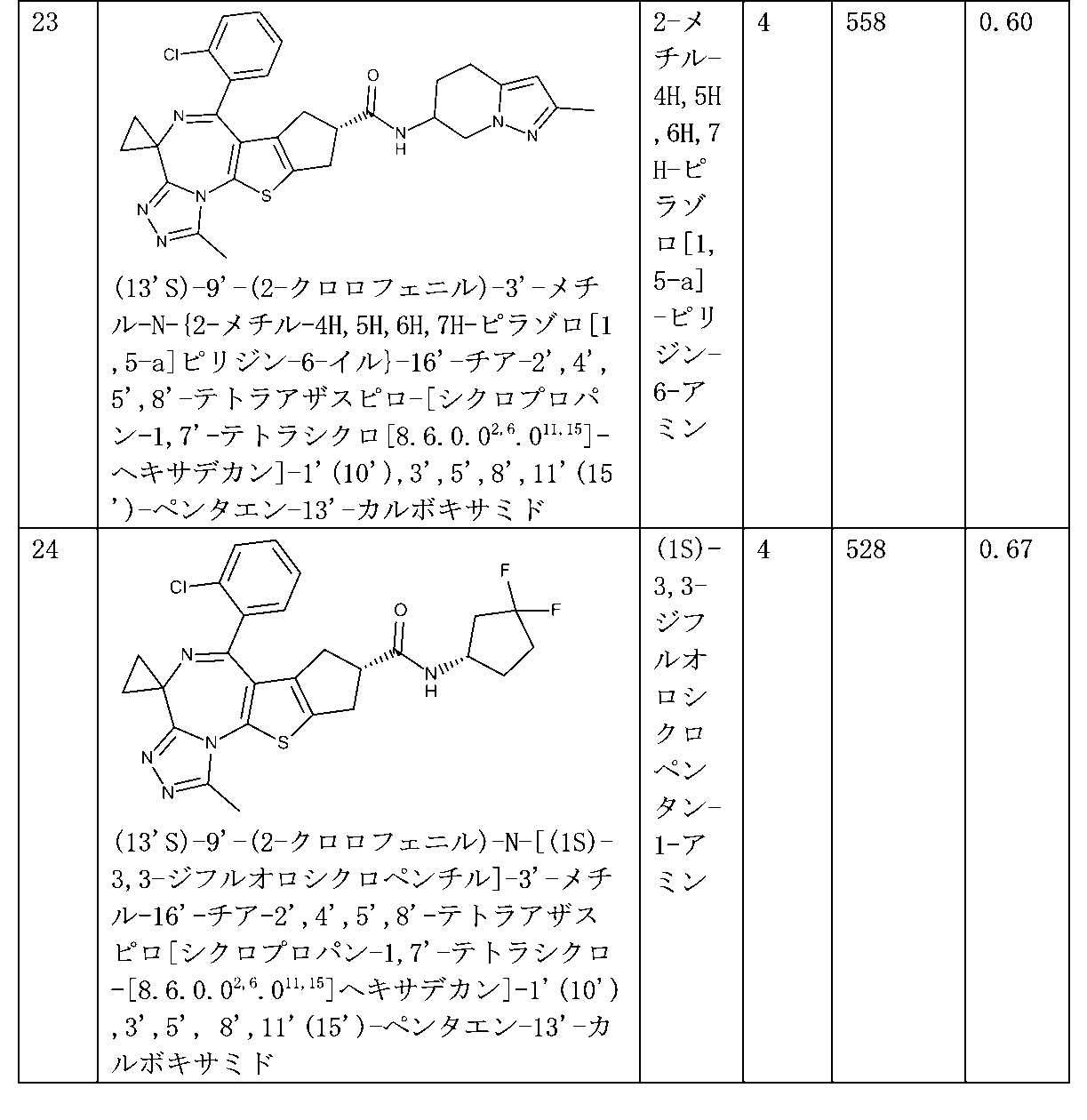
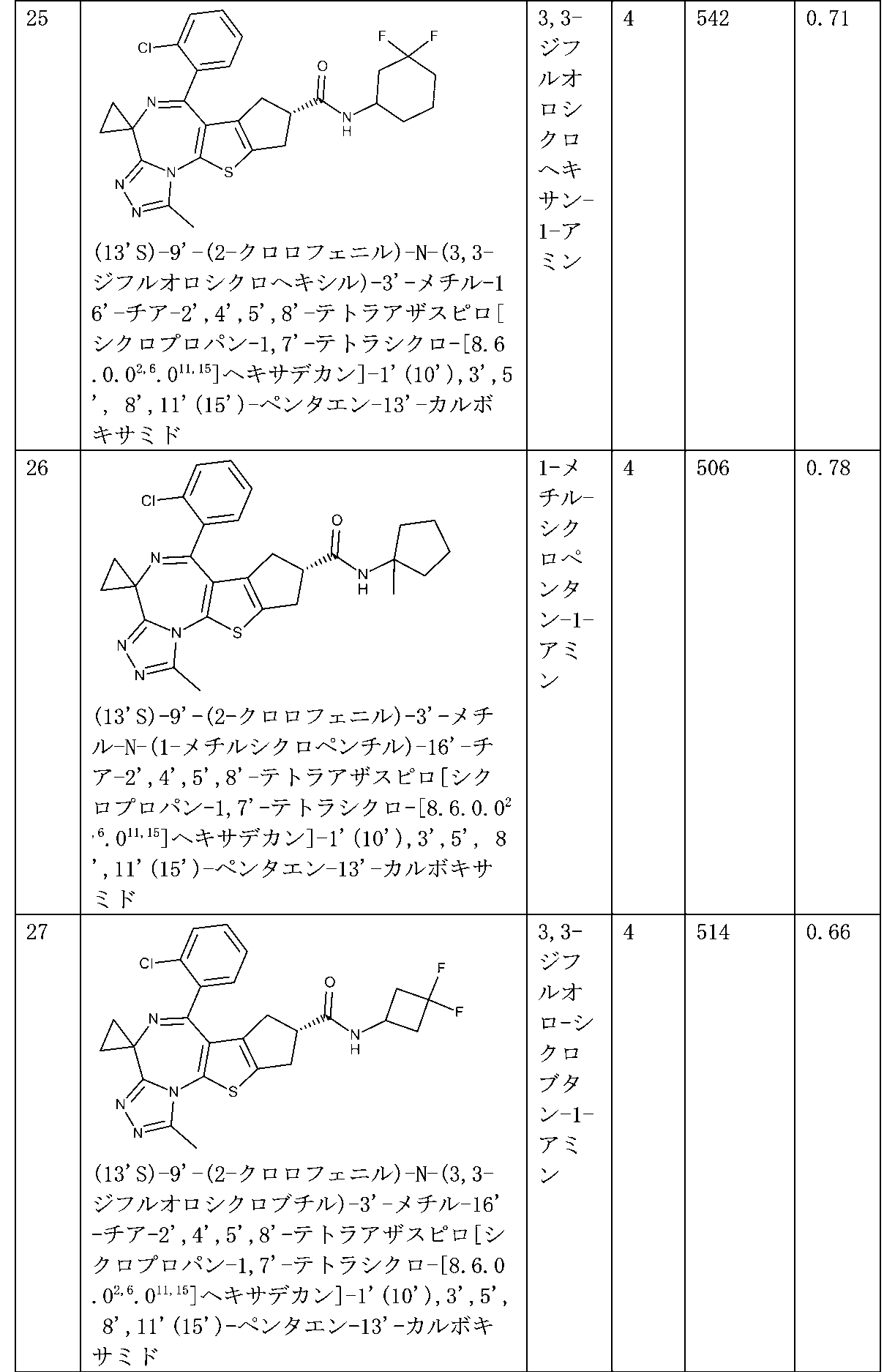

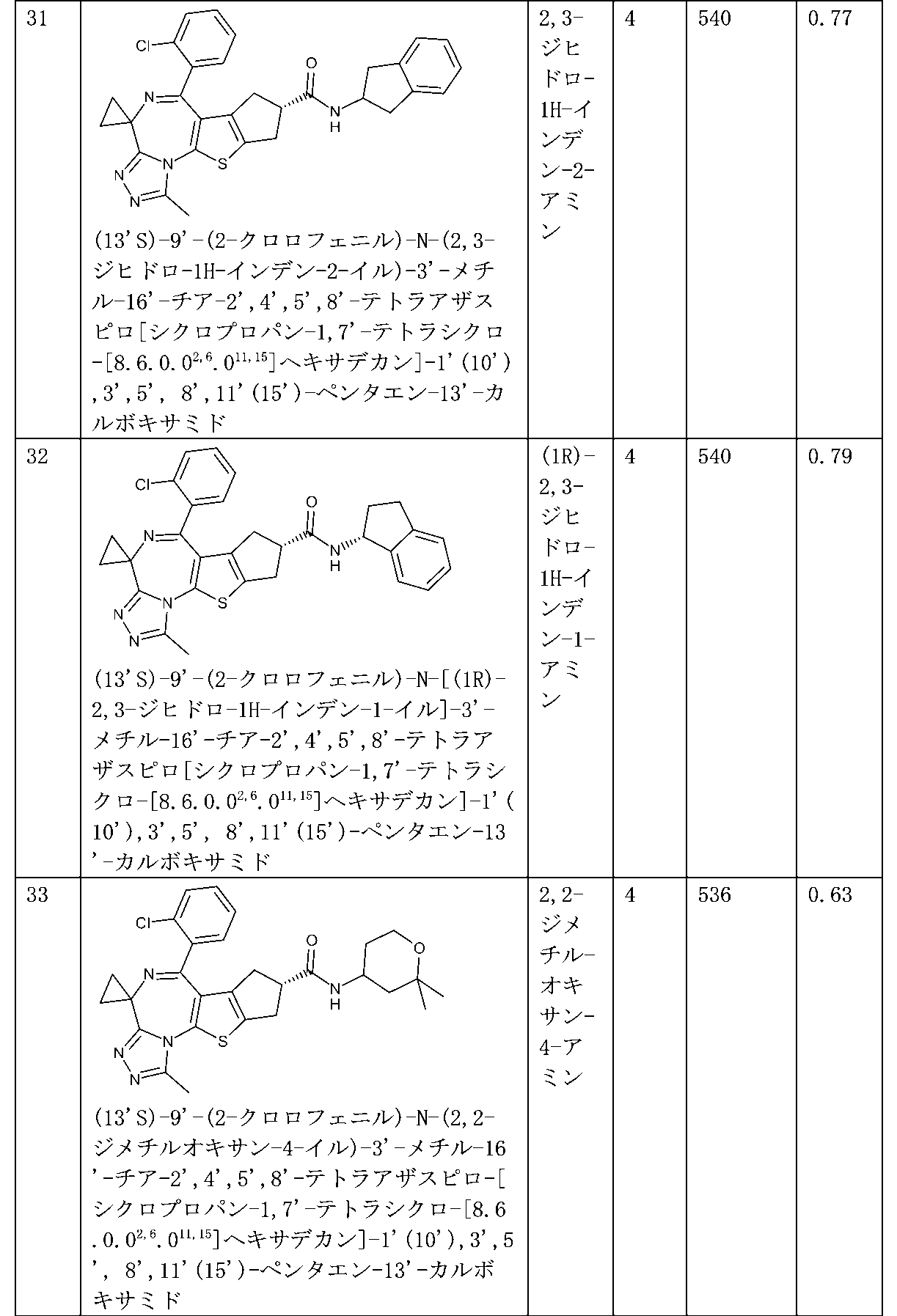
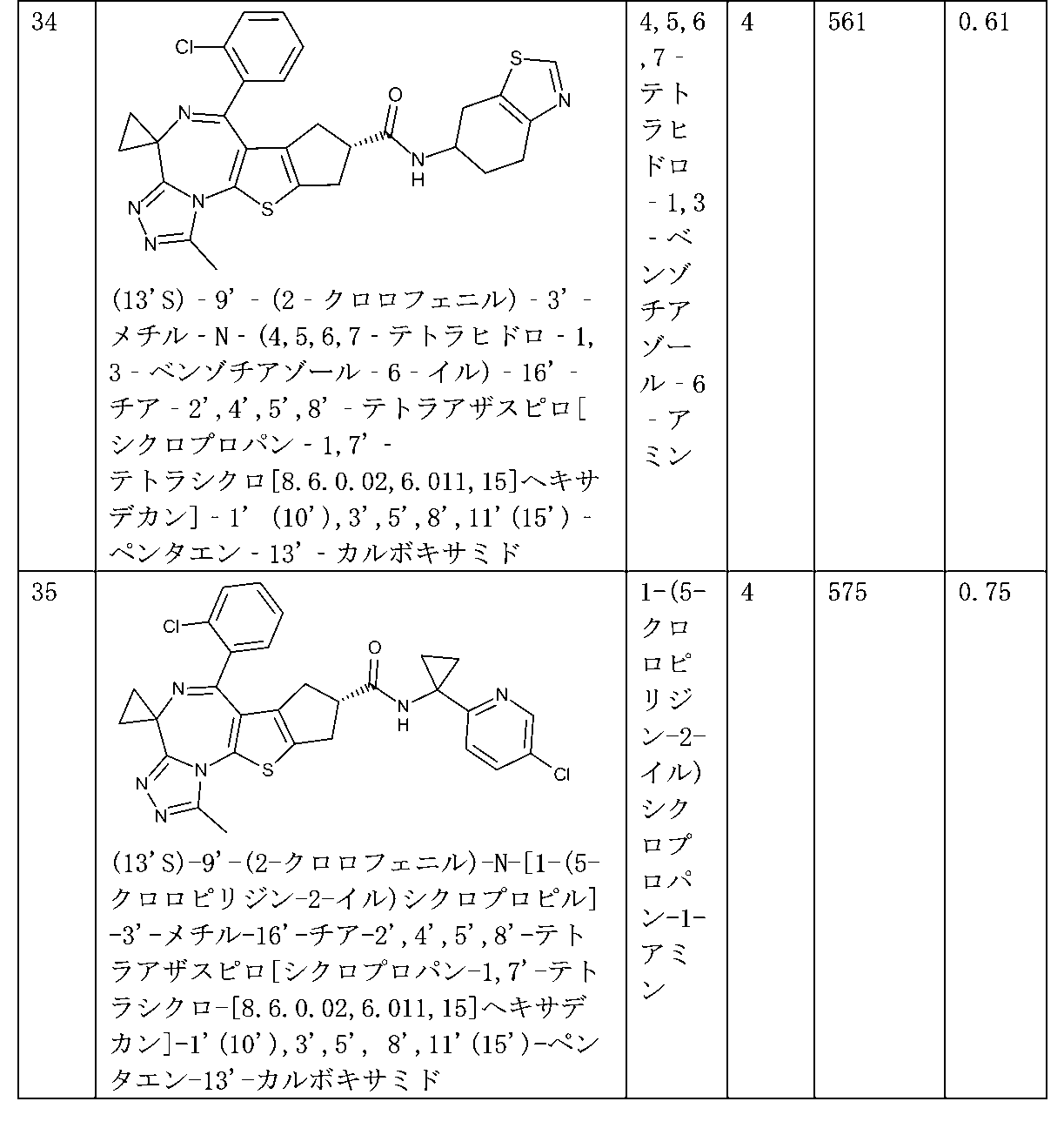
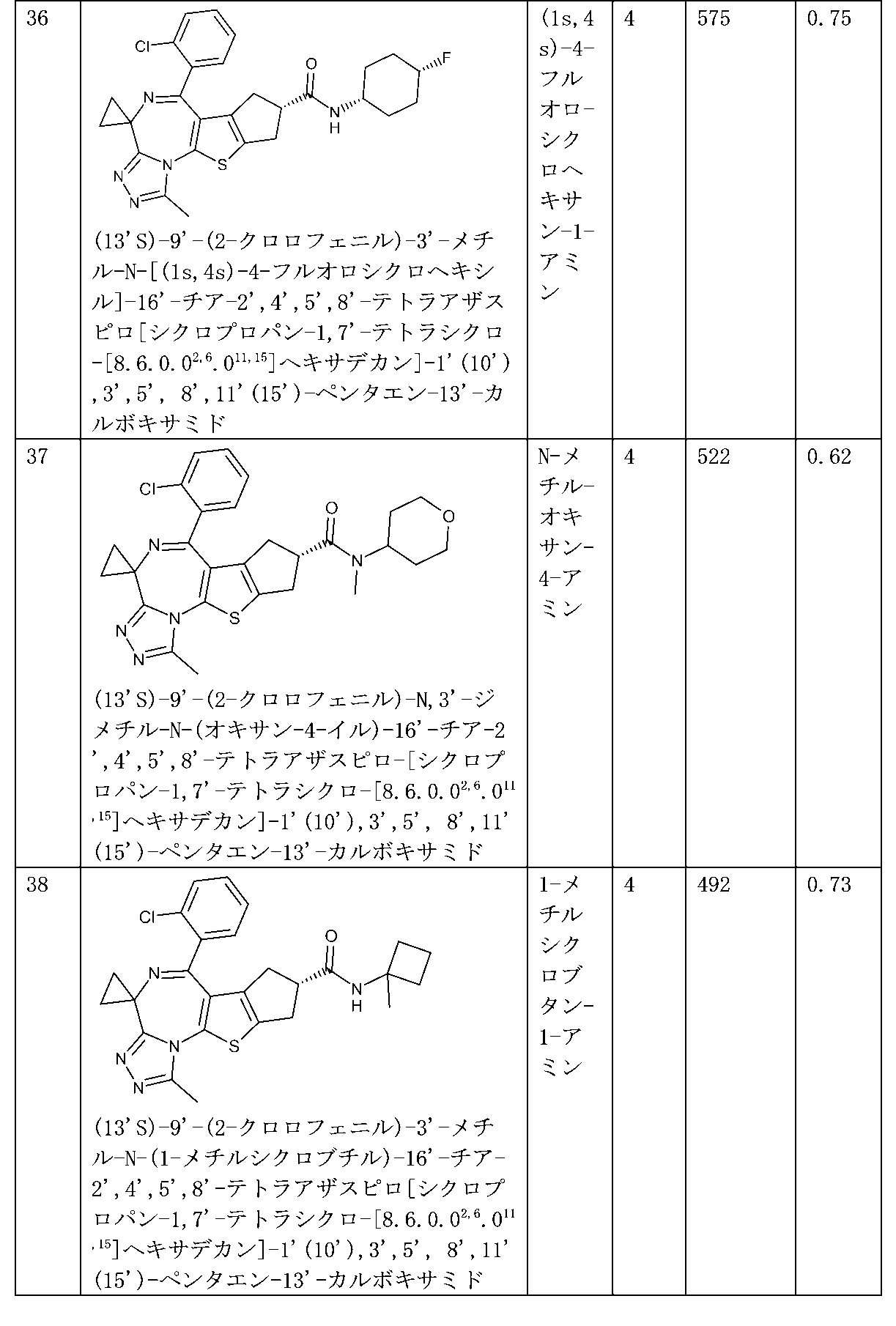
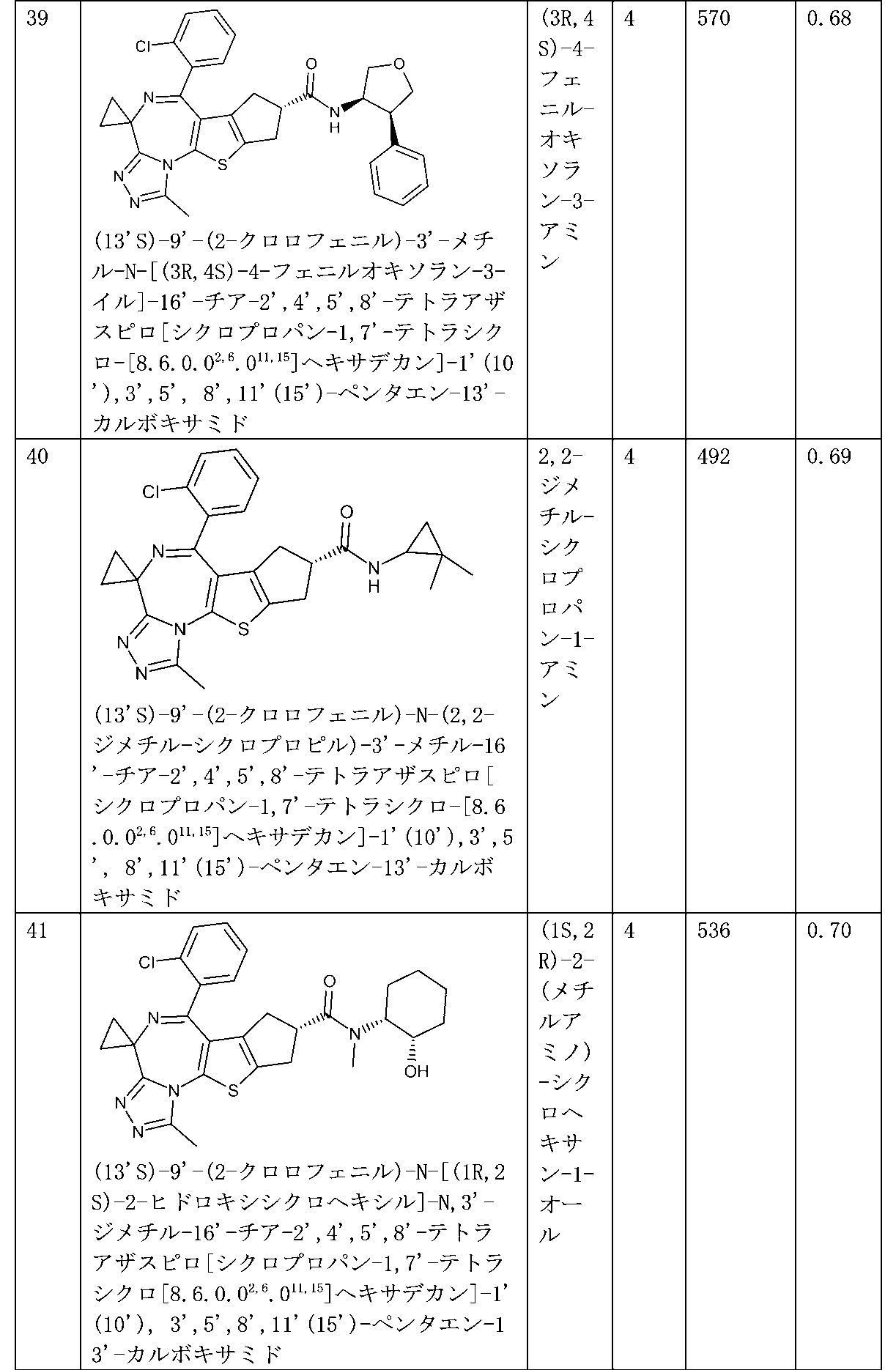
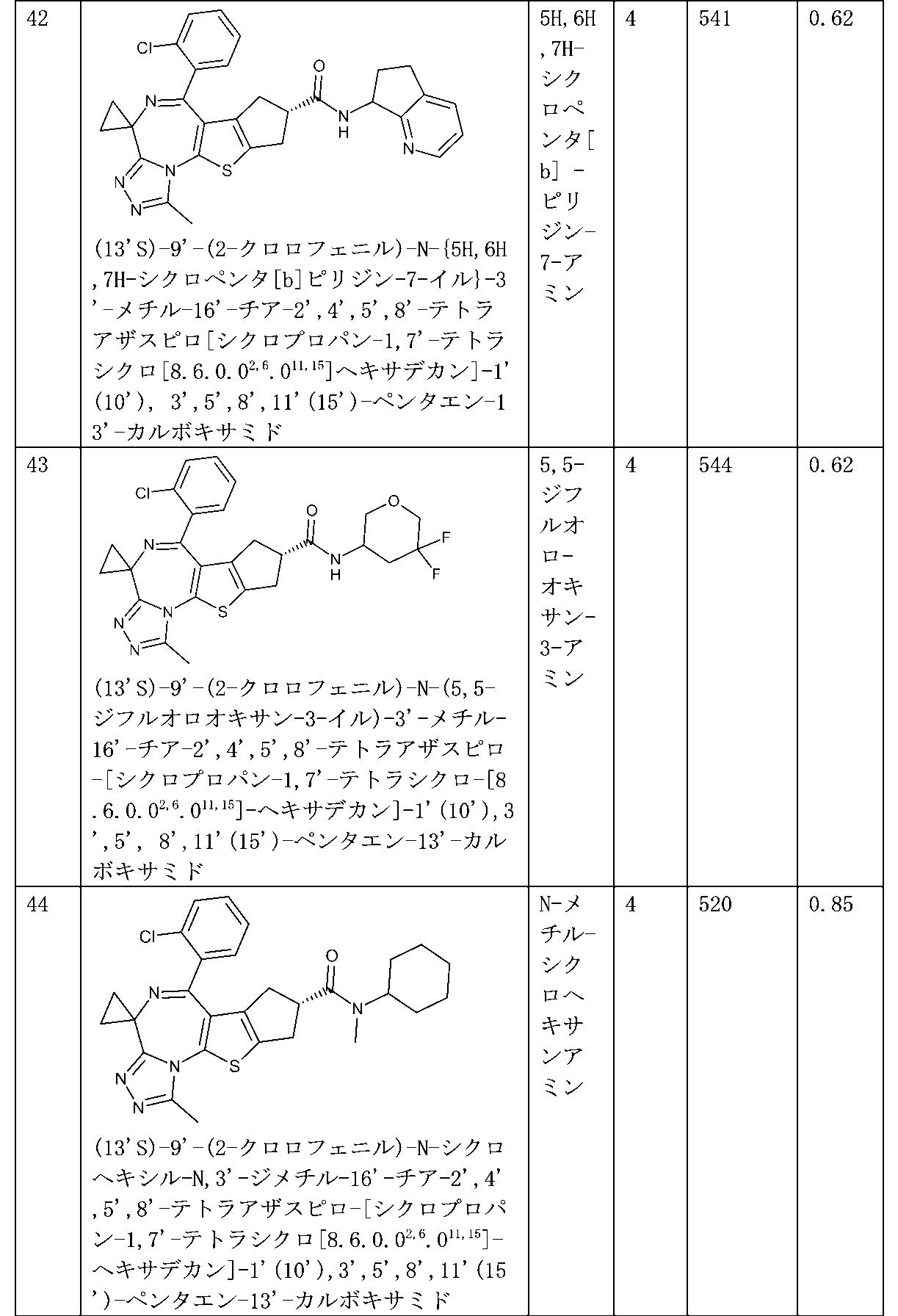


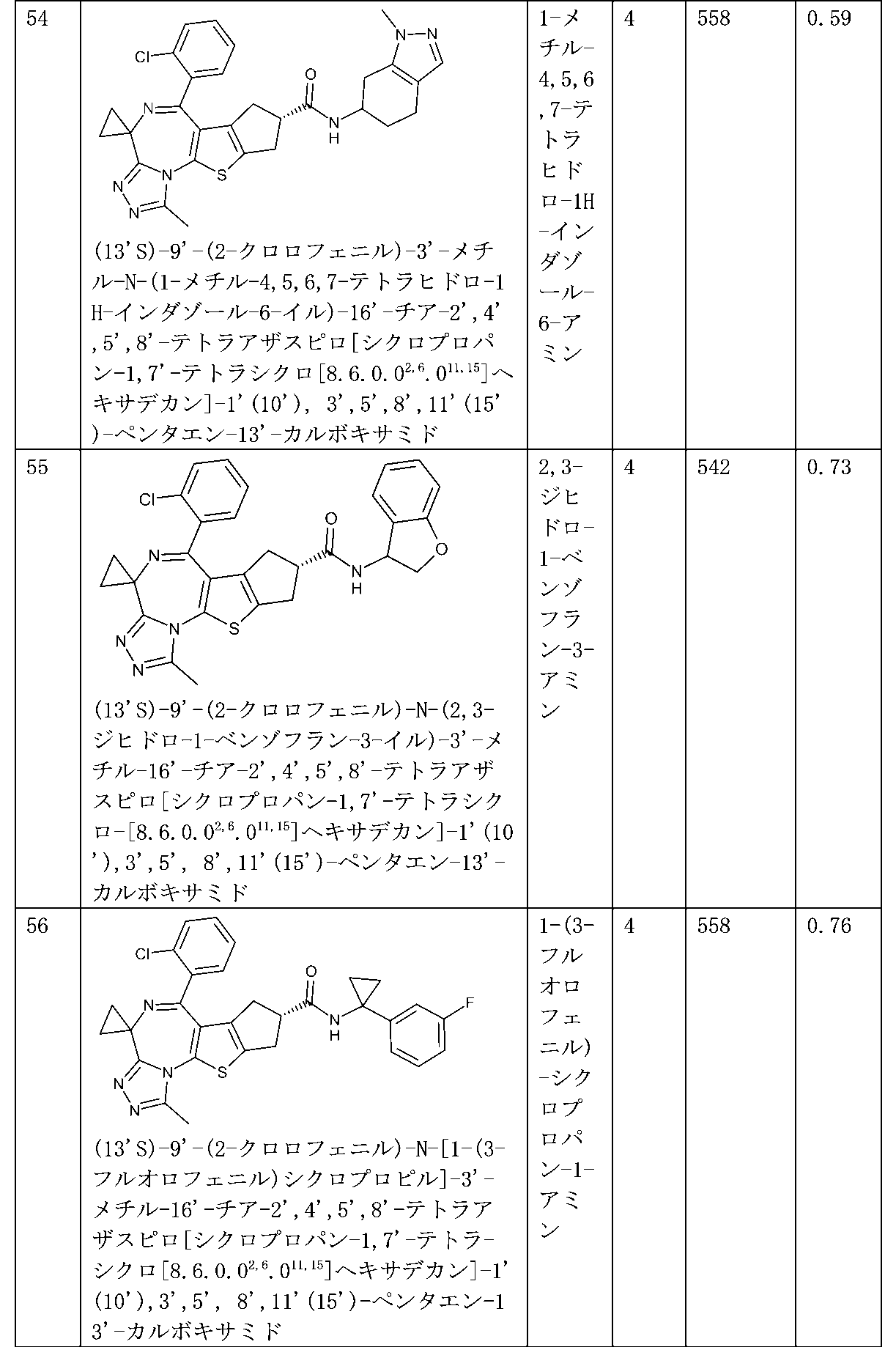
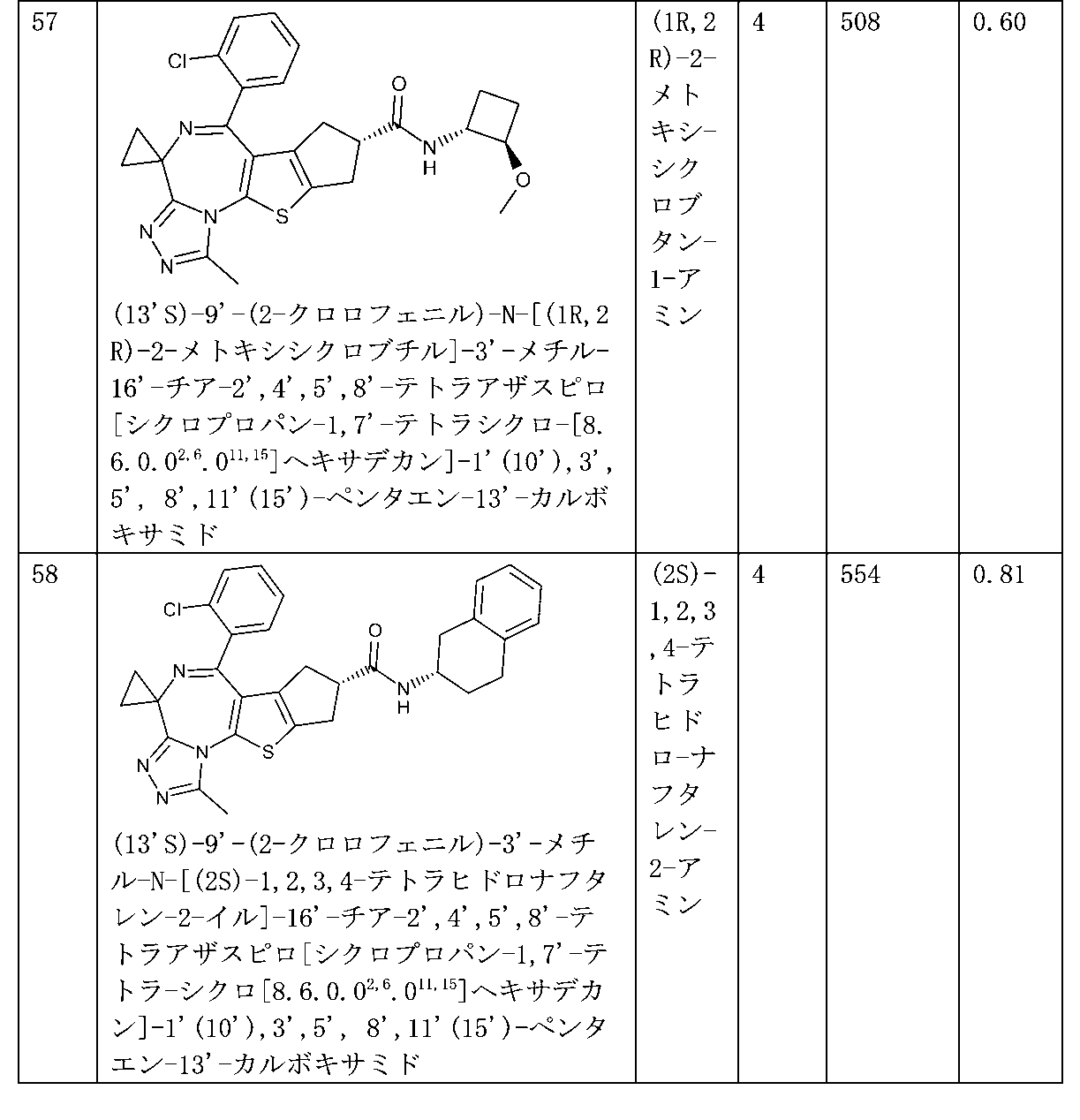

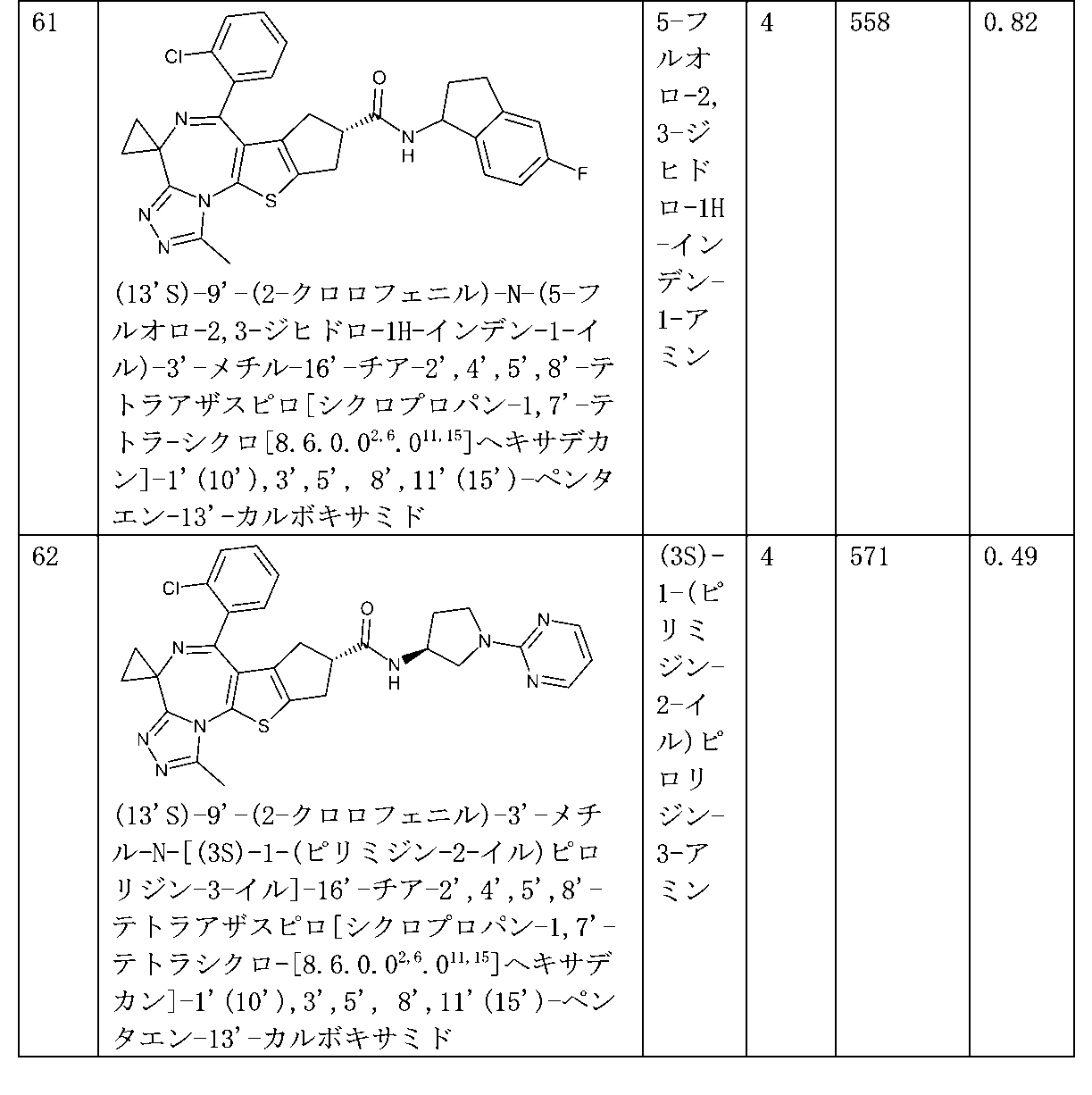

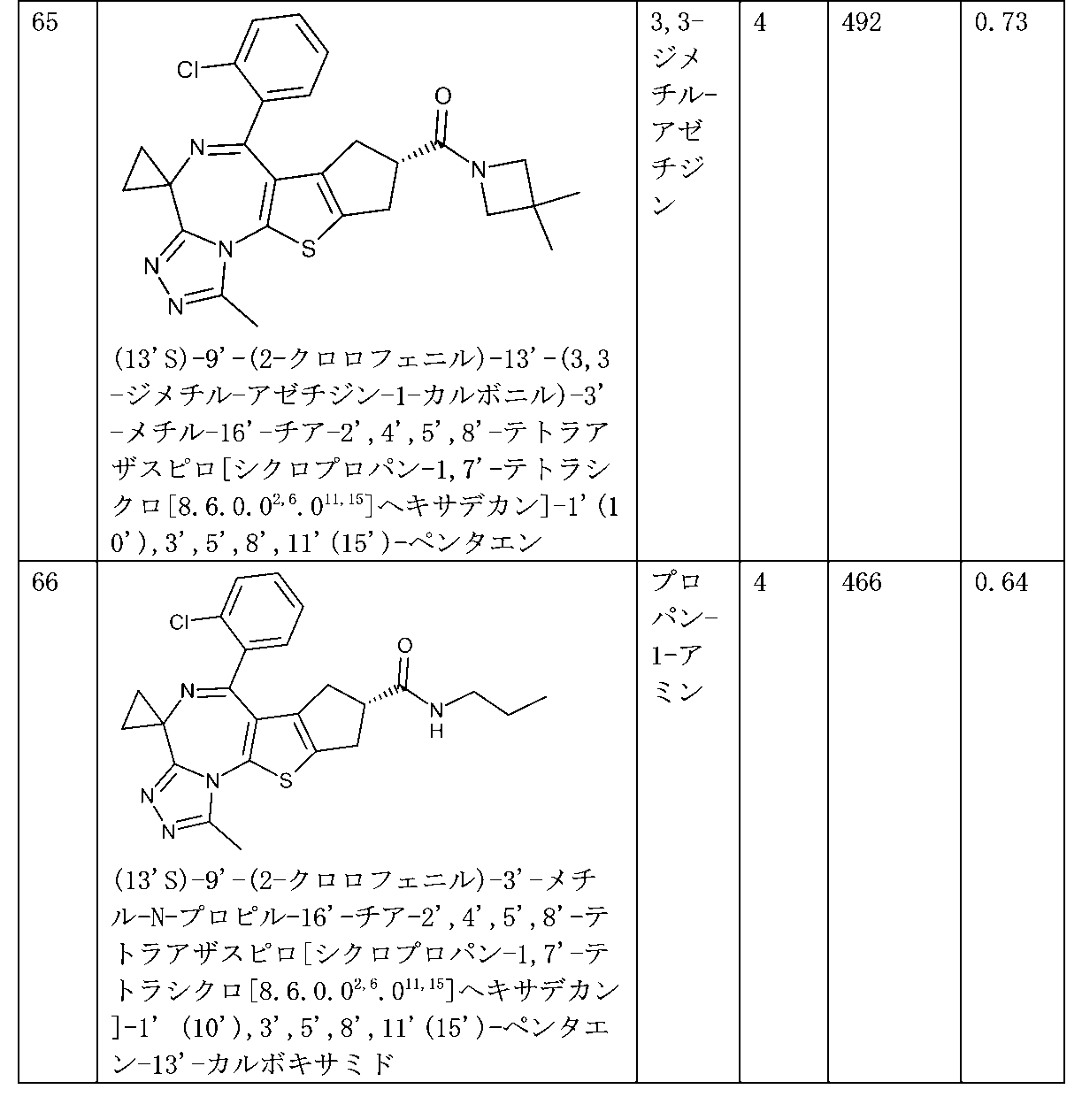

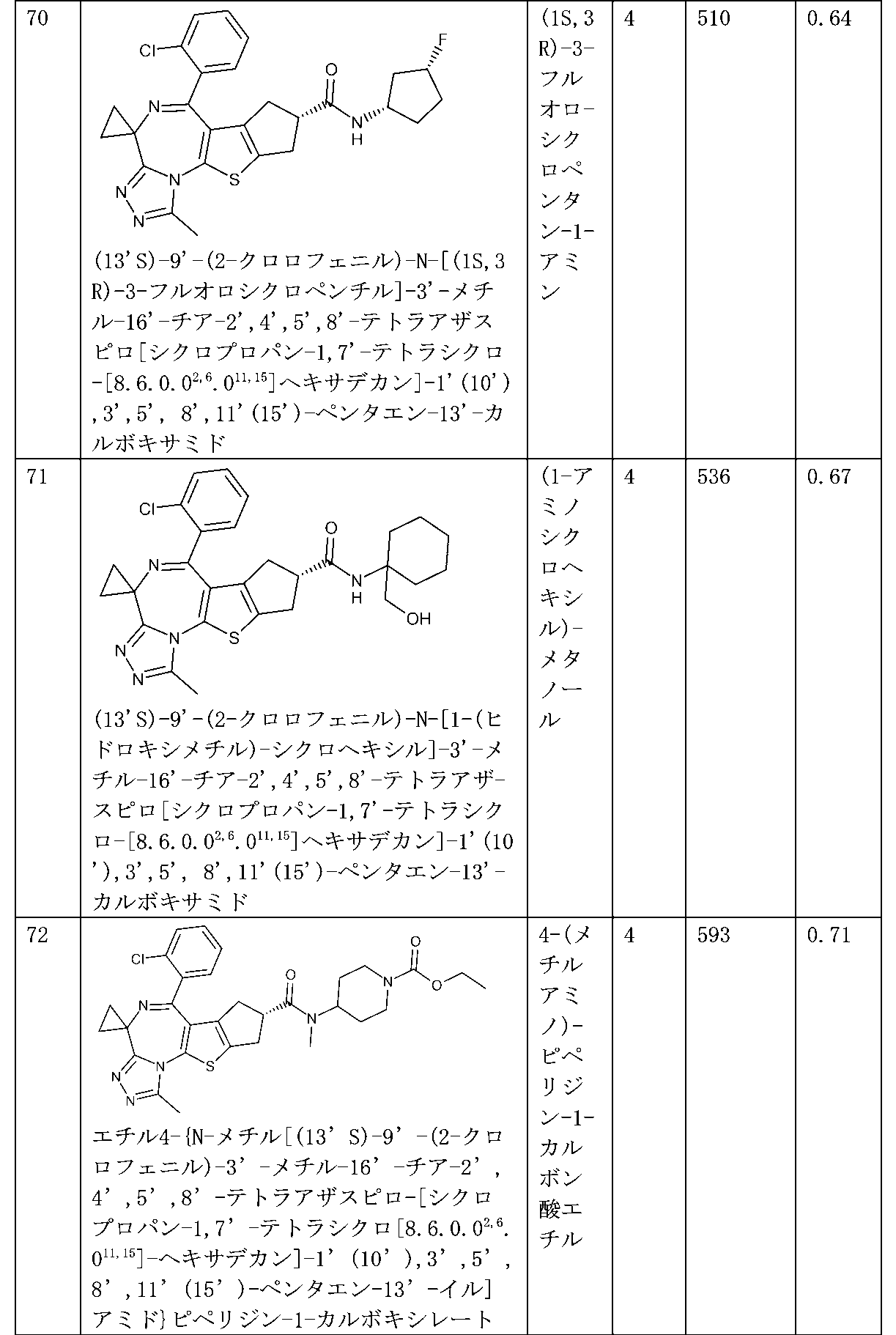
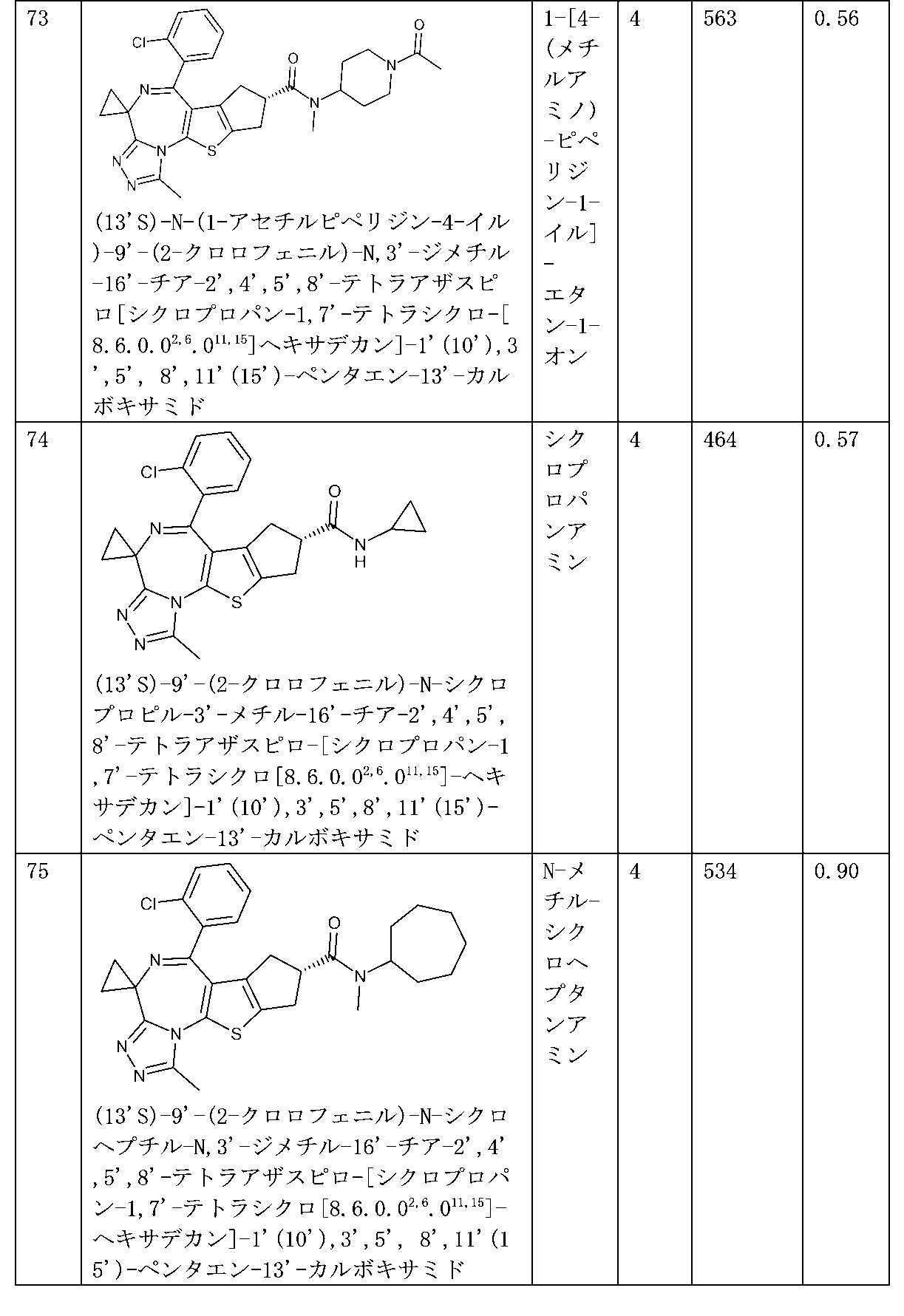


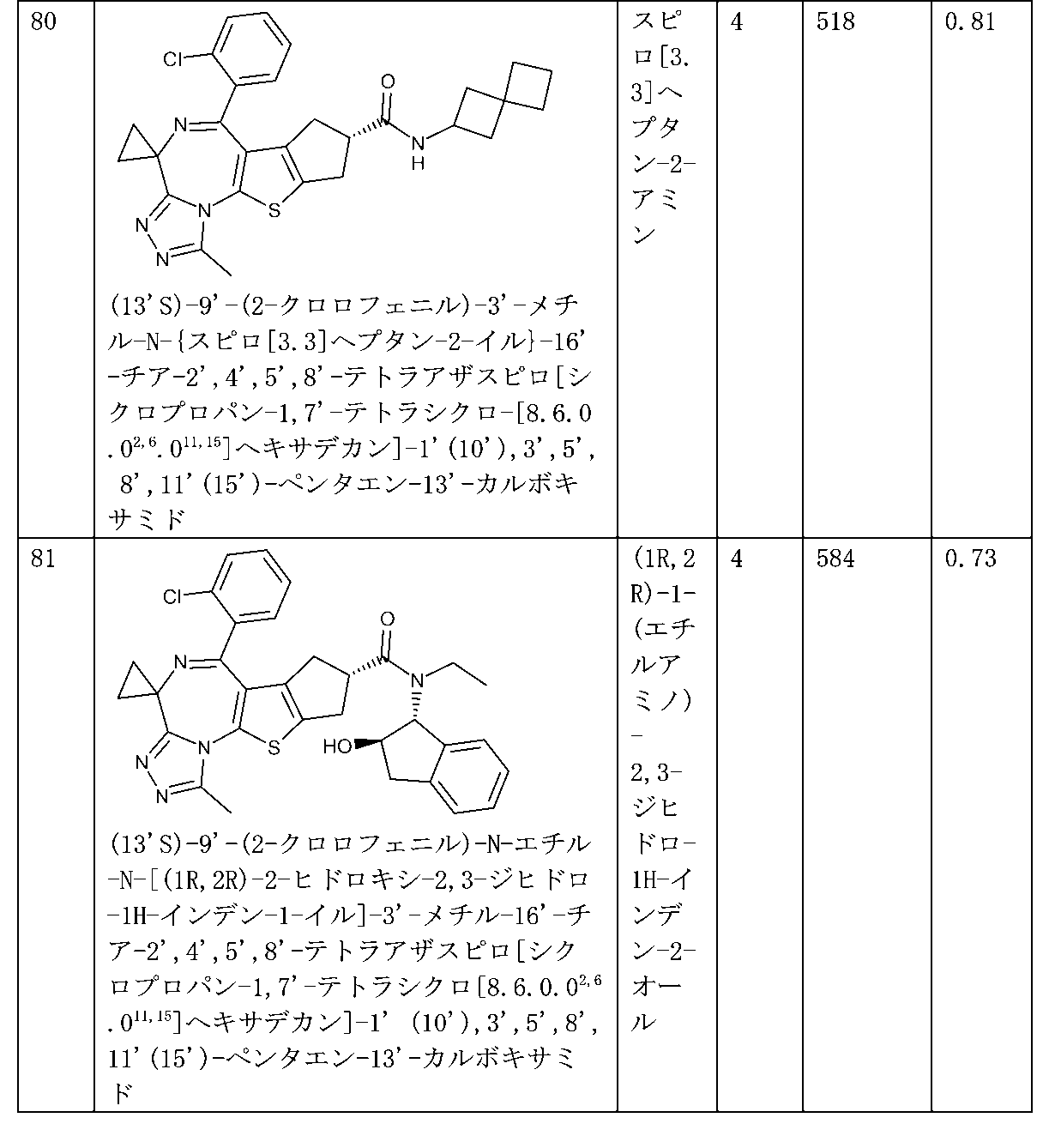


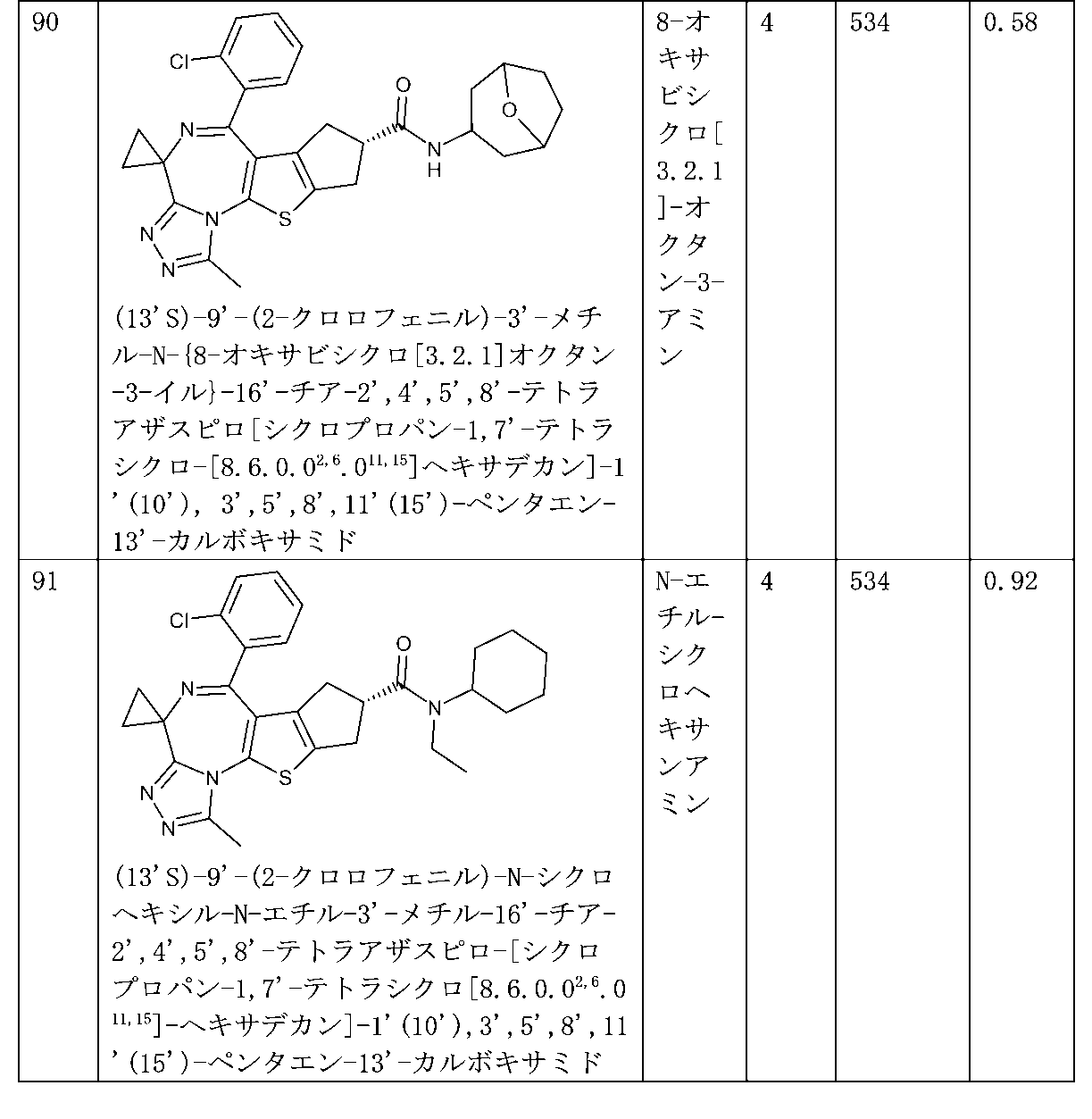

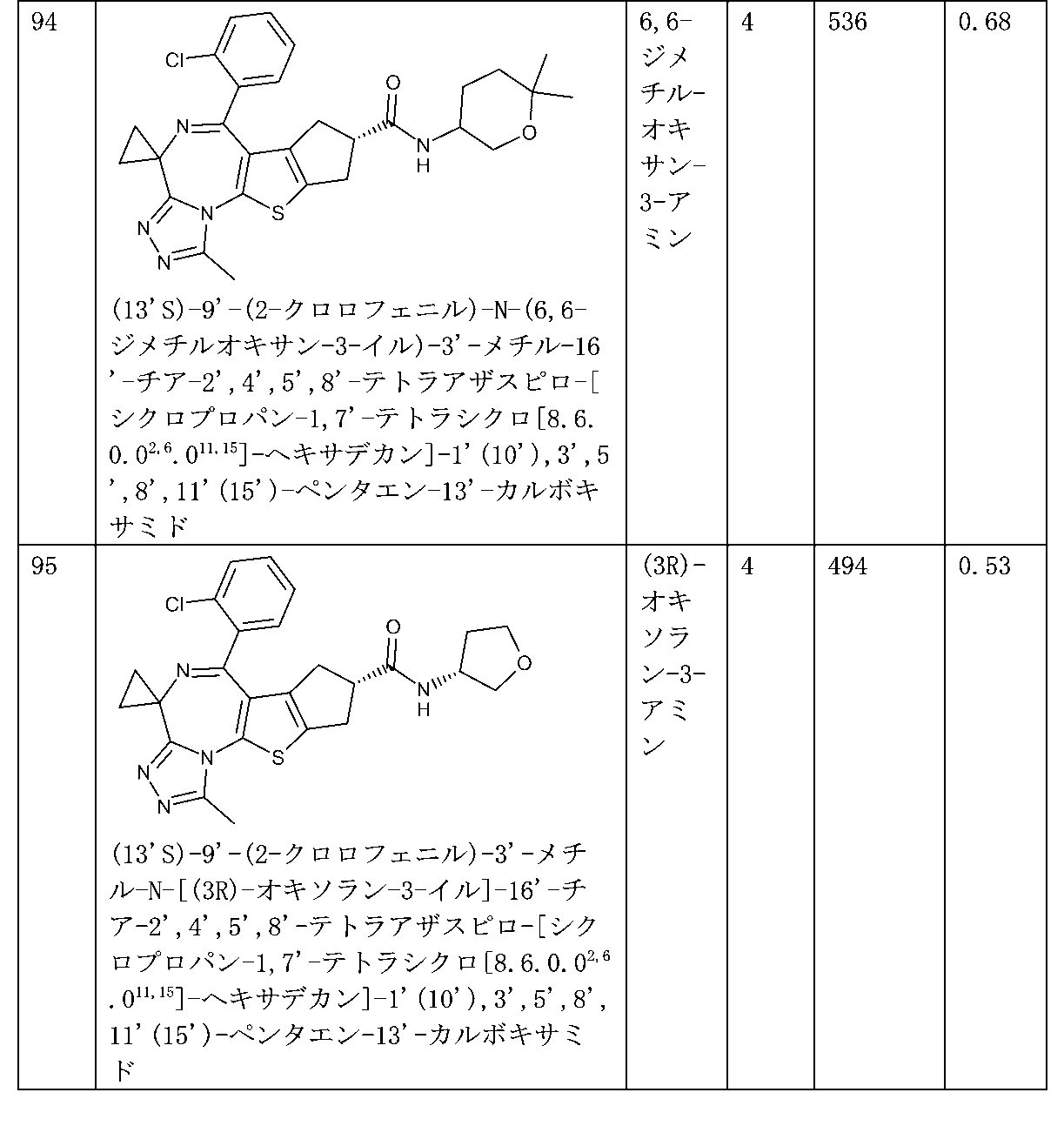
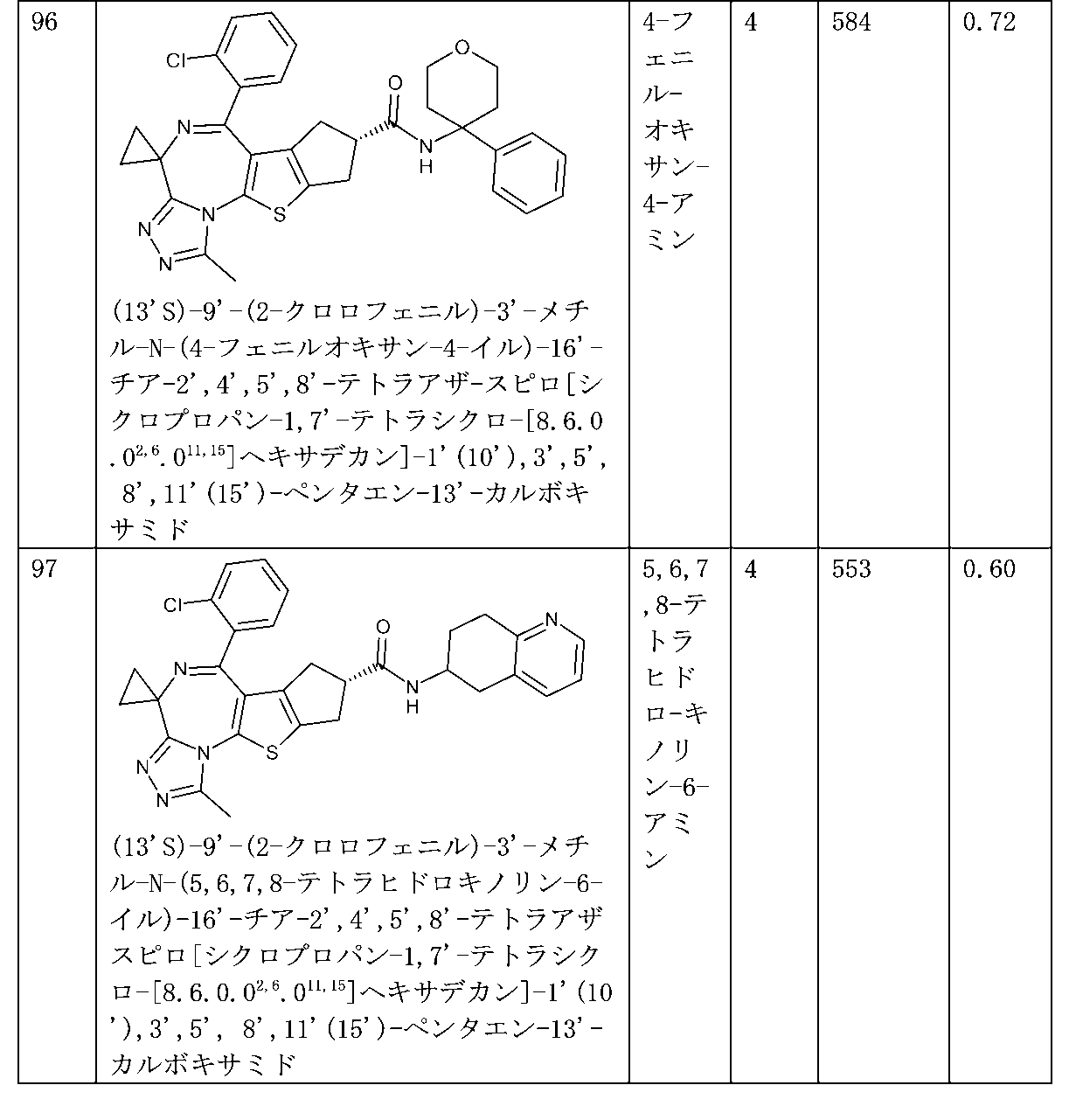


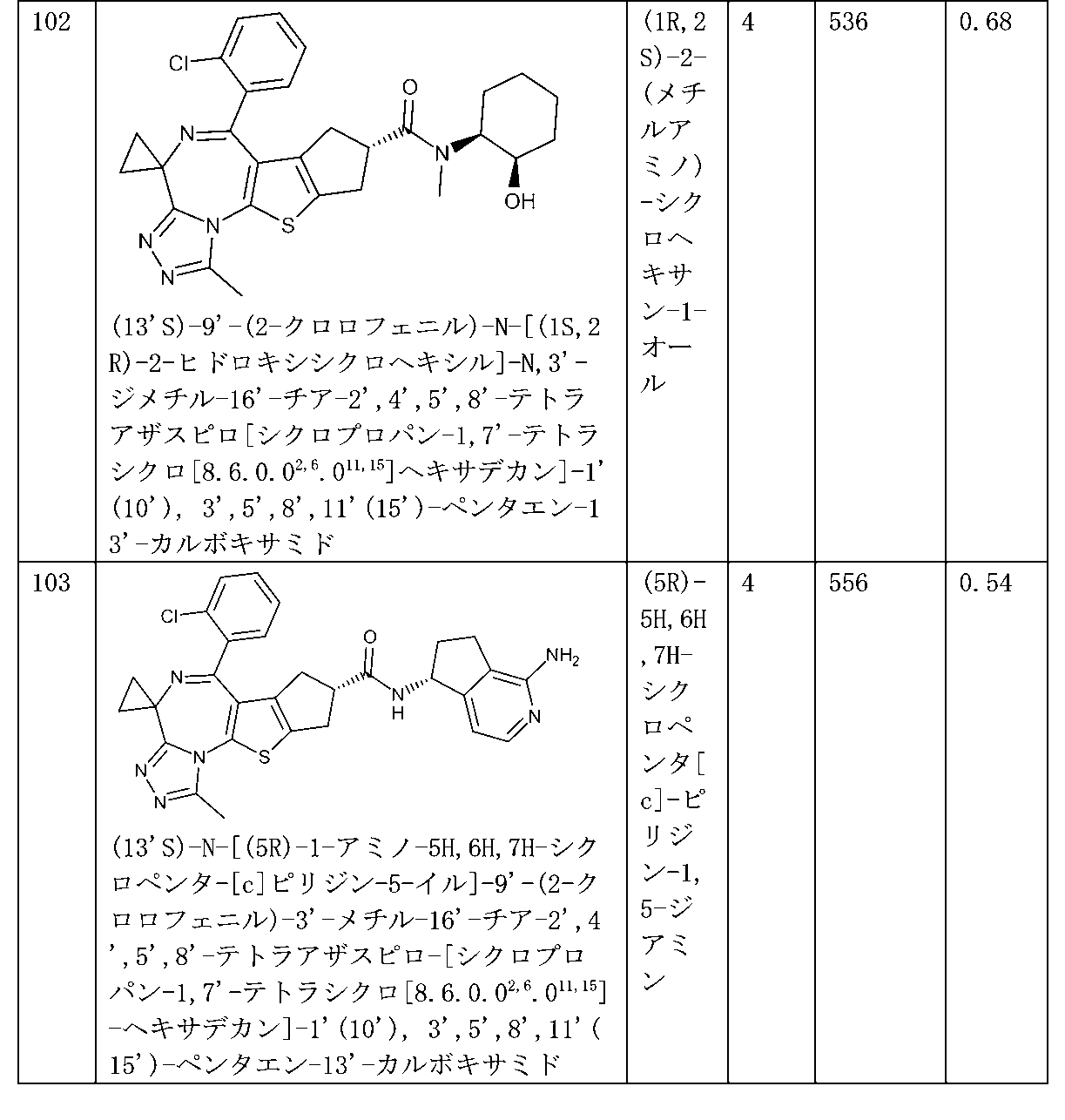
(実施例104)
(13’S)-9’-(2-クロロフェニル)-3’-メチル-N,N-ジプロピル-16’-チア-2’,4’,5’,8’-テトラアザスピロ[シクロプロパン-1,7’-テトラシクロ[8.6.0.02,6.011,15]ヘキサデカン]-1’(10’),3’,5’,8’,11’(15’)-ペンタエン-13’-カルボキサミド
(13'S)-9'-(2-chlorophenyl)-3'-methyl-N,N-dipropyl-16'-thia-2',4',5',8'-tetraazaspiro[cyclopropane-1,7'- tetracyclo [ 8.6.0.02,6.011,15 ]hexadecane]-1'(10'),3',5',8',11'(15')-pentaene-13'-carboxamide
DMSO(2mL)中の(13S)-9-(2-クロロフェニル)-3-メチル-N,N-ジプロピル-16-チア-2,4,5,8-テトラアザテトラシクロ[8.6.0.02,6.011,15]ヘキサデカ-1(10),3,5,8,11(15)-ペンタエン-13-カルボキサミド(合成に関しては、欧州特許出願公開第0388789号を参照されたい、100mg)に、室温で、(2-ブロモエチル)ジフェニルスルファニウムトリフルオロメタンスルホン酸塩(184mg)及びKHMDS(THF中の1.0M;830μL)を加える。この混合物を室温で一晩、撹拌する。さらなる(2-ブロモエチル)ジフェニルスルファニウムトリフルオロメタンスルホン酸塩(184mg)及びKHMDS(THF中の1.0M;830μL)を加え、撹拌を2時間、継続する。この混合物をDMFにより希釈してろ過し、逆相上のクロマトグラフィー(HPLC;ACN/水/アンモニア水)にかけると、表題化合物が得られる。
LC-MS(方法1):tR=1.03分;質量スペクトル(ESI+):m/z=508[M+H]+。
To (13S)-9-(2-chlorophenyl)-3-methyl-N,N-dipropyl-16-thia-2,4,5,8- tetraazatetracyclo [ 8.6.0.02,6.011,15 ]hexadeca-1(10),3,5,8,11(15)-pentaene-13-carboxamide (for synthesis, see EP 0388789, 100 mg) in DMSO (2 mL) is added (2-bromoethyl)diphenylsulfanium trifluoromethanesulfonate (184 mg) and KHMDS (1.0 M in THF; 830 μL) at room temperature. The mixture is stirred at room temperature overnight. Additional (2-bromoethyl)diphenylsulfanium trifluoromethanesulfonate (184 mg) and KHMDS (1.0 M in THF; 830 μL) are added and stirring is continued for 2 h. The mixture is diluted with DMF, filtered and chromatographed on reverse phase (HPLC; ACN/water/aqueous ammonia) to give the title compound.
LC-MS (Method 1): t R =1.03 min; Mass spectrum (ESI + ): m/z = 508 [M+H] + .
(実施例105~118)
実施例1に関して記載されている手順と類似の手順に従うことによって、(13’S)-9’-(2-クロロフェニル)-3’-メチル-16’-チア-2’,4’,5’,8’-テトラアザスピロ[シクロプロパン-1,7’-テトラシクロ[8.6.0.02,6.011,15]ヘキサデカン]-1’(10’),3’,5’,8’,11’(15’)-ペンタエン-13’-カルボン酸(中間体1)から、以下の表にまとめられている実施例105~118が得られる。
(Examples 105 to 118)
By following procedures similar to those described for Example 1, (13'S)-9'-(2-chlorophenyl)-3'-methyl-16'-thia-2',4',5',8'-tetraazaspiro[cyclopropane-1,7'- tetracyclo [ 8.6.0.02,6.011,15 ]hexadecane]-1'(10'),3',5',8',11'(15')-pentaene-13'-carboxylic acid (Intermediate 1) gives Examples 105 to 118, which are summarized in the table below.


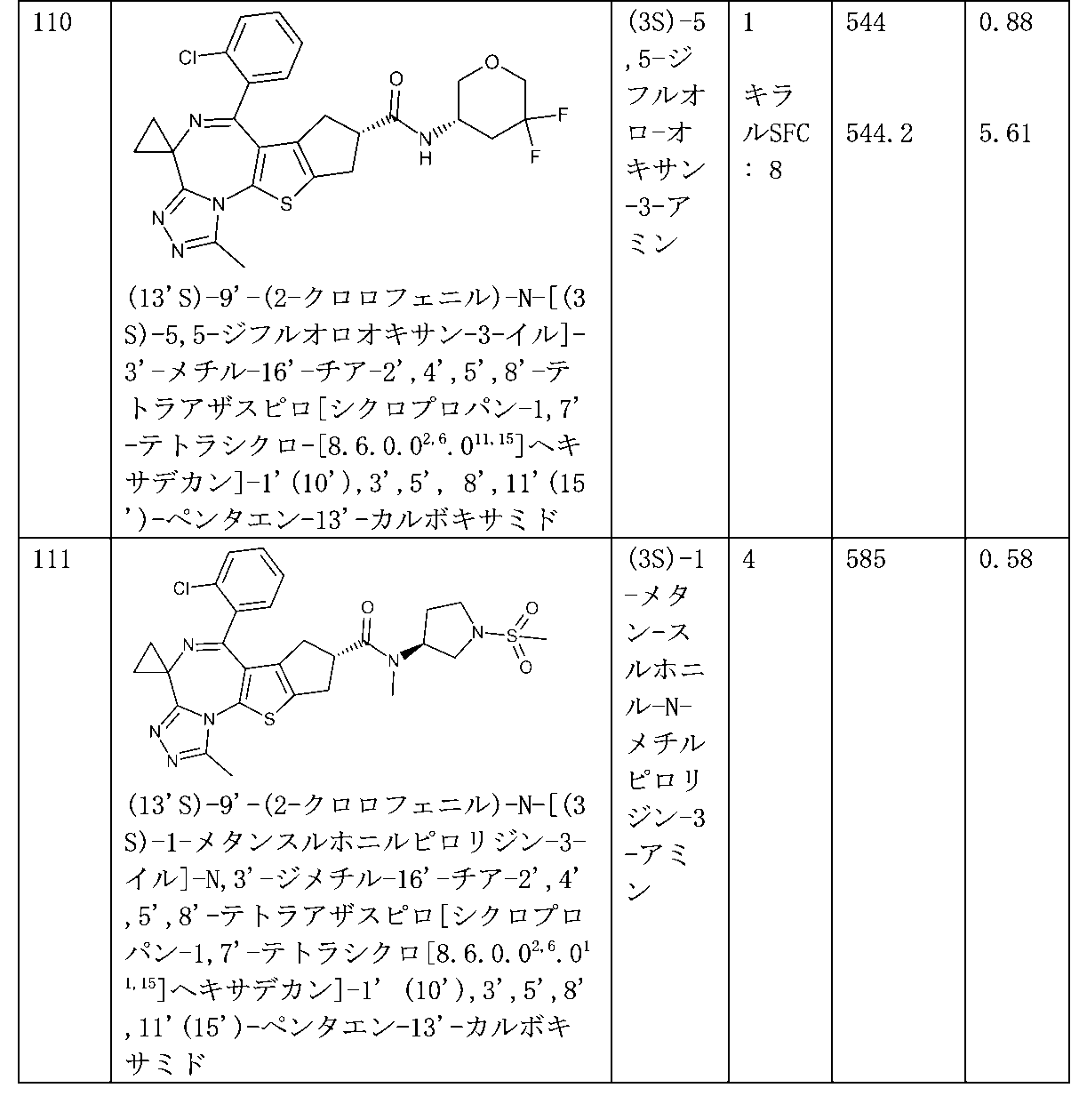
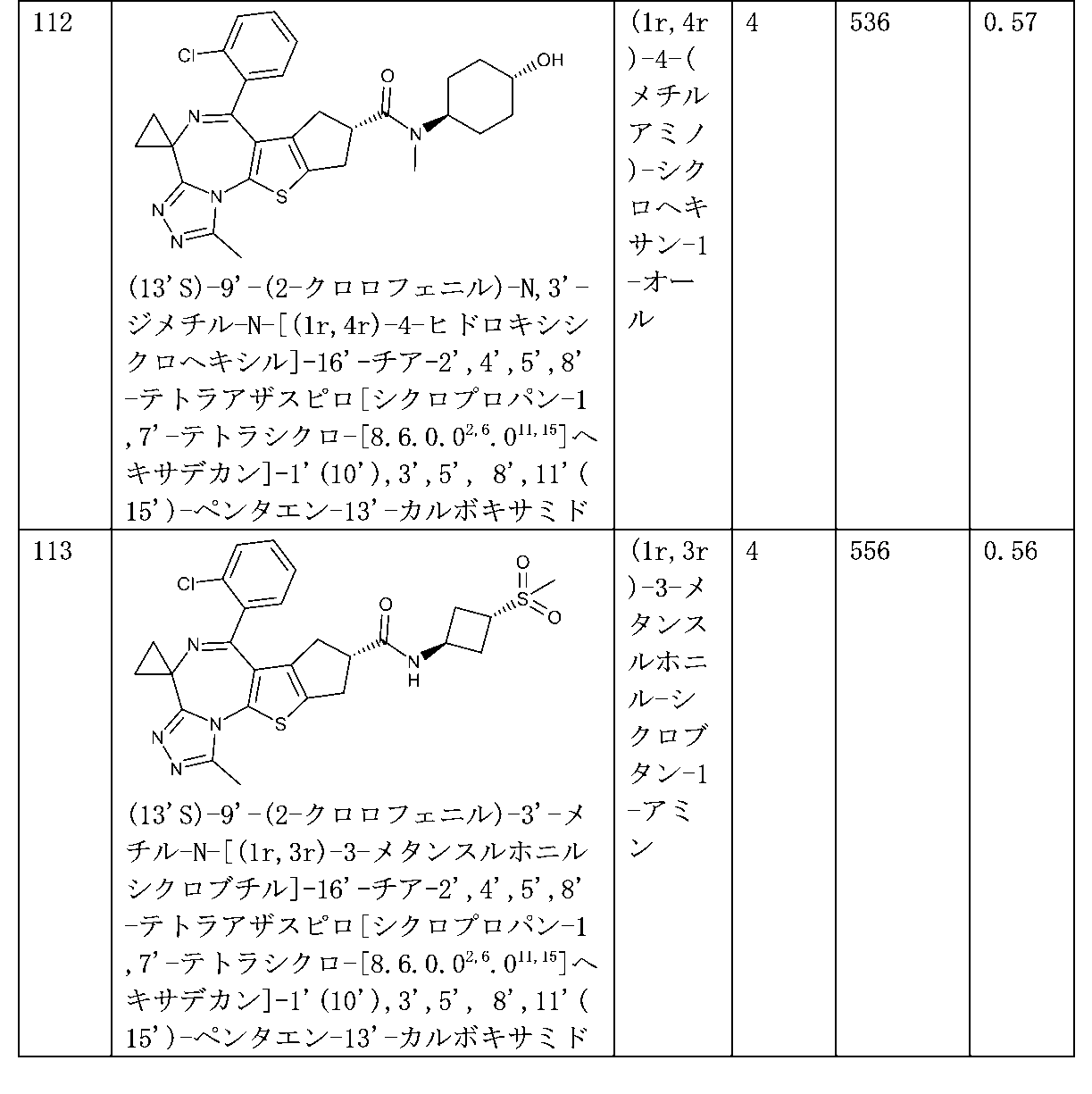


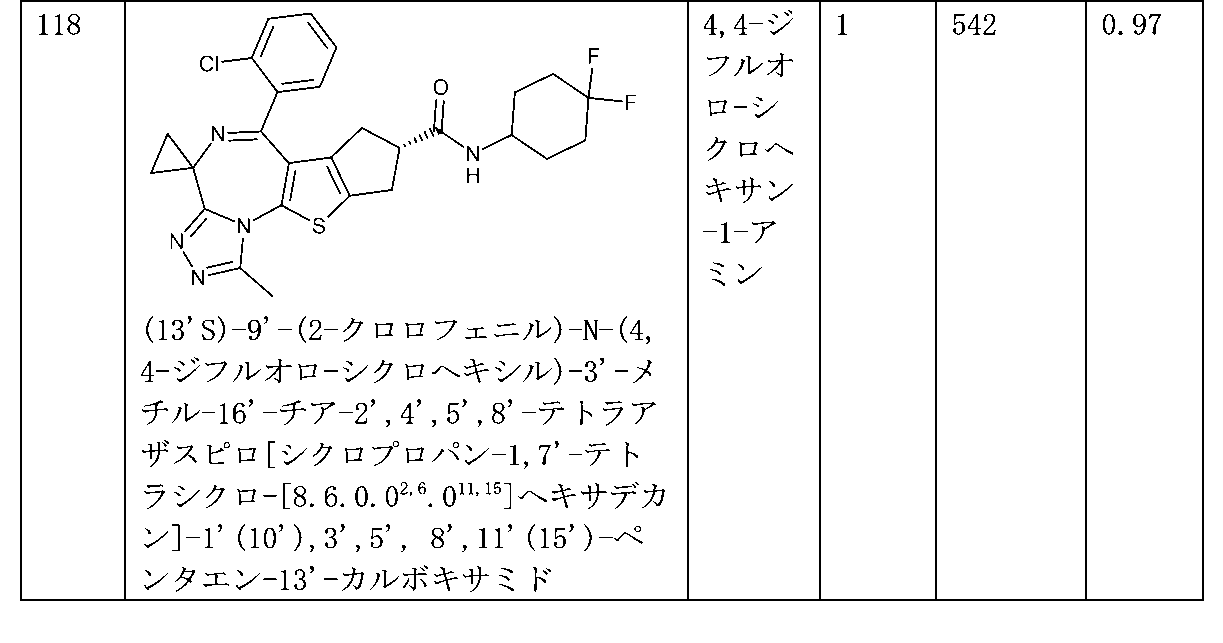
(実施例119)
(13’S)-9’-(2-クロロフェニル)-3’-エチル-13’-(モルホリン-4-カルボニル)-16’-チア-2’,4’,5’,8’-テトラアザスピロ[シクロプロパン-1,7’-テトラシクロ[8.6.0.02,6.011,15]ヘキサデカン]-1’(10’),3’,5’,8’,11’(15’)-ペンタエン
(Example 119)
(13'S)-9'-(2-chlorophenyl)-3'-ethyl-13'-(morpholine-4-carbonyl)-16'-thia-2',4',5',8'-tetraazaspiro[cyclopropane-1,7'- tetracyclo [ 8.6.0.02,6.011,15 ]hexadecane]-1'(10'),3',5',8',11'(15')-pentaene
LC-MS(方法1):tR=0.87分;質量スペクトル(ESI+):m/z=508[M+H]+。
キラルSFC(方法6):tR=5.41分;質量スペクトル(ESI+):m/z=508.2[M+H]+。
LC-MS (Method 1): t R =0.87 min; Mass spectrum (ESI + ): m/z = 508 [M+H] + .
Chiral SFC (Method 6): tR = 5.41 min; Mass Spectrum (ESI + ): m/z = 508.2 [M+H] + .
(実施例120)
(13’S)-3’-メチル-13’-(モルホリン-4-カルボニル)-9’-フェニル-16’-チア-2’,4’,5’,8’-テトラアザスピロ[シクロプロパン-1,7’-テトラシクロ[8.6.0.02,6.011,15]ヘキサデカン]-1’(10’),3’,5’,8’,11’(15’)-ペンタエン
(Example 120)
(13'S)-3'-methyl-13'-(morpholine-4-carbonyl)-9'-phenyl-16'-thia-2',4',5',8'-tetraazaspiro[cyclopropane-1,7'- tetracyclo [ 8.6.0.02,6.011,15 ]hexadecane]-1'(10'),3',5',8',11'(15')-pentaene
MeOH(8mL)中の(13’S)-9’-(2-クロロフェニル)-3’-メチル-13’-(モルホリン-4-カルボニル)-16’-チア-2’,4’,5’,8’-テトラアザスピロ[シクロプロパン-1,7’-テトラシクロ[8.6.0.02,6.011,15]ヘキサデカン]-1’(10’),3’,5’,8’,11’(15’)-ペンタエン(実施例114;75mg)に、室温でラネーニッケル(75.0mg)を加える。この混合物を、水素雰囲気(50psi)下、50℃で6日間、振とうする。この混合物をろ過し、ろ液を濃縮する。残留物を逆相上でクロマトグラフィー(HPLC;ACN/水/水性TFA)にかけると、表題化合物が得られる。
LC-MS(方法1):tR=0.72分;質量スペクトル(ESI+):m/z=460[M+H]+。
To (13'S)-9'-(2-chlorophenyl)-3'-methyl-13'-(morpholine-4-carbonyl)-16'-thia-2',4',5',8'-tetraazaspiro[cyclopropane-1,7'-tetracyclo[8.6.0.0 2,6 . 0 11,15 ]hexadecane]-1'(10'),3',5',8',11'(15')-pentaene (Example 114; 75 mg) in MeOH (8 mL) is added Raney Nickel (75.0 mg) at room temperature. The mixture is shaken under a hydrogen atmosphere (50 psi) at 50° C. for 6 days. The mixture is filtered and the filtrate is concentrated. The residue is chromatographed on reverse phase (HPLC; ACN/water/aqueous TFA) to give the title compound.
LC-MS (Method 1): t R =0.72 min; Mass spectrum (ESI + ): m/z = 460 [M+H] + .
(実施例121~129)
実施例1に関して記載されている手順と類似の手順に従うことによって、(13’S)-9’-(2-クロロフェニル)-3’-メチル-16’-チア-2’,4’,5’,8’-テトラアザスピロ[シクロプロパン-1,7’-テトラシクロ[8.6.0.02,6.011,15]ヘキサデカン]-1’(10’),3’,5’,8’,11’(15’)-ペンタエン-13’-カルボン酸(中間体1)から、以下の表にまとめられている実施例121~129が得られる。
(Examples 121 to 129)
By following procedures similar to those described for Example 1, (13'S)-9'-(2-chlorophenyl)-3'-methyl-16'-thia-2',4',5',8'-tetraazaspiro[cyclopropane-1,7'- tetracyclo [ 8.6.0.02,6.011,15 ]hexadecane]-1'(10'),3',5',8',11'(15')-pentaene-13'-carboxylic acid (Intermediate 1) gives Examples 121 to 129, which are summarized in the table below.
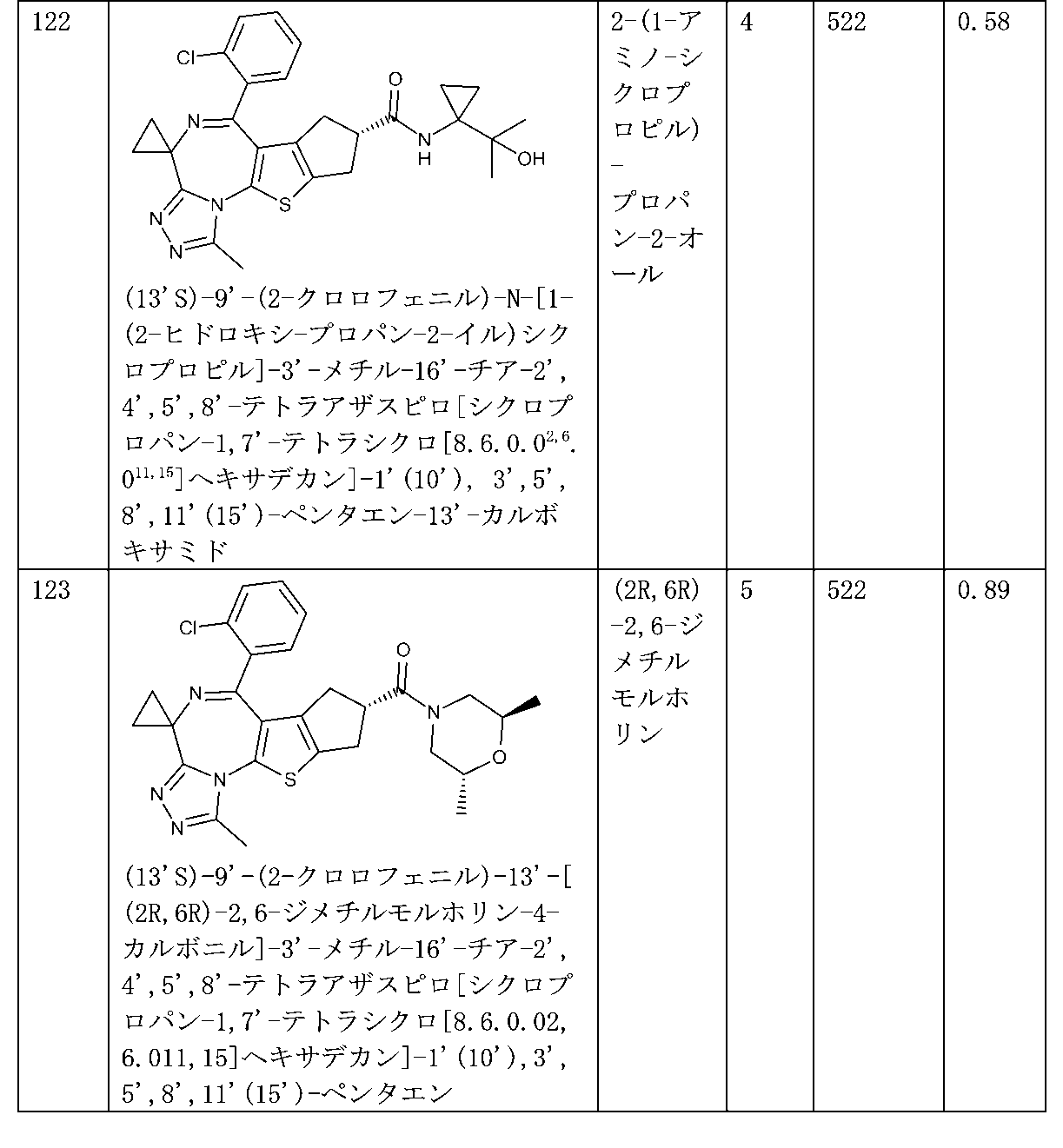


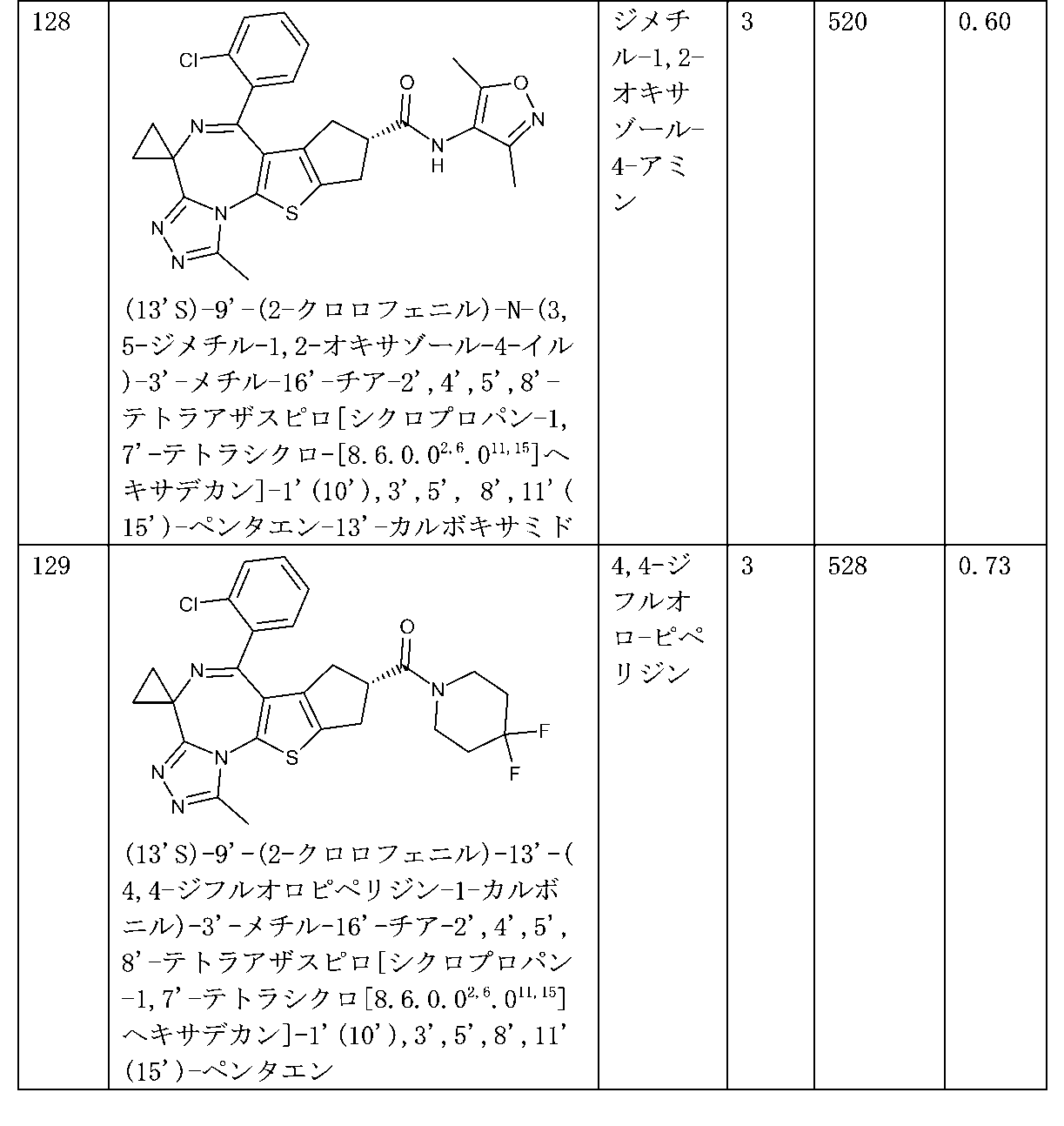
(実施例130)
(13’S)-9’-(2-メトキシフェニル)-3’-メチル-13’-(モルホリン-4-カルボニル)-16’-チア-2’,4’,5’,8’-テトラアザスピロ[シクロプロパン-1,7’-テトラシクロ[8.6.0.02,6.011,15]ヘキサデカン]-1’(10’),3’,5’,8’,11’(15’)-ペンタエン
(Example 130)
(13'S)-9'-(2-methoxyphenyl)-3'-methyl-13'-(morpholine-4-carbonyl)-16'-thia-2',4',5',8'-tetraazaspiro[cyclopropane-1,7'- tetracyclo [ 8.6.0.02,6.011,15 ]hexadecane]-1'(10'),3',5',8',11'(15')-pentaene
LC-MS(方法1):tR=0.72分;質量スペクトル(ESI+):m/z=490[M+H]+。
キラルSFC[カラム:Chiral Art(登録商標)アミロース-SA(4.6mm×250mm、5μm);カラム温度:40℃;流量:4.0mL/分;BPR:2175bar;イソクラティック条件:75:25CO2:IPA(20mM NH3)]:tR=4.72分;質量スペクトル(ESI+):m/z=490.2[M+H]+。
LC-MS (Method 1): t R =0.72 min; Mass spectrum (ESI + ): m/z = 490 [M+H] + .
Chiral SFC [column: Chiral Art® Amylose-SA (4.6 mm×250 mm, 5 μm); column temperature: 40° C.; flow rate: 4.0 mL/min; BPR: 2175 bar; isocratic conditions: 75:25 CO 2 :IPA (20 mM NH 3 )]: t R =4.72 min; mass spectrum (ESI + ): m/z=490.2 [M+H] + .
Claims (17)
R1は、C1-4-アルキル(1~3個のFにより置換されていてもよい)及びC3-4-シクロアルキルからなるR1-G1群から選択され、
nは、0、1、2及び3からなるn-G1群から選択され、
R2は、R2-G1群から独立して選択され、R2-G1群は、F、Cl、Br、I、C1-4-アルキル(1~3個のFにより置換されていてもよいか、又は1つの-CN、1つのOH若しくは1つのO-C1-4-アルキルにより置換されていてもよい)からなり、C3-4-シクロアルキル、-CN、-CONH2、-CONH(C1-4-アルキル)、-CON(C1-4-アルキル)2、-COOH、-COO-C1-4-アルキル、NH2、OH、-O-C1-4-アルキル(1~3個のFにより置換されていてもよい)からさらになり、-S(O)r-C1-4-アルキル(r=0、1又は2)からなり、
R3は、H、及び1~5個のFにより置換されていてもよいC1-4-アルキルからなるR3-G1群から選択され、
R4は、C1-6-アルキルからなるR4-G1a群から選択され、C1-6-アルキルは、
1~3個のFにより置換されていてもよく、-CN、-CONH2、-CONH(C1-4-アルキル)、-CON(C1-4-アルキル)2、-COOH、-COO-C1-4-アルキル、C1-3-アルキル-CO-NH-、C1-3-アルキル-S(=O)2-NH-、OH及び-O-C1-3-アルキル(1~3個のFにより置換されていてもよい)から独立して選択される1~2つの置換基により置換されていてもよいか、
又は
R4は、-C0-3-アルキレン-C3-10-シクロアルキル及び-C0-3-アルキレン-C3-10-ヘテロシクリルからなるR4-G1b群から選択され、
前記アルキレンは、F及びCH3から選択される1~2つの置換基により置換されていてもよく、
前記アルキレンの1つの>CH2基は、
前記シクロアルキル及びヘテロシクリルは、飽和の単環式又は二環式環系であり、
前記ヘテロシクリルは、N、NH、>N(C1-4-アルキル)、>NCO(C1-4-アルキル)、>NCOO(C1-4-アルキル)、>NS(=O)2(C1-4-アルキル)、>N-フェニル、>N-ピリジニル、>N-ピリミジニル及びOから独立して選択される1~2つの環員を含有し、>C=O、>S(=O)r(r=0、1又は2)から選択される1つの環員を含有してもよく、
ただし、前記ヘテロシクリルは、環員の間に、N-N、N-O及びN-S(=O)r=1,2以外のヘテロ原子-ヘテロ原子結合をまったく含有せず、
前記シクロアルキル及びヘテロシクリルは、1~2個のFにより置換されていてもよく、Cl、-CN、-CONH2、-CONH(C1-4-アルキル)、-CON(C1-4-アルキル)2、-COOH、-COO-C1-4-アルキル、OH、-O-C1-3-アルキル(1~3個のFにより置換されていてもよい)、>S(=O)2-C1-4-アルキル及びC1-4-アルキル(1~3個のFにより、又は-CN、OH、-O-C1-4-アルキルから選択される1つの置換基により置換されていてもよい)から独立して選択される1~2つの置換基により置換されていてもよいか、
又は
R4は、-C0-3-アルキレン-フェニル及び-C0-3-アルキレン-ヘテロアリールからなるR4-G1c群から選択され、
前記アルキレンは、F及びCH3から選択される1~2つの置換基により置換されていてもよく、
前記アルキレンの1つの>CH2基は、
前記アルキレンの1つの-CH2-CH2-基は、
前記ヘテロアリールは、N、NH、O及びSから選択される1つの環員を含有する5員の単環であって、1~2つの環員Nをさらに含有してもよい、5員の単環、又は1~2つの環員Nを含有する6員の単環であり、
前記フェニル及びヘテロアリールは、F、Cl、Br、C3-4-シクロアルキル、-CN、-CONH2、-CONH(C1-4-アルキル)、-CON(C1-4-アルキル)2、-COOH、-COO-C1-4-アルキル、-NHCO-C1-4-アルキル、-NHS(=O)2-C1-4-アルキル、-S(=O)r-C1-4-アルキル(r=0、1又は2)、-O-C1-4-アルキル(1~3個のFにより置換されていてもよい)、及びC1-4-アルキル(1~3個のFにより、又は-CN、OH及び-O-C1-4-アルキルから選択される1つの置換基により置換されていてもよい)から独立して選択される1~3つの置換基により置換されていてもよいか、
又は
R4は、7員~12員の縮合二環式アリール、ヘテロアリール又はヘテロシクリルからなるR4-G1d群から選択され、
前記二環式アリール、ヘテロアリール又はヘテロシクリルは、
式(I)におけるアミドN原子に結合している、1つの非芳香族環であって、>N-、>NH、>N(C1-4-アルキル)、>N(CO-C1-3-アルキル)、>N(S(=O)2-C1-3-アルキル)及びOから独立して選択される1~2つの環員を含有してもよく、
C=O及びS(=O)r(r=0、1又は2)から選択される1つの環員を含有してもよい、1つの非芳香族環
及び
フェニル、ピロール、フラン及びチオフェンから選択される、1つの芳香族環であって、これらの各々において、1~2つのCH環員は、Nにより置き換えられていてもよい、1つの芳香族環からなり、
前記二環式アリール、ヘテロアリール又はヘテロシクリルは、1~4個のFにより置換されていてもよく、
1~4個のFにより置換されていてもよい1~4つのC1-3-アルキルにより置換されていてもよく、
Cl、-CN、-CONH2、-CONH(C1-4-アルキル)、-CON(C1-4-アルキル)2、-COOH、-COO-C1-4-アルキル、HO-C1-3-アルキレン-、C1-3-アルキル-O-C1-3-アルキレン-、NH2、C1-3-アルキル-CO-NH-、C1-3-アルキル-S(=O)2-NH-、OH及びC1-3-アルキル-O-(1~3個のFにより置換されていてもよい)からなる群から選択される1~2つの置換基により置換されていてもよいか、
又は
R3及びR4は、R3とR4が、それらが結合しているアミドN原子と一緒になって、3員~8員の飽和単環式ヘテロシクリルを形成するR3/4-G1a群から選択され、3員~8員の飽和単環式ヘテロシクリルは、
>NH、>N(C1-4-アルキル)、>N(CO-C1-3-アルキル)、>N(S(=O)2-C1-3-アルキル)及びOから独立して選択される1~2つの環員をさらに含有してもよく、
>C=O及び>S(=O)r(r=0、1又は2)から選択される1つの環員を含有してもよく、
ただし、前記ヘテロシクリルは、環員の間に、N-N、N-O及びN-S(=O)r=1,2以外のヘテロ原子-ヘテロ原子結合をまったく含有せず、
前記ヘテロシクリルは、1~4個のFにより置換されていてもよく、
1~3個のFにより置換されていてもよい1~4つのC1-3-アルキルにより置換されていてもよく、
Cl、-CN、-CONH2、-CONH(C1-4-アルキル)、-CON(C1-4-アルキル)2、-COOH、-COO-C1-4-アルキル、HO-C1-3-アルキレン-、C1-3-アルキル-O-C1-3-アルキレン-、C1-3-アルキル-CO-NH-、C1-3-アルキル-S(=O)2-NH-、OH及びC1-3-アルキル-O-(1~3個のFにより置換されていてもよい)から選択される1~2つの置換基により置換されていてもよいか、
又は
R3及びR4は、R3とR4が、それらが結合しているアミドN原子と一緒になって、5員~12員の飽和二環式ヘテロシクリルを形成する、R3/4-G1b群から選択され、5員~12員の飽和二環式ヘテロシクリルは、
>N-、>NH、>N(C1-4-アルキル)、>N(CO-C1-3-アルキル)、>N(S(=O)2-C1-3-アルキル)及びOから独立して選択される1~3つの環員をさらに含有してもよく、
>C=O及び>S(=O)r(r=0、1又は2)から選択される1つの環員を含有してもよく、
ただし、前記ヘテロシクリルは、環員の間に、N-N、N-O及びN-S(=O)r=1,2以外のヘテロ原子-ヘテロ原子結合をまったく含有せず、
前記ヘテロシクリルは、1~6個のFにより置換されていてもよく、
1~3個のFにより置換されていてもよい1~4つのC1-3-アルキルにより置換されていてもよく、
Cl、-CN、-CONH2、-CONH(C1-4-アルキル)、-CON(C1-4-アルキル)2、-COOH、-COO-C1-4-アルキル、HO-C1-3-アルキレン-、C1-3-アルキル-O-C1-3-アルキレン-、C1-3-アルキル-CO-NH-、C1-3-アルキル-S(=O)2-NH-、OH及びC1-3-アルキル-O-から選択される1~2つの置換基により置換されていてもよい)
又はその塩。 Compounds of formula (I)
R 1 is selected from the group R 1 -G1 consisting of C 1-4 -alkyl (optionally substituted by 1 to 3 F) and C 3-4 -cycloalkyl;
n is selected from the group n-G1 consisting of 0, 1, 2 and 3;
R 2 is independently selected from the group R 2 -G1, which consists of F, Cl, Br , I, C 1-4 -alkyl (optionally substituted by 1 to 3 F or by one -CN, one OH or one O-C 1-4 -alkyl), further consisting of C 3-4 -cycloalkyl, -CN, -CONH 2 , -CONH(C 1-4 -alkyl), -CON(C 1-4 -alkyl) 2 , -COOH, -COO-C 1-4 -alkyl, NH 2 , OH, -O-C 1-4 -alkyl (optionally substituted by 1 to 3 F), and consists of -S(O) r -C 1-4 -alkyl (r=0, 1 or 2);
R 3 is selected from the group R 3 -G1 consisting of H and C 1-4 -alkyl optionally substituted with 1 to 5 F;
R 4 is selected from the group R 4 -G1a consisting of C 1-6 -alkyl, C 1-6 -alkyl being
optionally substituted by 1 to 3 F and by 1 to 2 substituents independently selected from -CN, -CONH2 , -CONH( C1-4 -alkyl), -CON( C1-4 -alkyl) 2 , -COOH, -COO- C1-4 -alkyl, C1-3 -alkyl-CO-NH-, C1-3 -alkyl-S(=O) 2- NH-, OH and -O- C1-3 -alkyl (optionally substituted by 1 to 3 F),
or R 4 is selected from the group R 4 -G1b consisting of -C 0-3 -alkylene-C 3-10 -cycloalkyl and -C 0-3 -alkylene-C 3-10 -heterocyclyl;
The alkylene is optionally substituted with 1 to 2 substituents selected from F and CH3 ;
One > CH2 group of said alkylene is
The cycloalkyl and heterocyclyl are saturated monocyclic or bicyclic ring systems,
said heterocyclyl contains 1 to 2 ring members independently selected from N, NH, >N(C 1-4 -alkyl), >NCO(C 1-4 -alkyl), >NCOO(C 1-4 -alkyl), >NS(═O) 2 (C 1-4 -alkyl), >N-phenyl, >N-pyridinyl, >N-pyrimidinyl and O, and optionally contains one ring member selected from >C═O, >S(═O) r (r=0, 1 or 2);
provided that said heterocyclyl does not contain any heteroatom-to-heteroatom bonds between ring members other than N-N, N-O and N-S(=O) r=1,2 ;
said cycloalkyl and heterocyclyl are optionally substituted by 1 to 2 F, by 1 to 2 substituents independently selected from Cl, -CN, -CONH2 , -CONH( C1-4 -alkyl), -CON( C1-4 -alkyl) 2 , -COOH, -COO- C1-4 -alkyl, OH, -O- C1-3 -alkyl (optionally substituted by 1 to 3 F), >S(=O) 2 - C1-4 -alkyl and C1-4 -alkyl (optionally substituted by 1 to 3 F or by one substituent selected from -CN, OH, -O- C1-4 -alkyl);
or R 4 is selected from the group R 4 -G1c consisting of -C 0-3 -alkylene-phenyl and -C 0-3 -alkylene-heteroaryl;
The alkylene is optionally substituted with 1 to 2 substituents selected from F and CH3 ;
One > CH2 group of said alkylene is
the heteroaryl is a 5-membered monocyclic ring containing one ring member selected from N, NH, O, and S, and optionally further containing 1-2 N ring members, or a 6-membered monocyclic ring containing 1-2 N ring members;
said phenyl and heteroaryl are optionally substituted by 1 to 3 substituents independently selected from F, Cl, Br, C 3-4 -cycloalkyl, -CN, -CONH 2 , -CONH(C 1-4 -alkyl), -CON(C 1-4 -alkyl) 2 , -COOH, -COO-C 1-4 -alkyl, -NHCO-C 1-4 -alkyl, -NHS(═O) 2 -C 1-4 -alkyl, -S(═O) r -C 1-4 -alkyl (r=0, 1 or 2), -O-C 1-4 -alkyl (optionally substituted by 1 to 3 F) and C 1-4 -alkyl (optionally substituted by 1 to 3 F or by one substituent selected from -CN, OH and -O-C 1-4 -alkyl);
or R 4 is selected from the group R 4 -G1d consisting of a 7- to 12-membered fused bicyclic aryl, heteroaryl, or heterocyclyl;
The bicyclic aryl, heteroaryl or heterocyclyl is
one non-aromatic ring attached to the amide N atom in formula (I) may contain 1 to 2 ring members independently selected from >N-, >NH, >N(C 1-4 -alkyl), >N(CO-C 1-3 -alkyl), >N(S(═O) 2 -C 1-3 -alkyl) and O,
one non-aromatic ring optionally containing one ring member selected from C=O and S(=O) r (r=0, 1 or 2) and one aromatic ring selected from phenyl, pyrrole, furan and thiophene, in each of which one to two CH ring members may be replaced by N;
The bicyclic aryl, heteroaryl or heterocyclyl is optionally substituted by 1 to 4 F;
optionally substituted by 1 to 4 C 1-3 -alkyl, optionally substituted by 1 to 4 F,
optionally substituted by 1 to 2 substituents selected from the group consisting of Cl, -CN, -CONH2 , -CONH( C1-4 -alkyl), -CON( C1-4 -alkyl) 2 , -COOH, -COO- C1-4 -alkyl, HO- C1-3 -alkylene-, C1-3 -alkyl-O- C1-3 -alkylene-, NH2 , C1-3 -alkyl-CO-NH-, C1-3 -alkyl-S(=O) 2- NH-, OH and C1-3 -alkyl-O-(optionally substituted by 1 to 3 F);
or R 3 and R 4 are selected from the group R 3/4 -G1a, where R 3 and R 4 together with the amide N atom to which they are attached form a 3- to 8-membered saturated monocyclic heterocyclyl, which is
may further contain 1 to 2 ring members independently selected from >NH, >N(C 1-4 -alkyl), >N(CO-C 1-3 -alkyl), >N(S(═O) 2 -C 1-3 -alkyl) and O;
It may contain one ring member selected from >C=O and >S(=O) r (r=0, 1 or 2);
provided that said heterocyclyl does not contain any heteroatom-to-heteroatom bonds between ring members other than N-N, N-O and N-S(=O) r=1,2 ;
The heterocyclyl is optionally substituted by 1 to 4 F;
optionally substituted by 1 to 4 C 1-3 -alkyl, optionally substituted by 1 to 3 F;
optionally substituted by 1 to 2 substituents selected from Cl, -CN, -CONH2 , -CONH( C1-4 -alkyl), -CON( C1-4 -alkyl) 2 , -COOH, -COO- C1-4 -alkyl, HO- C1-3 -alkylene-, C1-3 -alkyl-O- C1-3 -alkylene-, C1-3 -alkyl-CO-NH-, C1-3 -alkyl-S(=O) 2- NH-, OH and C1-3 -alkyl-O-(optionally substituted by 1 to 3 F),
or R 3 and R 4 are selected from the group R 3/4 -G1b, where R 3 and R 4 together with the amide N atom to which they are attached form a 5- to 12-membered saturated bicyclic heterocyclyl, which is
may further contain 1 to 3 ring members independently selected from >N-, >NH, >N(C 1-4 -alkyl), >N(CO-C 1-3 -alkyl), >N(S(═O) 2 -C 1-3 -alkyl) and O;
It may contain one ring member selected from >C=O and >S(=O) r (r=0, 1 or 2);
provided that said heterocyclyl does not contain any heteroatom-to-heteroatom bonds between ring members other than N-N, N-O and N-S(=O) r=1,2 ;
The heterocyclyl is optionally substituted by 1 to 6 F;
optionally substituted by 1 to 4 C 1-3 -alkyl, optionally substituted by 1 to 3 F,
and optionally substituted by 1 to 2 substituents selected from Cl, -CN, -CONH2 , -CONH( C1-4 -alkyl), -CON( C1-4 -alkyl) 2 , -COOH, -COO- C1-4 -alkyl, HO- C1-3 -alkylene-, C1-3 -alkyl-O- C1-3 -alkylene-, C1-3 -alkyl-CO-NH-, C1-3 -alkyl-S(=O) 2- NH-, OH and C1-3 -alkyl-O-.
Or its salt.
F、Cl、Br、C1-3-アルキル(2個又は3個のFにより置換されていてもよい)からなり、シクロプロピル、-CN、-C1-3-アルキレン-OH、-C1-2-アルキレン-O-C1-2-アルキル、NH2、OH、-O-C1-3-アルキル(2個又は3個のFにより置換されていてもよい)からさらになり、-S-C1-3-アルキルからなる、請求項1~2のいずれか1項に記載の化合物又はその塩。 R 2 is independently selected from the group R 2 -G2, which is
The compound or salt thereof according to any one of claims 1 to 2, which consists of F, Cl, Br, C1-3 -alkyl (optionally substituted with 2 or 3 F), further consisting of cyclopropyl, -CN, -C1-3 -alkylene-OH, -C1-2 -alkylene-O- C1-2 -alkyl, NH2 , OH, -O- C1-3 -alkyl (optionally substituted with 2 or 3 F), and consisting of -S- C1-3 -alkyl.
R4が、C1-6-アルキルからなるR4-G2a群から選択され、C1-6-アルキルは、
1~3個のFにより置換されていてもよく、
-CN、-CONH2、-CONH(C1-2-アルキル)、-CON(C1-2-アルキル)2、-COOH、-COO-C1-2-アルキル、C1-2-アルキル-CO-NH-、C1-2-アルキル-S(=O)2-NH-、OH及び-O-C1-2-アルキル(1~3個のFにより置換されていてもよい)から選択される1つの置換基により置換されていてもよいか、
又は
R4が、-C0-2-アルキレン-C3-8-シクロアルキル及び-C0-2-アルキレン-C3-9-ヘテロシクリルの群から選択され、
前記シクロアルキル及びヘテロシクリルが、飽和の単環式又は二環式環系であり、
前記ヘテロシクリルが、N、NH、>NCOCH3、>NCOO(C1-2-アルキル)、>NS(=O)2CH3、>N-ピリミジニル、O及び>S(=O)2から選択される1つの環員を含有し、
前記シクロアルキル及びヘテロシクリルが、1~2個のFにより置換されていてもよく、-CN、OH、-OCH3、>S(=O)2CH3及びC1-3-アルキル(2~3個のFにより、又は-CN、OH、-O-C1-4-アルキルから選択される1つの基により置換されていてもよい)から独立して選択される1~2つの置換基により置換されていてもよいか、
又は
R4が、-C0-2-アルキレン-フェニル及び-C0-2-アルキレン-ヘテロアリールからなるR4-G2c群から選択され、
前記アルキレンが、1~2つのCH3により置換されていてもよく、
前記アルキレンの1つの>CH2基が、
前記アルキレンの1つの-CH2-CH2-基が、
前記ヘテロアリールが、N、NH、O及びSから選択される1つの環員を含有する5員の単環であって、1つの環員Nをさらに含有してもよい、5員の単環、又は1~2つの環員Nを含有する6員の単環であり、
前記フェニル及びヘテロアリールが、F、Cl、Br、-CN、-O-C1-3-アルキル(1~3個のFにより置換されていてもよい)、及びC1-3-アルキル(1~3個のFにより、又は-CN及び-O-C1-2-アルキルから選択される1つの置換基により置換されていてもよい)から独立して選択される、1~2つの置換基により置換されていてもよいか、
又は
R4が、8員~11員の縮合二環式アリール、ヘテロアリール又はヘテロシクリルからなるR4-G2d群から選択され、
前記二環式アリール、ヘテロアリール又はヘテロシクリルは、
式(I)におけるアミドN原子に結合している、1つの非芳香族環であって、>N-、>NH、>NCH3、>NCOCH3、>NS(=O)2CH3及びOから選択される1つの環員を含有してもよく、
C=O及びS(=O)2から選択される1つの環員を含有してもよい、非芳香族環
及び
フェニル、ピロール、フラン及びチオフェンから選択される、1つの芳香族環であって、これらの各々において、1つのCH環員が、Nにより置き換えられていてもよい、1つの芳香族環からなり、
前記二環式アリール、ヘテロアリール又はヘテロシクリルが、1~2個のFにより置換されていてもよく、
1~2個のFにより置換されていてもよい1~2つのC1-2-アルキルにより置換されていてもよく、
Cl、-CN、-CONH2、-CONHCH3、-CON(CH3)2、-COOH、-COO-C1-2-アルキル、HO-C1-3-アルキレン-、CH3-O-C1-3-アルキレン-、NH2、CH3-CO-NH-、CH3-S(=O)2-NH-、OH及びCH3-アルキル-O-(1~3個のFにより置換されていてもよい)から選択される1~2つの置換基により置換されていてもよいか、
又は
R3及びR4が、R3とR4が、それらが結合しているアミドN原子と一緒になって、4員~7員の飽和単環式ヘテロシクリルを形成するR3/4-G2a群から選択され、4員~7員の飽和単環式ヘテロシクリルが、
>NH、>N(C1-4-アルキル)、>N(CO-C1-3-アルキル)、>N(S(=O)2-C1-3-アルキル)及びOから選択される1つの環員をさらに含有してもよく、>C=O及び>S(=O)2から選択される1つの環員を含有してもよく、
ただし、前記ヘテロシクリルは、環員の間に、N-S(=O)r=1,2以外のヘテロ原子-ヘテロ原子結合をまったく含有せず、
前記ヘテロシクリルは、1~2個のFにより置換されていてもよく、
2~3個のFにより置換されていてもよい1~2つのC1-3-アルキルにより置換されていてもよく、
Cl、-CN、-CON(C1-3-アルキル)2、-COO-C1-3-アルキル、C1-3-アルキル-O-C1-3-アルキレン-及びC1-3-アルキル-O-から選択される1つの置換基により置換されていてもよいか、
又は
R3及びR4が、R3とR4が、それらが結合しているアミドN原子と一緒になって、6員~11員の飽和二環式ヘテロシクリルを形成するR3/4-G2b群から選択され、6員~11員の飽和二環式ヘテロシクリルが、
>N-、>NH、>N(C1-4-アルキル)、>N(CO-C1-3-アルキル)、>N(S(=O)2-C1-3-アルキル)及びOから選択される1つの環員をさらに含有してもよく、
>C=O及び>S(=O)r(r=0、1又は2)から選択される1つの環員を含有してもよく、
ただし、前記ヘテロシクリルは、環員の間に、O-S結合をまったく含有せず、
前記ヘテロシクリルは、1~4個のFにより置換されていてもよく、
1~3個のFにより置換されていてもよい1~3つのC1-3-アルキルにより置換されていてもよく、
Cl、-CN、-CONH2、-CONH(C1-4-アルキル)、-CON(C1-4-アルキル)2、-COOH、-COO-C1-4-アルキル、HO-C1-3-アルキレン-、C1-3-アルキル-O-C1-3-アルキレン-、C1-3-アルキル-CO-NH-、C1-3-アルキル-S(=O)2-NH-、OH及びC1-3-アルキル-O-から独立して選択される1~2つの置換基により置換されていてもよい、
請求項1~3のいずれか1項に記載の化合物又はその塩。 R 3 is selected from the group R 3 -G2 consisting of H and C 1-3 -alkyl optionally substituted with 1 to 3 F;
R 4 is selected from the group R 4 -G2a consisting of C 1-6 -alkyl,
optionally substituted by 1 to 3 F;
optionally substituted by one substituent selected from -CN, -CONH2 , -CONH( C1-2 -alkyl), -CON( C1-2 -alkyl) 2 , -COOH, -COO- C1-2 -alkyl, C1-2 -alkyl-CO-NH-, C1-2 -alkyl-S(=O) 2- NH-, OH and -O- C1-2 -alkyl (optionally substituted by 1 to 3 F),
or R 4 is selected from the group -C 0-2 -alkylene-C 3-8 -cycloalkyl and -C 0-2 -alkylene-C 3-9 -heterocyclyl,
wherein the cycloalkyl and heterocyclyl are saturated monocyclic or bicyclic ring systems;
said heterocyclyl contains one ring member selected from N, NH, >NCOCH 3 , >NCOO(C 1-2 -alkyl), >NS(═O) 2 CH 3 , >N-pyrimidinyl, O and >S(═O) 2 ;
said cycloalkyl and heterocyclyl are optionally substituted by 1-2 F, by 1-2 substituents independently selected from -CN , OH, -OCH3 , >S(=O) 2CH3 and C1-3 -alkyl (optionally substituted by 2-3 F or by one group selected from -CN, OH, -O- C1-4 -alkyl),
or R 4 is selected from the group R 4 -G2c consisting of -C 0-2 -alkylene-phenyl and -C 0-2 -alkylene-heteroaryl;
The alkylene may be substituted with 1 to 2 CH3 .
One > CH2 group of said alkylene is
the heteroaryl is a 5-membered monocyclic ring containing one ring member selected from N, NH, O, and S, and optionally containing one further N ring member, or a 6-membered monocyclic ring containing 1 to 2 N ring members;
said phenyl and heteroaryl are optionally substituted by 1 to 2 substituents independently selected from F, Cl, Br, -CN, -O- Ci_3 -alkyl (optionally substituted by 1 to 3 F), and Ci_3 -alkyl (optionally substituted by 1 to 3 F or by one substituent selected from -CN and -O- Ci_2 -alkyl);
or R 4 is selected from the group R 4 -G2d consisting of an 8- to 11-membered fused bicyclic aryl, heteroaryl, or heterocyclyl;
The bicyclic aryl, heteroaryl or heterocyclyl is
One non-aromatic ring attached to the amide N atom in formula (I) may contain one ring member selected from >N-, >NH, > NCH3 , > NCOCH3 , >NS(=O) 2CH3 and O ;
a non-aromatic ring optionally containing one ring member selected from C=O and S(=O) 2 and one aromatic ring selected from phenyl, pyrrole, furan and thiophene, in each of which one CH ring member may be replaced by N,
the bicyclic aryl, heteroaryl or heterocyclyl is optionally substituted by 1-2 F;
optionally substituted by 1 to 2 C 1-2 -alkyl, optionally substituted by 1 to 2 F,
optionally substituted by 1 to 2 substituents selected from Cl, -CN, -CONH2 , -CONHCH3 , -CON( CH3 ) 2 , -COOH, -COO- C1-2 -alkyl, HO- C1-3 -alkylene-, CH3 -O - C1-3 -alkylene-, NH2 , CH3- CO-NH-, CH3 -S(=O) 2- NH-, OH and CH3 -alkyl-O-(optionally substituted by 1 to 3 F);
or R 3 and R 4 are selected from the group R 3/4 -G2a, where R 3 and R 4 together with the amide N atom to which they are attached form a 4- to 7-membered saturated monocyclic heterocyclyl, the 4- to 7-membered saturated monocyclic heterocyclyl being
may further contain one ring member selected from >NH, >N(C 1-4 -alkyl), >N(CO-C 1-3 -alkyl), >N(S(═O) 2 -C 1-3 -alkyl) and O, and may contain one ring member selected from >C═O and >S(═O) 2 ,
provided that said heterocyclyl does not contain any heteroatom-to-heteroatom bonds between ring members other than N-S(=O) r=1,2 ;
The heterocyclyl is optionally substituted by 1 to 2 F,
optionally substituted by 1 to 2 C 1-3 -alkyl, optionally substituted by 2 to 3 F,
or may be substituted by one substituent selected from Cl, -CN, -CON( C1-3 -alkyl) 2 , -COO- C1-3 -alkyl, C1-3 -alkyl-O- C1-3 -alkylene- and C1-3 -alkyl-O-,
or R 3 and R 4 are selected from the group R 3/4 -G2b, where R 3 and R 4 together with the amide N atom to which they are attached form a 6- to 11-membered saturated bicyclic heterocyclyl, the 6- to 11-membered saturated bicyclic heterocyclyl being
may further contain one ring member selected from >N-, >NH, >N(C 1-4 -alkyl), >N(CO-C 1-3 -alkyl), >N(S(═O) 2 -C 1-3 -alkyl) and O,
It may contain one ring member selected from >C=O and >S(=O) r (r=0, 1 or 2);
With the proviso that said heterocyclyl does not contain any O—S bonds between ring members,
The heterocyclyl is optionally substituted by 1 to 4 F;
optionally substituted by 1 to 3 C 1-3 -alkyl, optionally substituted by 1 to 3 F,
optionally substituted by 1 to 2 substituents independently selected from Cl, -CN, -CONH2 , -CONH( C1-4 -alkyl), -CON( C1-4 -alkyl) 2 , -COOH, -COO- C1-4 -alkyl, HO- C1-3 -alkylene-, C1-3 -alkyl-O- C1-3 -alkylene-, C1-3 -alkyl-CO-NH-, C1-3 -alkyl-S(=O) 2- NH-, OH and C1-3 -alkyl-O-,
The compound or a salt thereof according to any one of claims 1 to 3.
R4が、C1-4-アルキルからなるR4-G3a群から選択され、C1-4-アルキルが、
1~3個のFにより置換されていてもよく、
-CN、-CONH2、-COOH、OH及び-O-C1-2-アルキル(1~3個のFにより置換されていてもよい)から選択される1つの置換基により置換されていてもよいか、
又は
R4が、-C0-1-アルキレン-C3-7-シクロアルキル及びC3-9-ヘテロシクリルからなるR4-G3b群から選択され、
前記シクロアルキル及びヘテロシクリルが、飽和の単環式又は二環式環系であり、
前記ヘテロシクリルが、N、NH、>NCOCH3、>NCOO(C1-2-アルキル)、>NS(=O)2CH3、>N-ピリミジニル、O及び>S(=O)2から選択される1つの環員を含有し、
前記シクロアルキルが、1~2個のFにより置換されていてもよいか、又は1~2つのCH3基により置換されていてもよいか、又はCH2CH3、-CN、CH2OH、C(CH3)2OH、CHF2、CF3、OH、-OCH3及び>S(=O)2CH3から選択される1つの置換基により置換されていてもよく、
前記ヘテロシクリルが、2つのFにより置換されていてもよいか、又は1~2つのCH3基により置換されていてもよいか、又はCH2CH3及びC(CH3)2Hから選択される1つの置換基により置換されていてもよいか、
又は
R4が、-C1-2-アルキレン-フェニル及びC0-1-アルキレン-ヘテロアリールからなるR4-G3c群から選択され、
前記アルキレンの1つの>CH2基が、
前記アルキレンの1つの-CH2-CH2-基が、
前記ヘテロアリールが、1つの環員=N-を含有する5~6員の単環であって、=N-及びOから独立して選択される1つの環員を含有してもよい、5~6員の単環であり、
前記フェニル及びヘテロアリールが、F、Cl、OCH3及びCH3から独立して選択される1~2つの置換基により置換されていてもよいか、
又は
R4が、9員~10員の縮合二環式アリール、ヘテロアリール又はヘテロシクリルからなるR4-G3d群から選択され、
前記二環式アリール、ヘテロアリール又はヘテロシクリルが、
式(I)におけるアミドN原子に結合している、1つの非芳香族環であって、>N-及びOから選択される1つの環員を含有してもよい、1つの非芳香族環
及び
フェニル、ピリジン、ピラゾール及びチアゾールから選択される1つの芳香族環からなり、
前記二環式アリール、ヘテロアリール又はヘテロシクリルが、F、CH3、CH2CH3、-CN、NH2及びOHから選択される1つの置換基により置換されていてもよいか、
又は
R3及びR4が、R3とR4が、それらが結合しているアミドN原子と一緒になって、4員~6員の飽和単環式ヘテロシクリルを形成するR3/4-G3a群から選択され、4員~6員の飽和単環式ヘテロシクリルが、
アミドN原子に隣接していない、1つの環員Oをさらに含有してもよく、
前記ヘテロシクリルが、1~2個のFにより置換されていてもよいか、又は1~2つのCH3により置換されていてもよいか、
又は
R3及びR4が、R3とR4が、それらが結合しているアミドN原子と一緒になって、6員~11員の飽和な架橋二環式ヘテロシクリル又はスピロ二環式ヘテロシクリルを形成するR3/4-G3b群から選択され、6員~11員の飽和な架橋二環式ヘテロシクリル又はスピロ二環式ヘテロシクリルが、
アミドN原子に隣接していない、>N-、>NH、>N(C1-4-アルキル)及びOから選択される1つの環員をさらに含有してもよく、
前記ヘテロシクリルが、1~2個のFにより置換されていてもよく、
1~3個のFにより置換されていてもよい1~2つのC1-3-アルキルにより置換されていてもよく、
Cl、-CN、-CON(C1-3-アルキル)2、-COO-C1-3-アルキル、C1-3-アルキル-O-C1-3-アルキレン-及びC1-3-アルキル-O-から選択される1つの置換基により置換されていてもよい、
請求項1~4のいずれか1項に記載の化合物又はその塩。 R 3 is selected from the group R 3 -G2 consisting of H and C 1-3 -alkyl optionally substituted with 1 to 3 F;
R 4 is selected from the group R 4 -G3a consisting of C 1-4 -alkyl, C 1-4 -alkyl being
optionally substituted by 1 to 3 F;
optionally substituted by one substituent selected from -CN, -CONH2 , -COOH, OH and -O- C1-2 -alkyl (optionally substituted by 1 to 3 F);
or R 4 is selected from the group R 4 -G3b consisting of -C 0-1 -alkylene-C 3-7 -cycloalkyl and C 3-9 -heterocyclyl,
wherein the cycloalkyl and heterocyclyl are saturated monocyclic or bicyclic ring systems;
said heterocyclyl contains one ring member selected from N, NH, >NCOCH 3 , >NCOO(C 1-2 -alkyl), >NS(═O) 2 CH 3 , >N-pyrimidinyl, O and >S(═O) 2 ;
said cycloalkyl is optionally substituted by 1 to 2 F, or by 1 to 2 CH3 groups, or by one substituent selected from CH2CH3 , -CN , CH2OH , C( CH3 ) 2OH , CHF2 , CF3 , OH, -OCH3 and > S (=O) 2CH3 ;
the heterocyclyl is optionally substituted by two F, or by one to two CH 3 groups, or by one substituent selected from CH 2 CH 3 and C(CH 3 ) 2 H;
or R 4 is selected from the group R 4 -G3c consisting of -C 1-2 -alkylene-phenyl and C 0-1 -alkylene-heteroaryl;
One > CH2 group of said alkylene is
the heteroaryl is a 5- to 6-membered monocyclic ring containing one ring member =N-, optionally containing one ring member independently selected from =N- and O;
The phenyl and heteroaryl are optionally substituted with 1 to 2 substituents independently selected from F, Cl, OCH3 and CH3 ;
or R 4 is selected from the group R 4 -G3d consisting of a 9- to 10-membered fused bicyclic aryl, heteroaryl, or heterocyclyl;
The bicyclic aryl, heteroaryl or heterocyclyl is
one non-aromatic ring bonded to the amide N atom in formula (I), which may contain one ring member selected from >N- and O, and one aromatic ring selected from phenyl, pyridine, pyrazole and thiazole,
The bicyclic aryl, heteroaryl or heterocyclyl is optionally substituted by one substituent selected from F, CH 3 , CH 2 CH 3 , —CN, NH 2 and OH;
or R 3 and R 4 are selected from the group R 3/4 -G3a, in which R 3 and R 4 together with the amide N atom to which they are attached form a 4- to 6-membered saturated monocyclic heterocyclyl, the 4- to 6-membered saturated monocyclic heterocyclyl being
may further contain one ring member O that is not adjacent to the amide N atom,
the heterocyclyl is optionally substituted by 1-2 F or 1-2 CH 3 ;
or R 3 and R 4 are selected from the group R 3/4 -G3b, where R 3 and R 4 together with the amide N atom to which they are attached form a 6- to 11-membered saturated bridged bicyclic heterocyclyl or spiro bicyclic heterocyclyl, the 6- to 11-membered saturated bridged bicyclic heterocyclyl or spiro bicyclic heterocyclyl being
may further contain one ring member not adjacent to the amide N atom and selected from >N-, >NH, >N(C 1-4 -alkyl) and O,
said heterocyclyl is optionally substituted by 1 to 2 F;
optionally substituted by 1 to 2 C 1-3 -alkyl, optionally substituted by 1 to 3 F;
optionally substituted by one substituent selected from Cl, -CN, -CON( C1-3 -alkyl) 2 , -COO- C1-3 -alkyl, C1-3 -alkyl-O- C1-3 -alkylene- and C1-3 -alkyl-O-,
The compound or salt thereof according to any one of claims 1 to 4.
R4が、F及びOCF3から選択される1つの基により置換されていてもよいC1-4-アルキルからなるR4-G4a群から選択されるか、
又は
R4が、-C0-1-アルキレン-C3-7-シクロアルキル及びC3-9-ヘテロシクリルからなるR4-G3b群から選択され、
前記シクロアルキル及びヘテロシクリルが、飽和の単環式又は二環式環系であり、
前記ヘテロシクリルが、N、NH、>NCOCH3、>NCOO(C1-2-アルキル)、>NS(=O)2CH3、>N-ピリミジニル、O及び>S(=O)2から選択される1つの環員を含有し、
前記シクロアルキルが、1~2個のFにより置換されていてもよいか、又は1~2つのCH3基により置換されていてもよいか、又はCH2CH3、-CN、CH2OH、C(CH3)2OH、CHF2、CF3、OH、-OCH3及び>S(=O)2CH3から選択される1つの置換基により置換されていてもよく、
前記ヘテロシクリルが、2つのFにより置換されていてもよいか、又は1~2つのCH3基により置換されていてもよいか、又はCH2CH3及びC(CH3)2Hから選択される1つの置換基により置換されていてもよいか、
又は
R4が、-C1-2-アルキレン-フェニル及びC0-1-アルキレン-ヘテロアリールからなるR4-G3c群から選択され、
前記アルキレンの1つの>CH2基が、
前記アルキレンの1つの-CH2-CH2-基が、
前記ヘテロアリールが、1つの環員=N-を含有する5~6員の単環であって、=N-及びOから独立して選択される1つの環員を含有してもよい、5~6員の単環であり、
前記フェニル及びヘテロアリールが、F、Cl、OCH3及びCH3から独立して選択される1~2つの置換基により置換されていてもよいか、
又は
R4が、9員~10員の縮合二環式アリール、ヘテロアリール又はヘテロシクリルからなるR4-G3d群から選択され、
前記二環式アリール、ヘテロアリール又はヘテロシクリルが、
式(I)におけるアミドN原子に結合している、1つの非芳香族環であって、>N-及びOから選択される1つの環員を含有してもよい、1つの非芳香族環
及び
フェニル、ピリジン、ピラゾール及びチアゾールから選択される1つの芳香族環からなり、
前記二環式アリール、ヘテロアリール又はヘテロシクリルが、F、CH3、CH2CH3、-CN、NH2及びOHから選択される1つの置換基により置換されていてもよいか、
又は
R3及びR4が、R3とR4が、それらが結合しているアミドN原子と一緒になって、4員~6員の飽和単環式ヘテロシクリルを形成するR3/4-G3a群から選択され、4員~6員の飽和単環式ヘテロシクリルが、
アミドN原子に隣接していない、1つの環員Oをさらに含有してもよく、
前記ヘテロシクリルが、1~2個のFにより置換されていてもよいか、又は1~2つのCH3により置換されていてもよいか、
又は
R3及びR4が、R3とR4が、それらが結合しているアミドN原子と一緒になって、アミドN原子に隣接していない1つの環員Oを含有してもよい、6員~8員の飽和な架橋二環式ヘテロシクリル又はスピロ二環式ヘテロシクリルを形成するR3/4-G4b群から選択される、
請求項1~5のいずれか1項に記載の化合物又はその塩。 R 3 is selected from the group R 3 -G2 consisting of H and C 1-3 -alkyl optionally substituted with 1 to 3 F;
R4 is selected from the group R4 -G4a consisting of C1-4 -alkyl optionally substituted by one group selected from F and OCF3 ;
or R 4 is selected from the group R 4 -G3b consisting of -C 0-1 -alkylene-C 3-7 -cycloalkyl and C 3-9 -heterocyclyl,
wherein the cycloalkyl and heterocyclyl are saturated monocyclic or bicyclic ring systems;
said heterocyclyl contains one ring member selected from N, NH, >NCOCH 3 , >NCOO(C 1-2 -alkyl), >NS(═O) 2 CH 3 , >N-pyrimidinyl, O and >S(═O) 2 ;
said cycloalkyl is optionally substituted by 1-2 F, or by 1-2 CH3 groups, or by one substituent selected from CH2CH3 , -CN , CH2OH , C( CH3 ) 2OH , CHF2 , CF3 , OH, -OCH3 and > S (=O) 2CH3 ;
the heterocyclyl is optionally substituted by two F, or by one to two CH 3 groups, or by one substituent selected from CH 2 CH 3 and C(CH 3 ) 2 H;
or R 4 is selected from the group R 4 -G3c consisting of -C 1-2 -alkylene-phenyl and C 0-1 -alkylene-heteroaryl;
One > CH2 group of said alkylene is
the heteroaryl is a 5- to 6-membered monocyclic ring containing one ring member =N-, optionally containing one ring member independently selected from =N- and O;
The phenyl and heteroaryl are optionally substituted with 1 to 2 substituents independently selected from F, Cl, OCH3 and CH3 ;
or R 4 is selected from the group R 4 -G3d consisting of a 9- to 10-membered fused bicyclic aryl, heteroaryl, or heterocyclyl;
The bicyclic aryl, heteroaryl or heterocyclyl is
consisting of one non-aromatic ring bonded to the amide N atom in formula (I), which may contain one ring member selected from >N- and O, and one aromatic ring selected from phenyl, pyridine, pyrazole and thiazole;
The bicyclic aryl, heteroaryl or heterocyclyl is optionally substituted by one substituent selected from F, CH 3 , CH 2 CH 3 , —CN, NH 2 and OH;
or R 3 and R 4 are selected from the group R 3/4 -G3a, in which R 3 and R 4 together with the amide N atom to which they are attached form a 4- to 6-membered saturated monocyclic heterocyclyl, the 4- to 6-membered saturated monocyclic heterocyclyl being
may further contain one ring member O that is not adjacent to the amide N atom,
the heterocyclyl is optionally substituted by 1-2 F or 1-2 CH 3 ;
or R 3 and R 4 are selected from the group R 3/4 -G4b, where R 3 and R 4 together with the amide N atom to which they are attached form a 6- to 8-membered saturated bridged bicyclic or spiro bicyclic heterocyclyl, which may contain one O ring member that is not adjacent to the amide N atom;
The compound or a salt thereof according to any one of claims 1 to 5.
R4が、
又は
R4が、
又はR4が、
又はR4が、
又は
R3及びR4が、R3とR4が、それらが結合しているアミドN原子と一緒になって、ヘテロシクリルを形成するR3/4-G4a群から選択され、ヘテロシクリルが、
又は
R3及びR4が、R3とR4が、それらが結合しているアミドN原子と一緒になって、ヘテロシクリルを形成するR3/4-G5b群から選択され、ヘテロシクリルが、
請求項1~6のいずれか1項に記載の化合物又はその塩。 R3 is selected from the group R3 - G3 consisting of H, CH3 , CH2CH3 , and CH2CH2CH3 ;
R4 is
Or R4 is
Or R4 is
Or R4 is
or R 3 and R 4 are selected from the group R 3/4 -G4a, in which R 3 and R 4 together with the amide N atom to which they are attached form a heterocyclyl, the heterocyclyl being
or R 3 and R 4 are selected from the group R 3/4 -G5b, where R 3 and R 4 together with the amide N atom to which they are attached form a heterocyclyl, the heterocyclyl being
The compound or salt thereof according to any one of claims 1 to 6.
請求項7に記載の化合物又はその塩。 R 3 and R 4 are selected from the group R 3/4 -G7a, where R 3 and R 4 together with the amide N atom to which they are attached form a heterocyclyl, the heterocyclyl being
The compound or salt thereof according to claim 7.
からなる群から選択される、請求項1に記載の化合物又はその塩。 below:
2. The compound according to claim 1, or a salt thereof, selected from the group consisting of:
Applications Claiming Priority (3)
| Application Number | Priority Date | Filing Date | Title |
|---|---|---|---|
| EP21216739.9 | 2021-12-22 | ||
| EP21216739 | 2021-12-22 | ||
| PCT/EP2022/086670 WO2023117914A1 (en) | 2021-12-22 | 2022-12-19 | Cyclopentathiophene carboxamide derivatives as platelet activating factor receptor antagonists |
Publications (2)
| Publication Number | Publication Date |
|---|---|
| JP2025501761A true JP2025501761A (en) | 2025-01-23 |
| JPWO2023117914A5 JPWO2023117914A5 (en) | 2026-01-06 |
Family
ID=79018394
Family Applications (1)
| Application Number | Title | Priority Date | Filing Date |
|---|---|---|---|
| JP2024538239A Pending JP2025501761A (en) | 2021-12-22 | 2022-12-19 | Cyclopentathiophene carboxamide derivatives as platelet-activating factor receptor antagonists |
Country Status (7)
| Country | Link |
|---|---|
| US (1) | US11992494B2 (en) |
| EP (1) | EP4452985A1 (en) |
| JP (1) | JP2025501761A (en) |
| CN (1) | CN118414340A (en) |
| AR (1) | AR128063A1 (en) |
| TW (1) | TW202341993A (en) |
| WO (1) | WO2023117914A1 (en) |
Family Cites Families (10)
| Publication number | Priority date | Publication date | Assignee | Title |
|---|---|---|---|---|
| DE3502392A1 (en) | 1985-01-25 | 1986-07-31 | Boehringer Ingelheim KG, 6507 Ingelheim | NEW THIENO-TRIAZOLO-1,4-DIAZEPINO-2-CARBONIC ACID AMIDES, METHOD FOR THE PRODUCTION THEREOF AND PHARMACEUTICAL COMPOSITIONS |
| PH30676A (en) | 1986-07-22 | 1997-09-16 | Boehringer Ingelhein Kg | Hetrazepine compounds which have useful pharmaceutical utility |
| EP0368175A1 (en) | 1988-11-06 | 1990-05-16 | Boehringer Ingelheim Kg | 3S,7S-3-(Morpholinocarbonyl)-5-(2-chlorphenyl)-7,10-dimethyl-3,4-dihydro-2H,7H-cyclopenta[4,5]thieno[3,2-f][1,2,4]triazolo[4,3-a][1,4]diazepine. |
| DE3909012A1 (en) | 1989-03-18 | 1990-09-20 | Boehringer Ingelheim Kg | IMPROVED METHOD FOR THE PRODUCTION OF ENANTIOMERIC PURE HETRAZEPINES |
| DE4010528A1 (en) | 1990-04-02 | 1991-10-17 | Boehringer Ingelheim Kg | PRECARATIVE CHROMATOGRAPHIC SEPARATION METHOD FOR THE PRODUCTION OF ENANTIOMERALLY PURE HETRAZEPINE |
| JP2959598B2 (en) | 1990-10-12 | 1999-10-06 | 吉富製薬株式会社 | Optically active thienotriazolodiazepine compounds |
| DE4132763A1 (en) | 1991-10-02 | 1993-04-08 | Boehringer Ingelheim Kg | Multistep sepn. for preparing optically pure hetrazepine enantiomers - using liq. chromatography to separate mixt. of both enantiomers, dissolving obtd. mixt. enriched in specific and racemising other enantiomer |
| FR2779652B1 (en) | 1998-06-15 | 2001-06-08 | Sod Conseils Rech Applic | USE OF DIAZEPINES FOR THE PREPARATION OF MEDICINES FOR THE TREATMENT OF CONDITIONS OR DISEASES IN WHICH ONE OF THE SOMATOSTATIN RECEPTORS IS INVOLVED |
| US20050032713A1 (en) | 2002-03-27 | 2005-02-10 | Wurtman Richard J. | Platelet-activating factor antagonists as analgesic, anti-inflammatory, uterine contraction inhibiting, and anti-tumor agents |
| AU2007321920A1 (en) | 2006-11-20 | 2008-05-29 | Alantos Pharmaceuticals Holding, Inc. | Heterotricyclic metalloprotease inhibitors |
-
2022
- 2022-12-19 JP JP2024538239A patent/JP2025501761A/en active Pending
- 2022-12-19 US US18/083,602 patent/US11992494B2/en active Active
- 2022-12-19 EP EP22840619.5A patent/EP4452985A1/en active Pending
- 2022-12-19 WO PCT/EP2022/086670 patent/WO2023117914A1/en not_active Ceased
- 2022-12-19 CN CN202280083939.1A patent/CN118414340A/en active Pending
- 2022-12-21 TW TW111149099A patent/TW202341993A/en unknown
- 2022-12-21 AR ARP220103546A patent/AR128063A1/en unknown
Also Published As
| Publication number | Publication date |
|---|---|
| AR128063A1 (en) | 2024-03-20 |
| EP4452985A1 (en) | 2024-10-30 |
| WO2023117914A1 (en) | 2023-06-29 |
| CN118414340A (en) | 2024-07-30 |
| US11992494B2 (en) | 2024-05-28 |
| TW202341993A (en) | 2023-11-01 |
| US20230190763A1 (en) | 2023-06-22 |
Similar Documents
| Publication | Publication Date | Title |
|---|---|---|
| CA3038479C (en) | Pyrazolopyridine derivative having glp-1 receptor agonist effect | |
| JP6855477B2 (en) | Heteroarylcarboxamide derivative as a plasma kallikrein inhibitor | |
| BR112021001044A2 (en) | SULPHONIMIDAMIDE COMPOUNDS AS INHIBITORS OF INTERLEUKIN-1 ACTIVITY | |
| CN111094288B (en) | Fused ring derivatives with MGAT-2 inhibitory activity | |
| CN113631557A (en) | JAK kinase inhibitor, preparation method thereof and application thereof in medical field | |
| CN114478485B (en) | Heteroaromatic compounds as VANIN inhibitors | |
| JPWO2006001318A1 (en) | Sulfonamide compound | |
| TW202346289A (en) | Compounds as glp-1r agonists | |
| JP7175914B2 (en) | Heteroarylcarboxamide derivatives as plasma kallikrein inhibitors | |
| WO2020001420A1 (en) | Cell necrosis inhibitor, preparation method therefor and use thereof | |
| WO2014101295A2 (en) | Isoxazole derivative that inhibits activity of janus kinases (jaks) | |
| JP6805172B2 (en) | Histone deacetylase inhibitors and compositions and methods of their use | |
| JP2025500886A (en) | Macrocyclic BTK Inhibitors | |
| TW202023550A (en) | Heteroaromatic compounds as vanin inhibitors | |
| CN115052873A (en) | Heteroaromatic carboxamide derivatives as plasma kallikrein inhibitors | |
| TW201841893A (en) | Compounds | |
| JP7465368B2 (en) | Cyclopentathiophene carboxamide derivatives as platelet-activating factor receptor antagonists | |
| TW202309035A (en) | Imidazo[4,5-d]pyridazinonyl derivatives as trpa1 inhibitors | |
| JP2025501761A (en) | Cyclopentathiophene carboxamide derivatives as platelet-activating factor receptor antagonists | |
| JP7810743B2 (en) | Cyclopentathiophene carboxamide derivatives as platelet-activating factor receptor antagonists | |
| TWI913356B (en) | Cyclopentathiophene carboxamide derivatives as platelet activating factor receptor antagonists | |
| JP2023503091A (en) | TRPV4 receptor ligand | |
| CN112839711A (en) | Phenyltetrazole derivatives as plasma kallikrein inhibitors | |
| EA048242B1 (en) | CYCLOPENTATHIOPHENE CARBOXAMIDE DERIVATIVES AS PLATELET ACTIVATING FACTOR RECEPTOR ANTAGONISTS | |
| CN121085992A (en) | Signal transduction and transcriptional activator 6 selective degradation agent compounds |
Legal Events
| Date | Code | Title | Description |
|---|---|---|---|
| A521 | Request for written amendment filed |
Free format text: JAPANESE INTERMEDIATE CODE: A523 Effective date: 20251219 |
|
| A621 | Written request for application examination |
Free format text: JAPANESE INTERMEDIATE CODE: A621 Effective date: 20251219 |