JP2025076802A - Water-based inkjet ink for shrink film and printed matter - Google Patents
Water-based inkjet ink for shrink film and printed matter Download PDFInfo
- Publication number
- JP2025076802A JP2025076802A JP2023188675A JP2023188675A JP2025076802A JP 2025076802 A JP2025076802 A JP 2025076802A JP 2023188675 A JP2023188675 A JP 2023188675A JP 2023188675 A JP2023188675 A JP 2023188675A JP 2025076802 A JP2025076802 A JP 2025076802A
- Authority
- JP
- Japan
- Prior art keywords
- inkjet ink
- aqueous inkjet
- resin
- shrink film
- value
- Prior art date
- Legal status (The legal status is an assumption and is not a legal conclusion. Google has not performed a legal analysis and makes no representation as to the accuracy of the status listed.)
- Granted
Links
Classifications
-
- C—CHEMISTRY; METALLURGY
- C09—DYES; PAINTS; POLISHES; NATURAL RESINS; ADHESIVES; COMPOSITIONS NOT OTHERWISE PROVIDED FOR; APPLICATIONS OF MATERIALS NOT OTHERWISE PROVIDED FOR
- C09D—COATING COMPOSITIONS, e.g. PAINTS, VARNISHES OR LACQUERS; FILLING PASTES; CHEMICAL PAINT OR INK REMOVERS; INKS; CORRECTING FLUIDS; WOODSTAINS; PASTES OR SOLIDS FOR COLOURING OR PRINTING; USE OF MATERIALS THEREFOR
- C09D11/00—Inks
- C09D11/30—Inkjet printing inks
- C09D11/38—Inkjet printing inks characterised by non-macromolecular additives other than solvents, pigments or dyes
-
- C—CHEMISTRY; METALLURGY
- C09—DYES; PAINTS; POLISHES; NATURAL RESINS; ADHESIVES; COMPOSITIONS NOT OTHERWISE PROVIDED FOR; APPLICATIONS OF MATERIALS NOT OTHERWISE PROVIDED FOR
- C09D—COATING COMPOSITIONS, e.g. PAINTS, VARNISHES OR LACQUERS; FILLING PASTES; CHEMICAL PAINT OR INK REMOVERS; INKS; CORRECTING FLUIDS; WOODSTAINS; PASTES OR SOLIDS FOR COLOURING OR PRINTING; USE OF MATERIALS THEREFOR
- C09D11/00—Inks
- C09D11/02—Printing inks
- C09D11/10—Printing inks based on artificial resins
- C09D11/102—Printing inks based on artificial resins containing macromolecular compounds obtained by reactions other than those only involving unsaturated carbon-to-carbon bonds
-
- C—CHEMISTRY; METALLURGY
- C09—DYES; PAINTS; POLISHES; NATURAL RESINS; ADHESIVES; COMPOSITIONS NOT OTHERWISE PROVIDED FOR; APPLICATIONS OF MATERIALS NOT OTHERWISE PROVIDED FOR
- C09D—COATING COMPOSITIONS, e.g. PAINTS, VARNISHES OR LACQUERS; FILLING PASTES; CHEMICAL PAINT OR INK REMOVERS; INKS; CORRECTING FLUIDS; WOODSTAINS; PASTES OR SOLIDS FOR COLOURING OR PRINTING; USE OF MATERIALS THEREFOR
- C09D11/00—Inks
- C09D11/02—Printing inks
- C09D11/10—Printing inks based on artificial resins
- C09D11/106—Printing inks based on artificial resins containing macromolecular compounds obtained by reactions only involving carbon-to-carbon unsaturated bonds
- C09D11/107—Printing inks based on artificial resins containing macromolecular compounds obtained by reactions only involving carbon-to-carbon unsaturated bonds from unsaturated acids or derivatives thereof
-
- C—CHEMISTRY; METALLURGY
- C09—DYES; PAINTS; POLISHES; NATURAL RESINS; ADHESIVES; COMPOSITIONS NOT OTHERWISE PROVIDED FOR; APPLICATIONS OF MATERIALS NOT OTHERWISE PROVIDED FOR
- C09D—COATING COMPOSITIONS, e.g. PAINTS, VARNISHES OR LACQUERS; FILLING PASTES; CHEMICAL PAINT OR INK REMOVERS; INKS; CORRECTING FLUIDS; WOODSTAINS; PASTES OR SOLIDS FOR COLOURING OR PRINTING; USE OF MATERIALS THEREFOR
- C09D11/00—Inks
- C09D11/02—Printing inks
- C09D11/10—Printing inks based on artificial resins
- C09D11/106—Printing inks based on artificial resins containing macromolecular compounds obtained by reactions only involving carbon-to-carbon unsaturated bonds
- C09D11/108—Hydrocarbon resins
-
- C—CHEMISTRY; METALLURGY
- C09—DYES; PAINTS; POLISHES; NATURAL RESINS; ADHESIVES; COMPOSITIONS NOT OTHERWISE PROVIDED FOR; APPLICATIONS OF MATERIALS NOT OTHERWISE PROVIDED FOR
- C09D—COATING COMPOSITIONS, e.g. PAINTS, VARNISHES OR LACQUERS; FILLING PASTES; CHEMICAL PAINT OR INK REMOVERS; INKS; CORRECTING FLUIDS; WOODSTAINS; PASTES OR SOLIDS FOR COLOURING OR PRINTING; USE OF MATERIALS THEREFOR
- C09D11/00—Inks
- C09D11/30—Inkjet printing inks
- C09D11/32—Inkjet printing inks characterised by colouring agents
- C09D11/322—Pigment inks
Landscapes
- Chemical & Material Sciences (AREA)
- Life Sciences & Earth Sciences (AREA)
- Engineering & Computer Science (AREA)
- Materials Engineering (AREA)
- Wood Science & Technology (AREA)
- Organic Chemistry (AREA)
- Chemical Kinetics & Catalysis (AREA)
- Inks, Pencil-Leads, Or Crayons (AREA)
- Ink Jet Recording Methods And Recording Media Thereof (AREA)
Abstract
Description
本発明は、シュリンクフィルムに対する印刷に使用される水性インクジェットインキ、及び、当該水性インクジェットインキを用いて、上記シュリンクフィルム上に印刷されてなる印刷物に関する。 The present invention relates to an aqueous inkjet ink used for printing on shrink film, and a printed matter printed on the shrink film using the aqueous inkjet ink.
デジタル印刷方式は、有版印刷方式とは違い、刷版を必要としない。そのため、デジタル印刷方式の採用により、印刷装置の小型化、コスト削減等が可能となる。デジタル印刷方式の一種であるインクジェット印刷方式は、上述した特徴に加え、印刷装置からの騒音が小さい、カラー化が容易である等の利点もあり、オフィス用途及び家庭用途だけでなく、産業用途においても、その利用が進んでいる。 Unlike plate-based printing, digital printing does not require printing plates. Therefore, the adoption of digital printing makes it possible to miniaturize printing equipment and reduce costs. In addition to the above-mentioned features, inkjet printing, which is one type of digital printing, also has the advantages of low noise from the printing equipment and easy colorization, and is increasingly being used not only for office and home use, but also for industrial use.
これまで、産業用途でインクジェット印刷方式を使用する際は、溶剤インキや紫外線硬化型インキが採用されてきた。しかし近年は、作業者に対する安全性及び健康、ならびに、環境に対する配慮の観点から、水性インキの需要が高まっている。 Until now, when inkjet printing methods were used for industrial purposes, solvent inks and UV-curable inks were used. However, in recent years, the demand for water-based inks has increased from the perspective of worker safety and health, as well as environmental considerations.
なお本願では、インクジェット印刷方式で使用する水性インキのことを、単に「水性インクジェットインキ」と称する。 In this application, the water-based ink used in the inkjet printing method is simply referred to as "water-based inkjet ink."
ところで、上記産業用途で使用される印刷基材として、シュリンクフィルムが存在する。シュリンクフィルムとは、加熱することでシュリンク(収縮)する樹脂フィルムである。被収縮物の形状によらず密着させることが可能であり、当該被収縮物の形状のデザインを損なうことがない点、容器から剥がしやすく被収縮物のリサイクル性が高められる点等から、シュリンクフィルムは主に包装用途で使用されている。また、シュリンクフィルムに対する印刷物(シュリンクフィルム印刷物)を包装用途で使用する場合、当該シュリンクフィルムへの印刷後に、シュリンクフィルム印刷物をシュリンクさせ、被収縮物(被包装物)に密着させる。 Incidentally, shrink film exists as a printing substrate used in the above industrial applications. Shrink film is a resin film that shrinks when heated. Shrink film is mainly used for packaging applications because it can be attached to any object regardless of its shape, does not damage the design of the object, and is easy to peel off from the container, improving the recyclability of the object. In addition, when a printed material on shrink film (shrink film printed material) is used for packaging applications, the shrink film is shrunk after printing and attached to the object (packaged item).
なお本願における「印刷物」という記載は、シュリンクフィルム、水性インクジェットインキの層(インキ層)、及び、併用される場合は、前処理液(詳細は後述する)によって形成される層(インキ凝集層)の積層体を指すものとする。また、上記印刷物に含まれるインキ層は、例えば複数種の水性インクジェットインキ(後述する、水性インクジェットインキのセット)によって形成される、複数層からなるインキ層であってもよい。 In this application, the term "printed matter" refers to a laminate of a shrink film, a layer of aqueous inkjet ink (ink layer), and, when used in combination, a layer (ink aggregation layer) formed by a pretreatment liquid (details of which will be described later). The ink layer included in the printed matter may be an ink layer consisting of multiple layers, formed, for example, by multiple types of aqueous inkjet inks (a set of aqueous inkjet inks, which will be described later).
上述した通り、シュリンクフィルムを使用する際は、当該シュリンクフィルムをシュリンクさせる前に、印刷が行われる。すなわち、シュリンクフィルム上のインキ層も、上記シュリンクに伴い、収縮することになる。従って、インキ層が上記シュリンクに対して追随できない場合、当該インキ層にシワ、ヒビ、ワレ等が発生する、シュリンク度合いが不均一になる、等の問題が発生する恐れがある。 As mentioned above, when using shrink film, printing is carried out before the shrink film is shrunk. In other words, the ink layer on the shrink film also shrinks as the film shrinks. Therefore, if the ink layer cannot keep up with the shrinking, problems such as wrinkles, cracks, and breaks in the ink layer and uneven shrinkage may occur.
またそもそも、シュリンクフィルムは樹脂フィルム基材の一種である。このような印刷基材に、水性インクジェットインキを印刷する場合、液体成分の印刷基材内部への浸透による乾燥が起きず、当該水性インクジェットインキの液滴同士が合一して滲みが発生する、という問題も発生しやすい。 In addition, shrink film is a type of resin film substrate. When printing water-based inkjet ink on such a substrate, the liquid components do not permeate into the substrate and dry, and the droplets of the water-based inkjet ink tend to coalesce and cause bleeding.
従って、シュリンクフィルムに対して水性インクジェットインキで印刷を行う際には、シュリンク等の変形に対する追随性を確保したうえで、滲みがなく印刷画質に優れた印刷物の製造を実現する必要がある。 Therefore, when printing on shrink film with aqueous inkjet ink, it is necessary to ensure that the ink can adapt to deformations such as shrinkage, and to produce printed matter that is free of bleeding and has excellent print quality.
しかしながらこれまでは、シュリンクフィルムに対する水性インクジェットインキでの印刷に関する検討は、あまり行われていないのが現状である。
例えば特許文献1は、ブロック型イソシアネートと、カルボジイミド化合物及び/またはオキサゾリン化合物とを含む、インクジェット記録用水性組成物に関する。また、当該水性組成物は、顔料を含むインクジェット記録用水系インク(本願における「水性インクジェットインキ」に相当)と併用されるとの記載もある(段落番号0010、0041等)。更に、特許文献1の実施例では、顔料及び水に加え、樹脂(ポリマー粒子);有機溶剤である、プロピレングリコール(1,2-プロパンジオール)、ジエチレングリコールモノ(ノルマル)ブチルエーテル、及びN-メチルジエタノールアミン;ならびに、界面活性剤である、アルキレングリコール変性ポリジメチルシロキサンを含む水系インクが、実際に製造されている(段落番号0084~0094、表4)。そして、上記水系インク及び水性組成物を組み合わせ、シュリンクPETフィルムに対して印刷を行っている(段落番号0099~0101)。
However, little research has been done on printing on shrink films with water-based inkjet inks.
For example, Patent Document 1 relates to an aqueous composition for inkjet recording that contains a blocked isocyanate and a carbodiimide compound and/or an oxazoline compound. It also states that the aqueous composition is used in combination with an aqueous ink for inkjet recording that contains a pigment (corresponding to the "aqueous inkjet ink" in the present application) (paragraphs 0010, 0041, etc.). Furthermore, in the examples of Patent Document 1, in addition to the pigment and water, an aqueous ink that contains a resin (polymer particles); organic solvents propylene glycol (1,2-propanediol), diethylene glycol mono(normal)butyl ether, and N-methyldiethanolamine; and a surfactant alkylene glycol-modified polydimethylsiloxane is actually produced (paragraphs 0084 to 0094, Table 4). The aqueous ink and the aqueous composition are combined and printed on a shrink PET film (paragraphs 0099 to 0101).
一方、特許文献1では、水系インクに含まれ得る界面活性剤に関する、具体的な説明がない。すなわち、当該特許文献1内では、任意成分の一つとして「界面活性剤」が列挙されているに過ぎない(段落番号0063)。また上述した通り、特許文献1に記載されている水系インクは、上記水性組成物と組み合わせて使用することが前提となっている。そのため、当該水系インクのみを、シュリンクフィルムに印刷した場合、上述した、変形追随性に優れ、滲みが抑制された印刷物が得られるかどうかに関しては、特許文献1内には記載がない。実際に、本発明者らが、上記水系インクの具体例で使用されている、有機溶剤及び界面活性剤の構成を模した水性インクジェットインキを作製し、評価を行ったところ、特に印刷物の変形追随性が不十分であるとの結果が得られた(詳細は、後述する実施例を参照)。 On the other hand, Patent Document 1 does not provide any specific description of the surfactant that may be contained in the water-based ink. In other words, Patent Document 1 merely lists "surfactant" as one of the optional components (paragraph 0063). As described above, the water-based ink described in Patent Document 1 is intended to be used in combination with the above-mentioned aqueous composition. Therefore, Patent Document 1 does not state whether or not the above-mentioned printed matter with excellent deformation conformability and suppressed bleeding can be obtained when the water-based ink alone is printed on a shrink film. In fact, the present inventors prepared and evaluated an aqueous inkjet ink that mimics the composition of the organic solvent and surfactant used in the specific example of the water-based ink, and found that the printed matter had insufficient deformation conformability (see the examples described below for details).
また、特許文献2は、溶解度パラメータ(SP値)が8~13(cal/cm3)1/2である樹脂を溶融したのち、冷却ドラム上に押し出すことで作製される未延伸シートを、更に延伸処理して製造される、インクジェット記録用シュリンクフィルムに関する。また特許文献2の実施例では、カーボンブラック;水;アクリル樹脂;ならびに、有機溶剤である、グリセリン、エチレングリコール、N-メチルピロリドン、イソプロピルアルコール等を含む、黒色インクB(本願における「水性インクジェットインキ」に相当)が製造され、種々のシュリンクフィルムに対する印刷に使用されている(段落番号0058~0070、0072~0074、表2)。 Patent Document 2 relates to a shrink film for inkjet recording, which is produced by melting a resin having a solubility parameter (SP value) of 8 to 13 (cal/ cm3 ) 1/2 , extruding the melted resin onto a cooling drum to produce an unstretched sheet, and then stretching the sheet. In the examples of Patent Document 2, black ink B (corresponding to "aqueous inkjet ink" in this application) containing carbon black, water, acrylic resin, and organic solvents such as glycerin, ethylene glycol, N-methylpyrrolidone, and isopropyl alcohol is produced and used for printing on various shrink films (paragraphs 0058-0070, 0072-0074, Table 2).
一方、表2や段落番号0072から明らかなように、特許文献2内では、黒色インクBは比較例として使用されている。実際に表2では、「画像の耐熱性」評価(段落番号0069~0070の記載より、本願における変形追随性に類似した項目といえる)において、実用可能レベルに到達している例は一つも存在していない。また特許文献2内には、水性インクジェットインキの構成に関する具体的な記載は存在しない。すなわち、どのような構成の水性インクジェットインキであれば、変形に対する追随性が確保され、滲みもない印刷物が得られるか、ということに関しては、特許文献2内には記載も示唆もされていない。 On the other hand, as is clear from Table 2 and paragraph number 0072, black ink B is used as a comparative example in Patent Document 2. In fact, in Table 2, there is not a single example that reaches a practical level in the evaluation of "heat resistance of image" (which, based on the description in paragraph numbers 0069-0070, can be said to be an item similar to the deformation followability in this application). Furthermore, Patent Document 2 does not contain any specific description regarding the composition of the aqueous inkjet ink. In other words, Patent Document 2 does not state or suggest what kind of composition of aqueous inkjet ink ensures the followability to deformation and produces printed matter without bleeding.
以上のように、変形追随性が良好であり、かつ、滲みがない印刷物が得られ、更には、インクジェット印刷方式で使用されるうえでの必須要件である、吐出安定性にも優れた、水性インクジェットインキに関しては、これまで十分な検討が行われていない状況であった。 As described above, there has been little research conducted to date into aqueous inkjet inks that have good deformation conformability, produce prints without bleeding, and also have excellent ejection stability, which is an essential requirement for use in inkjet printing methods.
そこで、本発明の一実施形態では、シュリンクフィルムのシュリンク等の変形に対する追随性が良好であり、かつ、滲みのない印刷物を得ることができ、更には吐出安定性も良好である、水性インクジェットインキを提供することを目的としている。また、本発明の別の一実施形態では、上述した特性に加えて、リサイクル性にも優れた印刷物が得られる、水性インクジェットインキを提供することを目的としている。 In one embodiment of the present invention, therefore, it is an object of the present invention to provide an aqueous inkjet ink that has good adaptability to deformations such as shrinking of the shrink film, can produce printed matter without bleeding, and also has good ejection stability. In another embodiment of the present invention, it is an object of the present invention to provide an aqueous inkjet ink that, in addition to the above-mentioned characteristics, can produce printed matter that is also highly recyclable.
本発明者らが鋭意検討を行った結果、下記構成を有する水性インクジェットインキによって、上述した課題のすべてが、同時かつ高いレベルで解決できることを見出した。 As a result of intensive research, the inventors have found that the aqueous inkjet ink having the following composition can simultaneously and to a high degree solve all of the above problems.
すなわち本発明の一実施形態は、以下[1]~[3]に示す水性インクジェットインキ、ならびに、以下[4]に示す、上記水性インクジェットインキを用いてなる印刷物に関する。
[1]有機溶剤と、界面活性剤と、樹脂とを含むシュリンクフィルム用水性インクジェットインキであって、
前記有機溶剤が、SP値が11~13.5(cal/cm3)1/2であり、水酸基を1個以上有する有機溶剤(A-1)を、前記水性インクジェットインキの全量中5~30質量%含み、
前記界面活性剤が、アセチレンジオール系界面活性剤、及び、ポリオキシアルキレンアルキルエーテル系界面活性剤からなる群から選択される1種以上の界面活性剤(B-1)を含み、
前記樹脂及び前記界面活性剤のSP値の加重平均値が9~11.5(cal/cm3)1/2である、シュリンクフィルム用水性インクジェットインキ。
[2]前記アセチレンジオール系界面活性剤、及び、ポリオキシアルキレンアルキルエーテル系界面活性剤からなる群から選択される1種以上の界面活性剤(B-1)が、HLB値が3~12である界面活性剤(B-1-1)を含む、[1]に記載のシュリンクフィルム用水性インクジェットインキ。
[3]前記有機溶剤の、1気圧下における沸点(加重平均値)が、150~190℃である、[1]または[2]に記載のシュリンクフィルム用水性インクジェットインキ。
[4][1]または[2]に記載の水性インクジェットインキが、インクジェット印刷方式によって、シュリンクフィルム上に印刷されてなる印刷物。
That is, one embodiment of the present invention relates to the aqueous inkjet inks shown in [1] to [3] below, and to a printed matter produced using the aqueous inkjet inks shown in [4] below.
[1] A water-based inkjet ink for shrink films, comprising an organic solvent, a surfactant, and a resin,
the organic solvent has an SP value of 11 to 13.5 (cal/cm 3 ) 1/2 and contains an organic solvent (A-1) having one or more hydroxyl groups in an amount of 5 to 30% by mass based on the total amount of the aqueous inkjet ink;
The surfactant comprises one or more surfactants (B-1) selected from the group consisting of acetylene diol surfactants and polyoxyalkylene alkyl ether surfactants,
The water-based inkjet ink for shrink films, wherein the weighted average SP value of the resin and the surfactant is 9 to 11.5 (cal/cm 3 ) 1/2 .
[2] The aqueous inkjet ink for shrink films according to [1], wherein the one or more surfactants (B-1) selected from the group consisting of acetylene diol surfactants and polyoxyalkylene alkyl ether surfactants include a surfactant (B-1-1) having an HLB value of 3 to 12.
[3] The water-based inkjet ink for shrink films according to [1] or [2], wherein the boiling point (weighted average value) of the organic solvent at 1 atmospheric pressure is 150 to 190°C.
[4] A printed matter obtained by printing the aqueous inkjet ink according to [1] or [2] on a shrink film by an inkjet printing method.
本発明の一実施形態である水性インクジェットインキは、シュリンクフィルムのシュリンク等の変形に対する追随性が良好であり、かつ、滲みのない印刷物を得ることができ、更には吐出安定性も良好である、という効果を奏する。また、本発明の別の一実施形態である水性インクジェットインキは、上述した特性に加えて、リサイクル性にも優れた印刷物が得られる、という効果を奏する。 The aqueous inkjet ink of one embodiment of the present invention has the advantage that it has good adaptability to deformations such as shrinking of the shrink film, can produce printed matter without bleeding, and also has good ejection stability. In addition to the above-mentioned characteristics, the aqueous inkjet ink of another embodiment of the present invention has the advantage that it can produce printed matter with excellent recyclability.
以下に、本発明の一実施形態である水性インクジェットインキ(以下では単に「本実施形態の水性インクジェットインキ」とも称する)について説明する。なお本発明は、以下に記載する実施形態に限定されるものではなく、当該本発明の本質的部分を変更しない範囲内で変形実施できる形態を含む。 The following describes an aqueous inkjet ink according to one embodiment of the present invention (hereinafter, simply referred to as "aqueous inkjet ink according to this embodiment"). Note that the present invention is not limited to the embodiment described below, and includes embodiments that can be modified without changing the essential parts of the present invention.
上述した通り、本実施形態の水性インクジェットインキは、シュリンクフィルム用途である。上述したように、シュリンクフィルム印刷物は、印刷後に、印刷基材であるシュリンクフィルムをシュリンクさせる。従って、インキ層には、シワ、ヒビやワレを起こすことなく、上記変形に追随できることが求められる。そして、上記追随を実現するためには、印刷基材であるシュリンクフィルムに対して、均一な厚みを有するインキ層が得られること、当該シュリンクフィルムに対して水性インクジェットインキが十分に濡れ広がること、ならびに、上記インキ層がシュリンクフィルムに対する親和性及び密着性を有していること、が必要となる。 As described above, the aqueous inkjet ink of this embodiment is used for shrink film. As described above, shrink film prints are produced by shrinking the print substrate, the shrink film, after printing. Therefore, the ink layer is required to be able to follow the above deformation without wrinkling, cracking, or breaking. To achieve this, it is necessary that an ink layer with a uniform thickness is obtained for the print substrate, the shrink film, that the aqueous inkjet ink sufficiently wets and spreads over the shrink film, and that the ink layer has affinity and adhesion to the shrink film.
そこで、本発明者らが鋭意検討を進めた結果、上述した構成を有する、本実施形態の水性インクジェットインキによって、上述した課題が解決できること、更には、上記水性インクジェットインキが、印刷物の滲み抑制性及び吐出安定性にも優れることを見出した。以下に、本発明の機序について説明するが、これらは本発明者らによる推測であり、本発明は以下に示す機序によって限定解釈されるものではない。 The inventors have conducted extensive research and have found that the aqueous inkjet ink of the present embodiment, which has the above-mentioned configuration, can solve the above-mentioned problems, and further, that the aqueous inkjet ink is excellent in suppressing bleeding of printed matter and in ejection stability. The mechanism of the present invention is explained below, but this is merely a speculation made by the inventors, and the present invention is not limited to the mechanism described below.
まず、本実施形態の水性インクジェットインキは、SP値が11~13.5(cal/cm3)1/2であり、水酸基を1個以上有する有機溶剤(A-1)を、上記水性インクジェットインキの全量中5~30質量%含む。一般に、水性インクジェットインキに含まれる有機溶剤は、乾燥性(湿潤性)や表面張力等の調整を目的として使用される。一方、シュリンクフィルムを構成する樹脂は、本実施形態の水性インクジェットインキの主成分である水との親和性に劣るうえ、紙基材等と異なり当該水性インクジェットインキが全く浸透しない。そこで、本実施形態の水性インクジェットインキでは、有機溶剤(A-1)のSP値を11~13.5(cal/cm3)1/2とすることで、上記水性インクジェットインキと、上記シュリンクフィルムを構成する樹脂との親和性を向上させているとともに、水性インクジェットインキの表面張力の好適化にも寄与させている。また、上記有機溶剤(A-1)として、水酸基を有する化合物を使用することで、水との親和性を確保している。そして、上記有機溶剤(A-1)を一定量使用することで、上述した効果を確実に発現させている。このように、有機溶剤(A-1)の使用により、インキ層の厚みの均一化、シュリンクフィルムに対する水性インクジェットインキの濡れ広がり、及び、シュリンクフィルムに対する親和性の確保を実現している。 First, the aqueous inkjet ink of this embodiment contains an organic solvent (A-1) having an SP value of 11 to 13.5 (cal/cm 3 ) 1/2 and having one or more hydroxyl groups in an amount of 5 to 30% by mass based on the total amount of the aqueous inkjet ink. In general, the organic solvent contained in the aqueous inkjet ink is used for the purpose of adjusting drying properties (wettability), surface tension, and the like. On the other hand, the resin constituting the shrink film has poor affinity with water, which is the main component of the aqueous inkjet ink of this embodiment, and unlike paper substrates, the aqueous inkjet ink does not penetrate into the resin at all. Therefore, in the aqueous inkjet ink of this embodiment, the SP value of the organic solvent (A-1) is set to 11 to 13.5 (cal/cm 3 ) 1/2 , which improves the affinity between the aqueous inkjet ink and the resin constituting the shrink film and also contributes to optimizing the surface tension of the aqueous inkjet ink. In addition, the affinity with water is ensured by using a compound having a hydroxyl group as the organic solvent (A-1). The use of a certain amount of the organic solvent (A-1) ensures the above-mentioned effects. In this way, the use of the organic solvent (A-1) makes it possible to achieve a uniform thickness of the ink layer, ensure the wetting and spreading of the water-based inkjet ink onto the shrink film, and ensure affinity for the shrink film.
また上記有機溶剤(A-1)の存在により、水性インクジェットインキの湿潤性が確保され、吐出安定性が向上する。 The presence of the organic solvent (A-1) also ensures the wettability of the aqueous inkjet ink and improves the ejection stability.
また、本実施形態の水性インクジェットインキは、アセチレンジオール系界面活性剤、及び、ポリオキシアルキレンアルキルエーテル系界面活性剤からなる群から選択される1種以上の界面活性剤(B-1)を含む。後述するように、水性インクジェットインキで使用される界面活性剤として、上述したもの以外にも、シロキサン系界面活性剤、フッ素系界面活性剤等が知られている。一方、上記シロキサン系界面活性剤中に存在するケイ素(Si)原子、及び、上記フッ素系界面活性剤中に存在するフッ素(F)原子は、疎水性を有していることもあり、過剰に使用すると、得られるインキ層の厚みの均一性、ならびに、シュリンクフィルムに対する親和性及び密着性に悪影響を及ぼす恐れがある。それに対して、本実施形態の水性インクジェットインキで使用する、アセチレンジオール系界面活性剤及びポリオキシアルキレンアルキルエーテル系界面活性剤は、炭素原子、酸素原子、水素原子が分子構造の大部分を占めるため、シュリンクフィルムを構成する樹脂との親和性が高いと考えられる。また、これら界面活性剤は、両方とも水酸基を有しており、上記シュリンクフィルムを構成する樹脂との間にOH-π相互作用及び水素結合を形成し得るため、インキ層の密着性の向上にも寄与していると考えられる。更に、アセチレンジオール系界面活性剤及びポリオキシアルキレンアルキルエーテル系界面活性剤は、上記有機溶剤(A-1)との親和性に優れるため、水性インクジェットインキ内に均一に存在できるうえ、そもそも界面への配向性も高いことから、水性インクジェットインキの均一な濡れ広がりには必須な材料である。なおインキ層の形成後は、配向後の上記界面活性剤がその表面に多く残存するため、上述した親和性及び密着性の向上が発現しやすいと考えられる。このように、界面活性剤(B-1)は、上述した、シュリンクフィルムの変形への追随に求められる要求の全てに寄与していると考えられる。 The aqueous inkjet ink of this embodiment also contains one or more surfactants (B-1) selected from the group consisting of acetylene diol surfactants and polyoxyalkylene alkyl ether surfactants. As described later, in addition to the above, siloxane surfactants, fluorine surfactants, and the like are known as surfactants used in aqueous inkjet inks. On the other hand, the silicon (Si) atoms present in the siloxane surfactants and the fluorine (F) atoms present in the fluorine surfactants may have hydrophobic properties, and if used in excess, they may adversely affect the uniformity of the thickness of the resulting ink layer, as well as the affinity and adhesion to the shrink film. In contrast, the acetylene diol surfactants and polyoxyalkylene alkyl ether surfactants used in the aqueous inkjet ink of this embodiment have carbon atoms, oxygen atoms, and hydrogen atoms that account for the majority of their molecular structures, and are therefore considered to have a high affinity with the resin that constitutes the shrink film. In addition, both of these surfactants have hydroxyl groups and can form OH-π interactions and hydrogen bonds with the resin that constitutes the shrink film, which is considered to contribute to improving the adhesion of the ink layer. Furthermore, acetylene diol surfactants and polyoxyalkylene alkyl ether surfactants have excellent affinity with the organic solvent (A-1) and can be uniformly present in the aqueous inkjet ink. In addition, they are also highly oriented to the interface, making them essential materials for the uniform wetting and spreading of the aqueous inkjet ink. After the ink layer is formed, the surfactants remain on the surface after orientation in large amounts, which is thought to facilitate the above-mentioned improvement in affinity and adhesion. In this way, it is thought that the surfactant (B-1) contributes to all of the above-mentioned requirements for following the deformation of the shrink film.
上述した、OH-π相互作用、水素結合等の相互作用は、当然ながら界面活性剤(B-1)分子の間でも生じ得る。また上述した通り、界面活性剤(B-1)は界面への配向性が高いため、水性インクジェットインキが印刷基材上に付与された後、上記界面活性剤(B-1)は速やかに界面に配向すると考えられる。その結果、隣接する水性インクジェットインキとの合一が抑制され、印刷物における滲みが抑制されると考えられる。 The above-mentioned interactions such as OH-π interactions and hydrogen bonds can of course also occur between molecules of the surfactant (B-1). As described above, the surfactant (B-1) has a high tendency to orient at interfaces, so it is believed that after the aqueous inkjet ink is applied to the printing substrate, the surfactant (B-1) quickly orients at the interface. As a result, it is believed that coalescence with adjacent aqueous inkjet inks is suppressed, and bleeding in the printed matter is suppressed.
一方で、インクジェットヘッド内に存在する水性インクジェットインキでも、上述した相互作用及び界面(ノズル口)への配向が発生し得ると考えられ、それによって吐出安定性が悪化する恐れも考えられる。しかしながら、インクジェットヘッド内では、水性インクジェットインキの、吐出による流出及びインキタンク(容器)からの流入が発生しており、印刷基材上に存在する場合と異なり、水性インクジェットインキは流動していることが多い。その結果、上述した相互作用の発生及び界面への配向よりも、水や有機溶剤(A-1)との相互作用及び親和が優位に発生すると考えられる。また、この優位に発生する相互作用により、水性インクジェットインキ全体の粘弾性が好適化し、吐出安定性が向上すると考えられる。 On the other hand, it is believed that the above-mentioned interactions and orientation at the interface (nozzle orifice) may occur even in the aqueous inkjet ink present inside the inkjet head, which may cause the ejection stability to deteriorate. However, inside the inkjet head, the aqueous inkjet ink flows out due to ejection and flows in from the ink tank (container), and unlike when it is present on a printing substrate, the aqueous inkjet ink is often in a state of flow. As a result, it is believed that the interaction and affinity with water and the organic solvent (A-1) occurs more predominantly than the above-mentioned interactions and orientation at the interface. It is also believed that this predominant interaction optimizes the viscoelasticity of the aqueous inkjet ink as a whole, improving the ejection stability.
更に、本実施形態の水性インクジェットインキでは、含有する樹脂及び界面活性剤のSP値の加重平均値が、9~11.5(cal/cm3)1/2である。樹脂及び界面活性剤は、インキ層中に残存する成分である。従って、これらの成分のSP値を上記範囲内とすることで、上述した有機溶剤(A-1)の場合と同様に、シュリンクフィルムを構成する樹脂との親和性を確保している。 Furthermore, in the aqueous inkjet ink of this embodiment, the weighted average value of the SP values of the contained resin and surfactant is 9 to 11.5 (cal/ cm3 ) 1/2 . The resin and surfactant are components that remain in the ink layer. Therefore, by keeping the SP values of these components within the above ranges, affinity with the resin that constitutes the shrink film is ensured, as in the case of the organic solvent (A-1) described above.
なお、シュリンクフィルムを構成する樹脂と、インキ層との親和性を確保し、当該樹脂の種類によらず、変形追随性に優れた印刷物が得られるという観点から、上記樹脂及び界面活性剤のSP値の加重平均値は、9.3~11.2(cal/cm3)1/2であることが好ましく、9.6~11.0(cal/cm3)1/2であることが特に好ましい。 From the viewpoint of ensuring affinity between the resin constituting the shrink film and the ink layer and obtaining printed matter with excellent deformation followability regardless of the type of resin, the weighted average SP value of the above resin and surfactant is preferably 9.3 to 11.2 (cal/ cm3 ) 1/2 , and particularly preferably 9.6 to 11.0 (cal/ cm3 ) 1/2 .
以上のように、上述した本発明の課題を解決するためには、本実施形態の水性インクジェットインキの構成は必須不可欠であるといえる。 As described above, the composition of the aqueous inkjet ink of this embodiment is essential to solving the problems of the present invention.
続いて以下に、本発明の一実施形態である水性インクジェットインキを構成する各成分について、詳細に説明する。 Next, we will explain in detail each component that makes up the aqueous inkjet ink, which is one embodiment of the present invention.
<有機溶剤>
本実施形態の水性インクジェットインキは、有機溶剤を含む。また上述した通り、上記有機溶剤として、SP値が11~13.5(cal/cm3)1/2であり、水酸基を1個以上有する有機溶剤(A-1)を、水性インクジェットインキの全量中5~30質量%含む。
上記有機溶剤として、水に対する溶解度が小さい有機化合物が含まれていてもよいが、上述した水との親和性を確保することで、水性インクジェットインキの濡れ広がりの向上、及び、得られるインキ層の厚みの均一化が容易となり、結果として、当該インキ層の変形追随性が向上する、という観点から、水溶性有機溶剤を使用することが好適である。
<Organic Solvent>
The aqueous inkjet ink of this embodiment contains an organic solvent. As described above, the organic solvent contains 5 to 30 mass % of the organic solvent (A-1) having an SP value of 11 to 13.5 (cal/cm 3 ) 1/2 and one or more hydroxyl groups, based on the total amount of the aqueous inkjet ink.
The organic solvent may contain an organic compound that has low solubility in water. However, it is preferable to use a water-soluble organic solvent, since ensuring the above-mentioned affinity with water makes it easier to improve the wetting and spreading of the aqueous inkjet ink and to make the thickness of the obtained ink layer uniform, thereby improving the deformation followability of the ink layer.
なお、本願における「有機溶剤」とは、25℃において液体である有機化合物を指し、「水溶性有機溶剤」とは、有機溶剤のうち、25℃の水に対する溶解度が1質量%以上である有機化合物を指す。 In this application, "organic solvent" refers to an organic compound that is liquid at 25°C, and "water-soluble organic solvent" refers to an organic compound that has a solubility of 1% by mass or more in water at 25°C.
また、本願における「SP値」とは、「溶解度パラメータ(Solubility Parameter)」の略語である。SP値の求め方として、化合物の物性値から算出する方法、分子構造から計算する方法、実験により実測する方法、等が知られている。本願では、SP値として、下記式1によって表される、Fedorの推算法により算出される値を用いる。またSP値の単位としては、(cal/cm3)1/2を使用する。 In addition, the "SP value" in this application is an abbreviation for "Solubility Parameter." Known methods for determining the SP value include a method of calculating from the physical property values of a compound, a method of calculating from the molecular structure, and a method of actually measuring through experiments. In this application, the SP value is a value calculated by Fedor's estimation method represented by the following formula 1. The unit of the SP value is (cal/ cm3 ) 1/2 .
式1:
(SP値)=(ΣEcoh/ΣV)1/2
Formula 1:
(SP value) = (ΣEcoh/ΣV) 1/2
上記式1において、Ecohは、官能基ごとに定められた凝集エネルギーを表し、Vは、官能基ごとに定められたモル分子容を表す。上記Ecoh及びVは、R.F.Fedors、「Polymer Engineering&Science」(第14巻、第2号、1974年、p.147~154)に記載されている。 In the above formula 1, Ecoh represents the cohesive energy determined for each functional group, and V represents the molar volume determined for each functional group. The Ecoh and V are described in R. F. Fedors, "Polymer Engineering & Science" (Vol. 14, No. 2, 1974, pp. 147-154).
≪SP値が11~13.5(cal/cm3)1/2であり、水酸基を1個以上有する有機溶剤(A-1)≫
上記有機溶剤(A-1)として、例えば、1,2-プロパンジオール(13.5、188℃)、1,2-ブタンジオール(12.8、193℃)、1,3-ブタンジオール(12.8、208℃)、1,4-ブタンジオール(12.9、230℃)、2,3-ブタンジオール(12.5、182℃)、1,2-ペンタンジオール(12.2、210℃)、1,5-ペンタンジオール(12.4、239℃)、2,4-ペンタンジオール(12.0、198℃)、1,2-ヘキサンジオール(11.8、223℃)、2,5-ヘキサンジオール(11.6、218℃)、2-メチル-1,3-プロパンジオール(12.8、213℃)、3-メチル-1,3-ブタンジオール(12.1、203℃)、3-メチル-1,5-ペンタンジオール(11.8、250℃)、2-メチル-1,3-ペンタンジオール(11.6、218℃)、2-メチル-2,4-ペンタンジオール(11.5、198℃)等のアルカンジオール類;
ジエチレングリコール(13.0、244℃)、トリエチレングリコール(12.1、287℃)、テトラエチレングリコール(11.6、314℃)、ジプロピレングリコール(11.7、231℃)等のポリアルキレングリコール類;
エチレングリコールモノメチルエーテル(12.0、125℃)、エチレングリコールモノエチルエーテル(11.5、136℃)、ジエチレングリコールモノメチルエーテル(11.2、193℃)、プロピレングリコールモノメチルエーテル(11.3、121℃)等の(ポリ)アルキレングリコールモノアルキルエーテル類;
エタノール(12.6、78℃)、ノルマルプロパノール(11.8、97℃)、イソプロパノール(11.6、83℃)、ノルマルブタノール(11.3、117℃)、2-ブタノール(11.1、100℃)等のモノアルキルアルコール類;
ジメチルエタノールアミン(11.3、135℃)、N-メチルエタノールアミン(12.5、156℃)、N-メチルジエタノールアミン(12.3、247℃)、1-アミノ-2-プロパノール(12.6、159℃)、3-アミノ-1-プロパノール(13.3、188℃)、2‐アミノイソブタノール(12.2、166℃)等のアルカノールアミン類;
等が挙げられる。これらの化合物は、1種のみを単独で使用してもよいし、2種以上を併用してもよい。
なお、上記カッコ内の数値は、各化合物のSP値(単位:(cal/cm3)1/2)、及び、1気圧下における沸点である。また、本願における「(ポリ)アルキレングリコール」という記載は、「アルキレングリコール」及び「ポリアルキレングリコール」からなる群から選択される少なくとも1種を表す。
<<Organic Solvent (A-1) Having an SP Value of 11 to 13.5 (cal/cm 3 ) 1/2 and Having One or More Hydroxyl Groups>>
Examples of the organic solvent (A-1) include 1,2-propanediol (13.5, 188°C), 1,2-butanediol (12.8, 193°C), 1,3-butanediol (12.8, 208°C), 1,4-butanediol (12.9, 230°C), 2,3-butanediol (12.5, 182°C), 1,2-pentanediol (12.2, 210°C), 1,5-pentanediol (12.4, 239°C), 2,4-pentanediol (12.0, 198°C), Alkanediols such as 1,2-hexanediol (11.8, 223°C), 2,5-hexanediol (11.6, 218°C), 2-methyl-1,3-propanediol (12.8, 213°C), 3-methyl-1,3-butanediol (12.1, 203°C), 3-methyl-1,5-pentanediol (11.8, 250°C), 2-methyl-1,3-pentanediol (11.6, 218°C), and 2-methyl-2,4-pentanediol (11.5, 198°C);
Polyalkylene glycols such as diethylene glycol (13.0, 244° C.), triethylene glycol (12.1, 287° C.), tetraethylene glycol (11.6, 314° C.), and dipropylene glycol (11.7, 231° C.);
(poly)alkylene glycol monoalkyl ethers such as ethylene glycol monomethyl ether (12.0, 125° C.), ethylene glycol monoethyl ether (11.5, 136° C.), diethylene glycol monomethyl ether (11.2, 193° C.), and propylene glycol monomethyl ether (11.3, 121° C.);
Monoalkyl alcohols such as ethanol (12.6, 78°C), normal propanol (11.8, 97°C), isopropanol (11.6, 83°C), normal butanol (11.3, 117°C), and 2-butanol (11.1, 100°C);
Alkanolamines such as dimethylethanolamine (11.3, 135°C), N-methylethanolamine (12.5, 156°C), N-methyldiethanolamine (12.3, 247°C), 1-amino-2-propanol (12.6, 159°C), 3-amino-1-propanol (13.3, 188°C), and 2-aminoisobutanol (12.2, 166°C);
These compounds may be used alone or in combination of two or more.
The numerical values in the parentheses above are the SP value (unit: (cal/ cm3 ) 1/2 ) of each compound and the boiling point at 1 atmosphere. Furthermore, the term "(poly)alkylene glycol" in this application refers to at least one selected from the group consisting of "alkylene glycol" and "polyalkylene glycol".
本実施形態の水性インクジェットインキでは、上記有機溶剤(A-1)として、水酸基を2個以上有する化合物が好適に使用できる。水酸基が多いほど、上記水性インクジェットインキの主成分である水との親和性が増すため、水性インクジェットインキの濡れ広がりの向上、及び、得られるインキ層の厚みの均一化が容易となり、当該インキ層の変形追随性が向上するためである。 In the aqueous inkjet ink of this embodiment, a compound having two or more hydroxyl groups can be suitably used as the organic solvent (A-1). The more hydroxyl groups there are, the greater the affinity with water, which is the main component of the aqueous inkjet ink, and this improves the wetting and spreading of the aqueous inkjet ink and makes it easier to make the thickness of the resulting ink layer uniform, thereby improving the deformation followability of the ink layer.
また、シュリンクフィルムを構成する樹脂との親和性が高まり、当該シュリンクフィルムに対する、水性インクジェットインキの濡れ広がり及び親和性が向上することで、得られるインキ層の変形追随性が良化する、という観点から、上記有機溶剤(A-1)のSP値と、印刷物の作製に使用するシュリンクフィルムを構成する樹脂のSP値との差は、1.3(cal/cm3)1/2以下であることが好ましく、1.0(cal/cm3)1/2以下であることが特に好ましい。なお、シュリンクフィルムとして、種類の異なる樹脂を積層させたフィルムを使用した場合、上記樹脂のSP値として、水性インクジェットインキと接触する面を構成する樹脂のSP値を使用する。例えば、シュリンクフィルムを構成する樹脂がポリエチレンテレフタレート(SP値:13.2(cal/cm3)1/2)である場合、有機溶剤(A-1)として、SP値が11.9~13.5(cal/cm3)1/2である化合物を使用することが好ましく、12.2~13.5(cal/cm3)1/2である化合物を使用することが特に好ましい。また、シュリンクフィルムを構成する樹脂がポリスチレン樹脂(SP値:10.6(cal/cm3)1/2)である場合、有機溶剤(A-1)として、SP値が11~11.9(cal/cm3)1/2である化合物を使用することがより好ましく、11~11.6(cal/cm3)1/2である化合物を使用することが特に好ましい。
なお、水性インクジェットインキが2種類以上の有機溶剤(A-1)を含む場合、当該有機溶剤(A-1)の1種以上が、上述した、シュリンクフィルムを構成する樹脂のSP値との差の要件を満たすことが好ましく、上記水性インクジェットインキに含まれる、全ての有機溶剤(A-1)が、上記SP値差の要件を満たすことが特に好ましい。
From the viewpoint that the affinity with the resin constituting the shrink film is increased and the wetting and spreading of the aqueous inkjet ink and its affinity for the shrink film are improved, thereby improving the deformation followability of the resulting ink layer, the difference between the SP value of the organic solvent (A-1) and the SP value of the resin constituting the shrink film used to produce the printed matter is preferably 1.3 (cal/cm 3 ) 1/2 or less, and particularly preferably 1.0 (cal/cm 3 ) 1/2 or less. When a film in which different types of resins are laminated is used as the shrink film, the SP value of the resin that constitutes the surface that comes into contact with the aqueous inkjet ink is used as the SP value of the resin. For example, when the resin constituting the shrink film is polyethylene terephthalate (SP value: 13.2 (cal/cm 3 ) 1/2 ), it is preferable to use a compound having an SP value of 11.9 to 13.5 (cal/cm 3 ) 1/2 as the organic solvent (A-1), and it is particularly preferable to use a compound having an SP value of 12.2 to 13.5 (cal/cm 3 ) 1/2 . When the resin constituting the shrink film is polystyrene resin (SP value: 10.6 (cal/cm 3 ) 1/2 ), it is more preferable to use a compound having an SP value of 11 to 11.9 (cal/cm 3 ) 1/2 as the organic solvent (A-1), and it is particularly preferable to use a compound having an SP value of 11 to 11.6 (cal/cm 3 ) 1/2 .
When the aqueous inkjet ink contains two or more types of organic solvents (A-1), it is preferable that one or more of the organic solvents (A-1) satisfy the above-mentioned requirement for the difference in SP value from the resin constituting the shrink film, and it is particularly preferable that all of the organic solvents (A-1) contained in the aqueous inkjet ink satisfy the above-mentioned requirement for the difference in SP value.
特に、シュリンクフィルムを構成する樹脂の種類によらず、印刷物の変形追随性を向上させるという観点から、本実施形態の水性インクジェットインキでは、有機溶剤(A-1)として、SP値が12.0~13.5(cal/cm3)1/2である化合物と、SP値が11~11.9(cal/cm3)1/2である化合物とを併用することが極めて好ましい。 In particular, from the viewpoint of improving the deformation-following ability of printed matter, regardless of the type of resin that constitutes the shrink film, it is highly preferable in the aqueous inkjet ink of this embodiment to use, as the organic solvent (A-1), a compound having an SP value of 12.0 to 13.5 (cal/cm 3 ) 1/2 in combination with a compound having an SP value of 11 to 11.9 (cal/cm 3 ) 1/2 .
更に、得られる印刷物の滲み抑制、及び、吐出安定性の向上の両立を考慮すると、1気圧下における有機溶剤(A-1)の沸点は、120~210℃であることが好ましく、120~200℃であることが特に好ましい。 Furthermore, in consideration of both suppressing bleeding in the resulting printed matter and improving ejection stability, the boiling point of the organic solvent (A-1) at 1 atmospheric pressure is preferably 120 to 210°C, and particularly preferably 120 to 200°C.
本実施形態の水性インクジェットインキに含まれる、有機溶剤(A-1)の含有量は、当該水性インクジェットインキの全量中5~30質量%であり、8~27質量%であることが好ましく、10~25質量%であることが特に好ましい。有機溶剤(A-1)の含有量を上記範囲内とすることで、当該有機溶剤(A-1)を含む水性インクジェットインキと、シュリンクフィルムを構成する樹脂との親和性が良好なものとなり、印刷物の変形追随性が向上する。また、水性インクジェットインキの吐出安定性が良化する点でも、上記含有量範囲が好ましく選択される。 The content of organic solvent (A-1) contained in the aqueous inkjet ink of this embodiment is 5 to 30% by mass, preferably 8 to 27% by mass, and particularly preferably 10 to 25% by mass, based on the total amount of the aqueous inkjet ink. By setting the content of organic solvent (A-1) within the above range, the affinity between the aqueous inkjet ink containing organic solvent (A-1) and the resin constituting the shrink film is improved, and the deformation followability of the printed matter is improved. The above content range is also preferably selected from the viewpoint of improving the ejection stability of the aqueous inkjet ink.
≪その他有機溶剤≫
本実施形態の水性インクジェットインキは、有機溶剤(A-1)以外の有機溶剤(本願では「その他有機溶剤」と称する)を含んでもよい。ただしその含有量は、上述した有機溶剤(A-1)の作用を阻害しない程度であることが好ましい。具体的には、その他有機溶剤の含有量は、本実施形態の水性インクジェットインキに含まれる有機溶剤の全量中50質量%以下である(0質量%であってもよい)ことが好ましく、35質量%以下である(0質量%であってもよい)ことがより好ましく、20質量%以下である(0質量%であってもよい)ことが特に好ましい。
Other organic solvents
The aqueous inkjet ink of this embodiment may contain an organic solvent other than the organic solvent (A-1) (referred to as "other organic solvents" in the present application). However, the content of the other organic solvent is preferably to an extent that does not inhibit the action of the organic solvent (A-1) described above. Specifically, the content of the other organic solvent is preferably 50% by mass or less (may be 0% by mass) of the total amount of organic solvents contained in the aqueous inkjet ink of this embodiment, more preferably 35% by mass or less (may be 0% by mass), and particularly preferably 20% by mass or less (may be 0% by mass).
上記その他有機溶剤として使用できる化合物として、例えば、1,2-エタンジオール(エチレングリコール)、1,3-プロパンジオール等のアルカンジオール類;
トリプロピレングリコール等のポリアルキレングリコール類;
グリセリン、1,2,4-ブタントリオール、1,2,6-ヘキサントリオール等のアルカントリオール類;
エチレングリコールモノブチルエーテル、ジエチレングリコールモノエチルエーテル、ジエチレングリコールモノノルマルプロピルエーテル、ジエチレングリコールモノイソプロピルエーテル、ジエチレングリコールモノノルマルブチルエーテル、ジエチレングリコールモノイソブチルエーテル、トリエチレングリコールモノメチルエーテル、トリエチレングリコールモノエチルエーテル、トリエチレングリコールモノノルマルプロピルエーテル、トリエチレングリコールモノノルマルブチルエーテル、トリエチレングリコールモノイソブチルエーテル、テトラエチレングリコールモノメチルエーテル、テトラエチレングリコールモノエチルエーテル、プロピレングリコールモノエチルエーテル、プロピレングリコールモノノルマルプロピルエーテル、プロピレングリコールモノノルマルブチルエーテル、ジプロピレングリコールモノメチルエーテル、ジプロピレングリコールモノエチルエーテル、ジプロピレングリコールモノノルマルプロピルエーテル、ジプロピレングリコールモノノルマルブチルエーテル、トリプロピレングリコールモノメチルエーテル、トリプロピレングリコールモノエチルエーテル、トリプロピレングリコールモノノルマルプロピルエーテル、トリプロピレングリコールモノノルマルブチルエーテル、ブチレングリコールモノメチルエーテル(3-メトキシ-1-ブタノール)等の(ポリ)アルキレングリコールモノアルキルエーテル類;
エチレングリコールジエチルエーテル、ジエチレングリコールジメチルエーテル、ジエチレングリコールエチルメチルエーテル、ジエチレングリコールジエチルエーテル、ジエチレングリコールイソプロピルメチルエーテル、ジエチレングリコールブチルメチルエーテル、トリエチレングリコールジメチルエーテル、トリエチレングリコールブチルメチルエーテル、テトラエチレングリコールジメチルエーテル等の(ポリ)アルキレングリコールジアルキルエーテル類;
tert-ブタノール等のモノアルキルアルコール類;
トリエタノールアミン等のアルカノールアミン類;
2-ピロリドン、N-メチル-2-ピロリドン、N-エチル-2-ピロリドン、1-(2-ヒドロキシメチル)-2-ピロリドン、1-(2-ヒドロキシエチル)-2-ピロリドン、N-ビニル-2-ピロリドン、2-ピペリドン(δ-バレロラクタム)、N-メチル-2-ピペリドン、N-ビニル-2-ピペリドン、ε-カプロラクタム、N-ビニル-ε-カプロラクタム等のラクタム類;
等が挙げられる。これらの化合物は、1種のみを単独で使用してもよいし、2種以上を併用してもよい。
Other compounds that can be used as the organic solvent include, for example, alkanediols such as 1,2-ethanediol (ethylene glycol) and 1,3-propanediol;
Polyalkylene glycols such as tripropylene glycol;
Alkanetriols such as glycerin, 1,2,4-butanetriol, and 1,2,6-hexanetriol;
(Poly) alkylene glycol monoalkyl ethers such as ethylene glycol monobutyl ether, diethylene glycol monoethyl ether, diethylene glycol mono normal propyl ether, diethylene glycol mono isopropyl ether, diethylene glycol mono normal butyl ether, diethylene glycol mono isobutyl ether, triethylene glycol monomethyl ether, triethylene glycol monoethyl ether, triethylene glycol mono normal propyl ether, triethylene glycol mono normal butyl ether, triethylene glycol mono isobutyl ether, tetraethylene glycol monomethyl ether, tetraethylene glycol monoethyl ether, propylene glycol monoethyl ether, propylene glycol mono normal propyl ether, propylene glycol mono normal butyl ether, dipropylene glycol monomethyl ether, dipropylene glycol monoethyl ether, dipropylene glycol mono normal propyl ether, dipropylene glycol mono normal butyl ether, tripropylene glycol monomethyl ether, tripropylene glycol monoethyl ether, tripropylene glycol mono normal propyl ether, tripropylene glycol mono normal butyl ether, butylene glycol monomethyl ether (3-methoxy-1-butanol);
(poly)alkylene glycol dialkyl ethers such as ethylene glycol diethyl ether, diethylene glycol dimethyl ether, diethylene glycol ethyl methyl ether, diethylene glycol diethyl ether, diethylene glycol isopropyl methyl ether, diethylene glycol butyl methyl ether, triethylene glycol dimethyl ether, triethylene glycol butyl methyl ether, and tetraethylene glycol dimethyl ether;
Monoalkyl alcohols such as tert-butanol;
Alkanolamines such as triethanolamine;
Lactams such as 2-pyrrolidone, N-methyl-2-pyrrolidone, N-ethyl-2-pyrrolidone, 1-(2-hydroxymethyl)-2-pyrrolidone, 1-(2-hydroxyethyl)-2-pyrrolidone, N-vinyl-2-pyrrolidone, 2-piperidone (δ-valerolactam), N-methyl-2-piperidone, N-vinyl-2-piperidone, ε-caprolactam, and N-vinyl-ε-caprolactam;
These compounds may be used alone or in combination of two or more.
一実施形態において、本実施形態の水性インクジェットインキがその他有機溶剤を含む場合、SP値が10(cal/cm3)1/2以上11(cal/cm3)1/2未満であり、かつ、水酸基を1個以上有する有機溶剤(A-2)を使用することが好適である。有機溶剤(A-1)の存在下で、当該有機溶剤(A-2)を一定量使用することで、水性インクジェットインキと、シュリンクフィルムを構成する樹脂との親和性が特段に向上し、当該シュリンクフィルムを構成する樹脂の種類によらず、印刷物の変形追随性が良好なものとなるためである。 In one embodiment, when the aqueous inkjet ink of this embodiment contains another organic solvent, it is preferable to use an organic solvent (A-2) having an SP value of 10 (cal/cm 3 ) 1/2 or more and less than 11 (cal/cm 3 ) 1/2 and having one or more hydroxyl groups. By using a certain amount of the organic solvent (A-2) in the presence of the organic solvent (A-1), the affinity between the aqueous inkjet ink and the resin constituting the shrink film is significantly improved, and the printed matter has good deformation followability regardless of the type of resin constituting the shrink film.
上記列挙したその他有機溶剤のうち、有機溶剤(A-2)に属する化合物であって、かつ、当該有機溶剤(A-2)として好ましく使用できるものとして、例えば、エチレングリコールモノブチルエーテル(10.8、171℃)、ジエチレングリコールモノエチルエーテル(10.9、196℃)、ジエチレングリコールモノノルマルプロピルエーテル(10.7、214℃)、ジエチレングリコールモノイソプロピルエーテル(10.7、214℃)、ジエチレングリコールモノノルマルブチルエーテル(10.5、231℃)、ジエチレングリコールモノイソブチルエーテル(10.4、217℃)、プロピレングリコールモノエチルエーテル(10.9、133℃)、プロピレングリコールモノノルマルプロピルエーテル(10.7、150℃)、プロピレングリコールモノノルマルブチルエーテル(10.4、170℃)、ジプロピレングリコールモノメチルエーテル(10.4、188℃)、ジプロピレングリコールモノエチルエーテル(10.3、198℃)、ジプロピレングリコールモノノルマルプロピルエーテル(10.1、212℃)、ブチレングリコールモノメチルエーテル(10.9、158℃)等の(ポリ)アルキレングリコールモノアルキルエーテル類;
tert-ブタノール(10.9、83℃)等のモノアルキルアルコール類;
等が挙げられる。これらの化合物は、1種のみを単独で使用してもよいし、2種以上を併用してもよい。
なお、上記カッコ内の数値は、各化合物のSP値(単位:(cal/cm3)1/2)、及び、1気圧下における沸点である。
Among the other organic solvents listed above, compounds which belong to the organic solvent (A-2) and can be preferably used as the organic solvent (A-2) include, for example, ethylene glycol monobutyl ether (10.8, 171° C.), diethylene glycol monoethyl ether (10.9, 196° C.), diethylene glycol mono-normal propyl ether (10.7, 214° C.), diethylene glycol monoisopropyl ether (10.7, 214° C.), diethylene glycol mono-normal butyl ether (10.5, 231° C.), diethylene glycol monoisobutyl ether (10.4 , 217°C), propylene glycol monoethyl ether (10.9, 133°C), propylene glycol mono-normal propyl ether (10.7, 150°C), propylene glycol mono-normal butyl ether (10.4, 170°C), dipropylene glycol monomethyl ether (10.4, 188°C), dipropylene glycol monoethyl ether (10.3, 198°C), dipropylene glycol mono-normal propyl ether (10.1, 212°C), butylene glycol monomethyl ether (10.9, 158°C), and other (poly)alkylene glycol monoalkyl ethers;
Monoalkyl alcohols such as tert-butanol (10.9, 83°C);
These compounds may be used alone or in combination of two or more.
The values in parentheses above are the SP value (unit: (cal/cm 3 ) 1/2 ) of each compound and the boiling point at 1 atmospheric pressure.
特に、得られる印刷物の滲み抑制、及び、吐出安定性の向上の両立を考慮すると、1気圧下における有機溶剤(A-2)の沸点は、135~235℃であることが好ましく、170~215℃であることが特に好ましい。 In particular, in order to suppress bleeding in the resulting printed matter and improve ejection stability at the same time, the boiling point of the organic solvent (A-2) at 1 atmospheric pressure is preferably 135 to 235°C, and more preferably 170 to 215°C.
また、上記有機溶剤(A-2)の作用が好適に発現し、変形追随性に優れる印刷物が得られるうえ、吐出安定性にも優れた水性インクジェットインキとなる、という観点から、上記有機溶剤(A-2)の含有量は、本実施形態の水性インクジェットインキ中に含まれるその他有機溶剤の全量中50質量%以上である(100質量%であってもよい)ことが好ましく、75質量%以上である(100質量%であってもよい)ことがより好ましく、90質量%以上である(100質量%であってもよい)ことが特に好ましい。 In addition, from the viewpoint that the action of the organic solvent (A-2) is suitably exerted, a printed matter having excellent deformation followability is obtained, and an aqueous inkjet ink having excellent ejection stability is obtained, the content of the organic solvent (A-2) is preferably 50% by mass or more (or may be 100% by mass) of the total amount of other organic solvents contained in the aqueous inkjet ink of this embodiment, more preferably 75% by mass or more (or may be 100% by mass), and particularly preferably 90% by mass or more (or may be 100% by mass).
本実施形態の水性インクジェットインキに含まれる有機溶剤は、1気圧下における沸点(加重平均値)が150~190℃であることが好ましく、155~180℃であることがより好ましい。上記有機溶剤の沸点(加重平均値)を上記範囲内とすることで、滲みのない印刷物が得られるうえ、吐出安定性が向上する。また、インキ層が十分に形成される前に水性インクジェットインキが乾燥してしまう、あるいは、上記インキ層の形成後に有機溶剤の一部が残存することがなくなることから、シュリンクフィルムを構成する樹脂の種類によらず、変形追随性に優れた印刷物が作製できる。 The organic solvent contained in the aqueous inkjet ink of this embodiment preferably has a boiling point (weighted average value) at 1 atmospheric pressure of 150 to 190°C, more preferably 155 to 180°C. By setting the boiling point (weighted average value) of the organic solvent within the above range, printed matter without bleeding can be obtained and ejection stability is improved. In addition, since the aqueous inkjet ink does not dry out before the ink layer is sufficiently formed, or any part of the organic solvent does not remain after the ink layer is formed, printed matter with excellent deformation followability can be produced regardless of the type of resin that constitutes the shrink film.
本願における「有機溶剤の沸点(加重平均値)」という記載は、水性インクジェットインキ中に含まれる有機溶剤が1種類のみである場合は、当該有機溶剤の沸点を指し、2種類以上の有機溶剤が含まれる場合は、当該2種類以上の有機溶剤の沸点の加重平均値を指すものとする。また、1気圧下における沸点の加重平均値とは、それぞれの有機溶剤について算出した、1気圧下での沸点と、有機溶剤の全含有量に対する質量割合との乗算値を、足し合わせることで得られる値である。 In this application, the term "boiling point (weighted average value) of organic solvent" refers to the boiling point of the organic solvent when only one type of organic solvent is contained in the aqueous inkjet ink, and refers to the weighted average value of the boiling points of the two or more organic solvents when two or more types of organic solvents are contained. The weighted average value of the boiling points at 1 atmosphere is a value obtained by adding together the product of the boiling points at 1 atmosphere calculated for each organic solvent and the mass ratio of the organic solvent to the total content.
本実施形態の水性インクジェットインキに含まれる有機溶剤の総量は、当該水性インクジェットインキの全量中5~45質量%であることが好ましく、8~36質量%であることがより好ましく、10~30質量%であることが特に好ましい。有機溶剤の総量を上記範囲内とすることで、変形追随性に優れ滲みが抑制された印刷物を得ることができるうえ、水性インクジェットインキの吐出安定性も向上する。 The total amount of organic solvents contained in the aqueous inkjet ink of this embodiment is preferably 5 to 45% by mass, more preferably 8 to 36% by mass, and particularly preferably 10 to 30% by mass, of the total amount of the aqueous inkjet ink. By keeping the total amount of organic solvents within the above range, it is possible to obtain printed matter that has excellent deformation followability and suppressed bleeding, and the ejection stability of the aqueous inkjet ink is also improved.
<界面活性剤>
本実施形態の水性インクジェットインキは、界面活性剤を含む。また上述した通り、上記界面活性剤として、アセチレンジオール系界面活性剤、及び、ポリオキシアルキレンアルキルエーテル系界面活性剤からなる群から選択される1種以上の界面活性剤(B-1)を含む。
<Surfactant>
The aqueous inkjet ink of this embodiment contains a surfactant. As described above, the surfactant contains one or more surfactants (B-1) selected from the group consisting of acetylene diol surfactants and polyoxyalkylene alkyl ether surfactants.
一実施形態において、上記界面活性剤(B-1)は、HLB値が3~12である界面活性剤(B-1-1)を含むことが好ましい。HLB値が3~12である界面活性剤(B-1-1)は、上記有機溶剤(A-1)との親和性に優れるうえ、界面への配向性も高いため、水性インクジェットインキの均一な濡れ広がり、及び、シュリンクフィルムを構成する樹脂との親和性の向上に好適に寄与する。その結果、上記水性インクジェットインキを使用して作製した印刷物の変形追随性が向上するとともに、当該印刷物における滲みも抑制される。 In one embodiment, the surfactant (B-1) preferably includes a surfactant (B-1-1) having an HLB value of 3 to 12. The surfactant (B-1-1) having an HLB value of 3 to 12 has excellent affinity with the organic solvent (A-1) and also has high orientation to the interface, so it contributes favorably to uniform wetting and spreading of the aqueous inkjet ink and to improving affinity with the resin that constitutes the shrink film. As a result, the deformation followability of a printed matter produced using the aqueous inkjet ink is improved, and bleeding in the printed matter is also suppressed.
また、上記効果が好適に発現し、変形追随性及び滲み抑制性に優れた印刷物が得られる観点から、水酸基を2個有する化合物であるアセチレンジオール系界面活性剤を、HLB値が3~12である界面活性剤(B-1-1)として使用する場合、そのHLB値は、3~10であることがより好ましく、4~9であることが特に好ましい。また同様の観点から、水酸基を1個有する化合物であるポリオキシアルキレンアルキルエーテル系界面活性剤を、HLB値が3~12である界面活性剤(B-1-1)として使用する場合、そのHLB値は、6~12であることがより好ましく、9~12であることが特に好ましい。 From the viewpoint of obtaining a printed matter having excellent deformation conformability and bleeding suppression, when an acetylene diol surfactant, which is a compound having two hydroxyl groups, is used as the surfactant (B-1-1) having an HLB value of 3 to 12, the HLB value is more preferably 3 to 10, and particularly preferably 4 to 9. From the same viewpoint, when a polyoxyalkylene alkyl ether surfactant, which is a compound having one hydroxyl group, is used as the surfactant (B-1-1) having an HLB value of 3 to 12, the HLB value is more preferably 6 to 12, and particularly preferably 9 to 12.
本願における「HLB(Hydrophilic-Lipophilic Balance)値」とは、材料の親水性及び疎水性の程度を表すパラメータの一つである。上記HLB値が小さいほど材料の疎水性が高く、大きいほど当該材料の親水性が高い。HLB値の求め方として、実験により実測する方法、及び、分子構造から計算する方法が知られており、当該分子構造から計算する方法として、グリフィン法、デイビス法、川上法等がある。本願では、HLB値として、下記式2によって表される、グリフィン法により算出される値を用いる。 In this application, the "HLB (Hydrophilic-Lipophilic Balance) value" is one of the parameters that indicate the degree of hydrophilicity and hydrophobicity of a material. The smaller the HLB value, the more hydrophobic the material is, and the larger the HLB value, the more hydrophilic the material is. Known methods for determining the HLB value include a method of measuring it experimentally and a method of calculating it from the molecular structure, and the methods of calculating it from the molecular structure include the Griffin method, the Davis method, and the Kawakami method. In this application, the value calculated by the Griffin method, which is represented by the following formula 2, is used as the HLB value.
式2:
(HLB値)=20×(親水性部分の分子量の総和)÷(材料の分子量)
Formula 2:
(HLB value) = 20 x (sum of molecular weights of hydrophilic parts) ÷ (molecular weight of material)
一実施形態において、本実施形態の水性インクジェットインキは、界面活性剤(B-1)として、HLB値が3~12である界面活性剤(B-1-1)と、HLB値が12超20以下である界面活性剤(B-1-2)とを含むことが好適である。上述した通り、HLB値が3~12である界面活性剤(B-1-1)は、有機溶剤(A-1)との親和性に優れるうえ、界面への配向性も高い。それに対して、HLB値が12超20以下である界面活性剤(B-1-2)は、水性インクジェットインキの主成分である水との親和性に特段に優れる。そのため、例えば、インクジェットヘッド内での、上記HLB値が3~12である界面活性剤(B-1-1)の配向を抑制することができ、結果として、吐出安定性にも優れた水性インクジェットインキを得ることができる。また、印刷物の滲みが抑制される点でも、界面活性剤(B-1-1)及び界面活性剤(B-1-2)の併用は好適である。更には、本実施形態の水性インクジェットインキが、界面活性剤(B-1-1)に加えて、界面活性剤(B-1-2)を含むことで、後述する塩基性溶液との親和性が向上し、当該水性インクジェットインキを用いて作製されたインキ層が、シュリンクフィルムから脱離しやすくなる。その結果、当該シュリンクフィルムのリサイクルが容易になる。 In one embodiment, the aqueous inkjet ink of this embodiment preferably contains, as the surfactant (B-1), a surfactant (B-1-1) having an HLB value of 3 to 12 and a surfactant (B-1-2) having an HLB value of more than 12 and not more than 20. As described above, the surfactant (B-1-1) having an HLB value of 3 to 12 has excellent affinity with the organic solvent (A-1) and also has high orientation to the interface. In contrast, the surfactant (B-1-2) having an HLB value of more than 12 and not more than 20 has particularly excellent affinity with water, which is the main component of the aqueous inkjet ink. Therefore, for example, the orientation of the surfactant (B-1-1) having an HLB value of 3 to 12 in the inkjet head can be suppressed, and as a result, an aqueous inkjet ink with excellent ejection stability can be obtained. In addition, the combined use of the surfactant (B-1-1) and the surfactant (B-1-2) is preferable in terms of suppressing bleeding of the printed matter. Furthermore, by including a surfactant (B-1-2) in addition to the surfactant (B-1-1) in the aqueous inkjet ink of this embodiment, the affinity with the basic solution described below is improved, and the ink layer produced using the aqueous inkjet ink is more likely to detach from the shrink film. As a result, the shrink film can be easily recycled.
本実施形態の水性インクジェットインキに含まれる、アセチレンジオール系界面活性剤、及び、ポリオキシアルキレンアルキルエーテル系界面活性剤からなる群から選択される1種以上の界面活性剤(B-1)の含有量は、水性インクジェットインキの濡れ広がり性及び吐出安定性、インキ層とシュリンクフィルムを構成する樹脂との親和性及び密着性、ならびに、印刷物のリサイクル性の全てが良好なものとなる、という観点から、当該水性インクジェットインキの全量中0.2~3.0質量%であることが好ましく、0.5~2.5質量%であることがより好ましく、0.7~2.0質量%であることが特に好ましい。 The content of one or more surfactants (B-1) selected from the group consisting of acetylene diol surfactants and polyoxyalkylene alkyl ether surfactants contained in the aqueous inkjet ink of this embodiment is preferably 0.2 to 3.0% by mass, more preferably 0.5 to 2.5% by mass, and particularly preferably 0.7 to 2.0% by mass, based on the total amount of the aqueous inkjet ink, from the viewpoint of improving the wetting and spreading properties and ejection stability of the aqueous inkjet ink, the affinity and adhesion between the ink layer and the resin constituting the shrink film, and the recyclability of the printed matter.
≪アセチレンジオール系界面活性剤≫
上記アセチレンジオール系界面活性剤として、例えば、2,3,6,7-テトラメチル-4-オクチン-3,6-ジオール、2,4,7,9-テトラメチル-5-デシン-4,7-ジオール、2,5,8,11-テトラメチル-6-ドデシン-5,8-ジオール、2,5-ジメチル-ヘキサ-3-イン-2,5-ジオール、3,6-ジメチル-オクタ-4-イン-3,6-ジオール、6,9-ジメチル-テトラデカ-7-イン-6,9-ジオール、7,10-ジメチルヘキサデカ-8-イン-7,10-ジオール、ならびに、これらの化合物のオキシエチレン及び/またはオキシプロピレン付加物が挙げられる。また、特開2001-215690号公報及び特開2002-356451号公報に記載の方法により製造した化合物を、上記アセチレンジオール系界面活性剤として使用することもできる。以上の化合物は、1種のみを単独で使用してもよいし、2種以上を併用してもよい。
<Acetylene diol surfactant>
Examples of the acetylenic diol surfactant include 2,3,6,7-tetramethyl-4-octyne-3,6-diol, 2,4,7,9-tetramethyl-5-decyne-4,7-diol, 2,5,8,11-tetramethyl-6-dodecyne-5,8-diol, 2,5-dimethyl-hex-3-yne-2,5-diol, 3,6-dimethyl-oct-4-yne-3,6-diol, 6,9-dimethyl-tetradec-7-yne-6,9-diol, 7,10-dimethylhexadeca-8-yne-7,10-diol, and oxyethylene and/or oxypropylene adducts of these compounds. In addition, compounds produced by the methods described in JP-A-2001-215690 and JP-A-2002-356451 can also be used as the acetylenic diol surfactant. The above compounds may be used alone or in combination of two or more.
これらの化合物の中でも、得られる印刷物とシュリンクフィルムとの親和性及び密着性が向上する結果、当該印刷物の変形追随性が良化するという観点、ならびに、界面への配向性に優れるという観点から、アセチレンジオール系界面活性剤を界面活性剤(B-1)として使用する場合、2,4,7,9-テトラメチル-5-デシン-4,7-ジオール、2,5,8,11-テトラメチル-6-ドデシン-5,8-ジオール、ならびに、これらの化合物のオキシエチレン及び/またはオキシプロピレン付加物が好適に使用できる。 Among these compounds, from the viewpoint of improving the affinity and adhesion between the resulting printed matter and the shrink film, resulting in improved deformation conformability of the printed matter, and from the viewpoint of excellent orientation at the interface, when an acetylene diol surfactant is used as the surfactant (B-1), 2,4,7,9-tetramethyl-5-decyne-4,7-diol, 2,5,8,11-tetramethyl-6-dodecyne-5,8-diol, and oxyethylene and/or oxypropylene adducts of these compounds can be preferably used.
一実施形態において、シュリンクフィルムを構成する樹脂が芳香環構造を有する場合(例えば、当該樹脂がポリエチレンテレフタレートまたはポリスチレン樹脂である場合)、かつ、アセチレンジオール系界面活性剤を界面活性剤(B-1)として使用する場合、当該アセチレンジオール系界面活性剤としてオキシエチレン基及び/またはオキシプロピレン基を有している化合物を使用することが好ましい。詳細な理由は不明ながら、オキシエチレン基及び/またはオキシプロピレン基に存在する酸素原子に隣接する炭素原子に結合した水素原子が、シュリンクフィルムを構成する樹脂構造中に存在する芳香環構造と相互作用(CH-π相互作用)を起こし、シュリンクフィルムに対する親和性及び密着性が向上した結果、変形追随性に優れた印刷物が得られるためである。 In one embodiment, when the resin constituting the shrink film has an aromatic ring structure (for example, when the resin is a polyethylene terephthalate or polystyrene resin) and an acetylenic diol surfactant is used as the surfactant (B-1), it is preferable to use a compound having an oxyethylene group and/or an oxypropylene group as the acetylenic diol surfactant. Although the detailed reason is unclear, this is because the hydrogen atom bonded to the carbon atom adjacent to the oxygen atom present in the oxyethylene group and/or oxypropylene group interacts (CH-π interaction) with the aromatic ring structure present in the resin structure constituting the shrink film, improving the affinity and adhesion to the shrink film and resulting in a printed matter with excellent deformation followability.
上述した観点、水性インクジェットインキの粘弾性が好適化し、吐出安定性が向上するという観点、ならびに、印刷物のリサイクル性が向上するという観点から、アセチレンジオール系界面活性剤を界面活性剤(B-1)として使用する場合、当該アセチレンジオール系界面活性剤分子中の、オキシエチレン基及び/またはオキシプロピレン基の付加モル数は、1~10モルであることが好ましく、3~8モルであることが特に好ましい。 From the above viewpoints, the viewpoint of optimizing the viscoelasticity of the aqueous inkjet ink and improving the ejection stability, and the viewpoint of improving the recyclability of the printed matter, when an acetylenic diol surfactant is used as the surfactant (B-1), the number of moles of oxyethylene groups and/or oxypropylene groups added in the acetylenic diol surfactant molecule is preferably 1 to 10 moles, and particularly preferably 3 to 8 moles.
特に、アセチレンジオール系界面活性剤をHLB値が3~12である界面活性剤(B-1-1)として使用する場合、上記HLB値範囲と、オキシエチレン基及び/またはオキシプロピレン基の付加モル数範囲とをともに満たすという観点から、アセチレンジオール系界面活性剤として、2,4,7,9-テトラメチル-5-デシン-4,7-ジオールのオキシエチレン及びオキシプロピレン付加物、2,5,8,11-テトラメチル-6-ドデシン-5,8-ジオールのオキシエチレン付加物、及び、2,5,8,11-テトラメチル-6-ドデシン-5,8-ジオールのオキシエチレン及びオキシプロピレン付加物からなる群から選択される1種以上の化合物を使用することが極めて好ましい。 In particular, when an acetylenic diol surfactant is used as the surfactant (B-1-1) having an HLB value of 3 to 12, from the viewpoint of satisfying both the above HLB value range and the range of the number of moles of oxyethylene groups and/or oxypropylene groups added, it is highly preferable to use, as the acetylenic diol surfactant, one or more compounds selected from the group consisting of oxyethylene and oxypropylene adducts of 2,4,7,9-tetramethyl-5-decyne-4,7-diol, oxyethylene adducts of 2,5,8,11-tetramethyl-6-dodecyne-5,8-diol, and oxyethylene and oxypropylene adducts of 2,5,8,11-tetramethyl-6-dodecyne-5,8-diol.
≪ポリオキシアルキレンアルキルエーテル系界面活性剤≫
一方、上記ポリオキシアルキレンアルキルエーテル系界面活性剤として、下記一般式3で表される化合物が使用できる。
<Polyoxyalkylene alkyl ether surfactant>
On the other hand, as the polyoxyalkylene alkyl ether surfactant, a compound represented by the following general formula 3 can be used.
一般式3:
R1-O-(R2-O)n-H
General formula 3:
R 1 -O-(R 2 -O) n -H
上記一般式3中、R1は分岐していてもよい、炭素数8~18のアルキル基または炭素数8~18のアルケニル基を表し、R2は分岐していてもよい炭素数2または3のアルキレン基を表し、nは2~100の整数を表す。 In the above general formula 3, R 1 represents an optionally branched alkyl group having 8 to 18 carbon atoms or an optionally branched alkenyl group having 8 to 18 carbon atoms, R 2 represents an optionally branched alkylene group having 2 or 3 carbon atoms, and n represents an integer of 2 to 100.
ポリオキシアルキレンアルキルエーテル系界面活性剤は、アセチレンジオール系界面活性剤と異なり水酸基を1個しか有しない。そのため、当該ポリオキシアルキレンアルキルエーテル系界面活性剤の親水性を確保するという観点で、上記一般式3におけるR2はエチレン基である、すなわち、上記ポリオキシアルキレンアルキルエーテル系界面活性剤として、ポリオキシエチレンアルキルエーテルを使用することが好適である。親水性の高いポリオキシエチレンアルキルエーテルを使用することで、有機溶剤(A-1)との親和性が向上し、インキ層の厚みの均一化、及び、シュリンクフィルムに対する親和性の向上が容易となる。またその結果、印刷物の変形追随性が良化する。 Unlike acetylene diol surfactants, polyoxyalkylene alkyl ether surfactants have only one hydroxyl group. Therefore, from the viewpoint of ensuring the hydrophilicity of the polyoxyalkylene alkyl ether surfactant, it is preferable that R 2 in the above general formula 3 is an ethylene group, that is, that polyoxyethylene alkyl ether is used as the polyoxyalkylene alkyl ether surfactant. By using a highly hydrophilic polyoxyethylene alkyl ether, the affinity with the organic solvent (A-1) is improved, and it becomes easy to make the thickness of the ink layer uniform and to improve the affinity with the shrink film. As a result, the deformation followability of the printed matter is improved.
また、シュリンクフィルムを構成する樹脂が芳香環構造を有する場合(例えば、当該樹脂がポリエチレンテレフタレートまたはポリスチレン樹脂である場合)、かつ、ポリオキシアルキレンアルキルエーテル系界面活性剤を界面活性剤(B-1)として使用する場合、当該ポリオキシアルキレンアルキルエーテル系界面活性剤に含まれる、オキシエチレン基及び/またはオキシプロピレン基の数(上記一般式3におけるnの値)は、4~50であることが好ましく、5~30であることがより好ましく、5~20であることが特に好ましい。なお、推測ではあるが、上述したアセチレンジオール系界面活性剤の場合よりも、1分子中に存在するオキシエチレン基及び/またはオキシプロピレン基の好ましい数が多い理由として、水酸基を1個しか有しないポリオキシアルキレンアルキルエーテル系界面活性剤は、水酸基を2個有するアセチレンジオール系界面活性剤よりも、当該水酸基に起因する水素結合の数が少なく、シュリンクフィルムとの親和性を向上させるために、CH-π相互作用の量を増やす必要があることが挙げられる。 In addition, when the resin constituting the shrink film has an aromatic ring structure (for example, when the resin is a polyethylene terephthalate or polystyrene resin) and a polyoxyalkylene alkyl ether surfactant is used as the surfactant (B-1), the number of oxyethylene groups and/or oxypropylene groups (the value of n in the above general formula 3) contained in the polyoxyalkylene alkyl ether surfactant is preferably 4 to 50, more preferably 5 to 30, and particularly preferably 5 to 20. Although it is speculated, the reason why the preferred number of oxyethylene groups and/or oxypropylene groups present in one molecule is greater than that of the above-mentioned acetylenic diol surfactant is that a polyoxyalkylene alkyl ether surfactant having only one hydroxyl group has fewer hydrogen bonds resulting from the hydroxyl group than an acetylenic diol surfactant having two hydroxyl groups, and it is necessary to increase the amount of CH-π interactions in order to improve the affinity with the shrink film.
更に、シュリンクフィルムを構成する樹脂との親和性及び密着性、ならびに、界面への配向性が向上し、印刷物の変形追随性の向上及び滲みの抑制が容易になる、という観点から、ポリオキシアルキレンアルキルエーテル系界面活性剤の分子末端に存在するアルキル基(上記一般式3におけるR1)は、分岐していてもよい、炭素数10~18のアルキル基または炭素数10~18のアルケニル基であることが好ましく、分岐していてもよい、炭素数12~18のアルキル基または炭素数12~18のアルケニル基であることが特に好ましい。 Furthermore, from the viewpoint of improving the affinity and adhesion with the resin constituting the shrink film, as well as the orientation at the interface, thereby improving the ability of the printed matter to conform to deformation and making it easier to suppress bleeding, the alkyl group (R 1 in the above general formula 3) present at the molecular end of the polyoxyalkylene alkyl ether surfactant is preferably an optionally branched alkyl group having 10 to 18 carbon atoms or an optionally branched alkenyl group having 10 to 18 carbon atoms, and particularly preferably an optionally branched alkyl group having 12 to 18 carbon atoms or an optionally branched alkenyl group having 12 to 18 carbon atoms.
≪その他界面活性剤≫
本実施形態の水性インクジェットインキは、界面活性剤(B-1)以外の界面活性剤(本願では「その他界面活性剤」と称する)を含んでもよい。ただしその含有量は、上述した界面活性剤(B-1)の作用を阻害しない程度であることが好ましい。具体的には、その他界面活性剤の含有量は、本実施形態の水性インクジェットインキに含まれる界面活性剤の全量中70質量%以下である(0質量%であってもよい)ことが好ましく、65質量%以下である(0質量%であってもよい)ことがより好ましく、50質量%以下である(0質量%であってもよい)ことが特に好ましい。
Other Surfactants
The aqueous inkjet ink of this embodiment may contain surfactants other than the surfactant (B-1) (referred to as "other surfactants" in the present application). However, the content of the other surfactants is preferably to an extent that does not inhibit the action of the surfactant (B-1) described above. Specifically, the content of the other surfactants is preferably 70% by mass or less (which may be 0% by mass) of the total amount of surfactants contained in the aqueous inkjet ink of this embodiment, more preferably 65% by mass or less (which may be 0% by mass), and particularly preferably 50% by mass or less (which may be 0% by mass).
上記その他界面活性剤として、アセチレンモノオール系界面活性剤、シロキサン系界面活性剤、フッ素系界面活性剤、等が使用できる。これらのその他界面活性剤は、1種のみを単独で使用してもよいし、2種以上を併用してもよい。 As the other surfactants, acetylene monool surfactants, siloxane surfactants, fluorine surfactants, etc. can be used. These other surfactants may be used alone or in combination of two or more.
一実施形態において、滲みのない印刷物が得られる観点から、その他界面活性剤としてシロキサン系界面活性剤を使用することが好ましい。また、界面活性剤(B-1)及び有機溶剤(A-1)との親和性が高く、水性インクジェットインキの濡れ広がり、及び、インキ層とシュリンクフィルムを構成する樹脂との親和性の向上に寄与するため、印刷物の変形追随性に悪影響を及ぼさない、という観点から、上記シロキサン系界面活性剤として、ポリエーテル変性シロキサン系界面活性剤を使用することが好ましく、当該ポリエーテル変性シロキサン系界面活性剤として、オキシエチレン基を有するポリエーテル変性シロキサン系界面活性剤を使用することがより好ましい。 In one embodiment, from the viewpoint of obtaining a printed matter without bleeding, it is preferable to use a siloxane-based surfactant as the other surfactant. In addition, from the viewpoint of having a high affinity with the surfactant (B-1) and the organic solvent (A-1), contributing to improving the wetting and spreading of the aqueous inkjet ink and the affinity between the ink layer and the resin constituting the shrink film, and therefore not adversely affecting the deformation conformability of the printed matter, it is preferable to use a polyether-modified siloxane-based surfactant as the siloxane-based surfactant, and it is more preferable to use a polyether-modified siloxane-based surfactant having an oxyethylene group as the polyether-modified siloxane-based surfactant.
本実施形態の水性インクジェットインキでは、上記オキシエチレン基を有するポリエーテル変性シロキサン系界面活性剤として、例えば、下記一般式4で表される化合物が好適に使用できる。 In the aqueous inkjet ink of this embodiment, for example, a compound represented by the following general formula 4 can be suitably used as the polyether-modified siloxane surfactant having an oxyethylene group.
一般式4:

General formula 4:
なお、一般式4中、pは0~80の整数を表し、qは0~50の整数を表し、R3は下記一般式5で表される構造であるか、炭素数2~6のアルキル基であり、R4は下記一般式5で表される構造であるか、炭素数1~6のアルキル基である。ただし、p及びqがともに0であること;qが0であり、R4が炭素数1~6のアルキル基であること;または、qが1~50の整数であり、R3が炭素数2~6のアルキル基であり、R4が炭素数1~6のアルキル基であることはない。 In addition, in general formula 4, p represents an integer of 0 to 80, q represents an integer of 0 to 50, R 3 is a structure represented by the following general formula 5 or an alkyl group having 2 to 6 carbon atoms, and R 4 is a structure represented by the following general formula 5 or an alkyl group having 1 to 6 carbon atoms, provided that p and q are not both 0; q is 0 and R 4 is an alkyl group having 1 to 6 carbon atoms; or q is an integer of 1 to 50, R 3 is an alkyl group having 2 to 6 carbon atoms, and R 4 is an alkyl group having 1 to 6 carbon atoms.
一般式5:

General formula 5:
なお、一般式5中、rは1~6の整数、sは1~100の整数、tは0~50の整数を表し、R5は-OHであるか、-OR6(ただしR6は炭素数1~4のアルキル基である)である。また、[ ]内のオキシエチレン基(OC2H4)及びオキシプロピレン基(OC3H6)の付加様式は、ブロックでもランダムでもよい。 In general formula 5, r is an integer from 1 to 6, s is an integer from 1 to 100, t is an integer from 0 to 50, and R5 is -OH or -OR6 ( wherein R6 is an alkyl group having 1 to 4 carbon atoms). The addition mode of the oxyethylene group ( OC2H4 ) and oxypropylene group ( OC3H6 ) in [ ] may be block or random.
更に、本実施形態の水性インクジェットインキにおいて、オキシエチレン基を有するポリエーテル変性シロキサン系界面活性剤を使用する場合、分子中に存在するケイ素(Si)原子の数に対する、当該分子中に存在するオキシエチレン基の数の比が、0.5~2である、オキシエチレン基を有するポリエーテル変性シロキサン系界面活性剤を使用することが特に好ましい。このようなポリエーテル変性シロキサン系界面活性剤を含む水性インクジェットインキでは、親水性を有するオキシエチレン基が、ケイ素(Si)原子による疎水性の発現を抑えることで、印刷物の変形追随性が悪化することがない。また、界面への配向性、ならびに、界面活性剤(B-1)及び有機溶剤(A-1)との親和性に優れることから、滲み抑制性及び吐出安定性に優れた水性インクジェットインキとなる。 Furthermore, when a polyether-modified siloxane-based surfactant having an oxyethylene group is used in the aqueous inkjet ink of this embodiment, it is particularly preferable to use a polyether-modified siloxane-based surfactant having an oxyethylene group in which the ratio of the number of oxyethylene groups present in the molecule to the number of silicon (Si) atoms present in the molecule is 0.5 to 2. In an aqueous inkjet ink containing such a polyether-modified siloxane-based surfactant, the hydrophilic oxyethylene group suppresses the expression of hydrophobicity due to silicon (Si) atoms, so that the deformation followability of the printed matter is not deteriorated. In addition, since the aqueous inkjet ink has excellent orientation to the interface and affinity with the surfactant (B-1) and the organic solvent (A-1), the aqueous inkjet ink has excellent bleeding suppression and ejection stability.
本実施形態の水性インクジェットインキが、オキシエチレン基を有するポリエーテル変性シロキサン系界面活性剤(好ましくは、分子中に存在するケイ素(Si)原子の数に対する、当該分子中に存在するオキシエチレン基の数の比が、0.5~2である、オキシエチレン基を有するポリエーテル変性シロキサン系界面活性剤)を使用する場合、その好適な含有量は0.1~3.0質量%であり、より好適な含有量は0.2~2.5質量%であり、特に好適な含有量は0.3~2.0質量%である。 When the aqueous inkjet ink of this embodiment uses a polyether-modified siloxane surfactant having an oxyethylene group (preferably a polyether-modified siloxane surfactant having an oxyethylene group in which the ratio of the number of oxyethylene groups present in the molecule to the number of silicon (Si) atoms present in the molecule is 0.5 to 2), the preferred content is 0.1 to 3.0% by mass, more preferably 0.2 to 2.5% by mass, and particularly preferably 0.3 to 2.0% by mass.
<樹脂>
本実施形態の水性インクジェットインキは、樹脂を含む。また、当該水性インクジェットインキ中に含まれる、樹脂及び界面活性剤のSP値の加重平均値が9~11.5(cal/cm3)1/2である。上述した通り、インキ層中に残存する成分である、樹脂及び界面活性剤のSP値を上記範囲内とすることで、シュリンクフィルムを構成する樹脂との親和性、そして、印刷物の変形追随性が向上する。
<Resin>
The aqueous inkjet ink of this embodiment contains a resin. The weighted average SP value of the resin and surfactant contained in the aqueous inkjet ink is 9 to 11.5 (cal/ cm3 ) 1/2 . As described above, by setting the SP values of the resin and surfactant, which are components remaining in the ink layer, within the above range, affinity with the resin constituting the shrink film and deformation followability of the printed matter are improved.
上記樹脂及び界面活性剤のSP値は、上述した有機溶剤の場合と同様に、上記式1によって表される、Fedorの推算法により算出される値を用いる。またSP値の単位としては、(cal/cm3)1/2を使用する。
なお、本願では、樹脂のSP値の算出にあたっては、重合している状態の重合性単量体の分子構造を使用することとする。例えばポリエチレンの場合、重合前の重合性単量体であるエチレン(CH2=CH2)ではなく、当該エチレンが重合している状態の構造式(-CH2-CH2-)を使って、SP値を算出する。
As in the case of the organic solvent, the SP values of the resin and surfactant are calculated by Fedor's estimation method, as represented by the above formula 1. The unit of the SP value is (cal/ cm3 ) 1/2 .
In this application, the SP value of a resin is calculated using the molecular structure of the polymerizable monomer in a polymerized state. For example, in the case of polyethylene, the SP value is calculated using the structural formula ( -CH2 - CH2- ) of ethylene in a polymerized state, rather than ethylene ( CH2 = CH2 ), which is the polymerizable monomer before polymerization.
一般に、水性インクジェットインキに使用される樹脂の形態として、水溶性樹脂と樹脂微粒子とが知られている。本実施形態の水性インクジェットインキに含まれる上記樹脂は、水溶性樹脂であってもよいし、樹脂微粒子であってもよい。また、水溶性樹脂と樹脂微粒子とを組み合わせて使用してもよい。 Generally, water-soluble resins and resin microparticles are known as the forms of resins used in aqueous inkjet inks. The resin contained in the aqueous inkjet ink of this embodiment may be a water-soluble resin or resin microparticles. A combination of a water-soluble resin and resin microparticles may also be used.
なお本願では、25℃の水100gに対する溶解度が1g以上である樹脂を「水溶性樹脂」と称し、当該溶解度が1g未満である樹脂を「非水溶性樹脂」と称する。また、上記非水溶性樹脂のうち、水中で粒子状に分散している樹脂であって、体積基準でのメジアン径(本願では「D50」とも記載する)が、10~1,000nmである上記樹脂を、「樹脂微粒子」と称する。当該樹脂微粒子のD50は、マイクロトラック・ベル社製「ナノトラックUPA-EX150」等の、動的光散乱法粒度分布測定装置を用い、水を分散媒として25℃環境下で測定できる値である。 In this application, a resin with a solubility of 1 g or more in 100 g of water at 25°C is referred to as a "water-soluble resin", and a resin with a solubility of less than 1 g is referred to as a "water-insoluble resin". Among the above water-insoluble resins, a resin that is dispersed in water in a particulate form and has a volume-based median diameter (also referred to as "D50" in this application) of 10 to 1,000 nm is referred to as a "resin microparticle". The D50 of the resin microparticles is a value that can be measured in a 25°C environment using water as a dispersion medium using a dynamic light scattering particle size distribution measuring device such as Microtrac-Bell's "Nanotrac UPA-EX150".
本実施形態の水性インクジェットインキで使用できる樹脂の種類として、アクリル樹脂、スチレン樹脂、スチレン-(無水)マレイン酸系樹脂、オレフィン-(無水)マレイン酸系樹脂、ウレタン樹脂、ポリエステル樹脂、塩化ビニル樹脂、塩化ビニル-酢酸ビニル樹脂、ポリオレフィン樹脂、ポリビニルアルコール樹脂等が挙げられる。これらの樹脂は、1種のみを単独で使用してもよいし、2種以上を併用してもよい。 Types of resins that can be used in the aqueous inkjet ink of this embodiment include acrylic resins, styrene resins, styrene-maleic acid (anhydride) based resins, olefin-maleic acid (anhydride) based resins, urethane resins, polyester resins, vinyl chloride resins, vinyl chloride-vinyl acetate resins, polyolefin resins, polyvinyl alcohol resins, etc. These resins may be used alone or in combination of two or more types.
なお、本願における「アクリル樹脂」とは、重合性単量体として、アクリル酸、メタクリル酸、アクリル酸エステル、及び、メタクリル酸エステルからなる群から選択される1種以上を用いた樹脂(更にスチレン系単量体を用いてもよい)を表す。また、「(無水)マレイン酸」とは、無水マレイン酸及び/またはマレイン酸を表す。 In this application, "acrylic resin" refers to a resin using one or more polymerizable monomers selected from the group consisting of acrylic acid, methacrylic acid, acrylic acid esters, and methacrylic acid esters (a styrene-based monomer may also be used). In addition, "maleic anhydride" refers to maleic anhydride and/or maleic acid.
樹脂は、任意の用途、例えば、顔料分散用途、バインダー用途、ワックス用途等で使用される。また上記樹脂は、一つの用途で使用されるものであってもよいし、複数の用途を兼ねるものであってもよい。
本実施形態の水性インクジェットインキでは、インキ層に対し、強固性(堅牢性)、ならびに、シュリンクフィルムを形成する樹脂に対する親和性及び密着性を付与し、変形に対する追随性に優れた印刷物を得ることができるという観点から、上記樹脂はバインダー用途で使用されるものであることが好ましい。また、吐出安定性が向上できることから、本実施形態の水性インクジェットインキが着色剤として顔料を含む場合、上記バインダー用途で使用される樹脂とは別に顔料分散用途で使用される樹脂が含まれている、かつ/または、上記バインダー用途で使用される樹脂が顔料分散用途でも使用されるものである(言い換えると、後述するバインダー樹脂が顔料分散樹脂を兼ねるものである)ことが好ましい。
The resin is used for any purpose, for example, for pigment dispersion, binder, wax, etc. The resin may be used for one purpose or may have a plurality of purposes.
In the aqueous inkjet ink of this embodiment, the resin is preferably used as a binder, from the viewpoint of imparting strength (robustness) to the ink layer, as well as affinity and adhesion to the resin forming the shrink film, and obtaining a printed matter with excellent followability to deformation. In addition, since ejection stability can be improved, when the aqueous inkjet ink of this embodiment contains a pigment as a colorant, it is preferable that a resin used for pigment dispersion is contained in addition to the resin used for the binder, and/or the resin used for the binder is also used for pigment dispersion (in other words, the binder resin described below serves as a pigment dispersion resin).
本願における「バインダー用途での使用」とは、インキ層に対し、強固性、及び/または、シュリンクフィルムを形成する樹脂に対する密着性を付与する用途での使用を指す。上記バインダー用途で使用されている樹脂の例として、乾燥後の水性インクジェットインキの層の主成分を構成する樹脂、具体的には、本実施形態の水性インクジェットインキに含まれる樹脂の全量中40質量%以上(好ましくは50質量%以上)含まれる樹脂が挙げられる。 In this application, "use as a binder" refers to use in the application of imparting strength and/or adhesion to the resin forming the shrink film to the ink layer. Examples of resins used in the above-mentioned binder applications include resins that constitute the main component of the aqueous inkjet ink layer after drying, specifically resins that account for 40% by mass or more (preferably 50% by mass or more) of the total amount of resins contained in the aqueous inkjet ink of this embodiment.
また、顔料分散用途で使用される樹脂として、例えば、顔料を内包する樹脂微粒子、及び、以下に示す要件を満たす水溶性樹脂が挙げられる。 Resins used for pigment dispersion applications include, for example, resin microparticles that encapsulate pigments, and water-soluble resins that meet the following requirements:
対象となる水溶性樹脂が、上記要件を満たすかどうか確認する方法を示す。まず、一次粒子径15~25nm、窒素吸着比表面積120~260m2/g、DBP吸収量(粒状)40~80cm3/100gであるカーボンブラックを600gと、対象となる樹脂を300gと、水を2,100gとをよく混合(プレミキシング)する。次いで、プレミキシング後の混合物を、摩砕用ビーズ(例えば、直径0.5mmのジルコニアビーズ)1,800gが充填された、容積0.6Lのビーズミル(例えば、シンマルエンタープライゼス社製「ダイノーミル」)を用いて、4時間分散処理する。そして、分散処理後、得られたカーボンブラック分散液の25℃における粘度を、E型粘度計(例えば、東機産業社製「TVE25L型粘度計」)を用いて測定したのち、上記カーボンブラック分散液を70℃に設定した送風定温恒温器内に1週間保存し、再度粘度を測定する。このとき、分散直後の分散液の粘度が100mPa・s以下であり、かつ、保存前後でのカーボンブラック分散液の粘度変化率の絶対値が10%以下であれば、上記樹脂は顔料分散用途として機能していると判断する。 The method for confirming whether the target water-soluble resin satisfies the above requirements is as follows. First, 600 g of carbon black having a primary particle size of 15-25 nm, a nitrogen adsorption specific surface area of 120-260 m 2 /g, and a DBP absorption amount (granular) of 40-80 cm 3 /100 g, 300 g of the target resin, and 2,100 g of water are thoroughly mixed (premixed). Next, the mixture after premixing is dispersed for 4 hours using a bead mill (e.g., "Dyno Mill" manufactured by Shinmaru Enterprises) with a volume of 0.6 L and filled with 1,800 g of grinding beads (e.g., zirconia beads with a diameter of 0.5 mm). After the dispersion treatment, the viscosity of the obtained carbon black dispersion at 25° C. is measured using an E-type viscometer (for example, a TVE25L-type viscometer manufactured by Toki Sangyo Co., Ltd.), and the carbon black dispersion is then stored for one week in a constant temperature incubator with air blower set at 70° C., and the viscosity is measured again. If the viscosity of the dispersion immediately after dispersion is 100 mPa·s or less and the absolute value of the viscosity change rate of the carbon black dispersion before and after storage is 10% or less, the resin is determined to be functioning as a pigment dispersion material.
また、上記「ワックス用途」とは、加熱時及び/または加圧時に液体となり、水性インクジェットインキの層の耐擦過性を向上させる用途を指す。この観点から、 融点が50~160℃であり、当該融点を上回る温度環境下では分解することなく溶融し、かつ、上記融点よりも10℃高い温度における溶融粘度が10Pa・s以下である樹脂は、ワックス用途として機能すると判断する。 The above "wax application" refers to an application in which the resin becomes liquid when heated and/or pressurized, and improves the scratch resistance of the layer of aqueous inkjet ink. From this perspective, a resin that has a melting point of 50 to 160°C, melts without decomposing in a temperature environment above the melting point, and has a melt viscosity of 10 Pa·s or less at a temperature 10°C higher than the melting point is determined to function as a wax.
≪バインダー樹脂≫
上述した通り、一実施形態において、水性インクジェットインキは、変形に対する追随性に優れた印刷物が得られる点から、バインダー用途で使用される樹脂(本願では「バインダー樹脂」とも称する)を含むことが好ましい。本実施形態の水性インクジェットインキがバインダー樹脂を含む場合、当該バインダー樹脂として使用される樹脂の種類は、上記列挙したもののうち、アクリル樹脂、ウレタン樹脂、及び、ポリエステル樹脂からなる群から選択される1種以上であることが好ましい。
<Binder resin>
As described above, in one embodiment, the aqueous inkjet ink preferably contains a resin used for binder purposes (also referred to as "binder resin" in the present application) in order to obtain a printed matter having excellent conformability to deformation. When the aqueous inkjet ink of this embodiment contains a binder resin, the type of resin used as the binder resin is preferably one or more types selected from the group consisting of acrylic resins, urethane resins, and polyester resins among those listed above.
シュリンクフィルムを構成する樹脂が芳香環構造を有する場合(例えば、当該樹脂がポリエチレンテレフタレートまたはポリスチレン樹脂である場合)、バインダー樹脂は、芳香環構造を含有することが好ましい。バインダー樹脂が有する芳香環構造と、上記シュリンクフィルムを構成する樹脂が有する芳香環構造との間に相互作用(π-π相互作用)が発生し、インキ層が、上記シュリンクフィルムと親和及び密着することで、印刷物の変形追随性が向上するためである。上記芳香族構造を有する官能基の例として、フェニル基、ナフチル基、アントリル基、トリル基、キシリル基、メシチル基、アニシル基等が挙げられる。 When the resin constituting the shrink film has an aromatic ring structure (for example, when the resin is a polyethylene terephthalate or polystyrene resin), it is preferable that the binder resin contains an aromatic ring structure. This is because an interaction (π-π interaction) occurs between the aromatic ring structure of the binder resin and the aromatic ring structure of the resin constituting the shrink film, and the ink layer has affinity and adheres to the shrink film, improving the deformation followability of the printed matter. Examples of functional groups having the aromatic structure include a phenyl group, a naphthyl group, an anthryl group, a tolyl group, a xylyl group, a mesityl group, and an anisyl group.
また、上記と同様の理由に加えて、バインダー樹脂分子同士の間で生じる上記相互作用により、水性インクジェットインキの粘弾性が好適化し、吐出安定性にも優れた上記水性インクジェットインキが得られるという理由から、バインダー樹脂が芳香環構造を含む場合、その含有量は、1~25質量%であることが好ましく、2~20質量%であることが特に好ましい。 In addition to the above reasons, when the binder resin contains an aromatic ring structure, the content is preferably 1 to 25% by mass, and particularly preferably 2 to 20% by mass, because the interaction between the binder resin molecules optimizes the viscoelasticity of the aqueous inkjet ink and provides an aqueous inkjet ink with excellent ejection stability.
本願では、樹脂を構成する重合性単量体の種類及び含有率が判明している場合、上記芳香環構造の含有量として、下記式4により算出された値が使用できる。また、樹脂を構成する重合性単量体の種類及び含有率が不明である場合、例えばNMR(核磁気共鳴)測定により、芳香環構造を有する重合性単量体の含有率、及び、当該芳香環構造の含有モル数を測定したのち、下記式6により、当該芳香環構造の含有量が算出できる。 In the present application, when the type and content of the polymerizable monomer constituting the resin are known, the value calculated by the following formula 4 can be used as the content of the aromatic ring structure. In addition, when the type and content of the polymerizable monomer constituting the resin are unknown, the content of the aromatic ring structure can be calculated by the following formula 6 after measuring the content of the polymerizable monomer having an aromatic ring structure and the number of moles of the aromatic ring structure, for example, by NMR (nuclear magnetic resonance) measurement.
式6:
(芳香環構造の含有量)(質量%)=Σ[(ni×MS÷Mi)×Wi]
Formula 6:
(Content of aromatic ring structure) (mass%) = Σ [(ni × MS ÷ Mi) × Wi]
上記式6において、niは、樹脂を構成する重合性単量体のうち、芳香環構造を有する重合性単量体における、当該芳香環構造の含有モル数(例えばスチレンの場合、ni=1となる)であり、MSは、対象となる構造(芳香環構造)の分子量(78.1)であり、Miは、当該芳香環構造を有する重合性単量体の分子量であり、Wiは、当該芳香環構造を有する重合性単量体の、樹脂を構成する重合性単量体の全量に対する含有率(質量%)である。 In the above formula 6, ni is the number of moles of the aromatic ring structure contained in the polymerizable monomer having an aromatic ring structure among the polymerizable monomers constituting the resin (for example, in the case of styrene, ni = 1), MS is the molecular weight of the target structure (aromatic ring structure) (78.1), Mi is the molecular weight of the polymerizable monomer having the aromatic ring structure, and Wi is the content (mass %) of the polymerizable monomer having the aromatic ring structure relative to the total amount of polymerizable monomers constituting the resin.
バインダー樹脂の酸価は1~80mgKOH/gであることが好ましく、2~60mgKOH/gであることがより好ましく、3~50mgKOH/gであることが更に好ましく、5~40mgKOH/gであることが特に好ましい。酸価を上記範囲内とすることで、変形追随性に優れ、滲みのない印刷物が得られるうえ、仮に、インクジェットヘッドのノズル近傍において水性インクジェットインキの一部が乾燥したとしても、当該水性インクジェットインキの大幅な増粘を抑制することができるため、吐出安定性を向上させることが可能となる。また、上記範囲内の酸価を有するバインダー樹脂を含むインキ層は、後述する塩基性溶液への浸漬によって、シュリンクフィルムから脱離しやすい。その結果、当該シュリンクフィルムのリサイクルが容易になる。 The acid value of the binder resin is preferably 1 to 80 mgKOH/g, more preferably 2 to 60 mgKOH/g, even more preferably 3 to 50 mgKOH/g, and particularly preferably 5 to 40 mgKOH/g. By setting the acid value within the above range, a printed matter with excellent deformation followability and no bleeding can be obtained, and even if a part of the aqueous inkjet ink dries near the nozzle of the inkjet head, a significant increase in viscosity of the aqueous inkjet ink can be suppressed, thereby improving the ejection stability. In addition, an ink layer containing a binder resin having an acid value within the above range is easily detached from the shrink film by immersion in a basic solution described below. As a result, the shrink film can be easily recycled.
本願における「樹脂の酸価」とは、当該樹脂1g中に含まれる酸基を中和するのに必要な水酸化カリウム(KOH)のmg数である。本願では、酸価として、以下方法により算出される値を使用する。例えば、樹脂が、1分子中にva価の酸基をna個有し、分子量がMaである重合性単量体を、当該樹脂を構成する重合性単量体中Wa質量%含む場合、その酸価(mgKOH/g)は、下記式7によって求められる。 In this application, the "acid value of a resin" refers to the number of milligrams of potassium hydroxide (KOH) required to neutralize the acid groups contained in 1 g of the resin. In this application, the acid value is calculated by the following method. For example, if a resin has na acid groups with a value of va per molecule and contains Wa mass % of polymerizable monomers with a molecular weight of Ma among the polymerizable monomers that make up the resin, the acid value (mg KOH/g) can be calculated by the following formula 7.
式7:
(酸価)={(va×na×Wa)÷(100×Ma)}×56.11×1000
Formula 7:
(Acid value) = {(va x na x Wa) ÷ (100 x Ma)} x 56.11 x 1000
上記式7において、数値「56.11」は、水酸化カリウムの分子量である。 In the above formula 7, the number "56.11" is the molecular weight of potassium hydroxide.
また、上記バインダー樹脂のSP値は、9~13(cal/cm3)1/2であることが好ましく、9.5~12(cal/cm3)1/2であることが特に好ましい。上記SP値を有するバインダー樹脂を使用することで、樹脂及び界面活性剤のSP値の加重平均値を、上述した範囲内に調整しやすくなり、シュリンクフィルムを構成する樹脂との親和性、及び、印刷物の変形追随性の向上が容易になる。 The SP value of the binder resin is preferably 9 to 13 (cal/ cm3 ) 1/2 , and particularly preferably 9.5 to 12 (cal/ cm3 ) 1/2 . By using a binder resin having the above SP value, it becomes easier to adjust the weighted average SP value of the resin and surfactant to within the above range, and it becomes easier to improve the affinity with the resin that constitutes the shrink film and the deformation followability of the printed matter.
本実施形態の水性インクジェットインキに含まれるバインダー樹脂の含有量は、吐出安定性、ならびに、印刷物の変形追随性及びリサイクル性に優れた水性インクジェットインキが得られるという観点から、当該水性インクジェットインキの全量中、固形分換算で0.5~16質量%であることが好ましく、1~14質量%であることがより好ましく、2.5~12質量%であることが特に好ましい。 From the viewpoint of obtaining an aqueous inkjet ink having excellent ejection stability, deformation followability of printed matter, and recyclability, the content of the binder resin contained in the aqueous inkjet ink of this embodiment is preferably 0.5 to 16 mass %, more preferably 1 to 14 mass %, and particularly preferably 2.5 to 12 mass %, calculated as solid content, of the total amount of the aqueous inkjet ink.
≪顔料分散樹脂≫
本実施形態の水性インクジェットインキが、着色剤として顔料を含む場合、顔料分散用途で使用される樹脂(本願では「顔料分散樹脂」とも称する)を使用することもできる。その場合、当該顔料分散樹脂として使用される樹脂の種類は、上記列挙したもののうち、アクリル樹脂、スチレン-(無水)マレイン酸樹脂、及び、オレフィン-(無水)マレイン酸樹脂からなる群から選択される1種以上であることが好ましい。
<Pigment dispersion resin>
When the aqueous inkjet ink of this embodiment contains a pigment as a colorant, a resin used for pigment dispersion (also referred to as a "pigment dispersion resin" in the present application) can also be used. In this case, the type of resin used as the pigment dispersion resin is preferably one or more types selected from the group consisting of acrylic resins, styrene-maleic anhydride resins, and olefin-maleic anhydride resins, among those listed above.
顔料分散樹脂の酸価は80~400mgKOH/gであることが好ましく、100~350mgKOH/gであることがより好ましく、特に好ましくは110~300mgKOH/gである。酸価を上記範囲内とすることで、顔料の分散安定性を保つことが可能であり、使用条件によらず、インクジェットヘッドから安定して吐出することができる。また、顔料分散樹脂の水に対する溶解性が確保できるうえ、当該顔料分散樹脂間での相互作用が好適なものとなることで、顔料分散液の粘度を抑えることができ、水性インクジェットインキの吐出安定性を更に向上できる点からも好適である。 The acid value of the pigment dispersion resin is preferably 80 to 400 mgKOH/g, more preferably 100 to 350 mgKOH/g, and particularly preferably 110 to 300 mgKOH/g. By setting the acid value within the above range, it is possible to maintain the dispersion stability of the pigment, and stable ejection from the inkjet head can be achieved regardless of the conditions of use. In addition, the solubility of the pigment dispersion resin in water can be ensured, and the interaction between the pigment dispersion resins is favorable, so that the viscosity of the pigment dispersion can be suppressed, and the ejection stability of the aqueous inkjet ink can be further improved.
本実施形態の水性インクジェットインキに含まれる顔料分散樹脂の含有量は、顔料の分散安定性及び吐出安定性の観点から、顔料の含有量に対して、固形分換算で1~60質量%であることが好ましく、2~50質量%であることがより好ましい。 From the viewpoint of pigment dispersion stability and ejection stability, the content of the pigment dispersion resin contained in the aqueous inkjet ink of this embodiment is preferably 1 to 60 mass % in terms of solid content relative to the pigment content, and more preferably 2 to 50 mass %.
≪ワックス樹脂≫
本実施形態の水性インクジェットインキは、印刷物の耐擦過性を向上させるため、ワックス用途で使用される樹脂(本願では「ワックス樹脂」とも称する)を使用することもできる。その場合、当該ワックス樹脂として使用される樹脂の種類は、上記列挙したもののうち、ポリオレフィン樹脂であることが好ましい。ワックス樹脂としてポリオレフィン樹脂を使用し、かつ、シュリンクフィルムを構成する樹脂が、後述するポリオレフィン樹脂である場合、当該シュリンクフィルムに対する変形追随性が特段に向上する。
<Wax resin>
In the aqueous inkjet ink of this embodiment, a resin used for wax applications (also referred to as "wax resin" in this application) can also be used to improve the abrasion resistance of the printed matter. In this case, the type of resin used as the wax resin is preferably a polyolefin resin among those listed above. When a polyolefin resin is used as the wax resin and the resin constituting the shrink film is a polyolefin resin described later, the deformation conformability to the shrink film is particularly improved.
本実施形態の水性インクジェットインキがワックス樹脂を含み、当該ワックス樹脂としてポリオレフィン樹脂を使用する場合、当該ポリオレフィン樹脂として、酸化ポリオレフィン樹脂及び/または酸変性ポリオレフィン樹脂を使用することが好ましい。酸化ポリオレフィン樹脂及び酸変性ポリオレフィン樹脂は、酸性基や酸素原子含有官能基を有するため、これらのポリオレフィン樹脂が、シュリンクフィルムを構成する樹脂と相互作用を形成し、インキ層が、上記シュリンクフィルムと親和及び密着することで、印刷物の変形追随性が向上するためである。 When the aqueous inkjet ink of this embodiment contains a wax resin and a polyolefin resin is used as the wax resin, it is preferable to use an oxidized polyolefin resin and/or an acid-modified polyolefin resin as the polyolefin resin. Oxidized polyolefin resins and acid-modified polyolefin resins have acidic groups and oxygen-atom-containing functional groups, and therefore these polyolefin resins form interactions with the resins that make up the shrink film, and the ink layer has affinity and adheres to the shrink film, improving the deformation followability of the printed matter.
本実施形態の水性インクジェットインキに含まれるワックス樹脂の含有量は、吐出安定性、ならびに、印刷物の変形追随性及びリサイクル性に優れた水性インクジェットインキが得られるという観点から、当該水性インクジェットインキの全量中、固形分換算で0.3~5質量%であることが好ましく、0.6~4質量%であることがより好ましく、0.8~3質量%であることが特に好ましい。
また、互いの効果を阻害し合わない、という観点から、本実施形態の水性インクジェットインキが、バインダー樹脂及びワックス樹脂を含む場合、当該ワックス樹脂の含有量は、上記バインダー樹脂の含有量に対して5~35質量%であることが好ましく、8~30質量%であることがより好ましく、10~25質量%であることが特に好ましい。
From the viewpoint of obtaining an aqueous inkjet ink excellent in ejection stability, and in deformation followability and recyclability of printed matter, the content of the wax resin contained in the aqueous inkjet ink of this embodiment is preferably 0.3 to 5 mass %, more preferably 0.6 to 4 mass %, and particularly preferably 0.8 to 3 mass %, calculated as solid content based on the total amount of the aqueous inkjet ink.
From the viewpoint of not interfering with each other's effects, when the aqueous inkjet ink of this embodiment contains a binder resin and a wax resin, the content of the wax resin is preferably 5 to 35 mass %, more preferably 8 to 30 mass %, and particularly preferably 10 to 25 mass %, relative to the content of the binder resin.
<着色剤>
本実施形態の水性インクジェットインキは、着色剤を含んでもよい。また、濃度または隠蔽性が高く、耐光性、耐水性等にも優れた印刷物が得られる点から、当該着色剤として顔料を使用することが好ましい。
<Coloring Agent>
The aqueous inkjet ink of the present embodiment may contain a colorant. In addition, it is preferable to use a pigment as the colorant, since it is possible to obtain printed matter having high density or hiding power and excellent light resistance, water resistance, etc.
≪顔料≫
上記顔料として、従来既知の有機及び無機顔料を任意に使用することができ、例えば、下記のカラーインデックス名で表される顔料が使用できる。
すなわち、レッド顔料として、C.I.ピグメントレッド2、5、7、9、12、17、22、23、31、48:1、48:2、48:3、48:4、49:1、49:2、57:1、57:2、112、122、123、146、147、149、150、166、168、170、171、175、176、177、178、184、185、188、202、207、209、254、255、260、264、266、269、282;
バイオレット顔料として、C.I.ピグメントバイオレット19、23、29、32、36、37、42、50;
オレンジ顔料として、C.I.ピグメントオレンジ1、2、3,5、7、13、14、15、16、22、34、36、38、40、43、47、48、49、51、52、53、60、61、62、64、65、66、69、71、73;
ブルー顔料として、C.I.ピグメントブルー15、15:3、15:4、15:6、16、60、64、79;
グリーン顔料として、C.I.ピグメントグリーン7、10、36、48;
イエロー顔料として、C.I.ピグメントイエロー1、2、3、5、12、13,14、16、17、24、73、74、83、87、93、94、95、97、98、109、110、111、112、120、126、127、128、129、137、138、139、147、150、151、154、155、166、167、168、170、180、185、213;
ブラック顔料として、C.I.ピグメントブラック1、7、11;ならびに、
ホワイト顔料として、C.I.ピグメントホワイト4,5、6、21等である。
これらの顔料は、1種のみを単独で使用してもよいし、2種以上を併用してもよい。また、上記列挙した顔料の2種以上からなる固溶体を、顔料として使用することもできる。
Pigments
As the pigment, any conventionally known organic or inorganic pigment can be used. For example, pigments represented by the following color index names can be used.
That is, as red pigments, C.I. Pigment Red 2, 5, 7, 9, 12, 17, 22, 23, 31, 48: 1, 48: 2, 48: 3, 48: 4, 49: 1, 49: 2, 57: 1, 57: 2, 112, 122, 123, 146, 147, 149, 150, 166, 168, 170, 171, 175, 176, 177, 178, 184, 185, 188, 202, 207, 209, 254, 255, 260, 264, 266, 269, 282;
Violet pigments include C.I. Pigment Violet 19, 23, 29, 32, 36, 37, 42, and 50;
As orange pigments, C.I. Pigment Orange 1, 2, 3, 5, 7, 13, 14, 15, 16, 22, 34, 36, 38, 40, 43, 47, 48, 49, 51, 52, 53, 60, 61, 62, 64, 65, 66, 69, 71, 73;
As blue pigments, C.I. Pigment Blue 15, 15:3, 15:4, 15:6, 16, 60, 64, 79;
As green pigments, C.I. Pigment Green 7, 10, 36, 48;
As yellow pigments, C.I. Pigment Yellow 1, 2, 3, 5, 12, 13, 14, 16, 17, 24, 73, 74, 83, 87, 93, 94, 95, 97, 98, 109, 110, 111, 112, 120, 126, 127, 128, 129, 137, 138, 139, 147, 150, 151, 154, 155, 166, 167, 168, 170, 180, 185, 213;
As black pigments, C.I. Pigment Black 1, 7, 11; and
White pigments include C.I. Pigment White 4, 5, 6, 21, etc.
These pigments may be used alone or in combination of two or more. A solid solution of two or more of the pigments listed above may also be used as a pigment.
本実施形態の水性インクジェットインキに含まれる顔料の含有量は、当該水性インクジェットインキを用いて作製される印刷物の使用用途によって調整されるが、例えば、水性インクジェットインキの全量中、0.5~30質量%であることが好ましい。また、白色の水性インクジェットインキ(水性ホワイトインキ)の場合以外では、水性インクジェットインキの吐出安定性を悪化させることなく、濃度が高い印刷物が得られる点から、上記顔料の含有量は、1~15質量%であることがより好ましく、1.5~10質量%であることが特に好ましい。一方で水性ホワイトインキの場合は、当該水性ホワイトインキの吐出安定性を悪化させることなく、隠蔽性が高い印刷物が得られる点から、上記顔料の含有量は、5~25質量%であることがより好ましく、10~20質量%であることが特に好ましい。 The content of the pigment contained in the aqueous inkjet ink of this embodiment is adjusted depending on the use of the printed matter produced using the aqueous inkjet ink, but is preferably, for example, 0.5 to 30% by mass of the total amount of the aqueous inkjet ink. In addition, except for the case of a white aqueous inkjet ink (aqueous white ink), the content of the pigment is more preferably 1 to 15% by mass, and particularly preferably 1.5 to 10% by mass, in order to obtain a printed matter with high density without deteriorating the discharge stability of the aqueous inkjet ink. On the other hand, in the case of an aqueous white ink, the content of the pigment is more preferably 5 to 25% by mass, and particularly preferably 10 to 20% by mass, in order to obtain a printed matter with high hiding power without deteriorating the discharge stability of the aqueous white ink.
<水>
本実施形態の水性インクジェットインキは、主成分として水を含む。当該水は、種々のイオンを含有する一般の水ではなく、イオン交換水(脱イオン水)または蒸留水であることが好ましい。また、本実施形態の水性インクジェットインキに含まれる水の含有量は、当該水性インクジェットインキの全量中、40~95質量%であることが好ましく、50~90質量%であることがより好ましい。
<Water>
The aqueous inkjet ink of this embodiment contains water as a main component. The water is preferably ion-exchanged water (deionized water) or distilled water, rather than ordinary water containing various ions. The content of water in the aqueous inkjet ink of this embodiment is preferably 40 to 95% by mass, and more preferably 50 to 90% by mass, of the total amount of the aqueous inkjet ink.
<その他成分>
本実施形態の水性インクジェットインキは、上述した成分以外に、pH調整剤、防腐剤、架橋剤、紫外線吸収剤、及び、赤外線吸収剤等を含んでいてもよい。これらの成分は、それぞれ、従来既知の化合物を1種、または2種以上使用することができる。
<Other ingredients>
In addition to the above-mentioned components, the aqueous inkjet ink of this embodiment may contain a pH adjuster, a preservative, a crosslinking agent, an ultraviolet absorbing agent, an infrared absorbing agent, etc. As each of these components, one or more conventionally known compounds may be used.
≪pH調整剤≫
例えば、上述したアルカノールアミン類は、水性インクジェットインキを塩基性化することができる、pH調整剤としての機能も有する。その他、水性インクジェットインキを塩基性化できるpH調整剤として、例えば、アンモニア水;水酸化リチウム、水酸化ナトリウム、水酸化カリウム等のアルカリ金属の水酸化物;炭酸リチウム、炭酸ナトリウム、炭酸水素ナトリウム、炭酸カリウム等のアルカリ金属の炭酸(水素)塩;等が挙げられる。また、水性インクジェットインキを酸性化できるpH調整剤として、例えば、塩酸、硫酸、硝酸、リン酸等の無機酸;酢酸、プロピオン酸、酪酸、(無水)マレイン酸、マロン酸、コハク酸、乳酸、酒石酸、リンゴ酸、クエン酸、アスコルビン酸、グルタミン酸等の有機酸;等が挙げられる。
<pH adjuster>
For example, the above-mentioned alkanolamines also function as a pH adjuster that can basify the aqueous inkjet ink.Other examples of pH adjusters that can basify the aqueous inkjet ink include ammonia water; alkali metal hydroxides such as lithium hydroxide, sodium hydroxide, and potassium hydroxide; alkali metal carbonates (hydrogen) salts such as lithium carbonate, sodium carbonate, sodium hydrogen carbonate, and potassium carbonate; and the like.Furthermore, examples of pH adjusters that can acidify the aqueous inkjet ink include inorganic acids such as hydrochloric acid, sulfuric acid, nitric acid, and phosphoric acid; and organic acids such as acetic acid, propionic acid, butyric acid, (anhydrous) maleic acid, malonic acid, succinic acid, lactic acid, tartaric acid, malic acid, citric acid, ascorbic acid, and glutamic acid; and the like.
<水性インクジェットインキの製造方法>
本実施形態の水性インクジェットインキは、従来既知の方法によって製造することができる。一例を挙げると、着色剤として顔料を使用する場合は、あらかじめ、当該顔料を、少なくとも水を含む媒体(水性媒体)中に分散させた、顔料分散液を製造する。一方、着色剤として水溶性染料を使用する場合は、あらかじめ、当該水溶性染料を、水性媒体中に溶解させた、水溶性染料水溶液を製造する。そして、当該顔料分散液及び/または水溶性染料水溶液に、水、SP値が11~13.5(cal/cm3)1/2であり、水酸基を1個以上有する有機溶剤(A-1)、アセチレンジオール系界面活性剤、及び、ポリオキシアルキレンアルキルエーテル系界面活性剤からなる群から選択される1種以上の界面活性剤(B-1)、樹脂等を添加し、十分に撹拌及び混合したのち、濾過、遠心分離等の手法によって粗大粒子を除去する、という方法が挙げられる。ただし、本実施形態の水性インクジェットインキの製造方法は、上述した方法に限定されるものではない。
<Method of manufacturing water-based inkjet ink>
The aqueous inkjet ink of this embodiment can be produced by a conventionally known method. For example, when a pigment is used as the colorant, the pigment is dispersed in a medium (aqueous medium) containing at least water to produce a pigment dispersion. On the other hand, when a water-soluble dye is used as the colorant, the water-soluble dye is dissolved in an aqueous medium to produce an aqueous water-soluble dye solution. Then, water, an organic solvent (A-1) having an SP value of 11 to 13.5 (cal/cm 3 ) 1/2 and having one or more hydroxyl groups, one or more surfactants (B-1) selected from the group consisting of acetylene diol surfactants and polyoxyalkylene alkyl ether surfactants, a resin, etc. are added to the pigment dispersion and/or the aqueous water-soluble dye solution, and the mixture is thoroughly stirred and mixed, after which coarse particles are removed by a technique such as filtration or centrifugation. However, the method for producing the aqueous inkjet ink of this embodiment is not limited to the above-mentioned method.
<水性インクジェットインキの特性>
本実施形態の水性インクジェットインキは、25℃における粘度が3~15mPa・sであることが好ましい。この粘度領域であれば、吐出周波数が4~10KHz程度であるインクジェットヘッドからだけではなく、20~70KHz程度という高い吐出周波数を有するインクジェットヘッドからも、水性インクジェットインキの液滴を安定して吐出することができる。特に、本実施形態の水性インクジェットインキの25℃における粘度が4~10mPa・sである場合は、600dpi以上の設計解像度を有するインクジェットヘッドを使用した場合であっても、安定的に水性インクジェットインキを吐出させることができる。なお本願では、粘度として、東機産業社製「TVE25L型粘度計」等のコーンプレート型回転粘度計(E型粘度計、コーン角度1°34’)を用いて、25℃環境下で測定された値を使用する。
<Characteristics of water-based inkjet ink>
The aqueous inkjet ink of this embodiment preferably has a viscosity of 3 to 15 mPa·s at 25° C. In this viscosity range, droplets of the aqueous inkjet ink can be stably ejected not only from an inkjet head having an ejection frequency of about 4 to 10 KHz, but also from an inkjet head having a high ejection frequency of about 20 to 70 KHz. In particular, when the aqueous inkjet ink of this embodiment has a viscosity of 4 to 10 mPa·s at 25° C., the aqueous inkjet ink can be stably ejected even when an inkjet head having a design resolution of 600 dpi or more is used. In the present application, the viscosity is a value measured in a 25° C. environment using a cone-plate type rotational viscometer (E-type viscometer, cone angle 1°34′) such as the TVE25L type viscometer manufactured by Toki Sangyo Co., Ltd.
また、吐出安定性及び印刷物の印刷画質に優れた水性インクジェットインキを得る点から、本実施形態の水性インクジェットインキの、25℃における静的表面張力は18~35mN/mであることが好ましく、21~32mN/mであることが特に好ましい。なお本願では、静的表面張力として、協和界面科学社製「自動表面張力計CBVP-Z」等の、ウィルヘルミー法(プレート法)を用いて、25℃環境下で測定された値を使用する。 In order to obtain an aqueous inkjet ink with excellent ejection stability and print quality, the static surface tension of the aqueous inkjet ink of this embodiment at 25°C is preferably 18 to 35 mN/m, and more preferably 21 to 32 mN/m. In this application, the static surface tension is measured in a 25°C environment using the Wilhelmy method (plate method) with an automatic surface tensiometer CBVP-Z manufactured by Kyowa Interface Science Co., Ltd.
また、本実施形態の水性インクジェットインキが着色剤として顔料を含む場合、吐出安定性と、印刷物の濃度または隠蔽性とを高いレベルで両立する点から、当該顔料の体積基準でのメジアン径(D50)が、30~450nmであることが好ましく、50~400nmであることがより好ましく、70~350nmであることが特に好ましい。なお、顔料のD50は、上述した樹脂微粒子のD50と同様の方法で測定できる。 When the aqueous inkjet ink of this embodiment contains a pigment as a colorant, in order to achieve a high level of both ejection stability and density or hiding power of the printed matter, the volume-based median diameter (D50) of the pigment is preferably 30 to 450 nm, more preferably 50 to 400 nm, and particularly preferably 70 to 350 nm. The D50 of the pigment can be measured in the same manner as the D50 of the resin microparticles described above.
<水性インクジェットインキのセット>
本実施形態の水性インクジェットインキは1種のみを単独で使用してもよいが、2種以上の水性インクジェットインキを組み合わせた、水性インクジェットインキのセットとして使用することもできる。当該水性インクジェットインキのセットとして、例えば、シアン色の水性インクジェットインキ(水性シアンインキ)、マゼンタ色の水性インクジェットインキ(水性マゼンタインキ)、イエロー色の水性インクジェットインキ(水性イエローインキ)、及び、ブラック色の水性インクジェットインキ(水性ブラックインキ)からなる、4色の水性インクジェットインキのセット(プロセスカラーインキセット);当該プロセスカラーインキセットに、更に水性ホワイトインキを追加した、5色の水性インクジェットインキのセット;等が挙げられる。なお、水性インクジェットインキのセットを構成するすべての水性インクジェットインキが、上述した本発明の実施形態の要件を満たすことが好ましい。
<Water-based inkjet ink set>
The aqueous inkjet ink of the present embodiment may be used alone, or may be used as an aqueous inkjet ink set by combining two or more aqueous inkjet inks. Examples of the aqueous inkjet ink set include a set of four aqueous inkjet inks (process color ink set) consisting of a cyan aqueous inkjet ink (aqueous cyan ink), a magenta aqueous inkjet ink (aqueous magenta ink), a yellow aqueous inkjet ink (aqueous yellow ink), and a black aqueous inkjet ink (aqueous black ink); a set of five aqueous inkjet inks obtained by further adding an aqueous white ink to the process color ink set; and the like. It is preferable that all the aqueous inkjet inks constituting the aqueous inkjet ink set satisfy the requirements of the above-mentioned embodiment of the present invention.
<インキ-前処理液セット>
本実施形態の水性インクジェットインキ、及び、上記水性インクジェットインキのセットは、凝集剤を含む前処理液と組み合わせた形態(インキ-前処理液セットの形態)で使用することもできる。凝集剤を含む前処理液を、水性インクジェットインキの印刷前に印刷基材上に付与することで、当該水性インクジェットインキ中に含まれる固体成分を意図的に凝集させる層(インキ凝集層)を形成することができる。そして当該インキ凝集層上に上記水性インクジェットインキを着弾させることで、当該水性インクジェットインキの液滴同士の合一及び滲みを防止し、印刷物の印刷画質を著しく向上できる。
<Ink-pretreatment liquid set>
The aqueous inkjet ink of this embodiment and the aqueous inkjet ink set can also be used in a form combined with a pretreatment liquid containing an aggregating agent (in the form of an ink-pretreatment liquid set). By applying a pretreatment liquid containing an aggregating agent onto a printing substrate before printing with the aqueous inkjet ink, a layer (ink aggregating layer) can be formed that intentionally aggregates solid components contained in the aqueous inkjet ink. By landing the aqueous inkjet ink on the ink aggregating layer, it is possible to prevent the droplets of the aqueous inkjet ink from coalescing and bleeding, and to significantly improve the print quality of the printed matter.
上記凝集剤として、例えば、多価金属イオンを含む水溶性の無機塩または有機塩、ならびに、1級アミノ基、2級アミノ基、及び、3級アミノ基、及び、4級アンモニウム基からなる群から選択される1種以上のカチオン性基を有し、アミン価が酸価よりも大きい樹脂(カチオン性樹脂)が使用できる。 As the flocculant, for example, a water-soluble inorganic or organic salt containing a polyvalent metal ion, and a resin (cationic resin) having one or more cationic groups selected from the group consisting of a primary amino group, a secondary amino group, a tertiary amino group, and a quaternary ammonium group, and having an amine value greater than the acid value, can be used.
その際、シュリンクフィルム及びインキ凝集層の間、ならびに、インキ凝集層及びインキ層の間の密着性を高めることができ、変形に対する追随性に特段に優れた印刷物を得ることができるという観点から、凝集剤として多価金属イオンを含む水溶性の無機塩または有機塩を使用する場合、水酸基を有するアニオン(例えば、乳酸イオン、リンゴ酸イオン、3-ヒドロキシ-3-メチル酪酸イオン、グルコン酸イオン、及び、パントテン酸イオン)と多価金属イオン(例えば、マグネシウムイオン及びカルシウムイオン)との塩が好適に使用できる。 In this case, from the viewpoint of being able to increase the adhesion between the shrink film and the ink coagulation layer, and between the ink coagulation layer and the ink layer, and being able to obtain a printed matter that is particularly excellent in its ability to follow deformation, when using a water-soluble inorganic or organic salt that contains a polyvalent metal ion as the coagulant, it is preferable to use a salt of an anion having a hydroxyl group (e.g., lactate ion, malate ion, 3-hydroxy-3-methylbutyrate ion, gluconate ion, and pantothenate ion) and a polyvalent metal ion (e.g., magnesium ion and calcium ion).
上記前処理液に含まれる凝集剤の含有量をカチオン当量濃度で表す場合、変形追随性に優れ滲みが抑制された印刷物が得られるという観点から、当該前処理液のカチオン当量濃度は0.07~1.40meq/gであることが好ましく、0.11~1.10meq/gであることがより好ましく、0.15~0.80meq/gであることが特に好ましい。 When the content of the coagulant contained in the pretreatment liquid is expressed as a cationic equivalent concentration, from the viewpoint of obtaining a printed matter with excellent deformation conformability and suppressed bleeding, the cationic equivalent concentration of the pretreatment liquid is preferably 0.07 to 1.40 meq/g, more preferably 0.11 to 1.10 meq/g, and particularly preferably 0.15 to 0.80 meq/g.
上記「前処理液のカチオン当量濃度」とは、前処理液1g中に存在する、カチオン性を有する成分(多価金属イオン、及び、カチオン性樹脂中のカチオン性基)の当量数である。例えば、酢酸カルシウム(無水物)を5質量%含む前処理液のカチオン当量濃度は、{(5/100)×2/158.17}×1000≒0.63(meq/g)と算出できる。ただし上記式中、「2」はカチオン成分であるカルシウムイオンの価数であり、「158.17」は酢酸カルシウム(無水物)の分子量である。 The above "cation equivalent concentration of the pretreatment liquid" refers to the number of equivalents of cationic components (polyvalent metal ions and cationic groups in the cationic resin) present in 1 g of the pretreatment liquid. For example, the cation equivalent concentration of a pretreatment liquid containing 5% by mass of calcium acetate (anhydrous) can be calculated as {(5/100) x 2/158.17} x 1000 ≒ 0.63 (meq/g). In the above formula, "2" is the valence of the calcium ion, which is a cationic component, and "158.17" is the molecular weight of calcium acetate (anhydrous).
一実施形態において、上記前処理液は、バインダー用途で使用される樹脂を含むことが好ましい。なお本願では、前処理液に含まれる、バインダー用途で使用される樹脂を「前処理液用バインダー樹脂」と称する。前処理液が前処理液用バインダー樹脂を含むことで、シュリンクフィルム及びインキ凝集層の間、ならびに、インキ凝集層及びインキ層の間の親和性及び密着性を高めることができ、変形に対する追随性に特段に優れた印刷物を得ることができるためである。 In one embodiment, the pretreatment liquid preferably contains a resin used as a binder. In this application, the resin contained in the pretreatment liquid and used as a binder is referred to as the "binder resin for the pretreatment liquid." By including the binder resin for the pretreatment liquid in the pretreatment liquid, the affinity and adhesion between the shrink film and the ink aggregation layer, and between the ink aggregation layer and the ink layer, can be increased, and a printed matter with particularly excellent followability to deformation can be obtained.
前処理液用バインダー樹脂は、上述した、水性インクジェットインキ中に含まれ得るバインダー樹脂と同様の特性を有することが好適である。具体的には、変形に対する追随性に優れた印刷物が得られる観点から、シュリンクフィルムを構成する樹脂が芳香環構造を有する場合(例えば、当該樹脂がポリエチレンテレフタレートまたはポリスチレン樹脂である場合)、前処理液用バインダー樹脂が芳香環構造を含有することが好ましい。またその含有量は、1~25質量%であることが好ましく、2~20質量%であることが特に好ましい。 It is preferable that the binder resin for the pretreatment liquid has the same properties as the binder resin that can be contained in the aqueous inkjet ink described above. Specifically, from the viewpoint of obtaining a printed matter with excellent conformity to deformation, when the resin constituting the shrink film has an aromatic ring structure (for example, when the resin is a polyethylene terephthalate or polystyrene resin), it is preferable that the binder resin for the pretreatment liquid contains an aromatic ring structure. The content is preferably 1 to 25% by mass, and particularly preferably 2 to 20% by mass.
また、後述する塩基性溶液への浸漬によって、インキ層(及びインキ凝集層)がシュリンクフィルムから脱離しやすくなることで、当該シュリンクフィルムのリサイクルが容易になる観点から、前処理液用バインダー樹脂の酸価は1~80mgKOH/gであることが好ましく、2~60mgKOH/gであることがより好ましく、3~50mgKOH/gであることが更に好ましく、5~40mgKOH/gであることが特に好ましい。 In addition, from the viewpoint that the ink layer (and ink coagulation layer) is easily detached from the shrink film by immersion in a basic solution described below, which makes it easier to recycle the shrink film, the acid value of the binder resin for the pretreatment liquid is preferably 1 to 80 mgKOH/g, more preferably 2 to 60 mgKOH/g, even more preferably 3 to 50 mgKOH/g, and particularly preferably 5 to 40 mgKOH/g.
上記前処理液用バインダー樹脂として使用できる樹脂の種類として、アクリル樹脂、スチレン樹脂、ウレタン樹脂、ポリエステル樹脂、ポリビニルアルコール樹脂等が挙げられる。これらの樹脂は、1種のみを単独で使用してもよいし、2種以上の樹脂を併用してもよい。特に、併用される水性インクジェットインキがバインダー樹脂を含む場合、インキ層との親和性及び密着性が向上し、印刷物の変形追随性が向上する観点から、当該水性インクジェットインキに含まれるバインダー樹脂と同種の樹脂を使用することが好適である。 Examples of resins that can be used as the binder resin for the pretreatment liquid include acrylic resins, styrene resins, urethane resins, polyester resins, and polyvinyl alcohol resins. These resins may be used alone or in combination of two or more types. In particular, when the aqueous inkjet ink used in combination contains a binder resin, it is preferable to use the same type of resin as the binder resin contained in the aqueous inkjet ink, from the viewpoint of improving the affinity and adhesion with the ink layer and improving the deformation followability of the printed matter.
また、上記前処理液用バインダー樹脂は、水溶性樹脂であってもよいし、樹脂微粒子であってもよいし、水溶性樹脂と樹脂微粒子とを組み合わせて使用してもよい。 The binder resin for the pretreatment liquid may be a water-soluble resin or resin particles, or a combination of a water-soluble resin and resin particles may be used.
前処理液に含まれる前処理液用バインダー樹脂の含有量は、変形追随性及びリサイクル性に優れた印刷物が得られるうえ、上述した凝集剤の効果(滲みの抑制等)を阻害することもないという観点から、上記前処理液の全量中、固形分換算で1~20質量%であることが好ましく、2~15質量%であることがより好ましく、2.5~12質量%であることが特に好ましい。 The content of the binder resin for the pretreatment liquid contained in the pretreatment liquid is preferably 1 to 20 mass %, more preferably 2 to 15 mass %, and particularly preferably 2.5 to 12 mass %, calculated as solid content, of the total amount of the pretreatment liquid, from the viewpoints of obtaining a printed matter with excellent deformation tracking ability and recyclability, and not impairing the effects of the coagulant described above (such as suppressing bleeding).
上記前処理液は、有機溶剤及び/または界面活性剤を含んでもよい。なお本願では、前処理液に含まれる有機溶剤を「前処理液用有機溶剤」と称し、当該前処理液に含まれる界面活性剤を「前処理液用界面活性剤」と称する。また、前処理液用有機溶剤及び前処理液用界面活性剤として使用できる化合物は、上述した、本実施形態の水性インクジェットインキで使用できる有機溶剤及び界面活性剤と同様である。 The pretreatment liquid may contain an organic solvent and/or a surfactant. In this application, the organic solvent contained in the pretreatment liquid is referred to as the "organic solvent for the pretreatment liquid", and the surfactant contained in the pretreatment liquid is referred to as the "surfactant for the pretreatment liquid". Compounds that can be used as the organic solvent for the pretreatment liquid and the surfactant for the pretreatment liquid are the same as the organic solvent and surfactant that can be used in the aqueous inkjet ink of this embodiment described above.
一実施形態において、前処理液を、後述するインクジェット印刷方式でシュリンクフィルムに付与させる場合、当該前処理液に関しても、上述した、本実施形態の水性インクジェットインキと同様の構成とすることが好ましい。具体的には、凝集剤と、SP値が11~13.5(cal/cm3)1/2であり、水酸基を1個以上有する前処理液用有機溶剤と、アセチレンジオール系界面活性剤、及び、ポリオキシアルキレンアルキルエーテル系界面活性剤からなる群から選択される1種以上の前処理液用界面活性剤と、前処理液用バインダー樹脂とを含み、上記前処理液用有機溶剤の含有量が、前処理液の全量中5~30質量%であり、上記前処理液用バインダー樹脂及び前処理液用界面活性剤のSP値の加重平均値が9~11.5(cal/cm3)1/2であることが好ましい。このような構成を有する前処理液を使用することで、シュリンクフィルムに対する変形追随性に優れたインキ凝集層が得られるうえ、当該シュリンクフィルム上に均一に濡れ広がらせることができるため、滲みのない、印刷画質に優れた印刷物が得られる。また、前処理液の吐出安定性も良好なものとなる。 In one embodiment, when the pretreatment liquid is applied to a shrink film by an inkjet printing method described later, the pretreatment liquid preferably has the same composition as the aqueous inkjet ink of this embodiment described above. Specifically, the pretreatment liquid preferably contains an aggregating agent, an organic solvent for the pretreatment liquid having an SP value of 11 to 13.5 (cal/cm 3 ) 1/2 and having one or more hydroxyl groups, one or more surfactants for the pretreatment liquid selected from the group consisting of acetylene diol surfactants and polyoxyalkylene alkyl ether surfactants, and a binder resin for the pretreatment liquid, the content of the organic solvent for the pretreatment liquid being 5 to 30% by mass of the total amount of the pretreatment liquid, and the weighted average value of the SP values of the binder resin for the pretreatment liquid and the surfactant for the pretreatment liquid being 9 to 11.5 (cal/cm 3 ) 1/2 . By using a pretreatment liquid having such a constitution, an ink coagulation layer having excellent conformity to deformation of the shrink film can be obtained, and the ink can be spread uniformly on the shrink film, so that a printed matter having excellent print quality without bleeding can be obtained. In addition, the ejection stability of the pretreatment liquid is also good.
<印刷物>
本発明の一実施形態である印刷物(以下では単に「本実施形態の印刷物」とも称する)は、上述した本実施形態の水性インクジェットインキを、インクジェット印刷方式によって、シュリンクフィルム上に印刷されてなるものである。また、2種以上の水性インクジェットインキを組み合わせた、水性インクジェットインキのセットを使用する場合、本実施形態の印刷物は、当該水性インクジェットインキのセットによって形成される、複数層からなるインキ層を有していてもよい。更に、本実施形態の水性インクジェットインキと、上述した前処理液とを併用する場合、本実施形態の印刷物は、当該前処理液によって形成されるインキ凝集層を有する。
<Printed matter>
A printed matter according to one embodiment of the present invention (hereinafter also simply referred to as "printed matter of this embodiment") is obtained by printing the above-mentioned aqueous inkjet ink of this embodiment on a shrink film by an inkjet printing method. When an aqueous inkjet ink set in which two or more kinds of aqueous inkjet inks are combined is used, the printed matter of this embodiment may have an ink layer consisting of multiple layers formed by the aqueous inkjet ink set. Furthermore, when the aqueous inkjet ink of this embodiment is used in combination with the above-mentioned pretreatment liquid, the printed matter of this embodiment has an ink aggregation layer formed by the pretreatment liquid.
<印刷物の製造方法>
本実施形態の印刷物を製造する場合、シュリンクフィルムに対して、本実施形態の水性インクジェットインキを印刷する工程(1)と、当該印刷した後のシュリンクフィルムを乾燥する工程(2)とを、この順に行うことが好ましい。また、本実施形態の水性インクジェットインキが、上述した前処理液と組み合わせて使用される場合、上記工程(1)の前に、シュリンクフィルム上に前処理液を付与する工程(0)を実施することが好ましい。
<Method of manufacturing printed matter>
When producing the printed matter of this embodiment, it is preferable to carry out step (1) of printing the aqueous inkjet ink of this embodiment onto a shrink film, and step (2) of drying the shrink film after printing, in that order. Furthermore, when the aqueous inkjet ink of this embodiment is used in combination with the above-mentioned pretreatment liquid, it is preferable to carry out step (0) of applying the pretreatment liquid onto the shrink film before the above-mentioned step (1).
<シュリンクフィルム>
これまで説明したように、本実施形態の水性インクジェットインキは、シュリンクフィルムに対して使用される。本願における「シュリンクフィルム」とは、具体的には、JIS Z 1709で規定された方法に従い、100℃で20秒間加熱した際の収縮率が、機械方向(MD)及び/または横方向(TD)において10%以上であるフィルムを指す。
<Shrink film>
As described above, the aqueous inkjet ink of the present embodiment is used for a shrink film. Specifically, the term "shrink film" used in this application refers to a film that has a shrinkage rate of 10% or more in the machine direction (MD) and/or transverse direction (TD) when heated at 100° C. for 20 seconds according to the method specified in JIS Z 1709.
上述した通り、本実施形態の水性インクジェットインキを使用して作製した印刷物は、変形に対する追随性に優れる。そのため、本実施形態の水性インクジェットインキは、上記収縮率が、機械方向(MD)及び/または横方向(TD)において20%以上であるシュリンクフィルムに対して好適に使用でき、40%以上であるシュリンクフィルムに対して特に好適に使用できる。 As described above, printed matter produced using the aqueous inkjet ink of this embodiment has excellent adaptability to deformation. Therefore, the aqueous inkjet ink of this embodiment can be suitably used for shrink films whose shrinkage rate is 20% or more in the machine direction (MD) and/or transverse direction (TD), and is particularly suitable for shrink films whose shrinkage rate is 40% or more.
一実施形態において、上記シュリンクフィルムは、MDまたはTDのどちらか一方向に強く収縮するものであることが好ましい。収縮が主として一方向のみで発生するため、本発明の水性インクジェットインキを使用して作製した印刷物が有する、変形に対する追随性を十分に活かすことができ、収縮後のインキ層にシワやワレが発生することがない。なおこの場合、強い収縮を起こさない方向における、上述した条件で測定した収縮率は、25%以下、かつ、強い収縮を起こす方向における収縮率よりも小さいことが好ましく、15%以下、かつ、強い収縮を起こす方向における収縮率よりも小さいことがより好ましく、10%以下、かつ、強い収縮を起こす方向における収縮率よりも小さいことが特に好ましい。また、強い収縮を起こす方向における収縮率と、強い収縮を起こさない方向における収縮率との比が、3~100倍であることが好ましく、5~100倍であることがより好ましく、8~100倍であることが特に好ましい。 In one embodiment, the shrink film preferably shrinks strongly in either the MD or TD direction. Since the shrinkage occurs mainly in only one direction, the print produced using the aqueous inkjet ink of the present invention can fully utilize its ability to follow deformation, and wrinkles and cracks do not occur in the ink layer after shrinkage. In this case, the shrinkage rate measured under the above-mentioned conditions in the direction in which strong shrinkage does not occur is preferably 25% or less and smaller than the shrinkage rate in the direction in which strong shrinkage occurs, more preferably 15% or less and smaller than the shrinkage rate in the direction in which strong shrinkage occurs, and particularly preferably 10% or less and smaller than the shrinkage rate in the direction in which strong shrinkage occurs. In addition, the ratio of the shrinkage rate in the direction in which strong shrinkage occurs to the shrinkage rate in the direction in which strong shrinkage does not occur is preferably 3 to 100 times, more preferably 5 to 100 times, and particularly preferably 8 to 100 times.
上記シュリンクフィルムを構成する樹脂として、例えば、ポリエチレンテレフタレート(PET、13.2)等のポリエステル樹脂;ポリエチレン(PE、8.6)、ポリプロピレン(PP、8.0)、ポリエチレン-ポリプロピレン複合体等のポリオレフィン樹脂;ポリスチレン樹脂(PS、10.6);ポリ乳酸樹脂(PLA、12.1)等が挙げられる。また、種類の異なる樹脂を積層させたフィルム(積層フィルム)を使用することもできる。当該積層フィルムの例として、ポリスチレンとPETとを積層させたフィルムが挙げられる。なお、上記カッコ内の数値は、各樹脂のSP値(単位:(cal/cm3)1/2)である。
特に、SP値が9.0~14.5(cal/cm3)1/2である樹脂から構成されたシュリンクフィルムを使用することで、上述した有機溶剤(A-1)との親和性が高まり、本実施形態の水性インクジェットインキを使用して作製した印刷物が有する、変形追随性を十分に活かすことができる。具体的には、上記列挙した樹脂のうち、ポリエチレンテレフタレート、ポリスチレン樹脂、及び、ポリ乳酸樹脂からなる群から選択される1種以上の樹脂から構成されたシュリンクフィルムが、好ましく使用できる。
Examples of resins constituting the shrink film include polyester resins such as polyethylene terephthalate (PET, 13.2); polyolefin resins such as polyethylene (PE, 8.6), polypropylene (PP, 8.0), and polyethylene-polypropylene composites; polystyrene resin (PS, 10.6); and polylactic acid resin (PLA, 12.1). Films in which different types of resins are laminated (laminated films) can also be used. An example of such a laminate film is a film in which polystyrene and PET are laminated. The values in parentheses above are the SP values of each resin (unit: (cal/cm 3 ) 1/2 ).
In particular, by using a shrink film made of a resin having an SP value of 9.0 to 14.5 (cal/ cm3 ) 1/2 , the affinity with the above-mentioned organic solvent (A-1) is increased, and the deformation-following ability of the printed matter produced using the aqueous inkjet ink of this embodiment can be fully utilized. Specifically, of the resins listed above, a shrink film made of one or more resins selected from the group consisting of polyethylene terephthalate, polystyrene resin, and polylactic acid resin can be preferably used.
<前処理液の付与工程(0)>
工程(0)において、前処理液をシュリンクフィルム上に付与する方法は、インクジェット印刷方式のような、シュリンクフィルムに対して上記前処理液を非接触で印刷する方式であってもよいし、当該シュリンクフィルムに対し前処理液を当接させて塗工する方式であってもよい。なお、上記インクジェット印刷方式の具体例については、水性インクジェットインキの場合と同様であり、詳細は後述する。一方、前処理液の付与方法として、当該前処理液を当接させる塗工方法を選択する場合、グラビアコーター、オフセットグラビアコーター、ドクターコーター、バーコーター、ブレードコーター、フレキソコーター、エアドクターコーター、ロールコーター等が使用できる。中でも、シュリンクフィルムを構成する樹脂の種類によらず、安定、均一かつ容易に付与できること、ならびに、塗工量の調整が容易であり、例えば印刷基材によって当該塗工量を調整することで、変形追随性及びリサイクル性に優れ、滲みのない印刷物が得られる点から、グラビアコーター、オフセットグラビアコーター、フレキソコーターが好適に使用できる。
<Pretreatment Liquid Application Step (0)>
In step (0), the method of applying the pretreatment liquid onto the shrink film may be a method of printing the pretreatment liquid on the shrink film in a non-contact manner, such as an inkjet printing method, or a method of applying the pretreatment liquid by contacting the shrink film. Specific examples of the inkjet printing method are the same as those of the aqueous inkjet ink, and will be described in detail later. On the other hand, when a coating method of contacting the pretreatment liquid is selected as a method of applying the pretreatment liquid, a gravure coater, an offset gravure coater, a doctor coater, a bar coater, a blade coater, a flexo coater, an air doctor coater, a roll coater, or the like can be used. Among them, a gravure coater, an offset gravure coater, or a flexo coater can be preferably used because they can be applied stably, uniformly, and easily regardless of the type of resin constituting the shrink film, and the coating amount can be easily adjusted, and by adjusting the coating amount depending on the printing substrate, for example, a printed matter with excellent deformation tracking ability and recyclability and without bleeding can be obtained.
なお本願において「前処理液の付与」は、非接触での前処理液の印刷、及び、印刷基材に当接させての前処理液の塗工、を総称する用語として使用される。 In this application, the term "application of a pretreatment liquid" is used as a general term to refer to non-contact printing of a pretreatment liquid and application of a pretreatment liquid by contacting the printing substrate.
変形追随性及びリサイクル性に優れ、滲みのない印刷物が得られるという観点から、付与直後の前処理液の層の厚さは1~10μmであることが好ましく、2~8μmであることがより好ましく、3~7μmであることが特に好ましい。 From the viewpoint of obtaining prints with excellent deformation tracking and recyclability and without bleeding, the thickness of the layer of the pretreatment liquid immediately after application is preferably 1 to 10 μm, more preferably 2 to 8 μm, and particularly preferably 3 to 7 μm.
<前処理液付与後の乾燥工程(0A)>
上記工程(0)の後、かつ、水性インクジェットインキを印刷する際の、シュリンクフィルム上の前処理液の乾燥状態は任意に選択できる。
<Drying step (0A) after application of pretreatment liquid>
After the above step (0) and when printing with the aqueous inkjet ink, the drying state of the pretreatment liquid on the shrink film can be selected arbitrarily.
一実施形態において、水性インクジェットインキを印刷する前に前処理液を乾燥させる、すなわち、水性インクジェットインキの液滴が着弾する直前の状態において、シュリンクフィルム上の前処理液に含まれる揮発性成分(水及び有機溶剤)の総残存量を、当該シュリンクフィルムへの付与前の前処理液に含まれる揮発性成分の総量中15質量%以下とする(なお、より好ましくは10質量%以下とし、更に好ましくは5質量%以下とし、特に好ましくは2質量%以下とする)ことが好ましい。前処理液が乾燥した後で水性インクジェットインキを印刷することで、後から着弾する当該水性インクジェットインキが乾燥不良を起こすことなく、変形追随性に優れた印刷物が得られるためである。 In one embodiment, it is preferable to dry the pretreatment liquid before printing the aqueous inkjet ink, that is, to set the total remaining amount of volatile components (water and organic solvents) contained in the pretreatment liquid on the shrink film immediately before the droplets of the aqueous inkjet ink land to 15% by mass or less (more preferably 10% by mass or less, even more preferably 5% by mass or less, and particularly preferably 2% by mass or less) of the total amount of volatile components contained in the pretreatment liquid before application to the shrink film. By printing the aqueous inkjet ink after the pretreatment liquid has dried, the aqueous inkjet ink that lands later does not dry poorly, and a printed matter with excellent deformation followability can be obtained.
その場合、工程(0)の後かつ工程(1)の前に、シュリンクフィルム上の前処理液を乾燥する工程(以下では「乾燥工程(0A)ともいう」)を設けることが好ましい。当該乾燥工程(0A)における、前処理液の乾燥方法に特に制限はなく、例えば、加熱乾燥法、熱風乾燥法、赤外線乾燥法、マイクロ波乾燥法、ドラム乾燥法、高周波誘電加熱法等、従来既知の方法を使用することができる。これらの乾燥法は単独で用いても、複数を併用してもよいが、シュリンクフィルムへのダメージを軽減し効率よく乾燥させるため、熱風乾燥法及び/または赤外線乾燥法を用いることが好ましい。 In this case, it is preferable to provide a step of drying the pretreatment liquid on the shrink film (hereinafter also referred to as "drying step (0A)") after step (0) and before step (1). There are no particular limitations on the method of drying the pretreatment liquid in the drying step (0A), and any conventionally known method can be used, such as heat drying, hot air drying, infrared drying, microwave drying, drum drying, high-frequency dielectric heating, etc. These drying methods may be used alone or in combination, but it is preferable to use hot air drying and/or infrared drying in order to reduce damage to the shrink film and dry efficiently.
<前処理液付与後の仮乾燥工程(0B)>
一方、別の実施形態では、水性インクジェットインキは、ウェット状態の前処理液の層に印刷されてもよい。なお本願において「前処理液がウェット状態である」とは、水性インクジェットインキの液滴が着弾する直前の状態において、シュリンクフィルム上の前処理液に含まれる揮発性成分(水及び有機溶剤)の総残存量が、当該シュリンクフィルムへの付与前の前処理液に含まれる揮発性成分の総量中50質量%以上である(なお、より好ましくは75質量%以上であり、特に好ましくは90質量%以上である)ことを指す。ウェット状態の前処理液に水性インクジェットインキを印刷することで、リサイクル性に優れ、滲みのない印刷物を得ることが可能となる。
<Pre-drying step (0B) after application of pre-treatment liquid>
On the other hand, in another embodiment, the aqueous inkjet ink may be printed on a layer of the pretreatment liquid in a wet state. In the present application, "the pretreatment liquid is in a wet state" refers to a state in which the total remaining amount of volatile components (water and organic solvents) contained in the pretreatment liquid on the shrink film immediately before the droplets of the aqueous inkjet ink land is 50% by mass or more (more preferably 75% by mass or more, particularly preferably 90% by mass or more) of the total amount of volatile components contained in the pretreatment liquid before application to the shrink film. By printing the aqueous inkjet ink on the pretreatment liquid in a wet state, it is possible to obtain a printed matter that is excellent in recyclability and does not bleed.
その場合、工程(0)の後かつ工程(1)の前に、乾燥工程を設けないか、シュリンクフィルム上の前処理液の一部のみを乾燥する工程(以下では「仮乾燥工程(0B)ともいう」)を設けることが好ましい。当該仮乾燥工程(0B)における、前処理液の乾燥方法としては、当該前処理液の過剰な乾燥を防ぐ観点から、例えば、常温風乾燥法、可視光線乾燥法等が好ましく使用できる。また、印刷物に与えるエネルギーを調整したうえで、上述した、乾燥工程(0A)で使用できる方法として例示した方法を採用してもよい。更に、これらの乾燥法は単独で用いても、複数を併用してもよい。 In that case, it is preferable to not provide a drying step after step (0) and before step (1), or to provide a step of drying only a part of the pretreatment liquid on the shrink film (hereinafter also referred to as a "temporary drying step (0B)"). As a method for drying the pretreatment liquid in the temporary drying step (0B), for example, room temperature air drying method, visible light drying method, etc. can be preferably used from the viewpoint of preventing excessive drying of the pretreatment liquid. In addition, after adjusting the energy applied to the printed matter, the method exemplified as a method that can be used in the drying step (0A) described above may be adopted. Furthermore, these drying methods may be used alone or in combination.
<水性インクジェットインキの印刷工程(1)>
本実施の水性インクジェットインキが前処理液と併用される場合、本発明の効果を発現させるため、工程(1)において、水性インクジェットインキの少なくとも一部が、前処理液が付与された部分に重なるように印刷されることが好ましく、当該前処理液が付与された部分のみに水性インクジェットインキが重なるように印刷されることが更に好ましい。
<Water-based inkjet ink printing process (1)>
[0043] When the aqueous inkjet ink of this embodiment is used in combination with a pretreatment liquid, in order to exert the effects of the present invention, in step (1), it is preferable that at least a part of the aqueous inkjet ink is printed so as to overlap an area to which the pretreatment liquid has been applied, and it is more preferable that the aqueous inkjet ink is printed so as to overlap only an area to which the pretreatment liquid has been applied.
工程(1)では、同一の水性インクジェットインキが複数個のインクジェットヘッドに充填され、それぞれの当該インクジェットヘッドから、上記水性インクジェットインキがシュリンクフィルム上に印刷されてもよい。また、インクジェットヘッドに充填された水性インクジェットインキが、加熱された状態で、当該インクジェットヘッドから吐出されてもよい。この場合、インクジェットヘッド内での水性インクジェットインキの加熱温度は、30~50℃であることが好ましく、30~45℃であることが特に好ましい。更に、例えば裏面(水性インクジェットインキが印刷される面とは反対の面)からシュリンクフィルムを加熱しながら、水性インクジェットインキが印刷されてもよい。この場合、水性インクジェットインキが印刷される面の温度が、30~55℃となるように加熱することが好ましく、35~50℃となるように加熱することが特に好ましい。 In step (1), the same aqueous inkjet ink may be filled into a plurality of inkjet heads, and the aqueous inkjet ink may be printed onto the shrink film from each of the inkjet heads. The aqueous inkjet ink filled in the inkjet head may be ejected from the inkjet head in a heated state. In this case, the heating temperature of the aqueous inkjet ink in the inkjet head is preferably 30 to 50°C, and more preferably 30 to 45°C. Furthermore, the aqueous inkjet ink may be printed while heating the shrink film from, for example, the back side (the side opposite to the side on which the aqueous inkjet ink is printed). In this case, the surface on which the aqueous inkjet ink is printed is preferably heated to a temperature of 30 to 55°C, and more preferably heated to a temperature of 35 to 50°C.
また上述したように、水性インクジェットインキは、複数の水性インクジェットインキを含むものであってもよい(水性インクジェットインキのセット)。その場合、当該水性インクジェットインキのセットを構成する水性インクジェットインキの1種以上が、それぞれ複数個のインクジェットヘッドに充填され、かつ、それぞれの当該インクジェットヘッドから、上記水性インクジェットインキがシュリンクフィルム上に印刷されてもよい。 As described above, the aqueous inkjet ink may include a plurality of aqueous inkjet inks (a set of aqueous inkjet inks). In this case, one or more of the aqueous inkjet inks constituting the set of aqueous inkjet inks may be filled into a plurality of inkjet heads, and the aqueous inkjet ink may be printed onto the shrink film from each of the inkjet heads.
一実施形態において、水性インクジェットインキのセットが水性ホワイトインキを含む場合、少なくとも当該水性ホワイトインキは、複数個のインクジェットヘッドに充填され、かつ、それぞれの当該インクジェットヘッドから、上記水性ホワイトインキが印刷されることが好ましい。このようにすることで、滲みのない本実施形態の印刷物を、視認性に優れた状態で提供することができる。 In one embodiment, when the set of aqueous inkjet inks includes an aqueous white ink, it is preferable that at least the aqueous white ink is filled into a plurality of inkjet heads, and the aqueous white ink is printed from each of the inkjet heads. In this way, the printed matter of this embodiment can be provided without bleeding and with excellent visibility.
<インクジェット印刷方式>
上述した通り、水性インクジェットインキは、インクジェット印刷方式によりシュリンクフィルム上に印刷される。また、本実施形態の水性インクジェットインキが前処理液と組み合わせて使用される場合、当該前処理液をシュリンクフィルム上に付与する方法として、インクジェット印刷方式を選択してもよい。その際、これらの印刷に使用するインクジェット印刷方式として、シュリンクフィルムに対し、水性インクジェットインキ等を1回だけ吐出するシングルパス方式を採用してもよいし、シュリンクフィルムの搬送方向と直行する方向に、短尺のシャトルヘッドを往復走査させながら、水性インクジェットインキ等を吐出するシリアル型方式を採用してもよい。またシングルパス方式の具体例として、停止している印刷基材に対しインクジェットヘッドを一度だけ走査させる方式(本願では「ヘッド走査型シングルパス方式」と呼ぶ)、及び、固定されたインクジェットヘッドの下部に印刷基材を一度だけ通過させて印刷する方式(本願では「ヘッド固定型シングルパス方式」と呼ぶ)がある。本発明では、上述した方式のいずれを採用してもよいが、インクジェットヘッドの走査に対する、水性インクジェットインキ等の吐出タイミングの調整が不要であり、着弾位置のずれが生じにくいため、滲みがなく、優れた印刷画質を有する印刷物が得られる、という観点から、ヘッド固定型シングルパス方式が好ましく用いられる。
<Inkjet printing method>
As described above, the aqueous inkjet ink is printed on the shrink film by the inkjet printing method. When the aqueous inkjet ink of the present embodiment is used in combination with a pretreatment liquid, the inkjet printing method may be selected as a method for applying the pretreatment liquid onto the shrink film. In this case, the inkjet printing method used for these printings may be a single-pass method in which the aqueous inkjet ink or the like is ejected onto the shrink film only once, or a serial type method in which the aqueous inkjet ink or the like is ejected while a short shuttle head is scanned back and forth in a direction perpendicular to the transport direction of the shrink film. Specific examples of the single-pass method include a method in which an inkjet head is scanned over a stopped printing substrate only once (referred to as a "head scanning type single-pass method" in this application), and a method in which the printing substrate is passed under a fixed inkjet head only once for printing (referred to as a "head fixed type single-pass method" in this application). In the present invention, any of the above-mentioned methods may be adopted, however, the fixed-head single-pass method is preferably used from the viewpoint that it is not necessary to adjust the ejection timing of the aqueous inkjet ink or the like relative to the scanning of the inkjet head, and deviation of the landing position is unlikely to occur, so that a printed matter having excellent print quality without bleeding can be obtained.
なお、ヘッド固定型シングルパス方式で使用するインクジェットヘッドの設計解像度は、印刷画質に優れた画像が得られる点から、600dpi(Dots Per Inch)以上であることが好ましく、720dpi以上であることがより好ましい。 The design resolution of the inkjet head used in the fixed-head single-pass method is preferably 600 dpi (dots per inch) or more, and more preferably 720 dpi or more, in order to obtain images with excellent print quality.
<水性インクジェットインキ印刷後の乾燥工程(2)> <Drying process after water-based inkjet printing (2)>
シュリンクフィルム上に印刷された水性インクジェットインキ(前処理液を併用している場合は、更に当該前処理液)は、乾燥工程(2)を経て、本実施形態の印刷物となる。
当該乾燥工程(2)における、水性インクジェットインキ等の乾燥方法の具体例は、上述した、前処理液付与後の乾燥工程(0A)にて使用できる方法と同様である。また、これらの乾燥法は単独で用いても、複数を併用してもよい。特に、シュリンクフィルムへのダメージを軽減し効率よく乾燥させるため、熱風乾燥法及び/または赤外線乾燥法を用いることが好ましい。
The aqueous inkjet ink printed on the shrink film (and the pretreatment liquid if used in combination) is dried in a step (2) to become the printed matter of this embodiment.
Specific examples of the drying method for the aqueous inkjet ink or the like in the drying step (2) are the same as those that can be used in the drying step (0A) after application of the pretreatment liquid described above. These drying methods may be used alone or in combination. In particular, in order to reduce damage to the shrink film and dry efficiently, it is preferable to use a hot air drying method and/or an infrared drying method.
一実施形態において、上記乾燥工程(2)における乾燥温度(シュリンクフィルムの温度)は、JIS Z 1709で規定された方法に従い、10秒間加熱した際の収縮率が、機械方向(MD)及び横方向(TD)において25%以下となる温度とすることが好ましい。上記収縮率は、好ましくは15%以下であり、特に好ましくは10%以下である。このようにすることで、シュリンクフィルムの機能を損なわせることなく印刷物の作成が可能となり、当該シュリンクフィルムの変形に対する追随性に優れるという本実施形態の印刷物の効果を、十分に活用することができる。 In one embodiment, the drying temperature (temperature of the shrink film) in the drying step (2) is preferably set according to the method specified in JIS Z 1709 so that the shrinkage rate when heated for 10 seconds is 25% or less in the machine direction (MD) and transverse direction (TD). The shrinkage rate is preferably 15% or less, and particularly preferably 10% or less. In this way, it is possible to create a printed matter without impairing the function of the shrink film, and the effect of the printed matter of this embodiment, which has excellent followability to deformation of the shrink film, can be fully utilized.
<シュリンクラベル>
本実施形態の印刷物は、例えば、シュリンクラベルとして使用できる。当該シュリンクラベルが使用される被収縮物として、例えば、飲料、固体食品、化粧品、洗剤、医薬品等の収容容器が挙げられる。また、当該収容容器の材質として、ポリエチレンテレフタレート(PET)、ポリエチレン、ポリプロピレン等のプラスチック;アルミ、鉄等の金属;ガラス;等が挙げられる。
<Shrink label>
The printed matter of the present embodiment can be used, for example, as a shrink label. Examples of objects to be shrunk with the shrink label include containers for beverages, solid foods, cosmetics, detergents, medicines, etc. Examples of materials for the containers include plastics such as polyethylene terephthalate (PET), polyethylene, polypropylene, etc.; metals such as aluminum and iron; glass; etc.
<印刷物及びシュリンクラベルのリサイクル方法>
上述した好ましい要件を満たす、本実施形態の印刷物、及び、当該印刷物を用いて製造されたシュリンクラベルは、容易にリサイクルが可能である。
<How to recycle printed materials and shrink labels>
The printed matter of the present embodiment, which satisfies the above-mentioned preferable requirements, and a shrink label produced using the printed matter, can be easily recycled.
本実施形態の印刷物、及び、当該印刷物を使用して製造されたシュリンクラベルのリサイクル方法の例として、当該印刷物及びシュリンクラベルからシュリンクフィルムを分離したのち、再生プラスチック製品を製造する方法が挙げられる。また、上記再生プラスチック製品を製造する方法として、例えば、分離後のシュリンクフィルムを粉砕する等して作製した、フレークやペレットを使用する方法、及び、当該分離後のシュリンクフィルムを化学的に分解する等して重合性単量体を再生し、当該重合性単量体を使用して再合成したプラスチックを使用する方法、が挙げられる。 An example of a method for recycling the printed matter of this embodiment and the shrink label manufactured using the printed matter is a method of manufacturing a recycled plastic product after separating the shrink film from the printed matter and the shrink label. In addition, examples of a method for manufacturing the recycled plastic product include a method of using flakes or pellets produced by crushing the separated shrink film, and a method of chemically decomposing the separated shrink film to regenerate the polymerizable monomer and using the polymerizable monomer to resynthesize the plastic.
更に、上記シュリンクフィルムを分離する方法として、例えば、塩基性溶液への浸漬工程を含む方法が挙げられる。当該浸漬工程では、印刷物等を塩基性溶液に浸漬し、シュリンクフィルムを分離する。なお、分離効率の向上のため、事前に破砕、粉砕等した印刷物等を使用してもよい。また、本願における「印刷物等」とは、印刷物及び当該印刷物を使用して製造されたシュリンクラベルを指す。 Furthermore, as a method for separating the shrink film, for example, a method including a step of immersing in a basic solution can be mentioned. In the immersion step, the printed matter or the like is immersed in a basic solution to separate the shrink film. Note that in order to improve the efficiency of separation, the printed matter or the like that has been crushed or pulverized in advance may be used. In addition, in this application, "printed matter or the like" refers to the printed matter and the shrink label manufactured using the printed matter.
上記塩基性溶液は、少なくとも、液体媒体と塩基性材料とを含む。印刷物等を溶解することなく保持することができ、リサイクル性が向上するという点から、上記液体媒体は、水を含むことが好ましい。またその場合、水の量を、液体媒体全量中80質量%以上とすることが好ましく、90質量%以上とすることが特に好ましい。 The basic solution contains at least a liquid medium and a basic material. It is preferable that the liquid medium contains water, since it can hold printed matter and the like without dissolving them, and improves recyclability. In this case, the amount of water is preferably 80% by mass or more of the total amount of the liquid medium, and particularly preferably 90% by mass or more.
また、上記塩基性材料として、例えばアルカリ金属の水酸化物が使用できる。中でも、塩基性の強さ(pKb値の大きさ)、水性媒体に対する溶解性の高さ、入手容易性等の観点から、上記アルカリ金属の水酸化物として、水酸化ナトリウムや水酸化カリウムが好適に使用できる。塩基性材料の量(濃度)は、塩基性溶液全量中0.2~15質量%とすることが好ましく、0.5~12質量%とすることがより好ましく、1~10質量%とすることが特に好ましい。濃度が上記範囲内にあることで、塩基性溶液が分離に充分な塩基性を保持することが可能となる。また、印刷物内部への塩基性溶液の浸漬がなくても、例えば当該印刷物の表面や端部からの浸透により、シュリンクフィルムの分離が容易となる。 As the basic material, for example, an alkali metal hydroxide can be used. Among them, sodium hydroxide and potassium hydroxide are preferably used as the alkali metal hydroxide from the viewpoints of basicity (magnitude of pKb value), high solubility in aqueous media, and ease of availability. The amount (concentration) of the basic material is preferably 0.2 to 15 mass% of the total amount of the basic solution, more preferably 0.5 to 12 mass%, and particularly preferably 1 to 10 mass%. By having the concentration within the above range, the basic solution can maintain sufficient basicity for separation. In addition, even if the basic solution is not immersed inside the printed matter, the shrink film can be easily separated by penetration from the surface or end of the printed matter, for example.
浸漬工程時における、印刷物等及び塩基性溶液の混合物の温度は、20~120℃とすることが好ましく、25~110℃とすることがより好ましく、28~90℃とすることが更に好ましく、30~80℃とすることが特に好ましい。更に、上記好適な温度範囲で実施する浸漬工程の時間は、1分~24時間とすることが好ましく、1分~12時間とすることが更に好ましく、1分~6時間とすることが特に好ましい。 During the immersion step, the temperature of the mixture of the printed matter and the basic solution is preferably 20 to 120°C, more preferably 25 to 110°C, even more preferably 28 to 90°C, and particularly preferably 30 to 80°C. Furthermore, the time for the immersion step carried out at the above suitable temperature range is preferably 1 minute to 24 hours, more preferably 1 minute to 12 hours, and particularly preferably 1 minute to 6 hours.
なお、浸漬時には撹拌をしながら分離を行うことが好ましい。例えば、回転羽根で撹拌する場合、その回転数は80~250rpmであることが好ましく、80~200rpmであることが更に好ましい。 It is preferable to carry out the separation while stirring during immersion. For example, when stirring with a rotating blade, the rotation speed is preferably 80 to 250 rpm, and more preferably 80 to 200 rpm.
また、塩基性溶液の使用量は、印刷物等の質量の100~100万倍量とすることが好ましい。なお、塩基性溶液の使用量を削減するため、当該塩基性溶液の循環が可能な分離装置を使用してもよい。 The amount of basic solution used is preferably 100 to 1,000,000 times the mass of the printed matter, etc. In order to reduce the amount of basic solution used, a separation device capable of circulating the basic solution may be used.
リサイクル時に塩基性溶液の影響を受けにくく、リサイクルに適した印刷物(または当該印刷物を使用して製造されたシュリンクラベル)が得られる、という観点から、当該印刷物(または当該印刷物を使用して製造されたシュリンクラベル)を構成するシュリンクフィルムの材質は、ポリエチレンテレフタレート、ポリエチレン、ポリプロピレンであることが好ましい。 From the viewpoint of obtaining a printed matter (or a shrink label manufactured using said printed matter) that is less susceptible to the effects of basic solutions during recycling and is suitable for recycling, it is preferable that the material of the shrink film constituting said printed matter (or a shrink label manufactured using said printed matter) is polyethylene terephthalate, polyethylene, or polypropylene.
なお、上記シュリンクラベルの被収縮物の材質がプラスチックである場合、当該シュリンクラベルが装着された物品ごとリサイクルに使用することもできる。その場合のリサイクル方法の例として、当該物品を粉砕したのち、粉砕物からシュリンクフィルム及び被収縮物を分離したのち、再生プラスチック製品を製造する方法が挙げられる。 If the material of the object to which the shrink label is shrunk is plastic, the item to which the shrink label is attached can also be recycled. In this case, an example of a recycling method would be to crush the item, separate the shrink film and the object to be shrunk from the crushed material, and then produce a recycled plastic product.
シュリンクラベルが装着された物品ごとリサイクルする場合、リサイクル時の効率の良さ、すなわち、分離後のシュリンクフィルム及び被収縮物を更に分離することなく、そのまま再生プラスチック製品の製造に利用できる、という点から、上記シュリンクフィルムと上記被収縮物とが、同一種の樹脂であることが好ましい。この観点から、シュリンクラベルが装着された物品ごとリサイクルする場合における、シュリンクフィルムを構成する樹脂として、ポリエチレンテレフタレート、ポリエチレン、及び、ポリプロピレンからなる群から選択される1種以上の樹脂を使用することが好適である。また上述した、本実施形態の印刷物が有する変形追随性を十分に活かすことができる材質である、という点も考慮すれば、上記シュリンクフィルムを構成する樹脂として、ポリエチレンテレフタレートを使用することが特に好適である。 When recycling an item with a shrink label attached, it is preferable that the shrink film and the shrinkable object are made of the same type of resin, from the viewpoint of recycling efficiency, i.e., the shrink film and the shrinkable object after separation can be used directly in the production of recycled plastic products without further separation. From this viewpoint, it is preferable to use one or more resins selected from the group consisting of polyethylene terephthalate, polyethylene, and polypropylene as the resin constituting the shrink film when recycling an item with a shrink label attached. In addition, considering that it is a material that can fully utilize the deformation-following ability of the printed matter of this embodiment as described above, it is particularly preferable to use polyethylene terephthalate as the resin constituting the shrink film.
以下に実施例及び比較例を挙げて、本実施形態の水性インクジェットインキについて、更に具体的に説明する。なお、以下の記載において「部」及び「%」とあるものは、特に断らない限り、それぞれ「質量部」、「質量%」を表す。 The aqueous inkjet ink of this embodiment will be described in more detail below with reference to examples and comparative examples. In the following description, "parts" and "%" refer to "parts by mass" and "% by mass", respectively, unless otherwise specified.
また、以下で使用されている、樹脂の質量平均分子量は、JIS K 7252に準拠した方法によって測定されたポリスチレン換算値である。具体的には、東ソー社製「TSKgel(登録商標)カラム」及びRI検出器を装備した、東ソー社製「HLC-8320GPC」を使用し、テトラヒドロフランを展開溶媒として測定した値である。 The mass average molecular weight of the resin used below is a polystyrene equivalent value measured by a method conforming to JIS K 7252. Specifically, it is a value measured using a Tosoh Corporation "HLC-8320GPC" equipped with a Tosoh Corporation "TSKgel (registered trademark) column" and an RI detector, using tetrahydrofuran as the developing solvent.
<顔料分散液の製造>
顔料として、トーヨーカラー社製LIONOL BLUE 7919(C.I.ピグメントブルー15:3)を450gと、顔料分散樹脂として、全ての酸基がジメチルアミノエタノールで中和された、スチレン/アクリル酸/ベヘニルアクリレート=45/30/25(質量比)のランダム重合体(酸価233.6mgKOH/g、SP値11.7(cal/cm3)1/2、質量平均分子量20,000)を90gと、イオン交換水を2,460gとを、撹拌機を備えた混合容器(容積10L)中に投入し、1時間撹拌(プレミキシング)を行った。次いで、直径0.5mmのジルコニアビーズ1,800gを充填したシンマルエンタープライゼス社製「ダイノーミル」(容積0.6L)を用いて、混合物の循環分散を開始した。そして、一定時間(例えば1時間)ごとに、上述した装置を使って上記混合物のD50を測定し、当該D50が150nm以下になったところで循環分散を終了することで、シアン顔料分散液を製造した。
<Production of Pigment Dispersion>
450 g of LIONOL BLUE 7919 (C.I. Pigment Blue 15:3) manufactured by Toyo Color Co., Ltd. as a pigment, 90 g of a random polymer of styrene/acrylic acid/behenyl acrylate = 45/30/25 (mass ratio) (acid value 233.6 mg KOH/g, SP value 11.7 (cal/ cm3 ) 1/2 , mass average molecular weight 20,000) in which all acid groups have been neutralized with dimethylaminoethanol as a pigment dispersion resin, and 2,460 g of ion-exchanged water were charged into a mixing vessel (volume 10 L) equipped with a stirrer and stirred (premixed) for 1 hour. Next, circulation dispersion of the mixture was started using "Dyno Mill" (volume 0.6 L) manufactured by Shinmaru Enterprises Co., Ltd., filled with 1,800 g of zirconia beads with a diameter of 0.5 mm. Then, the D50 of the mixture was measured at regular intervals (for example, every hour) using the above-mentioned device, and the circulatory dispersion was terminated when the D50 became 150 nm or less, thereby producing a cyan pigment dispersion.
また、顔料として、DIC社製FASTGEN SUPER MAGENTA RG(C.I.ピグメントレッド122)を使用した以外は、上記シアン顔料分散液と同様の原料及び方法により、マゼンタ顔料分散液を製造した。 A magenta pigment dispersion was also produced using the same materials and method as the cyan pigment dispersion, except that FASTGEN SUPER MAGENTA RG (C.I. Pigment Red 122) manufactured by DIC Corporation was used as the pigment.
<アクリル樹脂1~9の水性化溶液の製造例>
ガス導入管、温度計、コンデンサー、撹拌機を備えた、容量10Lの反応容器に、ブタノール2,800gを投入したのち、窒素ガスで置換し、内温を110℃に昇温した。次いで、この反応容器内に、重合性単量体として、メタクリル酸120g、スチレン300g、メチルメタクリレート330g、ブチルアクリレート750g、ブチルメタクリレート600g、ステアリルメタクリレート450g、2-ヒドロキシエチルメタクリレート450g;ならびに、2,2’-アゾビスイソ酪酸ジメチル(富士フイルム和光純薬社製「V-601」)180g;の混合物を2時間かけて滴下した。滴下終了後、反応容器の内温を110℃に保持したまま3時間重合反応を行った後、2,2’-アゾビスイソ酪酸ジメチルを18g添加し、更に、内温を110℃に保持した状態で1時間重合反応を継続した。その後、反応容器内が常温になるまで冷却した後、ジメチルエタノールアミンを125g投入して反応物を中和したのち、イオン交換水を1,000g投入した。そして、混合溶液を加熱してブタノールを留去したのち、イオン交換水を用いて固形分濃度が30質量%になるように調整することで、アクリル樹脂1の水性化溶液(固形分濃度30質量%)を得た。
上述した方法で算出した、アクリル樹脂1の酸価は26.1mgKOH/gであり、また、当該アクリル樹脂1に含まれる、芳香環構造の含有量は、7.5質量%であった。更に、アクリル樹脂1のSP値は、10.7(cal/cm3)1/2であった。
<Production Examples of Water-Based Solutions of Acrylic Resins 1 to 9>
2,800 g of butanol was added to a 10 L reaction vessel equipped with a gas inlet tube, a thermometer, a condenser, and a stirrer, and the inside temperature was then raised to 110° C. Next, a mixture of 120 g of methacrylic acid, 300 g of styrene, 330 g of methyl methacrylate, 750 g of butyl acrylate, 600 g of butyl methacrylate, 450 g of stearyl methacrylate, 450 g of 2-hydroxyethyl methacrylate, and 180 g of 2,2′-azobisisobutyrate dimethyl (manufactured by Fujifilm Wako Pure Chemical Industries, Ltd., “V-601”) was added dropwise to the reaction vessel over a period of 2 hours. After the dropwise addition, the polymerization reaction was carried out for 3 hours while maintaining the internal temperature of the reaction vessel at 110°C, and then 18 g of dimethyl 2,2'-azobisisobutyrate was added, and the polymerization reaction was continued for 1 hour while maintaining the internal temperature at 110°C. After that, the reaction vessel was cooled to room temperature, and 125 g of dimethylethanolamine was added to neutralize the reactants, and then 1,000 g of ion-exchanged water was added. Then, the mixed solution was heated to distill off butanol, and the solid content was adjusted to 30% by mass using ion-exchanged water to obtain an aqueous solution of acrylic resin 1 (solid content concentration 30% by mass).
The acid value of acrylic resin 1, calculated by the above-mentioned method, was 26.1 mgKOH/g, and the content of aromatic ring structures contained in acrylic resin 1 was 7.5 mass %. Furthermore, the SP value of acrylic resin 1 was 10.7 (cal/cm 3 ) 1/2 .
なお、本願において「水性化溶液」とは、水性溶媒と、当該水性溶媒に分散及び/または溶解した成分とを含む溶液を表す。 In this application, the term "aqueous solution" refers to a solution that contains an aqueous solvent and a component dispersed and/or dissolved in the aqueous solvent.
また、重合性単量体の種類及び使用量、ならびに、反応容器内の冷却後に投入したジメチルエタノールアミンの量を表1記載のように変更した以外は、上記アクリル樹脂1と同様の操作によって、アクリル樹脂2~9の水性化溶液(それぞれ固形分濃度30質量%)を得た。なお表1には、アクリル樹脂1の製造時に使用した、重合性単量体及びジメチルエタノールアミンの量、ならびに、アクリル樹脂1~9の酸価、芳香環構造の含有量、及び、SP値についても記載した。 In addition, aqueous solutions of acrylic resins 2 to 9 (solids concentration 30% by mass each) were obtained in the same manner as for acrylic resin 1, except that the type and amount of polymerizable monomer and the amount of dimethylethanolamine added after cooling the reaction vessel were changed as shown in Table 1. Table 1 also shows the amounts of polymerizable monomer and dimethylethanolamine used in the production of acrylic resin 1, as well as the acid value, aromatic ring structure content, and SP value of acrylic resins 1 to 9.

表1中、「GLM」は、グリセリンモノメタクリレート(日油社製「GLM-EX」)を表す。 In Table 1, "GLM" stands for glycerin monomethacrylate ("GLM-EX" manufactured by NOF Corporation).
<アクリル樹脂10~12の水分散液の製造例>
ガス導入管、温度計、コンデンサー、撹拌器を備えた、容量10Lの反応容器に、イオン交換水2,480gと、乳化剤として、ポリオキシエチレンラウリルエーテル硫酸ナトリウム(花王社製「ラテムルE-150」)1.2部とを投入した。一方、撹拌機を備えた別の混合用容器を準備し、重合性単量体として、メタクリル酸16g、スチレン200g、メチルメタクリレート284g、ブチルアクリレート500g、ブチルメタクリレート400g、ステアリルメタクリレート400g、2-ヒドロキシエチルメタクリレート200g;イオン交換水1,280g;ならびに、乳化剤として、ポリオキシエチレンラウリルエーテル硫酸ナトリウム(花王社製「ラテムルE-150」)16gを投入したのち、撹拌混合して乳化液とした。
次いで、上記乳化液を160g分取し、反応容器内に投入したのち、内温を80℃に昇温し、また当該反応容器内を窒素ガスで十分に置換した。その後、過硫酸カリウムの5%水溶液を80gと、無水重亜硫酸ナトリウムの1%水溶液を160gとを添加し、重合反応を開始した。当該重合反応の開始後、反応容器の内温を80℃に保ちながら、上記乳化液の残りと、過硫酸カリウムの5%水溶液を24gと、無水重亜硫酸ナトリウムの1%水溶液を50gとを、1.5時間かけて滴下し、更に2時間撹拌を継続した。そして、反応容器内が常温になるまで冷却した後、ジメチルエタノールアミンを17g添加したのち、イオン交換水を用いて固形分濃度が30質量%になるように調整することで、アクリル樹脂10の水分散液(固形分濃度30質量%)を得た。
<Production Example of Aqueous Dispersions of Acrylic Resins 10 to 12>
In a 10 L reaction vessel equipped with a gas inlet tube, a thermometer, a condenser, and a stirrer, 2,480 g of ion-exchanged water and 1.2 parts of polyoxyethylene lauryl ether sodium sulfate (Kao Corporation's "Latemul E-150") as an emulsifier were charged. Meanwhile, another mixing vessel equipped with a stirrer was prepared, and 16 g of methacrylic acid, 200 g of styrene, 284 g of methyl methacrylate, 500 g of butyl acrylate, 400 g of butyl methacrylate, 400 g of stearyl methacrylate, and 200 g of 2-hydroxyethyl methacrylate as polymerizable monomers; 1,280 g of ion-exchanged water; and 16 g of polyoxyethylene lauryl ether sodium sulfate (Kao Corporation's "Latemul E-150") as an emulsifier were charged, and then the mixture was stirred and mixed to form an emulsion.
Next, 160 g of the emulsion was taken and put into a reaction vessel, the internal temperature was raised to 80 ° C., and the inside of the reaction vessel was fully replaced with nitrogen gas. Then, 80 g of a 5% aqueous solution of potassium persulfate and 160 g of a 1% aqueous solution of anhydrous sodium bisulfite were added to start the polymerization reaction. After the start of the polymerization reaction, the remainder of the emulsion, 24 g of a 5% aqueous solution of potassium persulfate, and 50 g of a 1% aqueous solution of anhydrous sodium bisulfite were dropped over 1.5 hours while maintaining the internal temperature of the reaction vessel at 80 ° C., and stirring was continued for another 2 hours. Then, after cooling to room temperature in the reaction vessel, 17 g of dimethylethanolamine was added, and the solid content concentration was adjusted to 30 mass% using ion-exchanged water to obtain an aqueous dispersion of acrylic resin 10 (solid content concentration 30 mass%).
また、重合性単量体の種類及び使用量、ならびに、反応容器内の冷却後に投入したジメチルエタノールアミンの量を表2記載のように変更した以外は、上記アクリル樹脂10と同様の操作によって、アクリル樹脂11~12の水性化溶液(それぞれ固形分濃度30質量%)を得た。なお表2には、アクリル樹脂10の製造時に使用した、重合性単量体及びジメチルエタノールアミンの量、ならびに、アクリル樹脂10~12の酸価、芳香環構造の含有量、及び、SP値についても記載した。 In addition, aqueous solutions of acrylic resins 11 to 12 (each with a solid content concentration of 30% by mass) were obtained in the same manner as for acrylic resin 10, except that the type and amount of polymerizable monomer and the amount of dimethylethanolamine added after cooling the reaction vessel were changed as shown in Table 2. Table 2 also shows the amounts of polymerizable monomer and dimethylethanolamine used in the production of acrylic resin 10, as well as the acid value, aromatic ring structure content, and SP value of acrylic resins 10 to 12.
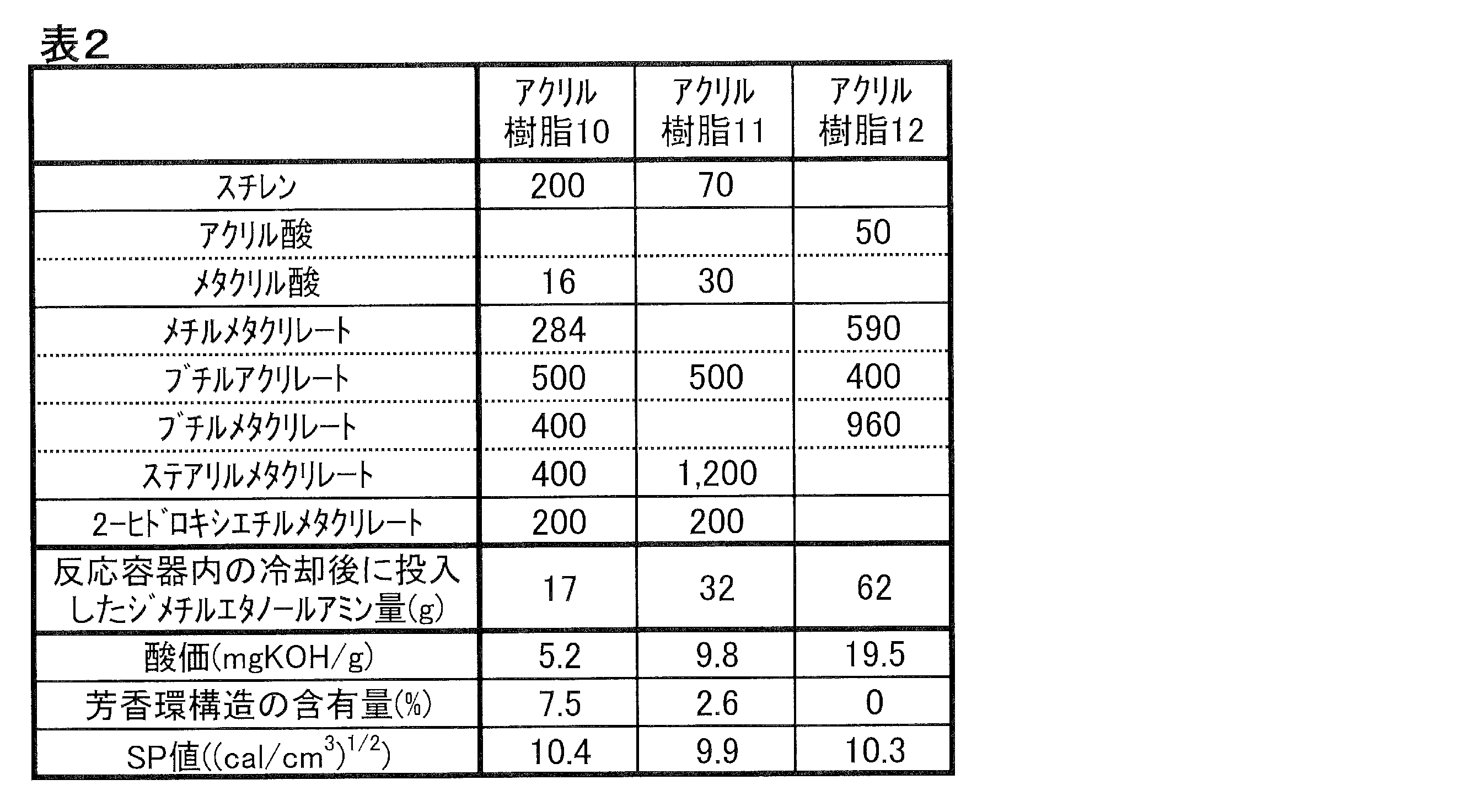
<ウレタン樹脂13~14の製造例>
ガス導入管、温度計、コンデンサー、撹拌機を備えた、容量10Lの反応容器に、重合性単量体として、ポリプロピレングリコール(分子量1,000)870g、イソホロンジイソシアネート890g;ならびに、ジブチル錫ジラウレート0.14gを投入し、窒素ガスで置換したのち、上記反応容器の内温を100℃に昇温し、5時間重合反応を行った。次いで、当該反応容器の内温が60℃程度になるまで冷却した後、重合性単量体としてジメチロールプロピオン酸180g、ネオペンチルグリコール60g;ならびに、メチルエチルケトン3,000gを添加し、再度、反応容器内を80℃に昇温したのち、重合反応を行った。その後、反応容器内が常温になるまで冷却した後、メタノール400gを添加し、反応を停止させた。次いで、水を添加し、更に水酸化カリウム水溶液を撹拌しながら添加し、中和した。そして、減圧下で混合溶液を加熱し、メチルエチルケトン及び未反応のメタノールを留去したのち、水を用いて固形分が10質量%になるように調整することで、ウレタン樹脂13の水性化溶液(固形分濃度10質量%)を得た。
<Production Examples of Urethane Resins 13 to 14>
In a 10L reaction vessel equipped with a gas inlet tube, a thermometer, a condenser, and a stirrer, 870g of polypropylene glycol (molecular weight 1,000), 890g of isophorone diisocyanate, and 0.14g of dibutyltin dilaurate were charged as polymerizable monomers, and the inside of the reaction vessel was replaced with nitrogen gas, and the inside temperature of the reaction vessel was raised to 100°C, and a polymerization reaction was carried out for 5 hours. Next, the inside temperature of the reaction vessel was cooled to about 60°C, and then 180g of dimethylolpropionic acid, 60g of neopentyl glycol, and 3,000g of methyl ethyl ketone were added as polymerizable monomers, and the inside of the reaction vessel was heated to 80°C again, and a polymerization reaction was carried out. After that, the inside of the reaction vessel was cooled to room temperature, and 400g of methanol was added to stop the reaction. Next, water was added, and further an aqueous potassium hydroxide solution was added while stirring to neutralize. The mixed solution was then heated under reduced pressure to distill off methyl ethyl ketone and unreacted methanol, and the solids content was adjusted to 10% by mass using water, thereby obtaining an aqueous solution of urethane resin 13 (solids concentration: 10% by mass).
また、重合性単量体の種類及び使用量を表4記載のように変更した以外は、上記ウレタン樹脂13と同様の操作によって、ウレタン樹脂14の水性化溶液(固形分濃度10質量%)を得た。なお表3には、ウレタン樹脂13の製造時に使用した重合性単量体の量、ならびに、ウレタン樹脂13~14の酸価、芳香環構造の含有量、及び、SP値についても記載した。 In addition, an aqueous solution of urethane resin 14 (solid content concentration 10% by mass) was obtained in the same manner as for urethane resin 13, except that the type and amount of polymerizable monomer were changed as shown in Table 4. Table 3 also shows the amount of polymerizable monomer used in the production of urethane resin 13, as well as the acid value, aromatic ring structure content, and SP value of urethane resins 13 and 14.
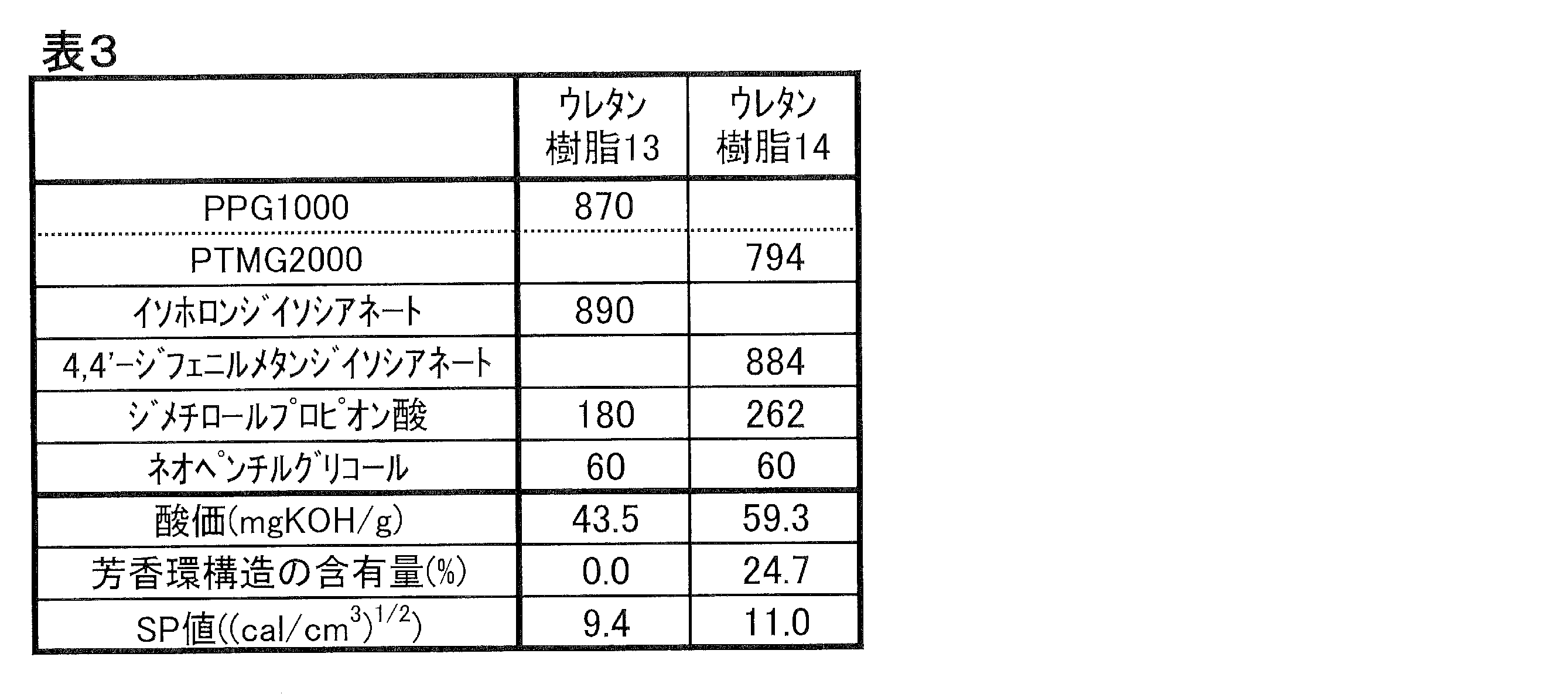
表3中、「PPG1000」は、ポリプロピレングリコール(分子量1,000)を、「PTMG2000」は、ポリテトラメチレンエーテルグリコール(分子量2,000)を、それぞれ表す。 In Table 3, "PPG1000" stands for polypropylene glycol (molecular weight 1,000), and "PTMG2000" stands for polytetramethylene ether glycol (molecular weight 2,000).
<水性インクジェットインキの製造>
下表4の各列に記載した配合処方になるように、撹拌機を備えた混合容器中に、各原料を投入した。また全ての原料の投入後、室温(25℃)にて、混合物が十分に均一になるまで撹拌を継続した。その後、孔径0.65μmのメンブレンフィルターで濾過を行うことで、水性インクジェットインキ1~93を製造した。なお、水性インクジェットインキの製造にあたっては、表4の各列において、上の行に記載されている成分から順番に、混合容器中に投入するようにした。ただし、これらの成分を含まない場合は、当該成分を飛ばして次の成分を添加し、また、2種類以上の原料を含む成分に関しては、当該成分内での投入順序は任意とした。更に、混合容器内の混合物を撹拌しながら、各原料を投入した。
<Production of Water-Based Inkjet Inks>
Each raw material was charged into a mixing vessel equipped with a stirrer so as to obtain the formulation shown in each column of Table 4 below. After all the raw materials were charged, stirring was continued at room temperature (25°C) until the mixture became sufficiently uniform. Then, the mixture was filtered through a membrane filter with a pore size of 0.65 μm to produce aqueous inkjet inks 1 to 93. In addition, in producing the aqueous inkjet inks, the components were charged into the mixing vessel in the order listed in the top row of each column of Table 4. However, if a component was not included, the component was skipped and the next component was added, and for a component containing two or more types of raw materials, the order of charging within the component was arbitrary. Furthermore, each raw material was charged while stirring the mixture in the mixing vessel.
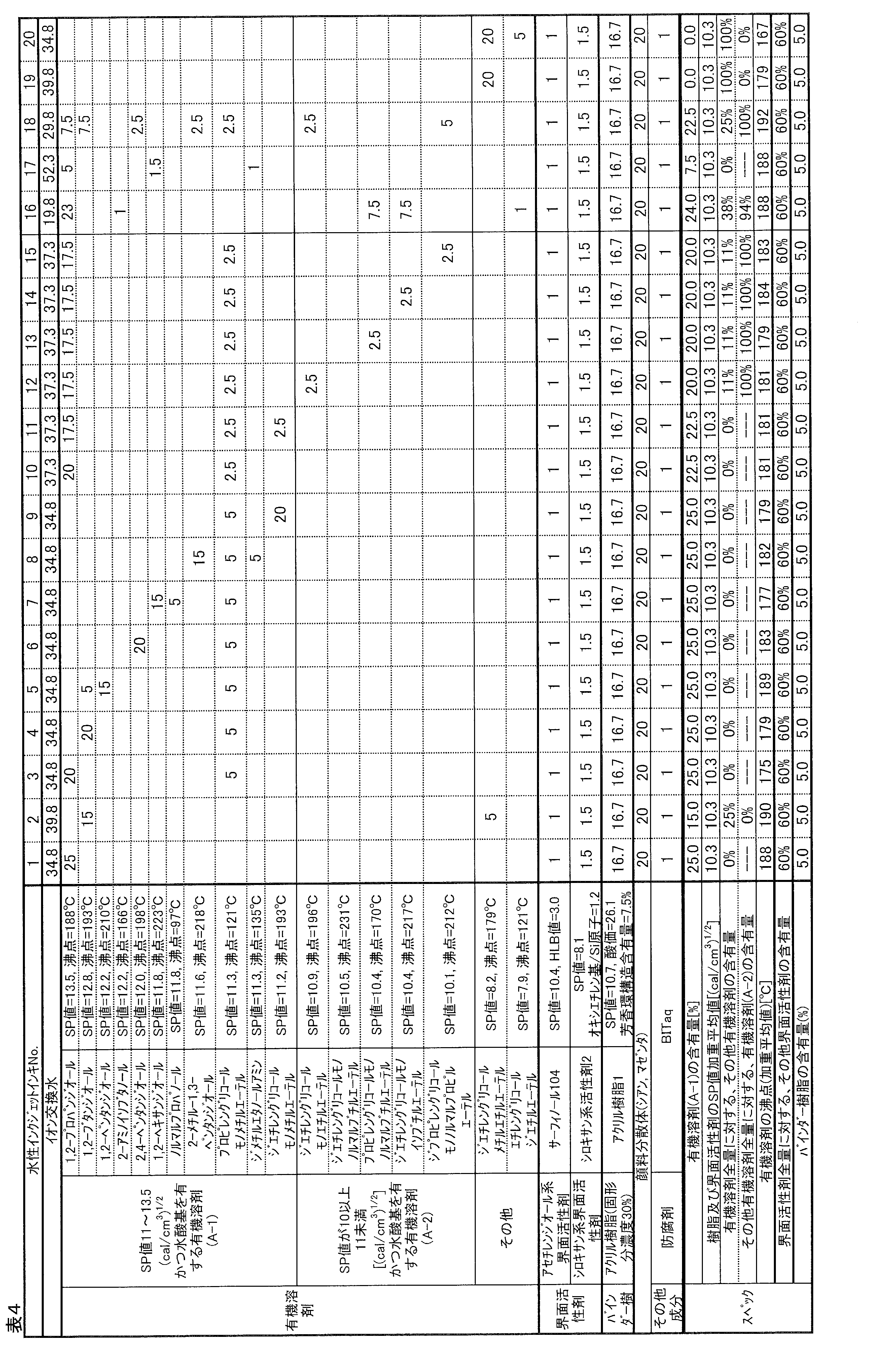
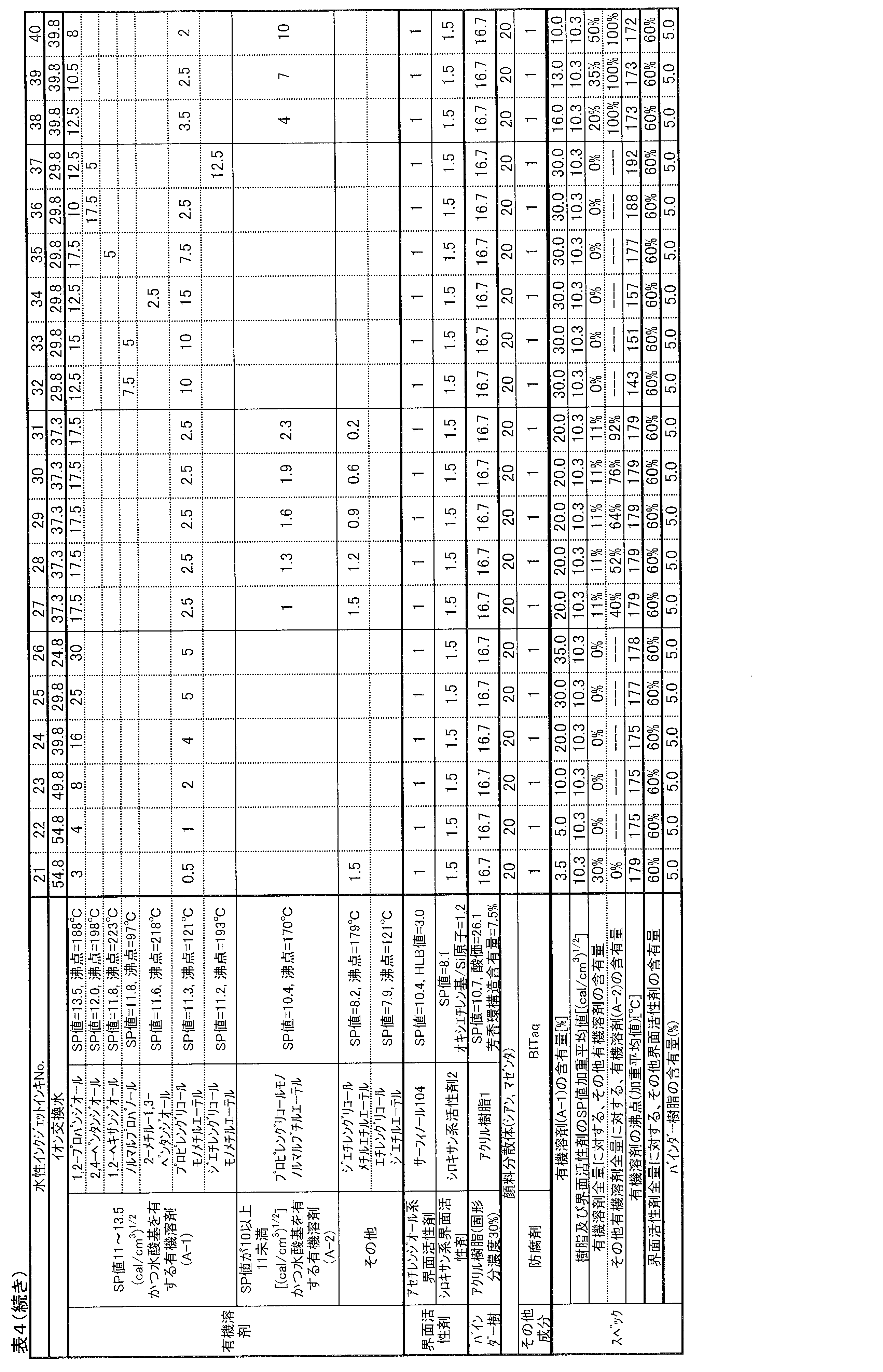


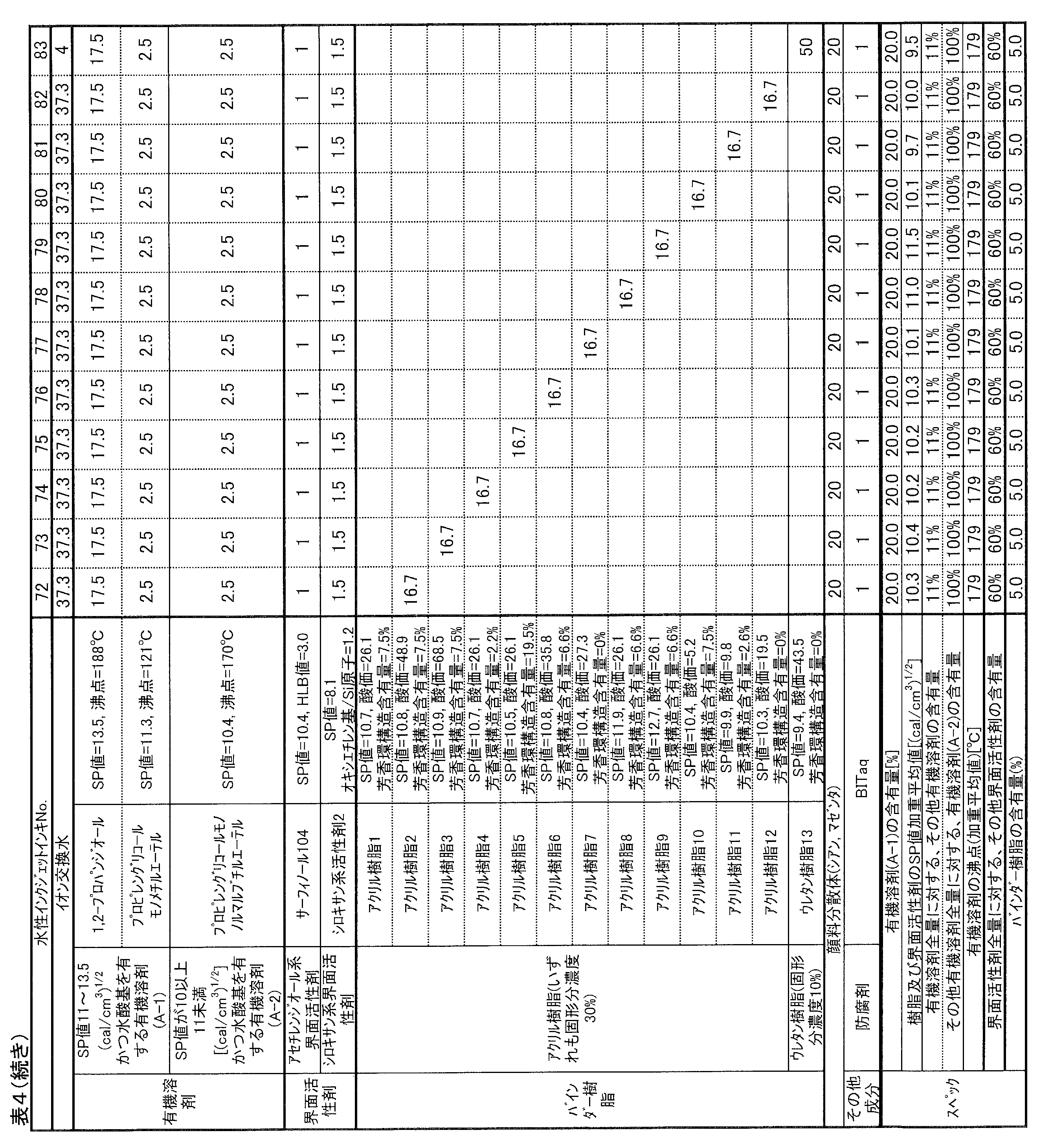
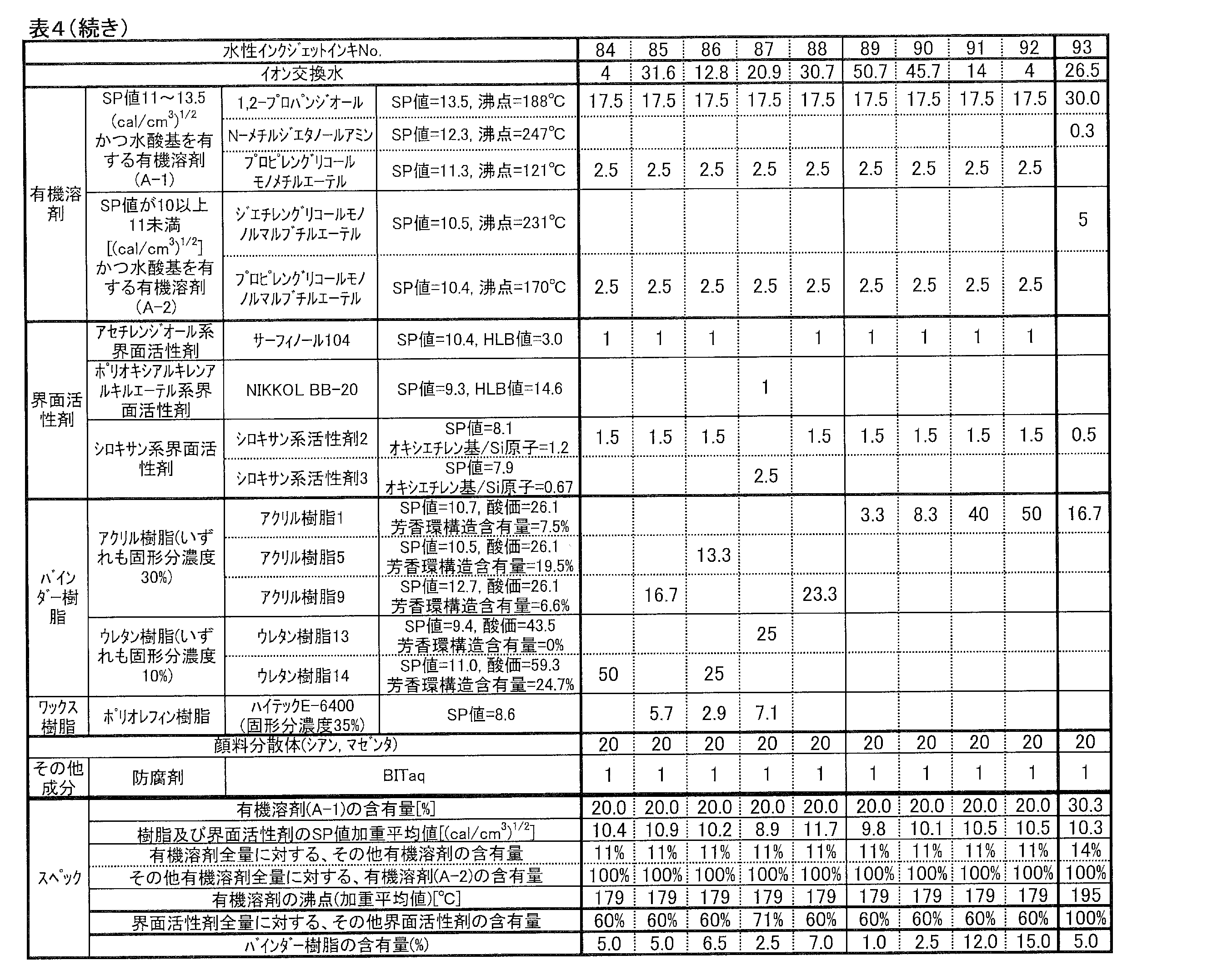
表4に記載された原料のうち、略称及び商品名で記載されたものの詳細は、以下に示すとおりである。また表4中に記載されているSP値の単位は「(cal/cm3)1/2」であり、酸価の単位は「mgKOH/g」である。
≪界面活性剤≫
サーフィノール104:エボニック社製2,4,7,9-テトラメチル-5-デシン-4,7-ジオール、SP値10.4(cal/cm3)1/2、HLB値3.0
サーフィノール420:エボニック社製2,4,7,9-テトラメチル-5-デシン-4,7-ジオールのオキシエチレン(1.3モル)付加物、SP値10.3(cal/cm3)1/2、HLB値4.0
サーフィノール440:エボニック社製2,4,7,9-テトラメチル-5-デシン-4,7-ジオールのオキシエチレン(3.5モル)付加物、SP値10.1(cal/cm3)1/2、HLB値8.1
サーフィノール2502:エボニック社製2,4,7,9-テトラメチル-5-デシン-4,7-ジオールの、オキシエチレン(5モル)及びオキシプロピレン(2モル)付加物、SP値9.7(cal/cm3)1/2、HLB値7.8
ダイノール607:エボニック社製2,5,8,11-テトラメチル-6-ドデシン-5,8-ジオールのオキシエチレン(約7モル)付加物、SP値9.8(cal/cm3)1/2、HLB値11.0
サーフィノール465:エボニック社製2,4,7,9-テトラメチル-5-デシン-4,7-ジオールのオキシエチレン(10モル)付加物、SP値9.8(cal/cm3)1/2、HLB値13.2
EMALEX 705:日本エマルジョン社製、上記一般式3において、R1が1-ラウリル基、R2がエチレン基、nが5である化合物、SP値9.6(cal/cm3)1/2、HLB値10.8
EMALEX 710:日本エマルジョン社製、上記一般式3において、R1が1-ラウリル基、R2がエチレン基、nが10である化合物、SP値9.5(cal/cm3)1/2、HLB値14.1
EMALEX 720:日本エマルジョン社製、上記一般式3において、R1が1-ラウリル基、R2がエチレン基、nが20である化合物、SP値9.5(cal/cm3)1/2、HLB値16.5
EMALEX 730:日本エマルジョン社製、上記一般式3において、R1が1-ラウリル基、R2がエチレン基、nが30である化合物、SP値9.5(cal/cm3)1/2、HLB値17.5
EMALEX 750:日本エマルジョン社製、上記一般式3において、R1が1-ラウリル基、R2がエチレン基、nが50である化合物、SP値9.4(cal/cm3)1/2、HLB値18.4
ノニオン S-207:日油社製、上記一般式3において、R1が1-ステアリル基、R2がエチレン基、nが7である化合物、SP値9.4(cal/cm3)1/2、HLB値10.7
ノニオン S-215:日油社製、上記一般式3において、R1が1-ステアリル基、R2がエチレン基、nが15である化合物、SP値9.4(cal/cm3)1/2、HLB値14.2
NIKKOL BB-10:日光ケミカルズ社製、上記一般式3において、R1が1-ベヘニル基、R2がエチレン基、nが10である化合物、SP値9.3(cal/cm3)1/2、HLB値11.5
NIKKOL BB-20:日光ケミカルズ社製、上記一般式3において、R1が1-ベヘニル基、R2がエチレン基、nが20である化合物、SP値9.3(cal/cm3)1/2、HLB値14.6
シロキサン系活性剤1:上記一般式4において、p=0、q=1であり、R1が上記一般式5で表される構造(ただし、r=3、s=5、t=0であり、R3が-OHである)であり、R2がメチル基である化合物、SP値8.9(cal/cm3)1/2、Si原子数に対するオキシエチレン基数の比=1.7
シロキサン系活性剤2:上記一般式4において、p=1、q=2であり、R1が上記一般式5で表される構造(ただし、r=3、s=3、t=0であり、R3が-OCH3である)であり、R2がメチル基である化合物、SP値8.1(cal/cm3)1/2、Si原子数に対するオキシエチレン基数の比=1.2
シロキサン系活性剤3:上記一般式4において、p=13、q=0であり、R2が上記一般式5で表される構造(ただし、r=3、s=5、t=0であり、R3が-OCH3である)である化合物、SP値7.9(cal/cm3)1/2、Si原子数に対するオキシエチレン基数の比=0.67
シロキサン系活性剤4:上記一般式4において、p=23、q=0であり、R2が上記一般式5で表される構造(ただし、r=3、s=6、t=1であり、R3が-OHである)である化合物、SP値8.1(cal/cm3)1/2、Si原子数に対するオキシエチレン基数の比=0.48
≪ワックス樹脂≫
ハイテックE-6400:東邦化学工業社製酸化ポリオレフィン樹脂微粒子(固形分濃度35質量%)、SP値8.6(cal/cm3)1/2
≪その他成分≫
BITaq:1,2-ベンズイソチアゾリン-3-オンの1%水溶液
Among the raw materials listed in Table 4, the details of those listed by abbreviation and product name are as follows: The unit of SP value listed in Table 4 is "(cal/ cm3 ) 1/2 ", and the unit of acid value is "mgKOH/g".
<Surfactants>
Surfynol 104: 2,4,7,9-tetramethyl-5-decyne-4,7-diol manufactured by Evonik, SP value 10.4 (cal/cm 3 ) 1/2 , HLB value 3.0
Surfynol 420: 2,4,7,9-tetramethyl-5-decyne-4,7-diol adduct with oxyethylene (1.3 moles), manufactured by Evonik Co., Ltd., SP value 10.3 (cal/cm 3 ) 1/2 , HLB value 4.0
Surfynol 440: 2,4,7,9-tetramethyl-5-decyne-4,7-diol adduct with oxyethylene (3.5 moles), manufactured by Evonik Co., Ltd., SP value 10.1 (cal/cm 3 ) 1/2 , HLB value 8.1
Surfynol 2502: Manufactured by Evonik Co., Ltd.; oxyethylene (5 moles) and oxypropylene (2 moles) adduct of 2,4,7,9-tetramethyl-5-decyne-4,7-diol, SP value 9.7 (cal/cm 3 ) 1/2 , HLB value 7.8
Dynol 607: oxyethylene (about 7 moles) adduct of 2,5,8,11-tetramethyl-6-dodecyne-5,8-diol manufactured by Evonik, SP value 9.8 (cal/cm 3 ) 1/2 , HLB value 11.0
Surfynol 465: oxyethylene (10 moles) adduct of 2,4,7,9-tetramethyl-5-decyne-4,7-diol manufactured by Evonik Co., Ltd., SP value 9.8 (cal/cm 3 ) 1/2 , HLB value 13.2
EMALEX 705: manufactured by Nippon Emulsion Co., Ltd.; a compound in which, in the above general formula 3, R 1 is a 1-lauryl group, R 2 is an ethylene group, and n is 5; SP value: 9.6 (cal/cm 3 ) 1/2 , HLB value: 10.8
EMALEX 710: manufactured by Nippon Emulsion Co., Ltd.; a compound in which, in the above general formula 3, R 1 is a 1-lauryl group, R 2 is an ethylene group, and n is 10; SP value: 9.5 (cal/cm 3 ) 1/2 , HLB value: 14.1
EMALEX 720: manufactured by Nippon Emulsion Co., Ltd.; a compound in which, in the above general formula 3, R 1 is a 1-lauryl group, R 2 is an ethylene group, and n is 20; SP value 9.5 (cal/cm 3 ) 1/2 , HLB value 16.5
EMALEX 730: manufactured by Nippon Emulsion Co., Ltd.; a compound in which, in the above general formula 3, R 1 is a 1-lauryl group, R 2 is an ethylene group, and n is 30; SP value 9.5 (cal/cm 3 ) 1/2 , HLB value 17.5
EMALEX 750: manufactured by Nippon Emulsion Co., Ltd.; a compound in which, in the above general formula 3, R 1 is a 1-lauryl group, R 2 is an ethylene group, and n is 50; SP value 9.4 (cal/cm 3 ) 1/2 , HLB value 18.4
Nonion S-207: NOF Corporation, a compound in which in the above general formula 3, R 1 is a 1-stearyl group, R 2 is an ethylene group, and n is 7, SP value 9.4 (cal/cm 3 ) 1/2 , HLB value 10.7
Nonion S-215: NOF Corporation, a compound in which in the above general formula 3, R 1 is a 1-stearyl group, R 2 is an ethylene group, and n is 15, SP value 9.4 (cal/cm 3 ) 1/2 , HLB value 14.2
NIKKOL BB-10: manufactured by Nikko Chemicals Co., Ltd.; a compound in which, in the above general formula 3, R 1 is a 1-behenyl group, R 2 is an ethylene group, and n is 10; SP value: 9.3 (cal/cm 3 ) 1/2 , HLB value: 11.5
NIKKOL BB-20: manufactured by Nikko Chemicals Co., Ltd.; a compound in which, in the above general formula 3, R 1 is a 1-behenyl group, R 2 is an ethylene group, and n is 20; SP value: 9.3 (cal/cm 3 ) 1/2 , HLB value: 14.6
Siloxane-based activator 1: a compound in which, in the above general formula 4, p=0, q=1, R1 is a structure represented by the above general formula 5 (wherein r=3, s=5, t=0, and R3 is --OH), and R2 is a methyl group; SP value: 8.9 (cal/cm 3 ) 1/2 , ratio of number of oxyethylene groups to number of Si atoms: 1.7.
Siloxane-based activator 2: a compound in which, in the above general formula 4, p=1, q=2, R1 is a structure represented by the above general formula 5 (wherein r=3, s=3, t=0, and R3 is --OCH3 ), and R2 is a methyl group; SP value: 8.1 (cal/ cm3 ) 1/2 ; ratio of number of oxyethylene groups to number of Si atoms: 1.2.
Siloxane-based activator 3: A compound in which, in the above general formula 4, p=13, q=0, and R2 is a structure represented by the above general formula 5 (wherein r=3, s=5, t=0, and R3 is --OCH3 ), SP value 7.9 (cal/ cm3 ) 1/2 , ratio of number of oxyethylene groups to number of Si atoms=0.67.
Siloxane-based activator 4: a compound in which, in the above general formula 4, p=23, q=0, and R2 is a structure represented by the above general formula 5 (wherein r=3, s=6, t=1, and R3 is --OH), SP value 8.1 (cal/cm 3 ) 1/2 , ratio of number of oxyethylene groups to number of Si atoms=0.48.
<Wax resin>
Hi-Tech E-6400: Oxidized polyolefin resin fine particles (solid content concentration 35% by mass) manufactured by Toho Chemical Industry Co., Ltd., SP value 8.6 (cal/cm 3 ) 1/2
<Other ingredients>
BITaq: 1% aqueous solution of 1,2-benzisothiazolin-3-one
<前処理液の製造>
下表5の各列に記載した配合処方になるように、撹拌機を備えた混合容器中に、各原料を投入した。また全ての原料の投入後、室温(25℃)にて、混合物が十分に均一になるまで撹拌を継続した。その後、孔径100μmのナイロンメッシュにて濾過を行うことで、前処理液1~3を製造した。なお、前処理液の製造にあたっては、表5の各列において、上の行に記載されている成分から順番に、混合容器中に投入するようにした。ただし、2種類以上の原料を含む成分に関しては、当該成分内での投入順序は任意とした。また、混合容器内の混合物を撹拌しながら、各原料を投入した。
<Preparation of pretreatment liquid>
Each raw material was added to a mixing vessel equipped with a stirrer so as to obtain the blending formula shown in each column of Table 5 below. After all the raw materials were added, stirring was continued at room temperature (25°C) until the mixture became sufficiently uniform. Then, pretreatment liquids 1 to 3 were produced by filtering through a nylon mesh with a pore size of 100 μm. In addition, in producing the pretreatment liquid, the components were added to the mixing vessel in the order listed in the top row of each column of Table 5. However, for components containing two or more types of raw materials, the order of addition within the component was arbitrary. In addition, each raw material was added while stirring the mixture in the mixing vessel.
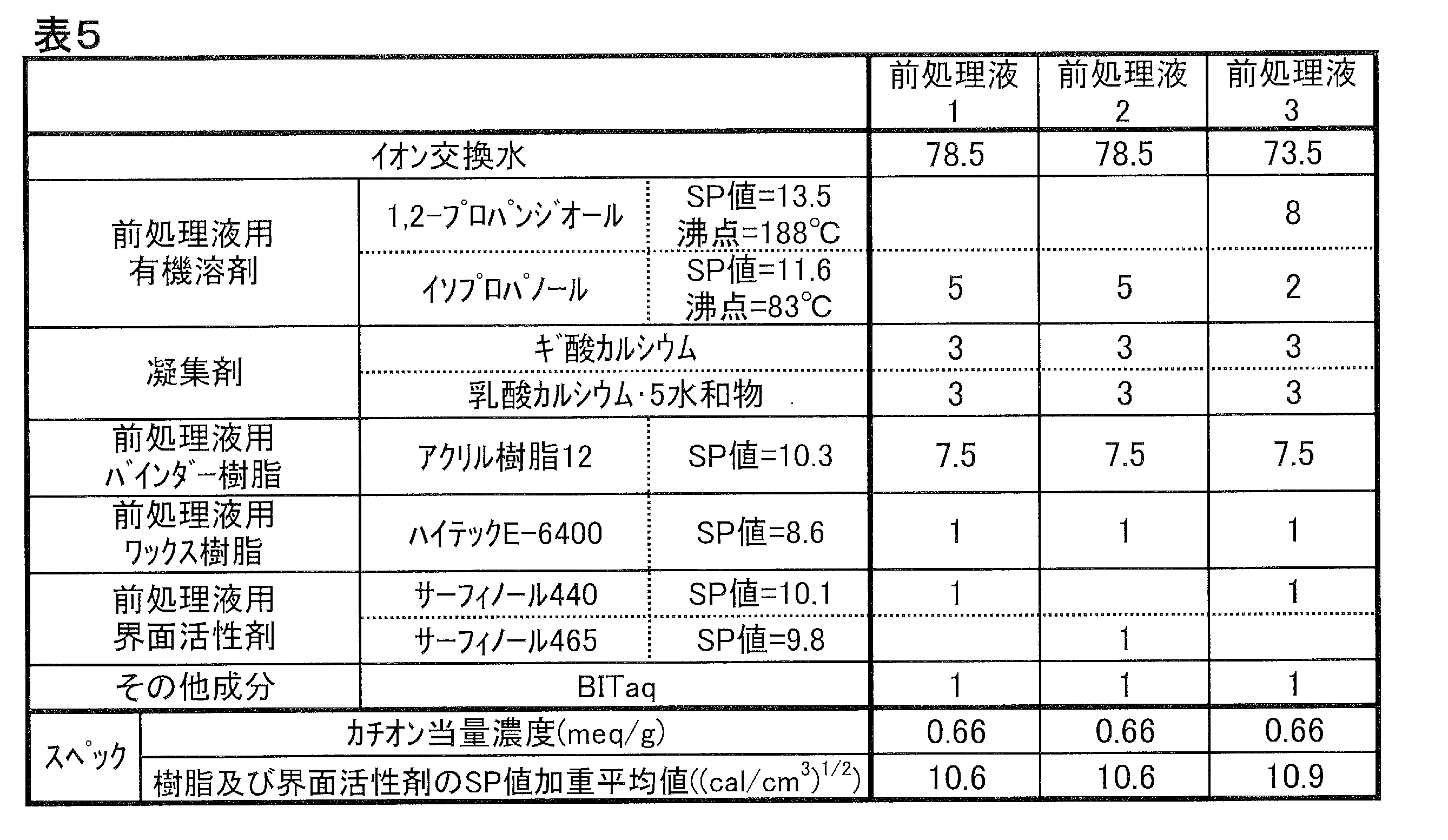
<印刷物の作製1>
京セラ社製インクジェットヘッドKJ4B-1200(設計解像度1200dpi、ノズル径20μm)を2個、印刷基材の搬送方向に沿って並べて設置したインクジェット吐出装置を準備し、当該搬送方向の上流側から、シアンインキ、マゼンタインキの順番で、水性インクジェットインキのセットを充填した。また、あらかじめA4サイズ(幅21cm×長さ30cm)に切り出し、印刷面にコロナ処理を施したシュリンクフィルムを、コンベヤ上に固定した。その後、コンベヤを50m/分の速度で駆動させ、当該シュリンクフィルムがインクジェットヘッドの設置部の下方を通過する際に、水性インクジェットインキのセットを、それぞれ、ドロップボリューム2pLの条件で吐出し、画像を印刷した。そしてすぐに、55℃に設定した送風定温恒温器内に印刷後のシュリンクフィルムを投入し、2分間乾燥させることで、印刷物を作製した。
<Creating printed matter 1>
An inkjet ejection device was prepared in which two Kyocera Corporation inkjet heads KJ4B-1200 (design resolution 1200 dpi, nozzle diameter 20 μm) were arranged along the conveyance direction of the printing substrate, and a set of aqueous inkjet inks was filled in the order of cyan ink and magenta ink from the upstream side of the conveyance direction. In addition, a shrink film cut to A4 size (width 21 cm x length 30 cm) and subjected to corona treatment on the printed surface was fixed on a conveyor. Thereafter, the conveyor was driven at a speed of 50 m/min, and when the shrink film passed under the installation part of the inkjet head, the set of aqueous inkjet inks was ejected under the condition of a drop volume of 2 pL, and an image was printed. Then, immediately, the printed shrink film was placed in a constant temperature incubator set at 55 ° C., and dried for 2 minutes to produce a printed matter.
なお、上記シュリンクフィルムとして、以下の3種類を使用した。
・PET製シュリンクフィルム:三菱ケミカル社製ヒシペット(厚さ40μm)
・PS製シュリンクフィルム:三菱ケミカル社製DXL(厚さ45μm)
・PP製シュリンクフィルム:興人フィルム&ケミカルズ社製コージンポリセットCX(厚さ20μm)
The following three types of shrink films were used:
PET shrink film: Mitsubishi Chemical's Hishipet (thickness 40 μm)
-PS shrink film: Mitsubishi Chemical Corporation DXL (thickness 45 μm)
PP shrink film: Kohjin Polyset CX (thickness 20 μm) manufactured by Kohjin Film & Chemicals Co., Ltd.
また、上記方法によって作成した印刷物は、以下の2種類であった。そして、表4に示した水性インクジェットインキのそれぞれについて、上述した方法により、3種類のシュリンクフィルムのそれぞれに対して、下記2種類の画像を別々に印刷し、印刷物を作製した。
・シアンべた印刷物:水性シアンインキのみを使用して印刷した、印字率100%の印刷物(幅15cm×長さ30cm)
・2色十字印刷物:水性シアンインキを使用し、印刷基材の搬送方向と長辺とが平行になるように印刷した、幅5mm×長さ5cmの長方形、及び、水性マゼンタインキを使用し、印刷基材の搬送方向と長辺とが垂直になるように印刷した、幅5mm×長さ5cmの長方形が、互いに中心で、十字型に交差するように印刷したもの
The following two types of printed matter were produced by the above method. Then, for each of the aqueous inkjet inks shown in Table 4, the following two types of images were printed separately on each of the three types of shrink film by the above method to produce printed matter.
Cyan solid print: A print with a 100% coverage rate printed using only water-based cyan ink (width 15 cm x length 30 cm)
Two-color cross print: A rectangle 5 mm wide x 5 cm long printed with water-based cyan ink so that its long sides are parallel to the transport direction of the printing substrate, and a rectangle 5 mm wide x 5 cm long printed with water-based magenta ink so that its long sides are perpendicular to the transport direction of the printing substrate, printed so that they intersect at the center to form a cross shape.
[実施例1~85、比較例1~8]
上記水性インクジェットインキ、及び、当該水性インクジェットインキを用いて作製した上記印刷物を使用し、以下に示す評価を行った。これらの評価の結果は、下表6に示した通りであった。
[Examples 1 to 85, Comparative Examples 1 to 8]
The aqueous inkjet ink and the printed matter produced using the aqueous inkjet ink were evaluated as described below. The results of these evaluations are shown in Table 6 below.
<評価1:変形追随性の評価>
上記方法で製造したベタ印刷物を切り出したのち、インキ層が内側になるように丸め、直径9cm、高さ12cmの円筒状とした。この印刷物を、あらかじめ70℃の恒温槽内で予熱しておいた、直径75mmのガラス瓶(被収縮物)に被せたのち、100℃の恒温槽内に15秒間静置することで、当該印刷物をシュリンクさせた。そして、シュリンク後の印刷物に存在するシワやワレ等の程度を、目視で観察することで、変形追随性の評価を行った。評価基準は下記のとおりとし、2点以上を実使用可能とした。なお、上記3種類のシュリンクフィルムのそれぞれで評価を行った。
5:実施例13におけるシワやワレよりも良好であった
4:実施例13におけるシワやワレと同程度であった
3:実施例19におけるシワやワレよりも良好であったが、実施例13におけるシワやワレよりも不良であった
2:実施例19におけるシワやワレと同程度であった
1:実施例19におけるシワやワレよりも不良であった
<Evaluation 1: Evaluation of deformation conformability>
The solid print produced by the above method was cut out, rolled up so that the ink layer was on the inside, and formed into a cylindrical shape with a diameter of 9 cm and a height of 12 cm. This print was placed on a glass bottle (object to be shrunk) with a diameter of 75 mm, which had been preheated in a thermostatic chamber at 70° C., and then left in a thermostatic chamber at 100° C. for 15 seconds to cause the print to shrink. The degree of wrinkles, cracks, etc. present on the print after shrinking was visually observed to evaluate the deformation followability. The evaluation criteria were as follows, and a score of 2 or more was deemed to be usable. Evaluation was performed on each of the above three types of shrink films.
5: Better than wrinkles and cracks in Example 13 4: Similar to wrinkles and cracks in Example 13 3: Better than wrinkles and cracks in Example 19, but worse than wrinkles and cracks in Example 13 2: Similar to wrinkles and cracks in Example 19 1: Worse than wrinkles and cracks in Example 19
<評価2:滲みの評価>
印刷基材としてPET製シュリンクフィルムを使用して作製した2色十字印刷物を、ルーペ及び目視で観察し、交差部分の滲みの程度を確認することで、滲みを評価した。評価基準は下記のとおりとし、2点以上を実使用可能とした。
5:実施例13における滲みよりも良好であった
4:実施例13における滲みと同程度であった
3:実施例19における滲みよりも良好であったが、実施例13における滲みよりも不良であった
2:実施例19における滲みと同程度であった
1:実施例19における滲みよりも不良であった
<Evaluation 2: Evaluation of bleeding>
A two-color cross print made using a PET shrink film as the printing base material was observed with a magnifying glass and with the naked eye to check the degree of bleeding at the intersections and evaluate bleeding. The evaluation criteria were as follows, and a score of 2 or more was considered to be usable.
5: Better than the bleeding in Example 13 4: The bleeding was about the same as that in Example 13 3: Better than the bleeding in Example 19, but worse than the bleeding in Example 13 2: The bleeding was about the same as that in Example 19 1: Worse than the bleeding in Example 19
<評価3:吐出安定性の評価>
京セラ社製インクジェットヘッド「KJ4B-1200」(設計解像度1200dpi、ノズル径20μm)を搭載したインクジェット吐出装置に、上記で製造した水性シアンインキを、それぞれ充填した。ノズルチェックパターンを印刷し、ノズル抜け(ノズルから水性インクジェットインキが吐出されない現象)がないことを確認した後、25℃環境下で、インクジェット吐出装置を待機させた。そして所定時間が経過した後、再度ノズルチェックパターンを印刷し、ノズル抜け本数を目視でカウントすることで、吐出安定性を評価した。評価基準は下記のとおりとし、2点以上を実使用可能とした。
4:3時間待機させた後に印刷してもノズル抜けが全くなかった
3:2時間待機させた後に印刷してもノズル抜けが全くなかったが、3時間待機させた後に印刷すると、ノズル抜けが1本以上発生した
2:1時間待機させた後に印刷してもノズル抜けが全くなかったが、2時間待機させた後に印刷すると、ノズル抜けが1本以上発生した
1:1時間待機させた後に印刷するとノズル抜けが1本以上発生した
<Evaluation 3: Evaluation of ejection stability>
The aqueous cyan inks produced above were filled into an inkjet ejection device equipped with a Kyocera inkjet head "KJ4B-1200" (design resolution 1200 dpi, nozzle diameter 20 μm). A nozzle check pattern was printed, and after confirming that there were no missing nozzles (a phenomenon in which aqueous inkjet ink is not ejected from the nozzles), the inkjet ejection device was left on standby in a 25°C environment. After a predetermined time had passed, a nozzle check pattern was printed again, and the number of missing nozzles was visually counted to evaluate the ejection stability. The evaluation criteria were as follows, with a score of 2 or more being deemed usable.
4: No missing nozzles at all when printed after waiting for 3 hours. 3: No missing nozzles at all when printed after waiting for 2 hours, but one or more missing nozzles occurred when printed after waiting for 3 hours. 2: No missing nozzles at all when printed after waiting for 1 hour, but one or more missing nozzles occurred when printed after waiting for 2 hours. 1: One or more missing nozzles occurred when printed after waiting for 1 hour.

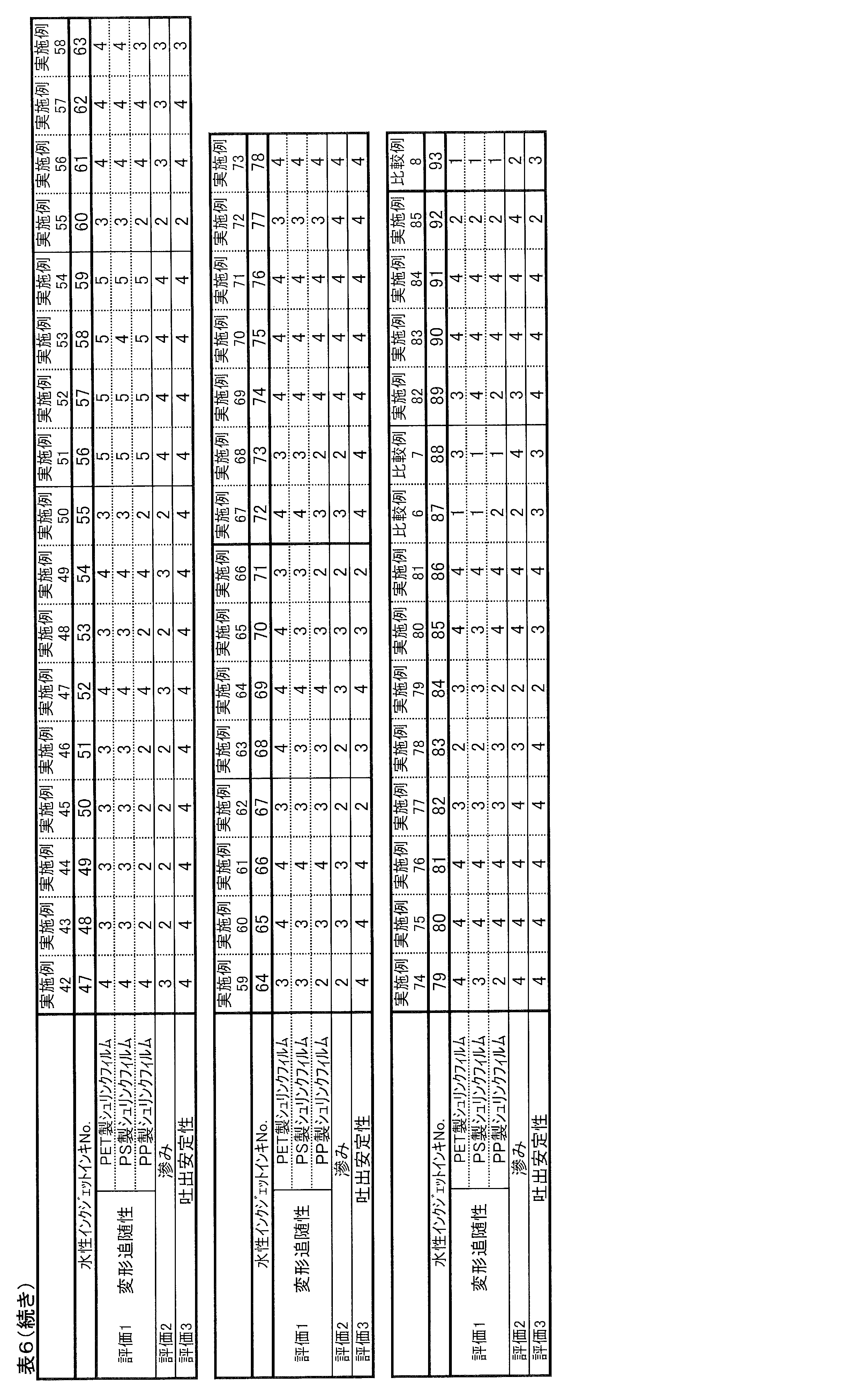
表4及び表6から明らかなように、本発明の要件を満たす、水性インクジェットインキ1~18、22~25、27~40、42~86、89~92は、種々のシュリンクフィルムに対する変形追随性、滲み、及び、吐出安定性の全ての評価において、実使用可能なレベルを有していることが確認された。 As is clear from Tables 4 and 6, the aqueous inkjet inks 1 to 18, 22 to 25, 27 to 40, 42 to 86, and 89 to 92, which satisfy the requirements of the present invention, were confirmed to have practically usable levels in all evaluations of conformability to deformations of various shrink films, bleeding, and ejection stability.
それに対して、有機溶剤(A-1)が含まれない水性インクジェットインキ19~20では、PET製シュリンクフィルム及びPS製シュリンクフィルムに対する変形追随性に劣っていた。有機溶剤(A-1)が存在しないために、水性インクジェットインキと、シュリンクフィルムを構成する樹脂とが十分に親和せず、インキ層が当該シュリンクフィルムの変形に追随できなかったものと考えられる。なお、有機溶剤(A-1)の含有量が5質量%未満であった水性インクジェットインキ21においても、同様の傾向が確認された。一方で、有機溶剤(A-1)の含有量が30質量%よりも多い水性インクジェットインキ26では、PP製シュリンクフィルムに対する変形追随性の悪化が確認されたうえ、印刷物においては強い滲みが確認された。水性インクジェットインキの表面張力のバランスが崩れたことで、滲みが悪化したものと考えられる。 In contrast, the aqueous inkjet inks 19 to 20, which do not contain organic solvent (A-1), were inferior in conformity to the deformation of the PET shrink film and PS shrink film. It is believed that the absence of organic solvent (A-1) resulted in insufficient affinity between the aqueous inkjet ink and the resin constituting the shrink film, and the ink layer was unable to conform to the deformation of the shrink film. A similar tendency was also observed in aqueous inkjet ink 21, which contained less than 5% by mass of organic solvent (A-1). On the other hand, aqueous inkjet ink 26, which contained more than 30% by mass of organic solvent (A-1), was confirmed to have poor conformity to the deformation of the PP shrink film and to have strong bleeding in the printed matter. It is believed that the bleeding worsened due to an imbalance in the surface tension of the aqueous inkjet ink.
水性インクジェットインキ41は、界面活性剤(B-1)を含まない系であり、シュリンク基材を構成する樹脂の種類によらず、変形追随性が実使用可能なレベルに至らなかった。また、樹脂及び前記界面活性剤のSP値の加重平均値が9(cal/cm3)1/2未満であった水性インクジェットインキ87、及び、当該SP値の加重平均値が11.5(cal/cm3)1/2よりも大きかった水性インクジェットインキ88についても、やはり、一部のシュリンクフィルムにおいて変形追随性の悪化が見られた。 Water-based inkjet ink 41 was a system that did not contain surfactant (B-1), and the deformation conformability did not reach a practically usable level, regardless of the type of resin constituting the shrink base material. Also, water-based inkjet ink 87, in which the weighted average SP value of the resin and the surfactant was less than 9 (cal/ cm3 ) 1/2 , and water-based inkjet ink 88, in which the weighted average SP value was greater than 11.5 (cal/ cm3 ) 1/2 , also showed deterioration in deformation conformability in some shrink films.
以上の結果からも、シュリンクフィルムを構成する印刷基材の種類によらず、変形追随性に優れた印刷物を得るために、本実施形態の水性インクジェットインキの構成が必須不可欠であることが確認できる。 These results also confirm that the composition of the aqueous inkjet ink of this embodiment is essential for obtaining printed matter with excellent deformation followability, regardless of the type of printing substrate that constitutes the shrink film.
なお、水性インクジェットインキ93は、特許文献1に具体的に示されている水系インクの構成(ただし、有機溶剤及び界面活性剤の構成のみ)を再現したものとなっており、評価の結果、シュリンク基材を構成する樹脂の種類によらず、変形追随性が悪化した。上記水性インクジェットインキ41と同様、水性インクジェットインキ93では、界面活性剤(B-1)が含まれておらず、シロキサン系界面活性剤のみが使用されている。そのため、インキ層の厚みの不均一化やシュリンクフィルムに対する親和性の悪化が生じ、変形追随性に悪影響が生じたものと考えられる。 The aqueous inkjet ink 93 reproduces the composition of the aqueous ink specifically shown in Patent Document 1 (only the composition of the organic solvent and surfactant), and evaluation results showed that the deformation followability was deteriorated regardless of the type of resin that constitutes the shrink base material. As with the above-mentioned aqueous inkjet ink 41, the aqueous inkjet ink 93 does not contain the surfactant (B-1), and only a siloxane-based surfactant is used. This is thought to have caused the thickness of the ink layer to become non-uniform and the affinity with the shrink film to deteriorate, adversely affecting the deformation followability.
[実施例86~136]
また、上記水性インクジェットインキ13、15、42~86、89~92を使用し、上述した方法で作製したシアンべた印刷物を用いて、以下に示す評価4を行った。評価結果は表5に示した通りであった。
[Examples 86 to 136]
Furthermore, the following evaluation 4 was carried out using the above-mentioned water-based inkjet inks 13, 15, 42 to 86, and 89 to 92 and the cyan solid prints produced by the above-mentioned method. The evaluation results are shown in Table 5.
<評価4:リサイクル性の評価>
印刷基材としてPET製シュリンクフィルムを使用し、上述した方法で作製したシアンべた印刷物について、水性シアンインキが印刷された箇所を4cm×4cm角に切り出した。次いで、2質量%の水酸化ナトリウム水溶液50gに切り出した印刷物を浸し、70℃に加温したのち60分間撹拌した。その後、水酸化ナトリウム水溶液から印刷物を取り出し、水洗及び乾燥した後、シュリンクフィルムからインキ層がどの程度分離したかを目視で確認することで、リサイクル性を評価した。評価基準は下記の通りとし、2点以上を実使用可能とした。
4:シュリンクフィルムからのインキ層の脱離が観察され、当該脱離の程度は、実施例86の場合よりも良好であった
3:シュリンクフィルムからのインキ層の脱離が観察され、当該脱離の程度は、実施例86の場合と同程度であった
2:シュリンクフィルムからのインキ層の脱離が観察されたが、当該脱離の程度は、実施例86の場合よりも不良であった
1:シュリンクフィルムからの、インキ層の脱離は観察されなかった
<Evaluation 4: Recyclability evaluation>
A PET shrink film was used as the printing substrate, and the portion of the cyan solid print produced by the above-mentioned method where the aqueous cyan ink was printed was cut out into a 4 cm x 4 cm square. The cut-out print was then immersed in 50 g of a 2% by mass aqueous sodium hydroxide solution, heated to 70°C, and stirred for 60 minutes. The print was then removed from the aqueous sodium hydroxide solution, washed with water, and dried, and the extent to which the ink layer had separated from the shrink film was visually confirmed to evaluate recyclability. The evaluation criteria were as follows, and a score of 2 or more was deemed usable.
4: Detachment of the ink layer from the shrink film was observed, and the degree of the detachment was better than in Example 86. 3: Detachment of the ink layer from the shrink film was observed, and the degree of the detachment was similar to that in Example 86. 2: Detachment of the ink layer from the shrink film was observed, but the degree of the detachment was worse than that in Example 86. 1: No detachment of the ink layer from the shrink film was observed.
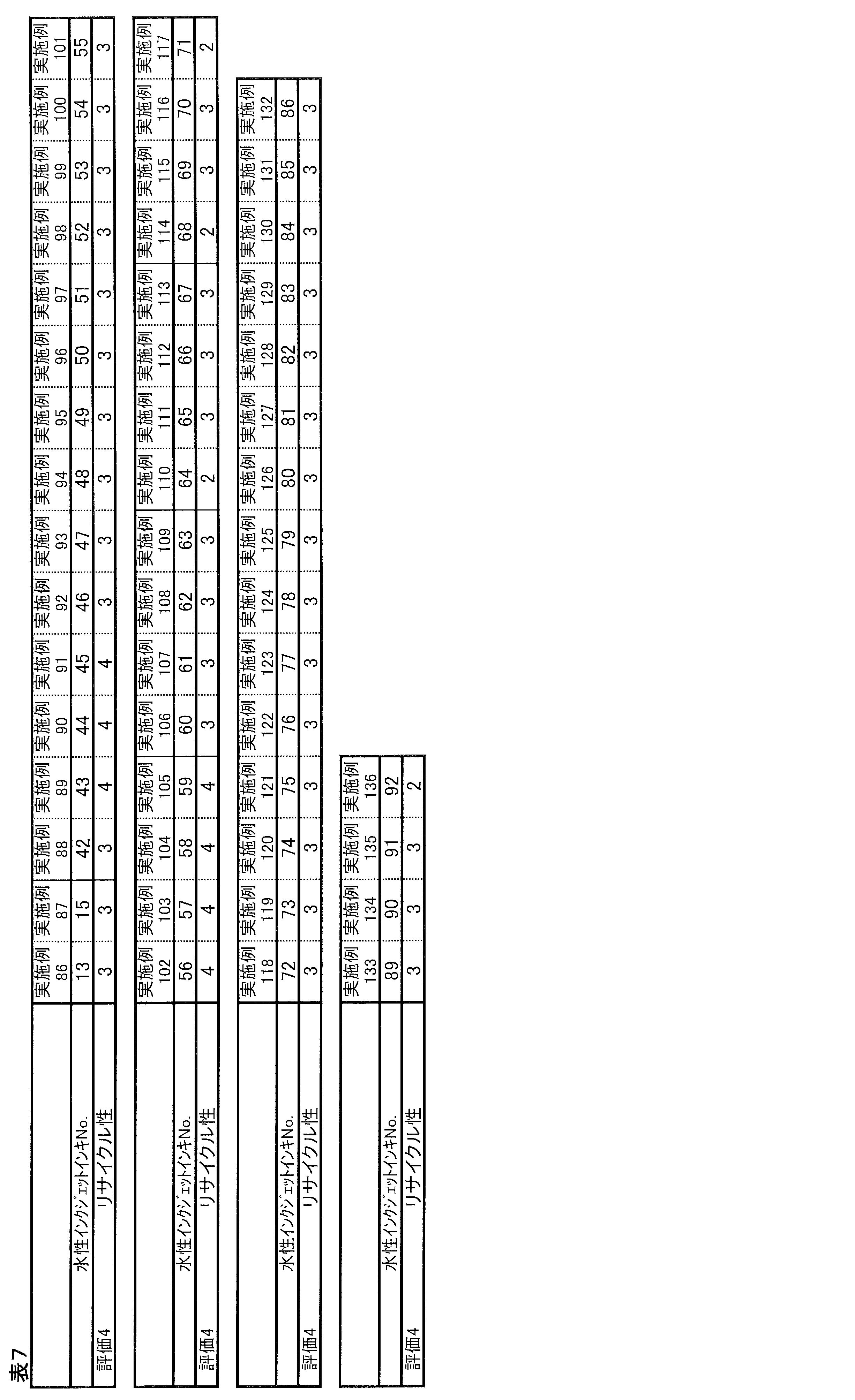
<印刷物の作製2>
オーエスジーシステムプロダクツ社製ノンワイヤーバーコーター「250-OSP-04」を用い、上述した3種類のシュリンクフィルムのそれぞれに、前処理液1~3のそれぞれを、ウェット膜厚が4μmとなるように塗工した。その後、55℃のエアオーブンに塗工後のシュリンクフィルムを投入し、1分間乾燥させることで、前処理液を付与したシュリンクフィルムを作製した。
そして、印刷基材として、上記前処理液を付与したシュリンクフィルムを使用した以外は、上記「印刷物の作製1」に記載した方法及び条件と同様にして、シアンべた印刷物及び2色十字印刷物を作製した。
<Creating printed matter 2>
Using a non-wire bar coater "250-OSP-04" manufactured by OSG System Products, Inc., each of the three types of shrink films described above was coated with each of the pretreatment liquids 1 to 3 so that the wet film thickness was 4 μm. The coated shrink films were then placed in an air oven at 55° C. and dried for 1 minute to produce shrink films to which the pretreatment liquids had been applied.
A cyan solid print and a two-color cross print were produced using the same method and conditions as described in "Printed material production 1" above, except that a shrink film to which the above pretreatment liquid had been applied was used as the printing substrate.
[実施例137~142]
下表8に示した、前処理液と水性インクジェットインキとを組み合わせて、上述した方法でシアンべた印刷物及び2色十字印刷物を作製した。そして、作製した印刷物を使用して、上述した評価1及び評価2を行った。評価結果は表8に示した通りであった。
[Examples 137 to 142]
A cyan solid print and a two-color cross print were produced by the above-mentioned method using the combinations of the pretreatment liquid and the aqueous inkjet ink shown in Table 8 below. The produced prints were then used to carry out the above-mentioned evaluations 1 and 2. The evaluation results are shown in Table 8.
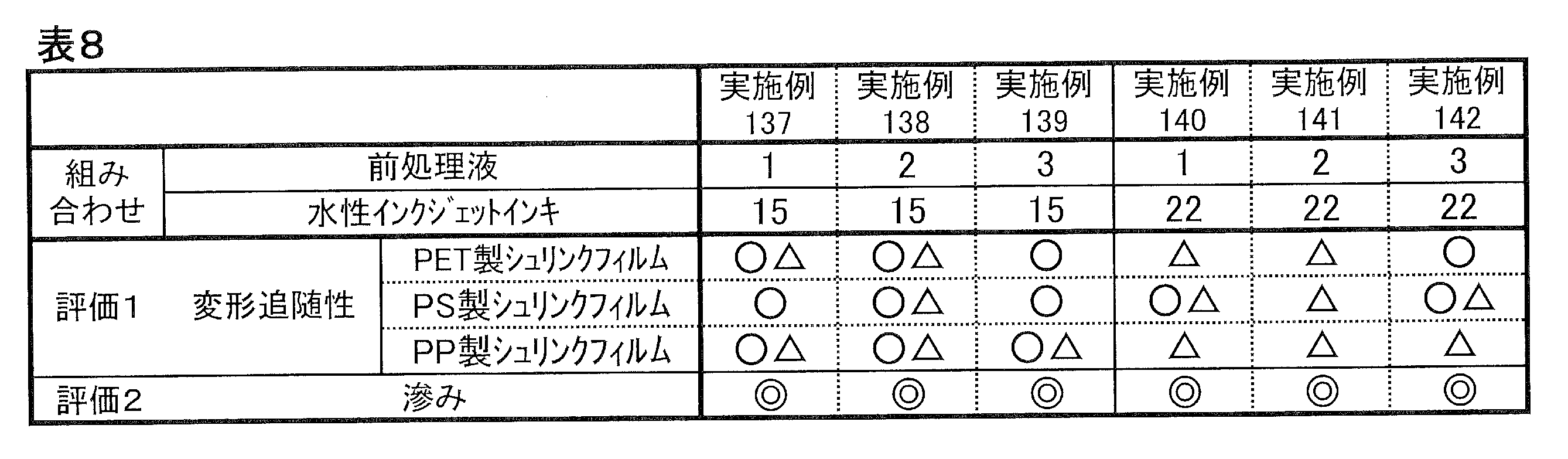
表5及び表8から、前処理液であっても、本発明の要件を満たすことで、変形追随性に優れた印刷物が得られることが確認された。また、インキ凝集層を形成することができる前処理液を、水性インクジェットインキと併用したことで、滲みの評価において、◎レベルという特段に優れた結果が得られた。 From Tables 5 and 8, it was confirmed that even with a pretreatment liquid, if the requirements of the present invention are met, a printed matter with excellent deformation followability can be obtained. In addition, by using a pretreatment liquid capable of forming an ink aggregation layer in combination with an aqueous inkjet ink, an especially excellent result of ◎ level was obtained in the evaluation of bleeding.
本願では、樹脂を構成する重合性単量体の種類及び含有率が判明している場合、上記芳香環構造の含有量として、下記式6により算出された値が使用できる。また、樹脂を構成する重合性単量体の種類及び含有率が不明である場合、例えばNMR(核磁気共鳴)測定により、芳香環構造を有する重合性単量体の含有率、及び、当該芳香環構造の含有モル数を測定したのち、下記式6により、当該芳香環構造の含有量が算出できる。 In the present application, when the type and content of the polymerizable monomer constituting the resin are known, the content of the aromatic ring structure can be calculated using the following formula 6. When the type and content of the polymerizable monomer constituting the resin are unknown, the content of the aromatic ring structure can be calculated using the following formula 6 after measuring the content of the polymerizable monomer having an aromatic ring structure and the number of moles of the aromatic ring structure, for example, by NMR (nuclear magnetic resonance) measurement.
表4に記載された原料のうち、略称及び商品名で記載されたものの詳細は、以下に示すとおりである。また表4中に記載されているSP値の単位は「(cal/cm3)1/2」であり、酸価の単位は「mgKOH/g」である。
≪界面活性剤≫
サーフィノール104:エボニック社製2,4,7,9-テトラメチル-5-デシン-4,7-ジオール、SP値10.4(cal/cm3)1/2、HLB値3.0
サーフィノール420:エボニック社製2,4,7,9-テトラメチル-5-デシン-4,7-ジオールのオキシエチレン(1.3モル)付加物、SP値10.3(cal/cm3)1/2、HLB値4.0
サーフィノール440:エボニック社製2,4,7,9-テトラメチル-5-デシン-4,7-ジオールのオキシエチレン(3.5モル)付加物、SP値10.1(cal/cm3)1/2、HLB値8.1
サーフィノール2502:エボニック社製2,4,7,9-テトラメチル-5-デシン-4,7-ジオールの、オキシエチレン(5モル)及びオキシプロピレン(2モル)付加物、SP値9.7(cal/cm3)1/2、HLB値7.8
ダイノール607:エボニック社製2,5,8,11-テトラメチル-6-ドデシン-5,8-ジオールのオキシエチレン(約7モル)付加物、SP値9.8(cal/cm3)1/2、HLB値11.0
サーフィノール465:エボニック社製2,4,7,9-テトラメチル-5-デシン-4,7-ジオールのオキシエチレン(10モル)付加物、SP値9.8(cal/cm3)1/2、HLB値13.2
EMALEX 705:日本エマルジョン社製、上記一般式3において、R1が1-ラウリル基、R2がエチレン基、nが5である化合物、SP値9.6(cal/cm3)1/2、HLB値10.8
EMALEX 710:日本エマルジョン社製、上記一般式3において、R1が1-ラウリル基、R2がエチレン基、nが10である化合物、SP値9.5(cal/cm3)1/2、HLB値14.1
EMALEX 720:日本エマルジョン社製、上記一般式3において、R1が1-ラウリル基、R2がエチレン基、nが20である化合物、SP値9.5(cal/cm3)1/2、HLB値16.5
EMALEX 730:日本エマルジョン社製、上記一般式3において、R1が1-ラウリル基、R2がエチレン基、nが30である化合物、SP値9.5(cal/cm3)1/2、HLB値17.5
EMALEX 750:日本エマルジョン社製、上記一般式3において、R1が1-ラウリル基、R2がエチレン基、nが50である化合物、SP値9.4(cal/cm3)1/2、HLB値18.4
ノニオン S-207:日油社製、上記一般式3において、R1が1-ステアリル基、R2がエチレン基、nが7である化合物、SP値9.4(cal/cm3)1/2、HLB値10.7
ノニオン S-215:日油社製、上記一般式3において、R1が1-ステアリル基、R2がエチレン基、nが15である化合物、SP値9.4(cal/cm3)1/2、HLB値14.2
NIKKOL BB-10:日光ケミカルズ社製、上記一般式3において、R1が1-ベヘニル基、R2がエチレン基、nが10である化合物、SP値9.3(cal/cm3)1/2、HLB値11.5
NIKKOL BB-20:日光ケミカルズ社製、上記一般式3において、R1が1-ベヘニル基、R2がエチレン基、nが20である化合物、SP値9.3(cal/cm3)1/2、HLB値14.6
シロキサン系活性剤1:上記一般式4において、p=0、q=1であり、R 3 が上記一般式5で表される構造(ただし、r=3、s=5、t=0であり、R 5 が-OHである)であり、R 4 がメチル基である化合物、SP値8.9(cal/cm3)1/2、Si原子数に対するオキシエチレン基数の比=1.7
シロキサン系活性剤2:上記一般式4において、p=1、q=2であり、R 3 が上記一般式5で表される構造(ただし、r=3、s=3、t=0であり、R 5 が-OCH3である)であり、R 4 がメチル基である化合物、SP値8.1(cal/cm3)1/2、Si原子数に対するオキシエチレン基数の比=1.2
シロキサン系活性剤3:上記一般式4において、p=13、q=0であり、R 4 が上記一般式5で表される構造(ただし、r=3、s=5、t=0であり、R 5 が-OCH3である)である化合物、SP値7.9(cal/cm3)1/2、Si原子数に対するオキシエチレン基数の比=0.67
シロキサン系活性剤4:上記一般式4において、p=23、q=0であり、R 4 が上記一般式5で表される構造(ただし、r=3、s=6、t=1であり、R 5 が-OHである)である化合物、SP値8.1(cal/cm3)1/2、Si原子数に対するオキシエチレン基数の比=0.48
≪ワックス樹脂≫
ハイテックE-6400:東邦化学工業社製酸化ポリオレフィン樹脂微粒子(固形分濃度35質量%)、SP値8.6(cal/cm3)1/2
≪その他成分≫
BITaq:1,2-ベンズイソチアゾリン-3-オンの1%水溶液
Among the raw materials listed in Table 4, the details of those listed by abbreviation and product name are as follows: The unit of SP value listed in Table 4 is "(cal/ cm3 ) 1/2 ", and the unit of acid value is "mgKOH/g".
<Surfactants>
Surfynol 104: 2,4,7,9-tetramethyl-5-decyne-4,7-diol manufactured by Evonik, SP value 10.4 (cal/cm 3 ) 1/2 , HLB value 3.0
Surfynol 420: 2,4,7,9-tetramethyl-5-decyne-4,7-diol adduct with oxyethylene (1.3 moles), manufactured by Evonik Co., Ltd., SP value 10.3 (cal/cm 3 ) 1/2 , HLB value 4.0
Surfynol 440: 2,4,7,9-tetramethyl-5-decyne-4,7-diol adduct with oxyethylene (3.5 moles), manufactured by Evonik Co., Ltd., SP value 10.1 (cal/cm 3 ) 1/2 , HLB value 8.1
Surfynol 2502: Manufactured by Evonik Co., Ltd.; oxyethylene (5 moles) and oxypropylene (2 moles) adduct of 2,4,7,9-tetramethyl-5-decyne-4,7-diol, SP value 9.7 (cal/cm 3 ) 1/2 , HLB value 7.8
Dynol 607: oxyethylene (about 7 moles) adduct of 2,5,8,11-tetramethyl-6-dodecyne-5,8-diol manufactured by Evonik, SP value 9.8 (cal/cm 3 ) 1/2 , HLB value 11.0
Surfynol 465: oxyethylene (10 moles) adduct of 2,4,7,9-tetramethyl-5-decyne-4,7-diol manufactured by Evonik Co., Ltd., SP value 9.8 (cal/cm 3 ) 1/2 , HLB value 13.2
EMALEX 705: manufactured by Nippon Emulsion Co., Ltd.; a compound in which, in the above general formula 3, R 1 is a 1-lauryl group, R 2 is an ethylene group, and n is 5; SP value: 9.6 (cal/cm 3 ) 1/2 , HLB value: 10.8
EMALEX 710: manufactured by Nippon Emulsion Co., Ltd.; a compound in which, in the above general formula 3, R 1 is a 1-lauryl group, R 2 is an ethylene group, and n is 10; SP value: 9.5 (cal/cm 3 ) 1/2 , HLB value: 14.1
EMALEX 720: manufactured by Nippon Emulsion Co., Ltd.; a compound in which, in the above general formula 3, R 1 is a 1-lauryl group, R 2 is an ethylene group, and n is 20; SP value 9.5 (cal/cm 3 ) 1/2 , HLB value 16.5
EMALEX 730: manufactured by Nippon Emulsion Co., Ltd.; a compound in which, in the above general formula 3, R 1 is a 1-lauryl group, R 2 is an ethylene group, and n is 30; SP value 9.5 (cal/cm 3 ) 1/2 , HLB value 17.5
EMALEX 750: manufactured by Nippon Emulsion Co., Ltd.; a compound in which, in the above general formula 3, R 1 is a 1-lauryl group, R 2 is an ethylene group, and n is 50; SP value 9.4 (cal/cm 3 ) 1/2 , HLB value 18.4
Nonion S-207: NOF Corporation, a compound in which in the above general formula 3, R 1 is a 1-stearyl group, R 2 is an ethylene group, and n is 7, SP value 9.4 (cal/cm 3 ) 1/2 , HLB value 10.7
Nonion S-215: NOF Corporation, a compound in which in the above general formula 3, R 1 is a 1-stearyl group, R 2 is an ethylene group, and n is 15, SP value 9.4 (cal/cm 3 ) 1/2 , HLB value 14.2
NIKKOL BB-10: manufactured by Nikko Chemicals Co., Ltd.; a compound in which, in the above general formula 3, R 1 is a 1-behenyl group, R 2 is an ethylene group, and n is 10; SP value: 9.3 (cal/cm 3 ) 1/2 , HLB value: 11.5
NIKKOL BB-20: manufactured by Nikko Chemicals Co., Ltd.; a compound in which, in the above general formula 3, R 1 is a 1-behenyl group, R 2 is an ethylene group, and n is 20; SP value: 9.3 (cal/cm 3 ) 1/2 , HLB value: 14.6
Siloxane-based activator 1: a compound in which, in the above general formula 4, p=0, q=1, R3 is a structure represented by the above general formula 5 (wherein r=3, s=5, t=0, and R5 is --OH), and R4 is a methyl group; SP value: 8.9 (cal/ cm3 ) 1/2 ; ratio of number of oxyethylene groups to number of Si atoms: 1.7.
Siloxane-based activator 2: a compound in which, in the above general formula 4, p=1, q=2, R3 is a structure represented by the above general formula 5 (wherein r=3, s=3, t=0, and R5 is --OCH3 ), and R4 is a methyl group; SP value: 8.1 (cal/ cm3 ) 1/2 , ratio of number of oxyethylene groups to number of Si atoms: 1.2.
Siloxane-based activator 3: a compound in which, in the above general formula 4, p=13, q=0, and R4 is a structure represented by the above general formula 5 (wherein r=3, s=5, t=0, and R5 is --OCH3 ), SP value 7.9 (cal/ cm3 ) 1/2 , ratio of number of oxyethylene groups to number of Si atoms=0.67.
Siloxane-based activator 4: a compound in which, in the above general formula 4, p=23, q=0, and R 4 is a structure represented by the above general formula 5 (wherein r=3, s=6, t=1, and R 5 is --OH), SP value 8.1 (cal/cm 3 ) 1/2 , ratio of number of oxyethylene groups to number of Si atoms=0.48.
<Wax resin>
Hi-Tech E-6400: Oxidized polyolefin resin fine particles (solid content concentration 35% by mass) manufactured by Toho Chemical Industry Co., Ltd., SP value 8.6 (cal/cm 3 ) 1/2
<Other ingredients>
BITaq: 1% aqueous solution of 1,2-benzisothiazolin-3-one
Claims (4)
前記有機溶剤が、SP値が11~13.5(cal/cm3)1/2であり、水酸基を1個以上有する有機溶剤(A-1)を、前記水性インクジェットインキの全量中5~30質量%含み、
前記界面活性剤が、アセチレンジオール系界面活性剤、及び、ポリオキシアルキレンアルキルエーテル系界面活性剤からなる群から選択される1種以上の界面活性剤(B-1)を含み、
前記樹脂及び前記界面活性剤のSP値の加重平均値が9~11.5(cal/cm3)1/2である、シュリンクフィルム用水性インクジェットインキ。 A water-based inkjet ink for shrink films, comprising an organic solvent, a surfactant, and a resin,
the organic solvent has an SP value of 11 to 13.5 (cal/cm 3 ) 1/2 and contains an organic solvent (A-1) having one or more hydroxyl groups in an amount of 5 to 30% by mass based on the total amount of the aqueous inkjet ink;
The surfactant comprises one or more surfactants (B-1) selected from the group consisting of acetylene diol surfactants and polyoxyalkylene alkyl ether surfactants,
The water-based inkjet ink for shrink films, wherein the weighted average SP value of the resin and the surfactant is 9 to 11.5 (cal/cm 3 ) 1/2 .
Priority Applications (2)
| Application Number | Priority Date | Filing Date | Title |
|---|---|---|---|
| JP2023188675A JP7500851B1 (en) | 2023-11-02 | 2023-11-02 | Water-based inkjet ink for shrink film and printed matter |
| EP24209488.6A EP4549522A1 (en) | 2023-11-02 | 2024-10-29 | Aqueous inkjet ink for shrink film and printed item |
Applications Claiming Priority (1)
| Application Number | Priority Date | Filing Date | Title |
|---|---|---|---|
| JP2023188675A JP7500851B1 (en) | 2023-11-02 | 2023-11-02 | Water-based inkjet ink for shrink film and printed matter |
Publications (2)
| Publication Number | Publication Date |
|---|---|
| JP7500851B1 JP7500851B1 (en) | 2024-06-17 |
| JP2025076802A true JP2025076802A (en) | 2025-05-16 |
Family
ID=91483371
Family Applications (1)
| Application Number | Title | Priority Date | Filing Date |
|---|---|---|---|
| JP2023188675A Active JP7500851B1 (en) | 2023-11-02 | 2023-11-02 | Water-based inkjet ink for shrink film and printed matter |
Country Status (2)
| Country | Link |
|---|---|
| EP (1) | EP4549522A1 (en) |
| JP (1) | JP7500851B1 (en) |
Families Citing this family (1)
| Publication number | Priority date | Publication date | Assignee | Title |
|---|---|---|---|---|
| WO2025261620A1 (en) * | 2024-06-18 | 2025-12-26 | Evonik Operations Gmbh | Polymer for improving the removal of printing inks from polymer substrates |
Family Cites Families (10)
| Publication number | Priority date | Publication date | Assignee | Title |
|---|---|---|---|---|
| JP2001215690A (en) | 2000-01-04 | 2001-08-10 | Air Prod And Chem Inc | Acetylenic diol ethylene oxide / propylene oxide adducts and their use in developers |
| JP4722327B2 (en) | 2001-05-29 | 2011-07-13 | 丸善石油化学株式会社 | Method for producing acetylenic diol compound |
| JP2003246136A (en) | 2002-02-26 | 2003-09-02 | Konica Corp | Shrink film for ink jet recording and method for ink jet recording using the same |
| JP5664027B2 (en) * | 2010-08-31 | 2015-02-04 | セイコーエプソン株式会社 | Inkjet recording method, inkjet recording apparatus, and recorded matter |
| JP2014019842A (en) * | 2012-07-23 | 2014-02-03 | Seiko Epson Corp | Ink jet composition, ink jet recording apparatus, and recorded article |
| WO2019208567A1 (en) | 2018-04-24 | 2019-10-31 | 花王株式会社 | Aqueous composition for inkjet recording |
| JP7249776B2 (en) * | 2018-12-26 | 2023-03-31 | 花王株式会社 | Water-based ink for inkjet printing |
| CN117120556A (en) * | 2021-04-19 | 2023-11-24 | 日本化药株式会社 | Inkjet inks, ink sets, ink media sets and printing media |
| JP2023029244A (en) * | 2021-08-19 | 2023-03-03 | キヤノン株式会社 | Inkjet recording method and inkjet recording device |
| JP7074921B1 (en) * | 2021-09-27 | 2022-05-24 | 東洋インキScホールディングス株式会社 | Aqueous recording liquid set and method for manufacturing printed matter |
-
2023
- 2023-11-02 JP JP2023188675A patent/JP7500851B1/en active Active
-
2024
- 2024-10-29 EP EP24209488.6A patent/EP4549522A1/en active Pending
Also Published As
| Publication number | Publication date |
|---|---|
| JP7500851B1 (en) | 2024-06-17 |
| EP4549522A1 (en) | 2025-05-07 |
Similar Documents
| Publication | Publication Date | Title |
|---|---|---|
| JP2020075436A (en) | Pretreatment liquid and ink set containing the pretreatment liquid | |
| JP7277678B1 (en) | Recording liquid set, method for manufacturing printed matter, and printed matter | |
| JP7074921B1 (en) | Aqueous recording liquid set and method for manufacturing printed matter | |
| JP7500851B1 (en) | Water-based inkjet ink for shrink film and printed matter | |
| JP2018127521A (en) | Ink, ink container, ink set, ink jet recording apparatus, ink jet recording method and recorded matter | |
| JP7463608B1 (en) | Water-based inkjet inks and printed matter | |
| JP2024098518A (en) | Inkjet ink set, inkjet recording apparatus, and inkjet recording method | |
| JP2024098517A (en) | Inkjet ink set, inkjet recording apparatus, and inkjet recording method | |
| JP2023087720A (en) | Precoat liquid, ink set, inkjet recording method, and inkjet recording system | |
| WO2022158339A1 (en) | Ink-jet recording method | |
| EP4286484B1 (en) | Aqueous pretreatment liquid, ink set, printed item, and separation method | |
| JP7750335B1 (en) | Water-based inkjet inks and printed materials | |
| JP7619514B2 (en) | Water-based inkjet inks and printed matter | |
| JP7618872B1 (en) | Pretreatment liquid, ink set, and printed matter | |
| JP7726421B1 (en) | Water-based inkjet inks and printed materials | |
| JP7431399B1 (en) | Ink set and printed matter manufacturing method | |
| JP7619052B2 (en) | Pigment dispersion for inkjet ink, inkjet ink and printed matter | |
| JP7513958B2 (en) | Pre-coating liquid, recording method, and recording device | |
| WO2025253771A1 (en) | Aqueous inkjet ink and printed article | |
| CN117447872A (en) | Ink set and inkjet recording method | |
| JP2025031655A (en) | Inkjet printing method | |
| WO2026014191A1 (en) | Aqueous inkjet ink production method and image formation method |
Legal Events
| Date | Code | Title | Description |
|---|---|---|---|
| A521 | Request for written amendment filed |
Free format text: JAPANESE INTERMEDIATE CODE: A523 Effective date: 20231215 |
|
| A621 | Written request for application examination |
Free format text: JAPANESE INTERMEDIATE CODE: A621 Effective date: 20231215 |
|
| A871 | Explanation of circumstances concerning accelerated examination |
Free format text: JAPANESE INTERMEDIATE CODE: A871 Effective date: 20231215 |
|
| A131 | Notification of reasons for refusal |
Free format text: JAPANESE INTERMEDIATE CODE: A131 Effective date: 20240123 |
|
| TRDD | Decision of grant or rejection written | ||
| A01 | Written decision to grant a patent or to grant a registration (utility model) |
Free format text: JAPANESE INTERMEDIATE CODE: A01 Effective date: 20240409 |
|
| A601 | Written request for extension of time |
Free format text: JAPANESE INTERMEDIATE CODE: A601 Effective date: 20240415 |
|
| A61 | First payment of annual fees (during grant procedure) |
Free format text: JAPANESE INTERMEDIATE CODE: A61 Effective date: 20240605 |
|
| R150 | Certificate of patent or registration of utility model |
Ref document number: 7500851 Country of ref document: JP Free format text: JAPANESE INTERMEDIATE CODE: R150 |