[go: up one dir, main page]

JP2025068231A - Print circuit board - Google Patents

Print circuit board Download PDF

Info

Publication number
JP2025068231A
JP2025068231A JP2023177991A JP2023177991A JP2025068231A JP 2025068231 A JP2025068231 A JP 2025068231A JP 2023177991 A JP2023177991 A JP 2023177991A JP 2023177991 A JP2023177991 A JP 2023177991A JP 2025068231 A JP2025068231 A JP 2025068231A
Authority
JP
Japan
Prior art keywords
layer
resin
conductor
wiring board
printed wiring
Prior art date
Legal status (The legal status is an assumption and is not a legal conclusion. Google has not performed a legal analysis and makes no representation as to the accuracy of the status listed.)
Pending
Application number
JP2023177991A
Other languages
Japanese (ja)
Inventor
大介 池田
Daisuke Ikeda
Current Assignee (The listed assignees may be inaccurate. Google has not performed a legal analysis and makes no representation or warranty as to the accuracy of the list.)
Ibiden Co Ltd
Original Assignee
Ibiden Co Ltd
Priority date (The priority date is an assumption and is not a legal conclusion. Google has not performed a legal analysis and makes no representation as to the accuracy of the date listed.)
Filing date
Publication date
Application filed by Ibiden Co Ltd filed Critical Ibiden Co Ltd
Priority to JP2023177991A priority Critical patent/JP2025068231A/en
Priority to CN202411313203.6A priority patent/CN119855041A/en
Priority to US18/915,900 priority patent/US20250126709A1/en
Publication of JP2025068231A publication Critical patent/JP2025068231A/en
Pending legal-status Critical Current

Links

Images

Classifications

    • HELECTRICITY
    • H05ELECTRIC TECHNIQUES NOT OTHERWISE PROVIDED FOR
    • H05KPRINTED CIRCUITS; CASINGS OR CONSTRUCTIONAL DETAILS OF ELECTRIC APPARATUS; MANUFACTURE OF ASSEMBLAGES OF ELECTRICAL COMPONENTS
    • H05K1/00Printed circuits
    • H05K1/02Details
    • H05K1/11Printed elements for providing electric connections to or between printed circuits
    • HELECTRICITY
    • H05ELECTRIC TECHNIQUES NOT OTHERWISE PROVIDED FOR
    • H05KPRINTED CIRCUITS; CASINGS OR CONSTRUCTIONAL DETAILS OF ELECTRIC APPARATUS; MANUFACTURE OF ASSEMBLAGES OF ELECTRICAL COMPONENTS
    • H05K3/00Apparatus or processes for manufacturing printed circuits
    • H05K3/40Forming printed elements for providing electric connections to or between printed circuits
    • H05K3/4038Through-connections; Vertical interconnect access [VIA] connections
    • H05K3/4053Through-connections; Vertical interconnect access [VIA] connections by thick-film techniques
    • H05K3/4069Through-connections; Vertical interconnect access [VIA] connections by thick-film techniques for via connections in organic insulating substrates
    • HELECTRICITY
    • H05ELECTRIC TECHNIQUES NOT OTHERWISE PROVIDED FOR
    • H05KPRINTED CIRCUITS; CASINGS OR CONSTRUCTIONAL DETAILS OF ELECTRIC APPARATUS; MANUFACTURE OF ASSEMBLAGES OF ELECTRICAL COMPONENTS
    • H05K1/00Printed circuits
    • H05K1/02Details
    • H05K1/03Use of materials for the substrate
    • H05K1/0313Organic insulating material
    • H05K1/0353Organic insulating material consisting of two or more materials, e.g. two or more polymers, polymer + filler, + reinforcement
    • H05K1/0373Organic insulating material consisting of two or more materials, e.g. two or more polymers, polymer + filler, + reinforcement containing additives, e.g. fillers
    • HELECTRICITY
    • H05ELECTRIC TECHNIQUES NOT OTHERWISE PROVIDED FOR
    • H05KPRINTED CIRCUITS; CASINGS OR CONSTRUCTIONAL DETAILS OF ELECTRIC APPARATUS; MANUFACTURE OF ASSEMBLAGES OF ELECTRICAL COMPONENTS
    • H05K1/00Printed circuits
    • H05K1/02Details
    • H05K1/03Use of materials for the substrate
    • H05K1/05Insulated conductive substrates, e.g. insulated metal substrate
    • H05K1/056Insulated conductive substrates, e.g. insulated metal substrate the metal substrate being covered by an organic insulating layer
    • HELECTRICITY
    • H05ELECTRIC TECHNIQUES NOT OTHERWISE PROVIDED FOR
    • H05KPRINTED CIRCUITS; CASINGS OR CONSTRUCTIONAL DETAILS OF ELECTRIC APPARATUS; MANUFACTURE OF ASSEMBLAGES OF ELECTRICAL COMPONENTS
    • H05K1/00Printed circuits
    • H05K1/02Details
    • H05K1/11Printed elements for providing electric connections to or between printed circuits
    • H05K1/115Via connections; Lands around holes or via connections
    • H05K1/116Lands, clearance holes or other lay-out details concerning the surrounding of a via
    • HELECTRICITY
    • H05ELECTRIC TECHNIQUES NOT OTHERWISE PROVIDED FOR
    • H05KPRINTED CIRCUITS; CASINGS OR CONSTRUCTIONAL DETAILS OF ELECTRIC APPARATUS; MANUFACTURE OF ASSEMBLAGES OF ELECTRICAL COMPONENTS
    • H05K3/00Apparatus or processes for manufacturing printed circuits
    • H05K3/0011Working of insulating substrates or insulating layers
    • H05K3/0017Etching of the substrate by chemical or physical means
    • H05K3/0026Etching of the substrate by chemical or physical means by laser ablation
    • H05K3/0032Etching of the substrate by chemical or physical means by laser ablation of organic insulating material
    • H05K3/0035Etching of the substrate by chemical or physical means by laser ablation of organic insulating material of blind holes, i.e. having a metal layer at the bottom
    • HELECTRICITY
    • H05ELECTRIC TECHNIQUES NOT OTHERWISE PROVIDED FOR
    • H05KPRINTED CIRCUITS; CASINGS OR CONSTRUCTIONAL DETAILS OF ELECTRIC APPARATUS; MANUFACTURE OF ASSEMBLAGES OF ELECTRICAL COMPONENTS
    • H05K3/00Apparatus or processes for manufacturing printed circuits
    • H05K3/38Improvement of the adhesion between the insulating substrate and the metal
    • H05K3/386Improvement of the adhesion between the insulating substrate and the metal by the use of an organic polymeric bonding layer, e.g. adhesive
    • HELECTRICITY
    • H05ELECTRIC TECHNIQUES NOT OTHERWISE PROVIDED FOR
    • H05KPRINTED CIRCUITS; CASINGS OR CONSTRUCTIONAL DETAILS OF ELECTRIC APPARATUS; MANUFACTURE OF ASSEMBLAGES OF ELECTRICAL COMPONENTS
    • H05K3/00Apparatus or processes for manufacturing printed circuits
    • H05K3/46Manufacturing multilayer circuits
    • H05K3/4611Manufacturing multilayer circuits by laminating two or more circuit boards
    • H05K3/4626Manufacturing multilayer circuits by laminating two or more circuit boards characterised by the insulating layers or materials
    • HELECTRICITY
    • H05ELECTRIC TECHNIQUES NOT OTHERWISE PROVIDED FOR
    • H05KPRINTED CIRCUITS; CASINGS OR CONSTRUCTIONAL DETAILS OF ELECTRIC APPARATUS; MANUFACTURE OF ASSEMBLAGES OF ELECTRICAL COMPONENTS
    • H05K2201/00Indexing scheme relating to printed circuits covered by H05K1/00
    • H05K2201/02Fillers; Particles; Fibers; Reinforcement materials
    • H05K2201/0203Fillers and particles
    • H05K2201/0206Materials
    • H05K2201/0209Inorganic, non-metallic particles
    • HELECTRICITY
    • H05ELECTRIC TECHNIQUES NOT OTHERWISE PROVIDED FOR
    • H05KPRINTED CIRCUITS; CASINGS OR CONSTRUCTIONAL DETAILS OF ELECTRIC APPARATUS; MANUFACTURE OF ASSEMBLAGES OF ELECTRICAL COMPONENTS
    • H05K2201/00Indexing scheme relating to printed circuits covered by H05K1/00
    • H05K2201/03Conductive materials
    • H05K2201/0332Structure of the conductor
    • H05K2201/0388Other aspects of conductors
    • HELECTRICITY
    • H05ELECTRIC TECHNIQUES NOT OTHERWISE PROVIDED FOR
    • H05KPRINTED CIRCUITS; CASINGS OR CONSTRUCTIONAL DETAILS OF ELECTRIC APPARATUS; MANUFACTURE OF ASSEMBLAGES OF ELECTRICAL COMPONENTS
    • H05K2201/00Indexing scheme relating to printed circuits covered by H05K1/00
    • H05K2201/09Shape and layout
    • H05K2201/09209Shape and layout details of conductors
    • H05K2201/095Conductive through-holes or vias
    • H05K2201/09509Blind vias, i.e. vias having one side closed
    • HELECTRICITY
    • H05ELECTRIC TECHNIQUES NOT OTHERWISE PROVIDED FOR
    • H05KPRINTED CIRCUITS; CASINGS OR CONSTRUCTIONAL DETAILS OF ELECTRIC APPARATUS; MANUFACTURE OF ASSEMBLAGES OF ELECTRICAL COMPONENTS
    • H05K2201/00Indexing scheme relating to printed circuits covered by H05K1/00
    • H05K2201/09Shape and layout
    • H05K2201/09209Shape and layout details of conductors
    • H05K2201/095Conductive through-holes or vias
    • H05K2201/09554Via connected to metal substrate
    • HELECTRICITY
    • H05ELECTRIC TECHNIQUES NOT OTHERWISE PROVIDED FOR
    • H05KPRINTED CIRCUITS; CASINGS OR CONSTRUCTIONAL DETAILS OF ELECTRIC APPARATUS; MANUFACTURE OF ASSEMBLAGES OF ELECTRICAL COMPONENTS
    • H05K3/00Apparatus or processes for manufacturing printed circuits
    • H05K3/02Apparatus or processes for manufacturing printed circuits in which the conductive material is applied to the surface of the insulating support and is thereafter removed from such areas of the surface which are not intended for current conducting or shielding
    • H05K3/06Apparatus or processes for manufacturing printed circuits in which the conductive material is applied to the surface of the insulating support and is thereafter removed from such areas of the surface which are not intended for current conducting or shielding the conductive material being removed chemically or electrolytically, e.g. by photo-etch process
    • H05K3/07Apparatus or processes for manufacturing printed circuits in which the conductive material is applied to the surface of the insulating support and is thereafter removed from such areas of the surface which are not intended for current conducting or shielding the conductive material being removed chemically or electrolytically, e.g. by photo-etch process being removed electrolytically

Landscapes

  • Engineering & Computer Science (AREA)
  • Microelectronics & Electronic Packaging (AREA)
  • Manufacturing & Machinery (AREA)
  • Physics & Mathematics (AREA)
  • Optics & Photonics (AREA)
  • Production Of Multi-Layered Print Wiring Board (AREA)
  • Manufacturing Of Printed Wiring (AREA)

Abstract

To provide a print circuit board having a high quality.SOLUTION: A print circuit board includes: an insulation layer; a conductive layer 10 formed onto the insulation layer; an adhesion layer 100 that is formed on to the insulation layer 10, and is made from an organic material; and a resin insulation layer 20 that is formed onto the insulation layer and the conductive layer 10. The resin insulation layer 20 includes a resin 80 and an inorganic particle 90 that is scattered into the resin 80. A front surface of the insulation layer 10 is substantially a flatness. The adhesion layer 100 is formed by a smooth film 110 and a projection part 120 projected from the smooth film 110. The projection part 120 is formed by a plurality of projections 122. A space 130 between the plurality of projections 122 is filled with the resin insulation layer 20. The number of inorganic particles 90 in the space 130 per predetermined area is smaller than the number of inorganic particles 90 of the outside of the space 130 per predetermined area.SELECTED DRAWING: Figure 2

Description

本明細書によって開示される技術はプリント配線板に関する。 The technology disclosed in this specification relates to printed wiring boards.

特許文献1は、基板上に導体回路と層間樹脂絶縁層を順次積層することと、導体回路の表面の少なくとも一部に、トリアジン化合物を含む層を形成することを含む多層プリント配線板の製造方法を開示する。導体回路と層間樹脂絶縁層はトリアジン化合物を含む層を介して接着される。 Patent Document 1 discloses a method for manufacturing a multilayer printed wiring board, which includes sequentially laminating a conductor circuit and an interlayer resin insulating layer on a substrate, and forming a layer containing a triazine compound on at least a portion of the surface of the conductor circuit. The conductor circuit and the interlayer resin insulating layer are bonded via the layer containing a triazine compound.

特開2001-203462号公報JP 2001-203462 A

[特許文献1の課題]
特許文献1の技術を用いて製造されるプリント配線板では、導体回路と層間樹脂絶縁層の間に大きいストレスが働くと、導体回路と層間樹脂絶縁層の間に剥がれが発生すると予測される。例えば、ビルドアップ層内の導体層の数が5以上であると、導体回路と層間樹脂絶縁層との間に働くストレスは増えると考えられる。ビルドアップ層内の導体層の数が5以上であると、導体回路と層間樹脂絶縁層の間に剥がれが発生すると予測される。例えば、プリント配線板の各辺の長さが50mmを超えると、導体回路と層間樹脂絶縁層の間に剥がれが発生すると予測される。
[Problems of Patent Document 1]
In a printed wiring board manufactured using the technology of Patent Document 1, when a large stress acts between the conductor circuit and the interlayer resin insulation layer, peeling is predicted to occur between the conductor circuit and the interlayer resin insulation layer. For example, when the number of conductor layers in the build-up layer is 5 or more, it is considered that the stress acting between the conductor circuit and the interlayer resin insulation layer increases. When the number of conductor layers in the build-up layer is 5 or more, peeling is predicted to occur between the conductor circuit and the interlayer resin insulation layer. For example, when the length of each side of the printed wiring board exceeds 50 mm, peeling is predicted to occur between the conductor circuit and the interlayer resin insulation layer.

本発明のプリント配線板は、絶縁層と、前記絶縁層上に形成される導体層と、前記導体層上に形成されていて、有機製の材料からなる接着層と、前記絶縁層と前記導体層上に形成されている樹脂絶縁層、とを有する。前記樹脂絶縁層は樹脂と前記樹脂内に分散されている無機粒子を有している。前記導体層の表面は略平滑である。前記接着層は、平滑膜と前記平滑膜から突出する突出部で形成されている。前記突出部は複数の突起で形成されている。前記複数の突起間のスペースは前記樹脂絶縁層で充填されている。所定面積当たりの前記スペース内の前記無機粒子の数(B1)は前記所定面積当たりの前記スペース外の前記無機粒子の数(B2)より小さい。 The printed wiring board of the present invention has an insulating layer, a conductor layer formed on the insulating layer, an adhesive layer formed on the conductor layer and made of an organic material, and a resin insulating layer formed on the insulating layer and the conductor layer. The resin insulating layer has resin and inorganic particles dispersed in the resin. The surface of the conductor layer is approximately smooth. The adhesive layer is formed of a smooth film and a protruding portion protruding from the smooth film. The protruding portion is formed of a plurality of protrusions. The space between the plurality of protrusions is filled with the resin insulating layer. The number of the inorganic particles within the space per given area (B1) is smaller than the number of the inorganic particles outside the space per given area (B2).

本発明の実施形態のプリント配線板は、導体層と樹脂絶縁層で挟まれる接着層を有する。接着層は導体層と樹脂絶縁層を接着している。接着層はほぼ平滑な平滑膜と平滑膜から突出している突出部で形成されている。接着層が突出部と平滑膜によって形成される凹凸を有する。突出部は複数の突起によって形成される凹凸を有する。そのため導体層と樹脂絶縁層が接着層を介して十分に密着する。接着層の熱膨張率(CTE)と樹脂絶縁層のCTEは異なる。プリント配線板が熱衝撃を受けると、接着層の突起間のスペースを充填する樹脂絶縁層の変形量と接着層の変形量は異なる。とくにスペースを充填する樹脂絶縁層が無機粒子を含むと両者の変形量の差が大きい。両者の変形量の差が大きいと突起が破壊され易い。実施形態のプリント配線板では、所定面積当たりのスペース内の無機粒子の数(B1)が所定面積当たりのスペース外の無機粒子の数(B2)より小さい。スペースを充填する樹脂絶縁層の変形量と接着層の変形量の差が小さい。突起が破壊されがたい。樹脂絶縁層が導体層から剥がれがたい。高い品質を有するプリント配線板が提供される。 The printed wiring board of the embodiment of the present invention has an adhesive layer sandwiched between the conductor layer and the resin insulating layer. The adhesive layer bonds the conductor layer and the resin insulating layer. The adhesive layer is formed of a nearly smooth film and a protruding portion protruding from the smooth film. The adhesive layer has unevenness formed by the protruding portion and the smooth film. The protruding portion has unevenness formed by a plurality of protrusions. Therefore, the conductor layer and the resin insulating layer are sufficiently adhered to each other via the adhesive layer. The coefficient of thermal expansion (CTE) of the adhesive layer is different from the CTE of the resin insulating layer. When the printed wiring board is subjected to thermal shock, the deformation amount of the resin insulating layer filling the space between the protrusions of the adhesive layer and the deformation amount of the adhesive layer are different. In particular, when the resin insulating layer filling the space contains inorganic particles, the difference in the deformation amount between the two is large. If the difference in the deformation amount between the two is large, the protrusions are easily destroyed. In the printed wiring board of the embodiment, the number of inorganic particles in the space per specified area (B1) is smaller than the number of inorganic particles outside the space per specified area (B2). The difference in the deformation amount between the resin insulating layer filling the space and the adhesive layer is small. The protrusions are less likely to break. The resin insulating layer is less likely to peel off from the conductor layer. This provides a high-quality printed wiring board.

実施形態のプリント配線板を模式的に示す断面図。FIG. 1 is a cross-sectional view illustrating a printed wiring board according to an embodiment. プリント配線板の一部を模式的に示す拡大断面図。FIG. 2 is an enlarged cross-sectional view illustrating a schematic view of a portion of a printed wiring board. 実施形態のプリント配線板の製造方法を模式的に示す断面図。1A to 1C are cross-sectional views each showing a schematic diagram of a method for manufacturing a printed wiring board according to an embodiment. 実施形態のプリント配線板の製造方法を模式的に示す断面図。1A to 1C are cross-sectional views each showing a schematic diagram of a method for manufacturing a printed wiring board according to an embodiment. 実施形態のプリント配線板の製造方法を模式的に示す断面図。1A to 1C are cross-sectional views each showing a schematic diagram of a method for manufacturing a printed wiring board according to an embodiment. 実施形態のプリント配線板の製造方法を模式的に示す断面図。1A to 1C are cross-sectional views each showing a schematic diagram of a method for manufacturing a printed wiring board according to an embodiment. 実施形態のプリント配線板の製造方法を模式的に示す断面図。1A to 1C are cross-sectional views each showing a schematic diagram of a method for manufacturing a printed wiring board according to an embodiment.

[実施形態]
図1は実施形態のプリント配線板2を示す断面図である。図1に示されるように、プリント配線板2は絶縁層4と第1導体層10と樹脂絶縁層20と第2導体層30とビア導体40を有する。第1導体層10は導体層の一例である。ビア導体40は樹脂絶縁層20に形成されている開口26内に形成されている。プリント配線板2は第1導体層10上に接着層100を有する。接着層100は第1導体層10と樹脂絶縁層20で挟まれている。第1導体層10と第2導体層30は隣接している。第1導体層10と第2導体層30の間に導体層は存在しない。
[Embodiment]
FIG. 1 is a cross-sectional view showing a printed wiring board 2 of an embodiment. As shown in FIG. 1, the printed wiring board 2 has an insulating layer 4, a first conductor layer 10, a resin insulating layer 20, a second conductor layer 30, and a via conductor 40. The first conductor layer 10 is an example of a conductor layer. The via conductor 40 is formed in an opening 26 formed in the resin insulating layer 20. The printed wiring board 2 has an adhesive layer 100 on the first conductor layer 10. The adhesive layer 100 is sandwiched between the first conductor layer 10 and the resin insulating layer 20. The first conductor layer 10 and the second conductor layer 30 are adjacent to each other. There is no conductor layer between the first conductor layer 10 and the second conductor layer 30.

絶縁層4は熱硬化性樹脂を用いて形成される。絶縁層4は光硬化性樹脂でも良い。絶縁層4はシリカ等の無機粒子を含んでもよい。絶縁層4はガラスクロス等の補強材を含んでもよい。絶縁層4は第3面6と第3面6と反対側の第4面8を有する。 The insulating layer 4 is formed using a thermosetting resin. The insulating layer 4 may be a photocurable resin. The insulating layer 4 may contain inorganic particles such as silica. The insulating layer 4 may contain a reinforcing material such as glass cloth. The insulating layer 4 has a third surface 6 and a fourth surface 8 opposite the third surface 6.

第1導体層10は絶縁層4の第3面6上に形成されている。第1導体層10は信号配線12とパッド14を含む。図に示されていないが、第1導体層10は信号配線12とパッド14以外の導体回路も含んでいる。第1導体層10は主に銅によって形成される。第1導体層10は、絶縁層4上のシード層10aとシード層10a上の電解めっき層10bで形成されている。第1導体層10の表面(上面と側面)は平滑である。第1導体層10の表面の粗さは二乗平均平方根粗さ(Rq)で示される。第1導体層10の表面のRqは0.23μm以下である。第1導体層10の表面のRqは0.18μm以下であることが好ましい。第1導体層10の表面のRqは0.1μm以下であることがより好ましい。 The first conductor layer 10 is formed on the third surface 6 of the insulating layer 4. The first conductor layer 10 includes a signal wiring 12 and a pad 14. Although not shown in the figure, the first conductor layer 10 also includes a conductor circuit other than the signal wiring 12 and the pad 14. The first conductor layer 10 is mainly formed of copper. The first conductor layer 10 is formed of a seed layer 10a on the insulating layer 4 and an electrolytic plating layer 10b on the seed layer 10a. The surface (top and side) of the first conductor layer 10 is smooth. The surface roughness of the first conductor layer 10 is indicated by the root mean square roughness (Rq). The Rq of the surface of the first conductor layer 10 is 0.23 μm or less. It is preferable that the Rq of the surface of the first conductor layer 10 is 0.18 μm or less. It is more preferable that the Rq of the surface of the first conductor layer 10 is 0.1 μm or less.

パッド14の表面は第1表面14aと第2表面14bで形成される。第1表面14aは樹脂絶縁層20に形成されている開口26から露出している。第2表面14bは第1表面14a以外の表面である。第2表面14bの二乗平均平方根粗さ(Rq)は0.23μm以下である。第1表面14aは接着層100で覆われていない。第2表面14bは接着層100で覆われている。信号配線12の表面(上面と側面)は接着層100で覆われている。第1導体層10の側面は接着層100で覆われている。 The surface of the pad 14 is formed of a first surface 14a and a second surface 14b. The first surface 14a is exposed from an opening 26 formed in the resin insulating layer 20. The second surface 14b is a surface other than the first surface 14a. The root mean square roughness (Rq) of the second surface 14b is 0.23 μm or less. The first surface 14a is not covered with an adhesive layer 100. The second surface 14b is covered with an adhesive layer 100. The surface (top and side) of the signal wiring 12 is covered with an adhesive layer 100. The side of the first conductor layer 10 is covered with an adhesive layer 100.

接着層100は樹脂で形成されている。接着層100は有機製の材料(有機製樹脂)で形成されている。接着層100は無機粒子を含んでいない。あるいは、接着層100はシリカ等の無機粒子を含む。接着層100が無機粒子を含む場合、無機粒子の直径は数nmである。有機製の材料は窒素系有機化合物である。窒素系有機化合物は例えばテトラゾール化合物である。窒素系有機化合物の例は特開2015-54987号公報に開示されている。接着層100は第1導体層10から露出する第3面6を覆っていない。接着層100は第1導体層10と樹脂絶縁層20で挟まれている。接着層100は第1導体層10と樹脂絶縁層20を接着している。 The adhesive layer 100 is made of a resin. The adhesive layer 100 is made of an organic material (organic resin). The adhesive layer 100 does not contain inorganic particles. Alternatively, the adhesive layer 100 contains inorganic particles such as silica. When the adhesive layer 100 contains inorganic particles, the diameter of the inorganic particles is several nm. The organic material is a nitrogen-based organic compound. An example of the nitrogen-based organic compound is a tetrazole compound. An example of a nitrogen-based organic compound is disclosed in JP 2015-54987 A. The adhesive layer 100 does not cover the third surface 6 exposed from the first conductor layer 10. The adhesive layer 100 is sandwiched between the first conductor layer 10 and the resin insulating layer 20. The adhesive layer 100 bonds the first conductor layer 10 and the resin insulating layer 20.

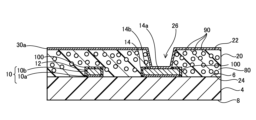
図2はパッド14の第2表面14b上に形成されている接着層100の一部を示す拡大断面図である。図2に示されるように、接着層100はほぼ平滑な平滑膜110と平滑膜110から突出している複数の突出部120で形成されている。パッド14の側面に形成されている接着層100は、図2に示されている接着層100と同様な平滑膜110と複数の突出部120で形成されている。形状も同様である。信号配線12の上面と側面に形成されている接着層100は、図2と同様な平滑膜110と複数の突出部120で形成されている。形状も同様である。 Figure 2 is an enlarged cross-sectional view showing a portion of the adhesive layer 100 formed on the second surface 14b of the pad 14. As shown in Figure 2, the adhesive layer 100 is formed of a substantially smooth film 110 and a number of protrusions 120 protruding from the smooth film 110. The adhesive layer 100 formed on the side of the pad 14 is formed of a smooth film 110 and a number of protrusions 120 similar to the adhesive layer 100 shown in Figure 2. The shape is also similar. The adhesive layer 100 formed on the top and side of the signal wiring 12 is formed of a smooth film 110 and a number of protrusions 120 similar to those in Figure 2. The shape is also similar.

平滑膜110はほぼ均一な厚みTを有する。平滑膜110の厚みTは10nm以上、120nm以下である。突出部120から露出する平滑膜110の面積(S1)と接着層100の面積(S2)との比(S1/S2)は0.1以上、0.5以下である。第1導体層10の上面上の平滑膜110は第1導体層10の上面の形状にほぼ沿って形成されている。第1導体層10の第2表面14b上の平滑膜110は第1導体層10の第2表面14bの形状にほぼ沿って形成されている。第1導体層10の側面上の平滑膜110は第1導体層10の側面の形状にほぼ沿って形成されている。第1導体層10の上面と側面にうねりが形成されている場合、平滑膜110はそのうねりに追随している。 The smoothing film 110 has a substantially uniform thickness T. The thickness T of the smoothing film 110 is 10 nm or more and 120 nm or less. The ratio (S1/S2) of the area (S1) of the smoothing film 110 exposed from the protrusion 120 to the area (S2) of the adhesive layer 100 is 0.1 or more and 0.5 or less. The smoothing film 110 on the upper surface of the first conductor layer 10 is formed to substantially conform to the shape of the upper surface of the first conductor layer 10. The smoothing film 110 on the second surface 14b of the first conductor layer 10 is formed to substantially conform to the shape of the second surface 14b of the first conductor layer 10. The smoothing film 110 on the side surface of the first conductor layer 10 is formed to substantially conform to the shape of the side surface of the first conductor layer 10. If undulations are formed on the upper surface and side surface of the first conductor layer 10, the smoothing film 110 follows the undulations.

突出部120は複数の突起122で形成されている。複数の突起122により、突出部120の上面に凹凸が形成される。1mmあたりの突起122の数は5以上、15以下である。突出部120は、平滑膜110の上面と突出部120の頂部間に高さH1、H2を有する。高さH1、H2の最大値は、平滑膜110の厚みTの10倍以上、30倍以下である。高さH1、H2は、200nm以上、450nm以下である。 The protruding portion 120 is formed of a plurality of protrusions 122. The plurality of protrusions 122 form unevenness on the upper surface of the protruding portion 120. The number of protrusions 122 per mm2 is 5 or more and 15 or less. The protruding portion 120 has heights H1, H2 between the upper surface of the smooth film 110 and the top of the protruding portion 120. The maximum values of the heights H1, H2 are 10 times or more and 30 times or less the thickness T of the smooth film 110. The heights H1, H2 are 200 nm or more and 450 nm or less.

樹脂絶縁層20は、接着層100を介して第1導体層10上に形成されている。樹脂絶縁層20は接着層100によって第1導体層10と接着している。樹脂絶縁層20は第1面22と第1面22と反対側の第2面24を有する。樹脂絶縁層20の第2面24は第1導体層10と対向する。第2面24は接着層100に接している。樹脂絶縁層20はパッド14を露出する開口26を有している。樹脂絶縁層20の第1面22は凹凸を有していない。第1面22は荒らされていない。第1面22は平滑に形成されている。樹脂絶縁層20の厚さは、第2導体層30の厚さの2倍以上である。樹脂絶縁層20の厚さは第1面22と第1導体層10の上面の間の距離である。 The resin insulating layer 20 is formed on the first conductor layer 10 via the adhesive layer 100. The resin insulating layer 20 is bonded to the first conductor layer 10 by the adhesive layer 100. The resin insulating layer 20 has a first surface 22 and a second surface 24 opposite to the first surface 22. The second surface 24 of the resin insulating layer 20 faces the first conductor layer 10. The second surface 24 is in contact with the adhesive layer 100. The resin insulating layer 20 has an opening 26 that exposes the pad 14. The first surface 22 of the resin insulating layer 20 does not have any irregularities. The first surface 22 is not roughened. The first surface 22 is formed smoothly. The thickness of the resin insulating layer 20 is at least twice the thickness of the second conductor layer 30. The thickness of the resin insulating layer 20 is the distance between the first surface 22 and the upper surface of the first conductor layer 10.

樹脂絶縁層20は樹脂80と樹脂80内に分散されている多数の無機粒子90を有している。樹脂絶縁層20は樹脂80と樹脂80内に分散されている多数の無機粒子90で形成されている。樹脂80はエポキシ系樹脂である。樹脂の例は熱硬化性樹脂と光硬化性樹脂である。無機粒子90は、例えば、シリカやアルミナである。樹脂絶縁層20中の無機粒子90の量は70wt%以上である。 The resin insulation layer 20 has resin 80 and a large number of inorganic particles 90 dispersed within the resin 80. The resin insulation layer 20 is formed of resin 80 and a large number of inorganic particles 90 dispersed within the resin 80. The resin 80 is an epoxy resin. Examples of resins are thermosetting resin and photocurable resin. The inorganic particles 90 are, for example, silica or alumina. The amount of inorganic particles 90 in the resin insulation layer 20 is 70 wt% or more.

図2に示されるように、接着層100の突出部120を形成する複数の突起122間にスペース130が存在する。スペース130の数は複数である。各スペース130は樹脂絶縁層20で充填されている。各スペース130内の樹脂絶縁層20は樹脂絶縁層20に由来する樹脂80を必ず含む。各スペース130内の樹脂絶縁層20は樹脂絶縁層20に由来する無機粒子90を含む、または、含まない。所定面積当たりのスペース130内の無機粒子90の数(B1)は所定面積当たりのスペース130外の無機粒子90の数(B2)より小さい。数B1と数B2の比(数B1/数B2)は0.5より小さい。比(数B1/数B2)は0.1より小さくてもよい。比(数B1/数B2)は0であってもよい。比が0の場合、比(数B1/数B2)は比0と表記される。比0に相当するスペース130内の樹脂絶縁層20はスペース130内に無機粒子90を含まない。数B1と数B2の計測はプリント配線板2の断面を用いて行われる。計測に用いられる断面は第1面22に垂直な面でプリント配線板2を切断することで得られる。所定面積の例は4μm以上、25μm以下である。計測箇所の数は複数であることが好ましい。各計測場所は異なる。計測箇所の数の例は5以上、30以下である。数B1と数B2は各計測場所の無機粒子90の数の平均値である。 As shown in FIG. 2, there are spaces 130 between the plurality of protrusions 122 forming the protruding portion 120 of the adhesive layer 100. The number of spaces 130 is plural. Each space 130 is filled with the resin insulation layer 20. The resin insulation layer 20 in each space 130 necessarily contains the resin 80 derived from the resin insulation layer 20. The resin insulation layer 20 in each space 130 may or may not contain the inorganic particles 90 derived from the resin insulation layer 20. The number (B1) of inorganic particles 90 in the space 130 per given area is smaller than the number (B2) of inorganic particles 90 outside the space 130 per given area. The ratio (number B1/number B2) of the number B1 to the number B2 is smaller than 0.5. The ratio (number B1/number B2) may be smaller than 0.1. The ratio (number B1/number B2) may be 0. When the ratio is 0, the ratio (number B1/number B2) is expressed as a ratio 0. The resin insulation layer 20 in the space 130 corresponding to a ratio of 0 does not contain inorganic particles 90 in the space 130. The measurements of numbers B1 and B2 are performed using a cross section of the printed wiring board 2. The cross section used for the measurements is obtained by cutting the printed wiring board 2 on a plane perpendicular to the first surface 22. An example of the specified area is 4 μm2 or more and 25 μm2 or less . It is preferable that there are multiple measurement locations. Each measurement location is different. An example of the number of measurement locations is 5 or more and 30 or less. Numbers B1 and B2 are the average values of the number of inorganic particles 90 at each measurement location.

複数のスペース130内の樹脂絶縁層20が観察されると、各スペース130は第1スペース131と第2スペース132に分類される。第1スペース131は樹脂80のみで充填されている。第2スペース132は無機粒子90と樹脂80で充填されている。第1スペース131の数(N1)とスペース130の総数(N2)の比(N1/N2)は0.5以上である。半分以上のスペース130が無機粒子90を含まない。比(N1/N2)は0.7以上であることが好ましい。比(N1/N2)は0.85以上であることがより好ましい。比(N1/N2)は1であってもよい。比(N1/N2)の算出に用いられるスペース130の総数(N2)は10以上であることが好ましい。総数(N2)は第1スペース131の数と第2スペース132の数の和である。総数(N2)は測定箇所の数で代表されても良い。例えば、10個のスペース130が無機粒子の有無について評価されると、総数(N2)は10である。 When the resin insulating layer 20 in the multiple spaces 130 is observed, each space 130 is classified into a first space 131 and a second space 132. The first space 131 is filled with only resin 80. The second space 132 is filled with inorganic particles 90 and resin 80. The ratio (N1/N2) of the number (N1) of the first spaces 131 to the total number (N2) of the spaces 130 is 0.5 or more. More than half of the spaces 130 do not contain inorganic particles 90. The ratio (N1/N2) is preferably 0.7 or more. It is more preferable that the ratio (N1/N2) is 0.85 or more. The ratio (N1/N2) may be 1. The total number (N2) of the spaces 130 used to calculate the ratio (N1/N2) is preferably 10 or more. The total number (N2) is the sum of the number of the first spaces 131 and the number of the second spaces 132. The total number (N2) may be represented by the number of measurement locations. For example, if 10 spaces 130 are evaluated for the presence or absence of inorganic particles, the total number (N2) is 10.

図1に示されるように、第2導体層30は樹脂絶縁層20の第1面22上に形成されている。第2導体層30は第1信号配線32と第2信号配線34とランド36とを含む。図に示されていないが、第2導体層30は第1信号配線32と第2信号配線34とランド36以外の導体回路も含んでいる。第1信号配線32と第2信号配線34はペア配線を形成している。第2導体層30は主に銅によって形成される。第2導体層30は、第1面22上のシード層30aとシード層30a上の電解めっき層30bで形成されている。 As shown in FIG. 1, the second conductor layer 30 is formed on the first surface 22 of the resin insulating layer 20. The second conductor layer 30 includes a first signal wiring 32, a second signal wiring 34, and a land 36. Although not shown in the figure, the second conductor layer 30 also includes a conductor circuit other than the first signal wiring 32, the second signal wiring 34, and the land 36. The first signal wiring 32 and the second signal wiring 34 form a pair wiring. The second conductor layer 30 is mainly formed of copper. The second conductor layer 30 is formed of a seed layer 30a on the first surface 22 and an electrolytic plating layer 30b on the seed layer 30a.

ビア導体40は開口26内に形成されている。ビア導体40は第1導体層10と第2導体層30を接続する。図1ではビア導体40はパッド14とランド36を接続する。ビア導体40はシード層30aとシード層30a上の電解めっき層30bで形成されている。 The via conductor 40 is formed in the opening 26. The via conductor 40 connects the first conductor layer 10 and the second conductor layer 30. In FIG. 1, the via conductor 40 connects the pad 14 and the land 36. The via conductor 40 is formed of a seed layer 30a and an electrolytic plating layer 30b on the seed layer 30a.

実施形態のプリント配線板2の各辺の長さは50mm以上である。各辺の長さは100mm以上であることが好ましい。各辺の長さは250mm以下である。 The length of each side of the printed wiring board 2 in this embodiment is 50 mm or more. It is preferable that the length of each side is 100 mm or more. The length of each side is 250 mm or less.

[実施形態のプリント配線板の製造方法]
図3A~図3Eは実施形態のプリント配線板2の製造方法を示す。図3A~図3Eは断面図である。図3Aは絶縁層4と絶縁層4の第3面6上に形成されている第1導体層10を示す。第1導体層10はセミアディティブ法によって形成される。
[Method of manufacturing a printed wiring board according to an embodiment]
3A to 3E show a method for manufacturing the printed wiring board 2 of the embodiment. Fig. 3A to Fig. 3E are cross-sectional views. Fig. 3A shows the insulating layer 4 and the first conductor layer 10 formed on the third surface 6 of the insulating layer 4. The first conductor layer 10 is formed by a semi-additive method.

図3Bに示されるように、第1導体層10の上面と側面上に、接着層100が形成される。例えば、接着層100は、図3Aに示される途中基板を窒素系有機化合物を含む薬液に浸漬することによって形成される。薬液のphは7以下である。途中基板を薬液に浸漬することで第1導体層10の上面と側面上に平滑膜110と突出部120を含む接着層100が形成される。途中基板が薬液に浸漬される前に第1導体層10の上面と側面の酸化膜が除去される。改変例では接着層100は、第1導体層10上に薬液を塗布することによって形成される。接着層100が形成されると、途中基板が薬液から取り出される。接着層100が乾燥される。乾燥前の接着層100の上面は平滑でもよい。その場合、乾燥により、接着層100の一部が凝集する。凝集することで、平滑膜110と突出部120を含む接着層100が形成される。 As shown in FIG. 3B, an adhesive layer 100 is formed on the upper surface and side surface of the first conductor layer 10. For example, the adhesive layer 100 is formed by immersing the intermediate substrate shown in FIG. 3A in a chemical solution containing a nitrogen-based organic compound. The pH of the chemical solution is 7 or less. By immersing the intermediate substrate in the chemical solution, an adhesive layer 100 including a smooth film 110 and a protrusion 120 is formed on the upper surface and side surface of the first conductor layer 10. Before the intermediate substrate is immersed in the chemical solution, the oxide film on the upper surface and side surface of the first conductor layer 10 is removed. In the modified example, the adhesive layer 100 is formed by applying a chemical solution onto the first conductor layer 10. When the adhesive layer 100 is formed, the intermediate substrate is removed from the chemical solution. The adhesive layer 100 is dried. The upper surface of the adhesive layer 100 before drying may be smooth. In that case, a part of the adhesive layer 100 is coagulated by drying. By coagulation, an adhesive layer 100 including a smooth film 110 and a protrusion 120 is formed.

接着層100で覆われている第1導体層10上に樹脂絶縁層20が形成される。樹脂絶縁層20の第2面24が絶縁層4の第3面6と対向する。第2面24が接着層100と接する。隣接する突起122間にスペース130が存在する。複数の突起122間のスペース130が樹脂絶縁層20で充填される。各スペース130は樹脂絶縁層20で充填される。スペース130の大きさが小さい。スペース130の大きさが様々である。突起122により複雑な凹凸が形成される。そのため、無機粒子90を含む樹脂絶縁層20で充填されるスペース132と無機粒子90を含まない樹脂絶縁層20で充填されるスペース131が混在する。あるいは、全スペースは無機粒子90を含まない樹脂絶縁層20で充填される。 A resin insulating layer 20 is formed on the first conductor layer 10 covered with an adhesive layer 100. The second surface 24 of the resin insulating layer 20 faces the third surface 6 of the insulating layer 4. The second surface 24 contacts the adhesive layer 100. A space 130 exists between adjacent protrusions 122. The space 130 between the multiple protrusions 122 is filled with the resin insulating layer 20. Each space 130 is filled with the resin insulating layer 20. The size of the space 130 is small. The size of the space 130 varies. Complex unevenness is formed by the protrusions 122. Therefore, a space 132 filled with the resin insulating layer 20 containing inorganic particles 90 and a space 131 filled with the resin insulating layer 20 not containing inorganic particles 90 are mixed. Alternatively, the entire space is filled with the resin insulating layer 20 not containing inorganic particles 90.

図3Cに示されるように、樹脂絶縁層20の上からレーザ光Lが照射される。レーザ光Lは樹脂絶縁層20を貫通する。レーザ光Lはパッド14を覆う接着層100を貫通しパッド14に至る。あるいは、レーザ光Lによって接着層100が完全に除去されない。開口26の底は接着層100で形成される。パッド14に至るビア導体用の開口26が形成される。あるいは、接着層100に至るビア導体用の開口26が形成される。開口26によりパッド14を覆う接着層100が露出される。レーザ光Lは例えばUVレーザ光やCO2レーザ光である。図3Cの例では、開口26の底は接着層100で形成されている。 As shown in FIG. 3C, laser light L is irradiated from above the resin insulating layer 20. The laser light L penetrates the resin insulating layer 20. The laser light L penetrates the adhesive layer 100 covering the pad 14 and reaches the pad 14. Alternatively, the adhesive layer 100 is not completely removed by the laser light L. The bottom of the opening 26 is formed by the adhesive layer 100. An opening 26 for a via conductor that reaches the pad 14 is formed. Alternatively, an opening 26 for a via conductor that reaches the adhesive layer 100 is formed. The opening 26 exposes the adhesive layer 100 that covers the pad 14. The laser light L is, for example, a UV laser light or a CO2 laser light. In the example of FIG. 3C, the bottom of the opening 26 is formed by the adhesive layer 100.

図3Dに示されるように、開口26内が洗浄される。接着層100がレーザ光Lで完全に除去されない場合、開口26内を洗浄することにより開口26から露出する接着層100が除去される。開口26からパッド14の第1表面14aが露出する。開口26形成時に発生する樹脂残渣が除去される。開口26内の洗浄はプラズマによって行われる。即ち洗浄はドライプロセスで行われる。実施形態は酸化剤を含む薬液を用いて洗浄を行うことができる。酸化剤の例は過マンガン酸カリウムである。洗浄はデスミア処理を含む。樹脂絶縁層20の第2面24とパッド14の間に形成されている接着層100は除去されない。そのため、樹脂絶縁層20の第2面24とパッド14の間に隙間が形成されない。 As shown in FIG. 3D, the inside of the opening 26 is cleaned. If the adhesive layer 100 is not completely removed by the laser light L, the adhesive layer 100 exposed from the opening 26 is removed by cleaning the inside of the opening 26. The first surface 14a of the pad 14 is exposed from the opening 26. Resin residue generated when the opening 26 is formed is removed. The inside of the opening 26 is cleaned by plasma. That is, the cleaning is performed by a dry process. In the embodiment, cleaning can be performed using a chemical solution containing an oxidizing agent. An example of the oxidizing agent is potassium permanganate. The cleaning includes a desmear process. The adhesive layer 100 formed between the second surface 24 of the resin insulating layer 20 and the pad 14 is not removed. Therefore, no gap is formed between the second surface 24 of the resin insulating layer 20 and the pad 14.

図3Eに示されるように、樹脂絶縁層20の第1面22上にシード層30aが形成される。シード層30aは無電解めっきによって形成される。シード層30aはスパッタリングで形成されてもよい。 As shown in FIG. 3E, a seed layer 30a is formed on the first surface 22 of the resin insulating layer 20. The seed layer 30a is formed by electroless plating. The seed layer 30a may also be formed by sputtering.

シード層30a上にめっきレジストが形成される。めっきレジストは、第1信号配線32と第2信号配線34とランド36を形成するための開口を有する。 A plating resist is formed on the seed layer 30a. The plating resist has openings for forming the first signal wiring 32, the second signal wiring 34, and the land 36.

めっきレジストから露出するシード層30a上に電解めっき層30bが形成される。電解めっき層30bは銅で形成される。電解めっき層30bは開口26を充填する。第1面22上のシード層30aと電解めっき層30bによって、第1信号配線32と第2信号配線34とランド36が形成される。第2導体層30が形成される。開口26内のシード層30aと電解めっき層30bによって、ビア導体40が形成される。ビア導体40は、パッド14とランド36を接続する。第1信号配線32と第2信号配線34はペア配線を形成する。 An electrolytic plating layer 30b is formed on the seed layer 30a exposed from the plating resist. The electrolytic plating layer 30b is made of copper. The electrolytic plating layer 30b fills the opening 26. The seed layer 30a and the electrolytic plating layer 30b on the first surface 22 form the first signal wiring 32, the second signal wiring 34, and the land 36. The second conductor layer 30 is formed. The seed layer 30a and the electrolytic plating layer 30b in the opening 26 form a via conductor 40. The via conductor 40 connects the pad 14 and the land 36. The first signal wiring 32 and the second signal wiring 34 form a pair wiring.

めっきレジストが除去される。電解めっき層30bから露出するシード層30aが除去される。第2導体層30とビア導体40は同時に形成される。実施形態のプリント配線板2が得られる。 The plating resist is removed. The seed layer 30a exposed from the electrolytic plating layer 30b is removed. The second conductor layer 30 and the via conductor 40 are formed simultaneously. The printed wiring board 2 of the embodiment is obtained.

実施形態のプリント配線板2は、第1導体層10と樹脂絶縁層20で挟まれる接着層100を有する。接着層100は第1導体層10と樹脂絶縁層20を接着している。接着層100はほぼ平滑な平滑膜110と平滑膜110から突出している突出部120で形成されている。接着層100が突出部120と平滑膜110によって形成される凹凸を有する。突出部120は複数の突起122によって形成される凹凸を有する。そのため、第1導体層10と樹脂絶縁層20が接着層100を介して十分に密着する。例えば、プリント配線板2の各辺の長さが50mm以上であっても、樹脂絶縁層20が第1導体層10から剥がれがたい。プリント配線板2の各辺の長さが100mm以上であっても、接着層100起因のクラックが樹脂絶縁層20内に発生しがたい。 The printed wiring board 2 of the embodiment has an adhesive layer 100 sandwiched between the first conductor layer 10 and the resin insulating layer 20. The adhesive layer 100 bonds the first conductor layer 10 and the resin insulating layer 20. The adhesive layer 100 is formed of a substantially smooth film 110 and a protruding portion 120 protruding from the smooth film 110. The adhesive layer 100 has unevenness formed by the protruding portion 120 and the smooth film 110. The protruding portion 120 has unevenness formed by a plurality of protrusions 122. Therefore, the first conductor layer 10 and the resin insulating layer 20 are sufficiently adhered to each other via the adhesive layer 100. For example, even if the length of each side of the printed wiring board 2 is 50 mm or more, the resin insulating layer 20 is unlikely to peel off from the first conductor layer 10. Even if the length of each side of the printed wiring board 2 is 100 mm or more, cracks caused by the adhesive layer 100 are unlikely to occur in the resin insulating layer 20.

接着層100の熱膨張率(CTE)と樹脂絶縁層20のCTEは異なる。例えば、両者内の無機粒子の量が異なる。あるいは、樹脂絶縁層20は無機粒子90を含み、接着層100は無機粒子を含まない。あるいは、接着層100を形成する樹脂のCTEと樹脂絶縁層20を形成する樹脂のCTEは異なる。プリント配線板2が熱衝撃を受けると、接着層100の変形量と樹脂絶縁層20の変形量が異なる。あるいは、スペース130を充填する樹脂絶縁層20の変形量と接着層100の変形量は異なる。とくにスペース130を充填する樹脂絶縁層20が無機粒子90を含むと両者の変形量の差が大きい。両者の変形量の差が大きいと突起122が破壊され易い。実施形態のプリント配線板2では、所定面積当たりのスペース130内の無機粒子90の数(B1)が所定面積当たりのスペース130外の無機粒子90の数(B2)より小さい。スペース130を充填する樹脂絶縁層20の変形量と接着層100の変形量の差が小さい。あるいは、接着層100のCTEはスペース130を充填している樹脂絶縁層20のCTEより大きく、スペース130を充填している樹脂絶縁層20のCTEはスペース外の樹脂絶縁層20のCTEより大きい。これらのCTEは徐々に大きくなる。各CTEは徐々に変化する。そのため、突起122が破壊されがたい。樹脂絶縁層20が第1導体層10から剥がれがたい。高い品質を有するプリント配線板2が提供される。 The coefficient of thermal expansion (CTE) of the adhesive layer 100 and the CTE of the resin insulation layer 20 are different. For example, the amount of inorganic particles in the two are different. Alternatively, the resin insulation layer 20 contains inorganic particles 90, and the adhesive layer 100 does not contain inorganic particles. Alternatively, the CTE of the resin forming the adhesive layer 100 and the CTE of the resin forming the resin insulation layer 20 are different. When the printed wiring board 2 is subjected to thermal shock, the deformation amount of the adhesive layer 100 and the deformation amount of the resin insulation layer 20 are different. Alternatively, the deformation amount of the resin insulation layer 20 filling the space 130 and the deformation amount of the adhesive layer 100 are different. In particular, when the resin insulation layer 20 filling the space 130 contains inorganic particles 90, the difference in the deformation amount between the two is large. If the difference in the deformation amount between the two is large, the protrusion 122 is easily destroyed. In the printed wiring board 2 of the embodiment, the number (B1) of inorganic particles 90 in the space 130 per given area is smaller than the number (B2) of inorganic particles 90 outside the space 130 per given area. The difference between the deformation amount of the resin insulation layer 20 filling the space 130 and the deformation amount of the adhesive layer 100 is small. Alternatively, the CTE of the adhesive layer 100 is larger than the CTE of the resin insulation layer 20 filling the space 130, and the CTE of the resin insulation layer 20 filling the space 130 is larger than the CTE of the resin insulation layer 20 outside the space. These CTEs gradually increase. Each CTE gradually changes. Therefore, the protrusion 122 is not easily broken. The resin insulation layer 20 is not easily peeled off from the first conductor layer 10. A printed wiring board 2 having high quality is provided.

実施形態のプリント配線板2では、第1導体層10の表面(上面と側面)のRqが0.23μm以下である。そのため、第1導体層10に含まれる導体回路でデータが伝送されると、伝送損失が少ない。高速な信号が伝送される時、ノイズが発生しがたい。実施形態のプリント配線板2は、高速な信号を低損失で伝送することと導体層と樹脂絶縁層間の剥がれを抑制することができる。高い品質を有するプリント配線板2が提供される。 In the printed wiring board 2 of the embodiment, the Rq of the surface (top and side) of the first conductor layer 10 is 0.23 μm or less. Therefore, when data is transmitted through the conductor circuit included in the first conductor layer 10, there is little transmission loss. When high-speed signals are transmitted, noise is unlikely to occur. The printed wiring board 2 of the embodiment can transmit high-speed signals with low loss and suppress peeling between the conductor layer and the resin insulation layer. A high-quality printed wiring board 2 is provided.

[実施形態の別例1]
実施形態の別例1のプリント配線板2は、複数の導体層と複数の層間樹脂絶縁層と複数のビア導体とを有する。導体層と層間樹脂絶縁層は交互に積層されている。隣接する導体層はビア導体で接続される。別例1では、導体層の数は5以上、20以下である。各層間樹脂絶縁層の厚みはほぼ等しい。プリント配線板2は導体層と層間樹脂絶縁層を接着層100で接着することができる。実施形態と別例1では、接着層100の構成と形状は同様である。接着層100は実施形態と同様に導体層の上面と側面上に形成される。接着層100は導体層と層間樹脂絶縁層で挟まれている。導体層の数は5以上であっても、層間樹脂絶縁層が導体層から剥がれがたい。導体層の数は20以下なので、接着層100起因のクラックが層間樹脂絶縁層内に発生しがたい。導体層の数は10以上であることが好ましい。導体層の数は15以上であることがより好ましい。接着層100が効果的に働く。
[Another Example 1 of the embodiment]
The printed wiring board 2 of the modified example 1 of the embodiment has a plurality of conductor layers, a plurality of interlayer resin insulation layers, and a plurality of via conductors. The conductor layers and the interlayer resin insulation layers are alternately laminated. Adjacent conductor layers are connected by via conductors. In the modified example 1, the number of conductor layers is 5 or more and 20 or less. The thickness of each interlayer resin insulation layer is approximately equal. In the printed wiring board 2, the conductor layers and the interlayer resin insulation layers can be bonded with the adhesive layer 100. In the modified example 1 and the embodiment, the adhesive layer 100 has the same configuration and shape. The adhesive layer 100 is formed on the upper surface and the side surface of the conductor layer as in the embodiment. The adhesive layer 100 is sandwiched between the conductor layer and the interlayer resin insulation layer. Even if the number of conductor layers is 5 or more, the interlayer resin insulation layer is unlikely to peel off from the conductor layer. Since the number of conductor layers is 20 or less, cracks caused by the adhesive layer 100 are unlikely to occur in the interlayer resin insulation layer. The number of conductor layers is preferably 10 or more. It is more preferable that the number of conductor layers is 15 or more. The adhesive layer 100 works effectively.

図1のプリント配線板2は、2つの導体層(第1導体層10と第2導体層30)を有する。第1導体層10の数は1である。第2導体層30の数は1である。第1導体層10と第2導体層30は別例1の導体層に含まれる。図1の樹脂絶縁層20は別例1の層間樹脂絶縁層に含まれる。別例1では、第1導体層10と第2導体層30以外の導体層は第3導体層である。別例1では、複数の層間樹脂絶縁層の中の一つが樹脂絶縁層20と第2導体層30の直上に形成されている。樹脂絶縁層20と第2導体層30の直上に形成されている層間樹脂絶縁層は第1層間樹脂絶縁層である。別例1では、第1層間樹脂絶縁層と第2導体層30の間に接着層100が形成されている。あるいは、第1層間樹脂絶縁層と第2導体層30の間に接着層100は形成されていない。別例1の導体層と実施形態の第1導体層10は同様である。両者のRqは同様である。 The printed wiring board 2 in FIG. 1 has two conductor layers (a first conductor layer 10 and a second conductor layer 30). The number of first conductor layers 10 is 1. The number of second conductor layers 30 is 1. The first conductor layer 10 and the second conductor layer 30 are included in the conductor layers of Alternative Example 1. The resin insulation layer 20 in FIG. 1 is included in the interlayer resin insulation layer of Alternative Example 1. In Alternative Example 1, the conductor layer other than the first conductor layer 10 and the second conductor layer 30 is the third conductor layer. In Alternative Example 1, one of the multiple interlayer resin insulation layers is formed directly on the resin insulation layer 20 and the second conductor layer 30. The interlayer resin insulation layer formed directly on the resin insulation layer 20 and the second conductor layer 30 is the first interlayer resin insulation layer. In Alternative Example 1, an adhesive layer 100 is formed between the first interlayer resin insulation layer and the second conductor layer 30. Alternatively, no adhesive layer 100 is formed between the first interlayer resin insulation layer and the second conductor layer 30. The conductor layer of Alternative Example 1 is similar to the first conductor layer 10 of the embodiment. The Rq of both is similar.

[実施形態の別例2]
別例2では、図1のプリント配線板2の絶縁層4下に導体層が形成されている。そして、絶縁層4は図1の樹脂絶縁層20で形成される。導体層と第1導体層10は導体層と第1導体層10で挟まれる樹脂絶縁層を貫通するビア導体で接続される。絶縁層4下に導体層を形成することと絶縁層4を樹脂絶縁層20で形成することと導体層と第1導体層10を挟む樹脂絶縁層にビア導体を形成すること以外、実施形態と別例2は同様である。別例2の導体層と実施形態の第1導体層10は同様である。両者のRqは同様である。
[Second embodiment]
In the modified example 2, a conductor layer is formed under the insulating layer 4 of the printed wiring board 2 in FIG. 1. The insulating layer 4 is formed of the resin insulating layer 20 in FIG. 1. The conductor layer and the first conductor layer 10 are connected by a via conductor that penetrates the resin insulating layer sandwiched between the conductor layer and the first conductor layer 10. The embodiment and modified example 2 are similar to each other except that the conductor layer is formed under the insulating layer 4, the insulating layer 4 is formed of the resin insulating layer 20, and the via conductor is formed in the resin insulating layer sandwiching the conductor layer and the first conductor layer 10. The conductor layer in modified example 2 and the first conductor layer 10 in the embodiment are similar. The Rq of both is similar.

2:プリント配線板
4:絶縁層
10:第1導体層
20:樹脂絶縁層
30:第2導体層
40:ビア導体
90:無機粒子
100:接着層
110:平滑膜
120:突出部
122:突起
130:スペース
131:第1スペース
132:第2スペース
T:厚み
H1,H2:高さ
2: Printed wiring board 4: Insulating layer 10: First conductor layer 20: Resin insulating layer 30: Second conductor layer 40: Via conductor 90: Inorganic particles 100: Adhesive layer 110: Smooth film 120: Protruding portion 122: Protrusion 130: Space 131: First space 132: Second space T: Thickness H1, H2: Height

Claims (11)

絶縁層と、
前記絶縁層上に形成される導体層と、
前記導体層上に形成されていて、有機製の材料からなる接着層と、
前記絶縁層と前記導体層上に形成されている樹脂絶縁層、とを有するプリント配線板であって、
前記樹脂絶縁層は樹脂と前記樹脂内に分散されている無機粒子を有しており、
前記導体層の表面は略平滑であり、
前記接着層は、平滑膜と前記平滑膜から突出する突出部で形成されていて、
前記突出部は複数の突起で形成されていて、
前記複数の突起間のスペースは前記樹脂絶縁層で充填されていて、所定面積当たりの前記スペース内の前記無機粒子の数(B1)は前記所定面積当たりの前記スペース外の前記無機粒子の数(B2)より小さい。
An insulating layer;
A conductor layer formed on the insulating layer;
an adhesive layer formed on the conductor layer and made of an organic material;
A printed wiring board having the insulating layer and a resin insulating layer formed on the conductor layer,
The resin insulation layer has a resin and inorganic particles dispersed in the resin,
The surface of the conductor layer is substantially smooth,
The adhesive layer is formed of a smooth film and a protruding portion protruding from the smooth film,
The protruding portion is formed of a plurality of protrusions,
The spaces between the protrusions are filled with the resin insulating layer, and the number (B1) of the inorganic particles within the spaces per given area is smaller than the number (B2) of the inorganic particles outside the spaces per given area.
請求項1のプリント配線板であって、前記導体層の表面の二乗平均平方根粗さ(Rq)は0.23μm以下である。 The printed wiring board of claim 1, wherein the root mean square roughness (Rq) of the surface of the conductor layer is 0.23 μm or less. 請求項1のプリント配線板であって、前記数B1と前記数B2の比(前記数B1/前記数B2)は0.5より小さい。 The printed wiring board of claim 1, wherein the ratio of the number B1 to the number B2 (the number B1/the number B2) is less than 0.5. 請求項3のプリント配線板であって、前記比(前記数B1/前記数B2)は0である。 The printed wiring board of claim 3, wherein the ratio (number B1/number B2) is 0. 請求項1のプリント配線板であって、前記スペースの数は複数であって、複数の前記スペースは第1スペースと第2スペースに分類され、前記第1スペースは前記樹脂のみで充填され、前記第2スペースは前記無機粒子と前記樹脂で充填され、前記第1スペースの数(N1)と前記スペースの総数(N2)との比(N1/N2)は0.5以上である。 The printed wiring board of claim 1, wherein the number of the spaces is more than one, the spaces are classified into first spaces and second spaces, the first spaces are filled with only the resin, the second spaces are filled with the inorganic particles and the resin, and the ratio (N1/N2) of the number of the first spaces (N1) to the total number of the spaces (N2) is 0.5 or more. 請求項5のプリント配線板であって、前記比(N1/N2)は1である。 The printed wiring board of claim 5, wherein the ratio (N1/N2) is 1. 請求項1のプリント配線板であって、前記平滑膜はほぼ均一な厚みを有し、前記突出部は前記平滑膜の上面と前記突出部の頂部間に高さを有し、前記高さの最大値は前記厚みの10倍以上、30倍以下である。 The printed wiring board of claim 1, wherein the smoothing film has a substantially uniform thickness, the protrusion has a height between the upper surface of the smoothing film and the top of the protrusion, and the maximum value of the height is 10 times or more and 30 times or less than the thickness. 請求項1のプリント配線板であって、前記平滑膜はほぼ均一な厚みを有し、前記厚みは10nm以上、120nm以下であって、前記突出部は前記平滑膜の上面と前記突出部の頂部間に高さを有し、前記高さは200nm以上、450nm以下である。 The printed wiring board of claim 1, wherein the smoothing film has a substantially uniform thickness, the thickness being 10 nm or more and 120 nm or less, and the protrusion has a height between the upper surface of the smoothing film and the top of the protrusion, the height being 200 nm or more and 450 nm or less. 請求項1のプリント配線板であって、前記突出部から露出する前記平滑膜の面積と前記接着層の面積との比は0.1以上、0.5以下である。 The printed wiring board of claim 1, wherein the ratio of the area of the smoothing film exposed from the protrusion to the area of the adhesive layer is 0.1 or more and 0.5 or less. 請求項1のプリント配線板であって、前記接着層は前記導体層から露出する前記絶縁層を覆っていない。 The printed wiring board of claim 1, wherein the adhesive layer does not cover the insulating layer exposed from the conductor layer. 請求項1のプリント配線板であって、1mmあたりの前記突起の数は5以上、15以下である。 2. The printed wiring board according to claim 1, wherein the number of said projections per mm2 is 5 or more and 15 or less.
JP2023177991A 2023-10-16 2023-10-16 Print circuit board Pending JP2025068231A (en)

Priority Applications (3)

Application Number Priority Date Filing Date Title
JP2023177991A JP2025068231A (en) 2023-10-16 2023-10-16 Print circuit board
CN202411313203.6A CN119855041A (en) 2023-10-16 2024-09-20 Printed wiring board
US18/915,900 US20250126709A1 (en) 2023-10-16 2024-10-15 Printed wiring board

Applications Claiming Priority (1)

Application Number Priority Date Filing Date Title
JP2023177991A JP2025068231A (en) 2023-10-16 2023-10-16 Print circuit board

Publications (1)

Publication Number Publication Date
JP2025068231A true JP2025068231A (en) 2025-04-28

Family

ID=95340055

Family Applications (1)

Application Number Title Priority Date Filing Date
JP2023177991A Pending JP2025068231A (en) 2023-10-16 2023-10-16 Print circuit board

Country Status (3)

Country Link
US (1) US20250126709A1 (en)
JP (1) JP2025068231A (en)
CN (1) CN119855041A (en)

Also Published As

Publication number Publication date
CN119855041A (en) 2025-04-18
US20250126709A1 (en) 2025-04-17

Similar Documents

Publication Publication Date Title
JP6885800B2 (en) Wiring board and its manufacturing method
US6548767B1 (en) Multi-layer printed circuit board having via holes formed from both sides thereof
CN103188866B (en) Printed substrate and manufacture method thereof
JP5576547B2 (en) Wiring board manufacturing method
TWI665772B (en) Wiring substrate
US20260032813A1 (en) Printed wiring board
JP2025068231A (en) Print circuit board
JP2024016664A (en) printed wiring board
JP2008078343A (en) Printed wiring board and manufacturing method thereof
JP7337185B2 (en) wiring board
JP2025066936A (en) Printed wiring board
JP2024013245A (en) printed wiring board
JP2023039313A (en) printed wiring board
US20250393124A1 (en) Printed wiring board
JP2024080860A (en) Wiring Board
JP2023142626A (en) Method for manufacturing printed wiring board and printed wiring board
JP2023117532A (en) Method for manufacturing printed circuit board
JP2024123737A (en) Printed Wiring Boards
JP2025005297A (en) Printed Wiring Boards
JP2025009190A (en) Wiring Board
WO2023162965A1 (en) Wiring board
JPH11214848A (en) Printed a wiring board and production thereof
JP2018037476A (en) Printed wiring board manufacturing method and printed wiring board
JP2024062066A (en) Wiring Board
JP2024084180A (en) Printed wiring board