JP2025066648A - Hydrocarbon resin polymer and method for producing the same, and substrate structure - Google Patents
Hydrocarbon resin polymer and method for producing the same, and substrate structure Download PDFInfo
- Publication number
- JP2025066648A JP2025066648A JP2024163893A JP2024163893A JP2025066648A JP 2025066648 A JP2025066648 A JP 2025066648A JP 2024163893 A JP2024163893 A JP 2024163893A JP 2024163893 A JP2024163893 A JP 2024163893A JP 2025066648 A JP2025066648 A JP 2025066648A
- Authority
- JP
- Japan
- Prior art keywords
- hydrocarbon resin
- resin polymer
- mol
- polymer
- repeating unit
- Prior art date
- Legal status (The legal status is an assumption and is not a legal conclusion. Google has not performed a legal analysis and makes no representation as to the accuracy of the status listed.)
- Revoked
Links
Images


Classifications
-
- C—CHEMISTRY; METALLURGY
- C08—ORGANIC MACROMOLECULAR COMPOUNDS; THEIR PREPARATION OR CHEMICAL WORKING-UP; COMPOSITIONS BASED THEREON
- C08F—MACROMOLECULAR COMPOUNDS OBTAINED BY REACTIONS ONLY INVOLVING CARBON-TO-CARBON UNSATURATED BONDS
- C08F32/00—Homopolymers and copolymers of cyclic compounds having no unsaturated aliphatic radicals in a side chain, and having one or more carbon-to-carbon double bonds in a carbocyclic ring system
- C08F32/08—Homopolymers and copolymers of cyclic compounds having no unsaturated aliphatic radicals in a side chain, and having one or more carbon-to-carbon double bonds in a carbocyclic ring system having two condensed rings
-
- C—CHEMISTRY; METALLURGY
- C08—ORGANIC MACROMOLECULAR COMPOUNDS; THEIR PREPARATION OR CHEMICAL WORKING-UP; COMPOSITIONS BASED THEREON
- C08F—MACROMOLECULAR COMPOUNDS OBTAINED BY REACTIONS ONLY INVOLVING CARBON-TO-CARBON UNSATURATED BONDS
- C08F212/00—Copolymers of compounds having one or more unsaturated aliphatic radicals, each having only one carbon-to-carbon double bond, and at least one being terminated by an aromatic carbocyclic ring
- C08F212/02—Monomers containing only one unsaturated aliphatic radical
- C08F212/04—Monomers containing only one unsaturated aliphatic radical containing one ring
- C08F212/06—Hydrocarbons
- C08F212/08—Styrene
-
- B—PERFORMING OPERATIONS; TRANSPORTING
- B32—LAYERED PRODUCTS
- B32B—LAYERED PRODUCTS, i.e. PRODUCTS BUILT-UP OF STRATA OF FLAT OR NON-FLAT, e.g. CELLULAR OR HONEYCOMB, FORM
- B32B15/00—Layered products comprising a layer of metal
- B32B15/20—Layered products comprising a layer of metal comprising aluminium or copper
-
- C—CHEMISTRY; METALLURGY
- C08—ORGANIC MACROMOLECULAR COMPOUNDS; THEIR PREPARATION OR CHEMICAL WORKING-UP; COMPOSITIONS BASED THEREON
- C08F—MACROMOLECULAR COMPOUNDS OBTAINED BY REACTIONS ONLY INVOLVING CARBON-TO-CARBON UNSATURATED BONDS
- C08F2/00—Processes of polymerisation
- C08F2/04—Polymerisation in solution
- C08F2/06—Organic solvent
-
- C—CHEMISTRY; METALLURGY
- C08—ORGANIC MACROMOLECULAR COMPOUNDS; THEIR PREPARATION OR CHEMICAL WORKING-UP; COMPOSITIONS BASED THEREON
- C08F—MACROMOLECULAR COMPOUNDS OBTAINED BY REACTIONS ONLY INVOLVING CARBON-TO-CARBON UNSATURATED BONDS
- C08F2/00—Processes of polymerisation
- C08F2/44—Polymerisation in the presence of compounding ingredients, e.g. plasticisers, dyestuffs, fillers
-
- C—CHEMISTRY; METALLURGY
- C08—ORGANIC MACROMOLECULAR COMPOUNDS; THEIR PREPARATION OR CHEMICAL WORKING-UP; COMPOSITIONS BASED THEREON
- C08F—MACROMOLECULAR COMPOUNDS OBTAINED BY REACTIONS ONLY INVOLVING CARBON-TO-CARBON UNSATURATED BONDS
- C08F212/00—Copolymers of compounds having one or more unsaturated aliphatic radicals, each having only one carbon-to-carbon double bond, and at least one being terminated by an aromatic carbocyclic ring
- C08F212/02—Monomers containing only one unsaturated aliphatic radical
- C08F212/04—Monomers containing only one unsaturated aliphatic radical containing one ring
- C08F212/06—Hydrocarbons
- C08F212/12—Monomers containing a branched unsaturated aliphatic radical or a ring substituted by an alkyl radical
-
- C—CHEMISTRY; METALLURGY
- C08—ORGANIC MACROMOLECULAR COMPOUNDS; THEIR PREPARATION OR CHEMICAL WORKING-UP; COMPOSITIONS BASED THEREON
- C08F—MACROMOLECULAR COMPOUNDS OBTAINED BY REACTIONS ONLY INVOLVING CARBON-TO-CARBON UNSATURATED BONDS
- C08F212/00—Copolymers of compounds having one or more unsaturated aliphatic radicals, each having only one carbon-to-carbon double bond, and at least one being terminated by an aromatic carbocyclic ring
- C08F212/34—Monomers containing two or more unsaturated aliphatic radicals
- C08F212/36—Divinylbenzene
-
- C—CHEMISTRY; METALLURGY
- C08—ORGANIC MACROMOLECULAR COMPOUNDS; THEIR PREPARATION OR CHEMICAL WORKING-UP; COMPOSITIONS BASED THEREON
- C08F—MACROMOLECULAR COMPOUNDS OBTAINED BY REACTIONS ONLY INVOLVING CARBON-TO-CARBON UNSATURATED BONDS
- C08F232/00—Copolymers of cyclic compounds containing no unsaturated aliphatic radicals in a side chain, and having one or more carbon-to-carbon double bonds in a carbocyclic ring system
- C08F232/08—Copolymers of cyclic compounds containing no unsaturated aliphatic radicals in a side chain, and having one or more carbon-to-carbon double bonds in a carbocyclic ring system having condensed rings
-
- C—CHEMISTRY; METALLURGY
- C08—ORGANIC MACROMOLECULAR COMPOUNDS; THEIR PREPARATION OR CHEMICAL WORKING-UP; COMPOSITIONS BASED THEREON
- C08F—MACROMOLECULAR COMPOUNDS OBTAINED BY REACTIONS ONLY INVOLVING CARBON-TO-CARBON UNSATURATED BONDS
- C08F8/00—Chemical modification by after-treatment
- C08F8/18—Introducing halogen atoms or halogen-containing groups
- C08F8/20—Halogenation
-
- C—CHEMISTRY; METALLURGY
- C08—ORGANIC MACROMOLECULAR COMPOUNDS; THEIR PREPARATION OR CHEMICAL WORKING-UP; COMPOSITIONS BASED THEREON
- C08K—Use of inorganic or non-macromolecular organic substances as compounding ingredients
- C08K5/00—Use of organic ingredients
- C08K5/55—Boron-containing compounds
-
- C—CHEMISTRY; METALLURGY
- C09—DYES; PAINTS; POLISHES; NATURAL RESINS; ADHESIVES; COMPOSITIONS NOT OTHERWISE PROVIDED FOR; APPLICATIONS OF MATERIALS NOT OTHERWISE PROVIDED FOR
- C09D—COATING COMPOSITIONS, e.g. PAINTS, VARNISHES OR LACQUERS; FILLING PASTES; CHEMICAL PAINT OR INK REMOVERS; INKS; CORRECTING FLUIDS; WOODSTAINS; PASTES OR SOLIDS FOR COLOURING OR PRINTING; USE OF MATERIALS THEREFOR
- C09D125/00—Coating compositions based on homopolymers or copolymers of compounds having one or more unsaturated aliphatic radicals, each having only one carbon-to-carbon double bond, and at least one being terminated by an aromatic carbocyclic ring; Coating compositions based on derivatives of such polymers
- C09D125/18—Homopolymers or copolymers of aromatic monomers containing elements other than carbon and hydrogen
-
- H—ELECTRICITY
- H05—ELECTRIC TECHNIQUES NOT OTHERWISE PROVIDED FOR
- H05K—PRINTED CIRCUITS; CASINGS OR CONSTRUCTIONAL DETAILS OF ELECTRIC APPARATUS; MANUFACTURE OF ASSEMBLAGES OF ELECTRICAL COMPONENTS
- H05K1/00—Printed circuits
- H05K1/02—Details
- H05K1/03—Use of materials for the substrate
-
- C—CHEMISTRY; METALLURGY
- C08—ORGANIC MACROMOLECULAR COMPOUNDS; THEIR PREPARATION OR CHEMICAL WORKING-UP; COMPOSITIONS BASED THEREON
- C08F—MACROMOLECULAR COMPOUNDS OBTAINED BY REACTIONS ONLY INVOLVING CARBON-TO-CARBON UNSATURATED BONDS
- C08F2810/00—Chemical modification of a polymer
- C08F2810/20—Chemical modification of a polymer leading to a crosslinking, either explicitly or inherently
Landscapes
- Chemical & Material Sciences (AREA)
- Organic Chemistry (AREA)
- Polymers & Plastics (AREA)
- Health & Medical Sciences (AREA)
- Chemical Kinetics & Catalysis (AREA)
- Medicinal Chemistry (AREA)
- Engineering & Computer Science (AREA)
- Microelectronics & Electronic Packaging (AREA)
- Life Sciences & Earth Sciences (AREA)
- Materials Engineering (AREA)
- Wood Science & Technology (AREA)
- General Chemical & Material Sciences (AREA)
- Addition Polymer Or Copolymer, Post-Treatments, Or Chemical Modifications (AREA)
- Laminated Bodies (AREA)
Abstract
Description
関連出願の相互参照
本出願は、2023年9月25日に出願された米国仮特許出願第63/585,037号の利益を主張し、かつ2024年9月9日に出願された台湾特許出願第113,134,063号の利益も主張し、その全体が参照により本明細書に組み込まれる。
CROSS-REFERENCE TO RELATED APPLICATIONS This application claims the benefit of U.S. Provisional Patent Application No. 63/585,037, filed Sep. 25, 2023, and also claims the benefit of Taiwanese Patent Application No. 113,134,063, filed Sep. 9, 2024, both of which are incorporated by reference in their entireties.
本開示は樹脂ポリマー、その製造方法、および基板構造に関する。より詳細には、炭化水素樹脂ポリマー、その製造方法、および基板構造に関する。 The present disclosure relates to a resin polymer, a method for producing the same, and a substrate structure. More specifically, the present disclosure relates to a hydrocarbon resin polymer, a method for producing the same, and a substrate structure.
第5世代モバイルネットワーク技術(略して5Gモバイルネットワーク)は、最新世代の移動通信技術である。5G移動通信技術は、高速伝送、広範囲にわたる接続性、および低レイテンシーという特徴を有する。5G移動通信技術は、使用される周波数帯域によって、高周波5G、中間周波5G、および低周波5Gの3つのタイプに分けることができる。高周波5Gは超高速の接続速度を実現することができる。 The fifth generation mobile network technology (abbreviated as 5G mobile network) is the latest generation of mobile communication technology. 5G mobile communication technology has the characteristics of high-speed transmission, wide-ranging connectivity, and low latency. 5G mobile communication technology can be divided into three types according to the frequency band used: high frequency 5G, intermediate frequency 5G, and low frequency 5G. High frequency 5G can achieve ultra-fast connection speeds.
しかしながら、信号伝送の過程において、高周波5Gの信号発射および受信品質は、高周波経路の損失、導体損失、および誘電損失に影響され得る。よって、低誘電損失の銅張積層板(CCL)材料を開発して、高周波5Gにおける信号伝送の過程での誘電ロスを最小限に抑えると共に、高周波5Gの信号発射および受信品質を改善する必要がある。 However, in the process of signal transmission, the signal emission and reception quality of high-frequency 5G may be affected by high-frequency path loss, conductor loss, and dielectric loss. Therefore, it is necessary to develop copper-clad laminate (CCL) materials with low dielectric loss to minimize the dielectric loss in the process of signal transmission in high-frequency 5G and improve the signal emission and reception quality of high-frequency 5G.
誘電損失の低減は、銅張積層板(CCL)材料の誘電特性(誘電率(Dk)および誘電正接(Df))を低減することによって達成することができる。炭素原子および水素原子からなる炭化水素樹脂またはポリオレフィン材料は、極性官能基の数が少ないために、低誘電損失の特性を有する。しかしながら、製造加工において、炭化水素は、加熱プロセスによって酸化しやすくなる。酸化した炭化水素樹脂の電気性能は低下してしまう(つまり、誘電率および誘電正接が高まる)。 Dielectric loss reduction can be achieved by reducing the dielectric properties (dielectric constant (Dk) and dissipation factor (Df)) of the copper clad laminate (CCL) material. Hydrocarbon resins or polyolefin materials, which consist of carbon and hydrogen atoms, have low dielectric loss properties due to the low number of polar functional groups. However, during manufacturing, hydrocarbons are easily oxidized by the heating process. The electrical performance of oxidized hydrocarbon resins is degraded (i.e., the dielectric constant and dissipation factor increase).
フッ素置換基は、樹脂に2つの重要な特性、つまり疎水性および電子求引能を与えるものとして知られている。これら2つの特性は、樹脂の誘電特性に大きく影響する。具体的には、フッ素置換基は、表面エネルギーを低減することにより樹脂の疎水性を高める。疎水性は、材料の水および汚れに対する耐性に寄与し、材料を電子素子中への使用に適したものとし、素子の誘電特性に対する湿気の影響を抑える。加えて、フッ素置換基の電子求引能は材料の分極率を低減し、それによって材料の誘電率および誘電損失が低減されて、フッ素置換基を有する樹脂が高周波の応用に優れたものとなり、信号伝送の速度および安定性を改善するのに役立つ。 Fluorine substituents are known to provide resins with two important properties: hydrophobicity and electron-withdrawing ability. These two properties greatly affect the dielectric properties of the resin. Specifically, fluorine substituents increase the hydrophobicity of the resin by reducing the surface energy. Hydrophobicity contributes to the resistance of the material to water and dirt, making the material suitable for use in electronic devices and reducing the effect of moisture on the dielectric properties of the device. In addition, the electron-withdrawing ability of fluorine substituents reduces the polarizability of the material, thereby reducing the dielectric constant and dielectric loss of the material, making resins with fluorine substituents superior for high frequency applications and helping to improve the speed and stability of signal transmission.
上述した問題より、本開示は、フッ素置換基を有する炭化水素樹脂ポリマー、およびその製造方法を提供する。本開示の炭化水素樹脂ポリマーは良好な電気的性能を有する。本開示の炭化水素樹脂ポリマーを含む樹脂組成物を架橋することにより形成される樹脂層を備えた基板構造もまた、良好な電気的性能を有し得る。 In view of the above-mentioned problems, the present disclosure provides a hydrocarbon resin polymer having a fluorine substituent and a method for producing the same. The hydrocarbon resin polymer of the present disclosure has good electrical performance. A substrate structure having a resin layer formed by crosslinking a resin composition containing the hydrocarbon resin polymer of the present disclosure may also have good electrical performance.
いくつかの実施形態において、本開示は、ジシクロペンタジエン(DCPD)から誘導された繰り返し単位(A)を含む炭化水素樹脂ポリマーを提供する。炭化水素樹脂ポリマーはフッ素置換基を有し、炭化水素樹脂ポリマーの総重量に対し、フッ素置換基の含有量は100から4500ppmである。 In some embodiments, the present disclosure provides a hydrocarbon resin polymer comprising repeat units (A) derived from dicyclopentadiene (DCPD). The hydrocarbon resin polymer has fluorine substituents, and the fluorine substituents are present in an amount of 100 to 4500 ppm based on the total weight of the hydrocarbon resin polymer.
いくつかの実施形態において、本開示は炭化水素樹脂ポリマーの製造方法を提供する。製造方法は、フッ素含有化合物の存在下、混合物を重合するステップを含み、フッ素含有化合物は三フッ化ホウ素錯体であり、混合物はジシクロペンタジエンを含む。 In some embodiments, the present disclosure provides a method for producing a hydrocarbon resin polymer. The method includes polymerizing a mixture in the presence of a fluorine-containing compound, the fluorine-containing compound being a boron trifluoride complex, and the mixture including dicyclopentadiene.
いくつかの実施形態において、本開示は基板構造を提供する。基板構造は 樹脂層と、樹脂層上に配置される導電層とを含む。樹脂層は、架橋プロセスを用いて炭化水素樹脂ポリマーを含む樹脂組成物から形成される。炭化水素樹脂ポリマーはフッ素置換基を有し、かつジシクロペンタジエン(DCPD)から誘導された繰り返し単位 (A)を含み、炭化水素樹脂ポリマーの総重量に対し、フッ素置換基の含有量は100から4500ppmである。 In some embodiments, the present disclosure provides a substrate structure. The substrate structure includes a resin layer and a conductive layer disposed on the resin layer. The resin layer is formed from a resin composition including a hydrocarbon resin polymer using a crosslinking process. The hydrocarbon resin polymer has a fluorine substituent and includes a repeat unit (A) derived from dicyclopentadiene (DCPD), and the content of the fluorine substituent is 100 to 4500 ppm based on the total weight of the hydrocarbon resin polymer.
本開示の実施形態、目的、特徴および利点は、添付の図面と併せた以下の詳細な説明から、最もよく理解することができる。
本明細書において用いられる場合、用語「備える」「備えている」「含む」および/または「含んでいる」は、記載された特徴、整数、ステップ、操作、構成要素、コンポーネントおよび/またはその群の存在を明示するものであり、一つまたは複数の他の特徴、整数、ステップ、操作、構成要素、コンポーネントおよび/もしくはこれらの群の存在または追加を排除するものではない、という点をさらに理解されたい。文脈において別段明示されていない限り、明細書において用いられる場合、単数形の「a」「an」および「the」は、複数形も包含することが意図されている。 It is further to be understood that, as used herein, the terms "comprises," "comprising," "including," and/or "including" specify the presence of stated features, integers, steps, operations, elements, components, and/or groups thereof, but do not exclude the presence or addition of one or more other features, integers, steps, operations, elements, components, and/or groups thereof. Unless the context clearly indicates otherwise, when used in the specification, the singular forms "a," "an," and "the" are intended to include the plural forms.
用語「第1」「第2」等は、様々な構成要素、コンポーネント、領域、層、および/または位置を説明するために本明細書において用いられ得るが、これら構成要素、コンポーネント、領域、層、および/または位置がこれらの用語により限定されるべきでない、という点を理解されたい。これらの用語は、1つの構成要素、コンポーネント、領域、層、または位置を、別の構成要素、コンポーネント、領域、層、または位置と区別するために用いられる。 The terms "first," "second," and the like may be used herein to describe various elements, components, regions, layers, and/or locations, but it should be understood that these elements, components, regions, layers, and/or locations are not to be limited by these terms. These terms are used to distinguish one element, component, region, layer, or location from another element, component, region, layer, or location.
本明細書において用いられる場合、用語「約」「およそ」「おおよその」は通常、20%以内、好ましくは10%以内、好ましくは5%以内、または3%以内、または2%以内、または1%以内、または0.5%以内において変化する所定の数値または範囲を示す、という点を理解されたい。本明細書における当該所定の数値は近似値である、つまり、「約」「およそ」または「おおよその」が明示されていなくても、「約」「およそ」または「おおよその」の意味は含まれ得る。さらに、本明細書において示される数値は、前述した数値だけでなく、当該分野において通常の知識を有する者が受け入れられる偏差の範囲以内の偏差値も含み得る、という点をさらに理解されたい。特定の数値の範囲を示すために本明細書で用いられる「a~b」という表現は、「≧aかつ≦b」で定義されるものである、という点を理解されたい。 It should be understood that the terms "about", "approximately" and "approximately" as used herein generally indicate a given numerical value or range that varies within 20%, preferably within 10%, preferably within 5%, or within 3%, or within 2%, or within 1%, or within 0.5%. The given numerical values in this specification are approximate, that is, even if "about", "approximately" or "approximately" is not explicitly stated, the meaning of "about", "approximately" or "approximately" may be included. Furthermore, it should be further understood that the numerical values shown in this specification may include not only the numerical values mentioned above, but also deviation values within the range of deviation that is acceptable to a person of ordinary skill in the art. It should be understood that the expression "a to b" used in this specification to indicate a range of specific numerical values is defined as "≧a and ≦b".
別途定義されていない限り、明細書において用いられる全ての用語(技術用語および科学用語を含む)は、本発明が属する技術分野の当業者によって一般に理解されるものと同じ意味を有する。一般に用いられる辞書に定義されているような用語は、関連する技術、および文脈、または本開示の背景に合致する意味を持つものであると解されるべきであり、本明細書において明示的にそのように定義されていない限り、理想化された、または過度に正式な意味で解されない、という点を理解されたい。本開示を不必要に不明瞭とし得る既知の機能および構造の記載は、以下においては省略する。 Unless otherwise defined, all terms (including technical and scientific terms) used in the specification have the same meaning as commonly understood by those skilled in the art to which the present invention belongs. Terms as defined in commonly used dictionaries should be understood to have a meaning consistent with the relevant technology, and the context or background of this disclosure, and should not be understood in an idealized or overly formal sense unless expressly defined as such in this specification. Descriptions of known functions and structures that may unnecessarily obscure the present disclosure are omitted below.
本明細書において用いられる用語「C1-20アルキル基」は、炭素主鎖中に1から20個の炭素原子を有する直鎖、分岐、または環状脂肪族炭化水素の一価の基のことを指す。C1-20アルキル基の例には、限定はされないが、メチル基、エチル基、プロピル基、iso-ブチル基、sec-ブチル基、tert-ブチル基、ペンチル基、iso-アミル基、ヘキシル基、デシル基、ドデシル基、シクロヘキシル基、シクロオクチル基、およびシクロドデシル基が含まれるが、本開示はこれに限定されない。 The term "C 1-20 alkyl group" as used herein refers to a straight, branched, or cyclic aliphatic hydrocarbon monovalent group having from 1 to 20 carbon atoms in its carbon backbone. Examples of C 1-20 alkyl groups include, but are not limited to, methyl, ethyl, propyl, iso-butyl, sec-butyl, tert-butyl, pentyl, iso-amyl, hexyl, decyl, dodecyl, cyclohexyl, cyclooctyl, and cyclododecyl groups, but the disclosure is not limited thereto.
本開示のいくつかの実施形態は炭化水素樹脂ポリマーを提供する。炭化水素樹脂ポリマーは、ジシクロペンタジエン(DCPD)から誘導された繰り返し単位(A)を含む。炭化水素樹脂ポリマーはフッ素置換基を有し、炭化水素樹脂ポリマーの総重量に対し、フッ素置換基の含有量は100から4500ppmである。炭化水素樹脂ポリマー中のフッ素置換基の含有量が上記範囲内にあると、炭化水素樹脂ポリマーがより良好な電気特性を備え得るようになる。本開示における「フッ素置換基の含有量」という用語は、内部標準としてトリフルオロトルエン(TFT)を用い、炭化水素樹脂ポリマーの19F NMRスペクトルに基づいて算出されるものである。具体的には、本開示における「フッ素置換基の含有量」は、次の式を用いて算出される。
フッ素置換基の含有量(ppm)=(トリフルオロトルエン(g))/146.11×19×フッ化物イオンの積分値÷炭化水素樹脂ポリマーの重量(g)×1,000,000
上式中のフッ化物イオンの積分値は、内部標準としてトリフルオロトルエン(TFT)を用いた、炭化水素樹脂ポリマーの19F NMRスペクトル中の-125ppmから-230ppmの範囲における全てのピークの面積の合計である。
Some embodiments of the present disclosure provide a hydrocarbon resin polymer. The hydrocarbon resin polymer comprises a repeating unit (A) derived from dicyclopentadiene (DCPD). The hydrocarbon resin polymer has a fluorine substituent, and the content of the fluorine substituent is 100 to 4500 ppm based on the total weight of the hydrocarbon resin polymer. When the content of the fluorine substituent in the hydrocarbon resin polymer is within the above range, the hydrocarbon resin polymer can have better electrical properties. The term "content of the fluorine substituent" in the present disclosure is calculated based on the 19 F NMR spectrum of the hydrocarbon resin polymer using trifluorotoluene (TFT) as an internal standard. Specifically, the "content of the fluorine substituent" in the present disclosure is calculated using the following formula:
Fluorine substituent content (ppm)=(trifluorotoluene (g))/146.11×19×integral value of fluoride ions÷weight of hydrocarbon resin polymer (g)×1,000,000
The integral of the fluoride ion in the above equation is the sum of the areas of all peaks in the range of -125 ppm to -230 ppm in the 19 F NMR spectrum of the hydrocarbon resin polymer using trifluorotoluene (TFT) as the internal standard.
いくつかの実施形態において、繰り返し単位(A)は次の構造を有していてよいが、本開示はこれに限定されない。 In some embodiments, the repeat unit (A) may have the following structure, but the disclosure is not limited thereto:

いくつかの実施形態において、繰り返し単位(A)はフッ素置換基(表示せず)を有していてよい。 In some embodiments, the repeat unit (A) may have a fluorine substituent (not shown).
上記構造中の「*」は、他の基または単位と連結する位置を示す。直鎖繰り返し単位と比べ、ジシクロペンタジエン(DCPD)から誘導された繰り返し単位(A)は剛性がより高い。よって、炭化水素樹脂ポリマーのガラス転移温度が高まり得る、または炭化水素樹脂ポリマーの熱的性質が改善され得る。 The "*" in the above structure indicates the position where it is linked to other groups or units. Compared to linear repeating units, the repeating unit (A) derived from dicyclopentadiene (DCPD) has higher rigidity. Therefore, the glass transition temperature of the hydrocarbon resin polymer may be increased or the thermal properties of the hydrocarbon resin polymer may be improved.
いくつかの実施形態において、炭化水素樹脂ポリマーの数平均分子量(Mn)は、500から15,000g/molの範囲内にあってよい。炭化水素樹脂ポリマーの数平均分子量が高すぎると、炭化水素樹脂ポリマーの溶解度が低下してしまう。いくつかの実施形態において、炭化水素樹脂ポリマーの数平均分子量は、700から15,000g/mol、800から14,000g/mol、または900から13,000g/molであってよい。 In some embodiments, the number average molecular weight (Mn) of the hydrocarbon resin polymer may be in the range of 500 to 15,000 g/mol. If the number average molecular weight of the hydrocarbon resin polymer is too high, the solubility of the hydrocarbon resin polymer may be reduced. In some embodiments, the number average molecular weight of the hydrocarbon resin polymer may be 700 to 15,000 g/mol, 800 to 14,000 g/mol, or 900 to 13,000 g/mol.
本開示の炭化水素樹脂ポリマーの1分子当たりのフッ素置換基の平均数を、本開示の炭化水素樹脂ポリマーのフッ素置換基の含有量および本開示の炭化水素樹脂ポリマーの数平均分子量に基づいて算出することができる。具体的には、本開示における炭化水素樹脂ポリマーの1分子当たりのフッ素置換基の平均数は、次の式を用いて算出される。
炭化水素樹脂ポリマーの1分子当たりのフッ素置換基の平均数=((フッ素置換基の含有量(ppm)×0.001)/19)/(1000/(炭化水素樹脂ポリマーの数平均分子量(g/mol)))
上式によれば、本開示の炭化水素樹脂ポリマーは1分子当たり平均0.02から2個のフッ素置換基を有すると算出される。いくつかの実施形態において、本開示の炭化水素樹脂ポリマーは1分子当たり平均0.03から1.5個のフッ素置換基、0.03から1.0個のフッ素置換基、0.03から0.8個のフッ素置換基、0.03から0.5個のフッ素置換基を有する。本開示の炭化水素樹脂ポリマーが1分子当たり平均で上記範囲内のフッ素置換基を有すると、炭化水素樹脂ポリマーの電気的性能がより良好なものとなり得る。
The average number of fluorine substituents per molecule of the hydrocarbon resin polymer of the present disclosure can be calculated based on the content of fluorine substituents of the hydrocarbon resin polymer of the present disclosure and the number average molecular weight of the hydrocarbon resin polymer of the present disclosure. Specifically, the average number of fluorine substituents per molecule of the hydrocarbon resin polymer of the present disclosure is calculated using the following formula:
Average number of fluorine substituents per molecule of hydrocarbon resin polymer=((fluorine substituent content (ppm)×0.001)/19)/(1000/(number average molecular weight of hydrocarbon resin polymer (g/mol)))
According to the above formula, the hydrocarbon resin polymer of the present disclosure is calculated to have an average of 0.02 to 2 fluorine substituents per molecule. In some embodiments, the hydrocarbon resin polymer of the present disclosure has an average of 0.03 to 1.5 fluorine substituents per molecule, 0.03 to 1.0 fluorine substituents, 0.03 to 0.8 fluorine substituents, 0.03 to 0.5 fluorine substituents. When the hydrocarbon resin polymer of the present disclosure has an average of fluorine substituents per molecule within the above range, the electrical performance of the hydrocarbon resin polymer may be better.
いくつかの実施形態において、炭化水素樹脂ポリマーのポリマー分散性指数(polymer dispersity index,PDI)は22未満であってよい。炭化水素樹脂ポリマーのポリマー分散性指数が22未満であると、炭化水素樹脂ポリマーの加工性がより良好なものとなる。いくつかの実施形態において、炭化水素樹脂ポリマーのポリマー分散性指数は1.5より大きいものであってよい。いくつかの実施形態において、炭化水素樹脂ポリマーのポリマー分散性指数は1.5から20、2から18、または2.2から16.5であってよい。 In some embodiments, the hydrocarbon resin polymer may have a polymer dispersity index (PDI) of less than 22. A polymer dispersity index of less than 22 for the hydrocarbon resin polymer provides better processability for the hydrocarbon resin polymer. In some embodiments, the hydrocarbon resin polymer may have a polymer dispersity index of greater than 1.5. In some embodiments, the hydrocarbon resin polymer may have a polymer dispersity index of 1.5 to 20, 2 to 18, or 2.2 to 16.5.
いくつかの実施形態において、本開示の炭化水素樹脂ポリマーは、モノビニル芳香族化合物から誘導された繰り返し単位(B)、およびジビニル芳香族化合物から誘導された繰り返し単位(C)を含んでいてよい。 In some embodiments, the hydrocarbon resin polymer of the present disclosure may include repeat units (B) derived from a monovinyl aromatic compound and repeat units (C) derived from a divinylaromatic compound.
本明細書において、モノビニル芳香族化合物とは、炭素環式芳香族構造を含み、かつ炭素環式芳香族構造の環炭素原子上の1つの水素がビニル基で置換された化合物のことである。いくつかの実施形態において、ビニル基は未置換であってよい。いくつかの実施形態において、ビニル基上の少なくとも1つの水素原子は、C1-20アルキル基で置換されてよい。いくつかの実施形態において、炭素環式芳香族構造は、6から60または6から20個の環炭素原子を含んでいてよい。いくつかの実施形態において、炭素環式芳香族構造は未置換であってよい。いくつかの実施形態において、炭素環式芳香族構造中における環炭素原子上の少なくとも1つの水素は、C1-20アルキル基で置換されてよい。モノビニル芳香族化合物の例にはスチレン、メチルスチレン、またはエチルスチレンが含まれ得るが、本開示はこれに限定されない。 As used herein, a monovinyl aromatic compound refers to a compound that includes a carbocyclic aromatic structure and has one hydrogen atom on a ring carbon atom of the carbocyclic aromatic structure replaced with a vinyl group. In some embodiments, the vinyl group may be unsubstituted. In some embodiments, at least one hydrogen atom on the vinyl group may be replaced with a C 1-20 alkyl group. In some embodiments, the carbocyclic aromatic structure may include 6 to 60 or 6 to 20 ring carbon atoms. In some embodiments, the carbocyclic aromatic structure may be unsubstituted. In some embodiments, at least one hydrogen on a ring carbon atom in the carbocyclic aromatic structure may be replaced with a C 1-20 alkyl group. Examples of monovinyl aromatic compounds may include styrene, methylstyrene, or ethylstyrene, but the disclosure is not limited thereto.
モノビニル芳香族化合物から誘導された繰り返し単位(B)は、モノビニル芳香族化合物から誘導された炭素環式芳香族構造を含む。例えば、いくつかの実施形態において、繰り返し単位(B)は次の構造を有していてよいが、本開示はこれに限定されない。 The repeat unit (B) derived from the monovinyl aromatic compound includes a carbocyclic aromatic structure derived from the monovinyl aromatic compound. For example, in some embodiments, the repeat unit (B) may have the following structure, but the disclosure is not limited thereto:

上記構造中の「*」は、他の基または単位と連結する位置を示す。 The "*" in the above structure indicates the position where it is linked to another group or unit.
本明細書において、ジビニル芳香族化合物とは、炭素環式芳香族構造を含み、かつ炭素環式芳香族構造の環炭素原子上の2つの水素がビニル基で置換された化合物のことである。いくつかの実施形態において、ビニル基は未置換であってよい。いくつかの実施形態において、ビニル基上の少なくとも1つの水素原子は、C1-20アルキル基で置換されてよい。いくつかの実施形態において、炭素環式芳香族構造は、6から60または6から20個の環炭素原子を含んでいてよい。いくつかの実施形態において、炭素環式芳香族構造は未置換であってよい。いくつかの実施形態において、炭素環式芳香族構造の環炭素原子上の少なくとも1つの水素は、C1-20アルキル基で置換されてよい。ジビニル芳香族化合物の例にはジビニルベンゼンまたはジイソプロペニルベンゼン(IPAMS)が含まれ得るが、本開示はこれに限定されない。 As used herein, a divinylaromatic compound is a compound that includes a carbocyclic aromatic structure and has two hydrogens on the ring carbon atoms of the carbocyclic aromatic structure replaced with a vinyl group. In some embodiments, the vinyl group may be unsubstituted. In some embodiments, at least one hydrogen atom on the vinyl group may be replaced with a C 1-20 alkyl group. In some embodiments, the carbocyclic aromatic structure may include 6 to 60 or 6 to 20 ring carbon atoms. In some embodiments, the carbocyclic aromatic structure may be unsubstituted. In some embodiments, at least one hydrogen on the ring carbon atoms of the carbocyclic aromatic structure may be replaced with a C 1-20 alkyl group. Examples of divinylaromatic compounds may include divinylbenzene or diisopropenylbenzene (IPAMS), but the disclosure is not limited thereto.
ジビニル芳香族化合物から誘導された繰り返し単位(C)は、ジビニル芳香族化合物から誘導された炭素環式芳香族構造を含む。いくつかの実施形態において、繰り返し単位(C)は架橋可能な繰り返し単位(C1)および架橋された繰り返し単位(C2)を含んでいてよい。 The repeat unit (C) derived from a divinylaromatic compound includes a carbocyclic aromatic structure derived from a divinylaromatic compound. In some embodiments, the repeat unit (C) may include a crosslinkable repeat unit (C1) and a crosslinked repeat unit (C2).

架橋可能な繰り返し単位(C1)および架橋された繰り返し単位(C2)中のR1、R2、R3、およびR4はそれぞれ独立にHまたはC1-20アルキル基であってよく、Ar1およびAr2はフェニレン基であってよい。「*」は、架橋可能な繰り返し単位(C1)および/または架橋された繰り返し単位(C2)と他の基または単位とのの連結位置を示す。いくつかの実施形態において、架橋可能な繰り返し単位(C1)は下に示される構造を含んでいてよいが、本開示はこれに限定されない。 R1, R2, R3, and R4 in the crosslinkable repeating unit (C1) and the crosslinked repeating unit (C2) may each independently be H or a C 1-20 alkyl group, and Ar1 and Ar2 may be a phenylene group. "*" indicates the linkage position of the crosslinkable repeating unit (C1) and/or the crosslinked repeating unit (C2) to another group or unit. In some embodiments, the crosslinkable repeating unit (C1) may include the structure shown below, but the disclosure is not limited thereto.

いくつかの実施形態において、架橋された繰り返し単位(C2)は下に示される構造を含んでいてよいが、本開示はこれに限定されない。 In some embodiments, the crosslinked repeat unit (C2) may include the structure shown below, although the disclosure is not limited thereto.

いくつかの実施形態において、炭化水素樹脂ポリマー中の全ての単位の合計を100mol%として、炭化水素樹脂ポリマーは、繰り返し単位(A)を0.15から15mol%、繰り返し単位(B)を14から95mol%、および繰り返し単位(C)を4から85mol%含んでいてよい。炭化水素樹脂ポリマー中の繰り返し単位(A)の含有量が上に示した範囲内にあると、炭化水素樹脂ポリマーの熱的性質がより良好となり得ると共に、製造コストがより低減され得る。炭化水素樹脂ポリマー中の繰り返し単位(B)および繰り返し単位(C)の含有量が上に示した範囲内にあると、炭化水素樹脂ポリマーはより良好な熱的性質および/または加工性を備え得る。いくつかの実施形態において、炭化水素樹脂ポリマー中の全ての単位の合計を100mol%として、炭化水素樹脂ポリマーは、繰り返し単位(A)を0.15から10mol%、繰り返し単位(B)を50から90mol%、および繰り返し単位(C)を8から40mol%含んでいてよい。いくつかの実施形態において、炭化水素樹脂ポリマー中の全ての単位の合計を100mol%として、炭化水素樹脂ポリマーは、繰り返し単位(A)を1から8mol%、繰り返し単位(B)を60から89mol%、および繰り返し単位(C)を10から30mol%含んでいてよい。いくつかの実施形態において、炭化水素樹脂ポリマー中の全ての単位の合計を100mol%として、炭化水素樹脂ポリマーは、架橋可能な繰り返し単位(C1)を1から30mol%含んでいてよい。炭化水素樹脂ポリマー中の架橋可能な繰り返し単位(C1)の含有量が上に示した範囲内にあると、炭化水素樹脂ポリマーは良好な熱的性質、電気的性能、および/または加工性を備え得る。いくつかの実施形態において、炭化水素樹脂ポリマー中の全ての単位の合計を100mol%として、炭化水素樹脂ポリマーは、架橋可能な繰り返し単位(C1)を3から28mol%,5から25mol%、または6から22mol%含んでいてよい。 In some embodiments, the hydrocarbon resin polymer may contain 0.15 to 15 mol% of repeating units (A), 14 to 95 mol% of repeating units (B), and 4 to 85 mol% of repeating units (C), where the sum of all units in the hydrocarbon resin polymer is 100 mol%. When the content of repeating units (A) in the hydrocarbon resin polymer is within the ranges shown above, the thermal properties of the hydrocarbon resin polymer may be better and the manufacturing costs may be lower. When the content of repeating units (B) and repeating units (C) in the hydrocarbon resin polymer is within the ranges shown above, the hydrocarbon resin polymer may have better thermal properties and/or processability. In some embodiments, the hydrocarbon resin polymer may contain 0.15 to 10 mol% of repeating units (A), 50 to 90 mol% of repeating units (B), and 8 to 40 mol% of repeating units (C), where the sum of all units in the hydrocarbon resin polymer is 100 mol%. In some embodiments, the hydrocarbon resin polymer may contain 1 to 8 mol % of repeating units (A), 60 to 89 mol % of repeating units (B), and 10 to 30 mol % of repeating units (C), where the sum of all units in the hydrocarbon resin polymer is 100 mol %. In some embodiments, the hydrocarbon resin polymer may contain 1 to 30 mol % of crosslinkable repeating units (C1), where the sum of all units in the hydrocarbon resin polymer is 100 mol %. When the content of crosslinkable repeating units (C1) in the hydrocarbon resin polymer is within the ranges shown above, the hydrocarbon resin polymer may have good thermal properties, electrical performance, and/or processability. In some embodiments, the hydrocarbon resin polymer may contain 3 to 28 mol %, 5 to 25 mol %, or 6 to 22 mol % of crosslinkable repeating units (C1), where the sum of all units in the hydrocarbon resin polymer is 100 mol %.
繰り返し単位(A)および繰り返し単位(C)は、炭化水素樹脂ポリマーの熱的性質および熱安定性に影響する。いくつかの実施形態において、炭化水素樹脂ポリマー中の全ての単位の合計を100mol%として、炭化水素樹脂ポリマーの繰り返し単位(A)および繰り返し単位(C)の含有量の合計は13mol%以上である。繰り返し単位(A)および繰り返し単位(C)の含有量の合計が13mol%以上であると、炭化水素樹脂ポリマーに優れた熱的性質および熱安定性を与えることができる。いくつかの実施形態において、炭化水素樹脂ポリマー中の全ての単位の合計を100mol%として、炭化水素樹脂ポリマー中の繰り返し単位(A)および繰り返し単位(C)の含有量の合計は、15mol%、17mol%、または20mol%以上であってよい。いくつかの実施形態において、炭化水素樹脂ポリマー中の全ての単位の合計を100mol%として、炭化水素樹脂ポリマーの繰り返し単位(A)および繰り返し単位(C)の含有量の合計は、45mol%、40mol%、または35mol%以下であってよい。 The repeating unit (A) and the repeating unit (C) affect the thermal properties and thermal stability of the hydrocarbon resin polymer. In some embodiments, the total content of the repeating unit (A) and the repeating unit (C) in the hydrocarbon resin polymer is 13 mol% or more, where the total of all units in the hydrocarbon resin polymer is 100 mol%. When the total content of the repeating unit (A) and the repeating unit (C) is 13 mol% or more, the hydrocarbon resin polymer can be provided with excellent thermal properties and thermal stability. In some embodiments, the total content of the repeating unit (A) and the repeating unit (C) in the hydrocarbon resin polymer may be 15 mol%, 17 mol%, or 20 mol% or more, where the total of all units in the hydrocarbon resin polymer is 100 mol%. In some embodiments, the total content of the repeating unit (A) and the repeating unit (C) in the hydrocarbon resin polymer may be 45 mol%, 40 mol%, or 35 mol% or less, where the total of all units in the hydrocarbon resin polymer is 100 mol%.
いくつかの実施形態において、炭化水素樹脂ポリマーは反応性二重結合を含んでいてよい。本開示における「反応性二重結合」とは、他の化合物または重合体と反応することのできる繰り返し単位(A)または繰り返し単位(C)中の二重結合のことを指す。例えば、いくつかの実施形態において、反応性二重結合には、下に示される繰り返し単位(A)中の二重結合、または下に示される繰り返し単位(C)の非ベンゼン環における二重結合が含まれるが、本開示はこれに限定されない。 In some embodiments, the hydrocarbon resin polymer may include reactive double bonds. In this disclosure, a "reactive double bond" refers to a double bond in repeat unit (A) or repeat unit (C) that can react with other compounds or polymers. For example, in some embodiments, the reactive double bond includes a double bond in repeat unit (A) shown below, or a double bond in a non-benzene ring of repeat unit (C) shown below, but the disclosure is not limited thereto.

いくつかの実施形態において、炭化水素樹脂ポリマー中の反応性二重結合における水素含有量は10%未満であってよい。炭化水素樹脂ポリマー中の反応性二重結合における水素含有量が高すぎる、例えば10%より高いと、加熱加工時に炭化水素樹脂ポリマーが酸化し易くなり、これにより炭化水素樹脂ポリマーの電気的性能が低くなってしまう。いくつかの実施形態において、炭化水素樹脂ポリマー中の反応性二重結合における水素含有量は0.2%より大きくてよい。炭化水素樹脂ポリマー中の反応性二重結合における水素含有量が低すぎる、例えば0.2%未満であると、炭化水素樹脂ポリマーを含む層の剥離強度が過度に低くなってしまう可能性がある。いくつかの実施形態において、炭化水素樹脂ポリマー中の反応性二重結合における水素含有量は、0.2%から10%、0.3%から9%、0.4%から8%、または0.5%から7%であってよい。炭化水素樹脂ポリマー中の反応性二重結合における水素含有量が上記範囲内にあると、炭化水素樹脂ポリマーは、高温環境(例えば、150℃をこえる)において酸化しにくくなる、または酸化の前に架橋反応を完了する傾向になる。よって、炭化水素樹脂ポリマーの電気的性能が改善され得る。 In some embodiments, the hydrogen content of the reactive double bonds in the hydrocarbon resin polymer may be less than 10%. If the hydrogen content of the reactive double bonds in the hydrocarbon resin polymer is too high, e.g., greater than 10%, the hydrocarbon resin polymer is prone to oxidation during heat processing, which leads to poor electrical performance of the hydrocarbon resin polymer. In some embodiments, the hydrogen content of the reactive double bonds in the hydrocarbon resin polymer may be greater than 0.2%. If the hydrogen content of the reactive double bonds in the hydrocarbon resin polymer is too low, e.g., less than 0.2%, the peel strength of the layer containing the hydrocarbon resin polymer may be excessively low. In some embodiments, the hydrogen content of the reactive double bonds in the hydrocarbon resin polymer may be 0.2% to 10%, 0.3% to 9%, 0.4% to 8%, or 0.5% to 7%. If the hydrogen content of the reactive double bonds in the hydrocarbon resin polymer is within the above range, the hydrocarbon resin polymer is less likely to oxidize in a high temperature environment (e.g., above 150° C.) or tends to complete the crosslinking reaction before oxidation. Thus, the electrical performance of the hydrocarbon resin polymer may be improved.
要約すると、本開示の炭化水素樹脂ポリマーは良好な電気的性能(誘電特性)を備え得るものである。いくつかの実施形態において、本開示の炭化水素ポリマーはまた、良好な熱的性質または加工性も備え得る。 In summary, the hydrocarbon resin polymers of the present disclosure may have good electrical performance (dielectric properties). In some embodiments, the hydrocarbon polymers of the present disclosure may also have good thermal properties or processability.
いくつかの実施形態において、本開示は炭化水素樹脂ポリマーの製造方法を提供する。本開示の炭化水素樹脂ポリマーの製造方法は、フッ素含有化合物の存在下、混合物を重合するステップを含み、フッ素含有化合物は三フッ化ホウ素錯体であり、混合物はジシクロペンタジエンを含む。 In some embodiments, the present disclosure provides a method for producing a hydrocarbon resin polymer. The method for producing a hydrocarbon resin polymer of the present disclosure includes polymerizing a mixture in the presence of a fluorine-containing compound, the fluorine-containing compound being a boron trifluoride complex, and the mixture including dicyclopentadiene.
いくつかの実施形態において、三フッ化ホウ素錯体には、三フッ化ホウ素-テトラヒドロフラン錯体(BF3・THF)、三フッ化ホウ素-メタノール錯体(BF3・MeOH)、三フッ化ホウ素-水和物(BF3・H2O)、三フッ化ホウ素-ジエチルエーテル錯体(BF3・OEt2)、三フッ化ホウ素-アニソール錯体(BF3・PhOMe)、三フッ化ホウ素-酢酸錯体(BF3・AcOH)、またはこれらの組み合わせが含まれ得る。 In some embodiments, the boron trifluoride complex may include boron trifluoride-tetrahydrofuran complex ( BF3.THF ), boron trifluoride-methanol complex ( BF3.MeOH ), boron trifluoride hydrate ( BF3.H2O ), boron trifluoride-diethyl ether complex ( BF3.OEt2 ), boron trifluoride-anisole complex ( BF3.PhOMe ), boron trifluoride -acetic acid complex ( BF3.AcOH ), or combinations thereof.
いくつかの実施形態において、フッ素含有化合物:混合物のモル比は0.01から1:20であってよい。フッ素含有化合物:混合物のモル比が上記範囲内にあると、本開示の炭化水素樹脂ポリマーの製造方法は、重合反応速度がより良好となり、これにより炭化水素樹脂ポリマーが適した架橋度および分子量を有することとなり、かつゲル化現象の発生が回避される。いくつかの実施形態において、フッ素含有化合物:混合物のモル比は0.05から1:20、0.08から0.9:20、または0.1から1:20であってよい。 In some embodiments, the molar ratio of the fluorine-containing compound:mixture may be 0.01 to 1:20. When the molar ratio of the fluorine-containing compound:mixture is within the above range, the method for producing the hydrocarbon resin polymer of the present disclosure has a better polymerization reaction rate, which results in the hydrocarbon resin polymer having a suitable crosslinking degree and molecular weight, and avoids the occurrence of gelation. In some embodiments, the molar ratio of the fluorine-containing compound:mixture may be 0.05 to 1:20, 0.08 to 0.9:20, or 0.1 to 1:20.
混合物は、モノビニル芳香族化合物および/またはジビニル芳香族化合物をさらにふくんでいてよい。つまり、いくつかの実施形態において、混合物は、ジシクロペンタジエンとモノビニル芳香族化合物、ジシクロペンタジエンとジビニル芳香族化合物、またはジシクロペンタジエンとモノビニル芳香族化合物とジビニル芳香族化合物を含んでいてよい。 The mixture may further include a monovinyl aromatic compound and/or a divinylaromatic compound. That is, in some embodiments, the mixture may include dicyclopentadiene and a monovinyl aromatic compound, dicyclopentadiene and a divinylaromatic compound, or dicyclopentadiene and a monovinyl aromatic compound and a divinylaromatic compound.
いくつかの実施形態において、混合物中の全ての成分の合計を100mol%として、混合物は、ジシクロペンタジエンを3から80mol%、モノビニル芳香族化合物を0から90mol%、およびジビニル芳香族化合物を0から50mol%含む。いくつかの実施形態において、混合物中の全ての成分の合計を100mol%として、混合物はジシクロペンタジエンを3.5から70mol%、モノビニル芳香族化合物を20から88mol%、およびジビニル芳香族化合物を0.05から35mol%含む。いくつかの実施形態において、混合物中の全ての成分の合計を100mol%として、混合物は、ジシクロペンタジエンを4から60mol%、モノビニル芳香族化合物を25から87mol%、およびジビニル芳香族化合物を0.06から25mol%含む。モノビニル芳香族化合物およびジビニル芳香族化合物の定義および例は上述のとおりであり、ここでは繰り返さない。 In some embodiments, the mixture comprises 3 to 80 mol% dicyclopentadiene, 0 to 90 mol% monovinyl aromatic compounds, and 0 to 50 mol% divinylaromatic compounds, where the sum of all components in the mixture is 100 mol%. In some embodiments, the mixture comprises 3.5 to 70 mol% dicyclopentadiene, 20 to 88 mol% monovinyl aromatic compounds, and 0.05 to 35 mol% divinylaromatic compounds, where the sum of all components in the mixture is 100 mol%. In some embodiments, the mixture comprises 4 to 60 mol% dicyclopentadiene, 25 to 87 mol% monovinyl aromatic compounds, and 0.06 to 25 mol% divinylaromatic compounds, where the sum of all components in the mixture is 100 mol%. Definitions and examples of monovinyl aromatic compounds and divinylaromatic compounds are given above and will not be repeated here.
いくつかの実施形態において、混合物は、重合温度0から80℃で重合され得る。いくつかの実施形態において、重合温度は0から45℃、0から40℃、0から35℃、または0から30℃であってよい。いくつかの実施形態において、混合物は、1から8時間の反応時間で重合され得る。いくつかの実施形態において、反応時間は2から7時間であってよい。 In some embodiments, the mixture may be polymerized at a polymerization temperature of 0 to 80° C. In some embodiments, the polymerization temperature may be 0 to 45° C., 0 to 40° C., 0 to 35° C., or 0 to 30° C. In some embodiments, the mixture may be polymerized at a reaction time of 1 to 8 hours. In some embodiments, the reaction time may be 2 to 7 hours.
本開示の炭化水素樹脂ポリマーの製造方法によって得られる炭化水素樹脂ポリマーの具体的な構造は上述のとおりであり、ここでは繰り返さない。本開示の炭化水素樹脂ポリマーの製造方法によって得られる炭化水素樹脂ポリマーは良好な電気的性能(誘電特性)を備え得る。いくつかの実施形態において、本開示の炭化水素樹脂ポリマーの製造方法によって得られる炭化水素樹脂ポリマーは、良好な熱的性質または加工性をも備え得る。 The specific structure of the hydrocarbon resin polymer obtained by the method for producing a hydrocarbon resin polymer of the present disclosure is as described above and will not be repeated here. The hydrocarbon resin polymer obtained by the method for producing a hydrocarbon resin polymer of the present disclosure may have good electrical performance (dielectric properties). In some embodiments, the hydrocarbon resin polymer obtained by the method for producing a hydrocarbon resin polymer of the present disclosure may also have good thermal properties or processability.
いくつかの実施形態において、本開示は基板構造を提供する。図1は、本開示の実施形態による基板構造の概略図である。図1を参照すると、本開示の基板構造は、ベース層100、ベース層100上に配置された導電層103、および導電層103とベース層100との間に配置された樹脂層101を含む。樹脂層101は、上記炭化水素樹脂ポリマーを含む樹脂組成物から架橋プロセスを用いて形成される。
In some embodiments, the present disclosure provides a substrate structure. FIG. 1 is a schematic diagram of a substrate structure according to an embodiment of the present disclosure. Referring to FIG. 1, the substrate structure of the present disclosure includes a
いくつかの実施形態において、ベース層100には、ポリイミド(PI)、ポリカーボネート(PC)、ポリエチレンテレフタレート(PET)、ガラス、石英、サファイア、セラミック、プラスチック、味の素ビルドアップフィルム(ABF)、繊維ガラスペーパー、コットンペーパー、またはこれらの組み合わせが含まれ得るが、本開示はこれに限定されない。
In some embodiments, the
いくつかの実施形態において、導電層103には、銅(Cu),アルミニウム(Al)、モリブデン(Mo)、タングステン(W)、金(Au)、クロミウム(Cr)、ニッケル(Ni)、白金(Pt)、チタン(Ti)、別の適した金属材料、またはこれらの任意の組み合わせが含まれ得るが、本開示はこれに限定されない。いくつかの実施形態において、導電層103は単層構造または多層積層構造を有していてよい。例えば、導電層103は金属銅の単層を含んでいてよい。
In some embodiments, the
ベース層100は、第1の面100S1と、第1の面100S1に対向する第2の面100S2とを有していてよい。導電層103はベース層100の第1の面100S1に配置されてよく、樹脂層101はベース層100の第1の面100S1と導電層103との間に配置されてよい。
The
いくつかの実施形態において、基板構造は、ベース層100の第2の面100S2に別の導電層104をさらに含んでいてよく、かつ別の樹脂層102はベース層100の第2の面100S2と導電層104との間に配置される。別の樹脂層102には樹脂層101と同じ材料が含まれていてよい。別の導電層104には、銅(Cu),アルミニウム(Al)、モリブデン(Mo)、タングステン(W)、金(Au)、クロミウム(Cr)、ニッケル(Ni)、白金(Pt)、チタン(Ti)、別の適した金属材料、またはこれらの任意の組み合わせが含まれ得るが、本開示はこれに限定されない。いくつかの実施形態において、別の導電層104は単層構造または多層積層構造を有していてよい。別の導電層104は導電層103と同じまたは異なる材料、および同じまたは異なる構造を含んでいてよい。例えば、導電層104は金属銅の単層を含んでいてよい。
In some embodiments, the substrate structure may further include another
本開示の炭化水素樹脂ポリマーを含む樹脂層を有する基板構造は、良好な電気的性能(誘電特性)を備え得る。いくつかの実施形態において、樹脂層を有する基板構造は、良好な熱的性質、加工性、および/または信頼性をも備え得る。 Substrate structures having a resin layer including the hydrocarbon resin polymers of the present disclosure may have good electrical performance (dielectric properties). In some embodiments, substrate structures having a resin layer may also have good thermal properties, processability, and/or reliability.
本開示の1つまたはそれ以上の実施形態を、以下の実施例により詳細に説明する。しかしながら、これら実施例は本開示の実施形態を説明するために用いられるものであって、本開示の実施形態の範囲を限定することを意図したものではない。 One or more embodiments of the present disclosure are described in more detail in the following examples. However, these examples are used to illustrate the embodiments of the present disclosure and are not intended to limit the scope of the embodiments of the present disclosure.
[炭化水素樹脂ポリマー1から27の作製]
炭化水素樹脂ポリマー1
[Preparation of Hydrocarbon Resin Polymers 1 to 27]
Hydrocarbon resin polymer 1
反応プロセス
ジシクロペンタジエン(DCPD)6.61g(5mol%)、スチレン85.40g(82mol%)、ジビニルベンゼン(DVB、純度63%、残り37%はエチルスチレン)16.92g(13mol%)、およびトルエン289gを窒素雰囲気下で1Lの4口縦型ジャケット付きリアクターに加え、4枚羽根の平板翼(four-wing flat blade)を用い、攪拌速度を400rpmに設定して撹拌し、混合物を作った。シリンジポンプを用い、速度0.25mL/min、反応温度10℃で三フッ化ホウ素-ジエチルエーテル錯体(BF3-OEt2)2.84gを注入した(三フッ化ホウ素-ジエチルエーテル錯体:混合物のモル比は0.4:20)。3時間の反応時間の後、イソプロパノール9.32gを加えることで重合反応を終了させ、ポリマー原液を得た。
Reaction process 6.61 g (5 mol%) of dicyclopentadiene (DCPD), 85.40 g (82 mol%) of styrene, 16.92 g (13 mol%) of divinylbenzene (DVB, 63% purity, the remaining 37% is ethylstyrene), and 289 g of toluene were added to a 1 L 4-neck vertical jacketed reactor under nitrogen atmosphere and stirred at a stirring speed of 400 rpm using a four-wing flat blade to produce a mixture. 2.84 g of boron trifluoride-diethyl ether complex (BF 3 -OEt 2 ) was injected using a syringe pump at a rate of 0.25 mL/min and a reaction temperature of 10° C. (the molar ratio of boron trifluoride-diethyl ether complex:mixture is 0.4:20). After 3 hours of reaction time, the polymerization reaction was terminated by adding 9.32 g of isopropanol to obtain a polymer stock solution.
精製プロセス
先ず、ポリマー原液をトルエン100gで希釈した。そのポリマー原液を、機械撹拌機を用い、回転速度500rpmで撹拌した。そのポリマー原液を、添加漏斗を介してイソプロパノール中にゆっくりと滴下し、白色の樹脂粗生成物を得た。イソプロパノールの重量はポリマー原液の重量の5倍である。その固液相を吸引により濾過し、白色の固体を得た。その白色の固体をメタノールで洗浄して不純物およびイソプロパノールを除去し、窒素雰囲気下、60℃で加熱して溶媒を除去し、炭化水素樹脂ポリマーの白色粉末を炭化水素樹脂ポリマー1として得た。収率は約45%であった。
Purification process First, the polymer stock solution was diluted with 100 g of toluene. The polymer stock solution was stirred with a mechanical stirrer at a rotation speed of 500 rpm. The polymer stock solution was slowly dripped into isopropanol through an addition funnel to obtain a white resin crude product. The weight of isopropanol was 5 times the weight of the polymer stock solution. The solid-liquid phase was filtered by suction to obtain a white solid. The white solid was washed with methanol to remove impurities and isopropanol, and heated at 60° C. under nitrogen atmosphere to remove the solvent, obtaining a white powder of hydrocarbon resin polymer as hydrocarbon resin polymer 1. The yield was about 45%.
炭化水素樹脂ポリマー2 Hydrocarbon resin polymer 2
反応プロセス
ジシクロペンタジエン15.23g(11mol%)、スチレン80.39g(74mol%)、ジビニルベンゼン(純度63%、残り37%はエチルスチレン)19.5g(15mol%)、およびトルエン149.82gを窒素雰囲気下で1Lの4口縦型ジャケット付きリアクターに加え、4枚羽根の平板翼(four-wing flat blade)を用い、攪拌速度を400rpmに設定して撹拌し、混合物を作った。シリンジポンプを用い、速度0.25mL/min、反応温度10℃で三フッ化ホウ素-ジエチルエーテル錯体2.94gを注入した(三フッ化ホウ素-ジエチルエーテル錯体:混合物のモル比は0.4:20)。3時間の反応時間の後、イソプロパノール10.10gを加えることで重合反応を終了させ、ポリマー原液を得た。
Reaction process 15.23 g (11 mol%) of dicyclopentadiene, 80.39 g (74 mol%) of styrene, 19.5 g (15 mol%) of divinylbenzene (63% purity, the remaining 37% is ethylstyrene), and 149.82 g of toluene were added to a 1 L 4-neck vertical jacketed reactor under nitrogen atmosphere and stirred with a four-wing flat blade at a stirring speed of 400 rpm to produce a mixture. 2.94 g of boron trifluoride-diethyl ether complex was injected using a syringe pump at a rate of 0.25 mL/min and a reaction temperature of 10° C. (the molar ratio of boron trifluoride-diethyl ether complex:mixture was 0.4:20). After 3 hours of reaction time, the polymerization reaction was terminated by adding 10.10 g of isopropanol to obtain a polymer stock solution.
精製プロセス
先ず、ポリマー原液をトルエン94gで希釈した。そのポリマー原液を、機械撹拌機を用い、回転速度500rpmで撹拌した。そのポリマー原液を、添加漏斗を介してイソプロパノール中にゆっくりと滴下し、白色の樹脂粗生成物を得た。イソプロパノールの重量はポリマー原液の重量の5倍である。その固液相を吸引により濾過し、白色の固体を得た。その白色の固体をメタノールで洗浄して不純物およびイソプロパノールを除去し、窒素雰囲気下、60℃で加熱して溶媒を除去し、炭化水素樹脂ポリマーの白色粉末を炭化水素樹脂ポリマー2として得た。収率は約48%であった。
Purification process First, the polymer stock solution was diluted with 94 g of toluene. The polymer stock solution was stirred with a mechanical stirrer at a rotation speed of 500 rpm. The polymer stock solution was slowly dripped into isopropanol through an addition funnel to obtain a white resin crude product. The weight of isopropanol was 5 times the weight of the polymer stock solution. The solid-liquid phase was filtered by suction to obtain a white solid. The white solid was washed with methanol to remove impurities and isopropanol, and heated at 60° C. under nitrogen atmosphere to remove the solvent, obtaining a white powder of hydrocarbon resin polymer as hydrocarbon resin polymer 2. The yield was about 48%.
炭化水素樹脂ポリマー3 Hydrocarbon resin polymer 3
反応プロセス
ジシクロペンタジエン17.27g(17mol%)、スチレン55.99g(70mol%)、ジビニルベンゼン(純度63%、残り37%はエチルスチレン)13g(13mol%)、およびトルエン110.99gを窒素雰囲気下で1Lの4口縦型ジャケット付きリアクターに加え、4枚羽根の平板翼(four-wing flat blade)を用い、攪拌速度を400rpmに設定して撹拌し、混合物を作った。シリンジポンプを用い、速度0.25mL/min、反応温度20℃で三フッ化ホウ素-ジエチルエーテル錯体1.09gを注入した(三フッ化ホウ素-ジエチルエーテル錯体:混合物のモル比は0.2:20)。5.5時間の反応時間の後、イソプロパノール4.32gを加えることで重合反応を終了させ、ポリマー原液を得た。
Reaction process 17.27 g (17 mol%) of dicyclopentadiene, 55.99 g (70 mol%) of styrene, 13 g (13 mol%) of divinylbenzene (63% purity, the remaining 37% is ethylstyrene), and 110.99 g of toluene were added to a 1 L 4-neck vertical jacketed reactor under nitrogen atmosphere and stirred with a four-wing flat blade at a stirring speed of 400 rpm to produce a mixture. 1.09 g of boron trifluoride-diethyl ether complex was injected using a syringe pump at a rate of 0.25 mL/min and a reaction temperature of 20° C. (the molar ratio of boron trifluoride-diethyl ether complex:mixture was 0.2:20). After 5.5 hours of reaction time, the polymerization reaction was terminated by adding 4.32 g of isopropanol to obtain a polymer stock solution.
精製プロセス
先ず、ポリマー原液をトルエン52gで希釈した。そのポリマー原液を、機械撹拌機を用い、回転速度500rpmで撹拌した。そのポリマー原液を、添加漏斗を介してイソプロパノール中にゆっくりと滴下し、白色の樹脂粗生成物を得た。イソプロパノールの重量はポリマー原液の重量の5倍である。その固液相を吸引により濾過し、白色の固体を得た。その白色の固体をメタノールで洗浄して不純物およびイソプロパノールを除去し、窒素雰囲気下、60℃で加熱して溶媒を除去し、炭化水素樹脂ポリマーの白色粉末を炭化水素樹脂ポリマー3として得た。収率は約51%であった。
Purification process First, the polymer stock solution was diluted with 52 g of toluene. The polymer stock solution was stirred with a mechanical stirrer at a rotation speed of 500 rpm. The polymer stock solution was slowly dripped into isopropanol through an addition funnel to obtain a white resin crude product. The weight of isopropanol was 5 times the weight of the polymer stock solution. The solid-liquid phase was filtered by suction to obtain a white solid. The white solid was washed with methanol to remove impurities and isopropanol, and heated at 60° C. under nitrogen atmosphere to remove the solvent, obtaining a white powder of hydrocarbon resin polymer as hydrocarbon resin polymer 3. The yield was about 51%.
炭化水素樹脂ポリマー4 Hydrocarbon resin polymer 4
反応プロセス
ジシクロペンタジエン(純度95%)21.6g(17mol%)、スチレン(純度99.8%)70g(70mol%)、ジビニルベンゼン(純度63%、残り37%はエチルスチレン)16.25g(13mol%)、およびトルエン160mLを窒素雰囲気下で1Lの4口縦型ジャケット付きリアクターに加え、単層の4枚羽根の平板翼(one layer four-wing flat blade)を用い、攪拌速度を400rpmに設定して撹拌し、混合物を作った。シリンジポンプを用い、速度0.25mL/min、反応温度10℃で三フッ化ホウ素-ジエチルエーテル錯体2.73gを注入した(三フッ化ホウ素-ジエチルエーテル錯体:混合物のモル比は0.4:20)。2時間の反応時間の後、イソプロパノール8.1gを加えることにより重合反応を終了させ、無色のポリマー原液を得た。
Reaction process 21.6 g (17 mol%) of dicyclopentadiene (95% purity), 70 g (70 mol%) of styrene (99.8% purity), 16.25 g (13 mol%) of divinylbenzene (63% purity, the remaining 37% is ethylstyrene), and 160 mL of toluene were added to a 1 L four-neck vertical jacketed reactor under nitrogen atmosphere and stirred with a one layer four-wing flat blade at a stirring speed of 400 rpm to form a mixture. 2.73 g of boron trifluoride-diethyl ether complex was injected using a syringe pump at a rate of 0.25 mL/min and a reaction temperature of 10° C. (the molar ratio of boron trifluoride-diethyl ether complex:mixture is 0.4:20). After 2 hours of reaction time, the polymerization reaction was terminated by adding 8.1 g of isopropanol to obtain a colorless polymer stock solution.
精製プロセス
先ず、ポリマー原液を濾過して不純物および不溶物を除去した。そのポリマー原液を、機械撹拌機を用い、回転速度500rpmで撹拌した。そのポリマー原液を、添加漏斗を介してイソプロパノール中にゆっくりと滴下し、白色の樹脂粗生成物を得た。イソプロパノールの重量はポリマー原液の5倍である。その固液相を吸引により濾過し、白色の固体を得た。その白色の固体をトルエン中に再溶解して別の原液を作り、イソプロパノール(原液とイソプロパノールとの重量比は1:5)を用いて沈殿ステップを行った。濾過後、より純度の高い白色の樹脂固体を得た。その白色の樹脂固体をメタノールで洗浄して不純物およびイソプロパノールを除去してから、真空下で加熱および撹拌して溶媒を除去し、炭化水素樹脂ポリマーの白色粉末を炭化水素樹脂ポリマー4として得た。
Purification process First, the polymer stock solution was filtered to remove impurities and insolubles. The polymer stock solution was stirred with a mechanical stirrer at a rotation speed of 500 rpm. The polymer stock solution was slowly dripped into isopropanol through an addition funnel to obtain a white resin crude product. The weight of isopropanol was 5 times that of the polymer stock solution. The solid-liquid phase was filtered by suction to obtain a white solid. The white solid was redissolved in toluene to make another stock solution, and a precipitation step was performed with isopropanol (weight ratio of stock solution to isopropanol was 1:5). After filtration, a white resin solid with higher purity was obtained. The white resin solid was washed with methanol to remove impurities and isopropanol, and then heated and stirred under vacuum to remove the solvent, obtaining a white powder of hydrocarbon resin polymer as hydrocarbon resin polymer 4.
炭化水素樹脂ポリマー5 Hydrocarbon resin polymer 5
反応プロセス
ジシクロペンタジエン(純度95%)34.53g(17mol%)、スチレン(純度99.8%)111.99g(70mol%)、ジビニルベンゼン(純度63%、残り37%はエチルスチレン)26g(13mol%)、およびトルエン166.48gを窒素雰囲気下で1Lの4口縦型ジャケット付きリアクターに加え、4枚羽根の平板翼( four-wing flat blade)を用い、攪拌速度を400rpmに設定して撹拌し、混合物を作った。シリンジポンプを用い、速度0.25mL/min、反応温度20℃で三フッ化ホウ素-ジエチルエーテル錯体2.18gを注入した(三フッ化ホウ素-ジエチルエーテル錯体:混合物のモル比は0.2:20)。4.5時間の反応時間の後、イソプロパノール3.89gを加えることにより重合反応を終了させ、ポリマー原液を得た。
Reaction process 34.53 g (17 mol%) of dicyclopentadiene (95% purity), 111.99 g (70 mol%) of styrene (99.8% purity), 26 g (13 mol%) of divinylbenzene (63% purity, the remaining 37% is ethylstyrene), and 166.48 g of toluene were added to a 1 L 4-neck vertical jacketed reactor under nitrogen atmosphere and stirred at a stirring speed of 400 rpm using a four-wing flat blade to produce a mixture. 2.18 g of boron trifluoride-diethyl ether complex was injected using a syringe pump at a rate of 0.25 mL/min and a reaction temperature of 20° C. (the molar ratio of boron trifluoride-diethyl ether complex:mixture was 0.2:20). After 4.5 hours of reaction time, the polymerization reaction was terminated by adding 3.89 g of isopropanol to obtain a polymer stock solution.
精製プロセス
先ず、ポリマー原液をトルエン75gで希釈した。そのポリマー原液を、機械撹拌機を用い、回転速度500rpmで撹拌した。そのポリマー原液を、添加漏斗を介してイソプロパノール中にゆっくりと滴下し、白色の樹脂粗生成物を得た。イソプロパノールの重量はポリマー原液の重量の5倍である。その固液相を吸引により濾過し、白色の固体を得た。その白色の固体をメタノールで洗浄して不純物およびイソプロパノールを除去し、窒素雰囲気下、60℃で加熱して溶媒を除去し、炭化水素樹脂ポリマーの白色粉末を炭化水素樹脂ポリマー5として得た。
Purification process First, the polymer stock solution was diluted with 75 g of toluene. The polymer stock solution was stirred with a mechanical stirrer at a rotation speed of 500 rpm. The polymer stock solution was slowly dripped into isopropanol through an addition funnel to obtain a white resin crude product. The weight of isopropanol was 5 times the weight of the polymer stock solution. The solid-liquid phase was filtered by suction to obtain a white solid. The white solid was washed with methanol to remove impurities and isopropanol, and heated at 60° C. under nitrogen atmosphere to remove the solvent, obtaining a white powder of hydrocarbon resin polymer as hydrocarbon resin polymer 5.
炭化水素樹脂ポリマー6および7
反応時間を4.5時間とせず、それぞれ5.5時間および6.5時間としたことを除き、炭化水素樹脂ポリマー5と同じ反応プロセスおよび精製プロセスにより炭化水素樹脂ポリマー6および7を得た。
Hydrocarbon Resin Polymers 6 and 7
Hydrocarbon resin polymers 6 and 7 were obtained by the same reaction and purification processes as those for hydrocarbon resin polymer 5, except that the reaction time was changed from 4.5 hours to 5.5 hours and 6.5 hours, respectively.
炭化水素樹脂ポリマー8 Hydrocarbon resin polymer 8
反応プロセス
ジシクロペンタジエン25.89g(17mol%)、スチレン83.99g(70mol%)、ジビニルベンゼン(純度63%、残り37%はエチルスチレン)19.5g(13mol%)、およびトルエン66.60gを窒素雰囲気下で1Lの4口縦型ジャケット付きリアクターに加え、4枚羽根の平板翼( four-wing flat blade)を用い、攪拌速度を400rpmに設定して撹拌し、混合物を作った。シリンジポンプを用い、速度0.25mL/min、反応温度20℃で三フッ化ホウ素-ジエチルエーテル錯体0.82gを注入した(三フッ化ホウ素-ジエチルエーテル錯体:混合物のモル比は0.1:20)。2時間の反応時間の後、イソプロパノール3.77gを加えることにより重合反応を終了させ、ポリマー原液を得た。
Reaction process 25.89g (17 mol%) of dicyclopentadiene, 83.99g (70 mol%) of styrene, 19.5g (13 mol%) of divinylbenzene (63% purity, remaining 37% is ethylstyrene), and 66.60g of toluene were added to a 1L 4-neck vertical jacketed reactor under nitrogen atmosphere and stirred with a four-wing flat blade at a stirring speed of 400 rpm to produce a mixture. 0.82g of boron trifluoride-diethyl ether complex was injected using a syringe pump at a rate of 0.25 mL/min and a reaction temperature of 20°C (the molar ratio of boron trifluoride-diethyl ether complex:mixture was 0.1:20). After 2 hours of reaction time, the polymerization reaction was terminated by adding 3.77g of isopropanol to obtain a polymer stock solution.
精製プロセス
先ず、ポリマー原液をトルエン52gで希釈した。そのポリマー原液を、機械撹拌機を用い、回転速度500rpmで撹拌した。そのポリマー原液を、添加漏斗を介してイソプロパノール中にゆっくりと滴下し、白色の樹脂粗生成物を得た。イソプロパノールの重量はポリマー原液の重量の5倍である。その固液相を吸引により濾過し、白色の固体を得た。その白色の固体をメタノールで洗浄して不純物およびイソプロパノールを除去し、窒素雰囲気下、60℃で加熱して溶媒を除去し、炭化水素樹脂ポリマーの白色粉末を炭化水素樹脂ポリマー8として得た。
Purification process First, the polymer stock solution was diluted with 52 g of toluene. The polymer stock solution was stirred with a mechanical stirrer at a rotation speed of 500 rpm. The polymer stock solution was slowly dripped into isopropanol through an addition funnel to obtain a white resin crude product. The weight of isopropanol was 5 times the weight of the polymer stock solution. The solid-liquid phase was filtered by suction to obtain a white solid. The white solid was washed with methanol to remove impurities and isopropanol, and heated at 60° C. under nitrogen atmosphere to remove the solvent, obtaining a white powder of hydrocarbon resin polymer as hydrocarbon resin polymer 8.
炭化水素樹脂ポリマー9から12
反応時間を2時間とせず、それぞれ2.5時間、3時間、4時間および4.5時間としたことを除き、炭化水素樹脂ポリマー8と同じ反応プロセスおよび精製プロセスにより炭化水素樹脂ポリマー9から12を得た。
Hydrocarbon resin polymer 9 to 12
Hydrocarbon resin polymers 9 to 12 were obtained by the same reaction and purification process as for hydrocarbon resin polymer 8, except that the reaction time was changed from 2 hours to 2.5 hours, 3 hours, 4 hours and 4.5 hours, respectively.
炭化水素樹脂ポリマー13 Hydrocarbon resin polymer 13
反応プロセス
ジシクロペンタジエン20.30g(20mol%)、スチレン53.59g(67mol%)、およびトルエン110.976gを窒素雰囲気下で400mLの5口縦型ジャケット付きリアクターに加え、4枚羽根の平板翼(four-wing flat blade)を用い、攪拌速度を400rpmに設定して撹拌し、混合物を作った。シリンジポンプを用い、速度0.25mL/min、反応温度20℃で三フッ化ホウ素-ジエチルエーテル錯体4.36gを注入した(三フッ化ホウ素-ジエチルエーテル錯体:混合物のモル比は0.8:20)。0.5時間後にジビニルベンゼン(純度63%、残り37%はエチルスチレン)13g(13mol%)を加えた。1.5時間の反応時間の後、イソプロパノール11.8gを加えることにより重合反応を終了させ、ポリマー原液を得た。
Reaction process 20.30 g (20 mol%) of dicyclopentadiene, 53.59 g (67 mol%) of styrene, and 110.976 g of toluene were added to a 400 mL five-neck vertical jacketed reactor under nitrogen atmosphere and stirred with a four-wing flat blade at a stirring speed of 400 rpm to form a mixture. 4.36 g of boron trifluoride-diethyl ether complex was injected using a syringe pump at a rate of 0.25 mL/min and a reaction temperature of 20° C. (the molar ratio of boron trifluoride-diethyl ether complex:mixture was 0.8:20). After 0.5 hours, 13 g (13 mol%) of divinylbenzene (63% purity, remaining 37% was ethylstyrene) was added. After 1.5 hours of reaction time, the polymerization reaction was terminated by adding 11.8 g of isopropanol to obtain a polymer stock solution.
精製プロセス
先ず、ポリマー原液をトルエン53gで希釈した。そのポリマー原液を、機械撹拌機を用い、回転速度500rpmで撹拌した。そのポリマー原液を、添加漏斗を介してイソプロパノール中にゆっくりと滴下し、淡黄色の樹脂粗生成物を得た。イソプロパノールの重量はポリマー原液の重量の5倍である。その固液相を吸引により濾過し、淡黄色の固体を得た。その淡黄色の固体をメタノールで洗浄して不純物およびイソプロパノールを除去し、窒素雰囲気下、60℃で加熱して溶媒を除去し、炭化水素樹脂ポリマーの淡黄色粉末を炭化水素樹脂ポリマー13として得た。収率は約72%であった。
Purification process First, the polymer stock solution was diluted with 53 g of toluene. The polymer stock solution was stirred with a mechanical stirrer at a rotation speed of 500 rpm. The polymer stock solution was slowly dripped into isopropanol through an addition funnel to obtain a pale yellow resin crude product. The weight of isopropanol was 5 times the weight of the polymer stock solution. The solid-liquid phase was filtered by suction to obtain a pale yellow solid. The pale yellow solid was washed with methanol to remove impurities and isopropanol, and heated at 60° C. under nitrogen atmosphere to remove the solvent, obtaining a pale yellow powder of hydrocarbon resin polymer as hydrocarbon resin polymer 13. The yield was about 72%.
炭化水素樹脂ポリマー14 Hydrocarbon resin polymer 14
反応プロセス
ジシクロペンタジエン33.05g(50mol%)、スチレン9.50g(18.25mol%)、ジビニルベンゼン(純度63%、残り37%はエチルスチレン)20.67g(31.75mol%)、酢酸ブチル15.10g、およびトルエン29.26gを窒素雰囲気下で400mLの5口縦型ジャケット付きリアクターに加え、4枚羽根の平板翼(four-wing flat blade)を用い、攪拌速度を400rpmに設定して撹拌し、混合物を作った。シリンジポンプを用い、速度0.25mL/min、反応温度70℃で三フッ化ホウ素-ジエチルエーテル錯体1.42gを注入した(三フッ化ホウ素-ジエチルエーテル錯体:混合物のモル比は0.4:20)。3時間の反応時間の後、5wt%の重炭酸ナトリウム水溶液50gを加えることにより重合反応を終了させ、ポリマー原液を得た。
Reaction process 33.05g (50 mol%) of dicyclopentadiene, 9.50g (18.25 mol%) of styrene, 20.67g (31.75 mol%) of divinylbenzene (63% purity, the remaining 37% is ethylstyrene), 15.10g of butyl acetate, and 29.26g of toluene were added to a 400mL five-neck vertical jacketed reactor under nitrogen atmosphere and stirred at a stirring speed of 400 rpm using a four-wing flat blade to produce a mixture. 1.42g of boron trifluoride-diethyl ether complex was injected using a syringe pump at a rate of 0.25mL/min and a reaction temperature of 70°C (the molar ratio of boron trifluoride-diethyl ether complex:mixture was 0.4:20). After 3 hours of reaction time, the polymerization reaction was terminated by adding 50g of 5 wt% aqueous sodium bicarbonate solution to obtain a polymer stock solution.
精製プロセス
先ず、ポリマー原液をトルエン45gで希釈した。そのポリマー原液を、機械撹拌機を用い、回転速度500rpmで撹拌した。そのポリマー原液を、添加漏斗を介してイソプロパノール中にゆっくりと滴下し、淡黄色の樹脂粗生成物を得た。イソプロパノールの重量はポリマー原液の重量の5倍である。その固液相を吸引により濾過し、淡黄色の固体を得た。粗生成物20gをトルエン40g中に溶解し、50mm攪拌棒を用い200rpmで撹拌してポリマー溶液を得た。そのポリマー溶液を、添加漏斗を介してイソプロパノール中にゆっくりと滴下し、淡黄色の樹脂粗生成物を得た。イソプロパノールの重量はポリマー溶液の重量の5倍である。その固液相を吸引により濾過し、淡黄色の固体を得た。その淡黄色の固体をメタノールで洗浄して不純物およびイソプロパノールを除去し、窒素雰囲気下、60℃で加熱して溶媒を除去し、炭化水素樹脂ポリマーの淡黄色粉末を炭化水素樹脂ポリマー14として得た。
Purification process First, the polymer stock solution was diluted with 45 g of toluene. The polymer stock solution was stirred with a mechanical stirrer at a rotation speed of 500 rpm. The polymer stock solution was slowly dripped into isopropanol through an addition funnel to obtain a pale yellow resin crude product. The weight of isopropanol was 5 times the weight of the polymer stock solution. The solid-liquid phase was filtered by suction to obtain a pale yellow solid. 20 g of the crude product was dissolved in 40 g of toluene and stirred with a 50 mm stir bar at 200 rpm to obtain a polymer solution. The polymer solution was slowly dripped into isopropanol through an addition funnel to obtain a pale yellow resin crude product. The weight of isopropanol was 5 times the weight of the polymer solution. The solid-liquid phase was filtered by suction to obtain a pale yellow solid. The pale yellow solid was washed with methanol to remove impurities and isopropanol, and heated at 60° C. under nitrogen atmosphere to remove the solvent, obtaining a pale yellow powder of hydrocarbon resin polymer as hydrocarbon resin polymer 14.
炭化水素樹脂ポリマー15 Hydrocarbon resin polymer 15
反応プロセス
ジシクロペンタジエン(純度95%)50.67g(20mol%)、スチレン(純度99.8%)133.98g(67mol%)、ジビニルベンゼン(純度63%、残り37%はエチルスチレン)32.5g(13mol%)、およびトルエン320mLを窒素雰囲気下で1Lの4口縦型ジャケット付きリアクターに加え、単層4枚羽根の平板翼(one layer four-wing flat blade)を用い、攪拌速度を400rpmに設定して撹拌し、混合物を作った。シリンジポンプを用い、速度0.25mL/min、反応温度10℃で三フッ化ホウ素-ジエチルエーテル錯体5.45gを注入した(三フッ化ホウ素-ジエチルエーテル錯体:混合物のモル比は0.4:20)。三フッ化ホウ素-ジエチルエーテル錯体を加えた後、反応温度を調整して15℃とし、2時間維持した。イソプロパノール16.2gを加えることにより重合反応を終了させ、無色のポリマー原液を得た。
Reaction Process 50.67 g (20 mol%) of dicyclopentadiene (95% purity), 133.98 g (67 mol%) of styrene (99.8% purity), 32.5 g (13 mol%) of divinylbenzene (63% purity, the remaining 37% being ethylstyrene), and 320 mL of toluene were added to a 1 L 4-neck vertical jacketed reactor under nitrogen atmosphere and stirred with a one layer four-wing flat blade at a stirring speed of 400 rpm to form a mixture. 5.45 g of boron trifluoride-diethyl ether complex was injected using a syringe pump at a rate of 0.25 mL/min and a reaction temperature of 10° C. (the molar ratio of boron trifluoride-diethyl ether complex:mixture was 0.4:20). After the addition of boron trifluoride-diethyl ether complex, the reaction temperature was adjusted to 15° C. and maintained for 2 hours. The polymerization reaction was terminated by adding 16.2 g of isopropanol to obtain a colorless polymer stock solution.
精製プロセス Refining process
先ず、ポリマー原液を濾過して不純物および不溶物を除去した。そのポリマー原液を、機械撹拌機を用い、回転速度500rpmで撹拌した。そのポリマー原液を、添加漏斗を介してイソプロパノール中にゆっくりと滴下し、白色の樹脂粗生成物を得た。イソプロパノールの重量はポリマー原液の5倍である。その固液相を吸引により濾過し、白色の固体を得た。その白色の固体をトルエン中に再溶解して別の原液を作り、イソプロパノール(原液とイソプロパノールとの重量比は1:5)を用いて沈殿ステップを行った。濾過後、より純度の高い白色の樹脂固体を得た。その白色の樹脂固体をメタノールで洗浄して不純物およびイソプロパノールを除去してから、真空下で加熱および撹拌して溶媒を除去し、炭化水素樹脂ポリマーの白色粉末を得た。その炭化水素樹脂ポリマーの白色粉末をテトラヒドロフラン中に再溶解して別の原液を作り、イソプロパノール(原液とイソプロパノールとの重量比は1:5)を用いて沈殿ステップを行った。濾過後、より純度の高い白色の樹脂固体を得た。その白色の樹脂固体をメタノールで洗浄して不純物およびイソプロパノールを除去してから、真空下で加熱および撹拌して溶媒を除去し、炭化水素樹脂ポリマーの白色粉末を炭化水素樹脂ポリマー15として得た。 First, the polymer stock solution was filtered to remove impurities and insolubles. The polymer stock solution was stirred with a mechanical stirrer at a rotation speed of 500 rpm. The polymer stock solution was slowly dripped into isopropanol through an addition funnel to obtain a white resin crude product. The weight of isopropanol was 5 times that of the polymer stock solution. The solid-liquid phase was filtered by suction to obtain a white solid. The white solid was redissolved in toluene to make another stock solution, and a precipitation step was performed with isopropanol (weight ratio of stock solution to isopropanol is 1:5). After filtration, a white resin solid with higher purity was obtained. The white resin solid was washed with methanol to remove impurities and isopropanol, and then heated and stirred under vacuum to remove the solvent, obtaining a white powder of hydrocarbon resin polymer. The white powder of hydrocarbon resin polymer was redissolved in tetrahydrofuran to make another stock solution, and a precipitation step was performed with isopropanol (weight ratio of stock solution to isopropanol is 1:5). After filtration, a white resin solid with higher purity was obtained. The white resin solid was washed with methanol to remove impurities and isopropanol, then heated and stirred under vacuum to remove the solvent, yielding a white powder of hydrocarbon resin polymer as hydrocarbon resin polymer 15.
炭化水素樹脂ポリマー16 Hydrocarbon resin polymer 16
反応プロセス
ジシクロペンタジエン(純度95%)21.6g(17mol%)、スチレン(純度99.8%)65.99g(66mol%)、ジビニルベンゼン(純度63%、残り37%はエチルスチレン)21.25g(17mol%)、およびトルエン160mLを窒素雰囲気下で1Lの4口縦型ジャケット付きリアクターに加え、単層4枚羽根の平板翼(one layer four-wing flat blade)を用い、攪拌速度を400rpmに設定して撹拌し、混合物を作った。シリンジポンプを用い、速度0.25mL/min、反応温度0℃で三フッ化ホウ素-ジエチルエーテル錯体2.73gを注入した(三フッ化ホウ素-ジエチルエーテル錯体:混合物のモル比は0.4:20)。三フッ化ホウ素-ジエチルエーテル錯体を加えて2時間おいてから、イソプロパノール8.1gを加えて重合反応を終了させ、無色のポリマー原液を得た。
Reaction process: 21.6 g (17 mol%) of dicyclopentadiene (95% purity), 65.99 g (66 mol%) of styrene (99.8% purity), 21.25 g (17 mol%) of divinylbenzene (63% purity, the remaining 37% is ethylstyrene), and 160 mL of toluene were added to a 1 L 4-neck vertical jacketed reactor under nitrogen atmosphere and stirred at a stirring speed of 400 rpm using a one layer four-wing flat blade to form a mixture. 2.73 g of boron trifluoride-diethyl ether complex was injected using a syringe pump at a rate of 0.25 mL/min and a reaction temperature of 0° C. (the molar ratio of boron trifluoride-diethyl ether complex:mixture is 0.4:20). After adding the boron trifluoride-diethyl ether complex and leaving it for 2 hours, 8.1 g of isopropanol was added to terminate the polymerization reaction, yielding a colorless polymer stock solution.
精製プロセス
先ず、ポリマー原液を濾過して不純物および不溶物を除去した。そのポリマー原液を、機械撹拌機を用い、回転速度500rpmで撹拌した。そのポリマー原液を、添加漏斗を介してイソプロパノール中にゆっくりと滴下し、白色の樹脂粗生成物を得た。イソプロパノールの重量はポリマー原液の5倍である。その固液相を吸引により濾過し、白色の固体を得た。その白色の固体をトルエン中に再溶解して別の原液を作り、イソプロパノール(原液とイソプロパノールとの重量比は1:5)を用いて沈殿ステップを行った。濾過後、より純度の高い白色の樹脂固体を得た。その白色の樹脂固体をメタノールで洗浄して不純物およびイソプロパノールを除去してから、真空下で加熱および撹拌して溶媒を除去し、炭化水素樹脂ポリマーの白色粉末を得た。その炭化水素樹脂ポリマーの白色粉末をテトラヒドロフラン中に再溶解して別の原液を作り、イソプロパノール(原液とイソプロパノールとの重量比は1:5)を用いて沈殿ステップを行った。濾過後、より純度の高い白色の樹脂固体を得た。その白色の樹脂固体をメタノールで洗浄して不純物およびイソプロパノールを除去してから、真空下で加熱および撹拌して溶媒を除去し、炭化水素樹脂ポリマーの白色粉末を炭化水素樹脂ポリマー16として得た。
Purification process First, the polymer stock solution was filtered to remove impurities and insolubles. The polymer stock solution was stirred with a mechanical stirrer at a rotation speed of 500 rpm. The polymer stock solution was slowly dripped into isopropanol through an addition funnel to obtain a white resin crude product. The weight of isopropanol was 5 times that of the polymer stock solution. The solid-liquid phase was filtered by suction to obtain a white solid. The white solid was redissolved in toluene to make another stock solution, and a precipitation step was performed with isopropanol (weight ratio of stock solution to isopropanol is 1:5). After filtration, a white resin solid with higher purity was obtained. The white resin solid was washed with methanol to remove impurities and isopropanol, and then heated and stirred under vacuum to remove the solvent, and a white powder of hydrocarbon resin polymer was obtained. The white powder of hydrocarbon resin polymer was redissolved in tetrahydrofuran to make another stock solution, and a precipitation step was performed with isopropanol (weight ratio of stock solution to isopropanol is 1:5). After filtration, a white resin solid with higher purity was obtained. The white resin solid was washed with methanol to remove impurities and isopropanol, then heated and stirred under vacuum to remove the solvent, yielding a white powder of hydrocarbon resin polymer as Hydrocarbon Resin Polymer 16.
炭化水素樹脂ポリマー17 Hydrocarbon resin polymer 17
反応プロセス
ジシクロペンタジエン(純度95%)43.15g(17mol%)、スチレン(純度99.8%)129.98g(65mol%)、ジビニルベンゼン(純度63%、残り37%はエチルスチレン)44.99g(18mol%)、およびトルエン320mLを窒素雰囲気下で1Lの4口縦型ジャケット付きリアクターに加え、単層4枚羽根の平板翼(one layer four-wing flat blade)を用い、攪拌速度を400rpmに設定して撹拌し、混合物を作った。シリンジポンプを用い、速度0.25mL/min、反応温度0℃で三フッ化ホウ素-ジエチルエーテル錯体5.45gを注入した(三フッ化ホウ素-ジエチルエーテル錯体:混合物のモル比は0.4:20)。三フッ化ホウ素-ジエチルエーテル錯体を加えて2時間おいてから、イソプロパノール16.2gを加えて重合反応を終了させ、無色のポリマー原液を得た。
Reaction process 43.15g (17mol%) of dicyclopentadiene (95% purity), 129.98g (65mol%) of styrene (99.8% purity), 44.99g (18mol%) of divinylbenzene (63% purity, the remaining 37% is ethylstyrene), and 320mL of toluene were added to a 1L 4-neck vertical jacketed reactor under nitrogen atmosphere and stirred at a stirring speed of 400rpm using a one layer four-wing flat blade to make a mixture. 5.45g of boron trifluoride-diethyl ether complex was injected using a syringe pump at a speed of 0.25mL/min and a reaction temperature of 0°C (the molar ratio of boron trifluoride-diethyl ether complex:mixture was 0.4:20). After adding the boron trifluoride-diethyl ether complex and leaving it for 2 hours, 16.2 g of isopropanol was added to terminate the polymerization reaction, yielding a colorless polymer stock solution.
精製プロセス
先ず、ポリマー原液を濾過して不純物および不溶物を除去した。そのポリマー原液を、機械撹拌機を用い、回転速度500rpmで撹拌した。そのポリマー原液を、添加漏斗を介してイソプロパノール中にゆっくりと滴下し、白色の樹脂粗生成物を得た。イソプロパノールの重量はポリマー原液の5倍である。その固液相を吸引により濾過し、白色の固体を得た。その白色の固体をトルエン中に再溶解して別の原液を作り、イソプロパノール(原液とイソプロパノールとの重量比は1:5)を用いて沈殿ステップを行った。濾過後、より純度の高い白色の樹脂固体を得た。その白色の樹脂固体をメタノールで洗浄して不純物およびイソプロパノールを除去してから、真空下で加熱および撹拌して溶媒を除去し、炭化水素樹脂ポリマーの白色粉末を得た。その炭化水素樹脂ポリマーの白色粉末をテトラヒドロフラン中に再溶解して別の原液を作り、イソプロパノール(原液とイソプロパノールとの重量比は1:5)を用いて沈殿ステップを行った。濾過後、より純度の高い白色の樹脂固体を得た。その白色の樹脂固体をメタノールで洗浄して不純物およびイソプロパノールを除去してから、真空下で加熱および撹拌して溶媒を除去し、炭化水素樹脂ポリマーの白色粉末を炭化水素樹脂ポリマー17として得た。
Purification process First, the polymer stock solution was filtered to remove impurities and insolubles. The polymer stock solution was stirred with a mechanical stirrer at a rotation speed of 500 rpm. The polymer stock solution was slowly dripped into isopropanol through an addition funnel to obtain a white resin crude product. The weight of isopropanol was 5 times that of the polymer stock solution. The solid-liquid phase was filtered by suction to obtain a white solid. The white solid was redissolved in toluene to make another stock solution, and a precipitation step was performed with isopropanol (weight ratio of stock solution to isopropanol is 1:5). After filtration, a white resin solid with higher purity was obtained. The white resin solid was washed with methanol to remove impurities and isopropanol, and then heated and stirred under vacuum to remove the solvent, and a white powder of hydrocarbon resin polymer was obtained. The white powder of hydrocarbon resin polymer was redissolved in tetrahydrofuran to make another stock solution, and a precipitation step was performed with isopropanol (weight ratio of stock solution to isopropanol is 1:5). After filtration, a white resin solid with higher purity was obtained. The white resin solid was washed with methanol to remove impurities and isopropanol, then heated and stirred under vacuum to remove the solvent, yielding a white powder of hydrocarbon resin polymer as Hydrocarbon Resin Polymer 17.
炭化水素樹脂ポリマー18 Hydrocarbon resin polymer 18
反応プロセス
ジシクロペンタジエン(純度95%)21.58g(17mol%)、スチレン(純度99.8%)56.99g(57mol%)、ジビニルベンゼン(純度63%、残り37%はエチルスチレン)32.50g(26mol%)、およびトルエン160mLを窒素雰囲気下で1Lの4口縦型ジャケット付きリアクターに加え,単層4枚羽根の平板翼(one layer four-wing flat blade)を用い、攪拌速度を400rpmに設定して撹拌し、混合物を作った。シリンジポンプを用い、速度0.25mL/min、低反応温度(0℃)で三フッ化ホウ素-ジエチルエーテル錯体1.36gを注入した(三フッ化ホウ素-ジエチルエーテル錯体:混合物のモル比は0.2:20)。三フッ化ホウ素-ジエチルエーテル錯体を加えて2時間おいてから、イソプロパノール4.1gを加えて重合反応を終了させ、無色のポリマー原液を得た。
Reaction process: 21.58 g (17 mol%) of dicyclopentadiene (95% purity), 56.99 g (57 mol%) of styrene (99.8% purity), 32.50 g (26 mol%) of divinylbenzene (63% purity, the remaining 37% is ethylstyrene), and 160 mL of toluene were added to a 1 L 4-neck vertical jacketed reactor under nitrogen atmosphere and stirred at a stirring speed of 400 rpm using a one layer four-wing flat blade to form a mixture. 1.36 g of boron trifluoride-diethyl ether complex was injected using a syringe pump at a rate of 0.25 mL/min at low reaction temperature (0°C) (the molar ratio of boron trifluoride-diethyl ether complex:mixture was 0.2:20). After adding the boron trifluoride-diethyl ether complex and leaving it for 2 hours, 4.1 g of isopropanol was added to terminate the polymerization reaction, yielding a colorless polymer stock solution.
精製プロセス
先ず、ポリマー原液を濾過して不純物および不溶物を除去した。そのポリマー原液を、機械撹拌機を用い、回転速度500rpmで撹拌した。そのポリマー原液を、添加漏斗を介してイソプロパノール中にゆっくりと滴下し、白色の樹脂粗生成物を得た。イソプロパノールの重量はポリマー原液の5倍である。その固液相を吸引により濾過し、白色の固体を得た。その白色の固体をトルエン中に再溶解して別の原液を作り、イソプロパノール(原液とイソプロパノールとの重量比は1:5)を用いて沈殿ステップを行った。濾過後、より純度の高い白色の樹脂固体を得た。その白色の樹脂固体をメタノールで洗浄して不純物およびイソプロパノールを除去してから、真空下で加熱および撹拌して溶媒を除去し、炭化水素樹脂ポリマーの白色粉末を得た。その炭化水素樹脂ポリマーの白色粉末をテトラヒドロフラン中に再溶解して別の原液を作り、イソプロパノール(原液とイソプロパノールとの重量比は1:5)を用いて沈殿ステップを行った。濾過後、より純度の高い白色の樹脂固体を得た。その白色の樹脂固体をメタノールで洗浄して不純物およびイソプロパノールを除去してから、真空下で加熱および撹拌して溶媒を除去し、炭化水素樹脂ポリマーの白色粉末を炭化水素樹脂ポリマー18として得た。
Purification process First, the polymer stock solution was filtered to remove impurities and insolubles. The polymer stock solution was stirred with a mechanical stirrer at a rotation speed of 500 rpm. The polymer stock solution was slowly dripped into isopropanol through an addition funnel to obtain a white resin crude product. The weight of isopropanol was 5 times that of the polymer stock solution. The solid-liquid phase was filtered by suction to obtain a white solid. The white solid was redissolved in toluene to make another stock solution, and a precipitation step was performed with isopropanol (weight ratio of stock solution to isopropanol is 1:5). After filtration, a white resin solid with higher purity was obtained. The white resin solid was washed with methanol to remove impurities and isopropanol, and then heated and stirred under vacuum to remove the solvent, and a white powder of hydrocarbon resin polymer was obtained. The white powder of hydrocarbon resin polymer was redissolved in tetrahydrofuran to make another stock solution, and a precipitation step was performed with isopropanol (weight ratio of stock solution to isopropanol is 1:5). After filtration, a white resin solid with higher purity was obtained. The white resin solid was washed with methanol to remove impurities and isopropanol, then heated and stirred under vacuum to remove the solvent, yielding a white powder of hydrocarbon resin polymer as Hydrocarbon Resin Polymer 18.
炭化水素樹脂ポリマー19 Hydrocarbon resin polymer 19
反応プロセス
ジシクロペンタジエン20g(100mol%)およびトルエン10.93gを窒素雰囲気下で100mL3口リアクターに加え、攪拌棒を用い撹拌速度を400rpmに設定して撹拌し、混合物を作った。三フッ化ホウ素-ジエチルエーテル錯体0.43gを反応温度25℃で一度に注入した(三フッ化ホウ素-ジエチルエーテル錯体:混合物のモル比は0.4:20)。4.5時間の反応時間後にイソプロパノール1.39gを加えることにより重合反応を終了させ、ポリマー原液を得た。
Reaction process 20 g (100 mol%) of dicyclopentadiene and 10.93 g of toluene were added to a 100 mL three-neck reactor under nitrogen atmosphere and stirred with a stir bar at a stirring speed of 400 rpm to form a mixture. 0.43 g of boron trifluoride-diethyl ether complex was injected at once at a reaction temperature of 25° C. (the molar ratio of boron trifluoride-diethyl ether complex:mixture was 0.4:20). After 4.5 hours of reaction time, the polymerization reaction was terminated by adding 1.39 g of isopropanol to obtain a polymer stock solution.
精製プロセス
ポリマー原液を、攪拌棒を用い撹拌速度を400rpmにセットして撹拌し、添加漏斗を介してイソプロパノール中にゆっくりと滴下し、黄色の樹脂粗生成物を得た。イソプロパノールの重量はポリマー原液の重量の5倍である。その固液相を吸引により濾過し、黄色の固体を得た。その淡黄色の固体をメタノールで洗浄して不純物およびイソプロパノールを除去してから、真空下、60℃で加熱して溶媒を除去し、炭化水素樹脂ポリマーの黄色粉末を炭化水素樹脂ポリマー19として得た。収率は約6%であった。
Purification process The polymer stock solution was stirred with a stir bar at a stirring speed set at 400 rpm and slowly dripped into isopropanol through an addition funnel to obtain a yellow crude resin product. The weight of isopropanol is 5 times the weight of the polymer stock solution. The solid-liquid phase was filtered by suction to obtain a yellow solid. The pale yellow solid was washed with methanol to remove impurities and isopropanol, and then heated at 60° C. under vacuum to remove the solvent, obtaining a yellow powder of hydrocarbon resin polymer as hydrocarbon resin polymer 19. The yield was about 6%.
炭化水素樹脂ポリマー20
反応プロセス
スチレン(純度99.8%)20g(55.6mol%)、ジビニルベンゼン(純度63%、残り37%はエチルスチレン)20g(44.4mol%)、およびトルエン520.2gを、窒素雰囲気下で1000mLの5口縦型ジャケット付きリアクターに加え、4枚羽根の平板翼(four-wing flat blade)を用い、攪拌速度を400rpmに設定して撹拌し、混合物を作った。シリンジポンプを用い、速度0.25mL/min、反応温度20℃で三フッ化ホウ素-ジエチルエーテル錯体2.185gを注入した(三フッ化ホウ素-ジエチルエーテル錯体:混合物のモル比は0.88:20)。3時間の反応時間の後、イソプロパノール11.8gを加えることにより重合反応を終了させ、ポリマー原液を得た。
Reaction process 20 g (55.6 mol%) of styrene (99.8% purity), 20 g (44.4 mol%) of divinylbenzene (63% purity, the remaining 37% is ethylstyrene), and 520.2 g of toluene were added to a 1000 mL 5-neck vertical jacketed reactor under nitrogen atmosphere and stirred with a four-wing flat blade at a stirring speed of 400 rpm to produce a mixture. 2.185 g of boron trifluoride-diethyl ether complex was injected using a syringe pump at a rate of 0.25 mL/min and a reaction temperature of 20° C. (the molar ratio of boron trifluoride-diethyl ether complex:mixture was 0.88:20). After 3 hours of reaction time, the polymerization reaction was terminated by adding 11.8 g of isopropanol to obtain a polymer stock solution.
精製プロセス
先ず、ポリマー原液をトルエン260gで希釈した。そのポリマー原液を、機械撹拌機を用い、回転速度500rpmで撹拌した。そのポリマー原液を、添加漏斗を介してイソプロパノール中にゆっくりと滴下し、淡黄色の樹脂粗生成物を得た。イソプロパノールの重量はポリマー原液の重量の5倍である。その固液相を吸引により濾過し、淡黄色の固体を得た。その淡黄色の固体をメタノールで洗浄して不純物およびイソプロパノールを除去し、窒素雰囲気下、60℃で加熱して溶媒を除去し、炭化水素樹脂ポリマーの黄色粉末を炭化水素樹脂ポリマー20として得た。収率は約40%であった。
Purification process First, the polymer stock solution was diluted with 260 g of toluene. The polymer stock solution was stirred with a mechanical stirrer at a rotation speed of 500 rpm. The polymer stock solution was slowly dripped into isopropanol through an addition funnel to obtain a pale yellow resin crude product. The weight of isopropanol was 5 times the weight of the polymer stock solution. The solid-liquid phase was filtered by suction to obtain a pale yellow solid. The pale yellow solid was washed with methanol to remove impurities and isopropanol, and heated at 60° C. under nitrogen atmosphere to remove the solvent, obtaining a yellow powder of hydrocarbon resin polymer as
炭化水素樹脂ポリマー21 Hydrocarbon resin polymer 21
反応プロセス
ジビニルベンゼン(純度63%、残り37%はエチルスチレン)15g(100mol%)およびトルエン30gを窒素雰囲気下、25℃で250mL丸底フラスコに加え、混合物を作った。三フッ化ホウ素-ジエチルエーテル錯体1.0gを反応温度10℃で加えた(三フッ化ホウ素-ジエチルエーテル錯体:混合物のモル比は0.12:20)。このとき混合物は即座に無色から黄色に変わる。その混合物を10℃で20分撹拌してから、イソプロパノール1mLを加えて重合反応を終了させ、ポリマー原液を得た。
Reaction process 15 g (100 mol%) of divinylbenzene (purity 63%, the remaining 37% is ethyl styrene) and 30 g of toluene were added to a 250 mL round bottom flask at 25°C under nitrogen atmosphere to form a mixture. 1.0 g of boron trifluoride-diethyl ether complex was added at a reaction temperature of 10°C (the molar ratio of boron trifluoride-diethyl ether complex:mixture is 0.12:20). At this time, the mixture immediately turned from colorless to yellow. The mixture was stirred at 10°C for 20 minutes, and then 1 mL of isopropanol was added to terminate the polymerization reaction and obtain a polymer stock solution.
精製プロセス
淡黄色のポリマー溶液をイソプロパノール(500mL)から沈殿させて白色粉末を得た。次いで、得られた白色粉末を60℃で3時間乾燥させ、炭化水素樹脂ポリマー21を9.8g得た。収率は約65%であった。
The light yellow polymer solution was precipitated from isopropanol (500 mL) to obtain a white powder. The resulting white powder was then dried at 60° C. for 3 hours to obtain 9.8 g of hydrocarbon resin polymer 21. The yield was about 65%.
炭化水素樹脂ポリマー22 Hydrocarbon resin polymer 22
反応プロセス
スチレン15g(100mol%)およびトルエン30gを窒素雰囲気下、25℃で250mL丸底フラスコに加え、混合物を作った。三フッ化ホウ素-ジエチルエーテル錯体1.0gを反応温度10℃で加えた(三フッ化ホウ素-ジエチルエーテル錯体:混合物のモル比は0.2:20)。このとき混合物は即座に無色から黄色に変わる。その混合物を10℃で30分撹拌してから、イソプロパノール1mLを加えて重合反応を終了させ、ポリマー原液を得た。
Reaction process 15 g (100 mol%) of styrene and 30 g of toluene were added to a 250 mL round bottom flask at 25° C. under a nitrogen atmosphere to form a mixture. 1.0 g of boron trifluoride-diethyl ether complex was added at a reaction temperature of 10° C. (the molar ratio of boron trifluoride-diethyl ether complex:mixture is 0.2:20). At this time, the mixture immediately changes from colorless to yellow. The mixture was stirred at 10° C. for 30 minutes, and then 1 mL of isopropanol was added to terminate the polymerization reaction and obtain a polymer stock solution.
精製プロセス
淡黄色のポリマー溶液をイソプロパノール(500mL)から沈殿させて白色粉末を得た。次いで、得られた白色粉末を60℃で3時間乾燥させ、炭化水素樹脂ポリマー22を8.3g得た。収率は約55%であった。
The light yellow polymer solution was precipitated from isopropanol (500 mL) to obtain a white powder. The resulting white powder was then dried at 60° C. for 3 hours to obtain 8.3 g of hydrocarbon resin polymer 22. The yield was about 55%.
炭化水素樹脂ポリマー23 Hydrocarbon resin polymer 23
反応プロセス
ジシクロペンタジエン40g(100mol%)およびトルエン10gを窒素雰囲気下、25℃で250mL丸底フラスコに加え、混合物を作った。三フッ化ホウ素-ジエチルエーテル錯体0.42gを加えた(三フッ化ホウ素-ジエチルエーテル錯体:混合物のモル比は0.2:20)。このとき混合物は即座に無色から褐色に変わる。その混合物を25℃で24時間撹拌してから、イソプロパノール1mLを加えて重合反応を終了させ、ポリマー原液を得た。
Reaction process: 40 g (100 mol%) of dicyclopentadiene and 10 g of toluene were added to a 250 mL round bottom flask at 25° C. under a nitrogen atmosphere to form a mixture. 0.42 g of boron trifluoride-diethyl ether complex was added (the molar ratio of boron trifluoride-diethyl ether complex:mixture is 0.2:20). At this time, the mixture immediately turned from colorless to brown. The mixture was stirred at 25° C. for 24 hours, and then 1 mL of isopropanol was added to terminate the polymerization reaction and obtain a polymer stock solution.
精製プロセス Refining process
褐色のポリマー溶液をイソプロパノール(250mL)から沈殿させて橙褐色(brown-orange)粉末を得た。次いで、得られた橙褐色粉末を60℃で3時間乾燥させ、炭化水素樹脂ポリマー23を20.0g得た。収率は約50%であった。 The brown polymer solution was precipitated from isopropanol (250 mL) to give a brown-orange powder. The resulting orange-brown powder was then dried at 60° C. for 3 hours to give 20.0 g of hydrocarbon resin polymer 23. The yield was about 50%.
炭化水素樹脂ポリマー24 Hydrocarbon resin polymer 24
反応プロセス
スチレン19.2g(60mol%)、ジビニルベンゼン(純度63%、残り37%はエチルスチレン)3.6g(40mol%)、およびトルエン30gを窒素雰囲気下で250mL丸底フラスコに加え、混合物を作った。三フッ化ホウ素-ジエチルエーテル錯体0.7gを反応温度10℃で加えた(三フッ化ホウ素-ジエチルエーテル錯体:混合物のモル比は0.46:20)。このとき混合物は即座に無色から淡黄色に変わる。その混合物を10℃で30分間撹拌してから、イソプロパノール1mLを加えて重合反応を終了させ、ポリマー原液を得た。
Reaction process 19.2g (60mol%) of styrene, 3.6g (40mol%) of divinylbenzene (63% purity, the remaining 37% is ethylstyrene), and 30g of toluene were added to a 250mL round bottom flask under nitrogen atmosphere to make a mixture. 0.7g of boron trifluoride-diethyl ether complex was added at a reaction temperature of 10°C (the molar ratio of boron trifluoride-diethyl ether complex:mixture is 0.46:20). At this time, the mixture immediately turned from colorless to pale yellow. The mixture was stirred at 10°C for 30 minutes, and then 1mL of isopropanol was added to terminate the polymerization reaction and obtain a polymer stock solution.
精製プロセス
淡黄色のポリマー溶液をイソプロパノール(500mL)から沈殿させて白色粉末を得た。次いで、得られた白色粉末を60℃で3時間乾燥させ、炭化水素樹脂ポリマー24を14.8g得た。収率は約65%であった。
The light yellow polymer solution was precipitated from isopropanol (500 mL) to obtain a white powder. The resulting white powder was then dried at 60° C. for 3 hours to obtain 14.8 g of hydrocarbon resin polymer 24. The yield was about 65%.
炭化水素樹脂ポリマー25 Hydrocarbon resin polymer 25
反応プロセス
ジシクロペンタジエン8.4g(20mol%)、スチレン19.9g(60mol%)、ジイソプロペニルベンゼン(IPAMS)10.1g(20mol%)、およびトルエン100gを窒素雰囲気下で250mL丸底フラスコに加え、混合物を作った。三フッ化ホウ素-ジエチルエーテル錯体0.36gを加えた(三フッ化ホウ素-ジエチルエーテル錯体:混合物のモル比は0.16:20)。このとき混合物は即座に無色から黄色に変わる。その混合物を20℃で3時間撹拌してから、イソプロパノール1mLを加えて重合反応を終了させ、ポリマー原液を得た。
Reaction process 8.4g (20 mol%) of dicyclopentadiene, 19.9g (60 mol%) of styrene, 10.1g (20 mol%) of diisopropenylbenzene (IPAMS), and 100g of toluene were added to a 250mL round bottom flask under nitrogen atmosphere to form a mixture. 0.36g of boron trifluoride-diethyl ether complex was added (the molar ratio of boron trifluoride-diethyl ether complex:mixture is 0.16:20). At this time, the mixture immediately turned from colorless to yellow. The mixture was stirred at 20°C for 3 hours, and then 1mL of isopropanol was added to terminate the polymerization reaction and obtain a polymer stock solution.
精製プロセス
黄色のポリマー溶液をイソプロパノール(600mL)から沈殿させて白色粉末を得た。次いで、得られた白色粉末を60℃で3時間乾燥させ、炭化水素樹脂ポリマー25を18.7g得た。収率は約48.58%であった。
Purification process The yellow polymer solution was precipitated from isopropanol (600 mL) to obtain a white powder. The resulting white powder was then dried at 60° C. for 3 hours to obtain 18.7 g of hydrocarbon resin polymer 25. The yield was about 48.58%.
炭化水素樹脂ポリマー26 Hydrocarbon resin polymer 26
反応プロセス
ジシクロペンタジエン25.38g(20mol%)、メチルスチレン68.07g(60mol%)、ジビニルベンゼン(純度63%、残り37%はエチルスチレン)25g(20mol%)、およびトルエン320mLを窒素雰囲気下で1Lの4口縦型ジャケット付きリアクターに加え、単層4枚羽根の平板翼(one layer four-wing flat blade)を用い、攪拌速度を400rpmに設定して撹拌し、混合物を作った。シリンジポンプを用い、速度0.25mL/min、反応温度0℃で三フッ化ホウ素-ジエチルエーテル錯体2.73gを注入した(三フッ化ホウ素-ジエチルエーテル錯体:混合物のモル比は0.4:20)。三フッ化ホウ素-ジエチルエーテル錯体を加えた後、反応温度を調整し23℃とした。3時間の反応時間の後、イソプロパノール8.1gを加えることにより重合反応を終了させ、無色のポリマー原液を得た。
Reaction Process 25.38g (20mol%) of dicyclopentadiene, 68.07g (60mol%) of methylstyrene, 25g (20mol%) of divinylbenzene (63% purity, remaining 37% is ethylstyrene), and 320mL of toluene were added to a 1L 4-neck vertical jacketed reactor under nitrogen atmosphere and stirred with a one layer four-wing flat blade at a stirring speed of 400rpm to produce a mixture. 2.73g of boron trifluoride-diethyl ether complex was injected using a syringe pump at a speed of 0.25mL/min and a reaction temperature of 0°C (the molar ratio of boron trifluoride-diethyl ether complex:mixture was 0.4:20). After the addition of boron trifluoride-diethyl ether complex, the reaction temperature was adjusted to 23°C. After a reaction time of 3 hours, the polymerization reaction was terminated by adding 8.1 g of isopropanol to obtain a colorless polymer stock solution.
精製プロセス
先ず、ポリマー原液を濾過して不純物および不溶物を除去した。そのポリマー原液を、機械撹拌機を用い、回転速度500rpmで撹拌した。そのポリマー原液を、添加漏斗を介してイソプロパノール中にゆっくりと滴下し、白色の樹脂粗生成物を得た。イソプロパノールの重量はポリマー原液の5倍である。その固液相を吸引により濾過し、白色の固体を得た。その白色の固体をトルエン中に再溶解して別の原液を作り、イソプロパノール(原液とイソプロパノールとの重量比は1:5)を用いて沈殿ステップを行った。濾過後、より純度の高い白色の樹脂固体を得た。その白色の樹脂固体をメタノールで洗浄して不純物およびイソプロパノールを除去してから、真空下で加熱および撹拌して溶媒を除去し、炭化水素樹脂ポリマーの白色粉末を炭化水素樹脂ポリマー26として得た。
Purification process First, the polymer stock solution was filtered to remove impurities and insolubles. The polymer stock solution was stirred with a mechanical stirrer at a rotation speed of 500 rpm. The polymer stock solution was slowly dripped into isopropanol through an addition funnel to obtain a white resin crude product. The weight of isopropanol was 5 times that of the polymer stock solution. The solid-liquid phase was filtered by suction to obtain a white solid. The white solid was redissolved in toluene to make another stock solution, and a precipitation step was performed with isopropanol (weight ratio of stock solution to isopropanol was 1:5). After filtration, a white resin solid with higher purity was obtained. The white resin solid was washed with methanol to remove impurities and isopropanol, and then heated and stirred under vacuum to remove the solvent, obtaining a white powder of hydrocarbon resin polymer as hydrocarbon resin polymer 26.
炭化水素樹脂ポリマー27 Hydrocarbon resin polymer 27
反応プロセス
ノルボルネン(NB)9g(44mol%)、スチレン9.93g(43mol%)、ジビニルベンゼン(純度63%、残り37%はエチルスチレン)3.73g(13mol%)、およびトルエン30mLを窒素雰囲気下で1Lの3口縦型ジャケット付きリアクターに加え、攪拌棒を用い撹拌速度を400rpmに設定して撹拌し、混合物を作った。三フッ化ホウ素-ジエチルエーテル錯体を加えた後、反応温度を0℃に維持した。2時間の反応時間の後、テトラヒドロフランを加えることにより重合反応を終了させ、無色のポリマー原液を得た。
Reaction Process 9g (44 mol%) of norbornene (NB), 9.93g (43 mol%) of styrene, 3.73g (13 mol%) of divinylbenzene (63% purity, the remaining 37% is ethylstyrene), and 30mL of toluene were added to a 1L three-neck vertical jacketed reactor under nitrogen atmosphere and stirred at a stirring speed of 400 rpm using a stir bar to form a mixture. After the addition of boron trifluoride-diethyl ether complex, the reaction temperature was maintained at 0°C. After 2 hours of reaction time, the polymerization reaction was terminated by adding tetrahydrofuran to obtain a colorless polymer stock solution.
精製プロセス
先ず、ポリマー原液を濾過して不純物および不溶物を除去した。そのポリマー原液を、機械撹拌機を用い、回転速度500rpmで撹拌した。そのポリマー原液を、添加漏斗を介してイソプロパノール中にゆっくりと滴下し、白色の樹脂粗生成物を得た。イソプロパノールの重量はポリマー原液の5倍である。その固液相を吸引により濾過し、白色の固体を得た。白色の固体をテトラヒドロフラン中に再溶解させて別の原液を作り、イソプロパノール(原液とイソプロパノールの重量比は1:5)を用いて沈殿ステップを行った。濾過後、より純度の高い白色の樹脂固体を得た。その白色の樹脂固体をメタノールで洗浄して不純物およびイソプロパノールを除去してから、真空下で加熱および撹拌して溶媒を除去し、炭化水素樹脂ポリマーの白色粉末を炭化水素樹脂ポリマー27として得た。
Purification Process First, the polymer stock solution was filtered to remove impurities and insolubles. The polymer stock solution was stirred with a mechanical stirrer at a rotation speed of 500 rpm. The polymer stock solution was slowly dripped into isopropanol through an addition funnel to obtain a white resin crude product. The weight of isopropanol was 5 times that of the polymer stock solution. The solid-liquid phase was filtered by suction to obtain a white solid. The white solid was redissolved in tetrahydrofuran to make another stock solution, and a precipitation step was performed with isopropanol (the weight ratio of stock solution to isopropanol was 1:5). After filtration, a white resin solid with higher purity was obtained. The white resin solid was washed with methanol to remove impurities and isopropanol, and then heated and stirred under vacuum to remove the solvent, obtaining a white powder of hydrocarbon resin polymer as hydrocarbon resin polymer 27.
炭化水素樹脂ポリマー1から27を調製するのに用いた材料と比率(DCPD、モノビニル芳香族化合物、およびジビニル芳香族化合物の合計、またはNB、モノビニル芳香族化合物、およびジビニル芳香族化合物の合計を100mol%とする)が下表1に示されている。重合時間、重合温度、およびフッ素含有化合物(三フッ化ホウ素-ジエチルエーテル錯体)の含有量は下表2に示されている。 The materials and ratios (DCPD, monovinyl aromatic compounds, and divinylaromatic compounds, or NB, monovinyl aromatic compounds, and divinylaromatic compounds, taken as 100 mol %) used to prepare the hydrocarbon resin polymers 1 to 27 are shown in Table 1 below. The polymerization times, polymerization temperatures, and fluorine-containing compound (boron trifluoride-diethyl ether complex) contents are shown in Table 2 below.


上表2に挙げられたフッ素含有化合物の含有量は、上表1に挙げられた原材料の合計を100モルとした、上表1に挙げられた原材料の合計:フッ素含有化合物のモル比である。例えば、表2において、炭化水素ポリマー1のフッ素含有化合物の含有量は2であり、表1に挙げられたDCPD、モノビニル芳香族化合物およびジビニル芳香族化合物の合計:フッ素含有化合物のモル比が100:2であることがわかる。 The content of the fluorine-containing compound listed in Table 2 above is the molar ratio of the sum of the raw materials listed in Table 1 above to the fluorine-containing compound, with the sum of the raw materials listed in Table 1 above being 100 moles. For example, in Table 2, the content of the fluorine-containing compound in the hydrocarbon polymer 1 is 2, and it can be seen that the molar ratio of the sum of the DCPD, monovinyl aromatic compound, and divinyl aromatic compound listed in Table 1 to the fluorine-containing compound is 100:2.
[炭化水素樹脂ポリマー1から27の構造分析] [Structural analysis of hydrocarbon resin polymers 1 to 27]
炭化水素樹脂ポリマー1から27の構造組成を核磁気共鳴(NMR、JEOL, JNM-ECZ400S)を用い、13C-NMRおよび1H-NMRにより分析した。炭化水素樹脂ポリマー1から27はジシクロペンタジエンから誘導された繰り返し単位(A)、モノビニル芳香族化合物から誘導された繰り返し単位(B)、およびジビニル芳香族化合物から誘導された繰り返し単位(C)を含むという点を理解されたい。表3は、繰り返し単位(A)、繰り返し単位(B)、および繰り返し単位(C)の合計を100mol%とした、炭化水素樹脂ポリマー1から13および15から24の繰り返し単位(A)の含有量、繰り返し単位(B)の含有量、繰り返し単位(C)の含有量、ならびに繰り返し単位(A)および繰り返し単位(C)の含有量の合計を示している。 The structural composition of the hydrocarbon resin polymers 1 to 27 was analyzed by 13 C-NMR and 1 H-NMR using nuclear magnetic resonance (NMR, JEOL, JNM-ECZ400S). It should be understood that the hydrocarbon resin polymers 1 to 27 contain repeating units (A) derived from dicyclopentadiene, repeating units (B) derived from monovinyl aromatic compounds, and repeating units (C) derived from divinylaromatic compounds. Table 3 shows the content of repeating units (A), repeating units (B), repeating units (C), and the sum of the contents of repeating units (A) and repeating units (C) of the hydrocarbon resin polymers 1 to 13 and 15 to 24, with the sum of the repeating units (A), repeating units (B), and repeating units (C) being 100 mol %.

[炭化水素樹脂ポリマー1から27の物理/化学特性の測定] [Measurement of physical/chemical properties of hydrocarbon resin polymers 1 to 27]
[反応性二重結合における水素含有量の測定]
炭化水素樹脂ポリマー1から27を重水素化クロロホルム((CDCl3)中にそれぞれ溶解した。炭化水素樹脂ポリマー1から27中の反応性二重結合における水素含有量をNMR(JEOL, JNM-ECZ400S/L1)によりそれぞれ測定した。具体的には、炭化水素樹脂ポリマー1から27中の反応性二重結合における水素含有量は、反応性二重結合における水素の積分値の合計を全ての水素の積分値の合計で除することにより算出した。
[Measurement of hydrogen content in reactive double bonds]
Hydrocarbon resin polymers 1 to 27 were each dissolved in deuterated chloroform ( CDCl3 ). The hydrogen content at the reactive double bonds in the hydrocarbon resin polymers 1 to 27 was measured by NMR (JEOL, JNM-ECZ400S/L1). Specifically, the hydrogen content at the reactive double bonds in the hydrocarbon resin polymers 1 to 27 was calculated by dividing the sum of the integral values of hydrogen at the reactive double bonds by the sum of the integral values of all hydrogen.
[数平均分子量(Mn)およびポリマー分散性指数(polymer dispersity index, PDI)の測定]
ポリスチレンを標準として用い、炭化水素樹脂ポリマー1から27の数平均分子量(Mn)およびポリマー分散性指数(PDI)をゲル浸透クロマトグラフィー(GPC)(Waters APC, カラム: Waters Acquity XT 900)により測定した。
[Measurement of number average molecular weight (Mn) and polymer dispersity index (PDI)]
Using polystyrene as a standard, the number average molecular weight (Mn) and polymer dispersity index (PDI) of the hydrocarbon resin polymers 1 to 27 were measured by gel permeation chromatography (GPC) (Waters APC, column: Waters Acquity XT 900).
具体的には、テトラヒドロフラン(THF)5mLを0.01gの炭化水素樹脂ポリマー1から27にそれぞれ加え、炭化水素樹脂ポリマー1から27のサンプルを作製した。炭化水素樹脂ポリマー1から27のサンプルを0.22μmフィルターで濾過し、計器で分析して、炭化水素樹脂ポリマー1から27の数平均分子量(Mn)およびポリマー分散性指数(PDI)を得た。 Specifically, 5 mL of tetrahydrofuran (THF) was added to 0.01 g of each of the hydrocarbon resin polymers 1 to 27 to prepare samples of the hydrocarbon resin polymers 1 to 27. The samples of the hydrocarbon resin polymers 1 to 27 were filtered through a 0.22 μm filter and analyzed by an instrument to obtain the number average molecular weight (Mn) and polymer dispersibility index (PDI) of the hydrocarbon resin polymers 1 to 27.
[架橋可能な繰り返し単位(C1)の含有量の測定]
炭化水素樹脂ポリマー1から27の構造をNMR(JEOL, JNM-ECZ400S/L1)およびGPC(Waters)により測定した。CDCl3を溶媒として用い、かつCDCl3の共振線を内部標準として用いて、炭化水素樹脂ポリマー1から27中の架橋可能な繰り返し単位(C1)の含有量を得た。
[Measurement of the content of crosslinkable repeating unit (C1)]
The structures of the hydrocarbon resin polymers 1 to 27 were determined by NMR (JEOL, JNM-ECZ400S/L1) and GPC (Waters). CDCl3 was used as the solvent, and the resonance line of CDCl3 was used as the internal standard to obtain the content of crosslinkable repeating units (C1) in the hydrocarbon resin polymers 1 to 27.
炭化水素樹脂ポリマー1から27の数平均分子量(Mn)、ポリマー分散性指数(PDI)、反応性二重結合における水素含有量、および架橋可能な繰り返し単位(C1)の含有量が下表4に示されている。 The number average molecular weight (Mn), polymer dispersibility index (PDI), hydrogen content in reactive double bonds, and content of crosslinkable repeat units (C1) of the hydrocarbon resin polymers 1 to 27 are shown in Table 4 below.

[炭化水素樹脂ポリマーの電気的性能試験]
20gの炭化水素樹脂ポリマー1、2、4、13、15、16、17、および20をトルエン20gに溶解して混合物を作った。その混合物を、炭化水素樹脂ポリマーがその中に完全に溶解するまで撹拌し、炭化水素樹脂ポリマー溶液1、2、4、13、15、16、17、および20を作った。ガラス繊維クロス(Asahi 2116, Dk/Df=3.3/0.0030@28GHz)を炭化水素樹脂ポリマー溶液1、2、4、13、15、16、17、および20中に16時間浸漬し、170℃で10分ベークしてサンプル1、2、4、13、15、16、17、および20をそれぞれ作った。それらサンプルの重量を、ネットワークアナライザソフトウェア(network analyzer Keysight, P5007A, SCR)を用いて測定した。28GHzにおけるサンプルのDk/DfおよびR.C.%を測定し、結果が下表5に示されている。ここで、R.C.%は樹脂含有量を表す。
R.C.%=(ベーキング後の重量-ガラス繊維クロスの重量)/ベーキング後の重量×100%
[Electrical performance test of hydrocarbon resin polymer]
20g of
R.C.% = (weight after baking - weight of glass fiber cloth) / weight after baking x 100%

[フッ素置換基の含有量の測定]
内部標準溶液の作製:トリフルオロトルエン(TFT、内部標準)2.9mgをCDCl3 4507.9mg中に溶解して内部標準溶液を作る(TFT含有量0.0643%)。
[Measurement of Fluorine Substituent Content]
Preparation of internal standard solution: 2.9 mg of trifluorotoluene (TFT, internal standard) is dissolved in 4507.9 mg of CDCl 3 to prepare an internal standard solution (TFT content 0.0643%).
サンプルの作製:5gの炭化水素樹脂ポリマー1から27を、上記内部標準溶液約1.1gに加え、超音波振とうを10分行った。炭化水素樹脂ポリマー1から27が溶解した後、それらサンプルをNMRチューブ(NMR tube, JEOL/JNM-ECZ400S/L1)に移し、25℃の試験環境で分析した。炭化水素樹脂ポリマー1から27の19F NMRスペクトルを得た。 Sample preparation: 5 g of the hydrocarbon resin polymers 1 to 27 were added to about 1.1 g of the above internal standard solution, and ultrasonic shaking was performed for 10 minutes. After the hydrocarbon resin polymers 1 to 27 were dissolved, the samples were transferred to NMR tubes (JEOL/JNM-ECZ400S/L1) and analyzed in a test environment of 25°C. The 19F NMR spectra of the hydrocarbon resin polymers 1 to 27 were obtained.
得られた炭化水素樹脂ポリマーの19F NMRスペクトルに基づき、下式を用いて炭化水素樹脂ポリマー1から27のフッ素置換基の含有量を算出する。
フッ素置換基含有量(ppm)=(トリフルオロトルエン(g))/146.11×19×フッ化物のイオン積分値÷炭化水素樹脂ポリマーの重量(g)×1,000,000
上式中のフッ化物イオンの積分値は、得られた19F NMRスペクトル中の-125ppmから-230ppmの範囲における全てのピークの面積の合計である。
Based on the 19 F NMR spectrum of the obtained hydrocarbon resin polymer, the fluorine substituent content of the hydrocarbon resin polymers 1 to 27 is calculated using the following formula.
Fluorine substituent content (ppm)=(trifluorotoluene (g))/146.11×19×fluoride ion integral value÷hydrocarbon resin polymer weight (g)×1,000,000
The integral of the fluoride ion in the above formula is the sum of the areas of all peaks in the range of -125 ppm to -230 ppm in the obtained 19 F NMR spectrum.
例えば、図2は炭化水素樹脂ポリマー15の19F NMRスペクトルである。炭化水素ポリマー15のフッ素置換基の含有量は、図2に示される19F NMRスペクトル中の-125ppmから-230ppmの範囲における全てのピークの面積を合計することによって算出されるフッ化物イオンの積分値に基づいて、上式により得た。 For example, Figure 2 is a 19F NMR spectrum of the hydrocarbon resin polymer 15. The fluorine substituent content of the hydrocarbon polymer 15 was obtained by the above formula based on the integral value of the fluoride ion calculated by summing the areas of all the peaks in the range of -125 ppm to -230 ppm in the 19F NMR spectrum shown in Figure 2.
炭化水素樹脂ポリマー1から19のフッ素置換基の平均数は、炭化水素樹脂ポリマー1から19のフッ素置換基の含有量および炭化水素樹脂ポリマー1から19の数平均分子量に基づいて算出した。具体的には、本開示の炭化水素樹脂ポリマーの1分子当たりのフッ素置換基の平均数を、下式を用いて算出する。
炭化水素樹脂ポリマーの1分子当たりのフッ素置換基の平均数=((フッ素置換基の含有量(ppm)×0.001)/19)/(1000/(炭化水素樹脂ポリマーの数平均分子量(g/mol)))
The average number of fluorine substituents of the hydrocarbon resin polymers 1 to 19 was calculated based on the fluorine substituent content of the hydrocarbon resin polymers 1 to 19 and the number average molecular weight of the hydrocarbon resin polymers 1 to 19. Specifically, the average number of fluorine substituents per molecule of the hydrocarbon resin polymer of the present disclosure is calculated using the following formula.
Average number of fluorine substituents per molecule of hydrocarbon resin polymer=((fluorine substituent content (ppm)×0.001)/19)/(1000/(number average molecular weight of hydrocarbon resin polymer (g/mol)))
上において算出された炭化水素ポリマー1から19のフッ素置換基の含有量、および炭化水素ポリマーの1分子当たりのフッ素置換基の平均数が下表6に挙げられている。 The fluorine substituent content of the hydrocarbon polymers 1 to 19 calculated above and the average number of fluorine substituents per molecule of the hydrocarbon polymer are listed in Table 6 below.
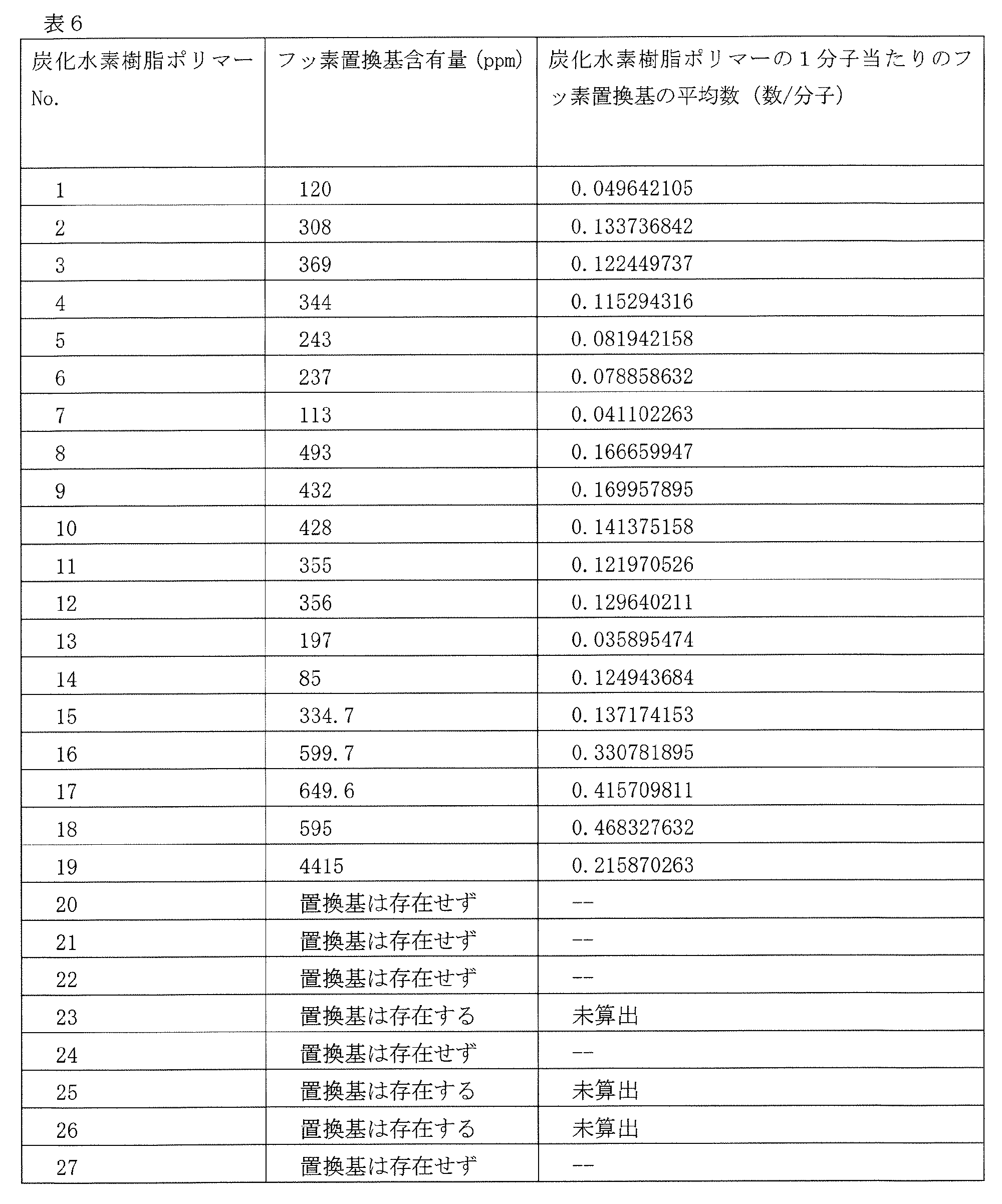
上表6によれば、炭化水素樹脂ポリマー20、21、22、および24はフッ素置換基を有していない。さらに、ジシクロペンタジエンではなく、ノルボルネンから重合された炭化水素樹脂ポリマー27はフッ素置換基を有していない。ジシクロペンタジエンおよびフッ素含有化合物がフッ素置換基を有する炭化水素樹脂ポリマーの作製に必要であるということは明らかである。
According to Table 6 above,
表5および表6によれば、フッ素置換基を有する炭化水素樹脂ポリマーは損失係数(Df)がより低い。フッ素置換基を有する炭化水素樹脂ポリマーがより良好な電気的性能を備えるということは明らかである。 According to Tables 5 and 6, the hydrocarbon resin polymers having fluorine substituents have a lower loss factor (Df). It is clear that the hydrocarbon resin polymers having fluorine substituents have better electrical performance.
さらに、表4によれば、炭化水素樹脂ポリマー1から19、23、25、および26の全ては、ポリマー分散性指数(PDI)が22未満、数平均分子量(Mn)が2,500から15,000g/mol、および反応性結合の水素含有量が0.2%よりも大きい。炭化水素樹脂ポリマー1から19、25、および26はいずれも、反応性結合の水素含有量が10%未満である。いくつかの実施形態において、本開示の炭化水素樹脂ポリマーは、より良好な電気的性能を備えることに加え、良好な熱的性質または加工性も有し得るということが明らかである。本開示の炭化水素樹脂ポリマーを含む樹脂組成物は、良好な剥離強度を有する樹脂層を形成し得る。上記樹脂層を含む基板構造は、良好な電気的性能(誘電特性)を備え得る。いくつかの実施形態において、樹脂層を含む基板構造は、良好な熱性能、加工性、および/または信頼性も備え得る。 Furthermore, according to Table 4, the hydrocarbon resin polymers 1 to 19, 23, 25, and 26 all have a polymer dispersibility index (PDI) of less than 22, a number average molecular weight (Mn) of 2,500 to 15,000 g/mol, and a hydrogen content of reactive bonds greater than 0.2%. The hydrocarbon resin polymers 1 to 19, 25, and 26 all have a hydrogen content of reactive bonds less than 10%. It is clear that in some embodiments, the hydrocarbon resin polymers of the present disclosure may have better thermal properties or processability in addition to having better electrical performance. The resin composition including the hydrocarbon resin polymer of the present disclosure may form a resin layer with good peel strength. The substrate structure including the resin layer may have good electrical performance (dielectric properties). In some embodiments, the substrate structure including the resin layer may also have good thermal performance, processability, and/or reliability.
本発明を実施例の方式、および好ましい実施形態により説明したが、本発明は開示された実施形態に限定されないということを理解すべきである。むしろ、(当業者には明らかであるような)各種変更や類似の構成をカバーするように意図されている。よって、添付のクレームの範囲は、かかる変更や類似の構成がすべて包含されるように、最も広い解釈が与えられなければならない。
While the present invention has been described by way of example and in terms of a preferred embodiment, it is to be understood that the invention is not limited to the disclosed embodiment. On the contrary, it is intended to cover various modifications and similar arrangements (as would be apparent to those skilled in the art). Thus, the scope of the appended claims should be accorded the broadest interpretation so as to encompass all such modifications and similar arrangements.
Claims (20)
ジシクロペンタジエン(DCPD)から誘導された繰り返し単位(A)を含み、
前記炭化水素樹脂ポリマーがフッ素置換基を有し、前記炭化水素樹脂ポリマーの総重量に対し、前記フッ素置換基の含有量が100から4500ppmである、炭化水素樹脂ポリマー。 1. A hydrocarbon resin polymer comprising:
Contains a repeating unit (A) derived from dicyclopentadiene (DCPD),
The hydrocarbon resin polymer has a fluorine substituent, and the content of the fluorine substituent is from 100 to 4500 ppm based on the total weight of the hydrocarbon resin polymer.
ジビニル芳香族化合物から誘導された繰り返し単位(C)と、
をさらに含む請求項1に記載の炭化水素樹脂ポリマー。 A repeating unit (B) derived from a monovinyl aromatic compound;
A repeating unit (C) derived from a divinyl aromatic compound;
The hydrocarbon resin polymer of claim 1 further comprising:

(式中、R1、R2、R3、およびR4はそれぞれ独立にHまたはC1-20アルキル基であり、Ar1およびAr2はフェニレン基である。*は、前記架橋可能な繰り返し単位(C1)および前記架橋された繰り返し単位(C2)が他の基または単位と連結する位置を示す。)
前記炭化水素樹脂ポリマー中の全ての単位の合計を100mol%として、前記架橋可能な繰り返し単位(C1)の含有量が1から30mol%である、請求項6に記載の炭化水素樹脂ポリマー。 The repeating unit (C) comprises a crosslinkable repeating unit (C1) and a crosslinked repeating unit (C2),
(In the formula, R1, R2, R3, and R4 are each independently H or a C1-20 alkyl group, and Ar1 and Ar2 are phenylene groups. * indicates the position where the crosslinkable repeating unit (C1) and the crosslinked repeating unit (C2) are linked to other groups or units.)
7. The hydrocarbon resin polymer according to claim 6, wherein the content of the crosslinkable repeating unit (C1) is from 1 to 30 mol %, with the sum of all units in the hydrocarbon resin polymer being 100 mol %.
フッ素含有化合物の存在下、混合物を重合するステップを含み、前記フッ素含有化合物が三フッ化ホウ素錯体であり、前記混合物がジシクロペンタジエンを含む、
炭化水素樹脂ポリマーの製造方法。 1. A method for producing a hydrocarbon resin polymer, comprising the steps of:
polymerizing the mixture in the presence of a fluorine-containing compound, the fluorine-containing compound being a boron trifluoride complex and the mixture comprising dicyclopentadiene;
A method for producing a hydrocarbon resin polymer.
樹脂層と、
前記樹脂層上に配置された導電層と、
を含み、
前記樹脂層が架橋プロセスを用いて樹脂組成物から形成され、前記樹脂組成物には炭化水素樹脂ポリマーが含まれ、前記炭化水素樹脂ポリマーはフッ素置換基を有し、かつジシクロペンタジエン(DCPD)から誘導された繰り返し単位(A)を含み、
前記炭化水素樹脂ポリマーの総重量に対し、前記フッ素置換基の含有量が100から4500ppmである、基板構造。 A substrate structure, comprising:
A resin layer;
a conductive layer disposed on the resin layer;
Including,
The resin layer is formed from a resin composition using a crosslinking process, the resin composition includes a hydrocarbon resin polymer, the hydrocarbon resin polymer has a fluorine substituent and includes a repeat unit (A) derived from dicyclopentadiene (DCPD);
A substrate structure, wherein the content of said fluorine substituents is from 100 to 4500 ppm based on the total weight of said hydrocarbon resin polymer.
モノビニル芳香族化合物から誘導された繰り返し単位(B)と、
ジビニル芳香族化合物から誘導された繰り返し単位(C)と
をさらに含む、請求項16に記載の基板構造。 The hydrocarbon resin polymer
A repeating unit (B) derived from a monovinyl aromatic compound;
17. The substrate structure of claim 16, further comprising a repeat unit (C) derived from a divinylaromatic compound.
20. The substrate structure according to claim 19, wherein the sum of the repeating units (A) and (C) is 13 mol % or more, with the sum of all units in the hydrocarbon resin polymer being 100 mol %.
Applications Claiming Priority (4)
| Application Number | Priority Date | Filing Date | Title |
|---|---|---|---|
| US202363585037P | 2023-09-25 | 2023-09-25 | |
| US63/585,037 | 2023-09-25 | ||
| TW113134063A TWI907060B (en) | 2023-09-25 | 2024-09-09 | Hydrocarbon resin polymer and manufacturing method thereof and substrate structure |
| TW113134063 | 2024-09-09 |
Publications (1)
| Publication Number | Publication Date |
|---|---|
| JP2025066648A true JP2025066648A (en) | 2025-04-23 |
Family
ID=92909646
Family Applications (1)
| Application Number | Title | Priority Date | Filing Date |
|---|---|---|---|
| JP2024163893A Revoked JP2025066648A (en) | 2023-09-25 | 2024-09-20 | Hydrocarbon resin polymer and method for producing the same, and substrate structure |
Country Status (5)
| Country | Link |
|---|---|
| US (1) | US20250101151A1 (en) |
| EP (1) | EP4527617A1 (en) |
| JP (1) | JP2025066648A (en) |
| KR (1) | KR20250045491A (en) |
| CN (1) | CN119684501A (en) |
Citations (6)
| Publication number | Priority date | Publication date | Assignee | Title |
|---|---|---|---|---|
| JPS5636516A (en) * | 1979-07-17 | 1981-04-09 | Unilever Nv | Hydrocarbon resin and adhesive containing it |
| WO2000035988A1 (en) * | 1998-12-15 | 2000-06-22 | Nippon Petrochemicals Company, Limited | Processes for producing phenolic resin and epoxy resin |
| US6211315B1 (en) * | 1998-11-12 | 2001-04-03 | Iowa State University Research Foundation, Inc. | Lewis acid-catalyzed polymerization of biological oils and resulting polymeric materials |
| JP2018039995A (en) * | 2016-08-31 | 2018-03-15 | 新日鉄住金化学株式会社 | Soluble polyfunctional vinyl aromatic copolymer, process for producing the same, curable resin composition, and cured product thereof |
| JP2020105352A (en) * | 2018-12-27 | 2020-07-09 | 日鉄ケミカル&マテリアル株式会社 | Curable resin composition, prepreg, metal-clad laminate, printed wiring board |
| JP2023104928A (en) * | 2021-08-17 | 2023-07-28 | ダイキン工業株式会社 | Copolymer and resin composition |
Family Cites Families (1)
| Publication number | Priority date | Publication date | Assignee | Title |
|---|---|---|---|---|
| CN112079978B (en) * | 2020-08-31 | 2022-08-23 | 江苏东材新材料有限责任公司 | DCPD-bisphenol type benzoxazine resin and copper-clad plate composition and preparation method thereof |
-
2024
- 2024-09-20 JP JP2024163893A patent/JP2025066648A/en not_active Revoked
- 2024-09-23 CN CN202411323525.9A patent/CN119684501A/en active Pending
- 2024-09-25 EP EP24202427.1A patent/EP4527617A1/en active Pending
- 2024-09-25 KR KR1020240129996A patent/KR20250045491A/en active Pending
- 2024-09-25 US US18/895,861 patent/US20250101151A1/en active Pending
Patent Citations (6)
| Publication number | Priority date | Publication date | Assignee | Title |
|---|---|---|---|---|
| JPS5636516A (en) * | 1979-07-17 | 1981-04-09 | Unilever Nv | Hydrocarbon resin and adhesive containing it |
| US6211315B1 (en) * | 1998-11-12 | 2001-04-03 | Iowa State University Research Foundation, Inc. | Lewis acid-catalyzed polymerization of biological oils and resulting polymeric materials |
| WO2000035988A1 (en) * | 1998-12-15 | 2000-06-22 | Nippon Petrochemicals Company, Limited | Processes for producing phenolic resin and epoxy resin |
| JP2018039995A (en) * | 2016-08-31 | 2018-03-15 | 新日鉄住金化学株式会社 | Soluble polyfunctional vinyl aromatic copolymer, process for producing the same, curable resin composition, and cured product thereof |
| JP2020105352A (en) * | 2018-12-27 | 2020-07-09 | 日鉄ケミカル&マテリアル株式会社 | Curable resin composition, prepreg, metal-clad laminate, printed wiring board |
| JP2023104928A (en) * | 2021-08-17 | 2023-07-28 | ダイキン工業株式会社 | Copolymer and resin composition |
Also Published As
| Publication number | Publication date |
|---|---|
| US20250101151A1 (en) | 2025-03-27 |
| KR20250045491A (en) | 2025-04-01 |
| EP4527617A1 (en) | 2025-03-26 |
| CN119684501A (en) | 2025-03-25 |
Similar Documents
| Publication | Publication Date | Title |
|---|---|---|
| Liu et al. | Soluble aromatic poly (ether ketone) s with a pendant 3, 5-ditrifluoromethylphenyl group | |
| Liu et al. | Poly (aryl ether ketone) s with (3‐methyl) phenyl and (3‐trifluoromethyl) phenyl side groups | |
| JP6976981B2 (en) | A functionalized poly (2,6-dimethylphenylene oxide) oligomer having dicyclopentadiene, a method for producing the same, and its use. | |
| CN104130391B (en) | Polyphenol ether oligomers and products containing the same | |
| TWI621679B (en) | Polyphenylene ether oligomer and high-frequency copper clad laminate | |
| KR101046430B1 (en) | Norbornene-based polymers with low dielectric constant and low loss characteristics, insulating materials, printed circuit boards and functional devices using them | |
| US11787904B2 (en) | Phosphinated (2,6-dimethylphenyl ether) oligomer, preparation method thereof and cured product | |
| JP5708160B2 (en) | Resin substrate for high frequency circuit board and high frequency circuit board | |
| JP2025066648A (en) | Hydrocarbon resin polymer and method for producing the same, and substrate structure | |
| JP2008260915A (en) | Novel alicyclic vinyl ether polymer | |
| TWI907060B (en) | Hydrocarbon resin polymer and manufacturing method thereof and substrate structure | |
| CN106496529A (en) | A kind of low-k diacetylene polymer, Its Preparation Method And Use | |
| TW202513599A (en) | Hydrocarbon resin polymer and manufacturing method thereof and substrate structure | |
| JP7661392B2 (en) | Hydrocarbon resin polymers, methods for making same, and compositions and substrates containing same | |
| TWI846266B (en) | Preparation method of polyphenylene ether oligomer and composite copper foil substrate | |
| Tkachenko et al. | New acetyl-containing aromatic polyether with perfluorinated mono-and biphenylene fragments | |
| CN115637020A (en) | Hyperbranched epoxy resin thermosetting resin composition and application thereof | |
| JP2025037818A (en) | Resin composition, its manufacturing method, and substrate structure | |
| US6815523B2 (en) | Polyether and its production method | |
| TWI880163B (en) | Hydrocarbon resin polymer, preparation method thereof, and composition and substrate including the same | |
| Haider et al. | A low-dielectric, high-heat-resistant vinylbenzyl-terminated bisphenol A formaldehyde resin | |
| WO2024117252A1 (en) | Polyaryl ether ketone resin material for electronic equipment/devices and electronic equipment/devices using same | |
| TW202509098A (en) | Resin composition and manufacturing method thereof and substrate structure | |
| JP4350087B2 (en) | Fluorine-containing terphenyl dihydroxy monomer and fluorine-containing poly (arylene ether sulfide) produced using this monomer | |
| KR101085047B1 (en) | Method for producing a polyether sulfone resin having a layered structure |
Legal Events
| Date | Code | Title | Description |
|---|---|---|---|
| A621 | Written request for application examination |
Free format text: JAPANESE INTERMEDIATE CODE: A621 Effective date: 20240920 |
|
| AA91 | Notification that invitation to amend document was cancelled |
Free format text: JAPANESE INTERMEDIATE CODE: A971091 Effective date: 20250304 |
|
| A131 | Notification of reasons for refusal |
Free format text: JAPANESE INTERMEDIATE CODE: A131 Effective date: 20250909 |
|
| A977 | Report on retrieval |
Free format text: JAPANESE INTERMEDIATE CODE: A971007 Effective date: 20250917 |
|
| A521 | Request for written amendment filed |
Free format text: JAPANESE INTERMEDIATE CODE: A523 Effective date: 20251209 |