JP2025011910A - Non-aqueous electrolyte secondary battery - Google Patents
Non-aqueous electrolyte secondary battery Download PDFInfo
- Publication number
- JP2025011910A JP2025011910A JP2023114326A JP2023114326A JP2025011910A JP 2025011910 A JP2025011910 A JP 2025011910A JP 2023114326 A JP2023114326 A JP 2023114326A JP 2023114326 A JP2023114326 A JP 2023114326A JP 2025011910 A JP2025011910 A JP 2025011910A
- Authority
- JP
- Japan
- Prior art keywords
- positive electrode
- active material
- electrode active
- material layer
- secondary battery
- Prior art date
- Legal status (The legal status is an assumption and is not a legal conclusion. Google has not performed a legal analysis and makes no representation as to the accuracy of the status listed.)
- Pending
Links
Images

Classifications
-
- H—ELECTRICITY
- H01—ELECTRIC ELEMENTS
- H01M—PROCESSES OR MEANS, e.g. BATTERIES, FOR THE DIRECT CONVERSION OF CHEMICAL ENERGY INTO ELECTRICAL ENERGY
- H01M4/00—Electrodes
- H01M4/02—Electrodes composed of, or comprising, active material
- H01M4/36—Selection of substances as active materials, active masses, active liquids
- H01M4/48—Selection of substances as active materials, active masses, active liquids of inorganic oxides or hydroxides
- H01M4/52—Selection of substances as active materials, active masses, active liquids of inorganic oxides or hydroxides of nickel, cobalt or iron
- H01M4/525—Selection of substances as active materials, active masses, active liquids of inorganic oxides or hydroxides of nickel, cobalt or iron of mixed oxides or hydroxides containing iron, cobalt or nickel for inserting or intercalating light metals, e.g. LiNiO2, LiCoO2 or LiCoOxFy
-
- H—ELECTRICITY
- H01—ELECTRIC ELEMENTS
- H01M—PROCESSES OR MEANS, e.g. BATTERIES, FOR THE DIRECT CONVERSION OF CHEMICAL ENERGY INTO ELECTRICAL ENERGY
- H01M4/00—Electrodes
- H01M4/02—Electrodes composed of, or comprising, active material
- H01M4/62—Selection of inactive substances as ingredients for active masses, e.g. binders, fillers
- H01M4/624—Electric conductive fillers
- H01M4/625—Carbon or graphite
-
- H—ELECTRICITY
- H01—ELECTRIC ELEMENTS
- H01M—PROCESSES OR MEANS, e.g. BATTERIES, FOR THE DIRECT CONVERSION OF CHEMICAL ENERGY INTO ELECTRICAL ENERGY
- H01M10/00—Secondary cells; Manufacture thereof
- H01M10/05—Accumulators with non-aqueous electrolyte
- H01M10/052—Li-accumulators
- H01M10/0525—Rocking-chair batteries, i.e. batteries with lithium insertion or intercalation in both electrodes; Lithium-ion batteries
-
- H—ELECTRICITY
- H01—ELECTRIC ELEMENTS
- H01M—PROCESSES OR MEANS, e.g. BATTERIES, FOR THE DIRECT CONVERSION OF CHEMICAL ENERGY INTO ELECTRICAL ENERGY
- H01M10/00—Secondary cells; Manufacture thereof
- H01M10/05—Accumulators with non-aqueous electrolyte
- H01M10/056—Accumulators with non-aqueous electrolyte characterised by the materials used as electrolytes, e.g. mixed inorganic/organic electrolytes
- H01M10/0564—Accumulators with non-aqueous electrolyte characterised by the materials used as electrolytes, e.g. mixed inorganic/organic electrolytes the electrolyte being constituted of organic materials only
- H01M10/0566—Liquid materials
- H01M10/0567—Liquid materials characterised by the additives
-
- H—ELECTRICITY
- H01—ELECTRIC ELEMENTS
- H01M—PROCESSES OR MEANS, e.g. BATTERIES, FOR THE DIRECT CONVERSION OF CHEMICAL ENERGY INTO ELECTRICAL ENERGY
- H01M10/00—Secondary cells; Manufacture thereof
- H01M10/42—Methods or arrangements for servicing or maintenance of secondary cells or secondary half-cells
- H01M10/4235—Safety or regulating additives or arrangements in electrodes, separators or electrolyte
-
- H—ELECTRICITY
- H01—ELECTRIC ELEMENTS
- H01M—PROCESSES OR MEANS, e.g. BATTERIES, FOR THE DIRECT CONVERSION OF CHEMICAL ENERGY INTO ELECTRICAL ENERGY
- H01M4/00—Electrodes
- H01M4/02—Electrodes composed of, or comprising, active material
- H01M4/13—Electrodes for accumulators with non-aqueous electrolyte, e.g. for lithium-accumulators; Processes of manufacture thereof
- H01M4/131—Electrodes based on mixed oxides or hydroxides, or on mixtures of oxides or hydroxides, e.g. LiCoOx
-
- H—ELECTRICITY
- H01—ELECTRIC ELEMENTS
- H01M—PROCESSES OR MEANS, e.g. BATTERIES, FOR THE DIRECT CONVERSION OF CHEMICAL ENERGY INTO ELECTRICAL ENERGY
- H01M4/00—Electrodes
- H01M4/02—Electrodes composed of, or comprising, active material
- H01M2004/021—Physical characteristics, e.g. porosity, surface area
-
- H—ELECTRICITY
- H01—ELECTRIC ELEMENTS
- H01M—PROCESSES OR MEANS, e.g. BATTERIES, FOR THE DIRECT CONVERSION OF CHEMICAL ENERGY INTO ELECTRICAL ENERGY
- H01M4/00—Electrodes
- H01M4/02—Electrodes composed of, or comprising, active material
- H01M2004/026—Electrodes composed of, or comprising, active material characterised by the polarity
- H01M2004/028—Positive electrodes
-
- H—ELECTRICITY
- H01—ELECTRIC ELEMENTS
- H01M—PROCESSES OR MEANS, e.g. BATTERIES, FOR THE DIRECT CONVERSION OF CHEMICAL ENERGY INTO ELECTRICAL ENERGY
- H01M2220/00—Batteries for particular applications
- H01M2220/20—Batteries in motive systems, e.g. vehicle, ship, plane
-
- H—ELECTRICITY
- H01—ELECTRIC ELEMENTS
- H01M—PROCESSES OR MEANS, e.g. BATTERIES, FOR THE DIRECT CONVERSION OF CHEMICAL ENERGY INTO ELECTRICAL ENERGY
- H01M2300/00—Electrolytes
- H01M2300/0017—Non-aqueous electrolytes
- H01M2300/0025—Organic electrolyte
-
- Y—GENERAL TAGGING OF NEW TECHNOLOGICAL DEVELOPMENTS; GENERAL TAGGING OF CROSS-SECTIONAL TECHNOLOGIES SPANNING OVER SEVERAL SECTIONS OF THE IPC; TECHNICAL SUBJECTS COVERED BY FORMER USPC CROSS-REFERENCE ART COLLECTIONS [XRACs] AND DIGESTS
- Y02—TECHNOLOGIES OR APPLICATIONS FOR MITIGATION OR ADAPTATION AGAINST CLIMATE CHANGE
- Y02E—REDUCTION OF GREENHOUSE GAS [GHG] EMISSIONS, RELATED TO ENERGY GENERATION, TRANSMISSION OR DISTRIBUTION
- Y02E60/00—Enabling technologies; Technologies with a potential or indirect contribution to GHG emissions mitigation
- Y02E60/10—Energy storage using batteries
Landscapes
- Chemical & Material Sciences (AREA)
- General Chemical & Material Sciences (AREA)
- Chemical Kinetics & Catalysis (AREA)
- Electrochemistry (AREA)
- Engineering & Computer Science (AREA)
- Manufacturing & Machinery (AREA)
- Materials Engineering (AREA)
- Inorganic Chemistry (AREA)
- General Physics & Mathematics (AREA)
- Condensed Matter Physics & Semiconductors (AREA)
- Physics & Mathematics (AREA)
- Battery Electrode And Active Subsutance (AREA)
- Secondary Cells (AREA)
Abstract
Description
本発明は、非水電解質二次電池に関する。 The present invention relates to a non-aqueous electrolyte secondary battery.
近年、リチウムイオン二次電池等の非水電解質二次電池は、パソコン、携帯端末等のポータブル電源や、電気自動車(BEV)、ハイブリッド自動車(HEV)、プラグインハイブリッド自動車(PHEV)等の車両駆動用電源などに好適に用いられている。 In recent years, non-aqueous electrolyte secondary batteries such as lithium-ion secondary batteries have been used favorably as portable power sources for personal computers, mobile terminals, and the like, as well as power sources for driving vehicles such as electric vehicles (BEVs), hybrid electric vehicles (HEVs), and plug-in hybrid electric vehicles (PHEVs).
リチウムイオン二次電池等の非水電解質二次電池に用いられる正極は、一般的に、正極集電体上に正極活物質層が設けられた構成を有する。正極活物質層は、正極活物質粒子を含んでおり、正極活物質層は、正極活物質粒子間の空隙によって形成された細孔を有する(例えば、特許文献1~3参照)。非水電解質二次電池の高性能化のために、非水電解質に、正極に被膜を形成する添加剤(いわゆる「正極被膜形成剤」、「正極添加剤」とも呼ばれる)を含有させる技術が知られている(例えば、特許文献2参照)。 Positive electrodes used in non-aqueous electrolyte secondary batteries such as lithium ion secondary batteries generally have a configuration in which a positive electrode active material layer is provided on a positive electrode current collector. The positive electrode active material layer contains positive electrode active material particles, and the positive electrode active material layer has pores formed by the gaps between the positive electrode active material particles (see, for example, Patent Documents 1 to 3). In order to improve the performance of non-aqueous electrolyte secondary batteries, a technique is known in which the non-aqueous electrolyte contains an additive that forms a film on the positive electrode (also called a "positive electrode film forming agent" or "positive electrode additive") (see, for example, Patent Document 2).
昨今、BEVの需要が急速に増大しており、BEVの駆動電源用二次電池のさらなる高性能化が望まれている。高性能化の方法の一つとして、正極活物質層を高密度化する方法が挙げられる。本発明者が鋭意検討した結果、正極活物質層を高密度化する場合に、以下の問題があることを見出した。すなわち、正極活物質層を高密度化すると、正極活物質層の細孔径が小さくなり過ぎて、正極活物質層の細孔の細部にまで正極被膜形成剤が浸透し難くなる。その結果、正極活物質層において、被膜が均一に形成され難くなり、非水電解質二次電池の耐久性の低下を招く。具体的には、非水電解質二次電池の保存時の容量劣化が大きくなる。また車両駆動用電源に用いられる二次電池には、高い初期抵抗特性が求められている。 Recently, the demand for BEVs has been rapidly increasing, and there is a demand for further improvement in the performance of secondary batteries for driving power sources of BEVs. One method for improving performance is to densify the positive electrode active material layer. As a result of intensive research by the present inventor, it has been found that there are the following problems when densifying the positive electrode active material layer. That is, when the positive electrode active material layer is densified, the pore diameter of the positive electrode active material layer becomes too small, making it difficult for the positive electrode coating agent to penetrate into the fine pores of the positive electrode active material layer. As a result, it becomes difficult to form a uniform coating in the positive electrode active material layer, leading to a decrease in the durability of the non-aqueous electrolyte secondary battery. Specifically, the capacity deterioration during storage of the non-aqueous electrolyte secondary battery becomes large. In addition, high initial resistance characteristics are required for secondary batteries used as vehicle driving power sources.
そこで本発明は、正極活物質層の細孔が小さいにも関わらず、初期抵抗特性および保存特性に優れる非水電解質二次電池を提供することを目的とする。 The present invention aims to provide a nonaqueous electrolyte secondary battery that has excellent initial resistance characteristics and storage characteristics despite the small pores in the positive electrode active material layer.
ここに開示される非水電解質二次電池は、正極、負極、および非水電解質を含有する。前記正極は、正極集電体、および前記正極集電体上に支持された正極活物質層を備える。前記正極活物質層は、正極活物質、および導電材を含有する。前記正極活物質層のピーク細孔径は、0.50μm~0.70μmである。前記正極活物質層中の前記導電材の含有量は、0.2質量%~1.0質量%である。前記導電材の80質量%以上は、カーボンナノチューブである。前記非水電解質は、非水溶媒、電解質塩、および正極被膜形成剤を含有する。 The nonaqueous electrolyte secondary battery disclosed herein contains a positive electrode, a negative electrode, and a nonaqueous electrolyte. The positive electrode includes a positive electrode current collector, and a positive electrode active material layer supported on the positive electrode current collector. The positive electrode active material layer contains a positive electrode active material and a conductive material. The peak pore size of the positive electrode active material layer is 0.50 μm to 0.70 μm. The content of the conductive material in the positive electrode active material layer is 0.2 mass % to 1.0 mass %. At least 80 mass % of the conductive material is carbon nanotubes. The nonaqueous electrolyte contains a nonaqueous solvent, an electrolyte salt, and a positive electrode coating agent.
このような構成によれば、正極活物質層の細孔が小さいにも関わらず、初期抵抗特性および保存特性に優れる非水電解質二次電池を提供することができる。 With this configuration, it is possible to provide a nonaqueous electrolyte secondary battery that has excellent initial resistance characteristics and storage characteristics, despite the small pores in the positive electrode active material layer.
以下、図面を参照しながら本発明に係る実施の形態を説明する。なお、本明細書において言及していない事柄であって本発明の実施に必要な事柄は、当該分野における従来技術に基づく当業者の設計事項として把握され得る。本発明は、本明細書に開示されている内容と当該分野における技術常識とに基づいて実施することができる。また、以下の図面においては、同じ作用を奏する部材・部位には同じ符号を付して説明している。また、各図における寸法関係(長さ、幅、厚み等)は実際の寸法関係を反映するものではない。なお、本明細書において「A~B」として表現される数値範囲には、AおよびBが含まれる。 Below, the embodiments of the present invention will be described with reference to the drawings. Note that matters not mentioned in this specification but necessary for implementing the present invention can be understood as design matters for a person skilled in the art based on the prior art in the relevant field. The present invention can be implemented based on the contents disclosed in this specification and the technical common sense in the relevant field. In addition, in the following drawings, the same reference numerals are used to describe members and parts that perform the same function. Also, the dimensional relationships (length, width, thickness, etc.) in each figure do not reflect the actual dimensional relationships. Note that the numerical ranges expressed as "A to B" in this specification include A and B.
なお、本明細書において「二次電池」とは、繰り返し充放電可能な蓄電デバイスを指す。また、本明細書において「リチウムイオン二次電池」とは、電荷担体としてリチウムイオンを利用し、正負極間におけるリチウムイオンに伴う電荷の移動により充放電が実現される二次電池を指す。さらに、本明細書において「電気自動車(BEV)」とは、二次電池によって作動するモータを動力源として備える一方で、ガソリンエンジン等の内燃機関を備えていない自動車のことを指す。 In this specification, the term "secondary battery" refers to an electricity storage device that can be repeatedly charged and discharged. In addition, in this specification, the term "lithium ion secondary battery" refers to a secondary battery that uses lithium ions as a charge carrier and realizes charging and discharging by the transfer of charge associated with the lithium ions between the positive and negative electrodes. Furthermore, in this specification, the term "electric vehicle (BEV)" refers to a vehicle that has a motor operated by a secondary battery as a power source, but does not have an internal combustion engine such as a gasoline engine.
以下、扁平形状の捲回電極体と扁平形状の電池ケースとを有する扁平角型のリチウムイオン二次電池を例にして、本発明について詳細に説明するが、本発明をかかる実施形態に記載されたものに限定することを意図したものではない。 The present invention will be described in detail below using as an example a flat prismatic lithium ion secondary battery having a flat wound electrode body and a flat battery case, but it is not intended to limit the present invention to the embodiment described.
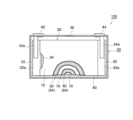
図1に示すリチウムイオン二次電池100は、扁平形状の捲回電極体20と非水電解質80とが扁平な角形の電池ケース(即ち外装容器)30に収容されることにより構築される密閉型電池である。電池ケース30には外部接続用の正極端子42および負極端子44と、電池ケース30の内圧が所定レベル以上に上昇した場合に該内圧を開放するように設定された薄肉の安全弁36とが設けられている。また、電池ケース30には、非水電解質80を注入するための注入口(図示せず)が設けられている。正極端子42は、正極集電板42aと電気的に接続されている。負極端子44は、負極集電板44aと電気的に接続されている。電池ケース30の材質としては、例えば、アルミニウム等の軽量で熱伝導性の良い金属材料が用いられる。なお、図1は、非水電解質80の量を正確に表すものではない。
The lithium ion
捲回電極体20は、図1および図2に示すように、正極シート50と、負極シート60とが、2枚の長尺状のセパレータシート70を介して重ね合わされて長手方向に捲回された形態を有する。正極シート50は、長尺状の正極集電体52の片面または両面(ここでは両面)に長手方向に沿って正極活物質層54が形成された構成を有する。負極シート60は、長尺状の負極集電体62の片面または両面(ここでは両面)に長手方向に沿って負極活物質層64が形成されている構成を有する。正極活物質層非形成部分52a(すなわち、正極活物質層54が形成されずに正極集電体52が露出した部分)および負極活物質層非形成部分62a(すなわち、負極活物質層64が形成されずに負極集電体62が露出した部分)は、捲回電極体20の捲回軸方向(すなわち、上記長手方向に直交するシート幅方向)の両端から外方にはみ出すように形成されている。正極活物質層非形成部分52aおよび負極活物質層非形成部分62aには、それぞれ正極集電板42aおよび負極集電板44aが接合されている。
As shown in Figures 1 and 2, the
正極シート50を構成する正極集電体52としては、リチウムイオン二次電池に用いられる公知の正極集電体を用いてよく、その例としては、導電性の良好な金属(例えば、アルミニウム、ニッケル、チタン、ステンレス鋼等)製のシートまたは箔が挙げられる。正極集電体52としては、アルミニウム箔が好ましい。
The positive electrode
正極集電体52の寸法は特に限定されず、電池設計に応じて適宜決定すればよい。正極集電体52としてアルミニウム箔を用いる場合には、その厚みは、特に限定されないが、例えば5μm以上35μm以下であり、好ましくは7μm以上20μm以下である。
The dimensions of the
正極活物質層54は、正極活物質、および導電材を含有する。正極活物質としては、リチウムイオン二次電池に用いられる公知の正極活物質を用いてよい。具体的に例えば、正極活物質として、リチウム複合酸化物、リチウム遷移金属リン酸化合物等を用いることができる。正極活物質の結晶構造は、特に限定されず、層状構造、スピネル構造、オリビン構造等であってよい。
The positive electrode
リチウム複合酸化物としては、遷移金属元素として、Ni、Co、Mnのうちの少なくとも1種を含むリチウム遷移金属複合酸化物が好ましく、その具体例としては、リチウムニッケル系複合酸化物、リチウムコバルト系複合酸化物、リチウムマンガン系複合酸化物、リチウムニッケルマンガン系複合酸化物、リチウムニッケルコバルトマンガン系複合酸化物、リチウムニッケルコバルトアルミニウム系複合酸化物、リチウム鉄ニッケルマンガン系複合酸化物等が挙げられる。 As the lithium composite oxide, a lithium transition metal composite oxide containing at least one of Ni, Co, and Mn as a transition metal element is preferable, and specific examples thereof include lithium nickel composite oxide, lithium cobalt composite oxide, lithium manganese composite oxide, lithium nickel manganese composite oxide, lithium nickel cobalt manganese composite oxide, lithium nickel cobalt aluminum composite oxide, and lithium iron nickel manganese composite oxide.
なお、本明細書において「リチウムニッケルコバルトマンガン系複合酸化物」とは、Li、Ni、Co、Mn、Oを構成元素とする酸化物の他に、それら以外の1種または2種以上の添加的な元素を含んだ酸化物をも包含する用語である。かかる添加的な元素の例としては、Mg、Ca、Al、Ti、V、Cr、Y、Zr、Nb、Mo、Hf、Ta、W、Na、Fe、Zn、Sn等の遷移金属元素や典型金属元素等が挙げられる。また、添加的な元素は、B、C、Si、P等の半金属元素や、S、F、Cl、Br、I等の非金属元素であってもよい。このことは、上記したリチウムニッケル系複合酸化物、リチウムコバルト系複合酸化物、リチウムマンガン系複合酸化物、リチウムニッケルマンガン系複合酸化物、リチウムニッケルコバルトアルミニウム系複合酸化物、リチウム鉄ニッケルマンガン系複合酸化物等についても同様である。 In this specification, the term "lithium nickel cobalt manganese composite oxide" includes oxides containing Li, Ni, Co, Mn, and O as constituent elements, as well as oxides containing one or more additional elements other than those. Examples of such additional elements include transition metal elements and typical metal elements such as Mg, Ca, Al, Ti, V, Cr, Y, Zr, Nb, Mo, Hf, Ta, W, Na, Fe, Zn, and Sn. The additional element may also be a semimetal element such as B, C, Si, or P, or a nonmetal element such as S, F, Cl, Br, or I. This also applies to the above-mentioned lithium nickel composite oxide, lithium cobalt composite oxide, lithium manganese composite oxide, lithium nickel manganese composite oxide, lithium nickel cobalt aluminum composite oxide, and lithium iron nickel manganese composite oxide.
リチウム遷移金属リン酸化合物としては、例えば、リン酸鉄リチウム(LiFePO4)、リン酸マンガンリチウム(LiMnPO4)、リン酸マンガン鉄リチウム等が挙げられる。 Examples of the lithium transition metal phosphate compound include lithium iron phosphate (LiFePO 4 ), lithium manganese phosphate (LiMnPO 4 ), and lithium manganese iron phosphate.
これらの正極活物質は、1種単独で用いてよく、または2種以上を組み合わせて用いてもよい。正極活物質としては、初期抵抗特性等の諸特性に優れることから、リチウムニッケルコバルトマンガン系複合酸化物が特に好ましい。 These positive electrode active materials may be used alone or in combination of two or more. As the positive electrode active material, lithium nickel cobalt manganese composite oxide is particularly preferred because of its excellent properties such as initial resistance.
正極活物質は粒子状であり、正極活物質の平均粒子径(メジアン径:D50)は、特に限定されないが、例えば、0.05μm以上25μm以下であり、好ましくは1μm以上20μm以下であり、より好ましくは3μm以上15μm以下である。なお、正極活物質の平均粒子径(D50)は、例えば、レーザ回折散乱法により求めることができる。 The positive electrode active material is particulate, and the average particle diameter (median diameter: D50) of the positive electrode active material is not particularly limited, but is, for example, 0.05 μm or more and 25 μm or less, preferably 1 μm or more and 20 μm or less, and more preferably 3 μm or more and 15 μm or less. The average particle diameter (D50) of the positive electrode active material can be determined, for example, by a laser diffraction scattering method.
正極活物質層54中の正極活物質の含有量(すなわち、正極活物質層54の全質量に対する正極活物質の含有量)は、特に限定されないが、例えば80質量%以上であり、87質量%以上が好ましく、より好ましくは90質量%以上であり、さらに好ましくは95質量%以上であり、最も好ましくは97質量%以上である。 The content of the positive electrode active material in the positive electrode active material layer 54 (i.e., the content of the positive electrode active material relative to the total mass of the positive electrode active material layer 54) is not particularly limited, but is, for example, 80% by mass or more, preferably 87% by mass or more, more preferably 90% by mass or more, even more preferably 95% by mass or more, and most preferably 97% by mass or more.
本実施形態においては、正極活物質層54の導電材として、カーボンナノチューブ(CNT)が少なくとも使用され、導電材中のCNTの割合は80質量%以上である。CNTは、通常、単独の粒子および/または凝集体の形態で、正極活物質と共に正極活物質層54内で分散している。導電材がCNTを80質量%以上含有することで、リチウムイオン二次電池100の初期抵抗を小さくすることができる。すなわち、リチウムイオン二次電池の初期抵抗特性を高めることができる。
In this embodiment, at least carbon nanotubes (CNTs) are used as the conductive material of the positive electrode
使用されるCNTの種類は特に限定されず、例えば、単層カーボンナノチューブ(SWCNT)、2層カーボンナノチューブ(DWCNT)、多層カーボンナノチューブ(MWCNT)などを用いることができる。これらは、1種単独で、または2種以上を組み合わせて用いることができる。CNTとしては、MWCNTが好ましい。CNTは、アーク放電法、レーザアブレーション法、化学気相成長法等により製造されたものであってよい。 The type of CNT used is not particularly limited, and for example, single-walled carbon nanotubes (SWCNT), double-walled carbon nanotubes (DWCNT), multi-walled carbon nanotubes (MWCNT), etc. can be used. These can be used alone or in combination of two or more. As the CNT, MWCNT is preferable. The CNT may be manufactured by an arc discharge method, a laser ablation method, a chemical vapor deposition method, etc.
CNTの平均長さは特に限定されない。CNTの平均長さが長過ぎると、CNTが凝集して分散性が低下し、正極被膜形成剤を正極活物質層54内に均一に配置させる効果が低下するおそれがある。そのため、CNTの平均長さは、10μm以下が好ましく、5.0μm以下がより好ましく、3.0μm以下がさらに好ましく、1.0μm以下が最も好ましい。一方、CNTの平均長さが短過ぎると、単位重量当たりのCNTの本数が少なくなり過ぎて、正極活物質間の導電パスが形成され難くなるおそれがある。そのため、CNTの平均長さは、0.1μm以上が好ましく、0.2μm以上がより好ましく、0.3μm以上がさらに好ましい。
The average length of the CNTs is not particularly limited. If the average length of the CNTs is too long, the CNTs may aggregate and the dispersibility may decrease, which may reduce the effect of distributing the positive electrode coating agent uniformly in the positive electrode
CNTの平均直径は、特に限定されない。CNTの平均直径が大きすぎると、単位質量当たりのCNTの本数が少なくなり過ぎて、正極活物質間の導電パスが形成され難くなるおそれがある。そのため、CNTの平均直径は、好ましくは50nm以下であり、より好ましくは40nm以下であり、さらに好ましくは30nm以下である。一方で、CNTの平均直径が小さくなり過ぎると、CNTの中空径が小さくなり過ぎて、毛細管現象による非水電解質80の含浸性向上効果が低下するおそれがある。そのため、CNTの平均直径は、好ましくは1nm以上であり、より好ましくは5nm以上であり、さらに好ましくは8nm以上である。
The average diameter of the CNTs is not particularly limited. If the average diameter of the CNTs is too large, the number of CNTs per unit mass may be too small, making it difficult to form a conductive path between the positive electrode active materials. Therefore, the average diameter of the CNTs is preferably 50 nm or less, more preferably 40 nm or less, and even more preferably 30 nm or less. On the other hand, if the average diameter of the CNTs is too small, the hollow diameter of the CNTs may be too small, and the effect of improving the impregnation of the
特に好ましくは、CNTの平均長さが0.3μm~1.0μmであり、かつCNTの平均直径が8nm~30nmである。 Particularly preferably, the average length of the CNTs is 0.3 μm to 1.0 μm, and the average diameter of the CNTs is 8 nm to 30 nm.
なお、CNTの平均長さおよび平均直径は、例えば、CNTの電子顕微鏡写真を撮影し、100個以上のCNTの長さおよび直径の平均値として、それぞれ求めることができる。具体的に例えば、CNT分散液を希釈した後乾燥して、測定試料を調製する。この試料について走査型電子顕微鏡(SEM)観察を行い、100個以上のCNTの長さおよび直径を求め、平均値を算出する。このとき、CNTが再凝集している場合には、凝集したCNTの束に対して、長さおよび直径を求める。 The average length and average diameter of CNTs can be determined, for example, by taking an electron microscope photograph of the CNTs and averaging the lengths and diameters of 100 or more CNTs. Specifically, for example, a CNT dispersion is diluted and then dried to prepare a measurement sample. This sample is observed with a scanning electron microscope (SEM) to determine the lengths and diameters of 100 or more CNTs and calculate the average value. At this time, if the CNTs have re-aggregated, the length and diameter are determined for the bundle of aggregated CNTs.
CNT以外の導電材の例としては、炭素材料(例、アセチレンブラック(AB)等のカーボンブラック、グラファイト等)が挙げられる。なかでも、カーボンブラックが好ましく、アセチレンブラックが特に好ましい。 Examples of conductive materials other than CNT include carbon materials (e.g., carbon black such as acetylene black (AB), graphite, etc.). Of these, carbon black is preferred, and acetylene black is particularly preferred.
リチウムイオン二次電池100の特に高い初期抵抗特性の観点から、導電材中のCNTの割合は、好ましくは90質量%以上であり、より好ましくは100質量%である(すなわち、導電材がCNTのみからなる)。
From the viewpoint of the particularly high initial resistance characteristics of the lithium ion
正極活物質層54中の導電材の含有量は、0.2質量%~1.0質量%である。この意義については後述する。正極活物質層54中の導電材の含有量は、好ましくは0.4質量%~1.0質量%である。このとき、リチウムイオン二次電池100は長期保存時の抵抗増加が高度に抑制されたものとなる。
The content of the conductive material in the positive electrode
正極活物質層54は、正極活物質以外の成分、例えば、リン酸三リチウム、バインダ、カーボンナノチューブ分散剤(CNT分散剤)等を含んでいてもよい。バインダとしては、例えばポリフッ化ビニリデン(PVdF)等を使用し得る。
The positive electrode
CNT分散剤としては、例えば、界面活性剤型分散剤(低分子型分散剤とも呼ばれる)、高分子型分散剤、無機型分散剤等を用いることができる。CNT分散剤は、アニオン性、カチオン性、両性または非イオン性のいずれであってもよい。よって、CNT分散剤は、その分子構造中に、アニオン性基、カチオン性基、およびノニオン性基からなる群より選ばれる少なくとも1種の官能基を有していてもよい。なお、界面活性剤とは、分子構造内に親水性部位と親油性部位を備え、これらが共有結合で結合した化学構造を有する両親媒性物質をいう。 Examples of CNT dispersants that can be used include surfactant-type dispersants (also called low molecular weight dispersants), polymer-type dispersants, and inorganic-type dispersants. CNT dispersants may be anionic, cationic, amphoteric, or nonionic. Thus, the CNT dispersant may have at least one functional group selected from the group consisting of anionic groups, cationic groups, and nonionic groups in its molecular structure. A surfactant is an amphiphilic substance that has a chemical structure in which hydrophilic and lipophilic sites are bonded together by covalent bonds in its molecular structure.
CNT分散剤の具体例としては、ナフタレンスルホン酸ホルマリン縮合物ナトリウム塩、ナフタレンスルホン酸ホルマリン縮合物アンモニウム塩、メチルナフタレンスルホン酸ホルマリン縮合物ナトリウム塩等の重縮合系の芳香族系界面活性剤;ポリアクリル酸およびその塩、ポリメタクリル酸およびその塩等のポリカルボン酸およびその塩;トリアジン誘導体系分散剤(好ましくはカルバゾリル基、またはベンゾイミダゾリル基を含むもの);ポリビニルピロリドン(PVP);ピレン、アントラセン等の多核芳香族を側鎖に有するポリマー;ピレンアンモニウム誘導体(例、ピレンにアンモニウムブロマイド基が導入された化合物)、アントラセンアンモニウム誘導体等の多核芳香族アンモニウム誘導体;などが挙げられる。これらのCNT分散剤は、1種単独で、または2種以上を組み合わせて用いることができる。CNT分散剤としては、多核芳香族を含むものが好ましい。具体的には、CNT分散剤としては、多核芳香族を側鎖に有するポリマー、および多核芳香族アンモニウム誘導体が好ましい。 Specific examples of CNT dispersants include polycondensation aromatic surfactants such as sodium salt of naphthalenesulfonic acid formalin condensate, ammonium salt of naphthalenesulfonic acid formalin condensate, and sodium salt of methylnaphthalenesulfonic acid formalin condensate; polycarboxylic acids and their salts, such as polyacrylic acid and its salts, and polymethacrylic acid and its salts; triazine derivative dispersants (preferably containing a carbazolyl group or a benzimidazolyl group); polyvinylpyrrolidone (PVP); polymers having polynuclear aromatics such as pyrene and anthracene on the side chain; polynuclear aromatic ammonium derivatives such as pyrene ammonium derivatives (e.g., compounds in which an ammonium bromide group is introduced into pyrene) and anthracene ammonium derivatives; and the like. These CNT dispersants can be used alone or in combination of two or more. As CNT dispersants, those containing polynuclear aromatics are preferred. Specifically, as CNT dispersants, polymers having polynuclear aromatics on the side chain and polynuclear aromatic ammonium derivatives are preferred.
正極活物質層54中のリン酸三リチウムの含有量は、特に制限はないが、1質量%以上15質量%以下が好ましく、2質量%以上12質量%以下がより好ましい。正極活物質層54中のバインダの含有量は、特に制限はないが、0.1質量%以上10質量%以下が好ましく、0.2質量%以上5質量%以下がより好ましく、0.3質量%以上2質量%以下がさらに好ましい。
The content of trilithium phosphate in the positive electrode
CNT分散剤の量は、CNTおよびCNT分散剤の種類に応じて適宜決定してよい。ここで、CNT分散剤の割合が小さ過ぎると、分散性が不十分となるおそれがある。一方、CNT分散剤の割合が大き過ぎると、CNT表面に過剰にCNT分散剤が付着して、抵抗増加を起こし得る。CNTがSWCNTである場合には、CNT分散剤の使用量は、CNT100質量部に対して、例えば1質量部~400質量部であり、好ましくは20質量部~200質量部である。CNTがMWNTである場合には、CNT分散剤の使用量は、CNT100質量部に対して、例えば1質量部~100質量部であり、好ましくは4質量部~40質量部である。 The amount of CNT dispersant may be appropriately determined depending on the type of CNT and CNT dispersant. If the proportion of CNT dispersant is too small, dispersibility may be insufficient. On the other hand, if the proportion of CNT dispersant is too large, the CNT dispersant may adhere excessively to the CNT surface, causing an increase in resistance. When the CNTs are SWCNTs, the amount of CNT dispersant used is, for example, 1 to 400 parts by mass, and preferably 20 to 200 parts by mass, relative to 100 parts by mass of CNTs. When the CNTs are MWNTs, the amount of CNT dispersant used is, for example, 1 to 100 parts by mass, and preferably 4 to 40 parts by mass, relative to 100 parts by mass of CNTs.
正極活物質層54は、正極活物質粒子の隙間が連通した細孔を有する。本実施形態においては、正極活物質層54のピーク細孔径が、0.50μm~0.70μmである。本実施形態では、このように正極活物質層54の細孔が小さい。しかしながら、正極活物質層54に、80質量%以上がCNTである導電材を0.2質量%~1.0質量%含有させることにより、リチウムイオン二次電池100の保存特性を向上させることができる。
The positive electrode
導電材の含有量を0.2質量%以上とし、かつ導電材の80質量%以上をCNTとすることで、正極活物質層54の細孔内にあるCNTによる毛細管現象によって、非水電解質80の正極活物質層54への含浸性が向上する。その結果、正極活物質層54の細孔の細部にまで、非水電解質80と共に正極被膜形成剤を供給することができる。その結果、正極活物質層54内に正極被膜形成剤を均一に行き渡らせることができ、リチウムイオン二次電池100を初期充電した際に、正極活物質層54において被膜を均一に形成することができる。これにより、リチウムイオン二次電池100の保存特性を向上させることができる。一方、導電材の含有量が多過ぎると、すなわち1.0質量%を超えると、過剰な導電材によって非水電解質80が細孔内を流通し難くなる。よって、導電材の含有量が1.0質量%以下であることにより、正極活物質層54内に正極被膜形成剤を均一に行き渡らせることができ、前述のリチウムイオン二次電池100の保存特性向上効果を高く得ることができる。
By making the content of the conductive material 0.2% by mass or more and making 80% by mass or more of the conductive material CNT, the impregnation of the
さらに、導電材がCNTを80質量%以上含有することで、正極活物質層54内に良好な導電パスが形成され、リチウムイオン二次電池100の初期抵抗を低減することができ、よって初期抵抗特性を高めることができる。
Furthermore, since the conductive material contains 80% by mass or more of CNT, a good conductive path is formed within the positive electrode
なお、正極活物質層54のピーク細孔径は、水銀圧入法に従って測定することができる。具体的には、正極活物質層54のピーク細孔径は、公知方法に従い、水銀ポロシメーターを用いて測定することができる。
The peak pore diameter of the positive electrode
正極活物質層54の細孔は、正極活物質粒子間の隙間によって形成されている。よって、正極活物質層54のピーク細孔径は、正極活物質層54の空隙率を制御することで調整することができる。正極活物質層54の空隙率が小さい方が、正極活物質層54のピーク細孔径は小さくなる傾向にある。正極活物質層54の空隙率は、正極50を作製する際の正極活物質層54のプレス条件を変更する、正極活物質粒子の粒子径を制御する等によって、調整することができる。あるいは、正極活物質粒子間の隙間に、導電材を配置することで、細孔径を小さくすることができる。したがって、正極活物質層54のピーク細孔径は、導電材の使用量によっても制御することができる。
The pores in the positive electrode
正極活物質層54の空隙率は、好ましくは15体積%~40体積%であり、より好ましくは15体積%~30体積%であり、さらに好ましくは15体積%~25体積%である。正極活物質層54の空隙率は、水銀圧入法に従って測定することができる。具体的には、正極活物質層54の空隙率は、公知方法に従い、水銀ポロシメーターを用いて測定することができる。
The porosity of the positive electrode
正極活物質層54の厚みは、特に限定されないが、例えば、10μm以上400μm以下であり、好ましくは20μm以上300μm以下である。
The thickness of the positive electrode
正極活物質層54の密度は、特に限定されず、例えば、2.00g/cm3~4.00g/cm3である。高い体積エネルギー密度の観点から、正極活物質層54の密度は、好ましくは3.00g/cm3~4.00g/cm3であり、より好ましくは3.40g/cm3~4.00g/cm3であり、さらに好ましくは3.50g/cm3~4.00g/cm3であり、特に好ましくは3.60g/cm3~4.00g/cm3である。
The density of the positive electrode
正極シート50は、正極活物質層非形成部分52aと正極活物質層54との境界部に絶縁層(図示せず)を含有していてもよい。当該絶縁層は、例えば、セラミック粒子等を含有する。
The
負極シート60を構成する負極集電体62としては、リチウムイオン二次電池に用いられる公知の負極集電体を用いてよく、その例としては、導電性の良好な金属(例えば、銅、ニッケル、チタン、ステンレス鋼等)製のシートまたは箔が挙げられる。負極集電体62としては、銅箔が好ましい。
The negative electrode
負極集電体62の寸法は特に限定されず、電池設計に応じて適宜決定すればよい。負極集電体62として銅箔を用いる場合には、その厚みは、特に限定されないが、例えば5μm以上35μm以下であり、好ましくは6μm以上20μm以下である。
The dimensions of the negative electrode
負極活物質層64は負極活物質を含有する。当該負極活物質としては、例えば黒鉛、ハードカーボン、ソフトカーボン等の炭素材料を使用し得る。黒鉛は、天然黒鉛であっても人造黒鉛であってもよく、黒鉛が非晶質な炭素材料で被覆された形態の非晶質炭素被覆黒鉛であってもよい。
The negative electrode
負極活物質の平均粒子径(メジアン径:D50)は、特に限定されないが、例えば、0.1μm以上50μm以下であり、好ましくは1μm以上25μm以下であり、より好ましくは5μm以上20μm以下である。なお、負極活物質の平均粒子径(D50)は、例えば、レーザ回折散乱法により求めることができる。 The average particle diameter (median diameter: D50) of the negative electrode active material is not particularly limited, but is, for example, 0.1 μm or more and 50 μm or less, preferably 1 μm or more and 25 μm or less, and more preferably 5 μm or more and 20 μm or less. The average particle diameter (D50) of the negative electrode active material can be determined, for example, by a laser diffraction scattering method.
負極活物質層64は、活物質以外の成分、例えばバインダや増粘剤等を含み得る。バインダとしては、例えばスチレンブタジエンラバー(SBR)、ポリフッ化ビニリデン(PVdF)等を使用し得る。増粘剤としては、例えばカルボキシメチルセルロース(CMC)等を使用し得る。
The negative electrode
負極活物質層64中の負極活物質の含有量は、90質量%以上が好ましく、95質量%以上99質量%以下がより好ましい。負極活物質層64中のバインダの含有量は、0.1質量%以上8質量%以下が好ましく、0.5質量%以上3質量%以下がより好ましい。負極活物質層64中の増粘剤の含有量は、0.3質量%以上3質量%以下が好ましく、0.5質量%以上2質量%以下がより好ましい。
The content of the negative electrode active material in the negative electrode
負極活物質層64の厚みは、特に限定されないが、例えば、10μm以上400μm以下であり、好ましくは20μm以上300μm以下である。
The thickness of the negative electrode
セパレータ70としては、例えばポリエチレン(PE)、ポリプロピレン(PP)、ポリエステル、セルロース、ポリアミド等の樹脂から構成される多孔性シート(フィルム)が挙げられる。かかる多孔性シートは、単層構造であってもよく、二層以上の積層構造(例えば、PE層の両面にPP層が積層された三層構造)であってもよい。セパレータ70の表面には、セラミック粒子等を含有する耐熱層(HRL)が設けられていてもよい。
The
セパレータ70の厚みは特に限定されないが、例えば5μm以上50μm以下であり、好ましくは10μm以上30μm以下である。セパレータ70のガーレー試験法によって得られる透気度は特に限定されないが、好ましくは350秒/100cc以下である。
The thickness of the
非水電解質80は、非水溶媒と、電解質塩(言い換えると、支持塩)と、正極被膜形成剤と、を含有する。
The
非水溶媒としては、一般的なリチウムイオン二次電池の電解液に用いられる各種のカーボネート類、エーテル類、エステル類、ニトリル類、スルホン類、ラクトン類等の有機溶媒を、特に限定なく用いることができる。なかでも、カーボネート類とエステル類とが好ましく、その具体例としては、エチレンカーボネート(EC)、プロピレンカーボネート(PC)、ジエチルカーボネート(DEC)、ジメチルカーボネート(DMC)、エチルメチルカーボネート(EMC)、モノフルオロエチレンカーボネート(MFEC)、ジフルオロエチレンカーボネート(DFEC)、モノフルオロメチルジフルオロメチルカーボネート(F-DMC)、トリフルオロジメチルカーボネート(TFDMC)、酢酸メチル、プロピオン酸メチル等が例示される。このような非水溶媒は、1種を単独で、あるいは2種以上を適宜組み合わせて用いることができる。非水溶媒は、例えばカーボネート類のみを含有する。非水溶媒は、例えば、カーボネート類とエステル類のみを含有する。 As the non-aqueous solvent, various organic solvents such as carbonates, ethers, esters, nitriles, sulfones, and lactones used in the electrolyte of a general lithium ion secondary battery can be used without any particular limitation. Among them, carbonates and esters are preferable, and specific examples thereof include ethylene carbonate (EC), propylene carbonate (PC), diethyl carbonate (DEC), dimethyl carbonate (DMC), ethyl methyl carbonate (EMC), monofluoroethylene carbonate (MFEC), difluoroethylene carbonate (DFEC), monofluoromethyl difluoromethyl carbonate (F-DMC), trifluorodimethyl carbonate (TFDMC), methyl acetate, and methyl propionate. Such non-aqueous solvents can be used alone or in appropriate combination of two or more. The non-aqueous solvent contains, for example, only carbonates. The non-aqueous solvent contains, for example, only carbonates and esters.
電解質塩としては、例えば、LiPF6、LiBF4、リチウムビス(フルオロスルホニル)イミド(LiFSI)等のリチウム塩(好ましくはLiPF6)を好適に用いることができる。非水電解質80中の電解質塩の濃度は、0.7mol/L以上1.3mol/L以下が好ましい。
As the electrolyte salt, for example, a lithium salt such as LiPF 6 , LiBF 4 , or lithium bis(fluorosulfonyl)imide (LiFSI) (preferably LiPF 6 ) can be suitably used. The concentration of the electrolyte salt in the
正極被膜形成剤は、リチウムイオン二次電池100に初期充電を施した際に、正極活物質層54(特に正極活物質粒子の表面)に被膜を形成する成分であり、正極添加剤とも呼ばれる。正極被膜形成剤としては、ジフルオロリン酸リチウム(LiPO2F2)およびリチウムフルオロ硫酸塩(LiSO3F)からなる群より選ばれる少なくとも1種を好適に用いることができる。これらの使用によれば、リチウムイオン二次電池100の保存特性を特に高くすることができる。
The positive electrode film-forming agent is a component that forms a film on the positive electrode active material layer 54 (particularly the surface of the positive electrode active material particles) when the lithium ion
非水電解質80中の正極被膜形成剤の濃度は特に限定されず、例えば0.05質量%~2.0質量%であり、好ましくは0.1質量%~1.8質量%であり、より好ましくは0.3質量%~1.5質量%である。
The concentration of the positive electrode film forming agent in the
なお、上記非水電解質80は、本発明の効果を著しく損なわない限りにおいて、上述した成分以外の成分、例えば、ビニレンカーボネート(VC)、オキサラト錯体等の負極被膜形成剤;ビフェニル(BP)、シクロヘキシルベンゼン(CHB)等のガス発生剤;増粘剤;等の各種添加剤を含んでいてもよい。
The
リチウムイオン二次電池100においては、正極活物質層の細孔が小さいにも関わらず、長期保存時の容量劣化が抑制されている。また、リチウムイオン二次電池100においては、長期保存時の抵抗増加も良好に抑制されている。よって、リチウムイオン二次電池100は、保存特性に優れる。さらに、リチウムイオン二次電池100は、入力特性にも優れている。さらに、正極50での反応分布が均一になりやすく、それにより負極60の表面上でのリチウム析出もし難くなっており、容量劣化もし難い。
In the lithium ion
リチウムイオン二次電池100は、各種用途に利用可能である。好適な用途としては、電気自動車(BEV)、ハイブリッド自動車(HEV)、プラグインハイブリッド自動車(PHEV)等の車両に搭載される駆動用電源が挙げられる。また、リチウムイオン二次電池100は、小型電力貯蔵装置等の蓄電池として使用することができる。リチウムイオン二次電池100の特に好適な用途は、BEVの駆動用電源である。リチウムイオン二次電池100は、典型的には複数個を直列および/または並列に接続してなる組電池の形態でも使用され得る。
The lithium ion
以上、一例として扁平形状の捲回電極体20を備える角形のリチウムイオン二次電池100について説明した。しかしながら、リチウムイオン二次電池は、積層型電極体(すなわち、複数の正極と、複数の負極とが交互に積層された電極体)を備えるリチウムイオン二次電池として構成することもできる。また、リチウムイオン二次電池は、円筒形リチウムイオン二次電池、ラミネートケース型リチウムイオン二次電池等として構成することもできる。
The above describes, as an example, a rectangular lithium ion
本実施形態に係る二次電池は、公知方法に従ってリチウムイオン二次電池以外の非水電解質二次電池として構成することができる。 The secondary battery according to this embodiment can be constructed as a non-aqueous electrolyte secondary battery other than a lithium ion secondary battery according to known methods.
以下、本発明に関する実施例を詳細に説明するが、本発明をかかる実施例に示すものに限定することを意図したものではない。 The following describes in detail examples of the present invention, but it is not intended that the present invention be limited to those examples.
〔実施例1~3および比較例1~8〕
正極活物質としてのLiNi1/3Co1/3Mn1/3O2と、導電材と、バインダとしてのPVdFとを、活物質:導電材:PVdF=99.5-x:x:0.5の質量比で混合した。なお、導電材としては、MWCNT(平均直径13nm、平均長さ0.5μm)およびアセチレンブラックを用いた。MWCNTは、分散液の形態で使用し、当該分散液は、CNT分散剤としてピレンアンモニウム塩を含有していた。表1に示すx1はMWCNTの質量比であり、表2に示すx2はABの質量比であり、x1とx2の合計が導電材の質量比xである。
[Examples 1 to 3 and Comparative Examples 1 to 8]
LiNi 1/3 Co 1/3 Mn 1/3 O 2 as a positive electrode active material, a conductive material, and PVdF as a binder were mixed in a mass ratio of active material:conductive material:PVdF=99.5-x:x:0.5. Note that MWCNT (average diameter 13 nm, average length 0.5 μm) and acetylene black were used as the conductive material. MWCNT was used in the form of a dispersion liquid, and the dispersion liquid contained pyrene ammonium salt as a CNT dispersant. x1 shown in Table 1 is the mass ratio of MWCNT, x2 shown in Table 2 is the mass ratio of AB, and the sum of x1 and x2 is the mass ratio x of the conductive material.
得られた混合物にN-メチル-2-ピロリドンを適量加えて、正極スラリーを調製した。正極スラリーを、正極集電体としての厚み13μmのアルミニウム箔の両面に塗布した。このとき、リード接続部として、アルミニウム箔上に、正極スラリー未塗工部を設けた。また、正極スラリーの塗布量を、形成される正極活物質層の目付量が、両面の合計で45mg/cm2となるように調整した。 An appropriate amount of N-methyl-2-pyrrolidone was added to the obtained mixture to prepare a positive electrode slurry. The positive electrode slurry was applied to both sides of an aluminum foil having a thickness of 13 μm as a positive electrode current collector. At this time, a positive electrode slurry uncoated portion was provided on the aluminum foil as a lead connection portion. The coating amount of the positive electrode slurry was adjusted so that the basis weight of the positive electrode active material layer formed was 45 mg/ cm2 in total on both sides.
塗布したスラリーを乾燥して正極活物質層を形成した。得られたシートに対してローラーを用いてプレス処理を行って、正極活物質層を高密度化すると共に正極活物質層の空隙率を21体積%に調整した。なお、この空隙率は市販の水銀ポロシメーターを用いて測定した。これを所定の寸法に裁断して、正極集電体の両面に正極活物質層が形成された正極を得た。 The applied slurry was dried to form a positive electrode active material layer. The obtained sheet was pressed with a roller to densify the positive electrode active material layer and adjust the porosity of the positive electrode active material layer to 21 volume %. The porosity was measured using a commercially available mercury porosimeter. This was cut to a specified size to obtain a positive electrode in which a positive electrode active material layer was formed on both sides of the positive electrode current collector.
炭素系負極活物質としての黒鉛と、カルボキシメチルセルロースのナトリウム塩(CMC-Na)と、スチレンブタジエンラバー(SBR)のディスパージョンとを、固形分の質量比として黒鉛:CMC-Na:CMC=98:1:1で混合した。さらにイオン交換水を適量加えて、負極スラリーを調製した。負極スラリーを、負極集電体としての厚み8μmの銅箔の両面に塗布した。このとき、リード接続部として、銅箔上に、負極スラリー未塗工部を設けた。 Graphite as a carbon-based negative electrode active material, sodium salt of carboxymethylcellulose (CMC-Na), and a dispersion of styrene butadiene rubber (SBR) were mixed in a solid mass ratio of graphite:CMC-Na:CMC = 98:1:1. An appropriate amount of ion-exchanged water was then added to prepare a negative electrode slurry. The negative electrode slurry was applied to both sides of a copper foil with a thickness of 8 μm as a negative electrode current collector. At this time, an uncoated portion of the copper foil was provided as a lead connection portion on the copper foil.
塗布したペーストを乾燥して負極活物質層を形成した。得られたシートに対してローラーを用いてプレス処理を行った後、所定の寸法に裁断して、負極集電体の両面に負極活物質層が形成された負極を得た。負極活物質層の充填密度は、1.50g/cm3であった。 The applied paste was dried to form a negative electrode active material layer. The obtained sheet was pressed with a roller and then cut to a predetermined size to obtain a negative electrode in which a negative electrode active material layer was formed on both sides of the negative electrode current collector. The packing density of the negative electrode active material layer was 1.50 g/ cm3 .
上記作製した正極および負極のそれぞれに、リードを取り付けた。単層のポリプロピレン製のセパレータを用意した。正極と、負極とをセパレータを介して交互に1枚ずつ積層して、積層型電極体を作製した。 A lead was attached to each of the positive and negative electrodes prepared above. A single-layer polypropylene separator was prepared. The positive and negative electrodes were alternately stacked one by one with the separators in between to produce a laminated electrode body.
エチレンカーボネート(EC)と、ジメチルカーボネート(DMC)と、エチルメチルカーボネート(EMC)とを、30:40:30の体積比で含む混合溶媒を用意した。この混合溶媒に、ビニレンカーボネートを1質量%の濃度で溶解させ、リチウムビス(オキサレート)ボレートを0.8質量%の濃度で溶解させ、正極被膜形成剤であるリチウムフルオロ硫酸塩を1.5質量%の濃度で溶解させ、支持塩としてのLiPF6を1.15mol/Lの濃度で溶解させた。ただし、比較例8においては、正極被膜形成剤を添加しなかった。以上のようにして、非水電解質を得た。 A mixed solvent containing ethylene carbonate (EC), dimethyl carbonate (DMC), and ethyl methyl carbonate (EMC) in a volume ratio of 30:40:30 was prepared. Vinylene carbonate was dissolved in this mixed solvent at a concentration of 1 mass%, lithium bis(oxalate)borate was dissolved at a concentration of 0.8 mass%, lithium fluorosulfate as a positive electrode film forming agent was dissolved at a concentration of 1.5 mass%, and LiPF 6 as a supporting salt was dissolved at a concentration of 1.15 mol/L. However, in Comparative Example 8, the positive electrode film forming agent was not added. In this manner, a nonaqueous electrolyte was obtained.
上記作製した積層型電極体と非水電解質とを、角型の電池ケースに収容し、封止して、角型の評価用リチウムイオン二次電池を得た。なお、非水電解質の注入量は、2.05g/Ahとした。 The laminated electrode body and non-aqueous electrolyte prepared above were placed in a square battery case and sealed to obtain a square lithium-ion secondary battery for evaluation. The amount of non-aqueous electrolyte injected was 2.05 g/Ah.
<ピーク細孔径測定>
市販の水銀ポロシメーター(Micromeritics社製「オートポアV9620」)を用いて、上記作製した正極の正極活物質層のピーク細孔径(μm)を求めた。結果を表1に示す。
<Peak pore size measurement>
The peak pore size (μm) of the positive electrode active material layer of the positive electrode prepared above was measured using a commercially available mercury porosimeter (Micromeritics'"AutoporeV9620"). The results are shown in Table 1.
<PC含浸速度評価>
上記作製した正極の正極活物質層上に、プロピレンカーボネート(PC)溶媒3μLを、マイクロピペットを用いて滴下した。目視により、滴下時から、PC溶媒のすべてが正極活物質層内に吸収されるまで時間(秒)を測定した。この測定を20回行い、その平均値をPC含浸時間として採用した。結果を表1に示す。なお、このPC含浸時間が短いほど、PC含浸速度が速く、正極活物質層に非水電解液が含浸し易いことを意味する。
<Evaluation of PC impregnation speed>
3 μL of propylene carbonate (PC) solvent was dropped onto the positive electrode active material layer of the positive electrode prepared above using a micropipette. The time (seconds) from the time of dropping until all of the PC solvent was absorbed into the positive electrode active material layer was measured by visual observation. This measurement was performed 20 times, and the average value was adopted as the PC impregnation time. The results are shown in Table 1. Note that the shorter the PC impregnation time, the faster the PC impregnation speed, which means that the positive electrode active material layer is more easily impregnated with the nonaqueous electrolyte.
<初期抵抗特性評価-入力抵抗測定>
各評価用リチウムイオン二次電池を、定電流定電圧(CC-CV)充電によって、SOC(State of charge)50%に調製した後、25℃の環境下に置いた。4Cの電流値で10秒間充電を行い、このときの電圧上昇量ΔVを取得した。この電圧上昇量ΔVと電流値とを用いて、各評価用二次電池の入力抵抗値(初期入力抵抗)を算出した。結果を表1に示す。
<Initial resistance characteristic evaluation - input resistance measurement>
Each evaluation lithium-ion secondary battery was adjusted to a state of charge (SOC) of 50% by constant current constant voltage (CC-CV) charging, and then placed in an environment of 25°C. Charging was performed for 10 seconds at a current value of 4 C, and the voltage rise amount ΔV at this time was obtained. The input resistance value (initial input resistance) of each evaluation secondary battery was calculated using this voltage rise amount ΔV and the current value. The results are shown in Table 1.
<保存特性評価>
各評価用リチウムイオン二次電池を、25℃の環境下に置き、CC-CV充電(0.01Cカット)によって、4.25Vまで充電して、SOC100%に調整した。その後、1/3Cの電流値で3VまでCC-CV放電(0.01Cカット)を行った。この時の放電容量を測定して、初期容量とした。
<Evaluation of storage characteristics>
Each evaluation lithium ion secondary battery was placed in an environment of 25° C., charged to 4.25 V by CC-CV charging (0.01 C cut) and adjusted to an SOC of 100%. Then, CC-CV discharging (0.01 C cut) was performed at a current value of 1/3 C to 3 V. The discharge capacity at this time was measured and used as the initial capacity.
次に、各評価用リチウムイオン二次電池を、SOC95%に調整し、60℃の恒温槽内で45日間保管した。その後、初期容量と同様にして放電容量を測定した。(保存後の放電容量/初期容量)×100より、容量維持率(%)を算出した。結果を表1に示す。 Next, each evaluation lithium-ion secondary battery was adjusted to SOC 95% and stored in a thermostatic chamber at 60°C for 45 days. After that, the discharge capacity was measured in the same manner as the initial capacity. The capacity retention rate (%) was calculated by (discharge capacity after storage/initial capacity) x 100. The results are shown in Table 1.
また、保存後の各評価用リチウムイオン二次電池の入力抵抗値を上記と同じ方法で測定した。抵抗増加割合として、(保存後の入力抵抗/初期入力抵抗)の値を算出した。結果を表1に示す。なお、比較例7では、初期入力抵抗が高かったため、保存特性の評価を行わなかった。 The input resistance value of each evaluation lithium-ion secondary battery after storage was measured using the same method as above. The resistance increase rate was calculated as (input resistance after storage/initial input resistance). The results are shown in Table 1. Note that in Comparative Example 7, the initial input resistance was high, so storage characteristics were not evaluated.
<正極被膜形成剤残存濃度測定>
各評価用リチウムイオン二次電池を、25℃の環境下に置き、CC-CV充電によって、4.25Vまで充電して、SOC100%に調整した。その後、1/3Cの電流値で3VまでCC-CV放電を行った。その後、各評価用リチウムイオン二次電池を解体して、非水電解質を回収した。オックスフォード・インストゥルメンツ社製卓上型NMR分光計「X-Pulse」(オートサンプラー「X-Auto」付き)を用いて、非水電解質における正極被膜形成剤の残存濃度を測定した。結果を表1に示す。
<Measurement of remaining concentration of positive electrode film forming agent>
Each evaluation lithium ion secondary battery was placed in an environment of 25° C., charged to 4.25 V by CC-CV charging, and adjusted to
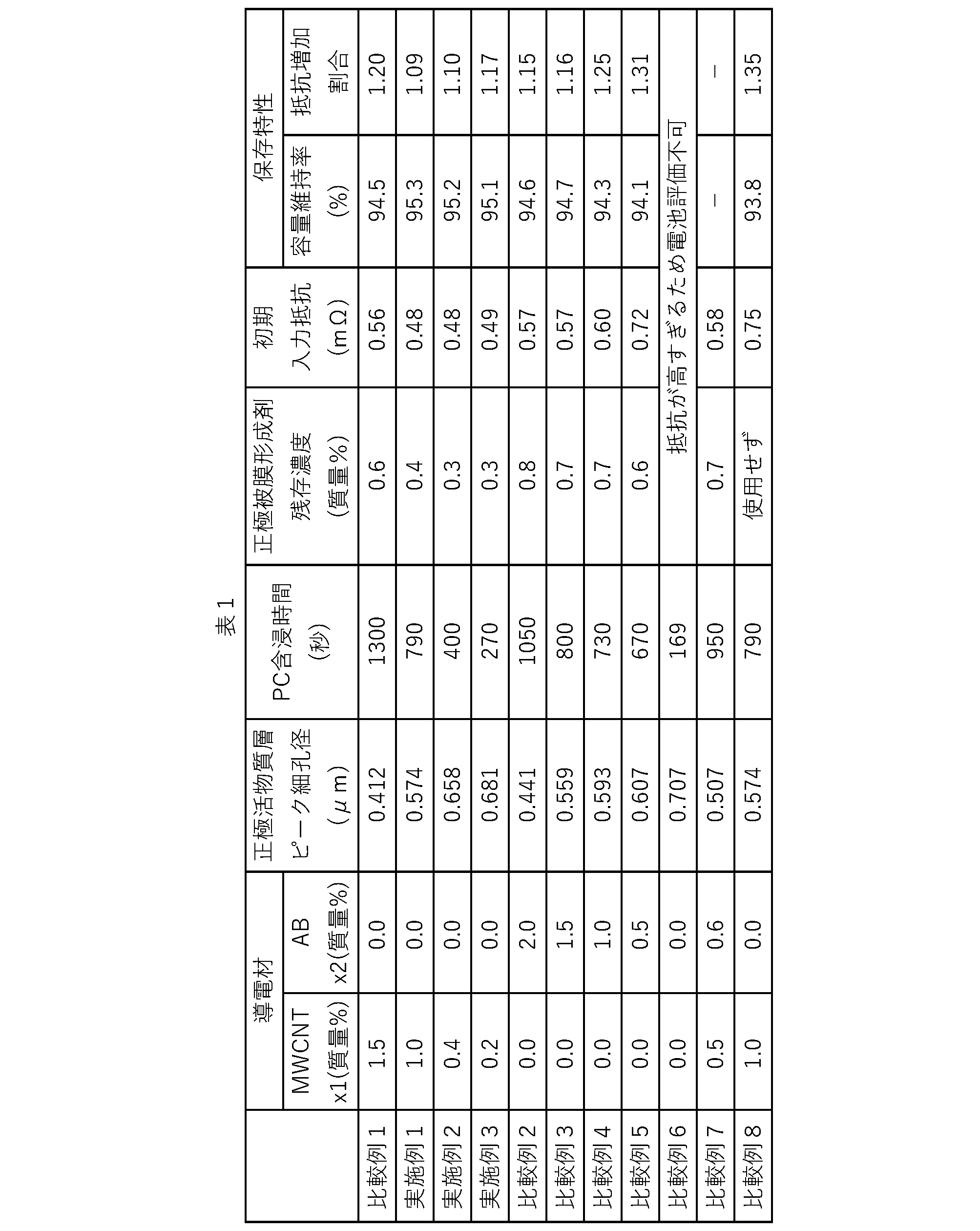
比較例2~6の結果より、正極活物質層のピーク細孔径が大きいほど、PC含浸時間が短くなる、すなわち非水電解質の含浸性が高くなることがわかる。ここで、比較例2~5は、導電材にABのみを用いた例である。比較例2~5では、AB量が少ないほど、ピーク細孔径が大きく、非水電解質の含浸性が高くなり、正極被膜形成剤が被膜形成に多く消費されることがわかる。また、比較例2~5では、AB量が少ないほど、入力特性および保存特性の両方が悪いことがわかる。 The results of Comparative Examples 2 to 6 show that the larger the peak pore diameter of the positive electrode active material layer, the shorter the PC impregnation time, i.e., the higher the impregnation of the non-aqueous electrolyte. Comparative Examples 2 to 5 are examples in which only AB is used as the conductive material. In Comparative Examples 2 to 5, it can be seen that the smaller the amount of AB, the larger the peak pore diameter, the higher the impregnation of the non-aqueous electrolyte, and the more the positive electrode film-forming agent is consumed in film formation. It can also be seen that in Comparative Examples 2 to 5, the smaller the amount of AB, the worse both the input characteristics and storage characteristics are.
一方、実施例1~3および比較例1は、導電材にCNTのみを用いた場合の例である。比較例2~6との比較より、導電材にCNTを用いた場合には、ABを用いた場合とは異なる傾向が得られていることがわかる。具体的には、CNTの含有量を0.2質量%~1.0質量%とした場合に、特異的に正極被膜形成剤の残存濃度が低くなって、入力抵抗が低くかつ保存特性が高くなっていることがわかる。これは、CNTによって、正極活物質層の細孔の細部にまで正極被膜形成剤を浸透させることができ、正極活物質層内で均一に被膜を形成することができたためと考えられる。 On the other hand, Examples 1 to 3 and Comparative Example 1 are examples in which only CNT is used as the conductive material. Comparison with Comparative Examples 2 to 6 shows that when CNT is used as the conductive material, a different tendency is obtained from when AB is used. Specifically, when the CNT content is 0.2% by mass to 1.0% by mass, the residual concentration of the positive electrode film-forming agent is specifically low, the input resistance is low, and the storage characteristics are high. This is thought to be because the CNT allows the positive electrode film-forming agent to penetrate into the fine pores of the positive electrode active material layer, allowing a uniform film to be formed within the positive electrode active material layer.
また、比較例7と実施例1~3の比較より、導電材を占めるCNTの割合が高い場合のみ、入力抵抗の低減と保存特性の向上が可能であることがわかる。 Furthermore, a comparison of Comparative Example 7 with Examples 1 to 3 shows that it is possible to reduce input resistance and improve storage characteristics only when the proportion of CNT in the conductive material is high.
以上のことから、ここに開示される非水電解質二次電池によれば、正極活物質層の細孔が小さいにも関わらず、入力特性および保存特性に優れる非水電解質二次電池を提供できることがわかる。 From the above, it can be seen that the nonaqueous electrolyte secondary battery disclosed herein can provide a nonaqueous electrolyte secondary battery that has excellent input characteristics and storage characteristics, despite the small pores in the positive electrode active material layer.
以上、本発明の具体例を詳細に説明したが、これらは例示にすぎず、請求の範囲を限定するものではない。請求の範囲に記載の技術には、以上に例示した具体例を様々に変形、変更したものが含まれる。 Specific examples of the present invention have been described in detail above, but these are merely examples and do not limit the scope of the claims. The technology described in the claims includes various modifications and variations of the specific examples given above.
すなわち、ここに開示される非水電解質二次電池は、以下の項[1]~[6]である。
[1]正極、
負極、および
非水電解質
を含有する非水電解質二次電池であって、
前記正極は、正極集電体、および前記正極集電体上に支持された正極活物質層を備え、
前記正極活物質層は、正極活物質、および導電材を含有し、
前記正極活物質層のピーク細孔径が、0.50μm~0.70μmであり、
前記正極活物質層中の前記導電材の含有量が、0.2質量%~1.0質量%であり、
前記導電材の80質量%以上が、カーボンナノチューブであり、
前記非水電解質が、非水溶媒、電解質塩、および正極被膜形成剤を含有する、
非水電解質二次電池。
[2]前記導電材が、前記カーボンナノチューブのみからなる、項[1]に記載の非水電解質二次電池。
[3]前記正極被膜形成剤が、ジフルオロリン酸リチウム、およびリチウムフルオロ硫酸塩からなる群より選ばれる少なくとも1種である、項[1]または[2]に記載の非水電解質二次電池。
[4]前記正極活物質層中の前記導電材の含有量が、0.4質量%~1.0質量%である、項[1]~[3]のいずれか1項に記載の非水電解質二次電池。
[5]前記カーボンナノチューブの平均長さが0.3μm~1.0μmであり、かつ平均直径が8nm~30nmである、項[1]~[4]のいずれか1項に記載の非水電解質二次電池。
[6]電気自動車の車両駆動電源用である、項[1]~[5]のいずれか1項に記載の非水電解質二次電池。
That is, the nonaqueous electrolyte secondary battery disclosed herein includes the following items [1] to [6].
[1] positive electrode,
A non-aqueous electrolyte secondary battery comprising: a negative electrode; and a non-aqueous electrolyte,
the positive electrode comprises a positive electrode current collector and a positive electrode active material layer supported on the positive electrode current collector,
The positive electrode active material layer contains a positive electrode active material and a conductive material,
The peak pore diameter of the positive electrode active material layer is 0.50 μm to 0.70 μm,
The content of the conductive material in the positive electrode active material layer is 0.2% by mass to 1.0% by mass,
80% by mass or more of the conductive material is carbon nanotubes,
The non-aqueous electrolyte contains a non-aqueous solvent, an electrolyte salt, and a positive electrode film forming agent.
Nonaqueous electrolyte secondary battery.
[2] The nonaqueous electrolyte secondary battery according to item [1], wherein the conductive material is composed only of the carbon nanotubes.
[3] The nonaqueous electrolyte secondary battery according to item [1] or [2], wherein the positive electrode film forming agent is at least one selected from the group consisting of lithium difluorophosphate and lithium fluorosulfate.
[4] The nonaqueous electrolyte secondary battery according to any one of items [1] to [3], wherein the content of the conductive material in the positive electrode active material layer is 0.4% by mass to 1.0% by mass.
[5] The nonaqueous electrolyte secondary battery according to any one of items [1] to [4], wherein the carbon nanotubes have an average length of 0.3 μm to 1.0 μm and an average diameter of 8 nm to 30 nm.
[6] The nonaqueous electrolyte secondary battery according to any one of items [1] to [5], which is used as a vehicle driving power source for an electric vehicle.
20 捲回電極体
30 電池ケース
36 安全弁
42 正極端子
42a 正極集電板
44 負極端子
44a 負極集電板
50 正極シート(正極)
52 正極集電体
52a 正極活物質層非形成部分
54 正極活物質層
60 負極シート(負極)
62 負極集電体
62a 負極活物質層非形成部分
64 負極活物質層
70 セパレータシート(セパレータ)
80 非水電解質
100 リチウムイオン二次電池
20
52 Positive electrode
62 Negative electrode
80
Claims (6)
負極、および
非水電解質
を含有する非水電解質二次電池であって、
前記正極は、正極集電体、および前記正極集電体上に支持された正極活物質層を備え、
前記正極活物質層は、正極活物質、および導電材を含有し、
前記正極活物質層のピーク細孔径が、0.50μm~0.70μmであり、
前記正極活物質層中の前記導電材の含有量が、0.2質量%~1.0質量%であり、
前記導電材の80質量%以上が、カーボンナノチューブであり、
前記非水電解質が、非水溶媒、電解質塩、および正極被膜形成剤を含有する、
非水電解質二次電池。 Positive electrode,
A non-aqueous electrolyte secondary battery comprising: a negative electrode; and a non-aqueous electrolyte,
the positive electrode comprises a positive electrode current collector and a positive electrode active material layer supported on the positive electrode current collector,
The positive electrode active material layer contains a positive electrode active material and a conductive material,
The peak pore diameter of the positive electrode active material layer is 0.50 μm to 0.70 μm,
The content of the conductive material in the positive electrode active material layer is 0.2% by mass to 1.0% by mass,
80% by mass or more of the conductive material is carbon nanotubes,
The non-aqueous electrolyte contains a non-aqueous solvent, an electrolyte salt, and a positive electrode film forming agent.
Nonaqueous electrolyte secondary battery.
Priority Applications (5)
| Application Number | Priority Date | Filing Date | Title |
|---|---|---|---|
| JP2023114326A JP2025011910A (en) | 2023-07-12 | 2023-07-12 | Non-aqueous electrolyte secondary battery |
| EP24185964.4A EP4492488A3 (en) | 2023-07-12 | 2024-07-02 | Nonaqueous electrolyte secondary battery |
| US18/767,184 US20250023114A1 (en) | 2023-07-12 | 2024-07-09 | Nonaqueous electrolyte secondary battery |
| KR1020240090216A KR20250010553A (en) | 2023-07-12 | 2024-07-09 | Nonaqueous electrolyte secondary battery |
| CN202410926241.2A CN119315032A (en) | 2023-07-12 | 2024-07-11 | Non-aqueous electrolyte secondary battery |
Applications Claiming Priority (1)
| Application Number | Priority Date | Filing Date | Title |
|---|---|---|---|
| JP2023114326A JP2025011910A (en) | 2023-07-12 | 2023-07-12 | Non-aqueous electrolyte secondary battery |
Publications (1)
| Publication Number | Publication Date |
|---|---|
| JP2025011910A true JP2025011910A (en) | 2025-01-24 |
Family
ID=91782366
Family Applications (1)
| Application Number | Title | Priority Date | Filing Date |
|---|---|---|---|
| JP2023114326A Pending JP2025011910A (en) | 2023-07-12 | 2023-07-12 | Non-aqueous electrolyte secondary battery |
Country Status (5)
| Country | Link |
|---|---|
| US (1) | US20250023114A1 (en) |
| EP (1) | EP4492488A3 (en) |
| JP (1) | JP2025011910A (en) |
| KR (1) | KR20250010553A (en) |
| CN (1) | CN119315032A (en) |
Citations (6)
| Publication number | Priority date | Publication date | Assignee | Title |
|---|---|---|---|---|
| JPWO2013179924A1 (en) * | 2012-05-31 | 2016-01-18 | 三菱マテリアル株式会社 | Electrode of lithium ion secondary battery and lithium ion secondary battery using the same |
| JP2018535520A (en) * | 2015-12-10 | 2018-11-29 | エルジー・ケム・リミテッド | Positive electrode for secondary battery and secondary battery including the same |
| JPWO2017217408A1 (en) * | 2016-06-13 | 2019-05-16 | 日本電気株式会社 | Lithium ion secondary battery |
| WO2021124970A1 (en) * | 2019-12-18 | 2021-06-24 | 三洋電機株式会社 | Positive electrode for nonaqueous electrolyte secondary batteries and nonaqueous electrolyte secondary battery |
| WO2023032499A1 (en) * | 2021-08-31 | 2023-03-09 | パナソニックIpマネジメント株式会社 | Non-aqueous electrolyte secondary battery |
| WO2023054308A1 (en) * | 2021-09-30 | 2023-04-06 | パナソニックIpマネジメント株式会社 | Non-aqueous electrolyte secondary battery |
Family Cites Families (5)
| Publication number | Priority date | Publication date | Assignee | Title |
|---|---|---|---|---|
| JP2015069822A (en) | 2013-09-27 | 2015-04-13 | 住友大阪セメント株式会社 | Positive electrode material for lithium ion secondary battery, positive electrode for lithium ion secondary battery, and lithium ion secondary battery |
| KR102899859B1 (en) * | 2019-12-25 | 2025-12-15 | 닝더 엠프렉스 테크놀로지 리미티드 | Electrochemical devices and electronic devices including the same |
| WO2021186949A1 (en) | 2020-03-18 | 2021-09-23 | 三洋電機株式会社 | Nonaqueous electrolyte secondary battery |
| KR102839257B1 (en) * | 2021-06-03 | 2025-07-28 | 주식회사 엘지에너지솔루션 | Positive electrode for lithium secondary battery and lithium secondary battery conatining the same |
| KR20230031007A (en) * | 2021-08-26 | 2023-03-07 | 삼성에스디아이 주식회사 | Rechargeable lithium battery |
-
2023
- 2023-07-12 JP JP2023114326A patent/JP2025011910A/en active Pending
-
2024
- 2024-07-02 EP EP24185964.4A patent/EP4492488A3/en active Pending
- 2024-07-09 KR KR1020240090216A patent/KR20250010553A/en active Pending
- 2024-07-09 US US18/767,184 patent/US20250023114A1/en active Pending
- 2024-07-11 CN CN202410926241.2A patent/CN119315032A/en active Pending
Patent Citations (6)
| Publication number | Priority date | Publication date | Assignee | Title |
|---|---|---|---|---|
| JPWO2013179924A1 (en) * | 2012-05-31 | 2016-01-18 | 三菱マテリアル株式会社 | Electrode of lithium ion secondary battery and lithium ion secondary battery using the same |
| JP2018535520A (en) * | 2015-12-10 | 2018-11-29 | エルジー・ケム・リミテッド | Positive electrode for secondary battery and secondary battery including the same |
| JPWO2017217408A1 (en) * | 2016-06-13 | 2019-05-16 | 日本電気株式会社 | Lithium ion secondary battery |
| WO2021124970A1 (en) * | 2019-12-18 | 2021-06-24 | 三洋電機株式会社 | Positive electrode for nonaqueous electrolyte secondary batteries and nonaqueous electrolyte secondary battery |
| WO2023032499A1 (en) * | 2021-08-31 | 2023-03-09 | パナソニックIpマネジメント株式会社 | Non-aqueous electrolyte secondary battery |
| WO2023054308A1 (en) * | 2021-09-30 | 2023-04-06 | パナソニックIpマネジメント株式会社 | Non-aqueous electrolyte secondary battery |
Also Published As
| Publication number | Publication date |
|---|---|
| CN119315032A (en) | 2025-01-14 |
| US20250023114A1 (en) | 2025-01-16 |
| KR20250010553A (en) | 2025-01-21 |
| EP4492488A3 (en) | 2025-02-19 |
| EP4492488A2 (en) | 2025-01-15 |
Similar Documents
| Publication | Publication Date | Title |
|---|---|---|
| JP2019050154A (en) | Nonaqueous electrolyte secondary battery | |
| JP6818235B2 (en) | Non-aqueous electrolyte secondary battery | |
| JP7033257B2 (en) | Secondary battery electrodes and secondary batteries | |
| JP7288479B2 (en) | Non-aqueous electrolyte secondary battery | |
| JP2020061236A (en) | Secondary battery electrode and secondary battery | |
| JP7638247B2 (en) | Non-aqueous electrolyte secondary battery | |
| JP7574250B2 (en) | Secondary battery | |
| US20250023114A1 (en) | Nonaqueous electrolyte secondary battery | |
| JP7672369B2 (en) | Negative electrode and secondary battery including the same | |
| JP7668828B2 (en) | Non-aqueous electrolyte secondary battery | |
| JP7731925B2 (en) | Non-aqueous electrolyte secondary battery | |
| JP7745591B2 (en) | Method for manufacturing positive electrode, and positive electrode | |
| JP7710486B2 (en) | Anode for secondary battery, method for producing said anode, and secondary battery using said anode | |
| JP7752657B2 (en) | Negative electrode for secondary battery and secondary battery using said negative electrode | |
| JP7710487B2 (en) | Anode for secondary battery, method for producing said anode, and secondary battery using said anode | |
| JP7752654B2 (en) | Negative electrode for secondary battery, method for manufacturing the negative electrode, and secondary battery using the negative electrode | |
| JP7745587B2 (en) | Anode material, anode of secondary battery using said anode material, and method of manufacturing the same | |
| JP2024007228A (en) | Method for manufacturing positive electrode slurry | |
| JP2025002693A (en) | Anode for secondary battery, method for producing said anode, and secondary battery using said anode | |
| JP2024104356A (en) | Non-aqueous electrolyte secondary battery | |
| JP2024115207A (en) | Secondary battery | |
| CN118867351A (en) | Lithium-ion secondary battery |
Legal Events
| Date | Code | Title | Description |
|---|---|---|---|
| A621 | Written request for application examination |
Free format text: JAPANESE INTERMEDIATE CODE: A621 Effective date: 20240805 |
|
| A977 | Report on retrieval |
Free format text: JAPANESE INTERMEDIATE CODE: A971007 Effective date: 20250618 |
|
| A131 | Notification of reasons for refusal |
Free format text: JAPANESE INTERMEDIATE CODE: A131 Effective date: 20250710 |
|
| A131 | Notification of reasons for refusal |
Free format text: JAPANESE INTERMEDIATE CODE: A131 Effective date: 20251204 |
|
| A521 | Request for written amendment filed |
Free format text: JAPANESE INTERMEDIATE CODE: A523 Effective date: 20260106 |