JP2024547020A - Anti-OX40 antibodies, multispecific antibodies and methods of use thereof - Google Patents
Anti-OX40 antibodies, multispecific antibodies and methods of use thereof Download PDFInfo
- Publication number
- JP2024547020A JP2024547020A JP2024536329A JP2024536329A JP2024547020A JP 2024547020 A JP2024547020 A JP 2024547020A JP 2024536329 A JP2024536329 A JP 2024536329A JP 2024536329 A JP2024536329 A JP 2024536329A JP 2024547020 A JP2024547020 A JP 2024547020A
- Authority
- JP
- Japan
- Prior art keywords
- amino acid
- seq
- acid sequence
- variable region
- chain variable
- Prior art date
- Legal status (The legal status is an assumption and is not a legal conclusion. Google has not performed a legal analysis and makes no representation as to the accuracy of the status listed.)
- Pending
Links
Classifications
-
- C—CHEMISTRY; METALLURGY
- C07—ORGANIC CHEMISTRY
- C07K—PEPTIDES
- C07K16/00—Immunoglobulins [IGs], e.g. monoclonal or polyclonal antibodies
- C07K16/18—Immunoglobulins [IGs], e.g. monoclonal or polyclonal antibodies against material from animals or humans
- C07K16/28—Immunoglobulins [IGs], e.g. monoclonal or polyclonal antibodies against material from animals or humans against receptors, cell surface antigens or cell surface determinants
- C07K16/2878—Immunoglobulins [IGs], e.g. monoclonal or polyclonal antibodies against material from animals or humans against receptors, cell surface antigens or cell surface determinants against the NGF-receptor/TNF-receptor superfamily, e.g. CD27, CD30, CD40, CD95
-
- A—HUMAN NECESSITIES
- A61—MEDICAL OR VETERINARY SCIENCE; HYGIENE
- A61K—PREPARATIONS FOR MEDICAL, DENTAL OR TOILETRY PURPOSES
- A61K47/00—Medicinal preparations characterised by the non-active ingredients used, e.g. carriers or inert additives; Targeting or modifying agents chemically bound to the active ingredient
- A61K47/50—Medicinal preparations characterised by the non-active ingredients used, e.g. carriers or inert additives; Targeting or modifying agents chemically bound to the active ingredient the non-active ingredient being chemically bound to the active ingredient, e.g. polymer-drug conjugates
- A61K47/51—Medicinal preparations characterised by the non-active ingredients used, e.g. carriers or inert additives; Targeting or modifying agents chemically bound to the active ingredient the non-active ingredient being chemically bound to the active ingredient, e.g. polymer-drug conjugates the non-active ingredient being a modifying agent
- A61K47/68—Medicinal preparations characterised by the non-active ingredients used, e.g. carriers or inert additives; Targeting or modifying agents chemically bound to the active ingredient the non-active ingredient being chemically bound to the active ingredient, e.g. polymer-drug conjugates the non-active ingredient being a modifying agent the modifying agent being an antibody, an immunoglobulin or a fragment thereof, e.g. an Fc-fragment
- A61K47/6801—Drug-antibody or immunoglobulin conjugates defined by the pharmacologically or therapeutically active agent
- A61K47/6803—Drugs conjugated to an antibody or immunoglobulin, e.g. cisplatin-antibody conjugates
-
- A—HUMAN NECESSITIES
- A61—MEDICAL OR VETERINARY SCIENCE; HYGIENE
- A61P—SPECIFIC THERAPEUTIC ACTIVITY OF CHEMICAL COMPOUNDS OR MEDICINAL PREPARATIONS
- A61P35/00—Antineoplastic agents
-
- C—CHEMISTRY; METALLURGY
- C07—ORGANIC CHEMISTRY
- C07K—PEPTIDES
- C07K14/00—Peptides having more than 20 amino acids; Gastrins; Somatostatins; Melanotropins; Derivatives thereof
- C07K14/435—Peptides having more than 20 amino acids; Gastrins; Somatostatins; Melanotropins; Derivatives thereof from animals; from humans
- C07K14/705—Receptors; Cell surface antigens; Cell surface determinants
- C07K14/70503—Immunoglobulin superfamily
- C07K14/7051—T-cell receptor (TcR)-CD3 complex
-
- C—CHEMISTRY; METALLURGY
- C07—ORGANIC CHEMISTRY
- C07K—PEPTIDES
- C07K16/00—Immunoglobulins [IGs], e.g. monoclonal or polyclonal antibodies
- C07K16/18—Immunoglobulins [IGs], e.g. monoclonal or polyclonal antibodies against material from animals or humans
- C07K16/28—Immunoglobulins [IGs], e.g. monoclonal or polyclonal antibodies against material from animals or humans against receptors, cell surface antigens or cell surface determinants
- C07K16/2803—Immunoglobulins [IGs], e.g. monoclonal or polyclonal antibodies against material from animals or humans against receptors, cell surface antigens or cell surface determinants against the immunoglobulin superfamily
- C07K16/2818—Immunoglobulins [IGs], e.g. monoclonal or polyclonal antibodies against material from animals or humans against receptors, cell surface antigens or cell surface determinants against the immunoglobulin superfamily against CD28 or CD152
-
- A—HUMAN NECESSITIES
- A61—MEDICAL OR VETERINARY SCIENCE; HYGIENE
- A61K—PREPARATIONS FOR MEDICAL, DENTAL OR TOILETRY PURPOSES
- A61K39/00—Medicinal preparations containing antigens or antibodies
- A61K2039/505—Medicinal preparations containing antigens or antibodies comprising antibodies
-
- C—CHEMISTRY; METALLURGY
- C07—ORGANIC CHEMISTRY
- C07K—PEPTIDES
- C07K16/00—Immunoglobulins [IGs], e.g. monoclonal or polyclonal antibodies
- C07K16/46—Hybrid immunoglobulins
-
- C—CHEMISTRY; METALLURGY
- C07—ORGANIC CHEMISTRY
- C07K—PEPTIDES
- C07K2317/00—Immunoglobulins specific features
- C07K2317/20—Immunoglobulins specific features characterized by taxonomic origin
- C07K2317/24—Immunoglobulins specific features characterized by taxonomic origin containing regions, domains or residues from different species, e.g. chimeric, humanized or veneered
-
- C—CHEMISTRY; METALLURGY
- C07—ORGANIC CHEMISTRY
- C07K—PEPTIDES
- C07K2317/00—Immunoglobulins specific features
- C07K2317/30—Immunoglobulins specific features characterized by aspects of specificity or valency
-
- C—CHEMISTRY; METALLURGY
- C07—ORGANIC CHEMISTRY
- C07K—PEPTIDES
- C07K2317/00—Immunoglobulins specific features
- C07K2317/30—Immunoglobulins specific features characterized by aspects of specificity or valency
- C07K2317/31—Immunoglobulins specific features characterized by aspects of specificity or valency multispecific
-
- C—CHEMISTRY; METALLURGY
- C07—ORGANIC CHEMISTRY
- C07K—PEPTIDES
- C07K2317/00—Immunoglobulins specific features
- C07K2317/50—Immunoglobulins specific features characterized by immunoglobulin fragments
- C07K2317/52—Constant or Fc region; Isotype
-
- C—CHEMISTRY; METALLURGY
- C07—ORGANIC CHEMISTRY
- C07K—PEPTIDES
- C07K2317/00—Immunoglobulins specific features
- C07K2317/50—Immunoglobulins specific features characterized by immunoglobulin fragments
- C07K2317/56—Immunoglobulins specific features characterized by immunoglobulin fragments variable (Fv) region, i.e. VH and/or VL
- C07K2317/569—Single domain, e.g. dAb, sdAb, VHH, VNAR or nanobody®
-
- C—CHEMISTRY; METALLURGY
- C07—ORGANIC CHEMISTRY
- C07K—PEPTIDES
- C07K2317/00—Immunoglobulins specific features
- C07K2317/60—Immunoglobulins specific features characterized by non-natural combinations of immunoglobulin fragments
- C07K2317/62—Immunoglobulins specific features characterized by non-natural combinations of immunoglobulin fragments comprising only variable region components
- C07K2317/622—Single chain antibody (scFv)
-
- C—CHEMISTRY; METALLURGY
- C07—ORGANIC CHEMISTRY
- C07K—PEPTIDES
- C07K2317/00—Immunoglobulins specific features
- C07K2317/70—Immunoglobulins specific features characterized by effect upon binding to a cell or to an antigen
- C07K2317/75—Agonist effect on antigen
-
- C—CHEMISTRY; METALLURGY
- C07—ORGANIC CHEMISTRY
- C07K—PEPTIDES
- C07K2317/00—Immunoglobulins specific features
- C07K2317/70—Immunoglobulins specific features characterized by effect upon binding to a cell or to an antigen
- C07K2317/76—Antagonist effect on antigen, e.g. neutralization or inhibition of binding
-
- C—CHEMISTRY; METALLURGY
- C07—ORGANIC CHEMISTRY
- C07K—PEPTIDES
- C07K2317/00—Immunoglobulins specific features
- C07K2317/90—Immunoglobulins specific features characterized by (pharmaco)kinetic aspects or by stability of the immunoglobulin
- C07K2317/92—Affinity (KD), association rate (Ka), dissociation rate (Kd) or EC50 value
Landscapes
- Health & Medical Sciences (AREA)
- Chemical & Material Sciences (AREA)
- Immunology (AREA)
- Organic Chemistry (AREA)
- Life Sciences & Earth Sciences (AREA)
- Medicinal Chemistry (AREA)
- General Health & Medical Sciences (AREA)
- Biochemistry (AREA)
- Genetics & Genomics (AREA)
- Molecular Biology (AREA)
- Proteomics, Peptides & Aminoacids (AREA)
- Biophysics (AREA)
- Veterinary Medicine (AREA)
- Pharmacology & Pharmacy (AREA)
- Animal Behavior & Ethology (AREA)
- Public Health (AREA)
- Bioinformatics & Cheminformatics (AREA)
- Engineering & Computer Science (AREA)
- Nuclear Medicine, Radiotherapy & Molecular Imaging (AREA)
- General Chemical & Material Sciences (AREA)
- Chemical Kinetics & Catalysis (AREA)
- Epidemiology (AREA)
- Cell Biology (AREA)
- Toxicology (AREA)
- Zoology (AREA)
- Gastroenterology & Hepatology (AREA)
- Peptides Or Proteins (AREA)
- Preparation Of Compounds By Using Micro-Organisms (AREA)
- Micro-Organisms Or Cultivation Processes Thereof (AREA)
- Medicines Containing Antibodies Or Antigens For Use As Internal Diagnostic Agents (AREA)
Abstract
OX40に結合する抗体及び抗体誘導体並びにその使用方法を提供する。いくつかの実施形態において、本明細書に開示される抗体又は抗体誘導体は、OX40に結合する単一ドメイン抗体を含む。いくつかの実施形態において、該抗体誘導体は、OX40及び追加の抗原(例えば、CTLA4)に結合する多重特異性抗体である。 Provided are antibodies and antibody derivatives that bind to OX40 and methods of using the same. In some embodiments, the antibodies or antibody derivatives disclosed herein include single domain antibodies that bind to OX40. In some embodiments, the antibody derivatives are multispecific antibodies that bind to OX40 and an additional antigen (e.g., CTLA4).
Description
(関連出願の相互参照)
本出願は、2021年12月17日に提出された国際特許出願PCT/CN2021/139273の優先権を主張し、該出願の内容は、全体として参照により本明細書に組み込まれ、その優先権を主張する。
(CROSS REFERENCE TO RELATED APPLICATIONS)
This application claims priority to International Patent Application PCT/CN2021/139273, filed December 17, 2021, the contents of which are incorporated by reference in their entirety herein and claim priority thereto.
本発明は、OX40に結合する抗体と抗体誘導体及びその使用方法に関する。いくつかの実施形態において、抗体誘導体は、OX40と追加の抗原(例えばCTLA4)に結合する多重特異性抗体である。 The present invention relates to antibodies and antibody derivatives that bind to OX40 and methods of using the same. In some embodiments, the antibody derivatives are multispecific antibodies that bind to OX40 and additional antigens, such as CTLA4.
OX40は、腫瘍壊死因子受容体スーパーファミリーメンバー4(Tnfrsf4)とCD134とも呼ばれ、主にT細胞などの免疫細胞によって発現される1型膜貫通糖タンパク質の一種である。OX40は、抗アポトーシスタンパク質と細胞周期進行タンパク質の発現を誘導することによって、活性化誘導細胞死(activation induced cell death)を阻害し、抗原特異的メモリT細胞の生存を促進することができる。OX40共刺激シグナルは、NF-kB経路を活性化してエフェクターT細胞を直接刺激することもできる。さらに、OX40は、頭頸部扁平上皮癌、卵巣癌、胃癌、皮膚扁平上皮癌、乳癌と結腸直腸癌を含む様々な癌の腫瘍浸潤リンパ球(TIL)に認められる。これまでの研究により、OX40及び/又はそのリガンド(OX40L)の活性化が抗腫瘍作用を誘導できることが示されている。そのため、癌を治療するためのOX40を標的とする分子及び方法の開発は当分野において必要とされている。 OX40, also known as tumor necrosis factor receptor superfamily member 4 (Tnfrsf4) and CD134, is a type 1 transmembrane glycoprotein mainly expressed by immune cells such as T cells. OX40 can inhibit activation induced cell death and promote the survival of antigen-specific memory T cells by inducing the expression of anti-apoptotic and cell cycle progression proteins. OX40 costimulatory signals can also activate the NF-kB pathway to directly stimulate effector T cells. In addition, OX40 is found in tumor-infiltrating lymphocytes (TILs) of various cancers, including head and neck squamous cell carcinoma, ovarian cancer, gastric cancer, cutaneous squamous cell carcinoma, breast cancer and colorectal cancer. Previous studies have shown that activation of OX40 and/or its ligand (OX40L) can induce antitumor effects. Therefore, there is a need in the art for the development of molecules and methods that target OX40 to treat cancer.
細胞毒性Tリンパ球関連タンパク質4(CTLA4)は、CD152、GRD4とALPS5とも呼ばれ、免疫グロブリンスーパーファミリーのメンバーであり、T細胞に阻害シグナルを伝達することができる。CTLA4経路のブロッキングは、エフェクターT細胞を活性化し、Treg媒介性T細胞阻害を減少させることにより、抗腫瘍作用を誘導することができる。例えば、イピリムマブ(ipilimumab)を用いた抗CTLA4ブロッキングは、進行性黒色腫患者の総生存期間を延長することができる。そのため、癌を治療するためのCTLA4を標的とする分子及び方法の開発は当分野において必要とされている。 Cytotoxic T-lymphocyte-associated protein 4 (CTLA4), also known as CD152, GRD4, and ALPS5, is a member of the immunoglobulin superfamily and can transmit inhibitory signals to T cells. Blocking the CTLA4 pathway can induce antitumor effects by activating effector T cells and reducing Treg-mediated T cell inhibition. For example, anti-CTLA4 blocking with ipilimumab can extend the overall survival of patients with advanced melanoma. Therefore, there is a need in the art for the development of molecules and methods that target CTLA4 to treat cancer.
本発明は、高親和性でOX40に特異的に結合する単離されたモノクローナル抗体及び抗体誘導体を提供し、単一特異性抗OX40抗体と、OX40及び一つ又は複数の別の標的に結合する多重特異性抗体とを含む。いくつかの実施形態において、前記一つ又は複数の別の標的は、CTLA4である。いくつかの実施形態において、本明細書に開示される抗体、抗体誘導体又は多重特異性抗体は、OX40に結合する単一ドメイン抗体を含む。本発明は、本明細書に開示される抗体、抗体誘導体と多重特異性抗体及びそれを含む薬物組成物を製造し使用する方法をさらに提供し、例えば、癌のような疾患と障害の治療に用いられる。本発明は、OX40に結合する新規単一ドメイン抗体の発見に部分的に基づくものであり、それは、腫瘍細胞に対する免疫応答を強化することができ、OX40及びCTLA4に結合する新規多重特異性抗体の発見にも基づくものであり、それは、腫瘍細胞に対する免疫応答を強化することによって、改善された抗腫瘍効果を提供することができる。 The present invention provides isolated monoclonal antibodies and antibody derivatives that specifically bind to OX40 with high affinity, including monospecific anti-OX40 antibodies and multispecific antibodies that bind to OX40 and one or more additional targets. In some embodiments, the one or more additional targets is CTLA4. In some embodiments, the antibodies, antibody derivatives, or multispecific antibodies disclosed herein include single domain antibodies that bind to OX40. The present invention further provides methods of making and using the antibodies, antibody derivatives, and multispecific antibodies disclosed herein and pharmaceutical compositions comprising the same, for use in treating diseases and disorders such as, for example, cancer. The present invention is based in part on the discovery of novel single domain antibodies that bind to OX40, which can enhance the immune response to tumor cells, and also on the discovery of novel multispecific antibodies that bind to OX40 and CTLA4, which can provide improved anti-tumor effects by enhancing the immune response to tumor cells.
いくつかの実施形態において、本明細書に開示される多重特異性抗体は、OX40及びCTLA4に結合する。いくつかの実施形態において、多重特異性抗体は、i)OX40に結合する単一ドメイン抗体を含むアゴニスト性抗OX40抗体を含む第1の抗原結合部分と、ii)CTLA4に結合するアンタゴニスト性抗CTLA4抗体を含む第2の抗原結合部分とを含む。いくつかの実施形態において、単一ドメイン抗体は、VHHを含む。いくつかの実施形態において、単一ドメイン抗体又はVHHは、重鎖可変領域(VH)を含む。 In some embodiments, the multispecific antibody disclosed herein binds to OX40 and CTLA4. In some embodiments, the multispecific antibody comprises i) a first antigen-binding portion comprising an agonistic anti-OX40 antibody comprising a single domain antibody that binds to OX40, and ii) a second antigen-binding portion comprising an antagonistic anti-CTLA4 antibody that binds to CTLA4. In some embodiments, the single domain antibody comprises a VHH. In some embodiments, the single domain antibody or VHH comprises a heavy chain variable region (VH).
いくつかの実施形態において、単一ドメイン抗体は、1x10⁻⁷M又はより低いKDでOX40に結合する。いくつかの実施形態において、単一ドメイン抗体は、5x10⁻⁸M又はより低いKDでOX40に結合する。いくつかの実施形態において、単一ドメイン抗体は、1x10⁻⁸M又はより小さいKDでOX40に結合する。いくつかの実施形態において、単一ドメイン抗体は、約1x10⁻¹⁰M~約5x10⁻⁸MのKDでOX40に結合する。 In some embodiments, single domain antibodies bind to OX40 with a KD of 1x10⁻⁷ M or lower. In some embodiments, single domain antibodies bind to OX40 with a KD of 5x10⁻⁸ M or lower. In some embodiments, single domain antibodies bind to OX40 with a KD of 1x10⁻⁸ M or lower. In some embodiments, single domain antibodies bind to OX40 with a KD of about 1x10⁻¹⁰ M to about 5x10⁻⁸ M.
いくつかの実施形態において、単一ドメイン抗体は、OX40への結合について参照抗OX40単一ドメイン抗体と交差競合し、該参照抗体は、重鎖可変領域を含み、それは、a)SEQ ID NO:1に示すアミノ酸配列を含む重鎖可変領域CDR1、SEQ ID NO:2に示すアミノ酸配列を含む重鎖可変領域CDR2及びSEQ ID NO:3に示すアミノ酸配列を含む重鎖可変領域CDR3、b) SEQ ID NO:6に示すアミノ酸配列を含む重鎖可変領域CDR1、SEQ ID NO:7に示すアミノ酸配列を含む重鎖可変領域CDR2及びSEQ ID NO:8に示すアミノ酸配列を含む重鎖可変領域CDR3、c) SEQ ID NO:11に示すアミノ酸配列を含む重鎖可変領域CDR1、SEQ ID NO:12に示すアミノ酸配列を含む重鎖可変領域CDR2及びSEQ ID NO:13に示すアミノ酸配列を含む重鎖可変領域CDR3、d) SEQ ID NO:16に示すアミノ酸配列を含む重鎖可変領域CDR1、SEQ ID NO:17に示すアミノ酸配列を含む重鎖可変領域CDR2及びSEQ ID NO:18に示すアミノ酸配列を含む重鎖可変領域CDR3、e) SEQ ID NO:21に示すアミノ酸配列を含む重鎖可変領域CDR1、SEQ ID NO:22に示すアミノ酸配列を含む重鎖可変領域CDR2及びSEQ ID NO:23に示すアミノ酸配列を含む重鎖可変領域CDR3、f)SEQ ID NO:26に示すアミノ酸配列を含む重鎖可変領域CDR1、SEQ ID NO:27に示すアミノ酸配列を含む重鎖可変領域CDR2及びSEQ ID NO:28に示すアミノ酸配列を含む重鎖可変領域CDR3、g)SEQ ID NO:31に示すアミノ酸配列を含む重鎖可変領域CDR1、SEQ ID NO:32に示すアミノ酸配列を含む重鎖可変領域CDR2及びSEQ ID NO:33に示すアミノ酸配列を含む重鎖可変領域CDR3、h)SEQ ID NO:36に示すアミノ酸配列を含む重鎖可変領域CDR1、SEQ ID NO:37に示すアミノ酸配列を含む重鎖可変領域CDR2及びSEQ ID NO:38に示すアミノ酸配列を含む重鎖可変領域CDR3、i)SEQ ID NO:41に示すアミノ酸配列を含む重鎖可変領域CDR1、SEQ ID NO:42に示すアミノ酸配列を含む重鎖可変領域CDR2及びSEQ ID NO:43に示すアミノ酸配列を含む重鎖可変領域CDR3、j)SEQ ID NO:46に示すアミノ酸配列を含む重鎖可変領域CDR1、SEQ ID NO:47に示すアミノ酸配列を含む重鎖可変領域CDR2及びSEQ ID NO:48に示すアミノ酸配列を含む重鎖可変領域CDR3、k)SEQ ID NO:51に示すアミノ酸配列を含む重鎖可変領域CDR1、SEQ ID NO:52に示すアミノ酸配列を含む重鎖可変領域CDR2及びSEQ ID NO:53に示すアミノ酸配列を含む重鎖可変領域CDR3、l)SEQ ID NO:56に示すアミノ酸配列を含む重鎖可変領域CDR1、SEQ ID NO:57に示すアミノ酸配列を含む重鎖可変領域CDR2及びSEQ ID NO:58に示すアミノ酸配列を含む重鎖可変領域CDR3、m)SEQ ID NO:61に示すアミノ酸配列を含む重鎖可変領域CDR1、SEQ ID NO:62に示すアミノ酸配列を含む重鎖可変領域CDR2及びSEQ ID NO:63に示すアミノ酸配列を含む重鎖可変領域CDR3、n)SEQ ID NO:66に示すアミノ酸配列を含む重鎖可変領域CDR1、SEQ ID NO:67に示すアミノ酸配列を含む重鎖可変領域CDR2及びSEQ ID NO:68に示すアミノ酸配列を含む重鎖可変領域CDR3、o)SEQ ID NO:71に示すアミノ酸配列を含む重鎖可変領域CDR1、SEQ ID NO:72に示すアミノ酸配列を含む重鎖可変領域CDR2及びSEQ ID NO:73に示すアミノ酸配列を含む重鎖可変領域CDR3、又はp)SEQ ID NO:76に示すアミノ酸配列を含む重鎖可変領域CDR1、SEQ ID NO:77に示すアミノ酸配列を含む重鎖可変領域CDR2及びSEQ ID NO:78に示すアミノ酸配列を含む重鎖可変領域CDR3を含む。 In some embodiments, the single domain antibody cross-competes with a reference anti-OX40 single domain antibody for binding to OX40, the reference antibody comprising a heavy chain variable region comprising: a) a heavy chain variable region CDR1 comprising the amino acid sequence set forth in SEQ ID NO: 1, a heavy chain variable region CDR2 comprising the amino acid sequence set forth in SEQ ID NO: 2, and a heavy chain variable region CDR3 comprising the amino acid sequence set forth in SEQ ID NO: 3; b) a heavy chain variable region CDR1 comprising the amino acid sequence set forth in SEQ ID NO: 6, a heavy chain variable region CDR2 comprising the amino acid sequence set forth in SEQ ID NO: 7, and a heavy chain variable region CDR3 comprising the amino acid sequence set forth in SEQ ID NO: 8; c) a heavy chain variable region CDR1 comprising the amino acid sequence set forth in SEQ ID NO: 11, a heavy chain variable region CDR2 comprising the amino acid sequence set forth in SEQ ID NO: 12, and a heavy chain variable region CDR3 comprising the amino acid sequence set forth in SEQ ID NO: 13; d) a heavy chain variable region CDR1 comprising the amino acid sequence shown in SEQ ID NO: 16, a heavy chain variable region CDR2 comprising the amino acid sequence shown in SEQ ID NO: 17, and a heavy chain variable region CDR3 comprising the amino acid sequence shown in SEQ ID NO: 18; e) a heavy chain variable region CDR1 comprising the amino acid sequence shown in SEQ ID NO: 21, a heavy chain variable region CDR2 comprising the amino acid sequence shown in SEQ ID NO: 22, and a heavy chain variable region CDR3 comprising the amino acid sequence shown in SEQ ID NO: 23; f) a heavy chain variable region CDR1 comprising the amino acid sequence shown in SEQ ID NO: 26, a heavy chain variable region CDR2 comprising the amino acid sequence shown in SEQ ID NO: 27, and a heavy chain variable region CDR3 comprising the amino acid sequence shown in SEQ ID NO: 28; g) a heavy chain variable region CDR1 comprising the amino acid sequence shown in SEQ ID NO: 31, a heavy chain variable region CDR2 comprising the amino acid sequence shown in SEQ ID NO: 32, and a heavy chain variable region CDR3 comprising the amino acid sequence shown in SEQ ID NO: 33. h) a heavy chain variable region CDR1 comprising the amino acid sequence shown in SEQ ID NO: 36, a heavy chain variable region CDR2 comprising the amino acid sequence shown in SEQ ID NO: 37, and a heavy chain variable region CDR3 comprising the amino acid sequence shown in SEQ ID NO: 38; i) a heavy chain variable region CDR1 comprising the amino acid sequence shown in SEQ ID NO: 41, a heavy chain variable region CDR2 comprising the amino acid sequence shown in SEQ ID NO: 42, and a heavy chain variable region CDR3 comprising the amino acid sequence shown in SEQ ID NO: 43; j) a heavy chain variable region CDR1 comprising the amino acid sequence shown in SEQ ID NO: 46, a heavy chain variable region CDR2 comprising the amino acid sequence shown in SEQ ID NO: 47, and a heavy chain variable region CDR3 comprising the amino acid sequence shown in SEQ ID NO: 48. k) a heavy chain variable region CDR1 comprising the amino acid sequence shown in SEQ ID NO: 51, a heavy chain variable region CDR2 comprising the amino acid sequence shown in SEQ ID NO: 52, and a heavy chain variable region CDR3 comprising the amino acid sequence shown in SEQ ID NO: 53; l) a heavy chain variable region CDR1 comprising the amino acid sequence shown in SEQ ID NO: 56, a heavy chain variable region CDR2 comprising the amino acid sequence shown in SEQ ID NO: 57, and a heavy chain variable region CDR3 comprising the amino acid sequence shown in SEQ ID NO: 58; m) a heavy chain variable region CDR1 comprising the amino acid sequence shown in SEQ ID NO: 61, a heavy chain variable region CDR2 comprising the amino acid sequence shown in SEQ ID NO: 62, and a heavy chain variable region CDR3 comprising the amino acid sequence shown in SEQ ID NO: 63; A heavy chain variable region CDR1 having the amino acid sequence shown in SEQ ID NO: 66, a heavy chain variable region CDR2 having the amino acid sequence shown in SEQ ID NO: 67, and a heavy chain variable region CDR3 having the amino acid sequence shown in SEQ ID NO: 68; o) a heavy chain variable region CDR1 having the amino acid sequence shown in SEQ ID NO: 71, a heavy chain variable region CDR2 having the amino acid sequence shown in SEQ ID NO: 72, and a heavy chain variable region CDR3 having the amino acid sequence shown in SEQ ID NO: 73; or p) a heavy chain variable region CDR1 having the amino acid sequence shown in SEQ ID NO: 76, a heavy chain variable region CDR2 having the amino acid sequence shown in SEQ ID NO: 77, and a heavy chain variable region CDR3 having the amino acid sequence shown in SEQ ID NO: 78.
いくつかの実施形態において、単一ドメイン抗体は、重鎖可変領域を含み、該重鎖可変領域は、a)SEQ ID NO:1、6、11、16、21、26、31、36、41、46、51、56、61、66、71又は76のうちのいずれか一つのアミノ酸配列、又は該アミノ酸配列の、約3つまでのアミノ酸置換を含む変異体を含む重鎖可変領域CDR1と、b)SEQ ID NO:2、7、12、17、22、27、32、37、42、47、52、57、62、67、72又は77のうちのいずれか一つのアミノ酸配列、又は該アミノ酸配列の、約3つまでのアミノ酸置換を含む変異体を含む重鎖可変領域CDR2と、c)SEQ ID NO:3、8、13、18、23、28、33、38、43、48、53、58、63、68、73又は78のうちのいずれか一つのアミノ酸配列、又は該アミノ酸配列の、約3つまでのアミノ酸置換を含む変異体を含む重鎖可変領域CDR3とを含む。いくつかの実施形態において、単一ドメイン抗体は、重鎖可変領域を含み、それは、CDR1ドメインと、CDR2ドメインと、CDR3ドメインとを含み、ここで、前記CDR1ドメインと、CDR2ドメインと、CDR3ドメインとは、それぞれ参照重鎖可変領域に含まれるCDR1ドメインと、CDR2ドメインと、CDR3ドメインとを含み、該参照重鎖可変領域は、SEQ ID NO:4、9、14、19、24、29、34、39、44、49、54、59、64、69、74と79から選択されるアミノ酸配列を含む。 In some embodiments, the single domain antibody comprises a heavy chain variable region comprising: a) a heavy chain variable region CDR1 comprising any one of the amino acid sequences of SEQ ID NO: 1, 6, 11, 16, 21, 26, 31, 36, 41, 46, 51, 56, 61, 66, 71, or 76, or a variant of said amino acid sequence comprising up to about three amino acid substitutions; b) a heavy chain variable region CDR2 comprising any one of the amino acid sequences of SEQ ID NO: 2, 7, 12, 17, 22, 27, 32, 37, 42, 47, 52, 57, 62, 67, 72, or 77, or a variant of said amino acid sequence comprising up to about three amino acid substitutions; and c) a heavy chain variable region CDR3 comprising any one of the amino acid sequences of SEQ ID NO: 2, 7, 12, 17, 22, 27, 32, 37, 42, 47, 52, 57, 62, 67, 72, or 77, or a variant of said amino acid sequence comprising up to about three amino acid substitutions. and a heavy chain variable region CDR3 comprising any one of the amino acid sequences of SEQ ID NOs: 3, 8, 13, 18, 23, 28, 33, 38, 43, 48, 53, 58, 63, 68, 73, or 78, or a variant of said amino acid sequence comprising up to about three amino acid substitutions. In some embodiments, the single domain antibody comprises a heavy chain variable region comprising a CDR1 domain, a CDR2 domain, and a CDR3 domain, wherein said CDR1 domain, CDR2 domain, and CDR3 domain comprise, respectively, the CDR1 domain, CDR2 domain, and CDR3 domain contained in a reference heavy chain variable region, wherein the reference heavy chain variable region comprises an amino acid sequence selected from SEQ ID NOs: 4, 9, 14, 19, 24, 29, 34, 39, 44, 49, 54, 59, 64, 69, 74, and 79.
いくつかの実施形態において、単一ドメイン抗体は、SEQ ID NO:1に示すアミノ酸配列を含む重鎖可変領域CDR1と、SEQ ID NO:2に示すアミノ酸配列を含む重鎖可変領域CDR2と、SEQ ID NO:3に示すアミノ酸配列を含む重鎖可変領域CDR3とを含む。いくつかの実施形態において、単一ドメイン抗体は、SEQ ID NO:6に示すアミノ酸配列を含む重鎖可変領域CDR1と、SEQ ID NO:7に示すアミノ酸配列を含む重鎖可変領域CDR2と、SEQ ID NO:8に示すアミノ酸配列を含む重鎖可変領域CDR3とを含む。いくつかの実施形態において、単一ドメイン抗体は、SEQ ID NO:11に示すアミノ酸配列を含む重鎖可変領域CDR1と、SEQ ID NO:12に示すアミノ酸配列を含む重鎖可変領域CDR2と、SEQ ID NO:13に示すアミノ酸配列を含む重鎖可変領域CDR3とを含む。いくつかの実施形態において、単一ドメイン抗体は、SEQ ID NO:16に示すアミノ酸配列を含む重鎖可変領域CDR1と、SEQ ID NO:17に示すアミノ酸配列を含む重鎖可変領域CDR2と、SEQ ID NO:18に示すアミノ酸配列を含む重鎖可変領域CDR3とを含む。いくつかの実施形態において、単一ドメイン抗体は、SEQ ID NO:21に示すアミノ酸配列を含む重鎖可変領域CDR1と、SEQ ID NO:22に示すアミノ酸配列を含む重鎖可変領域CDR2と、SEQ ID NO:23に示すアミノ酸配列を含む重鎖可変領域CDR3とを含む。いくつかの実施形態において、単一ドメイン抗体は、SEQ ID NO:26に示すアミノ酸配列を含む重鎖可変領域CDR1と、SEQ ID NO:27に示すアミノ酸配列を含む重鎖可変領域CDR2と、SEQ ID NO:28に示すアミノ酸配列を含む重鎖可変領域CDR3とを含む。いくつかの実施形態において、単一ドメイン抗体は、SEQ ID NO:31に示すアミノ酸配列を含む重鎖可変領域CDR1と、SEQ ID NO:32に示すアミノ酸配列を含む重鎖可変領域CDR2と、SEQ ID NO:33に示すアミノ酸配列を含む重鎖可変領域CDR3とを含む。いくつかの実施形態において、単一ドメイン抗体は、SEQ ID NO:36に示すアミノ酸配列を含む重鎖可変領域CDR1と、SEQ ID NO:37に示すアミノ酸配列を含む重鎖可変領域CDR2と、SEQ ID NO:38に示すアミノ酸配列を含む重鎖可変領域CDR3とを含む。いくつかの実施形態において、単一ドメイン抗体は、SEQ ID NO:41に示すアミノ酸配列を含む重鎖可変領域CDR1と、SEQ ID NO:42に示すアミノ酸配列を含む重鎖可変領域CDR2と、SEQ ID NO:43に示すアミノ酸配列を含む重鎖可変領域CDR3とを含む。いくつかの実施形態において、単一ドメイン抗体は、SEQ ID NO:46に示すアミノ酸配列を含む重鎖可変領域CDR1と、SEQ ID NO:47に示すアミノ酸配列を含む重鎖可変領域CDR2と、SEQ ID NO:48に示すアミノ酸配列を含む重鎖可変領域CDR3とを含む。いくつかの実施形態において、単一ドメイン抗体は、SEQ ID NO:51に示すアミノ酸配列を含む重鎖可変領域CDR1と、SEQ ID NO:52に示すアミノ酸配列を含む重鎖可変領域CDR2と、SEQ ID NO:53に示すアミノ酸配列を含む重鎖可変領域CDR3とを含む。いくつかの実施形態において、単一ドメイン抗体は、SEQ ID NO:56に示すアミノ酸配列を含む重鎖可変領域CDR1と、SEQ ID NO:57に示すアミノ酸配列を含む重鎖可変領域CDR2と、SEQ ID NO:58に示すアミノ酸配列を含む重鎖可変領域CDR3とを含む。いくつかの実施形態において、単一ドメイン抗体は、SEQ ID NO:61に示すアミノ酸配列を含む重鎖可変領域CDR1と、SEQ ID NO:62に示すアミノ酸配列を含む重鎖可変領域CDR2と、SEQ ID NO:63に示すアミノ酸配列を含む重鎖可変領域CDR3とを含む。いくつかの実施形態において、単一ドメイン抗体は、SEQ ID NO:66に示すアミノ酸配列を含む重鎖可変領域CDR1と、SEQ ID NO:67に示すアミノ酸配列を含む重鎖可変領域CDR2と、SEQ ID NO:68に示すアミノ酸配列を含む重鎖可変領域CDR3とを含む。いくつかの実施形態において、単一ドメイン抗体は、SEQ ID NO:71に示すアミノ酸配列を含む重鎖可変領域CDR1と、SEQ ID NO:72に示すアミノ酸配列を含む重鎖可変領域CDR2と、SEQ ID NO:73に示すアミノ酸配列を含む重鎖可変領域CDR3とを含む。いくつかの実施形態において、単一ドメイン抗体は、SEQ ID NO:76に示すアミノ酸配列を含む重鎖可変領域CDR1と、SEQ ID NO:77に示すアミノ酸配列を含む重鎖可変領域CDR2と、SEQ ID NO:78に示すアミノ酸配列を含む重鎖可変領域CDR3とを含む。 In some embodiments, the single domain antibody comprises a heavy chain variable region CDR1 comprising the amino acid sequence set forth in SEQ ID NO:1, a heavy chain variable region CDR2 comprising the amino acid sequence set forth in SEQ ID NO:2, and a heavy chain variable region CDR3 comprising the amino acid sequence set forth in SEQ ID NO:3. In some embodiments, the single domain antibody comprises a heavy chain variable region CDR1 comprising the amino acid sequence set forth in SEQ ID NO:6, a heavy chain variable region CDR2 comprising the amino acid sequence set forth in SEQ ID NO:7, and a heavy chain variable region CDR3 comprising the amino acid sequence set forth in SEQ ID NO:8. In some embodiments, the single domain antibody comprises a heavy chain variable region CDR1 comprising the amino acid sequence set forth in SEQ ID NO:11, a heavy chain variable region CDR2 comprising the amino acid sequence set forth in SEQ ID NO:12, and a heavy chain variable region CDR3 comprising the amino acid sequence set forth in SEQ ID NO:13. In some embodiments, the single domain antibody comprises a heavy chain variable region CDR1 comprising the amino acid sequence set forth in SEQ ID NO: 16, a heavy chain variable region CDR2 comprising the amino acid sequence set forth in SEQ ID NO: 17, and a heavy chain variable region CDR3 comprising the amino acid sequence set forth in SEQ ID NO: 18. In some embodiments, the single domain antibody comprises a heavy chain variable region CDR1 comprising the amino acid sequence set forth in SEQ ID NO: 21, a heavy chain variable region CDR2 comprising the amino acid sequence set forth in SEQ ID NO: 22, and a heavy chain variable region CDR3 comprising the amino acid sequence set forth in SEQ ID NO: 23. In some embodiments, the single domain antibody comprises a heavy chain variable region CDR1 comprising the amino acid sequence set forth in SEQ ID NO: 26, a heavy chain variable region CDR2 comprising the amino acid sequence set forth in SEQ ID NO: 27, and a heavy chain variable region CDR3 comprising the amino acid sequence set forth in SEQ ID NO: 28. In some embodiments, the single domain antibody comprises a heavy chain variable region CDR1 comprising the amino acid sequence set forth in SEQ ID NO:31, a heavy chain variable region CDR2 comprising the amino acid sequence set forth in SEQ ID NO:32, and a heavy chain variable region CDR3 comprising the amino acid sequence set forth in SEQ ID NO:33. In some embodiments, the single domain antibody comprises a heavy chain variable region CDR1 comprising the amino acid sequence set forth in SEQ ID NO:36, a heavy chain variable region CDR2 comprising the amino acid sequence set forth in SEQ ID NO:37, and a heavy chain variable region CDR3 comprising the amino acid sequence set forth in SEQ ID NO:38. In some embodiments, the single domain antibody comprises a heavy chain variable region CDR1 comprising the amino acid sequence set forth in SEQ ID NO:41, a heavy chain variable region CDR2 comprising the amino acid sequence set forth in SEQ ID NO:42, and a heavy chain variable region CDR3 comprising the amino acid sequence set forth in SEQ ID NO:43. In some embodiments, the single domain antibody comprises a heavy chain variable region CDR1 comprising the amino acid sequence set forth in SEQ ID NO: 46, a heavy chain variable region CDR2 comprising the amino acid sequence set forth in SEQ ID NO: 47, and a heavy chain variable region CDR3 comprising the amino acid sequence set forth in SEQ ID NO: 48. In some embodiments, the single domain antibody comprises a heavy chain variable region CDR1 comprising the amino acid sequence set forth in SEQ ID NO: 51, a heavy chain variable region CDR2 comprising the amino acid sequence set forth in SEQ ID NO: 52, and a heavy chain variable region CDR3 comprising the amino acid sequence set forth in SEQ ID NO: 53. In some embodiments, the single domain antibody comprises a heavy chain variable region CDR1 comprising the amino acid sequence set forth in SEQ ID NO: 56, a heavy chain variable region CDR2 comprising the amino acid sequence set forth in SEQ ID NO: 57, and a heavy chain variable region CDR3 comprising the amino acid sequence set forth in SEQ ID NO: 58. In some embodiments, the single domain antibody comprises a heavy chain variable region CDR1 comprising the amino acid sequence set forth in SEQ ID NO:61, a heavy chain variable region CDR2 comprising the amino acid sequence set forth in SEQ ID NO:62, and a heavy chain variable region CDR3 comprising the amino acid sequence set forth in SEQ ID NO:63. In some embodiments, the single domain antibody comprises a heavy chain variable region CDR1 comprising the amino acid sequence set forth in SEQ ID NO:66, a heavy chain variable region CDR2 comprising the amino acid sequence set forth in SEQ ID NO:67, and a heavy chain variable region CDR3 comprising the amino acid sequence set forth in SEQ ID NO:68. In some embodiments, the single domain antibody comprises a heavy chain variable region CDR1 comprising the amino acid sequence set forth in SEQ ID NO:71, a heavy chain variable region CDR2 comprising the amino acid sequence set forth in SEQ ID NO:72, and a heavy chain variable region CDR3 comprising the amino acid sequence set forth in SEQ ID NO:73. In some embodiments, the single domain antibody comprises a heavy chain variable region CDR1 comprising the amino acid sequence shown in SEQ ID NO: 76, a heavy chain variable region CDR2 comprising the amino acid sequence shown in SEQ ID NO: 77, and a heavy chain variable region CDR3 comprising the amino acid sequence shown in SEQ ID NO: 78.
いくつかの実施形態において、単一ドメイン抗体は、重鎖可変領域を含み、該重鎖可変領域は、SEQ ID NO:4、9、14、19、24、29、34、39、44、49、54、59、64、69、74と79から選択されるアミノ酸配列と少なくとも約90%の配列同一性を有するアミノ酸配列を含む。いくつかの実施形態において、単一ドメイン抗体は、SEQ ID NO:4に示すアミノ酸配列を含む重鎖可変領域を含む。いくつかの実施形態において、単一ドメイン抗体は、SEQ ID NO:9に示すアミノ酸配列を含む重鎖可変領域を含む。いくつかの実施形態において、単一ドメイン抗体は、SEQ ID NO:14に示すアミノ酸配列を含む重鎖可変領域を含む。いくつかの実施形態において、単一ドメイン抗体は、SEQ ID NO:19に示すアミノ酸配列を含む重鎖可変領域を含む。いくつかの実施形態において、単一ドメイン抗体は、SEQ ID NO:24に示すアミノ酸配列を含む重鎖可変領域を含む。いくつかの実施形態において、単一ドメイン抗体は、SEQ ID NO:29に示すアミノ酸配列を含む重鎖可変領域を含む。いくつかの実施形態において、単一ドメイン抗体は、SEQ ID NO:34に示すアミノ酸配列を含む重鎖可変領域を含む。いくつかの実施形態において、単一ドメイン抗体は、SEQ ID NO:39に示すアミノ酸配列を含む重鎖可変領域を含む。いくつかの実施形態において、単一ドメイン抗体は、SEQ ID NO:44に示すアミノ酸配列を含む重鎖可変領域を含む。いくつかの実施形態において、単一ドメイン抗体は、SEQ ID NO:49に示すアミノ酸配列を含む重鎖可変領域を含む。いくつかの実施形態において、単一ドメイン抗体は、SEQ ID NO:54に示すアミノ酸配列を含む重鎖可変領域を含む。いくつかの実施形態において、単一ドメイン抗体は、SEQ ID NO:59に示すアミノ酸配列を含む重鎖可変領域を含む。いくつかの実施形態において、単一ドメイン抗体は、SEQ ID NO:64に示すアミノ酸配列を含む重鎖可変領域を含む。いくつかの実施形態において、単一ドメイン抗体は、SEQ ID NO:69に示すアミノ酸配列を含む重鎖可変領域を含む。いくつかの実施形態において、単一ドメイン抗体は、SEQ ID NO:74に示すアミノ酸配列を含む重鎖可変領域を含む。いくつかの実施形態において、単一ドメイン抗体は、SEQ ID NO:79に示すアミノ酸配列を含む重鎖可変領域を含む。いくつかの実施形態において、単一ドメイン抗体は、ヒト化フレームワークを含む。 In some embodiments, the single domain antibody comprises a heavy chain variable region comprising an amino acid sequence having at least about 90% sequence identity to an amino acid sequence selected from SEQ ID NOs: 4, 9, 14, 19, 24, 29, 34, 39, 44, 49, 54, 59, 64, 69, 74, and 79. In some embodiments, the single domain antibody comprises a heavy chain variable region comprising an amino acid sequence set forth in SEQ ID NO: 4. In some embodiments, the single domain antibody comprises a heavy chain variable region comprising an amino acid sequence set forth in SEQ ID NO: 9. In some embodiments, the single domain antibody comprises a heavy chain variable region comprising an amino acid sequence set forth in SEQ ID NO: 14. In some embodiments, the single domain antibody comprises a heavy chain variable region comprising an amino acid sequence set forth in SEQ ID NO: 19. In some embodiments, the single domain antibody comprises a heavy chain variable region comprising an amino acid sequence set forth in SEQ ID NO: 24. In some embodiments, the single domain antibody comprises a heavy chain variable region comprising the amino acid sequence set forth in SEQ ID NO:29. In some embodiments, the single domain antibody comprises a heavy chain variable region comprising the amino acid sequence set forth in SEQ ID NO:34. In some embodiments, the single domain antibody comprises a heavy chain variable region comprising the amino acid sequence set forth in SEQ ID NO:39. In some embodiments, the single domain antibody comprises a heavy chain variable region comprising the amino acid sequence set forth in SEQ ID NO:44. In some embodiments, the single domain antibody comprises a heavy chain variable region comprising the amino acid sequence set forth in SEQ ID NO:49. In some embodiments, the single domain antibody comprises a heavy chain variable region comprising the amino acid sequence set forth in SEQ ID NO:54. In some embodiments, the single domain antibody comprises a heavy chain variable region comprising the amino acid sequence set forth in SEQ ID NO:59. In some embodiments, the single domain antibody comprises a heavy chain variable region comprising the amino acid sequence set forth in SEQ ID NO:64. In some embodiments, the single domain antibody comprises a heavy chain variable region comprising the amino acid sequence set forth in SEQ ID NO: 69. In some embodiments, the single domain antibody comprises a heavy chain variable region comprising the amino acid sequence set forth in SEQ ID NO: 74. In some embodiments, the single domain antibody comprises a heavy chain variable region comprising the amino acid sequence set forth in SEQ ID NO: 79. In some embodiments, the single domain antibody comprises a humanized framework.
いくつかの実施形態において、第2の抗原結合部分は、参照抗CTLA4抗体と交差競合する抗CTLA4抗体を含み、該参照抗体は、(1)SEQ ID NO:141に示すアミノ酸配列を含むCDR-H1と、(2) SEQ ID NO:142に示すアミノ酸配列を含むCDR-H2と、(3) SEQ ID NO:143に示すアミノ酸配列を含むCDR-H3とを含む重鎖可変領域(VH)と、(1) SEQ ID NO:144に示すアミノ酸配列を含むCDR-L1と、(2) SEQ ID NO:145に示すアミノ酸配列を含むCDR-L2と、(3) SEQ ID NO:146に示すアミノ酸配列を含むCDR-L3とを含む軽鎖可変領域(VL)とを含む。いくつかの実施形態において、第2の抗原結合部分は、(1)SEQ ID NO:141に示すアミノ酸配列を含むCDR-H1と、(2)SEQ ID NO:142に示すアミノ酸配列を含むCDR-H2と、(3)SEQ ID NO:143に示すアミノ酸配列を含むCDR-H3とを含む重鎖可変領域(VH)と、(1)SEQ ID NO:144に示すアミノ酸配列を含むCDR-L1と、(2)SEQ ID NO:145に示すアミノ酸配列を含むCDR-L2と、(3)SEQ ID NO:146に示すアミノ酸配列を含むCDR-L3とを含む軽鎖可変領域(VL)とを含む。いくつかの実施形態において、該第2の抗原結合部分は、SEQ ID NO:147に示すアミノ酸配列を含む重鎖可変領域と、SEQ ID NO:148に示すアミノ酸配列を含む軽鎖可変領域とを含む。いくつかの実施形態において、抗CTLA4抗体は、ヒト抗体を含む。 In some embodiments, the second antigen-binding portion comprises an anti-CTLA4 antibody that cross-competes with a reference anti-CTLA4 antibody, the reference antibody comprising a heavy chain variable region (VH) comprising: (1) a CDR-H1 having the amino acid sequence shown in SEQ ID NO: 141; (2) a CDR-H2 having the amino acid sequence shown in SEQ ID NO: 142; and (3) a CDR-H3 having the amino acid sequence shown in SEQ ID NO: 143; and a light chain variable region (VL) comprising: (1) a CDR-L1 having the amino acid sequence shown in SEQ ID NO: 144; (2) a CDR-L2 having the amino acid sequence shown in SEQ ID NO: 145; and (3) a CDR-L3 having the amino acid sequence shown in SEQ ID NO: 146. In some embodiments, the second antigen-binding portion comprises a heavy chain variable region (VH) comprising: (1) a CDR-H1 comprising the amino acid sequence set forth in SEQ ID NO: 141; (2) a CDR-H2 comprising the amino acid sequence set forth in SEQ ID NO: 142; and (3) a CDR-H3 comprising the amino acid sequence set forth in SEQ ID NO: 143; and a light chain variable region (VL) comprising: (1) a CDR-L1 comprising the amino acid sequence set forth in SEQ ID NO: 144; (2) a CDR-L2 comprising the amino acid sequence set forth in SEQ ID NO: 145; and (3) a CDR-L3 comprising the amino acid sequence set forth in SEQ ID NO: 146. In some embodiments, the second antigen-binding portion comprises a heavy chain variable region comprising the amino acid sequence set forth in SEQ ID NO: 147; and a light chain variable region comprising the amino acid sequence set forth in SEQ ID NO: 148. In some embodiments, the anti-CTLA4 antibody comprises a human antibody.
いくつかの実施形態において、第2の抗原結合部分は、二本の抗体重鎖と二本の抗体軽鎖とを含む抗CTLA4抗体を含む。いくつかの実施形態において、該第1の抗原結合部分は、一つ又は複数の抗OX40抗体を含む。いくつかの実施形態において、第1の抗原結合部分は、四つの抗OX40抗体を含む。いくつかの実施形態において、二本の抗CTLA4軽鎖のうちの少なくとも一本の軽鎖のC末端は、該第1の抗原結合部分の抗OX40抗体に連結される。いくつかの実施形態において、二本の抗CTLA4軽鎖のうちの各軽鎖のC末端は、第1の抗原結合部分の抗OX40抗体に連結される。いくつかの実施形態において、二本の抗CTLA4軽鎖のうちの少なくとも一本の軽鎖のN末端は、該第1の抗原結合部分の抗OX40抗体に連結される。いくつかの実施形態において、二本の抗CTLA4軽鎖のうちの各軽鎖のN末端は、該第1の抗原結合部分の抗OX40抗体に連結される。いくつかの実施形態において、二本の抗CTLA4重鎖のうちの少なくとも一本の重鎖のC末端は、該第1の抗原結合部分の抗OX40抗体に連結される。いくつかの実施形態において、二本の抗CTLA4重鎖のうちの各重鎖のC末端は、該第1の抗原結合部分の抗OX40抗体に連結される。いくつかの実施形態において、二本の抗CTLA4重鎖のうちの少なくとも一本の重鎖のN末端は、該第1の抗原結合部分の抗OX40抗体に連結される。いくつかの実施形態において、二本の抗CTLA4重鎖のうちの各重鎖のN末端は、該第1の抗原結合部分の抗OX40抗体に連結される。 In some embodiments, the second antigen-binding portion comprises an anti-CTLA4 antibody comprising two antibody heavy chains and two antibody light chains. In some embodiments, the first antigen-binding portion comprises one or more anti-OX40 antibodies. In some embodiments, the first antigen-binding portion comprises four anti-OX40 antibodies. In some embodiments, the C-terminus of at least one of the two anti-CTLA4 light chains is linked to the anti-OX40 antibody of the first antigen-binding portion. In some embodiments, the C-terminus of each of the two anti-CTLA4 light chains is linked to the anti-OX40 antibody of the first antigen-binding portion. In some embodiments, the N-terminus of at least one of the two anti-CTLA4 light chains is linked to the anti-OX40 antibody of the first antigen-binding portion. In some embodiments, the N-terminus of each of the two anti-CTLA4 light chains is linked to the anti-OX40 antibody of the first antigen-binding portion. In some embodiments, the C-terminus of at least one of the two anti-CTLA4 heavy chains is linked to the anti-OX40 antibody of the first antigen-binding portion. In some embodiments, the C-terminus of each of the two anti-CTLA4 heavy chains is linked to the anti-OX40 antibody of the first antigen-binding portion. In some embodiments, the N-terminus of at least one of the two anti-CTLA4 heavy chains is linked to the anti-OX40 antibody of the first antigen-binding portion. In some embodiments, the N-terminus of each of the two anti-CTLA4 heavy chains is linked to the anti-OX40 antibody of the first antigen-binding portion.
いくつかの実施形態において、第1の抗原結合部分は、リンカーを介して第2の抗原結合部分に連結される。いくつかの実施形態において、リンカーは、ペプチドリンカーである。いくつかの実施形態において、ペプチドリンカーは、約4~約30個のアミノ酸を含む。いくつかの実施形態において、ペプチドリンカーは、SEQ ID NO:97~140から選択されるアミノ酸配列を含む。 In some embodiments, the first antigen-binding moiety is linked to the second antigen-binding moiety via a linker. In some embodiments, the linker is a peptide linker. In some embodiments, the peptide linker comprises about 4 to about 30 amino acids. In some embodiments, the peptide linker comprises an amino acid sequence selected from SEQ ID NO: 97-140.
いくつかの実施形態において、第2の抗原結合部分の抗CTLA4抗体は、IgG、IgA、IgD、IgEとIgMのFc領域から選択されるFc領域を含む。いくつかの実施形態において、第2の抗原結合部分の抗CTLA4抗体は、IgG1、IgG2、IgG3とIgG4のFc領域から選択されるFc領域を含む。いくつかの実施形態において、Fc領域は、ヒトFc領域を含む。いくつかの実施形態において、Fc領域は、IgG1 Fc領域を含む。いくつかの実施形態において、IgG1 Fc領域は、S267EとL328Fの突然変異又はN325SとL328Fの突然変異を含む。いくつかの実施形態において、Fc領域は、IgG4 Fc領域を含む。いくつかの実施形態において、IgG4 Fc領域は、S228P突然変異を含む。いくつかの実施形態において、多重特異性抗体は、全長免疫グロブリン、一本鎖Fv(scFv)断片、Fab断片、Fab’断片、F(ab’)2、Fv断片、ジスルフィド結合安定化Fv断片(dsFv)、(dsFv)2、VHH、VHH-Fc融合体、Fv-Fc融合体、scFv-Fc融合体、scFv-Fv融合体、ダイアボディ、トリボディ、テトラボディ又はその任意の組み合わせを含む。 In some embodiments, the anti-CTLA4 antibody of the second antigen-binding portion comprises an Fc region selected from an IgG, IgA, IgD, IgE, and IgM Fc region. In some embodiments, the anti-CTLA4 antibody of the second antigen-binding portion comprises an Fc region selected from an IgG1, IgG2, IgG3, and IgG4 Fc region. In some embodiments, the Fc region comprises a human Fc region. In some embodiments, the Fc region comprises an IgG1 Fc region. In some embodiments, the IgG1 Fc region comprises an S267E and L328F mutation or an N325S and L328F mutation. In some embodiments, the Fc region comprises an IgG4 Fc region. In some embodiments, the IgG4 Fc region comprises an S228P mutation. In some embodiments, the multispecific antibody comprises a full-length immunoglobulin, a single-chain Fv (scFv) fragment, a Fab fragment, a Fab' fragment, an F(ab')2, an Fv fragment, a disulfide bond stabilized Fv fragment (dsFv), a (dsFv)2, a VHH, a VHH-Fc fusion, an Fv-Fc fusion, an scFv-Fc fusion, an scFv-Fv fusion, a diabody, a tribody, a tetrabody, or any combination thereof.
いくつかの実施形態において、多重特異性抗体は、i)SEQ ID NO:1に示すアミノ酸配列を含む重鎖可変領域CDR1と、SEQ ID NO:2に示すアミノ酸配列を含む重鎖可変領域CDR2と、SEQ ID NO:3に示すアミノ酸配列を含む重鎖可変領域CDR3とを含む単一ドメイン抗OX40抗体を含む第1の抗原結合部分と、ii)(1)SEQ ID NO:141に示すアミノ酸配列を含むCDR-H1と、(2)SEQ ID NO:142に示すアミノ酸配列を含むCDR-H2と、(3)SEQ ID NO:143に示すアミノ酸配列を含むCDR-H3とを含む重鎖可変領域(VH)と、(1)SEQ ID NO:144に示すアミノ酸配列を含むCDR-L1と、(2)SEQ ID NO:145に示すアミノ酸配列を含むCDR-L2と、(3)SEQ ID NO:146に示すアミノ酸配列を含むCDR-L3とを含む軽鎖可変領域(VL)とを含む抗CTLA4抗体を含む第2の抗原結合部分とを含む。いくつかの実施形態において、多重特異性抗体は、i)SEQ ID NO:6に示すアミノ酸配列を含む重鎖可変領域CDR1と、SEQ ID NO:7に示すアミノ酸配列を含む重鎖可変領域CDR2と、SEQ ID NO:8に示すアミノ酸配列を含む重鎖可変領域CDR3とを含む単一ドメイン抗OX40抗体を含む第1の抗原結合部分と、ii)(1)SEQ ID NO:141に示すアミノ酸配列を含むCDR-H1と、(2)SEQ ID NO:142に示すアミノ酸配列を含むCDR-H2と、(3)SEQ ID NO:143に示すアミノ酸配列を含むCDR-H3とを含む重鎖可変領域(VH)と、(1)SEQ ID NO:144に示すアミノ酸配列を含むCDR-L1と、(2)SEQ ID NO:145に示すアミノ酸配列を含むCDR-L2と、(3)SEQ ID NO:146に示すアミノ酸配列を含むCDR-L3とを含む軽鎖可変領域(VL)とを含む抗CTLA4抗体を含む第2の抗原結合部分とを含む。いくつかの実施形態において、多重特異性抗体は、i)SEQ ID NO:11に示すアミノ酸配列を含む重鎖可変領域CDR1と、SEQ ID NO:12に示すアミノ酸配列を含む重鎖可変領域CDR2と、SEQ ID NO:13に示すアミノ酸配列を含む重鎖可変領域CDR3とを含む単一ドメイン抗OX40抗体を含む第1の抗原結合部分と、ii)(1)SEQ ID NO:141に示すアミノ酸配列を含むCDR-H1と、(2)SEQ ID NO:142に示すアミノ酸配列を含むCDR-H2と、(3)SEQ ID NO:143に示すアミノ酸配列を含むCDR-H3とを含む重鎖可変領域(VH)と、(1)SEQ ID NO:144に示すアミノ酸配列を含むCDR-L1と、(2)SEQ ID NO:145に示すアミノ酸配列を含むCDR-L2と、(3)SEQ ID NO:146に示すアミノ酸配列を含むCDR-L3とを含む軽鎖可変領域(VL)とを含む抗CTLA4抗体を含む第2の抗原結合部分とを含む。 In some embodiments, the multispecific antibody comprises: i) a first antigen-binding portion comprising a single domain anti-OX40 antibody comprising a heavy chain variable region CDR1 having the amino acid sequence shown in SEQ ID NO: 1, a heavy chain variable region CDR2 having the amino acid sequence shown in SEQ ID NO: 2, and a heavy chain variable region CDR3 having the amino acid sequence shown in SEQ ID NO: 3; and ii) a heavy chain variable region (VH) comprising: (1) a CDR-H1 having the amino acid sequence shown in SEQ ID NO: 141, (2) a CDR-H2 having the amino acid sequence shown in SEQ ID NO: 142, and (3) a CDR-H3 having the amino acid sequence shown in SEQ ID NO: 143; and and a second antigen-binding portion comprising an anti-CTLA4 antibody comprising a light chain variable region (VL) comprising a CDR-L3 comprising the amino acid sequence set forth in SEQ ID NO:146. In some embodiments, the multispecific antibody comprises: i) a first antigen-binding portion comprising a single domain anti-OX40 antibody comprising a heavy chain variable region CDR1 comprising the amino acid sequence set forth in SEQ ID NO:6, a heavy chain variable region CDR2 comprising the amino acid sequence set forth in SEQ ID NO:7, and a heavy chain variable region CDR3 comprising the amino acid sequence set forth in SEQ ID NO:8; and ii) a heavy chain variable region (VH) comprising: (1) a CDR-H1 comprising the amino acid sequence set forth in SEQ ID NO:141, (2) a CDR-H2 comprising the amino acid sequence set forth in SEQ ID NO:142, and (3) a CDR-H3 comprising the amino acid sequence set forth in SEQ ID NO:143; and and a second antigen-binding portion comprising an anti-CTLA4 antibody comprising a light chain variable region (VL) comprising a CDR-L3 comprising the amino acid sequence set forth in SEQ ID NO:146. In some embodiments, the multispecific antibody comprises: i) a first antigen-binding portion comprising a single domain anti-OX40 antibody comprising a heavy chain variable region CDR1 comprising the amino acid sequence set forth in SEQ ID NO: 11, a heavy chain variable region CDR2 comprising the amino acid sequence set forth in SEQ ID NO: 12, and a heavy chain variable region CDR3 comprising the amino acid sequence set forth in SEQ ID NO: 13; and ii) a heavy chain variable region (VH) comprising: (1) a CDR-H1 comprising the amino acid sequence set forth in SEQ ID NO: 141, (2) a CDR-H2 comprising the amino acid sequence set forth in SEQ ID NO: 142, and (3) a CDR-H3 comprising the amino acid sequence set forth in SEQ ID NO: 143; and and a second antigen-binding portion comprising an anti-CTLA4 antibody comprising a light chain variable region (VL) including a CDR-L3 having the amino acid sequence shown in NO:146.
いくつかの実施形態において、多重特異性抗体は、i)SEQ ID NO:4に示すアミノ酸配列を含む重鎖可変領域を含む単一ドメイン抗OX40抗体を含む第1の抗原結合部分と、ii)SEQ ID NO:147に示すアミノ酸配列を含む重鎖可変領域(VH)と、SEQ ID NO:148に示すアミノ酸配列を含む軽鎖可変領域(VL) とを含む抗CTLA4抗体を含む第2の抗原結合部分とを含む。いくつかの実施形態において、多重特異性抗体は、i)SEQ ID NO:9に示すアミノ酸配列を含む重鎖可変領域を含む単一ドメイン抗OX40抗体を含む第1の抗原結合部分と、ii)SEQ ID NO:147に示すアミノ酸配列を含む重鎖可変領域(VH)と、SEQ ID NO:148に示すアミノ酸配列を含む軽鎖可変領域(VL)とを含む抗CTLA4抗体を含む第2の抗原結合部分とを含む。いくつかの実施形態において、多重特異性抗体は、i)SEQ ID NO:14に示すアミノ酸配列を含む重鎖可変領域を含む単一ドメイン抗OX40抗体を含む第1の抗原結合部分と、ii)SEQ ID NO:147に示すアミノ酸配列を含む重鎖可変領域(VH)と、SEQ ID NO:148に示すアミノ酸配列を含む軽鎖可変領域(VL)とを含む抗CTLA4抗体を含む第2の抗原結合部分とを含む。 In some embodiments, the multispecific antibody comprises i) a first antigen-binding portion comprising a single domain anti-OX40 antibody comprising a heavy chain variable region comprising the amino acid sequence set forth in SEQ ID NO: 4; and ii) a second antigen-binding portion comprising an anti-CTLA4 antibody comprising a heavy chain variable region (VH) comprising the amino acid sequence set forth in SEQ ID NO: 147 and a light chain variable region (VL) comprising the amino acid sequence set forth in SEQ ID NO: 148. In some embodiments, the multispecific antibody comprises i) a first antigen-binding portion comprising a single domain anti-OX40 antibody comprising a heavy chain variable region comprising the amino acid sequence set forth in SEQ ID NO: 9; and ii) a second antigen-binding portion comprising an anti-CTLA4 antibody comprising a heavy chain variable region (VH) comprising the amino acid sequence set forth in SEQ ID NO: 147 and a light chain variable region (VL) comprising the amino acid sequence set forth in SEQ ID NO: 148. In some embodiments, the multispecific antibody comprises: i) a first antigen-binding portion comprising a single domain anti-OX40 antibody comprising a heavy chain variable region comprising the amino acid sequence set forth in SEQ ID NO: 14; and ii) a second antigen-binding portion comprising an anti-CTLA4 antibody comprising a heavy chain variable region (VH) comprising the amino acid sequence set forth in SEQ ID NO: 147 and a light chain variable region (VL) comprising the amino acid sequence set forth in SEQ ID NO: 148.
いくつかの実施形態において、多重特異性抗体は、SEQ ID NO:151に示すアミノ酸配列を含む第1の鎖と、SEQ ID NO:152に示すアミノ酸配列を含む第2の鎖とを含む。いくつかの実施形態において、多重特異性抗体は、SEQ ID NO:147に示すアミノ酸配列を含む第1の鎖と、SEQ ID NO:152に示すアミノ酸配列を含む第2の鎖とを含む。いくつかの実施形態において、多重特異性抗体は、SEQ ID NO:151に示すアミノ酸配列を含む第1の鎖と、SEQ ID NO:148に示すアミノ酸配列を含む第2の鎖とを含む。いくつかの実施形態において、多重特異性抗体は、SEQ ID NO:153に示すアミノ酸配列を含む第1の鎖と、SEQ ID NO:154に示すアミノ酸配列を含む第2の鎖とを含む。いくつかの実施形態において、多重特異性抗体は、SEQ ID NO:149に示すアミノ酸配列を含む第1の鎖と、SEQ ID NO:154に示すアミノ酸配列を含む第2の鎖とを含む。いくつかの実施形態において、多重特異性抗体は、SEQ ID NO:153に示すアミノ酸配列を含む第1の鎖と、SEQ ID NO:150に示すアミノ酸配列を含む第2の鎖とを含む。いくつかの実施形態において、多重特異性抗体は、SEQ ID NO:155に示すアミノ酸配列を含む第1の鎖と、SEQ ID NO:156に示すアミノ酸配列を含む第2の鎖とを含む。いくつかの実施形態において、多重特異性抗体は、SEQ ID NO:147に示すアミノ酸配列を含む第1の鎖と、SEQ ID NO:156に示すアミノ酸配列を含む第2の鎖とを含む。いくつかの実施形態において、多重特異性抗体は、SEQ ID NO:155に示すアミノ酸配列を含む第1の鎖と、SEQ ID NO:148に示すアミノ酸配列を含む第2の鎖とを含む。いくつかの実施形態において、多重特異性抗体は、SEQ ID NO:157に示すアミノ酸配列を含む第1の鎖と、SEQ ID NO:158に示すアミノ酸配列を含む第2の鎖とを含む。いくつかの実施形態において、多重特異性抗体は、SEQ ID NO:149に示すアミノ酸配列を含む第1の鎖と、SEQ ID NO:158に示すアミノ酸配列を含む第2の鎖とを含む。いくつかの実施形態において、多重特異性抗体は、SEQ ID NO:157に示すアミノ酸配列を含む第1の鎖と、SEQ ID NO:150に示すアミノ酸配列を含む第2の鎖とを含む。いくつかの実施形態において、多重特異性抗体は、SEQ ID NO:159に示すアミノ酸配列を含む第1の鎖と、SEQ ID NO:160に示すアミノ酸配列を含む第2の鎖とを含む。いくつかの実施形態において、多重特異性抗体は、SEQ ID NO:147に示すアミノ酸配列を含む第1の鎖と、SEQ ID NO:160に示すアミノ酸配列を含む第2の鎖とを含む。いくつかの実施形態において、多重特異性抗体は、SEQ ID NO:159に示すアミノ酸配列を含む第1の鎖と、SEQ ID NO:148に示すアミノ酸配列を含む第2の鎖とを含む。いくつかの実施形態において、多重特異性抗体は、SEQ ID NO:161に示すアミノ酸配列を含む第1の鎖と、SEQ ID NO:162に示すアミノ酸配列を含む第2の鎖とを含む。いくつかの実施形態において、多重特異性抗体は、SEQ ID NO:149に示すアミノ酸配列を含む第1の鎖と、SEQ ID NO:162に示すアミノ酸配列を含む第2の鎖とを含む。いくつかの実施形態において、多重特異性抗体は、SEQ ID NO:161に示すアミノ酸配列を含む第1の鎖と、SEQ ID NO:150に示すアミノ酸配列を含む第2の鎖とを含む。いくつかの実施形態において、多重特異性抗体は、SEQ ID NO:155に示すアミノ酸配列を含む第1の鎖と、SEQ ID NO:160に示すアミノ酸配列を含む第2の鎖とを含む。いくつかの実施形態において、多重特異性抗体は、SEQ ID NO:157に示すアミノ酸配列を含む第1の鎖と、SEQ ID NO:162に示すアミノ酸配列を含む第2の鎖とを含む。いくつかの実施形態において、多重特異性抗体は、SEQ ID NO:159に示すアミノ酸配列を含む第1の鎖と、SEQ ID NO:156に示すアミノ酸配列を含む第2の鎖とを含む。いくつかの実施形態において、多重特異性抗体は、SEQ ID NO:161に示すアミノ酸配列を含む第1の鎖と、SEQ ID NO:158に示すアミノ酸配列を含む第2の鎖とを含む。 In some embodiments, the multispecific antibody comprises a first chain comprising the amino acid sequence set forth in SEQ ID NO: 151 and a second chain comprising the amino acid sequence set forth in SEQ ID NO: 152. In some embodiments, the multispecific antibody comprises a first chain comprising the amino acid sequence set forth in SEQ ID NO: 147 and a second chain comprising the amino acid sequence set forth in SEQ ID NO: 152. In some embodiments, the multispecific antibody comprises a first chain comprising the amino acid sequence set forth in SEQ ID NO: 151 and a second chain comprising the amino acid sequence set forth in SEQ ID NO: 148. In some embodiments, the multispecific antibody comprises a first chain comprising the amino acid sequence set forth in SEQ ID NO: 153 and a second chain comprising the amino acid sequence set forth in SEQ ID NO: 154. In some embodiments, the multispecific antibody comprises a first chain comprising the amino acid sequence set forth in SEQ ID NO: 149 and a second chain comprising the amino acid sequence set forth in SEQ ID NO: 154. In some embodiments, the multispecific antibody comprises a first chain comprising the amino acid sequence set forth in SEQ ID NO: 153 and a second chain comprising the amino acid sequence set forth in SEQ ID NO: 150. In some embodiments, the multispecific antibody comprises a first chain comprising the amino acid sequence set forth in SEQ ID NO: 155 and a second chain comprising the amino acid sequence set forth in SEQ ID NO: 156. In some embodiments, the multispecific antibody comprises a first chain comprising the amino acid sequence set forth in SEQ ID NO: 147 and a second chain comprising the amino acid sequence set forth in SEQ ID NO: 156. In some embodiments, the multispecific antibody comprises a first chain comprising the amino acid sequence shown in SEQ ID NO: 155 and a second chain comprising the amino acid sequence shown in SEQ ID NO: 148. In some embodiments, the multispecific antibody comprises a first chain comprising the amino acid sequence shown in SEQ ID NO: 157 and a second chain comprising the amino acid sequence shown in SEQ ID NO: 158. In some embodiments, the multispecific antibody comprises a first chain comprising the amino acid sequence shown in SEQ ID NO: 149 and a second chain comprising the amino acid sequence shown in SEQ ID NO: 158. In some embodiments, the multispecific antibody comprises a first chain comprising the amino acid sequence shown in SEQ ID NO: 157 and a second chain comprising the amino acid sequence shown in SEQ ID NO: 150. In some embodiments, the multispecific antibody comprises a first chain comprising the amino acid sequence shown in SEQ ID NO: 159 and a second chain comprising the amino acid sequence shown in SEQ ID NO: 160. In some embodiments, the multispecific antibody comprises a first chain comprising the amino acid sequence shown in SEQ ID NO: 147 and a second chain comprising the amino acid sequence shown in SEQ ID NO: 160. In some embodiments, the multispecific antibody comprises a first chain comprising the amino acid sequence shown in SEQ ID NO: 159 and a second chain comprising the amino acid sequence shown in SEQ ID NO: 148. In some embodiments, the multispecific antibody comprises a first chain comprising the amino acid sequence shown in SEQ ID NO: 161 and a second chain comprising the amino acid sequence shown in SEQ ID NO: 162. In some embodiments, the multispecific antibody comprises a first chain comprising the amino acid sequence shown in SEQ ID NO: 149 and a second chain comprising the amino acid sequence shown in SEQ ID NO: 162. In some embodiments, the multispecific antibody comprises a first chain comprising the amino acid sequence shown in SEQ ID NO: 161 and a second chain comprising the amino acid sequence shown in SEQ ID NO: 150. In some embodiments, the multispecific antibody comprises a first chain comprising the amino acid sequence shown in SEQ ID NO: 155 and a second chain comprising the amino acid sequence shown in SEQ ID NO: 160. In some embodiments, the multispecific antibody comprises a first chain comprising the amino acid sequence shown in SEQ ID NO: 157 and a second chain comprising the amino acid sequence shown in SEQ ID NO: 162. In some embodiments, the multispecific antibody comprises a first chain comprising the amino acid sequence set forth in SEQ ID NO: 159 and a second chain comprising the amino acid sequence set forth in SEQ ID NO: 156. In some embodiments, the multispecific antibody comprises a first chain comprising the amino acid sequence set forth in SEQ ID NO: 161 and a second chain comprising the amino acid sequence set forth in SEQ ID NO: 158.
本発明は、免疫コンジュゲートをさらに提供し、それは、治療剤に連結される本明細書に開示される任意の多重特異性抗体を含む。いくつかの実施形態において、治療剤は、細胞毒素である。いくつかの実施形態において、治療剤は、放射性同位体である。 The present invention further provides an immunoconjugate, which comprises any of the multispecific antibodies disclosed herein linked to a therapeutic agent. In some embodiments, the therapeutic agent is a cytotoxin. In some embodiments, the therapeutic agent is a radioisotope.
本発明は、抗原認識受容体をさらに提供し、該抗原認識受容体は、本明細書に開示される任意の多重特異性抗体を含む細胞外抗原結合ドメインを含む。いくつかの実施形態において、抗原認識受容体は、キメラ抗原受容体(CAR)又は組換えT細胞受容体である。いくつかの実施形態において、抗原認識受容体は、CARである。いくつかの実施形態において、細胞外抗原結合ドメインに含まれる多重特異性抗体は、VHH、scFv、Fab、Fab’、di-scFv又はその任意の組み合わせを含む。いくつかの実施形態において、細胞外抗原結合ドメインに含まれる多重特異性抗体は、抗OX40 VHHと抗CTLA4 scFvとを含む。いくつかの実施形態において、抗OX40 VHHと抗CTLA4 scFvは、ペプチドリンカーを介して連結される。 The present invention further provides an antigen recognition receptor, the antigen recognition receptor comprising an extracellular antigen binding domain comprising any of the multispecific antibodies disclosed herein. In some embodiments, the antigen recognition receptor is a chimeric antigen receptor (CAR) or a recombinant T cell receptor. In some embodiments, the antigen recognition receptor is a CAR. In some embodiments, the multispecific antibody comprised in the extracellular antigen binding domain comprises a VHH, a scFv, a Fab, a Fab', a di-scFv, or any combination thereof. In some embodiments, the multispecific antibody comprised in the extracellular antigen binding domain comprises an anti-OX40 VHH and an anti-CTLA4 scFv. In some embodiments, the anti-OX40 VHH and the anti-CTLA4 scFv are linked via a peptide linker.
本発明は、本明細書に開示される抗原認識受容体を含む免疫応答性細胞をさらに提供する。いくつかの実施形態において、免疫応答性細胞は、T細胞、ナチュラルキラー(NK)細胞、細胞傷害性Tリンパ球(CTL)、制御性T細胞、ナチュラルキラーT(NKT)細胞と骨髄細胞から選択されるいくつかの実施形態において、免疫応答性細胞は、T細胞である。 The present invention further provides an immunoresponsive cell comprising an antigen recognition receptor as disclosed herein. In some embodiments, the immunoresponsive cell is selected from a T cell, a natural killer (NK) cell, a cytotoxic T lymphocyte (CTL), a regulatory T cell, a natural killer T (NKT) cell, and a myeloid cell. In some embodiments, the immunoresponsive cell is a T cell.
本発明は、薬物組成物を提供し、該薬物組成物は、a)本明細書に開示される多重特異性抗体、免疫コンジュゲート又は免疫応答性細胞と、b)薬学的に許容可能なキャリア剤とを含む。 The present invention provides a pharmaceutical composition, the pharmaceutical composition comprising: a) a multispecific antibody, immunoconjugate or immunoresponsive cell disclosed herein; and b) a pharma- ceutically acceptable carrier agent.
本発明は、本明細書に開示される多重特異性抗体の一つ又は複数をコードする核酸をさらに提供し、該核酸は、本明細書に開示される核酸の一つ又は複数のベクターを含み、及び本明細書に開示される核酸の宿主細胞を含む。 The present invention further provides nucleic acids encoding one or more of the multispecific antibodies disclosed herein, including one or more vectors of the nucleic acids disclosed herein, and including host cells of the nucleic acids disclosed herein.
本発明は、本明細書に開示される多重特異性抗体を製造するための方法をさらに提供し、該方法は、本明細書に開示される宿主細胞において多重特異性抗体を発現し、及び宿主細胞から多重特異性抗体を単離することを含む。 The present invention further provides a method for producing a multispecific antibody disclosed herein, the method comprising expressing the multispecific antibody in a host cell disclosed herein, and isolating the multispecific antibody from the host cell.
本発明は、被験体の腫瘍負荷を軽減する方法をさらに提供し、該方法は、被験体に有効量の本明細書に開示される多重特異性抗体、免疫コンジュゲート、免疫応答性細胞又は薬物組成物を投与することを含む。いくつかの実施形態において、該方法は、腫瘍細胞の数を減らす。いくつかの実施形態において、該方法は、腫瘍サイズを小さくする。いくつかの実施形態において、該方法は、被験体の腫瘍を根絶する。いくつかの実施形態において、前記腫瘍は、中皮腫、肺癌、膵臓癌、卵巣癌、乳癌、結腸癌、胸膜腫瘍、神経膠芽腫、食道癌、胃癌、滑膜肉腫、胸腺癌、子宮内膜癌、胃腫瘍、胆管癌、頭頸部癌、血液癌及びそれらの組み合わせから選択される。 The present invention further provides a method of reducing tumor burden in a subject, the method comprising administering to the subject an effective amount of a multispecific antibody, immunoconjugate, immunoresponsive cell or drug composition disclosed herein. In some embodiments, the method reduces the number of tumor cells. In some embodiments, the method reduces tumor size. In some embodiments, the method eradicates the tumor in the subject. In some embodiments, the tumor is selected from mesothelioma, lung cancer, pancreatic cancer, ovarian cancer, breast cancer, colon cancer, pleural tumor, glioblastoma, esophageal cancer, gastric cancer, synovial sarcoma, thymic cancer, endometrial cancer, gastric tumor, cholangiocarcinoma, head and neck cancer, hematological cancer, and combinations thereof.
本発明は、腫瘍(neoplasm)を治療及び/又は予防する方法をさらに提供し、該方法は、被験体に有効量の本明細書に開示される多重特異性抗体、免疫コンジュゲート、免疫応答性細胞又は薬物組成物を投与することを含む。本発明は、腫瘍に罹患している被験体の生存期間を延長する方法をさらに提供し、該方法は、被験体に有効量の本明細書に開示される多重特異性抗体、免疫コンジュゲート、免疫応答性細胞又は薬物組成物を投与することを含む。いくつかの実施形態において、前記腫瘍は、中皮腫、肺癌、膵臓癌、卵巣癌、乳癌、結腸癌、胸膜腫瘍、神経膠芽腫、食道癌、胃癌、滑膜肉腫、胸腺癌、子宮内膜癌、胃腫瘍、胆管癌、頭頸部癌、血液癌及びそれらの組み合わせから選択される。 The present invention further provides a method of treating and/or preventing neoplasms, the method comprising administering to a subject an effective amount of a multispecific antibody, immunoconjugate, immunoresponsive cell or drug composition disclosed herein. The present invention further provides a method of prolonging survival of a subject suffering from a neoplasm, the method comprising administering to the subject an effective amount of a multispecific antibody, immunoconjugate, immunoresponsive cell or drug composition disclosed herein. In some embodiments, the neoplasm is selected from mesothelioma, lung cancer, pancreatic cancer, ovarian cancer, breast cancer, colon cancer, pleural tumor, glioblastoma, esophageal cancer, gastric cancer, synovial sarcoma, thymic cancer, endometrial cancer, gastric tumor, bile duct cancer, head and neck cancer, hematological cancer and combinations thereof.
本発明は、本明細書に開示される、薬物として用いられ、癌を治療するために用いられる多重特異性抗体をさらに提供する。本発明は、本明細書に開示される、薬物として用いられ、癌を治療するために用いられる薬物組成物をさらに提供する。いくつかの実施形態において、前記癌は、中皮腫、肺癌、膵臓癌、卵巣癌、乳癌、結腸癌、胸膜腫瘍、神経膠芽腫、食道癌、胃癌、滑膜肉腫、胸腺癌、子宮内膜癌、胃腫瘍、胆管癌、頭頸部癌、血液癌及びそれらの組み合わせから選択される。 The present invention further provides a multispecific antibody disclosed herein for use as a drug to treat cancer. The present invention further provides a drug composition disclosed herein for use as a drug to treat cancer. In some embodiments, the cancer is selected from mesothelioma, lung cancer, pancreatic cancer, ovarian cancer, breast cancer, colon cancer, pleural tumor, glioblastoma, esophageal cancer, gastric cancer, synovial sarcoma, thymic cancer, endometrial cancer, gastric tumor, bile duct cancer, head and neck cancer, blood cancer, and combinations thereof.
本発明は、本明細書に開示される多重特異性抗体、免疫コンジュゲート、免疫応答性細胞、薬物組成物、核酸、ベクター又は宿主細胞を含むキットをさらに提供する。いくつかの実施形態において、キットは、腫瘍の治療及び/又は予防のためのマニュアルをさらに含む。 The present invention further provides a kit comprising a multispecific antibody, immunoconjugate, immunoresponsive cell, drug composition, nucleic acid, vector or host cell disclosed herein. In some embodiments, the kit further comprises a manual for treating and/or preventing a tumor.
本発明は、高親和性でOX40に特異的に結合する単離されたモノクローナル抗体と抗体誘導体を提供し、単一特異性抗OX40抗体と、OX40及び一つ又は複数の別の標的(例えば、CTLA4)に結合する多重特異性抗体とを含む。いくつかの実施形態において、本明細書に開示される抗体又は抗体誘導体は、OX40に結合する単一ドメイン抗体を含む。本発明は、本明細書に開示される抗体及び抗体誘導体並びにこれらの抗体及び抗体誘導体を含む薬物組成物を製造し使用する方法をさらに提供し、例えば、癌のような疾患と障害の治療に用いられる。本発明は、OX40に結合する新規単一ドメイン抗体の発見に部分的に基づき、それは、腫瘍細胞を標的化し、及び/又は腫瘍細胞に対する免疫応答を増加させることによって改善された抗腫瘍効果を提供することができ、OX40及びCTLA4に結合する新規多重特異性抗体の発見にも基づく、それは、腫瘍細胞に対する免疫応答を増加させることによって、改善された抗腫瘍効果を提供することができる。 The present invention provides isolated monoclonal antibodies and antibody derivatives that specifically bind to OX40 with high affinity, including monospecific anti-OX40 antibodies and multispecific antibodies that bind to OX40 and one or more additional targets (e.g., CTLA4). In some embodiments, the antibodies or antibody derivatives disclosed herein include single domain antibodies that bind to OX40. The present invention further provides methods of making and using the antibodies and antibody derivatives disclosed herein and drug compositions comprising these antibodies and antibody derivatives, for use in treating diseases and disorders such as, for example, cancer. The present invention is based in part on the discovery of novel single domain antibodies that bind to OX40, which can provide improved anti-tumor efficacy by targeting tumor cells and/or increasing the immune response against tumor cells, and is also based on the discovery of novel multispecific antibodies that bind to OX40 and CTLA4, which can provide improved anti-tumor efficacy by increasing the immune response against tumor cells.
限定するものではなく、明確にするために、現在では開示されるテーマの具体的な実施形態は、以下のように分けられる。 For purposes of clarity, and not limitation, specific embodiments of the presently disclosed subject matter are divided into:
1. 定義、
2. 抗体及び抗体誘導体、
3. 使用方法、
4. 薬物製剤;及び
5. 製品。
1. Definitions,
2. Antibodies and antibody derivatives,
3. How to use
4. Drug formulations; and 5. Articles of manufacture.
1. 定義
本明細書に記載される「抗体」という用語は、全長抗体及びその任意の抗原結合断片(即ち抗体断片)を含む。「抗体」は、独立した分子又は抗体誘導体の一部であってもよい。例示的抗体誘導体は、多重特異性抗体(例えば、二重特異性抗体)、抗原認識受容体(例えば、キメラ抗原受容体)、別のタンパク質又は非タンパク質部分を含む抗体コンジュゲート(例えば、抗体-薬物コンジュゲート又はポリマーにコーティングされる抗体)及び抗体を含む他の多機能分子を含むが、それらに限らない。
1. Definitions The term "antibody" as used herein includes full length antibodies and any antigen-binding fragments thereof (i.e., antibody fragments). An "antibody" may be a separate molecule or part of an antibody derivative. Exemplary antibody derivatives include, but are not limited to, multispecific antibodies (e.g., bispecific antibodies), antigen-recognizing receptors (e.g., chimeric antigen receptors), antibody conjugates that include additional protein or non-protein moieties (e.g., antibody-drug conjugates or antibodies coated on polymers), and other multifunctional molecules that include antibodies.
「全長抗体」、「完全抗体」及び「全抗体」は、天然抗体の構造と類似するか又は本明細書により定義されるFc領域を含む重鎖を有する抗体を指す。いくつかの実施形態において、全長抗体は、二本の重鎖と二本の軽鎖とを含む。いくつかの実施形態において、軽鎖と重鎖の可変領域は、抗原結合を担当する。重鎖と軽鎖の可変領域は、それぞれ、「VH」と「VL」と呼ばれてもよい。二本の鎖における可変領域は、通常、三つの高度に可変なループを含み、これは、相補性決定領域(CDR)(LC-CDR1と、LC-CDR2と、LC-CDR3とを含む軽鎖(LC)CDR、HC-CDR1と、HC-CDR2と、HC-CDR3とを含む重鎖(HC)CDR)と呼ばれる。本明細書に開示される抗体と抗原結合断片のCDR境界は、周知の慣例、例えば、以下に記載のKabat、Chothia、MacCallum、IMGT及びAHoの慣例によって定義又は同定されてもよい。重鎖又は軽鎖の三つのCDRは、フレームワーク領域(FR)と呼ばれるフランキングセグメントの間に挿入され(FR領域は、CDRよりも保存性が高い)、高度に可変なループを支持する足場を形成する。重鎖と軽鎖の定常領域は、抗原結合に関与しないが、複数のエフェクター機能を示す。抗体重鎖定常領域のアミノ酸配列に基づいて、抗体を分類する。抗体の五つの主なクラス又はアイソタイプは、IgA、IgD、IgE、IgG及びIgMであり、それぞれ、α、δ、ε、γ及びμ重鎖が存在することを特徴とする。いくつかの主な抗体クラスは、サブクラス、例えばIgG1(γ1重鎖)、IgG2(γ2重鎖)、IgG3(γ3重鎖)、IgG4(γ4重鎖)、IgA1(α1重鎖)又はIgA2(α2重鎖)に分類される。いくつかの実施形態において、全長抗体は、グリコシル化したものである。いくつかの実施形態において、全長抗体は、そのFc領域に連結されるグリカンを含む。いくつかの実施形態において、全長抗体は、分岐グリカンを含む。 "Full-length antibody," "complete antibody," and "whole antibody" refer to an antibody having a heavy chain that includes an Fc region similar to the structure of a natural antibody or as defined herein. In some embodiments, a full-length antibody includes two heavy chains and two light chains. In some embodiments, the variable regions of the light and heavy chains are responsible for antigen binding. The variable regions of the heavy and light chains may be referred to as "VH" and "VL," respectively. The variable regions in the two chains typically include three highly variable loops, which are referred to as complementarity determining regions (CDRs) (light chain (LC) CDRs including LC-CDR1, LC-CDR2, and LC-CDR3; heavy chain (HC) CDRs including HC-CDR1, HC-CDR2, and HC-CDR3). The CDR boundaries of the antibodies and antigen-binding fragments disclosed herein may be defined or identified by well-known conventions, such as those of Kabat, Chothia, MacCallum, IMGT, and AHo, as described below. The three CDRs of a heavy or light chain are inserted between flanking segments called framework regions (FRs), which are more conserved than the CDRs, and form a scaffold that supports the highly variable loops. The constant regions of the heavy and light chains are not involved in antigen binding, but exhibit multiple effector functions. Antibodies are classified based on the amino acid sequence of the antibody heavy chain constant region. The five main classes or isotypes of antibodies are IgA, IgD, IgE, IgG, and IgM, which are characterized by the presence of α, δ, ε, γ, and μ heavy chains, respectively. Some of the major antibody classes are divided into subclasses, e.g., IgG1 (γ1 heavy chain), IgG2 (γ2 heavy chain), IgG3 (γ3 heavy chain), IgG4 (γ4 heavy chain), IgA1 (α1 heavy chain), or IgA2 (α2 heavy chain). In some embodiments, a full-length antibody is glycosylated. In some embodiments, a full-length antibody comprises glycans linked to its Fc region. In some embodiments, a full-length antibody comprises branched glycans.
本明細書に使用されるように、抗体の「抗原結合部分」、「抗体断片」及び「抗体部分」という用語は、抗原と特異的に結合する能力を保持する抗体の一つ又は複数の断片を指す。抗体の抗原結合機能は、全長抗体の断片によって実行され得ることが示された。抗体断片の例として、Fv、Fab、Fab’、Fab’-SH、F(ab’)2、ダイアボディ、線形抗体、一本鎖抗体分子(例えば、scFvとscFv-Fc)、単一ドメイン抗体、VHH、VHH-Fc、ナノ抗体、ドメイン抗体、二価ドメイン抗体、又は抗原に結合する抗体の任意の他の断片又はそれらの組み合わせを含むが、それらに限らない。「VHH」は、ラクダ科動物から単離された単一ドメイン抗体を指す。いくつかの実施形態において、VHHは、ラクダ科動物重鎖抗体の重鎖可変領域を含む。いくつかの実施形態において、VHHのサイズは、約25kDaを超えない。いくつかの実施形態において、VHHのサイズは、約20kDaを超えない。いくつかの実施形態において、VHHのサイズは、約15kDaを超えない。 As used herein, the terms "antigen-binding portion," "antibody fragment," and "antibody portion" of an antibody refer to one or more fragments of an antibody that retain the ability to specifically bind to an antigen. It has been shown that the antigen-binding function of an antibody can be performed by fragments of a full-length antibody. Examples of antibody fragments include, but are not limited to, Fv, Fab, Fab', Fab'-SH, F(ab')2, diabodies, linear antibodies, single-chain antibody molecules (e.g., scFv and scFv-Fc), single domain antibodies, VHH, VHH-Fc, nanobodies, domain antibodies, bivalent domain antibodies, or any other fragment of an antibody that binds to an antigen or combinations thereof. "VHH" refers to a single domain antibody isolated from a camelid. In some embodiments, the VHH comprises a heavy chain variable region of a camelid heavy chain antibody. In some embodiments, the size of the VHH does not exceed about 25 kDa. In some embodiments, the size of the VHH does not exceed about 20 kDa. In some embodiments, the size of the VHH does not exceed about 15 kDa.
参照抗体と「結合について交差競合する抗体」は、競合アッセイにおいて、参照抗体とその抗原との結合を50%以上ブロックする抗体を指し、逆に、競合アッセイにおいて、参照抗体は、抗体とその抗原との結合を50%以上遮断する。Antibodies,Harlow and Lane (Cold Spring Harbor Press,Cold Spring Harbor,NY)において、例示的な競合アッセイが記載されている。 An "antibody that cross-competes for binding" with a reference antibody refers to an antibody that blocks the binding of the reference antibody to its antigen by 50% or more in a competitive assay, and conversely, the reference antibody blocks the binding of the antibody to its antigen by 50% or more in a competitive assay. Exemplary competitive assays are described in Antibodies, Harlow and Lane (Cold Spring Harbor Press, Cold Spring Harbor, NY).
「Fv」は、最小抗体断片であり、それは、完全な抗原認識部位と、抗原結合部位とを含む。該断片は、密に非共有結合した一つの重鎖可変領域と一つの軽鎖可変領域の二量体からなる。この二つのドメインの折り畳みから、六つの高可変ループ(重鎖と軽鎖のそれぞれの3つのループ)が放出され、該高可変ループは、抗原結合のためのアミノ酸残基を提供し、抗原に対する抗体の結合特異性を付与する。しかしながら、完全な結合部位よりも低い親和性で行われる場合があっても、単一の可変ドメイン(又は抗原に対して特異性を有する三つのCDRのみを含む半分のFv)でさえ、抗原を認識し、結合することができる。 An "Fv" is the smallest antibody fragment that contains a complete antigen recognition and binding site. The fragment consists of a dimer of one heavy and one light chain variable domain in tight non-covalent association. Folding of the two domains releases six highly variable loops (three loops each in the heavy and light chains), which provide the amino acid residues for antigen binding and confer the binding specificity of the antibody to the antigen. However, even a single variable domain (or even a half Fv containing only the three CDRs with specificity for the antigen) can recognize and bind the antigen, although it may do so with a lower affinity than the complete binding site.
「一本鎖Fv」(略語は「sFv」又は「scFv」でもある)は、単一のポリペプチド鎖に連結されたVHとVL抗体ドメインを含む抗体断片である。いくつかの実施形態において、scFvポリペプチドは、VHとVLドメインとの間のポリペプチドリンカーをさらに含み、該ポリペプチドリンカーは、scFvが抗原結合のための所望の構造を形成することを可能にする。scFvの概要については、Pluckthun,The Pharmacology of Monoclonal Antibodies,vol. 113,Rosenburg and Moore eds.,Springer-Verlag,New York,pp. 269-315 (1994)を参照されたい。 A "single-chain Fv" (also abbreviated as "sFv" or "scFv") is an antibody fragment comprising the VH and VL antibody domains linked in a single polypeptide chain. In some embodiments, the scFv polypeptide further comprises a polypeptide linker between the VH and VL domains which enables the scFv to form the desired structure for antigen binding. For a general description of scFvs, see Pluckthun, The Pharmacology of Monoclonal Antibodies, vol. 113, Rosenburg and Moore eds., Springer-Verlag, New York, pp. 269-315 (1994).
本明細書の目的のために、「受容体ヒトフレームワーク」又は「ヒトフレームワーク」は、ヒト免疫グロブリンフレームワーク又はヒト共有フレームワークに由来する軽鎖可変ドメイン(VL)フレームワーク又は重鎖可変ドメイン(VH)フレームワークのアミノ酸配列を含むフレームワークである。ヒト免疫グロブリンフレームワーク又はヒト共有フレームワークに「由来する」受容体ヒトフレームワークは、その同じアミノ酸配列を含んでもよく、又は、アミノ酸配列変化を含んでもよい。いくつかの実施形態において、アミノ酸変化の数は、10個以下、9個以下、8個以下、7個以下、6個以下、5個以下、4個以下、3個以下、又は2個以下であってもよい。いくつかの実施形態において、VL受容体フレームワークとVLヒト免疫グロブリンフレームワーク配列又はヒト共有フレームワーク配列とは、配列の方面では一致している。 For purposes of this specification, a "receptor human framework" or "human framework" is a framework that includes the amino acid sequence of a light chain variable domain (VL) framework or a heavy chain variable domain (VH) framework derived from a human immunoglobulin framework or a human shared framework. A receptor human framework "derived" from a human immunoglobulin framework or a human shared framework may include the same amino acid sequence or may include amino acid sequence changes. In some embodiments, the number of amino acid changes may be 10 or less, 9 or less, 8 or less, 7 or less, 6 or less, 5 or less, 4 or less, 3 or less, or 2 or less. In some embodiments, the VL receptor framework and the VL human immunoglobulin framework sequence or the human shared framework sequence are identical in terms of sequence.
「親和性」は、分子(例えば、抗体)の単一の結合部位とその結合パートナー(例えば、抗原)との非共有結合の相互作用の総和の強度を指す。特に明記しない限り、本明細書に使用されるように、「結合親和性」は、内部結合親和性を指し、それは、結合対(例えば、抗体と抗原)のメンバー間の1:1の相互作用を反映する。パートナーYに対する分子Xの親和性は、通常、解離定数(KD)で表されてもよい。親和性は、当分野の既知の通常の方法(本明細書に記載のものを含む)で測定されてもよい。以下、結合親和性を測定するための特定の説明と例示的な実施形態を記述する。 "Affinity" refers to the strength of the sum of non-covalent interactions between a single binding site of a molecule (e.g., an antibody) and its binding partner (e.g., an antigen). Unless otherwise specified, as used herein, "binding affinity" refers to internal binding affinity, which reflects a 1:1 interaction between members of a binding pair (e.g., an antibody and an antigen). The affinity of a molecule X for a partner Y may be typically expressed as a dissociation constant (KD). Affinity may be measured by conventional methods known in the art, including those described herein. Specific illustrations and exemplary embodiments for measuring binding affinity are described below.
「親和性が成熟した」抗体は、このような改変を有しない親抗体に比べて、一つ又は複数のCDR又は高可変領域(HVR)において一つ又は複数の改変を有する抗体を指し、該改変は、抗原に対する抗体の改善した親和性を提供する。 An "affinity matured" antibody refers to an antibody that has one or more modifications in one or more CDRs or hypervariable regions (HVRs) compared to a parent antibody that does not have such modifications, which modifications provide the antibody with improved affinity for an antigen.
「抗OX40抗体」及び「OX40に結合する抗体」という用語は、OX40を標的とする診断剤及び/又は治療剤として使用することができるように、十分な親和性でOX40に結合することができる抗体を指す。一つの実施形態において、抗OX40抗体と無関係な、非OX40タンパク質との結合の程度は、該抗体とOX40との結合の約10%よりも小さく、例えば、表面プラズモン共鳴アッセイによって測定される。いくつかの実施形態において、OX40に結合する抗体は、以下の解離定数(KD)を有する:<約1μM、<約100nM、<約10nM、<約1nM、<約0.1nM、<約0.01nM又は<約0.001nM(例えば10-8M又はより小さく、例えば10-8Mから10-12M、例えば10-9Mから10-10M)。いくつかの実施形態において、抗OX40抗体は、異なる種からのOX40に保存されているOX40エピトープに結合する。いくつかの実施形態において、抗OX40抗体は、タンパク質のECDにおけるOX40上のエピトープに結合する。いくつかの実施形態において、抗OX40抗体は、タンパク質のドメイン2(CRD2)におけるOX40上のエピトープに結合する。 The terms "anti-OX40 antibody" and "antibody that binds to OX40" refer to an antibody that can bind to OX40 with sufficient affinity such that it can be used as a diagnostic and/or therapeutic agent targeting OX40. In one embodiment, the extent of binding of an anti-OX40 antibody to an unrelated, non-OX40 protein is less than about 10% of the binding of the antibody to OX40, as measured, for example, by a surface plasmon resonance assay. In some embodiments, an antibody that binds to OX40 has a dissociation constant (KD) of: < about 1 μM, < about 100 nM, < about 10 nM, < about 1 nM, < about 0.1 nM, < about 0.01 nM, or < about 0.001 nM (e.g., 10 −8 M or less, e.g., 10 −8 M to 10 −12 M, e.g., 10 −9 M to 10 −10 M). In some embodiments, the anti-OX40 antibody binds to an OX40 epitope that is conserved in OX40 from different species. In some embodiments, the anti-OX40 antibody binds to an epitope on OX40 in the ECD of the protein. In some embodiments, the anti-OX40 antibody binds to an epitope on OX40 in domain 2 (CRD2) of the protein.
「キメラ」抗体という用語は、重鎖及び/又は軽鎖の一部が特定の供給源又は種に由来するが、重鎖及び/又は軽鎖の残りの部分が異なる供給源又は種に由来する抗体を指す。いくつかの実施形態において、本明細書に開示されるキメラ抗体は、マウス重鎖可変領域とヒトFc領域とを含む。いくつかの実施形態において、本明細書に開示されるキメラ抗体は、ラクダ科動物重鎖可変領域と、ヒトFc領域とを含む。 The term "chimeric" antibody refers to an antibody in which a portion of the heavy and/or light chain is derived from a particular source or species, while the remaining portions of the heavy and/or light chain are derived from a different source or species. In some embodiments, the chimeric antibodies disclosed herein comprise a murine heavy chain variable region and a human Fc region. In some embodiments, the chimeric antibodies disclosed herein comprise a camelid heavy chain variable region and a human Fc region.
本明細書に使用されるように、「CDR」又は「相補性決定領域」は、重鎖及び/又は軽鎖の可変領域内の不連続な抗原結合部位を指す。これらの特定の領域は、Kabat et al.,J. Biol. Chem. 252:6609-6616 (1977)、Kabat et al.,U.S. Dept. of Health and Human Services,“Sequences of proteins of immunological interest” (1991)、Chothia et al.,J. Mol. Biol. 196:901-917 (1987)、Al-Lazikani B. et al.,J. Mol. Biol.,273:927-948 (1997)、MacCallum et al.,J. Mol. Biol. 262:732-745 (1996)、Abhinandan and Martin,Mol. Immunol.,45:3832-3839 (2008)、Lefranc M. P. et al.,Dev. Comp. Immunol.,27:55-77 (2003)、とHonegger and Pluckthun,J. Mol. Biol.,309:657-670 (2001) に記載されており、ここで相互比較の時、アミノ酸残基を含む重複又はサブセットが定義される。しかしながら、いずれか一つの定義を応用して抗体又は移植した抗体又はその変異体を指すCDRは、本明細書で定義されて使用される用語の範囲内であることが意図される。上記各参照文献に定義されているCDRをカバーするアミノ酸残基は、下記表1に入れられて比較に用いられる。CDR予測アルゴリズムとインターフェースは、当分野の既知のものであり、例えば、Abhinandan and Martin,Mol. Immunol.,45:3832-3839 (2008)、Ehrenmann F. et al.,Nucleic Acids Res.,38:D301-D307 (2010)、とAdolf-Bryfogle J. et al.,Nucleic Acids Res.,43:D432-D438 (2015) を含む。本章節において参照される参照文献の内容は、全体として参照により本明細書に組み込まれ、本出願に用いられ、且つ本明細書の一つ又は複数の請求項に含まれる可能性がある。 As used herein, "CDR" or "complementarity determining region" refers to discontinuous antigen-binding sites within the variable regions of the heavy and/or light chains. These particular regions are described in Kabat et al., J. Biol. Chem. 252:6609-6616 (1977), Kabat et al., U.S. Dept. of Health and Human Services, "Sequences of proteins of immunological interest" (1991), Chothia et al., J. Mol. Biol. 196:901-917 (1987), Al-Lazikani B. et al., J. Mol. Biol., 273:927-948 (1997), MacCallum et al., J. Mol. Biol. 262:732-745 (1996), Abhinandan and Martin, Mol. Immunol., 45:3832-3839 (2008), Lefranc M. P. et al., Dev. Comp. Immunol., 27:55-77 (2003), and Honegger and Pluckthun, J. Mol. Biol., 309:657-670 (2001), where overlaps or subsets containing amino acid residues are defined when compared to one another. However, CDRs referring to antibodies or grafted antibodies or variants thereof applying any one of the definitions are intended to be within the scope of the term as defined and used herein. The amino acid residues covering the CDRs defined in each of the above references are set out in Table 1 below for comparison. CDR prediction algorithms and interfaces are known in the art and include, for example, Abhinandan and Martin, Mol. Immunol., 45:3832-3839 (2008), Ehrenmann F. et al., Nucleic Acids Res., 38:D301-D307 (2010), and Adolf-Bryfogle J. et al., Nucleic Acids Res., 43:D432-D438 (2015). The contents of the references referenced in this section are incorporated by reference in their entirety into this specification, may be used in this application, and may be included in one or more claims herein.

2残基番号付けは、Chothiaらの命名法(同上)に従う。
3残基番号付けは、MacCallumらの命名法(同上)に従う。
4残基番号付けは、Lefrancらの命名法(同上)に従う。
5残基番号付けは、HoneggerとPluckthunの命名法(同上)に従う。
2 Residue numbering follows the nomenclature of Chothia et al. (ibid.).
3- residue numbering follows the nomenclature of MacCallum et al. (ibid.).
4 Residue numbering follows the nomenclature of Lefranc et al. (ibid.).
Five- residue numbering follows the nomenclature of Honegger and Pluckthun (ibid.).
表現「例えば、Kabatにおける可変領域残基番号付け」又は「例えば、Kabatにおけるアミノ酸位置番号付け」及びその変異体は、上記Kabatらの抗体アセンブラの重鎖可変領域又は軽鎖可変領域に用いられる番号付けシステムを指す。この番号付けシステムを使用すると、実際の直鎖アミノ酸配列は、可変領域FR又はCDRの短縮又は挿入に対応するより少なく又は別のアミノ酸を含んでもよい。例えば、重鎖可変領域は、H2の残基52の後の単一のアミノ酸挿入(Kabatによる残基52a)及び重鎖FR残基82の後の挿入された残基(例えば、Kabatによる残基82a、82bと82cなど)を含んでもよい。所与の抗体の残基のKabat番号付けは、抗体配列と「標準」Kabat番号付け配列との相同性領域におけるアラインメントによって確定することができる。 The phrases "variable region residue numbering, e.g., in Kabat" or "amino acid position numbering, e.g., in Kabat" and variations thereof refer to the numbering system used for the heavy or light chain variable regions of the antibody assembler of Kabat et al., supra. Using this numbering system, the actual linear amino acid sequence may contain fewer or additional amino acids corresponding to shortening or insertion of variable region FRs or CDRs. For example, a heavy chain variable region may contain a single amino acid insertion after residue 52 of H2 (residue 52a according to Kabat) and inserted residues after heavy chain FR residue 82 (e.g., residues 82a, 82b and 82c, etc. according to Kabat). The Kabat numbering of residues of a given antibody can be determined by alignment of the antibody sequence with the "standard" Kabat numbering sequence at the regions of homology.
いくつかの実施形態において、単一ドメイン抗体のCDRをカバーするアミノ酸残基は、上記LefrancらのIMGT命名法に基づいて定義される。いくつかの実施形態において、全長抗体のCDRをカバーするアミノ酸残基は、上記のKabatらのKabat命名法に基づいて定義される。いくつかの実施形態において、免疫グロブリン重鎖、例えば、Fc領域における残基番号付けは、上記Kabatらに記載のEUインデックスの番号付けである。「Kabatに記載のEUインデックス」は、ヒトIgG1 EU抗体の残基番号付けである。 In some embodiments, the amino acid residues covering the CDRs of a single domain antibody are defined according to the IMGT nomenclature of Lefranc et al., supra. In some embodiments, the amino acid residues covering the CDRs of a full length antibody are defined according to the Kabat nomenclature of Kabat et al., supra. In some embodiments, the residue numbering in an immunoglobulin heavy chain, e.g., an Fc region, is that of the EU index as described in Kabat et al., supra. The "EU index as described in Kabat" is the residue numbering of a human IgG1 EU antibody.
「フレームワーク」又は「FR」は、本明細書で定義されるCDR残基以外のそれらの可変ドメイン残基を指す。 "Framework" or "FR" refers to those variable domain residues other than the CDR residues as defined herein.
「ヒト化」抗体は、非ヒトCDR/HVRからのアミノ酸残基又はヒトFRからのアミノ酸残基のキメラ抗体を指す。いくつかの実施形態において、ヒト化抗体は、少なくとも一つ、且つ典型的に二つの可変ドメインを含み、ここで、HVR/CDRの全て又は実質的に全ては、非ヒト抗体のものに対応し、且つFRの全て又は実質的に全ては、ヒト抗体のものに対応する。ヒト化抗体は、任意選択的に、ヒト抗体に由来する抗体定常領域の少なくとも一部を含む。抗体(例えば、非ヒト抗体)の「ヒト化形式」は、ヒト化した抗体を指す。 A "humanized" antibody refers to a chimeric antibody of amino acid residues from non-human CDRs/HVRs or amino acid residues from human FRs. In some embodiments, a humanized antibody comprises at least one, and typically two, variable domains, in which all or substantially all of the HVRs/CDRs correspond to those of a non-human antibody, and all or substantially all of the FRs correspond to those of a human antibody. A humanized antibody optionally comprises at least a portion of an antibody constant region derived from a human antibody. A "humanized form" of an antibody (e.g., a non-human antibody) refers to an antibody that has been humanized.
「ヒト抗体」は、アミノ酸配列を有する抗体であり、該アミノ酸配列は、ヒトによって産生される抗体のアミノ酸配列に対応し、及び/又は、本明細書に開示されるヒト抗体の製造のための任意の技術によって製造された。ヒト抗体のこの定義は、非ヒト抗原結合残基を含むヒト化抗体を特に排除する。当分野の既知の種々の技術(ファージディスプレイライブラリーを含む)を用いてヒト抗体を産生してもよい。Hoogenboom and Winter,J. Mol. Biol.,227:381 (1991)、Marks et al.,J. Mol. Biol.,222:581 (1991)。ヒトモノクローナル抗体の製造にも使用可能であるものは、Cole et al.,Monoclonal Antibodies and Cancer Therapy,Alan R. Liss,p. 77 (1985)、Boerner et al.,J. Immunol.,147(1):86-95 (1991)に記述されている方法である。また、van Dijkとvan de Winkel,Curr. Opin. Pharmacol.,5:368-74 (2001)を参照されたい。ヒト抗体は、以下のように製造されてもよい。抗原を、抗原攻撃に応答する時にこのような抗体を生成するように修飾されているが、免疫化異種移植マウス(xenomice)などの内因性遺伝子座が無力化されているトランスジェニック動物に投与する(例えばXENOMOUSETM技術に関する米国特許第6,075,181と6,150,584号を参照されたい)。ヒトB細胞ハイブリドーマ技術によって産生されるヒト抗体については、例えばLi et al.,Proc. Natl. Acad. Sci. USA,103:3557-3562 (2006)をさらに参照されたい。 A "human antibody" is an antibody having an amino acid sequence that corresponds to that of an antibody produced by a human and/or that has been produced by any of the techniques disclosed herein for the production of human antibodies. This definition of a human antibody specifically excludes humanized antibodies that contain non-human antigen-binding residues. Human antibodies may be produced using a variety of techniques known in the art, including phage display libraries. Hoogenboom and Winter, J. Mol. Biol., 227:381 (1991); Marks et al., J. Mol. Biol., 222:581 (1991). The techniques described in Cole et al., Monoclonal Antibodies and Cancer Therapy, Alan R. Liss, p. 101, which can also be used to produce human monoclonal antibodies. 77 (1985); Boerner et al., J. Immunol., 147(1):86-95 (1991). See also van Dijk and van de Winkel, Curr. Opin. Pharmacol., 5:368-74 (2001). Human antibodies may be produced as follows: antigen is administered to a transgenic animal that has been modified to produce such antibodies in response to antigen challenge, but in which the endogenous locus has been disabled, such as an immunized xenografted mouse (xenomices) (see, e.g., U.S. Pat. Nos. 6,075,181 and 6,150,584 for XENOMOUSE ™ technology). Human antibodies produced by human B cell hybridoma technology are described, for example, in Li et al. See further, Proc. Natl. Acad. Sci. USA, 103:3557-3562 (2006).
「本明細書によって同定されるポリペプチドと抗体配列に関わるアミノ酸配列同一性パーセント(%)」又は「相同性」を、配列の整列(配列同一性の一部として任意の保存的置換を考慮する)の後、候補配列における、比較されるポリペプチドにおけるアミノ酸残基と同じであるアミノ酸残基のパーセントと定義される。アミノ酸配列同一性パーセントを確定するという目的のために、当分野の技術における種々の方法で整列を実現させることができ、例えば、公衆に取得可能なコンピュータソフトウェア、例えば、BLAST、BLAST-2、ALIGN、Megalign(DNASTAR)又はMUSCLEソフトウェアを用いてもよい。当業者は、比較される配列の全長範囲内に最大整列を実現させる任意のアルゴリズムを含み、測定整列に用いられる適当なパラメータを確定することができる。しかしながら、本明細書の目的のために、配列比較コンピュータプログラムMUSCLEを用いて、アミノ酸配列同一性%の値を産生する(Edgar,R.C.,Nucleic Acids Research 32(5):1792-1797,2004、Edgar,R.C.,BMC Bioinformatics 5(1):113,2004)。 "Percent amino acid sequence identity" or "homology" between the polypeptide and antibody sequences identified herein is defined as the percentage of amino acid residues in a candidate sequence that are the same as those in the compared polypeptide, after alignment of the sequences (taking into account any conservative substitutions as part of sequence identity). For the purpose of determining percent amino acid sequence identity, alignment can be achieved in a variety of ways in the art, for example using publicly available computer software, such as BLAST, BLAST-2, ALIGN, Megalign (DNASTAR) or MUSCLE software. Those skilled in the art can determine appropriate parameters to be used for measuring alignment, including any algorithm that achieves maximum alignment within the full length of the sequences being compared. However, for purposes of this specification, the sequence comparison computer program MUSCLE is used to generate percent amino acid sequence identity values (Edgar, R.C., Nucleic Acids Research 32(5):1792-1797, 2004; Edgar, R.C., BMC Bioinformatics 5(1):113, 2004).
「相同」は、二つのポリペプチド間又は二つの核酸分子間の配列類似性又は配列同一性を指す。二つの比較配列の一つの位置が同じ塩基又はアミノ酸モノマーサブユニットによって占有される時、例えば、二つのDNA分子のそれぞれの一つの位置がアデニンによって占有される時、該分子は、該位置で相同である。二つの配列間の相同性パーセントは、二つの配列が共有するマッチするか又は相同な位置の数を比較される位置の数で割って100を掛けた関数である。例えば、二つの配列における10個の位置のうちの6個は、マッチするか又は相同なものであれば、二つの配列は、60%相同である。例えば、DNA配列ATTGCCとTATGGCは、50%の相同性を有する。通常、二つの配列が最大相同性を与えるように整列される時に、比較が行われる。 "Homologous" refers to sequence similarity or sequence identity between two polypeptides or two nucleic acid molecules. When a position in two compared sequences is occupied by the same base or amino acid monomer subunit, for example, when a position in each of two DNA molecules is occupied by adenine, the molecules are homologous at that position. The percent homology between two sequences is a function of the number of matching or homologous positions shared by the two sequences divided by the number of positions being compared, multiplied by 100. For example, if 6 out of 10 positions in two sequences are matching or homologous, then the two sequences are 60% homologous. For example, the DNA sequences ATTGCC and TATGGC have 50% homology. Usually, the comparison is performed when the two sequences are aligned to give maximum homology.
任意の哺乳動物種の抗体(例えば、免疫グロブリン)の「軽鎖」は、いずれも、その定常ドメインのアミノ酸配列に応じて、二つの明らかに異なるタイプのうちの一つとして指定することができ、それぞれkappa(「κ」)とlambda(「λ」)と呼ばれる。 The "light chains" of any antibody (e.g., immunoglobulin) of any mammalian species can be designated as one of two clearly distinct types, called kappa ("κ") and lambda ("λ"), depending on the amino acid sequence of their constant domains.
「定常ドメイン」という用語は、免疫グロブリン分子の一部を指し、それは、免疫グロブリンの別の部分、即ち可変ドメインに対して、保存性がより高いアミノ酸配列を有し、該アミノ酸配列は抗原結合部位を含む。定常ドメインは、重鎖のCH1、CH2及びCH3ドメイン(CHと総称される)と、軽鎖のCLドメインとを含む。 The term "constant domain" refers to a portion of an immunoglobulin molecule that has an amino acid sequence that is more conserved relative to another portion of the immunoglobulin, the variable domain, and which contains the antigen-binding site. The constant domain comprises the C H 1, C H 2 and C H 3 domains of the heavy chain (collectively referred to as C H ) and the C L domain of the light chain.
いくつかの実施形態において、「CH1ドメイン」(「H1」ドメインの「C1」とも呼ばれる)は、通常、約アミノ酸118から約アミノ酸215(EU番号付けシステム)まで延びる。 In some embodiments, the "CH1 domain" (also called "C1" for "H1" domain) typically extends from about amino acid 118 to about amino acid 215 (EU numbering system).
いくつかの実施形態において、「ヒンジ領域」は、通常、IgGにおける、ヒトIgG1のGlu216からPro230に対応する領域と定義される(Burton,Molec. Immunol.22:161-206 (1985))。他のIgGアイソタイプのヒンジ領域は、重鎖間のS-S結合を形成する最初と最後のシステイン残基を同じ位置に置くことによってIgG1配列と整列させることができる。 In some embodiments, the "hinge region" is generally defined as the region of IgG corresponding to Glu216 to Pro230 of human IgG1 (Burton, Molec. Immunol. 22:161-206 (1985)). Hinge regions of other IgG isotypes can be aligned with the IgG1 sequence by placing the first and last cysteine residues that form the inter-heavy chain disulfide bonds in the same positions.
いくつかの実施形態において、ヒトIgG Fc領域(「C2」ドメインとも呼ばれる)の「CH2ドメイン」は、通常、約アミノ酸231から約アミノ酸340まで延びる。CH2ドメインは、別のドメインと密にペアリングしていないため、ユニークである。代わりに、二つのN連結した分岐炭水化物鎖が、完全な天然IgG分子の二つのCH2ドメインの間に挿入される。推測によれば、炭水化物は、ドメイン-ドメインペアリングした代替物を提供し、CH2ドメインの安定化に寄与することができる。Burton,Molec Immunol.22:161-206(1985)。 In some embodiments, the "CH2 domain" of a human IgG Fc region (also called the "C2" domain) typically extends from about amino acid 231 to about amino acid 340. The CH2 domain is unique because it is not tightly paired with another domain. Instead, two N-linked branched carbohydrate chains are inserted between the two CH2 domains of an intact native IgG molecule. It is speculated that the carbohydrates provide an alternative to domain-domain pairing and may contribute to stabilization of the CH2 domain. Burton, Molec Immunol. 22:161-206 (1985).
いくつかの実施形態において、「CH3ドメイン」(「C2」ドメインとも呼ばれる)は、CH2ドメインとFc領域のC末端との間の残基(即ち、約アミノ酸残基341から抗体配列のC末端まで)を含み、通常、IgGのアミノ酸残基446又は447にある。 In some embodiments, the "CH3 domain" (also referred to as the "C2" domain) comprises the residues between the CH2 domain and the C-terminus of the Fc region (i.e., from about amino acid residue 341 to the C-terminus of the antibody sequence), typically at amino acid residue 446 or 447 for IgG.
本明細書における「Fc領域」又は「断片結晶可能領域」は、免疫グロブリン重鎖のC末端領域を定義するためのものであり、天然配列Fc領域と変異体Fc領域、又はその二量体とを含む。いくつかの実施形態において、ヒトIgG Fc領域は、Cys226 からそのカルボキシル基末端まで延びる。いくつかの実施形態において、ヒトIgG Fc領域は、Pro231からそのカルボキシル基末端まで延びる。いくつかの実施形態において、ヒトIgG Fc領域は、CH2ドメインとCH3ドメインとを含む。いくつかの実施形態において、Fc領域のC-末端リジン(EU番号付けシステムによる残基447)は、例えば、抗体の生産又は精製中、又は抗体重鎖をコードする核酸の組換え工学によって除去され得る。いくつかの実施形態において、完全な抗体の組成物は、全てのK447残基を除去した抗体群、K447残基が除去されていない抗体群又はK447残基を付帯するか又は付帯しない抗体混合物を有する抗体群を含んでもよい。本明細書に記載の抗体に適用される天然配列Fc領域は、ヒトIgG1、IgG2(IgG2A、IgG2B)、IgG3とIgG4のFc領域を含む。 "Fc region" or "fragment crystallizable region" herein is intended to define the C-terminal region of an immunoglobulin heavy chain, and includes native sequence Fc regions and variant Fc regions, or dimers thereof. In some embodiments, a human IgG Fc region extends from Cys226 to its carboxyl terminus. In some embodiments, a human IgG Fc region extends from Pro231 to its carboxyl terminus. In some embodiments, a human IgG Fc region includes a CH2 domain and a CH3 domain. In some embodiments, the C-terminal lysine of the Fc region (residue 447 according to the EU numbering system) may be removed, for example, during production or purification of the antibody, or by recombinant engineering of the nucleic acid encoding the antibody heavy chain. In some embodiments, a composition of intact antibodies may include antibodies having all K447 residues removed, antibodies in which the K447 residue has not been removed, or a mixture of antibodies with or without the K447 residue. Native sequence Fc regions applicable to the antibodies described herein include human IgG1, IgG2 (IgG2A, IgG2B), IgG3 and IgG4 Fc regions.
「Fc受容体」又は「FcR」は、抗体のFc領域に結合する受容体を記述する。好ましいFcRは、天然ヒトFcRである。なお、好ましいFcRは、IgG抗体(γ受容体)に結合し、FcγRI、FcγRIIとFcγRIIIサブクラスの受容体を含むFcRであり、対立遺伝子変異体とこれらの受容体のスプライス形式を含み、FcγRII受容体は、FcγRIIA(「活性化受容体」)とFcγRIIB(「阻害性受容体」)とを含み、それらは、類似するアミノ酸配列を有し、主な区別は、その細胞質ドメインにある。活性化受容体FcγRIIAは、その細胞質ドメインにおいて、免疫受容体チロシンに基づく活性化モチーフ(ITAM)を含む。阻害性受容体FcγRIIBは、その細胞質ドメインにおいて、免疫受容体チロシンに基づく阻害性モチーフ(ITIM)を含む。(いM. Daeron,Annu. Rev. Immunol. 15:203-234 (1997を参照された)。FcRの総説は、Ravetch and Kinet,Annu. Rev. Immunol. 9:457-92 (1991)、Capel et al.,Immunomethods 4:25-34 (1994)、とde Haas et al.,J. Lab. Clin. Med. 126:330-41 (1995)に記載されている。本明細書の「FcR」という用語は、他のFcRをカバーし、将来同定されるFcRを含む。 "Fc receptor" or "FcR" describes a receptor that binds to the Fc region of an antibody. A preferred FcR is a native human FcR. In addition, a preferred FcR is one that binds IgG antibodies (gamma receptors) and includes receptors of the FcγRI, FcγRII, and FcγRIII subclasses, including allelic variants and splice forms of these receptors. FcγRII receptors include FcγRIIA (an "activating receptor") and FcγRIIB (an "inhibiting receptor"), which have similar amino acid sequences, with the primary distinction being in their cytoplasmic domains. Activating receptor FcγRIIA contains an immunoreceptor tyrosine-based activation motif (ITAM) in its cytoplasmic domain. Inhibiting receptor FcγRIIB contains an immunoreceptor tyrosine-based inhibitory motif (ITIM) in its cytoplasmic domain. (See M. Daeron, Annu. Rev. Immunol. 15:203-234 (1997). Reviews of FcRs are provided by Ravetch and Kinet, Annu. Rev. Immunol. 9:457-92 (1991), Capel et al., Immunomethods 4:25-34 (1994), and de Haas et al., J. Lab. Clin. Med. 126:330-41 (1995). The term "FcR" as used herein covers other FcRs and includes FcRs to be identified in the future.
本明細書に使用される「エピトープ」という用語は、抗体又は抗体誘導体が結合する抗原上の特定の原子又はアミノ酸基を指す。二つの抗体又は抗原結合部分は、抗原に対して競合の結合を有すれば、それらは、抗原内の同じエピトープに結合できる。 As used herein, the term "epitope" refers to the specific atom or amino acid group on an antigen to which an antibody or antibody derivative binds. Two antibodies or antigen-binding moieties can bind to the same epitope in an antigen if they have competitive binding to the antigen.
本明細書に使用される「特異的に結合」、「特異的に認識」と「……に対して特異性を有する」という用語は、測定と再現が可能である相互作用を指し、例えば、標的と抗体又は抗体部分との結合であり、これは、ヘテロ分子(生体分子を含む)群が存在する時の標的の存在を決定する。例えば、標的(エピトープであってもよい)を特異的に認識する抗体又は抗体部分は、該標的に結合する抗体又は抗体部分であり、その親和性、アビディティ、レディー及び/又は持続時間は、他の標的との結合よりも長い。いくつかの実施形態において、抗体と関係のない標的との結合程度は、例えば、放射免疫アッセイ(RIA)によって測定される抗体と標的との結合程度よりも約10%小さい。いくつかの実施形態において標的に特異的に結合する抗体が有する解離定数は、(KD)≦10-5M、≦10-6M、≦10-7M、≦10-8M、≦10-9M、≦10-10M、≦10-11M、又は≦10-12Mである。いくつかの実施形態において、抗体は、異なる種からのタンパク質の中で保存されているタンパク質のエピトープに特異的に結合する。いくつかの実施形態において、特異的結合は、排他的結合を含んでもよいが、これに限定しない。抗体又は抗原結合ドメインの結合特異性は、当分野の既知の方法で実験によって確定されてもよい。このような方法は、ウエスタンブロット、ELISA-、RIA-、ECL-、IRMA-、EIA-、BIACORETM検定とペプチド走査を含むが、それらに限らない。 As used herein, the terms "specifically bind,""specificallyrecognize," and "having specificity for" refer to a measurable and reproducible interaction, such as the binding of a target to an antibody or antibody portion, which determines the presence of the target in the presence of a heterogeneous (including biomolecule) population. For example, an antibody or antibody portion that specifically recognizes a target (which may be an epitope) is an antibody or antibody portion that binds to the target with a longer affinity, avidity, readiness, and/or duration than binding to other targets. In some embodiments, the extent of binding of the antibody to an unrelated target is about 10% less than the extent of binding of the antibody to the target, as measured, for example, by radioimmunoassay (RIA). In some embodiments, an antibody that specifically binds to a target has a dissociation constant (K D ) of ≦10 −5 M, ≦10 −6 M, ≦10 −7 M, ≦10 −8 M, ≦10 −9 M, ≦10 −10 M, ≦10 −11 M, or ≦10 −12 M. In some embodiments, the antibody specifically binds to an epitope of a protein that is conserved among proteins from different species. In some embodiments, specific binding may include, but is not limited to, exclusive binding. The binding specificity of an antibody or antigen binding domain may be determined experimentally by methods known in the art. Such methods include, but are not limited to, Western blot, ELISA-, RIA-, ECL-, IRMA-, EIA-, BIACORE ™ assays, and peptide scanning.
「単離した」抗体(又はコンストラクト)は、その生産環境の成分(例えば、天然又は組換え)から同定、単離及び/又は回収された抗体である。いくつかの実施形態において、単離したポリペプチドは、生産環境において全ての他の成分に会合しないか又は実質的に会合しない。 An "isolated" antibody (or construct) is an antibody that has been identified, isolated, and/or recovered from a component (e.g., natural or recombinant) of its production environment. In some embodiments, an isolated polypeptide is free or substantially free of association with all other components in the production environment.
本明細書に記載のコンストラクト、抗体又はその抗原結合断片をコードする「単離した」核酸分子は、その生産環境において、通常、それに関連する少なくとも一つの汚染物核酸分子から同定されて単離された核酸分子である。いくつかの実施形態において、単離した核酸は、生産環境に関連する全ての成分に会合しないか又は実質的に会合しない。本明細書に記載のポリペプチドと抗体をコードする単離した核酸分子は、形式的に天然に存在する形式又はバックグラウンドと異なる。そのため、単離した核酸分子は、細胞に天然に存在する、本明細書に記載のポリペプチドと抗体をコードする核酸と異なる。単離した核酸は、該核酸分子を通常含む細胞に含まれる核酸分子を含むが、該核酸分子は、染色体外又はその天然染色体位置と異なる染色体位置に存在する。 An "isolated" nucleic acid molecule encoding a construct, antibody or antigen-binding fragment thereof described herein is a nucleic acid molecule that has been identified and isolated from at least one contaminant nucleic acid molecule normally associated with it in its production environment. In some embodiments, an isolated nucleic acid is free or substantially free from association with all components associated with the production environment. An isolated nucleic acid molecule encoding a polypeptide and antibody described herein is formally distinct from its naturally occurring form or background. Thus, an isolated nucleic acid molecule is distinct from a nucleic acid encoding a polypeptide and antibody described herein that is naturally present in a cell. An isolated nucleic acid includes a nucleic acid molecule contained in a cell that normally contains the nucleic acid molecule, but the nucleic acid molecule is present extrachromosomally or in a chromosomal location that is different from its natural chromosomal location.
「制御配列」という用語は、特定の宿主生物において、操作可能に連結されたコード配列を発現するために必要なDNA配列を指す。例えば、原核生物に適用される制御配列は、プロモーター、任意選択的なオペロン配列及びリボソーム結合部位を含む。真核細胞は、プロモーター、ポリアデニル化シグナル及びエンハンサーを利用することが知られている。 The term "control sequences" refers to DNA sequences necessary for the expression of an operably linked coding sequence in a particular host organism. For example, control sequences applicable to prokaryotes include promoters, optional operon sequences, and ribosome binding sites. Eukaryotic cells are known to utilize promoters, polyadenylation signals, and enhancers.
核酸が別の核酸配列と機能的関係にある場合、核酸は「操作可能に連結されている」。例えば、プレ配列又は分泌リーダー配列のDNAが、ポリペプチド分泌に関与するプレタンパク質として発現される場合、該プレ配列又は分泌リーダー配列のDNAは、該ポリペプチドのDNAに操作可能に連結され、プロモーター又はエンハンサーがコード配列の転写に影響を与える場合、該プロモーター又はエンハンサーは、該配列に操作可能に連結され、又はリボソーム結合部位が、翻訳を促進するように局在化されている場合、該リボソーム結合部位は、コード配列に操作可能に連結される。通常、「操作可能に連結される」は、連結されているDNA配列が連続しており、且つ分泌リーダー配列の場合には連続しており、リーディングフレーム内にあることを意味する。しかしながら、エンハンサーは、必ずしも連続的である必要はない。便利な制限部位で連結を行うことで、連結を実現させる。このような部位が存在しなければ、通常の実践に基づいて、合成したオリゴヌクレオチドアダプター又はリンカーを用いる。 A nucleic acid is "operably linked" when it is in a functional relationship with another nucleic acid sequence. For example, a presequence or secretory leader sequence DNA is operably linked to a polypeptide DNA if it is expressed as a preprotein involved in the secretion of the polypeptide, a promoter or enhancer is operably linked to a coding sequence if it affects the transcription of the sequence, or a ribosome binding site is operably linked to a coding sequence if it is localized to promote translation. Usually, "operably linked" means that the DNA sequences being linked are contiguous, and in the case of a secretory leader sequence, contiguous and in reading frame. Enhancers, however, need not be contiguous. Linking is accomplished by convenient restriction sites. If no such sites exist, synthetic oligonucleotide adaptors or linkers are used in accordance with conventional practice.
本明細書に使用される「ベクター」という用語は、それに連結される別の核酸を増殖させることができる核酸分子を指す。該用語は、自己複製核酸構造とするベクター、及びそれが導入された宿主細胞ゲノムに組み込まれたベクターを含む。いくつかのベクターは、それに操作可能に連結される核酸の発現を指導することができる。このようなベクターは、本明細書において、「発現ベクター」と呼ばれる。 As used herein, the term "vector" refers to a nucleic acid molecule capable of propagating another nucleic acid to which it is linked. The term includes vectors that are self-replicating nucleic acid structures and vectors that integrate into the genome of a host cell into which they are introduced. Some vectors are capable of directing the expression of a nucleic acid to which they are operably linked. Such vectors are referred to herein as "expression vectors."
本明細書に使用されるように、「トランスフェクトした」又は「形質転換した」又は「形質導入した」という用語は、外来核酸を宿主細胞に転移又は導入するプロセスを指す。「トランスフェクトした」又は「形質転換した」又は「形質導入した」細胞は、外来核酸を用いて、トランスフェクト、形質転換又は形質導入した細胞であり、該細胞は、初代被験体細胞及びその子孫を含む。 As used herein, the terms "transfected" or "transformed" or "transduced" refer to the process of transferring or introducing foreign nucleic acid into a host cell. A "transfected" or "transformed" or "transduced" cell is a cell that has been transfected, transformed or transduced with foreign nucleic acid, including the primary subject cell and its progeny.
「宿主細胞」、「宿主細胞株」及び「宿主細胞培養物」という用語は、互換使用可能であり、外来核酸を導入した細胞を指し、このような細胞の子孫を含む。宿主細胞は、「形質転換体」と、「形質転換細胞」とを含み、それは、初代形質転換細胞及びそれから派生した子孫を含むが、継代回数とは無関係である。子孫の核酸含有量は親細胞とは異なる可能性があり、且つ突然変異を含む可能性がある。元の形質転換細胞においてスクリーニング又は選択された機能又は生物学的活性と同じ機能又は生物学的活性を有する突然変異子孫が本明細書に含まれる。 The terms "host cell," "host cell line," and "host cell culture" are used interchangeably and refer to cells into which exogenous nucleic acid has been introduced, including the progeny of such cells. Host cells include "transformants" and "transformed cells," which include the primary transformed cell and its derived progeny, regardless of the number of passages. The nucleic acid content of the progeny may differ from the parent cell and may contain mutations. Mutant progeny that have the same function or biological activity as screened or selected for in the originally transformed cell are included herein.
「被験体」、「個体」及び「患者」という用語は、本明細書において、互換使用可能であり、哺乳動物を指し、ヒト、ウシ、ウマ、ネコ、イヌ、げっ歯類動物又は霊長類動物を含むが、それらに限らない。いくつかの実施形態において、被験体はヒトである。 The terms "subject," "individual," and "patient" are used interchangeably herein and refer to a mammal, including, but not limited to, a human, bovine, equine, feline, canine, rodent, or primate. In some embodiments, the subject is a human.
薬剤の「有効量」は、必要な投与量と期間内に、必要な治療又は予防効果を効果的に達する量を指す。該特定の投与量は、選択された特定の薬剤、その後の投与方案(他の化合物と組み合わせるか否かに関わらず)、投与時間、結像組織、及びそれを付帯する物理的送達システムのうちの一つ又は複数に応じて変わってもよい。 An "effective amount" of a drug refers to an amount that effectively achieves a desired therapeutic or prophylactic effect at the required dosage and for the required time period. The particular dosage may vary depending on one or more of the particular drug selected, the subsequent administration regimen (whether or not combined with other compounds), the time of administration, the imaging tissue, and the physical delivery system associated therewith.
本出願の物質/分子、アゴニスト又はアンタゴニストの「治療有効量」は、例えば、個体の疾患状態、年齢、性別及び体重及び該物質/分子、アゴニスト又はアンタゴニストが個体において所望の応答を引き起こす能力などの要因に応じて変わってもよい。治療有効量はさらに、該物質/分子、アゴニスト又はアンタゴニストの任意の毒性又は有害作用のいずれもが治療上の有益な効果によって打ち消される量である。治療有効量は、一回又は複数回の投与で送達することができる。 A "therapeutically effective amount" of a substance/molecule, agonist or antagonist of the present application may vary depending on factors such as, for example, the disease state, age, sex, and weight of the individual and the ability of the substance/molecule, agonist or antagonist to elicit a desired response in the individual. A therapeutically effective amount is further an amount in which any toxic or adverse effects of the substance/molecule, agonist or antagonist are countered by a therapeutically beneficial effect. A therapeutically effective amount can be delivered in one or multiple administrations.
「予防有効量」は、所望の予防効果を達成するのに必要な用量及び期間での有効量を指す。典型的には、必須ではなく、予防の投与量は、疾患の前又は初期に被験体において使用されるため、そのような予防有効量は、治療有効量よりも小さい。 "Prophylactically effective amount" refers to an amount effective, at dosages and for periods of time necessary, to achieve the desired prophylactic effect. Typically, but not necessarily, such a prophylactically effective amount is less than the therapeutically effective amount, since a prophylactic dose is used in subjects prior to or at an early stage of disease.
本明細書に使用されるように、「治療(treatment又はtreating)」は、有益又は所望の結果(臨床結果を含む)を得るための方法である。本出願の目的のために、有益又は所望の臨床結果は、疾患によって引き起こされる一つ又は複数の症状を軽減すること、疾患の程度を減少させること、疾患を安定させること(例えば、疾患の悪化を予防又は遅延させること)、疾患の伝播(例えば、移転)を予防又は遅延させること、疾患の再現を予防又は遅延させること、疾患の進行の速度を遅延又は緩めること、疾患状態を改善すること、疾患の軽減(一部又は全部)を提供すること、疾患の治療に必要な一つ又は複数の他の薬物の投与量を減少させること、疾患の進行を遅延させること、生活の質を増加又は改善すること、体重増加を増加させること及び/又は生存期間を延長することのうちの一つ又は複数を含むが、それらに限らない。「治療」は、癌の病理的結果(例えば、腫瘍の体積)を減少させることをさらにカバーする。本出願の方法は、これらの治療の方面のうちのいずれか一つ又は複数を考慮する。「治療」は、治療される疾患が治癒されることを必ずしも意味しない。 As used herein, "treatment" or "treating" is a method for obtaining a beneficial or desired result (including a clinical result). For purposes of this application, beneficial or desired clinical results include, but are not limited to, one or more of the following: alleviating one or more symptoms caused by a disease, reducing the extent of a disease, stabilizing a disease (e.g., preventing or slowing the worsening of a disease), preventing or slowing the spread of a disease (e.g., metastasis), preventing or slowing the recurrence of a disease, slowing or slowing the rate of progression of a disease, improving a disease state, providing relief (in part or in whole) of a disease, reducing the dosage of one or more other drugs required to treat a disease, slowing the progression of a disease, increasing or improving quality of life, increasing weight gain, and/or prolonging survival. "Treatment" further covers reducing the pathological consequences of a cancer (e.g., tumor volume). The methods of this application contemplate any one or more of these aspects of treatment. "Treatment" does not necessarily mean that the disease being treated is cured.
理解すべきこととして、本明細書に記載の本出願の実施形態は、「実施形態からなる」及び/又は「実質的に実施形態からなる」を含む。 It should be understood that the embodiments of the present application described herein include "consisting of an embodiment" and/or "consisting essentially of an embodiment."
本明細書に使用されるように、「約(about)」又は「大体(approximately)」は、当業者によって確定される特定値が許容される誤差範囲内にあることを意味し、これは、該値がどのように測定又は確定されるかによって部分的に決まり、即ち、測定システムによって制限される。いくつかの実施形態において、「約」は、当分野の実践によれば、3つ又は3つを超える標準差内にあることを意味してもよい。いくつかの実施形態において、「約」は、所定値の多くとも20%(例えば、多くとも10%、多くとも5%又は多くとも1%)の範囲を表すことができる。いくつかの実施形態において、特に、生物学的システムと方法に対して、該用語は、ある値のオーダー内、例えば、5倍内又は2倍内にあることを意味してもよい。 As used herein, "about" or "approximately" means that a particular value as determined by one of ordinary skill in the art is within an acceptable error range, which depends in part on how the value is measured or determined, i.e., limited by the measurement system. In some embodiments, "about" may mean within three or more than three standard differences, in accordance with the practice in the art. In some embodiments, "about" may refer to a range of at most 20% (e.g., at most 10%, at most 5%, or at most 1%) of a given value. In some embodiments, particularly with respect to biological systems and methods, the term may mean within an order of magnitude, e.g., within 5-fold or 2-fold, of a value.
本明細書に使用されるように、「調節」という用語は、正の方向又は負の方向に変化させることを指す。例示的な調節は、約1%、約2%、約5%、約10%、約25%、約50%、約75%又は約100%の変化を含む。 As used herein, the term "modulation" refers to a change in a positive or negative direction. Exemplary modulations include changes of about 1%, about 2%, about 5%, about 10%, about 25%, about 50%, about 75%, or about 100%.
本明細書に使用されるように、「増加」という用語は、正の方向に少なくとも約5%変化させることを指す。変化は、約5%、約10%、約25%、約30%、約50%、約75%、約100%又はより多くてもよい。 As used herein, the term "increase" refers to a change in a positive direction of at least about 5%. The change may be about 5%, about 10%, about 25%, about 30%, about 50%, about 75%, about 100% or more.
本明細書に使用されるように、「減少」という用語は、負の方向に少なくとも約5%変化させることを指す。変化は、約5%、約10%、約25%、約30%、約50%、約75%又はひいては約100%であってもよい。 As used herein, the term "reduction" refers to a change in the negative direction of at least about 5%. The change may be about 5%, about 10%, about 25%, about 30%, about 50%, about 75% or even about 100%.
本明細書に用いられる「約X-Y」という用語は、「約Xから約Y」と同じ意味を有する。 As used herein, the term "about X-Y" has the same meaning as "about X to about Y."
本明細書と添付される請求項に用いられる時、単数形「一つ/種(a)」、「又は(or)」及び「該(the)」は、文脈が他の状況を明確に示さない限り、複数の指示対象を含む。 As used in this specification and the appended claims, the singular forms "a," "or," and "the" include plural referents unless the context clearly dictates otherwise.
「エフェクター機能」は、抗体のFc領域によるそれらの生物学的活性を指し、これは、抗体のアイソタイプによって変わる。抗体エフェクター機能の例としては、C1q結合と補体依存性細胞傷害(CDC)、Fc受容体結合、抗体依存性細胞媒介性細胞傷害(ADCC)、貪食作用、細胞表面受容体(例えば、B細胞受容体)の下方制御及びB細胞活性化が挙げられる。 "Effector functions" refer to those biological activities attributable to the Fc region of an antibody, which vary with the antibody isotype. Examples of antibody effector functions include C1q binding and complement-dependent cytotoxicity (CDC), Fc receptor binding, antibody-dependent cell-mediated cytotoxicity (ADCC), phagocytosis, down-regulation of cell surface receptors (e.g., B cell receptors), and B cell activation.
「免疫コンジュゲート」は、一つ又は複数の異種分子(細胞毒性剤を含むが、それに限らない)にコンジュゲートされた抗体を指す。 "Immunoconjugate" refers to an antibody conjugated to one or more heterologous molecules, including but not limited to, cytotoxic agents.
「薬物製剤」という用語は、それに含まれる活性成分の生物学的活性が有効であることを許容し、且つ製剤が投与される被験体に対して許容されない毒性を有する他の成分を含まないという形式の製剤である。 The term "drug formulation" refers to a formulation in a form that allows the biological activity of the active ingredient contained therein to be effective and does not contain other ingredients that have unacceptable toxicity to the subject to whom the formulation is administered.
本明細書に使用されるように、「薬学的に許容可能なキャリア剤」は、薬物製剤における活性成分以外の被験体に対して無毒である成分を指す。薬学的に許容可能なキャリア剤は、緩衝剤、賦形剤、安定剤又は防腐剤を含むが、それらに限らない。 As used herein, a "pharmaceutical acceptable carrier agent" refers to an ingredient in a drug formulation that is non-toxic to a subject, other than an active ingredient. Pharmaceutically acceptable carrier agents include, but are not limited to, buffers, excipients, stabilizers, or preservatives.
「可変領域」又は「可変ドメイン」という用語は、抗体重鎖又は軽鎖のドメインを指し、それは、抗体と抗原との結合に関与する。いくつかの実施形態において、天然抗体の重鎖と軽鎖の可変ドメイン(それぞれ、VHとVLである)は、通常、類似する構造を有し、各ドメインは、四つの保存的フレームワーク領域(FR)と三つのCDRを含む。(例えば、Kindt et al. Kuby Immunology,61ed.,W.H. Freeman and Co.,page 91 (2007)を参照されたい)。単一のVH又はVLドメインは、抗原結合特異性を付与するために十分である。なお、VH又はVLドメインを用いて、抗原に結合する抗体から、特定の抗原に結合する抗体を単離させ、相補型VL又はVHドメインのライブラリーをそれぞれスクリーニングすることができる。例えば、Portolano et al.,J. Immunol. 150:880-887 (1993)、Clarkson et al.,Nature 352:624-628 (1991)を参照されたい。 The term "variable region" or "variable domain" refers to the domain of an antibody heavy or light chain that is involved in binding the antibody to an antigen. In some embodiments, the heavy and light chain variable domains of a natural antibody (VH and VL, respectively) usually have a similar structure, with each domain containing four conserved framework regions (FR) and three CDRs. (See, e.g., Kindt et al. Kuby Immunology, 61 ed., W.H. Freeman and Co., page 91 (2007)). A single VH or VL domain is sufficient to confer antigen-binding specificity. It should be noted that a VH or VL domain can be used to isolate specific antigen-binding antibodies from antigen-binding antibodies and to screen libraries of complementary VL or VH domains, respectively. See, e.g., Portolano et al., J. Immunol. 150:880-887 (1993); Clarkson et al., Nature 352:624-628 (1991).
本明細書に使用されるように、「抗原認識受容体」という用語は、抗原へのその結合に応答して免疫応答性細胞(例えば、T細胞)を活性化することができる受容体を指す。抗原認識受容体の非限定的な例は、天然及び修飾されたT細胞受容体(「TCR」)とキメラ抗原受容体(「CAR」)とを含む。 As used herein, the term "antigen recognition receptor" refers to a receptor that can activate an immunoresponsive cell (e.g., a T cell) in response to its binding to an antigen. Non-limiting examples of antigen recognition receptors include natural and modified T cell receptors ("TCRs") and chimeric antigen receptors ("CARs").
本明細書に使用されるように、「キメラ抗原受容体」又は「CAR」という用語は、細胞外抗原結合ドメインと膜貫通ドメインとを含む分子を指し、該細胞外抗原結合ドメインは、免疫応答性細胞を活性化又は刺激することができる細胞内シグナル伝達ドメインと融合する。いくつかの実施形態において、CARの細胞外抗原結合ドメインは、抗体又は抗体断片、例えば、VHH又はscFvを含む。いくつかの実施形態において、抗体(例えば、VHH又はscFv)は、膜貫通ドメインと融合し、該膜貫通ドメインは、細胞内シグナル伝達ドメインと融合する。いくつかの実施形態において、抗原に対して高い結合親和性又はアビディティを有するCARを選択する。 As used herein, the term "chimeric antigen receptor" or "CAR" refers to a molecule that includes an extracellular antigen-binding domain and a transmembrane domain fused to an intracellular signaling domain that can activate or stimulate an immunoresponsive cell. In some embodiments, the extracellular antigen-binding domain of the CAR includes an antibody or antibody fragment, e.g., a VHH or scFv. In some embodiments, the antibody (e.g., a VHH or scFv) is fused to a transmembrane domain, which is fused to an intracellular signaling domain. In some embodiments, a CAR is selected that has high binding affinity or avidity for an antigen.
「免疫応答性細胞」は、免疫応答において機能する細胞、又はその祖先もしくは子孫を指す。 "Immunoresponsive cell" refers to a cell that functions in an immune response, or an ancestor or descendant thereof.
「OX40」、「OX40タンパク質」又は「OX40ポリペプチド」は、任意の脊椎動物由来(哺乳動物、例えば、霊長類動物(例えば、ヒト及びカニクイザル))からの任意のOX40ポリペプチド、又はその任意の断片を指し、且つ多くとも一個、多くとも二個、多くとも三個、多くとも四個、多くとも五個、多くとも六個、多くとも七個、多くとも八個、多くとも九個又は多くとも十個のアミノ酸の置換、付加及び/又は欠失を任意選択的に含んでもよい。該用語は、全長、プロセシングされていないOX40及び細胞内でのプロセシングによって産生された任意の形態のOX40を含む。該用語は、天然に存在するOX40変異体、例えば、スプライス変異体又は対立遺伝子変異体をさらに含む。いくつかの実施形態において、OX40ポリペプチドは、以下のNCBI参照番号を有する配列と少なくとも約80%、少なくとも約85%、少なくとも約90%、少なくとも約95%、少なくとも約96%、少なくとも約97%、少なくとも約98%、少なくとも約99%又は少なくとも約100%の相同性又は同一性を有するアミノ酸配列を含むか又は有する:NP_003318.1、XP_016857721.1、XP_011540378.1、XP_016857720.1、XP_011540377.1、XP_011540376.1又はXP_011540379.1 (本明細書の相同性は、BLAST又はFASTAなどの標準ソフトウェアを用いて確定され得る)。いくつかの実施形態において、OX40ポリペプチドは、SEQ ID NO:93の全体又は連続部分としてのアミノ酸配列を含むか又は有する。 "OX40", "OX40 protein" or "OX40 polypeptide" refers to any OX40 polypeptide from any vertebrate origin (mammalian, e.g., primate (e.g., human and cynomolgus monkey)), or any fragment thereof, and may optionally contain at most one, at most two, at most three, at most four, at most five, at most six, at most seven, at most eight, at most nine, or at most ten amino acid substitutions, additions, and/or deletions. The term includes full-length, unprocessed OX40 and any form of OX40 produced by processing in a cell. The term further includes naturally occurring OX40 variants, e.g., splice variants or allelic variants. In some embodiments, an OX40 polypeptide comprises or has an amino acid sequence having at least about 80%, at least about 85%, at least about 90%, at least about 95%, at least about 96%, at least about 97%, at least about 98%, at least about 99%, or at least about 100% homology or identity to a sequence having the following NCBI reference number: NP_003318.1, XP_016857721.1, XP_011540378.1, XP_016857720.1, XP_011540377.1, XP_011540376.1, or XP_011540379.1 (homology herein can be determined using standard software such as BLAST or FASTA). In some embodiments, the OX40 polypeptide comprises or has the amino acid sequence of all or a continuous portion of SEQ ID NO:93.
「OX40のECDという用語は、OX40の細胞外ドメインを指す。いくつかの実施形態において、ECDは、OX40のECDのドメイン2(CRD2)である。いくつかの実施形態において、ECDは、OX40のECDのドメイン4(CRD4)である。いくつかの実施形態において、例示的OX40ポリペプチドは、SEQ ID NO:94に示すアミノ酸配列を含んでもよい。いくつかの実施形態において、例示的OX40ポリペプチドのECDのドメイン2(CRD2)は、SEQ ID NO:95に示すアミノ酸配列を含んでもよい。いくつかの実施形態において、例示的OX40ポリペプチドのECDのドメイン4(CRD4)は、SEQ ID NO:96に示すアミノ酸配列を含んでもよい。 The term "OX40 ECD" refers to the extracellular domain of OX40. In some embodiments, the ECD is domain 2 (CRD2) of the OX40 ECD. In some embodiments, the ECD is domain 4 (CRD4) of the OX40 ECD. In some embodiments, an exemplary OX40 polypeptide may comprise the amino acid sequence set forth in SEQ ID NO:94. In some embodiments, domain 2 (CRD2) of the exemplary OX40 polypeptide ECD may comprise the amino acid sequence set forth in SEQ ID NO:95. In some embodiments, domain 4 (CRD4) of the exemplary OX40 polypeptide ECD may comprise the amino acid sequence set forth in SEQ ID NO:96.
2. 抗体及び抗体誘導体
本発明は、抗体と抗体誘導体を提供する。いくつかの実施形態において、本発明は、OX40に結合する単一ドメイン抗体の発見に部分的に基づき、それは、抗腫瘍治療に用いることができ、ここで、該抗体は、OX40媒介性シグナル経路の活性化を選択的に行うことによって、免疫細胞の腫瘍細胞に対する有益な抗腫瘍効果を誘導する。いくつかの実施形態において、本明細書に開示される抗体は、アゴニスト性抗体であり、それは、OX40 媒介性シグナル経路を強化している。いくつかの実施形態において、該抗OX40抗体は、OX40タンパク質を発現する免疫細胞の抗腫瘍免疫応答を強化している。いくつかの実施形態において、該抗OX40抗体は、単一ドメイン抗体、例えば、ラクダ科動物抗体又はVHH抗体を含む。いくつかの実施形態において、同じ力価を有するIgG、Fab及び/又はscFv形式の従来の抗体に比べて、抗OX40抗体は、そのより小さいサイズのため、改善した組織浸潤能力を有する。
2. Antibodies and Antibody Derivatives The present invention provides antibodies and antibody derivatives. In some embodiments, the present invention is based in part on the discovery of single domain antibodies that bind to OX40, which can be used in anti-tumor therapy, where the antibodies selectively activate OX40-mediated signaling pathways to induce beneficial anti-tumor effects of immune cells against tumor cells. In some embodiments, the antibodies disclosed herein are agonistic antibodies that enhance OX40-mediated signaling pathways. In some embodiments, the anti-OX40 antibodies enhance the anti-tumor immune response of immune cells expressing OX40 protein. In some embodiments, the anti-OX40 antibodies include single domain antibodies, such as camelid antibodies or VHH antibodies. In some embodiments, the anti-OX40 antibodies have improved tissue penetration capabilities due to their smaller size compared to conventional antibodies in IgG, Fab and/or scFv format with the same potency.
いくつかの実施形態において、本発明の抗体は、モノクローナル抗体(キメラ抗体、ヒト化抗体又はヒト抗体を含む)であってもよく、又はそれを含んでもよい。いくつかの実施形態において、本明細書に開示される抗体は、ヒト化抗体を含む。いくつかの実施形態において、抗体は、受容体(acceptor)ヒトフレームワーク、例えばヒト免疫グロブリンフレームワーク又はヒト共有フレームワークを含む。 In some embodiments, the antibodies of the invention may be or include monoclonal antibodies, including chimeric, humanized, or human antibodies. In some embodiments, the antibodies disclosed herein include humanized antibodies. In some embodiments, the antibodies include an acceptor human framework, such as a human immunoglobulin framework or a human shared framework.
いくつかの実施形態において、本発明の抗体は、抗体断片、例えばFv、Fab、Fab’、scFv、ダイアボディ又はF(ab’)2断片であってもよい。いくつかの実施形態において、抗体は、全長抗体、例えば、完全なIgG 1抗体、又は本明細書において定義される他の抗体タイプ又はアイソタイプである。いくつかの実施形態において、本発明の抗体又は抗体誘導体は、(本出願に記載の(例えば、本明細書に詳細に記述された第2.1-2.12節))任意の特徴が単独に又は組み合わせの形式で組み込まれてもよい。 In some embodiments, the antibody of the invention may be an antibody fragment, such as an Fv, Fab, Fab', scFv, diabody or F(ab')2 fragment. In some embodiments, the antibody is a full length antibody, such as a complete IgG1 antibody, or other antibody type or isotype as defined herein. In some embodiments, the antibody or antibody derivative of the invention may incorporate any of the features (described in this application (e.g., Sections 2.1-2.12, detailed herein)) either alone or in combination.
本発明の抗体と抗体誘導体は、例えば、腫瘍(neoplasm)又は癌の診断又は治療に用いることができる。いくつかの実施形態において、本発明の抗体を用いることでその増殖を阻害することができる腫瘍及び癌は、通常、免疫療法に応答する腫瘍と癌を含む。いくつかの実施形態において、前記腫瘍と癌は、乳癌(例えば、乳腺細胞癌)、卵巣癌(例えば、卵巣細胞癌)と腎臓細胞癌(RCC)を含む。本発明の方法で治療できる他の癌の例としては、黒色腫(例えば、転移性悪性黒色腫)、前立腺癌、結腸癌、肺癌、骨癌、膵臓癌、皮膚癌、脳腫瘍、慢性又は急性白血病(急性骨髄性白血病、慢性骨髄性白血病、急性リンパ芽球性白血病、慢性リンパ球性白血病を含む)、リンパ腫(例えば、ホジキンリンパ腫又は非ホジキンリンパ腫、リンパ球性リンパ腫、原発性CNSリンパ腫、T細胞リンパ腫)、鼻咽癌、頭又は頸癌、皮膚癌又は眼内悪性黒色腫、子宮癌、直腸癌、肛門領域癌、胃癌、精巣癌、子宮癌、卵管癌、子宮内膜癌、子宮頸癌、膣癌、外膣、食道癌、小腸癌、内分泌系癌、甲状腺癌、副甲状腺癌、乳癌(cancer of the breast gland)、軟部組織肉腫、尿道癌、陰茎癌、小児固形腫瘍、膀胱癌、腎臓癌又は尿管癌、乳癌骨盤癌(carcinoma of the breast pelvis)、中枢神経系(CNS)新生物、腫瘍血管生成、脊椎腫瘍、脳幹神経膠腫、下垂体腺腫、カポジ肉腫、表皮様癌、扁平上皮癌、石綿(例えば、中皮腫)によって誘導される癌を含む環境によって誘導される癌、及び前記癌の組み合わせが挙げられる。 The antibodies and antibody derivatives of the invention can be used, for example, to diagnose or treat neoplasms or cancers. In some embodiments, tumors and cancers whose growth can be inhibited using the antibodies of the invention include tumors and cancers that typically respond to immunotherapy. In some embodiments, the tumors and cancers include breast cancer (e.g., breast cell carcinoma), ovarian cancer (e.g., ovarian cell carcinoma), and renal cell carcinoma (RCC). Other examples of cancers that can be treated with the methods of the invention include melanoma (e.g., metastatic malignant melanoma), prostate cancer, colon cancer, lung cancer, bone cancer, pancreatic cancer, skin cancer, brain cancer, chronic or acute leukemia (including acute myeloid leukemia, chronic myeloid leukemia, acute lymphoblastic leukemia, chronic lymphocytic leukemia), lymphoma (e.g., Hodgkin's lymphoma or non-Hodgkin's lymphoma, lymphocytic lymphoma, primary CNS lymphoma, T-cell lymphoma), nasopharyngeal cancer, head or neck cancer, skin cancer or intraocular malignant melanoma, uterine cancer, rectal cancer, anal region cancer, stomach cancer, testicular cancer, uterine cancer, fallopian tube cancer, endometrial cancer, cervical cancer, vaginal cancer, external vagina, esophageal cancer, small intestine cancer, endocrine system cancer, thyroid cancer, parathyroid cancer, breast cancer, gland), soft tissue sarcoma, urethral cancer, penile cancer, childhood solid tumors, bladder cancer, kidney or ureter cancer, carcinoma of the breast pelvis, central nervous system (CNS) neoplasms, tumor angiogenesis, spinal tumors, brain stem gliomas, pituitary adenomas, Kaposi's sarcoma, epidermoid carcinoma, squamous cell carcinoma, environmentally induced cancers including asbestos (e.g., mesothelioma) induced cancers, and combinations of the above cancers.
2.1例示的な単一特異性抗体と多重特異性抗体
2.1.1例示的な抗OX40抗体
本発明は、OX40タンパク質に結合する、単離された抗体を提供する。いくつかの実施形態において、本発明の抗OX40抗体は、OX40のECDに結合する。いくつかの実施形態において、抗OX40抗体は、OX40のECDのドメイン2(CRD2)及び/又はドメイン4(CRD4)に結合する。いくつかの実施形態において、抗OX40抗体は、OX40のECDのドメイン2(CRD2)に結合する。いくつかの実施形態において、抗OX40抗体は、OX40のECDのドメイン4(CRD4)に結合する。いくつかの実施形態において、ECDは、SEQ ID NO:94に示すアミノ酸配列を含む。いくつかの実施形態において、ECDのドメイン2(CRD2)は、SEQ ID NO:95に示すアミノ酸配列を含む。いくつかの実施形態において、ECDのドメイン4(CRD4)は、SEQ ID NO:96に示すアミノ酸配列を含む。いくつかの実施形態において、抗OX40抗体は、本明細書に記載の抗OX40抗体(例えば1B3又は2B7)と同じエピトープに結合する。
2.1 Exemplary Monospecific and Multispecific Antibodies 2.1.1 Exemplary Anti-OX40 Antibodies The present invention provides isolated antibodies that bind to OX40 protein. In some embodiments, the anti-OX40 antibodies of the present invention bind to the ECD of OX40. In some embodiments, the anti-OX40 antibodies bind to domain 2 (CRD2) and/or domain 4 (CRD4) of the ECD of OX40. In some embodiments, the anti-OX40 antibodies bind to domain 2 (CRD2) of the ECD of OX40. In some embodiments, the anti-OX40 antibodies bind to domain 4 (CRD4) of the ECD of OX40. In some embodiments, the ECD comprises the amino acid sequence set forth in SEQ ID NO:94. In some embodiments, domain 2 (CRD2) of the ECD comprises the amino acid sequence set forth in SEQ ID NO:95. In some embodiments, domain 4 (CRD4) of the ECD comprises the amino acid sequence set forth in SEQ ID NO:96. In some embodiments, the anti-OX40 antibody binds to the same epitope as an anti-OX40 antibody described herein (e.g., 1B3 or 2B7).
いくつかの実施形態において、本明細書に開示される抗OX40抗体は、OX40媒介性シグナル経路のアゴニストとして作用することができる。いくつかの実施形態において、抗OX40抗体は、OX40タンパク質依存性シグナル経路を強化することができる。いくつかの実施形態において、抗OX40抗体は、シグナル経路の活性を少なくとも約10%、約20%、約30%、約40%、約50%、約60%、約70%、約80%、約90%、約99%又は約99.9%増加させることができる。いくつかの実施形態において、抗OX40抗体を用いた治療は、被験体において、抗腫瘍の効果を示し、それにより腫瘍の増殖を減少させ、及び/又は、被験体の生存期間を延長する。いくつかの実施形態において、抗OX40抗体は、免疫細胞(例えば、OX40を発現するT細胞及び/又はNK細胞)の、腫瘍細胞に対する免疫応答及び/又は抗腫瘍作用を増加させる。いくつかの実施形態において、単一ドメイン抗体(例えば、VHH)を含む抗OX40抗体は、同じ力価である全長抗体に比べて、小さい分子サイズを有し、その理由は、全長抗体のFabドメインに比べて、単一ドメイン抗体のサイズが小さいことであり、このように、同じ力価である全長抗体に比べて、例えば、腫瘍部位で、優れた組織浸潤を引き起こすことができる。いくつかの実施形態において、同じ力価である全長抗OX40抗体を用いた治療に比べて、抗OX40抗体を用いた治療は、優れた抗腫瘍効果を示す。 In some embodiments, the anti-OX40 antibodies disclosed herein can act as agonists of OX40-mediated signaling pathways. In some embodiments, the anti-OX40 antibodies can enhance OX40 protein-dependent signaling pathways. In some embodiments, the anti-OX40 antibodies can increase the activity of the signaling pathway by at least about 10%, about 20%, about 30%, about 40%, about 50%, about 60%, about 70%, about 80%, about 90%, about 99%, or about 99.9%. In some embodiments, treatment with the anti-OX40 antibodies exhibits anti-tumor effects in the subject, thereby reducing tumor growth and/or prolonging the survival of the subject. In some embodiments, the anti-OX40 antibodies increase the immune response and/or anti-tumor effect of immune cells (e.g., T cells and/or NK cells expressing OX40) against tumor cells. In some embodiments, anti-OX40 antibodies, including single domain antibodies (e.g., VHHs), have a smaller molecular size than a full-length antibody of the same potency because of the smaller size of the single domain antibody compared to the Fab domain of the full-length antibody, and thus can cause superior tissue infiltration, for example at a tumor site, compared to a full-length antibody of the same potency. In some embodiments, treatment with anti-OX40 antibodies shows superior anti-tumor effects compared to treatment with a full-length anti-OX40 antibody of the same potency.
いくつかの実施形態において、抗OX40抗体は、OX40に結合する単一ドメイン抗体を含む。いくつかの実施形態において、単一ドメイン抗体は、VHHを含む。いくつかの実施形態において、単一ドメイン抗体は、重鎖可変領域(VH)を含む。いくつかの実施形態において、単一ドメイン抗体は、Fc領域に連結される。いくつかの実施形態において、単一ドメイン抗体は、Fc領域に連結されない。 In some embodiments, the anti-OX40 antibody comprises a single domain antibody that binds to OX40. In some embodiments, the single domain antibody comprises a VHH. In some embodiments, the single domain antibody comprises a heavy chain variable region (VH). In some embodiments, the single domain antibody is linked to an Fc region. In some embodiments, the single domain antibody is not linked to an Fc region.
いくつかの実施形態において、単一ドメイン抗体は、約1x10-7M又はより小さいKDでOX40に結合する。いくつかの実施形態において、単一ドメイン抗体は、約1x10-8M又はより小さいKDでOX40に結合する。いくつかの実施形態において、単一ドメイン抗体は、約5x10-9M又はより小さいKDでOX40に結合する。いくつかの実施形態において、単一ドメイン抗体は、約1x10⁻⁹M又はより小さいKDでOX40に結合する。いくつかの実施形態において、単一ドメイン抗体は、約1x10⁻¹⁰M又はより小さいKDでOX40に結合する。いくつかの実施形態において、単一ドメイン抗体は、約1x10-11M~約1x10⁻⁷MのKDでOX40に結合する。いくつかの実施形態において、単一ドメイン抗体は、約1x10⁻¹⁰M~約1x10⁻⁷MのKDでOX40に結合する。いくつかの実施形態において、単一ドメイン抗体は、約1x10⁻¹⁰M~約1x10⁻⁸MのKDでOX40に結合する。いくつかの実施形態において、単一ドメイン抗体は、約1x10-11M~約1x10⁻⁹MのKDでOX40に結合する。いくつかの実施形態において、単一ドメイン抗体は、約2x10-10M~約5x10-9MのKDでOX40に結合する。いくつかの実施形態において、単一ドメイン抗体は、約1x10-9M~約5x10-8MのKDでOX40に結合する。いくつかの実施形態において、単一ドメイン抗体は、約1x10-10M~約1x10-9MのKDでOX40に結合する。 In some embodiments, single domain antibodies bind to OX40 with a KD of about 1×10 −7 M or less. In some embodiments, single domain antibodies bind to OX40 with a KD of about 1×10 −8 M or less. In some embodiments, single domain antibodies bind to OX40 with a KD of about 5×10 −9 M or less. In some embodiments, single domain antibodies bind to OX40 with a KD of about 1×10 −9 M or less. In some embodiments, single domain antibodies bind to OX40 with a KD of about 1×10 −10 M or less. In some embodiments, single domain antibodies bind to OX40 with a KD of about 1×10 −11 M to about 1×10 −7 M. In some embodiments, single domain antibodies bind to OX40 with a KD of about 1×10 −10 M to about 1×10 −7 M. In some embodiments, single domain antibodies bind to OX40 with a KD of about 1x10⁻¹⁰ M to about 1x10⁻⁸ M. In some embodiments, single domain antibodies bind to OX40 with a KD of about 1x10-11 M to about 1x10⁻⁹ M. In some embodiments, single domain antibodies bind to OX40 with a KD of about 2x10⁻¹⁰ M to about 5x10⁻⁹ M. In some embodiments, single domain antibodies bind to OX40 with a KD of about 1x10⁻⁹ M to about 5x10⁻⁸ M. In some embodiments, single domain antibodies bind to OX40 with a KD of about 1x10⁻¹⁰ M to about 1x10⁻⁹ M.
いくつかの実施形態において、抗OX40抗体は、二価、三価、四価、五価、六価、七価又は八価である。いくつかの実施形態において、抗OX40抗体は、二価のものである。いくつかの実施形態において、抗OX40抗体は、四価のものである。いくつかの実施形態において、抗OX40抗体は、六価のものである。いくつかの実施形態において、抗OX40抗体は、VHHドメインとFc領域を含む重鎖を含む。いくつかの実施形態において、抗OX40抗体は、VHHドメイン、CH1ドメインとFc領域を含む重鎖を含む。いくつかの実施形態において、抗OX40抗体は、VHHドメインとCLドメインを含む軽鎖を含む。 In some embodiments, the anti-OX40 antibody is bivalent, trivalent, tetravalent, pentavalent, hexavalent, heptavalent, or octavalent. In some embodiments, the anti-OX40 antibody is bivalent. In some embodiments, the anti-OX40 antibody is tetravalent. In some embodiments, the anti-OX40 antibody is hexavalent. In some embodiments, the anti-OX40 antibody comprises a heavy chain comprising a VHH domain and an Fc region. In some embodiments, the anti-OX40 antibody comprises a heavy chain comprising a VHH domain, a CH1 domain, and an Fc region. In some embodiments, the anti-OX40 antibody comprises a light chain comprising a VHH domain and a CL domain.
いくつかの実施形態において、単一ドメイン抗体は、OX40への結合について参照単一ドメイン抗体と交差競合し、該参照単一ドメイン抗体は、SEQ ID NO:1に示すアミノ酸配列を含む重鎖可変領域CDR1と、 SEQ ID NO:2に示すアミノ酸配列を含む重鎖可変領域CDR2と、SEQ ID NO:3に示すアミノ酸配列を含む重鎖可変領域CDR3とを含む。いくつかの実施形態において、単一ドメイン抗体は、OX40への結合について参照単一ドメイン抗体と交差競合し、該参照単一ドメイン抗体は、SEQ ID NO:6に示すアミノ酸配列を含む重鎖可変領域CDR1と、 SEQ ID NO:7に示すアミノ酸配列を含む重鎖可変領域CDR2と、SEQ ID NO:8に示すアミノ酸配列を含む重鎖可変領域CDR3とを含む。いくつかの実施形態において、単一ドメイン抗体は、OX40への結合について参照単一ドメイン抗体と交差競合し、該参照単一ドメイン抗体は、SEQ ID NO:11に示すアミノ酸配列を含む重鎖可変領域CDR1と、 SEQ ID NO:12に示すアミノ酸配列を含む重鎖可変領域CDR2と、SEQ ID NO:13に示すアミノ酸配列を含む重鎖可変領域CDR3とを含む。いくつかの実施形態において、単一ドメイン抗体は、OX40への結合について参照単一ドメイン抗体と交差競合し、該参照単一ドメイン抗体は、SEQ ID NO:16に示すアミノ酸配列を含む重鎖可変領域CDR1と、 SEQ ID NO:17に示すアミノ酸配列を含む重鎖可変領域CDR2と、SEQ ID NO:18に示すアミノ酸配列を含む重鎖可変領域CDR3とを含む。いくつかの実施形態において、単一ドメイン抗体は、OX40への結合について参照単一ドメイン抗体と交差競合し、該参照単一ドメイン抗体は、SEQ ID NO:21に示すアミノ酸配列を含む重鎖可変領域CDR1と、 SEQ ID NO:22に示すアミノ酸配列を含む重鎖可変領域CDR2と、SEQ ID NO:23に示すアミノ酸配列を含む重鎖可変領域CDR3とを含む。いくつかの実施形態において、単一ドメイン抗体は、OX40への結合について参照単一ドメイン抗体と交差競合し、該参照単一ドメイン抗体は、SEQ ID NO:26に示すアミノ酸配列を含む重鎖可変領域CDR1と、 SEQ ID NO:27に示すアミノ酸配列を含む重鎖可変領域CDR2と、SEQ ID NO:28に示すアミノ酸配列を含む重鎖可変領域CDR3とを含む。いくつかの実施形態において、単一ドメイン抗体は、OX40への結合について参照単一ドメイン抗体と交差競合し、該参照単一ドメイン抗体は、SEQ ID NO:31に示すアミノ酸配列を含む重鎖可変領域CDR1と、 SEQ ID NO:32に示すアミノ酸配列を含む重鎖可変領域CDR2と、SEQ ID NO:33に示すアミノ酸配列を含む重鎖可変領域CDR3とを含む。いくつかの実施形態において、単一ドメイン抗体は、OX40への結合について参照単一ドメイン抗体と交差競合し、該参照単一ドメイン抗体は、SEQ ID NO:36に示すアミノ酸配列を含む重鎖可変領域CDR1と、 SEQ ID NO:37に示すアミノ酸配列を含む重鎖可変領域CDR2と、SEQ ID NO:38に示すアミノ酸配列を含む重鎖可変領域CDR3とを含む。いくつかの実施形態において、単一ドメイン抗体は、OX40への結合について参照単一ドメイン抗体と交差競合し、該参照単一ドメイン抗体は、SEQ ID NO:41に示すアミノ酸配列を含む重鎖可変領域CDR1と、 SEQ ID NO:42に示すアミノ酸配列を含む重鎖可変領域CDR2と、SEQ ID NO:43に示すアミノ酸配列を含む重鎖可変領域CDR3とを含む。いくつかの実施形態において、単一ドメイン抗体は、OX40への結合について参照単一ドメイン抗体と交差競合し、該参照単一ドメイン抗体は、SEQ ID NO:46に示すアミノ酸配列を含む重鎖可変領域CDR1と、 SEQ ID NO:47に示すアミノ酸配列を含む重鎖可変領域CDR2と、SEQ ID NO:48に示すアミノ酸配列を含む重鎖可変領域CDR3とを含む。いくつかの実施形態において、単一ドメイン抗体は、OX40への結合について参照単一ドメイン抗体と交差競合し、該参照単一ドメイン抗体は、SEQ ID NO:51に示すアミノ酸配列を含む重鎖可変領域CDR1と、 SEQ ID NO:52に示すアミノ酸配列を含む重鎖可変領域CDR2と、SEQ ID NO:53に示すアミノ酸配列を含む重鎖可変領域CDR3とを含む。いくつかの実施形態において、単一ドメイン抗体は、OX40への結合について参照単一ドメイン抗体と交差競合し、該参照単一ドメイン抗体は、SEQ ID NO:56に示すアミノ酸配列を含む重鎖可変領域CDR1と、 SEQ ID NO:57に示すアミノ酸配列を含む重鎖可変領域CDR2と、SEQ ID NO:58に示すアミノ酸配列を含む重鎖可変領域CDR3とを含む。いくつかの実施形態において、単一ドメイン抗体は、OX40への結合について参照単一ドメイン抗体と交差競合し、該参照単一ドメイン抗体は、SEQ ID NO:61に示すアミノ酸配列を含む重鎖可変領域CDR1と、 SEQ ID NO:62に示すアミノ酸配列を含む重鎖可変領域CDR2と、SEQ ID NO:63に示すアミノ酸配列を含む重鎖可変領域CDR3とを含む。いくつかの実施形態において、単一ドメイン抗体は、OX40への結合について参照単一ドメイン抗体と交差競合し、該参照単一ドメイン抗体は、SEQ ID NO:66に示すアミノ酸配列を含む重鎖可変領域CDR1と、 SEQ ID NO:67に示すアミノ酸配列を含む重鎖可変領域CDR2と、SEQ ID NO:68に示すアミノ酸配列を含む重鎖可変領域CDR3とを含む。いくつかの実施形態において、単一ドメイン抗体は、OX40への結合について参照単一ドメイン抗体と交差競合し、該参照単一ドメイン抗体は、SEQ ID NO:71に示すアミノ酸配列を含む重鎖可変領域CDR1と、 SEQ ID NO:72に示すアミノ酸配列を含む重鎖可変領域CDR2と、SEQ ID NO:73に示すアミノ酸配列を含む重鎖可変領域CDR3とを含む。いくつかの実施形態において、単一ドメイン抗体は、OX40への結合について参照単一ドメイン抗体と交差競合し、該参照単一ドメイン抗体は、SEQ ID NO:76に示すアミノ酸配列を含む重鎖可変領域CDR1と、 SEQ ID NO:77に示すアミノ酸配列を含む重鎖可変領域CDR2と、SEQ ID NO:78に示すアミノ酸配列を含む重鎖可変領域CDR3とを含む。 In some embodiments, the single domain antibody cross-competes with a reference single domain antibody for binding to OX40, the reference single domain antibody comprising a heavy chain variable region CDR1 having the amino acid sequence set forth in SEQ ID NO:1, a heavy chain variable region CDR2 having the amino acid sequence set forth in SEQ ID NO:2, and a heavy chain variable region CDR3 having the amino acid sequence set forth in SEQ ID NO:3. In some embodiments, the single domain antibody cross-competes with a reference single domain antibody for binding to OX40, the reference single domain antibody comprising a heavy chain variable region CDR1 having the amino acid sequence set forth in SEQ ID NO:6, a heavy chain variable region CDR2 having the amino acid sequence set forth in SEQ ID NO:7, and a heavy chain variable region CDR3 having the amino acid sequence set forth in SEQ ID NO:8. In some embodiments, the single domain antibody cross-competes with a reference single domain antibody for binding to OX40, the reference single domain antibody comprising a heavy chain variable region CDR1 comprising the amino acid sequence set forth in SEQ ID NO:11, a heavy chain variable region CDR2 comprising the amino acid sequence set forth in SEQ ID NO:12, and a heavy chain variable region CDR3 comprising the amino acid sequence set forth in SEQ ID NO:13. In some embodiments, the single domain antibody cross-competes with a reference single domain antibody for binding to OX40, the reference single domain antibody comprising a heavy chain variable region CDR1 comprising the amino acid sequence set forth in SEQ ID NO:16, a heavy chain variable region CDR2 comprising the amino acid sequence set forth in SEQ ID NO:17, and a heavy chain variable region CDR3 comprising the amino acid sequence set forth in SEQ ID NO:18. In some embodiments, the single domain antibody cross-competes with a reference single domain antibody for binding to OX40, the reference single domain antibody comprising a heavy chain variable region CDR1 comprising the amino acid sequence set forth in SEQ ID NO:21, a heavy chain variable region CDR2 comprising the amino acid sequence set forth in SEQ ID NO:22, and a heavy chain variable region CDR3 comprising the amino acid sequence set forth in SEQ ID NO:23. In some embodiments, the single domain antibody cross-competes with a reference single domain antibody for binding to OX40, the reference single domain antibody comprising a heavy chain variable region CDR1 comprising the amino acid sequence set forth in SEQ ID NO:26, a heavy chain variable region CDR2 comprising the amino acid sequence set forth in SEQ ID NO:27, and a heavy chain variable region CDR3 comprising the amino acid sequence set forth in SEQ ID NO:28. In some embodiments, the single domain antibody cross-competes with a reference single domain antibody for binding to OX40, the reference single domain antibody comprising a heavy chain variable region CDR1 comprising the amino acid sequence set forth in SEQ ID NO: 31, a heavy chain variable region CDR2 comprising the amino acid sequence set forth in SEQ ID NO: 32, and a heavy chain variable region CDR3 comprising the amino acid sequence set forth in SEQ ID NO: 33. In some embodiments, the single domain antibody cross-competes with a reference single domain antibody for binding to OX40, the reference single domain antibody comprising a heavy chain variable region CDR1 comprising the amino acid sequence set forth in SEQ ID NO: 36, a heavy chain variable region CDR2 comprising the amino acid sequence set forth in SEQ ID NO: 37, and a heavy chain variable region CDR3 comprising the amino acid sequence set forth in SEQ ID NO: 38. In some embodiments, a single domain antibody cross-competes with a reference single domain antibody for binding to OX40, the reference single domain antibody comprising a heavy chain variable region CDR1 comprising the amino acid sequence set forth in SEQ ID NO: 41, a heavy chain variable region CDR2 comprising the amino acid sequence set forth in SEQ ID NO: 42, and a heavy chain variable region CDR3 comprising the amino acid sequence set forth in SEQ ID NO: 43. In some embodiments, a single domain antibody cross-competes with a reference single domain antibody for binding to OX40, the reference single domain antibody comprising a heavy chain variable region CDR1 comprising the amino acid sequence set forth in SEQ ID NO: 46, a heavy chain variable region CDR2 comprising the amino acid sequence set forth in SEQ ID NO: 47, and a heavy chain variable region CDR3 comprising the amino acid sequence set forth in SEQ ID NO: 48. In some embodiments, a single domain antibody cross-competes with a reference single domain antibody for binding to OX40, the reference single domain antibody comprising a heavy chain variable region CDR1 comprising the amino acid sequence set forth in SEQ ID NO:51, a heavy chain variable region CDR2 comprising the amino acid sequence set forth in SEQ ID NO:52, and a heavy chain variable region CDR3 comprising the amino acid sequence set forth in SEQ ID NO:53. In some embodiments, a single domain antibody cross-competes with a reference single domain antibody for binding to OX40, the reference single domain antibody comprising a heavy chain variable region CDR1 comprising the amino acid sequence set forth in SEQ ID NO:56, a heavy chain variable region CDR2 comprising the amino acid sequence set forth in SEQ ID NO:57, and a heavy chain variable region CDR3 comprising the amino acid sequence set forth in SEQ ID NO:58. In some embodiments, a single domain antibody cross-competes with a reference single domain antibody for binding to OX40, the reference single domain antibody comprising a heavy chain variable region CDR1 comprising the amino acid sequence set forth in SEQ ID NO:61, a heavy chain variable region CDR2 comprising the amino acid sequence set forth in SEQ ID NO:62, and a heavy chain variable region CDR3 comprising the amino acid sequence set forth in SEQ ID NO:63. In some embodiments, a single domain antibody cross-competes with a reference single domain antibody for binding to OX40, the reference single domain antibody comprising a heavy chain variable region CDR1 comprising the amino acid sequence set forth in SEQ ID NO:66, a heavy chain variable region CDR2 comprising the amino acid sequence set forth in SEQ ID NO:67, and a heavy chain variable region CDR3 comprising the amino acid sequence set forth in SEQ ID NO:68. In some embodiments, the single domain antibody cross-competes with a reference single domain antibody for binding to OX40, the reference single domain antibody comprising a heavy chain variable region CDR1 comprising the amino acid sequence shown in SEQ ID NO: 71, a heavy chain variable region CDR2 comprising the amino acid sequence shown in SEQ ID NO: 72, and a heavy chain variable region CDR3 comprising the amino acid sequence shown in SEQ ID NO: 73. In some embodiments, the single domain antibody cross-competes with a reference single domain antibody for binding to OX40, the reference single domain antibody comprising a heavy chain variable region CDR1 comprising the amino acid sequence shown in SEQ ID NO: 76, a heavy chain variable region CDR2 comprising the amino acid sequence shown in SEQ ID NO: 77, and a heavy chain variable region CDR3 comprising the amino acid sequence shown in SEQ ID NO: 78.
いくつかの実施形態において、単一ドメイン抗体は、重鎖可変領域を含み、それは、a)SEQ ID NO:1、6、11、16、21、26、31、36、41、46、51、56、61、66、71又は76のうちのいずれか一つのアミノ酸配列、又は該アミノ酸配列の、約3つまでのアミノ酸置換を含む変異体を含む重鎖可変領域CDR1と、b)SEQ ID NO:2、7、12、17、22、27、32、37、42、47、52、57、62、67、72又は77のうちのいずれか一つのアミノ酸配列、又は該アミノ酸配列の、約3つまでのアミノ酸置換を含む変異体を含む重鎖可変領域CDR2と、c)SEQ ID NO:3、8、13、18、23、28、33、38、43、48、53、58、63、68、73又は78のうちのいずれか一つのアミノ酸配列、又は該アミノ酸配列の、約3つまでのアミノ酸置換を含む変異体を含む重鎖可変領域CDR3とを含む。 In some embodiments, the single domain antibody comprises a heavy chain variable region comprising: a) a heavy chain variable region CDR1 comprising any one of the amino acid sequences of SEQ ID NOs: 1, 6, 11, 16, 21, 26, 31, 36, 41, 46, 51, 56, 61, 66, 71, or 76, or a variant of said amino acid sequence comprising up to about three amino acid substitutions; b) a heavy chain variable region CDR2 comprising any one of the amino acid sequences of SEQ ID NOs: 2, 7, 12, 17, 22, 27, 32, 37, 42, 47, 52, 57, 62, 67, 72, or 77, or a variant of said amino acid sequence comprising up to about three amino acid substitutions; and c) a heavy chain variable region CDR3 comprising any one of the amino acid sequences of SEQ ID NOs: 2, 7, 12, 17, 22, 27, 32, 37, 42, 47, 52, 57, 62, 67, 72, or 77, or a variant of said amino acid sequence comprising up to about three amino acid substitutions. and a heavy chain variable region CDR3 comprising any one of the amino acid sequences of NO: 3, 8, 13, 18, 23, 28, 33, 38, 43, 48, 53, 58, 63, 68, 73, or 78, or a variant of the amino acid sequence comprising up to about three amino acid substitutions.
いくつかの実施形態において、前記単一ドメイン抗体は、重鎖可変領域を含み、前記重鎖可変領域は、CDR1ドメインと、CDR2ドメインと、CDR3ドメインとを含み、ここで、前記CDR1ドメインと、CDR2ドメインと、CDR3ドメインとは、それぞれ参照重鎖可変領域に含まれるCDR1ドメイン、CDR2ドメインとCDR3ドメインを含み、該参照重鎖可変領域は、SEQ ID NO:4、9、14、19、24、29、34、39、44、49、54、59、64、69、74と79から選択されるアミノ酸配列を含む。 In some embodiments, the single domain antibody comprises a heavy chain variable region comprising a CDR1 domain, a CDR2 domain, and a CDR3 domain, wherein the CDR1 domain, the CDR2 domain, and the CDR3 domain comprise, respectively, the CDR1 domain, the CDR2 domain, and the CDR3 domain contained in a reference heavy chain variable region, the reference heavy chain variable region comprising an amino acid sequence selected from SEQ ID NOs: 4, 9, 14, 19, 24, 29, 34, 39, 44, 49, 54, 59, 64, 69, 74, and 79.
いくつかの実施形態において、単一ドメイン抗体は、SEQ ID NO:1に示すアミノ酸配列を含む重鎖可変領域CDR1と、SEQ ID NO:2に示すアミノ酸配列を含む重鎖可変領域CDR2と、SEQ ID NO:3に示すアミノ酸配列を含む重鎖可変領域CDR3とを含む。いくつかの実施形態において、単一ドメイン抗体は、SEQ ID NO:6に示すアミノ酸配列を含む重鎖可変領域CDR1と、SEQ ID NO:7に示すアミノ酸配列を含む重鎖可変領域CDR2と、SEQ ID NO:8に示すアミノ酸配列を含む重鎖可変領域CDR3とを含む。いくつかの実施形態において、単一ドメイン抗体は、SEQ ID NO:11に示すアミノ酸配列を含む重鎖可変領域CDR1と、SEQ ID NO:12に示すアミノ酸配列を含む重鎖可変領域CDR2と、SEQ ID NO:13に示すアミノ酸配列を含む重鎖可変領域CDR3とを含む。いくつかの実施形態において、単一ドメイン抗体は、SEQ ID NO:16に示すアミノ酸配列を含む重鎖可変領域CDR1と、SEQ ID NO:17に示すアミノ酸配列を含む重鎖可変領域CDR2と、SEQ ID NO:18に示すアミノ酸配列を含む重鎖可変領域CDR3とを含む。いくつかの実施形態において、単一ドメイン抗体は、SEQ ID NO:21に示すアミノ酸配列を含む重鎖可変領域CDR1と、SEQ ID NO:22に示すアミノ酸配列を含む重鎖可変領域CDR2と、SEQ ID NO:23に示すアミノ酸配列を含む重鎖可変領域CDR3とを含む。いくつかの実施形態において、単一ドメイン抗体は、SEQ ID NO:26に示すアミノ酸配列を含む重鎖可変領域CDR1と、SEQ ID NO:27に示すアミノ酸配列を含む重鎖可変領域CDR2と、SEQ ID NO:28に示すアミノ酸配列を含む重鎖可変領域CDR3とを含む。いくつかの実施形態において、単一ドメイン抗体は、SEQ ID NO:31に示すアミノ酸配列を含む重鎖可変領域CDR1と、SEQ ID NO:32に示すアミノ酸配列を含む重鎖可変領域CDR2と、SEQ ID NO:33に示すアミノ酸配列を含む重鎖可変領域CDR3とを含む。いくつかの実施形態において、単一ドメイン抗体は、SEQ ID NO:36に示すアミノ酸配列を含む重鎖可変領域CDR1と、SEQ ID NO:37に示すアミノ酸配列を含む重鎖可変領域CDR2と、SEQ ID NO:38に示すアミノ酸配列を含む重鎖可変領域CDR3とを含む。いくつかの実施形態において、単一ドメイン抗体は、SEQ ID NO:41に示すアミノ酸配列を含む重鎖可変領域CDR1と、SEQ ID NO:42に示すアミノ酸配列を含む重鎖可変領域CDR2と、SEQ ID NO:43に示すアミノ酸配列を含む重鎖可変領域CDR3とを含む。いくつかの実施形態において、単一ドメイン抗体は、SEQ ID NO:46に示すアミノ酸配列を含む重鎖可変領域CDR1と、SEQ ID NO:47に示すアミノ酸配列を含む重鎖可変領域CDR2と、SEQ ID NO:48に示すアミノ酸配列を含む重鎖可変領域CDR3とを含む。いくつかの実施形態において、単一ドメイン抗体は、SEQ ID NO:51に示すアミノ酸配列を含む重鎖可変領域CDR1と、SEQ ID NO:52に示すアミノ酸配列を含む重鎖可変領域CDR2と、SEQ ID NO:53に示すアミノ酸配列を含む重鎖可変領域CDR3とを含む。いくつかの実施形態において、単一ドメイン抗体は、SEQ ID NO:56に示すアミノ酸配列を含む重鎖可変領域CDR1と、SEQ ID NO:57に示すアミノ酸配列を含む重鎖可変領域CDR2と、SEQ ID NO:58に示すアミノ酸配列を含む重鎖可変領域CDR3とを含む。いくつかの実施形態において、単一ドメイン抗体は、SEQ ID NO:61に示すアミノ酸配列を含む重鎖可変領域CDR1と、SEQ ID NO:62に示すアミノ酸配列を含む重鎖可変領域CDR2と、SEQ ID NO:63に示すアミノ酸配列を含む重鎖可変領域CDR3とを含む。いくつかの実施形態において、単一ドメイン抗体は、SEQ ID NO:66に示すアミノ酸配列を含む重鎖可変領域CDR1と、SEQ ID NO:67に示すアミノ酸配列を含む重鎖可変領域CDR2と、SEQ ID NO:68に示すアミノ酸配列を含む重鎖可変領域CDR3とを含む。いくつかの実施形態において、単一ドメイン抗体は、SEQ ID NO:71に示すアミノ酸配列を含む重鎖可変領域CDR1と、SEQ ID NO:72に示すアミノ酸配列を含む重鎖可変領域CDR2と、SEQ ID NO:73に示すアミノ酸配列を含む重鎖可変領域CDR3とを含む。いくつかの実施形態において、単一ドメイン抗体は、SEQ ID NO:76に示すアミノ酸配列を含む重鎖可変領域CDR1と、SEQ ID NO:77に示すアミノ酸配列を含む重鎖可変領域CDR2と、SEQ ID NO:78に示すアミノ酸配列を含む重鎖可変領域CDR3とを含む。 In some embodiments, the single domain antibody comprises a heavy chain variable region CDR1 comprising the amino acid sequence set forth in SEQ ID NO:1, a heavy chain variable region CDR2 comprising the amino acid sequence set forth in SEQ ID NO:2, and a heavy chain variable region CDR3 comprising the amino acid sequence set forth in SEQ ID NO:3. In some embodiments, the single domain antibody comprises a heavy chain variable region CDR1 comprising the amino acid sequence set forth in SEQ ID NO:6, a heavy chain variable region CDR2 comprising the amino acid sequence set forth in SEQ ID NO:7, and a heavy chain variable region CDR3 comprising the amino acid sequence set forth in SEQ ID NO:8. In some embodiments, the single domain antibody comprises a heavy chain variable region CDR1 comprising the amino acid sequence set forth in SEQ ID NO:11, a heavy chain variable region CDR2 comprising the amino acid sequence set forth in SEQ ID NO:12, and a heavy chain variable region CDR3 comprising the amino acid sequence set forth in SEQ ID NO:13. In some embodiments, the single domain antibody comprises a heavy chain variable region CDR1 comprising the amino acid sequence set forth in SEQ ID NO: 16, a heavy chain variable region CDR2 comprising the amino acid sequence set forth in SEQ ID NO: 17, and a heavy chain variable region CDR3 comprising the amino acid sequence set forth in SEQ ID NO: 18. In some embodiments, the single domain antibody comprises a heavy chain variable region CDR1 comprising the amino acid sequence set forth in SEQ ID NO: 21, a heavy chain variable region CDR2 comprising the amino acid sequence set forth in SEQ ID NO: 22, and a heavy chain variable region CDR3 comprising the amino acid sequence set forth in SEQ ID NO: 23. In some embodiments, the single domain antibody comprises a heavy chain variable region CDR1 comprising the amino acid sequence set forth in SEQ ID NO: 26, a heavy chain variable region CDR2 comprising the amino acid sequence set forth in SEQ ID NO: 27, and a heavy chain variable region CDR3 comprising the amino acid sequence set forth in SEQ ID NO: 28. In some embodiments, the single domain antibody comprises a heavy chain variable region CDR1 comprising the amino acid sequence set forth in SEQ ID NO:31, a heavy chain variable region CDR2 comprising the amino acid sequence set forth in SEQ ID NO:32, and a heavy chain variable region CDR3 comprising the amino acid sequence set forth in SEQ ID NO:33. In some embodiments, the single domain antibody comprises a heavy chain variable region CDR1 comprising the amino acid sequence set forth in SEQ ID NO:36, a heavy chain variable region CDR2 comprising the amino acid sequence set forth in SEQ ID NO:37, and a heavy chain variable region CDR3 comprising the amino acid sequence set forth in SEQ ID NO:38. In some embodiments, the single domain antibody comprises a heavy chain variable region CDR1 comprising the amino acid sequence set forth in SEQ ID NO:41, a heavy chain variable region CDR2 comprising the amino acid sequence set forth in SEQ ID NO:42, and a heavy chain variable region CDR3 comprising the amino acid sequence set forth in SEQ ID NO:43. In some embodiments, the single domain antibody comprises a heavy chain variable region CDR1 comprising the amino acid sequence set forth in SEQ ID NO: 46, a heavy chain variable region CDR2 comprising the amino acid sequence set forth in SEQ ID NO: 47, and a heavy chain variable region CDR3 comprising the amino acid sequence set forth in SEQ ID NO: 48. In some embodiments, the single domain antibody comprises a heavy chain variable region CDR1 comprising the amino acid sequence set forth in SEQ ID NO: 51, a heavy chain variable region CDR2 comprising the amino acid sequence set forth in SEQ ID NO: 52, and a heavy chain variable region CDR3 comprising the amino acid sequence set forth in SEQ ID NO: 53. In some embodiments, the single domain antibody comprises a heavy chain variable region CDR1 comprising the amino acid sequence set forth in SEQ ID NO: 56, a heavy chain variable region CDR2 comprising the amino acid sequence set forth in SEQ ID NO: 57, and a heavy chain variable region CDR3 comprising the amino acid sequence set forth in SEQ ID NO: 58. In some embodiments, the single domain antibody comprises a heavy chain variable region CDR1 comprising the amino acid sequence set forth in SEQ ID NO:61, a heavy chain variable region CDR2 comprising the amino acid sequence set forth in SEQ ID NO:62, and a heavy chain variable region CDR3 comprising the amino acid sequence set forth in SEQ ID NO:63. In some embodiments, the single domain antibody comprises a heavy chain variable region CDR1 comprising the amino acid sequence set forth in SEQ ID NO:66, a heavy chain variable region CDR2 comprising the amino acid sequence set forth in SEQ ID NO:67, and a heavy chain variable region CDR3 comprising the amino acid sequence set forth in SEQ ID NO:68. In some embodiments, the single domain antibody comprises a heavy chain variable region CDR1 comprising the amino acid sequence set forth in SEQ ID NO:71, a heavy chain variable region CDR2 comprising the amino acid sequence set forth in SEQ ID NO:72, and a heavy chain variable region CDR3 comprising the amino acid sequence set forth in SEQ ID NO:73. In some embodiments, the single domain antibody comprises a heavy chain variable region CDR1 comprising the amino acid sequence shown in SEQ ID NO: 76, a heavy chain variable region CDR2 comprising the amino acid sequence shown in SEQ ID NO: 77, and a heavy chain variable region CDR3 comprising the amino acid sequence shown in SEQ ID NO: 78.
いくつかの実施形態において、単一ドメイン抗体は、重鎖可変領域を含み、該重鎖可変領域は、SEQ ID NO:4、9、14、19、24、29、34、39、44、49、54、59、64、69、74と79から選択されるアミノ酸配列と少なくとも約80%、85%、90%、91%、92%、93%、94%、95%、96%、97%、98%、99%又は100%の配列同一性を有するアミノ酸配列を含む。いくつかの実施形態において、単一ドメイン抗体は、重鎖可変領域を含み、該重鎖可変領域は、SEQ ID NO:4、9、14、19、24、29、34、39、44、49、54、59、64、69、74と79から選択されるアミノ酸配列を含む。 In some embodiments, the single domain antibody comprises a heavy chain variable region comprising an amino acid sequence having at least about 80%, 85%, 90%, 91%, 92%, 93%, 94%, 95%, 96%, 97%, 98%, 99% or 100% sequence identity to an amino acid sequence selected from SEQ ID NOs: 4, 9, 14, 19, 24, 29, 34, 39, 44, 49, 54, 59, 64, 69, 74 and 79. In some embodiments, the single domain antibody comprises a heavy chain variable region comprising an amino acid sequence selected from SEQ ID NOs: 4, 9, 14, 19, 24, 29, 34, 39, 44, 49, 54, 59, 64, 69, 74 and 79.
いくつかの実施形態において、単一ドメイン抗体は、SEQ ID NO:4に示すアミノ酸配列を含む重鎖可変領域を含む。いくつかの実施形態において、単一ドメイン抗体は、SEQ ID NO:9に示すアミノ酸配列を含む重鎖可変領域を含む。いくつかの実施形態において、単一ドメイン抗体は、SEQ ID NO:14に示すアミノ酸配列を含む重鎖可変領域を含む。いくつかの実施形態において、単一ドメイン抗体は、SEQ ID NO:19に示すアミノ酸配列を含む重鎖可変領域を含む。いくつかの実施形態において、単一ドメイン抗体は、SEQ ID NO:24に示すアミノ酸配列を含む重鎖可変領域を含む。いくつかの実施形態において、単一ドメイン抗体は、SEQ ID NO:29に示すアミノ酸配列を含む重鎖可変領域を含む。いくつかの実施形態において、単一ドメイン抗体は、SEQ ID NO:34に示すアミノ酸配列を含む重鎖可変領域を含む。いくつかの実施形態において、単一ドメイン抗体は、SEQ ID NO:39に示すアミノ酸配列を含む重鎖可変領域を含む。いくつかの実施形態において、単一ドメイン抗体は、SEQ ID NO:44に示すアミノ酸配列を含む重鎖可変領域を含む。いくつかの実施形態において、単一ドメイン抗体は、SEQ ID NO:49に示すアミノ酸配列を含む重鎖可変領域を含む。いくつかの実施形態において、単一ドメイン抗体は、SEQ ID NO:54に示すアミノ酸配列を含む重鎖可変領域を含む。いくつかの実施形態において、単一ドメイン抗体は、SEQ ID NO:59に示すアミノ酸配列を含む重鎖可変領域を含む。いくつかの実施形態において、単一ドメイン抗体は、SEQ ID NO:64に示すアミノ酸配列を含む重鎖可変領域を含む。いくつかの実施形態において、単一ドメイン抗体は、SEQ ID NO:69に示すアミノ酸配列を含む重鎖可変領域を含む。いくつかの実施形態において、単一ドメイン抗体は、SEQ ID NO:74に示すアミノ酸配列を含む重鎖可変領域を含む。いくつかの実施形態において、単一ドメイン抗体は、SEQ ID NO:79に示すアミノ酸配列を含む重鎖可変領域を含む。 In some embodiments, the single domain antibody comprises a heavy chain variable region comprising the amino acid sequence set forth in SEQ ID NO:4. In some embodiments, the single domain antibody comprises a heavy chain variable region comprising the amino acid sequence set forth in SEQ ID NO:9. In some embodiments, the single domain antibody comprises a heavy chain variable region comprising the amino acid sequence set forth in SEQ ID NO:14. In some embodiments, the single domain antibody comprises a heavy chain variable region comprising the amino acid sequence set forth in SEQ ID NO:19. In some embodiments, the single domain antibody comprises a heavy chain variable region comprising the amino acid sequence set forth in SEQ ID NO:24. In some embodiments, the single domain antibody comprises a heavy chain variable region comprising the amino acid sequence set forth in SEQ ID NO:29. In some embodiments, the single domain antibody comprises a heavy chain variable region comprising the amino acid sequence set forth in SEQ ID NO:34. In some embodiments, the single domain antibody comprises a heavy chain variable region comprising the amino acid sequence set forth in SEQ ID NO:39. In some embodiments, the single domain antibody comprises a heavy chain variable region comprising the amino acid sequence set forth in SEQ ID NO: 44. In some embodiments, the single domain antibody comprises a heavy chain variable region comprising the amino acid sequence set forth in SEQ ID NO: 49. In some embodiments, the single domain antibody comprises a heavy chain variable region comprising the amino acid sequence set forth in SEQ ID NO: 54. In some embodiments, the single domain antibody comprises a heavy chain variable region comprising the amino acid sequence set forth in SEQ ID NO: 59. In some embodiments, the single domain antibody comprises a heavy chain variable region comprising the amino acid sequence set forth in SEQ ID NO: 64. In some embodiments, the single domain antibody comprises a heavy chain variable region comprising the amino acid sequence set forth in SEQ ID NO: 69. In some embodiments, the single domain antibody comprises a heavy chain variable region comprising the amino acid sequence set forth in SEQ ID NO: 74. In some embodiments, the single domain antibody comprises a heavy chain variable region comprising the amino acid sequence set forth in SEQ ID NO: 79.
いくつかの実施形態において、抗OX40抗体は、重鎖又は軽鎖を含み、前記重鎖又は軽鎖は、SEQ ID NO:5、10、15、20、25、30、35、40、45、50、55、60、65、70、75、80と81~92から選択されるアミノ酸配列と少なくとも約80%、85%、90%、91%、92%、93%、94%、95%、96%、97%、98%、99%又は100%の配列同一性を有するアミノ酸配列を含む。いくつかの実施形態において、単一ドメイン抗体は、重鎖又は軽鎖を含み、前記重鎖又は軽鎖は、SEQ ID NO:5、10、15、20、25、30、35、40、45、50、55、60、65、70、75、80と81~92から選択されるアミノ酸配列を含む。いくつかの実施形態において、抗OX40抗体は、SEQ ID NO:5に示すアミノ酸配列を含む重鎖を含む。いくつかの実施形態において、抗OX40抗体は、SEQ ID NO:10に示すアミノ酸配列を含む重鎖を含む。いくつかの実施形態において、抗OX40抗体は、SEQ ID NO:15に示すアミノ酸配列を含む重鎖を含む。いくつかの実施形態において、抗OX40抗体は、SEQ ID NO:20に示すアミノ酸配列を含む重鎖を含む。いくつかの実施形態において、抗OX40抗体は、SEQ ID NO:25に示すアミノ酸配列を含む重鎖を含む。いくつかの実施形態において、抗OX40抗体は、SEQ ID NO:30に示すアミノ酸配列を含む重鎖を含む。いくつかの実施形態において、抗OX40抗体は、SEQ ID NO:35に示すアミノ酸配列を含む重鎖を含む。いくつかの実施形態において、抗OX40抗体は、SEQ ID NO:40に示すアミノ酸配列を含む重鎖を含む。いくつかの実施形態において、抗OX40抗体は、SEQ ID NO:45に示すアミノ酸配列を含む重鎖を含む。いくつかの実施形態において、抗OX40抗体は、SEQ ID NO:50に示すアミノ酸配列を含む重鎖を含む。いくつかの実施形態において、抗OX40抗体は、SEQ ID NO:55に示すアミノ酸配列を含む重鎖を含む。いくつかの実施形態において、抗OX40抗体は、SEQ ID NO:60に示すアミノ酸配列を含む重鎖を含む。いくつかの実施形態において、抗OX40抗体は、SEQ ID NO:65に示すアミノ酸配列を含む重鎖を含む。いくつかの実施形態において、抗OX40抗体は、SEQ ID NO:70に示すアミノ酸配列を含む重鎖を含む。いくつかの実施形態において、抗OX40抗体は、SEQ ID NO:75に示すアミノ酸配列を含む重鎖を含む。いくつかの実施形態において、抗OX40抗体は、SEQ ID NO:80に示すアミノ酸配列を含む重鎖を含む。いくつかの実施形態において、抗OX40抗体は、SEQ ID NO:81に示すアミノ酸配列を含む重鎖を含む。いくつかの実施形態において、抗OX40抗体は、SEQ ID NO:83に示すアミノ酸配列を含む重鎖を含む。いくつかの実施形態において、抗OX40抗体は、SEQ ID NO:85に示すアミノ酸配列を含む重鎖を含む。いくつかの実施形態において、抗OX40抗体は、SEQ ID NO:87に示すアミノ酸配列を含む重鎖を含む。いくつかの実施形態において、抗OX40抗体は、SEQ ID NO:89に示すアミノ酸配列を含む重鎖を含む。いくつかの実施形態において、抗OX40抗体は、SEQ ID NO:90に示すアミノ酸配列を含む重鎖を含む。いくつかの実施形態において、抗OX40抗体は、SEQ ID NO:91に示すアミノ酸配列を含む重鎖を含む。いくつかの実施形態において、抗OX40抗体は、SEQ ID NO:92に示すアミノ酸配列を含む重鎖を含む。いくつかの実施形態において、抗OX40抗体は、SEQ ID NO:82に示すアミノ酸配列を含む軽鎖を含む。いくつかの実施形態において、抗OX40抗体は、SEQ ID NO:84に示すアミノ酸配列を含む軽鎖を含む。いくつかの実施形態において、抗OX40抗体は、SEQ ID NO:86に示すアミノ酸配列を含む軽鎖を含む。いくつかの実施形態において、抗OX40抗体は、SEQ ID NO:88に示すアミノ酸配列を含む軽鎖を含む。 In some embodiments, the anti-OX40 antibody comprises a heavy chain or a light chain, the heavy chain or light chain comprising an amino acid sequence having at least about 80%, 85%, 90%, 91%, 92%, 93%, 94%, 95%, 96%, 97%, 98%, 99% or 100% sequence identity to an amino acid sequence selected from SEQ ID NOs: 5, 10, 15, 20, 25, 30, 35, 40, 45, 50, 55, 60, 65, 70, 75, 80 and 81-92. In some embodiments, the single domain antibody comprises a heavy chain or a light chain, the heavy chain or light chain comprising an amino acid sequence selected from SEQ ID NOs: 5, 10, 15, 20, 25, 30, 35, 40, 45, 50, 55, 60, 65, 70, 75, 80 and 81-92. In some embodiments, the anti-OX40 antibody comprises a heavy chain comprising the amino acid sequence set forth in SEQ ID NO:5. In some embodiments, the anti-OX40 antibody comprises a heavy chain comprising the amino acid sequence set forth in SEQ ID NO:10. In some embodiments, the anti-OX40 antibody comprises a heavy chain comprising the amino acid sequence set forth in SEQ ID NO:15. In some embodiments, the anti-OX40 antibody comprises a heavy chain comprising the amino acid sequence set forth in SEQ ID NO:20. In some embodiments, the anti-OX40 antibody comprises a heavy chain comprising the amino acid sequence set forth in SEQ ID NO:25. In some embodiments, the anti-OX40 antibody comprises a heavy chain comprising the amino acid sequence set forth in SEQ ID NO:30. In some embodiments, the anti-OX40 antibody comprises a heavy chain comprising the amino acid sequence set forth in SEQ ID NO:35. In some embodiments, the anti-OX40 antibody comprises a heavy chain comprising the amino acid sequence set forth in SEQ ID NO:40. In some embodiments, the anti-OX40 antibody comprises a heavy chain comprising the amino acid sequence set forth in SEQ ID NO: 45. In some embodiments, the anti-OX40 antibody comprises a heavy chain comprising the amino acid sequence set forth in SEQ ID NO: 50. In some embodiments, the anti-OX40 antibody comprises a heavy chain comprising the amino acid sequence set forth in SEQ ID NO: 55. In some embodiments, the anti-OX40 antibody comprises a heavy chain comprising the amino acid sequence set forth in SEQ ID NO: 60. In some embodiments, the anti-OX40 antibody comprises a heavy chain comprising the amino acid sequence set forth in SEQ ID NO: 65. In some embodiments, the anti-OX40 antibody comprises a heavy chain comprising the amino acid sequence set forth in SEQ ID NO: 70. In some embodiments, the anti-OX40 antibody comprises a heavy chain comprising the amino acid sequence set forth in SEQ ID NO: 75. In some embodiments, the anti-OX40 antibody comprises a heavy chain comprising the amino acid sequence set forth in SEQ ID NO: 80. In some embodiments, the anti-OX40 antibody comprises a heavy chain comprising the amino acid sequence set forth in SEQ ID NO:81. In some embodiments, the anti-OX40 antibody comprises a heavy chain comprising the amino acid sequence set forth in SEQ ID NO:83. In some embodiments, the anti-OX40 antibody comprises a heavy chain comprising the amino acid sequence set forth in SEQ ID NO:85. In some embodiments, the anti-OX40 antibody comprises a heavy chain comprising the amino acid sequence set forth in SEQ ID NO:87. In some embodiments, the anti-OX40 antibody comprises a heavy chain comprising the amino acid sequence set forth in SEQ ID NO:89. In some embodiments, the anti-OX40 antibody comprises a heavy chain comprising the amino acid sequence set forth in SEQ ID NO:90. In some embodiments, the anti-OX40 antibody comprises a heavy chain comprising the amino acid sequence set forth in SEQ ID NO:91. In some embodiments, the anti-OX40 antibody comprises a heavy chain comprising the amino acid sequence set forth in SEQ ID NO:92. In some embodiments, the anti-OX40 antibody comprises a light chain comprising the amino acid sequence set forth in SEQ ID NO: 82. In some embodiments, the anti-OX40 antibody comprises a light chain comprising the amino acid sequence set forth in SEQ ID NO: 84. In some embodiments, the anti-OX40 antibody comprises a light chain comprising the amino acid sequence set forth in SEQ ID NO: 86. In some embodiments, the anti-OX40 antibody comprises a light chain comprising the amino acid sequence set forth in SEQ ID NO: 88.
いくつかの実施形態において、抗OX40抗体は、重鎖を含み、該重鎖は、SEQ ID NO:81、83、85と87から選択されるアミノ酸配列を含む。いくつかの実施形態において、抗OX40抗体は、軽鎖を含み、該軽鎖は、SEQ ID NO:82、84、86と88から選択されるアミノ酸配列を含む。いくつかの実施形態において、抗OX40抗体は、SEQ ID NO:81に示すアミノ酸配列を含む重鎖と、SEQ ID NO:82に示すアミノ酸配列を含む軽鎖とを含む。いくつかの実施形態において、抗OX40抗体は、SEQ ID NO:83に示すアミノ酸配列を含む重鎖と、SEQ ID NO:84に示すアミノ酸配列を含む軽鎖とを含む。いくつかの実施形態において、抗OX40抗体は、SEQ ID NO:85に示すアミノ酸配列を含む重鎖と、SEQ ID NO:86に示すアミノ酸配列を含む軽鎖とを含む。いくつかの実施形態において、抗OX40抗体は、SEQ ID NO:87に示すアミノ酸配列を含む重鎖と、SEQ ID NO:88に示すアミノ酸配列を含む軽鎖とを含む。いくつかの実施形態において、抗OX40抗体は、SEQ ID NO:81に示すアミノ酸配列を含む重鎖と、SEQ ID NO:84に示すアミノ酸配列を含む軽鎖とを含む。いくつかの実施形態において、抗OX40抗体は、SEQ ID NO:83に示すアミノ酸配列を含む重鎖と、SEQ ID NO:82に示すアミノ酸配列を含む軽鎖とを含む。 In some embodiments, the anti-OX40 antibody comprises a heavy chain comprising an amino acid sequence selected from SEQ ID NO: 81, 83, 85, and 87. In some embodiments, the anti-OX40 antibody comprises a light chain comprising an amino acid sequence selected from SEQ ID NO: 82, 84, 86, and 88. In some embodiments, the anti-OX40 antibody comprises a heavy chain comprising an amino acid sequence set forth in SEQ ID NO: 81 and a light chain comprising an amino acid sequence set forth in SEQ ID NO: 82. In some embodiments, the anti-OX40 antibody comprises a heavy chain comprising an amino acid sequence set forth in SEQ ID NO: 83 and a light chain comprising an amino acid sequence set forth in SEQ ID NO: 84. In some embodiments, the anti-OX40 antibody comprises a heavy chain comprising an amino acid sequence set forth in SEQ ID NO: 85 and a light chain comprising an amino acid sequence set forth in SEQ ID NO: 86. In some embodiments, the anti-OX40 antibody comprises a heavy chain comprising the amino acid sequence set forth in SEQ ID NO: 87 and a light chain comprising the amino acid sequence set forth in SEQ ID NO: 88. In some embodiments, the anti-OX40 antibody comprises a heavy chain comprising the amino acid sequence set forth in SEQ ID NO: 81 and a light chain comprising the amino acid sequence set forth in SEQ ID NO: 84. In some embodiments, the anti-OX40 antibody comprises a heavy chain comprising the amino acid sequence set forth in SEQ ID NO: 83 and a light chain comprising the amino acid sequence set forth in SEQ ID NO: 82.
いくつかの実施形態において、重鎖可変領域に含まれる任意のアミノ酸配列は、多くとも約1個、約2個、約3個、約4個、約5個、約6個、約7個、約8個、約9個又は約 10個のアミノ酸置換、欠失及び/又は付加を含んでもよい。いくつかの実施形態において、アミノ酸置換は、保存的置換である。 In some embodiments, any amino acid sequence contained in the heavy chain variable region may contain at most about 1, about 2, about 3, about 4, about 5, about 6, about 7, about 8, about 9, or about 10 amino acid substitutions, deletions, and/or additions. In some embodiments, the amino acid substitutions are conservative substitutions.
いくつかの実施形態において、単一ドメイン抗体は、ヒト化フレームワークを含む。いくつかの実施形態において、ヒト化フレームワークは、SEQ ID NO:9、14、19、24、29、34、39、44、49、54、59、64、69、74又は79に示す重鎖可変領域配列のフレームワーク配列を含む。 In some embodiments, the single domain antibody comprises a humanized framework. In some embodiments, the humanized framework comprises a framework sequence of a heavy chain variable region sequence set forth in SEQ ID NO: 9, 14, 19, 24, 29, 34, 39, 44, 49, 54, 59, 64, 69, 74 or 79.
いくつかの実施形態において、抗OX40抗体は、Fc領域を含まない。いくつかの実施形態において、抗OX40抗体は、Fc領域をさらに含む。いくつかの実施形態において、Fc領域は、ヒトFc領域を含む。いくつかの実施形態において、Fc領域は、IgG、IgA、IgD、IgEとIgMのFc領域から選択されるFc領域を含む。いくつかの実施形態において、Fc領域は、IgG1、IgG2、IgG3とIgG4のFc領域から選択されるFc領域を含む。いくつかの実施形態において、Fc領域は、IgG1 Fc領域を含む。いくつかの実施形態において、Fc領域は、IgG2 Fc領域を含む。いくつかの実施形態において、Fc領域は、IgG4 Fc領域を含む。いくつかの実施形態において、Fc領域は、第2.7.3節に記述されている一つ又は複数のアミノ酸修飾、置換又は突然変異を含む。 In some embodiments, the anti-OX40 antibody does not comprise an Fc region. In some embodiments, the anti-OX40 antibody further comprises an Fc region. In some embodiments, the Fc region comprises a human Fc region. In some embodiments, the Fc region comprises an Fc region selected from an IgG, IgA, IgD, IgE, and IgM Fc region. In some embodiments, the Fc region comprises an Fc region selected from an IgG1, IgG2, IgG3, and IgG4 Fc region. In some embodiments, the Fc region comprises an IgG1 Fc region. In some embodiments, the Fc region comprises an IgG2 Fc region. In some embodiments, the Fc region comprises an IgG4 Fc region. In some embodiments, the Fc region comprises one or more amino acid modifications, substitutions, or mutations described in Section 2.7.3.
いくつかの実施形態において、重鎖可変領域は、リンカーを介しては、Fc領域に連結される。いくつかの実施形態において、リンカーは、ペプチドリンカーである。いくつかの実施形態において、ペプチドリンカーは、約4~約30個のアミノ酸を含む。いくつかの実施形態において、ペプチドリンカーは、約4~約15個のアミノ酸を含む。いくつかの実施形態において、ペプチドリンカーは、SEQ ID NO:97~140から選択されるアミノ酸配列を含む。 In some embodiments, the heavy chain variable region is linked to the Fc region via a linker. In some embodiments, the linker is a peptide linker. In some embodiments, the peptide linker comprises about 4 to about 30 amino acids. In some embodiments, the peptide linker comprises about 4 to about 15 amino acids. In some embodiments, the peptide linker comprises an amino acid sequence selected from SEQ ID NO: 97-140.
いくつかの実施形態において、抗OX40抗体は、全長免疫グロブリン、一本鎖Fv(scFv)断片、Fab断片、Fab’断片、F(ab’)2、Fv断片、ジスルフィド結合安定化Fv断片(dsFv)、(dsFv)2、VHH、Fv-Fc融合体、scFv-Fc融合体、VHH-Fv融合体、ダイアボディ、トリボディ、テトラボディ又はその任意の組み合わせを含む。 In some embodiments, the anti-OX40 antibody comprises a full-length immunoglobulin, a single chain Fv (scFv) fragment, a Fab fragment, a Fab' fragment, an F(ab')2, an Fv fragment, a disulfide bond stabilized Fv fragment (dsFv), (dsFv)2, a VHH, an Fv-Fc fusion, an scFv-Fc fusion, a VHH-Fv fusion, a diabody, a tribody, a tetrabody, or any combination thereof.
いくつかの実施形態において、抗体は、抗体誘導体としての大きな分子に含まれる。いくつかの実施形態において、抗体誘導体は、多重特異性抗体、例えば、二重特異性抗体であり、ここで、多重特異性抗体は、第2の抗原に特異的に結合する第2の抗体部分を含む。いくつかの実施形態において、第2の抗原は、腫瘍関連抗原である。いくつかの実施形態において、腫瘍関連抗原は、Her-2、EGFR、PD-L1、MSLN、c-Met、B細胞成熟抗原(BCMA)、炭酸脱水酵素IX(CA1X)、癌胎児性抗原(CEA)、CD5、CD7、CD10、CD19、CD20、CD22、CD30、CD33、CD34、CD38、CD41、CD44、CD47、CD49f、CD56、CD74、CD123、CD133、CD138、CD276(B7H3)、上皮糖タンパク質(EGP2)、栄養膜細胞表面抗原2(TROP-2)、上皮糖タンパク質-40(EGP-40)、上皮細胞接着分子(EpCAM)、受容体チロシンプロテインキナーゼerb-B2、3、4、葉酸結合タンパク質(FBP)、胎児アセチルコリン受容体(AChR)、葉酸受容体-a、ガングリオシドG2(GD2)、ガングリオシドG3(GD3)、ヒトテロメラーゼ逆転写酵素(hTERT)、キナーゼ挿入ドメイン受容体(KDR)、LewisA(CA1.9.9)、LewisY(LeY)、L1細胞接着分子(L1CAM)、ムチン16(Muc-16)、ムチン1(Muc-1)、NG2Dリガンド、腫瘍胎児性抗原(h5T4)、前立腺幹細胞抗原(PSCA)、前立腺特異的膜抗原(PSMA)、腫瘍関連糖タンパク質72(TAG-72)、Claudin18.2(CLDN18.2)、血管内皮増殖因子R2(VEGF-R2)、Wilms腫瘍タンパク質(WT-1)、1型チロシンプロテインキナーゼ膜貫通型受容体(ROR1)、PVR、PVRL2、GPC3及びその任意の組み合わせから選択される。いくつかの実施形態において、第2の抗原は、免疫チェックポイント調節剤である。いくつかの実施形態において、免疫チェックポイント調節剤は、TIGIT、PD1、CTLA4、LAG-3、2B4、BTLA及びその任意の組み合わせから選択される。いくつかの実施形態において、抗体誘導体又は多重特異性抗体と第2の抗原との結合は、免疫チェックポイント調節剤を阻害している。いくつかの実施形態において、第2の抗原は、免疫共刺激分子又はT細胞受容体/CD3複合体のサブユニットである。いくつかの実施形態において、免疫共刺激分子は、CD28、ICOS、CD27、4-1BB、OX40とCD40及びその任意の組み合わせから選択される。いくつかの実施形態において、抗体誘導体又は多重特異性抗体と第2の抗原との結合は、免疫共刺激分子を活性化している。いくつかの実施形態において、T細胞受容体/CD3複合体のサブユニットは、CD3γ、CD3δ、CD3ε及びその任意の組み合わせからなる群から選択される。いくつかの実施形態において、抗体誘導体又は多重特異性抗体と第2の抗原との結合は、T細胞受容体/CD3複合体を活性化している。 In some embodiments, the antibody is included in a larger molecule as an antibody derivative. In some embodiments, the antibody derivative is a multispecific antibody, e.g., a bispecific antibody, where the multispecific antibody comprises a second antibody portion that specifically binds to a second antigen. In some embodiments, the second antigen is a tumor-associated antigen. In some embodiments, the tumor associated antigen is Her-2, EGFR, PD-L1, MSLN, c-Met, B-cell maturation antigen (BCMA), carbonic anhydrase IX (CA1X), carcinoembryonic antigen (CEA), CD5, CD7, CD10, CD19, CD20, CD22, CD30, CD33, CD34, CD38, CD41, CD44, CD47, CD49f, CD56, CD74, CD123, CD133, CD138, CD276 (B7H3), epithelial glycoprotein (EGP2), trophoblast cell surface antigen 2 (TROP-2), epithelial glycoprotein-40 (EGP-40), epithelial cell adhesion molecule (EpCAM), receptor tyrosine protein kinase erb-B2, 3, 4, folate binding protein (FBP), fetal acetylcholine receptor (AChR), folate receptor-a, The polypeptide is selected from ganglioside G2 (GD2), ganglioside G3 (GD3), human telomerase reverse transcriptase (hTERT), kinase insert domain receptor (KDR), LewisA (CA1.9.9), LewisY (LeY), L1 cell adhesion molecule (L1CAM), mucin 16 (Muc-16), mucin 1 (Muc-1), NG2D ligand, oncofetal antigen (h5T4), prostate stem cell antigen (PSCA), prostate specific membrane antigen (PSMA), tumor associated glycoprotein 72 (TAG-72), Claudin 18.2 (CLDN18.2), vascular endothelial growth factor R2 (VEGF-R2), Wilms tumor protein (WT-1), tyrosine protein kinase transmembrane receptor type 1 (ROR1), PVR, PVRL2, GPC3, and any combination thereof. In some embodiments, the second antigen is an immune checkpoint modulator. In some embodiments, the immune checkpoint modulator is selected from TIGIT, PD1, CTLA4, LAG-3, 2B4, BTLA, and any combination thereof. In some embodiments, binding of the antibody derivative or multispecific antibody to the second antigen is inhibiting the immune checkpoint modulator. In some embodiments, the second antigen is an immune costimulatory molecule or a subunit of the T cell receptor/CD3 complex. In some embodiments, the immune costimulatory molecule is selected from CD28, ICOS, CD27, 4-1BB, OX40, and CD40, and any combination thereof. In some embodiments, binding of the antibody derivative or multispecific antibody to the second antigen is activating the immune costimulatory molecule. In some embodiments, the subunit of the T cell receptor/CD3 complex is selected from the group consisting of CD3γ, CD3δ, CD3ε, and any combination thereof. In some embodiments, binding of the antibody derivative or multispecific antibody to the second antigen activates the T cell receptor/CD3 complex.
いくつかの実施形態において、抗OX40抗体は、リンカーを介して第2の抗原結合部分に連結される。いくつかの実施形態において、リンカーは、ペプチドリンカーである。いくつかの実施形態において、ペプチドリンカーは、約4~約30個のアミノ酸を含む。いくつかの実施形態において、ペプチドリンカーは、約4~約15個のアミノ酸を含む。いくつかの実施形態において、ペプチドリンカーは、SEQ ID NO:97~140から選択されるアミノ酸配列を含む。 In some embodiments, the anti-OX40 antibody is linked to the second antigen-binding moiety via a linker. In some embodiments, the linker is a peptide linker. In some embodiments, the peptide linker comprises about 4 to about 30 amino acids. In some embodiments, the peptide linker comprises about 4 to about 15 amino acids. In some embodiments, the peptide linker comprises an amino acid sequence selected from SEQ ID NO: 97-140.
いくつかの実施形態において、抗OX40抗体は、治療剤又は標識にコンジュゲートされるいくつかの実施形態において、標識は、放射性同位体、蛍光色素と酵素から選択される。 In some embodiments, the anti-OX40 antibody is conjugated to a therapeutic agent or label. In some embodiments, the label is selected from a radioisotope, a fluorescent dye, and an enzyme.
2.1.2例示的な抗CTLA4抗体
本発明は、抗CTLA4抗体をさらに提供する。いくつかの実施形態において、本明細書に開示される抗CTLA4抗体は、高親和性でCTLA4タンパク質に結合する。いくつかの実施形態において、抗CTLA4抗体は、アンタゴニスト性抗体であり、ここで、抗体部分とCTLA4との結合は、CTLA4により媒介される免疫シグナル伝達経路を阻害することができる。いくつかの実施形態において、抗CTLA4抗体は、免疫細胞、例えば、T細胞及び/又はNK細胞を活性化することができる。いくつかの実施形態において、抗体は、イピリムマブ又はその変異体である。
2.1.2 Exemplary Anti-CTLA4 Antibodies The present invention further provides anti-CTLA4 antibodies. In some embodiments, the anti-CTLA4 antibodies disclosed herein bind to CTLA4 protein with high affinity. In some embodiments, the anti-CTLA4 antibody is an antagonistic antibody, where the binding of the antibody moiety to CTLA4 can inhibit immune signaling pathways mediated by CTLA4. In some embodiments, the anti-CTLA4 antibody can activate immune cells, e.g., T cells and/or NK cells. In some embodiments, the antibody is ipilimumab or a variant thereof.
いくつかの実施形態において、抗CTLA4抗体は、参照抗CTLA4抗体と交差競合し、該参照抗体は、a)(1)SEQ ID NO:141に示すアミノ酸配列を含むCDR-H1と、(2)SEQ ID NO:142に示すアミノ酸配列を含むCDR-H2と、(3)SEQ ID NO:143に示すアミノ酸配列を含むCDR-H3とを含む重鎖可変領域(VH)配列と、(1)SEQ ID NO:144に示すアミノ酸配列を含むCDR-L1と、(2)SEQ ID NO:145に示すアミノ酸配列を含むCDR-L2と、(3)SEQ ID NO:146に示すアミノ酸配列を含むCDR-L3とを含む軽鎖可変領域(VL)配列とを含む。 In some embodiments, the anti-CTLA4 antibody cross-competes with a reference anti-CTLA4 antibody, the reference antibody comprising: a) a heavy chain variable region (VH) sequence comprising (1) a CDR-H1 comprising the amino acid sequence shown in SEQ ID NO: 141; (2) a CDR-H2 comprising the amino acid sequence shown in SEQ ID NO: 142; and (3) a CDR-H3 comprising the amino acid sequence shown in SEQ ID NO: 143; and a light chain variable region (VL) sequence comprising (1) a CDR-L1 comprising the amino acid sequence shown in SEQ ID NO: 144; (2) a CDR-L2 comprising the amino acid sequence shown in SEQ ID NO: 145; and (3) a CDR-L3 comprising the amino acid sequence shown in SEQ ID NO: 146.
いくつかの実施形態において、抗CTLA4抗体は、(1) SEQ ID NO:141に示すアミノ酸配列を含むCDR-H1と、(2) SEQ ID NO:142に示すアミノ酸配列を含むCDR-H2と、(3) SEQ ID NO:143に示すアミノ酸配列を含むCDR-H3とを含む重鎖可変領域(VH)配列と、(1) SEQ ID NO:144に示すアミノ酸配列を含むCDR-L1と、(2) SEQ ID NO:145に示すアミノ酸配列を含むCDR-L2と、(3) SEQ ID NO:146に示すアミノ酸配列を含むCDR-L3とを含む軽鎖可変領域(VL)配列とを含む。 In some embodiments, the anti-CTLA4 antibody comprises a heavy chain variable region (VH) sequence comprising (1) a CDR-H1 comprising the amino acid sequence shown in SEQ ID NO: 141, (2) a CDR-H2 comprising the amino acid sequence shown in SEQ ID NO: 142, and (3) a CDR-H3 comprising the amino acid sequence shown in SEQ ID NO: 143, and a light chain variable region (VL) sequence comprising (1) a CDR-L1 comprising the amino acid sequence shown in SEQ ID NO: 144, (2) a CDR-L2 comprising the amino acid sequence shown in SEQ ID NO: 145, and (3) a CDR-L3 comprising the amino acid sequence shown in SEQ ID NO: 146.
いくつかの実施形態において、抗CTLA4抗体は、SEQ ID NO:147のアミノ酸配列と少なくとも約80%、85%、90%、91%、92%、93%、94%、95%、96%、97%、98%、99%又は100%の配列同一性を有するアミノ酸配列を含む重鎖可変領域と、SEQ ID NO:148のアミノ酸配列と少なくとも約80%、85%、90%、91%、92%、93%、94%、95%、96%、97%、98%、99%又は100%の配列同一性を有するアミノ酸配列を含む軽鎖可変領域とを含む。いくつかの実施形態において、抗CTLA4抗体は、SEQ ID NO:147に示すアミノ酸配列を含む重鎖可変領域と、SEQ ID NO:148に示すアミノ酸配列を含む軽鎖可変領域とを含む。 In some embodiments, the anti-CTLA4 antibody comprises a heavy chain variable region comprising an amino acid sequence having at least about 80%, 85%, 90%, 91%, 92%, 93%, 94%, 95%, 96%, 97%, 98%, 99% or 100% sequence identity to the amino acid sequence of SEQ ID NO: 147, and a light chain variable region comprising an amino acid sequence having at least about 80%, 85%, 90%, 91%, 92%, 93%, 94%, 95%, 96%, 97%, 98%, 99% or 100% sequence identity to the amino acid sequence of SEQ ID NO: 148. In some embodiments, the anti-CTLA4 antibody comprises a heavy chain variable region comprising an amino acid sequence set forth in SEQ ID NO: 147, and a light chain variable region comprising an amino acid sequence set forth in SEQ ID NO: 148.
いくつかの実施形態において、重鎖可変領域及び/又は軽鎖可変領域に含まれる任意のアミノ酸配列は、多くとも約1、約2、約3、約4、約5、約6、約7、約8、約9又は約10個のアミノ酸置換、欠失及び/又は付加を含んでもよい。いくつかの実施形態において、アミノ酸置換は、保存的置換である。 In some embodiments, any amino acid sequence contained in the heavy chain variable region and/or the light chain variable region may contain at most about 1, about 2, about 3, about 4, about 5, about 6, about 7, about 8, about 9, or about 10 amino acid substitutions, deletions, and/or additions. In some embodiments, the amino acid substitutions are conservative substitutions.
いくつかの実施形態において、抗CTLA4抗体は、Fc領域を含まない。いくつかの実施形態において、抗CTLA4抗体は、Fc領域をさらに含む。いくつかの実施形態において、Fc領域は、ヒトFc領域を含む。いくつかの実施形態において、Fc領域は、IgG、IgA、IgD、IgEとIgMのFc領域から選択されるFc領域を含む。いくつかの実施形態において、Fc領域は、IgG1、IgG2、IgG3とIgG4のFc領域から選択されるFc領域を含む。いくつかの実施形態において、Fc領域は、IgG1 Fc領域を含む。いくつかの実施形態において、Fc領域は、IgG2 Fc領域を含む。いくつかの実施形態において、Fc領域は、IgG4 Fc領域を含む。いくつかの実施形態において、Fc領域は、第2.7.3節に記述されている一つ又は複数のアミノ酸修飾、置換又は突然変異を含む。 In some embodiments, the anti-CTLA4 antibody does not comprise an Fc region. In some embodiments, the anti-CTLA4 antibody further comprises an Fc region. In some embodiments, the Fc region comprises a human Fc region. In some embodiments, the Fc region comprises an Fc region selected from an IgG, IgA, IgD, IgE, and IgM Fc region. In some embodiments, the Fc region comprises an Fc region selected from an IgG1, IgG2, IgG3, and IgG4 Fc region. In some embodiments, the Fc region comprises an IgG1 Fc region. In some embodiments, the Fc region comprises an IgG2 Fc region. In some embodiments, the Fc region comprises an IgG4 Fc region. In some embodiments, the Fc region comprises one or more amino acid modifications, substitutions, or mutations described in Section 2.7.3.
いくつかの実施形態において、抗CTLA4抗体は、ヒト抗体を含む。いくつかの実施形態において、抗CTLA4抗体は、ヒト化フレームワークを含むヒト化抗体を含む。 In some embodiments, the anti-CTLA4 antibody comprises a human antibody. In some embodiments, the anti-CTLA4 antibody comprises a humanized antibody comprising a humanized framework.
2.1.3例示的多重特異性抗体
本発明は、多重特異性抗体、例えば二重特異性抗体をさらに提供する。多重特異性抗体は、少なくとも二つの異なる抗原又は抗原エピトープに対して結合特異性を有する抗体誘導体である。いくつかの実施形態において、結合特異性の一つはOX40上に存在するエピトープに対するものであり、もう一つは異なる抗原上に存在するエピトープに対するものである。いくつかの実施形態において、結合特異性の一つはCTLA4上に存在するエピトープに対するものであり、もう一つは異なる抗原上に存在するエピトープに対するものである。いくつかの実施形態において、本発明の多重特異性抗体は、OX40上のエピトープ及びCTLA4上のエピトープに結合することができる。いくつかの実施形態において、本発明の多重特異性抗体は、全長抗体、抗体断片及び/又はそれらの任意の組み合わせを含んでもよい。
2.1.3 Exemplary Multispecific Antibodies The present invention further provides multispecific antibodies, e.g., bispecific antibodies. Multispecific antibodies are antibody derivatives that have binding specificities for at least two different antigens or antigen epitopes. In some embodiments, one of the binding specificities is for an epitope present on OX40 and another is for an epitope present on a different antigen. In some embodiments, one of the binding specificities is for an epitope present on CTLA4 and another is for an epitope present on a different antigen. In some embodiments, the multispecific antibodies of the present invention can bind to an epitope on OX40 and an epitope on CTLA4. In some embodiments, the multispecific antibodies of the present invention may comprise a full-length antibody, an antibody fragment, and/or any combination thereof.
いくつかの実施形態において、本明細書に開示される多重特異性抗体は、OX40及びCTLA4に結合する。いくつかの実施形態において、多重特異性抗体は、二重特異性抗体である。いくつかの実施形態において、多重特異性抗体は、少なくとも二つの異なる結合特異性を有し、例えば、米国特許第5,922,845とNo.5,837,243号、Zeilder (1999) J. Immunol. 163:1246-1 252;Somasundaram (1999) Hum. Antibodies 9:47-54、Keler (1997) Cancer Res. 57:4008-4014を参照されたい。例えば、本発明のテーマは、OX40上に存在する第1のエピトープに対する抗原結合部分と、CTLA4上に存在する第2のエピトープに対する第2の抗原結合部分とを含む多重特異性抗体を提供するが、それに限らない。いくつかの実施形態において、多重特異性抗体は、本明細書に開示される抗OX40抗体を含む第1の抗原結合部分と、本明細書に開示される抗CTLA4抗体を含む第2の抗原結合部分とを含む。 In some embodiments, the multispecific antibodies disclosed herein bind to OX40 and CTLA4. In some embodiments, the multispecific antibodies are bispecific antibodies. In some embodiments, the multispecific antibodies have at least two different binding specificities, see, e.g., U.S. Pat. Nos. 5,922,845 and 5,837,243; Zeilder (1999) J. Immunol. 163:1246-1 252; Somasundaram (1999) Hum. Antibodies 9:47-54; Keler (1997) Cancer Res. 57:4008-4014. For example, but not by way of limitation, the present subject matter provides a multispecific antibody comprising an antigen-binding portion for a first epitope present on OX40 and a second antigen-binding portion for a second epitope present on CTLA4. In some embodiments, the multispecific antibody comprises a first antigen-binding portion comprising an anti-OX40 antibody disclosed herein and a second antigen-binding portion comprising an anti-CTLA4 antibody disclosed herein.
いくつかの実施形態において、本明細書に開示される抗OX40/抗CTLA4抗体は、OX40シグナル伝達のアゴニスト及び/又はCTLA4シグナル伝達のアンタゴニストとして作用することができる。いくつかの実施形態において、いかなる理論にも制限されず、抗OX40/抗CTLA4抗体は、免疫細胞の抗腫瘍機能を強化することができる。いくつかの実施形態において、単一特異性抗OX40抗体と単一特異性抗CTLA4抗体との組み合わせを用いた治療に比べて、抗OX40/抗CTLA4抗体を用いた治療は、より優れた抗腫瘍効果を示す。いくつかの実施形態において、単一特異性抗OX40抗体と単一特異性抗CTLA4抗体との組み合わせを用いた治療に比べて、抗OX40/抗CTLA4抗体を用いた治療は、より優れた抗腫瘍効果を示す。 In some embodiments, the anti-OX40/anti-CTLA4 antibodies disclosed herein can act as agonists of OX40 signaling and/or antagonists of CTLA4 signaling. In some embodiments, without being limited to any theory, the anti-OX40/anti-CTLA4 antibodies can enhance the anti-tumor function of immune cells. In some embodiments, treatment with the anti-OX40/anti-CTLA4 antibodies exhibits a superior anti-tumor effect compared to treatment with a combination of a monospecific anti-OX40 antibody and a monospecific anti-CTLA4 antibody. In some embodiments, treatment with the anti-OX40/anti-CTLA4 antibody exhibits a superior anti-tumor effect compared to treatment with a combination of a monospecific anti-OX40 antibody and a monospecific anti-CTLA4 antibody.
いくつかの実施形態において、抗OX40/抗CTLA4多重特異性抗体は、第1の抗原結合部分と第2の抗原結合部分とを含み、該第1の抗原結合部分は、抗OX40抗体を含み、該抗体は、OX40に結合する単一ドメイン抗体を含み、該第2の抗原結合部分は、抗CTLA4抗体を含み、該抗体は、CTLA4に結合する単一ドメイン抗体を含む。いくつかの実施形態において、第1の抗原結合部分は、本明細書に開示される抗OX40抗体を含む。いくつかの実施形態において、第2の抗原結合部分は、本明細書に開示される抗CTLA4抗体を含む。いくつかの実施形態において、第2の抗原結合部分は、抗CTLA4抗体を含み、それは、イピリムマブ又はその変異体である。 In some embodiments, the anti-OX40/anti-CTLA4 multispecific antibody comprises a first antigen-binding portion and a second antigen-binding portion, the first antigen-binding portion comprises an anti-OX40 antibody, the antibody comprising a single domain antibody that binds to OX40, and the second antigen-binding portion comprises an anti-CTLA4 antibody, the antibody comprising a single domain antibody that binds to CTLA4. In some embodiments, the first antigen-binding portion comprises an anti-OX40 antibody disclosed herein. In some embodiments, the second antigen-binding portion comprises an anti-CTLA4 antibody disclosed herein. In some embodiments, the second antigen-binding portion comprises an anti-CTLA4 antibody, which is ipilimumab or a variant thereof.
いくつかの実施形態において、抗OX40/抗CTLA4多重特異性抗体は、多価抗体であってもよい。いくつかの実施形態において、多重特異性抗体は、二価、三価、四価、五価、六価、七価又は八価のものであってもよい。いくつかの実施形態において、抗OX40/抗CTLA4抗体の第1と第2の抗原結合部分のそれぞれは、一価、二価、三価、四価、五価、六価、七価又は八価のものであってもよい。いくつかの実施形態において、第1と第2の抗原結合部分のそれぞれは、一価のものである。いくつかの実施形態において、第1と第2の抗原結合部分のそれぞれは、二価のものである。いくつかの実施形態において、多重特異性抗体は、二価のものである。いくつかの実施形態において、多重特異性抗体は、四価のものである。いくつかの実施形態において、多重特異性抗体は、六価のものである。いくつかの実施形態において、多重特異性抗体は、八価のものである。 In some embodiments, the anti-OX40/anti-CTLA4 multispecific antibody may be a multivalent antibody. In some embodiments, the multispecific antibody may be bivalent, trivalent, tetravalent, pentavalent, hexavalent, heptavalent, or octavalent. In some embodiments, each of the first and second antigen binding moieties of the anti-OX40/anti-CTLA4 antibody may be monovalent, bivalent, trivalent, tetravalent, pentavalent, hexavalent, heptavalent, or octavalent. In some embodiments, each of the first and second antigen binding moieties is monovalent. In some embodiments, each of the first and second antigen binding moieties is bivalent. In some embodiments, the multispecific antibody is bivalent. In some embodiments, the multispecific antibody is tetravalent. In some embodiments, the multispecific antibody is hexavalent. In some embodiments, the multispecific antibody is octavalent.
いくつかの実施形態において、第2の抗原結合部分は、二本の抗体重鎖と二本の抗体軽鎖とを含む抗CTLA4抗体を含む。いくつかの実施形態において、第1の抗原結合部分は、一つ又は複数の抗OX40抗体を含む。いくつかの実施形態において、第1の抗原結合部分は、二つの抗OX40抗体を含む。いくつかの実施形態において、第1の抗原結合部分は、四つの抗OX40抗体を含む。いくつかの実施形態において、二本の抗CTLA4軽鎖のうちの少なくとも一本の軽鎖のC末端は、第1の抗原結合部分の抗OX40抗体に連結される。いくつかの実施形態において、二本の抗CTLA4軽鎖のうちの各軽鎖のC末端は、第1の抗原結合部分の抗OX40抗体に連結される。いくつかの実施形態において、二本の抗CTLA4軽鎖のうちの少なくとも一本の軽鎖のN末端は、第1の抗原結合部分の抗OX40抗体に連結される。いくつかの実施形態において、二本の抗CTLA4軽鎖のうちの各軽鎖のN末端は、第1の抗原結合部分の抗OX40抗体に連結される。いくつかの実施形態において、二本の抗CTLA4重鎖のうちの少なくとも一本の重鎖のC末端は、第1の抗原結合部分の抗OX40抗体に連結される。いくつかの実施形態において、二本の抗CTLA4重鎖のうちの各重鎖のC末端は、第1の抗原結合部分の抗OX40抗体に連結される。いくつかの実施形態において、二本の抗CTLA4重鎖のうちの少なくとも一本の重鎖のN末端は、第1の抗原結合部分の抗OX40抗体に連結される。いくつかの実施形態において、二本の抗CTLA4重鎖のうちの各重鎖のN末端は、第1の抗原結合部分の抗OX40抗体に連結される。 In some embodiments, the second antigen-binding portion comprises an anti-CTLA4 antibody comprising two antibody heavy chains and two antibody light chains. In some embodiments, the first antigen-binding portion comprises one or more anti-OX40 antibodies. In some embodiments, the first antigen-binding portion comprises two anti-OX40 antibodies. In some embodiments, the first antigen-binding portion comprises four anti-OX40 antibodies. In some embodiments, the C-terminus of at least one of the two anti-CTLA4 light chains is linked to the anti-OX40 antibody of the first antigen-binding portion. In some embodiments, the C-terminus of each of the two anti-CTLA4 light chains is linked to the anti-OX40 antibody of the first antigen-binding portion. In some embodiments, the N-terminus of at least one of the two anti-CTLA4 light chains is linked to the anti-OX40 antibody of the first antigen-binding portion. In some embodiments, the N-terminus of each of the two anti-CTLA4 light chains is linked to an anti-OX40 antibody of the first antigen-binding moiety. In some embodiments, the C-terminus of at least one of the heavy chains of the two anti-CTLA4 heavy chains is linked to an anti-OX40 antibody of the first antigen-binding moiety. In some embodiments, the C-terminus of each of the heavy chains of the two anti-CTLA4 heavy chains is linked to an anti-OX40 antibody of the first antigen-binding moiety. In some embodiments, the N-terminus of at least one of the heavy chains of the two anti-CTLA4 heavy chains is linked to an anti-OX40 antibody of the first antigen-binding moiety. In some embodiments, the N-terminus of each of the heavy chains of the two anti-CTLA4 heavy chains is linked to an anti-OX40 antibody of the first antigen-binding moiety.
いくつかの実施形態において、多重特異性抗体は、i)SEQ ID NO:1に示すアミノ酸配列を含む重鎖可変領域CDR1と、SEQ ID NO:2に示すアミノ酸配列を含む重鎖可変領域CDR2と、SEQ ID NO:3に示すアミノ酸配列を含む重鎖可変領域CDR3とを含む単一ドメイン抗OX40抗体を含む第1の抗原結合部分と、ii)(1) SEQ ID NO:141に示すアミノ酸配列を含むCDR-H1と、(2) SEQ ID NO:142に示すアミノ酸配列を含むCDR-H2と、(3) SEQ ID NO:143に示すアミノ酸配列を含むCDR-H3とを含む重鎖可変領域(VH)配列と、(1) SEQ ID NO:144に示すアミノ酸配列を含むCDR-L1と、(2) SEQ ID NO:145に示すアミノ酸配列を含むCDR-L2と、(3) SEQ ID NO:146に示すアミノ酸配列を含むCDR-L3とを含む軽鎖可変領域(VL)配列とを含む抗CTLA4抗体を含む第2の抗原結合部分とを含む。 In some embodiments, the multispecific antibody comprises: i) a first antigen-binding portion comprising a single domain anti-OX40 antibody comprising a heavy chain variable region CDR1 having the amino acid sequence shown in SEQ ID NO: 1, a heavy chain variable region CDR2 having the amino acid sequence shown in SEQ ID NO: 2, and a heavy chain variable region CDR3 having the amino acid sequence shown in SEQ ID NO: 3; and ii) a heavy chain variable region (VH) sequence comprising: (1) a CDR-H1 having the amino acid sequence shown in SEQ ID NO: 141, (2) a CDR-H2 having the amino acid sequence shown in SEQ ID NO: 142, and (3) a CDR-H3 having the amino acid sequence shown in SEQ ID NO: 143; and and a second antigen-binding portion comprising an anti-CTLA4 antibody comprising a light chain variable region (VL) sequence including a CDR-L3 comprising the amino acid sequence shown in ID NO: 146.
いくつかの実施形態において、多重特異性抗体は、i)SEQ ID NO:6に示すアミノ酸配列を含む重鎖可変領域CDR1と、SEQ ID NO:7に示すアミノ酸配列を含む重鎖可変領域CDR2と、SEQ ID NO:8に示すアミノ酸配列を含む重鎖可変領域CDR3とを含む単一ドメイン抗OX40抗体を含む第1の抗原結合部分と、ii)(1) SEQ ID NO:141に示すアミノ酸配列を含むCDR-H1と、(2) SEQ ID NO:142に示すアミノ酸配列を含むCDR-H2と、(3) SEQ ID NO:143に示すアミノ酸配列を含むCDR-H3とを含む重鎖可変領域(VH)配列と、(1)SEQ ID NO:144に示すアミノ酸配列を含むCDR-L1と、(2)SEQ ID NO:145に示すアミノ酸配列を含むCDR-L2と、(3)SEQ ID NO:146に示すアミノ酸配列を含むCDR-L3とを含む軽鎖可変領域(VL)配列とを含む抗CTLA4抗体を含む第2の抗原結合部分とを含む。 In some embodiments, the multispecific antibody comprises: i) a first antigen-binding portion comprising a single domain anti-OX40 antibody comprising a heavy chain variable region CDR1 having the amino acid sequence shown in SEQ ID NO: 6, a heavy chain variable region CDR2 having the amino acid sequence shown in SEQ ID NO: 7, and a heavy chain variable region CDR3 having the amino acid sequence shown in SEQ ID NO: 8; and ii) a heavy chain variable region (VH) sequence comprising: (1) a CDR-H1 having the amino acid sequence shown in SEQ ID NO: 141, (2) a CDR-H2 having the amino acid sequence shown in SEQ ID NO: 142, and (3) a CDR-H3 having the amino acid sequence shown in SEQ ID NO: 143; and and a second antigen-binding portion comprising an anti-CTLA4 antibody comprising a light chain variable region (VL) sequence including a CDR-L3 comprising the amino acid sequence shown in NO:146.
いくつかの実施形態において、多重特異性抗体は、i)SEQ ID NO:11に示すアミノ酸配列を含む重鎖可変領域CDR1と、SEQ ID NO:12に示すアミノ酸配列を含む重鎖可変領域CDR2と、SEQ ID NO:13に示すアミノ酸配列を含む重鎖可変領域CDR3とを含む単一ドメイン抗OX40抗体を含む第1の抗原結合部分と、ii)(1)SEQ ID NO:141に示すアミノ酸配列を含むCDR-H1と、(2)SEQ ID NO:142に示すアミノ酸配列を含むCDR-H2と、(3)SEQ ID NO:143に示すアミノ酸配列を含むCDR-H3とを含む重鎖可変領域(VH)配列と、(1)SEQ ID NO:144に示すアミノ酸配列を含むCDR-L1と、(2)SEQ ID NO:145に示すアミノ酸配列を含むCDR-L2と、(3)SEQ ID NO:146に示すアミノ酸配列を含むCDR-L3とを含む軽鎖可変領域(VL)配列とを含む抗CTLA4抗体を含む第2の抗原結合部分とを含む。 In some embodiments, the multispecific antibody comprises: i) a first antigen-binding portion comprising a single domain anti-OX40 antibody comprising a heavy chain variable region CDR1 having the amino acid sequence shown in SEQ ID NO: 11, a heavy chain variable region CDR2 having the amino acid sequence shown in SEQ ID NO: 12, and a heavy chain variable region CDR3 having the amino acid sequence shown in SEQ ID NO: 13; and ii) a heavy chain variable region (VH) sequence comprising: (1) a CDR-H1 having the amino acid sequence shown in SEQ ID NO: 141, (2) a CDR-H2 having the amino acid sequence shown in SEQ ID NO: 142, and (3) a CDR-H3 having the amino acid sequence shown in SEQ ID NO: 143; and and a second antigen-binding portion comprising an anti-CTLA4 antibody comprising a light chain variable region (VL) sequence including a CDR-L3 comprising the amino acid sequence shown in NO:146.
いくつかの実施形態において、多重特異性抗体は、i)SEQ ID NO:4に示すアミノ酸配列を含む重鎖可変領域を含む単一ドメイン抗OX40抗体を含む第1の抗原結合部分と、ii)SEQ ID NO:147に示すアミノ酸配列を含む重鎖可変領域(VH)と、SEQ ID NO:148に示すアミノ酸配列を含む軽鎖可変領域(VL)とを含む抗CTLA4抗体を含む第2の抗原結合部分とを含む。 In some embodiments, the multispecific antibody comprises i) a first antigen-binding portion comprising a single domain anti-OX40 antibody comprising a heavy chain variable region comprising the amino acid sequence set forth in SEQ ID NO:4, and ii) a second antigen-binding portion comprising an anti-CTLA4 antibody comprising a heavy chain variable region (VH) comprising the amino acid sequence set forth in SEQ ID NO:147 and a light chain variable region (VL) comprising the amino acid sequence set forth in SEQ ID NO:148.
いくつかの実施形態において、多重特異性抗体は、i)SEQ ID NO:9に示すアミノ酸配列を含む重鎖可変領域を含む単一ドメイン抗OX40抗体を含む第1の抗原結合部分と、ii)SEQ ID NO:147に示すアミノ酸配列を含む重鎖可変領域(VH)と、SEQ ID NO:148に示すアミノ酸配列を含む軽鎖可変領域(VL)とを含む抗CTLA4抗体を含む第2の抗原結合部分とを含む。 In some embodiments, the multispecific antibody comprises i) a first antigen-binding portion comprising a single domain anti-OX40 antibody comprising a heavy chain variable region comprising the amino acid sequence set forth in SEQ ID NO:9; and ii) a second antigen-binding portion comprising an anti-CTLA4 antibody comprising a heavy chain variable region (VH) comprising the amino acid sequence set forth in SEQ ID NO:147 and a light chain variable region (VL) comprising the amino acid sequence set forth in SEQ ID NO:148.
いくつかの実施形態において、多重特異性抗体は、i)SEQ ID NO:14に示すアミノ酸配列を含む重鎖可変領域を含む単一ドメイン抗OX40抗体を含む第1の抗原結合部分と、ii)SEQ ID NO:147に示すアミノ酸配列を含む重鎖可変領域(VH)と、SEQ ID NO:148に示すアミノ酸配列を含む軽鎖可変領域(VL)とを含む抗CTLA4抗体を含む第2の抗原結合部分とを含む。 In some embodiments, the multispecific antibody comprises i) a first antigen-binding portion comprising a single domain anti-OX40 antibody comprising a heavy chain variable region comprising the amino acid sequence set forth in SEQ ID NO:14, and ii) a second antigen-binding portion comprising an anti-CTLA4 antibody comprising a heavy chain variable region (VH) comprising the amino acid sequence set forth in SEQ ID NO:147 and a light chain variable region (VL) comprising the amino acid sequence set forth in SEQ ID NO:148.
いくつかの実施形態において、第1の抗原結合部分は、リンカーを介して第2の抗原結合部分に連結される。いくつかの実施形態において、リンカーは、ペプチドリンカーである。いくつかの実施形態において、ペプチドリンカーは、約4~約30個のアミノ酸を含む。いくつかの実施形態において、ペプチドリンカーは、約4~約15個のアミノ酸を含む。いくつかの実施形態において、ペプチドリンカーは、SEQ ID NO:97~140から選択されるアミノ酸配列を含む。 In some embodiments, the first antigen-binding moiety is linked to the second antigen-binding moiety via a linker. In some embodiments, the linker is a peptide linker. In some embodiments, the peptide linker comprises about 4 to about 30 amino acids. In some embodiments, the peptide linker comprises about 4 to about 15 amino acids. In some embodiments, the peptide linker comprises an amino acid sequence selected from SEQ ID NO: 97-140.
いくつかの実施形態において、第2の抗原結合部分の抗CTLA4抗体は、Fc領域を含む。いくつかの実施形態において、Fc領域は、ヒトFc領域を含む。いくつかの実施形態において、Fc領域は、IgG、IgA、IgD、IgEとIgMのFc領域から選択されるFc領域を含む。いくつかの実施形態において、Fc領域は、IgG1、IgG2、IgG3とIgG4のFc領域から選択されるFc領域を含む。いくつかの実施形態において、Fc領域は、IgG1 Fc領域を含む。いくつかの実施形態において、Fc領域は、IgG2 Fc領域を含む。いくつかの実施形態において、Fc領域は、IgG4 Fc領域を含む。いくつかの実施形態において、Fc領域は、第2.7.3節に記述されている一つ又は複数のアミノ酸修飾、置換又は突然変異を含む。 In some embodiments, the anti-CTLA4 antibody of the second antigen-binding portion comprises an Fc region. In some embodiments, the Fc region comprises a human Fc region. In some embodiments, the Fc region comprises an Fc region selected from an IgG, IgA, IgD, IgE, and IgM Fc region. In some embodiments, the Fc region comprises an Fc region selected from an IgG1, IgG2, IgG3, and IgG4 Fc region. In some embodiments, the Fc region comprises an IgG1 Fc region. In some embodiments, the Fc region comprises an IgG2 Fc region. In some embodiments, the Fc region comprises an IgG4 Fc region. In some embodiments, the Fc region comprises one or more amino acid modifications, substitutions, or mutations described in Section 2.7.3.
いくつかの実施形態において、第1の抗原結合部分の抗OX40抗体は、ヒト化フレームワークを含む。いくつかの実施形態において、ヒト化フレームワークは、SEQ ID NO:9又は14の重鎖可変領域配列のフレームワーク配列を含む。 In some embodiments, the anti-OX40 antibody of the first antigen-binding portion comprises a humanized framework. In some embodiments, the humanized framework comprises a framework sequence of a heavy chain variable region sequence of SEQ ID NO: 9 or 14.
いくつかの実施形態において、第2の抗原結合部分の抗CTLA4抗体は、ヒト抗体を含む。いくつかの実施形態において、第2の抗原結合部分の抗CTLA4抗体は、ヒト化フレームワークを含むヒト化抗体を含む。 In some embodiments, the anti-CTLA4 antibody of the second antigen-binding portion comprises a human antibody. In some embodiments, the anti-CTLA4 antibody of the second antigen-binding portion comprises a humanized antibody comprising a humanized framework.
いくつかの実施形態において、多重特異性抗体は、SEQ ID NO:151に示すアミノ酸配列を含む第1の鎖と、SEQ ID NO:152に示すアミノ酸配列を含む第2の鎖とを含む。いくつかの実施形態において、多重特異性抗体は、SEQ ID NO:147に示すアミノ酸配列を含む第1の鎖と、SEQ ID NO:152に示すアミノ酸配列を含む第2の鎖とを含む。いくつかの実施形態において、多重特異性抗体は、SEQ ID NO:151に示すアミノ酸配列を含む第1の鎖と、SEQ ID NO:148に示すアミノ酸配列を含む第2の鎖とを含む。いくつかの実施形態において、多重特異性抗体は、SEQ ID NO:153に示すアミノ酸配列を含む第1の鎖と、SEQ ID NO:154に示すアミノ酸配列を含む第2の鎖とを含む。いくつかの実施形態において、多重特異性抗体は、SEQ ID NO:149に示すアミノ酸配列を含む第1の鎖と、SEQ ID NO:154に示すアミノ酸配列を含む第2の鎖とを含む。いくつかの実施形態において、多重特異性抗体は、SEQ ID NO:153に示すアミノ酸配列を含む第1の鎖と、SEQ ID NO:150に示すアミノ酸配列を含む第2の鎖とを含む。いくつかの実施形態において、多重特異性抗体は、SEQ ID NO:155に示すアミノ酸配列を含む第1の鎖と、SEQ ID NO:156に示すアミノ酸配列を含む第2の鎖とを含む。いくつかの実施形態において、多重特異性抗体は、SEQ ID NO:147に示すアミノ酸配列を含む第1の鎖と、SEQ ID NO:156に示すアミノ酸配列を含む第2の鎖とを含む。いくつかの実施形態において、多重特異性抗体は、SEQ ID NO:155に示すアミノ酸配列を含む第1の鎖と、SEQ ID NO:148に示すアミノ酸配列を含む第2の鎖とを含む。いくつかの実施形態において、多重特異性抗体は、SEQ ID NO:157に示すアミノ酸配列を含む第1の鎖と、SEQ ID NO:158に示すアミノ酸配列を含む第2の鎖とを含む。いくつかの実施形態において、多重特異性抗体は、SEQ ID NO:149に示すアミノ酸配列を含む第1の鎖と、SEQ ID NO:158に示すアミノ酸配列を含む第2の鎖とを含む。いくつかの実施形態において、多重特異性抗体は、SEQ ID NO:157に示すアミノ酸配列を含む第1の鎖と、SEQ ID NO:150に示すアミノ酸配列を含む第2の鎖とを含む。いくつかの実施形態において、多重特異性抗体は、SEQ ID NO:159に示すアミノ酸配列を含む第1の鎖と、SEQ ID NO:160に示すアミノ酸配列を含む第2の鎖とを含む。いくつかの実施形態において、多重特異性抗体は、SEQ ID NO:147に示すアミノ酸配列を含む第1の鎖と、SEQ ID NO:160に示すアミノ酸配列を含む第2の鎖とを含む。いくつかの実施形態において、多重特異性抗体は、SEQ ID NO:159に示すアミノ酸配列を含む第1の鎖と、SEQ ID NO:148に示すアミノ酸配列を含む第2の鎖とを含む。いくつかの実施形態において、多重特異性抗体は、SEQ ID NO:161に示すアミノ酸配列を含む第1の鎖と、SEQ ID NO:162に示すアミノ酸配列を含む第2の鎖とを含む。いくつかの実施形態において、多重特異性抗体は、SEQ ID NO:149に示すアミノ酸配列を含む第1の鎖と、SEQ ID NO:162に示すアミノ酸配列を含む第2の鎖とを含む。いくつかの実施形態において、多重特異性抗体は、SEQ ID NO:161に示すアミノ酸配列を含む第1の鎖と、SEQ ID NO:150に示すアミノ酸配列を含む第2の鎖とを含む。いくつかの実施形態において、多重特異性抗体は、SEQ ID NO:155に示すアミノ酸配列を含む第1の鎖と、SEQ ID NO:160に示すアミノ酸配列を含む第2の鎖とを含む。いくつかの実施形態において、多重特異性抗体は、SEQ ID NO:157に示すアミノ酸配列を含む第1の鎖と、SEQ ID NO:162に示すアミノ酸配列を含む第2の鎖とを含む。いくつかの実施形態において、多重特異性抗体は、SEQ ID NO:159に示すアミノ酸配列を含む第1の鎖と、SEQ ID NO:156に示すアミノ酸配列を含む第2の鎖とを含む。いくつかの実施形態において、多重特異性抗体は、SEQ ID NO:161に示すアミノ酸配列を含む第1の鎖と、SEQ ID NO:158に示すアミノ酸配列を含む第2の鎖とを含む。 In some embodiments, the multispecific antibody comprises a first chain comprising the amino acid sequence set forth in SEQ ID NO: 151 and a second chain comprising the amino acid sequence set forth in SEQ ID NO: 152. In some embodiments, the multispecific antibody comprises a first chain comprising the amino acid sequence set forth in SEQ ID NO: 147 and a second chain comprising the amino acid sequence set forth in SEQ ID NO: 152. In some embodiments, the multispecific antibody comprises a first chain comprising the amino acid sequence set forth in SEQ ID NO: 151 and a second chain comprising the amino acid sequence set forth in SEQ ID NO: 148. In some embodiments, the multispecific antibody comprises a first chain comprising the amino acid sequence set forth in SEQ ID NO: 153 and a second chain comprising the amino acid sequence set forth in SEQ ID NO: 154. In some embodiments, the multispecific antibody comprises a first chain comprising the amino acid sequence set forth in SEQ ID NO: 149 and a second chain comprising the amino acid sequence set forth in SEQ ID NO: 154. In some embodiments, the multispecific antibody comprises a first chain comprising the amino acid sequence set forth in SEQ ID NO: 153 and a second chain comprising the amino acid sequence set forth in SEQ ID NO: 150. In some embodiments, the multispecific antibody comprises a first chain comprising the amino acid sequence set forth in SEQ ID NO: 155 and a second chain comprising the amino acid sequence set forth in SEQ ID NO: 156. In some embodiments, the multispecific antibody comprises a first chain comprising the amino acid sequence set forth in SEQ ID NO: 147 and a second chain comprising the amino acid sequence set forth in SEQ ID NO: 156. In some embodiments, the multispecific antibody comprises a first chain comprising the amino acid sequence shown in SEQ ID NO: 155 and a second chain comprising the amino acid sequence shown in SEQ ID NO: 148. In some embodiments, the multispecific antibody comprises a first chain comprising the amino acid sequence shown in SEQ ID NO: 157 and a second chain comprising the amino acid sequence shown in SEQ ID NO: 158. In some embodiments, the multispecific antibody comprises a first chain comprising the amino acid sequence shown in SEQ ID NO: 149 and a second chain comprising the amino acid sequence shown in SEQ ID NO: 158. In some embodiments, the multispecific antibody comprises a first chain comprising the amino acid sequence shown in SEQ ID NO: 157 and a second chain comprising the amino acid sequence shown in SEQ ID NO: 150. In some embodiments, the multispecific antibody comprises a first chain comprising the amino acid sequence shown in SEQ ID NO: 159 and a second chain comprising the amino acid sequence shown in SEQ ID NO: 160. In some embodiments, the multispecific antibody comprises a first chain comprising the amino acid sequence shown in SEQ ID NO: 147 and a second chain comprising the amino acid sequence shown in SEQ ID NO: 160. In some embodiments, the multispecific antibody comprises a first chain comprising the amino acid sequence shown in SEQ ID NO: 159 and a second chain comprising the amino acid sequence shown in SEQ ID NO: 148. In some embodiments, the multispecific antibody comprises a first chain comprising the amino acid sequence shown in SEQ ID NO: 161 and a second chain comprising the amino acid sequence shown in SEQ ID NO: 162. In some embodiments, the multispecific antibody comprises a first chain comprising the amino acid sequence shown in SEQ ID NO: 149 and a second chain comprising the amino acid sequence shown in SEQ ID NO: 162. In some embodiments, the multispecific antibody comprises a first chain comprising the amino acid sequence shown in SEQ ID NO: 161 and a second chain comprising the amino acid sequence shown in SEQ ID NO: 150. In some embodiments, the multispecific antibody comprises a first chain comprising the amino acid sequence shown in SEQ ID NO: 155 and a second chain comprising the amino acid sequence shown in SEQ ID NO: 160. In some embodiments, the multispecific antibody comprises a first chain comprising the amino acid sequence shown in SEQ ID NO: 157 and a second chain comprising the amino acid sequence shown in SEQ ID NO: 162. In some embodiments, the multispecific antibody comprises a first chain comprising the amino acid sequence set forth in SEQ ID NO: 159 and a second chain comprising the amino acid sequence set forth in SEQ ID NO: 156. In some embodiments, the multispecific antibody comprises a first chain comprising the amino acid sequence set forth in SEQ ID NO: 161 and a second chain comprising the amino acid sequence set forth in SEQ ID NO: 158.
2.2抗体の親和性
いくつかの実施形態において、本明細書に開示される抗体又は抗体誘導体は、その標的抗原に対して高い結合親和性を有する。いくつかの実施形態において、抗体又は抗体誘導体は、約1x10⁻⁷M又はより小さいKDで標的に結合する。いくつかの実施形態において、抗体又は抗体誘導体は、約1x10⁻⁸M又はより小さいKDで標的に結合する。いくつかの実施形態において、抗体又は抗体誘導体は、約5x10⁻⁹M又はより小さいKDで標的に結合する。いくつかの実施形態において、抗体又は抗体誘導体は、約1x10⁻⁹M又はより小さいKDで標的に結合する。いくつかの実施形態において、抗体又は抗体誘導体は、約1x10⁻¹⁰M又はより小さいKDで標的に結合する。
2.2 Antibody Affinity In some embodiments, an antibody or antibody derivative disclosed herein has high binding affinity for its target antigen. In some embodiments, an antibody or antibody derivative binds to a target with a KD of about 1x10⁻⁷ M or less. In some embodiments, an antibody or antibody derivative binds to a target with a KD of about 1x10⁻⁸ M or less. In some embodiments, an antibody or antibody derivative binds to a target with a KD of about 5x10⁻⁹ M or less. In some embodiments, an antibody or antibody derivative binds to a target with a KD of about 1x10⁻⁹ M or less. In some embodiments, an antibody or antibody derivative binds to a target with a KD of about 1x10⁻¹⁰ M or less.
いくつかの実施形態において、抗体又は抗体誘導体は、約1x10-11M~約1x10⁻⁷MのKDで標的に結合する。いくつかの実施形態において、抗体又は抗体誘導体は、約1x10⁻¹⁰M~約1x10⁻⁷MのKDで標的に結合する。いくつかの実施形態において、抗体又は抗体誘導体は、約1x10⁻¹⁰M~約1x10⁻⁸MのKDで標的に結合する。いくつかの実施形態において、抗体又は抗体誘導体は、約1x10-11M~約1x10⁻⁹MのKDで標的に結合する。いくつかの実施形態において、抗体又は抗体誘導体は、約2x10⁻¹⁰M~約5x10⁻⁹MのKDで標的に結合する。いくつかの実施形態において、抗体又は抗体誘導体は、約1x10⁻⁹M~約5x10⁻⁸MのKDで標的に結合する。いくつかの実施形態において、抗体又は抗体誘導体は、約1x10⁻¹⁰M~約1x10⁻⁹MのKDで標的に結合する。 In some embodiments, the antibody or antibody derivative binds to the target with a KD of about 1x10-11 M to about 1x10⁻⁷ M. In some embodiments, the antibody or antibody derivative binds to the target with a KD of about 1x10⁻¹⁰ M to about 1x10⁻⁷ M. In some embodiments, the antibody or antibody derivative binds to the target with a KD of about 1x10⁻¹⁰ M to about 1x10⁻⁸ M. In some embodiments, the antibody or antibody derivative binds to the target with a KD of about 1x10-11 M to about 1x10⁻⁹ M. In some embodiments, the antibody or antibody derivative binds to the target with a KD of about 2x10⁻¹⁰ M to about 5x10⁻⁹ M. In some embodiments, the antibody or antibody derivative binds to the target with a KD of about 1x10⁻⁹ M to about 5x10⁻⁸ M. In some embodiments, the antibody or antibody derivative binds to a target with a KD of about 1×10 −10 M to about 1×10 −9 M.
抗体又は抗体誘導体のKDは、当分野の既知の方法でアッセイされてもよい。このような方法は、ウエスタンブロット、ELISA-、RIA-、ECL-、IRMA-、EIA-、Octet-BIACORE(登録商標)テストとペプチド走査を含むが、それらに限らない。 The KD of an antibody or antibody derivative may be assayed by methods known in the art. Such methods include, but are not limited to, Western blot, ELISA-, RIA-, ECL-, IRMA-, EIA-, Octet-BIACORE® test, and peptide scanning.
いくつかの実施形態において、BIACORE(登録商標)表面プラズモン共鳴アッセイを用いてKDを測定してもよい。例えば、固定した抗原CMSチップ上で、約10個の応答単位(RU)、25℃でBIACORE(登録商標)3000(Biacore社、Piscataway、NJ)を用いて測定を行うが、それに限らない。いくつかの実施形態において、サプライヤーのマニュアルに応じて、N-エチル-N′-(3-ジメチルアミノプロピル)-カルボジイミド塩酸塩(EDC)とN-ヒドロキシスクシンイミド(NHS)を用いてカルボキシメチル化デキストランシンターセンサチップ(CMS、Biacore社)を活性化する。10mMの酢酸ナトリウム(pH 4.8)を用いて抗原を5μg/ml(約0.2μM)に希釈し、そして、5μl/分の流速で注入して、約10個の応答単位(RU)のコンジュゲートタンパク質を実現させる。抗原を注入した後、1Mエタノールアミンを注入して、未反応基をブロッキングする。動力学測定を行うために、Fabの二倍の連続希釈液(0.78nMから500nM)を25℃で、約25μl/minの流速で0.05%ポリソルベート20(TWEEN(登録商標)-20TM)界面活性剤(PBST)を有するPBSに注入する。単純な一対一のLangmuir結合モデル(BIACORE(登録商標)評価ソフトウェアバージョン3.2)を用いて、会合と解離センサグラムを同時にフィッティングすることで会合速度を計算する(kon)と解離速度(koff)。平衡解離定数(KD)は、koff/konの比率として計算してもよい。例えば、Chen et al.,J. Mol. Biol. 293:865-881 (1999)を参照されたい。上記表面プラズモン共鳴アッセイによる結合率が106M-l s-1を超える場合、会合速度は、蛍光消光技術を使用して決定できる。該技術は、増加した抗原濃度の存在下で、25℃でPBS、pH7.2における20nM抗-抗原抗体(Fab形式)の蛍光発光強度(励起=295nm、エミッション=340nm、16nmバンドパス)の増加または減少を測定する。前記抗原濃度は、例えば、カットオフ構成の分光光度計(Aviv Instruments)又は攪拌吸収セルを有する8000シリーズSLM-AMINCOTM分光光度計(ThermoSpectronic)のような分光器によって測定される。 In some embodiments, the KD may be measured using a BIACORE® surface plasmon resonance assay. For example, but not limited to, measurements are performed on an immobilized antigen CMS chip at about 10 response units (RU) using a BIACORE® 3000 (Biacore, Piscataway, NJ) at 25° C. In some embodiments, a carboxymethylated dextran scinter sensor chip (CMS, Biacore) is activated with N-ethyl-N′-(3-dimethylaminopropyl)-carbodiimide hydrochloride (EDC) and N-hydroxysuccinimide (NHS) according to the supplier's manual. The antigen is diluted to 5 μg/ml (about 0.2 μM) with 10 mM sodium acetate (pH 4.8) and injected at a flow rate of 5 μl/min to achieve about 10 response units (RU) of conjugated protein. After antigen injection, 1 M ethanolamine is injected to block unreacted groups. To perform kinetic measurements, two-fold serial dilutions of Fab (0.78 nM to 500 nM) are injected in PBS with 0.05% polysorbate 20 (TWEEN®-20™) surfactant (PBST) at 25° C. and a flow rate of approximately 25 μl/min. Association rates (k on ) and dissociation rates (k off ) are calculated by simultaneously fitting the association and dissociation sensorgrams using a simple one-to-one Langmuir binding model (BIACORE® Evaluation Software Version 3.2). The equilibrium dissociation constant (K D ) may be calculated as the ratio of k off /k on . See, e.g., Chen et al., J. Mol. Biol. 293:865-881 (1999). If the binding rate by the surface plasmon resonance assay described above exceeds 10 6 M -1 s -1 , the association rate can be determined using a fluorescence quenching technique, which measures the increase or decrease in fluorescence emission intensity (excitation=295 nm, emission=340 nm, 16 nm bandpass) of 20 nM anti-antigen antibody (Fab format) in PBS, pH 7.2 at 25° C. in the presence of increasing antigen concentrations. The antigen concentration is measured by spectroscopy, for example a spectrophotometer in cut-off configuration (Aviv Instruments) or an 8000 series SLM-AMINCO TM spectrophotometer with a stirred absorption cell (ThermoSpectronic).
2.3抗体断片
いくつかの実施形態において、本発明の抗体は、抗原結合断片又は抗体断片を含む。抗体断片は、Fab、Fab’、Fab’-SH、F(ab’)2、VHH、FvとscFv断片、及び本明細書に記載の他の断片を含むが、それらに限らない。いくつかの抗体断片の概説について、Hudson et al. Nat. Med. 9:129-134 (2003)を参照されたい。scFv断片の概説について、例えば、Pluckthtin,The Pharmacology of Monoclonal Antibodies,vol. 113,Rosenburg and Moore eds.,(Springer Verlag,New York),pp. 269-315 (1994)を参照されたく、WO 93/16185、と米国特許第5,571,894号と5,587,458号を参照してもよい。救済受容体結合エピトープ残基を含み、増加したインビボ半減期を有するFabとF(ab)2断片に関する検討は、米国特許第5,869,046号を参照されたい。
2.3 Antibody Fragments In some embodiments, the antibodies of the present invention comprise antigen-binding or antibody fragments. Antibody fragments include, but are not limited to, Fab, Fab', Fab'-SH, F(ab')2, VHH, Fv and scFv fragments, and other fragments described herein. For a review of several antibody fragments, see Hudson et al. Nat. Med. 9:129-134 (2003). For a review of scFv fragments, see, e.g., Pluckthtin, The Pharmacology of Monoclonal Antibodies, vol. 113, Rosenburg and Moore eds., (Springer Verlag, New York), pp. 211-215. 269-315 (1994), and may also be seen in WO 93/16185, and U.S. Patent Nos. 5,571,894 and 5,587,458. For a discussion of Fab and F(ab) 2 fragments which contain rescue receptor binding epitope residues and have increased in vivo half-lives, see U.S. Patent No. 5,869,046.
いくつかの実施形態において、本発明の抗体は、ダイアボディであってもよい。ダイアボディは、二つの抗原結合部位を有する抗体断片であり、それは、二価のもの又は二重特異性のものであってもよい。例えば、EP404,097、WO1993/01161、Hudson et al.,Nat. Med. 9:129-134 (2003)、とHollinger et al.,Proc. Natl. Acad. Sci. USA 90:6444-6448 (1993)を参照されたい。トリボディとテトラボディもHudson et al.,Nat. Med. 9:129-134 (2003)に記述されている。 In some embodiments, an antibody of the invention may be a diabody. Diabodies are antibody fragments that have two antigen-binding sites, which may be bivalent or bispecific. See, e.g., EP 404,097, WO 1993/01161, Hudson et al., Nat. Med. 9:129-134 (2003), and Hollinger et al., Proc. Natl. Acad. Sci. USA 90:6444-6448 (1993). Tribodies and tetrabodies are also described in Hudson et al., Nat. Med. 9:129-134 (2003).
いくつかの実施形態において、本発明の抗体は、単一ドメイン抗体を含んでもよい。単一ドメイン抗体は、抗体の全部又は一部の重鎖可変領域、又は、全部又は一部の軽鎖可変領域を含む抗体断片である。いくつかの実施形態において、単一ドメイン抗体は、ヒト単一ドメイン抗体である(Domantis,Inc.,Waltham,MA、例えば、米国特許第6,248,516B1号)を参照されたい。いくつかの実施形態において、単一ドメイン抗体は、ラクダ科動物単一ドメイン抗体である。いくつかの実施形態において、単一ドメイン抗体は、VHHである。いくつかの実施形態において、単一ドメイン抗体は、ヒト化したものである。 In some embodiments, the antibodies of the invention may include single domain antibodies. Single domain antibodies are antibody fragments that include all or a portion of the heavy chain variable region or all or a portion of the light chain variable region of an antibody. In some embodiments, the single domain antibody is a human single domain antibody (Domantis, Inc., Waltham, MA, see e.g., U.S. Pat. No. 6,248,516 B1). In some embodiments, the single domain antibody is a camelid single domain antibody. In some embodiments, the single domain antibody is a VHH. In some embodiments, the single domain antibody is humanized.
抗体断片は、複数の技術によって製造されてもよく、本明細書に記載のように、完全な抗体のタンパク質分解消化及び組換え宿主細胞(例えば、大腸菌又はファージ)の生成を含むが、それらに限らない。 Antibody fragments may be produced by a number of techniques, including, but not limited to, proteolytic digestion of intact antibodies and production in recombinant host cells (e.g., E. coli or phages), as described herein.
2.4 キメラとヒト化抗体
いくつかの実施形態において、本発明の抗体は、キメラ抗体である。いくつかのキメラ抗体は、例えば、米国特許第4,816,567号、とMorrison et al.,Proc. Natl. Acad. Sci. USA,81:6851-6855 (1984)に記述されている。いくつかの実施形態において、キメラ抗体は、非ヒト可変領域(例えば、マウスに由来する可変領域)と、ヒト定常領域とを含む。いくつかの実施形態において、キメラ抗体は、クラス又はサブクラスが親抗体のクラス又はサブクラスから変化した「クラス転換」抗体である。キメラ抗体は、その抗原結合断片を含む。
2.4 Chimeric and Humanized Antibodies In some embodiments, the antibodies of the present invention are chimeric antibodies. Some chimeric antibodies are described, for example, in U.S. Patent No. 4,816,567 and Morrison et al., Proc. Natl. Acad. Sci. USA, 81:6851-6855 (1984). In some embodiments, a chimeric antibody comprises a non-human variable region (e.g., a variable region derived from a mouse) and a human constant region. In some embodiments, a chimeric antibody is a "class-switched" antibody in which the class or subclass has been changed from that of the parent antibody. Chimeric antibodies include antigen-binding fragments thereof.
いくつかの実施形態において、本発明の抗体は、ヒト化抗体であってもよい。通常、非ヒト抗体に対してヒト化を行い、ヒトに対する免疫原性を減少させると共に、親非ヒト抗体の特異性と親和性を残す。一般的に、ヒト化抗体は、一つ又は複数の可変ドメインを含み、ここで、HVR、例えば、CDR、(又はその一部)は、非ヒト抗体から由来し、一つ又は複数のフレームワーク(FR)(又はその任意の部分)は、ヒト抗体配列に由来する。ヒト化抗体は、任意選択的に、ヒト定常領域の少なくとも一部をさらに含んでもよい。いくつかの実施形態において、ヒト化抗体におけるいくつかのFR残基は、非ヒト抗体(例えば、HVR残基に由来する抗体)からの該当する残基によって置換され、例えば、抗体特異性又は親和性を回復又は改善する。 In some embodiments, the antibody of the invention may be a humanized antibody. Typically, a non-human antibody is humanized to reduce immunogenicity in humans while retaining the specificity and affinity of the parent non-human antibody. Generally, a humanized antibody comprises one or more variable domains, in which the HVRs, e.g., CDRs, (or a portion thereof) are derived from a non-human antibody, and one or more framework regions (FRs) (or any portion thereof) are derived from a human antibody sequence. The humanized antibody may optionally further comprise at least a portion of a human constant region. In some embodiments, some FR residues in the humanized antibody are replaced by corresponding residues from the non-human antibody (e.g., the antibody from which the HVR residues are derived), e.g., to restore or improve antibody specificity or affinity.
ヒト化抗体及びその製造方法は、例えばAlmagro and Fransson,Front. Biosci. 13:1619-1633 (2008)に記述されており、且つ、例えば、Riechmann et al.,Nature 332:323-329 (1988);Queen et al.,Proc. Nat’l Acad. Sci. USA 86:10029-10033 (1989)、米国特許第 5,821,337、 7,527,791、 6,982,321と7,087,409号、Kashmiri et al.,Methods 36:25-34 (2005) (SDR (a-CDR)移植が記述されている)、Padlan,Mol. Immunol. 28:489-498 (1991) (「リサーフェシング」が記述されている)、Dall’Acqua et al.,Methods 36:43-60 (2005) (「FRシャッフリング」が記述されている)、及びOsbourn et al.,Methods 36:61-68 (2005)とKlimka et al.,Br. J. Cancer,83:252-260 (2000) (FRシャッフリングの「ガイド選択」方法が記述されている)にさらに記述されている。 Humanized antibodies and methods for their production are described, for example, in Almagro and Fransson, Front. Biosci. 13:1619-1633 (2008), and in, for example, Riechmann et al., Nature 332:323-329 (1988); Queen et al., Proc. Nat'l Acad. Sci. USA 86:10029-10033 (1989), U.S. Pat. Nos. 5,821,337, 7,527,791, 6,982,321, and 7,087,409, Kashmiri et al. , Methods 36:25-34 (2005) (describing SDR (a-CDR) grafting), Padlan, Mol. Immunol. 28:489-498 (1991) (describing "resurfacing"), Dall'Acqua et al., Methods 36:43-60 (2005) (describing "FR shuffling"), and further described in Osbourn et al., Methods 36:61-68 (2005) and Klimka et al., Br. J. Cancer, 83:252-260 (2000) (describing the "guide selection" method of FR shuffling).
ヒト化に使用され得るヒトフレームワーク領域は、「最適フィッティング」方法で選択されるフレームワーク領域(例えば、Sims et al. J. Immunol. 151:2296 (1993)を参照されたい)、軽鎖又は重鎖可変領域の特定のサブクラスのヒト抗体の共有配列に由来するフレームワーク領域(例えば、Carter et al. Proc. Natl. Acad. Sci. USA,89:4285 (1992)、とPresta et al. J. Immunol.,151:2623 (1993)を参照されたい)、ヒトの成熟した(体細胞突然変異した)フレームワーク領域又はヒト生殖系列フレームワーク領域(例えば、Almagro and Fransson,Front. Biosci. 13:1619-1633 (2008)を参照されたい)、及びFRライブラリーをスクリーニングすることで得られるフレームワーク領域(例えば、Baca et al.,J. Biol. Chem. 272:10678-10684 (1997)とRosok et al.,J. Biol. Chem. 271:22611-22618 (1996)を参照されたい)を含むが、それらに限らない。 Human framework regions that may be used for humanization include framework regions selected by the "best-fit" method (see, e.g., Sims et al. J. Immunol. 151:2296 (1993)), framework regions derived from shared sequences of human antibodies of a particular subclass of light or heavy chain variable region (see, e.g., Carter et al. Proc. Natl. Acad. Sci. USA, 89:4285 (1992) and Presta et al. J. Immunol., 151:2623 (1993)), human mature (somatically mutated) framework regions, or human germline framework regions (see, e.g., Almagro and Fransson, Front. Biosci. 13:1619-1633 (1993)). (2008)), and framework regions obtained by screening FR libraries (e.g., see Baca et al., J. Biol. Chem. 272:10678-10684 (1997) and Rosok et al., J. Biol. Chem. 271:22611-22618 (1996)), but are not limited to these.
2.5 ヒト抗体
いくつかの実施形態において、本発明の抗体は、ヒト抗体(例えば、ヒトドメイン抗体又はヒトDAb)であってもよい。ヒト抗体は、当分野の既知の様々な異なる技術を用いて産生されてもよい。ヒト抗体は、全体的にvan Dijk and van de Winkel,Curr. Opin. Pharmacol. 5:368-74 (2001)、Lonberg,Curr. Opin. Immunol. 20:450-459 (2008)とChen,Mol. Immunol. 47(4):912-21 (2010)に記述されている。完全ヒト単一ドメイン抗体(又はDAb)を産生できるトランスジェニックマウス又はラットは、当分野の既知のものである。例えば、US20090307787A1、米国特許第8,754,287号、US20150289489A1、US20100122358A1とWO 2004049794を参照されたい。
2.5 Human Antibodies In some embodiments, the antibodies of the invention may be human antibodies (e.g., human domain antibodies or human DAbs). Human antibodies may be produced using a variety of different techniques known in the art. Human antibodies are generally described in van Dijk and van de Winkel, Curr. Opin. Pharmacol. 5:368-74 (2001), Lonberg, Curr. Opin. Immunol. 20:450-459 (2008) and Chen, Mol. Immunol. 47(4):912-21 (2010). Transgenic mice or rats capable of producing fully human single domain antibodies (or DAbs) are known in the art. See, for example, US20090307787A1, U.S. Pat. No. 8,754,287, US20150289489A1, US20100122358A1 and WO2004049794.
抗原攻撃に応答して、完全ヒト抗体又はヒト可変領域を有する完全抗体を産生するように修飾されたトランスジェニック動物に、免疫原を投与することによって、ヒト抗体(例えば、ヒトDAbs)を製造することができる。このような動物は、通常、全部又は一部のヒト免疫グロブリン遺伝子座を含有し、それらが内因性免疫グロブリン遺伝子座を置換しており、又は、染色体外に存在し、又は動物の染色体にランダムに組み込まれる。このようなトランスジェニックマウスにおいて、内因性免疫グロブリン遺伝子座は、通常、不活性化されている。トランスジェニック動物からヒト抗体を得る方法の概説について、Lonberg,Nat. Biotech. 23:1117-1125 (2005)を参照されたい。さらに、例えば、XENOMOUSETM技術が記述されている米国特許第6,075,181号及び6,150,584号、HuMab(登録商標)技術が記述されている米国特許No.5,770,429、K-M MOUSE(登録商標)技術が記述されている米国特許第7,041,870号、及びVelociMouse(登録商標)技術が記述されている米国特許出願公開番号US2007/0061900を参照されたい。このような動物によって産生された完全抗体からのヒト可変領域は、例えば、異なるヒト定常領域に結合することでさらに修飾されてもよい。 Human antibodies (e.g., human DAbs) can be produced by administering immunogens to transgenic animals that have been modified to produce fully human antibodies or complete antibodies with human variable regions in response to antigenic challenge. Such animals typically contain all or part of the human immunoglobulin loci, which replace endogenous immunoglobulin loci or are present extrachromosomally or randomly integrated into the animal's chromosomes. In such transgenic mice, the endogenous immunoglobulin loci are typically inactivated. For a review of methods for obtaining human antibodies from transgenic animals, see Lonberg, Nat. Biotech. 23:1117-1125 (2005). See also, for example, U.S. Patent Nos. 6,075,181 and 6,150,584, which describe XENOMOUSE ™ technology, and U.S. Patent No. 6,150,584, which describes HuMab® technology. No. 5,770,429, U.S. Pat. No. 7,041,870, which describes K-M MOUSE® technology, and U.S. Patent Application Publication No. US 2007/0061900, which describes VelociMouse® technology. The human variable regions from whole antibodies produced by such animals may be further modified, for example, by conjugation to different human constant regions.
ヒト抗体(例えば、ヒトDAbs)は、ハイブリドーマに基づく方法で製造されてもよい。ヒトモノクローナル抗体を産生するためのヒト骨髄腫とマウスのヒト異種骨髄腫細胞株が記載されている(例えば、Kozbor J. Immunol.,133:3001 (1984)、Brodeur et al.,Monoclonal Antibody Production Techniques and Applications,pp. 51-63 (Marcel Dekker,Inc.,New York,1987)、及びBoerner et al.,J. Immunol.,147:86 (1991)を参照されたい)。ヒトB細胞ハイブリドーマ技術によって産生されたヒト抗体は、Li et al.,Proc. Natl. Acad. Sci. USA,103:3557-3562 (2006)にも記述されている。別の方法は、例えば、米国特許第7,189,826号(ハイブリドーマ細胞株からモノクローナルヒトIgM抗体を生産することが記述された)とNi、現代免疫学、26(4):265-268(2006)(ヒト-ヒトハイブリドーマが記述されている)に記述されている方法を含む。ヒトハイブリドーマ技術(Trioma技術)は、Vollmers and Brandlein,Histology and Histopathology,20(3):927-937 (2005)とVollmers and Brandlein,Methods and Findings in Experimental and Clinical Pharmacology,27(3):185-91 (2005)にも記述されている。 Human antibodies (e.g., human DAbs) may be produced by hybridoma-based methods. Human myeloma and murine human heteromyeloma cell lines for producing human monoclonal antibodies have been described (see, e.g., Kozbor J. Immunol., 133:3001 (1984); Brodeur et al., Monoclonal Antibody Production Techniques and Applications, pp. 51-63 (Marcel Dekker, Inc., New York, 1987); and Boerner et al., J. Immunol., 147:86 (1991)). Human antibodies produced by human B cell hybridoma technology have been described by Li et al. , Proc. Natl. Acad. Sci. USA, 103:3557-3562 (2006). Other methods include those described, for example, in U.S. Patent No. 7,189,826 (describes the production of monoclonal human IgM antibodies from hybridoma cell lines) and Ni, Modern Immunology, 26(4):265-268 (2006) (describes human-human hybridomas). Human hybridoma technology (Trioma technology) is also described in Vollmers and Brandlein, Histology and Histopathology, 20(3):927-937 (2005) and Vollmers and Brandlein, Methods and Findings in Experimental and Clinical Pharmacology, 27(3):185-91 (2005).
ヒト抗体(例えば、ヒトDAb)は、ヒトファージディスプレイライブラリーから選択されるFvクローン可変ドメイン配列を単離することで産生されてもよい。そして、このような可変ドメイン配列を必要なヒト定常ドメインと組み合わせられてもよい。抗体ライブラリーからヒト抗体を選択する技術に関する記述は、以下のとおりである。 Human antibodies (e.g., human DAbs) may be produced by isolating Fv clone variable domain sequences selected from a human phage display library. Such variable domain sequences may then be combined with the necessary human constant domains. A description of techniques for selecting human antibodies from an antibody library follows.
2.6 ライブラリーによって派生される抗体
組み合わせライブラリーにおいて、所望の活性又は複数の活性を有する抗体をスクリーニングすることで、本発明の抗体を単離することができる。例えば、当分野において、ファージディスプレイライブラリーを生成し、これらのライブラリーにおいて必要な結合特性を有する抗体をスクリーニングするための複数の方法が知られている。別の方法は、例えばHoogenboom et al. Methods in Molecular Biology 178:1-37 (O’Brien et al.,ed.,Human Press,Totowa,NJ,2001)に記述されており、さらに、McCafferty et al.,Nature 348:552-554、Clackson et al.,Nature 352:624-628 (1991)、Marks et al.,J. Mol. Biol. 222:581-597 (1992)、Marks and Bradbury,Methods in Molecular Biology 248:161-175 (Lo,ed.,Human Press,Totowa,NJ,2003)、Sidhu et al.,J. Mol. Biol. 338(2):299-310 (2004)、Lee et al.,J. Mol. Biol. 340(5):1073-1093 (2004)、Fellouse,Proc. Natl. Acad. Sci. USA 101(34):12467-12472 (2004)、Lee et al.,J. Immunol. Methods 284(1-2):119-132(2004)に記述されている。単一ドメイン抗体ライブラリーを構築するための方法は、米国特許第7371849号に記述されている。
2.6 Library-derived antibodies Antibodies of the invention can be isolated by screening combinatorial libraries for antibodies with the desired activity or activities. For example, several methods are known in the art for generating phage display libraries and screening these libraries for antibodies with the required binding properties. Additional methods are described, for example, in Hoogenboom et al. Methods in Molecular Biology 178:1-37 (O'Brien et al., ed., Human Press, Totowa, NJ, 2001), and further in McCafferty et al., Nature 348:552-554; Clackson et al., Nature 352:624-628 (1991); Marks et al., J. Molecular Biology 1999, 11, 141-145 (1999); Mol. Biol. 222:581-597 (1992), Marks and Bradbury, Methods in Molecular Biology 248:161-175 (Lo, ed., Human Press, Totowa, NJ, 2003), Sidhu et al. , J. Mol. Biol. 338(2):299-310 (2004), Lee et al. , J. Mol. Biol. 340(5):1073-1093 (2004), Fellouse, Proc. Natl. Acad. Sci. USA 101(34):12467-12472 (2004), Lee et al., J. Immunol. Methods 284(1-2):119-132 (2004). Methods for constructing single domain antibody libraries are described in U.S. Pat. No. 7,371,849.
いくつかのファージディスプレイ方法において、ポリメラーゼ連鎖反応(PCR)によりVHとVL遺伝子ライブラリーをそれぞれクローニングし、ファージライブラリーにおいて、ランダムに組換えを行い、そして、Winter et al.,Ann. Rev. Immunol.,12:433-455 (1994)における記述に従って抗原結合ファージをスクリーニングすることができる。ファージは、通常、抗体断片をscFv断片又はFab断片としてディスプレイする。免疫源からのライブラリーは、ハイブリドーマを構築することなく、免疫原に対する高親和性抗体を提供することができる。代替的に、Griffiths et al.,EMBO J,12:725-734 (1993)に記載のように、ナイーブライブラリーを、いかなる免疫も必要とすることなく(例えば、ヒトから得られる)クローニングして、広範囲の非自己及び自己抗原に対する単一の抗体源を提供することができる。最後に、Hoogenboom and Winter,J. Mol. Biol.,227:381-388 (1992)に記載のように、幹細胞から再構成されていないV遺伝子セグメントをクローニングし、ランダム配列を含むPCRプライマーを用いて高度に可変なCDR3領域をコードし、インビトロで再構成を完了することによって、天然ライブラリーを合成することもできる。ヒト抗体ファージライブラリーを記述する特許刊行物は、例えば、米国特許第 5,750 ,373号、及び米国特許公開番号2005/0079574、2005/0119455、2005/0266000、2007/0117126、2007/0160598、2007/0237764、2007/0292936と2009/0002360を含む。 In some phage display methods, VH and VL gene libraries can be cloned by polymerase chain reaction (PCR), respectively, randomly recombined in the phage library, and screened for antigen-binding phages as described in Winter et al., Ann. Rev. Immunol., 12:433-455 (1994). Phages usually display antibody fragments as scFv or Fab fragments. Libraries from immune sources can provide high affinity antibodies against the immunogen without constructing hybridomas. Alternatively, naive libraries can be cloned (e.g., from humans) without the need for any immunization, to provide a single source of antibodies against a wide range of non-self and self antigens, as described in Griffiths et al., EMBO J, 12:725-734 (1993). Finally, naive libraries can be synthesized by cloning unrearranged V gene segments from stem cells, using PCR primers containing random sequences to encode highly variable CDR3 regions, and completing the rearrangement in vitro, as described by Hoogenboom and Winter, J. Mol. Biol., 227:381-388 (1992). Patent publications describing human antibody phage libraries include, for example, U.S. Patent No. 5,750,373, and U.S. Patent Publication Nos. 2005/0079574, 2005/0119455, 2005/0266000, 2007/0117126, 2007/0160598, 2007/0237764, 2007/0292936, and 2009/0002360.
ヒト抗体ライブラリーから単離した抗体又は抗体断片は、本明細書におけるヒト抗体又はヒト抗体断片と見なされる。 Antibodies or antibody fragments isolated from a human antibody library are considered human antibodies or human antibody fragments herein.
2.7 抗体変異体
本発明は、開示される抗体のアミノ酸配列変異体をさらに提供する。例えば、抗体の結合親和性及び/又は他の生物学的特性の改善を必要とする可能性がある。抗体のアミノ酸配列変異体は、抗体をコードするヌクレオチド配列に適切な修飾を導入することによって、またはペプチド合成によって製造することができる。このような修飾は、抗体のアミノ酸配列内の残基の削除及び/又は挿入及び/又は置換を含むが、それらに限らない。削除、挿入及び置換の任意の組み合わせを行うことで、最終的なコンストラクトを得ることができ、その条件は、最終的な(即ち、修飾した)抗体が必要な特性、例えば、抗原結合を有することである。
2.7 Antibody Variants The present invention further provides amino acid sequence variants of the disclosed antibodies. For example, it may be necessary to improve the binding affinity and/or other biological properties of the antibody. Amino acid sequence variants of the antibody can be produced by introducing appropriate modifications into the nucleotide sequence encoding the antibody or by peptide synthesis. Such modifications include, but are not limited to, deletions and/or insertions and/or substitutions of residues within the amino acid sequence of the antibody. Any combination of deletions, insertions and substitutions can be made to arrive at the final construct, provided that the final (i.e. modified) antibody has the required properties, e.g., antigen binding.
2.7.1置換、挿入と欠失変異体
いくつかの実施形態において、一つ又は複数のアミノ酸置換を有する抗体変異体を提供する。置換変異誘発の目的部位は、HVR(又はCDR)とFRとを含む。表2における「好ましい置換」というテーマの下には、保存的置換が示されている。表2における「例示的な置換」というテーマの下では、より実質的な変化が提供され、以下において、アミノ酸側鎖クラスを参照しながら、さらに記述される。アミノ酸の置換は、関心のある抗体に導入され、生成物をスクリーニングして所望の活性を得ることができる(例えば、保持/改善した抗原結合、低下した免疫原性、又は改善したADCC又はCDC)。
2.7.1 Substitution, Insertion and Deletion Variants In some embodiments, antibody variants having one or more amino acid substitutions are provided. Target sites for substitutional mutagenesis include the HVRs (or CDRs) and FRs. Conservative substitutions are provided under the heading of "preferred substitutions" in Table 2. More substantial changes are provided under the heading of "exemplary substitutions" in Table 2, and are further described below with reference to amino acid side chain classes. Amino acid substitutions can be introduced into an antibody of interest and the products screened to obtain a desired activity (e.g., retained/improved antigen binding, reduced immunogenicity, or improved ADCC or CDC).

アミノ酸は、よく見られる鎖側の特性に応じて以下のようにグループ分けすることができる。(1)疎水性:ノルロイシン、Met、Ala、Val、Leu、Ile、(2)中性親水性:Cys、Ser、Thr、Asn、Gln、(3)酸性:Asp、Glu、(4)アルカリ性:His、Lys、Arg、(5)鎖配向に影響する残基:Gly、Pro、及び(6)芳香性:Trp、Tyr、Phe。いくつかの実施形態において、非保存的置換は、これらのクラスにおける一つのメンバーを別のクラスに交換する必要がある。 Amino acids can be grouped according to common chain properties as follows: (1) hydrophobic: norleucine, Met, Ala, Val, Leu, Ile; (2) neutral hydrophilic: Cys, Ser, Thr, Asn, Gln; (3) acidic: Asp, Glu; (4) alkaline: His, Lys, Arg; (5) residues that affect chain orientation: Gly, Pro; and (6) aromatic: Trp, Tyr, Phe. In some embodiments, non-conservative substitutions entail exchanging a member of one of these classes for another class.
いくつかの実施形態において、置換変異体の一つのタイプは、親抗体(例えば、ヒト化又はヒト抗体)の一つ又は複数の高可変領域残基の置換に係る。通常、更なる研究に用いられる、得られた変異体を選択すれば、親抗体に対して、いくつかの生物学的特性(例えば、増加した親和性、低下した免疫原性)の点で修飾(例えば、改善)し、及び/又は親抗体のいくつかの生物学的特性を実質的に保持する。例示的な置換変異体は、親和性が成熟した抗体であり、この抗体は、生成しやく、例えばファージディスプレイに基づく、親和性が成熟した技術(例えば、本明細書に開示されるもの)を用いる。簡単に言えば、一つ又は複数のHVR(又はCDR)残基に対して突然変異を行い、且つ変異体抗体をファージにディスプレイし、特定の生物学的活性(例えば、結合親和性)に対してスクリーニングを行う。 In some embodiments, one type of substitutional variant involves the substitution of one or more hypervariable region residues of a parent antibody (e.g., a humanized or human antibody). The resulting variants, typically selected for further study, are modified (e.g., improved) in some biological property (e.g., increased affinity, decreased immunogenicity) relative to the parent antibody and/or substantially retain some biological property of the parent antibody. An exemplary substitutional variant is an affinity matured antibody, which is easy to generate, for example, using phage display-based affinity maturation techniques (e.g., those disclosed herein). Briefly, one or more HVR (or CDR) residues are mutated and the variant antibodies are displayed on phage and screened for a particular biological activity (e.g., binding affinity).
HVR(又はCDR)において、変化(例えば、置換)を行い、例えば、抗体親和性を改善することができる。このような変化は、HVR(又はCDR)「ホットポイント」、即ち、体細胞成熟過程に高頻度で突然変異したコドンによってコードされる残基(例えば、Chowdhury,Methods Mol. Biol. 207:179-196 (2008)を参照されたい)、及び/又はSDR(a-CDR)において行われ、得られた変異体VH又はVLの結合親和性を試験することができる。二次ライブラリーからの構築及び再選択による親和性成熟は、例えば、Hoogenboom et al. in Methods in Molecular Biology 178:1-37 (O’Brien et al.,ed.,Human Press,Totowa,NJ,(2001)に記述されている。親和性成熟のいくつかの実施形態において、様々な方法(例えば、エラープローンPCR、鎖シャッフリング、又はオリゴヌクレオチド特異的突然変異誘発)のうちのいずれか一つによって、多様性を、成熟のために選択された可変遺伝子に導入する。そして、二次ライブラリーを産生する。そして、ライブラリーをスクリーニングし、所望の親和性を有する任意の抗体変異体を同定する。多様性を導入する別の方法は、HVR(又はCDR)配向方法に関し、ここで、いくつかのHVR(又はCDR)残基(例えば、一度に4~6個の残基)をランダム化する。例えば、アラニンスキャニング突然変異誘発又はモデル化を用いて、抗原結合に関与するHVR (又はCDR)残基を特異的に同定することができる。特に、CDR-H3とCDR-L3は、常に標的となる。 Changes (e.g., substitutions) can be made in the HVRs (or CDRs) to, for example, improve antibody affinity. Such changes can be made in HVR (or CDR) "hot points", i.e., residues encoded by codons that are frequently mutated during somatic maturation (see, e.g., Chowdhury, Methods Mol. Biol. 207:179-196 (2008)), and/or in the SDRs (a-CDRs), and the resulting variant VH or VL can be tested for binding affinity. Affinity maturation by construction and reselection from secondary libraries can be performed as described, for example, in Hoogenboom et al. in Methods in Molecular Biology 178:1-37 (O'Brien et al., ed., Human Press, Totowa, NJ, (2001). In some embodiments of affinity maturation, diversity is introduced into the variable genes selected for maturation by any one of a variety of methods (e.g., error-prone PCR, chain shuffling, or oligonucleotide-directed mutagenesis) to produce a secondary library. The library is then screened to identify any antibody variants with the desired affinity. Another method of introducing diversity involves the HVR (or CDR) directed method, in which several HVR (or CDR) residues (e.g., 4-6 residues at a time) are randomized. For example, alanine scanning mutagenesis or modeling is used to randomize the HVR (or CDR) residues involved in antigen binding. (or CDR) residues can be specifically identified. In particular, CDR-H3 and CDR-L3 are always targeted.
いくつかの実施形態において、そのような変化が抗原に結合する抗体の能力を実質的に低下させない限り、置換、挿入又は欠失は、一つ又は複数のHVR(又はCDR)内に発生してもよい。例えば、HVR(又はCDR)において、結合親和性を実質的に低下させない保存的変化(例えば、本明細書による保存的置換)を行ってもよい。このような変化は、HVR(又はCDR)「ホットポイント」又はCDR外にある可能性がある。以上に提供される変異体VHH配列のいくつかの実施形態において、各HVR(又はCDR)は、変化されてないものであるか、又は、一つ、二つ又は三つ以下のアミノ酸置換を含むものである。 In some embodiments, substitutions, insertions, or deletions may occur within one or more HVRs (or CDRs) so long as such changes do not substantially reduce the ability of the antibody to bind antigen. For example, conservative changes (e.g., conservative substitutions according to the present specification) may be made in an HVR (or CDR) that do not substantially reduce binding affinity. Such changes may be outside an HVR (or CDR) "hot point" or a CDR. In some embodiments of the variant VHH sequences provided above, each HVR (or CDR) is either unaltered or contains no more than one, two, or three amino acid substitutions.
Cunningham and Wells (1989) Science,244:1081-1085に記載のように、標的変異誘発を行うことができる抗体の残基又は領域を同定するための有用な方法は、「アラニンスキャニング変異誘発」と呼ばれる。このような方法において、ターゲット残基の残基又は残基群(例えば、荷電残基、例えば、Arg、Asp、His、Lys及びGlu)を同定し、中性又は負に荷電したアミノ酸(例えば、アラニン又はポリアラニン)を用いて置換を行うことで、抗体と抗原の相互作用が影響を受けるか否かを確定する。アミノ酸の位置に別の置換を導入することで、初期置換に対する機能的感受性を実証することができる。代替的に又は付加的に、抗原-抗体複合体の結晶構造は、抗体と抗原との接触点を同定するためのものである。このような接触残基と隣接残基は、置換候補として標的化又は排除されてもよい。変異体は、所望の属性を含むか否かを確定するためにスクリーニングされてもよい。 As described in Cunningham and Wells (1989) Science, 244:1081-1085, a useful method for identifying antibody residues or regions that can undergo targeted mutagenesis is called "alanine scanning mutagenesis". In such methods, a target residue or group of residues (e.g., charged residues, e.g., Arg, Asp, His, Lys, and Glu) is identified and substituted with neutral or negatively charged amino acids (e.g., alanine or polyalanine) to determine whether the antibody-antigen interaction is affected. Additional substitutions can be introduced at the amino acid positions to demonstrate functional sensitivity to the initial substitution. Alternatively or additionally, a crystal structure of an antigen-antibody complex is prepared to identify contact points between the antibody and the antigen. Such contact and adjacent residues may be targeted or eliminated as substitution candidates. Mutants may be screened to determine whether they contain the desired attributes.
アミノ酸配列の挿入は、長さが一つの残基から百個又はより多くの残基を含むポリペプチドの範囲内にあるアミノ末端及び/又はカルボキシル末端の融合と、単一又は複数のアミノ酸残基の配列内挿入とを含む。末端挿入の例として、N末端メチオニル残基を有する抗体が挙げられる。抗体分子の他の挿入変異体は、抗体のN-又はC-末端と、抗体の血清半減期を増加させる酵素(例えば、ADEPTの場合)又はポリペプチドとの融合を含む。 Amino acid sequence insertions include amino- and/or carboxyl-terminal fusions ranging in length from one residue to polypeptides containing a hundred or more residues, as well as intrasequence insertions of single or multiple amino acid residues. An example of a terminal insertion is an antibody with an N-terminal methionyl residue. Other insertional variants of the antibody molecule include the fusion to the N- or C-terminus of the antibody of an enzyme (e.g., in the case of ADEPT) or a polypeptide which increases the serum half-life of the antibody.
2.7.2グリコシル化変異体
いくつかの実施形態において、コンストラクトのグリコシル化の程度を増加又は減少させるために、抗体を変化する。抗体へのグリコシル化部位の付加又は欠失は、アミノ酸配列を変化して一つ又は複数のグリコシル化部位を産生又は除去することで、容易に実現可能である。
2.7.2 Glycosylation Variants In some embodiments, antibodies are altered to increase or decrease the degree of glycosylation of the construct. Adding or deleting glycosylation sites to an antibody can be readily accomplished by altering the amino acid sequence to create or remove one or more glycosylation sites.
抗体にFc領域(例えば、scFv-Fc)が含まれる場合、それに連結される炭水化物は、変化可能である。哺乳動物細胞によって産生される天然抗体は、通常、分岐型バイ接触角オリゴ糖を含み、それは、通常、N-結合によって、Fc領域CH2ドメインのAsn297に連結される。例えば、Wright et al. TIBTECH 15:26-32 (1997)を参照されたい。オリゴ糖は、様々な炭水化物、例えば、マンノース、N-アセチルグルコサミン(GlcNAc)、ガラクトースとびシアル酸、及びバイ接触角オリゴ糖構造の「ステム」においてGlcNAcに付着したフコースを含んでもよい。いくつかの実施形態において、抗体におけるオリゴ糖に対して修飾を行って、いくつかの改善した特性を有する抗体変異体を産生することができる。 If the antibody comprises an Fc region (e.g., scFv-Fc), the carbohydrate attached thereto can vary. Natural antibodies produced by mammalian cells typically comprise branched bicontact angle oligosaccharides, which are usually linked by an N-linkage to Asn297 of the Fc region C H 2 domain. See, e.g., Wright et al. TIBTECH 15:26-32 (1997). The oligosaccharides may comprise a variety of carbohydrates, e.g., mannose, N-acetylglucosamine (GlcNAc), galactose and sialic acid, and fucose attached to the GlcNAc in the "stem" of the bicontact angle oligosaccharide structure. In some embodiments, modifications can be made to the oligosaccharides on the antibody to produce antibody variants with some improved properties.
いくつかの実施形態において、抗体は、炭水化物構造を有し、該炭水化物構造は、(直接又は間接に)Fc領域に付着したフコースを欠く。例えば、このような抗体におけるフコースの含有量は、1%~80%、1%~65%、5%~65%又は20%~40%であってもよい。フコースの量は、MALDI-TOF質量分析法により測定されたAsn297に結合した全ての糖構造(例えば、複合体化、ハイブリッド及び高マンノース構造)の合計に対するAsn297糖鎖におけるフコースの平均量を計算することにより確定され、例えば、WO 2008/077546に記載のとおりである。Asn297は、Fc領域中の約297(Fc領域残基のEU番号)に位置するアスパラギン残基を指し、しかしながら、抗体における微小な配列変化のため、Asn297は、位置297の上流又は下流約±3個のアミノ酸、即ち位置294~300に位置する場合もある。このようなフコシル化変異体は、改善したADCC機能を有してもよい。例えば、米国特許公開番号US2003/0157108(Presta,L.)、US2004/0093621(Kyowa Hakko Kogyo Co.,Ltd)を参照されたい。「脱フコシル化」又は「フコース欠損型」抗体変異体に関わる刊行物の例としては、US2003/0157108、WO 2000/61739、WO 2001/29246、US2003/0115614、US2002/0164328、US2004/0093621、US2004/0132140、US 2004/0110704、US2004/0110282、US2004/0109865、WO 2003/085119、WO 2003/084570、WO 2005/035586、WO 2005/035778、WO2005/053742、WO2002/031140、Okazaki et al. J. Mol. Biol. 336:1239-1249 (2004)、Yamane-Ohnuki et al. Biotech. Bioeng. 87:614 (2004)を含む。脱フコシル化抗体を産生できる細胞株の例としては、タンパク質フコシル化作用欠損型Lec13 CHO細胞(Ripka et al. Arch. Biochem. Biophys. 249:533-545 (1986)、米国特許出願番号US2003/0157108 A1,Presta,L、とWO 2004/056312 A1,Adamsら)、及びノックアウト細胞株、例えばα-1,6-フコシルトランスフェラーゼ遺伝子FUT8、ノックアウトCHO細胞(例えば、Yamane-Ohnuki et al. Biotech. Bioeng. 87:614 (2004)、Kanda,Y. et al.,Biotechnol. Bioeng.,94(4):680-688 (2006)、とWO2003/085107を参照されたい)を含む。 In some embodiments, the antibody has a carbohydrate structure that lacks fucose attached (directly or indirectly) to the Fc region. For example, the fucose content in such antibodies may be 1%-80%, 1%-65%, 5%-65%, or 20%-40%. The amount of fucose is determined by calculating the average amount of fucose in the Asn297 glycan relative to the sum of all glycan structures (e.g., complex, hybrid, and high mannose structures) attached to Asn297 as measured by MALDI-TOF mass spectrometry, e.g., as described in WO 2008/077546. Asn297 refers to an asparagine residue located at about 297 (EU numbering of Fc region residues) in the Fc region; however, due to minor sequence variations in antibodies, Asn297 may also be located about ±3 amino acids upstream or downstream of position 297, i.e., positions 294-300. Such fucosylation variants may have improved ADCC function. See, e.g., U.S. Patent Publication Nos. US 2003/0157108 (Presta, L.), US 2004/0093621 (Kyowa Hakko Kogyo Co., Ltd). Examples of publications relating to "defucosylated" or "fucose-deficient" antibody variants include US 2003/0157108, WO 2000/61739, WO 2001/29246, US 2003/0115614, US 2002/0164328, US 2004/0093621, US 2004/0132140, US 2004/0110704, US 2004/0110282, US 2004/0109865, WO 2003/085119, WO 2003/084570, WO 2005/035586, WO 2005/035778, WO2005/053742, WO2002/031140, Okazaki et al. J. Mol. Biol. 336:1239-1249 (2004), Yamane-Ohnuki et al. Biotech. Bioeng. 87:614 (2004). Examples of cell lines capable of producing defucosylated antibodies include protein fucosylation-deficient Lec13 CHO cells (Ripka et al. Arch. Biochem. Biophys. 249:533-545 (1986); U.S. Patent Application No. US 2003/0157108 A1, Presta, L, and WO 2004/056312 A1, Adams et al.), and knockout cell lines, such as α-1,6-fucosyltransferase gene FUT8, knockout CHO cells (e.g., Yamane-Ohnuki et al. Biotech. Bioeng. 87:614 (2004); Kanda, Y. et al., Biotechnol. Bioeng., 94(4):680-688 (2006), and WO2003/085107).
いくつかの実施形態において、抗体は、二等分されるオリゴ糖を有し、例えば、ここで、抗体のFc領域に付着したバイ接触角オリゴ糖は、GlcNAcにより二等分される。このような抗体変異体は、減少したフコシル化及び/又は改善したADCC機能を有してもよい。このような抗体変異体の例は、例えばWO 2003/011878 (Jean-Mairet et al.)、米国特許第6,602,684(Umana et al.)号、とUS2005/0123546(Umana et al.)に記述されている。オリゴ糖においてFc領域に連結される少なくとも一つのガラクトース残基を有する抗体変異体をさらに提供する。このような抗体変異体は、改善したCDC機能を有してもよい。このような抗体変異体は、例えば、WO 1997/30087(Patel et al.)、WO 1998/58964(Raju,S.)、とWO 1999/22764(Raju,S.)に記述されている。 In some embodiments, the antibody has a bisected oligosaccharide, for example, where the bicontact angle oligosaccharide attached to the Fc region of the antibody is bisected by GlcNAc. Such antibody variants may have reduced fucosylation and/or improved ADCC function. Examples of such antibody variants are described, for example, in WO 2003/011878 (Jean-Mairet et al.), U.S. Patent No. 6,602,684 (Umana et al.), and US 2005/0123546 (Umana et al.). Further provided are antibody variants having at least one galactose residue linked to the Fc region in the oligosaccharide. Such antibody variants may have improved CDC function. Such antibody variants are described, for example, in WO 1997/30087 (Patel et al.), WO 1998/58964 (Raju, S.), and WO 1999/22764 (Raju, S.).
2.7.3 Fc領域変異体
いくつかの実施形態において、本発明の抗体又は抗体誘導体のFc領域は、ヒトFc領域配列(例えば、ヒトIgG1、IgG2、IgG3又はIgG4 Fc領域)を含んでもよく、該配列は、一つ又は複数のアミノ酸位置でのアミノ酸修飾(例えば、置換)を含む。いくつかの実施形態において、一つ又は複数のアミノ酸修飾を抗体部分のFc領域(例えば、scFv-Fc又はVHH-Fc)に導入することによって、Fc領域変異体を産生することができる。
2.7.3 Fc Region Variants In some embodiments, the Fc Region of an antibody or antibody derivative of the invention may comprise a human Fc region sequence (e.g., a human IgG1, IgG2, IgG3, or IgG4 Fc region), which comprises an amino acid modification (e.g., a substitution) at one or more amino acid positions. In some embodiments, an Fc Region variant can be produced by introducing one or more amino acid modifications into the Fc Region of an antibody portion (e.g., an scFv-Fc or a VHH-Fc).
いくつかの実施形態において、Fc領域は、いくつかの(全部ではない)エフェクター機能を有し、このような機能により、該区域は、応用に適する望ましい候補となり、これらの応用において、インビボでの抗体の半減期が重要であるが、いくつかのエフェクター機能(例えば、補体とADCC)は、必要でないか又は有害である。インビトロ及び/又はインビボでの細胞毒性アッセイを実施することによって、CDC及び/又はADCC活性の減少/枯渇を確認することができる。例えば、Fc受容体(FcR)結合アッセイを行うことにより、抗体がFcγR結合能を有しない(したがってADCC活性を欠く可能性がある)が、FcRn結合能を保持できることを保証することができる。ADCCを媒介するための初代細胞NK細胞は、FcγRIIIのみを発現するが、単核細胞は、FcγRI、FcγRII、及びFcγRIIIを発現する。造血細胞でのFcR発現は、Ravetch and Kinet,Annu. Rev. Immunol. 9:457-492 (1991)に纏められている。ターゲット分子のADCC活性を評価するためのインビトロアッセイの非限定的な例は、米国特許第5,500,362号(例えばHellstrom,I. et al. Proc. Nat’l Acad. Sci. USA 83:7059-7063 (1986)と Hellstrom,I et al.,Proc. Nat’l Acad. Sci. USA 82:1499-1502 (1985)を参照されたい)、5,821,337 (Bruggemann,M. et al.,J. Exp. Med. 166:1351-1361 (1987)を参照されたい)に記述されている。代替的に、非放射性アッセイ方法(例えば、フローサイトメトリーのためのACTITM非放射性細胞毒性アッセイ(CellTechnology,Inc. Mountain View,CA、及びCytoTox 96(登録商標)非放射性細胞毒性アッセイ(Promega,Madison,WI)を参照されたい)を採用することができる。このようなアッセイに有用なエフェクター細胞は、末梢血単核細胞(PBMC)と、ナチュラルキラー(NK)細胞とを含む。代替的に又は付加的に、インビボ(例えば、動物モデル)で例えば、Clynes et al. Proc. Nat’l Acad. Sci. USA 95:652-656 (1998)に開示されるものにおいて、関心分子のADCC活性を評価してもよい。C1q結合アッセイを行うことにより、抗体がC1qに結合できず、且つそのためCDC活性を欠くことを確認することができる。例えば、WO 2006/029879とWO 2005/100402におけるC1qとC3cのELISAへの結合を参照されたい。補体活性化を評価するために、CDCアッセイを行ってもよい(例えば、Gazzano-Santoro et al.,J. Immunol. Methods 202:163 (1996)、Cragg,M.S. et al.,Blood 101:1045-1052 (2003)、とCragg,M.S. and M.J. Glennie,Blood 103:2738-2743 (2004)を参照されたい)。当分野の既知の方法で、FcRn結合とインビボクリアランス/半減期アッセイを行ってもよい(例えば、Petkova,S.B. et al.,Int’l. Immunol. 18(12):1759-1769 (2006)を参照されたい)。 In some embodiments, the Fc region has some (but not all) effector functions that make it a desirable candidate for applications in which the half-life of the antibody in vivo is important, but some effector functions (e.g., complement and ADCC) are not necessary or are deleterious. In vitro and/or in vivo cytotoxicity assays can be performed to confirm the reduction/depletion of CDC and/or ADCC activity. For example, Fc receptor (FcR) binding assays can be performed to ensure that the antibody does not have FcγR binding capacity (and thus may lack ADCC activity) but can retain FcRn binding capacity. Primary cells for mediating ADCC, NK cells, express only FcγRIII, whereas monocytes express FcγRI, FcγRII, and FcγRIII. FcR expression on hematopoietic cells is described in Ravetch and Kinet, Annu. Rev. Immunol. 9:457-492 (1991). Non-limiting examples of in vitro assays to assess ADCC activity of a target molecule are described in U.S. Pat. Nos. 5,500,362 (see, e.g., Hellstrom, I. et al. Proc. Nat'l Acad. Sci. USA 83:7059-7063 (1986); Hellstrom, I. et al., Proc. Nat'l Acad. Sci. USA 82:1499-1502 (1985)); and 5,821,337 (see, Bruggemann, M. et al., J. Exp. Med. 166:1351-1361 (1987)). Alternatively, non-radioactive assay methods (see, e.g., the ACTI ™ non-radioactive cytotoxicity assay for flow cytometry (CellTechnology, Inc. Mountain View, CA, and the CytoTox 96® non-radioactive cytotoxicity assay (Promega, Madison, WI)) can be employed. Effector cells useful for such assays include peripheral blood mononuclear cells (PBMCs) and natural killer (NK) cells. Alternatively or additionally, in vivo (e.g., animal models), e.g., as described in Clynes et al. Proc. Nat'l Acad. Sci. USA 95:652-656, (1998), ADCC activity of the molecule of interest may be assessed. A C1q binding assay may be performed to confirm that the antibody is unable to bind C1q and therefore lacks CDC activity. See, e.g., C1q and C3c binding ELISAs in WO 2006/029879 and WO 2005/100402. To assess complement activation, a CDC assay may be performed (see, e.g., Gazzano-Santoro et al., J. Immunol. Methods 202:163 (1996); Cragg, M.S. et al., Blood 101:1045-1052 (2003); and Cragg, M.S. and M.J. Glennie, Blood 103:2738-2743 (2004). FcRn binding and in vivo clearance/half-life assays may be performed using methods known in the art (see, e.g., Petkova, S.B. et al., Int'l. Immunol. 18(12):1759-1769 (2006)).
低下したエフェクター機能を有する抗体は、それらのFc領域残基238、265、269、270、297、327と329のうちの一つ又は複数の置換を有する抗体を含む(米国特許第6,737,056号)。このようなFc突然変異体は、アミノ酸位置265、269、270、297及び327のうちの二つ又はより多くの置換を有するFc突然変異体を含み、残基265及び297がアラニンによって置換されるいわゆる「DANA」Fc突然変異体(米国特許第7,332,581号)を含む。 Antibodies with reduced effector function include those with one or more substitutions at Fc region residues 238, 265, 269, 270, 297, 327, and 329 (U.S. Patent No. 6,737,056). Such Fc mutants include Fc mutants with two or more substitutions at amino acid positions 265, 269, 270, 297, and 327, including the so-called "DANA" Fc mutant in which residues 265 and 297 are replaced by alanine (U.S. Patent No. 7,332,581).
FcRとの結合力を向上および低下させた特定の抗体変異体が記述されている。(例えば、米国特許第6,737,056号、WO 2004/056312とShields et al.,J. Biol. Chem. 9(2):6591-6604 (2001)を参照されたい)。 Specific antibody variants with improved and reduced binding avidity to FcRs have been described. (See, e.g., U.S. Pat. No. 6,737,056, WO 2004/056312, and Shields et al., J. Biol. Chem. 9(2):6591-6604 (2001)).
いくつかの実施形態において、Fc領域は、残基のEU番号に基づく一つ又は複数の突然変異を含む。いくつかの実施形態において、Fc領域は、IgG1 Fc領域である。いくつかの実施形態において、Fc領域は、IgG2又はIgG4 Fc領域である。 In some embodiments, the Fc region includes one or more mutations based on the EU numbering of residues. In some embodiments, the Fc region is an IgG1 Fc region. In some embodiments, the Fc region is an IgG2 or IgG4 Fc region.
いくつかの実施形態において、IgG1又はIgG4 Fc領域は、一つ又は複数の修飾エフェクター機能の突然変異を含む。いくつかの実施形態において、IgG1 Fc領域は、L234A突然変異及び/又はL235A突然変異を含む。いくつかの実施形態において、IgG4 Fc領域は、F234A及び/又はL235A突然変異を含む。いくつかの実施形態において、Fc領域は、位置297での置換、例えばN297A、N297Q又はN297Gを含む。 In some embodiments, the IgG1 or IgG4 Fc region comprises one or more modified effector function mutations. In some embodiments, the IgG1 Fc region comprises an L234A mutation and/or an L235A mutation. In some embodiments, the IgG4 Fc region comprises an F234A and/or an L235A mutation. In some embodiments, the Fc region comprises a substitution at position 297, e.g., N297A, N297Q, or N297G.
いくつかの実施形態において、IgG1 Fc領域は、抗体依存性細胞媒介性細胞傷害(ADCC)を修飾する一つ又は複数の突然変異を含む。いくつかの実施形態において、IgG1Fc領域は、抗体依存性細胞媒介性細胞傷害(ADCC)を低下させる一つ又は複数の突然変異を含む。いくつかの実施形態において、IgG1 Fc領域は、抗体依存性細胞媒介性細胞傷害(ADCC)を強化する一つ又は複数の突然変異を含む。いくつかの実施形態において、IgG1 Fc領域は、L235V、F243L、R292P、Y300LとP396Lの突然変異を含む。いくつかの実施形態において、IgG1 Fc領域は、S239D、A330LとI332Eの突然変異を含む。いくつかの実施形態において、IgG1 Fc領域は、L235V、F243L、R292PとY300Lの突然変異を含む。いくつかの実施形態において、IgG1 Fc領域は、Fc領域の位置298、333及び/又は334での置換、例えばS298A、E333AとK334Aを含む。 In some embodiments, the IgG1 Fc region comprises one or more mutations that modify antibody-dependent cell-mediated cytotoxicity (ADCC). In some embodiments, the IgG1 Fc region comprises one or more mutations that reduce antibody-dependent cell-mediated cytotoxicity (ADCC). In some embodiments, the IgG1 Fc region comprises one or more mutations that enhance antibody-dependent cell-mediated cytotoxicity (ADCC). In some embodiments, the IgG1 Fc region comprises L235V, F243L, R292P, Y300L, and P396L mutations. In some embodiments, the IgG1 Fc region comprises S239D, A330L, and I332E mutations. In some embodiments, the IgG1 Fc region comprises L235V, F243L, R292P, and Y300L mutations. In some embodiments, the IgG1 Fc region includes substitutions at positions 298, 333, and/or 334 of the Fc region, e.g., S298A, E333A, and K334A.
いくつかの実施形態において、Fc領域は、Fc受容体(例えばFcγRIIa及び/又はFcγRIIb)との共接合を変化させる一つ又は複数の突然変異を含む。いくつかの実施形態において、Fc領域は、Fc受容体との共接合を強化する一つ又は複数の突然変異を含む。いくつかの実施形態において、Fc領域は、FcγRIIa、FcγRIIb又はその組み合わせとの共接合を強化する一つ又は複数の突然変異を含む。いくつかの実施形態において、Fc領域は、S267EとL328Fの突然変異を含む。いくつかの実施形態において、Fc領域は、N325SとL328Fの突然変異を含む。 In some embodiments, the Fc region comprises one or more mutations that alter co-binding with an Fc receptor (e.g., FcγRIIa and/or FcγRIIb). In some embodiments, the Fc region comprises one or more mutations that enhance co-binding with an Fc receptor. In some embodiments, the Fc region comprises one or more mutations that enhance co-binding with FcγRIIa, FcγRIIb, or a combination thereof. In some embodiments, the Fc region comprises S267E and L328F mutations. In some embodiments, the Fc region comprises N325S and L328F mutations.
いくつかの実施形態において、Fc領域は、S228P突然変異を含むIgG4Fc領域を含む。 In some embodiments, the Fc region comprises an IgG4 Fc region that includes an S228P mutation.
いくつかの実施形態において、Fc領域は、ノブインホール構造(knob-in-hole)突然変異を含み、この二本の異なる抗体鎖がヘテロ二量体を形成し、多重特異性抗体を産生する。いくつかの実施形態において、本明細書に開示される多重特異性抗体は、T366S、L368A、T366W、Y349C、Y407V、S354C及びその任意の組み合わせから選択されるノブインホール構造突然変異を含む。いくつかの実施形態において、多重特異性抗体は、ホールチェーン(hole chain)のうちのT366SとL368A及びノブチェーン(knob chain)のうちのT366Wのノブインホール構造突然変異を含む。いくつかの実施形態において、多重特異性抗体は、ホールチェーンのうちのT366S、L368AとY407V及びノブチェーンのうちのT366Wのノブインホール構造突然変異を含む。いくつかの実施形態において、多重特異性抗体は、ホールチェーンのうちのY349C、T366S、L368AとY407V及びノブチェーンのうちのS354CとT366Wのノブインホール構造突然変異を含む。 In some embodiments, the Fc region comprises knob-in-hole mutations, and the two different antibody chains form a heterodimer to produce a multispecific antibody. In some embodiments, the multispecific antibody disclosed herein comprises knob-in-hole mutations selected from T366S, L368A, T366W, Y349C, Y407V, S354C, and any combination thereof. In some embodiments, the multispecific antibody comprises knob-in-hole mutations of T366S and L368A in the hole chain and T366W in the knob chain. In some embodiments, the multispecific antibody comprises knob-in-hole mutations of T366S, L368A and Y407V in the hole chain and T366W in the knob chain. In some embodiments, the multispecific antibody comprises knob-in-hole mutations of Y349C, T366S, L368A, and Y407V in the hole chain and S354C and T366W in the knob chain.
いくつかの実施形態において、変化は、Fc領域において行われ、それは、C1q結合及び/又は補体依存性細胞傷害(CDC)の変化(即ち、向上又は低下)を引き起こし、例えば米国特許第6,194,551号、WO1999/51642とIdusogie et al. J. Immunol. 164:4178-4184 (2000)に記載のとおりである。 In some embodiments, changes are made in the Fc region that result in altered (i.e., improved or decreased) C1q binding and/or complement dependent cytotoxicity (CDC), e.g., as described in U.S. Pat. No. 6,194,551, WO 1999/51642, and Idusogie et al. J. Immunol. 164:4178-4184 (2000).
いくつかの実施形態において、抗体(例えば、scFv-Fc又はVHH-Fc)変異体は、変異体Fc領域を含み、それは、半衰期を変化し、及び/又は、新生児Fc受容体(FcRn)への結合を改変する一つ又は複数のアミノ酸置換を含む。US2005/0014934A1(Hinton et al.)には、延長した半減期を有し、且つ新生児Fc受容体(FcRn)との結合力が改善された、母体IgGの胎児への転移を担当する抗体が記述されている(Guyer et al.,J. Immunol. 117:587 (1976)とKim et al.,J. Immunol. 24:249 (1994)。それらの抗体には、一つ又は複数の置換を有するFc領域が含まれ、それは、Fc領域とFcRnとの結合を改変する。このようなFc変異体は、一つ又は複数のFc領域残基において、置換、例えば、Fc領域残基434の置換を有するそれらのFc変異体を含む(米国特許第7,371,826号)。いくつかの実施形態において、Fc領域は、M428LとN434Sの突然変異とを含む。いくつかの実施形態において、Fc領域は、M252Y、S254TとT256Eの突然変異を含む。 In some embodiments, the antibody (e.g., scFv-Fc or VHH-Fc) variant comprises a variant Fc region that contains one or more amino acid substitutions that alter the half-life and/or modify binding to the neonatal Fc receptor (FcRn). US 2005/0014934 A1 (Hinton et al.) describes antibodies responsible for the transfer of maternal IgG to the fetus that have extended half-lives and improved avidity for the neonatal Fc receptor (FcRn) (Guyer et al., J. Immunol. 117:587 (1976) and Kim et al., J. Immunol. 24:249 (1989)). (1994). These antibodies include an Fc region with one or more substitutions that alter binding of the Fc region to FcRn. Such Fc variants include those Fc variants with substitutions at one or more Fc region residues, for example, substitution at Fc region residue 434 (U.S. Patent No. 7,371,826). In some embodiments, the Fc region includes M428L and N434S mutations. In some embodiments, the Fc region includes M252Y, S254T and T256E mutations.
いくつかの実施形態において、Fc領域は、Duncan & Winter,Nature 322:738-40 (1988)、Wang et al.,Protein Cell 2018,9(1):63-73、米国特許第5,648,260号、米国特許第5,624,821号とWO 1994/29351に記述されているFc領域変異体を含む。 In some embodiments, the Fc region comprises an Fc region variant described in Duncan & Winter, Nature 322:738-40 (1988), Wang et al., Protein Cell 2018,9(1):63-73, U.S. Patent No. 5,648,260, U.S. Patent No. 5,624,821, and WO 1994/29351.
2.7.4 システインエンジニアリング抗体変異体
いくつかの実施形態において、システインエンジニアリング抗体部分、例えば「thioMAb」の産生と必要とする可能性があり、ここで、抗体の一つ又は複数の残基は、システイン残基によって置換される。いくつかの実施形態において、置換された残基は、抗体のアクセス可能な部位に存在する。システイン残基を用いてこれらの残基を置換することで、反応性チオール基は、抗体のアクセス可能な部位に位置付けられ、且つ本発明にさらに記載されるように、他の部分、例えば薬物部分又はリンカー-薬物部分と抗体をコンジュゲートして、免疫コンジュゲートを産生するために用いられてもよい。いくつかの実施形態において、重鎖のA118(EU番号)、と重鎖Fc領域のS400(EU番号)の残基のうちの任意の一つ又は複数は、システインによって置換されてもよい。システインエンジニアリング抗体部分は、例えば、米国特許第7,521,541号に記載される方式によって生成されてもよい。
2.7.4 Cysteine Engineered Antibody Variants In some embodiments, it may be necessary to produce cysteine engineered antibody moieties, e.g., "thioMAbs," in which one or more residues of an antibody are replaced by a cysteine residue. In some embodiments, the substituted residues are located at accessible sites of the antibody. By replacing these residues with cysteine residues, reactive thiol groups are positioned at accessible sites of the antibody and may be used to conjugate the antibody with other moieties, e.g., drug moieties or linker-drug moieties, to produce immunoconjugates, as further described herein. In some embodiments, any one or more of residues A118 (EU numbering) of the heavy chain and S400 (EU numbering) of the heavy chain Fc region may be replaced by a cysteine. Cysteine engineered antibody moieties may be produced, for example, by the methods described in U.S. Pat. No. 7,521,541.
2.8 抗体誘導体
いくつかの実施形態において、本明細書に記載の抗体は、当分野に知られており且つ容易に得られる他のタンパク質又は非タンパク質部分を含む抗体誘導体にさらに修飾されてもよい。抗体誘導体化に適した非タンパク質部分は、水溶性ポリマーを含むが、それに限らない。水溶性ポリマーの非限定的な例として、ポリエチレングリコール(PEG)、エチレングリコール/プロピレングリコールのポリマー、カルボキシメチルセルロース、デキストラン(dextran)、ポリビニルアルコール、ポリビニルピロリドン、ポリ1,3-ジオキソラン、ポリ1,3,6-トリオキサン、エチレン/無水マレイン酸コポリマー、ポリアミノ酸(ホモポリマー又はランダムコポリマー)、デキストラン又はポリ(n-ビニルピロリドン)ポリエチレングリコール、プロピレングリコールホモポリマー、ポリプロピレンオキシド/エチレンオキシドポリマー、ポリオキシエチレンポリオール(例えば、グリセロール)、ポリビニルアルコール及びそれらの混合物が挙げられるが、それらに限らない。ポリエチレングリコールプロピオンアルデヒドは、その水中での安定性のため、製造において優位性を有する可能性がある。該ポリマーは、任意の分子量を有してもよく、且つ分岐状又は非分岐状であってもよい。抗体に連結されるポリマーの数は、異なる可能性があり、且つ連結されるポリマーが一種よりも多いと、それらは、同じ又は異なる分子であってもよい。一般的に、誘導体化に用いられるポリマーの数及び/又は種類は、改善すべき抗体の特定の性質又は機能、抗体誘導体が限られた条件下での診断に用いられるかどうかなどを含むが、それらに限らない様々な考慮事項に基づいて決定できる。
2.8 Antibody Derivatives In some embodiments, the antibodies described herein may be further modified into antibody derivatives containing other protein or non-protein moieties known in the art and readily available. Non-protein moieties suitable for antibody derivatization include, but are not limited to, water soluble polymers. Non-limiting examples of water soluble polymers include, but are not limited to, polyethylene glycol (PEG), ethylene glycol/propylene glycol polymers, carboxymethylcellulose, dextran, polyvinyl alcohol, polyvinylpyrrolidone, poly 1,3-dioxolane, poly 1,3,6-trioxane, ethylene/maleic anhydride copolymers, polyamino acids (homopolymers or random copolymers), dextran or poly(n-vinylpyrrolidone) polyethylene glycol, propylene glycol homopolymers, polypropylene oxide/ethylene oxide polymers, polyoxyethylene polyols (e.g., glycerol), polyvinyl alcohol, and mixtures thereof. Polyethylene glycol propionaldehyde may have advantages in manufacturing due to its stability in water. The polymers may have any molecular weight and may be branched or unbranched. The number of polymers attached to the antibody may vary, and when more than one type of polymer is attached, they may be the same or different molecules. In general, the number and/or type of polymers used for derivatization can be determined based on a variety of considerations, including, but not limited to, the particular property or function of the antibody to be improved, whether the antibody derivative will be used for diagnosis under limited conditions, etc.
いくつかの実施形態において、抗体は、一つ又は複数の生物学的活性タンパク質、ポリペプチド又はその断片を含む抗体誘導体にさらに修飾されてもよい。本明細書で交換可能に使用される「生物学的活性」又は「生物学的活性を有する」とは、特定の機能実行をインビボで示す生物学的活性を指し、例えば、それは、特定の生体分子(例えば、タンパク質、DNAなど)と結合し、そしてそのような生体分子の活性を促進または阻害することを意味する可能性がある。いくつかの実施方式において、生物学的活性タンパク質又はその断片は、活性薬物物質として患者に投与されるタンパク質及びポリペプチドと、疾患又は病態の予防又は治療、及び診断のために使用されるタンパク質及びポリペプチド(例えば、診断試験又はインビトロアッセイに使用される酵素)と、疾患を予防するために患者に投与されるタンパク質及びポリペプチド(例えば、ワクチン)とを含む。 In some embodiments, the antibody may be further modified into an antibody derivative that includes one or more biologically active proteins, polypeptides, or fragments thereof. As used interchangeably herein, "biological activity" or "having biological activity" refers to a biological activity that exhibits a specific function in vivo, for example, it may mean binding to a specific biomolecule (e.g., protein, DNA, etc.) and promoting or inhibiting the activity of such a biomolecule. In some embodiments, biologically active proteins or fragments thereof include proteins and polypeptides administered to patients as active drug substances, proteins and polypeptides used for the prevention or treatment and diagnosis of diseases or conditions (e.g., enzymes used in diagnostic tests or in vitro assays), and proteins and polypeptides administered to patients to prevent disease (e.g., vaccines).
2.9 生産方法
当分野における任意の利用可能な又は既知の技術を用いて本明細書に開示される抗体と抗体誘導体を産生することができる。例えば、米国特許第4,816,567に記載の組換え方法及び組成物を用いて抗体と抗体誘導体を産生することができるが、それに限らない。抗体と抗体誘導体を産生する詳細な手順は、以下の例に詳しく記述される。
2.9 Methods of Production Any available or known technique in the art can be used to produce the antibodies and antibody derivatives disclosed herein. For example, but not limited to, the antibodies and antibody derivatives can be produced using recombinant methods and compositions described in U.S. Patent No. 4,816,567. Detailed procedures for producing antibodies and antibody derivatives are described in detail in the examples below.
本発明のテーマは、本明細書に開示される抗体又は抗体誘導体をコードする単離した核酸をさらに提供する。例えば、単離した核酸は、抗体のVLを含むアミノ酸配列及び/又は抗体のVHを含むアミノ酸配列、例えば、抗体の軽鎖及び/又は重鎖をコードすることができる。 The subject matter of the present invention further provides an isolated nucleic acid encoding an antibody or antibody derivative disclosed herein. For example, the isolated nucleic acid can encode an amino acid sequence comprising the VL of the antibody and/or an amino acid sequence comprising the VH of the antibody, e.g., a light chain and/or a heavy chain of the antibody.
いくつかの実施形態において、核酸は、一つ又は複数のベクター(例えば、発現ベクター)に存在してもよい。本明細書に使用されるように、「ベクター」という用語は、それに連結される別の核酸を輸送することができる核酸分子を指す。一つのタイプのベクターは、「プラスミド」であり、それは、別のDNAセグメントをそれに連結し得る環状二本鎖DNAループを指す。別のタイプのベクターは、ウィルスベクターであり、ここで、別のDNAセグメントをウィルスゲノムに連結することができる。いくつかのベクターは、それらが導入される宿主細胞において自律複製可能である(例えば、細菌複製始点を有する細菌ベクター及びエピソーム哺乳動物ベクター)。他のベクター(例えば、非エピソーム哺乳動物ベクター)は、宿主細胞に導入された後、宿主細胞のゲノムに組み込まれ、且つそれにより宿主ゲノムと共に複製する。また、いくつかのベクター発現ベクターは、それらが操作可能に連結された遺伝子の発現を指導することができる。一般的には、組換えDNA技術に用いられる発現ベクターは、常に、プラスミド(ベクター)形式である。しかしながら、開示されるテーマは、等価な機能を有する他の発現ベクター、例えば、ウィルスベクター(例えば、複製欠損レトロウィルス、アデノウィルス及びアデノ随伴ウィルス)を含むことが意図される。 In some embodiments, the nucleic acid may be present in one or more vectors (e.g., expression vectors). As used herein, the term "vector" refers to a nucleic acid molecule capable of transporting another nucleic acid linked to it. One type of vector is a "plasmid," which refers to a circular double-stranded DNA loop to which another DNA segment can be linked. Another type of vector is a viral vector, in which another DNA segment can be linked to the viral genome. Some vectors are capable of autonomous replication in a host cell into which they are introduced (e.g., bacterial vectors and episomal mammalian vectors having a bacterial origin of replication). Other vectors (e.g., non-episomal mammalian vectors) are integrated into the genome of the host cell after being introduced into the host cell, and thereby replicate along with the host genome. Also, some vectors, expression vectors, are capable of directing the expression of genes to which they are operably linked. Generally, expression vectors used in recombinant DNA techniques are always in the form of plasmids (vectors). However, the disclosed subject matter is intended to include other expression vectors having equivalent functions, such as viral vectors (e.g., replication-deficient retroviruses, adenoviruses and adeno-associated viruses).
本明細書に開示される抗体又は抗体誘導体の異なる部分は、単一のポリシストロン性発現カセット、単一のベクターの複数の発現カセット又は複数のベクターにおいて構築されることができる。ポリシストロニック発現カセットを産生するエレメントの例として、様々なウィルス及び非ウィルス性内部リボソーム進入部位(IRES、例えば、FGF-l IRES、FGF-2 IRES、VEGF IRES、IGF-II IRES、NF-kB IRES、RUNX1 IRES、p53 IRES、A型肝炎IRES、C型肝炎IRES、ペスチウィルスIRES、口蹄疫ウィルスIRES、ピコルナニルスIRES、ポリオウィルスIRES及び脳心筋炎ウィルスIRES)、及び切断可能なリンカー(例えば、2Aペプチド、例えば、P2A、T2A、E2A及びF2Aペプチド)が挙げられるが、それらに限らない。レトロウィルスベクターと適切なパッケージング糸との組み合わせも好適であり、ここで、カプシドタンパク質はヒト細胞に感染する機能を有する。様々な両親媒性ウイルスを産生する細胞株は、知られており、PA12 (Miller,et al. (1985) Mol. Cell. Biol. 5:431-437)、PA317 (Miller,et al. (1986) Mol. Cell. Biol. 6:2895-2902)、とCRIP (Danos,et al. (1988) Proc. Natl. Acad. Sci. USA 85:6460-6464)を含むが、それらに限らない。非両親媒性粒子も好適であり、例えば、VSVG、RD114又はGALVエンベロープ及び当分野における任意の他の既知のシュードタイプ化粒子を用いる。 Different portions of the antibodies or antibody derivatives disclosed herein can be constructed in a single polycistronic expression cassette, multiple expression cassettes in a single vector or multiple vectors. Examples of elements that generate polycistronic expression cassettes include, but are not limited to, various viral and non-viral internal ribosome entry sites (IRES, e.g., FGF-1 IRES, FGF-2 IRES, VEGF IRES, IGF-II IRES, NF-kB IRES, RUNX1 IRES, p53 IRES, Hepatitis A IRES, Hepatitis C IRES, Pestivirus IRES, Foot and Mouth Disease Virus IRES, Picornanilus IRES, Poliovirus IRES, and Encephalomyocarditis Virus IRES), and cleavable linkers (e.g., 2A peptides, e.g., P2A, T2A, E2A, and F2A peptides). Also suitable is the combination of a retroviral vector with an appropriate packaging thread, where the capsid protein is capable of infecting human cells. Various amphipathic virus producing cell lines are known, including, but not limited to, PA12 (Miller, et al. (1985) Mol. Cell. Biol. 5:431-437), PA317 (Miller, et al. (1986) Mol. Cell. Biol. 6:2895-2902), and CRIP (Danos, et al. (1988) Proc. Natl. Acad. Sci. USA 85:6460-6464). Non-amphipathic particles are also suitable, for example, using VSVG, RD114 or GALV envelopes and any other pseudotyped particles known in the art.
いくつかの実施形態において、本発明の抗体又は抗体誘導体をコードする核酸及び/又は核酸を含む一つ又は複数のベクターを宿主細胞に導入することができる。いくつかの実施形態において、当分野の既知の任意の方法で、核酸を細胞に導入することができ、これらの方法は、トランスフェクション、エレクトロポレーション、マイクロインジェクション、核酸配列を含むウィルス又はファージベクターによる感染、細胞融合、染色体によって媒介される遺伝子転移、微小細胞によって媒介される遺伝子転移、スフェロプラスト融合などを含むが、それらに限らない。いくつかの実施形態において、宿主細胞は、例えば、核酸を含むベクターで形質転換された宿主細胞を含んでもよく、前記核酸は、単一ドメイン抗体及び/又は単一ドメイン抗体のVHを含むアミノ酸配列をコードする。いくつかの実施形態において、宿主細胞は、例えば、(1)該抗体のVLを含むアミノ酸配列及び該抗体のVHを含むアミノ酸配列をコードする核酸を含むベクター、又は(2)該抗体のVLを含むアミノ酸配列をコードする核酸を含む第1のベクター、及び該抗体のVHを含むアミノ酸配列をコードする核酸を含む第2のベクターで形質導入された宿主細胞を含んでもよい。いくつかの実施形態において、宿主細胞は、真核細胞であり、例えば、チャイニーズハムスター卵巣(CHO)細胞又はリンパ球(例えば、YO、NSO、Sp20細胞)である。 In some embodiments, a nucleic acid encoding an antibody or antibody derivative of the invention and/or one or more vectors comprising the nucleic acid can be introduced into a host cell. In some embodiments, the nucleic acid can be introduced into a cell by any method known in the art, including, but not limited to, transfection, electroporation, microinjection, infection with a viral or phage vector comprising the nucleic acid sequence, cell fusion, chromosome-mediated gene transfer, microcell-mediated gene transfer, spheroplast fusion, and the like. In some embodiments, the host cell can include, for example, a host cell transformed with a vector comprising a nucleic acid, the nucleic acid encoding a single domain antibody and/or an amino acid sequence comprising the VH of the single domain antibody. In some embodiments, the host cell can include, for example, a host cell transduced with (1) a vector comprising a nucleic acid encoding an amino acid sequence comprising the VL of the antibody and an amino acid sequence comprising the VH of the antibody, or (2) a first vector comprising a nucleic acid encoding an amino acid sequence comprising the VL of the antibody and a second vector comprising a nucleic acid encoding an amino acid sequence comprising the VH of the antibody. In some embodiments, the host cell is a eukaryotic cell, such as a Chinese hamster ovary (CHO) cell or a lymphocyte (e.g., YO, NSO, Sp20 cell).
いくつかの実施形態において、本明細書に開示される抗体又は抗体誘導体を製造する方法は、抗体又は抗体誘導体発現に適する条件で宿主細胞を培養することと(その中に抗体又は抗体誘導体をコードする核酸が導入されている)、宿主細胞及び/又は宿主細胞培地から抗体又は抗体誘導体を任意選択)に回収することとを含んでもよい。いくつかの実施形態において、クロマトグラフィー技術により、宿主細胞から抗体又は抗体誘導体を回収する。 In some embodiments, methods of producing an antibody or antibody derivative disclosed herein may include culturing a host cell (into which a nucleic acid encoding the antibody or antibody derivative has been introduced) under conditions suitable for expression of the antibody or antibody derivative, and optionally recovering the antibody or antibody derivative from the host cell and/or host cell medium. In some embodiments, the antibody or antibody derivative is recovered from the host cell by chromatographic techniques.
本発明の抗体又は抗体誘導体を組換え産生するために、例えば、上述した抗体又は抗体誘導体をコードする核酸を単離させ、一つ又は複数のベクターに挿入して、宿主細胞において、さらに、クローニング及び/又は発現を行うことができる。従来の手順(例えば、抗体又は抗体誘導体の重鎖と軽鎖をコードする遺伝子に特異的に結合することができるオリゴヌクレオチドプローブを使用することによって)を用いて、これらの核酸を容易に単離して配列決定することができる。抗体をコードするベクターのクローニング又は発現のための適切な宿主細胞は、本明細書に記載の原核又は真核細胞を含む。例えば、特に、フコシル化とFcエフェクター機能を必要としない時、細菌において抗体又は抗体誘導体を産生してもよい。抗体断片とポリペプチドの細菌における発現について、例えば、米国特許第5,648,237、5,789,199と5,840,523号を参照されたい。(大腸菌における抗体断片の発現が記述されているCharlton,Methods in Molecular Biology,Vol. 248 (B.K.C. Lo,ed.,Humana Press,Totowa,NJ,2003),pp. 245-254をさらに参照されたい)。発現後、抗体又は抗体誘導体は、可溶性画分(fraction)として細菌細胞ペーストから単離され、さらに精製され得る。 To recombinantly produce the antibodies or antibody derivatives of the invention, for example, nucleic acids encoding the antibodies or antibody derivatives described above can be isolated and inserted into one or more vectors for further cloning and/or expression in a host cell. These nucleic acids can be readily isolated and sequenced using conventional procedures (e.g., by using oligonucleotide probes capable of specifically binding to genes encoding the heavy and light chains of the antibody or antibody derivative). Suitable host cells for cloning or expressing antibody-encoding vectors include prokaryotic or eukaryotic cells as described herein. For example, antibodies or antibody derivatives can be produced in bacteria, particularly when fucosylation and Fc effector functions are not required. For bacterial expression of antibody fragments and polypeptides, see, for example, U.S. Patent Nos. 5,648,237, 5,789,199 and 5,840,523. (See further Charlton, Methods in Molecular Biology, Vol. 248 (B.K.C. Lo, ed., Humana Press, Totowa, NJ, 2003), pp. 245-254, which describes the expression of antibody fragments in E. coli.) After expression, the antibody or antibody derivative can be isolated from the bacterial cell paste as a soluble fraction and further purified.
原核生物に加えて、真核微生物(例えば、糸状菌又は酵母)も、抗体をコードするベクターに適したクローニング又は発現宿主であり、それは、グリコシル化経路が「ヒト化」された真菌株と酵母株を含み、それによって部分的又は完全なヒトグリコシル化パターンを有する抗体又は抗体誘導体を産生する。Gemgross,Nat. Biotech. 22:1409-1414 (2004)と、Li et al.,Nat. Biotech. 24:21 0-215 (2006)を参照されたい。グリコシル化抗体を発現するための適切な宿主細胞は、多細胞生物(無脊椎動物と脊椎動物)に由来するものであってもよい。無脊椎動物細胞の例としては、植物と昆虫細胞が挙げられる。多くのバキュロウィルス株が同定されており、これらは、特にツマジロクサヨトウ(Spodoptera frugiperda)細胞のトランスフェクションのために、昆虫細胞と組み合わせて使用することができる。いくつかの実施形態において、植物細胞培養物は、宿主細胞として用いられてもよい。例えば、米国特許第5,959,177、6,040,498、6,420,548、7,125,978と6,417,429号(トランスジェニック植物において抗体を生産するPLANTIBODIESTM技術が記述されている)を参照されたい。 In addition to prokaryotes, eukaryotic microbes (e.g., filamentous fungi or yeast) are suitable cloning or expression hosts for antibody-encoding vectors, including fungal and yeast strains in which the glycosylation pathway has been "humanized" to produce antibodies or antibody derivatives with partial or fully human glycosylation patterns. See Gemgross, Nat. Biotech. 22:1409-1414 (2004) and Li et al., Nat. Biotech. 24:21 0-215 (2006). Suitable host cells for expressing glycosylated antibodies may be derived from multicellular organisms (invertebrates and vertebrates). Examples of invertebrate cells include plants and insect cells. Many baculovirus strains have been identified that can be used in combination with insect cells, particularly for transfection of Spodoptera frugiperda cells. In some embodiments, plant cell cultures may be used as host cells. See, for example, U.S. Patent Nos. 5,959,177, 6,040,498, 6,420,548, 7,125,978, and 6,417,429 (which describe the PLANTIBODIES ™ technology for producing antibodies in transgenic plants).
いくつかの実施形態において、脊椎動物細胞は、宿主細胞として用いられてもよい。例えば、懸濁成長に適した哺乳動物細胞株が有用であり得るが、それらに限らない。有用な哺乳動物宿主細胞株の非限定的な例は、SY40によって形質導入されたサル腎臓CV1株(COS-7)、ヒト胎児腎臓株(293又は293細胞、例えば、Graham et al.,J Gen Viral. 36:59 (1977))に記述されている)、ベビーハムスター腎臓細胞(BHK)、マウスセルトリ(sertoli)細胞(TM4細胞、例えばMather,Biol. Reprod. 23:243-251 (1980)に記述されている)、ザル腎臓細胞(CV 1)、アフリカミドリザル腎臓細胞(VERO-76)、ヒト子宮頸癌細胞(HELA)、イヌ腎臓細胞(MDCK)、バッファローラット(buffalo rat)肝臓細胞(BRL 3A)、ヒト肺細胞(W138)、ヒト肝臓細胞(Hep 02)、マウス乳腺腫瘍(MMT 060562)、例えば、Mather et al.,Annals N. Y. Acad. Sci. 383:44-68 (1982)に記述されているTRI細胞、MRC 5細胞、及びFS4細胞である。他の有用な哺乳動物宿主細胞株は、チャイニーズハムスター卵巣(CHO)細胞を含み、DHFK CHO細胞(Urlaub et al.,Proc. Natl. Acad. Sci. USA 77:42 I6 (1980))と、骨髄腫細胞株(例えばYO、NSOとSp2/0)とを含む。抗体又は抗体誘導体の産生に適したいくつかの哺乳動物宿主細胞株に関する概説は、例えば、Yazaki and Wu,Methods in Molecular Biology,Vol. 248 (B.K.C. Lo,ed.,Humana Press,Totowa,NJ),pp. 255-268 (2003)を参照されたい。 In some embodiments, vertebrate cells may be used as host cells. For example, but not limited to, mammalian cell lines suitable for suspension growth may be useful. Non-limiting examples of useful mammalian host cell lines include monkey kidney CV1 line (COS-7) transduced with SY40, human embryonic kidney line (293 or 293 cells, e.g., as described in Graham et al., J Gen Viral. 36:59 (1977)), baby hamster kidney cells (BHK), mouse Sertoli cells (TM4 cells, e.g., as described in Mather, Biol. Reprod. 23:243-251 (1980)), monkey kidney cells (CV 1), African green monkey kidney cells (VERO-76), human cervical carcinoma cells (HELA), canine kidney cells (MDCK), buffalo rat liver cells (BRL 3A), human lung cells (W138), human liver cells (Hep 02), mouse mammary tumor (MMT 060562), e.g., TRI cells described in Mather et al., Annals N. Y. Acad. Sci. 383:44-68 (1982), MRC 5 cells, and FS4 cells. Other useful mammalian host cell lines include Chinese hamster ovary (CHO) cells, including DHFK CHO cells (Urlaub et al., Proc. Natl. Acad. Sci. USA 77:42 I6 (1980)), and myeloma cell lines (e.g., YO, NSO, and Sp2/0). For a review of several mammalian host cell lines suitable for producing antibodies or antibody derivatives, see, for example, Yazaki and Wu, Methods in Molecular Biology, Vol. 248 (B.K.C. Lo, ed., Humana Press, Totowa, NJ), pp. 255-268 (2003).
いくつかの実施形態において、二重特異性及び/又は多重特異性抗体を製造するための技術は、同じ特異性を有する二つの免疫グロブリン重鎖軽鎖ペアを組換えて発見することであって、そのうちの一方又は両方の重鎖又は軽鎖が異なる特異性を有する抗原結合部分(例えば、単一ドメイン抗体、例えば、VHH)に融合することと、異なる特異性を有する二つの免疫グロブリン重鎖軽鎖ペアの組換え共発現(Milstei n and Cuello,Nature 305:537 (1983)、PCT特許出願番号WO 93/08829とTraunecker et al.,EMBO J 10:3655 (l991)を参照されたい)と、「ノブインホール構造」エンジニアリング(例えば、米国特許第.5,731,168号を参照されたい)とを含むが、それらに限らない。二重特異性抗体は、静電ステアリング効果のエンジニアリングによって製造されてもよく、それにより抗体Fc-ヘテロ二量体分子を製造し(WO 2009/089004A 1)、二つ以上の抗体又は断片を架橋させ(例えば、米国特許第4,676,980号とBrennan et al.,Science ,229:81 (1985)を参照されたい)、ロイシンジッパーを用いて二重特異性抗体を産生し(例えば、Kostelny et al.,J Immunol. ,148(5):1547-1553 (1992)を参照されたい)、「ダイアボディ」技術を用いて、二重特異性抗体断片を製造し(例えば、Hollinger et al .,Proc. Natl. Acad. Sci. USA,90:6444-6448 (1993)を参照されたい)、一本鎖Fv(sFv)二量体を用い(例えば、Gruber et al.,J. Immunol. ,152:5368 (1994)を参照されたい)、三重特異性抗体を製造し、例えばTutt et al. J Immunol. 147:60 (1991)に記載のとおりである。 In some embodiments, techniques for producing bispecific and/or multispecific antibodies include, but are not limited to, recombinant discovery of two immunoglobulin heavy chain light chain pairs with the same specificity, where one or both heavy or light chains are fused to an antigen binding moiety with a different specificity (e.g., a single domain antibody, e.g., a VHH), recombinant co-expression of two immunoglobulin heavy chain light chain pairs with different specificities (see Milstein and Cuello, Nature 305:537 (1983); PCT Patent Application No. WO 93/08829 and Traunecker et al., EMBO J 10:3655 (1991)), and "knobs-in-holes" engineering (see, e.g., U.S. Pat. No. 5,731,168). Bispecific antibodies may also be produced by engineering electrostatic steering effects to produce antibody Fc-heterodimeric molecules (WO 2009/089004 A 1), cross-linking two or more antibodies or fragments (see, e.g., U.S. Pat. No. 4,676,980 and Brennan et al., Science , 229:81 (1985)), using leucine zippers to produce bispecific antibodies (see, e.g., Kostelny et al., J Immunol. , 148(5):1547-1553 (1992)), and using "diabody" technology to produce bispecific antibody fragments (see, e.g., Hollinger et al., Proc. Natl. Acad. Sci. USA, 90:6444-6448). (1993)), single-chain Fv (sFv) dimers (see, e.g., Gruber et al., J. Immunol., 152:5368 (1994)), and trispecific antibodies can be made, e.g., as described in Tutt et al. J. Immunol. 147:60 (1991).
本発明の二重特異性と多重特異性分子は、化学技術(例えば、Kranz (1981) Proc. Natl. Acad. Sci. USA 78:5807を参照されたい)、「polydoma」技術(例えば米国特許第4,474,893号を参照されたい)又は組換えDNA技術を用いて製造することもできる。さらに、当分野の既知の方法及び本明細書に記載の方法により、構成結合特異性、例えば、第1のエピトープと第2のエピトープ結合特異性をコンジュゲートすることによって、現在では開示されるテーマの二重特異性と多重特異性分子を製造してもよい。例えば、二重特異性と多重特異性分子の各結合特異性は、組換え融合タンパク質技術によって一緒に製造されるか、又は別々に製造され、次いで互いにコンジュゲートされてもよいが、これに限らない。結合特異性がタンパク質又はペプチドである場合、共有結合は、様々なカップリング剤又は架橋剤を使用して行われ得る。架橋剤の非制限的な例として、タンパク質A、カルボジイミド、N-スクシンイミジル-S-アセチル-チオアセテート(SATA)、N-スクシンイミジル-3- (2-ピリジルジチオ)プロピオネート(SPDP)及びスルホスクシンイミジル4- (N-マレイミドメチル)シクロヘキサン-1-カルボキシレート(スルホ-SMCC)が挙げられる(例えば、Karpovsky (1984) J. Exp. Med. 160:1686、Liu (1985) Proc. Natl. Acad. Sci. USA 82:8648)を参照されたい)。他の方法は、Paulus(Behring Ins. Mitt. (1985) No. 78,118-132、Brennan (1985) Science 229:81-83)、Glennie (1987) J Immunol. 139:2367-2375)に記載されるものを含む。結合特異性が抗体(例えば、二つのヒト化抗体)である場合、それらは、二本の重鎖のC末端ヒンジ領域のメルカプト結合によりコンジュゲートされてもよい。いくつかの実施形態において、コンジュゲートの前に、ヒンジ領域は、奇数個(例えば、一個)のメルカプト残基を含むように修飾されてもよい。 The bispecific and multispecific molecules of the invention can also be produced using chemical techniques (see, e.g., Kranz (1981) Proc. Natl. Acad. Sci. USA 78:5807), "polydoma" techniques (see, e.g., U.S. Pat. No. 4,474,893), or recombinant DNA techniques. Additionally, the bispecific and multispecific molecules of the presently disclosed subject matter may be produced by conjugating constituent binding specificities, e.g., a first epitope and a second epitope binding specificity, by methods known in the art and described herein. For example, but not limited to, each binding specificity of the bispecific and multispecific molecules may be produced together or separately by recombinant fusion protein technology and then conjugated to each other. When the binding specificities are proteins or peptides, covalent conjugation can be performed using a variety of coupling or crosslinking agents. Non-limiting examples of cross-linking agents include protein A, carbodiimide, N-succinimidyl-S-acetyl-thioacetate (SATA), N-succinimidyl-3-(2-pyridyldithio)propionate (SPDP), and sulfosuccinimidyl 4-(N-maleimidomethyl)cyclohexane-1-carboxylate (sulfo-SMCC) (see, e.g., Karpovsky (1984) J. Exp. Med. 160:1686; Liu (1985) Proc. Natl. Acad. Sci. USA 82:8648). Other methods include those described by Paulus (Behring Ins. Mitt. (1985) No. 78,118-132, Brennan (1985) Science 229:81-83), Glennie (1987) J Immunol. 139:2367-2375). When the binding specificities are antibodies (e.g., two humanized antibodies), they may be conjugated by sulfhydryl bonds in the C-terminal hinge regions of the two heavy chains. In some embodiments, prior to conjugation, the hinge region may be modified to contain an odd number of sulfhydryl residues (e.g., one).
いくつかの実施形態において、二重特異性抗体の二つの結合特異性は、同一のベクターにおいてコードされ、同一の宿主細胞において発現と組み立てられてもよい。二重特異性と多重特異性分子がMAb x Mab、MAb x Fab、Fab x F(ab’)2又はリガンドx Fab融合タンパク質である場合、該方法は、特に有用である。いくつかの実施形態において、本発明の二重特異性抗体は、一本鎖分子、例えば、一本鎖二重特異性抗体、一つの一本鎖抗体と結合決定クラスタとを含む一本鎖二重特異性分子又は二つの結合決定クラスタを含む一本鎖二重特異性分子であってもよい。二重特異性と多重特異性分子は、一本鎖分子であってもよく、又は、少なくとも二つの一本鎖分子を含んでもよい。二重特異性分子及び多重特異性分子を製造する方法は、例えば、米国特許第 5,260,203号、米国特許第5,455,030号、米国特許第4,881,175号、米国特許第5,132,405号、米国特許第5,091,513号、米国特許第5,476,786号、米国特許第5,013,653号、米国特許第5,258,498号、及び米国特許第5,482,858号に記述されている。本明細書は、三つ又はより多くの機能的抗原結合部位(例えば、エピトープ結合部位)を有するエンジニアリング抗体をさらに含み、「タコ抗体」(例えば、US2006/0025576A1を参照されたい)を含む。 In some embodiments, the two binding specificities of a bispecific antibody may be encoded in the same vector and expressed and assembled in the same host cell. The method is particularly useful when the bispecific and multispecific molecules are MAb x MAb, MAb x Fab, Fab x F(ab')2 or ligand x Fab fusion proteins. In some embodiments, the bispecific antibodies of the invention may be single chain molecules, e.g., single chain bispecific antibodies, single chain bispecific molecules comprising one single chain antibody and a binding determinant cluster, or single chain bispecific molecules comprising two binding determinant clusters. Bispecific and multispecific molecules may be single chain molecules or may comprise at least two single chain molecules. Methods for producing bispecific and multispecific molecules are described, for example, in U.S. Pat. Nos. 5,260,203, 5,455,030, 4,881,175, 5,132,405, 5,091,513, 5,476,786, 5,013,653, 5,258,498, and 5,482,858. This specification further includes engineered antibodies having three or more functional antigen binding sites (e.g., epitope binding sites), including "octopus antibodies" (see, e.g., US 2006/0025576 A1).
いくつかの実施形態において、動物系は、本発明の抗体又は抗体誘導体の産生に用いることができる。ハイブリドーマを製造するための動物系は、マウス系である。 In some embodiments, an animal system can be used to produce the antibodies or antibody derivatives of the invention. The animal system for producing hybridomas is the murine system.
マウスにおいて、ハイブリドーマの産生は、非常に完備な手順の確立である。融合のための免疫された脾細胞を単離するための免疫方案と技術は、当分野において既知のものである。融合パートナー(例えば、マウス骨髄腫細胞)及び融合手順も既知のものである(例えば、Harlow and Lane(1988),Antibodies,ALaboratory Manual,Cold Spring Harbor Laboratory Press,Cold Spring Harbor NewYorkを参照されたい)。 In mice, the production of hybridomas is a well-established procedure. Immunization protocols and techniques for isolating immunized splenocytes for fusion are known in the art. Fusion partners (e.g., mouse myeloma cells) and fusion procedures are also known (see, e.g., Harlow and Lane (1988), Antibodies, A Laboratory Manual, Cold Spring Harbor Laboratory Press, Cold Spring Harbor, New York).
2.10アッセイ
本明細書による本発明の抗体と抗体誘導体について、当分野の既知のものと本明細書による複数のアッセイにより、その物理/化学的性質及び/又は生物学的活性に対して、同定、スクリーニング又は特徴付けを行うことができる。
2.10 Assays The antibodies and antibody derivatives of the present invention herein can be identified, screened or characterized for their physical/chemical properties and/or biological activity by a number of assays known in the art and as described herein.
いくつかの実施形態において、既知の方法(例えば、酵素結合免疫吸着アッセイ(ELISA)、放射免疫アッセイ(RIA)又はウエスタンブロットアッセイ)によって、本発明の抗体又は抗体誘導体の抗原結合活性を試験することができる。これらのアッセイのそれぞれは、通常、目的複合体に対して特異性を有する、標識された試薬(例えば、抗体)により、特別な意味を有するタンパク質-抗体複合体の存在を検出する。例えば、抗体又は抗体誘導体を認識してそれに特異的に結合する酵素結合抗体又は抗体断片により、抗体又は抗体誘導体を検出することができる。代替的に、複数の他の免疫アッセイのうちのいずれか一つにより、抗体又は抗体誘導体を検出してもよい。例えば、該抗体又は抗体誘導体に対して放射性標識を行い、且つ放射免疫アッセイ(RIA)において使用してもよい(例えば、Weintraub,B.,Principles of Radioimmunoassays,Seventh Training Course on Radioligand Assay Techniques,The Endocrine Society,1986年3月を参照されたく、それは参照により本明細書に組み込まれる)。例えば、Geigerカウンター又はシンチレーションカウンターを用いるか又はオートラジオグラフィーのような手段によって、放射性同位体を検出することができる。 In some embodiments, the antigen-binding activity of an antibody or antibody derivative of the invention can be tested by known methods (e.g., enzyme-linked immunosorbent assay (ELISA), radioimmunoassay (RIA), or Western blot assay). Each of these assays detects the presence of a protein-antibody complex of special interest, usually by means of a labeled reagent (e.g., an antibody) that has specificity for the complex of interest. For example, an antibody or antibody derivative can be detected by an enzyme-linked antibody or antibody fragment that recognizes and specifically binds to the antibody or antibody derivative. Alternatively, an antibody or antibody derivative may be detected by any one of several other immunoassays. For example, the antibody or antibody derivative may be radiolabeled and used in a radioimmunoassay (RIA) (see, e.g., Weintraub, B., Principles of Radioimmunoassays, Seventh Training Course on Radioligand Assay Techniques, The Endocrine Society, March 1986, which is incorporated herein by reference). Radioisotopes can be detected, for example, using a Geiger counter or a scintillation counter or by means such as autoradiography.
いくつかの実施形態において、競合アッセイは、OX40への結合について、本発明の抗体と競合する抗体又は抗体誘導体の同定に用いられてもよい。いくつかの実施形態において、このよう競合抗体は、本明細書に開示される抗体に結合する同じエピトープ(例えば、線形又は立体構造エピトープ)に結合する。Morris(1996)「Epitope Mapping Protocols」、Methods in Molecular Biology,vol. 66 (Humana Press,Totowa,NJ)において、抗体に結合するエピトープを位置決めする詳細な例示的方法が提供されている。 In some embodiments, competitive assays may be used to identify antibodies or antibody derivatives that compete with the antibodies of the invention for binding to OX40. In some embodiments, such competing antibodies bind to the same epitope (e.g., a linear or conformational epitope) that binds an antibody disclosed herein. Detailed exemplary methods for locating epitopes that bind to antibodies are provided in Morris (1996) "Epitope Mapping Protocols," Methods in Molecular Biology, vol. 66 (Humana Press, Totowa, NJ).
競合アッセイの非限定的な例では、OX40に結合する第1の標識抗体又は抗体誘導体と第2の非標識抗体とを含む溶液において、固定したOX40をインキュベートし、OX40への結合について第1の抗体と競合する第2の非標識抗体の能力を試験することができる。第2の抗体は、ハイブリドーマ上澄み液に存在してもよい。対照として、固定したOX40を、第1の標識抗体を含むが、第2の非標識抗体を含まない溶液においてインキュベートする。第1の抗体とOX40との結合が許容される条件でインキュベートした後、過剰の未結合抗体を除去し、固定したOX40に関わる標識の量を測定する。対照サンプルに比べて、試験サンプルにおいて、固定したOX40に関わる標識の量が大幅に減少すると、第2の抗体は、OX40への結合について第1の抗体と競合していることを表す。Harlow and Lane (1988) Antibodies:A Laboratory Manual ch.14 (Cold Spring Harbor Laboratory,Cold Spring Harbor,NY)を参照されたい。 In a non-limiting example of a competitive assay, immobilized OX40 can be incubated in a solution containing a first labeled antibody or antibody derivative that binds to OX40 and a second unlabeled antibody, and the ability of the second unlabeled antibody to compete with the first antibody for binding to OX40 can be tested. The second antibody may be present in a hybridoma supernatant. As a control, immobilized OX40 is incubated in a solution containing the first labeled antibody but not the second unlabeled antibody. After incubation under conditions that allow binding of the first antibody to OX40, excess unbound antibody is removed and the amount of label associated with immobilized OX40 is measured. A significant decrease in the amount of label associated with immobilized OX40 in the test sample compared to the control sample indicates that the second antibody is competing with the first antibody for binding to OX40. See Harlow and Lane (1988) Antibodies: A Laboratory Manual ch. 14 (Cold Spring Harbor Laboratory, Cold Spring Harbor, NY).
本発明は、生物学的活性を有する抗体又はその抗体誘導体を同定するためのアッセイを提供する。生物学的活性は、例えば、免疫細胞又は免疫活性化レポーター遺伝子(例えば、NFATレポーター遺伝子又はNF-κBレポーター遺伝子)を含んでもよい。インビボ及び/又はインビボでこのような生物学的活性を有する抗体をさらに提供する。 The present invention provides assays for identifying antibodies or antibody derivatives thereof that have biological activity. The biological activity may include, for example, immune cell or immune activation reporter genes (e.g., NFAT reporter gene or NF-κB reporter gene). Further provided are antibodies that have such biological activity in vivo and/or in vivo.
2.11 免疫複合体
本発明のテーマは、免疫コンジュゲートをさらに提供し、それは、一つ又は複数の検出プローブ及び/又は細胞毒性剤(例えば、化学治療剤又は薬物、増殖阻害剤、毒素(例えば、タンパク質毒素、細菌、真菌、植物又は動物由来の酵素活性毒素、又はそれらの断片))、又は放射性同位体にコンジュゲートする本明細書に開示される抗体又は抗体誘導体を含む。例えば、開示されるテーマの抗体又は抗原結合部分は、一つ又は複数の他の結合分子、例えば、別の抗体、抗体断片、ペプチド又は結合模倣体に機能的に連結されてもよい(例えば、化学的カップリング、遺伝子融合、非共有結合的会合又は他の方式による)。
2.11 Immunoconjugates The inventive subject matter further provides immunoconjugates, which include an antibody or antibody derivative disclosed herein conjugated to one or more detection probes and/or a cytotoxic agent (e.g., a chemotherapeutic agent or drug, a growth inhibitory agent, a toxin (e.g., a protein toxin, an enzymatically active toxin of bacterial, fungal, plant or animal origin, or fragments thereof), or a radioisotope. For example, an antibody or antigen-binding portion of the disclosed subject matter may be operatively linked (e.g., by chemical coupling, genetic fusion, non-covalent association or other modes) to one or more other binding molecules, e.g., another antibody, an antibody fragment, a peptide, or a binding mimetic.
いくつかの実施形態において、免疫コンジュゲートは、抗体薬物コンジュゲート(ADC)であり、ここで、抗体は、一つ又は複数の薬物にコンジュゲートし、メイタンシノイド(米国特許第5,208,020、No.5,416,064号と欧州特許EP 0425235を参照されたい)、アウリスタチン(auristatin)、例えば、モノメチルアウリスタチン薬物部分DEとDF(MMAEとMMAF)(米国特許第5,635,483号、5,780,588号、及び7,498,298号を参照されたい)、ドラスタチン(dolastatin)、カリケアミシン(calicheamicin)又はその誘導体(米国特許第5,712,374、5,714,586、5,739,116、5,767,285、5,770,701、5,770,710、5,773,001及び5,877,296号、Hinman et al.,Cancer Res. 53:3336-3342 (1993)、とLode et al.,Cancer Res. 58:2925-2928 (1998))、ドノマイシン(daunomycin)又はドキソルビシン(doxorubicin)のようなアントラサイクリン)(Kratz et al.,Current Med Chem. 13:477-523 (2006)、Jeffrey et al.,Bioorganic & Med. Chem. Letters 16:358- 362 (2006)、Torgov et al.,Bioconj. Chem. 16:717-721 (2005)、Nagy et al.,Proc. Natl. Acad. Sci. USA 97:829-834 (2000)、Dubowchik et al.,Bioorg. & Med. Chem. Letters 12:1529-1532 (2002)、King et al.,J Med. Chem. 45:4336-4343 (2002)、と米国特許第6,630,579号を参照されたい)、メトトレキサート、ビンデシン、タキサン、例えば、ドセタキセル、パクリタキセル、ラロタキセル、テセタキセル及びオルタキセル、トリコテセン(trichothecene)、及びCC1065を含むが、それらに限らない。 In some embodiments, the immunoconjugate is an antibody-drug conjugate (ADC), in which the antibody is conjugated to one or more drugs, such as maytansinoids (see U.S. Pat. Nos. 5,208,020 and 5,416,064 and EP 1 266 636). 5,770,701, 5,770,710, 5,773,001, and 5,877,296; Hinman et al., Cancer Res. 53:3336-3342 (1993); and Lode et al., Cancer Res. 53:3336-3342 (1993); and 5,877,296; Hinman et al., Cancer Res. 53:3336-3342 (1993); and Lode et al., Cancer Res. 53:3336-3342 (1993); and al., Cancer Res. 58:2925-2928 (1998)), anthracyclines such as daunomycin or doxorubicin) (Kratz et al., Current Med Chem. 13:477-523 (2006), Jeffrey et al., Bioorganic & Med. Chem. Letters 16:358- 362 (2006), Torgov et al., Bioconj. Chem. 16:717-721 (2005), Nagy et al., Proc. Natl. Acad. Sci. USA 97:829-834 (2000), Dubowchik et al., Bioorg. & Med. Chem. Letters 12:1529-1532 (2002), King et al., J Med. Chem. 45:4336-4343 (2002), and U.S. Pat. No. 6,630,579), methotrexate, vindesine, taxanes such as docetaxel, paclitaxel, larotaxel, tesetaxel, and ortaxel, trichothecenes, and CC1065.
いくつかの実施形態において、免疫コンジュゲートは酵素活性毒素又はその断片にコンジュゲートする本明細書に記載の抗体を含み、前記酵素活性毒素又はその断片は、ジフテリアA鎖、ジフテリア毒素の非結合活性断片、外毒素A鎖(緑膿菌(Pseudomonas aeruginosa)に由来する)、リシンA鎖、アブリンA鎖、モデクシンA鎖、α-スウェリン、アブリン、ジアンチン、フィトラカ・アメリカーナ(Phytolacaamericana)(PAPI、PAPII及びPAP-S)、モモルディカ・チャランチア(momordica charantia)阻害剤、ジャトロシン、クロチン、サパオナリア・オフィシナリス(sapaonaria officinalis)阻害剤、ゲロニン、ミトゲリン(mitogellin)、レストリクトシン(restrictocin)、フェノマイシン(phenomycin)、エノマイシン(enomycin)及びトリコテセン(tricothecenes)を含むが、それらに限らない。 In some embodiments, the immunoconjugate comprises an antibody as described herein conjugated to an enzymatically active toxin or fragment thereof, the enzymatically active toxin or fragment thereof being selected from the group consisting of diphtheria A chain, nonbinding active fragments of diphtheria toxin, exotoxin A chain (from Pseudomonas aeruginosa), ricin A chain, abrin A chain, modeccin A chain, α-swerin, abrin, dianthin, Phytolaca americana (PAPI, PAPII and PAP-S), momordica charantia inhibitor, jatrosin, crotin, sapaonaria officinalis inhibitor ... officinalis inhibitors, gelonin, mitogellin, restrictocin, phenomycin, enomycin, and trichothecenes.
いくつかの実施形態において、免疫コンジュゲートは、放射性原子にコンジュゲートして、放射性コンジュゲートを形成する本明細書に記載の抗体を含む。複数の放射性同位体は、放射性コンジュゲートの生産に用いられてもよい。非限定的な例として、At211、I131、I125、Y90、Re186、Re188、Sm153、Bi212、P32、Pb212及びLuの放射性同位体が挙げられる。放射性コンジュゲートが検出に用いられる時、これは、シンチレーション研究に使用される放射性原子、例えば、tc99m又は1123、又は、核磁気共鳴(NMR)イメージング(磁気共鳴イメージングとも呼ばれ、MRI)に使用されるスピン標識、例えば、ヨウ素123、ヨウ素131、インジウム11、フッ素19、炭素13、窒素15、酸素17、ガドリニウム、マンガン又は鉄を含んでもよい。 In some embodiments, the immunoconjugate comprises an antibody as described herein conjugated to a radioactive atom to form a radioconjugate. Multiple radioisotopes may be used in the production of radioconjugates. Non-limiting examples include At 211 , I 131 , I 125 , Y 90 , Re 186 , Re 188 , Sm 153 , Bi 212 , P 32 , Pb 212 and radioisotopes of Lu. When a radioconjugate is used for detection, it may include a radioactive atom used in scintillation studies, such as tc99m or 1123, or a spin label used in nuclear magnetic resonance (NMR) imaging (also called magnetic resonance imaging, MRI), such as iodine-123, iodine-131, indium-11, fluorine-19, carbon-13, nitrogen-15, oxygen-17, gadolinium, manganese or iron.
様々な二官能性タンパク質カップリング剤(例えば、N-スクシンイミジル-3-(2-ピリジンジメルカプト)プロピオネート(SPDP)、スクシンイミジル-4-(N-マレイミドメチル)シクロヘキサン-1-カルボキシレート(SMCC)、イミノスルファン(IT)、イミドエステルの二官能性誘導体(例えば、ジメチルアジピミデートHCl)、活性エステル(例えば、スベリン酸ジスクシンイミジル)、アルデヒド(例えば、グルタルアルデヒド)、ジスアゾ化合物(例えば、ビス(p-アジドベンゾイル)ヘキサンジアミン)、二重窒素誘導体(例えば、ビス-(p-ジアゾベンゾイル)-エチレンジアミン)、ジイソシアネート(例えば、トリレン2,6-ジイソシアネート)、及びビス活性フッ素化合物(例えば、1,5-ジフルオロ-2,4-ジニトロベンゼン))を使用して、抗体と細胞毒性剤のコンジュゲートを製造することができる。例えば、Vitetta et al.,Science 238:1098 (1987)に記述されているようにリシン免疫毒素を製造することができる。炭素4-標識化l-イソチオシアナトベンジル-3-メチルジエチレントリアミン-五酢酸(MX-DTPA)は、放射性ヌクレオチドと抗体をコンジュゲートするための例示的なキレート剤である。WO 94/11026を参照されたい。リンカーは、細胞における細胞毒性薬物の放出を促進する「切断可能なリンカー」であってもよい。例えば、酸不安定性リンカー、ペプチダーゼ感受性リンカー、光不安定性リンカー、ジメチルリンカー又はジスルフィド含有リンカーを用いることがえきる(Chari et al.,Cancer Res. 52:127-1 31 (1992)、米国特許第5,208,020号)。 A variety of bifunctional protein coupling agents (e.g., N-succinimidyl-3-(2-pyridinedimercapto)propionate (SPDP), succinimidyl-4-(N-maleimidomethyl)cyclohexane-1-carboxylate (SMCC), iminosulfan (IT), bifunctional derivatives of imidoesters (e.g., dimethyl adipimidate HCl), active esters (e.g., disuccinimidyl suberate), aldehydes (e.g., glutaraldehyde), disazo compounds (e.g., bis(p-azidobenzoyl)hexanediamine), double nitrogen derivatives (e.g., bis-(p-diazobenzoyl)-ethylenediamine), diisocyanates (e.g., tolylene 2,6-diisocyanate), and bis-active fluorine compounds (e.g., 1,5-difluoro-2,4-dinitrobenzene)) can be used to prepare antibody-cytotoxic agent conjugates. See, e.g., Vitetta et al. Ricin immunotoxins can be prepared as described in Chari et al., Science 238:1098 (1987). Carbon 4-labeled 1-isothiocyanatobenzyl-3-methyldiethylenetriamine-pentaacetic acid (MX-DTPA) is an exemplary chelating agent for conjugating radionucleotides to antibodies. See WO 94/11026. The linker may be a "cleavable linker" that facilitates release of the cytotoxic drug in the cell. For example, acid-labile linkers, peptidase-sensitive linkers, photolabile linkers, dimethyl linkers, or disulfide-containing linkers can be used (Chari et al., Cancer Res. 52:127-1 31 (1992), U.S. Pat. No. 5,208,020).
本明細書の免疫コンジュゲート又はADCは、架橋剤を用いて製造されるこのようなコンジュゲートを明確にカバーするが、それらに限らず、市販から入手可能なBMPS、EMCS、GMBS、HBVS、LC-SMCC、MBS、MPBH、SBAP、SIA、SIAB、SMCC、SMPB、SMPH、スルホ-EMCS、スルホ-GMBS、スルホ-KMUS、スルホ-MBS、スルホ-SIAB、スルホ-SMCC、スルホ-SMPB、及びSVSB(スクシンイミジル-(4-ビニルスルホン)ベンゾエート)(例えば、Pierce Biotechnology,Inc.,Rockford,IL.,U.S.Aからのもの)を含むが、それらに限らない。 The immunoconjugates or ADCs herein expressly cover such conjugates prepared using crosslinkers, including, but not limited to, commercially available BMPS, EMCS, GMBS, HBVS, LC-SMCC, MBS, MPBH, SBAP, SIA, SIAB, SMCC, SMPB, SMPH, sulfo-EMCS, sulfo-GMBS, sulfo-KMUS, sulfo-MBS, sulfo-SIAB, sulfo-SMCC, sulfo-SMPB, and SVSB (succinimidyl-(4-vinylsulfone)benzoate) (e.g., from Pierce Biotechnology, Inc., Rockford, IL, U.S.A.).
2.12抗原認識受容体
本発明のテーマは、本明細書に開示される抗体又は抗体断片を含む抗原認識受容体をさらに提供する。抗原認識受容体は、抗原へのその結合に応答して活性化し、免疫応答性細胞(例えば、T細胞)を刺激又は阻害することができる受容体である。抗原認識受容体の非限定的な例として、天然及び組換えT細胞受容体(「TCR」)、キメラ共刺激受容体(CCR)、キメラ抗原受容体(「CAR」)又は阻害性CAR(iCAR)が挙げられる。抗原認識受容体の設計と使用方法は、当分野において周知のものであり、且つ文献、例えば、国際公開WO 2018/027155、WO 2019/099483、WO 2019/157454、WO 2019/133969、WO 2019/099993、WO 2015/142314、WO 2018/027197及びWO 2014055668に記述されている。
2.12 Antigen Recognition Receptors The subject matter of the present invention further provides antigen recognition receptors comprising the antibodies or antibody fragments disclosed herein. Antigen recognition receptors are receptors that are activated in response to their binding to an antigen and can stimulate or inhibit an immunoresponsive cell (e.g., a T cell). Non-limiting examples of antigen recognition receptors include natural and recombinant T cell receptors ("TCR"), chimeric costimulatory receptors (CCR), chimeric antigen receptors ("CAR") or inhibitory CARs (iCAR). The design and use of antigen-recognizing receptors are well known in the art and have been described in the literature, for example, in International Publication Nos. WO 2018/027155, WO 2019/099483, WO 2019/157454, WO 2019/133969, WO 2019/099993, WO 2015/142314, WO 2018/027197, and WO 2014055668.
いくつかの実施形態において、本発明のテーマは、本明細書に開示される抗体、抗体断片又は多重特異性抗体を含むキメラ抗原受容体(CAR)を提供する。CARは、エンジニアリングされた受容体であり、それは目的特異性を免疫エフェクター細胞に移植又は付与することができる。いくつかの実施形態において、CARは、モノクローナル抗体の特異性をT細胞に移植することに用いることができ、ベクターによりそのコード配列のトランスファーを促進する。いくつかの実施形態において、CARは、「第1世代」CARであり、それは、通常、膜貫通ドメインと融合する細胞外抗原結合ドメイン(例えば、scFv又はVHH)で構成され、該膜貫通ドメインは、細胞質/細胞内シグナル伝達ドメインと融合する。「第1世代」CARは、HLA媒介性抗原提示にかかわらず、デノボ抗原認識を提供し、単一融合分子におけるそれらのCD3z鎖シグナル伝達ドメインによって免疫応答性細胞(例えば、CD4+とCD8+ T細胞)の活性化を引き起こすことができる。いくつかの実施形態において、CARは、「第2世代」CARであり、それは、免疫応答性細胞に追加のシグナルを提供するために、様々な共刺激分子(例えば、CD28、4-1BB、ICOS、0X40、CD27、CD40/My88とNKGD2)からCARの細胞質尾部領域までの細胞内シグナル伝達ドメインをさらに含み、これにより、「第2世代」CARは、共刺激(例えば、CD28又は4-1BB)と活性化(CD3z)の両方を提供するものを含む。いくつかの実施形態において、CARは、「第3世代」CARであり、それは、複数の共刺激ドメイン(例えば、CD28と4-1BB)と活性化(CD3z)とを含む。いくつかの実施形態において、CARは、第2世代CARである。いくつかの実施形態において、CARは、抗原に結合する細胞外抗原結合ドメイン、膜貫通ドメイン及び細胞内シグナル伝達ドメインを含み、ここで、前記細胞内シグナル伝達ドメインは、共刺激シグナル伝達ドメインを含む。いくつかの実施形態において、CARは、細胞外抗原結合ドメインと膜貫通ドメインとの間のヒンジ/間隔領域をさらに含む。いくつかの実施形態において、細胞外抗原結合ドメインは、本明細書に開示される抗体、抗体断片又は多重特異性抗体を含む。いくつかの実施形態において、抗体、抗体断片又は多重特異性抗体は、VHH、Fab又はscFvを含む。いくつかの実施形態において、CARは、本明細書に開示される多重特異性抗体を含む。 In some embodiments, the subject matter provides chimeric antigen receptors (CARs) comprising the antibodies, antibody fragments, or multispecific antibodies disclosed herein. CARs are engineered receptors that can graft or confer a desired specificity onto immune effector cells. In some embodiments, CARs can be used to graft the specificity of a monoclonal antibody onto T cells, facilitating the transfer of its coding sequence via a vector. In some embodiments, the CAR is a "first generation" CAR, which is typically composed of an extracellular antigen binding domain (e.g., scFv or VHH) fused to a transmembrane domain, which is fused to a cytoplasmic/intracellular signaling domain. "First generation" CARs provide de novo antigen recognition regardless of HLA-mediated antigen presentation and can trigger activation of immune responsive cells (e.g., CD4+ and CD8+ T cells) via their CD3z chain signaling domain in a single fusion molecule. In some embodiments, the CAR is a "second generation" CAR, which further comprises an intracellular signaling domain from various costimulatory molecules (e.g., CD28, 4-1BB, ICOS, OX40, CD27, CD40/My88, and NKGD2) to the cytoplasmic tail region of the CAR to provide an additional signal to the immunoresponsive cell, thereby "second generation" CARs include those that provide both costimulation (e.g., CD28 or 4-1BB) and activation (CD3z). In some embodiments, the CAR is a "third generation" CAR, which comprises multiple costimulatory domains (e.g., CD28 and 4-1BB) and activation (CD3z). In some embodiments, the CAR is a second generation CAR. In some embodiments, the CAR comprises an extracellular antigen binding domain that binds an antigen, a transmembrane domain, and an intracellular signaling domain, where the intracellular signaling domain comprises a costimulatory signaling domain. In some embodiments, the CAR further comprises a hinge/spacing region between the extracellular antigen binding domain and the transmembrane domain. In some embodiments, the extracellular antigen binding domain comprises an antibody, antibody fragment, or multispecific antibody disclosed herein. In some embodiments, the antibody, antibody fragment, or multispecific antibody comprises a VHH, Fab, or scFv. In some embodiments, the CAR comprises a multispecific antibody disclosed herein.
いくつかの実施形態において、本発明のテーマは、本明細書に開示される抗体又は抗体断片を含む組換えTCRを提供する。天然TCRは、ジスルフィド結合により連結されるヘテロ二量体タンパク質を含むタンパク質複合体であり、該ヘテロ二量体タンパク質は、CD3鎖分子との複合体の一部として発現される二本の可変鎖で構成される。天然TCRは、T細胞表面に存在し、抗原を、主要組織適合性複合体(MHC)分子に結合するペプチドとして認識することを担当する。いくつかの実施形態において、天然TCRは、α鎖とβ鎖(それぞれTRAとTRB遺伝子によってコードされる)を含む。いくつかの実施形態において、TCRは、γ鎖とδ鎖(それぞれTRGとTRD遺伝子によってコードされる)を含む。α鎖、β鎖、γ鎖及びδ鎖は、それぞれ、可変(V)領域と定常(C)領域の二つの細胞外ドメインを含む。定常領域は、細胞膜に近く、その後に膜貫通領域と短い細胞質尾部領域が続く。可変領域は、ペプチド/MHC複合体に結合する。各可変領域は、三つの相補性決定領域(CDR)を含む。いくつかの実施形態において、TCRは、CD3δ、CD3γ、CD3ε及びCD3ζとの受容体複合体を含む。TCR複合体がその抗原及びMHC(ペプチド/MHC)に結合する場合、TCR複合体を発現するT細胞は活性化される。 In some embodiments, the subject invention provides a recombinant TCR comprising an antibody or antibody fragment disclosed herein. A native TCR is a protein complex comprising a heterodimeric protein linked by disulfide bonds, the heterodimeric protein being composed of two variable chains expressed as part of a complex with a CD3 chain molecule. A native TCR is present on the surface of a T cell and is responsible for recognizing antigens as peptides that bind to major histocompatibility complex (MHC) molecules. In some embodiments, a native TCR comprises an α chain and a β chain (encoded by the TRA and TRB genes, respectively). In some embodiments, a TCR comprises a γ chain and a δ chain (encoded by the TRG and TRD genes, respectively). Each of the α, β, γ and δ chains comprises two extracellular domains, a variable (V) region and a constant (C) region. The constant region is close to the cell membrane and is followed by a transmembrane region and a short cytoplasmic tail region. The variable region binds to the peptide/MHC complex. Each variable region contains three complementarity determining regions (CDRs). In some embodiments, the TCR contains a receptor complex with CD3δ, CD3γ, CD3ε and CD3ζ. When the TCR complex binds to its antigen and MHC (peptide/MHC), a T cell expressing the TCR complex is activated.
いくつかの実施形態において、組換えTCRは、非天然TCRである。いくつかの実施形態において、組換えTCRは、組換えα鎖及び/又は組換えb鎖を含み、ここで、組換えα鎖及び/又は組換えb鎖の可変領域の一部又は全体は、本明細書に開示される抗体又は抗体断片に置換される。いくつかの実施形態において、抗体又は抗体断片は、VHH、VH、VL、Fab又はscFvを含む。いくつかの実施形態において、抗体又は抗体断片は、VHHを含む。いくつかの実施形態において、組換えTCRは、MHC/HLA-非依存性の方式で、目的抗原に結合する。いくつかの非限定的な実施形態において、抗原の結合は、組換えTCRを含む免疫応答性細胞を活性化することができる。 In some embodiments, the recombinant TCR is a non-naturally occurring TCR. In some embodiments, the recombinant TCR comprises a recombinant α chain and/or a recombinant b chain, where a portion or all of the variable regions of the recombinant α chain and/or the recombinant b chain are replaced with an antibody or antibody fragment disclosed herein. In some embodiments, the antibody or antibody fragment comprises a VHH, VH, VL, Fab, or scFv. In some embodiments, the antibody or antibody fragment comprises a VHH. In some embodiments, the recombinant TCR binds to an antigen of interest in an MHC/HLA-independent manner. In some non-limiting embodiments, binding of the antigen can activate an immunoresponsive cell comprising the recombinant TCR.
本発明のテーマは、免疫応答性細胞を提供し、それは、(a)本明細書に開示される抗原認識受容体(例えば、CAR又はTCR)を含む。いくつかの実施形態において、抗原認識受容体は、免疫応答性細胞を活性化することができる。本発明のテーマの免疫応答性細胞は、リンパ系の細胞であってもよい。B、T及びナチュラルキラー(NK)細胞を含むリンパ系は、抗体の産生、細胞免疫系の調節、血液における外来物(agent)の検出、宿主外来性細胞の検出などを提供する。リンパ系の免疫応答性細胞の非限定的な例としては、T細胞、ナチュラルキラー(NK)細胞、胚性幹細胞及び多能性幹細胞(例えば、それからリンパ球が分化し得るもの)が挙げられる。T細胞は、胸腺で成熟し、主に細胞媒介性免疫を担うリンパ球であってもよい。T細胞は、適応免疫系に関与する。本発明のテーマのT細胞は、任意のタイプのT細胞であってもよく、ヘルパーT細胞、細胞傷害性T細胞、記憶T細胞(中枢記憶T細胞、幹細胞様記憶T細胞(stem-cell-like memory T cell/stem-like memory T cell)を含む)及び二つのタイプのエフェクター記憶T細胞、例えば、TEM細胞及びTEMRA細胞、制御性T細胞(阻害T細胞とも呼ばれる)、ナチュラルキラーT細胞、粘膜関連不変T細胞及びgd T細胞を含むが、それらに限らない。細胞傷害性T細胞(CTL又はキラーT細胞)は、感染された体細胞又は腫瘍細胞の死を誘導することができるTリンパ球サブセットである。患者自体のT細胞は、抗原認識受容体(例えば、CAR又はTCR)を導入することにより、遺伝子修飾を行って特定の抗原を標的とすることができる。いくつかの実施形態において、免疫応答性細胞は、T細胞である。T細胞は、CD4+T細胞又はCD8+T細胞であってもよい。いくつかの実施形態において、T細胞は、CD4+T細胞である。いくつかの実施形態において、T細胞は、CD8+T細胞である。ナチュラルキラー(NK)細胞は、細胞媒介性免疫の一部とし、先天性免疫応答の間に機能するリンパ球であってもよい。NK細胞は、標的細胞に対して細胞傷害作用を果たすために前もって活性化される必要はない。本発明のテーマのヒトリンパ球のタイプは、末梢ドナーリンパ球を含むが、それに限らず、例えば、Sadelain,M.,et al. 2003 Nat Rev Cancer 3:35-45 (遺伝子修飾してCARを発現する末梢ドナーリンパ球が開示される)、Morgan,R.A.,et al. 2006 Science 314:126-129 (遺伝子修飾してaとbヘテロ二量体を含む全長腫瘍抗原認識T細胞受容体複合体を発現する末梢ドナーリンパ球が開示される)、 Panelli,M.C.,et al. 2000 J Immunol 164:495-504、Panelli,M.C.,et al. 2000 J Immunol 164:4382-4392 (腫瘍生検における腫瘍浸潤リンパ球(TIL)に由来するリンパ球培養物が開示される)及び Dupont,J.,et al. 2005 Cancer Res 65:5417-5427;Papanicolaou,G.A.,et al. 2003 Blood 102:2498-2505 (人工抗原提示細胞(AAPC)又はパルス状樹状細胞選択的インビトロ増幅抗原特異性末梢血白血球の使用が開示される)に開示されるものである。いくつかの実施形態において、免疫応答性細胞(例えば、T細胞)は、自己由来、非自己由来(例えば、同種異体)、又はインビトロで、エンジニアリングされた前駆細胞もしくは幹細胞から派生したものであってもよい。 The present subject matter provides an immunoresponsive cell, which comprises (a) an antigen recognition receptor (e.g., CAR or TCR) as disclosed herein. In some embodiments, the antigen recognition receptor can activate the immunoresponsive cell. The immunoresponsive cell of the present subject matter can be a cell of the lymphatic system. The lymphatic system, including B, T, and natural killer (NK) cells, provides for the production of antibodies, regulation of the cellular immune system, detection of foreign agents in the blood, detection of cells foreign to the host, and the like. Non-limiting examples of immunoresponsive cells of the lymphatic system include T cells, natural killer (NK) cells, embryonic stem cells, and pluripotent stem cells (e.g., from which lymphocytes can differentiate). T cells can be lymphocytes that mature in the thymus and are primarily responsible for cell-mediated immunity. T cells are involved in the adaptive immune system. The T cells of the subject invention may be any type of T cell, including, but not limited to, helper T cells, cytotoxic T cells, memory T cells (including central memory T cells, stem-cell-like memory T cells/stem-like memory T cells), and two types of effector memory T cells, e.g., TEM cells and TEMRA cells, regulatory T cells (also called inhibitory T cells), natural killer T cells, mucosal-associated invariant T cells, and gd T cells. Cytotoxic T cells (CTLs or killer T cells) are a T lymphocyte subset that can induce the death of infected somatic or tumor cells. The patient's own T cells can be genetically modified to target specific antigens by introducing an antigen recognition receptor (e.g., CAR or TCR). In some embodiments, the immunoresponsive cells are T cells. The T cells may be CD4+ T cells or CD8+ T cells. In some embodiments, the T cells are CD4+ T cells. In some embodiments, the T cells are CD8+ T cells. Natural killer (NK) cells may be lymphocytes that are part of cell-mediated immunity and function during the innate immune response. NK cells do not need to be pre-activated to exert a cytotoxic effect on target cells. Types of human lymphocytes of the present subject matter include, but are not limited to, peripheral donor lymphocytes, see, for example, Sadelain, M., et al. 2003 Nat Rev Cancer 3:35-45 (disclosing peripheral donor lymphocytes genetically modified to express a CAR), Morgan, R. A., et al. 2006 Science 314:126-129 (disclosing peripheral donor lymphocytes genetically modified to express full-length tumor antigen-recognizing T cell receptor complexes containing a and b heterodimers), Panelli, M. C., et al. 2000 J Immunol 164:495-504, Panelli, M. C., et al. 2000 J Immunol 164:4382-4392 (disclosing lymphocyte cultures derived from tumor-infiltrating lymphocytes (TILs) in tumor biopsies), and Dupont, J., et al. 2005 Cancer Res 65:5417-5427; Papanicolaou, G. A., et al. 2003 Blood 102:2498-2505 (disclosing the use of artificial antigen presenting cells (AAPCs) or pulsed dendritic cells selective in vitro expanded antigen-specific peripheral blood leukocytes). In some embodiments, the immunoresponsive cells (e.g., T cells) may be autologous, non-autologous (e.g., allogeneic), or derived in vitro from engineered progenitor or stem cells.
3. 使用方法
本発明のテーマは、開示される抗体と抗体誘導体を使用する方法をさらに提供する。いくつかの実施形態において、これらの方法は、本発明の抗体又は抗体誘導体の治療的用途に関する。いくつかの実施形態において、これらの方法は、本発明の抗体又は抗体誘導体の診断的用途に関する。
3. Methods of Use The present subject matter further provides methods of using the disclosed antibodies and antibody derivatives. In some embodiments, these methods relate to therapeutic uses of the antibodies or antibody derivatives of the invention. In some embodiments, these methods relate to diagnostic uses of the antibodies or antibody derivatives of the invention.
3.1治療方法
本発明は、本明細書に開示される抗体又は抗体誘導体を疾患と障害の治療又は免疫応答の強化に用いる方法と用途を提供する。いくつかの実施形態において、本明細書に開示される抗体、抗体誘導体又は該抗体、抗体誘導体を含む薬物組成物を被験体(例えば、哺乳動物(例えば、ヒト))に投与し、疾患と障害を治療するか又は免疫応答を強化することができる。いくつかの実施形態において、これらの疾患及び障害は、免疫チェックポイント阻害及び/又は異常なOX40活性に関するいくつかの実施形態において、本明細書に開示される抗体又は抗体誘導体により治療可能な疾患と障害は、腫瘍(例えば、癌)を含むが、それに限らない。
3.1 Methods of Treatment The present invention provides methods and uses of the antibodies or antibody derivatives disclosed herein for treating diseases and disorders or enhancing immune responses. In some embodiments, the antibodies, antibody derivatives, or pharmaceutical compositions comprising the antibodies, antibody derivatives disclosed herein can be administered to a subject (e.g., a mammal (e.g., a human)) to treat diseases and disorders or enhance immune responses. In some embodiments, these diseases and disorders involve immune checkpoint inhibition and/or aberrant OX40 activity. In some embodiments, diseases and disorders treatable by the antibodies or antibody derivatives disclosed herein include, but are not limited to, tumors (e.g., cancer).
いくつかの実施形態において、本発明は、薬物の製造に用いられる本明細書に記載の抗体又は抗体誘導体(又はその断片)を提供する。いくつかの実施形態において、本発明は、癌の治療のための薬物の製造に用いられる本明細書に記載の抗体又は抗体誘導体(又はその断片)を提供する。いくつかの実施形態において、本発明は、被験体の癌の治療に用いられる本明細書に記載の抗体又は抗体誘導体(又はその断片)を提供する。いくつかの実施形態において、本発明は、被験体の癌の治療に用いられる本明細書による抗体又は抗体誘導体(又はその断片)を含む薬物組成物を提供する。いくつかの実施形態において、癌は、血液癌(例えば、白血病、リンパ腫及び骨髄腫)、卵巣癌、乳癌、膀胱癌、脳癌、結腸癌、腸癌、肝臓癌、肺癌、膵臓癌、前立腺癌、皮膚癌、胃腫瘍、神経膠芽腫、喉頭癌、黒色腫、神経芽細胞腫、腺癌、神経膠腫、軟組織肉腫、及び様々な癌(前立腺癌と小細胞肺癌を含む)であってもよい。適用される癌はさらに、腫瘍学の分野において任意の既知の癌を含み、これは、星状細胞腫、線維肉腫、粘液肉腫、脂肪肉腫、乏突起膠腫、上衣細胞腫、髄芽腫、原発性神経外胚葉腫瘍(PNET)、軟骨肉腫、骨原性肉腫、膵管腺癌、小細胞と大細胞肺腺癌、脊索腫、血管肉腫、内皮肉腫、扁平上皮細胞癌、気管支肺胞癌、上皮腺癌、及びそれらの肝転移、リンパ管肉腫、リンパ管内皮肉腫、肝臓癌、胆管癌、滑膜腫、中皮腫、ユーイング腫瘍、横紋筋肉腫、結腸癌、基底細胞癌、汗腺腫、乳頭状癌、皮脂腺癌、乳頭状腺癌、嚢胞腺癌、骨髄癌、気管支癌、腎細胞癌、胆管癌、絨毛癌、精上皮腫、胎仔癌、Wilms腫瘍、髄芽腫、髄咽頭腫、上衣腫、松果体腫瘍、血管芽腫、聴神経腫、乏突起膠腫、髄膜腫、神経芽腫、網膜芽腫、白血病、多発性骨髄腫、Waldenstromマクログロブリン血症、乳房腫瘍(例えば、導管腺癌と小葉腺癌)、子宮頸部扁平上皮癌と腺癌、子宮上皮癌と卵巣上皮癌、前立腺癌、膀胱移行性扁平上皮癌、BとTリンパ腫(結節性及び分散性)、形質細胞腫、急性と慢性白血病、悪性黒色腫、軟部組織肉腫、及び平滑筋肉腫を含むが、それらに限らない。 In some embodiments, the present invention provides an antibody or antibody derivative (or a fragment thereof) described herein for use in the manufacture of a medicament. In some embodiments, the present invention provides an antibody or antibody derivative (or a fragment thereof) described herein for use in the manufacture of a medicament for the treatment of cancer. In some embodiments, the present invention provides an antibody or antibody derivative (or a fragment thereof) described herein for use in the treatment of cancer in a subject. In some embodiments, the present invention provides a drug composition comprising an antibody or antibody derivative (or a fragment thereof) according to the present invention for use in the treatment of cancer in a subject. In some embodiments, the cancer may be a blood cancer (e.g., leukemia, lymphoma, and myeloma), ovarian cancer, breast cancer, bladder cancer, brain cancer, colon cancer, intestinal cancer, liver cancer, lung cancer, pancreatic cancer, prostate cancer, skin cancer, gastric tumor, glioblastoma, laryngeal cancer, melanoma, neuroblastoma, adenocarcinoma, glioma, soft tissue sarcoma, and various cancers (including prostate cancer and small cell lung cancer). The applicable cancers further include any known cancer in the field of oncology, including astrocytoma, fibrosarcoma, myxosarcoma, liposarcoma, oligodendroglioma, ependymoma, medulloblastoma, primary neuroectodermal tumor (PNET), chondrosarcoma, osteogenic sarcoma, pancreatic ductal adenocarcinoma, small and large cell lung adenocarcinoma, chordoma, angiosarcoma, endothelial sarcoma, squamous cell carcinoma, bronchioloalveolar carcinoma, epithelial adenocarcinoma and their liver metastases, lymphangiosarcoma, lymphangioendothelial sarcoma, hepatocellular carcinoma, cholangiocarcinoma, synovium, mesothelioma, Ewing's tumor, rhabdomyosarcoma, colon carcinoma, basal cell carcinoma, sweat adenoma, papillary carcinoma, sebaceous gland carcinoma, papillary adenocarcinoma, cystadenocarcinoma, bone marrow carcinoma, These include, but are not limited to, bronchogenic carcinoma, renal cell carcinoma, cholangiocarcinoma, choriocarcinoma, seminoma, embryonal carcinoma, Wilms' tumor, medulloblastoma, medullopharyngioma, ependymoma, pineal tumor, hemangioblastoma, acoustic neuroma, oligodendroglioma, meningioma, neuroblastoma, retinoblastoma, leukemia, multiple myeloma, Waldenstrom's macroglobulinemia, breast tumors (e.g., ductal and lobular adenocarcinoma), cervical squamous cell carcinoma and adenocarcinoma, uterine epithelial and ovarian epithelial carcinoma, prostate cancer, transitional squamous cell carcinoma of the bladder, B and T lymphoma (nodular and dispersed), plasmacytoma, acute and chronic leukemia, malignant melanoma, soft tissue sarcoma, and leiomyosarcoma.
いくつかの実施形態において、癌は、黒色腫、NSCLC、頭頸部癌、尿路上皮癌、乳癌(例えば、トリプルネガティブ乳癌、TNBC)、胃癌、胆管癌、古典的ホジキンリンパ腫(cHL)、非ホジキンリンパ腫原発性縦隔B-細胞リンパ腫(NHL PMBCL)、中皮腫、卵巣癌、肺癌(例えば、小細胞肺癌)、食道癌、鼻咽頭癌(NPC)、胆道癌、結腸直腸癌、子宮頸癌、又は甲状腺癌であってもよい。 In some embodiments, the cancer may be melanoma, NSCLC, head and neck cancer, urothelial cancer, breast cancer (e.g., triple-negative breast cancer, TNBC), gastric cancer, cholangiocarcinoma, classical Hodgkin lymphoma (cHL), non-Hodgkin lymphoma primary mediastinal B-cell lymphoma (NHL PMBCL), mesothelioma, ovarian cancer, lung cancer (e.g., small cell lung cancer), esophageal cancer, nasopharyngeal carcinoma (NPC), biliary tract cancer, colorectal cancer, cervical cancer, or thyroid cancer.
いくつかの実施形態において、治療すべき被験体は、哺乳動物(例えば、ヒト、非霊長類動物、ラット、マウス、ウシ、ウマ、ブタ、ヒツジ、ヤギ、イヌ、ネコなど)である。いくつかの実施形態において、被験体は、ヒトである。いくつかの実施形態において、被験体は、癌を有することが疑われるか、又は癌を有するリスクがあるか、又は異常なOX40発現もしくは活性を有する癌又は任意の他の疾患を有すると診断されている。 In some embodiments, the subject to be treated is a mammal (e.g., a human, a non-primate, a rat, a mouse, a cow, a horse, a pig, a sheep, a goat, a dog, a cat, etc.). In some embodiments, the subject is a human. In some embodiments, the subject is suspected of having cancer, is at risk of having cancer, or has been diagnosed with cancer or any other disease with aberrant OX40 expression or activity.
異常なOX40活性を示す多くの癌又は任意の他の疾患の診断方法及びこれらの疾患の臨床的説明は、当分野の既知のものである。このような方法は、例えば、免疫組織化学、PCR、蛍光インサイツハイブリダイゼーション(FISH)を含むが、それらに限らない。異常なOX40活性又は発現の診断方法に関する他の詳細は、例えばGupta et al. (2009) Mod Pathol. 22(1):128-133、Lopez-Rios et al. (2013) J Clin Pathol. 66(5):381-385、Ellison et al. (2013) J Clin Pathol 66(2):79-89、及びGuha et al. (2013) PLoS ONE 8(6):e67782に記述されている。 Methods for diagnosing many cancers or any other disease that exhibit abnormal OX40 activity and the clinical description of these diseases are known in the art. Such methods include, but are not limited to, for example, immunohistochemistry, PCR, and fluorescent in situ hybridization (FISH). Additional details regarding methods for diagnosing abnormal OX40 activity or expression can be found, for example, in Gupta et al. (2009) Mod Pathol. 22(1):128-133, Lopez-Rios et al. (2013) J Clin Pathol. 66(5):381-385, Ellison et al. (2013) J Clin Pathol 66(2):79-89, and Guha et al. (2013) PLoS ONE 8(6):e67782.
例えば、静脈内、筋肉内又は皮下を含む任意の適切な経路によって投与してもよい。いくつかの実施形態において、本明細書による抗体又は抗体誘導体(又はその断片)及び/又は組成物は、第2、第3又は第4の薬剤(例えば、抗腫瘍薬、増殖阻害剤、細胞毒性剤又は化学治療剤を含む)と併用投与されて、異常なOX40活性に関する疾患又は障害を治療することができる。このような薬剤は、例えば、ドセタキセル、ゲフィチニブ、FOLFIRI (イリノテカン、5-フルオロウラシル、及びフォリン酸)、イリノテカン、シスプラチン、カルボプラチン、パクリタキセル、ベバシズマブ(抗VEGF抗体)、FOLFOX-4、注入フルオロウラシル、フォリン酸とオキサリプラチン、アルファルチニブ、ゲムシタビン、カペシタビン、ペメトレキセド、テカルチニブ、エベロリムス、CpG-ODN、ラパマイシン、レナリドマイド、ベロフィニル、エンドスタチン、ラパチニブ、PX-866、Imprime PGG、及びイリノチニブを含む。いくつかの実施形態において、抗体又は抗体誘導体(又はその断片)を別の薬剤にコンジュゲートする。 Administration may be by any suitable route, including, for example, intravenously, intramuscularly, or subcutaneously. In some embodiments, an antibody or antibody derivative (or fragment thereof) and/or composition according to the present invention may be administered in combination with a second, third, or fourth agent (including, for example, an anti-tumor agent, a growth inhibitory agent, a cytotoxic agent, or a chemotherapeutic agent) to treat a disease or disorder associated with aberrant OX40 activity. Such agents include, for example, docetaxel, gefitinib, FOLFIRI (irinotecan, 5-fluorouracil, and folinic acid), irinotecan, cisplatin, carboplatin, paclitaxel, bevacizumab (an anti-VEGF antibody), FOLFOX-4, infused fluorouracil, folinic acid and oxaliplatin, alfaltinib, gemcitabine, capecitabine, pemetrexed, tecartinib, everolimus, CpG-ODN, rapamycin, lenalidomide, belofinil, endostatin, lapatinib, PX-866, Imprime PGG, and irinotinib. In some embodiments, the antibody or antibody derivative (or fragment thereof) is conjugated to another agent.
いくつかの実施形態において、本明細書による抗体又は抗体誘導体(又はその断片)及び/又は組成物は、一つ又は複数の他の療法(例えば、放射線療法、手術、化学療法及び/又は標的療法)と併用投与する。いくつかの実施形態において、本明細書による抗体、抗体誘導体(又はその断片)及び/又は組成物は、放射線療法と併用投与する。いくつかの実施形態において、本明細書による抗体、抗体誘導体(又はその断片)及び/又は組成物は、放射線療法と併用されて、本明細書に開示される腫瘍又は癌の治療に用いる。 In some embodiments, an antibody or antibody derivative (or fragment thereof) and/or composition provided herein is administered in combination with one or more other therapies (e.g., radiation therapy, surgery, chemotherapy, and/or targeted therapy). In some embodiments, an antibody, antibody derivative (or fragment thereof) and/or composition provided herein is administered in combination with radiation therapy. In some embodiments, an antibody, antibody derivative (or fragment thereof) and/or composition provided herein is used in combination with radiation therapy to treat a tumor or cancer as disclosed herein.
治療されるべき適応症及び当業者に周知の投与に関連する要因に応じて、本明細書による抗体又は抗体誘導体は、毒性と副作用を最小限に抑えながら、該適応症を治療するのに有効な用量で投与される。癌の治療において、典型的な投与量は、例えば、0.001~1000μgの範囲内であってもよく、しかしながら、該例示的な範囲より低いか又は高い投与量は本発明の範囲内である。一日の投与量は、総体重の約0.1μg/kg~約100mg/kg、総体重の約0.1μg/kg~約100μg/kg又は総体重の約1μg/kg~約100μg/kgであってもよい。上述したように、治療される患者を定期的に評価することで、治療又は予防効果をモニタリングすることができる。数日以上の繰り返し投与については、症状に応じて、所望の疾患症状の阻害が起こるまで繰り返し治療を行う。しかしながら、他の投与量方案は、有用である可能性があり、且つ本発明の範囲内にある。所望の投与量は、組成物の単回ボーラス投与、組成物の複数回ボーラス投与、又は組成物の連続注入による投与によって送達されてもよい。 Depending on the indication to be treated and factors related to administration known to those of skill in the art, the antibodies or antibody derivatives according to the present invention are administered in a dose effective to treat the indication while minimizing toxicity and side effects. In the treatment of cancer, a typical dosage may be, for example, in the range of 0.001 to 1000 μg, however, dosages lower or higher than the exemplary range are within the scope of the present invention. A daily dosage may be about 0.1 μg/kg to about 100 mg/kg of total body weight, about 0.1 μg/kg to about 100 μg/kg of total body weight, or about 1 μg/kg to about 100 μg/kg of total body weight. As mentioned above, the treated patient can be periodically evaluated to monitor the therapeutic or prophylactic effect. For repeated administration over several days or more, depending on the symptoms, treatment is repeated until the desired inhibition of disease symptoms occurs. However, other dosage regimes may be useful and are within the scope of the present invention. The desired dosage may be delivered by administration of a single bolus of the composition, multiple boluses of the composition, or continuous infusion of the composition.
本明細書に開示される抗体又は抗体誘導体を含む薬物組成物は、1日1回、2回、3回又は4回投与されてもよい。組成物は、毎日の投与よりも低い頻度、例えば、毎週6回、毎週5回、毎週4回、毎週3回、毎週2回、毎週1回、2週間毎に1回、3週間毎に1回、毎月1回、2ヶ月毎に1回、3ヶ月毎に1回、又は6ヶ月毎に1回、投与されてもよい。組成物は、例えば、インプラントに徐放性製剤で投与されてもよく、該インプラントは、ある期間にわたって使用するために該組成物を徐々に放出し、且つ該組成物をより低い頻度、例えば、毎月1回、2-6ヶ月毎に1回、毎年1回、又はさらに単回投与することを許容する。徐放性装置(例えば、ペレット(pellet)、ナノ粒子、マイクロ粒子、ナノスフェア、ミクロスフェアなど)は、注射又は種々の位置に外科的に埋め込むことで投与されてもよい。 A drug composition comprising an antibody or antibody derivative disclosed herein may be administered once, twice, three or four times daily. The composition may be administered less frequently than daily, for example, six times weekly, five times weekly, four times weekly, three times weekly, two times weekly, once weekly, once every two weeks, once every three weeks, once monthly, once every two months, once every three months, or once every six months. The composition may be administered in a sustained release formulation, for example, in an implant that gradually releases the composition for use over a period of time and allows the composition to be administered less frequently, for example, once monthly, once every two to six months, once yearly, or even once. Sustained release devices (e.g., pellets, nanoparticles, microparticles, nanospheres, microspheres, etc.) may be administered by injection or surgical implantation at various locations.
例えば、腫瘍退縮、腫瘍重量又はサイズ縮小、進行時間、生存期間、無進行生存期間、全体の反応率、応答期間、生活の質、タンパク質発現及び/又は活性によって、癌の治療を評価してもよいが、それらに限らない。例えば、放射線画像化によって反応を測定することを含む、治療効果を確定する方法を用いることができる。 For example, but not limited to, cancer treatment may be evaluated by tumor regression, tumor weight or size reduction, time to progression, survival time, progression-free survival, overall response rate, duration of response, quality of life, protein expression and/or activity. Methods for determining efficacy of treatment can be used, including, for example, measuring response by radiological imaging.
いくつかの実施形態において、治療効果を腫瘍増殖阻害パーセント(% TGI)として測定し、等式100-(T/C x 100)を使用して計算され、ここで、Tは、治療される腫瘍の平均相対的腫瘍の体積であり、及びCは、未治療の腫瘍の平均相対的腫瘍の体積である。いくつかの実施形態において、%TGIは、約10%、約20%、約30%、約40%、約50%、約60%、約70%、約80%、約90%、約91%、約92%、約93%)、約94%)、約95%、であり、又は95%よりも多い。 In some embodiments, the therapeutic effect is measured as percent tumor growth inhibition (% TGI) and is calculated using the equation 100-(T/C x 100), where T is the average relative tumor volume of treated tumors and C is the average relative tumor volume of untreated tumors. In some embodiments, the % TGI is about 10%, about 20%, about 30%, about 40%, about 50%, about 60%, about 70%, about 80%, about 90%, about 91%, about 92%, about 93%), about 94%), about 95%, or greater than 95%.
3.2診断とイメージング方法
標識された抗体又は抗体誘導体は、OX40の発現、異常な発現及び/又は活性に関わる疾患及び/又は障害を検出、診断又はモニタリングするように、診断に使用されてもよい。例えば、本明細書による抗体と抗体誘導体は、インサイチュ、インビボ、エクスビボ、及びインビトロ診断アッセイ又はイメージングアッセイに用いられてもよい。OX40ポリペプチド発現を検出するための方法は、(a)一つ又は複数の抗体又は抗体誘導体を用いて、個体の細胞(例えば、組織)又は体液におけるポリペプチドの発現を測定することと、(b)該遺伝子発現レベルと標準的遺伝子発現レベルを比較することであって、標準的な発現レベルに比べて、測定される遺伝子発現レベルの増加又は減少が異常な発現を指示することとを含む。
3.2 Diagnostic and Imaging Methods Labeled antibodies or antibody derivatives may be used diagnostically to detect, diagnose, or monitor diseases and/or disorders associated with OX40 expression, aberrant expression, and/or activity. For example, antibodies and antibody derivatives according to the present disclosure may be used in in situ, in vivo, ex vivo, and in vitro diagnostic or imaging assays. Methods for detecting OX40 polypeptide expression include (a) measuring expression of the polypeptide in cells (e.g., tissues) or bodily fluids of an individual using one or more antibodies or antibody derivatives, and (b) comparing the gene expression level to a standard gene expression level, where an increase or decrease in the measured gene expression level compared to the standard expression level indicates aberrant expression.
本発明による別の実施形態は、動物(例えば、ヒトのような哺乳動物)において、OX40の発現又は異常な発現に関わる疾患又は障害を診断する方法を含む。該方法は、哺乳動物におけるOX40分子の検出を含む。いくつかの実施形態において、診断は、(a)哺乳動物に有効量の標識された抗体又は抗体誘導体を投与することと、(b)標識された抗体又は抗体誘導体が、被験体のOX40を発現する部位に優先的に濃縮する(且つ結合していない、標識された分子をバックグラウンドレベルまで除去する)ことを可能にするために、投与後に、しばらくの間待つことと、(c)バックグラウンドレベルを確定することと、(d)バックグラウンドレベルにより高い標識された分子の検出が、被験体がOX40の発現又は異常な発現に関わる特定の疾患又は障害に罹患していることを示すように、被験体における標識された分子を検出することとを含む。バックグラウンドレベルは、異なる方法で確定されてもよく、これらの方法は、検出された標識分子の量をこの前に一つの具体的なシステムに対して確定された標準値と比較することを含む。 Another embodiment according to the invention includes a method of diagnosing a disease or disorder involving expression or abnormal expression of OX40 in an animal (e.g., a mammal such as a human). The method includes detection of an OX40 molecule in the mammal. In some embodiments, the diagnosis includes (a) administering to the mammal an effective amount of a labeled antibody or antibody derivative, (b) waiting a period of time after administration to allow the labeled antibody or antibody derivative to preferentially concentrate at sites expressing OX40 in the subject (and remove unbound labeled molecules to background levels), (c) determining the background level, and (d) detecting the labeled molecule in the subject such that detection of the labeled molecule above the background level indicates that the subject suffers from a particular disease or disorder involving expression or abnormal expression of OX40. The background level may be determined in different ways, including comparing the amount of detected labeled molecule to a standard value previously determined for one specific system.
本明細書による抗体及び抗体誘導体は、当業者に周知の古典的免疫組織学的方法を用いて生物サンプルにおけるタンパク質レベルを測定することに用いられてもよい(例えば、Jalkanen,et al.,J. Cell. Biol. 101:976-985 (1985)、Jalkanen,et al.,J. Cell. Biol. 105:3087-3096 (1987)を参照されたい)。タンパク質遺伝子発現の検出に有用な、抗体に基づく他の方法は、免疫アッセイ、例えば、酵素結合免疫吸着アッセイ(ELISA)と放射免疫アッセイ(RIA)を含む。適切な抗体アッセイ標識は、当分野において既知のものであり、且つ酵素標識(例えば、グルコースオキシダーゼ)、放射性同位体、例えばヨウ素(131I、125I、123I、121I)、炭素(14C)、硫黄(35S)、トリチウム(3H)、インジウム(115mIn、113mIn、112In、111In)、及びテクネチウム(99Tc、99mTc)、タリウム(201Ti)、ガリウム(68Ga、67Ga)、パラジウム(103Pd)、モリブデン(99Mo)、キセノン(133Xe)、フッ素(18F)、153Sm、177Lu、159Gd、149Pm、140La、175Yb、166Ho、90Y、47Sc、186Re、188Re、142Pr、105Rh、97Ru、ルミノール、並びに蛍光標識(例えば、フルオレセイン、ローダミン及びビオチン)を含む。 The antibodies and antibody derivatives herein may be used to measure protein levels in biological samples using classical immunohistological methods well known to those of skill in the art (see, e.g., Jalkanen, et al., J. Cell. Biol. 101:976-985 (1985); Jalkanen, et al., J. Cell. Biol. 105:3087-3096 (1987)). Other antibody-based methods useful for detecting protein gene expression include immunoassays, such as the enzyme-linked immunosorbent assay (ELISA) and the radioimmunoassay (RIA). Suitable antibody assay labels are known in the art and include enzyme labels (e.g., glucose oxidase), radioisotopes such as iodine ( 131 I, 125 I, 123 I, 121 I), carbon ( 14 C), sulfur ( 35 S), tritium ( 3 H), indium ( 115m In, 113m In, 112 In, 111 In), and technetium ( 99 Tc, 99m Tc), thallium ( 201 Ti), gallium ( 68 Ga, 67 Ga), palladium ( 103 Pd), molybdenum ( 99 Mo), xenon ( 133 Xe), fluorine ( 18 F), 153 Sm, 177 Lu, 159 Gd, 149 Pm, These include 140 La, 175 Yb, 166 Ho, 90 Y, 47 Sc, 186 Re, 188 Re, 142 Pr, 105 Rh, 97 Ru, luminol, and fluorescent labels such as fluorescein, rhodamine, and biotin.
当分野の既知の技術は、本明細による標識された抗体(又はその断片)に応用可能である。このような技術は、二官能性コンジュゲート(例えば、米国特許第5,756,065号、5,714,631号、5,696,239号、5,652,361号、5,505,931号、5,489,425号、5,435,990号、5,428,139号、5,342,604号、5,274,119号、4,994,560号、と5,808,003号を参照されたい)を用いることを含むが、それに限らない。 Techniques known in the art are applicable to labeling antibodies (or fragments thereof) according to the present disclosure. Such techniques include, but are not limited to, the use of bifunctional conjugates (see, e.g., U.S. Patent Nos. 5,756,065, 5,714,631, 5,696,239, 5,652,361, 5,505,931, 5,489,425, 5,435,990, 5,428,139, 5,342,604, 5,274,119, 4,994,560, and 5,808,003).
代替的に、又は付加的に、細胞における、OX40ポリペプチドをコードする核酸又はmRNAのレベルは、例えば、OX40をコードする核酸又はその相補的配列に対応する、核酸に基づくプローブを用いる蛍光インサイツハイブリダイゼーション、(FISH、1998年10月に開示されたWO 98/45479を参照されたい)、DNAブロット法、RNAブロット法又はポリメラーゼ連鎖反応(PCR)技術、例えば、リアルタイム定量PCR(RT-PCR)によって測定され得る。生体液(例えば、血清)における脱落した抗原を測定することによってOX40の過剰発現を研究することもでき、例えば、抗体に基づくアッセイを用いる(さらに、例えば、1990年6月12日に開示された米国特許第4,933,294号、1991年4月18日に開示されたWO 91/05264、1995年3月28日に開示された米国特許第5,401,638号、とSias et al.,J. Immunol. Methods 132:73-80 (1990)を参照されたい)。上記アッセイに加えて、当業者は、様々なインビボとエクスビボアッセイを得ることができる。例えば、哺乳動物体内の細胞を抗体に曝露し、該抗体として、検出可能な標識(例えば、放射性同位体)で任意選択的に標識され、且つ、例えば、放射性の外部走査、又は、以前に抗体に曝露された哺乳動物から採取されたサンプル(例えば、生検又は他の生物学的サンプル)の分析によって、抗体と細胞との結合を評価することができる。 Alternatively, or additionally, the level of nucleic acid or mRNA encoding an OX40 polypeptide in a cell can be measured, for example, by fluorescent in situ hybridization (FISH, see WO 98/45479, disclosed October 1998) using a nucleic acid-based probe corresponding to a nucleic acid encoding OX40 or its complementary sequence, DNA blotting, RNA blotting or polymerase chain reaction (PCR) techniques, such as real-time quantitative PCR (RT-PCR). Overexpression of OX40 can also be studied by measuring shed antigens in biological fluids (e.g., serum), for example, using antibody-based assays (see, further, e.g., U.S. Pat. No. 4,933,294, disclosed Jun. 12, 1990; WO 91/05264, disclosed Apr. 18, 1991; U.S. Pat. No. 5,401,638, disclosed Mar. 28, 1995; and Sias et al., J. Immunol. Methods 132:73-80 (1990)). In addition to the above assays, various in vivo and ex vivo assays are available to one of skill in the art. For example, cells within a mammal can be exposed to an antibody, optionally labeled with a detectable label (e.g., a radioisotope), and binding of the antibody to the cells can be assessed, for example, by external radioactive scanning or by analysis of a sample (e.g., a biopsy or other biological sample) taken from the mammal previously exposed to the antibody.
4. 薬物製剤
本発明のテーマは、本明細書に開示される抗体又は抗体誘導体及び薬学的に許容可能なキャリア剤を含む薬物製剤をさらに提供する。いくつかの実施形態において、薬物組成物は、本発明のテーマの複数(例えば、二つ又はより多く)の抗体及び/又は抗体誘導体の組み合わせを含んでもよい。
4. Drug Formulations The present subject matter further provides drug formulations comprising an antibody or antibody derivative disclosed herein and a pharma- ceutically acceptable carrier agent. In some embodiments, a drug composition may comprise a combination of multiple (e.g., two or more) antibodies and/or antibody derivatives of the present subject matter.
いくつかの実施形態において、開示される薬物製剤は、所望の純度を有する抗体又は抗体誘導体を、一つ又は複数の任意の薬学的に許容可能なキャリア剤と組み合わせて製造されてもよく(Remington’s PharmaceuticalSciences 16th edition,Osol,A. Ed (1980))、凍結乾燥製剤又は水溶液の形式を呈する。例えば、凍結乾燥抗体製剤は、米国特許第6,267,958に記載されているが、それに限らない。いくつかの実施形態において、水性抗体製剤は、米国特許第6,171,586号とWO 2006/044908に記載のものを含んでもよく、後者の製剤は、ヒスチジン-酢酸緩衝液を含む。いくつかの実施形態において、抗体又は抗体誘導体は、約80%よりも大きく、約90%よりも大きく、約91%よりも大きく、約92%よりも大きく、約93%よりも大きく、約94%よりも大きく、95%よりも大きく、約96%よりも大きく、約97%よりも大きく、約98%よりも大きく、約99%よりも大きく、約99.1%よりも大きく、約99.2%よりも大きく、約99.3%よりも大きく、約99.4%よりも大きく、約99.5%よりも大きく、約99.6%よりも大きく、約99.7%よりも大きく、約99.8%よりも大きく、又は、約99.9%よりも大きい純度を有してもよい。 In some embodiments, the disclosed drug formulations may be prepared by combining an antibody or antibody derivative of the desired purity with any one or more pharma- ceutically acceptable carrier agents (Remington's Pharmaceutical Sciences 16th edition, Osol, A. Ed (1980)) and may take the form of a lyophilized formulation or an aqueous solution. For example, lyophilized antibody formulations are described, but are not limited to, in U.S. Pat. No. 6,267,958. In some embodiments, aqueous antibody formulations may include those described in U.S. Pat. No. 6,171,586 and WO 2006/044908, the latter formulations including histidine-acetate buffers. In some embodiments, the antibody or antibody derivative may have a purity of greater than about 80%, greater than about 90%, greater than about 91%, greater than about 92%, greater than about 93%, greater than about 94%, greater than about 95%, greater than about 96%, greater than about 97%, greater than about 98%, greater than about 99%, greater than about 99.1%, greater than about 99.2%, greater than about 99.3%, greater than about 99.4%, greater than about 99.5%, greater than about 99.6%, greater than about 99.7%, greater than about 99.8%, or greater than about 99.9%.
薬学的に許容可能なキャリア剤は、通常、用いられる投与量及び濃度で、レシピエントに対して無毒であり、且つ、緩衝液(例えば、リン酸塩、クエン酸塩、及び他の有機酸)、アスコルビン酸とメチオニン酸とを含む酸化防止剤、防腐剤(例えば、塩化オクタデシルジメチルベンジルアンモニウム、塩化ヘキサメトニウム、塩化ベンザルコニウム、塩化フェネチルアンモニウム、フェノール、ブタノール又はベンジルアルコール、アルキルパラベン(例えば、メチル又はプロピルパラベン)、カテコール、レソルシノール、シクロヘキサノール、3-ペンタノール、及びm-クレゾール)、低分子量(約10個の残基未満)ポリペプチド、血清アルブミン、ゼラチン又は免疫グロブリンのようなタンパク質、ポリビニルピロリドンのような親水性ポリマー、グリシン、グルタミン、アスパラギン、ヒスチジン、アルギニン、又はリシンのようなアミノ酸、単糖、二糖、及びグルコース、マンノース、又はデキストリンを含む他の炭水化物、EDTAのようなキレート剤、ショ糖、マンニトール、トレハロース、又はソルビトールのような糖、ナトリウムのような塩化されたカウンターイオン、金属錯体(例えば、Zn-タンパク質錯体)、及び/又はポリエチレングリコール(PEG)のような非イオン性界面活性剤を含むが、それらに限らない。本明細書における例示的な薬学的に許容されるキャリア剤は、間葉系薬物分散剤、例えば、可溶性中性活性ヒアルロニダーゼ糖タンパク質(sHASEGP)、例えば、ヒト可溶性PH-20ヒアルロニダーゼ糖タンパク質、例えば、rHuPH20(HYLENEX(登録商標)、Baxter International,Inc.)をさらに含む。米国特許第2005/0260186と2006/0104968号において、rHuPH20を含むいくつかの例示的なsHASEGPと使用方法が記述されている。いくつかの実施形態において、sHASEGPは、一つ又は複数の別のグリコサミノグリカナーゼ(例えば、コンドロイチナーゼ)と組み合わせられる。 Pharmaceutically acceptable carrier agents are typically non-toxic to recipients at the dosages and concentrations employed, and include buffers (e.g., phosphates, citrates, and other organic acids), antioxidants including ascorbic acid and methionine acid, preservatives (e.g., octadecyldimethylbenzylammonium chloride, hexamethonium chloride, benzalkonium chloride, phenethylammonium chloride, phenol, butanol or benzyl alcohol, alkylparabens (e.g., methyl or propylparaben), catechol, resorcinol, cyclohexanol, 3-pentanol, and m-cresol), low molecular weight (less than about 10 residues), Examples of suitable surfactants include, but are not limited to, polypeptides, proteins such as serum albumin, gelatin, or immunoglobulins, hydrophilic polymers such as polyvinylpyrrolidone, amino acids such as glycine, glutamine, asparagine, histidine, arginine, or lysine, monosaccharides, disaccharides, and other carbohydrates including glucose, mannose, or dextrins, chelating agents such as EDTA, sugars such as sucrose, mannitol, trehalose, or sorbitol, chloride counterions such as sodium, metal complexes (e.g., Zn-protein complexes), and/or non-ionic surfactants such as polyethylene glycol (PEG). Exemplary pharma- ceutically acceptable carrier agents herein further include mesenchymal drug dispersing agents, such as soluble neutral active hyaluronidase glycoproteins (sHASEGPs), such as human soluble PH-20 hyaluronidase glycoproteins, such as rHuPH20 (HYLENEX®, Baxter International, Inc.). U.S. Patent Nos. 2005/0260186 and 2006/0104968 describe several exemplary sHASEGPs, including rHuPH20, and methods of use. In some embodiments, sHASEGPs are combined with one or more additional glycosaminoglycanases (e.g., chondroitinases).
キャリア剤は、静脈内、筋肉内、皮下、非経口、脊髄投与又は表皮投与(例えば、注射又は注入による)に適してもよい。投与経路に応じて、活性化合物(例えば、本明細書に開示される抗OX40抗体又は多重特異性抗体)を、酸及び化合物を不活性化し得る他の自然条件の影響から該化合物を保護するために、材料にコーティングしてもよい。 The carrier agent may be suitable for intravenous, intramuscular, subcutaneous, parenteral, spinal or epidermal administration (e.g., by injection or infusion). Depending on the route of administration, the active compound (e.g., an anti-OX40 antibody or multispecific antibody disclosed herein) may be coated in a material to protect the compound from the effects of acids and other natural conditions that may inactivate the compound.
本発明の薬物組成物は、併用治療に用いられてもよく、即ち、他の薬剤と併用投与されてもよい。いくつかの実施形態において、本明細書に開示される薬物組成物は、一つ以上の活性成分をさらに含んでもよく、これは、治療される特定の適応症に対して必須なものであり、例えば、相補活性を有し且つ互いに不利な影響を発生しないものである。いくつかの実施形態において、薬物製剤は、第1の治療剤によって治療される同じ疾患を治療するための第2の活性成分を含んでもよい。このような活性成分は、所望の目的に有効な量で適宜組み合わせられて存在する。例えば本発明の製剤は、一つ以上の活性成分をさらに含んでもよいが、それらに限らない。これは、治療される特定の適応症に対して必須なものであり、好ましくは、相補活性を有し且つ互いに不利な影響を発生しないものである。例えば、同じ疾患を治療するための第2の治療剤をさらに提供することが望まれる可能性がある。このような活性成分は、所望の目的に有効な量で適宜組み合わせられて存在する。 The drug compositions of the present invention may be used in combination therapy, i.e., may be administered in combination with other drugs. In some embodiments, the drug compositions disclosed herein may further comprise one or more active ingredients, which are essential for the particular indication being treated, e.g., have complementary activities and do not adversely affect each other. In some embodiments, the drug formulation may comprise a second active ingredient for treating the same disease being treated by the first therapeutic agent. Such active ingredients are present in appropriate combinations in amounts effective for the desired purpose. For example, the formulations of the present invention may further comprise one or more active ingredients, which are essential for the particular indication being treated, preferably have complementary activities and do not adversely affect each other. For example, it may be desirable to further provide a second therapeutic agent for treating the same disease. Such active ingredients are present in appropriate combinations in amounts effective for the desired purpose.
本発明の組成物は、当分野の既知の様々な方法で投与されてもよい。投与経路及び/又は方式は、必要な結果によって決まる。これらの活性化合物は、迅速な放出から化合物を保護するキャリア剤、例えば、インプラント、経皮パッチ、及びマイクロカプセル化送達システムを含む制御放出製剤を用いて製造することができる。生分解性と生体適合性を有するポリマー、例えば、エチレン酢酸ビニル、ポリ酸無水物、ポリグリコール酸、コラーゲン、ポリオルトエステル、及びポリ乳酸を用いてもよい。このような製剤を製造する多くの方法は、例えばSustained and Controlled Release Drug Delivery Systems,J.R.Robinson,ed,Marcel Dekker,Inc.,New York,1978に記述されている。いくつかの実施形態において、薬物組成物は、米国食品医薬品管理局の適正製造基準(GMP)条件下で製造される。 The compositions of the present invention may be administered in a variety of ways known in the art. The route and/or mode of administration will depend on the desired results. The active compounds may be prepared using a carrier agent that will protect the compound against rapid release, for example, a controlled release formulation, including implants, transdermal patches, and microencapsulated delivery systems. Biodegradable and biocompatible polymers, for example, ethylene vinyl acetate, polyanhydrides, polyglycolic acid, collagen, polyorthoesters, and polylactic acid, may also be used. Many methods for preparing such formulations are described, for example, in Sustained and Controlled Release Drug Delivery Systems, J. R. Robinson, ed, Marcel Dekker, Inc., New York, 1978. In some embodiments, the drug compositions are manufactured under U.S. Food and Drug Administration Good Manufacturing Practice (GMP) conditions.
本明細書に開示される抗体又は抗体誘導体を含む徐放性製剤を製造してもよい。徐放性製剤の好適な例としては、抗体又は抗体誘導体の固体疎水性ポリマーを含む半透過性マトリックスが挙げられ、該マトリックスは、成形品(例えば、フィルム又はマイクロカプセル)の形式である。いくつかの実施形態において、例えば、コアセルベーション技術又は界面重合によって製造されるマイクロカプセル、例えば、それぞれコロイド薬物送達システム(例えば、リポソーム、アルブミン微小球、マイクロエマルジョン、ナノ粒子及びナノカプセル)又は粗エマルジョンにおけるヒドロキシメチルセルロース又はゼラチン-マイクロカプセルとポリ(メチルメタクリレート)マイクロカプセルに、活性成分を包埋することができる。このような技術は、Remington’s Pharmaceutical Sciences 16th edition,Osol,A. Ed. (1980)に開示されている。 A sustained release formulation may be prepared comprising the antibody or antibody derivative disclosed herein. Suitable examples of sustained release formulations include semipermeable matrices comprising solid hydrophobic polymers of the antibody or antibody derivative, the matrices being in the form of shaped articles (e.g., films or microcapsules). In some embodiments, the active ingredient may be embedded in microcapsules prepared, for example, by coacervation techniques or interfacial polymerization, for example, hydroxymethylcellulose or gelatin-microcapsules and poly(methyl methacrylate) microcapsules in colloidal drug delivery systems (e.g., liposomes, albumin microspheres, microemulsions, nanoparticles and nanocapsules) or crude emulsions, respectively. Such techniques are disclosed in Remington's Pharmaceutical Sciences 16th edition, Osol, A. Ed. (1980).
いくつかの投与経路によって本発明の抗体又は抗体誘導体を投与するために、該化合物を、その不活性化を防止する材料にコーティングするか、又は該化合物と共に投与することを必要とする可能性がある。例えば、適切なキャリア剤(例えば、リポソーム)又は希釈剤において、化合物を被験体に投与してもよい。薬学的に許容可能な希釈剤は、生理食塩水と緩衝水溶液を含む。リポソームは、水中油中水型CGFエマルジョン及び従来のリポソーム(Strejan et al. (1984) J Neuroimmunol. 7:27)を含む。 To administer an antibody or antibody derivative of the invention by some routes of administration, it may be necessary to coat the compound in or administer it with a material that prevents its inactivation. For example, the compound may be administered to a subject in a suitable carrier agent (e.g., liposomes) or diluent. Pharmaceutically acceptable diluents include saline and aqueous buffer solutions. Liposomes include water-in-oil-in-water CGF emulsions and conventional liposomes (Strejan et al. (1984) J Neuroimmunol. 7:27).
薬学的に許容可能なキャリア剤は、無菌水溶液又は分散液及び滅菌注射可能溶液又は分散液の一時的な製造のための滅菌粉末を含む。このような媒体及び薬剤を薬学的活性のために使用する物質は、当分野において既知のものである。 Pharmaceutically acceptable carriers include sterile aqueous solutions or dispersions and sterile powders for the temporary preparation of sterile injectable solutions or dispersions. Such media and agents used for pharmaceutical activity are known in the art.
任意の従来の媒体又は薬剤が活性化合物に対して適合性を有しない場合を除いて、それを本発明の薬物組成物に用いることを考慮してもよい。補足的な活性化合物を組成物にドープしてもよい。 Except insofar as any conventional media or agent is incompatible with the active compound, its use in the pharmaceutical compositions of the present invention is contemplated. Supplementary active compounds may also be doped into the compositions.
治療用組成物は、通常、無菌で、実質的に等張性を有し、且つ生産及び貯蔵条件で安定したものでなければならない。該組成物は、溶液、マイクロエマルション、リポソーム、又は高薬物濃度に適した他の秩序構造として調合されてもよい。該キャリア剤は、例えば、水、エタノール、ポリオール(例えば、グリセロール、プロピレングリコール、及び液体ポリエチレングリコールなど)、並びにそれらの好適な混合物を含む溶媒又は分散媒であってもよい。適切な流動性は、(例えば)コーティング(例えば、レシチン)の使用によって維持されてもよく、分散液の場合には所望の粒子サイズの維持によって維持され、且つ界面活性剤の使用によって、維持される。多くの場合、組成物に等張剤、例えば、糖、ポリオール(例えば、マンニトール、ソルビトール)、又は塩化ナトリウムが含まれることが好ましい。例えば、モノステアレート及びゼラチンのような吸収遅延薬剤を組成物に含有させることによって、これらの注射用組成物の長期吸収を実現させることができる。 Therapeutic compositions must usually be sterile, substantially isotonic, and stable under the conditions of production and storage. The compositions may be formulated as solutions, microemulsions, liposomes, or other ordered structures suitable for high drug concentration. The carrier may be a solvent or dispersion medium containing, for example, water, ethanol, polyol (e.g., glycerol, propylene glycol, and liquid polyethylene glycol, and the like), and suitable mixtures thereof. Proper fluidity may be maintained (for example) by the use of a coating (e.g., lecithin), by the maintenance of a desired particle size in the case of dispersions, and by the use of surfactants. In many cases, it is preferred to include an isotonic agent in the composition, for example, sugar, polyol (e.g., mannitol, sorbitol), or sodium chloride. Prolonged absorption of these injectable compositions can be achieved by including in the composition an agent that delays absorption, such as monostearate and gelatin.
滅菌注射溶液は、所望の量の一つ又は複数の本明細書に開示される抗体又は抗体誘導体を、必要に応じて、適切な溶媒と以上に列挙した成分の一つ又は複数との組合せと共にドープし、次いで、滅菌精密濾過(例えば、滅菌濾過膜による濾過)を行うことによって製造されてもよい。通常、分散液は、活性化合物を無菌媒体にドープすることによって製造され、該無菌媒体は、基本分散媒及び以上に列挙したものからの他の所望の成分を含む。滅菌注射可能溶液の製造のための滅菌粉末の場合、好ましい製造方法は、真空乾燥と凍結乾燥(凍乾)であり、該方法は、その前の滅菌濾過溶液から、活性成分と任意の他の所望の成分の粉末を生成する。 Sterile injectable solutions may be prepared by doping a desired amount of one or more of the antibodies or antibody derivatives disclosed herein with a suitable solvent and one or more of the ingredients listed above, if necessary, followed by sterile microfiltration (e.g., filtration through a sterile filtration membrane). Typically, dispersions are prepared by doping the active compound into a sterile medium that contains the basic dispersion medium and other desired ingredients from those listed above. In the case of sterile powders for the preparation of sterile injectable solutions, the preferred methods of preparation are vacuum drying and freeze-drying (lyophilization), which produce a powder of the active ingredient and any other desired ingredients from a previously sterile-filtered solution thereof.
当分野の既知の医療装置を用いて治療性組成物を投与することもできる。例えば、本発明の治療組成物は、針のない皮下注射装置、例えば、米国特許第5,399,163、5,383,851、5,312,335、5,064,413、4,941,880、4,790,824又は4,596,556号に開示されている装置と共に投与されてもよい。本発明に用いることができるインプラントとモジュールの例としては、制御された速度で薬物を分配するための植え込み型マイクロ輸液ポンプを開示した米国特許第4,487,603号、皮膚を通して薬物を投与するための治療装置を開示した米国特許第4,486,194号、正確な注入速度で薬物を送達するための薬物注入ポンプを開示した米国特許第4,447,233号、連続的な薬物送達のための可変流量の植え込み可能な注入機器を開示した米国特許第4,447,224号、マルチコンパートメントを有する浸透性薬物送達システムを開示した米国特許第4,439,196号、及び浸透性薬物送達システムを開示した米国特許第4,475,196号が挙げられる。多くのこのようなインプラント、送達システム及びモジュールが知られている。 The therapeutic compositions can also be administered using medical devices known in the art. For example, the therapeutic compositions of the present invention can be administered with a needleless subcutaneous injection device, such as those disclosed in U.S. Patent Nos. 5,399,163, 5,383,851, 5,312,335, 5,064,413, 4,941,880, 4,790,824, or 4,596,556. Examples of implants and modules that can be used in the present invention include U.S. Pat. No. 4,487,603, which discloses an implantable micro infusion pump for dispensing drugs at a controlled rate, U.S. Pat. No. 4,486,194, which discloses a therapeutic device for administering drugs through the skin, U.S. Pat. No. 4,447,233, which discloses a drug infusion pump for delivering drugs at a precise infusion rate, U.S. Pat. No. 4,447,224, which discloses a variable flow rate implantable infusion device for continuous drug delivery, U.S. Pat. No. 4,439,196, which discloses an osmotic drug delivery system having multiple compartments, and U.S. Pat. No. 4,475,196, which discloses an osmotic drug delivery system. Many such implants, delivery systems, and modules are known.
治療用組成物について、本発明の製剤は、経口、経鼻、局所(頬側と舌下を含む)、直腸、膣内及び/又は非経口投与に適したそれらの製剤を含む。これらの製剤は、単位剤形で好都合に存在してもよく、且つ薬学分野で既知の任意の方法によって製造されてもよい。単一剤形を生成するためにキャリア剤材料と組み合わせることができる抗体又は抗体誘導体の量は、治療される被験体と特定の投与方式に応じて変わる。単一剤形を生成するためにキャリア剤材料と組み合わせることができる抗体又は抗体誘導体の量は、通常、治療効果をもたらす組成物の量である。通常、該量は、パーセンテージで、約0.01%から約99%、約0.1%から約70%、又は約1%から約30%の活性成分である。 For therapeutic compositions, the formulations of the present invention include those suitable for oral, nasal, topical (including buccal and sublingual), rectal, vaginal and/or parenteral administration. These formulations may be conveniently present in unit dosage form and may be prepared by any method known in the pharmaceutical art. The amount of antibody or antibody derivative that can be combined with the carrier material to produce a single dosage form will vary depending on the subject being treated and the particular mode of administration. The amount of antibody or antibody derivative that can be combined with the carrier material to produce a single dosage form will usually be that amount of the composition that produces a therapeutic effect. Typically, the amount is, in percentage, about 0.01% to about 99%, about 0.1% to about 70%, or about 1% to about 30% of the active ingredient.
本発明の組成物の局所投与又は経皮投与のための剤形としては、散剤、スプレー剤、軟膏剤、ペースト剤、クリーム剤、ローション剤、ゲル剤、溶液、パッチ剤及び吸入剤が挙げられる。活性化合物を、滅菌条件で、薬学的に許容可能なキャリア剤及び必要とされ得る任意の防腐剤、緩衝液又は推進剤と混合してもよい。 Dosage forms for topical or transdermal administration of the compositions of the invention include powders, sprays, ointments, pastes, creams, lotions, gels, solutions, patches and inhalants. The active compound may be mixed under sterile conditions with a pharma- ceutically acceptable carrier and any preservatives, buffers or propellants which may be required.
「非経口投与」及び「非経口による投与」という語句は、通常、注射による、経腸投与と局所投与以外の投与モードを指し、且つ静脈内、筋肉内、動脈内、髄腔内、嚢内、眼窩内、心臓内、真皮内、腹腔内、経気管、皮下、表皮下、関節内、嚢下、くも膜下、脊髄内、硬膜外、及び胸骨内の注射と注入を含むが、それらに限らない。 The phrases "parenteral administration" and "administration by parenteral means" refer to modes of administration other than enteral and topical administration, usually by injection, and include, but are not limited to, intravenous, intramuscular, intraarterial, intrathecal, intracapsular, intraorbital, intracardiac, intradermal, intraperitoneal, transtracheal, subcutaneous, subcuticular, intraarticular, subcapsular, subarachnoid, intraspinal, epidural, and intrasternal injection and infusion.
これらの薬物組成物は、補助剤、例えば、防腐剤、湿潤剤、乳化剤、及び分散剤を含んでもよい。微生物の存在の防止は、上記の滅菌手順によって、及び様々な抗菌剤と抗真菌剤、例えば、パラベン(paraben)、クロロブタノール、フェノールソルビン酸などを含むことによって確保され得る。等張剤、例えば、糖、塩化ナトリウムなどをこれらの組成物に含ませることも望ましい場合がある。さらに、吸収を遅延させる薬剤、例えば、モノステアリン酸アルミニウムとゼラチンを含むことによって、注射可能な薬物形式の持続的な吸収を引き起こすことができる。 These drug compositions may contain auxiliary agents, such as preservatives, wetting agents, emulsifying agents, and dispersing agents. Prevention of the presence of microorganisms may be ensured by sterilization procedures, supra, and by the inclusion of various antibacterial and antifungal agents, such as parabens, chlorobutanol, phenol sorbic acid, and the like. It may also be desirable to include isotonic agents, such as sugars, sodium chloride, and the like, in these compositions. In addition, prolonged absorption of the injectable drug form can be brought about by the inclusion of agents which delay absorption, such as aluminum monostearate and gelatin.
いくつかの実施形態において、本発明の抗体又は抗体誘導体を薬物としてヒト及び動物に投与する場合、それらは、単独で、又は薬学に許容されるキャリア剤と組み合わせて、薬物組成物として投与することができ、該薬物組成物は、例えば、約0.01%~約99.5%(又は約0.1%~約90%)の抗体又は抗体誘導体を含む。 In some embodiments, when the antibodies or antibody derivatives of the present invention are administered to humans and animals as drugs, they can be administered alone or in combination with a pharma- ceutically acceptable carrier agent as a drug composition, which contains, for example, about 0.01% to about 99.5% (or about 0.1% to about 90%) of the antibody or antibody derivative.
5. 製品
現在開示されるテーマは、上記障害の治療、予防及び/又は診断に用いられる材料を含む製品をさらに提供する。
5. Articles of Manufacture The presently disclosed subject matter further provides articles of manufacture containing materials for use in the treatment, prevention and/or diagnosis of the above-mentioned disorders.
いくつかの実施形態において、製品は、容器と、容器上の又は容器に関連するラベル又は包装インサートとを含む。好適な容器の非限定的な例としては、ボトル、バイアル、シリンジ、IV溶液バッグなどが挙げられる。容器は、様々な材料(例えば、ガラス又はプラスチック)により形成されてもよい。容器は、(それ自体、又は別の組成物との組み合わせで)疾患を治療、予防、及び/又は診断するのに有効な組成物を収容し、無菌アクセスポートを有してもよい(例えば、容器は、静脈内溶液バッグ、又は皮下注射針によって穿刺可能なストッパを有するバイアルであってもよい)。 In some embodiments, the article of manufacture includes a container and a label or packaging insert on or associated with the container. Non-limiting examples of suitable containers include bottles, vials, syringes, IV solution bags, and the like. The container may be formed from a variety of materials (e.g., glass or plastic). The container holds a composition effective for treating, preventing, and/or diagnosing a disease (by itself or in combination with another composition) and may have a sterile access port (e.g., the container may be an intravenous solution bag or a vial with a stopper pierceable by a hypodermic needle).
いくつかの実施形態において、組成物における少なくとも一つの活性剤は、本発明の抗体又は抗体誘導体である。ラベル又は包装インサートは、組成物が選択された病症の治療に使用されることを指示することができる。 In some embodiments, at least one active agent in the composition is an antibody or antibody derivative of the invention. The label or packaging insert can indicate that the composition is used to treat a selected condition.
いくつかの実施形態において、該制品は、(a)本発明の抗体又は抗体誘導体を含む組成物が入れられた第1の容器と、(b)他の細胞毒性又は治療剤を含む組成物が入れられた第2の容器とを含んでもよい。いくつかの実施形態において、製品は、組成物が特定の病症の治療に使用され得ることを指示する包装インサートをさらに含んでもよい。 In some embodiments, the article of manufacture may include (a) a first container containing a composition comprising an antibody or antibody derivative of the invention, and (b) a second container containing a composition comprising another cytotoxic or therapeutic agent. In some embodiments, the article of manufacture may further include a packaging insert indicating that the composition may be used to treat a particular condition.
代替的に又は追加的に、製品は、別の容器、例えば、第2又は第3の容器をさらに含んでもよく、それは、薬学的に許容可能な緩衝剤、例えば、注射用静菌水(BWFI)、リン酸緩衝生理食塩水、リンゲル液及びデキストロース溶液を含むが、それらに限らない。該製品は、他の緩衝液、希釈剤、フィルタ、針、及びシリンジを含む、商業的及びユーザの観点から望ましい他の材料を含んでもよい。 Alternatively or additionally, the article of manufacture may further include another container, e.g., a second or third container, containing a pharma- ceutically acceptable buffer, such as, but not limited to, bacteriostatic water for injection (BWFI), phosphate buffered saline, Ringer's solution, and dextrose solution. The article of manufacture may include other materials desirable from a commercial and user standpoint, including other buffers, diluents, filters, needles, and syringes.


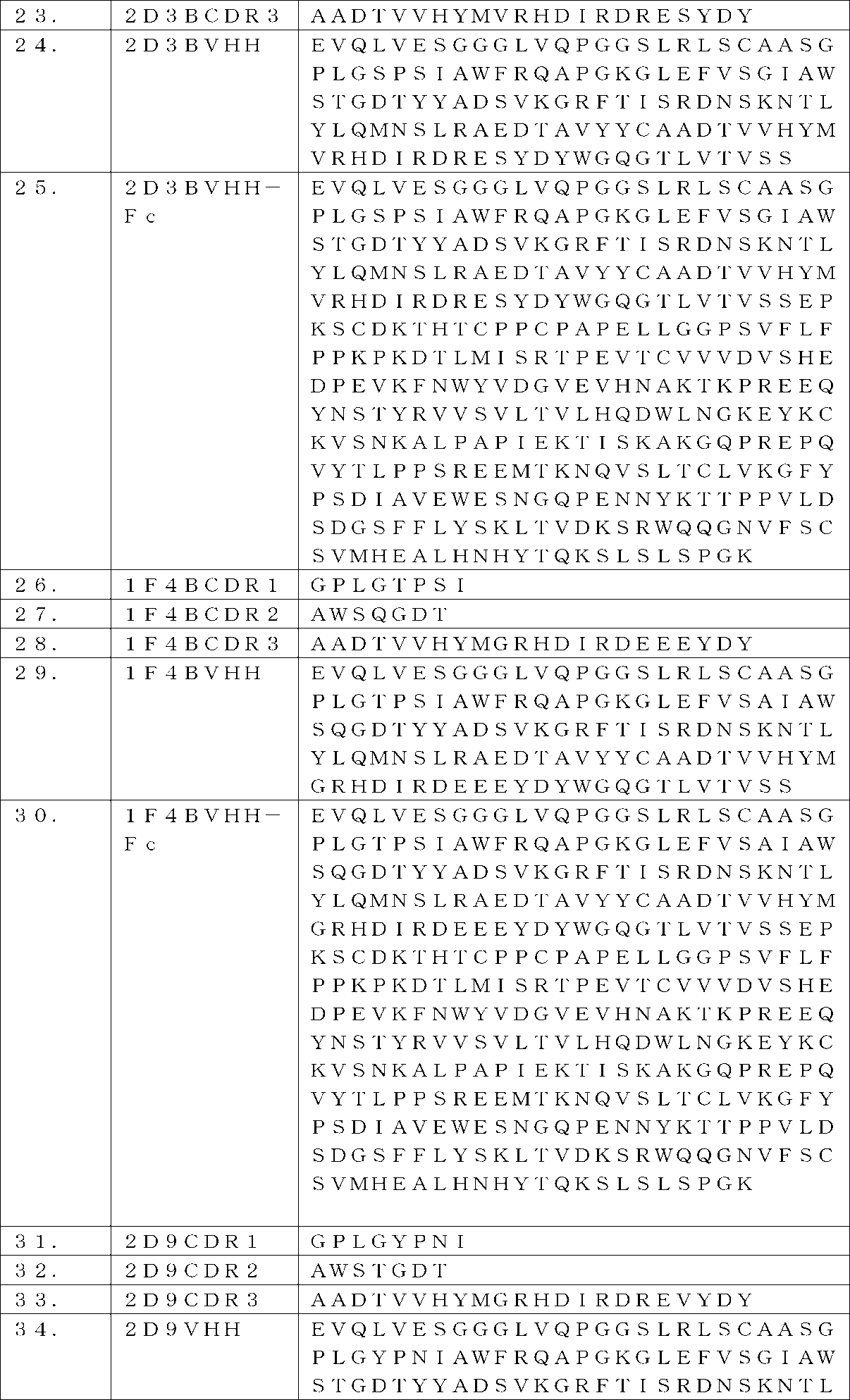


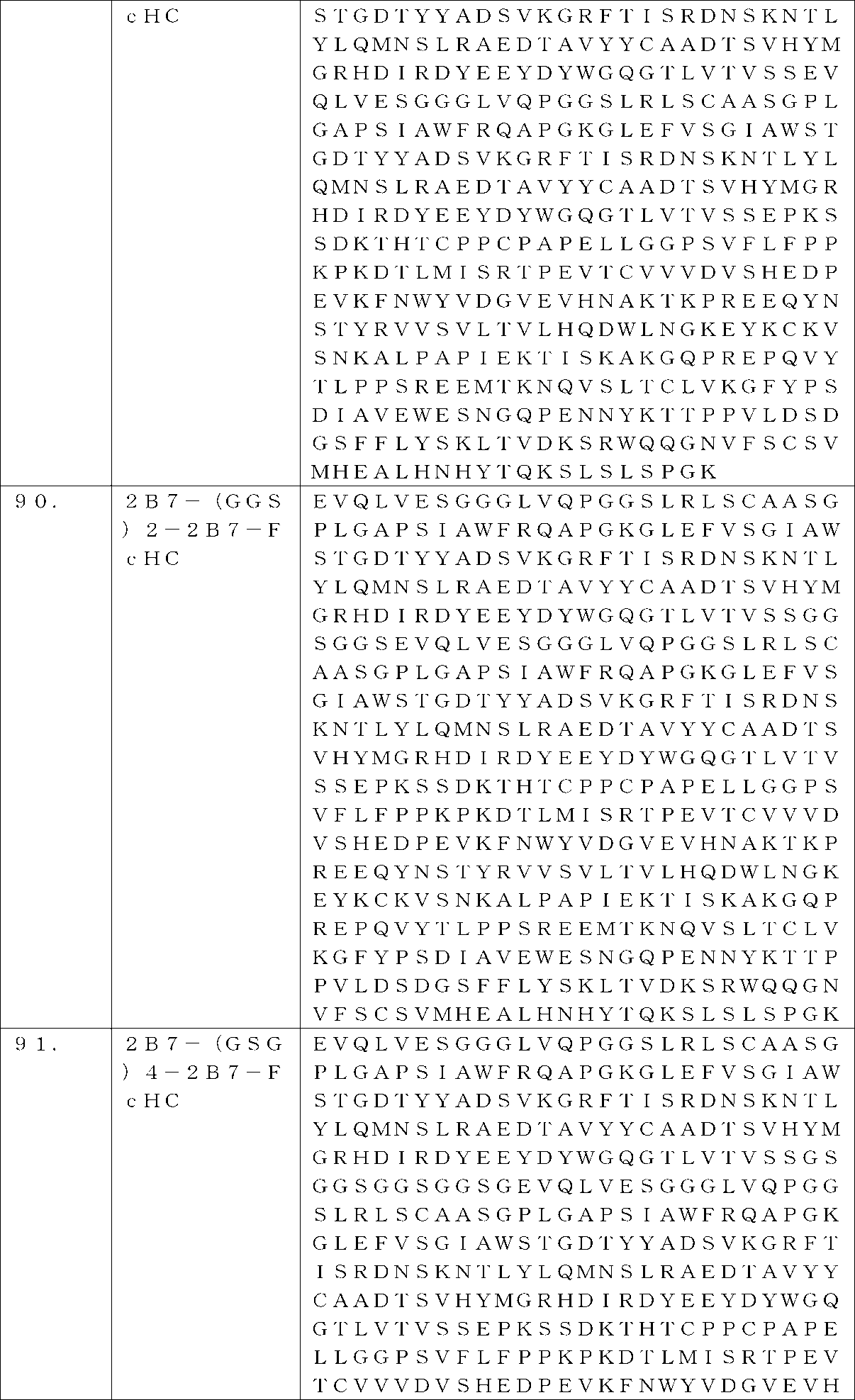


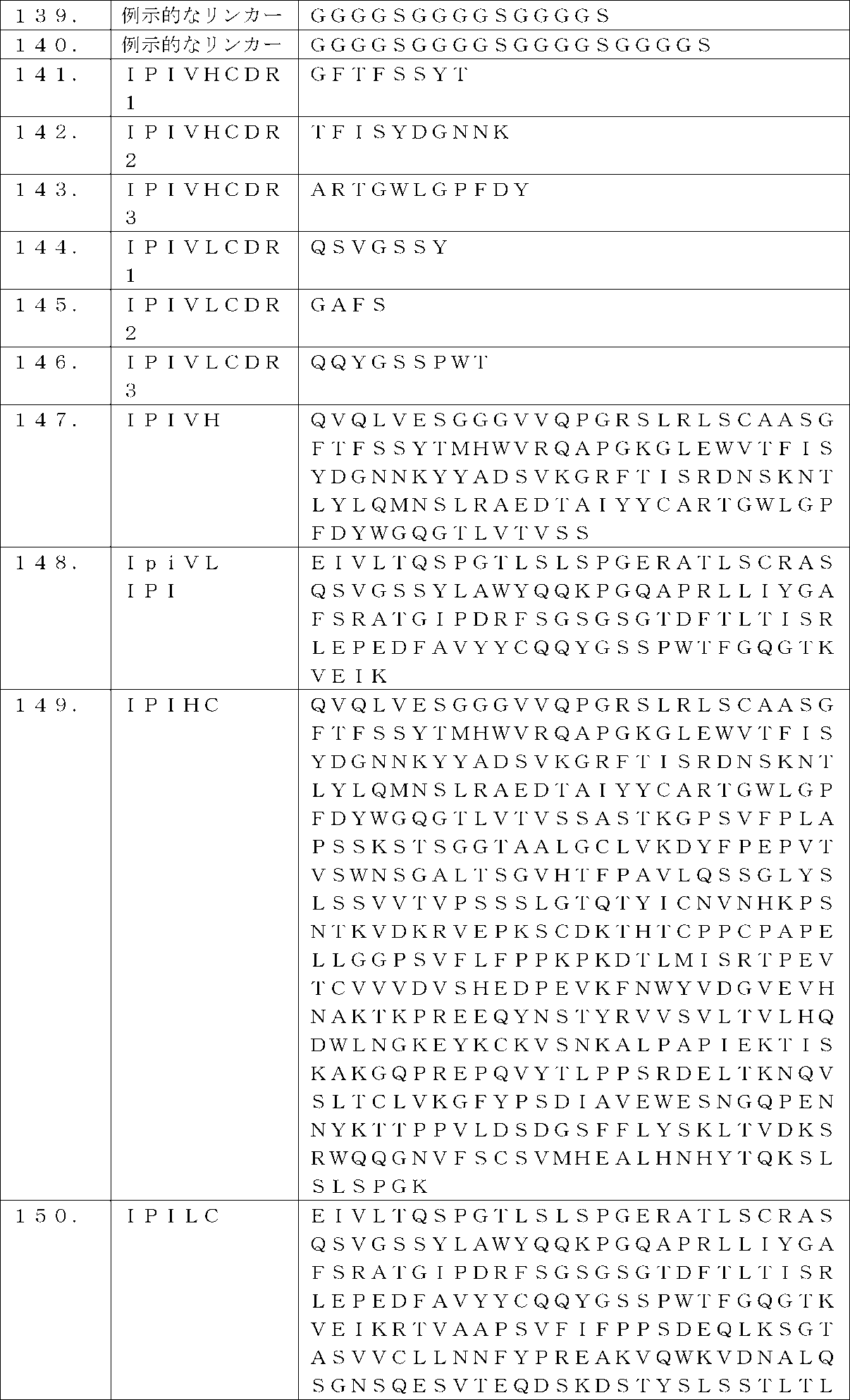
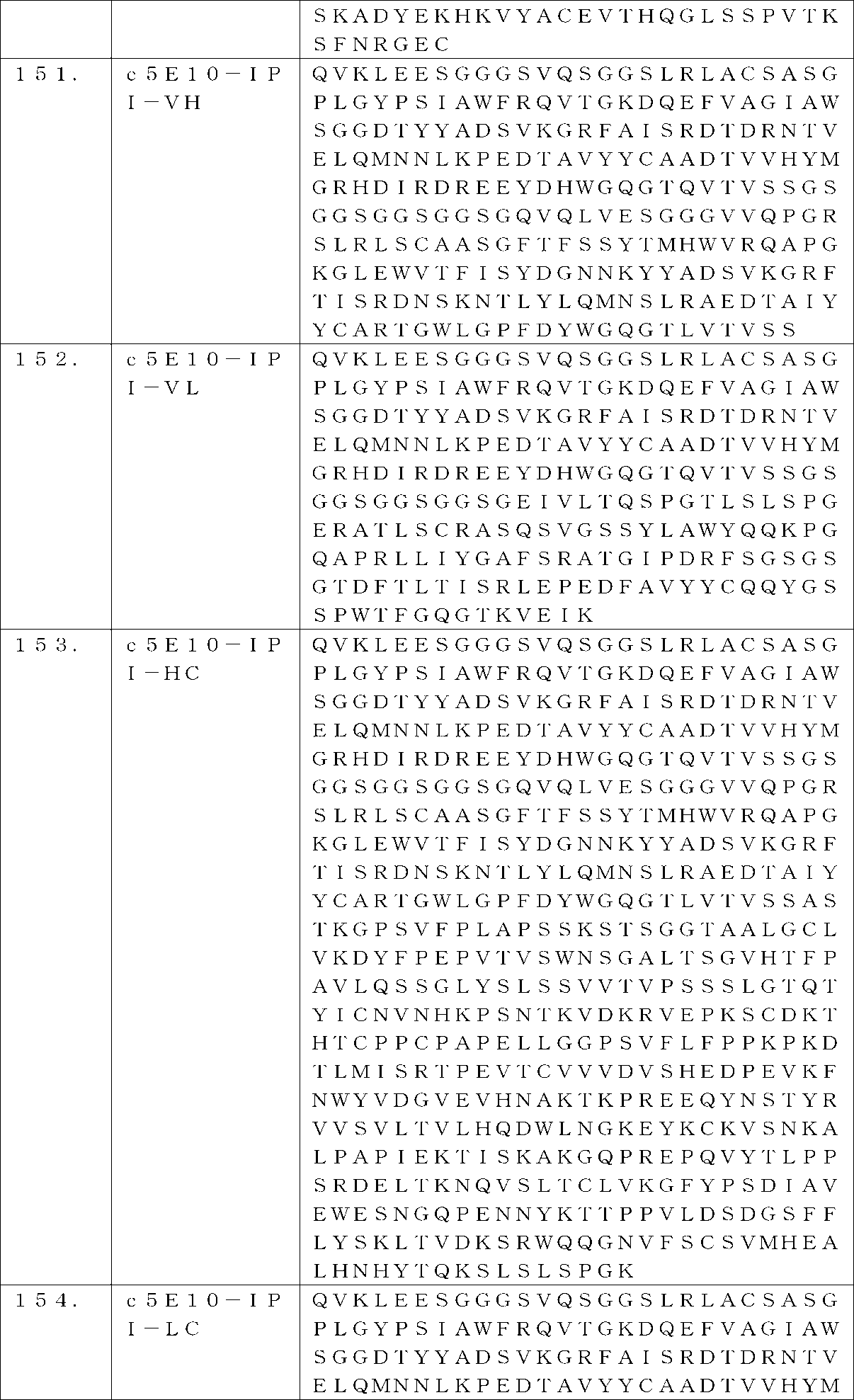


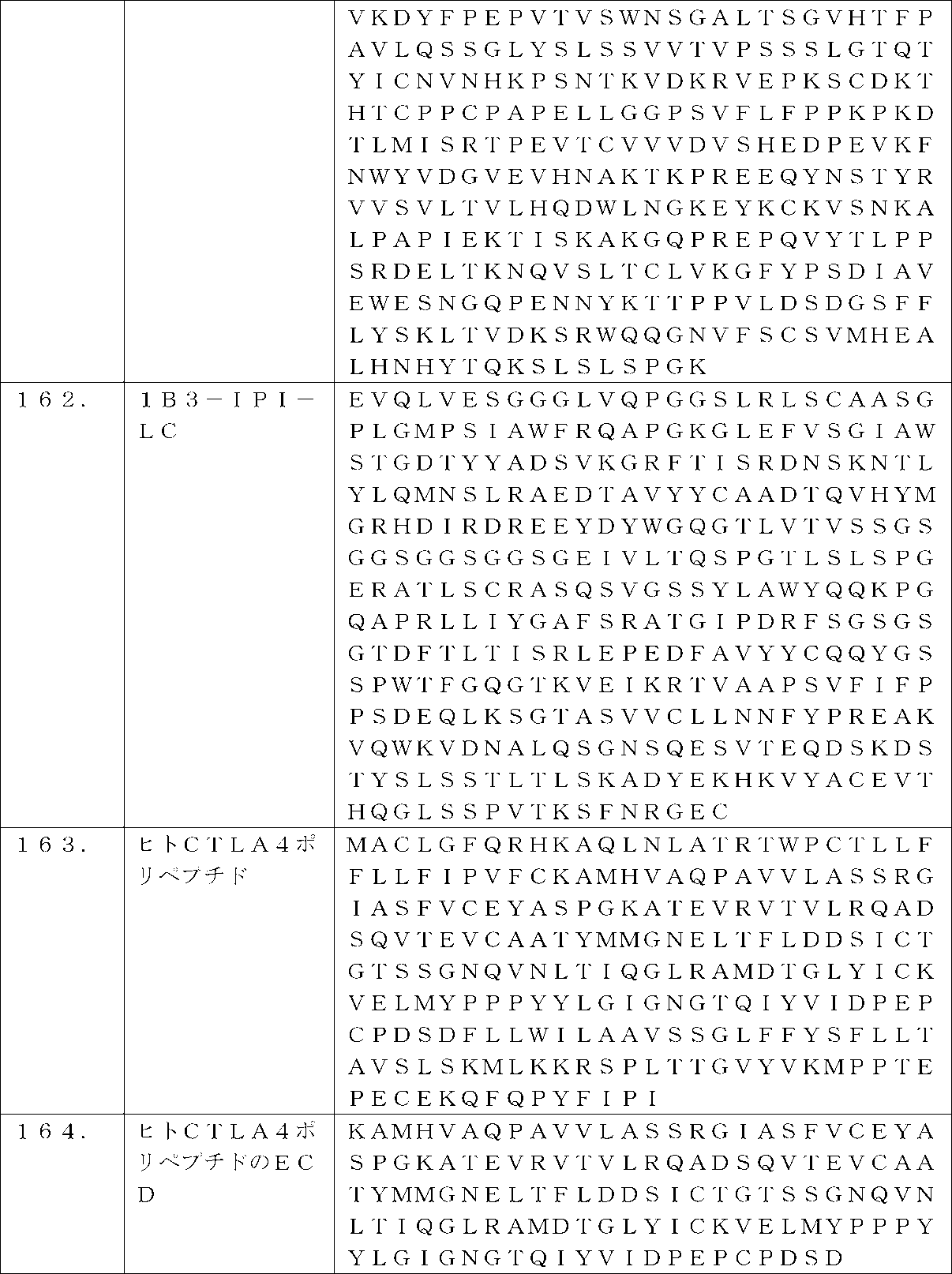
以下の実施例は、本発明のテーマに関する説明だけであり、いかなる方式で限定のためのものと見なされるべきではない。 The following examples are merely illustrative of the subject matter of the present invention and should not be construed as limiting in any manner.
実施例1 抗OX40 VHH抗体の免疫、生成と認識
Hisラベル(OX40 ECD-His)又はヒトIgG1-Fc(OX40-ECD-Fc)にコンジュゲートした組換えヒトOX40細胞外ドメイン(ECD)タンパク質は、内部(in-house)で製造され、標準手順に従って、ラマ(llama)を免疫するために用いられた。血清抗体力価をELISA法により測定し、4ラウンドの免疫(OX40 ECD-His 1ラウンド、OX40 ECD-Fc 3ラウンド)後に抗体力価は、1:100,000以上となった。そして、PBMC単離のために全血を採取した。精製されたPBMCから総RNAを抽出し、逆転写してcDNAを生成し、さらに標準手順に従ってPCRにより増幅した。VHH抗体遺伝子断片は、PCRにより増幅され、ゲル精製され、ファージペリクルベクターpADL-23c(Antibody Design Labs#PD0111)にサブクローニングされ、TG1感受性細胞(Lucigen)に形質転換された。形質転換されたTG1細胞を2xYT培地で培養し、補助ファージを加えて一晩共培養したことにより、標的化VHHを示すファージを産生した。培養上清中のファージを遠心収穫し、ストレプトアビジン結合Dynabeads M280(ThermoFisher#11205D)を用いて3ラウンドのスクリーニングを行い、1ラウンド目はビオチン化ヒトOX40 ECD-Fcでコーティングし、2ラウンド目と3ラウンド目はビオチン化ヒトOX40 ECD-Hisでコーティングした。ヒトOX40結合剤を示すバクテリオファージは、溶出され、SS320細胞への感染に用いられた。コロニーをピックアップし、IPTGを含有する2xYT培地で培養して、VHH抗体を分泌させた。ヒトOX40ECD-Fc又はヒトOX40EC-Hisプリコーティングプレートを用いて、VHH抗体を含有する上清をELISAによりスクリーニングした。5E10を含む上位(top)ヒトOX40結合タンパク質をピックアップして配列決定し、そのCDRとVHH配列は、配列表(SEQ ID NO:1-5)に示すとおりである。
Example 1 Immunization, Generation and Recognition of Anti-OX40 VHH Antibodies Recombinant human OX40 extracellular domain (ECD) protein conjugated to His-label (OX40 ECD-His) or human IgG1-Fc (OX40-ECD-Fc) was produced in-house and used to immunize llamas according to standard procedures. Serum antibody titers were measured by ELISA and were greater than 1:100,000 after four rounds of immunization (1 round OX40 ECD-His, 3 rounds OX40 ECD-Fc). Whole blood was then collected for PBMC isolation. Total RNA was extracted from purified PBMCs, reverse transcribed to generate cDNA, and amplified by PCR according to standard procedures. VHH antibody gene fragments were amplified by PCR, gel purified, subcloned into the phage pellicle vector pADL-23c (Antibody Design Labs #PD0111), and transformed into TG1 responsive cells (Lucigen). The transformed TG1 cells were cultured in 2xYT medium and co-cultured overnight with auxiliary phages to produce phages displaying the targeted VHH. The phages in the culture supernatant were harvested by centrifugation and screened in three rounds using streptavidin-conjugated Dynabeads M280 (ThermoFisher #11205D), coated with biotinylated human OX40 ECD-Fc in the first round, and coated with biotinylated human OX40 ECD-His in the second and third rounds. Bacteriophages expressing human OX40 binders were eluted and used to infect SS320 cells. Colonies were picked and cultured in 2xYT medium containing IPTG to secrete VHH antibodies. Supernatants containing VHH antibodies were screened by ELISA using human OX40ECD-Fc or human OX40EC-His pre-coated plates. Top human OX40 binding proteins including 5E10 were picked and sequenced, and their CDR and VHH sequences are shown in the sequence listing (SEQ ID NO: 1-5).
ラマVHHクローン5E10をヒトIgG1 Fcと融合させ、図1Aと配列表に示すようにキメラ二価抗体(c5E10)を形成した。このタンパク質をExpiCHO細胞で発現し、ProteinAアフィニティークロマトグラフィーにより精製した。二価c5E10とヒト及びマウスのOX40との結合親和性をELISAにより測定した。簡単に言うと、1μg/ml Fcを融合したヒト又はマウスOX40 ECDを96ウェルの高結合板にコーティングし、4℃で一晩置いた。PBS中の3%BSAで封入した後、5倍連続希釈したビオチン標識c5E10を添加し、RT下で1時間インキュベートした。PBS+0.05%Tween(登録商標)20で5回洗浄した後、HRPコンジュゲートのアビオチン及びそれに続くTMB基質により結合したc5E10を検出した。図1Bに示すように、c5E10は、投与量依存的にヒトOX40に結合したが、マウスOX40には結合しなかった。 Llama VHH clone 5E10 was fused with human IgG1 Fc to form a chimeric bivalent antibody (c5E10) as shown in Figure 1A and sequence listing. The protein was expressed in ExpiCHO cells and purified by Protein A affinity chromatography. The binding affinity of bivalent c5E10 to human and mouse OX40 was measured by ELISA. Briefly, human or mouse OX40 ECD fused with 1 μg/ml Fc was coated onto 96-well high binding plates and incubated overnight at 4°C. After sealing with 3% BSA in PBS, 5-fold serial dilutions of biotin-labeled c5E10 were added and incubated for 1 h at RT. After washing five times with PBS + 0.05% Tween® 20, bound c5E10 was detected by HRP-conjugated aviotin followed by TMB substrate. As shown in Figure 1B, c5E10 bound to human OX40 in a dose-dependent manner, but did not bind to mouse OX40.
OX40 ECDは、4つのシステインリッチドメイン(CRD)を含み、そのリガンド結合を許容することによって、受容体の凝集と下流シグナルの活性化をもたらした。c5E10がマウスOX40に結合しないため、ヒト-マウスOX40キメラを製造し、ここで、図1Cに示すように、各ヒトOX40 CRDは、いずれもマウスOX40対応物で置換され、それは、c5E10が結合するOX40 CRDドメインを認識するために用いられた。ヒトOX40ECD又はヒト-マウスキメラECDとヒトIgG1Fcとを融合させ、ProteinAアフィニティークロマトグラフィーにより該融合タンパク質を精製した。1μg/ml Fc融合ヒトOX40 ECD又はヒト-マウスOX40キメラECDを96ウェルの高結合プレートにコーティングし、4℃で一晩置き、ビオチン標識OX40抗体とこれらのタンパク質との結合を上述のELISAにより測定した。ヒトCRD2の置換により、c5E10とヒトOX40との結合がほぼ完全に解消され(図1D)、c5E10とヒトOX40 CRD2との結合を示した。抗OX40抗体PF-8600とMEDI0562を対照として用いた。PF-8600は、米国特許第7,960,515号に開示されている配列に従って内部合成された。MEDI0562は、米国公開番号2016/0137740A1に開示された配列に基づいて内部合成された。図1Dに示すように、PF-8600類似体は、mD1キメラに結合せず、PF-8600類似体がヒトOX40CRD1に結合したことを示し、MEDI0562類似体は、mD3との結合が急激に低下し、MEDI0562類似体がヒトOX40CRD3に結合したことを示した。 OX40 ECD contains four cysteine-rich domains (CRDs) that allow its ligand binding, resulting in receptor aggregation and activation of downstream signals. Because c5E10 does not bind to mouse OX40, human-mouse OX40 chimeras were constructed in which each human OX40 CRD was replaced with its mouse OX40 counterpart, as shown in Figure 1C, which was used to recognize the OX40 CRD domain to which c5E10 binds. Human OX40 ECD or human-mouse chimeric ECD was fused to human IgG1 Fc, and the fusion proteins were purified by Protein A affinity chromatography. 1 μg/ml Fc-fused human OX40 ECD or human-mouse chimeric OX40 ECD was coated onto a 96-well high-binding plate and incubated overnight at 4°C, and the binding of biotin-labeled OX40 antibodies to these proteins was measured by ELISA as described above. Substitution of human CRD2 almost completely eliminated the binding of c5E10 to human OX40 (Figure 1D), indicating the binding of c5E10 to human OX40 CRD2. Anti-OX40 antibodies PF-8600 and MEDI0562 were used as controls. PF-8600 was synthesized internally according to the sequence disclosed in U.S. Patent No. 7,960,515. MEDI0562 was synthesized internally based on the sequence disclosed in U.S. Publication No. 2016/0137740A1. As shown in Figure 1D, the PF-8600 analog did not bind to the mD1 chimera, indicating that the PF-8600 analog bound to human OX40 CRD1, and the MEDI0562 analog showed a sharp decrease in binding to mD3, indicating that the MEDI0562 analog bound to human OX40 CRD3.
c5E10、PF-8600類似体とMEDI0562類似体の結合エピトープを比較するために、抗ヒトIgGFc(AHC)バイオセンサを用いてOctet競合結合分析を行い、まず1つの抗体をローディングし、そして表3に示す別の抗体をローディングした。表3に示すように、c5E10は、PF-8600類似体又はMEDI0562類似体と競合しておらず、これは、異なるOX40 CRDに結合することと一致していた。 To compare the binding epitopes of c5E10, the PF-8600 analogs, and the MEDI0562 analogs, Octet competitive binding assays were performed using anti-human IgG Fc (AHC) biosensors, first loaded with one antibody and then loaded with the other antibody shown in Table 3. As shown in Table 3, c5E10 did not compete with the PF-8600 analogs or the MEDI0562 analogs, consistent with binding to different OX40 CRDs.

実施例2. 抗OX40 VHH抗体のヒト化及び親和性成熟
ラマ5E10配列を用いてIgBlast分析を行い、データベース内のヒト系統遺伝子を検索した。この2つのPhe(F)がラママーカー残基であるため、最適にマッチした人種系IGHV3-23にラマ5E10のCDRを移植し、フレームワーク2内で変異V37FとW47Fを回復させることによりヒト化を実現した。親和性成熟のために、NNKベースのプライマーは、高度に可変なCDR1、CDR2、CDR3をコードするように設計された。PCRアセンブリを用いて部位飽和変異誘発を含むライブラリーを製造し、それをファージミドベクターpADL-23cにクローニングした。ライブラリーDNAをTG1細胞に形質転換し、ランダム性の質を保証するためにクローン配列を検査した。非加熱又は加熱処理ファージをヒトOX40ECD-Hisでコーティングしたビーズでインキュベートして2ラウンド淘汰した後、溶出したファージを用いてSS330細胞に感染させ、コロニーを摘出し、IPTGを含む2xYT培地で培養した。ヒトOX40 ECD-Fc又はヒトOX40 ECD-Hisプリコーティングプレートを用いて、上清液中のVHH抗体とヒトOX40との結合をELISAにより測定した。最初の15個のクローン及びそれらのCDRとVHH配列は、配列表(SEQ ID NO:6-80)に記載されていた。
Example 2. Humanization and affinity maturation of anti-OX40 VHH antibodies IgBlast analysis was performed using the llama 5E10 sequence to search for human lineage genes in the database. Humanization was achieved by grafting the CDRs of llama 5E10 into the best-matched human lineage IGHV3-23, restoring the mutations V37F and W47F within framework 2, as the two Phe (F) are llama marker residues. For affinity maturation, NNK-based primers were designed to code for the highly variable CDR1, CDR2, and CDR3. A library containing site-saturation mutagenesis was produced using PCR assembly and cloned into the phagemid vector pADL-23c. Library DNA was transformed into TG1 cells and clone sequences were checked to ensure the quality of randomness. After two rounds of selection by incubation of non-heat-treated or heat-treated phages with beads coated with human OX40 ECD-His, eluted phages were used to infect SS330 cells, colonies were picked and cultured in 2xYT medium containing IPTG. Binding of VHH antibodies in the supernatant to human OX40 was measured by ELISA using human OX40 ECD-Fc or human OX40 ECD-His pre-coated plates. The initial 15 clones and their CDR and VHH sequences were listed in the sequence listing (SEQ ID NO: 6-80).
この15個のクローンの二価抗体は、VHHとヒトIgG1 Fcを融合させて作製され、ExpiCHO細胞で発現し、Protein Aアフィニティーカラムで精製された。ヒトOX40トランスフェクションJurkat細胞(ヒトOX40/Jurkat)(図2A)、ヒトOX40トランスフェクションCHO細胞(ヒトOX40/CHO)(図2B)とカニクイザルOX40トランスフェクションCHO細胞(カニクイザルOX40/CHO)(図2C)を用いて、フローサイトメトリーによりVHH-Fc二価抗体とヒト又はカニクイザルOX40との結合親和性を評価した。これらの指示濃度を有する抗体を氷上で細胞と共にFACS緩衝液(3%FBSはPBS)において30minインキュベートした後、FACS緩衝液で遊離抗体を洗い流した。Alexa fluor488にカップリングした抗ヒトIgG Fc抗体(1:500)(Alexa Fluor488 AffiniPureヤギ抗ヒトIgG、Fcg断片特異性、Jackson labs)を氷上で細胞とさらに30minインキュベートした。細胞を洗浄して遊離抗体を除去した後、CytoFlex(Beckman Coulter)を用いてFACS分析を行った。GraphPad Prism三パラメータ論理式を用いて結合親和性を計算した。図2A-2Cに示すように、これらのクローンは、ヒトOX40を発現する細胞とカニクイザルOX40を発現する細胞の両者に結合した。 The bivalent antibodies of these 15 clones were produced by fusing VHH and human IgG1 Fc, expressed in ExpiCHO cells, and purified by Protein A affinity column. The binding affinity of the VHH-Fc bivalent antibodies to human or cynomolgus OX40 was evaluated by flow cytometry using human OX40-transfected Jurkat cells (human OX40/Jurkat) (Figure 2A), human OX40-transfected CHO cells (human OX40/CHO) (Figure 2B), and cynomolgus OX40-transfected CHO cells (cynomolgus OX40/CHO) (Figure 2C). The antibodies with the indicated concentrations were incubated with the cells on ice for 30 min in FACS buffer (3% FBS in PBS), and then the free antibodies were washed off with FACS buffer. Anti-human IgG Fc antibody (1:500) coupled to Alexa Fluor488 (Alexa Fluor488 AffiniPure goat anti-human IgG, Fcg fragment specific, Jackson labs) was incubated with the cells for an additional 30 min on ice. After washing the cells to remove free antibody, FACS analysis was performed using CytoFlex (Beckman Coulter). Binding affinity was calculated using a GraphPad Prism three-parameter equation. As shown in Figures 2A-2C, these clones bound to both human and cynomolgus OX40-expressing cells.
実施例3. 抗OX40抗体のインビトロ特徴付け
抗OX40四価抗体を構築し、ここで、ヒトIgG1の重鎖と軽鎖可変領域をクローン1B3又はクローン2B7のVHH配列で置換し、且つVHHとIgG1のCH1又はCLとの間にGSリンカーを挿入した。四価抗体の構造は、図3Aに示すとおりである。四価抗体は、瞬間的にトランスフェクションされたExpiCHO細胞から産生され、ProteinAアフィニティーカラムによって精製された。バイオセンサチップに固定化したヒトOX40 ECD-Fcを用い、Octet結合試験により1B3と2B7二価と四価抗体とヒトOX40との結合動態と親和性を測定した。1B3と2B7二価と四価抗体の平衡解離定数(KD)を計算した (表4)。二価と四価抗体は、いずれもヒトOX40に対して高い結合親和性を示した。
Example 3. In Vitro Characterization of Anti-OX40 Antibodies An anti-OX40 tetravalent antibody was constructed in which the heavy and light chain variable regions of human IgG1 were replaced with the VHH sequences of clone 1B3 or clone 2B7, and a GS linker was inserted between the VHH and the CH1 or CL of IgG1. The structure of the tetravalent antibody is shown in FIG. 3A. The tetravalent antibody was produced from instantaneously transfected ExpiCHO cells and purified by Protein A affinity column. The binding kinetics and affinity of 1B3 and 2B7 bivalent and tetravalent antibodies to human OX40 were measured by Octet binding assay using human OX40 ECD-Fc immobilized on a biosensor chip. The equilibrium dissociation constants (KD) of 1B3 and 2B7 bivalent and tetravalent antibodies were calculated (Table 4). Both the bivalent and tetravalent antibodies showed high binding affinity to human OX40.

上記手順を用いて、ヒトOX40/Jurkat細胞とヒトOX40/CHO細胞を用いて、フローサイトメトリーにより抗OX40抗体の結合親和性をさらに評価した。図4Aと4Bに示すように、二価抗体と四価抗体は、いずれもヒトOX40を発現するJurkatとCHO細胞に対して有意に高い結合親和性を示した。図4Cに示すように、四価抗体は、トランスフェクションされていないCHO細胞には結合せず、抗体と、トランスフェクションされた細胞上で発現しているヒトOX40と特異的に相互作用することを示した。カニクイザルOX40/CHO細胞を用いたFACS分析により、カニクイザルOX40に対する抗体の交差反応性を評価した。ヒトOX40に比べて、1B3と2B7抗体は、いずれもカニクイザルOX40に似た親和性で結合した(図4D)。 Using the above procedure, the binding affinity of the anti-OX40 antibodies was further evaluated by flow cytometry using human OX40/Jurkat and human OX40/CHO cells. As shown in Figures 4A and 4B, both the bivalent and tetravalent antibodies showed significantly higher binding affinity to Jurkat and CHO cells expressing human OX40. As shown in Figure 4C, the tetravalent antibody did not bind to non-transfected CHO cells, indicating specific interaction of the antibody with human OX40 expressed on transfected cells. The cross-reactivity of the antibodies to cynomolgus OX40 was evaluated by FACS analysis using cynomolgus OX40/CHO cells. Compared to human OX40, both the 1B3 and 2B7 antibodies bound to cynomolgus OX40 with similar affinity (Figure 4D).
ブドウ球菌エンテロトキシンB(SEB)でヒト末梢血リンパ球(PBMC)を刺激することにより、抗OX40抗体(1B3-tetraと2B7-tetra)の共刺激活性を評価した。FcγRIIB架橋なしの測定において、ヒトPBMCを100ng/ml SEB(ToxinTechnology,cat.BT202red)で刺激し、1:5勾配で希釈した1B3-tetra又は2B7-tetraを37℃、5%CO2インキュベーターで2日間インキュベートした。FcγRIIB結合による架橋測定において、FcγRIIB/HEK293細胞10,000個を96ウェルプレートに一晩接種した。翌日、ヒトPBMCを添加し、1B3-tetra又は2B7-tetraの存在下で、100ng/ml SEBで2日間刺激した。ヒトIL-2 LANCE Ultra TR-FRET検出キット(PerkinElmer,cat.TRF1221)を用いて培養上清中のIL-2を定量した。図5Aに示すように、PBMCをFcγRIIB/HEK293と共培養した時、1B3-tetraと2B7-tetraの投与量依存的にIL-2の発現が増加した。FcγRIIBによって架橋されていない場合、抗OX40抗体は、SEBによって活性化されたPBMCにおけるIL-2の放出を高めることができない(図5B)。阻害性受容体FcγRIIBによって媒介される架橋を必要とせずにOX40シグナルを活性化できる抗OX40アゴニスト抗体は、FcγRIIBの発現が高くない末梢組織においてOX40シグナルを活性化でき、それによって末梢毒性を引き起こすため、結果は、1B3-tetraと2B7-tetra抗OX40抗体の臨床安全性を示した。 The costimulatory activity of anti-OX40 antibodies (1B3-tetra and 2B7-tetra) was evaluated by stimulating human peripheral blood lymphocytes (PBMCs) with Staphylococcal Enterotoxin B (SEB). For measurements without FcγRIIB cross-linking, human PBMCs were stimulated with 100 ng/ml SEB (ToxinTechnology, cat. BT202red) and incubated with 1:5 gradient dilutions of 1B3-tetra or 2B7-tetra in a 37°C, 5% CO2 incubator for 2 days. For measurements of cross-linking by FcγRIIB binding, 10,000 FcγRIIB/HEK293 cells were seeded overnight in a 96-well plate. The next day, human PBMCs were added and stimulated with 100 ng/ml SEB in the presence of 1B3-tetra or 2B7-tetra for 2 days. IL-2 in the culture supernatant was quantified using a human IL-2 LANCE Ultra TR-FRET detection kit (PerkinElmer, cat. TRF1221). As shown in Figure 5A, when PBMCs were co-cultured with FcγRIIB/HEK293, IL-2 expression was increased in a dose-dependent manner by 1B3-tetra and 2B7-tetra. When not cross-linked by FcγRIIB, anti-OX40 antibody was unable to enhance IL-2 release in PBMCs activated by SEB (Figure 5B). The results demonstrated the clinical safety of 1B3-tetra and 2B7-tetra anti-OX40 antibodies, because anti-OX40 agonist antibodies, which can activate OX40 signaling without the need for cross-linking mediated by the inhibitory receptor FcγRIIB, can activate OX40 signaling in peripheral tissues where FcγRIIB expression is not high, thereby causing peripheral toxicity.
2B7-tetraのT細胞の活性化と増殖に対するアゴニスト作用をさらに研究し、2種類の参照抗OX40抗体と比較した。参照1は、IBI-101に基づいて内部合成され、その配列は、US20200140562A1に開示された。参照2は、BG445-3に基づいて内部合成され、その配列は、WO 2019223733A1に開示された。マイトマイシンCで処理されたFcγRIIB/HEK293(10,000個の細胞/ウェル)が存在している場合又は存在しない場合、精製されたT細胞(0.1x106 T細胞/ウェル)を所定のOX40抗体と抗CD3ビーズ(ThermoFisherScientific,cat.11151D)(ビーズ:T細胞比=1:1)で3日間刺激した。ヒトIL-2とIFNγ(PerkinElmer,cat.TRF1217)LANCE Ultra TR-FRET検出キットを用いて培養上清中のIL-2とIFNγを測定した。T細胞をFcγRIIB/HEK293と共培養した時、2B7-tetraと参照抗体がT細胞を共刺激できることは、IL-2とIFNγ分泌の濃度依存性増加によって確認された(図6Aと図6C)。FcγRIIB/HEK293が存在しない場合、これらの抗OX40抗体は、抗CD3刺激からのT細胞におけるIL-2又はIFN-g放出を強化することはできなかった(図6Bと図6D)。 The agonistic effect of 2B7-tetra on T cell activation and proliferation was further studied and compared with two reference anti-OX40 antibodies. Reference 1 was synthesized internally based on IBI-101, the sequence of which was disclosed in US20200140562A1. Reference 2 was synthesized internally based on BG445-3, the sequence of which was disclosed in WO 2019223733A1. Purified T cells (0.1x10⁶ T cells/well) were stimulated with the indicated OX40 antibodies and anti-CD3 beads (ThermoFisherScientific, cat.11151D) (beads:T cell ratio = 1:1) for 3 days in the presence or absence of mitomycin C-treated FcγRIIB/HEK293 ( 10,000 cells/well). Human IL-2 and IFNγ (PerkinElmer, cat. TRF1217) LANCE Ultra TR-FRET detection kit was used to measure IL-2 and IFNγ in the culture supernatant. When T cells were co-cultured with FcγRIIB/HEK293, the ability of 2B7-tetra and the reference antibody to costimulate T cells was confirmed by a concentration-dependent increase in IL-2 and IFNγ secretion (Figures 6A and 6C). In the absence of FcγRIIB/HEK293, these anti-OX40 antibodies were unable to enhance IL-2 or IFN-γ release in T cells from anti-CD3 stimulation (Figures 6B and 6D).
T細胞の増殖に対する抗OX40抗体の影響を評価するために、精製されたT細胞をマイトマイシンCで処理されたFcγRIIB/HEK293と共培養し、抗CD3ビーズと抗OX40抗体で5日間刺激した。そして、1ウェル当たりに3-(4,5-ジメチルチアゾール-2-イル)-5-(3-カルボキシメトキシフェニル)-2-(4-スルホフェニル)-2H-テトラゾール(MTS、Promega、cat.G3580)を20μl添加し、発色後にOD490を測定した。図7Aと7Bに示すように、HEK293上に発現するFcγRIIBによって架橋される時、2B7-tetraと参照抗体は、T細胞増殖を促進し(図7A)、且つFcγRIIB/HEK293をT細胞と共培養しないと、これらの抗体は、不活性化した(図7B)。 To evaluate the effect of anti-OX40 antibodies on T cell proliferation, purified T cells were co-cultured with mitomycin C-treated FcγRIIB/HEK293 and stimulated with anti-CD3 beads and anti-OX40 antibodies for 5 days. Then, 20 μl of 3-(4,5-dimethylthiazol-2-yl)-5-(3-carboxymethoxyphenyl)-2-(4-sulfophenyl)-2H-tetrazole (MTS, Promega, cat. G3580) was added per well, and OD490 was measured after color development. As shown in Figures 7A and 7B, 2B7-tetra and the reference antibody promoted T cell proliferation when cross-linked by FcγRIIB expressed on HEK293 (Figure 7A), and these antibodies were inactivated when FcγRIIB/HEK293 was not co-cultured with T cells (Figure 7B).
MTSアッセイに加えて、カルボキシルシフェリンスクシンイミド(CFSE)により標識されるT細胞をマイトマイシンCで処理されたFcγRIIB/HEK293と共培養し、抗CD3ビーズと抗OX40抗体で5日間刺激した。そして、FACS分析の前に、Sytox Redで細胞を染色し、生細胞と死細胞を区別した。図7Cは、SytoxRed陰性ゲートにおける生細胞集団を示しており、ここで、CFSE陰性細胞は、FcγRIIB/HEK293細胞であり、高いCFSEを含有する細胞は、増殖していない静止T細胞であり、希釈されたCFSEレベルを含有する細胞は、増殖T細胞である。結果によると、OX40抗体がT細胞の増殖を促進するとともに、CFSE希釈した増殖T細胞が増加し、安静T細胞が減少することを示した。増殖T細胞のパーセントは、次の式を使用してさらに計算された。増殖T細胞/(増殖T細胞+非増殖T細胞)*100とし、図7Dに示した。結果によると、2B7-tetraと参照抗体は、MTSアッセイで観察されたものと類似するように、投与量依存的にT細胞の増殖を誘導することを示した。 In addition to the MTS assay, carboxyluciferin succinimide (CFSE)-labeled T cells were co-cultured with mitomycin C-treated FcγRIIB/HEK293 and stimulated with anti-CD3 beads and anti-OX40 antibody for 5 days. Then, cells were stained with Sytox Red to distinguish live and dead cells before FACS analysis. Figure 7C shows the live cell population in the SytoxRed negative gate, where CFSE-negative cells are FcγRIIB/HEK293 cells, cells containing high CFSE are non-proliferating resting T cells, and cells containing diluted CFSE levels are proliferating T cells. The results showed that OX40 antibody promoted T cell proliferation, with an increase in CFSE-diluted proliferating T cells and a decrease in resting T cells. The percentage of proliferating T cells was further calculated using the following formula: The ratio was calculated as proliferating T cells/(proliferating T cells+non-proliferating T cells)*100 and is shown in Figure 7D. The results showed that 2B7-tetra and the reference antibody induced T cell proliferation in a dose-dependent manner, similar to that observed in the MTS assay.
実施例4. MC38結腸腫瘍モデルにおける抗OX40抗体のインビボ特徴付け
MC38腫瘍モデルにおいて抗OX40抗体の抗腫瘍効果を評価した。マウスMC38結腸腫瘍細胞をヒトOX40ノックイン C57BL/6マウス(Biocytogen,Boston,USA)に経皮下移植した。腫瘍の大きさが約60mm3に達した時点で、マウスを8匹ずつ無作為にグループ分けし、2B7-tetraを週2回、3週間腹腔内投与した。腫瘍の体積(TV) は、以下の式によって計算された。V=0.5*(a*b2)、ここで、aとbは、それぞれ腫瘍の長径と短径である。腫瘍増殖阻害率(TGI)は、以下の式によって計算された。TGI=[1-(Tt-T0)/(Ct-C0)]×100%であり、ここで、T0とTtは、抗体治療群における時間0とt時の平均TVであり、C0とCtは、溶媒群における時間0とt時の平均TVである。2B7は、MC38腫瘍増殖に対して投与量依存的な阻害作用を示し、治療後15日目に、2B7が腫瘍成長を阻害する結果は、それぞれ1mg/kgで19.5%、10mg/kgで61.0%である(図8A)。各群間のマウスの体重差は、非常に小さく(図8B)、且つ治療中に毒性現象は観察されなかった。
Example 4. In vivo characterization of anti-OX40 antibodies in MC38 colon tumor model The anti-tumor effect of anti-OX40 antibodies was evaluated in the MC38 tumor model. Murine MC38 colon tumor cells were subcutaneously implanted into human OX40 knock-in C57BL/6 mice (Biocytogen, Boston, USA). When the tumor size reached approximately 60 mm3 , the mice were randomly divided into groups of eight mice each and intraperitoneally administered 2B7-tetra twice a week for three weeks. The tumor volume (TV) was calculated by the following formula: V=0.5*(a* b2 ), where a and b are the long and short diameters of the tumor, respectively. The tumor growth inhibition (TGI) was calculated by the following formula: TGI=[1-( Tt - T0 )/( Ct - C0 )]×100%, where T0 and Tt are the mean TVs at time 0 and t in the antibody-treated group, and C0 and Ct are the mean TVs at time 0 and t in the vehicle group. 2B7 showed a dose-dependent inhibitory effect on MC38 tumor growth, and 15 days after treatment, 2B7 inhibited tumor growth by 19.5% at 1 mg/kg and 61.0% at 10 mg/kg, respectively (FIG. 8A). The difference in mouse body weight between each group was very small (FIG. 8B), and no toxicity phenomenon was observed during treatment.
2B7と上記参照1及び参照2の抗腫瘍活性を比較するために、さらにマウスの腹腔内に各抗体3mg/kgを週2回、3週間注射した。図8Cに示すように、研究の全過程において、2つの参照抗体に比べて、2B7は、より有効な抗腫瘍作用を示した。治療後17日目に、2B7、参照1と参照2のTGIは、それぞれ48.8%、41.7%と35.3%である。図8Dに各群における経時的な個体腫瘍の体積を示した。 To compare the antitumor activity of 2B7 with the above-mentioned Reference 1 and Reference 2, mice were further injected intraperitoneally with 3 mg/kg of each antibody twice a week for 3 weeks. As shown in Figure 8C, 2B7 showed a more effective antitumor effect than the two reference antibodies throughout the study. On the 17th day after treatment, the TGI of 2B7, Reference 1, and Reference 2 was 48.8%, 41.7%, and 35.3%, respectively. Figure 8D shows the individual tumor volume over time in each group.
実施例5. CT26結腸癌モデルにおける抗OX40抗体のインビボ特徴付け
ヒトOX40ノックインBALB/cマウスにおいてCT26結腸癌モデルを確立し、抗OX40抗体(Crownbio,Taicang,China)の抗腫瘍活性の分析に用いた。CT26腫瘍の大きさが約65mm3に達した時点で、マウスを8匹ずつ無作為にグループ分けし、2B7-tetraと参照2抗体を週2回腹腔内注射して治療した。図9Aに示すように、溶媒群に比べて、2B7は、3mg/kgと10mg/kgで投与量依存性抗腫瘍作用を示した。なお、同じ3mg/kgの投与量では、参照2に比べて、2B7はより強い抗腫瘍作用を示した。具体的に、治療後18日目に、溶媒対照群における平均腫瘍の大きさは、2393.1mm3に達したが、2B7-tetra 3mg/kgと10mg/kg群における平均腫瘍の体積は、それぞれ1321.7と825.5mm3であり、それは、TGIがそれぞれ46.0%と67.3%であることを示した。3mg/kg参照2を受けたマウスにおける18日目の平均腫瘍の体積とTGIは、1955.2mm3、18.8%である。各群の経時的な個体腫瘍の体積を図9Bに示した。2B7と参照2治療群におけるマウスの平均体重は、溶媒群と有意差を示さず(図9C)、該研究において2B7と参照2が良好な耐性が有することを示した。
Example 5. In vivo characterization of anti-OX40 antibodies in a CT26 colon cancer model A CT26 colon cancer model was established in human OX40 knock-in BALB/c mice and used to analyze the antitumor activity of anti-OX40 antibodies (Crownbio, Taichan, China). When the size of CT26 tumors reached approximately 65 mm3 , mice were randomly divided into groups of 8 mice each and treated with 2B7-tetra and reference 2 antibodies by intraperitoneal injection twice a week. As shown in Figure 9A, compared with the vehicle group, 2B7 showed a dose-dependent antitumor effect at 3 mg/kg and 10 mg/kg. At the same dose of 3 mg/kg, 2B7 showed a stronger antitumor effect than reference 2. Specifically, on day 18 after treatment, the mean tumor size in the vehicle control group reached 2393.1 mm3 , while the mean tumor volumes in the 2B7-tetra 3 mg/kg and 10 mg/kg groups were 1321.7 and 825.5 mm3 , respectively, indicating TGI of 46.0% and 67.3%, respectively. The mean tumor volume and TGI on day 18 in mice receiving 3 mg/kg Reference 2 were 1955.2 mm3 , 18.8%. Individual tumor volumes over time in each group are shown in Figure 9B. The mean body weights of mice in the 2B7 and Reference 2 treatment groups were not significantly different from the vehicle group (Figure 9C), indicating that 2B7 and Reference 2 were well tolerated in the study.
実施例6. Pan02膵臓腫瘍モデルにおける抗OX40抗体のインビボ特徴付け
MC38とCT26腫瘍モデルに比べて、Pan02膵臓腫瘍モデルのエフェクターT細胞は、著しく少なく、浸潤T細胞が阻害され、通常はチェックポイント阻害剤にあまり敏感ではなかった。Pan02腫瘍モデルにおいて2B7-tetra単独又はマウスPD1抗体RMP1-14との併用による抗腫瘍活性を研究した。Pan02細胞株をヒトOX40ノックインC57BL/6マウス(Crownbio、Taicang、China)に皮下移植した。腫瘍の大きさが92.6mm3に達した時点で、マウスを10匹ずつ無作為にグループ分けし、1又は5mg/kgの2B7、又は5mg/kgの参照2抗体を3日に1回腹腔内投与した。図10Aに示すように、5mg/kgの2B7は、5mg/kgの参照2よりも統計学的に効果的である(p=0.014)。38日目に、1mg/kgの2B7、5mg/kgの2B7と5mg/kgの参照2のTGIは、それぞれ64.7%、78.1%と55.5%である。
Example 6. In vivo characterization of anti-OX40 antibodies in Pan02 pancreatic tumor model Compared with MC38 and CT26 tumor models, the Pan02 pancreatic tumor model had significantly fewer effector T cells, inhibited infiltrating T cells, and was generally less sensitive to checkpoint inhibitors. The antitumor activity of 2B7-tetra alone or in combination with murine PD1 antibody RMP1-14 was studied in the Pan02 tumor model. Pan02 cell line was subcutaneously implanted into human OX40 knock-in C57BL/6 mice (Crownbio, Taikang, China). When the tumor size reached 92.6 mm3 , the mice were randomly divided into groups of 10 and intraperitoneally administered 1 or 5 mg/kg 2B7, or 5 mg/kg reference 2 antibody once every 3 days. As shown in Figure 10A, 2B7 at 5 mg/kg is statistically more effective than reference 2 at 5 mg/kg (p=0.014). On day 38, the TGI for 2B7 at 1 mg/kg, 2B7 at 5 mg/kg, and reference 2 at 5 mg/kg is 64.7%, 78.1%, and 55.5%, respectively.
報告によると、一部のマウスモデルにおいて、単一抗体治療及び抗OX40抗体と抗PD1抗体の同時投与よりも、抗OX40抗体と抗PD1抗体を順次投与する方が効果的である。抗OX40と抗PD1の併用療法の順序とタイミングがPan02腫瘍モデルにおいて重要であるかどうかを決定するために、上記研究は、(1)マウスに、2B7 5mg/kgとRMP1-14 2mg/kgを3日に1回、計12回同時に投与することと、(2)マウスに、0、3、6、18、21と24日目に2B7を5mg/kg投与し、9、12、15、27、30と33日目にRMP1-14を2mg/kg投与することと、(3)マウスに、0、3、6、18、21、24日目にRMP1-14を2mg/kg投与し、9、12、15、27、30、33日目に2B7を5mg/kg投与することとの併用治療群をさらに含んだ。図10Bに示すように、抗PD1抗体RMP1-14単独では、Pan02腫瘍モデルでは無効であり、2mg/kg RMP1-14の38日目のTGIは23.2%である。マウスに2B7を投与し、その後にRMP1-14を遅延投与すると、同時治療よりも優れた抗腫瘍活性を示し、且つRMP1-14を先に投与し、その後に2B7を遅延投与すると、併用方案の中で活性が最小となった(図10B)。38日目に、同期治療、RMP1-14併用遅延2B7治療、2B7併用遅延RMP1-14治療のTGIは、それぞれ68.0%、30.4%、69.8%である。意外にも、5mg/kg 2B7単独では、すべての併用療法よりも高いTGI(78.1%)を示した。これらの群のマウスでは、体重に有意差はなかった(図10C)。各治療群の経時的な個体腫瘍の体積は、図10Dに示すとおりである。 Sequential administration of anti-OX40 and anti-PD1 antibodies has been reported to be more effective than single antibody therapy and simultaneous administration of anti-OX40 and anti-PD1 antibodies in some mouse models. To determine whether the sequence and timing of anti-OX40 and anti-PD1 combination therapy is important in the Pan02 tumor model, the study further included combination treatment groups in which: (1) mice were simultaneously dosed with 5 mg/kg 2B7 and 2 mg/kg RMP1-14 once every three days for a total of 12 doses; (2) mice were dosed with 5 mg/kg 2B7 on days 0, 3, 6, 18, 21, and 24 and 2 mg/kg RMP1-14 on days 9, 12, 15, 27, 30, and 33; and (3) mice were dosed with 2 mg/kg RMP1-14 on days 0, 3, 6, 18, 21, and 24 and 5 mg/kg 2B7 on days 9, 12, 15, 27, 30, and 33. As shown in FIG. 10B, the anti-PD1 antibody RMP1-14 alone was ineffective in the Pan02 tumor model, with a TGI of 23.2% at day 38 for 2 mg/kg RMP1-14. Mice administered 2B7 followed by delayed administration of RMP1-14 showed superior antitumor activity compared to simultaneous treatment, and RMP1-14 administered first followed by delayed administration of 2B7 showed the least activity among the combination regimens (FIG. 10B). At day 38, the TGIs for synchronous treatment, delayed 2B7 treatment combined with RMP1-14, and delayed RMP1-14 treatment combined with 2B7 were 68.0%, 30.4%, and 69.8%, respectively. Surprisingly, 5 mg/kg 2B7 alone showed a higher TGI (78.1%) than all combination regimens. There were no significant differences in body weight between these groups of mice (FIG. 10C). The individual tumor volumes over time for each treatment group are shown in Figure 10D.
実施例7. 抗OX40/CTLA4二重特異性抗体の生成と特徴付け
上記抗OX40抗体と抗CTLA4抗体イピリムマブを用いて各種の抗OX40/ CTLA4二重特異性抗体を生成した。例えば、抗OX40 VHHクローン5E10は、イピリムマブ重鎖、軽鎖又は両方のN末端と融合し、c5E10-Ipi-LCN-bi(図11、左から1番目の概略図)、c5E10-Ipi-HCN-bi(図11、左から2番目の概略図)とc5E10-Ipi-tetra(図11、左から3番目の概略図)を生成した。タンパク質配列は、SEQ ID NO:141-154に記載されていた。c5E10-Ipi-LCN-bi、c5E10-Ipi-HCN-bi及びc5E10-Ipi-tetraは、トランスフェクトされたExpiCHO細胞から産生され、さらに分析のためにProteinAアフィニティーカラムにより精製された。
Example 7. Generation and characterization of anti-OX40/CTLA4 bispecific antibodies Various anti-OX40/CTLA4 bispecific antibodies were generated using the above anti-OX40 antibodies and the anti-CTLA4 antibody ipilimumab. For example, the anti-OX40 VHH clone 5E10 was fused to the N-terminus of the ipilimumab heavy chain, light chain or both to generate c5E10-Ipi-LCN-bi (FIG. 11, first schematic from the left), c5E10-Ipi-HCN-bi (FIG. 11, second schematic from the left) and c5E10-Ipi-tetra (FIG. 11, third schematic from the left). The protein sequences were set forth in SEQ ID NO: 141-154. c5E10-Ipi-LCN-bi, c5E10-Ipi-HCN-bi and c5E10-Ipi-tetra were produced from transfected ExpiCHO cells and purified by Protein A affinity column for further analysis.
ヒトOX40安定化トランスフェクションJurkat細胞(ヒトOX40/Jurkat)、CHO細胞(ヒトOX40/CHO)とヒトCTLA4安定化トランスフェクションCHO細胞(ヒトCTLA4/CHO)を用い、フローサイトメトリーを用いて、c5E10-Ipi-LCN-bi、c5E10-Ipi-HCN-bi及びc5E10-Ipi-tetra抗体と、ヒトOX40及びCTLA4との結合親和性を評価した。抗体を連続的に希釈し、トランスフェクション細胞と氷上で30minインキュベートした。染色緩衝液(3%FBS/PBS)で細胞を洗浄して遊離抗体を除去し、Alexa Fluor488コンジュゲート抗ヒトIgG Fc抗体で染色してFACS分析に用いられた。図12Aと12Bに示すように、抗OX40/CTLA4抗体のすべての形態は、いずれもヒトOX40/Jurkat(図12A)とヒトOX40/CHO細胞(図12B)に対して、抗OX40単特異性抗体c5E10(二価VHH-Fc)と類似する高い結合親和性を示した。図12Cに示すように、抗OX40/CTLA4抗体のすべての形態は、いずれもイピマブと類似してヒトCTLA4/CHO細胞に対して高い結合親和性を示した。 The binding affinity of c5E10-Ipi-LCN-bi, c5E10-Ipi-HCN-bi and c5E10-Ipi-tetra antibodies to human OX40 and CTLA4 was evaluated by flow cytometry using human OX40-stabilized transfected Jurkat cells (human OX40/Jurkat), CHO cells (human OX40/CHO) and human CTLA4-stabilized transfected CHO cells (human CTLA4/CHO). The antibodies were serially diluted and incubated with the transfected cells for 30 min on ice. The cells were washed with staining buffer (3% FBS/PBS) to remove free antibody and stained with Alexa Fluor488-conjugated anti-human IgG Fc antibody for FACS analysis. As shown in Figures 12A and 12B, all forms of anti-OX40/CTLA4 antibodies showed high binding affinity to human OX40/Jurkat (Figure 12A) and human OX40/CHO cells (Figure 12B), similar to that of the anti-OX40 monospecific antibody c5E10 (bivalent VHH-Fc). As shown in Figure 12C, all forms of anti-OX40/CTLA4 antibodies showed high binding affinity to human CTLA4/CHO cells, similar to that of ipimab.
以上のように、NF-kB媒介性ルシフェラーゼレポーター遺伝子の転写を測定するルシフェラーゼレポーター遺伝子アッセイにより、抗OX40/CTLA4抗体がOX40シグナル経路を刺激する能力を評価した。レポーター遺伝子細胞を親CHO細胞と共培養した時、c5E10-Ipi-tetraは、c5E10-Ipi-LCN-biとc5E10-Ipi-HCN-biよりも強い刺激活性を示し(図13A)、二価抗OX40VHHを有する抗OX40/CTLA4抗体に比べて、c5E10-Ipi-tetraにおける抗OX40 VHHは、よりも活性三量体にOX40を集積して刺激シグナルを誘導できることを示した。逆に、レポーター遺伝子細胞をヒトCTLA4/CHO細胞と共培養した時、c5E10-Ipi-LCN-bi、c5E10-Ipi-HCN-biとc5E10-Ipi-tetraは、いずれもOX40シグナル伝達を刺激でき(図13B)、c5E10-Ipi-LCN-biとc5E10-Ipi-HCN-biは、CTLA4/CHO細胞上のCTLA4との結合により架橋され、OX40を活性三量体に集積する能力を強化したことを示した。 Thus, the ability of anti-OX40/CTLA4 antibodies to stimulate the OX40 signaling pathway was assessed by a luciferase reporter gene assay measuring NF-kB-mediated luciferase reporter gene transcription. When reporter gene cells were co-cultured with parental CHO cells, c5E10-Ipi-tetra showed stronger stimulatory activity than c5E10-Ipi-LCN-bi and c5E10-Ipi-HCN-bi (Figure 13A), indicating that the anti-OX40 VHH in c5E10-Ipi-tetra was more capable of accumulating OX40 into active trimers and inducing stimulatory signals than anti-OX40/CTLA4 antibodies with bivalent anti-OX40 VHH. Conversely, when reporter gene cells were co-cultured with human CTLA4/CHO cells, c5E10-Ipi-LCN-bi, c5E10-Ipi-HCN-bi, and c5E10-Ipi-tetra were all able to stimulate OX40 signaling (Figure 13B), indicating that c5E10-Ipi-LCN-bi and c5E10-Ipi-HCN-bi were cross-linked by binding to CTLA4 on CTLA4/CHO cells, enhancing their ability to assemble OX40 into active trimers.
最適なT細胞活性化には、CD28シグナル伝達によって提供される共刺激シグナルが必要である。しかしながら、CTLA4は、CD28よりもCD80/CD86への結合親和性が強いため、CD28媒介性T細胞の活性化をCD80/CD86を介して阻止することができた。CTLA4とCD80/CD86との会合をブロックすることにより、CD80/CD86とCD28とが相互作用し、T細胞の活性化が強化された。CTLA4ブロッキングレポーター遺伝子アッセイ(Promega、cat. JA3001)は、c5E10-Ipi-LCN-bi、c5E10-Ipi-HCN-biとc5E10-Ipi-tetraがCTLA4媒介性T細胞阻害をブロックする能力を評価するために用いられた。この測定において、エフェクター細胞としてヒトCTLA4を安定発現するJurkat細胞及び、TCR/CD28に応答して活性化される天然プロモーターによって駆動されるルシフェラーゼレポーター遺伝子を用いた。100,000 CTLA4エフェクター細胞と50,000個のaAPC/Raji細胞を抗体の存在下で、37℃、5%CO2インキュベーターで16時間共培養した。そして、Bio-Glo試薬を加え、室温の暗闇で10分間インキュベートした後、PerkinElmer EnSightマルチモードプレートリーダーを使用して発光を測定した。図14Aに示すように、抗OX40/CTLA4抗体のすべての形態は、いずれもCTLA4ブロッキング活性を示したが、c5E10-bi(抗OX40二価VHH-Fc)を陰性対照とした。図14Bに示すように、二価と四価を有する抗OX40 VHHの抗OX40/CTLA4抗体は、いずれもイピリムマブに相当するCTLA4ブロッキング活性を示した。 Optimal T cell activation requires costimulatory signals provided by CD28 signaling. However, CTLA4 has stronger binding affinity to CD80/CD86 than CD28, and thus could block CD28-mediated T cell activation through CD80/CD86. Blocking the association of CTLA4 with CD80/CD86 allowed the interaction of CD80/CD86 with CD28 and enhanced T cell activation. A CTLA4 blocking reporter gene assay (Promega, cat. JA3001) was used to evaluate the ability of c5E10-Ipi-LCN-bi, c5E10-Ipi-HCN-bi, and c5E10-Ipi-tetra to block CTLA4-mediated T cell inhibition. In this assay, effector cells were Jurkat cells stably expressing human CTLA4 and a luciferase reporter gene driven by the native promoter that is activated in response to TCR/CD28. 100,000 CTLA4 effector cells and 50,000 aAPC/Raji cells were co-cultured in the presence of antibody for 16 hours at 37°C in a 5% CO2 incubator. Bio-Glo reagent was then added and incubated at room temperature in the dark for 10 minutes, after which luminescence was measured using a PerkinElmer EnSight multimode plate reader. As shown in Figure 14A, all forms of anti-OX40/CTLA4 antibodies showed CTLA4 blocking activity, except for c5E10-bi (anti-OX40 bivalent VHH-Fc) which served as a negative control. As shown in FIG. 14B, both bivalent and tetravalent anti-OX40 VHH anti-OX40/CTLA4 antibodies exhibited CTLA4 blocking activity comparable to that of ipilimumab.
抗OX40/CTLA4抗体と、ヒトOX40及び/又はCTLA4を発現する標的細胞との結合は、抗体Fc領域の結合、及びそれに伴うFc受容体媒介性抗体依存性細胞傷害作用(ADCC)をもたらすことがある。抗OX40/CTLA4の二価と四価二重特異性抗体のADCC活性を、ADCCレポーター遺伝子アッセイを用いて分析した。該測定において、FcγRIIIa(V158)(CD16a)とNFAT調節プロモーターにより駆動されるルシフェラーゼレポーター遺伝子を安定に発現するJurkat細胞をエフェクター細胞とし、ヒトOX40/CHO、ヒトCTLA4/CHO又は親CHO細胞を標的細胞とした。15,000個の標的細胞と75,000個のエフェクター細胞を指示抗体の存在下で、37℃、5% CO2インキュベーターで6時間共培養した。ルシフェラーゼの発現/活性は、Bright Glo試薬を添加し、PerkinElmer EnSightマルチモードリーダーを用いて発光を測定することにより定量化された。図15Aに示すように、抗OX40/CTLA4抗体とc5E10-biは、ヒトOX40/CHO細胞に対する強いADCCシグナルを誘導し、これは、高いレベルのOX40を発現し、それによってこれらの抗体のFc領域を強力に架橋することができた。図15Bに示すように、エフェクター細胞をヒトCTLA4/CHO細胞と共培養すると、抗OX40/CTLA4抗体は。投与量依存性ADCCシグナルを示した。逆に、エフェクター細胞を親CHO細胞と共培養すると、抗OX40/CTLA4抗体は、ADCCシグナルを誘発しなかった(図15C)。 Binding of anti-OX40/CTLA4 antibodies to target cells expressing human OX40 and/or CTLA4 may result in binding of the antibody Fc region and subsequent Fc receptor-mediated antibody-dependent cellular cytotoxicity (ADCC). The ADCC activity of anti-OX40/CTLA4 bivalent and tetravalent bispecific antibodies was analyzed using an ADCC reporter gene assay. In the assay, Jurkat cells stably expressing FcγRIIIa (V158) (CD16a) and a luciferase reporter gene driven by an NFAT-regulated promoter were used as effector cells, and human OX40/CHO, human CTLA4/CHO or parental CHO cells were used as target cells. 15,000 target cells and 75,000 effector cells were co-cultured in the presence of the indicated antibodies for 6 hours at 37° C. in a 5% CO 2 incubator. Luciferase expression/activity was quantified by adding Bright Glo reagent and measuring luminescence using a PerkinElmer EnSight multimode reader. As shown in FIG. 15A, anti-OX40/CTLA4 antibodies and c5E10-bi induced strong ADCC signals on human OX40/CHO cells, which express high levels of OX40, thereby allowing strong cross-linking of the Fc regions of these antibodies. As shown in FIG. 15B, when effector cells were co-cultured with human CTLA4/CHO cells, anti-OX40/CTLA4 antibodies showed a dose-dependent ADCC signal. Conversely, when effector cells were co-cultured with parental CHO cells, anti-OX40/CTLA4 antibodies did not induce an ADCC signal (FIG. 15C).
腫瘍微小環境内の調節T細胞(Treg)は、OX40とCTLA4を高レベルで発現した。活性化されたTregに対する抗OX40/CTLA4抗体のADCC活性を評価するために、EasySepヒトCD4+CD127lowCD25+調節性T細胞選別キット(StemCell Technologies,cat.18063)を用いてヒトTregとCD4+CD25エフェクター細胞(Teff)を単離し、単離されたTregとCD4+TeffをDynabeadsヒトT活性化剤CD3/CD28を用いて刺激し、37℃、5%CO2インキュベーターで2日間培養し、T細胞増幅と活性化を容易にした(ThermoFisher Scientific,cat.11132D)。FACSにより、OX40とCTLA4の活性化されたTregとCD4+Teffにおける発現を分析した。図16Aは、2つの代表的なドナーからのFACS結果を示しており、活性化TregとCD4+Teffの80%以上がOX40を発現し、且つ活性化Tregが活性化CD4+Teffよりも高いレベルのCTLA4を発現していることを示した。c5E10-対照IgG-tetraは、c5E10-Ipi-tetraにおける抗CTLA4抗体を抗HER2抗体に置換した対照抗体として生成された。活性化されたTregとCD4+Teff細胞を、CD16aを発現するNK92細胞(エフェクター細胞)(E:T=5:1)と共にc5E10-Ipi-tetra又はc5E10-対照IgG-tetraの存在下で4時間共培養し、細胞毒性検出キット(LDH)を用いて、死滅した細胞から放出されるLDH(Sigma、cat.11644793001)を測定した。c5E10-Ipi-tetraは、c5E10-対照IgG-tetraよりも優れたTreg消費能力を示し、且つこの二つの抗体は、CD4+Teff細胞の活性化に対するADCC活性がいずれも低く(図16B)、対照二重特異性抗体に比べて、c5E10-Ipi-tetraが活性化されたTregをより選択的に消費できることを示した。なお、c5E10-Ipi-tetra二重特異性抗体は、図16Cに示すように、CTLA4単特異性抗体であるイピリムマブに比べて活性化Tregを消費する能力が有意に高かった。 Regulatory T cells (Tregs) within the tumor microenvironment expressed high levels of OX40 and CTLA4. To evaluate the ADCC activity of anti-OX40/CTLA4 antibodies against activated Tregs, human Tregs and CD4+CD25 effector cells (Teffs) were isolated using the EasySep human CD4+CD127lowCD25+ regulatory T cell sorting kit (StemCell Technologies, cat. 18063), and the isolated Tregs and CD4+Teffs were stimulated with Dynabeads human T activator CD3/CD28 and cultured for 2 days in a 37°C, 5% CO2 incubator to facilitate T cell expansion and activation (ThermoFisher Scientific, cat. 11132D). Expression of OX40 and CTLA4 in activated Tregs and CD4+ Teff was analyzed by FACS. Figure 16A shows FACS results from two representative donors, showing that more than 80% of activated Tregs and CD4+ Teffs expressed OX40, and activated Tregs expressed higher levels of CTLA4 than activated CD4+ Teffs. c5E10-control IgG-tetra was generated as a control antibody by replacing the anti-CTLA4 antibody in c5E10-Ipi-tetra with an anti-HER2 antibody. Activated Tregs and CD4+ Teff cells were co-cultured with CD16a-expressing NK92 cells (effector cells) (E:T=5:1) in the presence of c5E10-Ipi-tetra or c5E10-control IgG-tetra for 4 hours, and LDH (Sigma, cat. 11644793001) released from dead cells was measured using a cytotoxicity detection kit (LDH). c5E10-Ipi-tetra showed superior Treg consumption ability to c5E10-control IgG-tetra, and both of these antibodies had low ADCC activity against activated CD4+ Teff cells (Figure 16B), indicating that c5E10-Ipi-tetra can more selectively consume activated Tregs than the control bispecific antibody. Furthermore, as shown in FIG. 16C, the c5E10-Ipi-tetra bispecific antibody had a significantly higher ability to consume activated Tregs than the CTLA4 monospecific antibody ipilimumab.
実施例8. ヒト化抗OX40/CTLA4二重特異性抗体の生成と特徴付け
図17Aに示すように、上記ヒト化と親和性が成熟したクローン2B7と1B3をヒト化抗OX40/CTLA4二重特異性抗体の生成に用いた。タンパク質配列は、SEQ ID NO:155-162に記載されていた。フローサイトメトリーにより1B3-Ipi-tetra及び2B7-Ipi-tetraと、ヒトOX40及びCTLA4との結合親和性を評価した。図17Bに示すように、1B3-Ipi-tetraと2B7-Ipi-tetraは、ヒトOX40のJurkat細胞との結合親和性を発現することに有意差はなく、且つこの2種類の抗OX40/CTLA4抗体とヒトOX40/Jurkat細胞との結合は、上記抗OX40単特異性抗体1B3-tetraと2B7-tetraと似ていた。イピリムマブは、陰性対照とした。2B7-Ipi-tetraとヒトOX40との結合は、参照抗OX40/CTLA4二重特異性抗体ATOR-1015とさらに比較し、ここで、ATOR-1015類似体は、国際出版物WO2018/202649A1に開示された配列に従って内部合成された。図17Cに示すように、低濃度範囲で、ATOR-1015類似体は、2B7-Ipi-tetraよりもヒトOX40/Jurkatとの結合力が著しく弱いことを示した。フローサイトメトリーにより、1B3-Ipi-tetraと2B7-Ipi-tetraの、ヒトCTLA4を発現するJurkatに対する結合力を、イピリムマブ及びATOR-1015と比較した。図17Dに示すように、2B7-Ipi-tetra、1B3-Ipi-tetraとATOR-1015類似体は、ヒトCTLA4/Jurkatに似ている結合親和性を示した。イピリムマブは、陽性対照とした。
Example 8. Generation and characterization of humanized anti-OX40/CTLA4 bispecific antibodies As shown in Figure 17A, the above humanized and affinity matured clones 2B7 and 1B3 were used to generate humanized anti-OX40/CTLA4 bispecific antibodies. The protein sequences were set forth in SEQ ID NO: 155-162. The binding affinity of 1B3-Ipi-tetra and 2B7-Ipi-tetra to human OX40 and CTLA4 was evaluated by flow cytometry. As shown in Figure 17B, 1B3-Ipi-tetra and 2B7-Ipi-tetra showed no significant difference in expressing binding affinity to human OX40 Jurkat cells, and the binding of these two anti-OX40/CTLA4 antibodies to human OX40/Jurkat cells was similar to that of the anti-OX40 monospecific antibodies 1B3-tetra and 2B7-tetra. Ipilimumab was used as a negative control. The binding of 2B7-Ipi-tetra to human OX40 was further compared with the reference anti-OX40/CTLA4 bispecific antibody ATOR-1015, where the ATOR-1015 analog was internally synthesized according to the sequence disclosed in the international publication WO2018/202649A1. As shown in Figure 17C, in the low concentration range, ATOR-1015 analogs showed significantly weaker binding to human OX40/Jurkat than 2B7-Ipi-tetra. The binding of 1B3-Ipi-tetra and 2B7-Ipi-tetra to Jurkat expressing human CTLA4 was compared with ipilimumab and ATOR-1015 by flow cytometry. As shown in Figure 17D, 2B7-Ipi-tetra, 1B3-Ipi-tetra and ATOR-1015 analogs showed similar binding affinity to human CTLA4/Jurkat. Ipilimumab was used as a positive control.
以上のように、OX40刺激ルシフェラーゼレポーター遺伝子アッセイを用いて1B3-Ipi-tetraと2B7-Ipi-tetraのOX40シグナル刺激活性を分析した。図18Aと18Bに示すように、1B3-Ipi-tetraと2B7-Ipi-tetraは、FcγRIIB/HEK293の存在下(図18A)及び非存在下(図18B)のレポーター遺伝子細胞株においてOX40刺激シグナルを誘導し、且つそれらのOX40刺激活性は、OX40の単特異性4価抗体である1B3-tetraと2B7-tetraに相当した。これらの結果は、抗OX40四価抗体がFc架橋に依存せずにOX40を凝集できることを示した。 As described above, the OX40 signal stimulating activity of 1B3-Ipi-tetra and 2B7-Ipi-tetra was analyzed using the OX40-stimulated luciferase reporter gene assay. As shown in Figures 18A and 18B, 1B3-Ipi-tetra and 2B7-Ipi-tetra induced OX40 stimulating signals in reporter gene cell lines in the presence (Figure 18A) and absence (Figure 18B) of FcγRIIB/HEK293, and their OX40 stimulating activity was comparable to that of 1B3-tetra and 2B7-tetra, which are monospecific tetravalent antibodies to OX40. These results indicated that anti-OX40 tetravalent antibodies can aggregate OX40 independent of Fc cross-linking.
以上のように、CTLA4ブロッキングレポーター遺伝子アッセイを用いて、CTLA4とAPC細胞上のCD80/CD86との相互作用をブロックする1B3-Ipi-tetraと2B7-Ipi-tetraの能力を分析した。図19に示すように、1B3-Ipi-tetraと2B7-Ipi-tetraは、CTLA4媒介性T細胞阻害を投与量依存的に阻害し、陽性対照イピリムマブ群と比べて弱かったが、類似していた。逆に、ATOR-1015は、CTLA4媒介性T細胞阻害を阻害せず、ATOR-1015はCTLA4とCD28の両者とAPC細胞(aAPC/Raji)上に発現するCD80/CD86との相互作用をブロックするため、CD28を介したT細胞共刺激シグナルを誘発することができないためであると考えられた。 As described above, the ability of 1B3-Ipi-tetra and 2B7-Ipi-tetra to block the interaction of CTLA4 with CD80/CD86 on APC cells was analyzed using a CTLA4 blocking reporter gene assay. As shown in Figure 19, 1B3-Ipi-tetra and 2B7-Ipi-tetra dose-dependently inhibited CTLA4-mediated T cell inhibition, which was weaker than the positive control ipilimumab group but was similar. Conversely, ATOR-1015 did not inhibit CTLA4-mediated T cell inhibition, which was probably due to ATOR-1015 blocking the interaction of both CTLA4 and CD28 with CD80/CD86 expressed on APC cells (aAPC/Raji) and thus unable to induce T cell costimulatory signals via CD28.
以上のように、ADCCレポーター遺伝子アッセイを用いて1B3-Ipi-tetraと2B7-Ipi-tetraのADCC効果を評価した。ADCCエフェクター細胞をヒトOX40/CHO細胞(図20A)又はヒトCTLA4/CHO細胞(図20B)とともに6時間共培養した。ルシフェラーゼレポーター遺伝子の発現によりADCCシグナルをモニタリングした。図20Aに示すように、1B3-Ipi-tetraと2B7-Ipi-tetraの両者は、ヒトOX40を発現するCHO細胞の存在下で、いずれも抗OX40単特異性抗体に似ているADCC効果を示した。イピリムマブは、ヒトOX40/CHOに結合せず、陰性対照とした。図20Bに示すように、1B3-Ipi-tetraと2B7-Ipi-tetraは、ヒトCTLA4を発現するCHO細胞の存在下で、いずれもイピリムマブに似ているADCC効果を示した。抗OX40単特異性抗体は、ヒトOX40/CHOに結合せず、陰性対照とした。 As described above, the ADCC effects of 1B3-Ipi-tetra and 2B7-Ipi-tetra were evaluated using an ADCC reporter gene assay. ADCC effector cells were co-cultured with human OX40/CHO cells (Figure 20A) or human CTLA4/CHO cells (Figure 20B) for 6 hours. ADCC signals were monitored by expression of the luciferase reporter gene. As shown in Figure 20A, both 1B3-Ipi-tetra and 2B7-Ipi-tetra showed ADCC effects similar to those of anti-OX40 monospecific antibodies in the presence of CHO cells expressing human OX40. Ipilimumab, which does not bind to human OX40/CHO, was used as a negative control. As shown in Figure 20B, both 1B3-Ipi-tetra and 2B7-Ipi-tetra showed similar ADCC effects to ipilimumab in the presence of CHO cells expressing human CTLA4. The anti-OX40 monospecific antibody did not bind to human OX40/CHO and served as a negative control.
OX40とCTLA4の両者は、いずれもT細胞活性化の調節に関与した。ヒト化抗OX40/CTLA4二重特異性抗体がT細胞活性化を強化できるかどうかを評価するために、抗体のFc領域をFcγRIIB/HEK293細胞の存在下で100ng/ml SEB(Toxin Technology,cat.BT202red)で架橋した(図21A)。対照的に、特定の抗体を有するがFcRIIB/HEK293細胞を有さないSEBでPBMCを刺激した(図21B)。1B3-Ipi-tetraと2B7-Ipi-tetraは、FcγRIIB/HEK293の存在下で活性化されたPBMCによるIL-2産生の誘導において、該当する抗OX40単特異性抗体と同様に活発であり(図21A)、FcγRIIBに結合したFc領域を介して抗体を架橋すると、OX40共刺激シグナルによりT細胞が活性化されるよう駆動できることを示した。逆に、Fc-FcγRIIBの架橋がない場合、1B3-tetraと2B7-tetraは、図21Bに示すように不活性化される一方、抗OX40/CTLA4二重特異性抗体は、高用量で活性化され、これは、抗体が活性化T細胞上で発現しているCTLA4に抗CTLA4部分を介して結合することによって架橋されることに起因する可能性がある。 Both OX40 and CTLA4 have been implicated in the regulation of T cell activation. To assess whether the humanized anti-OX40/CTLA4 bispecific antibody can enhance T cell activation, the Fc region of the antibody was cross-linked with 100 ng/ml SEB (Toxin Technology, cat. BT202red) in the presence of FcγRIIB/HEK293 cells (Figure 21A). In contrast, PBMCs were stimulated with SEB with specific antibodies but without FcRIIB/HEK293 cells (Figure 21B). 1B3-Ipi-tetra and 2B7-Ipi-tetra were as active as the corresponding anti-OX40 monospecific antibodies in inducing IL-2 production by PBMCs activated in the presence of FcγRIIB/HEK293 (Figure 21A), indicating that cross-linking of antibodies through their Fc regions bound to FcγRIIB can drive T cell activation by OX40 costimulatory signals. Conversely, in the absence of Fc-FcγRIIB cross-linking, 1B3-tetra and 2B7-tetra were inactivated as shown in Figure 21B, whereas the anti-OX40/CTLA4 bispecific antibodies were activated at high doses, which may be due to cross-linking of the antibodies by binding to CTLA4 expressed on activated T cells through the anti-CTLA4 moiety.
実施例9. MC38結腸腫瘍モデルを用いたヒト化抗OX40/CTLA4二重特異性抗体のインビボ特徴付け
MC38結腸腫瘍モデルにおいて2B7-Ipi-tetraの抗腫瘍効果をさらに評価した。マウスMC38結腸腫瘍細胞をヒトOX40/CTLA4ダブルノックインC57BL/6マウス(Biocytogen,Boston,USA)に経皮下移植した。腫瘍の大きさが約50mm3に達した時点で、マウスを無作為にグループ分けし、2B7-Ipi-tetraを溶媒対照(10ml/kg)、1または10mg/kgを週2回、3週間腹腔内投与した。腫瘍の体積(TV)は、以下の式によって計算された。V=0.5*(a*b2)、ここで、aとbは、それぞれ腫瘍の長径と短径である。腫瘍増殖阻害率(TGI)は、以下の式によって計算された。TGI=[1-(Tt-T0)/(Ct-C0)]×100%であり、ここで、T0とTtは、抗体治療群における時間0とt時の平均TVであり、C0とCtは、溶媒群における時間0とt時の平均TVである。図22Aに示すように、対照群に比べて、10mg/kg 2B7-Ipi-tetraは治療後17日目に腫瘍の増殖を89.5%まで阻害し、且つ低い投与量では腫瘍の増殖を顕著に阻害しなかった。図22Bに示すように、溶媒群に比べて、抗体治療は、マウスの体重を有意に変化させず、治療に良好な耐性があることを示した。
Example 9. In vivo characterization of humanized anti-OX40/CTLA4 bispecific antibodies using MC38 colon tumor model The antitumor effect of 2B7-Ipi-tetra was further evaluated in the MC38 colon tumor model. Murine MC38 colon tumor cells were subcutaneously implanted into human OX40/CTLA4 double knock-in C57BL/6 mice (Biocytogen, Boston, USA). When the tumor size reached approximately 50 mm3 , the mice were randomly divided into groups and intraperitoneally administered 2B7-Ipi-tetra with vehicle control (10 ml/kg), 1 or 10 mg/kg twice a week for 3 weeks. Tumor volume (TV) was calculated by the following formula: V=0.5*(a* b2 ), where a and b are the long and short diameters of the tumor, respectively. Tumor growth inhibition rate (TGI) was calculated by the following formula: TGI=[1-(T t -T 0 )/(C t -C 0 )]×100%, where T 0 and T t are the mean TVs at time 0 and time t in the antibody treatment group, and C 0 and C t are the mean TVs at time 0 and time t in the vehicle group. As shown in FIG. 22A, compared with the control group, 10 mg/kg 2B7-Ipi-tetra inhibited tumor growth by 89.5% on day 17 after treatment, and did not significantly inhibit tumor growth at lower doses. As shown in FIG. 22B, compared with the vehicle group, antibody treatment did not significantly change the body weight of the mice, indicating that the treatment was well tolerated.
MC38結腸腫瘍モデルにおいて2B7-Ipi-tetraの抗腫瘍効果をさらに評価し、2B7-tetra、イピリムマブ及びその組み合わせと比較した。マウスMC38結腸腫瘍細胞をヒトOX40/CTLA4ダブルノックインC57BL/6マウス(Biocytogen,Boston,USA)に皮下移植した。腫瘍の大きさが約50mm3に達した時点で、マウスを無作為にグループ分けし、溶媒対照(10ml/kg)、6.7mg/kg 2B7-Ipi-tetra、5mg/kg 2B7-tetra、5mg/kgイピリムマブ、又は5mg/kg 2B7-tetraと5mg/kgイピリムマブの組み合わせを週2回、18日腹腔内投与した。腫瘍体積(TV)は、以下の式によって計算された。V=0.5*(a*b2)、ここで、aとbは、それぞれ腫瘍の長径と短径である。腫瘍増殖阻害率(TGI)は、以下の式によって計算された。TGI=[1-(Tt-T0)/(Ct-C0)]×100%であり、ここで、T0とTtは、抗体治療群における時間0とt時の平均TVであり、C0とCtは、溶媒群における時間0とt時の平均TVである。図23Aに示すように、治療18日目に、2B7-tetra (TGI=47.6%)、イピリムマブ(TGI=30.2%)及びそれらの組み合わせ(TGI=48.6%)に比べて、2B7-Ipi-tetraは、最も強い腫瘍増殖阻害(TGI=57.6%)を示した。図23Bに示すように、2B7-Ipi-tetraは、他の治療よりも寿命をより長く延長した(治療28日目に1/8で生存していたのに対し、他の群では生存ゼロ)。いずれの治療群においても有意な体重減少は認められず、治療に良好な耐性があることを示した。結果によると、抗OX40/CTLA4二重特異性抗体は、抗OX40と抗CTLA4の単特異性抗体及びそれらの組み合わせより治療上の優位性があることを示した。 The antitumor efficacy of 2B7-Ipi-tetra was further evaluated and compared with 2B7-tetra, ipilimumab and their combination in an MC38 colon tumor model. Murine MC38 colon tumor cells were subcutaneously implanted into human OX40/CTLA4 double knock-in C57BL/6 mice (Biocytogen, Boston, USA). When tumors reached a size of approximately 50 mm3 , mice were randomly divided into groups and intraperitoneally administered vehicle control (10 ml/kg), 6.7 mg/kg 2B7-Ipi-tetra, 5 mg/kg 2B7-tetra, 5 mg/kg ipilimumab, or a combination of 5 mg/kg 2B7-tetra and 5 mg/kg ipilimumab twice weekly for 18 days. Tumor volume (TV) was calculated by the following formula: V = 0.5 * (a * b 2 ), where a and b are the long and short diameters of the tumor, respectively. Tumor growth inhibition (TGI) was calculated by the following formula: TGI = [1 - (T t - T 0 ) / (C t - C 0 )] x 100%, where T 0 and T t are the mean TVs at time 0 and time t in the antibody treatment group, and C 0 and C t are the mean TVs at time 0 and time t in the vehicle group. As shown in Figure 23A, on day 18 of treatment, 2B7-Ipi-tetra showed the strongest tumor growth inhibition (TGI = 57.6%) compared to 2B7-tetra (TGI = 47.6%), ipilimumab (TGI = 30.2%) and their combination (TGI = 48.6%). As shown in Figure 23B, 2B7-Ipi-tetra extended lifespan longer than the other treatments (1/8 alive at day 28 of treatment vs. zero alive in the other groups). No significant weight loss was observed in any of the treatment groups, indicating that the treatment was well tolerated. The results showed that the anti-OX40/CTLA4 bispecific antibody has therapeutic advantages over anti-OX40 and anti-CTLA4 monospecific antibodies and their combination.
実施例10. MB49膀胱癌モデルを用いたヒト化抗OX40/CTLA4二重特異性抗体のインビボ特徴付け
MB49膀胱癌モデルにおいて2B7-Ipi-tetraの抗腫瘍効果をさらに評価した。マウスMB49膀胱癌細胞をヒトOX40/CTLA4ダブルノックインC57BL/6マウス(Biocytogen,Boston,USA)に経皮下移植した。腫瘍の大きさが約90mm3に達した時点で、マウスを無作為にグループ分けし、溶媒対照(10ml/kg)、2.5、5又は10mg/kgの2B7-Ipi-tetraを3日に1回、15日間腹腔内投与した。腫瘍の体積(TV)は、以下の式によって計算された。V=0.5*(a*b2)、ここで、aとbは、それぞれ腫瘍の長径と短径である。腫瘍増殖阻害率(TGI)は、以下の式によって計算された。TGI=[1-(Tt-T0)/(Ct-C0)]×100%であり、ここで、T0とTtは、抗体治療群における時間0とt時の平均TVであり、C0とCtは、溶媒群における時間0とt時の平均TVである。図24Aに示すように、対照群に比べて、治療20日目の2B7-Ipi-tetraは、投与量別にいずれも腫瘍増殖を有意に阻害し、ここで、5と10mg/kgの高い投与量ではほぼ完全な腫瘍の根絶を示した。図24Bに示すように、対照群に比べて、すべての治療群では、マウスの寿命が増加したことを示した。図24Cに示すように、溶媒群に比べて、抗体治療は、マウスの体重を有意に変化させず、治療に良好な耐性があることを示した。
Example 10. In vivo characterization of humanized anti-OX40/CTLA4 bispecific antibodies using MB49 bladder cancer model The antitumor effect of 2B7-Ipi-tetra was further evaluated in the MB49 bladder cancer model. Murine MB49 bladder cancer cells were subcutaneously implanted into human OX40/CTLA4 double knock-in C57BL/6 mice (Biocytogen, Boston, USA). When the tumor size reached approximately 90 mm3 , the mice were randomly divided into groups and intraperitoneally administered vehicle control (10 ml/kg), 2.5, 5 or 10 mg/kg of 2B7-Ipi-tetra once every 3 days for 15 days. Tumor volume (TV) was calculated by the following formula: V=0.5*(a* b2 ), where a and b are the long and short diameters of the tumor, respectively. Tumor growth inhibition (TGI) was calculated by the following formula: TGI=[1-(T t -T 0 )/(C t -C 0 )]×100%, where T 0 and T t are the average TVs at time 0 and time t in the antibody treatment group, and C 0 and C t are the average TVs at time 0 and time t in the vehicle group. As shown in FIG. 24A, 2B7-Ipi-tetra significantly inhibited tumor growth at all doses compared to the control group on day 20 of treatment, with almost complete eradication of tumors at high doses of 5 and 10 mg/kg. As shown in FIG. 24B, all treatment groups showed increased mouse lifespan compared to the control group. As shown in FIG. 24C, antibody treatment did not significantly change mouse body weight compared to the vehicle group, indicating that the treatment was well tolerated.
以前の研究のゴール(治療開始後28日)から1か月後には、研究中のマウス15匹のうちの12匹に腫瘍がなく、これを腫瘍再攻撃研究に用いた。無腫瘍マウス12匹を無作為に3つのグループ(4匹ずつ)に分け、0.5x10⁶個の細胞MB49、MC38又はB16F10(マウス黒色腫細胞株)細胞を対照群(5匹ずつ、以前の腫瘍細胞注射を行わなかったB6マウス)と3つの無腫瘍マウス群に注射し、再攻撃研究に用いた。再攻撃研究が終了するまで、腫瘍の体積と体重を週に2~3回モニターした。図25A、25Dと25Gに示すように、MB49(25A)、MC38(25D)とB16F10(25G)腫瘍細胞は、対照群では予想通り指数関数的に増殖したが、2B7-Ipi-tetra二重特異性抗体で以前に治療された無腫瘍マウスでは、これらの細胞は増殖できなかった。図25B、25Eと25Hに示すように、対照群に比べて、2B7-Ipi-tetra二重特異性抗体で以前に治療されたすべての無腫瘍マウスは、再攻撃研究後に寿命の増加を示した。図25C、25Fと25Iに示すように、再攻撃研究では、マウスの体重は有意に変化しなかった。結果によると、治療後、抗OX40/CTLA4二重特異性抗体は、持続的な抗腫瘍作用を有することが示された。 One month after the finish of the previous study (28 days after the start of treatment), 12 of the 15 mice in the study were tumor-free and were used for the tumor rechallenge study. The 12 tumor-free mice were randomly divided into three groups (four mice each) and 0.5x10⁶ cells of MB49, MC38 or B16F10 (mouse melanoma cell lines) cells were injected into the control group (five mice each, B6 mice that had not received previous tumor cell injections) and the three tumor-free groups for the rechallenge study. Tumor volume and body weight were monitored two to three times a week until the end of the rechallenge study. As shown in Figures 25A, 25D and 25G, MB49 (25A), MC38 (25D) and B16F10 (25G) tumor cells grew exponentially as expected in the control groups, but these cells failed to grow in the tumor-free mice previously treated with 2B7-Ipi-tetra bispecific antibody. As shown in Figures 25B, 25E and 25H, all tumor-free mice previously treated with 2B7-Ipi-tetra bispecific antibody showed increased life span after the rechallenge study compared to the control group. As shown in Figures 25C, 25F and 25I, the body weight of the mice did not change significantly in the rechallenge study. The results showed that after treatment, the anti-OX40/CTLA4 bispecific antibody had a sustained anti-tumor effect.
図示及び特許請求された様々な実施形態に加えて、開示されたテーマは、本明細書によって開示されて特許請求された特徴の他の組み合わせを有する他の実施形態をさらに対照とする。そのため、本明細書で提示される特定の特徴は、開示されるテーマが本明細書に開示される特徴の任意の適切な組み合わせを含むように、開示されるテーマの範囲内で他の方法で互いに組み合わせられてもよい。開示されたテーマの具体的な実施形態の上記の説明は、例示及び説明の目的で提供されている。上記の説明は、網羅すること、又は開示されたテーマを開示されたそれらの実施形態に限定することを意図していない。 In addition to the various embodiments shown and claimed, the disclosed subject matter is further directed to other embodiments having other combinations of the features disclosed and claimed herein. As such, the specific features presented herein may be combined with each other in other ways within the scope of the disclosed subject matter such that the disclosed subject matter includes any suitable combination of the features disclosed herein. The foregoing description of specific embodiments of the disclosed subject matter has been provided for purposes of illustration and description. The foregoing description is not intended to be exhaustive or to limit the disclosed subject matter to those disclosed embodiments.
開示されたテーマの精神又は範囲から逸脱することなく、開示されたテーマの構成と方法に対する様々な修正と変更を行うことができることは、当業者には明らかであろう。そのため、開示されたテーマは、添付の特許請求の範囲及びその均等物の範囲内にある修正と変更を含むことが意図される。 It will be apparent to those skilled in the art that various modifications and variations can be made to the structure and methods of the disclosed subject matter without departing from the spirit or scope of the disclosed subject matter. Therefore, it is intended that the disclosed subject matter includes modifications and variations that come within the scope of the appended claims and their equivalents.
様々な刊行物、特許、及び特許出願が、本明細書に援用され、その内容は全体として参照により本明細書に組み込まれる。 Various publications, patents, and patent applications are incorporated herein by reference in their entireties.
Claims (135)
i)OX40に結合する単一ドメイン抗体を含むアゴニスト性抗OX40抗体を含む第1の抗原結合部分と、
ii)CTLA4に結合するアンタゴニスト性抗CTLA4抗体を含む第2の抗原結合部分とを含む、多重特異性抗体。 A multispecific antibody that binds to OX40 and CTLA4,
i) a first antigen-binding moiety comprising an agonistic anti-OX40 antibody comprising a single domain antibody that binds to OX40;
ii) a second antigen-binding portion that comprises an antagonistic anti-CTLA4 antibody that binds to CTLA4.
a)SEQ ID NO:1に示すアミノ酸配列を含む重鎖可変領域CDR1、SEQ ID NO:2に示すアミノ酸配列を含む重鎖可変領域CDR2及びSEQ ID NO:3に示すアミノ酸配列を含む重鎖可変領域CDR3、
b)SEQ ID NO:6に示すアミノ酸配列を含む重鎖可変領域CDR1、SEQ ID NO:7に示すアミノ酸配列を含む重鎖可変領域CDR2及びSEQ ID NO:8に示すアミノ酸配列を含む重鎖可変領域CDR3、
c)SEQ ID NO:11に示すアミノ酸配列を含む重鎖可変領域CDR1、SEQ ID NO:12に示すアミノ酸配列を含む重鎖可変領域CDR2及びSEQ ID NO:13に示すアミノ酸配列を含む重鎖可変領域CDR3、
d)SEQ ID NO:16に示すアミノ酸配列を含む重鎖可変領域CDR1、SEQ ID NO:17に示すアミノ酸配列を含む重鎖可変領域CDR2及びSEQ ID NO:18に示すアミノ酸配列を含む重鎖可変領域CDR3、
e)SEQ ID NO:21に示すアミノ酸配列を含む重鎖可変領域CDR1、SEQ ID NO:22に示すアミノ酸配列を含む重鎖可変領域CDR2及びSEQ ID NO:23に示すアミノ酸配列を含む重鎖可変領域CDR3、
f)SEQ ID NO:26に示すアミノ酸配列を含む重鎖可変領域CDR1、SEQ ID NO:27に示すアミノ酸配列を含む重鎖可変領域CDR2及びSEQ ID NO:28に示すアミノ酸配列を含む重鎖可変領域CDR3、
g)SEQ ID NO:31に示すアミノ酸配列を含む重鎖可変領域CDR1、SEQ ID NO:32に示すアミノ酸配列を含む重鎖可変領域CDR2及びSEQ ID NO:33に示すアミノ酸配列を含む重鎖可変領域CDR3、
h)SEQ ID NO:36に示すアミノ酸配列を含む重鎖可変領域CDR1、SEQ ID NO:37に示すアミノ酸配列を含む重鎖可変領域CDR2及びSEQ ID NO:38に示すアミノ酸配列を含む重鎖可変領域CDR3、
i)SEQ ID NO:41に示すアミノ酸配列を含む重鎖可変領域CDR1、SEQ ID NO:42に示すアミノ酸配列を含む重鎖可変領域CDR2及びSEQ ID NO:43に示すアミノ酸配列を含む重鎖可変領域CDR3、
j)SEQ ID NO:46に示すアミノ酸配列を含む重鎖可変領域CDR1、SEQ ID NO:47に示すアミノ酸配列を含む重鎖可変領域CDR2及びSEQ ID NO:48に示すアミノ酸配列を含む重鎖可変領域CDR3、
k)SEQ ID NO:51に示すアミノ酸配列を含む重鎖可変領域CDR1、SEQ ID NO:52に示すアミノ酸配列を含む重鎖可変領域CDR2及びSEQ ID NO:53に示すアミノ酸配列を含む重鎖可変領域CDR3、
l)SEQ ID NO:56に示すアミノ酸配列を含む重鎖可変領域CDR1、SEQ ID NO:57に示すアミノ酸配列を含む重鎖可変領域CDR2及びSEQ ID NO:58に示すアミノ酸配列を含む重鎖可変領域CDR3、
m)SEQ ID NO:61に示すアミノ酸配列を含む重鎖可変領域CDR1、SEQ ID NO:62に示すアミノ酸配列を含む重鎖可変領域CDR2及びSEQ ID NO:63に示すアミノ酸配列を含む重鎖可変領域CDR3、
n)SEQ ID NO:66に示すアミノ酸配列を含む重鎖可変領域CDR1、SEQ ID NO:67に示すアミノ酸配列を含む重鎖可変領域CDR2及びSEQ ID NO:68に示すアミノ酸配列を含む重鎖可変領域CDR3、
o)SEQ ID NO:71に示すアミノ酸配列を含む重鎖可変領域CDR1、SEQ ID NO:72に示すアミノ酸配列を含む重鎖可変領域CDR2及びSEQ ID NO:73に示すアミノ酸配列を含む重鎖可変領域CDR3、又は、
p)SEQ ID NO:76に示すアミノ酸配列を含む重鎖可変領域CDR1、SEQ ID NO:77に示すアミノ酸配列を含む重鎖可変領域CDR2及びSEQ ID NO:78に示すアミノ酸配列を含む重鎖可変領域CDR3を含む、請求項1から7のいずれか一項に記載の多重特異性抗体。 The single domain antibody cross-competes with a reference single domain antibody for binding to OX40, the reference single domain antibody comprising one heavy chain variable region, which
a) a heavy chain variable region CDR1 comprising the amino acid sequence shown in SEQ ID NO: 1, a heavy chain variable region CDR2 comprising the amino acid sequence shown in SEQ ID NO: 2, and a heavy chain variable region CDR3 comprising the amino acid sequence shown in SEQ ID NO: 3;
b) a heavy chain variable region CDR1 comprising the amino acid sequence shown in SEQ ID NO: 6, a heavy chain variable region CDR2 comprising the amino acid sequence shown in SEQ ID NO: 7, and a heavy chain variable region CDR3 comprising the amino acid sequence shown in SEQ ID NO: 8;
c) a heavy chain variable region CDR1 comprising the amino acid sequence shown in SEQ ID NO: 11, a heavy chain variable region CDR2 comprising the amino acid sequence shown in SEQ ID NO: 12, and a heavy chain variable region CDR3 comprising the amino acid sequence shown in SEQ ID NO: 13;
d) a heavy chain variable region CDR1 comprising the amino acid sequence shown in SEQ ID NO: 16, a heavy chain variable region CDR2 comprising the amino acid sequence shown in SEQ ID NO: 17, and a heavy chain variable region CDR3 comprising the amino acid sequence shown in SEQ ID NO: 18;
e) a heavy chain variable region CDR1 comprising the amino acid sequence shown in SEQ ID NO: 21, a heavy chain variable region CDR2 comprising the amino acid sequence shown in SEQ ID NO: 22, and a heavy chain variable region CDR3 comprising the amino acid sequence shown in SEQ ID NO: 23;
f) a heavy chain variable region CDR1 comprising the amino acid sequence shown in SEQ ID NO: 26, a heavy chain variable region CDR2 comprising the amino acid sequence shown in SEQ ID NO: 27, and a heavy chain variable region CDR3 comprising the amino acid sequence shown in SEQ ID NO: 28;
g) a heavy chain variable region CDR1 comprising the amino acid sequence shown in SEQ ID NO: 31, a heavy chain variable region CDR2 comprising the amino acid sequence shown in SEQ ID NO: 32, and a heavy chain variable region CDR3 comprising the amino acid sequence shown in SEQ ID NO: 33;
h) a heavy chain variable region CDR1 comprising the amino acid sequence shown in SEQ ID NO: 36, a heavy chain variable region CDR2 comprising the amino acid sequence shown in SEQ ID NO: 37, and a heavy chain variable region CDR3 comprising the amino acid sequence shown in SEQ ID NO: 38;
i) a heavy chain variable region CDR1 comprising the amino acid sequence shown in SEQ ID NO: 41, a heavy chain variable region CDR2 comprising the amino acid sequence shown in SEQ ID NO: 42, and a heavy chain variable region CDR3 comprising the amino acid sequence shown in SEQ ID NO: 43;
j) a heavy chain variable region CDR1 comprising the amino acid sequence shown in SEQ ID NO: 46, a heavy chain variable region CDR2 comprising the amino acid sequence shown in SEQ ID NO: 47, and a heavy chain variable region CDR3 comprising the amino acid sequence shown in SEQ ID NO: 48;
k) a heavy chain variable region CDR1 comprising the amino acid sequence shown in SEQ ID NO: 51, a heavy chain variable region CDR2 comprising the amino acid sequence shown in SEQ ID NO: 52, and a heavy chain variable region CDR3 comprising the amino acid sequence shown in SEQ ID NO: 53;
l) a heavy chain variable region CDR1 comprising the amino acid sequence shown in SEQ ID NO: 56, a heavy chain variable region CDR2 comprising the amino acid sequence shown in SEQ ID NO: 57, and a heavy chain variable region CDR3 comprising the amino acid sequence shown in SEQ ID NO: 58;
m) a heavy chain variable region CDR1 comprising the amino acid sequence shown in SEQ ID NO: 61, a heavy chain variable region CDR2 comprising the amino acid sequence shown in SEQ ID NO: 62, and a heavy chain variable region CDR3 comprising the amino acid sequence shown in SEQ ID NO: 63;
n) a heavy chain variable region CDR1 comprising the amino acid sequence shown in SEQ ID NO: 66, a heavy chain variable region CDR2 comprising the amino acid sequence shown in SEQ ID NO: 67, and a heavy chain variable region CDR3 comprising the amino acid sequence shown in SEQ ID NO: 68;
o) a heavy chain variable region CDR1 comprising the amino acid sequence shown in SEQ ID NO: 71, a heavy chain variable region CDR2 comprising the amino acid sequence shown in SEQ ID NO: 72, and a heavy chain variable region CDR3 comprising the amino acid sequence shown in SEQ ID NO: 73; or
p) A multispecific antibody according to any one of claims 1 to 7, comprising a heavy chain variable region CDR1 comprising the amino acid sequence as shown in SEQ ID NO: 76, a heavy chain variable region CDR2 comprising the amino acid sequence as shown in SEQ ID NO: 77 and a heavy chain variable region CDR3 comprising the amino acid sequence as shown in SEQ ID NO: 78.
a)SEQ ID NO:1、6、11、16、21、26、31、36、41、46、51、56、61、66、71又は76のうちのいずれか一つのアミノ酸配列、又は該アミノ酸配列の、約3つまでのアミノ酸置換を含む変異体を含む重鎖可変領域CDR1と、
b)SEQ ID NO:2、7、12、17、22、27、32、37、42、47、52、57、62、67、72又は77のうちのいずれか一つのアミノ酸配列、又は該アミノ酸配列の、約3つまでのアミノ酸置換を含む変異体を含む重鎖可変領域CDR2と、
c)SEQ ID NO:3、8、13、18、23、28、33、38、43、48、53、58、63、68、73又は78のうちのいずれか一つのアミノ酸配列、又は該アミノ酸配列の、約3つまでのアミノ酸置換を含む変異体を含む重鎖可変領域CDR3とを含む、請求項1から8のいずれか一項に記載の多重特異性抗体。 The single domain antibody comprises a heavy chain variable region, which
a) a heavy chain variable region CDR1 comprising any one of the amino acid sequences of SEQ ID NOs: 1, 6, 11, 16, 21, 26, 31, 36, 41, 46, 51, 56, 61, 66, 71, or 76, or a variant of said amino acid sequence comprising up to about three amino acid substitutions;
b) a heavy chain variable region CDR2 comprising any one of the amino acid sequences of SEQ ID NOs: 2, 7, 12, 17, 22, 27, 32, 37, 42, 47, 52, 57, 62, 67, 72, or 77, or a variant of said amino acid sequence comprising up to about three amino acid substitutions;
and c) a heavy chain variable region CDR3 comprising the amino acid sequence of any one of SEQ ID NOs: 3, 8, 13, 18, 23, 28, 33, 38, 43, 48, 53, 58, 63, 68, 73 or 78, or a variant of said amino acid sequence comprising up to about three amino acid substitutions.
ii) (1)SEQ ID NO:141に示すアミノ酸配列を含むCDR-H1と、(2)SEQ ID NO:142に示すアミノ酸配列を含むCDR-H2と、(3)SEQ ID NO:143に示すアミノ酸配列を含むCDR-H3とを含む重鎖可変領域(VH)と、(1)SEQ ID NO:144に示すアミノ酸配列を含むCDR-L1と、(2)SEQ ID NO:145に示すアミノ酸配列を含むCDR-L2と、(3)SEQ ID NO:146に示すアミノ酸配列を含むCDR-L3とを含む軽鎖可変領域(VL)とを含む抗CTLA4抗体を含む第2の抗原結合部分とを含む、請求項1から72のいずれか一項に記載の多重特異性抗体。 i) a first antigen-binding portion comprising a single domain anti-OX40 antibody comprising a heavy chain variable region CDR1 comprising the amino acid sequence shown in SEQ ID NO:1, a heavy chain variable region CDR2 comprising the amino acid sequence shown in SEQ ID NO:2, and a heavy chain variable region CDR3 comprising the amino acid sequence shown in SEQ ID NO:3;
ii) a second antigen-binding portion comprising an anti-CTLA4 antibody comprising a heavy chain variable region (VH) comprising: (1) CDR-H1 comprising the amino acid sequence set forth in SEQ ID NO: 141; (2) CDR-H2 comprising the amino acid sequence set forth in SEQ ID NO: 142; and (3) CDR-H3 comprising the amino acid sequence set forth in SEQ ID NO: 143; and a light chain variable region (VL) comprising: (1) CDR-L1 comprising the amino acid sequence set forth in SEQ ID NO: 144; (2) CDR-L2 comprising the amino acid sequence set forth in SEQ ID NO: 145; and (3) CDR-L3 comprising the amino acid sequence set forth in SEQ ID NO: 146.
ii) (1)SEQ ID NO:141に示すアミノ酸配列を含むCDR-H1と、(2)SEQ ID NO:142に示すアミノ酸配列を含むCDR-H2と、(3)SEQ ID NO:143に示すアミノ酸配列を含むCDR-H3とを含む重鎖可変領域(VH)と、(1)SEQ ID NO:144に示すアミノ酸配列を含むCDR-L1と、(2)SEQ ID NO:145に示すアミノ酸配列を含むCDR-L2と、(3)SEQ ID NO:146に示すアミノ酸配列を含むCDR-L3とを含む軽鎖可変領域(VL)とを含む抗CTLA4抗体を含む第2の抗原結合部分とを含む、請求項1から72のいずれか一項に記載の多重特異性抗体。 i) a first antigen-binding portion comprising a single domain anti-OX40 antibody comprising a heavy chain variable region CDR1 comprising the amino acid sequence shown in SEQ ID NO:6, a heavy chain variable region CDR2 comprising the amino acid sequence shown in SEQ ID NO:7, and a heavy chain variable region CDR3 comprising the amino acid sequence shown in SEQ ID NO:8;
ii) a second antigen-binding portion comprising an anti-CTLA4 antibody comprising a heavy chain variable region (VH) comprising: (1) CDR-H1 comprising the amino acid sequence set forth in SEQ ID NO: 141; (2) CDR-H2 comprising the amino acid sequence set forth in SEQ ID NO: 142; and (3) CDR-H3 comprising the amino acid sequence set forth in SEQ ID NO: 143; and a light chain variable region (VL) comprising: (1) CDR-L1 comprising the amino acid sequence set forth in SEQ ID NO: 144; (2) CDR-L2 comprising the amino acid sequence set forth in SEQ ID NO: 145; and (3) CDR-L3 comprising the amino acid sequence set forth in SEQ ID NO: 146.
ii) (1)SEQ ID NO:141に示すアミノ酸配列を含むCDR-H1と、(2)SEQ ID NO:142に示すアミノ酸配列を含むCDR-H2と、(3)SEQ ID NO:143に示すアミノ酸配列を含むCDR-H3とを含む重鎖可変領域(VH)と、(1)SEQ ID NO:144に示すアミノ酸配列を含むCDR-L1と、(2)SEQ ID NO:145に示すアミノ酸配列を含むCDR-L2と、(3)SEQ ID NO:146に示すアミノ酸配列を含むCDR-L3とを含む軽鎖可変領域(VL)とを含む抗CTLA4抗体を含む第2の抗原結合部分とを含む、請求項1から72のいずれか一項に記載の多重特異性抗体。 i) a first antigen-binding portion comprising a single domain anti-OX40 antibody comprising a heavy chain variable region CDR1 comprising the amino acid sequence shown in SEQ ID NO: 11, a heavy chain variable region CDR2 comprising the amino acid sequence shown in SEQ ID NO: 12, and a heavy chain variable region CDR3 comprising the amino acid sequence shown in SEQ ID NO: 13;
ii) a second antigen-binding portion comprising an anti-CTLA4 antibody comprising a heavy chain variable region (VH) comprising: (1) CDR-H1 comprising the amino acid sequence set forth in SEQ ID NO: 141; (2) CDR-H2 comprising the amino acid sequence set forth in SEQ ID NO: 142; and (3) CDR-H3 comprising the amino acid sequence set forth in SEQ ID NO: 143; and a light chain variable region (VL) comprising: (1) CDR-L1 comprising the amino acid sequence set forth in SEQ ID NO: 144; (2) CDR-L2 comprising the amino acid sequence set forth in SEQ ID NO: 145; and (3) CDR-L3 comprising the amino acid sequence set forth in SEQ ID NO: 146.
ii) SEQ ID NO:147に示すアミノ酸配列を含む重鎖可変領域(VH)と、SEQ ID NO:148に示すアミノ酸配列を含む軽鎖可変領域(VL)とを含む抗CTLA4抗体を含む第2の抗原結合部分とを含む、請求項1から75のいずれか一項に記載の多重特異性抗体。 i) a first antigen-binding portion comprising a single domain anti-OX40 antibody comprising a heavy chain variable region comprising the amino acid sequence set forth in SEQ ID NO:4;
ii) a second antigen-binding portion comprising an anti-CTLA4 antibody comprising a heavy chain variable region (VH) comprising the amino acid sequence set forth in SEQ ID NO: 147 and a light chain variable region (VL) comprising the amino acid sequence set forth in SEQ ID NO: 148.
ii) SEQ ID NO:147に示すアミノ酸配列を含む重鎖可変領域(VH)と、SEQ ID NO:148に示すアミノ酸配列を含む軽鎖可変領域(VL)とを含む抗CTLA4抗体を含む第2の抗原結合部分とを含む、請求項1から75のいずれか一項に記載の多重特異性抗体。 i) a first antigen-binding portion comprising a single domain anti-OX40 antibody comprising a heavy chain variable region comprising the amino acid sequence set forth in SEQ ID NO:9;
ii) a second antigen-binding portion comprising an anti-CTLA4 antibody comprising a heavy chain variable region (VH) comprising the amino acid sequence set forth in SEQ ID NO: 147 and a light chain variable region (VL) comprising the amino acid sequence set forth in SEQ ID NO: 148.
ii) SEQ ID NO:147に示すアミノ酸配列を含む重鎖可変領域(VH)と、SEQ ID NO:148に示すアミノ酸配列を含む軽鎖可変領域(VL)とを含む抗CTLA4抗体を含む第2の抗原結合部分とを含む、請求項1から75のいずれか一項に記載の多重特異性抗体。 i) a first antigen-binding portion comprising a single domain anti-OX40 antibody comprising a heavy chain variable region comprising the amino acid sequence set forth in SEQ ID NO: 14;
ii) a second antigen-binding portion comprising an anti-CTLA4 antibody comprising a heavy chain variable region (VH) comprising the amino acid sequence set forth in SEQ ID NO: 147 and a light chain variable region (VL) comprising the amino acid sequence set forth in SEQ ID NO: 148.
Applications Claiming Priority (3)
| Application Number | Priority Date | Filing Date | Title |
|---|---|---|---|
| CN2021139273 | 2021-12-17 | ||
| CNPCT/CN2021/139273 | 2021-12-17 | ||
| PCT/CN2022/139288 WO2023109900A1 (en) | 2021-12-17 | 2022-12-15 | Anti-ox40 antibodies, multispecific antibodies and methods of use |
Publications (2)
| Publication Number | Publication Date |
|---|---|
| JP2024547020A true JP2024547020A (en) | 2024-12-26 |
| JPWO2023109900A5 JPWO2023109900A5 (en) | 2026-01-07 |
Family
ID=86774866
Family Applications (1)
| Application Number | Title | Priority Date | Filing Date |
|---|---|---|---|
| JP2024536329A Pending JP2024547020A (en) | 2021-12-17 | 2022-12-15 | Anti-OX40 antibodies, multispecific antibodies and methods of use thereof |
Country Status (9)
| Country | Link |
|---|---|
| US (1) | US20240383996A1 (en) |
| EP (1) | EP4448578A1 (en) |
| JP (1) | JP2024547020A (en) |
| KR (1) | KR20240116755A (en) |
| CN (1) | CN118488965A (en) |
| AU (1) | AU2022408865A1 (en) |
| CA (1) | CA3240585A1 (en) |
| WO (1) | WO2023109900A1 (en) |
| ZA (1) | ZA202404398B (en) |
Family Cites Families (153)
| Publication number | Priority date | Publication date | Assignee | Title |
|---|---|---|---|---|
| US4475196A (en) | 1981-03-06 | 1984-10-02 | Zor Clair G | Instrument for locating faults in aircraft passenger reading light and attendant call control system |
| US4447233A (en) | 1981-04-10 | 1984-05-08 | Parker-Hannifin Corporation | Medication infusion pump |
| US4474893A (en) | 1981-07-01 | 1984-10-02 | The University of Texas System Cancer Center | Recombinant monoclonal antibodies |
| US4439196A (en) | 1982-03-18 | 1984-03-27 | Merck & Co., Inc. | Osmotic drug delivery system |
| US4447224A (en) | 1982-09-20 | 1984-05-08 | Infusaid Corporation | Variable flow implantable infusion apparatus |
| US4487603A (en) | 1982-11-26 | 1984-12-11 | Cordis Corporation | Implantable microinfusion pump system |
| US4816567A (en) | 1983-04-08 | 1989-03-28 | Genentech, Inc. | Recombinant immunoglobin preparations |
| US4486194A (en) | 1983-06-08 | 1984-12-04 | James Ferrara | Therapeutic device for administering medicaments through the skin |
| US4933294A (en) | 1984-01-30 | 1990-06-12 | Icrf Patents Limited | Method of detecting truncated epidermal growth factor receptors |
| US4596556A (en) | 1985-03-25 | 1986-06-24 | Bioject, Inc. | Hypodermic injection apparatus |
| US4676980A (en) | 1985-09-23 | 1987-06-30 | The United States Of America As Represented By The Secretary Of The Department Of Health And Human Services | Target specific cross-linked heteroantibodies |
| US6548640B1 (en) | 1986-03-27 | 2003-04-15 | Btg International Limited | Altered antibodies |
| US5401638A (en) | 1986-06-04 | 1995-03-28 | Oncogene Science, Inc. | Detection and quantification of neu related proteins in the biological fluids of humans |
| US4881175A (en) | 1986-09-02 | 1989-11-14 | Genex Corporation | Computer based system and method for determining and displaying possible chemical structures for converting double- or multiple-chain polypeptides to single-chain polypeptides |
| US5260203A (en) | 1986-09-02 | 1993-11-09 | Enzon, Inc. | Single polypeptide chain binding molecules |
| IL85035A0 (en) | 1987-01-08 | 1988-06-30 | Int Genetic Eng | Polynucleotide molecule,a chimeric antibody with specificity for human b cell surface antigen,a process for the preparation and methods utilizing the same |
| WO1988007089A1 (en) | 1987-03-18 | 1988-09-22 | Medical Research Council | Altered antibodies |
| US5013653A (en) | 1987-03-20 | 1991-05-07 | Creative Biomolecules, Inc. | Product and process for introduction of a hinge region into a fusion protein to facilitate cleavage |
| US5258498A (en) | 1987-05-21 | 1993-11-02 | Creative Biomolecules, Inc. | Polypeptide linkers for production of biosynthetic proteins |
| US5091513A (en) | 1987-05-21 | 1992-02-25 | Creative Biomolecules, Inc. | Biosynthetic antibody binding sites |
| DE3853515T3 (en) | 1987-05-21 | 2005-08-25 | Micromet Ag | MULTIFUNCTIONAL PROTEINS WITH SPECIFIC OBJECTIVES. |
| US5132405A (en) | 1987-05-21 | 1992-07-21 | Creative Biomolecules, Inc. | Biosynthetic antibody binding sites |
| US4941880A (en) | 1987-06-19 | 1990-07-17 | Bioject, Inc. | Pre-filled ampule and non-invasive hypodermic injection device assembly |
| US4790824A (en) | 1987-06-19 | 1988-12-13 | Bioject, Inc. | Non-invasive hypodermic injection device |
| US4994560A (en) | 1987-06-24 | 1991-02-19 | The Dow Chemical Company | Functionalized polyamine chelants and radioactive rhodium complexes thereof for conjugation to antibodies |
| US5489425A (en) | 1987-06-24 | 1996-02-06 | The Dow Chemical Company | Functionalized polyamine chelants |
| US5606040A (en) | 1987-10-30 | 1997-02-25 | American Cyanamid Company | Antitumor and antibacterial substituted disulfide derivatives prepared from compounds possessing a methyl-trithio group |
| US5770701A (en) | 1987-10-30 | 1998-06-23 | American Cyanamid Company | Process for preparing targeted forms of methyltrithio antitumor agents |
| ZA894792B (en) | 1988-06-24 | 1991-04-24 | Dow Chemical Co | Macrocyclic bifunctional chelants,complexes thereof and their antibody conjugates |
| US5756065A (en) | 1988-06-24 | 1998-05-26 | The Dow Chemical Company | Macrocyclic tetraazacyclododecane conjugates and their use as diagnostic and therapeutic agents |
| AU634167B2 (en) | 1988-06-24 | 1993-02-18 | Dow Chemical Company, The | Macrocyclic bifunctional chelants, complexes thereof and their antibody conjugates |
| US5274119A (en) | 1988-07-01 | 1993-12-28 | The Dow Chemical Company | Vicinal diols |
| US5342604A (en) | 1988-10-31 | 1994-08-30 | The Dow Chemical Company | Complexes possessing ortho ligating functionality |
| US5696239A (en) | 1988-10-31 | 1997-12-09 | The Dow Chemical Company | Conjugates possessing ortho ligating functionality and complexes thereof |
| WO1990005144A1 (en) | 1988-11-11 | 1990-05-17 | Medical Research Council | Single domain ligands, receptors comprising said ligands, methods for their production, and use of said ligands and receptors |
| US5808003A (en) | 1989-05-26 | 1998-09-15 | Perimmune Holdings, Inc. | Polyaminocarboxylate chelators |
| DE3920358A1 (en) | 1989-06-22 | 1991-01-17 | Behringwerke Ag | BISPECIFIC AND OLIGO-SPECIFIC, MONO- AND OLIGOVALENT ANTI-BODY CONSTRUCTS, THEIR PRODUCTION AND USE |
| WO1991005264A1 (en) | 1989-09-29 | 1991-04-18 | Oncogenetics Partners | Detection and quantification of neu related proteins in the biological fluids of humans |
| CA2026147C (en) | 1989-10-25 | 2006-02-07 | Ravi J. Chari | Cytotoxic agents comprising maytansinoids and their therapeutic use |
| US5208020A (en) | 1989-10-25 | 1993-05-04 | Immunogen Inc. | Cytotoxic agents comprising maytansinoids and their therapeutic use |
| US5959177A (en) | 1989-10-27 | 1999-09-28 | The Scripps Research Institute | Transgenic plants expressing assembled secretory antibodies |
| US5312335A (en) | 1989-11-09 | 1994-05-17 | Bioject Inc. | Needleless hypodermic injection device |
| US5064413A (en) | 1989-11-09 | 1991-11-12 | Bioject, Inc. | Needleless hypodermic injection device |
| US6075181A (en) | 1990-01-12 | 2000-06-13 | Abgenix, Inc. | Human antibodies derived from immunized xenomice |
| US6150584A (en) | 1990-01-12 | 2000-11-21 | Abgenix, Inc. | Human antibodies derived from immunized xenomice |
| US5770429A (en) | 1990-08-29 | 1998-06-23 | Genpharm International, Inc. | Transgenic non-human animals capable of producing heterologous antibodies |
| DE69129154T2 (en) | 1990-12-03 | 1998-08-20 | Genentech, Inc., South San Francisco, Calif. | METHOD FOR ENRICHING PROTEIN VARIANTS WITH CHANGED BINDING PROPERTIES |
| US5571894A (en) | 1991-02-05 | 1996-11-05 | Ciba-Geigy Corporation | Recombinant antibodies specific for a growth factor receptor |
| JP4124480B2 (en) | 1991-06-14 | 2008-07-23 | ジェネンテック・インコーポレーテッド | Immunoglobulin variants |
| GB9114948D0 (en) | 1991-07-11 | 1991-08-28 | Pfizer Ltd | Process for preparing sertraline intermediates |
| WO1993006217A1 (en) | 1991-09-19 | 1993-04-01 | Genentech, Inc. | EXPRESSION IN E. COLI OF ANTIBODY FRAGMENTS HAVING AT LEAST A CYSTEINE PRESENT AS A FREE THIOL, USE FOR THE PRODUCTION OF BIFUNCTIONAL F(ab')2 ANTIBODIES |
| FI941572L (en) | 1991-10-07 | 1994-05-27 | Oncologix Inc | Combination and method of use of anti-erbB-2 monoclonal antibodies |
| WO1993008829A1 (en) | 1991-11-04 | 1993-05-13 | The Regents Of The University Of California | Compositions that mediate killing of hiv-infected cells |
| US5428139A (en) | 1991-12-10 | 1995-06-27 | The Dow Chemical Company | Bicyclopolyazamacrocyclophosphonic acid complexes for use as radiopharmaceuticals |
| ATE503496T1 (en) | 1992-02-06 | 2011-04-15 | Novartis Vaccines & Diagnostic | BIOSYNTHETIC BINDING PROTEIN FOR TUMOR MARKERS |
| US5505931A (en) | 1993-03-04 | 1996-04-09 | The Dow Chemical Company | Acid cleavable compounds, their preparation and use as bifunctional acid-labile crosslinking agents |
| US5383851A (en) | 1992-07-24 | 1995-01-24 | Bioject Inc. | Needleless hypodermic injection device |
| ATE139900T1 (en) | 1992-11-13 | 1996-07-15 | Idec Pharma Corp | THERAPEUTIC USE OF CHIMERIC AND LABELED ANTIBODIES AGAINST HUMAN B LYMPHOCYTE RESTRICTED DIFFERENTIATION ANTIGEN FOR THE TREATMENT OF B CELL LYMPHOMA |
| US5635483A (en) | 1992-12-03 | 1997-06-03 | Arizona Board Of Regents Acting On Behalf Of Arizona State University | Tumor inhibiting tetrapeptide bearing modified phenethyl amides |
| US5780588A (en) | 1993-01-26 | 1998-07-14 | Arizona Board Of Regents | Elucidation and synthesis of selected pentapeptides |
| CA2163345A1 (en) | 1993-06-16 | 1994-12-22 | Susan Adrienne Morgan | Antibodies |
| US5773001A (en) | 1994-06-03 | 1998-06-30 | American Cyanamid Company | Conjugates of methyltrithio antitumor agents and intermediates for their synthesis |
| US5789199A (en) | 1994-11-03 | 1998-08-04 | Genentech, Inc. | Process for bacterial production of polypeptides |
| US5731168A (en) | 1995-03-01 | 1998-03-24 | Genentech, Inc. | Method for making heteromultimeric polypeptides |
| US5840523A (en) | 1995-03-01 | 1998-11-24 | Genetech, Inc. | Methods and compositions for secretion of heterologous polypeptides |
| US5869046A (en) | 1995-04-14 | 1999-02-09 | Genentech, Inc. | Altered polypeptides with increased half-life |
| US5714586A (en) | 1995-06-07 | 1998-02-03 | American Cyanamid Company | Methods for the preparation of monomeric calicheamicin derivative/carrier conjugates |
| US5712374A (en) | 1995-06-07 | 1998-01-27 | American Cyanamid Company | Method for the preparation of substantiallly monomeric calicheamicin derivative/carrier conjugates |
| US6410690B1 (en) | 1995-06-07 | 2002-06-25 | Medarex, Inc. | Therapeutic compounds comprised of anti-Fc receptor antibodies |
| US6267958B1 (en) | 1995-07-27 | 2001-07-31 | Genentech, Inc. | Protein formulation |
| GB9603256D0 (en) | 1996-02-16 | 1996-04-17 | Wellcome Found | Antibodies |
| US5922845A (en) | 1996-07-11 | 1999-07-13 | Medarex, Inc. | Therapeutic multispecific compounds comprised of anti-Fcα receptor antibodies |
| US5994071A (en) | 1997-04-04 | 1999-11-30 | Albany Medical College | Assessment of prostate cancer |
| US6171586B1 (en) | 1997-06-13 | 2001-01-09 | Genentech, Inc. | Antibody formulation |
| ES2244066T3 (en) | 1997-06-24 | 2005-12-01 | Genentech, Inc. | PROCEDURE AND COMPOSITIONS OF GALACTOSILATED GLICOPROTEINS. |
| US6040498A (en) | 1998-08-11 | 2000-03-21 | North Caroline State University | Genetically engineered duckweed |
| WO1999022764A1 (en) | 1997-10-31 | 1999-05-14 | Genentech, Inc. | Methods and compositions comprising glycoprotein glycoforms |
| US6610833B1 (en) | 1997-11-24 | 2003-08-26 | The Institute For Human Genetics And Biochemistry | Monoclonal human natural antibodies |
| WO1999029888A1 (en) | 1997-12-05 | 1999-06-17 | The Scripps Research Institute | Humanization of murine antibody |
| US6194551B1 (en) | 1998-04-02 | 2001-02-27 | Genentech, Inc. | Polypeptide variants |
| ATE375365T1 (en) | 1998-04-02 | 2007-10-15 | Genentech Inc | ANTIBODIES VARIANTS AND FRAGMENTS THEREOF |
| PT1071700E (en) | 1998-04-20 | 2010-04-23 | Glycart Biotechnology Ag | Glycosylation engineering of antibodies for improving antibody-dependent cellular cytotoxicity |
| US6737056B1 (en) | 1999-01-15 | 2004-05-18 | Genentech, Inc. | Polypeptide variants with altered effector function |
| EP1141024B1 (en) | 1999-01-15 | 2018-08-08 | Genentech, Inc. | POLYPEPTIDE COMPRISING A VARIANT HUMAN IgG1 Fc REGION |
| ES2601882T5 (en) | 1999-04-09 | 2021-06-07 | Kyowa Kirin Co Ltd | Procedure to monitor the activity of an immunofunctional molecule |
| US7125978B1 (en) | 1999-10-04 | 2006-10-24 | Medicago Inc. | Promoter for regulating expression of foreign genes |
| KR100797667B1 (en) | 1999-10-04 | 2008-01-23 | 메디카고 인코포레이티드 | How to regulate transcription of foreign genes |
| CA2388245C (en) | 1999-10-19 | 2012-01-10 | Tatsuya Ogawa | The use of serum-free adapted rat cells for producing heterologous polypeptides |
| AU784983B2 (en) | 1999-12-15 | 2006-08-17 | Genentech Inc. | Shotgun scanning, a combinatorial method for mapping functional protein epitopes |
| DK1242438T3 (en) | 1999-12-29 | 2007-02-12 | Immunogen Inc | Cytotoxic agents comprising modified doxorubicins and daunorubicins and their therapeutic use |
| DK2857516T3 (en) | 2000-04-11 | 2017-08-07 | Genentech Inc | Multivalent antibodies and uses thereof |
| HU231090B1 (en) | 2000-10-06 | 2020-07-28 | Kyowa Kirin Co., Ltd. | Cells producing antibody compositions |
| US6946292B2 (en) | 2000-10-06 | 2005-09-20 | Kyowa Hakko Kogyo Co., Ltd. | Cells producing antibody compositions with increased antibody dependent cytotoxic activity |
| US7064191B2 (en) | 2000-10-06 | 2006-06-20 | Kyowa Hakko Kogyo Co., Ltd. | Process for purifying antibody |
| US6596541B2 (en) | 2000-10-31 | 2003-07-22 | Regeneron Pharmaceuticals, Inc. | Methods of modifying eukaryotic cells |
| EP1916303B1 (en) | 2000-11-30 | 2013-02-27 | Medarex, Inc. | Nucleic acids encoding rearranged human immunoglobulin sequences from transgenic transchromosomal mice |
| EP1423510A4 (en) | 2001-08-03 | 2005-06-01 | Glycart Biotechnology Ag | ANTIBODY GLYCOSYLATION VARIANTS WITH INCREASED CELL CYTOTOXICITY DEPENDENT OF ANTIBODIES |
| US7371849B2 (en) | 2001-09-13 | 2008-05-13 | Institute For Antibodies Co., Ltd. | Methods of constructing camel antibody libraries |
| HUP0600342A3 (en) | 2001-10-25 | 2011-03-28 | Genentech Inc | Glycoprotein compositions |
| US20040093621A1 (en) | 2001-12-25 | 2004-05-13 | Kyowa Hakko Kogyo Co., Ltd | Antibody composition which specifically binds to CD20 |
| WO2003084569A1 (en) | 2002-04-09 | 2003-10-16 | Kyowa Hakko Kogyo Co., Ltd. | Drug containing antibody composition |
| CA2481656A1 (en) | 2002-04-09 | 2003-10-16 | Kyowa Hakko Kogyo Co., Ltd. | Cells in which activity of the protein involved in transportation of gdp-fucose is reduced or lost |
| WO2003085119A1 (en) | 2002-04-09 | 2003-10-16 | Kyowa Hakko Kogyo Co., Ltd. | METHOD OF ENHANCING ACTIVITY OF ANTIBODY COMPOSITION OF BINDING TO FcϜ RECEPTOR IIIa |
| US20050031613A1 (en) | 2002-04-09 | 2005-02-10 | Kazuyasu Nakamura | Therapeutic agent for patients having human FcgammaRIIIa |
| CN102911987B (en) | 2002-04-09 | 2015-09-30 | 协和发酵麒麟株式会社 | The adorned cell of genome |
| CA2481837A1 (en) | 2002-04-09 | 2003-10-16 | Kyowa Hakko Kogyo Co., Ltd. | Production process for antibody composition |
| CA2488441C (en) | 2002-06-03 | 2015-01-27 | Genentech, Inc. | Synthetic antibody phage libraries |
| US7361740B2 (en) | 2002-10-15 | 2008-04-22 | Pdl Biopharma, Inc. | Alteration of FcRn binding affinities or serum half-lives of antibodies by mutagenesis |
| GB0228210D0 (en) | 2002-12-03 | 2003-01-08 | Babraham Inst | Single chain antibodies |
| DK2289936T3 (en) | 2002-12-16 | 2017-07-31 | Genentech Inc | IMMUNGLOBULIN VARIATIONS AND APPLICATIONS THEREOF |
| EP1585767A2 (en) | 2003-01-16 | 2005-10-19 | Genentech, Inc. | Synthetic antibody phage libraries |
| US20060104968A1 (en) | 2003-03-05 | 2006-05-18 | Halozyme, Inc. | Soluble glycosaminoglycanases and methods of preparing and using soluble glycosaminogly ycanases |
| US7871607B2 (en) | 2003-03-05 | 2011-01-18 | Halozyme, Inc. | Soluble glycosaminoglycanases and methods of preparing and using soluble glycosaminoglycanases |
| WO2005035586A1 (en) | 2003-10-08 | 2005-04-21 | Kyowa Hakko Kogyo Co., Ltd. | Fused protein composition |
| WO2005035778A1 (en) | 2003-10-09 | 2005-04-21 | Kyowa Hakko Kogyo Co., Ltd. | PROCESS FOR PRODUCING ANTIBODY COMPOSITION BY USING RNA INHIBITING THE FUNCTION OF α1,6-FUCOSYLTRANSFERASE |
| DK2380910T3 (en) | 2003-11-05 | 2015-10-19 | Roche Glycart Ag | Antigen binding molecules with increased Fc receptor binding affinity and effector function |
| PT2489364E (en) | 2003-11-06 | 2015-04-16 | Seattle Genetics Inc | Monomethylvaline compounds conjugated to antibodies |
| WO2005053742A1 (en) | 2003-12-04 | 2005-06-16 | Kyowa Hakko Kogyo Co., Ltd. | Medicine containing antibody composition |
| MXPA06011199A (en) | 2004-03-31 | 2007-04-16 | Genentech Inc | Humanized anti-tgf-beta antibodies. |
| US7785903B2 (en) | 2004-04-09 | 2010-08-31 | Genentech, Inc. | Variable domain library and uses |
| PL1737891T3 (en) | 2004-04-13 | 2013-08-30 | Hoffmann La Roche | Anti-p-selectin antibodies |
| TWI380996B (en) | 2004-09-17 | 2013-01-01 | Hoffmann La Roche | Anti-ox40l antibodies |
| NZ553500A (en) | 2004-09-23 | 2009-11-27 | Genentech Inc Genentech Inc | Cysteine engineered antibodies and conjugates withCysteine engineered antibodies and conjugates with a free cysteine amino acid in the heavy chain a free cysteine amino acid in the heavy chain |
| JO3000B1 (en) | 2004-10-20 | 2016-09-05 | Genentech Inc | Antibody Formulations. |
| EP1957531B1 (en) | 2005-11-07 | 2016-04-13 | Genentech, Inc. | Binding polypeptides with diversified and consensus vh/vl hypervariable sequences |
| US20070237764A1 (en) | 2005-12-02 | 2007-10-11 | Genentech, Inc. | Binding polypeptides with restricted diversity sequences |
| CA2638117A1 (en) | 2006-01-25 | 2007-08-30 | Erasmus University Medical Center Rotterdam | Generation of heavy-chain only antibodies in transgenic animals |
| AR060871A1 (en) | 2006-05-09 | 2008-07-16 | Genentech Inc | UNION OF POLYPEPTIDES WITH OPTIMIZED SUPERCONTIGES |
| US20080226635A1 (en) | 2006-12-22 | 2008-09-18 | Hans Koll | Antibodies against insulin-like growth factor I receptor and uses thereof |
| CN100592373C (en) | 2007-05-25 | 2010-02-24 | 群康科技(深圳)有限公司 | Liquid crystal display panel driving device and driving method thereof |
| PT2594590E (en) | 2007-12-14 | 2015-01-14 | Bristol Myers Squibb Co | Method of producing binding molecules for the human ox40 receptor |
| SI2235064T1 (en) | 2008-01-07 | 2016-04-29 | Amgen Inc. | Method for making antibody fc-heterodimeric molecules using electrostatic steering effects |
| US20100122358A1 (en) | 2008-06-06 | 2010-05-13 | Crescendo Biologics Limited | H-Chain-only antibodies |
| JP5909449B2 (en) | 2009-12-10 | 2016-04-26 | リジェネロン・ファーマシューティカルズ・インコーポレイテッドRegeneron Pharmaceuticals, Inc. | Mice producing heavy chain antibodies |
| NZ746914A (en) | 2012-10-02 | 2020-03-27 | Memorial Sloan Kettering Cancer Center | Compositions and methods for immunotherapy |
| KR102466666B1 (en) | 2013-03-15 | 2022-11-15 | 메모리얼 슬로안 케터링 캔서 센터 | Compositions and methods for immunotherapy |
| KR102846903B1 (en) | 2014-03-21 | 2025-08-20 | 리제너론 파마슈티칼스 인코포레이티드 | Non-human animals that make single domain binding proteins |
| TW201619200A (en) | 2014-10-10 | 2016-06-01 | 麥迪紐有限責任公司 | Humanized anti-OX40 antibodies and uses thereof |
| DK3303396T5 (en) * | 2015-05-29 | 2024-10-07 | Bristol Myers Squibb Co | ANTIBODIES AGAINST OX40 AND USES THEREOF |
| WO2018027197A1 (en) | 2016-08-04 | 2018-02-08 | Memorial Sloan-Kettering Cancer Center | Cancer antigen targets and uses thereof |
| WO2018027155A1 (en) | 2016-08-04 | 2018-02-08 | Memorial Sloan-Kettering Cancer Center | Compositions and methods for immunotherapy |
| US10793632B2 (en) * | 2016-08-30 | 2020-10-06 | Xencor, Inc. | Bispecific immunomodulatory antibodies that bind costimulatory and checkpoint receptors |
| WO2018045110A1 (en) * | 2016-08-30 | 2018-03-08 | Xencor, Inc. | Bispecific immunomodulatory antibodies that bind costimulatory and checkpoint receptors |
| CN108623686A (en) | 2017-03-25 | 2018-10-09 | 信达生物制药(苏州)有限公司 | Anti- OX40 antibody and application thereof |
| CN110709421A (en) * | 2017-05-02 | 2020-01-17 | 鳄鱼生物科学公司 | Bispecific antibodies against OX40 and CTLA-4 |
| US10981992B2 (en) * | 2017-11-08 | 2021-04-20 | Xencor, Inc. | Bispecific immunomodulatory antibodies that bind costimulatory and checkpoint receptors |
| CA3082570A1 (en) | 2017-11-14 | 2019-05-23 | Memorial Sloan-Kettering Cancer Center | Il-36 secreting immunoresponsive cells and uses thereof |
| WO2019099993A1 (en) | 2017-11-17 | 2019-05-23 | Memorial Sloan-Kettering Cancer Center | Methods and compositions for alleviating cytokine release syndrome |
| KR102865130B1 (en) | 2017-12-29 | 2025-09-29 | 메모리얼 슬로안 케터링 캔서 센터 | Improved chimeric antigen receptor and uses thereof |
| SG11202007622SA (en) | 2018-02-11 | 2020-09-29 | Memorial Sloan Kettering Cancer Center | Non-hla restricted t cell receptors and uses thereof |
| KR20210013708A (en) | 2018-05-23 | 2021-02-05 | 베이진 엘티디 | Anti-OX40 Antibodies and Methods of Use |
| US11447556B2 (en) * | 2018-08-13 | 2022-09-20 | Inhibex, Inc. | OX40-binding polypeptides and uses thereof |
| WO2021098851A1 (en) * | 2019-11-20 | 2021-05-27 | Eucure (Beijing) Biopharma Co., Ltd | Anti-ctla4/ox40 bispecific antibodies and uses thereof |
-
2022
- 2022-12-15 JP JP2024536329A patent/JP2024547020A/en active Pending
- 2022-12-15 AU AU2022408865A patent/AU2022408865A1/en active Pending
- 2022-12-15 KR KR1020247020709A patent/KR20240116755A/en active Pending
- 2022-12-15 EP EP22906645.1A patent/EP4448578A1/en active Pending
- 2022-12-15 CA CA3240585A patent/CA3240585A1/en active Pending
- 2022-12-15 WO PCT/CN2022/139288 patent/WO2023109900A1/en not_active Ceased
- 2022-12-15 CN CN202280083103.1A patent/CN118488965A/en active Pending
-
2024
- 2024-06-05 ZA ZA2024/04398A patent/ZA202404398B/en unknown
- 2024-06-14 US US18/744,167 patent/US20240383996A1/en active Pending
Also Published As
| Publication number | Publication date |
|---|---|
| WO2023109900A1 (en) | 2023-06-22 |
| US20240383996A1 (en) | 2024-11-21 |
| KR20240116755A (en) | 2024-07-30 |
| CA3240585A1 (en) | 2023-06-22 |
| EP4448578A1 (en) | 2024-10-23 |
| ZA202404398B (en) | 2025-01-29 |
| AU2022408865A1 (en) | 2024-07-04 |
| CN118488965A (en) | 2024-08-13 |
Similar Documents
| Publication | Publication Date | Title |
|---|---|---|
| JP2023509196A (en) | Anti-TIGIT antibody and method of use | |
| JP2023509214A (en) | ANTI-TIGIT ANTIBODY, MULTI-SPECIFIC ANTIBODY CONTAINING THE SAME, AND METHOD OF USE THEREOF | |
| US20250019459A1 (en) | Anti-msln antibodies and methods of use | |
| JP2023509215A (en) | Anti-TIGIT antibodies, multispecific antibodies containing same and methods of using same. | |
| US20250326848A1 (en) | Anti-pdl1 antibodies, multispecific antibodies and methods of use | |
| WO2022223019A1 (en) | Anti-gpc3 antibodies, multispecific antibodies and methods of use | |
| US20240383995A1 (en) | Anti-ox40 antibodies and methods of use | |
| JP2024515201A (en) | Anti-GPC3 antibodies and methods of use | |
| US20240383996A1 (en) | Anti-ox40 antibodies, multispecific antibodies and methods of use | |
| US20250320297A1 (en) | Anti-pdl1 antibodies and methods of use | |
| HK40115087A (en) | Anti-ox40 antibodies, multispecific antibodies and methods of use | |
| HK40115312A (en) | Anti-ox40 antibodies and methods of use | |
| KR20250127163A (en) | Anti-PDL1/VEGF antibodies and methods of use | |
| JP2023553861A (en) | Anti-GARP/TGFβ antibody and usage method |
Legal Events
| Date | Code | Title | Description |
|---|---|---|---|
| A521 | Request for written amendment filed |
Free format text: JAPANESE INTERMEDIATE CODE: A523 Effective date: 20251210 |
|
| A621 | Written request for application examination |
Free format text: JAPANESE INTERMEDIATE CODE: A621 Effective date: 20251210 |