JP2024543195A - Compositions and methods for modulating APOC3 expression - Google Patents
Compositions and methods for modulating APOC3 expression Download PDFInfo
- Publication number
- JP2024543195A JP2024543195A JP2024532270A JP2024532270A JP2024543195A JP 2024543195 A JP2024543195 A JP 2024543195A JP 2024532270 A JP2024532270 A JP 2024532270A JP 2024532270 A JP2024532270 A JP 2024532270A JP 2024543195 A JP2024543195 A JP 2024543195A
- Authority
- JP
- Japan
- Prior art keywords
- seq
- nos
- antisense strand
- nucleotides
- oligonucleotide
- Prior art date
- Legal status (The legal status is an assumption and is not a legal conclusion. Google has not performed a legal analysis and makes no representation as to the accuracy of the status listed.)
- Pending
Links
Classifications
-
- C—CHEMISTRY; METALLURGY
- C12—BIOCHEMISTRY; BEER; SPIRITS; WINE; VINEGAR; MICROBIOLOGY; ENZYMOLOGY; MUTATION OR GENETIC ENGINEERING
- C12N—MICROORGANISMS OR ENZYMES; COMPOSITIONS THEREOF; PROPAGATING, PRESERVING, OR MAINTAINING MICROORGANISMS; MUTATION OR GENETIC ENGINEERING; CULTURE MEDIA
- C12N15/00—Mutation or genetic engineering; DNA or RNA concerning genetic engineering, vectors, e.g. plasmids, or their isolation, preparation or purification; Use of hosts therefor
- C12N15/09—Recombinant DNA-technology
- C12N15/11—DNA or RNA fragments; Modified forms thereof; Non-coding nucleic acids having a biological activity
- C12N15/113—Non-coding nucleic acids modulating the expression of genes, e.g. antisense oligonucleotides; Antisense DNA or RNA; Triplex- forming oligonucleotides; Catalytic nucleic acids, e.g. ribozymes; Nucleic acids used in co-suppression or gene silencing
-
- A—HUMAN NECESSITIES
- A61—MEDICAL OR VETERINARY SCIENCE; HYGIENE
- A61K—PREPARATIONS FOR MEDICAL, DENTAL OR TOILETRY PURPOSES
- A61K31/00—Medicinal preparations containing organic active ingredients
- A61K31/70—Carbohydrates; Sugars; Derivatives thereof
- A61K31/7088—Compounds having three or more nucleosides or nucleotides
-
- A—HUMAN NECESSITIES
- A61—MEDICAL OR VETERINARY SCIENCE; HYGIENE
- A61P—SPECIFIC THERAPEUTIC ACTIVITY OF CHEMICAL COMPOUNDS OR MEDICINAL PREPARATIONS
- A61P1/00—Drugs for disorders of the alimentary tract or the digestive system
- A61P1/16—Drugs for disorders of the alimentary tract or the digestive system for liver or gallbladder disorders, e.g. hepatoprotective agents, cholagogues, litholytics
-
- A—HUMAN NECESSITIES
- A61—MEDICAL OR VETERINARY SCIENCE; HYGIENE
- A61P—SPECIFIC THERAPEUTIC ACTIVITY OF CHEMICAL COMPOUNDS OR MEDICINAL PREPARATIONS
- A61P3/00—Drugs for disorders of the metabolism
- A61P3/06—Antihyperlipidemics
-
- A—HUMAN NECESSITIES
- A61—MEDICAL OR VETERINARY SCIENCE; HYGIENE
- A61P—SPECIFIC THERAPEUTIC ACTIVITY OF CHEMICAL COMPOUNDS OR MEDICINAL PREPARATIONS
- A61P3/00—Drugs for disorders of the metabolism
- A61P3/08—Drugs for disorders of the metabolism for glucose homeostasis
- A61P3/10—Drugs for disorders of the metabolism for glucose homeostasis for hyperglycaemia, e.g. antidiabetics
-
- C—CHEMISTRY; METALLURGY
- C12—BIOCHEMISTRY; BEER; SPIRITS; WINE; VINEGAR; MICROBIOLOGY; ENZYMOLOGY; MUTATION OR GENETIC ENGINEERING
- C12N—MICROORGANISMS OR ENZYMES; COMPOSITIONS THEREOF; PROPAGATING, PRESERVING, OR MAINTAINING MICROORGANISMS; MUTATION OR GENETIC ENGINEERING; CULTURE MEDIA
- C12N2310/00—Structure or type of the nucleic acid
- C12N2310/10—Type of nucleic acid
- C12N2310/14—Type of nucleic acid interfering nucleic acids [NA]
-
- C—CHEMISTRY; METALLURGY
- C12—BIOCHEMISTRY; BEER; SPIRITS; WINE; VINEGAR; MICROBIOLOGY; ENZYMOLOGY; MUTATION OR GENETIC ENGINEERING
- C12N—MICROORGANISMS OR ENZYMES; COMPOSITIONS THEREOF; PROPAGATING, PRESERVING, OR MAINTAINING MICROORGANISMS; MUTATION OR GENETIC ENGINEERING; CULTURE MEDIA
- C12N2310/00—Structure or type of the nucleic acid
- C12N2310/30—Chemical structure
- C12N2310/31—Chemical structure of the backbone
- C12N2310/315—Phosphorothioates
-
- C—CHEMISTRY; METALLURGY
- C12—BIOCHEMISTRY; BEER; SPIRITS; WINE; VINEGAR; MICROBIOLOGY; ENZYMOLOGY; MUTATION OR GENETIC ENGINEERING
- C12N—MICROORGANISMS OR ENZYMES; COMPOSITIONS THEREOF; PROPAGATING, PRESERVING, OR MAINTAINING MICROORGANISMS; MUTATION OR GENETIC ENGINEERING; CULTURE MEDIA
- C12N2310/00—Structure or type of the nucleic acid
- C12N2310/30—Chemical structure
- C12N2310/32—Chemical structure of the sugar
- C12N2310/321—2'-O-R Modification
-
- C—CHEMISTRY; METALLURGY
- C12—BIOCHEMISTRY; BEER; SPIRITS; WINE; VINEGAR; MICROBIOLOGY; ENZYMOLOGY; MUTATION OR GENETIC ENGINEERING
- C12N—MICROORGANISMS OR ENZYMES; COMPOSITIONS THEREOF; PROPAGATING, PRESERVING, OR MAINTAINING MICROORGANISMS; MUTATION OR GENETIC ENGINEERING; CULTURE MEDIA
- C12N2310/00—Structure or type of the nucleic acid
- C12N2310/30—Chemical structure
- C12N2310/32—Chemical structure of the sugar
- C12N2310/322—2'-R Modification
-
- C—CHEMISTRY; METALLURGY
- C12—BIOCHEMISTRY; BEER; SPIRITS; WINE; VINEGAR; MICROBIOLOGY; ENZYMOLOGY; MUTATION OR GENETIC ENGINEERING
- C12N—MICROORGANISMS OR ENZYMES; COMPOSITIONS THEREOF; PROPAGATING, PRESERVING, OR MAINTAINING MICROORGANISMS; MUTATION OR GENETIC ENGINEERING; CULTURE MEDIA
- C12N2310/00—Structure or type of the nucleic acid
- C12N2310/30—Chemical structure
- C12N2310/34—Spatial arrangement of the modifications
- C12N2310/346—Spatial arrangement of the modifications having a combination of backbone and sugar modifications
-
- C—CHEMISTRY; METALLURGY
- C12—BIOCHEMISTRY; BEER; SPIRITS; WINE; VINEGAR; MICROBIOLOGY; ENZYMOLOGY; MUTATION OR GENETIC ENGINEERING
- C12N—MICROORGANISMS OR ENZYMES; COMPOSITIONS THEREOF; PROPAGATING, PRESERVING, OR MAINTAINING MICROORGANISMS; MUTATION OR GENETIC ENGINEERING; CULTURE MEDIA
- C12N2310/00—Structure or type of the nucleic acid
- C12N2310/30—Chemical structure
- C12N2310/35—Nature of the modification
- C12N2310/351—Conjugate
-
- C—CHEMISTRY; METALLURGY
- C12—BIOCHEMISTRY; BEER; SPIRITS; WINE; VINEGAR; MICROBIOLOGY; ENZYMOLOGY; MUTATION OR GENETIC ENGINEERING
- C12N—MICROORGANISMS OR ENZYMES; COMPOSITIONS THEREOF; PROPAGATING, PRESERVING, OR MAINTAINING MICROORGANISMS; MUTATION OR GENETIC ENGINEERING; CULTURE MEDIA
- C12N2310/00—Structure or type of the nucleic acid
- C12N2310/50—Physical structure
- C12N2310/53—Physical structure partially self-complementary or closed
- C12N2310/531—Stem-loop; Hairpin
Landscapes
- Health & Medical Sciences (AREA)
- Life Sciences & Earth Sciences (AREA)
- Engineering & Computer Science (AREA)
- Genetics & Genomics (AREA)
- Chemical & Material Sciences (AREA)
- Biomedical Technology (AREA)
- Organic Chemistry (AREA)
- Bioinformatics & Cheminformatics (AREA)
- Molecular Biology (AREA)
- General Engineering & Computer Science (AREA)
- General Health & Medical Sciences (AREA)
- Biotechnology (AREA)
- Wood Science & Technology (AREA)
- Zoology (AREA)
- Medicinal Chemistry (AREA)
- Microbiology (AREA)
- Public Health (AREA)
- Veterinary Medicine (AREA)
- Biochemistry (AREA)
- Diabetes (AREA)
- Animal Behavior & Ethology (AREA)
- Pharmacology & Pharmacy (AREA)
- Plant Pathology (AREA)
- Biophysics (AREA)
- Physics & Mathematics (AREA)
- General Chemical & Material Sciences (AREA)
- Nuclear Medicine, Radiotherapy & Molecular Imaging (AREA)
- Chemical Kinetics & Catalysis (AREA)
- Obesity (AREA)
- Hematology (AREA)
- Epidemiology (AREA)
- Gastroenterology & Hepatology (AREA)
- Endocrinology (AREA)
- Emergency Medicine (AREA)
- Pharmaceuticals Containing Other Organic And Inorganic Compounds (AREA)
- Medicines That Contain Protein Lipid Enzymes And Other Medicines (AREA)
Abstract
アポリポタンパク質C-III(APOC3)遺伝子発現を阻害又は低減するためのオリゴヌクレオチド及びそれを含む組成物が開示される。オリゴヌクレオチドの製造方法及び使用方法も開示されており、特に、APOC3発現に関連する疾患、障害、及び/又は症状の治療に関連する使用が開示されている。
【選択図】なし
Oligonucleotides and compositions comprising same for inhibiting or reducing Apolipoprotein C-III (APOC3) gene expression are disclosed. Methods of making and using the oligonucleotides are also disclosed, particularly for use in connection with the treatment of diseases, disorders, and/or conditions associated with APOC3 expression.
[Selection diagram] None
Description
関連出願の相互参照
本出願は、2021年12月1日出願の米国仮出願第63/264,730号(参照によりその全体が本明細書に組み込まれる)の優先権を主張する。
CROSS-REFERENCE TO RELATED APPLICATIONS This application claims priority to U.S. Provisional Application No. 63/264,730, filed December 1, 2021, which is incorporated by reference in its entirety.
配列表
WIPO標準ST.26の規則に準拠した配列表は、その全体が参照により本明細書に組み込まれる。配列表は、XMLとしてエンコードされたASCII形式で、EFS-Web経由で電子文書として提出されている。2022年11月29日に作成された電子文書のタイトルは「400930-032WO-194344_ST26.xml」であり、サイズは2,599,277バイトである。
SEQUENCE LISTING The Sequence Listing, which complies with the rules of WIPO Standard ST.26, is incorporated herein by reference in its entirety. The Sequence Listing has been submitted as an electronic document via EFS-Web in ASCII format encoded as XML. The electronic document, created on November 29, 2022, has the title "400930-032WO-194344_ST26.xml" and is 2,599,277 bytes in size.
本開示は、一般的には生物学及び医学に関するものであり、より具体的には、オリゴヌクレオチド組成物、及びアポリポタンパク質C-III(APOC3)遺伝子発現を阻害又は低減するためのその使用、ならびにAPOC3に関連する疾患、障害、及び/又は状態を治療するためのその使用に関するものである。 The present disclosure relates generally to biology and medicine, and more specifically to oligonucleotide compositions and their use for inhibiting or reducing apolipoprotein C-III (APOC3) gene expression, and for treating diseases, disorders, and/or conditions associated with APOC3.
APOC3は、APOC3によってコードされるタンパク質であり、高トリグリセリドリポタンパク質(TRL)及び高密度リポタンパク質(HDL)上に存在し、リポタンパク質リパーゼ(LPL)及び肝臓リパーゼ(HL)に対する阻害活性を有し、TRLの肝臓クリアランスを遅らせるタンパク質である。ヒトAPOC3は肝細胞と小腸で多く発現している。 APOC3 is a protein encoded by APOC3, which is present on triglyceride-rich lipoproteins (TRL) and high-density lipoproteins (HDL), has inhibitory activity against lipoprotein lipase (LPL) and hepatic lipase (HL), and delays hepatic clearance of TRL. Human APOC3 is highly expressed in hepatocytes and the small intestine.
APOC3遺伝子には、天然に存在する機能獲得型多型がいくつか特定されており、これが高トリグリセリド血症の発症に寄与する要因であると推測されている。これらの多型は、高トリグリセリド血症に起因する非アルコール性脂肪性肝疾患(NAFLD)、メタボリックシンドローム(MetS)、インスリン抵抗性、急性冠状動脈疾患(ACD)、冠状動脈性心疾患(CHD)など、幅広い疾患と強く関連している。いくつかの機能喪失型多型は、血漿トリグリセリド及び肝臓脂肪の減少、血漿HDLコレステロール及びAPOA1濃度の上昇、虚血性動脈疾患及び心臓疾患及び冠動脈疾患のリスクの減少と関連することが示されている。 Several naturally occurring gain-of-function polymorphisms have been identified in the APOC3 gene, which are suspected to be contributing factors in the development of hypertriglyceridemia. These polymorphisms are strongly associated with a wide range of diseases, including nonalcoholic fatty liver disease (NAFLD), metabolic syndrome (MetS), insulin resistance, acute coronary artery disease (ACD), and coronary heart disease (CHD), which are caused by hypertriglyceridemia. Several loss-of-function polymorphisms have been shown to be associated with reduced plasma triglycerides and liver fat, increased plasma HDL cholesterol and APOA1 concentrations, and reduced risk of ischemic artery disease and heart and coronary artery disease.
APOC3発現を阻害又は低減することができるRNAベースの治療法がいくつか知られている。例えば、国際特許出願公開第WO2010/083615号、同第WO2012/177947号、同第WO2016/011123号、同第WO2016/081444号、及び同第WO2019/051402号、ならびにCN特許出願公開第108239644号は、APOC3発現を阻害又は低減するための二本鎖(ds)RNAi構築物、ならびに肥満及び心臓代謝障害などの脂質代謝状態、疾患及び/又は障害を治療又は予防するためにそれを使用する方法を記載している。また、国際特許出願公開第WO2014/205451号には、APOC3発現を阻害又は低減するためのアンチセンスオリゴヌクレオチドが記載されている。 Several RNA-based therapeutics are known that can inhibit or reduce APOC3 expression. For example, International Patent Application Publication Nos. WO2010/083615, WO2012/177947, WO2016/011123, WO2016/081444, and WO2019/051402, and CN Patent Application Publication No. 108239644 describe double-stranded (ds) RNAi constructs for inhibiting or reducing APOC3 expression and methods of using same to treat or prevent lipid metabolic conditions, diseases and/or disorders, such as obesity and cardiometabolic disorders. International Patent Application Publication No. WO2014/205451 also describes antisense oligonucleotides for inhibiting or reducing APOC3 expression.
APOC3を対象としたいくつかの治療薬が存在するにもかかわらず、肝疾患の治療にはAPOC3の発現を阻害又は低減する追加の治療薬が必要とされている。 Despite the existence of several therapeutic agents targeting APOC3, additional therapeutic agents that inhibit or reduce APOC3 expression are needed to treat liver disease.
この必要性に対処するために、本開示は、APOC3発現に関連する疾患、障害、及び/又は状態を治療するための組成物及び方法を記載する。本開示は、例えば肝臓におけるAPOC3発現を選択的に阻害及び/又は低減するためのdsオリゴヌクレオチド(例えば、RNAiオリゴヌクレオチド)の発見及び開発に部分的に基づいている。したがって、APOC3内の標的配列が同定され、これらの標的配列に結合してAPOC3のmRNAの発現を阻害するRNAiオリゴヌクレオチドが生成された。本明細書に示されているように、RNAiオリゴヌクレオチドは肝臓におけるヒト及び非ヒト霊長類(NHP)のAPOC3発現を阻害する。理論に縛られることなく、本明細書のRNAiオリゴヌクレオチドは、APOC3発現に関連する疾患、障害又は状態(例えば、高トリグリセリド血症又は他の脂質異常症)を治療するのに有用である。一般に、本明細書のRNAiオリゴヌクレオチドは、異常なAPOC3発現(例えば、APOC3機能獲得型多型)に関連する疾患、障害、又は症状の治療に有用である。特に、本発明のRNAiオリゴヌクレオチドは、変異APOC3発現に関連する疾患、障害、又は症状の治療に有用である。 To address this need, the present disclosure describes compositions and methods for treating diseases, disorders, and/or conditions associated with APOC3 expression. The present disclosure is based in part on the discovery and development of ds oligonucleotides (e.g., RNAi oligonucleotides) for selectively inhibiting and/or reducing APOC3 expression, for example in the liver. Thus, target sequences within APOC3 have been identified and RNAi oligonucleotides have been generated that bind to these target sequences and inhibit expression of APOC3 mRNA. As shown herein, the RNAi oligonucleotides inhibit human and non-human primate (NHP) APOC3 expression in the liver. Without being bound by theory, the RNAi oligonucleotides herein are useful for treating diseases, disorders, or conditions associated with APOC3 expression (e.g., hypertriglyceridemia or other dyslipidemias). In general, the RNAi oligonucleotides herein are useful for treating diseases, disorders, or conditions associated with aberrant APOC3 expression (e.g., APOC3 gain-of-function polymorphisms). In particular, the RNAi oligonucleotides of the present invention are useful for treating diseases, disorders, or conditions associated with mutant APOC3 expression.
したがって、本開示は、センス鎖及び/又はアンチセンス鎖を含み、センス鎖が表2に記載された配列を有し、アンチセンス鎖が表2に記載された配列を有する、APOC3発現を低減させるか又は阻害するためのRNAiオリゴヌクレオチドを記載する。 Thus, the present disclosure describes an RNAi oligonucleotide for reducing or inhibiting APOC3 expression, comprising a sense strand and/or an antisense strand, the sense strand having a sequence set forth in Table 2, and the antisense strand having a sequence set forth in Table 2.
いくつかの実施形態では、センス鎖は、表2に記載の配列(例えば、配列番号9~170の奇数のいずれか1つ)、特に配列番号37、43、45、87、89、99、101、及び105のいずれか1つを有する。 In some embodiments, the sense strand has a sequence as set forth in Table 2 (e.g., any one of the odd SEQ ID NOs: 9-170), particularly any one of SEQ ID NOs: 37, 43, 45, 87, 89, 99, 101, and 105.
いくつかの実施形態では、アンチセンス鎖は、表2に記載の配列(例えば、配列番号9~170の偶数のいずれか1つ)、特に配列番号38、44、46、88、90、100、102、及び106のいずれか1つを有する。 In some embodiments, the antisense strand has a sequence as set forth in Table 2 (e.g., any one of the even numbered SEQ ID NOs: 9-170), particularly any one of SEQ ID NOs: 38, 44, 46, 88, 90, 100, 102, and 106.
代替的に、本開示は、センス鎖及び/又はアンチセンス鎖を含み、センス鎖が表3に記載された配列を有し、アンチセンス鎖が表3に記載された配列を有する、APOC3発現を低減させるか又は阻害するためのRNAiオリゴヌクレオチドを記載する。 Alternatively, the present disclosure describes an RNAi oligonucleotide for reducing or inhibiting APOC3 expression, comprising a sense strand and/or an antisense strand, the sense strand having a sequence set forth in Table 3, and the antisense strand having a sequence set forth in Table 3.
いくつかの実施形態では、センス鎖は、表3に記載の配列(例えば、配列番号171~332の奇数のいずれか1つ)、特に配列番号199、205、207、249、251、261、263、及び267のいずれか1つを有する。 In some embodiments, the sense strand has a sequence as set forth in Table 3 (e.g., any one of the odd SEQ ID NOs: 171-332), particularly any one of SEQ ID NOs: 199, 205, 207, 249, 251, 261, 263, and 267.
いくつかの実施形態では、アンチセンス鎖は、表3に記載の配列(例えば、配列番号171~332の偶数のいずれか1つ)、特に配列番号200、206、208、250、252、262、264、及び268のいずれか1つを有する。 In some embodiments, the antisense strand has a sequence as set forth in Table 3 (e.g., any one of the even numbered SEQ ID NOs: 171-332), particularly any one of SEQ ID NOs: 200, 206, 208, 250, 252, 262, 264, and 268.
代替的に、センス鎖及びアンチセンス鎖を含み、センス鎖及びアンチセンス鎖が二重鎖領域を形成し、アンチセンス鎖が配列番号334~341のいずれか1つのAPOC3のmRNA標的配列と相補性の領域を有する、APOC3発現を低減又は阻害するためのRNAiオリゴヌクレオチドが記載されている。 Alternatively, an RNAi oligonucleotide for reducing or inhibiting APOC3 expression is described, comprising a sense strand and an antisense strand, the sense strand and the antisense strand forming a duplex region, and the antisense strand having a region of complementarity to any one of the APOC3 mRNA target sequences of SEQ ID NOs: 334-341.
上記のいずれの実施形態でも、センス鎖は約15個のヌクレオチド~約50個のヌクレオチドの長さである。いくつかの実施形態では、センス鎖は約20個のヌクレオチド~約40個のヌクレオチドの長さである。いくつかの実施形態では、センス鎖は、36個のヌクレオチドの長さである。 In any of the above embodiments, the sense strand is about 15 nucleotides to about 50 nucleotides in length. In some embodiments, the sense strand is about 20 nucleotides to about 40 nucleotides in length. In some embodiments, the sense strand is 36 nucleotides in length.
上記のいずれの実施形態でも、アンチセンス鎖は約15個のヌクレオチド~約30個のヌクレオチドの長さである。いくつかの実施形態では、アンチセンス鎖は約20個のヌクレオチド~約25個のヌクレオチドである。いくつかの実施形態では、アンチセンス鎖は、22個のヌクレオチドの長さである。 In any of the above embodiments, the antisense strand is about 15 nucleotides to about 30 nucleotides in length. In some embodiments, the antisense strand is about 20 nucleotides to about 25 nucleotides in length. In some embodiments, the antisense strand is 22 nucleotides in length.
上記のいずれの実施形態でも、二重鎖領域は約19個のヌクレオチド~約21個のヌクレオチドの長さである。いくつかの実施形態では、二重鎖領域は、20個のヌクレオチドの長さである。 In any of the above embodiments, the duplex region is about 19 nucleotides to about 21 nucleotides in length. In some embodiments, the duplex region is 20 nucleotides in length.
上記のいずれの実施形態でも、相補性の領域は、少なくとも15個の連続したヌクレオチドの長さである。いくつかの実施形態では、相補性の領域は、少なくとも19個の連続したヌクレオチドの長さ~少なくとも21個の連続したヌクレオチドの長さである。他の実施形態では、相補性の領域は、19個の連続したヌクレオチドの長さ、20個の連続したヌクレオチドの長さ、又は21個の連続したヌクレオチドの長さである。 In any of the above embodiments, the region of complementarity is at least 15 contiguous nucleotides in length. In some embodiments, the region of complementarity is at least 19 contiguous nucleotides in length to at least 21 contiguous nucleotides in length. In other embodiments, the region of complementarity is 19 contiguous nucleotides in length, 20 contiguous nucleotides in length, or 21 contiguous nucleotides in length.
上記のいずれの実施形態でも、RNAiオリゴヌクレオチドは、センス鎖上に、S1-L-S2として示される3’末端ステムループを含み、S1はS2と相補的であり、LはS1とS2との間に約3個~約5個のヌクレオチドの長さのループを形成する。 In any of the above embodiments, the RNAi oligonucleotide comprises a 3'-terminal stem-loop on the sense strand, shown as S1-L-S2, where S1 is complementary to S2, and L forms a loop between S1 and S2 that is about 3 to about 5 nucleotides long.
上記のいずれの実施形態でも、アンチセンス鎖、センス鎖、又はその両方が突出配列を有する。いくつかの実施形態では、アンチセンス鎖は、1個以上のヌクレオチドの長さの3’突出を含む。他の実施形態では、3’突出配列は、例えばGGのように2個のヌクレオチドの長さである。 In any of the above embodiments, the antisense strand, the sense strand, or both, have an overhang sequence. In some embodiments, the antisense strand includes a 3' overhang that is one or more nucleotides in length. In other embodiments, the 3' overhang sequence is two nucleotides in length, e.g., GG.
オリゴヌクレオチドはまた、アンチセンス鎖とセンス鎖とを含むものとして記載され、アンチセンス鎖は、約21個のヌクレオチド~約27個のヌクレオチドの長さであり得、APOC3と相補性の領域を有し、センス鎖は、S1-L-S2として示されるステムループをその3’末端に含み、S1はS2と相補的であり、LはS1とS2との間に約3~約5個のヌクレオチドの長さのループを形成し、アンチセンス鎖とセンス鎖とは少なくとも約19個のヌクレオチドの長さの二重鎖構造を形成するが共有結合によって連結されていない。 The oligonucleotide is also described as comprising an antisense strand and a sense strand, where the antisense strand can be from about 21 nucleotides to about 27 nucleotides in length and has a region of complementarity to APOC3, and the sense strand comprises a stem-loop at its 3' end shown as S1-L-S2, where S1 is complementary to S2 and L forms a loop between S1 and S2 about 3 to about 5 nucleotides in length, and where the antisense and sense strands form a duplex structure at least about 19 nucleotides in length but are not covalently linked.
いくつかの実施形態では、ループLは、トリループ(triL)又はテトラループ(L)である。いくつかの実施形態では、Lは、4個のヌクレオチドの長さのテトラループである。他の実施形態では、Lは配列5’-GAAA-3’を含む。 In some embodiments, loop L is a triloop (triL) or a tetraloop (L). In some embodiments, L is a tetraloop that is 4 nucleotides in length. In other embodiments, L comprises the sequence 5'-GAAA-3'.
いくつかの実施形態では、S1とS2は1~10個のヌクレオチドの長さであり、同じ長さを有する。他の実施形態では、S1とS2は、1個のヌクレオチド、2個のヌクレオチド、3個のヌクレオチド、4個のヌクレオチド、5個のヌクレオチド、6個のヌクレオチド、7個のヌクレオチド、8個のヌクレオチド、9個のヌクレオチド、又は10個のヌクレオチドの長さである。他の実施形態では、S1とS2は、6個のヌクレオチドの長さである。特定の実施形態では、ステムループは、配列5’-GCAGCCGAAAGGCUGC-3’(配列番号333)を含む。 In some embodiments, S1 and S2 are 1-10 nucleotides in length and have the same length. In other embodiments, S1 and S2 are 1 nucleotide, 2 nucleotides, 3 nucleotides, 4 nucleotides, 5 nucleotides, 6 nucleotides, 7 nucleotides, 8 nucleotides, 9 nucleotides, or 10 nucleotides in length. In other embodiments, S1 and S2 are 6 nucleotides in length. In certain embodiments, the stem loop comprises the sequence 5'-GCAGCCGAAAGGCUGC-3' (SEQ ID NO: 333).
いくつかの実施形態では、センス鎖は25個のヌクレオチドの長さであり、アンチセンス鎖は27個のヌクレオチドの長さである。他の実施形態では、センス鎖は36個のヌクレオチドの長さであり、アンチセンス鎖は22個のヌクレオチドの長さである。 In some embodiments, the sense strand is 25 nucleotides in length and the antisense strand is 27 nucleotides in length. In other embodiments, the sense strand is 36 nucleotides in length and the antisense strand is 22 nucleotides in length.
上記の実施形態では、二重鎖領域はアンチセンス鎖上の3’突出配列を含む。いくつかの実施形態では、アンチセンス鎖上の3’突出配列は、2個のヌクレオチドの長さである。 In the above embodiments, the duplex region includes a 3' overhanging sequence on the antisense strand. In some embodiments, the 3' overhanging sequence on the antisense strand is 2 nucleotides in length.
上記のいずれの実施形態でも、オリゴヌクレオチド中の少なくとも1つのヌクレオチドは修飾ヌクレオチドである。いくつかの実施形態では、ステムループ(すなわち、S1-L-S2)内のヌクレオチドを除いて、オリゴヌクレオチド内のすべてのヌクレオチドが修飾されている。他の実施形態では、ループ(すなわち、L)内のヌクレオチドを除いて、オリゴヌクレオチド内のすべてのヌクレオチドが修飾されている。 In any of the above embodiments, at least one nucleotide in the oligonucleotide is a modified nucleotide. In some embodiments, all nucleotides in the oligonucleotide are modified except for the nucleotides in the stem loop (i.e., S1-L-S2). In other embodiments, all nucleotides in the oligonucleotide are modified except for the nucleotides in the loop (i.e., L).
いくつかの実施形態では、修飾ヌクレオチドとしては、例えば、2’-アミノエチル(EA)、2’-フルオロ(2’-F)、2’-O-メチル(2’-OMe)、2’-O-メトキシエチル(2’-MOE)、及び2’-デオキシ-2’-フルオロ-β-アラビノ核酸(2’-FANA)などの2’-修飾が挙げられる。特定の実施形態では、オリゴヌクレオチド中のすべてのヌクレオチドには、例えば、2’-F又は2’-OMeなどの2’-修飾が含まれる。 In some embodiments, modified nucleotides include 2'-modifications such as, for example, 2'-aminoethyl (EA), 2'-fluoro (2'-F), 2'-O-methyl (2'-OMe), 2'-O-methoxyethyl (2'-MOE), and 2'-deoxy-2'-fluoro-β-arabinonucleic acid (2'-FANA). In certain embodiments, all nucleotides in an oligonucleotide include a 2'-modification such as, for example, 2'-F or 2'-OMe.
上記のいずれの実施形態でも、オリゴヌクレオチド中の少なくとも1つのヌクレオチドには、修飾ヌクレオシド間結合が含まれる。いくつかの実施形態では、修飾ヌクレオチド間結合は、ホスホロチオエート結合である。 In any of the above embodiments, at least one nucleotide in the oligonucleotide includes a modified internucleoside linkage. In some embodiments, the modified internucleoside linkage is a phosphorothioate linkage.
上記のいずれの実施形態でも、アンチセンス鎖の5’-ヌクレオチドの糖の4’-炭素には、例えばオキシメチルホスホネート、ビニルホスホネート、又はマロニルホスホネートなどのリン酸(又はホスフェート)(phosphate)類似体(analog)が含まれる。代替的に、又は任意選択で、リン酸類似体は、5’-メトキシホスホネート-4’-オキシを含む4’-リン酸類似体である。 In any of the above embodiments, the 4'-carbon of the sugar of the 5'-nucleotide of the antisense strand includes a phosphate analog, such as, for example, oxymethylphosphonate, vinylphosphonate, or malonylphosphonate. Alternatively or optionally, the phosphate analog is a 4'-phosphate analog that includes 5'-methoxyphosphonate-4'-oxy.
上記のいずれの実施形態でも、オリゴヌクレオチドの少なくとも1つのヌクレオチドは、例えばアミノ糖、炭水化物、コレステロール、脂質、又はポリペプチドなどの1つ以上の標的リガンドにコンジュゲートされ得る。いくつかの実施形態では、標的化リガンドは、N-アセチルガラクトサミン(GalNAc)部分である。他の実施形態では、GalNAc部分は、一価GalNAc部分、二価GalNAc部分、三価GalNAc部分、又は四価GalNAc部分である。 In any of the above embodiments, at least one nucleotide of the oligonucleotide may be conjugated to one or more targeting ligands, such as, for example, an amino sugar, a carbohydrate, cholesterol, a lipid, or a polypeptide. In some embodiments, the targeting ligand is an N-acetylgalactosamine (GalNAc) moiety. In other embodiments, the GalNAc moiety is a monovalent GalNAc moiety, a divalent GalNAc moiety, a trivalent GalNAc moiety, or a tetravalent GalNAc moiety.
いくつかの実施形態では、標的化リガンドは、ステムループのLの1つ以上のヌクレオチドにコンジュゲートされる。特定の実施形態では、ステムループのヌクレオチドの最大4個のヌクレオチドが、一価のGalNac部分にそれぞれコンジュゲートされる。 In some embodiments, the targeting ligand is conjugated to one or more nucleotides of the L of the stem loop. In certain embodiments, up to four nucleotides of the stem loop are each conjugated to a monovalent GalNac moiety.
特定の実施形態では、センス鎖の位置8、9、10、又は11にある1つ以上のヌクレオチドが2’-Fで修飾されている。他の実施形態では、センス鎖の位置1~7、12~27、及び31~36のそれぞれのヌクレオチドの糖部分は、2’-OMeで修飾されている。特定の実施形態では、センス鎖の位置8~11のヌクレオチドは2’-Fで修飾され、位置1~7、12~27、及び31~36は2’-OMeで修飾されている。 In certain embodiments, one or more nucleotides at positions 8, 9, 10, or 11 of the sense strand are modified with 2'-F. In other embodiments, the sugar moieties of each of the nucleotides at positions 1-7, 12-27, and 31-36 of the sense strand are modified with 2'-OMe. In certain embodiments, the nucleotides at positions 8-11 of the sense strand are modified with 2'-F, and positions 1-7, 12-27, and 31-36 are modified with 2'-OMe.
他の特定の実施形態では、センス鎖には、位置8~11に2’-F修飾ヌクレオチド、位置1~7、12~27、及び31~36に2’-OMe修飾ヌクレオチド、位置28、29、及び30にGalNAcコンジュゲートヌクレオチド、及び位置1と2の間にホスホロチオエート結合が含まれる。 In other specific embodiments, the sense strand contains 2'-F modified nucleotides at positions 8-11, 2'-OMe modified nucleotides at positions 1-7, 12-27, and 31-36, GalNAc conjugated nucleotides at positions 28, 29, and 30, and a phosphorothioate linkage between positions 1 and 2.
他の特定の実施形態では、アンチセンス鎖の位置2~5、7、10、及び14の1つ以上のヌクレオチドが2’-Fで修飾され、位置1、6、8~9、11~13、及び15~22の1つ以上のヌクレオチドが2’-OMeで修飾されている。他の実施形態では、アンチセンス鎖には、位置2~5、7、10、及び14に2’-F修飾ヌクレオチドが含まれ、位置1、6、8~9、11~13、及び15~22に2’-OMe修飾ヌクレオチドが含まれる。 In other specific embodiments, one or more nucleotides at positions 2-5, 7, 10, and 14 of the antisense strand are modified with 2'-F and one or more nucleotides at positions 1, 6, 8-9, 11-13, and 15-22 are modified with 2'-OMe. In other embodiments, the antisense strand includes 2'-F modified nucleotides at positions 2-5, 7, 10, and 14, and 2'-OMe modified nucleotides at positions 1, 6, 8-9, 11-13, and 15-22.
特定の実施形態では、アンチセンス鎖には、位置2~5、7、10、及び14に2’-F修飾ヌクレオチド、位置1、6、8~9、11~13、及び15~22に2’-OMe、及び位置1と2、位置2と3、位置3と4、位置20と21、及び位置21と22の間にホスホロチオエート結合が含まれる。 In certain embodiments, the antisense strand contains 2'-F modified nucleotides at positions 2-5, 7, 10, and 14, 2'-OMe at positions 1, 6, 8-9, 11-13, and 15-22, and phosphorothioate linkages between positions 1 and 2, 2 and 3, 3 and 4, 20 and 21, and 21 and 22.
特定の実施形態では、オリゴヌクレオチドは、図1A、1B、又は1Cに示されるような修飾パターンを有する。 In certain embodiments, the oligonucleotide has a modification pattern as shown in Figure 1A, 1B, or 1C.
図1Aは修飾パターン1を示しており、それぞれの鎖の修飾パターンは以下のように示される:
センス鎖: 5’ mX-S-mX-fX-mX-mX-mX-mX-fX-fX-fX-mX-fX-fX-mX-mX-mX-fX-mX-mX-mX-mX-mX-mX-mX-mX-mX-[X-GalNAc]-[X-GalNAc]-[X-GalNAc]-[X-GalNAc]-mX-mX-mX-mX-mX-mX 3’
以下にハイブリダイズする:
アンチセンス鎖:5’ [MePhosphonate-4O-mX]-S-fX-S-fX-S-mX-fX-mX-fX-fX-mX-fX-mX-fX-mX-fX-mX-fX-mX-mX-fX-mX-S-mX-S-mX 3’;
又は以下のように表される:
センス鎖: 5’ [mXs][mX][fX][mX][mX][mX][mX][fX][fX][fX][mX][fX][fX][mX] [mX][mX][fX][mX][mX][mX][mX][mX][mX][mX][mX][mX][X-GalNAc][X-GalNAc][X-GalNAc][X-GalNAc][mX][mX][mX][mX][mX][mX] 3’
以下にハイブリダイズする:
アンチセンス鎖:5’ [MePhosphonate-4O-mXs][fXs][fXs][mX][fX][mX][fX][fX][mX][fX] [mX][fX][mX][fX][mX][fX][mX][mX][fX][mXs][mXs][mX] 3’.
FIG. 1A shows modification pattern 1, where the modification patterns of each chain are shown as follows:
Sense strand: 5' mX-S-mX-fX-mX-mX-mX-mX-fX-fX-fX-mX-fX-fX-mX-mX-mX-fX-mX-mX-mX-mX-mX-mX-mX-mX-mX-[X-GalNAc]-[X-GalNAc]-[X-GalNAc]- [X-GalNAc]-mX-mX-mX-mX-mX-mX 3'
Hybridizes to:
Antisense strand: 5' [MePhosphonate-4O-mX]-S-fX-S-fX-S-mX-fX-mX-fX-fX-mX-fX-mX-fX-mX-fX-mX-fX-mX-fX-mX-S-mX-S-mX-mX 3';
or as follows:
Sense strand: 5' [mXs] [mX] [fX] [mX] [mX] [mX] [mX] [fX] [fX] [fX] [mX] [fX] [fX] [mX] [mX] [mX] [fX] [mX] [mX] [mX] [mX] [mX] [mX] [mX] [mX] [mX] [X-GalNAc ] [X-GalNAc] [X-GalNAc] [X-GalNAc] [mX] [mX] [mX] [mX] [mX] [mX] 3'
Hybridizes to:
Antisense strand: 5' [MePhosphonate-4O-mXs][fXs][fXs][mX][fX][mX][fX][fX][mX][fX][mX][fX][mX][fX][mX][fX][mX][fX][mXs][mXs][mXs][mX] 3'.
図1Bは修飾パターン2を示しており、それぞれの鎖の修飾パターンは以下のように示される:
センス鎖: 5’ mX-S-mX-mX-mX-mX-mX-mX-fX-fX-fX-fX-mX-mX-mX-mX-mX-mX-mX-mX-mX-mX-mX-mX-mX-mX-mX-mX-[X-GalNAc]-[X-GalNAc]-[X-GalNAc]-mX-mX-mX-mX-mX-mX 3’
以下にハイブリダイズする:
アンチセンス鎖:5’ [MePhosphonate-4O-mX]-S-fX-S-fX-S-fX-fX-mX-fX-mX-mX-fX-mX-mX-mX-fX-mX-mX-mX-mX-mX-mX-S-mX-S-mX 3’;
又は以下のように表される:
センス鎖: 5’ [mXs][mX][mX][mX][mX][mX][mX][fX][fX][fX][fX][mX][mX][mX] [mX][mX][mX][mX][mX][mX][mX][mX][mX][mX][mX][mX][mX][X-GalNAc][X-GalNAc][X-GalNAc][mX][mX][mX][mX][mX][mX] 3’
以下にハイブリダイズする:
アンチセンス鎖:5’ [MePhosphonate-4O-mXs][fXs][fXs][fX][fX][mX][fX][mX][mX][fX] [mX][mX][mX][fX][mX][mX][mX][mX][mX][mXs][mXs][mX] 3’.
FIG. 1B shows modification pattern 2, where the modification patterns of each chain are shown as follows:
Sense strand: 5' mX-S-mX-mX-mX-mX-mX-mX-fX-fX-fX-fX-mX-mX-mX-mX-mX-mX-mX-mX-mX-mX-mX-mX-mX-mX-mX-mX-[X-GalNAc]-[X-GalNAc]-[X-GalNAc c]-mX-mX-mX-mX-mX-mX 3'
Hybridizes to:
Antisense strand: 5' [MePhosphonate-4O-mX]-S-fX-S-fX-fX-mX-fX-mX-fX-mX-mX-fX-mX-mX-mX-mX-mX-mX-mX-S-mX-S-mX-mX 3';
or as follows:
Sense strand: 5' [mXs] [mX] [mX] [mX] [mX] [mX] [mX] [fX] [fX] [fX] [fX] [mX] [mX] [mX] [mX] [mX] [mX] [mX] [mX] [mX] [mX] [mX] [mX] [mX] [mX] [mX] [mX] [X-Ga lNAc] [X-GalNAc] [X-GalNAc] [mX] [mX] [mX] [mX] [mX] [mX] 3'
Hybridizes to:
アンチセンス鎖:5' [MePhosphonate-4O-mXs][fXs][fXs][fX][fX][mX][fX][mX][mX][fX] [mX][mX][mX][fX][mX][mX][mX][mX][mX][mXs][mXs][mX] 3'.
図1Cは修飾パターン3を示しており、それぞれの鎖の修飾パターンは以下のように示される:
センス鎖: 5’ mX-S-mX-fX-mX-fX-mX-mX-fX-fX-fX-fX-mX-fX-mX-fX-mX-fX-mX-mX-mX-mX-mX-mX-mX-mX-mX-[X-GalNAc]-[X-GalNAc]-[X-GalNAc]-[X-GalNAc]-mX-mX-mX-mX-mX-mX 3’
以下にハイブリダイズする:
アンチセンス鎖:5’ [MePhosphonate-4O-mX]-S-fX-S-fX-S-mX-fX-mX-fX-mX-mX-fX-mX-fX-mX-fX-mX-fX-fX-mX-fX-mX-S-mX-S-mX 3’;
又は以下のように表される:
センス鎖: 5’ [mXs][mX][fX][mX][fX][mX][mX][fX][fX][fX][fX][mX][fX][mX] [mX][mX][fX][mX][mX][mX][mX][mX][mX][mX][mX][mX][X-GalNAc][X-GalNAc][X-GalNAc][X-GalNAc][mX][mX][mX][mX][mX][mX] 3’
以下にハイブリダイズする:
アンチセンス鎖:5’ [MePhosphonate-4O-mXs][fXs][fXs][mX][fX][mX][fX][mX][mX][fX] [mX][fX][mX][fX][mX][fX][fX][mX][fX][mXs][mXs][mX] 3’.
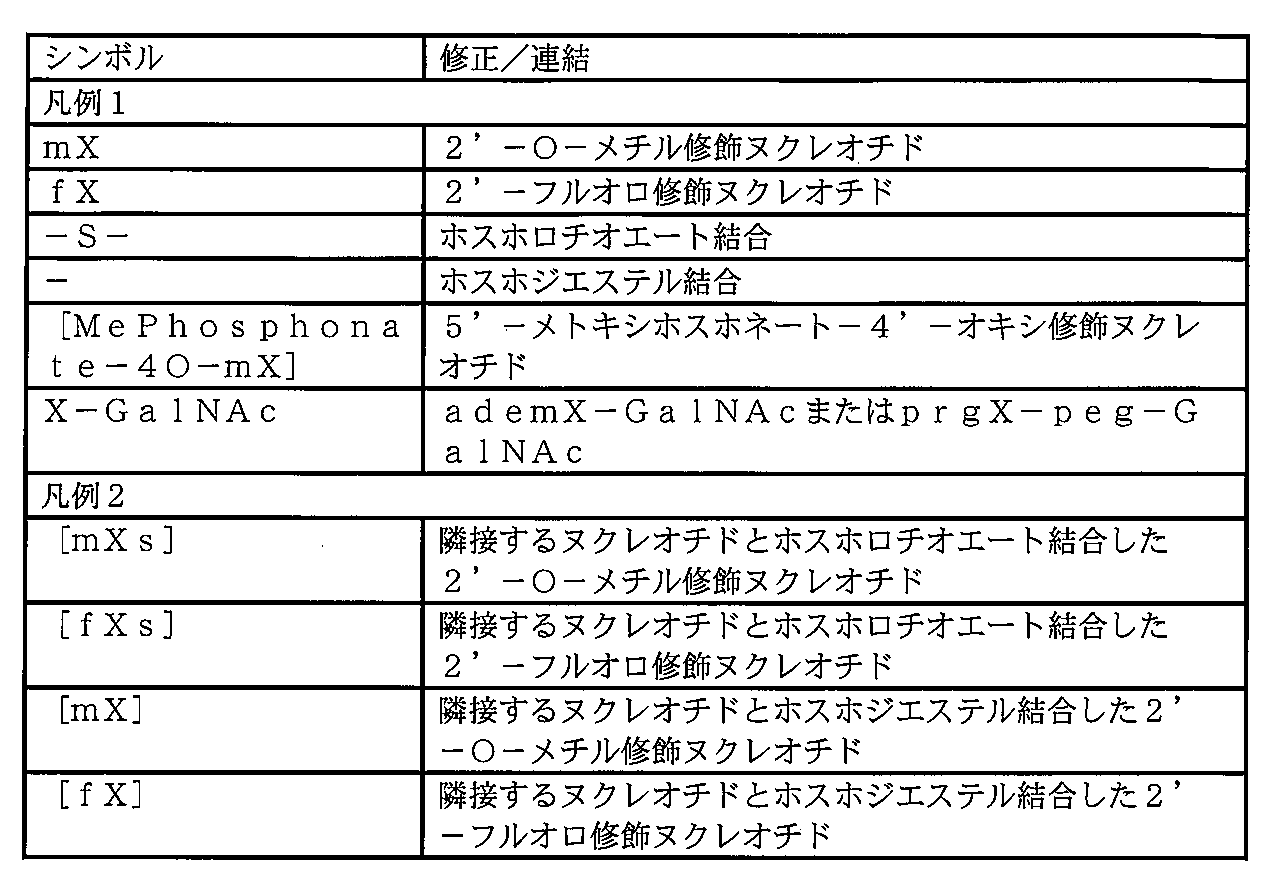
上記修飾パターン1~3の修飾の凡例:
Sense strand: 5' mX-S-mX-fX-mX-fX-mX-mX-fX-fX-fX-fX-mX-fX-mX-fX-mX-fX-mX-mX-mX-mX-mX-mX-mX-mX-mX-[X-GalNAc]-[X-GalNAc]-[X-GalNAc]- [X-GalNAc]-mX-mX-mX-mX-mX-mX 3'
Hybridizes to:
Antisense strand: 5' [MePhosphonate-4O-mX]-S-fX-S-fX-S-mX-fX-mX-fX-mX-fX-mX-fX-mX-fX-mX-fX-fX-mX-fX-mX-S-mX-S-mX-mX 3';
or as follows:
Sense strand: 5' [mXs] [mX] [fX] [mX] [fX] [mX] [mX] [fX] [fX] [fX] [fX] [mX] [fX] [mX] [mX] [mX] [fX] [mX] [mX] [mX] [mX] [mX] [mX] [mX] [mX] [mX] [X-GalNAc ] [X-GalNAc] [X-GalNAc] [X-GalNAc] [mX] [mX] [mX] [mX] [mX] [mX] 3'
Hybridizes to:
Antisense strand: 5' [MePhosphonate-4O-mXs][fXs][fXs][mX][fX][mX][fX][mX][fX][mX][fX][mX][fX][mX][fX][mX][fX][mX][fX][mXs][mXs][mXs][mX] 3'.
Modification legend for the above modification patterns 1 to 3:
上記のいずれの実施形態でも、オリゴヌクレオチドはRNAiオリゴヌクレオチドである。いくつかの実施形態では、RNAiオリゴヌクレオチドは、表2に示されるヌクレオチド配列、特に配列番号37、43、45、87、89、99、101、及び105のいずれか1つを有するセンス鎖を含む。特定の実施形態では、RNAiオリゴヌクレオチドは、表3に示されるヌクレオチド配列、特に配列番号199、205、207、249、251、261、263、及び267のいずれか1つを有するセンス鎖を含む。いくつかの実施形態では、RNAiオリゴヌクレオチドは、表2に示されるヌクレオチド配列、特に配列番号38、44、46、88、90、100、102、及び106のいずれか1つを有するアンチセンス鎖を含む。特定の実施形態では、RNAiオリゴヌクレオチドは、表3に示されるヌクレオチド配列、特に配列番号200、206、208、250、252、262、264、及び268のいずれか1つを有するアンチセンス鎖を含む。 In any of the above embodiments, the oligonucleotide is an RNAi oligonucleotide. In some embodiments, the RNAi oligonucleotide comprises a sense strand having a nucleotide sequence as set forth in Table 2, particularly any one of SEQ ID NOs: 37, 43, 45, 87, 89, 99, 101, and 105. In certain embodiments, the RNAi oligonucleotide comprises a sense strand having a nucleotide sequence as set forth in Table 3, particularly any one of SEQ ID NOs: 199, 205, 207, 249, 251, 261, 263, and 267. In some embodiments, the RNAi oligonucleotide comprises an antisense strand having a nucleotide sequence as set forth in Table 2, particularly any one of SEQ ID NOs: 38, 44, 46, 88, 90, 100, 102, and 106. In certain embodiments, the RNAi oligonucleotide comprises an antisense strand having a nucleotide sequence as set forth in Table 3, particularly any one of SEQ ID NOs: 200, 206, 208, 250, 252, 262, 264, and 268.
特定の実施形態では、RNAiオリゴヌクレオチドは、配列番号37、43、45、87、89、99、101、及び105のいずれか1つのヌクレオチド配列を有するセンス鎖と、配列番号38、44、46、88、90、100、102、及び106のいずれか1つのヌクレオチド配列を有するアンチセンス鎖とを含む。 In certain embodiments, the RNAi oligonucleotide comprises a sense strand having a nucleotide sequence of any one of SEQ ID NOs: 37, 43, 45, 87, 89, 99, 101, and 105, and an antisense strand having a nucleotide sequence of any one of SEQ ID NOs: 38, 44, 46, 88, 90, 100, 102, and 106.
特定の実施形態では、RNAiオリゴヌクレオチドは、配列番号37、89、及び101のいずれか1つのヌクレオチド配列を有するセンス鎖と、配列番号38、90、及び102のいずれか1つのヌクレオチド配列を有するアンチセンス鎖とを含む。 In certain embodiments, the RNAi oligonucleotide comprises a sense strand having a nucleotide sequence of any one of SEQ ID NOs: 37, 89, and 101, and an antisense strand having a nucleotide sequence of any one of SEQ ID NOs: 38, 90, and 102.
他の特定の実施形態では、RNAiオリゴヌクレオチドのセンス鎖とアンチセンス鎖は、それぞれ以下から選択される:
(a)配列番号37と38、
(b)配列番号43と44、
(c)配列番号45と46、
(d)配列番号87と88、
(e)配列番号89と90、
(f)配列番号99と100、
(g)配列番号101と102、及び
(h)配列番号105と106。
In other specific embodiments, the sense and antisense strands of the RNAi oligonucleotide are each selected from the following:
(a) SEQ ID NOs: 37 and 38;
(b) SEQ ID NOs: 43 and 44;
(c) SEQ ID NOs: 45 and 46;
(d) SEQ ID NOs: 87 and 88;
(e) SEQ ID NOs: 89 and 90;
(f) SEQ ID NOs: 99 and 100;
(g) SEQ ID NOs: 101 and 102, and (h) SEQ ID NOs: 105 and 106.
特定の実施形態では、RNAiオリゴヌクレオチドは、配列番号199、205、207、249、251、261、263、及び267のいずれか1つのヌクレオチド配列を有するセンス鎖と、配列番号200、206、208、250、252、262、264、及び268のいずれか1つのヌクレオチド配列を有するアンチセンス鎖とを含む。 In certain embodiments, the RNAi oligonucleotide comprises a sense strand having a nucleotide sequence of any one of SEQ ID NOs: 199, 205, 207, 249, 251, 261, 263, and 267, and an antisense strand having a nucleotide sequence of any one of SEQ ID NOs: 200, 206, 208, 250, 252, 262, 264, and 268.
特定の実施形態では、RNAiオリゴヌクレオチドは、配列番号199、251、及び263のいずれか1つのヌクレオチド配列を有するセンス鎖と、配列番号200、252、及び264のいずれか1つのヌクレオチド配列を有するアンチセンス鎖とを含む。 In certain embodiments, the RNAi oligonucleotide comprises a sense strand having a nucleotide sequence of any one of SEQ ID NOs: 199, 251, and 263, and an antisense strand having a nucleotide sequence of any one of SEQ ID NOs: 200, 252, and 264.
他の特定の実施形態では、RNAiオリゴヌクレオチドのセンス鎖とアンチセンス鎖は、それぞれ以下から選択される:
(a’)配列番号199と200、
(b’)配列番号205と206、
(c’)配列番号207と208、
(d’)配列番号249と250、
(e’)配列番号251と252、
(f’)配列番号261と262、
(g’)配列番号263と264、及び
(h’)配列番号267と268。
In other specific embodiments, the sense and antisense strands of the RNAi oligonucleotide are each selected from the following:
(a') SEQ ID NOs: 199 and 200;
(b') SEQ ID NOs: 205 and 206;
(c') SEQ ID NOs: 207 and 208;
(d') SEQ ID NOs: 249 and 250;
(e') SEQ ID NOs: 251 and 252;
(f') SEQ ID NOs: 261 and 262;
(g') SEQ ID NOs: 263 and 264, and (h') SEQ ID NOs: 267 and 268.
APOC3発現を阻害又は低減するためのオリゴヌクレオチドも記載されており、このオリゴヌクレオチドはセンス鎖とアンチセンス鎖を含み、センス鎖とアンチセンス鎖は二重鎖領域を形成し、センス鎖とアンチセンス鎖のすべてのヌクレオチドは塩基、糖、及び/又はヌクレオチド間結合の修飾を含み、アンチセンス鎖は配列番号334~341のいずれかのAPOC3のmRNA標的配列に対して相補性の領域を含み、相補性の領域は少なくとも約15個の連続するヌクレオチドの長さである。 Also described is an oligonucleotide for inhibiting or reducing APOC3 expression, the oligonucleotide comprising a sense strand and an antisense strand, the sense strand and the antisense strand forming a duplex region, all nucleotides of the sense strand and the antisense strand comprising a base, sugar, and/or internucleotide bond modification, the antisense strand comprising a region of complementarity to an APOC3 mRNA target sequence of any of SEQ ID NOs: 334-341, the region of complementarity being at least about 15 contiguous nucleotides in length.
他の態様では、本明細書の少なくとも1つのオリゴヌクレオチド、又はその薬学的に許容される塩と、薬学的に許容される担体、送達剤、又は賦形剤と、を含む医薬組成物が記載される。いくつかの実施形態では、医薬組成物には、例えば脂質低下剤、抗糖尿病剤、又は抗肥満剤などの追加の治療剤が含まれる。 In another aspect, a pharmaceutical composition is described that includes at least one oligonucleotide described herein, or a pharma- ceutically acceptable salt thereof, and a pharma- ceutically acceptable carrier, delivery agent, or excipient. In some embodiments, the pharmaceutical composition includes an additional therapeutic agent, such as, for example, a lipid-lowering agent, an antidiabetic agent, or an antiobesity agent.
他の態様では、細胞、細胞の集団、組織、器官、又は個体におけるAPOC3発現を低減するための方法であって、該方法は、本明細書のオリゴヌクレオチド又は本明細書の医薬組成物を細胞、細胞の集団、組織、器官、又は個体に投与/接触させるステップを少なくとも含む、方法が記載される。いくつかの実施形態では、APOC3発現を低減することは、細胞、細胞の集団、組織、器官、又は個体におけるAPOC3のmRNAの量もしくはレベル、APOC3タンパク質の量もしくはレベル、又はその両方を低減することが含まれる。いくつかの実施形態では、細胞、細胞集団、組織、器官、又は個体は、APOC3発現に関連する疾患、障害、又は状態を有する。特定の実施形態では、APOC3発現に関連する疾患、障害、又は状態は、高トリグリセリド血症、高非HDLコレステロール、肝臓脂肪変性、インスリン抵抗性、さらにはアテローム性動脈硬化性心血管疾患(ASCVD)である。 In another aspect, a method for reducing APOC3 expression in a cell, a population of cells, a tissue, an organ, or an individual is described, the method comprising at least the step of administering/contacting the cell, population of cells, tissue, organ, or individual with an oligonucleotide as described herein or a pharmaceutical composition as described herein. In some embodiments, reducing APOC3 expression includes reducing the amount or level of APOC3 mRNA, the amount or level of APOC3 protein, or both, in the cell, population of cells, tissue, organ, or individual. In some embodiments, the cell, population of cells, tissue, organ, or individual has a disease, disorder, or condition associated with APOC3 expression. In certain embodiments, the disease, disorder, or condition associated with APOC3 expression is hypertriglyceridemia, high non-HDL cholesterol, hepatic steatosis, insulin resistance, or even atherosclerotic cardiovascular disease (ASCVD).
他の態様では、APOC3発現に関連する疾患、障害、又は状態を有するか又は有すると疑われる個体を治療するための方法が記載されている。この方法には、本明細書のオリゴヌクレオチド又は本明細書の医薬組成物の有効量を、それを必要とする個体に投与するステップが少なくとも含まれる。いくつかの実施形態では、APOC3発現に関連する疾患、障害、又は状態は、高トリグリセリド血症、高非HDLコレステロール、肝臓脂肪変性、インスリン抵抗性、さらにはASCVDである。いくつかの実施形態では、オリゴヌクレオチド又は医薬組成物は、皮下(SQ)投与により、毎日、毎週、毎月、四半期ごと、毎年、特に毎月又は四半期ごとに投与される。 In another aspect, a method for treating an individual having or suspected of having a disease, disorder, or condition associated with APOC3 expression is described. The method includes at least the step of administering an effective amount of an oligonucleotide herein or a pharmaceutical composition herein to an individual in need thereof. In some embodiments, the disease, disorder, or condition associated with APOC3 expression is hypertriglyceridemia, high non-HDL cholesterol, hepatic steatosis, insulin resistance, or even ASCVD. In some embodiments, the oligonucleotide or pharmaceutical composition is administered daily, weekly, monthly, quarterly, yearly, particularly monthly or quarterly, by subcutaneous (SQ) administration.
いくつかの実施形態では、個体は、NAFLD、脂肪肝、非アルコール性脂肪肝炎(NASH)、アルコール性肝炎(AH)、アルコール性肝疾患(ALD)、胆管癌(CCA)、肝硬変、肝線維症、肝炎、肝細胞癌(HCC)、原発性硬化性胆管炎(PSC)、高脂血症、糖尿病、及び/又は肥満を有する。 In some embodiments, the individual has NAFLD, fatty liver, nonalcoholic steatohepatitis (NASH), alcoholic hepatitis (AH), alcoholic liver disease (ALD), cholangiocarcinoma (CCA), cirrhosis, liver fibrosis, hepatitis, hepatocellular carcinoma (HCC), primary sclerosing cholangitis (PSC), hyperlipidemia, diabetes, and/or obesity.
上記のいずれの実施形態でも、方法は、遺伝子型情報、APOC3発現、APOC3タンパク質レベル、個体の体重及び/又は血糖値及び/又はコレステロール及び/又はLPL及び/又はTGを測定又は取得し、次いで、取得した値を1つ以上のベースライン値又は以前に取得した値と比較して、接触すること又は投与することの有効性を評価するなどの追加のステップを含むことができる。いくつかの実施形態では、追加のステップは、個体がAPOC3機能獲得型多型を有することを確認することを含む。いくつかの実施形態では、追加のステップは、個体がrs5128、rs2854116、rs2854117、rs2070666の一塩基多型(SNP)、又は1100C>T、2845T>G、もしくはGln38Lysの変異を有することを確認することを含む。 In any of the above embodiments, the method may include additional steps such as measuring or obtaining genotype information, APOC3 expression, APOC3 protein levels, weight and/or blood glucose and/or cholesterol and/or LPL and/or TG of the individual, and then comparing the obtained values to one or more baseline or previously obtained values to evaluate the effectiveness of the contacting or administering. In some embodiments, the additional step includes confirming that the individual has an APOC3 gain-of-function polymorphism. In some embodiments, the additional step includes confirming that the individual has a single nucleotide polymorphism (SNP) of rs5128, rs2854116, rs2854117, rs2070666, or a mutation of 1100C>T, 2845T>G, or Gln38Lys.
上記のいずれの実施形態でも、方法は、RNAiオリゴヌクレオチド又は医薬組成物を、第2の組成物又は第2の治療剤と同時に、別々に、又は逐次的に投与することを含み得る。いくつかの実施形態では、第2の組成物又は第2の治療剤は、APOC3抗体又はその断片、脂質低下剤、抗糖尿病剤、又は抗肥満剤である。いくつかの実施形態では、第2の組成物又は第2の治療剤は、RNAiオリゴヌクレオチドと同じ頻度(すなわち、1日おき、週2回、又は毎週)で投与される。他の実施形態では、第2の組成物又は第2の治療剤は、RNAiオリゴヌクレオチドとは異なる頻度で投与される。同様に、他の実施形態では、第2の組成物又は第2の治療剤は、RNAiオリゴヌクレオチド(例えば、SQ)と同じ経路で投与される。さらに他の実施形態では、第2の組成物又は第2の治療剤は、RNAiオリゴヌクレオチドとは異なる経路で投与される。 In any of the above embodiments, the method may include administering the RNAi oligonucleotide or pharmaceutical composition simultaneously, separately, or sequentially with the second composition or second therapeutic agent. In some embodiments, the second composition or second therapeutic agent is an APOC3 antibody or fragment thereof, a lipid-lowering agent, an antidiabetic agent, or an antiobesity agent. In some embodiments, the second composition or second therapeutic agent is administered at the same frequency as the RNAi oligonucleotide (i.e., every other day, twice a week, or weekly). In other embodiments, the second composition or second therapeutic agent is administered at a different frequency than the RNAi oligonucleotide. Similarly, in other embodiments, the second composition or second therapeutic agent is administered by the same route as the RNAi oligonucleotide (e.g., SQ). In still other embodiments, the second composition or second therapeutic agent is administered by a different route than the RNAi oligonucleotide.
他の態様では、任意選択で第2の組成物又は第2の治療剤と同時に、別々に、又は逐次的に(すなわち、組み合わせて)投与される、本明細書のRNAiオリゴヌクレオチドの、APOC3発現に関連する疾患、障害又は状態を治療するための使用が記載される。 In another aspect, the use of the RNAi oligonucleotides herein, optionally administered simultaneously, separately or sequentially (i.e., in combination) with a second composition or a second therapeutic agent, to treat a disease, disorder or condition associated with APOC3 expression is described.
他の態様では、本明細書のRNAiオリゴヌクレオチドの、APOC3発現に関連する疾患、障害又は状態を治療するための医薬の製造における使用が記載され、該医薬には、任意選択で第2の組成物又は第2の治療剤がさらに含まれる。 In another aspect, the present disclosure describes the use of an RNAi oligonucleotide in the manufacture of a medicament for treating a disease, disorder, or condition associated with APOC3 expression, the medicament optionally further comprising a second composition or a second therapeutic agent.
他の態様では、本明細書の少なくとも1つのオリゴヌクレオチドと、任意選択の薬学的に許容される担体と、APOC3発現に関連する疾患、障害、又は状態を有する個体にそれを投与するための使用説明書を含む添付文書とを含むキットが記載されている。 In another aspect, a kit is described that includes at least one oligonucleotide of the present invention, an optional pharma- ceutically acceptable carrier, and a package insert that includes instructions for administering the same to an individual having a disease, disorder, or condition associated with APOC3 expression.
本明細書のオリゴヌクレオチド及び組成物の利点は、抑制されたAPOC3発現が脂質異常症の全範囲に有益な効果を発揮することである。 The advantage of the oligonucleotides and compositions herein is that suppressed APOC3 expression exerts beneficial effects across the full range of dyslipidemias.
上記以外の利点、効果、特徴、目的等については、以下の詳細な説明を考慮すればより明らかとなるであろう。そのような詳細な説明とは、以下の図面(複数可)を指す。 Further advantages, benefits, features, objectives, etc. will become more apparent upon consideration of the following detailed description, which includes the following drawing(s):
概要
脂質異常症とは、血液中の1種類以上の脂質(脂肪)のレベルが不健康な状態を指す。脂質には主に3つの種類:高密度リポタンパク質(HDL)、低密度リポタンパク質(LDL)、及びTGがある。脂質異常症は原発性タイプと続発性タイプに分けられる。原発性脂質異常症は遺伝性であるが、続発性脂質異常症は後天性状態(すなわち、例えば肥満又は糖尿病など他の原因によって発症する)である。
Overview Dyslipidemia refers to unhealthy levels of one or more lipids (fats) in the blood. There are three main types of lipids: high density lipoprotein (HDL), low density lipoprotein (LDL), and TG. Dyslipidemia is divided into primary and secondary types. Primary dyslipidemia is hereditary, whereas secondary dyslipidemia is an acquired condition (i.e., developed due to other causes, e.g., obesity or diabetes).
RNA干渉(RNAi)は、細胞に外来性RNAを導入して、標的されたタンパク質をコードするmRNAを特異的に分解し、結果として標的遺伝子の発現を減少させるプロセスである。 RNA interference (RNAi) is the process of introducing exogenous RNA into cells to specifically degrade the mRNA that codes for a targeted protein, resulting in reduced expression of the target gene.
ヒトでは、APOC3は99アミノ酸の長さ(しかしながら、残基1~20はその後切断されるシグナルペプチドである)で、予測分子量は8.8kDaである。APOC3の例示的な核酸配列は、GenBank参照配列番号NM_000040(ヒト)、GenBank参照配列番号NM_001289755(マウス)、GenBank 参照配列番号NM_001271053(ラット)、GenBank参照配列番号XM_005579730(NHP)、GenBank参照配列番号XM_001090312(NHP)、GenBank参照配列番号XM_008020977(NHP)、及びGenBank参照配列番号XM_035264642(NHP)に記載されている。しかしながら、当業者であれば、APOC3核酸配列の追加の例は、例えばGenBank及びUniProtなどの公開データベースを使用して容易に入手できることを理解している。 In humans, APOC3 is 99 amino acids long (however, residues 1-20 are a signal peptide that is subsequently cleaved) with a predicted molecular weight of 8.8 kDa. Exemplary nucleic acid sequences for APOC3 are set forth in GenBank Reference SEQ ID NO: NM_000040 (human), GenBank Reference SEQ ID NO: NM_001289755 (mouse), GenBank Reference SEQ ID NO: NM_001271053 (rat), GenBank Reference SEQ ID NO: XM_005579730 (NHP), GenBank Reference SEQ ID NO: XM_001090312 (NHP), GenBank Reference SEQ ID NO: XM_008020977 (NHP), and GenBank Reference SEQ ID NO: XM_035264642 (NHP). However, one of skill in the art will appreciate that additional examples of APOC3 nucleic acid sequences are readily available using public databases, such as, for example, GenBank and UniProt.
定義
本明細書で使用される場合、「約」は、例えば、規定された濃度、長さ、分子量、pH、配列類似性、時間枠、温度、容量などの値又は複数の値の統計的に意味のある範囲内を意味する。このような値又は範囲は、典型的に、所定の値又は範囲の20%以内、より典型的には10%以内、さらに一般的には5%以内の桁内である。「約」に包含される許容される変動は、研究中のシステムに依存し、当業者であれば容易に理解できる。
DEFINITIONS As used herein, "about" means within a statistically meaningful range of a value or values, e.g., a specified concentration, length, molecular weight, pH, sequence similarity, time frame, temperature, volume, etc. Such values or ranges are typically within an order of magnitude of 20%, more typically within 10%, and even more commonly within 5% of a given value or range. The allowable variation encompassed by "about" depends on the system under study and is readily apparent to one of ordinary skill in the art.
本明細書で使用される場合、「投与する」、「投与すること」、「投与」などは、薬理学的に有用な様式で(例えば、個体の疾患、障害、又は状態を治療するために)個体に物質(例えば、本明細書のオリゴヌクレオチド又は本明細書の組成物)を提供することを指す。 As used herein, "administer," "administering," "administration," and the like refer to providing a substance (e.g., an oligonucleotide herein or a composition herein) to an individual in a pharmacologically useful manner (e.g., to treat a disease, disorder, or condition of the individual).
本明細書で使用される場合、「アンチセンス鎖」とは、標的配列の領域に相補的である本明細書のオリゴヌクレオチドを意味する。同様に、本明細書で使用される場合、「センス鎖」は、アンチセンス鎖の領域に相補的である本明細書のオリゴヌクレオチドを意味する。 As used herein, "antisense strand" refers to an oligonucleotide herein that is complementary to a region of a target sequence. Similarly, as used herein, "sense strand" refers to an oligonucleotide herein that is complementary to a region of the antisense strand.
本明細書で使用される場合、「APOC3」とは、リポタンパク質リパーゼ及び肝臓リパーゼを阻害する超低密度リポタンパク質(VLDL)タンパク質(APOC3)をコードするアポリポタンパク質C-III遺伝子を意味する。 As used herein, "APOC3" refers to the apolipoprotein C-III gene that encodes a very low density lipoprotein (VLDL) protein (APOC3) that inhibits lipoprotein lipase and hepatic lipase.
本明細書で使用される場合、「アシアロ糖タンパク質受容体」又は「ASGPR」とは、48kDaのメジャーサブユニット(ASGPR-1)及び40kDaのマイナーサブユニット(ASGPR-2)によって形成される二部分C型レクチンを意味する。ASGPRは、主として肝細胞の類洞表面で発現する、末端ガラクトース又はGalNAc残基を含む循環糖タンパク質(アシアロ糖タンパク質)の結合、内在化、及びその後の排出に主要な役割を有する。 As used herein, "asialoglycoprotein receptor" or "ASGPR" refers to a bipartite C-type lectin formed by a 48 kDa major subunit (ASGPR-1) and a 40 kDa minor subunit (ASGPR-2). ASGPR plays a primary role in binding, internalization, and subsequent excretion of circulating glycoproteins containing terminal galactose or GalNAc residues (asialoglycoproteins), which are expressed primarily on the sinusoidal surface of hepatocytes.
本明細書で使用される場合、「減弱する」、「減弱する」、「減弱」などは、減少させるか又は効果的に停止させることを指す。非限定的な例として、本明細書の治療の1つ以上は、AH、ACD、ALD、CCA、CHD、MetS、PSC、肝硬変、肝線維症、肝炎、HCC、NAFLD、及びNASH、ならびに例えば高脂血症、糖尿病、及び/又は肥満などの個体における関連する疾患、障害、及び状態の発症又は進行を軽減又は効果的に停止することができる。この減弱は、例えば、AH、ACD、ALD、CCA、CHD、MetS、PSC、肝硬変、肝線維症、肝炎、HCC、NAFLD、及びNASH、ならびに例えば高脂血症、糖尿病、及び/又は肥満などの個体における関連する疾患、障害、及び状態の1つ以上の態様(例えば、症状、組織特性、及び細胞、炎症、又は免疫学的活性など)の減少;AH、ACD、ALD、CCA、CHD、MetS、PSC、肝硬変、肝線維症、肝炎、HCC、NAFLD、及びNASH、ならびに例えば高脂血症、糖尿病、及び/又は肥満などの個体における関連する疾患、障害、及び状態の1つ以上の態様の検出可能な進行(悪化)がないこと;あるいは、AH、ACD、ALD 、CCA、CHD、MetS、PSC、肝硬変、肝線維症、肝炎、HCC、NAFLD、NASH、ならびに例えば高脂血症、糖尿病、及び/又は肥満などの個体における関連する疾患、障害、及び状態が、本来であれば予想される場合に、検出されないことによって例示され得る。 As used herein, "attenuate," "attenuate," "attenuate," and the like refer to reducing or effectively halting. As a non-limiting example, one or more of the treatments herein can reduce or effectively halt the onset or progression of AH, ACD, ALD, CCA, CHD, MetS, PSC, cirrhosis, liver fibrosis, hepatitis, HCC, NAFLD, and NASH, as well as related diseases, disorders, and conditions in an individual, such as, for example, hyperlipidemia, diabetes, and/or obesity. This attenuation can be, for example, a decrease in one or more aspects (e.g., symptoms, tissue characteristics, and cellular, inflammatory, or immunological activity) of AH, ACD, ALD, CCA, CHD, MetS, PSC, cirrhosis, liver fibrosis, hepatitis, HCC, NAFLD, and NASH, as well as associated diseases, disorders, and conditions in an individual, such as, for example, hyperlipidemia, diabetes, and/or obesity; no detectable progression (worsening) of one or more aspects of AH, ACD, ALD, CCA, CHD, MetS, PSC, cirrhosis, liver fibrosis, hepatitis, HCC, NAFLD, and NASH, as well as associated diseases, disorders, and conditions in an individual, such as, for example, hyperlipidemia, diabetes, and/or obesity; or no detectable progression (worsening) of one or more aspects of AH, ACD, ALD, CCA, CHD, MetS, PSC, cirrhosis, liver fibrosis, hepatitis, HCC, NAFLD, and NASH, as well as associated diseases, disorders, and conditions in an individual, such as, for example, hyperlipidemia, diabetes, and/or obesity. , CCA, CHD, MetS, PSC, cirrhosis, liver fibrosis, hepatitis, HCC, NAFLD, NASH, and related diseases, disorders, and conditions in an individual, such as hyperlipidemia, diabetes, and/or obesity, may be exemplified by failure to detect when otherwise expected.
本明細書で使用される場合、「減弱する」、「減弱する」、「減弱」などは、減少させるか又は効果的に停止させることを意味する。非限定的な例として、本明細書の治療の1つ以上は、個体における脂質異常症/高トリグリセリド血症/高脂血症の発症又は進行を軽減又は効果的に停止することができる。この減弱は、例えば、AH、ACD、ALD、CCA、CHD、MetS、PSC、肝硬変、肝線維症、肝炎、HCC、NAFLD、及びNASH、ならびに個体における例えば高脂血症、糖尿病、及び/又は肥満などの関連する疾患、障害、及び状態の1つ以上の態様(例えば、症状、組織特性、及び細胞、炎症、又は免疫学的活動など)が、本来であれば予想される場合に、減少によって例示され得る。 As used herein, "attenuate," "attenuate," "attenuate," and the like, mean to reduce or effectively stop. As a non-limiting example, one or more of the treatments herein can reduce or effectively stop the onset or progression of dyslipidemia/hypertriglyceridemia/hyperlipidemia in an individual. This attenuation can be exemplified by, for example, a reduction in one or more aspects (e.g., symptoms, tissue characteristics, and cellular, inflammatory, or immunological activity) of AH, ACD, ALD, CCA, CHD, MetS, PSC, cirrhosis, liver fibrosis, hepatitis, HCC, NAFLD, and NASH, and associated diseases, disorders, and conditions, such as hyperlipidemia, diabetes, and/or obesity, in an individual, when otherwise expected.
本明細書で使用される場合、「相補的」は、(例えば、2つの対向する核酸上の又は単一の核酸鎖の対向する領域上の)2個のヌクレオチドが互いに塩基対を形成することを可能にする2個のヌクレオチド間の構造的関係を意味する。例えば、対向する核酸のピリミジンヌクレオチドに相補的である1つの核酸のプリンヌクレオチドは、互いに水素結合を形成することにより一緒に塩基対形成し得る。相補的なポリヌクレオチド鎖は、ワトソン・クリック型、又は、安定した二重鎖の形成を可能にする他の任意の形で塩基対を形成することができる。同様に、2本の核酸は、本明細書に記載されるように、互いに相補的であることで相補性の領域を形成する複数のヌクレオチドの領域を有することができる。 As used herein, "complementary" refers to a structural relationship between two nucleotides (e.g., on two opposing nucleic acids or on opposing regions of a single nucleic acid strand) that allows the two nucleotides to base pair with one another. For example, purine nucleotides of one nucleic acid that are complementary to pyrimidine nucleotides of an opposing nucleic acid can base pair together by forming hydrogen bonds with one another. Complementary polynucleotide strands can base pair in a Watson-Crick fashion, or in any other manner that allows for the formation of a stable duplex. Similarly, two nucleic acids can have regions of multiple nucleotides that are complementary to one another, thereby forming regions of complementarity, as described herein.
本明細書において、「接触」、「接触させること」等は、細胞への取り込み又は吸収を促進又は実行することにより、例えば細胞内にRNAiを直接的又は間接的に導入又は送達することを意味する。 As used herein, "contact," "contacting," and the like refer to directly or indirectly introducing or delivering RNAi into a cell, for example, by promoting or effecting uptake or absorption into the cell.
本明細書で使用される場合、「デオキシリボヌクレオチド」は、リボヌクレオチドと比較する場合、そのペントース糖の2’位のヒドロキシルの代わりに水素を有するヌクレオチドを意味する。修飾デオキシリボヌクレオチドには、核酸塩基、糖、又はリン酸基の修飾又は置換を含む、2’位以外の原子の1つ以上の修飾置換がある。 As used herein, "deoxyribonucleotide" refers to a nucleotide that has a hydrogen in place of the hydroxyl at the 2' position of its pentose sugar when compared to a ribonucleotide. Modified deoxyribonucleotides have one or more modified substitutions of atoms other than the 2' position, including modifications or substitutions of the nucleobase, sugar, or phosphate group.
本明細書で使用される場合、「二本鎖オリゴヌクレオチド」又は「dsオリゴヌクレオチド」とは、実質的に二本鎖形態であるオリゴヌクレオチドを意味する。dsオリゴヌクレオチドの二重鎖領域(複数可)の相補的塩基対形成は、共有結合的に分離した核酸鎖のヌクレオチドの逆平行配列間で形成され得る。同様に、dsオリゴヌクレオチドの二重鎖領域(複数可)の相補的塩基対形成は、共有結合した核酸鎖のヌクレオチドの逆平行配列間で形成され得る。さらに、dsオリゴヌクレオチドの二重鎖領域(複数可)の相補的塩基対形成は、(例えば、ヘアピンを介して)フォールディングし、一緒に塩基対を形成するヌクレオチドの相補的な逆平行配列を提供する単一の核酸鎖から形成され得る。dsオリゴヌクレオチドは、互いに完全に二本鎖である2つの共有結合的に分離した核酸鎖を含み得る。しかしながら、dsオリゴヌクレオチドは、部分的に二重鎖である(例えば、一方又は両方の末端に突出を有する)2つの共有結合的に分離した核酸鎖を含み得る。dsオリゴヌクレオチドは、部分的に相補的であるヌクレオチドの逆平行配列を含み得、したがって、内部ミスマッチ又は末端ミスマッチを含み得る1つ以上のミスマッチを有し得る。 As used herein, "double-stranded oligonucleotide" or "ds oligonucleotide" refers to an oligonucleotide that is substantially in double-stranded form. The complementary base pairing of the duplex region(s) of a ds oligonucleotide can be formed between antiparallel sequences of nucleotides of covalently separated nucleic acid strands. Similarly, the complementary base pairing of the duplex region(s) of a ds oligonucleotide can be formed between antiparallel sequences of nucleotides of covalently linked nucleic acid strands. Additionally, the complementary base pairing of the duplex region(s) of a ds oligonucleotide can be formed from a single nucleic acid strand that folds (e.g., via a hairpin) and provides a complementary antiparallel sequence of nucleotides that base pair together. A ds oligonucleotide can include two covalently separated nucleic acid strands that are fully double-stranded with respect to each other. However, a ds oligonucleotide can include two covalently separated nucleic acid strands that are partially double-stranded (e.g., with an overhang at one or both ends). A ds oligonucleotide may contain an antiparallel sequence of partially complementary nucleotides and therefore may have one or more mismatches, which may include internal or terminal mismatches.
本明細書で使用される場合、核酸(例えば、オリゴヌクレオチド)に関して「二重鎖」は、ヌクレオチドの2つの逆平行配列の相補的塩基対形成により形成される構造を意味する。 As used herein, "duplex" with respect to a nucleic acid (e.g., an oligonucleotide) means the structure formed by complementary base pairing of two antiparallel sequences of nucleotides.
本明細書で使用される場合、「賦形剤」は、例えば、所望の稠度又は安定化効果を与えるか又はこれらに寄与するために本明細書の組成物中に含めることができる非治療剤を意味する。 As used herein, "excipient" means a non-therapeutic agent that may be included in the compositions herein to, for example, impart or contribute a desired consistency or stabilizing effect.
本明細書で使用される場合、「肝細胞」又は「複数の肝細胞」とは、肝臓の実質組織の細胞を意味する。これらの細胞は肝臓の質量の約70%~85%を構成し、血清アルブミン、フィブロネクチン(FBN)、及び凝固因子のプロトロンビングループ(因子3及び4を除く)を製造する。肝細胞系列細胞のマーカーとしては、トランスサイレチン(Ttr)、グルタミン合成酵素(GluI)、肝細胞核因子1a(Hnf1a)、及び肝細胞核因子4a(Hnf4a)が挙げられるが、これらに限定されない。成熟肝細胞のマーカーとしては、シトクロムP450(Cyp3a11)、フマリルアセト酢酸ヒドロラーゼ(Fah)、グルコース6-リン酸(G6p)、アルブミン(Alb)、及びOC2-2F8が挙げられるが、これらに限定されない。例えば、Huch et al.(2013) Nature 494:247-50を参照されたい。 As used herein, "hepatocyte" or "hepatocytes" refers to cells of the liver parenchyma. These cells make up approximately 70%-85% of the liver's mass and manufacture serum albumin, fibronectin (FBN), and the prothrombin loop of clotting factors (except factors 3 and 4). Markers of hepatocyte lineage cells include, but are not limited to, transthyretin (Ttr), glutamine synthetase (GluI), hepatocyte nuclear factor 1a (Hnf1a), and hepatocyte nuclear factor 4a (Hnf4a). Markers of mature hepatocytes include, but are not limited to, cytochrome P450 (Cyp3a11), fumarylacetoacetate hydrolase (Fah), glucose 6-phosphate (G6p), albumin (Alb), and OC2-2F8. See, e.g., Huch et al. (2013) Nature 494:247-50.
本明細書で使用される場合、「肝毒性剤」とは、それ自体が肝臓に対して毒性であるか、又は処理されて肝臓に対して毒性である代謝産物を形成することができる化合物、ウイルス、又は他の物質を意味する。肝毒性物質としては、四塩化炭素(CCl4)、アセトアミノフェン(パラセタモール)、塩化ビニル、ヒ素、クロロホルム、非ステロイド性抗炎症薬(アスピリン及びフェニルブタゾンなど)が挙げられ得るが、これらに限定されない。 As used herein, "hepatotoxic agent" means a compound, virus, or other substance that is itself toxic to the liver or that can be processed to form a metabolic product that is toxic to the liver. Hepatotoxic substances may include, but are not limited to, carbon tetrachloride ( CCl4 ), acetaminophen (paracetamol), vinyl chloride, arsenic, chloroform, nonsteroidal anti-inflammatory drugs (such as aspirin and phenylbutazone).
本明細書で使用される場合、「不安定なリンカー」とは、(例えば、酸性pHによって)切断され得るリンカーを意味する。同様に、「かなり安定なリンカー」とは、切断できないリンカーを意味する。 As used herein, an "unstable linker" refers to a linker that can be cleaved (e.g., by acidic pH). Similarly, a "fairly stable linker" refers to a linker that cannot be cleaved.
本明細書で使用される場合、「肝臓の炎症」又は「肝炎」は、肝毒性物質への曝露によって引き起こされる可能性があるような、特に損傷もしくは感染のために、肝臓の腫脹、機能不全及び/又は疼痛をもたらす、身体的状態を意味する。症状としては、黄疸、疲労、衰弱、悪心、嘔吐、食欲減退、体重減少などが挙げられ得る。肝臓の炎症は、治療せずに放置すると、線維症、肝硬変、肝不全、又は肝癌に進行する可能性がある。 As used herein, "liver inflammation" or "hepatitis" refers to a physical condition that results in swelling, dysfunction, and/or pain in the liver, particularly due to injury or infection, such as may be caused by exposure to a hepatotoxic agent. Symptoms may include jaundice, fatigue, weakness, nausea, vomiting, loss of appetite, weight loss, and the like. If left untreated, liver inflammation can progress to fibrosis, cirrhosis, liver failure, or liver cancer.
本明細書で使用される場合、「肝線維症」、「肝線維症」、又は「肝臓の線維症」は、炎症や肝細胞死に起因する、コラーゲン(I、III、及びIV)、FBN、ウンドゥリン、エラスチン、ラミニン、ヒアルロナン、おい及びプロテオグリカンを含み得る細胞外マトリックスタンパク質の肝臓における過剰な蓄積を指す。肝線維症は、治療せずに放置すると、肝硬変、肝不全、又は肝癌に進行する可能性がある。 As used herein, "liver fibrosis," "liver fibrosis," or "fibrosis of the liver" refers to the excessive accumulation in the liver of extracellular matrix proteins, which may include collagens (I, III, and IV), FBN, undulin, elastin, laminin, hyaluronan, hepatocytes, and proteoglycans, resulting from inflammation and liver cell death. If left untreated, liver fibrosis can progress to cirrhosis, liver failure, or liver cancer.
本明細書で使用される場合、「ループ」とは、互いに十分に相補的な核酸の2つの逆平行領域によって挟まれている核酸(例えば、オリゴヌクレオチド)の非対形成領域であって、適切なハイブリダイゼーション条件下(例えば、リン酸(又はホスフェート)(phosphate)緩衝溶液中、細胞内)で、非対形成領域を挟んだ2つの逆平行領域がハイブリダイズして二重鎖(「ステム」と呼ばれる)を形成する、核酸の非対形成領域を意味する。 As used herein, "loop" refers to an unpaired region of a nucleic acid (e.g., an oligonucleotide) that is flanked by two antiparallel regions of nucleic acid that are sufficiently complementary to each other that under appropriate hybridization conditions (e.g., in a phosphate buffer solution, inside a cell), the two antiparallel regions that sandwich the unpaired region hybridize to form a duplex (called a "stem").
本明細書で使用される場合、「修飾されたヌクレオチド間結合」とは、ホスホジエステル結合を有する参照ヌクレオチド間結合と比較して1つ以上の化学修飾を有するヌクレオチド間結合を意味する。修飾ヌクレオチドは、天然に存在しない結合であってよい。典型的には、修飾ヌクレオチド間結合は、修飾ヌクレオチド間結合が存在する核酸に1つ以上の望ましい特性を付与する。例えば、修飾ヌクレオチドは、熱安定性、分解に対する耐性、ヌクレアーゼ耐性、可溶性、バイオアベイラビリティ、生物活性、免疫原性の低下などを改善することができる。 As used herein, "modified internucleotide linkage" refers to an internucleotide linkage having one or more chemical modifications compared to a reference internucleotide linkage having a phosphodiester bond. A modified nucleotide may be a linkage that does not occur in nature. Typically, the modified internucleotide linkage confers one or more desirable properties to the nucleic acid in which the modified internucleotide linkage is present. For example, the modified nucleotide may improve thermal stability, resistance to degradation, nuclease resistance, solubility, bioavailability, biological activity, reduced immunogenicity, etc.
本明細書で使用される場合、「修飾ヌクレオチド」とは、アデニンリボヌクレオチド、グアニンリボヌクレオチド、シトシンリボヌクレオチド、ウラシルリボヌクレオチド、アデニンデオキシリボヌクレオチド、グアニンデオキシリボヌクレオチド、シトシンデオキシリボヌクレオチド、及びチミジンデオキシリボヌクレオチドから選択される対応する参照ヌクレオチドと比較する場合、1つ以上の化学修飾を有するヌクレオチドを指す。修飾ヌクレオチドは、天然に存在しないヌクレオチドであってよい。修飾ヌクレオチドは、例えば、その糖、核酸塩基、及び/又はリン酸基に1つ以上の化学修飾を有し得る。追加的に又は代替的に、修飾ヌクレオチドは、対応する参照ヌクレオチドにコンジュゲートされた1つ以上の化学部分を有し得る。典型的には、修飾ヌクレオチドは、修飾ヌクレオチドが存在する核酸に1つ以上の望ましい特性を付与する。例えば、修飾ヌクレオチドは、熱安定性、分解に対する耐性、ヌクレアーゼ耐性、可溶性、バイオアベイラビリティ、生物活性、免疫原性の低下などを改善することができる。 As used herein, a "modified nucleotide" refers to a nucleotide having one or more chemical modifications when compared to a corresponding reference nucleotide selected from adenine ribonucleotides, guanine ribonucleotides, cytosine ribonucleotides, uracil ribonucleotides, adenine deoxyribonucleotides, guanine deoxyribonucleotides, cytosine deoxyribonucleotides, and thymidine deoxyribonucleotides. A modified nucleotide may be a non-naturally occurring nucleotide. A modified nucleotide may have one or more chemical modifications, for example, in its sugar, nucleobase, and/or phosphate group. Additionally or alternatively, a modified nucleotide may have one or more chemical moieties conjugated to a corresponding reference nucleotide. Typically, a modified nucleotide confers one or more desirable properties to a nucleic acid in which the modified nucleotide is present. For example, a modified nucleotide may improve thermal stability, resistance to degradation, nuclease resistance, solubility, bioavailability, biological activity, reduced immunogenicity, etc.
本明細書で使用される場合、「ニックテトラループ構造」とは、センス(パッセンジャー)鎖がアンチセンス(ガイド)鎖と相補的な領域を有し、一般にセンス鎖である鎖の少なくとも1つが、少なくとも1つの鎖内に形成された隣接するステム領域を安定化するように構成されたテトラループを有する、別個のセンス及びアンチセンス鎖によって特徴付けられるRNAiオリゴヌクレオチドの構造を意味する。 As used herein, "nicked tetraloop structure" refers to a structure of an RNAi oligonucleotide characterized by separate sense and antisense strands, where the sense (passenger) strand has a region complementary to the antisense (guide) strand, and at least one of the strands, typically the sense strand, has a tetraloop configured to stabilize an adjacent stem region formed in at least one strand.
本明細書で使用される場合、「ヌクレオチド」とは、ヌクレオシド(例えば、アデニン、シトシン、グアニン、チミン、又はウラシルなどの核酸塩基、及び例えば、リボース又は2’-デオキシリボースなどのペントース糖、及びリン酸基を有し、デオキシリボ核酸(DNA)及びリボ核酸(RNA)などの核酸ポリマーのモノマー単位として機能し得る)を有する有機分子を意味する。 As used herein, "nucleotide" means an organic molecule having a nucleoside (e.g., a nucleic acid base such as adenine, cytosine, guanine, thymine, or uracil, and a pentose sugar such as ribose or 2'-deoxyribose, and a phosphate group, which can function as a monomeric unit of nucleic acid polymers such as deoxyribonucleic acid (DNA) and ribonucleic acid (RNA)).
本明細書で使用される場合、「オリゴヌクレオチド」とは、(例えば、100個未満のオリゴヌクレオチドの長さの)短い核酸分子を意味する。オリゴヌクレオチドは、一本鎖(ss)又はdsであってよい。オリゴヌクレオチドは二重鎖領域を有していても有していなくてもよい。一連の非限定的な例として、オリゴヌクレオチドは、低分子干渉RNA(siRNA)、マイクロRNA(miRNA)、ショートヘアピンRNA(shRNA)、ダイサー基質干渉RNA(dsiRNA)、アンチセンスオリゴヌクレオチド(ASO)、短いsiRNA、又はss siRNAであり得るが、これらに限定されない。典型的には、dsオリゴヌクレオチドは、RNAiオリゴヌクレオチドである。 As used herein, "oligonucleotide" refers to a short nucleic acid molecule (e.g., less than 100 oligonucleotides in length). An oligonucleotide may be single-stranded (ss) or ds. An oligonucleotide may or may not have a double-stranded region. As a set of non-limiting examples, an oligonucleotide may be, but is not limited to, a small interfering RNA (siRNA), a microRNA (miRNA), a short hairpin RNA (shRNA), a dicer substrate interfering RNA (dsiRNA), an antisense oligonucleotide (ASO), a short siRNA, or a ss siRNA. Typically, a ds oligonucleotide is an RNAi oligonucleotide.
本明細書で使用される場合、「突出」とは、1つの鎖又は領域が、その1つの鎖又は領域が二重鎖を形成する相補鎖の末端を超えて伸長していることから生じる末端の非塩基対形成ヌクレオチド(複数可)を意味する。突出には、dsオリゴヌクレオチドの5’末端又は3’末端で二重鎖領域から伸長している1つ以上の非対形成ヌクレオチドが含まれてもよい。突出は、dsオリゴヌクレオチドのアンチセンス鎖又はセンス鎖上の3’又は5’の突出であってよい。 As used herein, "overhang" means terminal non-base-paired nucleotide(s) resulting from one strand or region extending beyond the end of the complementary strand with which it forms a duplex. An overhang may include one or more non-paired nucleotides extending from the duplex region at the 5' or 3' end of the ds oligonucleotide. An overhang may be a 3' or 5' overhang on the antisense or sense strand of the ds oligonucleotide.
本明細書で使用される場合、「リン酸類似体」とは、リン酸基の静電特性及び/又は立体特性を模倣する化学部分を意味する。いくつかの実施形態では、リン酸類似体は、しばしば酵素的除去を受けやすい5’-リン酸の代わりにオリゴヌクレオチドの5’末端ヌクレオチドに配置される。5’リン酸類似体はホスファターゼ耐性結合を含んでもよい。好適なリン酸類似体としては、5’-メチレンホスホネート(5’-MP)、及び5’-(E)-ビニルホスホネート(5’-VP)などの5’-ホスホナートが挙げられるが、これらに限定されない。オリゴヌクレオチドは、5’末端ヌクレオチドにおいて、糖の4’位の炭素にリン酸類似体(4’-リン酸類似体と呼ぶ)を有し得る。4’-リン酸類似体の例として、オキシメチル基の酸素原子が糖部分(例えば、その4-’炭素)に結合したオキシメチルホスホネート又はその類似体がある。例えば、国際特許出願公開第WO2018/045317号を参照されたい。オリゴヌクレオチドの5’末端に対する他の修飾が開発されている(例えば、国際特許出願第WO2011/133871号;米国特許第8,927,513号;及びPrakash et al.(2015)Nucleic Acids Res.43:2993-3011を参照されたい)。 As used herein, "phosphate analog" refers to a chemical moiety that mimics the electrostatic and/or steric properties of a phosphate group. In some embodiments, the phosphate analog is placed at the 5'-terminal nucleotide of an oligonucleotide in place of the 5'-phosphate, which is often susceptible to enzymatic removal. The 5' phosphate analog may include a phosphatase-resistant linkage. Suitable phosphate analogs include, but are not limited to, 5'-phosphonates, such as 5'-methylene phosphonate (5'-MP) and 5'-(E)-vinyl phosphonate (5'-VP). An oligonucleotide may have a phosphate analog at the 4' carbon position of the sugar at the 5'-terminal nucleotide (referred to as a 4'-phosphate analog). An example of a 4'-phosphate analog is an oxymethyl phosphonate or analog thereof, in which the oxygen atom of the oxymethyl group is attached to the sugar moiety (e.g., the 4-' carbon). See, e.g., International Patent Application Publication No. WO2018/045317. Other modifications to the 5' end of oligonucleotides have been developed (see, e.g., International Patent Application No. WO2011/133871; U.S. Patent No. 8,927,513; and Prakash et al. (2015) Nucleic Acids Res. 43:2993-3011).
本明細書で使用される場合、「APOC3関連疾患」、「APOC3関連障害」、又は「APOC3関連状態」とは、APOC3発現の増加及び/又は例えばAPOC3多型の存在を伴う状態を意味する。例示的なAPOC3に関連する状態、疾患、又は障害としては、AH、ACD、ALD、CCA、CHD、MetS、PSC、肝硬変、肝線維症、肝炎、HCC、NAFLD、及びNASH、ならびに例えば高脂血症、糖尿病、及び/又は肥満などの個体における関連する疾患、障害、及び状態が挙げられるが、これらに限定されない。 As used herein, "APOC3-associated disease," "APOC3-associated disorder," or "APOC3-associated condition" refers to a condition associated with increased APOC3 expression and/or the presence of, for example, an APOC3 polymorphism. Exemplary APOC3-associated conditions, diseases, or disorders include, but are not limited to, AH, ACD, ALD, CCA, CHD, MetS, PSC, cirrhosis, liver fibrosis, hepatitis, HCC, NAFLD, and NASH, as well as associated diseases, disorders, and conditions in individuals with, for example, hyperlipidemia, diabetes, and/or obesity.
本明細書で使用される場合、「減少した発現」及びある遺伝子(例えば、APOC3)に関する「減少した発現」とは、適切な参照(例えば、参照の細胞、細胞の集団、試料、又は対象)と比較する場合の、細胞、細胞の集団、試料、又は対象におけるその遺伝子によってコードされるRNA転写産物(例えば、APOC3のmRNA)もしくはタンパク質の量もしくはレベルの減少、及び/又はその遺伝子の活性の量もしくはレベルの減少を意味する。例えば、本明細書のオリゴヌクレオチド(例えば、APOC3のmRNAを含むヌクレオチド配列に相補的なヌクレオチド配列を有するアンチセンス鎖を有するオリゴヌクレオチド)と細胞を接触させる行為は、dsオリゴヌクレオチドで処理されていない細胞と比較する場合、(例えば、RNAi経路によるAPOC3のmRNAの分解による)mRNA、タンパク質、及び/又は活性の量又はレベルの減少をもたらし得る。同様に、本明細書で使用される場合、「発現を低減すること」とは、遺伝子(例えば、APOC3)の発現の低下をもたらす行為を意味する。具体的には、本明細書で使用される場合、「APOC3発現の低減」とは、適切な参照(例えば、参照の細胞、細胞の集団、組織、又は個体)と比較した場合の、細胞、細胞の集団、試料、又は個体におけるAPOC3のmRNA、APOC3のタンパク質、及び/又はAPOC3の活性の量又はレベルの減少を意味する。 As used herein, "reduced expression" and "reduced expression" with respect to a gene (e.g., APOC3) refers to a decrease in the amount or level of an RNA transcript (e.g., APOC3 mRNA) or protein encoded by that gene in a cell, population of cells, sample, or subject, as compared to an appropriate reference (e.g., a reference cell, population of cells, sample, or subject), and/or a decrease in the amount or level of activity of that gene. For example, the act of contacting a cell with an oligonucleotide herein (e.g., an oligonucleotide having an antisense strand having a nucleotide sequence complementary to a nucleotide sequence comprising APOC3 mRNA) can result in a decrease in the amount or level of mRNA, protein, and/or activity (e.g., by degradation of APOC3 mRNA by the RNAi pathway) as compared to a cell not treated with the ds oligonucleotide. Similarly, as used herein, "reducing expression" refers to an act that results in a decrease in expression of a gene (e.g., APOC3). Specifically, as used herein, "reduced APOC3 expression" refers to a decrease in the amount or level of APOC3 mRNA, APOC3 protein, and/or APOC3 activity in a cell, population of cells, sample, or individual compared to an appropriate reference (e.g., a reference cell, population of cells, tissue, or individual).
本明細書で使用される場合、「相補性の領域」とは、ヌクレオチドの逆平行配列と十分に相補的であることにより、(例えば、リン酸緩衝液中、細胞内などの)適切なハイブリダイゼーション条件下で2つのヌクレオチドの配列間のハイブリダイゼーションを可能にするような、核酸のヌクレオチド(例えば、dsオリゴヌクレオチド)の配列を意味する。本明細書のオリゴヌクレオチドは、mRNA標的配列に相補的な領域を有する標的化配列を含む。 As used herein, "region of complementarity" refers to a sequence of nucleotides of a nucleic acid (e.g., a ds oligonucleotide) that is sufficiently complementary to an antiparallel sequence of nucleotides to permit hybridization between the two sequences of nucleotides under appropriate hybridization conditions (e.g., in a phosphate buffer, inside a cell, etc.). Oligonucleotides herein include targeting sequences that have a region that is complementary to an mRNA target sequence.
本明細書で使用される場合、「リボヌクレオチド」とは、そのペントース糖として、2’位にヒドロキシル基を有するリボースを有するヌクレオチドを意味する。修飾リボヌクレオチドは、核酸塩基、糖、又はリン酸基の修飾又は置換を含む、2’位以外の原子の1つ以上の修飾置換を有するリボヌクレオチドである。 As used herein, "ribonucleotide" means a nucleotide having as its pentose sugar a ribose with a hydroxyl group at the 2' position. A modified ribonucleotide is a ribonucleotide having one or more modified substitutions of an atom other than the 2' position, including modifications or substitutions of the nucleobase, sugar, or phosphate group.
本明細書で使用される場合、「RNAiオリゴヌクレオチド」とは、(a)センス鎖(パッセンジャー)とアンチセンス鎖(ガイド)を有するdsオリゴヌクレオチドであって、アンチセンス鎖又はアンチセンス鎖の一部がアルゴノート2(Ago2)エンドヌクレアーゼによって標的mRNAの切断に使用されるdsオリゴヌクレオチド、又は(b)一本鎖アンチセンス鎖を有するssオリゴヌクレオチドであって、そのアンチセンス鎖(又はそのアンチセンス鎖の一部)が、Ago2エンドヌクレアーゼによって標的mRNAの切断に使用されるssオリゴヌクレオチドのいずれかを指す。 As used herein, "RNAi oligonucleotide" refers to either (a) a ds oligonucleotide having a sense strand (passenger) and an antisense strand (guide), where the antisense strand or a portion of the antisense strand is used by Argonaute 2 (Ago2) endonuclease to cleave the target mRNA, or (b) a ss oligonucleotide having a single-stranded antisense strand, where the antisense strand (or a portion of the antisense strand) is used by Ago2 endonuclease to cleave the target mRNA.
本明細書で使用される場合、「鎖」は、ヌクレオチド間結合(例えば、ホスホジエステル結合、ホスホロチオエート結合)を介して互いに連結されたヌクレオチドの単一の連続した配列を指す。鎖は2つの自由端(例えば、5’端と3’端)を有する。 As used herein, a "strand" refers to a single, continuous sequence of nucleotides linked together through internucleotide bonds (e.g., phosphodiester bonds, phosphorothioate bonds). A strand has two free ends (e.g., a 5' end and a 3' end).
本明細書で使用される場合、「個体」とは、ネコ、イヌ、マウス、ラット、及び霊長類、特にヒトを含むあらゆる哺乳類を意味する。「対象」又は「患者」は、「個体」と交換可能に用いられ得る。 As used herein, "individual" refers to any mammal, including cats, dogs, mice, rats, and primates, particularly humans. "Subject" or "patient" may be used interchangeably with "individual."
本明細書で使用される場合、「合成」とは、人工的に合成された(例えば、機械、例えば、固相核酸合成装置などを使用して)か、又は核酸又は他の分子を通常生成する天然の供給源(例えば、細胞又は生物)に由来していない核酸又は他の分子を指す。 As used herein, "synthetic" refers to a nucleic acid or other molecule that is artificially synthesized (e.g., using a machine, such as a solid phase nucleic acid synthesizer) or that is not derived from a natural source (e.g., a cell or organism) that normally produces nucleic acids or other molecules.
本明細書で使用される場合、「標的化リガンド」とは、目的の組織又は細胞の同族分子(例えば、受容体)に選択的に結合し、目的の組織又は細胞に別の物質を標的化するために、別の物質にコンジュゲート可能な分子(例えば、アミノ糖、炭水化物、コレステロール、脂質、又はポリペプチド)を意味する。例えば、オリゴヌクレオチドを目的の特定の組織又は細胞に標的化する目的で、標的化リガンドを本明細書のオリゴヌクレオチドにコンジュゲートすることができる。標的リガンドは細胞表面受容体に選択的に結合することができる。したがって、標的化リガンドは、オリゴヌクレオチドにコンジュゲートされると、細胞の表面に発現する受容体への選択的結合及びオリゴヌクレオチド、標的化リガンド、及び受容体を含む複合体の細胞によるエンドソーム内在化を介して、特定の細胞へのオリゴヌクレオチドの送達を促進する。さらに、標的化リガンドは、オリゴヌクレオチドが細胞内の標的化リガンドから放出されるように、細胞内部移行後又は細胞内在化中に切断されるリンカーを介してオリゴヌクレオチドにコンジュゲートされ得る。 As used herein, a "targeting ligand" refers to a molecule (e.g., an amino sugar, carbohydrate, cholesterol, lipid, or polypeptide) that selectively binds to a cognate molecule (e.g., a receptor) of a tissue or cell of interest and can be conjugated to another substance to target the other substance to the tissue or cell of interest. For example, a targeting ligand can be conjugated to an oligonucleotide herein for the purpose of targeting the oligonucleotide to a particular tissue or cell of interest. The targeting ligand can selectively bind to a cell surface receptor. Thus, when conjugated to an oligonucleotide, the targeting ligand facilitates delivery of the oligonucleotide to a particular cell via selective binding to a receptor expressed on the surface of the cell and endosomal internalization by the cell of a complex comprising the oligonucleotide, the targeting ligand, and the receptor. Additionally, the targeting ligand can be conjugated to the oligonucleotide via a linker that is cleaved after cellular internalization or during cellular internalization such that the oligonucleotide is released from the targeting ligand within the cell.
本明細書で使用される場合、「テトラループ」とは、ヌクレオチドの隣接配列のハイブリダイゼーションによって形成される隣接二重鎖の安定性を増加させるループを意味する。安定性の増加は、ランダムに選択されたヌクレオチドの配列からなる同等の長さのループのセットからの平均として予想される隣接したステム二重鎖のTmよりも高い、隣接したステム二重鎖の融解温度(Tm)の上昇として検出可能である。例えば、テトラループは、少なくとも2塩基対の長さの二重鎖を含むヘアピンに、10mMのNaHPO4中で、少なくとも50℃、少なくとも55℃、少なくとも56℃、少なくとも58℃、少なくとも60℃、少なくとも65℃、又は少なくとも75℃のTmをもたらし得る。テトラループはまた、スタッキング相互作用によって、隣接したステム二重鎖のbpを安定化させることができる。さらに、テトラループ内のヌクレオチド間の相互作用としては、非ワトソン-クリック塩基対形成、スタッキング相互作用、水素結合、及び接触相互作用が挙げられるが、これらに限定されない(Cheong et al.(1990)Nature 346:680-82;Heus & Pardi(1991)Science 253:191-94)。ここで、テトラループは約3~6個のヌクレオチドを含むか、又は有することができ、典型的には約4~5個のヌクレオチドである。したがって、テトラループは、3、4、5、又は6個のヌクレオチド、特に4個のヌクレオチドを有し得、これらは修飾されてもされなくてもよい(例えば、標的化部分にコンジュゲートされてもされなくてもよい)。テトラループでは任意のヌクレオチドを使用することができ、Cornish-Bowden(1985)Nucleic Acids Res.13:3021-30に記載されるようにそのようなヌクレオチドの標準的なIUPAC-IUB記号を使用することができる。例えば、「N」という文字は、任意の塩基がその位置にあり得ることを意味するために使用することができ、「R」という文字は、A(アデニン)又はG(グアニン)がその位置にあり得ることを示すために使用することができ、「B」は、C(シトシン)、G(グアニン)、又はT(チミン)がその位置にあり得ることを示すために使用できる。テトラループの例としては、UNCGファミリーのテトラループ(例えば、UUCG)、GNRAファミリーのテトラループ(例えば、GAAA)、及びCUUGテトラループ(Woese et al.(1990)Proc.Natl.Acad.Sci. USA 87:8467-71;Antao et al.(1991) Nucleic Acids Res.19:5901-05)が挙げられる。DNAテトラループの例としては、d(GNNA)ファミリーのテトラループ(例えば、d(GTTA))、d(GNRA)ファミリーのテトラループ、d(GNAB)ファミリーのテトラループ、d(CNNG)ファミリーのテトラループ、及びd(TNCG)ファミリーのテトラループ(例えば、d(TTCG))が挙げられる。例えば、Nakano et al.(2002)Biochem.41:4281-92;及びShinji et al.(2000)Nippon Kagakkai Koen Yokoshu 78:731を参照されたい。ここで、テトラループは、ニックを有するテトラループ構造内に含まれる。 As used herein, "tetraloop" refers to a loop that increases the stability of adjacent duplexes formed by hybridization of adjacent sequences of nucleotides. The increased stability is detectable as an increase in the melting temperature (Tm) of the adjacent stem duplexes above the Tm of the adjacent stem duplexes expected as an average from a set of loops of comparable length consisting of randomly selected sequences of nucleotides . For example, a tetraloop can confer a Tm of at least 50°C, at least 55° C , at least 56°C, at least 58°C, at least 60°C, at least 65°C, or at least 75°C in 10 mM NaHPO4 to a hairpin containing a duplex of at least 2 base pairs in length. A tetraloop can also stabilize the bp of adjacent stem duplexes through stacking interactions. Furthermore, interactions between nucleotides in a tetraloop include, but are not limited to, non-Watson-Crick base pairing, stacking interactions, hydrogen bonding, and contact interactions (Cheong et al. (1990) Nature 346:680-82; Heus & Pardi (1991) Science 253:191-94). Here, the tetraloop can comprise or have about 3-6 nucleotides, typically about 4-5 nucleotides. Thus, the tetraloop can have 3, 4, 5, or 6 nucleotides, particularly 4 nucleotides, which may or may not be modified (e.g., conjugated to a targeting moiety). Any nucleotide can be used in the tetraloop and is described in Cornish-Bowden (1985) Nucleic Acids Res. Standard IUPAC-IUB symbols for such nucleotides can be used as described in IUPAC-IUB (1996) Proc. Natl. Acad. Sci. USA 87:3021-30. For example, the letter "N" can be used to mean that any base can be at that position, the letter "R" can be used to indicate that A (adenine) or G (guanine) can be at that position, and "B" can be used to indicate that C (cytosine), G (guanine), or T (thymine) can be at that position. Examples of tetraloops include the UNCG family of tetraloops (e.g., UUCG), the GNRA family of tetraloops (e.g., GAAA), and the CUUG tetraloop (Woese et al. (1990) Proc. Natl. Acad. Sci. USA 87:8467-71; Antao et al. (1991) Nucleic Acids Res. 19:5901-05). Examples of DNA tetraloops include tetraloops of the d(GNNA) family (e.g., d(GTTA)), tetraloops of the d(GNRA) family, tetraloops of the d(GNAB) family, tetraloops of the d(CNNG) family, and tetraloops of the d(TNCG) family (e.g., d(TTCG)). See, e.g., Nakano et al. (2002) Biochem. 41:4281-92; and Shinji et al. (2000) Nippon Kagakkai Koen Yokoshu 78:731, where the tetraloop is contained within a nicked tetraloop structure.
本明細書で使用される場合、「治療する」又は「治療すること」とは、例えば、健康を改善する目的で、及び/又は既存の状態(例えば、疾患、障害)に関して、又は状態の発生の可能性を予防又は減少させるために、個体の健康状態を改善する目的で個体に治療剤(例えば、本明細書のオリゴヌクレオチド)を投与することによって、ケアを必要とする個体にケアを提供する行為を意味する。治療することにはまた、個体が経験する状態(例えば、疾患、障害)の少なくとも1つの兆候、症状、又は寄与要因の頻度又は重症度を軽減することも含まれ得る。 As used herein, "treat" or "treating" refers to the act of providing care to an individual in need of care, for example, by administering a therapeutic agent (e.g., an oligonucleotide herein) to the individual for the purpose of improving the health of the individual and/or for an existing condition (e.g., disease, disorder) or to prevent or reduce the likelihood of the occurrence of a condition. Treating can also include reducing the frequency or severity of at least one sign, symptom, or contributing factor of a condition (e.g., disease, disorder) experienced by the individual.
本明細書において使用される場合、「iRNA」、「iRNA剤」、「RNAi」、「RNAi剤」、及び「RNA干渉剤」とは、RNAを含み、RNA誘導サイレンシング複合体(RISC)経路を介してRNA含有転写産物の標的化切断を媒介する薬剤を意味する。RNAiはRNA干渉を介してmRNAの配列特異的な分解を誘導する。RNAiは細胞内のAPOC3発現を調整、阻害、又は低減する。 As used herein, "iRNA," "iRNA agent," "RNAi," "RNAi agent," and "RNA interference agent" refer to an agent that contains RNA and mediates targeted cleavage of RNA-containing transcripts via the RNA-induced silencing complex (RISC) pathway. RNAi induces sequence-specific degradation of mRNA via RNA interference. RNAi modulates, inhibits, or reduces APOC3 expression in cells.
組成物
いくつかの態様によれば、本開示は、肝臓におけるAPOC3の発現を低減、調節、又は阻害するオリゴヌクレオチド(例えば、ds RNAiオリゴヌクレオチド)を提供する。いくつかの実施形態では、本明細書で提供されるオリゴヌクレオチドは、APOC3発現に関連する疾患の治療に使用される。いくつかの態様において、本開示は、肝臓(例えば、肝臓を構成する細胞)におけるAPOC3発現を低減、調節、又は阻害することによって、APOC3発現に関連する疾患を治療する方法を提供する。
Compositions According to some aspects, the present disclosure provides oligonucleotides (e.g., ds RNAi oligonucleotides) that reduce, modulate, or inhibit expression of APOC3 in the liver. In some embodiments, the oligonucleotides provided herein are used to treat diseases associated with APOC3 expression. In some aspects, the present disclosure provides methods of treating diseases associated with APOC3 expression by reducing, modulating, or inhibiting APOC3 expression in the liver (e.g., cells that make up the liver).
APOC3発現のオリゴヌクレオチド阻害剤 Oligonucleotide inhibitors of APOC3 expression
I.APOC3標的配列:本明細書のオリゴヌクレオチド(例えば、RNAiオリゴヌクレオチド)は、APOC3のmRNAを含む標的配列(すなわち、APOC3標的配列)を標的とする。いくつかの実施形態では、オリゴヌクレオチド又はその一部、断片、もしくは鎖(例えば、ds RNAiオリゴヌクレオチドのアンチセンス鎖又はガイド鎖)は、APOC3標的配列に結合又はアニールし、それによってAPOC3発現を阻害する。いくつかの実施形態では、オリゴヌクレオチドは、インビボでのAPOC3発現を阻害するためにAPOC3標的配列を標的とする。いくつかの実施形態では、APOC3標的配列を標的とするオリゴヌクレオチドによるAPOC3発現阻害の量又は程度は、オリゴヌクレオチドの効力と相関する。いくつかの実施形態では、APOC3標的配列を標的とするオリゴヌクレオチドによるAPOC3発現の阻害の量又は程度は、オリゴヌクレオチドで治療されたAPOC3発現と関連する疾患、障害、又は状態を有するか有することが疑われる個体における治療効果の量又は程度と相関する。 I. APOC3 target sequence: The oligonucleotides (e.g., RNAi oligonucleotides) herein target a target sequence (i.e., APOC3 target sequence) that includes the mRNA for APOC3. In some embodiments, the oligonucleotide or a portion, fragment, or strand thereof (e.g., the antisense strand or guide strand of a ds RNAi oligonucleotide) binds or anneals to the APOC3 target sequence, thereby inhibiting APOC3 expression. In some embodiments, the oligonucleotide targets the APOC3 target sequence to inhibit APOC3 expression in vivo. In some embodiments, the amount or degree of APOC3 expression inhibition by an oligonucleotide targeted to an APOC3 target sequence correlates with the potency of the oligonucleotide. In some embodiments, the amount or degree of APOC3 expression inhibition by an oligonucleotide targeted to an APOC3 target sequence correlates with the amount or degree of therapeutic benefit in an individual having or suspected of having a disease, disorder, or condition associated with APOC3 expression treated with the oligonucleotide.
複数の異なる種(例えば、ヒト及びカニクイザル、例えば実施例1を参照されたい)のmRNAを含むAPOC3のmRNAのヌクレオチド配列を調査及び分析することにより、ならびにインビトロ及びインビボの試験(例えば、実施例2~3を参照されたい)の結果により、APOC3のmRNAの特定のヌクレオチド配列は他のヌクレオチド配列よりもオリゴヌクレオチドベースのAPOC3発現の阻害に適応しやすく、したがって、本明細書のオリゴヌクレオチドの標的配列として有用であることが本明細書で示される。いくつかの実施形態では、本明細書(例えば、表2又は3)に記載のオリゴヌクレオチド(例えば、ds RNAiオリゴヌクレオチド)のセンス鎖は、APOC3標的配列を含む。いくつかの実施形態では、本明細書に記載のオリゴヌクレオチドのセンス鎖の一部又は領域(例えば、表2又は3)は、APOC3標的配列を含む。いくつかの実施形態では、APOC3標的配列は、配列番号334~341のいずれか1つの配列を含むか、又はそれからなる。 By examining and analyzing the nucleotide sequences of APOC3 mRNA, including mRNA from several different species (e.g., human and cynomolgus monkey, see, e.g., Example 1), as well as the results of in vitro and in vivo testing (see, e.g., Examples 2-3), it is shown herein that certain nucleotide sequences of APOC3 mRNA are more amenable to oligonucleotide-based inhibition of APOC3 expression than other nucleotide sequences, and thus are useful as target sequences for the oligonucleotides herein. In some embodiments, the sense strand of an oligonucleotide (e.g., a ds RNAi oligonucleotide) described herein (e.g., Table 2 or 3) comprises an APOC3 target sequence. In some embodiments, a portion or region of the sense strand of an oligonucleotide described herein (e.g., Table 2 or 3) comprises an APOC3 target sequence. In some embodiments, the APOC3 target sequence comprises or consists of any one of SEQ ID NOs: 334-341.
II. APOC3のmRNA標的化配列:いくつかの実施形態では、本明細書のオリゴヌクレオチドは、細胞内のAPOC3のmRNAを標的とし、APOC3発現を阻害するために、APOC3のmRNA(例えば、APOC3のmRNA標的配列内)に対する相補性の領域を有する。いくつかの実施形態では、本明細書のオリゴヌクレオチドは、相補的な(ワトソン・クリック)塩基対形成によってAPOC3のmRNA標的配列に結合又はアニールする相補性の領域を有するAPOC3標的化配列(例えば、dsオリゴヌクレオチドのアンチセンス鎖又はガイド鎖)を含む。相補性の領域は、APOC3のmRNAの発現を阻害するためにオリゴヌクレオチド(又はその鎖)のAPOC3のmRNAへの結合又はアニーリングを可能にする適切な長さ及び塩基含有量のものである。いくつかの実施形態では、標的化配列又は相補的の領域は、少なくとも約12個、少なくとも約13個、少なくとも約14個、少なくとも約15個、少なくとも約16個、少なくとも約17個、少なくとも約18個、少なくとも約19個、少なくとも約20個、少なくとも約21個、少なくとも約22個、少なくとも約23個、少なくとも約24個、少なくとも約25個、少なくとも約26個、少なくとも約27個、少なくとも約28個、少なくとも約29個、又は少なくとも約30個のヌクレオチドの長さである。代替的に、標的化配列又は相補性の領域は、約12~30個(例えば、12~30個、12~22個、15~25個、17~21個、18~27個、19~27個、又は15~30個)のヌクレオチドの長さである。代替的に、標的化配列又は相補性の領域は、は、約12個、13個、14個、15個、16個、17個、18個、19個、20個、21個、22個、23個、24個、25個、26個、27個、28個、29個、又は30個のヌクレオチドの長さである。特定の実施形態では、標的化配列又は相補性の領域は、18個のヌクレオチドの長さである。特定の実施形態では、標的化配列又は相補性の領域は、19個のヌクレオチドの長さである。特定の実施形態では、標的化配列又は相補性の領域は、20個のヌクレオチドの長さである。特定の実施形態では、標的化配列又は相補性の領域は、21個のヌクレオチドの長さである。特定の実施形態では、標的化配列又は相補性の領域は、22個のヌクレオチドの長さである。特定の実施形態では、標的化配列又は相補性の領域は、23個のヌクレオチドの長さである。特定の実施形態では、標的化配列又は相補性の領域は、24個のヌクレオチドの長さである。 II. APOC3 mRNA Targeting Sequence: In some embodiments, the oligonucleotides herein have a region of complementarity to APOC3 mRNA (e.g., within the APOC3 mRNA target sequence) to target APOC3 mRNA in a cell and inhibit APOC3 expression. In some embodiments, the oligonucleotides herein include an APOC3 targeting sequence (e.g., the antisense strand or guide strand of a ds oligonucleotide) having a region of complementarity that binds or anneals to the APOC3 mRNA target sequence by complementary (Watson-Crick) base pairing. The region of complementarity is of appropriate length and base content to allow binding or annealing of the oligonucleotide (or a strand thereof) to APOC3 mRNA to inhibit expression of APOC3 mRNA. In some embodiments, the targeting sequence or region of complementarity is at least about 12, at least about 13, at least about 14, at least about 15, at least about 16, at least about 17, at least about 18, at least about 19, at least about 20, at least about 21, at least about 22, at least about 23, at least about 24, at least about 25, at least about 26, at least about 27, at least about 28, at least about 29, or at least about 30 nucleotides in length. Alternatively, the targeting sequence or region of complementarity is about 12-30 (e.g., 12-30, 12-22, 15-25, 17-21, 18-27, 19-27, or 15-30) nucleotides in length. Alternatively, the targeting sequence or region of complementarity is about 12, 13, 14, 15, 16, 17, 18, 19, 20, 21, 22, 23, 24, 25, 26, 27, 28, 29, or 30 nucleotides in length. In certain embodiments, the targeting sequence or region of complementarity is 18 nucleotides in length. In certain embodiments, the targeting sequence or region of complementarity is 19 nucleotides in length. In certain embodiments, the targeting sequence or region of complementarity is 20 nucleotides in length. In certain embodiments, the targeting sequence or region of complementarity is 21 nucleotides in length. In certain embodiments, the targeting sequence or region of complementarity is 22 nucleotides in length. In certain embodiments, the targeting sequence or region of complementarity is 23 nucleotides in length. In certain embodiments, the targeting sequence or region of complementarity is 24 nucleotides in length.
いくつかの実施形態では、本明細書のオリゴヌクレオチドは、AOC3標的配列に完全に相補的である標的化配列又は相補性の領域(例えば、dsオリゴヌクレオチドのアンチセンス鎖又はガイド鎖)を含む。いくつかの実施形態では、標的化配列又は相補性の領域は、APOC3標的配列に部分的に相補的である。いくつかの実施形態では、オリゴヌクレオチドは、配列番号334~341のいずれか1つの配列に完全に相補的である標的化配列又は相補性の領域を含む。いくつかの実施形態では、オリゴヌクレオチドは、配列番号334~341のいずれか1つの配列に部分的に相補的である標的化配列又は相補性の領域を含む。 In some embodiments, the oligonucleotides herein comprise a targeting sequence or region of complementarity that is fully complementary to the AOC3 target sequence (e.g., the antisense or guide strand of a ds oligonucleotide). In some embodiments, the targeting sequence or region of complementarity is partially complementary to the APOC3 target sequence. In some embodiments, the oligonucleotide comprises a targeting sequence or region of complementarity that is fully complementary to any one of SEQ ID NOs: 334-341. In some embodiments, the oligonucleotide comprises a targeting sequence or region of complementarity that is partially complementary to any one of SEQ ID NOs: 334-341.
代替的にいくつかの実施形態では、本明細書のオリゴヌクレオチドは、APOC3のmRNAを含むヌクレオチドの連続配列に相補的である標的化配列又は相補性の領域を含み、ヌクレオチドの連続配列は、約12~約30個のヌクレオチドの長さ(例えば、12~30個、12~28個、12~26個、12~24個、12~20個、12~18個、12~16個、14~22個、16~20個、18~20個、又は18~19個のヌクレオチドの長さ)である。いくつかの実施形態では、オリゴヌクレオチドは、APOC3のmRNAを含むヌクレオチドの連続配列に相補的である標的化配列又は相補性の領域を含み、ヌクレオチドの連続配列は、10個、11個、12個、13個、14個、15個、16個、17個、18個、19個、又は20個のヌクレオチドの長さである。いくつかの実施形態では、オリゴヌクレオチドは、APOC3のmRNAを含むヌクレオチドの連続配列に相補的である標的化配列又は相補性の領域を含み、ヌクレオチドの連続配列は、19個のヌクレオチドの長さである。いくつかの実施形態では、オリゴヌクレオチドは、APOC3のmRNAを含むヌクレオチドの連続配列に相補的である標的化配列又は相補性の領域を含み、ヌクレオチドの連続配列は、20個のヌクレオチドの長さである。他の実施形態では、オリゴヌクレオチドは、配列番号334~341のいずれか1つのヌクレオチドの連続配列に相補的である標的化配列又は相補性の領域を含み、任意選択で、ヌクレオチドの連続配列は、19個のヌクレオチドの長さである。 Alternatively, in some embodiments, the oligonucleotides herein comprise a targeting sequence or region of complementarity that is complementary to a contiguous sequence of nucleotides comprising the mRNA of APOC3, the contiguous sequence of nucleotides being about 12 to about 30 nucleotides in length (e.g., 12-30, 12-28, 12-26, 12-24, 12-20, 12-18, 12-16, 14-22, 16-20, 18-20, or 18-19 nucleotides in length). In some embodiments, the oligonucleotides comprise a targeting sequence or region of complementarity that is complementary to a contiguous sequence of nucleotides comprising the mRNA of APOC3, the contiguous sequence of nucleotides being 10, 11, 12, 13, 14, 15, 16, 17, 18, 19, or 20 nucleotides in length. In some embodiments, the oligonucleotide comprises a targeting sequence or region of complementarity that is complementary to a contiguous sequence of nucleotides comprising the APOC3 mRNA, and the contiguous sequence of nucleotides is 19 nucleotides in length. In some embodiments, the oligonucleotide comprises a targeting sequence or region of complementarity that is complementary to a contiguous sequence of nucleotides comprising the APOC3 mRNA, and the contiguous sequence of nucleotides is 20 nucleotides in length. In other embodiments, the oligonucleotide comprises a targeting sequence or region of complementarity that is complementary to a contiguous sequence of nucleotides of any one of SEQ ID NOs: 334-341, and optionally, the contiguous sequence of nucleotides is 19 nucleotides in length.
本明細書のオリゴヌクレオチドの標的化配列又は相補性の領域に関して、配列番号334~341のいずれか1つに示される配列の連続的なヌクレオチドに相補的であり、アンチセンス鎖の全長にわたる。いくつかの実施形態では、オリゴヌクレオチドの相補性の領域は、配列番号334~341のいずれか1つに示される配列の連続的なヌクレオチドに相補的であり、アンチセンス鎖の全長の一部にわたる。いくつかのさらなる実施形態では、オリゴヌクレオチドは、配列番号334~341のいずれか1つに示される配列のヌクレオチド1~20、1~19、1~18などにわたるヌクレオチドの連続ストレッチと少なくとも部分的に(例えば、完全に)相補的である相補性の領域を(例えば、dsオリゴヌクレオチドのアンチセンス鎖上に)含む。 With respect to the targeting sequence or region of complementarity of the oligonucleotides herein, the region of complementarity is complementary to consecutive nucleotides of the sequence set forth in any one of SEQ ID NOs: 334-341 and spans the entire length of the antisense strand. In some embodiments, the region of complementarity of the oligonucleotide is complementary to consecutive nucleotides of the sequence set forth in any one of SEQ ID NOs: 334-341 and spans a portion of the entire length of the antisense strand. In some further embodiments, the oligonucleotide comprises a region of complementarity (e.g., on the antisense strand of a ds oligonucleotide) that is at least partially (e.g., completely) complementary to a consecutive stretch of nucleotides spanning nucleotides 1-20, 1-19, 1-18, etc. of the sequence set forth in any one of SEQ ID NOs: 334-341.
代替的に、本明細書のオリゴヌクレオチドは、対応するAPOC3標的配列と1つ以上の塩基対(bp)ミスマッチを有する標的化配列又は相補性の領域を含む。いくつかの実施形態では、標的化配列又は相補性の領域は、対応するAPOC3標的配列と、最大約1、最大約2、最大約3、最大約4、最大約5などのミスマッチであるが、但し、適切なハイブリダイゼーション条件下でAPOC3のmRNAに結合又はアニーリングする標的化配列又は相補性の領域の能力、及び/又はAPOC3発現を減少させるか又は阻害するオリゴヌクレオチドの能力は維持されるという条件である。言い換えれば、標的化配列又は相補性の領域は、対応するAPOC3標的配列との1つ以下、2つ以下、3つ以下、4つ以下、又は5つ以下のミスマッチであるが、但し、適切なハイブリダイゼーション条件下でAPOC3のmRNAに結合又はアニーリングする標的化配列又は相補性の領域の能力、及び/又はAPOC3発現を減少させるか又は阻害するオリゴヌクレオチドの能力は維持されるという条件である。いくつかの実施形態では、オリゴヌクレオチドは、対応する標的配列と1つのミスマッチを有する標的化配列又は相補性の領域を含む。いくつかの実施形態では、オリゴヌクレオチドは、対応する標的配列と2つのミスマッチを有する標的配列又は相補性の領域を含む。いくつかの実施形態では、オリゴヌクレオチドは、対応する標的配列と3つのミスマッチを有する標的配列又は相補性の領域を含む。いくつかの実施形態では、オリゴヌクレオチドは、対応する標的配列と4つのミスマッチを有する標的配列又は相補性の領域を含む。いくつかの実施形態では、オリゴヌクレオチドは、対応する標的配列と5つのミスマッチを有する標的配列又は相補性の領域を含む。他の実施形態では、オリゴヌクレオチドは、対応する標的配列との1つを超えるミスマッチ(例えば、2、3、4、5つ又はそれ以上のミスマッチ)の標的配列又は相補性の領域を含み、少なくとも2つ(例えば、すべて)のミスマッチは連続して配置されるか(例えば、連続して2、3、4、5もしくはそれ以上のミスマッチ)、又はミスマッチは標的化配列又は相補性の領域全体の任意の位置に散在する。他の実施形態では、オリゴヌクレオチドは、対応する標的配列との1つを超えるミスマッチ(例えば、2、3、4、5つ又はそれ以上のミスマッチ)の標的配列又は相補性の領域を含み、少なくとも2つ(例えば、すべて)のミスマッチは連続して配置されるか(例えば、連続して2、3、4、5もしくはそれ以上のミスマッチ)、又は少なくとも1つ以上のミスマッチしていないbpがミスマッチの間に位置する、又はそれらの組み合わせである。 Alternatively, the oligonucleotides herein include targeting sequences or regions of complementarity that have one or more base pair (bp) mismatches with the corresponding APOC3 target sequence. In some embodiments, the targeting sequences or regions of complementarity have up to about 1, up to about 2, up to about 3, up to about 4, up to about 5, etc. mismatches with the corresponding APOC3 target sequence, provided that the ability of the targeting sequence or region of complementarity to bind or anneal to APOC3 mRNA under appropriate hybridization conditions and/or the ability of the oligonucleotide to reduce or inhibit APOC3 expression is maintained. In other words, the targeting sequence or region of complementarity has no more than 1, no more than 2, no more than 3, no more than 4, or no more than 5 mismatches with the corresponding APOC3 target sequence, provided that the ability of the targeting sequence or region of complementarity to bind or anneal to APOC3 mRNA under appropriate hybridization conditions and/or the ability of the oligonucleotide to reduce or inhibit APOC3 expression is maintained. In some embodiments, the oligonucleotide comprises a targeting sequence or region of complementarity with one mismatch with the corresponding target sequence. In some embodiments, the oligonucleotide comprises a target sequence or region of complementarity with two mismatches with the corresponding target sequence. In some embodiments, the oligonucleotide comprises a target sequence or region of complementarity with three mismatches with the corresponding target sequence. In some embodiments, the oligonucleotide comprises a target sequence or region of complementarity with four mismatches with the corresponding target sequence. In some embodiments, the oligonucleotide comprises a target sequence or region of complementarity with five mismatches with the corresponding target sequence. In other embodiments, the oligonucleotide comprises a target sequence or region of complementarity with more than one mismatch (e.g., 2, 3, 4, 5 or more mismatches) with the corresponding target sequence, where at least two (e.g., all) of the mismatches are located contiguously (e.g., 2, 3, 4, 5 or more mismatches in a row) or the mismatches are interspersed anywhere throughout the targeting sequence or region of complementarity. In other embodiments, the oligonucleotide comprises a target sequence or region of complementarity with more than one mismatch (e.g., 2, 3, 4, 5 or more mismatches) with the corresponding target sequence, where at least two (e.g., all) of the mismatches are located contiguously (e.g., 2, 3, 4, 5 or more mismatches contiguously), or at least one or more unmatched bp are located between the mismatches, or a combination thereof.
III. オリゴヌクレオチドの種類:RNAiオリゴヌクレオチド、アンチセンスオリゴヌクレオチド、miRNAなどを含むがこれらに限定されない、さまざまなオリゴヌクレオチドの種類及び/又は構造がAPOC3のmRNAを標的とするのに有用である。本明細書又は他の箇所で説明されているオリゴヌクレオチドの種類はいずれも、APOC3発現を阻害する目的で本明細書に標的化配列を組み込むためのフレームワークとして使用することが意図されている。いくつかの実施形態では、本明細書のオリゴヌクレオチドは、ダイサー関与の上流又は下流のRNAi経路に関与することにより、APOC3発現を阻害する。例えば、それぞれの鎖が19~25個のヌクレオチドのサイズを有し、少なくとも1つの1~5個のヌクレオチドの3’末端突出を有するRNAiオリゴヌクレオチドが開発されている(例えば、米国特許第8,372,968号を参照されたい)。ダイサーによってプロセシングされて活性RNAi産物を生ずるより長いオリゴヌクレオチドも開発されている(例えば、米国特許第8,883,996を参照されたい)。さらなる研究により、一方の鎖が熱力学的に安定したテトラループ構造を有する構造を含む、少なくとも一方の鎖の少なくとも一方の末端が二重鎖の標的化領域を越えて伸長している伸長dsオリゴヌクレオチドが作製されている(例えば、米国特許第8,513,207号及び同第8,927,705号、並びに国際特許出願公開第WO2010/033225号を参照されたい)。そのような構造は、ss伸長部(分子の片側又は両側の)及びds伸長部を含む。 III. Oligonucleotide Types: A variety of oligonucleotide types and/or structures are useful for targeting APOC3 mRNA, including, but not limited to, RNAi oligonucleotides, antisense oligonucleotides, miRNAs, and the like. Any of the oligonucleotide types described herein or elsewhere are intended to be used as a framework for incorporating targeting sequences herein for the purpose of inhibiting APOC3 expression. In some embodiments, the oligonucleotides herein inhibit APOC3 expression by participating in the RNAi pathway upstream or downstream of Dicer participation. For example, RNAi oligonucleotides have been developed with each strand having a size of 19-25 nucleotides and at least one 3'-overhang of 1-5 nucleotides (see, e.g., U.S. Pat. No. 8,372,968). Longer oligonucleotides have also been developed that are processed by Dicer to produce active RNAi products (see, e.g., U.S. Pat. No. 8,883,996). Further work has produced extended ds oligonucleotides in which at least one end of at least one strand extends beyond the targeted region of the duplex, with one strand containing a structure with a thermodynamically stable tetraloop structure (see, e.g., U.S. Pat. Nos. 8,513,207 and 8,927,705, and International Patent Application Publication No. WO 2010/033225). Such structures include ss extensions (on one or both sides of the molecule) and ds extensions.
本明細書のオリゴヌクレオチドは、ダイサーの関与(例えば、ダイサー切断)の下流でRNAi経路に関与する。いくつかの実施形態では、オリゴヌクレオチドは、センス鎖の3’末端に突出(例えば、1、2、又は3個のヌクレオチドの長さ)を有する。いくつかの実施形態では、オリゴヌクレオチド(例えば、siRNA)は、標的mRNA(例えば、APOC3のmRNA)に対してアンチセンスである21個のヌクレオチドのアンチセンス鎖と、相補的なセンス鎖とを含み、両方の鎖はアニールして19bpの二重鎖と一方又は両方の3’末端に2個のヌクレオチドの突出を形成する。23個のヌクレオチドの長さのアンチセンス鎖及び21個のヌクレオチドの長さのセンス鎖を有し、分子の右側(センス鎖の3’末端/アンチセンス鎖の5’末端)に平滑端及び分子の左側(センス鎖の5’末端/アンチセンス鎖の3’末端)に2個のヌクレオチドの3’アンチセンス鎖突出が存在するオリゴヌクレオチドを含む、より長いオリゴヌクレオチドの設計もまた企図されている。このような分子には、21bpの二重鎖領域がある。例えば、米国特許第9,012,138号;同第9,012,621号、及び同第9,193,753号を参照されたい。 The oligonucleotides herein participate in the RNAi pathway downstream of Dicer engagement (e.g., Dicer cleavage). In some embodiments, the oligonucleotide has an overhang (e.g., 1, 2, or 3 nucleotides in length) at the 3' end of the sense strand. In some embodiments, the oligonucleotide (e.g., siRNA) comprises a 21 nucleotide antisense strand that is antisense to a target mRNA (e.g., APOC3 mRNA) and a complementary sense strand, both strands annealing to form a 19 bp duplex and a 2 nucleotide overhang at one or both 3' ends. The design of longer oligonucleotides is also contemplated, including oligonucleotides with an antisense strand 23 nucleotides in length and a sense strand 21 nucleotides in length, with a blunt end on the right side of the molecule (3' end of sense strand/5' end of antisense strand) and a 2 nucleotide 3' antisense strand overhang on the left side of the molecule (5' end of sense strand/3' end of antisense strand). Such molecules have a 21 bp duplex region. See, for example, U.S. Patent Nos. 9,012,138; 9,012,621; and 9,193,753.
本明細書のオリゴヌクレオチドは、両方ともが約17~約26個(例えば、17~26個、20~25個、又は21~23個)のヌクレオチドの長さの範囲にあるセンス鎖とアンチセンス鎖を含む。いくつかの実施形態では、オリゴヌクレオチドは、両方ともが約19~約22個のヌクレオチドの長さの範囲にあるセンス鎖とアンチセンス鎖を含む。いくつかの実施形態では、センス鎖とアンチセンス鎖は等しい長さである。いくつかの実施形態では、オリゴヌクレオチドは、センス鎖とアンチセンス鎖を含み、センス鎖もしくはアンチセンス鎖のいずれか、又はセンス鎖とアンチセンス鎖の両方に3’突出が存在する。いくつかの実施形態では、両方ともが約21~約23個のヌクレオチドの長さの範囲にあるセンス鎖とアンチセンス鎖を有するオリゴヌクレオチドについて、センス鎖、アンチセンス鎖、又はセンス鎖とアンチセンス鎖の両方の3’突出は、1個又は2個のヌクレオチドの長さである。いくつかの実施形態では、オリゴヌクレオチドは、22個のヌクレオチドの長さのアンチセンス鎖及び20個のヌクレオチドの長さのセンス鎖を有し、分子の右側(センス鎖の3’末端/アンチセンス鎖の5’末端)に平滑端及び分子の左側(センス鎖の5’末端/アンチセンス鎖の3’末端)に2個のヌクレオチドの3’アンチセンス鎖突出が存在する。このような分子には、20bpの二重鎖領域がある。 The oligonucleotides herein include a sense strand and an antisense strand that are both in the range of about 17 to about 26 (e.g., 17-26, 20-25, or 21-23) nucleotides in length. In some embodiments, the oligonucleotides include a sense strand and an antisense strand that are both in the range of about 19 to about 22 nucleotides in length. In some embodiments, the sense strand and the antisense strand are of equal length. In some embodiments, the oligonucleotides include a sense strand and an antisense strand, and a 3' overhang is present on either the sense strand or the antisense strand, or on both the sense strand and the antisense strand. In some embodiments, for oligonucleotides having a sense strand and an antisense strand that are both in the range of about 21 to about 23 nucleotides in length, the 3' overhang on the sense strand, the antisense strand, or on both the sense strand and the antisense strand is 1 or 2 nucleotides in length. In some embodiments, the oligonucleotide has an antisense strand 22 nucleotides long and a sense strand 20 nucleotides long, with a blunt end on the right side of the molecule (3' end of sense strand/5' end of antisense strand) and a 2 nucleotide 3' antisense strand overhang on the left side of the molecule (5' end of sense strand/3' end of antisense strand). Such molecules have a 20 bp double-stranded region.
本明細書での使用のための他のオリゴヌクレオチド設計としては、16-merのsiRNA(例えば、“Nucleic Acids in Chemistry & Biology,”,Blackburn(ed.),Royal Society of Chemistry,2006を参照されたい)、shRNA(例えば、19bp又はそれより短いステムを有するもの;例えば、Moore et al.(2010)Methods Mol.Biol.629:141-58を参照されたい)、平滑siRNA(例えば、19bpの長さのもの;例えば、Kraynack & Baker(2006)RNA 12:163-76を参照されたい)、非対称siRNA(aiRNA;例えば、Sun et al.(2008)Nat.Biotechnol.26:1379-82を参照されたい)、非対称短い二重鎖siRNA(例えば、Chang et al.(2009)Mol.Ther.17:725-32)、フォークsiRNA(例えば、Hohjoh(2004)FEBS Lett.557:193-98を参照されたい)、ss siRNA(例えば、Elsner(2012)Nat.Biotechnol.30:1063を参照されたい)、ダンベル型環状siRNA(例えば、Abe et al.(2007)J.Am.Chem.Soc.129:15108-09を参照されたい)、及び低分子内部セグメント化干渉RNA(sisiRNA;例えば、Bramsen et al.(2007)Nucleic Acids Res.35:5886-97を参照されたい)が挙げられる。APOC3発現を低減又は阻害するために本明細書で使用できるオリゴヌクレオチド構造のさらなる非限定的な例は、miRNA、shRNA、及び短いsiRNAである(例えば、Hamilton et al.(2002) EMBO J.21:4671-79を参照されたい;米国特許第7,659,389号も参照されたい)。 Other oligonucleotide designs for use herein include 16-mer siRNAs (see, e.g., "Nucleic Acids in Chemistry & Biology," Blackburn (ed.), Royal Society of Chemistry, 2006), shRNAs (e.g., with stems of 19 bp or shorter; see, e.g., Moore et al. (2010) Methods Mol. Biol. 629:141-58), blunt siRNAs (e.g., 19 bp in length; see, e.g., Kraynack & Baker (2006) RNA 12:163-76), asymmetric siRNAs (aiRNAs; see, e.g., Sun et al. (2006) RNA 12:163-76), and the like. al. (2008) Nat. Biotechnol. 26:1379-82), asymmetric short duplex siRNAs (see, e.g., Chang et al. (2009) Mol. Ther. 17:725-32), forked siRNAs (see, e.g., Hohjoh (2004) FEBS Lett. 557:193-98), ss siRNAs (see, e.g., Elsner (2012) Nat. Biotechnol. 30:1063), dumbbell-shaped circular siRNAs (see, e.g., Abe et al. (2007) J. Am. Chem. Soc. 129:15108-09), and small internal segmented interfering RNAs (sisiRNAs; see, e.g., Bramsen et al. (2007) J. Am. Chem. Soc. 129:15108-09). al. (2007) Nucleic Acids Res. 35:5886-97). Further non-limiting examples of oligonucleotide structures that can be used herein to reduce or inhibit APOC3 expression are miRNAs, shRNAs, and short siRNAs (see, e.g., Hamilton et al. (2002) EMBO J. 21:4671-79; see also U.S. Patent No. 7,659,389).
代替的に、本明細書のオリゴヌクレオチドはssである。そのような構造としては、ss RNAi分子が挙げられるが、これらに限定されない。最近の取り組みにより、ss RNAi分子の活性が実証されている(例えば、Matsui et al.(2016)Mol.Ther.24:946-55を参照されたい)。いくつかの実施形態では、オリゴヌクレオチドはASOである。ASOは、5’から3’の方向に書くか又は描いた場合に特定の核酸の標的化セグメントの逆方向の相補体を含み、細胞内でその標的RNAのRNaseHによって媒介される切断を誘導するように、又は(例えば、ミクスマーとして)細胞内の標的mRNAの翻訳を阻害するように適切な修飾が行われた(例えば、ギャップマーとして)核酸塩基配列を有するssオリゴヌクレオチドである。本明細書で使用するためのASOは、例えば、米国特許第9,567,587号(例えば、核酸塩基の長さ、糖部分(ピリミジン、プリン)、及び核酸塩基の複素環部分の改変を含む)に示されるものを含む、当該技術分野では周知の任意の適切な方法で修飾される。さらに、ASOは特定の標的遺伝子の発現を減少させるために何十年も使用されてきた(例えば、Bennett et al.(2017)Annu.Rev.Pharmacol.57:81-105を参照されたい)。 Alternatively, the oligonucleotides herein are ss. Such structures include, but are not limited to, ss RNAi molecules. Recent efforts have demonstrated activity of ss RNAi molecules (see, e.g., Matsui et al. (2016) Mol. Ther. 24:946-55). In some embodiments, the oligonucleotide is an ASO. An ASO is an ss oligonucleotide having a nucleobase sequence that, when written or depicted in the 5' to 3' direction, contains the reverse complement of a targeted segment of a particular nucleic acid and is appropriately modified (e.g., as a gapmer) to induce RNase H-mediated cleavage of that target RNA in a cell or to inhibit translation of a target mRNA in a cell (e.g., as a mixmer). ASOs for use herein are modified in any suitable manner known in the art, including, for example, those set forth in U.S. Pat. No. 9,567,587 (including, for example, modifications of the nucleobase length, sugar moieties (pyrimidines, purines), and heterocyclic moieties of the nucleobase). Additionally, ASOs have been used for decades to reduce the expression of specific target genes (see, for example, Bennett et al. (2017) Annu. Rev. Pharmacol. 57:81-105).
IV.ds RNAiオリゴヌクレオチド:APOC3のmRNAを標的とし、APOC3発現を阻害する(例えば、RNAi経路を介して)ためのdsオリゴヌクレオチドは、センス鎖(すなわち、パッセンジャー鎖)とアンチセンス鎖(すなわち、ガイド鎖)を含む。いくつかの実施形態では、アンチセンス鎖とセンス鎖とは別個の鎖であり、共有結合していない。いくつかの実施形態では、アンチセンス鎖とセンス鎖とは共有結合している。 IV. ds RNAi Oligonucleotides: ds oligonucleotides for targeting APOC3 mRNA and inhibiting APOC3 expression (e.g., via the RNAi pathway) include a sense strand (i.e., passenger strand) and an antisense strand (i.e., guide strand). In some embodiments, the antisense strand and the sense strand are separate strands and are not covalently linked. In some embodiments, the antisense strand and the sense strand are covalently linked.
いくつかの実施形態では、センス鎖は、第1の領域(R1)及び第2の領域(R2)を含み、R2は、第1のサブ領域(S1)、triL又はL、及び第2のサブ領域(S2)を含み、triL又はLはS1とS2の間に位置し、S1とS2は第2の二重鎖(D2)を形成する。D2にはさまざまな長さがある。いくつかの実施形態では、D2は約1~約6bpの長さである。他の実施形態では、D2は、2~6、3~6、4~6、5~6、1~5、2~5、3~5、又は4~5bpの長さである。他の実施形態では、D2は、1、2、3、4、5、又は6bpの長さである。特定の実施形態では、D2は6bpの長さである。 In some embodiments, the sense strand comprises a first region (R1) and a second region (R2), R2 comprises a first subregion (S1), triL or L, and a second subregion (S2), where triL or L is located between S1 and S2, and S1 and S2 form a second duplex (D2). D2 can be of various lengths. In some embodiments, D2 is about 1 to about 6 bp in length. In other embodiments, D2 is 2-6, 3-6, 4-6, 5-6, 1-5, 2-5, 3-5, or 4-5 bp in length. In other embodiments, D2 is 1, 2, 3, 4, 5, or 6 bp in length. In certain embodiments, D2 is 6 bp in length.
いくつかの実施形態では、センス鎖のR1及びアンチセンス鎖は、第1の二重鎖(D1)を形成する。いくつかの実施形態では、D1は、少なくとも15個(例えば、少なくとも15個、少なくとも16個、少なくとも17個、少なくとも18個、少なくとも19個、少なくとも20個、又は少なくとも21個)のヌクレオチドの長さである。他の実施形態では、D1は、約12~約30個のヌクレオチドの長さ(例えば、12~30個、12~27個、15~22個、18~22個、18~25個、18~27個、18~30個、又は21~30個のヌクレオチドの長さ)である。他の実施形態では、D1は、少なくとも12個のヌクレオチドの長さ(例えば、少なくとも12個、少なくとも15個、少なくとも20個、少なくとも25個、又は少なくとも30個のヌクレオチドの長さ)である。他の実施形態では、D1は、12個、13個、14個、15個、16個、17個、18個、19個、20個、21個、22個、23個、24個、25個、26個、27個、28個、29個、又は30個のヌクレオチドの長さである。いくつかの実施形態では、D1は、20個のヌクレオチドの長さである。いくつかの実施形態では、D1は、センス鎖及び/又はアンチセンス鎖の全長にはわたらない。他の実施形態では、D1はセンス鎖又はアンチセンス鎖のいずれか、あるいはその両方の全長にわたる。いくつかの実施形態では、D1は、センス鎖とアンチセンス鎖の両方の全長にわたる。 In some embodiments, R1 of the sense strand and the antisense strand form a first duplex (D1). In some embodiments, D1 is at least 15 (e.g., at least 15, at least 16, at least 17, at least 18, at least 19, at least 20, or at least 21) nucleotides in length. In other embodiments, D1 is about 12 to about 30 nucleotides in length (e.g., 12-30, 12-27, 15-22, 18-22, 18-25, 18-27, 18-30, or 21-30 nucleotides in length). In other embodiments, D1 is at least 12 nucleotides in length (e.g., at least 12, at least 15, at least 20, at least 25, or at least 30 nucleotides in length). In other embodiments, D1 is 12, 13, 14, 15, 16, 17, 18, 19, 20, 21, 22, 23, 24, 25, 26, 27, 28, 29, or 30 nucleotides in length. In some embodiments, D1 is 20 nucleotides in length. In some embodiments, D1 does not span the entire length of the sense strand and/or the antisense strand. In other embodiments, D1 spans the entire length of either the sense strand or the antisense strand, or both. In some embodiments, D1 spans the entire length of both the sense strand and the antisense strand.
特定の実施形態では、本開示は、表2に示される配列(例えば、配列番号9~170の奇数のいずれか1つ)、特に配列番号37、43、45、87、89、99、101、及び105を有する(含む又はからなる)センス鎖を含む、APOC3発現を低減又は阻害するためのRNAiオリゴヌクレオチドを記載する。 In certain embodiments, the present disclosure describes RNAi oligonucleotides for reducing or inhibiting APOC3 expression, comprising a sense strand having (including or consisting of) a sequence shown in Table 2 (e.g., any one of the odd numbers of SEQ ID NOs: 9-170), particularly SEQ ID NOs: 37, 43, 45, 87, 89, 99, 101, and 105.
特定の実施形態では、本開示は、表2に示される配列(例えば、配列番号9~170の偶数のいずれか1つ)、特に配列番号38、44、46、88、90、100、102、及び106を有する(含む又はからなる)アンチセンス鎖を含む、APOC3発現を低減又は阻害するためのRNAiオリゴヌクレオチドを記載する。 In certain embodiments, the present disclosure describes RNAi oligonucleotides for reducing or inhibiting APOC3 expression, comprising an antisense strand having (including or consisting of) a sequence shown in Table 2 (e.g., any one of the even numbers of SEQ ID NOs: 9-170), particularly SEQ ID NOs: 38, 44, 46, 88, 90, 100, 102, and 106.
特定の他の実施形態では、RNAiオリゴヌクレオチドは、配列番号37、43、45、87、89、99、101、及び105のいずれか1つのヌクレオチド配列を有する(含む又はからなる)センス鎖と、配列番号38、44、46、88、90、100、102、及び106のいずれか1つのヌクレオチド配列を有する(含む又はからなる)アンチセンス鎖とを含む。 In certain other embodiments, the RNAi oligonucleotide comprises a sense strand having (comprising or consisting of) any one of the nucleotide sequences of SEQ ID NOs: 37, 43, 45, 87, 89, 99, 101, and 105, and an antisense strand having (comprising or consisting of) any one of the nucleotide sequences of SEQ ID NOs: 38, 44, 46, 88, 90, 100, 102, and 106.
特定の実施形態では、RNAiオリゴヌクレオチドは、配列番号37、89、及び101のいずれか1つのヌクレオチド配列を有する(含む又はからなる)センス鎖と、配列番号38、90、及び102のいずれか1つのヌクレオチド配列を有する(含む又はからなる)アンチセンス鎖とを含む。 In certain embodiments, the RNAi oligonucleotide comprises a sense strand having (comprising or consisting of) any one of the nucleotide sequences of SEQ ID NOs: 37, 89, and 101, and an antisense strand having (comprising or consisting of) any one of the nucleotide sequences of SEQ ID NOs: 38, 90, and 102.
特定の実施形態では、RNAiオリゴヌクレオチドのセンス鎖とアンチセンス鎖は、それぞれ以下から選択される:
(a)配列番号37と38、
(b)配列番号43と44、
(c)配列番号45と46、
(d)配列番号87と88、
(e)配列番号89と90、
(f)配列番号99と100、
(g)配列番号101と102、及び
(h)配列番号105と106。
In certain embodiments, the sense and antisense strands of the RNAi oligonucleotide are each selected from the following:
(a) SEQ ID NOs: 37 and 38;
(b) SEQ ID NOs: 43 and 44;
(c) SEQ ID NOs: 45 and 46;
(d) SEQ ID NOs: 87 and 88;
(e) SEQ ID NOs: 89 and 90;
(f) SEQ ID NOs: 99 and 100;
(g) SEQ ID NOs: 101 and 102, and (h) SEQ ID NOs: 105 and 106.
いくつかの実施形態では、RNAiオリゴヌクレオチドは、表3に示されるヌクレオチド配列(例えば、配列番号171~332の奇数のいずれか)、特に配列番号199、205、207、249、251、261、263、及び267を有する(含む又はからなる)センス鎖を含む。 In some embodiments, the RNAi oligonucleotide comprises a sense strand having (including or consisting of) a nucleotide sequence shown in Table 3 (e.g., any of the odd SEQ ID NOs: 171-332), particularly SEQ ID NOs: 199, 205, 207, 249, 251, 261, 263, and 267.
特定の実施形態では、RNAiオリゴヌクレオチドは、表3に示されるヌクレオチド配列(例えば、配列番号171~332の偶数のいずれか)、特に配列番号200、206、208、250、252、262、264、及び268を有する(含む又はからなる)アンチセンス鎖を含む。 In certain embodiments, the RNAi oligonucleotide comprises an antisense strand having (comprising or consisting of) a nucleotide sequence shown in Table 3 (e.g., any of the even SEQ ID NOs: 171-332), particularly SEQ ID NOs: 200, 206, 208, 250, 252, 262, 264, and 268.
特定の他の実施形態では、RNAiオリゴヌクレオチドは、配列番号199、205、207、249、251、261、263、及び267のいずれか1つのヌクレオチド配列を有する(含む又はからなる)センス鎖と、配列番号200、206、208、250、252、262、264、及び268のいずれか1つのヌクレオチド配列を有する(含む又はからなる)アンチセンス鎖とを含む。 In certain other embodiments, the RNAi oligonucleotide comprises a sense strand having (comprising or consisting of) any one of the nucleotide sequences of SEQ ID NOs: 199, 205, 207, 249, 251, 261, 263, and 267, and an antisense strand having (comprising or consisting of) any one of the nucleotide sequences of SEQ ID NOs: 200, 206, 208, 250, 252, 262, 264, and 268.
特定の実施形態では、RNAiオリゴヌクレオチドは、配列番号199、251、及び263のいずれか1つのヌクレオチド配列を有する(含む又はからなる)センス鎖と、配列番号200、252、及び264のいずれか1つのヌクレオチド配列を有する(含む又はからなる)アンチセンス鎖とを含む。 In certain embodiments, the RNAi oligonucleotide comprises a sense strand having (comprising or consisting of) any one of the nucleotide sequences of SEQ ID NOs: 199, 251, and 263, and an antisense strand having (comprising or consisting of) any one of the nucleotide sequences of SEQ ID NOs: 200, 252, and 264.
特定の実施形態では、RNAiオリゴヌクレオチドのセンス鎖とアンチセンス鎖は、それぞれ以下から選択される:
(a)配列番号199と200、
(b)配列番号205と206、
(c)配列番号207と208、
(d)配列番号249と250、
(e)配列番号251と252、
(f)配列番号261と262、
(g)配列番号263と264、及び
(h)配列番号267と268。
In certain embodiments, the sense and antisense strands of the RNAi oligonucleotide are each selected from the following:
(a) SEQ ID NOs: 199 and 200;
(b) SEQ ID NOs: 205 and 206;
(c) SEQ ID NOs: 207 and 208;
(d) SEQ ID NOs: 249 and 250;
(e) SEQ ID NOs: 251 and 252;
(f) SEQ ID NOs: 261 and 262;
(g) SEQ ID NOs: 263 and 264, and (h) SEQ ID NOs: 267 and 268.
当業者は、いくつかの実施形態では、オリゴヌクレオチド(例えば、dsオリゴヌクレオチド)又は他の核酸の構造を説明する際に配列表に示された配列を参照している点を理解するであろう。そのような実施形態では、実際のオリゴヌクレオチド又は他の核酸は、特定された配列と本質的に同じ又は同様の相補的特性を保持しながら、特定された配列と比較して1つ以上の代替的ヌクレオチド(例えば、DNAヌクレオチドのRNA対応物又はRNAヌクレオチドのDNA対応物)及び/又は1つ以上の修飾ヌクレオチド及び/又は1つ以上の修飾ヌクレオチド間結合及び/又は1つ以上の他の修飾を有する。 Those skilled in the art will appreciate that in some embodiments, reference is made to sequences shown in the sequence listing to describe the structure of an oligonucleotide (e.g., ds oligonucleotide) or other nucleic acid. In such embodiments, the actual oligonucleotide or other nucleic acid retains essentially the same or similar complementary properties as the identified sequence, but has one or more alternative nucleotides (e.g., RNA counterparts of DNA nucleotides or DNA counterparts of RNA nucleotides) and/or one or more modified nucleotides and/or one or more modified internucleotide linkages and/or one or more other modifications compared to the identified sequence.
いくつかの実施形態では、本明細書のdsオリゴヌクレオチドは、25個のヌクレオチドのセンス鎖と、ダイサー酵素が作用すると、成熟RISCに組み込まれるアンチセンス鎖を生じる27個のヌクレオチドのアンチセンス鎖とを含む。他の実施形態では、dsオリゴヌクレオチドのセンス鎖は、25個のヌクレオチドよりも長い(例えば、26個、27個、28個、29個、又は30個のヌクレオチド)。他の実施形態では、dsオリゴヌクレオチドのセンス鎖は、27個のヌクレオチドよりも長い(例えば、28個、29個、30個、31個、32個、33個、34個、35個、36個、37個、38個、39個、又は40個のヌクレオチド)。 In some embodiments, the ds oligonucleotides herein comprise a sense strand of 25 nucleotides and an antisense strand of 27 nucleotides that upon action of the Dicer enzyme produces an antisense strand that is incorporated into the mature RISC. In other embodiments, the sense strand of the ds oligonucleotide is longer than 25 nucleotides (e.g., 26, 27, 28, 29, or 30 nucleotides). In other embodiments, the sense strand of the ds oligonucleotide is longer than 27 nucleotides (e.g., 28, 29, 30, 31, 32, 33, 34, 35, 36, 37, 38, 39, or 40 nucleotides).
いくつかの実施形態では、本明細書のdsオリゴヌクレオチドは、他方の5’末端と比較して熱力学的に不安定である1つの5’末端を有する。いくつかの実施形態では、dsオリゴヌクレオチドは非対称であり、センス鎖の3’末端に平滑末端を、アンチセンス鎖の3’末端に3’突出を含む。いくつかの実施形態では、アンチセンス鎖上の3’突出は、約1~約8個のヌクレオチドの長さ(例えば、1個、2個、3個、4個、5個、6個、7個又は8個のヌクレオチドの長さ)である。典型的には、RNAiのためのdsオリゴヌクレオチドは、アンチセンス(ガイド)鎖の3’末端に2個のヌクレオチドの突出を有する。しかしながら、他の突出も可能である。いくつかの実施形態では、突出は、約1~約6個のヌクレオチド、任意選択で1~5個、1~4個、1~3個、1~2個、2~6個、2~5個、2~4個、2~3個、3~6個、3~5個、3~4個、4~6個、4~5個、5~6個ヌクレオチドの、又は1個、2個、3個、4個、5個、もしくは6個のヌクレオチドの長さを有する3’突出である。しなしながら、他の実施形態では、突出は、約1~約6個のヌクレオチド、任意選択で1~5個、1~4個、1~3個、1~2個、2~6個、2~5個、2~4個、2~3個、3~6個、3~5個、3~4個、4~6個、4~5個、5~6個ヌクレオチドの、又は1個、2個、3個、4個、5個、もしくは6個のヌクレオチドの長さを含む5’突出である。 In some embodiments, the ds oligonucleotides herein have one 5' end that is thermodynamically unstable compared to the other 5' end. In some embodiments, the ds oligonucleotides are asymmetric and include a blunt end at the 3' end of the sense strand and a 3' overhang at the 3' end of the antisense strand. In some embodiments, the 3' overhang on the antisense strand is about 1 to about 8 nucleotides in length (e.g., 1, 2, 3, 4, 5, 6, 7, or 8 nucleotides in length). Typically, ds oligonucleotides for RNAi have a 2 nucleotide overhang at the 3' end of the antisense (guide) strand. However, other overhangs are possible. In some embodiments, the overhang is a 3' overhang having a length of about 1 to about 6 nucleotides, optionally 1-5, 1-4, 1-3, 1-2, 2-6, 2-5, 2-4, 2-3, 3-6, 3-5, 3-4, 4-6, 4-5, 5-6 nucleotides, or 1, 2, 3, 4, 5, or 6 nucleotides. However, in other embodiments, the overhang is a 5' overhang comprising a length of about 1 to about 6 nucleotides, optionally 1-5, 1-4, 1-3, 1-2, 2-6, 2-5, 2-4, 2-3, 3-6, 3-5, 3-4, 4-6, 4-5, 5-6 nucleotides, or 1, 2, 3, 4, 5, or 6 nucleotides.
いくつかの実施形態では、アンチセンス鎖の3’末端の2個の末端ヌクレオチドが修飾されている。いくつかの実施形態では、アンチセンス鎖の3’末端の2個の末端ヌクレオチドは、標的mRNA(例えば、APOC3のmRNA)と相補的である。他の実施形態では、アンチセンス鎖の3’末端の2個の末端ヌクレオチドは、標的mRNAと相補的ではない。いくつかの実施形態では、ニックの入ったテトラループ構造内のオリゴヌクレオチドのそれぞれの3’末端の2つの末端ヌクレオチドはGGである。典型的には、dsオリゴヌクレオチドのそれぞれの3’末端の2個の末端GGヌクレオチドの一方又は両方は、標的mRNAと相補的ではない。 In some embodiments, the two terminal nucleotides at the 3' end of the antisense strand are modified. In some embodiments, the two terminal nucleotides at the 3' end of the antisense strand are complementary to a target mRNA (e.g., APOC3 mRNA). In other embodiments, the two terminal nucleotides at the 3' end of the antisense strand are not complementary to the target mRNA. In some embodiments, the two terminal nucleotides at the 3' end of each of the oligonucleotides in the nicked tetraloop structure are GG. Typically, one or both of the two terminal GG nucleotides at the 3' end of each of the ds oligonucleotides are not complementary to the target mRNA.
いくつかの実施形態では、センス鎖とアンチセンス鎖との間に、1個以上(例えば、1個、2個、3個、4個、5個)のミスマッチ(複数可)がある。センス鎖とアンチセンス鎖との間に1個を超えるミスマッチが存在する場合、それらは連続して(例えば、2個、3個、又はそれ以上が連続して)配置してもよく、又は相補性の領域全体にわたって散在してもよい。いくつかの実施形態では、センス鎖の3’末端が1個以上のミスマッチを含む。特定の実施形態では、2個のミスマッチがセンス鎖の3’末端に組み込まれる。いくつかの実施形態では、オリゴヌクレオチドのセンス鎖の3’末端におけるセグメントの塩基ミスマッチ又は不安定化は、dsオリゴヌクレオチドの効力を改善又は増加させる。 In some embodiments, there is one or more (e.g., 1, 2, 3, 4, 5) mismatch(s) between the sense and antisense strands. When there is more than one mismatch between the sense and antisense strands, they may be arranged contiguously (e.g., 2, 3, or more contiguous) or may be interspersed throughout the region of complementarity. In some embodiments, the 3' end of the sense strand contains one or more mismatches. In certain embodiments, two mismatches are incorporated at the 3' end of the sense strand. In some embodiments, base mismatches or destabilization of a segment at the 3' end of the sense strand of an oligonucleotide improves or increases the potency of the ds oligonucleotide.
A.センス鎖:APOC3のmRNAを標的とし、APOC3発現を阻害するための本明細書のオリゴヌクレオチド(例えば、dsオリゴヌクレオチド)には、表2又は表3のセンス鎖に示された配列を含むセンス鎖配列が含まれる。いくつかの実施形態では、オリゴヌクレオチドには、配列番号37、43、45、87、89、99、101、及び105のいずれか1つに示される配列の少なくとも約12個(例えば、少なくとも13個、少なくとも14個、少なくとも15個、少なくとも16個、少なくとも17個、少なくとも18個、少なくとも19個、少なくとも20個、少なくとも21個、少なくとも22個、又は少なくとも23個)の連続ヌクレオチドを有するセンス鎖、又は配列番号199、205、207、249、251、261、263、及び267のいずれか1つのヌクレオチド配列を有するセンス鎖が含まれる。 A. Sense Strand: Oligonucleotides (e.g., ds oligonucleotides) herein for targeting APOC3 mRNA and inhibiting APOC3 expression include a sense strand sequence that includes a sequence set forth in the sense strand of Table 2 or Table 3. In some embodiments, the oligonucleotide includes a sense strand having at least about 12 (e.g., at least 13, at least 14, at least 15, at least 16, at least 17, at least 18, at least 19, at least 20, at least 21, at least 22, or at least 23) consecutive nucleotides of the sequence set forth in any one of SEQ ID NOs: 37, 43, 45, 87, 89, 99, 101, and 105, or a sense strand having the nucleotide sequence of any one of SEQ ID NOs: 199, 205, 207, 249, 251, 261, 263, and 267.
さらに、本明細書のオリゴヌクレオチド(例えば、dsオリゴヌクレオチド)は、約40個までのヌクレオチドの長さ(例えば、40個まで、36個まで、30個まで、27個まで、25個まで、21個まで、19個まで、17個まで、又は12個までのヌクレオチドの長さ)のセンス鎖(又はパッセンジャー鎖)を含む。いくつかの実施形態では、オリゴヌクレオチドは、少なくとも12個のヌクレオチドの長さ(例えば、少なくとも12個、少なくとも15個、少なくとも19個、少なくとも21個、少なくとも25個、少なくとも27個、少なくとも30個、少なくとも36個、又は少なくとも38個のヌクレオチドの長さ)のセンス鎖を有することができる。代替的に、オリゴヌクレオチドは、約12~約40個(例えば、12~40個、12~36個、12~32個、12~28個、15~40個、15~36個、15~32個、15~28個、17~21個、17~25個、19~27個、19~30個、20~40個、22~40個、25~40個、又は32~40個)のヌクレオチドの長さの範囲のセンス鎖を有することができる。特定の実施形態では、オリゴヌクレオチドは、12個、13個、14個、15個、16個、17個、18個、19個、20個、21個、22個、23個、24個、25個、26個、27個、28個、29個、30個、31個、32個、33個、34個、35個、36個、37個、38個、39個、又は40個のヌクレオチドの長さのセンス鎖を有することができる。 Additionally, the oligonucleotides (e.g., ds oligonucleotides) herein include a sense strand (or passenger strand) of up to about 40 nucleotides in length (e.g., up to 40, up to 36, up to 30, up to 27, up to 25, up to 21, up to 19, up to 17, or up to 12 nucleotides in length). In some embodiments, the oligonucleotides can have a sense strand of at least 12 nucleotides in length (e.g., at least 12, at least 15, at least 19, at least 21, at least 25, at least 27, at least 30, at least 36, or at least 38 nucleotides in length). Alternatively, the oligonucleotides can have a sense strand ranging in length from about 12 to about 40 nucleotides (e.g., 12-40, 12-36, 12-32, 12-28, 15-40, 15-36, 15-32, 15-28, 17-21, 17-25, 19-27, 19-30, 20-40, 22-40, 25-40, or 32-40). In certain embodiments, the oligonucleotides can have a sense strand length of 12, 13, 14, 15, 16, 17, 18, 19, 20, 21, 22, 23, 24, 25, 26, 27, 28, 29, 30, 31, 32, 33, 34, 35, 36, 37, 38, 39, or 40 nucleotides.
いくつかの実施形態では、センス鎖は、3’末端にステムループ構造を含む。いくつかの実施形態では、センス鎖は、5’末端にステムループ構造を含む。さらなる実施形態では、ステムは、約2bp、約3bp、約4bp、約5bp、約6bp、約7bp、約8bp、約9bp、約10bp、約11bp、約12bp、約13bp、又は約14bpの長さの二重鎖である。いくつかの実施形態では、ステムループは、オリゴヌクレオチドを分解(例えば、酵素分解)からより効果的に保護し、標的細胞、組織、もしくは器官(例えば、肝臓)、又はその両方に標的化及び/又は送達することを促進又は向上する。例えば、ステムループのループは、標的mRNA(例えば、APOC3のmRNA)への標的化、標的遺伝子発現(例えば、APOC3発現)の阻害、及び/又は標的細胞、組織、もしくは器官(例えば、肝臓)への送達、又はそのいずれもを促進、向上、又は増加させる1つ以上の修飾を有するヌクレオチドを提供する。いくつかの実施形態では、ステムループ自体又はステムループへの修飾(複数可)は、オリゴヌクレオチドの固有の遺伝子発現阻害活性に実質的に影響を及ぼさないが、安定性(例えば、分解に対する保護を提供する)、及び/又はオリゴヌクレオチドの標的細胞、組織、又は器官(例えば、肝臓)への送達を促進、改善、又は増加させる。特定の実施形態では、オリゴヌクレオチドは、(例えば、その3’末端に) S1-L-S2として示されるステムループを含み、S1がS2と相補的であり、LがS1とS2との間に約10個までのヌクレオチドの長さ(例えば、3個、4個、5個、6個、7個、8個、9個、又は10個のヌクレオチドの長さ)のssループを形成する、センス鎖を含む。特定の実施形態では、ループ(L)は、4個のヌクレオチドの長さである。図1A~1Cは、このようなオリゴヌクレオチドの非限定的な例を示す。いくつかの実施形態では、上述の構造S1-L-S2を有するステムループのループ(L)は、テトラループ(例えば、ニックを有するテトラループ構造内の)である。いくつかの実施形態では、テトラループは、リボヌクレオチド、デオキシリボヌクレオチド、修飾ヌクレオチド、送達リガンド、及びそれらの組み合わせを含む。 In some embodiments, the sense strand comprises a stem-loop structure at the 3' end. In some embodiments, the sense strand comprises a stem-loop structure at the 5' end. In further embodiments, the stem is a duplex of about 2 bp, about 3 bp, about 4 bp, about 5 bp, about 6 bp, about 7 bp, about 8 bp, about 9 bp, about 10 bp, about 11 bp, about 12 bp, about 13 bp, or about 14 bp in length. In some embodiments, the stem-loop more effectively protects the oligonucleotide from degradation (e.g., enzymatic degradation) and facilitates or enhances targeting and/or delivery to target cells, tissues, or organs (e.g., liver), or both. For example, the loop of the stem loop provides a nucleotide having one or more modifications that facilitate, improve, or increase targeting to a target mRNA (e.g., APOC3 mRNA), inhibition of target gene expression (e.g., APOC3 expression), and/or delivery to a target cell, tissue, or organ (e.g., liver). In some embodiments, the stem loop itself or the modification(s) to the stem loop do not substantially affect the intrinsic gene expression inhibitory activity of the oligonucleotide, but facilitate, improve, or increase stability (e.g., providing protection against degradation) and/or delivery of the oligonucleotide to a target cell, tissue, or organ (e.g., liver). In certain embodiments, the oligonucleotide comprises a sense strand that comprises (e.g., at its 3' end) a stem loop shown as S1-L-S2, where S1 is complementary to S2, and L forms a ss loop between S1 and S2 up to about 10 nucleotides in length (e.g., 3, 4, 5, 6, 7, 8, 9, or 10 nucleotides in length). In certain embodiments, the loop (L) is 4 nucleotides in length. Figures 1A-1C show non-limiting examples of such oligonucleotides. In some embodiments, the loop (L) of the stem loop having the structure S1-L-S2 described above is a tetraloop (e.g., in a tetraloop structure with a nick). In some embodiments, the tetraloop comprises ribonucleotides, deoxyribonucleotides, modified nucleotides, delivery ligands, and combinations thereof.
B. アンチセンス鎖: APOC3のmRNAを標的化及びAPOC3発現を阻害するための本明細書のオリゴヌクレオチド(例えば、dsオリゴヌクレオチド)は、表2又は表3のアンチセンス鎖に示される配列を含むアンチセンス鎖を含む。いくつかの実施形態では、オリゴヌクレオチドは、配列番号38、44、46、88、90、100、102、及び106のいずれか1つに示される配列の少なくとも12個(例えば、少なくとも12個、少なくとも13個、少なくとも14個、少なくとも15個、少なくとも16個、少なくとも17個、少なくとも18個、少なくとも19個、少なくとも20個、少なくとも21個、少なくとも22個、又は少なくとも23個)の連続したヌクレオチドを有するアンチセンス鎖、又は配列番号200、206、208、250、252、262、264、及び268のいずれか1つのヌクレオチド配列を有するアンチセンス鎖を含む。 B. Antisense Strand: Oligonucleotides (e.g., ds oligonucleotides) herein for targeting APOC3 mRNA and inhibiting APOC3 expression include an antisense strand comprising a sequence set forth in the antisense strand of Table 2 or Table 3. In some embodiments, the oligonucleotide comprises an antisense strand having at least 12 (e.g., at least 12, at least 13, at least 14, at least 15, at least 16, at least 17, at least 18, at least 19, at least 20, at least 21, at least 22, or at least 23) consecutive nucleotides of the sequence set forth in any one of SEQ ID NOs: 38, 44, 46, 88, 90, 100, 102, and 106, or an antisense strand having the nucleotide sequence of any one of SEQ ID NOs: 200, 206, 208, 250, 252, 262, 264, and 268.
さらに、本明細書のオリゴヌクレオチド(例えば、dsオリゴヌクレオチド)は、約40個までのヌクレオチドの長さ(例えば、40個まで、35個まで、30個まで、27個まで、25個まで、21個まで、19個まで、17個まで、又は12個までのヌクレオチドの長さ)のアンチセンス鎖を含み得る。いくつかの実施形態では、オリゴヌクレオチドは、少なくとも12個のヌクレオチドの長さ(例えば、少なくとも12個、少なくとも15個、少なくとも19個、少なくとも21個、少なくとも22個、少なくとも25個、少なくとも27個、少なくとも30個、少なくとも35個、又は少なくとも38個のヌクレオチドの長さ)のアンチセンス鎖を有することができる。代替的に、オリゴヌクレオチドは、約12~約40個(例えば、12~40個、12~36個、12~32個、12~28個、15~40個、15~36個、15~32個、15~28個、17~22個、17~25個、19~27個、19~30個、20~40個、22~40個、25~40個、又は32~40個)のヌクレオチドの長さの範囲のアンチセンス鎖を有することができる。特定の実施形態では、オリゴヌクレオチドは、12個、13個、14個、15個、16個、17個、18個、19個、20個、21個、22個、23個、24個、25個、26個、27個、28個、29個、30個、31個、32個、33個、34個、35個、36個、37個、38個、39個、又は40個のヌクレオチドの長さのアンチセンス鎖を有することができる。 Additionally, the oligonucleotides (e.g., ds oligonucleotides) herein can include an antisense strand up to about 40 nucleotides in length (e.g., up to 40, up to 35, up to 30, up to 27, up to 25, up to 21, up to 19, up to 17, or up to 12 nucleotides in length). In some embodiments, the oligonucleotides can have an antisense strand at least 12 nucleotides in length (e.g., at least 12, at least 15, at least 19, at least 21, at least 22, at least 25, at least 27, at least 30, at least 35, or at least 38 nucleotides in length). Alternatively, oligonucleotides can have an antisense strand ranging in length from about 12 to about 40 nucleotides (e.g., 12-40, 12-36, 12-32, 12-28, 15-40, 15-36, 15-32, 15-28, 17-22, 17-25, 19-27, 19-30, 20-40, 22-40, 25-40, or 32-40). In certain embodiments, the oligonucleotide can have an antisense strand length of 12, 13, 14, 15, 16, 17, 18, 19, 20, 21, 22, 23, 24, 25, 26, 27, 28, 29, 30, 31, 32, 33, 34, 35, 36, 37, 38, 39, or 40 nucleotides.
上述のように、本明細書のオリゴヌクレオチドのアンチセンス鎖は、「ガイド鎖」と呼ばれることがある。例えば、RISCと係合してAgo2などのアルゴノートタンパク質に結合するアンチセンス鎖、又は1つ以上の類似の因子と係合するかもしくは結合して標的遺伝子のサイレンシングを指示するアンチセンス鎖は、ガイド鎖(又は「パッセンジャー鎖」)と呼ばれる。 As noted above, the antisense strand of the oligonucleotide herein may be referred to as the "guide strand." For example, an antisense strand that engages RISC and binds to an Argonaute protein such as Ago2, or an antisense strand that engages or binds to one or more similar factors to direct silencing of a target gene, is referred to as the guide strand (or "passenger strand").
V. オリゴヌクレオチドの修飾 V. Modification of oligonucleotides
A. 糖修飾:修飾糖(本明細書では糖類似体とも呼ばれる)は、例えば、1つ以上の修飾が糖の2’、3’、4’、及び/又は5’位の炭素に生じるような、修飾デオキシリボース又はリボース部分を含む。修飾糖としてはまた、ロックド核酸(「LNA」、例えば、Koshkin et al.(1998) Tetrahedron 54:3607-30)を参照されたい)、アンロックド核酸(「UNA」、例えば、Snead et al.(2013) Mol.Ther-Nuc. Acids 2:e103を参照されたい)、及び架橋化核酸(「BNA」;例えば、Imanishi & Obika(2002) Chem.Commun.16:1653-59を参照されたい)も挙げられる。 A. Sugar Modifications: Modified sugars (also referred to herein as sugar analogs) include, for example, modified deoxyribose or ribose moieties in which one or more modifications occur at the 2', 3', 4', and/or 5' carbons of the sugar. Modified sugars also include locked nucleic acids ("LNAs"; see, e.g., Koshkin et al. (1998) Tetrahedron 54:3607-30), unlocked nucleic acids ("UNAs"; see, e.g., Snead et al. (2013) Mol. Ther-Nuc. Acids 2:e103), and bridged nucleic acids ("BNAs"; see, e.g., Imanishi & Obika (2002) Chem. Commun. 16:1653-59).
いくつかの実施形態では、糖中のヌクレオチド修飾は、例えば、2’-O-プロパルギル、2’-O-プロピルアミン、2’-アミノ、2’-エチル、2’-F、2’-アミノエチル(EA)、2’-OMe、2’-MOE、2’-O-[2-(メチルアミノ)-2-オキソエチル](2’-O-NMA)、又は2’-FANAなどの2’-修飾である。特定の実施形態では、修飾は、2’-F、2’-OMe、又は2’-MOEである。いくつかの実施形態では、糖中の修飾は糖環の修飾を含み、糖環の1つ以上の炭素の修飾を含み得る。例えば、糖中の修飾は、糖の1’-炭素もしくは4’-炭素に結合している糖の2’-酸素、又はエチレンもしくはメチレン架橋を介して1’-炭素もしくは4’-炭素に結合している2’-酸素である。いくつかの実施形態では、修飾は、2’炭素と3’炭素との結合を欠く非環式糖である。他の実施形態では、修飾は、例えば糖の4’位などのチオール基である。 In some embodiments, the nucleotide modification in the sugar is a 2'-modification, such as, for example, 2'-O-propargyl, 2'-O-propylamine, 2'-amino, 2'-ethyl, 2'-F, 2'-aminoethyl (EA), 2'-OMe, 2'-MOE, 2'-O-[2-(methylamino)-2-oxoethyl] (2'-O-NMA), or 2'-FANA. In certain embodiments, the modification is 2'-F, 2'-OMe, or 2'-MOE. In some embodiments, the modification in the sugar includes a modification of the sugar ring, which may include a modification of one or more carbons of the sugar ring. For example, the modification in the sugar is the 2'-oxygen of the sugar attached to the 1'-carbon or 4'-carbon of the sugar, or the 2'-oxygen attached to the 1'-carbon or 4'-carbon through an ethylene or methylene bridge. In some embodiments, the modification is an acyclic sugar that lacks a bond between the 2' and 3' carbons. In other embodiments, the modification is a thiol group, such as at the 4' position of the sugar.
本明細書のオリゴヌクレオチドは、少なくとも1個(例えば、少なくとも1個、少なくとも5個、少なくとも10個、少なくとも15個、少なくとも20個、少なくとも25個、少なくとも30個、少なくとも35個、少なくとも40個、少なくとも45個、少なくとも50個、少なくとも55個、少なくとも60個、又はそれ以上)の修飾ヌクレオチドを含む。いくつかの実施形態では、センス鎖は、少なくとも1個(例えば、少なくとも1個、少なくとも5個、少なくとも10個、少なくとも15個、少なくとも20個、少なくとも25個、少なくとも30個、少なくとも35個、又はそれ以上)の修飾ヌクレオチドを含む。いくつかの実施形態では、アンチセンス鎖は、少なくとも1個(例えば、少なくとも1個、少なくとも5個、少なくとも10個、少なくとも15個、少なくとも20個、又はそれ以上)の修飾ヌクレオチドを含む。 The oligonucleotides herein contain at least one (e.g., at least 1, at least 5, at least 10, at least 15, at least 20, at least 25, at least 30, at least 35, at least 40, at least 45, at least 50, at least 55, at least 60, or more) modified nucleotide. In some embodiments, the sense strand contains at least one (e.g., at least 1, at least 5, at least 10, at least 15, at least 20, at least 25, at least 30, at least 35, or more) modified nucleotide. In some embodiments, the antisense strand contains at least one (e.g., at least 1, at least 5, at least 10, at least 15, at least 20, or more) modified nucleotide.
特定の実施形態では、テトラループを除くセンス鎖のすべてのヌクレオチドが修飾されている。同様に、アンチセンス鎖のすべてのヌクレオチドが修飾されている。いくつかの実施形態では、本明細書のオリゴヌクレオチドのすべてのdsヌクレオチド(すなわち、センス鎖とアンチセンス鎖の対になったヌクレオチド)が修飾されている。上記のように、またいくつかの実施形態では、修飾ヌクレオチドは、2’-修飾(例えば、2’-F、2’-OMe、2’-MOE、及び/又は2’-FANA)である。特定の実施形態では、修飾ヌクレオチドは、例えば、2’-F又は2’-OMeなどの2’-修飾である。 In certain embodiments, all nucleotides in the sense strand, except for the tetraloop, are modified. Similarly, all nucleotides in the antisense strand are modified. In some embodiments, all ds nucleotides (i.e., paired nucleotides in the sense and antisense strands) of the oligonucleotides herein are modified. As noted above, and in some embodiments, the modified nucleotides are 2'-modified (e.g., 2'-F, 2'-OMe, 2'-MOE, and/or 2'-FANA). In certain embodiments, the modified nucleotides are 2'-modified, such as, for example, 2'-F or 2'-OMe.
さらに、本明細書のオリゴヌクレオチドは、異なる修飾パターンを有する。いくつかの実施形態では、修飾オリゴヌクレオチドは、表3に示された修飾パターンを有するアンチセンス鎖を含み、表3(及び図1A~1C)に示された修飾パターンを有するセンス鎖配列を含む。いくつかの実施形態では、センス鎖の位置8、9、10、又は11のうちの1つ以上が2’-Fで修飾されている。他の実施形態では、センス鎖の位置1~7、12~27、及び31~36のそれぞれのヌクレオチドの糖部分は、2’-OMeで修飾されている。特定の実施形態では、センス鎖の位置8~11は2’-Fで修飾され、位置1~7、12~27、及び31~36は2’-OMeで修飾されている。 Additionally, the oligonucleotides herein have different modification patterns. In some embodiments, a modified oligonucleotide comprises an antisense strand having a modification pattern shown in Table 3 and a sense strand sequence having a modification pattern shown in Table 3 (and Figures 1A-1C). In some embodiments, one or more of positions 8, 9, 10, or 11 of the sense strand are modified with 2'-F. In other embodiments, the sugar moieties of each of the nucleotides at positions 1-7, 12-27, and 31-36 of the sense strand are modified with 2'-OMe. In certain embodiments, positions 8-11 of the sense strand are modified with 2'-F and positions 1-7, 12-27, and 31-36 are modified with 2'-OMe.
さらに特定の実施形態では、センス鎖には、位置8~11に2’-F修飾ヌクレオチド、位置1~7、12~27、及び31~36に2’-OMe修飾ヌクレオチド、位置28、29、及び30にGalNAcコンジュゲートヌクレオチド、及び位置1と2の間にホスホロチオエート結合が含まれる。 In more particular embodiments, the sense strand includes 2'-F modified nucleotides at positions 8-11, 2'-OMe modified nucleotides at positions 1-7, 12-27, and 31-36, GalNAc conjugated nucleotides at positions 28, 29, and 30, and a phosphorothioate linkage between positions 1 and 2.
いくつかの実施形態では、アンチセンス鎖は、2’-Fで修飾された、位置2~5、7、10、及び14の1つ以上のヌクレオチドと、2’-OMeで修飾された、位置1、6、8~9、11~13、及び15~22の1個以上のヌクレオチドを含む。特定の実施形態は、位置2~5、7、10、及び14に2’-F修飾ヌクレオチドが含まれ、位置1、6、8~9、11~13、及び15~22に2’-OMe修飾ヌクレオチドが含まれるアンチセンス鎖を有するオリゴヌクレオチドを開示する。 In some embodiments, the antisense strand comprises one or more nucleotides at positions 2-5, 7, 10, and 14 that are 2'-F modified and one or more nucleotides at positions 1, 6, 8-9, 11-13, and 15-22 that are 2'-OMe modified. Certain embodiments disclose oligonucleotides having an antisense strand that comprises 2'-F modified nucleotides at positions 2-5, 7, 10, and 14 and 2'-OMe modified nucleotides at positions 1, 6, 8-9, 11-13, and 15-22.
特定の実施形態では、アンチセンス鎖には、位置2~5、7、10、及び14に2’-F修飾ヌクレオチド、位置1、6、8~9、11~13、及び15~22に2’-OMe、及び位置1と2、位置2と3、位置3と4、位置20と21、及び位置21と22の間にホスホロチオエート結合が含まれる。 In certain embodiments, the antisense strand contains 2'-F modified nucleotides at positions 2-5, 7, 10, and 14, 2'-OMe at positions 1, 6, 8-9, 11-13, and 15-22, and phosphorothioate linkages between positions 1 and 2, 2 and 3, 3 and 4, 20 and 21, and 21 and 22.
B.5’末端リン酸:5’末端リン酸基は、本明細書のオリゴヌクレオチドとAgo2との相互作用を強化するために使用することができる。しかしながら、5’末端リン酸基を有するオリゴヌクレオチドは、ホスファターゼ又は他の酵素による分解を受けやすくなり得、インビボでのバイオアベイラビリティを制限する可能性がある。いくつかの実施形態では、本明細書のオリゴヌクレオチド(例えば、dsオリゴヌクレオチド)は、このような分解に耐性のある5’リン酸の類似体を含む。このようなリン酸類似体の例としては、オキシメチルホスホネート、ビニルホスホネート、マロニルホスホネート、又はそれらの組み合わせが挙げられるが、これらに限定されない。特定の実施形態では、オリゴヌクレオチドの鎖の3’末端は、天然の5’リン酸基の静電特性及び立体特性を模倣する化学的部分(「リン酸模倣体」)に結合している。 B. 5'-Terminal Phosphate: A 5'-terminal phosphate group can be used to enhance the interaction of the oligonucleotides herein with Ago2. However, oligonucleotides with a 5'-terminal phosphate group may be susceptible to degradation by phosphatases or other enzymes, potentially limiting their bioavailability in vivo. In some embodiments, the oligonucleotides herein (e.g., ds oligonucleotides) contain an analog of the 5' phosphate that is resistant to such degradation. Examples of such phosphate analogs include, but are not limited to, oxymethylphosphonate, vinylphosphonate, malonylphosphonate, or combinations thereof. In certain embodiments, the 3' end of the oligonucleotide chain is attached to a chemical moiety ("phosphate mimetic") that mimics the electrostatic and steric properties of the natural 5' phosphate group.
代替的に又は追加的に、オリゴヌクレオチドは、糖の4’位の炭素にリン酸類似体(4’-リン酸類似体と呼ぶ)を有する。例えば、国際特許出願公開第WO2018/045317号を参照されたい。いくつかの実施形態では、本明細書のオリゴヌクレオチドは、5’末端ヌクレオチドに4’-リン酸類似体を含む。いくつかの実施形態では、リン酸類似体は、オキシメチル基の酸素原子が糖部分(例えば、その4’炭素)に結合したオキシメチルホスホネート又はその類似体である。他の実施形態では、4’-ホスファート類似体は、チオメチル基の硫黄原子又はアミノメチル基の窒素原子は、糖部分の4’炭素に結合したチオメチルホスホナートもしくはアミノメチルホスホナート又はそれらの類似体である。特定の実施形態では、4’-ホスファート類似体は、式-O-CH2-PO(OH)2又はO-CH2-PO(OR)2(式中、Rは独立して、H、CH3、アルキル基、CH2CH2CN、CH2OCOC(CH3)3、CH2OCH2CH2Si(CH3)3、又は保護基から選択される)で表される4’-オキシメチルホスホナートである。特定の実施形態では、アルキル基は、CH2CH3である。他の特定の実施形態では、Rは独立して、H、CH3、又はCH2CH3から選択される。 Alternatively or additionally, oligonucleotides have a phosphate analog at the 4' carbon position of the sugar (referred to as a 4'-phosphate analog). See, for example, International Patent Application Publication No. WO 2018/045317. In some embodiments, the oligonucleotides herein include a 4'-phosphate analog at the 5' terminal nucleotide. In some embodiments, the phosphate analog is an oxymethylphosphonate or an analog thereof, in which the oxygen atom of the oxymethyl group is attached to the sugar moiety (e.g., to the 4' carbon). In other embodiments, the 4'-phosphate analog is a thiomethylphosphonate or aminomethylphosphonate, or an analog thereof, in which the sulfur atom of the thiomethyl group or the nitrogen atom of the aminomethyl group is attached to the 4' carbon of the sugar moiety. In certain embodiments, the 4'-phosphate analog is a 4'-oxymethylphosphonate of the formula -O- CH2 -PO(OH) 2 or O- CH2 -PO(OR) 2 , where R is independently selected from H, CH3 , an alkyl group, CH2CH2CN , CH2OCOC ( CH3 ) 3 , CH2OCH2CH2Si ( CH3 ) 3 , or a protecting group. In certain embodiments, the alkyl group is CH2CH3 . In other certain embodiments , R is independently selected from H, CH3 , or CH2CH3 .
C.修飾ヌクレオチド間結合:上記の改変に加えて、本明細書のオリゴヌクレオチド(例えば、dsオリゴヌクレオチド)は修飾ヌクレオチド間結合を含む。いくつかの実施形態では、リン酸の修飾又は置換は、少なくとも1個(例えば、少なくとも1個、少なくとも2個、少なくとも3個、又は少なくとも5個)の修飾ヌクレオチド間結合を含むオリゴヌクレオチドを生じ得る。いくつかの実施形態では、本明細書のオリゴヌクレオチ(例えば、dsオリゴヌクレオチド)は、約1~約10個(例えば、1~10個、2~8個、4~6個、3~10個、5~10個、1~5個、1~3個、又は1~2個)の修飾ヌクレオチド間結合を含む。他の実施形態では、オリゴヌクレオチドは、1個、2個、3個、4個、5個、6個、7個、8個、9個、又は10個の修飾ヌクレオチド間結合を含む。 C. Modified Internucleotide Linkages: In addition to the modifications described above, the oligonucleotides (e.g., ds oligonucleotides) herein contain modified internucleotide linkages. In some embodiments, phosphate modifications or substitutions can result in oligonucleotides containing at least one (e.g., at least 1, at least 2, at least 3, or at least 5) modified internucleotide linkages. In some embodiments, the oligonucleotides (e.g., ds oligonucleotides) herein contain about 1 to about 10 (e.g., 1-10, 2-8, 4-6, 3-10, 5-10, 1-5, 1-3, or 1-2) modified internucleotide linkages. In other embodiments, the oligonucleotides contain 1, 2, 3, 4, 5, 6, 7, 8, 9, or 10 modified internucleotide linkages.
修飾ヌクレオチド間結合の例としては、ホスホロジチオエート結合、ホスホロチオエート結合、ホスホトリエステル結合、チオノアルキルホスホネート結合、チオアルキルホスホトリエステル結合、ホスホロアミダイト結合、ホスホネート結合、及び/又はボラノホスファート結合が挙げられるが、これらに限定されない。いくつかの実施形態では、本明細書に開示されるオリゴヌクレオチドのいずれか1つの少なくとも1つの修飾ヌクレオチド間結合は、ホスホロチオエート結合である。 Examples of modified internucleotide linkages include, but are not limited to, phosphorodithioate linkages, phosphorothioate linkages, phosphotriester linkages, thionoalkylphosphonate linkages, thioalkylphosphotriester linkages, phosphoramidite linkages, phosphonate linkages, and/or boranophosphate linkages. In some embodiments, at least one modified internucleotide linkage of any one of the oligonucleotides disclosed herein is a phosphorothioate linkage.
いくつかの実施形態では、本明細書のオリゴヌクレオチドには、センス鎖の1位と2位、アンチセンス鎖の1位と2位、アンチセンス鎖の2位と3位、アンチセンス鎖の3位と4位、アンチセンス鎖の20位と21位、及び/又はアンチセンス鎖の21位と22位のうちの1つ以上の間にホスホロチオエート結合が含まれる。他の実施形態では、オリゴヌクレオチドには、センス鎖の1位と2位、アンチセンス鎖の1位と2位、アンチセンス鎖の2位と3位、アンチセンス鎖の3位と4位、アンチセンス鎖の20位と21位、及び/又はアンチセンス鎖の21位と22位のそれぞれの間にホスホロチオエート結合が含まれる。 In some embodiments, the oligonucleotides herein include phosphorothioate bonds between one or more of positions 1 and 2 of the sense strand, positions 1 and 2 of the antisense strand, positions 2 and 3 of the antisense strand, positions 3 and 4 of the antisense strand, positions 20 and 21 of the antisense strand, and/or positions 21 and 22 of the antisense strand. In other embodiments, the oligonucleotides include phosphorothioate bonds between positions 1 and 2 of the sense strand, positions 1 and 2 of the antisense strand, positions 2 and 3 of the antisense strand, positions 3 and 4 of the antisense strand, positions 20 and 21 of the antisense strand, and/or positions 21 and 22 of the antisense strand.
特定の実施形態では、本明細書のオリゴヌクレオチドには以下が含まれる:
位置8~11に2’-F修飾ヌクレオチド、位置1~7、12~27、及び31~36に2’-OMe修飾ヌクレオチド、位置28、29、及び30にGalNAcコンジュゲートヌクレオチド、及び位置1と2の間にホスホロチオエート結合を有するセンス鎖;
位置2~5、7、10、及び14に2’-F修飾ヌクレオチド、位置1、6、8~9、11~13、及び15~22に2’-OMe、位置1と2、位置2と3、位置3と4、位置20と21、及び位置21と22の間にホスホロチオエート結合を有するアンチセンス鎖、位置1に4’-リン酸類似体を含む5’-末端ヌクレオチド(任意選択で5’末端ヌクレオチドは、4-O-モノメチルホスホネート-2’-O-メチルウリジン[MePhosphonate-4O-mU]を含む)を有するアンチセンス鎖;ここで、アンチセンス鎖の位置1~20は、センス鎖の位置1~20と二重鎖領域を形成し、センス鎖の位置21~36はステムループを形成し、位置27~30はステムループのループを形成し、任意選択で、位置27~30はテトラループを含み、アンチセンス鎖の位置21及び22は突出を含み、センス鎖とアンチセンス鎖は、以下からなる群から選択されるヌクレオチド配列を含む:
(a)配列番号199と200、
(b)配列番号205と206、
(c)配列番号207と208、
(d)配列番号249と250、
(e)配列番号251と252、
(f)配列番号261と262、
(g)配列番号263と264、及び
(h)配列番号267と268。
In certain embodiments, the oligonucleotides herein include:
a sense strand having 2'-F modified nucleotides at positions 8-11, 2'-OMe modified nucleotides at positions 1-7, 12-27, and 31-36, GalNAc conjugated nucleotides at positions 28, 29, and 30, and a phosphorothioate linkage between positions 1 and 2;
an antisense strand having 2'-F modified nucleotides at positions 2-5, 7, 10, and 14, 2'-OMe at positions 1, 6, 8-9, 11-13, and 15-22, phosphorothioate linkages between positions 1 and 2, positions 2 and 3, positions 3 and 4, positions 20 and 21, and positions 21 and 22; a 5'-terminal nucleotide containing a 4'-phosphate analog at position 1 (optionally the 5'-terminal nucleotide is 4-O-monomethylphosphonate-2'-O-methyluridine [MePhosph onate-4O-mU); where positions 1-20 of the antisense strand form a duplex region with positions 1-20 of the sense strand, positions 21-36 of the sense strand form a stem-loop, and positions 27-30 form a loop of the stem-loop, optionally positions 27-30 comprise a tetraloop, and positions 21 and 22 of the antisense strand comprise an overhang, and wherein the sense and antisense strands comprise a nucleotide sequence selected from the group consisting of:
(a) SEQ ID NOs: 199 and 200;
(b) SEQ ID NOs: 205 and 206;
(c) SEQ ID NOs: 207 and 208;
(d) SEQ ID NOs: 249 and 250;
(e) SEQ ID NOs: 251 and 252;
(f) SEQ ID NOs: 261 and 262;
(g) SEQ ID NOs: 263 and 264, and (h) SEQ ID NOs: 267 and 268.
D.塩基の修飾:上記の修飾に加えて、本明細書のオリゴヌクレオチド(例えば、dsオリゴヌクレオチド)は、1つ以上の修飾核酸塩基も含む。いくつかの実施形態では、修飾核酸塩基(本明細書では塩基類似体とも呼ばれる)は、ヌクレオチド糖部分の1’位に連結されている。いくつかの実施形態では、修飾核酸塩基は、窒素塩基である。他の実施形態では、修飾核酸塩基は、窒素原子を含まない。例えば、米国特許出願公開第2008/0274462号を参照されたい。他の特定の実施形態では、修飾核酸塩基は、ユニバーサル塩基である。しかしながら、特定の実施形態では、修飾ヌクレオチドは、核酸塩基を含まない(脱塩基)。 D. Base Modifications: In addition to the modifications described above, oligonucleotides herein (e.g., ds oligonucleotides) also include one or more modified nucleobases. In some embodiments, a modified nucleobase (also referred to herein as a base analog) is linked to the 1' position of a nucleotide sugar moiety. In some embodiments, the modified nucleobase is a nitrogenous base. In other embodiments, the modified nucleobase does not contain a nitrogen atom. See, e.g., U.S. Patent Application Publication No. 2008/0274462. In other particular embodiments, the modified nucleobase is a universal base. However, in certain embodiments, the modified nucleotide does not contain a nucleobase (abasic).
ユニバーサル塩基に関して、それらは二重鎖中に存在する場合に二重鎖の構造を実質的に変えることなく1つを超える種類の塩基の反対側に配置される、修飾ヌクレオチドのヌクレオチド糖部分の1’位、又はヌクレオチド糖部分置換の同等の位置に配置された複素環部分を含む。さらに、標的核酸と完全に相補的である参ss核酸(例えば、オリゴヌクレオチド)と比較して、ユニバーサル塩基を有するss核酸は、相補的な核酸と形成される二重鎖よりも低いTmを有する標的核酸と二重鎖を形成する。しかしながら、ユニバーサル塩基が塩基に置き換えられて1個のミスマッチを生じている参照ss核酸と比較して、ユニバーサル塩基を有するss核酸は、ミスマッチ塩基を有する核酸と形成される二重鎖よりも高いTmを有する標的核酸と二重鎖を形成する。 With respect to universal bases, they include heterocyclic moieties located at the 1' position of the nucleotide sugar moiety of a modified nucleotide, or at the equivalent position of a nucleotide sugar moiety substitution, that are located opposite more than one type of base when present in a duplex without substantially altering the structure of the duplex. Furthermore, compared to a reference ss nucleic acid (e.g., an oligonucleotide) that is perfectly complementary to a target nucleic acid, a ss nucleic acid having a universal base forms a duplex with the target nucleic acid that has a lower Tm than a duplex formed with a complementary nucleic acid. However, compared to a reference ss nucleic acid in which a universal base has been replaced by a base to create one mismatch, a ss nucleic acid having a universal base forms a duplex with the target nucleic acid that has a higher Tm than a duplex formed with a nucleic acid having a mismatched base.
ユニバーサル結合ヌクレオチドの例としては、イノシン、1-β-D-リボフラノシル-5-ニトロインドール、及び/又は1-β-D-リボフラノシル-3-ニトロピロールが挙げられるが、これらに限定されない(例えば、米国特許出願公開第2007/0254362号;Van Aerschot et al.(1995)Nucleic Acids Res.23:4363-70;Loakes et al.(1995)Nucleic Acids Res.23:2361-66;及びLoakes & Brown(1994)Nucleic Acids Res.22:4039-403を参照されたい)。 Examples of universal binding nucleotides include, but are not limited to, inosine, 1-β-D-ribofuranosyl-5-nitroindole, and/or 1-β-D-ribofuranosyl-3-nitropyrrole (see, e.g., U.S. Patent Application Publication No. 2007/0254362; Van Aerschot et al. (1995) Nucleic Acids Res. 23:4363-70; Loakes et al. (1995) Nucleic Acids Res. 23:2361-66; and Loakes & Brown (1994) Nucleic Acids Res. 22:4039-403).
E.可逆的な修飾:本明細書のオリゴヌクレオチド(例えば、dsオリゴヌクレオチド)を標的細胞に到達する前にインビボ環境から保護するために特定の修飾を行うことができるが、標的細胞の細胞質に到達した後でオリゴヌクレオチドの効力又は活性を低下させるように修飾を行うこともできる。したがって、オリゴヌクレオチドが細胞外で望ましい特性を保持し、細胞の細胞質環境に入ると除去されるように可逆的な修飾を行うことができる。可逆的修飾は、例えば、細胞内酵素の作用によって、又は細胞内の化学的条件によって(例えば、細胞内グルタチオンによる還元によって)除去することができる。 E. Reversible Modifications: Certain modifications can be made to protect the oligonucleotides herein (e.g., ds oligonucleotides) from the in vivo environment before they reach the target cell, but can also be made to reduce the potency or activity of the oligonucleotide after it reaches the cytoplasm of the target cell. Thus, reversible modifications can be made such that the oligonucleotide retains desirable properties outside the cell and is removed once it enters the cytoplasmic environment of the cell. Reversible modifications can be removed, for example, by the action of intracellular enzymes or by chemical conditions within the cell (e.g., by reduction by intracellular glutathione).
いくつかの実施形態では、可逆的修飾ヌクレオチドは、グルタチオン感受性部分を含む。典型的に、オリゴヌクレオチドは、ヌクレオチド間二リン酸結合によって生じる負電荷をマスクし、細胞取り込み及びヌクレアーゼ耐性を改善するために、環状ジスルフィド部分によって化学的に修飾されている。米国特許出願公開第2011/0294869号、国際特許出願公開第WO2014/088920号、及び同第WO2015/188197号、ならびにMeade et al.(2014)Nat.Biotechnol.32:1256-63を参照されたい。ヌクレオチド間二リン酸結合のこの可逆的修飾は、サイトゾルの還元的環境(例えば、グルタチオン)によって細胞内で切断されるように設計されている。初期の例としては、中和ホスホトリエステル修飾があり、細胞内で切断可能であることが報告されている(例えば、Dellinger et al.(2003)J.Am.Chem.Soc.125:940-50を参照されたい)。 In some embodiments, the reversibly modified nucleotide comprises a glutathione-sensitive moiety. Typically, oligonucleotides are chemically modified with a cyclic disulfide moiety to mask the negative charge caused by the internucleotide diphosphate bond and improve cellular uptake and nuclease resistance. See U.S. Patent Application Publication No. 2011/0294869, International Patent Application Publication No. WO2014/088920, and International Patent Application Publication No. WO2015/188197, and Meade et al. (2014) Nat. Biotechnol. 32:1256-63. This reversible modification of the internucleotide diphosphate bond is designed to be cleaved intracellularly by the reductive environment of the cytosol (e.g., glutathione). An early example is a neutralizing phosphotriester modification, which has been reported to be cleavable intracellularly (see, e.g., Dellinger et al. (2003) J. Am. Chem. Soc. 125:940-50).
いくつかの可逆的修飾は、オリゴヌクレオチドがヌクレアーゼ及び他の過酷な環境条件(例えば、pH)に曝露されるインビボ投与(例えば、血液及び/又は細胞のリソソーム/エンドソーム区画を通過する輸送)においてオリゴヌクレオチドを保護する。細胞外空間と比較してグルタチオンのレベルが高い細胞のサイトゾルに放出されると、修飾が逆転し、切断されたオリゴヌクレオチドが得られる。可逆的なグルタチオン感受性部分を使用すると、不可逆的な化学修飾を使用して利用可能な選択肢と比較して、オリゴヌクレオチドに立体的に大きな化学基を導入することが可能である。これは、これらのより大きな化学基がサイトゾルで除去されるためであり、したがって、細胞のサイトゾル内のオリゴヌクレオチドの生物活性を妨げてはいけない。その結果、これらのより大きな化学基を操作して、ヌクレアーゼ耐性、親油性、電荷、熱安定性、特異性、低下した免疫原性など、オリゴヌクレオチドにさまざまな利点を与えることができる。いくつかの実施形態では、グルタチオン感受性部分の構造を操作して、その放出の動態を改変することができる。 Some reversible modifications protect the oligonucleotide during in vivo administration (e.g., transport through blood and/or lysosomal/endosomal compartments of cells) where the oligonucleotide is exposed to nucleases and other harsh environmental conditions (e.g., pH). Upon release into the cytosol of cells, where glutathione levels are higher compared to the extracellular space, the modifications are reversed, resulting in cleaved oligonucleotides. Using reversible glutathione-sensitive moieties, it is possible to introduce sterically larger chemical groups into the oligonucleotide compared to the options available using irreversible chemical modifications. This is because these larger chemical groups are removed in the cytosol and therefore should not interfere with the biological activity of the oligonucleotide in the cytosol of the cell. As a result, these larger chemical groups can be engineered to confer various advantages on the oligonucleotide, such as nuclease resistance, lipophilicity, charge, thermal stability, specificity, reduced immunogenicity, etc. In some embodiments, the structure of the glutathione-sensitive moiety can be engineered to modify the kinetics of its release.
いくつかの実施形態では、グルタチオン感受性部分は、ヌクレオチドの糖に結合している。特定の実施形態では、グルタチオン感受性部分は、修飾ヌクレオチドの糖の2’-炭素に結合している。追加的に又は代替的に、グルタチオン感受性部分は、特に修飾ヌクレオチドがオリゴヌクレオチドの5’末端ヌクレオチドである場合、糖の5’炭素に結合される。追加的に又は代替的に、グルタチオン感受性部分は、特に修飾ヌクレオチドがオリゴヌクレオチドの3’末端ヌクレオチドである場合、糖の3’炭素に結合される。いくつかの実施形態では、グルタチオン感受性部分は、スルホニル基を含む(例えば、国際特許出願公開第WO2018/039364号を参照されたい)。 In some embodiments, the glutathione-sensitive moiety is attached to the sugar of the nucleotide. In certain embodiments, the glutathione-sensitive moiety is attached to the 2'-carbon of the sugar of the modified nucleotide. Additionally or alternatively, the glutathione-sensitive moiety is attached to the 5' carbon of the sugar, particularly when the modified nucleotide is the 5' terminal nucleotide of the oligonucleotide. Additionally or alternatively, the glutathione-sensitive moiety is attached to the 3' carbon of the sugar, particularly when the modified nucleotide is the 3' terminal nucleotide of the oligonucleotide. In some embodiments, the glutathione-sensitive moiety comprises a sulfonyl group (see, e.g., International Patent Application Publication No. WO 2018/039364).
VI.標的化リガンド:本明細書のオリゴヌクレオチド(例えば、dsオリゴヌクレオチド)を1つ以上の細胞又は1つ以上の器官に標的化することが望ましい。そのような戦略は、他の器官における望ましくない影響を回避する、又はオリゴヌクレオチドから恩恵を受けない細胞、組織、又は器官へのオリゴヌクレオチドの必要以上の損失を回避するのに役立ち得る。したがって、オリゴヌクレオチドは、組織、細胞、又は器官の標的化及び/又はそれらへの送達を促進する(例えば、肝臓へのオリゴヌクレオチドの送達を促進する)ように修飾される。いくつかの実施形態では、オリゴヌクレオチドは、肝臓の肝細胞へのオリゴヌクレオチドの送達を促進するように改変される。いくつかの実施形態では、オリゴヌクレオチドは、1つ以上の標的化リガンド(複数可)にコンジュゲートされた少なくとも1個のヌクレオチド(例えば、1個、2個、3個、4個、5個、6個、又はそれ以上のヌクレオチド)を含む。 VI. Targeting Ligands: It may be desirable to target the oligonucleotides (e.g., ds oligonucleotides) herein to one or more cells or one or more organs. Such a strategy may be useful to avoid undesirable effects in other organs or to avoid unnecessary loss of the oligonucleotide to cells, tissues, or organs that do not benefit from the oligonucleotide. Thus, the oligonucleotides are modified to facilitate targeting and/or delivery to tissues, cells, or organs (e.g., to facilitate delivery of the oligonucleotide to the liver). In some embodiments, the oligonucleotides are modified to facilitate delivery of the oligonucleotide to hepatocytes in the liver. In some embodiments, the oligonucleotides include at least one nucleotide (e.g., 1, 2, 3, 4, 5, 6, or more nucleotides) conjugated to one or more targeting ligand(s).
標的化リガンドは、炭水化物、アミノ糖、コレステロール、ペプチド、ポリペプチド、タンパク質もしくはタンパク質の一部(例えば、抗体又は抗体断片)、又は脂質を含むがこれらに限定されない。いくつかの実施形態では、標的化リガンドは、アプタマーである。例えば、標的化リガンドは、腫瘍血管系又は神経膠腫細胞を標的化するために使用されるArg-Gly-Asp(RGD)ペプチド、腫瘍血管系又は腫瘍間質を標的化するためのCys-Arg-Glu-Lys-Ala(CREKA)ペプチド、中枢神経系(CNS)血管系上で発現するトランスフェリン受容体を標的化するためのトランスフェリン、ラクトフェリン、もしくはアプタマー、又は神経膠腫細胞上の上皮細胞増殖因子受容体(EGFR)を標的化するための抗EGFR抗体であってよい。特定の実施形態では、標的化リガンドは、1つ以上のGalNAc部分である。 Targeting ligands include, but are not limited to, carbohydrates, amino sugars, cholesterol, peptides, polypeptides, proteins or portions of proteins (e.g., antibodies or antibody fragments), or lipids. In some embodiments, the targeting ligand is an aptamer. For example, the targeting ligand may be an Arg-Gly-Asp (RGD) peptide used to target tumor vasculature or glioma cells, a Cys-Arg-Glu-Lys-Ala (CREKA) peptide for targeting tumor vasculature or tumor stroma, transferrin, lactoferrin, or an aptamer for targeting transferrin receptors expressed on the central nervous system (CNS) vasculature, or an anti-EGFR antibody for targeting epidermal growth factor receptor (EGFR) on glioma cells. In certain embodiments, the targeting ligand is one or more GalNAc moieties.
いくつかの実施形態では、オリゴヌクレオチドの1個以上(例えば、1個、2個、3個、4個、5個、又は6個)のヌクレオチドが、それぞれ別個の標的化リガンドにコンジュゲートされ得る。いくつかの実施形態では、オリゴヌクレオチドの2~4個のヌクレオチドが、それぞれ別個の標的化リガンドにコンジュゲートされる。他の実施形態では、標的化リガンドは、センス鎖又はアンチセンス鎖のいずれかの末端の2~4個のヌクレオチドにコンジュゲートされ得る(例えば、標的化リガンドはセンス鎖又はアンチセンス鎖の5’末端又は3’末端の2~4個のヌクレオチドの突出又は伸長部分にコンジュゲートされる)ため、標的化リガンドが歯ブラシの毛の部分に似ており、オリゴヌクレオチドが歯ブラシに似た格好となっている。例えば、オリゴヌクレオチドは、センス鎖の5’末端又は3’末端のいずれかにステムループを含み、ステムのループの1個、2個、3個、又は4個のヌクレオチドを標的化リガンドに個別にコンジュゲートさせることができる。いくつかの実施形態では、オリゴヌクレオチドはセンス鎖の3’末端にステムループを含み、ステムループのループにはtriL又はLが含まれ、triL又はLの3個又は4個のヌクレオチドはそれぞれ標的化リガンドに個別にコンジュゲートされる。 In some embodiments, one or more (e.g., 1, 2, 3, 4, 5, or 6) nucleotides of an oligonucleotide may each be conjugated to a separate targeting ligand. In some embodiments, 2-4 nucleotides of an oligonucleotide are each conjugated to a separate targeting ligand. In other embodiments, a targeting ligand may be conjugated to 2-4 nucleotides at either the sense or antisense strand (e.g., a targeting ligand is conjugated to a 2-4 nucleotide overhang or extension at the 5' or 3' end of the sense or antisense strand), such that the targeting ligand resembles toothbrush bristles and the oligonucleotide resembles a toothbrush. For example, an oligonucleotide may include a stem loop at either the 5' or 3' end of the sense strand, and 1, 2, 3, or 4 nucleotides of the stem loop may be individually conjugated to a targeting ligand. In some embodiments, the oligonucleotide comprises a stem-loop at the 3' end of the sense strand, the loop of the stem-loop comprises triL or L, and each of the three or four nucleotides of triL or L is individually conjugated to a targeting ligand.
GalNAcは、主として肝細胞の類洞表面で発現するASGPRに対する高親和性リガンドであり、末端ガラクトース又はGalNAc残基を含む循環糖タンパク質(アシアロ糖タンパク質)の結合、内在化、及びその後の排出に主要な役割を有する。いくつかの実施形態では、本明細書のオリゴヌクレオチドにGalNAc部分をコンジュゲート(間接的又は直接的に)させて、細胞で発現するASGPRにオリゴヌクレオチドを標的化するのに使用することができる。いくつかの実施形態では、オリゴヌクレオチドは少なくとも1つ以上のGalNAc部分にコンジュゲートされており、GalNAc部分はオリゴヌクレオチドをヒト肝臓細胞(例えば、ヒト肝細胞)上に発現するASGPRに標的化する。 GalNAc is a high affinity ligand for ASGPR, which is primarily expressed on the sinusoidal surface of hepatocytes, and plays a major role in the binding, internalization, and subsequent excretion of circulating glycoproteins containing terminal galactose or GalNAc residues (asialoglycoproteins). In some embodiments, the oligonucleotides herein can be conjugated (indirectly or directly) to a GalNAc moiety and used to target the oligonucleotide to an ASGPR expressed in a cell. In some embodiments, the oligonucleotide is conjugated to at least one or more GalNAc moieties, which target the oligonucleotide to an ASGPR expressed on a human liver cell (e.g., a human hepatocyte).
オリゴヌクレオチドは、一価のGalNAcに直接的又は間接的にコンジュゲートされる。いくつかの実施形態では、オリゴヌクレオチドは、1つを超える一価GalNAcに直接的又は間接的にコンジュゲートされる(すなわち、2個、3個、又は4個の一価GalNAc部分にコンジュゲートされ、典型的には3個又は4個の一価GalNAc部分にコンジュゲートされる)。いくつかの実施形態では、オリゴヌクレオチドは、1つ以上の二価GalNAc、三価GalNAc、又は四価GalNAcの部分にコンジュゲートされる。 The oligonucleotide is conjugated directly or indirectly to a monovalent GalNAc. In some embodiments, the oligonucleotide is conjugated directly or indirectly to more than one monovalent GalNAc (i.e., conjugated to two, three, or four monovalent GalNAc moieties, typically three or four monovalent GalNAc moieties). In some embodiments, the oligonucleotide is conjugated to one or more divalent, trivalent, or tetravalent GalNAc moieties.
いくつかの実施形態では、オリゴヌクレオチドの1個以上(例えば、1個、2個、3個、4個、5個、又は6個)のヌクレオチドが、それぞれGalNAc部分にコンジュゲートされ得る。いくつかの実施形態では、Lの2~4個のヌクレオチドが、それぞれ別個のGalNAcにコンジュゲートされる。他の実施形態では、triLの1~3個のヌクレオチドがそれぞれ別個のGalNAcにコンジュゲートされる。いくつかの実施形態では、標的化リガンドは、センス鎖又はアンチセンス鎖のいずれかの末端の2~4個のヌクレオチドにコンジュゲートされる(例えば、リガンドはセンス鎖又はアンチセンス鎖の5’末端又は3’末端の2~4個のヌクレオチドの突出又は伸長部分にコンジュゲートされる)ため、GalNAc部分が歯ブラシの毛の部分に似ており、オリゴヌクレオチドが歯ブラシに似た格好となっている。いくつかの実施形態では、GalNAc部分は、センス鎖のヌクレオチドにコンジュゲートされる。例えば、4個のGalNAc部分はセンス鎖のL内のヌクレオチドにコンジュゲートされ、それぞれのGalNAc部分は1個のヌクレオチドにコンジュゲートされる。特定の実施形態では、3個のGalNAc部分はセンス鎖のL内のヌクレオチドにコンジュゲートされ、それぞれのGalNAc部分は1個のヌクレオチドにコンジュゲートされる。 In some embodiments, one or more (e.g., 1, 2, 3, 4, 5, or 6) nucleotides of the oligonucleotide may each be conjugated to a GalNAc moiety. In some embodiments, 2-4 nucleotides of L are each conjugated to a separate GalNAc. In other embodiments, 1-3 nucleotides of triL are each conjugated to a separate GalNAc. In some embodiments, the targeting ligand is conjugated to 2-4 nucleotides at either the sense or antisense strand (e.g., the ligand is conjugated to a 2-4 nucleotide overhang or extension at the 5' or 3' end of the sense or antisense strand), such that the GalNAc moieties resemble toothbrush bristles and the oligonucleotide resembles a toothbrush. In some embodiments, the GalNAc moieties are conjugated to nucleotides in the sense strand. For example, 4 GalNAc moieties are conjugated to nucleotides in L of the sense strand, with each GalNAc moiety being conjugated to one nucleotide. In certain embodiments, three GalNAc moieties are conjugated to nucleotides within L of the sense strand, and each GalNAc moiety is conjugated to one nucleotide.
特定の実施形態では、オリゴヌクレオチドは、下記に示されるような[ademG-GalNAc]又は2’-アミノジエトキシメタノール-グアニジン-GalNAcと呼ばれる、グアニジンヌクレオチドに結合された一価のGalNAcを含む:

特定の実施形態では、本明細書のオリゴヌクレオチドは、下記に示されるような[ademA-GalNAc]又は2’-アミノジエトキシメタノール-アデニン-GalNAcと呼ばれる、アデニンヌクレオチドに結合された一価のGalNAcを含む:

特定の実施形態では、オリゴヌクレオチドは、下記に示されるような[prgG-peg-GalNAc]と呼ばれるグアニンヌクレオチドに結合した一価の2’-GalNAcを含み、ここでN-アセチルガラクトサミン(GalNAc)は、ポリエチレングリコール及びプロパルギル(アルキン)リンカーを介してグアニンにコンジュゲートされている:
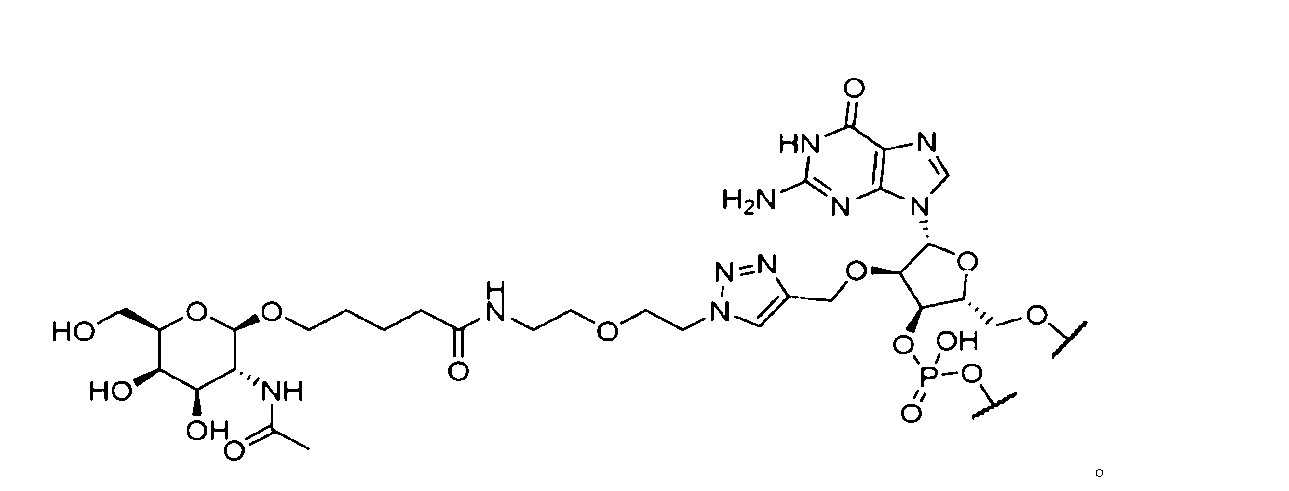
特定の実施形態では、本明細書のオリゴヌクレオチドは、下記に示されるような[prgA-peg-GalNAc]と呼ばれるアデニンヌクレオチドに結合した一価の2’-GalNAcを含み、ここでN-アセチルガラクトサミン(GalNAc)は、ポリエチレングリコール及びプロパルギル(アルキン)リンカーを介してアデニンにコンジュゲートされている:

そのようなコンジュゲーションの例を、5’~3’方向にヌクレオチド配列GAAAを有するループについて下記に示す(L=リンカー、X=ヘテロ原子)。ステム結合点が示されている。このようなループは、例えば、表4に列挙され、図1に示されているセンス鎖の位置27~30に存在する。化学式では、


適当な方法又は化学的手法(例えば、クリックケミストリー)を用いて標的化リガンドをヌクレオチドに連結する。標的化リガンドをヌクレオチドにコンジュゲートする1つの方法は、クリックリンカーを使用することである。いくつかの実施形態では、アセタールベースのリンカーを用いて標的化リガンドを本明細書のオリゴヌクレオチドのいずれか1つのヌクレオチドにコンジュゲートする。アセタールベースのリンカーは、例えば、国際特許出願公開第WO2016/100401号に開示されている。いくつかの実施形態では、リンカーは、不安定なリンカーである。しかしながら、他の実施形態では、リンカーは安定している。GalNAc部分がアセタールリンカーを使用してループのヌクレオチドに結合されている、5’~3’方向にヌクレオチドGAAAを有するループの例を下記に示す。このようなループは、例えば、表2又は3に列挙されたセンス鎖のいずれか1つの位置27~30に存在する。化学式において、


いくつかの実施形態では、二重鎖伸長部分(例えば、3、4、5、又は6bpまでの長さ)が、標的化リガンド(例えば、GalNAc部分)と本明細書のオリゴヌクレオチド(例えば、dsオリゴヌクレオチド)との間に配置される。他の実施形態では、オリゴヌクレオチドは、それへとコンジュゲートされたGalNAcを有しない。 In some embodiments, a duplex extension (e.g., up to 3, 4, 5, or 6 bp in length) is disposed between the targeting ligand (e.g., the GalNAc moiety) and the oligonucleotide herein (e.g., the ds oligonucleotide). In other embodiments, the oligonucleotide does not have GalNAc conjugated to it.
製剤及び医薬組成物 Formulations and pharmaceutical compositions
本明細書のオリゴヌクレオチド(例えば、dsオリゴヌクレオチド)、又はその薬学的に許容される塩(例えば、トリフルオロ酢酸塩、酢酸塩、又は塩酸塩)は、製剤又は医薬組成物に組み込まれる。オリゴヌクレオチドの使用を促進するために、さまざまな製剤が開発されている。例えば、オリゴヌクレオチドは、分解を最小限に抑え、送達及び/又は取り込みを促進し、又は製剤中のオリゴヌクレオチドに別の有益な特性を与える製剤を使用して個体又は細胞環境に送達することができる。いくつかの実施形態では、オリゴヌクレオチドは、リン酸緩衝生理食塩水などの緩衝液、リポソーム、ミセル構造、及びカプシド中に製剤化される。 The oligonucleotides herein (e.g., ds oligonucleotides), or pharma- ceutically acceptable salts thereof (e.g., trifluoroacetate, acetate, or hydrochloride), are incorporated into formulations or pharmaceutical compositions. A variety of formulations have been developed to facilitate the use of oligonucleotides. For example, oligonucleotides can be delivered to an individual or cellular environment using formulations that minimize degradation, facilitate delivery and/or uptake, or confer other beneficial properties to the oligonucleotides in the formulation. In some embodiments, oligonucleotides are formulated in buffers such as phosphate buffered saline, liposomes, micellar structures, and capsids.
インビボでの適合性及び有効性を向上させるために、オリゴヌクレオチドは、多数の無機酸及び有機の酸/塩基のいずれかと反応して、薬学的に許容される酸/塩基付加塩を形成することができる。薬学的に許容される塩及びそれらを調製するための一般的な方法は、当該技術分野で周知である(例えば、Stahl et al.,“Handbook of Pharmaceutical Salts: Properties,Selection and Use,” 2nd Revised Edition(Wiley-VCH,2011)を参照されたい)。本明細書で使用する薬学的に許容される塩としては、ナトリウム、トリフルオロ酢酸塩、塩酸塩及び酢酸塩が挙げられる。 To improve in vivo compatibility and effectiveness, oligonucleotides can react with any of a number of inorganic and organic acids/bases to form pharma- ceutically acceptable acid/base addition salts. Pharmaceutically acceptable salts and common methods for their preparation are well known in the art (see, for example, Stahl et al., "Handbook of Pharmaceutical Salts: Properties, Selection and Use," 2nd Revised Edition (Wiley-VCH, 2011)). Pharmaceutically acceptable salts as used herein include sodium, trifluoroacetate, hydrochloride and acetate.
カチオン性脂質を含むオリゴヌクレオチドの製剤を使用して、細胞内へのオリゴヌクレオチドのトランスフェクションを促進する。例えば、リポフェクチン、カチオン性グリセロール誘導体、及びポリカチオン性分子(例えば、ポリリジン)などのカチオン性脂質を使用することができる。適切な脂質としては、オリゴフェクタミン(ThermoFisher Technologies)、リポフェクタミン(Life Technologies)、NC388(Ribozyme Pharmaceuticals, Inc.,Boulder,Colo.)、又はFuGene6(Roche)が挙げられ、これらはいずれも製造者の使用説明書に従って使用することができる。 Formulations of oligonucleotides containing cationic lipids can be used to facilitate transfection of the oligonucleotides into cells. For example, cationic lipids such as lipofectin, cationic glycerol derivatives, and polycationic molecules (e.g., polylysine) can be used. Suitable lipids include Oligofectamine (ThermoFisher Technologies), Lipofectamine (Life Technologies), NC388 (Ribozyme Pharmaceuticals, Inc., Boulder, Colo.), or FuGene6 (Roche), each of which can be used according to the manufacturer's instructions.
したがって、いくつかの実施形態では、本明細書の製剤は、リポソーム、脂質、複合脂質、マイクロスフェア、マイクロ粒子、ナノスフェア、又はナノ粒子(脂質ナノ粒子など)を含むか、又は投与を必要とする個体の細胞、組織、器官、もしくは身体に投与するための他の形で製剤化することができる(例えば、Remington,“The Science and Practice of Pharmacy”(L.V.Allen Jr.,ed.,22nd Edition,Pharmaceutical Press,2013を参照されたい)。 Thus, in some embodiments, the formulations herein may comprise liposomes, lipids, lipid conjugates, microspheres, microparticles, nanospheres, or nanoparticles (such as lipid nanoparticles), or may be otherwise formulated for administration to a cell, tissue, organ, or body of an individual in need thereof (see, e.g., Remington, "The Science and Practice of Pharmacy" (L.V. Allen Jr., ed., 22nd Edition, Pharmaceutical Press, 2013).
いくつかの実施形態では、本明細書の製剤は、賦形剤をさらに含み、賦形剤は、活性成分の改善された安定性、改善された吸収性、改善された溶解性、及び/又は治療増強効果を組成物に付与することができる。いくつかの実施形態では、賦形剤は、緩衝剤(例えば、クエン酸ナトリウム、リン酸ナトリウム、トリス塩基、又は水酸化ナトリウム)、又はビヒクル(例えば、緩衝液、ペトロラタム、ジメチルスルホキシド、又は鉱油)である。いくつかの実施形態では、本明細書のオリゴヌクレオチドは、貯蔵寿命を延ばすために凍結乾燥された後、使用(例えば、個体への投与)前に溶液とされる。したがって、1つ以上のオリゴヌクレオチドを含む医薬組成物中の賦形剤は、凍結乾燥保護剤(例えば、マンニトール、ラクトース、ポリエチレングリコール、もしくはポリビニルピロリドン)、又は崩壊温度調節剤(例えば、デキストラン、フィコール(商標)、もしくはゼラチン)である。 In some embodiments, the formulations herein further comprise an excipient, which can impart improved stability, improved absorption, improved solubility, and/or therapeutic enhancement effects of the active ingredient to the composition. In some embodiments, the excipient is a buffer (e.g., sodium citrate, sodium phosphate, Tris base, or sodium hydroxide) or a vehicle (e.g., buffered solution, petrolatum, dimethyl sulfoxide, or mineral oil). In some embodiments, the oligonucleotides herein are lyophilized to extend shelf life and then brought into solution prior to use (e.g., administration to an individual). Thus, the excipient in a pharmaceutical composition comprising one or more oligonucleotides is a lyoprotectant (e.g., mannitol, lactose, polyethylene glycol, or polyvinylpyrrolidone), or a disintegration temperature modifier (e.g., dextran, Ficoll™, or gelatin).
医薬組成物は、その意図された投与経路に適合するように製剤化される。投与経路としては、非経口(例えば、静脈内、筋肉内、腹腔内、皮内、及び皮下)、経口(例えば、吸入)、経皮(例えば、局所)、経粘膜、ならびに直腸投与が挙げられるが、これらに限定されない。 A pharmaceutical composition is formulated to be compatible with its intended route of administration, including, but not limited to, parenteral (e.g., intravenous, intramuscular, intraperitoneal, intradermal, and subcutaneous), oral (e.g., inhalation), transdermal (e.g., topical), transmucosal, and rectal administration.
注射用途に適した医薬組成物には、滅菌水溶液(水溶性の場合)、又は分散液、及び滅菌注射溶液又は分散液の即時調製用の滅菌粉末が含まれる。静脈内投与の場合、適切な担体としては、生理食塩水、静菌水、Cremophor EL(商標)(BASF)又はリン酸緩衝生理食塩水(PBS)が挙げられるが、これらに限定されない。担体は、例えば、水、エタノール、ポリオール(例えば、グリセロール、プロピレングリコール、及び液体ポリエチレングリコールなど)、ならびにそれらの適当な混合物を含む溶媒又は分散媒であり得る。多くの実施形態では、例えば、糖、マンニトール、ソルビトールなどの多価アルコール、及び/又は塩化ナトリウムなどの等張剤を組成物に含むことが好ましい。滅菌されている注射用溶液は、必要な量の本明細書のオリゴヌクレオチドを選択された溶媒に、必要に応じて上記に列挙した成分のうちの1つ又は組み合わせと共に混合し、その後濾過滅菌することによって調製される。 Pharmaceutical compositions suitable for injection use include sterile aqueous solutions (if water soluble) or dispersions, and sterile powders for the extemporaneous preparation of sterile injectable solutions or dispersions. For intravenous administration, suitable carriers include, but are not limited to, physiological saline, bacteriostatic water, Cremophor EL™ (BASF) or phosphate buffered saline (PBS). The carrier may be, for example, a solvent or dispersion medium including water, ethanol, polyol (e.g., glycerol, propylene glycol, liquid polyethylene glycol, and the like), and suitable mixtures thereof. In many embodiments, it is preferred to include an isotonic agent, for example, a sugar, a polyalcohol such as mannitol, sorbitol, and/or sodium chloride in the composition. Sterile injectable solutions are prepared by mixing the required amount of the oligonucleotides herein in a selected solvent, optionally with one or a combination of the ingredients listed above, followed by filter sterilization.
さらに、医薬組成物は、少なくとも約0.1%以上の治療剤(例えば、1つ以上の本明細書のオリゴヌクレオチド)を含むが、治療剤のパーセンテージは、組成物全体の重量又は体積の約1%~約80%以上であってもよい。溶解度、バイオアベイラビリティー、生物学的半減期、投与経路、製品の貯蔵寿命、及び他の薬理学的考慮事項などの因子は、そのような医薬製剤の調製の分野における当業者によって想到されるものであり、したがって、さまざまな投与量及び治療レジメンが望ましい場合がある。 Additionally, the pharmaceutical composition comprises at least about 0.1% or more of a therapeutic agent (e.g., one or more oligonucleotides herein), although the percentage of therapeutic agent may be from about 1% to about 80% or more by weight or volume of the total composition. Factors such as solubility, bioavailability, biological half-life, route of administration, product shelf life, and other pharmacological considerations will be contemplated by those skilled in the art of preparing such pharmaceutical formulations, and therefore various dosages and treatment regimens may be desirable.
いくつかの例は、本明細書に記載のオリゴヌクレオチドの少なくとも1つを肝臓に標的とした送達を対象としているが、他の組織を標的とすることも企図されている。 Some examples are directed to targeted delivery of at least one of the oligonucleotides described herein to the liver, although targeting to other tissues is also contemplated.
キット Kit
本明細書のオリゴヌクレオチド(例えば、dsオリゴヌクレオチド)は、本明細書のオリゴヌクレオチドの1つ以上と使用説明書とを含むキットに組み込むことができる。いくつかの実施形態では、キットは、1つ以上のオリゴヌクレオチドと、キット及び/又はその任意の構成要素の使用説明書を含む添付文書とを含む。他の実施形態では、キットは、適切な容器、1つ以上のオリゴヌクレオチド、1つ以上の対照、及び当該技術分野で知られているさまざまな緩衝液、試薬、酵素、及びその他の標準成分を含む。 The oligonucleotides (e.g., ds oligonucleotides) of the present disclosure can be incorporated into kits that include one or more of the oligonucleotides of the present disclosure and instructions for use. In some embodiments, the kit includes one or more oligonucleotides and a package insert that includes instructions for use of the kit and/or any of its components. In other embodiments, the kit includes suitable containers, one or more oligonucleotides, one or more controls, and various buffers, reagents, enzymes, and other standard components known in the art.
いくつかの実施形態では、容器は、少なくとも1つのバイアル、ウェル、試験管、フラスコ、ボトル、注射器、又はその他の容器手段であり、その中に1つ以上のオリゴヌクレオチドが入れられ、いくつかの実施形態では、適切に分注される。追加の構構成要素が提供される他の実施形態では、キットは、この構成要素が配置される追加の容器を含む。キットには、1つ以上のオリゴヌクレオチドとその他の試薬を、商業的に販売できるように密閉された状態で収容する手段も含まれている。このような容器としては、所望のバイアルが保持される射出成形又はブロー成形のプラスチック容器が挙げられる。コンテナ及び/又はキットには、使用及び/又は警告のための使用説明書付きのラベルが含まれる。 In some embodiments, the container is at least one vial, well, test tube, flask, bottle, syringe, or other container means into which one or more oligonucleotides are placed, and in some embodiments, appropriately dispensed. In other embodiments in which additional components are provided, the kit includes an additional container into which the components are placed. The kit also includes a means for containing one or more oligonucleotides and other reagents in a closed condition suitable for commercial sale. Such containers include injection or blow molded plastic containers into which the desired vials are held. The container and/or kit includes a label with instructions for use and/or warnings.
いくつかの実施形態では、キットは、本明細書の1つ以上のオリゴヌクレオチド及び薬学的に許容される担体、又は1つ以上のオリゴヌクレオチドを含む医薬組成物と、それを必要とする個体におけるAPOC3発現に関連する疾患、障害、又は状態を治療するか、又はその進行を遅らせるための使用説明書とを含む。 In some embodiments, the kit comprises one or more oligonucleotides herein and a pharma- ceutically acceptable carrier, or a pharmaceutical composition comprising one or more oligonucleotides, and instructions for use in treating or slowing the progression of a disease, disorder, or condition associated with APOC3 expression in an individual in need thereof.
方法
作製方法
Method Preparation method
本明細書のオリゴヌクレオチド(例えば、dsオリゴヌクレオチド)は、例えば従来の核酸固相合成法など、当業者に既知の方法及び/又は技術を使用して作製される。オリゴヌクレオチドのポリヌクレオチドは、標準的なヌクレオチド又はヌクレオシド前駆体(例えば、ホスホラミダイト)を使用して、適切な核酸合成装置で組み立てられる。DNA/RNA合成装置を含む自動核酸合成装置は、例えば、Applied Biosystems(Foster City,CA)、BioAutomation(Irving,TX)、及びGE Healthcare Life Sciences(Pittsburgh,PA)などから市販されている。 The oligonucleotides (e.g., ds oligonucleotides) of the present invention are made using methods and/or techniques known to those of skill in the art, such as, for example, conventional solid-phase nucleic acid synthesis. Oligonucleotide polynucleotides are assembled on a suitable nucleic acid synthesizer using standard nucleotide or nucleoside precursors (e.g., phosphoramidites). Automated nucleic acid synthesizers, including DNA/RNA synthesizers, are commercially available, such as from Applied Biosystems (Foster City, CA), BioAutomation (Irving, TX), and GE Healthcare Life Sciences (Pittsburgh, PA).
当業者には理解されるように、本明細書のオリゴヌクレオチドを合成する他の方法及び/又は技術も使用される。さらに、さまざまな合成ステップが交互の順番又は順序で実行され、目的の化合物が得られる。オリゴヌクレオチドの合成に有用な他の合成化学変換、保護基(例えば、塩基に存在するヒドロキシル、アミノなど)、及び保護基方法論(保護及び脱保護)は、当該技術分野で公知であり、例えば、Larock,“Comprehensive Organic Transformations,” VCH Publishers(1989);Greene & Wuts,Protective Groups in Organic Synthesis,2nd Ed.,John Wiley & Sons(1991);Fieser & Fieser,Fieser and Fieser’s Reagents for Organic Synthesis,John Wiley & Sons(1994);及びPaquette,ed.,Encyclopedia of Reagents for Organic Synthesis,John Wiley & Sons(1995)に記載されている。 As will be appreciated by those of skill in the art, other methods and/or techniques for synthesizing the oligonucleotides herein may also be used. Additionally, the various synthetic steps may be performed in an alternating order or sequence to arrive at the desired compound. Other synthetic chemistry transformations, protecting groups (e.g., hydroxyl, amino, etc. present on bases), and protecting group methodologies (protection and deprotection) useful in the synthesis of oligonucleotides are known in the art and are described, for example, in Larock, "Comprehensive Organic Transformations," VCH Publishers (1989); Greene & Wuts, Protective Groups in Organic Synthesis, 2nd Ed. , John Wiley & Sons (1991); Fieser & Fieser, Fieser and Fieser's Reagents for Organic Synthesis, John Wiley & Sons (1994); and Paquette, ed., Encyclopedia of Reagents for Organic Synthesis, John Wiley & Sons (1995).
使用方法 How to use
I.細胞、組織、器官、及び生物におけるAPOC3発現を低減する方法:本明細書のオリゴヌクレオチド(例えば、dsオリゴヌクレオチド)は、細胞、組織、器官、又は個体におけるAPOC3のmRNAを低減するために使用される。本方法は、本明細書に記載されたステップを含み、これらは記載された順序で実行されてもよいが、必ずしもそうである必要はない。しかしながら、他の順序も考えられる。さらに、個別又は複数のステップを並行して、及び/又は時間が重なって、及び/又は個別に、又は複数回繰り返されるステップで実施できる。さらに、本方法は追加の未指定のステップを含む。 I. Methods of reducing APOC3 expression in cells, tissues, organs, and organisms: The oligonucleotides (e.g., ds oligonucleotides) of the present disclosure are used to reduce APOC3 mRNA in cells, tissues, organs, or individuals. The methods include the steps described herein, which may, but need not, be performed in the order described. However, other orders are contemplated. Furthermore, individual or multiple steps may be performed in parallel and/or overlapping in time, and/or with individual or multiple repeated steps. Additionally, the methods include additional unspecified steps.
本方法は、APOC3発現を低減するために、有効量の本明細書のオリゴヌクレオチドのいずれかを細胞、細胞の集団、組織、器官、又は個体に接触させること、又は送達することを含む。いくつかの実施形態では、APOCA3発現の減少は、細胞におけるAPOC3のmRNA、APOC3タンパク質、又はAPOC3活性の量又はレベルの減少を測定することによって判定される。 The method includes contacting or delivering an effective amount of any of the oligonucleotides herein to a cell, population of cells, tissue, organ, or individual to reduce APOC3 expression. In some embodiments, the decrease in APOCA3 expression is determined by measuring a decrease in the amount or level of APOC3 mRNA, APOC3 protein, or APOC3 activity in the cell.
適切な細胞型について、細胞型は、mRNAを発現するあらゆる細胞(例えば、肝細胞、マクロファージ、単球由来細胞、前立腺癌細胞、脳、内分泌組織、骨髄、リンパ節、肺、胆嚢、肝臓、十二指腸、小腸、膵臓、腎臓、胃腸管、膀胱、脂肪及び軟部組織、ならびに皮膚の細胞)である。いくつかの実施形態では、細胞は、個体から得られる初代細胞である。いくつかの実施形態では、初代細胞は、限られた数の継代を行っており、それにより、細胞は天然の表現型特性を実質的に維持している。いくつかの実施形態では、該細胞は、エクスビボ、インビボ、又はインビトロである(すなわち、本明細書の1つ以上のオリゴヌクレオチドは、培養中の細胞又は細胞が存在する生物に送達することができる)。 For suitable cell types, the cell type is any cell that expresses the mRNA (e.g., hepatocytes, macrophages, monocyte-derived cells, prostate cancer cells, brain, endocrine tissue, bone marrow, lymph nodes, lung, gallbladder, liver, duodenum, small intestine, pancreas, kidney, gastrointestinal tract, bladder, adipose and soft tissue, and skin cells). In some embodiments, the cells are primary cells obtained from an individual. In some embodiments, the primary cells have undergone a limited number of passages, such that the cells substantially maintain their native phenotypic characteristics. In some embodiments, the cells are ex vivo, in vivo, or in vitro (i.e., one or more oligonucleotides herein can be delivered to cells in culture or to the organism in which the cells reside).
いくつかの実施形態では、本明細書のオリゴヌクレオチドは、オリゴヌクレオチドを含む溶液を注入すること、オリゴヌクレオチドでコーティングした粒子による衝突すること、オリゴヌクレオチドを含む溶液に細胞もしくは細胞の集団を曝露すること、又はオリゴヌクレオチドの存在下での細胞膜をエレクトロポレーションすることを含むが、これらに限定されない当該技術分野で公知の核酸送達方法を使用して細胞又は細胞の集団に送達される。例えば、脂質媒介担体輸送、化学媒介輸送、及びリン酸カルシウムなどのカチオン性リポソームトランスフェクションなどの、オリゴヌクレオチドを細胞に送達するための他の当該技術分野で知られている方法が使用される。 In some embodiments, the oligonucleotides herein are delivered to a cell or population of cells using nucleic acid delivery methods known in the art, including, but not limited to, injecting a solution containing the oligonucleotide, bombarding with particles coated with the oligonucleotide, exposing a cell or population of cells to a solution containing the oligonucleotide, or electroporating a cell membrane in the presence of the oligonucleotide. Other methods known in the art for delivering oligonucleotides to cells are used, such as, for example, lipid-mediated carrier transport, chemical-mediated transport, and cationic liposome transfection, such as calcium phosphate.
APOC3発現の減少は、APOC3発現に関連する細胞もしくは細胞の集団の1つ以上の分子、特性、もしくは特性を評価するアッセイもしくは技術によって(例えば、APOC3発現バイオマーカーを使用して)、又は細胞もしくは細胞の集団におけるAPOC3発現を直接的に示す分子(例えば、APOC3のmRNAもしくはAPOC3タンパク質)を評価するアッセイもしくは技術によって判定される。いくつかの実施形態では、オリゴヌクレオチドがAPOC3発現を減少させる程度は、オリゴヌクレオチドと接触させた細胞又は細胞の集団におけるAPOC3発現を対照の細胞又は細胞の集団(例えば、オリゴヌクレオチドと接触させていないか、又は対照オリゴヌクレオチドと接触させた細胞又は細胞の集団)と比較することによって評価される。いくつかの実施形態では、対照細胞又は細胞の集団におけるAPOC3発現の対照の量又はレベルは、アッセイ又は技術が実施されるすべての場合において対照の量又はレベルを測定する必要がないように、予め決定される。所定のレベル又は値は、中央値や平均値などの単一のカットオフ値を含むがこれに限定されないさまざまな形式をとる。 The reduction in APOC3 expression is determined by an assay or technique that evaluates one or more molecules, characteristics, or properties of a cell or population of cells associated with APOC3 expression (e.g., using an APOC3 expression biomarker) or by an assay or technique that evaluates a molecule that directly indicates APOC3 expression in a cell or population of cells (e.g., APOC3 mRNA or APOC3 protein). In some embodiments, the extent to which an oligonucleotide reduces APOC3 expression is assessed by comparing APOC3 expression in a cell or population of cells contacted with the oligonucleotide to a control cell or population of cells (e.g., a cell or population of cells not contacted with the oligonucleotide or contacted with a control oligonucleotide). In some embodiments, the control amount or level of APOC3 expression in a control cell or population of cells is predetermined such that it is not necessary to measure the control amount or level in every instance in which the assay or technique is performed. The predetermined level or value can take a variety of forms, including, but not limited to, a single cutoff value, such as a median or mean.
本明細書のオリゴヌクレオチドを細胞又は細胞の集団に接触又は送達すると、APOC3発現が減少する。いくつかの実施形態では、APOC3発現の減少は、オリゴヌクレオチドと接触させていない、又は対照オリゴヌクレオチドと接触させた細胞又は細胞の集団におけるAPOC3発現の対照の量又はレベルと比較するものである。いくつかの実施形態では、APOC3発現の減少は、APOC3発現の対照の量又はレベルと比較して、約1%以下、約5%以下、約10%以下、約15%以下、約20%以下、約25%以下、約30%以下、約35%以下、約40%以下、約45%以下、約50%以下、約55%以下、約60%以下、約70%以下、約80%以下、又は約90%以下である。いくつかの実施形態では、APOC3発現の対照の量又はレベルは、本明細書のオリゴヌクレオチドと接触させていない細胞又は細胞の集団中のAPOC3のmRNA及び/又はAPOC3タンパク質の量又はレベルである。いくつかの実施形態では、本明細書の方法による細胞又は細胞の集団へのオリゴヌクレオチドの送達の効果は、任意の有限期間又は一定時間(例えば、分、時間、日、週、及び/又は月)後に評価される。例えば、APOC3発現は、細胞又は細胞の集団において、少なくとも約4時間、約8時間、約12時間、約18時間、又は約24時間にわたって決定される。代替的に、APOC3発現は、細胞又は細胞の集団にオリゴヌクレオチドを接触させるか又は送達した後、少なくとも約1日間、約2日間、約3日間、約4日間、約5日間、約6日間、約7日間、約8日間、約9日間、約10日間、約11日間、約12日間、約13日間、約14日間、約21日間、約28日間、約35日間、約42日間、約49日間、約56日間、約63日間、約70日間、約77日間、又は約84日間、又はそれ以上で、細胞又は細胞の集団において決定される。いくつかの実施形態では、APOC3発現は、細胞又は細胞の集団にオリゴヌクレオチドを接触させるか又は送達した後、少なくとも約1ヶ月、約2ヶ月、約3ヶ月、約4ヶ月、約5ヶ月、又は約6ヶ月、又はそれ以上で細胞又は細胞の集団において決定される。 Contacting or delivering the oligonucleotides herein to a cell or population of cells reduces APOC3 expression. In some embodiments, the reduction in APOC3 expression is compared to a control amount or level of APOC3 expression in a cell or population of cells not contacted with the oligonucleotide or contacted with a control oligonucleotide. In some embodiments, the reduction in APOC3 expression is about 1% or less, about 5% or less, about 10% or less, about 15% or less, about 20% or less, about 25% or less, about 30% or less, about 35% or less, about 40% or less, about 45% or less, about 50% or less, about 55% or less, about 60% or less, about 70% or less, about 80% or less, or about 90% or less compared to the control amount or level of APOC3 expression. In some embodiments, the control amount or level of APOC3 expression is the amount or level of APOC3 mRNA and/or APOC3 protein in a cell or population of cells not contacted with the oligonucleotides herein. In some embodiments, the effect of delivery of an oligonucleotide to a cell or population of cells by the methods herein is evaluated after any finite period or period of time (e.g., minutes, hours, days, weeks, and/or months). For example, APOC3 expression is determined in the cell or population of cells for at least about 4 hours, about 8 hours, about 12 hours, about 18 hours, or about 24 hours. Alternatively, APOC3 expression is determined in the cell or population of cells for at least about 1 day, about 2 days, about 3 days, about 4 days, about 5 days, about 6 days, about 7 days, about 8 days, about 9 days, about 10 days, about 11 days, about 12 days, about 13 days, about 14 days, about 21 days, about 28 days, about 35 days, about 42 days, about 49 days, about 56 days, about 63 days, about 70 days, about 77 days, or about 84 days or more after contacting or delivering the oligonucleotide to the cell or population of cells. In some embodiments, APOC3 expression is determined in the cell or population of cells at least about 1 month, about 2 months, about 3 months, about 4 months, about 5 months, or about 6 months or more after contacting or delivering the oligonucleotide to the cell or population of cells.
いくつかの実施形態では、本明細書のオリゴヌクレオチドは、細胞内で1つ以上のオリゴヌクレオチド又は鎖(例えば、センス鎖及びアンチセンス鎖)を発現するように操作された導入遺伝子の形態で送達される。例えば、オリゴヌクレオチドは、本明細書の任意のオリゴヌクレオチドを発現するように設計された導入遺伝子を使用して送達される。導入遺伝子は、ウイルスベクター(例えば、アデノウイルス、レトロウイルス、ワクシニアウイルス、ポックスウイルス、アデノ随伴ウイルス、もしくは単純ヘルペスウイルス)、又は非ウイルスベクター(例えば、プラスミドもしくは合成mRNA)を使用して送達され得る。いくつかの実施形態では、導入遺伝子を個体に直接注射する。 In some embodiments, the oligonucleotides herein are delivered in the form of a transgene engineered to express one or more oligonucleotides or strands (e.g., sense and antisense strands) in a cell. For example, the oligonucleotides are delivered using a transgene designed to express any of the oligonucleotides herein. The transgene may be delivered using a viral vector (e.g., adenovirus, retrovirus, vaccinia virus, poxvirus, adeno-associated virus, or herpes simplex virus) or a non-viral vector (e.g., a plasmid or synthetic mRNA). In some embodiments, the transgene is directly injected into the individual.
II. 治療方法: APOC3発現に関連する疾患、障害、又は症状を有する、有すると疑われる、又は発症するリスクがある個体を治療する方法は、本明細書のオリゴヌクレオチド(例えば、dsオリゴヌクレオチド)の少なくとも1つ以上を個体に投与することを含む。さらに、個体におけるAPOC3発現に関連する疾患、障害、又は症状の発症又は進行を治療するか軽減する方法は、本明細書のオリゴヌクレオチドの1つ以上を使用することを含む。さらに、APOC3発現に関連する疾患、障害、又は状態を有する個体において1つ以上の治療効果を達成する方法は、本明細書のオリゴヌクレオチドの1つ以上を提供することを含む。いくつかの実施形態では、治療有効量の本明細書のオリゴヌクレオチドのいずれか1つ以上を投与することによって個体を治療することができる。いくつかの実施形態では、治療は、APOC3発現を低減することを含む。いくつかの実施形態では、個体は治療的に処置される。いくつかの実施形態では、個体は予防的に処置される。これらすべての実施形態では、オリゴヌクレオチドは表3から選択される。 II. Methods of Treatment: A method of treating an individual having, suspected of having, or at risk of developing a disease, disorder, or condition associated with APOC3 expression comprises administering to the individual at least one or more of the oligonucleotides (e.g., ds oligonucleotides) of the present disclosure. Additionally, a method of treating or reducing the onset or progression of a disease, disorder, or condition associated with APOC3 expression in an individual comprises using one or more of the oligonucleotides of the present disclosure. Additionally, a method of achieving one or more therapeutic effects in an individual having a disease, disorder, or condition associated with APOC3 expression comprises providing one or more of the oligonucleotides of the present disclosure. In some embodiments, an individual can be treated by administering a therapeutically effective amount of any one or more of the oligonucleotides of the present disclosure. In some embodiments, the treatment comprises reducing APOC3 expression. In some embodiments, the individual is treated therapeutically. In some embodiments, the individual is treated prophylactically. In all of these embodiments, the oligonucleotide is selected from Table 3.
いくつかの実施形態では、1つ以上のオリゴヌクレオチド、又はそれを含む医薬組成物を、APOC3発現に関連する疾患、障害、又は状態を有する個体に投与し、個体におけるAPOC3 発現を減少させ、それによって個体を治療する。いくつかの実施形態では、個体におけるAPOC3のmRNAの量又はレベルが減少する。他の実施形態では、個体におけるAPOC3タンパク質の量又はレベルが減少する。さらに他の実施形態では、個体におけるAPOC3活性の量又はレベルが減少する。さらに他の実施形態では、個体、特に肝臓における肝臓のTG(例えば、肝臓中の1つ以上のTG(複数可)又は総TG)の量又はレベルが減少する。さらに他の実施形態では、肝臓の炎症の量又はレベルを軽減することができる。さらに他の実施形態では、肝線維症のレベルが低減される。さらに他の実施形態では、血漿アスパラギン酸アミノトランスフェラーゼ(AST)、血漿アラニンアミノトランスフェラーゼ(ALT)、サイトケラチン18(CK-18)、又はN末端III型コラーゲンプロペプチド(Pro-C3)の量又はレベルが減少する。上記開示された実施形態のいずれにおいても、オリゴヌクレオチドは、オリゴヌクレオチドは、配列番号143、149、151、193、195、205、207、及び211のいずれか1つのヌクレオチド配列を有するセンス鎖と、配列番号144、150、152、194、196、206、208、及び212のいずれか1つのヌクレオチド配列を有するアンチセンス鎖とを含む。 In some embodiments, one or more oligonucleotides, or pharmaceutical compositions comprising same, are administered to an individual having a disease, disorder, or condition associated with APOC3 expression to reduce APOC3 expression in the individual, thereby treating the individual. In some embodiments, the amount or level of APOC3 mRNA is reduced in the individual. In other embodiments, the amount or level of APOC3 protein is reduced in the individual. In still other embodiments, the amount or level of APOC3 activity is reduced in the individual. In still other embodiments, the amount or level of hepatic TG (e.g., one or more TG(s) or total TG in the liver) is reduced in the individual, particularly in the liver. In still other embodiments, the amount or level of hepatic inflammation can be reduced. In still other embodiments, the level of liver fibrosis is reduced. In still other embodiments, the amount or level of plasma aspartate aminotransferase (AST), plasma alanine aminotransferase (ALT), cytokeratin 18 (CK-18), or N-terminal type III collagen propeptide (Pro-C3) is reduced. In any of the above disclosed embodiments, the oligonucleotide comprises a sense strand having a nucleotide sequence of any one of SEQ ID NOs: 143, 149, 151, 193, 195, 205, 207, and 211, and an antisense strand having a nucleotide sequence of any one of SEQ ID NOs: 144, 150, 152, 194, 196, 206, 208, and 212.
いくつかの実施形態では、個体におけるAPOC3発現は、1つ以上のオリゴヌクレオチド又はその医薬組成物を投与する前のAPOC3発現と比較した場合、少なくとも約30%、約35%、約40%、約45%、約50%、約55%、約60%、約65%、約70%、約75%、約80%、約85%、約90%、約95%、約99%、又は99%を超えて減少する。他の実施形態では、個体におけるAPOC3発現は、1つ以上のオリゴヌクレオチドもしくは医薬組成物を受けていないか、又は対照のオリゴヌクレオチド、医薬組成物もしくは治療を受けた個体(例えば、参照又は対照の個体)におけるAPOC3発現と比較した場合、少なくとも約30%、約35%、約40%、約45%、約50%、約55%、約60%、約65%、約70%、約75%、約80%、約85%、約90%、約95%、約99%、又は99%を超えて減少する。 In some embodiments, APOC3 expression in an individual is reduced by at least about 30%, about 35%, about 40%, about 45%, about 50%, about 55%, about 60%, about 65%, about 70%, about 75%, about 80%, about 85%, about 90%, about 95%, about 99%, or greater than 99% when compared to APOC3 expression before administration of one or more oligonucleotides or pharmaceutical compositions thereof. In other embodiments, APOC3 expression in an individual is reduced by at least about 30%, about 35%, about 40%, about 45%, about 50%, about 55%, about 60%, about 65%, about 70%, about 75%, about 80%, about 85%, about 90%, about 95%, about 99%, or greater than 99% when compared to APOC3 expression in an individual that has not received one or more oligonucleotides or pharmaceutical compositions or that has received a control oligonucleotide, pharmaceutical composition, or treatment (e.g., a reference or control individual).
特定の実施形態では、個体におけるAPOC3のmRNAの量又はレベルは、1つ以上のオリゴヌクレオチド又はその医薬組成物を投与する前のAPOC3のmRNAの量又はレベルと比較した場合、少なくとも約30%、約35%、約40%、約45%、約50%、約55%、約60%、約65%、約70%、約75%、約80%、約85%、約90%、約95%、約99%、又は99%を超えて減少する。いくつかの実施形態では、個体におけるAPOC3のmRNAの量又はレベルは、1つ以上のオリゴヌクレオチドもしくは医薬組成物を受けていないか、又は対照のオリゴヌクレオチド、医薬組成物、もしくは治療を受けた個体(例えば、参照又は対照の個体)におけるAPOC3のmRNAの量又はレベルと比較した場合、少なくとも約30%、約35%、約40%、約45%、約50%、約55%、約60%、約65%、約70%、約75%、約80%、約85%、約90%、約95%、約99%、又は99%を超えて減少する。 In certain embodiments, the amount or level of APOC3 mRNA in an individual is reduced by at least about 30%, about 35%, about 40%, about 45%, about 50%, about 55%, about 60%, about 65%, about 70%, about 75%, about 80%, about 85%, about 90%, about 95%, about 99%, or greater than 99% when compared to the amount or level of APOC3 mRNA before administration of one or more oligonucleotides or pharmaceutical compositions thereof. In some embodiments, the amount or level of APOC3 mRNA in an individual is reduced by at least about 30%, about 35%, about 40%, about 45%, about 50%, about 55%, about 60%, about 65%, about 70%, about 75%, about 80%, about 85%, about 90%, about 95%, about 99%, or more than 99% when compared to the amount or level of APOC3 mRNA in an individual that has not received one or more oligonucleotides or pharmaceutical compositions or that has received a control oligonucleotide, pharmaceutical composition, or treatment (e.g., a reference or control individual).
特定の実施形態では、個体におけるAPOC3タンパク質の量又はレベルは、1つ以上のオリゴヌクレオチド又はその医薬組成物を投与する前のAPOC3タンパク質の量又はレベルと比較した場合、少なくとも約30%、約35%、約40%、約45%、約50%、約55%、約60%、約65%、約70%、約75%、約80%、約85%、約90%、約95%、約99%、又は99%を超えて減少する。他の実施形態では、個体におけるAPOC3タンパク質の量又はレベルは、1つ以上のオリゴヌクレオチドもしくは医薬組成物を受けていないか、又は対照のオリゴヌクレオチド、医薬組成物、もしくは治療を受けた個体(例えば、参照又は対照の個体)におけるAPOC3タンパク質の量又はレベルと比較した場合、少なくとも約30%、約35%、約40%、約45%、約50%、約55%、約60%、約65%、約70%、約75%、約80%、約85%、約90%、約95%、約99%、又は99%を超えて減少する。 In certain embodiments, the amount or level of APOC3 protein in an individual is reduced by at least about 30%, about 35%, about 40%, about 45%, about 50%, about 55%, about 60%, about 65%, about 70%, about 75%, about 80%, about 85%, about 90%, about 95%, about 99%, or greater than 99% when compared to the amount or level of APOC3 protein before administration of one or more oligonucleotides or pharmaceutical compositions thereof. In other embodiments, the amount or level of APOC3 protein in an individual is reduced by at least about 30%, about 35%, about 40%, about 45%, about 50%, about 55%, about 60%, about 65%, about 70%, about 75%, about 80%, about 85%, about 90%, about 95%, about 99%, or more than 99% when compared to the amount or level of APOC3 protein in an individual that has not received one or more oligonucleotides or pharmaceutical compositions or that has received a control oligonucleotide, pharmaceutical composition, or treatment (e.g., a reference or control individual).
特定の実施形態では、個体におけるAPOC3活性の量又はレベルは、1つ以上のオリゴヌクレオチド又はその医薬組成物を投与する前のAPOC3活性の量又はレベルと比較した場合、少なくとも約30%、約35%、約40%、約45%、約50%、約55%、約60%、約65%、約70%、約75%、約80%、約85%、約90%、約95%、約99%、又は99%を超えて減少する。いくつかの実施形態では、個体におけるAPOC3活性の量又はレベルは、1つ以上のオリゴヌクレオチドもしくは医薬組成物を受けていないか、又は対照のオリゴヌクレオチド、医薬組成物、もしくは治療を受けた個体(例えば、参照又は対照の個体)におけるAPOC3活性の量又はレベルと比較した場合、少なくとも約30%、約35%、約40%、約45%、約50%、約55%、約60%、約65%、約70%、約75%、約80%、約85%、約90%、約95%、約99%、又は99%を超えて減少する。 In certain embodiments, the amount or level of APOC3 activity in an individual is reduced by at least about 30%, about 35%, about 40%, about 45%, about 50%, about 55%, about 60%, about 65%, about 70%, about 75%, about 80%, about 85%, about 90%, about 95%, about 99%, or greater than 99% when compared to the amount or level of APOC3 activity before administration of one or more oligonucleotides or pharmaceutical compositions thereof. In some embodiments, the amount or level of APOC3 activity in an individual is reduced by at least about 30%, about 35%, about 40%, about 45%, about 50%, about 55%, about 60%, about 65%, about 70%, about 75%, about 80%, about 85%, about 90%, about 95%, about 99%, or more than 99% when compared to the amount or level of APOC3 activity in an individual that has not received one or more oligonucleotides or pharmaceutical compositions or that has received a control oligonucleotide, pharmaceutical composition, or treatment (e.g., a reference or control individual).
特定の実施形態では、個体におけるTG、特に肝臓のTGの量又はレベルは、1つ以上のオリゴヌクレオチド又はその医薬組成物を投与する前のTGの量又はレベルと比較した場合、少なくとも約30%、約35%、約40%、約45%、約50%、約55%、約60%、約65%、約70%、約75%、約80%、約85%、約90%、約95%、約99%、又は99%を超えて減少し得る。いくつかの実施形態では、個体におけるTGの量又はレベルは、1つ以上のオリゴヌクレオチドもしくは医薬組成物を受けていないか、又は対照のオリゴヌクレオチド、医薬組成物、もしくは治療を受けた個体(例えば、参照又は対照の個体)におけるTGの量又はレベルと比較した場合、少なくとも約30%、約35%、約40%、約45%、約50%、約55%、約60%、約65%、約70%、約75%、約80%、約85%、約90%、約95%、約99%、又は99%を超えて減少する。 In certain embodiments, the amount or level of TG in an individual, particularly hepatic TG, may be reduced by at least about 30%, about 35%, about 40%, about 45%, about 50%, about 55%, about 60%, about 65%, about 70%, about 75%, about 80%, about 85%, about 90%, about 95%, about 99%, or greater than 99% when compared to the amount or level of TG before administration of one or more oligonucleotides or pharmaceutical compositions thereof. In some embodiments, the amount or level of TG in an individual is reduced by at least about 30%, about 35%, about 40%, about 45%, about 50%, about 55%, about 60%, about 65%, about 70%, about 75%, about 80%, about 85%, about 90%, about 95%, about 99%, or more than 99% when compared to the amount or level of TG in an individual that has not received one or more oligonucleotides or pharmaceutical compositions or that has received a control oligonucleotide, pharmaceutical composition, or treatment (e.g., a reference or control individual).
ここで、APOC3発現、APOC3のmRNA、APOC3タンパク質、APOC3活性、肝臓のTG、又はそれらの任意の組み合わせの量又はレベルが、個体から取得又は分離された、細胞(例えば、肝細胞)、細胞の集団又は群(例えば、オルガノイド)、組織(例えば、肝臓組織)、試料(例えば、肝生検試料)、器官(例えば、肝臓)、血液又はその画分(例えば、血漿)、又は任意のその他の生物学的材料において減少する。いくつかの実施形態では、APOC3発現、APOC3のmRNA、APOC3タンパク質、APOC3活性、TG、又はそれらの任意の組み合わせの量又はレベルが、個体から採取又は単離された、1種以上の細胞(例えば、肝細胞及び1種以上の他の種類の細胞)、1種以上の細胞の群、1種以上の組織(例えば、肝臓組織及び1種以上の他の種類の組織)、1種以上の試料(例えば、肝生検試料及び1種以上の他の種類の生検試料)、1種以上の器官(例えば、肝臓及び1種以上の他の器官)、1種以上の血液画分(例えば、血漿及び1種以上の他の血液画分)において減少する。 Here, the amount or level of APOC3 expression, APOC3 mRNA, APOC3 protein, APOC3 activity, hepatic TG, or any combination thereof, is decreased in a cell (e.g., hepatocyte), a population or group of cells (e.g., organoid), a tissue (e.g., liver tissue), a sample (e.g., a liver biopsy sample), an organ (e.g., liver), blood or a fraction thereof (e.g., plasma), or any other biological material obtained or isolated from an individual. In some embodiments, the amount or level of APOC3 expression, APOC3 mRNA, APOC3 protein, APOC3 activity, TG, or any combination thereof is decreased in one or more cells (e.g., hepatocytes and one or more other types of cells), one or more groups of cells, one or more tissues (e.g., liver tissue and one or more other types of tissues), one or more samples (e.g., liver biopsy samples and one or more other types of biopsy samples), one or more organs (e.g., liver and one or more other organs), one or more blood fractions (e.g., plasma and one or more other blood fractions) taken or isolated from an individual.
APOC3発現に関連する疾患、障害、又は症状の例としては、ACD、AH、ALD、ASCVD、HCC、CHD、CCA、PSC、MetS、NAFLD、NASH、高非HDLコレステロール、高脂血症、高トリグリセリド血症、糖尿病、肥満、脂肪肝(脂肪変性症)、肝臓の炎症、インスリン抵抗性、肝線維症、肝硬変、又はそれらの組み合わせが挙げられるが、これらに限定されない。 Examples of diseases, disorders, or conditions associated with APOC3 expression include, but are not limited to, ACD, AH, ALD, ASCVD, HCC, CHD, CCA, PSC, MetS, NAFLD, NASH, high non-HDL cholesterol, hyperlipidemia, hypertriglyceridemia, diabetes, obesity, fatty liver (steatosis), liver inflammation, insulin resistance, liver fibrosis, cirrhosis, or combinations thereof.
本明細書のオリゴヌクレオチドの高い特異性のために、本明細書のオリゴヌクレオチドは、細胞、組織、又は器官(例えば、肝臓)の標的遺伝子のmRNAを特異的に標的とする。疾患の予防において、標的遺伝子は、疾患の開始又は維持に必要とされるもの、又は疾患に罹患するリスクが高いことに関連すると同定されたものである。疾患の治療においては、1つ以上の本明細書のオリゴヌクレオチドが、疾患を呈しているか、疾患の媒介に関与している細胞、組織、又は器官と接触させられる。例えば、APOC3発現に関連する障害又は状態に関連する野生型(すなわち、天然型)又は変異型遺伝子の全部又は一部と実質的に同一のオリゴヌクレオチドを、肝細胞やその他の肝臓細胞などの目的の細胞又は組織型と接触させるか、又はそれらに導入する。 Due to the high specificity of the oligonucleotides herein, the oligonucleotides herein specifically target the mRNA of the target gene in a cell, tissue, or organ (e.g., liver). In disease prevention, the target gene is one that is required for the initiation or maintenance of the disease or that has been identified as being associated with an increased risk of developing the disease. In disease treatment, one or more oligonucleotides herein are contacted with a cell, tissue, or organ that exhibits or is involved in mediating the disease. For example, an oligonucleotide substantially identical to all or a portion of a wild-type (i.e., naturally occurring) or mutant gene associated with a disorder or condition associated with APOC3 expression is contacted with or introduced into a cell or tissue type of interest, such as a hepatocyte or other liver cell.
いくつかの実施形態では、標的遺伝子は、ヒトなどの任意の哺乳動物由来である。本明細書の方法に従って、任意の遺伝子をサイレンシングすることができる。本明細書の方法は、典型的には、治療有効量、すなわち、望ましい治療結果を生じることができる量の1つ以上の本明細書のオリゴヌクレオチドを個体に投与することを含む。治療上許容される量とは、疾患又は障害又は症状を治療的に処置する量である。任意の1人の個体に対する適切な投与量は、個体のサイズ、体表面積、年齢、投与される組成物、組成物中の活性成分(複数可)、投与の時間及び経路、全体的な健康状態、及び同時に投与されている他の治療剤を含む特定の因子に応じて決められる。 In some embodiments, the target gene is from any mammal, such as a human. Any gene can be silenced according to the methods herein. The methods herein typically include administering to an individual a therapeutically effective amount, i.e., an amount capable of producing a desired therapeutic result, of one or more of the oligonucleotides herein. A therapeutically acceptable amount is an amount that therapeutically treats a disease or disorder or condition. The appropriate dosage for any one individual will depend on certain factors, including the individual's size, body surface area, age, the composition being administered, the active ingredient(s) in the composition, the time and route of administration, overall health, and other therapeutic agents being administered simultaneously.
本方法では、個体は、本明細書中のオリゴヌクレオチド又は組成物のいずれか1つを、経腸的に(例えば、経口、胃栄養チューブによって、十二指腸栄養チューブによって、胃瘻造設を介して、もしくは直腸に)、非経口的に(例えば、皮下注射、静脈内注射もしくは注入、動脈内注射もしくは注入、骨内注射、筋肉内注射、脳内注射、脳室内注射、もしくは髄腔内注射)、局所(例えば、経皮、吸入、点眼薬、もしくは粘膜を介して)、又は標的器官(例えば、個体の肝臓)への直接注射によって投与される。典型的には、オリゴヌクレオチド又は組成物は、静脈内又は皮下に投与される。 In the methods, the individual is administered any one of the oligonucleotides or compositions herein enterally (e.g., orally, by a gastric feeding tube, by a duodenal feeding tube, via a gastrostomy, or rectally), parenterally (e.g., subcutaneous injection, intravenous injection or infusion, intraarterial injection or infusion, intraosseous injection, intramuscular injection, intracerebral injection, intraventricular injection, or intrathecal injection), locally (e.g., transdermally, by inhalation, eye drops, or via a mucosa), or by direct injection into a target organ (e.g., the liver of the individual). Typically, the oligonucleotide or composition is administered intravenously or subcutaneously.
非限定的の一組の例として、本明細書のオリゴヌクレオチド又は組成物は、典型的には、四半期ごと(3か月ごとに1回)、隔月ごと(2か月ごとに1回)、毎月又は毎週投与される。例えば、オリゴヌクレオチド又は組成物は、毎週、又は2週間もしくは3週間の間隔で投与される。特定の実施形態では、オリゴヌクレオチド又は組成物は毎日投与される。いくつかの実施形態では、個体にオリゴヌクレオチド又は組成物の1回以上の負荷用量が投与され、その後オリゴヌクレオチド又は組成物の1回以上の維持用量が投与される。 As one non-limiting set of examples, the oligonucleotides or compositions herein are typically administered quarterly (once every three months), bimonthly (once every two months), monthly, or weekly. For example, the oligonucleotides or compositions are administered weekly, or at two- or three-week intervals. In certain embodiments, the oligonucleotides or compositions are administered daily. In some embodiments, the individual is administered one or more loading doses of the oligonucleotide or composition, followed by one or more maintenance doses of the oligonucleotide or composition.
いくつかの実施形態では、個体は、ヒト、NHP、又は他の哺乳動物個体である。他の実施形態では、個体は、イヌ又はネコなどの飼育動物、ウマ、ウシ、ブタ、ヒツジ、ヤギ、又はニワトリなどの家畜、及びマウス、ラット、モルモット、又はハムスターなどの動物である。 In some embodiments, the individual is a human, NHP, or other mammalian individual. In other embodiments, the individual is a domestic animal, such as a dog or cat, a livestock animal, such as a horse, cow, pig, sheep, goat, or chicken, and an animal, such as a mouse, rat, guinea pig, or hamster.
III. 医療用途:本明細書のオリゴヌクレオチド(例えば、dsオリゴヌクレオチド)は、APOC3発現を低下させることで利益を得られる個体(例えば、APOC3発現に関連する疾患、障害、又は状態を有するヒト)を治療するために使用でき、またそのような使用に適応させることができる。いくつかの実施形態では、オリゴヌクレオチドは、APOC3発現に関連する疾患、障害、又は状態を有する個体を治療に使用するために、又はそのような使用に適応するために提供される。また、オリゴヌクレオチドは、APOC3発現に関連する疾患、障害、又は状態を治療するための医薬又は医薬組成物の製造に使用するために、又はそのような使用に適応可能に提供される。他の実施形態では、オリゴヌクレオチドは、APOC3のmRNAを標的とし、APOC3発現を減少さる(例えば、RNAi経路を介して)ために提供されるか、又はそのような使用に適応可能である。他の実施形態では、オリゴヌクレオチドは、APOC3のmRNAを標的とし、APOC3のmRNA、APOC3タンパク質、及び/又はAPOC3活性の量又はレベルを低下させるために用いられるか、又は用いられるように適応可能である。 III. Medical Uses: The oligonucleotides (e.g., ds oligonucleotides) herein can be used and adapted to treat individuals (e.g., humans with a disease, disorder, or condition associated with APOC3 expression) who would benefit from reduced APOC3 expression. In some embodiments, oligonucleotides are provided for use or adapted to treat individuals with a disease, disorder, or condition associated with APOC3 expression. Oligonucleotides are also provided for use or adapted to manufacture a medicament or pharmaceutical composition for treating a disease, disorder, or condition associated with APOC3 expression. In other embodiments, oligonucleotides are provided or adapted to target APOC3 mRNA and reduce APOC3 expression (e.g., via the RNAi pathway). In other embodiments, oligonucleotides are provided or adapted to target APOC3 mRNA and reduce the amount or level of APOC3 mRNA, APOC3 protein, and/or APOC3 activity.
いくつかの実施形態では、本方法は、APOC3のmRNA、APOC3タンパク質、又はそれらの組み合わせなどであるが、これらに限定されない、APOC3発現に関連する疾患、障害、又は状態のマーカー(例えば、バイオマーカー)を有する個体、又はそれらの素因を持つ個体に基づいて、治療のために個体を選択することを含む。同様に、以下に詳述するように、本方法は、例えば、APOC3発現マーカー(例えば、APOC3タンパク質)のベースライン値を測定又は取得し、次いで、得られた値を1つ以上の他のベースライン値又は個体に1つ以上のオリゴヌクレオチドを投与した後に得られた値と比較して、治療の有効性を評価するなどの追加のステップも含む。 In some embodiments, the method includes selecting an individual for treatment based on the individual having or being predisposed to a marker (e.g., biomarker) for a disease, disorder, or condition associated with APOC3 expression, such as, but not limited to, APOC3 mRNA, APOC3 protein, or a combination thereof. Similarly, as described in more detail below, the method may also include additional steps, such as measuring or obtaining a baseline value of an APOC3 expression marker (e.g., APOC3 protein) and then comparing the obtained value to one or more other baseline values or to a value obtained after administering one or more oligonucleotides to the individual to assess the effectiveness of the treatment.
以下の非限定的な実施例は例示を目的として含まれており、限定するものではない。 The following non-limiting examples are included for illustrative purposes and are not intended to be limiting.
オリゴヌクレオチドの合成 Oligonucleotide synthesis
実施例1:ds RNAiオリゴヌクレオチドの調製 Example 1: Preparation of ds RNAi oligonucleotides
オリゴヌクレオチドの合成及び精製:実施例のds RNAiオリゴヌクレオチドは、本明細書の方法を使用して化学的に合成される。一般に、dsRNAiオリゴヌクレオチドは、19~23merのsiRNAについて記載された固相オリゴヌクレオチド合成法を用いて合成される(例えば、Scaringe et al.(1990)Nucleic Acids Res.18:5433-41及びUsman et al.(1987)J.Am.Chem.Soc.109:7845-45を参照されたい;米国特許第5,804,683号;同第5,831,071号;同第5,998,203号;同第6,008,400号;同第6,111,086号;同第6,117,657号;同第6,353,098号;同第6,362,323号;同第6,437,117号;及び同第6,469,158号も参照されたい)。 Oligonucleotide synthesis and purification: The dsRNAi oligonucleotides of the examples are chemically synthesized using the methods described herein. In general, dsRNAi oligonucleotides are synthesized using solid-phase oligonucleotide synthesis methods described for 19-23mer siRNAs (see, e.g., Scaringe et al. (1990) Nucleic Acids Res. 18:5433-41 and Usman et al. (1999) Nucleic Acids Res. 18:5433-41). al. (1987) J. Am. Chem. Soc. 109:7845-45; see also U.S. Patent Nos. 5,804,683; 5,831,071; 5,998,203; 6,008,400; 6,111,086; 6,117,657; 6,353,098; 6,362,323; 6,437,117; and 6,469,158).
標準方法(Integrated DNA Technologies)に従って、個々のRNA鎖を合成してHPLC精製した。例えば、固相ホスホラミダイト化学反応を使用してRNAオリゴヌクレオチドを合成し、脱保護し、標準技法(Damha & Olgivie(1993)Methods Mol.Biol.20:81-114;Wincott et al.(1995)Nucleic Acids Res.23:2677-84)を使用してNAP-5カラム(Amersham Pharmacia Biotech;Piscataway,NJ)上で脱塩した。15分間の段階的線形勾配を使用したAmersham Source 15Qカラム(1.0cm×25cm、Amersham Pharmacia Biotech)上でイオン交換高速液体クロマトグラフィ(IE-HPLC)を使用して、オリゴマーを精製した。勾配は、90:10緩衝液A:Bから52:48緩衝液A:Bへと変動し、緩衝液Aは、pH8.5の100mMのTrisであり、緩衝液Bは、pH8.5の100mMのTris、1MのNaClである。試料を260nmでモニターし、全長オリゴヌクレオチド種に対応するピークを収集し、プールし、NAP-5カラム上で脱塩し、凍結乾燥した。 Individual RNA strands were synthesized and HPLC purified according to standard methods (Integrated DNA Technologies). For example, RNA oligonucleotides were synthesized using solid-phase phosphoramidite chemistry, deprotected, and desalted on NAP-5 columns (Amersham Pharmacia Biotech; Piscataway, NJ) using standard techniques (Damha & Olgivie (1993) Methods Mol. Biol. 20:81-114; Wincott et al. (1995) Nucleic Acids Res. 23:2677-84). Oligomers were purified using ion exchange high performance liquid chromatography (IE-HPLC) on an Amersham Source 15Q column (1.0 cm x 25 cm, Amersham Pharmacia Biotech) using a 15 minute step linear gradient. The gradient varied from 90:10 Buffer A:B to 52:48 Buffer A:B, where Buffer A was 100 mM Tris, pH 8.5, and Buffer B was 100 mM Tris, pH 8.5, 1 M NaCl. Samples were monitored at 260 nm and peaks corresponding to full length oligonucleotide species were collected, pooled, desalted on a NAP-5 column, and lyophilized.
Beckman PACE 5000(Beckman Coulter,Inc.)上のキャピラリ電気泳動(CE)によって、それぞれのオリゴマーの純度を判定した。CEキャピラリは、100μm内径を有し、ssDNA 100R Gel(Beckman-Coulter)を含む。典型的には、約0.6nmoleのオリゴヌクレオチドが、キャピラリに注入され、444V/cmの電場で流され、260nmにおけるUV吸光度によって検出された。変性Tris-ホウ酸塩-7M-尿素ランニング緩衝液をBeckman-Coulterから購入した。以下で説明される実験で使用するためにCEによって評価されるときに少なくとも90%純粋であるオリゴリボヌクレオチドが得られた。製造者の推奨プロトコールに従って、Voyager DE(商標) Biospectometry Workstation(Applied Biosystems)上でのマトリクス支援レーザ脱離イオン化飛行時間型(MALDI-TOF)質量分析法によって、化合物の同一性が検証された。しばしば想定される分子量の0.2%以内で、すべてのオリゴマーの相対分子量が得られた。 The purity of each oligomer was determined by capillary electrophoresis (CE) on a Beckman PACE 5000 (Beckman Coulter, Inc.). The CE capillary had a 100 μm inner diameter and contained ssDNA 100R Gel (Beckman-Coulter). Typically, approximately 0.6 nmoles of oligonucleotide were injected into the capillary, run at an electric field of 444 V/cm, and detected by UV absorbance at 260 nm. Denaturing Tris-borate-7 M-urea running buffer was purchased from Beckman-Coulter. Oligoribonucleotides that were at least 90% pure as assessed by CE were obtained for use in the experiments described below. Compound identity was verified by matrix-assisted laser desorption/ionization time-of-flight (MALDI-TOF) mass spectrometry on a Voyager DE™ Biospectrometry Workstation (Applied Biosystems) following the manufacturer's recommended protocol. Relative molecular weights of all oligomers were obtained, often within 0.2% of the assumed molecular weight.
二重鎖の調製:100mMの酢酸カリウム、30mMのHEPES(pH7.5)を有する二重鎖緩衝液中で(例えば、100μM濃度で)、ssRNAオリゴマーを再懸濁させた。相補的なセンス鎖とアンチセンス鎖を等モル量で混合して、例えば、50μMの二重鎖の最終溶液を得る。試料をRNA緩衝液(IDT)中で5分間100℃まで加熱し、使用前に室温まで冷却する。dsRNAオリゴヌクレオチドは-20℃で保存される。ssRNAオリゴマーは、凍結乾燥で、又はヌクレアーゼを含まない水中で、-80℃で保存される。 Preparation of duplexes: ssRNA oligomers are resuspended (e.g., at 100 μM concentration) in duplex buffer with 100 mM potassium acetate, 30 mM HEPES (pH 7.5). Complementary sense and antisense strands are mixed in equimolar amounts to obtain a final solution of, e.g., 50 μM duplex. Samples are heated to 100°C for 5 minutes in RNA buffer (IDT) and cooled to room temperature before use. dsRNA oligonucleotides are stored at -20°C. ssRNA oligomers are stored lyophilized or in nuclease-free water at -80°C.
インビトロ機能 In vitro function
実施例2:インビトロでのRNAiオリゴヌクレオチドによるAPCO3発現の阻害-DsiRNAベースの化合物 Example 2: Inhibition of APCO3 expression by RNAi oligonucleotides in vitro - DsiRNA-based compounds
APOC3標的配列の同定:APOC3発現のRNAiオリゴヌクレオチド阻害剤を同定するために、コンピュータベースのアルゴリズムを使用して、RNAi経路によるAPOC3発現阻害をアッセイするのに適したAPOC3標的配列を計算的に生成する。このアルゴリズムは、ヒトAPOC3のmRNAの適切なAPOC3標的配列(例えば、配列番号1)に相補的なRNAiオリゴヌクレオチドアンチセンス(ガイド)鎖配列を提供する。アルゴリズムによって識別されたアンチセンス鎖配列のいくつかは、NHPのAPOC3のmRNA(例えば、サル、配列番号5)の対応するAPOC3標的配列と相補的でもある。これにより、384個のds RNAiオリゴヌクレオチド(DsiRNAオリゴヌクレオチドとしてフォーマット)が生成され、それぞれがアルゴリズムによって同定されたAPOC3標的配列に相補性の領域を持つ固有のアンチセンス鎖を有する。 Identification of APOC3 target sequences: To identify RNAi oligonucleotide inhibitors of APOC3 expression, a computer-based algorithm is used to computationally generate APOC3 target sequences suitable for assaying inhibition of APOC3 expression by the RNAi pathway. The algorithm provides RNAi oligonucleotide antisense (guide) strand sequences complementary to suitable APOC3 target sequences in human APOC3 mRNA (e.g., SEQ ID NO: 1). Some of the antisense strand sequences identified by the algorithm are also complementary to corresponding APOC3 target sequences in NHP APOC3 mRNA (e.g., monkey, SEQ ID NO: 5). This generates 384 ds RNAi oligonucleotides (formatted as DsiRNA oligonucleotides), each with a unique antisense strand with a region of complementarity to the APOC3 target sequence identified by the algorithm.
インビトロ細胞ベースのアッセイ:384個のDsiRNAのそれぞれがAPOC3発現を阻害する能力は、インビトロ細胞ベースのアッセイによって判定される。さらに、本明細書で示されているように、DsiRNAのパッセンジャー鎖及びガイド鎖のヌクレオチド配列は、修飾ヌクレオチド及びホスホロチオエート結合の明確なパターンを有する。簡潔に述べると、APOC3を安定的に発現するHepG2細胞に、マルチウェル細胞培養プレートの別々のウェルでそれぞれのDsiRNA(0.5nM)をトランスフェクトする。細胞はトランスフェクション後24時間維持され、次いで、TAQMAN(登録商標)ベースのqPCRアッセイを使用して、トランスフェクトされた細胞から残留するAPOC3のmRNAのレベルが決定される。HEXプローブによって測定されるmRNAレベルを決定するために、3’アッセイと5’アッセイの2つのqPCRアッセイが使用される。 In vitro cell-based assays: The ability of each of the 384 DsiRNAs to inhibit APOC3 expression is determined by in vitro cell-based assays. Furthermore, as shown herein, the nucleotide sequences of the passenger and guide strands of the DsiRNAs have distinct patterns of modified nucleotides and phosphorothioate linkages. Briefly, HepG2 cells stably expressing APOC3 are transfected with each DsiRNA (0.5 nM) in separate wells of a multi-well cell culture plate. The cells are maintained for 24 hours after transfection, and then the levels of APOC3 mRNA remaining from the transfected cells are determined using a TAQMAN®-based qPCR assay. Two qPCR assays, a 3' assay and a 5' assay, are used to determine the mRNA levels measured by the HEX probe.
384個のDsiRNAを使用するHepG2細胞ベースのアッセイの結果を表1に示す。ここで、384個のDsiRNAは、ヒト及びNHPのAPOC3のmRNAに相補的なガイド鎖を有する(「二重共通」)。陰性対照と比較して細胞内に残るAPOC3のmRNAが30%以下となる二重共通DsiRNAのトランスフェクションは、候補となるAPOC3発現阻害剤(本明細書では「ヒット」と呼ぶ)とみなされる。 The results of a HepG2 cell-based assay using 384 DsiRNAs are shown in Table 1, where the 384 DsiRNAs have guide strands complementary to human and NHP APOC3 mRNA ("double consensus"). Transfection of double consensus DsiRNAs that results in 30% or less of APOC3 mRNA remaining in the cells compared to the negative control is considered a candidate APOC3 expression inhibitor (referred to herein as a "hit").
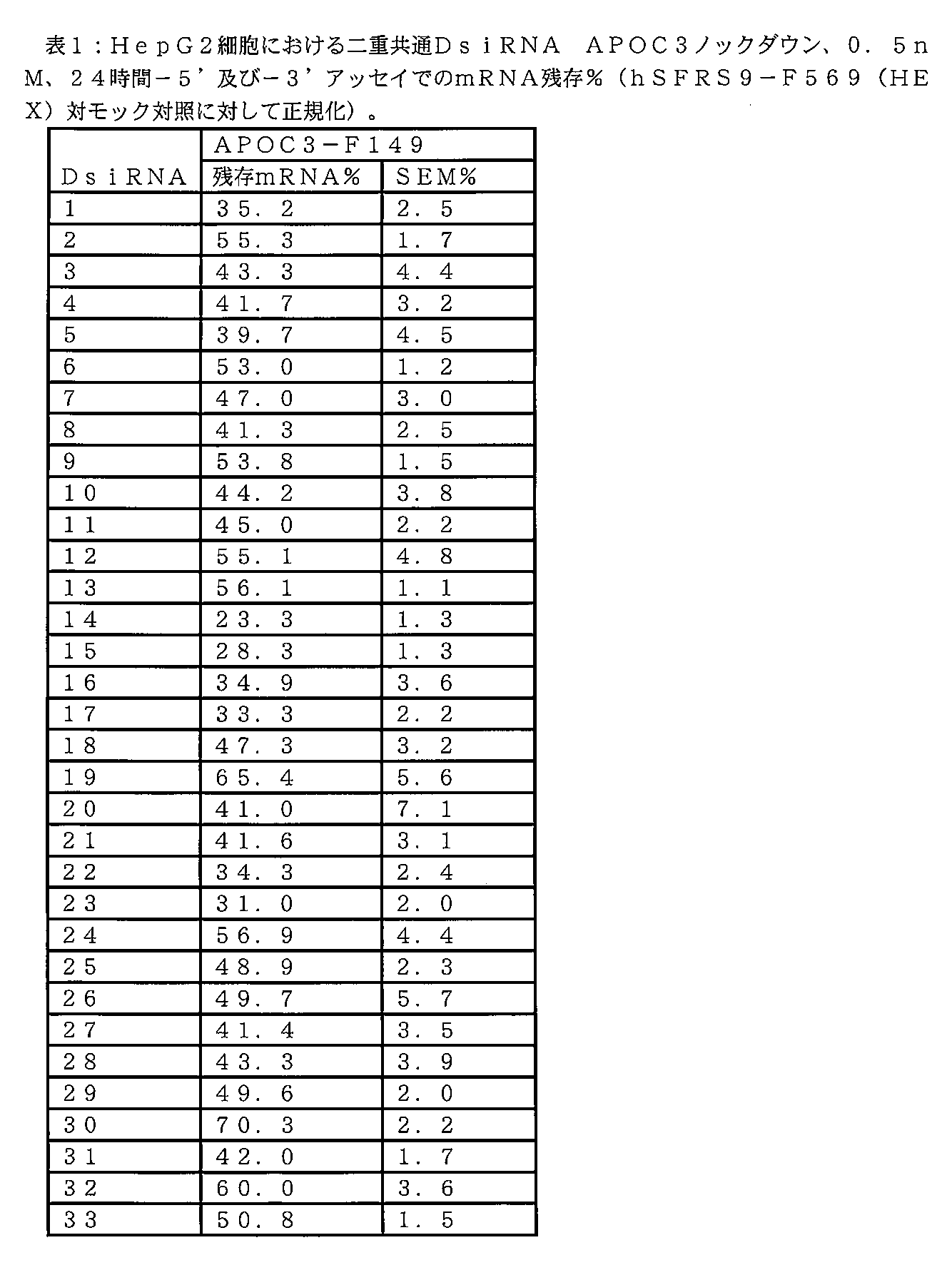
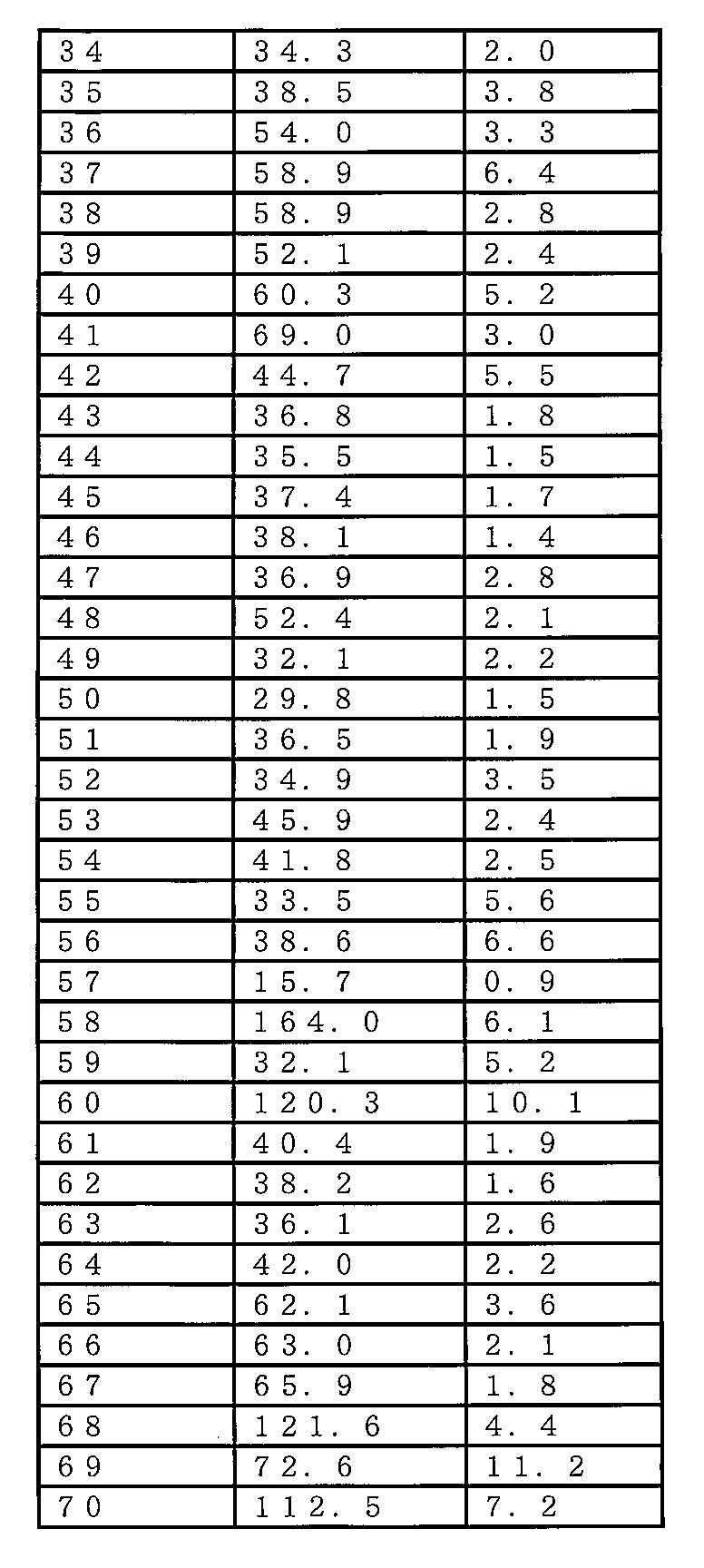
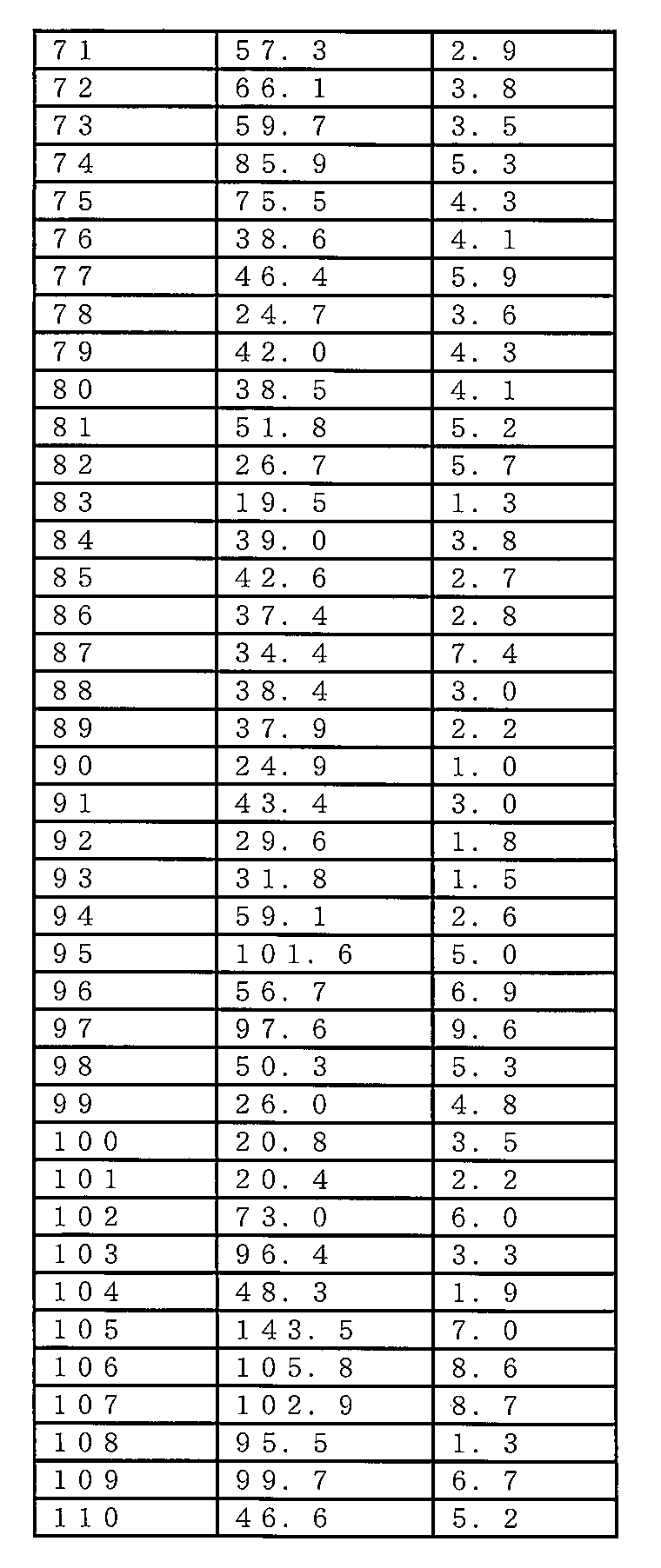


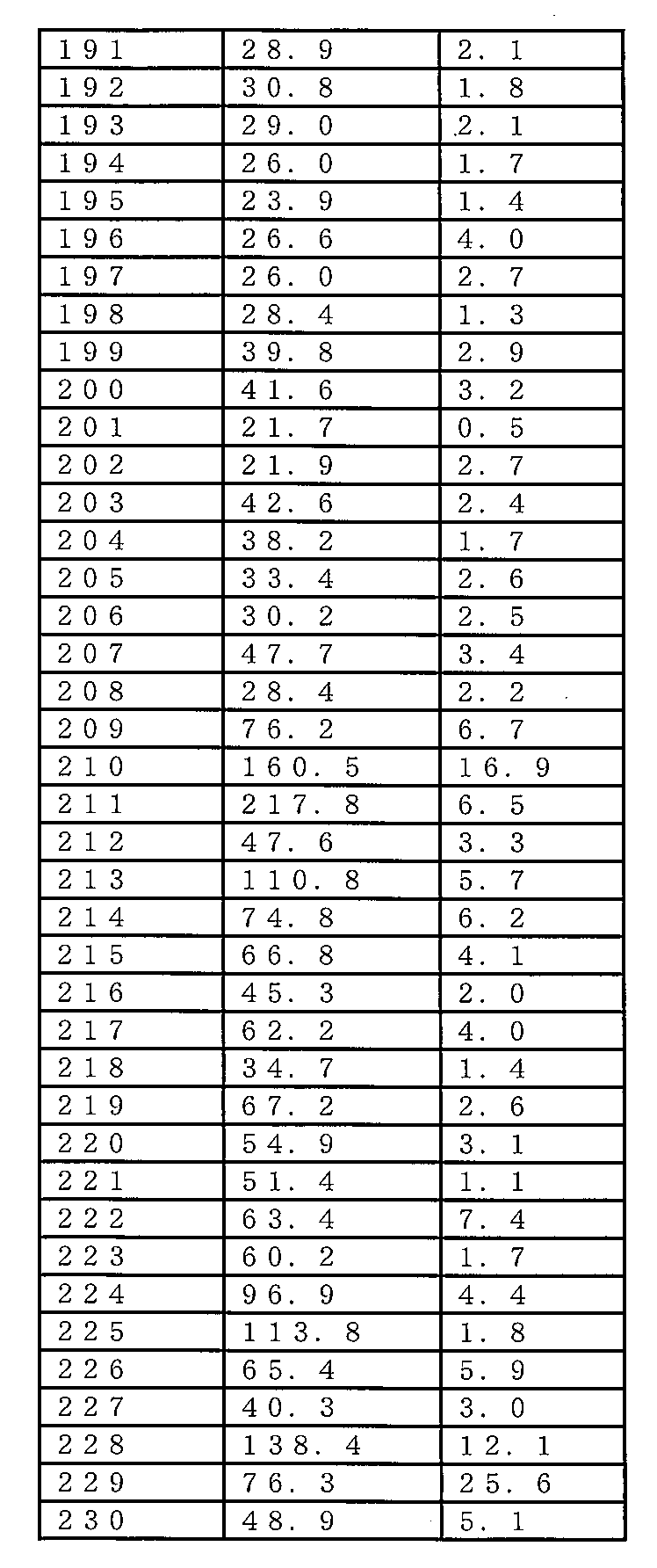
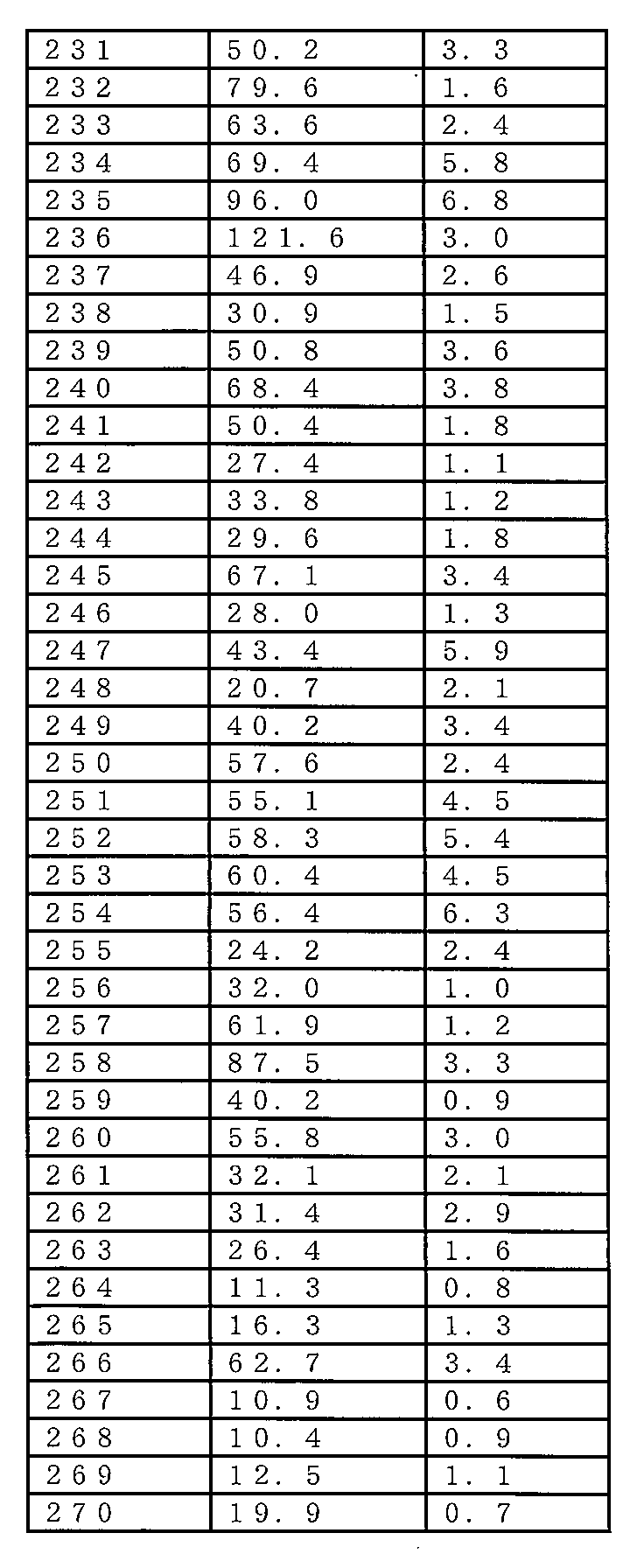


これらの結果は、ヒトAPOC3のmRNAを標的とするように設計されたDsiRNAが細胞内のAPOC3発現を阻害すること(DsiRNAをトランスフェクトした細胞内のAPOC3のmRNAの量が低減したことで判断)、及びDsiRNAヒットを含むヌクレオチド配列がAPOC3発現を阻害するRNAiオリゴヌクレオチドの生成に有用であることを示している。さらに、これらの結果は、複数のAPOC3標的配列が、RNAiを介したAPOC3発現の阻害に適していることを示している。 These results demonstrate that DsiRNAs designed to target human APOC3 mRNA inhibit APOC3 expression in cells (as determined by reduced levels of APOC3 mRNA in DsiRNA-transfected cells) and that nucleotide sequences containing DsiRNA hits are useful for generating RNAi oligonucleotides that inhibit APOC3 expression. Furthermore, these results demonstrate that multiple APOC3 target sequences are suitable for inhibition of APOC3 expression via RNAi.
実施例3: インビトロでのRNAiオリゴヌクレオチドによるAPOC3発現の阻害-GalXCベースの化合物 Example 3: Inhibition of APOC3 expression by RNAi oligonucleotides in vitro - GalXC-based compounds
実施例2に記載したHepG2細胞ベースのアッセイでスクリーニングされた384個のDsiRNAのうち、81個のDsiRNAヒットのヌクレオチド配列がGalXCベースの化合物としてインビトロでの評価のために選択される。簡潔に述べると、選択されたDsiRNAのヌクレオチド配列を使用して、36merのセンス(パッセンジャー)鎖と22merのアンチセンス(ガイド)鎖を持つ、ニックの入ったテトラループGalNAcコンジュゲート構造(本明細書では「GalXC APOC3オリゴヌクレオチド」と呼ぶ)を含む53個の対応するds RNAiオリゴヌクレオチドを生成する。さらに、GalXC APOC3オリゴヌクレオチドのセンス鎖及びアンチセンス鎖のヌクレオチド配列は、修飾ヌクレオチド及びホスホロチオエート結合の明確なパターンを有する(GalXC APOC3オリゴヌクレオチドの一般的な構造及び化学修飾パターンの概略図については、例えば、図1A~1Cを参照されたい)。テトラループの3つのアデノシンヌクレオチドはそれぞれGalNAc部分(CAS番号:14131-60-3)にコンジュゲートされている。さらに、GalXC APOC3オリゴヌクレオチドのセンス鎖及びアンチセンス鎖のヌクレオチド配列は、修飾ヌクレオチド及びホスホロチオエート結合の3つの異なるパターン(例えば、図1A~1Cを参照されたい)のうちの1つを有するが、例示的な修飾パターンは表3に示されている。 Of the 384 DsiRNAs screened in the HepG2 cell-based assay described in Example 2, the nucleotide sequences of 81 DsiRNA hits are selected for in vitro evaluation as GalXC-based compounds. Briefly, the nucleotide sequences of the selected DsiRNAs are used to generate 53 corresponding ds RNAi oligonucleotides containing nicked tetraloop GalNAc conjugate structures (referred to herein as "GalXC APOC3 oligonucleotides") with a 36-mer sense (passenger) strand and a 22-mer antisense (guide) strand. Furthermore, the nucleotide sequences of the sense and antisense strands of the GalXC APOC3 oligonucleotides have distinct patterns of modified nucleotides and phosphorothioate linkages (see, e.g., Figures 1A-1C for schematic diagrams of the general structure and chemical modification patterns of GalXC APOC3 oligonucleotides). Each of the three adenosine nucleotides of the tetraloop is conjugated to a GalNAc moiety (CAS number: 14131-60-3). Furthermore, the nucleotide sequences of the sense and antisense strands of the GalXC APOC3 oligonucleotide have one of three different patterns of modified nucleotides and phosphorothioate linkages (see, e.g., Figures 1A-1C), with exemplary modification patterns shown in Table 3.

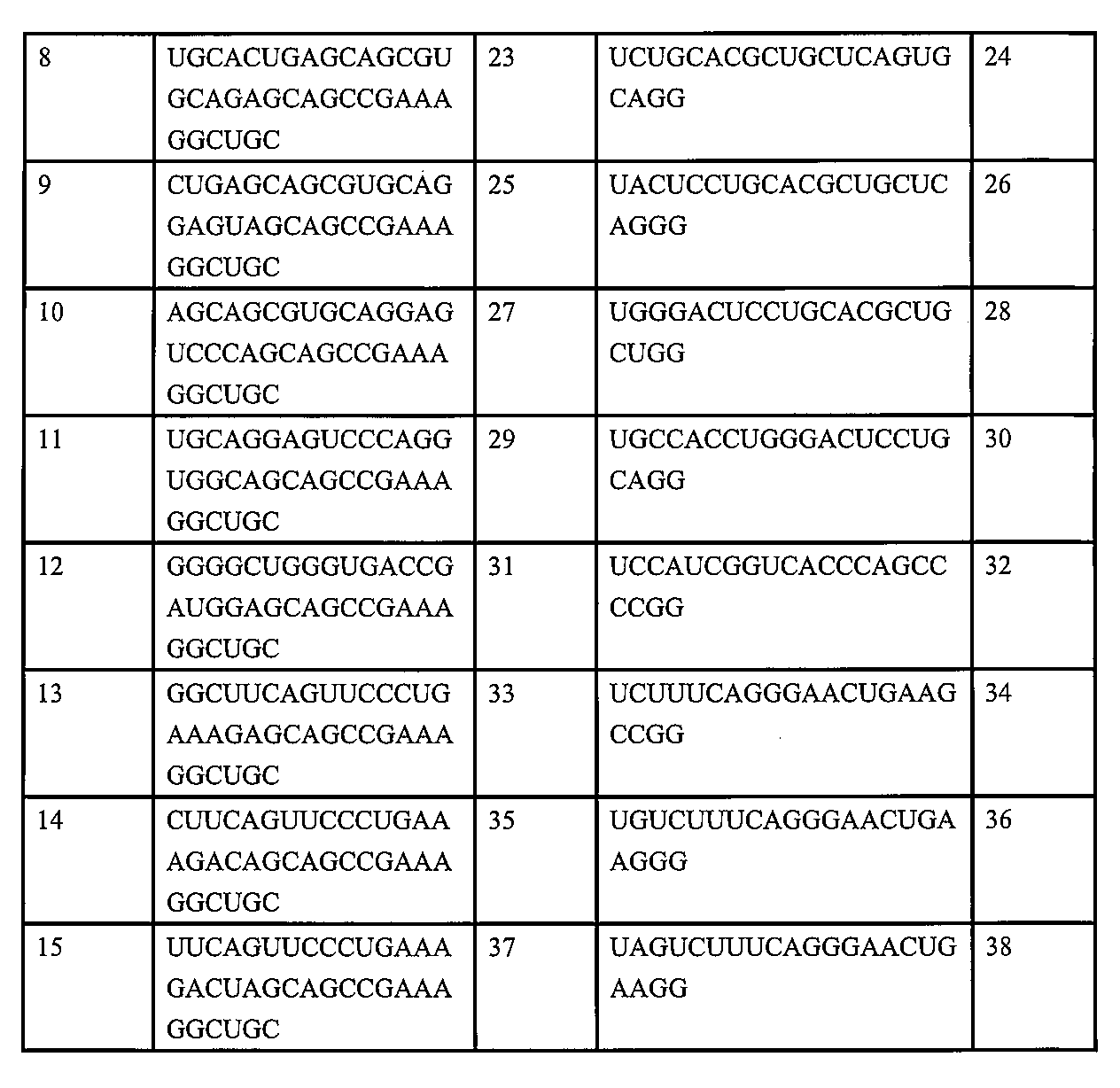


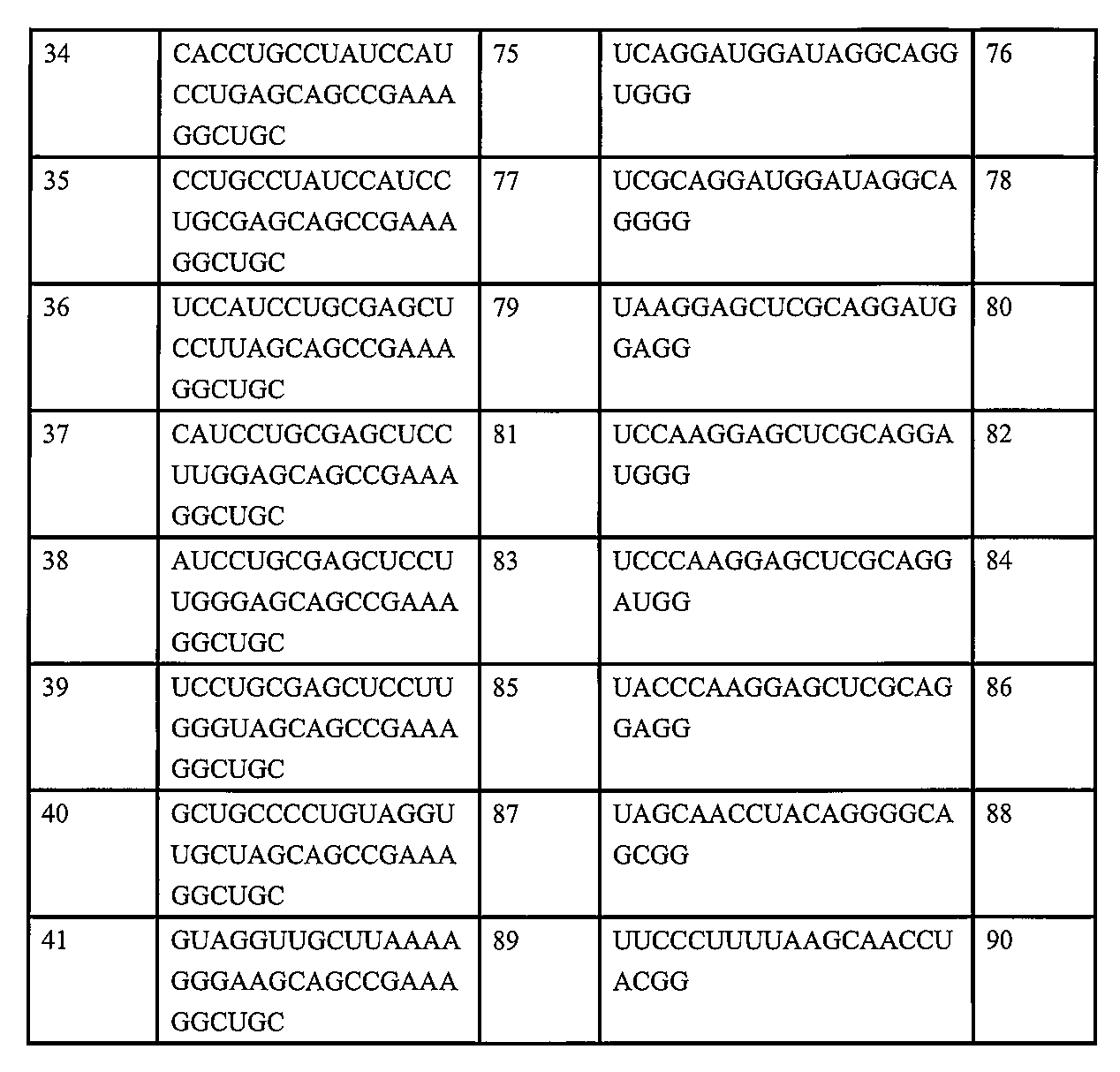


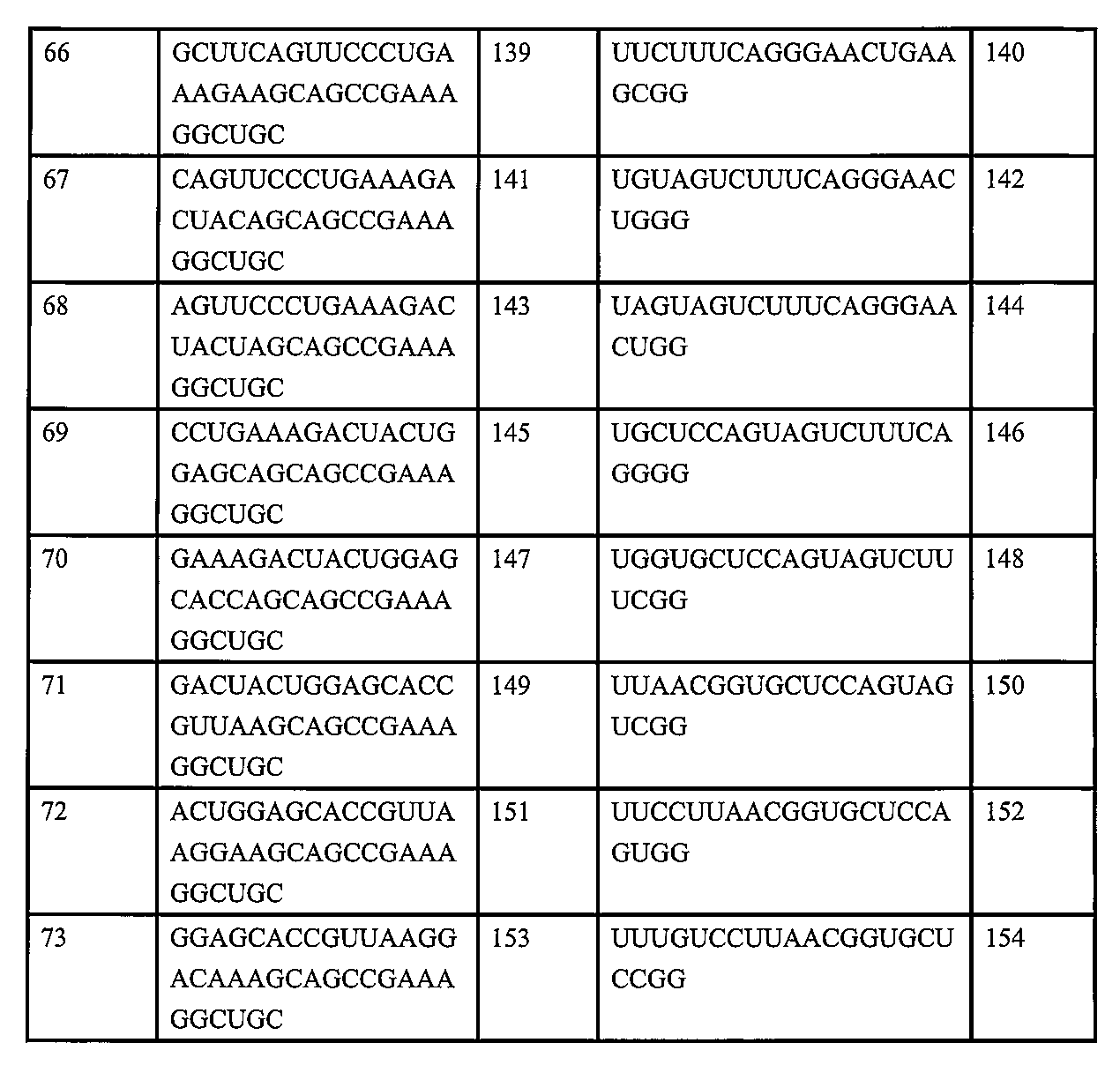


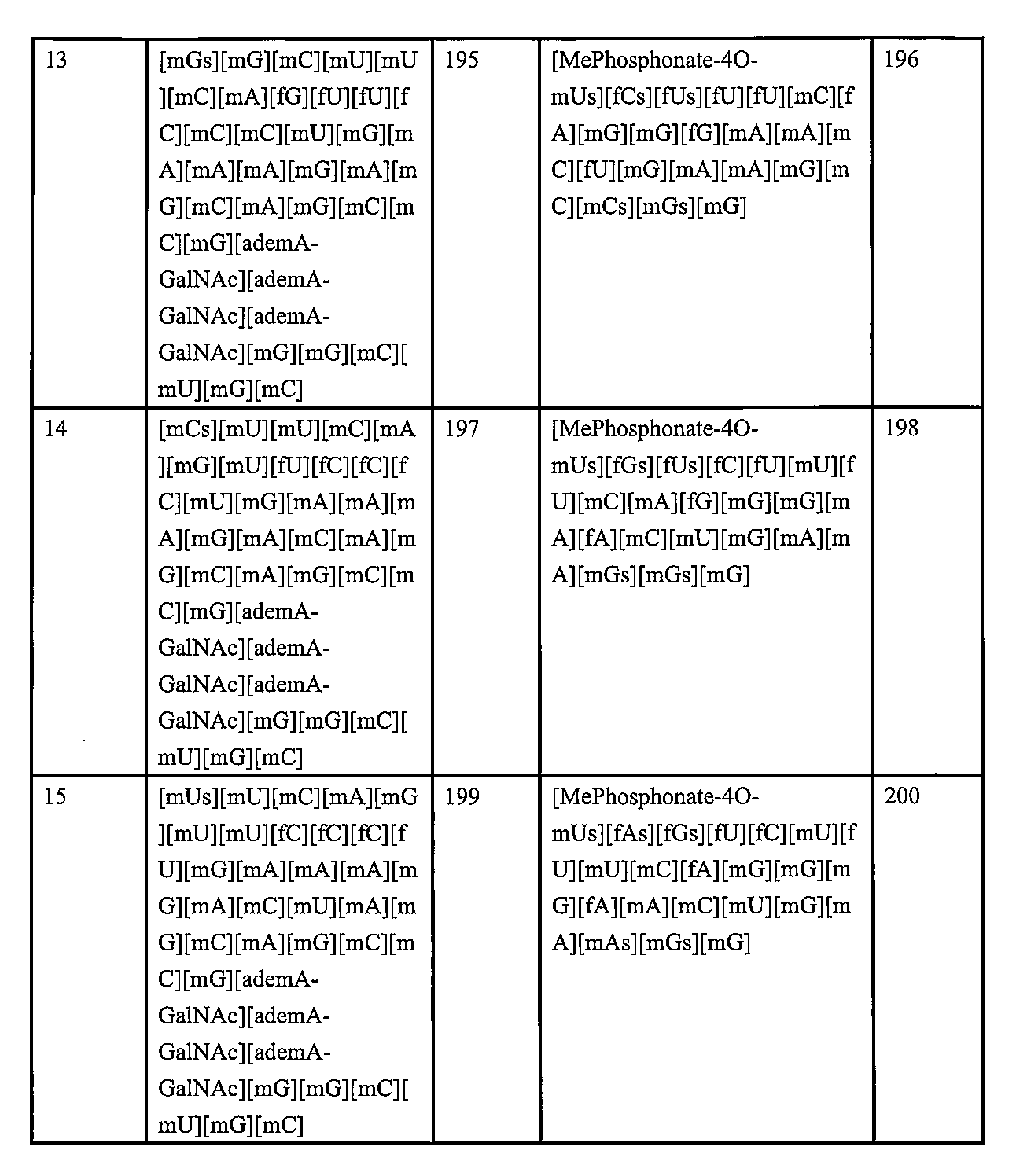

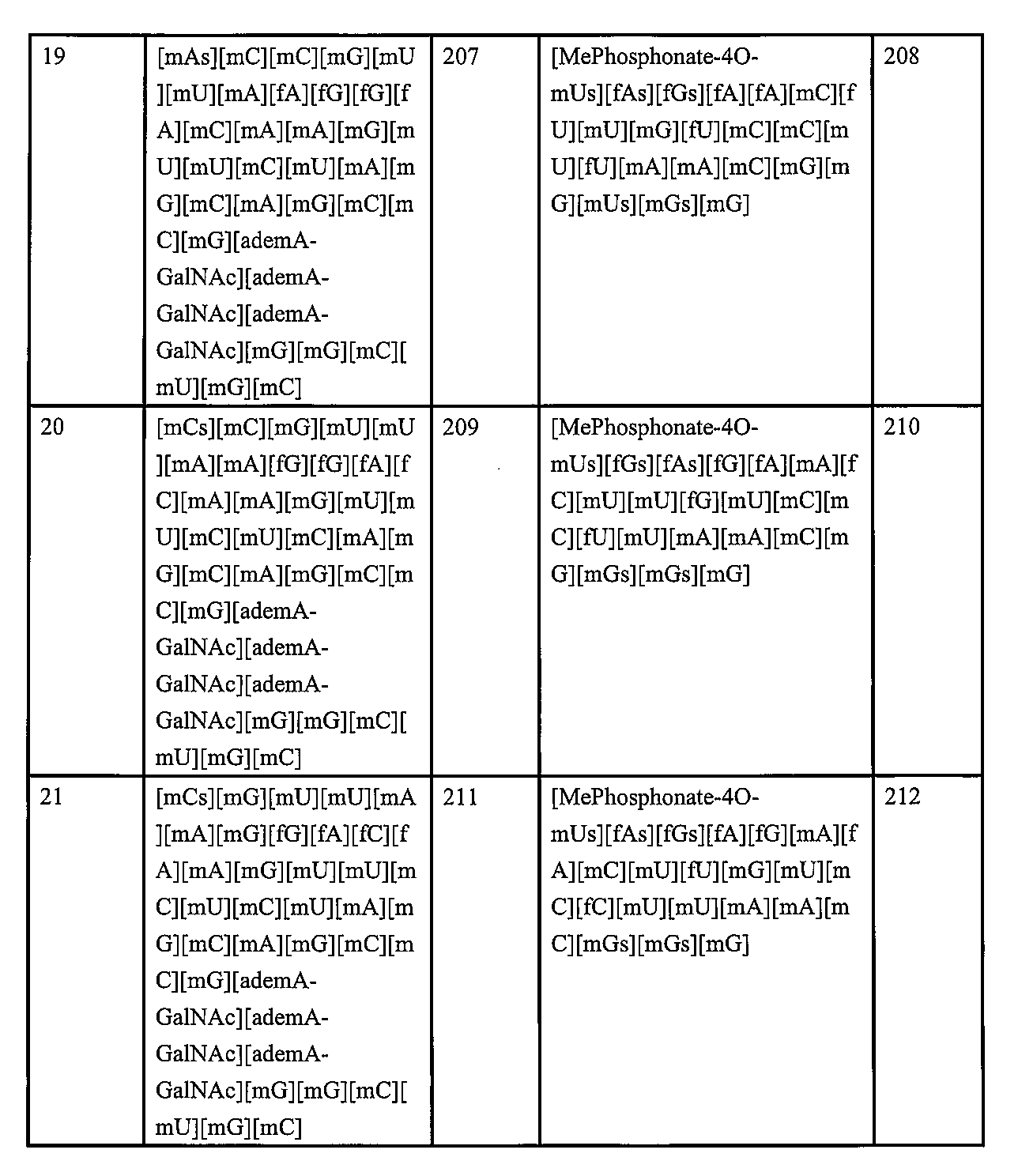


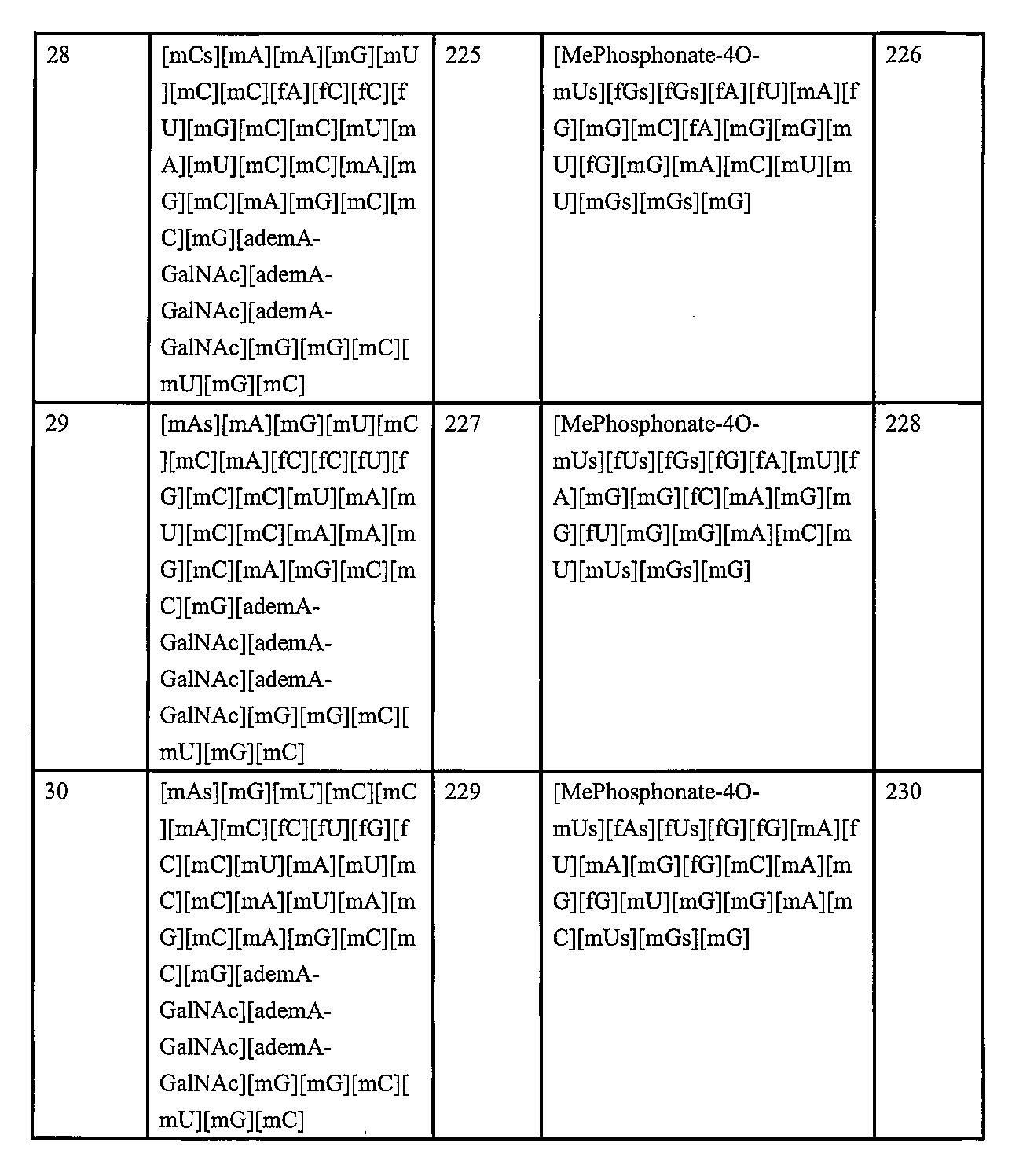


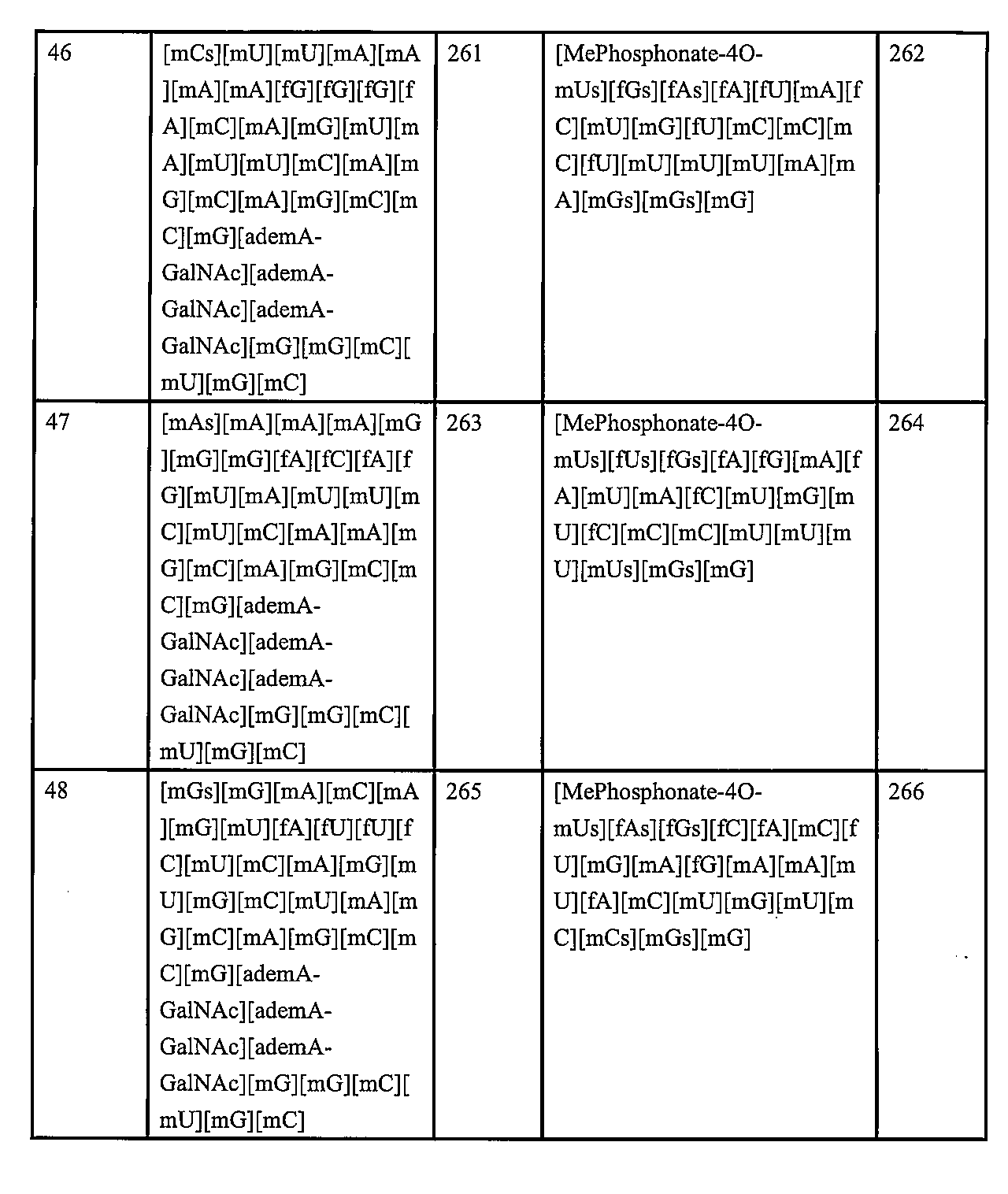

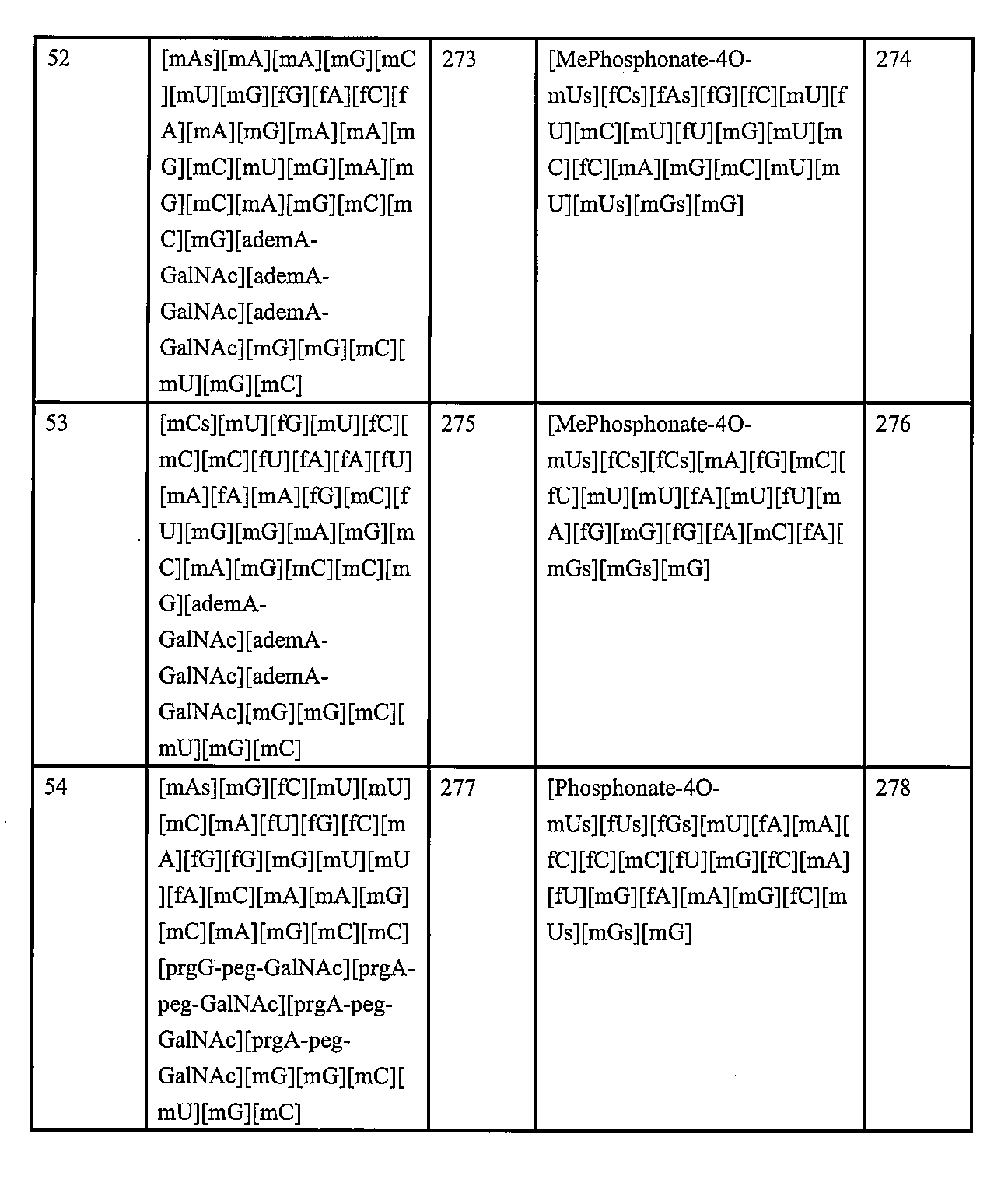

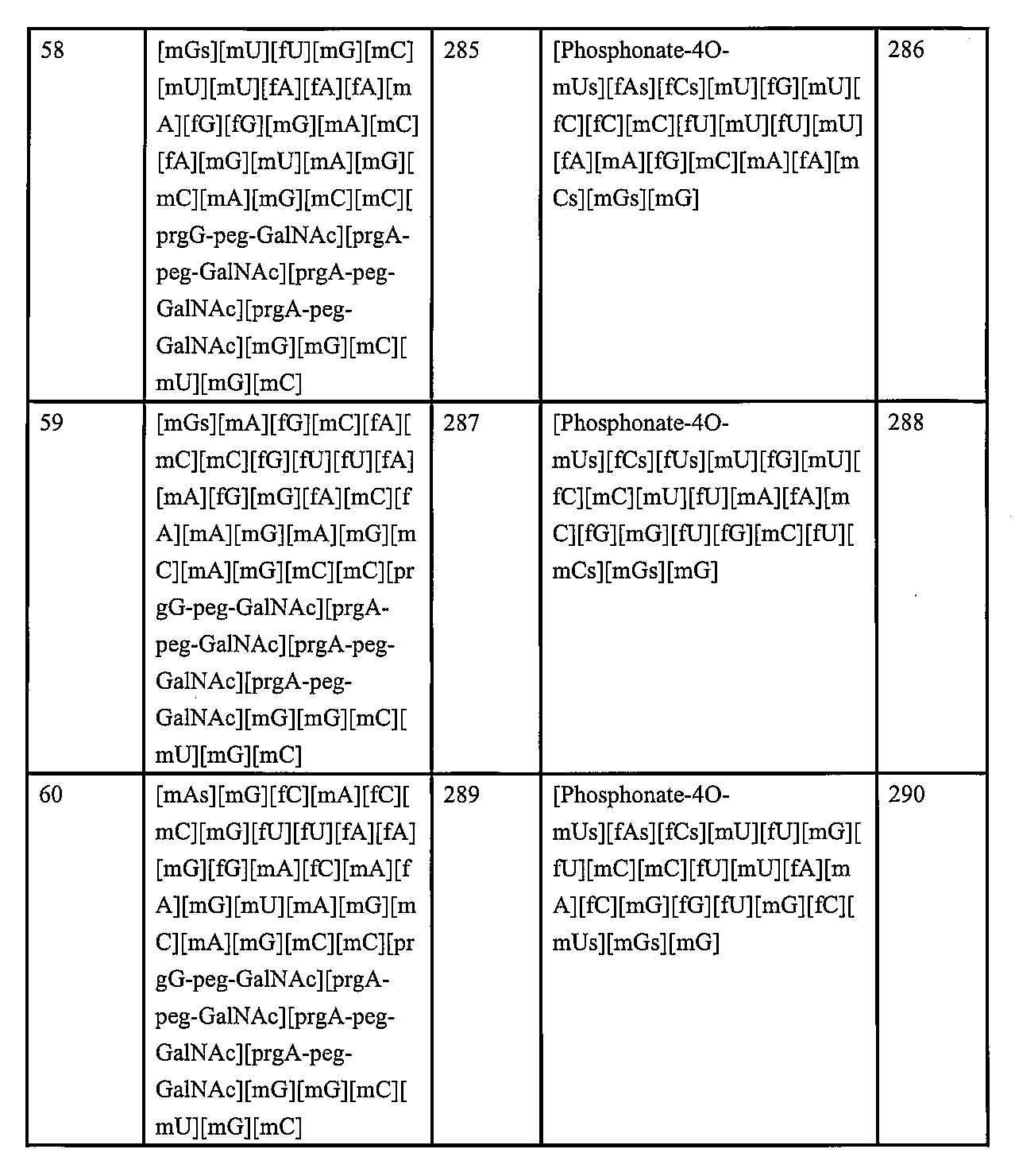

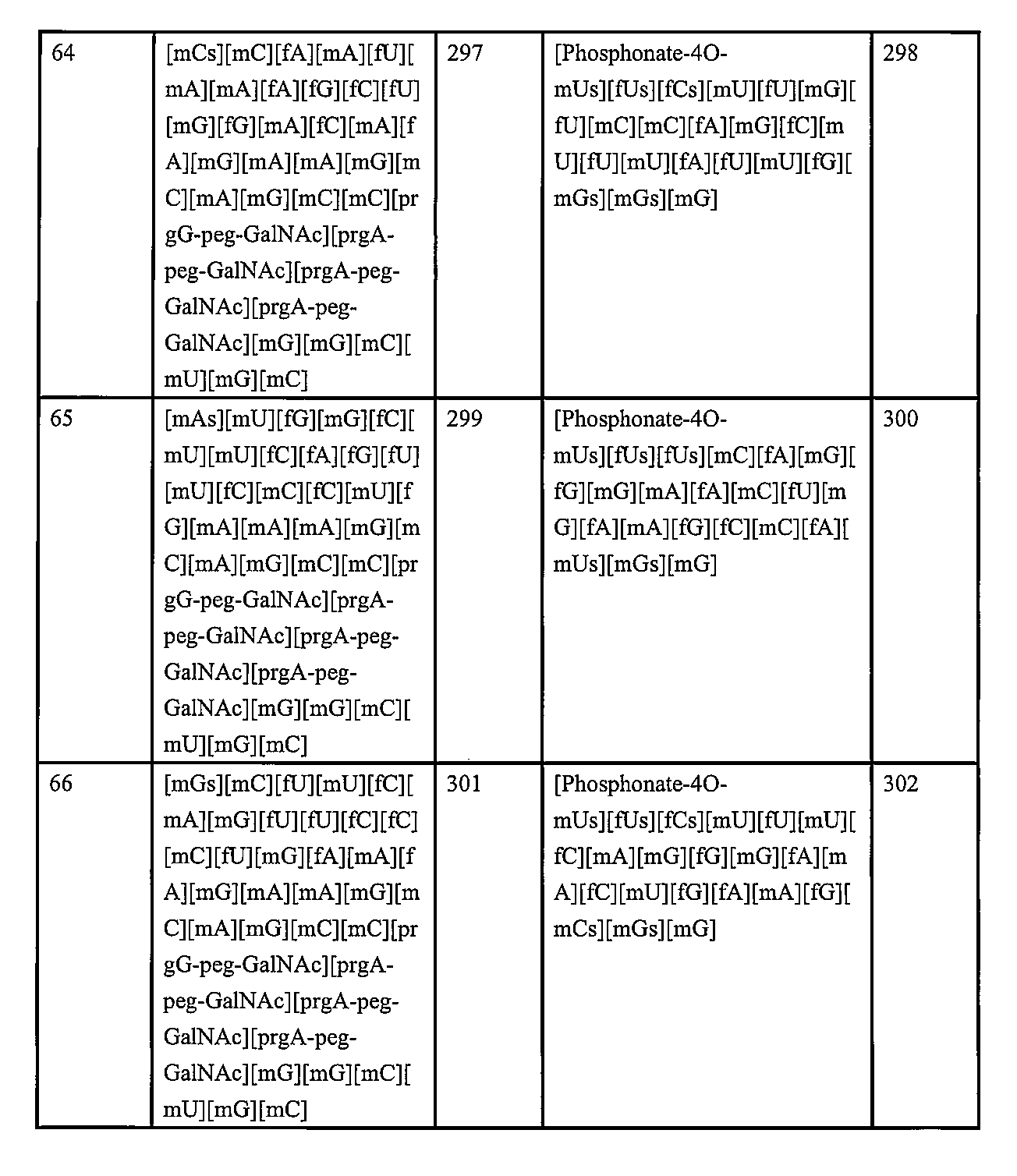


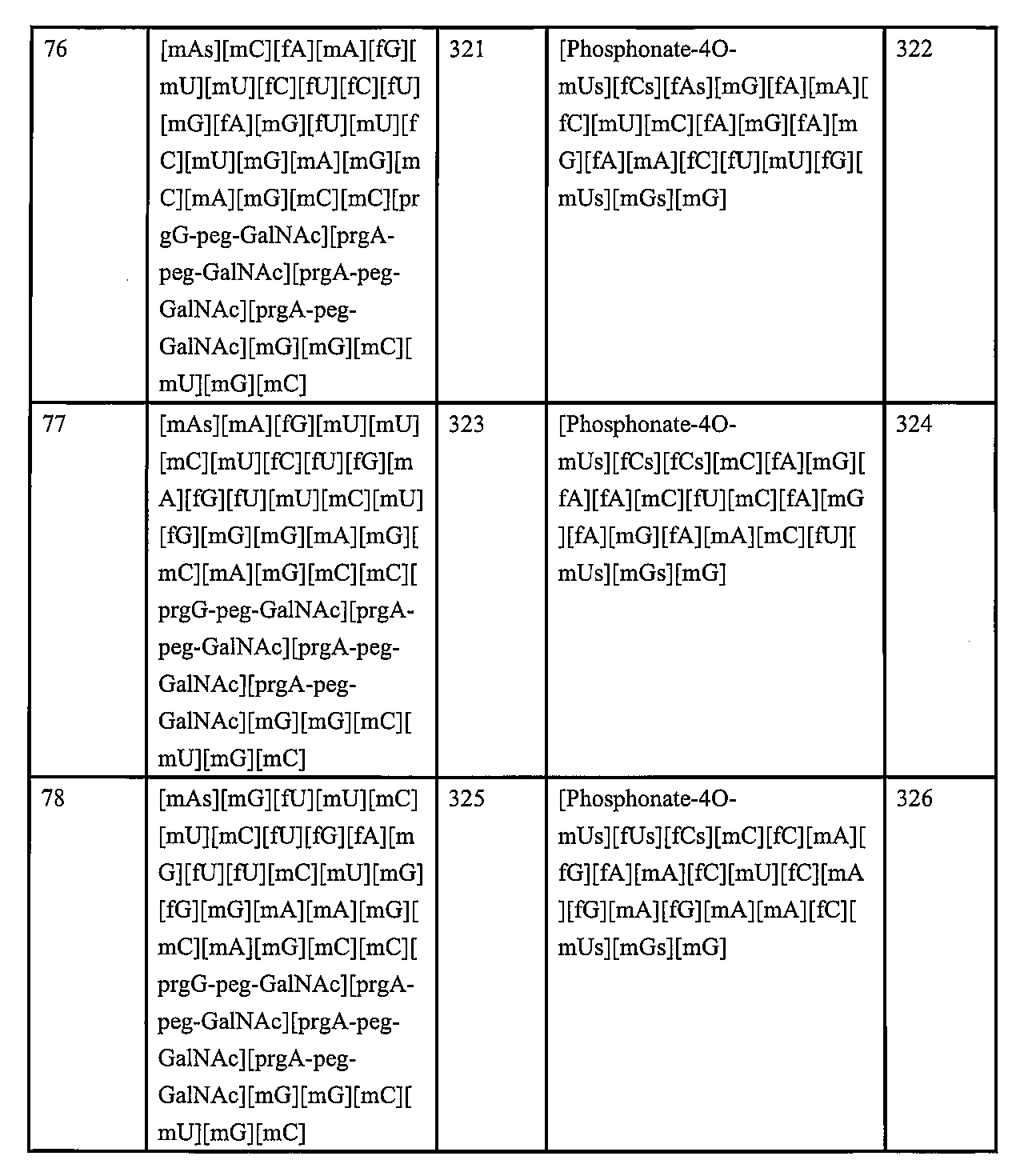

インビボ機能
実施例4:インビトロでのRNAiオリゴヌクレオチドによるAPOC3発現の阻害
In vivo function Example 4: Inhibition of APOC3 expression by RNAi oligonucleotides in vitro
マウス研究:表2(未修飾)及び表3(修飾された)に列挙されているさまざまなGalXC APOC3オリゴヌクレオチドを、ハイドロダイナミックインジェクション(HDI)マウスモデルで評価する。追加のHDI研究は表5~13に列挙されている。これらのHDI研究では、マウスは肝細胞でヒトAPOC3のmRNAを一過性に発現するように設計される。GalXC APOC3オリゴヌクレオチド対照がベンチマーク対照として使用される。簡潔に述べると、6~8週齢のメスのCD-1マウスを、1mg/kgの用量でGalXC APOC3オリゴヌクレオチドを含むSQで処置する。3日(72時間)後、ユビキタスサイトメガロウイルス(CMV)プロモーター配列の制御下で完全なヒト遺伝子をコードするDNAプラスミドをマウスに流体力学的に注入する。プラスミド導入の1日後に肝臓試料を採取する。これらのマウスから採取した全RNAを、同量のPBSのみで処置したマウスと比較し、APOC3のmRNAについて個別にqRT-PCR分析する。値は、プラスミドに含まれるNeoR遺伝子を使用して、トランスフェクション効率について正規化される。 Mouse studies: Various GalXC APOC3 oligonucleotides listed in Table 2 (unmodified) and Table 3 (modified) are evaluated in a hydrodynamic injection (HDI) mouse model. Additional HDI studies are listed in Tables 5-13. In these HDI studies, mice are engineered to transiently express human APOC3 mRNA in hepatocytes. A GalXC APOC3 oligonucleotide control is used as a benchmark control. Briefly, 6-8 week old female CD-1 mice are treated with SQ containing GalXC APOC3 oligonucleotide at a dose of 1 mg/kg. Three days (72 hours) later, mice are hydrodynamically injected with a DNA plasmid encoding the complete human gene under the control of the ubiquitous cytomegalovirus (CMV) promoter sequence. Liver samples are harvested one day after plasmid transfer. Total RNA from these mice will be analyzed separately for APOC3 mRNA by qRT-PCR compared to mice treated with the same amount of PBS alone. Values will be normalized for transfection efficiency using the NeoR gene contained in the plasmid.
表4~12に示すように、試験したGalXC APOC3オリゴヌクレオチドの多くは、PBSで処置したマウスと比較してオリゴヌクレオチドで処理したマウスの肝臓試料中のAPOC3のmRNAの量が減少したことから判断されるように、APOC3の発現を阻害した。ベンチマークGalXC APOC3オリゴヌクレオチド対照で処置したマウスの肝臓試料中の残存APOC3 mRNAの平均%を、PBSで処置したマウスと比較する。表4は、試験した12個のGalXC APOC3オリゴヌクレオチドのいくつかが、対照として使用した参照GalXC APOC3オリゴヌクレオチドよりも大幅にAPOC3発現を阻害することを示している。これらのオリゴヌクレオチドの配列は、修飾パターン及び配列番号とともに、図1に関連して表2及び3に開示されている。 As shown in Tables 4-12, many of the GalXC APOC3 oligonucleotides tested inhibited APOC3 expression as judged by the reduced amount of APOC3 mRNA in liver samples from mice treated with the oligonucleotides compared to mice treated with PBS. The average % of remaining APOC3 mRNA in liver samples from mice treated with the benchmark GalXC APOC3 oligonucleotide control is compared to mice treated with PBS. Table 4 shows that several of the 12 GalXC APOC3 oligonucleotides tested inhibited APOC3 expression to a greater extent than the reference GalXC APOC3 oligonucleotide used as a control. The sequences of these oligonucleotides, along with their modification patterns and sequence numbers, are disclosed in Tables 2 and 3 in conjunction with FIG. 1.

表5~12は、同じ参照オリゴヌクレオチドを使用するGalXC-APOC3オリゴヌクレオチドによるHDIマウス研究の追加セットを示している。 Tables 5-12 show an additional set of GalXC-APOC3 oligonucleotide HDI mouse studies using the same reference oligonucleotide.


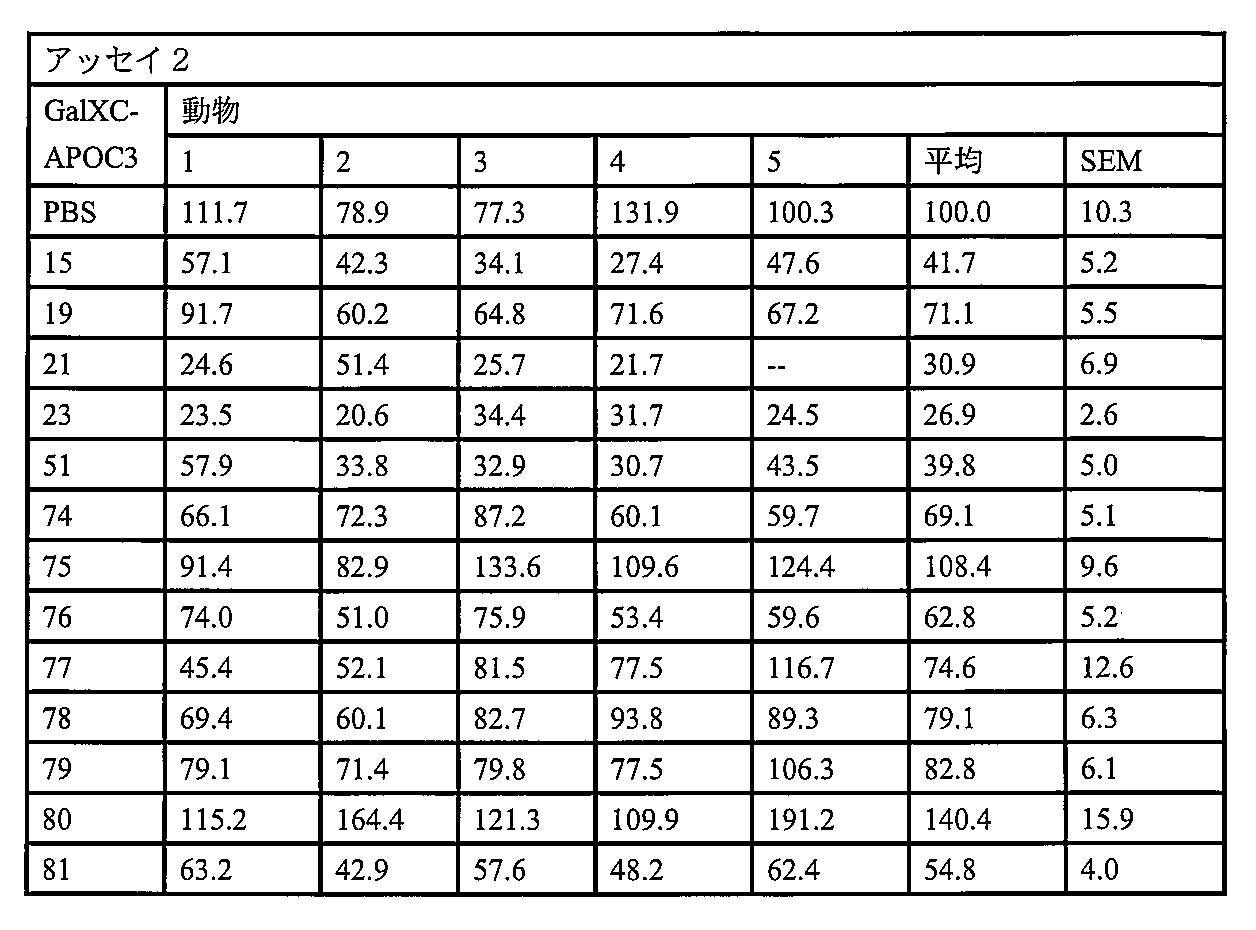


これらの結果に基づいて、NHPにおけるAPOC3発現を阻害する能力を評価するために8個のGalXC-APOC3オリゴヌクレオチドが選択された。そのうち6つは二重共通として選択され、2つはヒトにのみ固有である。GalXC-APOC3オリゴヌクレオチドは、図1、特に図1Cに示すようなパターンの化学的に修飾されたヌクレオチドを有する。 Based on these results, eight GalXC-APOC3 oligonucleotides were selected to evaluate their ability to inhibit APOC3 expression in NHPs; six of them were selected as double common and two are unique only to humans. The GalXC-APOC3 oligonucleotides have the pattern of chemically modified nucleotides as shown in Figure 1, particularly Figure 1C.
NHP研究:上記のマウス研究から選択された8個のGalXC-APOC3オリゴヌクレオチドを、カニクイザル(Macaca fascicularis)で単回投与(6mg/kg)、84日間の研究で評価した。ここでは、NHPは、平均体重(約5.4kg)が対照群と実験群間で同等になるようにグループ分けする。それぞれのコホートには5頭の個体(オス2頭、メス3頭)が含まれる。GalXC-APOC3オリゴヌクレオチドは、研究0日目にSQ投与される。血液試料は、投与前の2つの時点(すなわち、-21日目と0日目)、次いで投与後毎週採取され、肝酵素パネルと脂質プロファイルの検査が行われる。超音波ガイド下コア針肝生検は、研究日-21、28、56、83日に採取される。それぞれの時点で、肝生検試料に由来する全RNAを個別にqRT-PCR分析し、同等量のPBSで処理したサルと比較して、オリゴヌクレオチドで処理したサルのAPOC3のmRNAを測定した。データを正規化するために、2つの参照遺伝子、PPIB及び18S rRNAの幾何平均に対して測定を行う。表13に示すように、NHPをGalXC-APOC3オリゴヌクレオチドで処理すると、肝臓でのAPOC3発現が阻害される。これは、PBSで処置したNHPと比較して、オリゴヌクレオチドで処置したNHPの肝臓試料中のAPOC3のmRNAの量が減少したことで判定される。評価されたすべての時点で、GalXC-APOC3オリゴヌクレオチドは、ベンチマークPBS及び時間を一致させた対照よりも大幅にAPOC3発現を阻害する。同じNHP研究から、投与前及び毎週の血液試料から調製した血清中のAPOC3タンパク質をELISAで測定することによって、APOC3発現の阻害も判定される。まとめると、NHPをGalXC-APOC3オリゴヌクレオチドで処置すると、肝臓中のAPOC3のmRNAの量が減少し、同時に血清中のAPOC3タンパク質の量も減少することが実証される。 NHP Study: Eight GalXC-APOC3 oligonucleotides selected from the mouse study above were evaluated in cynomolgus monkeys (Macaca fascicularis) in a single-dose (6 mg/kg), 84-day study. Here, NHPs are grouped so that mean body weight (approximately 5.4 kg) is comparable between control and experimental groups. Each cohort contains five individuals (two males and three females). GalXC-APOC3 oligonucleotides are administered SQ on study day 0. Blood samples are collected at two time points pre-dose (i.e., days -21 and 0) and then weekly post-dose for liver enzyme panel and lipid profile. Ultrasound-guided core needle liver biopsies are taken on study days -21, 28, 56, and 83. At each time point, total RNA from liver biopsies was analyzed separately by qRT-PCR to measure APOC3 mRNA in monkeys treated with oligonucleotides compared to monkeys treated with an equivalent amount of PBS. To normalize the data, measurements are made against the geometric mean of two reference genes, PPIB and 18S rRNA. As shown in Table 13, treatment of NHPs with GalXC-APOC3 oligonucleotides inhibits APOC3 expression in the liver, as determined by the reduced amount of APOC3 mRNA in liver samples from oligonucleotide-treated NHPs compared to PBS-treated NHPs. At all time points evaluated, GalXC-APOC3 oligonucleotides inhibit APOC3 expression to a greater extent than benchmark PBS and time-matched controls. Inhibition of APOC3 expression is also determined from the same NHP study by measuring APOC3 protein by ELISA in serum prepared from pre-dose and weekly blood samples. Taken together, we demonstrate that treatment of NHPs with GalXC-APOC3 oligonucleotides reduces the amount of APOC3 mRNA in the liver and concomitantly reduces the amount of APOC3 protein in serum.


上記に加えて、28日目の肝生検のRNA-seqでは、GalXC-APOC3-47がAPOC3のmRNAのノックダウンに最も強力な試験品(23.4%残存)であり、次いでGalXC-APOC3-46(27.3%残存)、GalXC-15(B、34.4%残存)、GalXC-41(38.4%残存)、GalXC-18(43.0%残存)であることが示されている。表14に示すように、GalXC-APOC3-15、GalXC-APOC3-18、GalXC-APOC3-46、及びGalXC-APOC3-47は肝臓トランスクリプトームの全体的な変化がわずかしか見られないが、GalXC-APOC3-41ではより多くの遺伝子の発現に変化が見られる。このRNA-seq研究では、APOC3-41を除き、GalXCガイドによるmRNAへのハイブリダイゼーションに基づくオフターゲット効果は確認されなかった。 In addition to the above, RNA-seq of liver biopsies on day 28 showed that GalXC-APOC3-47 was the most potent test article for knocking down APOC3 mRNA (23.4% remaining), followed by GalXC-APOC3-46 (27.3% remaining), GalXC-15 (B, 34.4% remaining), GalXC-41 (38.4% remaining), and GalXC-18 (43.0% remaining). As shown in Table 14, GalXC-APOC3-15, GalXC-APOC3-18, GalXC-APOC3-46, and GalXC-APOC3-47 showed only minor overall changes in the liver transcriptome, while GalXC-APOC3-41 showed changes in the expression of many more genes. In this RNA-seq study, no off-target effects due to hybridization to mRNA by GalXC guides were observed, except for APOC3-41.

まとめると、これらの結果は、ヒトAPOC3のmRNAを標的とするように設計されたGalXC-APOC3オリゴヌクレオチドが、(処置された動物におけるAPOC3のmRNA及びAPOC3タンパク質の量の減少によって決定されるとき)インビボでAPOC3発現を阻害することを示している。 Collectively, these results demonstrate that GalXC-APOC3 oligonucleotides designed to target human APOC3 mRNA inhibit APOC3 expression in vivo (as determined by reduced amounts of APOC3 mRNA and APOC3 protein in treated animals).
配列
次の核酸配列及び/又はアミノ酸の配列は、本開示で言及されており、参照のために以下に提供される。
SEQUENCES The following nucleic acid and/or amino acid sequences are referred to in this disclosure and are provided below for reference.
配列番号1-野生型ヒトAPOC3(535bp;NCBI参照配列番号:NM_000040.3
ctgctcagttcatccctagaggcagctgctccaggaacagaggtgccatgcagccccgggtactccttgttgttgccctcctggcgctcctggcctctgcccgagcttcagaggccgaggatgcctcccttctcagcttcatgcagggttacatgaagcacgccaccaagaccgccaaggatgcactgagcagcgtgcaggagtcccaggtggcccagcaggccaggggctgggtgaccgatggcttcagttccctgaaagactactggagcaccgttaaggacaagttctctgagttctgggatttggaccctgaggtcagaccaacttcagccgtggctgcctgagacctcaataccccaagtccacctgcctatccatcctgcgagctccttgggtcctgcaatctccagggctgcccctgtaggttgcttaaaagggacagtattctcagtgctctcctaccccacctcatgcctggcccccctccaggcatgctggcctcccaataaagctggacaagaagctgctatga
SEQ ID NO:1 - Wild type human APOC3 (535 bp; NCBI Reference SEQ ID NO: NM_000040.3
ctgctcagttcatccctagaggcagctgctccaggaacagaggtgccatgcagccccggtactccttgttgttgccctcctggcgctcctggcctctgcccgagcttcagaggccgagga tgcctcccttct cagcttcatgcagggttacatgaagcacgccaccaagaccgccaaggatgcactgagcagcgtgcaggagtcccaggtggcccagcaggccagggctgggtgaccgatggcttcagttcc ctgaaagactact ggagcaccgttaaggacaagttctctgagttctgggatttggaccctgaggtcagaccaacttcagccgtggctgcctgagacctcaataccccaagtccacctgcctatccatcctgcga gctccttgggtcc tgcaatctccagggctgcccctgtaggttgcttaaaaaggacagtattctcagtgctctcctacccccacctcatgcctggccccccctccagcatgctggcctcccaataaagctggacaa gaagctgctatga
配列番号2-野生型ヒトAPOC3(99aa;NCBI参照配列番号NP_079501.2)
MQPRVLLVVALLALLASARASEAEDASLLSFMQGYMKHATKTAKDALSSVQESQVAQQARGWVTDGFSSLKDYWSTVKDKFSEFWDLDPEVRPTSAVAA
SEQ ID NO:2 - Wild type human APOC3 (99 aa; NCBI Reference SEQ ID NO: NP_079501.2)
MQPRVLLVVALLALLASARASEAEDASLLSFMQGYMKHATKTAKDALSSVQESQVAQQARGWVTDGFSSLKDYWSTVKDKFSEFWDLDPEVRPTSAVAA
配列番号3-マウスAPOC3(631bp;NCBI参照配列番号:NM_001289755.1)
gcctgctcagttttatccctagaagcagctagctactccaggtaatgcccctggggaggagaggaaggaagggaagaaacaaagagctggagggagaagctctcaccacccagccatctagcccacagaaggcttgggactcatggtacgtaggtgccatgcagccccggacgctcctcactgtggccctcttggctctcctggcatctgcccgagctgaagaggtagagggatccttgctgctgggctctgtacagggctacatggaacaagcctccaagacggtccaggatgcgctaagtagcgtgcaggagtccgatatagctgtggtggccaggggctggatggacaatcacttcagatccctgaaaggctactggagcaagtttactgacaagttcaccggcttctgggattctaaccctgaggaccaaccaactccagctattgagtcgtgagacttctgtgttgcagatgtgcctgttcctccatcctgctgcccccctccaggcctgccaggtggcccctgaaggttgctttaaggggaaagtatgttctcatgtcttcacccctccctagatctcacctaaacatgctgtccctaataaagctggataagaagctgctgtta
SEQ ID NO:3 - Mouse APOC3 (631 bp; NCBI Reference SEQ ID NO: NM_001289755.1)
gcctgctcagttttatccctagaagcagctagctctccagtaatgcccctggggaggagaggaaggaagggaagaaaacaaagagctggagggagaagctctcaccacccagccattag cccacagaaggcttgggactcatggtacgtaggtgc catgcagccccggacgctcctcactgtggccctcttggctctcctggcatctgcccgagctgaagaggtagagaggatccttgctgctgggctctgtacagggctacatggaacaagccctcc aagacggtccaggatgcgctaagtagcgtgcaggagt ccgatatagctgtggtggccagggctggatggacaatcacttcagatccctgaaaggctactggagcaagtttactgacaagttcaccggcttctgggattctaaccctgaggaccaacc aactccagctattgagtcgtgagacttctgtgttgca gatgtgcctgttcctccatcctgctgcccccctccaggcctgccaggtggcccctgaaggttgctttaaggggaaagtatgttctcatgtcttcacccctccctagatctcacctaaacat gctgtccctaataaagctggataagaagctgctgtta
配列番号4-マウスAPOC3(99aa;NCBI参照配列番号:NP_001276684.1)
MQPRTLLTVALLALLASARAEEVEGSLLLGSVQGYMEQASKTVQDALSSVQESDIAVVARGWMDNHFRSLKGYWSKFTDKFTGFWDSNPEDQPTPAIES
SEQ ID NO:4 - Mouse APOC3 (99 aa; NCBI Reference SEQ ID NO: NP_001276684.1)
MQPRTLLTVALLALLASARAEEVEGSLLLGSVQGYMEQASKTVQDALSSVQESDIAVVARGWMDNHFRSLKGYWSKFTDKFTGFWDSNPEDQPTPAIES
配列番号5-ラットAPOC3(579bp;NCBI参照配列番号 NM_001271053)
atgcccctggggaggagaggaagggagggaggagacagagagaagacgctctggccactcagccagctagcctacagaatgcttggaattcatggcctccacccttgggttcctggtgcacaggtgccatgcagccccgaatgctcctcatcgtggccctcgtggctctcctggcctctgcccgagctgatgagggagagggatccttgctgctgggctctatgcagggctacatggaacaagcctccaagacggtccaggatgcactaagcagcatgcaggagtctgatatagctgtggtggccaggggctggatggacaatcgcttcaaatccctgaaaggctactggagcaagttcactgataagttcactggcctctgggagtctggccctgaggaccaactaacaacaccaactcttgagccgtgagacctccatgttccagatgtgtctggccatctatcctgctgcctccgaaggttgctctaaggggaaagtatattctcatgcctttatccctccccagacctcacctaaacatgctgtccctaataaagctggacacgaagctgccatg
SEQ ID NO:5 - Rat APOC3 (579 bp; NCBI Reference SEQ ID NO: NM_001271053)
atgcccctggggaggagaggaaggaggaggaggacagagagaagagaagacgctctggccactcagccagctagcctacagaatgcttggaattcatggccctccaccccttgggttcctggtgcac aggtgccatgcagccccgaatgc tcctcatcgtggccctcgtggctctcctggcctctgcccgagctgatgaggagagaggatccttgctgctgggctctatgcagggctacatggaacaagcctccaagacggtccaggatgc actaagcagcatgcaggagtctga tatagctgtggtggccagggctggatggacaatcgcttcaaatccctgaaaggctactggagcaagttcactgataagttcactggccctctgggagtctggccctgaggaccaactaaca acaccaactcttgagccgtgagac ctccatgttccagatgtgtctggccatctatcctgctgcctccgaaggttgctctaagggaaagtatattctcatgccttatccctccccagacctcacctaaacatgctgtccctaat aaagctggacacgaagctgccatg
配列番号6-ラットAPOC3(100aa;NCBI参照配列番号:NP_001257982.1)
MQPRMLLIVALVALLASARADEGEGSLLLGSMQGYMEQASKTVQDALSSMQESDIAVVARGWMDNRFKSLKGYWSKFTDKFTGLWESGPEDQLTTPTLEP
SEQ ID NO:6 - Rat APOC3 (100 aa; NCBI Reference SEQ ID NO: NP_001257982.1)
MQPRMLLIVALVALLASARADEGEGSLLLGSMQGYMEQASKTVQDALSSMQESDIAVVARGWMDNRFKSLKGYWSKFTDKFTGLWESGPEEDQLTTPTLEP
配列番号7-霊長類APOC3(567bp;NCBI参照配列番号 XM_005579730.1)
aatataaaacaggtcagaaccctcctgcctgcctgctctgttcatccctagaggcagctgctccaggaacagaggcgccatgcagccccgggtactccttgttgctgccctgctgtcactcctggcctctgccagagcttcagaggccgaggacacctcccttcttggcttcatgcagggctacatgcagcatgccaccaagaccgccaaggatgcactgaccagcgtccaggagtcccaggtggcccagcaggccagaggctgggtgaccgatggcttcagttccctgaaagactactggagcaccgttaaggacaagttatctgggttctgggatttgaaccctgaggccaaacccactctggctgaggctgcctgagacctcaataccccaagtccacctgcctgtccatcctgccagctccttgggtcctgcagcctccagggctgcccctgtaggttgcttaaaagggacagtattctcagtgccctcctaccgcacctcatgcctggcccccctccaggcagggtgtcctcccaataaagctggacaagaagctgctatga
SEQ ID NO:7 - Primate APOC3 (567 bp; NCBI Reference SEQ ID NO: XM_005579730.1)
aatataaaacaggtcagaacctcctgcctgcctgctctgttcatccctagaggcagctgctccaggaacagaggcgccatgcagccccgggtactccttgttgctgccctgctgtcactc ctggcctctgccagagcttc agaggccgaggacacctcccttcttggcttcatgcagggctacatgcagcatgccaccaagaccgccaaggatgcactgaccagcgtccaggagtcccaggtggcccagcaggccagaggc tgggtgaccgatggcttcagt tccctgaaagactactggagcacgttaaggacaagttatctgggttctgggatttgaaccctgaggccaaacccactctggctgaggctgcctgagacctcaatacccccaagtccacctg cctgtccatcctgccagctcc ttgggtcctgcagcctccagggctgcccctgtaggttgcttaaaaggacagtattctcagtgccctcctaccgcacctcatgcctggccccccctccaggcaggtgtcctcccaataaag ctggacaagaagctgctatga
配列番号8-霊長類APOC3(99aa;NCBI参照配列番号 XP_005579787.1)
MQPRVLLVAALLSLLASARASEAEDTSLLGFMQGYMQHATKTAKDALTSVQESQVAQQARGWVTDGFSSLKDYWSTVKDKLSGFWDLNPEAKPTLAEAA
SEQ ID NO:8 - Primate APOC3 (99 aa; NCBI Reference SEQ ID NO: XP_005579787.1)
MQPRVLLVAALLSLLASARASEAEDTSLLGFMQGYMQHATKTAKDALTSVQESQVAQQARGWVTDGFSSLKDYWSTVKDKLSGFWDLNPEAKPTLAEAA


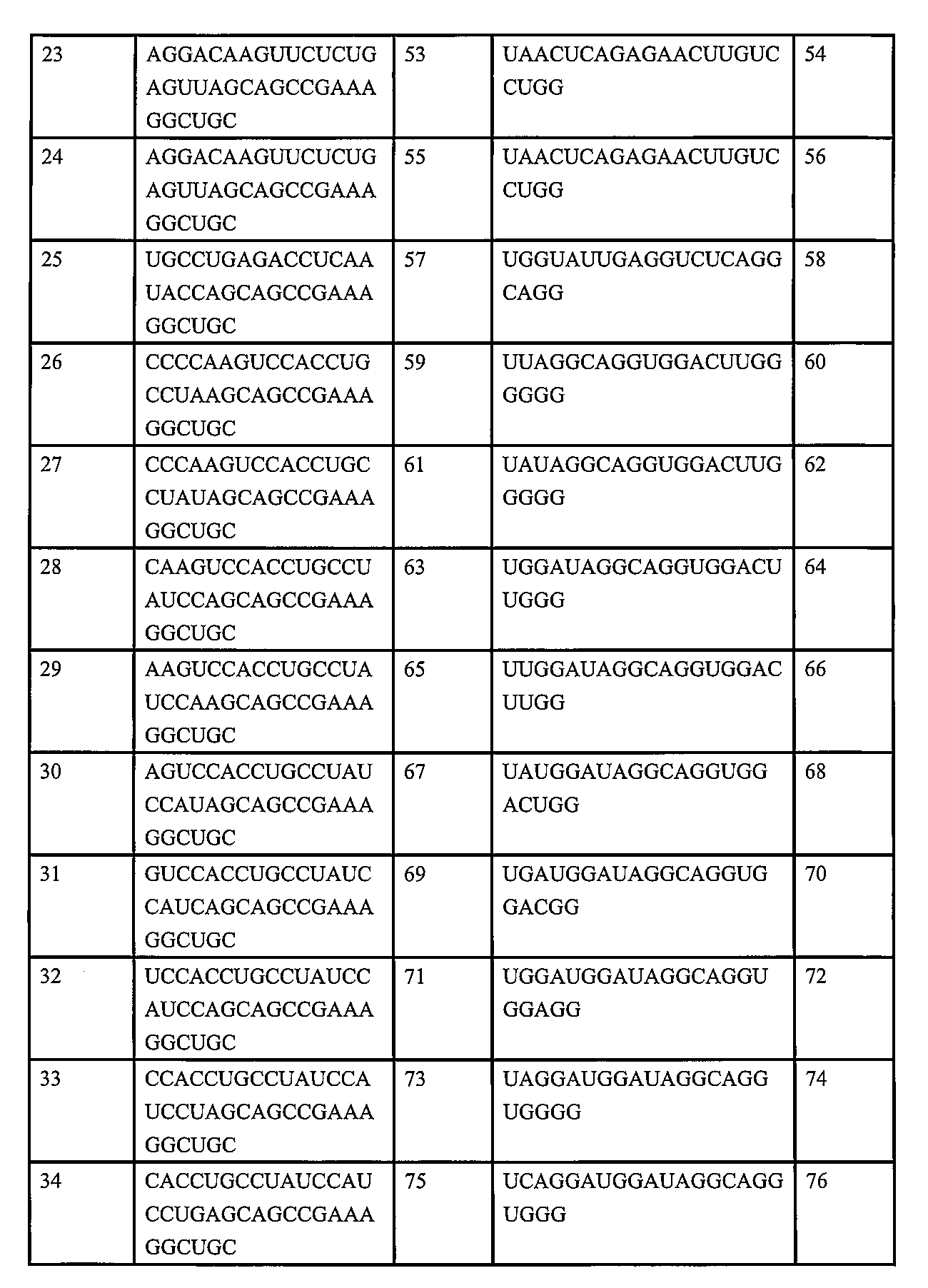


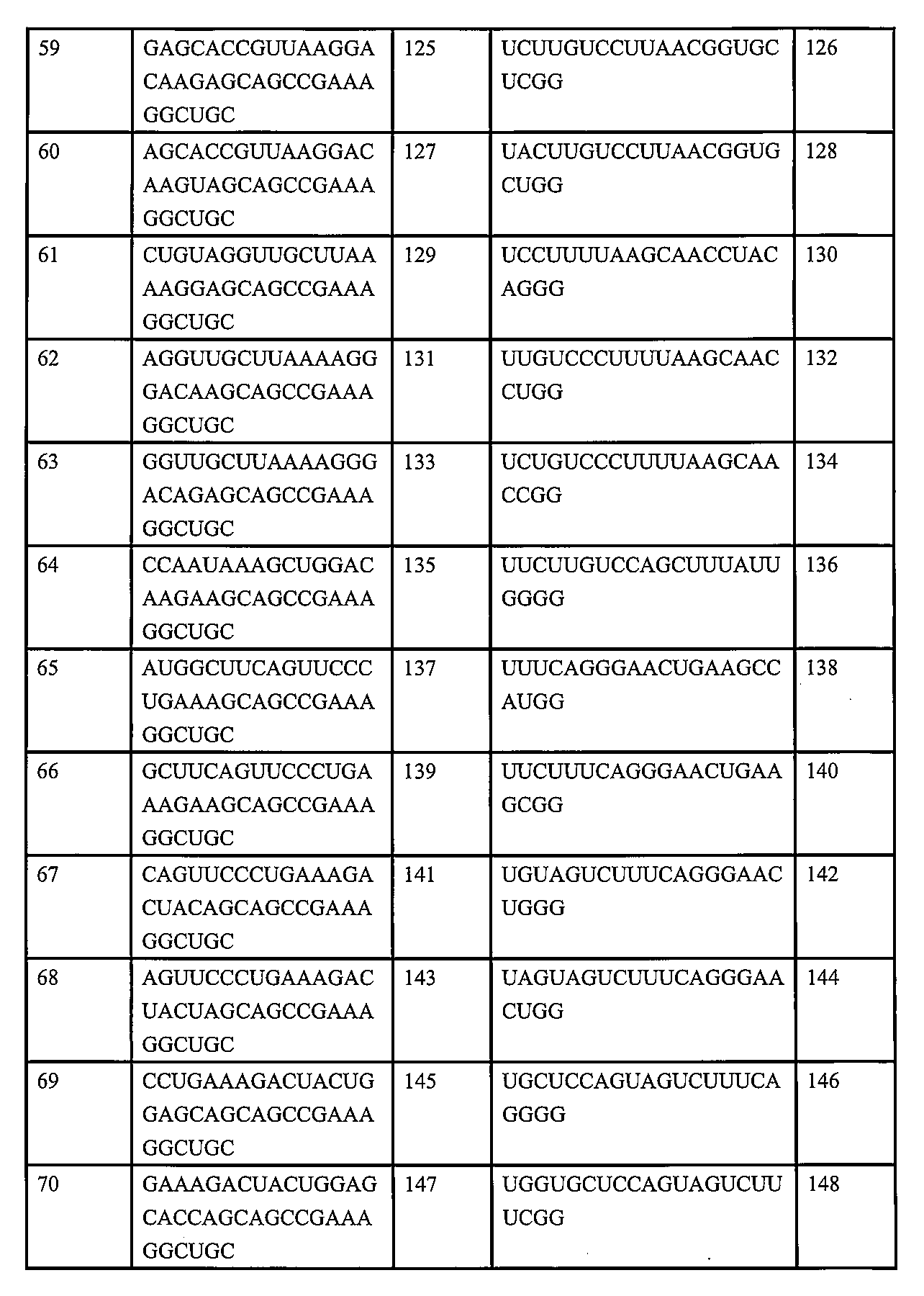


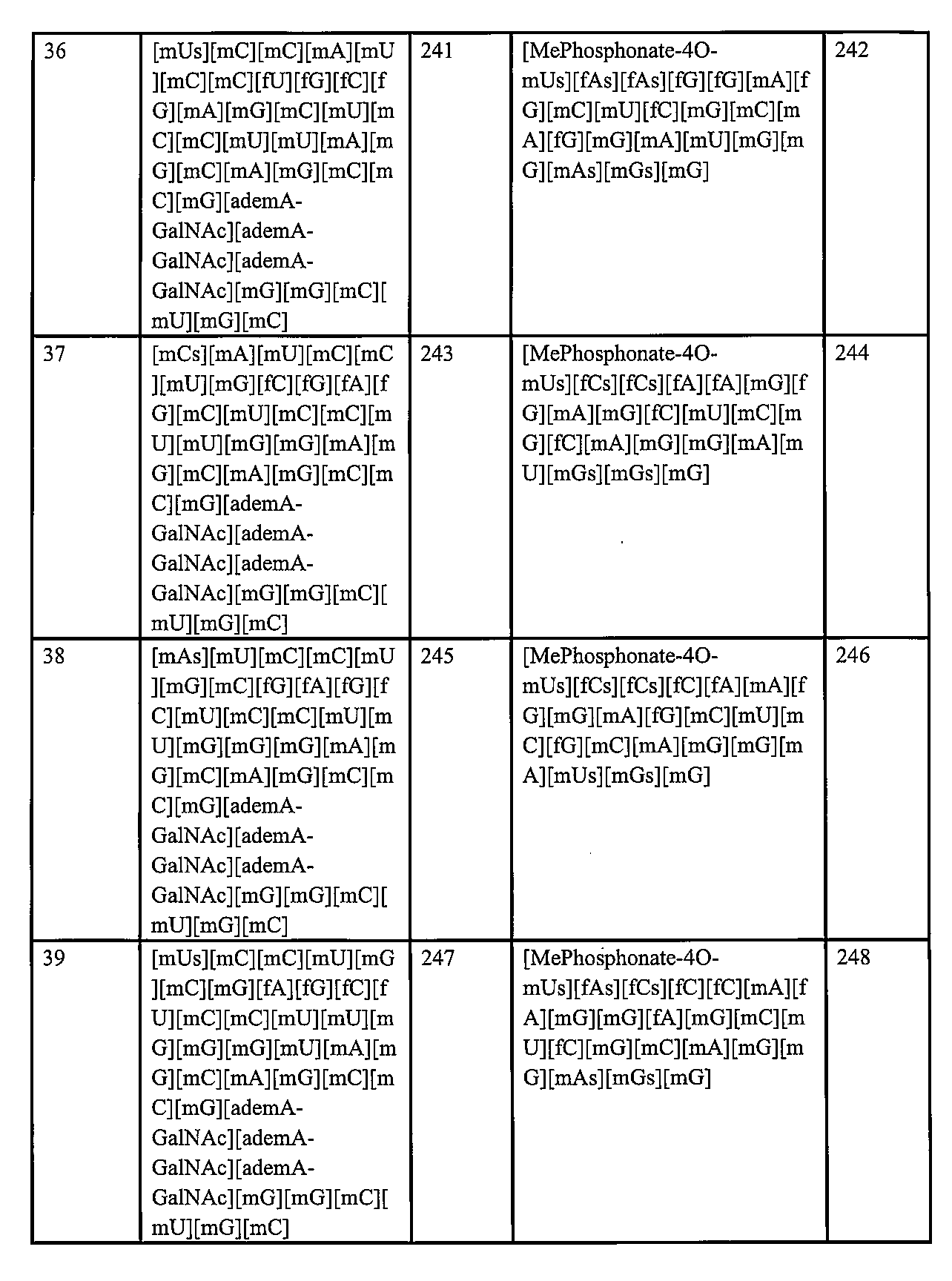
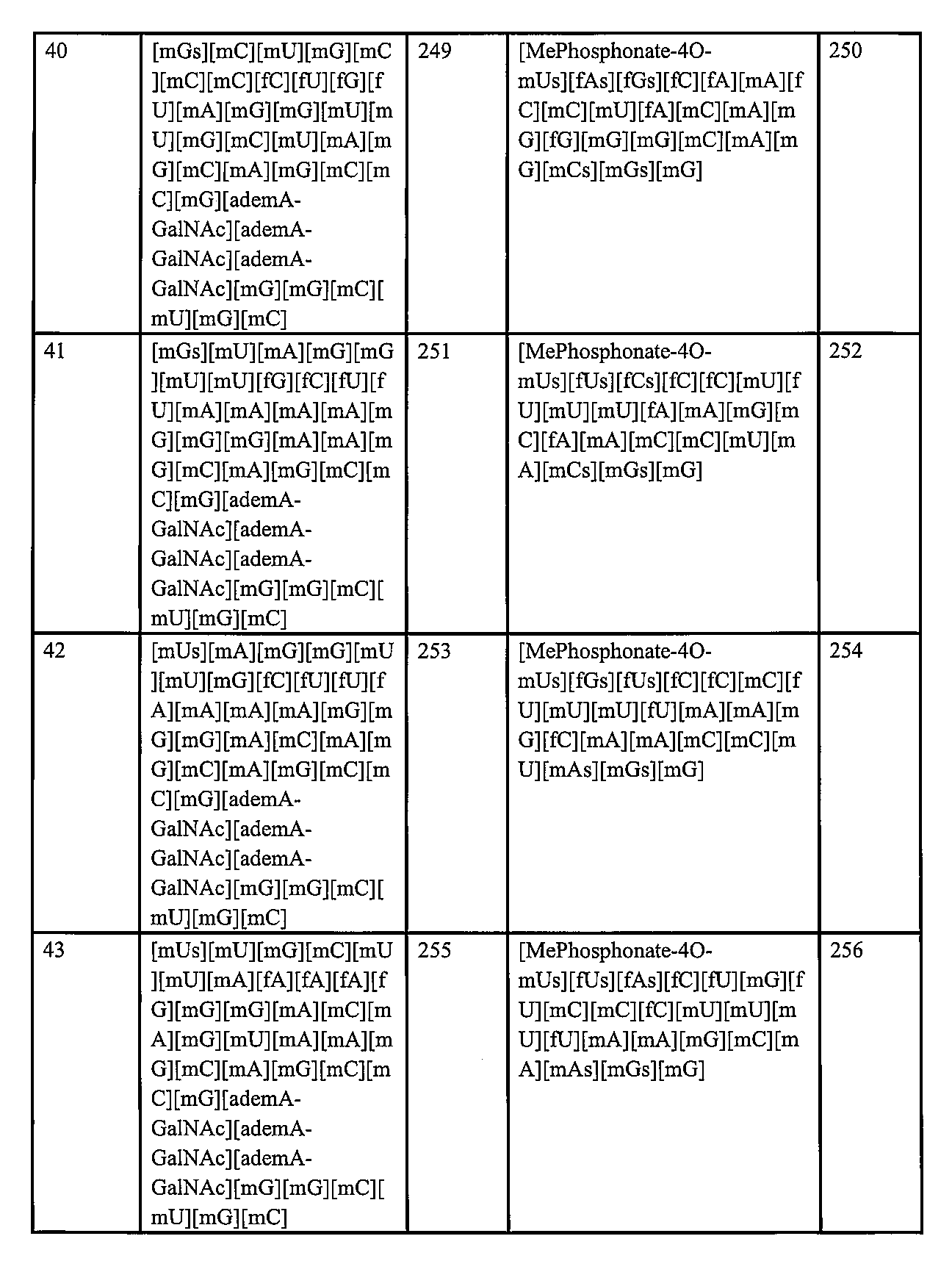

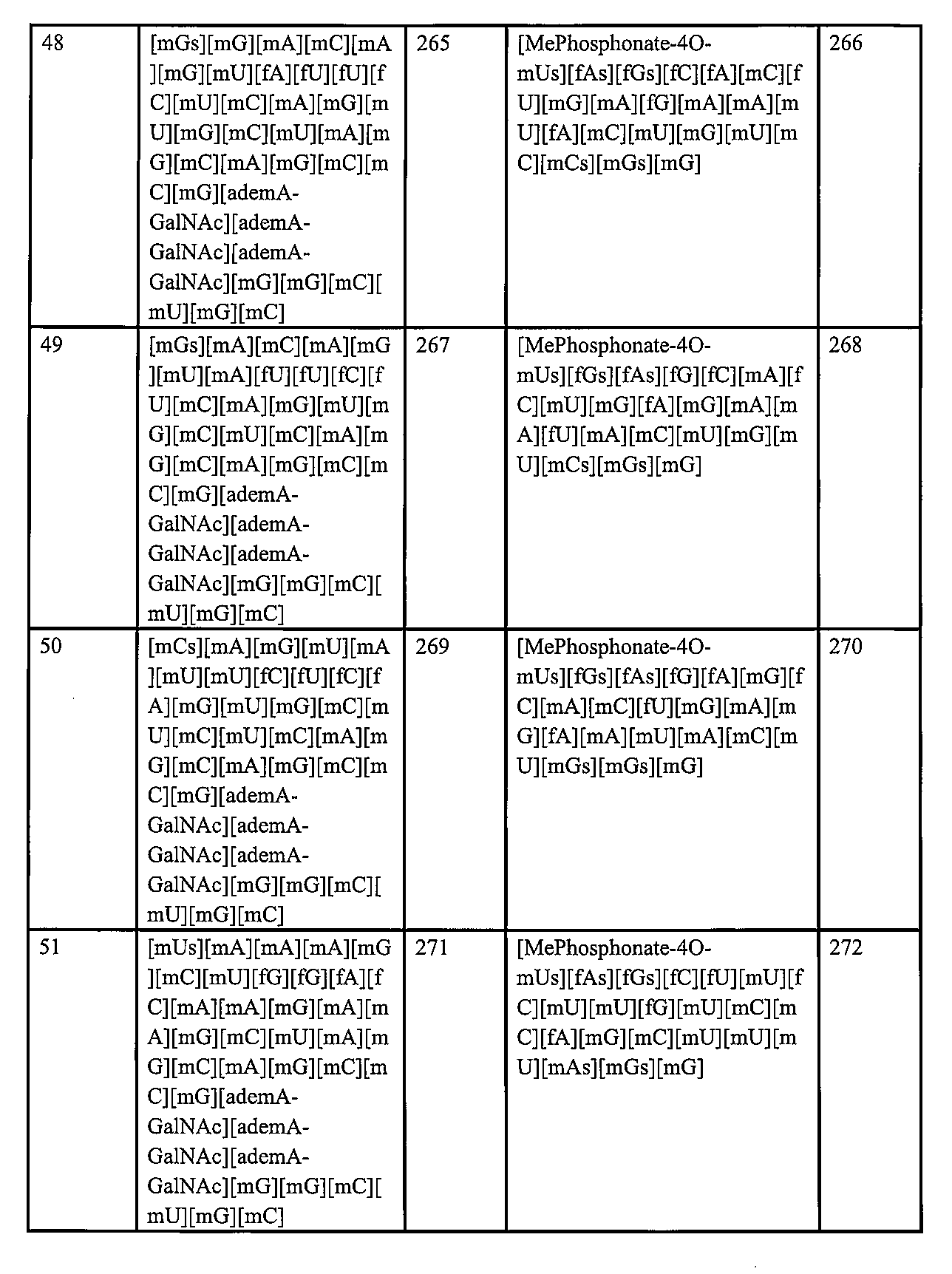
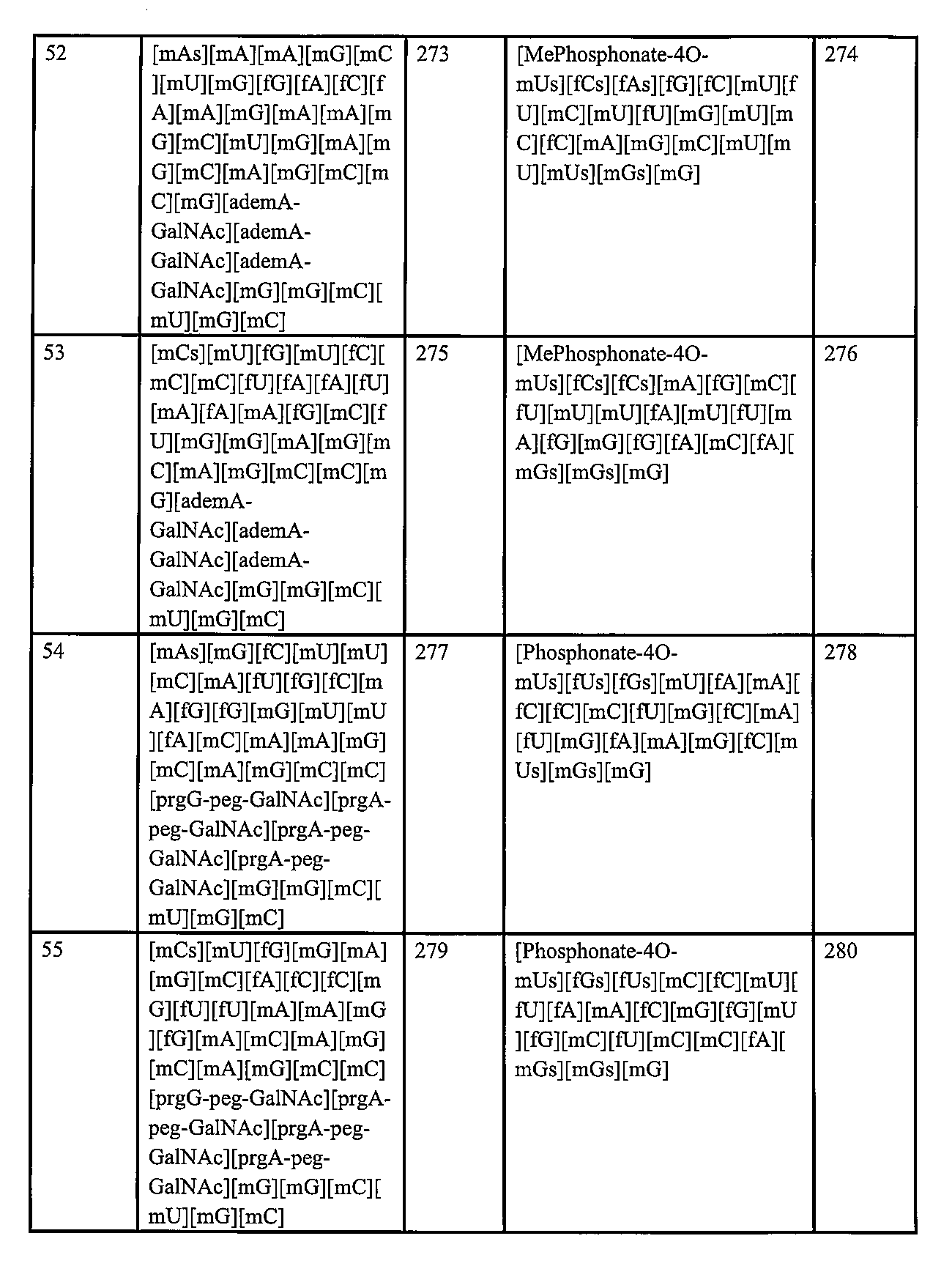

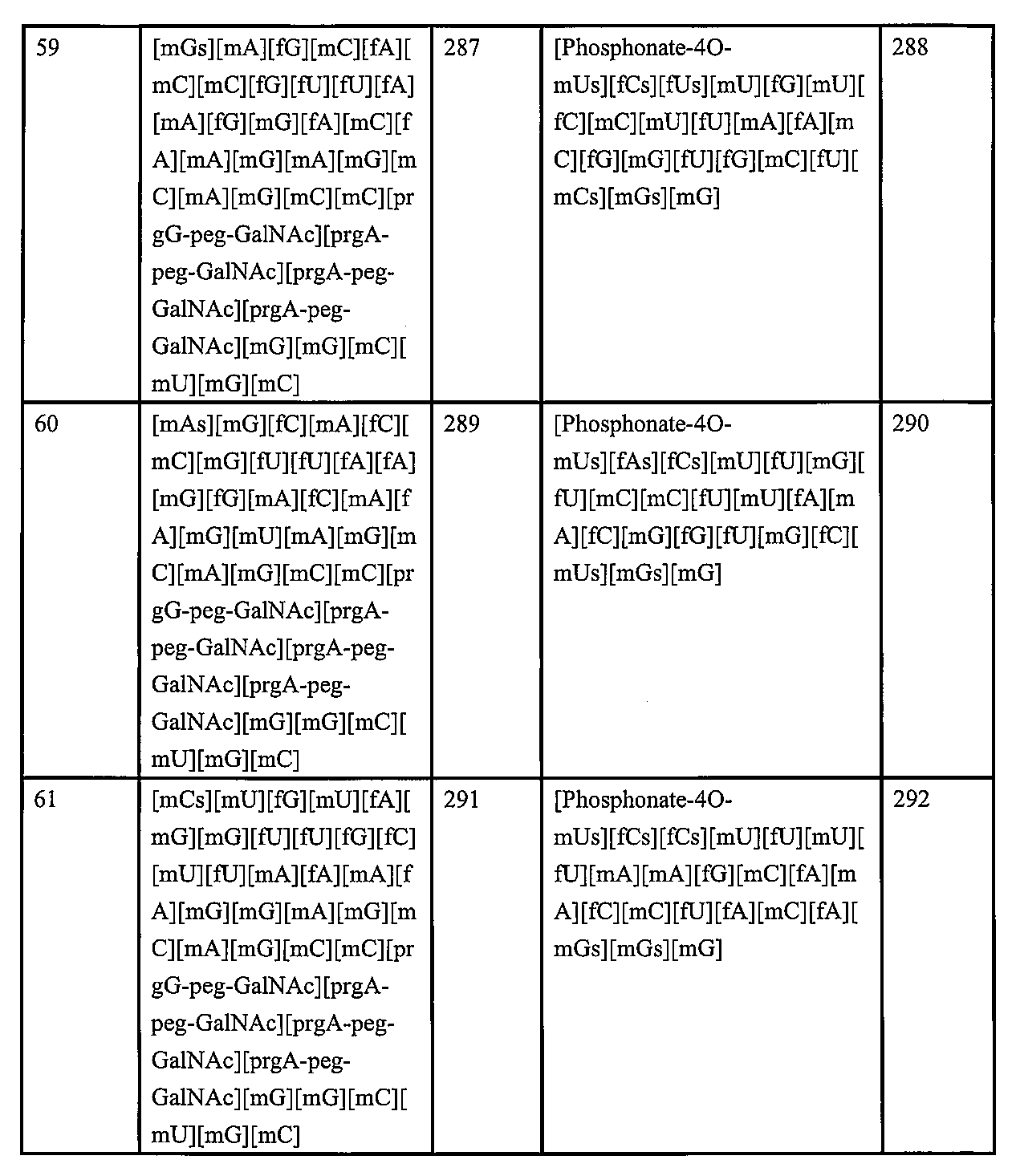
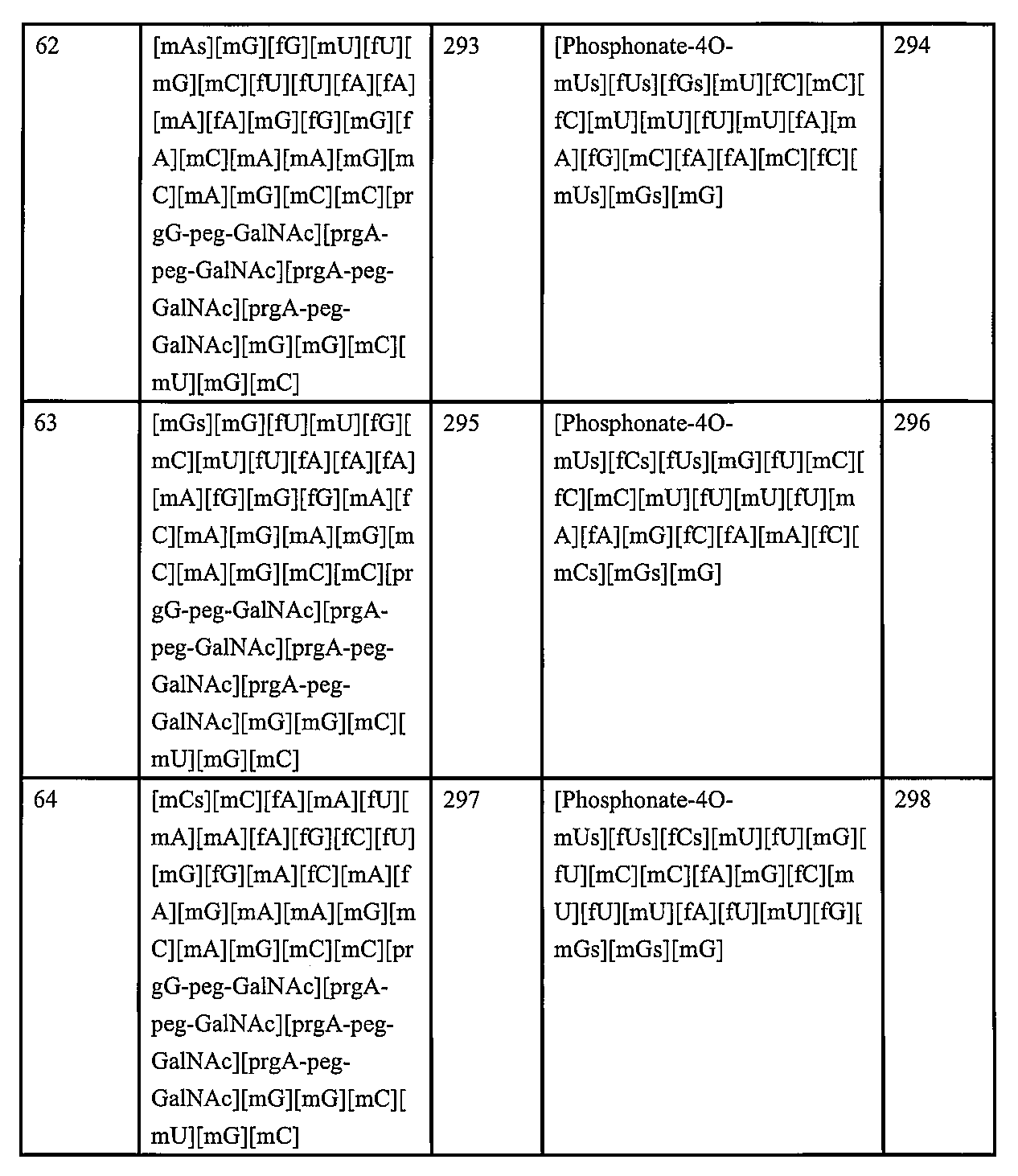
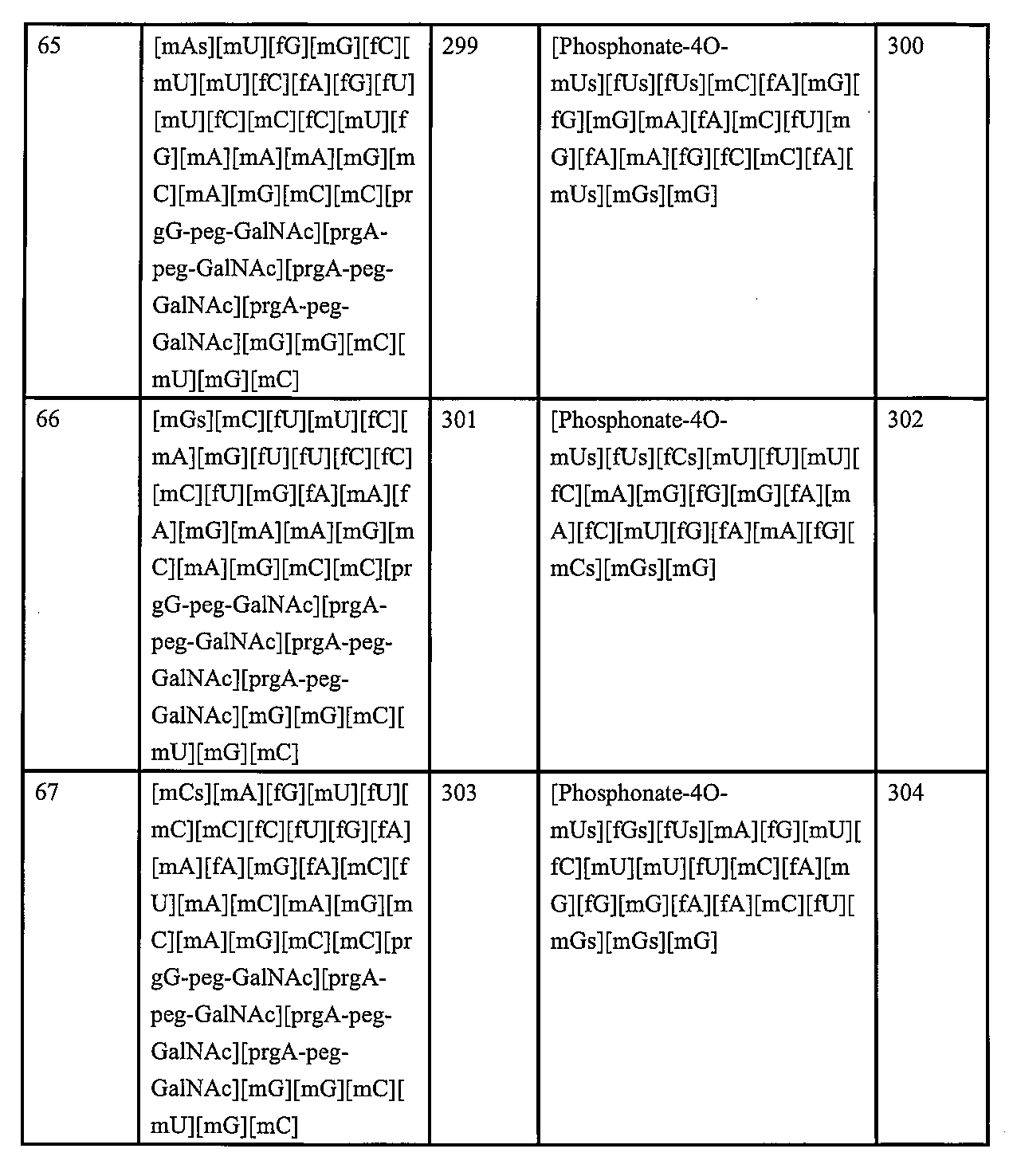
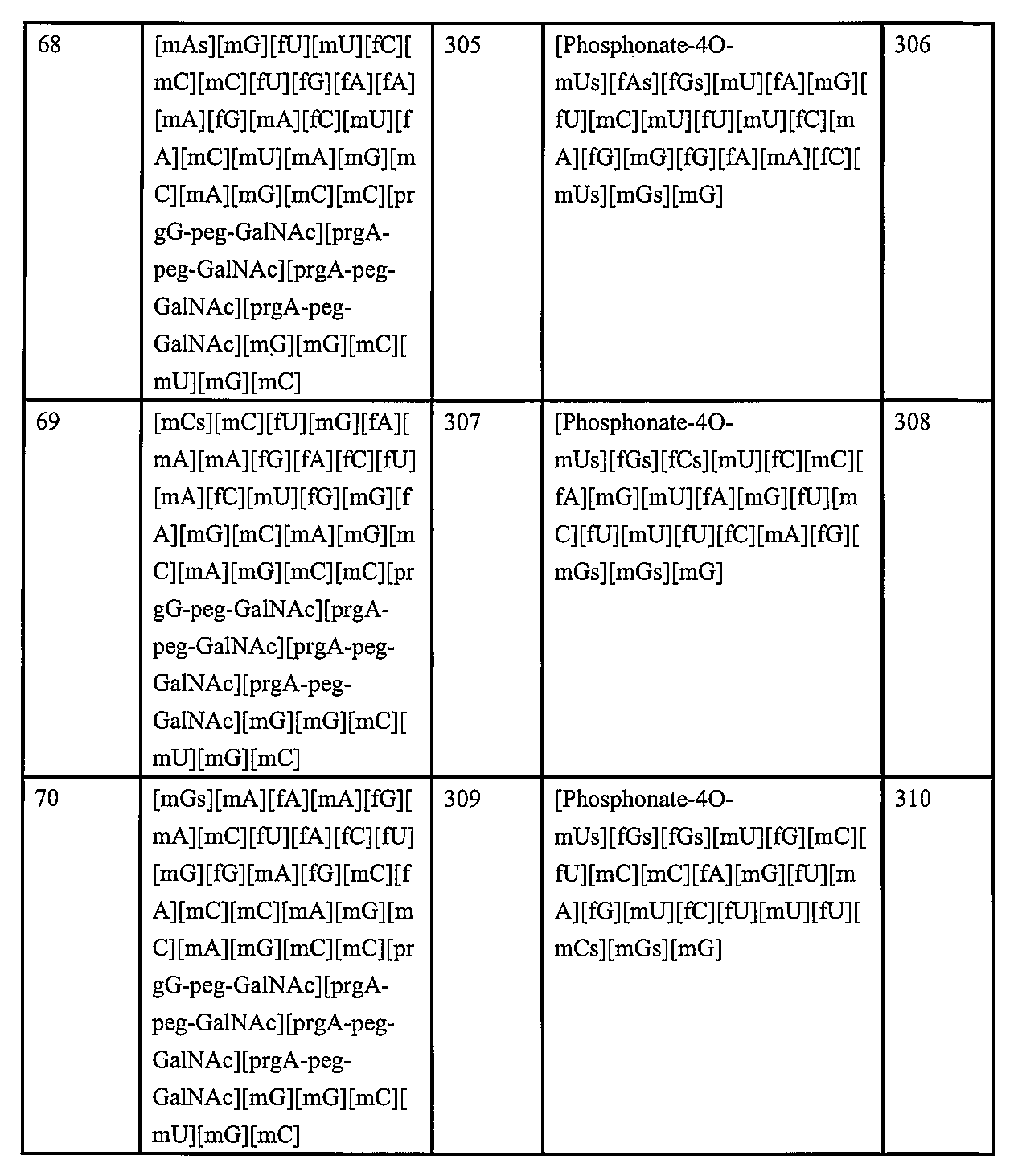
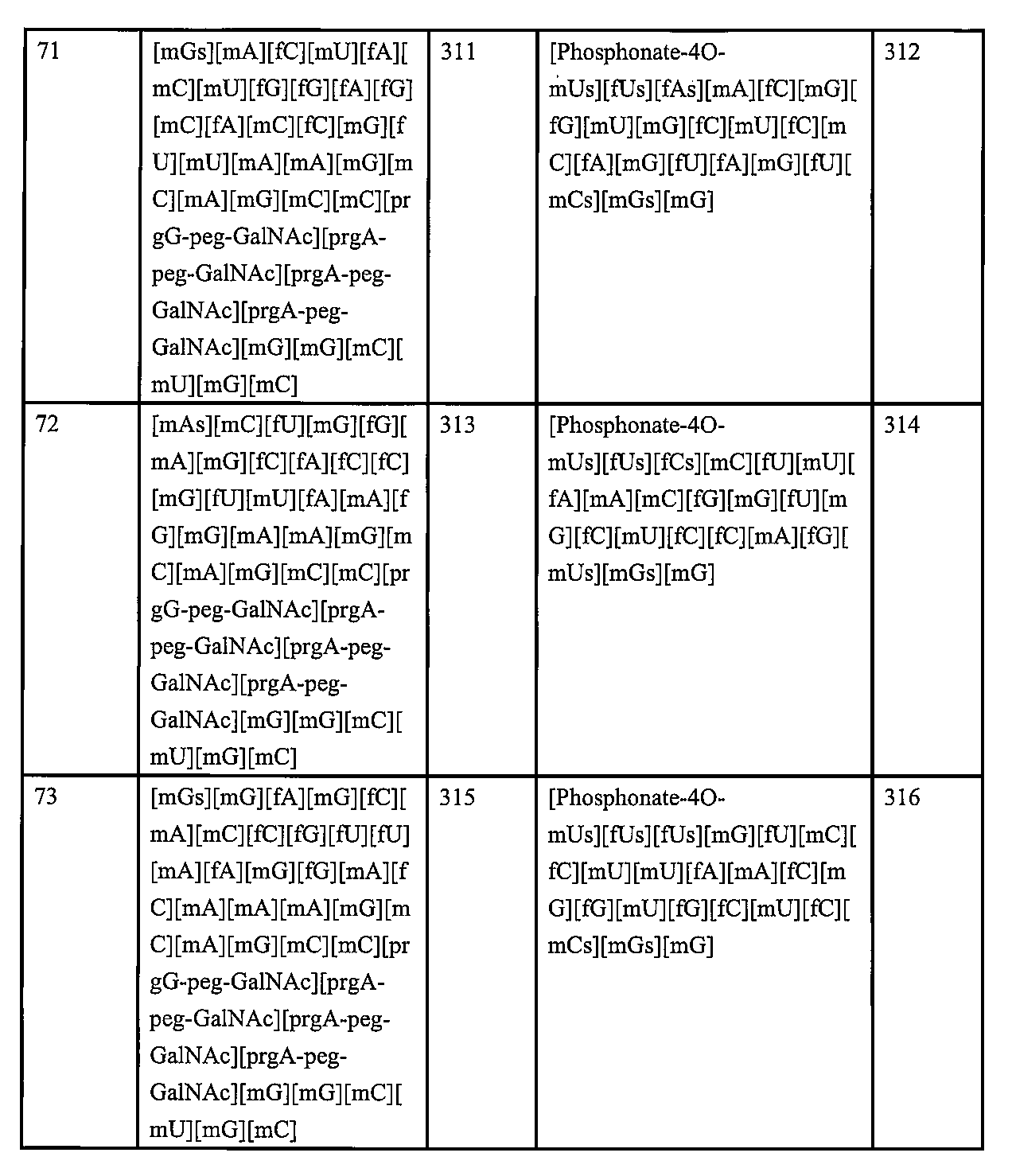
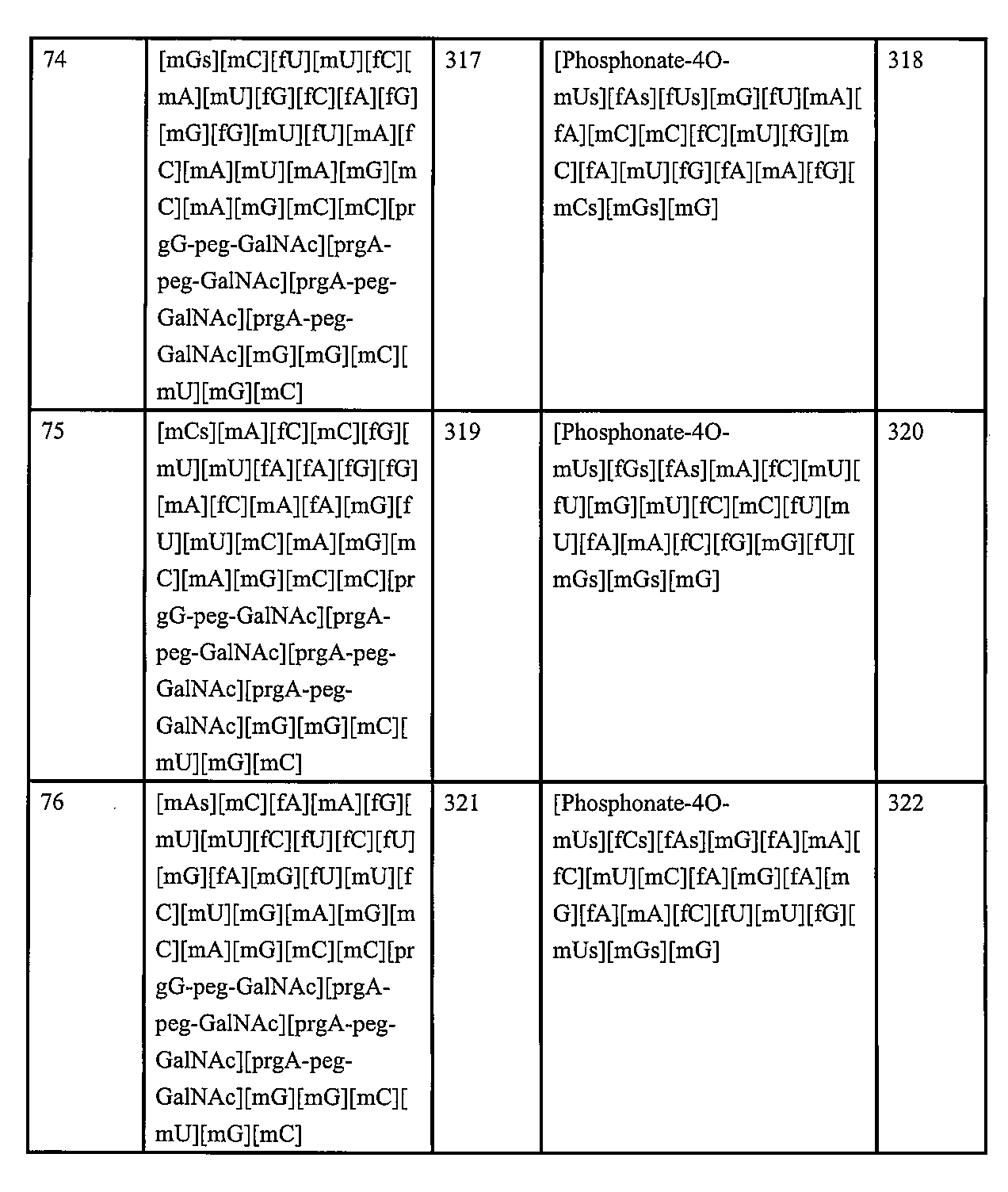
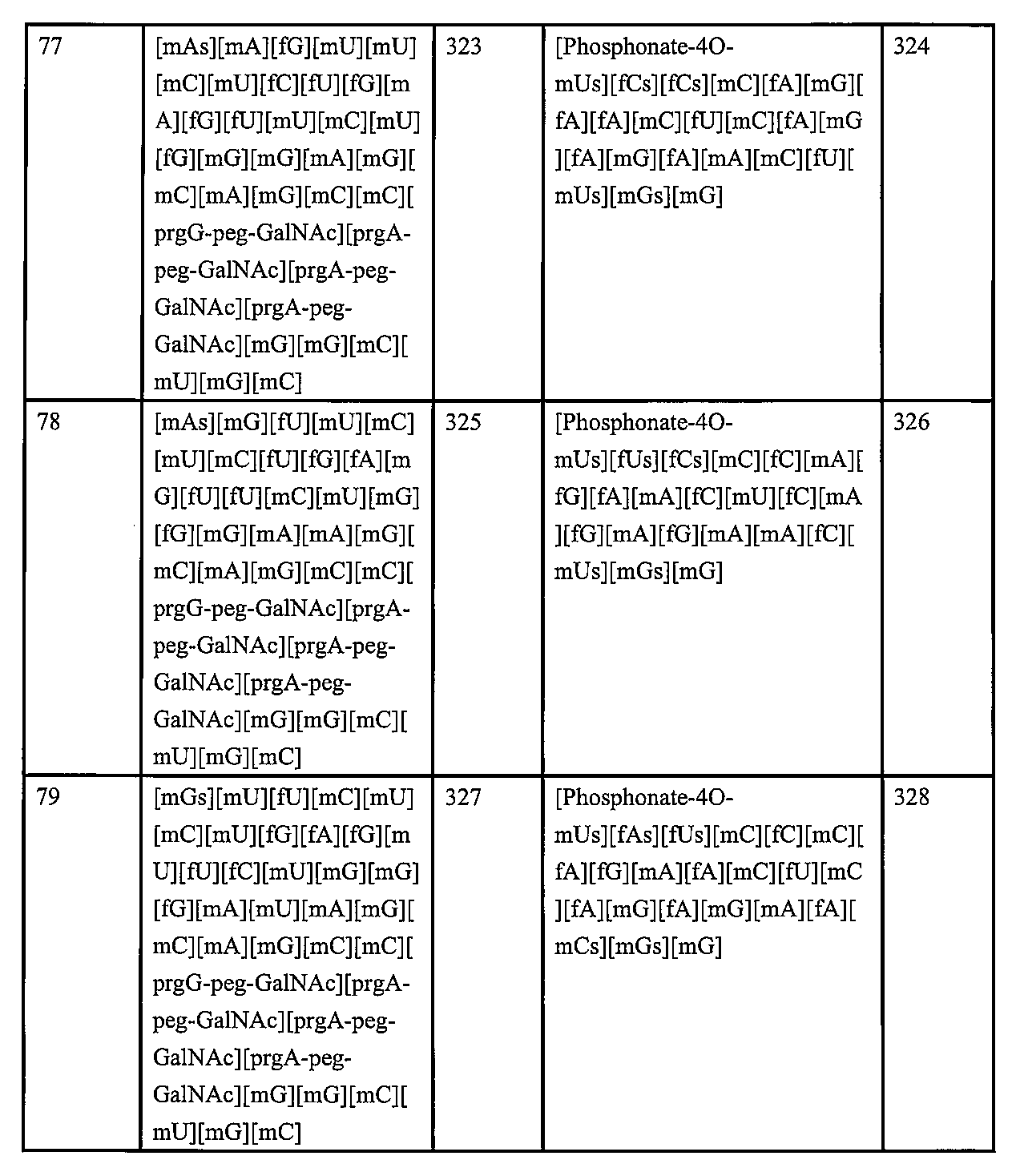

配列番号333-人工配列
GCAGCCGAAAGGCUGC
SEQ ID NO:333 - Artificial sequence GCAGCCGAAAGGCUGC
配列番号334-標的配列1
TTCAGTTCCCTGAAAGACTA
SEQ ID NO:334 - target sequence 1
TTCAGTTCCCTGAAAGACTA
配列番号335-標的配列2
TGGAGCACCGTTAAGGACAA
SEQ ID NO:335 - target sequence 2
TGGAGCACCGTTAAGGACAA
配列番号336-標的配列3
ACCGTTAAGGACAAGTTCT
SEQ ID NO:336 - target sequence 3
ACCGTTAAGGACAAGTTCT
配列番号337-標的配列4
GCTGCCCCTGTAGGTTGCT
SEQ ID NO:337 - target sequence 4
GCTGCCCCTGTAGGTTGCT
配列番号338-標的配列5
GTAGGTTGCTTAAAAGGGA
SEQ ID NO:338 - target sequence 5
GTAGGTTGCTTAAAAGGGA
配列番号339-標的配列6
CTTAAAAGGGACAGTATTC
SEQ ID NO:339 - target sequence 6
CTTAAAAGGGACAGTATTC
配列番号340-標的配列7
AAAAGGGACAGTATTCTCA
SEQ ID NO:340 - target sequence 7
AAAAGGGACAGTATTCTCA
配列番号341-標的配列8
GACAGTATTCTCAGTGCTC
SEQ ID NO:341 - target sequence 8
GACAGTATTCTCAGTGCTC
Claims (120)
(a)配列番号37と38、
(b)配列番号43と44、
(c)配列番号45と46、
(d)配列番号87と88、
(e)配列番号89と90、
(f)配列番号99と100、
(g)配列番号101と102、及び
(h)配列番号105と106。 2. The RNAi oligonucleotide of any one of the preceding claims, wherein the sense strand and the antisense strand comprise a nucleotide sequence selected from the group consisting of:
(a) SEQ ID NOs: 37 and 38;
(b) SEQ ID NOs: 43 and 44;
(c) SEQ ID NOs: 45 and 46;
(d) SEQ ID NOs: 87 and 88;
(e) SEQ ID NOs: 89 and 90;
(f) SEQ ID NOs: 99 and 100;
(g) SEQ ID NOs: 101 and 102, and (h) SEQ ID NOs: 105 and 106.
(a’)配列番号199と200、
(b’)配列番号205と206、
(c’)配列番号207と208、
(d’)配列番号249と250、
(e’)配列番号251と252、
(f’)配列番号261と262、
(g’)配列番号263と264、及び
(h’)配列番号267と268。 The RNAi oligonucleotide of any one of claims 1 and 8 to 15, wherein the sense strand and the antisense strand comprise a nucleotide sequence selected from the group consisting of:
(a') SEQ ID NOs: 199 and 200;
(b') SEQ ID NOs: 205 and 206;
(c') SEQ ID NOs: 207 and 208;
(d') SEQ ID NOs: 249 and 250;
(e') SEQ ID NOs: 251 and 252;
(f') SEQ ID NOs: 261 and 262;
(g') SEQ ID NOs: 263 and 264, and (h') SEQ ID NOs: 267 and 268.
(a)配列番号37と38、
(b)配列番号43と44、
(c)配列番号45と46、
(d)配列番号87と88、
(e)配列番号89と90、
(f)配列番号99と100、
(g)配列番号101と102、及び
(h)配列番号105と106;又は
(a’)配列番号199と200、
(b’)配列番号205と206、
(c’)配列番号207と208、
(d’)配列番号249と250、
(e’)配列番号251と252、
(f’)配列番号261と262、
(g’)配列番号263と264、及び
(h’)配列番号267と268。 The RNAi oligonucleotide of any one of claims 72 to 77, wherein the sense strand and the antisense strand are selected from the group consisting of:
(a) SEQ ID NOs: 37 and 38;
(b) SEQ ID NOs: 43 and 44;
(c) SEQ ID NOs: 45 and 46;
(d) SEQ ID NOs: 87 and 88;
(e) SEQ ID NOs: 89 and 90;
(f) SEQ ID NOs: 99 and 100;
(g) SEQ ID NOs: 101 and 102, and (h) SEQ ID NOs: 105 and 106; or (a') SEQ ID NOs: 199 and 200,
(b') SEQ ID NOs: 205 and 206;
(c') SEQ ID NOs: 207 and 208;
(d') SEQ ID NOs: 249 and 250;
(e') SEQ ID NOs: 251 and 252;
(f') SEQ ID NOs: 261 and 262;
(g') SEQ ID NOs: 263 and 264, and (h') SEQ ID NOs: 267 and 268.
(a’)配列番号199と200、
(b’)配列番号205と206、
(c’)配列番号207と208、
(d’)配列番号249と250、
(e’)配列番号251と252、
(f’)配列番号261と262、
(g’)配列番号263と264、及び
(h’)配列番号267と268。 1. An RNAi oligonucleotide for reducing expression of apolipoprotein C-III (APOC3), the oligonucleotide comprising a sense strand and an antisense strand, the sense strand and the antisense strand forming a duplex region, the sense strand and the antisense strand comprising a sequence selected from the group consisting of:
(a') SEQ ID NOs: 199 and 200;
(b') SEQ ID NOs: 205 and 206;
(c') SEQ ID NOs: 207 and 208;
(d') SEQ ID NOs: 249 and 250;
(e') SEQ ID NOs: 251 and 252;
(f') SEQ ID NOs: 261 and 262;
(g') SEQ ID NOs: 263 and 264, and (h') SEQ ID NOs: 267 and 268.
請求項1~93のいずれか1項に記載のRNAiオリゴヌクレオチド、又はその薬学的に許容される塩と、
薬学的に許容される担体、送達剤又は賦形剤と、を含む、前記医薬組成物。 1. A pharmaceutical composition comprising:
An RNAi oligonucleotide according to any one of claims 1 to 93, or a pharma- ceutically acceptable salt thereof;
and a pharma- ceutically acceptable carrier, delivery agent or excipient.
請求項94に記載の医薬組成物を前記個体に投与するステップを含む、前記方法。 1. A method of delivering an oligonucleotide to an individual, the method comprising:
95. The method comprising the step of administering to the individual the pharmaceutical composition of claim 94.
請求項1~93のいずれか1項に記載のRNAiオリゴヌクレオチド、又は請求項94に記載の医薬組成物の治療有効量を前記個体に投与し、それによって前記個体を治療するステップを含む、前記方法。 1. A method of treating an individual having a disease, disorder, or condition associated with apolipoprotein C-III (APOC3) expression, the method comprising:
The method comprises the step of administering to the individual a therapeutically effective amount of an RNAi oligonucleotide according to any one of claims 1 to 93, or a pharmaceutical composition according to claim 94, thereby treating the individual.
前記細胞又は前記細胞の集団を、請求項1~93のいずれか1項に記載のRNAiオリゴヌクレオチド又は請求項94に記載の医薬組成物と接触させるステップ;又は
請求項1~93のいずれか1項に記載のRNAiオリゴヌクレオチド又は請求項94に記載の医薬組成物を前記個体に投与するステップを含む、前記方法。 1. A method for reducing expression of apolipoprotein C-III (APOC3) in a cell, a population of cells, or an individual, the method comprising:
The method comprises the step of contacting the cell or the population of cells with an RNAi oligonucleotide of any one of claims 1 to 93 or a pharmaceutical composition of claim 94; or the step of administering an RNAi oligonucleotide of any one of claims 1 to 93 or a pharmaceutical composition of claim 94 to the individual.
センス鎖とアンチセンス鎖を含むRNAiオリゴヌクレオチドを前記個体に投与するステップを含み、前記センス鎖と前記アンチセンス鎖が二重鎖領域を形成し、前記アンチセンス鎖が、配列番号334~341のうちのいずれか1つのAPOC3のmRNA標的配列に相補性の領域を含み、前記相補性の領域は、少なくとも15個の連続するヌクレオチドの長さである、前記方法。 1. A method of treating an individual having a disease, disorder, or condition associated with apolipoprotein C-III (APOC3) expression, the method comprising:
Administering to the individual an RNAi oligonucleotide comprising a sense strand and an antisense strand, wherein the sense strand and the antisense strand form a duplex region, and the antisense strand comprises a region of complementarity to an APOC3 mRNA target sequence of any one of SEQ ID NOs: 334-341, and wherein the region of complementarity is at least 15 contiguous nucleotides in length.
表2又は表3に示される行から選択されるセンス鎖とアンチセンス鎖を含む治療有効量のRNAiオリゴヌクレオチド又はその医薬組成物を前記個体に投与し、それによって前記個体を治療するステップを含む、前記方法。 1. A method of treating an individual having a disease, disorder, or condition associated with apolipoprotein C-III (APOC3) expression, the method comprising:
The method comprises the step of administering to the individual a therapeutically effective amount of an RNAi oligonucleotide or a pharmaceutical composition thereof comprising a sense strand and an antisense strand selected from the rows shown in Table 2 or Table 3, thereby treating the individual.
センス鎖とアンチセンス鎖を含むRNAiオリゴヌクレオチドの治療有効量を前記個体に投与するステップを含み、前記センス鎖と前記アンチセンス鎖が以下からなる群から選択されるヌクレオチド配列を含む、前記方法:
(a)配列番号37と38、
(b)配列番号43と44、
(c)配列番号45と46、
(d)配列番号87と88、
(e)配列番号89と90、
(f)配列番号99と100、
(g)配列番号101と102、及び
(h)配列番号105と106;又は
(a’)配列番号199と200、
(b’)配列番号205と260、
(c’)配列番号207と208、
(d’)配列番号249と250、
(e’)配列番号251と252、
(f’)配列番号261と262、
(g’)配列番号263と264、及び
(h’)配列番号267と268。 1. A method of treating an individual having a disease, disorder, or condition associated with apolipoprotein C-III (APOC3) expression, the method comprising:
administering to the individual a therapeutically effective amount of an RNAi oligonucleotide comprising a sense strand and an antisense strand, wherein the sense strand and the antisense strand comprise a nucleotide sequence selected from the group consisting of:
(a) SEQ ID NOs: 37 and 38;
(b) SEQ ID NOs: 43 and 44;
(c) SEQ ID NOs: 45 and 46;
(d) SEQ ID NOs: 87 and 88;
(e) SEQ ID NOs: 89 and 90;
(f) SEQ ID NOs: 99 and 100;
(g) SEQ ID NOs: 101 and 102, and (h) SEQ ID NOs: 105 and 106; or (a') SEQ ID NOs: 199 and 200,
(b') SEQ ID NOs: 205 and 260;
(c') SEQ ID NOs: 207 and 208;
(d') SEQ ID NOs: 249 and 250;
(e') SEQ ID NOs: 251 and 252;
(f') SEQ ID NOs: 261 and 262;
(g') SEQ ID NOs: 263 and 264, and (h') SEQ ID NOs: 267 and 268.
センス鎖とアンチセンス鎖を含むRNAiオリゴヌクレオチドの治療有効量を前記個体に投与するステップを含み、前記センス鎖と前記アンチセンス鎖が以下からなる群から選択される、前記方法:
(a)配列番号37と38、
(b)配列番号43と44、
(c)配列番号45と46、
(d)配列番号87と88、
(e)配列番号89と90、
(f)配列番号99と100、
(g)配列番号101と102、及び
(h)配列番号105と106;又は
(a’)配列番号199と200、
(b’)配列番号205と260、
(c’)配列番号207と208、
(d’)配列番号249と250、
(e’)配列番号251と252、
(f’)配列番号261と262、
(g’)配列番号263と264、及び
(h’)配列番号267と268。 1. A method of treating an individual having a disease, disorder, or condition associated with apolipoprotein C-III (APOC3) expression, the method comprising:
administering to the individual a therapeutically effective amount of an RNAi oligonucleotide comprising a sense strand and an antisense strand, wherein the sense strand and the antisense strand are selected from the group consisting of:
(a) SEQ ID NOs: 37 and 38;
(b) SEQ ID NOs: 43 and 44;
(c) SEQ ID NOs: 45 and 46;
(d) SEQ ID NOs: 87 and 88;
(e) SEQ ID NOs: 89 and 90;
(f) SEQ ID NOs: 99 and 100;
(g) SEQ ID NOs: 101 and 102, and (h) SEQ ID NOs: 105 and 106; or (a') SEQ ID NOs: 199 and 200,
(b') SEQ ID NOs: 205 and 260;
(c') SEQ ID NOs: 207 and 208;
(d') SEQ ID NOs: 249 and 250;
(e') SEQ ID NOs: 251 and 252;
(f') SEQ ID NOs: 261 and 262;
(g') SEQ ID NOs: 263 and 264, and (h') SEQ ID NOs: 267 and 268.
それぞれ、(a)配列番号37と38、
(b)配列番号43と44、
(c)配列番号45と46、
(d)配列番号87と88、
(e)配列番号89と90、
(f)配列番号99と100、
(g)配列番号101と102、及び
(h)配列番号105と106;
前記センス鎖中の5’-GCAGCCGAAAGGCUGC-3’(配列番号333)の配列がステムループ構造を形成し、前記ループ中の5’-GAAA-3’の配列中のヌクレオチドがそれぞれ一価GalNAc部分にコンジュゲートしている、前記RNAiオリゴヌクレオチド。 An RNAi oligonucleotide for reducing expression of apolipoprotein C-III (APOC3), said oligonucleotide having an optionally modified sense strand and an antisense strand, said sense strand and said antisense strand forming a duplex region, said sense strand and said antisense strand being a pair selected from the group consisting of:
(a) SEQ ID NOs: 37 and 38, respectively;
(b) SEQ ID NOs: 43 and 44;
(c) SEQ ID NOs: 45 and 46;
(d) SEQ ID NOs: 87 and 88;
(e) SEQ ID NOs: 89 and 90;
(f) SEQ ID NOs: 99 and 100;
(g) SEQ ID NOs: 101 and 102, and (h) SEQ ID NOs: 105 and 106;
The RNAi oligonucleotide, wherein the sequence 5'-GCAGCCGAAAGGCUGC-3' (SEQ ID NO: 333) in the sense strand forms a stem-loop structure, and each nucleotide in the sequence 5'-GAAA-3' in the loop is conjugated to a monovalent GalNAc moiety.
それぞれ、
(a’)配列番号199と200、
(b’)配列番号205と260、
(c’)配列番号207と208、
(d’)配列番号249と250、
(e’)配列番号251と252、
(f’)配列番号261と262、
(g’)配列番号263と264、及び
(h’)配列番号267と268。 120. The RNAi oligonucleotide of claim 119, wherein the sense strand and the antisense strand are optionally modified and are a pair selected from the group consisting of:
each,
(a') SEQ ID NOs: 199 and 200;
(b') SEQ ID NOs: 205 and 260;
(c') SEQ ID NOs: 207 and 208;
(d') SEQ ID NOs: 249 and 250;
(e') SEQ ID NOs: 251 and 252;
(f') SEQ ID NOs: 261 and 262;
(g') SEQ ID NOs: 263 and 264, and (h') SEQ ID NOs: 267 and 268.
Applications Claiming Priority (3)
| Application Number | Priority Date | Filing Date | Title |
|---|---|---|---|
| US202163264730P | 2021-12-01 | 2021-12-01 | |
| US63/264,730 | 2021-12-01 | ||
| PCT/US2022/080736 WO2023102469A2 (en) | 2021-12-01 | 2022-12-01 | Compositions and methods for modulating apoc3 expression |
Publications (2)
| Publication Number | Publication Date |
|---|---|
| JP2024543195A true JP2024543195A (en) | 2024-11-19 |
| JPWO2023102469A5 JPWO2023102469A5 (en) | 2025-12-08 |
Family
ID=85018261
Family Applications (1)
| Application Number | Title | Priority Date | Filing Date |
|---|---|---|---|
| JP2024532270A Pending JP2024543195A (en) | 2021-12-01 | 2022-12-01 | Compositions and methods for modulating APOC3 expression |
Country Status (12)
| Country | Link |
|---|---|
| US (2) | US12234456B2 (en) |
| EP (1) | EP4441218A2 (en) |
| JP (1) | JP2024543195A (en) |
| KR (1) | KR20240111757A (en) |
| CN (1) | CN118355120A (en) |
| AR (1) | AR127843A1 (en) |
| AU (1) | AU2022402155A1 (en) |
| CA (1) | CA3235941A1 (en) |
| IL (1) | IL313220A (en) |
| MX (1) | MX2024006740A (en) |
| TW (1) | TW202330920A (en) |
| WO (1) | WO2023102469A2 (en) |
Citations (2)
| Publication number | Priority date | Publication date | Assignee | Title |
|---|---|---|---|---|
| WO2010083615A1 (en) * | 2009-01-26 | 2010-07-29 | Protiva Biotherapeutics, Inc. | Compositions and methods for silencing apolipoprotein c-iii expression |
| WO2021167841A1 (en) * | 2020-02-18 | 2021-08-26 | Alnylam Pharmaceuticals, Inc. | Apolipoprotein c3 (apoc3) irna compositions and methods of use thereof |
Family Cites Families (34)
| Publication number | Priority date | Publication date | Assignee | Title |
|---|---|---|---|---|
| US6469158B1 (en) | 1992-05-14 | 2002-10-22 | Ribozyme Pharmaceuticals, Incorporated | Synthesis, deprotection, analysis and purification of RNA and ribozymes |
| US5804683A (en) | 1992-05-14 | 1998-09-08 | Ribozyme Pharmaceuticals, Inc. | Deprotection of RNA with alkylamine |
| US5977343A (en) | 1992-05-14 | 1999-11-02 | Ribozyme Pharmaceuticals, Inc. | Synthesis, deprotection, analysis and purification of RNA and ribozymes |
| PT748382E (en) | 1993-09-02 | 2003-03-31 | Ribozyme Pharm Inc | NUCLEIC ENZYMAL ACIDS CONTAINING NON-NUCLEOTIDES |
| US5889136A (en) | 1995-06-09 | 1999-03-30 | The Regents Of The University Of Colorado | Orthoester protecting groups in RNA synthesis |
| US5998203A (en) | 1996-04-16 | 1999-12-07 | Ribozyme Pharmaceuticals, Inc. | Enzymatic nucleic acids containing 5'-and/or 3'-cap structures |
| US6111086A (en) | 1998-02-27 | 2000-08-29 | Scaringe; Stephen A. | Orthoester protecting groups |
| NZ522045A (en) | 2000-03-30 | 2007-05-31 | Whitehead Biomedical Inst | RNA sequence-specific mediators of RNA interference |
| IL155991A0 (en) | 2000-12-01 | 2003-12-23 | Max Planck Gesellschaft | Rna interference mediating small rna molecules |
| US20050159378A1 (en) | 2001-05-18 | 2005-07-21 | Sirna Therapeutics, Inc. | RNA interference mediated inhibition of Myc and/or Myb gene expression using short interfering nucleic acid (siNA) |
| EP1442137A4 (en) | 2001-11-07 | 2005-08-31 | Applera Corp | Universal nucleotides for nucleic acid analysis |
| US20070265220A1 (en) | 2004-03-15 | 2007-11-15 | City Of Hope | Methods and compositions for the specific inhibition of gene expression by double-stranded RNA |
| US20090018097A1 (en) | 2005-09-02 | 2009-01-15 | Mdrna, Inc | Modification of double-stranded ribonucleic acid molecules |
| AU2009293636A1 (en) | 2008-09-22 | 2010-03-25 | Dicerna Pharmaceuticals, Inc. | Compositions and methods for the specific inhibition of gene expression by dsRNA possessing modifications |
| EP3067359A1 (en) | 2008-09-23 | 2016-09-14 | Scott G. Petersen | Self delivering bio-labile phosphate protected pro-oligos for oligonucleotide based therapeutics and mediating rna interference |
| KR20110110776A (en) | 2008-12-18 | 2011-10-07 | 다이서나 파마수이티컬, 인크. | Extended Dicer Substrate Formulations and Methods for Specific Inhibition of Gene Expression |
| US20100249214A1 (en) | 2009-02-11 | 2010-09-30 | Dicerna Pharmaceuticals | Multiplex dicer substrate rna interference molecules having joining sequences |
| US8927513B2 (en) | 2009-07-07 | 2015-01-06 | Alnylam Pharmaceuticals, Inc. | 5′ phosphate mimics |
| US9725479B2 (en) | 2010-04-22 | 2017-08-08 | Ionis Pharmaceuticals, Inc. | 5′-end derivatives |
| KR102540778B1 (en) | 2011-06-21 | 2023-06-07 | 알닐람 파마슈티칼스 인코포레이티드 | Compositions and methods for inhibition of expression of apolipoprotein c-iii(apoc3) genes |
| BR112014009790A2 (en) | 2011-10-25 | 2018-05-15 | Isis Pharmaceuticals Inc | compound for antisense modulation of gccr expression, its use and composition |
| CN104903307A (en) | 2012-12-06 | 2015-09-09 | 默沙东公司 | Disulfide masked prodrug compositions and methods |
| EP3564374A1 (en) * | 2013-06-21 | 2019-11-06 | Ionis Pharmaceuticals, Inc. | Compositions and methods for modulation of target nucleic acids |
| WO2015188197A2 (en) | 2014-06-06 | 2015-12-10 | Solstice Biologics, Ltd. | Polynucleotide constructs having bioreversible and non-bioreversible groups |
| EP3169784B1 (en) | 2014-07-16 | 2020-06-10 | Arrowhead Pharmaceuticals, Inc. | Rnai compositions to treat apoc3-related diseases |
| JP2017535552A (en) * | 2014-11-17 | 2017-11-30 | アルナイラム ファーマシューティカルズ, インコーポレイテッドAlnylam Pharmaceuticals, Inc. | Apolipoprotein C3 (APOC3) iRNA composition and methods of use thereof |
| DK3569711T3 (en) | 2014-12-15 | 2021-02-22 | Dicerna Pharmaceuticals Inc | LIGAND MODIFIED DOUBLE STRING NUCLEIC ACIDS |
| CN114891053A (en) | 2016-08-23 | 2022-08-12 | 迪克纳制药公司 | Compositions comprising reversibly modified oligonucleotides and uses thereof |
| AU2017321892A1 (en) | 2016-09-02 | 2019-02-28 | Dicerna Pharmaceuticals, Inc. | 4'-phosphate analogs and oligonucleotides comprising the same |
| CN108239644B (en) | 2016-12-23 | 2021-05-28 | 苏州瑞博生物技术股份有限公司 | Small interfering nucleic acid, pharmaceutical composition and application thereof |
| WO2019006375A1 (en) * | 2017-06-29 | 2019-01-03 | Dicerna Pharmaceuticals, Inc. | Compositions and methods for inhibiting hmgb1 expression |
| CA3074303A1 (en) | 2017-09-11 | 2019-03-14 | Arrowhead Pharmaceuticals, Inc. | Rnai agents and compositions for inhibiting expression of apolipoprotein c-iii (apoc3) |
| CN118530989A (en) * | 2017-10-13 | 2024-08-23 | 诺和诺德保健股份有限公司 | Methods and compositions for inhibiting LDHA expression |
| EP4038191A1 (en) * | 2019-10-02 | 2022-08-10 | Dicerna Pharmaceuticals, Inc. | Chemical modifications of small interfering rna with minimal fluorine content |
-
2022
- 2022-12-01 JP JP2024532270A patent/JP2024543195A/en active Pending
- 2022-12-01 AU AU2022402155A patent/AU2022402155A1/en active Pending
- 2022-12-01 CN CN202280079597.6A patent/CN118355120A/en active Pending
- 2022-12-01 AR ARP220103304A patent/AR127843A1/en unknown
- 2022-12-01 EP EP22847044.9A patent/EP4441218A2/en active Pending
- 2022-12-01 US US18/060,881 patent/US12234456B2/en active Active
- 2022-12-01 WO PCT/US2022/080736 patent/WO2023102469A2/en not_active Ceased
- 2022-12-01 KR KR1020247018064A patent/KR20240111757A/en active Pending
- 2022-12-01 MX MX2024006740A patent/MX2024006740A/en unknown
- 2022-12-01 IL IL313220A patent/IL313220A/en unknown
- 2022-12-01 CA CA3235941A patent/CA3235941A1/en active Pending
- 2022-12-01 TW TW111146092A patent/TW202330920A/en unknown
-
2025
- 2025-02-03 US US19/044,314 patent/US20250263701A1/en active Pending
Patent Citations (2)
| Publication number | Priority date | Publication date | Assignee | Title |
|---|---|---|---|---|
| WO2010083615A1 (en) * | 2009-01-26 | 2010-07-29 | Protiva Biotherapeutics, Inc. | Compositions and methods for silencing apolipoprotein c-iii expression |
| WO2021167841A1 (en) * | 2020-02-18 | 2021-08-26 | Alnylam Pharmaceuticals, Inc. | Apolipoprotein c3 (apoc3) irna compositions and methods of use thereof |
Also Published As
| Publication number | Publication date |
|---|---|
| CA3235941A1 (en) | 2023-06-08 |
| IL313220A (en) | 2024-07-01 |
| KR20240111757A (en) | 2024-07-17 |
| MX2024006740A (en) | 2024-06-19 |
| TW202330920A (en) | 2023-08-01 |
| US12234456B2 (en) | 2025-02-25 |
| US20250263701A1 (en) | 2025-08-21 |
| WO2023102469A3 (en) | 2023-07-13 |
| AU2022402155A1 (en) | 2024-05-09 |
| US20230272393A1 (en) | 2023-08-31 |
| EP4441218A2 (en) | 2024-10-09 |
| WO2023102469A2 (en) | 2023-06-08 |
| CN118355120A (en) | 2024-07-16 |
| AR127843A1 (en) | 2024-03-06 |
Similar Documents
| Publication | Publication Date | Title |
|---|---|---|
| JP7805386B2 (en) | Compositions and methods for inhibiting LPA expression | |
| JP7749645B2 (en) | Compositions and methods for inhibiting ANGPTL3 expression | |
| US12084662B2 (en) | Compositions and methods for modulating PNPLA3 expression | |
| US12234456B2 (en) | Compositions and methods for modulating APOC3 expression | |
| JP2025512445A (en) | Compositions and methods for modulating SCAP activity | |
| JP2026016378A (en) | Compositions and methods for inhibiting ANGPTL3 expression | |
| EA050095B1 (en) | COMPOSITIONS AND METHODS FOR INHIBITING ANGPTL3 EXPRESSION |
Legal Events
| Date | Code | Title | Description |
|---|---|---|---|
| A521 | Request for written amendment filed |
Free format text: JAPANESE INTERMEDIATE CODE: A523 Effective date: 20251128 |
|
| A621 | Written request for application examination |
Free format text: JAPANESE INTERMEDIATE CODE: A621 Effective date: 20251128 |
|
| A871 | Explanation of circumstances concerning accelerated examination |
Free format text: JAPANESE INTERMEDIATE CODE: A871 Effective date: 20251128 |
|
| A131 | Notification of reasons for refusal |
Free format text: JAPANESE INTERMEDIATE CODE: A131 Effective date: 20251215 |