JP2024540938A - Human IL-12p40 variants and uses thereof - Google Patents
Human IL-12p40 variants and uses thereof Download PDFInfo
- Publication number
- JP2024540938A JP2024540938A JP2024523622A JP2024523622A JP2024540938A JP 2024540938 A JP2024540938 A JP 2024540938A JP 2024523622 A JP2024523622 A JP 2024523622A JP 2024523622 A JP2024523622 A JP 2024523622A JP 2024540938 A JP2024540938 A JP 2024540938A
- Authority
- JP
- Japan
- Prior art keywords
- hil
- polypeptide
- amino acid
- modified
- cell
- Prior art date
- Legal status (The legal status is an assumption and is not a legal conclusion. Google has not performed a legal analysis and makes no representation as to the accuracy of the status listed.)
- Pending
Links
Images


Classifications
-
- C—CHEMISTRY; METALLURGY
- C07—ORGANIC CHEMISTRY
- C07K—PEPTIDES
- C07K14/00—Peptides having more than 20 amino acids; Gastrins; Somatostatins; Melanotropins; Derivatives thereof
- C07K14/435—Peptides having more than 20 amino acids; Gastrins; Somatostatins; Melanotropins; Derivatives thereof from animals; from humans
- C07K14/52—Cytokines; Lymphokines; Interferons
- C07K14/54—Interleukins [IL]
- C07K14/5434—IL-12
-
- A—HUMAN NECESSITIES
- A61—MEDICAL OR VETERINARY SCIENCE; HYGIENE
- A61P—SPECIFIC THERAPEUTIC ACTIVITY OF CHEMICAL COMPOUNDS OR MEDICINAL PREPARATIONS
- A61P35/00—Antineoplastic agents
-
- C—CHEMISTRY; METALLURGY
- C12—BIOCHEMISTRY; BEER; SPIRITS; WINE; VINEGAR; MICROBIOLOGY; ENZYMOLOGY; MUTATION OR GENETIC ENGINEERING
- C12N—MICROORGANISMS OR ENZYMES; COMPOSITIONS THEREOF; PROPAGATING, PRESERVING, OR MAINTAINING MICROORGANISMS; MUTATION OR GENETIC ENGINEERING; CULTURE MEDIA
- C12N15/00—Mutation or genetic engineering; DNA or RNA concerning genetic engineering, vectors, e.g. plasmids, or their isolation, preparation or purification; Use of hosts therefor
- C12N15/09—Recombinant DNA-technology
- C12N15/63—Introduction of foreign genetic material using vectors; Vectors; Use of hosts therefor; Regulation of expression
-
- A—HUMAN NECESSITIES
- A61—MEDICAL OR VETERINARY SCIENCE; HYGIENE
- A61K—PREPARATIONS FOR MEDICAL, DENTAL OR TOILETRY PURPOSES
- A61K38/00—Medicinal preparations containing peptides
-
- C—CHEMISTRY; METALLURGY
- C07—ORGANIC CHEMISTRY
- C07K—PEPTIDES
- C07K2319/00—Fusion polypeptide
- C07K2319/30—Non-immunoglobulin-derived peptide or protein having an immunoglobulin constant or Fc region, or a fragment thereof, attached thereto
-
- C—CHEMISTRY; METALLURGY
- C07—ORGANIC CHEMISTRY
- C07K—PEPTIDES
- C07K2319/00—Fusion polypeptide
- C07K2319/31—Fusion polypeptide fusions, other than Fc, for prolonged plasma life, e.g. albumin
Landscapes
- Health & Medical Sciences (AREA)
- Chemical & Material Sciences (AREA)
- Life Sciences & Earth Sciences (AREA)
- Organic Chemistry (AREA)
- Genetics & Genomics (AREA)
- General Health & Medical Sciences (AREA)
- Zoology (AREA)
- Medicinal Chemistry (AREA)
- Biophysics (AREA)
- Biochemistry (AREA)
- Molecular Biology (AREA)
- Engineering & Computer Science (AREA)
- Proteomics, Peptides & Aminoacids (AREA)
- Gastroenterology & Hepatology (AREA)
- Toxicology (AREA)
- Bioinformatics & Cheminformatics (AREA)
- Biotechnology (AREA)
- Wood Science & Technology (AREA)
- General Engineering & Computer Science (AREA)
- Biomedical Technology (AREA)
- Pharmacology & Pharmacy (AREA)
- Animal Behavior & Ethology (AREA)
- Public Health (AREA)
- Veterinary Medicine (AREA)
- Plant Pathology (AREA)
- General Chemical & Material Sciences (AREA)
- Nuclear Medicine, Radiotherapy & Molecular Imaging (AREA)
- Chemical Kinetics & Catalysis (AREA)
- Microbiology (AREA)
- Physics & Mathematics (AREA)
- Peptides Or Proteins (AREA)
- Micro-Organisms Or Cultivation Processes Thereof (AREA)
- Preparation Of Compounds By Using Micro-Organisms (AREA)
- Medicines That Contain Protein Lipid Enzymes And Other Medicines (AREA)
- Measuring Or Testing Involving Enzymes Or Micro-Organisms (AREA)
- Medicinal Preparation (AREA)
- Medicines Containing Material From Animals Or Micro-Organisms (AREA)
- Immunology (AREA)
- Epidemiology (AREA)
Abstract
IL-12およびIL-23シグナル伝達を調整するための方法および組成物が本明細書において提供される。TIFF2024540938000061.tif76135Methods and compositions for modulating IL-12 and IL-23 signaling are provided herein.
Description
関連特許出願の相互参照
本願は、2021年10月20日に出願された米国仮特許出願第63/257,942号に係る優先権の恩典を主張する。米国仮特許出願第63/257,942号は全ての目的のために参照により組み入れられる。
CROSS-REFERENCE TO RELATED PATENT APPLICATIONS This application claims the benefit of priority to U.S. Provisional Patent Application No. 63/257,942, filed October 20, 2021. U.S. Provisional Patent Application No. 63/257,942 is incorporated by reference for all purposes.
発明の背景
典型的に、サイトカインと増殖因子リガンドは細胞表面受容体サブユニットを多量体化することでシグナルを伝達する。場合によっては、細胞内シグナル伝達が起こり得るように、サイトカインは、このような受容体サブユニットの会合を促進して受容体サブユニットの細胞内ドメインを近接させる多重特異性(例えば、二重特異性または三重特異性)のリガンドとして作用する。サイトカインの性質によって、どの受容体サブユニットが会合してサイトカイン受容体複合体を形成するのかが決まる。従って、サイトカインは個々の受容体サブユニットを架橋して、細胞内シグナル伝達を起こす受容体複合体になるように作用する。
BACKGROUND OF THEINVENTION Typically, cytokines and growth factor ligands signal by multimerizing cell surface receptor subunits. In some cases, cytokines act as multispecific (e.g., bispecific or trispecific) ligands that promote the association of such receptor subunits, bringing the intracellular domains of the receptor subunits into close proximity so that intracellular signaling can occur. The nature of the cytokine determines which receptor subunits associate to form the cytokine receptor complex. Thus, cytokines act to cross-link individual receptor subunits into receptor complexes that initiate intracellular signaling.
サイトカイン受容体サブユニット細胞内ドメインは、典型的に、細胞膜の内面の近くにある、サイトカイン受容体サブユニット細胞内ドメインのbox1/box領域に位置するプロリンリッチJAK結合ドメインを有する。JAK結合ドメインには細胞内JAKキナーゼが会合する。典型的には、受容体に対するコグネイトリガンドと受容体サブユニット細胞外ドメインとの結合によって、細胞内ドメイン受容体サブユニットが近接されると、JAKは互いをリン酸化する。哺乳動物細胞では4種類のJanusキナーゼ:JAK1、JAK2、JAK3、およびTYK2が特定されている。Ihle, et al. (1995) Nature 377(6550):591-4, 1995(非特許文献1); O'Shea and Plenge (2012) Immunity 36(4):542-50(非特許文献2)。JAKリン酸化によってJAKのコンホメーション変化が誘導され、それによって、その受容体に関連する細胞内シグナルを伝達する複数の細胞内因子を活性化するカスケードを開始する他の細胞内タンパク質をさらにリン酸化できるようになり、その結果、しばしば、下流シグナル伝達と呼ばれる遺伝子転写などの細胞内応答が起こる。多くの場合、JAKによってリン酸化されるタンパク質はシグナル伝達性転写因子(STAT)タンパク質ファミリーのメンバーである。現在まで、哺乳動物STATファミリーの7つのメンバー: STAT1、STAT2、STAT3、STAT4、STAT5a STAT5b、および STAT6が特定されている。Delgoffe, et al., (2011) Curr Opin Immunol. 23(5):632-8(非特許文献3); Levy and Darnell (2002) Nat Rev Mol Cell Biol. 3(9):651-62(非特許文献4)、およびMurray, (2007) J Immunol. 178(5):2623-9(非特許文献5)。活性化JAKおよびSTATタンパク質の選択的相互作用は総称してJAK/STAT経路と呼ばれ、サイトカイン結合に応答して観察される多種多様な細胞内応答を提供する。 Cytokine receptor subunit intracellular domains typically have a proline-rich JAK binding domain located in the box1/box region of the cytokine receptor subunit intracellular domain, near the inner surface of the plasma membrane. The JAK binding domain associates with an intracellular JAK kinase. The JAKs phosphorylate each other when the intracellular domain receptor subunits are brought into close proximity, typically by binding of the cognate ligand for the receptor to the receptor and the receptor subunit extracellular domain. Four Janus kinases have been identified in mammalian cells: JAK1, JAK2, JAK3, and TYK2. Ihle, et al. (1995) Nature 377(6550):591-4, 1995 (Non-Patent Document 1); O'Shea and Plenge (2012) Immunity 36(4):542-50 (Non-Patent Document 2). JAK phosphorylation induces conformational changes in JAKs, allowing them to further phosphorylate other intracellular proteins that initiate a cascade that activates multiple intracellular factors that transmit intracellular signals associated with the receptor, often resulting in an intracellular response such as gene transcription, referred to as downstream signaling. In many cases, the proteins phosphorylated by JAKs are members of the signal transducer and activator of transcription (STAT) protein family. To date, seven members of the mammalian STAT family have been identified: STAT1, STAT2, STAT3, STAT4, STAT5a STAT5b, and STAT6. Delgoffe, et al., (2011) Curr Opin Immunol. 23(5):632-8 (Non-Patent Document 3); Levy and Darnell (2002) Nat Rev Mol Cell Biol. 3(9):651-62 (Non-Patent Document 4), and Murray, (2007) J Immunol. 178(5):2623-9 (Non-Patent Document 5). The selective interplay of activated JAK and STAT proteins, collectively referred to as the JAK/STAT pathway, provides the wide variety of intracellular responses observed in response to cytokine binding.
ヒトIL-12(hIL-12)はp35サブユニットとp40サブユニットで構成されるヘテロ二量体サイトカインである。hIL-12は樹状細胞、マクロファージ、および好中球によって産生される。hIL-12ヘテロ二量体はp70とも呼ばれる。hIL-12は、典型的には、T細胞の増殖と活性を刺激することができるT細胞刺激因子として特定される。hIL12はIFNγとTNFαの産生を刺激し、NK細胞とCD8+細胞傷害性T細胞の細胞傷害活性を調整する。hIL-12はまた、免疫細胞分化、特にナイーブT細胞からTh1(CD4+)細胞への分化にも関与する。hIL-12はまた抗抗血管形成活性を提供することも報告されている。hIL-12は、様々な新生物疾患、ウイルス感染症および細菌感染症の処置において使用することが提案されている。hIL-12は、hIL12受容体サブユニットβ-1(IL-12Rβ1。科学文献ではIL-12RB1またはCD212とも呼ばれる)と、hIL-12受容体サブユニットβ-2(科学文献ではIL-12RB2とも呼ばれるIL-12Rβ2)のヘテロ二量体複合体であるhIL-12受容体に結合する。hIL12Rβ1とhIL12Rβ2はクラスIサイトカイン受容体ファミリーのメンバーであり、gp130と相同性を有する。hIL12Rβ1とhIL12Rβ2の発現はhIL-12に応答してアップレギュレートされ、hIL12Rβ2の大多数は活性化T細胞において見出される。 Human IL-12 (hIL-12) is a heterodimeric cytokine composed of p35 and p40 subunits. hIL-12 is produced by dendritic cells, macrophages, and neutrophils. The hIL-12 heterodimer is also called p70. hIL-12 is typically identified as a T cell stimulatory factor that can stimulate T cell proliferation and activity. hIL12 stimulates the production of IFNγ and TNFα and modulates the cytotoxic activity of NK cells and CD8+ cytotoxic T cells. hIL-12 also plays a role in immune cell differentiation, particularly differentiation of naive T cells into Th1 (CD4+) cells. hIL-12 has also been reported to provide anti-angiogenic activity. hIL-12 has been proposed for use in the treatment of various neoplastic diseases, viral infections, and bacterial infections. hIL-12 binds to the hIL-12 receptor, a heterodimeric complex of hIL12 receptor subunit beta-1 (IL-12Rβ1, also referred to in the scientific literature as IL-12RB1 or CD212) and hIL-12 receptor subunit beta-2 (IL-12Rβ2, also referred to in the scientific literature as IL-12RB2). hIL12Rβ1 and hIL12Rβ2 are members of the class I cytokine receptor family and share homology with gp130. Expression of hIL12Rβ1 and hIL12Rβ2 is upregulated in response to hIL-12, and the majority of hIL12Rβ2 is found in activated T cells.
hIL12Rβ1は、ヘモポイエチン受容体スーパーファミリーに属する構成的に発現されるI型膜貫通タンパク質である。hIL12Rβ1はhIL-12に低い親和性で結合する。hIL12Rβ1はhIL-12p40サブユニットとの高親和性結合に必要とされ、Janusキナーゼ(Jak)ファミリーのメンバーであるTyk-2と関連付けられる。IL12p40がIL12Rβ1に結合し、IL12p35がIL12Rβ2に結合すると、それぞれ、Tyk-2およびJak-2 Janusキナーゼが活性化される。IL12Rβ2のリン酸化された細胞内シグナル伝達ドメインはSTAT4に結合部位を提供し、STAT4はリン酸化され、核に移動されてIFNγ遺伝子転写を調節する。hIL-12受容体の成分の1つを形成することに加えてhIL-12Rβ1はhIL-23受容体の一成分でもある。hIL-23受容体はhIL-23RとhIL-12Rβ1のヘテロ二量体である。hIL-23はhIL-23Rに44nMの親和性で結合するが、hIL-12Rβ1には2μMというかなり低い親和性で結合する。hIL-23RとhIL1-2Rβ1との明白な直接結合はなく、hIL-23h:IL-23R:hIL-12Rβ1複合体の完成は、最初にhIL-23:hIL-23R複合体が形成し、次にIL12Rβ1に結合することで媒介される。 hIL12Rβ1 is a constitutively expressed type I transmembrane protein that belongs to the hemopoietin receptor superfamily. hIL12Rβ1 binds hIL-12 with low affinity. hIL12Rβ1 is required for high affinity binding to the hIL-12p40 subunit and associates with Tyk-2, a member of the Janus kinase (Jak) family. Binding of IL12p40 to IL12Rβ1 and IL12p35 to IL12Rβ2 activates Tyk-2 and Jak-2 Janus kinases, respectively. The phosphorylated intracellular signaling domain of IL12Rβ2 provides a binding site for STAT4, which is phosphorylated and translocated to the nucleus to regulate IFNγ gene transcription. In addition to forming one of the components of the hIL-12 receptor, hIL-12Rβ1 is also a component of the hIL-23 receptor. The hIL-23 receptor is a heterodimer of hIL-23R and hIL-12Rβ1. hIL-23 binds to hIL-23R with an affinity of 44 nM, but to hIL-12Rβ1 with a much lower affinity of 2 μM. There is no obvious direct binding between hIL-23R and hIL1-2Rβ1, and completion of the hIL-23h:IL-23R:hIL-12Rβ1 complex is mediated by the initial formation of the hIL-23:hIL-23R complex, which then binds to IL12Rβ1.
hIL-12およびhIL-23サイトカインのp40サブユニットはIL-12Rβ1に対する結合部位の大部分を提供する。IL12およびIL23のサブユニットを形成することに加えて、p40だけが重要な生理活性を有する。P40は単量体としてもジスルフィド連結ホモ二量体としても存在し、IL12Rβ1のみで媒介されるマクロファージに対する化学誘引物質的な役割を有すると報告されている。 The p40 subunit of the hIL-12 and hIL-23 cytokines provides the majority of the binding sites for IL-12Rβ1. In addition to forming the subunit of IL12 and IL23, only p40 has significant biological activity. P40 exists both as a monomer and as a disulfide-linked homodimer and has been reported to have a chemoattractant role for macrophages mediated exclusively by IL12Rβ1.
IL-12Rβ1およびIL-12Rβ2はクラスIサイトカイン受容体ファミリーのメンバーであり、gp130に対して相同性を有する。IL-12Rβ1およびIL-12Rβ2の発現はIL-12に応答してアップレギュレートされ、IL-12Rβ2の大部分は活性化T細胞上に見出される。IL-12Rβ1とIL-12Rβ2の二量体化に応答してJak-2およびTyk-2がリン酸基転移される。リン酸化IL-12Rβ2はSTAT4に結合し、STAT4をリン酸化し、次いで、このSTAT4は別のリン酸化STAT4分子と二量体化する。リン酸化STAT4ホモ二量体は二量体化し、リン酸化STAT4ホモ二量体は核に移動して、活性の中でも特にIFN-γ遺伝子転写の促進をもたらす。IL-12およびIFN-γはマクロファージ、NK細胞、およびT細胞の活性および増殖を誘導し、マクロファージ、NK細胞、およびT細胞もIL-12を分泌する。 IL-12Rβ1 and IL-12Rβ2 are members of the class I cytokine receptor family and share homology to gp130. Expression of IL-12Rβ1 and IL-12Rβ2 is upregulated in response to IL-12, with the majority of IL-12Rβ2 found on activated T cells. Jak-2 and Tyk-2 are transphosphorylated in response to dimerization of IL-12Rβ1 and IL-12Rβ2. Phosphorylated IL-12Rβ2 binds and phosphorylates STAT4, which then dimerizes with another phosphorylated STAT4 molecule. The phosphorylated STAT4 homodimer dimerizes and translocates to the nucleus, resulting in, among other activities, the promotion of IFN-γ gene transcription. IL-12 and IFN-γ induce the activity and proliferation of macrophages, NK cells, and T cells, which also secrete IL-12.
本開示は、ヒトIL-12p35分子(hIL-12p35)と会合して、hIL-12の多くの有益な特性を保持しているが、その既知の炎症誘発性副作用を低減している、改変されたhIL-12s(すなわち、本明細書に記載の改変されたhIL-12p40を含むhIL-12ムテイン)を形成する、改変されたヒトIL-12 p40分子を提供する。本明細書において提供される改変されたヒトIL-12 p40分子はまたヒトp19分子と会合して、hIL-23の多くの有益な特性を保持しているが、その既知の炎症誘発性副作用を低減している、改変されたhIL-23s(すなわち、本明細書に記載の改変されたhIL-12p40を含むhIL-23ムテイン)を形成することもできる。本開示は、癌、自己免疫疾患、炎症性疾患、および感染症を含む様々な関連疾患を処置する際に抗腫瘍剤または免疫モジュレーターとして使用できる、hIL-12p40の改善されたバリアントを提供する。 The present disclosure provides modified human IL-12 p40 molecules that associate with human IL-12p35 molecules (hIL-12p35) to form modified hIL-12s (i.e., hIL-12 muteins, including modified hIL-12p40, as described herein) that retain many of the beneficial properties of hIL-12, but reduce its known proinflammatory side effects. The modified human IL-12 p40 molecules provided herein can also associate with human p19 molecules to form modified hIL-23s (i.e., hIL-23 muteins, including modified hIL-12p40, as described herein) that retain many of the beneficial properties of hIL-23, but reduce its known proinflammatory side effects. The present disclosure provides improved variants of hIL-12p40 that can be used as anti-tumor agents or immune modulators in treating a variety of related diseases, including cancer, autoimmune diseases, inflammatory diseases, and infectious diseases.
本開示の概要
本開示は、ヒトインターロイキン-12(hIL-12)およびヒトインターロイキン-23(hIL-23)によって媒介されるシグナル伝達を調整するのに有用な組成物を提供する。特に、本開示は、hIL-12受容体またはhIL-23受容体に対する結合親和性が変化した、改変されたhIL-12p40ポリペプチド、例えば、hIL-12p40ポリペプチドのバリアントまたは変異体を提供する。一部の態様では、hIL-12p40ポリペプチドは、hIL-12受容体またはhIL-23受容体のhIL-12Rβ1サブユニットに対する結合親和性が変化している。改変されたhIL-12p40ポリペプチドとhIL-12p35ポリペプチドを含むhIL-12ムテイン、および改変されたhIL-12p40ポリペプチドを含むhIL-23ムテインも提供される。本明細書に記載の、このような改変されたhIL-12p40ポリペプチド、hIL-12ムテイン、およびhIL-23ムテインを産生するのに有用な組成物および方法も提供される。hIL-12またはIL-23によって媒介されるシグナル伝達を調整するための方法、およびhIL-12またはhIL-23によって媒介されるシグナル伝達の混乱に関連する状態を処置または予防するための方法がさらに提供される。
SUMMARY OF THE DISCLOSURE The present disclosure provides compositions useful for modulating signal transduction mediated by human interleukin-12 (hIL-12) and human interleukin-23 (hIL-23). In particular, the present disclosure provides modified hIL-12p40 polypeptides, e.g., variants or mutants of hIL-12p40 polypeptides, with altered binding affinity to the hIL-12 receptor or hIL-23 receptor. In some embodiments, the hIL-12p40 polypeptide has altered binding affinity to the hIL-12Rβ1 subunit of the hIL-12 receptor or hIL-23 receptor. Also provided are hIL-12 muteins comprising modified hIL-12p40 and hIL-12p35 polypeptides, and hIL-23 muteins comprising modified hIL-12p40 polypeptides. Also provided are compositions and methods useful for producing such modified hIL-12p40 polypeptides, hIL-12 muteins, and hIL-23 muteins described herein.Further provided are methods for modulating hIL-12- or IL-23-mediated signal transduction, and for treating or preventing conditions associated with disruption of hIL-12- or hIL-23-mediated signal transduction.
一部の態様では、前記組成物はhIL-12受容体の部分アゴニストである。本明細書に記載の改変されたhIL-12p40ポリペプチドは、いくつかの利点を提供する。p40とp35のヘテロ二量体であるhIL-12受容体コグネイトリガンドhIL-12があると、hIL-12Rβ1とhIL-12Rβ2は近接する(すなわち、hIL-12に同時に結合することで近接する)。しかしながら、hIL-12が哺乳動物、特にヒト対象において治療剤として用いられた時には、hIL-12Rβ1およびhIL-12Rβを発現する細胞において望ましくない効果および/または望ましくないシグナル伝達をもたらすことがある細胞タイプの表面にあるhIL-12Rβ1およびhIL-12Rβへの結合を含む様々な機構によって多数の有害な、かつ望ましくない効果も誘発することがある。本開示は、他の細胞サブタイプまたは組織サブタイプにおける望ましくない活性および/または細胞内シグナル伝達を最小限にしながら、望ましい治療シグナル伝達が、特に望ましい細胞サブタイプまたは組織サブタイプにおいて起こるように、hIL-12結合の複数の効果を調整する方法および組成物に関する。 In some embodiments, the composition is a partial agonist of the hIL-12 receptor. The modified hIL-12p40 polypeptides described herein provide several advantages. In the presence of the hIL-12 receptor cognate ligand hIL-12, which is a heterodimer of p40 and p35, hIL-12Rβ1 and hIL-12Rβ2 are brought into close proximity (i.e., by simultaneous binding to hIL-12). However, when used as a therapeutic agent in mammalian, particularly human subjects, hIL-12 can also induce a number of adverse and undesirable effects by various mechanisms, including binding to hIL-12Rβ1 and hIL-12Rβ on the surface of cell types, which can result in undesirable effects and/or undesirable signaling in cells expressing hIL-12Rβ1 and hIL-12Rβ. The present disclosure relates to methods and compositions that modulate the multiple effects of hIL-12 binding such that desirable therapeutic signaling occurs in a particularly desirable cell or tissue subtype, while minimizing undesirable activity and/or intracellular signaling in other cell or tissue subtypes.
一部の態様では、本開示のhIL-12ムテインは、他の望ましくない細胞タイプの表面では有意に少ないhIL-12細胞内シグナル伝達を提供しながら、望ましい細胞タイプの表面ではhIL-12細胞内シグナル伝達を提供する、改変されたhIL-12p40ポリペプチドを含む。これは、例えば、細胞を、hIL-12Rβ1に対する改変された結合親和性を有する改変されたhIL-12p40ポリペプチドを含むIL12ムテインと接触させることで、またはhIL-12Rβ1に対する野生型または親hIL-12p40ポリペプチドの結合親和性と比較してhIL-12Rβ1に対する異なるEmaxを引き起こすことで成し遂げられる。野生型hIL-12(すなわち、野生型p35およびp40を含む)と比べてhIL-12受容体(またはその個々の成分)に対するヘテロ二量体hIL-12リガンド(またはその個々の成分)の親和性を調整することで、異なる細胞タイプが異なる感受性でコグネイトリガンドとそのコグネイト受容体との結合に応答するので、結合することで、非標的細胞の表面での望ましくない活性を低減しながら、望ましい活性の刺激が促進される。 In some embodiments, the hIL-12 muteins of the present disclosure comprise modified hIL-12p40 polypeptides that provide hIL-12 intracellular signaling on the surface of desirable cell types while providing significantly less hIL-12 intracellular signaling on the surface of other undesirable cell types. This can be accomplished, for example, by contacting a cell with an IL12 mutein that comprises a modified hIL-12p40 polypeptide that has a modified binding affinity for hIL-12Rβ1, or by causing a different E max for hIL-12Rβ1 compared to the binding affinity of the wild-type or parent hIL-12p40 polypeptide for hIL-12Rβ1. By tuning the affinity of the heterodimeric hIL-12 ligand (or its individual components) for the hIL-12 receptor (or its individual components) relative to wild-type hIL-12 (i.e., containing wild-type p35 and p40), binding facilitates stimulation of desirable activity while reducing undesirable activity on the surface of non-target cells, since different cell types respond with different sensitivities to binding of the cognate ligand to its cognate receptor.
2つ以上のアミノ酸置換を含み、SEQ ID NO:1のアミノ酸残基E81およびF82に対応する位置にアミノ酸置換を含む、改変されたヒトIL-12p40(hIL-12p40)ポリペプチドであって、(a)アミノ酸残基F82に対応する位置でのアミノ酸置換がF82Xであり、ここでXがF以外の任意のアミノ酸であり、E81に対応する位置でのアミノ酸置換が、アスパラギン(N)、アスパラギン酸(D)、システイン(C)、グルタミン(Q)、グルタミン酸(E)、プロリン(P)、トリプトファン(W)、およびチロシン(Y)からなる群より選択されるか、または(b)アミノ酸残基E81に対応する位置でのアミノ酸置換がE81Xであり、ここでXがE以外の任意のアミノ酸であり、F82に対応する位置でのアミノ酸置換が、アルギニン(R)、アスパラギン(N)、アスパラギン酸(D)、システイン(C)、グルタミン(Q)、グルタミン酸(E)、ヒスチジン(H)、リジン(K)、フェニルアラニン(F)、プロリン(P)、トリプトファン(W)、およびチロシン(Y)からなる群より選択される、改変されたヒトIL-12p40(hIL-12p40)ポリペプチドが本明細書において提供される。 A modified human IL-12p40 (hIL-12p40) polypeptide comprising two or more amino acid substitutions, the hIL-12p40 polypeptide comprising amino acid substitutions at positions corresponding to amino acid residues E81 and F82 of SEQ ID NO:1, wherein (a) the amino acid substitution at the position corresponding to amino acid residue F82 is F82X, where X is any amino acid other than F, and the amino acid substitution at the position corresponding to E81 is selected from the group consisting of asparagine (N), aspartic acid (D), cysteine (C), glutamine (Q), glutamic acid (E), proline (P), tryptophan (W), and tyrosine (Y); or (b). Provided herein is a modified human IL-12p40 (hIL-12p40) polypeptide, in which the amino acid substitution at a position corresponding to amino acid residue E81 is E81X, where X is any amino acid other than E, and the amino acid substitution at a position corresponding to F82 is selected from the group consisting of arginine (R), asparagine (N), aspartic acid (D), cysteine (C), glutamine (Q), glutamic acid (E), histidine (H), lysine (K), phenylalanine (F), proline (P), tryptophan (W), and tyrosine (Y).
一部の態様では、改変されたhIL-12p40ポリペプチドは、SEQ ID NO:1に対して少なくとも70%の配列同一性(例えば、SEQ ID NO:1に対して少なくとも70%、75%、80%、85%、90%、91%、92%、93%、94%、95%、96%、97%、98%、または99%の配列同一性)を有し、SEQ ID NO:1のアミノ酸残基E81およびF82に対応する位置に2つ以上のアミノ酸置換を含む、改変されたヒトhIL-12p40ポリペプチドであって、(a)アミノ酸残基F82に対応する位置でのアミノ酸置換がF82Xであり、ここでXがF以外の任意のアミノ酸であり、E81に対応する位置でのアミノ酸置換が、アスパラギン(N)、アスパラギン酸(D)、システイン(C)、グルタミン(Q)、グルタミン酸(E)、プロリン(P)、トリプトファン(W)、およびチロシン(Y)からなる群より選択されるか、または(b)アミノ酸残基E81に対応する位置でのアミノ酸置換がE81Xであり、ここでXがE以外の任意のアミノ酸であり、F82に対応する位置でのアミノ酸置換が、アルギニン(R)、アスパラギン(N)、アスパラギン酸(D)、システイン(C)、グルタミン(Q)、グルタミン酸(E)、ヒスチジン(H)、リジン(K)、フェニルアラニン(F)、プロリン(P)、トリプトファン(W)、およびチロシン(Y)からなる群より選択される、改変されたヒトhIL-12p40ポリペプチドである。 In some embodiments, the modified hIL-12p40 polypeptide has at least 70% sequence identity to SEQ ID NO:1 (e.g., at least 70%, 75%, 80%, 85%, 90%, 91%, 92%, 93%, 94%, 95%, 96%, 97%, 98%, or 99% sequence identity to SEQ ID NO:1) and comprises two or more amino acid substitutions at positions corresponding to amino acid residues E81 and F82 of SEQ ID NO:1, wherein (a) the amino acid substitution at the position corresponding to amino acid residue F82 is F82X, where X is any amino acid other than F, and the amino acid substitution at the position corresponding to E81 is selected from the group consisting of asparagine (N), aspartic acid (D), cysteine (C), glutamine (Q), glutamic acid (E), proline (P), tryptophan (W), and tyrosine (Y). or (b) a modified human hIL-12p40 polypeptide in which the amino acid substitution at a position corresponding to amino acid residue E81 is E81X, where X is any amino acid other than E, and the amino acid substitution at a position corresponding to F82 is selected from the group consisting of arginine (R), asparagine (N), aspartic acid (D), cysteine (C), glutamine (Q), glutamic acid (E), histidine (H), lysine (K), phenylalanine (F), proline (P), tryptophan (W), and tyrosine (Y).
一部の態様では、改変されたhIL-12p40ポリペプチドは、表7の、すなわち、SEQ ID NO:7-SEQ ID NO:45からなる群より選択される、改変されたhIL-12p40ポリペプチド配列に対して少なくとも70%の配列同一性(例えば、SEQ ID NO:7-SEQ ID NO:45からなる群より選択される配列に対して少なくとも70%、75%、80%、85%、90%、91%、92%、93%、94%、95%、96%、97%、98%、または99%の配列同一性)を有する、改変されたhIL-12p40ポリペプチドである。 In some embodiments, the modified hIL-12p40 polypeptide is a modified hIL-12p40 polypeptide having at least 70% sequence identity to a modified hIL-12p40 polypeptide sequence selected from the group consisting of SEQ ID NO:7-SEQ ID NO:45 in Table 7 (e.g., at least 70%, 75%, 80%, 85%, 90%, 91%, 92%, 93%, 94%, 95%, 96%, 97%, 98%, or 99% sequence identity to a sequence selected from the group consisting of SEQ ID NO:7-SEQ ID NO:45).
一部の態様では、改変されたhIL-12p40ポリペプチドは、表7の、すなわち、SEQ ID NO:151-SEQ ID NO:190からなる群より選択される、改変されたhIL-12p40ポリペプチド配列に対して少なくとも70%の配列同一性(例えば、SEQ ID NO:151-SEQ ID NO:190からなる群より選択される配列に対して少なくとも70%、75%、80%、85%、90%、91%、92%、93%、94%、95%、96%、97%、98%、または99%の配列同一性)を有する、改変されたhIL-12p40ポリペプチドである。 In some embodiments, the modified hIL-12p40 polypeptide is a modified hIL-12p40 polypeptide having at least 70% sequence identity to a modified hIL-12p40 polypeptide sequence selected from the group consisting of SEQ ID NO:151-SEQ ID NO:190 in Table 7 (e.g., at least 70%, 75%, 80%, 85%, 90%, 91%, 92%, 93%, 94%, 95%, 96%, 97%, 98%, or 99% sequence identity to a sequence selected from the group consisting of SEQ ID NO:151-SEQ ID NO:190).
一部の態様では、改変されたhIL12p40ポリペプチドは、SEQ ID NO:1のW37、P39、D40、A41、Q64、K80、A85、E108、D115、H216、K217、L218、およびK219からなる群より選択されるアミノ酸残基に対応する1つまたは複数の位置での1つまたは複数のアミノ酸置換をさらに含み、それぞれの位置でのアミノ酸置換は、独立して、表1に列挙された20のアミノ酸より選択される。 In some embodiments, the modified hIL12p40 polypeptide further comprises one or more amino acid substitutions at one or more positions corresponding to amino acid residues selected from the group consisting of W37, P39, D40, A41, Q64, K80, A85, E108, D115, H216, K217, L218, and K219 of SEQ ID NO:1, where the amino acid substitutions at each position are independently selected from the 20 amino acids listed in Table 1.
SEQ ID NO:1の1つまたは複数の位置W37、P39、D40、A41、Q64、K80、A85、E108、D115、H216、K217、L218、およびK219での1つまたは複数のアミノ酸置換を含むhIL12p40ポリペプチドを含み、1つまたは複数のアミノ酸置換を欠いているhIL-12p40ポリペプチドを含む野生型hIL-12と比較して、(i)CD8+T細胞においてhIL-12シグナル伝達を誘導し、(ii)NK細胞においてhIL-12シグナル伝達が減少している(例えば、少なくとも約10%、20%、30%、40%、50%、60%、または70%減少している)、ヒトIL12ムテインも提供される。 Also provided are human IL12 muteins comprising a hIL12p40 polypeptide comprising one or more amino acid substitutions at one or more positions W37, P39, D40, A41, Q64, K80, A85, E108, D115, H216, K217, L218, and K219 of SEQ ID NO:1, which (i) induce hIL-12 signaling in CD8+ T cells and (ii) have reduced hIL-12 signaling in NK cells (e.g., at least about 10%, 20%, 30%, 40%, 50%, 60%, or 70% reduced) compared to wild-type hIL-12 comprising a hIL-12p40 polypeptide lacking one or more amino acid substitutions.
hIL-12p35との会合時に、
2つ以上のアミノ酸置換を欠いている野生型hIL-12p40ポリペプチドと比較して、CD8+T細胞においてインターフェロンγ(IFNγ)を活性化し、CD8+T細胞におけるIFNγシグナル伝達が減少している、例えば、少なくとも約10%、20%、30%、40%、50%、60%、または70%減少している、二量体
を形成するhIL12p40ポリペプチドがさらに提供される。
Upon association with hIL-12p35,
Further provided are dimer-forming hIL12p40 polypeptides that activate interferon gamma (IFNγ) in CD8+ T cells and have reduced IFNγ signaling in CD8+ T cells, e.g., at least about 10%, 20%, 30%, 40%, 50%, 60%, or 70% reduced, compared to a wild-type hIL-12p40 polypeptide lacking two or more amino acid substitutions.
SEQ ID NO:1の位置W37、P39、D40、A41、Q64、K80、A85、E108、D115、H216、K217、L218、およびK219において2つ以上のアミノ酸置換を含むhIL12p40ポリペプチドであって、hIL12p35との会合時に、
2つ以上のアミノ酸置換を欠いている野生型hIL-12p40ポリペプチドの結合親和性と比較して、hIL-12Rβ1に対する結合親和性が低減している、例えば、少なくとも約10%、20%、30%、40%、50%、60%、または70%低減している、二量体
を形成するhIL12p40ポリペプチドも提供される。一部の態様では、2つ以上のアミノ酸置換を含み、hIL12p35との会合時に、
2つ以上のアミノ酸置換を欠いている野生型hIL-12p40ポリペプチドと比較して、STAT-4によって媒介されるシグナル伝達が、例えば、少なくとも約10%、20%、30%、40%、50%、60%、または70%減少している、二量体
を形成するhIL12p40ポリペプチド。一部の態様では、2つ以上のアミノ酸置換を含み、hIL12p35との会合時に、
CD8+T細胞におけるSTAT-4によって媒介されるシグナル伝達と比較して、NK細胞におけるSTAT-4によって媒介されるシグナル伝達が減少している、二量体
を形成するhIL12p40ポリペプチド。
1. A hIL12p40 polypeptide comprising two or more amino acid substitutions at positions W37, P39, D40, A41, Q64, K80, A85, E108, D115, H216, K217, L218, and K219 of SEQ ID NO:1, which upon association with hIL12p35:
Also provided are dimer-forming hIL12p40 polypeptides that have a reduced binding affinity for hIL-12Rβ1, e.g., at least about 10%, 20%, 30%, 40%, 50%, 60%, or 70% reduced, compared to the binding affinity of a wild-type hIL-12p40 polypeptide lacking the two or more amino acid substitutions. In some embodiments, the polypeptides contain two or more amino acid substitutions and, upon association with hIL12p35,
A dimer-forming hIL12p40 polypeptide that has, for example, at least about 10%, 20%, 30%, 40%, 50%, 60%, or 70% reduced STAT-4 mediated signaling compared to a wild-type hIL-12p40 polypeptide lacking the two or more amino acid substitutions. In some embodiments, the dimer-forming hIL12p40 polypeptide comprises two or more amino acid substitutions and, upon association with hIL12p35,
A dimer-forming hIL12p40 polypeptide that reduces STAT-4-mediated signaling in NK cells compared to STAT-4-mediated signaling in CD8+ T cells.
本明細書において開示される、改変されたhIL-12p40ポリペプチドをコードする核酸配列を含む核酸分子も提供される。一部の態様では、前記核酸配列は、改変されたhIL-12p40ポリペプチドをコードする核酸配列に対して5'側にシグナルペプチドをさらにコードする。一部の態様では、前記核酸配列はペプチドリンカーをさらにコードする。 Also provided are nucleic acid molecules comprising a nucleic acid sequence encoding a modified hIL-12p40 polypeptide as disclosed herein. In some embodiments, the nucleic acid sequence further encodes a signal peptide 5' to the nucleic acid sequence encoding the modified hIL-12p40 polypeptide. In some embodiments, the nucleic acid sequence further encodes a peptide linker.
一部の態様では、本開示は、1つまたは複数の異種核酸配列に機能的に連結された、本開示の改変されたhIL-12p40ポリペプチドをコードする核酸配列を含む発現カセットを提供する。一部の態様では、異種核酸配列は発現制御配列である。一部の態様では、発現制御配列は哺乳動物細胞において機能する。 In some aspects, the disclosure provides an expression cassette comprising a nucleic acid sequence encoding a modified hIL-12p40 polypeptide of the disclosure operably linked to one or more heterologous nucleic acid sequences. In some aspects, the heterologous nucleic acid sequence is an expression control sequence. In some aspects, the expression control sequence functions in a mammalian cell.
1つまたは複数の異種核酸配列に機能的に連結された、本明細書において開示された改変されたhIL-12p40ポリペプチドをコードする発現カセット核酸配列を含むベクターも提供される。一部の態様では、前記ベクターは発現ベクターである。一部の態様では、前記ベクターはウイルスベクターである。一部の態様では、前記ベクターは非ウイルスベクターである。 Also provided are vectors comprising an expression cassette nucleic acid sequence encoding a modified hIL-12p40 polypeptide disclosed herein operably linked to one or more heterologous nucleic acid sequences. In some embodiments, the vector is an expression vector. In some embodiments, the vector is a viral vector. In some embodiments, the vector is a non-viral vector.
一部の態様では、本開示は、1つまたは複数の異種核酸配列に機能的に連結された、p35をコードする核酸配列(SEQ ID NO:3)を含む第1の発現カセットを含むベクターと、1つまたは複数の異種核酸配列に機能的に連結された本開示の改変されたhIL-12p40ポリペプチドをコードする核酸配列を含む第2の発現カセットを含む同じ、または第2のベクターを提供する。 In some aspects, the present disclosure provides a vector comprising a first expression cassette comprising a nucleic acid sequence encoding p35 (SEQ ID NO:3) operably linked to one or more heterologous nucleic acid sequences, and the same or a second vector comprising a second expression cassette comprising a nucleic acid sequence encoding a modified hIL-12p40 polypeptide of the present disclosure operably linked to one or more heterologous nucleic acid sequences.
一部の態様では、本開示は、1つまたは複数の異種核酸配列に機能的に連結された、ヒトp19ポリペプチドをコードする核酸配列(SEQ ID NO:5)を含む第1の発現カセットを含むベクターと、1つまたは複数の異種核酸配列に機能的に連結された、本開示の改変されたhIL-12p40ポリペプチドをコードする核酸配列を含む第2の発現カセットを含む同じ、または第2のベクターを提供する。 In some aspects, the disclosure provides a vector comprising a first expression cassette comprising a nucleic acid sequence (SEQ ID NO:5) encoding a human p19 polypeptide operably linked to one or more heterologous nucleic acid sequences, and the same or a second vector comprising a second expression cassette comprising a nucleic acid sequence encoding a modified hIL-12p40 polypeptide of the disclosure operably linked to one or more heterologous nucleic acid sequences.
本開示の核酸分子またはベクターを含む組換えにより改変された細胞がさらに提供される。一部の態様では、前記細胞は細菌細胞などの原核細胞である。一部の態様では、前記細胞は哺乳動物細胞などの真核細胞である。本開示の少なくとも1つの組換えにより改変された細胞と培養培地とを含む細胞培養物も提供される。 Further provided is a recombinantly modified cell comprising a nucleic acid molecule or vector of the present disclosure. In some embodiments, the cell is a prokaryotic cell, such as a bacterial cell. In some embodiments, the cell is a eukaryotic cell, such as a mammalian cell. Also provided is a cell culture comprising at least one recombinantly modified cell of the present disclosure and a culture medium.
さらに、本開示は、本明細書に記載の改変されたhIL-12p40ポリペプチドを組換え産生、単離、精製、および特徴付けするための方法を提供する。従って、本開示の改変されたhIL-12p40ポリペプチドを産生するための方法が本明細書において提供される。一部の態様では、前記方法は、a)本明細書において開示された、改変されたhIL-12p40をコードする核酸配列を含む核酸分子またはベクターを含む1つまたは複数の組換えにより改変された細胞を準備する工程;およびb)細胞が、核酸配列によってコードされる改変されたhIL-12p40ポリペプチドを産生するように、培養培地中で1つまたは複数の細胞を培養する工程を含む。一部の態様では、前記方法は、(c)改変されたhIL-12p40ポリペプチドを単離および/または精製する工程をさらに含む。上記の方法によって産生された改変されたhIL-12p40ポリペプチドも提供される。 Furthermore, the present disclosure provides methods for recombinantly producing, isolating, purifying, and characterizing the modified hIL-12p40 polypeptides described herein. Thus, methods for producing the modified hIL-12p40 polypeptides of the present disclosure are provided herein. In some embodiments, the methods include a) providing one or more recombinantly modified cells comprising a nucleic acid molecule or vector comprising a nucleic acid sequence encoding the modified hIL-12p40 disclosed herein; and b) culturing the one or more cells in a culture medium such that the cells produce the modified hIL-12p40 polypeptide encoded by the nucleic acid sequence. In some embodiments, the methods further include (c) isolating and/or purifying the modified hIL-12p40 polypeptide. Modified hIL-12p40 polypeptides produced by the above methods are also provided.
hIL-12ムテイン(すなわち、p35ポリペプチドと、本開示の変異hIL-12p40ポリペプチドを含むhIL-12ヘテロ二量体)を産生するための方法も提供される。一部の態様では、前記方法は、a)本明細書において開示された改変されたhIL-12p40をコードする核酸配列を含む核酸分子またはベクターを含む1つまたは複数の組換えにより改変された細胞を準備する工程;およびb)細胞が、核酸配列によってコードされる改変されたhIL-12p40ポリペプチドを含むhIL-12ムテインを産生するように、培養培地中で1つまたは複数の細胞を培養する工程を含む。一部の態様では、前記方法は、(c)hIL-12ムテインを単離および/または精製する工程をさらに含む。上記の方法によって産生されたhIL-12ムテインも提供される。 Methods for producing hIL-12 muteins (i.e., hIL-12 heterodimers comprising a p35 polypeptide and a mutant hIL-12p40 polypeptide of the present disclosure) are also provided. In some embodiments, the methods include a) providing one or more recombinantly modified cells comprising a nucleic acid molecule or vector comprising a nucleic acid sequence encoding a modified hIL-12p40 as disclosed herein; and b) culturing the one or more cells in a culture medium such that the cells produce a hIL-12 mutein comprising a modified hIL-12p40 polypeptide encoded by the nucleic acid sequence. In some embodiments, the methods further include (c) isolating and/or purifying the hIL-12 mutein. Also provided are hIL-12 muteins produced by the above methods.
本明細書において提供されるどの産生方法も、半減期を増大させるために、すなわち、哺乳動物対象においてインビボで作用期間の延長をもたらすために、産生されたhIL-12p40ポリペプチドまたはhIL-12ムテイン、およびその薬学的に許容される製剤を改変する工程をさらに含んでもよい。一部の態様では、改変されたhIL-12p40ポリペプチドを構成する単量体または二量体は1つまたは複数の担体分子とコンジュゲートまたは融合される。一部の態様では、担体分子はタンパク質担体分子である。一部の態様では、タンパク質担体分子はFcポリペプチド(例えば、Fc抗体断片)またはアルブミンポリペプチドである。 Any of the production methods provided herein may further include modifying the produced hIL-12p40 polypeptide or hIL-12 mutein, and pharma- ceutically acceptable formulations thereof, to increase half-life, i.e., to provide an extended period of action in vivo in a mammalian subject. In some embodiments, the monomers or dimers constituting the modified hIL-12p40 polypeptide are conjugated or fused to one or more carrier molecules. In some embodiments, the carrier molecule is a protein carrier molecule. In some embodiments, the protein carrier molecule is an Fc polypeptide (e.g., an Fc antibody fragment) or an albumin polypeptide.
本開示のhIL12ムテインを含む薬学的組成物も提供される。一部の態様では、薬学的組成物は、本開示のhIL12ムテインと薬学的に許容される担体とを含む。一部の態様では、薬学的組成物は、本開示の核酸分子またはベクターを含む。一部の態様では、薬学的組成物は、本開示の組換えにより改変された細胞を含む。一部の態様では、組換えにより改変された細胞は哺乳動物細胞である。 Pharmaceutical compositions comprising the hIL12 muteins of the present disclosure are also provided. In some embodiments, the pharmaceutical composition comprises the hIL12 muteins of the present disclosure and a pharma- ceutically acceptable carrier. In some embodiments, the pharmaceutical composition comprises a nucleic acid molecule or vector of the present disclosure. In some embodiments, the pharmaceutical composition comprises a recombinantly modified cell of the present disclosure. In some embodiments, the recombinantly modified cell is a mammalian cell.
別の局面では、本開示は、対象においてhIL-12によって媒介されるシグナル伝達を調整するための方法であって、有効量の本明細書に記載の薬学的組成物を対象に投与する工程を含む、方法を提供する。一部の態様では、hIL-12によって媒介されるシグナル伝達は、STAT4によって媒介されるシグナル伝達を含む。一部の態様では、STAT4によって媒介されるシグナル伝達は、遺伝子発現アッセイ、ホスホフロー(phospho-flow)シグナル伝達アッセイ、および酵素結合免疫測定法(ELISA)からなる群より選択されるアッセイによって決定される。一部の態様では、対象における、STAT4によって媒介されるシグナル伝達は参照レベルと比較して約20%~約100%低減する。一部の態様では、投与された組成物は、IFN-γ発現を誘導する能力を低減させる。 In another aspect, the disclosure provides a method for modulating hIL-12-mediated signaling in a subject, comprising administering to the subject an effective amount of a pharmaceutical composition described herein. In some embodiments, the hIL-12-mediated signaling comprises STAT4-mediated signaling. In some embodiments, the STAT4-mediated signaling is determined by an assay selected from the group consisting of a gene expression assay, a phospho-flow signaling assay, and an enzyme-linked immunosorbent assay (ELISA). In some embodiments, the STAT4-mediated signaling in the subject is reduced by about 20% to about 100% compared to a reference level. In some embodiments, the administered composition reduces the ability to induce IFN-γ expression.
本開示の改変されたhIL12p40ポリペプチドは哺乳動物対象における疾患の処置および/または予防において有用である。従って、別の局面では、本開示は、その必要がある対象において健康状態を処置するための方法であって、本明細書に記載の改変されたhIL12p40ポリペプチド、hIL-12、もしくはIL-23ムテイン;本明細書に記載の改変されたhIL12p40ポリペプチドをコードする核酸配列を含む核酸分子もしくはベクター;本明細書に記載の核酸分子もしくはベクターを含む組換えにより改変された細胞;または本明細書に記載の薬学的組成物を含む、治療有効量の組成物を対象に投与する工程を含む、方法を提供する。別の局面では、本開示は、その必要がある対象において新生物疾患、感染性疾患、または自己免疫疾患を処置する方法であって、治療有効量の本明細書に記載の改変されたhIL12p40ポリペプチド、hIL-12ムテイン、IL-23ムテイン、改変されたhIL12p40ポリペプチドをコードする核酸配列を含む核酸分子もしくはベクター;本明細書に記載の核酸分子もしくはベクターを含む組換えにより改変された細胞、または本明細書に記載の薬学的組成物を対象に投与する工程を含む、方法を提供する。 The modified hIL12p40 polypeptides of the present disclosure are useful in the treatment and/or prevention of disease in a mammalian subject. Thus, in another aspect, the present disclosure provides a method for treating a condition in a subject in need thereof, comprising administering to the subject a therapeutically effective amount of a composition comprising a modified hIL12p40 polypeptide, hIL-12, or IL-23 mutein described herein; a nucleic acid molecule or vector comprising a nucleic acid sequence encoding a modified hIL12p40 polypeptide described herein; a recombinantly modified cell comprising a nucleic acid molecule or vector described herein; or a pharmaceutical composition described herein. In another aspect, the disclosure provides a method of treating a neoplastic, infectious, or autoimmune disease in a subject in need thereof, comprising administering to the subject a therapeutically effective amount of a modified hIL12p40 polypeptide, a hIL-12 mutein, an IL-23 mutein, a nucleic acid molecule or vector comprising a nucleic acid sequence encoding a modified hIL12p40 polypeptide as described herein; a recombinantly modified cell comprising a nucleic acid molecule or vector as described herein; or a pharmaceutical composition as described herein.
一部の態様では、本開示は、治療有効量の本開示の改変されたhIL12p40ポリペプチドまたはhIL-23ムテインの投与による、哺乳動物対象における自己免疫疾患の処置または予防を提供する。一部の態様では、本開示は、治療有効量の本開示の改変されたhIL12p40ポリペプチドまたはhIL-12ムテインの投与による、哺乳動物対象における新生物疾患の処置または予防を提供する。一部の態様では、本開示は、1種類または複数種の補助治療剤と組み合わせた、治療有効量の本開示の改変されたhIL12p40ポリペプチドまたはhIL-12ムテインの投与による、哺乳動物対象における新生物疾患の処置または予防を提供する。一部の態様では、改変されたhIL-12p40ポリペプチドは、単量体として、または二量体、すなわち、hIL-12ムテインの一部として哺乳動物対象に投与される。 In some aspects, the present disclosure provides for the treatment or prevention of an autoimmune disease in a mammalian subject by administration of a therapeutically effective amount of a modified hIL12p40 polypeptide or hIL-23 mutein of the present disclosure. In some aspects, the present disclosure provides for the treatment or prevention of a neoplastic disease in a mammalian subject by administration of a therapeutically effective amount of a modified hIL12p40 polypeptide or hIL-12 mutein of the present disclosure. In some aspects, the present disclosure provides for the treatment or prevention of a neoplastic disease in a mammalian subject by administration of a therapeutically effective amount of a modified hIL12p40 polypeptide or hIL-12 mutein of the present disclosure in combination with one or more adjunctive therapeutic agents. In some aspects, the modified hIL-12p40 polypeptide is administered to the mammalian subject as a monomer or as part of a dimer, i.e., a hIL-12 mutein.
対象において、hIL-12によって媒介されるシグナル伝達またはhIL-23シグナル伝達を調整するための、またはその必要がある対象において健康状態を処置するためのキットも提供される。一部の態様では、キットは、本明細書に記載の改変されたhIL-12p40ポリペプチド単量体、hIL-12ムテイン、またはhIL-23ムテインを含む。一部の態様では、キットは、本明細書に記載の改変されたhIL-12p40ポリペプチドをコードする核酸配列を含む核酸分子もしくはベクター、本明細書に記載の改変されたhIL-12p40ポリペプチドおよびhIL-12 p35ポリペプチドをコードする核酸配列を含む核酸分子もしくはベクター、または本明細書に記載の改変されたhIL-12p40ポリペプチドおよびヒトp19ポリペプチドをコードする核酸配列を含む核酸分子もしくはベクターを含む。一部の態様において、キットは、本明細書に記載の核酸分子またはベクターを含む組換えにより改変された細胞、または本明細書に記載の薬学的組成物を含む。 Kits for modulating hIL-12-mediated or hIL-23 signaling in a subject or for treating a condition in a subject in need thereof are also provided. In some embodiments, the kit comprises a modified hIL-12p40 polypeptide monomer, hIL-12 mutein, or hIL-23 mutein described herein. In some embodiments, the kit comprises a nucleic acid molecule or vector comprising a nucleic acid sequence encoding a modified hIL-12p40 polypeptide described herein, a nucleic acid molecule or vector comprising a nucleic acid sequence encoding a modified hIL-12p40 polypeptide and a hIL-12 p35 polypeptide described herein, or a nucleic acid molecule or vector comprising a nucleic acid sequence encoding a modified hIL-12p40 polypeptide and a human p19 polypeptide described herein. In some embodiments, the kit comprises a recombinantly modified cell comprising a nucleic acid molecule or vector described herein, or a pharmaceutical composition described herein.
発明の詳細な説明
本開示の理解をさらに容易にするために、ある特定の用語および句が以下で、ならびに本明細書全体を通して定義される。本明細書において示される定義は非限定的であり、当業者の知識を考慮して解釈しなければならない。
To facilitate a more complete understanding of this disclosure, certain terms and phrases are defined below and throughout the specification. The definitions provided herein are non-limiting and should be interpreted in light of the knowledge of those of ordinary skill in the art.
本方法および組成物を説明する前に、本発明は、説明される特定の方法または組成物に限定されず、従って、もちろん、変化してもよいことを理解すべきである。本明細書において使用される専門用語は態様を説明する目的のためのみのものであり、限定を意図するものではないことも、理解すべきである。 Before the present methods and compositions are described, it is to be understood that this invention is not limited to the particular methods or compositions described, as such may, of course, vary. It is also to be understood that the terminology used herein is for the purpose of describing aspects only and is not intended to be limiting.
値の範囲が定められている場合、その範囲の上限と下限との間の、間のそれぞれの値も、特に文脈によってはっきりと規定されていない限り、下限の単位の1/10まで、詳細に開示されることが理解される。述べられた範囲内の任意の述べられた値または間の値と、その述べられた範囲内の他の任意の述べられた値または間の値との間のそれぞれの狭い範囲が本発明に包含される。これらの狭い範囲の上限および下限は独立してこの範囲に含まれても、排除されてもよく、狭い範囲において一方の限界を含む、またはいずれの限界も含まない、または両方の限界を含む、それぞれの範囲も、述べられた範囲においてはっきり限定して排除される任意の限界に応じて本発明に包含される。述べられた範囲が限界の一方または両方を含む場合、含まれる限界のいずれかまたは両方を排除する範囲も本発明に含まれる。 Where a range of values is stated, it is understood that each intervening value between the upper and lower limits of that range is specifically disclosed to the tenth of the unit of the lower limit, unless otherwise clearly indicated by the context. Each narrower range between any stated or intervening value in a stated range and any other stated or intervening value in that stated range is encompassed by the invention. The upper and lower limits of these narrower ranges may be independently included or excluded in the range, and each range that includes one limit, does not include either limit, or includes both limits in the narrower range is also encompassed by the invention, subject to any limits explicitly excluded in the stated range. When a stated range includes one or both limits, ranges excluding either or both of the included limits are also encompassed by the invention. Where a stated range includes one or both limits, ranges excluding either or both of the included limits are also encompassed by the invention.
特に定義のない限り、本明細書において使用される全ての技術用語および科学用語は、本発明が属する技術分野の当業者により一般的に理解されているものと同じ意味を有する。本明細書に記載の方法および材料に類似する、または等価な任意の方法および材料を本発明の実施または試験において使用することができるが、いくつかの可能性のある、かつ好ましい方法および材料を今から説明する。本明細書において言及される全ての刊行物、特許、公開特許出願、GenBankアクセッション番号、およびUniProt参照番号は、引用された刊行物に記載されている方法および/または材料を開示および説明するために参照として本明細書に組み入れられる。 Unless otherwise defined, all technical and scientific terms used herein have the same meaning as commonly understood by one of ordinary skill in the art to which this invention belongs. Although any methods and materials similar or equivalent to those described herein can be used in the practice or testing of the present invention, some possible and preferred methods and materials are now described. All publications, patents, published patent applications, GenBank accession numbers, and UniProt reference numbers mentioned herein are incorporated herein by reference to disclose and describe the methods and/or materials described in the cited publications.
本明細書および添付の特許請求の範囲において使用する単数形「1つの(a)」、「1つの(an)」、および「その(the)」は、特に文脈によってはっきりと規定されていない限り複数の指示物を含むことに留意しなければならない。従って、例えば、「1個の細胞」についての言及は複数のこのような細胞を含み、「そのペプチド」についての言及は、1個または複数のペプチドおよび当業者に公知のその等価物、例えば、ポリペプチドなどについての言及を含む。 It should be noted that, as used in this specification and the appended claims, the singular forms "a," "an," and "the" include plural referents unless the context clearly dictates otherwise. Thus, for example, a reference to "a cell" includes a plurality of such cells, and a reference to "the peptide" includes a reference to one or more peptides and equivalents thereof known to those skilled in the art, such as, for example, polypeptides.
本明細書において議論される刊行物は、本願の出願日前の刊行物の開示のためだけに提供される。本明細書から、先行発明によって本発明がこのような刊行物に先行する権利がないことが認められると解釈してはならない。さらに、提供された刊行物の日付は実際の発行日とは異なることがあり、実際の発行日を別途に確認する必要がある場合がある。本明細書において引用される刊行物およびそれらが引用される目的となった資料は、その全文が参照により本明細書に具体的に組み入れられる。 The publications discussed herein are provided solely for their disclosure prior to the filing date of the present application. Nothing herein should be construed as an admission that the present invention is not entitled to antedate such publications by virtue of prior invention. Further, the dates of publications provided may be different from the actual publication dates, which may need to be independently confirmed. Publications cited herein and the material for which they are cited are specifically incorporated herein by reference in their entirety.
特に定めのない限り、部は重量部であり、分子量は重量平均分子量であり、温度は摂氏(℃)であり、圧力は大気圧であるか、または大気圧に近い。以下を含む標準的な略語が用いられる:bp=塩基対;kb=キロベース;pl=ピコリットル;sまたはsec=秒;min=分;hまたはhr=時間;AAまたはaa=アミノ酸;kb=キロベース;nt=ヌクレオチド;pg=ピコグラム;ng=ナノグラム;μg=マイクログラム;mg=ミリグラム;g=グラム;kg=キログラム;dlまたはdL=デシリットル;μlまたはμL=マイクロリットル;mlまたはmL=ミリリットル;lまたはL=リットル;μM=マイクロモル濃度;mM=ミリモル濃度;M=モル濃度;kDa=キロダルトン;i.m.=筋肉内(筋肉内に);i.p.=腹腔内(腹腔内に);SCまたはSQ=皮下(皮下に);QD=1日1回;BID=1日2回;QW=週1回;QM=月1回;HPLC=高速液体クロマトグラフィー;BW=体重;U=ユニット;ns=統計的に有意でない;PBS=リン酸緩衝食塩水;PCR=ポリメラーゼ連鎖反応;HSA=ヒト血清アルブミン;MSA=マウス血清アルブミン;DMEM=ダルベッコ変法イーグル培地;EDTA=エチレンジアミン四酢酸。 Unless otherwise specified, parts are parts by weight, molecular weight is weight average molecular weight, temperature is in degrees Celsius (°C), and pressure is at or near atmospheric. Standard abbreviations are used, including: bp = base pairs; kb = kilobases; pl = picoliters; s or sec = seconds; min = minutes; h or hr = hours; AA or aa = amino acid; kb = kilobases; nt = nucleotides; pg = picograms; ng = nanograms; μg = micrograms; mg = milligrams; g = grams; kg = kilograms; dl or dL = deciliters; μl or μL = microliters; ml or mL = milliliters; l or L = liters; μM = micromolar; mM = millimolar. ;M=molar concentration; kDa=kilodaltons; i.m.=intramuscular (into the muscle); i.p.=intraperitoneal (into the peritoneal cavity); SC or SQ=subcutaneous (under the skin); QD=once a day; BID=twice a day; QW=weekly; QM=monthly; HPLC=high performance liquid chromatography; BW=body weight; U=units; ns=not statistically significant; PBS=phosphate buffered saline; PCR=polymerase chain reaction; HSA=human serum albumin; MSA=mouse serum albumin; DMEM=Dulbecco's modified Eagle's medium; EDTA=ethylenediaminetetraacetic acid.
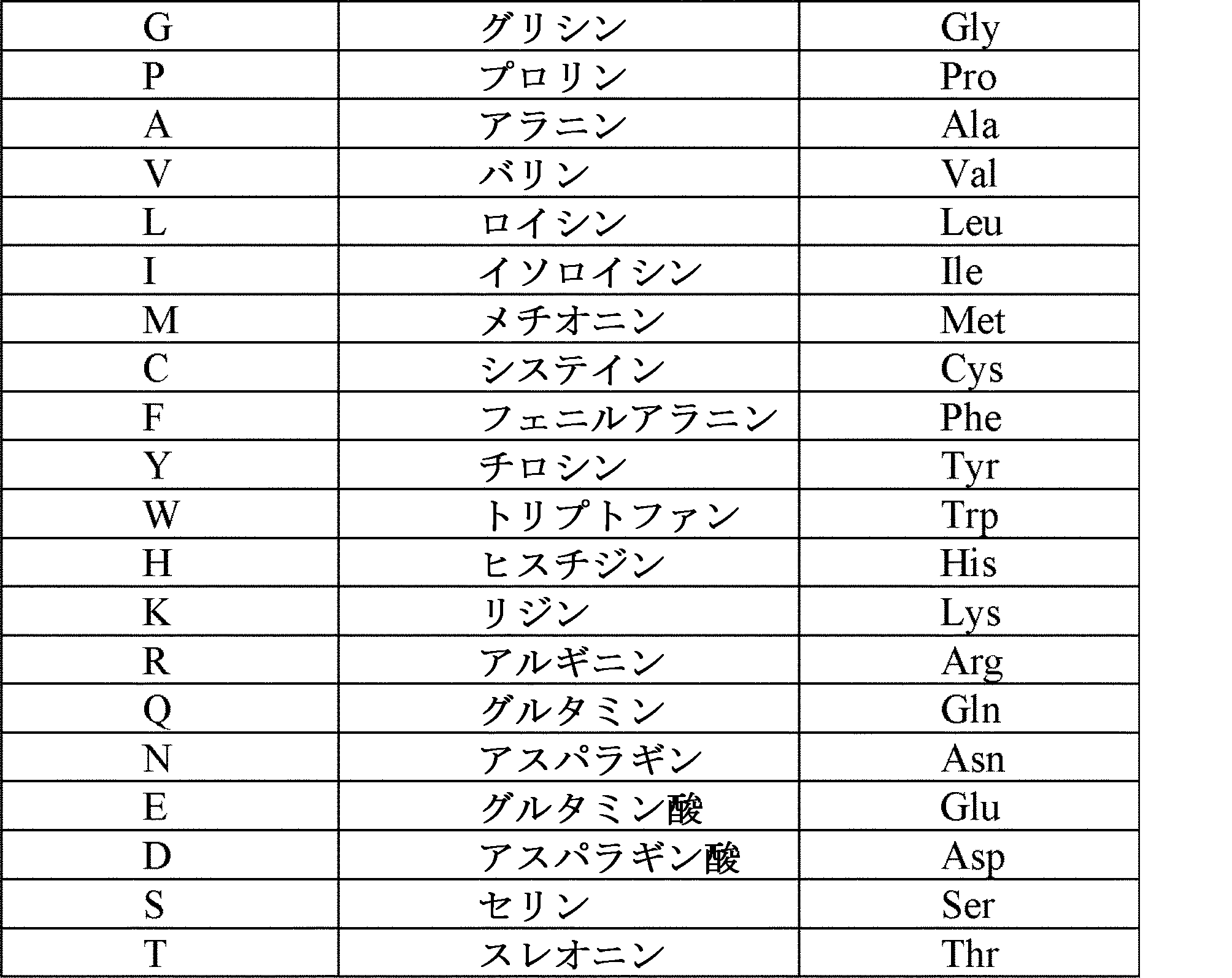
本開示全体を通して、アミノ酸は一文字表記または三文字表記に従って言及されると理解されよう。読者の便宜を図って、アミノ酸の一文字表記および三文字表記を表1に示した。 It will be understood that throughout this disclosure, amino acids will be referred to according to their single-letter or three-letter code. For the convenience of the reader, the single-letter and three-letter codes for amino acids are provided in Table 1.
(表1)アミノ酸の略称
分子生物学における標準的な方法が科学文献に記載されている(例えば、Sambrook and Russell (2001) Molecular Cloning, 3rd ed., Cold Spring Harbor Laboratory Press, Cold Spring Harbor, N.Y.;およびAusubel, et al. (2001) Current Protocols in Molecular Biology, Vols. 1-4, John Wiley and Sons, Inc. New York, N.Y. を参照されたい。これらは、細菌細胞におけるクローニングおよびDNA変異誘発(第1巻)、哺乳動物細胞および酵母におけるクローニング(第2巻)、グリココンジュゲートおよびタンパク質発現(第3巻)、ならびにバイオインフォマティクス(第4巻)について述べている)。科学文献は、免疫沈降、クロマトグラフィー、電気泳動、遠心分離、および結晶化、ならびに化学分析、化学修飾、翻訳後修飾、融合タンパク質の生成、およびタンパク質のグリコシル化を含むタンパク質精製方法について説明する(例えば、Coligan, et al. (2000) Current Protocols in Protein Science, Vols. 1-2, John Wiley and Sons, Inc., NYを参照されたい)。 Standard methods in molecular biology are described in the scientific literature (see, e.g., Sambrook and Russell (2001) Molecular Cloning, 3rd ed., Cold Spring Harbor Laboratory Press, Cold Spring Harbor, N.Y.; and Ausubel, et al. (2001) Current Protocols in Molecular Biology, Vols. 1-4, John Wiley and Sons, Inc. New York, N.Y., which describe cloning and DNA mutagenesis in bacterial cells (Vol. 1), cloning in mammalian cells and yeast (Vol. 2), glycoconjugates and protein expression (Vol. 3), and bioinformatics (Vol. 4)). The scientific literature describes protein purification methods including immunoprecipitation, chromatography, electrophoresis, centrifugation, and crystallization, as well as chemical analysis, chemical modification, post-translational modification, production of fusion proteins, and protein glycosylation (see, e.g., Coligan, et al. (2000) Current Protocols in Protein Science, Vols. 1-2, John Wiley and Sons, Inc., NY).
P40残基の番号付け:
本開示において、ヒトP40のアミノ酸残基の番号は、(SEQ ID NO:1)に示されるhP40の「プロ」型の数を基準として付けられている。本明細書に記載のムテインを基準として、本明細書中において置換は一文字アミノ酸コードに続いて、プロhp40(SEQ ID NO:1)アミノ酸位置に続いて、置換された一文字アミノ酸コードによって指定される。例えば、改変「E81A」を有するムテインは、この位置において、(SEQ ID NO:1)の位置81にあるグルタミン酸(E)残基がアラニン(A)残基で置換されていることを指す。アミノ酸残基の欠失は「des」または記号「Δ」に続いてアミノ酸残基およびその位置で示される。
P40 residue numbering:
In this disclosure, the numbering of amino acid residues in human P40 is based on the number of the "pro" form of hP40 as shown in (SEQ ID NO:1). Based on the muteins described herein, substitutions are designated herein by the single letter amino acid code followed by the prohp40 (SEQ ID NO:1) amino acid position followed by the single letter amino acid code of the substituted amino acid. For example, a mutein having the modification "E81A" refers to a substitution of an alanine (A) residue for the glutamic acid (E) residue at position 81 of (SEQ ID NO:1) at this position. Deletions of amino acid residues are indicated by "des" or the symbol "Δ" followed by the amino acid residue and its position.
定義
特に定めのない限り、以下の用語は、以下に示された意味を有することが意図される。他の用語は本明細書全体を通して他の箇所で定義される。
Definitions Unless otherwise specified, the following terms are intended to have the meanings indicated below. Other terms are defined elsewhere throughout the specification.
「約」という用語は、本明細書に記載の数値のプラスまたはマイナス10%、例えば、本明細書に記載の数値のプラスまたはマイナス1%、2%、3%、4%、5%、6%、7%、8%、9%、または10%である値を指す。「約」という用語はまた、本明細書に記載の全ての数値範囲にも適用される。「約」という用語が、ある特定の値に関して明示的に列挙されていても、列挙されていなくても、本明細書に記載の全ての値が「約」という用語によって修飾されると理解される。 The term "about" refers to values that are plus or minus 10% of a numerical value described herein, e.g., plus or minus 1%, 2%, 3%, 4%, 5%, 6%, 7%, 8%, 9%, or 10% of a numerical value described herein. The term "about" also applies to all numerical ranges described herein. All values described herein are understood to be modified by the term "about," whether or not the term "about" is explicitly recited with respect to a particular value.
活性化する:
本明細書で使用する「活性化する」という用語は、受容体または受容体複合体について、直接的に、および/またはアゴニストリガンドと、リガンド結合に応答する受容体との結合から生じた多成分シグナル伝達カスケードへの関与によって生物学的効果を反映するために用いられる。活性化するという用語はまた、このような受容体に対するリガンドの結合に応答して、細胞のもう1つの生物学的活性が調整される(例えば、STAT4シグナル伝達のアップレギュレーションまたはダウンレギュレーション)、受容体を発現する細胞について用いられる。
Activate:
As used herein, the term "activate" is used to reflect the biological effect of a receptor or receptor complex, directly and/or by participating in a multi-component signal transduction cascade resulting from the binding of an agonist ligand to the receptor in response to ligand binding. The term activate is also used for cells expressing receptors in which another biological activity of the cell is modulated in response to the binding of a ligand to such receptor (e.g., up-regulation or down-regulation of STAT4 signal transduction).
活性:
本明細書で使用する「活性」という用語は、分子について、試験系(例えば、アッセイ)に関する分子の特性、あるいは材料もしくは細胞の生物学的性質もしくは化学的性質(例えば、分子と別の分子の結合の程度)または物理的性質(例えば、細胞膜電位の改変)を説明するために用いられる。このような生物学的機能の例には、生物学的剤の触媒活性、細胞内シグナル伝達、遺伝子発現、細胞増殖を刺激する能力、および、炎症応答などの免疫学的活性を調整する能力が含まれるが、これに限定されない。「活性」は、典型的に、試験剤の単位あたりの生物学的活性レベル、例えば、[触媒活性]/[mgタンパク質]、[免疫学的活性]/[mgタンパク質]、活性の国際単位(IU)、[STAT3リン酸化]/[mgタンパク質]、[STAT4リン酸化]/[mgタンパク質]、[増殖]/[mgタンパク質]、プラーク形成単位(pfu)などで表される。本明細書で使用する増殖活性という用語は、調節不全になった細胞分裂、例えば、新生物疾患、炎症性疾患、線維症、異形成、細胞トランスフォーメーション、転移、および血管形成において観察される、調節不全になった細胞分裂を含む、細胞増殖および複製を促進する活性を指す。
Active:
As used herein, the term "activity" is used to describe the properties of a molecule in relation to a test system (e.g., an assay), or the biological or chemical properties (e.g., the degree of binding of the molecule to another molecule) or physical properties (e.g., alteration of cell membrane potential) of a material or cell. Examples of such biological functions include, but are not limited to, the catalytic activity of a biological agent, its ability to stimulate intracellular signaling, gene expression, cell proliferation, and its ability to modulate immunological activities, such as inflammatory responses. "Activity" is typically expressed as the level of biological activity per unit of a test agent, such as [catalytic activity]/[mg protein], [immunological activity]/[mg protein], international units of activity (IU), [STAT3 phosphorylation]/[mg protein], [STAT4 phosphorylation]/[mg protein], [proliferation]/[mg protein], plaque forming units (pfu), etc. The term proliferative activity, as used herein, refers to activity that promotes cell growth and replication, including dysregulated cell division, e.g., that observed in neoplastic diseases, inflammatory diseases, fibrosis, metaplasia, cell transformation, metastasis, and angiogenesis.
投与する/投与:
「投与」および「投与する」という用語は、インビトロ、インビボ、またはエクスビボで対象の細胞、組織、臓器、または生物学的液体を、剤(例えば、改変されたhIL-12p40ポリペプチド、改変されたhIL-12p40ポリペプチドを含むhIL-12ムテイン、または改変されたhIL-12p40ポリペプチドを含むhIL-23ムテイン;改変されたhIL-12p40ポリペプチドを発現する操作された細胞、改変されたhIL-12p40ポリペプチドを含むhIL-12ムテインを発現する操作された細胞、または改変されたhIL-12p40ポリペプチドを含むhIL-23ムテインを発現する操作された細胞;あるいは、化学療法剤、抗体、または前述の1つもしくは複数を含む薬学的製剤)と、単独でのまたは1つもしくは複数の補助剤と組み合わせての接触を含む、対象に接触する行為を指すために本明細書において互換的に用いられる。剤の投与は、局部投与、血管内注射(静脈内注入または動脈内注入を含む)、皮内注射、皮下注射、筋肉内注射、腹腔内注射、頭蓋内注射、腫瘍内注射、経皮送達、経粘膜送達、イオントフォレーシス送達、リンパ内注射、胃内注入、前立腺内注射、膀胱内注入(例えば、膀胱)、吸入(例えば、ドライパウダー吸入器を含む呼吸器用吸入器)、眼内注射、腹腔内注射、病巣内注射、卵巣内注射、脳内注入または脳内注射、脳室内注射(ICVI)などを含むが、これに限定されない、当技術分野において認められている様々な方法のどれでも成し遂げることができる。「投与」という用語は、剤と細胞、組織、または臓器との接触、ならびに剤と、細胞、組織、または臓器と接触している液体との接触を含む。
Administer/Administer:
The terms "administration" and "administering" are used interchangeably herein to refer to the act of contacting a subject's cells, tissues, organs, or biological fluids in vitro, in vivo, or ex vivo, including contacting the subject's cells, tissues, organs, or biological fluids with an agent (e.g., a modified hIL-12p40 polypeptide, a hIL-12 mutein comprising a modified hIL-12p40 polypeptide, or a hIL-23 mutein comprising a modified hIL-12p40 polypeptide; engineered cells expressing a modified hIL-12p40 polypeptide, engineered cells expressing a hIL-12 mutein comprising a modified hIL-12p40 polypeptide, or engineered cells expressing a hIL-23 mutein comprising a modified hIL-12p40 polypeptide; or a chemotherapeutic agent, an antibody, or a pharmaceutical formulation comprising one or more of the foregoing), alone or in combination with one or more adjuvants. Administration of the agent can be accomplished by any of a variety of methods recognized in the art, including, but not limited to, local administration, intravascular injection (including intravenous or intraarterial infusion), intradermal injection, subcutaneous injection, intramuscular injection, intraperitoneal injection, intracranial injection, intratumoral injection, transdermal delivery, transmucosal delivery, iontophoretic delivery, intralymphatic injection, intragastric injection, intraprostatic injection, intravesical injection (e.g., bladder), inhalation (e.g., respiratory inhaler, including dry powder inhaler), intraocular injection, intraperitoneal injection, intralesional injection, intraovarian injection, intracerebral infusion or injection, intraventricular injection (ICVI), etc. The term "administration" includes contact of the agent with a cell, tissue, or organ, as well as contact of the agent with a fluid in contact with a cell, tissue, or organ.
親和性:
本明細書で使用する「親和性」という用語は、第1の分子(例えば、リガンド)と第2の分子(例えば、受容体)との特異的結合の程度を指し、分子とその標的の解離速度定数(Koff)と、分子とその標的の会合速度定数(Kon)の比である平衡解離定数(KD)によって測定される。
Affinity:
The term "affinity" as used herein refers to the degree of specific binding between a first molecule (e.g., a ligand) and a second molecule (e.g., a receptor) and is measured by the equilibrium dissociation constant (KD), which is the ratio of the dissociation rate constant (Koff) of the molecule to its target and the association rate constant (Kon) of the molecule to its target.
アゴニスト:
本明細書で使用する「アゴニスト」という用語は、第2の剤(「標的」)に特異的に結合し、標的と相互作用して標的の活性化の増加を引き起こすか、または促進する第1の剤を指す。場合によっては、アゴニストは、細胞活性化を調整する、活性化を強化する、第2の剤による活性化に対する細胞の感受性を増加させる、あるいは細胞増殖または経路または細胞周期の改変をもたらす可能性のある1つもしくは複数の遺伝子、タンパク質、リガンド、受容体、生物学的経路、の発現をアップレギュレートする、受容体タンパク質のアクチベーターである。一部の態様では、アゴニストは、天然コグネイトリガンドとそのコグネイト受容体との相互作用の生物学的効果を模倣する生物学的応答において、そのコグネイト受容体に結合し、かつ、コグネイト受容体の状態を変える、コグネイトリガンドの改変型である。「アゴニスト」という用語は、部分的アゴニスト、完全アゴニスト、およびスーパーアゴニストを含む。アゴニストは、このようなアゴニストが、研究中の受容体によって誘導される実質的に完全な生物学的応答(すなわち、天然リガンド/受容体結合相互作用に関連する応答)につながる時に「完全アゴニスト」と呼ばれてもよく、部分的アゴニストと呼ばれてもよい。「スーパーアゴニスト」は、標的受容体に対して内因性アゴニストを超える最大応答を生じることができ、従って、ネイティブリガンドの100%超の活性を有するアゴニストの一種である。スーパーアゴニストは、典型的には、比較可能なアッセイにおいて類似濃度で評価された時、天然型分子の評価可能な定量パラメータまたは定性パラメータの応答の110%超、あるいは120%超、あるいは130%超、あるいは140%超、あるいは150%超、あるいは160%超、または170%超を示す合成分子である。完全アゴニストに関連する生物学的効果は、程度および/または種類の点で、部分的アゴニストまたはスーパーアゴニストの生物学的効果と異なる場合があることに留意すべきである。アゴニストとは対照的に、アンタゴニストは受容体に特異的に結合し得るが、シグナルカスケード、典型的には、受容体によって始まるシグナルカスケードを引き起こさず、その受容体におけるアゴニスト作用を改変してもよい。インバースアゴニストは、アゴニストの薬理学的応答とは向きが逆の薬理学的応答を生じる剤である。
Agonists:
The term "agonist" as used herein refers to a first agent that specifically binds to a second agent ("target") and interacts with the target to cause or promote increased activation of the target. In some cases, agonists are receptor protein activators that modulate cell activation, enhance activation, increase cell sensitivity to activation by a second agent, or upregulate the expression of one or more genes, proteins, ligands, receptors, biological pathways that may result in cell proliferation or pathway or cell cycle modification. In some embodiments, agonists are modified forms of cognate ligands that bind to their cognate receptors and change the state of the cognate receptor in a biological response that mimics the biological effect of the interaction between the natural cognate ligand and its cognate receptor. The term "agonist" includes partial agonists, full agonists, and superagonists. Agonists may be referred to as "full agonists" or partial agonists when such agonists lead to substantially the complete biological response induced by the receptor under study (i.e., the response associated with the natural ligand/receptor binding interaction). A "superagonist" is a type of agonist that can generate a maximal response that exceeds that of the endogenous agonist at the target receptor, and thus has more than 100% activity of the native ligand. A superagonist is typically a synthetic molecule that exhibits more than 110%, or more than 120%, or more than 130%, or more than 140%, or more than 150%, or more than 160%, or more than 170% of the response of an assessable quantitative or qualitative parameter of the native molecule when evaluated at similar concentrations in a comparable assay. It should be noted that the biological effects associated with a full agonist may differ in extent and/or type from those of a partial agonist or superagonist. In contrast to agonists, antagonists may specifically bind to a receptor but do not trigger a signal cascade, typically one that is initiated by the receptor, and may alter the action of an agonist at that receptor. An inverse agonist is an agent that produces a pharmacological response that is opposite in direction to that of an agonist.
アンタゴニスト:
本明細書で使用する「アンタゴニスト」または「インヒビター」という用語は、アゴニストの作用に対抗する分子を指す。アンタゴニストはアゴニストの活性を阻止する、低減する、阻害する、または中和し、特定されたアゴニストがない場合でも、アンタゴニストは標的、例えば、標的受容体の構成的活性も阻止する、阻害する、または低減することもできる。インヒビターは、例えば、遺伝子、タンパク質、リガンド、受容体、免疫チェックポイント経路を含む生物学的経路、または細胞の活性化を減少させる、ブロックする、阻止する、遅延するか、遺伝子、タンパク質、リガンド、受容体、免疫チェックポイント経路を含む生物学的経路、または細胞を不活化する、脱感作する、またはダウンレギュレートする分子である。
Antagonists:
The term "antagonist" or "inhibitor" as used herein refers to a molecule that opposes the action of an agonist.Antagonists block, reduce, inhibit, or neutralize the activity of agonists, and antagonists can also block, inhibit, or reduce the constitutive activity of targets, such as target receptors, even in the absence of a specified agonist.An inhibitor is, for example, a molecule that reduces, blocks, prevents, delays, or inactivates, desensitizes, or downregulates the activation of a biological pathway, including a gene, protein, ligand, receptor, immune checkpoint pathway, or cell.
生物学的試料:
本明細書で使用する「生物学的試料」または「試料」という用語は、対象から得られた(または対象に由来する)試料を指す。例として、生物学的試料は、体液、血液、全血、血漿、血清、粘液分泌物、唾液、脳脊髄液(CSF)、気管支肺胞洗浄液(BALF)、眼の液体(例えば、硝子体液、眼房水)、リンパ液、リンパ節組織、脾臓組織、骨髄、腫瘍組織からなる群より選択される材料を、このような組織の1つまたは複数に由来する免疫グロブリンが濃縮された画分または細胞タイプ特異的な、濃縮された画分を含めて含む。
Biological samples:
As used herein, the term "biological sample" or "sample" refers to a sample obtained (or derived) from a subject. By way of example, a biological sample includes material selected from the group consisting of bodily fluids, blood, whole blood, plasma, serum, mucous secretions, saliva, cerebrospinal fluid (CSF), bronchoalveolar lavage fluid (BALF), ocular fluids (e.g., vitreous humor, aqueous humor), lymphatic fluid, lymph node tissue, spleen tissue, bone marrow, tumor tissue, including immunoglobulin-enriched or cell type-specific enriched fractions derived from one or more of such tissues.
同等の:
本明細書で使用する「同等の」という用語は、評価可能な定量パラメータまたは定性パラメータの2つの測定値の違いの程度を説明するために用いられる。例えば、評価可能な定量パラメータの第1の測定値と、評価可能なパラメータの第2の測定値が、この状況で2つの結果の間で効果の統計的有意差を生じないと当業者が認識する範囲を超えて逸脱しない場合、2つの測定値は「同等」だとみなされるだろう。場合によっては、ある測定値が、別の測定値から35%未満、あるいは30%未満、あるいは25%未満、あるいは20%未満、あるいは15%未満、あるいは10%未満、あるいは7%未満、あるいは5%未満、あるいは4%未満、あるいは3%未満、あるいは2%未満、または1%未満逸脱すれば、測定値は「同等」だとみなされることがある。特定の態様では、ある測定値が標準品から15%未満、あるいは10%未満、または5%未満逸脱すれば標準品と同等になる。
Equivalent:
The term "comparable" as used herein is used to describe the degree of difference between two measurements of an evaluable quantitative or qualitative parameter. For example, two measurements would be considered "comparable" if a first measurement of an evaluable quantitative parameter and a second measurement of an evaluable parameter do not deviate beyond what a person skilled in the art would recognize as not producing a statistically significant difference in effect between the two outcomes in this situation. In some cases, measurements may be considered "comparable" if one measurement deviates from another measurement by less than 35%, alternatively less than 30%, alternatively less than 25%, alternatively less than 20%, alternatively less than 15%, alternatively less than 10%, alternatively less than 7%, alternatively less than 5%, alternatively less than 4%, alternatively less than 3%, alternatively less than 2%, or alternatively less than 1%. In certain embodiments, a measurement is comparable to a standard if it deviates from the standard by less than 15%, alternatively less than 10%, or alternatively less than 5%.
保存的アミノ酸置換:
本明細書で使用する「保存的アミノ酸置換」という用語は、ある特定のアミノ酸が、同様の生化学的特性(例えば、電荷、疎水性、およびサイズ)を有する別のアミノ酸に変化するアミノ酸交換を指す。例えば、以下の各グループにあるアミノ酸:(1)疎水性アミノ酸:アラニン、イソロイシン、ロイシン、トリプトファン、フェニルアラニン、バリン、プロリン、およびグリシン;(2)極性アミノ酸:グルタミン、アスパラギン、ヒスチジン、セリン、スレオニン、チロシン、メチオニン、およびシステイン;(3)塩基性アミノ酸:リジン、およびアルギニン;ならびに(4)酸性アミノ酸:アスパラギン酸およびグルタミン酸は互いの保存的アミノ酸とみなされる。
Conservative Amino Acid Substitutions:
As used herein, the term "conservative amino acid substitution" refers to an amino acid exchange in which a particular amino acid is changed to another amino acid having similar biochemical properties (e.g., charge, hydrophobicity, and size). For example, amino acids in each of the following groups are considered to be conservative amino acids of each other: (1) hydrophobic amino acids: alanine, isoleucine, leucine, tryptophan, phenylalanine, valine, proline, and glycine; (2) polar amino acids: glutamine, asparagine, histidine, serine, threonine, tyrosine, methionine, and cysteine; (3) basic amino acids: lysine and arginine; and (4) acidic amino acids: aspartic acid and glutamic acid.
~に対応する:
アミノ酸配列または核酸配列の文脈において本明細書で使用する「対応」または「~に対応する」という用語は、配列同一性のパーセントを最大にするように1つまたは複数の他の配列とアラインメントされた参照配列の同等の位置を指す。例えば、指定されたhIL-12p40ポリペプチドの「アミノ酸位置[X]に対応するアミノ酸位置」は、アラインメントに基づいた、構造的ホモログおよびバリアントを含む他のhIL-12p40ポリペプチドにおける同等の位置を指す。対応する位置は、参照、野生型、または親配列、例えば、SEQ ID NO:1のアミノ酸配列に基づいてもよい。
Corresponding to:
The term "corresponding" or "corresponding to" as used herein in the context of amino acid or nucleic acid sequences refers to the equivalent position of a reference sequence aligned with one or more other sequences to maximize the percent sequence identity. For example, the "amino acid position corresponding to amino acid position [X]" of a specified hIL-12p40 polypeptide refers to the equivalent position in other hIL-12p40 polypeptides, including structural homologs and variants, based on the alignment. The corresponding position may be based on the amino acid sequence of a reference, wild-type, or parent sequence, e.g., SEQ ID NO:1.
~に由来する:
本明細書で使用する「~に由来する」という用語はアミノ酸配列または核酸の文脈では、ポリペプチドまたは核酸が、参照ポリペプチドまたは核酸の配列に基づいた配列を有することを示すために使用され、タンパク質または核酸を作製する供給源または方法に関して限定するものであることを目的としない。例として、「~に由来する」という用語は参照アミノ酸配列またはDNA配列のホモログまたはバリアントを含む。
Derived from:
As used herein, the term "derived from" in the context of an amino acid sequence or nucleic acid is used to indicate that a polypeptide or nucleic acid has a sequence based on a reference polypeptide or nucleic acid sequence, and is not intended to be limiting with respect to the source or method of making the protein or nucleic acid. By way of example, the term "derived from" includes homologs or variants of the reference amino acid or DNA sequence.
有効濃度(EC):
本明細書で使用する「有効濃度」という用語またはその略称「EC」は、試験系において、ある特定のパラメータを変えるのに十分な量の剤濃度を指すために互換的に用いられる。略称「E」は、試験系が試験剤に暴露された時、この試験系において観察される、ある特定の生物学的効果の大きさを指す。応答の大きさが試験剤の濃度(「C」)の因子として表される場合、略称「EC」が用いられる。生物系の文脈では、Emaxという用語は、活性化試験剤の飽和濃度に応答して観察された、ある特定の生物学的効果の最大の大きさを指す。略称ECが下付き文字と共に示された場合(例えば、EC40、EC50など)、下付き文字は、この濃度で観察された、生物学的応答のEmaxのパーセントを指す。例えば、このような試験剤に応答した、このような測定可能な生物学的パラメータの最大レベルの30%である、試験系において測定可能な生物学的パラメータを誘導するのに十分な試験剤の濃度は、このような生物学的パラメータについて試験剤の「EC30」と呼ばれる。同様に、「EC100」という用語は、このような剤に応答して、測定可能なパラメータの最大(100%)応答をもたらす剤の有効濃度を示すのに用いられる。同様に、(薬物動力学の分野で一般的に用いられる)EC50という用語は、測定可能なパラメータの最大半量(約50%)変化をもたらすのに十分な剤の濃度を指す。「飽和濃度」という用語は、温度および圧力の標準的な条件下で標準的な体積の特定の溶媒(例えば、水)に溶解することができる、試験剤の最大限の量を指す。薬物動力学では、薬物の飽和濃度は、典型的には、全ての利用可能な受容体が薬物によって占有されるような、薬物の十分な濃度を示すために用いられ、EC50は、最大半量効果を生じる薬物濃度である。
Effective concentration (EC):
As used herein, the term "effective concentration" or its abbreviation "EC" is used interchangeably to refer to an agent concentration sufficient to change a particular parameter in a test system. The abbreviation "E" refers to the magnitude of a particular biological effect observed in a test system when the test system is exposed to a test agent. The abbreviation "EC" is used when the magnitude of the response is expressed as a factor of the concentration ("C") of the test agent. In the context of a biological system, the term Emax refers to the maximum magnitude of a particular biological effect observed in response to a saturating concentration of an activating test agent. When the abbreviation EC is presented with a subscript (e.g., EC40 , EC50 , etc.), the subscript refers to the percentage of the Emax of the biological response observed at this concentration. For example, a concentration of a test agent sufficient to induce a measurable biological parameter in a test system that is 30% of the maximum level of such measurable biological parameter in response to such test agent is referred to as the " EC30 " of the test agent for such biological parameter. Similarly, the term "EC 100 " is used to indicate the effective concentration of an agent that produces a maximum (100%) response of a measurable parameter in response to such an agent. Similarly, the term EC 50 (commonly used in the field of pharmacokinetics) refers to the concentration of an agent sufficient to produce a half-maximal (approximately 50%) change in a measurable parameter. The term "saturation concentration" refers to the maximum amount of a test agent that can be dissolved in a standard volume of a particular solvent (e.g., water) under standard conditions of temperature and pressure. In pharmacokinetics, the saturation concentration of a drug is typically used to indicate a sufficient concentration of a drug such that all available receptors are occupied by the drug, and EC 50 is the drug concentration that produces a half-maximal effect.
濃縮された:
本明細書で使用する「濃縮された」という用語は、(a)関心対象の種が、出発試料、例えば、生物学的試料(例えば、分子が天然に存在する試料、もしくは投与後に存在する試料)中にある種の濃度よりも高い(例えば、少なくとも3倍、あるいは少なくとも5倍、あるいは少なくとも10倍、あるいは少なくとも50倍、あるいは少なくとも100倍、または少なくとも1000倍の)濃度で、または(b)分子が作られた環境(例えば、組換えにより改変された細菌細胞もしくは哺乳動物細胞)よりも高い濃度で存在するように非天然に操作された、関心対象の種(例えば分子または細胞)を含む試料を指す。
Concentrated:
The term "enriched" as used herein refers to a sample that contains a species of interest (e.g., a molecule or cell) that is (a) present at a concentration that is greater (e.g., at least 3-fold, alternatively at least 5-fold, alternatively at least 10-fold, alternatively at least 50-fold, alternatively at least 100-fold, or alternatively at least 1000-fold) than the concentration of the species in a starting sample, e.g., a biological sample (e.g., a sample in which the molecule naturally occurs or is present following administration), or (b) that has been non-naturally engineered to be present at a greater concentration than the environment in which the molecule was made (e.g., recombinantly modified bacterial or mammalian cells).
細胞外ドメイン:
本明細書で使用する「細胞外ドメイン」という用語またはその略称「ECD」は、表面でそれが発現している細胞の原形質膜の外側にある細胞表面タンパク質の部分を指す。細胞表面タンパク質およびECDは、膜貫通タンパク質、細胞表面タンパク質、または、細胞膜に結合しているが細胞内ドメインを欠いているドメインを含む膜結合タンパク質でもよい。
Extracellular domain:
As used herein, the term "extracellular domain" or its abbreviation "ECD" refers to the portion of a cell surface protein that is outside the plasma membrane of the cell on whose surface it is expressed. Cell surface proteins and ECDs may be transmembrane proteins, cell surface proteins, or membrane-bound proteins that contain a domain that is attached to the cell membrane but lacks an intracellular domain.
同一性:
ポリペプチド配列またはDNA配列に関して本明細書で使用する「同一性」という用語は、2つの分子間のサブユニット配列同一性を指す。両分子のサブユニット位置が同じアミノ酸またはヌクレオチドによって占有される場合、この分子は、その位置で同一である。2つのアミノ酸配列間または2つのヌクレオチド配列間の類似性は、同一の位置の数の一次関数である。一般的に、これらの配列は最高次数のマッチが得られるようにアラインメントされる。必要に応じて、同一性は、公開された技法と、Altschul et al. (1990) J. Mol. Biol. 215: 403-410およびAltschul, et al. (1977) Nucleic Acids Res. 25: 3389-3402に記載されているBLAST 2.0 アルゴリズムなどの広く利用可能なコンピュータプログラムを用いて計算することができる。BLAST解析を行うためのソフトウェアは米バイオテクノロジー情報センター(National Center for Biotechnology Information)(NCBI)のウェブサイトを通じて公的に入手することができる。このアルゴリズムは、最初に、データベース配列中の同じ長さのワードとアラインメントした時に正の値の閾値スコア「T」にマッチまたは適合する、クエリー配列中の長さWの短いワードを特定することによって、高スコア配列対(high scoring sequence pair)(HSP)を特定することを伴う。Tは隣接ワードスコア閾値(neighborhood word score threshold)(Altschul et.al.,前出)と呼ばれる。これらの最初の隣接ワードヒットは、それらを含むさらに長いHSPsを発見する検索を開始するためのシードとして働く。次いで、このワードヒットは、累積アラインメントスコアが増加する限り、それぞれの配列に沿って両方向に延長される。累積スコアは、ヌクレオチド配列の場合、パラメータ「M」(一対のマッチ残基のリワードスコア;常に、>0)および「N」(ミスマッチ残基のペナルティースコア;常に、<0)を用いて計算される。アミノ酸配列の場合、累積スコアを計算するためにスコアリング行列が用いられる。(a)累積アラインメントスコアが、その達成される最大値から量Xだけ減少した時に;1つもしくは複数の負のスコアの残基アラインメントの蓄積のために累積スコアが0もしくはそれ以下になった時に;または(b)いずれかの配列の端部に到達した時に、各方向でのワードヒットの延長は止まる。BLASTアルゴリズムパラメータ「W」、「T」、および「X」はアラインメントの感度と速度を決定する。BLASTNプログラム(ヌクレオチド配列の場合)は同じように機能するが、デフォルトとして、28のワードサイズ(「W」)、10の期待値(「E」)、M=1、N=-2、および両鎖の比較を使用する。アミノ酸配列の場合、BLASTPプログラムは、デフォルトとして、3のワードサイズ(W)、10の期待値(E)、およびBLOSUM62スコアリング行列(Henikoff & Henikoff, (1989) PNAS(USA) 89:10915-10919を参照のこと)を使用する。
Identities:
The term "identity" as used herein with respect to a polypeptide sequence or a DNA sequence refers to the subunit sequence identity between two molecules. If a subunit position of both molecules is occupied by the same amino acid or nucleotide, the molecules are identical at that position. The similarity between two amino acid sequences or between two nucleotide sequences is a linear function of the number of identical positions. Generally, the sequences are aligned to obtain the highest order match. If necessary, identity can be calculated using published techniques and widely available computer programs such as the BLAST 2.0 algorithm described in Altschul et al. (1990) J. Mol. Biol. 215: 403-410 and Altschul, et al. (1977) Nucleic Acids Res. 25: 3389-3402. Software for performing BLAST analyses is publicly available through the National Center for Biotechnology Information (NCBI) website. The algorithm involves first identifying high scoring sequence pairs (HSPs) by identifying short words of length W in the query sequence that match or match a positive threshold score "T" when aligned with words of the same length in a database sequence. T is called the neighborhood word score threshold (Altschul et.al., supra). These initial neighborhood word hits act as seeds to initiate searches to find longer HSPs containing them. The word hits are then extended in both directions along each sequence for as far as the cumulative alignment score can be increased. The cumulative score is calculated using the parameters "M" (reward score for a pair of matching residues; always >0) and "N" (penalty score for mismatching residues; always <0) for nucleotide sequences. For amino acid sequences, a scoring matrix is used to calculate the cumulative score. Extension of word hits in each direction stops when: (a) the cumulative alignment score falls by an amount X from its maximum achieved value; when the cumulative score becomes zero or less due to the accumulation of one or more negative-scoring residue alignments; or (b) the end of either sequence is reached. The BLAST algorithm parameters "W", "T", and "X" determine the sensitivity and speed of the alignment. The BLASTN program (for nucleotide sequences) works similarly, but uses as defaults a word size ("W") of 28, an expectation ("E") of 10, M=1, N=-2, and a comparison of both strands. For amino acid sequences, the BLASTP program uses as defaults a word size (W) of 3, an expectation (E) of 10, and the BLOSUM62 scoring matrix (see Henikoff & Henikoff, (1989) PNAS(USA) 89:10915-10919).
応答をもたらすのに十分な量で:
本明細書で使用する「応答を引き起こすのに十分な量で」という句は、試験剤を試験系に適用する前に測定された指標のレベル(例えば、ベースラインレベル)と、適用した後に測定された指標のレベルの検出可能な変化をもたらすのに十分な剤の量に関して用いられる。一部の態様では、試験系は、細胞、組織、または生物である。一部の態様では、試験系は、蛍光アッセイなどのインビトロ試験系である。一部の態様では、試験系は、試験剤を細胞、組織、または生物に適用する前の生物学的機能と、適用した後の生物学的機能を反映する、細胞、組織、または生物のパラメータレベルの変化の測定を伴うインビボ系である。一部の態様では、指標は、ある量の試験剤の投与に応答した、アッセイにおいて評価された細胞の生物学的機能または発達状態を反映する。一部の態様では、試験系は、1種類または複数種の試験剤を細胞、組織、または生物に適用する前の生物学的状態と、適用した後の生物学的状態を反映する細胞、組織、または生物の指標レベル変化の測定を伴う。「応答をもたらすのに十分な量で」という用語は治療有効量で十分な場合があるが、治療有効量よりも多くてもよく、少なくてもよい。
In sufficient quantity to bring about a response:
As used herein, the phrase "in an amount sufficient to elicit a response" refers to an amount of agent sufficient to produce a detectable change in the level of an indicator measured before and after application of the test agent to the test system (e.g., a baseline level). In some embodiments, the test system is a cell, tissue, or organism. In some embodiments, the test system is an in vitro test system, such as a fluorescent assay. In some embodiments, the test system is an in vivo system that involves measuring changes in the level of a parameter of a cell, tissue, or organism that reflects the biological function before and after application of the test agent to the cell, tissue, or organism. In some embodiments, the indicator reflects the biological function or developmental state of the cell evaluated in the assay in response to administration of an amount of the test agent. In some embodiments, the test system involves measuring changes in the level of an indicator of a cell, tissue, or organism that reflects the biological state before and after application of one or more test agents to the cell, tissue, or organism. The term "in an amount sufficient to elicit a response" may be a therapeutically effective amount, but may be more or less than a therapeutically effective amount.
処置を必要とする:
本明細書で使用する「処置を必要とする」という用語は、対象が必要とするか、または処置から潜在的に利益を得る、対象に対して医師または他の介護者が下した判断を指す。この判断は、医師または介護者の専門知識の範囲内にある様々な要因に基づいて下される。一部の態様では、処置を必要とする対象は、疾患または状態、例えば、癌、自己免疫性障害、または感染症と診断されたことがある。
Needs action:
The term "in need of treatment" as used herein refers to the judgment made by a physician or other caregiver that the subject needs or will potentially benefit from treatment. This judgment is based on various factors within the expertise of the physician or caregiver. In some embodiments, the subject in need of treatment has been diagnosed with a disease or condition, such as cancer, an autoimmune disorder, or an infectious disease.
予防を必要とする:
本明細書で使用する「予防を必要とする」という用語は、対象が必要とするか、または予防的ケアから潜在的に利益を得る、対象に対して医師または他の介護者が下した判断を指す。この判断は、医師または介護者の専門知識の範囲内にある様々な要因に基づいて下される。一部の態様では、予防とは、特定の疾患の開始を低減するか、未然に防ぐか、または遅延すること、あるいは、例えば、その疾患の処置後に、特定の疾患の再発を低減するか、未然に防ぐか、または遅延することを指す。再発は、必ずしも、疾患の治癒または軽快の後である必要はない。症状が無い期間の後に、例えば、癌、自己免疫疾患、または感染症に対する処置後の期間に、1つまたは複数の臨床症状が再出現することが十分条件である。
Precautions required:
The term "in need of prevention" as used herein refers to the judgment of a doctor or other caregiver that the subject needs or potentially benefits from preventive care. This judgment is based on various factors within the expertise of the doctor or caregiver. In some embodiments, prevention refers to reducing, forestalling, or delaying the onset of a particular disease, or reducing, forestalling, or delaying the recurrence of a particular disease, for example, after the treatment of the disease. Recurrence does not necessarily have to be after the cure or remission of the disease. It is sufficient that one or more clinical symptoms reappear after a symptom-free period, for example, after the treatment period for cancer, autoimmune disease, or infectious disease.
インヒビター:
本明細書で使用する「インヒビター」という用語は、例えば、遺伝子、タンパク質、リガンド、受容体、または細胞の活性化を減少させる、ブロックする、阻止する、遅延するか、遺伝子、タンパク質、リガンド、受容体、または細胞を不活性化する、脱感作する、またはダウンレギュレートする分子を指す。インヒビターはまた、細胞または生物の構成的活性を低減する、ブロックする、または不活性化する分子と定義することもできる。
Inhibitors:
The term "inhibitor" as used herein refers to a molecule that, for example, reduces, blocks, prevents, delays the activation of a gene, protein, ligand, receptor, or cell, or inactivates, desensitizes, or downregulates a gene, protein, ligand, receptor, or cell. An inhibitor can also be defined as a molecule that reduces, blocks, or inactivates a constitutive activity of a cell or organism.
細胞内ドメイン:
本明細書で使用する「細胞内ドメイン」という用語またはその略語「ICD」は、細胞の原形質膜の内側にある、細胞表面タンパク質(例えば、細胞表面受容体)の部分を指す。ICDを含む細胞表面タンパク質は、膜貫通タンパク質、細胞膜に結合するドメインを含むが細胞外ドメインを欠く細胞表面タンパク質または膜結合タンパク質でもよい。ICDは膜貫通タンパク質もしくは膜結合タンパク質の細胞質部分全体を含んでもよく、細胞内タンパク質を含んでもよい。細胞表面タンパク質は、膜貫通タンパク質、細胞膜に結合するドメインを含むが細胞内ドメインを欠く細胞表面タンパク質または膜結合タンパク質でもよい。
Intracellular domain:
As used herein, the term "intracellular domain" or its abbreviation "ICD" refers to the portion of a cell surface protein (e.g., a cell surface receptor) that is inside the plasma membrane of a cell. A cell surface protein that comprises an ICD can be a transmembrane protein, a cell surface protein that comprises a domain that binds to the cell membrane but lacks an extracellular domain, or a membrane-bound protein. An ICD can comprise the entire cytoplasmic portion of a transmembrane or membrane-bound protein, or it can comprise an intracellular protein. A cell surface protein can be a transmembrane protein, a cell surface protein that comprises a domain that binds to the cell membrane but lacks an intracellular domain, or a membrane-bound protein.
単離された:
本明細書で使用する「単離された」という用語は、天然に存在するものであれば、天然に存在する環境とは異なる環境にある関心対象のポリペプチドに関して用いられる。「単離された」とは、関心対象のポリペプチドについて、かなり濃縮された、および/または関心対象のポリペプチドが部分的もしくは実質的に精製されている、試料中のポリペプチドを含むことが意図される。ポリペプチドが天然でない場合、「単離された」とは、ポリペプチドが、合成された環境から分離されていること、例えば、ポリペプチドを発現するように操作された細胞を含む組換え細胞培養物から単離されていること、または固相合成手段に起因する溶液によって単離されていることを示している。
Isolated:
The term "isolated" as used herein is used in reference to a polypeptide of interest that is in an environment different from the environment in which it naturally occurs, if it is naturally occurring. "Isolated" is intended to include a polypeptide in a sample that is substantially enriched for the polypeptide of interest and/or the polypeptide of interest is partially or substantially purified. If the polypeptide is not naturally occurring, "isolated" refers to the polypeptide being separated from the environment in which it was synthesized, for example, being isolated from a recombinant cell culture that includes cells that are engineered to express the polypeptide, or being isolated by a solution resulting from solid phase synthesis means.
リガンド:
本明細書で使用する「リガンド」という用語は、受容体に特異的に結合し、受容体の活性、またはその受容体を発現する細胞の応答を変えるように受容体に変化を引き起こす分子を指す。一態様では、「リガンド」という用語は、受容体のアゴニストまたはアンタゴニストとして働くことができる分子またはその複合体を指す。リガンドと受容体の複合体は「リガンド-受容体複合体」と呼ばれる(例えば、およびhIL-12-hIL-12受容体複合体)。一部の例では、「コグネイトリガンド」および「コグネイト受容体」という用語は、天然リガンドと、このようなリガンドが天然の生物系において選択的結合を示す受容体を示すために用いられる。例えば、hIL-12はhIL-12受容体に対するコグネイトリガンドである。別の例では、hIL-23はhIL-23受容体に対するコグネイトリガンドである。
Ligand:
The term "ligand" as used herein refers to a molecule that specifically binds to a receptor and induces a change in the receptor to alter the activity of the receptor or the response of a cell expressing that receptor. In one embodiment, the term "ligand" refers to a molecule or complex thereof that can act as an agonist or antagonist of the receptor. A complex of a ligand and a receptor is called a "ligand-receptor complex" (e.g., and hIL-12-hIL-12 receptor complex). In some instances, the terms "cognate ligand" and "cognate receptor" are used to refer to a natural ligand and a receptor to which such ligand shows selective binding in a natural biological system. For example, hIL-12 is a cognate ligand for the hIL-12 receptor. In another example, hIL-23 is a cognate ligand for the hIL-23 receptor.
改変された:
本明細書で使用する「改変された」という用語は、非改変親分子と比べて変化した構造をもつ分子、例えば、ポリペプチドを指す。改変されたポリペプチドは、典型的には、非改変親分子の1つまたは複数の活性または機能を保持している。例えば、改変されたIL-12 p40ポリペプチドは、ヘテロ二量体(すなわち、p35/p40複合体)の一部として、hIL-12受容体を発現している細胞においてhIL-12シグナル伝達を活性化することができるが、改変されていないポリペプチドと比べて改善された特性を有することができる。改変されたという用語は、親または野生型hIL-12に存在しないアミノ酸置換を含み、hIL-12 p40ポリペプチドのバリアントおよび変異体を含む。
Modified:
The term "modified" as used herein refers to a molecule, e.g., a polypeptide, that has an altered structure compared to an unmodified parent molecule. A modified polypeptide typically retains one or more activities or functions of the unmodified parent molecule. For example, a modified IL-12 p40 polypeptide, as part of a heterodimer (i.e., a p35/p40 complex), can activate hIL-12 signaling in cells expressing the hIL-12 receptor, but can have improved properties compared to an unmodified polypeptide. The term modified includes amino acid substitutions that are not present in the parent or wild-type hIL-12, and includes variants and mutants of the hIL-12 p40 polypeptide.
調整する:
本明細書で使用する「調整する」、「調整」などという用語は、剤、例えば、試験剤が、生物系を含む系または生化学的経路においてプラスもしくはマイナスの応答を引き起こすことができるか、または直接的もしくは間接的に応答を引き起こすことができることを指す。モジュレーターという用語は、アゴニスト(部分的アゴニスト、完全アゴニスト、およびスーパーアゴニストを含む)とアンタゴニストを両方とも含む。
Adjust:
As used herein, the terms "modulate,""modulation," and the like refer to an agent, e.g., a test agent, being capable of causing a positive or negative response, or directly or indirectly causing a response, in a system, including a biological system, or a biochemical pathway. The term modulator includes both agonists (including partial agonists, full agonists, and superagonists) and antagonists.
ムテイン:
本明細書で使用する「ムテイン」という用語は、天然hIL-12(すなわち、p35/p40複合体)またはhIL-23(すなわち、p19/p40複合体)のバリアント、すなわち、供給源である親の天然ヘテロ二量体hIL-12またはhIL-23の1つまたは複数の生物学的活性を保持しているヘテロ二量体を指す。本明細書に記載のhIL-12ムテインおよびhIL-23ムテインは、本明細書に記載の任意の改変されたhIL-12 p40ポリペプチドを含むことができる。
Mutein:
The term "mutein" as used herein refers to a variant of native hIL-12 (i.e., the p35/p40 complex) or hIL-23 (i.e., the p19/p40 complex), i.e., a heterodimer that retains one or more biological activities of the parent native heterodimeric hIL-12 or hIL-23 from which it is derived. The hIL-12 muteins and hIL-23 muteins described herein can include any modified hIL-12 p40 polypeptide described herein.
核酸:
「核酸」、「核酸分子」、「ポリヌクレオチド」などという用語は、デオキシリボヌクレオチドまたはリボヌクレオチドのいずれかの任意の長さのヌクレオチドのポリマー形態、またはその類似体を指すために本明細書において互換的に用いられる。ポリヌクレオチドの非限定的な例には、直鎖核酸および環状核酸、メッセンジャーRNA(mRNA)、相補的DNA(cDNA)、組換えポリヌクレオチド、ベクター、プローブ、プライマーなどが含まれる。
Nucleic Acids:
The terms "nucleic acid,""nucleic acid molecule,""polynucleotide," and the like are used interchangeably herein to refer to a polymeric form of nucleotides of any length, either deoxyribonucleotides or ribonucleotides, or analogs thereof. Non-limiting examples of polynucleotides include linear and circular nucleic acids, messenger RNA (mRNA), complementary DNA (cDNA), recombinant polynucleotides, vectors, probes, primers, and the like.
機能的に連結された:
「機能的に連結された」という用語は、成分分子の機能のそれぞれが保持されるように構築物内で並べられている分子、典型的にはポリペプチドまたは核酸の間の関係性を指すために本明細書において用いられるが、機能的に連結されることで構築物の個々の成分の活性をプラスまたはマイナスに調整することができる。例えば、ポリエチレングリコール(PEG)分子を野生型タンパク質に機能的に連結すると、そのタンパク質の生物学的活性(例えば、Emax)が野生型分子に対して減少した構築物が得られる可能性がある。しかしながら、それにもかかわらず2つは機能的に連結されているとみなされる。「機能的に連結された」という用語が、異なる機能をコードする複数の核酸配列の関係性に適用される時、複数の核酸配列が組み合わされて1本の核酸分子になった時に、例えば、この核酸分子が組換え技術を用いて細胞に導入された時に、細胞内で特定の核酸配列を転写および/または翻訳することができる核酸を提供する。例えば、ポリペプチドの分泌を容易にするシグナル配列をコードする核酸配列がプレタンパク質を発現するのであれば、ポリペプチドをコードするDNAに機能的に連結されているとみなされ得る。プロモーターまたはエンハンサーが配列の転写に影響を及ぼすのであればコード配列に機能的に連結されているとみなされる。または、リボソーム結合部位が翻訳を容易にするように配置されているのであれば、コード配列に機能的に連結されているとみなされる。概して、核酸分子の文脈では、「機能的に連結された」という用語は、連結されている核酸配列は連続しており、分子の分泌リーダーまたは結合されたサブドメインの場合では連続しており、かつリーディングフェーズ(reading phase)にあることを意味する。しかしながら、エンハンサーなどの、ある特定の遺伝因子は、これらが効果をもたらす配列から離れて機能することがあり、その配列に対して連続している必要はないが、それにもかかわらず機能的に連結されているとみなされ得る。
Functionally linked:
The term "operably linked" is used herein to refer to the relationship between molecules, typically polypeptides or nucleic acids, arranged in a construct such that the function of each of the component molecules is retained, but the operably linked may positively or negatively modulate the activity of the individual components of the construct. For example, operably linking a polyethylene glycol (PEG) molecule to a wild-type protein may result in a construct in which the biological activity (e.g., Emax) of that protein is reduced relative to the wild-type molecule. However, the two are nevertheless considered to be operably linked. When the term "operably linked" is applied to the relationship of multiple nucleic acid sequences encoding different functions, the multiple nucleic acid sequences, when combined into a single nucleic acid molecule, provide a nucleic acid capable of transcribing and/or translating a particular nucleic acid sequence in a cell, for example, when the nucleic acid molecule is introduced into a cell using recombinant techniques. For example, a nucleic acid sequence encoding a signal sequence that facilitates secretion of a polypeptide may be considered operably linked to the DNA encoding the polypeptide if it expresses a preprotein. A promoter or enhancer is considered operably linked to a coding sequence if it affects the transcription of the sequence. Alternatively, a sequence is considered operably linked to a coding sequence if the ribosome binding site is positioned to facilitate translation. Generally, in the context of nucleic acid molecules, the term "operably linked" means that the nucleic acid sequences being linked are contiguous, and in the case of a secretory leader or linked subdomain of the molecule, contiguous and in reading phase. However, certain genetic elements, such as enhancers, may function at a distance from the sequence they effect and need not be contiguous with that sequence, but may nevertheless be considered operably linked.
親ポリペプチド:
本明細書で使用する「親ポリペプチド」または「親タンパク質」という用語は、第1の「親」ポリペプチドに対して改変されている第2のポリペプチド(例えば、誘導体、変異体またはバリアント)の供給源を指定するために互換的に用いられる。場合によっては、親ポリペプチドは野生型または天然型のタンパク質である。場合によっては、親ポリペプチドは、さらに改変された、天然タンパク質の改変型でもよい。「親ポリペプチド」という用語は、ポリペプチドそのもの、または親ポリペプチド(例えば、グリコシル化型もしくはPEG化型および/または親ポリペプチドを含む融合タンパク質)を含む組成物を指すことがある。親ポリペプチドという用語はまた、「参照ポリペプチド」と互換的に用いられる。
Parent Polypeptide:
As used herein, the term "parent polypeptide" or "parent protein" is used interchangeably to designate the source of a second polypeptide (e.g., a derivative, mutant or variant) that is modified relative to a first "parent" polypeptide. In some cases, the parent polypeptide is a wild-type or naturally occurring protein. In some cases, the parent polypeptide may be a modified version of a naturally occurring protein that has been further modified. The term "parent polypeptide" may refer to the polypeptide itself or a composition that includes the parent polypeptide (e.g., a glycosylated or PEGylated version and/or a fusion protein that includes the parent polypeptide). The term parent polypeptide is also used interchangeably with "reference polypeptide."
部分的アゴニスト:
本明細書で使用する「部分的アゴニスト」という用語は、ある特定の受容体に特異的に結合し、活性化するが、完全アゴニストと比べて該受容体の部分的活性化しか有さない、分子(例えば、リガンド)を指す。部分的アゴニストはアゴニスト作用とアンタゴニスト作用を両方とも示すことがある。例えば、完全アゴニストと部分的アゴニストが両方とも存在する時に、部分的アゴニストは、受容体結合において完全アゴニストと競合し、その結果として、部分的アゴニストの非存在下での受容体と完全アゴニストとの接触と比べて受容体活性化を純減少させることによって競合的アンタゴニストとして作用する。不十分な量の内因性リガンドが存在する時に、部分的アゴニストは、対象において望ましい最大下応答を生じるように受容体を活性化するのに使用することができる。または、過剰量の内因性リガンドが存在する時に、部分的アゴニストは受容体の過剰刺激を低減することができる。部分的アゴニストによって生じる最大応答(Emax)は、その固有活性と呼ばれ、完全アゴニストが100%の応答を生じた場合のパーセントスケールで表されることがある。部分的アゴニストは、ある特定のアッセイ系において類似濃度で評価された時、参照ポリペプチドの活性の10%超であるが100%未満、あるいは20%超であるが100%未満、あるいは30%超であるが100%未満、あるいは40%超であるが100%未満、あるいは50%超であるが100%未満、あるいは60%超であるが100%未満、あるいは70%超であるが100%未満、あるいは80%超であるが100%未満、または90%超であるが100%未満を有してもよい。
Partial agonists:
The term "partial agonist" as used herein refers to a molecule (e.g., a ligand) that specifically binds to and activates a certain receptor, but has only partial activation of the receptor compared to a full agonist. A partial agonist may exhibit both agonistic and antagonistic effects. For example, when both a full agonist and a partial agonist are present, the partial agonist acts as a competitive antagonist by competing with the full agonist in receptor binding, thereby reducing the net activation of the receptor compared to the contact of the receptor with the full agonist in the absence of the partial agonist. When an insufficient amount of endogenous ligand is present, a partial agonist can be used to activate the receptor to produce a desired submaximal response in a subject. Alternatively, when an excess amount of endogenous ligand is present, a partial agonist can reduce the overstimulation of the receptor. The maximum response (E max ) produced by a partial agonist is referred to as its intrinsic activity and is sometimes expressed on a percentage scale where a full agonist would produce a 100% response. A partial agonist may have more than 10% but less than 100%, alternatively more than 20% but less than 100%, alternatively more than 30% but less than 100%, alternatively more than 40% but less than 100%, alternatively more than 50% but less than 100%, alternatively more than 60% but less than 100%, alternatively more than 70% but less than 100%, alternatively more than 80% but less than 100%, or alternatively more than 90% but less than 100% of the activity of a reference polypeptide when evaluated at similar concentrations in a particular assay system.
ポリペプチド:
本明細書で使用する「ポリペプチド」、「ペプチド」、および「タンパク質」という用語は本明細書において互換的に用いられ、遺伝暗号で指定されたアミノ酸および遺伝暗号で指定されないアミノ酸、化学的または生化学的に修飾または誘導体化されたアミノ酸、ならびに修飾されたポリペプチドバックボーンを有するポリペプチドを含むことができる任意の長さのアミノ酸のポリマー形態を指す。ポリペプチドという用語には、異種アミノ酸配列を有する融合タンパク質;異種リーダー配列および同種リーダー配列を有する融合タンパク質;N末メチオニン残基を有するか、または有さない融合タンパク質;キレート化ペプチドなどの精製を容易にするアミノ酸配列を有する融合タンパク質;免疫学的にタグ化されたタンパク質を有する融合タンパク質;免疫学的に活性のあるポリペプチド断片(例えば、抗原性ジフテリアまたは破傷風毒素またはトキソイド断片)を有するペプチドを含む融合タンパク質などを含むがこれに限定されない、融合タンパク質が含まれる。
Polypeptides:
As used herein, the terms "polypeptide", "peptide" and "protein" are used interchangeably herein and refer to polymeric forms of amino acids of any length, which can include amino acids specified by the genetic code and amino acids not specified by the genetic code, amino acids that have been chemically or biochemically modified or derivatized, and polypeptides with modified polypeptide backbones. The term polypeptide includes fusion proteins, including, but not limited to, fusion proteins with heterologous amino acid sequences; fusion proteins with heterologous and homologous leader sequences; fusion proteins with or without an N-terminal methionine residue; fusion proteins with amino acid sequences that facilitate purification, such as chelating peptides; fusion proteins with immunologically tagged proteins; fusion proteins containing peptides with immunologically active polypeptide fragments (e.g., antigenic diphtheria or tetanus toxins or toxoid fragments), and the like.
予防する:
本明細書で使用する「予防する」、「予防する工程」、「予防」などという用語は、一時的または恒久的に、(例えば、臨床症状の非存在によって判定される)疾患、障害、状態などを発症する対象のリスクを予防する、抑制する、阻害する、もしくは低減するか、または疾患、障害、状態などの発生を遅延するように、疾患、障害、状態、またはその症状の発生前に対象に対して始められる行動方針を指す。対象において疾患、障害、または状態を予防するための行動方針は、典型的には、特定の疾患、障害、または状態を発症する遺伝的要因、経験的要因、または環境要因のために疾患、障害、または状態を発症する素因のある対象の状況において適用される。ある特定の場合では、「予防する」、「予防する工程」、「予防」という用語はまた、疾患、障害、または状態が既存の状態から、もっと有害な状態に進行するのを遅らせることも指すために用いられる。
Prevention:
As used herein, the terms "prevent", "preventing", "prevention" and the like refer to a course of action that is initiated on a subject prior to the onset of a disease, disorder, condition, or symptoms thereof, to temporarily or permanently prevent, suppress, inhibit, or reduce the subject's risk of developing a disease, disorder, condition, or the like (e.g., as determined by the absence of clinical symptoms), or to delay the onset of the disease, disorder, condition, or the like. A course of action to prevent a disease, disorder, or condition in a subject is typically applied in the context of a subject who is predisposed to developing a disease, disorder, or condition due to genetic, experiential, or environmental factors that lead to the development of a particular disease, disorder, or condition. In certain cases, the terms "prevent", "preventing", "prevention" are also used to refer to delaying the progression of a disease, disorder, or condition from an existing state to a more deleterious state.
受容体:
本明細書で使用する「受容体」という用語は、リガンドに特異的に結合するドメインを有するポリペプチドであって、リガンドが結合するとポリペプチドの少なくとも1つの生物学的特性が変化するポリペプチドを指す。一部の態様では、受容体は、細胞外ドメイン(ECD)と、細胞表面にECDを固定するのに役立つ膜結合ドメインを含む細胞膜結合タンパク質である。細胞表面受容体の一部の態様では、受容体は、細胞内ドメイン(ICD)と細胞外ドメイン(ECD)が、膜貫通ドメイン(TM)と呼ばれる細胞膜貫通ドメインによって連結された膜貫通ポリペプチドである。リガンドと受容体が結合すると受容体のコンホメーション変化が起こり、その結果として、測定可能な生物学的効果が生じる。場合によっては、受容体が、ECD、TM、およびICDを含む膜貫通ポリペプチドである場合、リガンドとECDが結合すると、リガンドとECDとの結合に応答して、ICDの1つまたは複数のドメインによって媒介される測定可能な細胞内生物学的効果が生じる。一部の態様では、受容体は、細胞内シグナル伝達を容易にするための多成分複合体の成分である。例えば、リガンドは、単独では、どの細胞内シグナル伝達にも関連しないが、リガンドが結合するとヘテロ多量体(ヘテロ二量体、ヘテロ三量体などを含む)またはホモ多量体(ホモ二量体、ホモ三量体、ホモ四量体などを含む)複合体の形成を促進し、その結果として細胞内で測定可能な生物学的効果、例えば、細胞内シグナル伝達カスケード(例えば、Jak/STAT経路)を活性化する細胞表面受容体に結合することがある。一部の態様では、受容体は、ECD、TMおよびICDドメインを含む膜貫通単鎖ポリペプチドであり、ECD、TM、およびICDドメインは、同じ、または異なる天然受容体バリアントまたはその合成機能的等価物に由来する。
Receptor:
The term "receptor" as used herein refers to a polypeptide having a domain that specifically binds to a ligand, where binding of the ligand changes at least one biological property of the polypeptide. In some embodiments, the receptor is a cell membrane-bound protein that includes an extracellular domain (ECD) and a membrane-bound domain that serves to anchor the ECD to the cell surface. In some embodiments of cell surface receptors, the receptor is a transmembrane polypeptide in which the intracellular domain (ICD) and the extracellular domain (ECD) are linked by a cell membrane-spanning domain called the transmembrane domain (TM). Binding of the ligand to the receptor results in a conformational change in the receptor, which results in a measurable biological effect. In some cases, when the receptor is a transmembrane polypeptide that includes an ECD, a TM, and an ICD, binding of the ligand to the ECD results in a measurable intracellular biological effect mediated by one or more domains of the ICD in response to binding of the ligand to the ECD. In some embodiments, the receptor is a component of a multi-component complex to facilitate intracellular signal transduction. For example, a ligand may bind to a cell surface receptor that, alone, is not involved in any intracellular signaling, but upon ligand binding, promotes the formation of a heteromultimeric (including heterodimers, heterotrimers, etc.) or homomultimeric (including homodimers, homotrimers, homotetramers, etc.) complex, which results in a measurable biological effect in the cell, such as activating an intracellular signaling cascade (e.g., the Jak/STAT pathway). In some embodiments, the receptor is a transmembrane single chain polypeptide comprising an ECD, TM and ICD domains, wherein the ECD, TM and ICD domains are derived from the same or different naturally occurring receptor variants or synthetic functional equivalents thereof.
組換え:
本明細書で使用する「組換え」という用語は、組換えDNA技術を用いてポリペプチド、核酸、または細胞が改変された方法を指す形容詞として用いられる。「組換えタンパク質」とは、組換えDNA技術を用いて産生されたタンパク質であり、タンパク質が産生された方法を示すために、タンパク質名の前にある小文字の「r」を用いて略される(例えば、組換えにより産生されたヒト成長ホルモンは、通常、「rhGH」と略される)。同様に、細胞は、組換えDNA技術を用いた外因性核酸(例えば、ssDNA、dsDNA、ssRNA、dsRNA、mRNA、ウイルスベクターベクターまたは非ウイルスベクター、プラスミド、コスミドなど)の組み込み(例えば、トランスフェクション、形質導入、感染)によって改変されていれば「組換え細胞」と呼ばれる。組換えDNA技術のための技法およびプロトコール、例えば、Sambrook, et al.(1989) Molecular Cloning: A Laboratory Manual(2d ed., Cold Spring Harbor Laboratory Press, Plainview, N.Y.)および他の標準的な分子生物学の実験マニュアルに見られる技法およびプロトコールは当技術分野において周知である。
Recombination:
As used herein, the term "recombinant" is used as an adjective to refer to the way in which a polypeptide, nucleic acid, or cell has been modified using recombinant DNA technology. A "recombinant protein" is a protein produced using recombinant DNA technology and is abbreviated with a lower case "r" in front of the protein name to indicate the way in which the protein was produced (e.g., recombinantly produced human growth hormone is usually abbreviated as "rhGH"). Similarly, a cell is called a "recombinant cell" if it has been modified by the incorporation (e.g., transfection, transduction, infection) of an exogenous nucleic acid (e.g., ssDNA, dsDNA, ssRNA, dsRNA, mRNA, viral or non-viral vectors, plasmids, cosmids, etc.) using recombinant DNA technology. Techniques and protocols for recombinant DNA technology, such as those found in Sambrook, et al. (1989) Molecular Cloning: A Laboratory Manual (2d ed., Cold Spring Harbor Laboratory Press, Plainview, NY) and other standard molecular biology laboratory manuals, are well known in the art.
応答:
例えば、細胞、組織、臓器、または生物の「応答」という用語は、評価可能な生化学的パラメータまたは生理学的パラメータ(例えば、濃度、密度、接着、増殖、活性化、リン酸化、遊走、酵素活性、遺伝子発現レベル、遺伝子発現速度、エネルギー消費速度、分化のレベルまたは状態)の量的変化または質的変化を包含し、この変化は、外因性作用物質もしくは遺伝プログラミングなどの内部機構による活性化、刺激、もしくは処理、または外因性作用物質もしくは遺伝プログラミングなどの内部機構との接触と相関関係がある。ある特定の状況では、「活性化」、「刺激」などという用語は、内部機構によって調節されるような、ならびに外部要因または環境要因によって調節されるような細胞活性化を指すのに対して、「阻害」、「ダウンレギュレーション」などという用語は反対の作用を指す。「応答」は、インビトロで、例えば、アッセイ系、表面プラズモン共鳴、酵素活性、質量分光法、アミノ酸またはタンパク質の配列決定技術を使用することによって評価されてもよい。「応答」は、インビボで、客観的な生理学的パラメータ、例えば、体温、体重、腫瘍量、血圧、X線または他の画像化技術の結果を評価することで量的に評価されてもよく、幸福、鬱状態、興奮、または疼痛の報告された主観的な感情の変化によって質的に評価されてもよい。一部の態様では、試験剤の投与に応答したT細胞活性化レベルは、フローサイトメトリー法によって決定される場合がある。一部の方法では、応答は、STAT(例えば、STAT3、STAT4)リン酸化、またはIFNγ産生のレベルを決定することによって、測定することができる。
response:
For example, the term "response" of a cell, tissue, organ, or organism encompasses quantitative or qualitative changes in assessable biochemical or physiological parameters (e.g., concentration, density, adhesion, proliferation, activation, phosphorylation, migration, enzyme activity, gene expression level, gene expression rate, energy consumption rate, level or state of differentiation) that correlate with activation, stimulation, or treatment by, or contact with, an internal mechanism, such as an exogenous agent or genetic programming. In certain circumstances, the terms "activation,""stimulation," and the like refer to cell activation as regulated by internal mechanisms as well as by external or environmental factors, whereas the terms "inhibition,""downregulation," and the like refer to the opposite effect. "Response" may be assessed in vitro, for example, by using assay systems, surface plasmon resonance, enzyme activity, mass spectroscopy, amino acid or protein sequencing techniques. "Response" may be quantitatively assessed in vivo by evaluating objective physiological parameters, such as body temperature, body weight, tumor burden, blood pressure, the results of X-ray or other imaging techniques, or qualitatively assessed by changes in reported subjective feelings of happiness, depression, excitement, or pain. In some embodiments, the level of T cell activation in response to administration of a test agent may be determined by flow cytometry. In some methods, the response may be measured by determining the level of STAT (e.g., STAT3, STAT4) phosphorylation, or IFNγ production.
有意に低減した結合:
本明細書で使用する「有意に低減した結合を示す」という用語は、第1の分子の親形態と比べて、第2の分子(例えば、受容体)に対する親和性の有意な低減を示す第1の分子(例えば、リガンド)のバリアントに関して用いられる。バリアントリガンド、例えば、本明細書に記載されるバリアントhIL-12p40ポリペプチドまたはhIL-12ムテインに関して、ムテインが、バリアントリガンドが由来する親リガンドの20%未満、あるいは約10%未満、あるいは約8%未満、あるいは約6%未満、あるいは約4%未満、あるいは約2%未満、あるいは約1%未満、または約0.5%未満の親和性で受容体に結合するのであれば、該バリアントリガンドは「有意に低減した結合を示す」。
Significantly reduced binding:
As used herein, the term "exhibits significantly reduced binding" is used in reference to a variant of a first molecule (e.g., a ligand) that exhibits a significantly reduced affinity for a second molecule (e.g., a receptor) compared to the parent form of the first molecule. With reference to a variant ligand, e.g., a variant hIL-12p40 polypeptide or hIL-12 mutein described herein, a variant ligand "exhibits significantly reduced binding" if the mutein binds to a receptor with less than 20%, alternatively less than about 10%, alternatively less than about 8%, alternatively less than about 6%, alternatively less than about 4%, alternatively less than about 2%, alternatively less than about 1%, or alternatively less than about 0.5% of the affinity of the parent ligand from which the variant ligand is derived.
特異的に結合する:
本明細書で使用する「特異的に結合する」という用語は、第1の分子が第2の分子に対して示す親和性の程度を指す。結合ペア(例えば、リガンド/受容体)の文脈では、結合ペアの第1の分子が、試料中に存在する他の成分に有意な量で結合しない時には、結合ペアの第1の分子は結合ペアの第2の分子に特異的に結合するといわれる。第2の分子に対する第1の分子の親和性が、試料中に存在する他の成分に対する第1の分子の親和性の少なくとも2倍、あるいは少なくとも5倍、あるいは少なくとも10倍、あるいは少なくとも20倍、またはあるいは少なくとも100倍である時に、結合ペアの第1の分子は結合ペアの第2の分子に特異的に結合するといわれる。一部の態様では、リガンドが、本明細書に記載の改変されたhIL-12p40ポリペプチドまたはhIL-12ムテインであり、受容体がhIL-12Rβ1を含む場合、改変されたhIL-12p40ポリペプチド(または改変されたhIL-12p40ポリペプチドを含むhIL-12ムテイン/IL12R β1 ECDの平衡解離定数が、約10-5M超、あるいは約10-6M超、あるいは約107M超、あるいは約10-8M超、あるいは約10-9M超、あるいは約10-10M超、またはあるいは約10-11M超であれば、改変されたhIL-12p40ポリペプチドは特異的に結合する。特異的結合は、競合ELISAアッセイ、放射性リガンド結合アッセイ(例えば、飽和結合、スキャッチャードプロット、ノンリニアカーブイフィッティングプログラム、および競合結合アッセイ);非放射性リガンド結合アッセイ(例えば、蛍光偏光(FP)、蛍光共鳴エネルギー転移(FRET);液相リガンド結合アッセイ(例えば、リアルタイムポリメラーゼ連鎖反応(RT-qPCR)、および免疫沈降);ならびに固相リガンド結合アッセイ(例えば、マルチウェルプレートアッセイ、オンビーズリガンド結合アッセイ、オンカラムリガンド結合アッセイ、およびフィルターアッセイ))、ならびに表面プラズモン共鳴アッセイを含むが、これに限定されない、当技術分野において公知の技法を用いて評価することができる(例えば、Drescher et al., (2009) Methods Mol Biol 493:323-343と、市販の計測装置、例えば、Biacore 8K、Biacore 8K+、Biacore S200、Biacore T200(Cytiva, 100 Results Way, Marlborough MA 01752)を参照されたい)。
Specific binding to:
The term "specifically binds" as used herein refers to the degree of affinity that a first molecule exhibits for a second molecule. In the context of binding pairs (e.g., ligand/receptor), a first molecule of a binding pair is said to specifically bind to a second molecule of the binding pair when the first molecule of the binding pair does not bind in significant amounts to other components present in the sample. A first molecule of a binding pair is said to specifically bind to a second molecule of the binding pair when the affinity of the first molecule for the second molecule is at least 2-fold, alternatively at least 5-fold, alternatively at least 10-fold, alternatively at least 20-fold, or alternatively at least 100-fold greater than the affinity of the first molecule for other components present in the sample. In some embodiments, when the ligand is a modified hIL-12p40 polypeptide or hIL-12 mutein described herein and the receptor comprises hIL-12Rβ1, the modified hIL-12p40 polypeptide (or the hIL-12 mutein/IL12Rβ1 comprising the modified hIL-12p40 polypeptide) may be specifically bound to the second molecule of the binding pair. A modified hIL-12p40 polypeptide specifically binds if the equilibrium dissociation constant of the ECD is greater than about 10-5 M, alternatively greater than about 10-6 M, alternatively greater than about 107 M, alternatively greater than about 10-8 M, alternatively greater than about 10-9 M, alternatively greater than about 10-10 M, or alternatively greater than about 10-11 M. Specific binding can be assessed using techniques known in the art, including, but not limited to, competitive ELISA assays, radioactive ligand binding assays (e.g., saturation binding, Scatchard plots, non-linear curve fitting programs, and competitive binding assays); non-radioactive ligand binding assays (e.g., fluorescence polarization (FP), fluorescence resonance energy transfer (FRET); solution-phase ligand binding assays (e.g., real-time polymerase chain reaction (RT-qPCR), and immunoprecipitation); and solid-phase ligand binding assays (e.g., multiwell plate assays, on-bead ligand binding assays, on-column ligand binding assays, and filter assays)), and surface plasmon resonance assays (see, e.g., Drescher et al., (2009)). See Methods Mol Biol 493:323-343 and commercially available instrumentation such as Biacore 8K, Biacore 8K+, Biacore S200, Biacore T200 (Cytiva, 100 Results Way, Marlborough MA 01752).
対象:
「レシピエント」、「個体」、「対象」、および「患者」という用語は本明細書において互換的に用いられ、診断、処置、または療法が望ましい任意の哺乳動物対象、特に、ヒトを指す。処置の目的で「哺乳動物」は、ヒト、飼育動物および家畜、および動物園、スポーツ、またはペット動物、例えば、イヌ、ウマ、ネコ、ウシ、ヒツジ、ヤギ、ブタなどを含む哺乳動物として分類される任意の動物を指す。一部の態様では、哺乳動物はヒトである。
subject:
The terms "recipient,""individual,""subject," and "patient" are used interchangeably herein and refer to any mammalian subject for which diagnosis, treatment, or therapy is desired, particularly humans. For purposes of treatment, "mammal" refers to any animal classified as a mammal, including humans, domestic and farm animals, and zoo, sports, or pet animals, such as dogs, horses, cats, cows, sheep, goats, pigs, etc. In some aspects, the mammal is a human.
実質的に純粋な:
本明細書で使用する「実質的に純粋な」という用語は、組成物の一成分が、組成物の全含有量の約50%超、あるいは約60%超、あるいは約70%超、あるいは約80%超、あるいは約90%超、あるいは約95%超を構成することを示す。「実質的に純粋な」タンパク質は、組成物の全含有量の約50%超、あるいは約60%超、あるいは約70%超、あるいは約80%超、あるいは約90%超、あるいは約95%超を構成する。
Practically pure:
As used herein, the term "substantially pure" indicates that a component of a composition comprises more than about 50%, alternatively more than about 60%, alternatively more than about 70%, alternatively more than about 80%, alternatively more than about 90%, alternatively more than about 95% of the total content of the composition. A "substantially pure" protein comprises more than about 50%, alternatively more than about 60%, alternatively more than about 70%, alternatively more than about 80%, alternatively more than about 90%, alternatively more than about 95% of the total content of the composition.
に罹患している:
本明細書で使用する「に罹患している」という用語は、対象が必要とするか、または処理から利益を得る、X線、CTスキャン、従来の診断臨床検査(例えば、血球数など)、ゲノムデータ、タンパク質発現データ、免疫組織化学を含むが、これに限定されない、疾患、障害、または状態を特定するための分野において受け入れられている入手可能な客観的情報または主観的情報に基づいて対象に対して医師が下した決定を指す。に罹患している、という用語は、典型的には、特定の疾患状態と組み合わせて用いられ、例えば、「新生物疾患に罹患している」とは、新生物が存在すると診断された対象を指す。
Suffering from:
As used herein, the term "suffering from" refers to a determination made by a physician on a subject based on available objective or subjective information accepted in the field for identifying a disease, disorder, or condition that the subject requires or would benefit from treatment, including, but not limited to, x-rays, CT scans, conventional diagnostic laboratory tests (e.g., blood counts, etc.), genomic data, protein expression data, immunohistochemistry. The term "suffering from" is typically used in conjunction with a specific disease state, for example, "suffering from a neoplastic disease" refers to a subject who has been diagnosed with the presence of a neoplasm.
T細胞:
本明細書で使用する「T細胞」(「T-cell」または「T cell」)という用語は、胸腺内で分化し、特異的な細胞表面抗原受容体を有し、細胞性免疫および体液性免疫の開始または抑制を制御するものも含み、抗原を有する細胞を溶解するものも含むリンパ球を指すために従来の意味で用いられる。一部の態様では、T細胞には、ナイーブCD8+T細胞、細胞傷害性CD8+T細胞、ナイーブCD4+T細胞、ヘルパーT細胞、例えば、TH1、TH2、TH9、TH11、TH22、TFH;調節性T細胞、例えば、TR1、Treg、誘導性Treg;メモリーT細胞、例えば、セントラルメモリーT細胞、エフェクターメモリーT細胞、NKT細胞、腫瘍浸潤リンパ球(TIL)、ならびにCAR-T細胞、組換え改変TIL、およびTCR操作細胞を含むが、これに限定されない、このようなT-細胞の操作されたバリアントが含まれるが、それに限定されるわけではない。一部の態様では、T細胞は、IL12R細胞、IL12R+細胞、IL12R T細胞、またはIL12R+ T細胞)と互換的に言及される、IL12受容体を発現するT細胞である。
T cells:
As used herein, the term "T cell"("T-cell" or "T cell") is used in the conventional sense to refer to lymphocytes that differentiate in the thymus, have specific cell surface antigen receptors, and control the initiation or suppression of cellular and humoral immunity, including those that lyse antigen-bearing cells. In some embodiments, T cells include, but are not limited to, naive CD8 + T cells, cytotoxic CD8 + T cells, naive CD4 + T cells, helper T cells, e.g.,
末端(Terminus)/末(Terminal):
ポリペプチド構造の文脈において本明細書で使用する「N末端」(または「アミノ末端」)および「C末端」(または「カルボキシル末端」)は、それぞれ、ポリペプチドのアミノ最端部およびカルボキシル最端部を指す。これに対して、「N末」および「C末」という用語は、それぞれ、N末端およびC末端に対するポリペプチドアミノ酸配列中での相対位置を指し、それぞれ、N末端およびC末端にある残基を含んでもよい。「すぐN末側」とは、連続したポリペプチド配列中での第2のアミノ酸残基に対する第1のアミノ酸残基の位置を指し、第1のアミノ酸はポリペプチドのN末端に近い。「すぐC末側」とは、連続したポリペプチド配列中での第2のアミノ酸残基に対する第1のアミノ酸残基の位置を指し、第1のアミノ酸はポリペプチドのC末端に近い。核酸の文脈において本明細書で使用する「5'末端」(または「5'末端(five-prime terminus)」)および「3'末端」(または「カルボキシル末端」)は、それぞれ、核酸配列の末端を指すが、「5'」および「3'」という用語は、それぞれ、5'末端方向および3'末端方向へのポリペプチドの核酸配列中の相対位置を指し、それぞれ、5'末端および3'末端にある残基を含んでもよい。
Terminus/Terminal:
As used herein in the context of a polypeptide structure, the "N-terminus" (or "amino terminus") and the "C-terminus" (or "carboxyl terminus") refer to the extreme amino and carboxyl ends, respectively, of a polypeptide. In contrast, the terms "N-terminal" and "C-terminal" refer to the relative positions in a polypeptide amino acid sequence relative to the N-terminus and C-terminus, respectively. "Immediately N-terminal" refers to the position of a first amino acid residue relative to a second amino acid residue in a contiguous polypeptide sequence, where the first amino acid is a "Immediately C-terminal" refers to the position of a first amino acid residue relative to a second amino acid residue in a contiguous polypeptide sequence, the first amino acid being closer to the C terminus of the polypeptide. Near the end. As used herein in the context of nucleic acids, the "5'end" (or "five-prime terminus") and the "3'end" (or "carboxyl end") refer to the termini of a nucleic acid sequence, respectively. The terms "5'" and "3'" refer to the relative position in a nucleic acid sequence of a polypeptide toward the 5' end and the 3' end, respectively, and refer to the 5' end and the 3' end, respectively. Terminal residues may also be included.
治療有効量:
本明細書で使用する「治療有効量」という句は、単一用量で単独で、または薬学的組成物もしくは処置レジメンの一部として、あるいは一連の用量の一部として対象に投与された時に、疾患、障害、または状態の任意の量的または質的な症状、側面、または特徴に対してプラスの効果をもたらす、剤の量を指す。治療有効量は、関連する生理学的効果を測定することによって確認することができ、投与計画と関連付けて、および対象の状態の診断分析に応答して調整されることがある。剤の治療的有効量を決定する評価のためのパラメータは、年齢、体重、性別、身体全体の健康、ECOGスコア、観察可能な生理学的パラメータ、血中濃度、血圧、心電図、コンピュータ断層撮影法、X線などの特徴を含むが、これに限定されない当技術分野において受け入れられている診断基準を用いて医師によって決定される。代わりに、またはそれに加えて、治療的有効量の剤が対象に投与されたかどうか判定するために、臨床の場で一般的に評価される他のパラメータ、例えば、体温、心拍、血液化学の正常化、血圧の正常化、コレステロールレベルの正常化、または疾患、障害、もしくは状態の任意の症状、側面、もしくは特徴、バイオマーカー(例えば、炎症性サイトカイン、IFN-γ、グランザイムなど)、血清腫瘍マーカーの低下、固形癌効果判定基準(RECIST)の改善、免疫関連効果判定基準(irRC)の改善、生存期間の増加、無増悪生存期間の延長、無増悪期間の延長、治療成功期間の増加、無再発生存期間の延長、次治療開始までの期間(time to next treatment)の延長、客観的奏効率の改善、奏効期間の改善、腫瘍量の低下、完全寛解、部分寛解、安定病態などがモニタリングされることがあり、これらのパラメータは、剤投与に応答した対象状態の改善を評価するための分野の臨床家によって決まる。一態様では、治療有効量は、単独で用いられた時に、または別の剤と組み合わせて用いられた時に、疾患、障害、または状態の任意の量的または質的な症状、側面、または特徴に対してプラスの効果をもたらし、哺乳動物対象への剤投与の経過において不可逆的な重大な有害事象を生じない、剤の量である。
Therapeutically Effective Amount:
The phrase "therapeutically effective amount" as used herein refers to an amount of an agent that, when administered to a subject alone in a single dose, or as part of a pharmaceutical composition or treatment regimen, or as part of a series of doses, produces a positive effect on any quantitative or qualitative symptoms, aspects, or characteristics of a disease, disorder, or condition.The therapeutically effective amount can be confirmed by measuring the relevant physiological effect, and may be adjusted in conjunction with a dosing regimen and in response to diagnostic analysis of the subject's condition.The parameters for evaluation to determine the therapeutically effective amount of an agent are determined by a physician using diagnostic criteria accepted in the art, including, but not limited to, characteristics such as age, weight, sex, overall physical health, ECOG score, observable physiological parameters, blood levels, blood pressure, electrocardiogram, computed tomography, X-ray, etc. Alternatively, or in addition, to determine whether a therapeutically effective amount of an agent has been administered to a subject, other parameters commonly assessed in a clinical setting may be monitored, such as body temperature, heart rate, normalization of blood chemistry, normalization of blood pressure, normalization of cholesterol levels, or any symptom, aspect, or characteristic of a disease, disorder, or condition, such as biomarkers (e.g., inflammatory cytokines, IFN-γ, granzymes, etc.), reduction in serum tumor markers, improvement in Response Evaluation Criteria in Solid Tumors (RECIST), improvement in Immune Related Response Criteria (irRC), increased survival, increased progression-free survival, increased time to progression, increased time to treatment success, increased recurrence-free survival, increased time to next treatment, improved objective response rate, improved duration of response, reduction in tumor burden, complete remission, partial remission, stable disease, etc., as determined by a clinician in the field to assess improvement in a subject's condition in response to administration of the agent. In one aspect, a therapeutically effective amount is an amount of an agent that, when used alone or in combination with another agent, produces a positive effect on any quantitative or qualitative symptom, aspect, or characteristic of a disease, disorder, or condition, and does not produce irreversible serious adverse events in the course of administration of the agent to a mammalian subject.
処置する:
「処置する」、「処置すること」、「処置」などという用語は、対象が疾患、障害、もしくは状態、またはその症状に罹患しているという診断に応答して、対象に対して始められる行動方針(例えば、対象と、hIL-12ムテインを単独で、または補助剤と組み合わせて含む薬学的組成物との接触)を指し、行動方針は、(a)対象を苦しめている、このような疾患、障害、もしくは状態の根底にある原因;および/または(b)このような疾患、障害、もしくは状態と関連する症状の少なくとも1つの少なくとも1つを一時的または恒久的に排除する、低減する、抑制する、緩和する、または寛解させるように始められる。一部の態様では、処置することは、疾患に罹患している対象に対してとられる行動方針を含み、該行動方針が、対象における疾患の阻害をもたらす(例えば、疾患、障害、もしくは状態の発達が抑えられる)か、または対象における疾患の存在に関連する1つもしくは複数の症状を寛解させる。
Action:
The terms "treat,""treating,""treatment," and the like refer to a course of action (e.g., contacting the subject with a pharmaceutical composition comprising a hIL-12 mutein alone or in combination with adjuvants) undertaken against a subject in response to a diagnosis that the subject is suffering from a disease, disorder, or condition, or a symptom thereof, where the course of action is undertaken to temporarily or permanently eliminate, reduce, inhibit, alleviate, or ameliorate at least one of (a) the underlying cause of such disease, disorder, or condition afflicting the subject; and/or (b) at least one of the symptoms associated with such disease, disorder, or condition. In some embodiments, treating includes a course of action taken against a subject suffering from a disease, where the course of action results in the inhibition of the disease in the subject (e.g., the development of the disease, disorder, or condition is inhibited) or the amelioration of one or more symptoms associated with the presence of the disease in the subject.
バリアント:
「バリアント」、「タンパク質バリアント」、または「バリアントタンパク質」、または「バリアントポリペプチド」という用語は、少なくとも1つのアミノ酸改変、置換、または欠失により親ポリペプチドと異なるポリペプチドを指すために本明細書において互換的に用いられる。親ポリペプチドは天然または野生型(WT)ポリペプチドでもよく、WTポリペプチドの改変バージョンでもよい。バリアントポリペプチドという用語は、ポリペプチドそのもの、ポリペプチドを含む組成物、またはそれをコードする核酸配列を指すことがある。一部の態様では、バリアントポリペプチドは、親ポリペプチドと比較した約1~約10、あるいは約1~約8、あるいは約1~約7、あるいは約1~約5、あるいは約1~約4、あるいは約1~約3、あるいは1~2個のアミノ酸の改変、置換、もしくは欠失、またはあるいは1個のアミノ酸アミノ酸の改変、置換、もしくは欠失を含む。バリアントは、バリアントが由来する親ポリペプチドに対して少なくとも約99%同一の、あるいは少なくとも約98%同一の、あるいは少なくとも約97%同一の、あるいは少なくとも約95%同一の、またはあるいは少なくとも約90%同一でもよい。
variant:
The terms "variant,""proteinvariant," or "variant protein," or "variant polypeptide" are used interchangeably herein to refer to a polypeptide that differs from a parent polypeptide by at least one amino acid modification, substitution, or deletion. The parent polypeptide may be a native or wild-type (WT) polypeptide or may be a modified version of a WT polypeptide. The term variant polypeptide may refer to the polypeptide itself, a composition comprising the polypeptide, or a nucleic acid sequence encoding it. In some embodiments, a variant polypeptide contains about 1 to about 10, alternatively about 1 to about 8, alternatively about 1 to about 7, alternatively about 1 to about 5, alternatively about 1 to about 4, alternatively about 1 to about 3, alternatively 1 to 2 amino acid modifications, substitutions, or deletions, or alternatively a single amino acid modification, substitution, or deletion, relative to the parent polypeptide from which the variant is derived. A variant may be at least about 99% identical, alternatively at least about 98% identical, alternatively at least about 97% identical, alternatively at least about 95% identical, or alternatively at least about 90% identical to the parent polypeptide from which the variant is derived.
野生型:
本明細書において「野生型」または「WT」または「ネイティブ」とは、対立遺伝子バリエーションを含む、天然で見出されるアミノ酸配列またはヌクレオチド配列を意味する。野生型タンパク質、ポリペプチド、抗体、免疫グロブリン、IgGなどは、人の手によって改変されていないアミノ酸配列またはヌクレオチド配列を有する。
Wild type:
As used herein, "wild-type" or "WT" or "native" refers to an amino acid sequence or nucleotide sequence found in nature, including allelic variations. A wild-type protein, polypeptide, antibody, immunoglobulin, IgG, etc., has an amino acid sequence or nucleotide sequence that has not been modified by the hand of man.
個々の態様は、明瞭かつ簡潔にするために本明細書において個別に説明されており、非限定的に組み合わせることができると理解される。従って、どの組み合わせも個別かつ明示的に開示されるように、本開示は、本明細書に記載の態様の1つもしくは複数の組み合わせ、または全ての組み合わせを含む。どのサブコンビネーション(sub-combination)も個別かつ明示的に開示されるように、本開示が、本明細書に記載の態様の1つもしくは複数のサブコンビネーション、または全てのサブコンビネーションを含むように、このことは、本明細書において開示された態様の任意の、および全てのサブコンビネーションにも当てはまる。 Individual aspects are described herein separately for clarity and brevity, and it is understood that they may be combined in a non-limiting manner. Thus, the present disclosure includes one or more combinations, or every combination, of the aspects described herein, as if every combination were individually and expressly disclosed. This also applies to any and every subcombination of the aspects disclosed herein, as if every sub-combination were individually and expressly disclosed.
組成物
hIL-12p35ポリペプチドとの会合時に、野生型または親hIL-12p40ポリペプチドと比較して受容体結合および下流シグナル伝達を調整する、ならびに/または野生型または親hIL-12p40ポリペプチドと比較して高レベルで発現する、改変されたhIL-12p40ポリペプチドが本明細書において提供される。本明細書に記載の改変されたhIL-12p40ポリペプチドとhIL-12 p35ポリペプチドを含むhIL-12ムテインも提供される。
Composition
Provided herein are modified hIL-12p40 polypeptides that, upon association with a hIL-12p35 polypeptide, modulate receptor binding and downstream signaling as compared to a wild-type or parent hIL-12p40 polypeptide and/or are expressed at higher levels as compared to a wild-type or parent hIL-12p40 polypeptide. Also provided are hIL-12 muteins comprising the modified hIL-12p40 polypeptide and a hIL-12 p35 polypeptide described herein.
hIL-12p35と、改変されたhIL-12p40サブユニットが単鎖hIL-12ムテインを形成するようにポリペプチドリンカーを介して連結されているhIL-12ムテインがさらに提供される。例えば、Lieschke, et al. 「Bioactive murine and human interleukin-12 fusion proteins which retain antitumor activity in vivo」, Nature Biotechnology 15: 35-40 (1997)を参照されたい。一部の態様では、単鎖hIL-12ムテインは、式:
P40m-La-P35
または
P35-La-P40m
のポリペプチドを含み、
式中、
●Lは、1~50アミノ酸のリンカーであり、
●P35は、SEQ ID NO:3に対して少なくとも70%の配列同一性(例えば、SEQ ID NO:3に対して少なくとも70%、75%、80%、85%、90%、91%、92%、93%、94%、95%、96%、97%、98%、99%、または100%の配列同一性)]を有するヒトp35分子であり、
●P40mは、本明細書に記載の改変されたhIL12p40ポリペプチド、例えば、表7からの(すなわち、SEQ ID NO:7-SEQ ID NO:46およびSEQ ID NO:151-SEQ ID NO 190からなる群より選択される)改変されたhIL-12p40ポリペプチド配列であり、
●aは0(存在する)または1(存在しない)である。
Further provided are hIL-12 muteins in which the hIL-12p35 and modified hIL-12p40 subunits are linked via a polypeptide linker to form a single chain hIL-12 mutein. See, e.g., Lieschke, et al. "Bioactive murine and human interleukin-12 fusion proteins which retain antitumor activity in vivo", Nature Biotechnology 15: 35-40 (1997). In some embodiments, the single chain hIL-12 mutein has the formula:
P40m -L - P35
or
P35-L a -P40 m
comprising a polypeptide of
In the formula,
L is a linker of 1 to 50 amino acids,
P35 is a human p35 molecule having at least 70% sequence identity to SEQ ID NO:3 (e.g., at least 70%, 75%, 80%, 85%, 90%, 91%, 92%, 93%, 94%, 95%, 96%, 97%, 98%, 99%, or 100% sequence identity to SEQ ID NO:3);
P40 m is a modified hIL12p40 polypeptide as described herein, for example a modified hIL-12p40 polypeptide sequence from Table 7 (i.e. selected from the group consisting of SEQ ID NO:7-SEQ ID NO:46 and SEQ ID NO:151-SEQ ID NO 190);
●a is 0 (present) or 1 (not present).
改変されたhIL-12p40ポリペプチド;本明細書に記載の改変されたhIL-12p40ポリペプチドを含むhIL-12ムテイン、または本明細書に記載の改変されたhIL-12p40ポリペプチドを含むhIL-23ムテイン;改変されたhIL-12p40ポリペプチドをコードする核酸配列を含む組換え核酸分子;本明細書に記載の改変されたhIL-12p40ポリペプチド、hIL-12ムテイン、またはhIL-23ムテインを発現するように操作された組換え細胞を含む、薬学的組成物も提供される。改変されたhIL-12p40ポリペプチド、本明細書に記載の改変されたhIL-12p40ポリペプチドを含むhIL-12ムテイン、または本明細書に記載の改変されたhIL-12p40ポリペプチドを含むhIL-23ムテインを含むキットも提供される。 Also provided are pharmaceutical compositions comprising a modified hIL-12p40 polypeptide; a hIL-12 mutein comprising a modified hIL-12p40 polypeptide as described herein, or a hIL-23 mutein comprising a modified hIL-12p40 polypeptide as described herein; a recombinant nucleic acid molecule comprising a nucleic acid sequence encoding a modified hIL-12p40 polypeptide; and a recombinant cell engineered to express a modified hIL-12p40 polypeptide, hIL-12 mutein, or hIL-23 mutein as described herein. Also provided are kits comprising a modified hIL-12p40 polypeptide, a hIL-12 mutein comprising a modified hIL-12p40 polypeptide as described herein, or a hIL-23 mutein comprising a modified hIL-12p40 polypeptide as described herein.
改変されたhIL-12p40ポリペプチド
改善された薬理学的特性または治療特性を有する改変されたhIL-12p40ポリペプチドを含む組成物、およびこのような組成物を使用する方法が本明細書において提供される。本明細書に記載の改変されたhIL-12p40ポリペプチドおよび改変されたhIL-12p40ポリペプチドを含むhIL-12ムテインは、以下の利点を有する部分アゴニストを含む。第一に、本明細書に記載の改変されたhIL-12p40ポリペプチドは抗炎症特性などの有益な特性を有する、および/または炎症誘発性副作用などの望ましくない特性が低減している。例えば、改変されたhIL-12p40ポリペプチドは、hIL-12p35との会合時に、野生型hIL-12p40がCD8+T細胞においてIL-12シグナル伝達を刺激するまたは活性化する能力を保持しているが、NK細胞において炎症誘発応答ならびにIFNγおよび/またはSTAT4によって媒介されるシグナル伝達を大幅に低減している。一部の態様では、開示された組換えポリペプチドにおけるアミノ酸置換は、アミノ酸置換を欠いている参照ポリペプチドと比較して、インターロイキン-12(hIL-12)によって媒介される下流シグナル伝達の、細胞タイプに偏りがあるシグナル伝達をもたらす。一部の態様では、細胞タイプに偏りがあるシグナル伝達は、この組換えポリペプチドがNK細胞においてhIL-12によって媒介されるシグナル伝達を刺激する、低減した能力を含む。一部の態様では、細胞タイプに偏りがあるシグナル伝達は、この組換えポリペプチドが、CD8+T細胞においてhIL-12シグナル伝達を刺激する、実質的に変化していない能力を含む。一部の態様では、このアミノ酸置換は、この組換えポリペプチドが、CD8+T細胞においてhIL-12シグナル伝達を刺激する能力を実質的に保持しながら、NK細胞においてhIL-12シグナル伝達を刺激する、低減した能力をもたらす。従って、改変されたhIL-12p40ポリペプチドは細胞タイプ依存的に炎症誘発応答および/またはSTAT4によって媒介されるシグナル伝達を阻害する。
Modified hIL-12p40 Polypeptides Provided herein are compositions comprising modified hIL-12p40 polypeptides with improved pharmacological or therapeutic properties, and methods of using such compositions. The modified hIL-12p40 polypeptides and hIL-12 muteins comprising modified hIL-12p40 polypeptides described herein include partial agonists with the following advantages. First, the modified hIL-12p40 polypeptides described herein have beneficial properties, such as anti-inflammatory properties, and/or have reduced undesirable properties, such as proinflammatory side effects. For example, the modified hIL-12p40 polypeptides retain the ability of wild-type hIL-12p40 to stimulate or activate IL-12 signaling in CD8+T cells when associated with hIL-12p35, but significantly reduce proinflammatory responses and IFNγ and/or STAT4-mediated signaling in NK cells. In some aspects, the amino acid substitutions in the disclosed recombinant polypeptides result in cell type biased signaling of interleukin-12 (hIL-12) mediated downstream signaling compared to a reference polypeptide lacking the amino acid substitution. In some aspects, the cell type biased signaling comprises a reduced ability of the recombinant polypeptide to stimulate hIL-12 mediated signaling in NK cells. In some aspects, the cell type biased signaling comprises a substantially unchanged ability of the recombinant polypeptide to stimulate hIL-12 signaling in CD8+ T cells. In some aspects, the amino acid substitutions result in a reduced ability of the recombinant polypeptide to stimulate hIL-12 signaling in NK cells while substantially retaining the ability to stimulate hIL-12 signaling in CD8+ T cells. Thus, the modified hIL-12p40 polypeptides inhibit proinflammatory responses and/or STAT4 mediated signaling in a cell type dependent manner.
第二に、本明細書に記載の改変されたhIL-12p40ポリペプチドは、改変されていない親ポリペプチドと比較して細胞において高レベルで発現することができる。一部の態様では、本明細書に記載の改変されたhIL-12p40ポリペプチドは、改変されたhIL-12p40ポリペプチドの生物学的活性に有意に影響を及ぼすことなく、細胞において発現された時に大幅な収率増加をもたらす。従って、一部の態様では、本明細書に記載の改変されたhIL-12p40ポリペプチドは、改変されていない親ポリペプチドと比較して細胞において高レベルで発現し、抗炎症特性などの望ましい特性も有する、および/または炎症誘発性副作用などの望ましくない特性も低減している。 Second, the modified hIL-12p40 polypeptides described herein can be expressed at higher levels in cells compared to the unmodified parent polypeptide. In some embodiments, the modified hIL-12p40 polypeptides described herein provide a significant increase in yield when expressed in cells without significantly affecting the biological activity of the modified hIL-12p40 polypeptide. Thus, in some embodiments, the modified hIL-12p40 polypeptides described herein are expressed at higher levels in cells compared to the unmodified parent polypeptide and also have desirable properties, such as anti-inflammatory properties, and/or reduced undesirable properties, such as proinflammatory side effects.
一部の態様では、本開示の改変されたhIL-12p40ポリペプチドは野生型または親hIL-12p40ポリペプチドに由来する。上記のように、ヒトIL-12は、2つのサブユニット、hIL-12p40およびhIL-12p35を含む非共有結合的に連結されたヘテロ二量体タンパク質である。hIL12の天然型は、p35の残基C96(SEQ ID NO:3に従って番号付けられた)と、p40の残基 C199(SEQ ID NO:1に従って番号付けられた)との間に鎖間ジスルフィド連結を含む。 In some embodiments, the modified hIL-12p40 polypeptides of the present disclosure are derived from a wild-type or parent hIL-12p40 polypeptide. As described above, human IL-12 is a non-covalently linked heterodimeric protein comprising two subunits, hIL-12p40 and hIL-12p35. The native form of hIL12 comprises an interchain disulfide linkage between residue C96 of p35 (numbered according to SEQ ID NO:3) and residue C199 of p40 (numbered according to SEQ ID NO:1).
hIL-12p40ポリペプチドは、22アミノ酸シグナル配列(SEQ ID NO:2)を含む328アミノ酸プレタンパク質として発現され、22アミノ酸シグナル配列(SEQ ID NO:2)は翻訳後に除去されて306アミノ酸成熟タンパク質になる。野生型hIL-12p40は、C50とC90との間に、C131とC142との間に、C170とC193との間に、およびC300とC327との間に4つの鎖内ジスルフィドを含有する(SEQ ID NO:1に従って番号付けられた)。シグナル配列(イタリック体)を有するhIL-12p40タンパク質の古典的アミノ酸配列(UniProt Reference No. P29460)は、
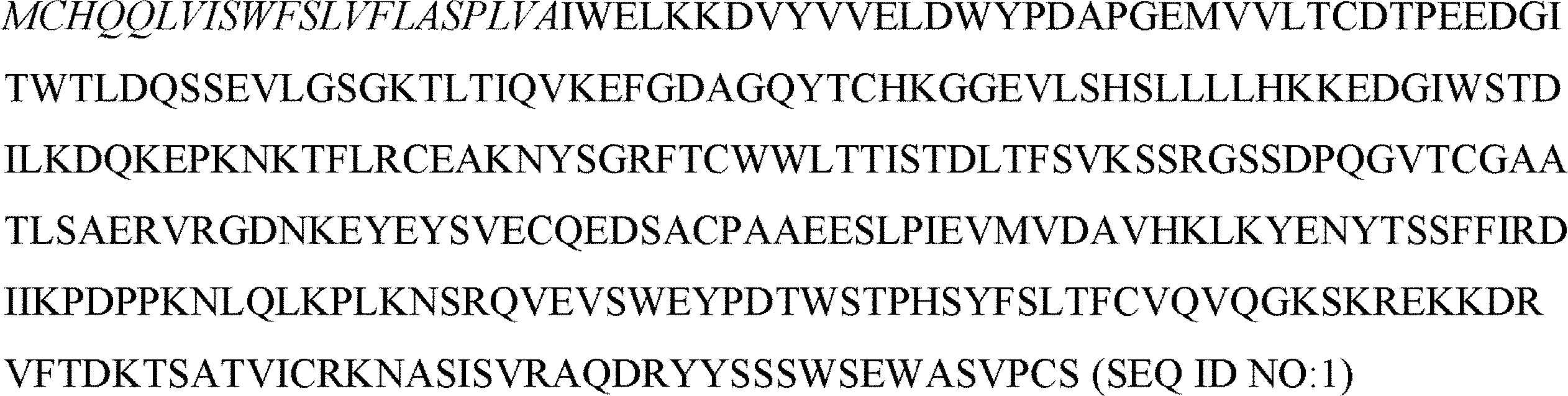
シグナル配列(SEQ ID NO:2)を欠く成熟型p40は、
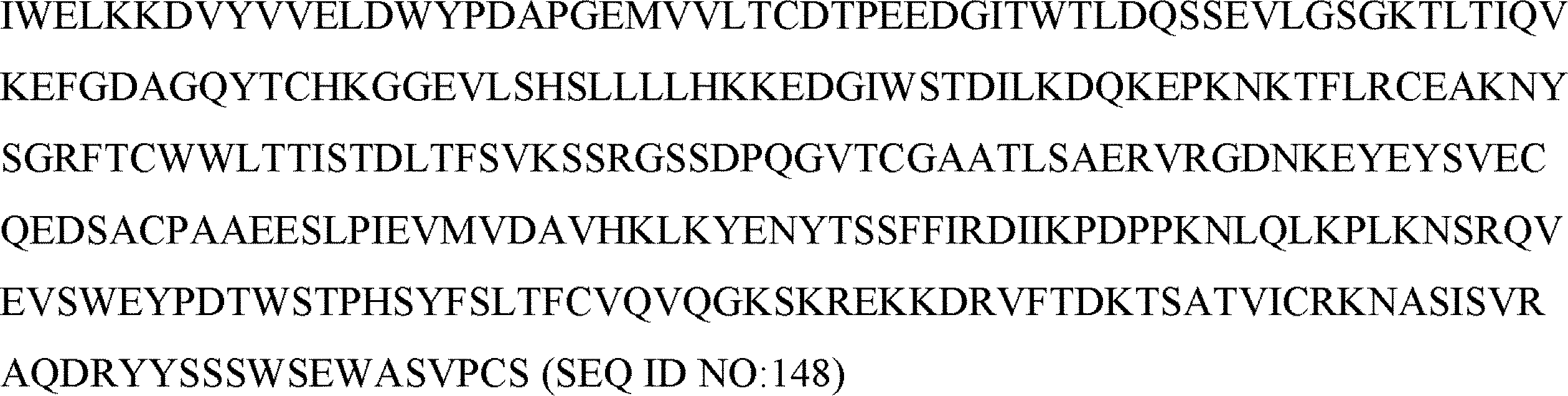
hIL-12p35単量体は、22アミノ酸シグナル配列(SEQ ID NO:4)を含む219アミノ酸プレタンパク質として発現され、22アミノ酸シグナル配列(SEQ ID NO:4)は翻訳後に除去されて197アミノ酸成熟タンパク質になる。野生型hIL-12p35は、2つの鎖内ジスルフィド連結を、1つ目は残基C64とC196との間に、2つ目は残基C85とC123との間に含有する(SEQ ID NO:3に従って番号付けられた)。シグナル配列(イタリック体)を有するhIL-12p35タンパク質の古典的アミノ酸配列(UniProt Reference No. P29459)は、

シグナル配列(SEQ ID NO:4)を欠く成熟型p35は、

ヒトIL-23は、2つのサブユニット、hIL-12p40およびヒトp19を含む非共有結合的に連結されたヘテロ二量体タンパク質である。ヒトp19単量体は、19アミノ酸シグナル配列(SEQ ID NO:6)を含む189アミノ酸プレタンパク質として発現され、19アミノ酸シグナル配列(SEQ ID NO:6)は翻訳後に除去されて180アミノ酸成熟タンパク質になる。シグナル配列(イタリック体)を有するヒトp19タンパク質の古典的アミノ酸配列(UniProt Reference No. Q9NPF7))は、

シグナル配列(SEQ ID NO:6)を欠く成熟型p19は、

一部の態様では、改変されたhIL-12p40ポリペプチドは、ヒトhIL-12p40ポリペプチド、例えば、野生型ヒトhIL-12p40ポリペプチド(UniProtKB-P29460;SEQ ID NO:1)に由来する。一部の態様では、改変されたhIL-12p40ポリペプチドは、SEQ ID NO:1に対して少なくとも70%の配列同一性(例えば、SEQ ID NO:1に対して少なくとも70%、75%、80%、85%、90%、91%、92%、93%、94%、95%、96%、97%、98%、または99%の配列同一性)を有するアミノ酸配列を含む。 In some embodiments, the modified hIL-12p40 polypeptide is derived from a human hIL-12p40 polypeptide, e.g., a wild-type human hIL-12p40 polypeptide (UniProtKB-P29460; SEQ ID NO:1). In some embodiments, the modified hIL-12p40 polypeptide comprises an amino acid sequence having at least 70% sequence identity to SEQ ID NO:1 (e.g., at least 70%, 75%, 80%, 85%, 90%, 91%, 92%, 93%, 94%, 95%, 96%, 97%, 98%, or 99% sequence identity to SEQ ID NO:1).
一部の態様では、改変されたヒトIL-12p40(hIL-12p40)ポリペプチドは、2つ以上のアミノ酸置換を含み、前記ポリペプチドは、SEQ ID NO:1のアミノ酸残基E81およびF82に対応する位置にアミノ酸置換を含み、(a)アミノ酸残基F82に対応する位置でのアミノ酸置換はF82Xであり、XはF以外の任意のアミノ酸であり、E81に対応する位置でのアミノ酸置換は、アスパラギン(N)、アスパラギン酸(D)、システイン(C)、グルタミン(Q)、グルタミン酸(E)、プロリン(P)、トリプトファン(W)、およびチロシン(Y)からなる群より選択されるか、または(b)アミノ酸残基E81に対応する位置でのアミノ酸置換はE81Xであり、XはE以外の任意のアミノ酸であり、F82に対応する位置でのアミノ酸置換は、アルギニン(R)、アスパラギン(N)、アスパラギン酸(D)、システイン(C)、グルタミン(Q)、グルタミン酸(E)、ヒスチジン(H)、リジン(K)、フェニルアラニン(F)、プロリン(P)、トリプトファン(W)、およびチロシン(Y)からなる群より選択される。 In some embodiments, a modified human IL-12p40 (hIL-12p40) polypeptide comprises two or more amino acid substitutions, the polypeptide comprising amino acid substitutions at positions corresponding to amino acid residues E81 and F82 of SEQ ID NO:1, (a) the amino acid substitution at the position corresponding to amino acid residue F82 is F82X, where X is any amino acid other than F, and the amino acid substitution at the position corresponding to E81 is selected from the group consisting of asparagine (N), aspartic acid (D), cysteine (C), glutamine (Q), glutamic acid (E), proline (P), tryptophan (W), and tyrosine (Y), or or (b) the amino acid substitution at the position corresponding to amino acid residue E81 is E81X, where X is any amino acid other than E, and the amino acid substitution at the position corresponding to F82 is selected from the group consisting of arginine (R), asparagine (N), aspartic acid (D), cysteine (C), glutamine (Q), glutamic acid (E), histidine (H), lysine (K), phenylalanine (F), proline (P), tryptophan (W), and tyrosine (Y).
一部の態様では、改変されたhIL-12p40ポリペプチドは、SEQ ID NO:1に対して少なくとも70%の配列同一性(例えば、SEQ ID NO:1に対して少なくとも70%、75%、80%、85%、90%、91%、92%、93%、94%、95%、96%、97%、98%、または99%の配列同一性)を有し、SEQ ID NO:1のアミノ酸残基E81およびF82に対応する位置に2つ以上のアミノ酸置換を含む、改変されたヒトhIL-12p40ポリペプチド単量体であり、(a)アミノ酸残基F82に対応する位置でのアミノ酸置換がF82Xであり、XはF以外の任意のアミノ酸であり、E81に対応する位置でのアミノ酸置換は、アスパラギン(N)、アスパラギン酸(D)、システイン(C)、グルタミン(Q)、グルタミン酸(E)、プロリン(P)、トリプトファン(W)、およびチロシン(Y)からなる群より選択されるか、または(b)アミノ酸残基E81に対応する位置でのアミノ酸置換はE81Xであり、XはE以外の任意のアミノ酸であり、F82に対応する位置でのアミノ酸置換は、アルギニン(R)、アスパラギン(N)、アスパラギン酸(D)、システイン(C)、グルタミン(Q)、グルタミン酸(E)、ヒスチジン(H)、リジン(K)、フェニルアラニン(F)、プロリン(P)、トリプトファン(W)、およびチロシン(Y)からなる群より選択される。 In some embodiments, the modified hIL-12p40 polypeptide is a modified human hIL-12p40 polypeptide monomer having at least 70% sequence identity to SEQ ID NO:1 (e.g., at least 70%, 75%, 80%, 85%, 90%, 91%, 92%, 93%, 94%, 95%, 96%, 97%, 98%, or 99% sequence identity to SEQ ID NO:1) and comprising two or more amino acid substitutions at positions corresponding to amino acid residues E81 and F82 of SEQ ID NO:1, wherein (a) the amino acid substitution at the position corresponding to amino acid residue F82 is F82X, where X is any amino acid other than F, and the amino acid substitution at the position corresponding to E81 is selected from the group consisting of asparagine (N), aspartic acid (D), cysteine (C), glutamine (Q), glutamic acid (E), proline (P), tryptophan (W), and tyrosine ( or (b) the amino acid substitution at the position corresponding to amino acid residue E81 is E81X, where X is any amino acid other than E, and the amino acid substitution at the position corresponding to F82 is selected from the group consisting of arginine (R), asparagine (N), aspartic acid (D), cysteine (C), glutamine (Q), glutamic acid (E), histidine (H), lysine (K), phenylalanine (F), proline (P), tryptophan (W), and tyrosine (Y).
一部の態様では、改変されたhIL-12p40ポリペプチドは、表7の、すなわち、SEQ ID NO:7-SEQ ID NO:45からなる群より選択される、改変されたhIL-12p40ポリペプチド配列に対して少なくとも70%の配列同一性(例えば、SEQ ID NO:7-SEQ ID NO:45からなる群より選択される配列に対して少なくとも70%、75%、80%、85%、90%、91%、92%、93%、94%、95%、96%、97%、98%、または99%の配列同一性)を有する、改変されたhIL-12p40ポリペプチドである。 In some embodiments, the modified hIL-12p40 polypeptide is a modified hIL-12p40 polypeptide having at least 70% sequence identity to a modified hIL-12p40 polypeptide sequence selected from the group consisting of SEQ ID NO:7-SEQ ID NO:45 in Table 7 (e.g., at least 70%, 75%, 80%, 85%, 90%, 91%, 92%, 93%, 94%, 95%, 96%, 97%, 98%, or 99% sequence identity to a sequence selected from the group consisting of SEQ ID NO:7-SEQ ID NO:45).
一部の態様では、改変されたhIL12p40ポリペプチドは、SEQ ID NO:1のW37、P39、D40、A41、Q64、K80、A85、E108、D115、H216、K217、L218、およびK219からなる群より選択されるアミノ酸残基に対応する1つまたは複数の位置での1つまたは複数のアミノ酸置換をさらに含み、アミノ酸置換は任意のアミノ酸である。 In some embodiments, the modified hIL12p40 polypeptide further comprises one or more amino acid substitutions at one or more positions corresponding to amino acid residues selected from the group consisting of W37, P39, D40, A41, Q64, K80, A85, E108, D115, H216, K217, L218, and K219 of SEQ ID NO:1, where the amino acid substitutions are any amino acid.
受容体結合および細胞内シグナル伝達
hIL-12受容体シグナル伝達複合体はhIL-12Rβ1とhIL-12Rβ2を含み、受容体が活性化するにはhIL-12がhIL-12Rβ1とhIL-12Rβ2の両方に結合することが必要である。hIL-12が受容体複合体に結合すると、Janusチロシンキナーゼである、hIL-12Rβ1に結合するTyk2と、hIL-12Rβ2に結合するJak2が活性化されて、受容体の細胞質テールがリン酸化される。これによりシグナル伝達性転写因子4(STAT4)が動員される。STAT4のホモ二量体化によって受容体からSTAT4が放出され、リン酸化されたSTAT4ホモ二量体が核に移動し、そこでIFN-γ遺伝子のSTAT4結合エレメントに結合してIFN-γを産生する。
Receptor Binding and Intracellular Signaling
The hIL-12 receptor signaling complex contains hIL-12Rβ1 and hIL-12Rβ2, and receptor activation requires binding of hIL-12 to both hIL-12Rβ1 and hIL-12Rβ2. Binding of hIL-12 to the receptor complex activates the Janus tyrosine kinases Tyk2, which binds to hIL-12Rβ1, and Jak2, which binds to hIL-12Rβ2, phosphorylating the cytoplasmic tail of the receptor. This recruits signal transducer and activator of transcription 4 (STAT4). STAT4 homodimerization releases STAT4 from the receptor, and the phosphorylated STAT4 homodimer translocates to the nucleus, where it binds to the STAT4 binding element of the IFN-γ gene to produce IFN-γ.
一部の態様では、本明細書に記載の改変されたhIL-12p40ポリペプチドは、hIL-12受容体に対する調整された結合親和性、特にhIL-12Rβ1に対する調整された結合親和性を有する。一部の態様では、本明細書に記載の改変されたhIL-12p40ポリペプチドまたは改変されたhIL-12p40ポリペプチドを含むhIL-12ムテインはhIL-12受容体の部分アゴニストである。一部の態様では、hIL-12p35との会合時に、本明細書に記載の改変されたhIL-12p40ポリペプチドは、野生型または親hIL-12p40ポリペプチドの結合親和性と比較して減少したhIL-12Rβ1に対する結合親和性を有する。 In some embodiments, the modified hIL-12p40 polypeptides described herein have a tuned binding affinity to the hIL-12 receptor, particularly to hIL-12Rβ1. In some embodiments, the modified hIL-12p40 polypeptides described herein or hIL-12 muteins comprising modified hIL-12p40 polypeptides are partial agonists of the hIL-12 receptor. In some embodiments, upon association with hIL-12p35, the modified hIL-12p40 polypeptides described herein have a reduced binding affinity to hIL-12Rβ1 compared to the binding affinity of the wild-type or parent hIL-12p40 polypeptide.
一部の態様では、改変されたhIL-12p40ポリペプチドは、表面プラズモン共鳴(SPR)によって決定された時、2つ以上のアミノ酸置換を欠いている参照ポリペプチドの結合親和性と比較して約10%、あるいは約20%、あるいは約30%、あるいは約40%、あるいは約50%、あるいは約60%、あるいは約70%、あるいは約80%、あるいは約90%、あるいは約100%低減した、hIL-12Rβ1に対する結合親和性を有する。一部の態様では、hIL-12Rβ1に対する、改変されたhIL-12p40ポリペプチドの低減した結合親和性は、2つ以上のアミノ酸置換を欠いている参照ポリペプチドと比較してSTAT4によって媒介されるシグナル伝達の低減をもたらす。一部の態様では、hIL-12Rβ1に対する組換えポリペプチドの低減した結合親和性は、2つ以上のアミノ酸置換を欠いている参照ポリペプチドと比較してSTAT3によって媒介されるシグナル伝達の低減をもたらす。一部の態様では、STAT3シグナル伝達および/またはSTAT4シグナル伝達は、遺伝子発現アッセイ、ホスホフローシグナル伝達アッセイ、および酵素結合免疫測定法(ELISA)からなる群より選択されるアッセイによって決定される。 In some embodiments, the modified hIL-12p40 polypeptide has a binding affinity for hIL-12Rβ1 that is reduced by about 10%, alternatively about 20%, alternatively about 30%, alternatively about 40%, alternatively about 50%, alternatively about 60%, alternatively about 70%, alternatively about 80%, alternatively about 90%, alternatively about 100%, as determined by surface plasmon resonance (SPR), compared to the binding affinity of a reference polypeptide lacking two or more amino acid substitutions. In some embodiments, the reduced binding affinity of the modified hIL-12p40 polypeptide for hIL-12Rβ1 results in reduced signaling mediated by STAT4 compared to a reference polypeptide lacking two or more amino acid substitutions. In some embodiments, the reduced binding affinity of the recombinant polypeptide for hIL-12Rβ1 results in reduced signaling mediated by STAT3 compared to a reference polypeptide lacking two or more amino acid substitutions. In some embodiments, STAT3 signaling and/or STAT4 signaling is determined by an assay selected from the group consisting of a gene expression assay, a phosphoflow signaling assay, and an enzyme-linked immunosorbent assay (ELISA).
一部の態様では、本明細書に記載の改変されたhIL-12p40ポリペプチドはSTAT3によって媒介されるシグナル伝達(「STAT3シグナル伝達」)および/またはSTAT4によって媒介されるシグナル伝達(「STAT4シグナル伝達」)の部分アゴニストである。一部の態様では、本明細書に記載の改変されたhIL-12p40ポリペプチドは、野生型または親IL-12p40ポリペプチドの結合親和性と比較して、hIL-12p35との会合時に、一部の細胞タイプにおいてSTAT3シグナル伝達および/またはSTAT4シグナル伝達を活性化し、他の細胞タイプにおいてSTAT3および/またはSTAT3シグナル伝達の減少をもたらす。 In some embodiments, the modified hIL-12p40 polypeptides described herein are partial agonists of STAT3-mediated signaling ("STAT3 signaling") and/or STAT4-mediated signaling ("STAT4 signaling"). In some embodiments, the modified hIL-12p40 polypeptides described herein activate STAT3 signaling and/or STAT4 signaling in some cell types and result in decreased STAT3 and/or STAT3 signaling in other cell types upon association with hIL-12p35 compared to the binding affinity of the wild-type or parent IL-12p40 polypeptide.
一部の態様では、本明細書に記載の改変されたhIL-12p40ポリペプチドは、hIL-12p35との会合時に、野生型または親hIL-12p40ポリペプチドと比較して、CD8+T細胞においてSTAT4シグナル伝達を活性化し、NK細胞においてSTAT4シグナル伝達の減少をもたらす、例えば、少なくとも約10%、20%、30%、40%、50%、60%、または70%減少させる。全体を通して用いられる、シグナル伝達の増加は、約10%、20%、30%、40%、50%、60%、70%、80%、90%、100%、200%、300%、4005、またはそれより大きな増加でもよい。 In some embodiments, the modified hIL-12p40 polypeptides described herein, upon association with hIL-12p35, activate STAT4 signaling in CD8+ T cells and result in a decrease in STAT4 signaling in NK cells, e.g., at least about 10%, 20%, 30%, 40%, 50%, 60%, or 70% decrease, compared to wild-type or parent hIL-12p40 polypeptides. As used throughout, an increase in signaling may be about 10%, 20%, 30%, 40%, 50%, 60%, 70%, 80%, 90%, 100%, 200%, 300%, 4005, or greater increase.
一部の態様では、改変されたhIL-12p40ポリペプチドは、hIL-12p35との会合時に、
2つ以上のアミノ酸置換を欠いている野生型または親hIL-12p40ポリペプチドと比較して、CD8+T細胞においてインターフェロンγ(IFNγ)を活性化し、NKT細胞においてIFNγシグナル伝達が減少している、例えば、少なくとも約10%、20%、30%、40%、50%、60%、または70%減少している、二量体
を形成する。
In some aspects, the modified hIL-12p40 polypeptide, upon association with hIL-12p35:
Forms dimers that activate interferon gamma (IFNγ) in CD8+ T cells and have reduced IFNγ signaling in NKT cells, e.g., at least about 10%, 20%, 30%, 40%, 50%, 60%, or 70% reduced, compared to a wild-type or parent hIL-12p40 polypeptide lacking two or more amino acid substitutions.
作用期間を増加させるための担体分子との会合
本明細書に記載の改変されたhIL-12p40ポリペプチド、改変されたhIL-12p40ポリペプチドを含むhIL-12ムテイン、または改変されたhIL-12p40ポリペプチドを含むhIL-13ムテインをインビボで長期の存続期間、および/または対象において長期の作用期間をもたらすように改変することができる。hIL-12ムテインにおいて、対象において長期の存続期間および/または長期の持続期間をもたらすように、hIL-12 p40および/またはhIl-12 p35ポリペプチドを改変することができる。hIL-23ムテインにおいて、対象において長期の存続期間および/または長期の持続期間をもたらすようにhIL-12 p40および/またはヒトp19ポリペプチドを改変することができる。一部の態様では、長期の半減期などの望ましい薬理学的特性をもたらすように、結合分子を担体分子とコンジュゲートさせることができる。一部の態様では、結合分子を、IgGのFcドメイン、アルブミン、または結合分子の半減期を増大させる他の分子に、例えば、当技術分野において公知のようにPEG化、グリコシル化などによって共有結合的に連結することができる。一部の態様では、改変されたhIL-12p40ポリペプチド、hIL-12ムテイン、またはhIL-23ムテインは、哺乳動物対象において長期の作用期間をもたらすように改変され、哺乳動物対象において、4時間超、あるいは5時間超、あるいは6時間超、あるいは7時間超、あるいは8時間超、あるいは9時間超、あるいは10時間超、あるいは12時間超、あるいは18時間超、あるいは24時間超、あるいは2日超、あるいは3日超、あるいは4日超、あるいは5日超、あるいは6日超、あるいは7日超、あるいは10日超、あるいは14日超、あるいは21日超、またはあるいは30日超の半減期を有する。
Association with a carrier molecule to increase duration of action The modified hIL-12p40 polypeptide, hIL-12 mutein comprising the modified hIL-12p40 polypeptide, or hIL-13 mutein comprising the modified hIL-12p40 polypeptide described herein can be modified to provide a long duration in vivo and/or a long duration of action in a subject. In a hIL-12 mutein, the hIL-12 p40 and/or hIL-12 p35 polypeptide can be modified to provide a long duration and/or a long duration in a subject. In a hIL-23 mutein, the hIL-12 p40 and/or human p19 polypeptide can be modified to provide a long duration and/or a long duration in a subject. In some embodiments, the binding molecule can be conjugated to a carrier molecule to provide a desired pharmacological property, such as a long half-life. In some embodiments, the binding molecule can be covalently linked to the Fc domain of IgG, albumin, or other molecules that increase the half-life of the binding molecule, for example, by PEGylation, glycosylation, etc., as known in the art. In some embodiments, the modified hIL-12p40 polypeptide, hIL-12 mutein, or hIL-23 mutein is modified to provide a long duration of action in a mammalian subject and has a half-life in a mammalian subject of greater than 4 hours, alternatively greater than 5 hours, alternatively greater than 6 hours, alternatively greater than 7 hours, alternatively greater than 8 hours, alternatively greater than 9 hours, alternatively greater than 10 hours, alternatively greater than 12 hours, alternatively greater than 18 hours, alternatively greater than 24 hours, alternatively greater than 2 days, alternatively greater than 3 days, alternatively greater than 4 days, alternatively greater than 5 days, alternatively greater than 6 days, alternatively greater than 7 days, alternatively greater than 10 days, alternatively greater than 14 days, alternatively greater than 21 days, or alternatively greater than 30 days.
哺乳動物対象において長期の作用期間をもたらすような、改変されたhIL-12p40ポリペプチド、hIL-12ムテイン、またはhIL-23ムテインの改変は、以下:
●改変されたhIL-12p40ポリペプチド、hIL-12ムテイン、またはhIL-23ムテインと1つまたは複数の担体分子とのコンジュゲート;
●改変されたhIL-12p40ポリペプチド、hIL-12ムテイン、またはhIL-23ムテインと、タンパク質担体分子との、任意で、さらなるポリペプチド配列を用いた融合タンパク質の形でのコンジュゲート(例えば、改変されたhIL-12ポリペプチド-Fc融合、hIL-12ムテイン-Fc融合、またはhIL-23ムテイン-Fc-融合)、および
●ポリマー(例えば、PEG化されたhIL-12p40ポリペプチド、hIL-12ムテイン、またはhIL-23ムテインをもたらす水溶性ポリマー)とのコンジュゲート
を含む(が、これに限定されない)。
Modifications of the modified hIL-12p40 polypeptide, hIL-12 mutein, or hIL-23 mutein that result in a prolonged duration of action in a mammalian subject include the following:
• conjugates of a modified hIL-12p40 polypeptide, hIL-12 mutein, or hIL-23 mutein with one or more carrier molecules;
● conjugates of the modified hIL-12p40 polypeptide, hIL-12 mutein, or hIL-23 mutein to a protein carrier molecule, optionally in the form of a fusion protein with an additional polypeptide sequence (e.g., a modified hIL-12 polypeptide-Fc fusion, hIL-12 mutein-Fc fusion, or hIL-23 mutein-Fc fusion), and ● conjugates with polymers (e.g., water-soluble polymers resulting in a PEGylated hIL-12p40 polypeptide, hIL-12 mutein, or hIL-23 mutein).
ある特定の改変されたhIL-12p40ポリペプチド、hIL-12ムテイン、または hIL-23ムテインについて、哺乳動物対象において長期の作用期間をもたらす複数のタイプの改変が使用され得ることが理解される。例えば、本開示の改変されたhIL-12p40ポリペプチド、hIL-12ムテイン、または hIL-23ムテインは、長期の作用期間をもたらすアミノ酸置換と、ポリエチレングリコール(PEG)分子などの担体分子とのコンジュゲートをもたらすアミノ酸置換を両方とも含んでもよい。 It is understood that for a particular modified hIL-12p40 polypeptide, hIL-12 mutein, or hIL-23 mutein, multiple types of modifications that result in a long duration of action in a mammalian subject may be used. For example, a modified hIL-12p40 polypeptide, hIL-12 mutein, or hIL-23 mutein of the present disclosure may include both amino acid substitutions that result in a long duration of action and amino acid substitutions that result in conjugation with a carrier molecule, such as a polyethylene glycol (PEG) molecule.
タンパク質担体分子
インビボで長期の作用期間をもたらすために、改変されたhIL-12p40ポリペプチド、hIL-12ムテイン、またはhIL-23ムテインに共有結合的に取り付けることができるタンパク質担体分子の例には、アルブミン、抗体、および抗体断片、例えば、IgG分子のFcドメインが含まれるが、これに限定されない。
Protein Carrier Molecules Examples of protein carrier molecules that can be covalently attached to modified hIL-12p40 polypeptides, hIL-12 muteins, or hIL-23 muteins to provide a long duration of action in vivo include, but are not limited to, albumin, antibodies, and antibody fragments, e.g., the Fc domain of an IgG molecule.
Fc融合
一部の態様では、改変されたhIL-12p40ポリペプチド、hIL-12ムテイン、またはhIL-23ムテインは、Fc融合キメラポリペプチド分子の機能的ドメインにコンジュゲートされる。Fc融合コンジュゲートは生物製剤の全身半減期を増大させることが示されており、従って、その生物製剤製品は頻繁な投与を必要としない。Fcは、血管を裏打ちする内皮細胞の中にある胎児性Fc受容体(FcRn)に結合し、結合すると、Fc融合分子は分解から保護され、循環に再放出され、それにより、この分子はさらに長く循環中に保たれる。このFc結合は、内因性IgGがその長い血漿半減期を保持する機構だと考えられている。もっと最近のFc融合技術では、従来のFc融合コンジュゲートと比較して生物製剤の薬物動態学的特性および薬力学的特性を最適化するために1コピーの生物製剤を抗体のFc領域に連結する。Fc融合の調製において有用な「Fc領域」は、IgGをパパインで消化することによって生じるIgG C末端ドメインと相同な天然ポリペプチドまたは合成ポリペプチドでもよい。IgG Fcの分子量は約50kDaである。本明細書に記載の結合分子はFc領域全体とコンジュゲートしてもよく、本明細書に記載の結合分子が一部分であるキメラポリペプチドの循環半減期を増大させる能力を保持している、さらに小さな部分とコンジュゲートしてもよい。さらに、完全長Fc領域または断片化されたFc領域は野生型分子のバリアントでもよい。典型的な説明では、二量体Fcのそれぞれの単量体は異種ポリペプチドを有することがあり、異種ポリペプチドは同じでもよく異なってもよい。
Fc fusion In some embodiments, modified hIL-12p40 polypeptides, hIL-12 muteins, or hIL-23 muteins are conjugated to functional domains of Fc fusion chimeric polypeptide molecules. Fc fusion conjugates have been shown to increase the systemic half-life of biologics, thus requiring less frequent administration of the biologic product. Fc binds to fetal Fc receptors (FcRn) in the endothelial cells lining blood vessels, and upon binding, the Fc fusion molecule is protected from degradation and released back into circulation, thereby keeping it in circulation longer. This Fc binding is believed to be the mechanism by which endogenous IgG retains its long plasma half-life. In more recent Fc fusion technology, a copy of the biologic is linked to the Fc region of an antibody to optimize the pharmacokinetic and pharmacodynamic properties of the biologic compared to traditional Fc fusion conjugates. The "Fc region" useful in preparing Fc fusions may be a natural or synthetic polypeptide that is homologous to the IgG C-terminal domain generated by papain digestion of IgG. The molecular weight of IgG Fc is approximately 50 kDa. The binding molecules described herein may be conjugated to the entire Fc region or to smaller portions that retain the ability to increase the circulating half-life of the chimeric polypeptide of which the binding molecules described herein are a part. Furthermore, the full-length Fc region or the fragmented Fc region may be a variant of the wild-type molecule. In a typical illustration, each monomer of a dimeric Fc may have a heterologous polypeptide, which may be the same or different.
二量体FcドメインのIL12 p35およびP40 Fcサブユニットの連結
一部の態様では、IL12ムテインの個々のサブユニットはFcスキャフォールド上に示される。Zhao et al. 「A new approach to produce IgG4-like bispecific antibodies」, Scientific Reports 11: 18630 (2021);およびCao et al. 「Characterization and Monitoring of a Novel Light-heavy-light Chain Mispair in a Therapeutic Bispecific Antibody」、およびLiu et al.「Fc Engineering for Developing Therapeutic Bispecific Antibodies and Novel Scaffolds」. Frontiers in Immunology. 8: 38. doi:10.3389/fimmu.2017.00038 (2017)。
Linking IL12 p35 and p40 Fc subunits in a dimeric Fc domain In some embodiments, the individual subunits of the IL12 mutein are displayed on an Fc scaffold. Zhao et al. "A new approach to produce IgG4-like bispecific antibodies", Scientific Reports 11: 18630 (2021); and Cao et al. "Characterization and Monitoring of a Novel Light-heavy-light Chain Mispair in a Therapeutic Bispecific Antibody", and Liu et al. "Fc Engineering for Developing Therapeutic Bispecific Antibodies and Novel Scaffolds". Frontiers in Immunology. 8: 38. doi:10.3389/fimmu.2017.00038 (2017).
一部の態様では、本明細書に記載のどの変異hIL-12p40ポリペプチドも、長期の半減期を有するIL-12構築物の中にあってもよく、IL-12構築物の中にはp35サブユニットとp40サブユニットが「ノブイントゥホール」形式でFcヘテロ二量体のFcドメインに個別に取り付けられている。例えば、Ridgway, et al (1996) Protein Engineering 9(7):617-921を参照されたい。例示的なhIL-12-Fc分子を図3に示した。ここでは、E81A変異、F82A変異、およびK106A変異を含む変異hIL-12p40と、野生型hIL-12-p35がそれぞれ、ノブイントゥホール形式でリンカーを介してhIgG1 Fcドメインに取り付けられている。この形式を用いて、hIL-12ムテインの製造を改善し、より高いレベルの発現を実現し、結果として生じた製造された生成物の均一性を改善することができる。例えば、Gilliesら、2009年8月18日に発行された米国特許第7,576,193号; Epstein, et al. 2016年5月4日に公開された中国特許出願番号CN201410597561.4A;およびKimら、2021年8月3日に発行された米国特許第11,087,249号; Zhao et al. 「A new approach to produce IgG4-like bispecific antibodies」, Scientific Reports 11: 18630 (2021);およびCao et al. 「Characterization and Monitoring of a Novel Light-heavy-light Chain Mispair in a Therapeutic Bispecific Antibody」、およびLiu et al. 「Fc Engineering for Developing Therapeutic Bispecific Antibodies and Novel Scaffolds」. Frontiers in Immunology. 8: 38. doi:10.3389/fimmu.2017.00038 (2017)を参照されたい。 In some embodiments, any of the mutant hIL-12p40 polypeptides described herein may be in an IL-12 construct with extended half-life in which the p35 and p40 subunits are individually attached to the Fc domain of an Fc heterodimer in a "knobs-into-holes" format. See, e.g., Ridgway, et al (1996) Protein Engineering 9(7):617-921. An exemplary hIL-12-Fc molecule is shown in FIG. 3, in which mutant hIL-12p40, including the E81A, F82A, and K106A mutations, and wild-type hIL-12-p35 are each attached to the hIgG1 Fc domain via a linker in a knobs-into-holes format. This format can be used to improve the production of hIL-12 muteins, achieve higher levels of expression, and improve the uniformity of the resulting manufactured product. See, e.g., Gillies et al., U.S. Patent No. 7,576,193, issued August 18, 2009; Epstein, et al., Chinese Patent Application No. CN201410597561.4A, published May 4, 2016; and Kim et al., U.S. Patent No. 11,087,249, issued August 3, 2021; Zhao et al. "A new approach to produce IgG4-like bispecific antibodies", Scientific Reports 11: 18630 (2021); and Cao et al. "Characterization and Monitoring of a Novel Light-heavy-light Chain Mispair in a Therapeutic Bispecific Antibody", and Liu et al. "Fc Engineering for Developing Therapeutic Bispecific Antibodies and Novel Scaffolds". Frontiers in Immunology. 8: 38. See doi:10.3389/fimmu.2017.00038 (2017).
ヘテロ二量体化を促進するためのFcサブユニットの改変
一部の態様では、二量体Fcドメインの単量体はヘテロ二量体化を促進するように改変されてもよい。Fcドメインのヘテロ二量体化を促進するための様々な技法が確立している。例えば、Gilliesら、米国特許番号、Kimら、2021年8月3日に発行された米国特許第11087249号を参照されたい。
Modification of Fc subunits to promote heterodimerization In some embodiments, the monomer of the dimeric Fc domain may be modified to promote heterodimerization.Various techniques have been established to promote heterodimerization of Fc domains.See, for example, Gillies et al., U.S. Patent No. 11087249, issued August 3, 2021 to Kim et al.
ヘテロ二量体化を促進するためのFcドメイン単量体の改変の一例は「ノブイントゥホール改変」の使用である。例えば、Ridgway, et al (1996) Protein Engineering 9(7):617-921; Atwell, et al (1997) J. Mol. Biol. 270:26-35;Carterら、1998年9月15日に発行された米国特許第5,807,706号; Carterら、2010年4月13日に発行された7,695,936; Zhao et al. 「A new approach to produce IgG4-like bispecific antibodies」, Scientific Reports 11: 18630 (2021); Cao et al. 「Characterization and Monitoring of a Novel Light-heavy-light Chain Mispair in a Therapeutic Bispecific Antibody」、およびLiu et al. 「Fc Engineering for Developing Therapeutic Bispecific Antibodies and Novel Scaffolds」. Frontiers in Immunology. 8: 38. doi:10.3389/fimmu.2017.00038 (2017)を参照されたい。一部の態様では、本明細書に記載のどの変異hIL-12p40ポリペプチドも、長期の半減期を有するhIL-12構築物の中にあってもよく、IL-12構築物の中にはp35サブユニットとp40サブユニットがFcヘテロ二量体のFcドメインに個別に取り付けられている。一部の態様では、Fcドメインは、位置366にあるスレオニン(EUナンバリング)が、かさ高い(bulky)残基で改変(例えば、T366W)されている、第1のFc単量体のCH3ドメインが「ノブ」および置換となり、第2のFc単量体のCH3ドメインの相補的残基に1つまたは複数の置換を含む第2のFc単量体が、例えば、T366S、L368A、および/またはY407Vなどのアミノ酸置換により、かさ高い残基を受け入れるためのポケットまたは「ホール」となる、2つのFc単量体を含む。 One example of a modification of an Fc domain monomer to promote heterodimerization is the use of a "knob-into-hole modification." See, e.g., Ridgway, et al (1996) Protein Engineering 9(7):617-921; Atwell, et al (1997) J. Mol. Biol. 270:26-35; Carter et al., U.S. Patent No. 5,807,706 issued September 15, 1998; Carter et al., U.S. Patent No. 7,695,936 issued April 13, 2010; Zhao et al. "A new approach to produce IgG4-like bispecific antibodies", Scientific Reports 11: 18630 (2021); Cao et al. "Characterization and Monitoring of a Novel Light-heavy-light Chain Mispair in a Therapeutic Bispecific Antibody", and Liu et al. "Fc Engineering for Developing Therapeutic Bispecific Antibodies and Novel Scaffolds". Frontiers in Immunology. 8: 38. See, doi:10.3389/fimmu.2017.00038 (2017). In some aspects, any mutant hIL-12p40 polypeptide described herein may be in an extended half-life hIL-12 construct in which the p35 and p40 subunits are individually attached to the Fc domain of an Fc heterodimer. In some embodiments, the Fc domain comprises two Fc monomers in which the CH3 domain of a first Fc monomer is modified with a bulky residue (e.g., T366W) at the threonine at position 366 (EU numbering), providing a "knob" and substitution, and a second Fc monomer that includes one or more substitutions at the complementary residue in the CH3 domain of the second Fc monomer, providing a pocket or "hole" to accommodate the bulky residue, e.g., by amino acid substitutions such as T366S, L368A, and/or Y407V.
Fcのエフェクター機能を低減するための改変
一部の態様では、Fcドメインはエフェクター機能を低減するように改変されてもよい。エフェクター機能を低減するためのFcドメインの改変は当技術分野において周知である。例えば、Wang, et al. (2018) IgG Fc engineering to modulate antibody effector functions, Protein Cell 9(1):63-73を参照されたい。例えば、位置235(EUナンバリング)にあるリジン残基のリジン(L)からグルタミン酸(E)への変異はFcgRおよびC1q結合を低減することでエフェクター機能を低減することが知られている。Alegre, et al. (1992) J. Immunology 148:3461-3468。さらに、IgG1ヒンジ領域中の位置234および235(EUナンバリング)にある2つのリジン(L)残基からアラニン(A)への置換、すなわち、L234AおよびL235Aは補体依存性細胞傷害(CDC)および抗体依存性細胞傷害(ADCC)の減少をもたらす。Hezereh et al., (2001) J. Virol 75(24):12161-68。さらに、位置329(EUナンバリング)にあるプロリンからアラニン(P329A)またはグリシン(P329G)への変異はエフェクター機能を軽減し、L234AおよびL235A置換と組み合わされ得る。一部の態様では、本発明の組成物のFcドメインはアミノ酸置換L234A/L235A/P329A(「EUナンバリング)またはL234A/L235A/P329G(EUナンバリング)を含んでもよい。
Modifications to reduce Fc effector functions In some embodiments, the Fc domain may be modified to reduce effector functions. Modifications of Fc domains to reduce effector functions are well known in the art. See, for example, Wang, et al. (2018) IgG Fc engineering to modulate antibody effector functions, Protein Cell 9(1):63-73. For example, a lysine (L) to glutamic acid (E) mutation at position 235 (EU numbering) is known to reduce effector functions by reducing FcgR and C1q binding. Alegre, et al. (1992) J. Immunology 148:3461-3468. In addition, the substitution of two lysine (L) residues at positions 234 and 235 (EU numbering) in the IgG1 hinge region with alanine (A), i.e., L234A and L235A, results in reduced complement-dependent cytotoxicity (CDC) and antibody-dependent cellular cytotoxicity (ADCC). Hezereh et al., (2001) J. Virol 75(24):12161-68. Additionally, a mutation at position 329 (EU numbering) from proline to alanine (P329A) or glycine (P329G) reduces effector function and may be combined with the L234A and L235A substitutions. In some embodiments, the Fc domain of the compositions of the invention may comprise the amino acid substitutions L234A/L235A/P329A (EU numbering) or L234A/L235A/P329G (EU numbering).
一部の態様では、ヒンジ領域の組み込みは、典型的に、完全免疫グロブリン分子において軽鎖上のシステインに結合する位置220(EUナンバリング)の不対システイン残基を含有する。ヒンジドメインを含むFcドメインのみが用いられた場合、ヒンジドメイン中にある不対システインは、不適当なジスルフィド結合を形成する可能性を生じる。その結果、一部の態様では、位置220にあるシステイン(C220。EUナンバリングに従って番号付けられた)は、ジスルフィド結合を促進しないアミノ酸で置換される。一部の態様では、FcドメインはC220S変異を含む。 In some embodiments, the hinge region incorporates an unpaired cysteine residue at position 220 (EU numbering) that typically binds to a cysteine on the light chain in a complete immunoglobulin molecule. If only an Fc domain containing the hinge domain were used, the unpaired cysteine in the hinge domain would create the potential for improper disulfide bond formation. As a result, in some embodiments, the cysteine at position 220 (C220, numbered according to EU numbering) is replaced with an amino acid that does not promote disulfide bonding. In some embodiments, the Fc domain contains a C220S mutation.
一部の態様では、FcドメインはN結合型グリコシル化部位またはO結合型グリコシル化部位を排除するように改変される。Fcドメイン、特に、IgG1サブクラスのFcドメインのグリコシル化バリアントはエフェクター機能の不十分なメディエーターであることが知られている。Jefferis et al. 1998, Immol. Rev., vol. 163, 50-76)。位置297(EUナンバリング)におけるグリコシル化はエフェクター機能に寄与することが示されている。Edelman, et al (1969) PNAS (USA) 63:78-85。一部の態様では、本開示の組成物のFcドメインは、N結合型グリコシル化部位またはO結合型グリコシル化部位を排除するための1つの、または改変を含む。Fcドメイン中のグリコシル化部位を排除するためのN297における改変の例にはアミノ酸置換N297QおよびN297Gが含まれる。 In some embodiments, the Fc domain is modified to eliminate N-linked or O-linked glycosylation sites. Glycosylation variants of Fc domains, particularly those of the IgG1 subclass, are known to be poor mediators of effector function. Jefferis et al. 1998, Immol. Rev., vol. 163, 50-76). Glycosylation at position 297 (EU numbering) has been shown to contribute to effector function. Edelman, et al (1969) PNAS (USA) 63:78-85. In some embodiments, the Fc domain of the compositions of the present disclosure includes one or modifications to eliminate N-linked or O-linked glycosylation sites. Examples of modifications at N297 to eliminate glycosylation sites in the Fc domain include the amino acid substitutions N297Q and N297G.
タンパク質分解切断に対する抵抗性を増加させる置換
一部の態様では、ヒトIL-12p40(hIL-12p40)は、ヒトp40ポリペプチドの成熟型の位置260(SEQ ID NO:148、ヒトp40前駆体ポリペプチドSEQ ID NO:1の位置282に対応する)にあるリジン(K)残基(K260)のアミノ酸置換を含む。Websterら(2011年1月18日に発行された米国特許第7,872,107号)に記載のように、成熟ヒトp40ポリペプチドの位置260における置換はヒトp40ポリペプチドをタンパク質分解切断に対して抵抗性にする。一部の態様では、ヒトIL-12p40(hIL-12p40)は、成熟p40ポリペプチドの位置260にあるリジンから非塩基性アミノ酸への置換を含む。一部の態様において、非塩基性アミノ酸は、アラニン、グリシン、アスパラギン、またはグルタミンからなる群より選択される。一部の態様では、ヒトIL-12p40(hIL-12p40)は、K260G、K260A、K260N、K260Q(hp40の成熟型に従って番号付けられた)またはK282G、K282A、K282N、K282Q(hp40の前駆体型であるSEQ ID NO:1に従って番号付けられた)からなる群より選択される位置260における変異を含む。
Substitutions that Increase Resistance to Proteolytic Cleavage In some embodiments, human IL-12p40 (hIL-12p40) comprises an amino acid substitution of a lysine (K) residue (K260) at position 260 of the mature form of human p40 polypeptide (SEQ ID NO:148, corresponding to position 282 of human p40 precursor polypeptide SEQ ID NO:1). As described in Webster et al. (U.S. Patent No. 7,872,107, issued Jan. 18, 2011), the substitution at position 260 of the mature human p40 polypeptide renders the human p40 polypeptide resistant to proteolytic cleavage. In some embodiments, human IL-12p40 (hIL-12p40) comprises a substitution of a non-basic amino acid for a lysine at position 260 of the mature p40 polypeptide. In some embodiments, the non-basic amino acid is selected from the group consisting of alanine, glycine, asparagine, or glutamine. In some embodiments, human IL-12p40 (hIL-12p40) comprises a mutation at position 260 selected from the group consisting of K260G, K260A, K260N, K260Q (numbered according to the mature form of hp40) or K282G, K282A, K282N, K282Q (numbered according to SEQ ID NO:1, the precursor form of hp40).
IL12部分アゴニスト
一部の態様では、本開示は、薬理学的特性または治療特性が改善されている、改変されたhIL-12p40ポリペプチドを含むヘテロ二量体hIL12Fcムテイン、およびこのような組成物を使用する方法を提供する。
IL12 Partial Agonists In some aspects, the present disclosure provides heterodimeric hIL12Fc muteins comprising modified hIL-12p40 polypeptides, and methods of using such compositions, that have improved pharmacological or therapeutic properties.
一部の態様では、本開示は、式#1
P35-L1a-Hb-Fc1 [1]
の第1のポリペプチドであって、
式中、
●L1が、1~30個のアミノ酸のリンカー、任意で、GSAリンカーであり、
●aおよびbが、独立して、0(存在しない)または1(存在する)より選択され、
●Hが、IgG1、IgG2、IgG3、およびIgG4上部ヒンジからなる群より独立して選択され、任意で、アミノ酸置換C220S(EUナンバリング)を含む、ヒト免疫グロブリンのヒンジ領域であり、
●Fc1が、IgG1、IgG2、IgG3、およびIgG4からなる群より選択され、Fc2とのヘテロ二量体化を促進する1つまたは複数のアミノ酸置換を含む、ヒト免疫グロブリンの下部ヒンジ、CH2およびCH3ドメインを含むポリペプチドであり、
●P35が、SEQ ID NO:1)に対して少なくとも90%、あるいは少なくとも91%、あるいは少なくとも92%、あるいは少なくとも93%、あるいは少なくとも94%、あるいは少なくとも95%、あるいは少なくとも96%、あるいは少なくとも97%、あるいは少なくとも98%、あるいは少なくとも99%の配列同一性、または100%の配列同一性を有するヒトp35ポリペプチドである、第1のポリペプチドと、
式#2:
P40m-L2c-Hd-Fc2 [2]
の第2のポリペプチドであって、
式中、
●L2は、1~30個のアミノ酸のリンカー、任意で、GSAリンカーであり、
●cおよびdが、独立して、0(存在しない)または1(存在する)より選択され、
●Hが、IgG1、IgG2、IgG3、およびIgG4上部ヒンジからなる群より独立して選択され、任意で、アミノ酸置換C220S(EUナンバリング)を含む、ヒト免疫グロブリンのヒンジ領域であり、
●Fc2が、IgG1、IgG2、IgG3、およびIgG4からなる群より選択されるヒト免疫グロブリンの下部ヒンジ、CH2、およびCH3ドメインを含み、Fc1とのヘテロ二量体化を促進する1つまたは複数のアミノ酸置換を含むポリペプチドであり、
●P40mが、本明細書に記載の改変されたヒトIL-12p40ポリペプチド、例えば、表7からの(すなわち、SEQ ID NO:7-SEQ ID NO:46およびSEQ ID NO:151-190からなる群より選択される)改変されたhIL-12p40ポリペプチド配列である、第2のポリペプチド
を含む、組成物を提供する。任意で、SEQ ID NO:1に従って番号付けられた、位置W37、P39、D40、A41、K80、E81、F82、K106、E108、D115、H216、K217、L218、およびK219からなる群より選択される位置での1つまたは複数のアミノ酸置換を含む、改変されたヒトIL-12p40ポリペプチド。任意で、表面プラズモン共鳴によって決定された時、hIL12Rb1の細胞外ドメイン(ECD)に対する野生型hP40の結合親和性と比べて、1つまたは複数のアミノ酸置換は、hIL12Rb1の細胞外ドメイン(ECD)に対するP40mの結合親和性を、少なくとも5%、任意で少なくとも10%、任意で少なくとも20%、任意で少なくとも30%、任意で少なくとも40%、任意で少なくとも50%、任意で少なくとも60%、任意で少なくとも70%低減する。式1のポリペプチドと式2のポリペプチドは少なくとも1つの 鎖間ジスルフィド結合によって連結される。
In some embodiments, the present disclosure provides a compound represented by
P35- L1a - Hb - Fc1 [1]
The first polypeptide of the invention is
In the formula,
L1 is a linker of 1 to 30 amino acids, optionally a GSA linker;
a and b are independently selected from 0 (absent) or 1 (present);
H is a human immunoglobulin hinge region independently selected from the group consisting of IgG1, IgG2, IgG3, and IgG4 upper hinges, optionally containing the amino acid substitution C220S (EU numbering);
Fc1 is a polypeptide comprising the lower hinge, CH2 and CH3 domains of a human immunoglobulin selected from the group consisting of IgG1, IgG2, IgG3, and IgG4, and containing one or more amino acid substitutions that promote heterodimerization with Fc2 ;
a first polypeptide, wherein P35 is a human p35 polypeptide having at least 90%, alternatively at least 91%, alternatively at least 92%, alternatively at least 93%, alternatively at least 94%, alternatively at least 95%, alternatively at least 96%, alternatively at least 97%, alternatively at least 98%, alternatively at least 99%, alternatively 100% sequence identity to SEQ ID NO:1);
Equation #2:
P40m - L2c - Hd - Fc2 [2]
a second polypeptide of
In the formula,
L2 is a linker of 1 to 30 amino acids, optionally a GSA linker;
c and d are independently selected from 0 (absent) or 1 (present);
H is a human immunoglobulin hinge region independently selected from the group consisting of IgG1, IgG2, IgG3, and IgG4 upper hinges, optionally containing the amino acid substitution C220S (EU numbering);
Fc2 is a polypeptide comprising the lower hinge, CH2, and CH3 domains of a human immunoglobulin selected from the group consisting of IgG1, IgG2, IgG3, and IgG4, and containing one or more amino acid substitutions that promote heterodimerization with Fc1 ;
A composition is provided, wherein P40 m comprises a second polypeptide that is a modified human IL-12p40 polypeptide as described herein, for example, a modified hIL-12p40 polypeptide sequence from Table 7 (i.e., selected from the group consisting of SEQ ID NO:7-SEQ ID NO:46 and SEQ ID NOs:151-190). Optionally, a modified human IL-12p40 polypeptide comprising one or more amino acid substitutions at a position selected from the group consisting of positions W37, P39, D40, A41, K80, E81, F82, K106, E108, D115, H216, K217, L218, and K219, numbered according to SEQ ID NO:1. Optionally, the one or more amino acid substitutions reduce the binding affinity of P40m to the extracellular domain (ECD) of hIL12Rb1 by at least 5%, optionally at least 10%, optionally at least 20%, optionally at least 30%, optionally at least 40%, optionally at least 50%, optionally at least 60%, or optionally at least 70%, compared to the binding affinity of wild-type hP40 to the extracellular domain (ECD) of hIL12Rb1 as determined by surface plasmon resonance. The polypeptide of
本開示のヘテロ二量体hIL-12Fcムテインは、野生型IL-12p40(SEQ ID NO:1)の成熟型と比べてIL12Rβ1に対する改変されたhIL-12p40ポリペプチドの結合親和性の低減をもたらす、IL12Rβ1細胞外ドメインとの境界面において1つまたは複数のアミノ酸置換、改変、および/または欠失を含む、改変されたhIL-12p40ポリペプチドを含む。一部の態様では、IL12Rβ1細胞外ドメインに対する改変されたhIL-12p40ポリペプチドの結合親和性は、表面プラズモン共鳴(SPR)分光法によって決定された時、参照ポリペプチド(野生型hIL-12p40)の結合親和性と比較して約10%~約100%低減している。一部の態様では、改変されたhIL-12p40ポリペプチドは、SEQ ID NO:1に対して少なくとも70%の配列同一性(例えば、SEQ ID NO:1に対して少なくとも70%、75%、80%、85%、90%、91%、92%、93%、94%、95%、96%、97%、98%、または99%の配列同一性)を有する。一部の態様では、改変されたhIL-12p40ポリペプチドは、SEQ ID NO:1に従って番号付けられた、W37、P39、D40、A41、K80、E81、F82、K106、E108、D115、H216、K217、L218、およびK219からなる群より選択される残基において1つまたは複数のアミノ酸置換を含む。一部の態様では、改変されたhIL-12p40ポリペプチドは、SEQ ID NO:1に従って番号付けられた、E81、F82、K106、およびK217からなる群より選択される残基において1つまたは複数のアミノ酸置換を含む。一部の態様において、位置W37、P39、D40、A41、K80、E81、F82、K106、E108、D115、H216、K217、L218、およびK219における1つまたは複数のアミノ酸置換は、P39A、D40A、E81A、F82A、K106A、D109A、K217A、K219Aからなる群より選択される。一部の態様では、改変されたhIL-12p40ポリペプチドは、SEQ ID NO:3に従って番号付けられた、W37、P39、D40、A41、K80、E81、F82、K106、E108、D115、H216、K217、L218、およびK219からなる群より選択される残基において2つ以上のアミノ酸置換を含む。一部の態様では、改変されたhIL-12p40ポリペプチドは、SEQ ID NO:1に従って番号付けられた、E81、F82、K106、およびK217からなる群より選択される残基において2つ以上のアミノ酸置換を含む。一部の態様では、改変されたhIL-12p40ポリペプチドは、SEQ ID NO:3に従って番号付けられた、W37、P39、D40、A41、K80、E81、F82、K106、E108、D115、H216、K217、L218、およびK219からなる群より選択される残基において3つ以上のアミノ酸置換を含む。一部の態様において、改変されたhIL-12p40ポリペプチドは、W37、P39、D40、A41、K80、E81、F82、K106、E108、D115、H216、K217、L218、およびK219において2つ以上のアミノ酸置換を含み、2つ以上の置換は、アミノ酸置換のセット:E81A/F82A、E81K/F82A、E81L/F82A、E81H/F82AおよびE81S/F82Aからなる群より選択されるアミノ酸置換のセットを含む。一部の態様では、改変されたhIL-12p40ポリペプチドは、SEQ ID NO:3に従って番号付けられた、E81、F82、K106、およびK217からなる群より選択される残基において3つ以上のアミノ酸置換を含む。一部の態様では、改変されたhIL-12p40ポリペプチドは、SEQ ID NO:1に従って番号付けられた、W37、P39、D40、A41、K80、E81、F82、K106、E108、D115、H216、K217、L218、およびK219からなる群より選択される残基において3つ以上のアミノ酸置換を含む。一部の態様において、改変されたhIL-12p40ポリペプチドは、W37、P39、D40、A41、K80、E81、F82、K106、E108、D115、H216、K217、L218、およびK219において3つ以上のアミノ酸置換を含み、3つ以上の置換は、アミノ酸置換のセット:W37A/E81A/F82A;E81A/F82A/K106A;E81A/F82A/K106A/K219A、E81A/F82A/K106N、E81A/F82A/K106Q、E81A/F82A/K106T、およびE81A/F82A/K106Rからなる群より選択されるアミノ酸置換のセットを含む。一部の態様では、改変されたhIL-12p40ポリペプチドは、SEQ ID NO:1に従って番号付けられた、W37、P39、D40、A41、K80、E81、F82、K106、E108、D115、H216、K217、L218、およびK219からなる群より選択される残基において4つ以上のアミノ酸置換を含む。一部の態様において、改変されたhIL-12p40ポリペプチドは、W37、P39、D40、A41、K80、E81、F82、K106、E108、D115、H216、K217、L218、およびK219において4つ以上のアミノ酸置換を含み、4つ以上の置換は、アミノ酸置換のセット:E81A/F82A/K106A/K217A、81A/F82A/K106A/E108A/D115A、およびP39A/D40A/E81A/F82Aからなる群より選択されるアミノ酸置換のセットを含む。 The heterodimeric hIL-12Fc muteins of the present disclosure include modified hIL-12p40 polypeptides that include one or more amino acid substitutions, modifications, and/or deletions at the interface with the IL12Rβ1 extracellular domain that result in a reduced binding affinity of the modified hIL-12p40 polypeptide to IL12Rβ1 compared to the mature form of wild-type IL-12p40 (SEQ ID NO:1). In some embodiments, the binding affinity of the modified hIL-12p40 polypeptide to the IL12Rβ1 extracellular domain is reduced by about 10% to about 100% compared to the binding affinity of the reference polypeptide (wild-type hIL-12p40) as determined by surface plasmon resonance (SPR) spectroscopy. In some embodiments, the modified hIL-12p40 polypeptide has at least 70% sequence identity to SEQ ID NO:1 (e.g., at least 70%, 75%, 80%, 85%, 90%, 91%, 92%, 93%, 94%, 95%, 96%, 97%, 98%, or 99% sequence identity to SEQ ID NO:1). In some embodiments, the modified hIL-12p40 polypeptide comprises one or more amino acid substitutions at residues selected from the group consisting of W37, P39, D40, A41, K80, E81, F82, K106, E108, D115, H216, K217, L218, and K219, numbered according to SEQ ID NO:1. In some embodiments, the modified hIL-12p40 polypeptide comprises one or more amino acid substitutions at residues selected from the group consisting of E81, F82, K106, and K217, numbered according to SEQ ID NO: 1. In some embodiments, the one or more amino acid substitutions at positions W37, P39, D40, A41, K80, E81, F82, K106, E108, D115, H216, K217, L218, and K219 are selected from the group consisting of P39A, D40A, E81A, F82A, K106A, D109A, K217A, K219A. In some embodiments, the modified hIL-12p40 polypeptide comprises two or more amino acid substitutions at residues selected from the group consisting of W37, P39, D40, A41, K80, E81, F82, K106, E108, D115, H216, K217, L218, and K219, numbered according to SEQ ID NO:3. In some embodiments, the modified hIL-12p40 polypeptide comprises two or more amino acid substitutions at residues selected from the group consisting of E81, F82, K106, and K217, numbered according to SEQ ID NO:1. In some embodiments, the modified hIL-12p40 polypeptide comprises three or more amino acid substitutions at residues selected from the group consisting of W37, P39, D40, A41, K80, E81, F82, K106, E108, D115, H216, K217, L218, and K219, numbered according to SEQ ID NO:3. In some embodiments, the modified hIL-12p40 polypeptide comprises two or more amino acid substitutions at W37, P39, D40, A41, K80, E81, F82, K106, E108, D115, H216, K217, L218, and K219, wherein the two or more substitutions comprise a set of amino acid substitutions selected from the group consisting of the set of amino acid substitutions: E81A/F82A, E81K/F82A, E81L/F82A, E81H/F82A, and E81S/F82A. In some embodiments, the modified hIL-12p40 polypeptide comprises three or more amino acid substitutions at residues selected from the group consisting of E81, F82, K106, and K217, numbered according to SEQ ID NO:3. In some embodiments, the modified hIL-12p40 polypeptide comprises three or more amino acid substitutions at residues selected from the group consisting of W37, P39, D40, A41, K80, E81, F82, K106, E108, D115, H216, K217, L218, and K219, numbered according to SEQ ID NO:1. In some embodiments, the modified hIL-12p40 polypeptide comprises three or more amino acid substitutions at W37, P39, D40, A41, K80, E81, F82, K106, E108, D115, H216, K217, L218, and K219, wherein the three or more substitutions comprise a set of amino acid substitutions selected from the group consisting of: W37A/E81A/F82A; E81A/F82A/K106A; E81A/F82A/K106A/K219A, E81A/F82A/K106N, E81A/F82A/K106Q, E81A/F82A/K106T, and E81A/F82A/K106R. In some embodiments, the modified hIL-12p40 polypeptide comprises four or more amino acid substitutions at residues selected from the group consisting of W37, P39, D40, A41, K80, E81, F82, K106, E108, D115, H216, K217, L218, and K219, numbered according to SEQ ID NO:1. In some embodiments, the modified hIL-12p40 polypeptide comprises four or more amino acid substitutions at W37, P39, D40, A41, K80, E81, F82, K106, E108, D115, H216, K217, L218, and K219, and the four or more substitutions comprise a set of amino acid substitutions selected from the group consisting of: E81A/F82A/K106A/K217A, 81A/F82A/K106A/E108A/D115A, and P39A/D40A/E81A/F82A.
一部の態様では、改変されたhIL-12p40ポリペプチドはアミノ酸置換のセットE81A/F82Aを含まない。一部の態様では、改変されたhIL-12p40ポリペプチドはアミノ酸置換のセットE81A/F82A/K106Aを含まない。一部の態様では、改変されたhIL-12p40ポリペプチドはアミノ酸置換のセットE81A/F82A/K106A/K217Aを含まない。 In some embodiments, the modified hIL-12p40 polypeptide does not include the set of amino acid substitutions E81A/F82A. In some embodiments, the modified hIL-12p40 polypeptide does not include the set of amino acid substitutions E81A/F82A/K106A. In some embodiments, the modified hIL-12p40 polypeptide does not include the set of amino acid substitutions E81A/F82A/K106A/K217A.
ヘテロ二量体hIL-12Fcムテインの特性
一部の態様では、本明細書に記載の改変されたhIL-12p40ポリペプチドを含むヘテロ二量体hIL12Fcムテインは、参照ポリペプチド(例えば、野生型hIL-12)と比較して、IL12受容体によって媒介される下流シグナル伝達の、細胞タイプに偏りがあるシグナル伝達を提供する。一部の態様では、IL12Rβ1に対する、ヘテロ二量体hIL-12Fcムテインの改変されたhIL-12p40ポリペプチドの結合親和性の低減は、参照ポリペプチド(wt hIL-12)と比較してSTAT4によって媒介されるシグナル伝達の低減をもたらす。一部の態様では、本明細書に記載の改変されたhIL-12p40ポリペプチドを含むヘテロ二量体hIL-12Fcムテインは、STAT3によって媒介されるシグナル伝達(「STAT3シグナル伝達」)および/またはSTAT4によって媒介されるシグナル伝達(「STAT4シグナル伝達」)の部分アゴニストである。一部の態様では、ヘテロ二量体hIL-12Fcムテインは、参照ポリペプチド(wt hIL-12)と比較して、STAT3によって媒介されるシグナル伝達が低減している。一部の態様では、STAT3シグナル伝達および/またはSTAT4シグナル伝達は、遺伝子発現アッセイ、ホスホフローシグナル伝達アッセイ、および酵素結合免疫測定法(ELISA)からなる群より選択されるアッセイによって決定される。
Properties of Heterodimeric hIL-12Fc Muteins In some embodiments, heterodimeric hIL12Fc muteins comprising modified hIL-12p40 polypeptides described herein provide cell type biased signaling of downstream signaling mediated by the IL12 receptor compared to a reference polypeptide (e.g., wild-type hIL-12). In some embodiments, the reduced binding affinity of the modified hIL-12p40 polypeptide of the heterodimeric hIL-12Fc mutein for IL12Rβ1 results in reduced signaling mediated by STAT4 compared to the reference polypeptide (wt hIL-12). In some embodiments, heterodimeric hIL-12Fc muteins comprising modified hIL-12p40 polypeptides described herein are partial agonists of signaling mediated by STAT3 ("STAT3 signaling") and/or signaling mediated by STAT4 ("STAT4 signaling"). In some embodiments, the heterodimeric hIL-12Fc mutein has reduced STAT3-mediated signaling compared to the reference polypeptide (wt hIL-12). In some embodiments, STAT3 signaling and/or STAT4 signaling is determined by an assay selected from the group consisting of a gene expression assay, a phospho-flow signaling assay, and an enzyme-linked immunosorbent assay (ELISA).
本明細書に記載の改変されたhIL-12p40ポリペプチドを含むヘテロ二量体hIL-12Fcムテインは、抗炎症特性などの有益な特性を提供する、および/またはwt hIL-12と比較して炎症誘発性副作用などの望ましくない特性が低減している、ある特定の細胞タイプの選択的活性化を提供する。一部の態様では、本明細書に記載の改変されたhIL-12p40ポリペプチドを含むヘテロ二量体hIL-12Fcムテインは、参照ポリペプチド(例えば、野生型hIL-12)と比較して、IL-12受容体によって媒介される下流シグナル伝達の、細胞タイプに偏りがあるシグナル伝達を提供する。例えば、本開示のヘテロ二量体hIL-12Fcムテインは、CD8+T細胞においてIL-12シグナル伝達を刺激または活性化する野生型hIL-12の特性を保持しているが、ナチュラルキラー(NK)細胞において炎症応答の低減をもたらす、IFNγおよび/またはSTAT4によって媒介されるシグナル伝達の低減を示す。一部の態様では、本開示の本明細書に記載の改変されたhIL-12p40ポリペプチドを含むヘテロ二量体hIL-12Fcムテインの、細胞タイプに偏りがあるシグナル伝達は、CD8+T細胞におけるwt hIL12活性の実質的なIL12シグナル伝達(例えば、少なくとも30%、あるいは少なくとも40%、あるいは少なくとも50%、あるいは少なくとも60%、あるいは少なくとも70%、あるいは少なくとも80%、あるいは少なくとも90%)を提供する能力を含む。一部の態様では、本明細書に記載のヘテロ二量体hIL-12Fcムテインは、参照ポリペプチド(wt hIL-12)と比較して、CD8+T細胞におけるSTAT4シグナル伝達を10%、20%、30%、40%、50%、60%、70%、80%、90%、100%、200%、300%、400%、またはそれより大きく増加させ、NK細胞におけるSTAT4シグナル伝達を減少させる、例えば、少なくとも約10%、20%、30%、40%、50%、60%、または70%減少させる。一部の態様では、本明細書に記載のヘテロ二量体hIL-12Fcムテインは、参照ポリペプチド(wt hIL-12)と比較して、CD8+T細胞におけるインターフェロンγ(IFNγ)を10%、20%、30%、40%、50%、60%、70%、80%、90%、100%、200%、300%、400%活性化し、NKT細胞におけるIFNγシグナル伝達を少なくとも10%、20%、30%、40%、50%、60%、または70%減少させた。従って、本明細書に記載のhP40ムテインを含むヘテロ二量体hIL12Fcムテインは、NK細胞の活性化の低減を示すと同時に、CD8+T細胞を刺激する能力を保持している。 Heterodimeric hIL-12Fc muteins comprising the modified hIL-12p40 polypeptides described herein provide beneficial properties, such as anti-inflammatory properties, and/or selective activation of certain cell types with reduced undesirable properties, such as proinflammatory side effects, compared to wt hIL-12. In some embodiments, heterodimeric hIL-12Fc muteins comprising the modified hIL-12p40 polypeptides described herein provide cell type-biased signaling of downstream signaling mediated by the IL-12 receptor compared to a reference polypeptide (e.g., wild-type hIL-12). For example, the heterodimeric hIL-12Fc muteins of the present disclosure retain the properties of wild-type hIL-12 to stimulate or activate IL-12 signaling in CD8+ T cells, but exhibit reduced signaling mediated by IFNγ and/or STAT4, resulting in a reduced inflammatory response in natural killer (NK) cells. In some aspects, the cell type-biased signaling of a heterodimeric hIL-12Fc mutein comprising a modified hIL-12p40 polypeptide described herein of the present disclosure includes the ability to provide substantial IL12 signaling (e.g., at least 30%, alternatively at least 40%, alternatively at least 50%, alternatively at least 60%, alternatively at least 70%, alternatively at least 80%, alternatively at least 90%) of wt hIL12 activity in CD8+ T cells. In some aspects, the heterodimeric hIL-12Fc muteins described herein increase STAT4 signaling in CD8+ T cells by 10%, 20%, 30%, 40%, 50%, 60%, 70%, 80%, 90%, 100%, 200%, 300%, 400% or more and decrease STAT4 signaling in NK cells, e.g., decrease by at least about 10%, 20%, 30%, 40%, 50%, 60%, or 70%, compared to a reference polypeptide (wt hIL-12). In some embodiments, the heterodimeric hIL-12Fc muteins described herein activate interferon gamma (IFNγ) in CD8+ T cells by 10%, 20%, 30%, 40%, 50%, 60%, 70%, 80%, 90%, 100%, 200%, 300%, 400% and reduce IFNγ signaling in NKT cells by at least 10%, 20%, 30%, 40%, 50%, 60%, or 70% compared to a reference polypeptide (wt hIL-12). Thus, the heterodimeric hIL12Fc muteins including the hP40 muteins described herein exhibit reduced activation of NK cells while retaining the ability to stimulate CD8+ T cells.
GSAリンカー:
式[1]および[2]のポリペプチドにおいて、改変されたhIL-12p40ポリペプチドおよび/またはp35を組み込んでいるFcドメイン融合は、任意で、改変されたhIL-12p40ポリペプチドと上部ヒンジとの間にGSAリンカー分子を含有してもよい。本明細書で使用する「GSAリンカー」という用語は、グリシン、セリン、およびアラニンからなる群より選択されるアミノ酸で構成される、4個、5個、6個、7個、8個、9個、10個、11個、12個、13個、14個、15個、16個、17個、18個、19個、または20個のアミノ酸を有するポリペプチドを指す。一部の態様では、ポリペプチドリンカーは、構造(GGGGSm)n、(GGGSm)n、(GGGAm)n、および(GGGGAm)nのグリシン-セリンポリマー、およびその組み合わせであり、式中、m、n、およびoはそれぞれが独立して1、2、3、または4より選択される。このようなポリマーの構築において、潜在的に非天然グリコシル化部位を導入する可能性がある「GSG」配列の繰り返しを回避することが望ましい場合がある。例示的なグリシン-セリンリンカーには、単量体:GGGS(「G4S」と呼ばれる)、GGGGA(「G4A」と呼ばれる)、GGGS(「G3S」と呼ばれる)およびGGGA(「G3A」と呼ばれる)、またはそのホモポリマー(例えば、「GGGGSGGGGS」。(G4S)2とも呼ばれる)もしくはヘテロポリマーが含まれるが、これに限定されない。例示的なGSAリンカーを以下の表2に示した。
GSA Linker:
In the polypeptides of formula [1] and [2], the modified hIL-12p40 polypeptide and/or Fc domain fusion incorporating p35 may optionally contain a GSA linker molecule between the modified hIL-12p40 polypeptide and the upper hinge. As used herein, the term "GSA linker" refers to a polypeptide having 4, 5, 6, 7, 8, 9, 10, 11, 12, 13, 14, 15, 16, 17, 18, 19, or 20 amino acids composed of amino acids selected from the group consisting of glycine, serine, and alanine. In some embodiments, the polypeptide linker is a glycine-serine polymer of the structure (GGGGSm)n, (GGGSm)n, (GGGAm)n, and (GGGGAm)n, and combinations thereof, where m, n, and o are each independently selected from 1, 2, 3, or 4. In constructing such polymers, it may be desirable to avoid repeating "GSG" sequences that could potentially introduce non-native glycosylation sites. Exemplary glycine-serine linkers include, but are not limited to, the monomers: GGGS (referred to as "G4S"), GGGGA (referred to as "G4A"), GGGS (referred to as "G3S") and GGGA (referred to as "G3A"), or homopolymers (e.g., "GGGGSGGGGS", also referred to as (G4S)2) or heteropolymers thereof. Exemplary GSA linkers are shown in Table 2 below.
(表2)例示的なGSAリンカー
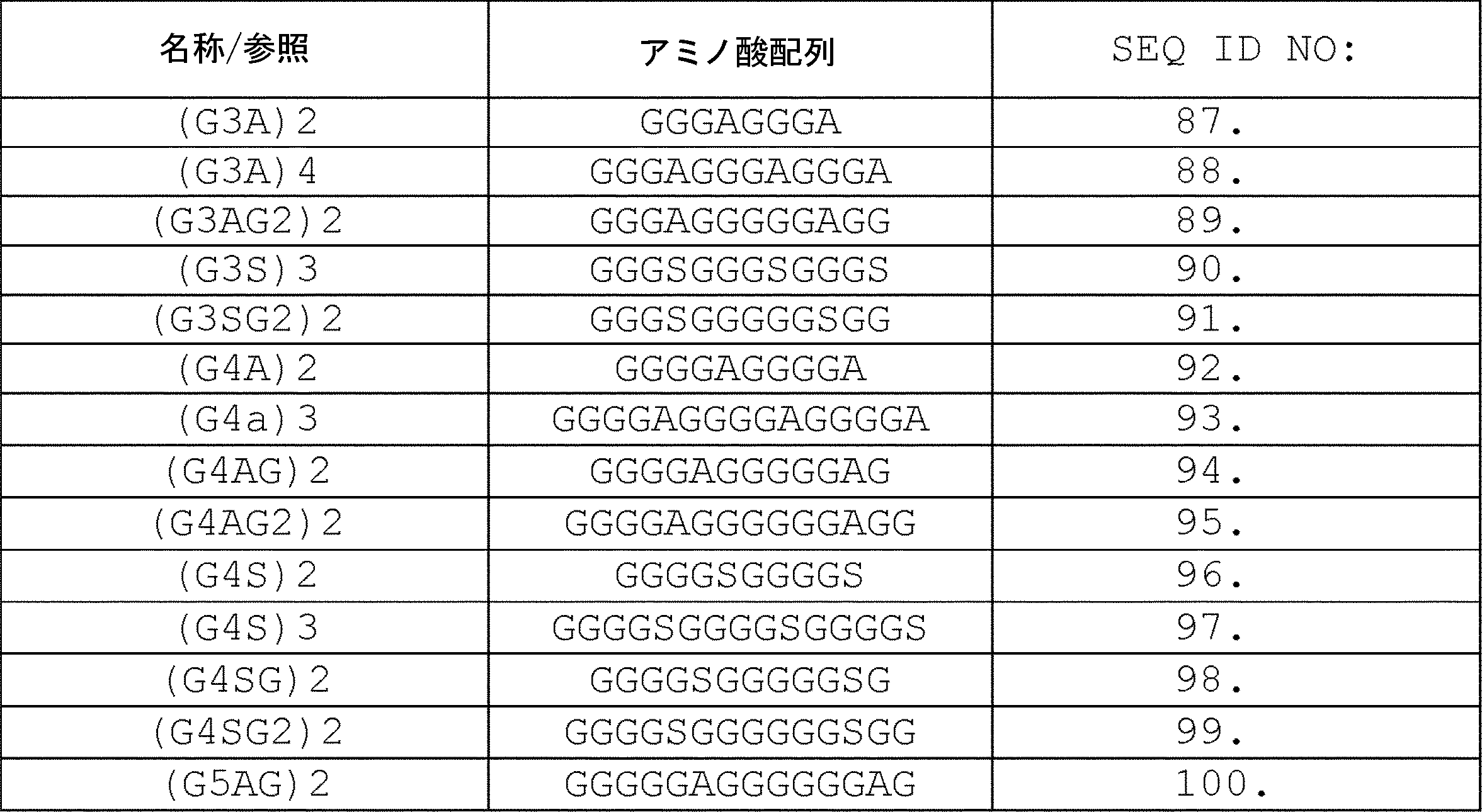

Fc1およびFc2:
本開示のhIL-12部分アゴニストは、それぞれが、ヘテロ二量体化を促進するように改変されたヒト免疫グロブリン分子のFc領域(Fc1およびFc2)を組み込んでいる、式[1]および[2]のポリペプチドを含むヘテロ二量体である。本明細書で使用する「Fc」および「Fc単量体」という用語は、Fc二量体の単量体ポリペプチドサブユニットを指定するために本明細書において互換的に用いられる。Fcは、(アミノ末端からカルボキシ末端に向かって)ヒト免疫グロブリン分子の下部ヒンジドメインとCH2およびCH3ドメインを含むアミノ酸配列を含む。一部の態様では、Fc単量体は、ヒトIgG1、ヒトIgG2、ヒトIgG3、およびヒトIgG4ヒンジドメインのヒト免疫グロブリン分子ドメインの下部ヒンジドメインとCH2およびCH3ドメインを含むポリペプチドである。hIgG1のCH2ドメインはアミノ酸残基238-337(EUナンバリング)に対応し、SEQ ID NO:142に示される。hIgG1のCH2ドメインはアミノ酸残基346-442(EUナンバリング)に対応し、SEQ ID NO:147に示される。
Fc1 and Fc2:
The hIL-12 partial agonist of the present disclosure is a heterodimer comprising the polypeptides of formulas [1] and [2], each incorporating an Fc region (Fc1 and Fc2) of a human immunoglobulin molecule modified to promote heterodimerization. As used herein, the terms "Fc" and "Fc monomer" are used interchangeably herein to designate a monomeric polypeptide subunit of an Fc dimer. Fc comprises an amino acid sequence comprising (from the amino terminus to the carboxy terminus) the lower hinge domain and the CH2 and CH3 domains of a human immunoglobulin molecule. In some embodiments, the Fc monomer is a polypeptide comprising the lower hinge domain and the CH2 and CH3 domains of a human immunoglobulin molecule domain of human IgG1, human IgG2, human IgG3, and human IgG4 hinge domain. The CH2 domain of hIgG1 corresponds to amino acid residues 238-337 (EU numbering) and is set forth in SEQ ID NO:142. The CH2 domain of hIgG1 corresponds to amino acid residues 346-442 (EU numbering) and is shown in SEQ ID NO:147.
式[1]および[2]のポリペプチドはそれぞれが、ヒト免疫グロブリンの下部ヒンジ領域を組み込んでいる。本明細書で使用する「下部ヒンジ」または「LH」という用語は、ヒト免疫グロブリン分子のアミノ酸残基221-229(EUナンバリング)に対応するアミノ酸配列を指す。一部の態様では、下部ヒンジ領域は、IgG1、IgG2、IgG3、およびIgG4下部ヒンジドメインのLH領域より選択されるヒト免疫グロブリンの天然下部ヒンジ領域である。一部の態様では、下部ヒンジ領域はヒトIgG1免疫グロブリンの下部ヒンジ領域である。一部の態様では、下部ヒンジ領域は、九量体アミノ酸配列:DKTHTCPPC(SEQ ID NO:140)を含むヒトIgG1免疫グロブリンの下部ヒンジ領域である。 The polypeptides of formulas [1] and [2] each incorporate a lower hinge region of a human immunoglobulin. As used herein, the term "lower hinge" or "LH" refers to the amino acid sequence corresponding to amino acid residues 221-229 (EU numbering) of a human immunoglobulin molecule. In some embodiments, the lower hinge region is a native lower hinge region of a human immunoglobulin selected from the LH region of an IgG1, IgG2, IgG3, and IgG4 lower hinge domain. In some embodiments, the lower hinge region is a lower hinge region of a human IgG1 immunoglobulin. In some embodiments, the lower hinge region is a lower hinge region of a human IgG1 immunoglobulin comprising the nonamer amino acid sequence: DKTHTCPPC (SEQ ID NO:140).
一部の態様では、Fc1およびFc2は、アミノ酸配列(示されたEUナンバリング、SEQ ID NO:141):

上記の配列に示したように、IgG1 Fcドメインの野生型のC末端残基はリジンであり、EUナンバリングに従ってK447と呼ばれる。K447は、首尾一貫せず、組換え産物中に産生細胞によって除去される。結果として、組換えにより産生されたFc単量体の画分の中にはK447を含有するものもあれば、K447を含有しないものもある点で、組換えFc単量体の集団は不均一になることがある。従って、産生細胞による、このような首尾一貫しないタンパク質分解プロセシングによって不均一なhIL12Fc集団が生じる場合がある。典型的に、特にヒト薬学的剤の状況では、活性薬学的剤のこのような不均一性は回避しなければならない。その結果として、ヘテロ二量体化を促進するFc単量体配列への改変に加えて、本開示は、C末端K447の欠失またはG446およびK447の欠失をさらに含むFc単量体、ならびに(a)位置447にあるリジン残基の欠失(K447、EUナンバリング。ΔK447またはdes-K447と略される)、または(b)位置456にあるリジンの欠失(G446 EUナンバリング。des-G446と略される)とK447にあるグリシンの欠失(このG446とK447の二重欠失は本明細書においてdes-G446/des-K447またはΔG446/ΔK447と呼ばれる)を含むFc単量体をコードする核酸配列を提供する。 As shown in the sequence above, the wild-type C-terminal residue of the IgG1 Fc domain is a lysine, designated K447 according to EU numbering. K447 is inconsistently removed by the producing cells in the recombinant product. As a result, the population of recombinant Fc monomers may be heterogeneous in that some fraction of recombinantly produced Fc monomers contain K447 and others do not. Thus, such inconsistent proteolytic processing by the producing cells may result in a heterogeneous hIL12Fc population. Typically, such heterogeneity of active pharmaceutical agents must be avoided, especially in the context of human pharmaceutical agents. As a result, in addition to modifications to the Fc monomer sequence that promote heterodimerization, the disclosure provides nucleic acid sequences encoding Fc monomers that further comprise a deletion of the C-terminal K447 or a deletion of G446 and K447, as well as Fc monomers that comprise (a) a deletion of the lysine residue at position 447 (K447, EU numbering; abbreviated as ΔK447 or des-K447), or (b) a deletion of the lysine at position 456 (G446 EU numbering; abbreviated as des-G446) and a deletion of the glycine at K447 (this double deletion of G446 and K447 is referred to herein as des-G446/des-K447 or ΔG446/ΔK447).
ヘテロ二量体化を促進するためのFcサブユニットの改変
上記の式[1]および[2]において示されたように、二量体FcのFc1およびFc2単量体は、Fc1とFc2との間のヘテロ二量体化を促進するアミノ酸置換を含有する。Fcドメインのヘテロ二量体化を促進するための様々な技法が確立している。例えば、Gilliesら、米国特許番号、Kimら、2021年8月3日に発行された米国特許第11087249号を参照されたい。一部の態様では、ヘテロ二量体化を促進する改変は、Moore, et al (2011) mAbs 3(6):546-557に記載のようにHF-TA変異およびHA-TF変異である。HF-TA法では、あるFc単量体上ではS364H/T394F置換を使用し、相補的Fc単量体上ではY349T/F405A置換を使用する。(HA-TF)法では、あるFc単量体上ではS364H/F405A置換を使用し、相補的Fc単量体上ではY349T/T394F置換を使用する。または、ZW1ヘテロ二量体化法では、あるFc単量体上ではT350V/L351Y/F405A/Y407V置換を使用し、相補的Fc単量体上ではT350V/T366L/K392L/T394W置換を使用する。Von Kreudenstein, et al (2013) mAbs, 5(5):646-654。EW-RVTヘテロ二量体化法でも、あるFc単量体上ではK360E/K409W置換を使用し、相補的Fc単量体上ではQ347R/D399V/F405T置換を使用する。Choi, et al (2015) Molecular Immunology 65(2):377-83。
Modification of Fc subunits to promote heterodimerization As shown in formulas [1] and [2] above, the Fc1 and Fc2 monomers of the dimeric Fc contain amino acid substitutions that promote heterodimerization between Fc1 and Fc2. Various techniques have been established to promote heterodimerization of Fc domains. See, for example, Gillies et al., U.S. Patent No. 1,108,7249, issued August 3, 2021 to Kim et al. In some embodiments, the modification that promotes heterodimerization is the HF-TA mutation and the HA-TF mutation as described in Moore, et al. (2011) mAbs 3(6):546-557. The HF-TA method uses S364H/T394F substitutions on one Fc monomer and Y349T/F405A substitutions on the complementary Fc monomer. The (HA-TF) method uses S364H/F405A substitutions on one Fc monomer and Y349T/T394F substitutions on the complementary Fc monomer, or the ZW1 heterodimerization method uses T350V/L351Y/F405A/Y407V substitutions on one Fc monomer and T350V/T366L/K392L/T394W substitutions on the complementary Fc monomer. Von Kreudenstein, et al (2013) mAbs, 5(5):646-654. The EW-RVT heterodimerization method also uses K360E/K409W substitutions on one Fc monomer and Q347R/D399V/F405T substitutions on the complementary Fc monomer. Choi, et al (2015) Molecular Immunology 65(2):377-83.
一態様では、Fc1およびFc2はヘテロ二量体化を促進するように改変されており、本明細書において例示されるように「ノブイントゥホール」(KiHと略される)改変の使用である。KiH改変は、第1のFc上に、かさ高い「ノブ」ドメインを作り出す、第1のFc単量体(例えば、Fc1)の中にある1つまたは複数のアミノ酸置換と、相補的ポケットまたは「ホール」を作り出す、第1のFc単量体の「ノブ」を受け入れるための、第2のFc単量体(例えば、Fc2)上にある1つまたは複数のアミノ酸置換を含む。 In one embodiment, Fc1 and Fc2 are modified to promote heterodimerization, as exemplified herein by the use of "knob-into-hole" (abbreviated KiH) modifications. KiH modifications include one or more amino acid substitutions in a first Fc monomer (e.g., Fc1) that create a bulky "knob" domain on the first Fc, and one or more amino acid substitutions on a second Fc monomer (e.g., Fc2) to accept the "knob" of the first Fc monomer, creating a complementary pocket or "hole" on the first Fc.
相補的なノブFc単量体とホールFc単量体を作り出すために様々なアミノ酸置換が確立している。例えば、Ridgway, et al (1996) Protein Engineering 9(7):617-921; Atwell, et al (1997) J. Mol. Biol. 270:26-35;Carterら、1998年9月15日に発行された米国特許第5,807,706号; Carterら、2010年4月13日に発行された7,695,936; Zhao et al.「A new approach to produce IgG4-like bispecific antibodies」, Scientific Reports 11: 18630 (2021); Cao et al.「Characterization and Monitoring of a Novel Light-heavy-light Chain Mispair in a Therapeutic Bispecific Antibody」、およびLiu et al.「Fc Engineering for Developing Therapeutic Bispecific Antibodies and Novel Scaffolds」. Frontiers in Immunology. 8: 38. doi:10.3389/fimmu.2017.00038 (2017)を参照されたい。 Various amino acid substitutions have been established to generate complementary knob and hole Fc monomers. See, e.g., Ridgway, et al (1996) Protein Engineering 9(7):617-921; Atwell, et al (1997) J. Mol. Biol. 270:26-35; Carter et al., U.S. Patent No. 5,807,706 issued September 15, 1998; Carter et al., U.S. Patent No. 7,695,936 issued April 13, 2010; Zhao et al. "A new approach to produce IgG4-like bispecific antibodies", Scientific Reports 11: 18630 (2021); Cao et al. "Characterization and Monitoring of a Novel Light-heavy-light Chain Mispair in a Therapeutic Bispecific Antibody", and Liu et al. "Fc Engineering for Developing Therapeutic Bispecific Antibodies and Novel Scaffolds". Frontiers in Immunology. 8: 38. See doi:10.3389/fimmu.2017.00038 (2017).
一部の態様では、Fcドメインは、位置366にあるスレオニン(EUナンバリング)が、かさ高い残基で改変されている(例えば、T366W)、第1のFc単量体のCH3ドメインが「ノブ」および置換となり、第2のFc単量体のCH3ドメインの相補的残基に1つまたは複数の置換を含む第2のFc単量体が、例えば、T366S、L368A、および/またはY407Vなどのアミノ酸置換により、かさ高い残基を受け入れるためのポケットまたは「ホール」となる、2つのFc単量体を含む。 In some embodiments, the Fc domain comprises two Fc monomers in which the threonine at position 366 (EU numbering) has been altered with a bulky residue (e.g., T366W), the CH3 domain of the first Fc monomer provides a "knob" and substitution, and a second Fc monomer includes one or more substitutions at the complementary residue in the CH3 domain of the second Fc monomer, e.g., by amino acid substitutions such as T366S, L368A, and/or Y407V, providing a pocket or "hole" to accommodate the bulky residue.
一態様では、式1のFc1単量体は、アミノ酸置換T366Wを含む「ノブ」改変Fc単量体であり、式2のFc2単量体は、アミノ酸置換T366S/L368A/Y407Vのセットを含む「ホール」改変Fcである。
In one embodiment, the Fc1 monomer of
または、式1のFc1単量体は、アミノ酸置換T366S/L368A/Y407Vのセットを含む「ホール」改変Fc単量体であり、式2のFc2単量体は、アミノ酸置換T366Wを含む「ノブ」改変Fc単量体である。
Alternatively, the Fc1 monomer of
相補的KiH改変を含む操作されたFcヘテロ二量体ペアの一例を以下の表3に示した。 An example of an engineered Fc heterodimer pair containing complementary KiH modifications is shown in Table 3 below.
(表3)相補的IgG1 KiHヘテロ二量体ペアのアミノ酸置換セット

言及したように、本開示のヘテロ二量体hIL-12Fcムテインは式[1]および[2]のポリペプチドの相補的ヘテロ二量体ペアとして提供され、第1のポリペプチドおよび第2のポリペプチドは少なくとも1つのジスルフィド結合によって連結される。一部の態様では、式[1]と[2]のポリペプチド間のジスルフィド結合の組み込みはFc1ドメインおよびFc2ドメインの中にある特定の場所でのシステイン置換によって成し遂げられてもよい。一態様では、Fc1のS354CとFc2のY349Cとの間でジスルフィド結合するように、式[1]のポリペプチドのFc1ドメインは、アミノ酸置換S354C(EUナンバリング)を含むhIgG1のFcドメインに由来し、式[2]のポリペプチドのFc2ドメインは、アミノ酸置換Y349C(EUナンバリング)を含むhIgG1のFcドメインに由来する。または、Fc1のS354CとFc2のY349Cとの間でジスルフィド結合するように、式[1]のポリペプチドのFc1ドメインは、アミノ酸置換Y349C(EUナンバリング)を含むhIgG1のFcドメインに由来し、式[2]のポリペプチドのFc2ドメインは、アミノ酸置換S354C(EUナンバリング)を含むhIgG1のFcドメインに由来する。 As mentioned, the heterodimeric hIL-12Fc mutein of the present disclosure is provided as a complementary heterodimeric pair of polypeptides of formulas [1] and [2], where the first and second polypeptides are linked by at least one disulfide bond. In some embodiments, the incorporation of a disulfide bond between the polypeptides of formulas [1] and [2] may be achieved by cysteine substitution at specific locations in the Fc1 and Fc2 domains. In one embodiment, the Fc1 domain of the polypeptide of formula [1] is derived from the Fc domain of hIgG1 containing the amino acid substitution S354C (EU numbering), and the Fc2 domain of the polypeptide of formula [2] is derived from the Fc domain of hIgG1 containing the amino acid substitution Y349C (EU numbering), such that the disulfide bond is formed between S354C of Fc1 and Y349C of Fc2. Alternatively, the Fc1 domain of the polypeptide of formula [1] is derived from the Fc domain of hIgG1 containing the amino acid substitution Y349C (EU numbering), such that a disulfide bond is formed between S354C of Fc1 and Y349C of Fc2, and the Fc2 domain of the polypeptide of formula [2] is derived from the Fc domain of hIgG1 containing the amino acid substitution S354C (EU numbering).
本開示の実施において使用され得る、相補的KiH操作ヘテロ二量体Fcペアのさらなる例を以下の表4に示した。 Further examples of complementary KiH engineered heterodimeric Fc pairs that may be used in the practice of the present disclosure are shown in Table 4 below.
(表4)ノブイントゥホールFc二量体ペア
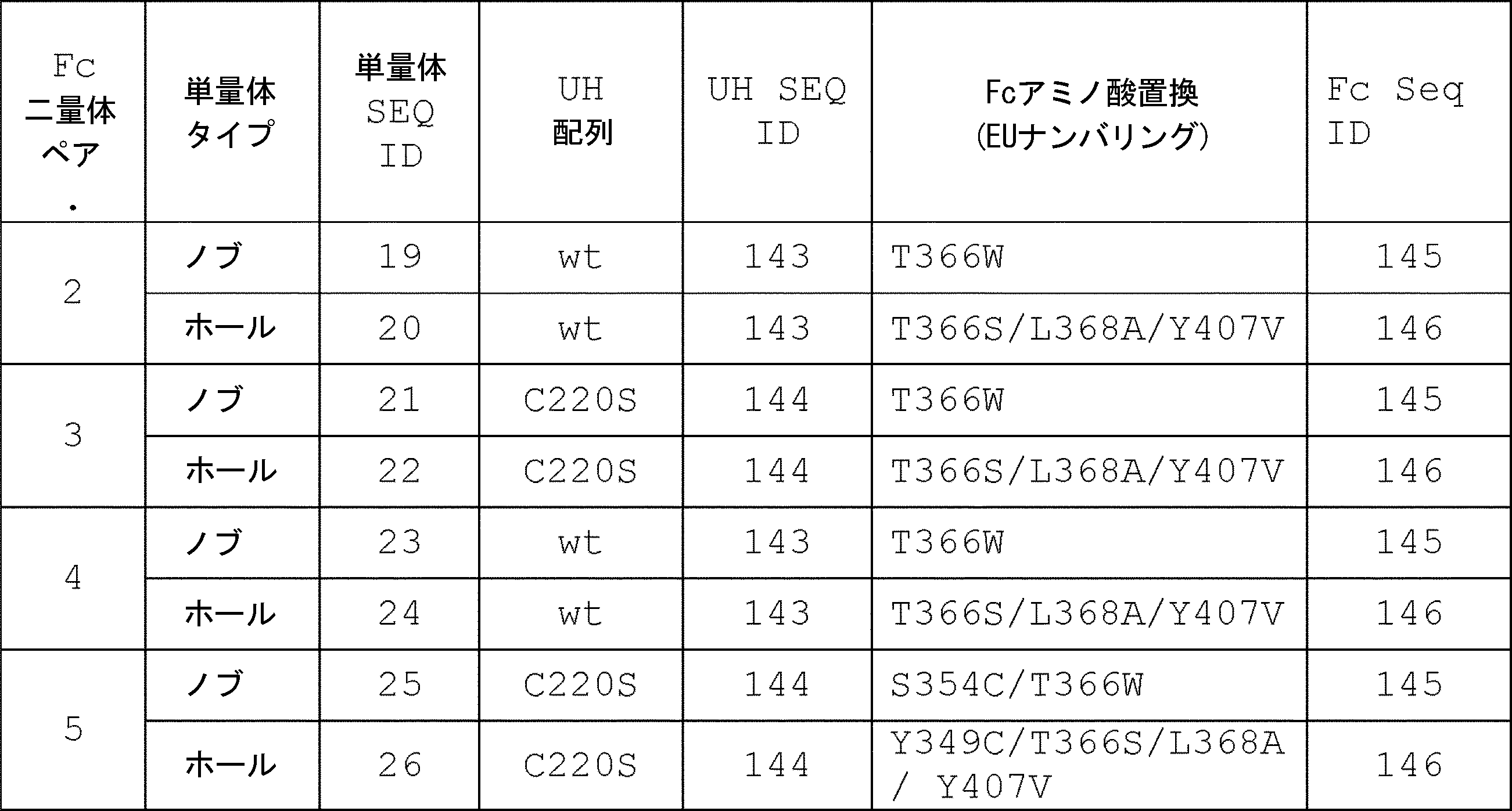
さらなるFc改変
Fc1ドメインおよびFc2ドメインのヘテロ二量体化を促進するための改変に加えて、Fc1およびFc2は、任意で、エフェクター機能を軽減する、1つまたは複数のグリコシル化部位を排除する、さらなるアミノ酸改変を提供してもよい。
Further Fc modifications
In addition to modifications to promote heterodimerization of the Fc1 and Fc2 domains, Fc1 and Fc2 may optionally be provided with further amino acid modifications that reduce effector function or eliminate one or more glycosylation sites.
エフェクター機能を低減するための改変
一部の態様では、Fcドメインは、抗体指向性細胞傷害(antibody directed cytotoxicity)(ADCC)エフェクター機能を低減するか、または無くす、Fc受容体(FcyRおよびFcR)への結合を実質的に低減するように改変されてもよい。エフェクター機能を低減するためのFcドメインの改変は当技術分野において周知である。例えば、Wang, et al. (2018) IgG Fc engineering to modulate antibody effector functions, Protein Cell 9(1):63-73を参照されたい。例えば、位置235(EUナンバリング)にあるリジン残基のリジン(L)からグルタミン酸(E)への変異はFcgRおよびC1q結合を低減することでエフェクター機能を低減することが知られている。Alegre, et al. (1992) J. Immunology 148:3461-3468。さらに、IgG1ヒンジ領域中の位置234および235(EUナンバリング)にある2つのリジン(L)残基のアラニン(A)による置換、すなわち、L234AおよびL235Aは補体依存性細胞傷害(CDC)および抗体依存性細胞傷害(ADCC)の減少をもたらす。Hezereh et al., (2001) J. Virol 75(24):12161-68。さらに、位置329(EUナンバリング)にあるプロリンからアラニンへの変異(P329A)またはグリシンへの変異(P329G)はエフェクター機能を軽減させ、L234AおよびL235A置換と組み合わされ得る。一部の態様では、本発明の組成物のFcドメインは、「LALAPA」置換と呼ばれるアミノ酸置換L234A/L235A/P329A(EUナンバリング)または「LALAPG」置換と呼ばれるL234A/L235A/P329G(EUナンバリング)を含んでもよい。本開示のhIL12およびヘテロ二量体hIL23Fcムテインに組み込まれ得る、ペアのKiH Fc二量体構築物の例を以下の表5に示した。
Modifications to Reduce Effector Function In some embodiments, the Fc domain may be modified to substantially reduce binding to Fc receptors (FcyR and FcR), reducing or eliminating antibody directed cytotoxicity (ADCC) effector function. Modifications of Fc domains to reduce effector function are well known in the art. See, for example, Wang, et al. (2018) IgG Fc engineering to modulate antibody effector functions, Protein Cell 9(1):63-73. For example, a lysine (L) to glutamic acid (E) mutation of the lysine residue at position 235 (EU numbering) is known to reduce effector function by reducing FcgR and C1q binding. Alegre, et al. (1992) J. Immunology 148:3461-3468. Furthermore, substitution of two lysine (L) residues at positions 234 and 235 (EU numbering) in the IgG1 hinge region with alanine (A), i.e., L234A and L235A, results in reduced complement-dependent cytotoxicity (CDC) and antibody-dependent cellular cytotoxicity (ADCC). Hezereh et al., (2001) J. Virol 75(24):12161-68. Furthermore, mutation of proline to alanine (P329A) or glycine (P329G) at position 329 (EU numbering) reduces effector function and can be combined with the L234A and L235A substitutions. In some embodiments, the Fc domain of the compositions of the invention may contain amino acid substitutions L234A/L235A/P329A (EU numbering), referred to as "LALAPA" substitutions, or L234A/L235A/P329G (EU numbering), referred to as "LALAPG" substitutions. Examples of paired KiH Fc dimer constructs that may be incorporated into the hIL12 and heterodimeric hIL23Fc muteins of the present disclosure are shown in Table 5 below.
(表5)エフェクター機能を低減するための変異を含む、相補的IgG1 KiH UH/Fcヘテロ二量体ペアのアミノ酸置換セット

作用期間を延長するための配列改変
一部の態様では、Fc1および/またはFc2単量体のアミノ酸配列は、分子の作用期間を延長し、クリアランスを阻止するアミノ酸置換を組み込んでいる場合がある。一部の態様では、Fc単量体に対する、このような改変には、「LS」改変と呼ばれるアミノ酸置換M428LおよびM434S(EUナンバリング)が含まれる。LS改変は、任意で、エフェクター機能を低減し、Fc1とFc2との間でジスルフィド結合をもたらすためのアミノ酸置換と組み合わされる場合がある。以下の表11は、式[1]および[2]のFc1およびFc2ポリペプチドの設計において使用され得る、ヘテロ二量体化を促進するための相補的な配列改変を有する例示的なFc1およびFc1ヘテロ二量体ペアを示す。
Sequence Modifications to Extend Duration of Action In some embodiments, the amino acid sequences of Fc1 and/or Fc2 monomers may incorporate amino acid substitutions that extend the duration of action of the molecule and prevent clearance. In some embodiments, such modifications to the Fc monomer include amino acid substitutions M428L and M434S (EU numbering), referred to as "LS" modifications. LS modifications may optionally be combined with amino acid substitutions to reduce effector function and provide disulfide bonds between Fc1 and Fc2. Table 11 below shows exemplary Fc1 and Fc1 heterodimer pairs with complementary sequence modifications to promote heterodimerization that may be used in designing Fc1 and Fc2 polypeptides of formulas [1] and [2].
以下の表6は、本開示のヘテロ二量体hIL12FcムテインのFc1ポリペプチドおよびFc2ポリペプチドの調製において使用され得る例示的なFcヘテロ二量体ペアを示す。 Table 6 below shows exemplary Fc heterodimer pairs that can be used in preparing the Fc1 and Fc2 polypeptides of the heterodimeric hIL12Fc muteins of the present disclosure.
(表6)エフェクター機能の低減およびLS半減期の延長のための変異を含む、相補的IgG1 KiH UH/Fcヘテロ二量体ペアのアミノ酸置換セット
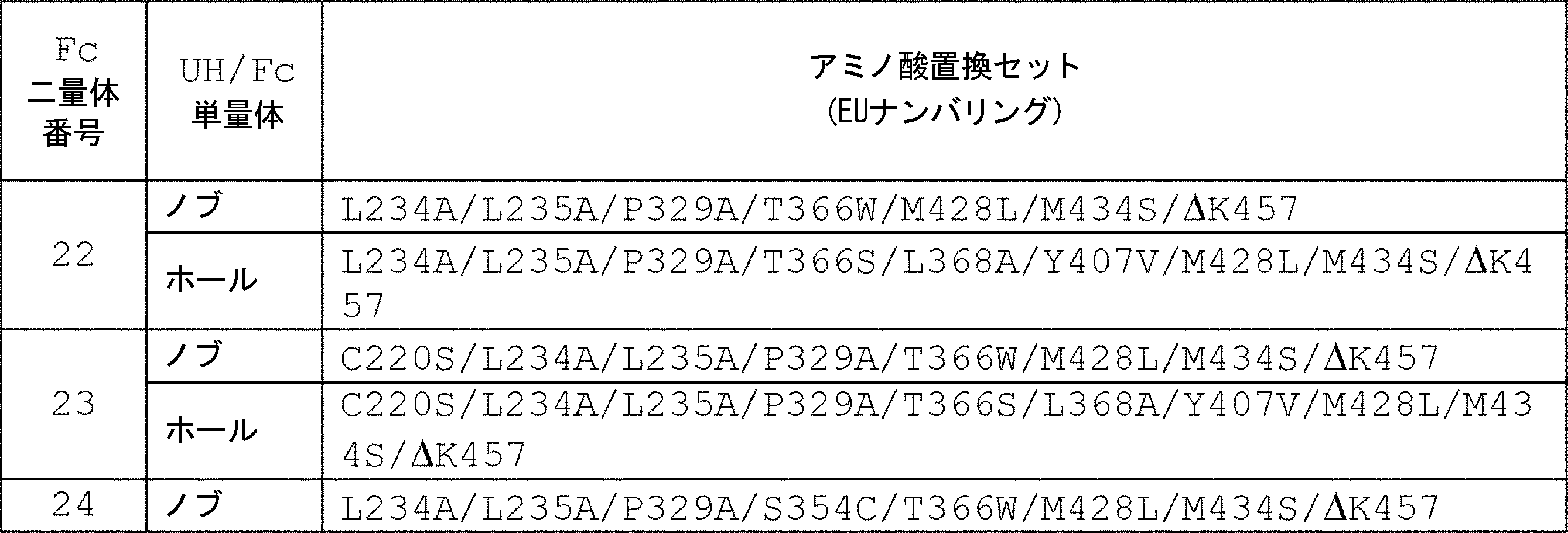


グリコシル化部位を排除するための改変
一部の態様では、FcドメインはN結合型グリコシル化部位またはO結合型グリコシル化部位を排除するように改変される。Fcドメイン、特にIgG1サブクラスのFcドメインのグリコシル化バリアントはエフェクター機能の不十分なメディエーターであることが知られている。Jefferis et al. 1998, Immol. Rev., vol. 163, 50-76)。位置297(EUナンバリング)におけるグリコシル化はエフェクター機能に寄与することが示されている。Edelman, et al (1969) PNAS (USA) 63:78-85。一部の態様では、本開示の組成物のFcドメインは、N結合型グリコシル化部位またはO結合型グリコシル化部位を排除するための1つの、または改変を含む。Fcドメイン中のグリコシル化部位を排除するためのN297における改変の例にはアミノ酸置換N297QおよびN297Gが含まれる。
Modifications to eliminate glycosylation sites In some embodiments, the Fc domain is modified to eliminate N-linked or O-linked glycosylation sites. Glycosylation variants of Fc domains, particularly those of the IgG1 subclass, are known to be poor mediators of effector function. Jefferis et al. 1998, Immol. Rev., vol. 163, 50-76). Glycosylation at position 297 (EU numbering) has been shown to contribute to effector function. Edelman, et al (1969) PNAS (USA) 63:78-85. In some embodiments, the Fc domain of the composition of the present disclosure includes one or modifications to eliminate N-linked or O-linked glycosylation sites. Examples of modifications at N297 to eliminate glycosylation sites in the Fc domain include the amino acid substitutions N297Q and N297G.
アルブミン担体分子
一部の態様では、改変されたhIL-12p40ポリペプチド、hIL-12ムテイン、またはhIL-23ムテインは、インビボでの長期曝露を容易にすることが当技術分野において知られているアルブミン分子(例えば、ヒト血清アルブミン)とコンジュゲートする。一部の態様では、hIL-12p40ポリペプチド、hIL-12ムテイン、またはhIL-23ムテインは化学的連結を介してアルブミンとコンジュゲートするか、またはアルブミン分子との融合タンパク質(本明細書において「改変されたhIL-12p40ポリペプチドアルブミン融合」と呼ばれる)として発現される。「アルブミン」という用語は、ヒト血清アルブミン(HSA)、カニクイザル(cyno)血清アルブミン、およびウシ血清アルブミン(BSA)などのアルブミンを含む。一部の態様では、HSAは、野生型HSA配列と比べてC34SまたはK573Pアミノ酸置換を含む。本開示によれば、アルブミンは、改変されたhIL-12p40ポリペプチドまたはhIL-12p35のカルボキシル末端、アミノ末端、カルボキシル末端とアミノ末端の両方と、および内部にコンジュゲートすることができる(例えば、US5,876,969およびUS7,056,701を参照されたい)。本開示によって意図されるHAS改変ポリペプチドにおいて、アルブミン分泌プレ配列およびそのバリアント、断片およびそのバリアント、ならびにHSAバリアントなどの様々な形態のアルブミンを使用することができる。このような形態は一般的に1つまたは複数の望ましいアルブミン活性を有する。さらなる態様では、本開示は、アルブミン、アルブミン断片、およびアルブミンバリアントなどに直接的または間接的に融合された、改変されたhIL-12p40ポリペプチド、hIL-12ムテイン、またはhIL-23ムテインを含む融合タンパク質を伴い、融合タンパク質は非融合薬物分子よりも高い血漿安定性を有する、および/または融合タンパク質は非融合薬物分子の治療活性を保持している。このような融合タンパク質は、当業者に対する組換え技術によって容易に調製され得る。このような融合タンパク質をコードする核酸配列を様々な任意の商業的供給業者から注文することができる。当技術分野において周知の技法によって、融合タンパク質をコードする核酸配列は、1つまたは複数の発現制御エレメントの機能的に連結された発現ベクターの中に組み込まれ、ベクターは適切な宿主細胞に導入され、融合タンパク質は宿主細胞培養物から単離される。
Albumin Carrier Molecules In some embodiments, modified hIL-12p40 polypeptides, hIL-12 muteins, or hIL-23 muteins are conjugated to albumin molecules (e.g., human serum albumin) known in the art to facilitate long-term exposure in vivo. In some embodiments, hIL-12p40 polypeptides, hIL-12 muteins, or hIL-23 muteins are conjugated to albumin via chemical linkage or expressed as a fusion protein with an albumin molecule (referred to herein as "modified hIL-12p40 polypeptide albumin fusion"). The term "albumin" includes albumins such as human serum albumin (HSA), cynomolgus monkey (cyno) serum albumin, and bovine serum albumin (BSA). In some embodiments, HSA comprises a C34S or K573P amino acid substitution compared to the wild-type HSA sequence. According to the present disclosure, albumin can be conjugated to the carboxyl terminus, amino terminus, both carboxyl terminus and amino terminus, and internally of the modified hIL-12p40 polypeptide or hIL-12p35 (see, for example, US5,876,969 and US7,056,701). Various forms of albumin can be used in the HAS modified polypeptides contemplated by the present disclosure, such as albumin secretory presequences and variants thereof, fragments and variants thereof, and HSA variants. Such forms generally have one or more desirable albumin activities. In a further aspect, the present disclosure involves fusion proteins comprising modified hIL-12p40 polypeptides, hIL-12 muteins, or hIL-23 muteins fused directly or indirectly to albumin, albumin fragments, albumin variants, and the like, where the fusion proteins have a higher plasma stability than the non-fused drug molecule, and/or the fusion proteins retain the therapeutic activity of the non-fused drug molecule. Such fusion protein can be easily prepared by recombinant technology for those skilled in the art.The nucleic acid sequence encoding such fusion protein can be ordered from any of various commercial suppliers.By the techniques well known in the art, the nucleic acid sequence encoding fusion protein is incorporated into an expression vector that is operably linked with one or more expression control elements, the vector is introduced into a suitable host cell, and the fusion protein is isolated from the host cell culture.
ポリマー担体
一部の態様では、改変されたhIL-12p40ポリペプチド、hIL-12ムテイン、またはhIL-23ムテインの長期のインビボ作用期間は、XTENポリマーまたは水溶性ポリマーなどの1種類または複数種のポリマー担体分子とのコンジュゲートによって成し遂げられてもよい。
Polymeric Carriers In some embodiments, the long duration of action of the modified hIL-12p40 polypeptide, hIL-12 mutein, or hIL-23 mutein in vivo may be achieved by conjugation to one or more polymeric carrier molecules, such as XTEN polymers or water-soluble polymers.
XTENコンジュゲート
改変されたhIL-12p40ポリペプチド、hIL-12ムテイン、またはhIL-23ムテインはXTENポリマーをさらに含んでもよい。改変されたhIL-12p40ポリペプチドまたはhIL-12ムテインに(化学的に、または融合タンパク質として)コンジュゲートしたXTENポリマーはPEG化に似た長期の持続期間をもたらし、大腸菌(E.coli)内で組換え融合タンパク質として産生され得る。本開示のhIL-12p40ポリペプチド、hIL-12ムテイン、またはhIL-23ムテインと一緒に使用するのに適したXTENポリマーは、Podust, et al. (2016)「Extension of in vivo half-life of biologically active molecules by XTEN protein polymers」, J Controlled Release 240:52-66、およびHaeckel et al. (2016) 「XTEN as Biological Alternative to PEGylation Allows Complete Expression of a Protease-Activatable Killin-Based Cytostatic」 PLOS ONE | DOI:10.1371/journal.pone.0157193 June 13, 2016に示されている。XTENポリマー融合タンパク質は、XTENポリペプチドとhIL2ムテインとの間にプロテアーゼ感受性切断部位、例えば、MMP-2切断部位を組み込んでもよい。
XTEN Conjugates The modified hIL-12p40 polypeptide, hIL-12 mutein, or hIL-23 mutein may further comprise an XTEN polymer. XTEN polymers conjugated (chemically or as fusion proteins) to the modified hIL-12p40 polypeptide or hIL-12 mutein provide long-term persistence similar to PEGylation and can be produced as recombinant fusion proteins in E. coli. Suitable XTEN polymers for use with the hIL-12p40 polypeptides, hIL-12 muteins, or hIL-23 muteins of the present disclosure are set forth in Podust, et al. (2016) "Extension of in vivo half-life of biologically active molecules by XTEN protein polymers," J Controlled Release 240:52-66, and Haeckel et al. (2016) "XTEN as Biological Alternative to PEGylation Allows Complete Expression of a Protease-Activatable Killin-Based Cytostatic" PLOS ONE | DOI:10.1371/journal.pone.0157193 June 13, 2016. The XTEN polymer fusion protein may incorporate a protease-sensitive cleavage site, e.g., an MMP-2 cleavage site, between the XTEN polypeptide and the hIL2 mutein.
水溶性ポリマー
一部の態様では、改変されたhIL-12p40ポリペプチド、hIL-12ムテイン、またはhIL-23ムテインは1種類または複数種の水溶性ポリマーにコンジュゲートしてもよい。本開示の実施において有用な水溶性ポリマーの例には、ポリエチレングリコール(PEG)、ポリ-プロピレングリコール(PPG)、多糖類(ポリビニルピロリドン、エチレングリコールとプロピレングリコールのコポリマー、ポリ(オキシエチル化ポリオール)、ポリオレフィンアルコール)、多糖類)、ポリ-α-ヒドロキシ酸)、ポリビニルアルコール(PVA)、ポリフォスファーゼン、ポリオキサゾリン(POZ)、ポリ(N-アクリロイルモルホリン)、またはその組み合わせが含まれる。
Water-soluble polymers In some embodiments, the modified hIL-12p40 polypeptide, hIL-12 mutein, or hIL-23 mutein may be conjugated to one or more water-soluble polymers. Examples of water-soluble polymers useful in the practice of the present disclosure include polyethylene glycol (PEG), poly-propylene glycol (PPG), polysaccharides (polyvinylpyrrolidone, copolymers of ethylene glycol and propylene glycol, poly(oxyethylated polyols), polyolefin alcohols), polysaccharides), poly-α-hydroxy acids), polyvinyl alcohol (PVA), polyphosphazenes, polyoxazolines (POZ), poly(N-acryloylmorpholines), or combinations thereof.
一部の態様では、改変されたhIL-12p40ポリペプチド、hIL-12ムテイン、hIL-12 Fcムテイン、またはhIL-23ムテインは1つまたは複数のポリエチレングリコール分子とコンジュゲートしてもよい、すなわち「PEG化」されてもよい。一部の態様では、hIL-12ムテインまたはhIL-12 FcムテインのhIL-12p40ポリペプチドはPEG化される。一部の態様では、hIL-12ムテインまたはhIL-12 FcムテインのhIL-12p35はPEG化される。一部の態様では、hIL-23ムテインのhIL-12p40ポリペプチドはPEG化される。一部の態様では、hIL-23ムテインのヒトp19ポリペプチドはPEG化される。結合分子にPEGを取り付けるための方法または部位は変わることがあるが、ある特定の態様では、PEG化しても結合分子の活性は変化しないか、または最小限しか変化しない。 In some embodiments, the modified hIL-12p40 polypeptide, hIL-12 mutein, hIL-12 Fc mutein, or hIL-23 mutein may be conjugated with one or more polyethylene glycol molecules, i.e., "PEGylated." In some embodiments, the hIL-12p40 polypeptide of the hIL-12 mutein or hIL-12 Fc mutein is PEGylated. In some embodiments, the hIL-12p35 of the hIL-12 mutein or hIL-12 Fc mutein is PEGylated. In some embodiments, the hIL-12p40 polypeptide of the hIL-23 mutein is PEGylated. In some embodiments, the human p19 polypeptide of the hIL-23 mutein is PEGylated. The method or site for attaching PEG to the binding molecule may vary, but in certain embodiments, PEGylation does not change or only minimally changes the activity of the binding molecule.
ポリペプチド配列にコンジュゲートするのに適したPEGは一般的に室温で水に溶け、一般式
R(O-CH2-CH2)nO-R
を有し、式中、Rは、水素または保護基、例えば、アルキル基またはアルカノール基であり、nは1~1000の整数である。Rが保護基である時、一般的に、1~8個の炭素を有する。PEGは直鎖でもよく分枝鎖でもよい。分枝PEG誘導体、「スターPEG」、およびマルチアームドPEGが本開示によって意図される。
PEG suitable for conjugation to a polypeptide sequence is generally soluble in water at room temperature and has the general formula
R(O-CH2-CH2) n OR
where R is hydrogen or a protecting group, such as an alkyl or alkanol group, and n is an integer from 1 to 1000. When R is a protecting group, it generally has from 1 to 8 carbons. PEG can be linear or branched. Branched PEG derivatives, "star PEGs," and multi-armed PEGs are contemplated by the present disclosure.
一部の態様では、改変された、の選択的PEG化。一部の態様では、hIL-12ムテインのhIL-12p40がPEG化される。一部の態様では、hIL-12ムテインのhIL-12p35が、例えば、選択的PEGコンジュゲートを容易にする側鎖を有する非天然アミノ酸の組み込みによってPEG化される。結合分子のPEG化が結合分子と標的受容体との結合に影響を及ぼさないように、特定のPEG化部位を選択することができる。 In some embodiments, selective PEGylation of the modified . In some embodiments, the hIL-12 mutein hIL-12p40 is PEGylated. In some embodiments, the hIL-12 mutein hIL-12p35 is PEGylated, for example, by incorporation of a non-natural amino acid with a side chain that facilitates selective PEG conjugation. The particular PEGylation site can be selected such that PEGylation of the binding molecule does not affect binding of the binding molecule to the target receptor.
ある特定の態様では、半減期の増加は、生物学的活性のどの減少よりも大きい。ポリペプチド配列にコンジュゲートするのに適したPEGは一般的に室温で水に溶け、一般式R(O-CH2-CH2)nO-Rを有し、式中、Rは、水素または保護基、例えば、アルキル基またはアルカノール基であり、nは1~1000の整数である。Rが保護基である時、一般的に、1~8個の炭素を有する。ポリペプチド配列とコンジュゲートするPEGは直鎖でもよく分枝鎖でもよい。分枝PEG誘導体、「スターPEG」、およびマルチアームドPEGが本開示によって意図される。 In certain embodiments, the increase in half-life is greater than any decrease in biological activity. PEGs suitable for conjugation to polypeptide sequences are generally soluble in water at room temperature and have the general formula R(O-CH2-CH2)nO-R, where R is hydrogen or a protecting group, e.g., an alkyl or alkanol group, and n is an integer from 1 to 1000. When R is a protecting group, it generally has 1 to 8 carbons. PEGs for conjugation to polypeptide sequences can be linear or branched. Branched PEG derivatives, "star PEGs," and multi-armed PEGs are contemplated by the present disclosure.
本開示において用いられるPEGの分子量は、どの特定の範囲にも限定されない。結合分子のPEG成分の分子量は、約5kDa超、約10kDa超、約15kDa超、約20kDa超、約30kDa超、約40kDa超、または約50kDa超でもよい。一部の態様では、分子量は、約5kDa~約10kDa、約5kDa~約15kDa、約5kDa~約20kDa、約10kDa~約15kDa、約10kDa~約20kDa、約10kDa~約25kDa、または約10kDa~約30kDaである。約2,000~約80,000ダルトン、あるいは約2,000~約70,000ダルトン、あるいは約5,000~約50,000ダルトン、あるいは約10,000~約50,000ダルトン、あるいは約20,000~約50,000ダルトン、あるいは約30,000~約50,000ダルトン、あるいは約20,000~約40,000ダルトン、あるいは約30,000~約40,000ダルトンの分子量を有する直鎖PEG分子または分枝鎖PEG分子。本開示の一態様では、PEGは、2つの20kDアームを含む40kD分枝PEGである。 The molecular weight of PEG used in the present disclosure is not limited to any particular range. The molecular weight of the PEG component of the binding molecule may be greater than about 5 kDa, greater than about 10 kDa, greater than about 15 kDa, greater than about 20 kDa, greater than about 30 kDa, greater than about 40 kDa, or greater than about 50 kDa. In some embodiments, the molecular weight is about 5 kDa to about 10 kDa, about 5 kDa to about 15 kDa, about 5 kDa to about 20 kDa, about 10 kDa to about 15 kDa, about 10 kDa to about 20 kDa, about 10 kDa to about 25 kDa, or about 10 kDa to about 30 kDa. A linear or branched PEG molecule having a molecular weight of about 2,000 to about 80,000 daltons, alternatively about 2,000 to about 70,000 daltons, alternatively about 5,000 to about 50,000 daltons, alternatively about 10,000 to about 50,000 daltons, alternatively about 20,000 to about 50,000 daltons, alternatively about 30,000 to about 50,000 daltons, alternatively about 20,000 to about 40,000 daltons, alternatively about 30,000 to about 40,000 daltons. In one embodiment of the present disclosure, the PEG is a 40 kD branched PEG comprising two 20 kD arms.
本開示はまた、PEGが異なるn値を有する、従って、様々な異なるPEGが特定の比で存在するコンジュゲートの組成物も意図する。例えば、一部の組成物は、n=1、2、3および4であるコンジュゲートの組成物を含む。一部の組成物では、n=1のコンジュゲートのパーセントは18~25%であり、n=2のコンジュゲートのパーセントは50~66%であり、n=3のコンジュゲートのパーセントは12~16%であり、n=4のコンジュゲートのパーセントは5%までである。このような組成物は、当技術分野において公知の反応条件および精製方法によって産生することができる。コンジュゲート画分を分離するためにクロマトグラフィーが用いられる場合があり、次いで、例えば、望ましい数のPEGが取り付けられているコンジュゲートを含有する画分が特定され、改変されていないタンパク質配列が無いように、および他の数のPEGが取り付けられているコンジュゲートが無いように精製される。 The present disclosure also contemplates compositions of conjugates in which PEG has different n values, and thus various different PEGs are present in specific ratios. For example, some compositions include compositions of conjugates where n=1, 2, 3, and 4. In some compositions, the percentage of conjugates where n=1 is 18-25%, the percentage of conjugates where n=2 is 50-66%, the percentage of conjugates where n=3 is 12-16%, and the percentage of conjugates where n=4 is up to 5%. Such compositions can be produced by reaction conditions and purification methods known in the art. Chromatography can be used to separate the conjugate fractions, and then fractions containing, for example, conjugates with a desired number of PEGs attached are identified and purified to be free of unmodified protein sequences and to be free of conjugates with other numbers of PEGs attached.
ポリペプチド配列にコンジュゲートするのに適したPEGは一般的に室温で水に溶け、一般式R(O-CH2-CH2)nO-Rを有し、式中、Rは、水素または保護基、例えば、アルキル基またはアルカノール基であり、nは1~1000の整数である。Rが保護基である時、一般的に、1~8個の炭素を有する。 PEG suitable for conjugation to polypeptide sequences is generally soluble in water at room temperature and has the general formula R(O-CH2-CH2)nO-R, where R is hydrogen or a protecting group, e.g., an alkyl or alkanol group, and n is an integer from 1 to 1000. When R is a protecting group, it generally has from 1 to 8 carbons.
2つの広く用いられている第一世代の活性化モノメトキシPEG(mPEG)は、スクシンイミジルカーボネートPEG(SC-PEG;例えば、Zalipsky, et al. (1992) Biotehnol. Appl. Biochem 15:100-114を参照されたい)およびベンゾトリアゾールカーボネートPEG(BTC-PEG;例えば、Dolenceら、米国特許第5,650,234号を参照されたい)であり、これらは、リジン残基と優先的に反応してカルバメート結合を形成するが、ヒスチジンおよびチロシン残基と反応することも知られている。PEG-アルデヒドリンカーの使用は、還元的アミノ化を介してポリペプチドN末端にある1つの部位を標的とする。 Two widely used first generation activated monomethoxy PEGs (mPEGs) are succinimidyl carbonate PEG (SC-PEG; see, e.g., Zalipsky, et al. (1992) Biotehnol. Appl. Biochem 15:100-114) and benzotriazole carbonate PEG (BTC-PEG; see, e.g., Dolence et al., U.S. Pat. No. 5,650,234), which react preferentially with lysine residues to form carbamate linkages, but are also known to react with histidine and tyrosine residues. The use of PEG-aldehyde linkers targets a single site at the polypeptide N-terminus via reductive amination.
PEG化は、ポリペプチドのN末端にあるα-アミノ基、リジン残基の側鎖にあるεアミノ基、およびヒスチジン残基の側鎖にあるイミダゾール基において最も頻繁に行われる。ほとんどの組換えポリペプチドは1個のαアミノ基と多数のεアミノ基とイミダゾール基を有するので、リンカー化学に応じて非常に多くの位置異性体を作製することができる。当技術分野において公知の一般的なPEG化戦略を本明細書において適用することができる。 PEGylation is most frequently performed at the α-amino group at the N-terminus of a polypeptide, the ε-amino group at the side chain of a lysine residue, and the imidazole group at the side chain of a histidine residue. Since most recombinant polypeptides have one α-amino group and multiple ε-amino and imidazole groups, a large number of positional isomers can be generated depending on the linker chemistry. General PEGylation strategies known in the art can be applied herein.
PEGは、ポリペプチド配列の1つまたは複数の遊離アミノ基またはカルボキシル基とポリエチレングリコールとの間の結合を媒介する末端反応基(「スペーサー」)を介して本開示の結合分子に結合することができる。遊離アミノ基に結合することができるスペーサーを有するPEGにはN-ヒドロキシスクシニルイミドポリエチレングリコールが含まれ、これは、ポリエチレングリコールのコハク酸エステルをN-ヒドロキシスクシニルイミドで活性化することによって調製することができる。 PEG can be attached to the binding molecules of the present disclosure through a terminal reactive group ("spacer") that mediates a bond between one or more free amino or carboxyl groups of the polypeptide sequence and polyethylene glycol. PEGs having spacers that can be attached to free amino groups include N-hydroxysuccinimide polyethylene glycol, which can be prepared by activating the succinate ester of polyethylene glycol with N-hydroxysuccinimide.
ポリペプチド配列にコンジュゲートしたPEGは直鎖または分枝鎖であることができる。分枝PEG誘導体、「スターPEG」、およびマルチアームドPEGが本開示によって意図される。本開示の実施において有用なPEGの特定の態様には、10kDaの直鎖PEG-アルデヒド(例えば、Sunbright(登録商標)ME-100AL, NOF America Corporation, One North Broadway, White Plains, NY 10601 USA)、10kDa 直鎖PEG-NHS エステル(例えば、Sunbright(登録商標) ME-100CS、Sunbright(登録商標) ME-100AS、Sunbright(登録商標) ME-100GS、Sunbright(登録商標) ME-100HS, NOF)、20kDa直鎖PEG-アルデヒド(例えば、Sunbright(登録商標) ME-200AL, NOF)、20kDa直鎖PEG-NHSエステル(例えば、Sunbright(登録商標)ME-200CS、Sunbright(登録商標)ME-200AS、Sunbright(登録商標)ME-200GS、Sunbright(登録商標)ME-200HS, NOF)、20kDa 2アーム分枝PEG-アルデヒド、2つの10kDA直鎖PEG分子を含む20kDA PEG-アルデヒド(例えば、Sunbright(登録商標)GL2-200AL3, NOF)、20kDa 2アーム分枝PEG-NHSエステル、2つの10kDA直鎖PEG分子を含む20kDA PEG-NHSエステル(例えば、Sunbright(登録商標)GL2-200TS、Sunbright(登録商標)GL200GS2, NOF)、40kDa 2アーム分枝PEG-アルデヒド、2つの20kDA直鎖PEG分子を含む40kDA PEG-アルデヒド(例えば、Sunbright(登録商標)GL2-400AL3)、40kDa 2アーム分枝PEG-NHSエステル、2つの20kDA直鎖PEG分子を含む40kDA PEG-NHSエステル(例えば、Sunbright(登録商標)GL2-400AL3、Sunbright(登録商標)GL2-400GS2, NOF)、直鎖30kDa PEG-アルデヒド(例えば、Sunbright(登録商標)ME-300AL)、および直鎖30kDa PEG-NHSエステルが含まれる。 PEG conjugated to a polypeptide sequence can be linear or branched. Branched PEG derivatives, "star PEGs," and multi-armed PEGs are contemplated by the present disclosure. Specific embodiments of PEG useful in the practice of the present disclosure include 10 kDa linear PEG-aldehyde (e.g., Sunbright® ME-100AL, NOF America Corporation, One North Broadway, White Plains, NY 10601 USA), 10 kDa linear PEG-NHS ester (e.g., Sunbright® ME-100CS, Sunbright® ME-100AS, Sunbright® ME-100GS, Sunbright® ME-100HS, NOF), 20 kDa linear PEG-aldehyde (e.g., Sunbright® ME-200AL, NOF), 20 kDa linear PEG-NHS ester (e.g., Sunbright® ME-200CS, Sunbright® ME-200AS, Sunbright® ME-200GS, Sunbright® ME-200HS, NOF), 20kDa 2-arm branched PEG-aldehyde, 20kDA PEG-aldehyde containing two 10kDA linear PEG molecules (e.g., Sunbright® GL2-200AL3, NOF), 20kDa 2-arm branched PEG-NHS ester, 20kDA PEG-NHS ester containing two 10kDA linear PEG molecules (e.g., Sunbright® GL2-200TS, Sunbright® GL200GS2, NOF), 40kDa 2-arm branched PEG-aldehyde, 40kDA PEG-aldehyde containing two 20kDA linear PEG molecules (e.g., Sunbright® GL2-400AL3), 40kDa 2-arm branched PEG-NHS ester, 40kDA containing two 20kDA linear PEG molecules These include PEG-NHS esters (e.g., Sunbright® GL2-400AL3, Sunbright® GL2-400GS2, NOF), linear 30 kDa PEG-aldehydes (e.g., Sunbright® ME-300AL), and linear 30 kDa PEG-NHS esters.
一部の態様では、リンカーを用いて、改変されたhIL-12p40ポリペプチドまたはhIL-12ムテインとPEG分子をつなぐことができる。適切なリンカーには、一般的に、改変されたポリペプチド配列と、連結された成分および分子との間である程度動くのに十分な長さの「可動性リンカー」が含まれる。リンカー分子は一般的に約6~50原子長である。リンカー分子は、例えば、アリールアセチレン、2~10単量体ユニットを含有するエチレングリコールオリゴマー、ジアミン、二塩基酸、アミノ酸、またはその組み合わせでもよい。適切なリンカーは容易に選択することができ、任意の適切な長さのリンカー、例えば、1個のアミノ酸(例えば、Gly)、2、3、4、5、6、7、8、9、10、10~20、20~30、30~50個、または50個超のアミノ酸のリンカーでもよい。可動性リンカーの例はセクションIVに記載されている。さらに、2つの分子をコンジュゲートするのに使用され得る可動性リンカーを提供するために、これらのリンカー配列の多量体(例えば、1、2、3、4、5、6、7、8、9、10、10~20、20~30、または30~50)が一緒に連結されてもよい。ポリペプチドリンカーに代わるものとして、リンカーは化学的リンカー、例えば、PEG-アルデヒドリンカーでもよい。一部の態様では、結合分子は、N末端アセチルトランスフェラーゼと、例えば、アセチルCoAを用いた酵素反応によってN末端でアセチル化される。代わりに、またはN末端アセチル化に加えて、結合分子は、例えば、リジンアセチルトランスフェラーゼを用いた酵素反応によって1つまたは複数のリジン残基においてアセチル化することができる。例えば、Choudhary et al. (2009) Science 325 (5942):834 840を参照されたい。 In some embodiments, a linker can be used to connect the modified hIL-12p40 polypeptide or hIL-12 mutein to the PEG molecule. Suitable linkers generally include "flexible linkers" of sufficient length to allow some movement between the modified polypeptide sequence and the linked components and molecules. The linker molecule is generally about 6-50 atoms long. The linker molecule can be, for example, an aryl acetylene, an ethylene glycol oligomer containing 2-10 monomer units, a diamine, a dibasic acid, an amino acid, or a combination thereof. Suitable linkers can be readily selected and can be of any suitable length, for example, a linker of 1 amino acid (e.g., Gly), 2, 3, 4, 5, 6, 7, 8, 9, 10, 10-20, 20-30, 30-50, or more than 50 amino acids. Examples of flexible linkers are described in Section IV. Additionally, multimers (e.g., 1, 2, 3, 4, 5, 6, 7, 8, 9, 10, 10-20, 20-30, or 30-50) of these linker sequences may be linked together to provide a flexible linker that can be used to conjugate two molecules. As an alternative to a polypeptide linker, the linker may be a chemical linker, e.g., a PEG-aldehyde linker. In some embodiments, the binding molecule is acetylated at the N-terminus by enzymatic reaction with an N-terminal acetyltransferase, e.g., acetyl-CoA. Alternatively, or in addition to N-terminal acetylation, the binding molecule can be acetylated at one or more lysine residues, e.g., by enzymatic reaction with a lysine acetyltransferase. See, e.g., Choudhary et al. (2009) Science 325 (5942):834 840.
一部の態様では、本開示は、PEG化された改変されたhIL-12p40ポリペプチドであって、PEGが、改変されたhIL-12p40ポリペプチドとコンジュゲートし、PEGが、約2,000~約80,000ダルトン、あるいは約2,000~約70,000ダルトン、あるいは約5,000~約50,000ダルトン、あるいは約10,000~約50,000ダルトン、あるいは約20,000~約50,000ダルトン、あるいは約30,000~約50,000ダルトン、あるいは約20,000~約40,000ダルトン、またはあるいは約30,000~約40,000ダルトンの分子量を有する直鎖または分枝鎖のPEG分子である、PEG化された改変されたhIL12p40ポリペプチドを提供する。本開示の一態様において、PEGは、2つの20kDアームを含む40kD分枝鎖PEGである。一部の態様では、PEGは、改変されたhIL-12p40ポリペプチドを含むhIL-12ムテインの改変されたhIL-12p40ポリペプチドのN末端にコンジュゲートする。 In some aspects, the disclosure provides a PEGylated modified hIL-12p40 polypeptide, wherein the PEG is conjugated to the modified hIL-12p40 polypeptide, and the PEG is a linear or branched PEG molecule having a molecular weight of about 2,000 to about 80,000 daltons, alternatively about 2,000 to about 70,000 daltons, alternatively about 5,000 to about 50,000 daltons, alternatively about 10,000 to about 50,000 daltons, alternatively about 20,000 to about 50,000 daltons, alternatively about 30,000 to about 50,000 daltons, alternatively about 20,000 to about 40,000 daltons, or alternatively about 30,000 to about 40,000 daltons. In one embodiment of the disclosure, the PEG is a 40 kD branched PEG comprising two 20 kD arms. In some embodiments, the PEG is conjugated to the N-terminus of the modified hIL-12p40 polypeptide of the hIL-12 mutein comprising the modified hIL-12p40 polypeptide.
一部の態様では、PEGは、改変されたhIL-12p40ポリペプチドを含むhIL-12ムテインの改変されたhIL-12p40ポリペプチドのC末端とコンジュゲートする。一部の態様では、担体分子は、リンカーを介してhIL-12ムテインの改変されたhIL-12p40ポリペプチドとコンジュゲートする。一部の態様では、PEGは、改変されたhIL-12p40ポリペプチドを含むhIL-12ムテインのhIL-12p35サブユニットのN末端とコンジュゲートする。一部の態様では、PEGは、改変されたhIL-12p40ポリペプチドを含むhIL-12ムテインのhIL-12p35サブユニットのC末端とコンジュゲートする。一部の態様では、担体分子はリンカーを介してhIL-12ムテインのhIL-12p35サブユニットとコンジュゲートする。 In some embodiments, the PEG is conjugated to the C-terminus of the modified hIL-12p40 polypeptide of the hIL-12 mutein comprising the modified hIL-12p40 polypeptide. In some embodiments, the carrier molecule is conjugated to the modified hIL-12p40 polypeptide of the hIL-12 mutein via a linker. In some embodiments, the PEG is conjugated to the N-terminus of the hIL-12p35 subunit of the hIL-12 mutein comprising the modified hIL-12p40 polypeptide. In some embodiments, the PEG is conjugated to the C-terminus of the hIL-12p35 subunit of the hIL-12 mutein comprising the modified hIL-12p40 polypeptide. In some embodiments, the carrier molecule is conjugated to the hIL-12p35 subunit of the hIL-12 mutein via a linker.
一部の態様では、PEGは、改変されたhIL-12p40ポリペプチドを含むhIL-23ムテインの改変されたhIL-12p40ポリペプチドのC末端とコンジュゲートする。一部の態様では、担体分子はリンカーを介してhIL-23ムテインの改変されたhIL-12p40ポリペプチドとコンジュゲートする。一部の態様では、PEGは、改変されたhIL-12p40ポリペプチドを含むhIL-23ムテインのヒトp19サブユニットのN末端とコンジュゲートする。一部の態様では、PEGは、改変されたhIL-12p40ポリペプチドを含むhIL-23ムテインのヒトp19サブユニットのC末端とコンジュゲートする。一部の態様では、担体分子はリンカーを介してhIL-23ムテインのヒトp19サブユニットとコンジュゲートする。 In some embodiments, the PEG is conjugated to the C-terminus of the modified hIL-12p40 polypeptide of the hIL-23 mutein comprising the modified hIL-12p40 polypeptide. In some embodiments, the carrier molecule is conjugated to the modified hIL-12p40 polypeptide of the hIL-23 mutein via a linker. In some embodiments, the PEG is conjugated to the N-terminus of the human p19 subunit of the hIL-23 mutein comprising the modified hIL-12p40 polypeptide. In some embodiments, the PEG is conjugated to the C-terminus of the human p19 subunit of the hIL-23 mutein comprising the modified hIL-12p40 polypeptide. In some embodiments, the carrier molecule is conjugated to the human p19 subunit of the hIL-23 mutein via a linker.
さらなる機能を提供するための改変
一部の態様では、改変されたhIL-12p40ポリペプチドはキメラポリペプチドの機能的ドメインを含んでもよい。本開示の改変されたhIL-12p40ポリペプチド融合タンパク質は、組換えDNA法によって、当技術分野において公知の技法によって容易に産生され得る。これらの方法は、改変されたhIL-12p40ポリペプチドのN末端またはC末端のいずれかにおいて融合パートナーをコードする核酸配列とインフレームで、改変されたhIL-12p40ポリペプチドをコードする核酸配列を含む核酸配列を含む組換えベクターを構築する工程を含む。任意で、改変されたhIL-12p40ポリペプチドをコードする核酸配列と、融合パートナーをコードする核酸は、リンカーをコードする核酸配列によって隔てられている。
Modifications to provide additional functionality In some embodiments, the modified hIL-12p40 polypeptide may include a functional domain of a chimeric polypeptide. The modified hIL-12p40 polypeptide fusion proteins of the present disclosure can be readily produced by recombinant DNA methods, by techniques known in the art. These methods include constructing a recombinant vector that includes a nucleic acid sequence that includes a nucleic acid sequence that encodes a modified hIL-12p40 polypeptide, in frame with a nucleic acid sequence that encodes a fusion partner at either the N-terminus or C-terminus of the modified hIL-12p40 polypeptide. Optionally, the nucleic acid sequence that encodes the modified hIL-12p40 polypeptide and the nucleic acid that encodes the fusion partner are separated by a nucleic acid sequence that encodes a linker.
FLAGタグ
一部の態様では、改変されたhIL-12p40ポリペプチドは、抗原性タグとして機能する、さらなるポリペプチド配列、例えば、FLAG配列を含むように改変することができる。FLAG配列は、本明細書に記載のようなビオチン化された、高度に特異的な抗FLAG抗体によって認識される(例えば、Blanar et al.(1992) Science 256:1014およびLeClair, et al. (1992) PNAS-USA 89:8145を参照されたい)。一部の態様では、結合分子はC末端c-mycエピトープタグをさらに含む。
FLAG tag In some embodiments, modified hIL-12p40 polypeptides can be modified to include an additional polypeptide sequence that functions as an antigenic tag, such as a FLAG sequence. The FLAG sequence is recognized by a highly specific anti-FLAG antibody that is biotinylated as described herein (see, for example, Blanar et al. (1992) Science 256:1014 and LeClair, et al. (1992) PNAS-USA 89:8145). In some embodiments, the binding molecule further includes a C-terminal c-myc epitope tag.
標的化部分
一部の態様では、改変されたhIL-12p40ポリペプチドは、このような標的化ドメインに特異的に結合する細胞表面分子を発現する特定の細胞タイプまたは組織との選択的結合を容易にする分子(「標的化ドメイン」)と、任意で、融合タンパク質の改変されたIL-12p40ポリペプチド配列と標的化ドメインの配列との間に1~40(あるいは2~20、あるいは5~20、あるいは10~20)アミノ酸のリンカー分子を組み込んでコンジュゲートされる。一部の態様では、改変されたhIL-12p40ポリペプチドを含むhIL-12ムテインは、標的化配列をhIL-12p40ポリペプチドに取り付けるか、または標的化配列をhIL-12p35ポリペプチドに取り付けることによって標的化ドメインとコンジュゲートされる。
Targeting Moieties In some embodiments, the modified hIL-12p40 polypeptide is conjugated to a molecule that facilitates selective binding to a particular cell type or tissue that expresses a cell surface molecule that specifically binds to such targeting domain (a "targeting domain"), optionally incorporating a linker molecule of 1-40 (alternatively 2-20, alternatively 5-20, alternatively 10-20) amino acids between the modified IL-12p40 polypeptide sequence and the targeting domain sequence of the fusion protein. In some embodiments, a hIL-12 mutein comprising a modified hIL-12p40 polypeptide is conjugated to a targeting domain by attaching a targeting sequence to the hIL-12p40 polypeptide or by attaching a targeting sequence to the hIL-12p35 polypeptide.
他の態様では、改変されたhIL-12p40ポリペプチドと抗体またはその抗原結合部分を含むキメラポリペプチドを作製することができる。キメラタンパク質の抗体またはその抗原結合部分は標的化部分として役立つことができる。例えば、これは、キメラタンパク質を細胞または標的分子の特定のサブセットに局在化させるのに使用することができる。サイトカイン-抗体キメラポリペプチドを作製する方法は、例えば、米国特許第6,617,135号に記載されている。 In other embodiments, chimeric polypeptides can be made that include a modified hIL-12p40 polypeptide and an antibody or antigen-binding portion thereof. The antibody or antigen-binding portion thereof of the chimeric protein can serve as a targeting moiety. For example, this can be used to localize the chimeric protein to a specific subset of cells or target molecules. Methods for making cytokine-antibody chimeric polypeptides are described, for example, in U.S. Patent No. 6,617,135.
一部の態様では、標的化部分は、腫瘍細胞に関連する少なくとも1種類の細胞表面分子(すなわち、少なくとも1種類の腫瘍抗原)に特異的に結合する抗体である。 In some embodiments, the targeting moiety is an antibody that specifically binds to at least one cell surface molecule associated with a tumor cell (i.e., at least one tumor antigen).
組換え産生
一部の態様では、本開示のhIL-12p40分子、hIL-12ムテイン、またはhIL-23ムテインは組換えDNA技術によって産生される。ポリペプチドの組換え産生の典型的な実施において、望ましいポリペプチドをコードする核酸配列は、発現が成し遂げられる宿主細胞に適した発現ベクターに組み込まれる。この核酸配列は、ベクターによってコードされ、かつ標的宿主細胞において機能する1つまたは複数の発現制御配列に機能的に連結される。組換えタンパク質は宿主細胞の破壊によって回収されてもよく、分泌リーダー配列(シグナルペプチド)がポリペプチドに組み込まれていれば細胞培地から回収されてもよい。
Recombinant Production In some embodiments, the hIL-12p40 molecule, hIL-12 mutein, or hIL-23 mutein of the present disclosure is produced by recombinant DNA technology. In a typical implementation of recombinant production of a polypeptide, a nucleic acid sequence encoding the desired polypeptide is incorporated into an expression vector suitable for the host cell in which expression is to be achieved. The nucleic acid sequence is operably linked to one or more expression control sequences encoded by the vector and functional in the target host cell. The recombinant protein may be recovered by disruption of the host cell or from the cell culture medium if a secretory leader sequence (signal peptide) is incorporated into the polypeptide.
改変されたhIL-12p40ポリペプチドをコードする核酸配列
一部の態様では、改変されたhIL-12p40ポリペプチドは、改変されたhIL-12p40ポリペプチド(または改変されたhIL-12p40ポリペプチドを含む融合タンパク質)をコードする核酸配列を用いた組換え方法によって産生される。一部の態様では、本明細書に記載のhIL-12ムテインは、改変されたhIL-12p40ポリペプチドをコードする核酸配列と、hIL-12p35ポリペプチドをコードする核酸配列を用いた組換え方法によって産生される。同様に、hIL-23ムテインは、改変されたhIL-12p40ポリペプチドをコードする核酸配列と、ヒトp19ポリペプチドをコードする核酸配列を用いた組換え方法によって産生される。一部の態様では、hIL-12ムテインは、改変されたhIL-12p40ポリペプチドをコードする核酸配列と、hIL-12p35ポリペプチドをコードする核酸を含む核酸配列によってコードされる単鎖hIL-12ムテインであり、改変されたhIL-12p40ポリペプチドとhIL-12p35はペプチドリンカーを介して連結される。一部の態様では、hIL-23ムテインは、改変されたhIL-12p40ポリペプチドをコードする核酸配列と、ヒトp19ポリペプチドをコードする核酸を含む核酸配列によってコードされる単鎖hIL-23ムテインであり、改変されたhIL-12p40ポリペプチドとヒトp19ポリペプチドはペプチドリンカーを介して連結される。
Nucleic acid sequences encoding modified hIL-12p40 polypeptides In some embodiments, modified hIL-12p40 polypeptides are produced by recombinant methods using a nucleic acid sequence encoding a modified hIL-12p40 polypeptide (or a fusion protein comprising a modified hIL-12p40 polypeptide). In some embodiments, the hIL-12 muteins described herein are produced by recombinant methods using a nucleic acid sequence encoding a modified hIL-12p40 polypeptide and a nucleic acid sequence encoding a hIL-12p35 polypeptide. Similarly, hIL-23 muteins are produced by recombinant methods using a nucleic acid sequence encoding a modified hIL-12p40 polypeptide and a nucleic acid sequence encoding a human p19 polypeptide. In some embodiments, the hIL-12 mutein is a single chain hIL-12 mutein encoded by a nucleic acid sequence comprising a nucleic acid sequence encoding a modified hIL-12p40 polypeptide and a nucleic acid encoding a hIL-12p35 polypeptide, wherein the modified hIL-12p40 polypeptide and the hIL-12p35 are linked via a peptide linker. In some embodiments, the hIL-23 mutein is a single chain hIL-23 mutein encoded by a nucleic acid sequence comprising a nucleic acid sequence encoding a modified hIL-12p40 polypeptide and a nucleic acid encoding a human p19 polypeptide, wherein the modified hIL-12p40 polypeptide and the human p19 polypeptide are linked via a peptide linker.
一部の態様では、単鎖hIL-12ムテインは、改変されたhIL-12p40ポリペプチドをコードするマルチシストロニック(multicistronic)ベクター(例えば、バイシストロニックベクター)と、hIL-12p35ポリペプチドをコードする核酸を用いて産生され、改変されたhIL-12p40ポリペプチドとhIL-12p35は自己切断ペプチドのコード配列によって連結される。一部の態様では、単鎖hIL-23ムテインは、改変されたhIL-12p40ポリペプチドをコードするマルチシストロニックベクター(例えば、バイシストロニックベクター)と、ヒトp19ポリペプチドをコードする核酸を用いて産生され、改変されたhIL-12p40ポリペプチドとヒトp19ポリペプチドは自己切断ペプチドのコード配列によって連結される。自己切断ペプチドの例には、自己切断ウイルス2Aペプチド、例えば、ブタテッショウウイルス-1(P2A)ペプチド、トセア・アシグナ(Thosea asigna)ウイルス(T2A)ペプチド、ウマ鼻炎Aウイルス(E2A)ペプチド、または口蹄疫ウイルス(F2A)ペプチドが含まれるが、これに限定されない。自己切断2Aペプチドを用いると、1つの構築物から複数の遺伝子産物を発現させることが可能になる(例えば、Lieschke et al., and Chng et al.「Cleavage efficient 2A peptides for high level monoclonal antibody expression in CHO cells」, MAbs 7(2): 403-412 (2015)を参照されたい)。 In some embodiments, single chain hIL-12 muteins are produced using a multicistronic vector (e.g., a bicistronic vector) encoding a modified hIL-12p40 polypeptide and a nucleic acid encoding a hIL-12p35 polypeptide, where the modified hIL-12p40 polypeptide and the hIL-12p35 are linked by a coding sequence for a self-cleaving peptide. In some embodiments, single chain hIL-23 muteins are produced using a multicistronic vector (e.g., a bicistronic vector) encoding a modified hIL-12p40 polypeptide and a nucleic acid encoding a human p19 polypeptide, where the modified hIL-12p40 polypeptide and the human p19 polypeptide are linked by a coding sequence for a self-cleaving peptide. Examples of self-cleaving peptides include, but are not limited to, self-cleaving viral 2A peptides, such as porcine teschovirus-1 (P2A) peptide, Thosea asigna virus (T2A) peptide, equine rhinitis A virus (E2A) peptide, or foot and mouth disease virus (F2A) peptide. Using self-cleaving 2A peptides allows for the expression of multiple gene products from a single construct (see, e.g., Lieschke et al., and Chng et al. "Cleavage efficient 2A peptides for high level monoclonal antibody expression in CHO cells," MAbs 7(2): 403-412 (2015)).
望ましい改変されたhIL-12p40ポリペプチドをコードする核酸配列はオリゴヌクレオチド合成機を用いた化学的手段によって合成することができる。本開示はまた、本明細書に記載の本明細書に記載のアミノ酸置換を有する改変されたhIL-12p40ポリペプチドをコードする核酸分子も提供する。一部の態様では、前記核酸分子は、成熟型の、すなわち、シグナルペプチド配列を有さないhIL-12p40ペプチドをコードする核酸配列を含む。一部の態様では、前記核酸分子は、SEQ ID NO:1に対して少なくとも70%の配列同一性(例えば、SEQ ID NO:1に対して少なくとも70%、75%、80%、85%、90%、91%、92%、93%、94%、95%、96%、97%、98%、または99%の配列同一性)を有するhIL-12p40ポリペプチドをコードする核酸配列を含み、2つ以上のアミノ酸置換を含み、前記ポリペプチドは、SEQ ID NO:1のアミノ酸残基E81およびF82に対応する位置にアミノ酸置換を含み、(a)アミノ酸残基F82に対応する位置でのアミノ酸置換はF82Xであり、XはF以外の任意のアミノ酸であり、E81に対応する位置でのアミノ酸置換は、アスパラギン(N)、アスパラギン酸(D)、システイン(C)、グルタミン(Q)、グルタミン酸(E)、プロリン(P)、トリプトファン(W)、およびチロシン(Y)からなる群より選択されるか、または(b)アミノ酸残基E81に対応する位置でのアミノ酸置換はE81Xであり、XはE以外の任意のアミノ酸であり、F82に対応する位置でのアミノ酸置換は、アルギニン(R)、アスパラギン(N)、アスパラギン酸(D)、システイン(C)、グルタミン(Q)、グルタミン酸(E)、ヒスチジン(H)、リジン(K)、フェニルアラニン(F)、プロリン(P)、トリプトファン(W)、およびチロシン(Y)からなる群より選択される。一部の態様では、hIL-12p40ポリペプチドは、SEQ ID NO:1のW37、P39、D40、A41、Q64、K80、A85、E108、D115、H216、K217、L218、およびK219からなる群より選択されるアミノ酸残基に対応する1つまたは複数の位置での1つまたは複数のアミノ酸置換をさらに含み、アミノ酸置換は任意のアミノ酸でよい。 Nucleic acid sequences encoding desired modified hIL-12p40 polypeptides can be synthesized by chemical means using an oligonucleotide synthesizer. The present disclosure also provides nucleic acid molecules encoding modified hIL-12p40 polypeptides having the amino acid substitutions described herein. In some embodiments, the nucleic acid molecules include a nucleic acid sequence encoding a mature hIL-12p40 peptide, i.e., without a signal peptide sequence. In some embodiments, the nucleic acid molecules include a nucleic acid sequence encoding a hIL-12p40 polypeptide having at least 70% sequence identity to SEQ ID NO:1 (e.g., at least 70%, 75%, 80%, 85%, 90%, 91%, 92%, 93%, 94%, 95%, 96%, 97%, 98%, or 99% sequence identity to SEQ ID NO:1), and including two or more amino acid substitutions, and the polypeptide includes ... and (a) the amino acid substitution at the position corresponding to amino acid residues E81 and F82 of NO:1 is F82X, where X is any amino acid other than F, and the amino acid substitution at the position corresponding to E81 is selected from the group consisting of asparagine (N), aspartic acid (D), cysteine (C), glutamine (Q), glutamic acid (E), proline (P), tryptophan (W), and tyrosine (Y); or (b) the amino acid substitution at a position corresponding to amino acid residue E81 is E81X, where X is any amino acid other than E, and the amino acid substitution at a position corresponding to F82 is selected from the group consisting of arginine (R), asparagine (N), aspartic acid (D), cysteine (C), glutamine (Q), glutamic acid (E), histidine (H), lysine (K), phenylalanine (F), proline (P), tryptophan (W), and tyrosine (Y). In some embodiments, the hIL-12p40 polypeptide further comprises one or more amino acid substitutions at one or more positions corresponding to amino acid residues selected from the group consisting of W37, P39, D40, A41, Q64, K80, A85, E108, D115, H216, K217, L218, and K219 of SEQ ID NO:1, where the amino acid substitutions can be any amino acid.
一部の態様では、前記核酸分子は、シグナルペプチドをコードする核酸配列をさらに含む。一部の態様では、シグナルペプチドは内因性または野生型hIL-12p40シグナルペプチドを含む。一部の態様では、シグナルペプチドは、ヒトhIL-12p40ポリペプチドのアミノ酸配列:

一部の態様では、改変されたhIL-12p40ポリペプチドは、改変されたhIL-12p40ポリペプチド(または改変されたhIL-12p40ポリペプチドを含む融合タンパク質)をコードする核酸配列を用いた組換え方法によって産生される。望ましい改変されたhIL-12p40ポリペプチドをコードする核酸配列はオリゴヌクレオチド合成機を用いた化学的手段によって合成することができる。 In some embodiments, the modified hIL-12p40 polypeptide is produced by recombinant methods using a nucleic acid sequence encoding the modified hIL-12p40 polypeptide (or a fusion protein containing the modified hIL-12p40 polypeptide). The nucleic acid sequence encoding the desired modified hIL-12p40 polypeptide can be synthesized by chemical means using an oligonucleotide synthesizer.
核酸分子は、ポリペプチドをコードする配列に限定されない。コード配列(例えば、hIL-12p40のコード配列)から上流または下流にある非コード配列の一部または全ても含まれる場合がある。分子生物学の当業者は、核酸分子を単離するための日常的な手順に精通している。例えば、核酸分子は、ゲノムDNAを制限エンドヌクレアーゼで処理することによって、またはポリメラーゼ連鎖反応(PCR)を行うことによって作製することができる。核酸分子がリボ核酸(RNA)である場合、分子は、例えば、インビトロ転写によって産生することができる。 A nucleic acid molecule is not limited to a sequence that encodes a polypeptide. It may also include some or all of the non-coding sequences upstream or downstream from a coding sequence (e.g., the coding sequence for hIL-12p40). Those skilled in the art of molecular biology are familiar with routine procedures for isolating nucleic acid molecules. For example, a nucleic acid molecule can be generated by treating genomic DNA with a restriction endonuclease or by performing a polymerase chain reaction (PCR). If the nucleic acid molecule is a ribonucleic acid (RNA), the molecule can be produced, for example, by in vitro transcription.
改変されたhIL-12p40ポリペプチド(およびその融合体)をコードする核酸分子は天然配列を含んでもよく、天然で生じるものとは異なるが、遺伝暗号縮重のために、同じポリペプチドをコードする配列を含んでもよい。これらの核酸分子は、RNAまたはDNA(例えば、ゲノムDNA、cDNA、もしくは合成DNA、例えば、ホスホルアミダイトベースの合成によって生成されたもの)、またはこれらのタイプの核酸の中にあるヌクレオチドの組み合わせもしくは修飾からなってもよい。さらに、核酸分子は二本鎖でもよく、一本鎖(すなわち、センス鎖またはアンチセンス鎖のいずれか)でもよい。 Nucleic acid molecules encoding modified hIL-12p40 polypeptides (and fusions thereof) may comprise native sequences or may comprise sequences that differ from those occurring in nature but which, due to the degeneracy of the genetic code, encode the same polypeptide. These nucleic acid molecules may be comprised of RNA or DNA (e.g., genomic DNA, cDNA, or synthetic DNA, e.g., produced by phosphoramidite-based synthesis), or combinations or modifications of nucleotides within these types of nucleic acids. Furthermore, the nucleic acid molecules may be double-stranded or single-stranded (i.e., either the sense or antisense strand).
改変されたhIL-12p40ポリペプチドをコードする核酸配列は、オーダーメイドの核酸配列を提供する様々な商業的供給業者から得られる場合がある。本開示の改変されたhIL-12p40ポリペプチドのアミノ酸配列バリアントは、適切なヌクレオチド変化を、当技術分野において周知の遺伝暗号に基づいてコード配列に導入することによって調製される。このようなバリアントは、言及されたように残基の挿入、置換、および/または指定された欠失である。最終構築物に到達するために挿入、置換、および/または指定された欠失の任意の組み合わせを加える。但し、最終構築物が、本明細書において定義されるように望ましい生物学的活性を有する。 Nucleic acid sequences encoding modified hIL-12p40 polypeptides may be obtained from various commercial suppliers offering custom-made nucleic acid sequences. Amino acid sequence variants of the modified hIL-12p40 polypeptides of the present disclosure are prepared by introducing appropriate nucleotide changes into the coding sequence based on the genetic code as known in the art. Such variants are insertions, substitutions, and/or deletions of residues as mentioned. Any combination of insertions, substitutions, and/or deletions may be made to arrive at the final construct, provided that the final construct has the desired biological activity as defined herein.
改変されたhIL-12p40ポリペプチドをコードするDNA配列を構築するための方法、および適切に形質転換された宿主において、これらの配列を発現するための方法には、PCR支援による変異誘発法の使用が含まれるが、これに限定されない。改変されたhIL-12p40ポリペプチドに対するアミノ酸残基の欠失または付加からなる変異も標準的な組換え法を用いて加えることができる。欠失または付加の場合、改変されたhIL-12p40ポリペプチドをコードする核酸分子は、任意で、適切な制限エンドヌクレアーゼによって消化される。結果として生じた断片は直接発現されてもよく、例えば、第2の断片に連結することでさらに操作されてもよい。核酸分子の2つの端部が、互いに重複する相補的ヌクレオチドを含有すれば、連結は容易になるかもしれないが、平滑末端化された断片も連結することができる。様々な変異配列を作製するために、PCRにより作製された核酸も使用することができる。 Methods for constructing DNA sequences encoding modified hIL-12p40 polypeptides and for expressing these sequences in an appropriately transformed host include, but are not limited to, the use of PCR-assisted mutagenesis. Mutations consisting of deletions or additions of amino acid residues to the modified hIL-12p40 polypeptides can also be added using standard recombinant methods. For deletions or additions, the nucleic acid molecule encoding the modified hIL-12p40 polypeptide is optionally digested with an appropriate restriction endonuclease. The resulting fragments can be expressed directly or further manipulated, for example, by ligation to a second fragment. Ligation may be facilitated if the two ends of the nucleic acid molecule contain complementary nucleotides that overlap each other, although blunt-ended fragments can also be ligated. PCR-generated nucleic acids can also be used to generate a variety of mutant sequences.
本開示の改変されたhIL-12p40ポリペプチドは組換えにより、直接的だけでなく、異種ポリペプチド、例えば、シグナル配列、または成熟した改変されたhIL-12p40ポリペプチドのN末端もしくはC末端において特異的な切断部位を有する他のポリペプチドとの融合ポリペプチドとしても産生されてもよい。一般的に、シグナル配列はベクターの一成分でもよく、ベクターに挿入されるコード配列の一部分でもよい。選択される異種シグナル配列は、好ましくは、宿主細胞によって認識およびプロセシングされる(すなわち、シグナルペプチダーゼによって切断される)異種シグナル配列である。シグナル配列の取り込みは、改変されたhIL-12p40ポリペプチドが作られる組換え細胞から、改変されたhIL-12p40ポリペプチドを分泌することが望ましいかどうかに左右される。選択された細胞が原核生物であれば、一般的に、DNA配列はシグナル配列をコードしないことが好ましい。組換え宿主細胞が、サッカロマイセス・セレビシエ(Saccharomyces cerevisiae)などの酵母細胞である場合、Singh、2007年4月3日に発行された米国特許第7,198,919B1号に記載のように、改変されたhIL-12p40ポリペプチドを培養培地に細胞外分泌するためにα接合因子分泌シグナル配列が用いられる場合がある。 The modified hIL-12p40 polypeptides of the present disclosure may be produced recombinantly, directly or as fusion polypeptides with heterologous polypeptides, for example, signal sequences or other polypeptides having specific cleavage sites at the N-terminus or C-terminus of the mature modified hIL-12p40 polypeptide. Generally, the signal sequence may be a component of the vector or may be part of the coding sequence inserted into the vector. The heterologous signal sequence selected is preferably one that is recognized and processed (i.e., cleaved by a signal peptidase) by the host cell. The incorporation of a signal sequence depends on whether it is desired to secrete the modified hIL-12p40 polypeptide from the recombinant cell in which it is made. If the selected cell is prokaryotic, it is generally preferred that the DNA sequence does not encode a signal sequence. When the recombinant host cell is a yeast cell, such as Saccharomyces cerevisiae, the alpha mating factor secretion signal sequence may be used for extracellular secretion of the modified hIL-12p40 polypeptide into the culture medium, as described in U.S. Patent No. 7,198,919 B1, issued April 3, 2007 to Singh.
hIL-12p40ポリペプチドがキメラ(例えば、改変されたhIL-12p40ポリペプチドと異種ポリペプチド配列を含む融合タンパク質)として発現された時に、キメラタンパク質は、改変されたhIL-12p40ポリペプチドの全てまたは一部をコードする第1の配列と、異種ポリペプチドの全てまたは一部をコードする第2の配列を含むハイブリッド核酸分子によってコードされてもよい。例えば、対象である本明細書に記載の改変されたhIL-12p40ポリペプチドは、細菌において発現されたタンパク質の精製を容易にするためにヘキサ/オクタヒスチジンタグと融合されてもよく、真核細胞において発現されたタンパク質の精製を容易にするために血球凝集素タグと融合されてもよい。第1および第2は、融合タンパク質の要素の方向に対する限定であると理解されてはならず、異種ポリペプチドは、改変されたhIL-12p40ポリペプチドのN末端および/またはC末端に連結することができる。例えば、N末端は標的化ドメインに連結されてもよく、C末端はヘキサヒスチジンタグ精製ハンドル(purification handle)に連結されてもよい。 When the hIL-12p40 polypeptide is expressed as a chimera (e.g., a fusion protein comprising a modified hIL-12p40 polypeptide and a heterologous polypeptide sequence), the chimeric protein may be encoded by a hybrid nucleic acid molecule comprising a first sequence encoding all or a portion of the modified hIL-12p40 polypeptide and a second sequence encoding all or a portion of the heterologous polypeptide. For example, the subject modified hIL-12p40 polypeptides described herein may be fused to a hexa/octahistidine tag to facilitate purification of proteins expressed in bacteria, or to a hemagglutinin tag to facilitate purification of proteins expressed in eukaryotic cells. The first and second should not be understood as limitations on the orientation of the elements of the fusion protein, and the heterologous polypeptide may be linked to the N-terminus and/or C-terminus of the modified hIL-12p40 polypeptide. For example, the N-terminus may be linked to a targeting domain and the C-terminus may be linked to a hexahistidine tag purification handle.
発現しようとするポリペプチド(または融合/キメラ)の完全アミノ酸配列を用いて、逆翻訳された(back-translated)遺伝子を構築することができる。改変されたhIL-12p40ポリペプチドをコードするヌクレオチド配列を含有するDNAオリゴマーを合成することができる。例えば、望ましいポリペプチドの部分をコードする、いくつかの小さなオリゴヌクレオチドを合成し、次いで、連結することができる。個々のオリゴヌクレオチドは、典型的には、相補的な組み立てのために5'オーバーハングまたは3'オーバーハングを含有する。 The complete amino acid sequence of the polypeptide (or fusion/chimera) to be expressed can be used to construct a back-translated gene. A DNA oligomer can be synthesized containing a nucleotide sequence encoding the modified hIL-12p40 polypeptide. For example, several small oligonucleotides encoding portions of the desired polypeptide can be synthesized and then ligated. The individual oligonucleotides typically contain 5' or 3' overhangs for complementary assembly.
コドン最適化
一部の態様では、改変されたhIL-12p40ポリペプチドをコードする核酸配列は、特定の宿主細胞タイプにおける発現を容易にするように「コドン最適化」されてもよい。哺乳動物宿主細胞、酵母宿主細胞、および細菌宿主細胞を含む多種多様な発現系においてコドン最適化するための技法は当技術分野において周知であり、様々な宿主細胞タイプにおいて発現させるためにコドン最適化配列を提供するためのオンラインツールがある。例えば、Hawash, et al., (2017) 9:46-53、およびMauro and Chappell in Recombinant Protein Expression in Mammalian Cells: Methods and Protocols, David Hacker編 (Human Press New York)を参照されたい。さらに、コドン最適化核酸配列の調製を助けるために自由に利用できる様々なウェブベースのオンラインソフトウェアパッケージがある。
Codon Optimization In some embodiments, the nucleic acid sequence encoding the modified hIL-12p40 polypeptide may be "codon-optimized" to facilitate expression in a particular host cell type. Techniques for codon optimization in a wide variety of expression systems, including mammalian host cells, yeast host cells, and bacterial host cells, are well known in the art, and there are online tools to provide codon-optimized sequences for expression in various host cell types. See, for example, Hawash, et al., (2017) 9:46-53, and Mauro and Chappell in Recombinant Protein Expression in Mammalian Cells: Methods and Protocols, edited by David Hacker (Human Press New York). In addition, there are various web-based online software packages that are freely available to assist in the preparation of codon-optimized nucleic acid sequences.
発現ベクター
(合成、部位特異的変異誘発、または別の方法によって)組み立てられたら、改変されたhIL-12p40ポリペプチド、hIL-12ムテイン、またはhIL-23ムテインをコードする核酸配列は発現ベクターに挿入される。様々な宿主細胞において使用するための様々な発現ベクターが利用可能であり、典型的には、発現用の宿主細胞に基づいている。発現ベクターには、典型的に、以下:複製起点、1つまたは複数のマーカー遺伝子、エンハンサーエレメント、プロモーター、および転写終結配列の1つまたは複数が含まれるが、これに限定されない。ベクターには、ウイルスベクター、プラスミドベクター、組み込みベクターなどが含まれる。プラスミドは非ウイルスベクターの例である。
Expression vector
Once assembled (by synthesis, site-directed mutagenesis, or another method), the nucleic acid sequence encoding the modified hIL-12p40 polypeptide, hIL-12 mutein, or hIL-23 mutein is inserted into an expression vector. A variety of expression vectors are available for use in a variety of host cells, typically based on the host cell for expression. Expression vectors typically include, but are not limited to, one or more of the following: an origin of replication, one or more marker genes, an enhancer element, a promoter, and a transcription termination sequence. Vectors include viral vectors, plasmid vectors, integrating vectors, and the like. Plasmids are an example of non-viral vectors.
組換えポリペプチドの効率的な発現を容易にするために、発現させようとするポリペプチド配列をコードする核酸配列は、選択された発現宿主において機能する転写調節制御配列および翻訳調節制御配列に機能的に連結される。 To facilitate efficient expression of recombinant polypeptides, the nucleic acid sequence encoding the polypeptide sequence to be expressed is operably linked to transcriptional and translational regulatory control sequences that are functional in the selected expression host.
選択マーカー
発現ベクターは、通常、選択マーカーとも呼ばれる選択遺伝子を含有する。この遺伝子は、選択培養培地中で増殖させた形質転換宿主細胞の生存または増殖に必要なタンパク質をコードする。選択遺伝子を含有するベクターで形質転換されなかった宿主細胞は培養培地中で生存しない。代表的な選択遺伝子は、(a)抗生物質または他の毒素、例えば、アンピシリン、ネオマイシン、メトトレキセート、またはテトラサイクリンに対する耐性を付与するタンパク質、(b)栄養要求性の欠陥を補うタンパク質、または(c)複合培地から利用できない重要な栄養分を供給するタンパク質をコードする。
Selection Markers Expression vectors usually contain a selection gene, also called a selection marker. This gene encodes a protein necessary for the survival or growth of transformed host cells grown in a selective culture medium. Host cells not transformed with the vector containing the selection gene will not survive in the culture medium. Typical selection genes encode (a) a protein that confers resistance to antibiotics or other toxins, such as ampicillin, neomycin, methotrexate, or tetracycline, (b) a protein that complements an auxotrophic defect, or (c) a protein that supplies a vital nutrient unavailable from a complex medium.
調節制御配列
本開示の改変されたhIL-12p40ポリペプチド用の発現ベクターは、宿主生物によって認識され、改変されたhIL-12p40ポリペプチドをコードする核酸配列に機能的に連結された調節配列を含有することができる。「調節制御配列」、「調節配列」、または「発現制御配列」という用語は、プロモーター、エンハンサー、および他の発現制御エレメント(例えば、ポリアデニル化シグナル)を指すために本明細書において互換的に用いられる。例えば、Goeddel (1990) in Gene Expression Technology: Methods in Enzymology 185 (Academic Press, San Diego CA USAを参照されたい。調節配列には、多くのタイプの宿主細胞においてヌクレオチド配列の構成的発現を誘導する調節配列、およびある特定の宿主細胞でしかヌクレオチド配列の発現を誘導しない調節配列(例えば、組織特異的調節配列)が含まれる。発現ベクターの設計は、形質転換しようとする宿主細胞の選択、望ましいタンパク質の発現レベルなどの要因に左右される場合があることが当業者により理解されよう。発現制御配列の選択において、当業者により理解される様々な要因を考慮しなければならない。これらには、例えば、配列の相対強度、その制御性、および特に、潜在的な二次構造についていえば、改変されたhIL-12p40ポリペプチドをコードする実際のDNA配列との適合性が含まれる。
Regulatory Control Sequences Expression vectors for the modified hIL-12p40 polypeptides of the present disclosure can contain regulatory sequences that are recognized by the host organism and operably linked to the nucleic acid sequence encoding the modified hIL-12p40 polypeptide. The terms "regulatory control sequence,""regulatorysequence," or "expression control sequence" are used interchangeably herein to refer to promoters, enhancers, and other expression control elements (e.g., polyadenylation signals). See, e.g., Goeddel (1990) in Gene Expression Technology: Methods in Enzymology 185 (Academic Press, San Diego CA USA). Regulatory sequences include those that direct constitutive expression of a nucleotide sequence in many types of host cells and those that direct expression of the nucleotide sequence only in certain host cells (e.g., tissue-specific regulatory sequences). It will be appreciated by those skilled in the art that the design of an expression vector may depend on factors such as the choice of the host cell to be transformed, the level of expression of protein desired, and the like. In selecting an expression control sequence, a variety of factors must be considered that will be appreciated by those skilled in the art. These include, for example, the relative strength of the sequence, its controllability, and, particularly with regard to potential secondary structures, compatibility with the actual DNA sequence encoding the modified hIL-12p40 polypeptide.
プロモーター
一部の態様では、調節配列はプロモーターであり、プロモーターは、例えば、発現が求められている細胞タイプに基づいて選択される。プロモーターは、機能的に連結された特定の核酸配列の転写および翻訳を制御する、構造遺伝子の開始コドンの上流(5')に位置する(一般的に、約100~1000bp以内にある)非翻訳配列である。このようなプロモーターは典型的には2つのクラス、誘導性プロモーターおよび構成的プロモーターに分けられる。誘導性プロモーターは、培養条件の何らかの変化、例えば、栄養分の存在もしくは非存在または温度変化に応答して、誘導性プロモーターの制御下にあるDNAから高レベルの転写を開始するプロモーターである。様々な潜在的な宿主細胞により認識される多数のプロモーターが周知である。
Promoters In some embodiments, the regulatory sequence is a promoter, which is selected, for example, based on the cell type in which expression is desired. A promoter is a non-translated sequence located upstream (5') of the start codon of a structural gene (generally within about 100-1000 bp) that controls the transcription and translation of a particular nucleic acid sequence operably linked to it. Such promoters are typically divided into two classes, inducible promoters and constitutive promoters. Inducible promoters are promoters that initiate high levels of transcription from DNA under their control in response to some change in culture conditions, e.g., the presence or absence of a nutrient or a change in temperature. A large number of promoters recognized by a variety of potential host cells are well known.
T7プロモーターは細菌において使用することができ、ポリヘドリンプロモーターは昆虫細胞において使用することができ、サイトメガロウイルスまたはメタロチオネインプロモーターは哺乳動物細胞において使用することができる。同様に、高等真核生物の場合、組織特異的プロモーターおよび細胞タイプ特異的プロモーターが広く利用することができる。これらのプロモーターは、体内にある、ある特定の組織または細胞タイプにおいて核酸分子の発現を誘導する能力に因んでこのように命名された。当業者は、核酸発現を誘導するのに使用することができる非常に多くのプロモーターおよび他の調節エレメントをよく知っている。 The T7 promoter can be used in bacteria, the polyhedrin promoter can be used in insect cells, and the cytomegalovirus or metallothionein promoters can be used in mammalian cells. Similarly, for higher eukaryotes, tissue-specific and cell type-specific promoters are widely available. These promoters are so named for their ability to direct expression of a nucleic acid molecule in a particular tissue or cell type within the body. Those skilled in the art are familiar with the numerous promoters and other regulatory elements that can be used to direct nucleic acid expression.
哺乳動物宿主細胞におけるベクターからの転写は、例えば、ウイルス、例えば、ポリオーマウイルス、鶏痘ウイルス、アデノウイルス(例えば、ヒトアデノウイルス血清型5)、ウシパピローマウイルス、鳥類肉腫ウイルス、サイトメガロウイルス、レトロウイルス(例えば、マウス幹細胞ウイルス)、B型肝炎ウイルス、最も好ましくはシミアンウイルス40(SV40)のゲノムから得られたプロモーター、異種哺乳動物プロモーター、例えば、アクチンプロモーター、PGK(ホスホグリセリン酸キナーゼ)、または免疫グロブリンプロモーター、熱ショックプロモーターから得られたプロモーターが宿主細胞系と適合するのであれば、このようなプロモーターによって制御されてもよい。好都合なことに、SV40ウイルスの初期プロモーターおよび後期プロモーターは、SV40ウイルス複製起点も含有するSV40制限断片として得られる。 Transcription from the vector in a mammalian host cell may be controlled by, for example, a promoter derived from the genome of a virus, such as polyoma virus, fowlpox virus, adenovirus (e.g., human adenovirus serotype 5), bovine papilloma virus, avian sarcoma virus, cytomegalovirus, retrovirus (e.g., murine stem cell virus), hepatitis B virus, most preferably simian virus 40 (SV40), a heterologous mammalian promoter, such as the actin promoter, PGK (phosphoglycerate kinase), or immunoglobulin promoter, heat shock promoter, provided such promoter is compatible with the host cell system. Conveniently, the early and late promoters of the SV40 virus are obtained as an SV40 restriction fragment, which also contains the SV40 viral origin of replication.
エンハンサー
高等真核生物による転写は、エンハンサー配列をベクターに挿入することによって増加することが多い。エンハンサーは、通常、約10~300bpのシス作用DNAエレメントであり、転写を増加させるようにプロモーターに作用する。エンハンサーは、比較的、方向と位置に依存せず、転写単位に対して5'側および3'側、イントロン内、コード配列そのものの内部にあることが見出されている。今や、哺乳動物遺伝子(グロビン、エラスターゼ、アルブミン、α-フェトプロテイン、およびインシュリン)に由来する多くのエンハンサー配列が知られている。しかしながら、通常、真核細胞ウイルスに由来するエンハンサーが使用される。例には、複製起点の後期側にあるSV40エンハンサー、サイトメガロウイルス初期プロモーターエンハンサー、複製起点の後期側にあるポリオーマエンハンサー、およびアデノウイルスエンハンサーが含まれる。エンハンサーはスプライスされて、発現ベクターのコード配列の位置5'側または3'側に入れられてもよく、好ましくは、プロモーターから部位5'側に配置される。真核生物宿主細胞において用いられる発現ベクターは、転写終結に必要な配列およびmRNAの安定化に必要な配列も含有する。このような配列は、一般的に、真核生物またはウイルスDNAまたはcDNAの5'非翻訳領域、場合によっては3'非翻訳領域から入手することができる。上記で列挙した成分の1つまたは複数を含有する適切なベクターの構築では標準的な技法を使用する。
Enhancers Transcription by higher eukaryotes is often increased by inserting enhancer sequences into the vector. Enhancers are cis-acting DNA elements, usually about 10-300 bp, that act on promoters to increase transcription. Enhancers are relatively orientation and position independent, and have been found 5' and 3' to the transcription unit, in introns, and within the coding sequence itself. Many enhancer sequences are now known from mammalian genes (globin, elastase, albumin, α-fetoprotein, and insulin). However, enhancers from eukaryotic viruses are usually used. Examples include the SV40 enhancer on the late side of the replication origin, the cytomegalovirus early promoter enhancer, the polyoma enhancer on the late side of the replication origin, and adenovirus enhancers. Enhancers may be spliced into the expression vector at a position 5' or 3' to the coding sequence, and are preferably located at a site 5' from the promoter. Expression vectors used in eukaryotic host cells also contain sequences required for transcription termination and sequences required for stabilizing mRNA.Such sequences can generally be obtained from the 5' untranslated region, or sometimes the 3' untranslated region, of eukaryotic or viral DNA or cDNA.Construction of suitable vectors containing one or more of the components listed above uses standard techniques.
挿入された核酸分子の転写を容易にする配列に加えて、ベクターは、複製起点、および選択マーカーをコードする他の遺伝子を含有してもよい。例えば、ネオマイシン耐性(neoR)遺伝子は、ネオマイシン耐性(neoR)遺伝子が発現された細胞に対してG418耐性を付与し、従って、トランスフェクトされた細胞の表現型選択を可能にする。マーカーまたはレポーター遺伝子のさらなる例には、βラクタマーゼ、クロラムフェニコールアセチルトランスフェラーゼ(CAT)、アデノシンデアミナーゼ(ADA)、ジヒドロ葉酸レダクターゼ(DHFR)、ハイグロマイシン-B-ホスホトランスフェラーゼ(HPH)、チミジンキナーゼ(TK)、lacZ(β-ガラクトシダーゼをコードする)、およびキサンチングアニンホスホリボシルトランスフェラーゼ(XGPRT)が含まれる。当業者は、ある特定の調節エレメントまたは選択マーカーが、特定の実験状況での使用に適しているかどうか容易に判定することができる。 In addition to sequences that facilitate transcription of the inserted nucleic acid molecule, vectors may contain origins of replication and other genes that encode selectable markers. For example, the neomycin resistance (neoR) gene confers G418 resistance to cells in which it is expressed, thus allowing phenotypic selection of transfected cells. Further examples of marker or reporter genes include β-lactamase, chloramphenicol acetyltransferase (CAT), adenosine deaminase (ADA), dihydrofolate reductase (DHFR), hygromycin-B-phosphotransferase (HPH), thymidine kinase (TK), lacZ (encoding β-galactosidase), and xanthine guanine phosphoribosyltransferase (XGPRT). One of skill in the art can readily determine whether a particular regulatory element or selectable marker is suitable for use in a particular experimental situation.
発現ベクターが正しく組み立てられていることは、ヌクレオチド配列決定、制限酵素マッピング、および適切な宿主における生物学的に活性なポリペプチドの発現によって確認することができる。 Correct assembly of an expression vector can be confirmed by nucleotide sequencing, restriction mapping, and expression of a biologically active polypeptide in a suitable host.
宿主細胞
さらに、本開示は、改変されたhIL-12p40ポリペプチド、hIL-12ムテイン、またはhIL-23ムテインをコードする核酸分子を含有し、発現する原核細胞または真核細胞を提供する。本開示の細胞は、トランスフェクトされた細胞、すなわち、核酸分子、例えば、改変されたhIL-12p40ポリペプチド、hIL-12ムテイン、またはhIL-23ムテインをコードする核酸分子が組換えDNA法によって導入されている細胞である。一部の態様では、hIL12-p40ポリペプチドが発現された時に、改変されたhIL-12p40ポリペプチドがhIL-12p35ポリペプチドと会合してhIL-12ムテインを形成するように、前記細胞はhIL-12p35ポリペプチドを発現する。一部の態様では、前記細胞は、hIL-12p35ポリペプチドをコードする核酸配列と、改変されたhIL-12p40ポリペプチドをコードする核酸配列を含む。一部の態様では、hIL12-p40 ポリペプチドが発現された時に、改変されたhIL-12p40ポリペプチドがヒトp19ポリペプチドと会合してhIL-23ムテインを形成するように、前記細胞はヒトp19ポリペプチドを発現する。一部の態様では、前記細胞は、ヒト(hunan)p19ポリペプチドをコードする核酸配列と、改変されたhIL-12p40ポリペプチドをコードする核酸配列を含む。このような細胞の子孫も本開示の範囲内だとみなされる。
Host Cells The present disclosure further provides prokaryotic or eukaryotic cells that contain and express a nucleic acid molecule encoding a modified hIL-12p40 polypeptide, hIL-12 mutein, or hIL-23 mutein. The cell of the present disclosure is a transfected cell, i.e., a cell into which a nucleic acid molecule, e.g., a nucleic acid molecule encoding a modified hIL-12p40 polypeptide, hIL-12 mutein, or hIL-23 mutein, has been introduced by recombinant DNA techniques. In some embodiments, the cell expresses a hIL-12p35 polypeptide, such that when the hIL12-p40 polypeptide is expressed, the modified hIL-12p40 polypeptide associates with the hIL-12p35 polypeptide to form a hIL-12 mutein. In some embodiments, the cell comprises a nucleic acid sequence encoding a hIL-12p35 polypeptide and a nucleic acid sequence encoding a modified hIL-12p40 polypeptide. In some embodiments, the cell expresses a human p19 polypeptide such that when the hIL12-p40 polypeptide is expressed, the modified hIL-12p40 polypeptide associates with the human p19 polypeptide to form a hIL-23 mutein. In some embodiments, the cell comprises a nucleic acid sequence encoding a human (hunan) p19 polypeptide and a nucleic acid sequence encoding a modified hIL-12p40 polypeptide. Progeny of such cells are also considered within the scope of the present disclosure.
宿主細胞は、典型的には、選択された発現ベクターとの適合性、本発明のDNA配列によってコードされる産物の毒性、分泌特性、ポリペプチドを正しく折り畳む能力、発酵または培養の要件、およびDNA配列によってコードされる産物の精製のしやすさに従って選択される。本明細書においてベクター中のDNAをクローニングまたは発現するための適切な宿主細胞は原核生物、酵母、または高等真核細胞である。 Host cells are typically selected according to compatibility with the selected expression vector, toxicity of the product encoded by the DNA sequence of the invention, secretion characteristics, ability to correctly fold the polypeptide, fermentation or culture requirements, and ease of purification of the product encoded by the DNA sequence. Suitable host cells for cloning or expressing the DNA in the vectors herein are prokaryotes, yeast, or higher eukaryotic cells.
一部の態様では、組換え改変hIL-12p40ポリペプチドまたはhIL-12ムテインは酵母またはヒト細胞などの真核生物でも作製することができる。適切な真核宿主細胞には、昆虫細胞(培養昆虫細胞(例えば、Sf9細胞)中でのタンパク質発現に利用可能なバキュロウイルスベクターの例には、pAcシリーズ(Smith et al. (1983) Mol. Cell Biol. 3:2156-2165)およびpVLシリーズ(Lucklow and Summers (1989) Virology 170:31-39)が含まれる);酵母細胞(酵母S.セレビシエ(S.cerevisiae)における発現用のベクターの例には、pYepSecl(Baldari et al. (1987) EMBO J. 6:229-234)、pMFa(Kurjan and Herskowitz (1982) Cell 30:933-943)、pJRY88 (Schultz et al. (1987) Gene 54:113-123)、pYES2 (Invitrogen Corporation, San Diego, Calif.)、および pPicZ (Invitrogen Corporation, San Diego, Calif.)が含まれる);または哺乳動物細胞(哺乳動物発現ベクターには、pCDM8(Seed (1987) Nature 329:840) および pMT2PC (Kaufman et al. (1987) EMBO J. 6:187:195)が含まれる)が含まれる。 In some embodiments, recombinant modified hIL-12p40 polypeptides or hIL-12 muteins can also be produced in eukaryotic organisms, such as yeast or human cells. Suitable eukaryotic host cells include insect cells (examples of baculovirus vectors available for protein expression in cultured insect cells, such as Sf9 cells, include the pAc series (Smith et al. (1983) Mol. Cell Biol. 3:2156-2165) and the pVL series (Lucklow and Summers (1989) Virology 170:31-39)); yeast cells (examples of vectors for expression in the yeast S. cerevisiae include pYepSecl (Baldari et al. (1987) EMBO J. 6:229-234), pMFa (Kurjan and Herskowitz (1982) Cell 30:933-943), pJRY88 (Schultz et al. (1987) Gene 54:113-123), pYES2 (Invitrogen Corporation, San Diego, Calif.), and pPicZ (Invitrogen Corporation, San Diego, Calif.); or mammalian cells (mammalian expression vectors include pCDM8 (Seed (1987) Nature 329:840) and pMT2PC (Kaufman et al. (1987) EMBO J. 6:187:195)).
有用な哺乳動物宿主細胞株の例は、マウスL細胞(L-M[TK-], ATCC#CRL-2648)、SV40によって形質転換されたサル腎臓CV1株(COS-7, ATCC CRL 1651);ヒト胎児由来腎臓細胞(HEK293細胞または懸濁培養での増殖のためにサブクローニングされたHEK293細胞;ベビーハムスター腎臓細胞(BHK, ATCC CCL 10);チャイニーズハムスター卵巣細胞/-DHFR(CHO);マウスセルトリ細胞(TM4);サル腎臓細胞(CV1 ATCC CCL 70);アフリカミドリザル腎臓細胞(VERO-76, ATCC CRL-1 587);ヒト子宮頸癌細胞(HELA, ATCC CCL 2);イヌ腎臓細胞(MDCK, ATCC CCL 34);バッファローラット肝臓細胞(BRL 3A, ATCC CRL 1442);ヒト肺細胞(W138, ATCC CCL 75);ヒト肝臓細胞(Hep G2, HB 8065);マウス乳腺腫瘍(MMT 060562, ATCC CCL51);TRI細胞;MRC5細胞;FS4細胞;およびヒトヘパトーム株(HepG2)である。哺乳動物細胞では、発現ベクターの制御機能はウイルス調節エレメントによって提供されることが多い。例えば、一般的に用いられるプロモーターは、ポリオーマ、アデノウイルス2、サイトメガロウイルス、およびシミアンウイルス40に由来する。
Examples of useful mammalian host cell lines are mouse L cells (L-M[TK-], ATCC#CRL-2648), SV40 transformed monkey kidney CV1 (COS-7, ATCC CRL 1651); human embryonic kidney cells (HEK293 cells or HEK293 cells subcloned for growth in suspension culture); baby hamster kidney cells (BHK, ATCC CCL 10); Chinese hamster ovary cells/-DHFR (CHO); mouse Sertoli cells (TM4); monkey kidney cells (CV1 ATCC CCL 70); African green monkey kidney cells (VERO-76, ATCC CRL-1 587); human cervical carcinoma cells (HELA, ATCC CCL 2); canine kidney cells (MDCK, ATCC CCL 34); buffalo rat liver cells (BRL 3A, ATCC CRL 1442); human lung cells (W138, ATCC CCL 75); human liver cells (Hep G2, HB 8065); mouse mammary tumor (MMT 060562, ATCC CCL51); TRI cells; MRC5 cells; FS4 cells; and human hepatoma line (HepG2). In mammalian cells, control functions of the expression vector are often provided by viral regulatory elements. For example, commonly used promoters are derived from polyoma,
改変されたhIL-12p40ポリペプチド、hIL-12ムテイン、またはhIL-23ムテインは、細菌大腸菌などの原核生物宿主において産生されてもよく、昆虫細胞(例えば、Sf21細胞)または哺乳動物細胞(例えば、COS細胞、NIH3T3細胞、もしくはHeLa細胞)などの真核生物宿主において産生されてもよい。これらの細胞は、アメリカン・タイプ・カルチャー・コレクション(Manassas, Va.)を含む多くの供給元から入手可能である。発現系の選択においては、構成要素が互いに互換性を有していることのみが重要である。当業者は、このような決定を下すことができる。さらに、発現系を選択する際に案内が必要であれば、当業者は、Ausubel et al. (Current Protocols in Molecular Biology, John Wiley and Sons, New York, N.Y., 1993)およびPouwels et al. (Cloning Vectors: A Laboratory Manual, 1985 Suppl. 1987)を調べることができる。 The modified hIL-12p40 polypeptide, hIL-12 mutein, or hIL-23 mutein may be produced in a prokaryotic host, such as the bacterium Escherichia coli, or in a eukaryotic host, such as insect cells (e.g., Sf21 cells) or mammalian cells (e.g., COS cells, NIH3T3 cells, or HeLa cells). These cells are available from a number of sources, including the American Type Culture Collection (Manassas, Va.). In selecting an expression system, it is only important that the components are compatible with each other. One of skill in the art can make such a determination. Furthermore, if guidance is needed in selecting an expression system, one of skill in the art can consult Ausubel et al. (Current Protocols in Molecular Biology, John Wiley and Sons, New York, N.Y., 1993) and Pouwels et al. (Cloning Vectors: A Laboratory Manual, 1985 Suppl. 1987).
一部の態様では、入手された、改変されたhIL-12p40ポリペプチド、hIL-12ムテイン、またはhIL-23ムテインは、使用される宿主生物に応じてグリコシル化または非グリコシル化される。細菌が宿主として選択されれば、産生される、改変されたhIL-12p40ポリペプチド、hIL-12ムテイン、またはhIL-23ムテインは非グリコシル化される。他方で、真核細胞は、典型的には、改変されたhIL-12p40ポリペプチド、hIL-13ムテイン、またはhIL-23ムテインのグリコシル化をもたらす。 In some embodiments, the obtained modified hIL-12p40 polypeptide, hIL-12 mutein, or hIL-23 mutein is glycosylated or non-glycosylated depending on the host organism used. If a bacterium is selected as the host, the produced modified hIL-12p40 polypeptide, hIL-12 mutein, or hIL-23 mutein is non-glycosylated. On the other hand, eukaryotic cells typically result in glycosylation of the modified hIL-12p40 polypeptide, hIL-13 mutein, or hIL-23 mutein.
原核細胞用および真核細胞用の他のさらなる発現系については、Sambrook et al. (1989) Molecular Cloning: A Laboratory Manual (2nd ed., Cold Spring Harbor Laboratory Press, Plainview, N.Y.)の16章および17章を参照されたい。Goeddel (1990) in Gene Expression Technology: Methods in Enzymology 185 (Academic Press, San Diego, Calif.)を参照されたい。 For additional expression systems for prokaryotic and eukaryotic cells, see Chapters 16 and 17 of Sambrook et al. (1989) Molecular Cloning: A Laboratory Manual (2nd ed., Cold Spring Harbor Laboratory Press, Plainview, N.Y.); see Goeddel (1990) in Gene Expression Technology: Methods in Enzymology 185 (Academic Press, San Diego, Calif.).
トランスフェクション
本開示の発現構築物を宿主細胞に導入して、本明細書において開示される、改変されたhIL-12p40ポリペプチドまたはIL-12ムテインを産生することができる。改変されたhIL-12p40ポリペプチドをコードする核酸配列を含む発現ベクターは、従来の形質転換またはトランスフェクション法を介して原核生物または真核生物の宿主細胞に導入される。宿主細胞を形質転換またはトランスフェクトするための適切な方法は、Sambrook et al. (1989) Molecular Cloning: A Laboratory Manual (2d ed., Cold Spring Harbor Laboratory Press, Plainview, N.Y.)および他の標準的な分子生物学の実験マニュアルにおいて見られる。標的細胞のトランスフェクションを容易にするために、標的細胞は、非ウイルスベクターの取り込みを容易にする条件下で、非ウイルスベクターを用いて直接暴露されてもよい。哺乳動物細胞による外来核酸の取り込みを容易にする条件の例は当技術分野において周知であり、化学的手段(例えば、Lipofectamine(登録商標), Thermo-Fisher Scientific)、高塩、および磁場(エレクトロポレーション)を含むが、これに限定されない。
Transfection The expression constructs of the present disclosure can be introduced into host cells to produce the modified hIL-12p40 polypeptide or IL-12 mutein disclosed herein. The expression vector containing the nucleic acid sequence encoding the modified hIL-12p40 polypeptide is introduced into prokaryotic or eukaryotic host cells via conventional transformation or transfection methods. Suitable methods for transforming or transfecting host cells can be found in Sambrook et al. (1989) Molecular Cloning: A Laboratory Manual (2d ed., Cold Spring Harbor Laboratory Press, Plainview, NY) and other standard molecular biology laboratory manuals. To facilitate transfection of target cells, target cells may be directly exposed with non-viral vectors under conditions that facilitate uptake of non-viral vectors. Examples of conditions that facilitate uptake of foreign nucleic acids by mammalian cells are well known in the art and include, but are not limited to, chemical means (e.g., Lipofectamine®, Thermo-Fisher Scientific), high salt, and magnetic field (electroporation).
細胞培養
細胞は、プロモーターの誘導、形質転換体の選択、または望ましい配列をコードする遺伝子の増幅のために適宜変更される従来の栄養培地中で培養されてもよい。哺乳動物宿主細胞は様々な培地中で培養することができる。宿主細胞を培養するには、市販の培地、例えば、Ham'sF10(Sigma)、最小必須培地((MEM),Sigma)、RPMI1640(Sigma)、およびダルベッコ変法イーグル培地((DMEM), Sigma)が適している。これらのどの培地にも、必要に応じて、ホルモンおよび/または他の増殖因子(例えば、インシュリン、トランスフェリン、または上皮細胞増殖因子)、塩(例えば、塩化ナトリウム、カルシウム、マグネシウム、およびリン酸塩)、緩衝液(例えば、HEPES)、ヌクレオシド(例えば、アデノシンおよびチミジン)、抗生物質、微量元素、ならびにグルコースまたは等価なエネルギー源を加えることができる。他の任意の必要なサプリメントも当業者に公知の適切な濃度で含めることができる。培養条件、例えば、温度、pHなどは、発現のために選択された宿主細胞と共に以前に用いられたものであり、当業者に明らかである。
Cell Culture Cells may be cultured in conventional nutrient media, modified as appropriate for inducing promoters, selecting transformants, or amplifying genes encoding the desired sequences. Mammalian host cells can be cultured in a variety of media. Commercially available media, such as Ham's F10 (Sigma), Minimum Essential Medium ((MEM), Sigma), RPMI 1640 (Sigma), and Dulbecco's Modified Eagle's Medium ((DMEM), Sigma), are suitable for culturing host cells. Any of these media can be supplemented with hormones and/or other growth factors (e.g., insulin, transferrin, or epidermal growth factor), salts (e.g., sodium chloride, calcium, magnesium, and phosphates), buffers (e.g., HEPES), nucleosides (e.g., adenosine and thymidine), antibiotics, trace elements, and glucose or an equivalent energy source, as required. Any other necessary supplements can also be included at appropriate concentrations known to those of skill in the art. Culture conditions, such as temperature, pH, etc., are those previously used with the host cell selected for expression and will be apparent to those of skill in the art.
組換えタンパク質の回収
分泌リーダー配列が用いられれば、組換えにより産生された改変hIL-12p40ポリペプチドまたはhIL-12ムテインを分泌ポリペプチドとして培養培地から回収することができる。または、改変されたhIL-12p40ポリペプチド、hIL-13ムテイン、またはhIL-23ムテインはまた宿主細胞溶解産物からも回収することもできる。精製中にタンパク質分解を阻害するために、細胞溶解産物からの回収期にフッ化フェニルメチルスルホニル(PMSF)などのプロテアーゼインヒビターが用いられる場合があり、外因性の汚染物質の増殖を阻止するために抗生物質が含まれる場合がある。
Recovery of recombinant protein If a secretory leader sequence is used, recombinantly produced modified hIL-12p40 polypeptides or hIL-12 muteins can be recovered from the culture medium as secreted polypeptides. Alternatively, modified hIL-12p40 polypeptides, hIL-13 muteins, or hIL-23 muteins can also be recovered from host cell lysates. Protease inhibitors such as phenylmethylsulfonyl fluoride (PMSF) may be used during recovery from cell lysates to inhibit proteolysis during purification, and antibiotics may be included to prevent the growth of adventitious contaminants.
様々な精製工程例えば、アフィニティクロマトグラフィーが当技術分野において公知であり、利用される。アフィニティクロマトグラフィーでは、通常、生物学的高分子に存在する高度に特異的な結合部位を利用し、特定のリガンドに結合する能力がある分子を分離する。リガンドがタンパク質試料に明白に提示され、それによって、ある分子種の天然特異的結合を用いて、混合物から第2の種が分離および精製されるようなやり方で、共有結合によってリガンドが不溶性の多孔性支持媒体に取り付けられる。アフィニティクロマトグラフィーでは抗体が一般的に用いられる。サイズ選択工程も用いられる場合があり、サイズに応じてタンパク質を分離するために、例えば、ゲル濾過クロマトグラフィー(サイズ排除クロマトグラフィーまたは分子ふるいクロマトグラフィーとも知られる)が用いられる。ゲル濾過では、半透性の多孔性樹脂が充填されたタンパク質溶液がカラムに通される。半透性樹脂は、カラムによって分離することができるタンパク質のサイズを決定する、ある範囲の孔径を有する。 Various purification steps, such as affinity chromatography, are known and used in the art. Affinity chromatography typically utilizes highly specific binding sites present on biological macromolecules to separate molecules capable of binding to a specific ligand. The ligand is covalently attached to an insoluble porous support medium in such a way that it is explicitly presented to the protein sample, thereby using the natural specific binding of one molecular species to separate and purify a second species from the mixture. Antibodies are commonly used in affinity chromatography. Size selection steps may also be used, for example, gel filtration chromatography (also known as size exclusion or molecular sieve chromatography) is used to separate proteins according to size. In gel filtration, a protein solution packed with a semipermeable porous resin is passed through a column. The semipermeable resin has a range of pore sizes that determine the size of proteins that can be separated by the column.
形質転換された宿主により発現された、組換えにより改変されたhIL-12p40ポリペプチド、hIL-13ムテイン、またはhIL-23ムテインは任意の適切な方法に従って精製することができる。組換えの改変されたhIL-12p40ポリペプチドまたはhIL-12ムテインは、陽イオン交換、ゲル濾過、およびまたは逆相液体クロマトグラフィーを用いて、大腸菌内で生じた封入体から単離されてもよく、ある特定のムテインを産生する哺乳動物培養物もしくは酵母培養物に由来するコンディションドメディウムから単離されてもよい。組換えにより改変されたhIL-12p40ポリペプチド、hIL-13ムテイン、またはhIL-23ムテインの実質的に精製された形態は日常的な生化学的手順を用いて発現系から精製することができ、例えば、本明細書に記載のように治療剤として使用することができる。 The recombinantly modified hIL-12p40 polypeptide, hIL-13 mutein, or hIL-23 mutein expressed by the transformed host can be purified according to any suitable method. The recombinant modified hIL-12p40 polypeptide or hIL-12 mutein can be isolated from inclusion bodies formed in E. coli using cation exchange, gel filtration, and/or reverse phase liquid chromatography, or from conditioned medium derived from a mammalian or yeast culture producing a particular mutein. Substantially purified forms of the recombinantly modified hIL-12p40 polypeptide, hIL-13 mutein, or hIL-23 mutein can be purified from the expression system using routine biochemical procedures and can be used, for example, as a therapeutic agent, as described herein.
改変されたhIL-12p40ポリペプチド、hIL-13ムテイン、またはhIL-23ムテインが、前記で議論されたように精製タグと共に発現される一部の態様では、この精製ハンドルは、改変されたhIL-12p40ポリペプチド、hIL-13ムテイン、またはhIL-23ムテインを細胞溶解産物または細胞培地から単離するのに用いられる場合がある。精製タグがキレート化ペプチドである場合、固定化された金属アフィニティクロマトグラフィーを用いて、このような分子を単離するための方法が当技術分野において周知である。例えば、Smithら、米国特許第4,569,794号を参照されたい。 In some embodiments where the modified hIL-12p40 polypeptide, hIL-13 mutein, or hIL-23 mutein is expressed with a purification tag as discussed above, this purification handle may be used to isolate the modified hIL-12p40 polypeptide, hIL-13 mutein, or hIL-23 mutein from cell lysates or cell culture media. When the purification tag is a chelating peptide, methods for isolating such molecules using immobilized metal affinity chromatography are well known in the art. See, e.g., Smith et al., U.S. Pat. No. 4,569,794.
回収された、改変されたhIL-12p40ポリペプチド、hIL-13ムテイン、またはhIL-23ムテインの生物学的活性は、当技術分野において公知の任意の適切な方法によって活性についてアッセイすることができ、実質的に精製された形態として評価されてもよく、発現のために分泌リーダー配列が用いられた時には細胞溶解産物または細胞培地の一部として評価されてもよい。 The biological activity of the recovered modified hIL-12p40 polypeptide, hIL-13 mutein, or hIL-23 mutein can be assayed for activity by any suitable method known in the art and may be assessed in a substantially purified form or as part of a cell lysate or cell culture medium when a secretory leader sequence is used for expression.
薬学的製剤
一部の態様では、対象である改変されたhIL-12p40ポリペプチド(および/または改変されたhIL-12p40ポリペプチドをコードする核酸、もしくは核酸配列を組み込んでおり、改変されたhIL-12p40ポリペプチドを発現するように改変された組換え細胞)は、薬学的組成物を含む組成物に組み込むことができる。一部の態様では、薬学的組成物は、本明細書に記載の改変されたhIL-12p40ポリペプチドを含むhIL12ムテインまたはhIL-23ムテインを含む。このような組成物は、典型的には、前記ポリペプチドまたは核酸分子と薬学的に許容される担体を含む。薬学的組成物は、その意図された投与経路と適合するように処方され、改変されたhIL-12p40ポリペプチドまたはhIL-12ムテインが、処置または予防を必要とする対象に投与される治療的用途と適合する。
Pharmaceutical Formulations In some embodiments, the subject modified hIL-12p40 polypeptide (and/or a nucleic acid encoding the modified hIL-12p40 polypeptide, or a recombinant cell incorporating a nucleic acid sequence and modified to express the modified hIL-12p40 polypeptide) can be incorporated into a composition, including a pharmaceutical composition. In some embodiments, the pharmaceutical composition comprises a hIL12 mutein or hIL-23 mutein comprising a modified hIL-12p40 polypeptide as described herein. Such compositions typically comprise the polypeptide or nucleic acid molecule and a pharma- ceutical acceptable carrier. The pharmaceutical composition is formulated to be compatible with its intended route of administration and is compatible with therapeutic applications in which the modified hIL-12p40 polypeptide or hIL-12 mutein is administered to a subject in need of treatment or prophylaxis.
担体
担体には、滅菌した希釈剤、例えば、注射用水、食塩水、不揮発性油、ポリエチレングリコール、グリセリン、プロピレングリコールまたは他の合成溶媒が含まれる。担体は、例えば、水、エタノール、ポリオール(例えば、グリセロール、プロピレングリコール、および液体ポリエチレングリコールなど)、ならびにその適切な混合物を含有する溶媒または分散媒でもよい。適切な流動性は、例えば、レシチンなどのコーティングを使用することによって、分散液の場合は、必要とされる粒径を維持することによって、界面活性剤、例えば、ドデシル硫酸ナトリウムを使用することによって維持することができる。静脈内投与の場合、適切な担体には、生理食塩水、静菌水、Cremophor EL(商標)(BASF, Parsippany, N.J.)、またはリン酸緩衝食塩水(PBS)が含まれる。
Carriers Carriers include sterile diluents, such as water for injection, saline, fixed oils, polyethylene glycol, glycerin, propylene glycol or other synthetic solvents. Carriers can be, for example, a solvent or dispersion medium containing water, ethanol, polyol (e.g., glycerol, propylene glycol, and liquid polyethylene glycol, etc.), and suitable mixtures thereof. Proper fluidity can be maintained, for example, by using a coating such as lecithin, by maintaining the required particle size in the case of dispersions, and by using surfactants, such as sodium dodecyl sulfate. For intravenous administration, suitable carriers include physiological saline, bacteriostatic water, Cremophor EL™ (BASF, Parsippany, NJ), or phosphate buffered saline (PBS).
緩衝液
緩衝液という用語は、緩衝液、例えば、酢酸塩、クエン酸塩、またはリン酸塩、および張性を調節するための剤、例えば、塩化ナトリウムまたはデキストロースを含む。pHは、酸または塩基、例えば、リン酸二水素ナトリウムおよび/またはリン酸水素ナトリウム、塩酸または水酸化ナトリウムを用いて(例えば、約7.2~7.8、例えば、7.5のpHに)調節することができる。
Buffer The term buffer includes buffers such as acetates, citrates, or phosphates, and agents for adjusting tonicity, such as sodium chloride or dextrose. The pH can be adjusted (e.g., to a pH of about 7.2 to 7.8, e.g., 7.5) with acids or bases, such as sodium dihydrogen phosphate and/or sodium hydrogen phosphate, hydrochloric acid, or sodium hydroxide.
分散液
一般的に、分散液は、活性化合物を、基本分散媒と、上記で列挙されたものに由来する必要な他の成分を含有する滅菌ビヒクルに組み入れることによって調製される。滅菌注射液調製用の滅菌散剤の場合、好ましい調製方法は、活性成分と任意のさらなる望ましい成分の散剤を、その以前に滅菌濾過された溶液から生じる真空乾燥および凍結乾燥である。
Dispersions Generally, dispersions are prepared by incorporating the active compound into a sterile vehicle that contains a basic dispersion medium and the required other ingredients from those enumerated above. In the case of sterile powders for the preparation of sterile injectable solutions, the preferred method of preparation is vacuum drying and freeze-drying which produces a powder of the active ingredient and any additional desired ingredients from a previously sterile-filtered solution thereof.
防腐剤
対象への非経口投与用の薬学的製剤は滅菌されていなければならず、簡単な注射可能性(syringability)を助けるように流動性がなければならない。これは製造および保管の条件下で安定でなければならず、汚染を防ぐように保存される。微生物の活動は、様々な抗菌剤および抗真菌剤、例えば、剤、例えば、ベンジルアルコールまたはメチルパラベン;抗酸化物質、例えば、アスコルビン酸または重亜硫酸ナトリウム;キレート剤、例えば、エチレンジアミン四酢酸、パラベン、クロロブタノール、フェノール、アスコルビン酸、チメロサールなどによって阻止することができる。滅菌溶液は、必要量の活性化合物を、必要に応じて上記で列挙された成分の1つまたは組み合わせと一緒に適切な溶媒に組み入れ、その後に滅菌濾過することによって調製することができる。
Preservatives Pharmaceutical preparations for parenteral administration to subjects must be sterile and fluid to facilitate easy syringability. They must be stable under the conditions of manufacture and storage and preserved to prevent contamination. Microbial activity can be prevented by various antibacterial and antifungal agents, such as agents such as benzyl alcohol or methylparaben; antioxidants such as ascorbic acid or sodium bisulfite; chelating agents such as ethylenediaminetetraacetic acid, parabens, chlorobutanol, phenol, ascorbic acid, thimerosal, etc. Sterile solutions can be prepared by incorporating the required amount of active compound in a suitable solvent with one or a combination of the above-listed ingredients as required, followed by sterile filtration.
張性剤
多くの場合、前記組成物に等張剤、例えば、糖、多価アルコール、例えば、マンニトール、ソルビトール、塩化ナトリウムを含めることが好ましい。
Tonicity Agents In many cases, it will be preferable to include isotonic agents, for example, sugars, polyalcohols such as mannitol, sorbitol, or sodium chloride in the composition.
投与経路
一部の態様では、本開示の治療方法は、処置を必要とする対象への、改変されたhIL-12p40ポリペプチド(および/または改変されたhIL-12p40ポリペプチドをコードする核酸、または改変されたhIL-12p40ポリペプチドを発現する組換えにより改変された宿主細胞)を含む薬学的製剤の投与を伴う。他の態様では、本開示の治療方法は、本明細書に記載の改変されたhIL-12p40ポリペプチドを含むhIL-12ムテインを含む薬学的製剤の投与を伴う。本開示の任意の薬学的組成物を、非経口投与、経口経路、局部経路、または吸入経路を含む様々な投与経路によって、処置または予防(prophyaxis)を必要とする対象に投与することができる。
Routes of Administration In some embodiments, the therapeutic methods of the disclosure involve administration to a subject in need of treatment of a pharmaceutical formulation comprising a modified hIL-12p40 polypeptide (and/or a nucleic acid encoding the modified hIL-12p40 polypeptide, or a recombinantly modified host cell expressing the modified hIL-12p40 polypeptide). In other embodiments, the therapeutic methods of the disclosure involve administration of a pharmaceutical formulation comprising a hIL-12 mutein comprising a modified hIL-12p40 polypeptide as described herein. Any of the pharmaceutical compositions of the disclosure can be administered to a subject in need of treatment or prophyaxis by a variety of routes of administration, including parenteral, oral, topical, or inhalation routes.
非経口投与
一部の態様では、本開示の方法は、処置を必要とする対象への、改変されたhIL-12p40ポリペプチド(および/または改変されたhIL-12p40ポリペプチドをコードする核酸、または改変されたhIL-12p40ポリペプチドを発現する組換えにより改変された宿主細胞)を含む薬学的製剤の非経口投与を伴う。一部の態様では、本開示の方法は、処置を必要とする対象への、改変されたhIL-12p40ポリペプチドを含むhIL-12ムテインまたはhIL-23ムテインを含む薬学的製剤の非経口投与を伴う。非経口投与経路の例には、例えば、静脈内投与、皮内投与、皮下投与、経皮(局部)投与、経粘膜投与、および直腸投与が含まれる。非経口製剤は、非経口用途に用いられる溶液または懸濁液を含み、ビヒクル、担体、および緩衝液を含んでもよい。非経口投与用の薬学的製剤には、滅菌した水溶液(水溶性の場合)または分散液、および滅菌した注射液または分散液を即時調製するための滅菌散剤が含まれる。非経口調製物は、ガラスまたはプラスチックで作られたアンプル、使い捨て注射器、またはマルチドーズバイアルに入れることができる。一態様では、製剤は、予め充填された注射器に入れられて提供される。
Parenteral Administration In some embodiments, the methods of the disclosure involve parenteral administration of a pharmaceutical formulation comprising a modified hIL-12p40 polypeptide (and/or a nucleic acid encoding the modified hIL-12p40 polypeptide, or a recombinantly modified host cell expressing the modified hIL-12p40 polypeptide) to a subject in need of treatment. In some embodiments, the methods of the disclosure involve parenteral administration of a pharmaceutical formulation comprising a hIL-12 mutein or hIL-23 mutein comprising a modified hIL-12p40 polypeptide to a subject in need of treatment. Examples of parenteral routes of administration include, for example, intravenous administration, intradermal administration, subcutaneous administration, transdermal (topical) administration, transmucosal administration, and rectal administration. Parenteral formulations include solutions or suspensions used for parenteral use and may include vehicles, carriers, and buffers. Pharmaceutical formulations for parenteral administration include sterile aqueous solutions (if water soluble) or dispersions, and sterile powders for the extemporaneous preparation of sterile injectable solutions or dispersions. The parenteral preparation can be enclosed in ampoules, disposable syringes, or multiple dose vials made of glass or plastic, hi one aspect, the formulation is provided in a prefilled syringe.
経口投与
一部の態様では、本開示の方法は、処置を必要とする対象への、改変されたhIL-12p40ポリペプチド(および/または改変されたhIL-12p40ポリペプチドをコードする核酸、または改変されたhIL-12p40ポリペプチドを発現する組換えにより改変された宿主細胞)を含む薬学的製剤の経口投与を伴う。一部の態様では、本開示の方法は、処置を必要とする対象への、改変されたhIL-12p40ポリペプチドを含むhIL-12ムテインまたはhIL-23ムテインを含む薬学的製剤の経口投与を伴う。経口組成物が使用されるのであれば、一般的に、不活性希釈剤または食用の担体を含む。経口治療剤投与の目的のために、活性化合物を賦形剤と組み込むことができ、錠剤、トローチ、またはカプセル、例えば、ゼラチンカプセルの形で使用することができる。経口組成物はまた、口腔洗浄薬として使用するための流体担体を用いて調製することもできる。薬学的に適合する結合剤、および/またはアジュバント材料を組成物の一部として含めることができる。錠剤、丸剤、カプセル、トローチなどは、以下の成分:結合剤、例えば、結晶セルロース、トラガカントゴム、もしくはゼラチン;賦形剤、例えば、デンプンまたはラクトース、崩壊剤、例えば、アルギン酸、Primogel(商標)、もしくはトウモロコシデンプン;潤滑剤、例えば、ステアリン酸マグネシウムもしくはSterotes(商標);流動化剤、例えば、コロイド状二酸化ケイ素;甘味剤、例えば、スクロースもしくはサッカリン;または着香剤、例えば、ペパーミント、サリチル酸メチル、またはオレンジ香料、または同様の性質の化合物のいずれを含有してもよい。
Oral Administration In some embodiments, the disclosed methods involve oral administration of a pharmaceutical formulation comprising a modified hIL-12p40 polypeptide (and/or a nucleic acid encoding the modified hIL-12p40 polypeptide, or a recombinantly modified host cell expressing the modified hIL-12p40 polypeptide) to a subject in need of treatment. In some embodiments, the disclosed methods involve oral administration of a pharmaceutical formulation comprising a hIL-12 mutein or hIL-23 mutein comprising a modified hIL-12p40 polypeptide to a subject in need of treatment. If an oral composition is used, it will generally include an inert diluent or an edible carrier. For the purpose of oral therapeutic administration, the active compound can be incorporated with an excipient and used in the form of a tablet, troche, or capsule, e.g., a gelatin capsule. Oral compositions can also be prepared with a fluid carrier for use as a mouthwash. Pharmaceutically compatible binding agents, and/or adjuvant materials can be included as part of the composition. The tablets, pills, capsules, troches and the like may contain any of the following ingredients: a binder such as microcrystalline cellulose, gum tragacanth, or gelatin; an excipient such as starch or lactose, a disintegrant such as alginic acid, Primogel™, or corn starch; a lubricant such as magnesium stearate or Sterotes™; a flow agent such as colloidal silicon dioxide; a sweetener such as sucrose or saccharin; or a flavoring agent such as peppermint, methyl salicylate, or orange flavor, or compounds of a similar nature.
吸入製剤
一部の態様では、本開示の方法は、処置を必要とする対象への、改変されたhIL-12p40ポリペプチド(および/または改変されたhIL-12p40ポリペプチドをコードする核酸、または改変されたhIL-12p40ポリペプチドを発現する組換えにより改変された宿主細胞)を含む薬学的製剤の吸入投与を伴う。一部の態様では、本開示の方法は、処置を必要とする対象への、改変されたhIL-12p40ポリペプチドを含むhIL-12ムテインまたはhIL-23ムテインを含む薬学的製剤の吸入投与を伴う。吸入による投与の場合、hIL-12ムテイン、hIL-23ムテイン、対象である改変されたhIL-12p40ポリペプチド、またはこれらをコードする核酸は、適切な噴霧剤、例えば、二酸化炭素などの気体を含有する加圧容器もしくはディスペンサー、またはネブライザーからのエアロゾルスプレーの形で送達される。このような方法は、米国特許第6,468,798号に記載の方法を含む。
Inhalation formulations In some embodiments, the methods of the disclosure involve inhalation administration of a pharmaceutical formulation comprising a modified hIL-12p40 polypeptide (and/or a nucleic acid encoding the modified hIL-12p40 polypeptide, or a recombinantly modified host cell expressing the modified hIL-12p40 polypeptide) to a subject in need of treatment. In some embodiments, the methods of the disclosure involve inhalation administration of a pharmaceutical formulation comprising a hIL-12 mutein or hIL-23 mutein comprising a modified hIL-12p40 polypeptide to a subject in need of treatment. For administration by inhalation, the hIL-12 mutein, hIL-23 mutein, the modified hIL-12p40 polypeptide of interest, or a nucleic acid encoding the same, is delivered in the form of an aerosol spray from a pressurized container or dispenser containing a suitable propellant, e.g., a gas such as carbon dioxide, or a nebulizer. Such methods include those described in U.S. Pat. No. 6,468,798.
粘膜製剤および経皮製剤
一部の態様では、本開示の方法は、処置を必要とする対象への、改変されたhIL-12p40ポリペプチド(および/または改変されたhIL-12p40ポリペプチドをコードする核酸、または改変されたhIL-12p40ポリペプチドを発現する組換えにより改変された宿主細胞)を含む薬学的製剤の粘膜投与または経皮投与を伴う。一部の態様では、本開示の方法は、処置を必要とする対象への、改変されたhIL-12p40ポリペプチドを含むhIL-12ムテインまたはhIL-23を含む薬学的製剤の粘膜投与または経皮投与を伴う。経粘膜投与または経皮投与の場合、透過しようとする障壁に適した浸透剤が製剤に用いられる。このような浸透剤は当技術分野において一般に知られており、例えば、経粘膜投与の場合、界面活性剤、胆汁酸塩、およびフシジン酸誘導体を含む。経粘膜投与は、点鼻薬、または直腸送達の場合は坐剤坐剤(例えば、従来の坐剤基剤、例えば、カカオ脂および他のグリセリドを用いた座剤)もしくは停留浣腸を用いて成し遂げることができる。経皮投与の場合、活性化合物は、当技術分野において一般に知られるように軟膏、膏薬、ゲル、またはクリームに処方され、エタノールまたはラノリンなどの透過強化剤(permeation enhancer)を組み込んでもよい。
Mucosal and Transdermal Formulations In some embodiments, the disclosed methods involve mucosal or transdermal administration of a pharmaceutical formulation comprising a modified hIL-12p40 polypeptide (and/or a nucleic acid encoding the modified hIL-12p40 polypeptide, or a recombinantly modified host cell expressing the modified hIL-12p40 polypeptide) to a subject in need of treatment. In some embodiments, the disclosed methods involve mucosal or transdermal administration of a pharmaceutical formulation comprising a hIL-12 mutein comprising a modified hIL-12p40 polypeptide or hIL-23 to a subject in need of treatment. For transmucosal or transdermal administration, a penetrant appropriate to the barrier to be permeated is used in the formulation. Such penetrants are generally known in the art and include, for example, for transmucosal administration, detergents, bile salts, and fusidic acid derivatives. Transmucosal administration can be accomplished using nasal sprays, or for rectal delivery, suppositories (e.g., suppositories using conventional suppository bases, e.g., cocoa butter and other glycerides) or retention enemas. For transdermal administration, the active compounds are formulated into ointments, salves, gels, or creams as generally known in the art, and may incorporate permeation enhancers such as ethanol or lanolin.
長期放出およびデポー製剤
本開示の方法の一部の態様では、改変されたhIL-12p40ポリペプチドは、改変されたhIL-12p40ポリペプチド、改変されたhIL-12p40ポリペプチドを含むhIL-12ムテイン、または改変されたhIL-12p40ポリペプチドを含むhIL-23を長期放出するための製剤の形で、処置を必要とする対象に投与される。注射用組成物の長期放出製剤の例は、組成物中に、吸収を遅延する剤、例えば、モノステアリン酸アルミニウムおよびゼラチンを含めることで引き起こすことができる。一態様では、対象である改変されたhIL-12p40ポリペプチド、hIL-12ムテイン、hIL-23ムテイン、またはこれらをコードする核酸は、改変されたhIL-12p40ポリペプチド、hIL-12ムテイン、またはhIL-23ムテインを、身体からの急速な排出から守る担体、例えば、移植片およびマイクロカプセル化送達系を含む徐放製剤と一緒に調製される。エチレン酢酸ビニル、ポリ酸無水物、ポリグリコール酸、コラーゲン、ポリオルトエステル、およびポリ乳酸などの生分解性生体適合性ポリマーを使用することができる。このような製剤は標準的な技法を用いて調製することができる。この材料はまたAlza Corporation およびNova Pharmaceuticals, Incから商業的に入手することもできる。リポソーム懸濁液(ウイルス抗原に対するモノクローナル抗体を用いて感染細胞に標的化されるリポソームを含む)も薬学的に許容される担体として使用できる。これらは、例えば、米国特許第4,522,811号に記載のように当業者に公知の方法に従って調製することができる。
Long-term release and depot formulations In some embodiments of the disclosed methods, the modified hIL-12p40 polypeptide is administered to a subject in need of treatment in the form of a formulation for long-term release of the modified hIL-12p40 polypeptide, the hIL-12 mutein comprising the modified hIL-12p40 polypeptide, or the hIL-23 comprising the modified hIL-12p40 polypeptide. An example of a long-term release formulation of an injectable composition can be caused by including an agent that delays absorption, such as aluminum monostearate and gelatin, in the composition. In one embodiment, the subject modified hIL-12p40 polypeptide, hIL-12 mutein, hIL-23 mutein, or nucleic acid encoding the same is prepared with a carrier that protects the modified hIL-12p40 polypeptide, hIL-12 mutein, or hIL-23 mutein from rapid elimination from the body, such as a sustained release formulation including implants and microencapsulated delivery systems. Biodegradable, biocompatible polymers such as ethylene vinyl acetate, polyanhydrides, polyglycolic acid, collagen, polyorthoesters, and polylactic acid can be used. Such formulations can be prepared using standard techniques. The materials are also commercially available from Alza Corporation and Nova Pharmaceuticals, Inc. Liposomal suspensions (including liposomes targeted to infected cells using monoclonal antibodies against viral antigens) can also be used as pharma-ceutically acceptable carriers. These can be prepared according to methods known to those skilled in the art, for example, as described in U.S. Pat. No. 4,522,811.
改変されたhIL-12p40ポリペプチドをコードする核酸の投与
本開示の方法の一部の態様では、処置を必要とする対象への、改変されたhIL-12p40ポリペプチドの送達は、改変されたhIL-12p40ポリペプチド、hIL12ムテイン、またはhIL-23ムテインをコードする核酸の投与によって成し遂げられる。対象に、改変されたhIL-12p40ポリペプチド、hIL12ムテイン、またはhIL-23ムテインをコードする核酸を投与するための方法は、McCaffrey et al. (Nature (2002) 418:6893)、Xia et al. (Nature Biotechnol. (2002) 20:1006-1010)、または Putnam (Am. J. Health Syst. Pharm. (1996) 53: 151-160 erratum at Am. J. Health Syst. Pharm. (1996) 53:325)に記載の方法を含むが、これに限定されない、当技術分野において公知の方法を用いたトランスフェクションまたは感染によって成し遂げられる。一部の態様では、改変されたhIL-12p40ポリペプチド、hIL12ムテイン、またはhIL-23ムテインは、哺乳動物対象において動作可能な1つまたは複数の発現制御配列に機能的に連結された、改変されたhIL-12p40ポリペプチド、hIL-12ムテイン、またはhIL-23ムテインをコードする核酸配列を含む組換え発現ベクターの薬学的に許容される製剤を投与することで対象に投与される。一部の態様では、特定の標的細胞タイプにおける、改変されたhIL-12p40ポリペプチド、hIL12ムテイン、またはhIL-23ムテインの選択的発現を容易にするために、限られた範囲の細胞タイプ(またはシングル細胞タイプ)において動作可能な発現制御配列が選択され得る。一態様では、組換え発現ベクターはウイルスベクターである。一部の態様では、組換えベクターは組換えウイルスベクターである。一部の態様において、組換えウイルスベクターは、組換えアデノ随伴ウイルス(rAAV)または組換えアデノウイルス(rAd)、特に、ヒトアデノウイルス血清型3および/または5に由来する複製欠損アデノウイルスである。一部の態様では、複製欠損アデノウイルスは、ウイルスがヒト細胞において細胞周期および/またはアポトーシス経路を開始する能力を妨害する、E1領域に対する1つまたは複数の改変を有する。複製欠損アデノウイルスベクターは、任意で、E3ドメインに欠失を含んでもよい。一部の態様において、アデノウイルスは複製コンピテントアデノウイルスである。一部の態様において、アデノウイルスは、標的細胞タイプにおいて選択的に複製するように操作された複製コンピテント組換えウイルスである。
Administration of Nucleic Acids Encoding Modified hIL-12p40 Polypeptides In some embodiments of the methods of the present disclosure, delivery of modified hIL-12p40 polypeptides to a subject in need of treatment is accomplished by administration of a nucleic acid encoding a modified hIL-12p40 polypeptide, a hIL12 mutein, or a hIL-23 mutein. Methods for administering to a subject a nucleic acid encoding a modified hIL-12p40 polypeptide, hIL12 mutein, or hIL-23 mutein are accomplished by transfection or infection using methods known in the art, including, but not limited to, those described in McCaffrey et al. (Nature (2002) 418:6893), Xia et al. (Nature Biotechnol. (2002) 20:1006-1010), or Putnam (Am. J. Health Syst. Pharm. (1996) 53: 151-160 erratum at Am. J. Health Syst. Pharm. (1996) 53:325). In some embodiments, the modified hIL-12p40 polypeptide, hIL12 mutein, or hIL-23 mutein is administered to the subject by administering a pharma- ceutically acceptable formulation of a recombinant expression vector comprising a nucleic acid sequence encoding the modified hIL-12p40 polypeptide, hIL-12 mutein, or hIL-23 mutein operably linked to one or more expression control sequences operable in a mammalian subject. In some embodiments, an expression control sequence operable in a limited range of cell types (or a single cell type) can be selected to facilitate selective expression of the modified hIL-12p40 polypeptide, hIL12 mutein, or hIL-23 mutein in a particular target cell type. In one embodiment, the recombinant expression vector is a viral vector. In some embodiments, the recombinant vector is a recombinant viral vector. In some embodiments, the recombinant viral vector is a recombinant adeno-associated virus (rAAV) or recombinant adenovirus (rAd), in particular a replication-deficient adenovirus derived from
特に、改変されたhIL-12p40ポリペプチド、hIL-12ムテイン、またはhIL-23ムテインを対象に投与するための一部の態様では、改変されたhIL-12p40ポリペプチド、hIL-12ムテイン、またはhIL-23ムテインをコードする核酸は、改変されたhIL-12p40ポリペプチド、hIL-12ムテイン、またはhIL-23ムテインをコードする組換えにより改変されたバクテリオファージベクターの投与によって対象に送達され得る。本明細書で使用する「原核生物ウイルス」、「バクテリオファージ」、および「ファージ」という用語は、細菌に感染し、細菌内で複製する様々な任意の細菌ウイルスを説明するために本明細書において互換的に用いられる。バクテリオファージは原核細胞に選択的に感染し、そのため、改変されたhIL-12p40ポリペプチド、hIL12ムテイン、またはhIL-23ムテインの発現は対象では原核細胞に制限されると同時に、哺乳動物細胞での発現は回避される。広範囲の細菌細胞を選択できる多種多様なバクテリオファージが特定されており、科学文献において大規模に特徴付けられている。一部の態様では、ファージは隣接モチーフ(PAM)を除去するように改変される。ファージゲノムからCas9配列を排除すると、標的原核細胞のCas9エンドヌクレアーゼが、改変されたhIL-12p40ポリペプチド、hIL-12ムテイン、またはhIL-23ムテインをコードする侵入ファージを無力化する能力が低減する。 In particular, in some embodiments for administering a modified hIL-12p40 polypeptide, hIL-12 mutein, or hIL-23 mutein to a subject, a nucleic acid encoding the modified hIL-12p40 polypeptide, hIL-12 mutein, or hIL-23 mutein may be delivered to the subject by administration of a recombinantly modified bacteriophage vector encoding the modified hIL-12p40 polypeptide, hIL-12 mutein, or hIL-23 mutein. As used herein, the terms "prokaryotic virus," "bacteriophage," and "phage" are used interchangeably herein to describe any of a variety of bacterial viruses that infect and replicate within bacteria. Bacteriophages selectively infect prokaryotic cells, thereby restricting expression of the modified hIL-12p40 polypeptide, hIL-12 mutein, or hIL-23 mutein to prokaryotic cells in the subject while avoiding expression in mammalian cells. A wide variety of bacteriophages capable of selecting a wide range of bacterial cells have been identified and extensively characterized in the scientific literature. In some embodiments, the phage is modified to remove adjacent motifs (PAMs). Eliminating the Cas9 sequence from the phage genome reduces the ability of the Cas9 endonuclease of the target prokaryotic cell to neutralize an invading phage encoding a modified hIL-12p40 polypeptide, hIL-12 mutein, or hIL-23 mutein.
改変されたhIL-12p40ポリペプチドを発現する組換えにより改変された細胞の投与
本開示の方法の一部の態様では、処置を必要とする対象への、改変されたhIL-12p40ポリペプチドの送達は、本明細書に記載の治療用途および予防用途において投与され得る、改変されたhIL-12p40ポリペプチド、hIL12ムテイン、またはhIL-23ムテインを発現するように改変された組換え宿主の投与によって成し遂げられる。一部の態様では、組換え宿主細胞は哺乳動物細胞、例えば、ヒト細胞である。
Administration of recombinantly modified cells expressing modified hIL-12p40 polypeptides In some embodiments of the methods of the present disclosure, delivery of modified hIL-12p40 polypeptides to a subject in need of treatment is accomplished by administration of a recombinant host modified to express modified hIL-12p40 polypeptides, hIL12 muteins, or hIL-23 muteins, which may be administered in therapeutic and prophylactic applications as described herein. In some embodiments, the recombinant host cells are mammalian cells, e.g., human cells.
一部の態様では、改変されたhIL-12p40ポリペプチド、hIL12ムテイン、またはhIL-23ムテインをコードする核酸配列(またはこれを含むベクター)は、投与用の組換えにより改変された宿主細胞において染色体外に維持されてもよい。他の態様では、改変されたhIL-12p40ポリペプチド、hIL12ムテイン、またはhIL-23ムテインをコードする核酸配列は、細胞のゲノム配列への核酸配列の挿入を容易にするために少なくとも1種類のエンドヌクレアーゼを用いて、投与される宿主細胞のゲノムに組み込まれてもよい。本明細書で使用する「エンドヌクレアーゼ」という用語は、DNA分子またはRNA分子、好ましくはDNA分子の中にある核酸間結合の切断を触媒できる野生型酵素またはバリアント酵素を指すのに用いられる。このようなエンドヌクレアーゼが、長さが約12塩基対(bp)超、より好ましくは14~55bpのポリヌクレオチド認識部位を有する時に、エンドヌクレアーゼは「レアカッティング」エンドヌクレアーゼと呼ばれる。レアカッティングエンドヌクレアーゼは、遺伝子座において遺伝子を不活化するのに、または相同組換え(HR)によって、すなわち、遺伝子座においてDNA二本鎖切断(DSB)を誘導し、遺伝子修復機構により、この遺伝子座において外因性DNAを挿入することでトランスジーンを組み込むのに使用することができる。エンドヌクレアーゼの例には、ホーミングエンドヌクレアーゼ(Grizot, et al (2009) Nucleic Acids Research 37(16):5405-5419)、操作されたジンクフィンガードメインの融合に起因するキメラジンクフィンガーヌクレアーゼ(ZFN)(Porteus M and Carroll D., Gene targeting using zinc finger nucleases (2005) Nature Biotechnology 23(3):967-973)、TALEN-ヌクレアーゼ、クリスパーシステムに由来するCas9 エンドヌクレアーゼ、または延長された配列特異性(extended sequence specificity)に対する改変された制限エンドヌクレアーゼ(Eisenschmidt, et al. 2005; 33(22): 7039-7047)が含まれる。 In some embodiments, the nucleic acid sequence (or vector containing the same) encoding the modified hIL-12p40 polypeptide, hIL12 mutein, or hIL-23 mutein may be maintained extrachromosomally in the recombinantly modified host cell for administration. In other embodiments, the nucleic acid sequence encoding the modified hIL-12p40 polypeptide, hIL12 mutein, or hIL-23 mutein may be integrated into the genome of the host cell to be administered using at least one endonuclease to facilitate insertion of the nucleic acid sequence into the genomic sequence of the cell. As used herein, the term "endonuclease" is used to refer to a wild-type or variant enzyme capable of catalyzing the cleavage of an internucleic acid bond in a DNA or RNA molecule, preferably a DNA molecule. When such an endonuclease has a polynucleotide recognition site greater than about 12 base pairs (bp) in length, more preferably 14-55 bp, the endonuclease is referred to as a "rare-cutting" endonuclease. Rare-cutting endonucleases can be used to inactivate genes at a locus or to integrate transgenes by homologous recombination (HR), i.e., by inducing a DNA double-strand break (DSB) at the locus and inserting exogenous DNA at this locus by gene repair mechanisms. Examples of endonucleases include homing endonucleases (Grizot, et al (2009) Nucleic Acids Research 37(16):5405-5419), chimeric zinc finger nucleases (ZFNs) resulting from the fusion of engineered zinc finger domains (Porteus M and Carroll D., Gene targeting using zinc finger nucleases (2005) Nature Biotechnology 23(3):967-973), TALEN-nucleases, the Cas9 endonuclease derived from the CRISPR system, or engineered restriction endonucleases for extended sequence specificity (Eisenschmidt, et al. 2005; 33(22): 7039-7047).
使用方法
新生物疾患の処置
本開示は、治療有効量の、本明細書に記載のような治療有効量の、hIL12ムテイン(またはhIL12ムテインもしくはhIL12p40ポリペプチドをコードする組換えベクターを含む、hIL12ムテインもしくはhIL12p40ポリペプチドをコードする核酸、ならびにhIL12ムテインもしくはhIL12p40ポリペプチドを発現するように改変された真核細胞および原核細胞)の投与による、新生物性の疾患障害または状態に罹患している対象の処置における本開示のhIL12ムテインの使用方法を提供する。
How to use
Treatment of Neoplastic Disease
The present disclosure provides methods of using the hIL12 muteins of the present disclosure in treating a subject suffering from a neoplastic disease disorder or condition by administration of a therapeutically effective amount of a hIL12 mutein (or nucleic acids encoding hIL12 muteins or hIL12p40 polypeptides, including recombinant vectors encoding hIL12 muteins or hIL12p40 polypeptides, and eukaryotic and prokaryotic cells modified to express hIL12 muteins or hIL12p40 polypeptides) as described herein.
処置の対象となる新生物:
本開示の組成物および方法は、良性新生物および悪性新生物を含む新生物の存在を特徴とする新生物疾患、ならびに新生物疾患に罹患している対象の処置において有用である。
Neoplasms to be treated:
The compositions and methods of the present disclosure are useful in treating neoplastic diseases characterized by the presence of a neoplasm, including benign and malignant neoplasms, as well as subjects suffering from neoplastic diseases.
本開示の組成物および方法を用いた処置の対象となる良性新生物の例には、腺腫、線維腫、血管腫、および脂肪腫が含まれるが、これに限定されない。本開示の組成物および方法を用いた処置の対象となる前悪性新生物の例には、過形成、異型、化生、および異形成が含まれるが、これに限定されない。本開示の組成物および方法を用いた処置の対象となる悪性新生物の例には、癌腫(皮膚または内臓を裏打ちする組織などの上皮組織から生じた癌)、白血病、リンパ腫、および典型的には骨、脂肪、筋肉、血管、または結合組織に由来する肉腫が含まれるが、これに限定されない。新生物という用語には、ウイルス誘発性の新生物、例えば、いぼ、およびEBV誘発性の疾患(すなわち、伝染性単核球症)、瘢痕形成、内膜平滑筋細胞過形成を含む過剰増殖性血管疾患、再狭窄、ならびに血管閉塞なども含まれる。 Examples of benign neoplasms that are amenable to treatment with the compositions and methods of the present disclosure include, but are not limited to, adenomas, fibromas, hemangiomas, and lipomas. Examples of premalignant neoplasms that are amenable to treatment with the compositions and methods of the present disclosure include, but are not limited to, hyperplasia, atypia, metaplasia, and dysplasia. Examples of malignant neoplasms that are amenable to treatment with the compositions and methods of the present disclosure include, but are not limited to, carcinomas (cancer arising from epithelial tissues such as the skin or tissues lining the internal organs), leukemias, lymphomas, and sarcomas that typically originate from bone, fat, muscle, blood vessels, or connective tissue. The term neoplasm also includes virally induced neoplasms, such as warts, and EBV-induced diseases (i.e., infectious mononucleosis), scar formation, hyperproliferative vascular diseases including intimal smooth muscle cell hyperplasia, restenosis, and vascular occlusion.
「新生物疾患」という用語は、乳癌;肉腫(骨肉腫および血管肉腫および線維肉腫を含むが、これに限定されない)、白血病、リンパ腫、尿生殖器癌(卵巣癌、尿道癌、膀胱癌、および前立腺癌を含むが、これに限定されない);胃腸癌(結腸癌、食道癌、および胃癌を含むが、これに限定されない);肺癌;ミエローマ;膵臓癌;肝臓癌;腎臓癌;内分泌癌;皮膚癌;ならびに神経膠腫および神経芽細胞腫、星状細胞腫、骨髄異形成障害を含む、脳または中枢神経および末梢神経(CNS)系の腫瘍、悪性または良性;子宮頸部上皮内癌;腸ポリープ症;口腔白板症;組織球症、ケロイド瘢痕を含む過剰増殖性瘢痕、血管腫;過剰増殖性動脈狭窄、乾癬、炎症性関節炎;過角化症、および関節炎を含む丘疹鱗屑性発疹を含むが、これに限定されない固形腫瘍および非固形腫瘍を特徴とする癌を含む。 The term "neoplastic disease" includes cancers characterized by solid and non-solid tumors, including, but not limited to, breast cancer; sarcoma (including, but not limited to, osteosarcoma and angiosarcoma and fibrosarcoma), leukemia, lymphoma, genitourinary cancer (including, but not limited to, ovarian, urethral, bladder, and prostate cancer); gastrointestinal cancer (including, but not limited to, colon, esophageal, and gastric cancer); lung cancer; myeloma; pancreatic cancer; liver cancer; renal cancer; endocrine cancer; skin cancer; and tumors, malignant or benign, of the brain or central and peripheral nervous system (CNS) including gliomas and neuroblastomas, astrocytomas, myelodysplastic disorders; cervical intraepithelial neoplasia; intestinal polyposis; oral leukoplakia; histiocytosis, hyperproliferative scars including keloid scars, hemangiomas; hyperproliferative arterial stenosis, psoriasis, inflammatory arthritis; hyperkeratosis, and papular scaly eruptions including arthritis.
新生物疾患という用語は癌腫を含む。「癌腫」という用語は、呼吸器系癌、胃腸系癌、泌尿生殖器系癌、精巣癌、乳癌、前立腺癌、内分泌系癌、およびメラノーマを含む、上皮組織または内分泌組織の悪性腫瘍を指す。新生物疾患という用語は腺癌を含む。「腺癌」とは、腺組織に由来する癌腫、または腫瘍細胞が、認識できる腺構造を形成する癌腫を指す。 The term neoplastic disease includes carcinoma. The term "carcinoma" refers to malignant tumors of epithelial or endocrine tissues, including cancers of the respiratory system, gastrointestinal system, genitourinary system, testicular cancer, breast cancer, prostate cancer, endocrine system cancer, and melanoma. The term neoplastic disease includes adenocarcinoma. "Adenocarcinoma" refers to carcinomas derived from glandular tissue or in which the tumor cells form recognizable glandular structures.
本明細書で使用する「造血性新生物障害」という用語は、造血由来の、例えば、骨髄球系列、リンパ球系列、もしくは赤血球系列、またはその前駆細胞から生じた過形成/新生物細胞を伴う新生物疾患を指す。 As used herein, the term "hematopoietic neoplastic disorder" refers to a neoplastic disease involving hyperplastic/neoplastic cells arising from hematopoietic origin, e.g., myeloid, lymphoid, or erythroid lineages, or precursor cells thereof.
骨髄性新生物には、骨髄増殖性新生物、好酸球増加を伴う骨髄球障害およびリンパ球障害、骨髄増殖性/骨髄異形成性新生物、骨髄異形成症候群、急性骨髄性白血病および関連する前駆新生物、ならびに不明瞭な系列の急性白血病が含まれるが、これに限定されない。本開示に従う処置の対象となる例示的な骨髄障害には、急性前骨髄球性白血病(acute promyeloid leukemia)(APML)、急性骨髄性白血病(AML)、および慢性骨髄性白血病(CML)が含まれるが、これに限定されない。 Myeloid neoplasms include, but are not limited to, myeloproliferative neoplasms, myeloid and lymphoid disorders with eosinophilia, myeloproliferative/myelodysplastic neoplasms, myelodysplastic syndromes, acute myeloid leukemia and related precursor neoplasms, and acute leukemia of ill-defined lineage. Exemplary bone marrow disorders amenable to treatment in accordance with the present disclosure include, but are not limited to, acute promyeloid leukemia (APML), acute myeloid leukemia (AML), and chronic myeloid leukemia (CML).
リンパ系新生物には、前駆リンパ系新生物、成熟B-細胞新生物、成熟T-細胞新生物、ホジキンリンパ腫、および免疫不全関連リンパ増殖性疾患が含まれるが、これに限定されない。本開示に従う処置の対象となる例示的なリンパ系障害には、B系列ALLおよびT系列ALLを含む急性リンパ芽球性白血病(ALL)、慢性リンパ性白血病(CLL)、前リンパ球性白血病(PLL)、毛様細胞性白血病(HLL)、ならびにワルデンシュトレームマクログロブリン血症(WM)が含まれるが、これに限定されない。 Lymphoid neoplasms include, but are not limited to, precursor lymphoid neoplasms, mature B-cell neoplasms, mature T-cell neoplasms, Hodgkin's lymphoma, and immunodeficiency-associated lymphoproliferative disorders. Exemplary lymphoid disorders amenable to treatment according to the present disclosure include, but are not limited to, acute lymphoblastic leukemia (ALL), including B-lineage ALL and T-lineage ALL, chronic lymphocytic leukemia (CLL), prolymphocytic leukemia (PLL), hairy cell leukemia (HLL), and Waldenstrom's macroglobulinemia (WM).
場合によっては、造血性新生物障害は低分化急性白血病(例えば、赤芽球性白血病および急性巨核芽球性白血病)に起因する。本明細書で使用する「造血性新生物障害」という用語は、非ホジキンリンパ腫およびそのバリアント、末梢T細胞リンパ腫、成人T-細胞白血病/リンパ腫(ATL)、皮膚T細胞リンパ腫(CTCL)、大顆粒リンパ球性白血病(LGF)、ホジキン病、ならびにリード・スターンバーグ病を含むが、これに限定されない悪性リンパ腫を指す。 In some cases, hematopoietic neoplastic disorders result from poorly differentiated acute leukemias (e.g., erythroblastic leukemia and acute megakaryoblastic leukemia). As used herein, the term "hematopoietic neoplastic disorders" refers to malignant lymphomas, including, but not limited to, non-Hodgkin's lymphoma and its variants, peripheral T-cell lymphoma, adult T-cell leukemia/lymphoma (ATL), cutaneous T-cell lymphoma (CTCL), large granular lymphocytic leukemia (LGF), Hodgkin's disease, and Reed-Sternberg disease.
対象が「新生物疾患に罹患している」かどうかの決定とは、対象が処置を必要とするか、または処理から利益を得る、X線、CTスキャン、従来の臨床診断検査(例えば、血球数など)、ゲノムデータ、タンパク質発現データ、免疫組織化学を含むが、これに限定されない、疾患、障害、または状態を特定するための分野において受け入れられている入手可能な情報に基づいて対象に対して医師が下した決定を指す。 A determination of whether a subject is "suffering from a neoplastic disease" refers to a determination made by a physician about a subject based on available information accepted in the field for identifying a disease, disorder, or condition, including, but not limited to, x-rays, CT scans, conventional clinical diagnostic tests (e.g., blood counts, etc.), genomic data, protein expression data, immunohistochemistry, that the subject requires or would benefit from treatment.
hIL12ムテインと抗新生物性補助治療剤の組み合わせ:
本開示は、新生物疾患を処置するための、1種類または複数種のさらなる活性抗新生物剤(「補助剤」)と組み合わせた本開示のhIL12ムテインの使用を提供する。このようなさらなる組み合わせは「抗新生物性補助組み合わせ」または「抗新生物性補助併用療法」と互換的に呼ばれ、本開示のhIL12ムテインと組み合わせて用いられる治療剤は「抗新生物性補助剤」と呼ばれる。本明細書で使用する「抗新生物性補助剤」という用語は、別々に投与もしくは導入することができる、例えば、(例えば、キットに入れて提供される場合があるように)別々に投与するために別々に処方することができる抗新生物剤、および/またはhIL12ムテインと組み合わせて投与もしくは導入することができる療法を含む。
Combination of hIL12 muteins with adjunctive anti-neoplastic agents:
The present disclosure provides for the use of the hIL12 muteins of the present disclosure in combination with one or more additional active anti-neoplastic agents ("adjuncts") to treat neoplastic disease. Such additional combinations are referred to interchangeably as "antineoplastic adjunct combinations" or "antineoplastic adjunct combination therapies," and the therapeutic agents used in combination with the hIL12 muteins of the present disclosure are referred to as "antineoplastic adjuncts." As used herein, the term "antineoplastic adjunct" includes anti-neoplastic agents that can be administered or introduced separately, e.g., that can be formulated separately for separate administration (e.g., as may be provided in a kit), and/or therapies that can be administered or introduced in combination with the hIL12 muteins.
化学療法剤:
一部の態様では、抗新生物性補助剤は化学療法剤である。一部の態様では、補助剤は複数の化学療法剤の「カクテル」である。一部の態様では、化学療法剤またはカクテルは1つまたは複数の物理的方法(例えば、放射線療法)と組み合わせて投与される。「化学療法剤」という用語には、アルキル化剤、例えば、チオテパおよびシクロスホスファミド;スルホン酸アルキル、例えば、ブスルファン、インプロスルファン、およびピポスルファン;アジリジン、例えば、ベンゾドーパ、カルボコン、メツレドーパ、およびウレドーパ;エチレンイミン、およびアルトレタミンを含むメチルアメラミン、トリエチレンメラミン、トリエチレンホスホラミド、トリエチレンチオホスファオラミド、およびトリメチローロメラミン;ナイトロジェンマスタード、例えば、チオラムブシル、クロルナファジン、クロロフォスファミド、エストラムスチン、イホスファミド、メクロレタミン、塩酸メクロレタミンオキシド、メルファラン、ノベムビシン、フェネステリン、プレドニムスチン、トロホスファミド、ウラシルマスタード;ニトロソウレア、例えば、カルムスチン、クロロゾトシン、ホテムスチン、ロムスチン、ニムスチン、ラニムスチン;抗生物質、例えば、アクラシノマイシン、アクチノマイシン、アウスラマイシン、アザセリン、ブレオマイシン、例えば、ブレオマイシンA2,、カクチノマイシン、カリチアマイシン、カラビシン、カミノマイシン、カルジノフィリン、クロモマイシン、ダクチノマイシン、ダウノルビシンおよび誘導体、例えば、デメトキシ-ダウノマイシン、11-デオキシダウノルビシン、13-デオキシダウノルビシン、デトルビシン、6-ジアゾ-5-オキソ-L-ノルロイシン、ドキソルビシン、エピルビシン、エソルビシン、イダルビシン、マルセロマイシン、マイトマイシン、例えば、マイトマイシンC、N-メチルマイトマイシンC;ミコフェノール酸、ノガラマイシン、オリボマイシン、ペプロマイシン、ポトフィロマイシン、ピューロマイシン、クエラマイシン、ロドルビシン、ストレプトニグリン、ストレプトゾシン、ツベルシジン、ユベニメックス、ジノスタチン、ゾルビシン;代謝拮抗物質、例えば、メトトレキセートおよび5-フルオロウラシル(5-FU);葉酸類似体、例えば、デノプテリン、メトトレキセート、プテロプテリン、トリメトレキセート、ジデアザテトラヒドロ葉酸、および葉酸;プリン類似体、例えば、フルダラビン、6-メルカプトプリン、チアミプリン、チオグアニン;ピリミジン類似体、例えば、アンシタビン、アザシチジン、6-アザウリジン、カルモフール、シタラビン、ジデオキシウリジン、ドキシフルリジン、エノシタビン、フロクスウリジン、5-FU;アンドロゲン、例えば、カルステロン、プロピオン酸ドロモスタノロン、エピチオスタノール、メピチオスタン、テストラクトン;抗副腎剤、例えば、アミノグルテチミド、ミトタン、トリロスタン;葉酸補充剤、例えば、フロリン酸;アセグラトン;アルドホスファミドグリコシド;アミノレブリン酸;アムサクリン;ベストラブシル;ビサントレン;エダトレキサート;デフォファミン;デメコルチン;ジアジクオン;エルフォルミチン;酢酸エリプチニウム;エトグルシド;硝酸ガリウム;ヒドロキシウレア;レンチナン;ロニダミン;ミトグアゾン;ミトキサントロン;モピダモール;ニトラクリン;ペントスタチン;フェナメット;ピラルビシン;ポドフィリニック酸;2-エチルヒドラジド;プロカルバジン;ラゾキサン;シゾフィラン;スピロゲルマニウム;テヌアゾン酸;トリアジクオン;2,2',2''-トリクロロトリエチルアミン;ウレタン;ビンデシン;ダカルバジン;マンノムスチン;ミトブロニトール;ミトラクトール;ピポブロマン;ガシトシン;アラビノシド(Ara-C);シクロホスファミド;チオテパ;タキソイド、例えば、パクリタキセル、nab-パクリタキセル、およびドキセタキセル;クロランブシル;ゲムシタビン;6-チオグアニン;メルカプトプリン;メトトレキセート;白金および白金配位錯体、例えば、シスプラチン、オキサプラチン、およびカルボプラチン;ビンブラスチン;エトポシド(VP-16);イホスファミド;マイトマイシンC;ミトキサントロン;ビンクリスチン;ビノレルビン;ナベルビン;ノバントロン;テニポシド;ダウノマイシン;アミノプテリン;ゼローダ;イバンドロネート;CPT11;トポイソメラーゼインヒビター;ジフルオロメチルオルニチン(DMFO);レチノイン酸;エスペラミシン;カペシタビン;タキサン、例えば、パクリタキセル、ドセタキセル、カバジタキセル;カルミノマイシン、アドリアマイシン、例えば、4′-エピアドリアマイシン、4-アドリアマイシン-14-ベンゾエート、アドリアマイシン-14-オクタノエート、アドリアマイシン-14-ナフタレンアセテート;コルチシン、ならびに上記のいずれかの薬学的に許容される塩、酸、または誘導体が含まれるが、これに限定されない。
Chemotherapy agents:
In some embodiments, the antineoplastic adjuvant is a chemotherapeutic agent. In some embodiments, the adjuvant is a "cocktail" of multiple chemotherapeutic agents. In some embodiments, the chemotherapeutic agent or cocktail is administered in combination with one or more physical methods (e.g., radiation therapy). The term "chemotherapeutic agent" includes alkylating agents, such as thiotepa and cyclophosphamide; alkyl sulfonates, such as busulfan, improsulfan, and piposulfan; aziridines, such as benzodopa, carboquone, meturedopa, and uredopa; ethylenimines, and methylameramines, including altretamine, triethylenemelamine, triethylenephosphoramide, triethylenethiophosphaolamide, and trimethylolmelamine; nitrogen mustards, such as thiorambucil, chlornaphazine, chloroformamide ... Phosphamide, estramustine, ifosfamide, mechlorethamine, mechlorethamine oxide hydrochloride, melphalan, novembicine, phenesterine, prednimustine, trofosfamide, uracil mustard; nitrosoureas, e.g., carmustine, chlorozotocin, fotemustine, lomustine, nimustine, ranimustine; antibiotics, e.g., aclacinomycin, actinomycin, ausramycin, azaserine; bleomycins, e.g., bleomycin A2, cactinomycin, calicheamicin, calabicin, caminomycin, ca Ruzinophilin, chromomycin, dactinomycin, daunorubicin and derivatives, such as demethoxy-daunomycin, 11-deoxydaunorubicin, 13-deoxydaunorubicin, detorubicin, 6-diazo-5-oxo-L-norleucine, doxorubicin, epirubicin, esorubicin, idarubicin, marcelomycin, mitomycins, such as mitomycin C, N-methylmitomycin C; mycophenolic acid, nogalamycin, olivomycin, peplomycin, potofilomycin, puromycin, queramycin, lodorubicin, streptonigrin, streptozocin, tubercidin, ubenimex, zinostatin, zorubicin; antimetabolites such as methotrexate and 5-fluorouracil (5-FU); folic acid analogues such as denopterin, methotrexate, pteropterin, trimetrexate, dideazatetrahydrofolic acid, and folic acid; purine analogues such as fludarabine, 6-mercaptopurine, thiamiprine, thioguanine; pyrimidine analogues such as ancitabine, azacitidine, 6-azauridine, carmofur, cytarabine, diazamidine, Deoxyuridine, Doxifluridine, Enocitabine, Floxuridine, 5-FU;Androgens, e.g., Calsterone, Dromostanolone Propionate, Epitiostanol, Mepitiostane, Testolactone;Antiadrenal drugs, e.g., Aminoglutethimide, Mitotane, Trilostane;Folic acid supplements, e.g., Floric Acid;Aceglatone;Aldophosphamide glycosides;Aminolevulinic acid;Amsacrine;Bestravcil;Bisantrene;Edatrexate;Defofamine;Demecolcine;Diaziquone;Elformitine;Elliptinium acetate; Etoglucide;Gallium nitrate;Hydroxyurea;Lentinan;Lonidamine;Mitoguazone;Mitoxantrone;Mopidamol;Nitracrine;Pentostatin;Phenamet;Pirarubicin;Podophyllinic acid;2-Ethylhydrazide;Procarbazine;Razoxane;Sizofiran;Spirogermanium;Tenuazonic acid;Triaziquone;2,2',2''-Trichlorotriethylamine;Urethane;Vindesine;Dacarbazine;Mannomustine;Mitobronitol;Mitolactol;Pipobroman;Gacytosine;Arabinoside (Ara-C);Sik rofosfamide;thiotepa;taxoids, such as paclitaxel, nab-paclitaxel, and doxetaxel;chlorambucil;gemcitabine;6-thioguanine;mercaptopurine;methotrexate;platinum and platinum coordination complexes, such as cisplatin, oxaplatin, and carboplatin;vinblastine;etoposide (VP-16);ifosfamide;mitomycin C;mitoxantrone;vincristine;vinorelbine;navelbine;novantrone;teniposide;daunomycin;aminopterin;xeloda;ibandronate; These include, but are not limited to, CPT11; topoisomerase inhibitors; difluoromethylornithine (DMFO); retinoic acid; esperamicin; capecitabine; taxanes, such as paclitaxel, docetaxel, cabazitaxel; carminomycin, adriamycin, such as 4'-epidariamycin, 4-adriamycin-14-benzoate, adriamycin-14-octanoate, adriamycin-14-naphthalene acetate; colchicine, as well as pharmaceutically acceptable salts, acids, or derivatives of any of the above.
「化学療法剤」という用語はまた、腫瘍に対するホルモン作用を調節または阻害するように働く抗ホルモン剤、例えば、タモキシフェン、ラロキシフェン、アロマターゼ阻害4(5)-イミダゾール、4-ヒドロキシタモキシフェン、トリオキシフェン、ケオキシフェン、オナプリストン、およびトレミフェンを含む抗エストロゲン、ならびに抗アンドロゲン、例えば、フルタミド、ニルタミド、ビカルタミド、リュープロリド、およびゴセレリン、ならびに上記のいずれかの薬学的に許容される塩、酸、または誘導体も含む。 The term "chemotherapeutic agent" also includes antihormonal agents that act to regulate or inhibit hormone action on tumors, such as antiestrogens including tamoxifen, raloxifene, aromatase-inhibiting 4(5)-imidazoles, 4-hydroxytamoxifen, trioxyphene, ketoxifene, onapristone, and toremifene, and antiandrogens, such as flutamide, nilutamide, bicalutamide, leuprolide, and goserelin, and pharmaceutically acceptable salts, acids, or derivatives of any of the above.
一部の態様では、抗新生物性補助剤は、サイトカインまたはサイトカインアンタゴニスト、例えば、IL-12、INFα、または抗上皮増殖因子受容体、イリノテカン;テトラヒドロ葉酸代謝拮抗物質、例えば、ペメトレキセド;腫瘍抗原に対する抗体、モノクローナル抗体と毒素の複合体、T-細胞アジュバント、骨髄移植、または抗原提示細胞(例えば、樹状細胞療法)、抗腫瘍ワクチン、複製能力のあるウイルス、シグナル伝達インヒビター(例えば、Gleevec(登録商標)またはHerceptin(登録商標))もしくは腫瘍成長の相加的抑制もしくは相乗的抑制を実現するための免疫調節剤、非ステロイド性抗炎症薬(NSAID)、シクロオキシゲナーゼ-2(COX-2)インヒビター、ステロイド、TNFアンタゴニスト(例えば、Remicade(登録商標)およびEnbrel(登録商標))、インターフェロン-β1a(Avonex(登録商標))、ならびにインターフェロン-β1b(Betaseron(登録商標))を含むが、これに限定されない、当技術分野において新生物疾患の処置において有用であると突き止められた1種類または複数種の化学的剤または生物学的剤、ならびにTAC、FOLFOX、TPC、FEC、ADE、FOLFOX-6、EPOCH、CHOP、CMF、CVP、BEP、OFF、FLOX、CVD、TC、FOLFIRI、PCV、FOLFOXIRI、ICE-V、XELOX、および当業者によって容易に理解されるその他のものを含むが、これに限定されない、公知の化学療法処置レジメンにおいて実施されるような前述の1つまたは複数の組み合わせである。 In some embodiments, the antineoplastic adjuvant is a cytokine or cytokine antagonist, e.g., IL-12, INFα, or anti-epidermal growth factor receptor, irinotecan; a tetrahydrofolate antimetabolite, e.g., pemetrexed; an antibody against a tumor antigen, a monoclonal antibody-toxin conjugate, a T-cell adjuvant, bone marrow transplant, or an antigen-presenting cell (e.g., dendritic cell therapy), an antitumor vaccine, a replication-competent virus, a signal transduction inhibitor (e.g., Gleevec® or Herceptin®) or an immunomodulatory agent to achieve additive or synergistic inhibition of tumor growth, a nonsteroidal anti-inflammatory drug (NSAID), a cyclooxygenase-2 (COX-2) inhibitor, a steroid, a TNF antagonist (e.g., Remicad®, one or more chemical or biological agents identified in the art as useful in the treatment of neoplastic disease, including, but not limited to, interferon-β1a (Avonex®) and interferon-β1b (Betaseron®), as well as combinations of one or more of the foregoing as implemented in known chemotherapy treatment regimens, including, but not limited to, TAC, FOLFOX, TPC, FEC, ADE, FOLFOX-6, EPOCH, CHOP, CMF, CVP, BEP, OFF, FLOX, CVD, TC, FOLFIRI, PCV, FOLFOXIRI, ICE-V, XELOX, and others that will be readily appreciated by one of skill in the art.
一部の態様では、hIL12ムテインは、BRAF/MEKインヒビター、キナーゼインヒビター、例えば、スニチニブ、PARPインヒビター、例えば、オラパリブ、EGFRインヒビター、例えば、オシメルチニブ(Ahn, et al. (2016) J Thorac Oncol 11:S115)、IDOインヒビター、例えば、エパカドスタット、および腫瘍退縮性ウイルス、例えば、タリモジーン・ラハーパレプベック(T-VEC)と組み合わせて投与される。 In some embodiments, the hIL12 mutein is administered in combination with a BRAF/MEK inhibitor, a kinase inhibitor such as sunitinib, a PARP inhibitor such as olaparib, an EGFR inhibitor such as osimertinib (Ahn, et al. (2016) J Thorac Oncol 11:S115), an IDO inhibitor such as epacadostat, and an oncolytic virus such as talimogene laherparepvec (T-VEC).
補助剤としての抗腫瘍性抗原抗体治療剤
一部の態様では、「抗新生物性補助剤」は、治療抗体(二重特異性T細胞エンゲージャー(BITE)、二重親和性リターゲティング(DART)構築物、および三重特異性キラーエンゲージャー(TriKE)構築物)を含むが、これに限定されない、1種類または複数種の腫瘍関連抗原に結合する二重特異性抗体および三重特異性抗体を含む)である。
Anti-Tumor Antigen-Antibody Therapeutics as Adjuvant Agents In some embodiments, an "antineoplastic adjuvant" is a therapeutic antibody (including bispecific and trispecific antibodies that bind to one or more tumor-associated antigens, including but not limited to bispecific T cell engagers (BITEs), dual affinity retargeting (DART) constructs, and trispecific killer engager (TriKE) constructs).
一部の態様では、治療抗体は、HER2(例えば、トラスツズマブ、ペルツズマブ、アドトラスツズマブエムタンシン)、ネクチン-4(例えば、エンホルツマブ)、CD79(例えば、ポラツズマブベドチン)、CTLA4(例えば、イピルムマブ)、CD22(例えば、モキセツモマブパスードトクス)、CCR4(例えば、マガムイズマブ)、IL23p19(例えば、チルドラキズマブ)、PDL1(例えば、デュルバルマブ、アベルマブ、アテゾリズマブ)、IL17a(例えば、イキセキズマブ)、CD38(例えば、ダラツムマブ)、SLAMF7(例えば、エロツズマブ)、CD20(例えば、リツキシマブ、トシツモマブ、イブリツモマブ、およびオファツムマブ)、CD30(例えば、ブレンツキシマブベドチン)、CD33(例えば、ゲムツズマブオゾガマイシン)、CD52(例えば、アレムツズマブ)、EpCam、CEA、fpA33、TAG-72、CAIX、PSMA、PSA、葉酸結合タンパク質、GD2(例えば、ジヌンツキシマブ)、GD3、IL6(例えば、シルツキシマブ)GM2、Ley、VEGF(例えば、ベバシズマブ)、VEGFR、VEGFR2(例えば、ラムシルマブ)、PDGFR□(例えば、オラルツムマブ)、EGFR(例えば、セツキシマブ、パニツムマブ、およびネシツムマブ)、ERBB2(例えば、トラスツズマブ)、ERBB3、MET、IGF1R、EPHA3、TRAILR1、TRAILR2、RANKLRAP、テネイシン、インテグリン□V□3、およびインテグリン□4□1からなる群より選択される少なくとも1種類の腫瘍抗原に結合する抗体である。 In some embodiments, the therapeutic antibody is selected from the group consisting of HER2 (e.g., trastuzumab, pertuzumab, adotrastuzumab emtansine), nectin-4 (e.g., enfortumab), CD79 (e.g., polatuzumab vedotin), CTLA4 (e.g., ipilumumab), CD22 (e.g., moxetumomab pasudotox), CCR4 (e.g., magamyzumab), IL23p19 (e.g., tildrakin), and the like. tuzumab), PDL1 (e.g., durvalumab, avelumab, atezolizumab), IL17a (e.g., ixekizumab), CD38 (e.g., daratumumab), SLAMF7 (e.g., elotuzumab), CD20 (e.g., rituximab, tositumomab, ibritumomab, and ofatumumab), CD30 (e.g., brentuximab vedotin), CD33 (e.g., gemtuzumab oro), The antibody binds to at least one tumor antigen selected from the group consisting of zogamicin), CD52 (e.g., alemtuzumab), EpCam, CEA, fpA33, TAG-72, CAIX, PSMA, PSA, folate binding protein, GD2 (e.g., dinutuximab), GD3, IL6 (e.g., siltuximab), GM2, Ley, VEGF (e.g., bevacizumab), VEGFR, VEGFR2 (e.g., ramucirumab), PDGFR□ (e.g., orartumumab), EGFR (e.g., cetuximab, panitumumab, and necitumumab), ERBB2 (e.g., trastuzumab), ERBB3, MET, IGF1R, EPHA3, TRAILR1, TRAILR2, RANKLRAP, tenascin, integrin□V□3, and integrin□4□1.
一部の態様では、治療抗体は、対象における新生物疾患、ならびに新生物疾患に関連する疾患、障害、または状態を処置および/または予防するための免疫チェックポイントモジュレーターである。「免疫チェックポイント経路」という用語は、抗原提示細胞(APC)上に発現している第1の分子(例えば、PD1などのタンパク質)が、免疫応答を調整する、免疫細胞(例えば、T-細胞)上に発現している第2の分子(例えば、PDL1などのタンパク質)に結合することで、免疫応答を刺激(例えば、T-細胞活性のアップレギュレーション)または阻害(例えば、T-細胞活性のダウンレギュレーション)することによって誘発される生物学的応答を指す。免疫応答を調整する結合ペアの形成に関与する分子は一般に「免疫チェックポイント」と呼ばれる。一態様では、免疫チェックポイント経路モジュレーターは、PD1とPDL1および/またはPDL2との結合を阻害する、負の免疫チェックポイント経路のアンタゴニスト(「PD1経路インヒビター)である。PD1経路インヒビターという用語は、PD1とPDL1および/またはPDL2との結合を妨害するモノクローナル抗体を含む。新生物疾患処置における補助剤として有用な市販のPD1経路インヒビターの例には、ニボルマブ(BristolMyers Squibb, Princeton NJから市販されているOpdivo(登録商標)、BMS-936558、MDX1106)、ペンブロリズマブ (Merck and Company, Kenilworth NJから市販されているKeytruda(登録商標)MK-3475、ランブロリズマブ)、およびアテゾリズマブ(Tecentriq(登録商標)、Genentech/Roche, South San Francisco CA)を含むが、これに限定されない、PD1とPDL1および/またはPDL2との結合を妨害する抗体が含まれる。デュルバルマブ(MEDI4736、Medimmune/AstraZeneca)、ピディリズマブ(CT-011、CureTech)、PDR001(Novartis)、BMS-936559(MDX1105、BristolMyers Squibb)、およびアベルマブ(MSB0010718C、Merck Serono/Pfizer)、およびSHR-1210(Incyte)を含むが、これに限定されない、さらなるPD1経路インヒビター抗体が臨床開発中である。さらなる抗体PD1経路インヒビターは、2012年7月10日に発行された米国特許第8,217,149号(Genentech, Inc); 2012年5月1日に発行された米国特許第8,168,757号(Merck Sharp and Dohme Corp.)、2011年8月30日に発行された米国特許第8,008,449号(Medarex)、2011年5月17日に発行された米国特許第7,943,743号(Medarex, Inc)に記載されている。 In some embodiments, the therapeutic antibody is an immune checkpoint modulator for treating and/or preventing neoplastic disease in a subject, as well as diseases, disorders, or conditions associated with neoplastic disease. The term "immune checkpoint pathway" refers to a biological response elicited by a first molecule (e.g., a protein such as PD1) expressed on an antigen-presenting cell (APC) binding to a second molecule (e.g., a protein such as PDL1) expressed on an immune cell (e.g., T-cell) that regulates the immune response, thereby stimulating (e.g., upregulating T-cell activity) or inhibiting (e.g., downregulating T-cell activity). Molecules involved in forming a binding pair that regulates the immune response are commonly referred to as "immune checkpoints." In one embodiment, the immune checkpoint pathway modulator is a negative immune checkpoint pathway antagonist ("PD1 pathway inhibitor") that inhibits binding of PD1 to PDL1 and/or PDL2. The term PD1 pathway inhibitor includes monoclonal antibodies that interfere with the binding of PD1 to PDL1 and/or PDL2. Examples of commercially available PD1 pathway inhibitors useful as adjuncts in neoplastic disease treatment include nivolumab (Opdivo®, BMS-936558, MDX1106, available from BristolMyers Squibb, Princeton NJ), pembrolizumab (Keytruda® MK-3475, lambrolizumab, available from Merck and Company, Kenilworth NJ), and atezolizumab (Tecentriq®, Genentech/Roche, South San Francisco Antibodies that disrupt the binding of PD1 to PDL1 and/or PDL2, including, but not limited to, antibodies against PD1 ... Corp.), U.S. Patent No. 8,008,449 issued August 30, 2011 (Medarex), and U.S. Patent No. 7,943,743 issued May 17, 2011 (Medarex, Inc.).
FDAにより承認され、かつ新生物疾患の処置において使用するための補助剤として使用され得る抗体治療剤の例には、アテゾリズマブ、オララツマブ、イキセキズマブ、トラスツズマブ、インフリキシマブ、リツキシマブ、エドレコロマブ、ダラツムマブ、エロツズマブ、ネシツムマブ、ジヌツキシマブ、ニボルマブ、ブリナツモマブ、ペンブロリズマブ、ペルツズマブ、ブレンツキシマブベドチン、イピリムマブ、オファツムマブ、セルトリズマブペゴル、カツマキソマブ、パニツムマブ、ベバシズマブ、ラムシルマブ、シルツキシマブ、エンホルツマブベトチン、ポラツズマブベドチン、[fam]-トラスツズマブデルクステカン、セミプリマブ、モキセツモマブパスードトクス、モガムイズマブ、チルドラキズマブ、イバリズマブ、デュルバルマブ、イノツズマブ、オゾガマイシン、アベルマブ、オビヌツズマブ、アドトラスツズマブエムタンシン、セツキシマブ、トシツモマブ-I131、イブリツモマブチウキセタン、ゲムツズマブ、およびオゾガマイシンが含まれる。 Examples of antibody therapeutics that are approved by the FDA and may be used as adjuncts for use in the treatment of neoplastic diseases include atezolizumab, olaratumab, ixekizumab, trastuzumab, infliximab, rituximab, edrecolomab, daratumumab, elotuzumab, necitumumab, dinutuximab, nivolumab, blinatumomab, pembrolizumab, pertuzumab, brentuximab vedotin, ipilimumab, ofatumumab, certolizumab pegol, catumaxomab, panitumumab, These include bevacizumab, ramucirumab, siltuximab, enfortumab vetotin, polatuzumab vedotin, [fam]-trastuzumab deruxtecan, cemiplimab, moxetumomab pasudotox, mogamuizumab, tildrakizumab, ibalizumab, durvalumab, inotuzumab, ozogamicin, avelumab, obinutuzumab, ado-trastuzumab emtansine, cetuximab, tositumomab-I131, ibritumomab tiuxetan, gemtuzumab, and ozogamicin.
物理的方法
一部の態様では、抗新生物性補助剤は、1種類または複数種の非薬理学的モダリティ(例えば、局所放射線療法もしくは全身放射線療法または外科手術)である。例として、本開示は、放射線の段階の前または後に、hIL12ムテインと1種類または複数種の抗新生物性補助剤とを含む処置レジメンによる処置が行われる処置レジメンを意図する。一部の態様では、さらに、本開示は、外科手術(例えば、腫瘍切除)と組み合わせてhIL12ムテイン使用することを意図する。一部の態様では、さらに、本開示は、骨髄移植、末梢血幹細胞移植、または他のタイプの移植療法と組み合わせてhIL12ムテインを使用することを意図する。
Physical Methods In some embodiments, the antineoplastic adjuvant is one or more non-pharmacological modalities (e.g., local or total body radiation therapy or surgery). By way of example, the present disclosure contemplates a treatment regimen in which a radiation step is preceded or followed by treatment with a treatment regimen comprising a hIL12 mutein and one or more antineoplastic adjuvant. In some embodiments, the present disclosure further contemplates the use of a hIL12 mutein in combination with surgery (e.g., tumor resection). In some embodiments, the present disclosure further contemplates the use of a hIL12 mutein in combination with bone marrow transplantation, peripheral blood stem cell transplantation, or other types of transplantation therapy.
一部の態様では、本開示の方法は、新生物疾患、自己免疫疾患、または炎症疾患を処置するための、hIL12ムテインと、細胞療法の形をとる補助剤との投与の組み合わせを含んでもよい。本開示の方法と組み合わせた使用の対象となる細胞療法の例には、1種類または複数種の活性化CAR-T細胞を含む操作されたT細胞製品、操作されたTCR細胞、腫瘍浸潤リンパ球(TIL)、操作されたTreg細胞が含まれるが、これに限定されない。 In some embodiments, the methods of the present disclosure may include the combination of administration of a hIL12 mutein and an adjunct in the form of a cell therapy to treat a neoplastic, autoimmune, or inflammatory disease. Examples of cell therapies of interest for use in combination with the methods of the present disclosure include, but are not limited to, engineered T cell products, including one or more activated CAR-T cells, engineered TCR cells, tumor infiltrating lymphocytes (TILs), and engineered Treg cells.
本発明の実施において有用なCARは、当技術分野において周知の原理に従って調製される。例えば、Eshhaarら、2010年6月22日に発行された米国特許第7,741,465 B1号; Sadelain, et al (2013) Cancer Discovery 3(4):388-398; Jensen and Riddell (2015) Current Opinions in Immunology 33:9-15; Gross, et al. (1989) PNAS(USA) 86(24):10024-10028; Curran, et al. (2012) J Gene Med 14(6):405-15を参照されたい。市販のCAR-T細胞製品の例には、アキシカブタゲンシロルユーセル(Gilead Pharmaceuticalsから市販されているYescarta(登録商標)として販売されている)およびチサゲンレクロイセル(Novartisから市販されているKymriah(登録商標)として販売されている)が含まれる。一部の態様では、CAR-Tは、GD2、BCMA、CD19、CD33、CD38、CD70、GD2、IL3R□2、CD19、メソテリン、Her2、EpCam、Muc1、ROR1、CD133、CEA、EGRFRVIII、PSCA、GPC3、Pan-ErbBおよびFAPからなる群より選択される、腫瘍細胞に関連する細胞表面分子に特異的に結合するCARを有する。 CARs useful in the practice of the present invention are prepared according to principles well known in the art. See, e.g., Eshhaar et al., U.S. Patent No. 7,741,465 B1, issued June 22, 2010; Sadelain, et al. (2013) Cancer Discovery 3(4):388-398; Jensen and Riddell (2015) Current Opinions in Immunology 33:9-15; Gross, et al. (1989) PNAS(USA) 86(24):10024-10028; Curran, et al. (2012) J Gene Med 14(6):405-15. Examples of commercially available CAR-T cell products include axicabtagenecilloreucel (sold as Yescarta®, commercially available from Gilead Pharmaceuticals) and tisagenlecleucel (sold as Kymriah®, commercially available from Novartis). In some embodiments, the CAR-T has a CAR that specifically binds to a cell surface molecule associated with tumor cells selected from the group consisting of GD2, BCMA, CD19, CD33, CD38, CD70, GD2, IL3R□2, CD19, mesothelin, Her2, EpCam, Muc1, ROR1, CD133, CEA, EGRFRVIII, PSCA, GPC3, Pan-ErbB, and FAP.
物理的方法:
一部の態様では、抗新生物性補助剤は、放射線療法、寒冷療法、温熱療法、外科手術、レーザーアブレーション、および陽子線療法(proton therapy)を含むが、これに限定されない抗新生物性物理的方法である。
Physical methods:
In some embodiments, the antineoplastic adjuvant is an antineoplastic physical method, including, but not limited to, radiation therapy, cryotherapy, hyperthermia, surgery, laser ablation, and proton therapy.
hIL-12シグナル伝達を調整するための方法
別の局面では、本開示は、対象において、IL-12によって媒介されるシグナル伝達を調整するための方法を提供する。一部の態様では、前記方法は、対象に、有効量の薬学的組成物を対象に投与する工程を含み、薬学的組成物は、本明細書に記載の改変されたhIL-12p40ポリペプチドを含むhIL-12ムテイン、本明細書に記載の改変されたhIL-12p40ポリペプチドをコードする核酸分子、p35ポリペプチドと、本明細書に記載の改変されたhIL-12p40ポリペプチドをコードする核酸分子、または本明細書に記載の改変されたhIL-12p40ポリペプチドをコードする核酸分子を含む(任意で、p35ポリペプチドをコードする核酸をさらに含む)組換えにより改変された細胞を含む。一部の態様では、薬学的組成物は、薬学的に許容される担体を含む。
Methods for modulating hIL-12 signaling In another aspect, the disclosure provides methods for modulating IL-12-mediated signaling in a subject. In some embodiments, the method comprises administering to the subject an effective amount of a pharmaceutical composition, the pharmaceutical composition comprising a hIL-12 mutein comprising a modified hIL-12p40 polypeptide as described herein, a nucleic acid molecule encoding a modified hIL-12p40 polypeptide as described herein, a p35 polypeptide and a nucleic acid molecule encoding a modified hIL-12p40 polypeptide as described herein, or a recombinantly modified cell comprising a nucleic acid molecule encoding a modified hIL-12p40 polypeptide as described herein (optionally further comprising a nucleic acid encoding a p35 polypeptide). In some embodiments, the pharmaceutical composition comprises a pharmaceutically acceptable carrier.
一部の態様では、対象において、IL-12によって媒介されるシグナル伝達を調整するための方法は、対象から得られた1つまたは複数の細胞において、STAT4によって媒介されるシグナル伝達を決定する工程を含む。一部の態様では、STAT4によって媒介されるシグナル伝達は、遺伝子発現アッセイ、ホスホフローシグナル伝達アッセイ、および酵素結合免疫測定法(ELISA)からなる群より選択されるアッセイによって決定される。一部の態様では、対象におけるSTAT4によって媒介されるシグナル伝達は参照レベルと比較して約20%~約100%低減する。一部の態様では、投与された組成物は、IFN-γ発現を誘導する能力を低減させる。 In some embodiments, the method for modulating IL-12-mediated signaling in a subject includes determining STAT4-mediated signaling in one or more cells obtained from the subject. In some embodiments, the STAT4-mediated signaling is determined by an assay selected from the group consisting of a gene expression assay, a phosphoflow signaling assay, and an enzyme-linked immunosorbent assay (ELISA). In some embodiments, the STAT4-mediated signaling in the subject is reduced by about 20% to about 100% compared to a reference level. In some embodiments, the administered composition reduces the ability to induce IFN-γ expression.
本開示の改変されたhIL-12p40ポリペプチドを含むhIL-13ムテイン(または改変されたhIL-12p40ポリペプチドをコードする組換えウイルスを含む、改変されたhIL-12p40ポリペプチドをコードする核酸)による処置の対象となる障害には、臓器拒絶反応、移植片対宿主病、自己免疫性甲状腺疾患、多発性硬化症、アレルギー、喘息、アルツハイマー病を含む神経変性疾患、全身性エリテマトーデス(SLE)、自己炎症疾患、炎症性腸疾患(IBD)、クローン病、1型糖尿病または2型糖尿病を含む糖尿病、炎症、自己免疫疾患、アトピー性疾患、腫瘍随伴性自己免疫疾患、軟骨炎症、関節炎、関節リウマチ、若年性関節炎、若年性関節リウマチ、若年性関節リウマチ、多関節型若年性関節リウマチ、全身型若年性関節リウマチ、若年性強直性脊椎炎、若年性腸炎性関節炎、若年性反応性関節炎、若年性ライター症候群、SEA症候群(血清陰性・腱付着部症・関節症症候群(Seronegativity Enthesopathy Arthropathy Syndrome))、若年性皮膚筋炎、若年性乾癬性関節炎、若年性硬皮症、若年性全身性エリテマトーデス、若年性脈管炎、少関節型関節リウマチ、多関節型関節リウマチ、全身型関節リウマチ、強直性脊椎炎、腸炎性関節炎、反応性関節炎、ライター症候群、SEA症候群(血清陰性・腱付着部症・関節症症候群)を含むが、これに限定されない炎症疾患または自己免疫疾患が含まれる。
Disorders amenable to treatment with the hIL-13 muteins comprising the modified hIL-12p40 polypeptides of the present disclosure (or nucleic acids encoding modified hIL-12p40 polypeptides, including recombinant viruses encoding modified hIL-12p40 polypeptides) include organ rejection, graft-versus-host disease, autoimmune thyroid disease, multiple sclerosis, allergies, asthma, neurodegenerative diseases including Alzheimer's disease, systemic lupus erythematosus (SLE), autoinflammatory diseases, inflammatory bowel disease, and the like. Inflammatory Bowel Disease (IBD), Crohn's Disease,
本開示の改変されたhIL-12p40ポリペプチドを含むhIL-13ムテイン(または改変されたhIL-12p40ポリペプチドをコードする組換えウイルスを含む、改変されたhIL-12p40ポリペプチドをコードする核酸)による処置の対象となる増殖性および/または分化性障害の他の例には皮膚障害が含まれるが、これに限定されない。皮膚障害は、真皮層、表皮層、または皮下組織層にある細胞または一群の細胞または層の異常活動を伴ってもよく、真皮-表皮接合部における異常を伴ってもよい。例えば、皮膚障害は、ケラチノサイト(例えば、過剰増殖性の基底ケラチノサイトおよび基底のすぐ上にあるケラチノサイト)、メラノサイト、ランゲルハンス細胞、メルケル細胞、免疫細胞、および表皮層、例えば、基底層(胚芽層)、有棘層、顆粒層、淡明層、または角質層の1つまたは複数に見出される他の細胞の異常活動を伴ってもよい。他の態様では、障害は、真皮細胞、例えば、真皮内皮、線維芽細胞、真皮層、例えば、乳頭層または網状層に見出される免疫細胞(例えば、マスト細胞またはマクロファージ)の異常活動を伴ってもよい。 Other examples of proliferative and/or differentiative disorders amenable to treatment with the hIL-13 muteins comprising the modified hIL-12p40 polypeptides of the present disclosure (or nucleic acids encoding modified hIL-12p40 polypeptides, including recombinant viruses encoding modified hIL-12p40 polypeptides) include, but are not limited to, skin disorders. Skin disorders may involve abnormal activity of a cell or group of cells or layers in the dermis, epidermis, or subcutaneous tissue layers, or may involve abnormalities at the dermal-epidermal junction. For example, skin disorders may involve abnormal activity of keratinocytes (e.g., hyperproliferative basal keratinocytes and just suprabasal keratinocytes), melanocytes, Langerhans cells, Merkel cells, immune cells, and other cells found in one or more of the epidermal layers, e.g., the stratum germinativum, stratum spinosum, stratum granulosum, stratum lucidum, or stratum corneum. In other aspects, the disorder may involve abnormal activity of dermal cells, e.g., dermal endothelium, fibroblasts, immune cells (e.g., mast cells or macrophages) found in dermal layers, e.g., the papillary or reticular layers.
炎症性皮膚障害または自己免疫性皮膚障害の例には、乾癬、乾癬性関節炎、皮膚炎(湿疹)、例えば、剥脱性皮膚炎またはアトピー性皮膚炎、毛孔性紅色ひこう疹、バラ色ひこう疹(pityriasis rosacea)、類乾癬、苔癬状ひこう疹(pityriasis lichenoiders)、扁平苔癬、光沢苔癬、魚鱗癬様皮膚症、角皮症(keratodermas)、皮膚症、円形脱毛症、壊疽性膿皮症、白斑、類天疱瘡(例えば、眼瘢痕性類天疱瘡または水疱性類天疱瘡)、じんま疹、汗孔角化症(prokeratosis)、関節包を裏打ちしている上皮関連細胞の過剰増殖および炎症を伴う関節リウマチ;皮膚炎、例えば、脂漏性皮膚炎および日光皮膚炎;角化症、例えば、脂漏性角化症、老人性角化症、日光角化症、光誘発性角化症、および毛包性角化症;尋常性座瘡;ケロイドおよびケロイド形成に対する予防;母斑;疣贅を含む、いぼ、コンジロームまたは尖圭コンジローム、および性病いぼなどのヒトパピローマウイルス(HPV)感染症;白斑症;扁平苔癬;ならびに角膜炎が含まれる。皮膚障害は、皮膚炎、例えば、アトピー性皮膚炎もしくはアレルギー性皮膚炎または乾癬でもよい。 Examples of inflammatory or autoimmune skin disorders include psoriasis, psoriatic arthritis, dermatitis (eczema), e.g. exfoliative dermatitis or atopic dermatitis, pityriasis rubra pilaris, pityriasis rosea, parapsoriasis, pityriasis lichenoides, lichenoiders), lichen planus, lichen nitidus, ichthyosa-like dermatoses, keratodermas, dermatoses, alopecia areata, pyoderma gangrenosum, vitiligo, pemphigoid (e.g., ocular cicatricial pemphigoid or bullous pemphigoid), urticaria, prokeratosis, rheumatoid arthritis with hyperproliferation and inflammation of epithelium-associated cells lining the joint capsule; dermatitis, e.g., seborrheic dermatitis and actinic dermatitis; keratosis, e.g., seborrheic keratosis, senile keratosis, actinic keratosis, photoinduced keratosis, and follicular keratosis; acne vulgaris; keloids and prophylaxis against keloid formation; birthmarks; human papillomavirus (HPV) infections, such as warts, condyloma or condyloma acuminata, and venereal warts, including warts; vitiligo; lichen planus; and keratitis. The skin disorder may be dermatitis, such as atopic or allergic dermatitis, or psoriasis.
本開示の組成物(改変されたhIL-12p40ポリペプチドを含むhIL-13ムテイン、および/またはこのような改変されたhIL-12p40ポリペプチドをコードする組換えウイルスを含む、改変されたhIL-12p40ポリペプチドをコードする核酸分子を含む、薬学的に許容される製剤を含む)はまた、乾癬または乾癬障害に罹患している(または罹患する可能性のある)患者にも投与することができる。「乾癬」という用語は、その医学的な意味、すなわち、主として皮膚に罹患し、膨れた、肥厚した、鱗屑の、非鱗屑の病変部を生じる疾患を有することが意図される。病変部は、通常、重なり合った、光沢のある鱗屑で覆われた、はっきりと境界が定まっている紅斑性丘疹である。鱗屑は典型的に銀白色であるか、または若干、オパールのような光彩を発する。爪の合併症は頻繁に起こり、その結果として、くぼみ、爪の分離、肥厚、および変色が生じる。乾癬は関節炎に関連することもあり、ひどく有害になる場合がある。ケラチノサイトの過剰増殖は、表皮炎症およびケラチノサイト分化の低下と共に乾癬性表皮過形成の重要な特徴である。乾癬を特徴とするケラチノサイト過剰増殖を説明するために複数の機構が引き合いに出されてきた。細胞免疫の障害も乾癬の発病に結び付けられてきた。乾癬障害の例には、慢性定常性乾癬(chronic stationary psoriasis)、尋常性乾癬(plaque psoriasis)、中程度から重度の尋常性乾癬、尋常性乾癬(psoriasis vulgaris)、発疹性乾癬(eruptive psoriasis)、乾癬性紅皮症、汎発性膿疱性乾癬、環状膿疱性乾癬、または限局性の膿疱性乾癬が含まれる。 The compositions of the present disclosure (including pharmacy-acceptable formulations comprising nucleic acid molecules encoding modified hIL-12p40 polypeptides, including hIL-13 muteins comprising modified hIL-12p40 polypeptides, and/or recombinant viruses encoding such modified hIL-12p40 polypeptides) can also be administered to patients suffering from (or likely to suffer from) psoriasis or psoriatic disorders. The term "psoriasis" is intended to have its medical meaning, i.e., a disease that primarily affects the skin and produces swollen, thickened, scaly and non-scaly lesions. The lesions are usually sharply demarcated erythematous papules covered with overlapping, shiny scales. The scales are typically silvery white or slightly opalescent. Nail involvement is frequent, resulting in pitting, nail separation, thickening, and discoloration. Psoriasis can also be associated with arthritis, which can be severely detrimental. Keratinocyte hyperproliferation, along with epidermal inflammation and impaired keratinocyte differentiation, are key features of psoriatic epidermal hyperplasia. Multiple mechanisms have been invoked to explain the keratinocyte hyperproliferation that characterizes psoriasis. Impaired cellular immunity has also been implicated in the pathogenesis of psoriasis. Examples of psoriatic disorders include chronic stationary psoriasis, plaque psoriasis, moderate to severe plaque psoriasis, psoriasis vulgaris, eruptive psoriasis, erythrodermic psoriasis, generalized pustular psoriasis, annular pustular psoriasis, or localized pustular psoriasis.
キット
本開示の改変されたhIL-12p40ポリペプチドを含むキットも提供される。一部の態様では、キットは、対象においてIL-12によって媒介されるシグナル伝達を調整するための、または健康状態の処置を必要とする対象において健康状態を処置するための1種類または複数種の成分を含み、成分は、本明細書に記載の改変されたhIL-12p40ポリペプチドを含むhIL-12ムテイン、本明細書に記載の改変されたhIL-12p40ポリペプチド、本明細書に記載の改変されたhIL-12p40ポリペプチドをコードする核酸分子、p35ポリペプチドと、本明細書に記載の改変されたhIL-12p40ポリペプチドをコードする核酸分子、本明細書に記載の改変されたhIL-12p40ポリペプチドをコードする核酸分子を含む(任意で、p35ポリペプチドをコードする核酸をさらに含む)組換えにより改変された細胞、または成分の1つもしくは複数を含む、薬学的組成物より選択される。
Kits are also provided that include modified hIL-12p40 polypeptides of the present disclosure. In some embodiments, the kits include one or more components for modulating IL-12-mediated signaling in a subject or for treating a health condition in a subject in need thereof, the components being selected from a hIL-12 mutein comprising a modified hIL-12p40 polypeptide as described herein, a modified hIL-12p40 polypeptide as described herein, a nucleic acid molecule encoding a modified hIL-12p40 polypeptide as described herein, a p35 polypeptide and a nucleic acid molecule encoding a modified hIL-12p40 polypeptide as described herein, a recombinantly modified cell comprising a nucleic acid molecule encoding a modified hIL-12p40 polypeptide as described herein (optionally further comprising a nucleic acid encoding a p35 polypeptide), or a pharmaceutical composition comprising one or more of the components.
一部の態様では、キットは、対象においてIL-23によって媒介されるシグナル伝達を調整するための、または健康状態の処置を必要とする対象において健康状態を処置するための1種類または複数種の成分を含み、成分は、本明細書に記載の改変されたhIL-12p40ポリペプチドを含むhIL-23ムテイン、本明細書に記載の改変されたhIL-12p40ポリペプチドをコードする核酸分子、ヒトp19ポリペプチドと、本明細書に記載の改変されたhIL-12p40ポリペプチドをコードする核酸分子、本明細書に記載の改変されたhIL-12p40ポリペプチドをコードする核酸分子を含む(任意で、ヒトp19ポリペプチドをコードする核酸をさらに含む)組換えにより改変された細胞、または成分の1つもしくは複数を含む薬学的組成物より選択される。一部の態様では、本明細書に記載のキットの薬学的組成物は、薬学的に許容される担体を含む。 In some embodiments, the kit comprises one or more components for modulating IL-23-mediated signaling in a subject or for treating a health condition in a subject in need thereof, the components being selected from a hIL-23 mutein comprising a modified hIL-12p40 polypeptide as described herein, a nucleic acid molecule encoding a modified hIL-12p40 polypeptide as described herein, a recombinantly modified cell comprising a human p19 polypeptide and a nucleic acid molecule encoding a modified hIL-12p40 polypeptide as described herein (optionally further comprising a nucleic acid encoding a human p19 polypeptide), or a pharmaceutical composition comprising one or more of the components. In some embodiments, the pharmaceutical composition of the kit described herein comprises a pharma- ceutically acceptable carrier.
以下の実施例は例示のために示され、主張された発明を限定するために示されない。 The following examples are offered by way of illustration and not by way of limitation of the claimed invention.
E81XおよびF82X変異体パネルの構築
2つの変異体パネルを、当技術分野において公知の標準的な変異誘発法を用いて構築した。1つのパネルでは、hIL-12p40のE81をAに変異させ、F82を20種類全てのアミノ酸に変異させて、F82Xパネルを作り出した。もう1つのパネルでは、hIL-12p40のF82をAに変異させ、E81を20種類全てのアミノ酸に変異させて、E81Xパネル作り出した。それぞれの変異体の核酸配列およびアミノ酸配列を表7に示した。
Construction of E81X and F82X mutant panels
Two mutant panels were constructed using standard mutagenesis methods known in the art. In one panel, E81 of hIL-12p40 was mutated to A, and F82 was mutated to all 20 amino acids to create the F82X panel. In the other panel, F82 of hIL-12p40 was mutated to A, and E81 was mutated to all 20 amino acids to create the E81X panel. The nucleic acid and amino acid sequences of each mutant are shown in Table 7.
ヒトIL12哺乳動物発現ベクターの作製
pCDNA3.4哺乳動物発現ベクター(Life Technologies, Carlsbad, CA)を、マルチプルクローニングクローニングサイト(Multiple Cloning Cloning Site)(MCS)の中に追加の制限部位を含めるように改変し、pExSyn2.0と改名した。標準的な分子生物学クローニング法を用いて、ヒトIL12 p40オープンリーディングフレーム(ORF)をpExSyn2.0のEcoRIおよびBamHI制限部位にクローニングした。このベクターを「pExSyn2.0-ヒトIL12 p40」と命名した。標準的な分子生物学クローニング法を用いて、ヒトIL12 p35サブユニットのORFをpExSyn2.0のEcoRIおよびBamHI部位にクローニングし、C末端「GS」リンカーと8Xヒスチジンタグを組み込んだ。結果として得られたベクターを「pExSyn2.0-ヒトIL12 p35-His」と命名した。同一性を確認するために、これらのベクターをDNA配列決定した(MC Lab, South San Francisco, CA)。
Construction of human IL12 mammalian expression vector
The pCDNA3.4 mammalian expression vector (Life Technologies, Carlsbad, CA) was modified to include additional restriction sites within the Multiple Cloning Site (MCS) and renamed pExSyn2.0. Using standard molecular biology cloning techniques, the human IL12 p40 open reading frame (ORF) was cloned into the EcoRI and BamHI restriction sites of pExSyn2.0. This vector was named "pExSyn2.0-human IL12 p40". Using standard molecular biology cloning techniques, the ORF of the human IL12 p35 subunit was cloned into the EcoRI and BamHI sites of pExSyn2.0, incorporating a C-terminal "GS" linker and an 8X histidine tag. The resulting vector was named "pExSyn2.0-human IL12 p35-His". These vectors were DNA sequenced to confirm identity (MC Lab, South San Francisco, CA).
Expi293発現系におけるヒトIL12変異体の発現
以下のように、トランスフェクションにおいて2:1の比の(p35:p40)DNAを使用し、トランスフェクション後、1日目に80%の推奨されたエンハンサー(Enhancer)とフィード(feed)を添加したことを除いて、製造業者の推奨プロトコール(Life Technologies, Carlsbad, CA)に従って、コトランスフェクションによってpExSyn2.0-ヒトIL12 p40とpExSyn2.0-ヒトIL12 p35-His発現ベクターをExpi293細胞に導入した。生存率が約60~70%になった時に培養物を収集した。
Expression of human IL12 variants in the Expi293 expression system pExSyn2.0-human IL12 p40 and pExSyn2.0-human IL12 p35-His expression vectors were introduced into Expi293 cells by co-transfection according to the manufacturer's recommended protocol (Life Technologies, Carlsbad, CA), except that a 2:1 ratio of (p35:p40) DNA was used in the transfection and 80% of the recommended enhancer and feed was added on
Expi293発現系からのヒトIL12コンディションドメディウムの精製
4mlのコンディションドメディウムからHisタグ化IL-12ムテイン(p35 C末端上のHisタグ)を、10mMイミダゾールを含有するリン酸緩衝食塩水(PBS)で平衡化したNi Sepharose excel resin(Cytiva, 部品番号GE17371201)0.1mlを用いて捕獲した。ムテインを、250mMイミダゾールを含有するPBS 0.5mlによってNi樹脂から溶出させ、PBSに対して透析した。濃度を、タンパク質配列から求めた吸光率を用いて280nmでのUV吸光度によって求めた。
Purification of human IL-12 conditioned medium from the Expi293 expression system
His-tagged IL-12 muteins (His tag on the p35 C-terminus) were captured from 4 ml of conditioned medium using 0.1 ml of Ni Sepharose excel resin (Cytiva, part number GE17371201) equilibrated with phosphate buffered saline (PBS) containing 10 mM imidazole. The muteins were eluted from the Ni resin with 0.5 ml of PBS containing 250 mM imidazole and dialyzed against PBS. Concentrations were determined by UV absorbance at 280 nm using the extinction coefficients determined from the protein sequence.
HEK-BlueヒトIL12 pSTAT4レポーターアッセイ
pSTAT4シグナル伝達に対する変異の効果を特徴付けるために、ヒトIL12 E81-シャッフル/F82Aシリーズを、HEK-Blue Human IL12 pSTAT4 Reporter Assay(Invivogen, San Diego, CA)を用いて操作した(E81-シャッフル/F82Aは、位置81において非常に多くのアミノ酸が置換された一連の変異IL12タンパク質を指し、それぞれがF82A置換と組み合わされていることに留意する)。製造業者のプロトコールと、以下の注意:タンパク質を500nM~4.7E-7nMの濃度で段階希釈すること、に従った。pSTAT4レポーターアッセイの結果を図4A~Kに示した。試験した全てのムテインが、EC50の増加によって判断されるように野生型ヒトIL12と比べて低いpSTAT4活性を示した。
HEK-Blue human IL12 pSTAT4 reporter assay
To characterize the effect of the mutations on pSTAT4 signaling, a human IL12 E81-shuffle/F82A series was engineered using the HEK-Blue Human IL12 pSTAT4 Reporter Assay (Invivogen, San Diego, CA). (Note that E81-shuffle/F82A refers to a series of mutant IL12 proteins with numerous amino acid substitutions at position 81, each combined with an F82A substitution.) The manufacturer's protocol was followed with the following caveat: serially dilute the protein at concentrations ranging from 500 nM to 4.7E-7 nM. The results of the pSTAT4 reporter assay are shown in Figure 4A-K. All muteins tested showed reduced pSTAT4 activity compared to wild-type human IL12 as judged by increased EC50.
E81x変異体パネル方法(IFNγアッセイ)
単離されたヒト全PBMCを、液体窒素の中にある保管庫から取り出し、解凍し、計数した。細胞を、StemCell negative isolation kits(StemCell Technologies, Cat. #17951, Cat. #19055)を用いて製造業者のプロトコールに従ってPan-T細胞またはナチュラルキラー細胞のいずれかを単離した2つのグループに分けた。次いで、細胞を計数し、0.25%w/vヒトアルブミン(Sigma, Cat. #A9080)、1xITS-X(ヒト)(Gibco, Cat. #51500056)、30mg/Lトランスフェリン(Roche, Cat. #10652202001)、2mg/L PA BioXtra(Sigma, Cat. #P5585)、LA-OA-アルブミン(Sigma, Cat. #L9655)、1Xペニシリン/ストレプトマイシン(Gibco, Cat. #15-140-122)、1%ヒト血清(Gemini, Cat. #507533011)を含有する完全イエッセル(Complete Yssel)培地(IMDM, Gibco, Cat. #122440-053)に再懸濁し、96ウェル、平底、組織培養処理済みプレート(Fisher Scientific, Cat. #FB012931)のウェルに移した。Pan-T細胞を刺激するのに使用したプレートを、リン酸緩衝食塩水(PBS)(Corning, Cat. #12-031-CV)に溶解した5ug/mL抗CD3抗体(Biolegend, Cat. #300458)で4Cで一晩コーティングし、洗浄した後に、細胞を単離した。全ての細胞に、最終濃度100pMのヒトIL-2(Synthekine, Lot. #P19029PL1)と最終濃度50ng/mLの組換えヒトIL-18(R&D Systems, Cat. #9124-IL-050/CF)を加えた。さらに、Pan-T細胞に、10ug/mL抗CD28抗体(Biolegend, Cat. #302934)、最終濃度10ug/mLを加えた。IL-12変異体タンパク質を完全イエッセル培地で1:10希釈して200nM~2fMの濃度で滴定し、100nM~1fMの最終濃度で、以前にプレートされた細胞と同じ体積でウェルに添加した。次いで、細胞を37C、5%CO2で48時間インキュベートした。
E81x Mutant Panel Method (IFNγ Assay)
Isolated human total PBMCs were removed from storage in liquid nitrogen, thawed, and counted. Cells were divided into two groups, where either Pan-T cells or natural killer cells were isolated using StemCell negative isolation kits (StemCell Technologies, Cat. #17951, Cat. #19055) according to the manufacturer's protocol. Cells were then counted and resuspended in Complete Yssel medium (IMDM, Gibco, Cat. #122440-053) containing 0.25% w/v human albumin (Sigma, Cat. #A9080), 1xITS-X (human) (Gibco, Cat. #51500056), 30mg/L transferrin (Roche, Cat. #10652202001), 2mg/L PA BioXtra (Sigma, Cat. #P5585), LA-OA-albumin (Sigma, Cat. #L9655), 1X penicillin/streptomycin (Gibco, Cat. #15-140-122), 1% human serum (Gemini, Cat. #507533011) and plated in 96-well, flat-bottom, tissue culture treated plates (Fisher Scientific, Cat. #122440-053). The cells were transferred to wells of a plate containing 10 μg/mL of anti-CD3 antibody (Biolegend, Cat. #300458) in phosphate buffered saline (PBS) (Corning, Cat. #12-031-CV) at 4°C. The plates used to stimulate Pan-T cells were coated overnight at 4°C with 5 μg/mL anti-CD3 antibody (Biolegend, Cat. #300458) in phosphate buffered saline (PBS) (Corning, Cat. #12-031-CV) and washed before cell isolation. All cells were supplemented with human IL-2 (Synthekine, Lot. #P19029PL1) at a final concentration of 100 pM and recombinant human IL-18 (R&D Systems, Cat. #9124-IL-050/CF) at a final concentration of 50 ng/mL. Additionally, Pan-T cells were supplemented with 10 μg/mL anti-CD28 antibody (Biolegend, Cat. #302934), at a final concentration of 10 μg/mL. IL-12 mutant proteins were titrated at concentrations between 200 nM and 2 fM by dilution 1:10 in complete Yessell's medium and added to the wells in the same volume as the previously plated cells for final concentrations between 100 nM and 1 fM. Cells were then incubated at 37 C, 5% CO2 for 48 hours.
インキュベーションの最後の4時間に細胞を1:1000モネンシン(eBiosciences, Cat. #00-4505-51)で処理した。インキュベーション後、細胞をPBSで洗浄し、Zombie NIR fixable viability dye(Biolegend, Cat. #423105)によって4Cで15分間、暗所で染色した。細胞を、予め作製したFACS緩衝液(BD, 554656)で2回洗浄し、次いで、37Cまで予熱した1X Phosflow Fix Buffer I(BD, Cat. #557870)で、37C、5%CO2で10分間固定した。次いで、細胞をFACS緩衝液で2回洗浄し、Phosflow Perm Buffer III(BD, Cat. #558050)に溶解して製造業者の推奨に従って透過処理した。透過処理後に細胞をFACS緩衝液で2回洗浄し、FACS緩衝液に溶解した1:10 Human TruStain FcX Fc Block(Biolegend, Cat. #422302)で短時間ブロックし、次いで、抗IFNy抗体(Biolegend, Cat. #506507)、抗CD4抗体(BD, Cat. #552838)、抗CD8抗体(BD, Cat. #563677)、および抗CD56抗体(Biolegend, Cat. #362504)で室温で1時間、暗所で染色した。次いで、細胞をFACS緩衝液で2回洗浄し、1%PFA(Electron Microscopy Sciences, Cat. #15710)を含有するFACS緩衝液に4℃で少なくとも10分間、暗所で再懸濁した後に、フローサイトメトリーを介して取得した。 During the last 4 hours of incubation, cells were treated with 1:1000 monensin (eBiosciences, Cat. #00-4505-51). After incubation, cells were washed with PBS and stained with Zombie NIR fixable viability dye (Biolegend, Cat. #423105) for 15 minutes at 4C in the dark. Cells were washed twice with pre-made FACS buffer (BD, 554656) and then fixed with 1X Phosflow Fix Buffer I (BD, Cat. #557870) pre-warmed to 37C for 10 minutes at 37C, 5% CO2. Cells were then washed twice with FACS buffer and permeabilized in Phosflow Perm Buffer III (BD, Cat. #558050) according to the manufacturer's recommendations. After permeabilization, cells were washed twice with FACS buffer, briefly blocked with 1:10 Human TruStain FcX Fc Block (Biolegend, Cat. #422302) dissolved in FACS buffer, and then stained with anti-IFNy (Biolegend, Cat. #506507), anti-CD4 (BD, Cat. #552838), anti-CD8 (BD, Cat. #563677), and anti-CD56 (Biolegend, Cat. #362504) for 1 hour at room temperature in the dark. Cells were then washed twice with FACS buffer and resuspended in FACS buffer containing 1% PFA (Electron Microscopy Sciences, Cat. #15710) for at least 10 minutes at 4°C in the dark before acquisition via flow cytometry.
表8および表9は、CD8+T細胞およびNK細胞(C56hi NK細胞)においてIL-12シグナル伝達を評価するのに使用したIFNγアッセイの結果を示す。図1Aおよび図1Bは、E81A/F82A/K106A)と比較した、E81Xパネルの代表的なhIL-12p40変異体(E81A/F82A/K106K;E81S/F82A/K106K;E81N/F82A/K106K、E81G/F82A/K106KによるIFNγ産生を示す。試験した全てのムテインが、CD8およびCD56hi細胞集団上でヒトIL12 E81A/F82A/K106Aと比べて効き目の強いIFNγ誘導物質であった。 Tables 8 and 9 show the results of IFNγ assays used to assess IL-12 signaling in CD8+ T cells and NK cells (C56hi NK cells). Figures 1A and 1B show IFNγ production by representative hIL-12p40 mutants of the E81X panel (E81A/F82A/K106K; E81S/F82A/K106K; E81N/F82A/K106K, E81G/F82A/K106K) compared to E81A/F82A/K106A. All muteins tested were potent IFNγ inducers compared to human IL12 E81A/F82A/K106A on CD8 and CD56hi cell populations.
F82x変異体パネル方法(pSTAT4アッセイ)
ヒト全PBMCを、Leukoreduction System Chambers(Stanford Blood Center)からErythrocyte Custom Sedimentation Kit(Miltenyi Biotec, Cat. #130-126-357)を使用し、その後にCustom Buffy Coat/LRSC PBMC Isolation kit(Miltenyi Biotec, Cat. #130-126-448)を使用して製造業者のプロトコールに従って単離した。これらの負に選択されたPBMCを、0.25%w/vヒトアルブミン(Sigma, Cat. #A9080)、1xITS-X(ヒト)(Gibco, Cat. #51500056)、30mg/Lトランスフェリン(Roche, Cat. #10652202001)、2mg/L PA BioXtra(Sigma, Cat. #P5585)、LA-OA-アルブミン(Sigma, Cat. #L9655)、1Xペニシリン/ストレプトマイシン(Gibco, Cat. #15-140-122)、1%ヒト血清(Gemini, Cat. #507533011)を含有する温かい完全イエッセル培地(IMDM, Gibco, Cat. #122440-053)で洗浄し、計数し、2E06細胞/mLの濃度でT175組織培養処理済みフラスコ(Nunc, Cat. # 159910)に移した。培地に1ug/mLの抗CD3抗体(Biolegend, Cat. #300458)と1ug/mLの抗CD28抗体(Biolegend, Cat. #302934)を加えた。細胞を37C、5%CO2で72時間インキュベートした。
F82x Mutant Panel Method (pSTAT4 Assay)
Human total PBMCs were isolated from Leukoreduction System Chambers (Stanford Blood Center) using an Erythrocyte Custom Sedimentation Kit (Miltenyi Biotec, Cat. #130-126-357) followed by a Custom Buffy Coat/LRSC PBMC Isolation kit (Miltenyi Biotec, Cat. #130-126-448) according to the manufacturer's protocol. These negatively selected PBMCs were washed in warm complete Yessell's medium (IMDM, Gibco, Cat. #122440-053) containing 0.25% w/v human albumin (Sigma, Cat. #A9080), 1xITS-X(human) (Gibco, Cat. #51500056), 30mg/L transferrin (Roche, Cat. #10652202001), 2mg/L PA BioXtra (Sigma, Cat. #P5585), LA-OA-albumin (Sigma, Cat. #L9655), 1X penicillin/streptomycin (Gibco, Cat. #15-140-122), 1% human serum (Gemini, Cat. #507533011), counted and plated at a concentration of 2E06 cells/mL in T175 tissue culture treated flasks (Nunc, Cat. # The cells were transferred to a 159910 culture medium. 1ug/mL anti-CD3 antibody (Biolegend, Cat. #300458) and 1ug/mL anti-CD28 antibody (Biolegend, Cat. #302934) were added to the medium. The cells were incubated at 37C, 5% CO2 for 72 hours.
インキュベーション後に、細胞をフラスコからデカントし、温かい完全イエッセル培地で2回洗浄し、抗CD3刺激も抗CD28刺激もなく37C、5%CO2で休ませた。穏やかに洗浄し、手作業で攪拌しながら、ゆるく付着した細胞を取り外した後に洗浄し、休ませた。休ませた後に細胞をPBSで洗浄し、Zombie NIR fixable viability dye(Biolegend, Cat. #423105)で4Cで15分間、暗所で染色した。細胞を、予め作製したAssay Buffer(.5%BSA PBS)で2回洗浄し、96ウェル、丸底、組織培養処理済みプレート(Thermo Scientific, Cat. #163320)のウェルに移し、37C、5%CO2インキュベーターに入れて平衡化した。平衡化後に、アッセイ緩衝液で1:10滴定に希釈した最終濃度1uM~100fMの同じ体積の2x IL-12変異体タンパク質によって細胞を処理した。次いで、細胞を37C、5%CO2で15分間インキュベートした。 After incubation, cells were decanted from flasks, washed twice with warm complete Yessell's medium, and rested at 37C, 5% CO2 without anti-CD3 or anti-CD28 stimulation. They were gently washed and manually agitated to detach loosely attached cells, then washed and rested. After resting, cells were washed with PBS and stained with Zombie NIR fixable viability dye (Biolegend, Cat. #423105) for 15 minutes at 4C in the dark. Cells were washed twice with pre-made Assay Buffer (.5% BSA PBS) and transferred to wells of a 96-well, round-bottom, tissue culture treated plate (Thermo Scientific, Cat. #163320) and equilibrated in a 37C, 5% CO2 incubator. After equilibration, cells were treated with an equal volume of 2x IL-12 mutant proteins diluted in a 1:10 titration in assay buffer to final concentrations ranging from 1 uM to 100 fM. Cells were then incubated at 37C, 5% CO2 for 15 minutes.
インキュベーション後に、細胞を、同じ体積の、予熱した1X Phosflow Lyse/Fix Buffer(BD, Cat. # 558049)に入れて37C、5%CO2で10分間固定した。次いで、細胞をAssay Bufferで2回洗浄し、BD Phosflow Perm Buffer III(BD, Cat. #558050)に溶解して製造業者の推奨に従って透過処理した。透過処理後に細胞をFACS緩衝液で2回洗浄し、FACS緩衝液に溶解した1:10 Human TruStain FcX Fc Block(Biolegend, Cat. #422302)で短時間ブロックし、次いで、抗pSTAT4抗体(CD, Cat. #562703)、抗CD4抗体(BD, Cat. #552838)、抗CD8抗体(BD, Cat. #563677)、抗CD3(Biolegend, Cat. #300415)、および抗CD56抗体(Biolegend, Cat. #362504)で室温で1時間、暗所で染色した。次いで、細胞をFACS緩衝液で2回洗浄し、1%PFA(Electron Microscopy Sciences, Cat. #15710)を含有するFACS緩衝液に4Cで少なくとも10分間、暗所で再懸濁した後に、フローサイトメトリーを介して取得した。 After incubation, cells were fixed in the same volume of prewarmed 1X Phosflow Lyse/Fix Buffer (BD, Cat. # 558049) for 10 min at 37 C, 5% CO2. Cells were then washed twice with Assay Buffer and lysed in BD Phosflow Perm Buffer III (BD, Cat. # 558050) according to the manufacturer's recommendations. After permeabilization, cells were washed twice with FACS buffer, briefly blocked with 1:10 Human TruStain FcX Fc Block (Biolegend, Cat. #422302) dissolved in FACS buffer, and then stained with anti-pSTAT4 (CD, Cat. #562703), anti-CD4 (BD, Cat. #552838), anti-CD8 (BD, Cat. #563677), anti-CD3 (Biolegend, Cat. #300415), and anti-CD56 (Biolegend, Cat. #362504) for 1 hour at room temperature in the dark. Cells were then washed twice with FACS buffer and resuspended in FACS buffer containing 1% PFA (Electron Microscopy Sciences, Cat. #15710) for at least 10 minutes at 4C in the dark before acquisition via flow cytometry.
表10および表11は、CD8+T細胞およびNK細胞(C56hi NK細胞)においてIL-12シグナル伝達を評価するのに使用したSTAT4γアッセイの結果を示す。図2A~2Dは、E81E/F82F/K106K(野生型)と比較した、CD8+T細胞(図2A~2B)およびNK細胞(図2C~2D)におけるF82Xパネルの代表的なhIL-12p40変異体(E81A/F82Y/K106K;E81A/F82A/K106K;E81A/F82A/K106K;E81A/F82M/K106K;E81A/F82F/K106K)によるSTAT4活性を示す。試験した全てのムテインが、CD8およびCD56hi細胞集団上でヒトIL12野生型と比べて効き目の弱いpSTAT4誘導物質であった。 Tables 10 and 11 show the results of the STAT4γ assay used to assess IL-12 signaling in CD8+ T cells and NK cells (C56hi NK cells). Figures 2A-2D show STAT4 activity by representative hIL-12p40 mutants of the F82X panel (E81A/F82Y/K106K; E81A/F82A/K106K; E81A/F82A/K106K; E81A/F82M/K106K; E81A/F82F/K106K) compared to E81E/F82F/K106K (wild type) in CD8+ T cells (Figures 2A-2B) and NK cells (Figures 2C-2D). All muteins tested were less potent inducers of pSTAT4 compared to human IL12 wild type on CD8 and CD56hi cell populations.
本明細書中で本開示の全体を通して言及された特許、特許出願、および刊行物は全て、その全体が参照により組み入れられる。 All patents, patent applications, and publications mentioned throughout this disclosure are incorporated by reference in their entirety.
(表7)野生型hIL-12 p40、野生型hIL-12p35、および変異体hIL-12p40配列
説明文
●シグナルペプチドをイタリック体で示した。
●野生型からの変異変化を太字と下線で示した。
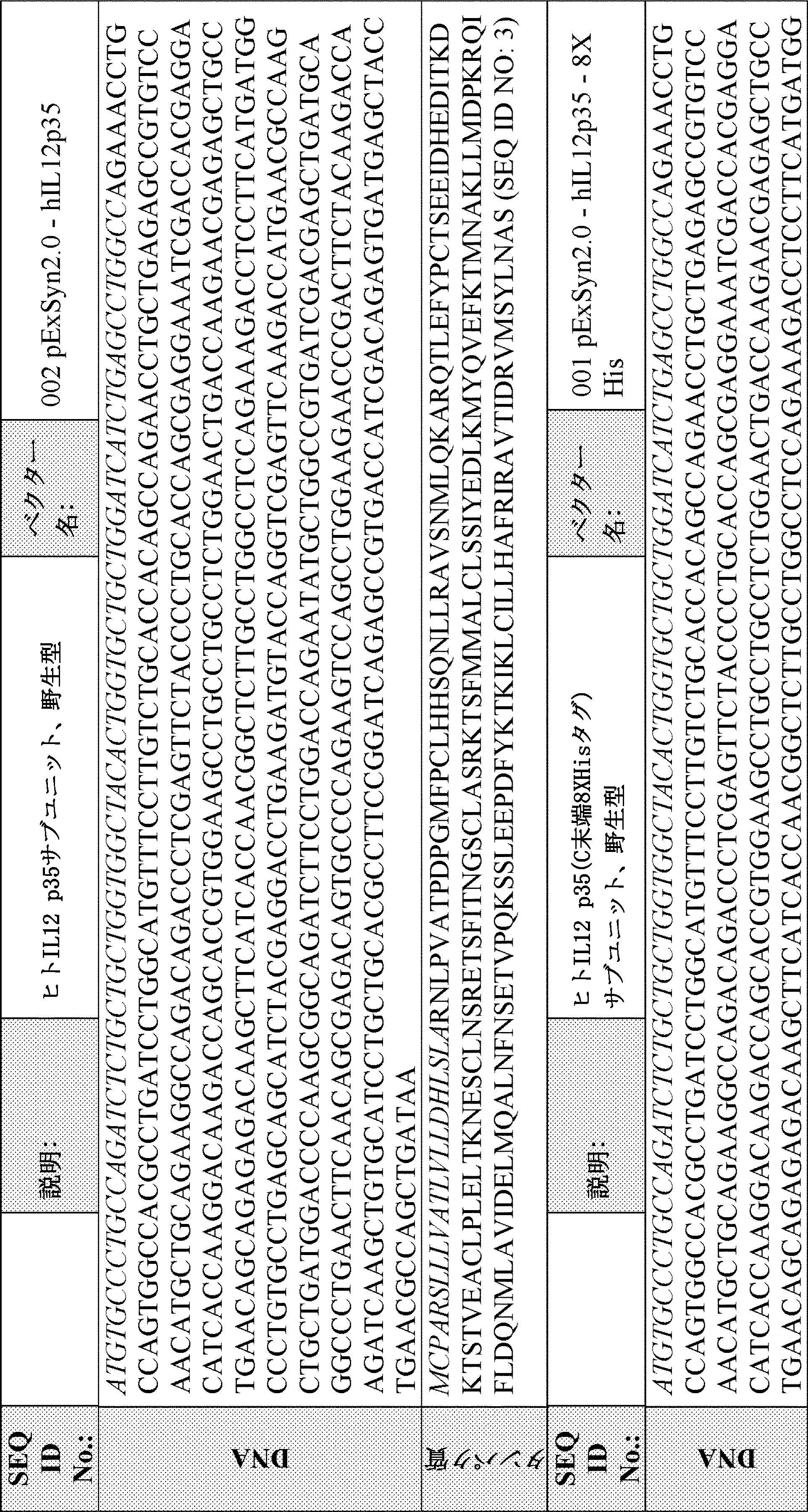

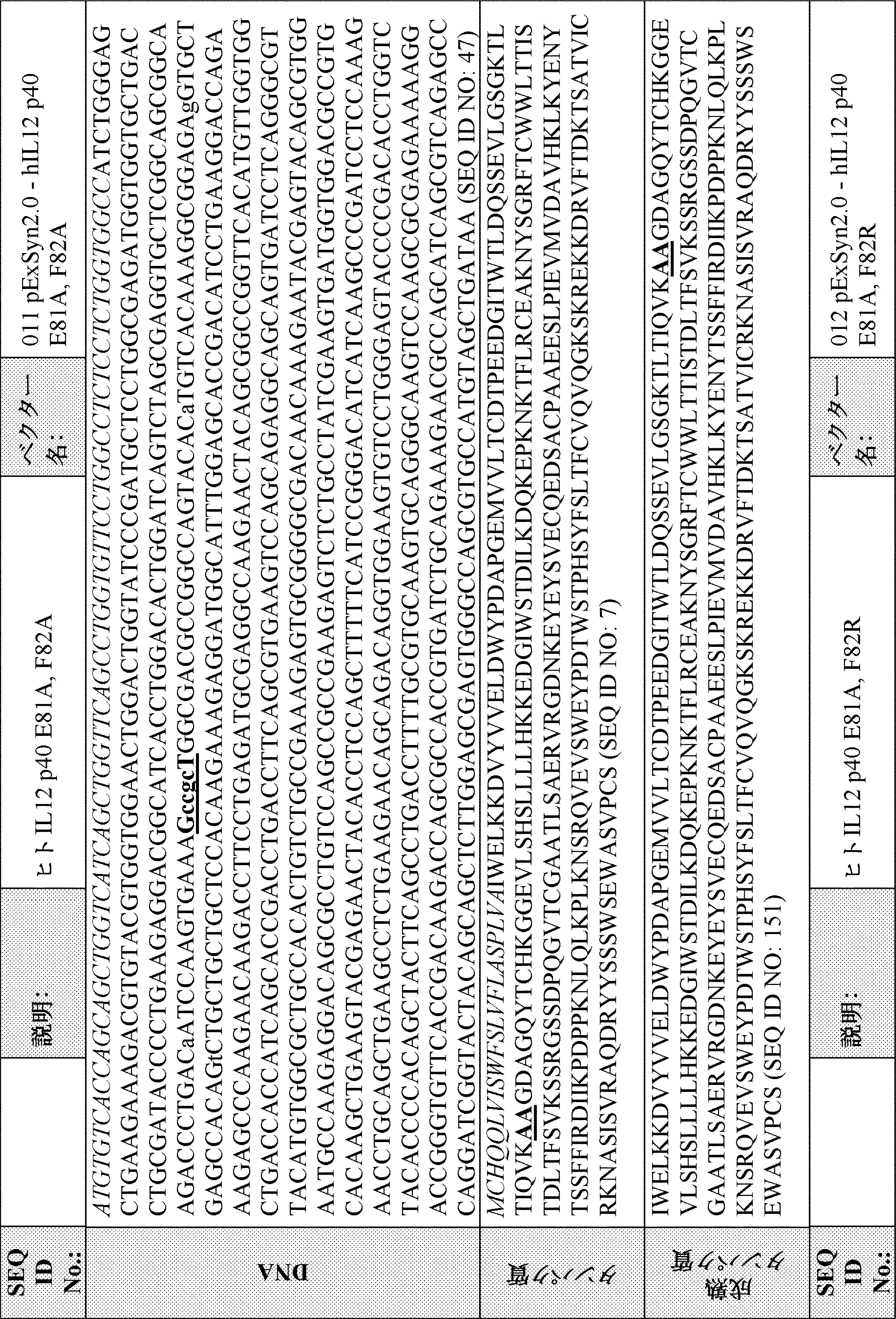
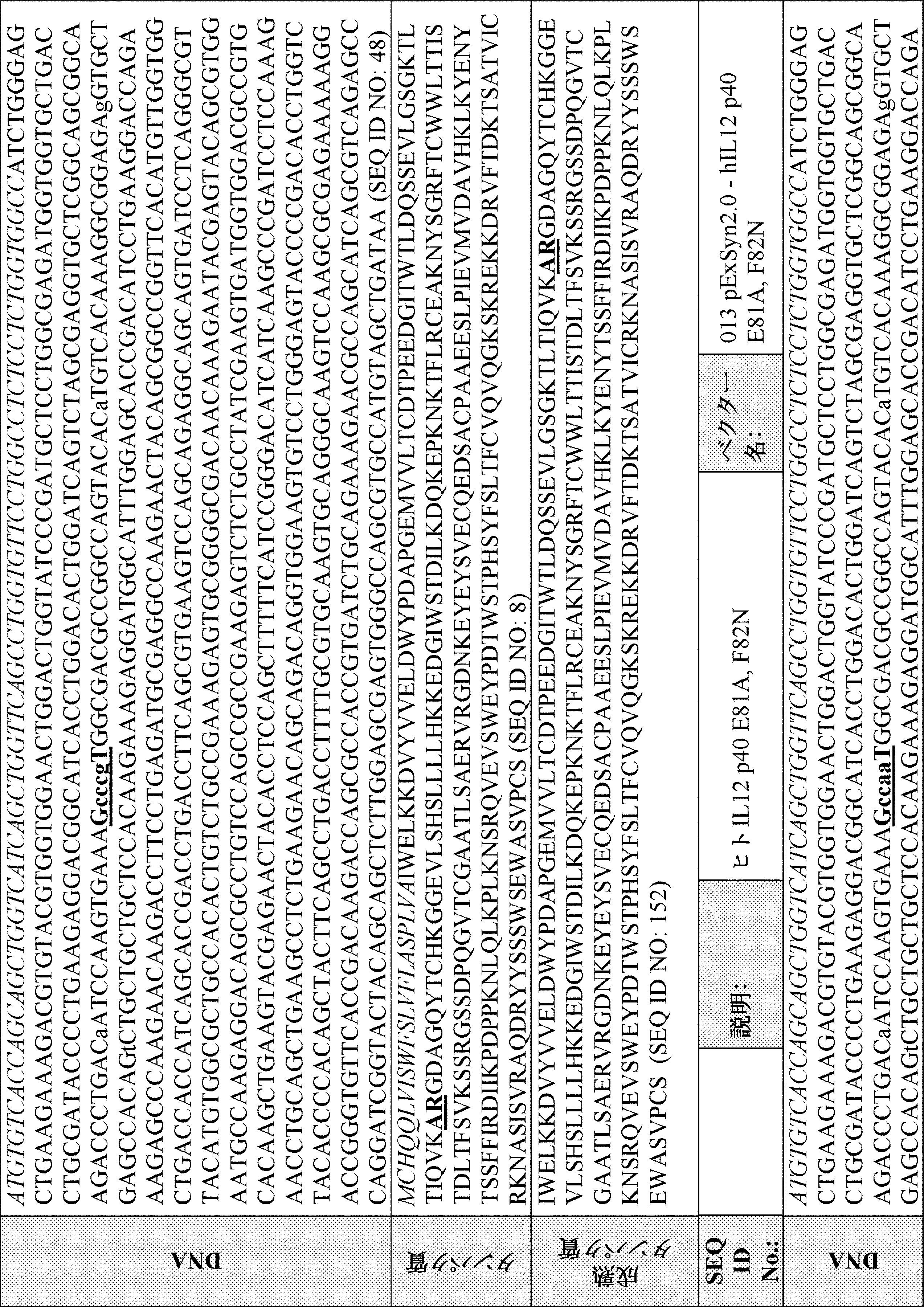

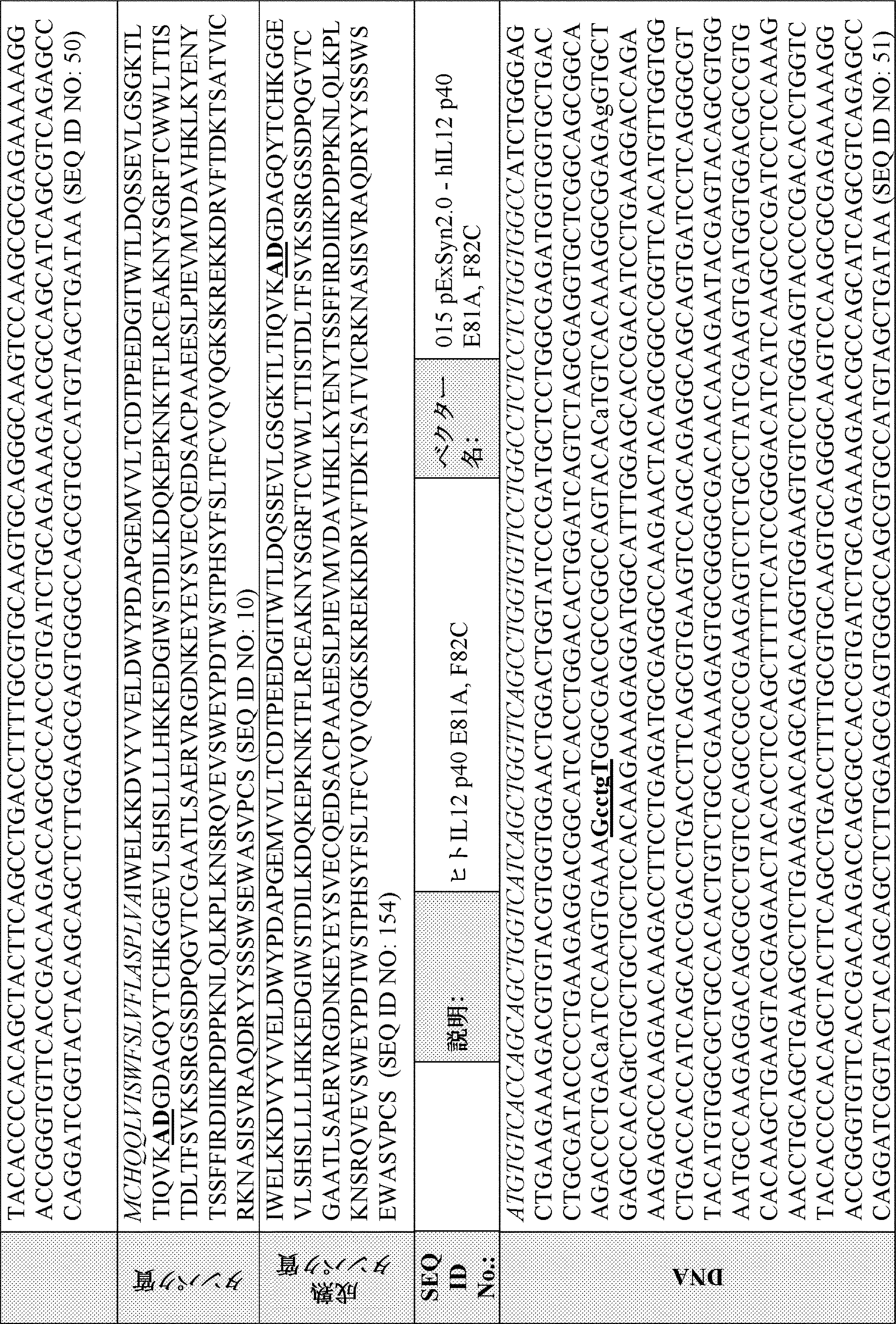
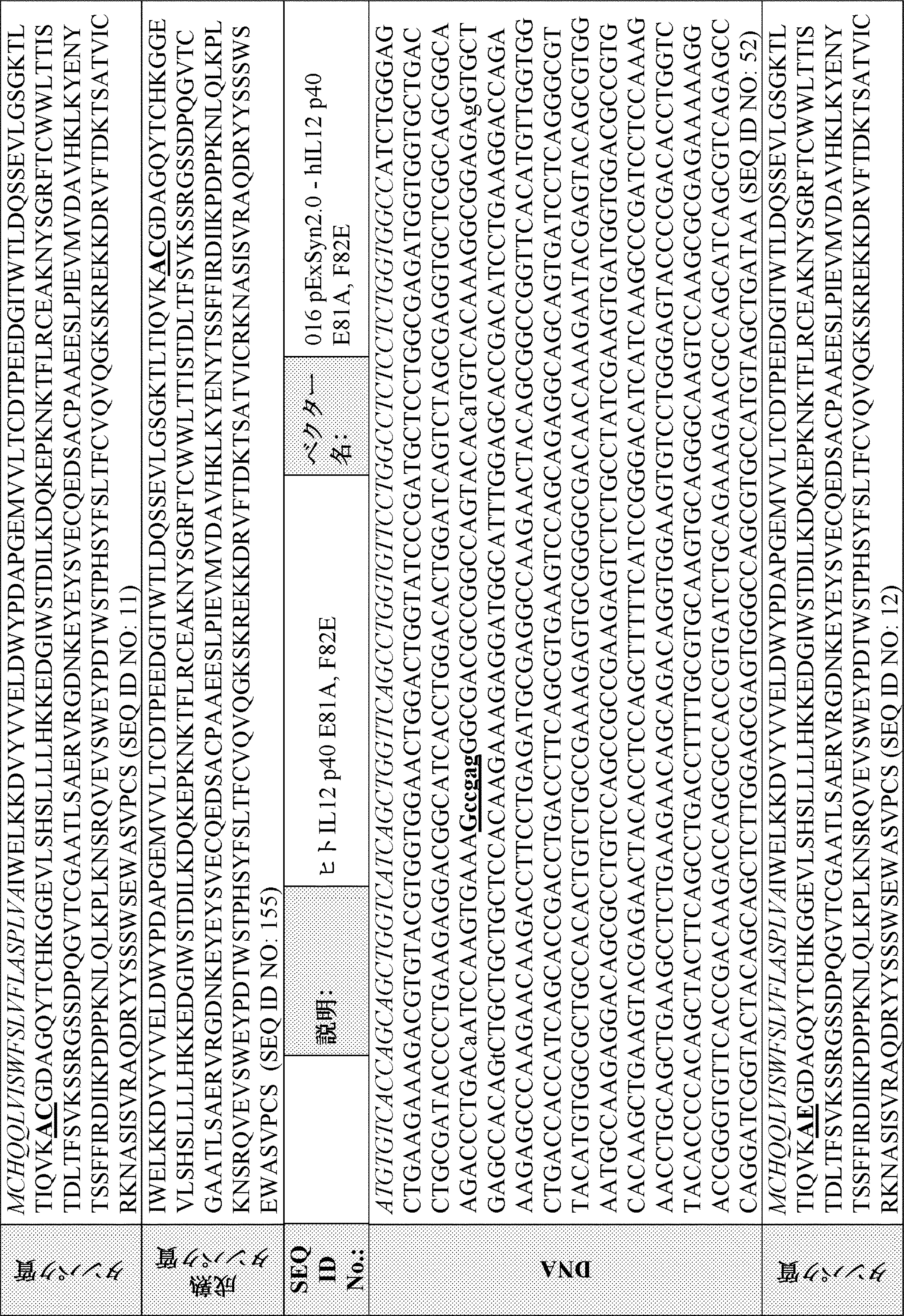

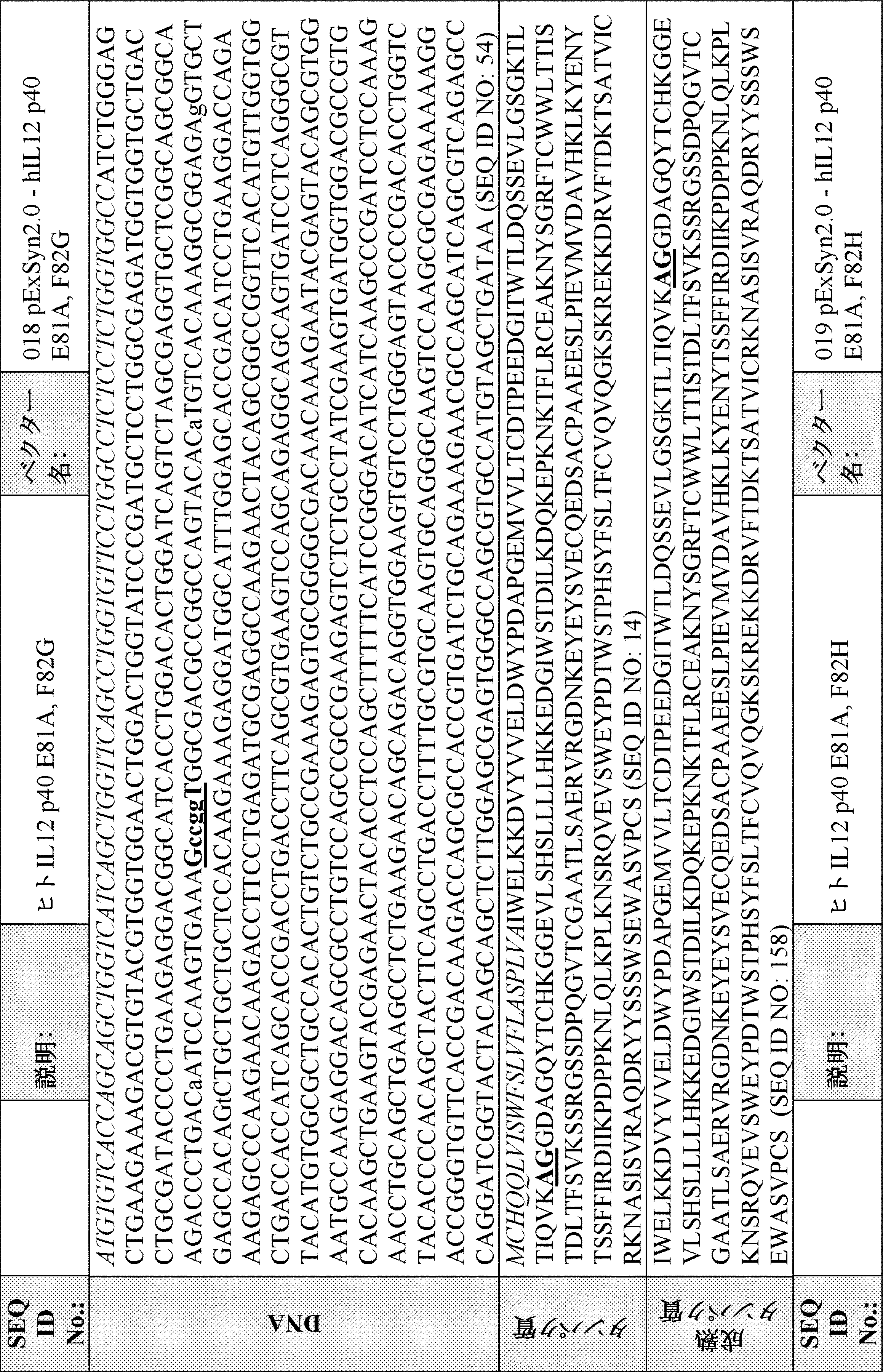

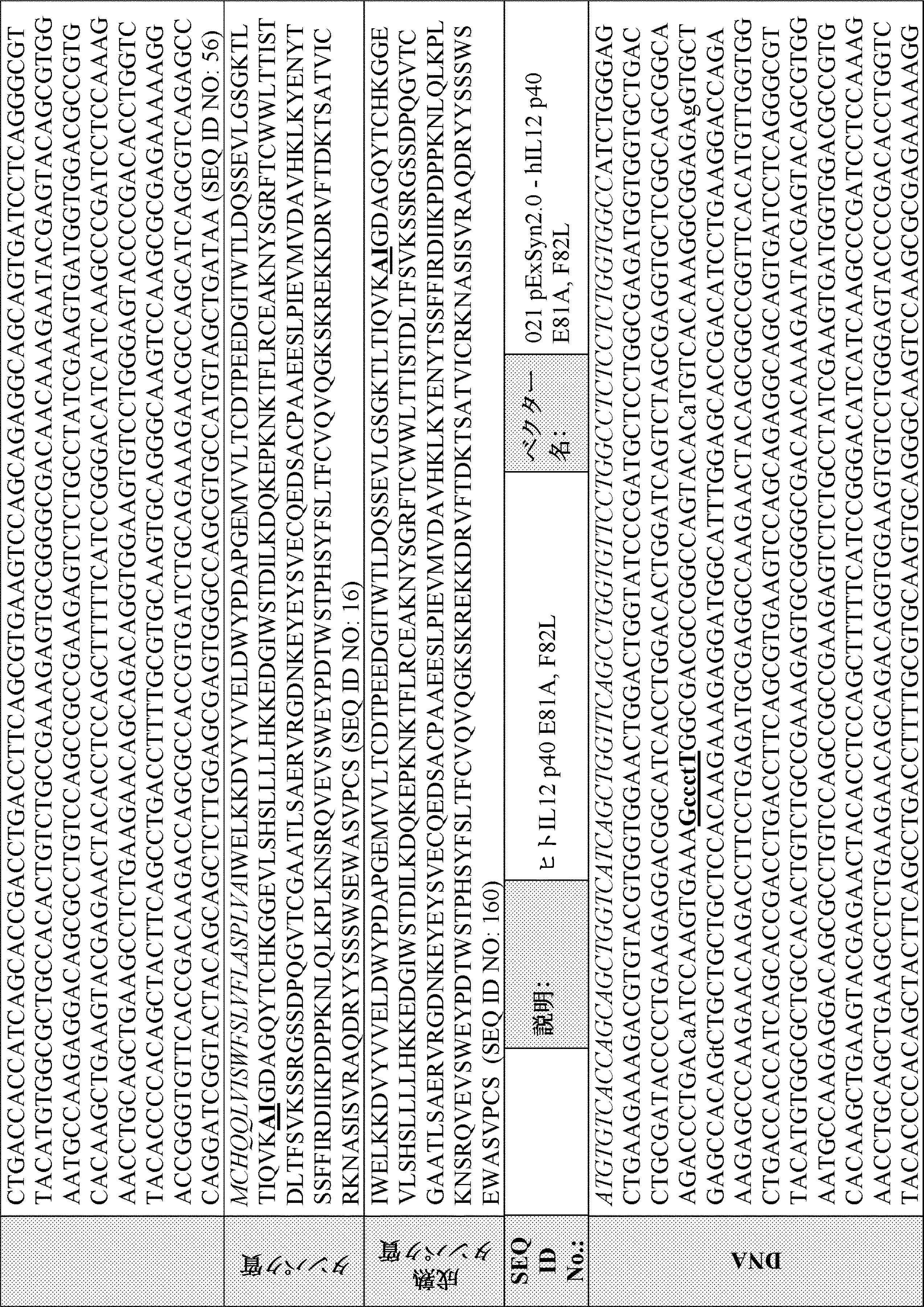
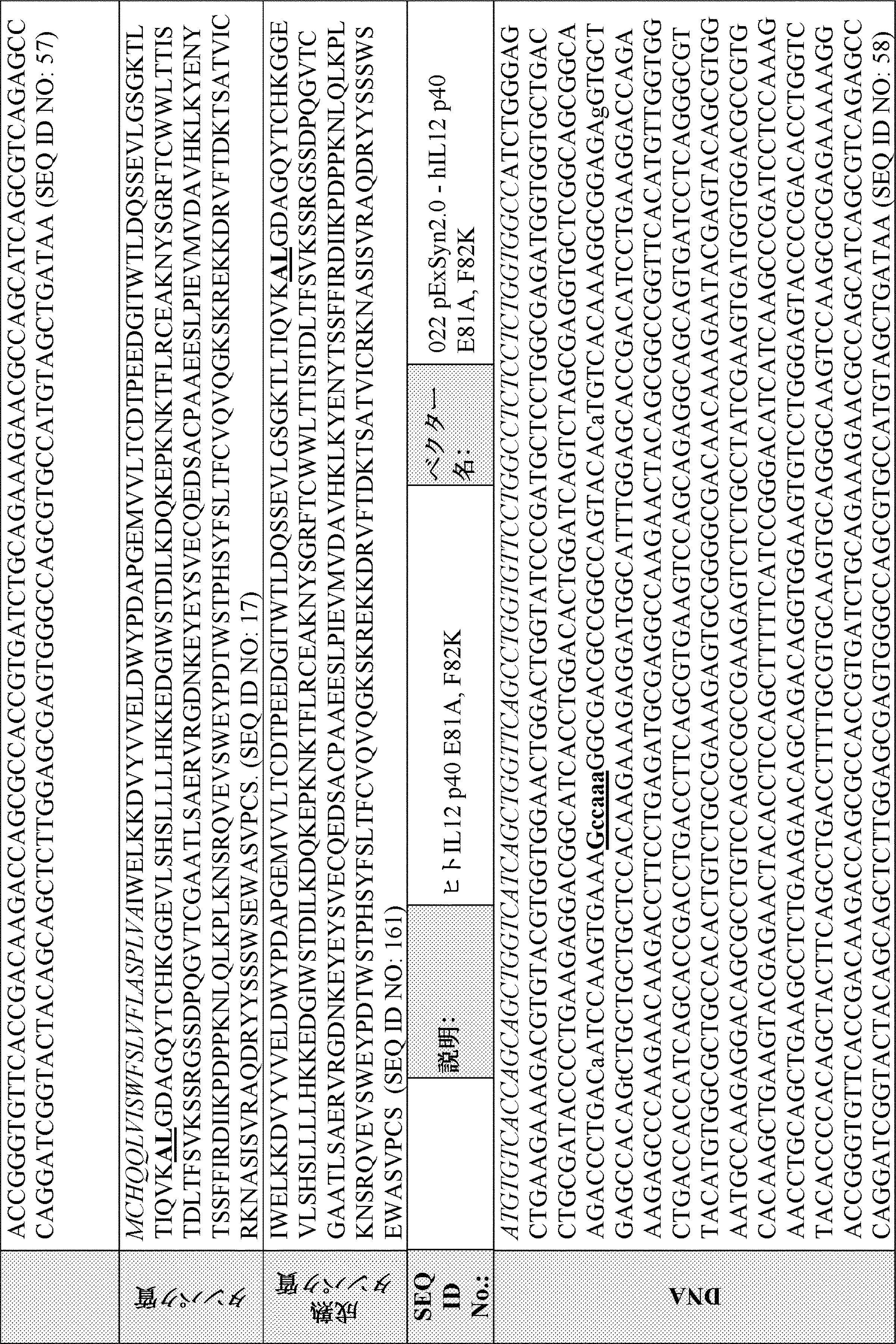

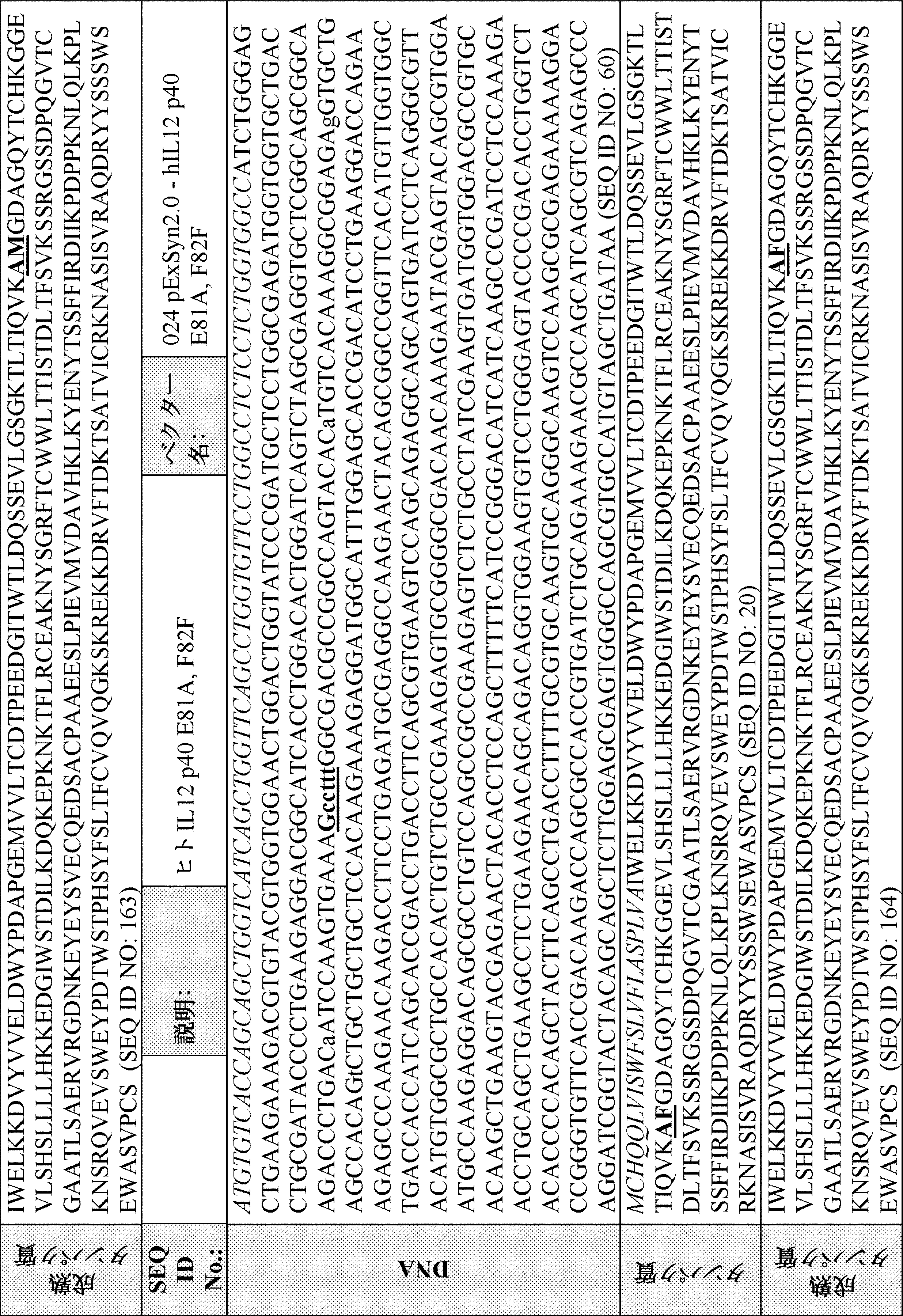
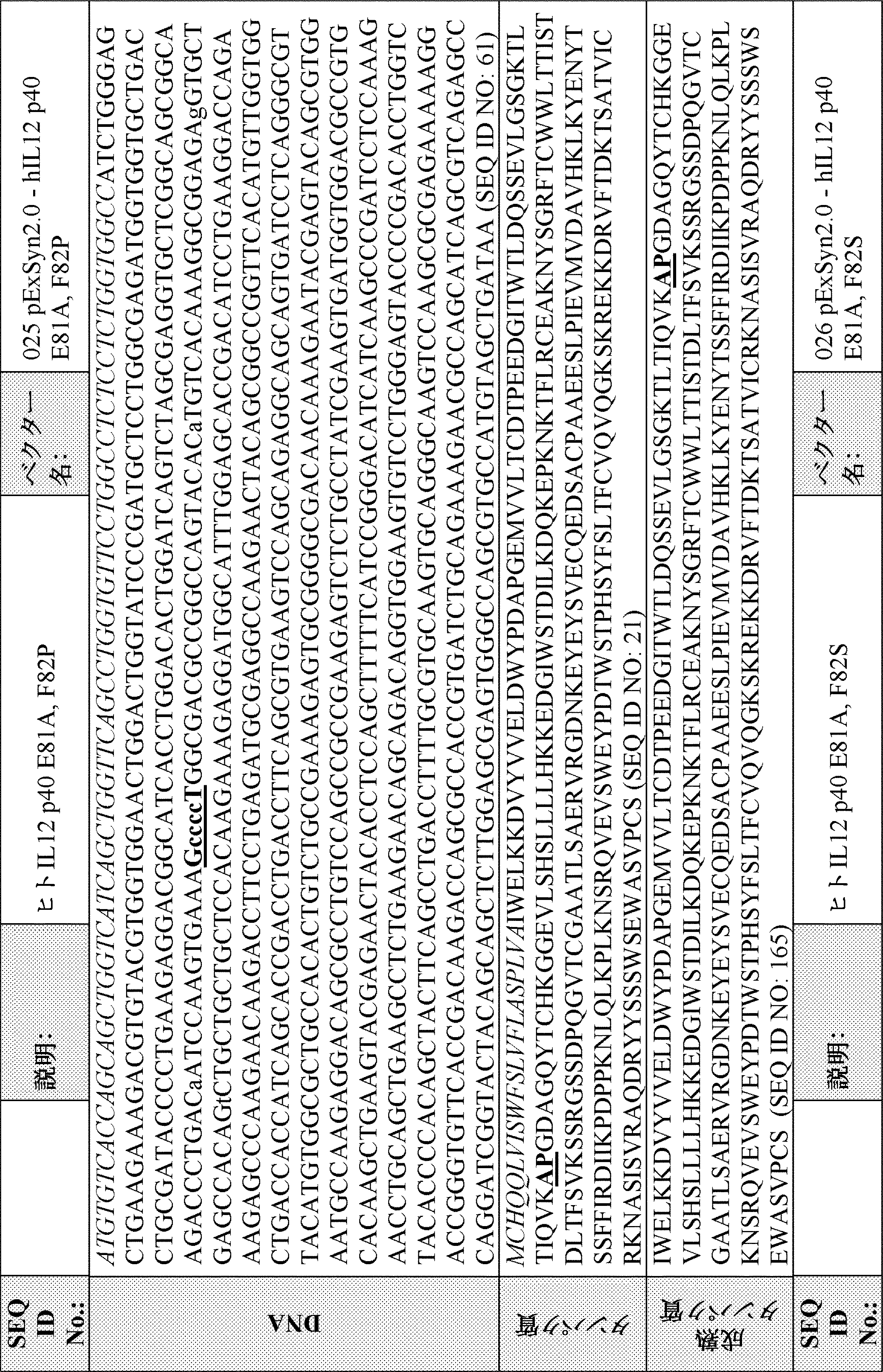
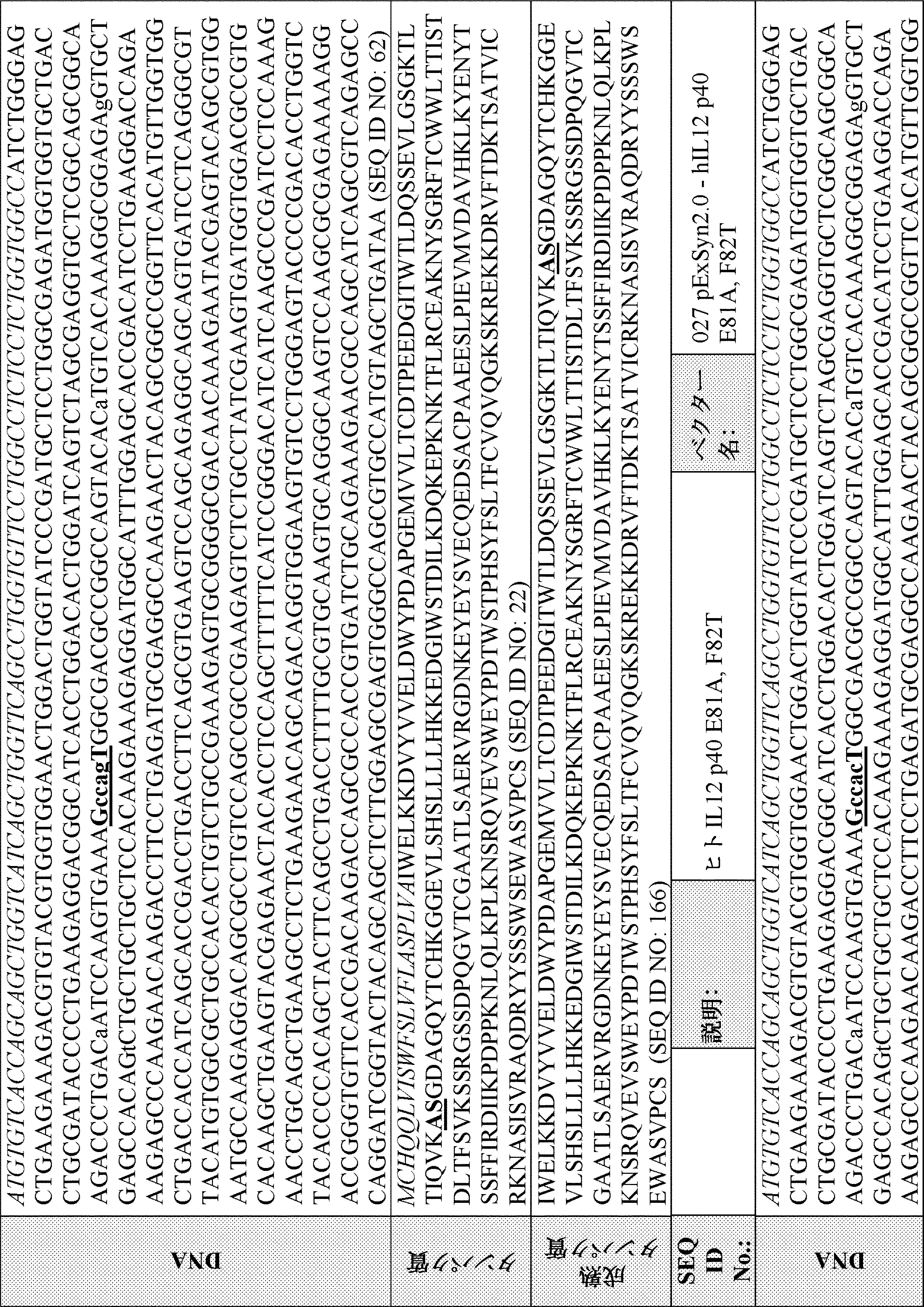
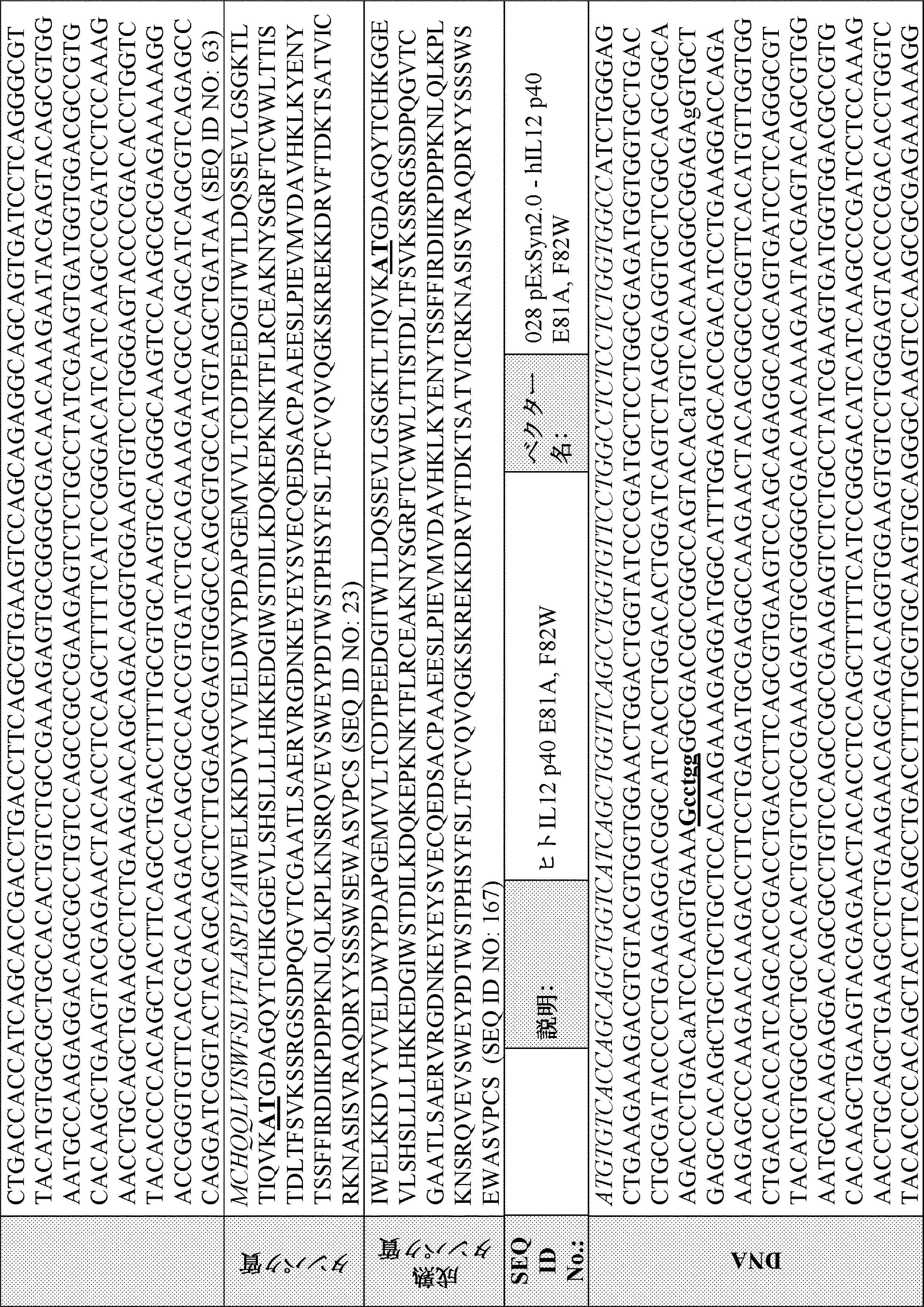

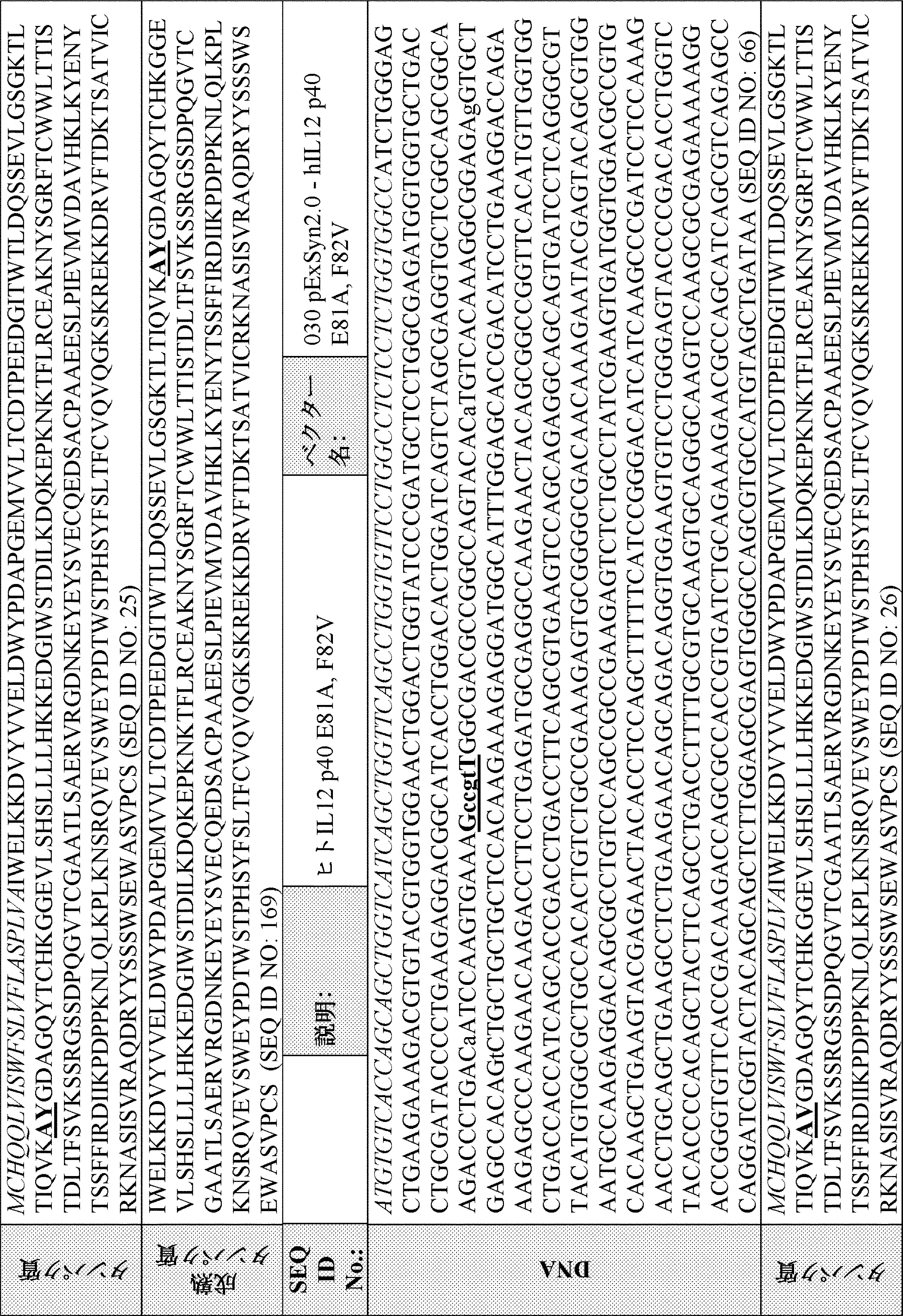

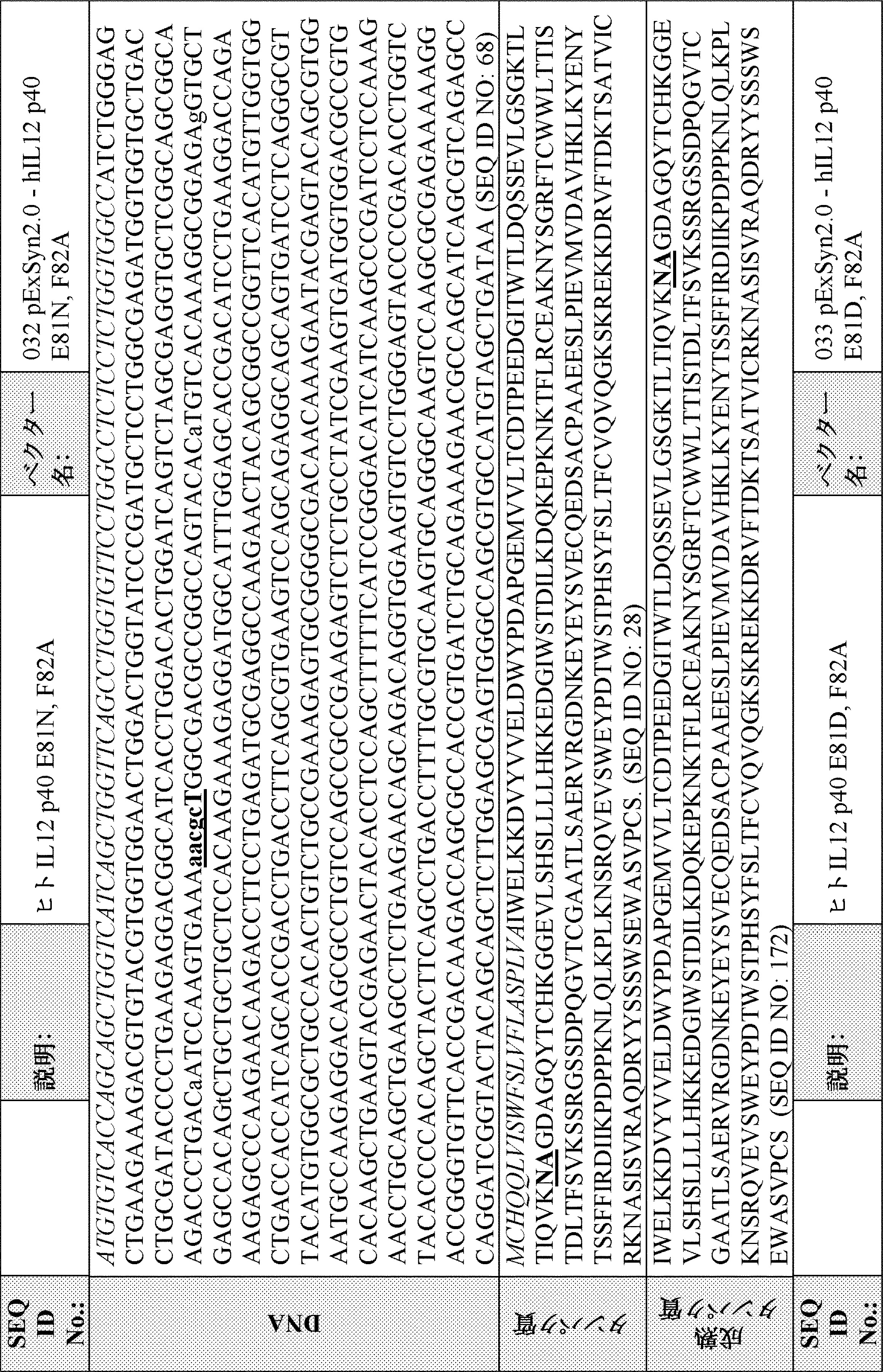
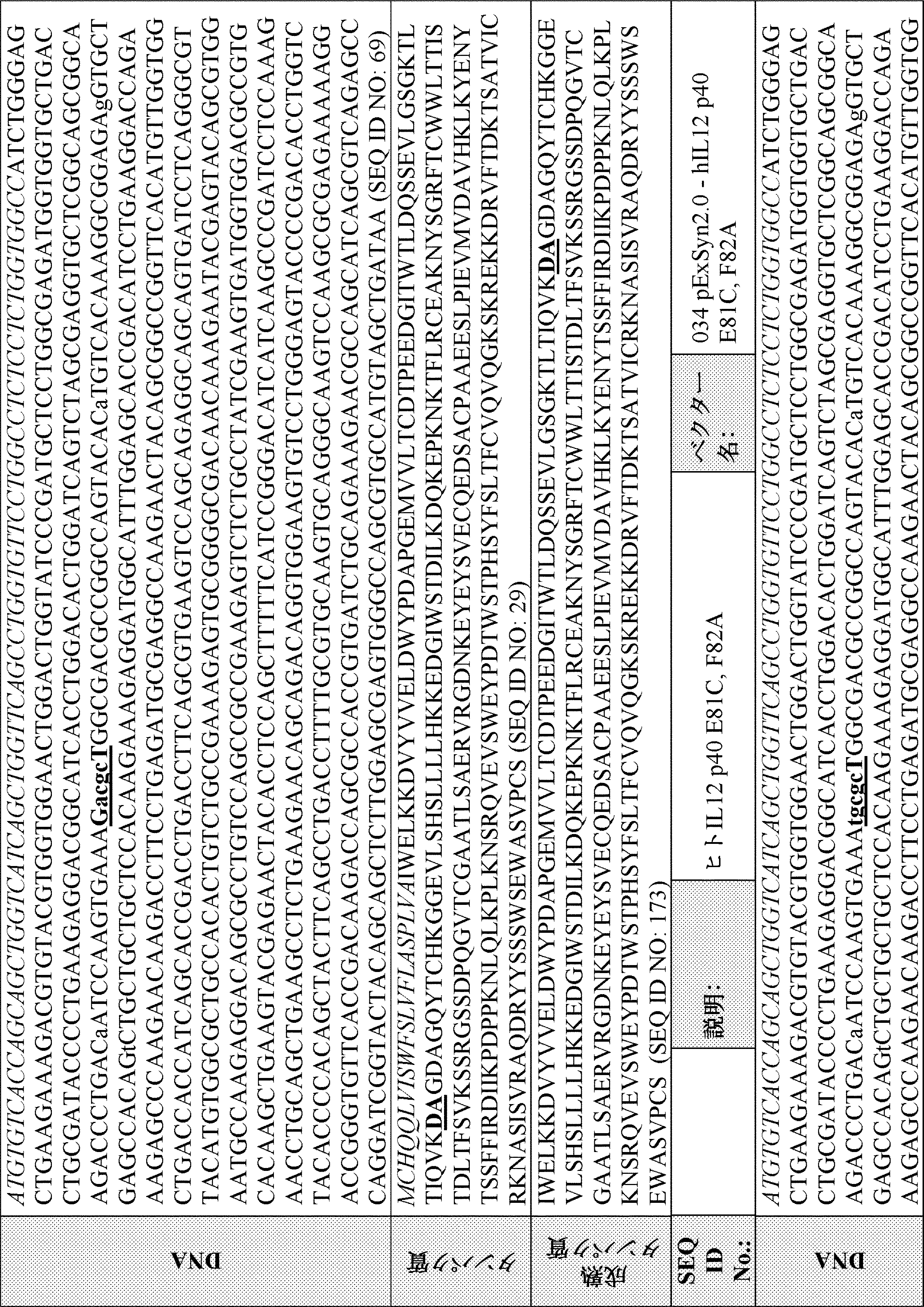
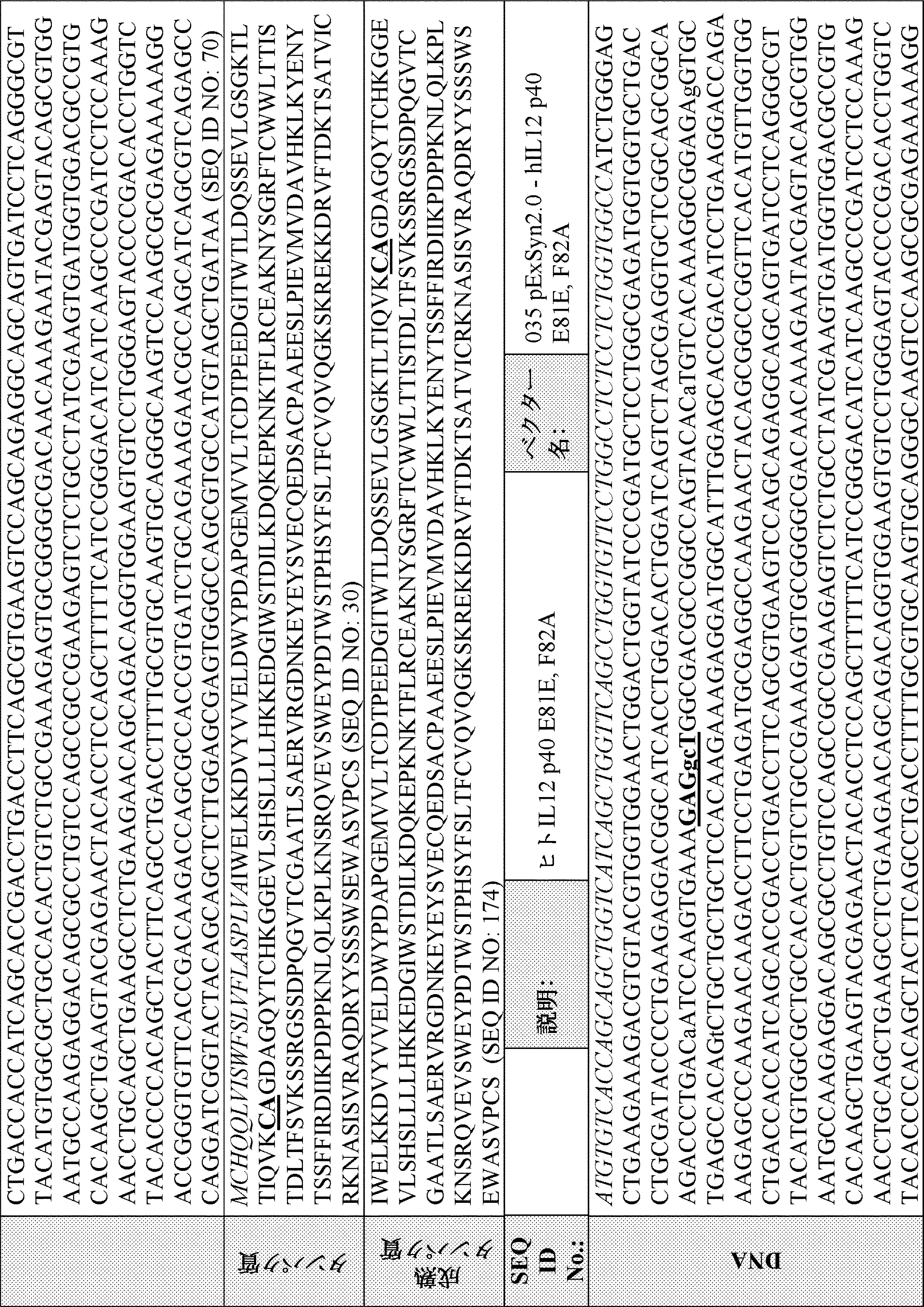

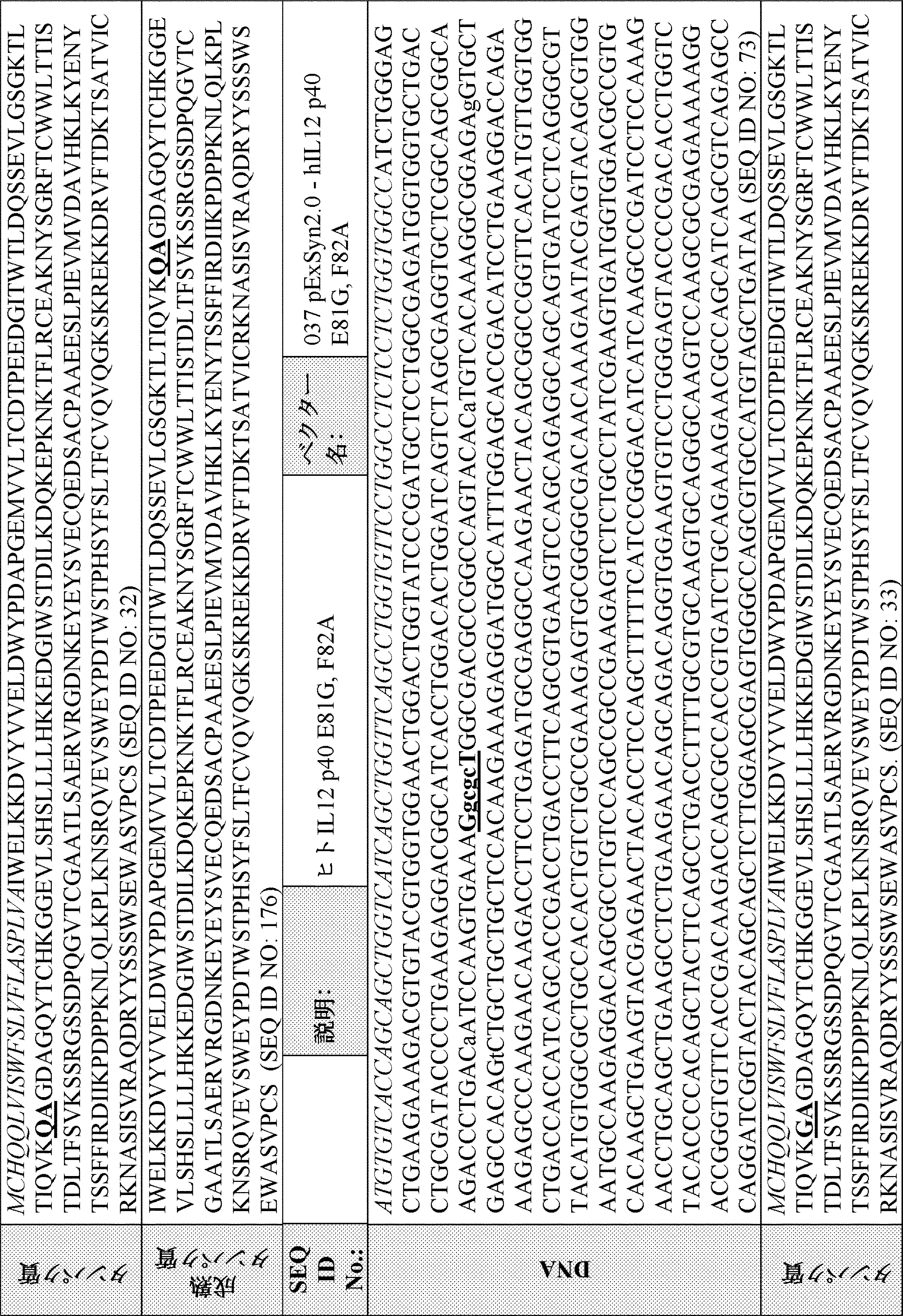
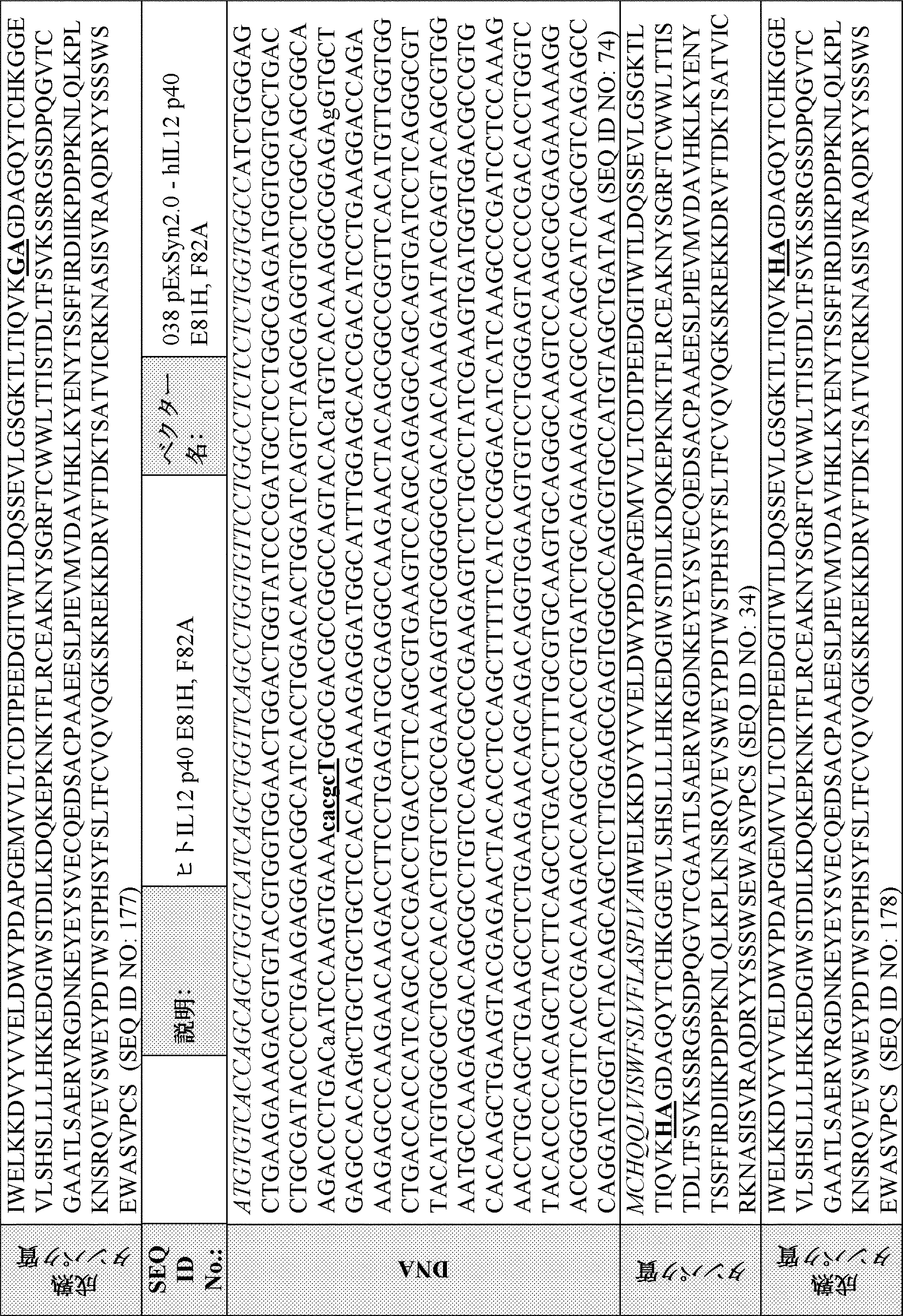

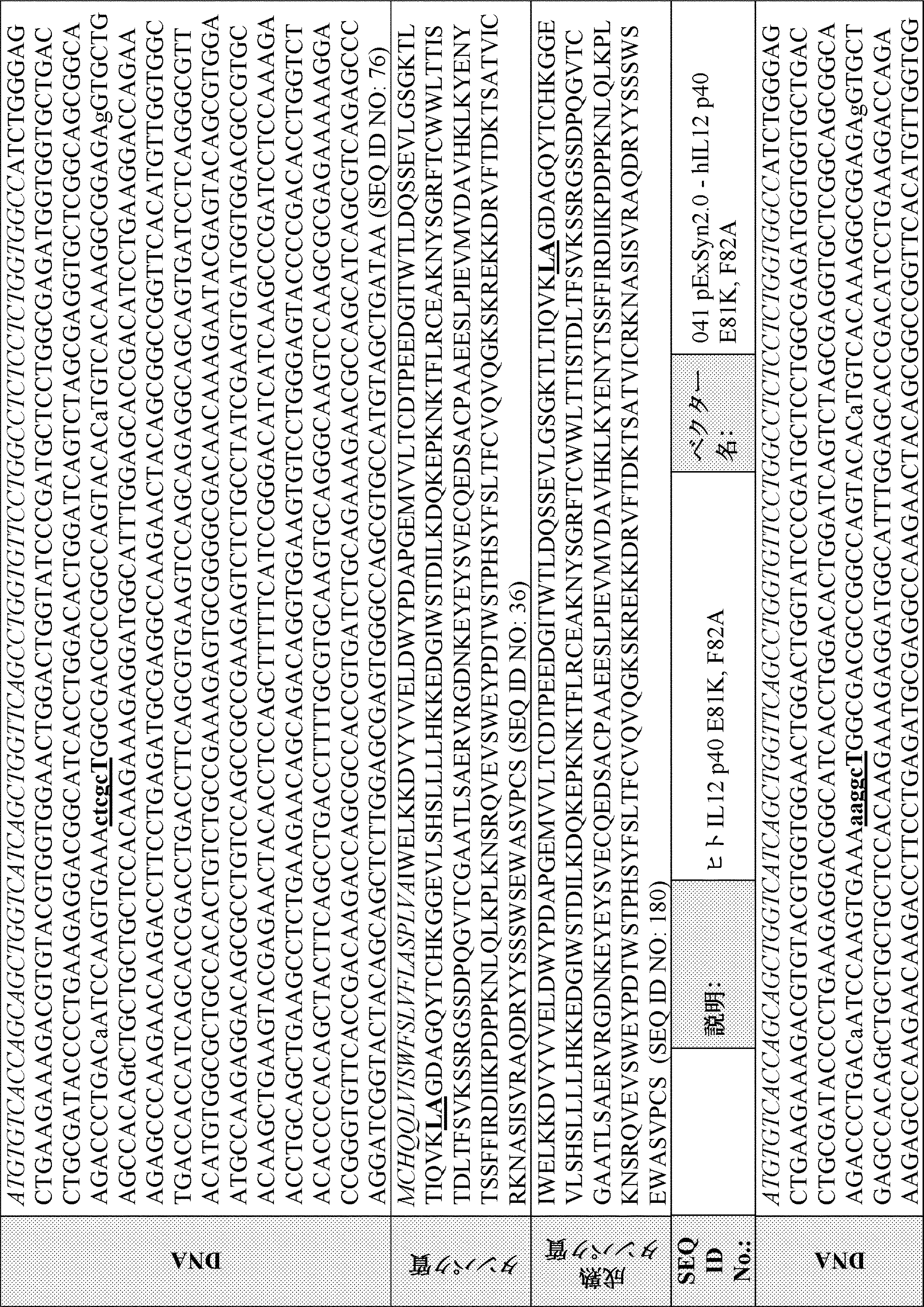


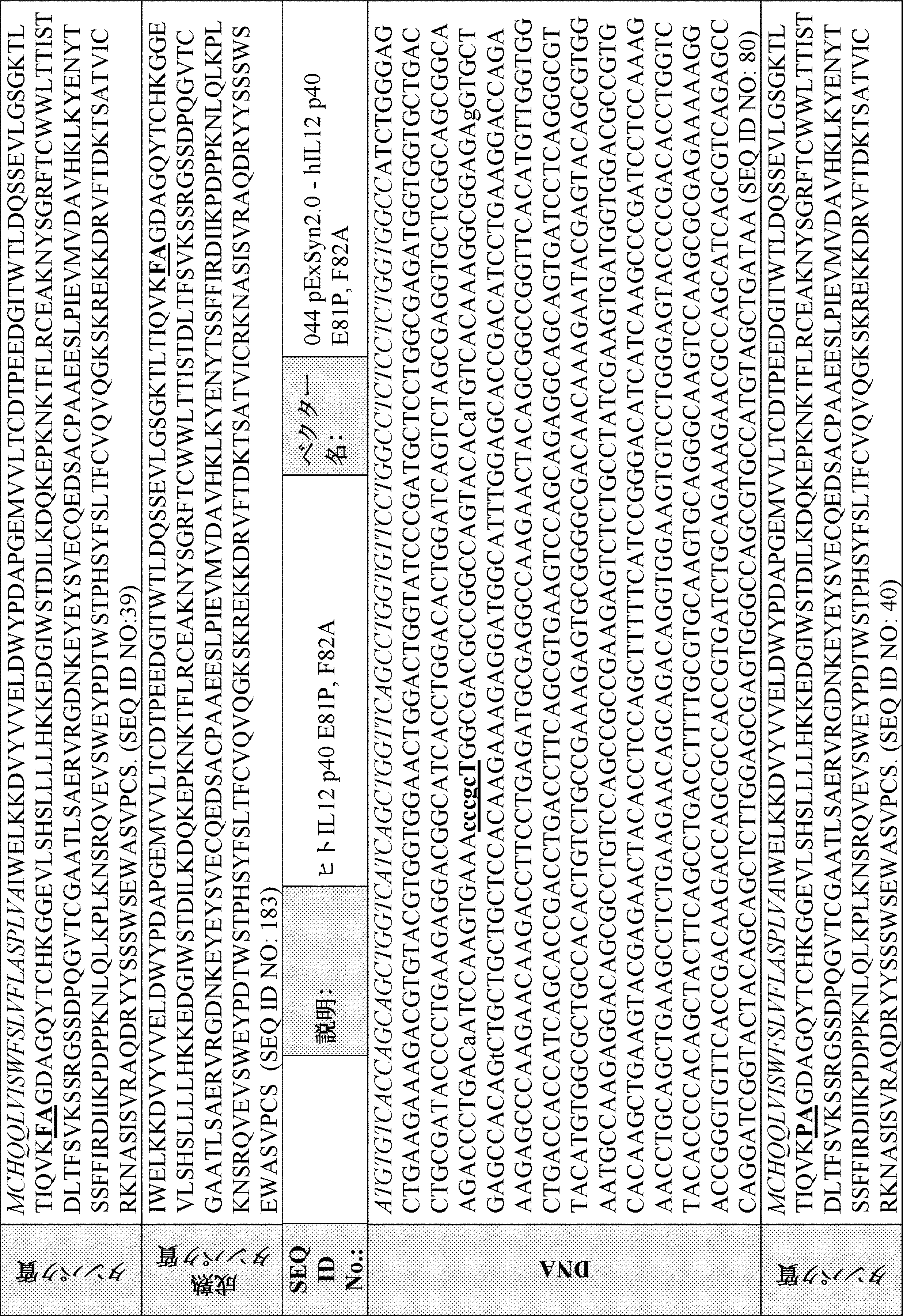
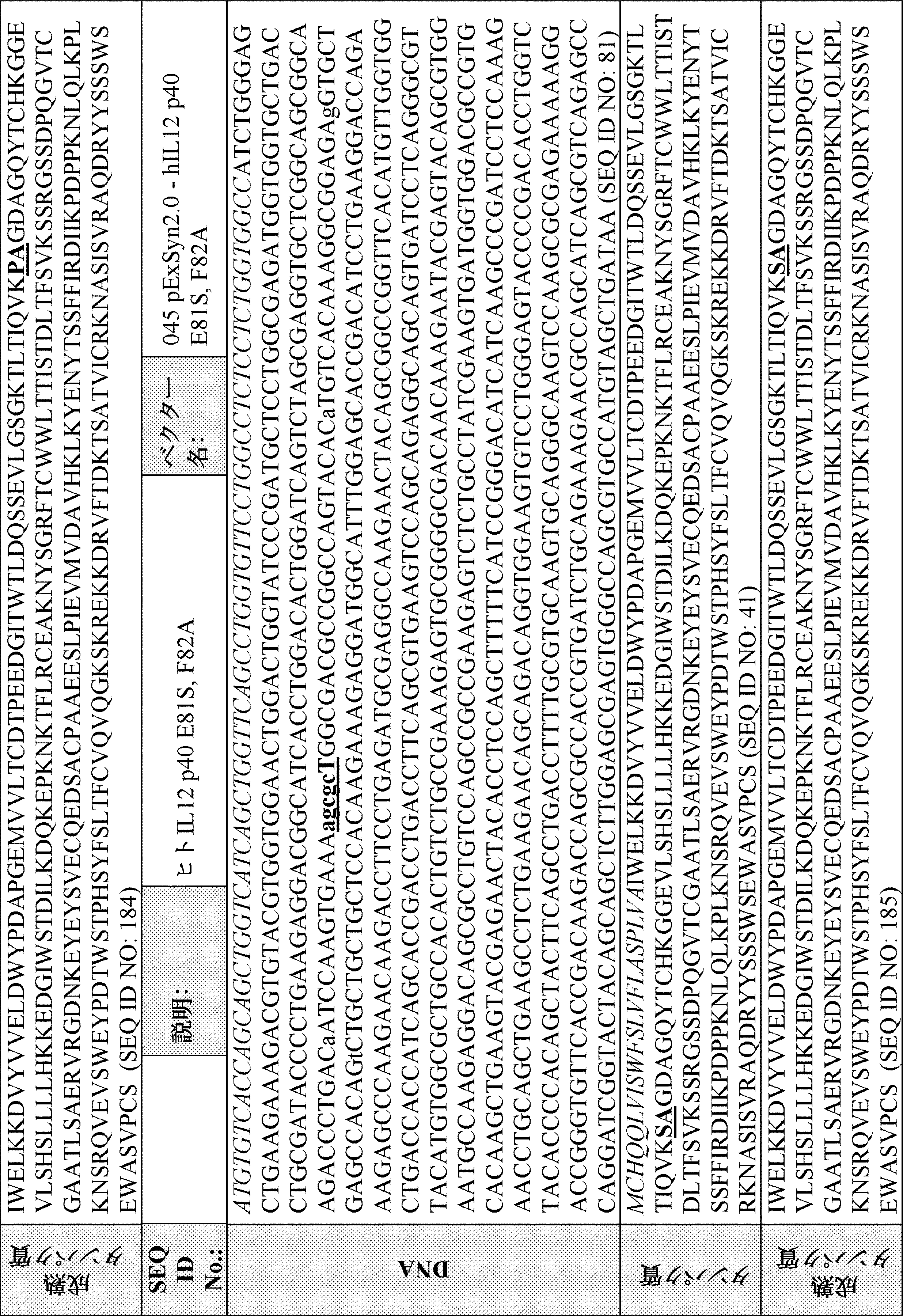
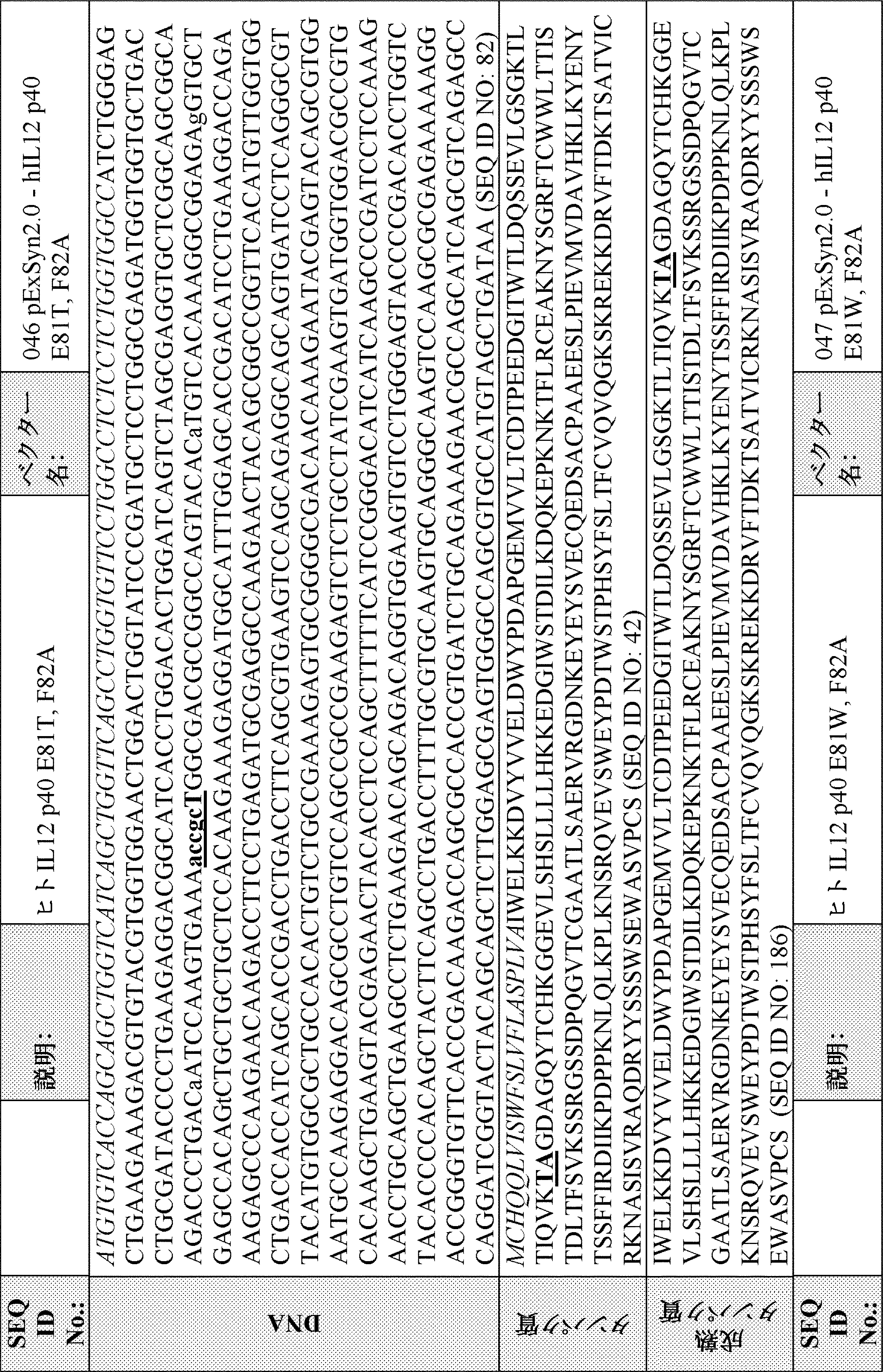
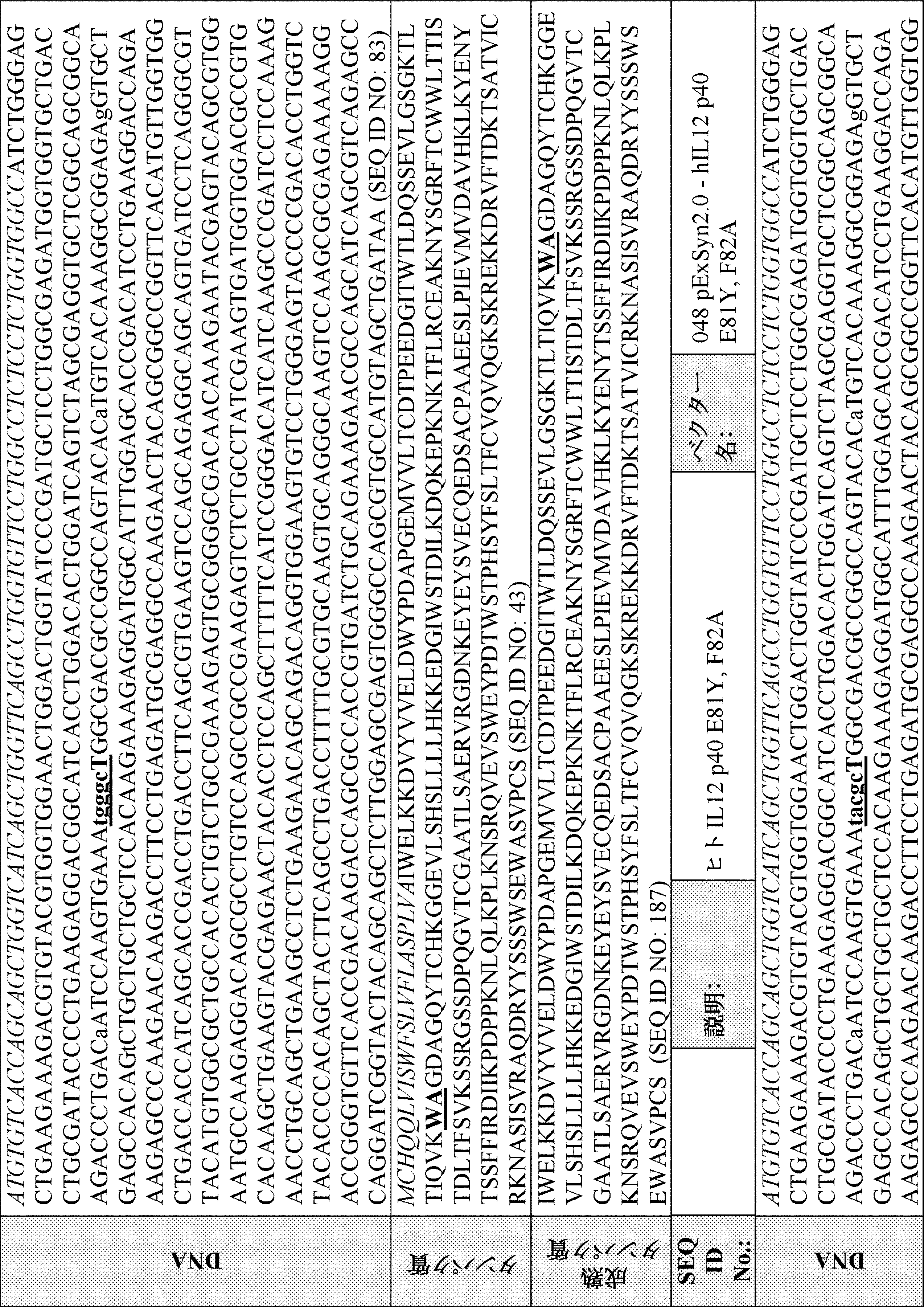

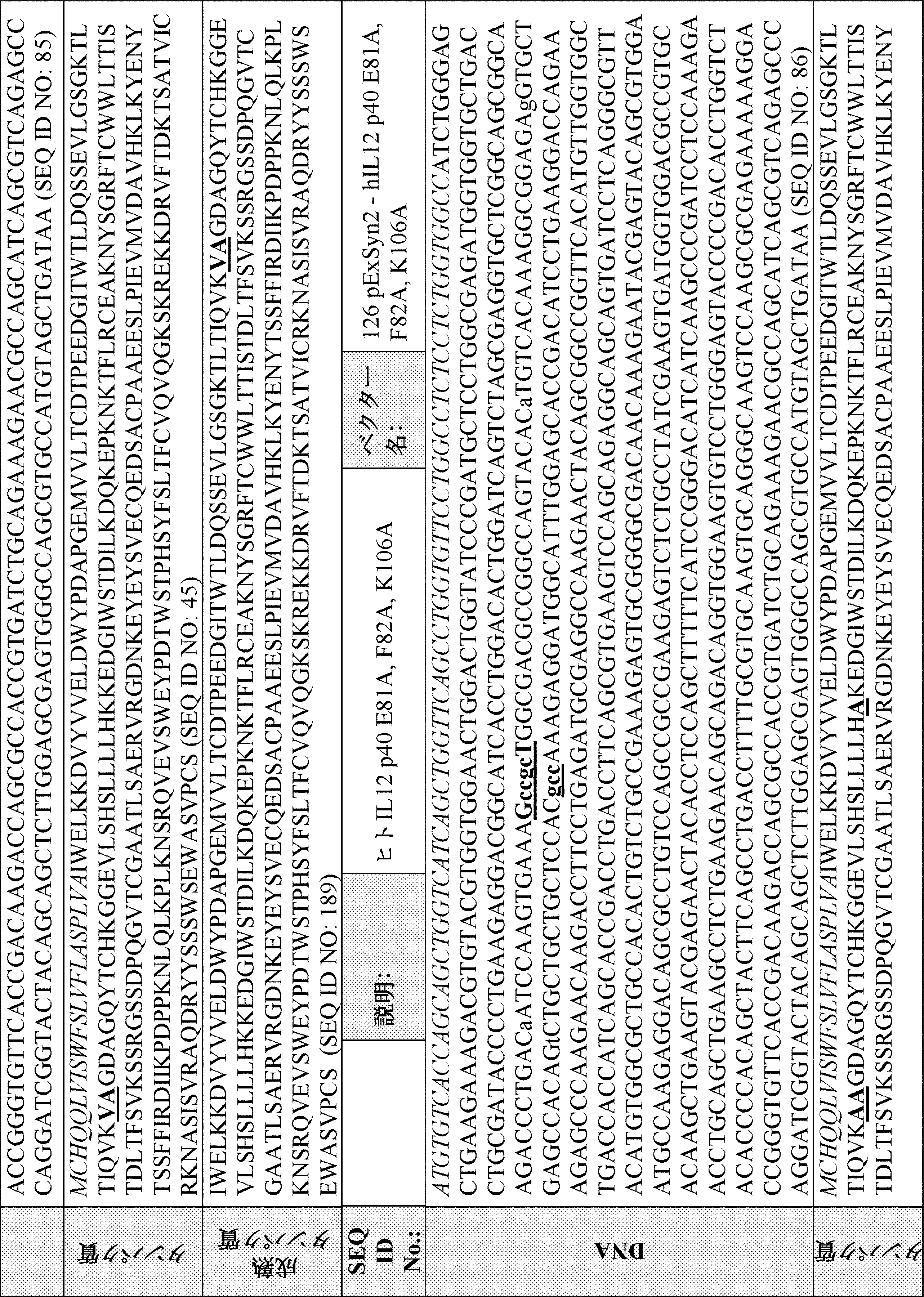

Description
●The signal peptide is shown in italics.
• Mutational changes from wild type are shown in bold and underlined.
(表8)E81Xパネル-IFNγアッセイ結果
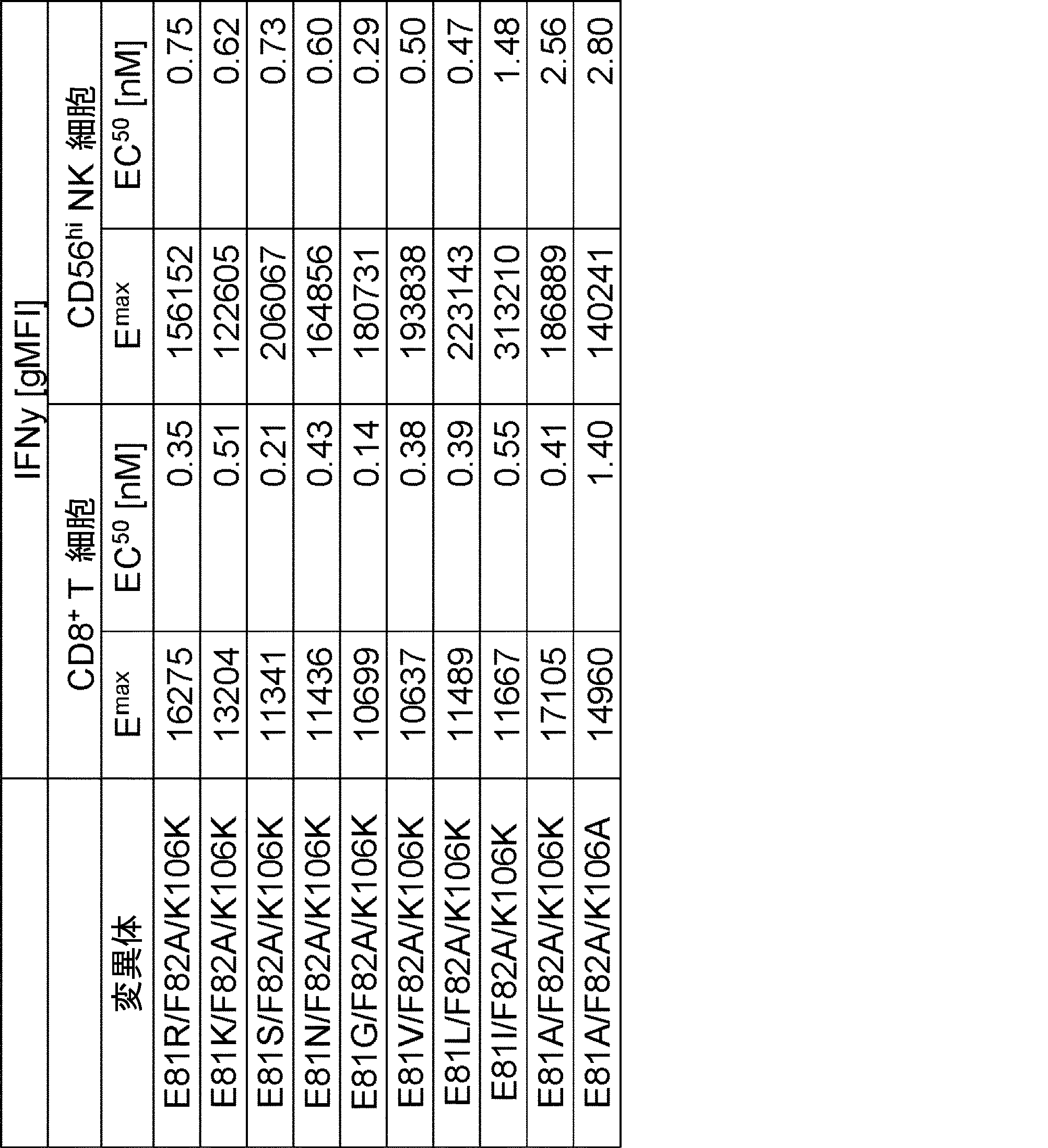
(表9)E81Xパネル-IFNγアッセイ結果

(表10)F82Xパネル-STAT4アッセイ結果
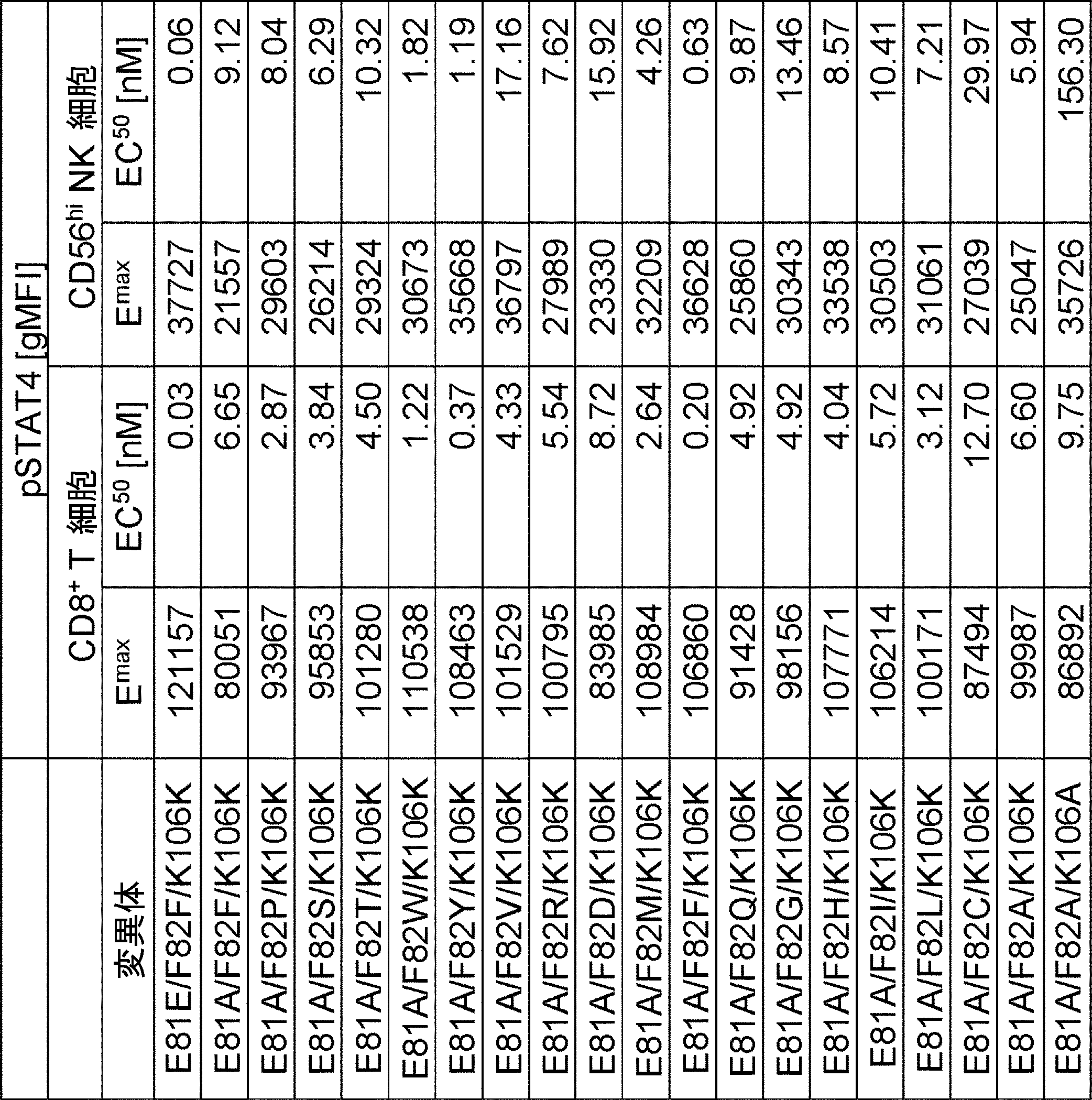
(表11)F82Xパネル-STAT4アッセイ結果

Fc用のさらなる配列

対象において、hIL-12によって媒介されるシグナル伝達またはhIL-23シグナル伝達を調整するための、またはその必要がある対象において健康状態を処置するためのキットも提供される。一部の態様では、キットは、本明細書に記載の改変されたhIL-12p40ポリペプチド単量体、hIL-12ムテイン、またはhIL-23ムテインを含む。一部の態様では、キットは、本明細書に記載の改変されたhIL-12p40ポリペプチドをコードする核酸配列を含む核酸分子もしくはベクター、本明細書に記載の改変されたhIL-12p40ポリペプチドおよびhIL-12 p35ポリペプチドをコードする核酸配列を含む核酸分子もしくはベクター、または本明細書に記載の改変されたhIL-12p40ポリペプチドおよびヒトp19ポリペプチドをコードする核酸配列を含む核酸分子もしくはベクターを含む。一部の態様において、キットは、本明細書に記載の核酸分子またはベクターを含む組換えにより改変された細胞、または本明細書に記載の薬学的組成物を含む。
[本発明1001]
2つ以上のアミノ酸置換を含む、SEQ ID NO:1と少なくとも70%同一のアミノ酸配列を含む、ヒトIL-12p40(hIL-12p40)ポリペプチドであって、該ポリペプチドが、SEQ ID NO:1のアミノ酸残基E81およびF82に対応する位置にアミノ酸置換を含み、ここで、
(a)アミノ酸残基F82に対応する位置でのアミノ酸置換がF82Xであり、ここでXがF以外の任意のアミノ酸であり、E81に対応する位置でのアミノ酸置換が、アスパラギン(N)、アスパラギン酸(D)、システイン(C)、グルタミン(Q)、グルタミン酸(E)、プロリン(P)、トリプトファン(W)、およびチロシン(Y)からなる群より選択されるか、または
(b)アミノ酸残基E81に対応する位置でのアミノ酸置換がE81Xであり、ここでXがE以外の任意のアミノ酸であり、F82に対応する位置でのアミノ酸置換が、アルギニン(R)、アスパラギン(N)、アスパラギン酸(D)、システイン(C)、グルタミン(Q)、グルタミン酸(E)、ヒスチジン(H)、リジン(K)、フェニルアラニン(F)、プロリン(P)、トリプトファン(W)、およびチロシン(Y)からなる群より選択される、
ヒトIL-12p40(hIL-12p40)ポリペプチド。
[本発明1002]
SEQ ID NO:1のW37、P39、D40、A41、Q64、K80、A85、E108、D115、H216、K217、L218、およびK219からなる群より選択されるアミノ酸残基に対応する1つまたは複数の位置での1つまたは複数のアミノ酸置換をさらに含む、本発明1001のhIL12p40ポリペプチド。
[本発明1003]
hIL12p35との会合時に、前記ポリペプチドが、
2つ以上のアミノ酸置換を欠いている野生型または親hIL-12p40ポリペプチドと比較して、(i)CD8+T細胞においてIL-12シグナル伝達を誘導し、(ii)NK細胞においてIL-12シグナル伝達が減少している、二量体
を形成する、本発明1001または1002のhIL 12p40ポリペプチド。
[本発明1004]
hIL 12p35との会合時に、前記ポリペプチドが、
2つ以上のアミノ酸置換を欠いている野生型または親hIL-12p40ポリペプチドと比較して、CD8+T細胞においてインターフェロンγ(IFNγ)を活性化し、CD8+T細胞におけるIFNγシグナル伝達が減少している、二量体
を形成する、本発明1001~1004のいずれかのhIL 12p40ポリペプチド。
[本発明1005]
hIL 12p35との会合時に、前記ポリペプチドが、
2つ以上のアミノ酸置換を欠いている野生型または親hIL-2p40ポリペプチドの結合親和性と比較して、hIL-12Rβ1に対する結合親和性が低減している、二量体
を形成する、本発明1001~1004のいずれかのhIL 12p40ポリペプチド。
[本発明1006]
hIL 12p35との会合時に、前記ポリペプチドが、
2つ以上のアミノ酸置換を欠いている野生型または親hIL-12p40ポリペプチドと比較して、STAT3によって媒介されるシグナル伝達が減少している、二量体
を形成する、本発明1001~1004のいずれかのhIL 12p40ポリペプチド。
[本発明1007]
hIL 12p35との会合時に、前記ポリペプチドが、
2つ以上のアミノ酸置換を欠いている野生型または親hIL-12p40ポリペプチドと比較して、STAT4によって媒介されるシグナル伝達が減少している、二量体
を形成する、本発明1001~1006のいずれかのhIL-12p40ポリペプチド。
[本発明1008]
本発明1001~1007のいずれかのhIL 12p40ポリペプチドをコードする核酸配列を含む、核酸分子。
[本発明1009]
前記核酸分子が、ペプチドリンカーをコードする核酸によって隔てられているhIL-12p40ポリペプチドおよびhIL-12p35ポリペプチドをコードする核酸を含むhIL-12ムテインをコードする、本発明1008の核酸。
[本発明1010]
前記核酸配列が異種核酸配列に機能的に連結されている、本発明1008または1009の核酸分子。
[本発明1011]
発現カセットまたは発現ベクターの中に組み込まれている、本発明1008~1010のいずれかの核酸分子。
[本発明1012]
本発明1001~1007のいずれかのhIL12p40ポリペプチドを含む、細胞。
[本発明1013]
本発明1008~1011のいずれかの核酸を含む、細胞。
[本発明1014]
原核細胞である、本発明1012または1013の細胞。
[本発明1015]
真核細胞である、本発明1012または1013の細胞。
[本発明1016]
前記原核細胞が細菌細胞である、本発明1014の細胞。
[本発明1017]
真核細胞である、本発明1012または1013の細胞。
[本発明1018]
前記真核細胞が哺乳動物細胞である、本発明1015の細胞。
[本発明1019]
本発明1012~1018のいずれかの少なくとも1つの細胞と、培養培地とを含む、細胞培養物。
[本発明1020]
以下の工程を含む、hIL12ムテインを産生するための方法:
(a)本発明1012~1018のいずれかの1つまたは複数の細胞を準備する工程;および
(b)該細胞が、核酸分子によってコードされるhIL12p40ポリペプチドを含むhIL12ムテインを産生するように、培養培地中で該1つまたは複数の細胞を培養する工程。
[本発明1021]
前記産生されたhIL12ムテインを単離および/または精製する工程をさらに含む、本発明1020の方法。
[本発明1022]
半減期を増大させるために、前記産生されたhIL12ムテインを構造的に改変する工程をさらに含む、本発明1020~1021のいずれかの方法。
[本発明1023]
前記改変が、ヒトFc抗体断片との融合、アルブミンとの融合、およびPEG化からなる群より選択される1つまたは複数の変化を含む、本発明1022の方法。
[本発明1024]
本発明1020~1023のいずれかの方法によって産生された、hIL12ムテイン。
[本発明1025]
薬学的に許容される担体と、
(a)本発明1001~1019もしくは1035のいずれかのポリペプチドを含むhIL12ムテイン;
(b)本発明1008~1011のいずれかの核酸;および/または
(c)本発明1017の細胞
とを含む、薬学的組成物。
[本発明1026]
前記組成物が、本発明1001~1007または1024のいずれかのhIL12p40ポリペプチドを含むhIL12ムテインと、薬学的に許容される担体とを含む、本発明1025の薬学的組成物。
[本発明1027]
前記組成物が、本発明1008~1011のいずれかの核酸と、薬学的に許容される担体とを含む、本発明1025の薬学的組成物。
[本発明1028]
前記組成物が、本発明1017の細胞と、薬学的に許容される担体とを含む、本発明1025の薬学的組成物。
[本発明1029]
以下の工程を含む、対象においてIL-12シグナル伝達を調整するための方法:
(a)本発明1001~1007もしくは1024のいずれかのhIL12p40ポリペプチドを含むhIL12ムテイン;
(b)本発明1008~1011のいずれかの核酸;
(c)本発明1017の細胞;および/または
(d)本発明1025~1028のいずれかの薬学的組成物
を含む有効量の組成物を、対象に投与する工程。
[本発明1030]
以下の工程を含む、その必要がある対象における健康状態の処置のための方法:
(a)本発明1001~1007もしくは1024のいずれかのhIL12p40ポリペプチド;
(b)本発明1008~1011のいずれかの核酸;
(c)本発明1017の細胞;および/または
(d)本発明1025~1028のいずれかの薬学的組成物
を含む組成物を、対象に投与する工程。
[本発明1031]
前記対象が哺乳動物である、本発明1029または1030のいずれかの方法。
[本発明1032]
前記哺乳動物がヒトである、本発明1032の方法。
[本発明1033]
前記対象が、hIL-12p40によって媒介されるシグナル伝達に関連する状態と診断されたことがある、本発明1029~1032のいずれかの方法。
[本発明1034]
前記状態が、癌、免疫疾患、または慢性感染症である、本発明1033の方法。
[本発明1035]
(a)本発明1001~1007もしくは1024のいずれかのポリペプチド;
(b)本発明1008~1011のいずれかの核酸;
(c)本発明1017の細胞;および/または
(d)本発明1025~1028のいずれかの薬学的組成物
を含む、対象においてIL-12によって媒介されるシグナル伝達を調整するための、またはその必要がある対象において健康状態を処置するためのキット。
Kits for modulating hIL-12-mediated or hIL-23 signaling in a subject or for treating a condition in a subject in need thereof are also provided. In some embodiments, the kit comprises a modified hIL-12p40 polypeptide monomer, hIL-12 mutein, or hIL-23 mutein as described herein. In some embodiments, the kit comprises a nucleic acid molecule or vector comprising a nucleic acid sequence encoding a modified hIL-12p40 polypeptide as described herein, a nucleic acid molecule or vector comprising a nucleic acid sequence encoding a modified hIL-12p40 polypeptide and a hIL-12 p35 polypeptide as described herein, or a nucleic acid molecule or vector comprising a nucleic acid sequence encoding a modified hIL-12p40 polypeptide and a human p19 polypeptide as described herein. In some embodiments, the kit comprises a recombinantly modified cell comprising a nucleic acid molecule or vector as described herein, or a pharmaceutical composition as described herein.
[The present invention 1001]
1. A human IL-12p40 (hIL-12p40) polypeptide comprising an amino acid sequence that is at least 70% identical to SEQ ID NO:1, which comprises two or more amino acid substitutions, wherein the polypeptide comprises amino acid substitutions at positions corresponding to amino acid residues E81 and F82 of SEQ ID NO:1,
(a) the amino acid substitution at the position corresponding to amino acid residue F82 is F82X, where X is any amino acid other than F, and the amino acid substitution at the position corresponding to E81 is selected from the group consisting of asparagine (N), aspartic acid (D), cysteine (C), glutamine (Q), glutamic acid (E), proline (P), tryptophan (W), and tyrosine (Y); or
(b) the amino acid substitution at the position corresponding to amino acid residue E81 is E81X, where X is any amino acid other than E, and the amino acid substitution at the position corresponding to F82 is selected from the group consisting of arginine (R), asparagine (N), aspartic acid (D), cysteine (C), glutamine (Q), glutamic acid (E), histidine (H), lysine (K), phenylalanine (F), proline (P), tryptophan (W), and tyrosine (Y);
Human IL-12p40 (hIL-12p40) polypeptide.
[The present invention 1002]
The hIL12p40 polypeptide of the present invention 1001 further comprising one or more amino acid substitutions at one or more positions corresponding to amino acid residues selected from the group consisting of W37, P39, D40, A41, Q64, K80, A85, E108, D115, H216, K217, L218, and K219 of SEQ ID NO:1.
[The present invention 1003]
Upon association with hIL12p35, the polypeptide:
A dimer that (i) induces IL-12 signaling in CD8+ T cells and (ii) has reduced IL-12 signaling in NK cells, as compared to a wild-type or parent hIL-12p40 polypeptide lacking two or more amino acid substitutions.
The hIL12p40 polypeptide of the present invention 1001 or 1002, which forms
[The present invention 1004]
Upon association with hIL12p35, the polypeptide:
A dimer that activates interferon-gamma (IFNγ) in CD8+ T cells and has reduced IFNγ signaling in CD8+ T cells compared to a wild-type or parent hIL-12p40 polypeptide lacking two or more amino acid substitutions.
5. The hIL12p40 polypeptide of any of claims 1001 to 1004, which forms:
[The present invention 1005]
Upon association with hIL12p35, the polypeptide:
A dimer that has reduced binding affinity to hIL-12Rβ1 compared to the binding affinity of a wild-type or parent hIL-2p40 polypeptide lacking two or more amino acid substitutions.
5. The hIL12p40 polypeptide of any of claims 1001 to 1004, which forms:
[The present invention 1006]
Upon association with hIL12p35, the polypeptide:
A dimer that exhibits reduced STAT3-mediated signaling compared to a wild-type or parent hIL-12p40 polypeptide lacking two or more amino acid substitutions.
5. The hIL12p40 polypeptide of any of claims 1001 to 1004, which forms:
[The present invention 1007]
Upon association with hIL12p35, the polypeptide:
A dimer that exhibits reduced STAT4-mediated signaling compared to a wild-type or parent hIL-12p40 polypeptide lacking two or more amino acid substitutions.
7. The hIL-12p40 polypeptide of any of claims 1001 to 1006,
[The present invention 1008]
A nucleic acid molecule comprising a nucleic acid sequence encoding any of the hIL12p40 polypeptides of the present invention.
[The present invention 1009]
The nucleic acid of claim 1008, wherein said nucleic acid molecule encodes a hIL-12 mutein comprising a nucleic acid encoding a hIL-12p40 polypeptide and a hIL-12p35 polypeptide separated by a nucleic acid encoding a peptide linker.
[The present invention 1010]
The nucleic acid molecule of claim 1008 or 1009, wherein said nucleic acid sequence is operably linked to a heterologous nucleic acid sequence.
[The present invention 1011]
The nucleic acid molecule of any of claims 1008 to 1010, which is incorporated into an expression cassette or expression vector.
[The present invention 1012]
A cell comprising any one of the hIL12p40 polypeptides of the present invention 1001 to 1007.
[The present invention 1013]
A cell comprising any one of the nucleic acids of the present invention 1008 to 1011.
[The present invention 1014]
The cell of the present invention, which is a prokaryotic cell.
[The present invention 1015]
The cell of the present invention, 1012 or 1013, which is a eukaryotic cell.
[The present invention 1016]
The cell of the present invention, wherein the prokaryotic cell is a bacterial cell.
[The present invention 1017]
The cell of the present invention, 1012 or 1013, which is a eukaryotic cell.
[The present invention 1018]
The cell of the present invention, wherein the eukaryotic cell is a mammalian cell.
[The present invention 1019]
A cell culture comprising at least one cell of any of claims 1012-1018 and a culture medium.
[The present invention 1020]
A method for producing a hIL12 mutein comprising the steps of:
(a) providing one or more cells of any of claims 1012-1018 of the present invention; and
(b) culturing the one or more cells in a culture medium such that the cells produce a hIL12 mutein comprising a hIL12p40 polypeptide encoded by the nucleic acid molecule.
[The present invention 1021]
The method of claim 1020, further comprising the step of isolating and/or purifying said produced hIL12 mutein.
[The present invention 1022]
The method of any of claims 1020 to 1021, further comprising the step of structurally modifying said produced hIL12 mutein to increase its half-life.
[The present invention 1023]
The method of claim 1022, wherein said modification comprises one or more changes selected from the group consisting of fusion with a human Fc antibody fragment, fusion with albumin, and PEGylation.
[The present invention 1024]
A hIL12 mutein produced by any of the methods of the present inventions 1020 to 1023.
[The present invention 1025]
A pharma- ceutically acceptable carrier;
(a) a hIL12 mutein comprising any one of the polypeptides 1001 to 1019 or 1035 of the present invention;
(b) any of the nucleic acids 1008 to 1011 of the present invention; and/or
(c) 1017 cells of the present invention
and a pharmaceutical composition comprising:
[The present invention 1026]
The pharmaceutical composition of the present invention 1025, wherein said composition comprises a hIL12 mutein comprising the hIL12p40 polypeptide of any of the present inventions 1001-1007 or 1024, and a pharma- ceutically acceptable carrier.
[The present invention 1027]
The pharmaceutical composition of claim 1025, wherein the composition comprises a nucleic acid of any one of claims 1008 to 1011 and a pharma- ceutically acceptable carrier.
[The present invention 1028]
The pharmaceutical composition of the present invention 1025, wherein said composition comprises the cells of the present invention 1017 and a pharma- ceutically acceptable carrier.
[The present invention 1029]
A method for modulating IL-12 signaling in a subject, comprising the steps of:
(a) a hIL12 mutein comprising a hIL12p40 polypeptide of any of 1001 to 1007 or 1024 of the present invention;
(b) any one of nucleic acids 1008 to 1011 of the present invention;
(c) a cell of the invention; and/or
(d) any one of the pharmaceutical compositions according to claims 1025 to 1028 of the present invention
Administering to the subject an effective amount of a composition comprising:
[The present invention 1030]
A method for treating a health condition in a subject in need thereof, comprising the steps of:
(a) any of the hIL12p40 polypeptides of the invention 1001-1007 or 1024;
(b) any one of nucleic acids 1008 to 1011 of the present invention;
(c) a cell of the invention; and/or
(d) any one of the pharmaceutical compositions according to claims 1025 to 1028 of the present invention
Administering to a subject a composition comprising:
[The present invention 1031]
The method of any of claims 1029 or 1030, wherein the subject is a mammal.
[The present invention 1032]
The method of claim 1032, wherein the mammal is a human.
[The present invention 1033]
The method of any of claims 1029 to 1032, wherein said subject has been diagnosed with a condition associated with signaling mediated by hIL-12p40.
[The present invention 1034]
The method of claim 1033, wherein the condition is cancer, an immune disease, or a chronic infectious disease.
[The present invention 1035]
(a) any one of polypeptides 1001 to 1007 or 1024 of the present invention;
(b) any one of nucleic acids 1008 to 1011 of the present invention;
(c) a cell of the invention; and/or
(d) any one of the pharmaceutical compositions according to claims 1025 to 1028 of the present invention
23. A kit for modulating IL-12 mediated signal transduction in a subject, or for treating a condition in a subject in need thereof, comprising:
(表7)野生型hIL-12 p40、野生型hIL-12p35、および変異体hIL-12p40配列
説明文
●シグナルペプチドをイタリック体で示した。
●野生型からの変異変化を太字と下線で示した。
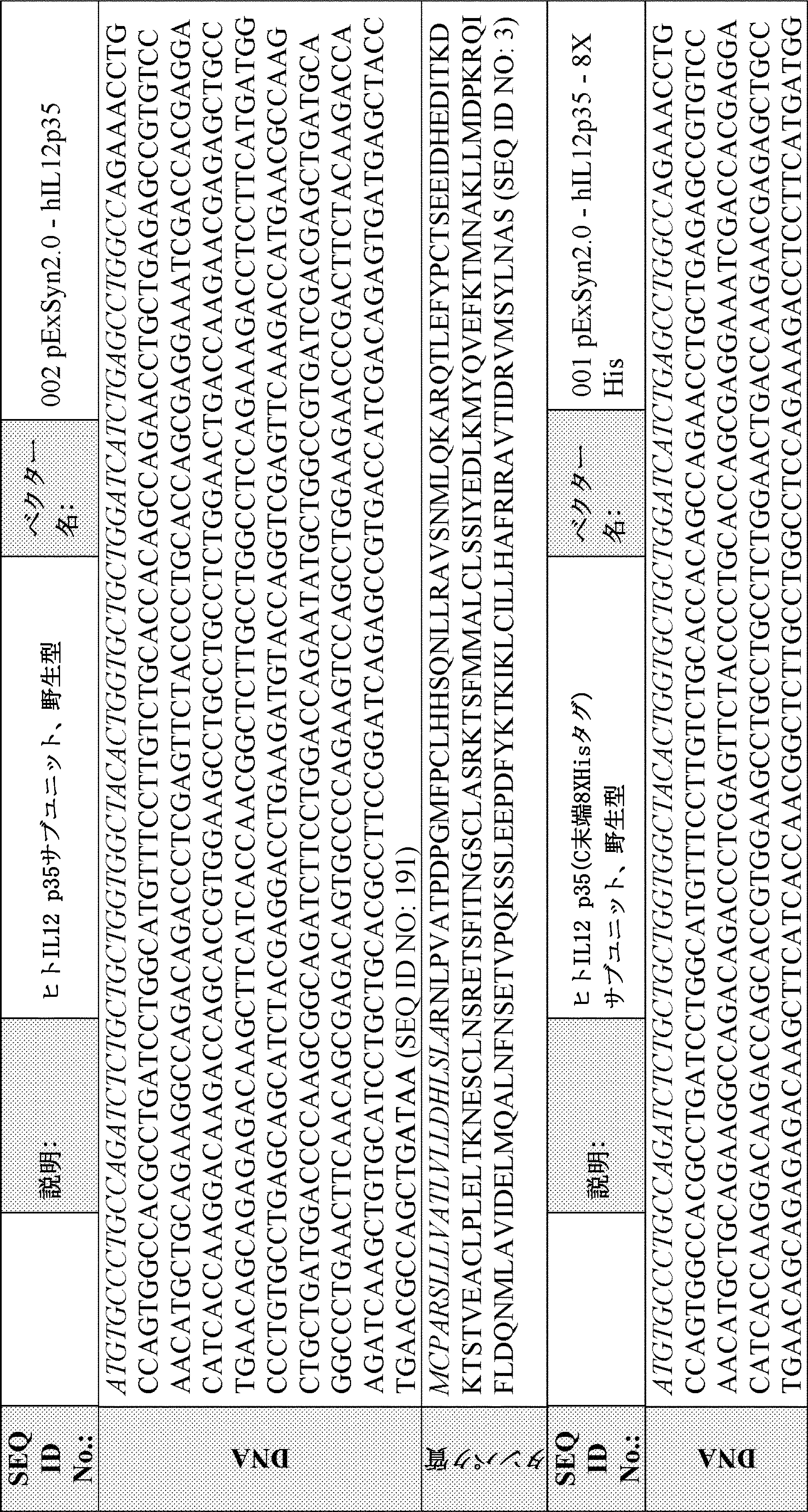
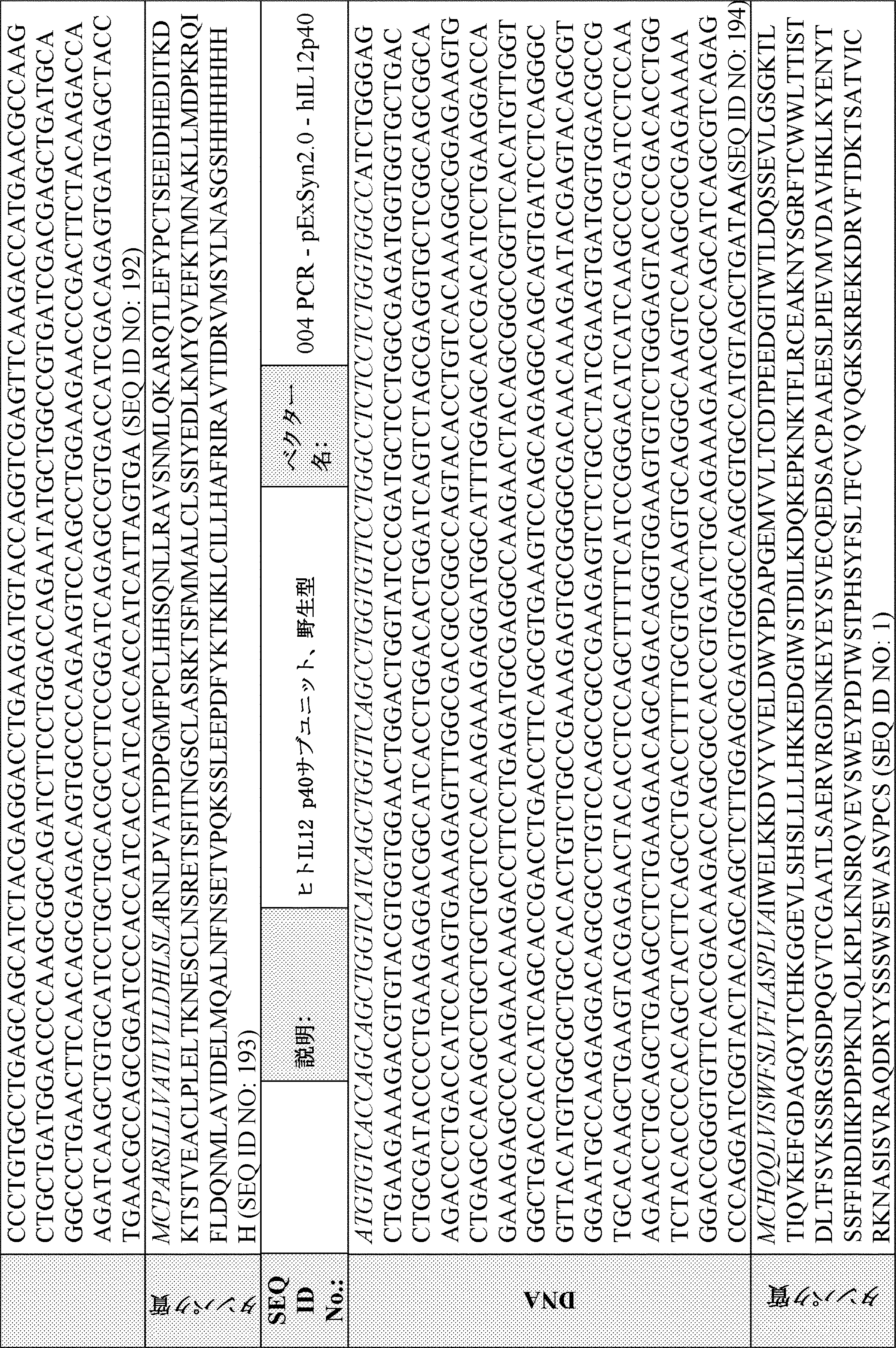


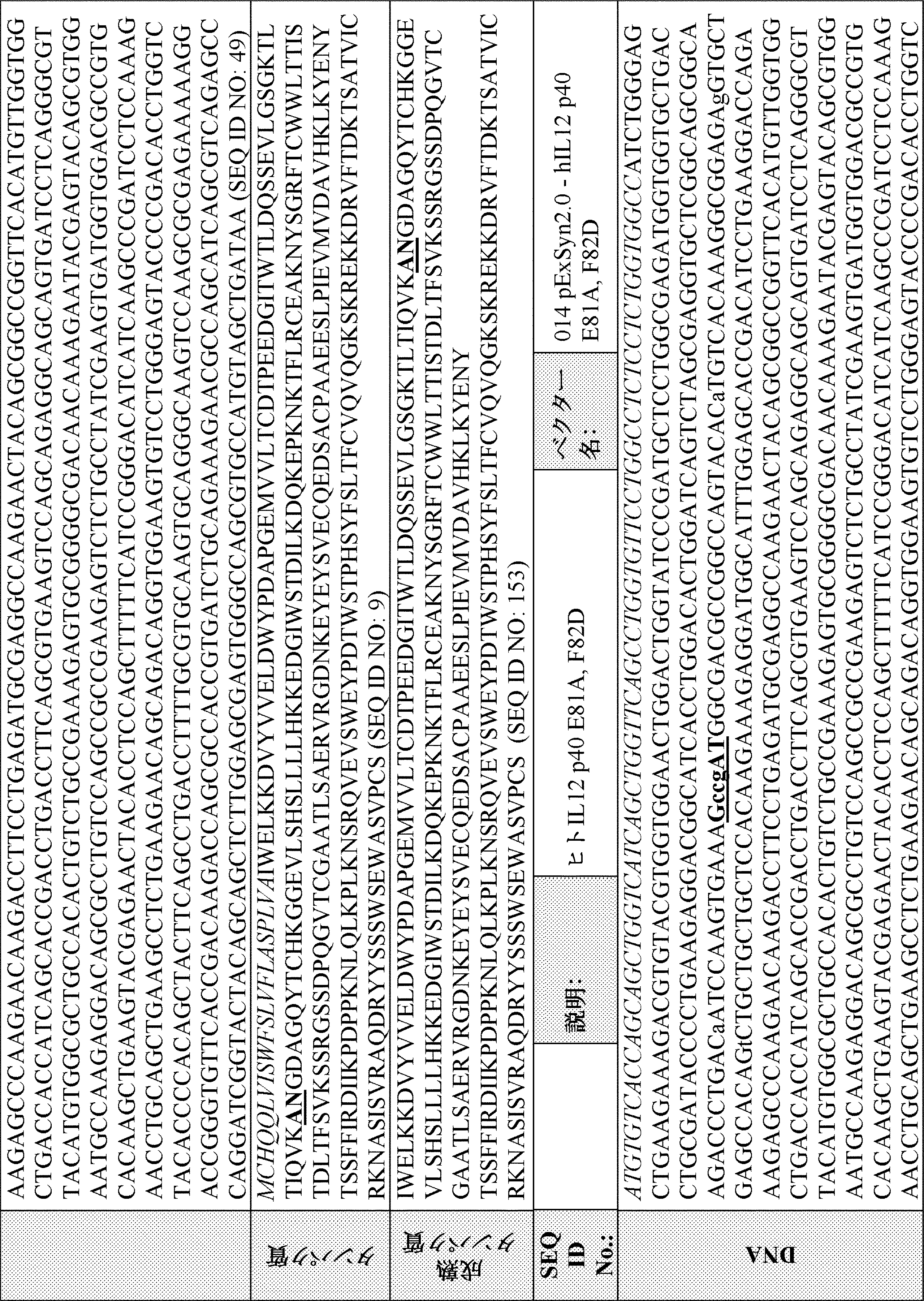
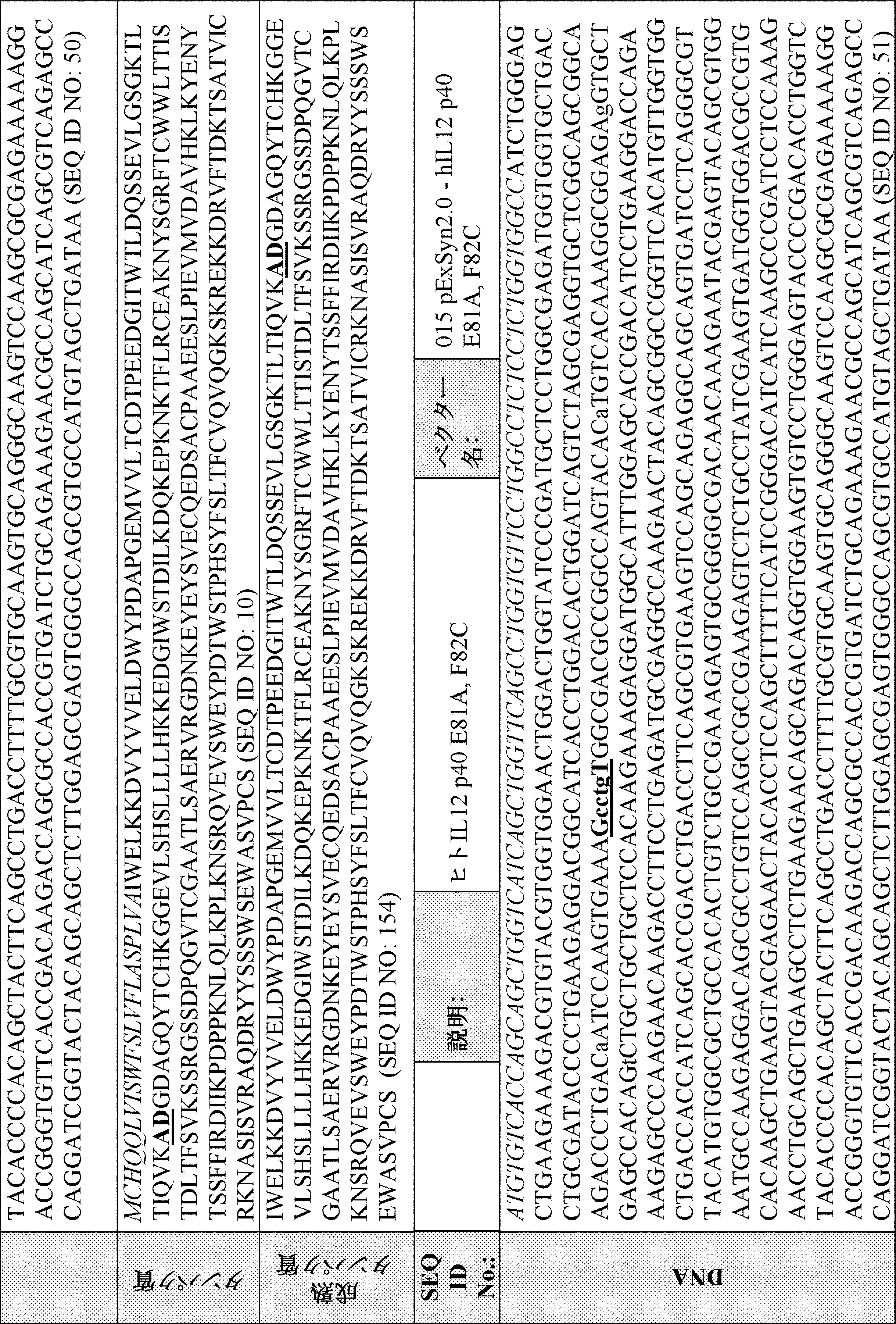

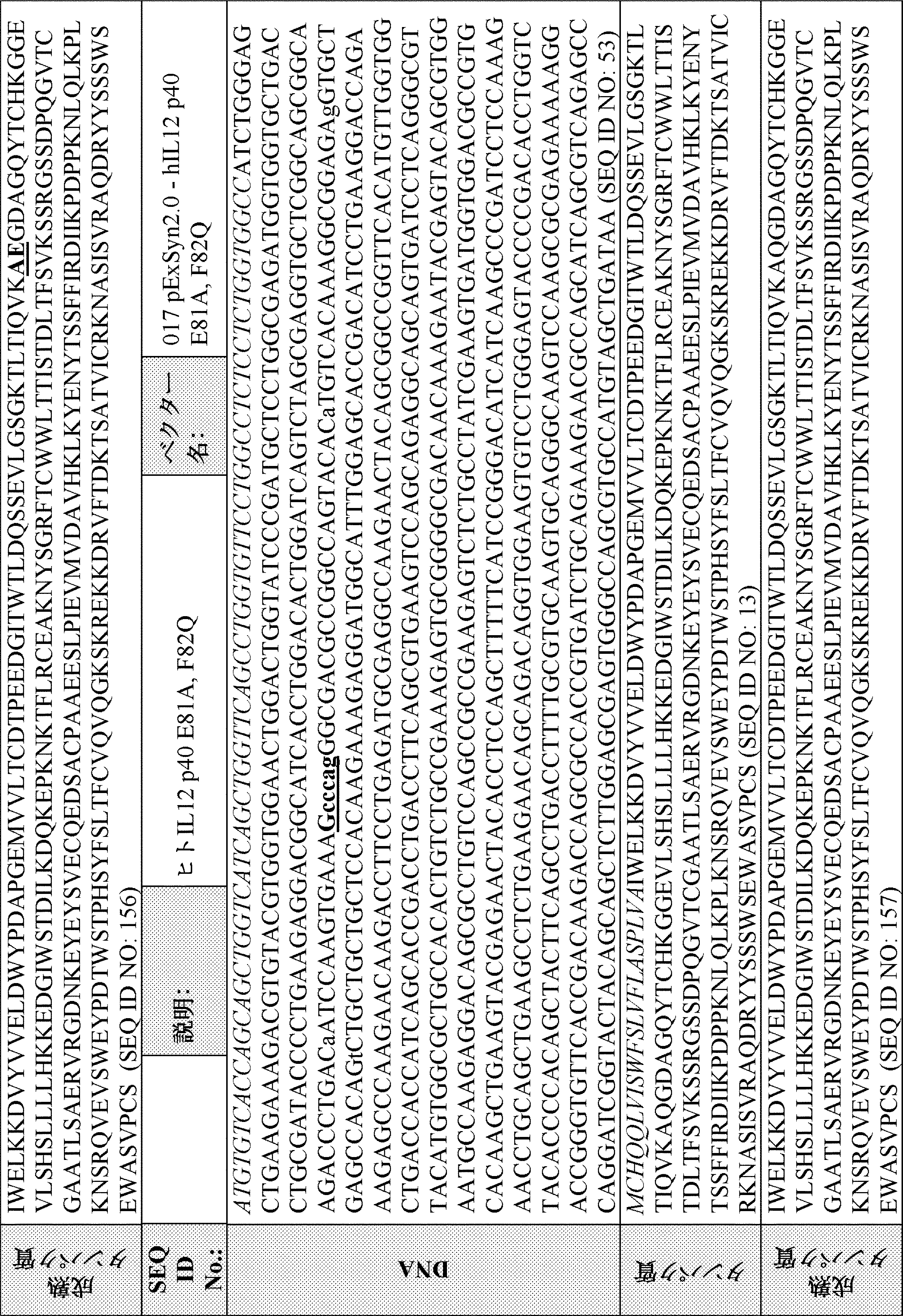

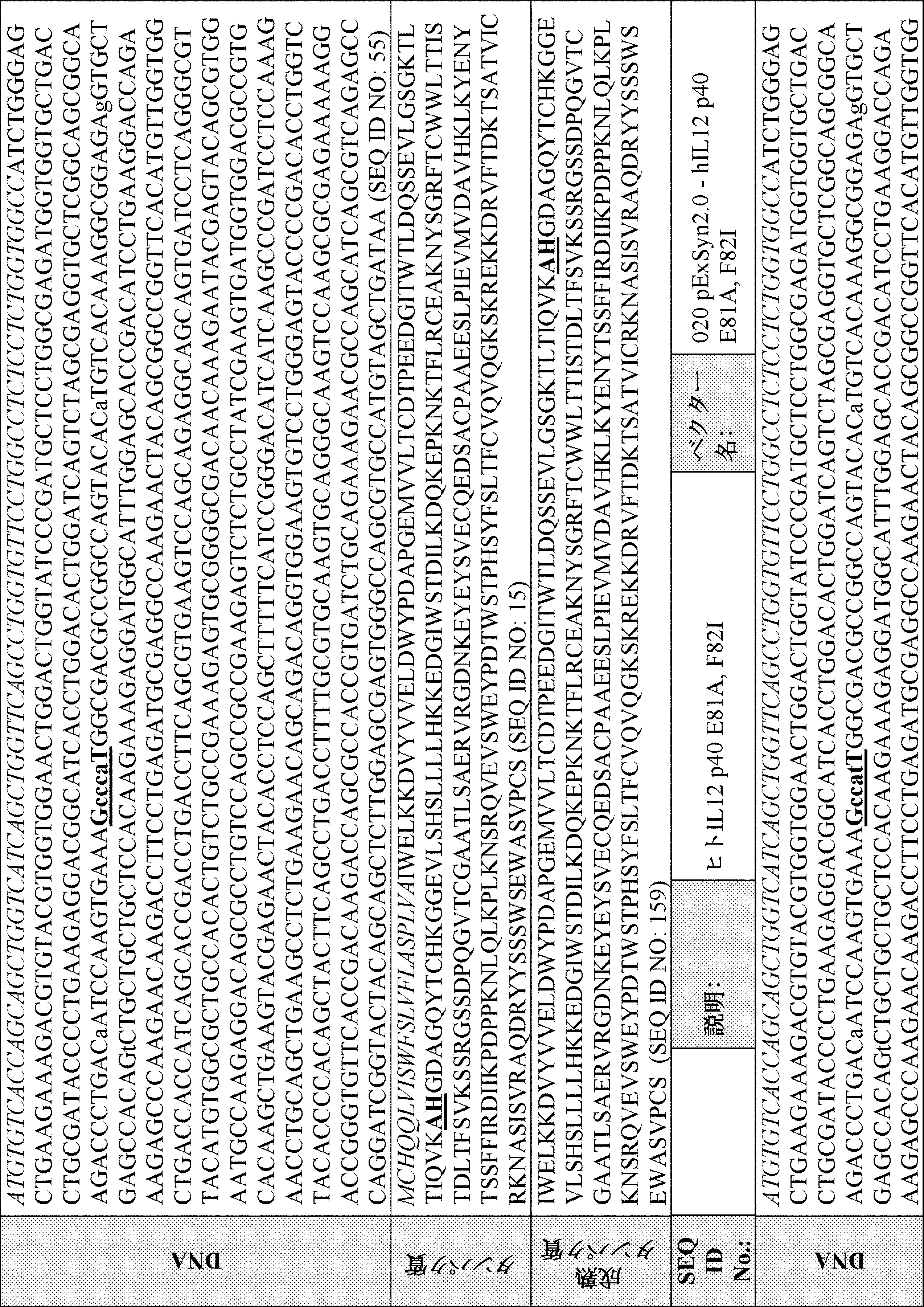

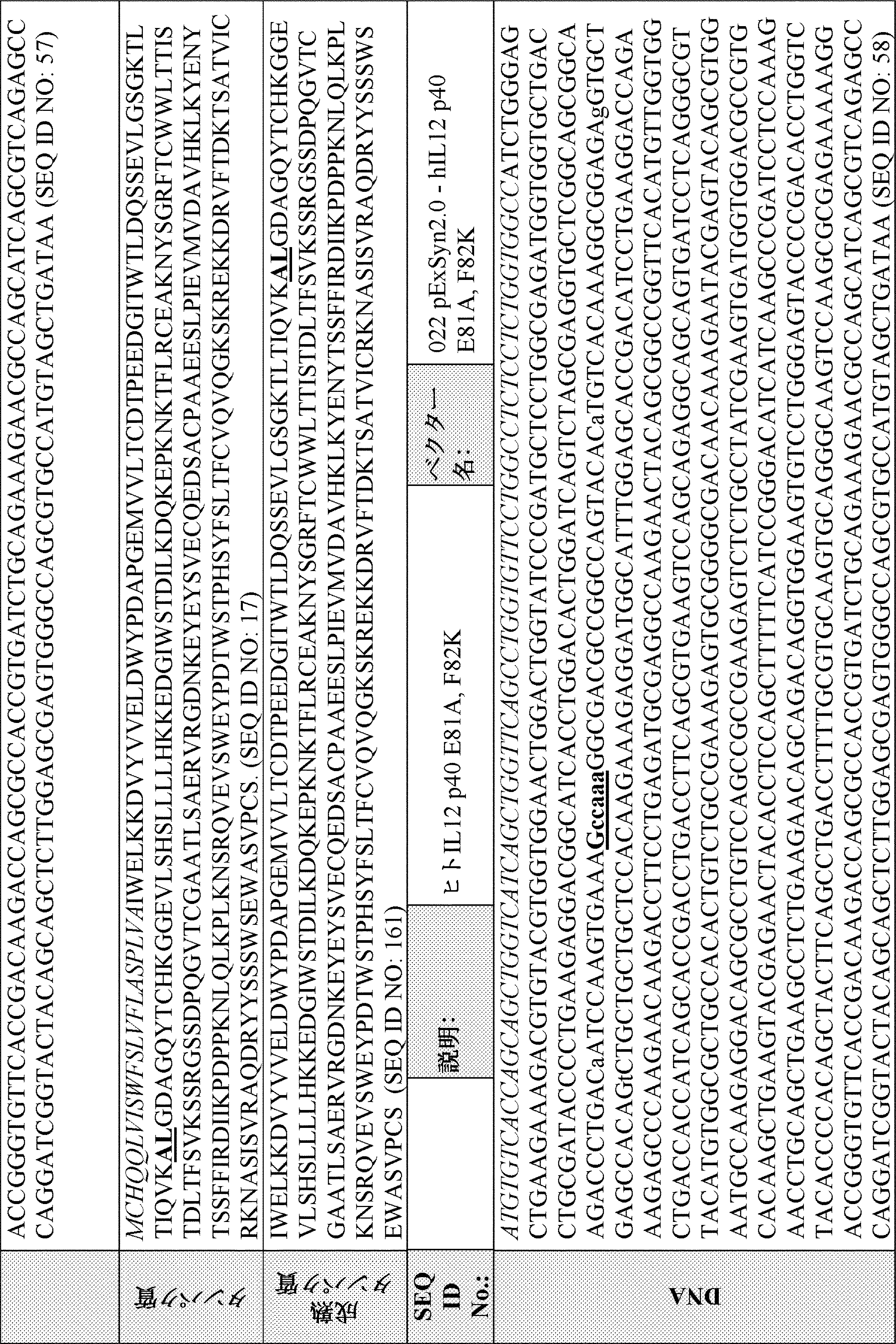
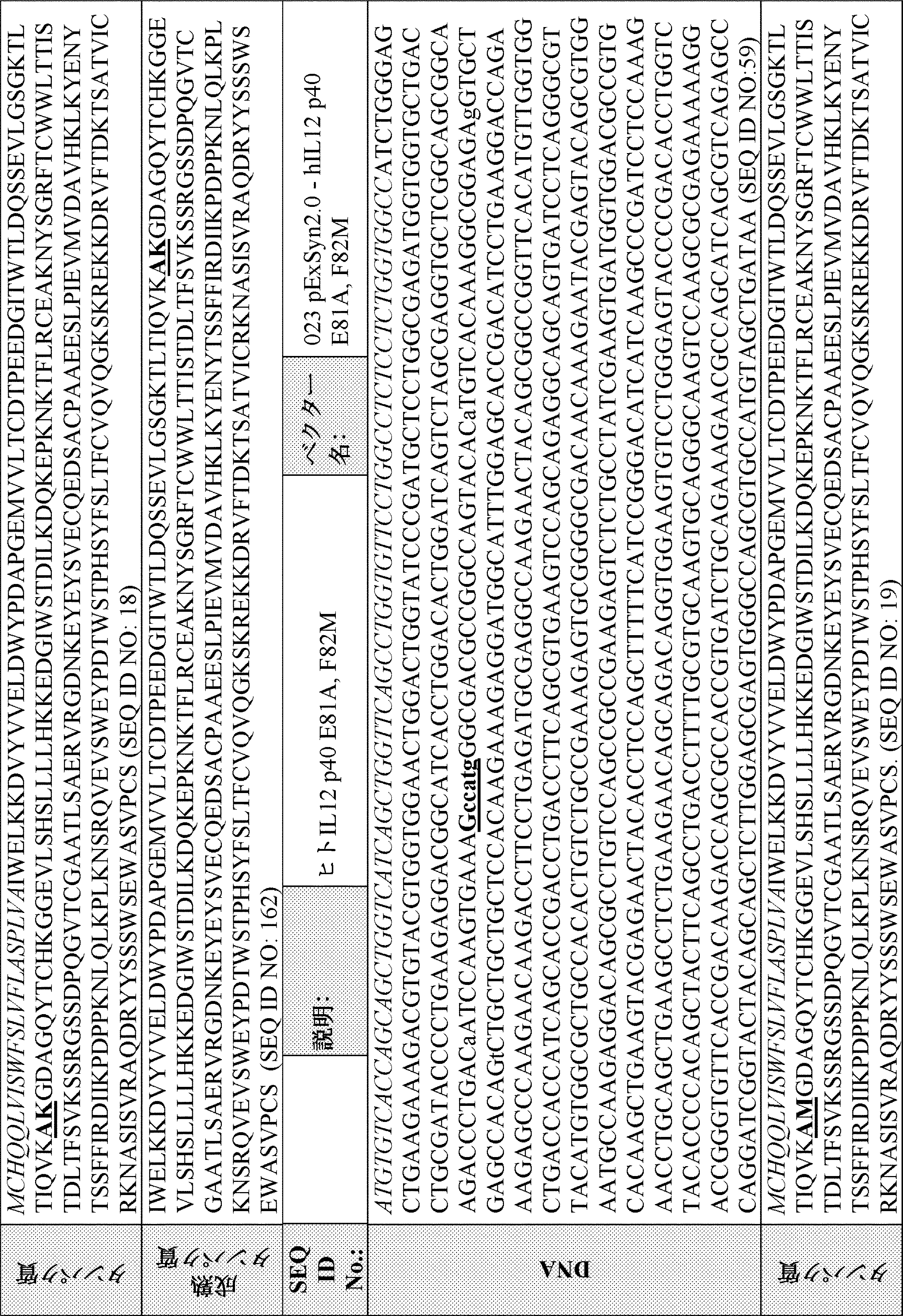
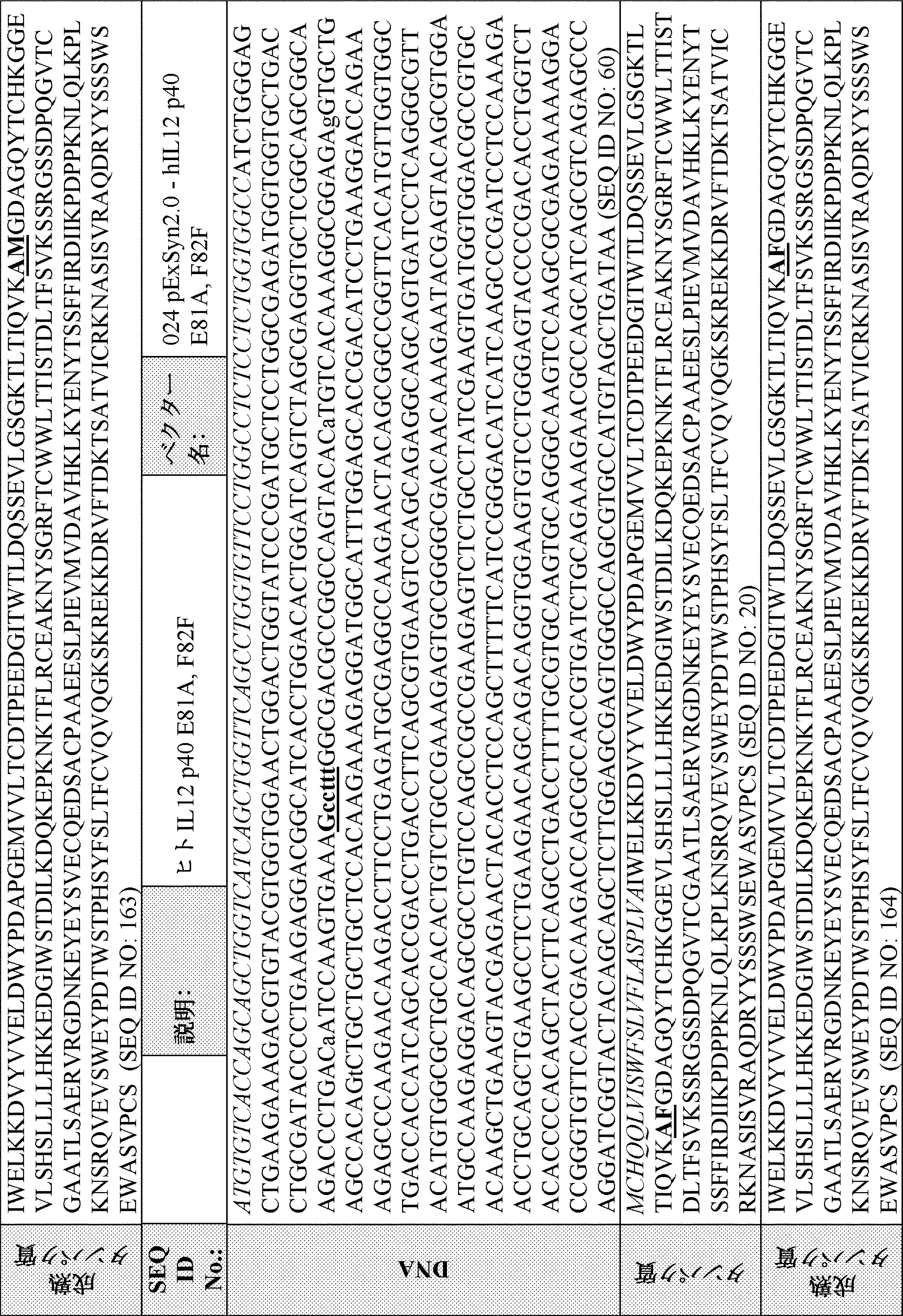
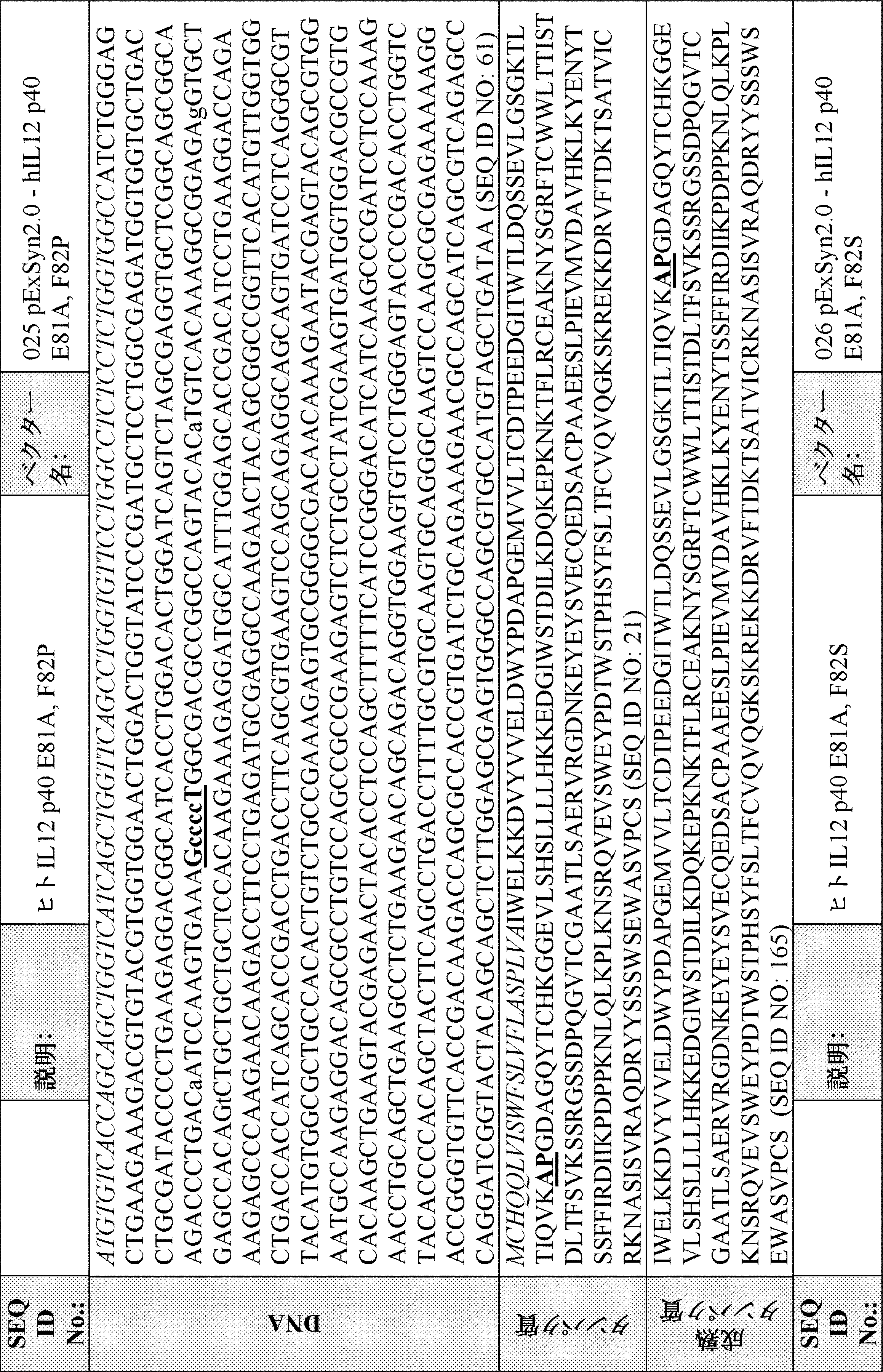
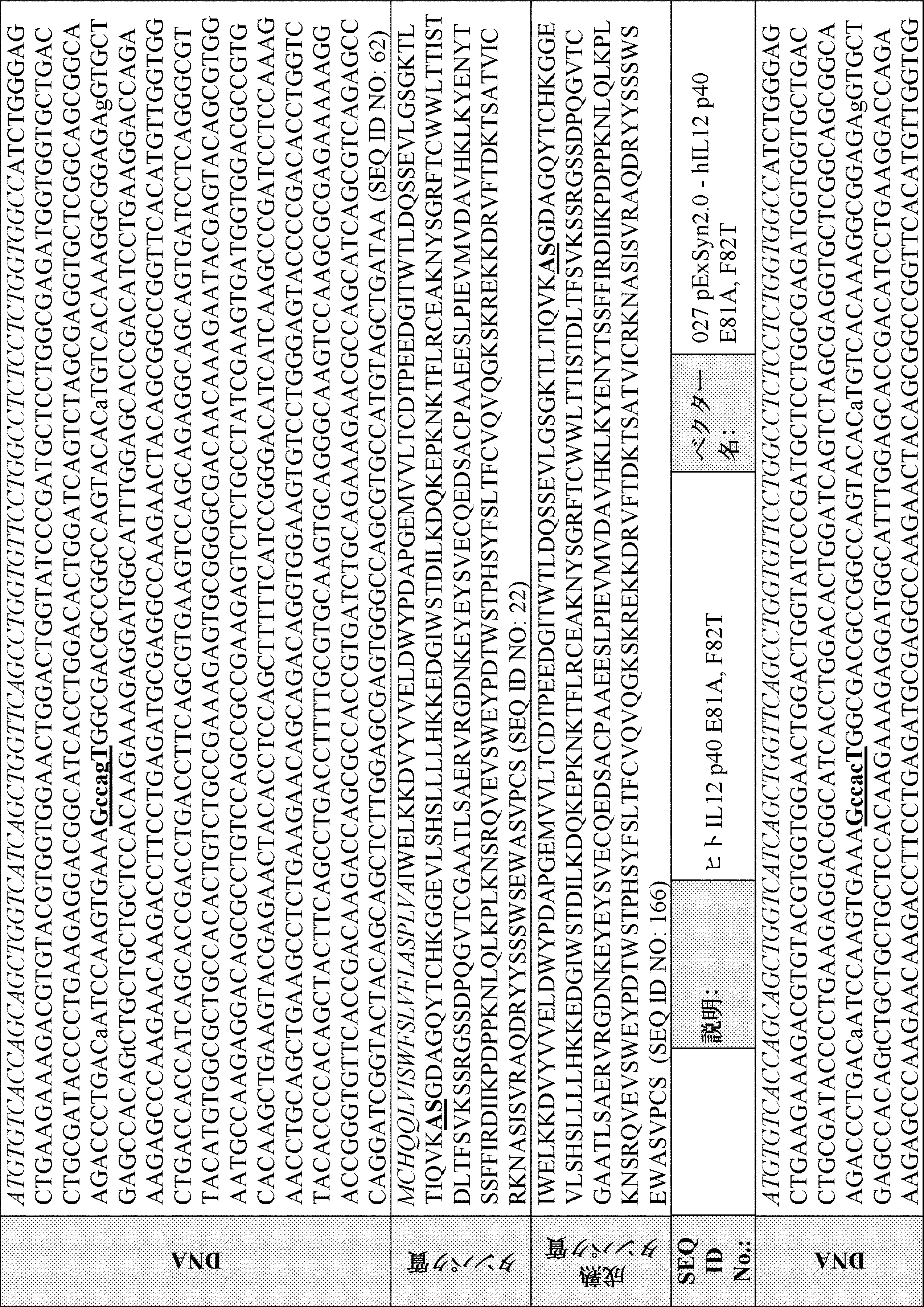

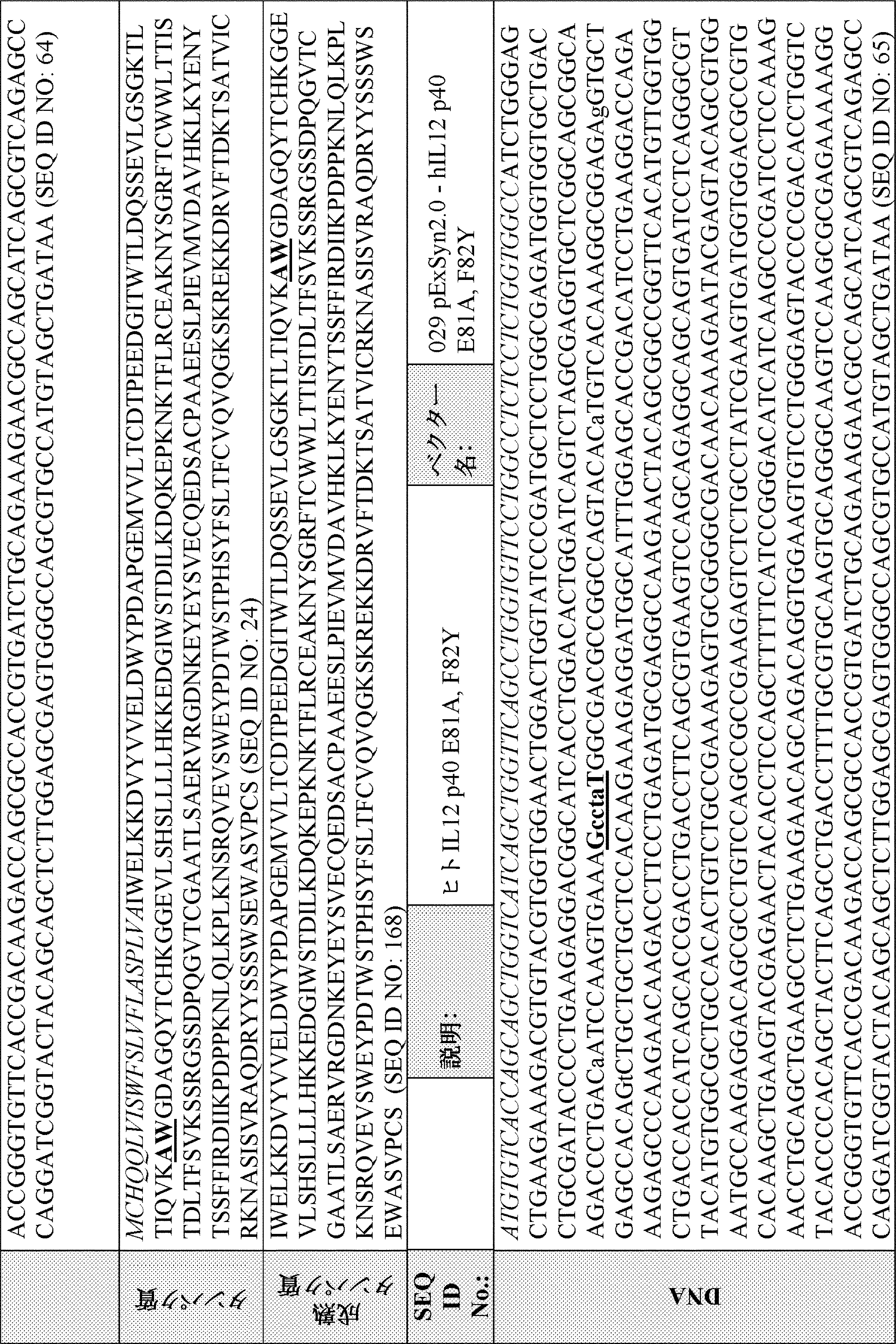
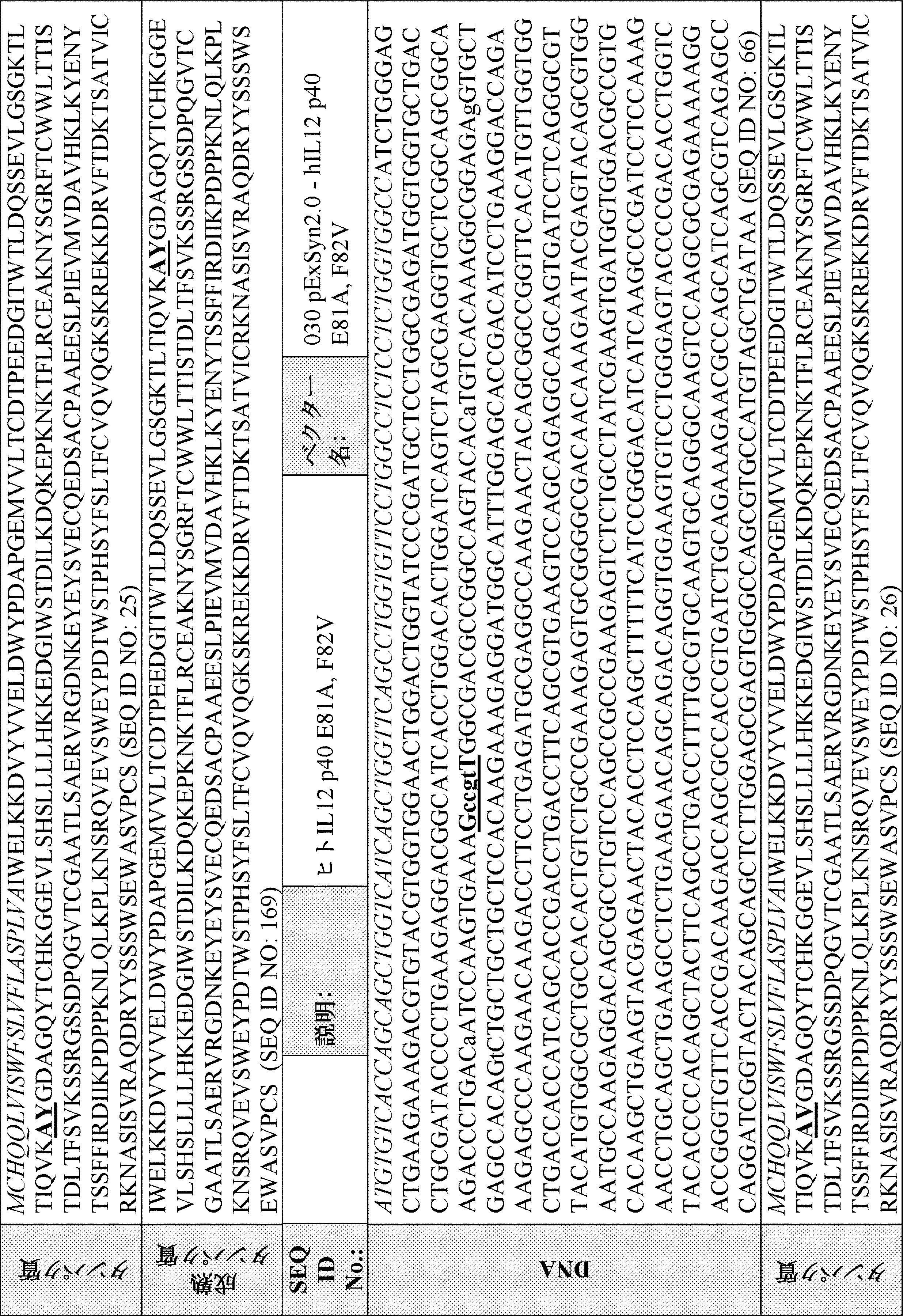

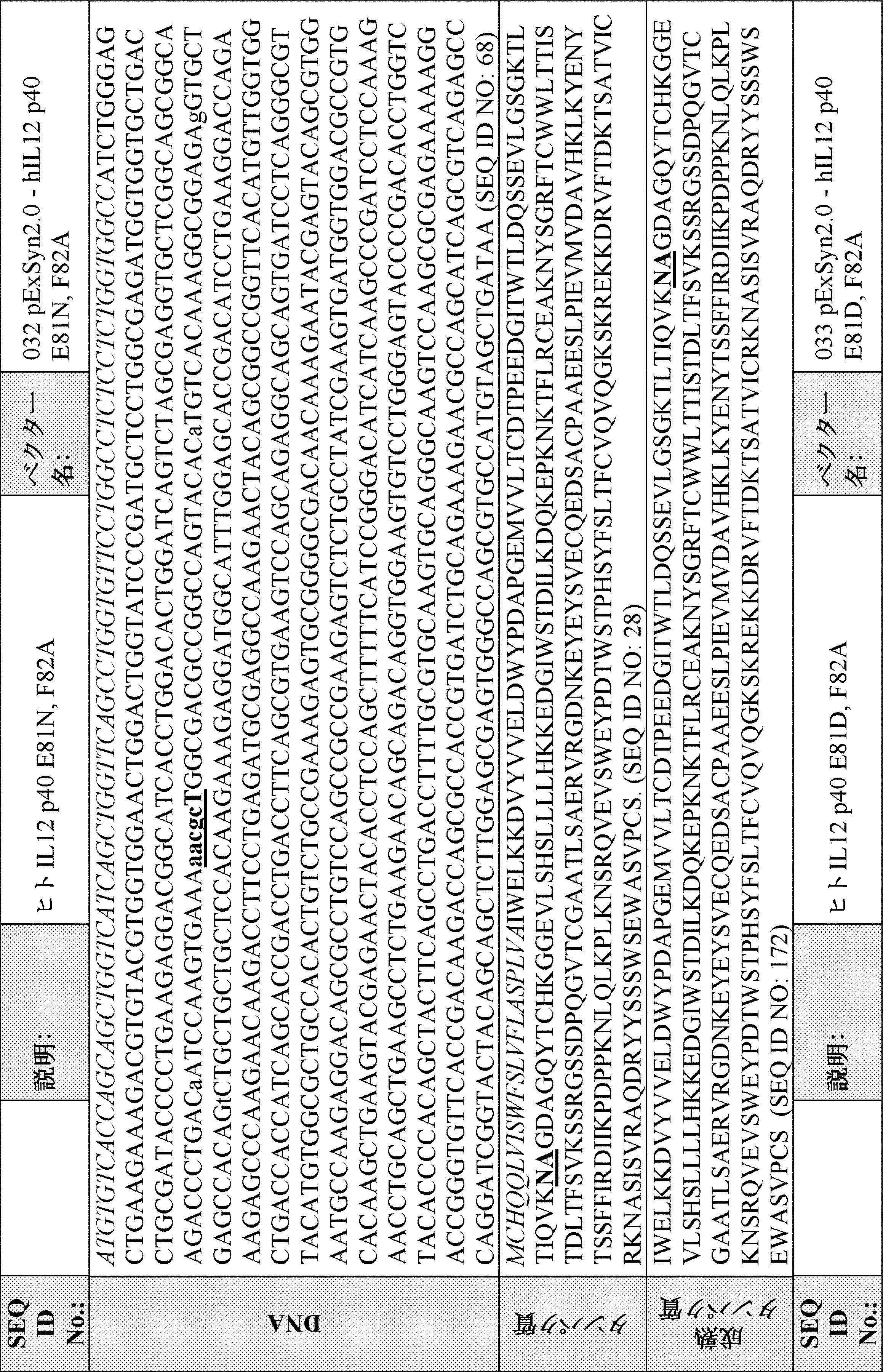

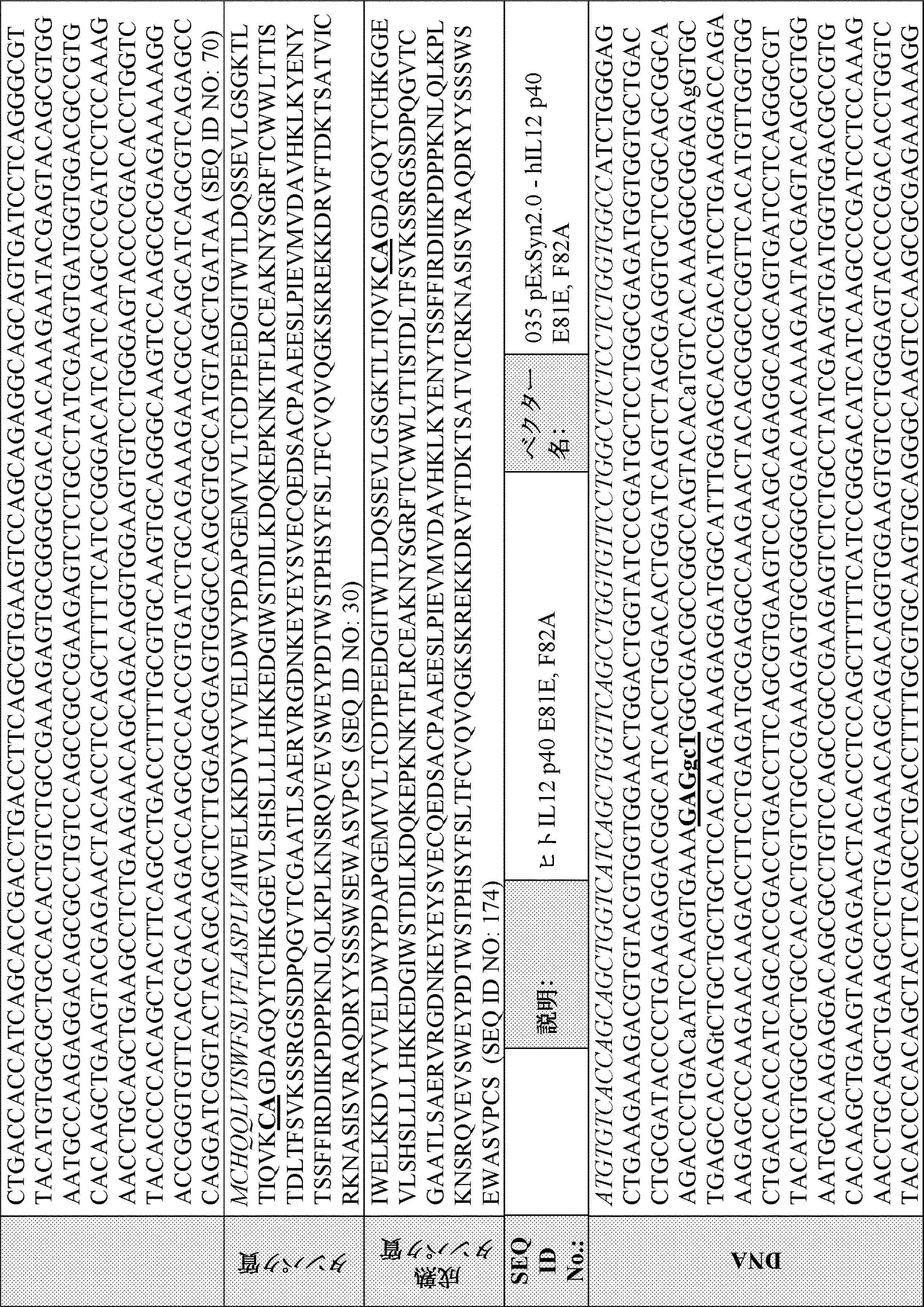
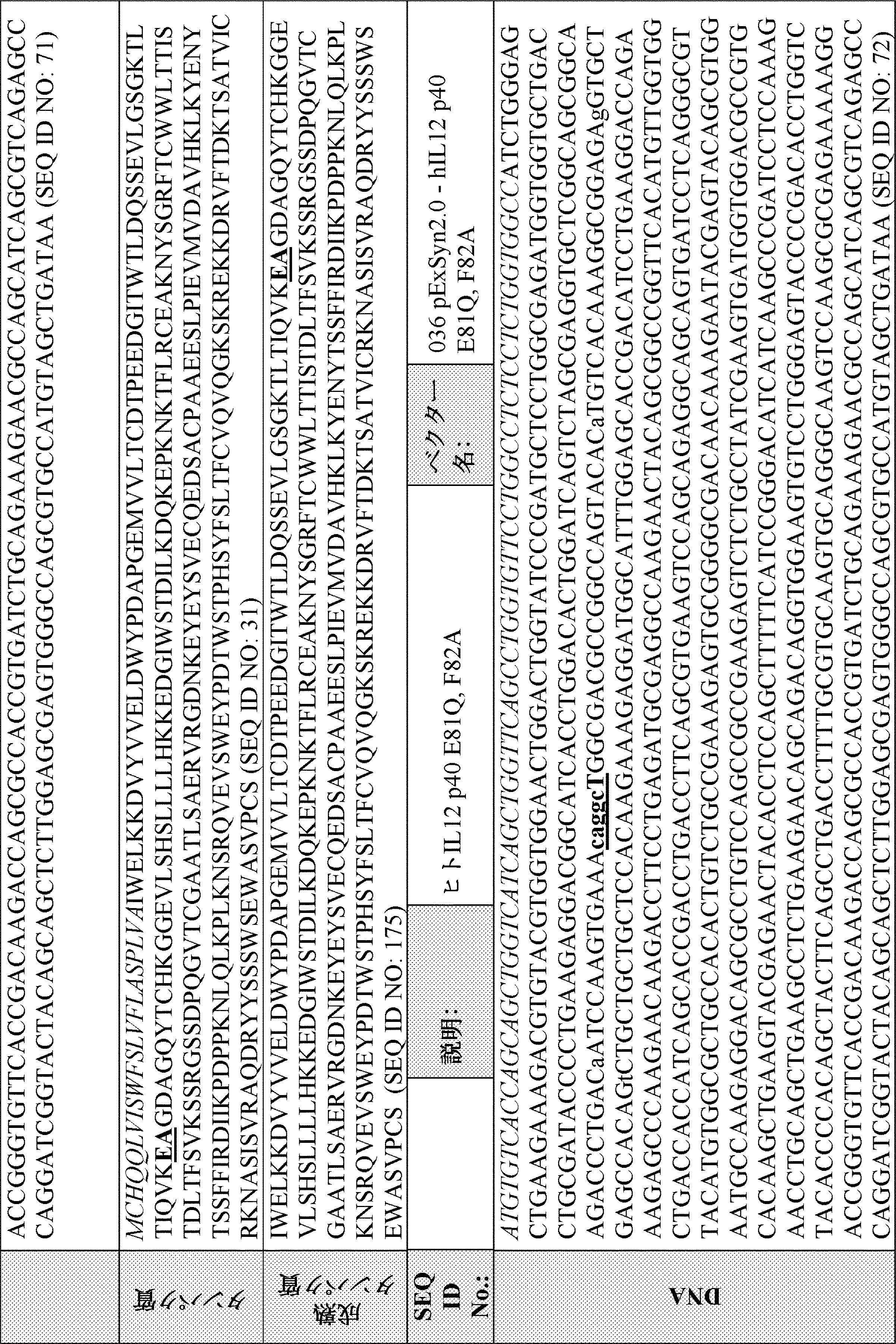
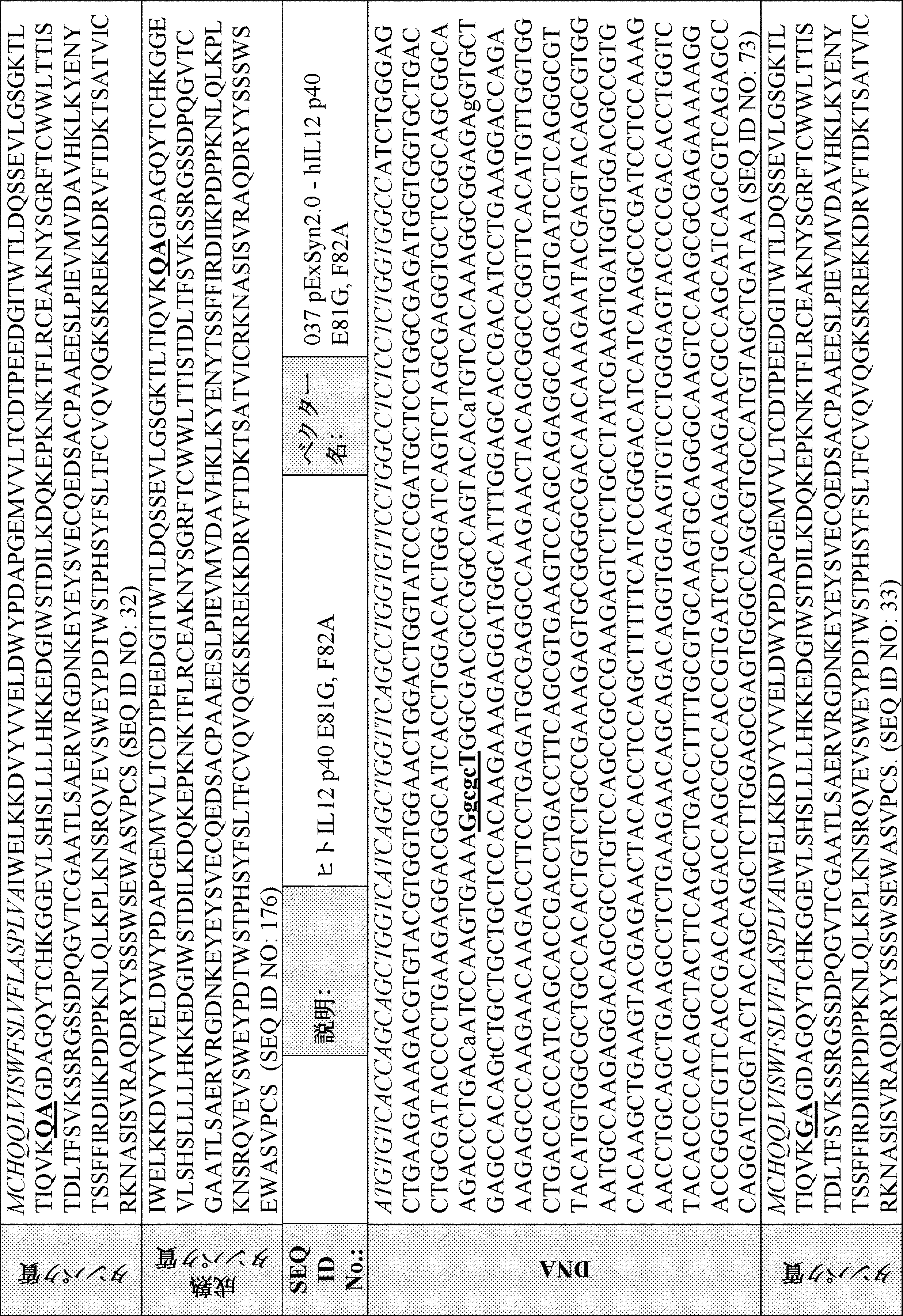
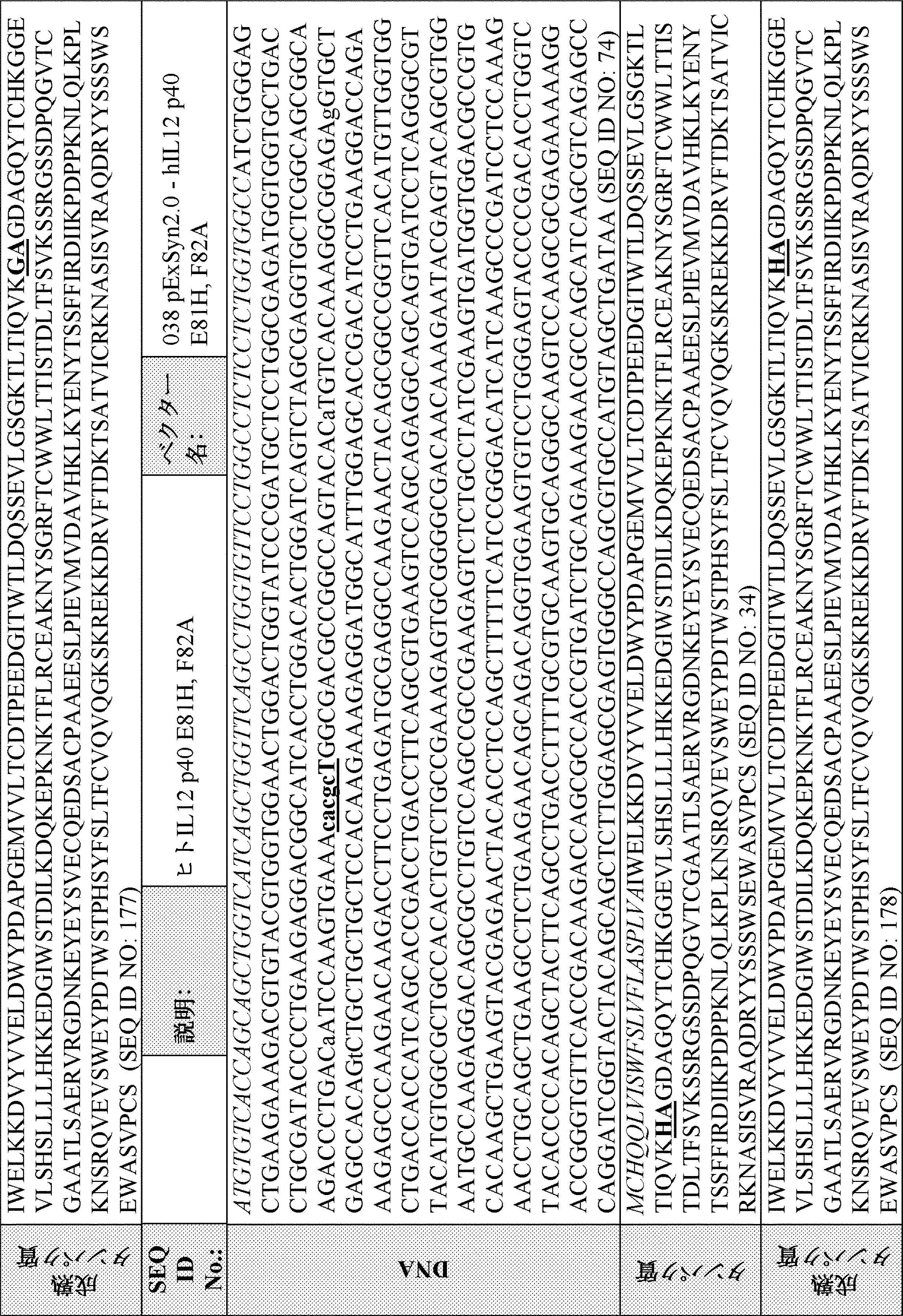


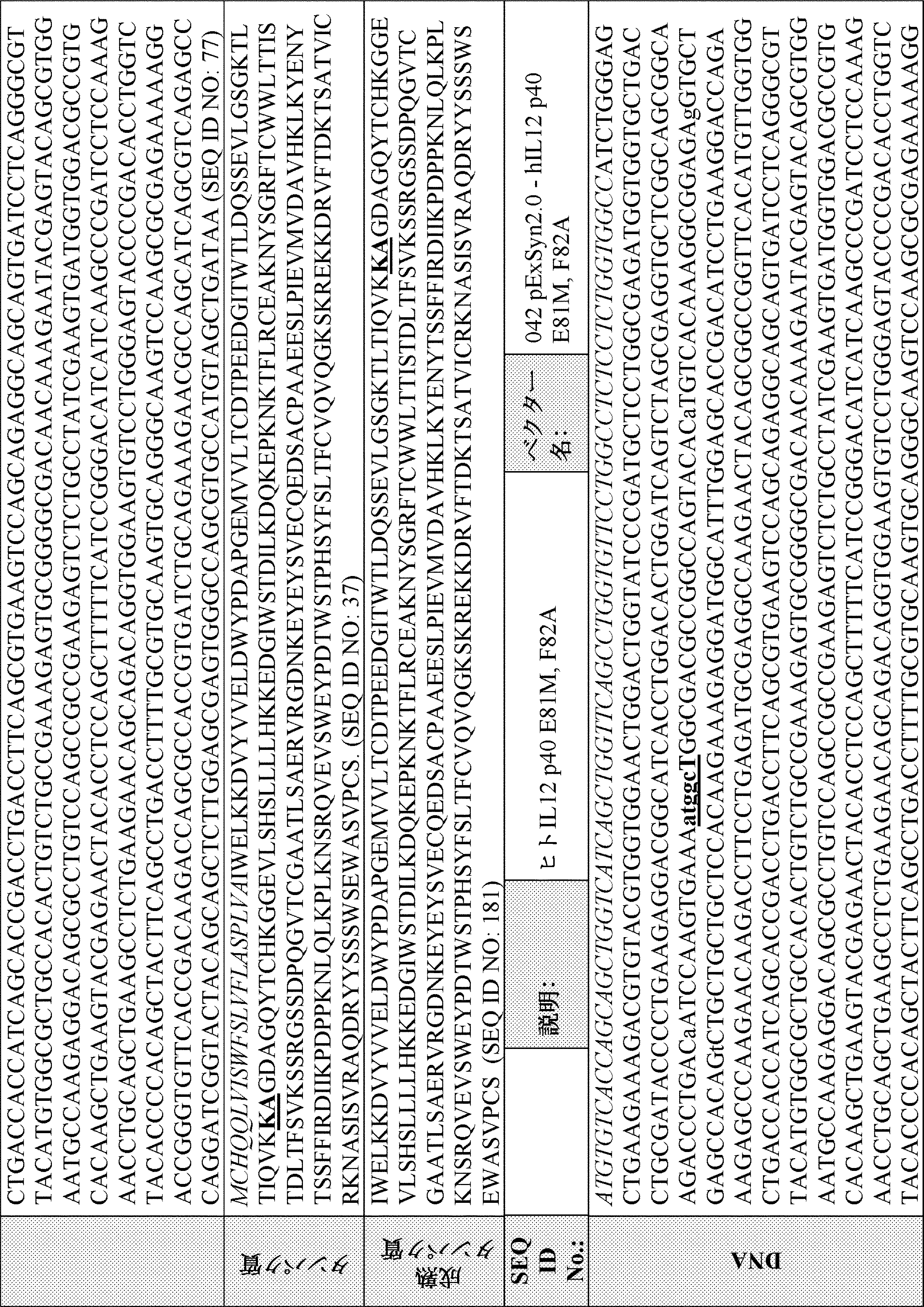
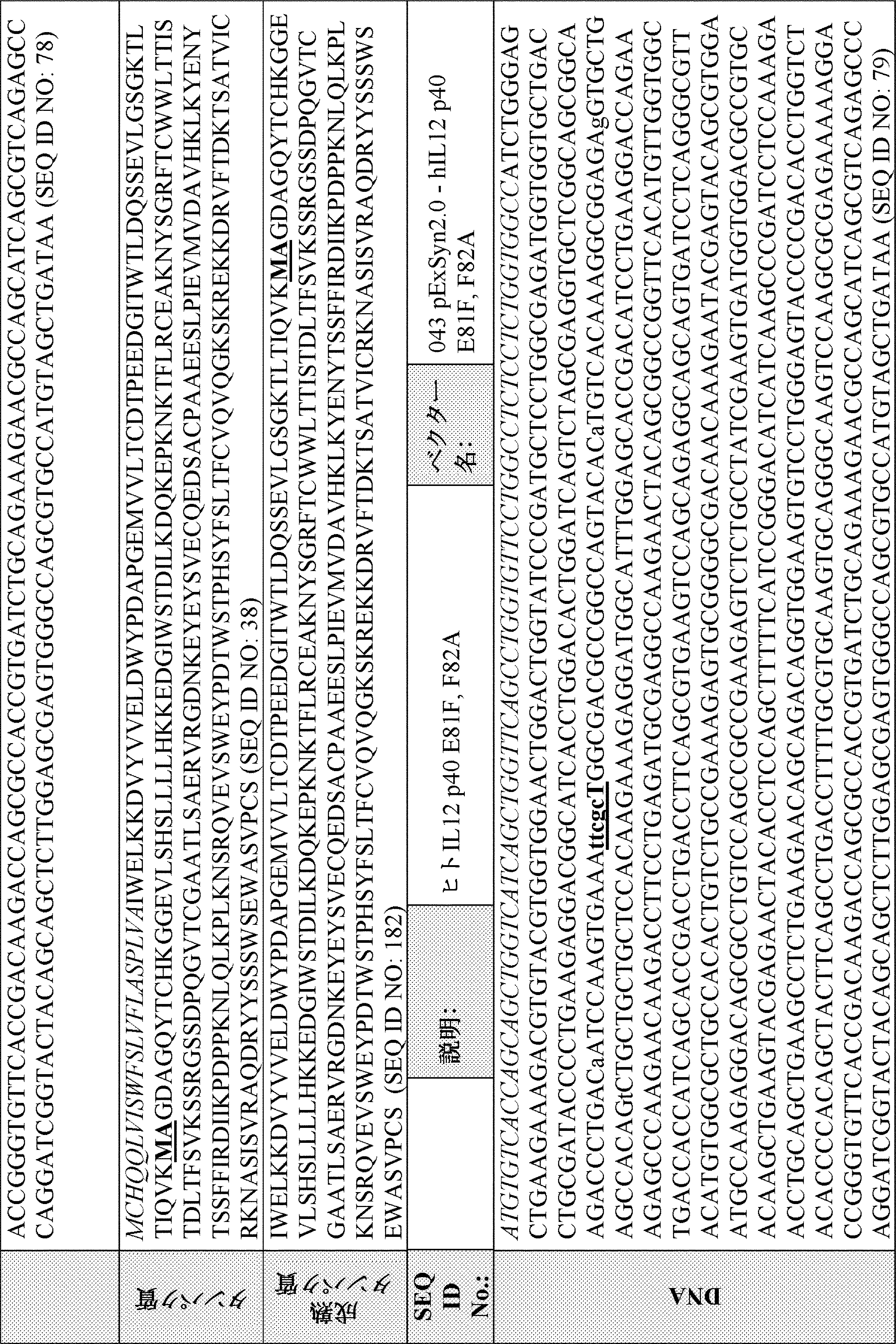


Description
●The signal peptide is shown in italics.
• Mutational changes from wild type are shown in bold and underlined.
Claims (35)
(a)アミノ酸残基F82に対応する位置でのアミノ酸置換がF82Xであり、ここでXがF以外の任意のアミノ酸であり、E81に対応する位置でのアミノ酸置換が、アスパラギン(N)、アスパラギン酸(D)、システイン(C)、グルタミン(Q)、グルタミン酸(E)、プロリン(P)、トリプトファン(W)、およびチロシン(Y)からなる群より選択されるか、または
(b)アミノ酸残基E81に対応する位置でのアミノ酸置換がE81Xであり、ここでXがE以外の任意のアミノ酸であり、F82に対応する位置でのアミノ酸置換が、アルギニン(R)、アスパラギン(N)、アスパラギン酸(D)、システイン(C)、グルタミン(Q)、グルタミン酸(E)、ヒスチジン(H)、リジン(K)、フェニルアラニン(F)、プロリン(P)、トリプトファン(W)、およびチロシン(Y)からなる群より選択される、
ヒトIL-12p40(hIL-12p40)ポリペプチド。 1. A human IL-12p40 (hIL-12p40) polypeptide comprising an amino acid sequence that is at least 70% identical to SEQ ID NO:1, which comprises two or more amino acid substitutions, wherein the polypeptide comprises amino acid substitutions at positions corresponding to amino acid residues E81 and F82 of SEQ ID NO:1,
(a) the amino acid substitution at the position corresponding to amino acid residue F82 is F82X, where X is any amino acid other than F, and the amino acid substitution at the position corresponding to E81 is selected from the group consisting of asparagine (N), aspartic acid (D), cysteine (C), glutamine (Q), glutamic acid (E), proline (P), tryptophan (W), and tyrosine (Y); or
(b) the amino acid substitution at the position corresponding to amino acid residue E81 is E81X, where X is any amino acid other than E, and the amino acid substitution at the position corresponding to F82 is selected from the group consisting of arginine (R), asparagine (N), aspartic acid (D), cysteine (C), glutamine (Q), glutamic acid (E), histidine (H), lysine (K), phenylalanine (F), proline (P), tryptophan (W), and tyrosine (Y);
Human IL-12p40 (hIL-12p40) polypeptide.
2つ以上のアミノ酸置換を欠いている野生型または親hIL-12p40ポリペプチドと比較して、(i)CD8+T細胞においてIL-12シグナル伝達を誘導し、(ii)NK細胞においてIL-12シグナル伝達が減少している、二量体
を形成する、請求項1または2記載のhIL 12p40ポリペプチド。 Upon association with hIL12p35, the polypeptide:
The hIL-12p40 polypeptide of claim 1 or 2, which forms a dimer that (i) induces IL-12 signaling in CD8+ T cells and (ii) has reduced IL-12 signaling in NK cells, compared to a wild-type or parent hIL-12p40 polypeptide lacking two or more amino acid substitutions.
2つ以上のアミノ酸置換を欠いている野生型または親hIL-12p40ポリペプチドと比較して、CD8+T細胞においてインターフェロンγ(IFNγ)を活性化し、CD8+T細胞におけるIFNγシグナル伝達が減少している、二量体
を形成する、請求項1~4のいずれか一項記載のhIL 12p40ポリペプチド。 Upon association with hIL12p35, the polypeptide:
The hIL 12p40 polypeptide of any one of claims 1 to 4, which forms a dimer that activates interferon gamma (IFNγ) in CD8+ T cells and has reduced IFNγ signaling in CD8+ T cells compared to a wild-type or parent hIL-12p40 polypeptide lacking two or more amino acid substitutions.
2つ以上のアミノ酸置換を欠いている野生型または親hIL-2p40ポリペプチドの結合親和性と比較して、hIL-12Rβ1に対する結合親和性が低減している、二量体
を形成する、請求項1~4のいずれか一項記載のhIL 12p40ポリペプチド。 Upon association with hIL12p35, the polypeptide:
5. The hIL-12p40 polypeptide of any one of claims 1 to 4, which forms a dimer that has a reduced binding affinity to hIL-12Rβ1 compared to the binding affinity of a wild-type or parent hIL-2p40 polypeptide lacking two or more amino acid substitutions.
2つ以上のアミノ酸置換を欠いている野生型または親hIL-12p40ポリペプチドと比較して、STAT3によって媒介されるシグナル伝達が減少している、二量体
を形成する、請求項1~4のいずれか一項記載のhIL 12p40ポリペプチド。 Upon association with hIL12p35, the polypeptide:
5. The hIL 12p40 polypeptide of any one of claims 1 to 4, which forms a dimer and has reduced STAT3-mediated signaling compared to a wild-type or parent hIL-12p40 polypeptide lacking two or more amino acid substitutions.
2つ以上のアミノ酸置換を欠いている野生型または親hIL-12p40ポリペプチドと比較して、STAT4によって媒介されるシグナル伝達が減少している、二量体
を形成する、請求項1~6のいずれか一項記載のhIL-12p40ポリペプチド。 Upon association with hIL12p35, the polypeptide:
The hIL-12p40 polypeptide of any one of claims 1 to 6, which forms a dimer and has reduced STAT4-mediated signaling compared to a wild-type or parent hIL-12p40 polypeptide lacking two or more amino acid substitutions.
(a)請求項12~18のいずれか一項記載の1つまたは複数の細胞を準備する工程;および
(b)該細胞が、核酸分子によってコードされるhIL12p40ポリペプチドを含むhIL12ムテインを産生するように、培養培地中で該1つまたは複数の細胞を培養する工程。 A method for producing a hIL12 mutein comprising the steps of:
(a) providing one or more cells according to any one of claims 12 to 18; and
(b) culturing the one or more cells in a culture medium such that the cells produce a hIL12 mutein comprising a hIL12p40 polypeptide encoded by the nucleic acid molecule.
(a)請求項1~19もしくは35のいずれか一項記載のポリペプチドを含むhIL12ムテイン;
(b)請求項8~11のいずれか一項記載の核酸;および/または
(c)請求項17記載の細胞
とを含む、薬学的組成物。 A pharma- ceutically acceptable carrier;
(a) a hIL12 mutein comprising a polypeptide according to any one of claims 1 to 19 or 35;
(b) a nucleic acid according to any one of claims 8 to 11; and/or
(c) a cell according to claim 17.
(a)請求項1~7もしくは24のいずれか一項記載のhIL12p40ポリペプチドを含むhIL12ムテイン;
(b)請求項8~11のいずれか一項記載の核酸;
(c)請求項17記載の細胞;および/または
(d)請求項25~28のいずれか一項記載の薬学的組成物
を含む有効量の組成物を、対象に投与する工程。 A method for modulating IL-12 signaling in a subject, comprising the steps of:
(a) a hIL12 mutein comprising the hIL12p40 polypeptide of any one of claims 1 to 7 or 24;
(b) a nucleic acid according to any one of claims 8 to 11;
(c) the cell of claim 17; and/or
(d) administering to the subject an effective amount of a composition comprising the pharmaceutical composition of any one of claims 25 to 28.
(a)請求項1~7もしくは24のいずれか一項記載のhIL12p40ポリペプチド;
(b)請求項8~11のいずれか一項記載の核酸;
(c)請求項17記載の細胞;および/または
(d)請求項25~28のいずれか一項記載の薬学的組成物
を含む組成物を、対象に投与する工程。 A method for treating a health condition in a subject in need thereof, comprising the steps of:
(a) a hIL12p40 polypeptide according to any one of claims 1 to 7 or 24;
(b) a nucleic acid according to any one of claims 8 to 11;
(c) the cell of claim 17; and/or
(d) administering to a subject a composition comprising the pharmaceutical composition of any one of claims 25 to 28.
(b)請求項8~11のいずれか一項記載の核酸;
(c)請求項17記載の細胞;および/または
(d)請求項25~28のいずれか一項記載の薬学的組成物
を含む、対象においてIL-12によって媒介されるシグナル伝達を調整するための、またはその必要がある対象において健康状態を処置するためのキット。 (a) a polypeptide according to any one of claims 1 to 7 or 24;
(b) a nucleic acid according to any one of claims 8 to 11;
(c) the cell of claim 17; and/or
(d) A kit for modulating IL-12 mediated signal transduction in a subject or for treating a condition in a subject in need thereof, comprising the pharmaceutical composition of any one of claims 25 to 28.
Applications Claiming Priority (3)
| Application Number | Priority Date | Filing Date | Title |
|---|---|---|---|
| US202163257942P | 2021-10-20 | 2021-10-20 | |
| US63/257,942 | 2021-10-20 | ||
| PCT/US2022/078439 WO2023070038A2 (en) | 2021-10-20 | 2022-10-20 | Human il-12p40 variants and uses thereof |
Publications (2)
| Publication Number | Publication Date |
|---|---|
| JP2024540938A true JP2024540938A (en) | 2024-11-06 |
| JPWO2023070038A5 JPWO2023070038A5 (en) | 2025-10-23 |
Family
ID=86059693
Family Applications (1)
| Application Number | Title | Priority Date | Filing Date |
|---|---|---|---|
| JP2024523622A Pending JP2024540938A (en) | 2021-10-20 | 2022-10-20 | Human IL-12p40 variants and uses thereof |
Country Status (8)
| Country | Link |
|---|---|
| US (1) | US20250388640A1 (en) |
| EP (1) | EP4419555A4 (en) |
| JP (1) | JP2024540938A (en) |
| KR (1) | KR20240099286A (en) |
| CN (1) | CN118317974A (en) |
| AU (1) | AU2022371454A1 (en) |
| CA (1) | CA3234437A1 (en) |
| WO (1) | WO2023070038A2 (en) |
Families Citing this family (3)
| Publication number | Priority date | Publication date | Assignee | Title |
|---|---|---|---|---|
| TWI818934B (en) | 2017-11-28 | 2023-10-21 | 日商中外製藥股份有限公司 | Ligand-binding molecules with adjustable ligand-binding activity |
| JP2024539139A (en) | 2021-10-20 | 2024-10-28 | シンセカイン インコーポレイテッド | Heterodimeric FC cytokines and uses thereof |
| WO2025136986A2 (en) | 2023-12-18 | 2025-06-26 | Genzyme Corporation | Il-12 loss of potency muteins |
Family Cites Families (6)
| Publication number | Priority date | Publication date | Assignee | Title |
|---|---|---|---|---|
| US5457038A (en) * | 1988-11-10 | 1995-10-10 | Genetics Institute, Inc. | Natural killer stimulatory factor |
| CN103146708A (en) * | 2005-06-30 | 2013-06-12 | Abbvie公司 | Il-12/p40 binding proteins |
| AU2006332138B2 (en) * | 2005-12-30 | 2012-03-22 | Merck Patent Gmbh | Interleukin-12p40 variants with improved stability |
| WO2019222294A1 (en) * | 2018-05-14 | 2019-11-21 | Werewolf Therapeutics, Inc. | Activatable cytokine polypeptides and methods of use thereof |
| AU2019355971B2 (en) * | 2018-10-03 | 2025-05-08 | Xencor, Inc. | IL-12 heterodimeric Fc-fusion proteins |
| MX2022012823A (en) * | 2020-04-17 | 2023-01-04 | Univ Leland Stanford Junior | Engineered il-12 and il-23 polypeptides and uses thereof. |
-
2022
- 2022-10-20 JP JP2024523622A patent/JP2024540938A/en active Pending
- 2022-10-20 AU AU2022371454A patent/AU2022371454A1/en active Pending
- 2022-10-20 EP EP22884694.5A patent/EP4419555A4/en active Pending
- 2022-10-20 CN CN202280078649.8A patent/CN118317974A/en active Pending
- 2022-10-20 CA CA3234437A patent/CA3234437A1/en active Pending
- 2022-10-20 KR KR1020247016157A patent/KR20240099286A/en active Pending
- 2022-10-20 US US18/702,618 patent/US20250388640A1/en active Pending
- 2022-10-20 WO PCT/US2022/078439 patent/WO2023070038A2/en not_active Ceased
Also Published As
| Publication number | Publication date |
|---|---|
| CN118317974A (en) | 2024-07-09 |
| WO2023070038A2 (en) | 2023-04-27 |
| EP4419555A2 (en) | 2024-08-28 |
| AU2022371454A1 (en) | 2024-04-18 |
| KR20240099286A (en) | 2024-06-28 |
| EP4419555A4 (en) | 2025-08-27 |
| WO2023070038A3 (en) | 2023-09-28 |
| US20250388640A1 (en) | 2025-12-25 |
| CA3234437A1 (en) | 2023-04-27 |
Similar Documents
| Publication | Publication Date | Title |
|---|---|---|
| AU2021207652B2 (en) | Biased IL2 muteins methods and compositions | |
| US12103954B2 (en) | Heterodimeric Fc cytokines and uses thereof | |
| EP4072576A2 (en) | Il-2 orthologs and methods of use | |
| US20250019453A1 (en) | Il2rb/il2g synthetic cytokines | |
| JP2024540938A (en) | Human IL-12p40 variants and uses thereof | |
| WO2022032022A2 (en) | Il10 receptor binding molecules and methods of use | |
| WO2022032045A1 (en) | IL10Rα/IL2Rγ SYNTHETIC CYTOKINES | |
| JP2024543991A (en) | IL10 variants and uses thereof | |
| WO2024086739A1 (en) | Methods and compositions of il12 muteins and il2 muteins | |
| US20250288666A1 (en) | Methods and compositions for use in cell therapy of neoplastic disease |
Legal Events
| Date | Code | Title | Description |
|---|---|---|---|
| A521 | Request for written amendment filed |
Free format text: JAPANESE INTERMEDIATE CODE: A523 Effective date: 20240829 |
|
| A521 | Request for written amendment filed |
Free format text: JAPANESE INTERMEDIATE CODE: A523 Effective date: 20251015 |
|
| A621 | Written request for application examination |
Free format text: JAPANESE INTERMEDIATE CODE: A621 Effective date: 20251015 |