JP2024540844A - TARGETED CATALYTIC COMPLEMENT ACTIVATING MOLECULES AND METHODS OF USE THEREOF - Patent application - Google Patents
TARGETED CATALYTIC COMPLEMENT ACTIVATING MOLECULES AND METHODS OF USE THEREOF - Patent application Download PDFInfo
- Publication number
- JP2024540844A JP2024540844A JP2024520870A JP2024520870A JP2024540844A JP 2024540844 A JP2024540844 A JP 2024540844A JP 2024520870 A JP2024520870 A JP 2024520870A JP 2024520870 A JP2024520870 A JP 2024520870A JP 2024540844 A JP2024540844 A JP 2024540844A
- Authority
- JP
- Japan
- Prior art keywords
- molecule
- domain comprises
- fragment
- target binding
- seq
- Prior art date
- Legal status (The legal status is an assumption and is not a legal conclusion. Google has not performed a legal analysis and makes no representation as to the accuracy of the status listed.)
- Pending
Links
Images




Classifications
-
- A—HUMAN NECESSITIES
- A61—MEDICAL OR VETERINARY SCIENCE; HYGIENE
- A61K—PREPARATIONS FOR MEDICAL, DENTAL OR TOILETRY PURPOSES
- A61K47/00—Medicinal preparations characterised by the non-active ingredients used, e.g. carriers or inert additives; Targeting or modifying agents chemically bound to the active ingredient
- A61K47/50—Medicinal preparations characterised by the non-active ingredients used, e.g. carriers or inert additives; Targeting or modifying agents chemically bound to the active ingredient the non-active ingredient being chemically bound to the active ingredient, e.g. polymer-drug conjugates
- A61K47/51—Medicinal preparations characterised by the non-active ingredients used, e.g. carriers or inert additives; Targeting or modifying agents chemically bound to the active ingredient the non-active ingredient being chemically bound to the active ingredient, e.g. polymer-drug conjugates the non-active ingredient being a modifying agent
- A61K47/68—Medicinal preparations characterised by the non-active ingredients used, e.g. carriers or inert additives; Targeting or modifying agents chemically bound to the active ingredient the non-active ingredient being chemically bound to the active ingredient, e.g. polymer-drug conjugates the non-active ingredient being a modifying agent the modifying agent being an antibody, an immunoglobulin or a fragment thereof, e.g. an Fc-fragment
- A61K47/6801—Drug-antibody or immunoglobulin conjugates defined by the pharmacologically or therapeutically active agent
- A61K47/6803—Drugs conjugated to an antibody or immunoglobulin, e.g. cisplatin-antibody conjugates
- A61K47/6811—Drugs conjugated to an antibody or immunoglobulin, e.g. cisplatin-antibody conjugates the drug being a protein or peptide, e.g. transferrin or bleomycin
- A61K47/6815—Enzymes
-
- A—HUMAN NECESSITIES
- A61—MEDICAL OR VETERINARY SCIENCE; HYGIENE
- A61K—PREPARATIONS FOR MEDICAL, DENTAL OR TOILETRY PURPOSES
- A61K47/00—Medicinal preparations characterised by the non-active ingredients used, e.g. carriers or inert additives; Targeting or modifying agents chemically bound to the active ingredient
- A61K47/50—Medicinal preparations characterised by the non-active ingredients used, e.g. carriers or inert additives; Targeting or modifying agents chemically bound to the active ingredient the non-active ingredient being chemically bound to the active ingredient, e.g. polymer-drug conjugates
- A61K47/51—Medicinal preparations characterised by the non-active ingredients used, e.g. carriers or inert additives; Targeting or modifying agents chemically bound to the active ingredient the non-active ingredient being chemically bound to the active ingredient, e.g. polymer-drug conjugates the non-active ingredient being a modifying agent
- A61K47/68—Medicinal preparations characterised by the non-active ingredients used, e.g. carriers or inert additives; Targeting or modifying agents chemically bound to the active ingredient the non-active ingredient being chemically bound to the active ingredient, e.g. polymer-drug conjugates the non-active ingredient being a modifying agent the modifying agent being an antibody, an immunoglobulin or a fragment thereof, e.g. an Fc-fragment
- A61K47/6835—Medicinal preparations characterised by the non-active ingredients used, e.g. carriers or inert additives; Targeting or modifying agents chemically bound to the active ingredient the non-active ingredient being chemically bound to the active ingredient, e.g. polymer-drug conjugates the non-active ingredient being a modifying agent the modifying agent being an antibody, an immunoglobulin or a fragment thereof, e.g. an Fc-fragment the modifying agent being an antibody or an immunoglobulin bearing at least one antigen-binding site
- A61K47/6839—Medicinal preparations characterised by the non-active ingredients used, e.g. carriers or inert additives; Targeting or modifying agents chemically bound to the active ingredient the non-active ingredient being chemically bound to the active ingredient, e.g. polymer-drug conjugates the non-active ingredient being a modifying agent the modifying agent being an antibody, an immunoglobulin or a fragment thereof, e.g. an Fc-fragment the modifying agent being an antibody or an immunoglobulin bearing at least one antigen-binding site the antibody targeting material from viruses
- A61K47/6841—Medicinal preparations characterised by the non-active ingredients used, e.g. carriers or inert additives; Targeting or modifying agents chemically bound to the active ingredient the non-active ingredient being chemically bound to the active ingredient, e.g. polymer-drug conjugates the non-active ingredient being a modifying agent the modifying agent being an antibody, an immunoglobulin or a fragment thereof, e.g. an Fc-fragment the modifying agent being an antibody or an immunoglobulin bearing at least one antigen-binding site the antibody targeting material from viruses the antibody targeting a RNA virus
-
- A—HUMAN NECESSITIES
- A61—MEDICAL OR VETERINARY SCIENCE; HYGIENE
- A61K—PREPARATIONS FOR MEDICAL, DENTAL OR TOILETRY PURPOSES
- A61K47/00—Medicinal preparations characterised by the non-active ingredients used, e.g. carriers or inert additives; Targeting or modifying agents chemically bound to the active ingredient
- A61K47/50—Medicinal preparations characterised by the non-active ingredients used, e.g. carriers or inert additives; Targeting or modifying agents chemically bound to the active ingredient the non-active ingredient being chemically bound to the active ingredient, e.g. polymer-drug conjugates
- A61K47/51—Medicinal preparations characterised by the non-active ingredients used, e.g. carriers or inert additives; Targeting or modifying agents chemically bound to the active ingredient the non-active ingredient being chemically bound to the active ingredient, e.g. polymer-drug conjugates the non-active ingredient being a modifying agent
- A61K47/68—Medicinal preparations characterised by the non-active ingredients used, e.g. carriers or inert additives; Targeting or modifying agents chemically bound to the active ingredient the non-active ingredient being chemically bound to the active ingredient, e.g. polymer-drug conjugates the non-active ingredient being a modifying agent the modifying agent being an antibody, an immunoglobulin or a fragment thereof, e.g. an Fc-fragment
- A61K47/6835—Medicinal preparations characterised by the non-active ingredients used, e.g. carriers or inert additives; Targeting or modifying agents chemically bound to the active ingredient the non-active ingredient being chemically bound to the active ingredient, e.g. polymer-drug conjugates the non-active ingredient being a modifying agent the modifying agent being an antibody, an immunoglobulin or a fragment thereof, e.g. an Fc-fragment the modifying agent being an antibody or an immunoglobulin bearing at least one antigen-binding site
- A61K47/6849—Medicinal preparations characterised by the non-active ingredients used, e.g. carriers or inert additives; Targeting or modifying agents chemically bound to the active ingredient the non-active ingredient being chemically bound to the active ingredient, e.g. polymer-drug conjugates the non-active ingredient being a modifying agent the modifying agent being an antibody, an immunoglobulin or a fragment thereof, e.g. an Fc-fragment the modifying agent being an antibody or an immunoglobulin bearing at least one antigen-binding site the antibody targeting a receptor, a cell surface antigen or a cell surface determinant
-
- A—HUMAN NECESSITIES
- A61—MEDICAL OR VETERINARY SCIENCE; HYGIENE
- A61P—SPECIFIC THERAPEUTIC ACTIVITY OF CHEMICAL COMPOUNDS OR MEDICINAL PREPARATIONS
- A61P31/00—Antiinfectives, i.e. antibiotics, antiseptics, chemotherapeutics
- A61P31/04—Antibacterial agents
-
- A—HUMAN NECESSITIES
- A61—MEDICAL OR VETERINARY SCIENCE; HYGIENE
- A61P—SPECIFIC THERAPEUTIC ACTIVITY OF CHEMICAL COMPOUNDS OR MEDICINAL PREPARATIONS
- A61P31/00—Antiinfectives, i.e. antibiotics, antiseptics, chemotherapeutics
- A61P31/10—Antimycotics
-
- A—HUMAN NECESSITIES
- A61—MEDICAL OR VETERINARY SCIENCE; HYGIENE
- A61P—SPECIFIC THERAPEUTIC ACTIVITY OF CHEMICAL COMPOUNDS OR MEDICINAL PREPARATIONS
- A61P35/00—Antineoplastic agents
-
- A—HUMAN NECESSITIES
- A61—MEDICAL OR VETERINARY SCIENCE; HYGIENE
- A61P—SPECIFIC THERAPEUTIC ACTIVITY OF CHEMICAL COMPOUNDS OR MEDICINAL PREPARATIONS
- A61P37/00—Drugs for immunological or allergic disorders
-
- C—CHEMISTRY; METALLURGY
- C07—ORGANIC CHEMISTRY
- C07K—PEPTIDES
- C07K14/00—Peptides having more than 20 amino acids; Gastrins; Somatostatins; Melanotropins; Derivatives thereof
- C07K14/435—Peptides having more than 20 amino acids; Gastrins; Somatostatins; Melanotropins; Derivatives thereof from animals; from humans
- C07K14/46—Peptides having more than 20 amino acids; Gastrins; Somatostatins; Melanotropins; Derivatives thereof from animals; from humans from vertebrates
- C07K14/47—Peptides having more than 20 amino acids; Gastrins; Somatostatins; Melanotropins; Derivatives thereof from animals; from humans from vertebrates from mammals
- C07K14/4701—Peptides having more than 20 amino acids; Gastrins; Somatostatins; Melanotropins; Derivatives thereof from animals; from humans from vertebrates from mammals not used
- C07K14/472—Complement proteins, e.g. anaphylatoxin, C3a, C5a
-
- C—CHEMISTRY; METALLURGY
- C07—ORGANIC CHEMISTRY
- C07K—PEPTIDES
- C07K16/00—Immunoglobulins [IGs], e.g. monoclonal or polyclonal antibodies
- C07K16/12—Immunoglobulins [IGs], e.g. monoclonal or polyclonal antibodies against material from bacteria
- C07K16/1267—Immunoglobulins [IGs], e.g. monoclonal or polyclonal antibodies against material from bacteria from Gram-positive bacteria
- C07K16/1275—Immunoglobulins [IGs], e.g. monoclonal or polyclonal antibodies against material from bacteria from Gram-positive bacteria from Streptococcus (G)
-
- C—CHEMISTRY; METALLURGY
- C07—ORGANIC CHEMISTRY
- C07K—PEPTIDES
- C07K16/00—Immunoglobulins [IGs], e.g. monoclonal or polyclonal antibodies
- C07K16/14—Immunoglobulins [IGs], e.g. monoclonal or polyclonal antibodies against material from fungi, algea or lichens
-
- C—CHEMISTRY; METALLURGY
- C07—ORGANIC CHEMISTRY
- C07K—PEPTIDES
- C07K16/00—Immunoglobulins [IGs], e.g. monoclonal or polyclonal antibodies
- C07K16/18—Immunoglobulins [IGs], e.g. monoclonal or polyclonal antibodies against material from animals or humans
- C07K16/20—Immunoglobulins [IGs], e.g. monoclonal or polyclonal antibodies against material from animals or humans from protozoa
- C07K16/205—Plasmodium
-
- C—CHEMISTRY; METALLURGY
- C07—ORGANIC CHEMISTRY
- C07K—PEPTIDES
- C07K16/00—Immunoglobulins [IGs], e.g. monoclonal or polyclonal antibodies
- C07K16/18—Immunoglobulins [IGs], e.g. monoclonal or polyclonal antibodies against material from animals or humans
- C07K16/28—Immunoglobulins [IGs], e.g. monoclonal or polyclonal antibodies against material from animals or humans against receptors, cell surface antigens or cell surface determinants
- C07K16/2887—Immunoglobulins [IGs], e.g. monoclonal or polyclonal antibodies against material from animals or humans against receptors, cell surface antigens or cell surface determinants against CD20
-
- C—CHEMISTRY; METALLURGY
- C07—ORGANIC CHEMISTRY
- C07K—PEPTIDES
- C07K16/00—Immunoglobulins [IGs], e.g. monoclonal or polyclonal antibodies
- C07K16/18—Immunoglobulins [IGs], e.g. monoclonal or polyclonal antibodies against material from animals or humans
- C07K16/28—Immunoglobulins [IGs], e.g. monoclonal or polyclonal antibodies against material from animals or humans against receptors, cell surface antigens or cell surface determinants
- C07K16/2893—Immunoglobulins [IGs], e.g. monoclonal or polyclonal antibodies against material from animals or humans against receptors, cell surface antigens or cell surface determinants against CD52
-
- C—CHEMISTRY; METALLURGY
- C07—ORGANIC CHEMISTRY
- C07K—PEPTIDES
- C07K16/00—Immunoglobulins [IGs], e.g. monoclonal or polyclonal antibodies
- C07K16/18—Immunoglobulins [IGs], e.g. monoclonal or polyclonal antibodies against material from animals or humans
- C07K16/28—Immunoglobulins [IGs], e.g. monoclonal or polyclonal antibodies against material from animals or humans against receptors, cell surface antigens or cell surface determinants
- C07K16/2896—Immunoglobulins [IGs], e.g. monoclonal or polyclonal antibodies against material from animals or humans against receptors, cell surface antigens or cell surface determinants against molecules with a "CD"-designation, not provided for elsewhere
-
- C—CHEMISTRY; METALLURGY
- C12—BIOCHEMISTRY; BEER; SPIRITS; WINE; VINEGAR; MICROBIOLOGY; ENZYMOLOGY; MUTATION OR GENETIC ENGINEERING
- C12N—MICROORGANISMS OR ENZYMES; COMPOSITIONS THEREOF; PROPAGATING, PRESERVING, OR MAINTAINING MICROORGANISMS; MUTATION OR GENETIC ENGINEERING; CULTURE MEDIA
- C12N9/00—Enzymes; Proenzymes; Compositions thereof; Processes for preparing, activating, inhibiting, separating or purifying enzymes
- C12N9/14—Hydrolases (3)
- C12N9/48—Hydrolases (3) acting on peptide bonds (3.4)
- C12N9/50—Proteinases, e.g. Endopeptidases (3.4.21-3.4.25)
- C12N9/64—Proteinases, e.g. Endopeptidases (3.4.21-3.4.25) derived from animal tissue
- C12N9/6421—Proteinases, e.g. Endopeptidases (3.4.21-3.4.25) derived from animal tissue from mammals
- C12N9/6424—Serine endopeptidases (3.4.21)
-
- C—CHEMISTRY; METALLURGY
- C12—BIOCHEMISTRY; BEER; SPIRITS; WINE; VINEGAR; MICROBIOLOGY; ENZYMOLOGY; MUTATION OR GENETIC ENGINEERING
- C12Y—ENZYMES
- C12Y304/00—Hydrolases acting on peptide bonds, i.e. peptidases (3.4)
- C12Y304/21—Serine endopeptidases (3.4.21)
-
- C—CHEMISTRY; METALLURGY
- C12—BIOCHEMISTRY; BEER; SPIRITS; WINE; VINEGAR; MICROBIOLOGY; ENZYMOLOGY; MUTATION OR GENETIC ENGINEERING
- C12Y—ENZYMES
- C12Y304/00—Hydrolases acting on peptide bonds, i.e. peptidases (3.4)
- C12Y304/21—Serine endopeptidases (3.4.21)
- C12Y304/21104—Mannan-binding lectin-associated serine protease-2 (3.4.21.104)
-
- G—PHYSICS
- G01—MEASURING; TESTING
- G01N—INVESTIGATING OR ANALYSING MATERIALS BY DETERMINING THEIR CHEMICAL OR PHYSICAL PROPERTIES
- G01N33/00—Investigating or analysing materials by specific methods not covered by groups G01N1/00 - G01N31/00
- G01N33/48—Biological material, e.g. blood, urine; Haemocytometers
- G01N33/50—Chemical analysis of biological material, e.g. blood, urine; Testing involving biospecific ligand binding methods; Immunological testing
- G01N33/53—Immunoassay; Biospecific binding assay; Materials therefor
- G01N33/543—Immunoassay; Biospecific binding assay; Materials therefor with an insoluble carrier for immobilising immunochemicals
- G01N33/54366—Apparatus specially adapted for solid-phase testing
- G01N33/54386—Analytical elements
-
- G—PHYSICS
- G01—MEASURING; TESTING
- G01N—INVESTIGATING OR ANALYSING MATERIALS BY DETERMINING THEIR CHEMICAL OR PHYSICAL PROPERTIES
- G01N33/00—Investigating or analysing materials by specific methods not covered by groups G01N1/00 - G01N31/00
- G01N33/48—Biological material, e.g. blood, urine; Haemocytometers
- G01N33/50—Chemical analysis of biological material, e.g. blood, urine; Testing involving biospecific ligand binding methods; Immunological testing
- G01N33/53—Immunoassay; Biospecific binding assay; Materials therefor
- G01N33/569—Immunoassay; Biospecific binding assay; Materials therefor for microorganisms, e.g. protozoa, bacteria, viruses
- G01N33/56911—Bacteria
-
- G—PHYSICS
- G01—MEASURING; TESTING
- G01N—INVESTIGATING OR ANALYSING MATERIALS BY DETERMINING THEIR CHEMICAL OR PHYSICAL PROPERTIES
- G01N33/00—Investigating or analysing materials by specific methods not covered by groups G01N1/00 - G01N31/00
- G01N33/48—Biological material, e.g. blood, urine; Haemocytometers
- G01N33/50—Chemical analysis of biological material, e.g. blood, urine; Testing involving biospecific ligand binding methods; Immunological testing
- G01N33/53—Immunoassay; Biospecific binding assay; Materials therefor
- G01N33/569—Immunoassay; Biospecific binding assay; Materials therefor for microorganisms, e.g. protozoa, bacteria, viruses
- G01N33/56983—Viruses
-
- A—HUMAN NECESSITIES
- A61—MEDICAL OR VETERINARY SCIENCE; HYGIENE
- A61K—PREPARATIONS FOR MEDICAL, DENTAL OR TOILETRY PURPOSES
- A61K39/00—Medicinal preparations containing antigens or antibodies
- A61K2039/505—Medicinal preparations containing antigens or antibodies comprising antibodies
-
- C07K16/104—
-
- C—CHEMISTRY; METALLURGY
- C07—ORGANIC CHEMISTRY
- C07K—PEPTIDES
- C07K16/00—Immunoglobulins [IGs], e.g. monoclonal or polyclonal antibodies
- C07K16/12—Immunoglobulins [IGs], e.g. monoclonal or polyclonal antibodies against material from bacteria
- C07K16/1203—Immunoglobulins [IGs], e.g. monoclonal or polyclonal antibodies against material from bacteria from Gram-negative bacteria
- C07K16/1217—Immunoglobulins [IGs], e.g. monoclonal or polyclonal antibodies against material from bacteria from Gram-negative bacteria from Neisseriaceae (F)
-
- C—CHEMISTRY; METALLURGY
- C07—ORGANIC CHEMISTRY
- C07K—PEPTIDES
- C07K2317/00—Immunoglobulins specific features
- C07K2317/70—Immunoglobulins specific features characterized by effect upon binding to a cell or to an antigen
- C07K2317/73—Inducing cell death, e.g. apoptosis, necrosis or inhibition of cell proliferation
- C07K2317/734—Complement-dependent cytotoxicity [CDC]
-
- C—CHEMISTRY; METALLURGY
- C07—ORGANIC CHEMISTRY
- C07K—PEPTIDES
- C07K2317/00—Immunoglobulins specific features
- C07K2317/90—Immunoglobulins specific features characterized by (pharmaco)kinetic aspects or by stability of the immunoglobulin
- C07K2317/92—Affinity (KD), association rate (Ka), dissociation rate (Kd) or EC50 value
-
- C—CHEMISTRY; METALLURGY
- C07—ORGANIC CHEMISTRY
- C07K—PEPTIDES
- C07K2319/00—Fusion polypeptide
-
- C—CHEMISTRY; METALLURGY
- C07—ORGANIC CHEMISTRY
- C07K—PEPTIDES
- C07K2319/00—Fusion polypeptide
- C07K2319/30—Non-immunoglobulin-derived peptide or protein having an immunoglobulin constant or Fc region, or a fragment thereof, attached thereto
-
- C—CHEMISTRY; METALLURGY
- C07—ORGANIC CHEMISTRY
- C07K—PEPTIDES
- C07K2319/00—Fusion polypeptide
- C07K2319/33—Fusion polypeptide fusions for targeting to specific cell types, e.g. tissue specific targeting, targeting of a bacterial subspecies
-
- G—PHYSICS
- G01—MEASURING; TESTING
- G01N—INVESTIGATING OR ANALYSING MATERIALS BY DETERMINING THEIR CHEMICAL OR PHYSICAL PROPERTIES
- G01N2333/00—Assays involving biological materials from specific organisms or of a specific nature
- G01N2333/90—Enzymes; Proenzymes
- G01N2333/914—Hydrolases (3)
- G01N2333/948—Hydrolases (3) acting on peptide bonds (3.4)
- G01N2333/95—Proteinases, i.e. endopeptidases (3.4.21-3.4.99)
-
- Y—GENERAL TAGGING OF NEW TECHNOLOGICAL DEVELOPMENTS; GENERAL TAGGING OF CROSS-SECTIONAL TECHNOLOGIES SPANNING OVER SEVERAL SECTIONS OF THE IPC; TECHNICAL SUBJECTS COVERED BY FORMER USPC CROSS-REFERENCE ART COLLECTIONS [XRACs] AND DIGESTS
- Y02—TECHNOLOGIES OR APPLICATIONS FOR MITIGATION OR ADAPTATION AGAINST CLIMATE CHANGE
- Y02A—TECHNOLOGIES FOR ADAPTATION TO CLIMATE CHANGE
- Y02A50/00—TECHNOLOGIES FOR ADAPTATION TO CLIMATE CHANGE in human health protection, e.g. against extreme weather
- Y02A50/30—Against vector-borne diseases, e.g. mosquito-borne, fly-borne, tick-borne or waterborne diseases whose impact is exacerbated by climate change
Landscapes
- Health & Medical Sciences (AREA)
- Chemical & Material Sciences (AREA)
- Life Sciences & Earth Sciences (AREA)
- Organic Chemistry (AREA)
- Engineering & Computer Science (AREA)
- Immunology (AREA)
- General Health & Medical Sciences (AREA)
- Medicinal Chemistry (AREA)
- Molecular Biology (AREA)
- Bioinformatics & Cheminformatics (AREA)
- Biochemistry (AREA)
- Genetics & Genomics (AREA)
- Animal Behavior & Ethology (AREA)
- Veterinary Medicine (AREA)
- Public Health (AREA)
- Pharmacology & Pharmacy (AREA)
- Biomedical Technology (AREA)
- Chemical Kinetics & Catalysis (AREA)
- General Chemical & Material Sciences (AREA)
- Nuclear Medicine, Radiotherapy & Molecular Imaging (AREA)
- Zoology (AREA)
- Urology & Nephrology (AREA)
- Hematology (AREA)
- Biophysics (AREA)
- Proteomics, Peptides & Aminoacids (AREA)
- Wood Science & Technology (AREA)
- Virology (AREA)
- Cell Biology (AREA)
- Biotechnology (AREA)
- Microbiology (AREA)
- Epidemiology (AREA)
- General Engineering & Computer Science (AREA)
- Communicable Diseases (AREA)
- Oncology (AREA)
- Physics & Mathematics (AREA)
- Food Science & Technology (AREA)
- Analytical Chemistry (AREA)
- General Physics & Mathematics (AREA)
- Pathology (AREA)
- Tropical Medicine & Parasitology (AREA)
Abstract

一局面において、本開示は、標的結合ドメインと、補体活性化セリンプロテアーゼエフェクタードメインとを含む、ターゲティングされた補体活性化分子を提供する。いくつかの態様において、前記標的結合ドメインは抗体またはその抗原結合フラグメントに由来する。ターゲティングされた補体活性化分子を使って、がん、自己免疫疾患、または、細菌、ウイルス、真菌、もしくは寄生虫による感染症を含む微生物感染症を処置するための、組成物および方法も提供される。

In one aspect, the present disclosure provides targeted complement activating molecules comprising a target binding domain and a complement activating serine protease effector domain. In some embodiments, the target binding domain is derived from an antibody or an antigen-binding fragment thereof. Also provided are compositions and methods for treating cancer, autoimmune disease, or microbial infections, including bacterial, viral, fungal, or parasitic infections, with the targeted complement activating molecules.
Description
発明の分野
本発明は、補体活性化を標的とする際に使用するための、ターゲティングドメインとセリンプロテアーゼドメインとを含むターゲティングされた補体活性化分子、ならびに関連する組成物および方法に関する。
FIELD OF THEINVENTION The present invention relates to targeted complement activating molecules comprising a targeting domain and a serine protease domain for use in targeting complement activation, and related compositions and methods.
配列表に関する陳述
本願に関連する配列表は、ハードコピーの代わりにテキスト形式で提供され、これをもって、参照により本明細書に組み入れられる。配列表が格納されている.xmlファイルの名称は、MP_1_0303_US2_Sequence_Listing_20221003_ST26.xmlである。このファイルは216KBであり、2022年10月3日に作成され、本明細書の提出と共にパテントセンター(Patent Center)を介して提出されている。
STATEMENT REGARDING SEQUENCE LISTING The sequence listing associated with this application is provided in text format in lieu of a hard copy and is hereby incorporated by reference. The .xml file in which the sequence listing is stored is named MP_1_0303_US2_Sequence_Listing_20221003_ST26.xml. This file is 216KB, was created on October 3, 2022, and has been submitted through the Patent Center together with the submission of this specification.
背景
補体系は病原体その他の急性侵襲に対する先天性宿主防御を支えており(W.E.Paul編「Fundamental Immunology」(第3版、Raven Press,Ltd.、ニューヨーク)中のM.K.LiszewskiおよびJ.P.Atkinson,1993)、がんに対する免疫監視機構でも役割を担っている(P.Macor,et al.,Front.Immunol.,9:2203,2018)。補体系には、30を超える液相型および膜結合型の糖タンパク質、補因子、受容体、および制御タンパク質が関与している(S.Meyer,et al.,mAbs,6:1133,2014)。それらの多くはセリンプロテアーゼであり、それらが、高度に制御された活性化イベントのカスケードを形成する。補体系は、損傷した細胞上、生体材料表面上、または微生物侵入者上の独特な構造へのパターン認識受容体(PRR)の結合によって開始される逐次的なタンパク質分解反応のカスケードを介して、分子ストレスシグナルに迅速に応答する(Reis et al.,Nat.Rev.Immunol.,18:5,2018)。補体カスケードの活性化は、細胞溶解、貪食、走化性、および免疫活性化などといった、多様な免疫エフェクター機能を誘導する(S.Meyer,et al.,2014)。さらにまた、補体系は、先天性免疫応答とそれに続く適応免疫の活性化との間の橋渡しとしても働く。補体系は、その抗感染性に加えて、免疫複合体およびアポトーシス細胞のクリアランス、組織再生、造血前駆細胞の動員、および血管新生にも関与する(T.M.Pierpont et al.,Front.Oncol.,8:163,2018)。
Context The complement system underpins innate host defense against pathogens and other acute insults (M.K. Liszewski and J.P. Atkinson, in Fundamental Immunology, ed. W.E. Paul, 3rd ed., Raven Press, Ltd., New York, 1993) and also plays a role in immune surveillance against cancer (P. Macor, et al., Front. Immunol., 9:2203, 2018). The complement system involves more than 30 fluid-phase and membrane-bound glycoproteins, cofactors, receptors, and regulatory proteins (S. Meyer, et al., mAbs, 6:1133, 2014), many of which are serine proteases, that form a cascade of highly regulated activation events. The complement system rapidly responds to molecular stress signals through a cascade of sequential proteolytic reactions initiated by the binding of pattern recognition receptors (PRRs) to unique structures on damaged cells, biomaterial surfaces, or microbial invaders (Reis et al., Nat. Rev. Immunol., 18:5, 2018). Activation of the complement cascade induces diverse immune effector functions, such as cell lysis, phagocytosis, chemotaxis, and immune activation (S. Meyer, et al., 2014). Furthermore, the complement system also acts as a bridge between the innate immune response and the subsequent activation of adaptive immunity. In addition to its anti-infective properties, the complement system is also involved in the clearance of immune complexes and apoptotic cells, tissue regeneration, mobilization of hematopoietic progenitor cells, and angiogenesis (TM Pierpont et al., Front. Oncol., 8:163, 2018).
補体系は、古典経路、代替経路、およびレクチン経路という、3つの明確に異なる経路によって活性化されうる。図1を参照されたい。古典経路の活性化は、古典経路開始複合体C1のコンフォメーション変化によってトリガーされ、C1は、以下に詳述するように、三量体鎖の六量体であるC1qと、C1q関連セリンプロテアーゼC1rおよびC1sのヘテロ四量体とで構成される。外来粒子(すなわち抗原)に結合した宿主抗体で構成される複合体へのC1qの結合が、C1複合体の活性化を開始する。古典経路の活性化は、大部分が、宿主による以前の適応免疫応答に依存するので、古典経路は獲得免疫系のエフェクター機序である。これに対し、レクチン経路と代替経路はどちらも適応免疫には依存せず、先天性免疫系の一部である。 The complement system can be activated by three distinct pathways: classical, alternative, and lectin. See Figure 1. Activation of the classical pathway is triggered by a conformational change in the classical pathway initiation complex C1, which is composed of a hexamer of trimeric chains, C1q, and a heterotetramer of the C1q-related serine proteases C1r and C1s, as detailed below. Binding of C1q to a complex composed of host antibodies bound to a foreign particle (i.e., antigen) initiates activation of the C1 complex. Activation of the classical pathway is largely dependent on a previous adaptive immune response by the host, and thus is an effector mechanism of the adaptive immune system. In contrast, both the lectin and alternative pathways are independent of adaptive immunity and are part of the innate immune system.
古典経路(CP)は、主に、抗体-抗原複合体によって開始される。サブクラスIgMおよびIgGの抗体は、病原体または標的細胞の表面上の抗原に結合して、C1複合体を動員する。C1複合体は、多分子認識サブコンポーネントC1q(C1qA鎖、B鎖、およびC鎖の6つのヘテロ三量体で構成される)とC1q関連セリンプロテアーゼC1rおよびC1sとで構成される。抗原に結合したIgMまたはそれぞれの抗原に結合した少なくとも2つのIgGのどちらかのFc領域にC1qが結合すると、セリンプロテアーゼC1rはそのチモーゲン型からその酵素的に活性な形態へと変換され、続いてその基質C1sを切断して活性化する。ひとたび活性化されると、C1sは、C4をそのフラグメントC4aおよびC4bへと切断する。C4bは補体成分C2に結合する。この複合体C4bC2は第2の切断段階でC1sによって切断されてC2bを放出することで、補体C3変換酵素複合体C4bC2a、いわゆるC3コンバターゼを形成し、これが、豊富な血漿補体成分C3をC3aとC3bとに切断する。 The classical pathway (CP) is primarily initiated by antibody-antigen complexes. Antibodies of subclasses IgM and IgG bind antigens on the surface of pathogens or target cells and recruit the C1 complex. The C1 complex is composed of the multimolecular recognition subcomponent C1q (composed of six heterotrimers of C1qA, B, and C chains) and the C1q-associated serine proteases C1r and C1s. Upon binding of C1q to the Fc region of either antigen-bound IgM or at least two IgGs bound to their respective antigens, the serine protease C1r is converted from its zymogen form to its enzymatically active form and subsequently cleaves and activates its substrate C1s. Once activated, C1s cleaves C4 into its fragments C4a and C4b. C4b binds to complement component C2. In a second cleavage step, this complex, C4bC2, is cleaved by C1s to release C2b, forming the complement C3 convertase complex, C4bC2a, the so-called C3 convertase, which cleaves the abundant plasma complement component C3 into C3a and C3b.
レクチン経路は、病原体関連分子パターン(PAMP)またはアポトーシスを起こしたもしくは窮迫した宿主細胞への、マンノース結合レクチン(MBL)、フィコリン、またはコレクチン-11およびコレクチン-10などのパターン認識分子の結合によってトリガーされる。認識分子はMBL関連セリンプロテアーゼMASP-1およびMASP-2との複合体を形成して、結合時にそれらを活性化し、それが、C2およびC4の切断ならびにC3コンバターゼ(C4bC2a)の形成をもたらす。 The lectin pathway is triggered by the binding of pattern recognition molecules, such as mannose-binding lectin (MBL), ficolins, or collectin-11 and collectin-10, to pathogen-associated molecular patterns (PAMPs) or apoptotic or distressed host cells. The recognition molecules form complexes with the MBL-associated serine proteases MASP-1 and MASP-2, activating them upon binding, which leads to the cleavage of C2 and C4 and the formation of the C3 convertase (C4bC2a).
代替経路(AP)は、C3のC3(H2O)への自発的加水分解(「ティックオーバー(tickover)」)によって開始され、C3(H2O)はB因子(fB)に結合する。結果として生じたC3(H2O)fB複合体の変換は、D因子と呼ばれる、高度に特異的な別のセリンプロテアーゼの酵素活性を必要とする。酵素的に活性なD因子の利用可能性が、代替経路増幅ループの制限因子であると考えられており、D因子が利用可能となるには、プロD因子(pro-Factor D)(proCFD)がその活性型である成熟D因子(matCFD)に変換されるのに必要な別の酵素MASP-3の作用が必要である(Dobo et al.,2016)。別のセリンプロテアーゼであるmatCFDは、C3(H2O)に結合したfBを、BaとBbとに切断する。Bbもセリンプロテアーゼであり、C3をC3aとC3bとに切断する代替的C3コンバターゼC3(H2O)Bbの形成に関与する。この機序により、代替経路は恒常的に低レベルに活性である。C3(H2O)Bbによって形成される、あるいは古典経路およびレクチン経路のC3コンバターゼC4bC2aによって形成される、新たに生成したC3bが、標的表面に結合してfBを隔離することでC3bfB複合体を形成し、それが、matCFDによって切断されて、別のC3コンバターゼ複合体C3bBbを生成させると、AP増幅ループが形成される。このコンバターゼは、H因子およびI因子によるこの複合体の崩壊とC3bの変換とを防止するプロパージンによって、さらに安定化されうる。C3bBbは代替経路の機能的コンバターゼである。 The alternative pathway (AP) is initiated by the spontaneous hydrolysis ("tickover") of C3 to C3( H2O ), which binds to factor B (fB). The resulting conversion of the C3( H2O )fB complex requires the enzymatic activity of another highly specific serine protease, called factor D. The availability of enzymatically active factor D is thought to be the limiting factor in the alternative pathway amplification loop, and its availability requires the action of another enzyme, MASP-3, which is required for the conversion of pro-factor D (proCFD) to its active form, mature factor D (matCFD) (Dobo et al., 2016). Another serine protease, matCFD, cleaves fB bound to C3( H2O ) into Ba and Bb. Bb is also a serine protease and is involved in the formation of the alternative C3 convertase C3(H 2 O)Bb, which cleaves C3 into C3a and C3b. By this mechanism, the alternative pathway is constitutively active at a low level. An AP amplification loop is formed when newly generated C3b, either formed by C3(H 2 O)Bb or by the classical and lectin pathway C3 convertases C4bC2a, binds to the target surface and sequesters fB to form the C3bfB complex, which is cleaved by matCFD to generate another C3 convertase complex, C3bBb. This convertase can be further stabilized by properdin, which prevents the breakdown of this complex and the conversion of C3b by factors H and I. C3bBb is the functional convertase of the alternative pathway.
これら3つの経路は、C3コンバターゼC4bC2aおよびC3bBbの形成後は一つにまとまる。C3切断フラグメントC3aは、炎症を促進するアナフィラトキシンである。C3bは、標的細胞の表面にチオエステル結合を介して共有結合することによってオプソニンとして機能し、循環している補体受容体(CR)ディスプレイエフェクター細胞、例えばNK細胞およびマクロファージのためのしるしをそれら標的細胞に付け、それが、それぞれ、補体依存性細胞性細胞傷害(CDCC)および補体依存性細胞貪食(CDCP)の一因になる。C3bは、C3コンバターゼ(C4bC2aまたはC3bBbのいずれか)にも結合して、C5コンバターゼ(それぞれC4bC2a(C3b)nまたはC3bBb(C3b)n)を形成し、それが、MAC形成とそれに続くCDCにつながる。さらに、C3bの細胞結合型分解フラグメントiC3bおよびC3dgは、補体受容体媒介性細胞傷害(CDCCおよびCDCP)ならびにB細胞活性化による適応免疫応答を促進することができる(M.C.Carroll,Nat.Immunol.,5:981,2004)。 These three pathways converge following the formation of the C3 convertases C4bC2a and C3bBb. The C3 cleavage fragment C3a is an anaphylatoxin that promotes inflammation. C3b acts as an opsonin by covalently binding to the surface of target cells via a thioester bond, marking them for circulating complement receptor (CR)-displaying effector cells, such as NK cells and macrophages, which contribute to complement-dependent cellular cytotoxicity (CDCC) and complement-dependent cytophagocytosis (CDCP), respectively. C3b also binds to the C3 convertases (either C4bC2a or C3bBb) to form the C5 convertases (C4bC2a(C3b)n or C3bBb(C3b)n, respectively), which lead to MAC formation and subsequent CDC. Furthermore, the cell-associated cleavage fragments of C3b, iC3b and C3dg, can promote adaptive immune responses through complement receptor-mediated cytotoxicity (CDCC and CDCP) and B cell activation (M.C. Carroll, Nat. Immunol., 5:981, 2004).
C5コンバターゼの形成は、C5aおよびC5bへのC5の切断につながる。C5aは別のアナフィラトキシンである。C5bはC6~9を動員して膜侵襲複合体(MACまたはC5b-9複合体)を形成する。MACは、標的細胞の膜破壊と細胞溶解とをもたらすポア形成(いわゆる補体依存性細胞傷害、CDC)を引き起こす。MAC形成による直接的細胞溶解は、従来、補体系のターミナルエフェクター機序であると認識されてきたが、C3bが媒介するオプソニン化および炎症誘発性シグナル伝達、ならびにC3aのアナフィラトキシン機能は、補体依存性炎症性病変の媒介に重要な役割を果たすと考えられる。 The formation of C5 convertase leads to the cleavage of C5 into C5a and C5b. C5a is another anaphylatoxin. C5b recruits C6-9 to form the membrane attack complex (MAC or C5b-9 complex). The MAC triggers pore formation leading to membrane destruction and cytolysis of target cells (so-called complement-dependent cytotoxicity, CDC). Direct cytolysis by MAC formation has traditionally been recognized as the terminal effector mechanism of the complement system, but C3b-mediated opsonization and proinflammatory signaling, as well as the anaphylatoxin function of C3a, appear to play important roles in mediating complement-dependent inflammatory pathology.
補体制御タンパク質(CRP)は不必要な補体活性化と補体成分の消費を防止する。これらのタンパク質は、ほとんどの細胞に存在し、厳格な管理により、補体が媒介する損傷から宿主細胞を保護するのに、重要な役割を果たしている。CRPは、可溶性タンパク質(sCRP)である場合、または膜結合型補体制御タンパク質(mCRP)である場合がある(P.F.Zipfel and C.Skerka,Nat.Rev.Immunol.9:729,2009)。循環血中の最も豊富なプロテアーゼ阻害因子の一つはC1阻害因子(C1inh)であり、その平均血漿中濃度は0.25g/Lである(H.Gregorek,Comp.and Inflamm.8:310,1991)。C1inhは、C1r、C1s、ならびにMBL関連セリンプロテアーゼのうちの2つ、MASP-1およびMASP-2に結合して、それらを不活化する。したがって、これは、古典経路およびレクチン経路にとっての主要阻害因子である。他のsCRPにはC4結合タンパク質(C4BP)ならびにH因子およびI因子がある(P.F.Zipfel and C.Skerka,2009)。 Complement regulatory proteins (CRPs) prevent unnecessary complement activation and consumption of complement components. These proteins are present in most cells and play a critical role in protecting host cells from complement-mediated damage through tight regulation. CRPs can be soluble proteins (sCRP) or membrane-bound complement regulatory proteins (mCRP) (P.F.Zipfel and C.Skerka,Nat.Rev.Immunol.9:729,2009). One of the most abundant protease inhibitors in the circulation is C1 inhibitor (C1inh), with a mean plasma concentration of 0.25 g/L (H.Gregorek,Comp.and Inflamm.8:310,1991). C1inh binds to and inactivates C1r, C1s, and two of the MBL-associated serine proteases, MASP-1 and MASP-2. It is therefore the primary inhibitor of the classical and lectin pathways. Other sCRPs include C4-binding protein (C4BP) and factors H and I (P.F. Zipfel and C. Skerka, 2009).
sCRPとは対照的に、mCRPは、C3とC4の両方を標的とすることによって、補体経路を制御する(P.F.Zipfel and C.Skerka,2009)。例えばCD46(膜補因子タンパク質;MCP)はI因子の補因子であり、これは、C3bおよびC4bが、それぞれの不活性な分解産物、それぞれiC3bおよびiC4bに切断されるのを媒介し、それによって、3つの補体経路すべての阻害をもたらす。CD55(崩壊促進因子;DAF)は、C3およびC5コンバターゼの崩壊を促進し、これは3つの補体経路すべてを阻害する。CD59(プロテクチン)は、C9の重合とそれに続くC5b-8へのその結合を阻害することによってMACの集合を防止し、よって3つの経路すべてを阻害する。 In contrast to sCRP, mCRP controls the complement pathways by targeting both C3 and C4 (P.F.Zipfel and C.Skerka,2009). For example, CD46 (membrane cofactor protein; MCP) is a cofactor for factor I, which mediates the cleavage of C3b and C4b to their respective inactive breakdown products, iC3b and iC4b, respectively, thereby leading to the inhibition of all three complement pathways. CD55 (decay-accelerating factor; DAF) promotes the decay of C3 and C5 convertases, which inhibits all three complement pathways. CD59 (protectin) prevents the assembly of the MAC by inhibiting the polymerization of C9 and its subsequent binding to C5b-8, thus inhibiting all three pathways.
大半の微生物にとって、補体が提供するこの一次防衛線は、感染を防止し、宿主生物の完全性を保つのに十分である。病原体は、宿主の免疫系を突き崩し、微生物の侵入から宿主を守る障壁を突破し、感染を確立する方法を獲得した微生物である。病原体は、宿主の免疫防御を突き崩すために、さまざまな方法を発達させている。例えば細菌である髄膜炎菌(Neisseria meningitidis)は、宿主の負の補体制御構成要素H因子(fH)を隔離し、細菌表面に結合させる、H因子結合タンパク質と呼ばれる表面タンパク質を有する。その結果、これは、細菌を補体活性化から保護することになる。というのも、表面に結合したH因子が、病原体表面上に形成されている補体C3およびC5コンバターゼを崩壊させ、不活化し、そして、それによって、宿主の補体系がその病原体を中和すること、殺すこと、またはオプソニン化することを妨げるからである。補体攻撃を回避するために病原体が発達させた他の戦略には、細菌表面での古典経路およびレクチン経路のC3およびC5コンバターゼ、それぞれC4bC2aおよびC4bC2a(C3b)nの形成を防止するための、肺炎レンサ球菌(Streptococcus pneumoniae)のPspAおよびPspCのような細菌表面タンパク質による宿主C4結合タンパク質の隔離(Haleem KS,et al.Infect Immun.2018 Dec 19;87(1):e00742-18)、および補体を消費して脆弱な病原体表面から遠ざける、補体活性化細菌毒素の放出が含まれる。
For most microorganisms, this first line of defense provided by complement is sufficient to prevent infection and preserve the integrity of the host organism. Pathogens are microorganisms that have acquired a way to subvert the host immune system, breach the barriers that protect the host from microbial invasion, and establish an infection. Pathogens have developed a variety of methods to subvert the host immune defenses. For example, the bacterium Neisseria meningitidis has a surface protein called factor H binding protein that sequesteres and binds the host negative complement control component factor H (fH) to the bacterial surface. This in turn protects the bacterium from complement activation because the surface-bound factor H disrupts and inactivates complement C3 and C5 convertases that are formed on the pathogen surface, thereby preventing the host complement system from neutralizing, killing, or opsonizing the pathogen. Other strategies that pathogens have developed to evade complement attack include sequestration of host C4-binding proteins by bacterial surface proteins such as PspA and PspC of Streptococcus pneumoniae to prevent the formation of C3 and C5 convertases of the classical and lectin pathways, C4bC2a and C4bC2a (C3b)n, respectively, on the bacterial surface (Haleem KS, et al. Infect Immun. 2018
補体系はがんの抑制にも関与する。新生物形質転換(neoplastic transformation)は、細胞膜の形態および組成を変化させるいくつかの遺伝子改変およびエピジェネティック改変につながる。この形質転換プロセス中に、正常細胞は腫瘍特異的マーカーを発現し、がん免疫監視ネットワークによって認識される炎症誘発性シグナルを生じる。補体はがん免疫監視機構ネットワークの一部であるとみなされる(Pio et al.,2014)。悪性腫瘍では3つの補体経路がいずれも活性化されることが実証されている(Macor,Capolla and Tedesco,2018)。補体タンパク質C3分解産物および補体活性化産物(すなわちC5a、C3a、およびC5b-9)がいくつかのタイプのがんで検出されている(Afshar-Kharghan,2017)。補体成分の他にCRPもがんに見いだされている。事実、mCRPおよびsCRPは、さまざまながんタイプの間で、がん細胞上に過剰発現している(Meyer,Leusen and Boross,2014)。したがって補体系は、がんに対抗する宿主の機序であり、がん細胞はCRPを過剰発現することによって補体攻撃に抵抗しうる。 The complement system also plays a role in cancer suppression. Neoplastic transformation leads to several genetic and epigenetic modifications that alter the morphology and composition of cell membranes. During this transformation process, normal cells express tumor-specific markers and produce proinflammatory signals that are recognized by the cancer immune surveillance network. Complement is considered to be part of the cancer immune surveillance network (Pio et al., 2014). It has been demonstrated that all three complement pathways are activated in malignant tumors (Macor, Capolla and Tedesco, 2018). Complement protein C3 degradation products and complement activation products (i.e., C5a, C3a, and C5b-9) have been detected in several types of cancer (Afshar-Kharghan, 2017). In addition to complement components, CRP has also been found in cancer. In fact, mCRP and sCRP are overexpressed on cancer cells among various cancer types (Meyer, Leusen and Boross, 2014). Thus, the complement system is a host mechanism for fighting cancer, and cancer cells can resist complement attack by overexpressing CRP.
複数の生理学的プロセスにおける補体の中心的役割は、補体活性化が厳格に制御されることを必要とする。しかし、病原体(P.F.Zipfel and C.Skerka,2009)およびがん細胞(A.Geller and J.Yan,Front.Immunol.10:1,2019)は、補体活性を遮断するために、負の補体制御タンパク質の発現を含む回避戦略を使用することが示されている。したがって、病原体または機能障害を起こしている自己細胞(例えばがん細胞または自己免疫細胞)に対する補体活性を、例えば補体活性化を病原体または機能障害を起こしている細胞に向けるか、または病原体もしくは機能障害を起こしている細胞が存在する組織に向けることなどによって、強化する治療が必要とされている。 The central role of complement in multiple physiological processes requires that complement activation be tightly controlled. However, pathogens (P.F.Zipfel and C.Skerka, 2009) and cancer cells (A.Geller and J.Yan, Front.Immunol.10:1,2019) have been shown to use evasion strategies, including the expression of negative complement regulatory proteins, to block complement activity. Thus, there is a need for therapies that enhance complement activity against pathogens or dysfunctional autologous cells (e.g., cancer cells or autoimmune cells), for example by directing complement activation to the pathogen or dysfunctional cell or to tissues in which the pathogen or dysfunctional cell resides.
概要
本概要は、下記の詳細な説明において詳述する概念の一部を抜粋して簡略化した形で紹介するために提供される。この概要は、請求項記載の内容の重要な特徴を特定しようとするものではなく、請求項記載の内容の範囲決定に補助として使用されることも意図していない。
SUMMARY This Summary is provided to introduce a selection of concepts in a simplified form that are further described below in the Detailed Description. This Summary is not intended to identify key features of the claimed subject matter, nor is it intended to be used as an aid in determining the scope of the claimed subject matter.
一局面において、本開示は、ターゲティングドメインまたは標的結合ドメインと、補体活性化セリンプロテアーゼエフェクタードメインとを含む、ターゲティングされた補体活性化分子を提供する。いくつかの態様において、標的結合ドメインは抗体に由来する。いくつかの態様において、標的結合ドメインは抗体の抗原結合フラグメントを含む。いくつかの態様では、補体活性化セリンプロテアーゼエフェクタードメインが触媒的に活性であり、一方、別の態様では、補体活性化セリンプロテアーゼエフェクタードメインがチモーゲンの形態にある。いくつかの態様において、標的結合ドメインは、細胞上に存在する抗原、例えばCD20、CD38、またはCD52に結合する。別の態様において、標的結合ドメインは、細菌病原体上、ウイルス病原体上、真菌病原体上、または寄生虫病原体上などの微生物病原体上に存在する抗原に結合する。 In one aspect, the disclosure provides targeted complement activating molecules comprising a targeting domain or target binding domain and a complement activating serine protease effector domain. In some embodiments, the target binding domain is derived from an antibody. In some embodiments, the target binding domain comprises an antigen binding fragment of an antibody. In some embodiments, the complement activating serine protease effector domain is catalytically active, while in other embodiments, the complement activating serine protease effector domain is in the form of a zymogen. In some embodiments, the target binding domain binds to an antigen present on a cell, such as CD20, CD38, or CD52. In other embodiments, the target binding domain binds to an antigen present on a microbial pathogen, such as on a bacterial pathogen, on a viral pathogen, on a fungal pathogen, or on a parasitic pathogen.
いくつかの態様において、ターゲティングされた補体活性化分子は、抗体重鎖もしくはそのフラグメントのC末端に融合されたまたは抗体軽鎖もしくはそのフラグメントのC末端に融合されたセリンプロテアーゼエフェクタードメインのN末端を含む、融合タンパク質を含む。別の態様において、前記融合タンパク質は、抗体重鎖もしくはそのフラグメントのN末端に融合されたまたは抗体軽鎖もしくはそのフラグメントのN末端に融合されたセリンプロテアーゼエフェクタードメインのC末端を含む。いくつかの態様において、ターゲティングされた補体活性化分子は、上述したような融合タンパク質と、その融合タンパク質が重鎖またはそのフラグメントを含む場合には軽鎖またはそのフラグメントである第2の抗体鎖とを、そしてその融合タンパク質が軽鎖またはそのフラグメントを含む場合には重鎖またはそのフラグメントである第2の抗体鎖とを含む。いくつかの態様において、ターゲティングされた補体活性化分子は、一本鎖抗体またはそのフラグメントのC末端に融合されたセリンプロテアーゼエフェクタードメインのN末端を含む融合タンパク質、または一本鎖抗体もしくはそのフラグメントのN末端に融合されたセリンプロテアーゼエフェクタードメインのC末端を含む融合タンパク質を含む。 In some embodiments, the targeted complement activating molecule comprises a fusion protein comprising the N-terminus of a serine protease effector domain fused to the C-terminus of an antibody heavy chain or fragment thereof or fused to the C-terminus of an antibody light chain or fragment thereof. In another embodiment, the fusion protein comprises the C-terminus of a serine protease effector domain fused to the N-terminus of an antibody heavy chain or fragment thereof or fused to the N-terminus of an antibody light chain or fragment thereof. In some embodiments, the targeted complement activating molecule comprises a fusion protein as described above and a second antibody chain that is a light chain or fragment thereof when the fusion protein comprises a heavy chain or fragment thereof, and a second antibody chain that is a heavy chain or fragment thereof when the fusion protein comprises a light chain or fragment thereof. In some embodiments, the targeted complement activating molecule comprises a fusion protein comprising the N-terminus of a serine protease effector domain fused to the C-terminus of a single chain antibody or fragment thereof, or a fusion protein comprising the C-terminus of a serine protease effector domain fused to the N-terminus of a single chain antibody or fragment thereof.
いくつかの態様において、セリンプロテアーゼエフェクタードメインは、補体D因子もしくはそのフラグメント、C1rもしくはそのフラグメント、C1sもしくはそのフラグメント、MASP-2もしくはそのフラグメント、MASP-3もしくはそのフラグメント、MASP-1もしくはそのフラグメント、C2aもしくはそのフラグメント、またはBbもしくはそのフラグメントを含む。 In some embodiments, the serine protease effector domain comprises complement factor D or a fragment thereof, C1r or a fragment thereof, C1s or a fragment thereof, MASP-2 or a fragment thereof, MASP-3 or a fragment thereof, MASP-1 or a fragment thereof, C2a or a fragment thereof, or Bb or a fragment thereof.
本明細書では、ターゲティングされた補体活性化分子またはその一部分をコードするポリヌクレオチド、およびそのようなポリヌクレオチドを含むクローニングベクターまたは発現カセットも提供される。 Also provided herein are polynucleotides encoding targeted complement-activating molecules or portions thereof, and cloning vectors or expression cassettes containing such polynucleotides.
本明細書では、ターゲティングされた補体活性化分子を発現する宿主細胞、およびターゲティングされた補体活性化分子を生産する方法であって、前記宿主細胞を、前記分子の発現が可能な条件下で培養する工程、および前記分子を単離する工程を含む、方法が、さらに提供される。 Further provided herein are host cells expressing targeted complement-activating molecules and methods of producing targeted complement-activating molecules, comprising culturing the host cells under conditions allowing expression of the molecules, and isolating the molecules.
本明細書では、哺乳動物対象において少なくとも1つの補体経路を、前記ターゲティングされた補体活性化分子を使って活性化する方法も提供される。いくつかの態様において、ターゲティングされた補体活性化分子は、標的細胞において補体依存性細胞傷害(CDC)、補体依存性細胞性細胞傷害(CDCC)、または補体依存性細胞貪食(CDCP)を誘導するために使用されうる。いくつかの態様において、ターゲティングされた補体活性化分子は、がん、自己免疫疾患、または、微生物感染症、例えば細菌感染症、ウイルス感染症、真菌感染症、もしくは寄生虫感染症を処置するために使用されうる。 Also provided herein are methods of activating at least one complement pathway in a mammalian subject using the targeted complement activating molecule. In some embodiments, the targeted complement activating molecule can be used to induce complement dependent cytotoxicity (CDC), complement dependent cellular cytotoxicity (CDCC), or complement dependent cytophagocytosis (CDCP) in a target cell. In some embodiments, the targeted complement activating molecule can be used to treat cancer, an autoimmune disease, or a microbial infection, such as a bacterial, viral, fungal, or parasitic infection.
後述の詳細な説明を参照し、それらを以下に説明する添付の図面と合わせて解釈すれば、本発明の前記局面および付随する利点の多くについて理解が含まるので、それらはより容易に正しく認識されることになるであろう。
詳細な説明
I. 定義
本明細書において具体的に定義する場合を除き、本明細書において使用される用語はすべて、本発明の技術分野の当業者によって理解されるであろう意味と同じ意味を有する。以下の定義は、本発明を記載するために明細書および特許請求の範囲において使用される用語が明確になるように提供される。追加の定義は本開示の全体にわたって記載される。
Detailed Description
I. Definitions Unless specifically defined herein, all terms used herein have the same meaning as would be understood by a person skilled in the art of the present invention. The following definitions are provided to clarify the terms used in the specification and claims to describe the present invention. Additional definitions are set forth throughout this disclosure.
本明細書では、任意の濃度範囲、百分率範囲、比範囲、または整数範囲は、そうでないことが示されているかまたは文脈からそうでないことが明白である場合を除き、具陳された範囲内の任意の整数値と、適宜、その端数(例えばある整数の10分の1および100分の1)とを含むと理解される。ポリマーサブユニット、サイズ、または厚さなどの任意の物理的特徴に関して本明細書に具陳する任意の数字範囲は、そうでないことが示されているかまたは文脈からそうでないことが明白である場合を除き、具陳した範囲内の任意の整数と、適宜、その端数とを含むと理解される。本明細書において使用される場合、「約」という用語は、与えられたその範囲または値が、別段の表示がある場合を除いて、表示されている範囲または値の±10%は変動しうることを明示するものとする。 Any concentration range, percentage range, ratio range, or integer range herein is understood to include any integer value within the stated range, and fractions thereof, as appropriate (e.g., tenths and hundredths of an integer), unless otherwise indicated or otherwise clear from the context. Any numerical ranges herein with respect to any physical characteristic, such as polymer subunits, size, or thickness, are understood to include any integer value within the stated range, and fractions thereof, as appropriate, unless otherwise indicated or otherwise clear from the context. As used herein, the term "about" is intended to specify that the range or value given may vary by ±10% of the stated range or value, unless otherwise indicated.
本明細書において使用される「1つの(a)」、「1つの(an)」および「その(the)」という用語は、1つまたは複数の指示対象成分を指すと理解されるべきである。選択肢(alternative)(例えば「または(or)」)の使用は、それらの選択肢のうちの一方、または両方、またはそれらの任意の組合せを意味すると理解されるべきである。本明細書において使用される場合、「包含する(include)」、「有する(have)」、および「含む(comprise)」という用語は同義語として使用され、これらの用語およびその異形は非限定的と解釈されるものとする。 As used herein, the terms "a," "an," and "the" should be understood to refer to one or more of the referent components. The use of alternatives (e.g., "or") should be understood to mean one or both of those alternatives, or any combination thereof. As used herein, the terms "include," "have," and "comprise" are used synonymously, and these terms and variations thereof are intended to be non-limiting.
「任意選択の」または「任意で」とは、その後に記載される要素、成分、イベントまたは状況が存在しもしくは起こってもよく、または存在せずもしくは起こらなくてもよいこと、およびその記載は、前記要素成分、イベントまたは状況が存在しまたは起こる場合と、それが存在せずまたは起こらない場合とを包含することを意味する。 "Optional" or "optionally" means that the subsequently described element, component, event, or circumstance may be present or occur, or may not be present or occur, and that the description encompasses the presence or occurrence of the element, component, event, or circumstance as well as its absence or occurrence.
本明細書記載の構造およびサブユニットのさまざまな組合せに由来する個々の構築物または構築物の群は、各構築物または構築物の群が個別に説明されている場合と同じ程度に本願によって開示されていると理解すべきである。したがって、特定構造または特定サブユニットの選択は、本開示の範囲内である。 Each individual construct or group of constructs derived from various combinations of the structures and subunits described herein should be understood to be disclosed by this application to the same extent as if each construct or group of constructs were described individually. Thus, selection of a particular structure or particular subunit is within the scope of this disclosure.
「から本質的になる(consisting essentially of)」という用語は「を含む(comprising)」と等価ではなく、請求項の指定された材料もしくは工程、または請求項に記載された対象の基本的特徴に実質的な影響を及ぼさないものを指す。例えば、タンパク質のドメイン、領域もしくはモジュール(例えば結合ドメイン)またはタンパク質が、ある特定アミノ酸配列「から本質的になる」のは、そのドメイン、領域、モジュールまたはタンパク質のアミノ酸配列が、伸長、欠失、変異またはそれらの組合せ(例えばアミノ末もしくはカルボキシ末のアミノ酸またはドメイン間のアミノ酸)を含み、それら伸長、欠失、変異またはそれらの組合せが、全体として、そのドメイン、領域、モジュールまたはタンパク質の長さの最大で20%(例えば最大で15%、10%、8%、6%、5%、4%、3%、2%または1%)を占め、かつそのドメイン、領域、モジュールまたはタンパク質の活性(例えば結合タンパク質の標的結合アフィニティ)に実質的に影響を及ぼさない(すなわち、50%を超えて活性を低減させず、例えば、40%、30%、25%、20%、15%、10%、5%、または1%を超えない)場合である。 The term "consisting essentially of" is not equivalent to "comprising" and refers to materials or steps specified in a claim or that do not materially affect the essential characteristics of the subject matter recited in the claim. For example, a domain, region, or module of a protein (e.g., a binding domain) or protein "consists essentially of" a particular amino acid sequence if the amino acid sequence of the domain, region, module, or protein includes extensions, deletions, mutations, or combinations thereof (e.g., amino- or carboxy-terminal amino acids or interdomain amino acids), which extensions, deletions, mutations, or combinations thereof, taken together, account for no more than 20% of the length of the domain, region, module, or protein (e.g., no more than 15%, 10%, 8%, 6%, 5%, 4%, 3%, 2%, or 1%), and do not substantially affect the activity of the domain, region, module, or protein (e.g., the target binding affinity of a binding protein) (i.e., do not reduce activity by more than 50%, e.g., by no more than 40%, 30%, 25%, 20%, 15%, 10%, 5%, or 1%).
本明細書において使用される場合、「処置する」、「処置」または「寛解させる」という用語は、対象の疾患、障害または状態の医学的管理を指す。一般に、本開示のターゲティングされた補体活性化分子または組成物を含む適切な用量または処置レジメンが、治療的または予防的利益を引き出すのに十分な量で投与される。治療的または予防的/防止的利益には、臨床アウトカムの改善、疾患に関連する症状の軽減または緩和、症状発生の減少、生活の質の改善、無疾患状態の延長、疾患の程度の縮小、疾患状態の安定化、疾患進行の遅延または防止、寛解、生存、生存期間の延長、またはそれらの任意の組合せが含まれる。 As used herein, the terms "treat," "treatment," or "ameliorate" refer to the medical management of a disease, disorder, or condition of interest. In general, an appropriate dose or treatment regimen comprising a targeted complement activating molecule or composition of the present disclosure is administered in an amount sufficient to elicit a therapeutic or prophylactic benefit. Therapeutic or prophylactic/preventative benefit includes improved clinical outcome, reduction or alleviation of symptoms associated with the disease, reduction in the occurrence of symptoms, improved quality of life, prolonged disease-free state, reduction in the extent of disease, stabilization of the disease state, delay or prevention of disease progression, remission, survival, extended survival, or any combination thereof.
本開示のターゲティングされた補体活性化分子、ポリヌクレオチド、ベクター、宿主細胞、または組成物の「治療有効量」または「有効量」とは、臨床アウトカムの改善、疾患に関連する症状の軽減または緩和、症状発生の減少、生活の質の改善、無疾患状態の延長、疾患の程度の縮小、疾患状態の安定化、疾患進行の遅延、寛解、生存、または生存期間の延長を含む治療効果を統計的に有意な形でもたらすのに十分な組成物または分子の量を指す。単独で投与される個々の活性成分に言及する場合、治療有効量とは、当該成分または当該成分だけを発現させる細胞の効果を指す。組合せに言及する場合、治療有効量とは、投与が連続的であるか、逐次的であるか、同時であるかを問わず、活性成分または組み合わされた補助活性成分と活性成分を発現する細胞との、治療効果をもたらす合量を指す。 A "therapeutically effective amount" or "effective amount" of a targeted complement activating molecule, polynucleotide, vector, host cell, or composition of the present disclosure refers to an amount of the composition or molecule sufficient to provide a statistically significant therapeutic benefit, including improved clinical outcome, reduction or alleviation of symptoms associated with a disease, reduction in the occurrence of symptoms, improved quality of life, prolonged disease-free state, reduction in the extent of disease, stabilization of a disease state, delayed disease progression, remission, survival, or prolonged survival. When referring to an individual active ingredient administered alone, a therapeutically effective amount refers to the effect of that ingredient or cells expressing that ingredient alone. When referring to a combination, a therapeutically effective amount refers to the combined amount of active ingredients or combined supplemental active ingredients and cells expressing the active ingredients that provides a therapeutic benefit, whether administered sequentially, sequentially, or simultaneously.
本明細書において使用される場合の「対象」には、あらゆる哺乳動物が包含され、ヒト、非ヒト霊長類、イヌ、ネコ、ウマ、ヒツジ、ヤギ、ウシ、ウサギ、ブタおよび齧歯類動物が含まれるが、それらに限定されるわけではない。対象は雄でも雌でもよく、また対象は、乳幼児、若年期、青年期、成年または老齢期の対象を含めて、任意の適切な年齢であることができる。 As used herein, a "subject" includes any mammal, including, but not limited to, humans, non-human primates, dogs, cats, horses, sheep, goats, cows, rabbits, pigs, and rodents. A subject may be male or female, and a subject may be of any suitable age, including infants, juveniles, adolescents, adults, or geriatric subjects.
本明細書において使用される場合の「アミノ酸」は、天然アミノ酸および合成アミノ酸ならびに天然アミノ酸と同様に機能するアミノ酸類似体およびアミノ酸ミメティックを指す。天然アミノ酸は、遺伝暗号によってコードされているもの、および後から修飾されたアミノ酸、例えばヒドロキシプロリン、γ-カルボキシグルタミン酸およびO-ホスホセリンである。アミノ酸類似体とは、天然アミノ酸と同じ基本的化学構造、すなわち水素、カルボキシル基、アミノ基およびR基に結合したα炭素を有する化合物、例えばホモセリン、ノルロイシン、メチオニンスルホキシド、メチオニンメチルスルホニウムを指す。そのような類似体は修飾されたR基(例えばノルロイシン)または修飾されたペプチド主鎖を有するが、天然アミノ酸と同じ基本的化学構造は保っている。「アミノ酸ミメティック」とは、アミノ酸の一般的な化学構造とは異なる構造を有するが、天然に存在するアミノ酸と同様に機能する化学化合物を指す。 As used herein, "amino acid" refers to naturally occurring and synthetic amino acids, as well as amino acid analogs and amino acid mimetics that function similarly to naturally occurring amino acids. Naturally occurring amino acids are those encoded by the genetic code, as well as those that are later modified, e.g., hydroxyproline, gamma-carboxyglutamate, and O-phosphoserine. Amino acid analogs refer to compounds that have the same basic chemical structure as a naturally occurring amino acid, i.e., an alpha carbon bound to a hydrogen, a carboxyl group, an amino group, and an R group, e.g., homoserine, norleucine, methionine sulfoxide, methionine methylsulfonium. Such analogs have modified R groups (e.g., norleucine) or modified peptide backbones, but retain the same basic chemical structure as a naturally occurring amino acid. "Amino acid mimetic" refers to chemical compounds that have a structure that is different from the general chemical structure of an amino acid, but that function similarly to a naturally occurring amino acid.
本明細書において使用される場合の「変異」とは、リファレンスまたは野生型の、それぞれ核酸分子もしくはポリペプチド分子と比較した時の、核酸分子またはポリペプチド分子の配列の変化を指す。変異は、ヌクレオチドまたはアミノ酸の置換、挿入または欠失を含むいくつかの異なるタイプの変化を、配列にもたらすことができる。 As used herein, a "mutation" refers to a change in the sequence of a nucleic acid molecule or polypeptide molecule when compared to a reference or wild-type nucleic acid molecule or polypeptide molecule, respectively. Mutations can result in several different types of changes in the sequence, including nucleotide or amino acid substitutions, insertions or deletions.
最も広義には、天然アミノ酸は、各アミノ酸の側鎖の化学的特徴に基づいて群に分けることができる。「疎水性」アミノ酸とは、Ile、Leu、Met、Phe、Trp、Tyr、Val、Ala、Cys、またはProのいずれかを意味する。「親水性」アミノ酸とは、Gly、Asn、Gln、Ser、Thr、Asp、Glu、Lys、Arg、またはHisのいずれかを意味する。 In the broadest sense, the natural amino acids can be divided into groups based on the chemical characteristics of each amino acid's side chain. By "hydrophobic" amino acid we mean any of the following: Ile, Leu, Met, Phe, Trp, Tyr, Val, Ala, Cys, or Pro. By "hydrophilic" amino acid we mean any of the following: Gly, Asn, Gln, Ser, Thr, Asp, Glu, Lys, Arg, or His.
「保存的置換」とは、ある特定タンパク質の結合特徴に有意な影響を及ぼしたり改変したりすることのないアミノ酸置換を指す。一般に、保存的置換は、置換されるアミノ酸残基が、類似する側鎖を有するアミノ酸残基で置き換えられるものである。保存的置換として、以下の群のうちの1つに見いだされる置換が挙げられる:第1群:アラニン(AlaまたはA)、グリシン(GlyまたはG)、セリン(SerまたはS)、スレオニン(ThrまたはT);第2群:アスパラギン酸(AspまたはD)、グルタミン酸(GluまたはZ);第3群:アスパラギン(AsnまたはN)、グルタミン(GlnまたはQ);第4群:アルギニン(ArgまたはR)、リジン(LysまたはK)、ヒスチジン(HisまたはH);第5群:イソロイシン(IleまたはI)、ロイシン(LeuまたはL)、メチオニン(MetまたはM)、バリン(ValまたはV);および第6群:フェニルアラニン(PheまたはF)、チロシン(TyrまたはY)、トリプトファン(TrpまたはW)。上記に加えて、または上記に代えて、アミノ酸は、類似する機能、化学構造、または組成(例えば酸性、塩基性、脂肪族、芳香族、または含硫)によって、保存的置換群にグループ分けすることもできる。例えば、置換が目的である場合、脂肪族グループにはGly、Ala、Val、LeuおよびIleが含まれうる。他の保存的置換群には、含硫:Metおよびシステイン(CysまたはC);酸性:Asp、Glu、Asn、およびGln;小さい脂肪族、非極性または弱極性残基:Ala、Ser、Thr、Pro、およびGly;極性、負荷電残基およびそれらのアミド:Asp、Asn、Glu、およびGln;極性、正荷電残基:His、Arg、およびLys;大きい脂肪族、非極性残基:Met、Leu、Ile、Val、およびCys;ならびに大きい芳香族残基:Phe、Tyr、およびTrpが含まれる。さらなる情報はCreighton(1984)Proteins,W.H.Freeman and Companyに見いだすことができる。 "Conservative substitution" refers to an amino acid substitution that does not significantly affect or alter the binding characteristics of a particular protein. Generally, a conservative substitution is one in which the substituted amino acid residue is replaced with an amino acid residue having a similar side chain. Conservative substitutions include those found in one of the following groups: Group 1: alanine (Ala or A), glycine (Gly or G), serine (Ser or S), threonine (Thr or T); Group 2: aspartic acid (Asp or D), glutamic acid (Glu or Z); Group 3: asparagine (Asn or N), glutamine (Gln or Q); Group 4: arginine (Arg or R), lysine (Lys or K), histidine (His or H); Group 5: isoleucine (Ile or I), leucine (Leu or L), methionine (Met or M), valine (Val or V); and Group 6: phenylalanine (Phe or F), tyrosine (Tyr or Y), tryptophan (Trp or W). Additionally or alternatively, amino acids may be grouped into conservative substitution groups according to similar function, chemical structure, or composition (e.g., acidic, basic, aliphatic, aromatic, or sulfur-containing). For example, where substitution is of interest, the aliphatic group may include Gly, Ala, Val, Leu, and Ile. Other conservative substitution groups include sulfur-containing: Met and cysteine (Cys or C); acidic: Asp, Glu, Asn, and Gln; small aliphatic, non-polar or weakly polar residues: Ala, Ser, Thr, Pro, and Gly; polar, negatively charged residues and their amides: Asp, Asn, Glu, and Gln; polar, positively charged residues: His, Arg, and Lys; large aliphatic, non-polar residues: Met, Leu, Ile, Val, and Cys; and large aromatic residues: Phe, Tyr, and Trp. Further information can be found in Creighton (1984) Proteins, W.H. Freeman and Company.
本明細書において使用される場合の「タンパク質」または「ペプチド」または「ポリペプチド」は、アミノ酸残基のポリマーを指す。タンパク質は、天然アミノ酸ポリマーにも、1つまたは複数のアミノ酸残基が対応する天然アミノ酸の人工的化学ミメティックであるアミノ酸ポリマー、および非天然アミノ酸ポリマーにも適用される。本開示のタンパク質、ペプチドおよびポリペプチドのバリアントも想定される。ある特定の態様において、バリアントタンパク質、ペプチド、およびポリペプチドは、本明細書記載の所定のアミノ酸配列またはリファレンスアミノ酸配列のアミノ酸配列と少なくとも70%、75%、80%、85%、90%、91%、92%、93%、94%、95%、96%、97%、98%、99%、または99.9%同一であるアミノ酸配列を含むか、または前記アミノ酸配列からなる。 As used herein, "protein" or "peptide" or "polypeptide" refers to a polymer of amino acid residues. Protein applies to both naturally occurring amino acid polymers and to amino acid polymers in which one or more amino acid residues are artificial chemical mimetics of the corresponding naturally occurring amino acids, as well as to non-naturally occurring amino acid polymers. Variants of the proteins, peptides, and polypeptides of the present disclosure are also contemplated. In certain embodiments, the variant proteins, peptides, and polypeptides comprise or consist of an amino acid sequence that is at least 70%, 75%, 80%, 85%, 90%, 91%, 92%, 93%, 94%, 95%, 96%, 97%, 98%, 99%, or 99.9% identical to the amino acid sequence of a given or reference amino acid sequence described herein.
「核酸分子」または「オリゴヌクレオチド」または「ポリヌクレオチド」または「ポリ核酸」とは、天然サブユニット(例えばプリンまたはピリミジン塩基)または非天然サブユニット(例えばモルホリン環)で構成されうる、共有結合で連結されたヌクレオチドを含むオリゴマー化合物またはポリマー化合物を指す。プリン塩基にはアデニン、グアニン、ヒポキサンチンおよびキサンチンが含まれ、ピリミジン塩基にはウラシル、チミンおよびシトシンが含まれる。核酸分子には、例えばmRNA、マイクロRNA、siRNA、ウイルスゲノムRNA、および合成RNAを含むポリリボ核酸(RNA)、ならびに例えばcDNA、ゲノムDNA、および合成DNAを含むポリデオキシリボ核酸(DNA)が含まれる。RNAとDNAはどちらも一本鎖または二本鎖でありうる。一本鎖の場合、核酸分子はコード鎖または非コード鎖(アンチセンス鎖)でありうる。アミノ酸配列をコードする核酸分子には、同じアミノ酸配列をコードするすべてのヌクレオチド配列が含まれる。ヌクレオチド配列のいくつかのバージョンは、転写同時的機序または転写後機序によってイントロンが除去されうるのであれば、イントロンも含みうる。言い換えると、遺伝暗号の冗長性もしくは縮重の結果として、またはスプライシングにより、異なるヌクレオチド配列が同じアミノ酸配列をコードしうる。 "Nucleic acid molecule" or "oligonucleotide" or "polynucleotide" or "polynucleic acid" refers to an oligomeric or polymeric compound that includes covalently linked nucleotides that may be composed of natural subunits (e.g., purine or pyrimidine bases) or non-natural subunits (e.g., morpholine rings). Purine bases include adenine, guanine, hypoxanthine, and xanthine, while pyrimidine bases include uracil, thymine, and cytosine. Nucleic acid molecules include polyribonucleic acid (RNA), including, for example, mRNA, microRNA, siRNA, viral genomic RNA, and synthetic RNA, and polydeoxyribonucleic acid (DNA), including, for example, cDNA, genomic DNA, and synthetic DNA. Both RNA and DNA can be single-stranded or double-stranded. If single-stranded, the nucleic acid molecule can be the coding strand or the non-coding strand (antisense strand). A nucleic acid molecule that codes for an amino acid sequence includes all nucleotide sequences that code for the same amino acid sequence. Some versions of the nucleotide sequence may also include introns, provided that the introns can be removed by co-transcriptional or post-transcriptional mechanisms. In other words, different nucleotide sequences can code for the same amino acid sequence as a result of redundancy or degeneracy in the genetic code, or through splicing.
本開示の核酸分子のバリアントも想定される。バリアント核酸分子は、本明細書記載の所定のポリヌクレオチドまたはリファレンスポリヌクレオチドの核酸分子と少なくとも70%、75%、80%、85%、90%、そして好ましくは95%、96%、97%、98%、99%、または99.9%同一であるか、または約65~68℃で0.015M塩化ナトリウム、0.0015Mクエン酸ナトリウム、もしくは約42℃で0.015M塩化ナトリウム、0.0015Mクエン酸ナトリウムおよび50%ホルムアミドというストリンジェントなハイブリダイゼーション条件下でポリヌクレオチドにハイブリダイズする。核酸分子バリアントは、標的分子を結合することなどといった本明細書記載の機能性を有する、その結合ドメインをコードする能力を保っている。 Variants of the nucleic acid molecules of the present disclosure are also contemplated. Variant nucleic acid molecules are at least 70%, 75%, 80%, 85%, 90%, and preferably 95%, 96%, 97%, 98%, 99%, or 99.9% identical to a nucleic acid molecule of a given or reference polynucleotide described herein, or hybridize to the polynucleotide under stringent hybridization conditions of 0.015 M sodium chloride, 0.0015 M sodium citrate at about 65-68° C., or 0.015 M sodium chloride, 0.0015 M sodium citrate, and 50% formamide at about 42° C. Nucleic acid molecule variants retain the ability to encode a binding domain thereof that has a functionality described herein, such as binding a target molecule.
「パーセント配列同一性」とは、配列を比較することによって決定される、2つまたはそれ以上の配列間の関係を指す。配列同一性を決定するための好ましい方法は、比較される配列間の最良一致を与えるように設計される。例えば、配列は最適な比較のためにアライメントされる(例えば最適なアライメントのために第1および第2のアミノ酸または核酸配列の一方または両方にギャップを導入することができる)。さらに、比較のためには、非相同配列を無視しうる。本明細書において言及されるパーセント配列同一性は、別段の表示がある場合を除き、リファレンス配列の全長にわたって算出される。配列同一性および配列類似性を決定するための方法は、公的に利用可能なコンピュータプログラムに見いだすことができる。配列アラインメントおよびパーセント同一性の計算は、BLASTプログラム(例えばBLAST2.0、BLASTP、BLASTN、またはBLASTX)、またはMegalign(DNASTAR)ソフトウェアを使って行われうる。BLASTプログラムで使用されている数学的アルゴリズムはAltschul et al.,Nucleic Acids Res.25:3389-3402,1997に見いだすことができる。アライメントを測定するための適切なパラメータは、比較される配列の全長にわたって最大のアラインメントを達成するのに必要なあらゆるアルゴリズムを含めて、公知の方法によって決定することができる。 "Percent sequence identity" refers to the relationship between two or more sequences, as determined by comparing the sequences. Preferred methods for determining sequence identity are designed to give the best match between the sequences being compared. For example, the sequences are aligned for optimal comparison (e.g., gaps can be introduced in one or both of the first and second amino acid or nucleic acid sequences for optimal alignment). In addition, non-homologous sequences can be ignored for comparison purposes. Percent sequence identity as referred to herein is calculated over the entire length of the reference sequence, unless otherwise indicated. Methods for determining sequence identity and sequence similarity can be found in publicly available computer programs. Sequence alignment and percent identity calculations can be performed using BLAST programs (e.g., BLAST2.0, BLASTP, BLASTN, or BLASTX), or Megalign (DNASTAR) software. The mathematical algorithm used in the BLAST program can be found in Altschul et al., Nucleic Acids Res. 25:3389-3402, 1997. Appropriate parameters for measuring alignment can be determined by known methods, including any algorithms necessary to achieve maximal alignment over the entire length of the sequences being compared.
「単離された」という用語は、その材料がその元の環境(例えばそれが自然に存在するものであるなら自然環境)から取り出されていることを意味する。例えば、生きている動物中に存在する天然核酸または天然ポリペプチドは単離されていないが、自然系において共存している材料の一部またはすべてから分離されたその核酸またはポリペプチドは、単離されている。そのような核酸はベクターの一部であるかもしれないし、および/またはそのような核酸またはポリペプチドは組成物(例えば細胞溶解物)の一部であるかもしれないが、それでもなお、そのようなベクターまたは組成物がその核酸またはポリペプチドにとって自然環境の一部ではないという点で、単離されている。「単離された」は、いくつかの態様では、人体外にある抗体、抗原結合フラグメント、ポリヌクレオチド、ベクター、宿主細胞、または組成物も、記述することができる。 The term "isolated" means that the material is removed from its original environment (e.g., the natural environment if it occurs in nature). For example, a naturally occurring nucleic acid or naturally occurring polypeptide present in a living animal is not isolated, but the nucleic acid or polypeptide separated from some or all of the coexisting materials in a natural system is isolated. Such a nucleic acid may be part of a vector and/or such a nucleic acid or polypeptide may be part of a composition (e.g., a cell lysate), but is still isolated in that such a vector or composition is not part of the natural environment for the nucleic acid or polypeptide. "Isolated" can also, in some embodiments, describe an antibody, antigen-binding fragment, polynucleotide, vector, host cell, or composition that is outside the human body.
「遺伝子」という用語は、ポリペプチド鎖の産生に関与するDNAまたはRNAのセグメントを意味し、この用語は、ある特定の文脈では、コード領域の前後の領域(例えば5'非翻訳領域(UTR)および3'UTR)ならびに個々のコードセグメント(エクソン)の間の介在配列(イントロン)を包含する。 The term "gene" refers to a segment of DNA or RNA involved in producing a polypeptide chain; the term, in certain contexts, encompasses the regions preceding and following the coding region (e.g., the 5' untranslated region (UTR) and the 3' UTR) as well as the intervening sequences (introns) between individual coding segments (exons).
「機能的バリアント」とは、本開示の親化合物またはリファレンス化合物と構造的に類似するかまたは実質的に構造的に類似するが、組成がわずかに相違していて(例えば、1つまたは複数の塩基、原子または官能基が異なるか、または付加もしくは除去されていて)、ポリペプチドまたはコードされているポリペプチドが、親ポリペプチドの少なくとも1つの機能を、少なくとも50%の効率で、好ましくは親ポリペプチドの少なくとも55%、60%、70%、75%、80%、85%、90%、95%、96%、97%、98%、99%、99.9%、100%の活性レベルまたは親ポリペプチドの活性レベルより高い活性レベルで、果たすことができるような、ポリペプチドまたはポリヌクレオチドを指す。言い換えると、本開示のポリペプチドまたはコードされているポリペプチドの機能的バリアントは、その機能的バリアントが、酵素活性または結合アフィニティを測定するためのアッセイなどといった選ばれたアッセイにおいて、親ポリペプチドまたはリファレンスポリペプチドと比較して、性能の改善を呈するか、または性能の低減が50%以下である場合に、「類似する結合」、「類似するアフィニティ」または「類似する活性」を有する。 "Functional variant" refers to a polypeptide or polynucleotide that is structurally similar or substantially structurally similar to a parent or reference compound of the present disclosure, but differs in composition slightly (e.g., one or more bases, atoms or functional groups are different or added or removed) such that the polypeptide or encoded polypeptide can perform at least one function of the parent polypeptide with at least 50% efficiency, preferably at least 55%, 60%, 70%, 75%, 80%, 85%, 90%, 95%, 96%, 97%, 98%, 99%, 99.9%, 100% of the activity level of the parent polypeptide, or at an activity level greater than the activity level of the parent polypeptide. In other words, a functional variant of a polypeptide of the present disclosure or an encoded polypeptide has "similar binding," "similar affinity," or "similar activity" if the functional variant exhibits improved performance or has no more than a 50% reduction in performance compared to a parent or reference polypeptide in a selected assay, such as an assay for measuring enzymatic activity or binding affinity.
本明細書において使用される場合の「機能的部分」または「機能的フラグメント」とは、親化合物またはリファレンス化合物のドメイン、一部分またはフラグメントだけを含むポリペプチドまたはポリヌクレオチドを指し、ポリペプチドまたはコードされているポリペプチドは、親化合物またはリファレンス化合物のドメイン、一部分またはフラグメントに関連する少なくとも50%の活性、好ましくは親ポリペプチドの活性レベルの少なくとも55%、60%、70%、75%、80%、85%、90%、95%、96%、97%、98%、99%、99.9%、100%、または親ポリペプチドの活性レベルより高い活性レベルを保っているか、または生物学的利益(例えばエフェクター機能)を与える。本開示のポリペプチドまたはコードされているポリペプチドの「機能的部分」または「機能的フラグメント」は、その機能的部分またはフラグメントが、選ばれたアッセイにおいて、親ポリペプチドまたはリファレンスポリペプチドと比較して、性能の改善を呈するか、または性能の低減が50%以下(アフィニティについては、親またはリファレンスと比較して低減が好ましくは20%もしくは10%以下、または1log以下の差)である場合に、「類似する結合」または「類似する活性」を有する。 As used herein, a "functional portion" or "functional fragment" refers to a polypeptide or polynucleotide that includes only a domain, portion, or fragment of a parent or reference compound, where the polypeptide or encoded polypeptide retains at least 50% of the activity associated with the domain, portion, or fragment of the parent or reference compound, preferably at least 55%, 60%, 70%, 75%, 80%, 85%, 90%, 95%, 96%, 97%, 98%, 99%, 99.9%, 100% or a higher activity level than the activity level of the parent polypeptide, or confers a biological benefit (e.g., effector function). A "functional portion" or "functional fragment" of a polypeptide or encoded polypeptide of the present disclosure has "similar binding" or "similar activity" if the functional portion or fragment exhibits improved performance or has no more than a 50% reduction in performance (for affinity, the reduction is preferably no more than 20% or 10% or no more than 1 log difference compared to the parent or reference) in a selected assay.
本明細書において使用される場合、「操作された(engineered)」、「組換え」または「非天然」という用語は、少なくとも1つの遺伝子改変を含むか、または外因性もしくは異種核酸分子の導入によって修飾されている、生物、微生物、細胞、タンパク質、ポリペプチド、核酸分子、またはベクターを指し、ここで、そのような改変または修飾は、遺伝子操作(すなわち人間の介入)によって導入される。遺伝子改変には、例えば機能的RNA、タンパク質、融合タンパク質もしくは酵素をコードする発現可能な核酸分子を導入する修飾、または他の核酸分子の付加、欠失、置換、もしくは細胞の遺伝物質の他の機能的破壊を導入する修飾が含まれる。さらなる修飾には、例えば非コード制御領域が含まれ、そこでの修飾はポリヌクレオチド、遺伝子またはオペロンの発現を改変する。 As used herein, the terms "engineered," "recombinant," or "non-naturally occurring" refer to an organism, microorganism, cell, protein, polypeptide, nucleic acid molecule, or vector that contains at least one genetic modification or that has been modified by the introduction of an exogenous or heterologous nucleic acid molecule, where such modification or modification is introduced by genetic engineering (i.e., human intervention). Genetic modifications include, for example, modifications that introduce expressible nucleic acid molecules that encode functional RNA, proteins, fusion proteins, or enzymes, or modifications that introduce additions, deletions, substitutions, or other functional disruptions of the genetic material of a cell. Additional modifications include, for example, non-coding regulatory regions, where modifications alter the expression of a polynucleotide, gene, or operon.
本明細書において使用される場合の「異種」または「非内因性」または「外因性」とは、ある宿主細胞または対象にとってネイティブでない任意の遺伝子、タンパク質、化合物、核酸分子または活性を指すか、または、改変されている、ある宿主細胞もしくは対象にとってネイティブな任意の遺伝子、タンパク質、化合物、核酸分子、もしくは活性を指す。異種、非内因性、または外因性には、構造、活性、またはその両方が、ネイティブの遺伝子、タンパク質、化合物または核酸分子と改変された遺伝子、タンパク質、化合物または核酸分子との間では異なるように、変異導入されているか、または他の形で改変されている、遺伝子、タンパク質、化合物、または核酸分子が含まれる。ある特定の態様において、異種、非内因性、または外因性の遺伝子、タンパク質、または核酸分子(例えば受容体、リガンドなど)は、宿主細胞または対象にとって内因性ではなく、そのような遺伝子、タンパク質、または核酸分子をコードする核酸が、接合、形質転換、トランスフェクション、エレクトロポレーションなどによって宿主細胞に付加されたものであってもよく、ここで、付加された核酸分子は宿主細胞ゲノムに組み込まれてもよいか、または染色体外遺伝物質として(例えばプラスミドまたは他の自己複製ベクターとして)存在することもできる。「相同な」または「ホモログ」とは、ある宿主細胞、種、または株に見いだされる、またはそれらに由来する、遺伝子、タンパク質、化合物、核酸分子または活性を指す。例えば、あるポリペプチドをコードする異種または外因性のポリヌクレオチドまたは遺伝子は、ネイティブポリヌクレオチドまたはネイティブ遺伝子にとって相同でありえ、かつ相同なポリペプチドまたは活性をコードしうるが、前記ポリヌクレオチドまたはポリペプチドは、改変された構造、配列、発現レベル、またはそれらの任意の組合せを有しうる。非内因性のポリヌクレオチドまたは遺伝子、ならびにコードされているポリペプチドまたは活性は、同じ種、異なる種、またはそれらの組合せに由来しうる。 "Heterologous" or "non-endogenous" or "exogenous" as used herein refers to any gene, protein, compound, nucleic acid molecule, or activity that is not native to a host cell or subject, or any gene, protein, compound, nucleic acid molecule, or activity that is native to a host cell or subject that has been modified. Heterologous, non-endogenous, or exogenous includes genes, proteins, compounds, or nucleic acid molecules that have been mutated or otherwise modified such that the structure, activity, or both differ between the native gene, protein, compound, or nucleic acid molecule and the modified gene, protein, compound, or nucleic acid molecule. In certain embodiments, a heterologous, non-endogenous, or exogenous gene, protein, or nucleic acid molecule (e.g., receptor, ligand, etc.) is not endogenous to a host cell or subject, and a nucleic acid encoding such a gene, protein, or nucleic acid molecule may be added to the host cell by conjugation, transformation, transfection, electroporation, etc., where the added nucleic acid molecule may be integrated into the host cell genome or may exist as extrachromosomal genetic material (e.g., as a plasmid or other self-replicating vector). "Homologous" or "homolog" refers to a gene, protein, compound, nucleic acid molecule, or activity found in or derived from a given host cell, species, or strain. For example, a heterologous or exogenous polynucleotide or gene encoding a polypeptide may be homologous to a native polynucleotide or gene and may encode a homologous polypeptide or activity, but the polynucleotide or polypeptide may have an altered structure, sequence, expression level, or any combination thereof. The non-endogenous polynucleotides or genes and the encoded polypeptides or activities can be from the same species, different species, or a combination thereof.
ある特定の態様において、ある宿主細胞にとってネイティブな核酸分子またはその一部分は、それが改変されているかまたは変異導入されている場合には、その宿主細胞にとって異種であるとみなされるであろう。あるいは、宿主細胞にとってネイティブな核酸分子は、それが異種発現制御配列で改変されているか、または宿主細胞にとってネイティブな核酸分子には通常付随していない内因性発現制御配列で改変されている場合には、異種であるとみなされうる。加えて、「異種」という用語は、宿主細胞にとって異なるか、改変されているか、または内因性でない生物学的活性を指すこともできる。本明細書に記載するように、2つ以上の異種核酸分子は、別々の核酸分子として、個別に制御された複数の遺伝子として、ポリシストロニック核酸分子として、抗体もしくは抗原結合フラグメント(または他のポリペプチド)をコードする単一の核酸分子として、またはそれらの任意の組合せで、宿主細胞に導入することができる。 In certain embodiments, a nucleic acid molecule or a portion thereof native to a host cell will be considered heterologous to the host cell if it has been modified or mutated. Alternatively, a nucleic acid molecule native to a host cell may be considered heterologous if it has been modified with heterologous expression control sequences or modified with endogenous expression control sequences not normally associated with the nucleic acid molecule native to the host cell. In addition, the term "heterologous" may refer to a biological activity that is different, modified, or not endogenous to the host cell. As described herein, two or more heterologous nucleic acid molecules can be introduced into a host cell as separate nucleic acid molecules, as multiple individually regulated genes, as polycistronic nucleic acid molecules, as a single nucleic acid molecule encoding an antibody or antigen-binding fragment (or other polypeptide), or any combination thereof.
本明細書において使用される場合、「内因性」または「ネイティブ」という用語は、宿主細胞または対象中に通常存在するポリヌクレオチド、遺伝子、タンパク質、化合物、分子、または活性を指す。 As used herein, the term "endogenous" or "native" refers to a polynucleotide, gene, protein, compound, molecule, or activity that is normally present in a host cell or subject.
「発現」という用語は、本明細書において使用される場合、核酸分子のコード化配列、例えば遺伝子に基づいてポリペプチドが産生される過程を指す。この過程は、転写、転写後制御、転写後修飾、翻訳、翻訳後制御、翻訳後修飾、またはそれらの任意の組合せを含みうる。発現される核酸分子は、典型的には、発現制御配列(例えばプロモーター)に機能的に連結されている。 The term "expression," as used herein, refers to the process by which a polypeptide is produced based on a coding sequence of a nucleic acid molecule, e.g., a gene. This process can include transcription, post-transcriptional control, post-transcriptional modification, translation, post-translational control, post-translational modification, or any combination thereof. An expressed nucleic acid molecule is typically operably linked to an expression control sequence (e.g., a promoter).
「機能的に連結される」という用語は、一方の機能が他方による影響を受けるような、単一の核酸フラグメント上での2つまたはそれ以上の核酸分子の関連を指す。例えばプロモーターは、それがコード配列の発現に影響を及ぼしうる場合に、当該コード配列と機能的に連結されている(すなわち、コード配列はプロモーターの転写制御を受ける)。「非連結」とは、関連する遺伝要素が互いに密接には関連せず、一方の機能が他方に影響を及ぼさないことを意味する。 The term "operably linked" refers to the association of two or more nucleic acid molecules on a single nucleic acid fragment such that the function of one is affected by the other. For example, a promoter is operably linked to a coding sequence if it can affect the expression of that coding sequence (i.e., the coding sequence is under the transcriptional control of the promoter). "Unlinked" means that the associated genetic elements are not closely related to each other so that the function of one does not affect the other.
本明細書に記載するように、2つ以上の異種核酸分子は、別々の核酸分子として、個別に制御された複数の遺伝子として、ポリシストロニック核酸分子として、タンパク質(例えば抗体の重鎖)をコードする単一の核酸分子として、またはそれらの任意の組合せで、宿主細胞に導入することができる。2つまたはそれ以上の異種核酸分子が宿主細胞に導入される場合、それら2つまたはそれ以上の異種核酸分子は、単一の核酸分子として(例えば単一のベクター上で)、別々のベクターで、宿主染色体の単一部位もしくは複数部位に組み込まれて、またはそれらの任意の組合せで、導入することができると理解される。言及される異種核酸分子またはタンパク質活性の数は、異なるコード化核酸分子の数または異なるタンパク質活性の数を指し、宿主細胞中に導入される独立した核酸分子の数を指すのではない。 As described herein, two or more heterologous nucleic acid molecules can be introduced into a host cell as separate nucleic acid molecules, as individually regulated multiple genes, as a polycistronic nucleic acid molecule, as a single nucleic acid molecule encoding a protein (e.g., a heavy chain of an antibody), or any combination thereof. When two or more heterologous nucleic acid molecules are introduced into a host cell, it is understood that the two or more heterologous nucleic acid molecules can be introduced as a single nucleic acid molecule (e.g., on a single vector), on separate vectors, integrated into a single site or multiple sites on a host chromosome, or any combination thereof. The number of heterologous nucleic acid molecules or protein activities referred to refers to the number of different encoding nucleic acid molecules or the number of different protein activities, and not the number of separate nucleic acid molecules introduced into the host cell.
「構築物」という用語は、組換え核酸分子を含有する任意のポリヌクレオチド(または、文脈上明らかである場合には、本開示の融合タンパク質)を指す。(ポリヌクレオチド)構築物はベクター(例えば細菌ベクター、ウイルスベクター)中に存在するか、またはゲノムに組み込まれうる。「ベクター」とは、別の核酸分子を輸送することができる核酸分子である。ベクターは、例えば、染色体、非染色体、半合成または合成核酸分子を含みうる、プラスミド、コスミド、ウイルス、RNAベクター、または直線状もしくは環状DNAもしくはRNA分子でありうる。本開示のベクターには、トランスポゾン系(例えばSleeping Beauty、例えばGeurts et al.,Mol.Ther.8:108,2003、Mates et al.,Nat.Genet.41:753,2009参照)も含まれる。例示的なベクターは、自律複製能を持つもの(エピソームベクター)、ポリヌクレオチドを細胞ゲノムに送達する能力を持つもの(例えばウイルスベクター)、またはそれらが連結されている核酸分子を発現させる能力を持つもの(発現ベクター)である。 The term "construct" refers to any polynucleotide (or, if the context makes clear, a fusion protein of the present disclosure) that contains a recombinant nucleic acid molecule. The (polynucleotide) construct may be present in a vector (e.g., bacterial vector, viral vector) or integrated into a genome. A "vector" is a nucleic acid molecule capable of transporting another nucleic acid molecule. A vector may be, for example, a plasmid, cosmid, virus, RNA vector, or a linear or circular DNA or RNA molecule, which may include chromosomal, non-chromosomal, semisynthetic, or synthetic nucleic acid molecules. Vectors of the present disclosure also include transposon systems (e.g., Sleeping Beauty, see, e.g., Geurts et al., Mol. Ther. 8:108, 2003; Mates et al., Nat. Genet. 41:753, 2009). Exemplary vectors are those capable of autonomous replication (episomal vectors), those capable of delivering polynucleotides to a cellular genome (e.g., viral vectors), or those capable of expressing the nucleic acid molecule to which they are linked (expression vectors).
本明細書において使用される場合の「発現ベクター」または「ベクター」とは、適切な宿主において核酸分子の発現を達成することができる適切な制御配列に機能的に連結された核酸分子を含有するDNA構築物を指す。そのような制御配列には、典型的には、転写を達成するためのプロモーター、そのような転写を制御するための任意選択のオペレーター配列、適切なmRNAリボソーム結合部位をコードする配列、および転写と翻訳の終結を制御する配列が含まれる。ベクターは、プラスミド、ファージ粒子、ウイルス、または単に潜在的ゲノムインサートでありうる。適切な宿主に形質転換されると、ベクターは、宿主ゲノムとは独立して複製し、機能しうるか、または場合によっては、ゲノムそのものに組み込まれ、またはベクターに含まれているポリヌクレオチドをベクター配列なしでゲノムに送り込みうる。本明細書において、「プラスミド」、「発現プラスミド」、「ウイルス」および「ベクター」は、しばしば相互可換的に使用される。 As used herein, "expression vector" or "vector" refers to a DNA construct containing a nucleic acid molecule operably linked to suitable control sequences capable of effecting expression of the nucleic acid molecule in a suitable host. Such control sequences typically include a promoter to effect transcription, an optional operator sequence to control such transcription, a sequence encoding a suitable mRNA ribosomal binding site, and sequences that control the termination of transcription and translation. A vector may be a plasmid, a phage particle, a virus, or simply a potential genomic insert. Once transformed into a suitable host, the vector may replicate and function independently of the host genome, or in some cases may integrate into the genome itself or deliver a polynucleotide contained in the vector to the genome without vector sequences. As used herein, "plasmid," "expression plasmid," "virus," and "vector" are often used interchangeably.
細胞への核酸分子の挿入との関連において「導入された」という用語は、「トランスフェクション」、「形質転換」または「形質導入」を意味し、真核細胞または原核細胞への核酸分子の組入れへの言及を含み、ここでは、核酸分子が細胞のゲノム(例えば染色体、プラスミド、プラスチド、またはミトコンドリアDNA)に組み入れられ、自律的レプリコンに変換され、または一過性に発現されうる(例えばトランスフェクトされたmRNA)。 The term "introduced" in the context of inserting a nucleic acid molecule into a cell means "transfection," "transformation," or "transduction," and includes reference to the incorporation of a nucleic acid molecule into a eukaryotic or prokaryotic cell, where the nucleic acid molecule may be incorporated into the genome of the cell (e.g., chromosome, plasmid, plastid, or mitochondrial DNA), converted into an autonomous replicon, or expressed transiently (e.g., transfected mRNA).
ある特定の態様において、本開示のポリヌクレオチドは、ベクターのある特定の要素に機能的に連結されうる。例えば、ライゲートされているコード配列の発現とプロセシングに影響を及ぼすために必要とされるポリヌクレオチド配列が、機能的に連結されうる。発現制御配列は、適切な転写開始、終結、プロモーター、およびエンハンサー配列、効率のよいRNAプロセシングシグナル、例えばポリアデニル化シグナル、細胞質mRNAを安定化する配列、翻訳効率を高める配列(すなわちコザックコンセンサス配列)、タンパク質の安定性を高める配列、および場合によってはタンパク質の分泌を強化する配列を含みうる。発現制御配列は、それらが関心対象の遺伝子と連続している場合には、機能的に連結されうる。また、関心対象の遺伝子を制御するためにトランスに作用するかまたは離れた場所から作用する発現制御配列も、機能的に連結されているとみなされうる。 In certain embodiments, the polynucleotides of the present disclosure may be operably linked to certain elements of a vector. For example, polynucleotide sequences required to affect expression and processing of the ligated coding sequence may be operably linked. Expression control sequences may include appropriate transcription initiation, termination, promoter, and enhancer sequences, efficient RNA processing signals, such as polyadenylation signals, sequences that stabilize cytoplasmic mRNA, sequences that increase translation efficiency (i.e., Kozak consensus sequences), sequences that increase protein stability, and in some cases sequences that enhance protein secretion. Expression control sequences may be operably linked if they are contiguous with the gene of interest. Expression control sequences that act in trans or at a distance to control the gene of interest may also be considered operably linked.
ある特定の態様において、ベクターはプラスミドベクターまたはウイルスベクター(例えばレンチウイルスベクターまたはγ-レトロウイルスベクター)を含む。ウイルスベクターとしては、レトロウイルス、アデノウイルス、パルボウイルス(例えばアデノ随伴ウイルス)、コロナウイルス、マイナス鎖RNAウイルス、例えばオルトミクソウイルス(例えばインフルエンザウイルス)、ラブドウイルス(例えば狂犬病および水疱性口内炎ウイルス)、パラミクソウイルス(例えば麻疹およびセンダイ)、プラス鎖RNAウイルス、例えばピコルナウイルスおよびアルファウイルス、ならびに二本鎖DNAウイルス、例えばアデノウイルス、ヘルペスウイルス(例えば単純ヘルペスウイルス1型および2型、エプスタイン・バー・ウイルス、サイトメガロウイルス)、およびポックスウイルス(例えばワクシニア、鶏痘およびカナリア痘)が挙げられる。他のウイルスには、例えばノーウォークウイルス、トガウイルス、フラビウイルス、レオウイルス、パポーバウイルス、ヘパドナウイルス、および肝炎ウイルスがある。レトロウイルスの例には、トリ白血病肉腫、哺乳類C型、B型ウイルス、D型ウイルス、HTLV-BLV群、レンチウイルス、スプーマウイルス(「Fundamental Virology」(第3版、B.N.Fieldsら編、Lippincott-Raven Publishers、フィラデルフィア、1996)中のCoffin,J.M.「Retroviridae:The viruses and their replication」)が含まれる。導入遺伝子を含有するウイルス粒子で哺乳動物宿主細胞に形質導入するために、レトロウイルス系およびレンチウイルス系のウイルスベクターならびにパッケージング細胞を使用する方法は、当技術分野において公知であり、以前にも、例えば米国特許第8,119,772号、Walchli et al.,PLoS One 6:327930,2011、Zhao et al.,J.Immunol.174:4415,2005、Engels et al.,Hum.Gene Ther.14:1155,2003、Frecha et al.,Mol.Ther.18:1748,2010、およびVerhoeyen et al.,Methods Mol.Biol.506:97,2009に記載されている。レトロウイルス系およびレンチウイルス系のベクター構築物および発現系は市販もされている。ポリヌクレオチド送達にはDNAウイルスベクターを含む他のウイルスベクター、例えばアデノウイルスに基づくベクターおよびアデノ随伴ウイルス(AAV)に基づくベクター、単純ヘルペスウイルス(HSV)由来のベクター、例えばアンプリコンベクター、複製欠損性HSVおよび弱毒化HSVなども、使用することができる(Krisky et al.,Gene Ther.5:1517,1998)。
In certain embodiments, the vector comprises a plasmid vector or a viral vector (e.g., a lentiviral vector or a gamma-retroviral vector). Viral vectors include retroviruses, adenoviruses, parvoviruses (e.g., adeno-associated viruses), coronaviruses, negative-stranded RNA viruses such as orthomyxoviruses (e.g., influenza viruses), rhabdoviruses (e.g., rabies and vesicular stomatitis viruses), paramyxoviruses (e.g., measles and Sendai), positive-stranded RNA viruses such as picornaviruses and alphaviruses, and double-stranded DNA viruses such as adenoviruses, herpesviruses (e.g., herpes
本開示の組成物および方法で使用することができる他のベクターには、バキュロウイルスおよびαウイルスに由来するもの(Friedmann T.編「The Development of Human Gene Therapy」(ニューヨーク:Cold Spring Harbor Lab)の209~40頁に掲載されているJolly,D J.1999.「Emerging Viral Vectors」)、またはプラスミドベクター(例えばSleeping Beautyまたは他のトランスポゾンベクター)が含まれる。 Other vectors that can be used in the compositions and methods of the present disclosure include those derived from baculoviruses and alphaviruses (Jolly, D J. 1999. "Emerging Viral Vectors," in The Development of Human Gene Therapy, ed., Friedmann T., New York: Cold Spring Harbor Lab, pp. 209-40), or plasmid vectors (e.g., Sleeping Beauty or other transposon vectors).
ウイルスベクターゲノムが、宿主細胞において別々の転写産物として発現されるべき複数のポリヌクレオチドを含む場合、ウイルスベクターは、それら2つ(またはそれ以上)の転写産物の間に、2シストロン性または多シストロン性の発現を可能にする追加の配列も含みうる。ウイルスベクターにおいて使用されるそのような配列の例としては、配列内リボソーム進入部位(IRES)、フューリン切断部位、ウイルス2Aペプチド、またはそれらの任意の組合せが挙げられる。 When the viral vector genome contains multiple polynucleotides to be expressed as separate transcripts in the host cell, the viral vector may also contain additional sequences between the two (or more) transcripts that allow for bicistronic or polycistronic expression. Examples of such sequences used in viral vectors include an internal ribosome entry site (IRES), a furin cleavage site, a viral 2A peptide, or any combination thereof.
プラスミドベクターも、1つまたは複数のタンパク質をインビトロで発現させるための、または対象に直接投与するための、DNAに基づくプラスミドベクターを含めて、当技術分野において公知である。そのようなベクターは、細菌複製起点、ウイルス複製起点、プラスミド複製に必要な成分をコードする遺伝子、および/または1つもしくは複数の選択マーカーを含みうる。また、そのようなベクターは、2シストロン性または多シストロン性の発現を可能にする追加の配列も含有しうる。 Plasmid vectors are also known in the art, including DNA-based plasmid vectors for expressing one or more proteins in vitro or for direct administration to a subject. Such vectors may contain a bacterial origin of replication, a viral origin of replication, genes encoding components required for plasmid replication, and/or one or more selectable markers. Such vectors may also contain additional sequences that allow for bicistronic or polycistronic expression.
本明細書において使用される場合、「宿主」という用語は、関心対象のポリペプチド(例えば本開示の抗体)を生産するための異種核酸分子による遺伝的修飾の標的となる細胞または微生物を指す。 As used herein, the term "host" refers to a cell or microorganism that is targeted for genetic modification with a heterologous nucleic acid molecule to produce a polypeptide of interest (e.g., an antibody of the present disclosure).
宿主細胞は、ベクターまたは核酸の組み入れを受けうるか、またはタンパク質を発現させうる、任意の個々の細胞または細胞培養を含みうる。この用語は、遺伝子的または表現型的に同じであるか異なるかを問わず、宿主細胞の子孫も包含する。適切な宿主細胞はベクターに依存し、適切な宿主細胞には、哺乳動物細胞、動物細胞、ヒト細胞、サル細胞、昆虫細胞、酵母細胞、および細菌細胞が含まれうる。これらの細胞は、ウイルスベクターの使用、リン酸カルシウム沈降、DEAE-デキストラン、エレクトロポレーション、マイクロインジェクション、または他の方法による形質転換によって、ベクターまたは他の材料を組み入れるように誘導されうる。例えばSambrook et al.,Molecular Cloning:A Laboratory Manual 2d ed.(Cold Spring Harbor Laboratory,1989)参照。 A host cell may include any individual cell or cell culture that can receive incorporation of a vector or nucleic acid or express a protein. The term also includes progeny of the host cell, whether genetically or phenotypically the same or different. Suitable host cells depend on the vector and may include mammalian cells, animal cells, human cells, simian cells, insect cells, yeast cells, and bacterial cells. These cells may be induced to incorporate vectors or other materials by the use of viral vectors, transformation by calcium phosphate precipitation, DEAE-dextran, electroporation, microinjection, or other methods. See, e.g., Sambrook et al., Molecular Cloning: A Laboratory Manual 2d ed. (Cold Spring Harbor Laboratory, 1989).
本明細書において使用される場合、「補体活性化」という用語は、標的細胞表面での補体成分の沈着と任意で標的細胞死とにつながるような形で、1つまたは複数の補体経路に関与することができる分子を指す。補体活性化に起因するイベントの正確なシーケンスは、活性化される補体経路(すなわち、古典、レクチン、または代替)と、その経路内での、その具体的補体活性化分子の役割に依存する。上述のように、補体経路のそれぞれは一連のセリンプロテアーゼの逐次的活性化を伴う。したがって補体経路のセリンプロテアーゼ、例えばマンナン結合レクチン関連セリンプロテアーゼ(MASP)MASP-1、MASP-2およびMASP-3、C1r、C1s、C2a、補体D因子(CFD)、ならびに補体Bb因子は、補体活性化分子の例である。 As used herein, the term "complement activation" refers to molecules that can participate in one or more complement pathways in a manner that leads to the deposition of complement components on the target cell surface and, optionally, target cell death. The exact sequence of events that result from complement activation depends on the complement pathway (i.e., classical, lectin, or alternative) that is activated and the role of that specific complement-activating molecule within that pathway. As discussed above, each of the complement pathways involves the sequential activation of a series of serine proteases. Thus, the serine proteases of the complement pathways, such as mannan-binding lectin-associated serine proteases (MASPs) MASP-1, MASP-2, and MASP-3, C1r, C1s, C2a, complement factor D (CFD), and complement factor Bb, are examples of complement-activating molecules.
本明細書において使用される場合の「抗原」とは、免疫応答を惹起する免疫原性分子を指す。この免疫応答には、抗体産生、特異的免疫コンピテント細胞の活性化、補体の活性化、抗体依存性細胞傷害、またはそれらの任意の組合せが関与しうる。抗原(免疫原性分子)は、例えばペプチド、糖ペプチド、ポリペプチド、糖ポリペプチド、ポリヌクレオチド、多糖、脂質などでありうる。抗原が合成され、組換え生産され、または生物学的試料に由来しうることは、明白である。1つまたは複数の抗原を含有することができる例示的な生物学的試料として、組織試料、糞便試料、細胞、生体液、またはそれらの組合せが挙げられる。抗原は、抗原を発現するように修飾されまたは遺伝子操作された細胞によって発現されうる。抗原は、例えばビリオン中に存在するなど、感染性因子中または感染性因子上にも存在しうるか、または感染性因子に感染した細胞の表面に発現もしくは提示されうる。 "Antigen" as used herein refers to an immunogenic molecule that elicits an immune response. This immune response may involve antibody production, activation of specific immune-competent cells, activation of complement, antibody-dependent cellular cytotoxicity, or any combination thereof. Antigens (immunogenic molecules) may be, for example, peptides, glycopeptides, polypeptides, glycopolypeptides, polynucleotides, polysaccharides, lipids, and the like. It is apparent that antigens may be synthesized, recombinantly produced, or derived from biological samples. Exemplary biological samples that may contain one or more antigens include tissue samples, fecal samples, cells, biological fluids, or combinations thereof. Antigens may be expressed by cells that have been modified or genetically engineered to express the antigen. Antigens may also be present in or on an infectious agent, e.g., present in a virion, or expressed or displayed on the surface of a cell infected with an infectious agent.
「エピトープ」または「抗原エピトープ」という用語には、コグネイト結合分子、例えば免疫グロブリン、または他の結合分子、ドメイン、またはタンパク質によって認識され特異的に結合される、任意の分子、構造、アミノ酸配列、タンパク質決定基が含まれる。エピトープ決定基は、一般に、分子の化学的に活性な表面基、例えばアミノ酸または糖側鎖を含有し、特異的三次元構造特徴および特異的電荷特徴を有することができる。抗原がペプチドもしくはタンパク質であるか、またはペプチドもしくはタンパク質を含む場合、エピトープは、連続したアミノ酸で構成されうるか(例えば線状エピトープ)、または、タンパク質の異なる部分もしくは領域由来でありタンパク質の折り畳みによって近接するアミノ酸(例えば不連続エピトープまたはコンフォメーショナルエピトープ)、もしくはタンパク質の折り畳みとは無関係に近接している非連続アミノ酸で構成されうる。 The term "epitope" or "antigenic epitope" includes any molecule, structure, amino acid sequence, or protein determinant that is recognized and specifically bound by a cognate binding molecule, e.g., an immunoglobulin, or other binding molecule, domain, or protein. Epitopic determinants generally contain chemically active surface groups of molecules, e.g., amino acids or sugar side chains, and can have specific three-dimensional structural and charge characteristics. When the antigen is or comprises a peptide or protein, the epitope can be composed of contiguous amino acids (e.g., a linear epitope), or of non-contiguous amino acids that are from different parts or regions of the protein and are brought into close proximity by protein folding (e.g., a discontinuous or conformational epitope), or that are brought into close proximity regardless of protein folding.
「抗体」という用語は、少なくとも1つのエピトープ認識部位によって抗原に特異的に結合する1つまたは複数のポリペプチドからなる免疫グロブリン分子を指す。例えば「抗体」という用語は、ジスルフィド結合によって接続された少なくとも2つの重鎖と2つの軽鎖とを含むインタクト抗体、ならびに、インタクト抗体の任意の抗原結合部分またはフラグメントであって、インタクト抗体によって認識される抗原標的分子に結合する能力を有するまたは保っている、インタクト抗体の任意の抗原結合部分またはフラグメント、例えばscFv、Fab、またはFab'2フラグメント、を包含する。また、この用語は、IgGおよびそのサブクラス(例えばIgG1、IgG2、IgG3およびIgG4)、IgM、IgE、IgA、ならびにIgDを含む、任意のクラスまたはサブクラスの抗体の完全長またはフラグメントを包含する。 The term "antibody" refers to an immunoglobulin molecule consisting of one or more polypeptides that specifically bind to an antigen through at least one epitope recognition site. For example, the term "antibody" includes intact antibodies, including at least two heavy chains and two light chains connected by disulfide bonds, as well as any antigen-binding portion or fragment of an intact antibody, such as an scFv, Fab, or Fab'2 fragment, that has or retains the ability to bind to the antigen target molecule recognized by the intact antibody. The term also includes full-length or fragments of antibodies of any class or subclass, including IgG and its subclasses (e.g., IgG1, IgG2, IgG3, and IgG4), IgM, IgE, IgA, and IgD.
「抗体」という用語は、本明細書では最も広義に使用され、任意の抗体産生哺乳動物(例えばマウス、ラット、ウサギ、およびヒトを含む霊長類)に由来する、またはハイブリドーマ、ファージ選択、組換え発現、もしくはトランスジェニック動物(または抗体もしくは抗体フラグメントを生産する他の方法)によって得られる、抗体およびその抗体フラグメントを包含する。「抗体」という用語は、その抗体の供給源またはそれを作製する方法(例えばハイブリドーマ、ファージ選択、組換え発現、トランスジェニック動物、ペプチド合成によるなど)に関する限定を意図してない。例示的な抗体としては、ポリクローナル、モノクローナルおよび組換え抗体、多重特異性抗体(例えば二重特異性抗体)、ヒト化抗体、完全ヒト抗体、マウス抗体、キメラマウス-ヒト、マウス-霊長類、霊長類-ヒトモノクローナル抗体、ならびに抗イディオタイプ抗体が挙げられ、例示的抗体は、任意のインタクト分子またはそのフラグメントでありうる。本明細書において使用される場合、「抗体」という用語は、インタクトなポリクローナルまたはモノクローナル抗体だけでなく、そのフラグメント(例えばdAb、Fab、Fab'、F(ab')2、Fv)、一本鎖(例えばScFv)、その合成バリアント、天然バリアント、必要な特異性の抗原結合フラグメントを持つ抗体部分を含む融合タンパク質、ヒト化抗体、キメラ抗体、および必要な特異性の抗原結合部位またはフラグメント(エピトープ認識部位)を含む他の任意の修飾された構成の免疫グロブリン分子も包含する。この用語は、免疫グロブリンの、その抗原結合フラグメントを含む、遺伝子操作されたおよび-または他の形で修飾された形態、例えばイントラボディ、ペプチボディ、ダイアボディ、トリアボディ、テトラボディ、タンデムジ-scFv、タンデムトリ-scFvなどを包含する。 The term "antibody" is used herein in the broadest sense and includes antibodies and antibody fragments thereof derived from any antibody-producing mammal (e.g., mouse, rat, rabbit, and primate, including human) or obtained by hybridoma, phage selection, recombinant expression, or transgenic animals (or other methods of producing antibodies or antibody fragments). The term "antibody" is not intended to be limited as to the source of the antibody or the manner in which it is made (e.g., by hybridoma, phage selection, recombinant expression, transgenic animals, peptide synthesis, etc.). Exemplary antibodies include polyclonal, monoclonal and recombinant antibodies, multispecific antibodies (e.g., bispecific antibodies), humanized antibodies, fully human antibodies, murine antibodies, chimeric mouse-human, mouse-primate, primate-human monoclonal antibodies, and anti-idiotypic antibodies, and exemplary antibodies can be any intact molecule or fragment thereof. As used herein, the term "antibody" includes not only intact polyclonal or monoclonal antibodies, but also fragments thereof (e.g., dAb, Fab, Fab', F(ab') 2 , Fv), single chains (e.g., ScFv), synthetic variants thereof, naturally occurring variants, fusion proteins comprising an antibody portion with an antigen-binding fragment of the required specificity, humanized antibodies, chimeric antibodies, and any other modified configuration of immunoglobulin molecule containing an antigen-binding site or fragment (epitope recognition site) of the required specificity. The term also includes genetically engineered and/or otherwise modified forms of immunoglobulins containing antigen-binding fragments thereof, such as intrabodies, peptibodies, diabodies, triabodies, tetrabodies, tandem di-scFv, tandem tri-scFv, etc.
「VH」および「VL」という用語は、それぞれ抗体重鎖および抗体軽鎖からの可変結合領域を指す。VLはκクラスの鎖またはλクラスの鎖でありうる。可変結合領域は、相補性決定領域(CDR)およびフレームワーク領域(FR)として公知の不連続な明確に定義されたサブ領域を含む。CDRは抗体の超可変領域(HVR)内に位置し、一般に、全体として、抗体の抗原特異性および/または結合アフィニティを付与する抗体可変領域内のアミノ酸の配列を指す。連続するCDR(すなわちCDR1とCDR2およびCDR2とCDR3)は、一次構造では、フレームワーク領域によって互いに分離されている。 The terms "VH" and "VL" refer to the variable binding regions from antibody heavy and light chains, respectively. VL can be a kappa class chain or a lambda class chain. The variable binding regions contain discrete, well-defined subregions known as complementarity determining regions (CDRs) and framework regions (FRs). CDRs are located within the hypervariable regions (HVRs) of an antibody and generally refer to the sequences of amino acids within the antibody variable region that, taken as a whole, confer antigen specificity and/or binding affinity to the antibody. Consecutive CDRs (i.e., CDR1 and CDR2 and CDR2 and CDR3) are separated from each other in the primary structure by framework regions.
本明細書において使用される場合の「キメラ抗体」とは、非ヒト種(例えば齧歯類動物)に由来する可変ドメインおよび相補性決定領域を含有すると共に、抗体分子の残りの部分はヒト抗体に由来する、組換えタンパク質である。いくつかの態様において、キメラ抗体は、異なる抗体の異種定常領域に機能的に連結されるかまたは他の形で融合された、ある抗体の抗原結合ドメインで構成される。例えばマウス-ヒトキメラ抗体は、ヒト抗体に由来する定常領域に融合されたマウス抗体の抗原結合ドメインを含みうる。いくつかの態様において、異種定常領域は、IgA(サブクラスIgA1およびIgA2を含む)、IgD、IgE、IgG(サブクラスIgG1、IgG2、IgG3およびIgG4を含む)およびIgMなど、親抗体とは異なるIgクラスに由来しうる。 A "chimeric antibody" as used herein is a recombinant protein that contains variable domains and complementarity determining regions derived from a non-human species (e.g., rodent), with the remainder of the antibody molecule derived from a human antibody. In some embodiments, a chimeric antibody is composed of the antigen-binding domain of one antibody operably linked or otherwise fused to a heterologous constant region of a different antibody. For example, a mouse-human chimeric antibody may contain the antigen-binding domain of a mouse antibody fused to a constant region derived from a human antibody. In some embodiments, the heterologous constant region may be derived from a different Ig class than the parent antibody, such as IgA (including subclasses IgA1 and IgA2), IgD, IgE, IgG (including subclasses IgG1, IgG2, IgG3, and IgG4), and IgM.
本明細書において使用される場合の「ヒト化抗体」とは、一般的には組換え技法を使って調製される分子であって、非ヒト種の免疫グロブリンに由来する抗原結合部位を有し、前記分子の免疫グロブリン構造の残りの部分がヒト免疫グロブリンの構造および/または配列に基づく、前記分子である。ヒト化抗体は、典型的には非ヒト種由来のCDRだけが使用され、それらがヒト可変ドメイン中の適切なフレームワーク領域上に移植される点で、キメラ抗体とは異なる。抗原結合部位は野生型であってもよいし、1つまたは複数のアミノ酸置換によって修飾されていてもよい。いくつかの態様において、ヒト化抗体は、すべてのCDR配列を保っている(例えばマウス抗体からのCDRを6つすべて含有するヒト化マウス抗体)。別の態様において、ヒト化抗体は、元の抗体と比較して改変された1つまたは複数のCDR(1つ、2つ、3つ、4つ、5つ、6つ)を有し、これは、元の抗体からの1つまたは複数のCDR「に由来する」1つまたは複数のCDRとも呼ばれる。 A "humanized antibody" as used herein is a molecule, typically prepared using recombinant techniques, that has an antigen-binding site derived from an immunoglobulin of a non-human species, with the remainder of the immunoglobulin structure of the molecule based on the structure and/or sequence of a human immunoglobulin. Humanized antibodies differ from chimeric antibodies in that typically only the CDRs from the non-human species are used, which are grafted onto appropriate framework regions in a human variable domain. The antigen-binding site may be wild-type or modified by one or more amino acid substitutions. In some embodiments, a humanized antibody retains all CDR sequences (e.g., a humanized mouse antibody that contains all six CDRs from a mouse antibody). In other embodiments, a humanized antibody has one or more CDRs (one, two, three, four, five, six) that are altered compared to the original antibody, also referred to as one or more CDRs "derived from" one or more CDRs from the original antibody.
本明細書において使用される場合、「抗体フラグメント」という用語は、完全長抗体に由来または関係する一部分を指し、一般的には、その抗原結合領域または可変領域を含む。抗体フラグメントの具体例としては、Fab、Fab'、F(ab)2、F(ab')2およびFvフラグメント、scFvフラグメント、ダイアボディ、線状抗体、一本鎖抗体分子、および抗体フラグメントから形成される多重特異性抗体が挙げられる。 As used herein, the term "antibody fragment" refers to a portion derived from or related to a full-length antibody, generally including the antigen-binding or variable region thereof. Specific examples of antibody fragments include Fab, Fab', F(ab)2, F(ab')2 and Fv fragments, scFv fragments, diabodies, linear antibodies, single-chain antibody molecules, and multispecific antibodies formed from antibody fragments.
本明細書において使用される場合、「抗原結合フラグメント」という用語は、その抗体を生じさせた抗原に特異的に結合する、免疫グロブリン重鎖および/または軽鎖の少なくとも1つのCDRを含有するポリペプチドフラグメントを指す。抗原結合フラグメントは、ある抗体からのVHおよびVL配列の、1、2、3、4、5つの、または6つすべてのCDRを含みうる。 As used herein, the term "antigen-binding fragment" refers to a polypeptide fragment that contains at least one CDR of an immunoglobulin heavy and/or light chain that specifically binds to the antigen against which the antibody was raised. An antigen-binding fragment can contain one, two, three, four, five, or all six CDRs of the VH and VL sequences from an antibody.
「Fab」(抗原結合性フラグメント(fragment antigen binding))は、抗体のうち、抗原に結合する部分であり、可変領域と、鎖間ジスルフィド結合によって軽鎖に連結された重鎖のCH1とを含む。各Fabフラグメントは抗原結合に関して一価である。すなわち、各Fabフラグメントは単一の抗原結合部位を有する。抗体のペプシン処理は1つの大きなF(ab')2フラグメントを与え、このフラグメントは、二価の抗原結合活性を有する、ジスルフィド連結された2つのFabフラグメントにほぼ対応し、抗原を架橋する能力を依然として有する。FabとF(ab')2はどちらも「抗原結合フラグメント」の例である。Fab'フラグメントは、CH1ドメインのカルボキシ末に、抗体ヒンジ領域からの1つまたは複数のシステインを含むいくつかの追加残基を有する点で、Fabフラグメントとは異なっている。Fab'-SHは、定常ドメインのシステイン残基が遊離チオール基を保持しているFab'の、本明細書における名称である。F(ab')2抗体フラグメントは、Fab'フラグメントのペアであって、それらの間にヒンジシステインを有する、ペアとして生産されることが多い。抗体フラグメントの他の化学的カップリングも公知である。 "Fab" (fragment antigen binding) is the portion of an antibody that binds antigen and contains the variable region and the CH1 of a heavy chain linked to a light chain by an interchain disulfide bond. Each Fab fragment is monovalent with respect to antigen binding; that is, each Fab fragment has a single antigen-binding site. Pepsin treatment of an antibody yields one large F(ab')2 fragment, which roughly corresponds to two disulfide-linked Fab fragments with bivalent antigen-binding activity and still has the ability to cross-link antigen. Both Fab and F(ab')2 are examples of "antigen-binding fragments". Fab' fragments differ from Fab fragments in that they have several additional residues at the carboxy terminus of the CH1 domain, including one or more cysteines from the antibody hinge region. Fab'-SH is the designation used herein for Fab' in which the cysteine residues of the constant domains bear free thiol groups. F(ab')2 antibody fragments are often produced as pairs of Fab' fragments that have hinge cysteines between them. Other chemical couplings of antibody fragments are also known.
Fabフラグメントは、例えばペプチドリンカーなどによって接合されて、本明細書では「scFab」ともいう一本鎖Fabを形成しうる。これらの態様では、ネイティブFab中に存在する鎖間ジスルフィド結合が存在しなくてもよく、リンカーは、完全にまたは部分的に、Fabフラグメントを単一のポリペプチド鎖に連結または接続する役割を果たす。重鎖由来のFabフラグメント(例えばVH+CH1を含む、からなる、またはから本質的になるもの、すなわち「Fd」)と軽鎖由来のFabフラグメント(例えばVL+CLを含む、からなる、またはから本質的になるもの)とを任意の配置で連結して、scFabを形成させうる。例えばscFabは、N末端からC末端に向かって、(重鎖Fabフラグメント-リンカー-軽鎖Fabフラグメント)または(軽鎖Fabフラグメント-リンカー-重鎖Fabフラグメント)のように、配置されうる。 Fab fragments may be joined, for example by a peptide linker, to form a single chain Fab, also referred to herein as an "scFab." In these embodiments, the interchain disulfide bonds present in native Fab may be absent, and the linker serves to link or connect, in whole or in part, the Fab fragments into a single polypeptide chain. A Fab fragment from a heavy chain (e.g., comprising, consisting of, or consisting essentially of VH+CH1, i.e., "Fd") and a Fab fragment from a light chain (e.g., comprising, consisting of, or consisting essentially of VL+CL) may be linked in any configuration to form an scFab. For example, scFabs may be arranged from N-terminus to C-terminus as follows: (heavy chain Fab fragment-linker-light chain Fab fragment) or (light chain Fab fragment-linker-heavy chain Fab fragment).
「Fv」は、完全な抗原認識および抗原結合部位を含有する小さな抗体フラグメントである。このフラグメントは、一般に、非共有結合で堅固に会合した1つの重鎖可変領域ドメインと1つの軽鎖可変領域ドメインとの二量体からなる。ただし、典型的には結合部位全体よりアフィニティは低くなるものの、単一の可変ドメイン(すなわち抗原に特異的な3つのCDRだけを含むFvの半分)でも、抗原を認識し抗原に結合する能力は有する。 An "Fv" is a small antibody fragment that contains a complete antigen-recognition and antigen-binding site. This fragment generally consists of a dimer of one heavy- and one light-chain variable domain in tight, noncovalent association. However, even a single variable domain (i.e., half of an Fv containing only the three antigen-specific CDRs) has the ability to recognize and bind antigen, although typically with lower affinity than the entire binding site.
「一本鎖Fv」は、「sFv」または「scFv」とも略記され、接続されて一本のポリペプチド鎖になっているVH抗体ドメインとVL抗体ドメインとを含む抗体フラグメントである。scFvポリペプチドは、VHドメインとVLドメインの間に配置されてそれらを連結し、scFvが抗原結合にとって望ましい構造を保ちまたは形成することを可能にするポリペプチドリンカーを含みうる。ただし、リンカーは必ずしも必要ではない。そのようなペプチドリンカーは、当技術分野において周知の標準的技法を使って、融合ポリペプチドに組み入れることができる。上記に加えて、または上記に代えて、Fvは、VHとVLの間に形成されてVHとVLを安定化するジスルフィド結合を有することができる。scFvについては、The Pharmacology of Monoclonal Antibodies,vol.113,RosenburgおよびMoore編,Springer-Verlag,ニューヨークの269~315頁に掲載されているPluckthunの総説(1994)を参照されたい。ある特定の態様において、抗体または抗原結合フラグメントは、VHドメイン、VLドメイン、およびVHドメインをVLドメインに連結するペプチドリンカーを含むscFvを含む。特定態様において、scFvは、ペプチドリンカーによってVLドメインに連結されたVHドメインを含み、これはVH-リンカー-VLという配向であるか、またはVLリンカー-VHという配向であることができる。本開示のscFvはいずれも、短いペプチド配列によってVLドメインのC端部がVHドメインのN端部に連結されるように、またはその逆になるように(すなわち,(N)VL(C)-リンカー-(N)VH(C)または(N)VH(C)-リンカー-(N)VL(C)になるように)、操作しうる。あるいは、いくつかの態様では、VHドメイン、VLドメイン、またはその両方のN末端部分またはN端部に、リンカーを連結しうる。 A "single-chain Fv", also abbreviated as "sFv" or "scFv", is an antibody fragment that contains a VH antibody domain and a VL antibody domain connected into a single polypeptide chain. The scFv polypeptide may contain a polypeptide linker disposed between the VH and VL domains to link them and enable the scFv to maintain or form the desired structure for antigen binding. However, a linker is not required. Such a peptide linker can be incorporated into the fusion polypeptide using standard techniques known in the art. Additionally or alternatively, the Fv can have a disulfide bond formed between the VH and VL to stabilize the VH and VL. For a description of scFvs, see Pluckthun's (1994) review in The Pharmacology of Monoclonal Antibodies, vol. 113, Rosenburg and Moore, eds., Springer-Verlag, New York, pp. 269-315. In certain embodiments, the antibody or antigen-binding fragment comprises an scFv comprising a VH domain, a VL domain, and a peptide linker linking the VH domain to the VL domain. In particular embodiments, the scFv comprises a VH domain linked to the VL domain by a peptide linker, which can be in a VH-linker-VL or VL-linker-VH orientation. Any of the scFvs of the disclosure can be engineered such that the C-terminus of the VL domain is linked to the N-terminus of the VH domain by a short peptide sequence, or vice versa (i.e., (N)VL(C)-linker-(N)VH(C) or (N)VH(C)-linker-(N)VL(C). Alternatively, in some embodiments, a linker can be linked to the N-terminal portion or N-terminus of the VH domain, VL domain, or both.
scFvまたは他の融合タンパク質、例えば本明細書記載のターゲティングされた補体活性化分子において使用するためのペプチドリンカー配列は、例えば以下の基準に基づいて選ばれうる:(1)長く伸びたフレキシブルなコンフォメーションをとりうること、(2)第1および第2のポリペプチドならびに/または標的分子上の機能的エピトープと相互作用しうる二次構造をとることができないか、またはその能力を欠くこと、および/または(3)ポリペプチドおよび/または標的分子と反応するかもしれない疎水性残基または荷電残基を欠くか、またはそれらが比較的少ないこと。リンカーのデザイン(例えば長さ)に関して考慮すべき他の事項としては、VHとVLとが機能的な抗原結合部位を形成することのできるコンフォメーションまたはコンフォメーションの範囲を挙げることができる。ある特定の態様において、ペプチドリンカー配列は、例えばGly、AsnおよびSer残基を含有する。他のほぼ中性であるアミノ酸、例えばThrおよびAlaも、リンカー配列に含めうる。リンカーとして有用に使用しうる他のアミノ酸配列として、Maratea et al.,Gene 40:39 46(1985)、Murphy et al.,Proc.Natl.Acad.Sci.USA 83:8258 8262(1986)、米国特許第4,935,233号および米国特許第4,751,180号に開示されているものが挙げられる。リンカーの他の例示的で非限定的な例には、例えば五量体Gly-Gly-Gly-Gly-Ser(SEQ ID NO:99)を含めうる。これには、繰り返しが1回である場合、または1~5回もしくはそれ以上繰り返される場合があり、繰り返しの途中で始まりまたは終わってもよい。例えばSEQ ID NO:100を参照されたい。適切なリンカーはいずれも使用してよく、適切なリンカーは一般に、約3、4、5、6、7、8、9、10、11、12、13、14、15、16、17、18、19、20、21、22、15 23、24、25、26、27、28、29、30、40、50、60、70、80、90、100アミノ酸長、または約200アミノ酸長未満であることができ、好ましくはフレキシブルな構造を含み(リンカーによって接続された2つの領域、ドメイン、モチーフ、フラグメントまたはモジュールの間にコンフォメーション運動のためのフレキシビリティと余地を与えることができる)、好ましくは生物学的に不活性であり、および/またはヒトにおける免疫原性のリスクが低い。 A peptide linker sequence for use in an scFv or other fusion protein, such as a targeted complement activating molecule described herein, may be selected, for example, based on the following criteria: (1) the ability to adopt an extended, flexible conformation, (2) the inability or inability to adopt a secondary structure that may interact with a functional epitope on the first and second polypeptides and/or the target molecule, and/or (3) the lack of, or relatively few hydrophobic or charged residues that may react with the polypeptides and/or the target molecule. Other considerations for linker design (e.g., length) may include the conformation or range of conformations in which the VH and VL can form a functional antigen binding site. In certain embodiments, the peptide linker sequence contains, for example, Gly, Asn, and Ser residues. Other nearly neutral amino acids, such as Thr and Ala, may also be included in the linker sequence. Other amino acid sequences that may be usefully employed as linkers include those disclosed in Maratea et al., Gene 40:39 46 (1985), Murphy et al., Proc. Natl. Acad. Sci. USA 83:8258 8262 (1986), U.S. Patent No. 4,935,233 and U.S. Patent No. 4,751,180. Other illustrative, non-limiting examples of linkers may include, for example, the pentamer Gly-Gly-Gly-Gly-Ser (SEQ ID NO:99), which may be repeated once or from 1 to 5 or more times, and may begin or end in the middle of a repeat. See, for example, SEQ ID NO:100. Any suitable linker may be used, and suitable linkers can generally be less than about 3, 4, 5, 6, 7, 8, 9, 10, 11, 12, 13, 14, 15, 16, 17, 18, 19, 20, 21, 22, 15 23, 24, 25, 26, 27, 28, 29, 30, 40, 50, 60, 70, 80, 90, 100 amino acids in length, or about 200 amino acids in length, preferably comprise a flexible structure (allowing flexibility and room for conformational movement between the two regions, domains, motifs, fragments, or modules connected by the linker), and preferably are biologically inert and/or have a low risk of immunogenicity in humans.
抗体は、単一特異性(例えば単一のエピトープに結合する)または多重特異性(例えば複数のエピトープおよび/または標的分子に結合する)でありうる。二重特異性または多重特異性の抗体または抗原結合フラグメントは、いくつかの態様において、1つ、2つ、またはそれ以上の抗原結合ドメイン(例えばVHとVL)を含みうる。同じエピトープまたは異なるエピトープに結合する2つまたはそれ以上の結合ドメインが存在してよく、本明細書において提供される二重特異性または多重特異性の抗体または抗原結合フラグメントは、いくつかの態様において、全体として異なる抗原または病原体に結合する2つまたはそれ以上の結合ドメインを含むことができる。 Antibodies can be monospecific (e.g., bind a single epitope) or multispecific (e.g., bind multiple epitopes and/or target molecules). Bispecific or multispecific antibodies or antigen-binding fragments, in some embodiments, can contain one, two, or more antigen-binding domains (e.g., a VH and a VL). There can be two or more binding domains that bind to the same epitope or different epitopes, and bispecific or multispecific antibodies or antigen-binding fragments provided herein, in some embodiments, can contain two or more binding domains that collectively bind to different antigens or pathogens.
抗体および抗原結合フラグメントはさまざまなフォーマットで構築されうる。例示的抗体フォーマットは、Spiess et al.,Mol.Immunol.67(2):95(2015)およびBrinkmann and Kontermann,mAbs 9(2):182-212(2017)に開示されている。これらのフォーマットおよびそれを作製する方法は、参照により本明細書に組み入れられ、それらには、例えば、二重特異性T細胞エンゲージャー(Bispecific T cell Engager)(BiTE)、DART、ノブ・イントゥ・ホール(Knobs-Into-Holes)(KIH)アセンブリ、scFv-CH3-KIHアセンブリ、KIH共通軽鎖抗体、TandAb、トリプルボディ(Triple Body)、TriBiミニボディ、Fab-scFv、scFv-CH-CL-scFv、F(ab')2-scFv2、四価HCab、イントラボディ、CrossMab、二重作用Fab(Dual Action Fab)(DAF)(ツー・イン・ワンまたはフォー・イン・ワン)、DutaMab、DT-IgG、チャージ・ペア(Charge Pair)、Fabアーム交換(Fab-arm Exchange)、SEEDbody、Triomab、LUZ-Yアセンブリ、Fcab、κλボディ(κλ-body)、直交性Fab(orthogonal Fab)、DVD-Ig(例えば米国特許第8,258,268号、これらのフォーマットは参照によりその全体が本明細書に組み入れられる)、IgG(H)-scFv、scFv-(H)IgG、IgG(L)-scFv、scFv-(L)IgG、IgG(L,H)-Fv、IgG(H)-V,V(H)-IgG、IgG(L)-V、V(L)-IgG、KIH IgG-scFab、2scFv-IgG、IgG-2scFv、scFv4-Ig、Zybody、およびDVI-IgG(フォー・イン・ワン)、ならびにいわゆるFIT-Ig(例えばPCT 5 公開番号WO 2015/103072、これらのフォーマットは参照によりその全体が本明細書に組み入れられる)、いわゆるWuxiBodyフォーマット(例えばPCT公開番号WO 2019/057122、これらのフォーマットは参照によりその全体が本明細書に組み入れられる)、およびいわゆるイン・エルボー・インサート(In-Elbow-Insert)Igフォーマット(IEI-Ig、例えばPCT公開番号WO 2019/024979およびWO 2019/025391、これらのフォーマットは参照によりその全体が本明細書に組み入れられる)が含まれる。 Antibodies and antigen-binding fragments can be constructed in a variety of formats. Exemplary antibody formats are disclosed in Spiess et al., Mol. Immunol. 67(2):95 (2015) and Brinkmann and Kontermann, mAbs 9(2):182-212 (2017). These formats and methods for making them are incorporated herein by reference and include, for example, Bispecific T cell Engager (BiTE), DART, Knobs-Into-Holes (KIH) assembly, scFv-CH3-KIH assembly, KIH common light chain antibody, TandAb, Triple Body, TriBi minibody, Fab-scFv, scFv-CH-CL-scFv, F(ab')2-scFv2, tetravalent HCab, intrabody, CrossMab, Dual Action Fab (DAF) (two-in-one or four-in-one), DutaMab, DT-IgG, Charge Pair, Fab-arm Exchange, SEEDbody, Triomab, LUZ-Y assembly, Fcab, κλ-body, orthogonal Fab (Fab), ... Fab), DVD-Ig (e.g., U.S. Pat. No. 8,258,268, which formats are incorporated herein by reference in their entirety), IgG(H)-scFv, scFv-(H)IgG, IgG(L)-scFv, scFv-(L)IgG, IgG(L,H)-Fv, IgG(H)-V,V(H)-IgG, IgG(L)-V,V(L)-IgG, KIH IgG-scFab, 2scFv-IgG, IgG-2scFv, scFv4-Ig, Zybody, and DVI-IgG (Four-in-One), as well as the so-called FIT-Ig (e.g., PCT Publication No. WO 2015/103072, which formats are incorporated herein by reference in their entirety), the so-called WuxiBody format (e.g., PCT Publication No. WO 2015/103072, which formats are incorporated herein by reference in their entirety), and the so-called WuxiBody format (e.g., PCT Publication No. WO 2015/103072, which formats are incorporated herein by reference in their entirety). 2019/057122, which formats are incorporated herein by reference in their entireties), and the so-called In-Elbow-Insert Ig format (IEI-Ig, e.g., PCT Publication Nos. WO 2019/024979 and WO 2019/025391, which formats are incorporated herein by reference in their entireties).
抗体または抗原結合フラグメントは、2つまたはそれ以上のVHドメイン、2つまたはそれ以上のVLドメイン、またはその両方(すなわち2つまたはそれ以上のVHドメインと2つまたはそれ以上のVLドメイン)を含みうる。特定態様では、抗原結合フラグメントが、(N末端からC末端方向に向かって)VH-リンカー-VL-リンカー-VH-リンカー-VLというフォーマットを含み、ここで2つのVH配列は同じであっても異なってもよく、2つのVL配列は同じであっても異なってもよい。連結されたそのようなscFvは、所与の標的に結合するように配置されたVHドメインとVLドメインの任意の組合せを含むことができる。2つまたはそれ以上のVHおよび/または2つまたはそれ以上のVLを含むフォーマットでは、1つ、2つ、またはそれ以上の異なるエピトープまたは抗原が結合されうる。複数の抗原結合ドメインを組み入れるフォーマットが、VH配列および/またはVL配列を任意の組合せまたは任意の配向で含みうることは、理解されるであろう。例えば抗原結合フラグメントは、VL-リンカー-VH-リンカー-VL-リンカー-VH、VH-リンカー-VL-リンカー-VL-リンカー-VH、またはVL-リンカー-VH-リンカー-VH-リンカー-VLというフォーマットを含むことができる。 An antibody or antigen-binding fragment may comprise two or more VH domains, two or more VL domains, or both (i.e., two or more VH domains and two or more VL domains). In certain embodiments, an antigen-binding fragment comprises the format (from N-terminal to C-terminal) VH-linker-VL-linker-VH-linker-VL, where the two VH sequences may be the same or different and the two VL sequences may be the same or different. Such linked scFvs may comprise any combination of VH and VL domains arranged to bind a given target. In formats comprising two or more VH and/or two or more VL, one, two or more different epitopes or antigens may be bound. It will be understood that formats incorporating multiple antigen-binding domains may comprise VH and/or VL sequences in any combination or orientation. For example, the antigen-binding fragment can include the following formats: VL-linker-VH-linker-VL-linker-VH, VH-linker-VL-linker-VL-linker-VH, or VL-linker-VH-linker-VH-linker-VH-linker-VL.
本明細書において使用される場合、「モノクローナル」という修飾語は、実質的に均一な抗体集団から得られるという抗体の特徴を示し、その抗体の供給源またはそれが作製された方法(例えばハイブリドーマ、ファージ選択、組換え発現、トランスジェニック動物などによるもの)に関する限定は意図していない。「モノクローナル抗体」という用語は、インタクトなモノクローナル抗体および完全長モノクローナル抗体だけでなく、そのフラグメント(例えばFab、Fab'、F(ab')2、Fv)、その一本鎖バリアント、抗原結合部分を含む融合タンパク質、ヒト化モノクローナル抗体、キメラモノクローナル抗体、およびエピトープに対する必要な特異性と結合能とを持つ抗原結合フラグメント(エピトープ認識部位)を含む他の任意の修飾された構成の免疫グロブリン分子も包含する。モノクローナル抗体は、培養連続継代性細胞株による抗体分子の産生をもたらす任意の技法、例えば Kohler,G.,et al.,Nature 256:495,1975に記載のハイブリドーマ法などを使って得ることができ、あるいは組換えDNA法によって作製しうる(例えばCabillyの米国特許第4,816,567号)。モノクローナル抗体は、Clackson T.et al.,Nature,352:624-628,1991およびMarks J.D.,et al.,J.Mol.Biol.,222:581-597,1991に記載の技法を使って、ファージ抗体ライブラリーから単離することもできる。そのような抗体は、IgG、IgM、IgE、IgA、IgDを含む任意の免疫グロブリンクラスおよびそれらの任意のサブクラスに属することができる。 As used herein, the modifier "monoclonal" indicates the character of the antibody as being obtained from a substantially homogeneous population of antibodies, and no limitation is intended as to the source of the antibody or the manner in which it is made (e.g., by hybridoma, phage selection, recombinant expression, transgenic animals, etc.). The term "monoclonal antibody" encompasses not only intact and full-length monoclonal antibodies, but also fragments thereof (e.g., Fab, Fab', F(ab')2, Fv), single-chain variants thereof, fusion proteins containing an antigen-binding portion, humanized monoclonal antibodies, chimeric monoclonal antibodies, and any other modified configuration of immunoglobulin molecule containing an antigen-binding fragment (epitope recognition site) having the requisite specificity and binding ability for the epitope. Monoclonal antibodies may be obtained using any technique which provides for the production of antibody molecules by continuous cell lines in culture, such as the hybridoma method described in Kohler, G., et al., Nature 256:495, 1975, or may be made by recombinant DNA methods (e.g., U.S. Pat. No. 4,816,567 to Cabilly). Monoclonal antibodies may also be isolated from phage antibody libraries using the techniques described in Clackson T. et al., Nature, 352:624-628, 1991 and Marks J.D., et al., J. Mol. Biol., 222:581-597, 1991. Such antibodies may belong to any immunoglobulin class, including IgG, IgM, IgE, IgA, IgD, and any subclass thereof.
認識されている免疫グロブリンポリペプチドとして、κおよびλ軽鎖、ならびにα、γ(IgG1、IgG2、IgG3、IgG4)、δ、ε、およびμ重鎖、または他の種における等価物が挙げられる。完全長免疫グロブリン「軽鎖」(約25kDaまたは約214アミノ酸)は、NH2末に約110アミノ酸の可変領域を含み、COOH末にκまたはλ定常領域を含む。完全長免疫グロブリン「重鎖」(約50kDaまたは約446アミノ酸)も同様に、可変領域(約116アミノ酸)と、上述の重鎖定常領域のうちの1つ、例えばγ(約330アミノ酸)とを含む。 Recognized immunoglobulin polypeptides include kappa and lambda light chains, and alpha, gamma (IgG1, IgG2, IgG3, IgG4), delta, epsilon, and mu heavy chains, or equivalents in other species. Full-length immunoglobulin "light chains" (about 25 kDa or about 214 amino acids) contain a variable region of about 110 amino acids at the NH2 - terminus and a kappa or lambda constant region at the COOH-terminus. Full-length immunoglobulin "heavy chains" (about 50 kDa or about 446 amino acids) similarly contain a variable region (about 116 amino acids) and one of the heavy chain constant regions mentioned above, e.g., gamma (about 330 amino acids).
基本的四鎖抗体ユニットは、2つの同一軽(L)鎖と2つの同一重(H)鎖とで構成されるヘテロ四量体糖タンパク質である。IgM抗体は、J鎖と呼ばれる追加のポリペプチドと共に5つの基本的ヘテロ四量体ユニットからなり、したがって10個の抗原結合部位を持つ点で、上記の配置とは異なる。分泌型IgA抗体も、それらが重合してJ鎖と共に2~5つの基本的四鎖ユニットを含む多価集合体を形成する点で、基本構造とは異なる。各L鎖は1つのジスルフィド共有結合によってH鎖に連結され、一方、2つのH鎖は、H鎖のアイソタイプに依存して1つまたは複数のジスルフィド結合により、互いに連結される。各H鎖および各L鎖は規則的間隔の鎖内ジスルフィド架橋も有する。VHとVLのペア形成は全体として単一の抗原結合部位を形成する。 The basic four-chain antibody unit is a heterotetrameric glycoprotein composed of two identical light (L) chains and two identical heavy (H) chains. IgM antibodies differ from the above arrangement in that they consist of five basic heterotetrameric units with an additional polypeptide called the J chain, and therefore have 10 antigen-binding sites. Secretory IgA antibodies also differ from the basic structure in that they polymerize to form multivalent assemblies containing two to five basic four-chain units with a J chain. Each L chain is linked to a H chain by one covalent disulfide bond, while the two H chains are linked to each other by one or more disulfide bonds depending on the H chain isotype. Each H and L chain also has regularly spaced intrachain disulfide bridges. The pairing of a VH and a VL together forms a single antigen-binding site.
各H鎖はN末端に可変ドメイン(VH)を有し、その後に、α、γ、およびδ鎖の場合は3つの定常ドメイン(CH1、CH2、CH3)、またμおよびε鎖の場合は4つのCHドメイン(CH1、CH2、CH3、CH4)が続いている。 Each H chain has a variable domain (VH) at the N-terminus, followed by three constant domains (CH1, CH2, CH3) in the case of α, γ, and δ chains, and four CH domains (CH1, CH2, CH3, CH4) in the case of μ and ε chains.
各L鎖は、N末端に可変ドメイン(VL)を有し、他方の端部にある定常ドメイン(CL)が、それに続いている。L鎖とH鎖がペアを形成すると、VLはVHと整列し、CLは重鎖の第1の定常ドメイン(CH1)と整列する。どの脊椎動物種のL鎖でも、それらの定常ドメイン(CL)のアミノ酸配列に基づいて、カッパ(κ)およびラムダ(λ)と呼ばれる2タイプのうちの一方に割り当てることができる。 Each L chain has a variable domain (VL) at the N-terminus followed by a constant domain (CL) at the other end. When an L chain pairs with a H chain, the VL aligns with the VH and the CL aligns with the first constant domain (CH1) of the heavy chain. The L chains of any vertebrate species can be assigned to one of two types, called kappa (κ) and lambda (λ), based on the amino acid sequence of their constant domains (CL).
免疫グロブリンは、その重鎖の定常ドメイン(CH)のアミノ酸配列に応じて、異なるクラスまたはアイソタイプに割り当てることができる。免疫グロブリンには5つのクラス、IgA、IgD、IgE、IgGおよびIgMがあり、これらはそれぞれアルファ(α)、デルタ(δ)、イプシロン(ε)、ガンマ(γ)、およびミュー(μ)と呼ばれる重鎖を有する。γクラスとαクラスは、CH配列と機能の微細な相違に基づいて、サブクラスに細分され、例えばヒトは、以下のサブクラスを発現する:IgG1、IgG2、IgG3、IgG4、IgA1、およびIgA2。 Immunoglobulins can be assigned to different classes or isotypes depending on the amino acid sequence of the constant domain (CH) of their heavy chains. There are five classes of immunoglobulins, IgA, IgD, IgE, IgG, and IgM, which have heavy chains designated alpha (α), delta (δ), epsilon (ε), gamma (γ), and mu (μ), respectively. The gamma and alpha classes are subdivided into subclasses based on subtle differences in CH sequence and function; for example, humans express the following subclasses: IgG1, IgG2, IgG3, IgG4, IgA1, and IgA2.
それらさまざまなクラスの抗体の構造および性質については、例えば「Basic and Clinical Immunology」第8版(Daniel P.Stites、Abba I.TerrおよびTristram G.Parslow(編)、Appleton and Lange、コネチカット州ノーウォーク、1994)の71頁および第6章を参照されたい。
For the structure and properties of these various classes of antibodies, see, e.g., page 71 and
「可変」という用語は、Vドメインのある特定のセグメントの配列が抗体間で大きく異なるという事実を指す。Vドメインは抗原結合を媒介し、特定抗体の、その特定抗原に対する特異性を規定する。しかし可変性は、可変ドメインの110アミノ酸という区間全体にわたって均等に分布しているのではない。むしろ、V領域は、フレームワーク領域(FR)と呼ばれる15~30アミノ酸の比較的変動しないストレッチであって、それより短く極端な可変性を持つ各9~12アミノ酸長の「超可変領域」と呼ばれる領域によって分離されている、ストレッチからなる。ネイティブ重鎖および軽鎖の可変ドメインは、大部分がベータシート配置をとる4つのFRをそれぞれに含み、そのnシート構造を接続し場合によってはその一部を形成するループを形成する3つの超可変領域が、それらのFRを接続している。各鎖中の超可変領域は、FRにより、互いに近接して保持されており、他方の鎖からの超可変領域が抗体の抗原結合部位の形成に寄与している(Kabat,et al.「Sequences of Proteins of Immunological Interest」第5版、公衆衛生局、国立衛生研究所、メリーランド州ベセスダ(1991)参照)。定常ドメインは、抗原への抗体の結合に直接関与することはないが、さまざまなエフェクター機能を呈する。 The term "variable" refers to the fact that the sequence of certain segments of the V domains varies widely among antibodies. The V domains mediate antigen binding and define the specificity of a particular antibody for its particular antigen. However, the variability is not evenly distributed throughout the 110 amino acid span of the variable domains. Rather, the V regions consist of relatively invariant stretches of 15-30 amino acids called framework regions (FRs), separated by shorter, extremely variable regions called "hypervariable regions", each 9-12 amino acids long. Native heavy and light chain variable domains each contain four FRs that are largely in a beta-sheet configuration, connected by three hypervariable regions that form loops connecting and sometimes forming part of the n-sheet structure. The hypervariable regions in each chain are held in close proximity by the FRs, and the hypervariable regions from the other chain contribute to the formation of the antigen-binding site of the antibody (see Kabat, et al., "Sequences of Proteins of Immunological Interest," 5th ed., Public Health Service, National Institutes of Health, Bethesda, Maryland (1991)). The constant domains are not directly involved in binding the antibody to the antigen, but they exhibit various effector functions.
本明細書において使用される場合の「エフェクター機能」とは、抗体のFc領域に起因する生物学的活性を指す。抗体エフェクター機能の例として、抗体依存性細胞性細胞傷害(ADCC)、C1q結合および補体依存性細胞傷害、Fc受容体結合、貪食、細胞表面受容体のダウンレギュレーション、およびB細胞活性化への関与が挙げられる。Fc含有ポリペプチドの1つまたは複数の機能を修飾(例えば強化または低減)するために、アミノ酸置換などの修飾をFcドメインに加えうる。そのような機能には、例えばFc受容体結合、抗体半減期の調節、ADCC機能、プロテインA結合、プロテインG結合、および補体結合が含まれる。Fc機能を修飾するアミノ酸修飾として、例えばT250Q/M428L、M252Y/S254T/T256E、H433K/N434F、M428L/N434S、E233P/L234V/L235A/G236Δ/A327G/A330S/P331S、E333A、S239D/A330L/I332E、P257I/Q311、K326W/E333S、S239D/I332E/G236A、N297Q、K322A、S228P、L235E/E318A/K320A/K322A、L234A/L235A、およびL234A/L235A/P329G変異が挙げられる。他のFc修飾と、Fc機能に対するそれらの効果は、当技術分野において公知である。 "Effector function" as used herein refers to a biological activity attributable to the Fc region of an antibody. Examples of antibody effector functions include antibody-dependent cellular cytotoxicity (ADCC), C1q binding and complement-dependent cytotoxicity, Fc receptor binding, phagocytosis, downregulation of cell surface receptors, and participation in B-cell activation. Modifications, such as amino acid substitutions, may be made to the Fc domain to modify (e.g., enhance or reduce) one or more functions of an Fc-containing polypeptide. Such functions include, for example, Fc receptor binding, modulation of antibody half-life, ADCC function, protein A binding, protein G binding, and complement fixation. Amino acid modifications that modify Fc function include, for example, T250Q/M428L, M252Y/S254T/T256E, H433K/N434F, M428L/N434S, E233P/L234V/L235A/G236Δ/A327G/A330S/P331S, E333A, S239D/A330L/I332E, P257I/Q311, K326W/E333S, S239D/I332E/G236A, N297Q, K322A, S228P, L235E/E318A/K320A/K322A, L234A/L235A, and L234A/L235A/P329G mutations. Other Fc modifications and their effects on Fc function are known in the art.
本明細書において使用される場合、「超可変領域」という用語は、抗原結合を担う抗体のアミノ酸残基を指す。超可変領域はいくつかの「相補性決定領域」(CDR)を含有する。重鎖は3つのCDR配列(CDRH1、CDRH2およびCDRH3)を含み、軽鎖は3つのCDR配列(CDRL1、CDRL2およびCDRL3)を含む。CDRを構成するアミノ酸を同定しナンバリングするために、さまざまなシステムが存在する。例えば、超可変領域は一般に、Kabat,et al.「Sequences of Proteins of Immunological Interest」第5版、公衆衛生局、国立衛生研究所、メリーランド州ベセスダ(1991)に記載のKabatナンバリングシステムに従ってナンバリングした場合には、軽鎖可変ドメイン中の残基24~34(L1)、50~56(L2)および89~97(L3)あたり、ならびに重鎖可変ドメイン中の31~35(H1)、50~65(H2)および95~102(H3)あたりにCDRを含み、かつ/またはChothia and Lesk,J.Mol.Biol.196:901-917(1987)に記載のChothiaナンバリングシステムに従ってナンバリングした場合には、軽鎖可変ドメイン中のおよそ残基24~34(L1)、50~56(L2)および89~97(L3)、ならびに重鎖可変ドメインの26~32(H1)、52~56(H2)および95~102(H3)にCDRを含み、かつ/またはLefranc,J.P.,et al.,Nucleic Acids Res 27:209-212、Ruiz,M.,et al.,Nucleic Acids Res 28:219-221(2000)に記載のIMGTナンバリングシステムに従ってナンバリングした場合には、VL中のおよそ残基27~38(L1)、56~65(L2)および105-117(L3)、ならびにVH中の27~38(H1)、56~65(H2)および105~117(H3)にCDRを含む。Antigen receptor Numbering And Receptor Classification(ANARCI)ソフトウェアツール(2016,Bioinformatics 15:298-300)を使って、異なる分子について、等価な残基位置をアノテーションし、比較することができる。したがって、1つのナンバリング方式に従って本明細書に提供される例示的可変ドメイン(VHまたはVL)のCDRの特定は、異なるナンバリング方式を使って決定された同じ可変ドメインのCDRを含む抗体を排除するものではない。 As used herein, the term "hypervariable region" refers to the amino acid residues of an antibody that are responsible for antigen binding. The hypervariable region contains several "complementarity determining regions" (CDRs). The heavy chain contains three CDR sequences (CDRH1, CDRH2 and CDRH3) and the light chain contains three CDR sequences (CDRL1, CDRL2 and CDRL3). Various systems exist for identifying and numbering the amino acids that make up the CDRs. For example, the hypervariable region generally comprises CDRs at approximately residues 24-34 (L1), 50-56 (L2), and 89-97 (L3) in the light chain variable domain and at approximately residues 31-35 (H1), 50-65 (H2), and 95-102 (H3) in the heavy chain variable domain, as numbered according to the Kabat numbering system described in Kabat, et al., "Sequences of Proteins of Immunological Interest," 5th ed., Public Health Service, National Institutes of Health, Bethesda, Md. (1991), and/or at approximately residues 24-34 (L1), 50-56 (L2), and 89-97 (L3) in the light chain variable domain and at approximately residues 31-35 (H1), 50-65 (H2), and 95-102 (H3) in the heavy chain variable domain, as numbered according to the Chothia and and/or comprising CDRs at about residues 24-34 (L1), 50-56 (L2), and 89-97 (L3) in the light chain variable domain, and 26-32 (H1), 52-56 (H2), and 95-102 (H3) in the heavy chain variable domain, when numbered according to the Chothia numbering system described in Lefranc, J. P., et al., Nucleic Acids Res 27:209-212; Ruiz, M., et al., Nucleic Acids Res 27:209-212; When numbered according to the IMGT numbering system described in IMGT, 28:219-221 (2000), the CDRs are located at approximately residues 27-38 (L1), 56-65 (L2), and 105-117 (L3) in the VL, and 27-38 (H1), 56-65 (H2), and 105-117 (H3) in the VH. Equivalent residue positions for different molecules can be annotated and compared using the Antigen Receptor Numbering And Receptor Classification (ANARCI) software tool (2016, Bioinformatics 15:298-300). Thus, identification of the CDRs of an exemplary variable domain (VH or VL) provided herein according to one numbering scheme does not exclude antibodies that contain the CDRs of the same variable domain determined using a different numbering scheme.
本明細書において使用される場合の「特異的に結合する」とは、抗原には特定のアフィニティで結合しつつも、試料中の他のどの分子または成分にも有意に会合または合体しない、抗体または抗原結合フラグメントを指す。アフィニティは、単位が1/Mであるkon/koffの比として計算される平衡会合定数(Ka)として、または単位がMであるkoff/konの比として計算される平衡解離定数Kdとして、定義されうる。 "Specifically binds" as used herein refers to an antibody or antigen-binding fragment that binds to an antigen with a particular affinity, but does not significantly associate or combine with any other molecules or components in a sample. Affinity can be defined as the equilibrium association constant (K a ), calculated as the ratio of k on /k off with units of 1/M, or as the equilibrium dissociation constant K d , calculated as the ratio of k off /k on with units of M.
いくつかの文脈では、抗体および抗原結合フラグメントは、抗原に対するアフィニティおよび/またはアビディティに関して記載されうる。別段の表示がある場合を除き、アビディティとは、抗原に対する抗体または抗原結合フラグメントの総合的な結合の強さを指し、これは、抗体または抗原結合フラグメントの結合アフィニティ、結合価(例えばその抗体または抗原結合フラグメントに含まれる結合部位が1、2、3、4、5、6、7、8、9、10個、またはそれ以上であるかどうか)、および例えば結合に影響を及ぼすことができる他の作用物質(例えば抗体または抗原結合フラグメントの非競合阻害因子が存在するかどうか)を反映する。 In some contexts, antibodies and antigen-binding fragments may be described in terms of their affinity and/or avidity for the antigen. Unless otherwise indicated, avidity refers to the overall binding strength of an antibody or antigen-binding fragment for an antigen, which reflects the binding affinity of the antibody or antigen-binding fragment, the binding valency (e.g., whether the antibody or antigen-binding fragment contains 1, 2, 3, 4, 5, 6, 7, 8, 9, 10 or more binding sites), and, for example, other agents that can affect binding (e.g., whether noncompetitive inhibitors of the antibody or antigen-binding fragment are present).
本明細書における各態様は、別段の明示的言明がある場合を除き、他のあらゆる態様に、必要に応じた変更を加えて適用されるものとする。この明細書において論述される態様はいずれも、本発明の方法、キット、試薬または組成物のいずれについても、実施することができ、逆もまた同じであると想定される。さらにまた、本発明の組成物は本発明の方法を達成するために使用することができる。 Each embodiment herein applies mutatis mutandis to every other embodiment unless expressly stated otherwise. It is contemplated that any embodiment discussed in this specification can be implemented with respect to any method, kit, reagent, or composition of the invention, and vice versa. Furthermore, the compositions of the invention can be used to accomplish the methods of the invention.
II. 概説
本開示は、補体経路の標的活性化のための組成物および方法を提供する。従来、治療用抗体はがんの処置として探求されてきた。というのも、細胞媒介性免疫が、ナチュラルキラー細胞および細胞傷害性Tリンパ球の作用を介して、腫瘍抑制に決定的な役割を果たすことは周知だからである。しかし最近の研究では、補体系も、がんに対する免疫監視機構において重要な役割を有することが示されている。いくつかのヒト腫瘍では、活性化された補体成分の沈着が、補体制御タンパク質(CRP)の過剰発現と共に報告されている(Macor et al,Front.Immunol.9:2203(2018))。がん細胞に対する細胞傷害活性につながるエフェクター機序は主としてFc媒介性であり、これらには、抗体依存性細胞傷害(ADCC)、抗体依存性貪食(ADCP)、補体依存性細胞傷害(CDC)、補体依存性細胞媒介性細胞傷害(CDCC)、および補体依存性細胞貪食(CDCP)が含まれる。
II. Overview The present disclosure provides compositions and methods for targeted activation of the complement pathway. Traditionally, therapeutic antibodies have been explored as a treatment for cancer, as it is well known that cell-mediated immunity plays a crucial role in tumor suppression through the action of natural killer cells and cytotoxic T lymphocytes. However, recent studies have shown that the complement system also has an important role in immune surveillance against cancer. In some human tumors, deposition of activated complement components has been reported along with overexpression of complement regulatory proteins (CRPs) (Macor et al, Front. Immunol. 9:2203 (2018)). The effector mechanisms that lead to cytotoxic activity against cancer cells are primarily Fc-mediated, and these include antibody-dependent cellular cytotoxicity (ADCC), antibody-dependent phagocytosis (ADCP), complement-dependent cytotoxicity (CDC), complement-dependent cell-mediated cytotoxicity (CDCC), and complement-dependent cyophagocytosis (CDCP).
モノクローナル抗体(mAb)を使って補体の活性化を腫瘍細胞表面に向けるためにいくつかの戦略が開発されているが、これらのmAbの多くは古典経路による補体活性化を駆動するのに最適とはいえない活性しか示していない。細胞傷害性に影響する因子には、より効率の良いC1結合のために必要な抗体Fc領域の六量体化、標的細胞のエピトープ密度、および補体制御タンパク質(CRP)の発現が含まれる。 Several strategies have been developed to target complement activation to the tumor cell surface using monoclonal antibodies (mAbs), but many of these mAbs have suboptimal activity in driving classical pathway complement activation. Factors influencing cytotoxicity include hexamerization of the antibody Fc region, which is required for more efficient C1 binding, epitope density on the target cell, and expression of complement regulatory proteins (CRPs).
抗体/抗原複合体(すなわち免疫複合体)が病原体感染または非自己抗原の存在に応答して古典経路の活性化を開始するには、IgMサブクラスの抗体が抗原に結合しなければならないか、または少なくとも2つのIgGサブクラス抗体が、C1qの6つのC末端免疫グロブリンFc領域結合性「球状頭部(globular head)」ドメインのうちの少なくとも2つがIgG免疫複合体に結合することが可能になるような形で、抗原に結合しなければならない。これには、標的細胞表面上の抗原結合免疫複合体の化学量論的に適切な分布が必要である。免疫複合体は、結合する位置が互いに遠すぎると、古典経路を活性することができない。というのも、それらは、互いに近接した少なくとも2つのIgG免疫複合体にC1q認識成分が結合することを可能にするようなパターンを形成することができないからである。活性化表面上の免疫複合体の分布は、抗体リガンドの分布に依存し、したがってそれが、IgG複合体が古典経路活性化をトリガーできるかどうかを決定する。これが、IgG免疫グロブリンクラスの多くのモノクローナル抗体が補体を活性化できない理由である。 For an antibody/antigen complex (i.e., immune complex) to initiate classical pathway activation in response to pathogen infection or the presence of a non-self antigen, an antibody of the IgM subclass must bind to the antigen, or at least two IgG subclass antibodies must bind to the antigen in a manner that allows at least two of the six C-terminal immunoglobulin Fc region-binding "globular head" domains of C1q to bind to the IgG immune complex. This requires a stoichiometrically appropriate distribution of antigen-bound immune complexes on the target cell surface. Immune complexes cannot activate the classical pathway if their binding positions are too far from each other because they cannot form a pattern that allows the C1q recognition component to bind to at least two IgG immune complexes in close proximity to each other. The distribution of immune complexes on the activating surface depends on the distribution of antibody ligands, which therefore determines whether an IgG complex can trigger classical pathway activation. This is why many monoclonal antibodies of the IgG immunoglobulin class cannot activate complement.
本開示は、補体の潜在能力を最大限に活用して治療用mAbの活性を最大にする「補体活性化標的治療(targeted complement activation therapy)」(T-CAT)と呼ばれる広く応用可能な新規mAbプラットフォームを提供する。このプラットフォームは、がん細胞を標的とするのに適切なだけでなく、抗体を生成させることができる抗原を発現する任意の細胞に補体活性を向けるためにも使用されうる。したがってT-CATプラットフォームは、がん、自己免疫障害、ならびに細菌、ウイルス、真菌、および寄生虫感染症を含む病原体感染症の処置など、多種多様な応用に使用されうる。抗体由来のターゲティングドメインと1つまたは複数の補体経路を活性化することができるセリンプロテアーゼエフェクタードメインとをどちらも有する融合タンパク質を含むターゲティングされた補体活性化分子は、標的補体活性化活性を、その抗体が標的とする抗原の場所に送達する。標的となる細胞または組織は、融合タンパク質における使用のために選択された抗原結合ドメインによって決まる。 The present disclosure provides a novel and broadly applicable mAb platform, termed "targeted complement activation therapy" (T-CAT), that fully exploits the potential of complement to maximize the activity of therapeutic mAbs. This platform is not only suitable for targeting cancer cells, but can also be used to direct complement activity to any cell expressing an antigen for which an antibody can be generated. Thus, the T-CAT platform can be used in a wide variety of applications, such as the treatment of cancer, autoimmune disorders, and pathogen infections, including bacterial, viral, fungal, and parasitic infections. Targeted complement activation molecules, including fusion proteins with both an antibody-derived targeting domain and a serine protease effector domain capable of activating one or more complement pathways, deliver targeted complement activation activity to the location of the antigen targeted by the antibody. The targeted cell or tissue depends on the antigen-binding domain selected for use in the fusion protein.
T-CATプラットフォームは、微生物表面成分に対する宿主免疫グロブリンの特異性を、病原体の回避機序によって突き崩されうる厳格に制御された複雑なパターン認識依存的活性化経路に頼ることなく、微生物標的表面上で直接的に補体活性化を開始させる能力と組み合わせることにより、宿主の自然免疫防御を支援する。同様に、T-CATプラットフォームは、悪性細胞の表面で、それらが負の制御性補体成分を過剰発現させているにも関わらず、補体を活性化することにより、悪性細胞への免疫系の攻撃を支援する。 The T-CAT platform supports the host's innate immune defenses by combining the specificity of host immunoglobulins for microbial surface components with the ability to initiate complement activation directly on microbial target surfaces, without relying on complex, tightly regulated, pattern recognition-dependent activation pathways that can be subverted by pathogen evasion mechanisms. Similarly, the T-CAT platform supports the immune system's attack on malignant cells by activating complement even when those cells overexpress negative regulatory complement components on their surface.
T-CAT技術は、補体活性化を駆動するための抗体の立体的要件を克服する。というのも、補体の活性化を開始させるのに、古典経路およびレクチン経路のパターン認識分子はいずれも必要ないからである。むしろ、単一のターゲティングされた補体活性化分子が補体を活性化して、ターゲティングされた補体活性化分子中に存在する抗原結合部位が標的とする単一のリガンド/抗原を発現させる活性化因子表面を標的とする。 T-CAT technology overcomes the steric requirement of antibodies to drive complement activation because neither classical nor lectin pathway pattern recognition molecules are required to initiate complement activation. Rather, a single targeted complement-activating molecule activates complement to target an activator surface that expresses a single ligand/antigen that is targeted by the antigen-binding site present in the targeted complement-activating molecule.
T-CATプラットフォームの別の利点は、ターゲティングされた補体活性化分子がC1複合体などの血漿認識複合体を必要としないことである。古典経路とレクチン経路はどちらも、セリンプロテアーゼのそれぞれの酵素活性型への変換を開始させるコンフォメーション変化をトリガーし、補体活性化をもたらす切断イベントのカスケードを駆動するために、通常は、互いに所定の距離内で活性化表面に結合した免疫複合体の形成を必要とする。そのような活性化は、単細胞または多細胞寄生虫を含む病原体または外来細胞、および形質転換状態、悪性状態、酸素枯渇状態、低体温状態、ウイルス感染状態、MHCミスマッチ状態、または他の形で損傷した状態になった宿主細胞を標的とする、先天性免疫防御を引き出す。単一のターゲティングされた補体活性化分子が標的表面上で補体活性化を開始することができるので、損傷し、変異し、もしくはウイルス感染した宿主細胞、寄生虫外来細胞、または病原性細菌が持つ、宿主の補体系の高度に制御された活性化を妨害する能力は、克服されうる。そのような戦略の例は、分子擬態(自身を負の補体制御タンパク質で覆う細胞または病原体)、またはヘルペスウイルスの糖タンパク質Cもしくはトリパノソーマ属(Trypanosoma)の種の細胞上のカルレティキュリンなど、感染性を助長する進化した病原性因子を有することである。 Another advantage of the T-CAT platform is that the targeted complement-activating molecule does not require a plasma recognition complex such as the C1 complex. Both the classical and lectin pathways require the formation of immune complexes, usually bound to an activating surface within a defined distance of each other, to trigger conformational changes that initiate the conversion of serine proteases to their respective enzymatically active forms, driving a cascade of cleavage events that result in complement activation. Such activation elicits innate immune defenses that target pathogens or foreign cells, including unicellular or multicellular parasites, and host cells that have become transformed, malignant, oxygen-deprived, hypothermic, virally infected, MHC-mismatched, or otherwise damaged. Because a single targeted complement-activating molecule can initiate complement activation on a target surface, the ability of damaged, mutated, or virally infected host cells, parasitic foreign cells, or pathogenic bacteria to interfere with the highly regulated activation of the host complement system may be overcome. Examples of such strategies are molecular mimicry (cells or pathogens coating themselves with negative complement control proteins) or having evolved virulence factors that facilitate infectivity, such as glycoprotein C of herpesviruses or calreticulin on cells of Trypanosoma species.
III. ターゲティングされた補体活性化分子
本明細書では、a)標的結合ドメインと、b)補体活性化セリンプロテアーゼエフェクタードメインとを含む、ターゲティングされた補体活性化分子が提供される。そのような分子は、標的補体活性化活性を細胞表面に送達し、それによって標的細胞の補体媒介性溶解をもたらす能力を有する。補体活性化活性は、標的抗原を発現する個々の細胞、または標的抗原が発現している組織に、送達されうる。
III. Targeted complement activation molecule Provided herein is a targeted complement activation molecule, comprising a) a target binding domain and b) a complement activation serine protease effector domain. Such molecule has the ability to deliver targeted complement activation activity to cell surface, thereby resulting in complement-mediated lysis of target cells. Complement activation activity can be delivered to individual cells expressing target antigens, or to tissues in which target antigens are expressed.
A. 補体活性化セリンプロテアーゼエフェクタードメイン
ある特定の態様において、ターゲティングされた補体活性化分子の補体活性化セリンプロテアーゼエフェクタードメインは補体系の成分に由来する。いくつかの態様において、補体活性化セリンプロテアーゼエフェクタードメインは、MASP-1、MASP-2、MASP-3、C1r、C1s、補体D因子(CFD)、C2a、またはBb因子を含む。いくつかの態様において、補体活性化セリンプロテアーゼエフェクタードメインは、上述したプロテアーゼのいずれかの、セリンプロテアーゼ活性を有するフラグメントを含む。例えばセリンプロテアーゼドメインは、MASP-1、MASP-2、MASP-3、C1r、またはC1sのCCP1-CCP2-SPドメインを含みうる。古典、レクチンまたは代替補体経路のいずれかを活性化するセリンプロテアーゼはいずれも使用されうる。また、そのようなセリンプロテアーゼの、そのような活性を保持している任意のフラグメントも同様である。いくつかの態様において、補体活性化セリンプロテアーゼエフェクタードメインは、MASP-1(SEQ ID NO:67)、MASP-2(SEQ ID NO:57)、MASP-3(SEQ ID NO:66)、C1r(SEQ ID NO:69)、C1s(SEQ ID NO:76)、C2a(SEQ ID NO:88)、Bb(SEQ ID NO:89)、成熟CFD(SEQ ID NO:90)、またはプロ-CFD(SEQ ID NO:92)のセリンプロテアーゼエフェクタードメインを含む。
A. Complement-activating serine protease effector domain In certain embodiments, the complement-activating serine protease effector domain of the targeted complement-activating molecule is derived from a component of the complement system. In some embodiments, the complement-activating serine protease effector domain comprises MASP-1, MASP-2, MASP-3, C1r, C1s, complement factor D (CFD), C2a, or factor Bb. In some embodiments, the complement-activating serine protease effector domain comprises a fragment of any of the above-mentioned proteases that has serine protease activity. For example, the serine protease domain can comprise the CCP1-CCP2-SP domain of MASP-1, MASP-2, MASP-3, C1r, or C1s. Any serine protease that activates either the classical, lectin, or alternative complement pathway can be used, as well as any fragment of such serine proteases that retains such activity. In some embodiments, the complement activation serine protease effector domain comprises a serine protease effector domain of MASP-1 (SEQ ID NO:67), MASP-2 (SEQ ID NO:57), MASP-3 (SEQ ID NO:66), C1r (SEQ ID NO:69), C1s (SEQ ID NO:76), C2a (SEQ ID NO:88), Bb (SEQ ID NO:89), mature CFD (SEQ ID NO:90), or pro-CFD (SEQ ID NO:92).
いくつかの態様において、補体活性化セリンプロテアーゼエフェクタードメインは、活性セリンプロテアーゼを形成するには活性化が必要な、不活性チモーゲンの形態にある。そのような活性化は、同じセリンプロテアーゼエフェクタードメインを含む他の分子によって、異なるセリンプロテアーゼエフェクタードメインを含む分子によって、または他の任意の化学敵もしくは酵素的手段によって、与えられる。いくつかの態様において、補体活性化セリンプロテアーゼエフェクタードメインは触媒的に活性な形態にある。チモーゲン型の補体活性化セリンプロテアーゼエフェクタードメインの一例はプロ-CFDであり、これは6アミノ酸活性化ペプチドの除去によって活性型である成熟CFDに変換される。MASP-1、MASP-2、MASP-3、C1r、およびC1sを含む他の多くの補体活性化セリンプロテアーゼも、活性型およびチモーゲン型の両方を有する。 In some embodiments, the complement-activating serine protease effector domain is in an inactive zymogen form that requires activation to form the active serine protease. Such activation can be imparted by other molecules that contain the same serine protease effector domain, by molecules that contain a different serine protease effector domain, or by any other chemical or enzymatic means. In some embodiments, the complement-activating serine protease effector domain is in a catalytically active form. One example of a zymogen form of a complement-activating serine protease effector domain is pro-CFD, which is converted to the active, mature CFD form by removal of the six amino acid activation peptide. Many other complement-activating serine proteases, including MASP-1, MASP-2, MASP-3, C1r, and C1s, also have both active and zymogen forms.
いくつかの態様において、補体活性化セリンプロテアーゼエフェクタードメインは、野生型セリンプロテアーゼと比較して、1つまたは複数の変異を含む。変異は、それがある程度のレベルのセリンプロテアーゼ活性を保っているのであれば、補体活性化セリンプロテアーゼエフェクタードメイン中にいくつでも存在しうる。したがっていくつかの態様において、補体活性化セリンプロテアーゼエフェクタードメインは、対応するセリンプロテアーゼエフェクタードメインの野生型配列に対して、少なくとも80%、少なくとも85%、少なくとも90%、少なくとも91%、少なくとも92%、少なくとも93%、少なくとも94%、少なくとも95%、少なくとも96%、少なくとも97%、少なくとも98%または少なくとも99%の同一性を有する配列を含む。そのような変異は、タンパク質分解に対する抵抗性の増加、または内因性セルピン、例えばC1阻害因子もしくはセリンプロテアーゼ活性の他の阻害因子による阻害に対する耐性の増加などといった有益な効果を、ターゲティングされた補体活性化分子に付与しうる。いくつかの態様において、補体活性化セリンプロテアーゼエフェクタードメインは、例えばMASP-2R444K(SEQ ID NO:58)、MASP-2K317Q,R444K(SEQ ID NO:61)、MASP-2K321Q,R444K(SEQ ID NO:62)、MASP-2K342Q,R444K(SEQ ID NO:63)、MASP-2K350Q,R444K(SEQ ID NO:64)、MASP-2K356Q,R444K(SEQ ID NO:65)、MASP-1R504Q(SEQ ID NO:68)、C1rK374Q(SEQ ID NO:70)、C1rR380Q(SEQ ID NO:71)、C1rH484W(SEQ ID NO:72)、C1rG485W(SEQ ID NO:73)、C1rR486W(SEQ ID NO:74)、C1sK308Q(SEQ ID NO:78)、C1sK310Q(SEQ ID NO:79)、C1sR314Q(SEQ ID NO:80)、C1sR331Q(SEQ ID NO:81)、C1sK346Q(SEQ ID NO:82)、C1sK351Q(SEQ ID NO:83)、C1sK353Q(SEQ ID NO:84)、C1sD456W(SEQ ID NO:85)、C1sN457W(SEQ ID NO:86)、およびC1sP458W(SEQ ID NO:87)など、野生型セリンプロテアーゼと比較して1つまたは複数の変異を含む。 In some embodiments, the complement-activating serine protease effector domain comprises one or more mutations compared to the wild-type serine protease. Any number of mutations may be present in the complement-activating serine protease effector domain, provided that it retains some level of serine protease activity. Thus, in some embodiments, the complement-activating serine protease effector domain comprises a sequence that has at least 80%, at least 85%, at least 90%, at least 91%, at least 92%, at least 93%, at least 94%, at least 95%, at least 96%, at least 97%, at least 98%, or at least 99% identity to the wild-type sequence of the corresponding serine protease effector domain. Such mutations may confer beneficial effects to the targeted complement-activating molecule, such as increased resistance to proteolysis or increased resistance to inhibition by endogenous serpins, such as C1 inhibitor or other inhibitors of serine protease activity. In some embodiments, the complement activating serine protease effector domain is selected from the group consisting of, for example, MASP-2 R444K (SEQ ID NO:58), MASP-2 K317Q,R444K ( SEQ ID NO:61), MASP-2 K321Q,R444K (SEQ ID NO:62), MASP-2 K342Q,R444K (SEQ ID NO:63), MASP-2 K350Q,R444K (SEQ ID NO:64), MASP-2 K356Q,R444K (SEQ ID NO:65), MASP-1 R504Q (SEQ ID NO:68), C1r K374Q (SEQ ID NO:70), C1r R380Q (SEQ ID NO:71), C1r H484W (SEQ ID NO:72), C1r G485W (SEQ ID NO:73), C1r R486W (SEQ ID NO:74), C1s K308Q (SEQ ID NO:78), C1s K310Q (SEQ ID NO:79), C1s R314Q (SEQ ID NO:80), C1s R331Q (SEQ ID NO:81), C1s K346Q (SEQ ID NO:82), C1s K351Q (SEQ ID NO:83), C1s K353Q (SEQ ID NO:84), C1s D456W (SEQ ID NO:85), C1s N457W (SEQ ID NO:86), and C1s P458W (SEQ ID NO:87).
B. 標的結合ドメイン
ある特定の態様において、ターゲティングされた補体活性化分子の標的結合ドメインは抗体に由来する。抗体は、任意のクラスまたはサブクラスの天然抗体であるか、または任意のタイプの工学的に操作された抗体でありうる。例えば、標的結合ドメインは抗体Fabフラグメント、F(ab')2フラグメント、Fab'フラグメント、Fvフラグメント、一本鎖抗体フラグメント、一本鎖可変フラグメント(scFv)、単一ドメイン抗体(例えばsdAb、sdFv、またはナノボディ)もしくはそのフラグメント、またはイントラボディ、ペプチボディ、キメラ抗体、ヒト化抗体、多重特異性抗体、またはそのフラグメントに由来しうる。いくつかの態様において、ターゲティングされた補体活性化分子の標的結合ドメインは抗体またはその抗原結合フラグメントを含む。いくつかの態様において、標的結合ドメインは抗体VHおよび/またはVLを含む。いくつかの態様において、標的結合ドメインは抗体の1~6つのCDRを含む。
B. Target Binding Domain In certain embodiments, the target binding domain of the targeted complement activation molecule is derived from an antibody. The antibody can be a natural antibody of any class or subclass, or any type of engineered antibody. For example, the target binding domain can be derived from an antibody Fab fragment, F(ab')2 fragment, Fab' fragment, Fv fragment, single chain antibody fragment, single chain variable fragment (scFv), single domain antibody (e.g., sdAb, sdFv, or nanobody) or fragment thereof, or an intrabody, peptibody, chimeric antibody, humanized antibody, multispecific antibody, or fragment thereof. In some embodiments, the target binding domain of the targeted complement activation molecule comprises an antibody or an antigen-binding fragment thereof. In some embodiments, the target binding domain comprises an antibody VH and/or VL. In some embodiments, the target binding domain comprises one to six CDRs of an antibody.
いくつかの態様において、標的結合ドメインはFc領域またはそのフラグメントを含む。いくつかの態様において、Fc領域は、Fc含有ポリペプチドの1つまたは複数の機能を修飾する(例えば強化または低減する)1つまたは複数の変異を含む。そのような機能には、例えばFc受容体結合、抗体半減期の調節、ADCC機能、プロテインA結合、プロテインG結合、および補体結合が含まれる。 In some embodiments, the target binding domain comprises an Fc region or a fragment thereof. In some embodiments, the Fc region comprises one or more mutations that modify (e.g., enhance or reduce) one or more functions of the Fc-containing polypeptide. Such functions include, for example, Fc receptor binding, modulation of antibody half-life, ADCC function, Protein A binding, Protein G binding, and complement fixation.
ある特定の態様において、標的結合ドメインは細胞上に存在する抗原に結合する。いくつかの態様において、抗原はがん細胞上に存在する。いくつかの態様において、がんは固形腫瘍がんまたは血液がんである。例えば、がんは、脳のがん、膀胱がん、乳がん、子宮頸がん、結腸直腸がん、食道がん、胃腸がん、肝がん、腎がん、リンパ腫、白血病、肺がん、黒色腫、転移性黒色腫、中皮腫、骨髄腫、神経芽細胞腫、卵巣がん、前立腺がん、膵がん、腎がん、皮膚がん、または子宮がんでありうる。いくつかの態様において、がんは、聴神経腫、肛門がん(上皮内癌を含む)、扁平上皮癌、副腎腫瘍(腺腫、高アルドステロン症、副腎皮質がんを含む)、クッシング症候群、良性傍神経節腫、虫垂がん(腹膜偽粘液腫、カルチノイド腫瘍、非カルチノイド虫垂腫瘍を含む)、胆管がん(肝内胆管がん、肝外胆管がん、肝門部領域胆管がん、遠位胆管がんを含む)、胆嚢がん、骨がん(軟骨肉腫、骨肉腫、悪性線維性組織球腫、線維肉腫、脊索腫を含む)、脳腫瘍(頭蓋咽頭腫、類皮嚢胞、類表皮腫腫瘍、神経膠腫、星状細胞腫、低悪性度星状細胞腫、退形成性星細胞腫、脳室上衣腫、膠芽腫、乏突起神経膠腫、血管芽細胞腫、松果体腫瘍、下垂体腫瘍、肉腫、脊索腫を含む)、乳がん(小葉癌、トリプルネガティブ乳がん、再発乳がん、脳転移を含む)、膀胱がん(移行細胞膀胱がん、扁平上皮癌、腺癌を含む)、原発不明がん(CUP)、(腺癌、低分化癌、扁平上皮癌、低分化悪性新生物、神経内分泌癌を含む)、子宮頸がん(扁平上皮癌、腺癌、混合癌を含む)、カルチノイド腫瘍、小児胚細胞性腫瘍(卵黄嚢腫瘍、奇形腫、胎児性癌、多胚腫、胚細胞腫を含む)、小児脳腫瘍(脳室上衣腫、頭蓋咽頭腫、脊索腫、多形黄色星細胞腫、髄膜腫、原始神経外胚葉性腫瘍、神経節膠腫、松果体芽腫、胚細胞性腫瘍、混合膠細胞神経細胞系腫瘍、星状細胞腫、脈絡叢腫瘍を含む)、小児白血病(リンパ芽球性白血病、骨髄性白血病を含む)、小児血液障害(ファンコーニ貧血、ダイアモンド・ブラックファン貧血、再生不良性貧血、シュワックマン・ダイアモンド症候群、コストマン症候群、好中球減少症、血小板減少症、異常ヘモグロビン症、赤血球増加症、組織球障害、鉄過剰症、凝固性および出血性障害を含む)、小児肝がん(肝芽腫、肝細胞癌を含む)、小児リンパ腫(ホジキンリンパ腫、非ホジキンリンパ腫、バーキットリンパ腫、リンパ芽球性リンパ腫、大細胞型リンパ腫を含む)、小児骨肉腫;小児黒色腫;小児軟部組織肉腫、大腸がん(腺癌、遺伝性非ポリポーシス結腸直腸がん症候群、家族性腺腫性ポリポーシスを含む)、線維形成性小円形細胞腫瘍(DSRCT);食道がん(腺癌、扁平上皮癌を含む)、ユーイング肉腫(骨のユーイング肉腫、骨外ユーイング腫瘍、末梢原始神経外胚葉性腫瘍を含む)、眼がん(ぶどう膜黒色腫、基底細胞癌、扁平上皮癌、眼瞼黒色腫、結膜黒色腫、脂腺癌、メルケル細胞癌(Merkle cell carcinoma)、粘膜関連リンパ組織リンパ腫、眼窩リンパ腫、眼窩肉腫、眼窩および視神経髄膜腫、転移性眼窩腫瘍、涙腺リンパ腫、腺様嚢胞癌、多形性腺腫、移行上皮癌、涙嚢リンパ腫を含む);卵管がん(類内膜腺癌、漿液性腺癌、平滑筋肉腫、移行細胞卵管がんを含む);ホジキンリンパ腫(古典的ホジキンリンパ腫、結節硬化型ホジキンリンパ腫、リンパ球豊富型古典的ホジキンリンパ腫、混合細胞型ホジキンリンパ腫、リンパ球減少型ホジキンリンパ腫、リンパ球優勢型ホジキンリンパ腫を含む)、インプラント関連未分化大細胞リンパ腫(ALCL);炎症性乳がん(IBC);腎がん(腎細胞癌、腎臓、骨盤および尿管の尿路上皮がんを含む);白血病、(急性リンパ球白血病、急性骨髄性白血病、慢性リンパ芽球性白血病、慢性骨髄性白血病を含む)、肝がん(肝細胞癌、線維層板型肝細胞癌、血管肉腫、肝芽腫、血管肉腫を含む)、肺がん(非小細胞肺がん、腺癌、扁平上皮癌、大細胞癌、小細胞肺がん、カルチノイド腫瘍、唾液腺癌、肺転移、肉腫を含む);髄芽腫;黒色腫(皮膚黒色腫、表在拡大型黒色腫、結節性黒色腫、悪性黒子型黒色、末端黒子型黒色腫、眼黒色腫、粘膜黒色腫を含む);中皮腫(肉腫様中皮腫、二相型中皮腫を含む)、多発性内分泌腫瘍症(MEN)、(多発性内分泌腫瘍症1型、多発性内分泌腫瘍症2型を含む);多発性骨髄腫;骨髄異形成症候群(MDS)(不応性貧血、多血球系異形成を伴う不応性血球減少症、環状鉄芽球を伴う不応性貧血、過剰な芽球を伴う不応性貧血、多血球系異形成および環状鉄芽球を伴う不応性血球減少症を含む);骨髄増殖性障害(MPD)(真性赤血球増加症、原発性骨髄線維症、本態性血小板血症、全身性肥満細胞症、好酸球増加症候群を含む);神経芽細胞腫;神経線維腫症(神経線維腫症1型、神経線維腫症2型、神経鞘腫症を含む);非ホジキンリンパ腫(b細胞リンパ腫、t細胞性リンパ腫、NK細胞性リンパ腫、粘膜関連リンパ組織リンパ腫、濾胞性リンパ腫、マントル細胞リンパ腫、びまん性大細胞型リンパ腫、縦隔原発大細胞性リンパ腫、未分化大細胞リンパ腫、バーキットリンパ腫、リンパ芽球性リンパ腫、辺縁帯リンパ腫を含む);口腔がん(扁平上皮癌を含む);卵巣がん(卵巣上皮がん、胚細胞卵巣がん、間質性卵巣がん、原発性腹膜卵巣がんを含む);膵がん(島細胞癌、肉腫、リンパ腫、偽乳頭状新生物、乳頭部がん、膵芽腫、腺癌を含む);副甲状腺疾患(副甲状腺機能亢進症、副甲状腺機能低下症、副甲状腺がんを含む)、陰茎がん(扁平上皮癌、カポジ肉腫、腺癌、黒色腫、基底細胞癌を含む);下垂体腫瘍(非機能性腫瘍、機能性腫瘍、下垂体がんを含む)、前立腺がん(腺癌、前立腺上皮内新生物を含む)、直腸がん(腺癌を含む)、網膜芽細胞腫(一側性網膜芽細胞腫、両側性網膜芽細胞腫、PNET網膜芽細胞腫を含む)、皮膚がん(基底細胞癌、扁平上皮癌、光線(日光)角化症を含む);頭蓋底腫瘍(髄膜腫、下垂体腺腫、聴神経腫、グロムス腫瘍、扁平上皮癌、基底細胞癌、腺様嚢胞癌、腺癌、軟骨肉腫、横紋筋肉腫、骨肉腫、感覚芽細胞腫(esthesioblastoma)、神経内分泌癌、粘膜黒色腫を含む)、軟部組織肉腫;脊椎腫瘍(髄内脊椎腫瘍、硬膜内髄外脊椎腫瘍、硬膜外脊椎腫瘍、骨芽細胞腫、内軟骨腫、動脈瘤様骨嚢胞、巨細胞腫、ハンギオーマ(hangioma)、好酸球性肉芽腫、骨肉腫、脊索腫、軟骨肉腫、形質細胞腫を含む);胃がん(リンパ腫、消化管間質腫瘍、カルチノイド腫瘍を含む);精巣がん(胚細胞性腫瘍、非精上皮腫、精上皮腫、胎児性癌、卵黄嚢腫瘍、奇形腫、セルトリ細胞腫瘍、絨毛癌、間質性腫瘍、ライディッヒ細胞腫瘍を含む);咽頭がん(扁平上皮癌を含む);甲状腺がん(乳頭様甲状腺がん、濾胞性甲状腺がん、ヒュルトレ(Hurthle)細胞癌、甲状腺髄様がん、組織非形成性甲状腺がんを含む);子宮がん(類内膜腺癌、子宮癌肉腫、子宮肉腫を含む);腟がん(扁平上皮癌、腺癌、黒色腫、肉腫を含む);外陰がん(扁平上皮癌、腺癌、黒色腫、肉腫を含む);フォンヒッペル・リンダウ病;ワルデンシュトレームマクログロブリン血症;およびウィルムス腫瘍である。いくつかの態様において、抗原はがん関連抗原である。例えば抗原はCD20、CD38、またはCD52である。他のがん関連抗原は当技術分野において公知であり、それらも標的結合ドメインの標的となりうる。 In certain embodiments, the target binding domain binds to an antigen present on a cell. In some embodiments, the antigen is present on a cancer cell. In some embodiments, the cancer is a solid tumor cancer or a hematological cancer. For example, the cancer can be brain cancer, bladder cancer, breast cancer, cervical cancer, colorectal cancer, esophageal cancer, gastrointestinal cancer, liver cancer, renal cancer, lymphoma, leukemia, lung cancer, melanoma, metastatic melanoma, mesothelioma, myeloma, neuroblastoma, ovarian cancer, prostate cancer, pancreatic cancer, renal cancer, skin cancer, or uterine cancer. In some embodiments, the cancer is selected from the group consisting of acoustic neuroma, anal cancer (including carcinoma in situ), squamous cell carcinoma, adrenal tumors (including adenoma, hyperaldosteronism, adrenocortical carcinoma), Cushing's syndrome, benign paraganglioma, appendix cancer (including pseudomyxoma peritonei, carcinoid tumor, non-carcinoid appendix tumor), cholangiocarcinoma (including intrahepatic cholangiocarcinoma, extrahepatic cholangiocarcinoma, perihilar cholangiocarcinoma, distal cholangiocarcinoma), gallbladder cancer, bone cancer (including chondrosarcoma, osteosarcoma, malignant fibrous histiocytoma, fibrosarcoma, chordoma), brain tumors (including craniopharyngioma, dermoid cyst, epidermoid tumor, glioma, astrocytoma, low grade astrocytoma, anaplastic astrocyte tumor, cystic leukemia ... cell tumor, ependymoma, glioblastoma, oligodendroglioma, hemangioblastoma, pineal tumor, pituitary tumor, sarcoma, chordoma), breast cancer (including lobular carcinoma, triple-negative breast cancer, recurrent breast cancer, brain metastasis), bladder cancer (including transitional cell bladder cancer, squamous cell carcinoma, adenocarcinoma), cancer of unknown primary site (CUP), (including adenocarcinoma, poorly differentiated carcinoma, squamous cell carcinoma, poorly differentiated malignant neoplasm, neuroendocrine carcinoma), cervical cancer (including squamous cell carcinoma, adenocarcinoma, mixed carcinoma), carcinoid tumor, childhood germ cell tumor (including yolk sac tumor, teratoma, embryonal carcinoma, polygerminoma, germinoma), childhood brain tumor (ependymoma, craniopharyngioma, chordoma, poly childhood leukemia (including lymphoblastic leukemia, myeloid leukemia), childhood blood disorders (including Fanconi anemia, Diamond-Blackfan anemia, aplastic anemia, Shwachman-Diamond syndrome, Kostmann syndrome, neutropenia, thrombocytopenia, hemoglobinopathies, erythrocytosis, histiocytosis, iron overload, coagulation and bleeding disorders), childhood liver cancer (including hepatoblastoma, hepatocellular carcinoma), childhood lymphoma (including Hodgkin's syndrome, lymphoma, non-Hodgkin's lymphoma, Burkitt's lymphoma, lymphoblastic lymphoma, large cell lymphoma); childhood osteosarcoma; childhood melanoma; childhood soft tissue sarcoma; colorectal cancer (including adenocarcinoma, hereditary nonpolyposis colorectal cancer syndrome, familial adenomatous polyposis); desmoplastic small round cell tumor (DSRCT); esophageal cancer (including adenocarcinoma, squamous cell carcinoma); Ewing's sarcoma (including Ewing's sarcoma of bone, extraskeletal Ewing's tumor, peripheral primitive neuroectodermal tumor); eye cancer (uveal melanoma, basal cell carcinoma, squamous cell carcinoma, eyelid melanoma, conjunctival melanoma, sebaceous gland carcinoma, Merkel cell carcinoma) carcinoma), mucosa-associated lymphoid tissue lymphoma, orbital lymphoma, orbital sarcoma, orbital and optic nerve meningioma, metastatic orbital tumors, lacrimal gland lymphoma, adenoid cystic carcinoma, pleomorphic adenoma, transitional cell carcinoma, lacrimal sac lymphoma); fallopian tube carcinoma (including endometrioid adenocarcinoma, serous adenocarcinoma, leiomyosarcoma, transitional cell fallopian tube carcinoma); Hodgkin lymphoma (classical Hodgkin lymphoma, nodular sclerosing Hodgkin lymphoma, lymphocyte-rich classical Hodgkin lymphoma, mixed cytology Hodgkin lymphoma, lymphocyte-reduced Hodgkin lymphoma, lymphocyte-predominant inflammatory breast cancer (IBC); renal cancer (including renal cell carcinoma, urothelial carcinoma of the kidney, pelvis and ureter); leukemia, (including acute lymphocytic leukemia, acute myeloid leukemia, chronic lymphoblastic leukemia, chronic myeloid leukemia); liver cancer (including hepatocellular carcinoma, fibrolamellar hepatocellular carcinoma, angiosarcoma, hepatoblastoma, angiosarcoma); lung cancer (non-small cell lung cancer, adenocarcinoma, squamous cell carcinoma, large cell carcinoma, small cell lung cancer, carcinoid tumors, salivary gland carcinoma, lung metastases, sarcoma);medulloblastoma;melanoma (including cutaneous melanoma, superficial spreading melanoma, nodular melanoma, lentigo maligna, acral lentigo melanoma, ocular melanoma, mucosal melanoma);mesothelioma (including sarcomatoid mesothelioma, biphasic mesothelioma),multiple endocrine neoplasia (MEN), (including multiple endocrine neoplasia type 1, multiple endocrine neoplasia type 2);multiple myeloma;myelodysplastic syndromes (MDS) (refractory anemia, refractory cytopenia with polycythemia vera, refractory anemia with ringed sideroblasts, refractory anemia with excess blasts, polycythemia vera, and polycythemia vera) Myeloproliferative disorders (MPDs) (including polycythemia vera, primary myelofibrosis, essential thrombocythemia, systemic mastocytosis, and hypereosinophilic syndrome); neuroblastoma; neurofibromatosis (including neurofibromatosis type 1, neurofibromatosis type 2, and schwannoma); non-Hodgkin's lymphoma (including B-cell lymphoma, T-cell lymphoma, NK-cell lymphoma, mucosa-associated lymphoid tissue lymphoma, follicular lymphoma, mantle cell lymphoma, diffuse large cell lymphoma, and primary mediastinal large cell lymphoma) lymphoma, anaplastic large cell lymphoma, Burkitt lymphoma, lymphoblastic lymphoma, marginal zone lymphoma);oral cancer (including squamous cell carcinoma);ovarian cancer (including ovarian epithelial carcinoma, germ cell ovarian carcinoma, stromal ovarian carcinoma, primary peritoneal ovarian carcinoma);pancreatic cancer (including islet cell carcinoma, sarcoma, lymphoma, pseudopapillary neoplasm, papillary carcinoma, pancreatoblastoma, adenocarcinoma);parathyroid disease (including hyperparathyroidism, hypoparathyroidism, parathyroid carcinoma), penile cancer (including squamous cell carcinoma, Kaposi's sarcoma, adenocarcinoma, melanoma, basal cell carcinoma);ptosis Body tumors (including non-functioning tumors, functioning tumors, and pituitary cancer); prostate cancer (including adenocarcinoma and prostatic intraepithelial neoplasia); rectal cancer (including adenocarcinoma); retinoblastoma (including unilateral retinoblastoma, bilateral retinoblastoma, and PNET retinoblastoma); skin cancer (including basal cell carcinoma, squamous cell carcinoma, and actinic (solar) keratosis); skull base tumors (meningioma, pituitary adenoma, acoustic neuroma, glomus tumor, squamous cell carcinoma, basal cell carcinoma, adenoid cystic carcinoma, adenocarcinoma, chondrosarcoma, rhabdomyosarcoma, osteosarcoma, esthesioblastoma, oma), neuroendocrine carcinoma, mucosal melanoma), soft tissue sarcomas; spinal tumors (including intramedullary spinal tumor, intradural extramedullary spinal tumor, epidural spinal tumor, osteoblastoma, enchondroma, aneurysmal bone cyst, giant cell tumor, hangioma, eosinophilic granuloma, osteosarcoma, chordoma, chondrosarcoma, plasmacytoma); gastric cancer (including lymphoma, gastrointestinal stromal tumor, carcinoid tumor); testicular cancer (including germ cell tumor, nonseminoma, seminoma, embryonal carcinoma, yolk sac tumor, teratoma, Sertoli cell tumor, choriocarcinoma, stromal tumor, la thyroid cancer (including papillary thyroid carcinoma, follicular thyroid carcinoma, Hurthle cell carcinoma, medullary thyroid carcinoma, and histopathological thyroid carcinoma); uterine cancer (including endometrioid adenocarcinoma, uterine carcinosarcoma, and uterine sarcoma); vaginal cancer (including squamous cell carcinoma, adenocarcinoma, melanoma, and sarcoma); vulvar cancer (including squamous cell carcinoma, adenocarcinoma, melanoma, and sarcoma); von Hippel-Lindau disease; Waldenstrom's macroglobulinemia; and Wilms' tumor. In some embodiments, the antigen is a cancer-associated antigen. For example, the antigen is CD20, CD38, or CD52. Other cancer-associated antigens are known in the art and may also be targeted by the targeting binding domain.
いくつかの態様において、標的結合ドメインは、自己免疫疾患を引き起こす免疫細胞上の細胞表面抗原に結合する。いくつかの態様において、免疫細胞はB細胞またはT細胞である。例えばCD20、CD38、およびCD52など、いくつかのがん関連抗原は、自己免疫疾患の標的抗原でもある。自己免疫疾患の例として、関節リウマチ、全身性エリテマトーデス、多発性硬化症、自己免疫性糖尿病、自己免疫性脳炎、尋常性天疱瘡、血管炎、シェーグレン症候群、および重症筋無力症が挙げられる。さらなる自己免疫疾患は当技術分野において公知である。 In some embodiments, the target binding domain binds to a cell surface antigen on an immune cell that causes an autoimmune disease. In some embodiments, the immune cell is a B cell or a T cell. Some cancer-associated antigens are also target antigens in autoimmune diseases, such as CD20, CD38, and CD52. Examples of autoimmune diseases include rheumatoid arthritis, systemic lupus erythematosus, multiple sclerosis, autoimmune diabetes, autoimmune encephalitis, pemphigus vulgaris, vasculitis, Sjogren's syndrome, and myasthenia gravis. Additional autoimmune diseases are known in the art.
いくつかの態様において、標的結合ドメインは微生物病原体上に存在する抗原に結合する。病原体は、細菌病原体、ウイルス病原体、真菌病原体、または寄生虫病原体でありうる。細菌病原体としては、髄膜炎菌、黄色ブドウ球菌、ライム病ボレリア(Borrelia burgdorferi)、大腸菌(Escherichia coli)、肺炎桿菌(Klebsiella pneumoniae)、肺炎レンサ球菌、セラチア・マルセンセンス(Serratia marcenscens)、インフルエンザ菌(Haemophilus influenzae)、結核菌(Mycobacterium tuberculosis)、梅毒トレポネーマ(Treponema pallidum)、淋菌(Neisseria gonorrhea)、クロストリジウム・ディフィシル(Clostridium dificile)、サルモネラ(Salmonella)属の種、ヘリコバクター属(Helicobacter)の種、シゲラ属(Shigella)の種、カンピロバクター属(Campylobacter)の種、およびリステリア属(Listeria)の種が挙げられる。ウイルス病原体の例には、エプスタイン・バー・ウイルス、ヒト免疫不全ウイルス1(HIV-1)、ヘルペスウイルス、インフルエンザウイルス、ウエストナイルウイルス、サイトメガロウイルス、およびSARS-CoV-2を含むコロナウイルスがある。真菌病原体の例には、カンジダ・アルビカンスおよびアスペルギルス属(Aspergillus)の種がある。寄生虫病原体の例には、マンソン住血吸虫(Schistosoma mansoni)、熱帯熱マラリア原虫、およびトリパノソーマ・クルゼイ(Trypanosoma cruzei)が含まれる。いくつかの態様において、抗原は、微生物病原体の表面上、または微生物病原体に感染した細胞の表面上に発現する。例えば抗原は、髄膜炎菌H因子結合タンパク質(fHbP)、肺炎レンサ球菌肺炎球菌表面タンパク質A(PspA)、黄色ブドウ球菌プロテインA、黄色ブドウ球菌フィブロネクチン結合タンパク質、HIV-1表面糖タンパク質120、SARS-CoV-2 SまたはMタンパク質、熱帯熱マラリア原虫網状赤血球結合タンパク質ホモログ5、またはカンジダ・アルビカンスなどの真菌生物の表面上のマンナンエピトープでありうる。
In some embodiments, the target binding domain binds to an antigen present on a microbial pathogen. The pathogen can be a bacterial pathogen, a viral pathogen, a fungal pathogen, or a parasitic pathogen. Bacterial pathogens include Neisseria meningitidis, Staphylococcus aureus, Borrelia burgdorferi, Escherichia coli, Klebsiella pneumoniae, Streptococcus pneumoniae, Serratia marcenscens, Haemophilus influenzae, Mycobacterium tuberculosis, Treponema pallidum, Neisseria gonorrhea, Clostridium difficile, Salmonella spp., Helicobacter spp., Shigella spp., Campylobacter spp., and Listeria spp. Examples of viral pathogens include Epstein-Barr virus, human immunodeficiency virus 1 (HIV-1), herpes viruses, influenza viruses, West Nile virus, cytomegalovirus, and coronaviruses, including SARS-CoV-2. Examples of fungal pathogens include Candida albicans and Aspergillus species. Examples of parasitic pathogens include Schistosoma mansoni, Plasmodium falciparum, and Trypanosoma cruzei. In some embodiments, the antigen is expressed on the surface of a microbial pathogen or on the surface of a cell infected with a microbial pathogen. For example, the antigen can be meningococcal factor H binding protein (fHbP), Streptococcus pneumoniae pneumococcal surface protein A (PspA), Staphylococcus aureus protein A, Staphylococcus aureus fibronectin binding protein, HIV-1
いくつかの態様において、標的結合ドメインは、抗CD20抗体もしくはその抗原結合フラグメント、または抗CD38抗体もしくはその抗原結合フラグメント、または抗CD52抗体もしくはその抗原結合フラグメント、または抗fHbP抗体もしくはその抗原結合フラグメント、または抗PspA抗体もしくはその抗原結合フラグメント、または抗Fnbp抗体もしくはその抗原結合フラグメント、または抗PfRH5抗体もしくはその抗原結合フラグメント、または抗HIV-1 GP120もしくはその抗原結合フラグメント、または抗SARS-CoV-2 Sタンパク質もしくはその抗原結合フラグメント、または抗SARS-CoV-2 Mタンパク質もしくはその抗原結合フラグメント、または抗カンジダ・アルビカンス真菌マンナンエピトープ抗体もしくはその抗原結合フラグメントを含む。いくつかの態様において、標的結合ドメインは、リツキシマブもしくはその抗原結合フラグメント、アレムツズマブもしくはその抗原結合フラグメント、ダラツムマブもしくはその抗原結合フラグメント、または抗fHbP抗体クローン19もしくはその抗原結合フラグメント、または抗PspA抗体RX1MI005もしくはその抗原結合フラグメント、または抗Fnbp抗体クローンGもしくはその抗原結合フラグメント、または抗PfRH5抗体R5.004もしくはその抗原結合フラグメント、または抗PfRH5抗体R5.016もしくはその抗原結合フラグメント、または抗GP120抗体PGT121もしくはその抗原結合フラグメント、またはベブテロビマブもしくはその抗原結合フラグメント、または抗真菌マンナン抗体1A2もしくはその抗原結合フラグメントを含む。いくつかの態様において、標的結合ドメインは、リツキシマブ重鎖(SEQ ID NO:1)および/もしくはリツキシマブ軽鎖(SEQ ID NO:2);アレムツズマブ重鎖(SEQ ID NO:93)および/もしくはアレムツズマブ軽鎖(SEQ ID NO:94);ダラツムマブ重鎖(SEQ ID NO:95)および/もしくはダラツムマブ軽鎖(SEQ ID NO:96);抗fHbPクローン19重鎖(SEQ ID NO:103)および/もしくは抗fHbPクローン19軽鎖(SEQ ID NO:104);RX1MI005重鎖(SEQ ID NO:120)および/もしくはRX1MI005軽鎖(SEQ ID NO:121);クローンG重鎖(SEQ ID NO:124)および/もしくはクローンG軽鎖(SEQ ID NO:125);R5.004重鎖(SEQ ID NO:136)および/もしくはR5.004軽鎖(SEQ ID NO:137);R5.016重鎖(SEQ ID NO:140)および/もしくはR5.016軽鎖(SEQ ID NO:141);PGT121重鎖(SEQ ID NO:144)および/もしくはPGT軽鎖(SEQ ID NO:145);ベブテロビマブ重鎖(SEQ ID NO:148)および/もしくはベブテロビマブ軽鎖(SEQ ID NO:149)、1A2重鎖(SEQ ID NO:128)および/もしくは1A2軽鎖(SEQ ID NO:129);またはhJF5重鎖(SEQ ID NO:132)および/もしくはhJF5軽鎖(SEQ ID NO:133)を含む。いくつかの態様において、標的結合ドメインは、対応する抗体ドメインの野生型配列と比較して1つまたは複数の変異を含む。例えば標的結合ドメインは、ターゲティングされた補体活性化分子のタンパク質分解を阻害するか、グリコシル化を阻害するか、結合アフィニティもしくは結合アビディティを強化もしくは低減するか、またはインビボ半減期を増加させる、変異を含みうる。したがっていくつかの態様において、標的結合ドメインは、対応する抗体ドメインの野生型配列に対して少なくとも80%、少なくとも85%、少なくとも90%、少なくとも91%、少なくとも92%、少なくとも93%、少なくとも94%、少なくとも95%、少なくとも96%、少なくとも97%、少なくとも98%または少なくとも99%の同一性を有する配列を含む。
In some embodiments, the target binding domain comprises an anti-CD20 antibody or antigen-binding fragment thereof, or an anti-CD38 antibody or antigen-binding fragment thereof, or an anti-CD52 antibody or antigen-binding fragment thereof, or an anti-fHbP antibody or antigen-binding fragment thereof, or an anti-PspA antibody or antigen-binding fragment thereof, or an anti-Fnbp antibody or antigen-binding fragment thereof, or an anti-PfRH5 antibody or antigen-binding fragment thereof, or an anti-HIV-1 GP120 or antigen-binding fragment thereof, or an anti-SARS-CoV-2 S protein or antigen-binding fragment thereof, or an anti-SARS-CoV-2 M protein or antigen-binding fragment thereof, or an anti-Candida albicans fungal mannan epitope antibody or antigen-binding fragment thereof. In some embodiments, the target binding domain comprises rituximab or an antigen-binding fragment thereof, alemtuzumab or an antigen-binding fragment thereof, daratumumab or an antigen-binding fragment thereof, or the
C. 融合タンパク質および多鎖分子
ある特定の態様において、ターゲティングされた補体活性化分子は融合タンパク質を含む。融合タンパク質は、標的結合ドメインに融合された補体活性化セリンプロテアーゼエフェクタードメインを含む。融合タンパク質はいくつかの構成をいずれも有しうる:a)抗体重鎖もしくはそのフラグメントのC末端に融合された補体活性化セリンプロテアーゼエフェクタードメインのN末端、b)抗体重鎖もしくはそのフラグメントのN末端に融合された補体活性化セリンプロテアーゼエフェクタードメインのC末端、c)抗体軽鎖もしくはそのフラグメントのC末端に融合された補体活性化セリンプロテアーゼエフェクタードメインのN末端、d)抗体軽鎖もしくはそのフラグメントのN末端に融合された補体活性化セリンプロテアーゼエフェクタードメインのC末端、e)一本鎖もしくは単一ドメイン抗体またはそのフラグメントのC末端に融合された補体活性化セリンプロテアーゼエフェクタードメインのN末端、またはf)一本鎖もしくは単一ドメイン抗体またはそのフラグメントのN末端に融合された補体活性化セリンプロテアーゼエフェクタードメインのC末端。
C. Fusion Proteins and Multichain Molecules In certain embodiments, the targeted complement activating molecule comprises a fusion protein, which comprises a complement activating serine protease effector domain fused to a target binding domain. The fusion protein can have any of several configurations: a) the N-terminus of a complement-activating serine protease effector domain fused to the C-terminus of an antibody heavy chain or fragment thereof, b) the C-terminus of a complement-activating serine protease effector domain fused to the N-terminus of an antibody heavy chain or fragment thereof, c) the N-terminus of a complement-activating serine protease effector domain fused to the C-terminus of an antibody light chain or fragment thereof, d) the C-terminus of a complement-activating serine protease effector domain fused to the N-terminus of an antibody light chain or fragment thereof, e) the N-terminus of a complement-activating serine protease effector domain fused to the C-terminus of a single chain or single domain antibody or fragment thereof, or f) the C-terminus of a complement-activating serine protease effector domain fused to the N-terminus of a single chain or single domain antibody or fragment thereof.
いくつかの態様において、融合タンパク質内の標的結合ドメインとセリンプロテアーゼエフェクタードメインはリンカーによって接続される。任意の適切なリンカーを使用しうる。そのようなリンカーの一例は、五量体Gly-Gly-Gly-Gly-Ser(SEQ ID NO:99)であり、これは、繰り返しが1回であってもよいし、1~5回もしくはそれ以上繰り返されていてもよく、繰り返しの途中で始まりまたは終わってもよい。例えばSEQ ID NO:100を参照されたい。 In some embodiments, the target binding domain and the serine protease effector domain in the fusion protein are connected by a linker. Any suitable linker may be used. One example of such a linker is the pentamer Gly-Gly-Gly-Gly-Ser (SEQ ID NO:99), which may be repeated once, or may be repeated 1-5 or more times, and may begin or end in the middle of a repeat. See, e.g., SEQ ID NO:100.
いくつかの態様において、融合タンパク質は、リツキシマブ由来の標的結合ドメインとMASP-2由来のセリンプロテアーゼエフェクタードメインとを含む。いくつかの態様において、融合タンパク質は、SEQ ID NO:1、2、3、20、および54~56のいずれか1つを含む標的結合ドメインと、SEQ ID NO:57、58、および61~65のいずれか1つを含むセリンプロテアーゼエフェクタードメインとを含む。いくつかの態様において、融合タンパク質は、SEQ ID NO:4、5、6、7、8、9、10、33、34、35、36、37、または38として示す配列を含む。いくつかの態様において、融合タンパク質は、リツキシマブ由来の標的結合ドメインと、MASP-3由来のセリンプロテアーゼエフェクタードメインとを含む。いくつかの態様において、融合タンパク質は、SEQ ID NO:1、2、3、20、および54~56のいずれか1つを含む標的結合ドメインと、SEQ ID NO:66を含むセリンプロテアーゼエフェクタードメインとを含む。いくつかの態様において、融合タンパク質は、SEQ ID NO:12、13、14、または15として示す配列を含む。いくつかの態様において、融合タンパク質は、リツキシマブ由来の標的結合ドメインと、MASP-1由来のセリンプロテアーゼエフェクタードメインとを含む。いくつかの態様において、融合タンパク質は、SEQ ID NO:1、2、3、20、および54~56のいずれか1つを含む標的結合ドメインと、SEQ ID NO:67および68のいずれか1つを含むセリンプロテアーゼエフェクタードメインとを含む。いくつかの態様において、融合タンパク質は、SEQ ID NO:16または17として示す配列を含む。いくつかの態様において、融合タンパク質は、リツキシマブ由来の標的結合ドメインと、C1r由来のセリンプロテアーゼエフェクタードメインとを含む。いくつかの態様において、融合タンパク質は、SEQ ID NO:1、2、3、20、および54~56のいずれか1つを含む標的結合ドメインと、SEQ ID NO:69~74のいずれか1つを含むセリンプロテアーゼエフェクタードメインとを含む。いくつかの態様において、融合タンパク質は、SEQ ID NO:18、21、39、40、48、49、または50として示す配列を含む。いくつかの態様において、融合タンパク質は、リツキシマブ由来の標的結合ドメインと、C1s由来のセリンプロテアーゼエフェクタードメインとを含む。いくつかの態様において、融合タンパク質は、SEQ ID NO:1、2、3、20、および54~56のいずれか1つを含む標的結合ドメインと、SEQ ID NO:76および78~87のいずれか1つを含むセリンプロテアーゼエフェクタードメインとを含む。いくつかの態様において、融合タンパク質は、SEQ ID NO:19、23、41、42、43、44、45、46、47、51、52、または53として示す配列を含む。いくつかの態様において、融合タンパク質は、リツキシマブ由来の標的結合ドメインと、CFD由来のセリンプロテアーゼエフェクタードメインとを含む。いくつかの態様において、融合タンパク質は、SEQ ID NO:1、2、3、20、および54~56のいずれか1つを含む標的結合ドメインと、SEQ ID NO:90または92を含むセリンプロテアーゼエフェクタードメインとを含む。いくつかの態様において、融合タンパク質は、SEQ ID NO:27、28、29、30、または32として示す配列を含む。いくつかの態様において、融合タンパク質は、リツキシマブ由来の標的結合ドメインと、C2a由来のセリンプロテアーゼエフェクタードメインとを含む。いくつかの態様において、融合タンパク質は、SEQ ID NO:1、2、3、20、および54~56のいずれか1つを含む標的結合ドメインと、SEQ ID NO:88を含むセリンプロテアーゼエフェクタードメインとを含む。いくつかの態様において、融合タンパク質は、SEQ ID NO:25として示す配列を含む。いくつかの態様において、融合タンパク質は、リツキシマブ由来の標的結合ドメインと、Bb由来のセリンプロテアーゼエフェクタードメインとを含む。いくつかの態様において、融合タンパク質は、SEQ ID NO:1、2、3、20、および54~56のいずれか1つを含む標的結合ドメインと、SEQ ID NO:89を含むセリンプロテアーゼエフェクタードメインとを含む。いくつかの態様において、融合タンパク質は、SEQ ID NO:26として示す配列を含む。 In some embodiments, the fusion protein comprises a target binding domain derived from rituximab and a serine protease effector domain derived from MASP-2. In some embodiments, the fusion protein comprises a target binding domain comprising any one of SEQ ID NOs: 1, 2, 3, 20, and 54-56, and a serine protease effector domain comprising any one of SEQ ID NOs: 57, 58, and 61-65. In some embodiments, the fusion protein comprises a sequence set forth as SEQ ID NOs: 4, 5, 6, 7, 8, 9, 10, 33, 34, 35, 36, 37, or 38. In some embodiments, the fusion protein comprises a target binding domain derived from rituximab and a serine protease effector domain derived from MASP-3. In some embodiments, the fusion protein comprises a target binding domain comprising any one of SEQ ID NOs: 1, 2, 3, 20, and 54-56, and a serine protease effector domain comprising SEQ ID NO:66. In some embodiments, the fusion protein comprises a sequence set forth as SEQ ID NOs: 12, 13, 14, or 15. In some embodiments, the fusion protein comprises a target binding domain derived from rituximab and a serine protease effector domain derived from MASP-1. In some embodiments, the fusion protein comprises a target binding domain comprising any one of SEQ ID NOs: 1, 2, 3, 20, and 54-56, and a serine protease effector domain comprising any one of SEQ ID NOs:67 and 68. In some embodiments, the fusion protein comprises a sequence set forth as SEQ ID NOs: 16 or 17. In some embodiments, the fusion protein comprises a target binding domain derived from rituximab and a serine protease effector domain derived from C1r. In some embodiments, the fusion protein comprises a target binding domain comprising any one of SEQ ID NOs: 1, 2, 3, 20, and 54-56, and a serine protease effector domain comprising any one of SEQ ID NOs: 69-74. In some embodiments, the fusion protein comprises a sequence set forth as SEQ ID NOs: 18, 21, 39, 40, 48, 49, or 50. In some embodiments, the fusion protein comprises a target binding domain derived from rituximab and a serine protease effector domain derived from C1s. In some embodiments, the fusion protein comprises a target binding domain comprising any one of SEQ ID NOs: 1, 2, 3, 20, and 54-56, and a serine protease effector domain comprising any one of SEQ ID NOs: 76 and 78-87. In some embodiments, the fusion protein comprises a sequence set forth as SEQ ID NO: 19, 23, 41, 42, 43, 44, 45, 46, 47, 51, 52, or 53. In some embodiments, the fusion protein comprises a target binding domain derived from rituximab and a serine protease effector domain derived from CFD. In some embodiments, the fusion protein comprises a target binding domain comprising any one of SEQ ID NO: 1, 2, 3, 20, and 54-56, and a serine protease effector domain comprising SEQ ID NO: 90 or 92. In some embodiments, the fusion protein comprises a sequence set forth as SEQ ID NO: 27, 28, 29, 30, or 32. In some embodiments, the fusion protein comprises a target binding domain derived from rituximab and a serine protease effector domain derived from C2a. In some embodiments, the fusion protein comprises a target binding domain comprising any one of SEQ ID NOs:1, 2, 3, 20, and 54-56, and a serine protease effector domain comprising SEQ ID NO:88. In some embodiments, the fusion protein comprises the sequence shown as SEQ ID NO:25. In some embodiments, the fusion protein comprises a target binding domain derived from rituximab and a serine protease effector domain derived from Bb. In some embodiments, the fusion protein comprises a target binding domain comprising any one of SEQ ID NOs:1, 2, 3, 20, and 54-56, and a serine protease effector domain comprising SEQ ID NO:89. In some embodiments, the fusion protein comprises the sequence shown as SEQ ID NO:26.
いくつかの態様において、融合タンパク質は、アレムツズマブ由来の標的結合ドメインと、MASP-2由来のセリンプロテアーゼエフェクタードメインとを含む。いくつかの態様において、融合タンパク質は、SEQ ID NO:93または94を含む標的結合ドメインと、SEQ ID NO:57、58、および61~65のいずれか1つを含むセリンプロテアーゼエフェクタードメインとを含む。いくつかの態様において、融合タンパク質は、アレムツズマブ由来の標的結合ドメインと、MASP-3由来のセリンプロテアーゼエフェクタードメインとを含む。いくつかの態様において、融合タンパク質は、SEQ ID NO:93または94を含む標的結合ドメインと、SEQ ID NO:66を含むセリンプロテアーゼエフェクタードメインとを含む。いくつかの態様において、融合タンパク質は、アレムツズマブ由来の標的結合ドメインと、MASP-1由来のセリンプロテアーゼエフェクタードメインとを含む。いくつかの態様において、融合タンパク質は、SEQ ID NO:93または94を含む標的結合ドメインと、SEQ ID NO:67または68を含むセリンプロテアーゼエフェクタードメインとを含む。いくつかの態様において、融合タンパク質は、アレムツズマブ由来の標的結合ドメインと、C1r由来のセリンプロテアーゼエフェクタードメインとを含む。いくつかの態様において、融合タンパク質は、SEQ ID NO:93または94を含む標的結合ドメインと、SEQ ID NO:69~74のいずれか1つを含むセリンプロテアーゼエフェクタードメインとを含む。いくつかの態様において、融合タンパク質は、アレムツズマブ由来の標的結合ドメインと、C1s由来のセリンプロテアーゼエフェクタードメインとを含む。いくつかの態様において、融合タンパク質は、SEQ ID NO:93または94を含む標的結合ドメインと、SEQ ID NO:77~87のいずれか1つを含むセリンプロテアーゼエフェクタードメインとを含む。いくつかの態様において、融合タンパク質は、アレムツズマブ由来の標的結合ドメインと、CFD由来のセリンプロテアーゼエフェクタードメインとを含む。いくつかの態様において、融合タンパク質は、SEQ ID NO:93および94のいずれか1つを含む標的結合ドメインと、SEQ ID NO:90または92を含むセリンプロテアーゼエフェクタードメインとを含む。いくつかの態様において、融合タンパク質は、SEQ ID NO:97として示す配列を含む。いくつかの態様において、融合タンパク質は、アレムツズマブ由来の標的結合ドメインと、C2a由来のセリンプロテアーゼエフェクタードメインとを含む。いくつかの態様において、融合タンパク質は、SEQ ID NO:93または94を含む標的結合ドメインと、SEQ ID NO:88を含むセリンプロテアーゼエフェクタードメインとを含む。いくつかの態様において、融合タンパク質は、アレムツズマブ由来の標的結合ドメインと、Bb由来のセリンプロテアーゼエフェクタードメインとを含む。いくつかの態様において、融合タンパク質は、SEQ ID NO:93または94を含む標的結合ドメインと、SEQ ID NO:89を含むセリンプロテアーゼエフェクタードメインとを含む。 In some embodiments, the fusion protein comprises a target binding domain derived from alemtuzumab and a serine protease effector domain derived from MASP-2. In some embodiments, the fusion protein comprises a target binding domain comprising SEQ ID NO:93 or 94 and a serine protease effector domain comprising any one of SEQ ID NO:57, 58, and 61-65. In some embodiments, the fusion protein comprises a target binding domain derived from alemtuzumab and a serine protease effector domain derived from MASP-3. In some embodiments, the fusion protein comprises a target binding domain comprising SEQ ID NO:93 or 94 and a serine protease effector domain comprising SEQ ID NO:66. In some embodiments, the fusion protein comprises a target binding domain derived from alemtuzumab and a serine protease effector domain derived from MASP-1. In some embodiments, the fusion protein comprises a target binding domain comprising SEQ ID NO:93 or 94 and a serine protease effector domain comprising SEQ ID NO:67 or 68. In some embodiments, the fusion protein comprises a target binding domain derived from alemtuzumab and a serine protease effector domain derived from C1r. In some embodiments, the fusion protein comprises a target binding domain comprising SEQ ID NO:93 or 94 and a serine protease effector domain comprising any one of SEQ ID NOs:69-74. In some embodiments, the fusion protein comprises a target binding domain derived from alemtuzumab and a serine protease effector domain derived from C1s. In some embodiments, the fusion protein comprises a target binding domain comprising SEQ ID NO:93 or 94 and a serine protease effector domain comprising any one of SEQ ID NOs:77-87. In some embodiments, the fusion protein comprises a target binding domain from alemtuzumab and a serine protease effector domain from CFD. In some embodiments, the fusion protein comprises a target binding domain comprising any one of SEQ ID NO:93 and 94 and a serine protease effector domain comprising SEQ ID NO:90 or 92. In some embodiments, the fusion protein comprises the sequence shown as SEQ ID NO:97. In some embodiments, the fusion protein comprises a target binding domain from alemtuzumab and a serine protease effector domain from C2a. In some embodiments, the fusion protein comprises a target binding domain comprising SEQ ID NO:93 or 94 and a serine protease effector domain comprising SEQ ID NO:88. In some embodiments, the fusion protein comprises a target binding domain from alemtuzumab and a serine protease effector domain from Bb. In some embodiments, the fusion protein comprises a target binding domain comprising SEQ ID NO:93 or 94 and a serine protease effector domain comprising SEQ ID NO:89.
いくつかの態様において、融合タンパク質は、ダラツムマブ由来の標的結合ドメインと、MASP-2由来のセリンプロテアーゼエフェクタードメインとを含む。いくつかの態様において、融合タンパク質は、SEQ ID NO:95または96を含む標的結合ドメインと、SEQ ID NO:57、58、および61~65のいずれか1つを含むセリンプロテアーゼエフェクタードメインとを含む。いくつかの態様において、融合タンパク質は、ダラツムマブ由来の標的結合ドメインと、MASP-3由来のセリンプロテアーゼエフェクタードメインとを含む。いくつかの態様において、融合タンパク質は、SEQ ID NO:95または96を含む標的結合ドメインと、SEQ ID NO:66を含むセリンプロテアーゼエフェクタードメインとを含む。いくつかの態様において、融合タンパク質は、ダラツムマブ由来の標的結合ドメインと、MASP-1由来のセリンプロテアーゼエフェクタードメインとを含む。いくつかの態様において、融合タンパク質は、SEQ ID NO:95または96を含む標的結合ドメインと、SEQ ID NO:67または68を含むセリンプロテアーゼエフェクタードメインとを含む。いくつかの態様において、融合タンパク質は、ダラツムマブ由来の標的結合ドメインと、C1r由来のセリンプロテアーゼエフェクタードメインとを含む。いくつかの態様において、融合タンパク質は、SEQ ID NO:95または96を含む標的結合ドメインと、SEQ ID NO:69~74のいずれか1つを含むセリンプロテアーゼエフェクタードメインとを含む。いくつかの態様において、融合タンパク質は、ダラツムマブ由来の標的結合ドメインと、C1s由来のセリンプロテアーゼエフェクタードメインとを含む。いくつかの態様において、融合タンパク質は、SEQ ID NO:95または96を含む標的結合ドメインと、SEQ ID NO:77~87のいずれか1つを含むセリンプロテアーゼエフェクタードメインとを含む。いくつかの態様において、融合タンパク質は、ダラツムマブ由来の標的結合ドメインと、CFD由来のセリンプロテアーゼエフェクタードメインとを含む。いくつかの態様において、融合タンパク質は、SEQ ID NO:95および96のいずれか1つを含む標的結合ドメインと、SEQ ID NO:90または92を含むセリンプロテアーゼエフェクタードメインとを含む。いくつかの態様において、融合タンパク質は、SEQ ID NO:98として示す配列を含む。いくつかの態様において、融合タンパク質は、ダラツムマブ由来の標的結合ドメインと、C2a由来のセリンプロテアーゼエフェクタードメインとを含む。いくつかの態様において、融合タンパク質は、SEQ ID NO:95または96を含む標的結合ドメインと、SEQ ID NO:88を含むセリンプロテアーゼエフェクタードメインとを含む。いくつかの態様において、融合タンパク質は、ダラツムマブ由来の標的結合ドメインと、Bb由来のセリンプロテアーゼエフェクタードメインとを含む。いくつかの態様において、融合タンパク質は、SEQ ID NO:95または96を含む標的結合ドメインと、SEQ ID NO:89を含むセリンプロテアーゼエフェクタードメインとを含む。 In some embodiments, the fusion protein comprises a target binding domain derived from daratumumab and a serine protease effector domain derived from MASP-2. In some embodiments, the fusion protein comprises a target binding domain comprising SEQ ID NO:95 or 96 and a serine protease effector domain comprising any one of SEQ ID NO:57, 58, and 61-65. In some embodiments, the fusion protein comprises a target binding domain derived from daratumumab and a serine protease effector domain derived from MASP-3. In some embodiments, the fusion protein comprises a target binding domain comprising SEQ ID NO:95 or 96 and a serine protease effector domain comprising SEQ ID NO:66. In some embodiments, the fusion protein comprises a target binding domain derived from daratumumab and a serine protease effector domain derived from MASP-1. In some embodiments, the fusion protein comprises a target binding domain comprising SEQ ID NO:95 or 96 and a serine protease effector domain comprising SEQ ID NO:67 or 68. In some embodiments, the fusion protein comprises a target binding domain derived from daratumumab and a serine protease effector domain derived from C1r. In some embodiments, the fusion protein comprises a target binding domain comprising SEQ ID NO:95 or 96 and a serine protease effector domain comprising any one of SEQ ID NOs:69-74. In some embodiments, the fusion protein comprises a target binding domain derived from daratumumab and a serine protease effector domain derived from C1s. In some embodiments, the fusion protein comprises a target binding domain comprising SEQ ID NO:95 or 96 and a serine protease effector domain comprising any one of SEQ ID NOs:77-87. In some embodiments, the fusion protein comprises a target binding domain from daratumumab and a serine protease effector domain from CFD. In some embodiments, the fusion protein comprises a target binding domain comprising any one of SEQ ID NO:95 and 96 and a serine protease effector domain comprising SEQ ID NO:90 or 92. In some embodiments, the fusion protein comprises the sequence shown as SEQ ID NO:98. In some embodiments, the fusion protein comprises a target binding domain from daratumumab and a serine protease effector domain from C2a. In some embodiments, the fusion protein comprises a target binding domain comprising SEQ ID NO:95 or 96 and a serine protease effector domain comprising SEQ ID NO:88. In some embodiments, the fusion protein comprises a target binding domain from daratumumab and a serine protease effector domain from Bb. In some embodiments, the fusion protein comprises a target binding domain comprising SEQ ID NO:95 or 96 and a serine protease effector domain comprising SEQ ID NO:89.
いくつかの態様において、融合タンパク質は、抗fHbPクローン19由来の標的結合ドメインと、MASP-3由来のセリンプロテアーゼエフェクタードメインとを含む。いくつかの態様において、融合タンパク質は、SEQ ID NO:103、104、または114を含む標的結合ドメインと、SEQ ID NO:66を含むセリンプロテアーゼエフェクタードメインとを含む。いくつかの態様において、融合タンパク質は、SEQ ID NO:117として示す配列を含む。いくつかの態様において、融合タンパク質は、抗fHbPクローン19由来の標的結合ドメインと、MASP-2由来のセリンプロテアーゼエフェクタードメインとを含む。いくつかの態様において、融合タンパク質は、SEQ ID NO:103、104、または114を含む標的結合ドメインと、SEQ ID NO:57~65のいずれか1つを含むセリンプロテアーゼエフェクタードメインとを含む。いくつかの態様において、融合タンパク質は、SEQ ID NO:116として示す配列を含む。いくつかの態様において、融合タンパク質は、抗fHbPクローン19由来の標的結合ドメインと、MASP-1由来のセリンプロテアーゼエフェクタードメインとを含む。いくつかの態様において、融合タンパク質は、SEQ ID NO:103、104、または114を含む標的結合ドメインと、SEQ ID NO:67または68を含むセリンプロテアーゼエフェクタードメインとを含む。いくつかの態様において、融合タンパク質は、抗fHbPクローン19由来の標的結合ドメインと、C1r由来のセリンプロテアーゼエフェクタードメインとを含む。いくつかの態様において、融合タンパク質は、SEQ ID NO:103、104、または114を含む標的結合ドメインと、SEQ ID NO:69~74のいずれか1つを含むセリンプロテアーゼエフェクタードメインとを含む。いくつかの態様において、融合タンパク質は、SEQ ID NO:108として示す配列を含む。いくつかの態様において、融合タンパク質は、抗fHbPクローン19由来の標的結合ドメインと、C1s由来のセリンプロテアーゼエフェクタードメインとを含む。いくつかの態様において、融合タンパク質は、SEQ ID NO:103、104、または114を含む標的結合ドメインと、SEQ ID NO:76~87のいずれか1つを含むセリンプロテアーゼエフェクタードメインとを含む。いくつかの態様において、融合タンパク質は、SEQ ID NO:111として示す配列を含む。いくつかの態様において、融合タンパク質は、抗fHbPクローン19由来の標的結合ドメインと、CFD由来のセリンプロテアーゼエフェクタードメインとを含む。いくつかの態様において、融合タンパク質は、SEQ ID NO:103、104、または114を含む標的結合ドメインと、SEQ ID NO:90または92を含むセリンプロテアーゼエフェクタードメインとを含む。いくつかの態様において、融合タンパク質は、SEQ ID NO:118または119として示す配列を含む。いくつかの態様において、融合タンパク質は、抗fHbPクローン19由来の標的結合ドメインと、C2a由来のセリンプロテアーゼエフェクタードメインとを含む。いくつかの態様において、融合タンパク質は、SEQ ID NO:103、104、または114を含む標的結合ドメインと、SEQ ID NO:88を含むセリンプロテアーゼエフェクタードメインとを含む。いくつかの態様において、融合タンパク質は、抗fHbPクローン19由来の標的結合ドメインと、Bb由来のセリンプロテアーゼエフェクタードメインとを含む。いくつかの態様において、融合タンパク質は、SEQ ID NO:103、104、または114を含む標的結合ドメインと、SEQ ID NO:89を含むセリンプロテアーゼエフェクタードメインとを含む。
In some embodiments, the fusion protein comprises a target binding domain from
いくつかの態様において、融合タンパク質は、抗PspA RX1MI005由来の標的結合ドメインと、MASP-3由来のセリンプロテアーゼエフェクタードメインとを含む。いくつかの態様において、融合タンパク質は、SEQ ID NO:120または121を含む標的結合ドメインと、SEQ ID NO:66を含むセリンプロテアーゼエフェクタードメインとを含む。いくつかの態様において、融合タンパク質は、抗PspA RX1MI005由来の標的結合ドメインと、MASP-2由来のセリンプロテアーゼエフェクタードメインとを含む。いくつかの態様において、融合タンパク質は、SEQ ID NO:120または121を含む標的結合ドメインと、SEQ ID NO:57~65のいずれか1つを含むセリンプロテアーゼエフェクタードメインとを含む。いくつかの態様において、融合タンパク質は、抗PspA RX1MI005由来の標的結合ドメインと、MASP-1由来のセリンプロテアーゼエフェクタードメインとを含む。いくつかの態様において、融合タンパク質は、SEQ ID NO:120または121を含む標的結合ドメインと、SEQ ID NO:67または68を含むセリンプロテアーゼエフェクタードメインとを含む。いくつかの態様において、融合タンパク質は、抗PspA RX1MI005由来の標的結合ドメインと、C1r由来のセリンプロテアーゼエフェクタードメインとを含む。いくつかの態様において、融合タンパク質は、SEQ ID NO:120または121を含む標的結合ドメインと、SEQ ID NO:69~74のいずれか1つを含むセリンプロテアーゼエフェクタードメインとを含む。いくつかの態様において、融合タンパク質は、SEQ ID NO:122として示す配列を含む。いくつかの態様において、融合タンパク質は、抗PspA RX1MI005由来の標的結合ドメインと、C1s由来のセリンプロテアーゼエフェクタードメインとを含む。いくつかの態様において、融合タンパク質は、SEQ ID NO:120または121を含む標的結合ドメインと、SEQ ID NO:76~87のいずれか1つを含むセリンプロテアーゼエフェクタードメインとを含む。いくつかの態様において、融合タンパク質は、SEQ ID NO:123として示す配列を含む。いくつかの態様において、融合タンパク質は、抗PspA由来の標的結合ドメインと、CFD由来のセリンプロテアーゼエフェクタードメインとを含む。いくつかの態様において、融合タンパク質は、SEQ ID NO:120または121を含む標的結合ドメインと、SEQ ID NO:90または92を含むセリンプロテアーゼエフェクタードメインとを含む。いくつかの態様において、融合タンパク質は、抗PspA由来の標的結合ドメインと、C2a由来のセリンプロテアーゼエフェクタードメインとを含む。いくつかの態様において、融合タンパク質は、SEQ ID NO:120または121を含む標的結合ドメインと、SEQ ID NO:88を含むセリンプロテアーゼエフェクタードメインとを含む。いくつかの態様において、融合タンパク質は、抗PspA由来の標的結合ドメインと、Bb由来のセリンプロテアーゼエフェクタードメインとを含む。いくつかの態様において、融合タンパク質は、SEQ ID NO:120または121を含む標的結合ドメインと、SEQ ID NO:89を含むセリンプロテアーゼエフェクタードメインとを含む。 In some embodiments, the fusion protein comprises a target binding domain from anti-PspA RX1MI005 and a serine protease effector domain from MASP-3. In some embodiments, the fusion protein comprises a target binding domain comprising SEQ ID NO:120 or 121 and a serine protease effector domain comprising SEQ ID NO:66. In some embodiments, the fusion protein comprises a target binding domain from anti-PspA RX1MI005 and a serine protease effector domain from MASP-2. In some embodiments, the fusion protein comprises a target binding domain comprising SEQ ID NO:120 or 121 and a serine protease effector domain comprising any one of SEQ ID NO:57-65. In some embodiments, the fusion protein comprises a target binding domain from anti-PspA RX1MI005 and a serine protease effector domain from MASP-1. In some embodiments, the fusion protein comprises a target binding domain comprising SEQ ID NO:120 or 121 and a serine protease effector domain comprising SEQ ID NO:67 or 68. In some embodiments, the fusion protein comprises a target binding domain from anti-PspA RX1MI005 and a serine protease effector domain from C1r. In some embodiments, the fusion protein comprises a target binding domain comprising SEQ ID NO:120 or 121 and a serine protease effector domain comprising any one of SEQ ID NOs:69-74. In some embodiments, the fusion protein comprises the sequence shown as SEQ ID NO:122. In some embodiments, the fusion protein comprises a target binding domain from anti-PspA RX1MI005 and a serine protease effector domain from C1s. In some embodiments, the fusion protein comprises a target binding domain comprising SEQ ID NO:120 or 121 and a serine protease effector domain comprising any one of SEQ ID NO:76-87. In some embodiments, the fusion protein comprises the sequence shown as SEQ ID NO:123. In some embodiments, the fusion protein comprises a target binding domain from anti-PspA and a serine protease effector domain from CFD. In some embodiments, the fusion protein comprises a target binding domain comprising SEQ ID NO:120 or 121 and a serine protease effector domain comprising SEQ ID NO:90 or 92. In some embodiments, the fusion protein comprises a target binding domain from anti-PspA and a serine protease effector domain from C2a. In some embodiments, the fusion protein comprises a target binding domain comprising SEQ ID NO:120 or 121 and a serine protease effector domain comprising SEQ ID NO:88. In some embodiments, the fusion protein comprises a target binding domain from anti-PspA and a serine protease effector domain from Bb. In some embodiments, the fusion protein comprises a target binding domain comprising SEQ ID NO:120 or 121 and a serine protease effector domain comprising SEQ ID NO:89.
いくつかの態様において、融合タンパク質は、抗FnbpクローンG由来の標的結合ドメインと、MASP-3由来のセリンプロテアーゼエフェクタードメインとを含む。いくつかの態様において、融合タンパク質は、SEQ ID NO:124または125を含む標的結合ドメインと、SEQ ID NO:66を含むセリンプロテアーゼエフェクタードメインとを含む。いくつかの態様において、融合タンパク質は、抗FnbpクローンG由来の標的結合ドメインと、MASP-2由来のセリンプロテアーゼエフェクタードメインとを含む。いくつかの態様において、融合タンパク質は、SEQ ID NO:124または125を含む標的結合ドメインと、SEQ ID NO:57~65のいずれか1つを含むセリンプロテアーゼエフェクタードメインとを含む。いくつかの態様において、融合タンパク質は、抗FnbpクローンG由来の標的結合ドメインと、MASP-1由来のセリンプロテアーゼエフェクタードメインとを含む。いくつかの態様において、融合タンパク質は、SEQ ID NO:124または125を含む標的結合ドメインと、SEQ ID NO:67または68を含むセリンプロテアーゼエフェクタードメインとを含む。いくつかの態様において、融合タンパク質は、抗FnbpクローンG由来の標的結合ドメインと、C1r由来のセリンプロテアーゼエフェクタードメインとを含む。いくつかの態様において、融合タンパク質は、SEQ ID NO:124または125を含む標的結合ドメインと、SEQ ID NO:69~74のいずれか1つを含むセリンプロテアーゼエフェクタードメインとを含む。いくつかの態様において、融合タンパク質は、SEQ ID NO:126として示す配列を含む。いくつかの態様において、融合タンパク質は、抗FnbpクローンG由来の標的結合ドメインと、C1s由来のセリンプロテアーゼエフェクタードメインとを含む。いくつかの態様において、融合タンパク質は、SEQ ID NO:124または125を含む標的結合ドメインと、SEQ ID NO:76~87のいずれか1つを含むセリンプロテアーゼエフェクタードメインとを含む。いくつかの態様において、融合タンパク質は、SEQ ID NO:127として示す配列を含む。いくつかの態様において、融合タンパク質は、抗FnbpクローンG由来の標的結合ドメインと、CFD由来のセリンプロテアーゼエフェクタードメインとを含む。いくつかの態様において、融合タンパク質は、SEQ ID NO:124または125を含む標的結合ドメインと、SEQ ID NO:90または92を含むセリンプロテアーゼエフェクタードメインとを含む。いくつかの態様において、融合タンパク質は、抗FnbpクローンG由来の標的結合ドメインと、C2a由来のセリンプロテアーゼエフェクタードメインとを含む。いくつかの態様において、融合タンパク質は、SEQ ID NO:124または125を含む標的結合ドメインと、SEQ ID NO:88を含むセリンプロテアーゼエフェクタードメインとを含む。いくつかの態様において、融合タンパク質は、抗FnbpクローンG由来の標的結合ドメインと、Bb由来のセリンプロテアーゼエフェクタードメインとを含む。いくつかの態様において、融合タンパク質は、SEQ ID NO:124または125を含む標的結合ドメインと、SEQ ID NO:89を含むセリンプロテアーゼエフェクタードメインとを含む。 In some embodiments, the fusion protein comprises a target binding domain from anti-Fnbp clone G and a serine protease effector domain from MASP-3. In some embodiments, the fusion protein comprises a target binding domain comprising SEQ ID NO:124 or 125 and a serine protease effector domain comprising SEQ ID NO:66. In some embodiments, the fusion protein comprises a target binding domain from anti-Fnbp clone G and a serine protease effector domain from MASP-2. In some embodiments, the fusion protein comprises a target binding domain comprising SEQ ID NO:124 or 125 and a serine protease effector domain comprising any one of SEQ ID NO:57-65. In some embodiments, the fusion protein comprises a target binding domain from anti-Fnbp clone G and a serine protease effector domain from MASP-1. In some embodiments, the fusion protein comprises a target binding domain comprising SEQ ID NO: 124 or 125 and a serine protease effector domain comprising SEQ ID NO: 67 or 68. In some embodiments, the fusion protein comprises a target binding domain from anti-Fnbp clone G and a serine protease effector domain from C1r. In some embodiments, the fusion protein comprises a target binding domain comprising SEQ ID NO: 124 or 125 and a serine protease effector domain comprising any one of SEQ ID NO: 69-74. In some embodiments, the fusion protein comprises the sequence shown as SEQ ID NO: 126. In some embodiments, the fusion protein comprises a target binding domain from anti-Fnbp clone G and a serine protease effector domain from C1s. In some embodiments, the fusion protein comprises a target binding domain comprising SEQ ID NO: 124 or 125 and a serine protease effector domain comprising any one of SEQ ID NO: 76-87. In some embodiments, the fusion protein comprises the sequence shown as SEQ ID NO:127. In some embodiments, the fusion protein comprises a target binding domain from anti-Fnbp clone G and a serine protease effector domain from CFD. In some embodiments, the fusion protein comprises a target binding domain comprising SEQ ID NO:124 or 125 and a serine protease effector domain comprising SEQ ID NO:90 or 92. In some embodiments, the fusion protein comprises a target binding domain from anti-Fnbp clone G and a serine protease effector domain from C2a. In some embodiments, the fusion protein comprises a target binding domain comprising SEQ ID NO:124 or 125 and a serine protease effector domain comprising SEQ ID NO:88. In some embodiments, the fusion protein comprises a target binding domain from anti-Fnbp clone G and a serine protease effector domain from Bb. In some embodiments, the fusion protein comprises a target binding domain comprising SEQ ID NO:124 or 125 and a serine protease effector domain comprising SEQ ID NO:89.
いくつかの態様において、融合タンパク質は、抗カンジダ・アルビカンス抗体1A2由来の標的結合ドメインと、MASP-3由来のセリンプロテアーゼエフェクタードメインとを含む。いくつかの態様において、融合タンパク質は、SEQ ID NO:128または129を含む標的結合ドメインと、SEQ ID NO:66を含むセリンプロテアーゼエフェクタードメインとを含む。いくつかの態様において、融合タンパク質は、抗カンジダ・アルビカンス抗体1A2由来の標的結合ドメインと、MASP-2由来のセリンプロテアーゼエフェクタードメインとを含む。いくつかの態様において、融合タンパク質は、SEQ ID NO:128または129を含む標的結合ドメインと、SEQ ID NO:57~65のいずれか1つを含むセリンプロテアーゼエフェクタードメインとを含む。いくつかの態様において、融合タンパク質は、抗カンジダ・アルビカンス抗体1A2由来の標的結合ドメインと、MASP-1由来のセリンプロテアーゼエフェクタードメインとを含む。いくつかの態様において、融合タンパク質は、SEQ ID NO:128または129を含む標的結合ドメインと、SEQ ID NO:67または68を含むセリンプロテアーゼエフェクタードメインとを含む。いくつかの態様において、融合タンパク質は、抗カンジダ・アルビカンス抗体1A2由来の標的結合ドメインと、C1r由来のセリンプロテアーゼエフェクタードメインとを含む。いくつかの態様において、融合タンパク質は、SEQ ID NO:128または129を含む標的結合ドメインと、SEQ ID NO:69~74のいずれか1つを含むセリンプロテアーゼエフェクタードメインとを含む。いくつかの態様において、融合タンパク質は、SEQ ID NO:130として示す配列を含む。いくつかの態様において、融合タンパク質は、抗カンジダ・アルビカンス抗体1A2由来の標的結合ドメインと、C1s由来のセリンプロテアーゼエフェクタードメインとを含む。いくつかの態様において、融合タンパク質は、SEQ ID NO:128または129を含む標的結合ドメインと、SEQ ID NO:76~87のいずれか1つを含むセリンプロテアーゼエフェクタードメインとを含む。いくつかの態様において、融合タンパク質は、SEQ ID NO:131として示す配列を含む。いくつかの態様において、融合タンパク質は、抗カンジダ・アルビカンス抗体1A2由来の標的結合ドメインと、CFD由来のセリンプロテアーゼエフェクタードメインとを含む。いくつかの態様において、融合タンパク質は、SEQ ID NO:128または129を含む標的結合ドメインと、SEQ ID NO:90 92を含むセリンプロテアーゼエフェクタードメインとを含む。いくつかの態様において、融合タンパク質は、抗カンジダ・アルビカンス抗体1A2由来の標的結合ドメインと、C2a由来のセリンプロテアーゼエフェクタードメインとを含む。いくつかの態様において、融合タンパク質は、SEQ ID NO:128または129を含む標的結合ドメインと、SEQ ID NO:88を含むセリンプロテアーゼエフェクタードメインとを含む。いくつかの態様において、融合タンパク質は、抗カンジダ・アルビカンス抗体由来の標的結合ドメインと、Bb由来のセリンプロテアーゼエフェクタードメインとを含む。いくつかの態様において、融合タンパク質は、SEQ ID NO:128および129を含む標的結合ドメインと、SEQ ID NO:89を含むセリンプロテアーゼエフェクタードメインとを含む。 In some embodiments, the fusion protein comprises a target binding domain from the anti-Candida albicans antibody 1A2 and a serine protease effector domain from MASP-3. In some embodiments, the fusion protein comprises a target binding domain comprising SEQ ID NO:128 or 129 and a serine protease effector domain comprising SEQ ID NO:66. In some embodiments, the fusion protein comprises a target binding domain from the anti-Candida albicans antibody 1A2 and a serine protease effector domain from MASP-2. In some embodiments, the fusion protein comprises a target binding domain comprising SEQ ID NO:128 or 129 and a serine protease effector domain comprising any one of SEQ ID NO:57-65. In some embodiments, the fusion protein comprises a target binding domain from the anti-Candida albicans antibody 1A2 and a serine protease effector domain from MASP-1. In some embodiments, the fusion protein comprises a target binding domain comprising SEQ ID NO:128 or 129 and a serine protease effector domain comprising SEQ ID NO:67 or 68. In some embodiments, the fusion protein comprises a target binding domain derived from the anti-Candida albicans antibody 1A2 and a serine protease effector domain derived from C1r. In some embodiments, the fusion protein comprises a target binding domain comprising SEQ ID NO:128 or 129 and a serine protease effector domain comprising any one of SEQ ID NOs:69-74. In some embodiments, the fusion protein comprises the sequence shown as SEQ ID NO:130. In some embodiments, the fusion protein comprises a target binding domain derived from the anti-Candida albicans antibody 1A2 and a serine protease effector domain derived from C1s. In some embodiments, the fusion protein comprises a target binding domain comprising SEQ ID NO:128 or 129 and a serine protease effector domain comprising any one of SEQ ID NOs:76-87. In some embodiments, the fusion protein comprises the sequence shown as SEQ ID NO:131. In some embodiments, the fusion protein comprises a target binding domain derived from the anti-Candida albicans antibody 1A2 and a serine protease effector domain derived from CFD. In some embodiments, the fusion protein comprises a target binding domain comprising SEQ ID NO:128 or 129 and a serine protease effector domain comprising SEQ ID NOs:90-92. In some embodiments, the fusion protein comprises a target binding domain derived from the anti-Candida albicans antibody 1A2 and a serine protease effector domain derived from C2a. In some embodiments, the fusion protein comprises a target binding domain comprising SEQ ID NO:128 or 129 and a serine protease effector domain comprising SEQ ID NO:88. In some embodiments, the fusion protein comprises a target binding domain derived from an anti-Candida albicans antibody and a serine protease effector domain derived from Bb. In some embodiments, the fusion protein comprises a target binding domain comprising SEQ ID NO:128 and 129 and a serine protease effector domain comprising SEQ ID NO:89.
いくつかの態様において、融合タンパク質は、抗PfRH5抗体R5.004由来の標的結合ドメインと、MASP-3由来のセリンプロテアーゼエフェクタードメインとを含む。いくつかの態様において、融合タンパク質は、SEQ ID NO:136または137を含む標的結合ドメインと、SEQ ID NO:66を含むセリンプロテアーゼエフェクタードメインとを含む。いくつかの態様において、融合タンパク質は、抗PfRH5抗体R5.004由来の標的結合ドメインと、MASP-2由来のセリンプロテアーゼエフェクタードメインとを含む。いくつかの態様において、融合タンパク質は、SEQ ID NO:136または137を含む標的結合ドメインと、SEQ ID NO:57~65のいずれか1つを含むセリンプロテアーゼエフェクタードメインとを含む。いくつかの態様において、融合タンパク質は、抗PfRH5抗体R5.004由来の標的結合ドメインと、MASP-1由来のセリンプロテアーゼエフェクタードメインとを含む。いくつかの態様において、融合タンパク質は、SEQ ID NO:136または137を含む標的結合ドメインと、SEQ ID NO:67または68を含むセリンプロテアーゼエフェクタードメインとを含む。いくつかの態様において、融合タンパク質は、抗PfRH5抗体R5.004由来の標的結合ドメインと、C1r由来のセリンプロテアーゼエフェクタードメインとを含む。いくつかの態様において、融合タンパク質は、SEQ ID NO:136または137を含む標的結合ドメインと、SEQ ID NO:69~74のいずれか1つを含むセリンプロテアーゼエフェクタードメインとを含む。いくつかの態様において、融合タンパク質は、SEQ ID NO:138として示す配列を含む。いくつかの態様において、融合タンパク質は、抗PfRH5抗体R5.004由来の標的結合ドメインと、C1s由来のセリンプロテアーゼエフェクタードメインとを含む。いくつかの態様において、融合タンパク質は、SEQ ID NO:136または137を含む標的結合ドメインと、SEQ ID NO:76~87のいずれか1つを含むセリンプロテアーゼエフェクタードメインとを含む。いくつかの態様において、融合タンパク質は、SEQ ID NO:139として示す配列を含む。いくつかの態様において、融合タンパク質は、抗PfRH5抗体R5.004由来の標的結合ドメインと、CFD由来のセリンプロテアーゼエフェクタードメインとを含む。いくつかの態様において、融合タンパク質は、SEQ ID NO:136または137を含む標的結合ドメインと、SEQ ID NO:90または92を含むセリンプロテアーゼエフェクタードメインとを含む。いくつかの態様において、融合タンパク質は、抗PfHR5抗体R5.004由来の標的結合ドメインと、C2a由来のセリンプロテアーゼエフェクタードメインとを含む。いくつかの態様において、融合タンパク質は、SEQ ID NO:136または137を含む標的結合ドメインと、SEQ ID NO:88を含むセリンプロテアーゼエフェクタードメインとを含む。いくつかの態様において、融合タンパク質は、抗PfHR5抗体R5.004由来の標的結合ドメインと、Bb由来のセリンプロテアーゼエフェクタードメインとを含む。いくつかの態様において、融合タンパク質は、SEQ ID NO:136または137を含む標的結合ドメインと、SEQ ID NO:89を含むセリンプロテアーゼエフェクタードメインとを含む。 In some embodiments, the fusion protein comprises a target binding domain from the anti-PfRH5 antibody R5.004 and a serine protease effector domain from MASP-3. In some embodiments, the fusion protein comprises a target binding domain comprising SEQ ID NO:136 or 137 and a serine protease effector domain comprising SEQ ID NO:66. In some embodiments, the fusion protein comprises a target binding domain from the anti-PfRH5 antibody R5.004 and a serine protease effector domain from MASP-2. In some embodiments, the fusion protein comprises a target binding domain comprising SEQ ID NO:136 or 137 and a serine protease effector domain comprising any one of SEQ ID NO:57-65. In some embodiments, the fusion protein comprises a target binding domain from the anti-PfRH5 antibody R5.004 and a serine protease effector domain from MASP-1. In some embodiments, the fusion protein comprises a target binding domain comprising SEQ ID NO:136 or 137 and a serine protease effector domain comprising SEQ ID NO:67 or 68. In some embodiments, the fusion protein comprises a target binding domain derived from anti-PfRH5 antibody R5.004 and a serine protease effector domain derived from C1r. In some embodiments, the fusion protein comprises a target binding domain comprising SEQ ID NO:136 or 137 and a serine protease effector domain comprising any one of SEQ ID NOs:69-74. In some embodiments, the fusion protein comprises the sequence shown as SEQ ID NO:138. In some embodiments, the fusion protein comprises a target binding domain derived from anti-PfRH5 antibody R5.004 and a serine protease effector domain derived from C1s. In some embodiments, the fusion protein comprises a target binding domain comprising SEQ ID NO:136 or 137 and a serine protease effector domain comprising any one of SEQ ID NOs:76-87. In some embodiments, the fusion protein comprises the sequence shown as SEQ ID NO:139. In some embodiments, the fusion protein comprises a target binding domain derived from the anti-PfRH5 antibody R5.004 and a serine protease effector domain derived from CFD. In some embodiments, the fusion protein comprises a target binding domain comprising SEQ ID NO:136 or 137 and a serine protease effector domain comprising SEQ ID NO:90 or 92. In some embodiments, the fusion protein comprises a target binding domain derived from the anti-PfHR5 antibody R5.004 and a serine protease effector domain derived from C2a. In some embodiments, the fusion protein comprises a target binding domain comprising SEQ ID NO:136 or 137 and a serine protease effector domain comprising SEQ ID NO:88. In some embodiments, the fusion protein comprises a target binding domain from anti-PfHR5 antibody R5.004 and a serine protease effector domain from Bb. In some embodiments, the fusion protein comprises a target binding domain comprising SEQ ID NO:136 or 137 and a serine protease effector domain comprising SEQ ID NO:89.
いくつかの態様において、融合タンパク質は、抗PfHR5抗体R5.016由来の標的結合ドメインと、MASP-3由来のセリンプロテアーゼエフェクタードメインとを含む。いくつかの態様において、融合タンパク質は、SEQ ID NO:140または141を含む標的結合ドメインと、SEQ ID NO:66を含むセリンプロテアーゼエフェクタードメインとを含む。いくつかの態様において、融合タンパク質は、抗PfHR5抗体R5.016由来の標的結合ドメインと、MASP-2由来のセリンプロテアーゼエフェクタードメインとを含む。いくつかの態様において、融合タンパク質は、SEQ ID NO:140または141を含む標的結合ドメインと、SEQ ID NO:57~65のいずれか1つを含むセリンプロテアーゼエフェクタードメインとを含む。いくつかの態様において、融合タンパク質は、抗PfHR5抗体R5.016由来の標的結合ドメインと、MASP-1由来のセリンプロテアーゼエフェクタードメインとを含む。いくつかの態様において、融合タンパク質は、SEQ ID NO:140または141を含む標的結合ドメインと、SEQ ID NO:67または68を含むセリンプロテアーゼエフェクタードメインとを含む。いくつかの態様において、融合タンパク質は、抗PfRH5抗体R5.016由来の標的結合ドメインと、C1r由来のセリンプロテアーゼエフェクタードメインとを含む。いくつかの態様において、融合タンパク質は、SEQ ID NO:140または141を含む標的結合ドメインと、SEQ ID NO:69~74のいずれか1つを含むセリンプロテアーゼエフェクタードメインとを含む。いくつかの態様において、融合タンパク質は、SEQ ID NO:142として示す配列を含む。いくつかの態様において、融合タンパク質は、抗PfRH5抗体R5.016由来の標的結合ドメインと、C1s由来のセリンプロテアーゼエフェクタードメインとを含む。いくつかの態様において、融合タンパク質は、SEQ ID NO:140または141を含む標的結合ドメインと、SEQ ID NO:76~87のいずれか1つを含むセリンプロテアーゼエフェクタードメインとを含む。いくつかの態様において、融合タンパク質は、SEQ ID NO:143として示す配列を含む。いくつかの態様において、融合タンパク質は、抗PfRH5抗体R5.016由来の標的結合ドメインと、CFD由来のセリンプロテアーゼエフェクタードメインとを含む。いくつかの態様において、融合タンパク質は、SEQ ID NO:140または141を含む標的結合ドメインと、SEQ ID NO:90または92を含むセリンプロテアーゼエフェクタードメインとを含む。いくつかの態様において、融合タンパク質は、抗PfRH5抗体R5.016由来の標的結合ドメインと、C2a由来のセリンプロテアーゼエフェクタードメインとを含む。いくつかの態様において、融合タンパク質は、SEQ ID NO:140または141を含む標的結合ドメインと、SEQ ID NO:88を含むセリンプロテアーゼエフェクタードメインとを含む。いくつかの態様において、融合タンパク質は、抗PfRH5抗体R5.016由来の標的結合ドメインと、Bb由来のセリンプロテアーゼエフェクタードメインとを含む。いくつかの態様において、融合タンパク質は、SEQ ID NO:140または141を含む標的結合ドメインと、SEQ ID NO:89を含むセリンプロテアーゼエフェクタードメインとを含む。 In some embodiments, the fusion protein comprises a target binding domain from the anti-PfHR5 antibody R5.016 and a serine protease effector domain from MASP-3. In some embodiments, the fusion protein comprises a target binding domain comprising SEQ ID NO:140 or 141 and a serine protease effector domain comprising SEQ ID NO:66. In some embodiments, the fusion protein comprises a target binding domain from the anti-PfHR5 antibody R5.016 and a serine protease effector domain from MASP-2. In some embodiments, the fusion protein comprises a target binding domain comprising SEQ ID NO:140 or 141 and a serine protease effector domain comprising any one of SEQ ID NO:57-65. In some embodiments, the fusion protein comprises a target binding domain from the anti-PfHR5 antibody R5.016 and a serine protease effector domain from MASP-1. In some embodiments, the fusion protein comprises a target binding domain comprising SEQ ID NO:140 or 141 and a serine protease effector domain comprising SEQ ID NO:67 or 68. In some embodiments, the fusion protein comprises a target binding domain derived from anti-PfRH5 antibody R5.016 and a serine protease effector domain derived from C1r. In some embodiments, the fusion protein comprises a target binding domain comprising SEQ ID NO:140 or 141 and a serine protease effector domain comprising any one of SEQ ID NOs:69-74. In some embodiments, the fusion protein comprises the sequence shown as SEQ ID NO:142. In some embodiments, the fusion protein comprises a target binding domain derived from anti-PfRH5 antibody R5.016 and a serine protease effector domain derived from C1s. In some embodiments, the fusion protein comprises a target binding domain comprising SEQ ID NO:140 or 141 and a serine protease effector domain comprising any one of SEQ ID NOs:76-87. In some embodiments, the fusion protein comprises the sequence shown as SEQ ID NO:143. In some embodiments, the fusion protein comprises a target binding domain derived from the anti-PfRH5 antibody R5.016 and a serine protease effector domain derived from CFD. In some embodiments, the fusion protein comprises a target binding domain comprising SEQ ID NO:140 or 141 and a serine protease effector domain comprising SEQ ID NO:90 or 92. In some embodiments, the fusion protein comprises a target binding domain derived from the anti-PfRH5 antibody R5.016 and a serine protease effector domain derived from C2a. In some embodiments, the fusion protein comprises a target binding domain comprising SEQ ID NO:140 or 141 and a serine protease effector domain comprising SEQ ID NO:88. In some embodiments, the fusion protein comprises a target binding domain from anti-PfRH5 antibody R5.016 and a serine protease effector domain from Bb. In some embodiments, the fusion protein comprises a target binding domain comprising SEQ ID NO:140 or 141 and a serine protease effector domain comprising SEQ ID NO:89.
いくつかの態様において、融合タンパク質は、抗GP120抗体PGT121由来の標的結合ドメインと、MASP-3由来のセリンプロテアーゼエフェクタードメインとを含む。いくつかの態様において、融合タンパク質は、SEQ ID NO:144または145を含む標的結合ドメインと、SEQ ID NO:66を含むセリンプロテアーゼエフェクタードメインとを含む。いくつかの態様において、融合タンパク質は、抗GP120抗体PGT121由来の標的結合ドメインと、MASP-2由来のセリンプロテアーゼエフェクタードメインとを含む。いくつかの態様において、融合タンパク質は、SEQ ID NO:144または145を含む標的結合ドメインと、SEQ ID NO:57~65のいずれか1つを含むセリンプロテアーゼエフェクタードメインとを含む。いくつかの態様において、融合タンパク質は、抗GP120抗体PGT121由来の標的結合ドメインと、MASP-1由来のセリンプロテアーゼエフェクタードメインとを含む。いくつかの態様において、融合タンパク質は、SEQ ID NO:144または145を含む標的結合ドメインと、SEQ ID NO:67または68を含むセリンプロテアーゼエフェクタードメインとを含む。いくつかの態様において、融合タンパク質は、抗GP120抗体PGT121由来の標的結合ドメインと、C1r由来のセリンプロテアーゼエフェクタードメインとを含む。いくつかの態様において、融合タンパク質は、SEQ ID NO:144または145を含む標的結合ドメインと、SEQ ID NO:69~74のいずれか1つを含むセリンプロテアーゼエフェクタードメインとを含む。いくつかの態様において、融合タンパク質は、SEQ ID NO:147として示す配列を含む。いくつかの態様において、融合タンパク質は、抗GP120抗体PGT121由来の標的結合ドメインと、C1s由来のセリンプロテアーゼエフェクタードメインとを含む。いくつかの態様において、融合タンパク質は、SEQ ID NO:144または145を含む標的結合ドメインと、SEQ ID NO:76~87のいずれか1つを含むセリンプロテアーゼエフェクタードメインとを含む。いくつかの態様において、融合タンパク質は、SEQ ID NO:146として示す配列を含む。いくつかの態様において、融合タンパク質は、抗GP120抗体PGT121由来の標的結合ドメインと、CFD由来のセリンプロテアーゼエフェクタードメインとを含む。いくつかの態様において、融合タンパク質は、SEQ ID NO:144または145を含む標的結合ドメインと、SEQ ID NO:90または92を含むセリンプロテアーゼエフェクタードメインとを含む。いくつかの態様において、融合タンパク質は、抗GP120抗体PGT121由来の標的結合ドメインと、C2a由来のセリンプロテアーゼエフェクタードメインとを含む。いくつかの態様において、融合タンパク質は、SEQ ID NO:144または145を含む標的結合ドメインと、SEQ ID NO:88を含むセリンプロテアーゼエフェクタードメインとを含む。いくつかの態様において、融合タンパク質は、抗GP120抗体PGT121由来の標的結合ドメインと、Bb由来のセリンプロテアーゼエフェクタードメインとを含む。いくつかの態様において、融合タンパク質は、SEQ ID NO:144または145を含む標的結合ドメインと、SEQ ID NO:89を含むセリンプロテアーゼエフェクタードメインとを含む。 In some embodiments, the fusion protein comprises a target binding domain from the anti-GP120 antibody PGT121 and a serine protease effector domain from MASP-3. In some embodiments, the fusion protein comprises a target binding domain comprising SEQ ID NO:144 or 145 and a serine protease effector domain comprising SEQ ID NO:66. In some embodiments, the fusion protein comprises a target binding domain from the anti-GP120 antibody PGT121 and a serine protease effector domain from MASP-2. In some embodiments, the fusion protein comprises a target binding domain comprising SEQ ID NO:144 or 145 and a serine protease effector domain comprising any one of SEQ ID NO:57-65. In some embodiments, the fusion protein comprises a target binding domain from the anti-GP120 antibody PGT121 and a serine protease effector domain from MASP-1. In some embodiments, the fusion protein comprises a target binding domain comprising SEQ ID NO:144 or 145 and a serine protease effector domain comprising SEQ ID NO:67 or 68. In some embodiments, the fusion protein comprises a target binding domain derived from the anti-GP120 antibody PGT121 and a serine protease effector domain derived from C1r. In some embodiments, the fusion protein comprises a target binding domain comprising SEQ ID NO:144 or 145 and a serine protease effector domain comprising any one of SEQ ID NOs:69-74. In some embodiments, the fusion protein comprises the sequence shown as SEQ ID NO:147. In some embodiments, the fusion protein comprises a target binding domain derived from the anti-GP120 antibody PGT121 and a serine protease effector domain derived from C1s. In some embodiments, the fusion protein comprises a target binding domain comprising SEQ ID NO:144 or 145 and a serine protease effector domain comprising any one of SEQ ID NOs:76-87. In some embodiments, the fusion protein comprises the sequence shown as SEQ ID NO:146. In some embodiments, the fusion protein comprises a target binding domain derived from the anti-GP120 antibody PGT121 and a serine protease effector domain derived from CFD. In some embodiments, the fusion protein comprises a target binding domain comprising SEQ ID NO:144 or 145 and a serine protease effector domain comprising SEQ ID NO:90 or 92. In some embodiments, the fusion protein comprises a target binding domain derived from the anti-GP120 antibody PGT121 and a serine protease effector domain derived from C2a. In some embodiments, the fusion protein comprises a target binding domain comprising SEQ ID NO:144 or 145 and a serine protease effector domain comprising SEQ ID NO:88. In some embodiments, the fusion protein comprises a target binding domain derived from the anti-GP120 antibody PGT121 and a serine protease effector domain derived from Bb. In some embodiments, the fusion protein comprises a target binding domain comprising SEQ ID NO:144 or 145 and a serine protease effector domain comprising SEQ ID NO:89.
いくつかの態様において、融合タンパク質は、ベブテロビマブ由来の標的結合ドメインと、MASP-3由来のセリンプロテアーゼエフェクタードメインとを含む。いくつかの態様において、融合タンパク質は、SEQ ID NO:148または149を含む標的結合ドメインと、SEQ ID NO:66を含むセリンプロテアーゼエフェクタードメインとを含む。いくつかの態様において、融合タンパク質は、ベブテロビマブ由来の標的結合ドメインと、MASP-2由来のセリンプロテアーゼエフェクタードメインとを含む。いくつかの態様において、融合タンパク質は、SEQ ID NO:148または149を含む標的結合ドメインと、SEQ ID NO:57~65のいずれか1つを含むセリンプロテアーゼエフェクタードメインとを含む。いくつかの態様において、融合タンパク質は、ベブテロビマブ由来の標的結合ドメインと、MASP-1由来のセリンプロテアーゼエフェクタードメインとを含む。いくつかの態様において、融合タンパク質は、SEQ ID NO:148または149を含む標的結合ドメインと、SEQ ID NO:67または68を含むセリンプロテアーゼエフェクタードメインとを含む。いくつかの態様において、融合タンパク質は、ベブテロビマブ由来の標的結合ドメインと、C1r由来のセリンプロテアーゼエフェクタードメインとを含む。いくつかの態様において、融合タンパク質は、SEQ ID NO:148または149を含む標的結合ドメインと、SEQ ID NO:69~74のいずれか1つを含むセリンプロテアーゼエフェクタードメインとを含む。いくつかの態様において、融合タンパク質は、SEQ ID NO:150として示す配列を含む。いくつかの態様において、融合タンパク質は、ベブテロビマブ由来の標的結合ドメインと、C1s由来のセリンプロテアーゼエフェクタードメインとを含む。いくつかの態様において、融合タンパク質は、SEQ ID NO:148または149を含む標的結合ドメインと、SEQ ID NO:76~87のいずれか1つを含むセリンプロテアーゼエフェクタードメインとを含む。いくつかの態様において、融合タンパク質は、SEQ ID NO:151として示す配列を含む。いくつかの態様において、融合タンパク質は、ベブテロビマブ由来の標的結合ドメインと、CFD由来のセリンプロテアーゼエフェクタードメインとを含む。いくつかの態様において、融合タンパク質は、SEQ ID NO:148または149を含む標的結合ドメインと、SEQ ID NO:90または92を含むセリンプロテアーゼエフェクタードメインとを含む。いくつかの態様において、融合タンパク質は、ベブテロビマブ由来の標的結合ドメインと、C2a由来のセリンプロテアーゼエフェクタードメインとを含む。いくつかの態様において、融合タンパク質は、SEQ ID NO:148または149を含む標的結合ドメインと、SEQ ID NO:88を含むセリンプロテアーゼエフェクタードメインとを含む。いくつかの態様において、融合タンパク質は、ベブテロビマブ由来の標的結合ドメインと、Bb由来のセリンプロテアーゼエフェクタードメインとを含む。いくつかの態様において、融合タンパク質は、SEQ ID NO:148または149を含む標的結合ドメインと、SEQ ID NO:89を含むセリンプロテアーゼエフェクタードメインとを含む。 In some embodiments, the fusion protein comprises a target binding domain derived from bebuterobimab and a serine protease effector domain derived from MASP-3. In some embodiments, the fusion protein comprises a target binding domain comprising SEQ ID NO: 148 or 149 and a serine protease effector domain comprising SEQ ID NO: 66. In some embodiments, the fusion protein comprises a target binding domain derived from bebuterobimab and a serine protease effector domain derived from MASP-2. In some embodiments, the fusion protein comprises a target binding domain comprising SEQ ID NO: 148 or 149 and a serine protease effector domain comprising any one of SEQ ID NO: 57-65. In some embodiments, the fusion protein comprises a target binding domain derived from bebuterobimab and a serine protease effector domain derived from MASP-1. In some embodiments, the fusion protein comprises a target binding domain comprising SEQ ID NO: 148 or 149 and a serine protease effector domain comprising SEQ ID NO: 67 or 68. In some embodiments, the fusion protein comprises a target binding domain derived from bebuterobimab and a serine protease effector domain derived from C1r. In some embodiments, the fusion protein comprises a target binding domain comprising SEQ ID NO: 148 or 149 and a serine protease effector domain comprising any one of SEQ ID NOs: 69-74. In some embodiments, the fusion protein comprises the sequence shown as SEQ ID NO: 150. In some embodiments, the fusion protein comprises a target binding domain derived from bebuterobimab and a serine protease effector domain derived from C1s. In some embodiments, the fusion protein comprises a target binding domain comprising SEQ ID NO: 148 or 149 and a serine protease effector domain comprising any one of SEQ ID NOs: 76-87. In some embodiments, the fusion protein comprises the sequence shown as SEQ ID NO:151. In some embodiments, the fusion protein comprises a target binding domain from bebuterobimab and a serine protease effector domain from CFD. In some embodiments, the fusion protein comprises a target binding domain comprising SEQ ID NO:148 or 149 and a serine protease effector domain comprising SEQ ID NO:90 or 92. In some embodiments, the fusion protein comprises a target binding domain from bebuterobimab and a serine protease effector domain from C2a. In some embodiments, the fusion protein comprises a target binding domain comprising SEQ ID NO:148 or 149 and a serine protease effector domain comprising SEQ ID NO:88. In some embodiments, the fusion protein comprises a target binding domain from bebuterobimab and a serine protease effector domain from Bb. In some embodiments, the fusion protein comprises a target binding domain comprising SEQ ID NO:148 or 149 and a serine protease effector domain comprising SEQ ID NO:89.
いくつかの態様において、融合タンパク質は、抗アスペルギルス属抗体hJF5由来の標的結合ドメインと、MASP-3由来のセリンプロテアーゼエフェクタードメインとを含む。いくつかの態様において、融合タンパク質は、SEQ ID NO:132または133を含む標的結合ドメインと、SEQ ID NO:66を含むセリンプロテアーゼエフェクタードメインとを含む。いくつかの態様において、融合タンパク質は、抗アスペルギルス属抗体hJF5由来の標的結合ドメインと、MASP-2由来のセリンプロテアーゼエフェクタードメインとを含む。いくつかの態様において、融合タンパク質は、SEQ ID NO:1132または133を含む標的結合ドメインと、SEQ ID NO:57~65のいずれか1つを含むセリンプロテアーゼエフェクタードメインとを含む。いくつかの態様において、融合タンパク質は、抗アスペルギルス属抗体hJF5由来の標的結合ドメインと、MASP-1由来のセリンプロテアーゼエフェクタードメインとを含む。いくつかの態様において、融合タンパク質は、SEQ ID NO:132または133を含む標的結合ドメインと、SEQ ID NO:67または68を含むセリンプロテアーゼエフェクタードメインとを含む。いくつかの態様において、融合タンパク質は、抗アスペルギルス属抗体hJF5由来の標的結合ドメインと、C1r由来のセリンプロテアーゼエフェクタードメインとを含む。いくつかの態様において、融合タンパク質は、SEQ ID NO:132または133を含む標的結合ドメインと、SEQ ID NO:69~74のいずれか1つを含むセリンプロテアーゼエフェクタードメインとを含む。いくつかの態様において、融合タンパク質は、SEQ ID NO:134として示す配列を含む。いくつかの態様において、融合タンパク質は、抗アスペルギルス属抗体hJF5由来の標的結合ドメインと、C1s由来のセリンプロテアーゼエフェクタードメインとを含む。いくつかの態様において、融合タンパク質は、SEQ ID NO:132または133を含む標的結合ドメインと、SEQ ID NO:76~87のいずれか1つを含むセリンプロテアーゼエフェクタードメインとを含む。いくつかの態様において、融合タンパク質は、SEQ ID NO:135として示す配列を含む。いくつかの態様において、融合タンパク質は、抗アスペルギルス属抗体hJF5由来の標的結合ドメインと、CFD由来のセリンプロテアーゼエフェクタードメインとを含む。いくつかの態様において、融合タンパク質は、SEQ ID NO:132または133を含む標的結合ドメインと、SEQ ID NO:90または92を含むセリンプロテアーゼエフェクタードメインとを含む。いくつかの態様において、融合タンパク質は、抗アスペルギルス属抗体hJF5由来の標的結合ドメインと、C2a由来のセリンプロテアーゼエフェクタードメインとを含む。いくつかの態様において、融合タンパク質は、SEQ ID NO:132または133を含む標的結合ドメインと、SEQ ID NO:88を含むセリンプロテアーゼエフェクタードメインとを含む。いくつかの態様において、融合タンパク質は、抗アスペルギルス属抗体hJF5由来の標的結合ドメインと、Bb由来のセリンプロテアーゼエフェクタードメインとを含む。いくつかの態様において、融合タンパク質は、SEQ ID NO:132または133を含む標的結合ドメインと、SEQ ID NO:89を含むセリンプロテアーゼエフェクタードメインとを含む。 In some embodiments, the fusion protein comprises a target binding domain from the anti-Aspergillus antibody hJF5 and a serine protease effector domain from MASP-3. In some embodiments, the fusion protein comprises a target binding domain comprising SEQ ID NO:132 or 133 and a serine protease effector domain comprising SEQ ID NO:66. In some embodiments, the fusion protein comprises a target binding domain from the anti-Aspergillus antibody hJF5 and a serine protease effector domain from MASP-2. In some embodiments, the fusion protein comprises a target binding domain comprising SEQ ID NO:1132 or 133 and a serine protease effector domain comprising any one of SEQ ID NO:57-65. In some embodiments, the fusion protein comprises a target binding domain from the anti-Aspergillus antibody hJF5 and a serine protease effector domain from MASP-1. In some embodiments, the fusion protein comprises a target binding domain comprising SEQ ID NO:132 or 133 and a serine protease effector domain comprising SEQ ID NO:67 or 68. In some embodiments, the fusion protein comprises a target binding domain derived from the anti-Aspergillus antibody hJF5 and a serine protease effector domain derived from C1r. In some embodiments, the fusion protein comprises a target binding domain comprising SEQ ID NO:132 or 133 and a serine protease effector domain comprising any one of SEQ ID NOs:69-74. In some embodiments, the fusion protein comprises the sequence shown as SEQ ID NO:134. In some embodiments, the fusion protein comprises a target binding domain derived from the anti-Aspergillus antibody hJF5 and a serine protease effector domain derived from C1s. In some embodiments, the fusion protein comprises a target binding domain comprising SEQ ID NO:132 or 133 and a serine protease effector domain comprising any one of SEQ ID NOs:76-87. In some embodiments, the fusion protein comprises the sequence shown as SEQ ID NO:135. In some embodiments, the fusion protein comprises a target binding domain derived from the anti-Aspergillus antibody hJF5 and a serine protease effector domain derived from CFD. In some embodiments, the fusion protein comprises a target binding domain comprising SEQ ID NO:132 or 133 and a serine protease effector domain comprising SEQ ID NO:90 or 92. In some embodiments, the fusion protein comprises a target binding domain derived from the anti-Aspergillus antibody hJF5 and a serine protease effector domain derived from C2a. In some embodiments, the fusion protein comprises a target binding domain comprising SEQ ID NO:132 or 133 and a serine protease effector domain comprising SEQ ID NO:88. In some embodiments, the fusion protein comprises a target binding domain from anti-Aspergillus antibody hJF5 and a serine protease effector domain from Bb. In some embodiments, the fusion protein comprises a target binding domain comprising SEQ ID NO:132 or 133 and a serine protease effector domain comprising SEQ ID NO:89.
上に列挙した融合タンパク質は、抗体結合ドメインとセリンプロテアーゼエフェクタードメインとの融合タンパク質の例として提供したが、列挙したものの代わりに他の抗体結合ドメインも使用することができると想定される。代替的抗体結合ドメインとしては、列挙された抗原に対する他の抗体に由来するもの、上に列挙した標的(例えばがん細胞、免疫細胞、細菌、真菌、ウイルス、および寄生虫)上に存在する他の抗原に結合する抗体に由来するもの、ならびに他の適切な標的上、例えば、他のタイプのがん細胞上、免疫細胞上、細菌上、真菌上、ウイルス上、および寄生虫上に存在する抗原に結合する抗体に由来するものが挙げられる。本開示では、そのような抗体に由来する標的結合ドメインと、本明細書において上述したセリンプロテアーゼエフェクタードメインとを含むターゲティングされた補体活性化分子が想定される。 While the fusion proteins listed above are provided as examples of fusion proteins of antibody binding domains and serine protease effector domains, it is contemplated that other antibody binding domains may be used in place of those listed. Alternative antibody binding domains include those derived from other antibodies against the antigens listed, those derived from antibodies that bind to other antigens present on the targets listed above (e.g., cancer cells, immune cells, bacteria, fungi, viruses, and parasites), and those derived from antibodies that bind to antigens present on other suitable targets, e.g., on other types of cancer cells, immune cells, bacteria, fungi, viruses, and parasites. The present disclosure contemplates targeted complement activating molecules that include target binding domains derived from such antibodies and the serine protease effector domains described herein above.
ある特定の態様において、融合タンパク質は、抗体重鎖または抗体軽鎖に由来する標的結合ドメインを含む。そのような場合、ターゲティングされた補体活性化分子は、その分子の抗原結合、エフェクター機能、安定性などを強化する追加のポリペプチドを含みうる。いくつかの態様において、ターゲティングされた補体活性化分子は、a)抗体重鎖由来の標的結合ドメインを含む融合タンパク質と、b)抗体軽鎖またはそのフラグメントとを含む。いくつかの態様において、ターゲティングされた補体活性化分子は、a)抗体軽鎖由来の標的結合ドメインを含む融合タンパク質と、b)抗体重鎖またはそのフラグメントとを含む。いくつかの態様において、抗体重鎖と抗体軽鎖は同じ抗体に由来する。いくつかの態様において、ターゲティングされた補体活性化分子は、a)抗体重鎖由来の標的結合ドメインを含む融合タンパク質と、b)抗体軽鎖由来の標的結合ドメインを含む融合タンパク質とを含みうる。 In certain embodiments, the fusion protein comprises a target binding domain derived from an antibody heavy chain or an antibody light chain. In such cases, the targeted complement activating molecule may comprise additional polypeptides that enhance the antigen binding, effector function, stability, etc. of the molecule. In some embodiments, the targeted complement activating molecule comprises a) a fusion protein comprising a target binding domain derived from an antibody heavy chain, and b) an antibody light chain or a fragment thereof. In some embodiments, the targeted complement activating molecule comprises a) a fusion protein comprising a target binding domain derived from an antibody light chain, and b) an antibody heavy chain or a fragment thereof. In some embodiments, the antibody heavy chain and the antibody light chain are derived from the same antibody. In some embodiments, the targeted complement activating molecule may comprise a) a fusion protein comprising a target binding domain derived from an antibody heavy chain, and b) a fusion protein comprising a target binding domain derived from an antibody light chain.
いくつかの態様において、ターゲティングされた補体活性化分子は、a)リツキシマブ重鎖由来の標的結合ドメインを含む融合タンパク質と、b)リツキシマブ軽鎖またはそのフラグメントとを含む。いくつかの態様において、ターゲティングされた補体活性化分子は、SEQ ID NO:4~6、9、12、13、16、18、19、21、23、25~28、32~47、および48~53のいずれか1つとして示す配列を含む融合タンパク質と、SEQ ID NO:2として示す配列を含む抗体軽鎖とを含む。いくつかの態様において、ターゲティングされた補体活性化分子は、a)リツキシマブ軽鎖由来の標的結合ドメインを含む融合タンパク質と、b)リツキシマブ重鎖またはそのフラグメントとを含む。いくつかの態様において、ターゲティングされた補体活性化分子は、SEQ ID NO:7、8、14、15、17、29、および30のいずれか1つとして示す配列を含む融合タンパク質と、SEQ ID NO:1、3、20、および54~56のいずれか1つとして示す配列を含む抗体重鎖とを含む。 In some embodiments, the targeted complement activating molecule comprises a) a fusion protein comprising a target binding domain derived from a rituximab heavy chain, and b) a rituximab light chain or a fragment thereof. In some embodiments, the targeted complement activating molecule comprises a fusion protein comprising a sequence set forth as any one of SEQ ID NOs: 4-6, 9, 12, 13, 16, 18, 19, 21, 23, 25-28, 32-47, and 48-53, and an antibody light chain comprising a sequence set forth as SEQ ID NO: 2. In some embodiments, the targeted complement activating molecule comprises a) a fusion protein comprising a target binding domain derived from a rituximab light chain, and b) a rituximab heavy chain or a fragment thereof. In some embodiments, the targeted complement activating molecule comprises a fusion protein comprising a sequence set forth as any one of SEQ ID NOs:7, 8, 14, 15, 17, 29, and 30, and an antibody heavy chain comprising a sequence set forth as any one of SEQ ID NOs:1, 3, 20, and 54-56.
いくつかの態様において、ターゲティングされた補体活性化分子は、a)アレムツズマブ重鎖由来の標的結合ドメインを含む融合タンパク質と、b)アレムツズマブ軽鎖またはそのフラグメントとを含む。いくつかの態様において、ターゲティングされた補体活性化分子は、SEQ ID NO:97として示す配列を含む融合タンパク質と、SEQ ID NO:94として示す配列を含む抗体軽鎖とを含む。いくつかの態様において、ターゲティングされた補体活性化分子は、a)アレムツズマブ軽鎖由来の標的結合ドメインを含む融合タンパク質と、b)アレムツズマブ重鎖またはそのフラグメントとを含む。 In some embodiments, the targeted complement activating molecule comprises a) a fusion protein comprising a target binding domain derived from an alemtuzumab heavy chain, and b) an alemtuzumab light chain or a fragment thereof. In some embodiments, the targeted complement activating molecule comprises a fusion protein comprising a sequence set forth as SEQ ID NO:97, and an antibody light chain comprising a sequence set forth as SEQ ID NO:94. In some embodiments, the targeted complement activating molecule comprises a) a fusion protein comprising a target binding domain derived from an alemtuzumab light chain, and b) an alemtuzumab heavy chain or a fragment thereof.
いくつかの態様において、ターゲティングされた補体活性化分子は、a)ダラツムマブ重鎖由来の標的結合ドメインを含む融合タンパク質と、b)ダラツムマブ軽鎖またはそのフラグメントとを含む。いくつかの態様において、ターゲティングされた補体活性化分子は、SEQ ID NO:98として示す配列を含む融合タンパク質と、SEQ ID NO:96として示す配列を含む抗体軽鎖とを含む。いくつかの態様において、ターゲティングされた補体活性化分子は、a)ダラツムマブ軽鎖由来の標的結合ドメインを含む融合タンパク質と、b)ダラツムマブ重鎖またはそのフラグメントとを含む。 In some embodiments, the targeted complement activating molecule comprises a) a fusion protein comprising a target binding domain derived from a daratumumab heavy chain, and b) a daratumumab light chain, or a fragment thereof. In some embodiments, the targeted complement activating molecule comprises a fusion protein comprising a sequence set forth as SEQ ID NO:98, and an antibody light chain comprising a sequence set forth as SEQ ID NO:96. In some embodiments, the targeted complement activating molecule comprises a) a fusion protein comprising a target binding domain derived from a daratumumab light chain, and b) a daratumumab heavy chain, or a fragment thereof.
いくつかの態様において、ターゲティングされた補体活性化分子は、a)抗fHbPクローン19重鎖由来の標的結合ドメインを含む融合タンパク質と、b)抗fHbPクローン軽鎖またはそのフラグメントとを含む。いくつかの態様において、ターゲティングされた補体活性化分子は、SEQ ID NO:108、111、116、117、118、または119として示す配列を含む融合タンパク質と、SEQ ID NO:104として示す配列を含む抗体軽鎖とを含む。いくつかの態様において、ターゲティングされた補体活性化分子は、a)抗fHbPクローン軽鎖由来の標的結合ドメインを含む融合タンパク質と、b)抗fHbPクローン重鎖またはそのフラグメントとを含む。
In some embodiments, the targeted complement activating molecule comprises a) a fusion protein comprising a target binding domain from an
いくつかの態様において、ターゲティングされた補体活性化分子は、a)RX1MI005重鎖由来の標的結合ドメインを含む融合タンパク質と、b)RX1MI005軽鎖またはそのフラグメントとを含む。いくつかの態様において、ターゲティングされた補体活性化分子は、SEQ ID NO:122または123として示す配列を含む融合タンパク質と、SEQ ID NO:121として示す配列を含む抗体軽鎖とを含む。いくつかの態様において、ターゲティングされた補体活性化分子は、a)RX1MI005軽鎖由来の標的結合ドメインを含む融合タンパク質と、b)RX1MI005重鎖またはそのフラグメントとを含む。 In some embodiments, the targeted complement activating molecule comprises a) a fusion protein comprising a target binding domain derived from a RX1MI005 heavy chain, and b) a RX1MI005 light chain or a fragment thereof. In some embodiments, the targeted complement activating molecule comprises a fusion protein comprising a sequence set forth as SEQ ID NO:122 or 123, and an antibody light chain comprising a sequence set forth as SEQ ID NO:121. In some embodiments, the targeted complement activating molecule comprises a) a fusion protein comprising a target binding domain derived from a RX1MI005 light chain, and b) a RX1MI005 heavy chain or a fragment thereof.
いくつかの態様において、ターゲティングされた補体活性化分子は、a)クローンG重鎖由来の標的結合ドメインを含む融合タンパク質と、b)クローンG軽鎖またはそのフラグメントとを含む。いくつかの態様において、ターゲティングされた補体活性化分子は、SEQ ID NO:126または127として示す配列を含む融合タンパク質と、SEQ ID NO:125として示す配列を含む抗体軽鎖とを含む。いくつかの態様において、ターゲティングされた補体活性化分子は、a)クローンG軽鎖由来の標的結合ドメインを含む融合タンパク質と、b)クローンG重鎖またはそのフラグメントとを含む。 In some embodiments, the targeted complement activating molecule comprises a) a fusion protein comprising a target binding domain from a clone G heavy chain, and b) a clone G light chain or a fragment thereof. In some embodiments, the targeted complement activating molecule comprises a fusion protein comprising a sequence set forth as SEQ ID NO:126 or 127, and an antibody light chain comprising a sequence set forth as SEQ ID NO:125. In some embodiments, the targeted complement activating molecule comprises a) a fusion protein comprising a target binding domain from a clone G light chain, and b) a clone G heavy chain or a fragment thereof.
いくつかの態様において、ターゲティングされた補体活性化分子は、a)1A2重鎖由来の標的結合ドメインを含む融合タンパク質と、b)1A2軽鎖またはそのフラグメントとを含む。いくつかの態様において、ターゲティングされた補体活性化分子は、SEQ ID NO:130または131として示す配列を含む融合タンパク質と、SEQ ID NO:129として示す配列を含む抗体軽鎖とを含む。いくつかの態様において、ターゲティングされた補体活性化分子は、a)1A2軽鎖由来の標的結合ドメインを含む融合タンパク質と、b)1A2重鎖またはそのフラグメントとを含む。 In some embodiments, the targeted complement activating molecule comprises a) a fusion protein comprising a target binding domain derived from a 1A2 heavy chain, and b) a 1A2 light chain or a fragment thereof. In some embodiments, the targeted complement activating molecule comprises a fusion protein comprising a sequence set forth as SEQ ID NO:130 or 131, and an antibody light chain comprising a sequence set forth as SEQ ID NO:129. In some embodiments, the targeted complement activating molecule comprises a) a fusion protein comprising a target binding domain derived from a 1A2 light chain, and b) a 1A2 heavy chain or a fragment thereof.
いくつかの態様において、ターゲティングされた補体活性化分子は、a)R5.004重鎖由来の標的結合ドメインを含む融合タンパク質と、b)R5.004軽鎖またはそのフラグメントとを含む。いくつかの態様において、ターゲティングされた補体活性化分子は、SEQ ID NO:138または139として示す配列を含む融合タンパク質と、SEQ ID NO:137として示す配列を含む抗体軽鎖とを含む。いくつかの態様において、ターゲティングされた補体活性化分子は、a)R5.004軽鎖由来の標的結合ドメインを含む融合タンパク質と、b)R5.004重鎖またはそのフラグメントとを含む。 In some embodiments, the targeted complement activating molecule comprises a) a fusion protein comprising a target binding domain from the R5.004 heavy chain, and b) an R5.004 light chain or a fragment thereof. In some embodiments, the targeted complement activating molecule comprises a fusion protein comprising a sequence set forth as SEQ ID NO:138 or 139, and an antibody light chain comprising a sequence set forth as SEQ ID NO:137. In some embodiments, the targeted complement activating molecule comprises a) a fusion protein comprising a target binding domain from the R5.004 light chain, and b) an R5.004 heavy chain or a fragment thereof.
いくつかの態様において、ターゲティングされた補体活性化分子は、a)R5.016重鎖由来の標的結合ドメインを含む融合タンパク質と、b)R5.016軽鎖またはそのフラグメントとを含む。いくつかの態様において、ターゲティングされた補体活性化分子は、SEQ ID NO:142または143として示す配列を含む融合タンパク質と、SEQ ID NO:141として示す配列を含む抗体軽鎖とを含む。いくつかの態様において、ターゲティングされた補体活性化分子は、a)R5.016軽鎖由来の標的結合ドメインを含む融合タンパク質と、b)R5.016重鎖またはそのフラグメントとを含む。 In some embodiments, the targeted complement activating molecule comprises a) a fusion protein comprising a target binding domain from the R5.016 heavy chain, and b) an R5.016 light chain or a fragment thereof. In some embodiments, the targeted complement activating molecule comprises a fusion protein comprising a sequence set forth as SEQ ID NO:142 or 143, and an antibody light chain comprising a sequence set forth as SEQ ID NO:141. In some embodiments, the targeted complement activating molecule comprises a) a fusion protein comprising a target binding domain from the R5.016 light chain, and b) an R5.016 heavy chain or a fragment thereof.
いくつかの態様において、ターゲティングされた補体活性化分子は、a)PGT121重鎖由来の標的結合ドメインを含む融合タンパク質と、b)PGT121軽鎖またはそのフラグメントとを含む。いくつかの態様において、ターゲティングされた補体活性化分子は、SEQ ID NO:146または147として示す配列を含む融合タンパク質と、SEQ ID NO:145として示す配列を含む抗体軽鎖とを含む。いくつかの態様において、ターゲティングされた補体活性化分子は、a)PGT121軽鎖由来の標的結合ドメインを含む融合タンパク質と、b)PGT121重鎖またはそのフラグメントとを含む。 In some embodiments, the targeted complement activating molecule comprises a) a fusion protein comprising a target binding domain derived from a PGT121 heavy chain, and b) a PGT121 light chain or a fragment thereof. In some embodiments, the targeted complement activating molecule comprises a fusion protein comprising a sequence set forth as SEQ ID NO:146 or 147, and an antibody light chain comprising a sequence set forth as SEQ ID NO:145. In some embodiments, the targeted complement activating molecule comprises a) a fusion protein comprising a target binding domain derived from a PGT121 light chain, and b) a PGT121 heavy chain or a fragment thereof.
いくつかの態様において、ターゲティングされた補体活性化分子は、a)ベブテロビマブ重鎖由来の標的結合ドメインを含む融合タンパク質と、b)ベブテロビマブ軽鎖またはそのフラグメントとを含む。いくつかの態様において、ターゲティングされた補体活性化分子は、SEQ ID NO:150または151として示す配列を含む融合タンパク質と、SEQ ID NO:149として示す配列を含む抗体軽鎖とを含む。いくつかの態様において、ターゲティングされた補体活性化分子は、a)ベブテロビマブ軽鎖由来の標的結合ドメインを含む融合タンパク質と、b)ベブテロビマブ重鎖またはそのフラグメントとを含む。 In some embodiments, the targeted complement activating molecule comprises a) a fusion protein comprising a target binding domain derived from a bebuterobimab heavy chain, and b) a bebuterobimab light chain or a fragment thereof. In some embodiments, the targeted complement activating molecule comprises a fusion protein comprising a sequence set forth as SEQ ID NO:150 or 151, and an antibody light chain comprising a sequence set forth as SEQ ID NO:149. In some embodiments, the targeted complement activating molecule comprises a) a fusion protein comprising a target binding domain derived from a bebuterobimab light chain, and b) a bebuterobimab heavy chain or a fragment thereof.
いくつかの態様において、ターゲティングされた補体活性化分子は、a)抗SARS-CoV-2 Mタンパク質抗体重鎖由来の標的結合ドメインを含む融合タンパク質と、b)抗SARS-CoV-2 Mタンパク質抗体の軽鎖またはそのフラグメントとを含む。いくつかの態様において、ターゲティングされた補体活性化分子は、a)抗SARS-CoV-2 Mタンパク質抗体軽鎖由来の標的結合ドメインを含む融合タンパク質と、b)抗SARS-CoV-2 Mタンパク質抗体の重鎖またはそのフラグメントとを含む。 In some embodiments, the targeted complement activating molecule comprises a) a fusion protein comprising a target binding domain derived from an anti-SARS-CoV-2 M protein antibody heavy chain, and b) a light chain of an anti-SARS-CoV-2 M protein antibody, or a fragment thereof. In some embodiments, the targeted complement activating molecule comprises a) a fusion protein comprising a target binding domain derived from an anti-SARS-CoV-2 M protein antibody light chain, and b) a heavy chain of an anti-SARS-CoV-2 M protein antibody, or a fragment thereof.
いくつかの態様において、ターゲティングされた補体活性化分子は、a)hJF5重鎖由来の標的結合ドメインを含む融合タンパク質と、b)hJF5軽鎖またはそのフラグメントとを含む。いくつかの態様において、ターゲティングされた補体活性化分子は、SEQ ID NO:134または135として示す配列を含む融合タンパク質と、SEQ ID NO:133として示す配列を含む抗体軽鎖とを含む。いくつかの態様において、ターゲティングされた補体活性化分子は、a)hJF5軽鎖由来の標的結合ドメインを含む融合タンパク質と、b)hJF5重鎖またはそのフラグメントとを含む。 In some embodiments, the targeted complement activating molecule comprises a) a fusion protein comprising a target binding domain derived from an hJF5 heavy chain, and b) an hJF5 light chain or a fragment thereof. In some embodiments, the targeted complement activating molecule comprises a fusion protein comprising a sequence set forth as SEQ ID NO:134 or 135, and an antibody light chain comprising a sequence set forth as SEQ ID NO:133. In some embodiments, the targeted complement activating molecule comprises a) a fusion protein comprising a target binding domain derived from an hJF5 light chain, and b) an hJF5 heavy chain or a fragment thereof.
IV. ポリヌクレオチド、ベクター、および宿主細胞
本明細書では、ここに開示するターゲティングされた補体活性化分子またはその一部分(例えば融合タンパク質、抗体重鎖もしくはそのフラグメント、または抗体軽鎖もしくはそのフラグメント)のいずれかをコードする単離されたポリヌクレオチドが、さらに提供される。ある特定の態様において、ポリヌクレオチドは宿主細胞における発現のためにコドン最適化される。コード配列が公知となりまたは特定されたら、GenScript(登録商標)OptimumGene(商標)ツールまたはThermoFisher Scientific(登録商標)GeneArt GeneOptimizer(商標)など、公知の技法とツールを使って、コドン最適化を行うことができる。コドン最適化された配列には、宿主細胞における発現のために最適化されたコドンを1つまたは複数有する部分的にコドン最適化された配列と、完全にコドン最適化されたものとが含まれる。ターゲティングされた補体活性化分子およびその一部分をコードするポリヌクレオチドが、遺伝暗号の縮重、スプライシングなどにより、同じタンパク質をコードしつつも、異なるヌクレオチド配列を有しうることも、理解されるであろう。
IV. Polynucleotides, Vectors, and Host Cells Further provided herein are isolated polynucleotides encoding any of the targeted complement activating molecules or portions thereof disclosed herein (e.g., fusion proteins, antibody heavy chains or fragments thereof, or antibody light chains or fragments thereof). In certain embodiments, the polynucleotides are codon-optimized for expression in a host cell. Once the coding sequence is known or identified, codon optimization can be performed using known techniques and tools, such as the GenScript® OptimumGene™ tool or ThermoFisher Scientific® GeneArt GeneOptimizer™. Codon-optimized sequences include partially codon-optimized sequences, which have one or more codons optimized for expression in a host cell, and fully codon-optimized sequences. It will also be understood that polynucleotides encoding targeted complement activating molecules and portions thereof may have different nucleotide sequences while encoding the same protein due to degeneracy of the genetic code, splicing, etc.
ある特定の態様において、ターゲティングされた補体活性化分子またはその一部分をコードするポリヌクレオチドは、他の配列および/または特徴を含むポリヌクレオチドに含まれうる。例えばポリヌクレオチドは、コード化タンパク質の制御または発現に有用な1つまたは複数の配列、例えばプロモーター配列、ポリアデニル化配列、シグナルペプチドをコードする配列などを含みうる。ポリヌクレオチドは、デオキシリボ核酸(DNA)またはリボ核酸(RNA)を含みうる。 In certain embodiments, a polynucleotide encoding a targeted complement activating molecule or portion thereof may be included in a polynucleotide that includes other sequences and/or features. For example, the polynucleotide may include one or more sequences useful for control or expression of the encoded protein, such as a promoter sequence, a polyadenylation sequence, a sequence encoding a signal peptide, etc. The polynucleotide may include deoxyribonucleic acid (DNA) or ribonucleic acid (RNA).
ここに開示されるターゲティングされた補体活性化分子またはその一部分のいずれかをコードするポリヌクレオチドを含むまたは含有するベクターも提供される。ウイルスベクターおよびプラスミドベクターなど、任意の適切なベクターを使用しうる。ある特定の態様において、ベクターは、融合タンパク質と対応する抗体重鎖または抗体軽鎖をどちらもコードするポリヌクレオチドを含み、それらは全体としてターゲティングされた補体活性化分子を構成する。融合タンパク質をコードする配列および抗体重鎖または抗体軽鎖をコードする配列は、単一のオープンリーディングフレーム内に含まれうる。この場合、それらは任意で、プロテアーゼ切断部位をコードするポリヌクレオチドおよび/もしくは自己切断ペプチドをコードするポリヌクレオチドによって分離されうる。あるいは、融合タンパク質をコードする配列と抗体重鎖または抗体軽鎖をコードする配列とが、単一のベクター上の別々のオープンリーディングフレーム内に含まれうる。別の態様において、融合タンパク質をコードする配列と抗体重鎖または抗体軽鎖をコードする配列は、第1のベクターが融合タンパク質をコードし、第2のベクターが抗体重鎖または抗体軽鎖をコードするような形で、2つの異なるベクター上に存在する。 Also provided are vectors that include or contain a polynucleotide encoding any of the targeted complement activating molecules or portions thereof disclosed herein. Any suitable vector may be used, including viral and plasmid vectors. In certain embodiments, the vector includes a polynucleotide encoding both the fusion protein and the corresponding antibody heavy or light chain, which together constitute the targeted complement activating molecule. The sequence encoding the fusion protein and the sequence encoding the antibody heavy or light chain may be included in a single open reading frame, where they may be optionally separated by a polynucleotide encoding a protease cleavage site and/or a polynucleotide encoding a self-cleaving peptide. Alternatively, the sequence encoding the fusion protein and the sequence encoding the antibody heavy or light chain may be included in separate open reading frames on a single vector. In another embodiment, the sequence encoding the fusion protein and the sequence encoding the antibody heavy or light chain are present on two different vectors, such that the first vector encodes the fusion protein and the second vector encodes the antibody heavy or light chain.
さらなる一局面において、本開示は、本明細書において開示されるポリヌクレオチドまたはベクターを含む宿主細胞も提供する。そのようなポリヌクレオチドまたはベクターが導入されうる任意の適切な細胞を使用しうる。そのような細胞の例には、真核細胞、例えば酵母細胞、動物細胞、昆虫細胞、哺乳動物細胞、および植物細胞、ならびに原核細胞、例えば大腸菌(E.coli)などの細菌細胞が含まれる。いくつかの態様において、宿主細胞は哺乳動物細胞である。いくつかの態様において、宿主細胞は不死化哺乳動物細胞株である。ポリヌクレオチドおよびベクターの生産および発現における使用に適した細胞は、当技術分野において公知である。 In a further aspect, the disclosure also provides a host cell comprising a polynucleotide or vector disclosed herein. Any suitable cell into which such a polynucleotide or vector can be introduced may be used. Examples of such cells include eukaryotic cells, such as yeast cells, animal cells, insect cells, mammalian cells, and plant cells, and prokaryotic cells, such as bacterial cells, such as E. coli. In some embodiments, the host cell is a mammalian cell. In some embodiments, the host cell is an immortalized mammalian cell line. Cells suitable for use in the production and expression of polynucleotides and vectors are known in the art.
いくつかの態様において、細胞には、本明細書において開示されるポリヌクレオチドまたはベクターをトランスフェクトしうる。「トランスフェクション」という用語は、核酸分子を細胞中に導入するための、当業者に公知の任意の方法を包含する。そのような方法には、例えばエレクトロポレーション、リポフェクション、ナノ粒子に基づくトランスフェクション、ウイルスに基づくトランスフェクションなどがある。宿主細胞は安定にまたは一過性にトランスフェクトされうる。 In some embodiments, cells may be transfected with a polynucleotide or vector disclosed herein. The term "transfection" encompasses any method known to one of skill in the art for introducing a nucleic acid molecule into a cell. Such methods include, for example, electroporation, lipofection, nanoparticle-based transfection, viral-based transfection, and the like. Host cells may be stably or transiently transfected.
いくつかの態様において、宿主細胞は、ポリヌクレオチドまたはベクターによってコードされるターゲティングされた補体活性化分子またはその一部分を発現する。そのような発現は、シグナル配列の除去、グリコシル化、その他の修飾といった翻訳後修飾を含みうる。関連する一局面において、本開示は、ターゲティングされた補体活性化分子またはその一部分を生産するための方法であって、前記分子の発現が可能な条件下で宿主細胞を十分な時間培養する工程、および前記分子を単離する工程を含む、方法を提供する。組換え生産されたタンパク質を単離し精製するのに役立つ方法は、例えば、タンパク質を培養培地中に分泌する適切な宿主細胞から上清を得る工程、培地を濃縮する工程、および適切な精製マトリックスまたは一連のマトリックスに通すことによってタンパク質を精製する工程を含む。タンパク質の精製方法は当技術分野では周知である。 In some embodiments, the host cell expresses the targeted complement activating molecule or a portion thereof encoded by the polynucleotide or vector. Such expression may include post-translational modifications such as removal of signal sequences, glycosylation, and other modifications. In a related aspect, the disclosure provides a method for producing a targeted complement activating molecule or a portion thereof, comprising culturing a host cell for a sufficient time under conditions that allow expression of the molecule, and isolating the molecule. Methods useful for isolating and purifying recombinantly produced proteins include, for example, obtaining a supernatant from a suitable host cell that secretes the protein into the culture medium, concentrating the medium, and purifying the protein by passage through a suitable purification matrix or series of matrices. Methods for purifying proteins are well known in the art.
V. 薬学的組成物
本明細書では、ここに開示されるターゲティングされた補体活性化分子、ポリヌクレオチド、ベクター、または宿主細胞の任意の1つまたは複数から、単独で、または任意の組合せで選択される治療作用物質を含み、他の選択された治療作用物質も含みうる、組成物も提供される。そのような組成物は、1つまたは複数の薬学的に許容される担体、賦形剤、または希釈剤を、さらに含みうる。
V. Pharmaceutical Compositions Also provided herein are compositions that contain a therapeutic agent selected from any one or more of the targeted complement activating molecules, polynucleotides, vectors, or host cells disclosed herein, alone or in any combination, and may also contain other selected therapeutic agents. Such compositions may further include one or more pharma- ceutically acceptable carriers, excipients, or diluents.
薬学的に許容される担体は非毒性、生体適合性であり、治療作用物質(およびそれと組み合わされる他の任意の治療作用物質)の生物学的活性に有害な影響を及ぼさないように選択される。ペプチドのための薬学的に許容される担体の例は、Yamadaの米国特許5,211,657号に記載されている。本明細書記載の治療作用物質は、経口投与、非経口投与または外科的投与を可能にする固形、半固形、ゲル、液状、またはガス状の調製物、例えば錠剤、カプセル剤、粉末剤、顆粒剤、軟膏(ointment)、溶液剤、デポ剤(depository)、吸入剤、および注射剤に、製剤化されうる。医用機器をコーティングすることによる組成物の局所投与も想定される。 Pharmaceutically acceptable carriers are selected so as to be non-toxic, biocompatible, and not to adversely affect the biological activity of the therapeutic agent (and any other therapeutic agents with which it is combined). Examples of pharma-ceutically acceptable carriers for peptides are described in U.S. Patent No. 5,211,657 to Yamada. The therapeutic agents described herein may be formulated into solid, semi-solid, gel, liquid, or gaseous preparations, such as tablets, capsules, powders, granules, ointments, solutions, depositories, inhalants, and injectables, that allow for oral, parenteral, or surgical administration. Local administration of the compositions by coating medical devices is also contemplated.
注射、注入または灌注および外用送達による非経口送達のための適切な担体としては、蒸留水、生理リン酸緩衝食塩水、正常または乳酸加リンゲル液、デキストロース溶液、ハンクス溶液(Hank's solution)、またはプロパンジオールが挙げられる。加えて、滅菌固定油も、溶媒または懸濁媒として使用されうる。この目的には、合成モノ-またはジ-グリセリドを含む任意の生体適合性油が使用されうる。加えて、オレイン酸などの脂肪酸も、注射剤の調製に役立つ。担体と作用物質は、液状物、懸濁液、重合性または非重合性ゲル、ペーストまたはサルベ(salve)として配合されうる。 Suitable carriers for parenteral delivery by injection, infusion or irrigation and topical delivery include distilled water, physiological phosphate-buffered saline, normal or lactated Ringer's solution, dextrose solution, Hank's solution, or propanediol. In addition, sterile fixed oils may be used as solvents or suspending media. Any biocompatible oil may be used for this purpose, including synthetic mono- or di-glycerides. In addition, fatty acids such as oleic acid are useful in the preparation of injectables. The carrier and agent may be formulated as a liquid, suspension, polymeric or non-polymeric gel, paste, or salve.
担体は、作用物質の送達を持続させる(すなわち延長し、遅延させ、または制御する)ために、または治療作用物質の送達、取込み、安定性、または薬物動態を強化するために、送達媒体も含みうる。そのような送達媒体としては、非限定的な例として、タンパク質、リポソーム、炭水化物、合成有機化合物、無機化合物、ポリマーまたはコポリマーヒドロゲル、およびポリマーミセルで構成されるマイクロ粒子、マイクロスフェア、ナノスフェアまたはナノ粒子などを挙げることができる。適切なヒドロゲルおよびミセル送達系としては、WO 2004/009664 A2に開示されているPEO:PHB:PEOコポリマーおよびコポリマー/シクロデキストリン複合体、ならびに米国特許出願公開第2002/0019369号A1に開示されているPEOおよびPEO/シクロデキストリン複合体が挙げられる。そのようなヒドロゲルは、意図した作用部位に局所注射するか、または皮下もしくは筋肉内に注射して徐放性デポを形成させうる。 The carrier may also include a delivery vehicle to sustain (i.e., extend, delay, or control) delivery of the agent or to enhance delivery, uptake, stability, or pharmacokinetics of the therapeutic agent. Such delivery vehicles may include, by way of non-limiting example, microparticles, microspheres, nanospheres, or nanoparticles composed of proteins, liposomes, carbohydrates, synthetic organic compounds, inorganic compounds, polymer or copolymer hydrogels, and polymeric micelles. Suitable hydrogel and micelle delivery systems include PEO:PHB:PEO copolymers and copolymer/cyclodextrin complexes as disclosed in WO 2004/009664 A2, and PEO and PEO/cyclodextrin complexes as disclosed in U.S. Patent Application Publication No. 2002/0019369 A1. Such hydrogels may be injected locally at the intended site of action or subcutaneously or intramuscularly to form sustained release depots.
本発明の組成物は、限定するわけではないが、経口、外用、経皮、舌下、バッカル、皮下、筋肉内、静脈内、動脈内投与、または吸入剤としての投与を含む、任意の適切な方法による送達のために製剤化されうる。 The compositions of the present invention may be formulated for delivery by any suitable method, including, but not limited to, oral, topical, transdermal, sublingual, buccal, subcutaneous, intramuscular, intravenous, intraarterial, or as an inhalant.
本発明の組成物は、生体適合性の賦形剤、例えば分散または湿潤剤、懸濁化剤、希釈剤、緩衝剤、浸透増強剤、乳化剤、結合剤、増粘剤、着香剤(経口投与用)も含みうる。 The compositions of the invention may also contain biocompatible excipients, such as dispersing or wetting agents, suspending agents, diluents, buffers, penetration enhancers, emulsifiers, binders, thickeners, flavoring agents (for oral administration).
本発明のある特定の態様による薬学的組成物は、その組成物を患者に投与した時に、そこに含有される活性成分が生体利用可能であることができるように製剤化される。対象に投与されることになる組成物は、1つまたは複数の投与単位の形態をとりうる。そして、本明細書記載の治療作用物質の容器は、複数の投与単位を保持しうる。そのような剤形を調製する実際の方法は、当業者に公知であるか、当業者には明白であろう。例えば「Remington:The Science and Practice of Pharmacy」第20版(Philadelphia College of Pharmacy and Science,2000)を参照されたい。投与される組成物は、いずれにせよ、本明細書が教示するところに従って、関心対象の疾患または状態の処置のために、有効量の、本開示の治療作用物質または組成物を含有することになる。 Pharmaceutical compositions according to certain embodiments of the invention are formulated so that the active ingredients contained therein are bioavailable when the composition is administered to a patient. The composition to be administered to a subject may be in the form of one or more dosage units, and the therapeutic agent containers described herein may hold multiple dosage units. Actual methods for preparing such dosage forms will be known or apparent to those of skill in the art. See, for example, Remington: The Science and Practice of Pharmacy, 20th Edition (Philadelphia College of Pharmacy and Science, 2000). The composition to be administered will, in any event, contain an effective amount of the therapeutic agent or composition of the present disclosure for treatment of the disease or condition of interest, in accordance with the teachings of this specification.
組成物は固形物または液状物の形態にありうる。いくつかの態様において、担体は粒状であり、したがって組成物は、例えば錠剤または粉末剤の形態にある。担体は液状であってもよく、この場合、組成物は、例えば経口油状物、注射可能な液体、または吸入投与などに有用なエアロゾルなどである。経口投与を意図する場合、薬学的組成物は、好ましくは、固形物または液状物の形態にあり、ここで、半固形物、半液状物、懸濁液およびゲルの形態は、本明細書において固形物または液状物とみなされる形態内に含まれる。 The composition may be in solid or liquid form. In some embodiments, the carrier is particulate, so that the composition is, for example, in tablet or powder form. The carrier may be liquid, in which case the composition is, for example, an oral oil, an injectable liquid, or an aerosol useful, for example, for inhalation administration. When intended for oral administration, the pharmaceutical composition is preferably in solid or liquid form, with semi-solid, semi-liquid, suspension, and gel forms being included within the forms considered herein as solid or liquid.
経口投与のための固形組成物として、薬学的組成物は、粉末剤、顆粒剤、圧縮錠剤、丸剤、カプセル剤、チューインガム、ウェハースなどに製剤化されうる。そのような固形組成物は、典型的には、1つまたは複数の不活性な充填剤または希釈剤、例えばスクロース、トウモロコシデンプンまたはセルロースを含有すると考えられる。加えて、以下のうちの1つまたは複数が存在しうる:結合剤、例えばカルボキシメチルセルロース、エチルセルロース、微結晶セルロース、トラガカントゴムまたはゼラチン;賦形剤、例えばデンプン、ラクトースまたはデキストリン、崩壊剤、例えばアルギン酸、アルギン酸ナトリウム、プリモゲル(Primogel)、トウモロコシデンプンなど;潤滑剤、例えばステアリン酸マグネシウムまたはステロテックス(Sterotex);流動促進剤、例えばコロイド状二酸化ケイ素;甘味剤、例えばスクロースまたはサッカリン;着香剤、例えばペパーミント、ペパーミント、サリチル酸メチルまたはオレンジ香味料;および着色剤。組成物がカプセル剤、例えばゼラチンカプセル剤の形態にある場合、それは、上述したタイプの材料に加えて、ポリエチレングリコールまたは油などの液状担体を含有しうる。 As a solid composition for oral administration, the pharmaceutical composition may be formulated into powders, granules, compressed tablets, pills, capsules, chewing gum, wafers, and the like. Such solid compositions will typically contain one or more inert fillers or diluents, such as sucrose, corn starch, or cellulose. In addition, one or more of the following may be present: binders, such as carboxymethylcellulose, ethylcellulose, microcrystalline cellulose, tragacanth or gelatin; excipients, such as starch, lactose or dextrin; disintegrants, such as alginic acid, sodium alginate, Primogel, corn starch, and the like; lubricants, such as magnesium stearate or Sterotex; glidants, such as colloidal silicon dioxide; sweeteners, such as sucrose or saccharin; flavorings, such as peppermint, peppermint, methyl salicylate, or orange flavoring; and coloring agents. If the composition is in the form of a capsule, such as a gelatin capsule, it may contain, in addition to materials of the above type, a liquid carrier such as polyethylene glycol or oil.
前記組成物は、液剤、例えばエリキシル剤、シロップ剤、溶液剤、乳剤、または懸濁剤の形態にありうる。液剤の例を2つ挙げると、経口投与用、または注射による送達用でありうる。経口投与を意図する場合、好ましい組成物は、本化合物の他に、甘味剤、保存剤、色素/着色剤およびフレーバー強化剤のうちの1つまたは複数を含有する。注射による投与が意図されている組成物には、界面活性剤、保存剤、湿潤剤、分散剤、懸濁化剤、緩衝液、安定剤および等張化剤のうちの1つまたは複数が含まれうる。 The composition may be in the form of a liquid, such as an elixir, syrup, solution, emulsion, or suspension. Liquids may be for oral administration or for delivery by injection, to name just two examples. If intended for oral administration, preferred compositions contain, in addition to the compound, one or more of a sweetener, a preservative, a dye/colorant, and a flavor enhancer. Compositions intended for administration by injection may include one or more of a surfactant, a preservative, a wetting agent, a dispersing agent, a suspending agent, a buffer, a stabilizer, and an isotonicity agent.
液状の薬学的組成物は、それが溶液であるか、懸濁液であるか、または他の同様の形態であるかを問わず、以下の賦形剤のうちの1つまたは複数を含みうる:滅菌希釈剤、例えば注射用水、食塩溶液、好ましくは生理食塩水、リンゲル液、等張塩化ナトリウム、固定油、例えば溶媒または懸濁媒として役立ちうる合成モノグリセリドまたはジグリセリド、ポリエチレングリコール、グリセリン、プロピレングリコール、その他の溶媒;抗細菌性作用物質、例えばベンジルアルコールまたはメチルパラベン;酸化防止剤、例えばアスコルビン酸または亜硫酸水素ナトリウム;キレート作用物質、例えばエチレンジアミン四酢酸;緩衝剤、例えば酢酸塩、クエン酸塩、またはリン酸塩液、および張性を調整するための作用物質、例えば塩化ナトリウムまたはデキストロース。非経口調製物は、アンプル、使い捨てシリンジ、または多用量バイアルに封入することができる。生理食塩水は好ましい賦形剤である。注射可能な薬学的組成物は好ましくは無菌である。 Liquid pharmaceutical compositions, whether they are solutions, suspensions, or other similar forms, may contain one or more of the following excipients: sterile diluents, such as water for injection, saline solution, preferably saline, Ringer's solution, isotonic sodium chloride, fixed oils, such as synthetic mono- or diglycerides, polyethylene glycols, glycerin, propylene glycol, and other solvents that may serve as solvents or suspending media; antibacterial agents, such as benzyl alcohol or methylparabens; antioxidants, such as ascorbic acid or sodium bisulfite; chelating agents, such as ethylenediaminetetraacetic acid; buffers, such as acetate, citrate, or phosphate solutions, and agents for adjusting tonicity, such as sodium chloride or dextrose. Parenteral preparations may be enclosed in ampoules, disposable syringes, or multiple dose vials. Saline is the preferred excipient. Injectable pharmaceutical compositions are preferably sterile.
非経口投与または経口投与のどちらかを意図している液状組成物は、適切な投薬量が得られることになるように、ある量の本明細書記載の治療作用物質を含有すべきである。「非経口」という用語には、皮下、静脈内、筋肉内、胸骨内、または動脈内の注射または注入が含まれる。典型的には、治療作用物質は組成物の少なくとも0.01%である。経口投与を意図している場合、この量はさまざまで、組成物の重量の約0.1%~約70%の間になりうる。ある特定の経口薬学的組成物は約4%~約75%の治療作用物質を含有する。 Liquid compositions intended for either parenteral or oral administration should contain an amount of the therapeutic agent described herein such that a suitable dosage will be obtained. The term "parenteral" includes subcutaneous, intravenous, intramuscular, intrasternal, or intraarterial injection or infusion. Typically, the therapeutic agent is at least 0.01% of the composition. If intended for oral administration, this amount can vary and be between about 0.1% and about 70% by weight of the composition. Certain oral pharmaceutical compositions contain from about 4% to about 75% of the therapeutic agent.
前記組成物は外用投与を意図してもよく、その場合、担体は、溶液、乳剤、軟膏またはゲル基剤を適宜含みうる。基剤は、例えば、以下のうちの1つまたは複数を含みうる:ワセリン、ラノリン、ポリエチレングリコール、ミツロウ、鉱油、希釈剤、例えば水およびアルコール、ならびに乳化剤および安定剤。増粘剤は外用投与用の組成物中に存在しうる。経皮投与を意図する場合、組成物には、経皮パッチまたはイオントフォレシス機器が含まれうる。薬学的組成物は、例えば直腸内で溶けて薬物を放出する坐剤の形態で、直腸投与を意図していてもよい。直腸投与用の組成物は、適切な非刺激性賦形剤として油性基剤を含有しうる。そのような基剤としては、ラノリン、カカオ脂およびポリエチレングリコールが挙げられるが、それらに限定されるわけではない。 The composition may be intended for topical administration, in which case the carrier may suitably comprise a solution, emulsion, ointment or gel base. The base may, for example, comprise one or more of the following: petrolatum, lanolin, polyethylene glycol, beeswax, mineral oil, diluents such as water and alcohol, and emulsifiers and stabilizers. Thickeners may be present in compositions for topical administration. If intended for transdermal administration, the composition may comprise a transdermal patch or an iontophoresis device. The pharmaceutical composition may be intended for rectal administration, for example in the form of a suppository that dissolves in the rectum to release the drug. Compositions for rectal administration may contain an oleaginous base as a suitable non-irritating excipient. Such bases include, but are not limited to, lanolin, cocoa butter and polyethylene glycol.
組成物は、固形または液状投薬単位の物理的形態を修飾するさまざまな材料を含みうる。例えば組成物は、活性成分の周りにコーティング外殻を形成する材料を含みうる。コーティング外殻を形成する材料は典型的には不活性であり、例えば砂糖、シェラックおよび他の腸溶コーティング剤から選択されうる。あるいは、活性成分をゼラチンカプセルに包んでもよい。固形または液状の組成物は、本開示の治療作用物質に結合し、それによってその化合物の送達を助ける作用物質を含みうる。このように作用しうる適切な作用物質には、1つまたは複数のタンパク質またはリポソームが含まれる。 The compositions may include various materials that modify the physical form of a solid or liquid dosage unit. For example, the compositions may include materials that form a coating shell around the active ingredients. The materials that form the coating shell are typically inert and may be selected from, for example, sugar, shellac, and other enteric coating agents. Alternatively, the active ingredients may be enclosed in a gelatin capsule. The solid or liquid compositions may include agents that bind to the therapeutic agents of the present disclosure, thereby aiding in delivery of the compound. Suitable agents that may act in this manner include one or more proteins or liposomes.
前記組成物は、エアロゾルとして投与することができる投与単位から本質的になりうる。エアロゾルという用語は、コロイド性のものから加圧パッケージからなる系まで、さまざまな系を表すために使用される。送達は、液化ガスまたは圧縮ガスによるか、または活性成分を分配する適切なポンプ系によることができる。エアロゾルは、活性成分を送達するために、単相系、二相系または三相系で送達されうる。エアロゾルの送達には、必要な容器、アクチベーター、バルブ、サブコンテナなどが含まれ、それらは全体としてキットを形成しうる。当業者は、過度の実験を伴わずに、好ましいエアロゾルを決定しうる。 The composition may consist essentially of a dosage unit that can be administered as an aerosol. The term aerosol is used to describe a variety of systems, from colloidal to systems consisting of pressurized packages. Delivery may be by liquefied or compressed gas or by a suitable pump system to dispense the active ingredient. The aerosol may be delivered in a single-phase, two-phase or three-phase system to deliver the active ingredient. The delivery of the aerosol may include the necessary containers, activators, valves, subcontainers, etc., which may collectively form a kit. One of ordinary skill in the art may determine the preferred aerosol without undue experimentation.
本開示の組成物が本明細書記載のポリヌクレオチド用担体分子(例えば脂質ナノ粒子、ナノスケール送達プラットフォームなど)も包含することは、理解されるであろう。 It will be understood that the compositions of the present disclosure also encompass carrier molecules for polynucleotides (e.g., lipid nanoparticles, nanoscale delivery platforms, etc.) described herein.
薬学的組成物は、薬学分野では周知の方法論によって調製されうる。例えば注射による投与を意図する組成物は、本明細書記載の治療作用物質と、任意で、塩類、緩衝剤および/または安定剤のうちの1つまたは複数とを含む組成物を、滅菌蒸留水と、溶液が形成されるように混和することによって、調製することができる。均一な溶液または懸濁液の形成を容易にするために界面活性剤を加えてもよい。界面活性剤は、水性送達系における溶解または均一な懸濁が容易になるように、前記組成物と非共有結合的に相互作用する化合物である。 Pharmaceutical compositions may be prepared by methodologies well known in the pharmaceutical arts. For example, compositions intended for administration by injection may be prepared by mixing a composition comprising a therapeutic agent described herein and, optionally, one or more of salts, buffers and/or stabilizers with sterile distilled water to form a solution. Surfactants may be added to facilitate the formation of a homogeneous solution or suspension. Surfactants are compounds that non-covalently interact with the composition to facilitate dissolution or homogeneous suspension in an aqueous delivery system.
VI. 方法および使用
本明細書では、哺乳動物対象における1つまたは複数の補体経路の活性化に、本開示のターゲティングされた補体活性化分子、ポリヌクレオチド、ベクター、宿主細胞、または組成物を使用する方法が、さらに提供される。いくつかの態様では、補体古典経路、補体レクチン経路、または補体代替経路が活性化される。いくつかの態様では、補体経路のうちの任意の2つまたは3つすべてが活性化される。いくつかの態様において、本開示のターゲティングされた補体活性化分子、ポリヌクレオチド、ベクター、宿主細胞、または組成物は、標的細胞の補体依存性細胞死(CDC)、補体依存性細胞媒介性細胞傷害(CDCC)、または補体依存性細胞貪食(CDCP)を誘導するために使用されうる。そのような方法は、標的細胞をターゲティングされた補体活性化分子またはターゲティングされた補体活性化分子を含む組成物と接触させる工程を含み、前記接触させる工程は標的細胞上の補体沈着をもたらし、それによって補体媒介性細胞死が引き起こされる。
VI. Methods and Uses Further provided herein are methods of using the targeted complement activation molecules, polynucleotides, vectors, host cells, or compositions of the present disclosure to activate one or more complement pathways in a mammalian subject. In some embodiments, the classical complement pathway, the lectin complement pathway, or the alternative complement pathway is activated. In some embodiments, any two or all three of the complement pathways are activated. In some embodiments, the targeted complement activation molecules, polynucleotides, vectors, host cells, or compositions of the present disclosure can be used to induce complement-dependent cell death (CDC), complement-dependent cell-mediated cytotoxicity (CDCC), or complement-dependent cytophagocytosis (CDCP) of a target cell. Such methods include contacting a target cell with a targeted complement activation molecule or a composition comprising a targeted complement activation molecule, the contacting step resulting in complement deposition on the target cell, thereby causing complement-mediated cell death.
本明細書では、治療有効量のターゲティングされた補体活性化分子またはターゲティングされた補体活性化分子を含む組成物を対象に投与する工程を含む、対象におけるがん、自己免疫疾患、または微生物感染症を処置する方法も提供される。いくつかの態様において、がんは、がん抗原に結合するターゲティングドメインを含むターゲティングされた補体活性化分子を使って処置される。いくつかの態様において、がんは固形腫瘍がんまたは血液がんである。例えば、がんは、脳のがん、膀胱がん、乳がん、子宮頸がん、結腸直腸がん、食道がん、胃腸がん、肝がん、腎がん、リンパ腫、白血病、肺がん、黒色腫、転移性黒色腫、中皮腫、骨髄腫、神経芽細胞腫、卵巣がん、前立腺がん、膵がん、腎がん、皮膚がん、または子宮がんでありうる。いくつかの態様において、自己免疫疾患は、自己免疫疾患を引き起こす免疫細胞上の細胞表面抗原に結合するターゲティングドメインを含むターゲティングされた補体活性化分子を使って処置される。いくつかの態様において、免疫細胞はB細胞またはT細胞である。いくつかの態様において、自己免疫疾患は、関節リウマチ、全身性エリテマトーデス、多発性硬化症、自己免疫性糖尿病、自己免疫性脳炎、尋常性天疱瘡、血管炎、シェーグレン症候群、または重症筋無力症である。いくつかの態様において、微生物感染症は、微生物病原体の表面上または微生物病原体に感染した細胞上に存在する抗原に結合するターゲティングドメインを含むターゲティングされた補体活性化分子を使って処置される。いくつかの態様において、感染症は、細菌感染症、ウイルス感染症、真菌感染症、または寄生虫感染症である。いくつかの態様において、細菌病原体は、髄膜炎菌、黄色ブドウ球菌、ライム病ボレリア、大腸菌、肺炎桿菌、肺炎レンサ球菌、セラチア・マルセンセンス、インフルエンザ菌、結核菌、梅毒トレポネーマ、淋菌、クロストリジウム・ディフィシル、サルモネラ属の種、ヘリコバクター属の種、シゲラ属の種、カンピロバクター属の種、またはリステリア属の種である。いくつかの態様において、ウイルス病原体は、エプスタイン・バー・ウイルス、ヒト免疫不全ウイルス1(HIV-1)、ヘルペスウイルス、インフルエンザウイルス、ウエストナイルウイルス、またはサイトメガロウイルスである。いくつかの態様において、真菌病原体は、カンジダ・アルビカンスまたはアスペルギルス属の種である。いくつかの態様において、寄生虫病原体は、マンソン住血吸虫、熱帯熱マラリア原虫、またはトリパノソーマ・クルゼイである。 Also provided herein is a method of treating cancer, an autoimmune disease, or a microbial infection in a subject, comprising administering to the subject a therapeutically effective amount of a targeted complement activating molecule or a composition comprising a targeted complement activating molecule. In some embodiments, the cancer is treated with a targeted complement activating molecule comprising a targeting domain that binds to a cancer antigen. In some embodiments, the cancer is a solid tumor cancer or a hematological cancer. For example, the cancer can be brain cancer, bladder cancer, breast cancer, cervical cancer, colorectal cancer, esophageal cancer, gastrointestinal cancer, liver cancer, renal cancer, lymphoma, leukemia, lung cancer, melanoma, metastatic melanoma, mesothelioma, myeloma, neuroblastoma, ovarian cancer, prostate cancer, pancreatic cancer, renal cancer, skin cancer, or uterine cancer. In some embodiments, the autoimmune disease is treated with a targeted complement activating molecule comprising a targeting domain that binds to a cell surface antigen on an immune cell that causes the autoimmune disease. In some embodiments, the immune cell is a B cell or a T cell. In some embodiments, the autoimmune disease is rheumatoid arthritis, systemic lupus erythematosus, multiple sclerosis, autoimmune diabetes, autoimmune encephalitis, pemphigus vulgaris, vasculitis, Sjogren's syndrome, or myasthenia gravis. In some embodiments, the microbial infection is treated with a targeted complement activating molecule that comprises a targeting domain that binds to an antigen present on the surface of a microbial pathogen or on a cell infected with a microbial pathogen. In some embodiments, the infection is a bacterial infection, a viral infection, a fungal infection, or a parasitic infection. In some embodiments, the bacterial pathogen is Neisseria meningitidis, Staphylococcus aureus, Borrelia burgdorferi, Escherichia coli, Klebsiella pneumoniae, Streptococcus pneumoniae, Serratia marcencens, Haemophilus influenzae, Mycobacterium tuberculosis, Treponema pallidum, Neisseria gonorrhoeae, Clostridium difficile, Salmonella spp., Helicobacter spp., Shigella spp., Campylobacter spp., or Listeria spp. In some embodiments, the viral pathogen is Epstein-Barr virus, human immunodeficiency virus 1 (HIV-1), herpes virus, influenza virus, West Nile virus, or cytomegalovirus. In some embodiments, the fungal pathogen is Candida albicans or Aspergillus species. In some embodiments, the parasitic pathogen is Schistosoma mansoni, Plasmodium falciparum, or Trypanosoma kruzei.
本明細書では、がん、自己免疫疾患、または微生物感染症を処置するための、本開示のターゲティングされた補体活性化分子、ポリヌクレオチド、ベクター、宿主細胞、または組成物の使用が提供される。いくつかの態様において、がんの処置における使用のためのターゲティングされた補体活性化分子は、がん抗原に結合するターゲティングドメインを含む。いくつかの態様において、がんは固形腫瘍がんまたは血液がんである。例えば、がんは、脳のがん、膀胱がん、乳がん、子宮頸がん、結腸直腸がん、食道がん、胃腸がん、肝がん、腎がん、リンパ腫、白血病、肺がん、黒色腫、転移性黒色腫、中皮腫、骨髄腫、神経芽細胞腫、卵巣がん、前立腺がん、膵がん、腎がん、皮膚がん、または子宮がんでありうる。いくつかの態様において、自己免疫疾患の処置における使用のためのターゲティングされた補体活性化分子は、自己免疫関連抗原に結合するターゲティングドメインを含む。いくつかの態様において、自己免疫疾患は、関節リウマチ、全身性エリテマトーデス、多発性硬化症、自己免疫性糖尿病、自己免疫性脳炎、尋常性天疱瘡、血管炎、シェーグレン症候群、または重症筋無力症である。いくつかの態様において、微生物感染症の処置における使用のためのターゲティングされた補体活性化分子は、微生物病原体の表面上または微生物病原体に感染した細胞上に存在する抗原に結合するターゲティングドメインを含む。いくつかの態様において、感染症は、細菌感染症、ウイルス感染症、真菌感染症、または寄生虫感染症である。いくつかの態様において、細菌病原体は、髄膜炎菌、黄色ブドウ球菌、ライム病ボレリア、大腸菌、肺炎桿菌、肺炎レンサ球菌、セラチア・マルセンセンス、インフルエンザ菌、結核菌、梅毒トレポネーマ、淋菌、クロストリジウム・ディフィシル、サルモネラ属の種、ヘリコバクター属の種、シゲラ属の種、カンピロバクター属の種、またはリステリア属の種である。いくつかの態様において、ウイルス病原体は、エプスタイン・バー・ウイルス、ヒト免疫不全ウイルス1(HIV-1)、ヘルペスウイルス、インフルエンザウイルス、ウエストナイルウイルス、またはサイトメガロウイルスである。いくつかの態様において、真菌病原体は、カンジダ・アルビカンスまたはアスペルギルス属の種である。いくつかの態様において、寄生虫病原体は、マンソン住血吸虫、熱帯熱マラリア原虫、またはトリパノソーマ・クルゼイである。 Provided herein is the use of a targeted complement activating molecule, polynucleotide, vector, host cell, or composition of the present disclosure for treating cancer, autoimmune disease, or microbial infection. In some embodiments, the targeted complement activating molecule for use in treating cancer comprises a targeting domain that binds to a cancer antigen. In some embodiments, the cancer is a solid tumor cancer or a hematological cancer. For example, the cancer can be brain cancer, bladder cancer, breast cancer, cervical cancer, colorectal cancer, esophageal cancer, gastrointestinal cancer, liver cancer, renal cancer, lymphoma, leukemia, lung cancer, melanoma, metastatic melanoma, mesothelioma, myeloma, neuroblastoma, ovarian cancer, prostate cancer, pancreatic cancer, renal cancer, skin cancer, or uterine cancer. In some embodiments, the targeted complement activating molecule for use in treating autoimmune disease comprises a targeting domain that binds to an autoimmune associated antigen. In some embodiments, the autoimmune disease is rheumatoid arthritis, systemic lupus erythematosus, multiple sclerosis, autoimmune diabetes, autoimmune encephalitis, pemphigus vulgaris, vasculitis, Sjogren's syndrome, or myasthenia gravis. In some embodiments, the targeted complement activation molecule for use in treating microbial infections comprises a targeting domain that binds to an antigen present on the surface of a microbial pathogen or on a cell infected with a microbial pathogen. In some embodiments, the infection is a bacterial infection, a viral infection, a fungal infection, or a parasitic infection. In some embodiments, the bacterial pathogen is Neisseria meningitidis, Staphylococcus aureus, Borrelia burgdorferi, Escherichia coli, Klebsiella pneumoniae, Streptococcus pneumoniae, Serratia marcens, Haemophilus influenzae, Mycobacterium tuberculosis, Treponema pallidum, Neisseria gonorrhoeae, Clostridium difficile, Salmonella spp., Helicobacter spp., Shigella spp., Campylobacter spp., or Listeria spp. In some embodiments, the viral pathogen is Epstein-Barr virus, human immunodeficiency virus 1 (HIV-1), herpes virus, influenza virus, West Nile virus, or cytomegalovirus. In some embodiments, the fungal pathogen is Candida albicans or Aspergillus species. In some embodiments, the parasitic pathogen is Schistosoma mansoni, Plasmodium falciparum, or Trypanosoma kruzei.
本明細書では、がん、自己免疫疾患、または微生物感染症を処置するための医薬の製造において使用するための、本開示のターゲティングされた補体活性化分子、ポリヌクレオチド、ベクター、宿主細胞、または組成物が提供される。いくつかの態様において、がんを処置するための医薬は、がん抗原に結合するターゲティングドメインを含むターゲティングされた補体活性化分子を含む。いくつかの態様において、がんは固形腫瘍がんまたは血液がんである。例えば、がんは、脳のがん、膀胱がん、乳がん、子宮頸がん、結腸直腸がん、食道がん、胃腸がん、肝がん、腎がん、リンパ腫、白血病、肺がん、黒色腫、転移性黒色腫、中皮腫、骨髄腫、神経芽細胞腫、卵巣がん、前立腺がん、膵がん、腎がん、皮膚がん、または子宮がんでありうる。いくつかの態様において、自己免疫疾患を処置するための医薬は、自己免疫関連抗原に結合するターゲティングドメインを含むターゲティングされた補体活性化分子を含む。いくつかの態様において、自己免疫疾患は、関節リウマチ、全身性エリテマトーデス、多発性硬化症、自己免疫性糖尿病、自己免疫性脳炎、尋常性天疱瘡、血管炎、シェーグレン症候群、または重症筋無力症である。いくつかの態様において、微生物感染症を処置するための医薬は、微生物病原体の表面上または微生物病原体に感染した細胞上に存在する抗原に結合するターゲティングドメインを含むターゲティングされた補体活性化分子を含む。いくつかの態様において、微生物感染症は、細菌感染症、ウイルス感染症、真菌感染症、または寄生虫感染症である。いくつかの態様において、細菌病原体は、髄膜炎菌、黄色ブドウ球菌、ライム病ボレリア、大腸菌、肺炎桿菌、肺炎レンサ球菌、セラチア・マルセンセンス、インフルエンザ菌、結核菌、梅毒トレポネーマ、淋菌、クロストリジウム・ディフィシル、サルモネラ属の種、ヘリコバクター属の種、シゲラ属の種、カンピロバクター属の種、またはリステリア属の種である。いくつかの態様において、ウイルス病原体は、エプスタイン・バー・ウイルス、ヒト免疫不全ウイルス1(HIV-1)、ヘルペスウイルス、インフルエンザウイルス、ウエストナイルウイルス、またはサイトメガロウイルスである。いくつかの態様において、真菌病原体は、カンジダ・アルビカンスまたはアスペルギルス属の種である。いくつかの態様において、寄生虫病原体は、マンソン住血吸虫、熱帯熱マラリア原虫、またはトリパノソーマ・クルゼイである。 Provided herein is a targeted complement activating molecule, polynucleotide, vector, host cell, or composition of the present disclosure for use in the manufacture of a medicament for treating cancer, an autoimmune disease, or a microbial infection. In some embodiments, the medicament for treating cancer comprises a targeted complement activating molecule comprising a targeting domain that binds to a cancer antigen. In some embodiments, the cancer is a solid tumor cancer or a hematological cancer. For example, the cancer can be brain cancer, bladder cancer, breast cancer, cervical cancer, colorectal cancer, esophageal cancer, gastrointestinal cancer, liver cancer, renal cancer, lymphoma, leukemia, lung cancer, melanoma, metastatic melanoma, mesothelioma, myeloma, neuroblastoma, ovarian cancer, prostate cancer, pancreatic cancer, renal cancer, skin cancer, or uterine cancer. In some embodiments, the medicament for treating an autoimmune disease comprises a targeted complement activating molecule comprising a targeting domain that binds to an autoimmune associated antigen. In some embodiments, the autoimmune disease is rheumatoid arthritis, systemic lupus erythematosus, multiple sclerosis, autoimmune diabetes, autoimmune encephalitis, pemphigus vulgaris, vasculitis, Sjogren's syndrome, or myasthenia gravis. In some embodiments, the medicament for treating microbial infection comprises a targeted complement activation molecule comprising a targeting domain that binds to an antigen present on the surface of a microbial pathogen or on a cell infected with a microbial pathogen. In some embodiments, the microbial infection is a bacterial infection, a viral infection, a fungal infection, or a parasitic infection. In some embodiments, the bacterial pathogen is Neisseria meningitidis, Staphylococcus aureus, Borrelia burgdorferi, Escherichia coli, Klebsiella pneumoniae, Streptococcus pneumoniae, Serratia marcens, Haemophilus influenzae, Mycobacterium tuberculosis, Treponema pallidum, Neisseria gonorrhoeae, Clostridium difficile, Salmonella spp., Helicobacter spp., Shigella spp., Campylobacter spp., or Listeria spp. In some embodiments, the viral pathogen is Epstein-Barr virus, human immunodeficiency virus 1 (HIV-1), herpes virus, influenza virus, West Nile virus, or cytomegalovirus. In some embodiments, the fungal pathogen is Candida albicans or Aspergillus species. In some embodiments, the parasitic pathogen is Schistosoma mansoni, Plasmodium falciparum, or Trypanosoma kruzei.
本開示のターゲティングされた補体活性化分子または組成物の投与は、経口、外用、経皮、舌下、バッカル、皮下、筋肉内、静脈内、動脈内投与、または吸入剤としての投与を含む、任意の適切な経路によることができる。本開示のターゲティングされた補体活性化分子または組成物は、治療有効量で投与される。この量は、使用する具体的分子、その分子の代謝安定性および作用の長さ、対象の年齢、性別、体重、全身の健康状態および食餌、投与の様式と時刻、排泄率、同じ時間枠で対象に投与されるあらゆる追加治療作用物質、その特定傷害または疾患の重症度、ならびに対象の遺伝的なまたはエピジェネティックな構成を含むさまざまな要因に依存して変動すると考えられる。ある特定の態様において、ターゲティングされた補体活性化分子または組成物は、対象に、1、2、3、4、5、6、7、8、9、もしくは10回、またはそれ以上投与される。継続的な投与は、任意の間隔で、例えば約6、約12、約24、約36、約48、約74、約96、もしくは約108時間、またはそれ以上離して、実行されうる。
Administration of the targeted complement activating molecule or composition of the present disclosure can be by any suitable route, including oral, topical, transdermal, sublingual, buccal, subcutaneous, intramuscular, intravenous, intraarterial, or as an inhalant. The targeted complement activating molecule or composition of the present disclosure is administered in a therapeutically effective amount. This amount will vary depending on a variety of factors, including the specific molecule used, the metabolic stability and length of action of the molecule, the age, sex, weight, general health and diet of the subject, the mode and time of administration, excretion rate, any additional therapeutic agents administered to the subject in the same time frame, the severity of the particular injury or disease, and the genetic or epigenetic makeup of the subject. In certain embodiments, the targeted complement activating molecule or composition is administered to the
いくつかの態様において、本開示のターゲティングされた補体活性化分子、ポリヌクレオチド、ベクター、宿主細胞、または組成物は、他の治療作用物質と併用される。そのような併用治療は、本開示のターゲティングされた補体活性化分子または組成物を1つまたは複数の追加治療作用物質と共に含有する単一の薬学的投与製剤の投与を含んでもよいし、本開示のターゲティングされた補体活性化分子または組成物と追加の治療作用物質とを、それぞれ別々の投与製剤として投与してもよい。別々の投与製剤が使用される場合、本開示のターゲティングされた補体活性化分子または組成物と、追加の治療作用物質とは、本質的に同じ時点で、すなわち同時に投与されるか、または別々の時点で、すなわち任意の順序で逐次的に投与されうる。いくつかの態様において、併用治療は、2つまたはそれ以上の異なる本開示のターゲティングされた補体活性化分子、またはそれぞれが本開示の異なるターゲティングされた補体活性化分子を含む2つまたはそれ以上の組成物の投与を含みうる。 In some embodiments, the targeted complement activating molecules, polynucleotides, vectors, host cells, or compositions of the present disclosure are used in combination with other therapeutic agents. Such combination therapy may include administration of a single pharmaceutical dosage formulation containing the targeted complement activating molecules or compositions of the present disclosure together with one or more additional therapeutic agents, or the targeted complement activating molecules or compositions of the present disclosure and the additional therapeutic agents may each be administered as separate dosage formulations. When separate dosage formulations are used, the targeted complement activating molecules or compositions of the present disclosure and the additional therapeutic agents may be administered at essentially the same time, i.e., simultaneously, or at separate times, i.e., sequentially in any order. In some embodiments, combination therapy may include administration of two or more different targeted complement activating molecules of the present disclosure, or two or more compositions, each comprising a different targeted complement activating molecule of the present disclosure.
VII. 配列
本明細書内で言及される配列を表3に要約する。
VII. SEQUENCES The sequences referred to within this specification are summarized in Table 3.
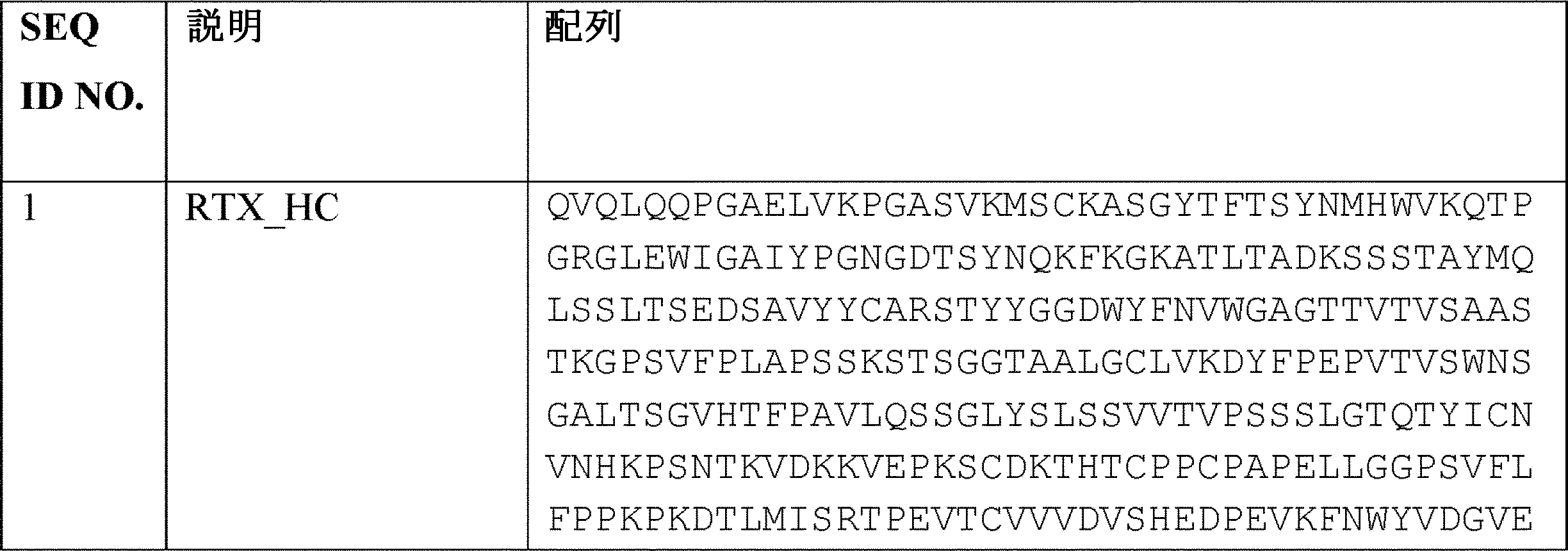


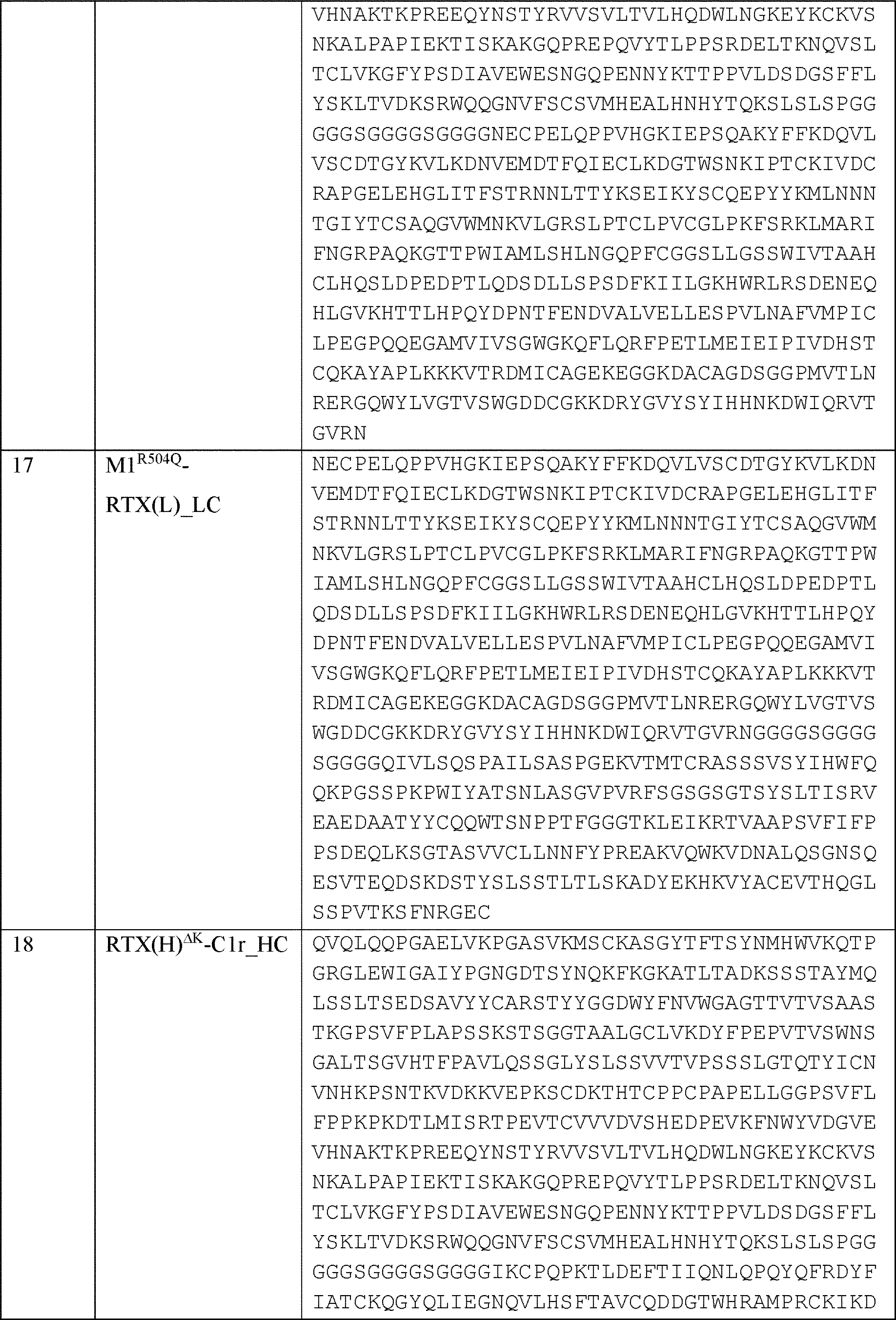


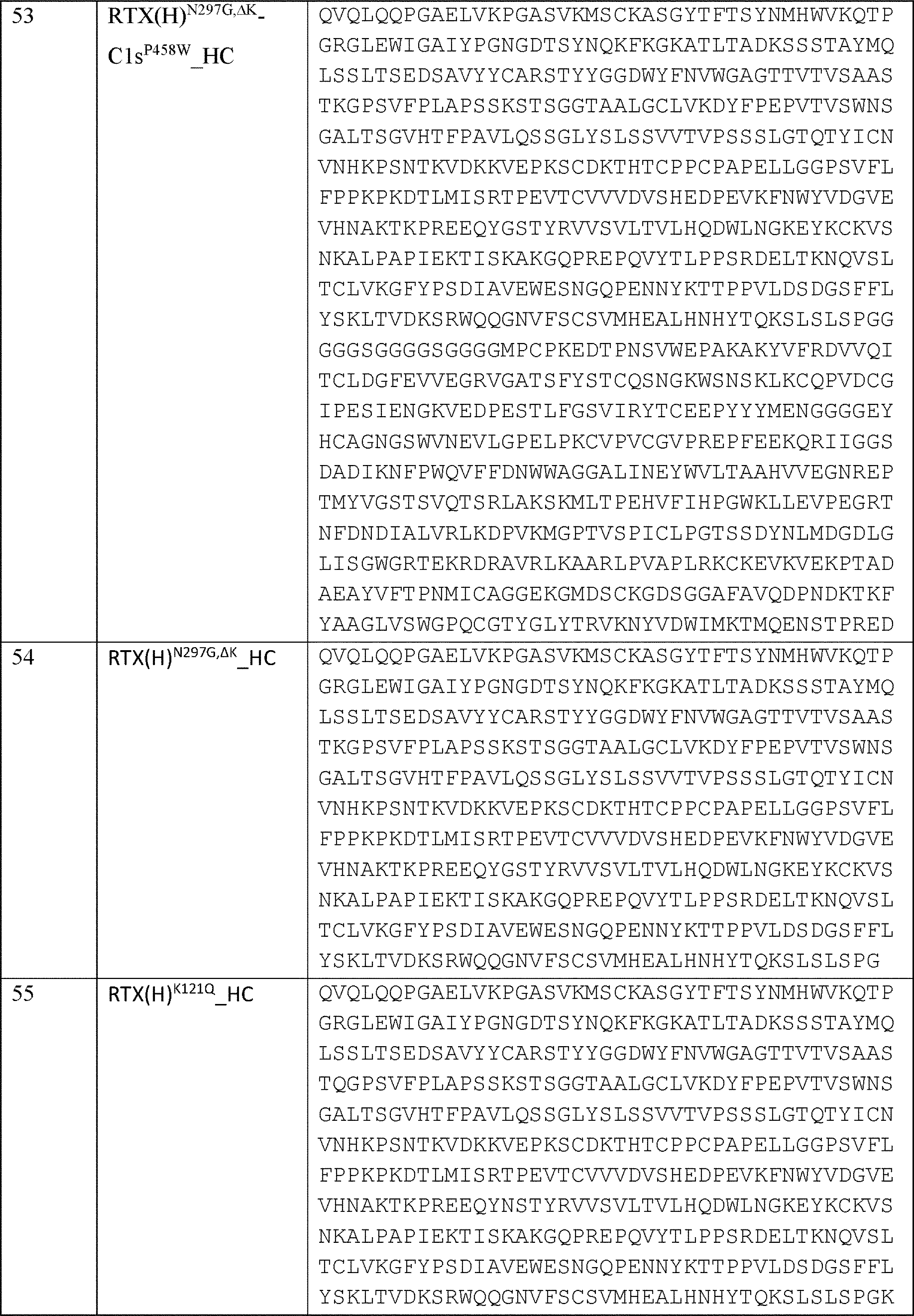
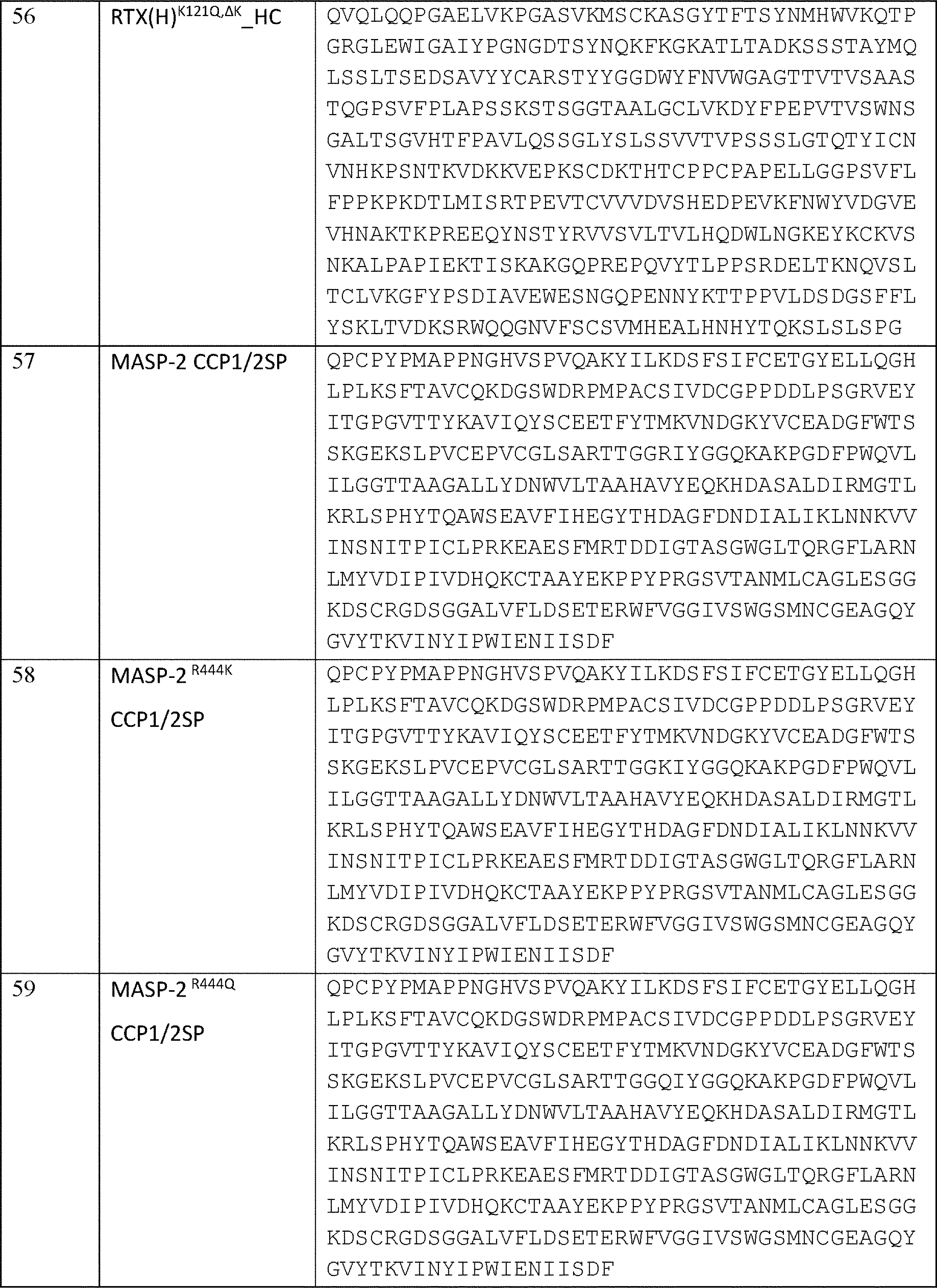
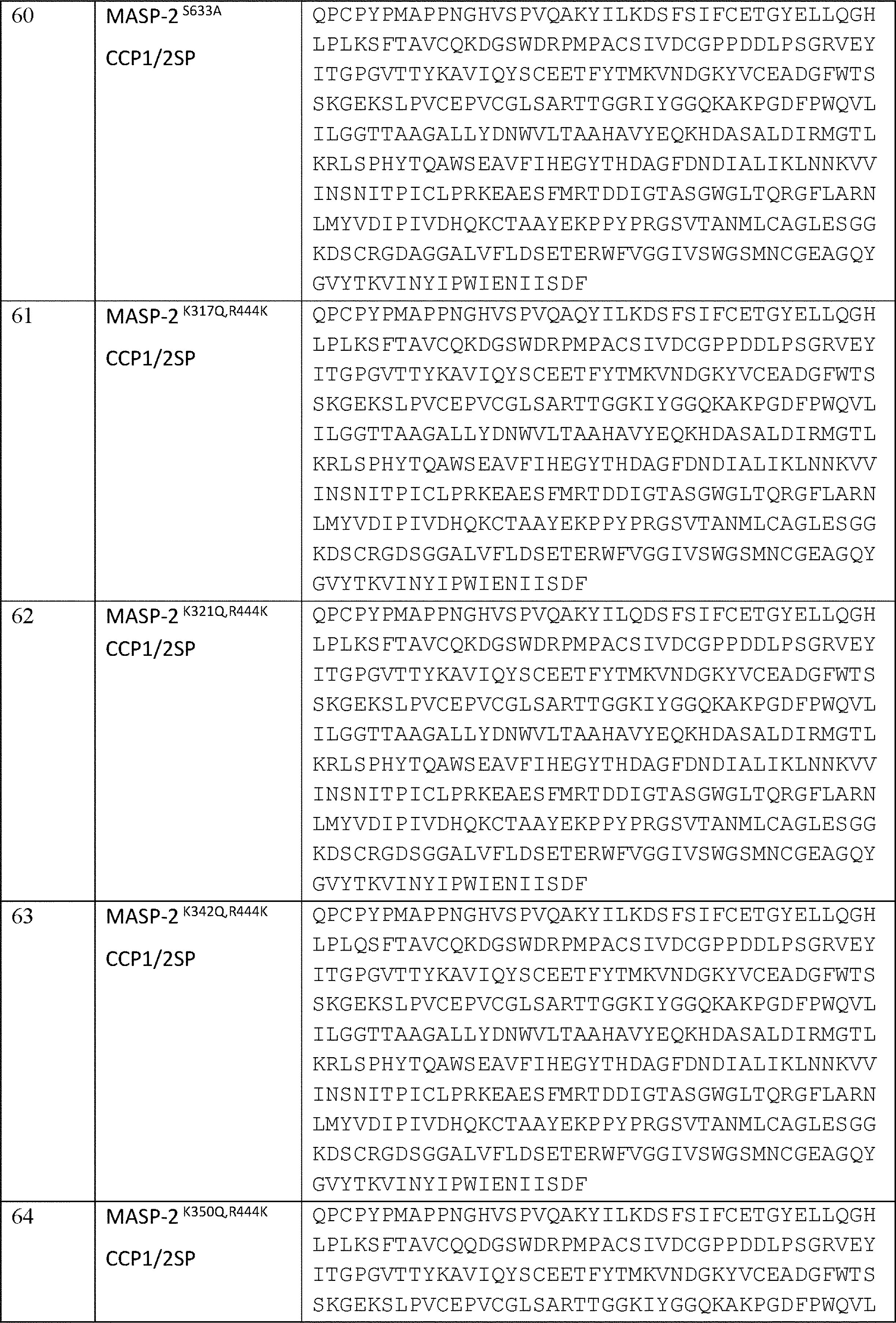
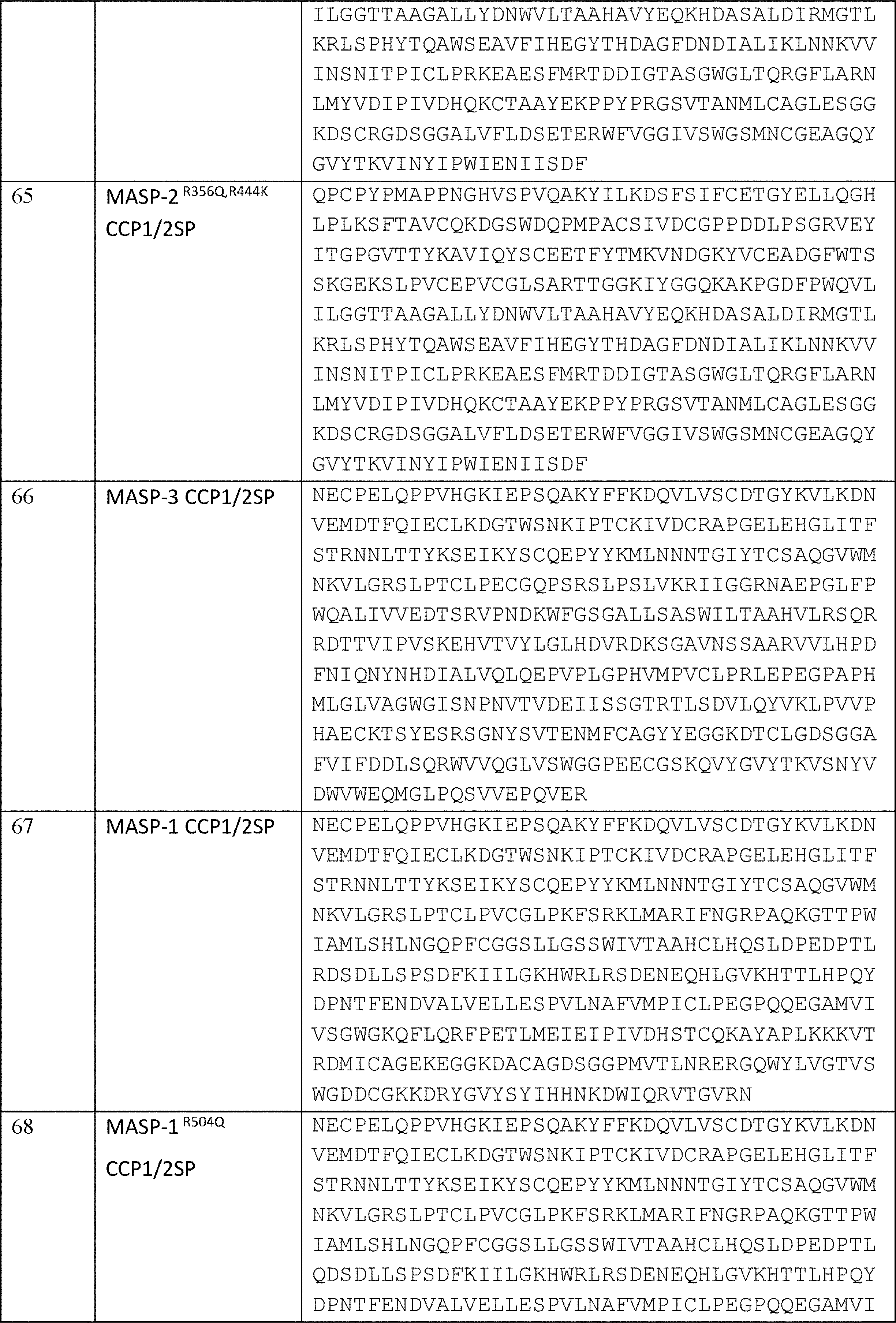


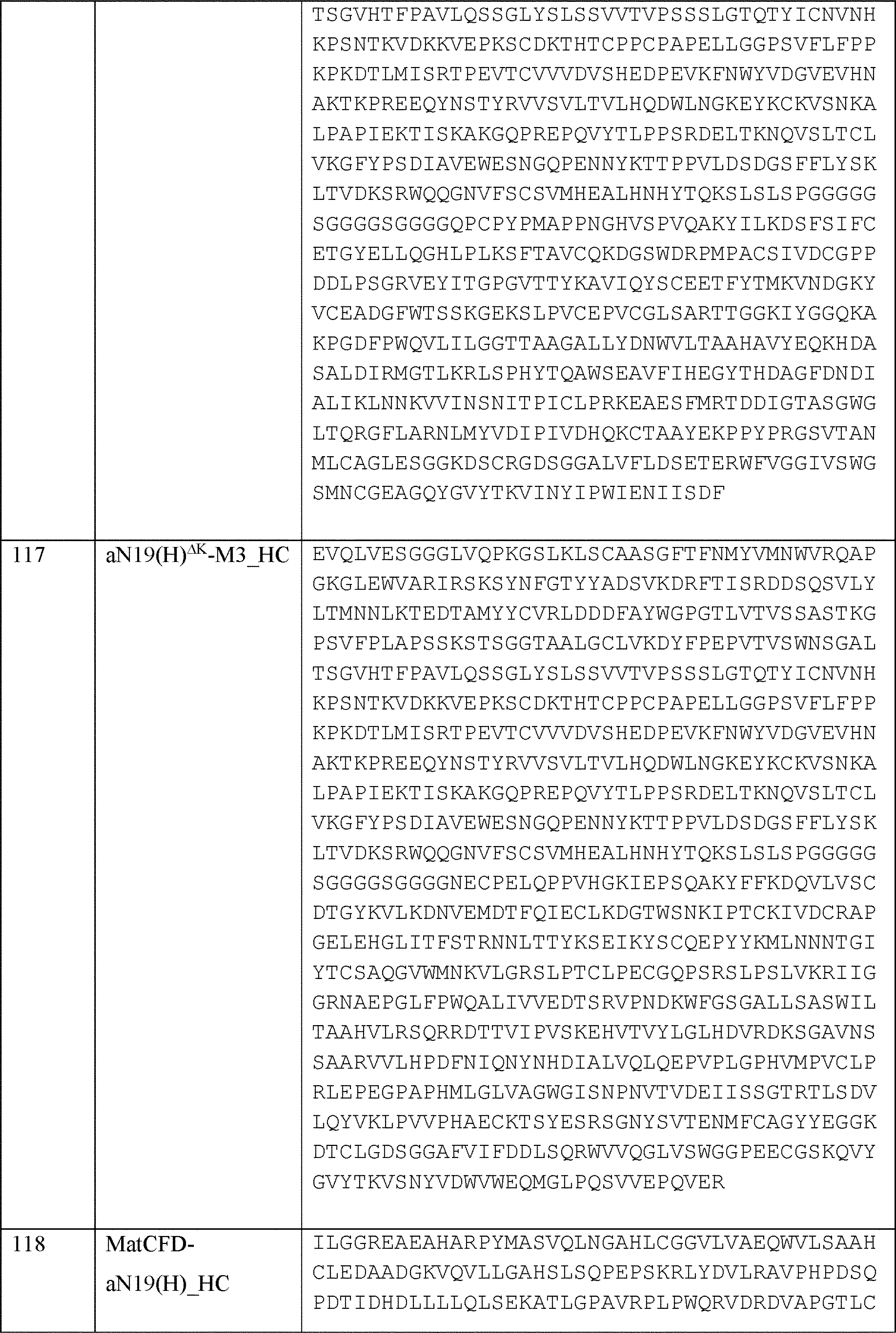


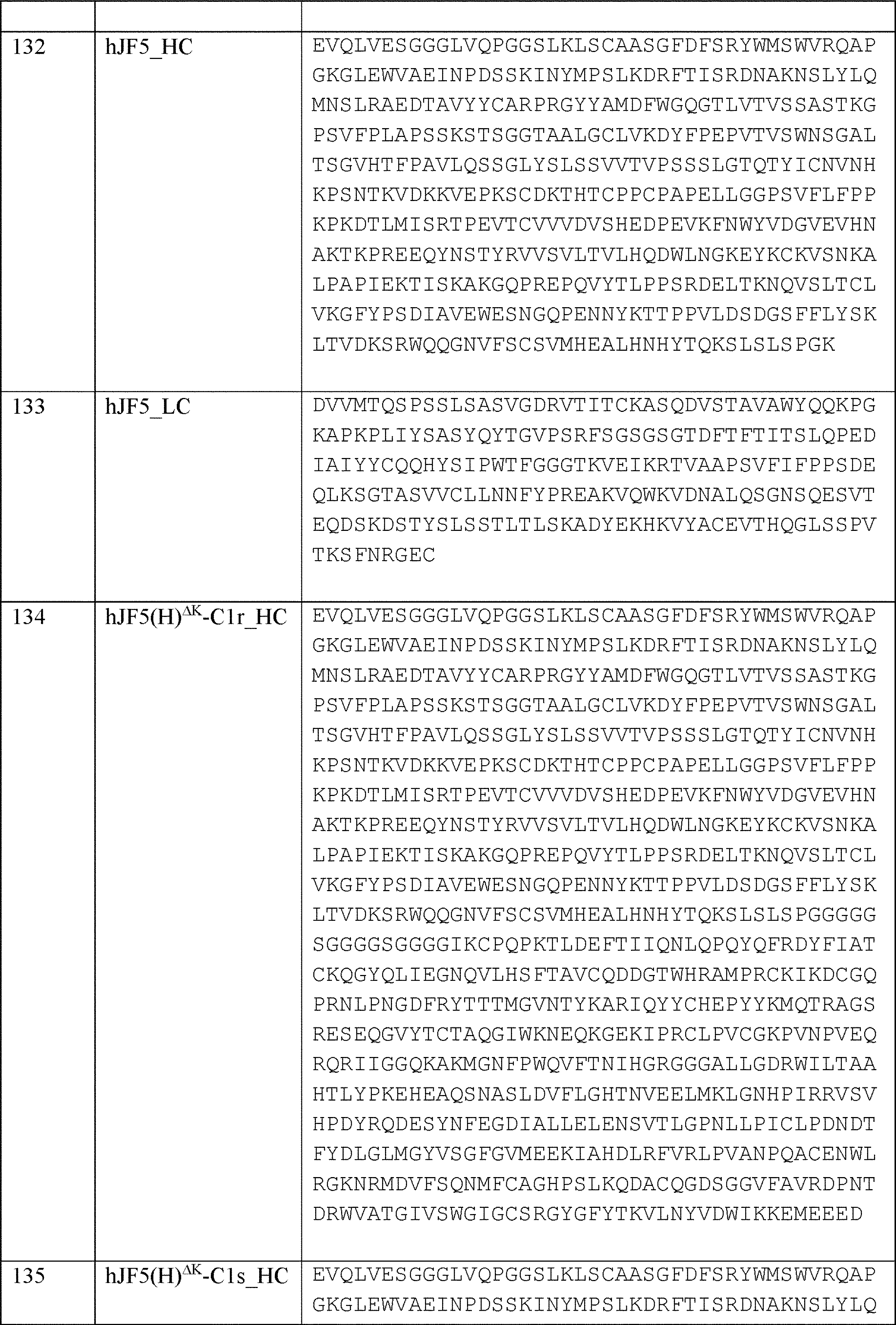


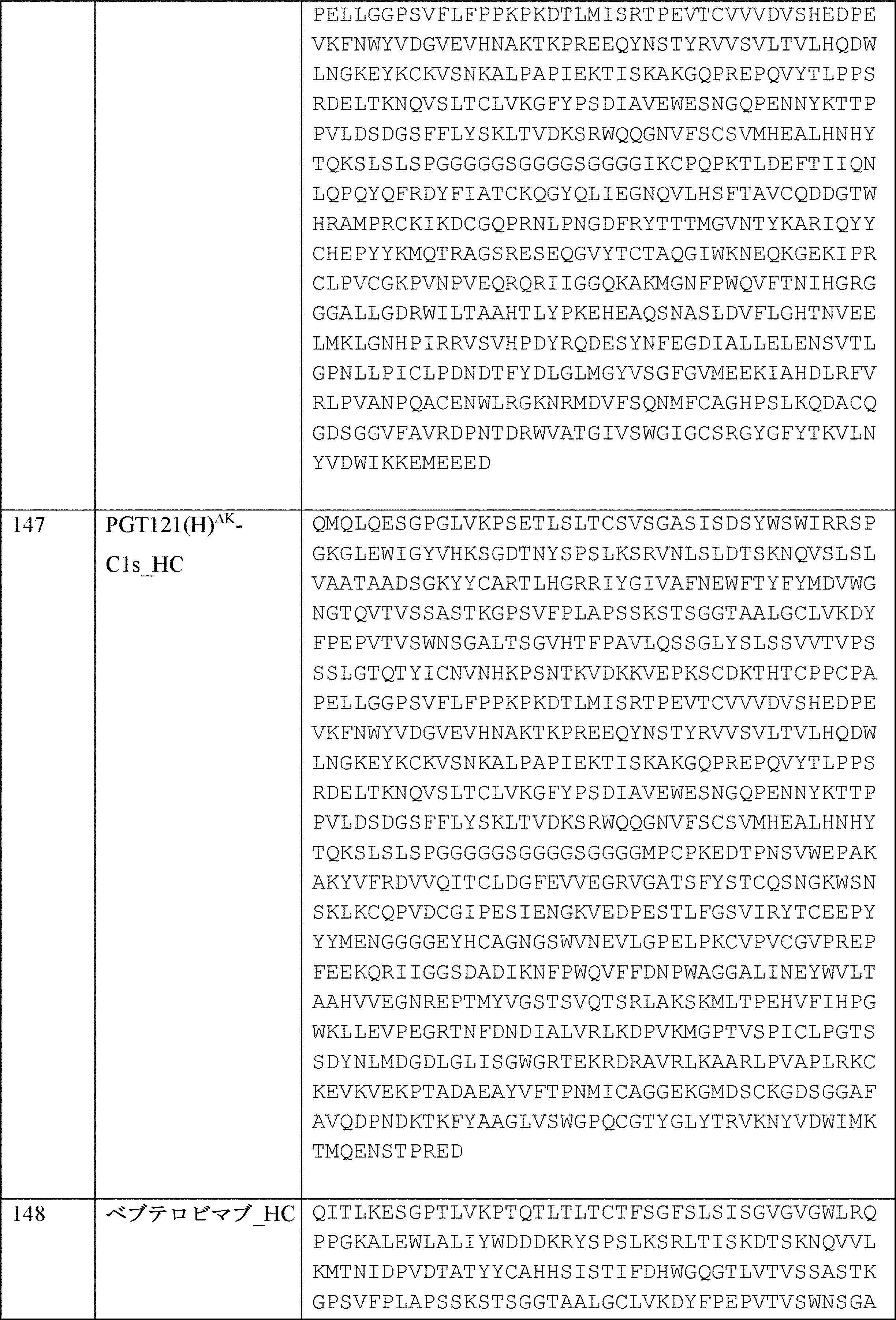

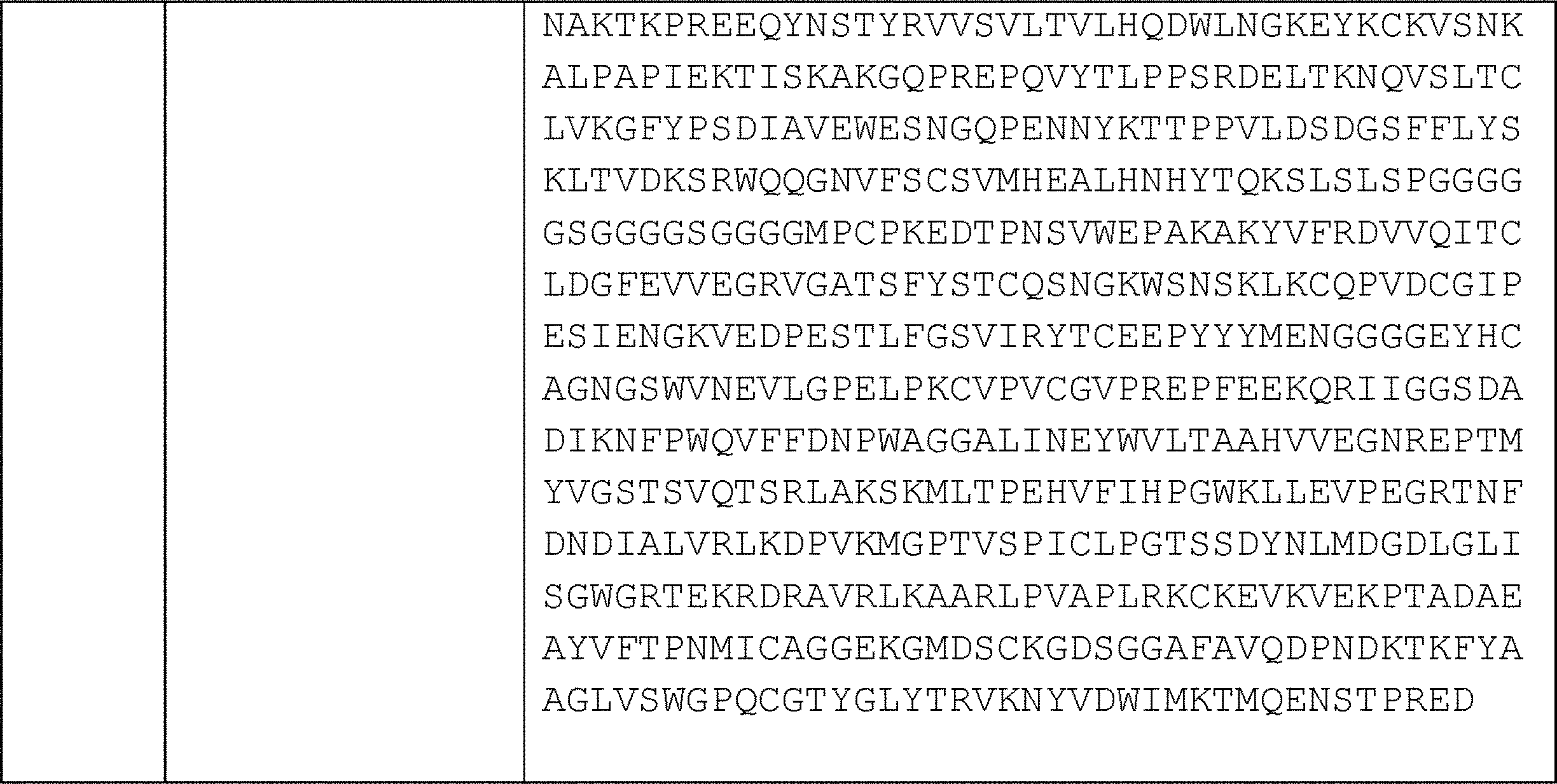
VIII. 実施例
実施例1
リツキシマブ由来のターゲティングされた補体活性化分子の調製
MASP融合物
MASP-1、MASP-2およびMASP-3のC末端触媒セグメントCCP1-CCP2-SPドメインを、抗CD20抗体リツキシマブ(RTX;IgG1アイソタイプ)と、さまざまな配置で融合し、発現ベクターpCAGを使って、その融合タンパク質を発現させた。ベクターはpD2610-v1(ATUM;元々は(Miyazaki et al.,1989)から)の修飾バージョンであり、特徴的なCMVおよびニワトリベータ-アクチンハイブリッドプロモーターと、カナマイシン耐性マーカーとを含有している。
VIII. Examples Example 1
Preparation of Rituximab-derived targeted complement-activating molecules
MASP fusions
The C-terminal catalytic segments of MASP-1, MASP-2 and MASP-3, CCP1-CCP2-SP domains, were fused to the anti-CD20 antibody rituximab (RTX; IgG1 isotype) in various configurations and the fusion proteins were expressed using the expression vector pCAG, a modified version of pD2610-v1 (ATUM; originally from (Miyazaki et al., 1989)), which contains the characteristic CMV and chicken beta-actin hybrid promoters and a kanamycin resistance marker.
融合位置は、抗体重鎖のC末端もしくはN末端(それぞれHC-CCP1/2SPまたはCCP1/2SP-HC)または抗体軽鎖のC末端もしくはN末端(それぞれLC-CCP1/2SPまたはCCP1/2SP-LC)とし、これにより、以下のさまざまな構築物が得られた:M3-RTX(H)(SEQ ID NO:13)、RTX(L)-M3(SEQ ID NO:14)、M3-RTX(L)(SEQ ID NO:15)、RTX(H)-M2(SEQ ID NO:4)、M2-RTX(H)(SEQ ID NO:6)、RTX(L)-M2(SEQ ID NO:7)、およびM2-RTX(L)(SEQ ID NO:8)。MASP-1融合物には、野生型セリンプロテアーゼ配列と比べて、セリンプロテアーゼドメイン中に、安定性を改良することを意図した単一の置換を持つ融合物が含まれる。また、あるMASP-1融合物には、C末端からリジン(K)を欠失させたリツキシマブ重鎖が、組み入れられている:RTX(H)ΔK-M1R504Q(SEQ ID NO:16)およびM1R504Q-RTX(L)(SEQ ID NO:17)。さらに、リツキシマブの重鎖のC末端から単一のアミノ酸リジン(K)を欠失させることによって改変された、構築物RTX(H)-M2およびRTX(H)-M3の変異体型を生成させて、構築物RTX(H)ΔK-M2(SEQ ID NO:5)およびRTX(H)ΔK-M3(SEQ ID NO:12)を得た。MASP-2融合物の触媒不活性バージョンは、セリンプロテアーゼドメイン中に単一の置換を導入することによって生成させた:RTX(H)ΔK-M2S633A(SEQ ID NO:11)。恒常的チモーゲン型のMASP-2融合物も生成させた:RTX(H)ΔK-M2R444Q(SEQ ID NO:10)。また、活性化キネティクスが野生型よりも遅いMASP-2融合物も生成させた:RTX(H)ΔK-M2R444K(SEQ ID NO:9)。 The fusion sites were either at the C-terminus or N-terminus of the antibody heavy chain (HC-CCP1/2SP or CCP1/2SP-HC, respectively) or at the C-terminus or N-terminus of the antibody light chain (LC-CCP1/2SP or CCP1/2SP-LC, respectively), resulting in the following various constructs: M3-RTX(H) (SEQ ID NO:13), RTX(L)-M3 (SEQ ID NO:14), M3-RTX(L) (SEQ ID NO:15), RTX(H)-M2 (SEQ ID NO:4), M2-RTX(H) (SEQ ID NO:6), RTX(L)-M2 (SEQ ID NO:7), and M2-RTX(L) (SEQ ID NO:8). The MASP-1 fusions include fusions with single substitutions in the serine protease domain intended to improve stability compared to the wild-type serine protease sequence. Certain MASP-1 fusions also incorporate a rituximab heavy chain with a lysine (K) deleted from the C-terminus: RTX(H) ΔK - M1R504Q (SEQ ID NO:16) and M1R504Q -RTX(L) (SEQ ID NO:17). Additionally, mutant versions of constructs RTX(H)-M2 and RTX(H)-M3 were generated that were modified by deleting a single amino acid lysine (K) from the C-terminus of the rituximab heavy chain, resulting in constructs RTX(H) ΔK -M2 (SEQ ID NO:5) and RTX(H) ΔK -M3 (SEQ ID NO:12). A catalytically inactive version of the MASP-2 fusion was generated by introducing a single substitution in the serine protease domain: RTX(H) ΔK - M2S633A (SEQ ID NO:11). A constitutive zymogen form of MASP-2 fusion was also generated: RTX(H) ΔK -M2 R444Q (SEQ ID NO:10), as well as a MASP-2 fusion with slower activation kinetics than the wild type: RTX(H) ΔK -M2 R444K (SEQ ID NO:9).
安定性が増加し/分解が低減する分子を特定するための努力の一部として、MASP-2セリンプロテアーゼドメインに1つまたは2つの単一アミノ酸置換を持つさらなる分子も生産した:RTX(H)ΔK-M2R444K(SEQ ID NO:9)、RTX(H)ΔK,K121Q-M2R444K(SEQ ID NO:33)、RTX(H)ΔK-M2K317Q,R444K(SEQ ID NO:34)、RTX(H)ΔK-M2K321Q,R444K(SEQ ID NO:35)、RTX(H)ΔK-M2K342Q,R444K(SEQ ID NO:36)、RTX(H)ΔK-M2K350Q,R444K(SEQ ID NO:37)、およびRTX(H)ΔK-M2R356Q,R444K(SEQ ID NO:38)。 As part of an effort to identify molecules with increased stability/reduced degradation, additional molecules with one or two single amino acid substitutions in the MASP-2 serine protease domain were also produced: RTX(H) ΔK -M2 R444K (SEQ ID NO:9), RTX(H) ΔK,K121Q -M2 R444K (SEQ ID NO:33), RTX(H) ΔK -M2 K317Q,R444K (SEQ ID NO:34), RTX(H) ΔK -M2 K321Q,R444K (SEQ ID NO:35), RTX(H) ΔK -M2 K342Q,R444K (SEQ ID NO:36), RTX(H) ΔK -M2 K350Q,R444K (SEQ ID NO:37), and RTX(H) ΔK -M2 R356Q,R444K (SEQ ID NO:38).
C1rおよびC1s融合物
MASP融合物と同様に、C1rおよびC1sセリンプロテアーゼエフェクタードメインをRTXに融合し、発現させた。C1rおよびC1sのC末端触媒フラグメント(CCP1-CCP2-SP)を、RTXと、抗体重鎖(HC)のC末端において融合した。
C1r and C1s fusions
Similar to the MASP fusions, the C1r and C1s serine protease effector domains were fused to RTX and expressed. The C-terminal catalytic fragments of C1r and C1s (CCP1-CCP2-SP) were fused to RTX at the C-terminus of the antibody heavy chain (HC).
各補体成分について、「野生型」型、抗体のFc領域中に単一の置換を有する非グリコシル化(aglycosylated)型、およびセリンプロテアーゼドメイン中に単一の置換を有する触媒不活性融合物を含む3つの構築物を生成させた:RTX(H)ΔK-C1r(SEQ ID NO:18)、RTX(H)N297G,ΔK-C1r(SEQ ID NO:21)、RTX(H)N297G,ΔK-C1rS654A(SEQ ID NO:22)、RTX(H)ΔK-C1s(SEQ ID NO:19)、RTX(H)N297G,ΔK-C1s(SEQ ID NO:23)、およびRTX(H)N297,ΔK-C1sS632A(SEQ ID NO:24)。 For each complement component, three constructs were generated, including a "wild type" form, an aglycosylated form with a single substitution in the Fc region of the antibody, and a catalytically inactive fusion with a single substitution in the serine protease domain: RTX(H) ΔK -C1r (SEQ ID NO:18), RTX(H) N297G,ΔK -C1r (SEQ ID NO:21), RTX(H) N297G,ΔK - C1rS654A (SEQ ID NO:22), RTX(H) ΔK -C1s (SEQ ID NO:19), RTX(H) N297G,ΔK -C1s (SEQ ID NO:23), and RTX(H) N297,ΔK - C1sS632A (SEQ ID NO:24).
安定性が増加し/分解が低減する分子を特定するための努力の一部として、セリンプロテアーゼドメイン中にいくつかの単一アミノ酸置換のうちの1つを持つさらなる分子も生産した:RTX(H)N297G,ΔK-C1rK374Q(SEQ ID NO:39)、RTX(H)N297G,ΔK-C1rR380Q(SEQ ID NO:40)、RTX(H)N297G,ΔK-C1sK308Q(SEQ ID NO:41)、RTX(H)N297G,ΔK-C1sK310Q(SEQ ID NO:42)、RTX(H)N297G,ΔK-C1sR314Q(SEQ ID NO:43)、RTX(H)N297G,ΔK-C1sR331Q(SEQ ID NO:44)、RTX(H)N297G,ΔK-C1sK346Q(SEQ ID NO:45)、RTX(H)N297G,ΔK-C1sK351Q(SEQ ID NO:46)、RTX(H)N297G,ΔK-C1sK353Q(SEQ ID NO:47)、RTX(H)N297G,ΔK-C1rH484W(SEQ ID NO:48)、RTX(H)N297G,ΔK-C1rG485W(SEQ ID NO:49)、RTX(H)N297G,ΔK-C1rR486W(SEQ ID NO:50)、RTX(H)N297G,ΔK-C1sD456W(SEQ ID NO:51)、RTX(H)N297G,ΔK-C1sN457W(SEQ ID NO:52)、およびRTX(H)N297G,ΔK-C1sP458W(SEQ ID NO:53)。 As part of an effort to identify molecules with increased stability/reduced degradation, additional molecules were also produced with one of several single amino acid substitutions in the serine protease domain: RTX(H) N297G,ΔK -C1r K374Q (SEQ ID NO:39), RTX(H) N297G,ΔK -C1r R380Q (SEQ ID NO:40), RTX(H) N297G,ΔK -C1s K308Q (SEQ ID NO:41), RTX(H) N297G,ΔK -C1s K310Q (SEQ ID NO:42), RTX(H) N297G,ΔK -C1s R314Q (SEQ ID NO:43), RTX(H) N297G,ΔK -C1s R331Q (SEQ ID NO:44), RTX(H) N297G,ΔK -C1s K346Q (SEQ ID NO:45), RTX(H) N297G ,ΔK -C1s K351Q (SEQ ID NO:46), RTX(H) N297G,ΔK -C1s K353Q (SEQ ID NO:47), RTX(H) N297G,ΔK -C1r H484W (SEQ ID NO:48), RTX(H) N297G,Δ K -C1r G485W (SEQ ID NO:49), RTX(H) N297G,ΔK -C1r R486W (SEQ ID NO:50), RTX(H) N297G,ΔK -C1s D456W (SEQ ID NO:51), RTX(H) N297G,ΔK -C1s N457W (SEQ ID NO:52), and RTX(H) N297G,ΔK -C1s P458W (SEQ ID NO:53).
他の補体成分との融合物
補体因子C2(C2a)、B(Bb)およびDのそれぞれの触媒セグメントをRTXに融合し、発現ベクターpCAGを使用することによって発現させた。
Fusions with other complement components The catalytic segments of complement factors C2 (C2a), B (Bb) and D were fused to RTX and expressed by using the expression vector pCAG.
さまざまな配置のプロ(pro)および成熟(mature)CFD融合物を生成させた。CFDを、抗体の重鎖または軽鎖のC末端またはN末端のいずれかに融合することにより、以下の構築物を得た:RTX(H)ΔK-MatCFD(SEQ ID NO:27)、MatCFD-RTX(H)(SEQ ID NO:28)、RTX(L)-MatCFD(SEQ ID NO:29)、MatCFD-RTX(L)(SEQ ID NO:30)およびProCFD-RTX(H)(SEQ ID NO:32)。セリンプロテアーゼドメイン中に単一の点変異を有する触媒不活性バージョンも生成させた:MatCFDS208A-RTX(H)(SEQ ID NO:31)。 Pro and mature CFD fusions of various configurations were generated. The CFD was fused to either the C-terminus or N-terminus of the heavy or light chain of the antibody, resulting in the following constructs: RTX(H) ΔK -MatCFD (SEQ ID NO:27), MatCFD-RTX(H) (SEQ ID NO:28), RTX(L)-MatCFD (SEQ ID NO:29), MatCFD-RTX(L) (SEQ ID NO:30) and ProCFD-RTX(H) (SEQ ID NO:32). A catalytically inactive version with a single point mutation in the serine protease domain was also generated: MatCFD S208A -RTX(H) (SEQ ID NO:31).
C2a融合物およびBb融合物については、触媒セグメントが抗体重鎖のC末端に融合されている配置を1つ生成させた:RTX(H)ΔK-C2a(SEQ ID NO:25)およびRTX(H)ΔK-Bb(SEQ ID NO:26)。 For the C2a and Bb fusions, one configuration was generated in which the catalytic segment was fused to the C-terminus of the antibody heavy chain: RTX(H) ΔK -C2a (SEQ ID NO:25) and RTX(H) ΔK -Bb (SEQ ID NO:26).
さまざまなリツキシマブ融合物の配置を表1に詳述する。 The configurations of the various rituximab fusions are detailed in Table 1.

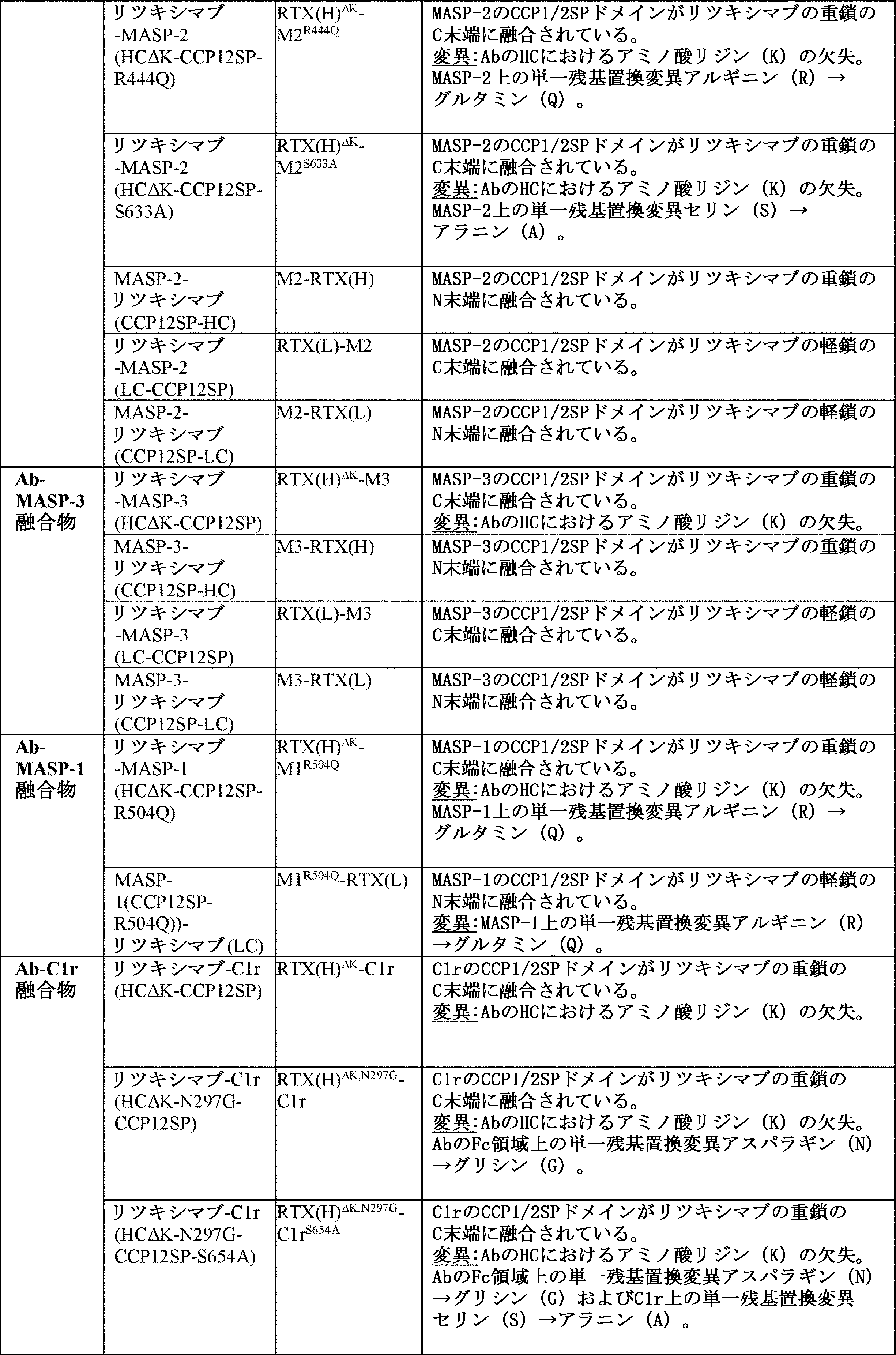

プラスミドの調製およびクローニング
組換え融合タンパク質の構築物を生成させるために、以下の工程を行った:(i)プラスミドベクターの消化、(ii)インサートのクローニング、(iii)大腸菌コンピテント細胞への形質転換。
Plasmid preparation and cloning To generate recombinant fusion protein constructs, the following steps were performed: (i) digestion of the plasmid vector, (ii) cloning of the insert, and (iii) transformation into E. coli competent cells.
クローニングのためにベクターpCAGを制限酵素SapI(NEB)による消化で直線化した。50μL反応での消化のために、3μgのベクター、2μLのエンドヌクレアーゼおよび5μLのCutSmart緩衝液(NEB)を使用した。制限消化は37℃でおよそ2時間行った。 For cloning, the vector pCAG was linearized by digestion with the restriction enzyme SapI (NEB). For digestion in a 50 μL reaction, 3 μg of vector, 2 μL of endonuclease and 5 μL of CutSmart buffer (NEB) were used. Restriction digestion was performed at 37°C for approximately 2 hours.
MASP-3、MASP-2、MASP-1、C1r、C1s、CFD、C2a、およびBb融合物を生産するために、以下の構築物を作製した:
(i)リツキシマブのHC、
(ii)リツキシマブのLC、および
(iii)a)RTX HCのC末端、
b)RTX HCのN末端、
c)RTX LCのC末端、
d)RTX LCのN末端
のいずれかに融合される補体タンパク質の触媒セグメント。
The following constructs were made to produce MASP-3, MASP-2, MASP-1, C1r, C1s, CFD, C2a, and Bb fusions:
(i) HC of rituximab;
(ii) the LC of rituximab, and (iii) a) the C-terminus of the RTX HC;
b) the N-terminus of RTX HC;
c) the C-terminus of the RTX LC;
d) The catalytic segment of a complement protein fused to the N-terminus of the RTX LC.
インサートのPCRは、特異的プライマー、5×Phusion HF緩衝液(NEB)、dNTP類、およびPhusion DNAポリメラーゼで、以下の熱サイクリング条件を使って実行した:
・初期変性:98℃で30秒、
・変性:98℃で10秒、
・アニーリング:60℃で30秒、
・伸長:72℃で40秒、
・追加伸長:72℃で5分。
PCR of the insert was performed with specific primers, 5x Phusion HF buffer (NEB), dNTPs, and Phusion DNA polymerase using the following thermocycling conditions:
Initial denaturation: 98°C for 30 seconds,
- Denaturation: 98℃ for 10 seconds,
Annealing: 60°C for 30 seconds,
Extension: 72°C for 40 seconds;
- Additional extension: 5 min at 72°C.
PCRは30サイクル行った。インサートの増幅後にゲル電気泳動を行ってPCR反応を確認し、NucleoSpin精製キット(Macherey-Nagel)を使って産物を精製した。次に、直線化したベクター、精製したインサート、および5×In-Fusion HD酵素プレミックス(タカラバイオ)による5μLクローニング反応を、50℃で15分間行った。 PCR was performed for 30 cycles. After insert amplification, the PCR reaction was confirmed by gel electrophoresis, and the product was purified using a NucleoSpin purification kit (Macherey-Nagel). Then, a 5 μL cloning reaction with linearized vector, purified insert, and 5× In-Fusion HD enzyme premix (Takara Bio) was performed at 50°C for 15 min.
組換え融合タンパク質の作製のために使用した発現構築物をコンピテントE.coli細胞(One Shot Mach1 T1ファージ耐性化学コンピテント大腸菌(Phage-Resistant Chemically Component E.coli)、Invitrogen)に形質転換し、カナマイシンLB寒天プレート上で選択した。10ngのプラスミドをコンピテント細胞のバイアルに加え、その細胞を氷上で30分間インキュベートした。次に、その混合物に42℃で30秒間の熱ショックを与えてから、氷上で2分間インキュベートした。250μLのS.O.C.培地をバイアルに加え、振とう培養器中、225rpmで、細胞を37℃で1時間インキュベートした。この培養物100μLをカナマイシン含有プレートにプレーティングして37℃で一晩成長させた。そのプレートから、単一形質転換コロニーを選択し、37℃振とう機において、それらの耐性抗生物質(25μg/mL)および2.5mL LB中で増殖させた。翌日、Qiagenプラスミドミニプレップキットを使って、培養物の一部からプラスミドDNAを抽出し、その1mL培養物の残りの部分は将来の使用のために4℃で貯蔵した。クローニングの成功を保証するためにプラスミドDNAを配列決定し、選択されたクローンを37℃振とう機中で1時間培養し、カナマイシン(Teknova)を含有する120mLブロス中でインキュベートした。37℃で一晩の培養後に、Qiagenプラスミドマキシプレップキットを使って、プラスミドDNAを抽出した。 The expression constructs used for the production of recombinant fusion proteins were transformed into competent E. coli cells (One Shot Mach1 T1 Phage-Resistant Chemically Competent E. coli, Invitrogen) and selected on kanamycin LB agar plates. 10 ng of plasmid was added to a vial of competent cells and the cells were incubated on ice for 30 min. The mixture was then heat shocked at 42°C for 30 s and then incubated on ice for 2 min. 250 μL of S.O.C. medium was added to the vial and the cells were incubated at 37°C for 1 h in a shaking incubator at 225 rpm. 100 μL of this culture was plated on kanamycin-containing plates and grown overnight at 37°C. From the plates, single transformed colonies were selected and grown in their resistant antibiotic (25 μg/mL) and 2.5 mL LB in a 37°C shaker. The next day, plasmid DNA was extracted from a portion of the culture using a Qiagen Plasmid Miniprep Kit, and the remaining portion of the 1 mL culture was stored at 4°C for future use. Plasmid DNA was sequenced to ensure successful cloning, and selected clones were grown for 1 h in a 37°C shaker and incubated in 120 mL broth containing kanamycin (Teknova). After overnight growth at 37°C, plasmid DNA was extracted using a Qiagen Plasmid Maxiprep Kit.
タンパク質の発現および精製
Expi293細胞をExpi293培地(Gibco)で培養し、トランスフェクション用に2.9×10⁶細胞/mLの細胞密度で調製した。精製プラスミドDNAの濃度を測定し、トランスフェクション用に1:2のHC:LC比で、DNAを調製した。500mLのトランスフェクションに、合計500μgの量のDNAを使用した。DNAをOptiMEM(Gibco)に懸濁し、Lipofectamine(Invitrogen)と混合した。室温で20分間のインキュベーション後に、そのDNAとLipofectamineの混合物を細胞に加えた。トランスフェクト細胞を37℃振とう機中、125rpmで4~5日間培養した。およそ18時間のトランスフェクション後に、エンハンサー(ExpiFectamine 293トランスフェクションキット、Gibco)を、細胞の生存度とタンパク質発現を増強するために加えた。合計500mLの培養体積に、2.5mLのエンハンサー1(Enhancer-1)および25mLのエンハンサー2(Enhancer-2)を使用した。
Protein expression and purification
Expi293 cells were cultured in Expi293 medium (Gibco) and prepared at a cell density of 2.9 x 10⁶ cells/mL for transfection. The concentration of purified plasmid DNA was measured and DNA was prepared at a 1:2 HC:LC ratio for transfection. A total of 500 μg of DNA was used for 500 mL of transfection. DNA was suspended in OptiMEM (Gibco) and mixed with Lipofectamine (Invitrogen). After 20 min of incubation at room temperature, the DNA and Lipofectamine mixture was added to the cells. Transfected cells were cultured at 125 rpm in a 37°C shaker for 4-5 days. Approximately 18 h after transfection, enhancer (ExpiFectamine 293 Transfection Kit, Gibco) was added to enhance cell viability and protein expression. 2.5 mL of Enhancer-1 and 25 mL of Enhancer-2 were used for a total culture volume of 500 mL.
大半の組換え融合タンパク質については、トランスフェクト細胞を37℃で培養した。融合タンパク質リツキシマブ-MASP-3(LC-CCP12SP)およびMASP-3-リツキシマブ(CCP12SP-LC)については、温度の低下がタンパク質の凝集を低減するかどうかを見るために、培養時に低い温度(32.5℃)を試験した。 For most recombinant fusion proteins, transfected cells were cultured at 37°C. For the fusion proteins rituximab-MASP-3 (LC-CCP12SP) and MASP-3-rituximab (CCP12SP-LC), a lower temperature (32.5°C) was tested during culture to see if lowering the temperature would reduce protein aggregation.
37℃で4~5日の培養後に、トランスフェクト細胞を除去し、Sartoclear Dynamicsラボキット(Sartorius)を使って培養上清を濾過した。融合タンパク質はすべてプロテインAセファロースで精製した。上清の濾過後に、プロテインAセファロースを加え、タンパク質結合を最大化するために、その混合物を回転培養機上、室温で、2時間インキュベートした。次に、その混合物をクロマトグラフィーカラム(Bio-Rad)にローディングした。19mLの1×PBS(Gibco)で2.5回洗浄した後、タンパク質を15mLのpH3グリシン緩衝液(Teknova)で溶出させ、3mLのpH9 Tris-HCl緩衝液(Teknova)で中和した。遠心濾過ユニット(MilliporeSigma Amicon超遠心分離ユニット)を使った濃縮とPBSまたはヒスチジン緩衝液(20mMヒスチジン、150mM NaCl)(貯蔵緩衝液)への緩衝液交換によって、精製を完了した。
After 4–5 days of incubation at 37°C, transfected cells were removed and culture supernatants were filtered using a Sartoclear Dynamics lab kit (Sartorius). All fusion proteins were purified with protein A sepharose. After filtration of the supernatant, protein A sepharose was added and the mixture was incubated for 2 h at room temperature on a rotary incubator to maximize protein binding. The mixture was then loaded onto a chromatography column (Bio-Rad). After 2.5 washes with 19
各タンパク質の発現収量(mg/mL)を表2に示す。 The expression yield (mg/mL) of each protein is shown in Table 2.


実施例2
リツキシマブ由来の発現されたタンパク質の分析
タンパク質の完全性
タンパク質の完全性を評価するためにSDS-PAGEを行った。4~12%の勾配濃度を持つポリアクリルアミドゲル(NuPAGE Bis-Trisゲル、Invitrogen)を使って各タンパク質のサブユニットを分離し、分子量マーカー(SeeBlue Plus 2、Invitrogen)を使ってポリペプチドサイズを推定した。SDS-PAGEは還元条件下と非還元条件下の両方で行った。ゲルをランニング緩衝液(MOPS SDSランニング緩衝液、NuPage)中、120Vで40分間、泳動した後、振とう回転培養器上で1時間、染色溶液(SimplyBlue SafeStain、Invitrogen)で染色し、次に一晩脱色した。
Example 2
Analysis of Rituximab-derived expressed proteins Protein integrity SDS-PAGE was performed to assess protein integrity. Subunits of each protein were separated using 4–12% gradient polyacrylamide gels (NuPAGE Bis-Tris gels, Invitrogen) and the polypeptide sizes were estimated using molecular weight markers (
Ab-MASP-2融合物は、変異のせいで不活性な形態またはチモーゲンの形態にあるRTX(H)ΔK-M2S633AおよびRTX(H)ΔK-M2R444Qを除いてすべて、ある程度分解されて活性な形態にあることが観察された。MASP-2とは逆に、MASP-3融合物はチモーゲンの形態で生成し、分解産物は検出されなかった。図4参照。さらにまた、発現時に温度を下げて培養したAb-MASP-3融合タンパク質について、SDS-PAGE分析を行った。比較のために、37℃で培養したAb-MASP-3タンパク質を含めた。低温での培養は、発現時に形成される凝集体を低減するために行った。還元条件および非還元条件でSDS-PAGE分析を行ったところ、MASP-3融合タンパク質の分解も、培養条件が異なるタンパク質間の相違も、見られなかった(データ省略)。 All Ab-MASP-2 fusions were observed to be degraded to some extent into their active form, except for RTX(H) ΔK -M2 S633A and RTX(H) ΔK -M2 R444Q , which are inactive or zymogen forms due to mutations. In contrast to MASP-2, MASP-3 fusions were produced in their zymogen form, and no degradation products were detected (see Figure 4). Furthermore, SDS-PAGE analysis was performed on Ab-MASP-3 fusion proteins incubated at reduced temperatures during expression. For comparison, Ab-MASP-3 proteins incubated at 37°C were included. Incubation at reduced temperatures was performed to reduce aggregates formed during expression. SDS-PAGE analysis under reducing and non-reducing conditions did not reveal any degradation of the MASP-3 fusion proteins, nor any differences between the proteins incubated under different conditions (data not shown).
Ab-C1rおよびAb-C1s融合物も微量の分解産物を有することが見いだされたが、Ab-C2a、Ab-BbまたはAb-CFD融合物の場合はそうではなく、SDS-PAGE分析時に無傷のタンパク質バンドを示した。図5参照。 The Ab-C1r and Ab-C1s fusions were also found to have trace amounts of degradation products, but not the Ab-C2a, Ab-Bb or Ab-CFD fusions, which showed intact protein bands upon SDS-PAGE analysis. See Figure 5.
MASP-3セリンプロテアーゼ活性の活性化
Ab-MASP-3融合物のSDS-PAGE分析により、このタンパク質はチモーゲンの形態にあり、分解産物は検出されないことが示された。図4参照。
Activation of MASP-3 serine protease activity
SDS-PAGE analysis of the Ab-MASP-3 fusion showed that the protein was in the zymogen form with no detectable degradation products, see FIG.
トランケート型MASP-2(CCP1/2SP)を使ってRTX-M3タンパク質の活性化を行い、続いて、チモーゲン型から活性な切断型への、MASP-3融合タンパク質の変換を確証するために、SDS-PAGE分析を還元条件で行った。MASP-3融合物の活性化はOroszlan et al.,2017による報文に基づいて行った。チモーゲンRTX-M3(2μM)を140mM NaCl、10mM HEPES、pH7.4、0.1mM EDTA緩衝液に希釈し、37℃において、単独で(陰性対照)、またはMASP-2(CCP1/2SP)(91nM)をさまざまな時点(0、10、20、40、60、90、120、150および190分)において添加して、インキュベートした。試料を各時点において取り出し、反応を停止するために、-20℃においた。試料を還元条件下のSDS-PAGEによって分析した。 Activation of RTX-M3 protein was performed with truncated MASP-2 (CCP1/2SP) and subsequent SDS-PAGE analysis was performed under reducing conditions to confirm the conversion of MASP-3 fusion protein from zymogen form to active truncated form. Activation of MASP-3 fusion was performed based on the publication by Oroszlan et al., 2017. Zymogen RTX-M3 (2 μM) was diluted in 140 mM NaCl, 10 mM HEPES, pH 7.4, 0.1 mM EDTA buffer and incubated at 37 °C alone (negative control) or with the addition of MASP-2 (CCP1/2SP) (91 nM) at various time points (0, 10, 20, 40, 60, 90, 120, 150 and 190 min). Samples were removed at each time point and placed at -20 °C to stop the reaction. Samples were analyzed by SDS-PAGE under reducing conditions.
アッセイにより、組換えMASP-3融合物は別のセリンプロテアーゼによって活性化されて、機能的になりうることが実証された。チモーゲンRTX-M3融合物ポリペプチドは約92kDaに泳動し、一方、活性型は2つのバンド、RTX-M3(CCP1/2)と切断されたSPドメインとを与える。図6参照。 Assays demonstrated that the recombinant MASP-3 fusion can be activated by another serine protease and become functional. The zymogen RTX-M3 fusion polypeptide migrates at approximately 92 kDa, while the active form gives two bands, RTX-M3 (CCP1/2) and the cleaved SP domain. See Figure 6.
凝集
AKTA(GE Healthcare)を使って組換えMASP-3融合タンパク質の凝集を評価するためにサイズ排除クロマトグラフィーを行った。タンパク質をサイズで分離するために、His緩衝液(20mMヒスチジン、150mM NaCl)に希釈した試料200μgを、カラム(Superdex 200 Increase 5/150 GLカラム)に注入して通過させた。分析したタンパク質は、リツキシマブ重鎖融合物リツキシマブ-MASP-3(RTX(H)ΔK-M3)およびMASP-3-リツキシマブ(M3-RTX(H))、ならびにリツキシマブ軽鎖融合物リツキシマブ-MASP-3(RTX(L)-M3)およびMASP-3-リツキシマブ(M3-RTX(L))である。後者2つのタンパク質は2つの異なる温度(37℃と32.5℃)で発現させた。
Coagulation
Size-exclusion chromatography was performed to assess the aggregation of recombinant MASP-3 fusion proteins using AKTA (GE Healthcare). To separate the proteins by size, 200 μg of sample diluted in His buffer (20 mM histidine, 150 mM NaCl) was injected and passed through the column (
この分析により、37℃で培養したRTX(H)ΔK-M3およびM3-RTX(H)では、10%を超える凝集が示された。37℃または32.5℃で培養されたRTX(L)-M3およびM3-RTX(L)の分析では、低い方の培養温度における約2倍高い凝集レベルと発現収量の約3分の1への減少が示された(データ省略)。 This analysis showed greater than 10% aggregation in RTX(H) ΔK -M3 and M3-RTX(H) grown at 37°C. Analysis of RTX(L)-M3 and M3-RTX(L) grown at either 37°C or 32.5°C showed approximately two-fold higher aggregation levels and approximately one-third reduction in expression yield at the lower growth temperature (data not shown).
実施例3
標的へのリツキシマブ由来のターゲティングされた補体活性化分子の結合
フローサイトメトリー
細胞表面上に発現したCD20へのある特定のターゲティングされた補体活性化分子の結合を、フローサイトメトリーを使って評価した。まず、CD20の発現レベルを3つの細胞株、ヒトバーキットリンパ腫株Ramos(ATCC)、大細胞リンパ腫株SU-DHL-8(ATCC)および急性リンパ芽球性白血病株Kasumi-2(DSMZ)で検討した。細胞株はすべて、10%熱不活化FBSおよびGlutaMax(Gibco)を補足したRPMI 1640培地[-]L-グルタミン中、37℃に維持した。約50万個の細胞を回収し、FACS緩衝液(2%FBSおよび0.05%アジ化ナトリウムを含むPBS)に再懸濁した。非特異的結合を防ぐために、100μLの細胞懸濁液に5μLのブロッキング溶液(FcR結合阻害物質、eBioscience)を加えてから、室温で15分間インキュベートした。CD20を標的とする一次抗体(リツキシマブ)を細胞懸濁液に加えた。氷上で20分間のインキュベーション後に、細胞を2回洗浄し、二次抗体、Alexa Fluor 647とコンジュゲートされた抗ヒトIgG Fc Ab(クローンHP6017、Biolegend)を含有するFACS緩衝液に再懸濁した。細胞を氷上で20分間インキュベートし、次に3回洗浄して、FACS緩衝液に再懸濁した。最後に、染色された細胞の試料をFACSCaliburで分析した。結果を図2の左側の列に示す。
Example 3
Flow cytometry binding of targeted complement activation molecules derived from rituximab to targets Binding of certain targeted complement activation molecules to CD20 expressed on the cell surface was assessed using flow cytometry. First, the expression levels of CD20 were examined in three cell lines, human Burkitt lymphoma line Ramos (ATCC), large cell lymphoma line SU-DHL-8 (ATCC), and acute lymphoblastic leukemia line Kasumi-2 (DSMZ). All cell lines were maintained at 37°C in RPMI 1640 medium [-]L-glutamine supplemented with 10% heat-inactivated FBS and GlutaMax (Gibco). Approximately 500,000 cells were harvested and resuspended in FACS buffer (PBS containing 2% FBS and 0.05% sodium azide). To prevent non-specific binding, 5 μL of blocking solution (FcR binding inhibitor, eBioscience) was added to 100 μL of cell suspension, followed by incubation at room temperature for 15 min. Primary antibody targeting CD20 (rituximab) was added to the cell suspension. After 20 min of incubation on ice, cells were washed twice and resuspended in FACS buffer containing the secondary antibody, anti-human IgG Fc Ab conjugated with Alexa Fluor 647 (clone HP6017, Biolegend). Cells were incubated for 20 min on ice, then washed three times and resuspended in FACS buffer. Finally, samples of stained cells were analyzed on a FACSCalibur. The results are shown in the left column of Fig. 2.
リツキシマブ結合ドメインを含むターゲティングされた補体活性化分子によるCD20結合のアッセイのために、ヒトバーキットリンパ腫株Ramos(ATCC)を選択した。細胞を、10%熱不活化FBSおよびGlutaMax(Gibco)を補足したRPMI 1640培地[-]L-グルタミン中、37℃に維持した。約50万個の細胞を回収し、FACS緩衝液(2%FBSおよび0.05%アジ化ナトリウムを含むPBS)に再懸濁した。非特異的結合を防ぐために、100μLの細胞懸濁液に5μLのブロッキング溶液(Fc結合阻害物質、eBioscience)を加えてから、室温で15分間インキュベートした。CD20を標的とする一次抗体を細胞懸濁液に加えた。これらの抗体には、リツキシマブ(抗CD20 mAb)ならびに組換えターゲティングされた補体活性化分子M2-RTX(H)、RTX(L)-M2、M2-RTX(L)、RTX(H)ΔK-M3、M3-RTX(H)、RTX(L)-M3、M3-RTX(L)、RTX(H)ΔK-MatCFD、MatCFD-RTX(H)、RTX(L)-MatCFD、およびMatCFD-RTX(L)、ならびに触媒不活性構築物 RTX(H)ΔK-M2S633Aを含めた。氷上で20分間のインキュベーション後に、細胞を2回洗浄し、二次抗体、Alexa Fluor 647とコンジュゲートされた抗ヒトIgG Fc Ab(クローンHP6017、Biolegend)を含有するFACS緩衝液に再懸濁した。細胞を氷上で20分間インキュベートし、次に3回洗浄して、FACS緩衝液に再懸濁した。最後に、染色された細胞の試料をFACSCaliburで分析した。 The human Burkitt's lymphoma line Ramos (ATCC) was chosen for the assay of CD20 binding by targeted complement activation molecules containing the rituximab binding domain. Cells were maintained at 37°C in RPMI 1640 medium [-]L-glutamine supplemented with 10% heat-inactivated FBS and GlutaMax (Gibco). Approximately 500,000 cells were harvested and resuspended in FACS buffer (PBS containing 2% FBS and 0.05% sodium azide). To prevent non-specific binding, 5 μL of blocking solution (Fc binding inhibitor, eBioscience) was added to 100 μL of cell suspension before incubation for 15 min at room temperature. Primary antibodies targeting CD20 were added to the cell suspension. These antibodies included rituximab (anti-CD20 mAb) and recombinant targeted complement activation molecules M2-RTX(H), RTX(L)-M2, M2-RTX(L), RTX(H) ΔK -M3, M3-RTX(H), RTX(L)-M3, M3-RTX(L), RTX(H) ΔK -MatCFD, MatCFD-RTX(H), RTX(L)-MatCFD, and MatCFD-RTX(L), as well as the catalytically inactive construct RTX(H) ΔK -M2 S633A . After 20 min incubation on ice, cells were washed twice and resuspended in FACS buffer containing the secondary antibody, anti-human IgG Fc Ab conjugated with Alexa Fluor 647 (clone HP6017, Biolegend). Cells were incubated for 20 min on ice, then washed three times and resuspended in FACS buffer. Finally, samples of stained cells were analyzed on a FACSCalibur.
FACS分析により、C末端タンパク質融合物がいずれも細胞表面上のCD20に結合するのに対して、N末端配置の中では、M2-RTX(H)およびMatCFD-RTX(H)だけが細胞表面上のCD20に結合したことが示された。図9参照。 FACS analysis showed that while all C-terminal protein fusions bound to CD20 on the cell surface, among the N-terminal configurations, only M2-RTX (H) and MatCFD-RTX (H) bound to CD20 on the cell surface. See Figure 9.
バイオレイヤー干渉法
標的CD20(Acro Biosystems)に対する組換えターゲティングされた補体活性化分子の結合キネティクスを解析するために、Octet RED96システム(ForteBio Inc.)を使って、バイオレイヤー干渉法を実行した。抗hIgG Fc(AHC)(ForteBio Inc.)を使って、キネティック緩衝液(PBS、0.02%Tween 20、0.1%BSA、0.05%DDM、0.01%CHS)に69nMの濃度に希釈した組換えターゲティングされた補体活性化分子RTX(H)ΔK-C1r、RTX(H)ΔK-C1s、ProCFD-RTX(H)、RTX(H)ΔK-M2R444K、またはRTX(H)ΔK-M3を負荷し、アッセイプレートの1つの列に加えた。さまざまな濃度のCD20を試験した。抗原をキネティック緩衝液に出発濃度200nMの2倍段階希釈で希釈し、1つの列に加えた。次の試験試料を負荷するためにバイオセンサーからタンパク質を解離させるには、再生工程が必要である。そのために、再生緩衝液(10mMグリシンpH1.6)をアッセイプレートの1つの列に加え、中和のために、キネティック緩衝液を別の列に加えた。タンパク質の結合キネティクスはOctet CFRソフトウェア(ForteBio Inc.)を使って解析した。
Biolayer Interferometry To analyze the binding kinetics of recombinant targeted complement activating molecules to the target CD20 (Acro Biosystems), biolayer interferometry was performed using the Octet RED96 system (ForteBio Inc.). Recombinant targeted complement activating molecules RTX(H)ΔK-C1r, RTX(H)ΔK-C1s, ProCFD-RTX(H), RTX(H) ΔK- M2R444K, or RTX(H) ΔK- M3 diluted to a concentration of 69 nM in kinetic buffer (PBS, 0.02
試験したターゲティングされた補体活性化分子はいずれも用量応答的に抗原CD20に結合することが示された。算出された平衡定数(KD)は次のとおりである:RTX<1.00E-12M、OBZ 5.03E-09M、RTX(H)ΔK-M3 8.03E-10M、RTXΔK-M2R444K 2.89E-10M、RTX(H)ΔK-C1r 6.30E-11M、RTX(H)ΔK-C1s 7.31E-10M、およびProCFD-RTX(H)3.20E-10M。図10および表4参照。 All of the targeted complement activation molecules tested were shown to bind to the antigen CD20 in a dose-dependent manner. The calculated equilibrium constants (K D ) were as follows: RTX < 1.00E-12M, OBZ 5.03E-09M, RTX(H) ΔK -M3 8.03E-10M, RTX ΔK -M2 R444K 2.89E-10M, RTX(H) ΔK -C1r 6.30E-11M, RTX(H) ΔK -C1s 7.31E-10M, and ProCFD-RTX(H) 3.20E-10M. See Figure 10 and Table 4.

実施例4
リツキシマブ由来のターゲティングされた補体活性化分子の活性
セリンプロテアーゼ活性
補体成分C4およびC3を基質として使用するさまざまなターゲティングされた補体活性化分子の基質切断活性化アッセイを行った。基質をPBS(1×)、pH7.4に希釈し、単独で、またはRTX(H)ΔK-C1r、RTX(H)ΔK-C1s、RTX(H)ΔK-M3、proCFD-RTX(H)、RTX(H)ΔK-M2R444K、RTX(H)ΔK-C2aもしくはRTX(H)ΔK-Bbのうちの1つを1:20の酵素/基質比で添加して、37℃でインキュベートした。3時間後に試料を取り出し、SDS-PAGEにより、還元条件下で分析することで、C4またはC3いずれかの切断を検出した。結果を図11A(C4基質)および図11B(C3基質)に示す。
Example 4
Active serine protease activity of targeted complement-activating molecules derived from rituximab. Substrate cleavage activation assays of various targeted complement-activating molecules were performed using complement components C4 and C3 as substrates. Substrates were diluted in PBS (1x), pH 7.4, and incubated at 37°C either alone or with one of RTX(H) ΔK -C1r, RTX(H) ΔK -C1s, RTX(H) ΔK -M3, proCFD-RTX(H), RTX(H) ΔK - M2R444K , RTX(H) ΔK -C2a, or RTX(H) ΔK -Bb at an enzyme/substrate ratio of 1:20. Samples were removed after 3 hours and analyzed by SDS-PAGE under reducing conditions to detect cleavage of either C4 or C3. The results are shown in Figure 11A (C4 substrate) and Figure 11B (C3 substrate).
Ab-プロテアーゼ融合物の酵素活性は、蛍光原性または発色原性の合成ペプチド基質の切断に基づいて、マイクロタイタープレートで測定した。組換え融合タンパク質をアッセイ緩衝液(蛍光測定アッセイの場合は20mM HEPES pH7.4、140mM NaCl、0.1%Tween 20、比色アッセイの場合は50mM Tris pH7.5、1M NaCl)中、室温で、適切な合成ペプチド基質(酵素に依存して5~200μM)と共にインキュベートした。蛍光または吸光度の変化を20分間モニターし、変化の初速度から酵素活性を算出し、精製酵素対照との比較が可能になるように、RU/分/μmol酵素触媒部位として表した。結果を表5に示す。
The enzymatic activity of Ab-protease fusions was measured in microtiter plates based on the cleavage of fluorogenic or chromogenic synthetic peptide substrates. Recombinant fusion proteins were incubated with the appropriate synthetic peptide substrate (5-200 μM depending on the enzyme) in assay buffer (20 mM HEPES pH 7.4, 140 mM NaCl, 0.1

C4沈着アッセイ
補体系のレクチン経路では、セリンプロテアーゼであるMASP-2が、タンパク質C4およびC2を切断することによって補体カスケードを活性化する。C4の活性化は標的細胞の表面でのC4b沈着につながる。この切断活性は古典経路のC1複合体と共有されている。そこで、MASP-2、C1rおよびC1sタンパク質の機能的活性をC4沈着アッセイによって調べた。MASP-2枯渇ヒト血清からの血漿(Moller-Kristensen et al.,2007)およびMASP-2ノックアウトマウスからの血漿(Schwaeble et al.,2011)において示されたとおり、MASP-2の非存在下では、レクチン経路は機能しない。そこで、血漿自体のセリンプロテアーゼからの沈着を防ぐために、使用する血漿は、MASP-2ノックアウトマウスから収集した。正常ヒト血清における活性も試験した。試験したものには、血清のみの対照、非グリコシル化抗体ドメイン(Fc領域へのC1q結合および古典経路活性の開始を防止するため)、および触媒不活性分子による陰性対照が含まれる。
C4 Deposition Assay In the lectin pathway of the complement system, the serine protease MASP-2 activates the complement cascade by cleaving the proteins C4 and C2. Activation of C4 leads to C4b deposition on the surface of target cells. This cleavage activity is shared with the C1 complex of the classical pathway. Therefore, the functional activity of MASP-2, C1r and C1s proteins was examined by C4 deposition assay. In the absence of MASP-2, the lectin pathway does not function, as shown in plasma from MASP-2-depleted human serum (Moller-Kristensen et al., 2007) and plasma from MASP-2 knockout mice (Schwaeble et al., 2011). Therefore, to prevent deposition from serine proteases in the plasma itself, the plasma used was collected from MASP-2 knockout mice. Activity in normal human serum was also tested. Those tested included a serum-only control, a non-glycosylated antibody domain (to prevent C1q binding to the Fc region and initiation of classical pathway activity), and a negative control with a catalytically inactive molecule.
マウス血漿アッセイのために、Nunc MaxisorpマイクロタイターELISAプレートを、マンナン(50μg/mL、Sigma-Aldrich、M7504)および/または組換えターゲティングされた補体活性化分子(215nM)を含有するコーティング緩衝液(15mM Na2CO3、35mM NaHCO3)100μLでコーティングし、4℃で一晩インキュベートした。翌日、1%BSA(Sigma-Aldrich、A3294)を含有するPBS緩衝液250μLを各ウェルに加え、室温で2時間インキュベートすることで、残っているタンパク質結合面をブロッキングした。そのプレートを、0.05%Tween 20を含有するPBS(洗浄緩衝液)で3回洗浄した。ヒルジンマウス血漿をPBS(カルシウム不含、マグネシウム不含)で希釈し、ウェルに加えた。プレートを4℃で15分間インキュベートし、3回洗浄した。 For mouse plasma assays, Nunc Maxisorp microtiter ELISA plates were coated with 100 μL of coating buffer (15 mM Na2CO3 , 35 mM NaHCO3 ) containing mannan (50 μg/ mL , Sigma-Aldrich, M7504) and/or recombinant targeted complement activating molecules (215 nM) and incubated overnight at 4°C. The next day, 250 μL of PBS buffer containing 1% BSA (Sigma-Aldrich, A3294) was added to each well and incubated for 2 h at room temperature to block remaining protein binding surfaces. The plates were washed three times with PBS containing 0.05% Tween 20 (wash buffer). Hirudin mouse plasma was diluted in PBS (calcium-free, magnesium-free) and added to the wells. The plates were incubated for 15 min at 4°C and washed three times.
マンナン表面におけるC4の沈着を評価するために、ラット抗C4モノクローナル抗体(16D2、Santa Cruz Biotechnology)で、C4bを検出した。洗浄緩衝液に0.2μg/mLの最終濃度で希釈した100μL/ウェルを加え、プレートを37℃、200rpmで30分間撹拌した。プレートを3回洗浄し、100μLの二次抗体を加えた。使用した二次抗体は、アルカリホスファターゼ(AP)とコンジュゲートしたヤギ抗ラットIgG(H+L)(カタログ番号3051-05、Southern Biotech)であり、それを洗浄緩衝液に0.043μg/mLの最終濃度で希釈した。プレートを室温で30分間インキュベートした。最後に、100μLの比色用基質TMB(1-step Ultra TMB-ELIS、Thermo-Scientific、34029)をプレートに加えた。100μLの0.1N硫酸(BDH7230-1)を加えることによって反応を停止し、プレートリーダーを使って吸光度を450nmで測定した。 To evaluate the deposition of C4 on the mannan surface, C4b was detected with a rat anti-C4 monoclonal antibody (16D2, Santa Cruz Biotechnology). 100 μL/well of the antibody diluted in wash buffer to a final concentration of 0.2 μg/mL was added, and the plate was agitated at 200 rpm at 37 °C for 30 min. The plate was washed three times and 100 μL of the secondary antibody was added. The secondary antibody used was goat anti-rat IgG (H+L) conjugated with alkaline phosphatase (AP) (cat. no. 3051-05, Southern Biotech), which was diluted in wash buffer to a final concentration of 0.043 μg/mL. The plate was incubated at room temperature for 30 min. Finally, 100 μL of the colorimetric substrate TMB (1-step Ultra TMB-ELIS, Thermo-Scientific, 34029) was added to the plate. The reaction was stopped by adding 100 μL of 0.1 N sulfuric acid (BDH7230-1), and the absorbance was measured at 450 nm using a plate reader.
ヒト血清アッセイのために、Nunc MaxisorpマイクロタイターELISAプレートを、組換え融合タンパク質(69nM)を含有するコーティング緩衝液(15mM Na2CO3、35mM NaHCO3)100μLでコーティングし、4℃で一晩インキュベートした。翌日、1%BSA(Sigma-Aldrich、A3294)を含有するPBS緩衝液250μLを各ウェルに加え、室温で2時間インキュベートすることで、残っているタンパク質結合面をブロッキングした。そのプレートを、0.05%Tween 20を含有するPBS(洗浄緩衝液)で3回洗浄した。正常ヒト血清(NHS)をPBS(カルシウム不含、マグネシウム不含)で希釈し、ウェルに加えた。プレートを4℃で10分間インキュベートし、3回洗浄した。 For the human serum assay, Nunc Maxisorp microtiter ELISA plates were coated with 100 μL of coating buffer (15 mM Na2CO3 , 35 mM NaHCO3 ) containing recombinant fusion protein (69 nM) and incubated overnight at 4°C. The next day, 250 μL of PBS buffer containing 1% BSA (Sigma-Aldrich, A3294) was added to each well and incubated for 2 h at room temperature to block remaining protein binding surfaces. The plates were washed three times with PBS containing 0.05% Tween 20 (wash buffer). Normal human serum (NHS) was diluted in PBS (calcium-free, magnesium-free) and added to the wells. The plates were incubated for 10 min at 4°C and washed three times.
マンナン表面におけるC4の沈着を評価するために、C4cポリクローナルウサギ抗ヒト(Q0369、Dako)で、C4bを検出した。洗浄緩衝液に0.88μg/mLの最終濃度で希釈した100μL/ウェルを加え、プレートを37℃、200rpmで30分間撹拌した。プレートを3回洗浄し、100μLの二次抗体を加えた。使用した二次抗体は、アルカリホスファターゼ(AP)とコンジュゲートしたヤギ抗サギIgG(H+L)(ロット番号G0710-V488D、Southern Biotech)であり、それを洗浄緩衝液に0.043μg/mLの最終濃度で希釈した。プレートを室温で30分間インキュベートした。最後に、100μLの比色用基質TMB(1-step Ultra TMB-ELIS、Thermo-Scientific、34029)をプレートに加えた。100μLの0.1N硫酸(BDH7230-1)を加えることによって反応を停止し、プレートリーダーを使って吸光度を450nmで測定した。 To evaluate the deposition of C4 on the mannan surface, C4b was detected with C4c polyclonal rabbit anti-human (Q0369, Dako). 100 μL/well of a final concentration of 0.88 μg/mL diluted in wash buffer was added and the plate was agitated at 200 rpm at 37 °C for 30 min. The plate was washed three times and 100 μL of secondary antibody was added. The secondary antibody used was goat anti-heron IgG (H+L) conjugated with alkaline phosphatase (AP) (Lot no. G0710-V488D, Southern Biotech), which was diluted in wash buffer to a final concentration of 0.043 μg/mL. The plate was incubated at room temperature for 30 min. Finally, 100 μL of the colorimetric substrate TMB (1-step Ultra TMB-ELIS, Thermo-Scientific, 34029) was added to the plate. The reaction was stopped by adding 100 μL of 0.1 N sulfuric acid (BDH7230-1), and the absorbance was measured at 450 nm using a plate reader.
結果を図12Aおよび図12Bに示す。 The results are shown in Figures 12A and 12B.
C3沈着アッセイ
補体系の代替経路におけるMASP-3の役割は最近明らかになり、活性MASP-3がプロ-CFDを成熟CFDに変換することが示された(Dobo et al.,2016)。活性化補体D因子(CFD)は、代替経路のプロ-コンバターゼC3bB中のB因子(FB)を切断してC3コンバターゼC3bBbの形成をもたらすセリンプロテアーゼである。C3コンバターゼはC3を切断してC3b分子を生成し、それが細胞表面に共有結合する。C4bC2aコンバターゼの形成は、古典経路およびレクチン経路の補体成分の関与を伴う。補体成分C2はMASP-1、MASP-2、C1rおよびC1sによる切断を受け、結果としてC4bへの結合が起こって、古典経路およびレクチン経路のC3コンバターゼをもたらす。C3コンバターゼは、次にC3を切断してC3b分子を生成し、それが表面に共有結合する(図1)。それゆえに、上述したこれらすべてのセリンプロテアーゼの機能的活性をC3沈着アッセイで評価することができる。血漿からのMASP-3活性によるC3の沈着を防止するために(Takahashi et al.,2008)、MASP-1/3ノックアウトマウスからの血漿を使用した。
C3 Deposition Assay The role of MASP-3 in the alternative pathway of the complement system has recently been elucidated, showing that active MASP-3 converts pro-CFD to mature CFD (Dobo et al., 2016). Activated complement factor D (CFD) is a serine protease that cleaves factor B (FB) in the alternative pathway pro-convertase C3bB, resulting in the formation of the C3 convertase C3bBb. The C3 convertase cleaves C3 to generate C3b molecules, which are covalently attached to the cell surface. The formation of the C4bC2a convertase involves the participation of complement components of the classical and lectin pathways. Complement component C2 undergoes cleavage by MASP-1, MASP-2, C1r, and C1s, resulting in binding to C4b, leading to the C3 convertases of the classical and lectin pathways. The C3 convertase then cleaves C3 to generate C3b molecules, which are covalently attached to the surface (Figure 1). Therefore, the functional activity of all these serine proteases mentioned above can be assessed in a C3 deposition assay.To prevent C3 deposition by MASP-3 activity from plasma (Takahashi et al., 2008), plasma from MASP-1/3 knockout mice was used.
マウス血漿アッセイのために、Nunc Maxisorpマイクロタイター酵素結合免疫吸着アッセイプレートを、コーティング緩衝液(15mM Na2CO3、35mM NaHCO3)に懸濁した100μLのザイモサン(10μg/mL)および/または組換えターゲティングされた補体活性化分子(215nM)でコーティングし、次に4℃で一晩インキュベートした。翌日、PBS緩衝液中の1%BSA(Sigma-Aldrich、A3294)250μLを各ウェルに加え、そのプレートを室温で2時間インキュベートしてから、洗浄緩衝液で洗浄した。ヒルジンマウス血漿をMgEGTA緩衝液(10mM EGTA、5mM MgCl2、5mMバルビタール、145mM NaCl[pH7.4])で希釈し、ウェルに加えた。プレートを37℃で50分間インキュベートし、3回洗浄した。 For mouse plasma assays, Nunc Maxisorp microtiter enzyme-linked immunosorbent assay plates were coated with 100 μL of zymosan (10 μg/mL) and/or recombinant targeted complement-activating molecules (215 nM) suspended in coating buffer ( 15 mM Na2CO3, 35 mM NaHCO3) and then incubated overnight at 4°C. The next day, 250 μL of 1 % BSA (Sigma-Aldrich, A3294) in PBS buffer was added to each well and the plates were incubated at room temperature for 2 h and then washed with washing buffer. Hirudin mouse plasma was diluted in MgEGTA buffer (10 mM EGTA, 5 mM MgCl2 , 5 mM barbital, 145 mM NaCl [pH 7.4]) and added to the wells. Plates were incubated at 37°C for 50 min and washed three times.
表面上におけるC3b検出には、ウサギ抗ヒトC3c抗体(Dako、ロット番号B298875)を使用した。このC3c抗体はC3bを認識することができる。洗浄緩衝液に希釈した100μL/ウェル((2.4μg/mL))を加え、プレートを37℃、200rpmで30分間インキュベートした。プレートを3回洗浄し、アルカリホスファターゼ(AP)とコンジュゲートされた二次抗体ヤギ抗ウサギ(Southern Biotech)であって洗浄緩衝液に希釈したもの(0.043μg/mL)100μLを、プレートに加えた。プレートを室温で30分間インキュベートした。C3沈着を決定するために、100μLのTMB(1-step Ultra TMB-ELIS、Thermo-Scientific,34029)をプレートに加えた。100μLの0.1N硫酸(BDH7230-1)を加えることによって反応を停止し、プレートリーダーを使って吸光度を450nmで測定した。 For C3b detection on the surface, rabbit anti-human C3c antibody (Dako, lot no. B298875) was used. This C3c antibody can recognize C3b. 100 μL/well ((2.4 μg/mL)) diluted in wash buffer was added and the plate was incubated for 30 min at 37°C and 200 rpm. The plate was washed three times and 100 μL of secondary antibody goat anti-rabbit (Southern Biotech) conjugated with alkaline phosphatase (AP) diluted in wash buffer (0.043 μg/mL) was added to the plate. The plate was incubated for 30 min at room temperature. For C3 deposition determination, 100 μL of TMB (1-step Ultra TMB-ELIS, Thermo-Scientific, 34029) was added to the plate. The reaction was stopped by adding 100 μL of 0.1 N sulfuric acid (BDH7230-1), and the absorbance was measured at 450 nm using a plate reader.
ヒト血清アッセイのために、Nunc Maxisorpマイクロタイター酵素結合免疫吸着アッセイプレートを、コーティング緩衝液(15mM Na2CO3、35mM NaHCO3)に懸濁した組換え融合タンパク質(250nM)でコーティングし、次に4℃で一晩インキュベートした。翌日、PBS緩衝液中の1%BSA(Sigma-Aldrich、A3294)250μLを各ウェルに加え、そのプレートを室温で2時間インキュベートしてから、洗浄緩衝液で洗浄した。NHSをMgEGTA緩衝液(10mM EGTA、5mM MgCl2、5mMバルビタール、145mM NaCl[pH7.4])で希釈し、ウェルに加えた。プレートを37℃で25分間インキュベートし、3回洗浄した。C3b検出はマウス血漿アッセイの場合と同様に実行した。 For the human serum assay, Nunc Maxisorp microtiter enzyme-linked immunosorbent assay plates were coated with recombinant fusion protein (250 nM) suspended in coating buffer ( 15 mM Na2CO3 , 35 mM NaHCO3 ) and then incubated overnight at 4°C. The next day, 250 μL of 1% BSA (Sigma-Aldrich, A3294) in PBS buffer was added to each well, and the plate was incubated at room temperature for 2 h and then washed with washing buffer. NHS was diluted in MgEGTA buffer (10 mM EGTA, 5 mM MgCl2 , 5 mM barbital, 145 mM NaCl [pH 7.4]) and added to the wells. The plate was incubated at 37°C for 25 min and washed three times. C3b detection was performed as for the mouse plasma assay.
結果を図13に示す。 The results are shown in Figure 13.
標的細胞上の補体沈着
ターゲティングされた補体活性化分子は、抗体のFabフラグメントの可変領域(Fv)によって標的に結合する標的結合ドメインと、補体活性化セリンプロテアーゼ由来のセリンプロテアーゼエフェクタードメインという、2つのドメインからなる。ターゲティングされた補体活性化分子の効果を全体として評価するために、CD20陽性細胞における補体成分沈着アッセイを行った。ターゲティングされた補体活性化分子ProCFD-RTX(H)およびMatCFD-RTX(H)による処置後の細胞表面での補体沈着を検討するために、急性リンパ芽球性白血病株Kasumi-2(DSMZから購入)を使用した。最終濃度が12.5nMおよび1.4nMのタンパク質を、CDCアッセイ緩衝液(RPMI 1640培地[-]L-グルタミン、5%熱不活化FBS、GlutaMaxおよび25mM HEPES)に希釈した。RTXおよび非グリコシル化型を対照として含めた。正常ヒト血清(NHS)もアッセイ緩衝液に希釈して、15%の最終濃度とした。細胞を300,000細胞/mLの最終濃度になるようにアッセイ緩衝液に再懸濁し、6ウェルアッセイプレートに移し、次に希釈したタンパク質およびヒト血清を加えた。アッセイプレートを加湿インキュベータ中、37℃で2時間インキュベートした。処置後に、細胞をFACS緩衝液(2%FBSおよび0.05%アジ化ナトリウムを含むPBS)に再懸濁し、非特異的結合を防ぐためにブロッキング溶液(Human TruStain FcX、Biolegend)(5μL/100μL)でブロッキングし、補体成分C3またはC5b-9(MAC)に対する一次抗体で染色した。使用した一次抗体(5μg/mL)はウサギ抗ヒトC3c(A0062、Dako)およびモノクローナルマウス抗ヒトC5b-9(M0777、Dako)である。氷上で20分のインキュベーション後に、細胞を2回洗浄し、それぞれC3抗体およびC5b-9抗体を認識する二次抗体(5μL/100μL)であるAPC抗ウサギIgG(F0111、R&D Systems)およびPE抗マウスIgG(405307、BioLegend)を含有するFACS緩衝液に、再懸濁した。細胞を氷上で20分間インキュベートし、次に3回洗浄して、FACS緩衝液に再懸濁した。最後に、染色された細胞の試料をFACSCaliburで分析した。
Complement Deposition on Target Cells Targeted complement-activating molecules consist of two domains: a target-binding domain that binds to the target by the variable region (Fv) of the Fab fragment of an antibody, and a serine protease effector domain derived from a complement-activating serine protease. To evaluate the effect of targeted complement-activating molecules as a whole, a complement component deposition assay was performed in CD20-positive cells. The acute lymphoblastic leukemia line Kasumi-2 (purchased from DSMZ) was used to study complement deposition on the cell surface after treatment with targeted complement-activating molecules ProCFD-RTX (H) and MatCFD-RTX (H). Proteins at final concentrations of 12.5 nM and 1.4 nM were diluted in CDC assay buffer (RPMI 1640 medium [-] L-glutamine, 5% heat-inactivated FBS, GlutaMax and 25 mM HEPES). RTX and non-glycosylated forms were included as controls. Normal human serum (NHS) was also diluted in assay buffer to a final concentration of 15%. Cells were resuspended in assay buffer to a final concentration of 300,000 cells/mL and transferred to a 6-well assay plate, followed by the addition of diluted proteins and human serum. The assay plate was incubated for 2 hours at 37°C in a humidified incubator. After treatment, cells were resuspended in FACS buffer (PBS containing 2% FBS and 0.05% sodium azide), blocked with blocking solution (Human TruStain FcX, Biolegend) (5 μL/100 μL) to prevent non-specific binding, and stained with primary antibodies against complement components C3 or C5b-9 (MAC). Primary antibodies used (5 μg/mL) were rabbit anti-human C3c (A0062, Dako) and monoclonal mouse anti-human C5b-9 (M0777, Dako). After 20 min incubation on ice, cells were washed twice and resuspended in FACS buffer containing secondary antibodies (5 μL/100 μL) APC anti-rabbit IgG (F0111, R&D Systems) and PE anti-mouse IgG (405307, BioLegend) that recognize C3 and C5b-9 antibodies, respectively. Cells were incubated for 20 min on ice, then washed three times and resuspended in FACS buffer. Finally, samples of stained cells were analyzed on a FACSCalibur.
CFD融合物、とりわけMatCFD融合物は、血清のみまたはRTX処置と比較して、有意に高い標的細胞におけるC3およびMACの沈着を誘導した。結果を図14A(C3沈着)および図14B(MAC沈着)に示す。 CFD fusions, especially MatCFD fusions, induced significantly higher C3 and MAC deposition in target cells compared to serum alone or RTX treatment. The results are shown in Figure 14A (C3 deposition) and Figure 14B (MAC deposition).
実施例5
リツキシマブ由来のターゲティングされた補体活性化分子の細胞傷害性
CDCアッセイ
Ramos B細胞株は高レベルのCD20を発現し、それに抗体リツキシマブが結合する。抗原密度の増加は、古典経路を開始させる抗体結合によって、補体カスケードの開始に関与する。同様に、活性なC1rおよびC1sセリンプロテアーゼは古典経路の活性化因子である。MASP-1およびMASP-2の触媒ドメインはレクチン経路を活性化し、MASP-3およびCFDの触媒ドメインは代替経路を活性化する。C2は古典経路およびレクチン経路の活性化因子であり、B因子は代替経路を活性化する。
Example 5
Cytotoxicity of targeted complement-activating molecules derived from rituximab
CDC assay
The Ramos B cell line expresses high levels of CD20, to which the antibody rituximab binds. Increased antigen density is involved in the initiation of the complement cascade, with antibody binding initiating the classical pathway. Similarly, active C1r and C1s serine proteases are activators of the classical pathway. The catalytic domains of MASP-1 and MASP-2 activate the lectin pathway, while the catalytic domains of MASP-3 and CFD activate the alternative pathway. C2 is an activator of the classical and lectin pathways, while factor B activates the alternative pathway.
補体系の3つの経路はいずれも、標的細胞の表面におけるMACの形成につながり、続いて細胞の溶解が起こる。2つ以上の補体経路の活性化は強化された補体依存性細胞傷害(CDC)につながるであろうと予想される。そこで、古典的、レクチンおよび代替補体経路のうちの任意の2つまたはそれ以上の活性化によってもたらされうる、CDCレベルを増加させる能力について、ターゲティングされた補体活性化分子を試験した。 All three pathways of the complement system lead to the formation of MAC on the surface of target cells, followed by cell lysis. It is predicted that activation of more than one complement pathway will lead to enhanced complement-dependent cytotoxicity (CDC). Therefore, targeted complement-activating molecules were tested for their ability to increase the levels of CDC that can result from activation of any two or more of the classical, lectin and alternative complement pathways.
CytoTox-Glo細胞傷害性アッセイキット(Promega)を使って補体依存性細胞傷害(CDC)アッセイを行った。リツキシマブおよびターゲティングされた補体活性化分子の段階希釈液(最高濃度:12.5nM)をアッセイ緩衝液(RPMI1640、5%熱不活化FBS、GlutaMax、25mM HEPES)で調製した。正常ヒト血清(NHS)もアッセイ緩衝液に希釈して15%の最終濃度とした。CD20+細胞を10,000細胞/ウェルの最終濃度になるようにアッセイ緩衝液に再懸濁し、96ウェルアッセイプレートに移し、次に希釈したタンパク質およびヒト血清を加えた。アッセイプレートを加湿インキュベータ中、37℃で2時間インキュベートした。室温で15分間冷却した後、CytoTox-Glo試薬(Promega)を加え、さらに10分間、インキュベートした。最後に、マイクロプレートルミノメーター(Luminoskan Labsystems)を使ってルミネセンスを測定した。 Complement-dependent cytotoxicity (CDC) assays were performed using the CytoTox-Glo Cytotoxicity Assay Kit (Promega). Serial dilutions (highest concentration: 12.5 nM) of rituximab and targeted complement-activating molecules were prepared in assay buffer (RPMI1640, 5% heat-inactivated FBS, GlutaMax, 25 mM HEPES). Normal human serum (NHS) was also diluted in assay buffer to a final concentration of 15%. CD20+ cells were resuspended in assay buffer to a final concentration of 10,000 cells/well and transferred to a 96-well assay plate, followed by the addition of diluted proteins and human serum. The assay plate was incubated for 2 h at 37°C in a humidified incubator. After cooling at room temperature for 15 min, CytoTox-Glo reagent (Promega) was added and incubated for an additional 10 min. Finally, luminescence was measured using a microplate luminometer (Luminoskan Labsystems).
一部の例では、ヨウ化プロピジウムを使ってCDCアッセイを行った。リツキシマブおよびターゲティングされた補体活性化分子の段階希釈液をアッセイ緩衝液(Opti-MEM細胞培養培地、Gibco)で調製した。正常ヒト血清(NHS)もアッセイ緩衝液に希釈して、10%の最終濃度とした。CD20+細胞をPBSで洗浄し、150,000細胞/ウェルの最終濃度になるようにアッセイ緩衝液で再懸濁し、96ウェルアッセイプレートに移し、次に希釈したタンパク質およびヒト血清を加えた。アッセイプレートを加湿インキュベータ中、37℃で2時間インキュベートした。インキュベーション後に、5μLのヨウ化プロピジウム(Invitrogen、カタログ番号00-6990-50)を加え、染色された細胞を、フローサイトメトリーにより、FACSCaliburを使って直ちに解析した。 In some cases, CDC assays were performed using propidium iodide. Serial dilutions of rituximab and targeted complement-activating molecules were prepared in assay buffer (Opti-MEM cell culture medium, Gibco). Normal human serum (NHS) was also diluted in assay buffer to a final concentration of 10%. CD20+ cells were washed with PBS, resuspended in assay buffer to a final concentration of 150,000 cells/well, transferred to a 96-well assay plate, and then diluted proteins and human serum were added. The assay plate was incubated for 2 hours at 37°C in a humidified incubator. After incubation, 5 μL of propidium iodide (Invitrogen, Cat. No. 00-6990-50) was added and stained cells were immediately analyzed by flow cytometry using a FACSCalibur.
CytoTox-Gloアッセイの結果を図16~18に示す。ヨウ化プロピジウムアッセイの結果を図19に示す。 The results of the CytoTox-Glo assay are shown in Figures 16-18. The results of the propidium iodide assay are shown in Figure 19.
CD55およびCD59の阻害
CDCアッセイにおける補体制御タンパク質(CRP)の考えうる影響を決定するために、CRP阻害因子を使って追加のアッセイを実行した。CRP CD55に対する抗体(クローンBRIC 216、Sigma-Aldrich)、CRP CD59に対する抗体(クローンBRIX 229、IBGRL)、またはその両方を使って、アッセイ中のCD55および/またはCD59の活性を阻害した。
Inhibition of CD55 and CD59
To determine the possible influence of complement regulatory proteins (CRPs) on the CDC assay, additional assays were performed using CRP inhibitors: antibodies against CRP CD55 (clone BRIC 216, Sigma-Aldrich), antibodies against CRP CD59 (clone BRIX 229, IBGRL), or both, were used to block CD55 and/or CD59 activity in the assay.
リツキシマブ(RTX)、修飾リツキシマブ(RTXN297G)、ターゲティングされた補体活性化分子MatCFD-RTX、およびターゲティングされた補体活性化分子MatCFD-RTXN297Gの希釈液を、アッセイ緩衝液で、最終濃度が337.5nMになるように調製した。抗CD55抗体はアッセイ緩衝液で最終濃度10μg/mLに、また抗CD59は最終濃度2μg/mLに調製した。正常ヒト血清(NHS)もアッセイ緩衝液に希釈して15%の最終濃度とした。Ramos細胞を300,000細胞/ウェルの最終濃度になるようにアッセイ緩衝液で再懸濁し、96ウェルアッセイプレートに移し、次に抗CRP、希釈したRTXおよびターゲティングされた補体活性化分子、ならびにヒト血清を加えた。アッセイプレートを加湿インキュベータ中、37℃で2時間、インキュベートした。インキュベーション後に、5μLのヨウ化プロピジウム(Invitrogen、カタログ番号00-6990-50)を加え、細胞を、フローサイトメトリーにより、FACSCaliburを使って直ちに解析した。抗CRP抗体なしの試料も対照として処理した(阻害物質なし)。 Dilutions of rituximab (RTX), modified rituximab (RTX N297G ), targeted complement activating molecule MatCFD-RTX, and targeted complement activating molecule MatCFD-RTX N297G were prepared in assay buffer to a final concentration of 337.5 nM. Anti-CD55 antibody was prepared in assay buffer to a final concentration of 10 μg/mL, and anti-CD59 was prepared to a final concentration of 2 μg/mL. Normal human serum (NHS) was also diluted in assay buffer to a final concentration of 15%. Ramos cells were resuspended in assay buffer to a final concentration of 300,000 cells/well and transferred to a 96-well assay plate, followed by the addition of anti-CRP, diluted RTX and targeted complement activating molecule, and human serum. The assay plate was incubated at 37°C in a humidified incubator for 2 hours. After incubation, 5 μL of propidium iodide (Invitrogen, Cat. No. 00-6990-50) was added and cells were immediately analyzed by flow cytometry using a FACSCalibur. Samples without anti-CRP antibodies were also processed as controls (no inhibitors).
一方または両方のCRPを阻害した場合、MatCFD-RTXN297Gは、Ramos細胞に対し、RTXN297Gと比較して有意に高いCDCを誘導した。グリコシル化RTXは既に高いCDCを有していたので、MatCFD-RTX(H)によるさらなる強化は観察されなかった。結果を図20に示す。 When one or both CRPs were inhibited, MatCFD-RTX N297G induced significantly higher CDC in Ramos cells compared to RTX N297G . Because glycosylated RTX already had high CDC, no further enhancement by MatCFD-RTX(H) was observed. The results are shown in Figure 20.
実施例6
アレムツズマブ融合タンパク質およびダラツムマブ融合タンパク質の生産
成熟補体D因子(MatCFD)を抗CD52抗体アレムツズマブ(ALM)または抗CD38抗体ダラツムマブ(DARA)と融合し、発現ベクターpCAGを使って、融合タンパク質を発現させた。ベクターはpD2610-v1(ATUM;元々は(Miyazaki et al.,1989)から)の修飾バージョンであり、特徴的なCMVおよびニワトリベータ-アクチンハイブリッドプロモーターと、カナマイシン耐性マーカーとを含有している。
Example 6
Production of Alemtuzumab and Daratumumab Fusion Proteins Mature complement factor D (MatCFD) was fused to the anti-CD52 antibody alemtuzumab (ALM) or the anti-CD38 antibody daratumumab (DARA), and the fusion proteins were expressed using the expression vector pCAG, a modified version of pD2610-v1 (ATUM; originally from (Miyazaki et al., 1989)) that contains the unique CMV and chicken beta-actin hybrid promoters and a kanamycin resistance marker.
MatCFDドメインを抗体重鎖のN末端に融合して、以下の構築物を得た:MatCFD-ALM(H)(SEQ ID NO:97)およびMatCFD-DARA(H)(SEQ ID NO:98)。 The MatCFD domain was fused to the N-terminus of the antibody heavy chain to obtain the following constructs: MatCFD-ALM(H) (SEQ ID NO:97) and MatCFD-DARA(H) (SEQ ID NO:98).
プラスミド調製、クローニング、タンパク質発現、および精製は、実施例1に記載したように実行した。 Plasmid preparation, cloning, protein expression, and purification were performed as described in Example 1.
実施例7
標的へのアレムツズマブ由来およびダラツムマブ由来のターゲティングされた補体活性化分子の結合
フローサイトメトリー
フローサイトメトリーを使って、細胞表面上に発現したCD52への、アレムツズマブ由来の結合ドメインを有するターゲティングされた補体活性化分子の結合、および細胞表面上に発現したCD38への、ダラツムマブ由来の結合ドメインを有するターゲティングされた補体活性化分子の結合を評価した。約500,000細胞のヒトB細胞性リンパ腫株HT(ATCC)を回収し、FACS緩衝液に再懸濁した。非特異的結合を防ぐために、5μlのブロッキング溶液を100μlの細胞懸濁液に加え、次にそれを室温で15分インキュベートした。抗体アレムツズマブ(CD52を標的とする)およびダラツムマブ(CD38を標的とする)またはターゲティングされた補体活性化分子MatCFD-ALM(H)もしくはMatCFD-DARA(H)のうちの1つを細胞懸濁液に加え、氷上で20分インキュベートした。次に細胞を2回洗浄し、二次抗体(Alexa Fluor 647とコンジュゲートされたマウス抗ヒトIgG1)を含有するFACS緩衝液に再懸濁した。細胞を氷上で20分間インキュベートしてから、3回洗浄し、FACS緩衝液に再懸濁した。染色された細胞の試料をFACS(FACSCalibur)で分析した。
Example 7
Flow cytometry binding of targeted complement activation molecules derived from alemtuzumab and daratumumab to targets Flow cytometry was used to evaluate the binding of targeted complement activation molecules with the binding domain derived from alemtuzumab to CD52 expressed on the cell surface, and the binding of targeted complement activation molecules with the binding domain derived from daratumumab to CD38 expressed on the cell surface. Approximately 500,000 cells of the human B-cell lymphoma line HT (ATCC) were harvested and resuspended in FACS buffer. To prevent non-specific binding, 5 μl of blocking solution was added to 100 μl of the cell suspension, which was then incubated at room temperature for 15 min. The antibodies Alemtuzumab (targeting CD52) and Daratumumab (targeting CD38) or one of the targeted complement activation molecules MatCFD-ALM (H) or MatCFD-DARA (H) were added to the cell suspension and incubated for 20 min on ice. The cells were then washed twice and resuspended in FACS buffer containing a secondary antibody (mouse anti-human IgG1 conjugated with Alexa Fluor 647). The cells were incubated for 20 min on ice, then washed three times and resuspended in FACS buffer. Samples of stained cells were analyzed by FACS (FACSCalibur).
FACS解析により、ALMとターゲティングされた補体活性化分子MatCFD-ALM(H)はどちらもHT細胞の表面上のCD52に結合すること、およびDARAとMatCFD-DARA(H)はどちらもHT細胞の表面上のCD38に結合することが示された。図15の「CD52」および「CD38」という見出しの列を参照されたい。 FACS analysis showed that both ALM and the targeted complement activation molecule MatCFD-ALM(H) bind to CD52 on the surface of HT cells, and that both DARA and MatCFD-DARA(H) bind to CD38 on the surface of HT cells. See columns headed "CD52" and "CD38" in Figure 15.
実施例8
アレムツズマブ由来およびダラツムマブ由来のターゲティングされた補体活性化分子の活性
C3沈着
HT標的細胞におけるC3b沈着の測定によって、ターゲティングされた補体活性化分子MatCFD-ALM(H)およびMatCFD-DARA(H)による補体活性化を評価した。正常ヒト血清(NHS)をアッセイ緩衝液に希釈して最終濃度を15%にした。HT細胞を300,000細胞/mlの最終濃度になるようにアッセイ緩衝液に再懸濁し、6ウェルアッセイプレートに移した。希釈したタンパク質およびNHSをウェルに加えた。プレートを加湿インキュベータ中、37℃で2時間インキュベートした。次に細胞をFACS緩衝液に再懸濁し、非特異的結合を防ぐためにブロッキングし、一次抗体(ウサギ抗ヒトC3c)で染色した。氷中で20分間のインキュベーション後に、細胞を2回洗浄し、二次抗体(APC抗ウサギIgG)を含有するFACS緩衝液に、再懸濁した。細胞を氷上でさらに20分インキュベートしてから、3回洗浄し、FACS緩衝液に再懸濁した。染色された細胞の試料をFACS(FACSCalibur)で分析した。
Example 8
Activity of targeted complement-activating molecules derived from alemtuzumab and daratumumab
C3 deposition
Complement activation by the targeted complement activation molecules MatCFD-ALM (H) and MatCFD-DARA (H) was assessed by measuring C3b deposition on HT target cells. Normal human serum (NHS) was diluted in assay buffer to a final concentration of 15%. HT cells were resuspended in assay buffer to a final concentration of 300,000 cells/ml and transferred to a 6-well assay plate. Diluted protein and NHS were added to the wells. Plates were incubated for 2 hours at 37°C in a humidified incubator. Cells were then resuspended in FACS buffer, blocked to prevent non-specific binding, and stained with primary antibody (rabbit anti-human C3c). After 20 minutes of incubation on ice, cells were washed twice and resuspended in FACS buffer containing secondary antibody (APC anti-rabbit IgG). Cells were incubated for an additional 20 minutes on ice before being washed three times and resuspended in FACS buffer. Samples of stained cells were analyzed by FACS (FACSCalibur).
FACS解析は、MatCFD-ALM(H)またはMatCFD-DARA(H)による処置がC3b沈着をもたらすことを示した。図15の「C3b」という見出しの列を参照されたい。 FACS analysis showed that treatment with MatCFD-ALM (H) or MatCFD-DARA (H) led to C3b deposition. See the column headed "C3b" in Figure 15.
実施例9
抗fHbP由来のターゲティングされた補体活性化分子の調製
ハイブリドーマ技法を使って、髄膜炎菌のH因子結合タンパク質(fHbP)に対するモノクローナル抗体をマウスで産生させ、単離した。3つの異なるマウスモノクローナル抗体が特定された:抗fHbPクローン5(aN5)、抗fHbPクローン7(aN7)、および抗fHbPクローン19(aN19)。ELISAプレートの表面においてfHbPへのこれら3つの抗体のそれぞれの結合を試験した。3つの抗体はいずれも、これらの条件下で、fHbPへの結合を示した。図21左図参照。次に、ELISAプレートの表面において髄膜炎菌への3つの抗体のそれぞれの結合を試験した。クローン19がこれらの条件下で髄膜炎菌への結合を示した。図21右図参照。
Example 9
Preparation of targeted complement-activating molecules derived from anti-fHbP Using hybridoma technology, monoclonal antibodies against the meningococcal factor H binding protein (fHbP) were produced in mice and isolated. Three different mouse monoclonal antibodies were identified: anti-fHbP clone 5 (aN5), anti-fHbP clone 7 (aN7), and anti-fHbP clone 19 (aN19). The binding of each of these three antibodies to fHbP on the surface of an ELISA plate was tested. All three antibodies showed binding to fHbP under these conditions. See Figure 21, left panel. The binding of each of the three antibodies to Neisseria meningitidis was then tested on the surface of an ELISA plate.
クローン5、7および19のそれぞれを配列決定し、組換えマウス-ヒトキメラとして発現させた。ELISAプレートの表面上で、髄膜炎菌へのこれらキメラバージョンの結合を試験した。クローン19がこれらの条件下で髄膜炎菌への結合を示した。図22参照。
Each of
C1rおよびC1sセリンプロテアーゼエフェクタードメインを、髄膜炎菌H因子結合タンパク質(fHbP)に結合する3つのモノクローナル抗体のうちの1つに融合した。実施例1記載のタンパク質と同様に発現ベクターpCAGを使って、これらの融合タンパク質を発現させた。C1rおよびC1sのC末端触媒フラグメント(CCP1-CCP2-SP)を、抗fHbPクローン5(aN5)、クローン7(aN7)またはクローン19(aN19)と、C末端から単一アミノ酸リジン(K)を欠失させることによって改変された抗体重鎖(HC)のC末端において融合した。このプロセスによって以下の構築物を得た:aN7(H)ΔK-C1r(SEQ ID NO:107)、aN19(H)ΔK-C1r(SEQ ID NO:108)、aN5(H)ΔK-C1r(SEQ ID NO:109)、aN7(H)ΔK-C1s(SEQ ID NO:110)、aN19(H)ΔK-C1s(SEQ ID NO:111)、aN5(H)ΔK-C1s(SEQ ID NO:112)。 The C1r and C1s serine protease effector domains were fused to one of three monoclonal antibodies that bind to the meningococcal factor H binding protein (fHbP). These fusion proteins were expressed using the expression vector pCAG similar to the proteins described in Example 1. The C1r and C1s C-terminal catalytic fragments (CCP1-CCP2-SP) were fused to anti-fHbP clone 5 (aN5), clone 7 (aN7) or clone 19 (aN19) at the C-terminus of an antibody heavy chain (HC) that had been modified by deleting a single amino acid lysine (K) from the C-terminus. This process yielded the following constructs: aN7(H) ΔK -C1r (SEQ ID NO:107), aN19(H) ΔK -C1r (SEQ ID NO:108), aN5(H) ΔK -C1r (SEQ ID NO:109), aN7(H) ΔK -C1s (SEQ ID NO:110), aN19(H) ΔK -C1s (SEQ ID NO:111), aN5(H) ΔK -C1s (SEQ ID NO:112).
次に挙げる追加のクローン19由来ターゲティングされた補体活性化分子も生産した:aN19(H)ΔK-M2R444K(SEQ ID NO:116)、aN19(H)ΔK-M3(SEQ ID NO:117)、MatCFD-aN19(H)(SEQ ID NO:118)、ProCFD-aN19(H)(SEQ ID NO:119)。 Additional clone 19-derived targeted complement activating molecules were also produced: aN19(H) ΔK -M2 R444K (SEQ ID NO:116), aN19(H) ΔK -M3 (SEQ ID NO:117), MatCFD-aN19(H) (SEQ ID NO:118), and ProCFD-aN19(H) (SEQ ID NO:119).
プラスミド調製、クローニング、タンパク質発現、および精製は、実施例1に記載したように実行した。 Plasmid preparation, cloning, protein expression, and purification were performed as described in Example 1.
実施例10
髄膜炎菌への抗fHbP由来のターゲティングされた補体活性化分子の結合
髄膜炎菌への結合を、クローン19結合ドメインを含むターゲティングされた補体活性化分子のそれぞれについて試験した。ターゲティングされた補体活性化分子aN19(H)ΔK-C1r(クローン19-C1rともいう)およびaN19(H)ΔK-C1s(クローン19-C1sともいう)を、モノクローナル抗体クローン19と共に試験した。3つの分子はいずれも髄膜炎菌への結合を示した。図23参照。
Example 10
Binding of targeted complement activating molecules derived from anti-fHbP to Neisseria meningitidis Binding to Neisseria meningitidis was tested for each of the targeted complement activating molecules containing the
実施例11
抗fHbP由来のターゲティングされた補体活性化分子の活性
補体沈着活性
12の個体からの血清試料をfHbP抗体価について評価した。結果を図24に示す。ターゲティングされた補体活性化分子クローン19-C1sおよびクローン19-C1rによるC5b-9(MAC)の沈着を、最も低いfHbP抗体価を示した個体「6」からの血清を使ってアッセイした。Maxisorpポリスチレンマイクロタイタープレートを、炭酸緩衝液(15mM Na2CO3、35mM NaHCO3、pH9.6)中、100μLの10μg/mLマンナンまたは免疫複合体でコーティングした。TBS緩衝液(10mM Tris-HCl、140mM NaCl、pH7.4)中の1パーセントBSA(w/v)を使って、ELISAプレートの残存結合部位を2時間ブロッキングした。次に0.05%(v/v)Tween 20および5mM CaCl2を含有するTBSでELISAプレートを洗浄した。個体「NL」からのヒト血清をBBSに希釈し、プレートに加え、次にそれを37℃で1時間インキュベートした。C5b-9の沈着は、抗C5b-9(Abcam)と、それに続くペルオキシダーゼコンジュゲートヤギ抗ウサギIgGとを使って検出した。1時間後に、ウェルを洗浄し、100uLの1-Step Ultra TMB溶液(Thermo fisher scientific)を各ウェルに加え、室温で5分間インキュベートした。2M H2SO4の添加によって反応を停止させ、450nmにおける光学密度を直ちに測定した。モノクローナル抗体クローン19によるC5b-9沈着および血清のみによるC5b-9沈着も対照として測定した。クローン19-C1sターゲティングされた補体活性化分子とクローン19-C1rターゲティングされた補体活性化分子はどちらも、対照と比較して強化されたC5b-9沈着を示した。図25参照。
Example 11
Active complement deposition activity of targeted complement-activating molecules derived from anti-fHbP
Serum samples from 12 individuals were evaluated for fHbP antibody titers. The results are shown in Figure 24. Deposition of C5b-9 (MAC) by targeted complement activation molecules clone 19-C1s and clone 19-C1r was assayed using serum from individual "6," who showed the lowest fHbP antibody titers. Maxisorp polystyrene microtiter plates were coated with 100 μL of 10 μg/mL mannan or immune complex in carbonate buffer (15 mM Na2CO3 , 35 mM NaHCO3 , pH 9.6). Residual binding sites on the ELISA plate were blocked for 2 hours with 1 percent BSA (w/v) in TBS buffer (10 mM Tris-HCl, 140 mM NaCl, pH 7.4). The ELISA plate was then washed with TBS containing 0.05% (v/v)
個体「1」、「2」、「5」および「Y」からの血清を使って、ターゲティングされた補体活性化分子クローン19-C1rによるC3b、C4bおよびC5bの沈着を評価した。補体成分沈着は、さまざまな血清中濃度を使って、C5bについて上に述べたようにアッセイした。C3bおよびC4bの沈着は、検出抗体として、それぞれウサギ抗C3c(Dako)またはウサギ抗C4c(Dako)を使用して、同様にアッセイした。結果を図27A(C3b沈着)、図27B(C4b沈着)および図27C(C5b沈着)に示す。 Sera from individuals "1", "2", "5" and "Y" were used to assess deposition of C3b, C4b and C5b by the targeted complement activating molecule clone 19-C1r. Complement component deposition was assayed as described above for C5b using various serum concentrations. C3b and C4b deposition was assayed similarly using rabbit anti-C3c (Dako) or rabbit anti-C4c (Dako) as detection antibodies, respectively. Results are shown in Figure 27A (C3b deposition), Figure 27B (C4b deposition) and Figure 27C (C5b deposition).
クローン19結合ドメインと、MASP-2、MASP-3、またはD因子に由来するドメインとを含む、追加のターゲティングされた補体活性化分子を調製した。これらのターゲティングされた補体活性化分子は、それぞれaN19(H)ΔK-M2R444K(抗fHbp-MASP-2ともいう)、aN19(H)ΔK-M3(抗fHbp-MASP-3ともいう)およびMatCFD-aN19(H)(抗fHbp-fDともいう)と名付けられた。これらのターゲティングされた補体活性化分子を、クローン19-C1r(抗fHbp-C1rともいう)およびクローン19-C1s(抗fHbp-C1sともいう)ターゲティングされた補体活性化分子と共に、髄膜炎菌(N.meningiditis)の細菌表面におけるC3b沈着についてアッセイした。 Additional targeted complement-activating molecules were prepared that contained the clone 19-binding domain and domains derived from MASP-2, MASP-3, or factor D. These targeted complement-activating molecules were designated aN19(H) ΔK - M2R444K (also called anti-fHbp-MASP-2), aN19(H) ΔK -M3 (also called anti-fHbp-MASP-3), and MatCFD-aN19(H) (also called anti-fHbp-fD), respectively. These targeted complement-activating molecules, together with the clone 19-C1r (also called anti-fHbp-C1r) and clone 19-C1s (also called anti-fHbp-C1s) targeted complement-activating molecules, were assayed for C3b deposition on the bacterial surface of N. meningiditis.
MaxisorpポリスチレンマイクロタイターELISAプレートを、炭酸緩衝液(15mM Na2CO3、35mM NaHCO3、pH9.6)中、ホルマリン固定髄膜炎菌の菌体(OD600=0.6)でコーティングした。翌日、ウェルを、TBS緩衝液(10mM Tris-HCl、140mM NaCl、pH7.4)中の5%脱脂乳で2時間ブロッキングし、次に0.05%(v/v)Tween 20および5mM CaCl2を含有するTBS緩衝液で洗浄した。BBS++緩衝液(4mMバルビタール、145mM NaCl、2mM CaCl2、1mM MgCl2、pH7.4)に希釈された150nMの単一特異性抗体を含有する1%NHSまたは5%マウス血清をプレートに加え、室温で5、10、15、20および25分間インキュベートしてから、洗浄した。C3bの沈着は、ウサギ抗C3c(Dako)と、それに続くペルオキシダーゼコンジュゲートヤギ抗ウサギIgGとを使って検出した。1時間後にウェルを洗浄し、次に、100μLの1-Step Ultra TMB溶液(Thermo Fisher Scientific)を各ウェルに加え、室温で5分間インキュベートした。2M H2SO4の添加によって反応を停止させ、450nmにおける光学密度を直ちに測定した。結果を図28に示す。クローン19(すなわち抗fHbp)と抗fHbp-C1rの間のC3b沈着の相違は有意であることが認められた。
Maxisorp polystyrene microtiter ELISA plates were coated with formalin-fixed meningococcal cells ( OD600 = 0.6 ) in carbonate buffer (15 mM Na2CO3 , 35 mM NaHCO3 , pH 9.6). The next day, wells were blocked with 5% nonfat milk in TBS buffer (10 mM Tris-HCl, 140 mM NaCl, pH 7.4) for 2 h and then washed with TBS buffer containing 0.05% (v/v)
血清殺細菌活性
ターゲティングされた補体活性化分子クローン19-C1sおよびクローン19-C1rを、血清殺細菌活性について評価した。髄膜炎菌血清型B(MC58)を血液寒天プレート上、37℃および5%CO2で成長させた。翌日、細胞を掻き取り、BBS(4mMバルビタール、145mM NaCl、2mM CaCl2、1mM MgCl2、pH7.4)に懸濁した。1500細胞を、10ugの抗fHbpクローン19、クローン19-C1s、またはクローン19-C1rあり、またはなしで、個体「1」(図26A、上の行)、個体「2」(図26A、下の行)、個体「5」(図26B、上の行)、または個体「Y」(図26B、下の行)からの25%正常ヒト血清と共にインキュベートした。あらかじめ決められた時点(30分および60分)で、試料を採取し、血液寒天プレート上、37℃および5%CO2で一晩、平板培養した。血清殺細菌活性は、ゼロ時点および熱不活化血清での元の細菌カウントと比較して、NHSとのインキュベーション後に回収される生存細菌カウントの減少を測定することによって算出した。ターゲティングされた補体活性化分子クローン19-C1rは、30分時点の血清1アッセイおよび60分時点の血清2アッセイにおいて、対照またはクローン19モノクローナル抗体と比較して、生存細菌カウントの有意な低減を示した。図26Aおよび26B参照。
Serum bactericidal activity The targeted complement activating molecules clone 19-C1s and clone 19-C1r were evaluated for serum bactericidal activity. Meningococcus serogroup B (MC58) was grown on blood agar plates at 37°C and 5% CO2 . The next day, cells were scraped and suspended in BBS (4mM barbital, 145mM NaCl, 2mM CaCl2 , 1mM MgCl2 , pH 7.4). 1500 cells were incubated with 25% normal human serum from individual "1" (Figure 26A, top row), individual "2" (Figure 26A, bottom row), individual "5" (Figure 26B, top row), or individual "Y" (Figure 26B, bottom row) with or without 10ug of
実施例12
髄膜炎菌感染症のマウスモデルにおける抗fHbP由来のターゲティングされた補体活性化分子のインビボ研究
髄膜炎菌感染症のマウスモデルにおける抗fHbP由来のターゲティングされた補体活性化分子の効果を研究した。この研究では12週齢雌C57BL/6野生型マウス(Charles River Laboratory)を使用した。感染の12時間前に、マウスに鉄デキストラン(400mg/kg、Sigma-Aldrich)を腹腔内(i.p.)注射した。翌日、マウスに、PBS中に5×106cfuを含有する100μLの継代培養髄膜炎菌B-MC58懸濁液と、鉄デキストラン(400mg/kg)とを、i.p.注射した。モノクローナル抗体またはターゲティングされた補体活性化分子を感染の18時間前にi.p.注射した。アイソタイプ対照抗体で処置したマウスを対照とした。各群は12匹のマウスからなった。接種量は、5%(vol/vol)の血液寒天上で平板培養した後の生存カウントによって確認した。マウスを臨床徴候の進行についてモニターし、マウスが嗜眠状態になったら安楽死させた。前もって決定された時点で血液試料を得て、PBSに段階希釈し、血液寒天プレートに塗り拡げた後に、生存カウントを算出した。
Example 12
In vivo study of anti-fHbP-derived targeted complement-activating molecules in a mouse model of meningococcal infection. The effect of anti-fHbP-derived targeted complement-activating molecules in a mouse model of meningococcal infection was studied. Twelve-week-old female C57BL/6 wild-type mice (Charles River Laboratory) were used in this study. Twelve hours before infection, mice were injected intraperitoneally (ip) with iron dextran (400 mg/kg, Sigma-Aldrich). The next day, mice were injected ip with 100 μL of a subcultured meningococcal B-MC58 suspension containing 5 × 10 6 cfu in PBS and iron dextran (400 mg/kg). Monoclonal antibodies or targeted complement-activating molecules were injected
マウスをモノクローナル抗体クローン19またはターゲティングされた補体活性化分子クローン19-C1rもしくはクローン19-C1sで処置した。感染8時間後および24時間後に収集した血液試料中の細菌量を図43に示す。抗体クローン19で処置されたマウスと比較して、クローン19-C1rで処置されたマウスでは、細菌量が、どちらの時点でも、有意に低かった。感染後のマウスの生存率を図44に示す。生き残ったマウスの数、すなわち安楽死を必要としなかったマウスの数は、抗体クローン19で処置されたマウスと比較して、クローン19-C1rで処置されたマウスでは有意に改良された。図43と図44のどちらについても、マンテル・コックス・ログランク検定を使って、*p<0.05および**p<0.01。
Mice were treated with
実施例13
抗PspA由来のターゲティングされた補体活性化分子の調製
アラバマ大学バーミンガム校のDavid Briles博士およびW.Edward Swords博士の厚意で提供されたマウスハイブリドーマを使って、肺炎レンサ球菌の肺炎球菌表面タンパク質A(PspA)に対するモノクローナル抗体を生産した。抗PspA抗体5C6.1およびRX1MI005は、それぞれVaccine(2013);32(1):39-47およびmSphere(2019)4:e00589-19に記載されている。肺炎レンサ球菌へのこれらの抗体のそれぞれの結合を試験した。肺炎レンサ球菌株D39を、濃度10μg/mLの5C6.1またはRX1MI005のどちらか一方と共に、室温で30分間インキュベートした後、洗浄し、Alexa Fluorヤギ抗ヒトIgGと共に30分間インキュベートした。結合はFACS解析によって測定した。結果を図29に示す。抗体RX1MI005は5C6.1よりよく結合することが認められたので、その後の使用にはこれを選択した。
Example 13
Preparation of Anti-PspA-Derived Targeted Complement Activation Molecules Monoclonal antibodies against the pneumococcal surface protein A (PspA) of Streptococcus pneumoniae were produced using mouse hybridomas kindly provided by Dr. David Briles and Dr. W. Edward Swords at the University of Alabama at Birmingham. The anti-PspA antibodies 5C6.1 and RX1MI005 have been described in Vaccine (2013);32(1):39-47 and mSphere (2019) 4:e00589-19, respectively. The binding of each of these antibodies to Streptococcus pneumoniae was tested. Streptococcus pneumoniae strain D39 was incubated with either 5C6.1 or RX1MI005 at a concentration of 10 μg/mL for 30 minutes at room temperature, then washed and incubated with Alexa Fluor goat anti-human IgG for 30 minutes. Binding was measured by FACS analysis. The results are shown in Figure 29. Antibody RX1MI005 was found to bind better than 5C6.1 and was therefore selected for further use.
抗体RX1MI005を配列決定し、その配列を使って、RX1MI005結合ドメインとC1rまたはC1sのいずれかのフラグメントとを含むターゲティングされた補体活性化分子を作り出した。C1rまたはC1sのC末端触媒フラグメントを、抗PspA抗体RX1MI005と、C末端から単一アミノ酸リジン(K)を欠失させることによって改変された抗体重鎖(HC)のC末端において融合した。このプロセスによって以下の構築物を得た:RX1MI005(H)ΔK-C1r_HC(SEQ ID NO:122)およびRX1MI005(H)ΔK-C1s_HC(SEQ ID NO:123)。 The antibody RX1MI005 was sequenced and used to generate targeted complement activation molecules containing the RX1MI005 binding domain and a fragment of either C1r or C1s. The C-terminal catalytic fragment of C1r or C1s was fused to the anti-PspA antibody RX1MI005 at the C-terminus of an antibody heavy chain (HC) that was modified by deleting a single amino acid lysine (K) from the C-terminus. This process yielded the following constructs: RX1MI005(H) ΔK -C1r_HC (SEQ ID NO:122) and RX1MI005(H) ΔK -C1s_HC (SEQ ID NO:123).
プラスミド調製、クローニング、タンパク質発現、および精製は、実施例1に記載したように実行した。 Plasmid preparation, cloning, protein expression, and purification were performed as described in Example 1.
実施例14
肺炎レンサ球菌への抗PspA由来のターゲティングされた補体活性化分子の結合
肺炎レンサ球菌への結合を、RX1MI005結合ドメインを含むターゲティングされた補体活性化分子のそれぞれについて試験した。ターゲティングされた補体活性化分子RX1MI005(H)ΔK-C1r(抗PspA-C1rまたはMI005-C1rともいう)およびRX1MI005(H)ΔK-C1s(抗PspA-C1sまたはMI005-C1sともいう)を、モノクローナル抗体RX1MI005と共に試験した。ELISAプレートを、コーティング緩衝液中の肺炎レンサ球菌株D39でコーティングし、5%脱脂乳でブロッキングした。抗体またはターゲティングされた補体活性化分子の段階希釈液をプレートに加え、室温で30分間インキュベートしてから洗浄した。HRPコンジュゲート抗ヒトIgGを使って、結合している抗体およびターゲティングされた補体活性化分子を検出した。無関係なアイソタイプ抗体を対照として含めた。3つの分子はいずれも肺炎レンサ球菌への結合を示した。図30参照。
Example 14
Binding of targeted complement-activating molecules derived from anti-PspA to S. pneumoniae Binding to S. pneumoniae was tested for each of the targeted complement-activating molecules that contain the RX1MI005-binding domain. The targeted complement-activating molecules RX1MI005(H) ΔK -C1r (also called anti-PspA-C1r or MI005-C1r) and RX1MI005(H) ΔK -C1s (also called anti-PspA-C1s or MI005-C1s) were tested together with monoclonal antibody RX1MI005. ELISA plates were coated with S. pneumoniae strain D39 in coating buffer and blocked with 5% nonfat milk. Serial dilutions of antibody or targeted complement-activating molecule were added to the plate and incubated for 30 min at room temperature and then washed. Bound antibody and targeted complement-activating molecule were detected using HRP-conjugated anti-human IgG. An irrelevant isotype antibody was included as a control. All three molecules showed binding to S. pneumoniae. See Figure 30.
実施例15
抗PspA由来のターゲティングされた補体活性化分子の活性
補体沈着活性
肺炎レンサ球菌の表面における抗PspA抗体RX1MI005およびRX1MI005由来のターゲティングされた補体活性化分子によるC3bの沈着を評価した。肺炎レンサ球菌の菌体をTBS緩衝液で2回洗浄し、106cfu/mLの最終濃度になるように、BBS++緩衝液(4mMバルビタール、145mM NaCl、2mM CaCl2、1mM MgCl2、pH7.4)緩衝液に再懸濁した。細菌懸濁液(100μL)を、1%(vol/vol)NHSまたは5%(vol/vol)野生型マウス血清を使って、室温で15分間、抗体またはターゲティングされた補体活性化分子でオプソニン化した。非オプソニン化細菌を陰性対照とした。オプソニン化後に、細菌試料をTBS緩衝液で2回洗浄し、FITCコンジュゲートウサギ抗ヒトC3c(Dako)を使って、結合しているC3bを検出した。蛍光強度は、FACSCaliburセルアナライザー(BD Biosciences)で測定した。結果を図31に示す。MI005-CrおよびMI005-C1sターゲティングされた補体活性化分子が存在する場合、肺炎レンサ球菌の表面における補体C3b沈着は、RX1MI005抗体またはアイソタイプ対照抗体と比較して、強化されていることが認められた。
Example 15
Complement deposition activity of targeted complement-activating molecules derived from anti-PspA. The deposition of C3b by anti-PspA antibody RX1MI005 and targeted complement-activating molecules derived from RX1MI005 on the surface of S. pneumoniae was evaluated. S. pneumoniae cells were washed twice with TBS buffer and resuspended in BBS ++ buffer (4 mM barbital, 145 mM NaCl, 2 mM CaCl2, 1 mM MgCl2 , pH 7.4) to a final concentration of 106 cfu/mL. Bacterial suspensions (100 μL) were opsonized with antibodies or targeted complement-activating molecules using 1% (vol/vol) NHS or 5% (vol/vol) wild-type mouse serum for 15 min at room temperature. Nonopsonized bacteria served as negative controls. After opsonization, bacterial samples were washed twice with TBS buffer and bound C3b was detected using FITC-conjugated rabbit anti-human C3c (Dako). Fluorescence intensity was measured with a FACSCalibur cell analyzer (BD Biosciences). The results are shown in Figure 31. In the presence of MI005-Cr and MI005-C1s targeted complement activation molecules, complement C3b deposition on the surface of S. pneumoniae was found to be enhanced compared to RX1MI005 antibody or isotype control antibody.
実施例16
カンジダ・アルビカンスに対する抗体に由来するターゲティングされた補体活性化分子の調製
モノクローナル抗体1A2は、カンジダ・アルビカンスの表面上の真菌マンナンエピトープに結合する。この抗体はPCT特許出願公開WO 2014/174293に記載されている。抗体1A2の配列を使って、1A2結合ドメインとC1rまたはC1sのどちらか一方のフラグメントとを含むターゲティングされた補体活性化分子を作り出した。C1rまたはC1sのC末端触媒フラグメントを、抗体1A2と、C末端から単一アミノ酸リジン(K)を欠失させることによって改変された抗体重鎖(HC)のC末端において融合した。このプロセスによって以下の構築物を得た:1A2(H)ΔK-C1r_HC(SEQ ID NO:130)および1A2(H)ΔK-C1s_HC(SEQ ID NO:131)。
Example 16
Preparation of targeted complement activating molecules derived from antibodies against Candida albicans Monoclonal antibody 1A2 binds to a fungal mannan epitope on the surface of Candida albicans. This antibody is described in PCT Patent Application Publication WO 2014/174293. The sequence of antibody 1A2 was used to create targeted complement activating molecules that contain the 1A2 binding domain and either a C1r or C1s fragment. The C-terminal catalytic fragment of C1r or C1s was fused to antibody 1A2 at the C-terminus of an antibody heavy chain (HC) that was modified by deleting a single amino acid lysine (K) from the C-terminus. This process resulted in the following constructs: 1A2(H) ΔK -C1r_HC (SEQ ID NO:130) and 1A2(H) ΔK -C1s_HC (SEQ ID NO:131).
プラスミド調製、クローニング、タンパク質発現、および精製は、実施例1に記載したように実行した。 Plasmid preparation, cloning, protein expression, and purification were performed as described in Example 1.
実施例17
カンジダ・アルビカンスに対する抗体に由来するターゲティングされた補体活性化分子の、カンジダ・アルビカンスへの結合
ターゲティングされた補体活性化分子1A2(H)ΔK-C1r(1A2-C1rともいう)およびモノクローナル抗体1A2について、カンジダ・アルビカンスへの結合を試験した。ELISAプレートを、コーティング緩衝液中のカンジダ・アルビカンスでコーティングし、5%脱脂乳でブロッキングした。抗体1A2およびターゲティングされた補体活性化分子の段階希釈液をプレートに加え、室温で30分間インキュベートしてから洗浄した。HRPコンジュゲート抗ヒトIgGを使って、結合している抗体を検出した。抗体1A2とターゲティングされた補体活性化分子1A2-C1rはどちらも、カンジダ・アルビカンスへの結合を示した。無関係なアイソタイプ抗体を対照として使用した。図32参照。
Example 17
Binding of targeted complement-activating molecules derived from antibodies against Candida albicans to Candida albicans Targeted complement-activating molecule 1A2(H) ΔK -C1r (also called 1A2-C1r) and monoclonal antibody 1A2 were tested for binding to Candida albicans. ELISA plates were coated with Candida albicans in coating buffer and blocked with 5% nonfat milk. Serial dilutions of antibody 1A2 and targeted complement-activating molecule were added to the plate and incubated at room temperature for 30 minutes before washing. Bound antibody was detected using HRP-conjugated anti-human IgG. Both antibody 1A2 and targeted complement-activating molecule 1A2-C1r showed binding to Candida albicans. An irrelevant isotype antibody was used as a control. See FIG. 32.
カンジダ・アルビカンスへの結合を代替的アッセイでも試験した。真菌細胞を抗体1A2またはターゲティングされた補体活性化分子1A2-C1rと共に室温で30分間インキュベートしてから洗浄し、Alexa Fluorヤギ抗ヒトIgGと共に30分間インキュベートした。結合はFACS解析によって測定した。無関係なアイソタイプ抗体を対照として使用した。抗体1A2とターゲティングされた補体活性化分子1A2-C1rはどちらも、カンジダ・アルビカンスへの結合を示した。図33参照。 Binding to Candida albicans was also tested in an alternative assay. Fungal cells were incubated with antibody 1A2 or the targeted complement activating molecule 1A2-C1r for 30 minutes at room temperature, then washed and incubated with Alexa Fluor goat anti-human IgG for 30 minutes. Binding was measured by FACS analysis. An irrelevant isotype antibody was used as a control. Both antibody 1A2 and the targeted complement activating molecule 1A2-C1r showed binding to Candida albicans. See Figure 33.
実施例18
カンジダ・アルビカンスに対する抗体に由来するターゲティングされた補体活性化分子の活性
補体沈着活性
カンジダ・アルビカンスの表面における抗体1A2およびターゲティングされた補体活性化分子1A2-C1rによるC3bの沈着を評価した。まず、5人の異なる個体からの血清をスクリーニングすることにより、カンジダ・アルビカンスに対する天然抗体が最少であるヒト血清を特定した。ELISAプレートをカンジダ・アルビカンスでコーティングし、各個体からの血清と共にインキュベートした。カンジダ・アルビカンスに対する抗体は、セイヨウワサビペルオキシダーゼ(HRP)コンジュゲート抗ヒトIgG抗体を使って検出した。C3b沈着アッセイには、測定されたカンジダ・アルビカンス抗体の力価が最も低い血清(「GC」と示されているもの)を使用した。結果を図34の左図に示す。
Example 18
Complement deposition activity of targeted complement activating molecules derived from antibodies to Candida albicans. The deposition of C3b by antibody 1A2 and targeted complement activating molecule 1A2-C1r on the surface of Candida albicans was evaluated. First, human sera with the lowest natural antibodies to Candida albicans were identified by screening sera from five different individuals. ELISA plates were coated with Candida albicans and incubated with sera from each individual. Antibodies to Candida albicans were detected using horseradish peroxidase (HRP)-conjugated anti-human IgG antibodies. The serum with the lowest titer of Candida albicans antibodies measured (indicated as "GC") was used for the C3b deposition assay. The results are shown in the left panel of Figure 34.
C3b沈着アッセイのために、MaxisorpポリスチレンマイクロタイターELISAプレートを、炭酸緩衝液(15mM Na2CO3、35mM NaHCO3、pH9.6)中のホルマリン固定カンジダ・アルビカンスでコーティングした。翌日、ウェルを、TBS緩衝液(10mM Tris-HCl、140mM NaCl、pH7.4)中の5%脱脂乳で2時間ブロッキングし、次に0.05%(v/v)Tween 20および5mM CaCl2を含有するTBS緩衝液で洗浄した。BBS++緩衝液(4mMバルビタール、145mM NaCl、2mM CaCl2、1mM MgCl2、pH7.4)に希釈された150nMの抗体またはターゲティングされた補体活性化分子を含有する1%NHS血清「GC」をプレートに加え、室温で5、10、15、20および25分間インキュベートしてから、洗浄した。C3bの沈着は、ウサギ抗C3c(Dako)と、それに続くペルオキシダーゼコンジュゲートヤギ抗ウサギIgGとを使って検出した。1時間後にウェルを洗浄し、次に、100μLの1-Step Ultra TMB溶液(Thermo Fisher Scientific)を各ウェルに加え、室温で5分間インキュベートした。2M H2SO4の添加によって反応を停止させ、450nmにおける光学密度を直ちに測定した。結果を図34の右図に示す。ターゲティングされた補体活性化分子1A2-C1rを使用した場合、C3b沈着のレベルは、抗体1A2またはアイソタイプ対照と比較して、有意に強化された。
For the C3b deposition assay, Maxisorp polystyrene microtiter ELISA plates were coated with formalin-fixed C. albicans in carbonate buffer (15 mM Na2CO3 , 35 mM NaHCO3 , pH 9.6). The next day , wells were blocked with 5% nonfat milk in TBS buffer (10 mM Tris-HCl, 140 mM NaCl, pH 7.4) for 2 h and then washed with TBS buffer containing 0.05% (v/v)
実施例19
抗Fnbp由来のターゲティングされた補体活性化分子の調製
ハイブリドーマ技法を使って、黄色ブドウ球菌のフィブロネクチン結合タンパク質(Fnbp)に対するモノクローナル抗体をマウスにおいて生産し、単離した。RPMI SFM(Sigma)中でマウス脾臓細胞をNS0骨髄腫細胞と1:4の比で混合し、1200×gで5分間ペレット化した。遠心分離後に、上清を完全に除去した。次に、0.8mLのポリエチレングリコール1500(Roche)を穏やかに撹拌しながら1分かけて加えることにより、脾細胞とNS0細胞とを一つに融合した。その後、10mLのRPMI-SFMを穏やかに撹拌しながら5分かけて段階的に加えた。次に、融合された細胞をペレット化し、15%FCS(Sigma)、200u/mLペニシリン/ストレプトマイシン(Sigma)、1mMピルビン酸(Sigma)、0.05μM β-メルカプトエタノール(Sigma)、0.5μg/mLヒドロコルチゾン(Sigma)および0.4mM L-グルタミン(Sigma)を補足したRPMI培地50mLに再懸濁した。最後にハイブリドーマ細胞を96ウェルプレートにプレーティングし、37℃および5%CO2でインキュベートした。陰性対照として、NS0骨髄腫細胞を各プレートの最後の2行に加えた。翌日、ヒポキサンチンおよびアザセリン(Sigma)を、100μMヒポキサンチンおよび5.7μMアザセリンの最終濃度で、各ウェルに加えた。古い培地を100μL取り除き、15%FCSを含有する新鮮RPMI培地でそれを置き換えることにより、3日ごとにハイブリドーマに補給した。ハイブリドーマが30~50%コンフルエントに達したら、ELISAを用いるスクリーニングのために上清試料を採取した。陽性クローンを選択し、24ウェルプレートに移し、最終的には25cm2フラスコに移した。
Example 19
Preparation of Anti-Fnbp-derived Targeted Complement Activation Molecules Using hybridoma technology, monoclonal antibodies against the fibronectin-binding protein (Fnbp) of Staphylococcus aureus were produced and isolated in mice. Mouse spleen cells were mixed with NS0 myeloma cells in a 1:4 ratio in RPMI SFM (Sigma) and pelleted at 1200×g for 5 min. After centrifugation, the supernatant was completely removed. The spleen cells and NS0 cells were then fused together by adding 0.8 mL of polyethylene glycol 1500 (Roche) for 1 min with gentle agitation. Then, 10 mL of RPMI-SFM was added stepwise for 5 min with gentle agitation. The fused cells were then pelleted and resuspended in 50 mL of RPMI medium supplemented with 15% FCS (Sigma), 200 u/mL penicillin/streptomycin (Sigma), 1 mM pyruvate (Sigma), 0.05 μM β-mercaptoethanol (Sigma), 0.5 μg/mL hydrocortisone (Sigma) and 0.4 mM L-glutamine (Sigma). Finally, the hybridoma cells were plated in 96-well plates and incubated at 37°C and 5% CO2 . As a negative control, NS0 myeloma cells were added to the last two rows of each plate. The next day, hypoxanthine and azaserine (Sigma) were added to each well at a final concentration of 100 μM hypoxanthine and 5.7 μM azaserine. The hybridomas were fed every 3 days by removing 100 μL of the old medium and replacing it with fresh RPMI medium containing 15% FCS. When hybridomas reached 30-50% confluence, supernatant samples were taken for screening using ELISA. Positive clones were selected and transferred to 24-well plates and finally to 25 cm2 flasks.
11の候補抗体を特定し、黄色ブドウ球菌への結合についてスクリーニングした。MaxisorpポリスチレンマイクロタイターELISAプレートを、炭酸緩衝液(15mM Na2CO3、35mM NaHCO3、pH9.6)中、ホルマリン固定黄色ブドウ球菌(OD600=0.6)でコーティングした。翌日、ウェルを、TBS緩衝液(10mM Tris-HCl、140mM NaCl、pH7.4)中の5%脱脂乳で2時間ブロッキングし、次に0.05%(v/v)Tween 20および5mM CaCl2を含有するTBS緩衝液で洗浄した。候補抗体をTBS緩衝液に連続希釈し、プレートに加え、室温で1時間インキュベートしてから、洗浄した。抗体の結合はペルオキシダーゼコンジュゲートウサギ抗ヒトIgGを使って検出した。1時間後にウェルを洗浄し、次に、100μLの1-Step Ultra TMB溶液(Thermo Fisher Scientific)を各ウェルに加え、室温で5分間インキュベートした。2M H2SO4の添加によって反応を停止させ、450nmにおける光学密度を直ちに測定した。抗体クローンGが黄色ブドウ球菌への最もよい結合を示すと特定された。図35参照。
Eleven candidate antibodies were identified and screened for binding to S. aureus. Maxisorp polystyrene microtiter ELISA plates were coated with formalin-fixed S. aureus (OD600 = 0.6) in carbonate buffer (15 mM Na2CO3 , 35 mM NaHCO3 , pH 9.6). The next day, wells were blocked with 5% nonfat milk in TBS buffer (10 mM Tris-HCl, 140 mM NaCl, pH 7.4) for 2 h and then washed with TBS buffer containing 0.05% (v/v)
抗体クローンGを黄色ブドウ球菌MSSA株への結合について試験した。黄色ブドウ球菌MSSA菌体をTBS緩衝液で2回洗浄し、106cfu/mLの最終濃度になるように、BBS++緩衝液(4mMバルビタール、145mM NaCl、2mM CaCl2、1mM MgCl2、pH7.4)緩衝液に再懸濁した。細菌懸濁液(100μL)を150nMの抗体クローンGと共に室温で30分間インキュベートした。アイソタイプ対照抗体でオプソニン化した細菌を陰性対照として使用した。インキュベーション後に、細菌試料をTBS緩衝液で2回洗浄し、FITCコンジュゲートウサギ抗ヒトIgGを使って、結合している抗体を検出した。蛍光強度は、FACSCaliburセルアナライザー(BD Biosciences)で測定した。結果を図36に示す。クローンGは黄色ブドウ球菌MSSA株に結合することが認められた。 Antibody clone G was tested for binding to S. aureus MSSA strains. S. aureus MSSA bacteria were washed twice with TBS buffer and resuspended in BBS ++ buffer (4 mM barbital, 145 mM NaCl, 2 mM CaCl2, 1 mM MgCl2 , pH 7.4) to a final concentration of 106 cfu/mL. Bacterial suspensions (100 μL) were incubated with 150 nM of antibody clone G at room temperature for 30 min. Bacteria opsonized with an isotype control antibody were used as a negative control. After incubation, bacterial samples were washed twice with TBS buffer and bound antibodies were detected using FITC-conjugated rabbit anti-human IgG. Fluorescence intensity was measured with a FACSCalibur cell analyzer (BD Biosciences). The results are shown in Figure 36. Clone G was found to bind to S. aureus MSSA strains.
抗体クローンGを、黄色ブドウ球菌MRSA株のいくつかの異なる分離菌への結合についても試験した。2つの臨床分離菌および研究室株分離菌のうちの1つからの黄色ブドウ球菌MRSA菌体をTBS緩衝液で2回洗浄し、106cfu/mLの最終濃度になるように、BBS++緩衝液(4mMバルビタール、145mM NaCl、2mM CaCl2、1mM MgCl2、pH7.4)緩衝液に再懸濁した。細菌懸濁液(100μL)を150nMの抗体クローンGと共に室温で30分間インキュベートした。アイソタイプ対照抗体でオプソニン化した細菌を陰性対照として使用した。インキュベーション後に、細菌試料をTBS緩衝液で2回洗浄し、FITCコンジュゲートウサギ抗ヒトIgGを使って、結合している抗体を検出した。蛍光強度は、FACSCaliburセルアナライザー(BD Biosciences)で測定した。結果を図37に示す。クローンGは黄色ブドウ球菌MRSA株の3つすべての分離菌に結合することが認められた。 Antibody clone G was also tested for binding to several different isolates of S. aureus MRSA strains. S. aureus MRSA bacteria from two clinical and one of the laboratory isolates were washed twice with TBS buffer and resuspended in BBS++ buffer (4 mM barbiturate, 145 mM NaCl, 2 mM CaCl2, 1 mM MgCl2, pH 7.4) to a final concentration of 106 cfu/mL. Bacterial suspensions (100 μL) were incubated with 150 nM of antibody clone G for 30 min at room temperature. Bacteria opsonized with an isotype control antibody were used as a negative control. After incubation, bacterial samples were washed twice with TBS buffer and bound antibodies were detected using FITC-conjugated rabbit anti-human IgG. Fluorescence intensity was measured on a FACSCalibur cell analyzer (BD Biosciences). The results are shown in Figure 37. Clone G was found to bind to all three isolates of S. aureus MRSA strains.
抗体クローンGを配列決定し、その配列を使って、クローンG結合ドメインとC1rまたはC1sのいずれかのフラグメントとを含むターゲティングされた補体活性化分子を作り出した。C1rまたはC1sのC末端触媒フラグメントを、抗Fnbp抗体クローンGと、C末端から単一アミノ酸リジン(K)を欠失させることによって改変された抗体重鎖(HC)のC末端において融合した。このプロセスによって以下の構築物を得た:Cl.G(H)ΔK-C1r_HC(SEQ ID NO:126)およびCl.G(H)ΔK-C1s_HC(SEQ ID NO:127)。 Antibody clone G was sequenced and the sequence was used to generate targeted complement activating molecules containing the clone G binding domain and a fragment of either C1r or C1s. The C-terminal catalytic fragment of C1r or C1s was fused to the anti-Fnbp antibody clone G at the C-terminus of an antibody heavy chain (HC) that was modified by deleting a single amino acid lysine (K) from the C-terminus. This process yielded the following constructs: Cl.G(H) ΔK -C1r_HC (SEQ ID NO:126) and Cl.G(H) ΔK -C1s_HC (SEQ ID NO:127).
プラスミド調製、クローニング、タンパク質発現、および精製は、実施例1に記載したように実行した。 Plasmid preparation, cloning, protein expression, and purification were performed as described in Example 1.
実施例20
抗Fnbp由来のターゲティングされた補体活性化分子の結合
Fnbpへの結合を、クローンG結合ドメインを含むターゲティングされた補体活性化分子のそれぞれについて試験した。ターゲティングされた補体活性化分子Cl.G(H)ΔK-C1r(クローンG-C1rともいう)およびCl.G(H)ΔK-C1s(クローンG-C1sともいう)を、モノクローナル抗体クローンGと共に試験した。MaxisorpポリスチレンマイクロタイターELISAプレートを、コーティング緩衝液中、2μg/mLの組換え黄色ブドウ球菌FnbpBでコーティングした。翌日、ウェルをPBS中の5%脱脂乳で2時間ブロッキングしてから、0.05%(v/v)Tween 20を含有するPBS緩衝液で洗浄した。抗体およびターゲティングされた補体活性化分子の2倍段階希釈液を、15μg/mLから開始して、PBS緩衝液中に調製した。100μLの試料をELISAプレートに移し、室温でインキュベートした。1時間後に、プレートを洗浄し、100μLのHRPコンジュゲートヤギ抗ヒトIgG検出抗体をプレートに加え、次に室温で30分間のインキュベーションを行った。プレートを洗浄し、100μLの1-Step Ultra TMB溶液(Thermo Fisher Scientific)を各ウェルに加え、室温で2分間インキュベートした。2M H2SO4の添加によって反応を停止させ、450nmにおける光学密度を直ちに測定した。図38A参照。
Example 20
Binding of targeted complement-activating molecules derived from anti-Fnbp
Binding to FnbpB was tested for each of the targeted complement-activating molecules that contain the clone G binding domain. The targeted complement-activating molecules Cl.G(H) ΔK -C1r (also called clone G-C1r) and Cl.G(H) ΔK -C1s (also called clone G-C1s) were tested together with the monoclonal antibody clone G. Maxisorp polystyrene microtiter ELISA plates were coated with 2 μg/mL of recombinant S. aureus FnbpB in coating buffer. The next day, wells were blocked with 5% nonfat milk in PBS for 2 h and then washed with PBS buffer containing 0.05% (v/v)
黄色ブドウ球菌への結合を、クローンG結合ドメインを含むターゲティングされた補体活性化分子のそれぞれについて試験した。ターゲティングされた補体活性化分子クローンG-C1rおよびクローンG-C1sを、モノクローナル抗体クローンGと共に試験した。ELISAプレートを、コーティング緩衝液中、黄色ブドウ球菌でコーティングし、5%脱脂乳でブロッキングした。抗体またはターゲティングされた補体活性化分子の段階希釈液をプレートに加え、室温で30分間インキュベートしてから洗浄した。HRPコンジュゲート抗ヒトIgGを使って、結合している抗体およびターゲティングされた補体活性化分子を検出した。無関係なアイソタイプ抗体を対照として含めた。3つの分子はいずれも黄色ブドウ球菌への結合を示した。図38B参照。 Binding to S. aureus was tested for each of the targeted complement activating molecules containing the clone G binding domain. The targeted complement activating molecules clone G-C1r and clone G-C1s were tested along with the monoclonal antibody clone G. ELISA plates were coated with S. aureus in coating buffer and blocked with 5% nonfat milk. Serial dilutions of antibody or targeted complement activating molecule were added to the plate and incubated for 30 minutes at room temperature before washing. Bound antibody and targeted complement activating molecule were detected using HRP-conjugated anti-human IgG. An irrelevant isotype antibody was included as a control. All three molecules showed binding to S. aureus. See Figure 38B.
実施例21
抗Fnbp由来のターゲティングされた補体活性化分子の活性化
補体沈着活性
Fnbp被覆表面における抗体コーンG(Cone G)およびターゲティングされた補体活性化分子クローンG-C1rおよびクローンG-C1sによるC3bの沈着を評価した。MaxisorpポリスチレンマイクロタイターELISAプレートを、コーティング緩衝液中、2μg/mLの組換えFnbpBでコーティングした。翌日、ウェルをPBS中の5%脱脂乳で2時間ブロッキングしてから、0.05%(v/v)Tween 20を含有するPBS緩衝液で洗浄した。7.5μgの抗体またはターゲティングされた補体活性化分子を含有するNHSを、2.5%の濃度になるように、BBS++緩衝液(4mMバルビタール、145mM NaCl、2mM CaCl2、1mM MgCl2、pH7.4)に希釈し、プレートに加え、室温で5、10、15、20および25分間インキュベートしてから、3回洗浄した。C3b沈着は、ウサギ抗ヒトC3c(Dako)と、それに続くペルオキシダーゼコンジュゲートヤギ抗ウサギIgG(Southern Biotech)とを使用することによって検出した。1時間後に、プレートを3回洗浄し、100μLの1-Step Ultra TMB溶液(Thermo Fisher Scientific)を室温で各ウェルに加えた。2M H2SO4の添加によって反応を停止させ、450nmにおける光学密度を直ちに測定した。結果を図46に示す。
Example 21
Activated complement deposition activity of targeted complement-activating molecules derived from anti-Fnbp
Deposition of C3b by antibody Cone G and targeted complement activating molecules clone G-C1r and clone G-C1s on Fnbp-coated surfaces was evaluated. Maxisorp polystyrene microtiter ELISA plates were coated with 2 μg/mL recombinant FnbpB in coating buffer. The next day, wells were blocked with 5% nonfat milk in PBS for 2 h and then washed with PBS buffer containing 0.05% (v/v)
実施例22
抗PfRH5由来のターゲティングされた補体活性化分子の調製
熱帯熱マラリア原虫抗原網状赤血球結合タンパク質ホモログ5(PfRH5)に対する抗体はAlanineらによって記載された(Cell(2019)178:216-228)。抗PfRH5抗体R5.004およびR5.016の配列を使って、抗体結合ドメインとC1rまたはC1sのどちらか一方のフラグメントとを含むターゲティングされた補体活性化分子を作り出した。C1rまたはC1sのC末端触媒フラグメントを、抗体と、C末端から単一アミノ酸リジン(K)を欠失させることによって改変された抗体重鎖(HC)のC末端において融合した。このプロセスによって以下の構築物を得た:R5.004(H)ΔK-C1r_HC(SEQ ID NO:138)、R5.004(H)ΔK-C1s_HC(SEQ ID NO:139)、R5.016(H)ΔK-C1r_HC(SEQ ID NO:142)およびR5.016(H)ΔK-C1s_HC(SEQ ID NO:143)。
Example 22
Preparation of targeted complement-activating molecules derived from anti-PfRH5 Antibodies against the Plasmodium falciparum antigen reticulocyte-binding protein homolog 5 (PfRH5) were described by Alanine et al. (Cell (2019) 178:216-228). Sequences of anti-PfRH5 antibodies R5.004 and R5.016 were used to generate targeted complement-activating molecules containing the antibody-binding domain and either a C1r or C1s fragment. The C-terminal catalytic fragment of C1r or C1s was fused to the antibody at the C-terminus of an antibody heavy chain (HC) that was modified by deleting a single amino acid lysine (K) from the C-terminus. This process yielded the following constructs: R5.004(H) ΔK -C1r_HC (SEQ ID NO:138), R5.004(H) ΔK -C1s_HC (SEQ ID NO:139), R5.016(H) ΔK -C1r_HC (SEQ ID NO:142) and R5.016(H) ΔK -C1s_HC (SEQ ID NO:143).
プラスミド調製、クローニング、タンパク質発現、および精製は、実施例1に記載したように実行した。 Plasmid preparation, cloning, protein expression, and purification were performed as described in Example 1.
実施例23
PfRH5への抗PfRH5由来のターゲティングされた補体活性化分子の結合
熱帯熱マラリア原虫への結合を、抗PfRH5結合ドメインを含むターゲティングされた補体活性化分子のそれぞれについて試験した。MaxisorpポリスチレンマイクロタイターELISAプレートを、1ウェルあたり50μLの、PfRH5をトランスフェクトした細胞からの細胞上清でコーティングした。翌日、ウェルを、PBS(1×)中の1%BSAで2時間ブロッキングしてから、0.05%(v/v)Tween 20を含有するPBS緩衝液で洗浄した。PBS(1×)中の0.1%BSAを含有する緩衝液に、抗体およびターゲティングされた補体活性化分子の2倍段階希釈液を、最高濃度を13.9nMとして調製した。各100μLの試料をELISAプレートに移し、室温でインキュベートした。1時間後に、プレートを洗浄し、100μLのHRPコンジュゲートヤギ抗ヒトIgG検出抗体をプレートに加え、次に室温で30分間のインキュベーションを行った。プレートを洗浄し、100μLの1-step Ultra TMB溶液(Thermo Fisher Scientific)を各ウェルに加え、室温で2分間インキュベートした。2M H2SO4の添加によって反応を停止させ、450nmにおける光学密度を直ちに測定した。無関係な抗体(RTX)を対照として使用した。結果を図41に示す。試験した両抗体とすべてのターゲティングされた補体活性化分子はPfRH5への結合を示した。
Example 23
Binding of targeted complement activating molecules derived from anti-PfRH5 to PfRH5 Binding to P. falciparum was tested for each of the targeted complement activating molecules containing the anti-PfRH5 binding domain. Maxisorp polystyrene microtiter ELISA plates were coated with 50 μL of cell supernatant from PfRH5-transfected cells per well. The next day, wells were blocked with 1% BSA in PBS (1×) for 2 h and then washed with PBS buffer containing 0.05% (v/v)
実施例24
抗PfRH5由来のターゲティングされた補体活性化分子の活性
補体沈着活性
PfRH5被覆表面における抗体R5.004、R5.016ならびにターゲティングされた補体活性化分子R5.004(H)ΔK-C1r(R5.004-C1rともいう)、R5.004(H)ΔK-C1s(R5.004-C1sともいう)、R5.016(H)ΔK-C1r(R5.016-C1rともいう)およびR5.016(H)ΔK-C1s(R5.016-C1sともいう)によるC3bの沈着を評価した。MaxisorpポリスチレンマイクロタイターELISAプレートを、1ウェルあたり50μLの、PfRH5をトランスフェクトした細胞からの細胞上清でコーティングした。翌日、ウェルを、PBS(1×)中の1%BSAで2時間ブロッキングしてから、0.05%(v/v)Tween 20を含有するPBS緩衝液で洗浄した。13.9nMの抗体またはターゲティングされた補体活性化分子を含有する正常ヒト血清(NHS)を、3%の濃度になるように、BBS++緩衝液(4mMバルビタール、145mM CaCl、2mM CaCl2、1mM MgCl2、pH7.4)に希釈し、ウェルに加えた。プレートを、5、10、15、20または25分のいずれかにわたって、室温でインキュベートしてから、3回洗浄した。C3b沈着は、ウサギ抗ヒトC3c(Dako)と、それに続くペルオキシダーゼコンジュゲートヤギ抗ウサギIgG(Southern Biotech)とを使って検出した。1時間後に、プレートを3回洗浄し、100μLの1-Step Ultra TMB溶液(Thermo Fisher Scientific)を各ウェルに加え、室温で2分間インキュベートした。2M H2SO4の添加によって反応を停止させ、450nmにおける光学密度を直ちに測定した。無関係な抗体(RTX)を対照として使用した。結果を図42に示す。
Example 24
Active complement deposition activity of targeted complement-activating molecules derived from anti-PfRH5
Deposition of C3b by antibodies R5.004, R5.016 and targeted complement activation molecules R5.004(H) ΔK -C1r (also called R5.004-C1r), R5.004(H) ΔK -C1s (also called R5.004-C1s), R5.016(H) ΔK -C1r (also called R5.016-C1r) and R5.016(H) ΔK -C1s (also called R5.016-C1s) on PfRH5-coated surfaces was assessed. Maxisorp polystyrene microtiter ELISA plates were coated with 50 μL of cell supernatant from PfRH5-transfected cells per well. The next day, wells were blocked with 1% BSA in PBS (1×) for 2 h and then washed with PBS buffer containing 0.05% (v/v)
実施例25
抗GP120由来のターゲティングされた補体活性化分子の調製
HIV-1エンベロープ糖タンパク質GP120に対する抗体はJulienらによって記載された(PLoS Pathog(2013)9:e1003342)。抗GP120抗体PGT121の配列を使って、抗体結合ドメインとC1rまたはC1sのどちらか一方のフラグメントとを含むターゲティングされた補体活性化分子を作り出した。C1rまたはC1sのC末端触媒フラグメントを、抗体と、C末端から単一アミノ酸リジン(K)を欠失させることによって改変された抗体重鎖(HC)のC末端において融合した。このプロセスによって以下の構築物を得た:PGT121(H)ΔK-C1r_HC(SEQ ID NO:146)およびPGT121(H)ΔK-C1s_HC(SEQ ID NO:147)。
Example 25
Preparation of targeted complement-activating molecules derived from anti-GP120
An antibody against the HIV-1 envelope glycoprotein GP120 was described by Julien et al. (PLoS Pathog (2013) 9:e1003342). The sequence of the anti-GP120 antibody PGT121 was used to generate targeted complement activating molecules containing the antibody binding domain and either a C1r or C1s fragment. The C-terminal catalytic fragment of C1r or C1s was fused to the antibody at the C-terminus of an antibody heavy chain (HC) that was modified by deleting a single amino acid lysine (K) from the C-terminus. This process yielded the following constructs: PGT121(H) ΔK -C1r_HC (SEQ ID NO:146) and PGT121(H) ΔK -C1s_HC (SEQ ID NO:147).
プラスミド調製、クローニング、タンパク質発現、および精製は、実施例1に記載したように実行した。 Plasmid preparation, cloning, protein expression, and purification were performed as described in Example 1.
実施例26
GP120への抗GP120由来のターゲティングされた補体活性化分子の結合
モノクローナル抗体PGT121と共に、ターゲティングされた補体活性化分子PGT121(H)ΔK-C1r(PGT121-C1rともいう)およびPGT121(H)ΔK-C1s(PGT121-C1sともいう)のそれぞれについて、GP120への結合を試験した。無関係なアイソタイプ抗体を対照として使用した。MaxisorpポリスチレンマイクロタイターELISAプレートを、コーティング緩衝液中、2μg/mLの組換えGP120でコーティングした。翌日、ウェルをPBS中の5%脱脂乳で2時間ブロッキングしてから、0.05%(v/v)Tween 20を含有するPBS緩衝液で洗浄した。抗体およびターゲティングされた補体活性化分子の2倍段階希釈液を、15μg/mLから開始して、PBS緩衝液中に調製した。100μLの試料をELISAプレートに移し、室温でインキュベートした。1時間後に、プレートを洗浄し、100μLのHRPコンジュゲートヤギ抗ヒトIgG検出抗体をプレートに加え、室温で30分インキュベートした。プレートを洗浄し、100μLの1-Step Ultra TMB溶液(Thermo Fisher Scientific)を各ウェルに加え、室温で2分間インキュベートした。2M H2SO4の添加によって反応を停止させ、450nmにおける光学密度を直ちに測定した。結果を図45に示す。試験した抗体PGT121および両ターゲティングされた補体活性化分子はGP120への結合を示した。
Example 26
Binding of targeted complement-activating molecules derived from anti-GP120 to GP120. The targeted complement-activating molecules PGT121(H) ΔK -C1r (also called PGT121-C1r) and PGT121(H) ΔK -C1s (also called PGT121-C1s) were tested for binding to GP120 together with the monoclonal antibody PGT121. An irrelevant isotype antibody was used as a control. Maxisorp polystyrene microtiter ELISA plates were coated with recombinant GP120 at 2 μg/mL in coating buffer. The next day, wells were blocked with 5% nonfat milk in PBS for 2 h and then washed with PBS buffer containing 0.05% (v/v)
実施例27
抗GP120由来のターゲティングされた補体活性化分子の活性
補体沈着活性
GP120被覆表面における抗体PGT121ならびにターゲティングされた補体活性化分子PGT121-C1rおよびPGT121-C1sによるC3bの沈着をアッセイした。MaxisorpポリスチレンマイクロタイターELISAプレートを、コーティング緩衝液中、2μg/mLの組換えGP120でコーティングした。翌日、ウェルをPBS中の5%脱脂乳で2時間ブロッキングしてから、0.05%(v/v)Tween 20を含有するPBS緩衝液で洗浄した。7.5μgの抗体またはターゲティングされた補体活性化分子を含有するNHSを、2.5%の濃度になるように、BBS++緩衝液(4mMバルビタール、145mM NaCl、2mM CaCl2、1mM MgCl2、pH7.4)に希釈し、プレートに加え、室温で5、10、15、20および25、および25分間インキュベートしてから、3回洗浄した。C3b沈着は、ウサギ抗ヒトC3c(Dako)と、それに続くペルオキシダーゼコンジュゲートヤギ抗ウサギIgG(Southern Biotech)とを使用することによって検出した。1時間後に、プレートを3回洗浄し、100μLの1-Step Ultra TMB溶液(Thermo Fisher Scientific)を室温で各ウェルに加えた。2M H2SO4の添加によって反応を停止させ、450nmにおける光学密度を直ちに測定した。無関係なアイソタイプ抗体を対照として使用した。結果を図46に示す。
Example 27
Active complement deposition activity of targeted complement-activating molecules derived from anti-GP120
Deposition of C3b by antibody PGT121 and targeted complement activating molecules PGT121-C1r and PGT121-C1s on GP120-coated surfaces was assayed. Maxisorp polystyrene microtiter ELISA plates were coated with 2 μg/mL recombinant GP120 in coating buffer. The next day, wells were blocked with 5% nonfat milk in PBS for 2 h and then washed with PBS buffer containing 0.05% (v/v)
実施例28
抗Sタンパク質由来のターゲティングされた補体活性化分子の調製
SARS-CoV-2 Sタンパク質(スパイクタンパク質ともいう)に対する抗体はWesterndorfらによって記載された(Cell Rep(2022)39:110812)。抗Sタンパク質抗体ベブテロビマブの配列を使って、抗体結合ドメインとC1rまたはC1sのどちらか一方のフラグメントとを含むターゲティングされた補体活性化分子を作り出した。C1rまたはC1sのC末端触媒フラグメントを、抗体と、C末端から単一アミノ酸リジン(K)を欠失させることによって改変された抗体重鎖(HC)のC末端において融合した。このプロセスによって以下の構築物を得た:ベブテロビマブ(H)ΔK-C1r_HC(SEQ ID NO:150)およびベブテロビマブ(H)ΔK-C1s_HC(SEQ ID NO:151)。
Example 28
Preparation of targeted complement-activating molecules derived from anti-S protein
Antibodies against the SARS-CoV-2 S protein (also known as spike protein) were described by Westerndorf et al. (Cell Rep (2022) 39:110812). The sequence of the anti-S protein antibody bebuterobimab was used to generate targeted complement activating molecules containing the antibody binding domain and either a C1r or C1s fragment. The C-terminal catalytic fragment of C1r or C1s was fused to the antibody at the C-terminus of an antibody heavy chain (HC) that was modified by deleting a single amino acid lysine (K) from the C-terminus. This process yielded the following constructs: bebuterobimab(H) ΔK -C1r_HC (SEQ ID NO:150) and bebuterobimab(H) ΔK -C1s_HC (SEQ ID NO:151).
プラスミド調製、クローニング、タンパク質発現、および精製は、実施例1に記載したように実行した。 Plasmid preparation, cloning, protein expression, and purification were performed as described in Example 1.
実施例29
抗Sタンパク質由来のターゲティングされた補体活性化分子の結合
モノクローナル抗体ベブテロビマブと共に、ターゲティングされた補体活性化分子ベブテロビマブ(H)ΔK-C1r(ベブテロビマブ-C1rともいう)およびベブテロビマブ(H)ΔK-C1s(ベブテロビマブ-C1sともいう)のそれぞれについて、Sタンパク質への結合を試験した。無関係なアイソタイプ抗体を対照として使用した。MaxisorpポリスチレンマイクロタイターELISAプレートを、コーティング緩衝液中、2μg/mLの組換えSARS-CoV-2 Sタンパク質でコーティングした。翌日、ウェルをPBS中の5%脱脂乳で2時間ブロッキングしてから、0.05%(v/v)Tween 20を含有するPBS緩衝液で洗浄した。抗体およびターゲティングされた補体活性化分子の2倍段階希釈液を、15μg/mLから開始して、PBS緩衝液中に調製した。100μLの試料をELISAプレートに移し、室温でインキュベートした。1時間後に、プレートを洗浄し、100μLのHRPコンジュゲートヤギ抗ヒトIgG検出抗体をプレートに加え、室温で30分インキュベートした。プレートを洗浄し、100μLの1-Step Ultra TMB溶液(Thermo Fisher Scientific)を各ウェルに加え、室温で2分間インキュベートした。2M H2SO4の添加によって反応を停止させ、450nmにおける光学密度を直ちに測定した。結果を図47に示す。ベブテロビマブおよび試験した両ターゲティングされた補体活性化分子はSタンパク質への結合を示した。
Example 29
Binding of targeted complement-activating molecules derived from anti-S protein The targeted complement-activating molecules bebuterobimab(H) ΔK -C1r (also called bebuterobimab-C1r) and bebuterobimab(H) ΔK -C1s (also called bebuterobimab-C1s) were tested for binding to the S protein along with the monoclonal antibody bebuterobimab. An irrelevant isotype antibody was used as a control. Maxisorp polystyrene microtiter ELISA plates were coated with recombinant SARS-CoV-2 S protein at 2 μg/mL in coating buffer. The next day, wells were blocked with 5% nonfat milk in PBS for 2 h and then washed with PBS buffer containing 0.05% (v/v)
実施例30
抗Sタンパク質由来のターゲティングされた補体活性化分子の活性
補体沈着活性
Sタンパク質被覆表面における抗体ベブテロビマブならびにターゲティングされた補体活性化分子ベブテロビマブ-C1rおよびベブテロビマブ-C1sによるC3bの沈着をアッセイした。MaxisorpポリスチレンマイクロタイターELISAプレートを、コーティング緩衝液中、2μg/mLの組換えSタンパク質(R&D Systems)でコーティングした。翌日、ウェルをPBS中の5%脱脂乳で2時間ブロッキングしてから、0.05%(v/v)Tween 20を含有するPBS緩衝液で洗浄した。7.5μgの抗体またはターゲティングされた補体活性化分子を含有するNHSを、2.5%の濃度になるように、BBS++緩衝液(4mMバルビタール、145mM NaCl、2mM CaCl2、1mM MgCl2、pH7.4)に希釈し、プレートに加え、室温で5、10、15、20、25および30分間インキュベートしてから、3回洗浄した。C3b沈着は、ウサギ抗ヒトC3c(Dako)と、それに続くペルオキシダーゼコンジュゲートヤギ抗ウサギIgG(Southern Biotech)とを使用することによって検出した。1時間後に、プレートを3回洗浄し、100μLの1-Step Ultra TMB溶液(Thermo Fisher Scientific)を室温で各ウェルに加えた。2M H2SO4の添加によって反応を停止させ、450nmにおける光学密度を直ちに測定した。無関係なアイソタイプ抗体を対照として使用した。結果を図48に示す。
Example 30
Active complement deposition activity of targeted complement-activating molecules derived from anti-S protein
Deposition of C3b by the antibody bebuterobimab and the targeted complement activating molecules bebuterobimab-C1r and bebuterobimab-C1s on S protein-coated surfaces was assayed. Maxisorp polystyrene microtiter ELISA plates were coated with 2 μg/mL recombinant S protein (R&D Systems) in coating buffer. The next day, wells were blocked with 5% nonfat milk in PBS for 2 h and then washed with PBS buffer containing 0.05% (v/v)
実施例31
抗Mタンパク質由来のターゲティングされた補体活性化分子の調製
SARS-CoV-2 Mタンパク質(膜タンパク質ともいう)に対する抗体(ナノボディフォーマット)はHammelおよびZenhausernによって記載された(Antib.Rep.(2020)3(4):e230参照)。抗Mタンパク質抗体RB572およびRB574の配列は、ジュネーブ大学ジュネーブ抗体施設(Geneva Antibody Facility,University of Geneva)の厚意によって提供され、それらを使って、RB572またはRB574のどちらか一方からの抗体結合ドメインと、C1rまたはC1sのどちらか一方のフラグメントとを含むターゲティングされた補体活性化分子を作り出した。C1rまたはC1sのC末端触媒フラグメントを、抗体と、抗体重鎖(HC)のC末端において融合することで、ターゲティングされた補体活性化分子RB572-C1rおよびRB574-C1rを得た。
Example 31
Preparation of targeted complement-activating molecules derived from anti-M protein
Antibodies (in nanobody format) against the SARS-CoV-2 M protein (also called membrane protein) were described by Hammel and Zenhausern (see Antib. Rep. (2020) 3(4):e230). The sequences of the anti-M protein antibodies RB572 and RB574 were kindly provided by the Geneva Antibody Facility, University of Geneva, and were used to generate targeted complement activating molecules containing the antibody binding domain from either RB572 or RB574 and a fragment of either C1r or C1s. The C-terminal catalytic fragment of C1r or C1s was fused to the antibody at the C-terminus of the antibody heavy chain (HC) to obtain the targeted complement activating molecules RB572-C1r and RB574-C1r.
プラスミド調製、クローニング、タンパク質発現、および精製は、実施例1に記載したように実行した。 Plasmid preparation, cloning, protein expression, and purification were performed as described in Example 1.
実施例32
抗Mタンパク質由来のターゲティングされた補体活性化分子の結合
抗体RB572およびRB574と共に、ターゲティングされた補体活性化分子RB572-C1rおよびRB574-C1rのそれぞれについて、Mタンパク質への結合を試験した。無関係なアイソタイプ抗体(RTX)を対照として使用した。MaxisorpポリスチレンマイクロタイターELISAプレートを、コーティング緩衝液中、2μg/mLの組換えSARS-CoV-2 Mタンパク質(Trenzyme)でコーティングした。翌日、ウェルをPBS中の5%脱脂乳で2時間ブロッキングしてから、0.05%(v/v)Tween 20を含有するPBS緩衝液で洗浄した。抗体およびターゲティングされた補体活性化分子の2倍段階希釈液を、1400nMから開始して、PBS緩衝液中に調製した。100μLの試料をELISAプレートに移し、室温でインキュベートした。1時間後に、プレートを洗浄し、100μLのHRPコンジュゲートヤギ抗ヒトIgG検出抗体をプレートに加え、室温で30分インキュベートした。プレートを洗浄し、100μLの1-Step Ultra TMB溶液(Thermo Fisher Scientific)を各ウェルに加え、室温で2分間インキュベートした。2M H2SO4の添加によって反応を停止させ、450nmにおける光学密度を直ちに測定した。結果を図49に示す。RB572、RB574、および試験した両ターゲティングされた補体活性化分子は、Mタンパク質への結合を示した。
Example 32
Anti-M protein-derived targeted complement activating molecules binding Antibodies RB572 and RB574, along with targeted complement activating molecules RB572-C1r and RB574-C1r, respectively, were tested for binding to M protein. An irrelevant isotype antibody (RTX) was used as a control. Maxisorp polystyrene microtiter ELISA plates were coated with 2 μg/mL recombinant SARS-CoV-2 M protein (Trenzyme) in coating buffer. The next day, wells were blocked with 5% nonfat milk in PBS for 2 h and then washed with PBS buffer containing 0.05% (v/v)
実施例33
抗Mタンパク質由来のターゲティングされた補体活性化分子の活性
補体沈着活性
Mタンパク質被覆表面における抗体RB574およびターゲティングされた補体活性化分子RB574-C1rによるC3bの沈着をアッセイした。MaxisorpポリスチレンマイクロタイターELISAプレートを、コーティング緩衝液中、2μg/mLの組換えMタンパク質でコーティングした。翌日、ウェルを、PBS中の1%BSAで2時間ブロッキングしてから、0.05%(v/v)Tween 20を含有するPBS緩衝液で洗浄した。200nMの抗体またはターゲティングされた補体活性化分子を含有するNHSを、3%の濃度になるように、BBS++緩衝液(4mMバルビタール、145mM NaCl、2mM CaCl2、1mM MgCl2、pH7.4)に希釈し、プレートに加え、室温で5、10、15、20、25および30分間インキュベートしてから、3回洗浄した。C3b沈着は、ウサギ抗ヒトC3c(Dako)と、それに続くHRPコンジュゲートヤギ抗ウサギIgG(Southern Biotech)とを使用することによって検出した。1時間後に、プレートを3回洗浄し、100μLの1-Step Ultra TMB溶液(Thermo Fisher Scientific)を室温で各ウェルに加えた。2M H2SO4の添加によって反応を停止させ、450nmにおける光学密度を直ちに測定した。無関係なアイソタイプ抗体(RTX)を対照として使用した。結果を図50に示す。
Example 33
Active complement deposition activity of targeted complement-activating molecules derived from anti-M protein
Deposition of C3b by antibody RB574 and targeted complement activating molecule RB574-C1r on M protein-coated surfaces was assayed. Maxisorp polystyrene microtiter ELISA plates were coated with 2 μg/mL recombinant M protein in coating buffer. The next day, wells were blocked with 1% BSA in PBS for 2 h and then washed with PBS buffer containing 0.05% (v/v)
実施例34
抗アスペルギルス属抗体由来のターゲティングされた補体活性化分子の調製
アスペルギルス属の種に対する抗体はDaviesらによって記載された(Theranostics(2017)7(14):3398)。抗アスペルギルス属抗体hJF5の配列を使って、抗体結合ドメインとC1rまたはC1sのどちらか一方のフラグメントとを含むターゲティングされた補体活性化分子を作り出した。C1rまたはC1sのC末端触媒フラグメントを、抗体と、C末端から単一アミノ酸リジン(K)を欠失させることによって改変された抗体重鎖(HC)のC末端において融合した。このプロセスによって以下の構築物を得た:hJF5(H)ΔK-C1r_HC(SEQ ID NO:134)およびhJF5(H)ΔK-C1s_HC(SEQ ID NO:135)。
Example 34
Preparation of targeted complement activating molecules derived from anti-Aspergillus antibodies Antibodies against Aspergillus species were described by Davies et al. (Theranostics (2017) 7(14):3398). The sequence of the anti-Aspergillus antibody hJF5 was used to generate targeted complement activating molecules containing the antibody binding domain and either a C1r or C1s fragment. The C-terminal catalytic fragment of C1r or C1s was fused to the antibody at the C-terminus of an antibody heavy chain (HC) that was modified by deleting a single amino acid lysine (K) from the C-terminus. This process yielded the following constructs: hJF5(H) ΔK -C1r_HC (SEQ ID NO:134) and hJF5(H) ΔK -C1s_HC (SEQ ID NO:135).
プラスミド調製、クローニング、タンパク質発現、および精製は、実施例1に記載したように実行した。 Plasmid preparation, cloning, protein expression, and purification were performed as described in Example 1.
実施例35
抗アスペルギルス属抗体由来のターゲティングされた補体活性化分子の結合
モノクローナル抗体hJF5と共に、ターゲティングされた補体活性化分子hJF5(H)ΔK-C1r(hJF5-C1rともいう)およびhJF5(H)ΔK-C1s(hJF5-C1sともいう)について、アスペルギルス属への結合を試験した。アスペルギルス・フミガーツスの胞子を、サブローデキストロース寒天上、37℃で5~7日間、継代培養してから、0.05%Tween-20を含有する滅菌生理食塩水(PBS)を使って回収した。その真菌懸濁液を3000gで10分間遠心分離し、次に滅菌PBSで洗浄することにより、残存する洗浄剤をすべて除去した。洗浄後に、細胞をコーティング緩衝液に再懸濁し、セルストレーナー(40um)に通すことで、均一な懸濁液を得た。550nmにおける光学密度OD550を0.5に調整してから、ELISAプレートをその真菌懸濁液でコーティングした。MaxisorpポリスチレンマイクロタイターELISAプレートを、コーティング緩衝液中、アスペルギルス・フミガーツス細胞でコーティングした。翌日、ウェルをPBS中の5%脱脂乳で2時間ブロッキングしてから、0.05%(v/v)Tween 20を含有するPBS緩衝液で洗浄した。抗体およびターゲティングされた補体活性化分子の2倍段階希釈液を、15μg/mLから開始して、PBS緩衝液中に調製した。100μLの試料をELISAプレートに移し、室温でインキュベートした。1時間後に、プレートを洗浄し、100μLのHRPコンジュゲートヤギ抗ヒトIgG検出抗体をプレートに加え、室温で30分インキュベートした。プレートを洗浄し、100μLの1-Step Ultra TMB溶液(Thermo Fisher Scientific)を各ウェルに加え、室温で2分間インキュベートした。2M H2SO4の添加によって反応を停止させ、450nmにおける光学密度を直ちに測定した。結果を図51に示す。hJF5抗体および試験した両ターゲティングされた補体活性化分子はアスペルギルスマンノプロテインへの結合を示した。
Example 35
Binding of targeted complement-activating molecules from anti-Aspergillus antibodies The targeted complement-activating molecules hJF5(H) ΔK -C1r (also called hJF5-C1r) and hJF5(H) ΔK -C1s (also called hJF5-C1s) were tested for binding to Aspergillus along with the monoclonal antibody hJF5. Aspergillus fumigatus spores were subcultured on Sabouraud dextrose agar at 37°C for 5-7 days and then harvested using sterile saline (PBS) containing 0.05% Tween-20. The fungal suspension was centrifuged at 3000g for 10 minutes and then washed with sterile PBS to remove any residual detergent. After washing, the cells were resuspended in coating buffer and passed through a cell strainer (40 um) to obtain a homogenous suspension. The optical density at 550 nm, OD 550 , was adjusted to 0.5 before coating the ELISA plate with the fungal suspension. Maxisorp polystyrene microtiter ELISA plates were coated with Aspergillus fumigatus cells in coating buffer. The next day, wells were blocked with 5% nonfat milk in PBS for 2 h and then washed with PBS buffer containing 0.05% (v/v)
実施例36
抗アスペルギルス属抗体由来のターゲティングされた補体活性化分子の活性
補体沈着活性
アスペルギルス属被覆表面における抗体hJF5ならびにターゲティングされた補体活性化分子hJF5-C1rおよびhJF5-C1sによるC3bの沈着をアッセイした。アスペルギルス属細胞は実施例35で述べたように調製した。MaxisorpポリスチレンマイクロタイターELISAプレートを、コーティング緩衝液中、アスペルギルス属細胞でコーティングした。翌日、ウェルをPBS中の5%脱脂乳で2時間ブロッキングしてから、0.05%(v/v)Tween 20を含有するPBS緩衝液で洗浄した。7.5μgの抗体またはターゲティングされた補体活性化分子を含有するNHSを、2.5%の濃度になるように、BBS++緩衝液(4mMバルビタール、145mM NaCl、2mM CaCl2、1mM MgCl2、pH7.4)に希釈し、プレートに加え、室温で5、10、15、20、25および30分間インキュベートしてから、3回洗浄した。C3b沈着は、ウサギ抗ヒトC3c(Dako)と、それに続くHRPコンジュゲートヤギ抗ウサギIgG(Southern Biotech)とを使用することによって検出した。1時間後に、プレートを3回洗浄し、100μLの1-Step Ultra TMB溶液(Thermo Fisher Scientific)を室温で各ウェルに加えた。2M H2SO4の添加によって反応を停止させ、450nmにおける光学密度を直ちに測定した。無関係なアイソタイプ抗体を対照として使用した。結果を図52に示す。
Example 36
Complement deposition activity of targeted complement activation molecules from anti-Aspergillus antibodies. Deposition of C3b by antibody hJF5 and targeted complement activation molecules hJF5-C1r and hJF5-C1s on Aspergillus-coated surfaces was assayed. Aspergillus cells were prepared as described in Example 35. Maxisorp polystyrene microtiter ELISA plates were coated with Aspergillus cells in coating buffer. The next day, wells were blocked with 5% nonfat milk in PBS for 2 hours and then washed with PBS buffer containing 0.05% (v/v)
IX. 他の態様
本明細書で言及する刊行物ならびに特許出願および特許はいずれも、参照により本明細書に組み入れられる。
IX. OTHER EMBODIMENTS All publications and patent applications and patents mentioned herein are hereby incorporated by reference.
本発明のある特定の態様を例示し、説明したが、そこに、本発明の要旨および範囲から逸脱することなく、さまざまな変更を加えうることは、理解されるであろう。本発明を具体的態様に関して説明したが、本願に係る発明がそのような具体的態様に不当に限定されるべきでないことは理解されるべきである。実際、医学、免疫学、薬理学の分野、または関連分野の当業者にとって自明である、記載した具体的態様のさまざまな改変は、本発明の範囲内であるものとする。 While certain embodiments of the invention have been illustrated and described, it will be understood that various changes can be made therein without departing from the spirit and scope of the invention. Although the invention has been described in connection with specific embodiments, it should be understood that the invention herein should not be unduly limited to such specific embodiments. Indeed, various modifications of the described specific embodiments that are obvious to those skilled in the fields of medicine, immunology, pharmacology, or related fields are intended to be within the scope of the present invention.
したがって、明快な開示のために、以下に具体的態様を記載する番号付き項目を掲載するが、それらが特許請求の範囲を限定すると解釈してはならない。
1. (a)標的結合ドメインと、
(b)補体活性化セリンプロテアーゼエフェクタードメインと
を含む、ターゲティングされた補体活性化分子。
2. 前記補体活性化セリンプロテアーゼエフェクタードメインが、MASP-1もしくはそのフラグメント、MASP-2もしくはそのフラグメント、MASP-3もしくはそのフラグメント、C1rもしくはそのフラグメント、C1sもしくはそのフラグメント、D因子もしくはそのフラグメント、C2aもしくはそのフラグメント、またはBb因子もしくはそのフラグメントを含む、項目1の分子。
3. 前記補体活性化セリンプロテアーゼエフェクタードメインが触媒的に活性である、項目1または項目2の分子。
4. 前記補体活性化セリンプロテアーゼエフェクタードメインがチモーゲンの形態にある、項目1または項目2の分子。
5. 前記標的結合ドメインが、細胞上に存在する抗原に結合する、項目1~4のいずれか1つの分子。
6. 前記標的結合ドメインが、CD20、CD38、またはCD52に結合する、項目1~5のいずれか1つの分子。
7. 前記標的結合ドメインが、微生物病原体上に存在する抗原に結合する、項目1~4のいずれか1つの分子。
8. 前記標的結合ドメインが、細菌病原体上、ウイルス病原体上、真菌病原体上、または寄生虫病原体上に存在する抗原に結合する、項目7の分子。
9. 前記細菌病原体が、髄膜炎菌(Neisseria meningitidis)、黄色ブドウ球菌(Staphylococcus aureus)、ライム病ボレリア(Borrelia burgdorferi)、大腸菌(Escherichia coli)、肺炎桿菌(Klebsiella pneumoniae)、肺炎レンサ球菌(Streptococcus pneumoniae)、セラチア・マルセンセンス(Serratia marcenscens)、インフルエンザ菌(Haemophilus influenzae)、結核菌(Mycobacterium tuberculosis)、梅毒トレポネーマ(Treponema pallidum)、淋菌(Neisseria gonorrhea)、クロストリジウム・ディフィシル(Clostridium dificile)、サルモネラ属(Salmonella)の種、ヘリコバクター属(Helicobacter)の種、シゲラ属(Shigella)の種、カンピロバクター属(Campylobacter)の種、またはリステリア属(Listeria)の種である、項目8の分子。
10. 前記細菌病原体が髄膜炎菌である、項目9の分子。
11. 前記ウイルス病原体が、エプスタイン・バー・ウイルス、ヒト免疫不全ウイルス1(HIV-1)、ヘルペスウイルス、インフルエンザウイルス、ウエストナイルウイルス、サイトメガロウイルス、またはコロナウイルスである、項目8の分子。
12. 前記真菌病原体が、カンジダ・アルビカンス(Candida albicans)、またはアスペルギルス属(Aspergillus)の種である、項目8の分子。
13. 前記寄生虫病原体が、マンソン住血吸虫(Schistosoma mansoni)、熱帯熱マラリア原虫(Plasmodium falciparum)、またはトリパノソーマ・クルゼイ(Trypanosoma cruzei)である、項目8の分子。
14. 前記標的結合ドメインが抗体またはその抗原結合フラグメントを含む、項目1~13のいずれか1つの分子。
15. 前記標的結合ドメインが、抗CD20抗体もしくはその抗原結合フラグメント、抗CD38抗体もしくはその抗原結合フラグメント、または抗CD52抗体もしくはその抗原結合フラグメントを含む、項目14の分子。
16. 前記標的結合ドメインが、リツキシマブもしくはその抗原結合フラグメント、アレムツズマブもしくはその抗原結合フラグメント、またはダラツムマブもしくはその抗原結合フラグメントを含む、項目15の分子。
17. 前記標的結合ドメインが、微生物病原体上に存在する抗原に結合する抗体を含む、項目14の分子。
18. 前記標的結合ドメインが抗ナイセリア属(Neisseria)抗体またはその抗原結合フラグメントを含む、項目17の分子。
19. 前記標的結合ドメインが抗fHbP抗体またはその抗原結合フラグメントを含む、項目18の分子。
20. 前記標的結合ドメインが抗fHbP抗体クローン19またはその抗原結合フラグメントを含む、項目19の分子。
21. 前記標的結合ドメインが抗ストレプトコッカス属(Streptococcus)抗体またはその抗原結合フラグメントを含む、項目17の分子。
22. 前記標的結合ドメインが抗PspA抗体またはその抗原結合フラグメントを含む、項目21の分子。
23. 前記標的結合ドメインが抗PspA抗体RX1MI005またはその抗原結合フラグメントを含む、項目22の分子。
24. 前記標的結合ドメインが抗ブドウ球菌属(Staphylococcus)抗体またはその抗原結合フラグメントを含む、項目17の分子。
25. 前記標的結合ドメインが抗Fnbp抗体またはその抗原結合フラグメントを含む、項目24の分子。
26. 前記標的結合ドメインが抗Fnbp抗体クローンGまたはその抗原結合フラグメントを含む、項目25の分子。
27. 前記標的結合ドメインが抗カンジダ属(Candida)抗体またはその抗原結合フラグメントを含む、項目17の分子。
28. 前記標的結合ドメインが抗真菌マンナン抗体またはその抗原結合フラグメントを含む、項目27の分子。
29. 前記標的結合ドメインが抗真菌マンナン抗体1A2またはその抗原結合フラグメントを含む、項目28の分子。
30. 前記標的結合ドメインが抗プラスモジウム属(Plasmodium)抗体またはその抗原結合フラグメントを含む、項目17の分子。
31. 前記標的結合ドメインが抗PfRH5抗体またはその抗原結合フラグメントを含む、項目30の分子。
32. 前記標的結合ドメインが抗PfHR5抗体R5.004またはその抗原結合フラグメントを含む、項目31の分子。
33. 前記標的結合ドメインが抗PfHR5抗体R5.016またはその抗原結合フラグメントを含む、項目31の分子。
34. 前記標的結合ドメインが抗HIV-1抗体またはその抗原結合フラグメントを含む、項目17の分子。
35. 前記標的結合ドメインが抗GP120抗体またはその抗原結合フラグメントを含む、項目34の分子。
36. 前記標的結合ドメインが抗GP120抗体PGT121またはその抗原結合フラグメントを含む、項目35の分子。
37. 前記標的結合ドメインが抗SARS-CoV-2抗体またはその抗原結合フラグメントを含む、項目17の分子。
38. 前記標的結合ドメインが抗Sタンパク質抗体またはその抗原結合フラグメントを含む、項目37の分子。
39. 前記標的結合ドメインが抗Sタンパク質抗体ベブテロビマブまたはその抗原結合フラグメントを含む、項目38の分子。
40. 前記標的結合ドメインが抗Mタンパク質抗体またはその抗原結合フラグメントを含む、項目37の分子。
41. 前記標的結合ドメインが抗Mタンパク質抗体RB572またはRB574を含む、項目40の分子。
42. 前記標的結合ドメインが抗アスペルギルス属抗体またはその抗原結合フラグメントを含む、項目17の分子。
43. 前記標的結合ドメインが抗アスペルギルス属抗体hJF5またはその抗原結合フラグメントを含む、項目42の分子。
44. 前記補体活性化セリンプロテアーゼエフェクタードメインが、野生型セリンプロテアーゼと比較して1つもしくは複数の変異を含み、かつ/または前記標的結合ドメインが、野生型抗体と比較して1つもしくは複数の変異を含む、項目1~43のいずれか1つの分子。
45. 前記1つまたは複数の変異によってタンパク質分解が阻害される、項目44の分子。
46. 前記1つまたは複数の変異によって、C1阻害因子または他のセルピンによるセリンプロテアーゼ阻害に対する耐性が付与される、項目44の分子。
47. 前記1つまたは複数の変異によって、1つまたは複数のアミノ酸残基における前記分子のグリコシル化が阻害される、項目44の分子。
48. 前記標的結合ドメインが、抗体重鎖またはそのフラグメント、および抗体軽鎖またはそのフラグメントを含む、項目14~47のいずれか1つの分子。
49. a)i)前記抗体重鎖もしくはそのフラグメントのC末端に融合された前記補体活性化セリンプロテアーゼエフェクタードメインのN末端、もしくは
ii)前記抗体重鎖もしくはそのフラグメントのN末端に融合された前記補体活性化セリンプロテアーゼエフェクタードメインのC末端
を含む融合タンパク質、および
抗体軽鎖もしくはそのフラグメント、または
b)i)前記抗体軽鎖もしくはそのフラグメントのC末端に融合された前記補体活性化セリンプロテアーゼエフェクタードメインのN末端、もしくは
ii)前記抗体軽鎖もしくはそのフラグメントのN末端に融合された前記補体活性化セリンプロテアーゼエフェクタードメインのC末端
を含む融合タンパク質、および
抗体重鎖もしくはそのフラグメント
を含む、項目48の分子。
50. a)一本鎖抗体もしくはそのフラグメントまたは単一ドメイン抗体もしくはそのフラグメントのC末端に融合された前記補体活性化セリンプロテアーゼエフェクタードメインのN末端、または
b)一本鎖抗体もしくはそのフラグメントまたは単一ドメイン抗体もしくはそのフラグメントのN末端に融合された前記補体活性化セリンプロテアーゼエフェクタードメインのC末端
を含む融合タンパク質を含む、項目14~47のいずれか1つの分子。
51. 前記標的結合ドメインと前記セリンプロテアーゼエフェクタードメインとがリンカーによって接続されている、項目1~50のいずれか1つの分子。
52. 前記標的結合ドメインがリツキシマブまたはその抗原結合フラグメントを含み、かつ前記セリンプロテアーゼエフェクタードメインがD因子またはそのフラグメントを含む、項目48~51のいずれか1つの分子。
53. 前記標的結合ドメインがリツキシマブまたはその抗原結合フラグメントを含み、かつ前記セリンプロテアーゼエフェクタードメインがC1rまたはそのフラグメントを含む、項目48~51のいずれか1つの分子。
54. 前記標的結合ドメインがリツキシマブまたはその抗原結合フラグメントを含み、かつ前記セリンプロテアーゼエフェクタードメインがC1sまたはそのフラグメントを含む、項目48~51のいずれか1つの分子。
55. 前記標的結合ドメインがリツキシマブまたはその抗原結合フラグメントを含み、かつ前記セリンプロテアーゼエフェクタードメインがMASP-2またはそのフラグメントを含む、項目48~51のいずれか1つの分子。
56. 前記標的結合ドメインがリツキシマブまたはその抗原結合フラグメントを含み、かつ前記セリンプロテアーゼエフェクタードメインがMASP-3またはそのフラグメントを含む、項目48~51のいずれか1つの分子。
57. 前記標的結合ドメインがリツキシマブまたはその抗原結合フラグメントを含み、かつ前記セリンプロテアーゼエフェクタードメインがMASP-1またはそのフラグメントを含む、項目48~51のいずれか1つの分子。
58. 前記標的結合ドメインがリツキシマブまたはその抗原結合フラグメントを含み、かつ前記セリンプロテアーゼエフェクタードメインがC2aまたはそのフラグメントを含む、項目48~51のいずれか1つの分子。
59. 前記標的結合ドメインがリツキシマブまたはその抗原結合フラグメントを含み、かつ前記セリンプロテアーゼエフェクタードメインがBb因子またはそのフラグメントを含む、項目48~51のいずれか1つの分子。
60. 前記標的結合ドメインがアレムツズマブまたはその抗原結合フラグメントを含み、かつ前記セリンプロテアーゼエフェクタードメインがD因子またはそのフラグメントを含む、項目48~51のいずれか1つの分子。
61. 前記標的結合ドメインがアレムツズマブまたはその抗原結合フラグメントを含み、かつ前記セリンプロテアーゼエフェクタードメインがC1rまたはそのフラグメントを含む、項目48~51のいずれか1つの分子。
62. 前記標的結合ドメインがアレムツズマブまたはその抗原結合フラグメントを含み、かつ前記セリンプロテアーゼエフェクタードメインがC1sまたはそのフラグメントを含む、項目48~51のいずれか1つの分子。
63. 前記標的結合ドメインがアレムツズマブまたはその抗原結合フラグメントを含み、かつ前記セリンプロテアーゼエフェクタードメインがMASP-2またはそのフラグメントを含む、項目48~51のいずれか1つの分子。
64. 前記標的結合ドメインがアレムツズマブまたはその抗原結合フラグメントを含み、かつ前記セリンプロテアーゼエフェクタードメインがMASP-3またはそのフラグメントを含む、項目48~51のいずれか1つの分子。
65. 前記標的結合ドメインがアレムツズマブまたはその抗原結合フラグメントを含み、かつ前記セリンプロテアーゼエフェクタードメインがMASP-1またはそのフラグメントを含む、項目48~51のいずれか1つの分子。
66. 前記標的結合ドメインがアレムツズマブまたはその抗原結合フラグメントを含み、かつ前記セリンプロテアーゼエフェクタードメインがC2aまたはそのフラグメントを含む、項目48~51のいずれか1つの分子。
67. 前記標的結合ドメインがアレムツズマブまたはその抗原結合フラグメントを含み、かつ前記セリンプロテアーゼエフェクタードメインがBb因子またはそのフラグメントを含む、項目48~51のいずれか1つの分子。
68. 前記標的結合ドメインがダラツムマブまたはその抗原結合フラグメントを含み、かつ前記セリンプロテアーゼエフェクタードメインがD因子またはそのフラグメントを含む、項目48~51のいずれか1つの分子。
69. 前記標的結合ドメインがダラツムマブまたはその抗原結合フラグメントを含み、かつ前記セリンプロテアーゼエフェクタードメインがC1rまたはそのフラグメントを含む、項目48~51のいずれか1つの分子。
70. 前記標的結合ドメインがダラツムマブまたはその抗原結合フラグメントを含み、かつ前記セリンプロテアーゼエフェクタードメインがC1sまたはそのフラグメントを含む、項目48~51のいずれか1つの分子。
71. 前記標的結合ドメインがダラツムマブまたはその抗原結合フラグメントを含み、かつ前記セリンプロテアーゼエフェクタードメインがMASP-2またはそのフラグメントを含む、項目48~51のいずれか1つの分子。
72. 前記標的結合ドメインがダラツムマブまたはその抗原結合フラグメントを含み、かつ前記セリンプロテアーゼエフェクタードメインがMASP-3またはそのフラグメントを含む、項目48~51のいずれか1つの分子。
73. 前記標的結合ドメインがダラツムマブまたはその抗原結合フラグメントを含み、かつ前記セリンプロテアーゼエフェクタードメインがMASP-1またはそのフラグメントを含む、項目48~51のいずれか1つの分子。
74. 前記標的結合ドメインがダラツムマブまたはその抗原結合フラグメントを含み、かつ前記セリンプロテアーゼエフェクタードメインがC2aまたはそのフラグメントを含む、項目48~51のいずれか1つの分子。
75. 前記標的結合ドメインがダラツムマブまたはその抗原結合フラグメントを含み、かつ前記セリンプロテアーゼエフェクタードメインがBb因子またはそのフラグメントを含む、項目48~51のいずれか1つの分子。
76. 前記標的結合ドメインが抗fHbP抗体クローン19またはその抗原結合フラグメントを含み、かつ前記セリンプロテアーゼエフェクタードメインがD因子またはそのフラグメントを含む、項目48~51のいずれか1つの分子。
77. 前記標的結合ドメインが抗fHbP抗体クローン19またはその抗原結合フラグメントを含み、かつ前記セリンプロテアーゼエフェクタードメインがC1rまたはそのフラグメントを含む、項目48~51のいずれか1つの分子。
78. 前記標的結合ドメインが抗fHbP抗体クローン19またはその抗原結合フラグメントを含み、かつ前記セリンプロテアーゼエフェクタードメインがC1sまたはそのフラグメントを含む、項目48~51のいずれか1つの分子。
79. 前記標的結合ドメインが抗fHbP抗体クローン19またはその抗原結合フラグメントを含み、かつ前記セリンプロテアーゼエフェクタードメインがMASP-2またはそのフラグメントを含む、項目48~51のいずれか1つの分子。
80. 前記標的結合ドメインが抗fHbP抗体クローン19またはその抗原結合フラグメントを含み、かつ前記セリンプロテアーゼエフェクタードメインがMASP-3またはそのフラグメントを含む、項目48~51のいずれか1つの分子。
81. 前記標的結合ドメインが抗fHbP抗体クローン19またはその抗原結合フラグメントを含み、かつ前記セリンプロテアーゼエフェクタードメインがMASP-1またはそのフラグメントを含む、項目48~51のいずれか1つの分子。
82. 前記標的結合ドメインが抗fHbP抗体クローン19またはその抗原結合フラグメントを含み、かつ前記セリンプロテアーゼエフェクタードメインがC2aまたはそのフラグメントを含む、項目48~51のいずれか1つの分子。
83. 前記標的結合ドメインが抗fHbP抗体クローン19またはその抗原結合フラグメントを含み、かつ前記セリンプロテアーゼエフェクタードメインがBb因子またはそのフラグメントを含む、項目48~51のいずれか1つの分子。
84. 前記標的結合ドメインが抗PspA抗体RX1MI005またはその抗原結合フラグメントを含み、かつ前記セリンプロテアーゼエフェクタードメインがD因子またはそのフラグメントを含む、項目48~51のいずれか1つの分子。
85. 前記標的結合ドメインが抗PspA抗体RX1MI005またはその抗原結合フラグメントを含み、かつ前記セリンプロテアーゼエフェクタードメインがC1rまたはそのフラグメントを含む、項目48~51のいずれか1つの分子。
86. 前記標的結合ドメインが抗PspA抗体RX1MI005またはその抗原結合フラグメントを含み、かつ前記セリンプロテアーゼエフェクタードメインがC1sまたはそのフラグメントを含む、項目48~51のいずれか1つの分子。
87. 前記標的結合ドメインが抗PspA抗体RX1MI005またはその抗原結合フラグメントを含み、かつ前記セリンプロテアーゼエフェクタードメインがMASP-2またはそのフラグメントを含む、項目48~51のいずれか1つの分子。
88. 前記標的結合ドメインが抗PspA抗体RX1MI005またはその抗原結合フラグメントを含み、かつ前記セリンプロテアーゼエフェクタードメインがMASP-3またはそのフラグメントを含む、項目48~51のいずれか1つの分子。
89. 前記標的結合ドメインが抗PspA抗体RX1MI005またはその抗原結合フラグメントを含み、かつ前記セリンプロテアーゼエフェクタードメインがMASP-1またはそのフラグメントを含む、項目48~51のいずれか1つの分子。
90. 前記標的結合ドメインが抗PspA抗体RX1MI005またはその抗原結合フラグメントを含み、かつ前記セリンプロテアーゼエフェクタードメインがC2aまたはそのフラグメントを含む、項目48~51のいずれか1つの分子。
91. 前記標的結合ドメインが抗PspA抗体RX1MI005またはその抗原結合フラグメントを含み、かつ前記セリンプロテアーゼエフェクタードメインがBb因子またはそのフラグメントを含む、項目48~51のいずれか1つの分子。
92. 前記標的結合ドメインが抗Fnbp抗体クローンGまたはその抗原結合フラグメントを含み、かつ前記セリンプロテアーゼエフェクタードメインがD因子またはそのフラグメントを含む、項目48~51のいずれか1つの分子。
93. 前記標的結合ドメインが抗Fnbp抗体クローンGまたはその抗原結合フラグメントを含み、かつ前記セリンプロテアーゼエフェクタードメインがC1rまたはそのフラグメントを含む、項目48~51のいずれか1つの分子。
94. 前記標的結合ドメインが抗Fnbp抗体クローンGまたはその抗原結合フラグメントを含み、かつ前記セリンプロテアーゼエフェクタードメインがC1sまたはそのフラグメントを含む、項目48~51のいずれか1つの分子。
95. 前記標的結合ドメインが抗Fnbp抗体クローンGまたはその抗原結合フラグメントを含み、かつ前記セリンプロテアーゼエフェクタードメインがMASP-2またはそのフラグメントを含む、項目48~51のいずれか1つの分子。
96. 前記標的結合ドメインが抗Fnbp抗体クローンGまたはその抗原結合フラグメントを含み、かつ前記セリンプロテアーゼエフェクタードメインがMASP-3またはそのフラグメントを含む、項目48~51のいずれか1つの分子。
97. 前記標的結合ドメインが抗Fnbp抗体クローンGまたはその抗原結合フラグメントを含み、かつ前記セリンプロテアーゼエフェクタードメインがMASP-1またはそのフラグメントを含む、項目48~51のいずれか1つの分子。
98. 前記標的結合ドメインが抗Fnbp抗体クローンGまたはその抗原結合フラグメントを含み、かつ前記セリンプロテアーゼエフェクタードメインがC2aまたはそのフラグメントを含む、項目48~51のいずれか1つの分子。
99. 前記標的結合ドメインが抗Fnbp抗体クローンGまたはその抗原結合フラグメントを含み、かつ前記セリンプロテアーゼエフェクタードメインがBb因子またはそのフラグメントを含む、項目48~51のいずれか1つの分子。
100. 前記標的結合ドメインが抗カンジダ属抗体1A2またはその抗原結合フラグメントを含み、かつ前記セリンプロテアーゼエフェクタードメインがD因子またはそのフラグメントを含む、項目48~51のいずれか1つの分子。
101. 前記標的結合ドメインが抗カンジダ属抗体1A2またはその抗原結合フラグメントを含み、かつ前記セリンプロテアーゼエフェクタードメインがC1rまたはそのフラグメントを含む、項目48~51のいずれか1つの分子。
102. 前記標的結合ドメインが抗カンジダ属抗体1A2またはその抗原結合フラグメントを含み、かつ前記セリンプロテアーゼエフェクタードメインがC1sまたはそのフラグメントを含む、項目48~51のいずれか1つの分子。
103. 前記標的結合ドメインが抗カンジダ属抗体1A2またはその抗原結合フラグメントを含み、かつ前記セリンプロテアーゼエフェクタードメインがMASP-2またはそのフラグメントを含む、項目48~51のいずれか1つの分子。
104. 前記標的結合ドメインが抗カンジダ属抗体1A2またはその抗原結合フラグメントを含み、かつ前記セリンプロテアーゼエフェクタードメインがMASP-3またはそのフラグメントを含む、項目48~51のいずれか1つの分子。
105. 前記標的結合ドメインが抗カンジダ属抗体1A2またはその抗原結合フラグメントを含み、かつ前記セリンプロテアーゼエフェクタードメインがMASP-1またはそのフラグメントを含む、項目48~51のいずれか1つの分子。
106. 前記標的結合ドメインが抗カンジダ属抗体1A2またはその抗原結合フラグメントを含み、かつ前記セリンプロテアーゼエフェクタードメインがC2aまたはそのフラグメントを含む、項目48~51のいずれか1つの分子。
107. 前記標的結合ドメインが抗カンジダ属抗体1A2またはその抗原結合フラグメントを含み、かつ前記セリンプロテアーゼエフェクタードメインがBb因子またはそのフラグメントを含む、項目48~51のいずれか1つの分子。
108. 前記標的結合ドメインが抗PfRH5抗体R5.004またはその抗原結合フラグメントを含み、かつ前記セリンプロテアーゼエフェクタードメインがD因子またはそのフラグメントを含む、項目48~51のいずれか1つの分子。
109. 前記標的結合ドメインが抗PfRH5抗体R5.004またはその抗原結合フラグメントを含み、かつ前記セリンプロテアーゼエフェクタードメインがC1rまたはそのフラグメントを含む、項目48~51のいずれか1つの分子。
110. 前記標的結合ドメインが抗PfRH5抗体R5.004またはその抗原結合フラグメントを含み、かつ前記セリンプロテアーゼエフェクタードメインがC1sまたはそのフラグメントを含む、項目48~51のいずれか1つの分子。
111. 前記標的結合ドメインが抗PfRH5抗体R5.004またはその抗原結合フラグメントを含み、かつ前記セリンプロテアーゼエフェクタードメインがMASP-2またはそのフラグメントを含む、項目48~51のいずれか1つの分子。
112. 前記標的結合ドメインが抗PfRH5抗体R5.004またはその抗原結合フラグメントを含み、かつ前記セリンプロテアーゼエフェクタードメインがMASP-3またはそのフラグメントを含む、項目48~51のいずれか1つの分子。
113. 前記標的結合ドメインが抗PfRH5抗体R5.004またはその抗原結合フラグメントを含み、かつ前記セリンプロテアーゼエフェクタードメインがMASP-1またはそのフラグメントを含む、項目48~51のいずれか1つの分子。
114. 前記標的結合ドメインが抗PfRH5抗体R5.004またはその抗原結合フラグメントを含み、かつ前記セリンプロテアーゼエフェクタードメインがC2aまたはそのフラグメントを含む、項目48~51のいずれか1つの分子。
115. 前記標的結合ドメインが抗PfRH5抗体R5.004またはその抗原結合フラグメントを含み、かつ前記セリンプロテアーゼエフェクタードメインがBb因子またはそのフラグメントを含む、項目48~51のいずれか1つの分子。
116. 前記標的結合ドメインが抗PfRH5抗体R5.016またはその抗原結合フラグメントを含み、かつ前記セリンプロテアーゼエフェクタードメインがD因子またはそのフラグメントを含む、項目48~51のいずれか1つの分子。
117. 前記標的結合ドメインが抗PfRH5抗体R5.016またはその抗原結合フラグメントを含み、かつ前記セリンプロテアーゼエフェクタードメインがC1rまたはそのフラグメントを含む、項目48~51のいずれか1つの分子。
118. 前記標的結合ドメインが抗PfRH5抗体R5.016またはその抗原結合フラグメントを含み、かつ前記セリンプロテアーゼエフェクタードメインがC1sまたはそのフラグメントを含む、項目48~51のいずれか1つの分子。
119. 前記標的結合ドメインが抗PfRH5抗体R5.016またはその抗原結合フラグメントを含み、かつ前記セリンプロテアーゼエフェクタードメインがMASP-2またはそのフラグメントを含む、項目48~51のいずれか1つの分子。
120. 前記標的結合ドメインが抗PfRH5抗体R5.016またはその抗原結合フラグメントを含み、かつ前記セリンプロテアーゼエフェクタードメインがMASP-3またはそのフラグメントを含む、項目48~51のいずれか1つの分子。
121. 前記標的結合ドメインが抗PfRH5抗体R5.016またはその抗原結合フラグメントを含み、かつ前記セリンプロテアーゼエフェクタードメインがMASP-1またはそのフラグメントを含む、項目48~51のいずれか1つの分子。
122. 前記標的結合ドメインが抗PfRH5抗体R5.016またはその抗原結合フラグメントを含み、かつ前記セリンプロテアーゼエフェクタードメインがC2aまたはそのフラグメントを含む、項目48~51のいずれか1つの分子。
123. 前記標的結合ドメインが抗PfRH5抗体R5.016またはその抗原結合フラグメントを含み、かつ前記セリンプロテアーゼエフェクタードメインがBb因子またはそのフラグメントを含む、項目48~51のいずれか1つの分子。
124. 前記標的結合ドメインが抗GP120抗体PGT121またはその抗原結合フラグメントを含み、かつ前記セリンプロテアーゼエフェクタードメインがD因子またはそのフラグメントを含む、項目48~51のいずれか1つの分子。
125. 前記標的結合ドメインが抗GP120抗体PGT121またはその抗原結合フラグメントを含み、かつ前記セリンプロテアーゼエフェクタードメインがC1rまたはそのフラグメントを含む、項目48~51のいずれか1つの分子。
126. 前記標的結合ドメインが抗GP120抗体PGT121またはその抗原結合フラグメントを含み、かつ前記セリンプロテアーゼエフェクタードメインがC1sまたはそのフラグメントを含む、項目48~51のいずれか1つの分子。
127. 前記標的結合ドメインが抗GP120抗体PGT121またはその抗原結合フラグメントを含み、かつ前記セリンプロテアーゼエフェクタードメインがMASP-2またはそのフラグメントを含む、項目48~51のいずれか1つの分子。
128. 前記標的結合ドメインが抗GP120抗体PGT121またはその抗原結合フラグメントを含み、かつ前記セリンプロテアーゼエフェクタードメインがMASP-3またはそのフラグメントを含む、項目48~51のいずれか1つの分子。
129. 前記標的結合ドメインが抗GP120抗体PGT121またはその抗原結合フラグメントを含み、かつ前記セリンプロテアーゼエフェクタードメインがMASP-1またはそのフラグメントを含む、項目48~51のいずれか1つの分子。
130. 前記標的結合ドメインが抗GP120抗体PGT121またはその抗原結合フラグメントを含み、かつ前記セリンプロテアーゼエフェクタードメインがC2aまたはそのフラグメントを含む、項目48~51のいずれか1つの分子。
131. 前記標的結合ドメインが抗GP120抗体PGT121またはその抗原結合フラグメントを含み、かつ前記セリンプロテアーゼエフェクタードメインがBb因子またはそのフラグメントを含む、項目48~51のいずれか1つの分子。
132. 前記標的結合ドメインが抗SARS-CoV-2 Sタンパク質抗体ベブテロビマブまたはその抗原結合フラグメントを含み、かつ前記セリンプロテアーゼエフェクタードメインがD因子またはそのフラグメントを含む、項目48~51のいずれか1つの分子。
133. 前記標的結合ドメインが抗SARS-CoV-2 Sタンパク質抗体ベブテロビマブまたはその抗原結合フラグメントを含み、かつ前記セリンプロテアーゼエフェクタードメインがC1rまたはそのフラグメントを含む、項目48~51のいずれか1つの分子。
134. 前記標的結合ドメインが抗SARS-CoV-2 Sタンパク質抗体ベブテロビマブまたはその抗原結合フラグメントを含み、かつ前記セリンプロテアーゼエフェクタードメインがC1sまたはそのフラグメントを含む、項目48~51のいずれか1つの分子。
135. 前記標的結合ドメインが抗SARS-CoV-2 Sタンパク質抗体ベブテロビマブまたはその抗原結合フラグメントを含み、かつ前記セリンプロテアーゼエフェクタードメインがMASP-2またはそのフラグメントを含む、項目48~51のいずれか1つの分子。
136. 前記標的結合ドメインが抗SARS-CoV-2 Sタンパク質抗体ベブテロビマブまたはその抗原結合フラグメントを含み、かつ前記セリンプロテアーゼエフェクタードメインがMASP-3またはそのフラグメントを含む、項目48~51のいずれか1つの分子。
137. 前記標的結合ドメインが抗SARS-CoV-2 Sタンパク質抗体ベブテロビマブまたはその抗原結合フラグメントを含み、かつ前記セリンプロテアーゼエフェクタードメインがMASP-1またはそのフラグメントを含む、項目48~51のいずれか1つの分子。
138. 前記標的結合ドメインが抗SARS-CoV-2 Sタンパク質抗体ベブテロビマブまたはその抗原結合フラグメントを含み、かつ前記セリンプロテアーゼエフェクタードメインがC2aまたはそのフラグメントを含む、項目48~51のいずれか1つの分子。
139. 前記標的結合ドメインが抗SARS-CoV-2 Sタンパク質抗体ベブテロビマブまたはその抗原結合フラグメントを含み、かつ前記セリンプロテアーゼエフェクタードメインがBb因子またはそのフラグメントを含む、項目48~51のいずれか1つの分子。
140. 前記標的結合ドメインが抗SARS-CoV-2 Mタンパク質抗体RB572もしくはRB574またはその抗原結合フラグメントを含み、かつ前記セリンプロテアーゼエフェクタードメインがD因子またはそのフラグメントを含む、項目48~51のいずれか1つの分子。
141. 前記標的結合ドメインが抗SARS-CoV-2 Mタンパク質抗体RB572もしくはRB574またはその抗原結合フラグメントを含み、かつ前記セリンプロテアーゼエフェクタードメインがC1rまたはそのフラグメントを含む、項目48~51のいずれか1つの分子。
142. 前記標的結合ドメインが抗SARS-CoV-2 Mタンパク質抗体RB572もしくはRB574またはその抗原結合フラグメントを含み、かつ前記セリンプロテアーゼエフェクタードメインがC1sまたはそのフラグメントを含む、項目48~51のいずれか1つの分子。
143. 前記標的結合ドメインが抗SARS-CoV-2 Mタンパク質抗体RB572もしくはRB574またはその抗原結合フラグメントを含み、かつ前記セリンプロテアーゼエフェクタードメインがMASP-2またはそのフラグメントを含む、項目48~51のいずれか1つの分子。
144. 前記標的結合ドメインが抗SARS-CoV-2 Mタンパク質抗体RB572もしくはRB574またはその抗原結合フラグメントを含み、かつ前記セリンプロテアーゼエフェクタードメインがMASP-3またはそのフラグメントを含む、項目48~51のいずれか1つの分子。
145. 前記標的結合ドメインが抗SARS-CoV-2 Mタンパク質抗体RB572もしくはRB574またはその抗原結合フラグメントを含み、かつ前記セリンプロテアーゼエフェクタードメインがMASP-1またはそのフラグメントを含む、項目48~51のいずれか1つの分子。
146. 前記標的結合ドメインが抗SARS-CoV-2 Mタンパク質抗体RB572もしくはRB574またはその抗原結合フラグメントを含み、かつ前記セリンプロテアーゼエフェクタードメインがC2aまたはそのフラグメントを含む、項目48~51のいずれか1つの分子。
147. 前記標的結合ドメインが抗SARS-CoV-2 Mタンパク質抗体RB572もしくはRB574またはその抗原結合フラグメントを含み、かつ前記セリンプロテアーゼエフェクタードメインがBb因子またはそのフラグメントを含む、項目48~51のいずれか1つの分子。
148. 前記標的結合ドメインが抗アスペルギルス属抗体hJF5またはその抗原結合フラグメントを含み、かつ前記セリンプロテアーゼエフェクタードメインがD因子またはそのフラグメントを含む、項目48~51のいずれか1つの分子。
149. 前記標的結合ドメインが抗アスペルギルス属抗体hJF5またはその抗原結合フラグメントを含み、かつ前記セリンプロテアーゼエフェクタードメインがC1rまたはそのフラグメントを含む、項目48~51のいずれか1つの分子。
150. 前記標的結合ドメインが抗アスペルギルス属抗体hJF5またはその抗原結合フラグメントを含み、かつ前記セリンプロテアーゼエフェクタードメインがC1sまたはそのフラグメントを含む、項目48~51のいずれか1つの分子。
151. 前記標的結合ドメインが抗アスペルギルス属抗体hJF5またはその抗原結合フラグメントを含み、かつ前記セリンプロテアーゼエフェクタードメインがMASP-2またはそのフラグメントを含む、項目48~51のいずれか1つの分子。
152. 前記標的結合ドメインが抗アスペルギルス属抗体hJF5またはその抗原結合フラグメントを含み、かつ前記セリンプロテアーゼエフェクタードメインがMASP-3またはそのフラグメントを含む、項目48~51のいずれか1つの分子。
153. 前記標的結合ドメインが抗アスペルギルス属抗体hJF5またはその抗原結合フラグメントを含み、かつ前記セリンプロテアーゼエフェクタードメインがMASP-1またはそのフラグメントを含む、項目48~51のいずれか1つの分子。
154. 前記標的結合ドメインが抗アスペルギルス属抗体hJF5またはその抗原結合フラグメントを含み、かつ前記セリンプロテアーゼエフェクタードメインがC2aまたはそのフラグメントを含む、項目48~51のいずれか1つの分子。
155. 前記標的結合ドメインが抗アスペルギルス属抗体hJF5またはその抗原結合フラグメントを含み、かつ前記セリンプロテアーゼエフェクタードメインがBb因子またはそのフラグメントを含む、項目48~51のいずれか1つの分子。
156. 前記標的結合ドメインが、SEQ ID NO:1、3、20、および54~56のいずれか1つに示す重鎖を含む、項目48~51のいずれか1つの分子。
157. 前記標的結合ドメインが、SEQ ID NO:2に示す軽鎖を含む、項目48~51のいずれか1つの分子。
158. 前記標的結合ドメインが、SEQ ID NO:93に示す重鎖を含む、項目48~51のいずれか1つの分子。
159. 前記標的結合ドメインが、SEQ ID NO:94に示す軽鎖を含む、項目48~51のいずれか1つの分子。
160. 前記標的結合ドメインが、SEQ ID NO:95に示す重鎖を含む、項目48~51のいずれか1つの分子。
161. 前記標的結合ドメインが、SEQ ID NO:96に示す軽鎖を含む、項目48~51のいずれか1つの分子。
162. 前記標的結合ドメインが、SEQ ID NO:103に示す重鎖を含む、項目48~51のいずれか1つの分子。
163. 前記標的結合ドメインが、SEQ ID NO:104に示す軽鎖を含む、項目48~51のいずれか1つの分子。
164. 前記標的結合ドメインが、SEQ ID NO:120に示す重鎖を含む、項目48~51のいずれか1つの分子。
165. 前記標的結合ドメインが、SEQ ID NO:121に示す軽鎖を含む、項目48~51のいずれか1つの分子。
166. 前記標的結合ドメインが、SEQ ID NO:124に示す重鎖を含む、項目48~51のいずれか1つの分子。
167. 前記標的結合ドメインが、SEQ ID NO:125に示す軽鎖を含む、項目48~51のいずれか1つの分子。
168. 前記標的結合ドメインが、SEQ ID NO:128に示す重鎖を含む、項目48~51のいずれか1つの分子。
169. 前記標的結合ドメインが、SEQ ID NO:129に示す軽鎖を含む、項目48~51のいずれか1つの分子。
170. 前記標的結合ドメインが、SEQ ID NO:136に示す重鎖を含む、項目48~51のいずれか1つの分子。
171. 前記標的結合ドメインが、SEQ ID NO:137に示す軽鎖を含む、項目48~51のいずれか1つの分子。
172. 前記標的結合ドメインが、SEQ ID NO:140に示す重鎖を含む、項目48~51のいずれか1つの分子。
173. 前記標的結合ドメインが、SEQ ID NO:141に示す軽鎖を含む、項目48~51のいずれか1つの分子。
174. 前記標的結合ドメインが、SEQ ID NO:144に示す重鎖を含む、項目48~51のいずれか1つの分子。
175. 前記標的結合ドメインが、SEQ ID NO:145に示す軽鎖を含む、項目48~51のいずれか1つの分子。
176. 前記標的結合ドメインが、SEQ ID NO:148に示す重鎖を含む、項目48~51のいずれか1つの分子。
177. 前記標的結合ドメインが、SEQ ID NO:149に示す軽鎖を含む、項目48~51のいずれか1つの分子。
178. 前記標的結合ドメインが、SEQ ID NO:132に示す重鎖を含む、項目48~51のいずれか1つの分子。
179. 前記標的結合ドメインが、SEQ ID NO:133に示す軽鎖を含む、項目48~51のいずれか1つの分子。
180. 前記標的結合ドメインが、SEQ ID NO:1、3、20、および54~56のいずれか1つに示す重鎖と、SEQ ID NO:2に示す軽鎖とを含む、項目48~51のいずれか1つの分子。
181. 前記標的結合ドメインが、SEQ ID NO:93または97に示す重鎖と、SEQ ID NO:94に示す軽鎖とを含む、項目48~51のいずれか1つの分子。
182. 前記標的結合ドメインが、SEQ ID NO:95または98に示す重鎖と、SEQ ID NO:96に示す軽鎖とを含む、項目48~51のいずれか1つの分子。
183. 前記標的結合ドメインが、SEQ ID NO:103、114、116、117、118、および119のいずれか1つに示す重鎖を含む、項目48~51のいずれか1つの分子。
184. 前記標的結合ドメインが、SEQ ID NO:104に示す軽鎖を含む、項目48~51のいずれか1つの分子。
185. 前記標的結合ドメインが、SEQ ID NO:103、114、116、117、118、および119のいずれか1つに示す重鎖と、SEQ ID NO:104に示す軽鎖とを含む、項目48~51のいずれか1つの分子。
186. 前記標的結合ドメインが、SEQ ID NO:122または123に示す重鎖を含む、項目48~51のいずれか1つの分子。
187. 前記標的結合ドメインが、SEQ ID NO:122または123に示す重鎖と、SEQ ID NO:121に示す軽鎖とを含む、項目48~51のいずれか1つの分子。
188. 前記標的結合ドメインが、SEQ ID NO:126または127に示す重鎖を含む、項目48~51のいずれか1つの分子。
189. 前記標的結合ドメインが、SEQ ID NO:126または127に示す重鎖と、SEQ ID NO:125に示す軽鎖とを含む、項目48~51のいずれか1つの分子。
190. 前記標的結合ドメインが、SEQ ID NO:130または131に示す重鎖を含む、項目48~51のいずれか1つの分子。
191. 前記標的結合ドメインが、SEQ ID NO:130または131に示す重鎖と、SEQ ID NO:129に示す軽鎖とを含む、項目48~51のいずれか1つの分子。
192. 前記標的結合ドメインが、SEQ ID NO:138または139に示す重鎖を含む、項目48~51のいずれか1つの分子。
193. 前記標的結合ドメインが、SEQ ID NO:138または139に示す重鎖と、SEQ ID NO:137に示す軽鎖とを含む、項目48~51のいずれか1つの分子。
194. 前記標的結合ドメインが、SEQ ID NO:142または143に示す重鎖を含む、項目48~51のいずれか1つの分子。
195. 前記標的結合ドメインが、SEQ ID NO:142または143に示す重鎖と、SEQ ID NO:141に示す軽鎖とを含む、項目48~51のいずれか1つの分子。
196. 前記標的結合ドメインが、SEQ ID NO:146または147に示す重鎖を含む、項目48~51のいずれか1つの分子。
197. 前記標的結合ドメインが、SEQ ID NO:146または147に示す重鎖と、SEQ ID NO:145に示す軽鎖とを含む、項目48~51のいずれか1つの分子。
198. 前記標的結合ドメインが、SEQ ID NO:150または151に示す重鎖を含む、項目48~51のいずれか1つの分子。
199. 前記標的結合ドメインが、SEQ ID NO:150または151に示す重鎖と、SEQ ID NO:149に示す軽鎖とを含む、項目48~51のいずれか1つの分子。
200. 前記標的結合ドメインが、SEQ ID NO:134または135に示す重鎖を含む、項目48~51のいずれか1つの分子。
201. 前記標的結合ドメインが、SEQ ID NO:134または135に示す重鎖と、SEQ ID NO:133に示す軽鎖とを含む、項目48~51のいずれか1つの分子。
202. 前記セリンプロテアーゼエフェクタードメインが、SEQ ID NO:57、58、および61~65のいずれか1つに示すアミノ酸配列を含む、項目1~48のいずれか1つの分子。
203. 前記セリンプロテアーゼエフェクタードメインが、SEQ ID NO:66に示すアミノ酸配列を含む、項目1~48のいずれか1つの分子。
204. 前記セリンプロテアーゼエフェクタードメインが、SEQ ID NO:67またはSEQ ID NO:68に示すアミノ酸配列を含む、項目1~48のいずれか1つの分子。
205. 前記セリンプロテアーゼエフェクタードメインが、SEQ ID NO:69~74のいずれか1つに示すアミノ酸配列を含む、項目1~48のいずれか1つの分子。
206. 前記セリンプロテアーゼエフェクタードメインが、SEQ ID NO:76および78~87のいずれか1つに示すアミノ酸配列を含む、項目1~48のいずれか1つの分子。
207. 前記セリンプロテアーゼエフェクタードメインが、SEQ ID NO:88に示すアミノ酸配列を含む、項目1~48のいずれか1つの分子。
208. 前記セリンプロテアーゼエフェクタードメインが、SEQ ID NO:89に示すアミノ酸配列を含む、項目1~48のいずれか1つの分子。
209. 前記セリンプロテアーゼエフェクタードメインが、SEQ ID NO:90または92に示すアミノ酸配列を含む、項目1~48のいずれか1つの分子。
210. 前記融合タンパク質が、SEQ ID NO:4~6、9、および33~38のいずれか1つに示すアミノ酸配列を含む、項目49の分子。
211. SEQ ID NO:2に示す軽鎖をさらに含む、項目210の分子。
212. 前記融合タンパク質が、SEQ ID NO:7またはSEQ ID NO:8に示すアミノ酸配列を含む、項目49の分子。
213. SEQ ID NO:1、3、20、および54~56のいずれか1つに示す重鎖をさらに含む、項目212の分子。
214. 前記融合タンパク質が、SEQ ID NO:12またはSEQ ID NO:13に示すアミノ酸配列を含む、項目49の分子。
215. SEQ ID NO:2に示す軽鎖をさらに含む、項目214の分子。
216. 前記融合タンパク質が、SEQ ID NO:14またはSEQ ID NO:15に示すアミノ酸配列を含む、項目49の分子。
217. SEQ ID NO:1、3、20、および54~56のいずれか1つに示す重鎖をさらに含む、項目216の分子。
218. 前記融合タンパク質が、SEQ ID NO:16に示すアミノ酸配列を含む、項目49の分子。
219. SEQ ID NO:2に示す軽鎖をさらに含む、項目218の分子。
220. 前記融合タンパク質が、SEQ ID NO:17に示すアミノ酸配列を含む、項目49の分子。
221. SEQ ID NO:1、3、20、および54~56のいずれか1つに示す重鎖をさらに含む、項目220の分子。
222. 前記融合タンパク質が、SEQ ID NO:18、21、39~40、または48~50のいずれか1つに示すアミノ酸配列を含む、項目49の分子。
223. SEQ ID NO:2に示す軽鎖をさらに含む、項目222の分子。
224. 前記融合タンパク質が、SEQ ID NO:19、23、41~47、または51~53のいずれか1つに示すアミノ酸配列を含む、項目49の分子。
225. SEQ ID NO:2に示す軽鎖をさらに含む、項目224の分子。
226. 前記融合タンパク質が、SEQ ID NO:25に示すアミノ酸配列を含む、項目49の分子。
227. SEQ ID NO:2に示す軽鎖をさらに含む、項目226の分子。
228. 前記融合タンパク質が、SEQ ID NO:26に示すアミノ酸配列を含む、項目49の分子。
229. SEQ ID NO:2に示す軽鎖をさらに含む、項目228の分子。
230. 前記融合タンパク質が、SEQ ID NO:27、28、31、および32のいずれか1つに示すアミノ酸配列を含む、項目49の分子。
231. SEQ ID NO:2に示す軽鎖をさらに含む、項目230の分子。
232. 前記融合タンパク質が、SEQ ID NO:29またはSEQ ID NO:30に示すアミノ酸配列を含む、項目49の分子。
233. SEQ ID NO:1、3、20、および54~56のいずれか1つに示す重鎖をさらに含む、項目232の分子。
234. 前記融合タンパク質が、SEQ ID NO:97に示すアミノ酸配列を含む、項目49の分子。
235. SEQ ID NO:94に示す軽鎖をさらに含む、項目234の分子。
236. 前記融合タンパク質が、SEQ ID NO:98に示すアミノ酸配列を含む、項目49の分子。
237. SEQ ID NO:96に示す軽鎖をさらに含む、項目236の分子。
238. 前記融合タンパク質が、SEQ ID NO:108、111、116、117、119、および119のいずれか1つに示すアミノ酸配列を含む、項目49の分子。
239. SEQ ID NO:104に示す軽鎖をさらに含む、項目238の分子。
240. 前記融合タンパク質が、SEQ ID NO:122または123に示すアミノ酸配列を含む、項目49の分子。
241. SEQ ID NO:121に示す軽鎖をさらに含む、項目240の分子。
242. 前記融合タンパク質が、SEQ ID NO:126または127に示すアミノ酸配列を含む、項目49の分子。
243. SEQ ID NO:125に示す軽鎖をさらに含む、項目242の分子。
244. 前記融合タンパク質が、SEQ ID NO:130または131に示すアミノ酸配列を含む、項目49の分子。
245. SEQ ID NO:129に示す軽鎖をさらに含む、項目244の分子。
246. 前記融合タンパク質が、SEQ ID NO:138または139に示すアミノ酸配列を含む、項目49の分子。
247. SEQ ID NO:137に示す軽鎖をさらに含む、項目246の分子。
248. 前記融合タンパク質が、SEQ ID NO:142または143に示すアミノ酸配列を含む、項目49の分子。
249. SEQ ID NO:141に示す軽鎖をさらに含む、項目248の分子。
250. 前記融合タンパク質が、SEQ ID NO:146または147に示すアミノ酸配列を含む、項目49の分子。
251. SEQ ID NO:145に示す軽鎖をさらに含む、項目250の分子。
252. 前記融合タンパク質が、SEQ ID NO:150または151に示すアミノ酸配列を含む、項目49の分子。
253. SEQ ID NO:149に示す軽鎖をさらに含む、項目252の分子。
254. 前記融合タンパク質が、SEQ ID NO:134または135に示すアミノ酸配列を含む、項目49の分子。
255. SEQ ID NO:133に示す軽鎖をさらに含む、項目254の分子。
256. 1pM~1μMのアフィニティで標的に結合する、項目1~255のいずれか1つの分子。
257. 細胞表面上の標的に1pM~1μMのアフィニティで結合する、項目1~255のいずれか1つの分子。
258. 前記セリンプロテアーゼドメイン単独のセリンプロテアーゼ活性の少なくとも70%であるセリンプロテアーゼ活性を有する、項目1~257のいずれか1つの分子。
259. 前記セリンプロテアーゼドメイン単独のセリンプロテアーゼ活性の少なくとも80%であるセリンプロテアーゼ活性を有する、項目1~257のいずれか1つの分子。
260. 前記セリンプロテアーゼドメイン単独のセリンプロテアーゼ活性の少なくとも90%であるセリンプロテアーゼ活性を有する、項目1~257のいずれか1つの分子。
261. 哺乳動物対象に投与された場合に細胞表面上の標的に結合して補体経路を活性化する、項目1~260のいずれか1つの分子。
262. 補体依存性細胞傷害(CDC)、補体依存性細胞媒介性細胞傷害(CDCC)、および/または補体依存性細胞貪食(CDCP)を誘導する、項目1~261のいずれか1つの分子。
263. 項目1~262のいずれか1つの分子をコードするポリヌクレオチド。
264. 項目26、27、および210~253のいずれか1つの融合タンパク質をコードするポリヌクレオチド。
265. 項目263または264のポリヌクレオチドを含む、クローニングベクターまたは発現カセット。
266. 項目26、27、および210~253のいずれか1つの融合タンパク質をコードする第1のポリヌクレオチドと、第2のポリヌクレオチドとを含み、ここで、前記融合タンパク質が抗体軽鎖またはそのフラグメントを含む場合には前記第2のポリヌクレオチドが抗体重鎖またはそのフラグメントをコードし、かつ前記融合タンパク質が抗体重鎖またはそのフラグメントを含む場合には前記第2のポリヌクレオチドが抗体軽鎖またはそのフラグメントをコードする、クローニングベクターまたは発現カセット。
267. 第1のクローニングベクターまたは発現カセットおよび第2のクローニングベクターまたは発現カセットであって、
前記第1のクローニングベクターまたは発現カセットが、項目26、27、および210~253のいずれか1つの融合タンパク質をコードする第1のポリヌクレオチドを含み、前記第2のクローニングベクターまたは発現カセットが、第2のポリヌクレオチドを含み、ここで、前記融合タンパク質が抗体軽鎖またはそのフラグメントを含む場合には前記第2のポリヌクレオチドが抗体重鎖またはそのフラグメントをコードし、かつ前記融合タンパク質が抗体重鎖またはそのフラグメントを含む場合には前記第2のポリヌクレオチドが抗体軽鎖またはそのフラグメントをコードする、前記第1のクローニングベクターまたは発現カセットおよび第2のクローニングベクターまたは発現カセット。
268. 項目1~262のいずれか1つの分子を発現するか、または項目265~267のいずれか1つのクローニングベクターもしくは発現カセットを含む、宿主細胞。
268. (a)標的結合ドメインと
(b)補体活性化セリンプロテアーゼエフェクタードメインと
を含む分子を生産する方法であって、項目266の宿主細胞を前記分子の発現が可能な条件下で培養する工程、および前記分子を単離する工程を含む、前記方法。
270. 哺乳動物対象において少なくとも1つの補体経路を活性化するための、項目1~262のいずれか1つの分子の使用。
271. 前記少なくとも1つの補体経路の活性化が、
a)補体古典経路の活性化、
b)補体レクチン経路の活性化、
c)補体代替経路の活性化、または
d)(a)~(c)のうちの2つもしくはそれ以上
を含む、項目270の使用。
272. 標的細胞における補体依存性細胞死(CDC)、補体依存性細胞媒介性細胞傷害(CDCC)、または補体依存性細胞貪食(CDCP)を誘導するための、項目1~262のいずれか1つの分子の使用。
273. がんを処置するための、項目1~262のいずれか1つの分子の使用。
274. 自己免疫疾患を処置するための、項目1~262のいずれか1つの分子の使用。
275. 哺乳動物対象において微生物感染症を処置するための、項目1~262のいずれか1つの分子の使用。
276. 前記感染症が、細菌感染症、ウイルス感染症、真菌感染症、または寄生虫感染症である、項目275の使用。
277. 項目1~262のいずれか1つの分子と、1つまたは複数の賦形剤とを含む、組成物。
278. 項目1~262のいずれか1つの分子または項目239の組成物を投与することによる、哺乳動物対象において少なくとも1つの補体経路を活性化する方法。
279. 前記少なくとも1つの補体経路の活性化が、
a)補体古典経路の活性化、
b)補体レクチン経路の活性化、
c)補体代替経路の活性化、または
d)(a)~(c)のうちの2つもしくはそれ以上
を含む、項目278の方法。
280. 標的細胞において補体依存性細胞死(CDC)を誘導する方法であって、前記標的細胞を項目1~262のいずれか1つの分子または項目277の組成物と接触させる工程を含み、前記接触させる工程が前記標的細胞上の補体沈着をもたらし、それによって補体媒介性細胞死が引き起こされる、前記方法。
281. 標的細胞に対する補体依存性細胞媒介性細胞傷害(CDCC)または補体依存性細胞貪食(CDCP)を誘導する方法であって、前記標的細胞を項目1~262のいずれか1つの分子または項目277の組成物と接触させる工程を含み、前記接触させる工程が前記標的細胞上の補体沈着をもたらし、それによって補体媒介性細胞死が引き起こされる、前記方法。
282. その必要がある哺乳動物対象に項目1~262のいずれか1つの分子または項目277の組成物を投与する工程を含む、がんを処置する方法。
283. 前記がんが固形腫瘍がんである、項目282の方法。
284. 前記がんが血液がんである、項目282の方法。
285. その必要がある哺乳動物対象に項目1~262のいずれか1つの分子または項目277の組成物を投与する工程を含む、自己免疫疾患を処置する方法。
286. 哺乳動物対象における微生物感染症を処置する方法であって、前記対象に項目1~262のいずれか1つの分子または項目275の組成物を投与する工程を含む、前記方法。
287. 前記感染症が細菌感染症、ウイルス感染症、真菌感染症、または寄生虫感染症である、項目286の方法。
288. 前記細菌病原体が、髄膜炎菌、黄色ブドウ球菌、ライム病ボレリア、大腸菌、肺炎桿菌、肺炎レンサ球菌、セラチア・マルセンセンス、インフルエンザ菌、結核菌、梅毒トレポネーマ、淋菌、クロストリジウム・ディフィシル、サルモネラ属の種、ヘリコバクター属の種、シゲラ属の種、カンピロバクター属の種、またはリステリア属の種である、項目287の方法。
289. 前記細菌病原体が髄膜炎菌である、項目287の方法。
290. 前記細菌病原体が肺炎レンサ球菌である、項目287の方法。
291. 前記細菌病原体が黄色ブドウ球菌である、項目287の方法。
292. 前記ウイルス病原体が、エプスタイン・バー・ウイルス、ヒト免疫不全ウイルス1(HIV-1)、ヘルペスウイルス、インフルエンザウイルス、ウエストナイルウイルス、サイトメガロウイルス、またはコロナウイルスである、項目287の方法。
293. 前記ウイルス病原体がHIV-1である、項目287の方法。
294. 前記ウイルス病原体がSARS-CoV-2である、項目287の方法。
295. 前記真菌病原体が、カンジダ・アルビカンス、またはアスペルギルス属の種である、項目287の方法。
296. 前記真菌病原体がカンジダ・アルビカンスである、項目287の方法。
297. 前記寄生虫病原体が、マンソン住血吸虫、熱帯熱マラリア原虫、またはトリパノソーマ・クルゼイである、項目287の方法。
298. 前記寄生虫病原体が熱帯熱マラリア原虫である、項目287の方法。
299. がん、自己免疫疾患、または微生物感染症を処置するための医薬の製造において使用するための、項目1~262のいずれか1つのターゲティングされた補体活性化分子または項目277の組成物。
300. がん、自己免疫疾患、または微生物感染症の処置において使用するための、項目277の組成物。
Thus, for clarity of disclosure, numbered paragraphs describing specific embodiments are provided below, which should not be construed as limiting the scope of the claims.
1. (a) a target binding domain;
(b) a targeted complement-activating molecule comprising a complement-activating serine protease effector domain.
2. The molecule of
3. The molecule of
4. The molecule of
5. The molecule of any one of
6. The molecule of any one of
7. The molecule of any one of
8. The molecule of
9. The bacterial pathogen is selected from the group consisting of Neisseria meningitidis, Staphylococcus aureus, Borrelia burgdorferi, Escherichia coli, Klebsiella pneumoniae, Streptococcus pneumoniae, Serratia marcenscens, Haemophilus influenzae, Mycobacterium tuberculosis, Treponema pallidum, Neisseria gonorrhea, Clostridium difficile, dificile), Salmonella spp., Helicobacter spp., Shigella spp., Campylobacter spp., or Listeria spp.
10. The molecule of
11. The molecule of
12. The molecule of
13. The molecule of
14. The molecule of any one of
15. The molecule of
16. The molecule of
17. The molecule of
18. The molecule of
19. The molecule of
20. The molecule of
21. The molecule of
22. The molecule of item 21, wherein the target binding domain comprises an anti-PspA antibody or an antigen-binding fragment thereof.
23. The molecule of
24. The molecule of
25. The molecule of
26. The molecule of
27. The molecule of
28. The molecule of item 27, wherein the target binding domain comprises an anti-fungal mannan antibody or an antigen-binding fragment thereof.
29. The molecule of
30. The molecule of
31. The molecule of
32. The molecule of item 31, wherein the target binding domain comprises the anti-PfHR5 antibody R5.004 or an antigen-binding fragment thereof.
33. The molecule of item 31, wherein the target binding domain comprises the anti-PfHR5 antibody R5.016 or an antigen-binding fragment thereof.
34. The molecule of
35. The molecule of item 34, wherein the target binding domain comprises an anti-GP120 antibody or an antigen-binding fragment thereof.
36. The molecule of
37. The molecule of
38. The molecule of item 37, wherein the target binding domain comprises an anti-S protein antibody or an antigen-binding fragment thereof.
39. The molecule of
40. The molecule of item 37, wherein the target binding domain comprises an anti-M protein antibody or an antigen-binding fragment thereof.
41. The molecule of
42. The molecule of
43. The molecule of item 42, wherein the target binding domain comprises the anti-Aspergillus antibody hJF5 or an antigen-binding fragment thereof.
44. The molecule of any one of
45. The molecule of item 44, wherein the one or more mutations inhibit protein degradation.
46. The molecule of item 44, wherein the one or more mutations confer resistance to serine protease inhibition by C1 inhibitor or other serpins.
47. The molecule of item 44, wherein the one or more mutations inhibit glycosylation of the molecule at one or more amino acid residues.
48. The molecule of any one of
49. a) i) the N-terminus of the complement-activating serine protease effector domain fused to the C-terminus of the antibody heavy chain or fragment thereof; or
ii) a fusion protein comprising the C-terminus of said complement activating serine protease effector domain fused to the N-terminus of said antibody heavy chain or fragment thereof, and an antibody light chain or fragment thereof, or
b) i) the N-terminus of said complement activating serine protease effector domain fused to the C-terminus of said antibody light chain or fragment thereof; or
ii) a fusion protein comprising the C-terminus of said complement-activating serine protease effector domain fused to the N-terminus of said antibody light chain or fragment thereof, and an antibody heavy chain or fragment thereof.
50. a) the N-terminus of said complement-activating serine protease effector domain fused to the C-terminus of a single chain antibody or fragment thereof or a single domain antibody or fragment thereof; or
b) The molecule of any one of
51. The molecule of any one of
52. The molecule of any one of items 48 to 51, wherein the target binding domain comprises rituximab or an antigen-binding fragment thereof, and the serine protease effector domain comprises Factor D or a fragment thereof.
53. The molecule of any one of items 48 to 51, wherein the target binding domain comprises rituximab or an antigen-binding fragment thereof, and the serine protease effector domain comprises C1r or a fragment thereof.
54. The molecule of any one of items 48 to 51, wherein the target binding domain comprises rituximab or an antigen-binding fragment thereof, and the serine protease effector domain comprises C1s or a fragment thereof.
55. The molecule of any one of items 48 to 51, wherein the target binding domain comprises rituximab or an antigen-binding fragment thereof and the serine protease effector domain comprises MASP-2 or a fragment thereof.
56. The molecule of any one of items 48 to 51, wherein the target binding domain comprises rituximab or an antigen-binding fragment thereof and the serine protease effector domain comprises MASP-3 or a fragment thereof.
57. The molecule of any one of items 48 to 51, wherein the target binding domain comprises rituximab or an antigen-binding fragment thereof and the serine protease effector domain comprises MASP-1 or a fragment thereof.
58. The molecule of any one of items 48 to 51, wherein the target binding domain comprises rituximab or an antigen-binding fragment thereof, and the serine protease effector domain comprises C2a or a fragment thereof.
59. The molecule of any one of items 48 to 51, wherein the target binding domain comprises rituximab or an antigen-binding fragment thereof, and the serine protease effector domain comprises factor Bb or a fragment thereof.
60. The molecule of any one of items 48 to 51, wherein the target binding domain comprises alemtuzumab or an antigen-binding fragment thereof, and the serine protease effector domain comprises Factor D or a fragment thereof.
61. The molecule of any one of items 48 to 51, wherein the target binding domain comprises alemtuzumab or an antigen-binding fragment thereof, and the serine protease effector domain comprises C1r or a fragment thereof.
62. The molecule of any one of items 48 to 51, wherein the target binding domain comprises alemtuzumab or an antigen-binding fragment thereof, and the serine protease effector domain comprises C1s or a fragment thereof.
63. The molecule of any one of items 48 to 51, wherein the target binding domain comprises alemtuzumab or an antigen-binding fragment thereof and the serine protease effector domain comprises MASP-2 or a fragment thereof.
64. The molecule of any one of items 48 to 51, wherein the target binding domain comprises alemtuzumab or an antigen-binding fragment thereof and the serine protease effector domain comprises MASP-3 or a fragment thereof.
65. The molecule of any one of items 48 to 51, wherein the target binding domain comprises alemtuzumab or an antigen-binding fragment thereof and the serine protease effector domain comprises MASP-1 or a fragment thereof.
66. The molecule of any one of items 48 to 51, wherein the target binding domain comprises alemtuzumab or an antigen-binding fragment thereof, and the serine protease effector domain comprises C2a or a fragment thereof.
67. The molecule of any one of items 48 to 51, wherein the target binding domain comprises alemtuzumab or an antigen-binding fragment thereof, and the serine protease effector domain comprises factor Bb or a fragment thereof.
68. The molecule of any one of items 48 to 51, wherein the target binding domain comprises daratumumab or an antigen-binding fragment thereof, and the serine protease effector domain comprises factor D or a fragment thereof.
69. The molecule of any one of items 48 to 51, wherein the target binding domain comprises daratumumab or an antigen-binding fragment thereof, and the serine protease effector domain comprises C1r or a fragment thereof.
70. The molecule of any one of items 48 to 51, wherein the target binding domain comprises daratumumab or an antigen-binding fragment thereof, and the serine protease effector domain comprises C1s or a fragment thereof.
71. The molecule of any one of items 48 to 51, wherein the target binding domain comprises daratumumab or an antigen-binding fragment thereof and the serine protease effector domain comprises MASP-2 or a fragment thereof.
72. The molecule of any one of items 48 to 51, wherein the target binding domain comprises daratumumab or an antigen-binding fragment thereof and the serine protease effector domain comprises MASP-3 or a fragment thereof.
73. The molecule of any one of items 48 to 51, wherein the target binding domain comprises daratumumab or an antigen-binding fragment thereof and the serine protease effector domain comprises MASP-1 or a fragment thereof.
74. The molecule of any one of items 48 to 51, wherein the target binding domain comprises daratumumab or an antigen-binding fragment thereof, and the serine protease effector domain comprises C2a or a fragment thereof.
75. The molecule of any one of items 48 to 51, wherein the target binding domain comprises daratumumab or an antigen-binding fragment thereof, and the serine protease effector domain comprises factor Bb or a fragment thereof.
76. The molecule of any one of items 48 to 51, wherein the target binding domain comprises the
77. The molecule of any one of items 48 to 51, wherein the target binding domain comprises the
78. The molecule of any one of items 48 to 51, wherein the target binding domain comprises the
79. The molecule of any one of items 48 to 51, wherein the target binding domain comprises
80. The molecule of any one of items 48 to 51, wherein the target binding domain comprises
81. The molecule of any one of items 48 to 51, wherein the target binding domain comprises
82. The molecule of any one of items 48 to 51, wherein the target binding domain comprises the
83. The molecule of any one of items 48 to 51, wherein the target binding domain comprises the
84. The molecule of any one of items 48 to 51, wherein the target binding domain comprises the anti-PspA antibody RX1MI005 or an antigen-binding fragment thereof, and the serine protease effector domain comprises Factor D or a fragment thereof.
85. The molecule of any one of items 48 to 51, wherein the target binding domain comprises the anti-PspA antibody RX1MI005 or an antigen-binding fragment thereof, and the serine protease effector domain comprises C1r or a fragment thereof.
86. The molecule of any one of items 48 to 51, wherein the target binding domain comprises the anti-PspA antibody RX1MI005 or an antigen-binding fragment thereof, and the serine protease effector domain comprises C1s or a fragment thereof.
87. The molecule of any one of items 48 to 51, wherein the target binding domain comprises the anti-PspA antibody RX1MI005 or an antigen-binding fragment thereof, and the serine protease effector domain comprises MASP-2 or a fragment thereof.
88. The molecule of any one of items 48 to 51, wherein the target binding domain comprises the anti-PspA antibody RX1MI005 or an antigen-binding fragment thereof, and the serine protease effector domain comprises MASP-3 or a fragment thereof.
89. The molecule of any one of items 48 to 51, wherein the target binding domain comprises the anti-PspA antibody RX1MI005 or an antigen-binding fragment thereof, and the serine protease effector domain comprises MASP-1 or a fragment thereof.
90. The molecule of any one of items 48 to 51, wherein the target binding domain comprises the anti-PspA antibody RX1MI005 or an antigen-binding fragment thereof, and the serine protease effector domain comprises C2a or a fragment thereof.
91. The molecule of any one of items 48 to 51, wherein the target binding domain comprises the anti-PspA antibody RX1MI005 or an antigen-binding fragment thereof, and the serine protease effector domain comprises factor Bb or a fragment thereof.
92. The molecule of any one of items 48 to 51, wherein the target binding domain comprises anti-Fnbp antibody clone G or an antigen-binding fragment thereof, and the serine protease effector domain comprises Factor D or a fragment thereof.
93. The molecule of any one of items 48 to 51, wherein the target binding domain comprises anti-Fnbp antibody clone G or an antigen-binding fragment thereof, and the serine protease effector domain comprises C1r or a fragment thereof.
94. The molecule of any one of items 48 to 51, wherein the target binding domain comprises anti-Fnbp antibody clone G or an antigen-binding fragment thereof, and the serine protease effector domain comprises C1s or a fragment thereof.
95. The molecule of any one of items 48 to 51, wherein the target binding domain comprises anti-Fnbp antibody clone G or an antigen-binding fragment thereof, and the serine protease effector domain comprises MASP-2 or a fragment thereof.
96. The molecule of any one of items 48 to 51, wherein the target binding domain comprises anti-Fnbp antibody clone G or an antigen-binding fragment thereof, and the serine protease effector domain comprises MASP-3 or a fragment thereof.
97. The molecule of any one of items 48 to 51, wherein the target binding domain comprises anti-Fnbp antibody clone G or an antigen-binding fragment thereof, and the serine protease effector domain comprises MASP-1 or a fragment thereof.
98. The molecule of any one of items 48 to 51, wherein the target binding domain comprises anti-Fnbp antibody clone G or an antigen-binding fragment thereof, and the serine protease effector domain comprises C2a or a fragment thereof.
99. The molecule of any one of items 48 to 51, wherein the target binding domain comprises anti-Fnbp antibody clone G or an antigen-binding fragment thereof, and the serine protease effector domain comprises factor Bb or a fragment thereof.
100. The molecule of any one of items 48 to 51, wherein the target binding domain comprises anti-Candida antibody 1A2 or an antigen-binding fragment thereof, and the serine protease effector domain comprises Factor D or a fragment thereof.
101. The molecule of any one of items 48 to 51, wherein the target binding domain comprises anti-Candida antibody 1A2 or an antigen-binding fragment thereof, and the serine protease effector domain comprises C1r or a fragment thereof.
102. The molecule of any one of items 48 to 51, wherein the target binding domain comprises anti-Candida antibody 1A2 or an antigen-binding fragment thereof, and the serine protease effector domain comprises C1s or a fragment thereof.
103. The molecule of any one of items 48 to 51, wherein the target binding domain comprises anti-Candida antibody 1A2 or an antigen-binding fragment thereof, and the serine protease effector domain comprises MASP-2 or a fragment thereof.
104. The molecule of any one of items 48 to 51, wherein the target binding domain comprises anti-Candida antibody 1A2 or an antigen-binding fragment thereof, and the serine protease effector domain comprises MASP-3 or a fragment thereof.
105. The molecule of any one of items 48 to 51, wherein the target binding domain comprises anti-Candida antibody 1A2 or an antigen-binding fragment thereof, and the serine protease effector domain comprises MASP-1 or a fragment thereof.
106. The molecule of any one of items 48 to 51, wherein the target binding domain comprises anti-Candida antibody 1A2 or an antigen-binding fragment thereof, and the serine protease effector domain comprises C2a or a fragment thereof.
107. The molecule of any one of items 48 to 51, wherein the target binding domain comprises anti-Candida antibody 1A2 or an antigen-binding fragment thereof, and the serine protease effector domain comprises factor Bb or a fragment thereof.
108. The molecule of any one of items 48 to 51, wherein the target binding domain comprises anti-PfRH5 antibody R5.004 or an antigen-binding fragment thereof, and the serine protease effector domain comprises Factor D or a fragment thereof.
109. The molecule of any one of items 48 to 51, wherein the target binding domain comprises anti-PfRH5 antibody R5.004 or an antigen-binding fragment thereof, and the serine protease effector domain comprises C1r or a fragment thereof.
110. The molecule of any one of items 48 to 51, wherein the target binding domain comprises anti-PfRH5 antibody R5.004 or an antigen-binding fragment thereof, and the serine protease effector domain comprises C1s or a fragment thereof.
111. The molecule of any one of items 48 to 51, wherein the target binding domain comprises anti-PfRH5 antibody R5.004 or an antigen-binding fragment thereof, and the serine protease effector domain comprises MASP-2 or a fragment thereof.
112. The molecule of any one of items 48 to 51, wherein the target binding domain comprises anti-PfRH5 antibody R5.004 or an antigen-binding fragment thereof, and the serine protease effector domain comprises MASP-3 or a fragment thereof.
113. The molecule of any one of items 48 to 51, wherein the target binding domain comprises anti-PfRH5 antibody R5.004 or an antigen-binding fragment thereof, and the serine protease effector domain comprises MASP-1 or a fragment thereof.
114. The molecule of any one of items 48 to 51, wherein the target binding domain comprises anti-PfRH5 antibody R5.004 or an antigen-binding fragment thereof, and the serine protease effector domain comprises C2a or a fragment thereof.
115. The molecule of any one of items 48 to 51, wherein the target binding domain comprises anti-PfRH5 antibody R5.004 or an antigen-binding fragment thereof, and the serine protease effector domain comprises factor Bb or a fragment thereof.
116. The molecule of any one of items 48 to 51, wherein the target binding domain comprises anti-PfRH5 antibody R5.016 or an antigen-binding fragment thereof, and the serine protease effector domain comprises Factor D or a fragment thereof.
117. The molecule of any one of items 48 to 51, wherein the target binding domain comprises the anti-PfRH5 antibody R5.016 or an antigen-binding fragment thereof, and the serine protease effector domain comprises C1r or a fragment thereof.
118. The molecule of any one of items 48 to 51, wherein the target binding domain comprises anti-PfRH5 antibody R5.016 or an antigen-binding fragment thereof, and the serine protease effector domain comprises C1s or a fragment thereof.
119. The molecule of any one of items 48 to 51, wherein the target binding domain comprises anti-PfRH5 antibody R5.016 or an antigen-binding fragment thereof, and the serine protease effector domain comprises MASP-2 or a fragment thereof.
120. The molecule of any one of items 48 to 51, wherein the target binding domain comprises anti-PfRH5 antibody R5.016 or an antigen-binding fragment thereof, and the serine protease effector domain comprises MASP-3 or a fragment thereof.
121. The molecule of any one of items 48 to 51, wherein the target binding domain comprises anti-PfRH5 antibody R5.016 or an antigen-binding fragment thereof, and the serine protease effector domain comprises MASP-1 or a fragment thereof.
122. The molecule of any one of items 48 to 51, wherein the target binding domain comprises the anti-PfRH5 antibody R5.016 or an antigen-binding fragment thereof, and the serine protease effector domain comprises C2a or a fragment thereof.
123. The molecule of any one of items 48 to 51, wherein the target binding domain comprises anti-PfRH5 antibody R5.016 or an antigen-binding fragment thereof, and the serine protease effector domain comprises factor Bb or a fragment thereof.
124. The molecule of any one of items 48 to 51, wherein the target binding domain comprises the anti-GP120 antibody PGT121 or an antigen-binding fragment thereof, and the serine protease effector domain comprises Factor D or a fragment thereof.
125. The molecule of any one of items 48 to 51, wherein the target binding domain comprises the anti-GP120 antibody PGT121 or an antigen-binding fragment thereof, and the serine protease effector domain comprises C1r or a fragment thereof.
126. The molecule of any one of items 48 to 51, wherein the target binding domain comprises the anti-GP120 antibody PGT121 or an antigen-binding fragment thereof, and the serine protease effector domain comprises C1s or a fragment thereof.
127. The molecule of any one of items 48 to 51, wherein the target binding domain comprises the anti-GP120 antibody PGT121 or an antigen-binding fragment thereof, and the serine protease effector domain comprises MASP-2 or a fragment thereof.
128. The molecule of any one of items 48 to 51, wherein the target binding domain comprises the anti-GP120 antibody PGT121 or an antigen-binding fragment thereof, and the serine protease effector domain comprises MASP-3 or a fragment thereof.
129. The molecule of any one of items 48 to 51, wherein the target binding domain comprises the anti-GP120 antibody PGT121 or an antigen-binding fragment thereof, and the serine protease effector domain comprises MASP-1 or a fragment thereof.
130. The molecule of any one of items 48 to 51, wherein the target binding domain comprises the anti-GP120 antibody PGT121 or an antigen-binding fragment thereof, and the serine protease effector domain comprises C2a or a fragment thereof.
131. The molecule of any one of items 48 to 51, wherein the target binding domain comprises the anti-GP120 antibody PGT121 or an antigen-binding fragment thereof, and the serine protease effector domain comprises factor Bb or a fragment thereof.
132. The molecule of any one of items 48 to 51, wherein the target binding domain comprises the anti-SARS-CoV-2 S protein antibody bebuterobimab or an antigen-binding fragment thereof, and the serine protease effector domain comprises factor D or a fragment thereof.
133. The molecule of any one of items 48 to 51, wherein the target binding domain comprises the anti-SARS-CoV-2 S protein antibody bebuterovimab or an antigen-binding fragment thereof, and the serine protease effector domain comprises C1r or a fragment thereof.
134. The molecule of any one of items 48 to 51, wherein the target binding domain comprises the anti-SARS-CoV-2 S protein antibody bebuterovimab or an antigen-binding fragment thereof, and the serine protease effector domain comprises C1s or a fragment thereof.
135. The molecule of any one of items 48 to 51, wherein the target binding domain comprises the anti-SARS-CoV-2 S protein antibody bebuterovimab or an antigen-binding fragment thereof, and the serine protease effector domain comprises MASP-2 or a fragment thereof.
136. The molecule of any one of items 48 to 51, wherein the target binding domain comprises the anti-SARS-CoV-2 S protein antibody bebuterovimab or an antigen-binding fragment thereof, and the serine protease effector domain comprises MASP-3 or a fragment thereof.
137. The molecule of any one of items 48 to 51, wherein the target binding domain comprises the anti-SARS-CoV-2 S protein antibody bebuterovimab or an antigen-binding fragment thereof, and the serine protease effector domain comprises MASP-1 or a fragment thereof.
138. The molecule of any one of items 48 to 51, wherein the target binding domain comprises the anti-SARS-CoV-2 S protein antibody bebuterobimab or an antigen-binding fragment thereof, and the serine protease effector domain comprises C2a or a fragment thereof.
139. The molecule of any one of items 48 to 51, wherein the target binding domain comprises the anti-SARS-CoV-2 S protein antibody bebuterobimab or an antigen-binding fragment thereof, and the serine protease effector domain comprises factor Bb or a fragment thereof.
140. The molecule of any one of items 48 to 51, wherein the target binding domain comprises the anti-SARS-CoV-2 M protein antibody RB572 or RB574, or an antigen-binding fragment thereof, and the serine protease effector domain comprises Factor D, or a fragment thereof.
141. The molecule of any one of items 48 to 51, wherein the target binding domain comprises the anti-SARS-CoV-2 M protein antibody RB572 or RB574, or an antigen-binding fragment thereof, and the serine protease effector domain comprises C1r, or a fragment thereof.
142. The molecule of any one of items 48 to 51, wherein the target binding domain comprises the anti-SARS-CoV-2 M protein antibody RB572 or RB574, or an antigen-binding fragment thereof, and the serine protease effector domain comprises C1s, or a fragment thereof.
143. The molecule of any one of items 48 to 51, wherein the target binding domain comprises the anti-SARS-CoV-2 M protein antibody RB572 or RB574 or an antigen-binding fragment thereof, and the serine protease effector domain comprises MASP-2 or a fragment thereof.
144. The molecule of any one of items 48 to 51, wherein the target binding domain comprises the anti-SARS-CoV-2 M protein antibody RB572 or RB574 or an antigen-binding fragment thereof, and the serine protease effector domain comprises MASP-3 or a fragment thereof.
145. The molecule of any one of items 48 to 51, wherein the target binding domain comprises the anti-SARS-CoV-2 M protein antibody RB572 or RB574 or an antigen-binding fragment thereof, and the serine protease effector domain comprises MASP-1 or a fragment thereof.
146. The molecule of any one of items 48 to 51, wherein the target binding domain comprises the anti-SARS-CoV-2 M protein antibody RB572 or RB574, or an antigen-binding fragment thereof, and the serine protease effector domain comprises C2a, or a fragment thereof.
147. The molecule of any one of items 48 to 51, wherein the target binding domain comprises the anti-SARS-CoV-2 M protein antibody RB572 or RB574, or an antigen-binding fragment thereof, and the serine protease effector domain comprises factor Bb, or a fragment thereof.
148. The molecule of any one of items 48 to 51, wherein the target binding domain comprises the anti-Aspergillus antibody hJF5 or an antigen-binding fragment thereof, and the serine protease effector domain comprises Factor D or a fragment thereof.
149. The molecule of any one of items 48 to 51, wherein the target binding domain comprises the anti-Aspergillus antibody hJF5 or an antigen-binding fragment thereof, and the serine protease effector domain comprises C1r or a fragment thereof.
150. The molecule of any one of items 48 to 51, wherein the target binding domain comprises the anti-Aspergillus antibody hJF5 or an antigen-binding fragment thereof, and the serine protease effector domain comprises C1s or a fragment thereof.
151. The molecule of any one of items 48 to 51, wherein the target binding domain comprises the anti-Aspergillus antibody hJF5 or an antigen-binding fragment thereof, and the serine protease effector domain comprises MASP-2 or a fragment thereof.
152. The molecule of any one of items 48 to 51, wherein the target binding domain comprises the anti-Aspergillus antibody hJF5 or an antigen-binding fragment thereof, and the serine protease effector domain comprises MASP-3 or a fragment thereof.
153. The molecule of any one of items 48 to 51, wherein the target binding domain comprises the anti-Aspergillus antibody hJF5 or an antigen-binding fragment thereof, and the serine protease effector domain comprises MASP-1 or a fragment thereof.
154. The molecule of any one of items 48 to 51, wherein the target binding domain comprises the anti-Aspergillus antibody hJF5 or an antigen-binding fragment thereof, and the serine protease effector domain comprises C2a or a fragment thereof.
155. The molecule of any one of items 48 to 51, wherein the target binding domain comprises anti-Aspergillus antibody hJF5 or an antigen-binding fragment thereof, and the serine protease effector domain comprises factor Bb or a fragment thereof.
156. The molecule of any one of items 48 to 51, wherein the target binding domain comprises a heavy chain as shown in any one of SEQ ID NOs: 1, 3, 20, and 54 to 56.
157. The molecule of any one of items 48 to 51, wherein the target binding domain comprises a light chain as shown in SEQ ID NO:2.
158. The molecule of any one of items 48 to 51, wherein the target binding domain comprises a heavy chain as shown in SEQ ID NO:93.
159. The molecule of any one of items 48 to 51, wherein the target binding domain comprises a light chain as shown in SEQ ID NO:94.
160. The molecule of any one of items 48 to 51, wherein the target binding domain comprises a heavy chain as shown in SEQ ID NO:95.
161. The molecule of any one of items 48 to 51, wherein the target binding domain comprises a light chain as shown in SEQ ID NO:96.
162. The molecule of any one of items 48 to 51, wherein the target binding domain comprises a heavy chain as shown in SEQ ID NO:103.
163. The molecule of any one of items 48 to 51, wherein the target binding domain comprises a light chain as shown in SEQ ID NO:104.
164. The molecule of any one of items 48 to 51, wherein the target binding domain comprises a heavy chain as shown in SEQ ID NO:120.
165. The molecule of any one of items 48 to 51, wherein the target binding domain comprises a light chain as shown in SEQ ID NO:121.
166. The molecule of any one of items 48 to 51, wherein the target binding domain comprises a heavy chain as shown in SEQ ID NO:124.
167. The molecule of any one of items 48 to 51, wherein the target binding domain comprises a light chain as shown in SEQ ID NO:125.
168. The molecule of any one of items 48 to 51, wherein the target binding domain comprises a heavy chain as shown in SEQ ID NO:128.
169. The molecule of any one of items 48 to 51, wherein the target binding domain comprises a light chain as shown in SEQ ID NO:129.
170. The molecule of any one of items 48 to 51, wherein the target binding domain comprises a heavy chain as shown in SEQ ID NO:136.
171. The molecule of any one of items 48 to 51, wherein the target binding domain comprises a light chain as shown in SEQ ID NO:137.
172. The molecule of any one of items 48 to 51, wherein the target binding domain comprises a heavy chain as shown in SEQ ID NO:140.
173. The molecule of any one of items 48 to 51, wherein the target binding domain comprises a light chain as shown in SEQ ID NO:141.
174. The molecule of any one of items 48 to 51, wherein the target binding domain comprises a heavy chain as shown in SEQ ID NO:144.
175. The molecule of any one of items 48 to 51, wherein the target binding domain comprises a light chain as shown in SEQ ID NO:145.
176. The molecule of any one of items 48 to 51, wherein the target binding domain comprises a heavy chain as shown in SEQ ID NO:148.
177. The molecule of any one of items 48 to 51, wherein the target binding domain comprises a light chain as shown in SEQ ID NO:149.
178. The molecule of any one of items 48 to 51, wherein the target binding domain comprises a heavy chain as shown in SEQ ID NO:132.
179. The molecule of any one of items 48 to 51, wherein the target binding domain comprises a light chain as shown in SEQ ID NO:133.
180. The molecule of any one of items 48 to 51, wherein the target binding domain comprises a heavy chain as shown in any one of SEQ ID NOs: 1, 3, 20, and 54 to 56, and a light chain as shown in SEQ ID NO: 2.
181. The molecule of any one of items 48 to 51, wherein the target binding domain comprises a heavy chain as shown in SEQ ID NO:93 or 97 and a light chain as shown in SEQ ID NO:94.
182. The molecule of any one of items 48 to 51, wherein the target binding domain comprises a heavy chain as shown in SEQ ID NO:95 or 98 and a light chain as shown in SEQ ID NO:96.
183. The molecule of any one of items 48 to 51, wherein the target binding domain comprises a heavy chain as shown in any one of SEQ ID NOs: 103, 114, 116, 117, 118, and 119.
184. The molecule of any one of items 48 to 51, wherein the target binding domain comprises a light chain as shown in SEQ ID NO:104.
185. The molecule of any one of items 48 to 51, wherein the target binding domain comprises a heavy chain as shown in any one of SEQ ID NOs: 103, 114, 116, 117, 118, and 119, and a light chain as shown in SEQ ID NO: 104.
186. The molecule of any one of items 48 to 51, wherein the target binding domain comprises a heavy chain as shown in SEQ ID NO: 122 or 123.
187. The molecule of any one of items 48 to 51, wherein the target binding domain comprises a heavy chain as shown in SEQ ID NO:122 or 123 and a light chain as shown in SEQ ID NO:121.
188. The molecule of any one of items 48 to 51, wherein the target binding domain comprises a heavy chain as shown in SEQ ID NO: 126 or 127.
189. The molecule of any one of items 48 to 51, wherein the target binding domain comprises a heavy chain as shown in SEQ ID NO:126 or 127 and a light chain as shown in SEQ ID NO:125.
190. The molecule of any one of items 48 to 51, wherein the target binding domain comprises a heavy chain as shown in SEQ ID NO: 130 or 131.
191. The molecule of any one of items 48 to 51, wherein the target binding domain comprises a heavy chain as shown in SEQ ID NO:130 or 131 and a light chain as shown in SEQ ID NO:129.
192. The molecule of any one of items 48 to 51, wherein the target binding domain comprises a heavy chain as shown in SEQ ID NO: 138 or 139.
193. The molecule of any one of items 48 to 51, wherein the target binding domain comprises a heavy chain as shown in SEQ ID NO:138 or 139 and a light chain as shown in SEQ ID NO:137.
194. The molecule of any one of items 48 to 51, wherein the target binding domain comprises a heavy chain as shown in SEQ ID NO: 142 or 143.
195. The molecule of any one of items 48 to 51, wherein the target binding domain comprises a heavy chain as shown in SEQ ID NO:142 or 143 and a light chain as shown in SEQ ID NO:141.
196. The molecule of any one of items 48 to 51, wherein the target binding domain comprises a heavy chain as shown in SEQ ID NO: 146 or 147.
197. The molecule of any one of items 48 to 51, wherein the target binding domain comprises a heavy chain as shown in SEQ ID NO:146 or 147 and a light chain as shown in SEQ ID NO:145.
198. The molecule of any one of items 48 to 51, wherein the target binding domain comprises a heavy chain as shown in SEQ ID NO: 150 or 151.
199. The molecule of any one of items 48 to 51, wherein the target binding domain comprises a heavy chain as shown in SEQ ID NO:150 or 151 and a light chain as shown in SEQ ID NO:149.
200. The molecule of any one of items 48 to 51, wherein the target binding domain comprises a heavy chain as shown in SEQ ID NO: 134 or 135.
201. The molecule of any one of items 48 to 51, wherein the target binding domain comprises a heavy chain as shown in SEQ ID NO: 134 or 135 and a light chain as shown in SEQ ID NO: 133.
202. The molecule of any one of
203. The molecule of any one of
204. The molecule of any one of
205. The molecule of any one of
206. The molecule of any one of
207. The molecule of any one of
208. The molecule of any one of
209. The molecule of any one of
210. The molecule of
211. The molecule of item 210, further comprising a light chain as shown in SEQ ID NO:2.
212. The molecule of
213. The molecule of item 212, further comprising a heavy chain as set forth in any one of SEQ ID NOs: 1, 3, 20, and 54-56.
214. The molecule of
215. The molecule of item 214, further comprising a light chain as shown in SEQ ID NO:2.
216. The molecule of
217. The molecule of item 216, further comprising a heavy chain as shown in any one of SEQ ID NOs: 1, 3, 20, and 54-56.
218. The molecule of
219. The molecule of item 218, further comprising a light chain as shown in SEQ ID NO:2.
220. The molecule of
221. The molecule of item 220, further comprising a heavy chain as set forth in any one of SEQ ID NOs: 1, 3, 20, and 54-56.
222. The molecule of
223. The molecule of item 222, further comprising a light chain as shown in SEQ ID NO:2.
224. The molecule of
225. The molecule of
226. The molecule of
227. The molecule of item 226, further comprising a light chain as shown in SEQ ID NO:2.
228. The molecule of
229. The molecule of item 228, further comprising a light chain as shown in SEQ ID NO:2.
230. The molecule of
231. The molecule of item 230, further comprising a light chain as shown in SEQ ID NO:2.
232. The molecule of
233. The molecule of item 232, further comprising a heavy chain as set forth in any one of SEQ ID NOs: 1, 3, 20, and 54-56.
234. The molecule of
235. The molecule of item 234, further comprising a light chain as shown in SEQ ID NO:94.
236. The molecule of
237. The molecule of item 236, further comprising a light chain as shown in SEQ ID NO:96.
238. The molecule of
239. The molecule of item 238, further comprising a light chain as shown in SEQ ID NO:104.
240. The molecule of
241. The molecule of item 240, further comprising a light chain as shown in SEQ ID NO:121.
242. The molecule of
243. The molecule of item 242, further comprising a light chain as shown in SEQ ID NO:125.
244. The molecule of
245. The molecule of item 244, further comprising a light chain as shown in SEQ ID NO:129.
246. The molecule of
247. The molecule of item 246, further comprising a light chain as shown in SEQ ID NO:137.
248. The molecule of
249. The molecule of item 248, further comprising a light chain as shown in SEQ ID NO:141.
250. The molecule of
251. The molecule of
252. The molecule of
253. The molecule of item 252, further comprising a light chain as shown in SEQ ID NO:149.
254. The molecule of
255. The molecule of item 254, further comprising a light chain as shown in SEQ ID NO:133.
256. Any one of the molecules of
257. A molecule of any one of
258. The molecule of any one of
259. The molecule of any one of
260. The molecule of any one of
261. A molecule according to any one of
262. A molecule according to any one of
263. A polynucleotide encoding any one of the molecules of
264. A polynucleotide encoding a fusion protein of any one of items 26, 27, and 210 to 253.
265. A cloning vector or expression cassette comprising the polynucleotide of item 263 or 264.
266. A cloning vector or expression cassette comprising a first polynucleotide encoding a fusion protein of any one of items 26, 27, and 210 to 253, and a second polynucleotide, wherein the second polynucleotide encodes an antibody heavy chain or a fragment thereof if the fusion protein comprises an antibody light chain or a fragment thereof, and wherein the second polynucleotide encodes an antibody light chain or a fragment thereof if the fusion protein comprises an antibody heavy chain or a fragment thereof.
267. A first cloning vector or expression cassette and a second cloning vector or expression cassette,
The first cloning vector or expression cassette and the second cloning vector or expression cassette comprise a first polynucleotide encoding a fusion protein of any one of items 26, 27, and 210 to 253, and the second cloning vector or expression cassette comprises a second polynucleotide, wherein the second polynucleotide encodes an antibody heavy chain or a fragment thereof if the fusion protein comprises an antibody light chain or a fragment thereof, and wherein the second polynucleotide encodes an antibody light chain or a fragment thereof if the fusion protein comprises an antibody heavy chain or a fragment thereof.
268. A host cell expressing a molecule of any one of
268. A method for producing a molecule comprising (a) a target binding domain and (b) a complement-activating serine protease effector domain, the method comprising culturing a host cell of item 266 under conditions allowing expression of the molecule, and isolating the molecule.
270. Use of a molecule according to any one of
271. The activation of at least one complement pathway is
a) Activation of the classical complement pathway,
b) Activation of the complement lectin pathway;
c) activation of the alternative complement pathway, or
d) The use of item 270 including two or more of (a) to (c).
272. Use of a molecule according to any one of
273. Use of a molecule according to any one of
274. Use of a molecule according to any one of
275. Use of a molecule of any one of
276. The use of item 275, wherein the infection is a bacterial infection, a viral infection, a fungal infection, or a parasitic infection.
277. A composition comprising a molecule according to any one of
278. A method for activating at least one complement pathway in a mammalian subject by administering a molecule of any one of
279. The activation of at least one complement pathway is
a) Activation of the classical complement pathway,
b) Activation of the complement lectin pathway;
c) activation of the alternative complement pathway, or
d) A method according to item 278 that includes two or more of (a) to (c).
280. A method for inducing complement-dependent cell death (CDC) in a target cell, comprising contacting said target cell with a molecule of any one of
281. A method for inducing complement-dependent cell-mediated cytotoxicity (CDCC) or complement-dependent cytophagocytosis (CDCP) against a target cell, comprising a step of contacting said target cell with a molecule of any one of
282. A method of treating cancer comprising administering to a mammalian subject in need thereof a molecule of any one of
283. The method of item 282, wherein the cancer is a solid tumor cancer.
284. The method of item 282, wherein the cancer is a blood cancer.
285. A method for treating an autoimmune disease comprising administering to a mammalian subject in need thereof a molecule of any one of
286. A method for treating a microbial infection in a mammalian subject, comprising administering to the subject a molecule of any one of
287. The method of item 286, wherein the infection is a bacterial infection, a viral infection, a fungal infection, or a parasitic infection.
288. The method of item 287, wherein the bacterial pathogen is Neisseria meningitidis, Staphylococcus aureus, Borrelia burgdorferi, Escherichia coli, Klebsiella pneumoniae, Streptococcus pneumoniae, Serratia marcencens, Haemophilus influenzae, Mycobacterium tuberculosis, Treponema pallidum, Neisseria gonorrhoeae, Clostridium difficile, Salmonella spp., Helicobacter spp., Shigella spp., Campylobacter spp., or Listeria spp.
289. The method of item 287, wherein the bacterial pathogen is Neisseria meningitidis.
290. The method of item 287, wherein the bacterial pathogen is Streptococcus pneumoniae.
291. The method of item 287, wherein the bacterial pathogen is Staphylococcus aureus.
292. The method of item 287, wherein the viral pathogen is Epstein-Barr virus, human immunodeficiency virus 1 (HIV-1), herpes virus, influenza virus, West Nile virus, cytomegalovirus, or coronavirus.
293. The method of item 287, wherein the viral pathogen is HIV-1.
294. The method of item 287, wherein the viral pathogen is SARS-CoV-2.
295. The method of item 287, wherein the fungal pathogen is Candida albicans, or an Aspergillus species.
296. The method of item 287, wherein the fungal pathogen is Candida albicans.
297. The method of item 287, wherein the parasitic pathogen is Schistosoma mansoni, Plasmodium falciparum, or Trypanosoma kruzei.
298. The method of item 287, wherein the parasitic pathogen is Plasmodium falciparum.
299. The targeted complement-activating molecule of any one of
300. The composition of item 277 for use in the treatment of cancer, an autoimmune disease, or a microbial infection.
本明細書では、哺乳動物対象において少なくとも1つの補体経路を、前記ターゲティングされた補体活性化分子を使って活性化する方法も提供される。いくつかの態様において、ターゲティングされた補体活性化分子は、標的細胞において補体依存性細胞傷害(CDC)、補体依存性細胞性細胞傷害(CDCC)、または補体依存性細胞貪食(CDCP)を誘導するために使用されうる。いくつかの態様において、ターゲティングされた補体活性化分子は、がん、自己免疫疾患、または、微生物感染症、例えば細菌感染症、ウイルス感染症、真菌感染症、もしくは寄生虫感染症を処置するために使用されうる。
[本発明1001]
(a)標的結合ドメインと、
(b)補体活性化セリンプロテアーゼエフェクタードメインと
を含む、ターゲティングされた補体活性化分子。
[本発明1002]
前記補体活性化セリンプロテアーゼエフェクタードメインが、MASP-1もしくはそのフラグメント、MASP-2もしくはそのフラグメント、MASP-3もしくはそのフラグメント、C1rもしくはそのフラグメント、C1sもしくはそのフラグメント、D因子もしくはそのフラグメント、C2aもしくはそのフラグメント、またはBb因子もしくはそのフラグメントを含む、本発明1001の分子。
[本発明1003]
前記補体活性化セリンプロテアーゼエフェクタードメインが触媒的に活性である、本発明1001または本発明1002の分子。
[本発明1004]
前記補体活性化セリンプロテアーゼエフェクタードメインがチモーゲンの形態にある、本発明1001または本発明1002の分子。
[本発明1005]
前記標的結合ドメインが、細胞上に存在する抗原に結合する、本発明1001~1004のいずれかの分子。
[本発明1006]
前記標的結合ドメインが、CD20、CD38、またはCD52に結合する、本発明1001~1005のいずれかの分子。
[本発明1007]
前記標的結合ドメインが、微生物病原体上に存在する抗原に結合する、本発明1001~1004のいずれかの分子。
[本発明1008]
前記標的結合ドメインが、細菌病原体上、ウイルス病原体上、真菌病原体上、または寄生虫病原体上に存在する抗原に結合する、本発明1007の分子。
[本発明1009]
前記細菌病原体が、髄膜炎菌(Neisseria meningitidis)、黄色ブドウ球菌(Staphylococcus aureus)、ライム病ボレリア(Borrelia burgdorferi)、大腸菌(Escherichia coli)、肺炎桿菌(Klebsiella pneumoniae)、肺炎レンサ球菌(Streptococcus pneumoniae)、セラチア・マルセンセンス(Serratia marcenscens)、インフルエンザ菌(Haemophilus influenzae)、結核菌(Mycobacterium tuberculosis)、梅毒トレポネーマ(Treponema pallidum)、淋菌(Neisseria gonorrhea)、クロストリジウム・ディフィシル(Clostridium dificile)、サルモネラ属(Salmonella)の種、ヘリコバクター属(Helicobacter)の種、シゲラ属(Shigella)の種、カンピロバクター属(Campylobacter)の種、またはリステリア属(Listeria)の種である、本発明1008の分子。
[本発明1010]
前記細菌病原体が髄膜炎菌である、本発明1009の分子。
[本発明1011]
前記ウイルス病原体が、エプスタイン・バー・ウイルス、ヒト免疫不全ウイルス1(HIV-1)、ヘルペスウイルス、インフルエンザウイルス、ウエストナイルウイルス、サイトメガロウイルス、またはコロナウイルスである、本発明1008の分子。
[本発明1012]
前記真菌病原体が、カンジダ・アルビカンス(Candida albicans)、またはアスペルギルス属(Aspergillus)の種である、本発明1008の分子。
[本発明1013]
前記寄生虫病原体が、マンソン住血吸虫(Schistosoma mansoni)、熱帯熱マラリア原虫(Plasmodium falciparum)、またはトリパノソーマ・クルゼイ(Trypanosoma cruzei)である、本発明1008の分子。
[本発明1014]
前記標的結合ドメインが抗体またはその抗原結合フラグメントを含む、本発明1001~1013のいずれかの分子。
[本発明1015]
前記標的結合ドメインが、抗CD20抗体もしくはその抗原結合フラグメント、抗CD38抗体もしくはその抗原結合フラグメント、または抗CD52抗体もしくはその抗原結合フラグメントを含む、本発明1014の分子。
[本発明1016]
前記標的結合ドメインが、リツキシマブもしくはその抗原結合フラグメント、アレムツズマブもしくはその抗原結合フラグメント、またはダラツムマブもしくはその抗原結合フラグメントを含む、本発明1015の分子。
[本発明1017]
前記標的結合ドメインが、微生物病原体上に存在する抗原に結合する抗体を含む、本発明1014の分子。
[本発明1018]
前記標的結合ドメインが抗ナイセリア属(Neisseria)抗体またはその抗原結合フラグメントを含む、本発明1017の分子。
[本発明1019]
前記標的結合ドメインが抗fHbP抗体またはその抗原結合フラグメントを含む、本発明1018の分子。
[本発明1020]
前記標的結合ドメインが抗fHbP抗体クローン19またはその抗原結合フラグメントを含む、本発明1019の分子。
[本発明1021]
前記標的結合ドメインが抗ストレプトコッカス属(Streptococcus)抗体またはその抗原結合フラグメントを含む、本発明1017の分子。
[本発明1022]
前記標的結合ドメインが抗PspA抗体またはその抗原結合フラグメントを含む、本発明1021の分子。
[本発明1023]
前記標的結合ドメインが抗PspA抗体RX1MI005またはその抗原結合フラグメントを含む、本発明1022の分子。
[本発明1024]
前記標的結合ドメインが抗ブドウ球菌属(Staphylococcus)抗体またはその抗原結合フラグメントを含む、本発明1017の分子。
[本発明1025]
前記標的結合ドメインが抗Fnbp抗体またはその抗原結合フラグメントを含む、本発明1024の分子。
[本発明1026]
前記標的結合ドメインが抗Fnbp抗体クローンGまたはその抗原結合フラグメントを含む、本発明1025の分子。
[本発明1027]
前記標的結合ドメインが抗カンジダ属(Candida)抗体またはその抗原結合フラグメントを含む、本発明1017の分子。
[本発明1028]
前記標的結合ドメインが抗真菌マンナン抗体またはその抗原結合フラグメントを含む、本発明1027の分子。
[本発明1029]
前記標的結合ドメインが抗真菌マンナン抗体1A2またはその抗原結合フラグメントを含む、本発明1028の分子。
[本発明1030]
前記標的結合ドメインが抗プラスモジウム属(Plasmodium)抗体またはその抗原結合フラグメントを含む、本発明1017の分子。
[本発明1031]
前記標的結合ドメインが抗PfRH5抗体またはその抗原結合フラグメントを含む、本発明1030の分子。
[本発明1032]
前記標的結合ドメインが抗PfHR5抗体R5.004またはその抗原結合フラグメントを含む、本発明1031の分子。
[本発明1033]
前記標的結合ドメインが抗PfHR5抗体R5.016またはその抗原結合フラグメントを含む、本発明1031の分子。
[本発明1034]
前記標的結合ドメインが抗HIV-1抗体またはその抗原結合フラグメントを含む、本発明1017の分子。
[本発明1035]
前記標的結合ドメインが抗GP120抗体またはその抗原結合フラグメントを含む、本発明1034の分子。
[本発明1036]
前記標的結合ドメインが抗GP120抗体PGT121またはその抗原結合フラグメントを含む、本発明1035の分子。
[本発明1037]
前記標的結合ドメインが抗SARS-CoV-2抗体またはその抗原結合フラグメントを含む、本発明1017の分子。
[本発明1038]
前記標的結合ドメインが抗Sタンパク質抗体またはその抗原結合フラグメントを含む、本発明1037の分子。
[本発明1039]
前記標的結合ドメインが抗Sタンパク質抗体ベブテロビマブまたはその抗原結合フラグメントを含む、本発明1038の分子。
[本発明1040]
前記標的結合ドメインが抗Mタンパク質抗体またはその抗原結合フラグメントを含む、本発明1037の分子。
[本発明1041]
前記標的結合ドメインが抗Mタンパク質抗体RB572またはRB574を含む、本発明1040の分子。
[本発明1042]
前記標的結合ドメインが抗アスペルギルス属抗体またはその抗原結合フラグメントを含む、本発明1017の分子。
[本発明1043]
前記標的結合ドメインが抗アスペルギルス属抗体hJF5またはその抗原結合フラグメントを含む、本発明1042の分子。
[本発明1044]
前記補体活性化セリンプロテアーゼエフェクタードメインが、野生型セリンプロテアーゼと比較して1つもしくは複数の変異を含み、かつ/または前記標的結合ドメインが、野生型抗体と比較して1つもしくは複数の変異を含む、本発明1001~1043のいずれかの分子。
[本発明1045]
前記1つまたは複数の変異によってタンパク質分解が阻害される、本発明1044の分子。
[本発明1046]
前記1つまたは複数の変異によって、C1阻害因子または他のセルピンによるセリンプロテアーゼ阻害に対する耐性が付与される、本発明1044の分子。
[本発明1047]
前記1つまたは複数の変異によって、1つまたは複数のアミノ酸残基における前記分子のグリコシル化が阻害される、本発明1044の分子。
[本発明1048]
前記標的結合ドメインが、抗体重鎖またはそのフラグメント、および抗体軽鎖またはそのフラグメントを含む、本発明1014~1047のいずれかの分子。
[本発明1049]
a)i)前記抗体重鎖もしくはそのフラグメントのC末端に融合された前記補体活性化セリンプロテアーゼエフェクタードメインのN末端、もしくは
ii)前記抗体重鎖もしくはそのフラグメントのN末端に融合された前記補体活性化セリンプロテアーゼエフェクタードメインのC末端
を含む融合タンパク質、および
抗体軽鎖もしくはそのフラグメント、または
b)i)前記抗体軽鎖もしくはそのフラグメントのC末端に融合された前記補体活性化セリンプロテアーゼエフェクタードメインのN末端、もしくは
ii)前記抗体軽鎖もしくはそのフラグメントのN末端に融合された前記補体活性化セリンプロテアーゼエフェクタードメインのC末端
を含む融合タンパク質、および
抗体重鎖もしくはそのフラグメント
を含む、本発明1048の分子。
[本発明1050]
a)一本鎖抗体もしくはそのフラグメントまたは単一ドメイン抗体もしくはそのフラグメントのC末端に融合された前記補体活性化セリンプロテアーゼエフェクタードメインのN末端、または
b)一本鎖抗体もしくはそのフラグメントまたは単一ドメイン抗体もしくはそのフラグメントのN末端に融合された前記補体活性化セリンプロテアーゼエフェクタードメインのC末端
を含む融合タンパク質を含む、本発明1014~1047のいずれかの分子。
[本発明1051]
前記標的結合ドメインと前記セリンプロテアーゼエフェクタードメインとがリンカーによって接続されている、本発明1001~1050のいずれかの分子。
[本発明1052]
前記標的結合ドメインがリツキシマブまたはその抗原結合フラグメントを含み、かつ前記セリンプロテアーゼエフェクタードメインがD因子またはそのフラグメントを含む、本発明1048~1051のいずれかの分子。
[本発明1053]
前記標的結合ドメインがリツキシマブまたはその抗原結合フラグメントを含み、かつ前記セリンプロテアーゼエフェクタードメインがC1rまたはそのフラグメントを含む、本発明1048~1051のいずれかの分子。
[本発明1054]
前記標的結合ドメインがリツキシマブまたはその抗原結合フラグメントを含み、かつ前記セリンプロテアーゼエフェクタードメインがC1sまたはそのフラグメントを含む、本発明1048~1051のいずれかの分子。
[本発明1055]
前記標的結合ドメインがリツキシマブまたはその抗原結合フラグメントを含み、かつ前記セリンプロテアーゼエフェクタードメインがMASP-2またはそのフラグメントを含む、本発明1048~1051のいずれかの分子。
[本発明1056]
前記標的結合ドメインがリツキシマブまたはその抗原結合フラグメントを含み、かつ前記セリンプロテアーゼエフェクタードメインがMASP-3またはそのフラグメントを含む、本発明1048~1051のいずれかの分子。
[本発明1057]
前記標的結合ドメインがリツキシマブまたはその抗原結合フラグメントを含み、かつ前記セリンプロテアーゼエフェクタードメインがMASP-1またはそのフラグメントを含む、本発明1048~1051のいずれかの分子。
[本発明1058]
前記標的結合ドメインがリツキシマブまたはその抗原結合フラグメントを含み、かつ前記セリンプロテアーゼエフェクタードメインがC2aまたはそのフラグメントを含む、本発明1048~1051のいずれかの分子。
[本発明1059]
前記標的結合ドメインがリツキシマブまたはその抗原結合フラグメントを含み、かつ前記セリンプロテアーゼエフェクタードメインがBb因子またはそのフラグメントを含む、本発明1048~1051のいずれかの分子。
[本発明1060]
前記標的結合ドメインがアレムツズマブまたはその抗原結合フラグメントを含み、かつ前記セリンプロテアーゼエフェクタードメインがD因子またはそのフラグメントを含む、本発明1048~1051のいずれかの分子。
[本発明1061]
前記標的結合ドメインがアレムツズマブまたはその抗原結合フラグメントを含み、かつ前記セリンプロテアーゼエフェクタードメインがC1rまたはそのフラグメントを含む、本発明1048~1051のいずれかの分子。
[本発明1062]
前記標的結合ドメインがアレムツズマブまたはその抗原結合フラグメントを含み、かつ前記セリンプロテアーゼエフェクタードメインがC1sまたはそのフラグメントを含む、本発明1048~1051のいずれかの分子。
[本発明1063]
前記標的結合ドメインがアレムツズマブまたはその抗原結合フラグメントを含み、かつ前記セリンプロテアーゼエフェクタードメインがMASP-2またはそのフラグメントを含む、本発明1048~1051のいずれかの分子。
[本発明1064]
前記標的結合ドメインがアレムツズマブまたはその抗原結合フラグメントを含み、かつ前記セリンプロテアーゼエフェクタードメインがMASP-3またはそのフラグメントを含む、本発明1048~1051のいずれかの分子。
[本発明1065]
前記標的結合ドメインがアレムツズマブまたはその抗原結合フラグメントを含み、かつ前記セリンプロテアーゼエフェクタードメインがMASP-1またはそのフラグメントを含む、本発明1048~1051のいずれかの分子。
[本発明1066]
前記標的結合ドメインがアレムツズマブまたはその抗原結合フラグメントを含み、かつ前記セリンプロテアーゼエフェクタードメインがC2aまたはそのフラグメントを含む、本発明1048~1051のいずれかの分子。
[本発明1067]
前記標的結合ドメインがアレムツズマブまたはその抗原結合フラグメントを含み、かつ前記セリンプロテアーゼエフェクタードメインがBb因子またはそのフラグメントを含む、本発明1048~1051のいずれかの分子。
[本発明1068]
前記標的結合ドメインがダラツムマブまたはその抗原結合フラグメントを含み、かつ前記セリンプロテアーゼエフェクタードメインがD因子またはそのフラグメントを含む、本発明1048~1051のいずれかの分子。
[本発明1069]
前記標的結合ドメインがダラツムマブまたはその抗原結合フラグメントを含み、かつ前記セリンプロテアーゼエフェクタードメインがC1rまたはそのフラグメントを含む、本発明1048~1051のいずれかの分子。
[本発明1070]
前記標的結合ドメインがダラツムマブまたはその抗原結合フラグメントを含み、かつ前記セリンプロテアーゼエフェクタードメインがC1sまたはそのフラグメントを含む、本発明1048~1051のいずれかの分子。
[本発明1071]
前記標的結合ドメインがダラツムマブまたはその抗原結合フラグメントを含み、かつ前記セリンプロテアーゼエフェクタードメインがMASP-2またはそのフラグメントを含む、本発明1048~1051のいずれかの分子。
[本発明1072]
前記標的結合ドメインがダラツムマブまたはその抗原結合フラグメントを含み、かつ前記セリンプロテアーゼエフェクタードメインがMASP-3またはそのフラグメントを含む、本発明1048~1051のいずれかの分子。
[本発明1073]
前記標的結合ドメインがダラツムマブまたはその抗原結合フラグメントを含み、かつ前記セリンプロテアーゼエフェクタードメインがMASP-1またはそのフラグメントを含む、本発明1048~1051のいずれかの分子。
[本発明1074]
前記標的結合ドメインがダラツムマブまたはその抗原結合フラグメントを含み、かつ前記セリンプロテアーゼエフェクタードメインがC2aまたはそのフラグメントを含む、本発明1048~1051のいずれかの分子。
[本発明1075]
前記標的結合ドメインがダラツムマブまたはその抗原結合フラグメントを含み、かつ前記セリンプロテアーゼエフェクタードメインがBb因子またはそのフラグメントを含む、本発明1048~1051のいずれかの分子。
[本発明1076]
前記標的結合ドメインが抗fHbP抗体クローン19またはその抗原結合フラグメントを含み、かつ前記セリンプロテアーゼエフェクタードメインがD因子またはそのフラグメントを含む、本発明1048~1051のいずれかの分子。
[本発明1077]
前記標的結合ドメインが抗fHbP抗体クローン19またはその抗原結合フラグメントを含み、かつ前記セリンプロテアーゼエフェクタードメインがC1rまたはそのフラグメントを含む、本発明1048~1051のいずれかの分子。
[本発明1078]
前記標的結合ドメインが抗fHbP抗体クローン19またはその抗原結合フラグメントを含み、かつ前記セリンプロテアーゼエフェクタードメインがC1sまたはそのフラグメントを含む、本発明1048~1051のいずれかの分子。
[本発明1079]
前記標的結合ドメインが抗fHbP抗体クローン19またはその抗原結合フラグメントを含み、かつ前記セリンプロテアーゼエフェクタードメインがMASP-2またはそのフラグメントを含む、本発明1048~1051のいずれかの分子。
[本発明1080]
前記標的結合ドメインが抗fHbP抗体クローン19またはその抗原結合フラグメントを含み、かつ前記セリンプロテアーゼエフェクタードメインがMASP-3またはそのフラグメントを含む、本発明1048~1051のいずれかの分子。
[本発明1081]
前記標的結合ドメインが抗fHbP抗体クローン19またはその抗原結合フラグメントを含み、かつ前記セリンプロテアーゼエフェクタードメインがMASP-1またはそのフラグメントを含む、本発明1048~1051のいずれかの分子。
[本発明1082]
前記標的結合ドメインが抗fHbP抗体クローン19またはその抗原結合フラグメントを含み、かつ前記セリンプロテアーゼエフェクタードメインがC2aまたはそのフラグメントを含む、本発明1048~1051のいずれかの分子。
[本発明1083]
前記標的結合ドメインが抗fHbP抗体クローン19またはその抗原結合フラグメントを含み、かつ前記セリンプロテアーゼエフェクタードメインがBb因子またはそのフラグメントを含む、本発明1048~1051のいずれかの分子。
[本発明1084]
前記標的結合ドメインが抗PspA抗体RX1MI005またはその抗原結合フラグメントを含み、かつ前記セリンプロテアーゼエフェクタードメインがD因子またはそのフラグメントを含む、本発明1048~1051のいずれかの分子。
[本発明1085]
前記標的結合ドメインが抗PspA抗体RX1MI005またはその抗原結合フラグメントを含み、かつ前記セリンプロテアーゼエフェクタードメインがC1rまたはそのフラグメントを含む、本発明1048~1051のいずれかの分子。
[本発明1086]
前記標的結合ドメインが抗PspA抗体RX1MI005またはその抗原結合フラグメントを含み、かつ前記セリンプロテアーゼエフェクタードメインがC1sまたはそのフラグメントを含む、本発明1048~1051のいずれかの分子。
[本発明1087]
前記標的結合ドメインが抗PspA抗体RX1MI005またはその抗原結合フラグメントを含み、かつ前記セリンプロテアーゼエフェクタードメインがMASP-2またはそのフラグメントを含む、本発明1048~1051のいずれかの分子。
[本発明1088]
前記標的結合ドメインが抗PspA抗体RX1MI005またはその抗原結合フラグメントを含み、かつ前記セリンプロテアーゼエフェクタードメインがMASP-3またはそのフラグメントを含む、本発明1048~1051のいずれかの分子。
[本発明1089]
前記標的結合ドメインが抗PspA抗体RX1MI005またはその抗原結合フラグメントを含み、かつ前記セリンプロテアーゼエフェクタードメインがMASP-1またはそのフラグメントを含む、本発明1048~1051のいずれかの分子。
[本発明1090]
前記標的結合ドメインが抗PspA抗体RX1MI005またはその抗原結合フラグメントを含み、かつ前記セリンプロテアーゼエフェクタードメインがC2aまたはそのフラグメントを含む、本発明1048~1051のいずれかの分子。
[本発明1091]
前記標的結合ドメインが抗PspA抗体RX1MI005またはその抗原結合フラグメントを含み、かつ前記セリンプロテアーゼエフェクタードメインがBb因子またはそのフラグメントを含む、本発明1048~1051のいずれかの分子。
[本発明1092]
前記標的結合ドメインが抗Fnbp抗体クローンGまたはその抗原結合フラグメントを含み、かつ前記セリンプロテアーゼエフェクタードメインがD因子またはそのフラグメントを含む、本発明1048~1051のいずれかの分子。
[本発明1093]
前記標的結合ドメインが抗Fnbp抗体クローンGまたはその抗原結合フラグメントを含み、かつ前記セリンプロテアーゼエフェクタードメインがC1rまたはそのフラグメントを含む、本発明1048~1051のいずれかの分子。
[本発明1094]
前記標的結合ドメインが抗Fnbp抗体クローンGまたはその抗原結合フラグメントを含み、かつ前記セリンプロテアーゼエフェクタードメインがC1sまたはそのフラグメントを含む、本発明1048~1051のいずれかの分子。
[本発明1095]
前記標的結合ドメインが抗Fnbp抗体クローンGまたはその抗原結合フラグメントを含み、かつ前記セリンプロテアーゼエフェクタードメインがMASP-2またはそのフラグメントを含む、本発明1048~1051のいずれかの分子。
[本発明1096]
前記標的結合ドメインが抗Fnbp抗体クローンGまたはその抗原結合フラグメントを含み、かつ前記セリンプロテアーゼエフェクタードメインがMASP-3またはそのフラグメントを含む、本発明1048~1051のいずれかの分子。
[本発明1097]
前記標的結合ドメインが抗Fnbp抗体クローンGまたはその抗原結合フラグメントを含み、かつ前記セリンプロテアーゼエフェクタードメインがMASP-1またはそのフラグメントを含む、本発明1048~1051のいずれかの分子。
[本発明1098]
前記標的結合ドメインが抗Fnbp抗体クローンGまたはその抗原結合フラグメントを含み、かつ前記セリンプロテアーゼエフェクタードメインがC2aまたはそのフラグメントを含む、本発明1048~1051のいずれかの分子。
[本発明1099]
前記標的結合ドメインが抗Fnbp抗体クローンGまたはその抗原結合フラグメントを含み、かつ前記セリンプロテアーゼエフェクタードメインがBb因子またはそのフラグメントを含む、本発明1048~1051のいずれかの分子。
[本発明1100]
前記標的結合ドメインが抗カンジダ属抗体1A2またはその抗原結合フラグメントを含み、かつ前記セリンプロテアーゼエフェクタードメインがD因子またはそのフラグメントを含む、本発明1048~1051のいずれかの分子。
[本発明1101]
前記標的結合ドメインが抗カンジダ属抗体1A2またはその抗原結合フラグメントを含み、かつ前記セリンプロテアーゼエフェクタードメインがC1rまたはそのフラグメントを含む、本発明1048~1051のいずれかの分子。
[本発明1102]
前記標的結合ドメインが抗カンジダ属抗体1A2またはその抗原結合フラグメントを含み、かつ前記セリンプロテアーゼエフェクタードメインがC1sまたはそのフラグメントを含む、本発明1048~1051のいずれかの分子。
[本発明1103]
前記標的結合ドメインが抗カンジダ属抗体1A2またはその抗原結合フラグメントを含み、かつ前記セリンプロテアーゼエフェクタードメインがMASP-2またはそのフラグメントを含む、本発明1048~1051のいずれかの分子。
[本発明1104]
前記標的結合ドメインが抗カンジダ属抗体1A2またはその抗原結合フラグメントを含み、かつ前記セリンプロテアーゼエフェクタードメインがMASP-3またはそのフラグメントを含む、本発明1048~1051のいずれかの分子。
[本発明1105]
前記標的結合ドメインが抗カンジダ属抗体1A2またはその抗原結合フラグメントを含み、かつ前記セリンプロテアーゼエフェクタードメインがMASP-1またはそのフラグメントを含む、本発明1048~1051のいずれかの分子。
[本発明1106]
前記標的結合ドメインが抗カンジダ属抗体1A2またはその抗原結合フラグメントを含み、かつ前記セリンプロテアーゼエフェクタードメインがC2aまたはそのフラグメントを含む、本発明1048~1051のいずれかの分子。
[本発明1107]
前記標的結合ドメインが抗カンジダ属抗体1A2またはその抗原結合フラグメントを含み、かつ前記セリンプロテアーゼエフェクタードメインがBb因子またはそのフラグメントを含む、本発明1048~1051のいずれかの分子。
[本発明1108]
前記標的結合ドメインが抗PfRH5抗体R5.004またはその抗原結合フラグメントを含み、かつ前記セリンプロテアーゼエフェクタードメインがD因子またはそのフラグメントを含む、本発明1048~1051のいずれかの分子。
[本発明1109]
前記標的結合ドメインが抗PfRH5抗体R5.004またはその抗原結合フラグメントを含み、かつ前記セリンプロテアーゼエフェクタードメインがC1rまたはそのフラグメントを含む、本発明1048~1051のいずれかの分子。
[本発明1110]
前記標的結合ドメインが抗PfRH5抗体R5.004またはその抗原結合フラグメントを含み、かつ前記セリンプロテアーゼエフェクタードメインがC1sまたはそのフラグメントを含む、本発明1048~1051のいずれかの分子。
[本発明1111]
前記標的結合ドメインが抗PfRH5抗体R5.004またはその抗原結合フラグメントを含み、かつ前記セリンプロテアーゼエフェクタードメインがMASP-2またはそのフラグメントを含む、本発明1048~1051のいずれかの分子。
[本発明1112]
前記標的結合ドメインが抗PfRH5抗体R5.004またはその抗原結合フラグメントを含み、かつ前記セリンプロテアーゼエフェクタードメインがMASP-3またはそのフラグメントを含む、本発明1048~1051のいずれかの分子。
[本発明1113]
前記標的結合ドメインが抗PfRH5抗体R5.004またはその抗原結合フラグメントを含み、かつ前記セリンプロテアーゼエフェクタードメインがMASP-1またはそのフラグメントを含む、本発明1048~1051のいずれかの分子。
[本発明1114]
前記標的結合ドメインが抗PfRH5抗体R5.004またはその抗原結合フラグメントを含み、かつ前記セリンプロテアーゼエフェクタードメインがC2aまたはそのフラグメントを含む、本発明1048~1051のいずれかの分子。
[本発明1115]
前記標的結合ドメインが抗PfRH5抗体R5.004またはその抗原結合フラグメントを含み、かつ前記セリンプロテアーゼエフェクタードメインがBb因子またはそのフラグメントを含む、本発明1048~1051のいずれかの分子。
[本発明1116]
前記標的結合ドメインが抗PfRH5抗体R5.016またはその抗原結合フラグメントを含み、かつ前記セリンプロテアーゼエフェクタードメインがD因子またはそのフラグメントを含む、本発明1048~1051のいずれかの分子。
[本発明1117]
前記標的結合ドメインが抗PfRH5抗体R5.016またはその抗原結合フラグメントを含み、かつ前記セリンプロテアーゼエフェクタードメインがC1rまたはそのフラグメントを含む、本発明1048~1051のいずれかの分子。
[本発明1118]
前記標的結合ドメインが抗PfRH5抗体R5.016またはその抗原結合フラグメントを含み、かつ前記セリンプロテアーゼエフェクタードメインがC1sまたはそのフラグメントを含む、本発明1048~1051のいずれかの分子。
[本発明1119]
前記標的結合ドメインが抗PfRH5抗体R5.016またはその抗原結合フラグメントを含み、かつ前記セリンプロテアーゼエフェクタードメインがMASP-2またはそのフラグメントを含む、本発明1048~1051のいずれかの分子。
[本発明1120]
前記標的結合ドメインが抗PfRH5抗体R5.016またはその抗原結合フラグメントを含み、かつ前記セリンプロテアーゼエフェクタードメインがMASP-3またはそのフラグメントを含む、本発明1048~1051のいずれかの分子。
[本発明1121]
前記標的結合ドメインが抗PfRH5抗体R5.016またはその抗原結合フラグメントを含み、かつ前記セリンプロテアーゼエフェクタードメインがMASP-1またはそのフラグメントを含む、本発明1048~1051のいずれかの分子。
[本発明1122]
前記標的結合ドメインが抗PfRH5抗体R5.016またはその抗原結合フラグメントを含み、かつ前記セリンプロテアーゼエフェクタードメインがC2aまたはそのフラグメントを含む、本発明1048~1051のいずれかの分子。
[本発明1123]
前記標的結合ドメインが抗PfRH5抗体R5.016またはその抗原結合フラグメントを含み、かつ前記セリンプロテアーゼエフェクタードメインがBb因子またはそのフラグメントを含む、本発明1048~1051のいずれかの分子。
[本発明1124]
前記標的結合ドメインが抗GP120抗体PGT121またはその抗原結合フラグメントを含み、かつ前記セリンプロテアーゼエフェクタードメインがD因子またはそのフラグメントを含む、本発明1048~1051のいずれかの分子。
[本発明1125]
前記標的結合ドメインが抗GP120抗体PGT121またはその抗原結合フラグメントを含み、かつ前記セリンプロテアーゼエフェクタードメインがC1rまたはそのフラグメントを含む、本発明1048~1051のいずれかの分子。
[本発明1126]
前記標的結合ドメインが抗GP120抗体PGT121またはその抗原結合フラグメントを含み、かつ前記セリンプロテアーゼエフェクタードメインがC1sまたはそのフラグメントを含む、本発明1048~1051のいずれかの分子。
[本発明1127]
前記標的結合ドメインが抗GP120抗体PGT121またはその抗原結合フラグメントを含み、かつ前記セリンプロテアーゼエフェクタードメインがMASP-2またはそのフラグメントを含む、本発明1048~1051のいずれかの分子。
[本発明1128]
前記標的結合ドメインが抗GP120抗体PGT121またはその抗原結合フラグメントを含み、かつ前記セリンプロテアーゼエフェクタードメインがMASP-3またはそのフラグメントを含む、本発明1048~1051のいずれかの分子。
[本発明1129]
前記標的結合ドメインが抗GP120抗体PGT121またはその抗原結合フラグメントを含み、かつ前記セリンプロテアーゼエフェクタードメインがMASP-1またはそのフラグメントを含む、本発明1048~1051のいずれかの分子。
[本発明1130]
前記標的結合ドメインが抗GP120抗体PGT121またはその抗原結合フラグメントを含み、かつ前記セリンプロテアーゼエフェクタードメインがC2aまたはそのフラグメントを含む、本発明1048~1051のいずれかの分子。
[本発明1131]
前記標的結合ドメインが抗GP120抗体PGT121またはその抗原結合フラグメントを含み、かつ前記セリンプロテアーゼエフェクタードメインがBb因子またはそのフラグメントを含む、本発明1048~1051のいずれかの分子。
[本発明1132]
前記標的結合ドメインが抗SARS-CoV-2 Sタンパク質抗体ベブテロビマブまたはその抗原結合フラグメントを含み、かつ前記セリンプロテアーゼエフェクタードメインがD因子またはそのフラグメントを含む、本発明1048~1051のいずれかの分子。
[本発明1133]
前記標的結合ドメインが抗SARS-CoV-2 Sタンパク質抗体ベブテロビマブまたはその抗原結合フラグメントを含み、かつ前記セリンプロテアーゼエフェクタードメインがC1rまたはそのフラグメントを含む、本発明1048~1051のいずれかの分子。
[本発明1134]
前記標的結合ドメインが抗SARS-CoV-2 Sタンパク質抗体ベブテロビマブまたはその抗原結合フラグメントを含み、かつ前記セリンプロテアーゼエフェクタードメインがC1sまたはそのフラグメントを含む、本発明1048~1051のいずれかの分子。
[本発明1135]
前記標的結合ドメインが抗SARS-CoV-2 Sタンパク質抗体ベブテロビマブまたはその抗原結合フラグメントを含み、かつ前記セリンプロテアーゼエフェクタードメインがMASP-2またはそのフラグメントを含む、本発明1048~1051のいずれかの分子。
[本発明1136]
前記標的結合ドメインが抗SARS-CoV-2 Sタンパク質抗体ベブテロビマブまたはその抗原結合フラグメントを含み、かつ前記セリンプロテアーゼエフェクタードメインがMASP-3またはそのフラグメントを含む、本発明1048~1051のいずれかの分子。
[本発明1137]
前記標的結合ドメインが抗SARS-CoV-2 Sタンパク質抗体ベブテロビマブまたはその抗原結合フラグメントを含み、かつ前記セリンプロテアーゼエフェクタードメインがMASP-1またはそのフラグメントを含む、本発明1048~1051のいずれかの分子。
[本発明1138]
前記標的結合ドメインが抗SARS-CoV-2 Sタンパク質抗体ベブテロビマブまたはその抗原結合フラグメントを含み、かつ前記セリンプロテアーゼエフェクタードメインがC2aまたはそのフラグメントを含む、本発明1048~1051のいずれかの分子。
[本発明1139]
前記標的結合ドメインが抗SARS-CoV-2 Sタンパク質抗体ベブテロビマブまたはその抗原結合フラグメントを含み、かつ前記セリンプロテアーゼエフェクタードメインがBb因子またはそのフラグメントを含む、本発明1048~1051のいずれかの分子。
[本発明1140]
前記標的結合ドメインが抗SARS-CoV-2 Mタンパク質抗体RB572もしくはRB574またはその抗原結合フラグメントを含み、かつ前記セリンプロテアーゼエフェクタードメインがD因子またはそのフラグメントを含む、本発明1048~1051のいずれかの分子。
[本発明1141]
前記標的結合ドメインが抗SARS-CoV-2 Mタンパク質抗体RB572もしくはRB574またはその抗原結合フラグメントを含み、かつ前記セリンプロテアーゼエフェクタードメインがC1rまたはそのフラグメントを含む、本発明1048~1051のいずれかの分子。
[本発明1142]
前記標的結合ドメインが抗SARS-CoV-2 Mタンパク質抗体RB572もしくはRB574またはその抗原結合フラグメントを含み、かつ前記セリンプロテアーゼエフェクタードメインがC1sまたはそのフラグメントを含む、本発明1048~1051のいずれかの分子。
[本発明1143]
前記標的結合ドメインが抗SARS-CoV-2 Mタンパク質抗体RB572もしくはRB574またはその抗原結合フラグメントを含み、かつ前記セリンプロテアーゼエフェクタードメインがMASP-2またはそのフラグメントを含む、本発明1048~1051のいずれかの分子。
[本発明1144]
前記標的結合ドメインが抗SARS-CoV-2 Mタンパク質抗体RB572もしくはRB574またはその抗原結合フラグメントを含み、かつ前記セリンプロテアーゼエフェクタードメインがMASP-3またはそのフラグメントを含む、本発明1048~1051のいずれかの分子。
[本発明1145]
前記標的結合ドメインが抗SARS-CoV-2 Mタンパク質抗体RB572もしくはRB574またはその抗原結合フラグメントを含み、かつ前記セリンプロテアーゼエフェクタードメインがMASP-1またはそのフラグメントを含む、本発明1048~1051のいずれかの分子。
[本発明1146]
前記標的結合ドメインが抗SARS-CoV-2 Mタンパク質抗体RB572もしくはRB574またはその抗原結合フラグメントを含み、かつ前記セリンプロテアーゼエフェクタードメインがC2aまたはそのフラグメントを含む、本発明1048~1051のいずれかの分子。
[本発明1147]
前記標的結合ドメインが抗SARS-CoV-2 Mタンパク質抗体RB572もしくはRB574またはその抗原結合フラグメントを含み、かつ前記セリンプロテアーゼエフェクタードメインがBb因子またはそのフラグメントを含む、本発明1048~1051のいずれかの分子。
[本発明1148]
前記標的結合ドメインが抗アスペルギルス属抗体hJF5またはその抗原結合フラグメントを含み、かつ前記セリンプロテアーゼエフェクタードメインがD因子またはそのフラグメントを含む、本発明1048~1051のいずれかの分子。
[本発明1149]
前記標的結合ドメインが抗アスペルギルス属抗体hJF5またはその抗原結合フラグメントを含み、かつ前記セリンプロテアーゼエフェクタードメインがC1rまたはそのフラグメントを含む、本発明1048~1051のいずれかの分子。
[本発明1150]
前記標的結合ドメインが抗アスペルギルス属抗体hJF5またはその抗原結合フラグメントを含み、かつ前記セリンプロテアーゼエフェクタードメインがC1sまたはそのフラグメントを含む、本発明1048~1051のいずれかの分子。
[本発明1151]
前記標的結合ドメインが抗アスペルギルス属抗体hJF5またはその抗原結合フラグメントを含み、かつ前記セリンプロテアーゼエフェクタードメインがMASP-2またはそのフラグメントを含む、本発明1048~1051のいずれかの分子。
[本発明1152]
前記標的結合ドメインが抗アスペルギルス属抗体hJF5またはその抗原結合フラグメントを含み、かつ前記セリンプロテアーゼエフェクタードメインがMASP-3またはそのフラグメントを含む、本発明1048~1051のいずれかの分子。
[本発明1153]
前記標的結合ドメインが抗アスペルギルス属抗体hJF5またはその抗原結合フラグメントを含み、かつ前記セリンプロテアーゼエフェクタードメインがMASP-1またはそのフラグメントを含む、本発明1048~1051のいずれかの分子。
[本発明1154]
前記標的結合ドメインが抗アスペルギルス属抗体hJF5またはその抗原結合フラグメントを含み、かつ前記セリンプロテアーゼエフェクタードメインがC2aまたはそのフラグメントを含む、本発明1048~1051のいずれかの分子。
[本発明1155]
前記標的結合ドメインが抗アスペルギルス属抗体hJF5またはその抗原結合フラグメントを含み、かつ前記セリンプロテアーゼエフェクタードメインがBb因子またはそのフラグメントを含む、本発明1048~1051のいずれかの分子。
[本発明1156]
前記標的結合ドメインが、SEQ ID NO:1、3、20、および54~56のいずれか1つに示す重鎖を含む、本発明1048~1051のいずれかの分子。
[本発明1157]
前記標的結合ドメインが、SEQ ID NO:2に示す軽鎖を含む、本発明1048~1051のいずれかの分子。
[本発明1158]
前記標的結合ドメインが、SEQ ID NO:93に示す重鎖を含む、本発明1048~1051のいずれかの分子。
[本発明1159]
前記標的結合ドメインが、SEQ ID NO:94に示す軽鎖を含む、本発明1048~1051のいずれかの分子。
[本発明1160]
前記標的結合ドメインが、SEQ ID NO:95に示す重鎖を含む、本発明1048~1051のいずれかの分子。
[本発明1161]
前記標的結合ドメインが、SEQ ID NO:96に示す軽鎖を含む、本発明1048~1051のいずれかの分子。
[本発明1162]
前記標的結合ドメインが、SEQ ID NO:103に示す重鎖を含む、本発明1048~1051のいずれかの分子。
[本発明1163]
前記標的結合ドメインが、SEQ ID NO:104に示す軽鎖を含む、本発明1048~1051のいずれかの分子。
[本発明1164]
前記標的結合ドメインが、SEQ ID NO:120に示す重鎖を含む、本発明1048~1051のいずれかの分子。
[本発明1165]
前記標的結合ドメインが、SEQ ID NO:121に示す軽鎖を含む、本発明1048~1051のいずれかの分子。
[本発明1166]
前記標的結合ドメインが、SEQ ID NO:124に示す重鎖を含む、本発明1048~1051のいずれかの分子。
[本発明1167]
前記標的結合ドメインが、SEQ ID NO:125に示す軽鎖を含む、本発明1048~1051のいずれかの分子。
[本発明1168]
前記標的結合ドメインが、SEQ ID NO:128に示す重鎖を含む、本発明1048~1051のいずれかの分子。
[本発明1169]
前記標的結合ドメインが、SEQ ID NO:129に示す軽鎖を含む、本発明1048~1051のいずれかの分子。
[本発明1170]
前記標的結合ドメインが、SEQ ID NO:136に示す重鎖を含む、本発明1048~1051のいずれかの分子。
[本発明1171]
前記標的結合ドメインが、SEQ ID NO:137に示す軽鎖を含む、本発明1048~1051のいずれかの分子。
[本発明1172]
前記標的結合ドメインが、SEQ ID NO:140に示す重鎖を含む、本発明1048~1051のいずれかの分子。
[本発明1173]
前記標的結合ドメインが、SEQ ID NO:141に示す軽鎖を含む、本発明1048~1051のいずれかの分子。
[本発明1174]
前記標的結合ドメインが、SEQ ID NO:144に示す重鎖を含む、本発明1048~1051のいずれかの分子。
[本発明1175]
前記標的結合ドメインが、SEQ ID NO:145に示す軽鎖を含む、本発明1048~1051のいずれかの分子。
[本発明1176]
前記標的結合ドメインが、SEQ ID NO:148に示す重鎖を含む、本発明1048~1051のいずれかの分子。
[本発明1177]
前記標的結合ドメインが、SEQ ID NO:149に示す軽鎖を含む、本発明1048~1051のいずれかの分子。
[本発明1178]
前記標的結合ドメインが、SEQ ID NO:132に示す重鎖を含む、本発明1048~1051のいずれかの分子。
[本発明1179]
前記標的結合ドメインが、SEQ ID NO:133に示す軽鎖を含む、本発明1048~1051のいずれかの分子。
[本発明1180]
前記標的結合ドメインが、SEQ ID NO:1、3、20、および54~56のいずれか1つに示す重鎖と、SEQ ID NO:2に示す軽鎖とを含む、本発明1048~1051のいずれかの分子。
[本発明1181]
前記標的結合ドメインが、SEQ ID NO:93または97に示す重鎖と、SEQ ID NO:94に示す軽鎖とを含む、本発明1048~1051のいずれかの分子。
[本発明1182]
前記標的結合ドメインが、SEQ ID NO:95または98に示す重鎖と、SEQ ID NO:96に示す軽鎖とを含む、本発明1048~1051のいずれかの分子。
[本発明1183]
前記標的結合ドメインが、SEQ ID NO:103、114、116、117、118、および119のいずれか1つに示す重鎖を含む、本発明1048~1051のいずれかの分子。
[本発明1184]
前記標的結合ドメインが、SEQ ID NO:104に示す軽鎖を含む、本発明1048~1051のいずれかの分子。
[本発明1185]
前記標的結合ドメインが、SEQ ID NO:103、114、116、117、118、および119のいずれか1つに示す重鎖と、SEQ ID NO:104に示す軽鎖とを含む、本発明1048~1051のいずれかの分子。
[本発明1186]
前記標的結合ドメインが、SEQ ID NO:122または123に示す重鎖を含む、本発明1048~1051のいずれかの分子。
[本発明1187]
前記標的結合ドメインが、SEQ ID NO:122または123に示す重鎖と、SEQ ID NO:121に示す軽鎖とを含む、本発明1048~1051のいずれかの分子。
[本発明1188]
前記標的結合ドメインが、SEQ ID NO:126または127に示す重鎖を含む、本発明1048~1051のいずれかの分子。
[本発明1189]
前記標的結合ドメインが、SEQ ID NO:126または127に示す重鎖と、SEQ ID NO:125に示す軽鎖とを含む、本発明1048~1051のいずれかの分子。
[本発明1190]
前記標的結合ドメインが、SEQ ID NO:130または131に示す重鎖を含む、本発明1048~1051のいずれかの分子。
[本発明1191]
前記標的結合ドメインが、SEQ ID NO:130または131に示す重鎖と、SEQ ID NO:129に示す軽鎖とを含む、本発明1048~1051のいずれかの分子。
[本発明1192]
前記標的結合ドメインが、SEQ ID NO:138または139に示す重鎖を含む、本発明1048~1051のいずれかの分子。
[本発明1193]
前記標的結合ドメインが、SEQ ID NO:138または139に示す重鎖と、SEQ ID NO:137に示す軽鎖とを含む、本発明1048~1051のいずれかの分子。
[本発明1194]
前記標的結合ドメインが、SEQ ID NO:142または143に示す重鎖を含む、本発明1048~1051のいずれかの分子。
[本発明1195]
前記標的結合ドメインが、SEQ ID NO:142または143に示す重鎖と、SEQ ID NO:141に示す軽鎖とを含む、本発明1048~1051のいずれかの分子。
[本発明1196]
前記標的結合ドメインが、SEQ ID NO:146または147に示す重鎖を含む、本発明1048~1051のいずれかの分子。
[本発明1197]
前記標的結合ドメインが、SEQ ID NO:146または147に示す重鎖と、SEQ ID NO:145に示す軽鎖とを含む、本発明1048~1051のいずれかの分子。
[本発明1198]
前記標的結合ドメインが、SEQ ID NO:150または151に示す重鎖を含む、本発明1048~1051のいずれかの分子。
[本発明1199]
前記標的結合ドメインが、SEQ ID NO:150または151に示す重鎖と、SEQ ID NO:149に示す軽鎖とを含む、本発明1048~1051のいずれかの分子。
[本発明1200]
前記標的結合ドメインが、SEQ ID NO:134または135に示す重鎖を含む、本発明1048~1051のいずれかの分子。
[本発明1201]
前記標的結合ドメインが、SEQ ID NO:134または135に示す重鎖と、SEQ ID NO:133に示す軽鎖とを含む、本発明1048~1051のいずれかの分子。
[本発明1202]
前記セリンプロテアーゼエフェクタードメインが、SEQ ID NO:57、58、および61~65のいずれか1つに示すアミノ酸配列を含む、本発明1001~1048のいずれかの分子。
[本発明1203]
前記セリンプロテアーゼエフェクタードメインが、SEQ ID NO:66に示すアミノ酸配列を含む、本発明1001~1048のいずれかの分子。
[本発明1204]
前記セリンプロテアーゼエフェクタードメインが、SEQ ID NO:67またはSEQ ID NO:68に示すアミノ酸配列を含む、本発明1001~1048のいずれかの分子。
[本発明1205]
前記セリンプロテアーゼエフェクタードメインが、SEQ ID NO:69~74のいずれか1つに示すアミノ酸配列を含む、本発明1001~1048のいずれかの分子。
[本発明1206]
前記セリンプロテアーゼエフェクタードメインが、SEQ ID NO:76および78~87のいずれか1つに示すアミノ酸配列を含む、本発明1001~1048のいずれかの分子。
[本発明1207]
前記セリンプロテアーゼエフェクタードメインが、SEQ ID NO:88に示すアミノ酸配列を含む、本発明1001~1048のいずれかの分子。
[本発明1208]
前記セリンプロテアーゼエフェクタードメインが、SEQ ID NO:89に示すアミノ酸配列を含む、本発明1001~1048のいずれかの分子。
[本発明1209]
前記セリンプロテアーゼエフェクタードメインが、SEQ ID NO:90または92に示すアミノ酸配列を含む、本発明1001~1048のいずれかの分子。
[本発明1210]
前記融合タンパク質が、SEQ ID NO:4~6、9、および33~38のいずれか1つに示すアミノ酸配列を含む、本発明1049の分子。
[本発明1211]
SEQ ID NO:2に示す軽鎖をさらに含む、本発明1210の分子。
[本発明1212]
前記融合タンパク質が、SEQ ID NO:7またはSEQ ID NO:8に示すアミノ酸配列を含む、本発明1049の分子。
[本発明1213]
SEQ ID NO:1、3、20、および54~56のいずれか1つに示す重鎖をさらに含む、本発明1212の分子。
[本発明1214]
前記融合タンパク質が、SEQ ID NO:12またはSEQ ID NO:13に示すアミノ酸配列を含む、本発明1049の分子。
[本発明1215]
SEQ ID NO:2に示す軽鎖をさらに含む、本発明1214の分子。
[本発明1216]
前記融合タンパク質が、SEQ ID NO:14またはSEQ ID NO:15に示すアミノ酸配列を含む、本発明1049の分子。
[本発明1217]
SEQ ID NO:1、3、20、および54~56のいずれか1つに示す重鎖をさらに含む、本発明1216の分子。
[本発明1218]
前記融合タンパク質が、SEQ ID NO:16に示すアミノ酸配列を含む、本発明1049の分子。
[本発明1219]
SEQ ID NO:2に示す軽鎖をさらに含む、本発明1218の分子。
[本発明1220]
前記融合タンパク質が、SEQ ID NO:17に示すアミノ酸配列を含む、本発明1049の分子。
[本発明1221]
SEQ ID NO:1、3、20、および54~56のいずれか1つに示す重鎖をさらに含む、本発明1220の分子。
[本発明1222]
前記融合タンパク質が、SEQ ID NO:18、21、39~40、または48~50のいずれか1つに示すアミノ酸配列を含む、本発明1049の分子。
[本発明1223]
SEQ ID NO:2に示す軽鎖をさらに含む、本発明1222の分子。
[本発明1224]
前記融合タンパク質が、SEQ ID NO:19、23、41~47、または51~53のいずれか1つに示すアミノ酸配列を含む、本発明1049の分子。
[本発明1225]
SEQ ID NO:2に示す軽鎖をさらに含む、本発明1224の分子。
[本発明1226]
前記融合タンパク質が、SEQ ID NO:25に示すアミノ酸配列を含む、本発明1049の分子。
[本発明1227]
SEQ ID NO:2に示す軽鎖をさらに含む、本発明1226の分子。
[本発明1228]
前記融合タンパク質が、SEQ ID NO:26に示すアミノ酸配列を含む、本発明1049の分子。
[本発明1229]
SEQ ID NO:2に示す軽鎖をさらに含む、本発明1228の分子。
[本発明1230]
前記融合タンパク質が、SEQ ID NO:27、28、31、および32のいずれか1つに示すアミノ酸配列を含む、本発明1049の分子。
[本発明1231]
SEQ ID NO:2に示す軽鎖をさらに含む、本発明1230の分子。
[本発明1232]
前記融合タンパク質が、SEQ ID NO:29またはSEQ ID NO:30に示すアミノ酸配列を含む、本発明1049の分子。
[本発明1233]
SEQ ID NO:1、3、20、および54~56のいずれか1つに示す重鎖をさらに含む、本発明1232の分子。
[本発明1234]
前記融合タンパク質が、SEQ ID NO:97に示すアミノ酸配列を含む、本発明1049の分子。
[本発明1235]
SEQ ID NO:94に示す軽鎖をさらに含む、本発明1234の分子。
[本発明1236]
前記融合タンパク質が、SEQ ID NO:98に示すアミノ酸配列を含む、本発明1049の分子。
[本発明1237]
SEQ ID NO:96に示す軽鎖をさらに含む、本発明1236の分子。
[本発明1238]
前記融合タンパク質が、SEQ ID NO:108、111、116、117、119、および119のいずれか1つに示すアミノ酸配列を含む、本発明1049の分子。
[本発明1239]
SEQ ID NO:104に示す軽鎖をさらに含む、本発明1238の分子。
[本発明1240]
前記融合タンパク質が、SEQ ID NO:122または123に示すアミノ酸配列を含む、本発明1049の分子。
[本発明1241]
SEQ ID NO:121に示す軽鎖をさらに含む、本発明1240の分子。
[本発明1242]
前記融合タンパク質が、SEQ ID NO:126または127に示すアミノ酸配列を含む、本発明1049の分子。
[本発明1243]
SEQ ID NO:125に示す軽鎖をさらに含む、本発明1242の分子。
[本発明1244]
前記融合タンパク質が、SEQ ID NO:130または131に示すアミノ酸配列を含む、本発明1049の分子。
[本発明1245]
SEQ ID NO:129に示す軽鎖をさらに含む、本発明1244の分子。
[本発明1246]
前記融合タンパク質が、SEQ ID NO:138または139に示すアミノ酸配列を含む、本発明1049の分子。
[本発明1247]
SEQ ID NO:137に示す軽鎖をさらに含む、本発明1246の分子。
[本発明1248]
前記融合タンパク質が、SEQ ID NO:142または143に示すアミノ酸配列を含む、本発明1049の分子。
[本発明1249]
SEQ ID NO:141に示す軽鎖をさらに含む、本発明1248の分子。
[本発明1250]
前記融合タンパク質が、SEQ ID NO:146または147に示すアミノ酸配列を含む、本発明1049の分子。
[本発明1251]
SEQ ID NO:145に示す軽鎖をさらに含む、本発明1250の分子。
[本発明1252]
前記融合タンパク質が、SEQ ID NO:150または151に示すアミノ酸配列を含む、本発明1049の分子。
[本発明1253]
SEQ ID NO:149に示す軽鎖をさらに含む、本発明1252の分子。
[本発明1254]
前記融合タンパク質が、SEQ ID NO:134または135に示すアミノ酸配列を含む、本発明1049の分子。
[本発明1255]
SEQ ID NO:133に示す軽鎖をさらに含む、本発明1254の分子。
[本発明1256]
1pM~1μMのアフィニティで標的に結合する、本発明1001~1255のいずれかの分子。
[本発明1257]
細胞表面上の標的に1pM~1μMのアフィニティで結合する、本発明1001~1255のいずれかの分子。
[本発明1258]
前記セリンプロテアーゼドメイン単独のセリンプロテアーゼ活性の少なくとも70%であるセリンプロテアーゼ活性を有する、本発明1001~1257のいずれかの分子。
[本発明1259]
前記セリンプロテアーゼドメイン単独のセリンプロテアーゼ活性の少なくとも80%であるセリンプロテアーゼ活性を有する、本発明1001~1257のいずれかの分子。
[本発明1260]
前記セリンプロテアーゼドメイン単独のセリンプロテアーゼ活性の少なくとも90%であるセリンプロテアーゼ活性を有する、本発明1001~1257のいずれかの分子。
[本発明1261]
哺乳動物対象に投与された場合に細胞表面上の標的に結合して補体経路を活性化する、本発明1001~1260のいずれかの分子。
[本発明1262]
補体依存性細胞傷害(CDC)、補体依存性細胞媒介性細胞傷害(CDCC)、および/または補体依存性細胞貪食(CDCP)を誘導する、本発明1001~1261のいずれかの分子。
[本発明1263]
本発明1001~1262のいずれかの分子をコードするポリヌクレオチド。
[本発明1264]
本発明1026、1027、および1210~1253のいずれかの融合タンパク質をコードするポリヌクレオチド。
[本発明1265]
本発明1263または1264のポリヌクレオチドを含む、クローニングベクターまたは発現カセット。
[本発明1266]
本発明1026、1027、および1210~1253のいずれかの融合タンパク質をコードする第1のポリヌクレオチドと、第2のポリヌクレオチドとを含み、ここで、前記融合タンパク質が抗体軽鎖またはそのフラグメントを含む場合には前記第2のポリヌクレオチドが抗体重鎖またはそのフラグメントをコードし、かつ前記融合タンパク質が抗体重鎖またはそのフラグメントを含む場合には前記第2のポリヌクレオチドが抗体軽鎖またはそのフラグメントをコードする、クローニングベクターまたは発現カセット。
[本発明1267]
第1のクローニングベクターまたは発現カセットおよび第2のクローニングベクターまたは発現カセットであって、
前記第1のクローニングベクターまたは発現カセットが、本発明1026、1027、および1210~1253のいずれかの融合タンパク質をコードする第1のポリヌクレオチドを含み、前記第2のクローニングベクターまたは発現カセットが、第2のポリヌクレオチドを含み、ここで、前記融合タンパク質が抗体軽鎖またはそのフラグメントを含む場合には前記第2のポリヌクレオチドが抗体重鎖またはそのフラグメントをコードし、かつ前記融合タンパク質が抗体重鎖またはそのフラグメントを含む場合には前記第2のポリヌクレオチドが抗体軽鎖またはそのフラグメントをコードする、前記第1のクローニングベクターまたは発現カセットおよび第2のクローニングベクターまたは発現カセット。
[本発明1268]
本発明1001~1262のいずれかの分子を発現するか、または本発明1265~1267のいずれかのクローニングベクターもしくは発現カセットを含む、宿主細胞。
[本発明1269]
(a)標的結合ドメインと
(b)補体活性化セリンプロテアーゼエフェクタードメインと
を含む分子を生産する方法であって、本発明1266の宿主細胞を前記分子の発現が可能な条件下で培養する工程、および前記分子を単離する工程を含む、前記方法。
[本発明1270]
哺乳動物対象において少なくとも1つの補体経路を活性化するための、本発明1001~1262のいずれかの分子の使用。
[本発明1271]
前記少なくとも1つの補体経路の活性化が、
a)補体古典経路の活性化、
b)補体レクチン経路の活性化、
c)補体代替経路の活性化、または
d)(a)~(c)のうちの2つもしくはそれ以上
を含む、本発明1270の使用。
[本発明1272]
標的細胞における補体依存性細胞死(CDC)、補体依存性細胞媒介性細胞傷害(CDCC)、または補体依存性細胞貪食(CDCP)を誘導するための、本発明1001~1262のいずれかの分子の使用。
[本発明1273]
がんを処置するための、本発明1001~1262のいずれかの分子の使用。
[本発明1274]
自己免疫疾患を処置するための、本発明1001~1262のいずれかの分子の使用。
[本発明1275]
哺乳動物対象において微生物感染症を処置するための、本発明1001~1262のいずれかの分子の使用。
[本発明1276]
前記感染症が、細菌感染症、ウイルス感染症、真菌感染症、または寄生虫感染症である、本発明1275の使用。
[本発明1277]
本発明1001~1262のいずれかの分子と、1つまたは複数の賦形剤とを含む、組成物。
[本発明1278]
本発明1001~1262のいずれかの分子または本発明1239の組成物を投与することによる、哺乳動物対象において少なくとも1つの補体経路を活性化する方法。
[本発明1279]
前記少なくとも1つの補体経路の活性化が、
a)補体古典経路の活性化、
b)補体レクチン経路の活性化、
c)補体代替経路の活性化、または
d)(a)~(c)のうちの2つもしくはそれ以上
を含む、本発明1278の方法。
[本発明1280]
標的細胞において補体依存性細胞死(CDC)を誘導する方法であって、前記標的細胞を本発明1001~1262のいずれかの分子または本発明1277の組成物と接触させる工程を含み、前記接触させる工程が前記標的細胞上の補体沈着をもたらし、それによって補体媒介性細胞死が引き起こされる、前記方法。
[本発明1281]
標的細胞に対する補体依存性細胞媒介性細胞傷害(CDCC)または補体依存性細胞貪食(CDCP)を誘導する方法であって、前記標的細胞を本発明1001~1262のいずれかの分子または本発明1277の組成物と接触させる工程を含み、前記接触させる工程が前記標的細胞上の補体沈着をもたらし、それによって補体媒介性細胞死が引き起こされる、前記方法。
[本発明1282]
その必要がある哺乳動物対象に本発明1001~1262のいずれかの分子または本発明1277の組成物を投与する工程を含む、がんを処置する方法。
[本発明1283]
前記がんが固形腫瘍がんである、本発明1282の方法。
[本発明1284]
前記がんが血液がんである、本発明1282の方法。
[本発明1285]
その必要がある哺乳動物対象に本発明1001~1262のいずれかの分子または本発明1277の組成物を投与する工程を含む、自己免疫疾患を処置する方法。
[本発明1286]
哺乳動物対象における微生物感染症を処置する方法であって、前記対象に本発明1001~1262のいずれかの分子または本発明1275の組成物を投与する工程を含む、前記方法。
[本発明1287]
前記感染症が細菌感染症、ウイルス感染症、真菌感染症、または寄生虫感染症である、本発明1286の方法。
[本発明1288]
前記細菌病原体が、髄膜炎菌、黄色ブドウ球菌、ライム病ボレリア、大腸菌、肺炎桿菌、肺炎レンサ球菌、セラチア・マルセンセンス、インフルエンザ菌、結核菌、梅毒トレポネーマ、淋菌、クロストリジウム・ディフィシル、サルモネラ属の種、ヘリコバクター属の種、シゲラ属の種、カンピロバクター属の種、またはリステリア属の種である、本発明1287の方法。
[本発明1289]
前記細菌病原体が髄膜炎菌である、本発明1287の方法。
[本発明1290]
前記細菌病原体が肺炎レンサ球菌である、本発明1287の方法。
[本発明1291]
前記細菌病原体が黄色ブドウ球菌である、本発明1287の方法。
[本発明1292]
前記ウイルス病原体が、エプスタイン・バー・ウイルス、ヒト免疫不全ウイルス1(HIV-1)、ヘルペスウイルス、インフルエンザウイルス、ウエストナイルウイルス、サイトメガロウイルス、またはコロナウイルスである、本発明1287の方法。
[本発明1293]
前記ウイルス病原体がHIV-1である、本発明1287の方法。
[本発明1294]
前記ウイルス病原体がSARS-CoV-2である、本発明1287の方法。
[本発明1295]
前記真菌病原体が、カンジダ・アルビカンス、またはアスペルギルス属の種である、本発明1287の方法。
[本発明1296]
前記真菌病原体がカンジダ・アルビカンスである、本発明1287の方法。
[本発明1297]
前記寄生虫病原体が、マンソン住血吸虫、熱帯熱マラリア原虫、またはトリパノソーマ・クルゼイである、本発明1287の方法。
[本発明1298]
前記寄生虫病原体が熱帯熱マラリア原虫である、本発明1287の方法。
[本発明1299]
がん、自己免疫疾患、または微生物感染症を処置するための医薬の製造において使用するための、本発明1001~1262のいずれかのターゲティングされた補体活性化分子または本発明1277の組成物。
[本発明1300]
がん、自己免疫疾患、または微生物感染症の処置において使用するための、本発明1277の組成物。
Also provided herein are methods of activating at least one complement pathway in a mammalian subject using the targeted complement activating molecule. In some embodiments, the targeted complement activating molecule can be used to induce complement dependent cytotoxicity (CDC), complement dependent cellular cytotoxicity (CDCC), or complement dependent cytophagocytosis (CDCP) in a target cell. In some embodiments, the targeted complement activating molecule can be used to treat cancer, an autoimmune disease, or a microbial infection, such as a bacterial, viral, fungal, or parasitic infection.
[The present invention 1001]
(a) a target binding domain;
(b) complement-activating serine protease effector domains and
A targeted complement activating molecule comprising:
[The present invention 1002]
The molecule of the present invention 1001, wherein the complement activating serine protease effector domain comprises MASP-1 or a fragment thereof, MASP-2 or a fragment thereof, MASP-3 or a fragment thereof, C1r or a fragment thereof, C1s or a fragment thereof, factor D or a fragment thereof, C2a or a fragment thereof, or factor Bb or a fragment thereof.
[The present invention 1003]
The molecule of invention 1001 or invention 1002, wherein said complement activating serine protease effector domain is catalytically active.
[The present invention 1004]
The molecule of invention 1001 or invention 1002, wherein said complement activating serine protease effector domain is in the form of a zymogen.
[The present invention 1005]
The molecule of any of claims 1001 to 1004, wherein the target binding domain binds to an antigen present on a cell.
[The present invention 1006]
The molecule of any of claims 1001 to 1005, wherein said target binding domain binds to CD20, CD38, or CD52.
[The present invention 1007]
The molecule of any of claims 1001 to 1004, wherein said target binding domain binds to an antigen present on a microbial pathogen.
[The present invention 1008]
The molecule of the present invention 1007, wherein said target binding domain binds to an antigen present on a bacterial pathogen, a viral pathogen, a fungal pathogen, or a parasitic pathogen.
[The present invention 1009]
The bacterial pathogen may be Neisseria meningitidis, Staphylococcus aureus, Borrelia burgdorferi, Escherichia coli, Klebsiella pneumoniae, Streptococcus pneumoniae, Serratia marcenscens, Haemophilus influenzae, Mycobacterium tuberculosis, Treponema pallidum, Neisseria gonorrhea, Clostridium difficile, dificile), Salmonella spp., Helicobacter spp., Shigella spp., Campylobacter spp., or Listeria spp.
[The present invention 1010]
The molecule of the present invention, wherein said bacterial pathogen is Neisseria meningitidis.
[The present invention 1011]
The molecule of the present invention 1008, wherein said viral pathogen is Epstein-Barr virus, human immunodeficiency virus 1 (HIV-1), herpes virus, influenza virus, West Nile virus, cytomegalovirus, or coronavirus.
[The present invention 1012]
The molecule of the present invention, wherein the fungal pathogen is Candida albicans or a species of Aspergillus.
[The present invention 1013]
The molecule of the present invention 1008, wherein said parasitic pathogen is Schistosoma mansoni, Plasmodium falciparum, or Trypanosoma cruzei.
[The present invention 1014]
The molecule of any of claims 1001 to 1013, wherein said target binding domain comprises an antibody or an antigen-binding fragment thereof.
[The present invention 1015]
The molecule of the invention 1014, wherein said target binding domain comprises an anti-CD20 antibody or an antigen-binding fragment thereof, an anti-CD38 antibody or an antigen-binding fragment thereof, or an anti-CD52 antibody or an antigen-binding fragment thereof.
[The present invention 1016]
The molecule of the present invention, wherein the target binding domain comprises rituximab or an antigen-binding fragment thereof, alemtuzumab or an antigen-binding fragment thereof, or daratumumab or an antigen-binding fragment thereof.
[The present invention 1017]
The molecule of the invention 1014, wherein the target binding domain comprises an antibody that binds to an antigen present on a microbial pathogen.
[The present invention 1018]
The molecule of the invention, wherein the target binding domain comprises an anti-Neisseria antibody or an antigen-binding fragment thereof.
[The present invention 1019]
The molecule of the invention 1018, wherein the target binding domain comprises an anti-fHbP antibody or an antigen-binding fragment thereof.
[The present invention 1020]
The molecule of the present invention, wherein said target binding domain comprises the
[The present invention 1021]
The molecule of the invention, wherein said target binding domain comprises an anti-Streptococcus antibody or an antigen-binding fragment thereof.
[The present invention 1022]
The molecule of the invention 1021, wherein said target binding domain comprises an anti-PspA antibody or an antigen-binding fragment thereof.
[The present invention 1023]
The molecule of the invention 1022, wherein said target binding domain comprises the anti-PspA antibody RX1MI005 or an antigen-binding fragment thereof.
[The present invention 1024]
The molecule of the invention 1017, wherein said target binding domain comprises an anti-Staphylococcus antibody or an antigen-binding fragment thereof.
[The present invention 1025]
The molecule of the invention 1024, wherein said target binding domain comprises an anti-Fnbp antibody or an antigen-binding fragment thereof.
[The present invention 1026]
The molecule of the invention 1025, wherein said target binding domain comprises an anti-Fnbp antibody clone G or an antigen-binding fragment thereof.
[The present invention 1027]
The molecule of the invention, wherein the target binding domain comprises an anti-Candida antibody or an antigen-binding fragment thereof.
[The present invention 1028]
The molecule of the invention 1027, wherein said target binding domain comprises an anti-fungal mannan antibody or an antigen-binding fragment thereof.
[The present invention 1029]
The molecule of the invention 1028, wherein the target binding domain comprises the anti-fungal mannan antibody 1A2 or an antigen-binding fragment thereof.
[The present invention 1030]
The molecule of the invention 1017, wherein said target binding domain comprises an anti-Plasmodium antibody or an antigen-binding fragment thereof.
[The present invention 1031]
The molecule of the invention 1030, wherein said target binding domain comprises an anti-PfRH5 antibody or an antigen-binding fragment thereof.
[The present invention 1032]
The molecule of the invention 1031, wherein said target binding domain comprises the anti-PfHR5 antibody R5.004 or an antigen-binding fragment thereof.
[The present invention 1033]
The molecule of the invention 1031, wherein said target binding domain comprises the anti-PfHR5 antibody R5.016 or an antigen-binding fragment thereof.
[The present invention 1034]
The molecule of the invention 1017, wherein said target binding domain comprises an anti-HIV-1 antibody or an antigen-binding fragment thereof.
[The present invention 1035]
The molecule of the invention 1034, wherein said target binding domain comprises an anti-GP120 antibody or an antigen-binding fragment thereof.
[The present invention 1036]
The molecule of the invention 1035, wherein said target binding domain comprises the anti-GP120 antibody PGT121 or an antigen-binding fragment thereof.
[The present invention 1037]
The molecule of the invention 1017, wherein the target binding domain comprises an anti-SARS-CoV-2 antibody or an antigen-binding fragment thereof.
[The present invention 1038]
The molecule of the invention 1037, wherein the target binding domain comprises an anti-S protein antibody or an antigen-binding fragment thereof.
[The present invention 1039]
The molecule of the invention 1038, wherein the target binding domain comprises the anti-S protein antibody bebuterovimab or an antigen-binding fragment thereof.
[The present invention 1040]
The molecule of the invention 1037, wherein said target binding domain comprises an anti-M protein antibody or an antigen-binding fragment thereof.
[The present invention 1041]
The molecule of the invention 1040, wherein said target binding domain comprises the anti-M protein antibody RB572 or RB574.
[The present invention 1042]
The molecule of the invention, wherein the target binding domain comprises an anti-Aspergillus antibody or an antigen-binding fragment thereof.
[The present invention 1043]
The molecule of the invention 1042, wherein said target binding domain comprises the anti-Aspergillus antibody hJF5 or an antigen-binding fragment thereof.
[The present invention 1044]
Any of the molecules of claims 1001-1043, wherein said complement activating serine protease effector domain comprises one or more mutations compared to a wild-type serine protease and/or said target binding domain comprises one or more mutations compared to a wild-type antibody.
[The present invention 1045]
The molecule of the
[The present invention 1046]
The molecule of the
[The present invention 1047]
The molecule of the
[The present invention 1048]
The molecule of any of claims 1014 to 1047, wherein said target binding domain comprises an antibody heavy chain or a fragment thereof, and an antibody light chain or a fragment thereof.
[The present invention 1049]
a) i) the N-terminus of said complement activating serine protease effector domain fused to the C-terminus of said antibody heavy chain or fragment thereof; or
ii) the C-terminus of the complement-activating serine protease effector domain fused to the N-terminus of the antibody heavy chain or fragment thereof;
A fusion protein comprising
an antibody light chain or a fragment thereof; or
b) i) the N-terminus of said complement activating serine protease effector domain fused to the C-terminus of said antibody light chain or fragment thereof; or
ii) the C-terminus of the complement-activating serine protease effector domain fused to the N-terminus of the antibody light chain or fragment thereof;
A fusion protein comprising
Antibody heavy chain or fragment thereof
The molecule of the present invention comprising:
[The present invention 1050]
a) the N-terminus of said complement-activating serine protease effector domain fused to the C-terminus of a single chain antibody or fragment thereof or a single domain antibody or fragment thereof; or
b) the C-terminus of said complement-activating serine protease effector domain fused to the N-terminus of a single chain antibody or fragment thereof or a single domain antibody or fragment thereof
Any of the molecules of 1014 to 1047, comprising a fusion protein comprising the molecule.
[The present invention 1051]
The molecule of any of claims 1001 to 1050, wherein said target binding domain and said serine protease effector domain are connected by a linker.
[The present invention 1052]
The molecule of any of claims 1048 to 1051, wherein said target binding domain comprises rituximab or an antigen-binding fragment thereof and said serine protease effector domain comprises Factor D or a fragment thereof.
[The present invention 1053]
The molecule of any of claims 1048 to 1051, wherein said target binding domain comprises rituximab or an antigen-binding fragment thereof and said serine protease effector domain comprises C1r or a fragment thereof.
[The present invention 1054]
The molecule of any of claims 1048 to 1051, wherein said target binding domain comprises rituximab or an antigen-binding fragment thereof and said serine protease effector domain comprises C1s or a fragment thereof.
[The present invention 1055]
Any of the molecules of claims 1048 to 1051, wherein the target binding domain comprises rituximab or an antigen-binding fragment thereof and the serine protease effector domain comprises MASP-2 or a fragment thereof.
[The present invention 1056]
Any of the molecules of claims 1048 to 1051, wherein the target binding domain comprises rituximab or an antigen-binding fragment thereof and the serine protease effector domain comprises MASP-3 or a fragment thereof.
[The present invention 1057]
Any of the molecules of claims 1048 to 1051, wherein the target binding domain comprises rituximab or an antigen-binding fragment thereof and the serine protease effector domain comprises MASP-1 or a fragment thereof.
[The present invention 1058]
The molecule of any of claims 1048 to 1051, wherein said target binding domain comprises rituximab or an antigen-binding fragment thereof and said serine protease effector domain comprises C2a or a fragment thereof.
[The present invention 1059]
The molecule of any of claims 1048 to 1051, wherein said target binding domain comprises rituximab or an antigen-binding fragment thereof and said serine protease effector domain comprises factor Bb or a fragment thereof.
[The present invention 1060]
The molecule of any of claims 1048 to 1051, wherein said target binding domain comprises alemtuzumab or an antigen-binding fragment thereof and said serine protease effector domain comprises Factor D or a fragment thereof.
[The present invention 1061]
The molecule of any of claims 1048 to 1051, wherein said target binding domain comprises alemtuzumab or an antigen-binding fragment thereof and said serine protease effector domain comprises C1r or a fragment thereof.
[The present invention 1062]
The molecule of any of claims 1048 to 1051, wherein said target binding domain comprises alemtuzumab or an antigen-binding fragment thereof and said serine protease effector domain comprises C1s or a fragment thereof.
[The present invention 1063]
Any of the molecules of claims 1048 to 1051, wherein the target binding domain comprises alemtuzumab or an antigen-binding fragment thereof and the serine protease effector domain comprises MASP-2 or a fragment thereof.
[The present invention 1064]
Any of the molecules of claims 1048 to 1051, wherein the target binding domain comprises alemtuzumab or an antigen-binding fragment thereof and the serine protease effector domain comprises MASP-3 or a fragment thereof.
[The present invention 1065]
Any of the molecules of claims 1048 to 1051, wherein the target binding domain comprises alemtuzumab or an antigen-binding fragment thereof and the serine protease effector domain comprises MASP-1 or a fragment thereof.
[The present invention 1066]
The molecule of any of claims 1048 to 1051, wherein said target binding domain comprises alemtuzumab or an antigen-binding fragment thereof and said serine protease effector domain comprises C2a or a fragment thereof.
[The present invention 1067]
The molecule of any of claims 1048 to 1051, wherein said target binding domain comprises alemtuzumab or an antigen-binding fragment thereof and said serine protease effector domain comprises factor Bb or a fragment thereof.
[The present invention 1068]
The molecule of any of claims 1048 to 1051, wherein said target binding domain comprises daratumumab or an antigen-binding fragment thereof and said serine protease effector domain comprises Factor D or a fragment thereof.
[The present invention 1069]
The molecule of any of claims 1048 to 1051, wherein said target binding domain comprises daratumumab or an antigen-binding fragment thereof and said serine protease effector domain comprises C1r or a fragment thereof.
[The present invention 1070]
The molecule of any of claims 1048 to 1051, wherein said target binding domain comprises daratumumab or an antigen-binding fragment thereof and said serine protease effector domain comprises C1s or a fragment thereof.
[The present invention 1071]
Any of the molecules of claims 1048 to 1051, wherein the target binding domain comprises daratumumab or an antigen-binding fragment thereof and the serine protease effector domain comprises MASP-2 or a fragment thereof.
[The present invention 1072]
Any of the molecules of claims 1048 to 1051, wherein the target binding domain comprises daratumumab or an antigen-binding fragment thereof and the serine protease effector domain comprises MASP-3 or a fragment thereof.
[The present invention 1073]
Any of the molecules of claims 1048 to 1051, wherein the target binding domain comprises daratumumab or an antigen-binding fragment thereof and the serine protease effector domain comprises MASP-1 or a fragment thereof.
[The present invention 1074]
The molecule of any of claims 1048 to 1051, wherein said target binding domain comprises daratumumab or an antigen-binding fragment thereof and said serine protease effector domain comprises C2a or a fragment thereof.
[The present invention 1075]
The molecule of any of claims 1048 to 1051, wherein said target binding domain comprises daratumumab or an antigen-binding fragment thereof and said serine protease effector domain comprises factor Bb or a fragment thereof.
[The present invention 1076]
The molecule of any of claims 1048 to 1051, wherein said target binding domain comprises the
[The present invention 1077]
The molecule of any of claims 1048 to 1051, wherein said target binding domain comprises the
[The present invention 1078]
The molecule of any of claims 1048 to 1051, wherein said target binding domain comprises the
[The present invention 1079]
Any of the molecules of claims 1048 to 1051, wherein the target binding domain comprises
[The present invention 1080]
Any of the molecules of claims 1048 to 1051, wherein the target binding domain comprises
[The present invention 1081]
Any of the molecules of claims 1048 to 1051, wherein the target binding domain comprises
[The present invention 1082]
The molecule of any of claims 1048 to 1051, wherein said target binding domain comprises the
[The present invention 1083]
The molecule of any of claims 1048 to 1051, wherein said target binding domain comprises the
[The present invention 1084]
The molecule of any of claims 1048 to 1051, wherein said target binding domain comprises the anti-PspA antibody RX1MI005 or an antigen-binding fragment thereof, and said serine protease effector domain comprises Factor D or a fragment thereof.
[The present invention 1085]
The molecule of any of claims 1048 to 1051, wherein said target binding domain comprises the anti-PspA antibody RX1MI005 or an antigen-binding fragment thereof, and said serine protease effector domain comprises C1r or a fragment thereof.
[The present invention 1086]
The molecule of any of claims 1048 to 1051, wherein said target binding domain comprises the anti-PspA antibody RX1MI005 or an antigen-binding fragment thereof, and said serine protease effector domain comprises C1s or a fragment thereof.
[The present invention 1087]
The molecule of any of claims 1048 to 1051, wherein the target binding domain comprises the anti-PspA antibody RX1MI005 or an antigen-binding fragment thereof and the serine protease effector domain comprises MASP-2 or a fragment thereof.
[The present invention 1088]
Any of the molecules of claims 1048 to 1051, wherein the target binding domain comprises the anti-PspA antibody RX1MI005 or an antigen-binding fragment thereof and the serine protease effector domain comprises MASP-3 or a fragment thereof.
[The present invention 1089]
The molecule of any of claims 1048 to 1051, wherein the target binding domain comprises the anti-PspA antibody RX1MI005 or an antigen-binding fragment thereof and the serine protease effector domain comprises MASP-1 or a fragment thereof.
[The present invention 1090]
The molecule of any of claims 1048 to 1051, wherein said target binding domain comprises the anti-PspA antibody RX1MI005 or an antigen-binding fragment thereof, and said serine protease effector domain comprises C2a or a fragment thereof.
[The present invention 1091]
The molecule of any of claims 1048 to 1051, wherein said target binding domain comprises the anti-PspA antibody RX1MI005 or an antigen-binding fragment thereof, and said serine protease effector domain comprises factor Bb or a fragment thereof.
[The present invention 1092]
The molecule of any of claims 1048 to 1051, wherein said target binding domain comprises anti-Fnbp antibody clone G, or an antigen-binding fragment thereof, and said serine protease effector domain comprises Factor D, or a fragment thereof.
[The present invention 1093]
The molecule of any of claims 1048 to 1051, wherein said target binding domain comprises an anti-Fnbp antibody clone G or an antigen-binding fragment thereof, and said serine protease effector domain comprises C1r or a fragment thereof.
[The present invention 1094]
The molecule of any of claims 1048 to 1051, wherein said target binding domain comprises an anti-Fnbp antibody clone G or an antigen-binding fragment thereof, and said serine protease effector domain comprises C1s or a fragment thereof.
[The present invention 1095]
Any of the molecules of claims 1048 to 1051, wherein the target binding domain comprises anti-Fnbp antibody clone G or an antigen-binding fragment thereof and the serine protease effector domain comprises MASP-2 or a fragment thereof.
[The present invention 1096]
Any of the molecules of claims 1048 to 1051, wherein the target binding domain comprises anti-Fnbp antibody clone G or an antigen-binding fragment thereof and the serine protease effector domain comprises MASP-3 or a fragment thereof.
[The present invention 1097]
Any of the molecules of claims 1048 to 1051, wherein the target binding domain comprises anti-Fnbp antibody clone G or an antigen-binding fragment thereof and the serine protease effector domain comprises MASP-1 or a fragment thereof.
[The present invention 1098]
The molecule of any of claims 1048 to 1051, wherein said target binding domain comprises an anti-Fnbp antibody clone G or an antigen-binding fragment thereof, and said serine protease effector domain comprises C2a or a fragment thereof.
[This invention 1099]
The molecule of any of claims 1048 to 1051, wherein said target binding domain comprises an anti-Fnbp antibody clone G or an antigen-binding fragment thereof, and said serine protease effector domain comprises factor Bb or a fragment thereof.
[The present invention 1100]
The molecule of any of claims 1048 to 1051, wherein said target binding domain comprises anti-Candida antibody 1A2 or an antigen-binding fragment thereof, and said serine protease effector domain comprises Factor D or a fragment thereof.
[The present invention 1101]
The molecule of any of claims 1048 to 1051, wherein said target binding domain comprises anti-Candida antibody 1A2 or an antigen-binding fragment thereof, and said serine protease effector domain comprises C1r or a fragment thereof.
[The present invention 1102]
The molecule of any of claims 1048 to 1051, wherein said target binding domain comprises anti-Candida antibody 1A2 or an antigen-binding fragment thereof, and said serine protease effector domain comprises C1s or a fragment thereof.
[The present invention 1103]
Any of the molecules of claims 1048 to 1051, wherein the target binding domain comprises anti-Candida antibody 1A2 or an antigen-binding fragment thereof, and the serine protease effector domain comprises MASP-2 or a fragment thereof.
[The present invention 1104]
Any of the molecules of claims 1048 to 1051, wherein the target binding domain comprises anti-Candida antibody 1A2 or an antigen-binding fragment thereof, and the serine protease effector domain comprises MASP-3 or a fragment thereof.
[The present invention 1105]
Any of the molecules of claims 1048 to 1051, wherein the target binding domain comprises anti-Candida antibody 1A2 or an antigen-binding fragment thereof, and the serine protease effector domain comprises MASP-1 or a fragment thereof.
[The present invention 1106]
The molecule of any of claims 1048 to 1051, wherein said target binding domain comprises anti-Candida antibody 1A2 or an antigen-binding fragment thereof, and said serine protease effector domain comprises C2a or a fragment thereof.
[The present invention 1107]
The molecule of any of claims 1048 to 1051, wherein said target binding domain comprises anti-Candida antibody 1A2 or an antigen-binding fragment thereof, and said serine protease effector domain comprises factor Bb or a fragment thereof.
[The present invention 1108]
The molecule of any of claims 1048 to 1051, wherein said target binding domain comprises the anti-PfRH5 antibody R5.004 or an antigen-binding fragment thereof, and said serine protease effector domain comprises Factor D or a fragment thereof.
[The present invention 1109]
The molecule of any of claims 1048 to 1051, wherein said target binding domain comprises the anti-PfRH5 antibody R5.004 or an antigen-binding fragment thereof, and said serine protease effector domain comprises C1r or a fragment thereof.
[The present invention 1110]
The molecule of any of claims 1048 to 1051, wherein said target binding domain comprises the anti-PfRH5 antibody R5.004 or an antigen-binding fragment thereof, and said serine protease effector domain comprises C1s or a fragment thereof.
[The present invention 1111]
Any of the molecules of claims 1048 to 1051, wherein the target binding domain comprises anti-PfRH5 antibody R5.004 or an antigen-binding fragment thereof and the serine protease effector domain comprises MASP-2 or a fragment thereof.
[The present invention 1112]
Any of the molecules of claims 1048 to 1051, wherein the target binding domain comprises anti-PfRH5 antibody R5.004 or an antigen-binding fragment thereof and the serine protease effector domain comprises MASP-3 or a fragment thereof.
[The present invention 1113]
Any of the molecules of claims 1048 to 1051, wherein the target binding domain comprises anti-PfRH5 antibody R5.004 or an antigen-binding fragment thereof and the serine protease effector domain comprises MASP-1 or a fragment thereof.
[The present invention 1114]
The molecule of any of claims 1048 to 1051, wherein said target binding domain comprises the anti-PfRH5 antibody R5.004 or an antigen-binding fragment thereof, and said serine protease effector domain comprises C2a or a fragment thereof.
[The present invention 1115]
The molecule of any of claims 1048 to 1051, wherein said target binding domain comprises the anti-PfRH5 antibody R5.004 or an antigen-binding fragment thereof, and said serine protease effector domain comprises factor Bb or a fragment thereof.
[The present invention 1116]
The molecule of any of claims 1048 to 1051, wherein said target binding domain comprises the anti-PfRH5 antibody R5.016 or an antigen-binding fragment thereof, and said serine protease effector domain comprises Factor D or a fragment thereof.
[The present invention 1117]
The molecule of any of claims 1048 to 1051, wherein said target binding domain comprises the anti-PfRH5 antibody R5.016 or an antigen-binding fragment thereof, and said serine protease effector domain comprises C1r or a fragment thereof.
[The present invention 1118]
The molecule of any of claims 1048 to 1051, wherein said target binding domain comprises the anti-PfRH5 antibody R5.016 or an antigen-binding fragment thereof, and said serine protease effector domain comprises C1s or a fragment thereof.
[The present invention 1119]
Any of the molecules of claims 1048 to 1051, wherein the target binding domain comprises the anti-PfRH5 antibody R5.016 or an antigen-binding fragment thereof and the serine protease effector domain comprises MASP-2 or a fragment thereof.
[The present invention 1120]
Any of the molecules of claims 1048 to 1051, wherein the target binding domain comprises the anti-PfRH5 antibody R5.016 or an antigen-binding fragment thereof and the serine protease effector domain comprises MASP-3 or a fragment thereof.
[The present invention 1121]
Any of the molecules of claims 1048 to 1051, wherein the target binding domain comprises the anti-PfRH5 antibody R5.016 or an antigen-binding fragment thereof, and the serine protease effector domain comprises MASP-1 or a fragment thereof.
[The present invention 1122]
The molecule of any of claims 1048 to 1051, wherein said target binding domain comprises the anti-PfRH5 antibody R5.016 or an antigen-binding fragment thereof, and said serine protease effector domain comprises C2a or a fragment thereof.
[The present invention 1123]
The molecule of any of claims 1048 to 1051, wherein said target binding domain comprises the anti-PfRH5 antibody R5.016 or an antigen-binding fragment thereof, and said serine protease effector domain comprises factor Bb or a fragment thereof.
[The present invention 1124]
The molecule of any of claims 1048 to 1051, wherein said target binding domain comprises the anti-GP120 antibody PGT121 or an antigen-binding fragment thereof, and said serine protease effector domain comprises Factor D or a fragment thereof.
[The present invention 1125]
The molecule of any of claims 1048 to 1051, wherein said target binding domain comprises the anti-GP120 antibody PGT121 or an antigen-binding fragment thereof, and said serine protease effector domain comprises C1r or a fragment thereof.
[The present invention 1126]
The molecule of any of claims 1048 to 1051, wherein said target binding domain comprises the anti-GP120 antibody PGT121 or an antigen-binding fragment thereof, and said serine protease effector domain comprises C1s or a fragment thereof.
[The present invention 1127]
Any of the molecules of claims 1048 to 1051, wherein the target binding domain comprises the anti-GP120 antibody PGT121 or an antigen-binding fragment thereof, and the serine protease effector domain comprises MASP-2 or a fragment thereof.
[The present invention 1128]
Any of the molecules of claims 1048 to 1051, wherein the target binding domain comprises the anti-GP120 antibody PGT121 or an antigen-binding fragment thereof, and the serine protease effector domain comprises MASP-3 or a fragment thereof.
[The present invention 1129]
Any of the molecules of claims 1048 to 1051, wherein the target binding domain comprises the anti-GP120 antibody PGT121 or an antigen-binding fragment thereof, and the serine protease effector domain comprises MASP-1 or a fragment thereof.
[The present invention 1130]
The molecule of any of claims 1048 to 1051, wherein said target binding domain comprises the anti-GP120 antibody PGT121 or an antigen-binding fragment thereof, and said serine protease effector domain comprises C2a or a fragment thereof.
[The present invention 1131]
The molecule of any of claims 1048 to 1051, wherein said target binding domain comprises the anti-GP120 antibody PGT121 or an antigen-binding fragment thereof, and said serine protease effector domain comprises factor Bb or a fragment thereof.
[The present invention 1132]
The molecule of any of claims 1048 to 1051, wherein the target binding domain comprises the anti-SARS-CoV-2 S protein antibody bebuterovimab or an antigen-binding fragment thereof, and the serine protease effector domain comprises factor D or a fragment thereof.
[The present invention 1133]
The molecule of any of claims 1048 to 1051, wherein the target binding domain comprises the anti-SARS-CoV-2 S protein antibody bebuterovimab or an antigen-binding fragment thereof, and the serine protease effector domain comprises C1r or a fragment thereof.
[The present invention 1134]
The molecule of any of claims 1048 to 1051, wherein the target binding domain comprises the anti-SARS-CoV-2 S protein antibody bebuterovimab or an antigen-binding fragment thereof, and the serine protease effector domain comprises C1s or a fragment thereof.
[This invention 1135]
Any of the molecules of claims 1048 to 1051, wherein the target binding domain comprises the anti-SARS-CoV-2 S protein antibody bebuterovimab or an antigen-binding fragment thereof, and the serine protease effector domain comprises MASP-2 or a fragment thereof.
[The present invention 1136]
Any of the molecules of claims 1048 to 1051, wherein the target binding domain comprises the anti-SARS-CoV-2 S protein antibody bebuterovimab or an antigen-binding fragment thereof, and the serine protease effector domain comprises MASP-3 or a fragment thereof.
[The present invention 1137]
Any of the molecules of claims 1048 to 1051, wherein the target binding domain comprises the anti-SARS-CoV-2 S protein antibody bebuterovimab or an antigen-binding fragment thereof, and the serine protease effector domain comprises MASP-1 or a fragment thereof.
[The present invention 1138]
The molecule of any of claims 1048 to 1051, wherein the target binding domain comprises the anti-SARS-CoV-2 S protein antibody bebuterovimab or an antigen-binding fragment thereof, and the serine protease effector domain comprises C2a or a fragment thereof.
[This invention 1139]
The molecule of any of claims 1048 to 1051, wherein the target binding domain comprises the anti-SARS-CoV-2 S protein antibody bebuterovimab or an antigen-binding fragment thereof, and the serine protease effector domain comprises factor Bb or a fragment thereof.
[The present invention 1140]
The molecule of any of claims 1048 to 1051, wherein the target binding domain comprises the anti-SARS-CoV-2 M protein antibody RB572 or RB574, or an antigen-binding fragment thereof, and the serine protease effector domain comprises Factor D, or a fragment thereof.
[This invention 1141]
2. The molecule of any of claims 1048 to 1051, wherein the target binding domain comprises the anti-SARS-CoV-2 M protein antibody RB572 or RB574 or an antigen-binding fragment thereof, and the serine protease effector domain comprises C1r or a fragment thereof.
[This invention 1142]
2. The molecule of any of claims 1048 to 1051, wherein the target binding domain comprises the anti-SARS-CoV-2 M protein antibody RB572 or RB574 or an antigen-binding fragment thereof, and the serine protease effector domain comprises C1s or a fragment thereof.
[This invention 1143]
Any of the molecules of claims 1048 to 1051, wherein the target binding domain comprises the anti-SARS-CoV-2 M protein antibody RB572 or RB574 or an antigen-binding fragment thereof, and the serine protease effector domain comprises MASP-2 or a fragment thereof.
[This invention 1144]
Any of the molecules of claims 1048 to 1051, wherein the target binding domain comprises the anti-SARS-CoV-2 M protein antibody RB572 or RB574 or an antigen-binding fragment thereof, and the serine protease effector domain comprises MASP-3 or a fragment thereof.
[This invention 1145]
Any of the molecules of claims 1048 to 1051, wherein the target binding domain comprises the anti-SARS-CoV-2 M protein antibody RB572 or RB574 or an antigen-binding fragment thereof, and the serine protease effector domain comprises MASP-1 or a fragment thereof.
[This invention 1146]
2. The molecule of any of claims 1048 to 1051, wherein said target binding domain comprises the anti-SARS-CoV-2 M protein antibody RB572 or RB574 or an antigen-binding fragment thereof, and said serine protease effector domain comprises C2a or a fragment thereof.
[Invention 1147]
2. The molecule of any of claims 1048 to 1051, wherein the target binding domain comprises the anti-SARS-CoV-2 M protein antibody RB572 or RB574, or an antigen-binding fragment thereof, and the serine protease effector domain comprises factor Bb, or a fragment thereof.
[This invention 1148]
The molecule of any of claims 1048 to 1051, wherein said target binding domain comprises the anti-Aspergillus antibody hJF5 or an antigen-binding fragment thereof, and said serine protease effector domain comprises Factor D or a fragment thereof.
[This invention 1149]
The molecule of any of claims 1048 to 1051, wherein said target binding domain comprises the anti-Aspergillus antibody hJF5 or an antigen-binding fragment thereof, and said serine protease effector domain comprises C1r or a fragment thereof.
[The present invention 1150]
The molecule of any of claims 1048 to 1051, wherein said target binding domain comprises the anti-Aspergillus antibody hJF5 or an antigen-binding fragment thereof, and said serine protease effector domain comprises C1s or a fragment thereof.
[This invention 1151]
Any of the molecules of claims 1048 to 1051, wherein the target binding domain comprises the anti-Aspergillus antibody hJF5 or an antigen-binding fragment thereof, and the serine protease effector domain comprises MASP-2 or a fragment thereof.
[This invention 1152]
The molecule of any of claims 1048 to 1051, wherein the target binding domain comprises the anti-Aspergillus antibody hJF5 or an antigen-binding fragment thereof, and the serine protease effector domain comprises MASP-3 or a fragment thereof.
[This invention 1153]
The molecule of any of claims 1048 to 1051, wherein the target binding domain comprises the anti-Aspergillus antibody hJF5 or an antigen-binding fragment thereof, and the serine protease effector domain comprises MASP-1 or a fragment thereof.
[This invention 1154]
The molecule of any of claims 1048 to 1051, wherein said target binding domain comprises the anti-Aspergillus antibody hJF5 or an antigen-binding fragment thereof, and said serine protease effector domain comprises C2a or a fragment thereof.
[This invention 1155]
The molecule of any of claims 1048 to 1051, wherein said target binding domain comprises anti-Aspergillus antibody hJF5 or an antigen-binding fragment thereof, and said serine protease effector domain comprises factor Bb or a fragment thereof.
[This invention 1156]
The molecule of any of claims 1048 to 1051, wherein said target binding domain comprises a heavy chain as shown in any one of SEQ ID NOs: 1, 3, 20, and 54 to 56.
[This invention 1157]
The molecule of any of claims 1048 to 1051, wherein said target binding domain comprises a light chain as shown in SEQ ID NO:2.
[This invention 1158]
The molecule of any of claims 1048 to 1051, wherein said target binding domain comprises a heavy chain as shown in SEQ ID NO:93.
[This invention 1159]
The molecule of any of claims 1048 to 1051, wherein said target binding domain comprises a light chain as shown in SEQ ID NO:94.
[The present invention 1160]
The molecule of any of claims 1048 to 1051, wherein said target binding domain comprises a heavy chain as shown in SEQ ID NO:95.
[The present invention 1161]
The molecule of any of claims 1048 to 1051, wherein said target binding domain comprises a light chain as shown in SEQ ID NO:96.
[The present invention 1162]
The molecule of any of claims 1048 to 1051, wherein said target binding domain comprises a heavy chain as shown in SEQ ID NO:103.
[The present invention 1163]
The molecule of any of claims 1048 to 1051, wherein said target binding domain comprises a light chain as shown in SEQ ID NO:104.
[The present invention 1164]
The molecule of any of claims 1048 to 1051, wherein said target binding domain comprises a heavy chain as shown in SEQ ID NO:120.
[The present invention 1165]
The molecule of any of claims 1048 to 1051, wherein said target binding domain comprises a light chain as shown in SEQ ID NO:121.
[The present invention 1166]
The molecule of any of claims 1048 to 1051, wherein said target binding domain comprises a heavy chain as shown in SEQ ID NO:124.
[The present invention 1167]
The molecule of any of claims 1048 to 1051, wherein said target binding domain comprises a light chain as shown in SEQ ID NO:125.
[The present invention 1168]
The molecule of any of claims 1048 to 1051, wherein said target binding domain comprises a heavy chain as shown in SEQ ID NO:128.
[The present invention 1169]
The molecule of any of claims 1048 to 1051, wherein said target binding domain comprises a light chain as shown in SEQ ID NO:129.
[The present invention 1170]
The molecule of any of claims 1048 to 1051, wherein said target binding domain comprises a heavy chain as shown in SEQ ID NO:136.
[This invention 1171]
The molecule of any of claims 1048 to 1051, wherein said target binding domain comprises a light chain as shown in SEQ ID NO:137.
[This invention 1172]
The molecule of any of claims 1048 to 1051, wherein said target binding domain comprises a heavy chain as shown in SEQ ID NO:140.
[This invention 1173]
The molecule of any of claims 1048 to 1051, wherein said target binding domain comprises a light chain as shown in SEQ ID NO:141.
[This invention 1174]
The molecule of any of claims 1048 to 1051, wherein said target binding domain comprises a heavy chain as shown in SEQ ID NO:144.
[This invention 1175]
The molecule of any of claims 1048 to 1051, wherein said target binding domain comprises a light chain as shown in SEQ ID NO:145.
[The present invention 1176]
The molecule of any of claims 1048 to 1051, wherein said target binding domain comprises a heavy chain as shown in SEQ ID NO:148.
[This invention 1177]
The molecule of any of claims 1048 to 1051, wherein said target binding domain comprises a light chain as shown in SEQ ID NO:149.
[This invention 1178]
The molecule of any of claims 1048 to 1051, wherein said target binding domain comprises a heavy chain as shown in SEQ ID NO:132.
[This invention 1179]
The molecule of any of claims 1048 to 1051, wherein said target binding domain comprises a light chain as shown in SEQ ID NO:133.
[The present invention 1180]
The molecule of any of claims 1048 to 1051, wherein said target binding domain comprises a heavy chain as shown in any one of SEQ ID NOs: 1, 3, 20, and 54 to 56, and a light chain as shown in SEQ ID NO: 2.
[This invention 1181]
The molecule of any of claims 1048 to 1051, wherein said target binding domain comprises a heavy chain as shown in SEQ ID NO:93 or 97 and a light chain as shown in SEQ ID NO:94.
[The present invention 1182]
The molecule of any of claims 1048 to 1051, wherein said target binding domain comprises a heavy chain as shown in SEQ ID NO:95 or 98 and a light chain as shown in SEQ ID NO:96.
[The present invention 1183]
The molecule of any of claims 1048 to 1051, wherein said target binding domain comprises a heavy chain as shown in any one of SEQ ID NOs: 103, 114, 116, 117, 118, and 119.
[This invention 1184]
The molecule of any of claims 1048 to 1051, wherein said target binding domain comprises a light chain as shown in SEQ ID NO:104.
[This invention 1185]
The molecule of any of claims 1048 to 1051, wherein said target binding domain comprises a heavy chain as shown in any one of SEQ ID NOs: 103, 114, 116, 117, 118, and 119, and a light chain as shown in SEQ ID NO: 104.
[The present invention 1186]
The molecule of any of claims 1048 to 1051, wherein said target binding domain comprises a heavy chain as shown in SEQ ID NO: 122 or 123.
[This invention 1187]
The molecule of any of claims 1048 to 1051, wherein said target binding domain comprises a heavy chain as shown in SEQ ID NO:122 or 123 and a light chain as shown in SEQ ID NO:121.
[The present invention 1188]
The molecule of any of claims 1048 to 1051, wherein said target binding domain comprises a heavy chain as shown in SEQ ID NO: 126 or 127.
[The present invention 1189]
The molecule of any of claims 1048 to 1051, wherein said target binding domain comprises a heavy chain as shown in SEQ ID NO: 126 or 127 and a light chain as shown in SEQ ID NO: 125.
[The present invention 1190]
The molecule of any of claims 1048 to 1051, wherein said target binding domain comprises a heavy chain as shown in SEQ ID NO: 130 or 131.
[The present invention 1191]
The molecule of any of claims 1048 to 1051, wherein said target binding domain comprises a heavy chain as shown in SEQ ID NO:130 or 131 and a light chain as shown in SEQ ID NO:129.
[This invention 1192]
The molecule of any of claims 1048 to 1051, wherein said target binding domain comprises a heavy chain as shown in SEQ ID NO: 138 or 139.
[The present invention 1193]
The molecule of any of claims 1048 to 1051, wherein said target binding domain comprises a heavy chain as shown in SEQ ID NO:138 or 139 and a light chain as shown in SEQ ID NO:137.
[This invention 1194]
The molecule of any of claims 1048 to 1051, wherein said target binding domain comprises a heavy chain as shown in SEQ ID NO: 142 or 143.
[The present invention 1195]
The molecule of any of claims 1048 to 1051, wherein said target binding domain comprises a heavy chain as shown in SEQ ID NO:142 or 143 and a light chain as shown in SEQ ID NO:141.
[The present invention 1196]
The molecule of any of claims 1048 to 1051, wherein said target binding domain comprises a heavy chain as shown in SEQ ID NO: 146 or 147.
[The present invention 1197]
The molecule of any of claims 1048 to 1051, wherein said target binding domain comprises a heavy chain as shown in SEQ ID NO: 146 or 147 and a light chain as shown in SEQ ID NO: 145.
[The present invention 1198]
The molecule of any of claims 1048 to 1051, wherein said target binding domain comprises a heavy chain as shown in SEQ ID NO: 150 or 151.
[The present invention 1199]
The molecule of any of claims 1048 to 1051, wherein said target binding domain comprises a heavy chain as shown in SEQ ID NO:150 or 151 and a light chain as shown in SEQ ID NO:149.
[The present invention 1200]
The molecule of any of claims 1048 to 1051, wherein said target binding domain comprises a heavy chain as shown in SEQ ID NO: 134 or 135.
[The present invention 1201]
The molecule of any of claims 1048 to 1051, wherein said target binding domain comprises a heavy chain as shown in SEQ ID NO:134 or 135 and a light chain as shown in SEQ ID NO:133.
[The present invention 1202]
The molecule of any of claims 1001-1048, wherein said serine protease effector domain comprises an amino acid sequence set forth in any one of SEQ ID NOs:57, 58, and 61-65.
[The present invention 1203]
The molecule of any of claims 1001 to 1048, wherein said serine protease effector domain comprises the amino acid sequence set forth in SEQ ID NO:66.
[The present invention 1204]
The molecule of any of claims 1001 to 1048, wherein said serine protease effector domain comprises the amino acid sequence shown in SEQ ID NO:67 or SEQ ID NO:68.
[The present invention 1205]
The molecule of any of claims 1001-1048, wherein said serine protease effector domain comprises an amino acid sequence set forth in any one of SEQ ID NOs:69-74.
[The present invention 1206]
The molecule of any of claims 1001-1048, wherein said serine protease effector domain comprises an amino acid sequence as set forth in any one of SEQ ID NOs:76 and 78-87.
[The present invention 1207]
The molecule of any of claims 1001 to 1048, wherein said serine protease effector domain comprises the amino acid sequence set forth in SEQ ID NO:88.
[The present invention 1208]
The molecule of any of claims 1001 to 1048, wherein said serine protease effector domain comprises the amino acid sequence set forth in SEQ ID NO:89.
[This invention 1209]
The molecule of any of claims 1001 to 1048, wherein said serine protease effector domain comprises the amino acid sequence shown in SEQ ID NO:90 or 92.
[The present invention 1210]
The molecule of the present invention, wherein the fusion protein comprises an amino acid sequence as set forth in any one of SEQ ID NOs: 4-6, 9, and 33-38.
[The present invention 1211]
The molecule of the present invention 1210 further comprising a light chain as shown in SEQ ID NO:2.
[The present invention 1212]
The molecule of the present invention, wherein the fusion protein comprises the amino acid sequence shown in SEQ ID NO:7 or SEQ ID NO:8.
[The present invention 1213]
The molecule of the present invention 1212 further comprising a heavy chain as shown in any one of SEQ ID NOs: 1, 3, 20, and 54-56.
[The present invention 1214]
The molecule of the present invention, wherein the fusion protein comprises the amino acid sequence shown in SEQ ID NO:12 or SEQ ID NO:13.
[The present invention 1215]
The molecule of the invention 1214 further comprising a light chain as shown in SEQ ID NO:2.
[The present invention 1216]
The molecule of the present invention, wherein the fusion protein comprises the amino acid sequence shown in SEQ ID NO:14 or SEQ ID NO:15.
[The present invention 1217]
The molecule of the present invention 1216 further comprising a heavy chain as shown in any one of SEQ ID NOs: 1, 3, 20, and 54-56.
[The present invention 1218]
The molecule of the present invention, wherein said fusion protein comprises the amino acid sequence shown in SEQ ID NO:16.
[The present invention 1219]
The molecule of the invention 1218 further comprising a light chain as shown in SEQ ID NO:2.
[The present invention 1220]
The molecule of the present invention, wherein said fusion protein comprises the amino acid sequence shown in SEQ ID NO:17.
[The present invention 1221]
The molecule of the present invention 1220 further comprising a heavy chain as shown in any one of SEQ ID NOs: 1, 3, 20, and 54-56.
[The present invention 1222]
The molecule of the present invention 1049, wherein said fusion protein comprises an amino acid sequence set forth in any one of SEQ ID NOs: 18, 21, 39-40, or 48-50.
[The present invention 1223]
The molecule of 1222 of the invention further comprising a light chain as shown in SEQ ID NO:2.
[The present invention 1224]
The molecule of the present invention 1049, wherein said fusion protein comprises an amino acid sequence set forth in any one of SEQ ID NOs: 19, 23, 41-47, or 51-53.
[The present invention 1225]
The molecule of 1224 of the invention further comprising a light chain as shown in SEQ ID NO:2.
[The present invention 1226]
The molecule of the present invention, wherein said fusion protein comprises the amino acid sequence shown in SEQ ID NO:25.
[The present invention 1227]
The molecule of the present invention 1226 further comprising a light chain as shown in SEQ ID NO:2.
[The present invention 1228]
The molecule of the present invention, wherein said fusion protein comprises the amino acid sequence shown in SEQ ID NO:26.
[The present invention 1229]
The molecule of 1228 of the invention further comprising a light chain as shown in SEQ ID NO:2.
[The present invention 1230]
The molecule of the present invention, wherein the fusion protein comprises an amino acid sequence as set forth in any one of SEQ ID NOs: 27, 28, 31, and 32.
[This invention 1231]
The molecule of the present invention 1230 further comprising a light chain as shown in SEQ ID NO:2.
[The present invention 1232]
The molecule of the present invention, wherein the fusion protein comprises the amino acid sequence shown in SEQ ID NO:29 or SEQ ID NO:30.
[The present invention 1233]
The molecule of the present invention 1232 further comprising a heavy chain as shown in any one of SEQ ID NOs: 1, 3, 20, and 54-56.
[The present invention 1234]
The molecule of the present invention, wherein said fusion protein comprises the amino acid sequence shown in SEQ ID NO:97.
[This invention 1235]
The 1234 molecule of the invention further comprising a light chain as shown in SEQ ID NO:94.
[The present invention 1236]
The molecule of the present invention, wherein said fusion protein comprises the amino acid sequence shown in SEQ ID NO:98.
[This invention 1237]
The molecule of the present invention 1236 further comprising a light chain as shown in SEQ ID NO:96.
[The present invention 1238]
The molecule of the present invention 1049, wherein the fusion protein comprises an amino acid sequence set forth in any one of SEQ ID NOs: 108, 111, 116, 117, 119, and 119.
[This invention 1239]
The molecule of the invention 1238 further comprising a light chain as shown in SEQ ID NO:104.
[The present invention 1240]
The molecule of the present invention, wherein the fusion protein comprises the amino acid sequence shown in SEQ ID NO:122 or 123.
[This invention 1241]
The molecule of the present invention 1240 further comprising a light chain as shown in SEQ ID NO:121.
[This invention 1242]
The molecule of the present invention, wherein the fusion protein comprises the amino acid sequence shown in SEQ ID NO: 126 or 127.
[This invention 1243]
The molecule of the present invention 1242 further comprising a light chain as shown in SEQ ID NO:125.
[This invention 1244]
The molecule of the present invention, wherein the fusion protein comprises the amino acid sequence shown in SEQ ID NO:130 or 131.
[This invention 1245]
The molecule of 1244 of the invention further comprising a light chain as shown in SEQ ID NO:129.
[This invention 1246]
The molecule of the present invention, wherein the fusion protein comprises the amino acid sequence shown in SEQ ID NO: 138 or 139.
[This invention 1247]
The molecule of the present invention 1246 further comprising a light chain as shown in SEQ ID NO:137.
[This invention 1248]
The molecule of the present invention, wherein the fusion protein comprises the amino acid sequence shown in SEQ ID NO: 142 or 143.
[This invention 1249]
The molecule of the invention 1248 further comprising a light chain as shown in SEQ ID NO:141.
[This invention 1250]
The molecule of the present invention, wherein the fusion protein comprises the amino acid sequence shown in SEQ ID NO: 146 or 147.
[This invention 1251]
A molecule of the invention 1250 further comprising a light chain as shown in SEQ ID NO:145.
[This invention 1252]
The molecule of the present invention, wherein the fusion protein comprises the amino acid sequence shown in SEQ ID NO: 150 or 151.
[This invention 1253]
The molecule of 1252 of the present invention further comprising a light chain as shown in SEQ ID NO:149.
[This invention 1254]
The molecule of the present invention, wherein the fusion protein comprises the amino acid sequence shown in SEQ ID NO: 134 or 135.
[This invention 1255]
The molecule of the present invention 1254 further comprising a light chain as shown in SEQ ID NO:133.
[This invention 1256]
Any of the molecules of claims 1001-1255 which bind to a target with an affinity of 1 pM to 1 μM.
[This invention 1257]
Any of the molecules of claims 1001-1255 which bind to a target on a cell surface with an affinity of 1 pM to 1 μM.
[This invention 1258]
Any of claims 1001-1257 having a serine protease activity that is at least 70% of the serine protease activity of the serine protease domain alone.
[This invention 1259]
Any of claims 1001-1257 having a serine protease activity that is at least 80% of the serine protease activity of the serine protease domain alone.
[The present invention 1260]
Any of claims 1001-1257 having a serine protease activity that is at least 90% of the serine protease activity of the serine protease domain alone.
[This invention 1261]
Any of the molecules of claims 1001-1260 which when administered to a mammalian subject binds to a target on a cell surface and activates the complement pathway.
[This invention 1262]
A molecule of any of claims 1001-1261 which induces complement dependent cytotoxicity (CDC), complement dependent cell-mediated cytotoxicity (CDCC), and/or complement dependent cyophagocytosis (CDCP).
[This invention 1263]
A polynucleotide encoding any one of the molecules of the present invention 1001-1262.
[This invention 1264]
A polynucleotide encoding any one of the fusion proteins of 1026, 1027, and 1210 to 1253 of the present invention.
[This invention 1265]
A cloning vector or expression cassette comprising a polynucleotide of the invention 1263 or 1264.
[This invention 1266]
A cloning vector or expression cassette comprising a first polynucleotide encoding a fusion protein of any one of 1026, 1027, and 1210 to 1253, and a second polynucleotide, wherein the second polynucleotide encodes an antibody heavy chain or a fragment thereof when the fusion protein comprises an antibody light chain or a fragment thereof, and wherein the second polynucleotide encodes an antibody light chain or a fragment thereof when the fusion protein comprises an antibody heavy chain or a fragment thereof.
[This invention 1267]
A first cloning vector or expression cassette and a second cloning vector or expression cassette,
The first cloning vector or expression cassette and the second cloning vector or expression cassette, wherein the first cloning vector or expression cassette comprises a first polynucleotide encoding a fusion protein of any of the inventions 1026, 1027, and 1210 to 1253, and the second cloning vector or expression cassette comprises a second polynucleotide, wherein the second polynucleotide encodes an antibody heavy chain or a fragment thereof if the fusion protein comprises an antibody light chain or a fragment thereof, and wherein the second polynucleotide encodes an antibody light chain or a fragment thereof if the fusion protein comprises an antibody heavy chain or a fragment thereof.
[This invention 1268]
A host cell expressing a molecule of any of claims 1001-1262 or containing a cloning vector or expression cassette of any of claims 1265-1267.
[This invention 1269]
(a) a target-binding domain;
(b) complement-activating serine protease effector domains and
20. A method for producing a molecule comprising the steps of culturing a host cell of the invention 1266 under conditions allowing expression of said molecule, and isolating said molecule.
[This invention 1270]
The use of any of the molecules of claims 1001-1262 for activating at least one complement pathway in a mammalian subject.
[This invention 1271]
Activation of at least one complement pathway
a) Activation of the classical complement pathway,
b) Activation of the complement lectin pathway,
c) activation of the alternative complement pathway, or
d) Two or more of (a) to (c)
Use of the present invention 1270, including
[This invention 1272]
Use of any of the molecules of the invention 1001-1262 to induce complement dependent cell death (CDC), complement dependent cell-mediated cytotoxicity (CDCC), or complement dependent cyophagocytosis (CDCP) in a target cell.
[This invention 1273]
The use of any of the molecules of the present invention 1001-1262 for treating cancer.
[This invention 1274]
The use of any of the molecules of the present invention 1001-1262 for treating an autoimmune disease.
[This invention 1275]
The use of any of the molecules of claims 1001-1262 for treating a microbial infection in a mammalian subject.
[This invention 1276]
The use of the present invention 1275, wherein said infection is a bacterial infection, a viral infection, a fungal infection, or a parasitic infection.
[This invention 1277]
A composition comprising any one of the molecules of the present invention 1001-1262 and one or more excipients.
[This invention 1278]
A method of activating at least one complement pathway in a mammalian subject by administering a molecule of any of claims 1001-1262 or a composition of claim 1239.
[This invention 1279]
Activation of at least one complement pathway
a) Activation of the classical complement pathway,
b) Activation of the complement lectin pathway;
c) activation of the alternative complement pathway, or
d) Two or more of (a) to (c)
The method of the present invention 1278, comprising:
[This invention 1280]
A method for inducing complement dependent cell death (CDC) in a target cell, comprising contacting said target cell with any of the molecules of inventions 1001 to 1262 or the composition of invention 1277, said contacting resulting in complement deposition on said target cell, thereby causing complement mediated cell death.
[This invention 1281]
A method for inducing complement-dependent cell-mediated cytotoxicity (CDCC) or complement-dependent cyophagocytosis (CDCP) against a target cell, comprising a step of contacting the target cell with any of the molecules of inventions 1001 to 1262 or the composition of invention 1277, wherein the contacting step results in complement deposition on the target cell, thereby causing complement-mediated cell death.
[This invention 1282]
A method of treating cancer comprising the step of administering any of the molecules of invention 1001-1262 or the composition of invention 1277 to a mammalian subject in need thereof.
[This invention 1283]
The method of claim 1282, wherein the cancer is a solid tumor cancer.
[This invention 1284]
The method of claim 1282, wherein the cancer is a blood cancer.
[This invention 1285]
A method of treating an autoimmune disease comprising the step of administering to a mammalian subject in need thereof any of the molecules of the present inventions 1001-1262 or the composition of the present invention 1277.
[This invention 1286]
A method of treating a microbial infection in a mammalian subject, comprising administering to said subject a molecule of any of claims 1001-1262 or a composition of claim 1275.
[This invention 1287]
The method of claim 1286, wherein the infection is a bacterial infection, a viral infection, a fungal infection, or a parasitic infection.
[This invention 1288]
The method of the present invention 1287, wherein the bacterial pathogen is Neisseria meningitidis, Staphylococcus aureus, Borrelia burgdorferi, Escherichia coli, Klebsiella pneumoniae, Streptococcus pneumoniae, Serratia marcencens, Haemophilus influenzae, Mycobacterium tuberculosis, Treponema pallidum, Neisseria gonorrhoeae, Clostridium difficile, Salmonella spp., Helicobacter spp., Shigella spp., Campylobacter spp., or Listeria spp.
[This invention 1289]
1287. The method of claim 1287, wherein the bacterial pathogen is Neisseria meningitidis.
[This invention 1290]
The method of claim 1287, wherein said bacterial pathogen is Streptococcus pneumoniae.
[This invention 1291]
The method of claim 1287, wherein the bacterial pathogen is Staphylococcus aureus.
[This invention 1292]
1287. The method of claim 1287, wherein said viral pathogen is Epstein-Barr virus, human immunodeficiency virus 1 (HIV-1), herpes virus, influenza virus, West Nile virus, cytomegalovirus, or coronavirus.
[This invention 1293]
The method of claim 1287, wherein said viral pathogen is HIV-1.
[This invention 1294]
The method of claim 1287, wherein the viral pathogen is SARS-CoV-2.
[This invention 1295]
1287. The method of claim 1287, wherein the fungal pathogen is Candida albicans, or an Aspergillus species.
[This invention 1296]
1287. The method of claim 1287, wherein the fungal pathogen is Candida albicans.
[This invention 1297]
1287. The method of claim 1287, wherein said parasitic pathogen is Schistosoma mansoni, Plasmodium falciparum, or Trypanosoma krusei.
[This invention 1298]
1287. The method of claim 1287, wherein the parasitic pathogen is Plasmodium falciparum.
[This invention 1299]
A targeted complement activating molecule of any of claims 1001-1262 or a composition of claim 1277 for use in the manufacture of a medicament for treating cancer, an autoimmune disease, or a microbial infection.
[The present invention 1300]
A composition of the invention 1277 for use in the treatment of cancer, an autoimmune disease, or a microbial infection.
Claims (300)
(b)補体活性化セリンプロテアーゼエフェクタードメインと
を含む、ターゲティングされた補体活性化分子。 (a) a target binding domain;
(b) a targeted complement-activating molecule comprising a complement-activating serine protease effector domain.
ii)前記抗体重鎖もしくはそのフラグメントのN末端に融合された前記補体活性化セリンプロテアーゼエフェクタードメインのC末端
を含む融合タンパク質、および
抗体軽鎖もしくはそのフラグメント、または
b)i)前記抗体軽鎖もしくはそのフラグメントのC末端に融合された前記補体活性化セリンプロテアーゼエフェクタードメインのN末端、もしくは
ii)前記抗体軽鎖もしくはそのフラグメントのN末端に融合された前記補体活性化セリンプロテアーゼエフェクタードメインのC末端
を含む融合タンパク質、および
抗体重鎖もしくはそのフラグメント
を含む、請求項48記載の分子。 a) i) the N-terminus of said complement activating serine protease effector domain fused to the C-terminus of said antibody heavy chain or fragment thereof; or
ii) a fusion protein comprising the C-terminus of said complement activating serine protease effector domain fused to the N-terminus of said antibody heavy chain or fragment thereof, and an antibody light chain or fragment thereof, or
b) i) the N-terminus of said complement activating serine protease effector domain fused to the C-terminus of said antibody light chain or fragment thereof; or
ii) a fusion protein comprising the C-terminus of said complement activating serine protease effector domain fused to the N-terminus of said antibody light chain or fragment thereof, and an antibody heavy chain or fragment thereof.
b)一本鎖抗体もしくはそのフラグメントまたは単一ドメイン抗体もしくはそのフラグメントのN末端に融合された前記補体活性化セリンプロテアーゼエフェクタードメインのC末端
を含む融合タンパク質を含む、請求項14~47のいずれか一項記載の分子。 a) the N-terminus of said complement-activating serine protease effector domain fused to the C-terminus of a single chain antibody or fragment thereof or a single domain antibody or fragment thereof; or
b) a fusion protein comprising the C-terminus of said complement-activating serine protease effector domain fused to the N-terminus of a single chain antibody or fragment thereof or a single domain antibody or fragment thereof.
前記第1のクローニングベクターまたは発現カセットが、請求項26、27、および210~253のいずれか一項記載の融合タンパク質をコードする第1のポリヌクレオチドを含み、前記第2のクローニングベクターまたは発現カセットが、第2のポリヌクレオチドを含み、ここで、前記融合タンパク質が抗体軽鎖またはそのフラグメントを含む場合には前記第2のポリヌクレオチドが抗体重鎖またはそのフラグメントをコードし、かつ前記融合タンパク質が抗体重鎖またはそのフラグメントを含む場合には前記第2のポリヌクレオチドが抗体軽鎖またはそのフラグメントをコードする、前記第1のクローニングベクターまたは発現カセットおよび第2のクローニングベクターまたは発現カセット。 A first cloning vector or expression cassette and a second cloning vector or expression cassette,
The first cloning vector or expression cassette and the second cloning vector or expression cassette, wherein the first cloning vector or expression cassette comprises a first polynucleotide encoding a fusion protein of any one of claims 26, 27, and 210-253, and the second cloning vector or expression cassette comprises a second polynucleotide, wherein the second polynucleotide encodes an antibody heavy chain or a fragment thereof if the fusion protein comprises an antibody light chain or a fragment thereof, and wherein the second polynucleotide encodes an antibody light chain or a fragment thereof if the fusion protein comprises an antibody heavy chain or a fragment thereof.
(b)補体活性化セリンプロテアーゼエフェクタードメインと
を含む分子を生産する方法であって、請求項266記載の宿主細胞を前記分子の発現が可能な条件下で培養する工程、および前記分子を単離する工程を含む、前記方法。 267. A method for producing a molecule comprising: (a) a target binding domain; and (b) a complement activating serine protease effector domain, the method comprising culturing a host cell of claim 266 under conditions allowing expression of said molecule; and isolating said molecule.
a)補体古典経路の活性化、
b)補体レクチン経路の活性化、
c)補体代替経路の活性化、または
d)(a)~(c)のうちの2つもしくはそれ以上
を含む、請求項270記載の使用。 Activation of at least one complement pathway
a) Activation of the classical complement pathway,
b) Activation of the complement lectin pathway;
c) activation of the alternative complement pathway, or
d) The use of claim 270 comprising two or more of (a) to (c).
a)補体古典経路の活性化、
b)補体レクチン経路の活性化、
c)補体代替経路の活性化、または
d)(a)~(c)のうちの2つもしくはそれ以上
を含む、請求項278記載の方法。 Activation of at least one complement pathway
a) Activation of the classical complement pathway,
b) Activation of the complement lectin pathway;
c) activation of the alternative complement pathway, or
d) the method of claim 278, comprising two or more of (a) through (c).
Applications Claiming Priority (3)
| Application Number | Priority Date | Filing Date | Title |
|---|---|---|---|
| US202163253211P | 2021-10-07 | 2021-10-07 | |
| US63/253,211 | 2021-10-07 | ||
| PCT/US2022/077663 WO2023060167A1 (en) | 2021-10-07 | 2022-10-06 | Targeted catalytic complement-activating molecules and methods of use thereof |
Publications (2)
| Publication Number | Publication Date |
|---|---|
| JP2024540844A true JP2024540844A (en) | 2024-11-06 |
| JPWO2023060167A5 JPWO2023060167A5 (en) | 2024-11-28 |
Family
ID=85803730
Family Applications (1)
| Application Number | Title | Priority Date | Filing Date |
|---|---|---|---|
| JP2024520870A Pending JP2024540844A (en) | 2021-10-07 | 2022-10-06 | TARGETED CATALYTIC COMPLEMENT ACTIVATING MOLECULES AND METHODS OF USE THEREOF - Patent application |
Country Status (12)
| Country | Link |
|---|---|
| US (1) | US20230173091A1 (en) |
| EP (1) | EP4412634A4 (en) |
| JP (1) | JP2024540844A (en) |
| KR (1) | KR20240069776A (en) |
| CN (1) | CN118354785A (en) |
| AU (1) | AU2022361048A1 (en) |
| CA (1) | CA3233732A1 (en) |
| CL (1) | CL2024001019A1 (en) |
| IL (1) | IL311914A (en) |
| MX (1) | MX2024004219A (en) |
| TW (2) | TWI869713B (en) |
| WO (1) | WO2023060167A1 (en) |
Families Citing this family (2)
| Publication number | Priority date | Publication date | Assignee | Title |
|---|---|---|---|---|
| EP4551697A1 (en) * | 2022-07-07 | 2025-05-14 | Rigshospitalet | Tailored anti-fungal drugs and tools to diagnose invasive fungal infections |
| WO2025132452A1 (en) * | 2023-12-19 | 2025-06-26 | Rigshospitalet | Tailored anti-fungal drugs and tools to diagnose invasive fungal infections |
Citations (1)
| Publication number | Priority date | Publication date | Assignee | Title |
|---|---|---|---|---|
| JP2015532102A (en) * | 2012-10-04 | 2015-11-09 | リサーチ ディベロップメント ファウンデーション | Serine protease molecules and therapy |
Family Cites Families (4)
| Publication number | Priority date | Publication date | Assignee | Title |
|---|---|---|---|---|
| CN1449440A (en) * | 2000-07-13 | 2003-10-15 | 詹斯·C·詹斯尼厄斯 | MASP-2, a complement fixation enzyme and its use |
| US8809504B2 (en) * | 2002-09-03 | 2014-08-19 | Vit Lauermann | Inhibitor which is deactivatable by a reagent produced by a target cell |
| DK1539964T3 (en) * | 2002-09-10 | 2007-05-07 | Natimmune As | Cellectin complement activating protein chimeras |
| US9644035B2 (en) * | 2011-04-08 | 2017-05-09 | Omeros Corporation | Methods for treating conditions associated with MASP-2 dependent complement activation |
-
2022
- 2022-10-06 JP JP2024520870A patent/JP2024540844A/en active Pending
- 2022-10-06 KR KR1020247013055A patent/KR20240069776A/en active Pending
- 2022-10-06 CN CN202280081482.0A patent/CN118354785A/en active Pending
- 2022-10-06 CA CA3233732A patent/CA3233732A1/en active Pending
- 2022-10-06 EP EP22879479.8A patent/EP4412634A4/en active Pending
- 2022-10-06 IL IL311914A patent/IL311914A/en unknown
- 2022-10-06 TW TW111138094A patent/TWI869713B/en active
- 2022-10-06 US US17/938,421 patent/US20230173091A1/en active Pending
- 2022-10-06 AU AU2022361048A patent/AU2022361048A1/en active Pending
- 2022-10-06 TW TW113150807A patent/TW202515908A/en unknown
- 2022-10-06 MX MX2024004219A patent/MX2024004219A/en unknown
- 2022-10-06 WO PCT/US2022/077663 patent/WO2023060167A1/en not_active Ceased
-
2024
- 2024-04-05 CL CL2024001019A patent/CL2024001019A1/en unknown
Patent Citations (1)
| Publication number | Priority date | Publication date | Assignee | Title |
|---|---|---|---|---|
| JP2015532102A (en) * | 2012-10-04 | 2015-11-09 | リサーチ ディベロップメント ファウンデーション | Serine protease molecules and therapy |
Non-Patent Citations (4)
| Title |
|---|
| J IMMUNOL., vol. 144(4), JPN6025020923, 1990, pages 1538 - 1543, ISSN: 0005602122 * |
| J IMMUNOL., vol. 165, JPN6025049547, 2000, pages 2093 - 2100, ISSN: 0005744783 * |
| KAULEN H. ET AL.: "Humanized anti-carcinoembryonic antigen antibody: strategy to enhance human tumor cell killing", YEAR IMMUNOL., vol. 7, JPN6025049545, 1993, pages 106 - 109, ISSN: 0005744782 * |
| PERL M. ET AL.: "Granzyme B: A new crossroad of complement and apotopsis", CURRENT TOPICS IN INNATE IMMUNITY II, ADVANCES IN EXPERIMENTAL MEDICINE AND BIOLOGY, vol. 946, JPN6025049543, pages 135 - 146, ISSN: 0005744781 * |
Also Published As
| Publication number | Publication date |
|---|---|
| KR20240069776A (en) | 2024-05-20 |
| IL311914A (en) | 2024-06-01 |
| EP4412634A4 (en) | 2025-08-20 |
| EP4412634A1 (en) | 2024-08-14 |
| MX2024004219A (en) | 2024-04-25 |
| US20230173091A1 (en) | 2023-06-08 |
| TWI869713B (en) | 2025-01-11 |
| CN118354785A (en) | 2024-07-16 |
| AU2022361048A1 (en) | 2024-05-02 |
| WO2023060167A1 (en) | 2023-04-13 |
| CL2024001019A1 (en) | 2024-07-26 |
| CA3233732A1 (en) | 2023-04-13 |
| TW202515908A (en) | 2025-04-16 |
| TW202323279A (en) | 2023-06-16 |
Similar Documents
| Publication | Publication Date | Title |
|---|---|---|
| JP7581292B2 (en) | Pharmaceutical composition for treating or preventing C5-related diseases and method for treating or preventing C5-related diseases | |
| JP6529552B2 (en) | Antibody that binds to CSF1R | |
| JP7711079B2 (en) | Antibodies that bind to IL4R and uses thereof | |
| JP7634001B2 (en) | Antibodies that bind to 4-1BB and uses thereof | |
| JP2025065367A (en) | Pharmaceutical composition for treating or preventing C5-related diseases and method for treating or preventing C5-related diseases | |
| KR20220041881A (en) | Anti-PVRIG antibody formulations and uses thereof | |
| JP7505148B2 (en) | Antibodies that bind to LAG3 and uses thereof | |
| CN111094339B (en) | Application of anti-PD-1 antibody and anti-LAG-3 antibody in preparation of medicine for treating tumor | |
| TWI869713B (en) | Targeted catalytic complement-activating molecules and methods of use thereof | |
| US20250171541A1 (en) | Canine monoclonal antibodies against canine cytotoxic t lymphocyte associated protein 4 (ctla-4) | |
| JP7600487B2 (en) | Antibodies that bind to PD-L1 and uses thereof | |
| CN115466327A (en) | Antibodies that bind to TIGIT and uses thereof | |
| KR20220057530A (en) | Factor H-enhancing antibodies and uses thereof | |
| JP7571348B2 (en) | PD-1 binding antibodies and uses thereof | |
| HK40108280A (en) | Targeted catalytic complement-activating molecules and methods of use thereof | |
| JP7440724B2 (en) | Antibodies that bind to CTLA4 and uses thereof | |
| OA21698A (en) | Targeted catalytic complement-activating molecules and methods of use thereof. | |
| US20240228666A1 (en) | Therapeutic methods and uses for antibodies to human masp-3 | |
| US20230416406A1 (en) | Masp-2 and masp-3 inhibitors, and related compositions and methods, for treatment of sickle cell disease | |
| HK40066858A (en) | Antibodies binding 4-1bb and uses thereof | |
| HK40066858B (en) | Antibodies binding 4-1bb and uses thereof |
Legal Events
| Date | Code | Title | Description |
|---|---|---|---|
| A521 | Request for written amendment filed |
Free format text: JAPANESE INTERMEDIATE CODE: A523 Effective date: 20240617 |
|
| A621 | Written request for application examination |
Free format text: JAPANESE INTERMEDIATE CODE: A621 Effective date: 20240617 |
|
| A521 | Request for written amendment filed |
Free format text: JAPANESE INTERMEDIATE CODE: A523 Effective date: 20241119 |
|
| A131 | Notification of reasons for refusal |
Free format text: JAPANESE INTERMEDIATE CODE: A131 Effective date: 20250526 |
|
| A521 | Request for written amendment filed |
Free format text: JAPANESE INTERMEDIATE CODE: A523 Effective date: 20250815 |
|
| A131 | Notification of reasons for refusal |
Free format text: JAPANESE INTERMEDIATE CODE: A131 Effective date: 20251202 |