JP2024540840A - Drug coating formulations for sirolimus coated balloon catheters - Google Patents
Drug coating formulations for sirolimus coated balloon catheters Download PDFInfo
- Publication number
- JP2024540840A JP2024540840A JP2024520735A JP2024520735A JP2024540840A JP 2024540840 A JP2024540840 A JP 2024540840A JP 2024520735 A JP2024520735 A JP 2024520735A JP 2024520735 A JP2024520735 A JP 2024520735A JP 2024540840 A JP2024540840 A JP 2024540840A
- Authority
- JP
- Japan
- Prior art keywords
- formulation
- balloon
- microparticles
- sirolimus
- plga
- Prior art date
- Legal status (The legal status is an assumption and is not a legal conclusion. Google has not performed a legal analysis and makes no representation as to the accuracy of the status listed.)
- Pending
Links
Images




Classifications
-
- A—HUMAN NECESSITIES
- A61—MEDICAL OR VETERINARY SCIENCE; HYGIENE
- A61L—METHODS OR APPARATUS FOR STERILISING MATERIALS OR OBJECTS IN GENERAL; DISINFECTION, STERILISATION OR DEODORISATION OF AIR; CHEMICAL ASPECTS OF BANDAGES, DRESSINGS, ABSORBENT PADS OR SURGICAL ARTICLES; MATERIALS FOR BANDAGES, DRESSINGS, ABSORBENT PADS OR SURGICAL ARTICLES
- A61L29/00—Materials for catheters, medical tubing, cannulae, or endoscopes or for coating catheters
- A61L29/08—Materials for coatings
- A61L29/085—Macromolecular materials
-
- A—HUMAN NECESSITIES
- A61—MEDICAL OR VETERINARY SCIENCE; HYGIENE
- A61L—METHODS OR APPARATUS FOR STERILISING MATERIALS OR OBJECTS IN GENERAL; DISINFECTION, STERILISATION OR DEODORISATION OF AIR; CHEMICAL ASPECTS OF BANDAGES, DRESSINGS, ABSORBENT PADS OR SURGICAL ARTICLES; MATERIALS FOR BANDAGES, DRESSINGS, ABSORBENT PADS OR SURGICAL ARTICLES
- A61L29/00—Materials for catheters, medical tubing, cannulae, or endoscopes or for coating catheters
- A61L29/14—Materials characterised by their function or physical properties, e.g. lubricating compositions
- A61L29/16—Biologically active materials, e.g. therapeutic substances
-
- A—HUMAN NECESSITIES
- A61—MEDICAL OR VETERINARY SCIENCE; HYGIENE
- A61L—METHODS OR APPARATUS FOR STERILISING MATERIALS OR OBJECTS IN GENERAL; DISINFECTION, STERILISATION OR DEODORISATION OF AIR; CHEMICAL ASPECTS OF BANDAGES, DRESSINGS, ABSORBENT PADS OR SURGICAL ARTICLES; MATERIALS FOR BANDAGES, DRESSINGS, ABSORBENT PADS OR SURGICAL ARTICLES
- A61L2300/00—Biologically active materials used in bandages, wound dressings, absorbent pads or medical devices
- A61L2300/40—Biologically active materials used in bandages, wound dressings, absorbent pads or medical devices characterised by a specific therapeutic activity or mode of action
- A61L2300/416—Anti-neoplastic or anti-proliferative or anti-restenosis or anti-angiogenic agents, e.g. paclitaxel, sirolimus
-
- A—HUMAN NECESSITIES
- A61—MEDICAL OR VETERINARY SCIENCE; HYGIENE
- A61L—METHODS OR APPARATUS FOR STERILISING MATERIALS OR OBJECTS IN GENERAL; DISINFECTION, STERILISATION OR DEODORISATION OF AIR; CHEMICAL ASPECTS OF BANDAGES, DRESSINGS, ABSORBENT PADS OR SURGICAL ARTICLES; MATERIALS FOR BANDAGES, DRESSINGS, ABSORBENT PADS OR SURGICAL ARTICLES
- A61L2300/00—Biologically active materials used in bandages, wound dressings, absorbent pads or medical devices
- A61L2300/60—Biologically active materials used in bandages, wound dressings, absorbent pads or medical devices characterised by a special physical form
- A61L2300/606—Coatings
-
- A—HUMAN NECESSITIES
- A61—MEDICAL OR VETERINARY SCIENCE; HYGIENE
- A61L—METHODS OR APPARATUS FOR STERILISING MATERIALS OR OBJECTS IN GENERAL; DISINFECTION, STERILISATION OR DEODORISATION OF AIR; CHEMICAL ASPECTS OF BANDAGES, DRESSINGS, ABSORBENT PADS OR SURGICAL ARTICLES; MATERIALS FOR BANDAGES, DRESSINGS, ABSORBENT PADS OR SURGICAL ARTICLES
- A61L2300/00—Biologically active materials used in bandages, wound dressings, absorbent pads or medical devices
- A61L2300/60—Biologically active materials used in bandages, wound dressings, absorbent pads or medical devices characterised by a special physical form
- A61L2300/62—Encapsulated active agents, e.g. emulsified droplets
- A61L2300/622—Microcapsules
-
- A—HUMAN NECESSITIES
- A61—MEDICAL OR VETERINARY SCIENCE; HYGIENE
- A61L—METHODS OR APPARATUS FOR STERILISING MATERIALS OR OBJECTS IN GENERAL; DISINFECTION, STERILISATION OR DEODORISATION OF AIR; CHEMICAL ASPECTS OF BANDAGES, DRESSINGS, ABSORBENT PADS OR SURGICAL ARTICLES; MATERIALS FOR BANDAGES, DRESSINGS, ABSORBENT PADS OR SURGICAL ARTICLES
- A61L2300/00—Biologically active materials used in bandages, wound dressings, absorbent pads or medical devices
- A61L2300/80—Biologically active materials used in bandages, wound dressings, absorbent pads or medical devices characterised by a special chemical form
- A61L2300/802—Additives, excipients, e.g. cyclodextrins, fatty acids, surfactants
Landscapes
- Health & Medical Sciences (AREA)
- Life Sciences & Earth Sciences (AREA)
- Epidemiology (AREA)
- Veterinary Medicine (AREA)
- Public Health (AREA)
- General Health & Medical Sciences (AREA)
- Animal Behavior & Ethology (AREA)
- Biomedical Technology (AREA)
- Molecular Biology (AREA)
- Medicinal Chemistry (AREA)
- Engineering & Computer Science (AREA)
- Chemical & Material Sciences (AREA)
- Pharmaceuticals Containing Other Organic And Inorganic Compounds (AREA)
- Materials For Medical Uses (AREA)
- Medicines That Contain Protein Lipid Enzymes And Other Medicines (AREA)
- Medicinal Preparation (AREA)
Abstract
本開示は、バルーンカテーテルのバルーンを被覆するための配合物であって、治療剤を含む微小粒子の1つ以上の群を含む配合物に関する。いくつかの態様において、微小粒子は、その中に分散された治療薬を含むポリマー微小粒子、または治療剤の結晶性微小粒子である。いくつかの態様において、配合物は、抗酸化剤および/または添加剤をさらに含む。
The present disclosure relates to a formulation for coating a balloon of a balloon catheter, the formulation comprising one or more populations of microparticles comprising a therapeutic agent. In some embodiments, the microparticles are polymeric microparticles comprising a therapeutic agent dispersed therein, or crystalline microparticles of a therapeutic agent. In some embodiments, the formulation further comprises an antioxidant and/or an additive.
Description
本願明細書は概して、バルーンカテーテルのバルーンからシロリムスを送達するための配合物に関する。 This application generally relates to a formulation for delivering sirolimus from a balloon of a balloon catheter.
対象内に医療器具を配置することにより、局所薬物送達を達成するために器具上に治療薬を提供する機会を与える。薬物と器具製品の組合せにより、器具自体の機械的機能と活性医薬品または薬物の局所投与による効果との間に相乗作用を呈する。薬物被覆バルーンカテーテルは、1つのそのような組合せ器具の1例である。経皮的血管形成術(PTA)用バルーンカテーテルでは、バルーンは、活性医薬品と、添加剤とを含む薬物被覆で被覆される。動脈血管がバルーンにより拡張されると、バルーン上の薬物被覆が血管壁に押し付けられて、活性医薬品が送達される。薬物被覆内の添加剤は、バルーンからの薬物の迅速な放出および血管組織への薬物の移送を容易にするために使用される。したがって、添加剤は、薬物被覆バルーンカテーテル設計において重要な役割を果たすことができる。 The placement of a medical device within a subject provides an opportunity to provide a therapeutic agent on the device to achieve local drug delivery. The combination of drug and device products provides a synergy between the mechanical function of the device itself and the effect of the local administration of the active pharmaceutical agent or drug. Drug-coated balloon catheters are an example of one such combination device. In percutaneous transluminal angioplasty (PTA) balloon catheters, the balloon is coated with a drug coating that includes an active pharmaceutical agent and an additive. When the arterial vessel is expanded by the balloon, the drug coating on the balloon is pressed against the vessel wall to deliver the active pharmaceutical agent. The additives in the drug coating are used to facilitate the rapid release of the drug from the balloon and the transport of the drug to the vascular tissue. Thus, additives can play an important role in drug-coated balloon catheter design.
現在までのところ、薬物被覆バルーンカテーテルは、原薬としてのパクリタキセルの送達に集中してきた。しかし、パクリタキセルは細胞傷害効果を発揮することがあり、したがって、より低い細胞傷害能と共に局所的な有益な効果を呈する他の活性薬剤の配合物が必要とされている。シロリムス、またはラパマイシン、ならびにタクロリムス、バイオリムス(バイオリムスA9)、エベロリムス、ゾタロリムス、およびピメクロリムスなどの関連する「リムス」化合物は、細胞死を引き起こすのではなくむしろ細胞増殖を阻害する有益な効果のためにパクリタキセルの代替として現在追求されている細胞増殖抑制薬である。しかし、シロリムスは溶液中、被覆中、および保管中に急速に分解し、薬物被覆中に存在することが困難である。現在Concept MedicalのMagicTouch(商標)DCBは、シロリムスを送達するためにリン脂質を利用しようとしている。しかし、リン脂質は、潜在的に有用であるか、または細胞膜を通過するが、リン脂質機構は、バルーンの表面から洗い落とされる(wash-off)のを防止したり、保管中の加水分解を防止したり、または何らかの細胞増殖抑制活性を維持するための長時間の放出プロファイルをもたらしたりしない。同様に、非特許文献1には、バルーンの表面上の結晶性シロリムスの堆積により、非晶質シロリムスと比較して半減期を4週間まで延ばすことができることが報告されているが、シロリムスステントは、測定可能な効果を生むために数週間を要することが確認されている。したがって、洗い落としおよび/または加水分解の問題からシロリムスを保護し、かつシロリムスが所望の効果を発揮することを可能にするために迅速な移送および取り込みを促進するバルーン上の薬物被覆のためのシロリムスを配合することが必要とされている。
To date, drug-coated balloon catheters have focused on the delivery of paclitaxel as a drug substance. However, paclitaxel can exert cytotoxic effects, and therefore formulations of other active agents that exhibit local beneficial effects with lower cytotoxic potential are needed. Sirolimus, or rapamycin, and related "limus" compounds such as tacrolimus, biolimus (biolimus A9), everolimus, zotarolimus, and pimecrolimus, are cytostatic drugs currently being pursued as alternatives to paclitaxel due to their beneficial effects of inhibiting cell proliferation rather than causing cell death. However, sirolimus degrades rapidly in solution, during coating, and during storage, making it difficult to present in a drug coating. Currently, Concept Medical's MagicTouch™ DCB seeks to utilize phospholipids to deliver sirolimus. However, while phospholipids are potentially useful or pass through cell membranes, the phospholipid mechanism does not prevent wash-off from the surface of the balloon, prevent hydrolysis during storage, or provide a long release profile to maintain any cytostatic activity. Similarly, it has been reported in
本開示は、シロリムスおよび/または他のリムス化合物の1種以上の配合物を含む被覆を外面上に有するバルーンカテーテルに関する。態様において、本開示はまた、薬物被覆をバルーンカテーテルに与えるための、シロリムスを含む配合物にも関する。薬物被覆は、シロリムスおよびPLGA微小粒子、ならびにドクサートナトリウム、ペトロラタム、またはドクサートナトリウムおよびペトロラタムを含む。シロリムス/PLGA微小粒子は、2つのサイズ(約10μmおよび約35μm)を含む。より小さいサイズの微小粒子は、薬物放出の初期バーストをもたらし、より大きいサイズの微小粒子は、薬物徐放をもたらす。 The present disclosure relates to a balloon catheter having a coating on its exterior surface comprising one or more formulations of sirolimus and/or other limus compounds. In an embodiment, the present disclosure also relates to a formulation comprising sirolimus for providing a drug coating to a balloon catheter. The drug coating comprises sirolimus and PLGA microparticles, and docusate sodium, petrolatum, or docusate sodium and petrolatum. The sirolimus/PLGA microparticles comprise two sizes (about 10 μm and about 35 μm). The smaller size microparticles provide an initial burst of drug release, and the larger size microparticles provide a sustained drug release.
本開示の第1の態様は、単独でまたは本願明細書の任意の他の態様との組合せで、バルーンカテーテルのバルーンのための配合物であって、ポリ(乳酸-co-グリコール酸)(PLGA)、及びポリマー微小粒子の中に装填された治療剤を含むポリマー微小粒子の第1の群であって、治療剤が、リムス薬であり、かつ10~50w/w%のものであるポリマー微小粒子の第1の群と、ドクサートナトリウム、ペトロラタム、またはドクサートナトリウムおよびペトロラタムである添加剤とを含む、配合物に関する。 A first aspect of the present disclosure, alone or in combination with any other aspect herein, relates to a formulation for a balloon of a balloon catheter, comprising a first group of polymeric microparticles comprising poly(lactic-co-glycolic acid) (PLGA) and a therapeutic agent loaded in the polymeric microparticles, the first group of polymeric microparticles comprising a limus drug and at 10-50 w/w%, and an additive that is docusate sodium, petrolatum, or docusate sodium and petrolatum.
本開示の第2の態様は、単独でまたは本願明細書の任意の他の態様との組合せで、ポリマー微小粒子が、滑らかであり、治療剤が均一に分布している、第1の態様に記載の配合物に関する。 A second aspect of the present disclosure relates to a formulation according to the first aspect, alone or in combination with any other aspect herein, wherein the polymeric microparticles are smooth and the therapeutic agent is uniformly distributed.
本開示の第3の態様は、単独でまたは本願明細書の任意の他の態様との組合せで、ポリマー微小粒子に起伏があり、治療剤のクラスター化分布を有する、第1の態様に記載の配合物に関する。 A third aspect of the present disclosure relates to a formulation according to the first aspect, alone or in combination with any other aspect herein, wherein the polymeric microparticles are undulating and have a clustered distribution of the therapeutic agent.
本開示の第4の態様は、単独でまたは本願明細書の任意の他の態様との組合せで、抗酸化剤をさらに含み、抗酸化剤がブチル化ヒドロキシトルエン(BHT)である、第2または第3の態様に記載の配合物に関する。BHTは、約0.01~10w/w%の量で存在し得る。 A fourth aspect of the present disclosure relates to a formulation according to the second or third aspect, further comprising an antioxidant, alone or in combination with any other aspect herein, the antioxidant being butylated hydroxytoluene (BHT). The BHT may be present in an amount of about 0.01-10 w/w%.
本開示の第5の態様は、単独でまたは本願明細書の任意の他の態様との組合せで、治療剤がシロリムスである、第1または第3の態様に記載の配合物に関する。
本開示の第6の態様は、単独でまたは本願明細書の任意の他の態様との組合せで、治療剤がシロリムスであり、かつシロリムスが、40w/w%でポリマー微小粒子内に装填されている、請求項第1または第3の態様に記載の配合物に関する。
A fifth aspect of the present disclosure relates to the combination according to the first or third aspect, alone or in combination with any other aspect herein, wherein the therapeutic agent is sirolimus.
A sixth aspect of the present disclosure relates to a formulation according to
本開示の第7の態様は、単独でまたは本願明細書の任意の他の態様との組合せで、PLGAが、75:25のラクチド対グリコリドのものである、第6の態様に記載の配合物に関する。 A seventh aspect of the present disclosure relates to a formulation according to the sixth aspect, alone or in combination with any other aspect herein, wherein the PLGA is 75:25 lactide to glycolide.
本開示の第8の態様は、単独でまたは本願明細書の任意の他の態様との組合せで、ポリマー微小粒子の第2の群をさらに含み、第2の群が、第1の群よりも20μm~30μm大きい平均サイズのものである、第7の態様に記載の配合物に関する。
An eighth aspect of the present disclosure relates to a formulation according to the seventh aspect, alone or in combination with any other aspect herein, further comprising a second group of polymeric microparticles, the second group being of an
本開示の第9の態様は、単独でまたは本願明細書の任意の他の態様との組合せで、第1の群の平均サイズが10μmである、第8の態様に記載の配合物に関する。
本開示の第10の態様は、単独でまたは本願明細書の任意の他の態様との組合せで、第2の群の平均サイズが30μmである、第9の態様に記載の配合物に関する。
A ninth aspect of the present disclosure, alone or in combination with any other aspect herein, relates to the formulation according to the eighth aspect, wherein the average size of the first group is 10 μm.
A tenth aspect of the present disclosure relates to the formulation according to the ninth aspect, alone or in combination with any other aspect herein, wherein the average size of the second group is 30 μm.
本開示の第11の態様は、単独でまたは本願明細書の任意の他の態様との組合せで、第2の群の平均サイズが35μmである、第9の態様に記載の配合物に関する。
本開示の第12の態様は、単独でまたは本願明細書の任意の他の態様との組合せで、第2の群の平均サイズが40μmである、第9の態様に記載の配合物に関する。
An eleventh aspect of the present disclosure, alone or in combination with any other aspect herein, relates to the formulation according to the ninth aspect, wherein the average size of the second group is 35 μm.
A twelfth aspect of the present disclosure, alone or in combination with any other aspect herein, relates to the formulation according to the ninth aspect, wherein the average size of the second group is 40 μm.
本開示の第13の態様は、単独でまたは本願明細書の任意の他の態様との組合せで、バルーンの外面の少なくとも一部の上に被覆された第1の態様に記載の配合物を含むバルーンを備えるバルーンカテーテルに関する。 A thirteenth aspect of the present disclosure, alone or in combination with any other aspect herein, relates to a balloon catheter comprising a balloon comprising the composition according to the first aspect coated on at least a portion of the outer surface of the balloon.
本開示の第14の態様は、単独でまたは本願明細書の任意の他の態様との組合せで、バルーンカテーテルのバルーンのための配合物であって、各群がポリ(乳酸-co-グリコール酸)(PLGA)、及びポリマー微小粒子の中に装填された治療剤を含むポリマー微小粒子の第1の群および第2の群であって、治療剤が、リムス薬であり、かつポリマー微小粒子の10~50w/w%のものであるポリマー微小粒子の第1の群および第2の群と、ドクサートナトリウム、ペトロラタム、またはドクサートナトリウムおよびペトロラタムである添加剤とを含み、ポリマー微小粒子の第2の群が、第1の群よりも18~33μm大きい平均サイズのものである、配合物に関する。 A fourteenth aspect of the present disclosure, alone or in combination with any other aspect herein, relates to a formulation for a balloon of a balloon catheter, comprising a first group and a second group of polymeric microparticles, each group comprising poly(lactic-co-glycolic acid) (PLGA) and a therapeutic agent loaded into the polymeric microparticles, the therapeutic agent being a limus drug and being 10-50 w/w% of the polymeric microparticles, and an additive being docusate sodium, petrolatum, or docusate sodium and petrolatum, the second group of polymeric microparticles being of average size 18-33 μm larger than the first group.
本開示の第15の態様は、単独でまたは本願明細書の任意の他の態様との組合せで、ポリマー微小粒子が、滑らかであり、その中に治療剤が均一に分布している、第14の態様に記載の配合物に関する。 A fifteenth aspect of the present disclosure, alone or in combination with any other aspect herein, relates to a formulation according to the fourteenth aspect, wherein the polymeric microparticles are smooth and have a uniform distribution of the therapeutic agent therein.
本開示の第16の態様は、単独でまたは本願明細書の任意の他の態様との組合せで、ポリマー微小粒子に起伏があり、その中に治療剤のクラスター化分布を有する、第14の態様に記載の配合物に関する。 A sixteenth aspect of the present disclosure, alone or in combination with any other aspect herein, relates to a formulation according to the fourteenth aspect, wherein the polymeric microparticles are contoured and have a clustered distribution of the therapeutic agent therein.
本開示の第17の態様は、単独でまたは本願明細書の任意の他の態様との組合せで、抗酸化剤をさらに含み、抗酸化剤がブチル化ヒドロキシトルエン(BHT)である、第15または第16の態様に記載の配合物に関する。 A seventeenth aspect of the present disclosure relates to a formulation according to the fifteenth or sixteenth aspect, alone or in combination with any other aspect herein, further comprising an antioxidant, the antioxidant being butylated hydroxytoluene (BHT).
本開示の第18の態様は、単独でまたは本願明細書の任意の他の態様との組合せで、治療剤がシロリムスである、第14から第17の態様に記載の配合物に関する。
本開示の第19の態様は、単独でまたは本願明細書の任意の他の態様との組合せで、シロリムスが、40w/w%でポリマー微小粒子内に装填されている、第18の態様に記載の配合物に関する。
An eighteenth aspect of the present disclosure relates to the combination according to the fourteenth to seventeenth aspects, alone or in combination with any other aspect herein, wherein the therapeutic agent is sirolimus.
A nineteenth aspect of the present disclosure, alone or in combination with any other aspect herein, relates to the formulation according to the eighteenth aspect, wherein sirolimus is loaded within the polymeric microparticles at 40 w/w%.
本開示の第20の態様は、単独でまたは本願明細書の任意の他の態様との組合せで、PLGAが、75:25のラクチド対グリコリドのものである、第19の態様に記載の配合物に関する。 A twentieth aspect of the present disclosure relates to a formulation according to the nineteenth aspect, alone or in combination with any other aspect herein, wherein the PLGA is 75:25 lactide to glycolide.
本開示の第21の態様は、単独でまたは本願明細書の任意の他の態様との組合せで、第1の群の平均サイズが10μmである、第20の態様に記載の配合物に関する。
本開示の第22の態様は、単独でまたは本願明細書の任意の他の態様との組合せで、第2の群の平均サイズが30μmである、第20の態様に記載の配合物に関する。
A twenty-first aspect of the present disclosure, alone or in combination with any other aspect herein, relates to the formulation according to the twentieth aspect, wherein the average size of the first group is 10 μm.
A twenty-second aspect of the present disclosure, alone or in combination with any other aspect herein, relates to the formulation according to the twentieth aspect, wherein the average size of the second group is 30 μm.
本開示の第23の態様は、単独でまたは本願明細書の任意の他の態様との組合せで、第2の群の平均サイズが35μmである、第20の態様に記載の配合物に関する。
本開示の第24の態様は、単独でまたは本願明細書の任意の他の態様との組合せで、第2の群の平均サイズが40μmである、第20の態様に記載の配合物に関する。
A twenty-third aspect of the present disclosure relates to the formulation according to the twentieth aspect, alone or in combination with any other aspect herein, wherein the average size of the second group is 35 μm.
A twenty-fourth aspect of the present disclosure, alone or in combination with any other aspect herein, relates to the formulation according to the twentieth aspect, wherein the average size of the second group is 40 μm.
本開示の第25の態様は、単独でまたは本願明細書の任意の他の態様との組合せで、バルーンの外面の少なくとも一部の上に被覆された第14の態様に記載の配合物を含むバルーンを備えるバルーンカテーテルに関する。 A twenty-fifth aspect of the present disclosure relates to a balloon catheter comprising a balloon comprising the composition according to the fourteenth aspect coated on at least a portion of the outer surface of the balloon, alone or in combination with any other aspect of the present disclosure.
本開示の第26の態様は、単独でまたは本願明細書の任意の他の態様との組合せで、バルーンカテーテルのバルーンのための配合物であって、均一なサイズのPLGA-EtOAcシロリムスBHTポリマー微小粒子の第1の群および第2の群と、ドクサートナトリウムとを含み、第1の群が、10μm±10%の平均サイズのものであり、均一なサイズのポリマー微小粒子の第2の群が、第1の群よりも20μm~30μm大きい平均サイズのものであり、さらにシロリムスが、配合物の28.4w/w%であり、PLGA-EtOAcが、配合物の42.6w/w%であり、ドクサートナトリウムが、配合物の29w/w%である、配合物に関する。
A twenty-sixth aspect of the present disclosure, alone or in combination with any other aspect herein, relates to a formulation for a balloon of a balloon catheter, comprising a first and a second group of uniformly sized PLGA-EtOAc sirolimus BHT polymer microparticles and docusate sodium, the first group being of an average size of 10 μm±10%, the second group of uniformly sized polymer microparticles being of an
本開示の第27の態様は、単独でまたは本願明細書の任意の他の態様との組合せで、PLGAが、75:25のラクチド対グリコリドのものである、第26の態様に記載の配合物に関する。 A twenty-seventh aspect of the present disclosure relates to a formulation according to the twenty-sixth aspect, alone or in combination with any other aspect herein, wherein the PLGA is 75:25 lactide to glycolide.
本開示の第28の態様は、単独でまたは本願明細書の任意の他の態様との組合せで、第2の群の平均サイズが30μmである、第26の態様に記載の配合物に関する。
本開示の第29の態様は、単独でまたは本願明細書の任意の他の態様との組合せで、第2の群の平均サイズが35μmである、第26の態様に記載の配合物に関する。
A twenty-eighth aspect of the present disclosure, alone or in combination with any other aspect herein, relates to the formulation according to the twenty-sixth aspect, wherein the average size of the second group is 30 μm.
A twenty-ninth aspect of the present disclosure, alone or in combination with any other aspect herein, relates to the formulation according to the twenty-sixth aspect, wherein the average size of the second group is 35 μm.
本開示の第30の態様は、単独でまたは本願明細書の任意の他の態様との組合せで、第2の群の均一サイズが40μmである、第26の態様に記載の配合物に関する。
本開示の第31の態様は、単独でまたは本願明細書の任意の他の態様との組合せで、バルーンの外面の少なくとも一部の上に被覆された第26の態様に記載の配合物を含むバルーンを備えるバルーンカテーテルに関する。
A thirtieth aspect of the present disclosure, alone or in combination with any other aspect herein, relates to the formulation according to the twenty-sixth aspect, wherein the uniform size of the second group is 40 μm.
A thirty-first aspect of the present disclosure, alone or in combination with any other aspect herein, relates to a balloon catheter comprising a balloon comprising the formulation according to the twenty-sixth aspect coated on at least a portion of an outer surface of the balloon.
本開示の第32の態様は、単独でまたは本願明細書の任意の他の態様との組合せで、バルーンカテーテルのバルーンのための配合物であって、シロリムス結晶性微小粒子の第1の群と、疎水性担体、添加剤、または疎水性担体および添加剤の両方とを含む、配合物に関する。 A thirty-second aspect of the present disclosure, alone or in combination with any other aspect herein, relates to a formulation for a balloon of a balloon catheter, comprising a first group of sirolimus crystalline microparticles and a hydrophobic carrier, an additive, or both a hydrophobic carrier and an additive.
本開示の第33の態様は、単独でまたは本願明細書の任意の他の態様との組合せで、疎水性担体が、37℃以下のガラス転移温度を有する生体吸収性疎水性ポリマーを含む、第32の態様に記載の配合物に関する。 A thirty-third aspect of the present disclosure relates to a formulation according to the thirty-second aspect, alone or in combination with any other aspect herein, wherein the hydrophobic carrier comprises a bioabsorbable hydrophobic polymer having a glass transition temperature of 37° C. or less.
本開示の第34の態様は、単独でまたは本願明細書の任意の他の態様との組合せで、疎水性担体が、ペトロラタム、半合成グリセリド、レシチン、またはそれらの組合せである、第32の態様に記載の配合物に関する。 A thirty-fourth aspect of the present disclosure relates to a formulation according to the thirty-second aspect, alone or in combination with any other aspect herein, wherein the hydrophobic carrier is petrolatum, semi-synthetic glyceride, lecithin, or a combination thereof.
本開示の第35の態様は、単独でまたは本願明細書の任意の他の態様との組合せで、添加剤がドクサートナトリウムである、第32の態様に記載の配合物に関する。
本開示の第36の態様は、単独でまたは本願明細書の任意の他の態様との組合せで、バルーンの外面の少なくとも一部の上に被覆された配合物を含むバルーンを備えるバルーンカテーテルであって、配合物が、PLGA-EtOAcシロリムスBHTポリマー微小粒子の第1の群および第2の群と、ドクサートナトリウムとを含み、第1の群が、10μmの平均サイズのものであり、第2の群が、20μm~30μmより大きい平均のものである、バルーンカテーテルに関する。
A thirty-fifth aspect of the present disclosure relates to the formulation according to the thirty-second aspect, alone or in combination with any other aspect herein, wherein the additive is docusate sodium.
A thirty-sixth aspect of the present disclosure, alone or in combination with any other aspect herein, relates to a balloon catheter comprising a balloon including a formulation coated on at least a portion of an outer surface of the balloon, the formulation including a first and a second group of PLGA-EtOAc sirolimus BHT polymer microparticles and docusate sodium, the first group being of an average size of 10 μm and the second group being of an average of greater than 20 μm to 30 μm.
本開示の第37の態様は、単独でまたは本願明細書の任意の他の態様との組合せで、シロリムスが、配合物の28~29w/w%のものである、第36のバルーンカテーテルに関する。 A thirty-seventh aspect of the present disclosure relates to a thirty-sixth balloon catheter, in which sirolimus is 28-29 w/w% of the formulation, alone or in combination with any other aspect of the present disclosure.
本開示の第38の態様は、単独でまたは本願明細書の任意の他の態様との組合せで、PLGA-EtOAcが、配合物の約42~43w/w%のものである、第36または第37の態様に記載のバルーンカテーテルに関する。 A thirty-eighth aspect of the present disclosure relates to a balloon catheter according to the thirty-sixth or thirty-seventh aspect, alone or in combination with any other aspect herein, wherein the PLGA-EtOAc is about 42-43 w/w% of the formulation.
本開示の第39の態様は、単独でまたは本願明細書の任意の他の態様との組合せで、ドクサートナトリウムが、配合物の約28~30w/w%のものである、第36または第38の態様に記載のバルーンカテーテルに関する。 A thirty-ninth aspect of the present disclosure relates to a balloon catheter according to the thirty-sixth or thirty-eighth aspects, alone or in combination with any other aspect herein, wherein the docusate sodium is about 28-30 w/w% of the formulation.
本開示の第40の態様は、単独でまたは本願明細書の任意の他の態様との組合せで、バルーンの外面の一部の上に被覆された配合物の下にある添加剤層をさらに含む、第36または第39の態様に記載のバルーンカテーテルに関する。 A fortieth aspect of the present disclosure relates to a balloon catheter according to the thirty-sixth or thirty-ninth aspects, alone or in combination with any other aspect herein, further comprising an additive layer underlying the formulation coated on a portion of the outer surface of the balloon.
本開示の第41の態様は、単独でまたは本願明細書の任意の他の態様との組合せで、添加剤が、界面活性剤、抗酸化剤またはそれらの組合せである、第40の態様に記載のバルーンカテーテルに関する。 A forty-first aspect of the present disclosure relates to a balloon catheter according to the forty-first aspect, wherein the additive is a surfactant, an antioxidant, or a combination thereof, alone or in combination with any other aspect of the present disclosure.
本開示の第42の態様は、単独でまたは本願明細書の任意の他の態様との組合せで、バルーンカテーテルのバルーンを被覆するための方法であって、ポリマー微小粒子の中に装填された治療剤を含むポリ(乳酸-co-グリコール酸)(PLGA)のポリマー微小粒子と、溶媒と、添加剤とを含む被覆スラリー溶液を調製することと、被覆スラリー溶液をかき混ぜることと、バルーンの長さに沿った単一方向にバルーンの外面の少なくとも一部に被覆スラリー溶液を塗布することとを含む、方法に関する。 A forty-second aspect of the present disclosure, alone or in combination with any other aspect herein, relates to a method for coating a balloon of a balloon catheter, comprising preparing a coating slurry solution comprising polymeric microparticles of poly(lactic-co-glycolic acid) (PLGA) including a therapeutic agent loaded within the polymeric microparticles, a solvent, and an additive, agitating the coating slurry solution, and applying the coating slurry solution to at least a portion of an exterior surface of the balloon in a single direction along the length of the balloon.
本開示の第43の態様は、単独でまたは本願明細書の任意の他の態様との組合せで、被覆スラリー溶液が、バレル内にスターラを備えたシリンジ内でかき混ぜられる、第42の態様に記載の方法に関する。 A forty-third aspect of the present disclosure relates to a method according to the forty-second aspect, alone or in combination with any other aspect herein, wherein the coating slurry solution is stirred in a syringe with a stirrer in the barrel.
本開示の第44の態様は、単独でまたは本願明細書の任意の他の態様との組合せで、被覆スラリー溶液が、撹拌によりかき混ぜられ、次いで、ピペットのバレルに引き込まれる、第42の態様に記載の方法に関する。 A forty-fourth aspect of the present disclosure, alone or in combination with any other aspect herein, relates to a method according to the forty-second aspect, wherein the coating slurry solution is agitated by stirring and then drawn into the barrel of a pipette.
本開示の第45の態様は、単独でまたは本願明細書の任意の他の態様との組合せで、ピペットが、被覆スラリー溶液で1回下塗りされる、第44の態様に記載の方法に関する。
本開示の第46の態様は、単独でまたは本願明細書の任意の他の態様との組合せで、ピペットが、バルーンへ被覆スラリー溶液を1回塗布した後に処分される、第44の態様に記載の方法に関する。
A forty-fifth aspect of the present disclosure relates to a method according to the forty-fourth aspect, alone or in combination with any other aspect herein, wherein the pipette is primed once with the coating slurry solution.
A forty-sixth aspect of the present disclosure relates to a method according to the forty-fourth aspect, alone or in combination with any other aspect herein, wherein the pipette is disposed of after a single application of the coating slurry solution to the balloon.
本開示の第47の態様は、単独でまたは本願明細書の任意の他の態様との組合せで、被覆スラリーが、バレルに動作可能に接続されたチップを通して被覆スラリー溶液を分注することによりバルーンに塗布され、分注が一定速度であり、チップが、ある角度で維持され、チップが、バルーンの長さに沿って一定速度で移動する、第43または第44の態様に記載の方法に関する。 A forty-seventh aspect of the present disclosure, alone or in combination with any other aspect herein, relates to a method according to the forty-third or forty-fourth aspect, in which the coating slurry is applied to the balloon by dispensing the coating slurry solution through a tip operatively connected to the barrel, the dispensing is at a constant rate, the tip is maintained at an angle, and the tip moves at a constant rate along the length of the balloon.
本開示の第48の態様は、単独でまたは本願明細書の任意の他の態様との組合せで、チップが、バルーンの長さに対して45度、水平または垂直の角度である、第47の態様に記載の方法に関する。 A forty-eighth aspect of the present disclosure relates to a method according to the forty-seventh aspect, alone or in combination with any other aspect herein, wherein the tip is at a 45 degree, horizontal or vertical angle relative to the length of the balloon.
本開示の第49の態様は、単独でまたは本願明細書の任意の他の態様との組合せで、被覆スラリー溶液が、約3~約100μL/秒の速度で分注される、第47の態様に記載の方法に関する。 A forty-ninth aspect of the present disclosure relates to a method according to the forty-seventh aspect, alone or in combination with any other aspect herein, wherein the coating slurry solution is dispensed at a rate of about 3 to about 100 μL/sec.
本開示は、溶出されたリムス薬を脈管構造血管壁の内部に供給するためのバルーンカテーテル、システムおよび方法に関する。いくつかの態様において、本開示は、リムス薬を対象の脈管構造の血管壁の内面および/または内部組織に供給することができる微小粒子の配合物または2種以上の微小粒子の群の配合物に関する。 The present disclosure relates to balloon catheters, systems and methods for delivering an eluted limus drug to the interior of a vessel wall of a vasculature. In some embodiments, the present disclosure relates to a combination of microparticles or a combination of two or more groups of microparticles capable of delivering a limus drug to the interior surface and/or internal tissue of a vessel wall of a vasculature of a subject.
いくつかの態様において、本開示は、バルーンカテーテルの外面に形成された1つ以上の被覆層に関する。ある態様において、バルーンカテーテルは、対象において循環系の流れを改善および/または処置および/または修復するなど、対象の脈管構造を改善および/または処置および/または修復するためのものである。いくつかの態様において、バルーンカテーテルは、血管など、対象の脈管構造または循環系の血管内へ挿入および/または移植するためのものである。いくつかの態様において、本開示は、対象にバルーンカテーテルを提供することに関する。いくつかの態様において、バルーンカテーテルは、血管狭窄症を処置または緩和するために対象に提供される。いくつかの態様において、バルーンカテーテルは、慢性副鼻腔炎、喘息、慢性肺閉塞、尿道狭窄、膀胱頸部狭窄、および/または腸再構築(intestinal restructure)など、非血管狭窄症および狭窄を処置および/または緩和するために提供される。いくつかの態様において、本開示は、バルーンカテーテルの長期保管を実現する1つ以上の被覆層に関する。いくつかの態様において、本開示は、滅菌および/または保管などのプロセス中の分解からより良く保護することができる配合物中のシロリムスを供給することに関する。いくつかの態様において、ポリマー微小粒子中にシロリムスを装填および/または埋め込むことにより、バルーンカテーテルの滅菌中および/または保管中の分解からより良い保護を実現することができる。 In some embodiments, the present disclosure relates to one or more coating layers formed on an outer surface of a balloon catheter. In some embodiments, the balloon catheter is for improving and/or treating and/or repairing the vasculature of a subject, such as improving and/or treating and/or repairing circulatory flow in a subject. In some embodiments, the balloon catheter is for insertion and/or implantation into the vasculature or vessel of the circulatory system of a subject, such as a blood vessel. In some embodiments, the present disclosure relates to providing a balloon catheter to a subject. In some embodiments, the balloon catheter is provided to a subject to treat or alleviate vascular stenosis. In some embodiments, the balloon catheter is provided to treat and/or alleviate non-vascular stenosis and stenosis, such as chronic sinusitis, asthma, chronic pulmonary obstruction, urethral stenosis, bladder neck stenosis, and/or intestinal reconstruction. In some embodiments, the present disclosure relates to one or more coating layers that provide long-term storage of the balloon catheter. In some embodiments, the present disclosure relates to providing sirolimus in a formulation that can be better protected from degradation during processes such as sterilization and/or storage. In some embodiments, by loading and/or embedding sirolimus in polymeric microparticles, better protection from degradation during sterilization and/or storage of the balloon catheter can be achieved.
いくつかの態様において、本開示は、バルーンカテーテルの外面上に被覆された配合物または配合物の被覆層に関する。いくつかの態様において、被覆された配合物と脈管構造血管の内壁または内腔を画定する壁との間の接触を可能にし、かつ/または実現するために、配合物は、バルーンカテーテルのバルーンの外面に被覆または塗布される。本願明細書において特定されるように、バルーンカテーテルは、対象の脈管構造または循環系の血管の内腔内に一時的に留置するためのものである。バルーンカテーテルのバルーンの外面へ配合物を塗布することにより、配合物は、1つ以上の点で血管の内面または内腔壁と接触することができる。当業者であれば、バルーンは対象の循環系の血管の断面の円形性に関して半径方向に拡張することができるので、バルーンを血管壁に均等に押し込むことができるようになることを理解するであろう。したがって、いくつかの態様において、本開示の1種以上の配合物は、バルーンカテーテルのバルーンが対象の血管内で拡張されるとき血管壁と接触し得る。 In some embodiments, the present disclosure relates to a composition or a coating layer of the composition coated on the outer surface of a balloon catheter. In some embodiments, the composition is coated or applied to the outer surface of the balloon of the balloon catheter to allow and/or achieve contact between the coated composition and the inner wall or wall defining the lumen of the vasculature vessel. As specified herein, the balloon catheter is for temporary placement within the lumen of the vasculature or blood vessel of the circulatory system of a subject. By applying the composition to the outer surface of the balloon of the balloon catheter, the composition can contact the inner surface or lumen wall of the blood vessel at one or more points. One skilled in the art will appreciate that the balloon can expand radially with respect to the circularity of the cross-section of the blood vessel of the circulatory system of the subject, thereby allowing the balloon to be evenly pressed against the blood vessel wall. Thus, in some embodiments, one or more compositions of the present disclosure can contact the blood vessel wall when the balloon of the balloon catheter is expanded within the blood vessel of the subject.
治療剤
いくつかの態様において、本開示は、微小粒子を含む配合物に関する。いくつかの態様において、微小粒子は治療剤を含む。いくつかの態様において、微小粒子は、結晶性治療剤のものである。他の態様において、微小粒子は、その中に埋め込まれた治療剤を含むポリマーのものである。いくつかの態様において、治療剤は、シロリムスなどのリムス薬である。しかし、本願明細書の実施例は、シロリムスの効果的な取り込みを示すが、バルーンの外面上の活性薬剤は、そのようなものに限定される必要はないことが理解されるであろう。
Therapeutic Agents In some embodiments, the present disclosure relates to formulations comprising microparticles. In some embodiments, the microparticles comprise a therapeutic agent. In some embodiments, the microparticles are of a crystalline therapeutic agent. In other embodiments, the microparticles are of a polymer with a therapeutic agent embedded therein. In some embodiments, the therapeutic agent is a limus drug, such as sirolimus. However, while the examples herein show effective uptake of sirolimus, it will be understood that the active agent on the outer surface of the balloon need not be limited to such.
いくつかの態様において、本開示は、シロリムス、バイオリムス、エベロリムス、ゾタロリムス、およびピメクロリムスを含むリムス薬を含む微小粒子の配合物の被覆に関する。いくつかの態様において、配合物は、バルーンカテーテルのバルーンの外面上に被覆された1種以上の結晶性リムス薬の微小粒子のものである。いくつかの態様において、結晶性リムス薬は、1つ以上の異なるサイズでグループ化されたものである。いくつかの態様において、結晶性薬物は、異なるサイズの2つ以上の群のものである。他の態様において、配合物は、微小粒子中に懸濁したリムス薬を含むポリマーの微小粒子のものである。いくつかの態様において、配合物は、微小粒子中に懸濁したリムス薬を含むポリマーの微小粒子の1つ以上のサイズの群のものである。他の態様において、配合物は、微小粒子中に懸濁したリムス薬を含むポリマーの微小粒子の複数のサイズの群のうちの2つのものである。 In some embodiments, the present disclosure relates to coatings of formulations of microparticles containing limus drugs including sirolimus, biolimus, everolimus, zotarolimus, and pimecrolimus. In some embodiments, the formulations are of microparticles of one or more crystalline limus drugs coated on the exterior surface of a balloon of a balloon catheter. In some embodiments, the crystalline limus drugs are of one or more different size groups. In some embodiments, the crystalline drugs are of two or more groups of different sizes. In other embodiments, the formulations are of polymeric microparticles containing limus drugs suspended in the microparticles. In some embodiments, the formulations are of one or more size groups of polymeric microparticles containing limus drugs suspended in the microparticles. In other embodiments, the formulations are of two of multiple size groups of polymeric microparticles containing limus drugs suspended in the microparticles.
いくつかの態様において、本開示は、シロリムスの誘導体および/またはアナログなど、リムス薬ならびにその誘導体およびアナログに関する。他の態様において、本開示は概して、治療剤または薬物ならびにそれらの誘導体および/またはアナログに関する。本願明細書において使用されるとき、「誘導体」は、親化合物に構造的に類似しており、かつその親化合物(例えば、デキサメタゾン)から(実際にまたは理論的に)誘導可能である化学化合物の化学的または生物学的に修飾されたバージョンを指す。誘導体は、親化合物の異なる化学的または物理的特性を有しても、有さなくてもよい。例えば、誘導体は、より親水性でよく、または、親化合物と比較して改変された反応性を有してもよい。誘導体化(すなわち、修飾)は、分子内の1つ以上の部分の置換(例えば、官能基の変更)を含んでもよい。例えば、水素が、フッ素または塩素などのハロゲンで置換されてよく、またはヒドロキシル基(-OH)がカルボン酸部分(-COOH)で置き換えられてよい。「誘導体」という用語は、コンジュゲート、および親化合物のプロドラッグ(すなわち、生理学的条件下で元の化合物へと変換され得る化学的に修飾された誘導体)も含む。例えば、プロドラッグは、活性薬剤の不活性型であり得る。生理学的条件下で、プロドラッグは、化合物の活性型へと変換され得る。プロドラッグは、例えば、窒素原子上の1個または2個の水素原子をアシル基(アシルプロドラッグ)またはカルバメート基(カルバメートプロドラッグ)に置き換えることにより形成され得る。プロドラッグに関するさらに詳しい情報は、例えば、Fleisher等,Advanced Drug Delivery Reviews 19(1996)115;Design of Prodrugs,H.Bundgaard(ed.),Elsevier,1985;またはH.Bundgaard,Drugs of the Future 16(1991)443に見出される。「誘導体」という用語は、親化合物のすべての溶媒和物、例えば水和物または付加物(例えば、アルコールとの付加物)、活性代謝物、および塩を記載するためにも使用される。調製され得る塩のタイプは、化合物内の部分の性質に依存する。例えば、酸性基、例えばカルボン酸基は、アルカリ金属塩またはアルカリ土類金属塩(例えば、ナトリウム塩、カリウム塩、マグネシウム塩およびカルシウム塩、ならびに生理学的に許容される4級アンモニウムイオンとの塩ならびにアンモニアおよびトリエチルアミン、エタノールアミンまたはトリス-(2-ヒドロキシエチル)アミンなどの生理学的に許容される有機アミンとの酸付加塩)を形成することができる。塩基性基は、酸付加塩、例えば塩酸、硫酸もしくはリン酸などの無機酸との酸付加塩、または酢酸、クエン酸、安息香酸、マレイン酸、フマル酸、酒石酸、メタンスルホン酸もしくはp-トルエンスルホン酸などの有機カルボン酸およびスルホン酸との酸付加塩を形成することができる。塩基性基および酸性基、例えば塩基性窒素原子に加えてカルボキシル基を同時に含む化合物は、双性イオンとして存在することができる。塩は、当業者に既知の通例の方法により、例えば化合物を溶媒または希釈剤中の無機もしくは有機の酸または塩基と組み合わせることによって得ることができ、またはカチオン交換またはアニオン交換により他の塩から得ることができる。 In some embodiments, the disclosure relates to limus drugs and their derivatives and analogs, such as derivatives and/or analogs of sirolimus. In other embodiments, the disclosure relates generally to therapeutic agents or drugs and their derivatives and/or analogs. As used herein, a "derivative" refers to a chemically or biologically modified version of a chemical compound that is structurally similar to and derivable (actually or theoretically) from its parent compound (e.g., dexamethasone). A derivative may or may not have different chemical or physical properties of the parent compound. For example, a derivative may be more hydrophilic or have altered reactivity compared to the parent compound. Derivatization (i.e., modification) may involve the substitution of one or more moieties (e.g., alteration of a functional group) within a molecule. For example, hydrogen may be replaced with a halogen, such as fluorine or chlorine, or a hydroxyl group (-OH) may be replaced with a carboxylic acid moiety (-COOH). The term "derivative" also includes conjugates and prodrugs of a parent compound (i.e., a chemically modified derivative that can be converted to the original compound under physiological conditions). For example, prodrugs can be inactive forms of active drugs. Under physiological conditions, prodrugs can be converted into the active forms of compounds. Prodrugs can be formed, for example, by replacing one or two hydrogen atoms on a nitrogen atom with an acyl group (acyl prodrugs) or a carbamate group (carbamate prodrugs). Further information on prodrugs can be found, for example, in Fleisher et al., Advanced Drug Delivery Reviews 19 (1996) 115; Design of Prodrugs, H. Bundgaard (ed.), Elsevier, 1985; or H. Bundgaard, Drugs of the Future 16 (1991) 443. The term "derivative" is also used to describe all solvates, such as hydrates or adducts (e.g., with alcohols), active metabolites, and salts of the parent compound. The type of salt that can be prepared depends on the nature of the moieties within the compound. For example, acidic groups, such as carboxylic acid groups, can form alkali metal or alkaline earth metal salts (e.g., sodium, potassium, magnesium, and calcium salts, as well as salts with physiologically acceptable quaternary ammonium ions and acid addition salts with ammonia and physiologically acceptable organic amines such as triethylamine, ethanolamine, or tris-(2-hydroxyethyl)amine). Basic groups can form acid addition salts, such as with inorganic acids, such as hydrochloric acid, sulfuric acid, or phosphoric acid, or with organic carboxylic and sulfonic acids, such as acetic acid, citric acid, benzoic acid, maleic acid, fumaric acid, tartaric acid, methanesulfonic acid, or p-toluenesulfonic acid. Compounds that simultaneously contain basic and acidic groups, such as a carboxyl group in addition to a basic nitrogen atom, can exist as zwitterions. Salts can be obtained by conventional methods known to those skilled in the art, for example by combining the compounds with inorganic or organic acids or bases in a solvent or diluent, or from other salts by cation or anion exchange.
本願明細書において使用されるとき、「アナログ(analog)」または「アナログ(analogue)」は、別のものに構造的に類似しているが、(1個の原子を異なる元素の原子で置き換えたり、または特定の官能基が存在したりするなど)組成がわずかに異なるが、親化合物から誘導可能でも、誘導可能でなくてもよい化学化合物を指し得る。「誘導体」は、親化合物が、「誘導体」を生じるための出発材料であり得る一方、親化合物は、「アナログ」を生じるための出発材料として必ずしも使用されなくてもよいという点で「アナログ(analog)」または「アナログ(analogue)」とは異なる。 As used herein, an "analog" or "analogue" may refer to a chemical compound that is structurally similar to another but differs slightly in composition (such as the replacement of an atom with an atom of a different element or the presence of a particular functional group) and may or may not be derivable from a parent compound. A "derivative" differs from an "analog" or "analogue" in that while the parent compound may be the starting material for producing a "derivative," the parent compound may not necessarily be used as the starting material for producing an "analog."
本願明細書に開示されるような配合物および微小粒子は、単一の治療剤に限定される必要はないが、1種以上の追加の治療剤または薬物および/あるいはそれらの誘導体および/またはアナログを含んでよいことも理解されるであろう。本開示において有用であり得る他の薬物には、限定されることなく、グルココルチコイド(例えば、コルチゾール、ベタメタゾン)、ヒルジン、アンギオペプチン、アセチルサリサイクリック酸(acetylsalicyclic acid)、NSAID(非ステロイド性抗炎症薬)、成長因子、アンチセンス剤、抗がん剤、抗増殖剤、オリゴヌクレオチド、より一般的には、抗血小板剤、抗凝固剤、抗有糸分裂剤、抗酸化剤、代謝拮抗剤、抗走化性剤、および抗炎症剤が含まれる。本開示の態様において、例えば、炎症および/または平滑筋細胞もしくは線維芽細胞増殖、収縮性、または移動性を阻害するポリヌクレオチド、アンチセンス、RNAi、またはsiRNAも、同じく有用である。抗血小板剤には、アスピリンおよびジピリダモールなどの薬物が含まれ得る。アスピリンは、鎮痛薬、解熱薬、抗炎症薬および抗血小板薬として分類される。ジピリダモールは、抗血小板特性を有するという点でアスピリンに類似した薬物である。ジピリダモールはまた、冠血管拡張薬としても分類される。本開示の態様における使用のための抗凝固剤には、ヘパリン、プロタミン、ヒルジンおよびダニ抗凝固タンパク質などの薬物が含まれ得る。抗酸化剤にはプロブコールが含まれ得る。抗増殖剤には、パクリタキセル、アムロジピンおよびドキサゾシンなどの薬物が含まれ得る。本開示の態様において使用することができる抗有糸分裂剤および代謝拮抗剤には、メトトレキサート、アザチオプリン、ビンクリスチン、アドリアマイシン、およびムタマイシンなどの薬物が含まれる。本開示の態様における使用のための抗生物質剤には、ペニシリン、セフォキシチン、オキサシリン、トブラマイシン、およびゲンタマイシンが含まれる。本開示の態様における使用に適した抗酸化剤にはプロブコールが含まれる。加えて、遺伝子もしくは核酸、またはそれらの一部は、本開示の態様において治療剤として使用することができる。ポルフィマーなどの様々なポルフィリン化合物を含む光力学治療または放射線治療のための感光剤も、例えば、本開示の態様において薬物として有用である。 It will also be understood that the formulations and microparticles as disclosed herein need not be limited to a single therapeutic agent, but may include one or more additional therapeutic agents or drugs and/or their derivatives and/or analogs. Other drugs that may be useful in the present disclosure include, but are not limited to, glucocorticoids (e.g., cortisol, betamethasone), hirudin, angiopeptin, acetylsalicyclic acid, NSAIDs (nonsteroidal anti-inflammatory drugs), growth factors, antisense agents, anticancer agents, antiproliferative agents, oligonucleotides, and more generally, antiplatelet agents, anticoagulants, antimitotic agents, antioxidants, antimetabolites, antichemotactic agents, and anti-inflammatory agents. Polynucleotides, antisense, RNAi, or siRNA that inhibit, for example, inflammation and/or smooth muscle cell or fibroblast proliferation, contractility, or mobility are also useful in aspects of the present disclosure. Antiplatelet agents may include drugs such as aspirin and dipyridamole. Aspirin is classified as an analgesic, antipyretic, anti-inflammatory and antiplatelet drug. Dipyridamole is a drug similar to aspirin in that it has antiplatelet properties. Dipyridamole is also classified as a coronary vasodilator. Anticoagulants for use in the embodiments of the present disclosure may include drugs such as heparin, protamine, hirudin and tick anticoagulant protein. Antioxidants may include probucol. Antiproliferative agents may include drugs such as paclitaxel, amlodipine and doxazosin. Antimitotics and antimetabolites that can be used in the embodiments of the present disclosure include drugs such as methotrexate, azathioprine, vincristine, adriamycin and mutamycin. Antibiotics for use in the embodiments of the present disclosure include penicillin, cefoxitin, oxacillin, tobramycin and gentamicin. Antioxidants suitable for use in the embodiments of the present disclosure include probucol. In addition, genes or nucleic acids, or portions thereof, can be used as therapeutic agents in the embodiments of the present disclosure. Photosensitizers for photodynamic therapy or radiation therapy, including various porphyrin compounds such as porfimers, are also useful as drugs in embodiments of the present disclosure, for example.
結晶性微小粒子配合物
いくつかの態様において、配合物は、バルーンの外面に塗布された1種以上の結晶性リムス薬の微小粒子のものである。ある態様において、配合物は、バルーンの外面に塗布された微小粒子結晶性シロリムスのものである。いくつかの態様において、微小粒子は、微小粒子の断面幅として典型的に測定される1つの平均サイズの結晶性リムス薬のものである。本願明細書において使用されるとき、結晶性微小粒子またはポリマー微小粒子のいずれかの微小粒子に関する「サイズ」は、微小粒子の直径または断面幅を指す。本願明細書において同じく使用されるとき、平均サイズは、結晶性微小粒子の集まりが所望の選択サイズ(例えば、平均および/またはD50もしくは50パーセンタイル分布)±10μm以下または選択されたサイズの±20%またはその1もしくは2標準偏差以内のものであるように、特定の直径または断面幅について選択された結晶性微小粒子の単離されたまたはあらかじめ単離された集まりを指し得る。いくつかの態様において、配合物は、比較的より大きい結晶性微小粒子の、および比較的より小さい結晶性微小粒子の混合物を与えるために、結晶性微小粒子の少なくとも2つの異なるサイズの集団または群を含む。結晶性微小粒子の集団の数は限定される必要がなく、したがって、3、4、5、6、7、8、9、10などを利用できることが理解されるであろう。しかし、本願明細書で論じられるような薬物放出の短いバーストおよび長時間のバーストの目的は、結晶性微小粒子のわずか2つの集団で達成できることが理解されるであろう。
Crystalline Microparticle Formulations In some embodiments, the formulation is of one or more crystalline limus drug microparticles coated on the outer surface of a balloon. In some embodiments, the formulation is of crystalline sirolimus microparticles coated on the outer surface of a balloon. In some embodiments, the microparticles are of one average size of crystalline limus drug, typically measured as the cross-sectional width of the microparticle. As used herein, "size" in reference to microparticles, either crystalline microparticles or polymeric microparticles, refers to the diameter or cross-sectional width of the microparticle. As also used herein, average size can refer to an isolated or pre-isolated collection of crystalline microparticles selected for a particular diameter or cross-sectional width, such that the collection of crystalline microparticles is of a desired selected size (e.g., the mean and/or D50 or 50th percentile distribution) ±10 μm or less, or within ±20% or one or two standard deviations of the selected size. In some embodiments, the formulation includes at least two different size populations or groups of crystalline microparticles to provide a mixture of relatively larger and relatively smaller crystalline microparticles. It will be appreciated that the number of populations of crystalline microparticles need not be limited and thus 3, 4, 5, 6, 7, 8, 9, 10, etc. may be utilized, however, it will be appreciated that the objectives of short and long burst of drug release as discussed herein may be achieved with as few as two populations of crystalline microparticles.
いくつかの態様において、本開示の配合物は、バルーンの外面へのサイズ調整された結晶性微小粒子の集団または群の塗布に関する。いくつかの態様において、サイジングは、平均サイズまたは分布サイズ(D50)または均一サイズのものである。分布サイズは、その値を下回る粒子の百分率を表す値を含んでもよく、例えば、D50値は、粒子の50%がその値以下である値を表す。いくつかの態様において、平均サイズはD50値である。D50値は、レーザ回折などのプロセスによって決定することができる。均一サイズは、同じサイズのものまたは選択されたサイズもしくは平均サイズの20%以内のサイズのものである各微小粒子を指す。いくつかの態様において、配合物は、均一なサイズの結晶性微小粒子の2つ以上の集団のものでよく、1つの集団は、他の集団よりも小さい選択されたサイズのものである。結晶性微小粒子は、リムス薬結晶を所望の粒子サイズまで粉砕することにより得ることができる。粉砕は、ジョークラッシャ、ローターミル、カッティングおよびナイフミル、ディスクミル、モルタルグラインダー、ならびにボールミルなどの装置により達成することができる。結晶性微小粒子を実現するためのプロセスは、乾式ミリング、湿式ミリングおよび/またはクライオミリングによるものである。粉砕後、特定の所望のサイズの結晶性微小粒子は、メッシング、篩分、重量選別、および濾過などのサイズ選別プロセスにより達成することができる。 In some embodiments, the formulations of the present disclosure relate to the application of a population or group of sized crystalline microparticles to the outer surface of a balloon. In some embodiments, the sizing is of an average size or distribution size (D50) or uniform size. The distribution size may include a value representing the percentage of particles below that value, e.g., the D50 value represents the value at which 50% of the particles are at or below that value. In some embodiments, the average size is the D50 value. The D50 value can be determined by a process such as laser diffraction. Uniform size refers to each microparticle being of the same size or within 20% of a selected size or average size. In some embodiments, the formulations may be of two or more populations of uniformly sized crystalline microparticles, one population being of a selected size that is smaller than the other populations. The crystalline microparticles can be obtained by grinding limus drug crystals to the desired particle size. Grinding can be accomplished by equipment such as jaw crushers, rotor mills, cutting and knife mills, disc mills, mortar grinders, and ball mills. Processes for achieving crystalline microparticles are by dry milling, wet milling and/or cryomilling. After milling, crystalline microparticles of a particular desired size can be achieved by size selection processes such as meshing, sieving, weight sorting, and filtration.
いくつかの態様において、配合物は、室温でバルーンの外面上に結晶性微小粒子を保持するのを助け、かつバルーンカテーテルを受ける対象の体温で結晶性微小粒子を血管壁まで移送するのを助ける疎水性担体を含む。いくつかの態様において、疎水性担体は、これらに限定されないが、生体吸収性疎水性材料である疎水性ポリマーおよび/または疎水性小分子を含んでよい。いくつかの態様において、疎水性層は、それらが生分解性であり、かつ/または経時的に身体に生体吸収されることに基づいて選択される2種以上の疎水性材料の混合物であり得る。限定ではなく例として、生体吸収性疎水性材料の例には、半合成グリセリド(例えばSuppocire AIML、AML、BML、BS2、BS2X、NBL、NAIS 10、CS2X)、レシチン、水素化ココナッツ油、ココナッツ油、鉱油、セチルアルコール、ペトロラタム、石油ゼリー、デカノール、軟パラフィン、トリデカノール、ドデカノール、長鎖飽和脂肪酸、長鎖不飽和脂肪酸、脂肪酸エステル、脂肪酸エーテル、ウイテプゾール(witepsol)、固体脂質、ステアリン酸メチル、トリグリセリド、グリセリルモノステアレート、グリセリルパルミトステアレート、ステアリン酸、パルミチン酸、デカン酸、ベヘン酸、ミツロウ、カルナウバワックス、パラフィン、脂肪酸トリグリセリド、脂肪酸アルコールまたはそれらの組合せが含まれ得る。
In some embodiments, the formulation includes a hydrophobic carrier that helps retain the crystalline microparticles on the exterior surface of the balloon at room temperature and helps transport the crystalline microparticles to the vessel wall at the body temperature of the subject receiving the balloon catheter. In some embodiments, the hydrophobic carrier may include, but is not limited to, hydrophobic polymers and/or hydrophobic small molecules that are bioabsorbable hydrophobic materials. In some embodiments, the hydrophobic layer may be a mixture of two or more hydrophobic materials selected on the basis that they are biodegradable and/or bioabsorbable by the body over time. By way of example and not limitation, examples of bioabsorbable hydrophobic materials may include semi-synthetic glycerides (e.g., Suppocire AIML, AML, BML, BS2, BS2X, NBL,
いくつかの態様において、生体吸収性疎水性ポリマーおよび/または疎水性小分子は、37℃以下のガラス転移温度を有する。体温を下回るガラス転移温度を有する疎水性担体を提供することにより、バルーンカテーテルがヒト対象内でin situに留置されるとき、疎水性担体は、べたつく(tacky)ようになるか、または粘着性(sticky)になり得る。いくつかの態様において、対象内で留置および膨張されたときのバルーンを取り囲む組織の体温により、ガラス転移温度を上回るまで疎水性担体が温められ、疎水性担体が対象内で粘着性になるか、またはべたつくようになるのを可能にする。疎水性担体のべたつくようになる能力は、被覆が接着するか、またはバルーンの外面から血管壁まで移動するのを可能にする。いくつかの態様において、疎水性担体内に結晶性微小粒子を供給することにより、水または対象の血液の血液環境もしくは水性環境への曝露を制限し、結果として血管壁によるダッグ(dug)吸収が延長され得る。いくつかの態様において、活性薬剤を取り込む時間経過を延長することにより、再狭窄の発生を防止または低減することが可能になる。 In some embodiments, the bioabsorbable hydrophobic polymer and/or hydrophobic small molecule has a glass transition temperature of 37° C. or less. By providing a hydrophobic carrier with a glass transition temperature below body temperature, the hydrophobic carrier can become tacky or sticky when the balloon catheter is placed in situ in a human subject. In some embodiments, the body temperature of the tissue surrounding the balloon when placed and inflated in a subject warms the hydrophobic carrier above its glass transition temperature, allowing the hydrophobic carrier to become tacky or sticky in the subject. The ability of the hydrophobic carrier to become tacky allows the coating to adhere or migrate from the outer surface of the balloon to the vessel wall. In some embodiments, providing crystalline microparticles in the hydrophobic carrier limits exposure to water or the blood or aqueous environment of the subject's blood, resulting in extended dag absorption by the vessel wall. In some embodiments, extending the time course of uptake of the active agent can prevent or reduce the occurrence of restenosis.
いくつかの態様において、被覆のための配合物は、シロリムスなどのリムス薬の結晶性微小粒子など、結晶性微小粒子の均一なサイズの集団と、疎水性担体とを含む。いくつかの態様において、均一な集団サイズは、幅または直径が20~40μmのものである。 In some embodiments, the coating formulation comprises a uniformly sized population of crystalline microparticles, such as crystalline microparticles of a limus drug, such as sirolimus, and a hydrophobic carrier. In some embodiments, the uniform population size is between 20-40 μm in width or diameter.
いくつかの態様において、配合物は、疎水性担体および結晶性微小粒子を有機または疎水性溶媒に加えることにより調製することができる。そのような溶媒において、結晶性微小粒子は溶解しないが、疎水性担体は溶解する。次いで、溶液を、外面に塗布することができ、溶媒が蒸発するにつれて、疎水性担体が、塗布された溶液から現れ、かつバルーンの外面上に結晶性微小粒子を保持する。いくつかの態様において、疎水性担体はペトロラタムのものであり、結晶性微小粒子はシロリムスのものである。 In some embodiments, the formulation can be prepared by adding the hydrophobic carrier and the crystalline microparticles to an organic or hydrophobic solvent. In such a solvent, the crystalline microparticles do not dissolve, but the hydrophobic carrier does. The solution can then be applied to the exterior surface, and as the solvent evaporates, the hydrophobic carrier emerges from the applied solution and holds the crystalline microparticles on the exterior surface of the balloon. In some embodiments, the hydrophobic carrier is of petrolatum and the crystalline microparticles are of sirolimus.
いくつかの態様において、配合物は、本願明細書に記載されるような結晶性微小粒子ならびに疎水性担体および/または添加剤を含む。いくつかの態様において、疎水性担体は、ペトロラタム、半合成グリセリド、レシチン、またはそれらの組合せのものであり、添加剤はドクサートナトリウムである。いくつかの態様において、結晶性微小粒子は、配合物の約20~約90w/w%のものであり、疎水性担体は、配合物の約15~約90w/w%のものであり、添加剤は、配合物の約1~約60w/w%のものである。いくつかの態様において、添加剤は、配合物の約2、5、10、15、20、25、30、35、40、45、50、55、または60w/w%のものである。いくつかの態様において、添加剤は、配合物の1~45、1~40、1~35、1~30、1~25、1~20、5~50、5~40、5~30、10~50、10~40、または20~50w/w%のものである。いくつかの態様において、結晶性微小粒子は、配合物の20、25、30、35、40、45、50、55、60、65、70、75、80、85、または90w/w%のものである。いくつかの態様において、ポリマー微小粒子は、配合物の20~90、20~75、20~70、20~60、50~90、50~75、50~70、50~65、50~60、60~80、60~75、または60~70w/w%のものである。いくつかの態様において、疎水性担体は、配合物の15、20、25、30、35、40、45、50、55、60、65、70、75、80、85、または90w/w%のものである。いくつかの態様において、疎水性担体は、配合物の15~90、15~80、15~70、15~60、15~50、15~40、30~90、30~80、30、70、30~60、50~90、60~90、または70~90w/w%のものである。 In some embodiments, the formulation comprises crystalline microparticles as described herein and a hydrophobic carrier and/or additive. In some embodiments, the hydrophobic carrier is petrolatum, semi-synthetic glycerides, lecithin, or a combination thereof, and the additive is sodium docusate. In some embodiments, the crystalline microparticles are about 20 to about 90 w/w% of the formulation, the hydrophobic carrier is about 15 to about 90 w/w% of the formulation, and the additive is about 1 to about 60 w/w% of the formulation. In some embodiments, the additive is about 2, 5, 10, 15, 20, 25, 30, 35, 40, 45, 50, 55, or 60 w/w% of the formulation. In some embodiments, the additive is 1-45, 1-40, 1-35, 1-30, 1-25, 1-20, 5-50, 5-40, 5-30, 10-50, 10-40, or 20-50 w/w% of the formulation. In some embodiments, the crystalline microparticles are 20, 25, 30, 35, 40, 45, 50, 55, 60, 65, 70, 75, 80, 85, or 90 w/w% of the formulation. In some embodiments, the polymeric microparticles are 20-90, 20-75, 20-70, 20-60, 50-90, 50-75, 50-70, 50-65, 50-60, 60-80, 60-75, or 60-70 w/w% of the formulation. In some embodiments, the hydrophobic carrier is 15, 20, 25, 30, 35, 40, 45, 50, 55, 60, 65, 70, 75, 80, 85, or 90 w/w% of the formulation. In some embodiments, the hydrophobic carrier is 15-90, 15-80, 15-70, 15-60, 15-50, 15-40, 30-90, 30-80, 30, 70, 30-60, 50-90, 60-90, or 70-90 w/w% of the formulation.
ポリマー微小粒子配合物
本開示の他の態様において、本開示のポリマー微小粒子は、その中に懸濁した活性薬物を含むポリマーのものである。ある態様において、ポリマー微小粒子は、その中に懸濁した活性薬物を含むポリマーの2つ以上の異なるサイズの集団のものである。いくつかの態様において、微小粒子は、その中に埋め込まれたリムス薬を含む生体吸収性ポリマー微小粒子のものである。いくつかの態様において、ポリマー微小粒子は、その中に埋め込まれたシロリムスを含む生体吸収性ポリマー微小粒子のものである。いくつかの態様において、微小粒子の生体吸収性ポリマーは、ポリグリコール酸およびポリ-L-乳酸を含む、グリコール酸および乳酸またはL-乳酸のうちの1種以上のポリマーまたは結合もしくは架橋ネットワークを含んでよい。いくつかの態様において、微小粒子のために利用される生体吸収性ポリマーは、ポリ-グリコール酸(PGA)およびポリ-L-乳酸(PLLA)のポリマーネットワークなど、ポリマーの組合せでよい。微小粒子のために組合せまたは単独で利用することができる他の生体吸収性ポリマーには、ポリカプロラクトン(PCL)、ポリ-DL-乳酸(PDLLA)、ポリ(トリメチレンカーボネート)(PTMC)、ポリ(エステルアミン)(PEA)、およびポリ(パラ-ジオキサノン)(PPDO)、ポリ-2-ヒドロキシブチレート(PHB)、ならびに様々な比のこれらのポリマーとのコポリマーが含まれる。いくつかの態様において、生体吸収性ポリマーは、単独でまたは他の生体吸収性ポリマーとの組合せで、乳酸およびグリコール酸のポリマー組合せ:ポリ-乳酸-co-グリコール酸(PLGA)を含んでよい。当業者であれば、PLGAは、様々な百分率の乳酸およびグリコール酸のものであり得、ラクチド単位の量が多いほど、ポリマーは分解前にin situでより長く持続できることを理解するであろう。PLGAについて追加の調整可能な特性は分子量に関し、例えば、より大きい重量は、機械的強度の増加を示す。いくつかの態様において、2つ以上の生体吸収性ポリマーを、各ポリマー微小粒子のために利用することができ、かつ/または様々な異なる治療薬が装填されたポリマー微小粒子を、所望の治療薬放出プロファイルを実現するために利用することができる。いくつかの態様において、ポリマーに分散した治療薬がエマルション蒸発により調製され、治療剤およびポリマーは、ジクロロメタンまたは酢酸エチルなどの溶媒中で混合され、次いで、溶媒が蒸発するにつれて形成される。微小粒子のサイズは、マイクロ流体チャネルサイズまたは膜乳化などのプロセスにより制御することができる。いくつかの態様において、ポリマー微小粒子は、本願明細書に記載されるような抗酸化剤を用いて調製してよい。いくつかの態様において、ポリマー微小粒子は、ブチル化ヒドロキシトルエン(BHT)を用いて調製される。
Polymeric Microparticle Formulations In other aspects of the present disclosure, the polymeric microparticles of the present disclosure are of a polymer with an active drug suspended therein. In some aspects, the polymeric microparticles are of two or more different sized populations of a polymer with an active drug suspended therein. In some aspects, the microparticles are of a bioabsorbable polymeric microparticle with a limus drug embedded therein. In some aspects, the polymeric microparticles are of a bioabsorbable polymeric microparticle with sirolimus embedded therein. In some aspects, the bioabsorbable polymer of the microparticles may include one or more polymers or bonded or crosslinked networks of glycolic acid and lactic acid or L-lactic acid, including polyglycolic acid and poly-L-lactic acid. In some aspects, the bioabsorbable polymer utilized for the microparticles may be a combination of polymers, such as a polymer network of poly-glycolic acid (PGA) and poly-L-lactic acid (PLLA). Other bioabsorbable polymers that can be utilized in combination or alone for the microparticles include polycaprolactone (PCL), poly-DL-lactic acid (PDLLA), poly(trimethylene carbonate) (PTMC), poly(esteramine) (PEA), and poly(para-dioxanone) (PPDO), poly-2-hydroxybutyrate (PHB), as well as copolymers of these polymers in various ratios. In some embodiments, the bioabsorbable polymer may include a polymer combination of lactic acid and glycolic acid: poly-lactic-co-glycolic acid (PLGA), alone or in combination with other bioabsorbable polymers. One skilled in the art will appreciate that PLGA can be of various percentages of lactic acid and glycolic acid, with the higher amount of lactide units allowing the polymer to last longer in situ before degrading. An additional tunable property for PLGA is the molecular weight, e.g., a higher weight indicates increased mechanical strength. In some embodiments, two or more bioabsorbable polymers can be utilized for each polymeric microparticle, and/or polymeric microparticles loaded with a variety of different therapeutic agents can be utilized to achieve a desired therapeutic agent release profile. In some embodiments, the polymer-dispersed therapeutic agent is prepared by emulsion evaporation, where the therapeutic agent and polymer are mixed in a solvent, such as dichloromethane or ethyl acetate, and then formed as the solvent evaporates. The size of the microparticles can be controlled by processes such as microfluidic channel size or membrane emulsification. In some embodiments, the polymeric microparticles may be prepared with antioxidants as described herein. In some embodiments, the polymeric microparticles are prepared with butylated hydroxytoluene (BHT).
いくつかの態様において、生体吸収性(biobsorbable)ポリマーは、アミン、カルボン酸、ポリエチレングリコール(PEG)、またはアミノ酸が付加されたような付加単位のポリマーでよい。いくつかの態様において、生体吸収性ポリマーは付加PLGAである。 In some embodiments, the bioabsorbable polymer can be a polymer of appended units such as appended amines, carboxylic acids, polyethylene glycol (PEG), or amino acids. In some embodiments, the bioabsorbable polymer is appended PLGA.
本開示のいくつかの態様において、微小粒子中に埋め込まれた治療薬を含むポリマーの微小粒子の調製において利用される溶媒は、モルフォロジー(morphology)、薬物装填プロファイル、および薬物溶出が異なる種々のポリマー微小粒子を生成することになる。 In some aspects of the present disclosure, the solvents utilized in the preparation of polymeric microparticles containing a therapeutic agent embedded therein will produce a variety of polymeric microparticles with different morphologies, drug loading profiles, and drug elution.
いくつかの態様において、本開示は、ポリマー微小粒子を調製するための配合物に関する。いくつかの態様において、配合物は、溶媒と、抗酸化剤と、ポリマーと、治療剤とを含む。いくつかの態様において、溶媒は、ジクロロメタン(DCM)、酢酸エチル(EtOAc)のものである。ある態様において、ポリマー微小粒子のための配合物は、DCMまたはEtOAcおよびPLGAと、シロリムスと、BHTとを含む。 In some embodiments, the present disclosure relates to a formulation for preparing polymeric microparticles. In some embodiments, the formulation includes a solvent, an antioxidant, a polymer, and a therapeutic agent. In some embodiments, the solvent is dichloromethane (DCM), ethyl acetate (EtOAc). In some embodiments, the formulation for the polymeric microparticles includes DCM or EtOAc and PLGA, sirolimus, and BHT.
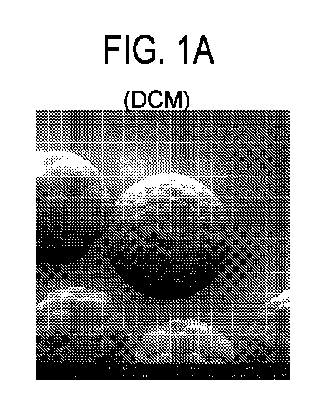
いくつかの態様において、本開示は、起伏があるポリマー微小粒子に関する。起伏があるポリマー微小粒子は、ジクロロメタン(DCM)などの溶媒を用いて、膜乳化および/またはマイクロフルイディクス(microfluidics)からのポリマー・薬物溶媒の液滴を蒸発させることにより得ることができるポリマー微小粒子を指す。図1Aにおいて明らかなように、走査型電子顕微鏡は、平坦でない、起伏がある表面を持つようにDCMを用いて形成されたポリマーの表面を示す。さらに、ラマン分光法イメージング(図1C)は、活性薬剤が集中した群でポリマー微小粒子内に埋め込まれていることを示す。いくつかの態様において、本開示は、PLGAまたはPLGA-DCM微小粒子の起伏がある微小粒子に関する。本願明細書において言及されるように、PLGA-DCMは、DCMが溶媒であるときに形成するPLGAの起伏があるポリマー微小粒子を指す。PLGA-DCMは、図1Cに示されるように中に埋め込まれたクラスター化している薬物も指す。 In some embodiments, the present disclosure relates to undulating polymer microparticles. Undulating polymer microparticles refer to polymer microparticles that can be obtained by evaporating polymer-drug solvent droplets from microfluidics using a solvent such as dichloromethane (DCM). As seen in FIG. 1A, scanning electron microscopy shows the surface of the polymer formed using DCM to have an uneven, undulating surface. Furthermore, Raman spectroscopy imaging (FIG. 1C) shows that the active agent is embedded within the polymer microparticles in concentrated groups. In some embodiments, the present disclosure relates to undulating microparticles of PLGA or PLGA-DCM microparticles. As referred to herein, PLGA-DCM refers to undulating polymer microparticles of PLGA that form when DCM is the solvent. PLGA-DCM also refers to clustered drug embedded therein as shown in FIG. 1C.
いくつかの態様において、本開示は、滑らかなポリマー微小粒子に関する。滑らかなポリマー微小粒子は、酢酸エチル(EtOAc)などの溶媒を用いて、膜乳化および/またはマイクロフルイディクスからのポリマー・薬物溶媒の液滴を蒸発させることにより得ることができるポリマー微小粒子を指す。図1Bにおいて明らかなように、走査型電子顕微鏡は、平坦な滑らかな表面を持つように酢酸エチルを用いて形成されたポリマーの表面を示す。さらに、ラマン分光法イメージング(図1D)は、活性薬剤が均等にポリマー微小粒子内に埋め込まれていることを示す。いくつかの態様において、本開示は、PLGAまたはPLGA-EtOAcの起伏があるポリマー微小粒子に関する。本願明細書において言及されるように、PLGA-EtOAcは、EtOAcが溶媒であるときに形成するPLGAの滑らかなポリマー微小粒子を指す。PLGA-EtOAcは、図1Dに示されるように微小粒子全体にわたって埋め込まれた薬物が均一に分布していることも指す。 In some embodiments, the present disclosure relates to smooth polymer microparticles. Smooth polymer microparticles refer to polymer microparticles that can be obtained by evaporating droplets of polymer-drug solvent from membrane emulsification and/or microfluidics using a solvent such as ethyl acetate (EtOAc). As seen in FIG. 1B, scanning electron microscopy shows the surface of the polymer formed with ethyl acetate to have a flat smooth surface. Furthermore, Raman spectroscopy imaging (FIG. 1D) shows that the active agent is evenly embedded within the polymer microparticles. In some embodiments, the present disclosure relates to undulating polymer microparticles of PLGA or PLGA-EtOAc. As referred to herein, PLGA-EtOAc refers to smooth polymer microparticles of PLGA that form when EtOAc is the solvent. PLGA-EtOAc also refers to the even distribution of the embedded drug throughout the microparticle as shown in FIG. 1D.
いくつかの態様において、外面の被覆は、微小粒子中に埋め込まれた治療剤を含む生体吸収性ポリマーの起伏があるポリマー微小粒子の配合物のものである。明らかなように、治療剤は、集中したクラスターに埋め込まれることになる。他の態様において、外面の被覆は、微小粒子中に埋め込まれた治療剤を含む生体吸収性ポリマーの滑らかなポリマー微小粒子の配合物のものである。明らかなように、治療剤は、ポリマー微小粒子全体にわたって均等に埋め込まれることになる。いくつかの態様において、外面の被覆は、起伏があるポリマー微小粒子と滑らかなポリマー微小粒子の配合物のものであり、いずれも微小粒子中に埋め込まれた治療剤を含む。いくつかの態様において、治療剤はリムス薬である。ある態様において、治療剤はシロリムスである。滑らかなポリマー微小粒子は、起伏があるポリマー微小粒子よりも埋め込まれた治療薬の溶解をさらに遅くする(図2参照)。いくつかの態様において、外面の被覆は、それぞれリムス薬が埋め込まれた、もしくは装填されたPLGA-EtOAcおよび/またはPLGA-DCMの配合物のものである。いくつかの態様において、外面の被覆は、それぞれシロリムスが埋め込まれた、もしくは装填されたPLGA-EtOAcおよび/またはPLGA-DCMの配合物のものである。 In some embodiments, the exterior coating is a blend of contoured polymer microparticles of a bioabsorbable polymer with a therapeutic agent embedded within the microparticles. As can be seen, the therapeutic agent will be embedded in concentrated clusters. In other embodiments, the exterior coating is a blend of smooth polymer microparticles of a bioabsorbable polymer with a therapeutic agent embedded within the microparticles. As can be seen, the therapeutic agent will be embedded evenly throughout the polymer microparticles. In some embodiments, the exterior coating is a blend of contoured and smooth polymer microparticles, both of which include a therapeutic agent embedded within the microparticles. In some embodiments, the therapeutic agent is a limus drug. In some embodiments, the therapeutic agent is sirolimus. The smooth polymer microparticles further slow the dissolution of the embedded therapeutic agent than the contoured polymer microparticles (see FIG. 2). In some embodiments, the exterior coating is a blend of PLGA-EtOAc and/or PLGA-DCM, each of which is embedded or loaded with a limus drug. In some embodiments, the exterior coating is a formulation of PLGA-EtOAc and/or PLGA-DCM, each embedded or loaded with sirolimus.
本開示の他の態様において、ポリマー微小粒子は、治療薬が埋め込まれた生体吸収性ポリマーのものであり、微小粒子が平均サイズまたはD50±標準偏差のものであり、標準偏差が、約9.9、9.8、9.7、9.6、9.5、9.4、9.3、9.2、9.1、9.0、8.9、8.8、8.7、8.6、8.5、8.4、8.3、8.2、8.1、8.0、7.9、7.8、7.7、7.6、7.5、7.4、7.3、7.2、7.1、7.0、6.9、6.8、6.7、6.6、6.5、6.4、6.3、6.2、6.1、6.0、5.0、5.8、5.7、5.6、5.5、5.4、5.3、5.2、5.1、5.0およびそれ未満を含む約10μm以下のものである。いくつかの態様において、ポリマー微小粒子は、0.2、0.3、0.4、0.5、0.6、0.7、0.8、0.9、1、1、2、3、4、5、6、7、8、9、10、20、30、40、50、60、70、80、90、110、120、130、140、150、160、170、180、および190μmを含む100nm~200μmの平均サイズを有してよい。いくつかの態様において、平均サイズは、約100nm~約300μmのものであり得る。いくつかの態様において、平均サイズまたはD50は、約1μm~約300μmのもの、約1μm~約100μmのもの、約1μm~約50μmのもの、約1μm~約40μmのもの、約1μm~約30μmのもの、約10μm~約300μmのもの、約10μm~約100μmのもの、約10μm~約のもの、約10μm~約40μmのもの、または約10μm~約30μmのものであり得る。結晶性微小粒子またはポリマー微小粒子のいずれかの微小粒子に関する「サイズ」は、微小粒子の直径または断面幅を指す。例えば10μmポリマー微小粒子は、10μmの直径または断面(corss-sectional)幅を有する。いくつかの態様において、平均サイズはD50値である。D50値は、レーザ回折などのプロセスによって決定することができる。本開示の他の態様において、ポリマー微小粒子は、治療薬が埋め込まれた生体吸収性ポリマーのものであり、微小粒子が、ポリマー微小粒子の95%が選択された平均サイズの20パーセント以内であるような均一サイズのものまたは狭いサイズ分布のものである。均一またはほぼ均一なポリマー微小粒子サイズを有する被覆を提供することにより、埋め込まれた治療薬の均一な溶解を可能にし得る。いくつかの態様において、ポリマー微小粒子は、0.2、0.3、0.4、0.5、0.6、0.7、0.8、0.9、1、1、2、3、4、5、6、7、8、9、10、20、30、40、50、60、70、80、90、110、120、130、140、150、160、170、180、および190μm(すべて±10%)を含む100nm~200μm(±20%)の均一または狭い分布サイズを有してよい。いくつかの態様において、粒子の狭い分布は、約100nm±20nm~約300μm±60μmのものであり得る。いくつかの態様において、粒子の狭い分布は、約1μm±0.2μm~約300μm±60μmのもの、約1μm±0.2μm~約100μm±20μmのもの、約1μm±0.2μm~約50μm±10μmのもの、約1μm±0.2μm~約40μm±8μmのもの、約1μm±0.2μm~約30μm±6μmのもの、約10μm±2μm~約300μm±60μmのもの、約10μm±2μm~約100μm±20μmのもの、約10μm±2μm~約50μm±10μmのもの、約10μm±2μm~約40μm±8μmのもの、または約10μm±2μm~約30μm±6μmのものであり得る。 In another aspect of the present disclosure, the polymer microparticles are bioabsorbable polymers embedded with a therapeutic agent, and the microparticles are of average size or D50 ± standard deviation, with standard deviations of about 9.9, 9.8, 9.7, 9.6, 9.5, 9.4, 9.3, 9.2, 9.1, 9.0, 8.9, 8.8, 8.7, 8.6, 8.5, 8.4, 8.3, 8. .2, 8.1, 8.0, 7.9, 7.8, 7.7, 7.6, 7.5, 7.4, 7.3, 7.2, 7.1, 7.0, 6.9, 6.8, 6.7, 6.6, 6.5, 6.4, 6.3, 6.2, 6.1, 6.0, 5.0, 5.8, 5.7, 5.6, 5.5, 5.4, 5.3, 5.2, 5.1, 5.0 and less than about 10 μm. In some embodiments, the polymeric microparticles may have an average size of 100 nm to 200 μm, including 0.2, 0.3, 0.4, 0.5, 0.6, 0.7, 0.8, 0.9, 1, 1, 2, 3, 4, 5, 6, 7, 8, 9, 10, 20, 30, 40, 50, 60, 70, 80, 90, 110, 120, 130, 140, 150, 160, 170, 180, and 190 μm. In some embodiments, the average size may be from about 100 nm to about 300 μm. In some embodiments, the average size or D50 can be from about 1 μm to about 300 μm, from about 1 μm to about 100 μm, from about 1 μm to about 50 μm, from about 1 μm to about 40 μm, from about 1 μm to about 30 μm, from about 10 μm to about 300 μm, from about 10 μm to about 100 μm, from about 10 μm to about, from about 10 μm to about 40 μm, or from about 10 μm to about 30 μm. "Size" in reference to microparticles, either crystalline microparticles or polymeric microparticles, refers to the diameter or cross-sectional width of the microparticle. For example, a 10 μm polymeric microparticle has a diameter or coss-sectional width of 10 μm. In some embodiments, the average size is the D50 value. The D50 value can be determined by a process such as laser diffraction. In other aspects of the present disclosure, the polymeric microparticles are of a bioabsorbable polymer with an embedded therapeutic agent, where the microparticles are of uniform size or narrow size distribution such that 95% of the polymeric microparticles are within 20 percent of a selected average size. Providing a coating with a uniform or near uniform polymeric microparticle size may allow for uniform dissolution of the embedded therapeutic agent. In some aspects, the polymeric microparticles may have a uniform or narrow distribution size between 100 nm and 200 μm (±20%), including 0.2, 0.3, 0.4, 0.5, 0.6, 0.7, 0.8, 0.9, 1, 1, 2, 3, 4, 5, 6, 7, 8, 9, 10, 20, 30, 40, 50, 60, 70, 80, 90, 110, 120, 130, 140, 150, 160, 170, 180, and 190 μm (all ±10%). In some embodiments, the narrow distribution of particles can be from about 100 nm±20 nm to about 300 μm±60 μm. In some embodiments, the narrow distribution of particles can be from about 1 μm±0.2 μm to about 300 μm±60 μm, from about 1 μm±0.2 μm to about 100 μm±20 μm, from about 1 μm±0.2 μm to about 50 μm±10 μm, from about 1 μm±0.2 μm to about 40 μm±8 μm, from about 1 μm±0.2 μm to about 30 μm±6 μm, from about 10 μm±2 μm to about 300 μm±60 μm, from about 10 μm±2 μm to about 100 μm±20 μm, from about 10 μm±2 μm to about 50 μm±10 μm, from about 10 μm±2 μm to about 40 μm±8 μm, or from about 10 μm±2 μm to about 30 μm±6 μm.
ポリマー微小粒子のサイズの選択は、埋め込まれた治療薬の所望の溶解速度に依存し得る。より小さいポリマー微小粒子の選択により、比較的より大きい微小粒子よりも速い溶解速度を実現する。例えば、図3に示されるように、シロリムスを含む40%薬物装填のPLGAの30μmポリマー微小粒子は、シロリムスを含む40%薬物装填のPLGAの50μmポリマー微小粒子よりも高い速度でシロリムスを放出した。 The selection of the size of the polymer microparticles may depend on the desired dissolution rate of the embedded therapeutic agent. Selection of smaller polymer microparticles will achieve a faster dissolution rate than relatively larger microparticles. For example, as shown in FIG. 3, 30 μm polymer microparticles of PLGA with 40% drug loading containing sirolimus released sirolimus at a higher rate than 50 μm polymer microparticles of PLGA with 40% drug loading containing sirolimus.
マイクロフルイディクスおよび膜乳化などの技法によって、形成されるポリマー微小粒子のサイズを制御することが可能である。例えば、ポリマー微小粒子のサイズおよびサイズ分布は、分散相流速、連続相流速、マイクロ流体チップチャネルサイズ、および分散相中の固体百分率により制御することができる。蒸発性エマルション中、ポリマー微小粒子のサイズおよびサイズ分布は、分散相注入速度、連続相リザーバ(reservoir)内の撹拌速度、膜細孔サイズ、および分散相中の固体百分率により制御することができる。 Techniques such as microfluidics and membrane emulsification allow the size of the polymer microparticles formed to be controlled. For example, the size and size distribution of the polymer microparticles can be controlled by the dispersed phase flow rate, the continuous phase flow rate, the microfluidic chip channel size, and the percentage of solids in the dispersed phase. In evaporative emulsions, the size and size distribution of the polymer microparticles can be controlled by the dispersed phase injection rate, the stirring rate in the continuous phase reservoir, the membrane pore size, and the percentage of solids in the dispersed phase.
いくつかの態様において、ポリマー微小粒子は、所定量の治療剤が装填されても、埋め込まれてもよい。ポリマー微小粒子が形成されるとき溶媒中に存在する治療剤の量を増加させることによって、より高い薬物装填が実現する。例えば、図3に示されるように、30μm PLGA微小粒子中のシロリムスの60%装填は、30μm PLGA微小粒子中のシロリムスの40%装填よりもシロリムスの放出が多い。いくつかの態様において、ポリマー微小粒子は、治療薬がポリマー微小粒子の10、15、20、25、30、35、40、45、50、55、60、65、および70重量%を含むポリマー微小粒子の5~75重量%(w/w)のものであるように治療薬が装填されるか、または埋め込まれる。いくつかの態様において、ポリマー微小粒子は、治療薬の10~70、10~60、10~50、10~40、10~30.20~70、20~60、20~50、20~40、30~70、30~60、30~50、35~45、または40~50w/w%のものである。いくつかの態様において、本開示は、シロリムスがポリマー微小粒子の10、15、20、25、30、35、40、45、50、55、60、65、および70w/w%を含むポリマー微小粒子の5~75w/w%のものであるようにシロリムスが装填されたか、または埋め込まれたポリマー微小粒子に関する。 In some embodiments, the polymeric microparticles may be loaded or embedded with a predetermined amount of therapeutic agent. Higher drug loading is achieved by increasing the amount of therapeutic agent present in the solvent when the polymeric microparticles are formed. For example, as shown in FIG. 3, 60% loading of sirolimus in 30 μm PLGA microparticles results in greater release of sirolimus than 40% loading of sirolimus in 30 μm PLGA microparticles. In some embodiments, the polymeric microparticles are loaded or embedded with a therapeutic agent such that the therapeutic agent is 5-75% by weight (w/w) of the polymeric microparticles, including 10, 15, 20, 25, 30, 35, 40, 45, 50, 55, 60, 65, and 70% by weight of the polymeric microparticles. In some embodiments, the polymeric microparticles are 10-70, 10-60, 10-50, 10-40, 10-30. 20-70, 20-60, 20-50, 20-40, 30-70, 30-60, 30-50, 35-45, or 40-50 w/w% of the therapeutic agent. In some embodiments, the present disclosure relates to polymeric microparticles loaded or embedded with sirolimus such that the sirolimus is 5-75 w/w% of the polymeric microparticle, including 10, 15, 20, 25, 30, 35, 40, 45, 50, 55, 60, 65, and 70 w/w% of the polymeric microparticle.
いくつかの態様において、ポリマーおよび/またはポリマーの濃度の選択は、治療剤の溶解においてさらなる多様性をもたらし得る。いくつかの態様において、ポリマー微小粒子のポリマーは、ポリマー微小粒子の15、20、25、30、35、40、45、50、55、60、65、70、および75w/w%を含むポリマー微小粒子の10~80w/w%で75:25 PLGA(75LA/ラクチド対25GA/グリコリド)のものであり得る。他の態様において、ポリマー微小粒子は、別の生体吸収性ポリマーのものである。図4において特定されるように、シロリムスは、PLGAからよりもPLAからより高い速度で溶出することができる。さらなる態様において、ポリマー微小粒子は、PLGAおよびPLA、PLGAおよびPGA、PLGAおよびPLLA、PLGAおよびPCL、PLGAおよびPDLLA、PLGAおよびPTMC、PLGAおよびPEA、またはPLGAおよびPPDOなどの1種以上の生体吸収性ポリマーを用いて調製することができる。他の態様において、ポリマー微小粒子は、PLGAならびにPLA、PLLA、PGA、PDLLA、PCL、PTMC、PEA、およびPPDOのうちの1種以上のものであり得る。どの場合も、ポリマー微小粒子は、DCM微小粒子および/またはEtOAc微小粒子であり得る。 In some embodiments, the selection of the polymer and/or the concentration of the polymer can provide further variability in the dissolution of the therapeutic agent. In some embodiments, the polymer of the polymer microparticles can be 75:25 PLGA (75LA/lactide to 25GA/glycolide) at 10-80 w/w% of the polymer microparticles, including 15, 20, 25, 30, 35, 40, 45, 50, 55, 60, 65, 70, and 75 w/w% of the polymer microparticles. In other embodiments, the polymer microparticles are of another bioabsorbable polymer. As identified in FIG. 4, sirolimus can elute at a higher rate from PLA than from PLGA. In further aspects, the polymeric microparticles can be prepared with one or more bioabsorbable polymers, such as PLGA and PLA, PLGA and PGA, PLGA and PLLA, PLGA and PCL, PLGA and PDLLA, PLGA and PTMC, PLGA and PEA, or PLGA and PPDO. In other aspects, the polymeric microparticles can be PLGA and one or more of PLA, PLLA, PGA, PDLLA, PCL, PTMC, PEA, and PPDO. In each case, the polymeric microparticles can be DCM microparticles and/or EtOAc microparticles.
いくつかの態様において、ポリマー微小粒子は、治療薬が装填されたか、または埋め込まれたPLGAのものである。いくつかの態様において、治療薬はリムス薬である。ある態様において、治療薬はシロリムスである。さらなる態様において、治療薬は、ポリマー微小粒子の35~45w/w%で装填されたシロリムスである。いくつかの態様において、PLGAはPLGA-DCMである。他の態様において、PLGAはPLGA-EtOAcである。なおさらなる態様において、ポリマー微小粒子は、PLGA-DCMとPLGA-EtOAcの組合せである。いくつかの態様において、ポリマー微小粒子は、平均サイズが10、20、30、40、または50μmのものであり、かつポリマー微小粒子の35~45w/w%でシロリムスが装填されたPLGAのものである。他の態様において、ポリマー微小粒子は、PLGAに加えて、PLA、PLLA、PGA、PDLLA、PCL、PTMC、PEA、PPDO、PHB、およびそれらの組合せから選択される少なくとも1種の他のポリマーを特徴とする。
In some embodiments, the polymeric microparticles are of PLGA loaded or embedded with a therapeutic agent. In some embodiments, the therapeutic agent is a limus drug. In some embodiments, the therapeutic agent is sirolimus. In further embodiments, the therapeutic agent is sirolimus loaded at 35-45% w/w of the polymeric microparticle. In some embodiments, the PLGA is PLGA-DCM. In other embodiments, the PLGA is PLGA-EtOAc. In still further embodiments, the polymeric microparticles are a combination of PLGA-DCM and PLGA-EtOAc. In some embodiments, the polymeric microparticles are of
いくつかの態様において、ポリマー微小粒子は、所望の放出プロファイルを満たすように調整することができる。例えば、利用される溶媒は、放出速度の違いをもたらし得る。ポリマー微小粒子のサイズは、放出プロファイルの違いをもたらし得る。ポリマー微小粒子内に装填されたか、または埋め込まれた治療剤の量は、放出プロファイルの違いをもたらし得る。ポリマー組成は、放出速度の違いをもたらし得る。例えば、ポリマー微小粒子の35~45w/w%装填されたシロリムスを含み、かつ30μmの平均サイズを有するPLGA-EtOAcのポリマー微小粒子は、例えば(限定するものではないが):シロリムス放出を増加させるために平均サイズを10μmまで減少させることにより、シロリムス放出を増加させるためにPLGA-DCMに切り替えることにより、シロリムス放出を増加させるためにシロリムス装填を増加させることにより、および、シロリムス放出を増加させるためにPLAなどのより速く分解するポリマーを加えることにより調整することができる。 In some embodiments, the polymeric microparticles can be tailored to meet a desired release profile. For example, the solvent utilized can result in different release rates. The size of the polymeric microparticles can result in different release profiles. The amount of therapeutic agent loaded or embedded within the polymeric microparticles can result in different release profiles. The polymer composition can result in different release rates. For example, a polymeric microparticle of PLGA-EtOAc containing 35-45 w/w% loaded sirolimus of the polymeric microparticle and having an average size of 30 μm can be tailored by, for example (but not limited to): decreasing the average size to 10 μm to increase sirolimus release, switching to PLGA-DCM to increase sirolimus release, increasing sirolimus loading to increase sirolimus release, and adding a faster degrading polymer such as PLA to increase sirolimus release.
いくつかの態様において、ポリマー微小粒子は、生体吸収性ポリマー、治療剤、および抗酸化剤のものである。抗酸化剤は、他の分子の酸化を減速または防止することができる分子である。酸化反応は、フリーラジカルおよび/または過酸化物を生成し得、それは、連鎖反応を開始させ、かつ治療剤の分解を引き起こし得る。抗酸化剤は、それ自体が酸化されることによってフリーラジカルを除去し、かつ活性薬剤の酸化を阻害することによりこれらの連鎖反応を停止させる。抗酸化剤は、医療器具のための被覆内で治療剤の酸化を防止または減速するためにある態様において1種以上の追加の添加剤として使用される。抗酸化剤は、フリーラジカルスカベンジャーの1種である。抗酸化剤は、ある態様において単独でまたは他の追加の添加剤と組み合わせて使用することができ、かつ使用前の滅菌中または保管中の活性治療剤の分解を防止することができる。本開示の薬物被覆において使用することができる抗酸化剤のいくつかの代表例には、限定されることなく、オリゴマーまたはポリマーのプロアントシアニジン、ポリフェノール、ポリリン酸、ポリアゾメチン、高硫酸塩寒天オリゴマー、部分的キトサン加水分解により得られたキトオリゴ糖、立体障害フェノールを有する多官能性オリゴマーチオエーテル、限定されることなくp-フェニレンジアミン、トリメチルジヒドロキノロン、およびアルキル化ジフェニルアミンなどのヒンダードアミン、3級ブチルなどの1個以上の嵩高い官能基を有する置換フェノール化合物(ヒンダードフェノール)、アリールアミン、ホスファイト、ヒドロキシルアミン、およびベンゾフラノンが含まれる。また、p-フェニレンジアミン、ジフェニルアミン、およびN,N’2置換p-フェニレンジアミンなどの芳香族アミンが、フリーラジカルスカベンジャーとして利用され得る。他の例には、限定されることなく、ブチル化ヒドロキシトルエン(「BHT」)、ブチル化ヒドロキシアニソール(「BHA」)、L-アスコルベート(ビタミンC)、ビタミンE、ハーブのローズマリー、セージ抽出物、グルタチオン、レスベラトロール、エトキシキン、ロスマノール、イソロスマノール、ロスマリジフェノール、没食子酸プロピル、没食子酸、コーヒー酸、p-クメル(coumeric)酸、p-ヒドロキシ安息香酸、アスタキサンチン、フェルラ酸、デヒドロジンゲロン、クロロゲン酸、エラグ酸、プロピルパラベン、シナプ酸、ダイジン、グリシチン、ゲニスチン、ダイゼイン、グリシテイン、ゲニステイン、イソフラボン、およびtertブチルヒドロキノンが含まれる。いくつかのホスファイトの例には、ジ(ステアリル)ペンタエリトリトールジホスファイト、トリス(2,4-ジ-tert.ブチルフェニル)ホスファイト、ジラウリルチオジプロピオネートおよびビス(2,4-ジ-tert.ブチルフェニル)ペンタエリトリトールジホスファイトが含まれる。ヒンダードフェノールのいくつかの例には、限定されることなく、オクタデシル-3,5,ジ-tert.ブチル-4-ヒドロキシシンナメート、テトラキス-メチレン-3-(3’,5’-ジ-tert.ブチル-4-ヒドロキシフェニル)プロピオネートメタン2,5-ジ-tert-ブチルヒドロキノン、イオノール、ピロガロール、レチノール、およびオクタデシル-3-(3,5-ジ-tert.ブチル-4-ヒドロキシフェニル)プロピオネートが含まれる。抗酸化剤には、グルタチオン、リポ酸、メラトニン、トコフェロール、トコトリエノール、チオール、ベータ-カロテン、レチノイン酸、クリプトキサンチン、2,6-ジ-tert-ブチルフェノール、没食子酸プロピル、カテキン、没食子酸カテキン、およびケルセチンが含まれ得る。ある態様において、抗酸化剤はブチル化ヒドロキシトルエン(BHT)である。いくつかの態様において、抗酸化剤は、約0.02、0.03、0.04、0.05、0.06、0.07、0.08、0.09、0.1、0.2、0.3、0.4、0.5、0.6、0.7、0.8、0.9、1、2、3、4、5、6、7、8、および9 5w/w%を含むポリマー微小粒子の約0.01~約10w/w%のものである。いくつかの態様において、抗酸化剤は、ポリマー微小粒子の0.01~10、0.1~5、0.01~1、0.1~10、0.1~5、0.1~1、1~10、1~5、1~3、2~10、2~5、2~3、3~10、または3~5w/w%のものである。ある態様において、抗酸化剤は、ポリマー微小粒子の約0.01w/w%のものである。いくつかの態様において、抗酸化剤は、ポリマー微小粒子またはその形成のための配合物の3%または約3w/w%である。ある態様において、抗酸化剤はBHTである。
In some embodiments, the polymeric microparticles are of a bioabsorbable polymer, a therapeutic agent, and an antioxidant. An antioxidant is a molecule that can slow down or prevent the oxidation of other molecules. Oxidation reactions can generate free radicals and/or peroxides, which can initiate chain reactions and cause the degradation of the therapeutic agent. Antioxidants stop these chain reactions by scavenging free radicals by being oxidized themselves and inhibiting the oxidation of the active agent. Antioxidants are used as one or more additional additives in some embodiments to prevent or slow down the oxidation of the therapeutic agent in coatings for medical devices. Antioxidants are a type of free radical scavenger. Antioxidants can be used alone or in combination with other additional additives in some embodiments and can prevent the degradation of the active therapeutic agent during sterilization or storage prior to use. Some representative examples of antioxidants that can be used in the drug coatings of the present disclosure include, but are not limited to, oligomeric or polymeric proanthocyanidins, polyphenols, polyphosphates, polyazomethines, high sulfate agar oligomers, chitooligosaccharides obtained by partial chitosan hydrolysis, polyfunctional oligomeric thioethers with sterically hindered phenols, hindered amines such as, but not limited to, p-phenylenediamine, trimethyldihydroquinolones, and alkylated diphenylamines, substituted phenolic compounds with one or more bulky functional groups (hindered phenols) such as tertiary butyl, arylamines, phosphites, hydroxylamines, and benzofuranones. Aromatic amines such as p-phenylenediamine, diphenylamine, and N,N' disubstituted p-phenylenediamines may also be utilized as free radical scavengers. Other examples include, without limitation, butylated hydroxytoluene ("BHT"), butylated hydroxyanisole ("BHA"), L-ascorbate (vitamin C), vitamin E, the herb rosemary, sage extract, glutathione, resveratrol, ethoxyquin, rosmanol, isorosmanol, rosmaridiphenol, propyl gallate, gallic acid, caffeic acid, p-coumeric acid, p-hydroxybenzoic acid, astaxanthin, ferulic acid, dehydrozingerone, chlorogenic acid, ellagic acid, propylparaben, sinapic acid, daidzin, glycitin, genistin, daidzein, glycitein, genistein, isoflavones, and tert-butylhydroquinone. Some examples of phosphites include di(stearyl)pentaerythritol diphosphite, tris(2,4-di-tert.butylphenyl)phosphite, dilaurylthiodipropionate, and bis(2,4-di-tert.butylphenyl)pentaerythritol diphosphite. Some examples of hindered phenols include, but are not limited to, octadecyl-3,5,di-tert.butyl-4-hydroxycinnamate, tetrakis-methylene-3-(3',5'-di-tert.butyl-4-hydroxyphenyl)propionate
いくつかの態様において、ポリマー微小粒子は、治療薬および抗酸化剤が装填されたか、または埋め込まれたPLGAのものである。いくつかの態様において、ポリマー微小粒子は、ポリマーと、治療薬と、抗酸化剤とで形成されている。いくつかの態様において、抗酸化剤はBHTである。いくつかの態様において、BHTは、ポリマー微小粒子の約0.01%~約10w/w%のものである。いくつかの態様において、治療薬はリムス薬である。ある態様において、治療薬はシロリムスである。さらなる態様において、治療薬は、ポリマー微小粒子の35~45w/w%で装填されたシロリムスである。いくつかの態様において、PLGAはPLGA-DCMである。他の態様において、PLGAはPLGA-EtOAcである。いくつかの態様において、ポリマー微小粒子は、平均サイズが10、20、30、40、または50μmのものであり、かつポリマー微小粒子の35~45w/w%でシロリムスが装填されたPLGAのものである。他の態様において、ポリマー微小粒子は、PLGAに加えて、PLA、PLLA、PGA、PDLLA、PCL、PTMC、PEA、PPDO、およびそれらの組合せから選択される少なくとも1種の他のポリマーを特徴とする。 In some embodiments, the polymeric microparticles are of PLGA loaded or embedded with a therapeutic agent and an antioxidant. In some embodiments, the polymeric microparticles are formed of a polymer, a therapeutic agent, and an antioxidant. In some embodiments, the antioxidant is BHT. In some embodiments, the BHT is about 0.01% to about 10% w/w of the polymeric microparticle. In some embodiments, the therapeutic agent is a limus drug. In some embodiments, the therapeutic agent is sirolimus. In further embodiments, the therapeutic agent is sirolimus loaded at 35-45% w/w of the polymeric microparticle. In some embodiments, the PLGA is PLGA-DCM. In other embodiments, the PLGA is PLGA-EtOAc. In some embodiments, the polymeric microparticles are of an average size of 10, 20, 30, 40, or 50 μm and are of PLGA loaded with sirolimus at 35-45% w/w of the polymeric microparticle. In other embodiments, the polymeric microparticles feature, in addition to PLGA, at least one other polymer selected from PLA, PLLA, PGA, PDLLA, PCL, PTMC, PEA, PPDO, and combinations thereof.
ある態様において、本開示のポリマー微小粒子は、約1部の薬物、1.5部のポリマーおよび0.03部の抗酸化剤のものである。いくつかの態様において、ポリマーはPLGAである。ある態様において、ポリマーはPLGA-EtOAcである。他の態様において、ポリマーはPLGA-DCMである。いくつかの態様において、抗酸化剤はBHTである。いくつかの態様において、薬物はリムス薬である。ある態様において、薬物はシロリムスである。 In some embodiments, the polymeric microparticles of the present disclosure are about 1 part drug, 1.5 parts polymer, and 0.03 parts antioxidant. In some embodiments, the polymer is PLGA. In some embodiments, the polymer is PLGA-EtOAc. In other embodiments, the polymer is PLGA-DCM. In some embodiments, the antioxidant is BHT. In some embodiments, the drug is a limus drug. In some embodiments, the drug is sirolimus.
本開示のいくつかの態様において、配合物は、ポリマーのそれぞれに治療薬剤または薬物が装填されたか、または埋め込まれた、ポリマー微小粒子の2つ以上の異なる群のものであり得る。いくつかの態様において、ポリマー微小粒子の2つ以上の群は、平均サイズが異なり得る。いくつかの態様において、2つ以上の群は、それぞれ均一サイズのもの、または選択された平均サイズから狭い分布のものである。いくつかの態様において、ポリマー微小粒子の2つ以上の群は、装填されたか、または埋め込まれた治療薬が異なり得る。いくつかの態様において、ポリマー微小粒子の2つ以上の群は、一方の群がDCMを用いて調製され、他方の群がEtOAcを用いて調製されるなど、表面モルフォロジー/薬物装填が異なり得る。いくつかの態様において、2つ以上の群は、使用される生体吸収性ポリマーが異なり得る。いくつかの態様において、ポリマー微小粒子の2つ以上の群は、限定ではなく、例えば、一方がPLGA 75:25のものであり、他方がPLGA 50:50であるなど、PLGA組成が異なり得る。いくつかの態様において、2種以上のポリマー微小粒子は、その中に装填されたか、または埋め込まれた治療薬の量または百分率が異なり得る。さらなる態様において、2つ以上の群は、表面モルフォロジー、薬物装填量、粒子サイズ、ポリマー組成、および治療剤選択のうちの2つ以上が異なり得る。いくつかの態様において、2つ以上の群は、本願明細書に記載されるような結晶性微小粒子と、ポリマー微小粒子とを含み得る。 In some embodiments of the present disclosure, the formulation may be of two or more different groups of polymeric microparticles, each of which is loaded or embedded with a therapeutic agent or drug. In some embodiments, the two or more groups of polymeric microparticles may differ in average size. In some embodiments, the two or more groups are each of uniform size or narrow distribution from a selected average size. In some embodiments, the two or more groups of polymeric microparticles may differ in the therapeutic agent loaded or embedded. In some embodiments, the two or more groups of polymeric microparticles may differ in surface morphology/drug loading, such as one group prepared with DCM and the other with EtOAc. In some embodiments, the two or more groups may differ in the bioabsorbable polymer used. In some embodiments, the two or more groups of polymeric microparticles may differ in PLGA composition, such as, but not limited to, one group being PLGA 75:25 and the other being PLGA 50:50. In some embodiments, the two or more polymeric microparticles may differ in the amount or percentage of therapeutic agent loaded or embedded therein. In further embodiments, the two or more groups may differ in two or more of surface morphology, drug loading, particle size, polymer composition, and therapeutic agent selection. In some embodiments, the two or more groups may include crystalline microparticles and polymeric microparticles as described herein.
いくつかの態様において、本開示は、PLGA-DCMおよび/またはPLGA-EtOAcを含む、平均粒子サイズが異なる、リムス薬が装填されたか、または埋め込まれたPLGAのポリマー微小粒子の2つ以上の群に関する。いくつかの態様において、ポリマー微小粒子の1つの群は、10μmまたは約10μmまたは10μm±2μmまたは10μm±1.5μmまたは10μm±1.0μmまたは10μm±0.5μmまたは10μm±0.2μmの平均粒子サイズのものである。いくつかの態様において、ポリマー微小粒子の1つの群は、30μmまたは約30μmまたは30μm±6μmまたは30μm±5μmまたは30μm±1.5μmまたは30μm±1.0μmまたは30μm±0.5μmまたは30μm±0.2μmの平均粒子サイズのものである。いくつかの態様においてリムス薬はシロリムスである。いくつかの態様において、リムス薬は、ポリマー微小粒子の約60w/w%、約55w/w%、約50w/w%、約45w/w%、約40w/w%、約35w/w%、約30w/w%、約25w/w%、約20w/w%、約15w/w%、約10w/w%または約5w/w%でポリマー微小粒子内に装填されるか、または埋め込まれる。 In some embodiments, the disclosure relates to two or more groups of limus drug-loaded or embedded polymeric microparticles of PLGA, comprising PLGA-DCM and/or PLGA-EtOAc, differing in average particle size. In some embodiments, one group of polymeric microparticles is of an average particle size of 10 μm or about 10 μm or 10 μm±2 μm or 10 μm±1.5 μm or 10 μm±1.0 μm or 10 μm±0.5 μm or 10 μm±0.2 μm. In some embodiments, one group of polymeric microparticles is of an average particle size of 30 μm or about 30 μm or 30 μm±6 μm or 30 μm±5 μm or 30 μm±1.5 μm or 30 μm±1.0 μm or 30 μm±0.5 μm or 30 μm±0.2 μm. In some embodiments, the limus drug is sirolimus. In some embodiments, the limus drug is loaded or embedded within the polymeric microparticles at about 60 w/w%, about 55 w/w%, about 50 w/w%, about 45 w/w%, about 40 w/w%, about 35 w/w%, about 30 w/w%, about 25 w/w%, about 20 w/w%, about 15 w/w%, about 10 w/w%, or about 5 w/w% of the polymeric microparticles.
本開示のいくつかの態様において、配合物は、ポリマーのそれぞれに治療薬が装填されたか、または埋め込まれた、ポリマー微小粒子の2つ以上の異なる群を含み得、2つ以上の群は、他の群に対して制御された比で配合物中に存在する。いくつかの態様において、第1の群は、他の群に対して約1:1の比である。いくつかの態様において、第1の群は、配合物中に他の群に対して約10:1、9:1、8:1、7:1、6:1、5:1、4:1、3:1、2:1、または1:1の比である。他の態様において、第1の群は、配合物中に他の群に対して約1:10、1:9、1:8、1:7、1:6、1:5、1:4、1:3、1:2、または1:1の比である。 In some embodiments of the present disclosure, the formulation may include two or more different groups of polymer microparticles, each of which is loaded or embedded with a therapeutic agent, and the two or more groups are present in the formulation in a controlled ratio relative to the other groups. In some embodiments, the first group is in a ratio of about 1:1 relative to the other groups. In some embodiments, the first group is in a ratio of about 10:1, 9:1, 8:1, 7:1, 6:1, 5:1, 4:1, 3:1, 2:1, or 1:1 relative to the other groups in the formulation. In other embodiments, the first group is in a ratio of about 1:10, 1:9, 1:8, 1:7, 1:6, 1:5, 1:4, 1:3, 1:2, or 1:1 relative to the other groups in the formulation.
いくつかの態様において、本開示は、バルーンの外面を被覆するための配合物であって、本願明細書に記載されるようなポリマー微小粒子と、添加剤とを含む配合物に関する。いくつかの態様において、配合物は、本願明細書に記載されるようなポリマー微小粒子の2つ以上の群と、添加剤とを含む。いくつかの態様において、ポリマー微小粒子は、配合物の約40~約80w/w%のものであり、添加剤は、配合物の約5~約50w/w%のものである。いくつかの態様において、添加剤は、配合物の約5、10、15、20、25、30、35、40、45、または50w/w%のものである。いくつかの態様において、添加剤は、配合物の5~45、5~40、5~35、5~30、5~25、5、20、10~50、10~40、10~30、20~50、20~40、または30~50w/w%のものである。いくつかの態様において、ポリマー微小粒子は、配合物の40、45、50、55、60、65、70、75、80w/w%のものである。いくつかの態様において、ポリマー微小粒子は、配合物の40~80、40~75、40~70、40~60、50~80、50~75、50~70、50~65、50~60、60~80、60~75、または60~70w/w%のものである。 In some embodiments, the present disclosure relates to a formulation for coating an exterior surface of a balloon, the formulation comprising polymeric microparticles as described herein and an additive. In some embodiments, the formulation comprises two or more populations of polymeric microparticles as described herein and an additive. In some embodiments, the polymeric microparticles are about 40 to about 80 w/w% of the formulation and the additive is about 5 to about 50 w/w% of the formulation. In some embodiments, the additive is about 5, 10, 15, 20, 25, 30, 35, 40, 45, or 50 w/w% of the formulation. In some embodiments, the additive is 5-45, 5-40, 5-35, 5-30, 5-25, 5, 20, 10-50, 10-40, 10-30, 20-50, 20-40, or 30-50 w/w% of the formulation. In some embodiments, the polymeric microparticles are 40, 45, 50, 55, 60, 65, 70, 75, 80 w/w% of the formulation. In some embodiments, the polymeric microparticles are 40-80, 40-75, 40-70, 40-60, 50-80, 50-75, 50-70, 50-65, 50-60, 60-80, 60-75, or 60-70 w/w% of the formulation.
添加剤は、被覆配合物にバルーンの外面との良好な接着をもたらし、かつプリーツ加工中、折り畳み中、および取扱い中にバルーン表面の外面から被覆が剥離するのをさらに防止する。薬物被覆が標的処置部位に送達されると、添加剤は、薬物被覆がバルーン表面から放出されるのを助け、かつバルーン表面から処置される血管への薬物移送を容易にする。 The additives provide the coating formulation with good adhesion to the outer surface of the balloon and further prevent the coating from peeling off from the outer surface of the balloon during pleating, folding, and handling. Once the drug coating is delivered to the target treatment site, the additives help the drug coating to be released from the balloon surface and facilitate drug transport from the balloon surface to the blood vessel being treated.
いくつかの態様において、添加剤は、バルーンの外面に塗布される被覆配合物として含まれる。他の態様において、添加剤は、バルーンの外面への塗布後に配合物の一部になる。いくつかの態様において、バルーンカテーテル上の1つ以上の被覆層は、1種以上の添加剤を含んでよい。いくつかの態様において、添加剤は、被覆と同時に塗布される。いくつかの態様において、添加剤は、微小粒子の前に塗布されてよい。他の態様において、添加剤は、微小粒子上に塗布および/または被覆されてよい。1つの態様において、配合物は、複数の添加剤、例えば、2つ、3つ、または4つの添加剤を含んでよい。添加剤の例には、半合成グリセリド(例えばSuppocire AIML、AML、BML、BS2、BS2X、NBL、NAIS 10、CS2X)、レシチン、水素化油(例えば、植物、綿実、大豆)、セチルアルコール、トリデカノール、witepol、セチルパルミエート(cetyl palmiate)、エチレングリコールジステレート(disterate)、グリセロールモノステアレート、ミツロウ、パラフィン、石油ゼリー、ドクサートナトリウム、水素化ココナッツ油、ココナッツ油、鉱油、ペトロラタム、デカノール、軟パラフィン、ドデカノール、長鎖飽和脂肪酸、長鎖不飽和脂肪酸、脂肪酸エステル、脂肪酸エーテル、固体脂質、ステアリン酸メチル、トリグリセリド、グリセリルモノステアレート、グリセリルパルミトステアレート、ステアリン酸、パルミチン酸、デカン酸、ベヘン酸、カルナウバワックス、パラフィン、脂肪酸トリグリセリド、脂肪酸アルコールまたはそれらの組合せが含まれ得る。いくつかの態様において、添加剤は、ペトロラタム(石油ゼリー)およびドクサートナトリウムのうちの1種以上である。いくつかの態様において、配合物は、微小粒子中に装填されたリムス薬と、ペトロラタムとを含むポリマー微小粒子の2つの群のものである。いくつかの態様において、配合物は、微小粒子中に装填されたリムス薬と、ドクサートナトリウムとを含むポリマー微小粒子の2つの群のものである。いくつかの態様において、配合物は、微小粒子中に装填されたリムス薬と、ドクサートナトリウムと、ペトロラタムとを含むポリマー微小粒子の2つの群のものである。ある態様において、リムス薬はシロリムスである。ある態様において、ポリマー微小粒子の第1の群は、約10μmの平均サイズを有する。ある態様において、ポリマー微小粒子のさらなる群は、約30μmまたは35μmの平均サイズを有する。さらなる態様において、ポリマー微小粒子の第1の群および/またはポリマー微小粒子の第2の群はPLGA-EtOAcである。さらなる態様において、ポリマー微小粒子の第1の群および/またはポリマー微小粒子の第2の群はPLGA-DCMである。いくつかの態様において、ポリマー微小粒子は、抗酸化剤をさらに含む。ある態様において、抗酸化剤はBHTである。ポリマー微小粒子中の抗酸化剤の存在は、分解および/または酸化からポリマー微小粒子を保護することにおいて有益であり得る。
In some embodiments, the additive is included as a coating formulation that is applied to the exterior surface of the balloon. In other embodiments, the additive becomes part of the formulation after application to the exterior surface of the balloon. In some embodiments, one or more coating layers on the balloon catheter may include one or more additives. In some embodiments, the additive is applied simultaneously with the coating. In some embodiments, the additive may be applied before the microparticles. In other embodiments, the additive may be applied and/or coated on the microparticles. In one embodiment, the formulation may include multiple additives, e.g., two, three, or four additives. Examples of additives include semi-synthetic glycerides (e.g., Suppocire AIML, AML, BML, BS2, BS2X, NBL,
いくつかの態様において、本開示は、バルーンの外面を被覆するための配合物であって、本願明細書に記載されるようなポリマー微小粒子と、本願明細書に記載されるような添加剤と、抗酸化剤またはさらなる抗酸化剤とを含む配合物に関する。いくつかの態様において、配合物は、本願明細書に記載されるようなポリマー微小粒子の2つ以上の群と、本願明細書に記載されるような添加剤と、抗酸化剤またはさらなる抗酸化剤とを含む。いくつかの態様において、配合物は、ペトロラタムおよび/またはドクサートナトリウムの添加剤ならびにポリマー微小粒子の2つ以上の群のものであり、第1の群は、微小粒子中に装填された約40%シロリムスを含み、かつ約0.01~0.1 5w/w BHTを含む平均サイズが約10μmのPLGA-EtOAcであり、第2の群は、微小粒子中に装填された約40%シロリムスを含み、かつ約0.01~0.1w/w%BHTを含む平均サイズが約30μmまたは35μmまたは40μmのPLGA-EtOAcである。 In some embodiments, the present disclosure relates to a formulation for coating an exterior surface of a balloon, the formulation comprising polymeric microparticles as described herein, an additive as described herein, and an antioxidant or additional antioxidant. In some embodiments, the formulation comprises two or more populations of polymeric microparticles as described herein, an additive as described herein, and an antioxidant or additional antioxidant. In some embodiments, the formulation is of two or more groups of petrolatum and/or docusate sodium additives and polymer microparticles, the first group being PLGA-EtOAc with about 40% sirolimus loaded in the microparticles and with about 0.01-0.15 w/w BHT and with an average size of about 10 μm, and the second group being PLGA-EtOAc with about 40% sirolimus loaded in the microparticles and with about 0.01-0.1 w/w% BHT and with an average size of about 30 μm, 35 μm, or 40 μm.
いくつかの態様において、配合物は、本願明細書に記載されるような配合物と、溶媒とを含む被覆溶液または被覆懸濁液でよく、溶媒は、バルーンの外面から蒸発して、バルーンの外面に被覆された配合物を残す。被覆溶媒には、例として、以下のうちの1種以上のあらゆる組合せが含まれ得る:水;ペンタン、シクロペンタン、ヘキサン、シクロヘキサン、ヘプタン、およびオクタンなどのアルカン;ベンゼン、トルエン、およびキシレンなどの芳香族溶媒;メタノール、エタノール、2,2,2-トリフルロエタノール(trifluroethanol)、プロパノール、およびイソプロパノール、iso-ブタノール、n-ブタノール、tert-ブタノール、ジエチルアミド、エチレングリコールモノエチルエーテル、トラスクトール(trascutol)、およびベンジルアルコールなどのアルコール;ジオキサン、ジメチルエーテル、エチルエーテル、ジエチルエーテル、ジ-n-プロピルエーテル、ジイソプロピルエーテル、t-ブチルメチルエーテル、石油エーテル、およびテトラヒドロフランなどのエーテル;酢酸メチル、酢酸エチル、酢酸イソブチル、i-酢酸プロピル、およびn-酢酸ブチルなどのエステル/アセテート;アセトン、アセトニトリル、ジエチルケトン、シクロヘキサノン、およびメチルエチルケトン、メチルイソブチルケトンなどのケトン;クロロホルム、ジクロロメタン、2塩化エチレンなどの塩素化炭化水素;4塩化炭素、およびクロロベンゼン;ジオキサン;テトラヒドロフラン;ジメチルホルムアミド;アセトニトリル;ジメチルスルホキシド;1,6-ジオキサン;N,N-ジメチルアセトアミド(DMA);ジエチレングリコール;ジグリム;1,2-ジメトキシエタン;ヘキサメチルホスホルアミド;ならびに水/エタノール、水/アセトン、水/メタノール、水/テトラヒドロフランなどの混合物。いくつかの態様において、溶媒は、シクロヘキサンおよび/またはヘプタンである。被覆溶媒は蒸発するけれども溶媒の量は薬物被覆の均一性に影響し得るので、使用される被覆溶媒の量は、被覆プロセスおよび粘度に依存する。いくつかの態様において、配合物は、バルーンカテーテルのバルーンの外面に2回以上塗布されてよく、溶媒が蒸発するのに十分な時間が配合物の塗布と塗布の間に与えられる。 In some embodiments, the formulation may be a coating solution or coating suspension comprising a formulation as described herein and a solvent, which evaporates from the exterior surface of the balloon leaving the formulation coated on the exterior surface of the balloon. The coating solvent may include, by way of example, any combination of one or more of the following: water; alkanes such as pentane, cyclopentane, hexane, cyclohexane, heptane, and octane; aromatic solvents such as benzene, toluene, and xylene; alcohols such as methanol, ethanol, 2,2,2-trifluoroethanol, propanol, and isopropanol, iso-butanol, n-butanol, tert-butanol, diethylamide, ethylene glycol monoethyl ether, trascutol, and benzyl alcohol; dioxane, dimethyl ether, ethyl ether, diethyl ether, di-n-propyl ether, diisopropyl ether, t-butyl methyl ether, and petroleum ether. ethers such as methyl acetate, ethyl acetate, isobutyl acetate, i-propyl acetate, and n-butyl acetate; ketones such as acetone, acetonitrile, diethyl ketone, cyclohexanone, and methyl ethyl ketone, methyl isobutyl ketone; chlorinated hydrocarbons such as chloroform, dichloromethane, ethylene dichloride; carbon tetrachloride, and chlorobenzene; dioxane; tetrahydrofuran; dimethylformamide; acetonitrile; dimethylsulfoxide; 1,6-dioxane; N,N-dimethylacetamide (DMA); diethylene glycol; diglyme; 1,2-dimethoxyethane; hexamethylphosphoramide; and mixtures such as water/ethanol, water/acetone, water/methanol, water/tetrahydrofuran, and the like. In some embodiments, the solvent is cyclohexane and/or heptane. The amount of coating solvent used depends on the coating process and viscosity, since the coating solvent evaporates but the amount of solvent can affect the uniformity of the drug coating. In some embodiments, the formulation may be applied to the outer surface of the balloon of the balloon catheter two or more times, allowing sufficient time between applications of the formulation for the solvent to evaporate.
いくつかの態様において、被覆のための溶媒はシクロヘキサンである。いくつかの態様において、配合物は、溶媒と、添加剤と、PLGAのポリマー微小粒子の2つ以上の群と、リムス薬と、抗酸化剤とを含む。ある態様において、溶媒はシクロヘキサンである。いくつかの態様において、添加剤はドクサートナトリウムである。いくつかの態様において、PLGAは、PLGA-EtOAcおよび/またはPLGA-DCMである。 In some embodiments, the solvent for coating is cyclohexane. In some embodiments, the formulation includes a solvent, an additive, two or more groups of polymeric microparticles of PLGA, a limus drug, and an antioxidant. In some embodiments, the solvent is cyclohexane. In some embodiments, the additive is sodium docusate. In some embodiments, the PLGA is PLGA-EtOAc and/or PLGA-DCM.
いくつかの態様において、配合物は、バルーンの外面のための配合物と、溶媒との被覆溶液のものである。いくつかの態様において、被覆溶液は、溶媒5mL毎に、40w/w%シロリムスおよび0.01~0.1w/w%BHTを含む150~162mgの10μm PLGA-EtOAcポリマー微小粒子と、40w/w%シロリムスおよび0.01~3w/w%BHTを含む154~158mgの30/35/40μm PLGA-EtOAcポリマー微小粒子と、120~130mgのドクサートナトリウムまたはペトロラタムの割合のものである。 In some embodiments, the formulation is a coating solution of the formulation for the exterior surface of the balloon and a solvent. In some embodiments, the coating solution is in the following proportions for every 5 mL of solvent: 150-162 mg of 10 μm PLGA-EtOAc polymer microparticles with 40 w/w% sirolimus and 0.01-0.1 w/w% BHT, 154-158 mg of 30/35/40 μm PLGA-EtOAc polymer microparticles with 40 w/w% sirolimus and 0.01-3 w/w% BHT, and 120-130 mg of sodium docusate or petrolatum.
バルーンカテーテル
いくつかの態様において、本開示は、バルーンカテーテルのバルーンの外面上に本願明細書に開示されるような配合物を含むバルーンカテーテルに関する。図9に示される例を参照すると、バルーンカテーテル10は、近位端18および遠位端20を有する。バルーンカテーテル10は、当業者に既知の従来のバルーンカテーテルを含む、所望の使用に適した任意のカテーテルでよい。例えば、バルーンカテーテル10は、迅速交換(rapid exchange)またはオーバ・ザ・ワイヤー(over-the-wire)カテーテルでよい。いくつかの特定の例において、バルーンカテーテルは、BD Peripheral Interventionから入手可能なBD ClearStream(商標)末梢カテーテルでよい。バルーンカテーテル10は、任意の適した生体適合性材料で作製されてよい。バルーンカテーテルのバルーン12は、単に例として、ポリ塩化ビニル(PVC)、ポリエチレンテレフタレート(PET)、ポリエチレン、ナイロン、PEBAX(すなわち、ポリエーテルとポリアミドのコポリマー)、ポリウレタン、ポリスチレン(PS)、ポリエタレンテレフタレート(polyethleneterephthalate)(PETP)、または当業者には明らかなように様々な他の適した材料など、ポリマー材料を含んでよい。
Balloon Catheters In some aspects, the present disclosure relates to a balloon catheter comprising a formulation as disclosed herein on the outer surface of the balloon of the balloon catheter. With reference to the example shown in FIG. 9, the
図1のバルーンカテーテル10の様々な面を、図7のA-A線に沿った断面を通して図10Aおよび図10Bに示す。図9、図10Aおよび図10Bを一緒に参照すると、バルーンカテーテル10は、拡張可能なバルーン12および長尺部材14を含む。長尺部材14は、バルーンカテーテル10の近位端18と遠位端20との間に延在する。長尺部材14は、少なくとも1つのルーメン26a、26bおよび遠位端20を有する。長尺部材14は、適した生体適合性材料で作製された管である可撓性部材でよい。長尺部材14は、その中に1つのルーメンか、または図9、図10Aおよび図10Bに示されるように、2つ以上のルーメン26a、26bを有してよい。例えば、長尺部材14は、バルーンカテーテル10の近位端18にあるガイドワイヤポート15からバルーンカテーテル10の遠位端20まで延在するガイドワイヤルーメン26bを含んでよい。長尺部材14は、拡張可能なバルーン12の膨張を可能にするためにバルーンカテーテル10の膨張ポート17から拡張可能なバルーン12の内側まで延在する膨張ルーメン26aも含んでよい。図9、図10Aおよび図10Bの態様から、膨張ルーメン26aおよびガイドワイヤルーメン26bは、横並びのルーメンとして示されているけれども、例えば膨張媒体を導入することおよび/またはガイドワイヤを導入することを含むルーメンの意図された目的に適している任意の様式で、長尺部材14内に存在する1つ以上のルーメンは、構成されてよいことが理解されるべきである。多くのそのような構成は、当技術分野において周知である。
Various views of the
拡張可能なバルーン12は、長尺部材14の遠位取付端22に取り付けられる。拡張可能なバルーン12は、外面25を有し、かつ膨張可能である。拡張可能なバルーン12は、長尺部材14のルーメンと(例えば、膨張ルーメン26aと)連通している。長尺部材14の少なくとも1つのルーメンは、膨張媒体を受容し、かつそのような媒体を拡張のために拡張可能なバルーン12まで通すように構成される。膨張媒体の例には、空気、生理食塩水、および造影剤が含まれる。
The
図9をさらに参照すると、1つの態様において、バルーンカテーテル10は、ハブ16などのハンドルアセンブリを含む。ハブ16は、バルーンカテーテル10の近位端18でバルーンカテーテル10に取り付けられてよい。ハブ16は、膨張媒体(例えば、空気、生理食塩水、または造影剤)の供給源またはガイドワイヤなど、1つ以上の適した医療器具に接続し、かつ/またはそれらを受容してよい。例えば、膨張媒体の供給源(図示無し)は、ハブ16の膨張ポート17に接続してよく(例えば、膨張ルーメン26aを通して)、ガイドワイヤ(図示無し)は、ハブ16のガイドワイヤポート15に導入されてよい(例えばガイドワイヤルーメン26bを通して)。
9, in one aspect, the
いくつかの態様において、図9の断面A-Aは、図10Aにしたがって示される通りでよく、図中、配合物30は、バルーン12の外面25上に直接塗布される。配合物30自体の特定の組成も、様々な態様にしたがって、後でより詳細に記載されることになる。他の例の態様において、図1の断面A-Aは、図10Bにしたがって示される通りでよく、図中、配合物30は、バルーン12の外面25を覆う中間層40上に塗布される。いくつかの態様において、外面25は、表面改質を受けてもよい。外面25が改質された外面である態様において、外面25は、フッ素プラズマ処理など、表面改質が施されており、それは、配合物30の塗布前に外面25の表面自由エネルギーを低下させる。外面に表面改質を施すことにより、被覆層の塗布前に外面の表面自由エネルギーを低下させることがあり、かつ配合物中の薬物のバルーンからの放出速度、配合物の結晶化度、被覆された配合物の表面モルフォロジーおよび微小粒子形状、または微小粒子サイズ、表面上の薬物分布に影響し得る。
In some embodiments, cross section A-A of FIG. 9 may be as shown in accordance with FIG. 10A, where the
図9の断面A-Aが図10Aにしたがって示される通りである態様において、バルーンカテーテル10は、バルーン12の外面25上に塗布された配合物30を含む。配合物30自体は、本願明細書の様々な態様に記載されている。
In the embodiment where cross section A-A of FIG. 9 is as shown in accordance with FIG. 10A, the
他の態様において、2種以上の治療剤が、薬物被覆層内で組み合わせて使用される。他の態様において、器具は、薬物被覆層30を覆うトップ層(図示無し)を含んでよい。いくつかの態様において、トップコート層は、標的部位における配置前の器具送達プロセス中の早期の薬物損失を防止するために有利であり得る。
In other embodiments, two or more therapeutic agents are used in combination within the drug coating layer. In other embodiments, the device may include a top layer (not shown) overlying the
いくつかの態様において、バルーンカテーテルのバルーンの外面の少なくとも一部が、本願明細書に記載されるような配合物で被覆される。いくつかの態様において、配合物は、本願明細書に記載されるような結晶性微小粒子ならびに疎水性担体および/または添加剤を含む。いくつかの態様において、疎水性担体は、ペトロラタム、半合成グリセリド、レシチン、またはそれらの組合せのものであり、添加剤はドクサートナトリウムである。いくつかの態様において、結晶性微小粒子は、配合物の約20~約90w/w%のものであり、疎水性担体は、配合物の約15~約90w/w%のものであり、添加剤は、配合物の約1~約60w/w%のものである。いくつかの態様において、配合物は、ポリマー微小粒子と、添加剤とを含む。いくつかの態様において、ポリマー微小粒子は、PLGA-DCMおよび/またはPLGA-EtOAcなどのPLGA、シロリムスのものである。いくつかの態様において、ポリマー微小粒子は、PLGA-DCMおよび/またはPLGA-EtOAcなどのPLGA、シロリムス、およびBHTのものである。いくつかの態様において、ポリマー微小粒子は、配合物の約40~約80w/w%のものであり、添加剤は、配合物の約5~約50w/w%のものである。いくつかの態様において、添加剤は、配合物の約5、10、15、20、25、30、35、40、45、または50w/w%のものである。いくつかの態様において、添加剤は、配合物の5~45、5~40、5~35、5~30、5~25、5、20、10~50、10~40、10~30、20~50、20~40、または30~50w/w%のものである。いくつかの態様において、ポリマー微小粒子は、配合物の40、45、50、55、60、65、70、75、80w/w%のものである。いくつかの態様において、ポリマー微小粒子は、配合物の40~80、40~75、40~70、40~60、50~80、50~75、50~70、50~65、50~60、60~80、60~75、または60~70w/w%のものである。いくつかの態様において、シロリムスは、配合物の約2、3、4、5、6、7、8、9、10、15、20、25、30、35、40、45、50、55、および60w/w%を含む、配合物の約1~約65w/w%のものである。いくつかの態様において、PLGAは、配合物の約35、40、45、50、55、60、65、70、75、80、および85w/w%を含む、配合物の約30~約90w/w%のものである。いくつかの態様において、BHTは、配合物の約0.002、0.003、0.004、0.005、0.006、0.007、0.008、0.009、0.01、0.02、0.03、0.04、0.05、0.06、0.07、0.08、0.09、0.1、0.2、0.3、0.4、0.5、0.6、0.7、0.8、および0.9w/w%を含む、配合物の約0.001~約1w/w%のものである。いくつかの態様において、ドクサートナトリウムは、配合物の約10、20、25、30、35、および40w/w%を含む、配合物の約5~約45w/w%のものである。ある態様において、配合物は、配合物の約46~47w/w%のものであり、シロリムスは、配合物の約28~29w/w%のものであり、ドクサートナトリウムは、配合物の約28~30w/w%のものである。 In some embodiments, at least a portion of the outer surface of the balloon of the balloon catheter is coated with a formulation as described herein. In some embodiments, the formulation comprises crystalline microparticles as described herein and a hydrophobic carrier and/or additive. In some embodiments, the hydrophobic carrier is petrolatum, semi-synthetic glyceride, lecithin, or a combination thereof, and the additive is sodium docusate. In some embodiments, the crystalline microparticles are about 20 to about 90 w/w% of the formulation, the hydrophobic carrier is about 15 to about 90 w/w% of the formulation, and the additive is about 1 to about 60 w/w% of the formulation. In some embodiments, the formulation comprises polymeric microparticles and an additive. In some embodiments, the polymeric microparticles are PLGA, such as PLGA-DCM and/or PLGA-EtOAc, sirolimus. In some embodiments, the polymeric microparticles are of PLGA, such as PLGA-DCM and/or PLGA-EtOAc, sirolimus, and BHT. In some embodiments, the polymeric microparticles are about 40 to about 80 w/w% of the formulation and the additive is about 5 to about 50 w/w% of the formulation. In some embodiments, the additive is about 5, 10, 15, 20, 25, 30, 35, 40, 45, or 50 w/w% of the formulation. In some embodiments, the additive is 5-45, 5-40, 5-35, 5-30, 5-25, 5, 20, 10-50, 10-40, 10-30, 20-50, 20-40, or 30-50 w/w% of the formulation. In some embodiments, the polymeric microparticles are at 40, 45, 50, 55, 60, 65, 70, 75, 80 w/w% of the formulation. In some embodiments, the polymeric microparticles are at 40-80, 40-75, 40-70, 40-60, 50-80, 50-75, 50-70, 50-65, 50-60, 60-80, 60-75, or 60-70 w/w% of the formulation. In some embodiments, the sirolimus is at about 1 to about 65 w/w% of the formulation, including about 2, 3, 4, 5, 6, 7, 8, 9, 10, 15, 20, 25, 30, 35, 40, 45, 50, 55, and 60 w/w% of the formulation. In some embodiments, PLGA is from about 30 to about 90 w/w% of the formulation, including about 35, 40, 45, 50, 55, 60, 65, 70, 75, 80, and 85 w/w% of the formulation. In some embodiments, BHT is from about 0.001 to about 1 w/w% of the formulation, including about 0.002, 0.003, 0.004, 0.005, 0.006, 0.007, 0.008, 0.009, 0.01, 0.02, 0.03, 0.04, 0.05, 0.06, 0.07, 0.08, 0.09, 0.1, 0.2, 0.3, 0.4, 0.5, 0.6, 0.7, 0.8, and 0.9 w/w% of the formulation. In some embodiments, the docusate sodium is about 5 to about 45 w/w% of the formulation, including about 10, 20, 25, 30, 35, and 40 w/w% of the formulation. In some embodiments, the formulation is about 46-47 w/w% of the formulation, the sirolimus is about 28-29 w/w% of the formulation, and the docusate sodium is about 28-30 w/w% of the formulation.
いくつかの態様において、バルーンカテーテルのバルーンの外面は、1つ以上の追加の要素を含んでよい。いくつかの態様において、追加の要素は、被覆層として塗布されてよい。いくつかの態様において、被覆層は、本願明細書に記載されるような配合物の前に外面に塗布されてよい。いくつかの態様において、被覆層は、塗布された配合物にわたって、またはその上に塗布されてよい。いくつかの態様において、被覆層は、配合物の塗布と塗布の間に塗布されてよい。 In some embodiments, the outer surface of the balloon of the balloon catheter may include one or more additional elements. In some embodiments, the additional elements may be applied as a coating layer. In some embodiments, the coating layer may be applied to the outer surface prior to the formulation as described herein. In some embodiments, the coating layer may be applied over or on top of the applied formulation. In some embodiments, the coating layer may be applied between applications of the formulation.
いくつかの態様において、1つ以上の被覆層は、さらなる1つ以上の添加剤を含んでよい。1つの態様において、被覆層は、複数の添加剤、例えば、2つ、3つ、または4つの添加剤を含んでよい。添加剤またはその組合せの選択は、使用される治療剤、疎水性/親水性層材料、微小粒子組成および/または被覆溶媒に基づいてよい。本願明細書において特定されるように、添加剤またはその組合せを配合物に含め、被覆溶媒と混合することにより、被覆配合物を生成することができ、それは、バルーンカテーテルのバルーンの外面上に塗布される。代替的または追加的に、ある態様は、添加剤を別々にバルーンの外面に塗布することを含んでよい。いくつかの態様において、添加剤またはその組合せは、配合物の前にバルーンに塗布されてよい。いくつかの態様において、添加剤またはその組合せは、被覆溶媒に溶解された治療剤の後に塗布されてよい。理論によって制限されることなく、選ばれる添加剤またはその組合せは、取扱い中および/または介入手順中に被覆が剥がれ落ちないようにバルーン外面に接着する被覆混合物の一部でよい。代替的または追加的に、選ばれる添加剤またはその組合せは、配合物、もしくは1つ以上の被覆溶媒の前または後に続いて塗布されるとき、取扱い中および/または介入手順中に被覆が剥がれ落ちないように配合物および/またはバルーンの外面に接着すべきである。 In some embodiments, the one or more coating layers may include one or more additional additives. In one embodiment, the coating layer may include multiple additives, e.g., two, three, or four additives. The selection of the additive or combination may be based on the therapeutic agent, hydrophobic/hydrophilic layer material, microparticle composition, and/or coating solvent used. As specified herein, the additive or combination may be included in a formulation and mixed with a coating solvent to produce a coating formulation, which is applied onto the outer surface of the balloon of the balloon catheter. Alternatively or additionally, an embodiment may include applying the additive separately to the outer surface of the balloon. In some embodiments, the additive or combination may be applied to the balloon before the formulation. In some embodiments, the additive or combination may be applied after the therapeutic agent dissolved in the coating solvent. Without being limited by theory, the additive or combination selected may be part of the coating mixture that adheres to the outer balloon surface so that the coating does not flake off during handling and/or interventional procedures. Alternatively or additionally, the additive or combination selected, when applied subsequently to or before one or more coating solvents, should adhere to the formulation and/or the outer surface of the balloon such that the coating does not flake off during handling and/or interventional procedures.
被覆層内の添加剤の相対量は、適用可能な状況に応じて異なり得る。1つ以上の添加剤の最適量は、例えば、選択された特定のマイルコパーティクル(mircoparticle)、治療剤および他の添加剤、表面改質剤がミセルを形成する場合は表面改質剤の臨界ミセル濃度、添加剤の親水性-親油性バランス(HLB)、1つ以上の添加剤のオクトノール(octonol)-水分配係数(P)、添加剤の融点、添加剤および/または治療剤および/または微小粒子の水溶性、表面改質剤の水溶液の表面張力などに依存し得る。他の考慮事項により、添加剤の特定の割合の選択についてさらに分かるであろう。これらの考慮事項には、添加剤の生体許容性(bioacceptability)の程度および提供される治療剤の所望の投与量が含まれる。 The relative amounts of additives in the coating layer may vary depending on the applicable circumstances. The optimal amount of one or more additives may depend, for example, on the particular mircoparticles, therapeutic agent and other additives selected, the critical micelle concentration of the surface modifier if the surface modifier forms micelles, the hydrophilic-lipophilic balance (HLB) of the additive, the octonol-water partition coefficient (P) of one or more additives, the melting point of the additive, the water solubility of the additive and/or therapeutic agent and/or microparticles, the surface tension of aqueous solutions of the surface modifier, etc. Other considerations may further inform the selection of specific proportions of additives. These considerations include the degree of bioacceptability of the additive and the desired dosage of the therapeutic agent to be provided.
いくつかの態様において、添加剤は、ポリマーを含んでよい。ポリマーはアニオン性ポリマーでよい。アニオン性ポリマーの例には、ポリグルタミン酸またはそれを含む任意のブロックポリマー、ポリアクリル酸またはそれを含む任意のブロックポリマー、ポリメチルアクリル酸またはそれを含む任意のブロックポリマー、ポリスチレンスルホン酸またはそれを含む任意のブロックポリマー、ヘパリン、ヒアルロン酸、およびアルギネートが含まれる。理論によって制限されることなく、配合物が本質的にカチオン性である場合、アニオン性ポリマーを含む被覆は、配合物が薬物徐放のために保持されることを可能にし得る。同様に、アニオン性配合物のためのカチオン性ポリマーは、配合物が薬物徐放のために保持されることを可能にし得る。 In some embodiments, the additive may include a polymer. The polymer may be an anionic polymer. Examples of anionic polymers include polyglutamic acid or any block polymer containing it, polyacrylic acid or any block polymer containing it, polymethylacrylic acid or any block polymer containing it, polystyrene sulfonic acid or any block polymer containing it, heparin, hyaluronic acid, and alginate. Without being limited by theory, if the formulation is cationic in nature, a coating containing an anionic polymer may allow the formulation to be retained for sustained drug release. Similarly, a cationic polymer for an anionic formulation may allow the formulation to be retained for sustained drug release.
さらなる態様において、添加剤は生体耐久性ポリマーでよい。本願明細書に記載されるように、生体耐久性ポリマーは、対象またはその免疫反応性細胞に接触したとき十分に許容され、かつ/または非反応性であり、ならびに対象内またはその循環系内で浸食および/または酵素分解および/または溶解に対して耐性があるポリマーを含んでよい。生体耐久性ポリマーには、ポリエチレンテレフタレート(PET)、ナイロン6,6、ポリウレタン(PU)、ポリテトラフルオロエチレン(PTFE)、ポリエチレン(PE、低密度および高密度および超高分子量、UHMW)、ポリシロキサン(シリコーン)およびポリ(メチルメタクリレート)(PMMA)およびポリ(フッ化ビニリデン-co-ヘキサフルオロプロピレン)(PVDF-HFP)が含まれる。いくつかの態様において、添加剤はPVDF-HFPでよい。理論によって制限されることなく、生分解性ポリマーの利用により、配合物の不完全な放出の減少または排除を可能にする。さらなる態様において、添加剤は生分解性ポリマーでよい。本願明細書に記載されるように、生分解性ポリマーは、対象またはその免疫反応性細胞に接触したときに十分に許容され、かつ/または非反応性であり、ならびに時間経過と共に対象内またはその循環系内で浸食および/または酵素分解および/または溶解が起こりやすいポリマーを含んでよい。生分解性ポリマーの例には、ポリ乳酸ポリマー(PLA、PLLA、PDLA、PDLLA)、ポリカプロラクトン(PCL)、ポリ乳酸-co-グリコール酸(PLGA)、およびポリ(エチレングリコール)メチルエーテル-ブロック-ポリ(ラクチド-co-グリコリド)(PLGA-b-mPEG)が含まれる。
In further aspects, the additive may be a biodurable polymer. As described herein, the biodurable polymer may include a polymer that is well tolerated and/or non-reactive when contacted with a subject or its immunoreactive cells, and is resistant to erosion and/or enzymatic degradation and/or dissolution within the subject or its circulatory system. Biodurable polymers include polyethylene terephthalate (PET),
本開示のいくつかの態様において使用することができる適切な添加剤には、限定されることなく、有機および無機医薬添加剤、天然物およびその誘導体(糖、ビタミン、アミノ酸、ペプチド、タンパク質、および脂肪酸など)、界面活性剤(アニオン性、カチオン性、非イオン性、およびイオン性)、ならびにそれらの混合物が含まれる。本開示において有用な添加剤の以下のリストは、例示のみを目的として提示され、かつ包括的であることは意図されない。ポリグルタミン酸、ポリアクリル酸、ヒアルロン酸、アルギネート、PVA、PVP、Pluronic(PEO-PPO-PEO)、セルロース、CMC、HPC、デンプン、キトサン、ヒト血清アルブミン(HSA)、リン脂質、脂肪酸、脂肪酸エステル、トリグリセリド、ミツロウ、シクロデキストリン、ポリソルベート、ポリエチレングリコール、ポリビニルピロリドン(PVP)および脂肪族ポリエステルなど、多くの他の添加剤が本開示の目的において有用であり得る。 Suitable additives that can be used in some aspects of the present disclosure include, but are not limited to, organic and inorganic pharmaceutical additives, natural products and derivatives thereof (such as sugars, vitamins, amino acids, peptides, proteins, and fatty acids), surfactants (anionic, cationic, nonionic, and ionic), and mixtures thereof. The following list of additives useful in the present disclosure is presented for illustrative purposes only and is not intended to be comprehensive. Many other additives may be useful for purposes of the present disclosure, such as polyglutamic acid, polyacrylic acid, hyaluronic acid, alginate, PVA, PVP, Pluronic (PEO-PPO-PEO), cellulose, CMC, HPC, starch, chitosan, human serum albumin (HSA), phospholipids, fatty acids, fatty acid esters, triglycerides, beeswax, cyclodextrins, polysorbates, polyethylene glycol, polyvinylpyrrolidone (PVP), and aliphatic polyesters.
いくつかの態様において、添加剤は、薬物親和性部分を特徴とし得る。薬物親和性部分は、水素結合および/またはファンデルワールス相互作用によって治療剤または微小粒子に対する親和性を提供する。本開示の添加剤は、親水性部分を特徴とし得る。当技術分野において周知であるように、「親水性」および「疎水性」という用語は、相対的な用語である。本開示のいくつかの態様において添加剤として機能するために、添加剤は、極性または荷電親水性部分ならびに非極性疎水性(親油性)部分を含む化合物である。親水性部分は、拡散を加速し、かつ組織への治療剤の浸透を増加させることができる。添加剤の親水性部分は、疎水性薬物分子が互いにおよび器具に凝集するのを防止し、間質腔における薬物の溶解度を増加させ、かつ/または極性頭部基(polar head group)を通って標的組織の細胞膜の脂質2重層までの薬物通過を加速させることにより、標的部位における配置中の拡張可能な医療器具からの配合物の迅速な移動を容易にし得る。 In some embodiments, the additive may feature a drug affinity moiety. The drug affinity moiety provides affinity for the therapeutic agent or microparticles through hydrogen bonding and/or van der Waals interactions. The additives of the present disclosure may feature a hydrophilic moiety. As is well known in the art, the terms "hydrophilic" and "hydrophobic" are relative terms. To function as an additive in some embodiments of the present disclosure, the additive is a compound that includes a polar or charged hydrophilic moiety and a non-polar hydrophobic (lipophilic) moiety. The hydrophilic moiety can accelerate diffusion and increase penetration of the therapeutic agent into the tissue. The hydrophilic moiety of the additive may facilitate rapid movement of the compound from the expandable medical device during placement at the target site by preventing hydrophobic drug molecules from aggregating with each other and on the device, increasing the solubility of the drug in the interstitial space, and/or accelerating drug passage through the polar head group to the lipid bilayer of the cell membrane of the target tissue.
添加剤の相対的な親水性および疎水性を特徴付けるために一般に使用される実験パラメータは親水性-親油性バランス(「HLB」値)である。より低いHLB値を有する添加剤は、より疎水性であり、かつ油中でより高い溶解度を有し、一方、より高いHLB値を有する界面活性剤は、より親水性であり、かつ水溶液中でより高い溶解度を有する。おおよその目安としてHLB値を使用することにより、親水性添加剤は、約10超のHLB値を有する化合物、ならびにHLBスケールが一般に適用可能ではないアニオン性、カチオン性、または双性イオン性化合物であると一般に考えられる。同様に、疎水性添加剤は、約10未満のHLB値を有する化合物である。ある態様における添加剤のHLB値は、約1、2、3、4、5、6、7、8、9、10、11、12、13、14、15、16、17、18、19、20、21、22、23、24、25、26、27、28、29、30、31、32、33、34、35、36、37、38、および39を含む約0.0~約40の範囲内である。添加剤のHLB値は、例えば、工業用、医薬用および化粧用エマルションの配合物を可能にするために一般に使用される単なるおおよその目安であることが理解されるべきである。これらの固有の困難に留意し、かつ目安としてHLB値を使用して、本願明細書に記載されるように、本開示の態様における使用に適した親水性または疎水性を有する添加剤を特定することができる。 An experimental parameter commonly used to characterize the relative hydrophilicity and hydrophobicity of additives is the hydrophilic-lipophilic balance ("HLB" value). Additives with lower HLB values are more hydrophobic and have higher solubility in oils, while surfactants with higher HLB values are more hydrophilic and have higher solubility in aqueous solutions. Using the HLB value as a rough guide, hydrophilic additives are generally considered to be compounds with HLB values above about 10, as well as anionic, cationic, or zwitterionic compounds for which the HLB scale is not generally applicable. Similarly, hydrophobic additives are compounds with HLB values below about 10. In some embodiments, the HLB value of the additive is in the range of about 0.0 to about 40, including about 1, 2, 3, 4, 5, 6, 7, 8, 9, 10, 11, 12, 13, 14, 15, 16, 17, 18, 19, 20, 21, 22, 23, 24, 25, 26, 27, 28, 29, 30, 31, 32, 33, 34, 35, 36, 37, 38, and 39. It should be understood that the HLB value of the additive is merely an approximate guide that is commonly used to enable the formulation of, for example, industrial, pharmaceutical, and cosmetic emulsions. With these inherent difficulties in mind, and using the HLB value as a guide, additives having hydrophilic or hydrophobic properties suitable for use in embodiments of the present disclosure can be identified, as described herein.
医薬化合物の相対的な親水性および疎水性を特徴付けるために薬化学において一般に使用される実験パラメータは、分配係数(P)、すなわち、P=([溶質]オクタノール/[溶質]水)であるような、混和しない2種の溶媒(通常はオクタノールと水)の混合物の2つの相中の非イオン化化合物の濃度比である。より高いlogPを有する化合物は、より疎水性であり、一方、より低いlogPを有する化合物は、より親水性である。リピンスキーの法則は、5未満のlogPを有する医薬化合物が典型的にはより膜透過性が高いことを示唆する。本開示のある態様において、添加剤は、配合される治療剤のlogPよりも小さいlogPを有し得る。治療剤と添加剤の間のlogPの差が大きいほど、治療剤の相分離が促進され得る。例えば、添加剤のlogPが薬物のlogPよりもはるかに小さい場合、添加剤は、そうでなければ治療剤が堅固に接着したであろう器具の表面から水性環境中への治療剤の放出を加速することができ、それによって介入部位における短時間の配置中に組織への薬物送達を加速させる。本開示のある態様において、添加剤のlogPは負である。他の態様において、添加剤のlogPは、治療剤のlogPよりも小さい。化合物のオクタノール-水分配係数PまたはlogPは、相対的な親水性および疎水性の測定値として有用であるが、それは、本開示のいくつかの態様における使用に適した添加剤を定義する際に有用であり得る単なるおおよその目安である。 An experimental parameter commonly used in pharmaceutical chemistry to characterize the relative hydrophilicity and hydrophobicity of pharmaceutical compounds is the partition coefficient (P), i.e., the concentration ratio of the non-ionized compound in the two phases of a mixture of two immiscible solvents (usually octanol and water), where P = ([solute] octanol/[solute] water). Compounds with higher log P are more hydrophobic, while compounds with lower log P are more hydrophilic. Lipinski's law suggests that pharmaceutical compounds with a log P less than 5 are typically more membrane permeable. In certain aspects of the present disclosure, the additive may have a log P smaller than that of the therapeutic agent with which it is formulated. The greater the difference in log P between the therapeutic agent and the additive, the greater the phase separation of the therapeutic agent may be promoted. For example, if the log P of the additive is much smaller than the log P of the drug, the additive can accelerate the release of the therapeutic agent from the surface of the device to which it would otherwise be firmly attached into the aqueous environment, thereby accelerating drug delivery to tissues during brief placement at the intervention site. In some embodiments of the present disclosure, the log P of the additive is negative. In other embodiments, the log P of the additive is smaller than the log P of the therapeutic agent. Although the octanol-water partition coefficient P or log P of a compound is useful as a measure of relative hydrophilicity and hydrophobicity, it is merely an approximate guide that may be useful in defining additives suitable for use in some embodiments of the present disclosure.
本開示における塗布のための例示的な添加剤には、1つ以上のヒドロキシル、アミノ、カルボニル、カルボキシル、酸、アミドまたはエステル部分を有する化学化合物が含まれ得る。1つ以上のヒドロキシル、アミノ、カルボニル、カルボキシル、酸、アミドまたはエステル部分を有する5,000~10,000未満の分子量を有する親水性化学化合物が、ある態様において好ましい。他の態様において、1つ以上のヒドロキシル、アミノ、カルボニル、カルボキシル、酸、アミド、またはエステル部分を有する添加剤の分子量は、好ましくは1000~5,000未満、またはより好ましくは750~1,000未満、または最も好ましくは750未満である。これらの態様において、添加剤の分子量は、送達される治療剤の分子量よりも小さい。 Exemplary additives for application in the present disclosure may include chemical compounds having one or more hydroxyl, amino, carbonyl, carboxyl, acid, amide or ester moieties. Hydrophilic chemical compounds having a molecular weight of less than 5,000-10,000 with one or more hydroxyl, amino, carbonyl, carboxyl, acid, amide or ester moieties are preferred in some embodiments. In other embodiments, the molecular weight of the additive having one or more hydroxyl, amino, carbonyl, carboxyl, acid, amide or ester moieties is preferably less than 1000-5,000, or more preferably less than 750-1,000, or most preferably less than 750. In these embodiments, the molecular weight of the additive is less than the molecular weight of the therapeutic agent to be delivered.
いくつかの態様において、1つ以上の添加剤は、環状および直鎖状の脂肪族群ならびに芳香族群の両方におけるアミノアルコール、アルコール、アミン、酸、アミドおよびヒドロキシル酸から選択されてよい。例として、L-アスコルビン酸およびその塩、D-グルコアスコルビン酸およびその塩、トロメタミン、トリエタノールアミン、ジエタノールアミン、メグルミン、グルカミン、尿素、アミンアルコール、グルコヘプトン酸、グルコミック(glucomic)酸、ヒドロキシルケトン、ヒドロキシルラクトン、グルコノラクトン、グルコヘプトノラクトン、グルコオクタンラクトン(glucooctanoic lactone)、グロン酸ラクトン、マンノンラクトン(mannoic lactone)、リボン酸ラクトン、ラクトビオン酸、グルコサミン、グルタミン酸、ベンジルアルコール、安息香酸、ヒドロキシ安息香酸、プロピル4-ヒドロキシベンゾエート、リシン酢酸塩、ゲンチシン酸、ラクトビオン酸、ラクチトール、ソルビトール、グルシトール、糖リン酸塩、グルコピラノースホスフェート、糖硫酸塩、糖アルコール、シナプ酸、バニリン酸、バニリン、メチルパラベン、プロピルパラベン、キシリトール、2-エトキシエタノール、糖、ガラクトース、グルコース、リボース、マンノース、キシロース、スクロース、ラクトース、マルトース、アラビノース、リキソース、フルクトース、シクロデキストリン、(2-ヒドロキシプロピル)-シクロデキストリン、アセトアミノフェン、イブプロフェン、レチノイン酸、リシンアセテート、ゲンチシン酸、カテキン、没食子酸カテキン、チレタミン、ケタミン、プロポフォール、乳酸、酢酸、上記の任意の有機酸およびアミンの塩、ポリグリシドール、グリセロール、マルチグリセロール(multiglycerol)、ガラクチトール、ジ(エチレングリコール)、トリ(エチレングリコール)、テトラ(エチレングリコール)、ペンタ(エチレングリコール)、ジ(プロピレングリコール)、トリ(プロピレングリコール)、テトラ(プロピレングリコール、およびペンタ(プロピレングリコール)、ならびにそれらの組合せが含まれる。本願明細書に記載される1つ以上のヒドロキシル、アミン、カルボニル、カルボキシル、アミドまたはエステル部分を有する化学化合物のいくつかは、加熱下で非常に安定しており、エチレンオキシド滅菌プロセスに耐え、かつ/または滅菌中に治療剤と反応しない。 In some embodiments, the one or more additives may be selected from amino alcohols, alcohols, amines, acids, amides, and hydroxyl acids in both cyclic and linear aliphatic groups and aromatic groups. Examples include L-ascorbic acid and its salts, D-glucoscorbic acid and its salts, tromethamine, triethanolamine, diethanolamine, meglumine, glucamine, urea, amine alcohols, glucoheptonic acid, glucocomic acid, hydroxyl ketones, hydroxyl lactones, gluconolactone, glucoheptonolactone, glucoctanoic lactone, gulonic acid lactone, mann ... lactone), ribonic acid lactone, lactobionic acid, glucosamine, glutamic acid, benzyl alcohol, benzoic acid, hydroxybenzoic acid, propyl 4-hydroxybenzoate, lysine acetate, gentisic acid, lactobionic acid, lactitol, sorbitol, glucitol, sugar phosphate, glucopyranose phosphate, sugar sulfate, sugar alcohol, sinapic acid, vanillic acid, vanillin, methylparaben, propylparaben, xylitol, 2-ethoxyethanol, sugar, galactose, glucose, ribose, mannose, xylose, sucrose, lactose, maltose, arabinose, lyxose, fructose, cyclodextrin, (2-hydroxypropyl)-cyclodextrin, acetaminophen, ibuprofen, retinoic acid, lysine acetate, gentisic acid, catechin , catechin gallate, tiletamine, ketamine, propofol, lactic acid, acetic acid, salts of any of the above organic acids and amines, polyglycidol, glycerol, multiglycerol, galactitol, di(ethylene glycol), tri(ethylene glycol), tetra(ethylene glycol), penta(ethylene glycol), di(propylene glycol), tri(propylene glycol), tetra(propylene glycol, and penta(propylene glycol), and combinations thereof. Some of the chemical compounds having one or more hydroxyl, amine, carbonyl, carboxyl, amide or ester moieties described herein are highly stable under heat, survive ethylene oxide sterilization processes, and/or do not react with the therapeutic agent during sterilization.
いくつかの態様において、1種以上の添加剤は、アミノ酸およびその塩から選択されてよい。例えば、添加剤は、アラニン、アルギニン、アスパラギン、アスパラギン酸、システイン、シスチン、グルタミン酸、グルタミン、グリシン、ヒスチジン、プロリン、イソロイシン、ロイシン、リシン、メチオニン、フェニルアラニン、セリン、トレオニン、トリプトファン、チロシン、バリン、およびそれらの誘導体のうちの1種以上でよい。それらの双性イオン型および/または1価もしくは多価イオンとの塩形態の特定のアミノ酸は、極性基、比較的高いオクタノール-水分配係数を有し、かつ本開示のいくつかの側面において有用である。本開示の文脈において「低溶解度アミノ酸」は、非緩衝水中で約4%(40mg/ml)未満の溶解度を有するアミノ酸を指す。これらには、シスチン、チロシン、トリプトファン、ロイシン、イソロイシン、フェニルアラニン、アスパラギン、アスパラギン酸、グルタミン酸、およびメチオニンが含まれる。 In some embodiments, the one or more additives may be selected from amino acids and salts thereof. For example, the additives may be one or more of alanine, arginine, asparagine, aspartic acid, cysteine, cystine, glutamic acid, glutamine, glycine, histidine, proline, isoleucine, leucine, lysine, methionine, phenylalanine, serine, threonine, tryptophan, tyrosine, valine, and derivatives thereof. Certain amino acids in their zwitterionic form and/or salt forms with monovalent or polyvalent ions have polar groups, relatively high octanol-water partition coefficients, and are useful in some aspects of the present disclosure. In the context of the present disclosure, "low solubility amino acids" refer to amino acids that have a solubility of less than about 4% (40 mg/ml) in unbuffered water. These include cystine, tyrosine, tryptophan, leucine, isoleucine, phenylalanine, asparagine, aspartic acid, glutamic acid, and methionine.
アミノ酸2量体、糖コンジュゲート、および他の誘導体も添加剤として考慮されてよい。本開示の態様において有用な追加の添加剤を作製するために、当技術分野において周知の単純な反応を介して親水性分子を疎水性アミノ酸に結合しても、疎水性分子を親水性アミノ酸に結合してもよい。ドーパミン、レボドパ、カルビドパ、およびDOPAなどのカテコールアミンも添加剤として有用である。 Amino acid dimers, glycoconjugates, and other derivatives may also be considered as additives. Hydrophilic molecules may be attached to hydrophobic amino acids, or hydrophobic molecules may be attached to hydrophilic amino acids, via simple reactions well known in the art, to create additional additives useful in embodiments of the present disclosure. Catecholamines such as dopamine, levodopa, carbidopa, and DOPA are also useful as additives.
いくつかの態様において、添加剤は、37℃以上のガラス転移温度である材料のものであり得る。本願明細書において特定されるように、対象の血管内でin situで粘着性またはべたつく状態に移行する材料を医療器具上に提供することにより、被覆を血管壁に接着させることを可能にする。そのような材料には、水素化ココナッツ油、ココナッツ油、鉱油、セチルアルコール、ペトロラタム、石油ゼリー、デカノール、軟パラフィン、トリデカノール、ドデカノール、長鎖飽和脂肪酸、長鎖不飽和脂肪酸、脂肪酸エステル、脂肪酸エーテル、witepsol、固体脂質、ステアリン酸メチル、トリグリセリド、グリセリルモノステアレート、グリセリルパルミトステアレート、ステアリン酸、パルミチン酸、デカン酸、ベヘン酸、ミツロウ、カルナウバワックス、パラフィン、脂肪酸トリグリセリド、脂肪酸アルコールまたはそれらの組合せが含まれ得る。 In some embodiments, the additive may be of a material with a glass transition temperature of 37° C. or greater. As specified herein, a material is provided on the medical device that transitions to a tacky or sticky state in situ within the subject's vessel, thereby allowing the coating to adhere to the vessel wall. Such materials may include hydrogenated coconut oil, coconut oil, mineral oil, cetyl alcohol, petrolatum, petroleum jelly, decanol, soft paraffin, tridecanol, dodecanol, long chain saturated fatty acids, long chain unsaturated fatty acids, fatty acid esters, fatty acid ethers, witepsol, solid lipids, methyl stearate, triglycerides, glyceryl monostearate, glyceryl palmitostearate, stearic acid, palmitic acid, decanoic acid, behenic acid, beeswax, carnauba wax, paraffin, fatty acid triglycerides, fatty acid alcohols, or combinations thereof.
いくつかの態様において、添加剤は液体添加物でよい。被覆の完全性を改善するために1種以上の液体添加剤を医療器具被覆において使用することができる。理論によって制限されることなく、液体添加剤は、被覆混合物における治療剤の適合性を改善することができる。本開示の態様において使用される液体添加剤は溶媒ではない。エタノール、メタノール、ジメチルスルホキシド、およびアセトンなどの溶媒は、被覆が乾燥した後に蒸発することになる。言い換えれば、溶媒は、被覆が乾燥した後に被覆内に留まらないことになる。対照的に、本開示の態様における液体添加剤は、被覆が乾燥した後に被覆内に留まることになる。液体添加剤は、室温および1気圧で液体または半液体である。液体添加剤は、室温でゲルを生成してよい。いくつかの態様において、液体添加剤は非イオン性界面活性剤でよい。液体添加剤の例には、上述のようなPEG-脂肪酸およびエステル、PEG-油エステル交換生成物、ポリグリセリル脂肪酸およびエステル、プロピレングリコール脂肪酸エステル、PEGソルビタン脂肪酸エステル、ならびにPEGアルキルエーテルが含まれる。液体添加剤のいくつかの例は、Tween80、Tween81、Tween20、Tween40、Tween60、Solutol HS15、Cremophor RH40、およびCremophor EL&ELPである。
In some embodiments, the additive may be a liquid additive. One or more liquid additives may be used in the medical device coating to improve the integrity of the coating. Without being limited by theory, the liquid additive may improve the compatibility of the therapeutic agent in the coating mixture. The liquid additives used in the embodiments of the present disclosure are not solvents. Solvents such as ethanol, methanol, dimethyl sulfoxide, and acetone will evaporate after the coating dries. In other words, the solvent will not remain in the coating after the coating dries. In contrast, the liquid additives in the embodiments of the present disclosure will remain in the coating after the coating dries. The liquid additives are liquid or semi-liquid at room temperature and one atmosphere of pressure. The liquid additives may form a gel at room temperature. In some embodiments, the liquid additives may be non-ionic surfactants. Examples of liquid additives include PEG-fatty acids and esters, PEG-oil transesterification products, polyglyceryl fatty acids and esters, propylene glycol fatty acid esters, PEG sorbitan fatty acid esters, and PEG alkyl ethers, as described above. Some examples of liquid additives are
いくつかの態様において、添加剤は、界面活性剤;1つ以上のヒドロキシル、アミン、カルボニル、カルボキシル、アミドまたはエステル部分を有する化学化合物;あるいはその両方でよい。例示的な界面活性剤は、PEG脂肪エステル、PEGオメガ-3脂肪エステルおよびアルコール、グリセロール脂肪エステル、ソルビタン脂肪エステル、PEGグリセリル脂肪エステル、PEGソルビタン脂肪エステル、糖脂肪エステル、PEG糖エステル、Tween20、Tween40、Tween60、p-イソノニルフェノキシポリグリシドール、PEGラウレート、PEGオレエート、PEGステアレート、PEGグリセリルラウレート、PEGグリセリルオレエート、PEGグリセリルステアレート、ポリグリセリルラウレート、ポリグリセリルオレエート、ポリグリセリルミリステート、ポリグリセリルパルミテート、ポリグリセリル-6ラウレート、ポリグリセリル-6オレエート、ポリグリセリル-6ミリステート、ポリグリセリル-6パルミテート、ポリグリセリル-10ラウレート、ポリグリセリル-10オレエート、ポリグリセリル-10ミリステート、ポリグリセリル-10パルミテート、PEGソルビタンモノラウレート、PEGソルビタンモノラウレート、PEGソルビタンモノオレエート、PEGソルビタンステアレート、PEGオレイルエーテル、PEGラウライル(laurayl)エーテル、Tween20、Tween40、Tween60、Tween80、オクトキシノール、モノキシノール(monoxynol)、チロキサポール、スクロースモノパルミテート、スクロースモノラウレート、デカノイル-N-メチルグルカミド、n-デシル-β-D-グルコピラノシド、n-デシル-β-D-マルトピラノシド、n-ドデシル-β-D-グルコピラノシド、n-ドデシル-β-D-マルトシド、ヘプタノイル-N-メチルグルカミド、n-ヘプチル-β-D-グルコピラノシド、n-ヘプチル-β-D-チオグルコシド、n-ヘキシル-β-D-グルコピラノシド、ノナノイル-N-メチルグルカミド、n-ノニル-β-D-グルコピラノシド、オクタノイル-N-メチルグルカミド、n-オクチル-β-D-グルコピラノシド、オクチル-β-D-チオグルコピラノシドならびにそれらの誘導体から選ばれ得る。
In some embodiments, the additive may be a surfactant; a chemical compound having one or more hydroxyl, amine, carbonyl, carboxyl, amide, or ester moieties; or both. Exemplary surfactants are PEG fatty esters, PEG omega-3 fatty esters and alcohols, glycerol fatty esters, sorbitan fatty esters, PEG glyceryl fatty esters, PEG sorbitan fatty esters, sugar fatty esters, PEG sugar esters,
配合物は、1種以上の追加の添加剤を取り込むことにより、治療剤と、ただ1種の添加剤とを含むいくつかの配合物と比較したとき、配合物は、輸送中の安定性が向上し、治療介入の標的部位で内腔壁の組織に押し付けられたときの薬物放出を迅速にし得る。さらに、添加剤を含む配合物の混和性および適合性は、一般に、1種以上の添加剤を追加することで改善される。例えば、界面活性剤は、被覆均一性および完全性を改善させることができる。 The incorporation of one or more additional additives in a formulation may provide the formulation with improved stability during transport and rapid drug release when pressed against the lumen wall tissue at the target site of therapeutic intervention, when compared to some formulations containing a therapeutic agent and only one additive. In addition, the miscibility and compatibility of formulations containing additives is generally improved with the addition of one or more additives. For example, surfactants can improve coating uniformity and completeness.
いくつかの態様において、被覆は、複数種の添加剤を含んでよく、1種の添加剤は、他の添加剤のうちの1種以上よりも親水性が高い。別の態様において、被覆は、複数種の添加剤を含み、1種の添加剤は、他の添加剤のうちの1種以上の構造とは異なる構造を有する。別の態様において、被覆は、複数種の添加剤を含み、1種の添加剤は、他の添加剤のうちの1種以上のHLB値とは異なるHLB値を有する。さらに別の態様において、被覆は、複数種の添加剤を含み、1種の添加剤は、他の添加剤のうちの1種以上のLogP値とは異なるLogP値を有する。 In some embodiments, the coating may include multiple additives, one additive being more hydrophilic than one or more of the other additives. In another embodiment, the coating includes multiple additives, one additive having a structure that is different from the structure of one or more of the other additives. In another embodiment, the coating includes multiple additives, one additive having an HLB value that is different from the HLB value of one or more of the other additives. In yet another embodiment, the coating includes multiple additives, one additive having a LogP value that is different from the LogP value of one or more of the other additives.
本開示のいくつかの態様は、少なくとも2種の追加の添加剤の混合物、例えば、1種以上の界面活性剤および1つ以上のヒドロキシル、アミン、カルボニル、カルボキシル、アミドまたはエステル部分を有する1種以上の化学化合物の組合せを含んでよい。例えば、いくつかの界面活性剤は非常に強く接着し得るので、配合物は、標的部位で医療器具の表面から迅速に放出することができない。一方、いくつかの界面活性剤は、バルーンの外面との接着が非常に弱いので、配合物が標的部位に到達する前に、例えば、介入の標的部位まで被覆バルーンカテーテルを輸送する間に血清中に配合物を放出し得る。被覆に複数種の添加剤の混合物を取り込むことにより、被覆は、ただ1種の添加剤を含むか、または添加剤を含まない配合物よりも改善された特性を有し得る。いくつかの態様において、少なくとも2種の追加の添加剤は、ドクサートナトリウム、ソルビトール、尿素、BHT、BHA、PEG-ソルビタンモノラウレート(monolaureate)、ペトロラタム、ステアリン酸メチルまたはそれらの組合せのうちの1つを含んでよい。 Some aspects of the present disclosure may include a mixture of at least two additional additives, such as a combination of one or more surfactants and one or more chemical compounds having one or more hydroxyl, amine, carbonyl, carboxyl, amide, or ester moieties. For example, some surfactants may adhere so strongly that the formulation cannot be rapidly released from the surface of the medical device at the target site. On the other hand, some surfactants may adhere so weakly to the outer surface of the balloon that they may release the formulation before the formulation reaches the target site, for example, into the serum during transport of the coated balloon catheter to the target site of the intervention. By incorporating a mixture of additives into the coating, the coating may have improved properties over a formulation that includes only one additive or no additives. In some aspects, the at least two additional additives may include one of sodium docusate, sorbitol, urea, BHT, BHA, PEG-sorbitan monolaurate, petrolatum, methyl stearate, or a combination thereof.
いくつかの態様において、1種以上の追加の添加剤は、抗酸化剤を含んでよい。抗酸化剤は、他の分子の酸化を減速または防止することができる分子である。酸化反応は、フリーラジカルおよび/または過酸化物を生成し得、それは、連鎖反応を開始させ、かつ治療剤の分解を引き起こし得る。抗酸化剤は、それ自体が酸化されることによってフリーラジカルを除去し、かつ活性薬剤の酸化を阻害することによりこれらの連鎖反応を停止させる。抗酸化剤は、医療器具のための被覆における治療剤の酸化を防止または減速するためにある態様において1種以上の追加の添加剤として使用される。抗酸化剤は、フリーラジカルスカベンジャーの1種である。抗酸化剤は、ある態様において単独でまたは他の追加の添加剤と組み合わせて使用することができ、かつ使用前の滅菌中または保管中の活性治療剤の分解を防止することができる。本開示の薬物被覆において使用することができる抗酸化剤のいくつかの代表例には、限定されることなく、オリゴマーまたはポリマーのプロアントシアニジン、ポリフェノール、ポリリン酸塩、ポリアゾメチン、高硫酸塩寒天オリゴマー、部分的キトサン加水分解により得られたキトオリゴ糖、立体障害フェノールを有する多官能性オリゴマーチオエーテル、限定されることなくp-フェニレンジアミン、トリメチルジヒドロキノロン、およびアルキル化ジフェニルアミンなどのヒンダードアミン、3級ブチルなどの1個以上の嵩高い官能基を有する置換フェノール化合物(ヒンダードフェノール)、アリールアミン、ホスファイト、ヒドロキシルアミン、およびベンゾフラノンが含まれる。また、p-フェニレンジアミン、ジフェニルアミン、およびN,N’2置換p-フェニレンジアミンなどの芳香族アミンが、フリーラジカルスカベンジャーとして利用され得る。他の例には、限定されることなく、ブチル化ヒドロキシトルエン(「BHT」)、ブチル化ヒドロキシアニソール(「BHA」)、L-アスコルベート(ビタミンC)、ビタミンE、ハーブのローズマリー、セージ抽出物、グルタチオン、レスベラトロール、エトキシキン、ロスマノール、イソロスマノール、ロスマリジフェノール、没食子酸プロピル、没食子酸、コーヒー酸、p-クメル酸、p-ヒドロキシ安息香酸、アスタキサンチン、フェルラ酸、デヒドロジンゲロン、クロロゲン酸、エラグ酸、プロピルパラベン、シナプ酸、ダイジン、グリシチン、ゲニスチン、ダイゼイン、グリシテイン、ゲニステイン、イソフラボン、およびtertブチルヒドロキノンが含まれる。いくつかのホスファイトの例には、ジ(ステアリル)ペンタエリトリトールジホスファイト、トリス(2,4-ジ-tert.ブチルフェニル)ホスファイト、ジラウリルチオジプロピオネートおよびビス(2,4-ジ-tert.ブチルフェニル)ペンタエリトリトールジホスファイトが含まれる。ヒンダードフェノールのいくつかの例には、限定されることなく、オクタデシル-3,5,ジ-tert.ブチル-4-ヒドロキシシンナメート、テトラキス-メチレン-3-(3’,5’-ジ-tert.ブチル-4-ヒドロキシフェニル)プロピオネートメタン2,5-ジ-tert-ブチルヒドロキノン、イオノール、ピロガロール、レチノール、およびオクタデシル-3-(3,5-ジ-tert.ブチル-4-ヒドロキシフェニル)プロピオネートが含まれる。抗酸化剤には、グルタチオン、リポ酸、メラトニン、トコフェロール、トコトリエノール、チオール、ベータ-カロテン、レチノイン酸、クリプトキサンチン、2,6-ジ-tert-ブチルフェノール、没食子酸プロピル、カテキン、没食子酸カテキン、およびケルセチンが含まれ得る。好ましい抗酸化剤は、ブチル化ヒドロキシトルエン(BHT)およびブチル化ヒドロキシアニソール(BHA)である。
In some embodiments, the one or more additional additives may include an antioxidant. An antioxidant is a molecule that can slow down or prevent the oxidation of other molecules. Oxidation reactions can generate free radicals and/or peroxides, which can initiate chain reactions and cause the degradation of the therapeutic agent. Antioxidants stop these chain reactions by scavenging free radicals by being oxidized themselves and inhibiting the oxidation of the active agent. Antioxidants are used as one or more additional additives in some embodiments to prevent or slow down the oxidation of therapeutic agents in coatings for medical devices. Antioxidants are a type of free radical scavenger. Antioxidants can be used alone or in combination with other additional additives in some embodiments and can prevent the degradation of active therapeutic agents during sterilization or storage prior to use. Some representative examples of antioxidants that can be used in the drug coatings of the present disclosure include, but are not limited to, oligomeric or polymeric proanthocyanidins, polyphenols, polyphosphates, polyazomethines, high sulfate agar oligomers, chitooligosaccharides obtained by partial chitosan hydrolysis, polyfunctional oligomeric thioethers having sterically hindered phenols, hindered amines such as, but not limited to, p-phenylenediamine, trimethyldihydroquinolones, and alkylated diphenylamines, substituted phenolic compounds having one or more bulky functional groups (hindered phenols) such as tertiary butyl, arylamines, phosphites, hydroxylamines, and benzofuranones. Aromatic amines such as p-phenylenediamine, diphenylamine, and N,N' disubstituted p-phenylenediamines may also be utilized as free radical scavengers. Other examples include, without limitation, butylated hydroxytoluene ("BHT"), butylated hydroxyanisole ("BHA"), L-ascorbate (vitamin C), vitamin E, the herb rosemary, sage extract, glutathione, resveratrol, ethoxyquin, rosmanol, isorosmanol, rosmaridiphenol, propyl gallate, gallic acid, caffeic acid, p-coumeric acid, p-hydroxybenzoic acid, astaxanthin, ferulic acid, dehydrozingerone, chlorogenic acid, ellagic acid, propylparaben, sinapic acid, daidzin, glycitin, genistin, daidzein, glycitein, genistein, isoflavones, and tert-butylhydroquinone. Some examples of phosphites include di(stearyl)pentaerythritol diphosphite, tris(2,4-di-tert.butylphenyl)phosphite, dilaurylthiodipropionate, and bis(2,4-di-tert.butylphenyl)pentaerythritol diphosphite. Some examples of hindered phenols include, but are not limited to, octadecyl-3,5,di-tert.butyl-4-hydroxycinnamate, tetrakis-methylene-3-(3',5'-di-tert.butyl-4-hydroxyphenyl)propionate
方法
いくつかの態様において、本開示は、本願明細書に記載されるような微小粒子、配合物およびバルーンを調製する場合の方法を含む。
Methods In some embodiments, the present disclosure includes methods for preparing the microparticles, formulations, and balloons as described herein.
いくつかの態様において、本開示は、結晶性微小粒子に関する。結晶性微小粒子は、リムス薬結晶を所望の粒子サイズまで粉砕することにより得ることができる。粉砕は、ジョークラッシャ、ローターミル、カッティングおよびナイフミル、ディスクミル、モルタルグラインダー、ならびにボールミルなどの装置により達成することができる。結晶性微小粒子を実現するためのプロセスは、乾式ミリング、湿式ミリングおよび/またはクライオミリングによるものである。粉砕後、特定の所望のサイズの微小粒子は、メッシング、篩分、重量選別、および濾過などのサイズ選別プロセスにより達成することができる。 In some embodiments, the present disclosure relates to crystalline microparticles. Crystalline microparticles can be obtained by grinding limus drug crystals to a desired particle size. Grinding can be accomplished by equipment such as jaw crushers, rotor mills, cutting and knife mills, disc mills, mortar grinders, and ball mills. Processes to achieve crystalline microparticles are by dry milling, wet milling, and/or cryomilling. After grinding, microparticles of a particular desired size can be achieved by size selection processes such as meshing, sieving, gravimetric sorting, and filtration.
いくつかの態様において、本開示は、バルーンの表面上の結晶性微小粒子を有する疎水性担体を含む配合物に関する。いくつかの態様において、配合物は、疎水性担体および結晶性微小粒子を有機または疎水性溶媒に加えることにより調製することができる。そのような溶媒において、結晶性微小粒子は溶解しないが、疎水性担体は溶解する。次いで、溶液を、外面に塗布することができ、溶媒が蒸発するにつれて、疎水性担体が、塗布された溶液から現れ、かつバルーンの外面上に結晶性微小粒子を保持する。いくつかの態様において、疎水性担体はペトロラタムのものであり、結晶性微小粒子はシロリムスのものである。 In some embodiments, the present disclosure relates to a formulation comprising a hydrophobic carrier with crystalline microparticles on the surface of a balloon. In some embodiments, the formulation can be prepared by adding the hydrophobic carrier and the crystalline microparticles to an organic or hydrophobic solvent. In such a solvent, the crystalline microparticles do not dissolve, but the hydrophobic carrier does. The solution can then be applied to the exterior surface, and as the solvent evaporates, the hydrophobic carrier emerges from the applied solution and holds the crystalline microparticles on the exterior surface of the balloon. In some embodiments, the hydrophobic carrier is of petrolatum and the crystalline microparticles are of sirolimus.
いくつかの態様において、本開示は、微小粒子中に装填されたか、または埋め込まれた治療薬を含むポリマー微小粒子に関する。いくつかの態様において、ポリマー微小粒子は、治療薬およびポリマーを溶媒に溶解して溶液を調製し、溶媒を蒸発させることにより形成される。いくつかの態様において、BHTなどの抗酸化剤もポリマー微小粒子の形成に含まれてよい。マイクロフルイディクスおよび膜乳化などの技法によって、形成されるポリマー微小粒子のサイズを制御することが可能である。例えば、ポリマー微小粒子サイズおよびサイズ分布は、分散相流速、連続相流速、マイクロ流体チップチャネルサイズ、および分散相中の固体百分率により制御することができる。蒸発性エマルション中、ポリマー微小粒子サイズおよびサイズ分布は、分散相注入速度、連続相リザーバ内の撹拌速度、膜細孔サイズ、および分散相中の固体百分率により制御することができる。ポリマー微小粒子を作製する一般的な方法は以下を含む:シロリムス、PLGAおよびBHTを秤量し、分散相を形成するために溶媒(DCMまたはEtOAcなど)に溶解する工程;ポリビニルアルコールを秤量し、連続相を形成するために水に溶解する工程;連続相中の分散相液滴を形成するためにマイクロフルイディクスまたは膜乳化のいずれかを介して分散相を連続相に注入する工程;溶媒を蒸発させる工程;濾過、凍結乾燥または遠心機のいずれかによりポリマー微小粒子を収集する工程;ならびにポリマー微小粒子を乾燥する工程。 In some embodiments, the present disclosure relates to polymeric microparticles that include a therapeutic agent loaded or embedded in the microparticle. In some embodiments, the polymeric microparticles are formed by dissolving the therapeutic agent and the polymer in a solvent to prepare a solution and evaporating the solvent. In some embodiments, an antioxidant such as BHT may also be included in the formation of the polymeric microparticles. It is possible to control the size of the polymeric microparticles formed by techniques such as microfluidics and membrane emulsification. For example, the polymeric microparticle size and size distribution can be controlled by the dispersed phase flow rate, the continuous phase flow rate, the microfluidic chip channel size, and the percentage of solids in the dispersed phase. In evaporative emulsions, the polymeric microparticle size and size distribution can be controlled by the dispersed phase injection rate, the stirring rate in the continuous phase reservoir, the membrane pore size, and the percentage of solids in the dispersed phase. A typical method for making polymeric microparticles includes: weighing out sirolimus, PLGA, and BHT and dissolving them in a solvent (such as DCM or EtOAc) to form a dispersed phase; weighing out polyvinyl alcohol and dissolving it in water to form a continuous phase; injecting the dispersed phase into the continuous phase via either microfluidics or membrane emulsification to form dispersed phase droplets in the continuous phase; evaporating the solvent; collecting the polymeric microparticles by either filtration, freeze-drying, or centrifugation; and drying the polymeric microparticles.
いくつかの態様において、本開示は、本願明細書に記載されるような被覆をバルーンに塗布するための溶媒およびその選択に関する。本願明細書において「被覆溶媒」と呼ばれる被覆の調製のための溶媒が、被覆またはその一部を溶解し、バルーン表面に塗布するために使用される。被覆溶媒内に溶解された部分は、「被覆混合物」を一緒に構成し、それは、バルーン上に被覆される。 In some embodiments, the present disclosure relates to solvents and their selection for applying a coating as described herein to a balloon. A solvent for preparing the coating, referred to herein as a "coating solvent," is used to dissolve the coating or a portion thereof and apply it to the balloon surface. The portions dissolved in the coating solvent together comprise a "coating mixture" that is coated onto the balloon.
いくつかの態様において、被覆溶媒は、配合物被覆の疎水性材料を溶解するのに適している任意の溶媒または溶媒の組合せでよい。さらなる態様において、被覆溶媒は、疎水性材料および治療剤を溶解するのに適している任意の溶媒または溶媒の組合せでよい。本願明細書において特定されるように、いくつかの態様において、治療剤は、溶媒に溶解された疎水性材料の溶液に懸濁された微小粒子の混合物またはスラリーを調製することにより医療器具の表面に供給される。非溶解治療薬は、本願明細書に記載されるように結晶性形態、非晶質形態のものでよく、または微小粒子内に装填されてよく、微小粒子および/またはその中に装填された治療薬は、溶媒に溶解しない。したがって、医療器具の表面からの溶媒の蒸発により、その中に懸濁した治療薬を含む疎水性または親水性層を残す。 In some embodiments, the coating solvent may be any solvent or combination of solvents suitable for dissolving the hydrophobic material of the formulation coating. In further embodiments, the coating solvent may be any solvent or combination of solvents suitable for dissolving the hydrophobic material and the therapeutic agent. As specified herein, in some embodiments, the therapeutic agent is delivered to the surface of the medical device by preparing a mixture or slurry of microparticles suspended in a solution of hydrophobic material dissolved in a solvent. The non-dissolved therapeutic agent may be in crystalline form, amorphous form, or loaded within the microparticles as described herein, where the microparticles and/or the therapeutic agent loaded therein are not soluble in the solvent. Thus, evaporation of the solvent from the surface of the medical device leaves behind a hydrophobic or hydrophilic layer with the therapeutic agent suspended therein.
いくつかの態様において、被覆溶媒には、例として、以下のうちの1種以上の任意の組合せが含まれ得る:水;ペンタン、シクロペンタン、ヘキサン、シクロヘキサン、ヘプタン、およびオクタンなどのアルカン;ベンゼン、トルエン、およびキシレンなどの芳香族溶媒;メタノール、エタノール、2,2,2-トリフルロエタノール、プロパノール、およびイソプロパノール、iso-ブタノール、n-ブタノール、tert-ブタノール、ジエチルアミド、エチレングリコールモノエチルエーテル、トラスクトール、およびベンジルアルコールなどのアルコール;ジオキサン、ジメチルエーテル、エチルエーテル、ジエチルエーテル、ジ-n-プロピルエーテル、ジイソプロピルエーテル、t-ブチルメチルエーテル、石油エーテル、およびテトラヒドロフランなどのエーテル;酢酸メチル、酢酸エチル、酢酸イソブチル、i-酢酸プロピル、およびn-酢酸ブチルなどのエステル/アセテート;アセトン、アセトニトリル、ジエチルケトン、シクロヘキサノン、およびメチルエチルケトン、メチルイソブチルケトンなどのケトン;クロロホルム、ジクロロメタン、2塩化エチレンなどの塩素化炭化水素;4塩化炭素、およびクロロベンゼン;ジオキサン;テトラヒドロフラン;ジメチルホルムアミド;アセトニトリル;ジメチルスルホキシド;1,6-ジオキサン;N,N-ジメチルアセトアミド(DMA);ジエチレングリコール;ジグリム;1,2-ジメトキシエタン;ヘキサメチルホスホルアミド;ならびに水/エタノール、水/アセトン、水/メタノール、水/テトラヒドロフランなどの混合物。被覆溶媒は蒸発するけれども溶媒の量は薬物被覆の均一性に影響し得るので、使用される被覆溶媒の量は、被覆プロセスおよび粘度に依存する。 In some embodiments, the coating solvent may include any combination of one or more of the following, by way of example: water; alkanes such as pentane, cyclopentane, hexane, cyclohexane, heptane, and octane; aromatic solvents such as benzene, toluene, and xylene; alcohols such as methanol, ethanol, 2,2,2-trifluoroethanol, propanol, and isopropanol, iso-butanol, n-butanol, tert-butanol, diethylamide, ethylene glycol monoethyl ether, trascotol, and benzyl alcohol; dioxane, dimethyl ether, ethyl ether, diethyl ether, di-n-propyl ether, diisopropyl ether, t-butyl methyl ether, petroleum ether, and tetrahydrofuran. Ethers such as ethyl acetate, ethyl acetate, isobutyl acetate, i-propyl acetate, and n-butyl acetate; ketones such as acetone, acetonitrile, diethyl ketone, cyclohexanone, and methyl ethyl ketone, methyl isobutyl ketone; chlorinated hydrocarbons such as chloroform, dichloromethane, and ethylene dichloride; carbon tetrachloride, and chlorobenzene; dioxane; tetrahydrofuran; dimethylformamide; acetonitrile; dimethylsulfoxide; 1,6-dioxane; N,N-dimethylacetamide (DMA); diethylene glycol; diglyme; 1,2-dimethoxyethane; hexamethylphosphoramide; and mixtures such as water/ethanol, water/acetone, water/methanol, and water/tetrahydrofuran. The amount of coating solvent used depends on the coating process and viscosity, since the coating solvent evaporates but the amount of solvent can affect the uniformity of the drug coating.
被覆溶液または被覆混合物を医療器具に塗布するために、計量、キャスティング、スピニング、噴霧、液浸(浸漬)、ローリング、インクジェット印刷、3D印刷、静電技法、プラズマエッチング、蒸着、およびこれらのプロセスの組合せなどの様々な技法を使用することができる。塗布技法の選択は主に、被覆溶液または被覆混合物の粘度および表面張力に依存する。本開示の態様において、薬物被覆の厚さの均一性ならびに医療器具に塗布される治療剤の濃度の制御をより容易にするため、計量、液浸および噴霧が、好ましい可能性がある。被覆溶液または被覆混合物が噴霧により、または液浸により、または別の方法もしくは方法の組合せにより塗布されるかどうかに関わらず、各層は、医療器具に塗布される治療物質および添加物の均一性ならびに量を制御するために複数の塗布工程において医療器具に塗布されてよい。 Various techniques can be used to apply the coating solution or mixture to the medical device, such as metering, casting, spinning, spraying, immersion (dipping), rolling, inkjet printing, 3D printing, electrostatic techniques, plasma etching, vapor deposition, and combinations of these processes. The choice of application technique depends primarily on the viscosity and surface tension of the coating solution or mixture. In aspects of the present disclosure, metering, immersion, and spraying may be preferred to more easily control the uniformity of the drug coating thickness and the concentration of the therapeutic agent applied to the medical device. Whether the coating solution or mixture is applied by spraying, or by immersion, or by another method or combination of methods, each layer may be applied to the medical device in multiple application steps to control the uniformity and amount of therapeutic substance and additive applied to the medical device.
各々の塗布された層は、0.1μm~15μm、0.1μm~10μm、0.1μm~5μm、0.1μm~1μm、1μm~15μm、1μm~10μm、1μm~5μm、5μm~15μm、5μm~10μm、または10μm~15μmの厚さを有してよい。医療器具に塗布される層の総数は、1~50、1~40、1~30、1~20、1~10、10~50、10~40、10~30、10~20、20~50、20~40、20~30、30~40、または40~50の範囲内である。いくつかの態様において、ただ1つの層が医療器具に塗布される。いくつかの態様において、2つ以上の層が医療器具に塗布される。被覆の総厚さは、0.1μm~200μm、0.1μm~150μm、0.1μm~100μm、0.1μm~50μm、0.1μm~10μm、0.1μm~1μm、1μm~200μm、1μm~150μm、1μm~100μm、1μm~50μm、1μm~10μm、10μm~200μm、10μm~150μm、10μm~100μm、10μm~50μm、50μm~200μm、50μm~150μm、50μm~100μm、100μm~200μm、100μm~150μm、または150μm~200μmでよい。他の態様において、2次水溶性コートは、薬物-被覆溶媒が蒸発した後に塗布される。さらなる態様において、2次水溶性被覆は、薬物-被覆層の溶媒が蒸発する前に塗布される。 Each applied layer may have a thickness of 0.1 μm to 15 μm, 0.1 μm to 10 μm, 0.1 μm to 5 μm, 0.1 μm to 1 μm, 1 μm to 15 μm, 1 μm to 10 μm, 1 μm to 5 μm, 5 μm to 15 μm, 5 μm to 10 μm, or 10 μm to 15 μm. The total number of layers applied to the medical device is in the range of 1 to 50, 1 to 40, 1 to 30, 1 to 20, 1 to 10, 10 to 50, 10 to 40, 10 to 30, 10 to 20, 20 to 50, 20 to 40, 20 to 30, 30 to 40, or 40 to 50. In some embodiments, only one layer is applied to the medical device. In some embodiments, two or more layers are applied to the medical device. The total thickness of the coating may be 0.1 μm to 200 μm, 0.1 μm to 150 μm, 0.1 μm to 100 μm, 0.1 μm to 50 μm, 0.1 μm to 10 μm, 0.1 μm to 1 μm, 1 μm to 200 μm, 1 μm to 150 μm, 1 μm to 100 μm, 1 μm to 50 μm, 1 μm to 10 μm, 10 μm to 200 μm, 10 μm to 150 μm, 10 μm to 100 μm, 10 μm to 50 μm, 50 μm to 200 μm, 50 μm to 150 μm, 50 μm to 100 μm, 100 μm to 200 μm, 100 μm to 150 μm, or 150 μm to 200 μm. In other embodiments, the secondary water-soluble coat is applied after the drug-coating solvent has evaporated. In further embodiments, the secondary water-soluble coating is applied before the solvent of the drug-coating layer has evaporated.
いくつかの態様において、本開示は、ポリマー微小粒子とペトロラタムおよび/またはドクサートナトリウムなどの添加剤の配合物に関する。いくつかの態様において、配合物は、シクロヘキサンおよび/またはヘプタンなどの溶媒中でポリマー微小粒子と添加剤を混合し、溶媒の蒸発を可能にすることにより形成される。いくつかの態様において、溶媒は、バルーンの表面上への塗布後に蒸発する。 In some embodiments, the present disclosure relates to a formulation of polymeric microparticles and additives such as petrolatum and/or sodium docusate. In some embodiments, the formulation is formed by mixing the polymeric microparticles and additives in a solvent such as cyclohexane and/or heptane and allowing the solvent to evaporate. In some embodiments, the solvent evaporates after application onto the surface of the balloon.
いくつかの態様において、被覆バルーンを調製する方法は、以下の工程を含む:添加剤を溶解することができるが、薬物を溶解することができない溶媒(または溶媒の混合物)を選出する工程;所望の粒子サイズおよびサイズ分布のポリマー微小粒子またはその群を選択する工程;薬物被覆懸濁液を形成するためにポリマー微小粒子および添加剤を選択された溶媒と混合する工程;バルーン表面を溶媒で洗浄する工程;薬物被覆懸濁液をバルーン上に塗布する工程;ならびに溶媒を蒸発させる工程。いくつかの態様において、本方法は、使用前にバルーンを滅菌および包装するために、ヒト対象に適用するための工程も含んでよい。そのようなものは以下を含んでよい:配合物被覆バルーンをプリーツ加工し、折り畳み、折り畳まれたバルーンをバルーン保護シースに挿入する工程;バルーンカテーテルをフープの内側に挿入する工程;バルーンカテーテルを滅菌のための2重ポーチに包装する工程;デシケータパックおよび酸素吸収剤をポーチ内に加える工程;ならびにポーチをシールする工程。 In some embodiments, the method of preparing the coated balloon includes the steps of: choosing a solvent (or mixture of solvents) capable of dissolving the additive but not the drug; selecting a polymeric microparticle or group of polymeric microparticles of a desired particle size and size distribution; mixing the polymeric microparticles and additives with the selected solvent to form a drug coating suspension; washing the balloon surface with the solvent; applying the drug coating suspension onto the balloon; and evaporating the solvent. In some embodiments, the method may also include steps for applying to a human subject to sterilize and package the balloon before use. Such may include: pleating and folding the formulation coated balloon and inserting the folded balloon into a balloon protective sheath; inserting the balloon catheter inside the hoop; packaging the balloon catheter in a double pouch for sterilization; adding a desiccator pack and an oxygen absorber into the pouch; and sealing the pouch.
いくつかの態様において、本開示は、用意されたバルーンカテーテルの滅菌中および/または保管中の治療剤の分解の減少を可能にする配合物に関する。抗酸化剤および/または添加剤の存在と共に、ポリマー微小粒子および/または疎水性担体内に埋め込むことにより、バルーンカテーテルは、対象内の使用前のバルーンカテーテルの滅菌および/または保管から予想される分解作用のうちのいくつかまたはすべてを回避することができる。 In some embodiments, the present disclosure relates to formulations that allow for reduced degradation of therapeutic agents during sterilization and/or storage of a prepared balloon catheter. By embedding within polymeric microparticles and/or hydrophobic carriers, along with the presence of antioxidants and/or additives, the balloon catheter can avoid some or all of the degradative effects expected from sterilization and/or storage of the balloon catheter prior to use within a subject.
いくつかの態様において、本開示は、対象にバルーンカテーテルを提供することに関する。いくつかの態様において、バルーンカテーテルは、血管狭窄症を処置または緩和するために対象に提供される。いくつかの態様において、バルーンカテーテルは、慢性副鼻腔炎、喘息、慢性肺閉塞、尿道狭窄、膀胱頸部狭窄、および/または腸再構築など、非血管狭窄症および狭窄を処置および/または緩和するために提供される。 In some embodiments, the present disclosure relates to providing a balloon catheter to a subject. In some embodiments, the balloon catheter is provided to a subject to treat or alleviate vascular stenosis. In some embodiments, the balloon catheter is provided to treat and/or alleviate non-vascular stenosis and stenosis, such as chronic sinusitis, asthma, chronic pulmonary obstruction, urethral stricture, bladder neck stenosis, and/or intestinal remodeling.
微小粒子被覆方法
いくつかの態様において、バルーンカテーテルのバルーンを被覆するための方法は、本願明細書に記載されるような結晶性および/またはポリマー微小粒子など、溶液中の固体微小粒子のスラリーまたは混合物の塗布を含む。いくつかの態様において、スラリーは、バルーンカテーテルのバルーンの外面に平坦な被覆を提供するために1つ以上の追加の工程を必要とし得る。例えば、結晶性微小粒子および/またはポリマー微小粒子は、それらの質量および/または密度のために溶液中で沈降し得ると理解することができる。均一な被覆は、バルーンの外面の被覆部分にわたる微小粒子の均一性だけでなく、1つのバルーンカテーテルのバルーンが第2のバルーンカテーテルのバルーンと一貫した効果をもたらすことを使用者が予想できるように、バルーン間の均一性も必要とする。
Microparticle Coating Methods In some embodiments, a method for coating a balloon of a balloon catheter includes application of a slurry or mixture of solid microparticles in a solution, such as crystalline and/or polymeric microparticles as described herein. In some embodiments, the slurry may require one or more additional steps to provide an even coating on the outer surface of the balloon of the balloon. For example, it can be appreciated that crystalline and/or polymeric microparticles may settle in the solution due to their mass and/or density. A uniform coating requires not only uniformity of the microparticles across the coating portion of the outer surface of the balloon, but also uniformity between balloons, so that a user can expect the balloon of one balloon catheter to provide a consistent effect with the balloon of a second balloon catheter.
いくつかの態様において、本方法は、溶液中の微小粒子のスラリーをかき混ぜて、その沈降を防止することを含む。かき混ぜは、スラリーを保つか、または保持する容器の撹拌および/または振盪により達成することができる。かき混ぜは、微小粒子の沈降を回避するのに十分な強度のものであるべきことが理解されるであろう。いくつかの態様において、微小粒子のサイズおよび組成の完全性が維持されるように微小粒子間の衝突力および/または浸食を最小限にするためにかき混ぜは強度が限定される。ある態様において、スラリー溶液は、バルーンを被覆する前に撹拌される。いくつかの態様において、バルーンは、スラリー溶液の塗布前にスラリー溶液の溶媒で前処理されるか、または濡らされる。 In some embodiments, the method includes agitating the slurry of microparticles in the solution to prevent settling thereof. Agitation can be accomplished by stirring and/or shaking the container that holds or retains the slurry. It will be appreciated that the agitation should be of sufficient intensity to avoid settling of the microparticles. In some embodiments, the agitation is limited in intensity to minimize collision forces and/or erosion between the microparticles such that the integrity of the size and composition of the microparticles is maintained. In some embodiments, the slurry solution is agitated prior to coating the balloon. In some embodiments, the balloon is pre-treated or wetted with a solvent of the slurry solution prior to application of the slurry solution.
いくつかの態様において、バルーン上に微小粒子を被覆する方法は、バルーンの外部上への塗布前にスラリー溶液を撹拌することを含んでよい。いくつかの態様において、撹拌は、強磁性スターラまたは棒および回転磁界を使用して磁気撹拌により達成することができる。他の態様において、撹拌は、約300~約3000rpmの間、または約500~1000rpmの速度などで、モータ作動スターラまたは棒を用いて達成することができる。いくつかの態様において、スラリーは、音波でかき混ぜることができる。 In some embodiments, the method of coating microparticles on a balloon may include stirring the slurry solution prior to application onto the exterior of the balloon. In some embodiments, stirring can be accomplished by magnetic stirring using a ferromagnetic stirrer or bar and a rotating magnetic field. In other embodiments, stirring can be accomplished with a motor-operated stirrer or bar, such as at speeds of between about 300 and about 3000 rpm, or about 500-1000 rpm. In some embodiments, the slurry can be sonically agitated.
いくつかの態様において、微小粒子を被覆するための方法は、均一な塗布を可能にするためにスラリーの流れを制御することができる操作可能なディスペンサーに接続されたチップまたはノズルのルーメンからスラリーを分注することを含んでよい。チップは、バレルなどのディスペンサー内に保持されたスラリーのリザーバに動作可能に接続されてよい。バレルは、シリンジまたはピペットもしくは類似のものの本体の一部でよい。チップからのスラリーの流れは、制御された様式、かつ/または均等な様式でバレルからスラリーを排出するために、手動加圧変位もしくは機械的ポンプ変位またはプランジャーを用いるようなバレルへの力の印加により制御されてよい。いくつかの態様において、スラリーは、ディスペンサーのバレル内でかき混ぜられ、力の印加により、スラリーがバレルからチップのルーメンを通ってバルーンの外面上に流れることが可能になる。他の態様において、スラリーは、外部容器内で撹拌し、スラリーをバレル内に引き込み、次いで、スラリーをバレルからチップのルーメンを通してバルーンの外部上に放出するか、または流すことによりかき混ぜられる。いくつかの態様において、スラリーは、バレル内に導入される前、およびバレル自体の中でかき混ぜられてよい。中にかき混ぜ手段を有するバレルの例には、Sono-Tek(ミルトン、ニューヨーク州)およびCetoni(コルブーセン、ドイツ)による製品が含まれる。 In some embodiments, the method for coating microparticles may include dispensing the slurry from a lumen of a tip or nozzle connected to an operable dispenser that can control the flow of the slurry to allow for uniform application. The tip may be operably connected to a reservoir of the slurry held within the dispenser, such as a barrel. The barrel may be part of the body of a syringe or pipette or the like. The flow of the slurry from the tip may be controlled by application of force to the barrel, such as with a manual pressurized displacement or mechanical pump displacement or a plunger to expel the slurry from the barrel in a controlled and/or uniform manner. In some embodiments, the slurry is agitated within the barrel of the dispenser, and application of force allows the slurry to flow from the barrel through the lumen of the tip and onto the exterior of the balloon. In other embodiments, the slurry is agitated by stirring in an external container, drawing the slurry into the barrel, and then expelling or flowing the slurry from the barrel through the lumen of the tip onto the exterior of the balloon. In some embodiments, the slurry may be agitated prior to being introduced into the barrel and within the barrel itself. Examples of barrels with internal agitation means include products by Sono-Tek (Milton, NY) and Cetoni (Kolbousen, Germany).
いくつかの態様において、本方法は、ディスペンサーのバレル内に配置する前にスラリーをかき混ぜることを含んでよい。いくつかの態様において、スラリーは、ポンピングまたは吸引などの印加された力によりディスペンサーのバレル内に引き込まれる。いくつかの態様において、スラリーは、チップまたはノズルのルーメンを通ってバレル内に引き込まれる。いくつかの態様において、スラリーは、スラリーを保持する容器から引き出される。いくつかの態様において、容器は、沈降を防止するために平底を有する円筒形または部分的に円筒形であり、かき混ぜがより少ないか、または低減される膿瘍または隅などを有する。いくつかの態様において、スターラは、沈降を減少させるために円筒形の底部の直径のものであり得る。他の態様において、スターラを円筒形の壁に接触させて沈降を減少させるために、かき混ぜ中に容器および/またはスターラを移動することができる。 In some embodiments, the method may include agitating the slurry prior to placement in the dispenser barrel. In some embodiments, the slurry is drawn into the dispenser barrel by an applied force, such as pumping or suction. In some embodiments, the slurry is drawn into the barrel through a lumen of a tip or nozzle. In some embodiments, the slurry is drawn from a container that holds the slurry. In some embodiments, the container is cylindrical or partially cylindrical with a flat bottom to prevent settling, and has abscesses or corners, etc., where agitation is less or reduced. In some embodiments, the stirrer may be of cylindrical bottom diameter to reduce settling. In other embodiments, the container and/or stirrer may be moved during agitation to bring the stirrer into contact with the cylindrical wall to reduce settling.
いくつかの態様において、バルーンを被覆する方法は、配合物の調製とバルーンの被覆の間の溶媒蒸発、バルーン上でスラリーを被覆する角度および期間、各チップの使用回数、被覆スラリーの塗布と塗布の間および/またはバルーン間のすすぎならびにその回数、チップまたはノズルの材料、ならびにスラリーの引抜きのための容器内の位置決めに関して制御することを含む。いくつかの態様において、本方法は、チップまたはノズルのルーメンをスラリーおよび/またはスラリーの溶媒で濡らすことを含んでよい。 In some embodiments, the method of coating the balloon includes control over solvent evaporation between preparation of the formulation and coating the balloon, the angle and duration of coating the slurry on the balloon, the number of uses of each tip, rinsing and times between applications of coating slurry and/or between balloons, tip or nozzle material, and positioning within the vessel for withdrawal of the slurry. In some embodiments, the method may include wetting the lumen of the tip or nozzle with the slurry and/or the solvent of the slurry.
いくつかの態様において、本方法は、外面上でスラリーをピペット操作することを含む。いくつかの態様において、本方法は、濡らしすすぎ(wetting rinse)または下塗りすすぎ(priming rinse)回数の維持、ピペット材料の維持、スラリー塗布方向の維持およびバルーンに沿った通過回数の維持を含んでよい。本方法は、被覆される各バルーンへの新しいピペットの適用をさらに含んでよい。いくつかの態様において、ピペットは、分注される体積を越えてピペットのバレルを十分に濡らすか、または下塗りすることを可能にする2ストップピペットまたは類似のものである。いくつかの態様において、ピペットは2ストップピペットであり、第1のストップは、選択された体積を排出し、第2のストップは、すべての液体を排出する。いくつかの態様において、本方法は、スラリーをかき混ぜること、次いで、スラリーをピペットのバレル内に引き込むことを含む。いくつかの態様において、第1のストップまで押し下げ、チップをスラリーに入れ、第2のストップまで押し下げ、スラリーをバレルに引き込むためにピペットプランジャーを解放することなどにより、ピペットを下塗りすることができる。次いで、ピペットチップがスラリーから引き抜かれ、プランジャーが、その中のすべてのスラリーを排出するために第2のストップまで押し下げられ、任意選択で排出を繰り返す。次いで、第1のストップまで押し、チップをスラリーに再び入れ、プランジャーを解放することにより、スラリーをバレル内に引き戻すことができる。次いで、約45°の角度、水平角、または垂直角でチップを保ち、プランジャーを均等に適用しながら制御された時間内に下にあるカテーテルの長さに沿ってバルーンの近位端から遠位端まで移動することにより、スラリーを被覆することができる。いくつかの態様において、バルーンの長さに沿って約1~5cm/秒の速度またはバルーンの長さあたり(約80~約250mmのバルーン長さに基づいて)約5~30秒の期間にわたってチップがバルーンの長さに沿って移動するとき、スラリー溶液が約3~100μL/秒の速度で分注される。塗布されたスラリーを拡散させるためにチップ自体をバルーンと接触させながら、バルーンの長さに沿った1回の通過で遠位端に到達すると、すべての残留流体が排出される。ピペットチップは交換され、さらなるバルーンが、同じ下塗り手順にしたがって新しいチップで被覆されてよい。実施例に示されるように、同じチップを使用すると、一貫しない塗布をもたらす。実施例に同じく示されるように、事前の濡らしすすぎの回数を変化させると、同じく一貫しない塗布をもたらし得る。 In some embodiments, the method includes pipetting the slurry onto the exterior surface. In some embodiments, the method may include maintaining a number of wetting or priming rinses, maintaining the pipette material, maintaining the slurry application direction, and maintaining a number of passes along the balloon. The method may further include applying a new pipette to each balloon to be coated. In some embodiments, the pipette is a two-stop pipette or similar that allows for sufficient wetting or priming of the barrel of the pipette beyond the volume to be dispensed. In some embodiments, the pipette is a two-stop pipette, with the first stop dispensing a selected volume and the second stop dispensing all of the liquid. In some embodiments, the method includes agitating the slurry and then drawing the slurry into the barrel of the pipette. In some embodiments, the pipette can be primed, such as by pushing down to a first stop, placing the tip in the slurry, pushing down to a second stop, and releasing the pipette plunger to draw the slurry into the barrel. The pipette tip is then withdrawn from the slurry and the plunger is pushed down to a second stop to expel all of the slurry therein, and optionally repeating the expulsion. The slurry can then be drawn back into the barrel by pushing to the first stop, re-entering the tip in the slurry, and releasing the plunger. The slurry can then be coated by holding the tip at about a 45° angle, horizontal angle, or vertical angle, and moving from the proximal end to the distal end of the balloon along the length of the underlying catheter in a controlled time with even application of the plunger. In some embodiments, the slurry solution is dispensed at a rate of about 3-100 μL/sec as the tip moves along the length of the balloon at a rate of about 1-5 cm/sec along the length of the balloon or over a period of about 5-30 seconds per length of the balloon (based on a balloon length of about 80 to about 250 mm). All residual fluid is expelled upon reaching the distal end in one pass along the length of the balloon, with the tip itself in contact with the balloon to spread the applied slurry. The pipette tip may be replaced and additional balloons may be coated with new tips following the same priming procedure. As shown in the examples, using the same tip results in inconsistent application. Varying the number of pre-wet rinses may also result in inconsistent application, as also shown in the examples.
いくつかの態様において、スラリーは、中に撹拌機構またはソニケータを有するシリンジを使用して塗布される。いくつかの態様において、シリンジは、使用者がバルーンを装填し、スラリーが自動プロセスによって塗布される自動化された配置の一部である。いくつかの態様において、自動化プロセスは、スラリーを分注する速度、分注する角度、かき混ぜのスピード、および管サイズに注意する必要があり得る。 In some embodiments, the slurry is applied using a syringe with an agitation mechanism or sonicator within it. In some embodiments, the syringe is part of an automated arrangement where the user loads the balloon and the slurry is applied by an automated process. In some embodiments, the automated process may require attention to the speed at which the slurry is dispensed, the angle at which it is dispensed, the agitation speed, and the tubing size.
実施例
[実施例1]ポリマー微小粒子モルフォロジー
実験を実施して、異なる溶媒を用いた微小粒子の調製における潜在的な違いを観察した。溶媒としてジクロロメタン(DCM)および酢酸エチル(EtOAc)を用いて作業を行った。ラマン分光法を実施して、これらの2種の溶媒を使用してマイクロスフェア内の薬物分布を特徴付けた。図1Aおよび図1Bは、ビーズ製造プロセスにおいて利用された2種の溶媒のSEM画像を示し、図1Cおよび図1Dは、当該2種の溶媒のラマンマップを示す。図2は、異なるポリマー微小粒子からのシロリムスの溶解を示す。図1A~図1Dおよび図2に示された微小粒子は、76,000~115,000の分子量範囲を有するPLGA75:25、(Evonik、Resomer RG756S)ポリマーを含み、40%薬物装填であり、およそ35ミクロンの平均サイズのものである。
EXAMPLES Example 1 Polymer Microparticle Morphology Experiments were performed to observe potential differences in the preparation of microparticles using different solvents. Work was performed using dichloromethane (DCM) and ethyl acetate (EtOAc) as solvents. Raman spectroscopy was performed to characterize the drug distribution within the microspheres using these two solvents. Figures 1A and 1B show SEM images and Figures 1C and 1D show Raman maps of the two solvents utilized in the bead manufacturing process. Figure 2 shows the dissolution of sirolimus from different polymer microparticles. The microparticles shown in Figures 1A-1D and 2 comprise PLGA 75:25, (Evonik, Resomer RG756S) polymer with a molecular weight range of 76,000-115,000, with 40% drug loading and an average size of approximately 35 microns.
[実施例2]粒子サイズおよび薬物装填量放出速度
PLGAポリマーを室温でジクロロメタン(DCM)に溶解させることによる単一のエマルション(油/水)プロセスによってPLGA(ポリ(乳酸-co-グリコール酸))装填シロリムスマイクロスフェアを作製した。次いで、シロリムス薬をポリマー溶液に加え、すべてのシロリムスが完全に溶解されるまで撹拌した。PLGA/シロリムス溶液を液滴相に使用した。1%(w/v)PVA(ポリビニルアルコール)をマイクロスフェアプロセスのための連続(水)相に使用した。2つの溶液をDolomite(ロイストン、英国)マイクロ流体システムに供給して、異なるマイクロスフェアサイズにした。マイクロスフェアを1w/v%PVA溶液に収集した後、マイクロスフェアを室温で1晩連続撹拌して、DCMを蒸発除去した。マイクロスフェアを濾過し、デシケータ内で真空下で1晩乾燥した。
Example 2 Particle Size and Drug Loading Release Rate PLGA (poly(lactic-co-glycolic acid)) loaded sirolimus microspheres were made by a single emulsion (oil/water) process by dissolving PLGA polymer in dichloromethane (DCM) at room temperature. Sirolimus drug was then added to the polymer solution and stirred until all sirolimus was completely dissolved. PLGA/sirolimus solution was used for the droplet phase. 1% (w/v) PVA (polyvinyl alcohol) was used for the continuous (water) phase for microsphere processing. The two solutions were fed into a Dolomite (Royston, UK) microfluidic system to produce different microsphere sizes. After collecting the microspheres in the 1 w/v% PVA solution, the microspheres were continuously stirred at room temperature overnight to evaporate off the DCM. The microspheres were filtered and dried under vacuum in a desiccator overnight.
次いで、マイクロスフェアをin-vitroで薬物溶出に関して試験した。図3は、異なるサイズのPLGA-DCM/シロリムス溶出プロファイルを示す。ここで使用されたPLGAはPLGA75:25(76,000~115,000の分子量範囲を有するResomer RG756S)であった。このデータは、シロリムス溶解が薬物装填によってどのように影響されるかも比較する:40%シロリムスを含む30μm PLGA対60%シロリムスを含む30μm PLGA。 The microspheres were then tested for drug elution in-vitro. Figure 3 shows the PLGA-DCM/sirolimus elution profiles of different sizes. The PLGA used here was PLGA 75:25 (Resomer RG756S with a molecular weight range of 76,000-115,000). The data also compares how sirolimus dissolution is affected by drug loading: 30 μm PLGA with 40% sirolimus vs. 30 μm PLGA with 60% sirolimus.
様々な分解速度を有する様々なタイプのポリマーも使用して、ポリマータイプに対するシロリムス溶解の依存性を示した。図4は、76,000~115,000の分子量範囲を有するPLGA75:25、(Evonik、Resomer RG756S)、30,000~60,000の分子量範囲を有するPLGA50:50、(Sigma-Aldrich、P2191)、およびPLA(ポリ(L-ラクチド))(Evonik、Resomer L206S)による比較を示す。図4は、使用されるポリマーに対するシロリムス溶解の依存性を強調する。図4中のデータは、2つの同一の粒子構成:40%シロリムス装填の0.75% PLGA、75:25および60%シロリムスの0.75% PLGA、75:25に関する溶解に対する薬物装填の影響も比較する。表1は、評価された微小粒子の概要を示す。 Various types of polymers with different degradation rates were also used to show the dependency of sirolimus dissolution on the polymer type. Figure 4 shows a comparison with PLGA 75:25, with a molecular weight range of 76,000-115,000 (Evonik, Resomer RG756S), PLGA 50:50, with a molecular weight range of 30,000-60,000 (Sigma-Aldrich, P2191), and PLA (poly(L-lactide)) (Evonik, Resomer L206S). Figure 4 highlights the dependency of sirolimus dissolution on the polymer used. The data in Figure 4 also compares the effect of drug loading on dissolution for two identical particle configurations: 0.75% PLGA, 75:25 with 40% sirolimus loading and 0.75% PLGA, 75:25 with 60% sirolimus. Table 1 provides an overview of the microparticles evaluated.
次に動物研究により、2つのサイズ分布(およそ10およびおよそ40ミクロン)の76,000~115,000の分子量範囲を有するPLGA75:25、(Evonik、Resomer RG756S)ポリマー装填マイクロスフェアを2つのサイズ分布(10ミクロン未満および20~40ミクロン)の粉砕結晶性シロリムス粒子と比較した。2種の配合物は、同じ薬物装填(3μg/mm2)および同じ添加剤、ドクサートナトリウムを有していた。動物モデルは健常ブタモデルであった。このデータセットは、PLGA/シロリムスマイクロスフェアが、シロリムス結晶とは対照的に、標的病変においてより高い移送速度および保持を有することを示唆する(図5)。 Next, an animal study compared PLGA 75:25, (Evonik, Resomer RG756S) polymer-loaded microspheres with a molecular weight range of 76,000-115,000 in two size distributions (approximately 10 and approximately 40 microns) with milled crystalline sirolimus particles in two size distributions (less than 10 microns and 20-40 microns). The two formulations had the same drug loading (3 μg/mm 2 ) and the same excipient, docusate sodium. The animal model was a healthy pig model. This data set suggests that PLGA/sirolimus microspheres have a higher transport rate and retention in the target lesions as opposed to sirolimus crystals ( FIG. 5 ).
この動物研究により、様々なポリマー微小粒子および結晶性微小粒子サイズ組合せを有する別々の添加剤(石油ゼリー)も評価した。データは、より大きいサイズの粒子(マイクロスフェアまたは結晶)が動脈薬物レベルの上昇につながることを示唆するようである(図6)。しかし、薬物動態(PK)の収集データは、動脈組織に取り込まれた生物活性薬、ならびに動脈の表面上でポリマー微小粒子内に封入されたままの薬物など生物活性ではない薬物を含み得る存在する全薬物を測定することに留意することが重要である。 This animal study also evaluated a separate additive (petroleum jelly) with various polymeric and crystalline microparticle size combinations. The data seems to suggest that larger sized particles (microspheres or crystals) lead to higher arterial drug levels (Figure 6). However, it is important to note that the pharmacokinetic (PK) data collected measures the total drug present, which may include bioactive drug taken up into the arterial tissue as well as non-bioactive drug, such as drug that remains encapsulated within the polymeric microparticles on the arterial surface.
[実施例3]マイクロフルイディクス(Microfluidics)によるシロリムス/PLGA/抗酸化剤(PLGA-DCM)微小粒子作製
シロリムス、PLGAおよびBHTを秤量し、分散相としてジクロロメタン(DCM)に溶解した(2%~5%固体)。ポリビニルアルコール(PVA)を秤量し、連続相として水に溶解した。分散相および連続相をポンプ輸送してDolomite Microfluidics(ロイストン、英国)製マイクロ流体システムのマイクロ流体チップに通して、シロリムス滴、PLGA滴およびジクロロメタン滴を形成した。液滴をPVA水溶液に収集した。DCMを蒸発させた後、シロリムス/PLGA微小粒子を形成し、濾過または遠心機のいずれかにより収集した。微小粒子サイズおよびサイズ分布は、分散相流速、連続相流速、マイクロ流体チップチャネルサイズ、分散相中の固体百分率に依存する。
Example 3: Microfluidics preparation of Sirolimus/PLGA/antioxidant (PLGA-DCM) microparticles Sirolimus, PLGA and BHT were weighed and dissolved in dichloromethane (DCM) as the dispersed phase (2%-5% solids). Polyvinyl alcohol (PVA) was weighed and dissolved in water as the continuous phase. The dispersed and continuous phases were pumped through a microfluidic chip in a Dolomite Microfluidics (Royston, UK) microfluidic system to form sirolimus, PLGA and dichloromethane droplets. The droplets were collected in a PVA water solution. After evaporation of the DCM, sirolimus/PLGA microparticles were formed and collected by either filtration or centrifugation. The microparticle size and size distribution depend on the dispersed phase flow rate, the continuous phase flow rate, the microfluidic chip channel size, and the percentage of solids in the dispersed phase.
[実施例4]膜乳化によるシロリムス/PLGA/抗酸化剤(PLGA-EtOAc)微小粒子作製
シロリムス、PLGAおよびBHTを秤量し、分散相として酢酸エチルに溶解した(2%~5%)。ポリビニルアルコール(PVA)を秤量し、連続相として水に溶解した(0.2%~4%)。分散相をMicropore Technologies Ltd(レッドカー、英国)製膜乳化システムから多くの細孔を有する膜を通して連続相リザーバ内へシリンジポンプによりポンプ輸送した。連続相リザーバ内部の機械的撹拌により、膜から分散相を剪断し、シロリムス滴、PLGA滴および酢酸エチル滴を形成した。その後、液滴をより大きいPVA水溶液リザーバに移した。酢酸エチルを蒸発させた後、シロリムス/PLGA微小粒子を形成し、濾過または遠心機のいずれかにより収集した。微小粒子サイズおよびサイズ分布は、分散相注入速度、連続相リザーバ内の撹拌速度、膜細孔サイズ、および分散相中の固体百分率に依存する。
Example 4: Preparation of Sirolimus/PLGA/Antioxidant (PLGA-EtOAc) Microparticles by Membrane Emulsification Sirolimus, PLGA and BHT were weighed and dissolved in ethyl acetate as the dispersed phase (2%-5%). Polyvinyl alcohol (PVA) was weighed and dissolved in water as the continuous phase (0.2%-4%). The dispersed phase was pumped by a syringe pump from a Micropore Technologies Ltd (Redcar, UK) membrane emulsification system through a membrane with many pores into the continuous phase reservoir. Mechanical agitation inside the continuous phase reservoir sheared the dispersed phase from the membrane, forming sirolimus, PLGA and ethyl acetate droplets. The droplets were then transferred to a larger PVA aqueous solution reservoir. After the ethyl acetate was evaporated, sirolimus/PLGA microparticles were formed and collected by either filtration or centrifugation. The microparticle size and size distribution depend on the dispersed phase injection rate, the stirring rate in the continuous phase reservoir, the membrane pore size, and the percentage of solids in the dispersed phase.
[実施例5]ボールミルによる結晶性シロリムス微小粒子作製
受け入れ時のシロリムスは結晶性形態である。1グラムの結晶性シロリムスおよびいくつかのステンレス鋼球を5ml粉砕カップに加え、次いで、Retsch MM400ボールミルを用いて30Hzで15分間粉砕した。粉砕シロリムスの結晶化度をDSC分析により確認した。粒子サイズは、周波数、時間、およびステンレス鋼球サイズに依存する。より小さい粒子サイズについては湿式粉砕が使用されるべきである。
Example 5: Crystalline Sirolimus Microparticles Preparation by Ball Milling Sirolimus as received is in crystalline form. One gram of crystalline sirolimus and some stainless steel balls were added to a 5 ml grinding cup and then milled for 15 minutes at 30 Hz using a Retsch MM400 ball mill. The crystallinity of the milled sirolimus was confirmed by DSC analysis. The particle size depends on the frequency, time, and stainless steel ball size. For smaller particle sizes, wet milling should be used.
[実施例6]配合物1の調製
実施例5からの結晶性シロリムス微小粒子(10μm未満)、実施例3からの結晶性シロリムス粒子(20μm~40μmの間)、レシチン、Suppocire BML、およびドクサートナトリウムをシクロヘキサンに加えた。撹拌および超音波処理後、薬物被覆懸濁液を作製した。懸濁液を血管形成術用バルーンカテーテルのバルーン表面に塗布した。薬物被覆(配合物1)は、60%(w/w)のSuppocire BML、12%(w/w)のレシチンおよび5%(w/w)のドクサートナトリウムに分散した24%(w/w)結晶性シロリムスを含む。
Example 6 Preparation of
[実施例7]配合物2の調製
実施例5からの結晶性シロリムス微小粒子(10μm未満)、実施例5からの結晶性シロリムス粒子(20μm~40μmの間)、石油ゼリー、およびレシチンをシクロヘキサンに加えた。撹拌および超音波処理後、薬物被覆懸濁液を作製した。懸濁液を血管形成術用バルーンカテーテルのバルーン表面に塗布した。薬物被覆(配合物2)は、17%(w/w)の石油ゼリーおよび3%(w/w)のレシチンに分散した80%(w/w)結晶性シロリムスを含む。
Example 7 Preparation of
[実施例8]配合物3の調製
実施例5からの結晶性シロリムス微小粒子(10μm未満)、実施例5からの結晶性シロリムス粒子(20μm~40μmの間)およびドクサートナトリウムをシクロヘキサンに加えた。撹拌および超音波処理後、薬物被覆懸濁液を作製した。懸濁液を血管形成術用バルーンカテーテルのバルーン表面に塗布した。薬物被覆(配合物3)は、50%(w/w)のドクサートナトリウムに分散した50%(w/w)結晶性シロリムスを含む。
Example 8 Preparation of
[実施例9]配合物4の調製
実施例5からの結晶性シロリムス微小粒子(10μm未満)、実施例5からの結晶性シロリムス粒子(20μm~40μmの間)、レシチン、Suppocire BML、およびドクサートナトリウムをシクロヘキサンに加えた。撹拌および超音波処理後、薬物被覆懸濁液を作製した。懸濁液を血管形成術用バルーンカテーテルのバルーン表面に塗布した。薬物被覆(配合物4)は、22%(w/w)のSuppocire BML、4%(w/w)のレシチンおよび2%(w/w)のドクサートナトリウムに分散した72%(w/w)結晶性シロリムスを含む。
Example 9 Preparation of
[実施例10]配合物5の調製
結晶性シロリムス微小粒子(10μm未満)、石油ゼリー、およびレシチンをシクロヘキサンに加えた。撹拌および超音波処理後、薬物被覆懸濁液を作製した。懸濁液を血管形成術用バルーンカテーテルのバルーン表面に塗布した。薬物被覆(配合物5)は、16%(w/w)の石油ゼリーおよび3%(w/w)のレシチンに分散した81%(w/w)結晶性シロリムスを含む。
Example 10 Preparation of
[実施例11]配合物6の調製
実施例5からの結晶性シロリムス微小粒子、石油ゼリー、およびレシチンをシクロヘキサンに加えた。撹拌および超音波処理後、薬物被覆懸濁液を作製した。懸濁液を血管形成術用バルーンカテーテルのバルーン表面に塗布した。薬物被覆(配合物6)は、16%(w/w)の石油ゼリーおよび3%(w/w)のレシチンに分散した81%(w/w)結晶性シロリムスを含む。
Example 11 Preparation of
[実施例12]配合物7の調製
実施例3からのシロリムス/PLGA微小粒子(約10μm)、実施例3からのシロリムス/PLGA微小粒子(約35μm)、レシチン、Suppocire BML、およびドクサートナトリウムをシクロヘキサンに加えた。撹拌および超音波処理後、薬物被覆懸濁液を作製した。懸濁液を血管形成術用バルーンカテーテルのバルーン表面に塗布した。薬物被覆(配合物7)は、26.4%(w/w)のPLGA、44%(w/w)のSuppocire BML、9%(w/w)のレシチンおよび4%(w/w)のドクサートナトリウムに分散した17.6%(w/w)シロリムスを含む。
Example 12 Preparation of Formulation 7 Sirolimus/PLGA microparticles (about 10 μm) from Example 3, Sirolimus/PLGA microparticles (about 35 μm) from Example 3, lecithin, Suppocire BML, and docusate sodium were added to cyclohexane. After stirring and sonication, a drug coating suspension was made. The suspension was applied to the balloon surface of an angioplasty balloon catheter. The drug coating (Formulation 7) contains 17.6% (w/w) sirolimus dispersed in 26.4% (w/w) PLGA, 44% (w/w) Suppocire BML, 9% (w/w) lecithin, and 4% (w/w) docusate sodium.
[実施例13]配合物8の調製
実施例3からのシロリムス/PLGA微小粒子(約10μm)、実施例3からのシロリムス/PLGA微小粒子(約35μm)、石油ゼリー、およびレシチンをシクロヘキサンに加えた。撹拌および超音波処理後、薬物被覆懸濁液を作製した。懸濁液を血管形成術用バルーンカテーテルのバルーン表面に塗布した。薬物被覆(配合物8)は、55.2%(w/w)のPLGA、7%(w/w)の石油ゼリーおよび1%(w/w)のレシチンに分散した36.8%(w/w)シロリムスを含む。
Example 13 Preparation of Formulation 8 Sirolimus/PLGA microparticles (approximately 10 μm) from Example 3, Sirolimus/PLGA microparticles (approximately 35 μm) from Example 3, petroleum jelly, and lecithin were added to cyclohexane. After stirring and sonication, a drug coating suspension was made. The suspension was applied to the balloon surface of an angioplasty balloon catheter. The drug coating (Formulation 8) contains 36.8% (w/w) sirolimus dispersed in 55.2% (w/w) PLGA, 7% (w/w) petroleum jelly, and 1% (w/w) lecithin.
[実施例14]配合物9の調製
実施例3からのシロリムス/PLGA微小粒子(約10μm)、実施例3からのシロリムス/PLGA微小粒子(約35μm)、およびドクサートナトリウムをシクロヘキサンに加えた。撹拌および超音波処理後、薬物被覆懸濁液を作製した。懸濁液を血管形成術用バルーンカテーテルのバルーン表面に塗布した。薬物被覆(配合物9)は、42.6%(w/w)のPLGAおよび29%(w/w)のドクサートナトリウムに分散した28.4%(w/w)シロリムスを含む。
Example 14 Preparation of Formulation 9 Sirolimus/PLGA microparticles (about 10 μm) from Example 3, Sirolimus/PLGA microparticles (about 35 μm) from Example 3, and docusate sodium were added to cyclohexane. After stirring and sonication, a drug coating suspension was made. The suspension was applied to the balloon surface of an angioplasty balloon catheter. The drug coating (Formulation 9) contains 28.4% (w/w) sirolimus dispersed in 42.6% (w/w) PLGA and 29% (w/w) docusate sodium.
[実施例15]配合物10の調製
実施例3からのシロリムス/PLGA微小粒子(約10μm)、実施例5からの結晶性シロリムス粒子(20μm~40μmの間)、石油ゼリー、およびレシチンをシクロヘキサンに加えた。撹拌および超音波処理後、薬物被覆懸濁液を作製した。懸濁液を血管形成術用バルーンカテーテルのバルーン表面に塗布した。薬物被覆(配合物10)は、28%(w/w)のPLGA、10%(w/w)の石油ゼリーおよび2%(w/w)のレシチンに分散した50%(w/w)シロリムスを含む。
Example 15 Preparation of
[実施例16]配合物11の調製
実施例3からのシロリムス/PLGA微小粒子(約10μm)、石油ゼリー、およびレシチンをシクロヘキサンに加えた。撹拌および超音波処理後、薬物被覆懸濁液を作製した。懸濁液を血管形成術用バルーンカテーテルのバルーン表面に塗布した。薬物被覆(配合物11)は、54.6%(w/w)のPLGA、7%(w/w)の石油ゼリーおよび1%(w/w)のレシチンに分散した36.4%(w/w)シロリムスを含む。
Example 16 Preparation of Formulation 11 Sirolimus/PLGA microparticles (approximately 10 μm), petroleum jelly, and lecithin from Example 3 were added to cyclohexane. After stirring and sonication, a drug coating suspension was made. The suspension was applied to the balloon surface of an angioplasty balloon catheter. The drug coating (Formulation 11) contains 36.4% (w/w) sirolimus dispersed in 54.6% (w/w) PLGA, 7% (w/w) petroleum jelly, and 1% (w/w) lecithin.
[実施例17]配合物12の調製
実施例4からのシロリムス/PLGA微小粒子(約10μm)、実施例4からのシロリムス/PLGA微小粒子(約35μm)、およびドクサートナトリウムをシクロヘキサンに加えた。撹拌および超音波処理後、薬物被覆懸濁液を作製した。懸濁液を血管形成術用バルーンカテーテルのバルーン表面に塗布した。薬物被覆(配合物12)は、42.6%(w/w)のPLGAおよび29%(w/w)のドクサートナトリウムに分散した28.4%(w/w)シロリムスを含む。
Example 17 Preparation of
[実施例18]末梢動脈ブタモデルにおけるPK研究
5.0mm×40mmおよび4×40mm PSC2 PTAバルーンカテーテル(ClearStream)を3.0μg/mm2の配合物1~11で被覆した。後に、各被覆バルーンを折り畳み、滅菌ポーチに包装し、それをEtO(エチレンオキシド)で滅菌した。制御装置を備えた試験装置(MagicTouch DCB(Concept Medical、タンパ、フロリダ州))を家畜ブタ大腿動脈モデルにおいて1時間、28日および60日の各時点において4つのサンプルで試験した。各動物は、最大4回の薬物被覆バルーン処置を各標的動脈に1回受けた。標的部位(解剖学的に許容される)は以下の通りである:左内大腿(LIF)、左外大腿(LEF)、右内大腿(RIF)、および右外大腿(REF)。大腿動脈のサイズが標的サイズ範囲内ではなかった場合、適切なサイズを有する外腸骨動脈を使用した。標的処置部位を定量的血管造影により測定した。適切なバルーンサイズおよび膨張圧力を選択して、目標過伸張比(target overstretch ratio)20%~30%を達成した。薬物被覆バルーンを標的部位に送達し、目標圧力まで膨張させ、その圧力で2分間維持した。バルーンを収縮させ、身体から引き抜いた後、使用したバルーンを収集した。動物をそれらの指定された終了時点で人道的に安楽死させ、限定剖検に供した。処置した血管をシロリムス含有量および濃度分析のために回収した。PK結果を以下の表2に挙げる。
Example 18 PK Study in Peripheral Artery Pig Model 5.0mm x 40mm and 4x40mm PSC2 PTA balloon catheters (ClearStream) were coated with 3.0μg/ mm2 of formulations 1-11. Each coated balloon was later folded and packaged in a sterile pouch, which was sterilized with EtO (ethylene oxide). A test device with control device (MagicTouch DCB (Concept Medical, Tampa, FL)) was tested with four samples at 1 hour, 28 days, and 60 days in a domestic pig femoral artery model. Each animal received up to four drug-coated balloon treatments, one in each target artery. Target sites (anatomically allowed) were as follows: left medial femoral (LIF), left lateral femoral (LEF), right medial femoral (RIF), and right lateral femoral (REF). If the size of the femoral artery was not within the target size range, the external iliac artery with appropriate size was used. The target treatment site was measured by quantitative angiography. The appropriate balloon size and inflation pressure were selected to achieve a target overstretch ratio of 20%-30%. The drug-coated balloon was delivered to the target site, inflated to the target pressure, and maintained at that pressure for 2 minutes. The balloon was deflated and withdrawn from the body, after which the used balloon was collected. The animals were humanely euthanized at their designated termination time points and subjected to limited necropsy. The treated vessels were harvested for sirolimus content and concentration analysis. The PK results are listed in Table 2 below.
[実施例19]末梢動脈ブタモデルにおけるPK研究
5.0mm×40mmおよび4×40mm PSC2 PTAバルーンカテーテル(ClearStream)を3.0μg/mm2の配合物9および12で被覆した。被覆バルーンを折り畳み、滅菌ポーチに包装した後、それをEtOで滅菌した。試験装置を家畜ブタ大腿動脈モデルにおいて1時間、7日、28日、60日、および90日の各時点において6つのサンプルで試験した。各動物は、最大4回の薬物被覆バルーン処置を各標的動脈に1回受けた。標的部位(解剖学的に許容される)は以下の通りである:LIF、LEF、RIF、およびREF。大腿動脈のサイズが標的サイズ範囲内ではなかった場合、適切なサイズを有する外腸骨動脈を使用した。標的処置部位を定量的血管造影により測定した。適切なバルーンサイズおよび膨張圧力を選択して、目標過伸張比20%~30%を達成した。薬物被覆バルーンを標的部位に送達し、目標圧力まで膨張させ、その圧力で2分間維持した。バルーンを収縮させ、身体から引き抜いた後、使用したバルーンを収集した。動物をそれらの指定された終了時点で人道的に安楽死させ、限定剖検に供した。処置された血管をシロリムス含有量および濃度分析のために回収した。PK結果を以下の表3に挙げる。
Example 19 PK Study in Peripheral Artery Pig Model 5.0mm x 40mm and 4x40mm PSC2 PTA balloon catheters (ClearStream) were coated with 3.0μg/ mm2 of
[実施例20]ピペットによるスラリー被覆
2ストップピペットを利用して、バルーンの表面上にスラリーを被覆した。スラリーは、10mLのシクロヘキサンの中に、琥珀色のバイアル中の250mgのドクサートナトリウムを含む10および40μmのシロリムスポリマー微小粒子のものであった。PTFE被覆撹拌子を使用し、バーがバイアルの壁に確実に接触できるように、バイアルを旋回した。分注を行う直前に、バイアルを必要に応じて傾けながら2~3回穏やかに旋回した。2ストップピペットについては、プランジャーを押し下げるとき第1のストップを使用して、選択された体積を分注し、プランジャーを押し下げるとき第2のストップを使用して、チップからすべての液体を排出する。ピペットプランジャーを第1のストップまで押して保ち、次いで、撹拌子のほぼ真上でスラリー溶液に入れた。チップがスラリー溶液中にある状態でプランジャーをゆっくりと完全に解放して、溶液を引き抜いた。プランジャーを完全に解放したら、ピペットチップを溶液から取り出したが、バイアルからは取り出さなかった。次いで、プランジャーを第2のストップまで押して、チップからすべての液体を排出し、次いで、再びすべての液体を排出した。次いで、ピペットを第1のストップまで押し、スラリー溶液に戻し入れ、そのときにプランジャーをゆっくりと解放して、スラリーを引き込んだ。プランジャー(pluger)を完全に解放した後、チップを溶液から取り出し、バイアルにキャップをして、蒸発を回避した。チップをバルーンの近位端のマーカでバルーンに沿って45°の角度で保った。プランジャーをゆっくりと押し下げ、塗布されたスラリー溶液を拡散させるために近位端まで後ろに移動させたり、チップを使用したりせずに、1回の通過でバルーンの遠位のマーカバンドに向かって沿ってチップを移動させた。遠位端に到達したら、プランジャーを第2のストップまで押して、すべての液体を排出した。次いで、チップを廃棄した。
Example 20: Slurry Coating by Pipette A two-stop pipette was utilized to coat the slurry on the surface of the balloon. The slurry was 10 and 40 μm sirolimus polymer microparticles with 250 mg of docusate sodium in an amber vial in 10 mL of cyclohexane. A PTFE-coated stir bar was used and the vial was swirled to ensure that the bar was in contact with the vial wall. Just before dispensing, the vial was gently swirled 2-3 times while tilting as necessary. For a two-stop pipette, the first stop is used to dispense the selected volume when the plunger is pressed down and the second stop is used to expel all liquid from the tip when the plunger is pressed down. The pipette plunger was pressed and held to the first stop and then placed in the slurry solution almost directly above the stir bar. The plunger was slowly released completely with the tip in the slurry solution to withdraw the solution. Once the plunger was fully released, the pipette tip was removed from the solution but not from the vial. The plunger was then pushed to the second stop to expel all the liquid from the tip, then again to expel all the liquid. The pipette was then pushed to the first stop and placed back into the slurry solution, at which point the plunger was slowly released to draw in the slurry. After the plunger was fully released, the tip was removed from the solution and the vial was capped to avoid evaporation. The tip was held at a 45° angle along the balloon at the marker at the proximal end of the balloon. The plunger was slowly pushed down, moving the tip along towards the distal marker band of the balloon in one pass, without moving back to the proximal end or using the tip to spread the applied slurry solution. Once at the distal end, the plunger was pushed to the second stop to expel all the liquid. The tip was then discarded.
このプロセスから、次いで、それをバイアルからの引抜きの位置、すすぎの回数、チップの交換、引抜きの技法、チップのタイプおよび溶液分取ならびにリアルタイムアッセイに関して試験した。 From this process, it was then tested with respect to the location of withdrawal from the vial, number of rinses, tip replacement, withdrawal technique, tip type and solution dispensing, as well as real-time assays.
引抜き位置については、各々50uLの5サンプルを各条件について採取した。50uL分注に対するシロリムスの「ラベルクレーム」(%LC)量は1250ugである。図7Aに、見られた結果を示す。すべての位置が、およそ+/-3%RSDの小さいばらつきを有していたが、底部引き位置(撹拌子の真上と定義される)が意図した投与量に最も近かった。これは、引抜き位置に使用される基準点であると結論付けた。 For the pull position, 5 samples of 50 uL each were taken for each condition. The "label claim" (% LC) amount of sirolimus for the 50 uL dispense is 1250 ug. Figure 7A shows the results observed. All positions had small variability of approximately +/- 3% RSD, but the bottom pull position (defined as directly above the stir bar) was closest to the intended dose. It was concluded that this was the reference point used for the pull position.
事前のすすぎまたは下塗りの回数については、適切なピペット技術は、体積精度を向上させる目的でチップを液体で被覆するために、溶液を引き抜く前にピペットチップを下塗りするか、または「すすぐ」ことを含む。チップをすすぐために、設定体積の液体を引き抜き、次いで、溶液中に排出して戻す。スラリー用のチップをすすぐリスクは、懸濁粒子がチップに付着して、精度のばらつきをもたらす可能性があることである。すすぎの回数を変えた試験のために各々50uLの5サンプルを採取した。図7Bに、結果を示す。1回および5回すすぎ分注は、低%RSDと非常に一貫していたが、チップをすすがないといずれも%RSDを増加させたばかりでなく分注されたシロリムスの量を劇的に減少させた。分注された薬物の一貫性および処理時間および複雑さを最適化するために、ピペットチップを、被覆する前に1回すすぐことにすると結論付けた。 Regarding the number of pre-rinses or priming, proper pipetting technique involves priming or "rinsing" the pipette tip before drawing the solution in order to coat the tip with liquid in order to improve volumetric accuracy. To rinse the tip, a set volume of liquid is drawn and then expelled back into the solution. The risk of rinsing the tip for a slurry is that suspended particles may adhere to the tip, resulting in variability in accuracy. Five samples of 50 uL each were taken for testing with different numbers of rinses. The results are shown in Figure 7B. The one and five rinse dispenses were very consistent with low %RSD, while not rinsing the tip both increased the %RSD as well as dramatically reduced the amount of sirolimus dispensed. It was concluded that the pipette tip would be rinsed once before coating to optimize the consistency of the dispensed drug and the processing time and complexity.
ピペットチップの交換に関して、50uLの溶液をチップを交換せずに続けて5回分注した。チップを第1の分注の前にすすいだ。図7Cに、得られた結果を示す。分注されたシロリムスの量は、分注がより多くなるにつれて増加したが、これはおそらく、粒子が経時的にピペットチップ上に付着し、その後の分注の間に排出されたためである。50uLの溶液をピペットチップを交換せずに2回分注して、第1の分注と第2の分注の間の薬物含有量の増加が一貫しているかどうか試験した。図7Dに、結果を示す。シロリムス含有量の増加は、第1の分注と第2の分注の間で非常に一貫しており、およそ6~7%であった。この試験からのチップ、ならびに溶液を引き抜いたり、分注したりせずに被覆溶液に単に液浸した他のチップを収集し、薬物含有量に関して試験した。3個のチップを各試験に使用した。ピペットチップに付着したシロリムスの量は、分注がより多くなるにつれて一貫して増加し、これは図7Dに示される結果と合致した。薬物投与量の一貫性を最適化するために、チップを再使用した後に追加のシロリムスが分注されるリスクを回避するように各分注の後にピペットチップを廃棄することにすると結論付けた。 With regard to changing the pipette tip, 50 uL of the solution was dispensed five consecutive times without changing the tip. The tip was rinsed before the first dispense. Figure 7C shows the results obtained. The amount of sirolimus dispensed increased with larger dispenses, likely due to particles that deposited on the pipette tip over time and were expelled during subsequent dispenses. 50 uL of the solution was dispensed twice without changing the pipette tip to test whether the increase in drug content between the first and second dispenses was consistent. Figure 7D shows the results. The increase in sirolimus content was very consistent between the first and second dispenses, approximately 6-7%. Tips from this test, as well as other tips that were simply immersed in the coating solution without withdrawing or dispensing any solution, were collected and tested for drug content. Three tips were used for each test. The amount of sirolimus attached to the pipette tip consistently increased with larger dispenses, which was consistent with the results shown in Figure 7D. To optimize the consistency of drug dosage, we concluded that the pipette tip would be discarded after each dispense to avoid the risk of dispensing additional sirolimus after reusing the tip.
利用されたピペットチップのタイプに関して、図7Eに、その中で特定されるような様々なブランドおよび材料を使用して得られた結果を示す。すべてのピペットチップが一貫していたが、5mmカットオフのFisher低残留およびVWR低付着チップは、分注された薬物含有量が最も高かった。Fisher低残留チップを5mm切り落として、粒子でチップが詰まるのを防止した。 Regarding the type of pipette tip utilized, FIG. 7E shows the results obtained using various brands and materials as identified therein. While all pipette tips were consistent, the Fisher low-residue and VWR low-adherence tips with a 5 mm cutoff had the highest dispensed drug content. The Fisher low-residue tips were cut off by 5 mm to prevent particles from clogging the tip.
スラリーを引き抜き、スラリーを分注するための技法を次に評価した。各条件について50uLを5回分注し、ピペットチップを第1の分注の前にすすいだ。以下の条件を試験した:通常の技法、チップ交換なし-溶液の底部から引き抜き、1回すすぎ、垂直位置で分注する;水平分注-普通に溶液を引き抜き、水平に位置するピペットで分注する;引抜きのためのストップを通過する-1回すすぎ、次いで、プランジャーを第1のストップを通り越して押して、分注されることが意図されるよりも多くの溶液を引き抜き、設定量の溶液のみ分注する;および、通常の技法-溶液の底部から引き抜き、1回すすぎ、垂直位置で分注する。図7Fに、得られた結果を示す。チップを交換しなかったものを除くすべての技法が低%RSDを有していた。技法「c」(引抜きのためのストップを通過する)は、分注されたシロリムスが最も多かったが、複雑さが増したため、使用についてはそれを除外した。これらの結果に基づいて、通常の技法および各分注の後にチップを廃棄することが非常に一貫した分注結果を与える最も容易な技法であると結論付けた。 Techniques for drawing the slurry and dispensing the slurry were then evaluated. Five dispenses of 50 uL were made for each condition, with the pipette tip rinsed before the first dispense. The following conditions were tested: normal technique, no tip change - draw from bottom of solution, rinse once, dispense in vertical position; horizontal dispense - draw solution normally and dispense with the pipette positioned horizontally; pass stop for drawing - rinse once, then push plunger past first stop to draw out more solution than intended to be dispensed and dispense only the set amount of solution; and normal technique - draw from bottom of solution, rinse once, dispense in vertical position. Figure 7F shows the results obtained. All techniques except the one that did not change the tip had low %RSD. Technique "c" (pass stop for drawing) dispensed the most sirolimus, but was excluded for use due to added complexity. Based on these results, we concluded that the conventional technique and discarding the tip after each dispense was the easiest technique to give very consistent dispense results.
使用者が溶液を引き抜くためにバイアルのキャップを継続的に取り外す際に、揮発性溶媒(シクロヘキサン)が蒸発するので、ピペット被覆プロセスでは、経時的に溶液中の薬物濃度の増加が起こりやすい。この経時的な溶媒の損失を測定し、図7Gに示した。この現象を長時間のバルーンカテーテルの被覆中に観察した。被覆中、バルーンが20個被覆される毎に1つのプロセス内アッセイサンプルを採取した。バルーン20個の被覆は、被覆するのにおよそ40分かかる。総被覆時間はおよそ4時間であり、セットアップ、中断、およびシャットダウンの間、溶液にキャップをした。溶液濃度は、溶媒が蒸発するにつれて着実に増加し、92%LCで始まり、その日の終わりまでに117%LCまで増加した。蒸発に対する1つの解決策は、バルーン20個を被覆した後に溶液サンプルを採取し、結果を待ち、次いで、溶液濃度に基づいて分注体積を調整するものである。例えば、最初の分注を取り(72uL)、濃度が高すぎたので分注体積を64uLまで減らし、次いで、20部を被覆し、別のサンプルを採取し、溶液濃度の別の増加を明らかにし、分注体積を58uLまで減らすなどであった。蒸発に対処する第2の方法は、1つの大量の溶液を作製し、それをより小さいアリコートに分けるものであり、ここで各アリコートは、20部のみを被覆するために使用されるであろう。ここで、分析結果は、製造を始める前に得られるので、結果を待つ被覆中のダウンタイムは存在しない。85mL「原」溶液を作製し、すべての粒子を十分に撹拌して懸濁させた後、7.5mLを撹拌子も含むアリコート(より小さいバイアル)に移した。これを合計13アリコートについて13回繰り返した。それぞれ7.5mL移した後、3つの50uLサンプルを原溶液から採取して、濃度が増加したか、または減少したか調べた。3つの50uLサンプルを各アリコートから採取して、それらの濃度を調べた。図7Hに、結果を示す。原溶液およびアリコート濃度は非常に類似しており、すべてのアリコート濃度が95~97%LCの間で非常に一貫していた。
The pipette coating process is prone to an increase in drug concentration in the solution over time as the volatile solvent (cyclohexane) evaporates as the user continually removes the cap of the vial to withdraw the solution. This loss of solvent over time was measured and shown in Figure 7G. This phenomenon was observed during coating of balloon catheters over an extended period of time. During coating, one in-process assay sample was taken after every 20 balloons were coated.
[実施例21]自動化によるスラリー被覆
実験を設計して、オペレータがカテーテルを機械に装填し、シリンジポンプおよび洗練された自動システムを使用して被覆が自動的に塗布される「Autocoater」を使用して製造のためのパラメータを評価した。スラリーに適合させるために、撹拌シリンジを利用した。ペトロラタムおよびレシチンを含む溶媒溶液中の結晶性微小粒子を用いて試験を実施した。溶媒はシクロヘキサンであり、磁気撹拌子が置いてあるプランジャーに組み込まれた凹部を有するSono-Tekによる撹拌シリンジ内でPTFE撹拌子を利用した。次いで、撹拌スピードを外部モジュールにより制御し、シリンジを標準的なポンプに装填して、溶液を分注することができる。3つの変数を撹拌シリンジで試験した-シリンジの向き(45度下向き対垂直下向き)、撹拌スピード(低(1~300rpm)、中(300~650rpm)、高(700~3000rpm))、および分注速度(高速対低速)(3~100μL/秒)。管をシリンジに接続しなかった-分注物をシリンジの出口から直接収集した。
Example 21: Automated Slurry Coating An experiment was designed to evaluate parameters for production using the "Autocoater" where an operator loads the catheter into the machine and the coating is applied automatically using a syringe pump and a sophisticated automation system. A stirred syringe was utilized to accommodate the slurry. Tests were performed with crystalline microparticles in a solvent solution containing petrolatum and lecithin. The solvent was cyclohexane and a PTFE stir bar was utilized in a stirred syringe from Sono-Tek that has a recess built into the plunger where the magnetic stir bar sits. The stirring speed is then controlled by an external module and the syringe can be loaded into a standard pump to dispense the solution. Three variables were tested with the stirred syringe - syringe orientation (45 degree downwards vs. vertical downwards), stirring speed (low (1-300 rpm), medium (300-650 rpm), high (700-3000 rpm)), and dispense speed (fast vs. slow) (3-100 μL/sec). No tubing was connected to the syringe - aliquots were collected directly from the outlet of the syringe.
図8Aに、撹拌スピードおよびシリンジの向きによる結果を示す。高および中撹拌スピードは比較的一貫しており、かつシリンジの向きによって影響されなかった。しかし、低撹拌スピードでは、すべての粒子がシリンジ開口部で沈降したため薬物含有量が増加し、45度では、それらがシリンジ開口部から離れたシリンジの隅で沈降した。図8Bに、向きおよび分注速度の結果を示す。より速い分注速度により、はるかに一貫した結果が生じた。これは、シリンジおよびポンプの組合せの精度能力に起因し得る。 Figure 8A shows the results by stirring speed and syringe orientation. High and medium stirring speeds were relatively consistent and were not affected by syringe orientation. However, at low stirring speeds, all particles settled at the syringe opening, resulting in increased drug content, and at 45 degrees, they settled at the corner of the syringe away from the syringe opening. Figure 8B shows the results by orientation and dispense speed. Faster dispense speeds produced much more consistent results. This can be attributed to the precision capabilities of the syringe and pump combination.
Sono-Tekシリンジは容積制限を有するので、撹拌子を回転させ、かつ直線的に前後に移動して溶液を混合する撹拌モジュールを含むCetoni製neMIXも試験した。シリンジ容積、撹拌子サイズ、ポンプの向き、撹拌スピード、および線スピードを試験した。およそ2.54センチメートル(1インチ)長の分注チップを50mLシリンジの出口に接続した。図8Cに、特定される向きおよび撹拌スピードで見られた結果を示す。より速い撹拌スピードは、分注のばらつきを減少させた。このシステムでは、向きは分注の一貫性に影響しないようであるが、垂直下向きの位置が最も一貫していた。すべての試験の%RSDが非常に小さく、これは、撹拌能力が微小粒子被覆プロセスに十分であることを示す。シリンジポンプを使用してスラリーを分注することの問題は、分注チップをシリンジの端部に直接接続しなければならないことである。それ以外の場合、シリンジと分注チップの間のいかなる管が、用量の一貫性に影響するであろう懸濁粒子の沈降を引き起こし得る。これを試験するために、様々な管サイズを有するシリンジを使用して、ピペット法と同様に溶液を引き抜き、シリンジポンプを使用して、管から溶液を分注した。図8Dに、得られた結果を示す。結果は、何らかの管を使用すると、ピペット被覆方法を使用したり、いかなる管も有さない撹拌シリンジポンプを使用したりするよりも変動し、かつ精度が低いことを示す。大きい管サイズおよび小さい管サイズのいずれも管の向きにより影響され、これは、シリンジポンプがAutocoaterに実装された場合、それを制御するのは困難であろう。 Because the Sono-Tek syringe has a volume restriction, the Cetoni neMIX was also tested, which contains a stirring module that rotates the stir bar and moves it linearly back and forth to mix the solution. Syringe volume, stir bar size, pump orientation, stirring speed, and linear speed were tested. A dispense tip approximately 2.54 centimeters (1 inch) long was connected to the outlet of a 50 mL syringe. Figure 8C shows the results seen at the orientations and stirring speeds specified. Faster stirring speeds reduced the variability of dispensing. With this system, orientation does not seem to affect the consistency of dispensing, but the vertical downward position was the most consistent. The %RSD of all tests was very small, indicating that the stirring capacity is sufficient for the microparticle coating process. The problem with dispensing slurries using a syringe pump is that the dispense tip must be directly connected to the end of the syringe. Otherwise, any tubing between the syringe and the dispense tip may cause settling of suspended particles that will affect the consistency of the dose. To test this, syringes with various tube sizes were used to draw the solution similar to the pipette method, and a syringe pump was used to dispense the solution from the tube. The results obtained are shown in Figure 8D. The results show that using any tube is more variable and less accurate than using the pipette coating method or using a stirring syringe pump without any tube. Both large and small tube sizes are affected by the orientation of the tube, which would be difficult to control if the syringe pump were implemented in the Autocoater.
本願明細書に記載されるような態様は、血管の血管内処置のためのシステム、方法、およびカテーテルを対象とする。血管内処置には、これらに限定されないが、瘻孔形成、血管閉塞、血管形成術、血栓除去術、アテレクトミー、交差術、薬物被覆バルーン血管形成術、ステント術(非被覆および被覆)、溶解療法が含まれ得る。したがって、様々な態様が2本の血管の間の瘻孔形成を対象とするが、他の血管処置が企図され、かつ可能である。 The embodiments as described herein are directed to systems, methods, and catheters for endovascular treatment of blood vessels. Endovascular treatments may include, but are not limited to, fistula formation, vascular occlusion, angioplasty, thrombectomy, atherectomy, crossover, drug-coated balloon angioplasty, stenting (uncoated and coated), and lytic therapy. Thus, while various embodiments are directed to fistula formation between two blood vessels, other vascular treatments are contemplated and possible.
特定の態様が本願明細書において例示および説明されてきたが、特許請求される主題の技術的思想および範囲から逸脱することなく様々な他の変更および修正を行うことができると理解されるべきである。さらに、特許請求される主題の様々な態様が本願明細書において説明されてきたが、そのような態様が組み合わせて利用される必要はない。したがって、添付の特許請求の範囲は、特許請求される主題の範囲内であるそういうすべての変更および修正を包含することが意図される。 While particular embodiments have been illustrated and described herein, it should be understood that various other changes and modifications can be made without departing from the spirit and scope of the claimed subject matter. Moreover, although various embodiments of the claimed subject matter have been described herein, such embodiments need not be utilized in combination. Accordingly, it is intended that the appended claims encompass all such changes and modifications that are within the scope of the claimed subject matter.
Claims (49)
ポリマー微小粒子の第1の群であって、ポリ(乳酸-co-グリコール酸)(PLGA)及び前記ポリマー微小粒子の中に装填された治療剤を含み、前記治療剤はリムス薬であり、かつ10~50w/w%のものである前記ポリマー微小粒子の前記第1の群と、
ドクサートナトリウム、ペトロラタム、またはドクサートナトリウムおよびペトロラタムである添加剤と
を含む、配合物。 A formulation for a balloon of a balloon catheter, comprising:
a first group of polymeric microparticles comprising poly(lactic-co-glycolic acid) (PLGA) and a therapeutic agent loaded within the polymeric microparticles, the therapeutic agent being a limus drug and being between 10-50 w/w%;
and an excipient which is docusate sodium, petrolatum, or docusate sodium and petrolatum.
ポリマー微小粒子の第1の群および第2の群であって、各群はポリ(乳酸-co-グリコール酸)(PLGA)、及び前記ポリマー微小粒子の中に装填された治療剤を含み、前記治療剤はリムス薬であり、かつ前記ポリマー微小粒子の10~50w/w%のものである前記ポリマー微小粒子の前記第1の群および前記第2の群と、
ドクサートナトリウム、ペトロラタム、またはドクサートナトリウムおよびペトロラタムである添加剤と
を含み、前記ポリマー微小粒子の前記第2の群が、前記第1の群よりも18~33μm大きい平均サイズのものである、配合物。 A formulation for a balloon of a balloon catheter, comprising:
a first group and a second group of polymeric microparticles, each group comprising poly(lactic-co-glycolic acid) (PLGA) and a therapeutic agent loaded within the polymeric microparticles, the therapeutic agent being a limus drug and being 10-50 w/w% of the polymeric microparticles;
an additive which is sodium docusate, petrolatum, or sodium docusate and petrolatum, wherein said second population of polymeric microparticles is of an average size 18-33 μm larger than said first population.
均一なサイズのPLGA-EtOAcシロリムスBHTポリマー微小粒子の第1の群および第2の群と、
ドクサートナトリウムと
を含み、前記第1の群が、10μm±10%の平均サイズのものであり、当該均一なサイズのポリマー微小粒子の前記第2の群が、前記第1の群よりも20μm~30μm大きい平均サイズのものであり、さらにシロリムスが、前記配合物の28.4w/w%であり、PLGA-EtOAcが、前記配合物の42.6w/w%であり、ドクサートナトリウムが、前記配合物の29w/w%である、配合物。 A formulation for a balloon of a balloon catheter, comprising:
a first population and a second population of uniformly sized PLGA-EtOAc Sirolimus BHT polymer microparticles;
and docusate sodium, wherein said first population is of an average size of 10 μm±10% and said second population of uniformly sized polymeric microparticles is of an average size 20 μm to 30 μm larger than said first population, and further wherein sirolimus is 28.4 w/w% of said formulation, PLGA-EtOAc is 42.6 w/w% of said formulation, and docusate sodium is 29 w/w% of said formulation.
シロリムス結晶性微小粒子の第1の群と、
疎水性担体、添加剤、または疎水性担体および添加剤の両方と
を含む、配合物。 A formulation for a balloon of a balloon catheter, comprising:
a first population of sirolimus crystalline microparticles;
A formulation comprising a hydrophobic carrier, an additive, or both a hydrophobic carrier and an additive.
PLGA-EtOAcシロリムスBHTポリマー微小粒子の第1の群および第2の群と、
ドクサートナトリウムと
を含み、前記第1の群が、10μm±10%の平均サイズのものであり、前記第2の群が、20μm~30μmより大きい平均のものである、バルーンカテーテル。 1. A balloon catheter comprising a balloon including a composition coated on at least a portion of an outer surface of the balloon, the composition comprising:
a first group and a second group of PLGA-EtOAc Sirolimus BHT polymer microparticles;
docusate sodium, wherein the first group is of an average size of 10 μm±10% and the second group is of an average of 20 μm to greater than 30 μm.
ポリマー微小粒子の中に装填された治療剤を含むポリ(乳酸-co-グリコール酸)(PLGA)のポリマー微小粒子、溶媒、及び添加剤を含む被覆スラリー溶液を調製することと、
前記被覆スラリー溶液をかき混ぜることと、
前記バルーンの長さに沿った単一方向に、前記バルーンの外面の少なくとも一部に前記被覆スラリー溶液を塗布することと
を含む、方法。 1. A method for coating a balloon of a balloon catheter, comprising:
preparing a coating slurry solution comprising polymeric microparticles of poly(lactic-co-glycolic acid) (PLGA) with a therapeutic agent loaded within the polymeric microparticles, a solvent, and additives;
agitating the coating slurry solution;
applying the coating slurry solution to at least a portion of an exterior surface of the balloon in a single direction along a length of the balloon.
Applications Claiming Priority (1)
| Application Number | Priority Date | Filing Date | Title |
|---|---|---|---|
| PCT/US2021/053657 WO2023059319A1 (en) | 2021-10-05 | 2021-10-05 | A drug coating formulation for a sirolimus coated balloon catheter |
Publications (1)
| Publication Number | Publication Date |
|---|---|
| JP2024540840A true JP2024540840A (en) | 2024-11-06 |
Family
ID=78500727
Family Applications (1)
| Application Number | Title | Priority Date | Filing Date |
|---|---|---|---|
| JP2024520735A Pending JP2024540840A (en) | 2021-10-05 | 2021-10-05 | Drug coating formulations for sirolimus coated balloon catheters |
Country Status (5)
| Country | Link |
|---|---|
| US (1) | US20250041489A1 (en) |
| EP (1) | EP4408495A1 (en) |
| JP (1) | JP2024540840A (en) |
| CN (1) | CN118043087A (en) |
| WO (1) | WO2023059319A1 (en) |
Families Citing this family (2)
| Publication number | Priority date | Publication date | Assignee | Title |
|---|---|---|---|---|
| WO2024242668A1 (en) * | 2023-05-22 | 2024-11-28 | Bard Peripheral Vascular, Inc. | Protective coverings for drug coated balloons |
| WO2024263155A1 (en) * | 2023-06-20 | 2024-12-26 | Bard Peripheral Vascular, Inc. | Protective coverings for drug coated balloons |
Citations (3)
| Publication number | Priority date | Publication date | Assignee | Title |
|---|---|---|---|---|
| JP2010509991A (en) * | 2006-11-20 | 2010-04-02 | ルトニックス・インコーポレ−テッド | Drug release coating for medical devices |
| JP2017524467A (en) * | 2014-07-18 | 2017-08-31 | エム.ア. メド アライアンス エスア | Coating for an intraluminally expandable catheter providing contact delivery of a drug microreservoir |
| JP2021118899A (en) * | 2019-09-27 | 2021-08-12 | ルトニックス,インコーポレーテッド | Drug releasing coatings for medical devices |
Family Cites Families (3)
| Publication number | Priority date | Publication date | Assignee | Title |
|---|---|---|---|---|
| US20060083768A1 (en) * | 2004-09-28 | 2006-04-20 | Atrium Medical Corporation | Method of thickening a coating using a drug |
| US8414910B2 (en) * | 2006-11-20 | 2013-04-09 | Lutonix, Inc. | Drug releasing coatings for medical devices |
| EP4106828A1 (en) * | 2020-02-21 | 2022-12-28 | GIE Medical, Inc. | Polymer-encapsulated drug particles |
-
2021
- 2021-10-05 JP JP2024520735A patent/JP2024540840A/en active Pending
- 2021-10-05 EP EP21802075.8A patent/EP4408495A1/en active Pending
- 2021-10-05 WO PCT/US2021/053657 patent/WO2023059319A1/en not_active Ceased
- 2021-10-05 CN CN202180102838.XA patent/CN118043087A/en active Pending
- 2021-10-05 US US18/696,272 patent/US20250041489A1/en active Pending
Patent Citations (3)
| Publication number | Priority date | Publication date | Assignee | Title |
|---|---|---|---|---|
| JP2010509991A (en) * | 2006-11-20 | 2010-04-02 | ルトニックス・インコーポレ−テッド | Drug release coating for medical devices |
| JP2017524467A (en) * | 2014-07-18 | 2017-08-31 | エム.ア. メド アライアンス エスア | Coating for an intraluminally expandable catheter providing contact delivery of a drug microreservoir |
| JP2021118899A (en) * | 2019-09-27 | 2021-08-12 | ルトニックス,インコーポレーテッド | Drug releasing coatings for medical devices |
Also Published As
| Publication number | Publication date |
|---|---|
| US20250041489A1 (en) | 2025-02-06 |
| WO2023059319A1 (en) | 2023-04-13 |
| EP4408495A1 (en) | 2024-08-07 |
| CN118043087A (en) | 2024-05-14 |
Similar Documents
| Publication | Publication Date | Title |
|---|---|---|
| US10912932B2 (en) | Drug releasing coatings for balloon catheters | |
| CN102883753B (en) | Drug Release Coatings for Medical Devices | |
| JP7487228B2 (en) | Medical devices having a drug-eluting coating on a modified device surface | |
| CN113226389B (en) | Medical device with drug eluting coating on modified device surface | |
| ES2871499T3 (en) | Medical device with drug elution coating and interlayer | |
| EP2073859A1 (en) | Medical device rapid drug releasing coatings comprising a therapeutic agent and a contrast agent | |
| CN104857573A (en) | Drug releasing coating for medical device | |
| US20250041489A1 (en) | A Drug Coating Formulation for a Sirolimus Coated Balloon Catheter | |
| US20240382656A1 (en) | Drug Coatings for Medical Devices | |
| JP7335920B2 (en) | Drug release coating for medical devices | |
| JP2018069080A (en) | Drug-release coating for medical device | |
| US20230277818A1 (en) | Drug releasing coatings for balloon catheters | |
| WO2024191445A1 (en) | Therapeutic bio-absorbable polymeric scaffold with drug-loaded micro-needles for drug delivery | |
| KR20230109678A (en) | coated medical devices | |
| WO2024263155A1 (en) | Protective coverings for drug coated balloons | |
| WO2024232881A1 (en) | Trodusquemine-coated balloon for targeted treatment of atherosclerosis | |
| WO2024242668A1 (en) | Protective coverings for drug coated balloons | |
| JP2025528176A (en) | Drug-coated medical devices and manufacturing methods |
Legal Events
| Date | Code | Title | Description |
|---|---|---|---|
| A621 | Written request for application examination |
Free format text: JAPANESE INTERMEDIATE CODE: A621 Effective date: 20240904 |
|
| A977 | Report on retrieval |
Free format text: JAPANESE INTERMEDIATE CODE: A971007 Effective date: 20250822 |
|
| A131 | Notification of reasons for refusal |
Free format text: JAPANESE INTERMEDIATE CODE: A131 Effective date: 20250902 |
|
| A521 | Request for written amendment filed |
Free format text: JAPANESE INTERMEDIATE CODE: A523 Effective date: 20251201 |