JP2024530764A - ABSORBENT ARTICLE COMPRISING A MULTI-LAYER CUSHIONING LAYER - Patent - Google Patents
ABSORBENT ARTICLE COMPRISING A MULTI-LAYER CUSHIONING LAYER - Patent Download PDFInfo
- Publication number
- JP2024530764A JP2024530764A JP2024513544A JP2024513544A JP2024530764A JP 2024530764 A JP2024530764 A JP 2024530764A JP 2024513544 A JP2024513544 A JP 2024513544A JP 2024513544 A JP2024513544 A JP 2024513544A JP 2024530764 A JP2024530764 A JP 2024530764A
- Authority
- JP
- Japan
- Prior art keywords
- absorbent
- layer
- absorbent article
- layers
- cushioning layer
- Prior art date
- Legal status (The legal status is an assumption and is not a legal conclusion. Google has not performed a legal analysis and makes no representation as to the accuracy of the status listed.)
- Pending
Links
Images


Classifications
-
- A—HUMAN NECESSITIES
- A61—MEDICAL OR VETERINARY SCIENCE; HYGIENE
- A61F—FILTERS IMPLANTABLE INTO BLOOD VESSELS; PROSTHESES; DEVICES PROVIDING PATENCY TO, OR PREVENTING COLLAPSING OF, TUBULAR STRUCTURES OF THE BODY, e.g. STENTS; ORTHOPAEDIC, NURSING OR CONTRACEPTIVE DEVICES; FOMENTATION; TREATMENT OR PROTECTION OF EYES OR EARS; BANDAGES, DRESSINGS OR ABSORBENT PADS; FIRST-AID KITS
- A61F13/00—Bandages or dressings; Absorbent pads
- A61F13/15—Absorbent pads, e.g. sanitary towels, swabs or tampons for external or internal application to the body; Supporting or fastening means therefor; Tampon applicators
- A61F13/53—Absorbent pads, e.g. sanitary towels, swabs or tampons for external or internal application to the body; Supporting or fastening means therefor; Tampon applicators characterised by the absorbing medium
- A61F13/534—Absorbent pads, e.g. sanitary towels, swabs or tampons for external or internal application to the body; Supporting or fastening means therefor; Tampon applicators characterised by the absorbing medium having an inhomogeneous composition through the thickness of the pad
- A61F13/537—Absorbent pads, e.g. sanitary towels, swabs or tampons for external or internal application to the body; Supporting or fastening means therefor; Tampon applicators characterised by the absorbing medium having an inhomogeneous composition through the thickness of the pad characterised by a layer facilitating or inhibiting flow in one direction or plane, e.g. a wicking layer
- A61F13/53743—Absorbent pads, e.g. sanitary towels, swabs or tampons for external or internal application to the body; Supporting or fastening means therefor; Tampon applicators characterised by the absorbing medium having an inhomogeneous composition through the thickness of the pad characterised by a layer facilitating or inhibiting flow in one direction or plane, e.g. a wicking layer characterised by the position of the layer relative to the other layers
- A61F13/53756—Absorbent pads, e.g. sanitary towels, swabs or tampons for external or internal application to the body; Supporting or fastening means therefor; Tampon applicators characterised by the absorbing medium having an inhomogeneous composition through the thickness of the pad characterised by a layer facilitating or inhibiting flow in one direction or plane, e.g. a wicking layer characterised by the position of the layer relative to the other layers the layer facing the back-sheet
-
- A—HUMAN NECESSITIES
- A61—MEDICAL OR VETERINARY SCIENCE; HYGIENE
- A61F—FILTERS IMPLANTABLE INTO BLOOD VESSELS; PROSTHESES; DEVICES PROVIDING PATENCY TO, OR PREVENTING COLLAPSING OF, TUBULAR STRUCTURES OF THE BODY, e.g. STENTS; ORTHOPAEDIC, NURSING OR CONTRACEPTIVE DEVICES; FOMENTATION; TREATMENT OR PROTECTION OF EYES OR EARS; BANDAGES, DRESSINGS OR ABSORBENT PADS; FIRST-AID KITS
- A61F13/00—Bandages or dressings; Absorbent pads
- A61F13/15—Absorbent pads, e.g. sanitary towels, swabs or tampons for external or internal application to the body; Supporting or fastening means therefor; Tampon applicators
- A61F13/53—Absorbent pads, e.g. sanitary towels, swabs or tampons for external or internal application to the body; Supporting or fastening means therefor; Tampon applicators characterised by the absorbing medium
- A61F13/534—Absorbent pads, e.g. sanitary towels, swabs or tampons for external or internal application to the body; Supporting or fastening means therefor; Tampon applicators characterised by the absorbing medium having an inhomogeneous composition through the thickness of the pad
-
- A—HUMAN NECESSITIES
- A61—MEDICAL OR VETERINARY SCIENCE; HYGIENE
- A61F—FILTERS IMPLANTABLE INTO BLOOD VESSELS; PROSTHESES; DEVICES PROVIDING PATENCY TO, OR PREVENTING COLLAPSING OF, TUBULAR STRUCTURES OF THE BODY, e.g. STENTS; ORTHOPAEDIC, NURSING OR CONTRACEPTIVE DEVICES; FOMENTATION; TREATMENT OR PROTECTION OF EYES OR EARS; BANDAGES, DRESSINGS OR ABSORBENT PADS; FIRST-AID KITS
- A61F13/00—Bandages or dressings; Absorbent pads
- A61F13/15—Absorbent pads, e.g. sanitary towels, swabs or tampons for external or internal application to the body; Supporting or fastening means therefor; Tampon applicators
- A61F13/51—Absorbent pads, e.g. sanitary towels, swabs or tampons for external or internal application to the body; Supporting or fastening means therefor; Tampon applicators characterised by the outer layers of the pads
- A61F13/515—Absorbent pads, e.g. sanitary towels, swabs or tampons for external or internal application to the body; Supporting or fastening means therefor; Tampon applicators characterised by the outer layers of the pads characterised by the interconnection of the topsheet and the backsheet
-
- A—HUMAN NECESSITIES
- A61—MEDICAL OR VETERINARY SCIENCE; HYGIENE
- A61F—FILTERS IMPLANTABLE INTO BLOOD VESSELS; PROSTHESES; DEVICES PROVIDING PATENCY TO, OR PREVENTING COLLAPSING OF, TUBULAR STRUCTURES OF THE BODY, e.g. STENTS; ORTHOPAEDIC, NURSING OR CONTRACEPTIVE DEVICES; FOMENTATION; TREATMENT OR PROTECTION OF EYES OR EARS; BANDAGES, DRESSINGS OR ABSORBENT PADS; FIRST-AID KITS
- A61F13/00—Bandages or dressings; Absorbent pads
- A61F13/15—Absorbent pads, e.g. sanitary towels, swabs or tampons for external or internal application to the body; Supporting or fastening means therefor; Tampon applicators
- A61F13/56—Supporting or fastening means
- A61F13/58—Adhesive tab fastener elements
-
- A—HUMAN NECESSITIES
- A61—MEDICAL OR VETERINARY SCIENCE; HYGIENE
- A61F—FILTERS IMPLANTABLE INTO BLOOD VESSELS; PROSTHESES; DEVICES PROVIDING PATENCY TO, OR PREVENTING COLLAPSING OF, TUBULAR STRUCTURES OF THE BODY, e.g. STENTS; ORTHOPAEDIC, NURSING OR CONTRACEPTIVE DEVICES; FOMENTATION; TREATMENT OR PROTECTION OF EYES OR EARS; BANDAGES, DRESSINGS OR ABSORBENT PADS; FIRST-AID KITS
- A61F13/00—Bandages or dressings; Absorbent pads
- A61F13/15—Absorbent pads, e.g. sanitary towels, swabs or tampons for external or internal application to the body; Supporting or fastening means therefor; Tampon applicators
- A61F13/15203—Properties of the article, e.g. stiffness or absorbency
- A61F2013/15284—Properties of the article, e.g. stiffness or absorbency characterized by quantifiable properties
- A61F2013/15365—Dimensions
- A61F2013/15373—Calliper, i.e. thickness
-
- A—HUMAN NECESSITIES
- A61—MEDICAL OR VETERINARY SCIENCE; HYGIENE
- A61F—FILTERS IMPLANTABLE INTO BLOOD VESSELS; PROSTHESES; DEVICES PROVIDING PATENCY TO, OR PREVENTING COLLAPSING OF, TUBULAR STRUCTURES OF THE BODY, e.g. STENTS; ORTHOPAEDIC, NURSING OR CONTRACEPTIVE DEVICES; FOMENTATION; TREATMENT OR PROTECTION OF EYES OR EARS; BANDAGES, DRESSINGS OR ABSORBENT PADS; FIRST-AID KITS
- A61F13/00—Bandages or dressings; Absorbent pads
- A61F13/15—Absorbent pads, e.g. sanitary towels, swabs or tampons for external or internal application to the body; Supporting or fastening means therefor; Tampon applicators
- A61F13/15203—Properties of the article, e.g. stiffness or absorbency
- A61F2013/15284—Properties of the article, e.g. stiffness or absorbency characterized by quantifiable properties
- A61F2013/15406—Basis weight
-
- A—HUMAN NECESSITIES
- A61—MEDICAL OR VETERINARY SCIENCE; HYGIENE
- A61F—FILTERS IMPLANTABLE INTO BLOOD VESSELS; PROSTHESES; DEVICES PROVIDING PATENCY TO, OR PREVENTING COLLAPSING OF, TUBULAR STRUCTURES OF THE BODY, e.g. STENTS; ORTHOPAEDIC, NURSING OR CONTRACEPTIVE DEVICES; FOMENTATION; TREATMENT OR PROTECTION OF EYES OR EARS; BANDAGES, DRESSINGS OR ABSORBENT PADS; FIRST-AID KITS
- A61F13/00—Bandages or dressings; Absorbent pads
- A61F13/15—Absorbent pads, e.g. sanitary towels, swabs or tampons for external or internal application to the body; Supporting or fastening means therefor; Tampon applicators
- A61F13/53—Absorbent pads, e.g. sanitary towels, swabs or tampons for external or internal application to the body; Supporting or fastening means therefor; Tampon applicators characterised by the absorbing medium
- A61F2013/530481—Absorbent pads, e.g. sanitary towels, swabs or tampons for external or internal application to the body; Supporting or fastening means therefor; Tampon applicators characterised by the absorbing medium having superabsorbent materials, i.e. highly absorbent polymer gel materials
- A61F2013/530489—Absorbent pads, e.g. sanitary towels, swabs or tampons for external or internal application to the body; Supporting or fastening means therefor; Tampon applicators characterised by the absorbing medium having superabsorbent materials, i.e. highly absorbent polymer gel materials being randomly mixed in with other material
-
- A—HUMAN NECESSITIES
- A61—MEDICAL OR VETERINARY SCIENCE; HYGIENE
- A61F—FILTERS IMPLANTABLE INTO BLOOD VESSELS; PROSTHESES; DEVICES PROVIDING PATENCY TO, OR PREVENTING COLLAPSING OF, TUBULAR STRUCTURES OF THE BODY, e.g. STENTS; ORTHOPAEDIC, NURSING OR CONTRACEPTIVE DEVICES; FOMENTATION; TREATMENT OR PROTECTION OF EYES OR EARS; BANDAGES, DRESSINGS OR ABSORBENT PADS; FIRST-AID KITS
- A61F13/00—Bandages or dressings; Absorbent pads
- A61F13/15—Absorbent pads, e.g. sanitary towels, swabs or tampons for external or internal application to the body; Supporting or fastening means therefor; Tampon applicators
- A61F13/53—Absorbent pads, e.g. sanitary towels, swabs or tampons for external or internal application to the body; Supporting or fastening means therefor; Tampon applicators characterised by the absorbing medium
- A61F2013/530481—Absorbent pads, e.g. sanitary towels, swabs or tampons for external or internal application to the body; Supporting or fastening means therefor; Tampon applicators characterised by the absorbing medium having superabsorbent materials, i.e. highly absorbent polymer gel materials
- A61F2013/5307—Absorbent pads, e.g. sanitary towels, swabs or tampons for external or internal application to the body; Supporting or fastening means therefor; Tampon applicators characterised by the absorbing medium having superabsorbent materials, i.e. highly absorbent polymer gel materials characterized by the quantity or ratio of superabsorbent material
-
- A—HUMAN NECESSITIES
- A61—MEDICAL OR VETERINARY SCIENCE; HYGIENE
- A61F—FILTERS IMPLANTABLE INTO BLOOD VESSELS; PROSTHESES; DEVICES PROVIDING PATENCY TO, OR PREVENTING COLLAPSING OF, TUBULAR STRUCTURES OF THE BODY, e.g. STENTS; ORTHOPAEDIC, NURSING OR CONTRACEPTIVE DEVICES; FOMENTATION; TREATMENT OR PROTECTION OF EYES OR EARS; BANDAGES, DRESSINGS OR ABSORBENT PADS; FIRST-AID KITS
- A61F13/00—Bandages or dressings; Absorbent pads
- A61F13/15—Absorbent pads, e.g. sanitary towels, swabs or tampons for external or internal application to the body; Supporting or fastening means therefor; Tampon applicators
- A61F13/53—Absorbent pads, e.g. sanitary towels, swabs or tampons for external or internal application to the body; Supporting or fastening means therefor; Tampon applicators characterised by the absorbing medium
- A61F13/534—Absorbent pads, e.g. sanitary towels, swabs or tampons for external or internal application to the body; Supporting or fastening means therefor; Tampon applicators characterised by the absorbing medium having an inhomogeneous composition through the thickness of the pad
- A61F2013/53445—Absorbent pads, e.g. sanitary towels, swabs or tampons for external or internal application to the body; Supporting or fastening means therefor; Tampon applicators characterised by the absorbing medium having an inhomogeneous composition through the thickness of the pad from several sheets
Landscapes
- Health & Medical Sciences (AREA)
- Epidemiology (AREA)
- Engineering & Computer Science (AREA)
- Biomedical Technology (AREA)
- Heart & Thoracic Surgery (AREA)
- Vascular Medicine (AREA)
- Life Sciences & Earth Sciences (AREA)
- Animal Behavior & Ethology (AREA)
- General Health & Medical Sciences (AREA)
- Public Health (AREA)
- Veterinary Medicine (AREA)
- Absorbent Articles And Supports Therefor (AREA)
Abstract
吸収性物品(20)は、液体透過性トップシート(24)と、液体不透過性バックシート(25)と、吸収性コア(28)と、吸収性コア(28)とバックシート(25)との間のクッション層(60)と、を備える。クッション層は、少なくとも2つのサブ層(61、62、63..)を備える。サブ層は、有利には、異なる幅を有するか、又は1つ以上の長手方向に延在する取り付けエリア(70)によって互いに結合される。
The absorbent article (20) comprises a liquid permeable topsheet (24), a liquid impermeable backsheet (25), an absorbent core (28) and a cushioning layer (60) between the absorbent core (28) and the backsheet (25). The cushioning layer comprises at least two sublayers (61, 62, 63...). The sublayers advantageously have different widths or are joined to each other by one or more longitudinally extending attachment areas (70).
Description
本発明は、乳児用おむつ、及び成人用失禁製品などの個人衛生用吸収性物品に関する。吸収性物品は、吸収性コアとバックシートとの間に配設されたクッション層を備える。 The present invention relates to absorbent articles for personal hygiene, such as baby diapers and adult incontinence products. The absorbent articles include a cushioning layer disposed between an absorbent core and a backsheet.
おむつなどの個人用吸収衛生物品は、乳児、幼児、又は成人失禁者が、ベッド又は衣類を汚さないようにするために使用される。長年にわたる継続的な改善により、今日では使用するのに快適であり、漏れを防止するのに非常に効率的であるおむつがもたらされた。物品内の吸収性コアは、体液を吸収し貯蔵する吸収性材料を含む。セルロース繊維と混合された超吸収性ポリマー(superabsorbent polymers、SAP)は、吸収性材料として産業において広く使用されているが、吸収性コアから吸収性パルプ繊維を低減させるか、更には除去する傾向がある。 Personal absorbent hygiene articles such as diapers are used by babies, toddlers, or incontinent adults to prevent soiling of beds or clothing. Continuous improvements over the years have resulted in diapers that are today comfortable to use and highly efficient at preventing leakage. The absorbent core within the article contains absorbent materials that absorb and store bodily fluids. Superabsorbent polymers (SAP) mixed with cellulose fibers are widely used in industry as absorbent materials, but there is a trend to reduce or even eliminate absorbent pulp fibers from the absorbent core.
高比率のSAPを含み、セルロース繊維をほとんど又は全く含まないコアの1つの欠点は、介護者が、バックシートを通して個々の超吸収性粒子を感じ得ることである。これは、ザラザラした感触としてユーザによって好ましくないと知覚される場合がある。米国特許出願公開第2019/0374397(A1)号は、このザラザラした感触を回避するために、吸収性コアとバックシートとの中間に少なくとも部分的に位置決めされたマスキング材料を使用することを開示する。マスキング材料は、依然として、吸収性物品が可撓性のままであり、着用者に適合することを可能にするのに十分に低い剛性を有する。 One drawback of cores containing a high proportion of SAP and little or no cellulose fibers is that the caregiver can feel individual superabsorbent particles through the backsheet. This may be undesirably perceived by the user as a rough feel. U.S. Patent Application Publication No. 2019/0374397(A1) discloses the use of a masking material positioned at least partially intermediate the absorbent core and the backsheet to avoid this rough feel. The masking material still has a sufficiently low stiffness to allow the absorbent article to remain flexible and conform to the wearer.
高い吸収特性と柔軟性とを兼ね備えた吸収性物品に対する継続的な必要性が存在する。 There is a continuing need for absorbent articles that combine high absorbency properties with softness.
本発明は、個人衛生用吸収性物品に関する。吸収性物品は、液体透過性トップシートと、液体不透過性バックシートと、トップシートとバックシートとの間に吸収性材料を含む吸収性コアと、吸収性コアとバックシートとの間に配設されたクッション層と、を備える。吸収性材料は、少なくとも50重量%の超吸収性ポリマーを含み、任意選択的に、セルロース繊維と混合される。本発明によれば、クッション層は、少なくとも2つのサブ層を備える。サブ層は、積層された個々の層であり得、又はサブ層は、クッション層材料の層を折り畳むことによって形成され得、折り目がサブ層を形成する。 The present invention relates to an absorbent article for personal hygiene. The absorbent article comprises a liquid permeable topsheet, a liquid impermeable backsheet, an absorbent core comprising an absorbent material between the topsheet and the backsheet, and a cushioning layer disposed between the absorbent core and the backsheet. The absorbent material comprises at least 50% by weight of a superabsorbent polymer, optionally mixed with cellulose fibers. According to the present invention, the cushioning layer comprises at least two sublayers. The sublayers may be individual layers that are stacked together, or the sublayers may be formed by folding a layer of cushioning layer material, with the folds forming the sublayers.
第1の態様では、サブ層は、クッション層が長手方向に延在する中心エリアにおいて、この中心エリアの横方向外向きに配設された側方エリアに対してより高い坪量を有するように配置される。このように、クッション層は、それが最も必要とされる物品のこの中心エリアにおいて増加したクッション性を提供する。これは、異なる幅を有する少なくとも2つのサブ層を提供することによって取得することができる。 In a first aspect, the sub-layers are arranged to have a higher basis weight in a central area along which the cushioning layer extends in the longitudinal direction, relative to the lateral areas disposed laterally outward of this central area. In this way, the cushioning layer provides increased cushioning in this central area of the article where it is most needed. This can be obtained by providing at least two sub-layers with different widths.
第2の態様では、クッション層を形成する少なくとも2つの垂直方向に隣接するサブ層は、中央の長手方向に延在する取り付けエリアに沿ってそれらの境界面において互いに取り付けられるが、中央取り付けエリアの横方向外向きに配設された横方向非取り付けエリアに沿って互いに取り付けられていない。これは、特に横方向の圧縮を受けたときに、クッション層のより良好な可撓性を提供する。 In a second aspect, at least two vertically adjacent sub-layers forming the cushioning layer are attached to each other at their interface along a central longitudinally extending attachment area, but are not attached to each other along lateral non-attachment areas disposed laterally outward of the central attachment area. This provides better flexibility of the cushioning layer, especially when subjected to lateral compression.
第3の態様では、コアラップのクッション層及び下部基材層は、それらの境界面で互いに部分的にのみ結合され、特に、結合部分は、長手方向に延在する結合部分、及び任意選択的に、1つ以上の角部結合部分又は1つ以上の横方向結合縁部分を備える。 In a third aspect, the cushion layer and the lower substrate layer of the core wrap are only partially bonded to each other at their interface, in particular the bonded portion comprises a longitudinally extending bonded portion and, optionally, one or more corner bonded portions or one or more lateral bonded edge portions.
態様のうちのいずれかは、当然のことながら、他のいずれかと組み合わされ得、例えば、第1の態様は、第2の態様と組み合わされ得、第2の態様は、第3の態様と組み合わされ得、及び/又は第1、第2及び第3の態様は、吸収性物品内で組み合わされ得る。 Any of the aspects may of course be combined with any of the others, for example the first aspect may be combined with the second aspect, the second aspect may be combined with the third aspect, and/or the first, second and third aspects may be combined within an absorbent article.
本明細書は、本発明を詳細に示しかつ明確に特許請求する「特許請求の範囲」をもって結論とするが、添付図面とともに以下の説明を読むことにより、本明細書の内容がよりよく理解されると考えられる。
定義
本明細書において使用される際、「吸収性物品」は、着用者の身体に対して又は近接して配置されて、身体から排泄された様々な排泄物を吸収して閉じ込めるデバイスを指す。吸収性物品としては、おむつ(乳児及び幼児用おむつ並びに成人失禁用おむつ)、吸収性インサート(おむつ又はパンツを形成するために外側カバーに挿入されることが意図される)、(生理用ナプキン及びパンティライナーなどの)女性用ケア吸収性物品などが挙げられる。本発明は、使い捨てテープ式おむつ及び使い捨てパンツ型おむつの形態の吸収性物品において使用するのに特に好適である。本明細書で使用される場合、用語「排泄物」は、限定するものではないが、尿、血液、膣排泄物、汗、及び糞便を含む。
DEFINITIONS As used herein, "absorbent article" refers to a device that is placed against or adjacent to the wearer's body to absorb and contain various exudates discharged from the body. Absorbent articles include diapers (baby and toddler diapers and adult incontinence diapers), absorbent inserts (intended to be inserted into an outer cover to form a diaper or pants), feminine care absorbent articles (such as sanitary napkins and panty liners), and the like. The present invention is particularly suitable for use in absorbent articles in the form of disposable taped diapers and disposable pants-type diapers. As used herein, the term "exudates" includes, but is not limited to, urine, blood, vaginal discharge, sweat, and feces.
本明細書で使用される場合、「おむつ」とは、概して、乳児、幼児及び成人失禁者によって、着用者の腰及び脚を取り囲むように胴体下部の周囲に着用され、特に、尿及び糞便排泄物を受容し閉じ込めるように適合されている吸収性物品を指す。おむつは、概して、テープ式おむつ又はパンツ型おむつとして特徴付けることができる。テープ式おむつでは、おむつの後半分は、テープシステムによって前半分に取り外し可能に取り付けることができる。パンツ型おむつでは、腰部開口部及び脚部開口部は、おむつパンツの縁部において左シーム及び右シームによって事前形成される。おむつパンツでは、介護者(又は可能な場合には着用者自身)は、着用者の足及び脚を脚開口部に挿入し、次いでパンツおむつを着用者の胴体下部の周りの位置に摺動させる。パンツ型おむつは、限定するものではないが、再締着可能な結合剤及び/又は再締着不可能な結合剤(例えば、シーム、溶接、接着剤、粘着性結合剤、締着具など)を使用して吸収性物品の部分を互いに接合することを含む任意の好適な手法によって、事前形成され得る。パンツ型おむつは、物品の外周に沿った任意の位置(例えば、側部締着、前側腰部締着)で事前形成され得る。 As used herein, "diaper" refers generally to an absorbent article worn by infants, toddlers, and incontinent adults about the lower torso to encircle the waist and legs of the wearer, and specifically adapted to receive and contain urinary and fecal exudates. Diapers can be generally characterized as taped diapers or pant diapers. In taped diapers, the rear half of the diaper can be removably attached to the front half by a tape system. In pant diapers, the waist opening and leg openings are preformed by left and right seams at the edges of the diaper pant. In diaper pant, the caregiver (or the wearer themselves, when possible) inserts the wearer's feet and legs into the leg openings and then slides the pant diaper into position about the wearer's lower torso. Pant diapers may be preformed by any suitable technique, including, but not limited to, joining portions of the absorbent article together using refastenable and/or non-refastenable bonding agents (e.g., seams, welding, adhesives, cohesive bonding agents, fasteners, etc.). Pant diapers may be preformed at any location along the circumference of the article (e.g., side fastening, front waist fastening).
本明細書で使用される場合、「不織布」、「不織布ウェブ」、及び「不織層」という用語は、互換的に使用される。不織布は、織ること、編むこと又は製紙することを除く、物理的及び/又は化学的手段によって設計されたレベルの構造的一体性が与えられている、主に平面状の人工繊維アセンブリとして広く定義される。繊維は、綿若しくは竹繊維などの天然由来のものであるか、又は人工由来のものであり得る。合成繊維は、ポリオレフィン(ポリエチレン、ポリプロピレン又はそれらの組み合わせ及び混合物など)、ポリエチレンテレフタレート(polyethylene terephthalate、PET)、co-PET、ポリ乳酸(polylactic acid、PLA)、ポリヒドロキシアルカノイド(polyhydroxy alkanoid、PHA)又はそれらの混合物若しくは組み合わせからなる群から選択され得る。繊維は、ステープル繊維(例えば、カーディングされた不織布ウェブ/層)又は連続繊維(例えば、スパンボンド又はメルトブローン不織布ウェブ/層)であり得る。 As used herein, the terms "nonwoven," "nonwoven web," and "nonwoven layer" are used interchangeably. A nonwoven is broadly defined as a primarily planar, man-made fiber assembly that is given a designed level of structural integrity by physical and/or chemical means other than weaving, knitting, or papermaking. The fibers may be of natural origin, such as cotton or bamboo fibers, or of man-made origin. The synthetic fibers may be selected from the group consisting of polyolefins (such as polyethylene, polypropylene, or combinations and blends thereof), polyethylene terephthalate (PET), co-PET, polylactic acid (PLA), polyhydroxy alkanoid (PHA), or mixtures or combinations thereof. The fibers may be staple fibers (e.g., carded nonwoven webs/layers) or continuous fibers (e.g., spunbond or meltblown nonwoven webs/layers).
不織布ウェブ/層は、メルトブロー、スパンレイ、溶媒紡糸、電界紡糸及びカーディングなどの多くのプロセスによって形成することができ、繊維は、例えば、水流交絡(スパンレース不織布ウェブ/層において)、エアスルー接着(厚さ方向に繊維層を通って吹き込まれる熱空気を使用)、針パンチ、局所的な圧縮及び/又は熱若しくは超音波エネルギーの適用によって生成される1つ以上の接着のパターン及び接着部圧痕、又はそれらの組み合わせによって固結され得る。繊維は、代替的に又は追加的に、結合剤の使用によって固結され得る。結合剤は、結合剤繊維(これは続いて溶融される)の形態で提供されるか、又はスチレンブタジエン結合剤などの液体で提供され得る。液体結合剤は、(例えば、噴霧、印刷又は発泡体塗布によって)繊維に提供され、続いて硬化されて固化する。不織布の坪量は通常、1平方メートル当たりのグラム(g/m2)で表される。 Nonwoven webs/layers can be formed by many processes, such as meltblowing, spunlay, solvent spinning, electrospinning and carding, and the fibers can be consolidated, for example, by hydroentanglement (in spunlaced nonwoven webs/layers), air-through bonding (using hot air blown through the fiber layer in the thickness direction), needle punching, one or more bond patterns and bond impressions created by localized compression and/or application of heat or ultrasonic energy, or combinations thereof. The fibers can alternatively or additionally be consolidated by the use of a binder. The binder can be provided in the form of binder fibers (which are then melted) or in a liquid, such as a styrene butadiene binder. The liquid binder is provided to the fibers (e.g., by spraying, printing or foam application) and then cured to solidify. The basis weight of a nonwoven fabric is usually expressed in grams per square meter (g/m 2 ).
不織布材料は、様々な繊維材料(PP、PE、PET、coPET、二成分、及びこれらの混合物)によって形成することができ、場合によっては、繊維又は不織布を処理して、流体透過性又は流体バリア特性などの特定の流体処理特性を向上させることができる。 Nonwoven materials can be formed from a variety of fibrous materials (PP, PE, PET, coPET, bicomponent, and mixtures thereof) and in some cases the fibers or nonwovens can be treated to enhance certain fluid handling properties, such as fluid permeability or fluid barrier properties.
「dtex」とは、本明細書で使用するとき、フィラメント/繊維の繊度を示すために使用される単位を指す。この単位は、長さ10,000メートル当たりのグラムでフィラメント/繊維の質量を表す。 "dtex" as used herein refers to the unit used to indicate the fineness of a filament/fiber. This unit represents the mass of the filament/fiber in grams per 10,000 meters of length.
「親水性の」は、これらの基材に堆積された水性流体(例えば、水性体液)によって湿らせることができる基材の表面を説明するものである。親水性及び湿潤性は、典型的には、流体の接触角、及び流体の染み出し時間、例えば不織布を通る染み出し時間により定義される。これに関しては、「Contact Angle,Wettability and Adhesion」と題する、Robert F.Gouldにより編集された、American Chemical Societyの刊行物(Copyright 1964)に詳細に考察されている。基材の表面は、流体と表面との間の接触角が90°未満の場合、又は流体が基材の表面にわたって自然に広がる傾向がある場合のいずれかにおいて(通常、両条件は共存する)、流体によって濡れた(すなわち、親水性)と言われる。逆に、接触角が90°より大きい場合及び流体が繊維の表面全体に自然に広がらない場合は、基材は「疎水性」とみなされる。 "Hydrophilic" describes the surfaces of substrates that can be wetted by aqueous fluids (e.g., aqueous body fluids) deposited on those substrates. Hydrophilicity and wettability are typically defined by the contact angle of the fluid and the breakthrough time of the fluid, e.g., through a nonwoven fabric. This is discussed in detail in a publication of the American Chemical Society, edited by Robert F. Gould, entitled "Contact Angle, Wetability and Adhesion" (Copyright 1964). The surface of a substrate is said to be wetted by a fluid (i.e., hydrophilic) either when the contact angle between the fluid and the surface is less than 90° or when the fluid tends to spread spontaneously across the surface of the substrate (usually both conditions coexist). Conversely, if the contact angle is greater than 90° and the fluid does not spread spontaneously across the surface of the fiber, the substrate is considered "hydrophobic."
「長手方向」は、物品の腰部縁部の中央から対向する腰部縁部の中央まで垂直に延びる方向を指し、概念的には、長手方向中心線と定義される。吸収性物品は、この長手方向中心線に対して対称に構成される。「横断方向」とは、長手方向と垂直な方向を指す。本明細書で使用される場合、「長手方向に延在する」とは、横方向よりも長手方向に少なくとも2倍延在する物品の特徴を指す。 "Longitudinal" refers to a direction extending vertically from the center of a waist edge of the article to the center of the opposing waist edge, conceptually defined as the longitudinal centerline. Absorbent articles are constructed symmetrically about this longitudinal centerline. "Transverse" refers to a direction perpendicular to the longitudinal direction. As used herein, "longitudinally extending" refers to a feature of an article that extends at least twice as far in the longitudinal direction as it does laterally.
「身体に面する」及び「衣類に面する」とはそれぞれ、要素、又は要素の表面、又は要素の群の相対位置を指す。「身体に面する」とは、要素又は表面が、同じ構成要素の別の要素よりも、着用中に着用者により近いことを意味する。「衣類に面する」とは、要素又は表面が、同じ構成要素の別の要素よりも、着用中に着用者からより遠く離れていることを意味する。衣類に面する表面は、着用者の別の衣類、又は寝具などの他のアイテム、又は大気に面し得る。 "Body-facing" and "garment-facing" refer to the relative position of an element, or a surface of an element, or a group of elements, respectively. "Body-facing" means that the element or surface is closer to the wearer during wear than another element of the same component. "Garment-facing" means that the element or surface is farther away from the wearer during wear than another element of the same component. A garment-facing surface may face another garment on the wearer, or other items such as bedding, or the atmosphere.
「含む、備える(comprise、comprising、comprises)」は、非限定的な用語であり、各々が、続いて記載される特徴(例えば、構成要素)の存在を特定するが、他の特徴(例えば、当該技術分野において既知の、又は本明細書に開示される要素、工程、構成要素)の存在を除外しない。動詞「含む、備える(comprise)」に基づくこれらの用語は、特徴がその機能を発揮する様式に実質的に影響を及ぼすような、言及されていないあらゆる要素、工程、又は成分を除外する、より狭義の用語「から本質的になる」、及び指定されていないあらゆる要素、工程、又は成分を除外する用語「からなる」を包含する。 "Comprise, comprising, and comprises" are open-ended terms, each of which specifies the presence of the subsequently described feature (e.g., component) but does not exclude the presence of other features (e.g., elements, steps, and components known in the art or disclosed herein). These terms based on the verb "comprise" encompass the narrower term "consisting essentially of," which excludes any unmentioned element, step, or ingredient that materially affects the manner in which the feature performs its function, and the term "consisting of," which excludes any unspecified element, step, or ingredient.
例示的なおむつ20の概説
図1は、おむつの構造をより明確に示すためにおむつの部分を切り欠いている、平らに広げた状態の例示的なテープ式おむつ20の平面図である。おむつ20は、例解のみの目的で示されている。本発明の構造体は、多種多様な他の吸収性物品、例えば、事前形成された側部シームを有する吸収性おむつパンツに使用することができる。パンツ物品の側部シームは、パンツを平らに広げた構成に配置することが所望される場合、切断又は他の方法によって開放することができる。
Overview of an
図1~図2に例解されるように、吸収性物品は、トップシート24、バックシート25、及びトップシート24とバックシート25との間に位置決めされた吸収性コア28を備える。吸収性コア28は、平らに広げられたときに、物品によって形成される平面において所定の形状を有する堆積エリアを有する吸収性材料30を含む。吸収性材料30の堆積エリアの形状は、図1に例解されるように実質的に矩形であり得るか、又は砂時計形状のような先細りの輪郭などの別の形状を有し得る。吸収性コア28は、吸収性物品の長さに沿った流体の分配を容易にするために、吸収性材料を実質的に含まないエリアである長手方向に延在するチャネル26を任意選択的に備え得る。物品の要素の垂直位置を考察する場合、「上」又は「上部」は、トップシートにより近い配向又は方向を指し、「下」又は「底部」は、バックシートにより近い配向又は方向を指す。
As illustrated in Figures 1-2, the absorbent article comprises a
図1~図2に例解されるおむつ20などの吸収性物品は、典型的には、トップシートの直下に捕捉層52を備える。捕捉層は、例えば、界面活性剤処理された、ラテックス結合不織布捕捉層であり得る。分配層54は、捕捉層と吸収性コアとの間に更に任意選択的に存在し得る。分配層54は、例えば、架橋セルロース繊維からなり得る。先行技術は、多くのタイプの捕捉-分配層を開示しており、例えば、国際公開第2000/59430号、国際公開第95/10996号、米国特許第5700254号、国際公開第02/067809号を参照されたい。
Absorbent articles such as the
吸収性物品20はまた、内側バリアレッグカフ32及び外側レッグカフ34を備え得る。内側バリアカフ34は、排泄物の保持を提供するために物品の表面から上向きに延在することができ、一方、外側カフ33は、典型的には、当該技術分野において既知であるように、トップシート及びバックシートによって画定されるような物品のシャーシの平面内に形成される。これらのカフは、好ましくは、当該技術分野において既知であるように、例えば、図に表されるような弾性糸33、35を使用して弾性化される。更に、吸収性物品は、ランディングゾーン44(例えば、フックアンドループ締着具システムにおけるループを提供する不織布ウェブ)と協働する、接着テープタブ、又はフック要素を備えるテープタブなどの、後側耳部40上に配設されたテープタブ42を備えることができる、接着締着具システム又はフックアンドループ締着具部材などの、締着具システムを更に備え得る。テープ式おむつは、典型的には、後側耳部40及び前側耳部46を備えるが、これらは、典型的には、事前形成された側部シームを有するパンツ型吸収性物品には存在しない。
The
前側耳部41及び/又は後側耳部40は、吸収性物品のシャーシに取り付けられた別個の構成要素であるか、又はその代わりに、これらの部分が、トップシート及び/又はバックシートの部分と連続し得、そのため前側耳部及び/又は後側耳部41、40の全部又は一部を形成する。上述の組み合わせもまた可能であり、そのため前側耳部及び/又は後側耳部は、トップシート及び/又はバックシートの部分によって形成され、その一方で、追加の材料が、前側耳部及び/又は後側耳部全体を形成するために取り付けられる。前側耳部及び/又は後側耳部は、弾性又は非弾性であり得る。また、前側耳部40は、吸収性物品に取り付けられた別個の構成要素として適用され得、一方、後側耳部(又はその部分)46は、バックシート及び/又はトップシートの部分と連続的であり得るか、又はその逆であり得る。
The
吸収性物品は、テープ式おむつ又はパンツ型おむつにかかわらず、前側腰部領域36(使用時に着用者の腹部に向かって配向される)、前側腰部領域36の反対側の後側腰部領域38(着用者の背中に向かって配向される)、及び前側腰部領域36と後側腰部領域38との間に位置する股部領域37に概念的に分割することができる。股部領域、前側腰部領域、及び後側腰部領域は、各々、長手方向中心線80に沿って測定したとき、吸収性物品の3分の1を表す。長手方向中心線80は、物品をその長さに沿って2等分する想像線である。横断中心線90は、平らに広げられたおむつの平面内の長手方向中心線80に対して垂直で、物品の長さの中央を通る想像線である。おむつ20の周辺は、おむつの外縁部によって画定される。両長手方向縁部13は、おむつ20の長手方向中心線80に対して略平行に延び得、前側腰縁部10及び後側腰縁部12は、典型的に、長手方向縁部に接合し、物品20の横断中心線90に対して略平行である。
The absorbent article, whether a taped or pant diaper, can be conceptually divided into a front waist region 36 (oriented toward the wearer's abdomen in use), a
更に、吸収性物品は、弾性後側腰部特徴部、前側腰部弾性特徴部、トップシートの身体に面する表面上に適用されたローション、又は尿と接触したときに色が変化するバックシートの内側に配設された尿インジケータなどの、簡略化のために表されていない他の任意選択的であるが従来の要素を備え得る。 In addition, the absorbent article may include other optional but conventional elements not shown for simplicity, such as elastic rear waist features, front waist elastic features, lotion applied on the body-facing surface of the topsheet, or a urine indicator disposed on the inside of the backsheet that changes color when contacted with urine.
トップシート24、バックシート25、吸収性コア28、及び他の物品の構成要素は、別途示されない限り、特に、糊剤接着、熱エンボス加工、超音波接着又はこれらの組み合わせによって、様々な周知の構成において組み立てられ得る。例示的なおむつ構成は、米国特許第3,860,003号、米国特許第5,221,274号、米国特許第5,554,145号、米国特許第5,569,234号、米国特許第5,580,411号及び米国特許第6,004,306号に概説されている。
The
トップシート24は、着用者の皮膚に接触する、吸収性物品20の部分である。トップシートの少なくとも一部分又はその全体は、液体透過性であり、これにより液状の身体の排泄物がその厚みを通して容易に浸透する。好適なトップシートは、例えば、多孔質発泡体、網目状発泡体、有孔プラスチックフィルム、織布材料、不織布材料、天然繊維(例えば、木材繊維若しくは綿繊維)、合成繊維又はフィラメント(例えば、ポリプロピレン繊維、若しくは二成分PE/PP繊維、又はこれらの混合物)、あるいは天然繊維と合成繊維との組み合わせの、織布材料又は不織布材料などの、幅広い範囲の材料から製造され得る。トップシートは、1つ以上の層を有し得る。トップシートは、有孔であるか、又は無孔であり得、任意の好適な三次元特徴部を有し得、及び/又は、複数のエンボス部(例えば、ボンドパターン)を有し得る。トップシートの任意の部分は、スキンケア組成物、抗菌剤、界面活性剤、及び/又は他の有益な薬剤でコーティングされ得る。トップシートは、親水性若しくは疎水性であり得るか、あるいは親水性部分若しくは親水性層及び/又は疎水性部分若しくは疎水性層を有し得る。トップシートが疎水性である場合、身体の排泄物がトップシートを通過し得るように、典型的には孔が存在することになる。
The
バックシート25は、概して、吸収性物品の衣類に面する表面の全部又は一部を構成する吸収性物品20の部分である。バックシート25は、当業者に既知の任意の取り付け方法によって、トップシート24、吸収性材料30、基材層46、又はクッション層60に少なくとも部分的に接合され得る。バックシート25は、吸収性材料30内に吸収され閉じ込められた身体排泄物が、ベッドシーツ、下着、及び/若しくは衣服などの物品を汚すことを防止するか、又は少なくとも抑制する。バックシートは典型的には、液体不透過性であるか、又は少なくとも実質的に液体不透過性である。
The
バックシート25は、典型的に、約0.01mm~約0.05mmの厚さを有する熱可塑性フィルムのような薄い不透過性プラスチックフィルムからなる。バックシート材料は、吸収性物品から蒸気を逃がすことを可能にする一方で、依然として、身体の排泄物がバックシートを通過することを防止するか、又は少なくとも抑制する、通気性であり得る。通気性バックシートは、実験が23℃±2℃及び50%RH±2%RHで制御された実験室で行われ、計器細胞は37.8℃(100°F)まで加熱されるという仕様を用いて、不織標準手順NWSP 70.4.R0(15)に従って、PERMATRAN-W Model 101K(Mocon,Inc.、Minneapolis,MN)又は同等品を使用して測定して、1,000~15,000g/m2/24時、又は1,000~10,000g/m2/24時、又は1,500~10,000g/m2/24時の水蒸気透過率(Water Vapor Transmission Rate、WVTR)を有し得る。
The
バックシート25はまた、バックシート不織布外側カバー(図示せず)を備え得る。バックシート不織布外側カバーは、典型的には、バックシートフィルムの外側表面にラミネート加工された薄い不織布材料である。外側カバー不織布は、このためバックシートの最も外側の衣類に面する表面を形成し得る。バックシート不織布外側カバーは、結合パターン、開口部、及び/又は三次元特徴部を備え得、バックシートの感触を改善し得る。
The
バックシートの着用者に面する側は、典型的には、広い接着剤被覆75が適用され、これは、典型的には、当該技術分野において既知であるように、らせん状の糊の塗布によって適用され得る。この接着剤被覆75は、クッション層60をバックシート25に固定するために使用され得る。
The wearer-facing side of the backsheet typically has applied thereto a broad
吸収性材料30は、吸収性材料の少なくとも50重量%の超吸収性ポリマー粒子と、好ましくは、より多くを含む。好適な超吸収体ポリマーは、当該技術分野において既知であるように、大量の流体を吸収することができる任意の非水溶性、水膨潤性ポリマーである。「超吸収性ポリマー」という用語は、本明細書では、遠心保持容量(Centrifuge Retention Capacity、CRC)試験(EDANA法WSP241.2.R3(12))を使用して測定されたときに、それらの重量の少なくとも10倍の0.9%生理食塩水を吸収し得る、吸収性材料、典型的には架橋ポリマー材料を指す。この超吸収性ポリマーは、具体的には、CRC値が20g/g超、又は24g/g超、又は20~50g/g、又は20~40g/g、又は24~35g/gであり得る。
The
吸収性材料は、吸収性材料の総重量の少なくとも60重量%、又は少なくとも70重量%、又は少なくとも80重量%、又は少なくとも90重量%の超吸収性ポリマー粒子を更に含み得る。吸収性材料の残りは、超吸収性ポリマー粒子と混合されるセルロース繊維又は合成繊維であり得る。吸収性材料は、セルロース繊維を完全に含まない場合があるか、又はセルロース繊維を含まない超吸収性ポリマー粒子の1つの層を少なくとも含む。セルロース繊維を含まないかかる吸収性コアは、当該技術分野においてエアフェルトフリーコアと称される。超吸収性粒子は、特に、当該技術分野において既知であるように、接着剤又は熱可塑性ポリマーのマイクロファイバーネットによって固定され得るか、又は代替的に、高ロフトの多孔質不織布内に支持され得る。エアフェルトフリーコアでは、SAP粒子は、ポケット内に封入され得るか、例えば、米国特許第5,433,715号(Tanzer et al.)、国際公開第2012/052172号(Van Malderen)を参照されたく、又は接着性繊維の繊維網によって固定され得るか(例えば、米国特許出願公開第2008/312617号、Hundorf et al.)、又は高ロフト不織布の細孔内に固定され得る(例えば、国際公開第2016/06021号、Bianchi et al.を参照)。 The absorbent material may further comprise at least 60% by weight, or at least 70% by weight, or at least 80% by weight, or at least 90% by weight of the total weight of the absorbent material. The remainder of the absorbent material may be cellulose or synthetic fibers mixed with the superabsorbent polymer particles. The absorbent material may be completely free of cellulose fibers or may comprise at least one layer of superabsorbent polymer particles that do not contain cellulose fibers. Such absorbent cores that do not contain cellulose fibers are referred to in the art as airfelt-free cores. The superabsorbent particles may be fixed by adhesives or microfiber nets of thermoplastic polymers, as known in the art, or alternatively may be supported within a high-loft porous nonwoven fabric. In airfelt-free cores, the SAP particles may be encapsulated in pockets, see, for example, U.S. Pat. No. 5,433,715 (Tanzer et al.), WO 2012/052172 (Van Malderen), or may be fixed by a fibrous network of adhesive fibers (see, for example, U.S. Pat. App. Pub. No. 2008/312617, Hundorf et al.), or may be fixed within the pores of high-loft nonwovens (see, for example, WO 2016/06021, Bianchi et al.).
吸収性材料30は、典型的には、図1に示されるような吸収性物品の平面で考えるとき、所定の形状を有する堆積エリアを画定する。堆積エリアは、任意の形状、特に図1に例解されるような矩形形状を有し得るが、物品の股領域においてテーパを有するドッグボーン又は砂時計形状などの他の形状が一般的である。
The
吸収性材料30は、トップシートに向かって配向された上部基材層45とバックシートに向かって配向された下部基材層46との間に配設される。これらの基材層は、吸収性材料を挟持し、ともに吸収性コア28を形成する。上部基材層及び下部基材層は、ともにコアラップと称される。上部基材層45及び下部基材層46は、吸収性材料に対する支持を提供することができる任意の材料であり得る。基材層は、典型的には、不織布ウェブからなるが、紙などの他の好適な材料が可能である。基材層は、低い坪量(典型的には、20gsm未満、特に14gsm未満)を有する。好ましい基材材料は、当該技術分野で既知のように、SMS不織布(Spunbond-Meltblown-Spunbond、スパンボンド-メルトブローン-スパンボンドラミネート)であり得る。上部捕捉-分配層又はシステム52、54を必要としない吸収性物品に関して、上部基材層45は、トップシート24と吸収性材料30との間に直接提供することができる。
The
吸収性コアは、吸収性材料30に面する上部基材及び/又は下部基材の内側表面上に、補助糊と称される接着剤72の層を含み得る。この接着剤は、典型的には、当該技術分野において既知であるように、一連の長手方向に延在するスロット内にスロットコーティングによって適用され得る。接着剤は、吸収性材料をコアラップ内に固定することに更に役立つ。補助接着剤72はまた、吸収性材料を含まないチャネル26を通して、上部基材と下部基材との間にチャネル結合を形成する役割を果たし得る。
The absorbent core may include a layer of adhesive 72, referred to as auxiliary glue, on the inner surface of the upper and/or lower substrates facing the
上部基材層45及び下部基材層46は、図に例解されるように、例えば、Cラップ構成で互いに部分的に結合される2つの別個の材料片から作製され得る代替的に、コアラップは、上部基材層及び下部基材層を形成する単一の材料片によって形成され得る。上部及び下部基材層は、同じ又は異なる材料、すなわち、同じ又は異なる特性を有する2つの不織布ウェブから作製され得る。基材層45、46は、好ましくは、例えば、長手方向側部接着剤73を使用して、吸収性材料が横方向に解放されるのを防止するために長手方向に結合される。基材層はまた、任意選択的に、吸収性コアの前側及び後側で横方向に結合され得る。基材層は、少なくとも長手方向に向かい合わせで接着され得るが、他の接着構成、特に、図2に例解されるように、フラップが吸収性材料の周りに折り畳まれ、他方の基材に取り付けられ得るように、上部又は底部基材層のうちの一方が他方よりも大きいCラップ構成が可能である。上部基材層45の部分は、これらの部分が吸収性材料の衣類に面する表面上に位置決めされるように、吸収性材料の層の長手方向縁部上に折り畳まれ得る。代替的に、又は追加的に、下部基材層46の長手方向縁部にある部分及びそこに隣接する部分は、これらの部分が吸収性材料の身体に面する表面上に位置決めされるように、吸収性材料の層の長手方向縁部上に折り畳まれ得る。
The
吸収性コアは、任意選択的に、場合によっては偶発的な個別の汚染は別として、吸収性材料が実質的に存在しない吸収性材料内のエリアである1つ以上のチャネル26を備え得る。「チャネル」という用語は、簡略化のために「少なくとも1つ以上のチャネル」を指すために以下で使用される。チャネルは、好ましくは、吸収性コアの側面のいずれにも延在せず、このため、チャネルの少なくともいくつかは、吸収性材料によって完全に包囲される。チャネルは、典型的には、長手方向に細長い。チャネルは、(長手方向中心線80に沿って測定される際)吸収性物品の長手方向寸法の10%~80%、又は20%~70%、又は30%~60%の長さを有し得る。チャネルは、直線状、湾曲状、又はこれらの組み合わせであり得る。チャネルは、典型的には、長手方向軸に対して対称に配設され、図1に例解されるように、別のチャネルから分離され得、代替的に、チャネルは、U又はO形状を形成するように、それらの先端の一方又は両方で接続され得る。かかるチャネルは、例えば、国際公開第2012170778(A1)号、国際公開第2012170781号(Kreuzer et al)に更に詳細に開示される。吸収性コアは、物品20の股部領域37に少なくとも部分的に存在し、任意選択的に、前側及び後側腰部領域36、38に延在するか、又は前側腰部領域若しくは後側腰部領域のみに延在する、1つ以上のチャネルを備え得る。任意のチャネル形状が可能であり、例えば、一対の長手方向に延在する中央チャネルはまた、略U又はO形状を形成するように、それらの先端で接合され得る。
The absorbent core may optionally comprise one or
吸収性コアの上部基材層45及び下部基材層46は、チャネルの長さの少なくとも一部分を通して互いに結合され得る。このチャネル結合は、乾燥状態及び湿潤状態におけるチャネルの構造的一体性を提供する。当該技術分野において既知の任意の既知の結合技術、特に接着剤結合、熱接着、機械的接着、超音波接着、又はそれらの任意の組み合わせから選択される結合を使用して、この結合部が提供され得る。接着剤72は、例えば、典型的には、スロット糊適用又は任意の他の手段によって、コアラップの上部基材側の内側及び/又は下部基材の内側のチャネルのエリアに適用され得、その後、チャネルのエリアに圧力を適用して、これらのエリアに良好な接着剤結合を提供する。かかる接着剤結合プロセスの例示的な特許開示は、エアフェルト又はエアフェルトフリー吸収性コアについて国際公開第2012/170,798(A1)号(Jackels et al.)、欧州特許第2,905,000号(Jackels et al.)及び欧州特許第2,905,001号(Armstrong-Ostle et al.)で見出すことができる。 The upper and lower substrate layers 45, 46 of the absorbent core may be bonded to each other through at least a portion of the length of the channel. This channel bond provides structural integrity for the channel in dry and wet conditions. This bond may be provided using any known bonding technique known in the art, particularly a bond selected from adhesive bonding, thermal bonding, mechanical bonding, ultrasonic bonding, or any combination thereof. The adhesive 72 may be applied, for example, typically by slot glue application or any other means, to the areas of the channel on the inside of the upper substrate side of the core wrap and/or the inside of the lower substrate, and then pressure is applied to the areas of the channel to provide a good adhesive bond to these areas. Exemplary patent disclosures of such adhesive bonding processes can be found in WO 2012/170,798(A1) (Jackels et al.), EP 2,905,000 (Jackels et al.) and EP 2,905,001 (Armstrong-Ostle et al.) for airfelt or airfelt-free absorbent cores.
熱接着、機械的接着、超音波接着などの他の接着もまた、追加の接着又は代替的な接着として使用され得る。例えば、接着剤結合は、熱接着、機械的接着、又は超音波接着によって補強され得る。かかる熱接着、機械的接着、又は超音波接着は、コアラップ基材の外側を通るチャネル上に適用することができる。 Other bonds, such as thermal, mechanical, ultrasonic, etc., may also be used as additional or alternative bonds. For example, the adhesive bond may be reinforced by thermal, mechanical, or ultrasonic bonds. Such thermal, mechanical, or ultrasonic bonds may be applied over the channels through the outside of the core wrap substrate.
典型的には、結合は、概して、それらが収容されるチャネル26と同じ輪郭及び形状を有し得るが、最適な位置合わせからのいくらかの偏差が高速プロセス中に起こり得るため、安全マージン(例えば、数mmだけ)を可能にするためにわずかに小さくなり得る。チャネルはまた、結合されていない場合があるか、又は結合されている1つ以上のセクションと、結合されていない1つ以上のセクションと、を有する場合がある。
Typically, the bonds will generally have the same contour and shape as the
クッション層60
上述したように、吸収性材料30は、相対的に高い割合の超吸収性ポリマー粒子を有する。結果として生じる吸収性材料30の層は、より高い量のセルロース繊維を含む、従来の吸収性コアと比較して、乾燥状態において低減された厚さを有する。低減された厚さは、着用者に対する吸収性物品のフィット感及び快適性を改善することに役立つ。しかしながら、超吸収性粒子はセルロース繊維とほとんど又は全く混合されていないので、超吸収性粒子は、物品の着用者に面する側で、バックシートを通して触れると硬く、ザラザラした感触を与える場合がある。
As mentioned above, the
この問題に対処するために、クッション層60が、吸収性コア28とバックシート25との間に配設される。クッション層60は、SAP粒子と吸収性物品の衣類に面する側との間の分離を提供する。クッション層60は、有利には、この機能を提供するために十分な厚さ及び坪量を有する。クッション層は、吸収性コアと同じ寸法を有するように横断方向及び長手方向に延在することが望ましいが、これは、実質的な材料のコストアップを意味する。更に、かかる大きいクッション層は、物品の可撓性を低減させ得る。
To address this problem, a
本発明によれば、クッション層60は、有利には少なくとも2つのサブ層を備えることが見出された。サブ層は、別個のサブ層61、62を積層することによって、又はクッション層材料を折り畳むことによって提供され得、その場合、各サブ層は、クッション層材料の1つ以上の折り畳みによって形成される。これは、以下の実施例及び本発明の異なる態様を説明する添付の図面において更に例解される。
According to the present invention, it has been found that the
発明の第1の態様
本発明の第1の態様によれば、クッション層のこの多層構造は、坪量の最適化を可能にし、異なる幅のサブ層を積層することを可能にし、物品の中心エリアにより多くのキャリパを作り出す。物品の中心は、典型的には、SAPの濃度が、その領域においてより高く、また、柔軟性は、多くの場合、横方向側部又は長手方向側部ではなく、物品の中心において評価されるため、クッション性が最も必要とされるエリアであることが見出された。このため、物品の中心により多くのクッション材料を提供することが有利であることが見出された。
First Aspect of the Invention According to the first aspect of the invention, this multi-layer structure of the cushioning layer allows for optimization of the basis weight and allows for stacking of sub-layers of different widths, creating more caliper in the central area of the article. It has been found that the center of the article is typically the area where cushioning is most needed, since the concentration of SAP is higher in that area and softness is often evaluated in the center of the article, not the lateral or longitudinal sides. For this reason, it has been found to be advantageous to provide more cushioning material in the center of the article.
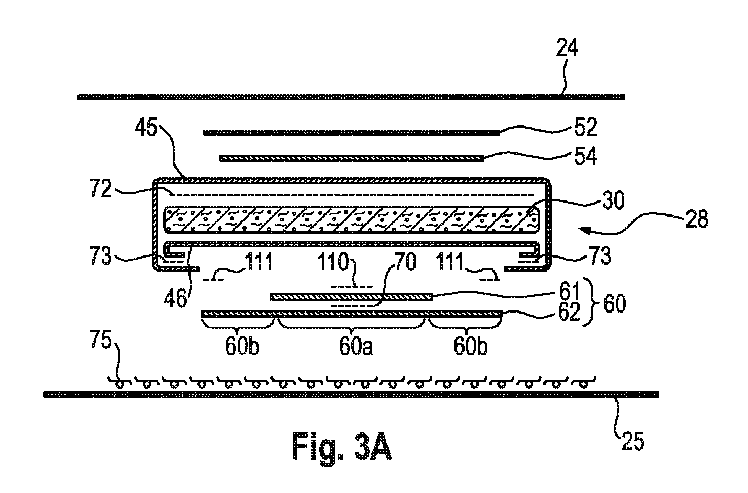
したがって、本発明のこの第1の態様では、クッション層は、第2のサブ層よりも小さい幅を有する少なくとも1つの第1のサブ層を備える。第1の態様の単一の実施が、図3Aに例解されており、第1のサブ層61が、より大きいサブ層62の上部に積層される。第1のサブ層61及び第2のサブ層62は、クッション層60を形成する。サブ層は、図に示すように、長手方向中心線に対して対称に配設されるように、長手方向軸と位置合わせされる。
Thus, in this first aspect of the invention, the cushioning layer comprises at least one first sublayer having a width smaller than the second sublayer. A single implementation of the first aspect is illustrated in FIG. 3A, where a
異なる幅の2つのサブ層を提供することによって、より狭いサブ層61の幅に対応するより高い坪量の中心エリア60aを含むクッション層60が提供される。中心エリア60aの横方向外向きに配設された2つの側方エリア60bは、中心エリア60aよりも低い坪量を有する。この構造は、クッション層の側面に使用されるクッション材料が少ないので、材料が経済的であるという利点を有する。また、物品の可撓性は、側方エリアにおけるクッション層のより低い坪量に起因して、物品の側面において改善される。
By providing two sublayers of different widths, a
サブ層は、有利には、同じクッション材料で作製される。異なるサブ層はまた、有利には、(長手方向中心線80に沿って測定される)同じ長さを有し、これは、ほぼ吸収性コアの長さであり得るか、又は吸収性コアの長さよりも短くあり得る。サブ層の長さは、吸収性コアの長さの40%~100%、例えば、吸収性コアの長さの50%~90%の範囲内に含まれ得る。 The sublayers are advantageously made of the same cushioning material. The different sublayers also advantageously have the same length (measured along the longitudinal centerline 80), which may be approximately the length of the absorbent core or may be shorter than the length of the absorbent core. The length of the sublayers may be comprised within the range of 40% to 100% of the length of the absorbent core, for example 50% to 90% of the length of the absorbent core.
同じ長さのサブ層を有することは、物品の構造を単純化する。クッション材料の単一ウェブは、単一ウェブを長手方向に連続的にスリットを入れ、サブ層ウェブを形成し、次いでこれらを横方向に切断し、これらを積層させて、クッション層を形成することによって、いくつかのサブ層に分割することができる。 Having sub-layers of the same length simplifies the construction of the article. A single web of cushioning material can be divided into several sub-layers by successively slitting the single web longitudinally to form sub-layer webs, which are then cut transversely and laminated together to form the cushioning layer.
別個のサブ層を積層させる代替として、クッション材料の元の単一ウェブを折り畳んで、(図13~図15に例示されるように)異なる坪量のエリアを有する同様のクッション層構造を達成し得る。クッション材料は、当該技術分野において既知であるように、製造中に巻き戻される材料のロールとして変換ライン上に提供され得る。単一のロールを使用して、サブ層を作製することは、より安定したプロセスを提供し(ロールが大きいほどより安定である)、一方でロールを交換する前により長い実行時間を提供する。 As an alternative to laminating separate sub-layers, an original single web of cushioning material may be folded to achieve a similar cushioning layer structure with areas of different basis weight (as illustrated in Figures 13-15). The cushioning material may be provided on a converting line as a roll of material that is unwound during production, as is known in the art. Using a single roll to create the sub-layers provides a more stable process (larger rolls are more stable) while providing a longer run time before the roll needs to be changed.
図3Aの例に示されるように、クッション層の中心エリア60aは、2つのサブ層61、62から構成され得るが、側方エリア60bは、単一のサブ層62からなる。したがって、中心エリア60aは、側方エリア60bと比較して、2倍の厚さ及び坪量を有し得る。サブ層が積層される順序は、重要ではない。例えば、狭いサブ層61は、図3A及び図4Aに例解されるように、より大きいサブ層62の上方に配設され得るか、又は逆に、狭いサブ層61は、図9に例解されるように、より大きいサブ層62の下に配設され得る。
As shown in the example of FIG. 3A, the
より大きいサブ層62とより狭いサブ層61との間の幅の差は、所望に応じて選択され得る。全体としてのクッション層の幅(すなわち、積層された層については、より大きい層62の幅)対より狭いサブ層61の幅の比は、例えば、1.10~3.0、特に、1.4~2.5の範囲であり得る。これは、全体的なクッション性と材料使用との間の良好なバランスを提供することができる。例えば、通常の乳児用おむつの場合、より大きい層62の幅は90mmであり得、及びより狭い層61の幅は50mmであり得、その結果、比は1.8となる。
The difference in width between the
他の実施形態も当然のことながら可能であり、例えば、クッション層は、3つ以上のサブ層を備え得る。クッション層は、2つの狭い層61と、1つの広い層62と、を備え得る。クッション層中心エリア60aは、次いで、側方エリア60bと比較して3倍の坪量及び厚さを有する。これは、例えば、図5及び図10に例解される。より大きいクッション層は、図5に表されるように、積層体の底部に配設され得るか、又は図10に表されるように、2つのより狭いサブ層61の間に挟持され得る。
Other embodiments are of course possible, for example the cushioning layer may comprise three or more sub-layers. The cushioning layer may comprise two
図11及び図12は、クッション層が1つの狭いサブ層61及び2つのより大きいサブ層62を含む、更なる代替的な積層構成を示す。これは、中心エリア60aの坪量及び厚さが側方エリア60bの坪量及び厚さの3/2であるクッション層を提供する。図11は、狭いサブ層61が積層体の上部に配設される例を示し、一方で図12は、狭いサブ層61が積層体の底部に配設される例を示す。
11 and 12 show further alternative stacking configurations in which the cushioning layer includes one
概して、クッション層の中心エリア60aにおける坪量及び厚さ対側方エリア60bにおける坪量及び厚さの比Rは、狭いサブ層の数n1及び大きい層の数n2によって、次式に従って定義される:
R=(n1+n2)/n2
Generally, the ratio R of the basis weight and thickness in the
R=(n1+n2)/n2
比Rは、典型的には、4/3~4/1、特に3/2~3/1の範囲内にあり得る。 The ratio R may typically be in the range of 4/3 to 4/1, especially 3/2 to 3/1.
これまで考察してきた例は、サブ層が、典型的には、製作中にクッション層材料の単一の連続ウェブを長手方向にスリットを入れることによって形成されたとしても、個々のサブ層の積層体を形成することによって構築されたものである。クッション層60はまた、クッション層材料の単一ウェブを折り畳むことによって提供され得、そのため長手方向のスリット入れは必要ではない。2つの折り畳みパターンは、特に、図13~図14に例解されるようないわゆるZ折り、及び図15に例解されるようないわゆるオメガ折りが特に考慮され得る。Z折りでは、クッションウェブ材料63は、側方エリア60bの坪量の3倍を有する中心エリア60aを形成するように、2つの長手方向に延在する折り線に沿って折り畳まれる。オメガ折り構成では、クッションウェブ材料64は、4つの長手方向に延在する折り線に沿って折り畳まれ、また側方エリア60bの坪量の3倍を有する中心エリア60aをもたらす。当然のことながら、他の折り畳み構造も可能であり、例えば、Z折りは、2つの追加の折り線が提供され得、中心エリアが側方エリア60bの坪量の5倍となるようにし得る。
The examples considered so far are constructed by forming a stack of individual sub-layers, even though the sub-layers are typically formed by longitudinally slitting a single continuous web of cushioning layer material during manufacture. The
上記で開示した本発明の第1の態様は、以下で更に詳細に説明する、本発明の第2の態様と組み合わされ得るか、又は独立して実施され得る。 The first aspect of the invention disclosed above may be combined with or implemented independently of the second aspect of the invention, which is described in more detail below.
本発明の第2の態様
第1の態様と組み合わされ得る本発明の第2の態様によれば、少なくとも2つのサブ層が、部分的にのみ互いに取り付けられ、そのため、サブ層は、依然として相対的に安定した位置に維持されながら、部分的に分離することができる。取り付けエリアは、実施において、吸収性物品の長手方向軸に沿って位置合わせされ得る。
According to a second aspect of the invention, which may be combined with the first aspect, at least two sub-layers are only partially attached to one another, so that the sub-layers can be partially separated while still being maintained in a relatively stable position. The attachment areas may, in practice, be aligned along the longitudinal axis of the absorbent article.
サブ層が部分的にのみ互いに取り付けられているとき、多層クッション層の剛性が低減され、そのためサブ層が互いに対して少なくとも部分的に自由に移動することが見出された。股領域におけるより高い剛性は、フィット性に影響を与え、股の嵩高さの知覚を増加させ、したがって、股の柔軟性がより望ましい。「単純化された」幾何学形状では、材料の曲げ剛性はキャリパの立方体とともに変化するが、非結合層(摩擦がない場合)では、曲げ剛性の増加は、層の数とともに線形に増大すると考えられる。したがって、結合されていないより薄い層の集合を曲げることは「より容易」である。しかしながら、完全に結合されていないサブ層は、吸収性物品の一体性及びフィット性を大幅に低減させるので、望ましくない。 It has been found that when the sub-layers are only partially attached to one another, the stiffness of the multi-layer cushioning layer is reduced, so that the sub-layers are at least partially free to move relative to one another. Higher stiffness in the crotch area affects fit and increases the perception of crotch bulk, and therefore crotch flexibility is more desirable. In "simplified" geometries, the bending stiffness of the material varies with the cube of caliper, whereas in unbonded layers (when there is no friction), the increase in bending stiffness is believed to increase linearly with the number of layers. Thus, it is "easier" to bend an assembly of thinner layers that are not bonded. However, sub-layers that are not fully bonded are undesirable, as they significantly reduce the integrity and fit of the absorbent article.
取り付けエリアは、当該技術分野で既知の、既知の取り付け手段によって提供され得る。接着剤結合は、典型的には、2つの隣接するサブ層を結合するために使用され得る。図3aに例解されるように、サブ層61、62は、長手方向に延在する中央取り付けエリア70に沿って、一連の長手方向に延在する糊ストライプによって、別のサブ層に接着によって取り付けられ得る。チャネルは、当該技術分野において既知であるように、スロット糊付けによって提供され得る。例えば、通常のおむつでは、スロット間に1mmの間隙を有し、各々が1mm幅を有する6つのストライプが、11mmの合計中央取り付けエリア幅に対して使用され得る。
The attachment areas may be provided by known attachment means known in the art. Adhesive bonding may typically be used to bond two adjacent sub-layers. As illustrated in FIG. 3a, a sub-layer 61, 62 may be adhesively attached to another sub-layer by a series of longitudinally extending glue stripes along a longitudinally extending
2つより多くのサブ層が存在する場合、図5、図8、図10、図11、図12に例示的に示されるように、部分的取り付けエリア70が、隣接するサブ層の各対の間に存在し得る。サブ層が個々の積層された層である場合、中央に位置合わせされた部分的取り付けエリアは、中央取り付けエリア70の外側の側方エリアに対する移動自由度を提供するので、特に有用である。
When there are more than two sublayers, a
サブ層がZ折り構成によって提供される場合、取り付けエリア70’、70’’は、折り目が所定の位置に固定され、吸収性物品の製造中又は着用中に開くことができないように、折り目と位置合わせされ、隣接し得る。図13は、Z状に折り畳まれたクッション層構成を示し、折り畳みは、中心エリア60a(例えば、50mm幅)における坪量の3倍を可能にし、一方、折り畳まれたクッション層の全幅は90mmである。少量の長手方向に適用された糊70’が、プロセスの実現可能性を可能にするために使用される。図14は、使用中に折り目が損傷を受けていないことを確実にするために、より広い糊スロット70’’が使用される、同様のZ折りクッション層構成を示す。
If the sub-layer is provided in a Z-fold configuration, the attachment areas 70', 70'' may be aligned and adjacent to the folds so that the folds are fixed in place and cannot be opened during manufacture or wear of the absorbent article. FIG. 13 shows a Z-folded cushioning layer configuration where the folding allows for three times the basis weight in the
オメガ折り構成では、長手方向に配向された中央取り付けエリア70もまた使用され得る。取り付けエリアは、典型的には、サブ層の長さとほぼ同じ長さであり得るか、又は所望であればより短くあり得る。糊の適用は、当該技術分野で既知のように、連続的又は断続的であり得る。
In an omega fold configuration, a longitudinally oriented
オメガ折りクッション層構成では、オメガ折りはまた、側方エリア60b(例えば、90mm幅)と比較して、中心エリア60a(例えば、50mm幅)において3倍の坪量を可能にする。オメガ折りクッション層の底部において長手方向に配向された中央糊エリア70、110は、サブ層間の部分的な取り付け、及びコアラップの下部基材46への部分的な取り付けを同時に提供するために使用され得る。Z折り及びオメガ折り構成は、クッション材料ウェブのスリット入れを必要としないという点で、比較的単純なプロセスの観点によって提供することができる。
In the omega folded cushion layer configuration, the omega fold also allows for three times the basis weight in the
第3の態様:クッション層-吸収性コア結合パターン
上で開示された第1若しくは第2の態様と組み合わされ得るか、又は組み合わされない可能性のある、本発明の第3の態様によれば、クッション層60の着用者に面する側及びコアラップの下部基材層46は、それらの界面100で互いに部分的にのみ結合される。可能な部分的結合パターンは、それぞれ、図3b及び図4bに例解される。
Third Aspect: Cushioning Layer-Absorbent Core Bonding Pattern According to a third aspect of the invention, which may or may not be combined with the first or second aspects disclosed above, the wearer-facing side of the
このため、クッション層60と下部基材46との間の境界面100は、層が互いに結合される結合部分110、111と、クッション層がコアラップの下部基材に結合されない非結合部分120と、を含み得る。結合部分では、2つの層は、好ましくは、接着によって結合される。本発明者らは、クッション層を吸収性コアにそれらの界面で完全に糊付けすることと比較して、部分的な結合が物品の横方向剛性を低減し得ることを見出した。
Thus, the
結合部分及び非結合部分は、各々いくつかの別個のゾーンを備え得る。結合部分は、特に、物品の長手方向中心線と少なくとも部分的に重なり合う、長手方向に延在する中央ゾーン110を備え得る。結合部分はまた、図3Bに例解されるように、境界面の各角部に配設された最大4つの角部結合ゾーン111、又は図4Bに例解されるように、それぞれ、境界面100の前縁部及び後縁部に隣接して配設された1つ若しくは2つの横方向結合ゾーン112を備え得る。図3Bの結合パターンは、図4~図15に部分的に表されているが、図4Bの結合パターン又は長手方向に延在する中央ゾーン110のみを含む結合パターンなどの別の結合パターンもまた、これらの例において使用され得る。
The bonded and unbonded portions may each comprise several distinct zones. The bonded portion may in particular comprise a longitudinally extending
図7は、本発明の第3の態様の代替的な実施形態を示しており、ここでは、2つの等しい大きさのサブ層が積層され、広い取り付けエリア71によって、例えば、スパイラル糊付け又はスロットコーティングによって、ともに向かい合った関係で広く取り付けられる。この実施形態は、上で説明された第1及び第2の態様の利点を有しないが、それでも、クッション層の上側と下部基材コアラップとの間の界面100における部分的結合パターンに起因して、改善された可撓性を有する物品を依然として提供する。
Figure 7 shows an alternative embodiment of the third aspect of the invention, in which two equally sized sub-layers are laminated and widely attached together in face-to-face relationship by a
クッション層材料
クッション層60を形成する材料は、不織布層から構成されるか、又は不織布層からなり得るが、他の材料も除外されない。不織布層は、一般的に、吸収性物品内に使用され、従来の技術を使用して吸収性物品内に長手方向にスリットを入れ、横断方向に切断し、配設し、及び取り付けることができる。
Cushioning Layer Material The material forming the
一般的に使用される繊維材料(PE、PP、PET、coPET、Bico、又はこれらの繊維を他の繊維と混合したもの)が使用され得る。所望であれば、個々の繊維又は不織布全体を処理して、流体透過性層又は流体不透過性バリアなどの特定の流体処理特性を向上させることができる。 Commonly used fiber materials can be used (PE, PP, PET, coPET, Bico, or blends of these fibers with other fibers). If desired, individual fibers or the entire nonwoven can be treated to enhance specific fluid handling properties, such as a fluid-permeable layer or a fluid-impermeable barrier.
クッション層はまた、吸収性材料の層の吸収性材料によって十分に急速に吸収されなかったため、吸収性材料を通って流れた液体のための一時的なリザーバとして、又は下部捕捉及び分配層として機能し得る。代替的に、クッション層を形成する材料は、実質的に液体不透過性(疎水性)であるように選択されて、物品の衣類に面する側上に更なる液体バリアを提供し得る。 The cushioning layer may also function as a temporary reservoir for liquid that has flowed through the absorbent material that was not absorbed rapidly enough by the absorbent material of the layer of absorbent material, or as a lower acquisition and distribution layer. Alternatively, the material forming the cushioning layer may be selected to be substantially liquid impermeable (hydrophobic) to provide an additional liquid barrier on the garment-facing side of the article.
吸収性物品に提供される追加の層は、概して、物品の厚さ及びバルクを増加させ、そのため着用者の快適性を低減させる。また、特に着用者の脚の間でのバルクの増加は、一般に望ましくない。したがって、本明細書において説明されたキャリパ測定方法に従って、0.85kPaの圧力で測定した際、0.4mm~最大4mmの範囲内、例えば、0.5mm~2mmの範囲内にあるようにクッション層のキャリパを制限することが望ましい場合がある。キャリパは、クッション層の最も厚い領域で測定され、これは典型的には、積層体又は折り畳まれた層のいずれかとして最大数のサブ層が存在する中央領域60aである。
Additional layers provided in an absorbent article generally increase the thickness and bulk of the article, thus reducing comfort for the wearer. Also, increased bulk, especially between the legs of the wearer, is generally undesirable. Therefore, it may be desirable to limit the caliper of the cushioning layer to be within the range of 0.4 mm to a maximum of 4 mm, for example, within the range of 0.5 mm to 2 mm, when measured at a pressure of 0.85 kPa according to the caliper measurement method described herein. The caliper is measured in the thickest region of the cushioning layer, which is typically the
サブ層の坪量は、典型的には、各サブ層に関して同じであるが、他の構成も可能である。典型的には、各サブ層は、10g/m2~40g/m2の範囲内に含まれる坪量を有し得る。積層体又は折り畳まれた層のいずれかとして最大数のサブ層が存在するクッション層の坪量は、典型的には、24g/m2~100g/m2の範囲内にあり得るが、他の値、例えば、30g/m2~80g/m2も可能である。 The basis weight of the sub-layers is typically the same for each sub-layer, although other configurations are possible. Typically, each sub-layer may have a basis weight falling within the range of 10 g/ m2 to 40 g/ m2 . The basis weight of the cushioning layer in which the greatest number of sub-layers are present, either as a laminate or folded layer, may typically be in the range of 24 g/ m2 to 100 g/ m2 , although other values are possible, for example, 30 g/ m2 to 80 g/ m2 .
サブ層の坪量は、典型的には、クッション層の長さ及び幅全体にわたって(すなわち、長手方向及び横方向に)均質である。材料の坪量は、典型的には、使用されるクッション材料の供給業者から既知である。未知の材料が使用される場合、それは、当該技術分野で既知であるように、クッション層の重量を考慮されるエリアに対してその表面によって除算することによって計算することができる。 The basis weight of the sub-layer is typically homogenous throughout the length and width of the cushioning layer (i.e., longitudinally and laterally). The basis weight of the material is typically known from the supplier of the cushioning material used. If an unknown material is used, it can be calculated by dividing the weight of the cushioning layer by its surface for the area considered, as is known in the art.
クッション層は、好ましくは、超吸収性ポリマー粒子を含まない。カーディングされた不織布(ステープル繊維から作製された)が特に好適であることが見出された。カーディングされた不織布は、当該技術分野において既知であるように、カレンダー結合又はエアスルー接着され得る。不織布層はまた、スパンボンド若しくはメルトブローン不織布ウェブ(連続繊維から作製された)、又はスパンボンド及びメルトブローン層を有する不織布(例えば、SMS、SMMS、SMSS、SSS、SSSSなど)であり得る。 The cushioning layer is preferably free of superabsorbent polymer particles. Carded nonwovens (made from staple fibers) have been found to be particularly suitable. Carded nonwovens may be calendar bonded or air-through bonded as known in the art. The nonwoven layer may also be a spunbond or meltblown nonwoven web (made from continuous fibers), or a nonwoven having spunbond and meltblown layers (e.g., SMS, SMMS, SMSS, SSS, SSSS, etc.).
エアスルー接着不織布は、概して、高いロフトを有する。したがって、それらは、液体を吸収及び一時的に保持するための空隙容積を提供するための多孔質構造を有する。同時に、それらは、柔らかさを提供し、過度に高い曲げ剛性を有しない。 Air-through bonded nonwovens generally have a high loft. Thus, they have a porous structure to provide void volume for absorbing and temporarily retaining liquid. At the same time, they provide softness and do not have excessively high bending stiffness.
クッション層は、クッション層の総重量に基づいて、少なくとも30重量%、任意選択的に、少なくとも50重量%、最大100重量%の捲縮繊維を含み得る。捲縮繊維は、二次元捲縮、三次元捲縮、又は二次及び三次元捲縮の組み合わせを有し得る。典型的には、カーディングプロセスでは、全て又はほとんどの繊維が、二次元的に捲縮される(ジグザグ)のに対して、偏心二成分繊維は、典型的には、三次元捲縮され得る。捲縮繊維は、不織布の嵩高さ及び空隙容量を駆動するのに役立ち得る。 The cushioning layer may include at least 30% by weight, optionally at least 50% by weight, and up to 100% by weight, of crimped fibers, based on the total weight of the cushioning layer. The crimped fibers may have two-dimensional crimp, three-dimensional crimp, or a combination of two-dimensional and three-dimensional crimp. Typically, in a carding process, all or most of the fibers are crimped in two dimensions (zigzag), whereas eccentric bicomponent fibers may typically be crimped in three dimensions. The crimped fibers may help drive the loft and void volume of the nonwoven.
クッション層、特にその構成サブ層は、合成繊維から作製されるか、又は合成繊維からなり得る。特に、好適な剛性繊維は、ポリオレフィン(例えば、ポリエチレン、ポリプロピレン又はそれらの混合物若しくは組み合わせ)、ポリエチレンテレフタレート(PET)、co-PET、ポリ乳酸(PLA)、ポリヒドロキシアルカノイド(PHA)、又はこれらの組み合わせ若しくは混合物から作製される。繊維は、連続又はスパンボンド繊維であり得る。繊維は、単成分繊維又は二成分繊維などの多成分繊維であり得る。クッション層に含まれる繊維が二成分繊維である場合、それらはコアシース構成を有し、コア構成要素は、シース構成要素よりも高い融点を有する。 The cushioning layer, and in particular its constituent sub-layers, may be made of or consist of synthetic fibers. In particular, suitable stiff fibers are made of polyolefins (e.g., polyethylene, polypropylene or mixtures or combinations thereof), polyethylene terephthalate (PET), co-PET, polylactic acid (PLA), polyhydroxy alkanoids (PHA), or combinations or mixtures thereof. The fibers may be continuous or spunbond fibers. The fibers may be monocomponent fibers or multicomponent fibers, such as bicomponent fibers. When the fibers included in the cushioning layer are bicomponent fibers, they have a core-sheath configuration, with the core component having a higher melting point than the sheath component.
クッション層に含まれる繊維は、好ましくは、ステープル繊維である。連続繊維で作製された不織布ウェブと同様に、ステープル繊維の不織布ウェブは、好ましくは、エアスルー接着されたものである。水流交絡(スパンレース)又はエアスルー接着に加えて、ステープル繊維の不織布ウェブは、熱及び/若しくは圧力(例えば、点結合/カレンダー結合)でいくらかの局所的結合を受けるか、又は受けない可能性があり、繊維が互いに融合される局所的な結合領域を導入する。 The fibers included in the cushioning layer are preferably staple fibers. As with nonwoven webs made with continuous fibers, the staple fiber nonwoven webs are preferably air-through bonded. In addition to hydroentanglement (spunlace) or air-through bonding, the staple fiber nonwoven webs may or may not undergo some localized bonding with heat and/or pressure (e.g., point bonding/calendar bonding) to introduce localized bond areas where the fibers are fused together.
不織布ウェブが連続繊維又はステープル繊維で作製されているかどうかに関係なく、局所的結合は、しかしながら、過度に大きい表面積に結合し、このため不織布ウェブのロフト及び空隙容積に悪影響を及ぼしてはならない。好ましくは、(水流交絡又はエアスルー接着に加えて)熱及び/又は圧力での局所的結合によって得られる総結合面積は、不織布ウェブの総表面積の20%より大きい、又は15%より大きい、又は10%より大きくあるべきではない。 Regardless of whether the nonwoven web is made of continuous or staple fibers, the localized bonds, however, must not bond to an excessively large surface area and thus adversely affect the loft and void volume of the nonwoven web. Preferably, the total bond area provided by localized heat and/or pressure bonding (in addition to hydroentanglement or air-through bonding) should not be greater than 20%, or greater than 15%, or greater than 10% of the total surface area of the nonwoven web.
スルーエア接着(「エアスルー接着」という用語と交換可能に使用される)は、空気を不織布ウェブに押し通すことによって、ステープル繊維又は連続繊維を接着するプロセスを意味し、空気が、繊維のポリマーを溶融する(若しくは少なくとも部分的に溶融する、若しくは繊維の表面が十分にべとついた状態になるまで溶融する)のに十分に高温であるか、又は繊維が多成分繊維である場合、空気が、不織布ウェブの繊維が作製されるポリマーのうちの1つを溶融する(若しくは少なくとも部分的に溶融する、若しくは繊維の表面が十分にべとついた状態になるまで溶融する)のに十分に高温である。空気速度は、典型的には、毎分30~90メートルであり、滞留時間は、最長6秒であり得る。ポリマーの溶融及び再固化は、異なる繊維間の結合を提供する。 Through-air bonding (used interchangeably with the term "air-through bonding") refers to the process of bonding staple or continuous fibers by forcing air through the nonwoven web, where the air is hot enough to melt (or at least partially melt, or melt until the surface of the fiber is sufficiently tacky) the polymer of the fiber, or, if the fiber is a multicomponent fiber, the air is hot enough to melt (or at least partially melt, or melt until the surface of the fiber is sufficiently tacky) one of the polymers from which the fibers of the nonwoven web are made. Air velocities are typically 30-90 meters per minute, and residence times can be up to 6 seconds. The melting and resolidification of the polymer provides the bond between the different fibers.
熱空気は、ステープル若しくは連続繊維、又は多成分繊維の場合、繊維の低融点ポリマー成分を溶融し、それによってステープル繊維間に結合を形成して、ステープル繊維の層をウェブに固結及び統合する。 The hot air melts the staple or continuous fibers, or in the case of multicomponent fibers, the low melting polymer component of the fibers, thereby forming bonds between the staple fibers and consolidating and consolidating the layers of staple fibers into a web.
クッション層に含まれるか、又はクッション層を形成する不織布層は、多成分繊維を含み得る。不織布の繊維は、下部捕捉及び分配層に含まれる不織布の総重量に基づいて、少なくとも30重量%、又は少なくとも40重量%、又は少なくとも50重量%、又は少なくとも70重量%、又は少なくとも90重量%、又は100重量%の多成分繊維を含み得る。多成分繊維は、コアシース又は並列二成分繊維などの、二成分繊維であり得る。 The nonwoven layer included in or forming the cushioning layer may include multicomponent fibers. The fibers of the nonwoven may include at least 30% by weight, or at least 40% by weight, or at least 50% by weight, or at least 70% by weight, or at least 90% by weight, or 100% by weight of multicomponent fibers, based on the total weight of the nonwoven included in the lower acquisition and distribution layer. The multicomponent fibers may be bicomponent fibers, such as core-sheath or side-by-side bicomponent fibers.
代替的に、不織布層は、単成分繊維を含み得る。下部捕捉及び分配層に含まれる不織布の繊維は、下部捕捉及び分配層に含まれる不織布の総重量に基づいて、少なくとも30重量%、又は少なくとも40重量%、又は少なくとも50重量%、又は少なくとも70重量%、又は少なくとも90重量%、又は100重量%の単成分繊維を含み得る。クッション層に含まれるか、又はクッション層を形成する不織布ウェブは、単成分繊維と多成分繊維との混合物を含み得る。 Alternatively, the nonwoven layer may comprise monocomponent fibers. The fibers of the nonwoven in the lower acquisition and distribution layer may comprise at least 30% by weight, or at least 40% by weight, or at least 50% by weight, or at least 70% by weight, or at least 90% by weight, or 100% by weight of monocomponent fibers, based on the total weight of the nonwoven in the lower acquisition and distribution layer. The nonwoven web in or forming the cushioning layer may comprise a mixture of monocomponent and multicomponent fibers.
クッション層は、下部捕捉及び分配層として使用される場合、特にクッション層が本質的に疎水性である合成繊維を含むか又はそれからなる場合、親水性剤を含み得る。親水性剤を提供する任意の従来の親水性処理を使用することができる。典型的には、不織布などのウェブは、界面活性剤によって直接、又は油/エマルジョンを介して外側をコーティングされ得る。代替的に、当該技術分野で知られているように、親水性溶融添加剤を、繊維を作製するために使用されるポリマー溶融物中に添加することができる。親水性溶融添加剤は、親水性頭部及び疎水性尾部を有する両親媒性分子である。親水性頭部は、接着剤の表面に向かって配向され、したがって、接着剤の親水性特徴を提供し、一方、疎水性頭部は、ポリマーマトリックス中に留まっている。下部捕捉及び分配層60、並びに下部基材層46は、有利には、両方とも親水性であり得る。下部捕捉及び分配層は、任意選択的に、下部基材層よりも低い親水性であり得る。
The cushioning layer, when used as a lower acquisition and distribution layer, may include a hydrophilic agent, especially when the cushioning layer includes or consists of synthetic fibers that are hydrophobic in nature. Any conventional hydrophilic treatment that provides a hydrophilic agent may be used. Typically, a web such as a nonwoven may be coated on the outside with a surfactant directly or via an oil/emulsion. Alternatively, as known in the art, a hydrophilic melt additive may be added in the polymer melt used to make the fibers. The hydrophilic melt additive is an amphiphilic molecule with a hydrophilic head and a hydrophobic tail. The hydrophilic head is oriented toward the surface of the adhesive, thus providing the hydrophilic character of the adhesive, while the hydrophobic head remains in the polymer matrix. The lower acquisition and
他の考慮事項
スホールとしてのクッション層60は、典型的には、コアラップの表面と同じか又はそれよりも小さい全表面を有し得る。クッション層は、有利には、吸収性コアを完全に被覆する代わりに、吸収性コアの選択されたエリア、特に、吸収性物品の股領域の少なくとも一部分を被覆するように配設され得る。クッション層は、典型的には、コアラップ層の坪量と少なくとも等しい、典型的には、それよりも高い坪量を有する。第1の態様によれば、クッション層は、20g/m2超の坪量を有し得る。更なる態様によれば、クッション層の衣類に面する側の表面の少なくとも50%は、特に、チャネル26に垂直に対応するエリアにおいて、バックシートに直接又は間接的に結合され得る。
Other Considerations The
吸収性コアは、任意選択的に、吸収性材料を実質的に含まない吸収性層内に少なくとも1つのチャネルを含み得る。チャネルは、吸収層が尿などの液体を吸収した後に膨潤する場合、使用時に三次元チャネルを形成する。吸収性コアラップの上部基材45及び下部基材46側は、特に、チャネルエリアにおいて互いに結合され得る。クッション層は、有利には、チャネルエリアにおいてコアラップ下部基材46から分離され得る。
The absorbent core may optionally include at least one channel in the absorbent layer that is substantially free of absorbent material. The channel forms a three-dimensional channel in use when the absorbent layer swells after absorbing liquid such as urine. The
パッケージ
本発明による複数の物品は、輸送及び販売のためにパッケージに包装され得る。パッケージ内の物品の少なくとも50%、好ましくは全ての物品は、本発明によるものであり得る。物品は、当該技術分野において既知であるように、折り畳まれて包装され得る。パッケージは、例えば、プラスチックバッグ又は段ボール箱であり得る。おむつは、包装される前に、典型的には横断方向軸線に沿って2つに折り畳まれ、耳部は内向きに折り畳まれ得る。吸収性物品は、パッケージのサイズを低減する一方で、1パッケージ当たりに適切な数の吸収性物品を提供するように、圧縮下で包装することができる。吸収性物品を圧縮下で包装することにより、介護者はパッケージを容易に扱い、保管することができると同時に、パッケージのサイズによる流通コストの削減を製造者にもたらし得る。
Package A plurality of articles according to the present invention may be packaged in a package for shipping and sale. At least 50% of the articles in the package, preferably all of the articles, may be according to the present invention. The articles may be folded and packaged as known in the art. The package may be, for example, a plastic bag or a cardboard box. Diapers are typically folded in two along a transverse axis before packaging, and the ears may be folded inward. The absorbent articles may be packaged under compression to reduce the size of the package while providing an appropriate number of absorbent articles per package. Packaging the absorbent articles under compression may allow the caregiver to easily handle and store the package, while at the same time providing the manufacturer with reduced distribution costs due to the size of the package.
したがって、吸収性物品は、少なくとも10%、特に10%~50%、特に20%~40%のバッグ内圧縮率で圧縮され、包装され得る。本明細書で使用される「バッグ内圧縮率」は、1から、10個の折り畳まれた物品をバッグ内の圧縮下で測定した積層体の高さ(「バッグ内積層体高さ」)を10個の折り畳まれた同じタイプの物品の圧縮前の積層体高さで除算した数を引いてから100倍した数であり、すなわち、(1-バッグ内積層体高さ/圧縮前積層体高さ)×100を百分率として報告したものである。当然のことながら、バッグ内積層体は、厳密に10個の物品を有する必要がなく、パッケージ内の物品の積層体高さについて測定された値を、積層体内の物品数で乗算し、次いで10倍した数である。バッグ内積層体高さを測定するために使用される方法は、試験手順において更に詳細に説明される。圧縮前の物品は、折り畳みユニットと積層体包装ユニットとの間の生産ラインからサンプリングされる。圧縮前の積層体高さは、圧縮及び包装前に10個の物品を取り、IBSHについて示されるようにそれらの積層体高さを測定することによって測定される。 Thus, the absorbent article may be compressed and packaged with an in-bag compression ratio of at least 10%, particularly 10% to 50%, particularly 20% to 40%. As used herein, "in-bag compression ratio" is 1 minus the stack height measured under compression of 10 folded articles in a bag ("in-bag stack height") divided by the uncompressed stack height of 10 folded articles of the same type, multiplied by 100, i.e. (1-in-bag stack height/uncompressed stack height) x 100 reported as a percentage. Of course, an in-bag stack need not have exactly 10 articles, but is the measured stack height of the articles in the package multiplied by the number of articles in the stack, then multiplied by 10. The method used to measure the in-bag stack height is described in more detail in the test procedure. Uncompressed articles are sampled from the production line between the folding unit and the stack packaging unit. The pre-compression stack height is measured by taking 10 items before compression and packaging and measuring their stack height as shown for IBSH.
本開示の吸収性物品のパッケージは、特に、本明細書で説明するバック内積層体高さ試験により、110mm未満、105mm未満、100mm未満、95mm未満、90mm未満、具体的には指定される範囲、及び指定される範囲内に又は指定される範囲によって形成される全ての範囲内の0.1mm刻みの増分が全て列挙されるバッグ内積層体高さを有し得る。前の文で示された値の各々に関して、60超、又は70mm超、又は75mm超、又は80mm超のバッグ内積層体高さを有することが望ましい場合がある。代替的に、本開示の吸収性物品のパッケージは、本明細書において説明されるバック内積層体高さ試験に従って、60mm~110mm、65mm~110mm、70mm~110mm、75mm~105mm、又は80mm~100mm、具体的には、指定される範囲、及び指定される範囲内に又は指定される範囲によって形成される全ての範囲内の0.1mm刻みの増分が全て列挙されるバッグ内積層体高さを有し得る。 The absorbent article packages of the present disclosure may have in-bag stack heights, in particular, less than 110 mm, less than 105 mm, less than 100 mm, less than 95 mm, less than 90 mm, and all of the ranges specifically listed, and all ranges formed by or within the ranges specified, as per the In-Bag Stack Height Test described herein. For each of the values set forth in the previous sentence, it may be desirable to have in-bag stack heights greater than 60, or greater than 70 mm, or greater than 75 mm, or greater than 80 mm. Alternatively, the package of absorbent articles of the present disclosure may have an in-bag stack height according to the in-bag stack height test described herein of 60 mm to 110 mm, 65 mm to 110 mm, 70 mm to 110 mm, 75 mm to 105 mm, or 80 mm to 100 mm, specifically, all of the ranges specified and all 0.1 mm increments within or formed by the ranges specified.
リサイクルに適したバイオベースの吸収性物品
本明細書に記載の吸収性物品の構成要素は、それらがリサイクル可能な材料から少なくとも部分的に形成されているかどうかにかかわらず、他の用途のためにリサイクルされ得る。リサイクルすることができる吸収性物品材料の例は、不織布、フィルム、フラッフパルプ、及び超吸収性ポリマーである。リサイクルプロセスは、吸収性物品を滅菌するためにオートクレーブを使用し得、その後、吸収性物品は、細断され、異なる副生成物流に分離され得る。例示的な副生成物流は、プラスチック、超吸収性ポリマー、及びパルプなどのセルロース繊維を含み得る。これらの副生成物流は、肥料、プラスチック製造物品、紙製品、ビスコース、建築材料、ペット用若しくは病院用ベッドの吸収性パッドの製造において、及び/又は他の用途のために使用することができる。リサイクルを助ける吸収性物品、リサイクルしやすいおむつの設計、並びにリサイクルしやすく、かつバイオベースの構成要素のおむつの設計に関する更なる詳細は、2019年6月27日に公開された、米国特許出願公開第2019/0192723号に開示される。
Bio-based absorbent articles suitable for recycling The components of the absorbent articles described herein, whether or not they are at least partially formed from recyclable materials, can be recycled for other uses. Examples of absorbent article materials that can be recycled are nonwovens, films, fluff pulp, and superabsorbent polymers. The recycling process can use an autoclave to sterilize the absorbent article, which can then be shredded and separated into different by-product streams. Exemplary by-product streams can include plastics, superabsorbent polymers, and cellulose fibers such as pulp. These by-product streams can be used in the manufacture of fertilizers, plastic manufacturing articles, paper products, viscose, building materials, absorbent pads for pets or hospital beds, and/or for other uses. Further details regarding absorbent articles that aid in recycling, designs of diapers that are easy to recycle, and designs of diapers that are easy to recycle and have bio-based components are disclosed in U.S. Patent Application Publication No. 2019/0192723, published June 27, 2019.
試験方法
キャリパ測定方法
クッション層などの層のキャリパは、キャリパ測定方法を使用して決定される。キャリパ測定方法では、2つの平坦な平行表面が、基材試験片の両側に一方向の圧力を適用するために使用され、結果として生じる平行表面間の分離が測定される。全ての測定は、23℃±2℃及び相対湿度50%±2%で維持された実験室で実施され、試験片は、試験前に少なくとも2時間、この環境で馴化される。
Test Methods Caliper Measurement Method The caliper of a layer, such as a cushioning layer, is determined using the caliper measurement method, in which two flat parallel surfaces are used to apply unidirectional pressure to either side of a substrate specimen, and the resulting separation between the parallel surfaces is measured. All measurements are performed in a laboratory maintained at 23°C ± 2°C and 50% ± 2% relative humidity, and specimens are conditioned in this environment for at least 2 hours prior to testing.
キャリパ法で使用するための装置の1つの好適な例は、インジケータゲージの移動シャフトの端部に4.0cmの直径を有する円形の平坦な「フット」が取り付けられたMitutoyo Digimaticシリーズ543ID-Cデジタルインジケータ(Mitutoyo America Corp.、Aurora,Illinois,USA)、又は同等品である。インジケータは、インジケータゲージのシャフトが垂直方向に配向され、円形フットの平面が花崗岩基盤と平行になるように、水平に花崗岩基盤に取り付けられる。円形のフットを、フットの質量とインジケータシャフトとに関連付けられた重力を一緒に円形フットの面積で割った値が、花崗岩基盤の円形フットからの0.85kPaの下向きの圧力をなすようにサイズ決定及び重量測定する。円形フットと花崗岩基盤との間で、少なくとも円形フットと同じ大きさの試験片を分析する。円形フットが試験片と接触した後、キャリパを20秒測定する。所与の材料に関して、10個の試験片を測定し、平均値を材料のキャリパとして報告した。 One suitable example of an apparatus for use in the caliper method is a Mitutoyo Digimatic Series 543ID-C digital indicator (Mitutoyo America Corp., Aurora, Illinois, USA) with a circular flat "foot" with a diameter of 4.0 cm attached to the end of the moving shaft of the indicator gauge, or equivalent. The indicator is mounted horizontally on the granite base so that the shaft of the indicator gauge is oriented vertically and the plane of the circular foot is parallel to the granite base. The circular foot is sized and weighed such that the gravity associated with the mass of the foot and the indicator shaft together divided by the area of the circular foot constitutes a downward pressure of 0.85 kPa from the circular foot on the granite base. A specimen at least as large as the circular foot is analyzed between the circular foot and the granite base. The caliper is measured 20 seconds after the circular foot contacts the specimen. For a given material, 10 specimens were measured and the average value was reported as the caliper of the material.
バッグ内積層体高さ試験
吸収性物品のパッケージのバッグ内積層体高さは、以下のように測定する。
In-Bag Stack Height Test The in-bag stack height of a package of absorbent articles is measured as follows.
機器
平坦な剛性の水平スライディングプレートを備えた厚さ試験機を使用する。厚さ試験機は、水平スライディングプレートが平坦な剛性の水平ベースプレートのすぐ上で水平の向きに常に維持された状態で、水平スライディングプレートが垂直方向に自由に移動するように構成されている。厚さ試験機は、水平スライディングプレートと水平ベースプレートとの間の間隙を+0.5mm以内で測定するのに好適なデバイスを含む。水平スライディングプレート及び水平ベースプレートは、各プレートと接触する吸収性物品パッケージの表面よりも大きい(すなわち、各プレートは全ての方向において吸収性物品パッケージの接触表面を越えて延在する)。水平スライディングプレートは、吸収性物品パッケージに下方への力850±1重量グラム(8.34N)を加えるが、これは、スライディングプレートの合計質量に付加重量を足して850±1グラムとなるように、水平スライディングプレートのパッケージに接触しない上部表面の中央に好適な重しを置くことによって達成し得る。
Equipment: A thickness tester with a flat rigid horizontal sliding plate is used. The thickness tester is configured so that the horizontal sliding plate is free to move vertically while always maintaining a horizontal orientation just above a flat rigid horizontal base plate. The thickness tester includes a device suitable for measuring the gap between the horizontal sliding plate and the horizontal base plate to within +0.5 mm. The horizontal sliding plate and the horizontal base plate are larger than the surface of the absorbent article package that contacts each plate (i.e., each plate extends beyond the contact surface of the absorbent article package in all directions). The horizontal sliding plate applies a downward force of 850±1 grams force (8.34 N) to the absorbent article package, which can be achieved by placing a suitable weight in the center of the top surface of the horizontal sliding plate that does not contact the package, so that the total mass of the sliding plate plus the additional weight is 850±1 grams.
試験手順
吸収性物品パッケージを、測定前に、23±2℃及び50±2%の相対湿度で平衡化する。
Test Procedure The absorbent article packages are equilibrated at 23±2° C. and 50±2% relative humidity prior to measurement.
水平スライディングプレートを上げ、パッケージ内の吸収性物品が水平の配向となるようにして吸収性物品パッケージを水平スライディングプレート下で中心に配置する(図14の国際公開第2021118904(A1)号参照)。プレートのいずれかに接触するであろうパッケージの表面上にある任意のハンドル又は他のパッケージング機構を、パッケージの表面に対して平坦に折り重ねることで、測定に対する影響を最小限にする。水平スライディングプレートを、パッケージの上部表面に接触するまでゆっくり下げてから、解放する。水平スライディングプレートを解放してから10秒後に、水平プレート間の間隙を+0.5mm以内になるように測定する。5つの同じパッケージ(同じサイズのパッケージ及び同じ吸収性物品数)を測定し、算術平均をパッケージ幅として報告する。「バッグ内積層体高さ」=(パッケージ幅/積層体当たりの吸収性物品数)×10を計算し、+0.5mm以内で報告する。 Raise the horizontal sliding plate and center the absorbent article package under the horizontal sliding plate with the absorbent articles in the package in a horizontal orientation (see WO2021118904(A1) in FIG. 14). Any handles or other packaging features on the surface of the package that would contact any of the plates are folded flat against the surface of the package to minimize their effect on the measurement. Slowly lower the horizontal sliding plate until it touches the top surface of the package and then release it. 10 seconds after releasing the horizontal sliding plate, measure the gap between the horizontal plates to within +0.5 mm. Measure five identical packages (same size package and same number of absorbent articles) and report the arithmetic average as the package width. Calculate "stack height in bag" = (package width/number of absorbent articles per stack) x 10 and report to within +0.5 mm.
本明細書に開示される寸法及び値は、列挙された正確な数値に厳密に限定されるものとして理解されるべきではない。その代わりに、別途指定のない限り、このような寸法は各々、列挙された値とその値を囲む機能的に同等な範囲との両方を意味することが意図される。例えば、「40mm」として開示される寸法は、「約40mm」を意味することが意図される。 Dimensions and values disclosed herein should not be understood as being strictly limited to the exact numerical values recited. Instead, unless otherwise specified, each such dimension is intended to mean both the recited value and a functionally equivalent range surrounding that value. For example, a dimension disclosed as "40 mm" is intended to mean "about 40 mm."
Claims (15)
-液体透過性トップシート(24)と、
-液体不透過性バックシート(25)と、
-前記トップシートと前記バックシートとの間の吸収性コア(28)であって、前記吸収性コアが、コアラップを形成する上部基材層(45)と下部基材層(46)との間に配設された吸収性材料(30)を含み、
前記吸収性材料が、任意選択的に、セルロース繊維と混合された、前記吸収性材料の少なくとも50重量%の超吸収性ポリマーを含む、吸収性コア(28)と、
前記吸収性コア(28)と前記バックシート(25)との間に配設されたクッション層(60)であって、前記クッション層(60)が、少なくとも2つのサブ層(61、62、63..)を備える、クッション層(60)と、を備える、吸収性物品(20)。 An absorbent article (20) for personal hygiene having a longitudinal centerline (80) and a transverse centerline (90),
- a liquid-permeable topsheet (24);
- a liquid-impermeable backsheet (25);
- an absorbent core (28) between said topsheet and said backsheet, said absorbent core comprising an absorbent material (30) disposed between an upper substrate layer (45) and a lower substrate layer (46) forming a core wrap;
an absorbent core (28) in which the absorbent material comprises at least 50% by weight of the absorbent material of a superabsorbent polymer, optionally mixed with cellulose fibers;
and a cushioning layer (60) disposed between the absorbent core (28) and the backsheet (25), the cushioning layer (60) comprising at least two sublayers (61, 62, 63...).
Priority Applications (1)
| Application Number | Priority Date | Filing Date | Title |
|---|---|---|---|
| JP2025138911A JP2025169410A (en) | 2021-09-10 | 2025-08-22 | Absorbent article including multi-layer cushioning layer |
Applications Claiming Priority (3)
| Application Number | Priority Date | Filing Date | Title |
|---|---|---|---|
| EP21196063.8 | 2021-09-10 | ||
| EP21196063.8A EP4147684A1 (en) | 2021-09-10 | 2021-09-10 | Absorbent article comprising a multi-layer cushion layer |
| PCT/US2022/076018 WO2023039401A1 (en) | 2021-09-10 | 2022-09-07 | Absorbent article comprising a multi-layer cushion layer |
Related Child Applications (1)
| Application Number | Title | Priority Date | Filing Date |
|---|---|---|---|
| JP2025138911A Division JP2025169410A (en) | 2021-09-10 | 2025-08-22 | Absorbent article including multi-layer cushioning layer |
Publications (1)
| Publication Number | Publication Date |
|---|---|
| JP2024530764A true JP2024530764A (en) | 2024-08-23 |
Family
ID=77710687
Family Applications (2)
| Application Number | Title | Priority Date | Filing Date |
|---|---|---|---|
| JP2024513544A Pending JP2024530764A (en) | 2021-09-10 | 2022-09-07 | ABSORBENT ARTICLE COMPRISING A MULTI-LAYER CUSHIONING LAYER - Patent |
| JP2025138911A Pending JP2025169410A (en) | 2021-09-10 | 2025-08-22 | Absorbent article including multi-layer cushioning layer |
Family Applications After (1)
| Application Number | Title | Priority Date | Filing Date |
|---|---|---|---|
| JP2025138911A Pending JP2025169410A (en) | 2021-09-10 | 2025-08-22 | Absorbent article including multi-layer cushioning layer |
Country Status (5)
| Country | Link |
|---|---|
| US (2) | US12419793B2 (en) |
| EP (1) | EP4147684A1 (en) |
| JP (2) | JP2024530764A (en) |
| CN (1) | CN117940094A (en) |
| WO (1) | WO2023039401A1 (en) |
Families Citing this family (1)
| Publication number | Priority date | Publication date | Assignee | Title |
|---|---|---|---|---|
| WO2025048782A1 (en) * | 2023-08-29 | 2025-03-06 | Kimberly-Clark Worldwide, Inc. | An absorbent article with a wrapped absorbent core |
Citations (3)
| Publication number | Priority date | Publication date | Assignee | Title |
|---|---|---|---|---|
| JP2015188715A (en) * | 2014-03-28 | 2015-11-02 | 花王株式会社 | absorbent article |
| JP2019118587A (en) * | 2017-12-29 | 2019-07-22 | 花王株式会社 | Absorber and absorbent article |
| US20190374397A1 (en) * | 2018-06-11 | 2019-12-12 | The Procter & Gamble Company | Reversible and configurable absorbent articles |
Family Cites Families (185)
| Publication number | Priority date | Publication date | Assignee | Title |
|---|---|---|---|---|
| US3799167A (en) | 1971-12-30 | 1974-03-26 | Cellu Prod Co | Disposable absorbent pad |
| US3860003B2 (en) | 1973-11-21 | 1990-06-19 | Contractable side portions for disposable diaper | |
| US4257418A (en) | 1979-01-22 | 1981-03-24 | Mo Och Domsjo Aktiebolag | Device for absorbing urine with incontinent persons |
| US4315508A (en) | 1980-03-31 | 1982-02-16 | Kimberly-Clark Corporation | Self-centering multiple use garment suspension system |
| SE436466B (en) | 1980-07-25 | 1984-12-17 | Moelnlycke Ab | The disposable diaper |
| US4661102A (en) | 1985-12-03 | 1987-04-28 | The Procter & Gamble Company | Disposable diaper featuring crotch tensioning means for improved leakage resistance and fit |
| JPH0771567B2 (en) | 1986-02-20 | 1995-08-02 | ユニ・チヤ−ム株式会社 | Disposable diapers |
| DE3810473A1 (en) | 1988-03-26 | 1989-10-05 | Dietrich Wolfgang Peter Herber | Nappy, in particular for infants |
| US4950264A (en) * | 1988-03-31 | 1990-08-21 | The Procter & Gamble Company | Thin, flexible sanitary napkin |
| US5026364A (en) | 1988-12-21 | 1991-06-25 | The Procter & Gamble Company | Absorbent article having unitary waistcap and waistband |
| CN1024746C (en) | 1989-12-20 | 1994-06-01 | 李清祈 | Boiler with heat energy regulating component |
| US5221274A (en) | 1991-06-13 | 1993-06-22 | The Procter & Gamble Company | Absorbent article with dynamic elastic waist feature having a predisposed resilient flexural hinge |
| CA2072665C (en) | 1992-02-26 | 2002-06-18 | David Arthur Kuen | Disposable absorbent garment |
| US6010490A (en) | 1992-12-18 | 2000-01-04 | The Procter & Gamble Company | Absorbent article having an upstanding transverse partition |
| KR970009710B1 (en) | 1992-12-30 | 1997-06-17 | 킴벌리-클라크 코포레이션 | Garment attachment system |
| EP0618148B1 (en) | 1993-03-30 | 1997-10-29 | The Procter & Gamble Company | Sleeved stacks for compact packaging of flexible articles |
| SE508027C2 (en) | 1993-05-12 | 1998-08-10 | Moelnlycke Ab | Belt fastening device |
| SE508186C2 (en) | 1993-05-12 | 1998-09-07 | Moelnlycke Ab | Fixing belt for garments of absorbent material |
| US5383871A (en) | 1993-06-03 | 1995-01-24 | The Procter & Gamble Company | Absorbent articles having a closure system providing sustained dynamic fit |
| HUT73113A (en) | 1993-06-03 | 1996-06-28 | Procter & Gamble | Absorbent article having z-folded cuffs providing improved fit and containment |
| US5707364A (en) | 1993-08-11 | 1998-01-13 | Tailored Technologies, Inc. | Tailored and protective undergarments |
| JP4176145B2 (en) | 1993-10-21 | 2008-11-05 | ザ プロクター アンド ギャンブル カンパニー | Menstrual absorption structure |
| US5433715A (en) | 1993-10-29 | 1995-07-18 | Kimberly-Clark Corporation | Absorbent article which includes superabsorbent material located in discrete pockets having water-sensitive and water-insensitive containment structures |
| HU220956B1 (en) | 1993-11-19 | 2002-07-29 | The Procter & Gamble Co. | Absorbent article extending in several directions with side elements |
| US5554145A (en) | 1994-02-28 | 1996-09-10 | The Procter & Gamble Company | Absorbent article with multiple zone structural elastic-like film web extensible waist feature |
| CA2129210A1 (en) | 1994-03-31 | 1995-10-01 | Debra Jean Mcdowall | Liquid distribution layer for absorbent articles |
| JP3205471B2 (en) | 1994-08-04 | 2001-09-04 | 昭和飛行機工業株式会社 | Manufacturing method of honeycomb core |
| US5702377A (en) | 1994-09-01 | 1997-12-30 | Kimberly-Clark Worldwide, Inc. | Wet liner for child toilet training aid |
| SE503779C2 (en) | 1994-12-30 | 1996-09-02 | Moelnlycke Ab | Absorbent articles, comprising a receiving space in a storage layer, which upon wetting increases in extent perpendicular to the surface of the article and absorbent body |
| US5580411A (en) | 1995-02-10 | 1996-12-03 | The Procter & Gamble Company | Zero scrap method for manufacturing side panels for absorbent articles |
| US5569234A (en) | 1995-04-03 | 1996-10-29 | The Procter & Gamble Company | Disposable pull-on pant |
| EP0796071B1 (en) | 1995-10-05 | 2001-12-19 | Kao Corporation | Disposable diaper |
| US5827259A (en) | 1995-10-25 | 1998-10-27 | Kimberly-Clark Worldwide, Inc. | Absorbent article with waist elastic and containment system |
| US6315764B1 (en) | 1995-12-20 | 2001-11-13 | Kimberly-Clark Worldwide, Inc. | Absorbent article having a rear reservoir with void volume capacity |
| US5685874A (en) | 1996-02-22 | 1997-11-11 | The Procter & Gamble Company | Disposable pull-on pant |
| SE9600965L (en) | 1996-03-13 | 1997-03-17 | Moelnlycke Ab | Waist belt for absorbent articles and method of manufacture thereof |
| US6336922B1 (en) | 1996-06-19 | 2002-01-08 | Kimberly-Clark Worldwide, Inc. | Absorbent article having a fit panel |
| US5938652A (en) | 1996-06-19 | 1999-08-17 | Kimberly-Clark Worldwide, Inc. | Absorbent article having a selectively elasticized waist flap |
| SE512826C2 (en) | 1997-02-26 | 2000-05-22 | Sca Hygiene Prod Ab | Absorbent articles with liquid barrier with sealing coating |
| US5843066A (en) | 1997-03-06 | 1998-12-01 | The Procter & Gamble Company | Absorbent article having a breathable backsheet |
| US5993433A (en) | 1997-10-20 | 1999-11-30 | Kimberly-Clark Worldwide, Inc. | Absorbent article with enhanced elastic design for improved aesthetics and containment |
| US6013063A (en) | 1997-11-14 | 2000-01-11 | The Procter & Gamble Company | Viscous fluid bodily waste management article |
| JP3434695B2 (en) | 1997-12-26 | 2003-08-11 | ユニ・チャーム株式会社 | Disposable diapers |
| US6371950B1 (en) | 1997-12-30 | 2002-04-16 | Kimberly-Clark Worldwide, Inc. | Incontinence article for males |
| US6132410A (en) | 1998-05-07 | 2000-10-17 | Kimberly-Clark Worldwide, Inc. | Disposable garment having dryness barriers with expandable attachment to an absorbent |
| US6673982B1 (en) * | 1998-10-02 | 2004-01-06 | Kimberly-Clark Worldwide, Inc. | Absorbent article with center fill performance |
| US6135988A (en) | 1998-12-18 | 2000-10-24 | Kimberly-Clark Worldwide, Inc. | Absorbent article with an adhesive flap |
| US6217563B1 (en) | 1999-02-12 | 2001-04-17 | Kimberly-Clark Worldwide, Inc. | Three-dimensional, inward leg gather disposable garment |
| US6534149B1 (en) | 1999-04-03 | 2003-03-18 | Kimberly-Clark Worldwide, Inc. | Intake/distribution material for personal care products |
| US6258076B1 (en) | 1999-05-26 | 2001-07-10 | Confab Services Ag | Disposable absorbent article with waist barrier including skin-friendly adhesive |
| EP1064899A1 (en) | 1999-07-02 | 2001-01-03 | The Procter & Gamble Company | Disposable absorbent article having barrier means, and method of its manufacture |
| KR100676809B1 (en) | 1999-07-14 | 2007-01-31 | 다이오 페이퍼 코퍼레이션 | Disposable absorbent supplies |
| US20030050616A1 (en) | 1999-09-20 | 2003-03-13 | Gary M. Reynolds | Absorbent article having a deployable gasket element |
| JP4219069B2 (en) | 1999-11-10 | 2009-02-04 | 花王株式会社 | Absorbent articles |
| JP3681320B2 (en) | 2000-03-31 | 2005-08-10 | ユニ・チャーム株式会社 | Body fluid absorbent article |
| US8309789B2 (en) | 2000-06-13 | 2012-11-13 | Sca Hygiene Products Ab | Absorbent article |
| JP3964610B2 (en) | 2000-09-29 | 2007-08-22 | ユニ・チャーム株式会社 | Disposable wearing items |
| US20030232556A1 (en) | 2000-10-16 | 2003-12-18 | The Procter & Gamble Company | Non-slip moisture vapour permeable composite structure and absorbent articles comprising the same |
| JP3732399B2 (en) | 2000-10-16 | 2006-01-05 | ユニ・チャーム株式会社 | Disposable wearing items |
| CN1476337A (en) | 2000-12-07 | 2004-02-18 | 韦尔豪泽公司 | Distribution layer with improved liquid delivery to the storage layer |
| JP3717398B2 (en) | 2000-12-08 | 2005-11-16 | ユニ・チャーム株式会社 | Disposable wearing items |
| US6790203B2 (en) | 2000-12-20 | 2004-09-14 | Sca Hygiene Products Ab | Absorbent product comprising leakage barriers |
| US20040158212A1 (en) | 2003-02-10 | 2004-08-12 | The Procter & Gamble Company | Disposable absorbent article comprising a durable hydrophilic core wrap |
| US20020111596A1 (en) | 2001-02-15 | 2002-08-15 | Fletcher Amy L. | Garment having removable side panels |
| MY130246A (en) | 2001-02-27 | 2007-06-29 | Uni Charm Corp | Disposable diaper. |
| US6548732B2 (en) | 2001-03-23 | 2003-04-15 | Paragon Trade Brands, Inc. | Absorbent article having hydrophobic leak protection zones |
| US20050222546A1 (en) | 2004-04-01 | 2005-10-06 | The Procter & Gamble Company | Disposable absorbent article having refastenable side seams and a wetness sensation member |
| US6772708B2 (en) | 2001-10-30 | 2004-08-10 | The Procter And Gamble Company | Wetness indicator having improved colorant retention |
| US6627786B2 (en) | 2001-11-26 | 2003-09-30 | The Procter & Gamble Company | Wearable article having a wetness sensation member |
| JP4116285B2 (en) | 2001-12-12 | 2008-07-09 | 大王製紙株式会社 | Pants type absorbent article |
| JP3964666B2 (en) | 2001-12-17 | 2007-08-22 | ユニ・チャーム株式会社 | Disposable wearing items |
| US6911407B2 (en) | 2001-12-27 | 2005-06-28 | Kimberly-Clark Worldwide, Inc. | Non-slip absorbent article |
| EP1350494B1 (en) | 2002-04-02 | 2015-05-20 | SCA Hygiene Products AB | Prefastened absorbent product with elastic reclosable sides and method for producing same |
| US7837665B2 (en) | 2002-10-01 | 2010-11-23 | Kimberly-Clark Worldwide, Inc. | Three-piece disposable undergarment with folded crotch member |
| US20040102757A1 (en) | 2002-11-21 | 2004-05-27 | Kimberly-Clark Worldwide, Inc. | Disposable absorbent article with an elastic waistband and easy tear side seams |
| JP3998137B2 (en) | 2002-12-20 | 2007-10-24 | 日本製紙クレシア株式会社 | Waistband for adjusting the size of tape-type paper diapers |
| US20040127867A1 (en) | 2002-12-31 | 2004-07-01 | Odorzynski Thomas Walter | Absorbent article system |
| JP4208602B2 (en) | 2003-02-25 | 2009-01-14 | 花王株式会社 | Absorbent article and manufacturing method thereof |
| EP1639975B1 (en) | 2003-06-20 | 2012-03-14 | Livedo Corporation | Disposable absorbent article |
| US8181278B2 (en) | 2003-12-18 | 2012-05-22 | Kimberly-Clark Worldwide, Inc. | Waist protection garment |
| US6926702B1 (en) | 2004-03-04 | 2005-08-09 | Lisa Diane Crislip Wilkinson | Diaper with legs |
| JP4279190B2 (en) | 2004-04-19 | 2009-06-17 | 大王製紙株式会社 | Disposable diapers |
| JP4511250B2 (en) | 2004-06-03 | 2010-07-28 | ユニ・チャーム株式会社 | Disposable diapers |
| JP2006158632A (en) | 2004-12-07 | 2006-06-22 | Three M Innovative Properties Co | Fastening tab and side panel for disposable diaper, and disposable diaper |
| ATE472308T1 (en) | 2004-12-29 | 2010-07-15 | Sca Hygiene Prod Ab | ABSORBENT ARTICLE WITH IMPROVED PROPERTIES FOR HANDLING LOW VISCOSE FECAL MATERIAL |
| US7361167B2 (en) | 2005-01-20 | 2008-04-22 | The Procter & Gamble Company | Absorbent article having complementary edges for an umbilical notch cut |
| US20060247597A1 (en) | 2005-04-29 | 2006-11-02 | Kimberly-Clark Worldwide, Inc. | Garment with a reversible fastening system |
| BRPI0520206B8 (en) | 2005-05-16 | 2021-06-22 | Essity Hygiene & Health Ab | male incontinence protector |
| US7785309B2 (en) | 2005-08-31 | 2010-08-31 | Kimberly-Clark Worldwide, Inc. | Disposable garment with biaxially stretchable inner layer |
| US7615446B2 (en) | 2005-10-13 | 2009-11-10 | Samsung Electronics Co., Ltd. | Charge trap flash memory device, fabrication method thereof, and write/read operation control method thereof |
| MX301323B (en) | 2006-03-31 | 2012-07-12 | Procter & Gamble | Absorbent article comprising a fibrous structure comprising synthetic fibers and a hydrophilizing agent. |
| US20070233027A1 (en) | 2006-03-31 | 2007-10-04 | The Procter & Gamble Company | Absorbent article with sensation member |
| WO2008014621A1 (en) | 2006-08-02 | 2008-02-07 | James Roy Brownlee | Diapering system using re-usable diaper shell with replaceable absorbent insert and method of manufacture of same |
| US8430857B2 (en) | 2006-09-08 | 2013-04-30 | Jennifer Lynn Labit | Reusable diapers |
| BRPI0721687B8 (en) | 2007-05-31 | 2021-06-22 | Essity Hygiene & Health Ab | convertible absorbent article |
| RU2465877C2 (en) | 2007-06-18 | 2012-11-10 | Дзе Проктер Энд Гэмбл Компани | Disposable absorbing product with virtually continuous distribution of granular polymer material and method of its manufacturing |
| US8821467B1 (en) | 2007-07-16 | 2014-09-02 | Lisa Minella | Absorbent article with front waist belt |
| JP5069532B2 (en) | 2007-09-28 | 2012-11-07 | 大王製紙株式会社 | Disposable diapers for premature babies or low birth weight infants |
| US8449518B2 (en) | 2007-10-02 | 2013-05-28 | Kuver Designs Pty Ltd | Disposable nappy with separate belt or leg guards formed from laminate outer cover |
| US20110184372A1 (en) | 2007-12-21 | 2011-07-28 | Esping Oestlin Hanna | Absorbent garment provided with side panels or belt members |
| WO2010020990A2 (en) | 2008-08-20 | 2010-02-25 | Abraham Yacobson | Diapers with attached and removable adjustable belt |
| EP2337542B1 (en) | 2008-09-22 | 2017-07-12 | Fredrica V. Coates | Protective undergarment including a sling wth a pocket-end cuff |
| US8092439B2 (en) | 2008-12-15 | 2012-01-10 | Kimberly-Clark Worldwide, Inc. | Absorbent article with waist relief feature |
| US8674168B2 (en) | 2008-12-30 | 2014-03-18 | The Procter & Gamble Company | Disposable wearable absorbent articles with multiple indicating colors |
| JP5383271B2 (en) | 2009-03-25 | 2014-01-08 | ユニ・チャーム株式会社 | Absorbent articles |
| US8216201B2 (en) | 2009-05-20 | 2012-07-10 | Beck Sandra C | Washable diaper and method of assembly |
| US8894626B2 (en) | 2009-05-20 | 2014-11-25 | Sandra C. BECK | Washable diaper and methods of assembly and manufacture |
| JP5529481B2 (en) | 2009-09-30 | 2014-06-25 | 大王製紙株式会社 | Disposable diapers |
| JP5421046B2 (en) | 2009-09-30 | 2014-02-19 | 大王製紙株式会社 | Disposable diapers |
| JP5528770B2 (en) | 2009-11-05 | 2014-06-25 | 花王株式会社 | Absorbent articles |
| JP5457828B2 (en) | 2009-12-28 | 2014-04-02 | ユニ・チャーム株式会社 | Disposable wearing items |
| JP5525254B2 (en) | 2009-12-28 | 2014-06-18 | 花王株式会社 | Disposable diapers |
| CA2692635C (en) | 2010-02-25 | 2011-05-10 | The Procter & Gamble Company | Absorbent article with improved garment-like character |
| JP5658926B2 (en) | 2010-06-30 | 2015-01-28 | 大王製紙株式会社 | Absorbent articles |
| JP5602523B2 (en) | 2010-07-05 | 2014-10-08 | 株式会社リブドゥコーポレーション | Disposable diapers |
| DE102010026643A1 (en) | 2010-07-09 | 2012-01-12 | Paul Hartmann Ag | Absorbent disposable incontinence diaper with side sections |
| WO2012024576A1 (en) | 2010-08-20 | 2012-02-23 | The Procter & Gamble Company | Absorbent article and components thereof having improved softness signals, and methods for manufacturing |
| EP2444046A1 (en) | 2010-10-20 | 2012-04-25 | Vynka Bvba | Environmentally friendly absorbent structure |
| CN201930143U (en) | 2010-11-15 | 2011-08-17 | 孝感市中心医院 | Baby paper diaper |
| CN202027809U (en) | 2011-04-10 | 2011-11-09 | 史伟立 | Lengthened diapers |
| DE102011007821A1 (en) | 2011-04-20 | 2012-10-25 | Paul Hartmann Ag | Fixing and carrying device for securely holding a disposable absorbent incontinence pad |
| DE102011007819A1 (en) | 2011-04-20 | 2012-11-08 | Paul Hartmann Ag | Fixing and carrying device for securely mounting a disposable absorbent incontinence pad |
| DE102011007818A1 (en) | 2011-04-20 | 2012-10-25 | Paul Hartmann Aktiengesellschaft | Fixing and carrying device for a disposable absorbent incontinence pad with a good product fit |
| DE102011007820A1 (en) | 2011-04-20 | 2012-10-25 | Paul Hartmann Ag | Fixing and carrying device for a disposable absorbent incontinence pad |
| CN102217995B (en) | 2011-04-25 | 2013-06-19 | 覃叙钧 | Waistband-type paper diaper |
| US8764722B2 (en) | 2011-04-28 | 2014-07-01 | Kimberly-Clark Worldwide, Inc. | Absorbent article with cushioned waistband |
| DE202012013564U1 (en) | 2011-06-10 | 2017-11-13 | The Procter & Gamble Company | Absorption structure for absorbent article |
| CA3042501C (en) | 2011-06-10 | 2020-06-23 | The Procter & Gamble Company | An absorbent core for disposable diapers comprising longitudinal channels |
| EP2532329B1 (en) | 2011-06-10 | 2018-09-19 | The Procter and Gamble Company | Method and apparatus for making absorbent structures with absorbent material |
| PL2726046T3 (en) | 2011-07-01 | 2017-07-31 | Sca Hygiene Products Ab | Absorbent article |
| CN202191413U (en) | 2011-07-01 | 2012-04-18 | Sca卫生用品公司 | An absorptive article |
| CN102885676B (en) | 2011-07-18 | 2016-04-06 | Sca卫生用品公司 | There is the absorption pad of asymmetric absorbtivity and comprise the absorbent commodity of this absorption pad |
| CN102885675B (en) | 2011-07-21 | 2016-04-06 | Sca卫生用品公司 | The waistband type absorbent commodity that friction between belt and absorption pad is improved |
| CN202207245U (en) | 2011-08-06 | 2012-05-02 | 张爱祥 | Separate diaper |
| CN202288655U (en) | 2011-10-25 | 2012-07-04 | 张爱祥 | Portable buckle of diaper |
| MX345870B (en) | 2011-12-09 | 2017-02-21 | Sca Hygiene Prod Ab | Garment comprising chassis and belt. |
| US20140068839A1 (en) | 2012-02-28 | 2014-03-13 | Matthew STEELE | Diaper securement accessory |
| CN202515884U (en) | 2012-04-25 | 2012-11-07 | 重庆百亚卫生用品有限公司 | Nappy |
| CN202801952U (en) | 2012-10-09 | 2013-03-20 | 重庆百亚卫生用品有限公司 | Paper diaper convenient to fix |
| CA2888533A1 (en) | 2012-10-15 | 2014-04-24 | Charles F. Schroer, Jr. | Combined leg cuff and leg gather |
| TWM451949U (en) | 2012-11-19 | 2013-05-01 | Taiwan Paiho Ltd | Diaper |
| EP2740449B1 (en) | 2012-12-10 | 2019-01-23 | The Procter & Gamble Company | Absorbent article with high absorbent material content |
| DK2934416T3 (en) | 2012-12-21 | 2018-01-08 | Sca Hygiene Prod Ab | BODY LIQUID TESTING DEVICE FOR AN ABSORBING ARTICLE |
| WO2014120874A1 (en) | 2013-02-01 | 2014-08-07 | The Procter & Gamble Company | Diaper with separator sheet |
| US8936586B2 (en) | 2013-03-08 | 2015-01-20 | The Procter & Gamble Company | Ergonomic grasping aids for reusable pull-on outer covers |
| CN203107440U (en) | 2013-03-30 | 2013-08-07 | 佛山市顺德区颜盈纸类制品有限公司 | Polymer composite core of disposable absorbing products |
| US9629757B2 (en) | 2013-05-22 | 2017-04-25 | Kimberly-Clark Worldwide, Inc. | Absorbent article including containment flaps |
| US9259362B2 (en) | 2013-05-22 | 2016-02-16 | Kimberly-Clark Worldwide, Inc. | Absorbent article with containment flaps |
| US9168181B2 (en) | 2013-05-22 | 2015-10-27 | Kimberly-Clark Worldwide, Inc. | Method of forming a containment system for an absorbent article |
| PL2813201T3 (en) * | 2013-06-14 | 2018-04-30 | The Procter And Gamble Company | Absorbent article and absorbent core forming channels when wet |
| US20140375297A1 (en) | 2013-06-19 | 2014-12-25 | Allen R. Geiger | Ionic Fluid Detection System For Absorbent Articles |
| CA2922316A1 (en) * | 2013-08-27 | 2015-03-05 | The Procter & Gamble Company | Absorbent articles with channels |
| JP5722972B2 (en) | 2013-09-27 | 2015-05-27 | 大王製紙株式会社 | Disposable diapers |
| CN203576766U (en) | 2013-12-12 | 2014-05-07 | 泉州联合纸业有限公司 | Infant paper diaper used in summer |
| EP3085346B1 (en) * | 2014-01-31 | 2018-03-28 | Ontex BVBA | Nonwoven carrier for absorbent article |
| EP2905000B1 (en) | 2014-02-11 | 2016-12-28 | The Procter and Gamble Company | Method and apparatus for making an absorbent structure comprising channels |
| EP2905001B1 (en) | 2014-02-11 | 2017-01-04 | The Procter and Gamble Company | Method and apparatus for making an absorbent structure comprising channels |
| EP3119364A1 (en) | 2014-03-20 | 2017-01-25 | The Procter & Gamble Company | Volume indicators with barrier layer |
| CN106132372A (en) | 2014-04-08 | 2016-11-16 | 宝洁公司 | There is the absorbent article of the substrate including flow control material |
| JP6349148B2 (en) | 2014-05-27 | 2018-06-27 | ユニ・チャーム株式会社 | Disposable diapers |
| WO2016006021A1 (en) | 2014-07-07 | 2016-01-14 | 株式会社Ubic | Data analysis device, control method for data analysis device, and control program for data analysis device |
| JP5690966B1 (en) | 2014-07-25 | 2015-03-25 | ユニ・チャーム株式会社 | Unfoldable disposable diapers |
| JP6400971B2 (en) | 2014-07-25 | 2018-10-03 | ユニ・チャーム株式会社 | Disposable diapers |
| JP6461505B2 (en) | 2014-07-25 | 2019-01-30 | ユニ・チャーム株式会社 | Disposable diapers |
| JP6393545B2 (en) | 2014-07-25 | 2018-09-19 | ユニ・チャーム株式会社 | Absorbent articles |
| JP6275027B2 (en) | 2014-12-11 | 2018-02-07 | ユニ・チャーム株式会社 | Unfoldable disposable diapers |
| JP6275026B2 (en) | 2014-12-11 | 2018-02-07 | ユニ・チャーム株式会社 | Unfoldable disposable diapers |
| JP6622959B2 (en) | 2014-12-11 | 2019-12-18 | ユニ・チャーム株式会社 | Unfoldable disposable diapers |
| JP6424085B2 (en) | 2014-12-25 | 2018-11-14 | ユニ・チャーム株式会社 | Unfoldable disposable diapers |
| JP5934815B1 (en) | 2015-01-30 | 2016-06-15 | ユニ・チャーム株式会社 | Unfoldable disposable diapers |
| JP6412811B2 (en) | 2015-01-30 | 2018-10-24 | ユニ・チャーム株式会社 | Unfoldable disposable diapers |
| CN204709180U (en) | 2015-06-10 | 2015-10-21 | 山东太阳生活用纸有限公司 | Paper diaper |
| CN204932009U (en) | 2015-09-02 | 2016-01-06 | 福清市益兴堂卫生制品有限公司 | A kind of Combined baby diaper |
| US20170246052A1 (en) | 2016-02-25 | 2017-08-31 | The Procter & Gamble Company | Configurable absorbent articles |
| US20170246044A1 (en) | 2016-02-25 | 2017-08-31 | The Procter & Gamble Company | Absorbent pads |
| CN206342616U (en) | 2016-08-15 | 2017-07-21 | 雀氏(福建)实业发展有限公司 | A kind of detachable absorbent commodity |
| CN206777460U (en) | 2016-10-31 | 2017-12-22 | 汕头市集诚妇幼用品厂有限公司 | Baby diaper |
| CN106726167A (en) | 2017-02-24 | 2017-05-31 | 湖南朵生活用品有限公司 | A kind of nappy and the elastic adjusting method of nappy of energy adjusting elasticity |
| WO2018199974A1 (en) | 2017-04-28 | 2018-11-01 | Kimberly-Clark Worldwide, Inc. | System having an absorbent article with separate fastener |
| US11399992B2 (en) | 2017-08-24 | 2022-08-02 | The Procter & Gamble Company | Configurable absorbent articles having removable fastening members |
| CN107714307A (en) | 2017-11-27 | 2018-02-23 | 胡静 | Diaper |
| US11433158B2 (en) | 2017-12-12 | 2022-09-06 | The Procter & Gamble Company | Recycle friendly and sustainable absorbent articles |
| MX2020011589A (en) | 2018-05-04 | 2021-03-09 | Drysee Inc | Liquid detecting article and method of making same. |
| WO2021119653A1 (en) * | 2019-12-11 | 2021-06-17 | The Procter & Gamble Company | Flexible and compliant mechanically-deformed nonwovens for use in absorbent articles |
| EP3834791A1 (en) | 2019-12-11 | 2021-06-16 | The Procter & Gamble Company | Absorbnet article comprising a lower acquisition and distribution system |
-
2021
- 2021-09-10 EP EP21196063.8A patent/EP4147684A1/en active Pending
-
2022
- 2022-09-07 WO PCT/US2022/076018 patent/WO2023039401A1/en not_active Ceased
- 2022-09-07 JP JP2024513544A patent/JP2024530764A/en active Pending
- 2022-09-07 CN CN202280059825.3A patent/CN117940094A/en active Pending
- 2022-09-08 US US17/940,072 patent/US12419793B2/en active Active
-
2025
- 2025-08-22 JP JP2025138911A patent/JP2025169410A/en active Pending
- 2025-08-28 US US19/312,892 patent/US20250387276A1/en active Pending
Patent Citations (3)
| Publication number | Priority date | Publication date | Assignee | Title |
|---|---|---|---|---|
| JP2015188715A (en) * | 2014-03-28 | 2015-11-02 | 花王株式会社 | absorbent article |
| JP2019118587A (en) * | 2017-12-29 | 2019-07-22 | 花王株式会社 | Absorber and absorbent article |
| US20190374397A1 (en) * | 2018-06-11 | 2019-12-12 | The Procter & Gamble Company | Reversible and configurable absorbent articles |
Also Published As
| Publication number | Publication date |
|---|---|
| US12419793B2 (en) | 2025-09-23 |
| EP4147684A1 (en) | 2023-03-15 |
| US20230081148A1 (en) | 2023-03-16 |
| JP2025169410A (en) | 2025-11-12 |
| WO2023039401A1 (en) | 2023-03-16 |
| CN117940094A (en) | 2024-04-26 |
| US20250387276A1 (en) | 2025-12-25 |
Similar Documents
| Publication | Publication Date | Title |
|---|---|---|
| CN108883019B (en) | Absorbent article with distribution layer comprising channels | |
| CN107249536B (en) | Absorbent article forming a three-dimensional tub | |
| CN107249530B (en) | Absorbent article forming a three-dimensional tub | |
| CN111212620B (en) | Absorbent article with different types of channels | |
| CN107205868B (en) | Absorbent article forming a three-dimensional basin | |
| CN109803620B (en) | Absorbent article with intermediate layer including channels and back pockets | |
| US10888469B2 (en) | Absorbent article with raisable topsheet | |
| CN107249537A (en) | Form the package of the absorbent article of three-dimensional basin | |
| CN107249531B (en) | Absorbent article forming a three-dimensional basin | |
| JP2018508268A (en) | Absorbent core for absorbent articles | |
| JP2018508269A (en) | Absorbent articles forming three-dimensional basins | |
| US12295821B2 (en) | Absorbent article with a lower intermediate layer partially bonded to the absorbent core | |
| US12303370B2 (en) | Absorbent article with a channel-forming area and a masking layer | |
| US20210251823A1 (en) | Absorbent article with a three-dimensional substrate | |
| US20250387276A1 (en) | Absorbent article comprising a multi-layer cushion layer | |
| US20040220539A1 (en) | Absorbent article with improved absorbency performance | |
| EP3406235B1 (en) | Absorbent article with raisable topsheet | |
| EP3406234B1 (en) | Absorbent article with raisable topsheet | |
| EP3406233B1 (en) | Absorbent article with raisable topsheet | |
| US20220387227A1 (en) | Absorbent article comprising a lower acquisition and distribution layer | |
| KR20250134141A (en) | Absorbent article having a mechanically integrated core wrap top layer |
Legal Events
| Date | Code | Title | Description |
|---|---|---|---|
| A521 | Request for written amendment filed |
Free format text: JAPANESE INTERMEDIATE CODE: A523 Effective date: 20240228 |
|
| A621 | Written request for application examination |
Free format text: JAPANESE INTERMEDIATE CODE: A621 Effective date: 20240228 |
|
| A131 | Notification of reasons for refusal |
Free format text: JAPANESE INTERMEDIATE CODE: A131 Effective date: 20241101 |
|
| A521 | Request for written amendment filed |
Free format text: JAPANESE INTERMEDIATE CODE: A523 Effective date: 20250130 |
|
| A02 | Decision of refusal |
Free format text: JAPANESE INTERMEDIATE CODE: A02 Effective date: 20250425 |
|
| A521 | Request for written amendment filed |
Free format text: JAPANESE INTERMEDIATE CODE: A523 Effective date: 20250822 |