JP2024529810A - Compositions and methods for eliciting ESR1, PI3K, HER2, and HER3 immune responses - Google Patents
Compositions and methods for eliciting ESR1, PI3K, HER2, and HER3 immune responses Download PDFInfo
- Publication number
- JP2024529810A JP2024529810A JP2023555345A JP2023555345A JP2024529810A JP 2024529810 A JP2024529810 A JP 2024529810A JP 2023555345 A JP2023555345 A JP 2023555345A JP 2023555345 A JP2023555345 A JP 2023555345A JP 2024529810 A JP2024529810 A JP 2024529810A
- Authority
- JP
- Japan
- Prior art keywords
- nucleic acid
- ires
- coding sequence
- sequence
- acid construct
- Prior art date
- Legal status (The legal status is an assumption and is not a legal conclusion. Google has not performed a legal analysis and makes no representation as to the accuracy of the status listed.)
- Granted
Links
Images

Classifications
-
- A—HUMAN NECESSITIES
- A61—MEDICAL OR VETERINARY SCIENCE; HYGIENE
- A61K—PREPARATIONS FOR MEDICAL, DENTAL OR TOILETRY PURPOSES
- A61K39/00—Medicinal preparations containing antigens or antibodies
- A61K39/12—Viral antigens
-
- C—CHEMISTRY; METALLURGY
- C12—BIOCHEMISTRY; BEER; SPIRITS; WINE; VINEGAR; MICROBIOLOGY; ENZYMOLOGY; MUTATION OR GENETIC ENGINEERING
- C12N—MICROORGANISMS OR ENZYMES; COMPOSITIONS THEREOF; PROPAGATING, PRESERVING, OR MAINTAINING MICROORGANISMS; MUTATION OR GENETIC ENGINEERING; CULTURE MEDIA
- C12N15/00—Mutation or genetic engineering; DNA or RNA concerning genetic engineering, vectors, e.g. plasmids, or their isolation, preparation or purification; Use of hosts therefor
- C12N15/09—Recombinant DNA-technology
- C12N15/63—Introduction of foreign genetic material using vectors; Vectors; Use of hosts therefor; Regulation of expression
- C12N15/79—Vectors or expression systems specially adapted for eukaryotic hosts
- C12N15/85—Vectors or expression systems specially adapted for eukaryotic hosts for animal cells
- C12N15/86—Viral vectors
-
- A—HUMAN NECESSITIES
- A61—MEDICAL OR VETERINARY SCIENCE; HYGIENE
- A61K—PREPARATIONS FOR MEDICAL, DENTAL OR TOILETRY PURPOSES
- A61K39/00—Medicinal preparations containing antigens or antibodies
- A61K39/0005—Vertebrate antigens
- A61K39/0011—Cancer antigens
- A61K39/001102—Receptors, cell surface antigens or cell surface determinants
-
- A—HUMAN NECESSITIES
- A61—MEDICAL OR VETERINARY SCIENCE; HYGIENE
- A61K—PREPARATIONS FOR MEDICAL, DENTAL OR TOILETRY PURPOSES
- A61K39/00—Medicinal preparations containing antigens or antibodies
- A61K39/0005—Vertebrate antigens
- A61K39/0011—Cancer antigens
- A61K39/001102—Receptors, cell surface antigens or cell surface determinants
- A61K39/001103—Receptors for growth factors
- A61K39/001106—Her-2/neu/ErbB2, Her-3/ErbB3 or Her 4/ErbB4
-
- A—HUMAN NECESSITIES
- A61—MEDICAL OR VETERINARY SCIENCE; HYGIENE
- A61K—PREPARATIONS FOR MEDICAL, DENTAL OR TOILETRY PURPOSES
- A61K39/00—Medicinal preparations containing antigens or antibodies
- A61K39/0005—Vertebrate antigens
- A61K39/0011—Cancer antigens
- A61K39/001154—Enzymes
- A61K39/001162—Kinases, e.g. Raf or Src
-
- A—HUMAN NECESSITIES
- A61—MEDICAL OR VETERINARY SCIENCE; HYGIENE
- A61K—PREPARATIONS FOR MEDICAL, DENTAL OR TOILETRY PURPOSES
- A61K9/00—Medicinal preparations characterised by special physical form
- A61K9/14—Particulate form, e.g. powders, Processes for size reducing of pure drugs or the resulting products, Pure drug nanoparticles
- A61K9/141—Intimate drug-carrier mixtures characterised by the carrier, e.g. ordered mixtures, adsorbates, solid solutions, eutectica, co-dried, co-solubilised, co-kneaded, co-milled, co-ground products, co-precipitates, co-evaporates, co-extrudates, co-melts; Drug nanoparticles with adsorbed surface modifiers
- A61K9/146—Intimate drug-carrier mixtures characterised by the carrier, e.g. ordered mixtures, adsorbates, solid solutions, eutectica, co-dried, co-solubilised, co-kneaded, co-milled, co-ground products, co-precipitates, co-evaporates, co-extrudates, co-melts; Drug nanoparticles with adsorbed surface modifiers with organic macromolecular compounds
-
- A—HUMAN NECESSITIES
- A61—MEDICAL OR VETERINARY SCIENCE; HYGIENE
- A61P—SPECIFIC THERAPEUTIC ACTIVITY OF CHEMICAL COMPOUNDS OR MEDICINAL PREPARATIONS
- A61P35/00—Antineoplastic agents
-
- A—HUMAN NECESSITIES
- A61—MEDICAL OR VETERINARY SCIENCE; HYGIENE
- A61P—SPECIFIC THERAPEUTIC ACTIVITY OF CHEMICAL COMPOUNDS OR MEDICINAL PREPARATIONS
- A61P35/00—Antineoplastic agents
- A61P35/04—Antineoplastic agents specific for metastasis
-
- C—CHEMISTRY; METALLURGY
- C07—ORGANIC CHEMISTRY
- C07K—PEPTIDES
- C07K14/00—Peptides having more than 20 amino acids; Gastrins; Somatostatins; Melanotropins; Derivatives thereof
- C07K14/435—Peptides having more than 20 amino acids; Gastrins; Somatostatins; Melanotropins; Derivatives thereof from animals; from humans
- C07K14/705—Receptors; Cell surface antigens; Cell surface determinants
- C07K14/72—Receptors; Cell surface antigens; Cell surface determinants for hormones
- C07K14/721—Steroid/thyroid hormone superfamily, e.g. GR, EcR, androgen receptor, oestrogen receptor
-
- C—CHEMISTRY; METALLURGY
- C12—BIOCHEMISTRY; BEER; SPIRITS; WINE; VINEGAR; MICROBIOLOGY; ENZYMOLOGY; MUTATION OR GENETIC ENGINEERING
- C12N—MICROORGANISMS OR ENZYMES; COMPOSITIONS THEREOF; PROPAGATING, PRESERVING, OR MAINTAINING MICROORGANISMS; MUTATION OR GENETIC ENGINEERING; CULTURE MEDIA
- C12N15/00—Mutation or genetic engineering; DNA or RNA concerning genetic engineering, vectors, e.g. plasmids, or their isolation, preparation or purification; Use of hosts therefor
- C12N15/09—Recombinant DNA-technology
- C12N15/63—Introduction of foreign genetic material using vectors; Vectors; Use of hosts therefor; Regulation of expression
- C12N15/79—Vectors or expression systems specially adapted for eukaryotic hosts
- C12N15/85—Vectors or expression systems specially adapted for eukaryotic hosts for animal cells
-
- C—CHEMISTRY; METALLURGY
- C12—BIOCHEMISTRY; BEER; SPIRITS; WINE; VINEGAR; MICROBIOLOGY; ENZYMOLOGY; MUTATION OR GENETIC ENGINEERING
- C12N—MICROORGANISMS OR ENZYMES; COMPOSITIONS THEREOF; PROPAGATING, PRESERVING, OR MAINTAINING MICROORGANISMS; MUTATION OR GENETIC ENGINEERING; CULTURE MEDIA
- C12N9/00—Enzymes; Proenzymes; Compositions thereof; Processes for preparing, activating, inhibiting, separating or purifying enzymes
- C12N9/10—Transferases (2.)
- C12N9/12—Transferases (2.) transferring phosphorus containing groups, e.g. kinases (2.7)
- C12N9/1205—Phosphotransferases with an alcohol group as acceptor (2.7.1), e.g. protein kinases
-
- A—HUMAN NECESSITIES
- A61—MEDICAL OR VETERINARY SCIENCE; HYGIENE
- A61K—PREPARATIONS FOR MEDICAL, DENTAL OR TOILETRY PURPOSES
- A61K39/00—Medicinal preparations containing antigens or antibodies
- A61K2039/51—Medicinal preparations containing antigens or antibodies comprising whole cells, viruses or DNA/RNA
- A61K2039/525—Virus
- A61K2039/5256—Virus expressing foreign proteins
-
- A—HUMAN NECESSITIES
- A61—MEDICAL OR VETERINARY SCIENCE; HYGIENE
- A61K—PREPARATIONS FOR MEDICAL, DENTAL OR TOILETRY PURPOSES
- A61K39/00—Medicinal preparations containing antigens or antibodies
- A61K2039/51—Medicinal preparations containing antigens or antibodies comprising whole cells, viruses or DNA/RNA
- A61K2039/53—DNA (RNA) vaccination
-
- A—HUMAN NECESSITIES
- A61—MEDICAL OR VETERINARY SCIENCE; HYGIENE
- A61K—PREPARATIONS FOR MEDICAL, DENTAL OR TOILETRY PURPOSES
- A61K39/00—Medicinal preparations containing antigens or antibodies
- A61K2039/555—Medicinal preparations containing antigens or antibodies characterised by a specific combination antigen/adjuvant
- A61K2039/55511—Organic adjuvants
- A61K2039/55555—Liposomes; Vesicles, e.g. nanoparticles; Spheres, e.g. nanospheres; Polymers
-
- A—HUMAN NECESSITIES
- A61—MEDICAL OR VETERINARY SCIENCE; HYGIENE
- A61K—PREPARATIONS FOR MEDICAL, DENTAL OR TOILETRY PURPOSES
- A61K39/00—Medicinal preparations containing antigens or antibodies
- A61K2039/58—Medicinal preparations containing antigens or antibodies raising an immune response against a target which is not the antigen used for immunisation
- A61K2039/585—Medicinal preparations containing antigens or antibodies raising an immune response against a target which is not the antigen used for immunisation wherein the target is cancer
-
- B—PERFORMING OPERATIONS; TRANSPORTING
- B82—NANOTECHNOLOGY
- B82Y—SPECIFIC USES OR APPLICATIONS OF NANOSTRUCTURES; MEASUREMENT OR ANALYSIS OF NANOSTRUCTURES; MANUFACTURE OR TREATMENT OF NANOSTRUCTURES
- B82Y5/00—Nanobiotechnology or nanomedicine, e.g. protein engineering or drug delivery
-
- C—CHEMISTRY; METALLURGY
- C12—BIOCHEMISTRY; BEER; SPIRITS; WINE; VINEGAR; MICROBIOLOGY; ENZYMOLOGY; MUTATION OR GENETIC ENGINEERING
- C12N—MICROORGANISMS OR ENZYMES; COMPOSITIONS THEREOF; PROPAGATING, PRESERVING, OR MAINTAINING MICROORGANISMS; MUTATION OR GENETIC ENGINEERING; CULTURE MEDIA
- C12N2770/00—MICROORGANISMS OR ENZYMES; COMPOSITIONS THEREOF; PROPAGATING, PRESERVING, OR MAINTAINING MICROORGANISMS; MUTATION OR GENETIC ENGINEERING; CULTURE MEDIA ssRNA viruses positive-sense
- C12N2770/00011—Details
- C12N2770/36011—Togaviridae
- C12N2770/36111—Alphavirus, e.g. Sindbis virus, VEE, EEE, WEE, Semliki
- C12N2770/36121—Viruses as such, e.g. new isolates, mutants or their genomic sequences
-
- C—CHEMISTRY; METALLURGY
- C12—BIOCHEMISTRY; BEER; SPIRITS; WINE; VINEGAR; MICROBIOLOGY; ENZYMOLOGY; MUTATION OR GENETIC ENGINEERING
- C12N—MICROORGANISMS OR ENZYMES; COMPOSITIONS THEREOF; PROPAGATING, PRESERVING, OR MAINTAINING MICROORGANISMS; MUTATION OR GENETIC ENGINEERING; CULTURE MEDIA
- C12N2770/00—MICROORGANISMS OR ENZYMES; COMPOSITIONS THEREOF; PROPAGATING, PRESERVING, OR MAINTAINING MICROORGANISMS; MUTATION OR GENETIC ENGINEERING; CULTURE MEDIA ssRNA viruses positive-sense
- C12N2770/00011—Details
- C12N2770/36011—Togaviridae
- C12N2770/36111—Alphavirus, e.g. Sindbis virus, VEE, EEE, WEE, Semliki
- C12N2770/36122—New viral proteins or individual genes, new structural or functional aspects of known viral proteins or genes
-
- C—CHEMISTRY; METALLURGY
- C12—BIOCHEMISTRY; BEER; SPIRITS; WINE; VINEGAR; MICROBIOLOGY; ENZYMOLOGY; MUTATION OR GENETIC ENGINEERING
- C12N—MICROORGANISMS OR ENZYMES; COMPOSITIONS THEREOF; PROPAGATING, PRESERVING, OR MAINTAINING MICROORGANISMS; MUTATION OR GENETIC ENGINEERING; CULTURE MEDIA
- C12N2770/00—MICROORGANISMS OR ENZYMES; COMPOSITIONS THEREOF; PROPAGATING, PRESERVING, OR MAINTAINING MICROORGANISMS; MUTATION OR GENETIC ENGINEERING; CULTURE MEDIA ssRNA viruses positive-sense
- C12N2770/00011—Details
- C12N2770/36011—Togaviridae
- C12N2770/36111—Alphavirus, e.g. Sindbis virus, VEE, EEE, WEE, Semliki
- C12N2770/36134—Use of virus or viral component as vaccine, e.g. live-attenuated or inactivated virus, VLP, viral protein
-
- C—CHEMISTRY; METALLURGY
- C12—BIOCHEMISTRY; BEER; SPIRITS; WINE; VINEGAR; MICROBIOLOGY; ENZYMOLOGY; MUTATION OR GENETIC ENGINEERING
- C12N—MICROORGANISMS OR ENZYMES; COMPOSITIONS THEREOF; PROPAGATING, PRESERVING, OR MAINTAINING MICROORGANISMS; MUTATION OR GENETIC ENGINEERING; CULTURE MEDIA
- C12N2770/00—MICROORGANISMS OR ENZYMES; COMPOSITIONS THEREOF; PROPAGATING, PRESERVING, OR MAINTAINING MICROORGANISMS; MUTATION OR GENETIC ENGINEERING; CULTURE MEDIA ssRNA viruses positive-sense
- C12N2770/00011—Details
- C12N2770/36011—Togaviridae
- C12N2770/36111—Alphavirus, e.g. Sindbis virus, VEE, EEE, WEE, Semliki
- C12N2770/36141—Use of virus, viral particle or viral elements as a vector
- C12N2770/36143—Use of virus, viral particle or viral elements as a vector viral genome or elements thereof as genetic vector
-
- C—CHEMISTRY; METALLURGY
- C12—BIOCHEMISTRY; BEER; SPIRITS; WINE; VINEGAR; MICROBIOLOGY; ENZYMOLOGY; MUTATION OR GENETIC ENGINEERING
- C12N—MICROORGANISMS OR ENZYMES; COMPOSITIONS THEREOF; PROPAGATING, PRESERVING, OR MAINTAINING MICROORGANISMS; MUTATION OR GENETIC ENGINEERING; CULTURE MEDIA
- C12N2840/00—Vectors comprising a special translation-regulating system
- C12N2840/20—Vectors comprising a special translation-regulating system translation of more than one cistron
- C12N2840/203—Vectors comprising a special translation-regulating system translation of more than one cistron having an IRES
-
- C—CHEMISTRY; METALLURGY
- C12—BIOCHEMISTRY; BEER; SPIRITS; WINE; VINEGAR; MICROBIOLOGY; ENZYMOLOGY; MUTATION OR GENETIC ENGINEERING
- C12Y—ENZYMES
- C12Y207/00—Transferases transferring phosphorus-containing groups (2.7)
- C12Y207/01—Phosphotransferases with an alcohol group as acceptor (2.7.1)
- C12Y207/01137—Phosphatidylinositol 3-kinase (2.7.1.137)
Landscapes
- Health & Medical Sciences (AREA)
- Life Sciences & Earth Sciences (AREA)
- Chemical & Material Sciences (AREA)
- General Health & Medical Sciences (AREA)
- Medicinal Chemistry (AREA)
- Pharmacology & Pharmacy (AREA)
- Animal Behavior & Ethology (AREA)
- Public Health (AREA)
- Veterinary Medicine (AREA)
- Microbiology (AREA)
- Epidemiology (AREA)
- Engineering & Computer Science (AREA)
- Immunology (AREA)
- Oncology (AREA)
- Organic Chemistry (AREA)
- Mycology (AREA)
- Genetics & Genomics (AREA)
- Bioinformatics & Cheminformatics (AREA)
- Cell Biology (AREA)
- Zoology (AREA)
- Wood Science & Technology (AREA)
- General Engineering & Computer Science (AREA)
- Molecular Biology (AREA)
- Biotechnology (AREA)
- Biomedical Technology (AREA)
- Nuclear Medicine, Radiotherapy & Molecular Imaging (AREA)
- Chemical Kinetics & Catalysis (AREA)
- General Chemical & Material Sciences (AREA)
- Biochemistry (AREA)
- Biophysics (AREA)
- Virology (AREA)
- Plant Pathology (AREA)
- Physics & Mathematics (AREA)
- Nanotechnology (AREA)
- Endocrinology (AREA)
- Toxicology (AREA)
- Gastroenterology & Hepatology (AREA)
- Proteomics, Peptides & Aminoacids (AREA)
- Medical Informatics (AREA)
- Crystallography & Structural Chemistry (AREA)
Abstract
本開示は、分子ウイルス学の分野に関し、特に、改変ウマ脳炎ウイルスのウイルスゲノム及び自己複製RNA(srRNA)構築物をコードする核酸分子、それを含有する医薬組成物、並びに細胞培養又は生体における所望の生成物の産生のための斯かる核酸分子及び組成物の使用に関する。また、それを必要としている対象において免疫応答を誘発するための方法、並びに癌を予防及び/又は治療するための方法も提供される。
The present disclosure relates to the field of molecular virology, in particular to nucleic acid molecules encoding viral genomes and self-replicating RNA (srRNA) constructs of modified equine encephalitis viruses, pharmaceutical compositions containing same, and the use of such nucleic acid molecules and compositions for the production of desired products in cell culture or in living organisms. Also provided are methods for eliciting an immune response in a subject in need thereof, and methods for preventing and/or treating cancer.
Description
関連出願の相互参照
本出願は、2021年11月29日に出願された米国特許出願第17/537,199号に対する優先権の利益を主張する。先に言及した出願を、任意の図面も含めて、その全体で参照により本明細書に援用する。
CROSS-REFERENCE TO RELATED APPLICATIONS This application claims the benefit of priority to U.S. Patent Application No. 17/537,199, filed November 29, 2021. The previously mentioned applications are hereby incorporated by reference in their entirety, including any drawings.
配列表の組込み
添付の配列表の内容を、参照により本出願の本明細書に援用する。058462-505001 WO_Sequence Listing_ST26.xmlと称する、添付の配列表ファイルは、2022年11月28日に作成されたものであり、101KBである。
INCORPORATION OF SEQUENCE LISTING The contents of the attached sequence listing are hereby incorporated by reference into this application. 058462-505001 The attached sequence listing file, named WO_Sequence Listing_ST26.xml, was created on November 28, 2022 and is 101 KB.
分野
本開示は、分子ウイルス学及び免疫学の分野に関し、特に、改変ウマ脳炎ウイルスのウイルスゲノム及び自己複製RNA(srRNA)をコードする核酸分子、それを含有する医薬組成物、並びに細胞培養又は生体における所望の生成物の産生のための斯かる核酸分子及び組成物の使用に関する。また、それを必要としている対象において免疫応答を誘発するための方法、並びに健康状態を予防及び/又は治療するための方法も提供される。
FIELD The present disclosure relates to the fields of molecular virology and immunology, in particular to nucleic acid molecules encoding the viral genome and self-replicating RNA (srRNA) of a modified equine encephalitis virus, pharmaceutical compositions containing the same, and the use of such nucleic acid molecules and compositions for the production of a desired product in cell culture or in an organism. Also provided are methods for inducing an immune response in a subject in need thereof, and methods for preventing and/or treating a health condition.
背景
癌の治療薬又は予防剤に対する耐性の発生は、癌又は前癌病変の治療においてよくある問題であり、いろいろな場合における、治療薬に対する耐性の機序が知られている。耐性は、遺伝子発現における変化(タンパク質の過剰発現又は発現遮断)、突然変異による遺伝子における変化、或いは変更されたスプライシング若しくは転座による変更された配列、又は細胞における変更されたタンパク質の活性化(タンパク質の過剰活性化又は活性化遮断)の結果であることが多い。
2. Background The development of resistance to cancer therapeutic or prophylactic agents is a common problem in the treatment of cancer or precancerous lesions, and the mechanisms of resistance to therapeutic agents in various cases are known. Resistance is often the result of changes in gene expression (protein overexpression or expression blockage), changes in genes due to mutations or altered sequences due to altered splicing or translocation, or altered protein activation in cells (protein overactivation or activation blockage).
遺伝子発現、変更、及び突然変異における斯かる変化が起こるそれらの癌に対処するための1つの方法が、癌ワクチンの開発であった。癌ワクチンは、腫瘍によって発現される抗原を標的するが、これらのワクチンの適用は、共刺激分子の不存在及び免疫調整環境の誘導の下、標的タンパク質の慢性的な過剰発現による免疫寛性の誘発のため、かつて望まれていたほど有効ではなかった。予防用癌ワクチンはより有望であり得たが、しかし、癌は、複数の遺伝的変化であるが、わずかな本当に普遍的な変化を伴って、非常に変化しやすい。よって、どの抗原がいずれか特定の癌に対して過剰発現されるか、又は個体にワクチン接種すべきであるか、そしてそうだとすれば、どの抗原を用いるべきか予測することは難しい。 One way to combat those cancers where such changes in gene expression, alterations, and mutations occur has been the development of cancer vaccines. Cancer vaccines target antigens expressed by tumors, but the application of these vaccines has not been as effective as once hoped due to the induction of immune tolerance by chronic overexpression of the target protein in the absence of costimulatory molecules and the induction of an immune-modulating environment. Preventive cancer vaccines could be more promising, but cancers are highly variable, with multiple genetic alterations, but few truly universal changes. Thus, it is difficult to predict which antigens will be overexpressed for any particular cancer or whether an individual should be vaccinated, and if so, which antigens should be used.
本明細書に提供する開示は、癌ワクチンを作り出すためのこれまでの試みに伴い存在する問題に対する解決策を提供し、さらに、癌治療及び予防のための改善された方法を潜在的に提案する。 The disclosure provided herein provides solutions to problems that have existed with previous attempts to create cancer vaccines, and potentially offers improved methods for cancer treatment and prevention.
本開示は、概して、癌などの様々な健康状態の予防及び管理における使用のための、遺伝子組換え核酸構築物やそれを包含する医薬組成物などの免疫治療薬の開発に関する。特に、以下でより詳細に記載されるように、本開示のいくつかの実施形態は、アルファウイルス東部ウマ脳炎ウイルス(EEEV)の改変ゲノム又は自己複製RNA(srRNA)をコードする配列を含有する核酸構築物を提供し、ここで、改変EEEVゲノム又はsrRNAに関するウイルス構造タンパク質をコードする核酸配列の少なくとも一部が、以下の:a) エストロゲン受容体1(ESR1)又はその変異体のコード配列;b) PI3K又はその変異体のコード配列;c) HER2又はその変異体のコード配列;及びd) HER3又はその変異体のコード配列、を含むポリペプチド構築物のコード配列によって置換された。また、本明細書に開示される1若しくは複数の核酸構築物を含むように操作された組換え細胞、着目の分子を生産するための方法、以下の:(a)本開示の核酸構築物、(b)本開示の組換え細胞、又は(c)本開示の医薬組成物、のうちの1若しくは複数を包含する医薬組成物も開示される。本開示の特定の態様において、免疫応答の誘発を必要とする対象において免疫応答を誘発するための、並びに/或いは予防及び/又は治療を必要とする対象において癌含む様々な健康状態の予防及び/又は治療のための組成物及び方法がさらに提供される。上記の概要は、単なる例示であり、決して限定することを意図するものではない。本明細書で説明した例示的な実施形態及び特徴に加えて、本開示の更なる態様、実施形態、目的、及び特徴は、図面、詳細な説明、及び特許請求の範囲から十分に明らかになるであろう。 The present disclosure generally relates to the development of immunotherapeutic agents, such as recombinant nucleic acid constructs and pharmaceutical compositions comprising the same, for use in the prevention and management of various health conditions, such as cancer. In particular, as described in more detail below, some embodiments of the present disclosure provide a nucleic acid construct containing a sequence encoding a modified genome or self-replicating RNA (srRNA) of the alphavirus Eastern Equine Encephalitis Virus (EEEV), wherein at least a portion of the nucleic acid sequence encoding a viral structural protein for the modified EEEV genome or srRNA has been replaced with a coding sequence for a polypeptide construct comprising: a) a coding sequence for estrogen receptor 1 (ESR1) or a mutant thereof; b) a coding sequence for PI3K or a mutant thereof; c) a coding sequence for HER2 or a mutant thereof; and d) a coding sequence for HER3 or a mutant thereof. Also disclosed are recombinant cells engineered to contain one or more of the nucleic acid constructs disclosed herein, methods for producing molecules of interest, and pharmaceutical compositions comprising one or more of the following: (a) a nucleic acid construct of the present disclosure, (b) a recombinant cell of the present disclosure, or (c) a pharmaceutical composition of the present disclosure. In certain aspects of the present disclosure, compositions and methods are further provided for inducing an immune response in a subject in need thereof and/or for preventing and/or treating various health conditions, including cancer, in a subject in need thereof. The above summary is merely illustrative and is not intended to be limiting in any way. In addition to the exemplary embodiments and features described herein, further aspects, embodiments, objects, and features of the present disclosure will become more fully apparent from the drawings, detailed description, and claims.
本開示の一態様において、改変東部ウマ脳炎ウイルス(EEEV)ゲノム又はsrRNAをコードする核酸配列を包含する核酸構築物を本明細書において提供し、ここで、改変EEEVゲノム又はsrRNAのウイルス構造タンパク質をコードする核酸配列の少なくとも一部は、以下の:a) エストロゲン受容体1(ESR1)又はその変異体のコード配列;b) PI3K又はその変異体のコード配列;c) HER2又はその変異体のコード配列、及びd) HER3又はその変異体のコード配列、を含めたポリペプチド構築物のコード配列によって置換された。 In one aspect of the present disclosure, provided herein is a nucleic acid construct comprising a nucleic acid sequence encoding a modified Eastern Equine Encephalitis Virus (EEEV) genome or srRNA, wherein at least a portion of the nucleic acid sequence encoding a viral structural protein of the modified EEEV genome or srRNA has been replaced with a coding sequence of a polypeptide construct including: a) a coding sequence of estrogen receptor 1 (ESR1) or a mutant thereof; b) a coding sequence of PI3K or a mutant thereof; c) a coding sequence of HER2 or a mutant thereof; and d) a coding sequence of HER3 or a mutant thereof.
いくつかの実施形態において、改変EEEVゲノム又はsrRNAは、ウイルス構造タンパク質をコードする核酸配列を含まない。 In some embodiments, the modified EEEV genome or srRNA does not contain nucleic acid sequences encoding viral structural proteins.
いくつかの実施形態において、改変EEEV又はsrRNAをコードする核酸配列は、プロモーター配列に作動可能に連結される。 In some embodiments, the nucleic acid sequence encoding the modified EEEV or srRNA is operably linked to a promoter sequence.
いくつかの実施形態において、(a)~(d)のコード配列は、単一のオープンリーディングフレーム(例えば、ポリシストロン性ORF内)の中に互いに作動可能に連結される。いくつかの実施形態において、それぞれの抗原は、別々のプロモーターの制御下にある。ある他の実施形態において、4つの抗原すべてが、単一プロモーター、例えば、S26サブゲノムプロモーターの制御下にある。 In some embodiments, the coding sequences of (a)-(d) are operably linked to each other in a single open reading frame (e.g., within a polycistronic ORF). In some embodiments, each antigen is under the control of a separate promoter. In certain other embodiments, all four antigens are under the control of a single promoter, e.g., the S26 subgenomic promoter.
いくつかの実施形態において、そのコード配列は、自己タンパク質分解ペプチドのコード配列又は内部リボソーム進入部位(IRES)に互いに作動可能に連結される。いくつかの実施形態において、自己タンパク質分解ペプチドは、カルシウム依存セリンエンドプロテアーゼ(furin)、ブタテッショウウイルス(teschovirus)-1 2A(P2A)、口蹄疫ウイルス(FMDV)2A(F2A)、ウマ鼻炎(Rhinitis)Aウイルス(ERAV)2A(E2A)、ゾセア・アシグナ(Thosea asigna)ウイルス2A(T2A)、細胞質多角体病ウイルス2A(BmCPV2A)、軟化病(Flacherie)ウイルス2A(BmIFV2A)、又はそれらの組合せ由来の1若しくは複数の自己タンパク質分解性切断配列を含む。いくつかの実施形態において、IRESは、カポジ肉腫関連ヘルペスウイルス(KSHV)IRES、肝炎ウイルスIRES、ペスチウイルス(Pestivirus)IRES、クリパウイルス(Cripavirus)IRES、ロパロシプム・パディ(Rhopalosiphum padi)ウイルスIRES、線維芽細胞成長因子IRES、血小板由来成長因子IRES、血管内皮成長因子IRES、インスリン様成長因子IRES、ピコルナウイルスIRES、脳心筋炎ウイルス(EMCV)IRES、Pim-1 IRES、p53 IRES、Apaf-1 IRES、TDP2 IRES、L-myc IRES、及びc-myc IRESに由来する。 In some embodiments, the coding sequence is operably linked to a coding sequence of an autoproteolytic peptide or an internal ribosome entry site (IRES). In some embodiments, the autoproteolytic peptide comprises one or more autoproteolytic cleavage sequences from calcium-dependent serine endoprotease (furin), porcine teschovirus-1 2A (P2A), foot and mouth disease virus (FMDV) 2A (F2A), equine rhinitis A virus (ERAV) 2A (E2A), Thosea asigna virus 2A (T2A), cytoplasmic polyhedrosis virus 2A (BmCPV2A), Flacherie virus 2A (BmIFV2A), or a combination thereof. In some embodiments, the IRES is derived from Kaposi's sarcoma-associated herpesvirus (KSHV) IRES, Hepatitis virus IRES, Pestivirus IRES, Cripavirus IRES, Rhopalosiphum padi virus IRES, fibroblast growth factor IRES, platelet-derived growth factor IRES, vascular endothelial growth factor IRES, insulin-like growth factor IRES, picornavirus IRES, encephalomyocarditis virus (EMCV) IRES, Pim-1 IRES, p53 IRES, Apaf-1 IRES, TDP2 IRES, L-myc IRES, and c-myc IRES.
いくつかの実施形態において、(a)~(d)のコード配列のうちの少なくとも1つが、1若しくは複数の分子改変を含む。いくつかの実施形態において、1若しくは複数の分子改変は、コード配列の長さ方向にタンデムに配置された複数の改変カセットへと構成される。いくつかの実施形態において、複数の改変カセットは、1若しくは複数のリンカーによって互いに作動可能に連結される。 In some embodiments, at least one of the coding sequences (a)-(d) comprises one or more molecular modifications. In some embodiments, the one or more molecular modifications are arranged into multiple modification cassettes arranged in tandem along the length of the coding sequence. In some embodiments, the multiple modification cassettes are operably linked to one another by one or more linkers.
いくつかの実施形態において、(a)のESR1変異体のコード配列は、リガンド非依存性受容体活性を促進する1若しくは複数の分子改変を含む。いくつかの実施形態において、その1若しくは複数の分子改変は、K303R、E380Q、Y537C、Y537S、Y537N、及びD538Gから成る群から選択される活性化突然変異を含む。 In some embodiments, the coding sequence of the ESR1 variant of (a) comprises one or more molecular modifications that promote ligand-independent receptor activity. In some embodiments, the one or more molecular modifications comprise an activating mutation selected from the group consisting of K303R, E380Q, Y537C, Y537S, Y537N, and D538G.
いくつかの実施形態において、(b)のPI3K変異体のコード配列は、リガンド非依存性受容体活性を促進する1若しくは複数の分子改変を含む。いくつかの実施形態において、その1若しくは複数の分子改変は、E542K、E545K、H1047L、及びH1047Rから成る群から選択される活性化突然変異を含む。 In some embodiments, the coding sequence of the PI3K mutant of (b) comprises one or more molecular modifications that promote ligand-independent receptor activity. In some embodiments, the one or more molecular modifications comprise an activating mutation selected from the group consisting of E542K, E545K, H1047L, and H1047R.
いくつかの実施形態において、(c)のHER2変異体は、細胞外ドメインと膜貫通ドメインのコード配列を含む。 In some embodiments, the HER2 variant in (c) comprises coding sequences for an extracellular domain and a transmembrane domain.
いくつかの実施形態において、(d)のHER3変異体は、キナーゼ不活性HER3のコード配列を含む。 In some embodiments, the HER3 mutant of (d) comprises a coding sequence for kinase-inactive HER3.
いくつかの実施形態において、その核酸配列は、配列番号7~10から成る群から選択される核酸配列に対して少なくとも80%、少なくとも85%、少なくとも90%、少なくとも95%、少なくとも96%、少なくとも97%、少なくとも98%、少なくとも99%、又は100%の配列同一性を有する。 In some embodiments, the nucleic acid sequence has at least 80%, at least 85%, at least 90%, at least 95%, at least 96%, at least 97%, at least 98%, at least 99%, or 100% sequence identity to a nucleic acid sequence selected from the group consisting of SEQ ID NOs:7-10.
いくつかの実施形態において、ポリペプチド構築物のコード配列は、5’-から3’-の向きに、以下の:a) E542K、H1047L、E545K、及びH1047Rから選択される1若しくは複数の活性化分子改変を含むPI3Kの変異体のコード配列;b) 自己タンパク質分解ペプチドP2Aのコード配列;c) その細胞外ドメインと膜貫通ドメインを含むHER2の変異体のコード配列;d) 自己タンパク質分解ペプチドP2Aのコード配列;e) HER3のキナーゼ不活性変異体のコード配列;f) 内部リボソーム進入部位(IRES)のコード配列;及びg) Y537C、E380Q、K303R、Y537S、D538G、及びY537Nから選択される1若しくは複数の活性化分子改変を含むESR1の変異体のコード配列、を含む。 In some embodiments, the coding sequence of the polypeptide construct comprises, in the 5'- to 3'-direction, the following: a) a coding sequence for a mutant of PI3K comprising one or more activating molecular modifications selected from E542K, H1047L, E545K, and H1047R; b) a coding sequence for the autoproteolytic peptide P2A; c) a coding sequence for a mutant of HER2 comprising its extracellular and transmembrane domains; d) a coding sequence for the autoproteolytic peptide P2A; e) a coding sequence for a kinase-inactive mutant of HER3; f) a coding sequence for an internal ribosome entry site (IRES); and g) a coding sequence for a mutant of ESR1 comprising one or more activating molecular modifications selected from Y537C, E380Q, K303R, Y537S, D538G, and Y537N.
一態様において、本明細書に開示する核酸構築物を包含する組換え細胞が本明細書に提供される。いくつかの実施形態において、その組換え細胞は、哺乳動物細胞又は昆虫細胞である。 In one aspect, provided herein is a recombinant cell that includes a nucleic acid construct disclosed herein. In some embodiments, the recombinant cell is a mammalian cell or an insect cell.
さらに別の態様において、医薬として許容される賦形剤と本開示の核酸構築物を包含する医薬組成物が、本明細書に提供される。 In yet another aspect, provided herein is a pharmaceutical composition comprising a pharma- ceutical acceptable excipient and a nucleic acid construct of the present disclosure.
いくつかの実施形態において、その組成物は、送達システムへと送達ビヒクルを用いて処方され、ここで、該送達システムは、リポソーム、ウイルスレプリコン粒子(VRP)、脂質ベースのナノ粒子(LNP)、ポリマーナノ粒子、生理学的緩衝液、ミクロスフェア、免疫刺激複合体(ISCOM)、生物活性リガンドのコンジュゲート、又はその任意の組合せを含む。いくつかの実施形態において、その脂質は、約100:1~約4:1の脂質対RNAの質量比で存在する。いくつかの実施形態において、その脂質ベースのナノ粒子は、約25nm~約1000nmの平均直径を有する。いくつかの実施形態において、その組成物は、ワクチンとして処方される。 In some embodiments, the composition is formulated into a delivery system with a delivery vehicle, where the delivery system comprises a liposome, a viral replicon particle (VRP), a lipid-based nanoparticle (LNP), a polymeric nanoparticle, a physiological buffer, a microsphere, an immune stimulating complex (ISCOM), a conjugate of a bioactive ligand, or any combination thereof. In some embodiments, the lipid is present in a lipid to RNA weight ratio of about 100:1 to about 4:1. In some embodiments, the lipid-based nanoparticle has an average diameter of about 25 nm to about 1000 nm. In some embodiments, the composition is formulated as a vaccine.
別の態様において、それを必要としている対象の免疫応答を誘発するか又は健康状態を治療する方法が、本明細書に提供される。その方法は、本開示の核酸構築物を含む組成物を対象に投与することを含む。いくつかの実施形態において、その方法は、免疫応答を誘発する方法である。いくつかの実施形態において、その方法は、癌を治療する方法である。いくつかの実施形態において、その癌は、乳癌である。いくつかの実施形態において、その組成物は、単独療法(単剤療法)として、又は少なくとも1つの追加の療法と組合せた第1の療法として、個別に対象に投与される。 In another aspect, provided herein is a method of inducing an immune response or treating a health condition in a subject in need thereof. The method comprises administering to the subject a composition comprising a nucleic acid construct of the present disclosure. In some embodiments, the method is a method of inducing an immune response. In some embodiments, the method is a method of treating cancer. In some embodiments, the cancer is breast cancer. In some embodiments, the composition is administered to the subject individually as a monotherapy (monotherapy) or as a first therapy in combination with at least one additional therapy.
本開示の特徴は、添付の特許請求の範囲において詳細に説明される。本開示の特徴及び利点のより十分な理解は、(本開示の原理が利用されている)例示的な実施形態を説明する以下の詳細な説明、並びに次の添付図面を参照することによって得られる: The features of the present disclosure are set forth with particularity in the appended claims. A more complete understanding of the features and advantages of the present disclosure can be obtained by reference to the following detailed description that sets forth illustrative embodiments in which the principles of the present disclosure are utilized, as well as the accompanying drawings in which:
本開示は、概して、例えば、乳癌などのヒト疾患の予防及び治療処置の両方の目的のためのESR1、PI3K、HER2、及びHER3の変異体を発現する核酸構築物に関する。どの抗原が任意の特定の癌において過剰発現されるか、又は個体がワクチン接種すべきか、そしてその場合、どの抗原を用いるべきか、を予測するのが難しいので、これらの構築物は、例えば、癌ワクチンなどの治療法を用いて問題に対処する。とりわけ、組換え細胞において、エストロゲン受容体1(ESR1)又はその変異体のコード配列、PI3K又はその変異体のコード配列、HER2又はその変異体のコード配列、及びHER3又はその変異体のコード配列を発現するのに好適である優れた発現可能性を有する遺伝子発現系が、本明細書で提供される。例えば、本開示のいくつかの実施形態は、例えば、東部ウマ脳炎ウイルス(EEEV)の改変ゲノム又はsrRNAを含有する発現構築物及びベクターなどの(該改変EEEVゲノム又はsrRNAのウイルス構造タンパク質をコードする核酸配列の少なくとも一部が、エストロゲン受容体1(ESR1)又はその変異体のコード配列、PI3K又はその変異体のコード配列、HER2又はその変異体のコード配列、及びHER3又はその変異体のコード配列を含むポリペプチド構築物のコード配列によって置換された)核酸構築物に関する。本明細書に開示される核酸分子の1若しくは複数を包含するように遺伝子操作された組換え細胞が、さらに提供される。斯かる組換え細胞に由来する生体材料及び組換え産物も当該出願の範囲内にある。それを必要としている対象において、免疫応答を誘発するか又は癌を治療するのに有用な組成物及び方法もまた提供される。 The present disclosure generally relates to nucleic acid constructs expressing variants of ESR1, PI3K, HER2, and HER3 for the purposes of both preventive and therapeutic treatment of human diseases, such as breast cancer. These constructs address problems with therapeutics, such as cancer vaccines, because it is difficult to predict which antigens will be overexpressed in any particular cancer, or whether an individual should be vaccinated, and if so, with which antigen. Provided herein are gene expression systems with excellent expression potential that are suitable for expressing, inter alia, the coding sequence of estrogen receptor 1 (ESR1) or a variant thereof, the coding sequence of PI3K or a variant thereof, the coding sequence of HER2 or a variant thereof, and the coding sequence of HER3 or a variant thereof in recombinant cells. For example, some embodiments of the present disclosure relate to nucleic acid constructs, such as expression constructs and vectors containing a modified genome or srRNA of Eastern Equine Encephalitis Virus (EEEV), in which at least a portion of the nucleic acid sequence encoding the viral structural proteins of the modified EEEV genome or srRNA is replaced by a coding sequence for a polypeptide construct comprising a coding sequence for estrogen receptor 1 (ESR1) or a mutant thereof, a coding sequence for PI3K or a mutant thereof, a coding sequence for HER2 or a mutant thereof, and a coding sequence for HER3 or a mutant thereof. Further provided are recombinant cells genetically engineered to include one or more of the nucleic acid molecules disclosed herein. Biomaterials and recombinant products derived from such recombinant cells are also within the scope of the application. Compositions and methods useful for inducing an immune response or treating cancer in a subject in need thereof are also provided.
本明細書に使用される項の見出しは、構成上の目的だけのために存在するのであって、記載された内容を限定するものと解釈されない。 The section headings used herein are for organizational purposes only and are not to be construed as limiting the subject matter described.
その開示の様々な特徴はまた、単独の実施形態との関係で記載され得、該特徴はまた、別々にも又は任意の好適な組合せでも提供され得る。逆に、本開示は、明確化のために、別々の実施形態との関連で本明細書に記載され得るが、本開示はまた、単独の実施形態で実施されることもできる。
定義
Various features of the disclosure may be described in the context of a single embodiment, and the features may also be provided separately or in any suitable combination. Conversely, although the disclosure may, for clarity, be described herein in the context of separate embodiments, the disclosure may also be implemented in a single embodiment.
Definition
特に定義しない限り、本明細書で使用される全ての技術用語、表記法、及びその他の科学用語又は専門用語は、本出願が関係する分野の当業者によって一般的に理解される意味を有することを意図する。場合により、一般的に理解されている意味を有する用語は、明確さのために及び/又は即時参照するために本明細書において定義され、本明細書にそのような定義を含めることは、必ずしも当該技術分野において一般的に理解されているものに対する実質的な相違を表すと解釈されるべきではない。本明細書に記載又は参照される技術及び手順の多くは、当業者によって十分に理解され、従来の方法論を用いて一般的に採用される。 Unless otherwise defined, all technical terms, notations, and other scientific or technical terms used herein are intended to have the meaning commonly understood by those of ordinary skill in the art to which this application pertains. In some cases, terms having a commonly understood meaning are defined herein for clarity and/or ready reference, and the inclusion of such definitions herein should not necessarily be construed as representing a substantial difference to what is commonly understood in the art. Many of the techniques and procedures described or referenced herein are well understood by those of ordinary skill in the art and are commonly employed using conventional methodology.
単数形「a」、「an」、及び「the」は、文脈が明確に別段の指示をしない限り、複数形の参照を含む。例えば、用語「細胞」は、1若しくは複数の細胞を含み、それらの混合物を含む。「A及び/又はB」は、本明細書において、「A」、「B」、「A又はB」、及び「A及びB」の全ての代替を含み使用される。 The singular forms "a," "an," and "the" include plural references unless the context clearly dictates otherwise. For example, the term "a cell" includes one or more cells, including mixtures thereof. "A and/or B" is used herein to include all alternatives of "A," "B," "A or B," and "A and B."
本明細書で使用される「投与」及び「投与すること」という用語は、非限定的に、鼻腔内、経皮、静脈内、動脈内、筋肉内、節内、腹腔内、皮下、筋肉内、経口、膣内、若しくは局所投与、又はそれらの組合せを含む投与経路による、生理活性組成物又は製剤の送達を指す。該用語には、非限定的に、医療従事者による投与及び自己投与が含まれる。 As used herein, the terms "administration" and "administering" refer to the delivery of a bioactive composition or formulation by a route of administration including, but not limited to, intranasal, transdermal, intravenous, intraarterial, intramuscular, intranodal, intraperitoneal, subcutaneous, intramuscular, oral, intravaginal, or topical administration, or a combination thereof. The terms include, but are not limited to, administration by a healthcare professional and self-administration.
「細胞」、「細胞培養物」、及び「細胞株」という用語は、特定の対象細胞、細胞培養物、又は細胞株だけでなく、培養における移植又は継代の数に関係なく、当該細胞、細胞培養物、又は細胞株の子孫若しくは潜在的な子孫も指す。すべての子孫が親細胞とまったく同一ではないことを理解されたい。これは、特定の改変が、突然変異(例えば、意図的又は不注意な突然変異)又は環境的影響(例えば、メチル化又は他のエピジェネティック修飾)のいずれかのために、後世において起こり得るためであり、その結果、子孫は、実際には、親細胞と同一ではないかもしれないが、子孫が元の細胞、細胞培養、又は細胞株と同じ機能を保持する限り、本明細書で使用される用語の範囲内に依然として含まれる。 The terms "cell," "cell culture," and "cell line" refer not only to a particular subject cell, cell culture, or cell line, but also to the progeny or potential progeny of that cell, cell culture, or cell line, regardless of the number of transplants or passages in culture. It is understood that not all progeny are exactly identical to the parent cell. This is because certain modifications may occur in later generations, either due to mutations (e.g., intentional or inadvertent mutations) or environmental influences (e.g., methylation or other epigenetic modifications), so that the progeny may not, in fact, be identical to the parent cell, but are still within the scope of the term as used herein, so long as the progeny retains the same functionality as the original cell, cell culture, or cell line.
「構築物」という用語は、組換え分子、例えば、異種の起源からの1若しくは複数の核酸配列又はアミノ酸配列を包含する遺伝子組換え核酸又はポリペプチドを指す。例えば、ポリペプチド構築物は、異なる起源の2以上のアミノ酸配列が単一ペプチド構築物の状態で互いに作動可能に連結されたキメラのポリペプチド分子である。同様に、核酸構築物は、異なる起源の2以上の核酸配列が単一の核酸分子に取付けられるキメラ核酸分子であり得る。代表的な核酸構築物としては、任意の組換え核酸分子、直鎖又は環状、一本鎖又は二本鎖DNA又はRNA核酸分子を含み得、ゲノム組み込み又は自律複製が可能な任意の供給源、例えばプラスミド、コスミド、ウイルス、自律複製ポリヌクレオチド分子、ファージに由来し、1若しくは複数の核酸配列が作動可能に連結されている核酸分子が挙げられる。2以上の核酸構築物は、例えば、単一のベクターなどの単一の核酸分子の中に含有され得、又は例えば、2以上の別々のベクターなどの2以上の別々の核酸分子の中に含有され得る。 The term "construct" refers to a recombinant molecule, e.g., a recombinant nucleic acid or polypeptide, that includes one or more nucleic acid or amino acid sequences from heterologous sources. For example, a polypeptide construct is a chimeric polypeptide molecule in which two or more amino acid sequences of different origins are operably linked to each other in a single peptide construct. Similarly, a nucleic acid construct can be a chimeric nucleic acid molecule in which two or more nucleic acid sequences of different origins are attached to a single nucleic acid molecule. Exemplary nucleic acid constructs include any recombinant nucleic acid molecule, which may include linear or circular, single-stranded or double-stranded DNA or RNA nucleic acid molecules, and which may be derived from any source capable of genomic integration or autonomous replication, e.g., plasmids, cosmids, viruses, autonomously replicating polynucleotide molecules, phages, to which one or more nucleic acid sequences are operably linked. Two or more nucleic acid constructs may be contained within a single nucleic acid molecule, e.g., a single vector, or may be contained within two or more separate nucleic acid molecules, e.g., two or more separate vectors.
本開示の組成物、例えば、核酸構築物、srRNA、組換え細胞、及び/又は医薬組成物の「有効量」、「治療有効量」、又は「薬学的有効量」という用語は、一般に組成物の非存在下と比較して、組成物が所定の目的を達成するのに十分な量を指す(例えば、投与される効果を達成する、免疫応答を刺激する、疾患を予防又は治療する、又は疾患、障害、感染症、又は健康状態の1若しくは複数の症状を軽減する)。「有効量」の一例は、疾患の症状(単数又は複数)の治療、予防、又は軽減に寄与するのに十分な量であり、「治療有効量」とも称され得る。症状の「軽減」とは、症状の重症度又は頻度の減少、又は症状の排除を意味する。「治療有効量」を含む組成物の正確な量は、治療の目的次第であり、既知の技術を用いて当業者によって確認可能であろう(例えば、Lieberman, Pharmaceutical Dosage Forms (vols. 1-3, 1992); Lloyd, The Art, Science and Technology of Pharmaceutical Compounding (1999); Pickar, Dosage Calculations (1999); and Remington: The Science and Practice of Pharmacy, 20th Edition, 2003, Gennaro, Ed., Lippincott, Williams & Wilkinsを参照のこと)。 The terms "effective amount," "therapeutically effective amount," or "pharmaceutical effective amount" of a composition of the present disclosure, e.g., a nucleic acid construct, srRNA, recombinant cell, and/or pharmaceutical composition, generally refer to an amount sufficient for the composition to achieve a given purpose compared to the absence of the composition (e.g., achieve the effect for which it is administered, stimulate an immune response, prevent or treat a disease, or alleviate one or more symptoms of a disease, disorder, infection, or condition). An example of an "effective amount" is an amount sufficient to contribute to the treatment, prevention, or alleviation of a symptom or symptoms of a disease, which may also be referred to as a "therapeutically effective amount." "Alleviation" of a symptom refers to a decrease in the severity or frequency of the symptom, or elimination of the symptom. The exact amount of a composition that comprises a "therapeutically effective amount" will depend on the purpose of the treatment and will be ascertainable by one of ordinary skill in the art using known techniques (see, e.g., Lieberman, Pharmaceutical Dosage Forms (vols. 1-3, 1992); Lloyd, The Art, Science and Technology of Pharmaceutical Compounding (1999); Pickar, Dosage Calculations (1999); and Remington: The Science and Practice of Pharmacy, 20th Edition, 2003, Gennaro, Ed., Lippincott, Williams & Wilkins).
本明細書で使用される「裸の」という用語は、例えば、脂質、ポリマー、及びタンパク質などの他の巨大分子を実質的に含まない核酸を指す。自己複製RNAなどの「裸の」核酸は、細胞内への取込みを改善するために他の巨大分子と共に処方されない。従って、裸の核酸は、リポソーム、マイクロ粒子、ナノ粒子、カチオン性乳濁液などの中に被包しない、これらに吸着させない、またはこれらへと結合させない。 The term "naked" as used herein refers to a nucleic acid that is substantially free of other macromolecules, such as, for example, lipids, polymers, and proteins. A "naked" nucleic acid, such as a self-replicating RNA, is not formulated with other macromolecules to improve uptake into a cell. Thus, naked nucleic acids are not encapsulated within, adsorbed to, or bound to liposomes, microparticles, nanoparticles, cationic emulsions, and the like.
本明細書で使用される用語「作動可能に連結された」は、2つ以上の要素、例えば、ポリペプチド配列又はポリヌクレオチド配列間の物理的又は機能的連結を意味し、それらの意図された様式で作動することができる。例えば、本明細書に記載の核酸分子、又は核酸分子中のコード配列及びプロモーター配列の文脈において用いられる場合、「作動可能に連結された」という用語は、コード配列及びプロモーター配列が、インフレーム並びに転写での転写因子又はRNAポリメラーゼによるそれぞれの結合の効果を可能にするために、適切な空間及び距離にあることを意味する。作動可能に連結された要素は、連続的又は非連続的であり得る(例えば、リンカーを介して互いに連結され得る)ことを理解されたい。ポリペプチド構築物の文脈において、「作動可能に連結された」とは、アミノ酸配列(例えば、異なるセグメント、部分、領域、又はドメイン)間の物理的連結(例えば、直接的又は間接的に連結された)であって、構築物の記載された活性を提供する。本明細書に開示されるポリペプチド又は核酸分子の作動可能に連結されたセグメント、部分、領域、及びドメインは、連続又は非連続であり得る(例えば、リンカーを介して互いに連結され得る)。 As used herein, the term "operably linked" refers to a physical or functional connection between two or more elements, e.g., polypeptide or polynucleotide sequences, such that they can operate in their intended manner. For example, when used in the context of a nucleic acid molecule described herein, or a coding sequence and a promoter sequence in a nucleic acid molecule, the term "operably linked" means that the coding sequence and the promoter sequence are in frame and at an appropriate space and distance to allow the effect of binding of each by a transcription factor or RNA polymerase on transcription. It should be understood that operably linked elements can be contiguous or non-contiguous (e.g., linked to each other via a linker). In the context of a polypeptide construct, "operably linked" refers to a physical connection (e.g., directly or indirectly linked) between amino acid sequences (e.g., different segments, portions, regions, or domains) that provides the described activity of the construct. The operably linked segments, portions, regions, and domains of the polypeptides or nucleic acid molecules disclosed herein can be contiguous or non-contiguous (e.g., linked to each other via a linker).
本明細書において使用される用語「部分」は、分画を指す。ポリヌクレオチド配列又はアミノ酸配列若しくはタンパク質などの特定の構造に関して、「部分」という用語は、前記構造の連続又は不連続画分を示し得る。例えば、アミノ酸配列の一部は、前記アミノ酸配列のアミノ酸の少なくとも1%、少なくとも5%、少なくとも10%、少なくとも20%、少なくとも30%、少なくとも40%、少なくとも50%、少なくとも60%、少なくとも70%、少なくとも80%、及び少なくとも90%を含む。加えて又は代替的に、当該部分が不連続画分である場合、前記不連続画分は、構造の2、3、4、5、6、7、8、又はそれ以上の部分(例えば、タンパク質のドメイン)から構成され、各部分は、構造の連続要素である。例えば、アミノ酸配列の不連続画分は、2、3、4、5、6、7、8、又はそれ以上、例えば前記アミノ酸配列の4部分以下から構成されてもよく、各部分は、アミノ酸配列の少なくとも1つ、少なくとも2つ、少なくとも3つ、少なくとも4つ、少なくとも5つの連続アミノ酸、少なくとも10個の連続アミノ酸、少なくとも20個の連続アミノ酸、又は少なくとも30個の連続アミノ酸を含む。 The term "portion" as used herein refers to a fraction. With respect to a particular structure, such as a polynucleotide sequence or an amino acid sequence or a protein, the term "portion" may refer to a continuous or discontinuous fraction of said structure. For example, a portion of an amino acid sequence includes at least 1%, at least 5%, at least 10%, at least 20%, at least 30%, at least 40%, at least 50%, at least 60%, at least 70%, at least 80%, and at least 90% of the amino acids of said amino acid sequence. Additionally or alternatively, when the portion is a discontinuous fraction, the discontinuous fraction may be composed of 2, 3, 4, 5, 6, 7, 8, or more portions of the structure (e.g., domains of a protein), each portion being a continuous element of the structure. For example, the non-contiguous fraction of an amino acid sequence may consist of 2, 3, 4, 5, 6, 7, 8 or more, e.g., up to 4 portions of the amino acid sequence, each portion including at least 1, at least 2, at least 3, at least 4, at least 5 consecutive amino acids, at least 10 consecutive amino acids, at least 20 consecutive amino acids, or at least 30 consecutive amino acids of the amino acid sequence.
値の範囲が提供される場合、その範囲の上限及び下限との間の各介在値(文脈が別段に明確に指示しない限り、下限の単位の10分の1まで)と、その規定された範囲内の任意のその他の規定値又は介在値が開示内に包含されることが理解される。これらのより小さな範囲の上限及び下限は、より小さな範囲に独立して含めることができ、規定された範囲内の任意の明確に除外された限度を条件として、開示内にも包含される。規定された範囲が限度の一方又は両方を含む場合、それらに含まれる限度のいずれか又は両方を除外する範囲も開示に含まれる。 When a range of values is provided, it is understood that each intervening value between the upper and lower limit of that range (to one-tenth of the unit of the lower limit unless the context clearly dictates otherwise) and any other stated or intervening value in that stated range is encompassed within the disclosure. The upper and lower limits of these smaller ranges may be independently included in the smaller ranges, and are also encompassed within the disclosure, subject to any specifically excluded limit in the stated range. When the stated range includes one or both of the limits, ranges excluding either or both of those included limits are also included in the disclosure.
本明細書では、特定の範囲が、「約」という用語によって先行された数値を用いて提示される。「約」という用語は、用語が先行する正確な数、並びに用語が先行する数に近い、又はほぼ用語が先行する数であるような数を文字通りサポートするために使用される。ある数が具体的に列挙された数に近いか、又はほぼ具体的に列挙された数であるかを決定する際に、列挙されていない数に近いか近似する数は、それが提示される文脈において、具体的に列挙された数と実質的に同等であるものを提供する数であり得る。近似の程度が文脈から明確でない場合、「約」は、提供された値を含むすべての場合において、提供された値のプラスマイナス10%以内、又は最も近い有効数字に丸められる。いくつかの実施形態において、「約」という用語は、指定値±最大10%、±最大5%、又は±最大1%を示す。 In this specification, certain ranges are presented with numerical values preceded by the term "about." The term "about" is used to literally support the exact number preceded by the term, as well as a number that is close to or approximately the number preceded by the term. In determining whether a number is close to or approximately a specifically recited number, a number that is close to or approximately an unrecited number may be a number that provides a substantial equivalent to the specifically recited number in the context in which it is presented. If the degree of approximation is not clear from the context, "about" is within plus or minus 10% of the provided value in all cases including the provided value, or rounded to the nearest significant figure. In some embodiments, the term "about" refers to the specified value ± up to 10%, ± up to 5%, or ± up to 1%.
2つ以上の核酸又はタンパク質との関連において本明細書で使用される用語「パーセント同一性」は、同一である、又は以下に記載される既定のパラメーターを有するBLAST又はBLAST 2.0配列比較アルゴリズムを用いて、又は手動アライメント及び目視検査によって測定されたものと同一(例えば、比較ウィンドウ又は指定された領域にわたって一致が最大になるように比較及び整列した場合、特定の領域にわたって約60%の配列同一性、65%、70%、75%、80%、85%、90%、91%、92%、93%、94%、95%、96%、97%、98%、99%、又はより高い同一性)である、特定の割合のヌクレオチド又はアミノ酸を有する2つ以上の配列又はサブ配列を指す。ncbi.nlm.nih.gov/BLASTのNCBIウェブサイトなどを参照のこと。そのような配列は、「実質的に同一」であると言われる。この定義は、配列の補完も参照する、又は適用できる。この定義には、削除及び/又は追加を有する配列、並びに置換を有する配列も含まれる。配列同一性は、GCSプログラムパッケージ(Devereux et al., Nucleic Acids Res. 12:387, 1984)、BLASTP、BLASTN、FASTA(Atschul et al., J Mol Biol 215:403, 1990)などの公開された技術及び広く利用可能なコンピュータプログラムを用いて計算することができる。配列同一性は、ウィスコンシン大学バイオテクノロジーセンター(1710 University Avenue, Madison, Wis. 53705)の遺伝学コンピュータグループの配列分析ソフトウェアパッケージなどの配列分析ソフトウェアを使用して、その規定パラメーターを使用して測定できる。 The term "percent identity" as used herein in the context of two or more nucleic acids or proteins refers to two or more sequences or subsequences having a specified percentage of nucleotides or amino acids that are identical or identical (e.g., about 60% sequence identity, 65%, 70%, 75%, 80%, 85%, 90%, 91%, 92%, 93%, 94%, 95%, 96%, 97%, 98%, 99% or higher identity over a particular region when compared and aligned for maximum correspondence over a comparison window or designated region) as measured using the BLAST or BLAST 2.0 sequence comparison algorithm with default parameters as described below, or by manual alignment and visual inspection. See, e.g., the NCBI website at ncbi.nlm.nih.gov/BLAST. Such sequences are said to be "substantially identical." This definition also refers to or may apply to the complementation of a sequence. This definition also includes sequences that have deletions and/or additions, as well as sequences that have substitutions. Sequence identity can be calculated using published techniques and widely available computer programs such as the GCS program package (Devereux et al., Nucleic Acids Res. 12:387, 1984), BLASTP, BLASTN, FASTA (Atschul et al., J Mol Biol 215:403, 1990). Sequence identity can be measured using sequence analysis software such as the Sequence Analysis Software Package of the Genetics Computer Group at the University of Wisconsin Biotechnology Center (1710 University Avenue, Madison, Wis. 53705) using its specified parameters.
本明細書において使用される用語「医薬として許容される賦形剤」は、対象への目的の化合物(単数又は複数)の投与のために医薬として許容される担体、添加剤、又は希釈剤を提供する任意の好適な物質を指す。そのようにして、「医薬として許容される賦形剤」は、医薬として許容される希釈剤、医薬として許容される添加剤、及び医薬として許容される担体と呼ばれる物質を包含することができる。本明細書において使用される場合、用語「医薬として許容される担体」は、非限定的に、生理食塩水、溶媒、分散液、コーティング、抗菌剤及び抗真菌剤、等張剤及び吸収遅延剤などを含み、薬学的投与に適合する。補助的な活性化合物(例えば、抗生物質及び追加の治療薬)も組成物に組込まれ得る。 As used herein, the term "pharmaceutical acceptable excipient" refers to any suitable substance that provides a pharmaceutical acceptable carrier, additive, or diluent for administration of a compound(s) of interest to a subject. As such, "pharmaceutical acceptable excipient" can encompass substances that are referred to as pharmaceutical acceptable diluents, pharmaceutical acceptable additives, and pharmaceutical acceptable carriers. As used herein, the term "pharmaceutical acceptable carrier" includes, but is not limited to, saline, solvents, dispersions, coatings, antibacterial and antifungal agents, isotonic and absorption delaying agents, and the like, that are compatible with pharmaceutical administration. Supplementary active compounds (e.g., antibiotics and additional therapeutic agents) may also be incorporated into the composition.
本明細書で使用される場合、「対象」又は「個体」は、動物、例えばヒト(例えば、ヒト個体)及び非ヒト動物を含む。いくつかの実施形態において、「対象」又は「個体」は、医師のケアを受けている患者である。従って、対象は、目的の健康状態(例えば、癌)及び/又は健康状態の1若しくは複数の症状を有する、有するリスクがある、又は有する疑いのあるヒト患者又は個体であり得る。対象はまた、診断時又はそれ以降に目的の健康状態のリスクがある診断された個体であり得る。「非ヒト動物」という用語は、全ての脊椎動物、例えば、哺乳動物、例えば、げっ歯類、例えば、マウス、非ヒト霊長類、及び他の哺乳動物、例えば、ヒツジ、イヌ、ウシ、ニワトリ、及び非哺乳動物、例えば両生類、爬虫類などを含む。 As used herein, a "subject" or "individual" includes animals, such as humans (e.g., human individuals) and non-human animals. In some embodiments, a "subject" or "individual" is a patient under the care of a physician. Thus, a subject can be a human patient or individual who has, is at risk for, or is suspected of having a health condition of interest (e.g., cancer) and/or one or more symptoms of a health condition. A subject can also be an individual who has been diagnosed as being at risk for a health condition of interest at the time of diagnosis or thereafter. The term "non-human animal" includes all vertebrates, e.g., mammals, e.g., rodents, e.g., mice, non-human primates, and other mammals, e.g., sheep, dogs, cows, chickens, and non-mammals, e.g., amphibians, reptiles, and the like.
本明細書に記載される本開示の態様及び実施形態は、「含む(comprising)」、「構成する」、及び「本質的に~なる」態様及び実施形態を含むことが理解される。本明細書で使用される場合、「含む(comprising)」は、「含む(including)」、「含有する」、又は「~によって特徴付けられる」と同義であり、包括的又は無制限であり、追加の、列挙されていない要素又は方法ステップを排除するものではない。本明細書で使用される場合、「~からなる」は、特許請求の範囲に記載された組成物又は方法において、特定されていない任意の要素、工程、又は成分を除外する。本明細書で使用される場合、「本質的に~からなる」は、特許請求の範囲の組成物又は方法の基本的及び新規な特性に実質的に影響を及ぼさない材料又は工程を排除しない。本明細書における用語「含む(comprising)」の任意の列挙は、特に組成物の構成要素の説明又は方法の工程の説明において、列挙された構成要素又は工程から本質的になる、及び列挙された構成要素又は工程からなる組成物及び方法を包含すると理解される。 Aspects and embodiments of the disclosure described herein are understood to include aspects and embodiments that "comprising," "consisting," and "consisting essentially of." As used herein, "comprising" is synonymous with "including," "containing," or "characterized by," and is inclusive or open-ended, and does not exclude additional, unrecited elements or method steps. As used herein, "consisting of" excludes any element, step, or ingredient not specified in the claimed composition or method. As used herein, "consisting essentially of" does not exclude materials or steps that do not materially affect the basic and novel characteristics of the claimed composition or method. Any recitation of the term "comprising" herein, particularly in the description of the components of the composition or the description of the steps of the method, is understood to encompass compositions and methods that consist essentially of, and consist of, the recited components or steps.
本明細書に開示されるすべての遺伝子、遺伝子名、及び遺伝子産物は、本明細書に開示される組成物及び方法を適用できる任意の種由来の相同物に対応することを意図する。よって、その用語としては、これだけに限定されるものではないが、ヒト及びマウス由来の遺伝子及び遺伝子産物が挙げられる。特定の種由来の遺伝子又は遺伝子産物が開示される場合、この開示が例示のみを意図し、それが関係する文脈で明確に示されない限り、限定として解釈されないことは理解される。従って、例えば、本明細書に開示される遺伝子又は遺伝子産物に関して、それは、いくつかの実施形態において、哺乳動物の核酸及びアミノ酸配列に関し、これだけに限定されるものではないが、他の哺乳動物、魚類、両生類、爬虫類、及び鳥類を含めた他の動物由来の相同な及び/又はオルソロガスな遺伝子及び遺伝子産物を包含することが意図される。いくつかの実施形態において、遺伝子、核酸配列、アミノ酸配列、ペプチド、ポリペプチド、及びタンパク質は、ヒトのものである。「遺伝子」という用語はまた、その変異体も包含することが意図される。 All genes, gene names, and gene products disclosed herein are intended to correspond to homologs from any species to which the compositions and methods disclosed herein are applicable. Thus, the term includes, but is not limited to, genes and gene products from human and mouse. Where a gene or gene product from a particular species is disclosed, it is understood that this disclosure is intended to be illustrative only and is not to be construed as limiting unless it is clearly indicated in the relevant context. Thus, for example, with respect to a gene or gene product disclosed herein, it is intended in some embodiments to refer to mammalian nucleic acid and amino acid sequences and to encompass homologous and/or orthologous genes and gene products from other animals, including, but not limited to, other mammals, fish, amphibians, reptiles, and birds. In some embodiments, the genes, nucleic acid sequences, amino acid sequences, peptides, polypeptides, and proteins are human. The term "gene" is also intended to encompass variants thereof.
本開示の特定の特徴は、明確性のために、別々の実施形態の文脈において記載され、単一の実施形態において組合せて提供することもできることを理解されたい。逆に、本開示の様々な特徴は、簡潔にするために、単一の実施形態の文脈において説明され、別々に、又は任意の適切な部分的組合せで提供することもできる。本開示に関する実施形態のすべての組合せは、本開示によって具体的に包含され、あたかもすべての組合せが個別かつ明示的に開示されたかのように本明細書に開示される。加えて、様々な実施形態及びその要素の全ての部分的組合せもまた、本開示によって具体的に包含され、あたかもそのような部分的組合せの各々が個別かつ明示的に本明細書に開示されたかのように本明細書に開示される。
自己複製RNA
It should be understood that certain features of the present disclosure are described for clarity in the context of separate embodiments, and can also be provided in combination in a single embodiment. Conversely, various features of the present disclosure are described for brevity in the context of a single embodiment, and can also be provided separately or in any suitable subcombination. All combinations of the embodiments relating to the present disclosure are specifically embraced by the present disclosure and are disclosed herein as if all combinations were individually and expressly disclosed. In addition, all subcombinations of the various embodiments and elements thereof are also specifically embraced by the present disclosure and are disclosed herein as if each such subcombination was individually and expressly disclosed herein.
Self-replicating RNA
当業者によって理解されるとおり、「自己複製RNA」という用語は、許容細胞内にそれ自体の自己増幅又は自己複製を指示するのに必要である遺伝情報をすべて含むRNA分子を指す。それ自体の複製を指示するために、srRNAは、一般に、(1) ポリメラーゼ、レプリカーゼ、又はウイルス若しくは宿主細胞由来のタンパク質、核酸若しくはリボヌクレオタンパク質と相互作用して、RNA増幅がプロセスを触媒し得る他のタンパク質をコードし;並びに(2) サブゲノムレプリコンにコードされたRNAの複製及び転写に必要とされるcis作用性RNA配列を含有する。これらの配列は、複製プロセス中にその自己コード化タンパク質、又は非自己コード化細胞由来タンパク質、核酸若しくはリボヌクレオタンパク質、又は任意のこれらの成分間の複合体に結合され得る。本開示のいくつかの実施形態において、アルファウイルスsrRNA構築物は、一般に、以下の要素:(単数若しくは複数の)複製のためにcisで必要とされる5’ウイルス又は欠陥干渉性RNA配列、生物活性アルファウイルス非構造タンパク質(例えば、nsP1、nsP2、nsP3、及びnsP4)をコードする配列、サブゲノムRNA(sgRNA)のためのサブゲノムプロモーター(sg)、複製のためにcisで必要とされる3’ウイルス配列、並びに任意選択でポリアデニル化域(ポリ(A))、を含有する。これらの場合において、異種配列の発現を指示するサブゲノムプロモーター(sg)は、本開示のsrRNA構築物の中に包含され得る。 As will be understood by those skilled in the art, the term "self-replicating RNA" refers to an RNA molecule that contains all the genetic information necessary to direct its own self-amplification or self-replication in a permissive cell. To direct its own replication, srRNA generally (1) encodes a polymerase, replicase, or other protein that can interact with viral or host cell derived proteins, nucleic acids, or ribonucleoproteins to catalyze the process of RNA amplification; and (2) contains cis-acting RNA sequences required for the replication and transcription of the RNA encoded in the subgenomic replicon. These sequences may be bound to its self-encoded proteins, or to non-self-encoded cell derived proteins, nucleic acids, or ribonucleoproteins, or to a complex between any of these components during the replication process. In some embodiments of the present disclosure, alphavirus srRNA constructs generally contain the following elements: 5' viral or defective interfering RNA sequences required in cis for replication(s), sequences encoding biologically active alphavirus nonstructural proteins (e.g., nsP1, nsP2, nsP3, and nsP4), a subgenomic promoter (sg) for the subgenomic RNA (sgRNA), 3' viral sequences required in cis for replication, and optionally a polyadenylation tract (poly(A)). In these cases, the subgenomic promoter (sg) directing expression of the heterologous sequence may be included in the srRNA constructs of the present disclosure.
さらに、srRNAという用語は、一般的に、正極性又は「メッセージ」センスの分子を指し、srRNAは、任意の既知の天然に存在するアルファウイルスの長さとは異なる長さであってもよい。本開示のいくつかの実施形態において、srRNAは、1若しくは複数のアルファウイルス構造タンパク質のコード配列の少なくとも一部を含まない;及び/又は構造遺伝子をコードする配列が異種配列で置換され得る。srRNAが遺伝子組換えアルファウイルス粒子内にパッケージされるこれらの場合において、それは、粒子形成につながるアルファウイルス構造タンパク質との相互作用を開始するように機能する1若しくは複数の配列、いわゆるパッケージングシグナルを含有し得る。 Furthermore, the term srRNA generally refers to a molecule of positive polarity or "message" sense, and the srRNA may be of a length different from that of any known naturally occurring alphavirus. In some embodiments of the present disclosure, the srRNA does not contain at least a portion of the coding sequence for one or more alphavirus structural proteins; and/or the sequence encoding the structural genes may be replaced with a heterologous sequence. In those cases where the srRNA is packaged into recombinant alphavirus particles, it may contain one or more sequences, so-called packaging signals, that function to initiate interactions with alphavirus structural proteins leading to particle formation.
本開示のsrRNA構築物は、一般に、少なくとも約2kbの長さを有する。例えば、srRNAは、少なくとも約2kb、少なくとも約3kb、少なくとも約4kb、少なくとも約5kb、少なくとも約6kb、少なくとも約7kb、少なくとも約8kb、少なくとも約9kb、少なくとも約10kb、少なくとも約11kb、少なくとも約12kb又は12kb超の長さを有する。いくつかの実施形態において、srRNAは、約4kb~約20kb、約4kb~約18kb、約5kb~約16kb、約6kb~約14kb、約7kb~約12kb、約8kb~約16kb、約9kb~約14kb、約10kb~約18kb、約11kb~約16kb、約5kb~約18kb、約6kb~約20kb、約5kb~約10kb、約5kb~約8kb、約5kb~約7kb、約5kb~約6kb、約6kb~約12kb、約6kb~約11kb、約6kb~約10kb、約6kb~約9kb、約6kb~約8kb、約6kb~約7kb、約7kb~約11kb、約7kb~約10kb、約7kb~約9kb、約7kb~約8kb、約8kb~約11kb、約8kb~約10kb、約8kb~約9kb、約9kb~約11kb、約9kb~約10kb、又は約10kb~約11kbの長さを有する。いくつかの実施形態において、srRNAは、約6kb~約14kbの長さを有する。いくつかの実施形態において、srRNAは、約6kb~約16kbの長さを有する。
東部ウマ脳炎ウイルス(EEEV)
The srRNA constructs of the present disclosure generally have a length of at least about 2 kb. For example, the srRNA has a length of at least about 2 kb, at least about 3 kb, at least about 4 kb, at least about 5 kb, at least about 6 kb, at least about 7 kb, at least about 8 kb, at least about 9 kb, at least about 10 kb, at least about 11 kb, at least about 12 kb, or more than 12 kb. In some embodiments, the srRNA is from about 4 kb to about 20 kb, from about 4 kb to about 18 kb, from about 5 kb to about 16 kb, from about 6 kb to about 14 kb, from about 7 kb to about 12 kb, from about 8 kb to about 16 kb, from about 9 kb to about 14 kb, from about 10 kb to about 18 kb, from about 11 kb to about 16 kb, from about 5 kb to about 18 kb, from about 6 kb to about 20 kb, from about 5 kb to about 10 kb, from about 5 kb to about 8 kb, from about 5 kb to about 7 kb, from about 5 kb to about 6 kb, In some embodiments, the srRNA has a length of about 6 kb to about 12 kb, about 6 kb to about 11 kb, about 6 kb to about 10 kb, about 6 kb to about 9 kb, about 6 kb to about 8 kb, about 6 kb to about 7 kb, about 7 kb to about 11 kb, about 7 kb to about 10 kb, about 7 kb to about 9 kb, about 7 kb to about 8 kb, about 8 kb to about 11 kb, about 8 kb to about 10 kb, about 8 kb to about 9 kb, about 9 kb to about 11 kb, about 9 kb to about 10 kb, or about 10 kb to about 11 kb. In some embodiments, the srRNA has a length of about 6 kb to about 14 kb. In some embodiments, the srRNA has a length of about 6 kb to about 16 kb.
Eastern Equine Encephalitis Virus (EEEV)
東部ウマ脳炎ウイルス(EEEV)は、トガウイルスファミリーの遺伝的、構造的、及び血清学的に関連するウイルスの群に含まれるアルファウイルス属に属する蚊媒介性ウイルスである。現在、アルファウイルス属には、シンドビスウイルス(SINV)、セムリキ森林ウイルス(SFV)、ロスリバーウイルス(RRV)、ベネズエラウマ脳炎ウイルス(VEEV)、及び東部ウマ脳炎ウイルス(EEEV)などが含まれ、これらはすべて密接に関連しており、哺乳類、齧歯類、魚類、鳥類などのさまざまな脊椎動物、及びヒトやウマなどの大型哺乳類、並びに昆虫などの無脊椎動物に感染し得る。特に、EEEVは、広く研究されており、そして、これらのウイルスのライフサイクル、複製様式などは十分に特徴づけられている。この点に関して更なる情報は、例えば、Corrin T. et al., Vector-Borne and Zoonotic Diseases, Vol. 21, No. 5, 2021に見られる。加えて、アルファウイルスは動物細胞内で非常に効率的に複製することが示されているため、そのような細胞でタンパク質や核酸を産生するためのベクターとして有益である。種と個体の間の感染は主に、蚊を介して発生し、アルファウイルスをアルボウイルス-又は節足動物媒介ウイルスのコレクションに寄与させる。 Eastern equine encephalitis virus (EEEV) is a mosquito-borne virus belonging to the genus Alphavirus, which is part of a group of genetically, structurally, and serologically related viruses of the Togavirus family. Currently, the genus Alphavirus includes Sindbis virus (SINV), Semliki Forest virus (SFV), Ross River virus (RRV), Venezuelan equine encephalitis virus (VEEV), and Eastern equine encephalitis virus (EEEV), all of which are closely related and can infect a variety of vertebrates, such as mammals, rodents, fish, and birds, as well as large mammals, such as humans and horses, and invertebrates, such as insects. In particular, EEEV has been extensively studied, and the life cycle, mode of replication, etc. of these viruses are well characterized. Further information in this regard can be found, for example, in Corrin T. et al., Vector-Borne and Zoonotic Diseases, Vol. 21, No. 5, 2021. In addition, alphaviruses have been shown to replicate very efficiently in animal cells, making them useful as vectors for the production of proteins and nucleic acids in such cells. Transmission between species and individuals occurs primarily via mosquitoes, contributing alphaviruses to the collection of arboviruses, or arthropod-borne viruses.
これらのアルファウイルスの各々は、ウイルススパイクタンパク質を含むエンベロープで包囲されたヌクレオカプシドに囲まれた正極性の一本鎖RNAゲノムを有する。アルファウイルス粒子は包まれており、球形である傾向があり(わずかに多形であるが)、等尺性ヌクレオカプシドを有する。アルファウイルスゲノムは、長さ約11~12kbの正極性の一本鎖RNAであり、5’キャップ、3’ポリA尾部、及び酵素機能を有する非構造タンパク質をコードする第1のフレーム、並びにウイルス構造タンパク質(例えば、カプシドタンパク質CP、E1糖タンパク質、E2糖タンパク質、E3タンパク質及び6Kタンパク質)をコードする第2のフレームを有する2つのオープンリーディングフレームである。例として、EEEVは、5’末端にてキャップされ、かつ、3’末端にてポリアデニル化された約11.7kbの1本鎖のプラスセンスRNAを有する。EEEVは、感染した蚊の噛み付きによって伝播し、そして、ほとんどの波及伝播が、硬木の生えた低平地や、蚊の幼虫が発生する湿地帯で起こる。その名称によって示唆されるように、EEEVは、ウマに感染し、発熱、行動変化、及び脳炎の他の症状を引き起こし得る。野鳥がEEEVの主な保有宿主である。しかしながら、感染症はウマにとって致命的であることが多い。 Each of these alphaviruses has a single-stranded RNA genome of positive polarity surrounded by an enveloped nucleocapsid that contains the viral spike protein. Alphavirus particles are enveloped and tend to be spherical (although slightly polymorphic) with an isometric nucleocapsid. The alphavirus genome is a single-stranded RNA of positive polarity approximately 11-12 kb in length with two open reading frames, a 5' cap, a 3' polyA tail, and a first frame encoding nonstructural proteins with enzymatic function, and a second frame encoding viral structural proteins (e.g., capsid protein CP, E1 glycoprotein, E2 glycoprotein, E3 protein, and 6K protein). As an example, EEEV has a single-stranded, positive-sense RNA of approximately 11.7 kb that is capped at the 5' end and polyadenylated at the 3' end. EEEV is transmitted by the bite of infected mosquitoes, and most sporadic transmission occurs in low-lying areas with hardwood trees and wetlands where mosquito larvae occur. As its name suggests, EEEV can infect horses and cause fever, behavioral changes, and other symptoms of encephalitis. Wild birds are the primary reservoir for EEEV. However, infection is often fatal in horses.
アルファウイルスゲノムの5’側3分の2は、ウイルスRNAの転写及び複製に必要な多数の非構造タンパク質をコードする。これらのタンパク質はRNAから直接翻訳され、細胞タンパク質とともに、ウイルスゲノム複製及びサブゲノムRNAの転写に不可欠なRNA依存性RNAポリメラーゼを形成する。4つの非構造タンパク質(nsP1-4)は、単一のポリタンパク質として産生され、そして、ウイルスの複製機構を構成する。ポリタンパク質のプロセシングは高度に制御された方法で行われ、P2/3接合部での切断はゲノム複製中のRNAテンプレートの使用に影響を与える。このサイトは狭いくぼみの底部にあり、簡単にはアクセスできない。切断されると、nsP3はnsP2を囲むリング構造を作成する。これら2つのタンパク質は広範な界面を有する。非細胞変性ウイルス又は温度感受性表現型を産生するnsP2における変異は、P2/P3界面領域にクラスター化する。nsP2非細胞変性変異の位置の反対側のP3変異は、P2/3の効率的な切断を妨げる。これは、RNA感染力に影響を与え、ウイルスRNA産生レベルを変化させる可能性がある。 The 5' two-thirds of the alphavirus genome encodes a number of nonstructural proteins necessary for viral RNA transcription and replication. These proteins are directly translated from RNA and, together with cellular proteins, form the RNA-dependent RNA polymerase essential for viral genome replication and transcription of subgenomic RNA. The four nonstructural proteins (nsP1-4) are produced as a single polyprotein and constitute the viral replication machinery. Polyprotein processing is highly regulated and cleavage at the P2/3 junction affects the use of the RNA template during genome replication. This site is at the bottom of a narrow cavity and is not easily accessible. Upon cleavage, nsP3 creates a ring structure that surrounds nsP2. These two proteins have an extensive interface. Mutations in nsP2 that produce noncytopathic viruses or temperature-sensitive phenotypes cluster at the P2/P3 interface region. P3 mutations opposite the location of nsP2 noncytopathic mutations prevent efficient cleavage of P2/3. This may affect RNA infectivity and alter viral RNA production levels.
ゲノムの3’側3分の1は、ウイルス粒子の形成に必要な全ての構造タンパク質:コアヌクレオカプシドタンパク質C、並びにヘテロ二量体として会合するエンベロープタンパク質P62及びE1、の翻訳のための鋳型として働くサブゲノムRNAを含む。ウイルス膜アンカー表面糖タンパク質は、受容体の認識と膜融合による標的細胞への進入に関与している。サブゲノムRNAは、nsP4タンパク質をコードするRNA配列の3’末端に存在するp26Sサブゲノムプロモーターから転写される。P62のE2及びE3へのタンパク質分解の成熟は、ウイルス表面の変化を引き起こす。E1、E2、及び時にはE3の糖タンパク質「スパイク」は共にE1/E2二量体又はE1/E2/E3三量体を形成し、E2は中心から頂点に伸び、E1は頂点の空間を埋め、E3が存在する場合はスパイクの頭部に存在する。ウイルスがエンドソームの酸性度にさらされると、E1はE2から解離してE1ホモ三量体を形成する。これは融合ステップが細胞膜及びウイルス膜を共に駆動するのに必要である。アルファウイルス糖タンパク質E1はクラスIIウイルス融合タンパク質であり、インフルエンザウイルス及びHIVに見られるクラスI融合タンパク質とは構造的に異なる。E2糖タンパク質は、その細胞質ドメインを介してヌクレオカプシドと相互作用するように機能し、その外部ドメインは細胞受容体に結合する役割を果たす。ほとんどのアルファウイルスは末梢タンパク質E3を失うが、セムリキウイルスではウイルス表面に結合したままである。 The 3' third of the genome contains the subgenomic RNA that serves as a template for the translation of all structural proteins required for the formation of viral particles: the core nucleocapsid protein C, and the envelope proteins P62 and E1, which assemble as a heterodimer. The viral membrane-anchored surface glycoproteins are involved in receptor recognition and entry into target cells by membrane fusion. The subgenomic RNA is transcribed from the p26S subgenomic promoter located at the 3' end of the RNA sequence encoding the nsP4 protein. Proteolytic maturation of P62 into E2 and E3 causes changes in the viral surface. Together, E1, E2, and sometimes E3 glycoprotein "spikes" form E1/E2 dimers or E1/E2/E3 trimers, with E2 extending from the center to the apex, E1 filling the space at the apex, and E3, if present, at the head of the spike. When the virus is exposed to the acidity of the endosome, E1 dissociates from E2 to form the E1 homotrimer. This is necessary for the fusion step to drive the cellular and viral membranes together. The alphavirus glycoprotein E1 is a class II viral fusion protein, structurally distinct from the class I fusion proteins found in influenza viruses and HIV. The E2 glycoprotein functions to interact with the nucleocapsid through its cytoplasmic domain, while its ectodomain is responsible for binding to cellular receptors. Most alphaviruses lose the peripheral protein E3, but in Semlikivirus it remains associated with the viral surface.
アルファウイルス複製は、宿主細胞内の膜状表面で起こることが報告されている。感染サイクルの最初のステップでは、ゲノムRNAの5’末端が、ゲノムRNAに相補的なネガティブ鎖を生成するRNAポリメラーゼ活性を有するポリタンパク質(nsP1-4)に翻訳される。第2の工程では、ネガティブ鎖は、それぞれ2つのRNA:(1)翻訳によって他のnsPタンパク質を産生し、ウイルスのゲノムとして作用する二次ウイルスのゲノムに対応するポジティブゲノムRNA;(2)感染性粒子を形成するウイルスの構造タンパク質をコードするサブゲノムRNA、を産生するための鋳型として使用される。ポジティブゲノムRNA/サブゲノムRNA比は、ポリタンパク質のnsP1、nsP2、nsP3及びnsP4へのタンパク質分解自己切断によって調節される。実際には、ウイルス遺伝子発現は2段階で起こる。第1段階は主に、ポジティブゲノム鎖とネガティブ鎖の合成である。第2段階では、サブゲノムRNAの合成は事実上排他的であるため、大量の構造タンパク質が生成される。
エストロゲン受容体1(ESR1)
Alphavirus replication has been reported to occur on membranous surfaces within the host cell. In the first step of the infection cycle, the 5' end of the genomic RNA is translated into a polyprotein (nsP1-4) with RNA polymerase activity that generates a negative strand complementary to the genomic RNA. In the second step, the negative strand is used as a template to produce two RNAs: (1) a positive genomic RNA corresponding to the genome of a secondary virus that produces other nsP proteins by translation and acts as the genome of the virus; (2) a subgenomic RNA that codes for the structural proteins of the virus that form the infectious particle. The positive genomic RNA/subgenomic RNA ratio is regulated by proteolytic autocleavage of the polyprotein into nsP1, nsP2, nsP3, and nsP4. In reality, viral gene expression occurs in two stages. The first stage is mainly the synthesis of the positive and negative genomic strands. In the second stage, the synthesis of the subgenomic RNA is virtually exclusive, so that a large amount of structural proteins are produced.
Estrogen receptor 1 (ESR1)
エストロゲンは、一次女性ホルモンとして機能するステロイド系ホルモンである。受容体1(ESR1)はエストロゲン受容体α(ERα)をコードし、及びエストロゲン受容体2(ESR2)はエストロゲン受容体β(ERβ)をコードする。エストロゲンの生物学的効果は、(高度に保存されたDNA-及びリガンド-結合ドメインを特徴とする転写因子の核内受容体スーパーファミリのメンバーである)ERαとERβとのその結合及び活性化によってほとんど媒介される。従来の研究では、エストロゲンが乳腺腫瘍発生、卵巣及び子宮内膜の発癌に関連することが示唆される。すべての乳癌の約70%は、エストロゲン受容体陽性(ER+)として分類され;構成的エストロゲン受容体シグナル伝達に依存する。(選択的エストロゲン受容体モジュレーター(SERMS)、下方調節因子、及びアロマターゼ阻害剤(AIs)を含めた)様々なクラスの内分泌性(抗エストロゲン)治療法は、補助療法としてこれらの癌に関する効果的な治療であるが、約50%の女性は、最終的に再発し、そして、転移性ER+疾患により亡くなる。よって、より新しい治療法(AIsなど)の出現にもかかわらず、ER+乳癌における、特に転移が起こった症例における再発率は、下がらないままである。意義深いことに、転移性ER+疾患を発症したすべての患者が、内分泌療法抵抗性疾患へと進行する。この病期において、ER+乳癌向けの療法は存在しない。
ヒト上皮成長因子2(HER2)
Estrogens are steroid hormones that function as the primary female hormones. Estrogen receptor 1 (ESR1) encodes estrogen receptor alpha (ERα), and estrogen receptor 2 (ESR2) encodes estrogen receptor beta (ERβ). The biological effects of estrogen are mostly mediated by its binding and activation with ERα and ERβ (members of the nuclear receptor superfamily of transcription factors characterized by highly conserved DNA- and ligand-binding domains). Previous studies suggest that estrogen is involved in breast tumorigenesis, ovarian and endometrial carcinogenesis. Approximately 70% of all breast cancers are classified as estrogen receptor positive (ER+); they depend on constitutive estrogen receptor signaling. Various classes of endocrine (antiestrogen) therapies (including selective estrogen receptor modulators (SERMS), down-regulators, and aromatase inhibitors (AIs)) are effective treatments for these cancers as adjuvant therapy, but approximately 50% of women ultimately relapse and die from metastatic ER+ disease. Thus, despite the advent of newer treatments (such as AIs), recurrence rates in ER+ breast cancer remain unabated, especially in cases where metastasis has occurred. Significantly, all patients who develop metastatic ER+ disease progress to endocrine therapy-resistant disease, at this stage of the disease, for which no therapy exists.
Human epidermal growth factor 2 (HER2)
HER1(EGFRとしても知られている)、HER2、HER3、及びHER4から成るヒト上皮成長因子受容体(HER)ファミリーは、多くの上皮性悪性腫瘍の進行を駆動する(Roskoski R., Jr The ErbB/HER family of protein-tyrosine kinases and cancer. Pharmacol Res 2014; 79:34-74)。Erb-B2(赤芽球癌遺伝子B相同体2)、CD340又はp185として知られているHER2は、ERBB2遺伝子によってコードされる185kDの癌タンパク質である。それは、チロシンキナーゼ特性を有する細胞内ドメイン、膜貫通ドメイン、及び細胞外ドメインを含めた3つのドメインから成る。HER2は、(それとヘテロ二量体化する)HER3などの他のHERタンパク質のための好ましい二量体化パートナーである。HER2との二量体化は、受容体の細胞質領域内のチロシン残基の自己リン酸化をもたらし、そして、さまざまなシグナル伝達経路を開始する。HER2はいくつかの癌で腫瘍促進機能を有し、そして、HER2の増幅又は過剰発現は、増強された疾患再発と予後不良に関連している。HER2標的化チロシンキナーゼ阻害剤(TKI)を用いたHER2増幅乳癌の治療は、治療抵抗性をもたらすHER3発現と下流シグナル伝達の増大につながる。
ヒト上皮成長因子3(HER3)
The human epidermal growth factor receptor (HER) family, consisting of HER1 (also known as EGFR), HER2, HER3, and HER4, drives the progression of many epithelial malignancies (Roskoski R., Jr The ErbB/HER family of protein-tyrosine kinases and cancer. Pharmacol Res 2014; 79:34-74). HER2, also known as Erb-B2 (erythroblastic oncogene B homolog 2), CD340, or p185, is a 185 kD oncoprotein encoded by the ERBB2 gene. It consists of three domains, including an intracellular domain with tyrosine kinase properties, a transmembrane domain, and an extracellular domain. HER2 is the preferred dimerization partner for other HER proteins, such as HER3, with which it heterodimerizes. Dimerization with HER2 leads to autophosphorylation of tyrosine residues in the cytoplasmic region of the receptor, initiating various signaling pathways. HER2 has tumor-promoting functions in several cancers, and HER2 amplification or overexpression is associated with enhanced disease recurrence and poor prognosis. Treatment of HER2-amplified breast cancer with HER2-targeted tyrosine kinase inhibitors (TKIs) leads to increased HER3 expression and downstream signaling that results in treatment resistance.
Human epidermal growth factor 3 (HER3)
乳房、肺、胃、頭頚部、卵巣の癌、及び黒色腫において過剰発現されるHER3は、予後不良に関連している(Takikita M et al., Membranous expression of Her3 is associated with a decreased survival in head and neck squamous cell carcinoma. J Transl Med 2011; 9:126; Chiu et al, HER-3 overexpression is prognostic of reduced breast cancer survival: A study of 4046 patients. Ann Surg 2010; 251(6):1107-16; Hayashi et al., High expression of HER3 is associated with a decreased survival in gastric cancer. Clin Cancer Res 2008; 14(23):7843-9; Giltnane et al, Quantitative multiplexed analysis of ErbB family coexpression for primary breast cancer prognosis in a large retrospective cohort. Cancer 2009; Begnami et al., Prognostic implications of altered human epidermal growth factor receptors (HERs) in gastric carcinomas: HER2 and HER3 are predictors of poor outcome. J Clin Oncol 2011; 29(22):3030-6; Reschke et al., HER3 is a determinant for poor prognosis in melanoma, Clin Cancer Res2 008; 14(16):5188-97; Lee et al., Assessment of Her-1, Her-2, and Her-3 expression and Her-2 amplification in advanced stage ovarian carcinoma. Int J Gynecol Pathol 2005)、しかし、それが触媒キナーゼ活性を欠き、かつ、それ自体によって形質転換されないので、確かな実績のある治療標的ではない。しかしながら、HER3は、それがヘテロ二量体化される他のHERタンパク質のシグナル伝達基質として機能すると考えられる(Musgrove et al., Biological determinants of endocrine resistance in breast cancer. Nat Rev Cancer 2009; 9(9):631-43;Tovey et al., Can molecular markers predict when to implement treatment with aromatase inhibitors in invasive breast cancer? Clin Cancer Res 2005; 11(13):4835-42)。
PIK3CA
Overexpression of HER3 in breast, lung, gastric, head and neck, ovarian cancer, and melanoma is associated with poor prognosis (Takikita M et al., Membranous expression of Her3 is associated with a decreased survival in head and neck squamous cell carcinoma. J Transl Med 2011; 9:126; Chiu et al, HER-3 overexpression is prognostic of reduced breast cancer survival: A study of 4046 patients. Ann Surg 2010; 251(6):1107-16; Hayashi et al., High expression of HER3 is associated with a decreased survival in gastric cancer. Clin Cancer Res 2008; 14(23):7843-9; Giltnane et al, Quantitative multiplexed analysis of ErbB family coexpression for primary breast cancer prognosis in a large retrospective cohort. Cancer 2009; Begnami et al., Prognostic implications of altered human epidermal growth factor receptors (HERs) in gastric carcinomas: HER2 and HER3 are predictors of poor outcome. J Clin Oncol 2011; 29(22):3030-6; Reschke et al., HER3 is a determinant for poor prognosis in melanoma, Clin Cancer Res2 008; 14(16):5188-97; Lee et al., Assessment of Her-1, Her-2, and Her-3 expression and Her-2 amplification in advanced stage ovarian carcinoma. Int J Gynecol Pathol 2005), but is not a proven therapeutic target because it lacks catalytic kinase activity and is not transforming by itself. However, HER3 appears to function as a signaling substrate for other HER proteins with which it heterodimerizes (Musgrove et al., Biological determinants of endocrine resistance in breast cancer. Nat Rev Cancer 2009; 9(9):631-43; Tovey et al., Can molecular markers predict when to implement treatment with aromatase inhibitors in invasive breast cancer? Clin Cancer Res 2005; 11(13):4835-42).
PIK3CA
PI3K経路の病理活性化は、細胞形質転換、癌、及び転移に関連する最も頻繁なシグナル伝達事象に共通する(Cancer Genome Atlas Network. Comprehensive molecular portraits of human breast tumours. Nature 2012; Mollon L, Aguilar A, Anderson E, et al. A systematic literature review of the prevalence of PIK3CA mutations and mutation hotspots in HR+/HER2-metastatic breast cancer. Cancer Res 2018; 78: Suppl 13:1207-1207. Abstract; Goncalves MD, Hopkins BD, Cantley LC. Phosphatidyl inositol 3-kinase, growth disorders, and cancer. N Engl J Med 2018; 379: 2052-2062)。これは、PIK3CAの頻繁な活性化突然変異、並びに乳房、結腸、及び卵巣の癌などの一般的な癌におけるPTEN機能性の損失によって例示される。HR陽性、HER2陰性乳癌を患っている患者の約40%が、ホスファチジルイノシトール3‐キナーゼ(PI3K)のαアイソフォーム(p110α)の超活性化を含めた、遺伝子PIK3CAの活性化突然変異を有する。
本開示の組成物
Pathological activation of the PI3K pathway is common to the most frequent signaling events associated with cell transformation, cancer, and metastasis (Cancer Genome Atlas Network. Comprehensive molecular portraits of human breast tumours. Nature 2012; Mollon L, Aguilar A, Anderson E, et al. A systematic literature review of the prevalence of PIK3CA mutations and mutation hotspots in HR+/HER2-metastatic breast cancer. Cancer Res 2018; 78: Suppl 13:1207-1207. Abstract; Goncalves MD, Hopkins BD, Cantley LC. Phosphatidyl inositol 3-kinase, growth disorders, and cancer. N Engl J Med 2018; 379: 2052-2062). This is exemplified by frequent activating mutations in PIK3CA and loss of PTEN functionality in common cancers such as breast, colon, and ovarian cancer. Approximately 40% of patients with HR-positive, HER2-negative breast cancer have activating mutations in the gene PIK3CA, including hyperactivation of the alpha isoform (p110α) of phosphatidylinositol 3-kinase (PI3K).
Compositions of the Disclosure
以下により詳細に記載されるとおり、本開示の一態様は、アルファウイルス東部ウマ脳炎ウイルス(EEEV)の改変ゲノム又はsrRNAをコードする配列を含有する核酸構築物に関し、ここで、改変EEEVゲノム又はsrRNAのウイルス構造タンパク質をコードする核酸配列の少なくとも一部が、a) エストロゲン受容体1(ESR1)又はその変異体のコード配列;b) PI3K又はその変異体のコード配列;c) HER2又はその変異体のコード配列、並びにd) HER3又はその変異体のコード配列、を含むポリペプチド構築物のコード配列によって置換された。本明細書に開示される核酸構築物を包含するように遺伝子操作された組換え細胞及び細胞培養物もまた提供される。
核酸構築物
As described in more detail below, one aspect of the disclosure relates to a nucleic acid construct containing a sequence encoding a modified genome or srRNA of the alphavirus Eastern Equine Encephalitis Virus (EEEV), wherein at least a portion of the nucleic acid sequence encoding the viral structural proteins of the modified EEEV genome or srRNA has been replaced with a coding sequence for a polypeptide construct comprising: a) a coding sequence for estrogen receptor 1 (ESR1) or a mutant thereof; b) a coding sequence for PI3K or a mutant thereof; c) a coding sequence for HER2 or a mutant thereof; and d) a coding sequence for HER3 or a mutant thereof. Also provided are recombinant cells and cell cultures genetically engineered to contain the nucleic acid constructs disclosed herein.
Nucleic Acid Constructs
以下により詳細に記載されるとおり、本開示の一態様は、東部ウマ脳炎ウイルス(EEEV)の改変ゲノム又はsrRNAをコードする核酸配列を含む核酸構築物に関し、ここで、改変EEEVゲノム又はsrRNAのウイルス構造タンパク質をコードする核酸配列の少なくとも一部が、a) ESR1又はその変異体のコード配列;b) PI3K又はその変異体のコード配列;c) HER2又はその変異体のコード配列、並びにd) HER3又はその変異体のコード配列、を含むポリペプチド構築物のコード配列によって置換された。本明細書に開示される核酸構築物を包含するように遺伝子操作された組換え細胞及び細胞培養物もまた提供される。いくつかの実施形態において、核酸構築物をコードする配列は、作動可能に連結され得、例えば、発現に必要とされる要素(例えば、プロモーター配列)の制御下に配置され、そしてそれは、宿主細胞、又は対象、又はエクスビボ無細胞発現系におけるsrRNA構築物の発現を可能にする。 As described in more detail below, one aspect of the disclosure relates to a nucleic acid construct comprising a nucleic acid sequence encoding a modified genome or srRNA of Eastern Equine Encephalitis Virus (EEEV), wherein at least a portion of the nucleic acid sequence encoding the viral structural proteins of the modified EEEV genome or srRNA has been replaced with a coding sequence of a polypeptide construct comprising a) a coding sequence for ESR1 or a mutant thereof; b) a coding sequence for PI3K or a mutant thereof; c) a coding sequence for HER2 or a mutant thereof, and d) a coding sequence for HER3 or a mutant thereof. Also provided are recombinant cells and cell cultures genetically engineered to include the nucleic acid constructs disclosed herein. In some embodiments, the sequences encoding the nucleic acid constructs can be operably linked, e.g., placed under the control of elements required for expression (e.g., promoter sequences), which allow for expression of the srRNA construct in a host cell, or a subject, or an ex vivo cell-free expression system.
「核酸分子」及び「ポリヌクレオチド」という用語は、本明細書において互換的に使用され、cDNA、ゲノムDNA、合成DNA、及びDNAを含めた核酸分子又は核酸類似体を含めたRNA分子を包含するRNA及びDNA分子の両方を指す。核酸分子は、二本鎖であり得るか又は一本鎖(例えば、センス鎖又はアンチセンス鎖)であり得る。核酸分子は、非通常型又は改変ヌクレオチドを含有してもよい。「ポリヌクレオチド配列」及び「核酸配列」という用語は、本明細書で使用される場合、ポリヌクレオチド分子の配列を互換的に指す。37CFR §1.822に規定されるヌクレオチド塩基に関する用語体系が、本明細書に使用される。 The terms "nucleic acid molecule" and "polynucleotide" are used interchangeably herein and refer to both RNA and DNA molecules, including cDNA, genomic DNA, synthetic DNA, and DNA nucleic acid molecules or RNA molecules, including nucleic acid analogs. Nucleic acid molecules can be double-stranded or single-stranded (e.g., sense or antisense strands). Nucleic acid molecules may contain unconventional or modified nucleotides. The terms "polynucleotide sequence" and "nucleic acid sequence" as used herein interchangeably refer to the sequence of a polynucleotide molecule. The nomenclature for nucleotide bases as defined in 37 CFR §1.822 is used herein.
本開示の核酸分子は、例えば、約1.5Kb~約50Kb、約5Kb~約40Kb、約5Kb~約30Kb、約5Kb~約20Kb、又は約10Kb~約50Kb、例えば、約15Kb~30Kb、約20Kb~約50Kb、約20Kb~約40Kb、約5Kb~約25Kb、又は約30Kb~約50Kbを含めたあらゆる長さのものであり得る。 The nucleic acid molecules of the present disclosure can be of any length, including, for example, about 1.5Kb to about 50Kb, about 5Kb to about 40Kb, about 5Kb to about 30Kb, about 5Kb to about 20Kb, or about 10Kb to about 50Kb, e.g., about 15Kb to 30Kb, about 20Kb to about 50Kb, about 20Kb to about 40Kb, about 5Kb to about 25Kb, or about 30Kb to about 50Kb.
本開示の核酸構築物の非限定的な例示的実施形態は、以下の特徴のうちの1若しくは複数を含み得る。いくつかの実施形態において、核酸構築物は、改変EEEVゲノム又はsrRNAをコードする核酸配列を含み、ここで、改変EEEVゲノム又はsrRNAは、未改変EEEVゲノム又はsrRNAの1若しくは複数の構造タンパク質をコードする核酸配列の少なくとも一部を欠いており、例えば、改変EEEVゲノム又はsrRNAは、1若しくは複数のEEEV構造タンパク質、CP、E1、E2、E3、及び6Kのコード配列の少なくとも一部を含まない。病原性及び非病原性EEEV株の両方が適している。本開示の組成物及び方法に好適なEEEV菌株の非限定的な例としては、EEEV792138、783372、BeAn5122、BeAr300851、BeAr436087、C-49、FL91-4679、FL93-939、GML903836、MP-9、PE6、及びV105-00210が挙げられる。追加の好適なEEEV菌株としては、Virus Pathogen Resourceウェブサイト(ViPR; www.viprbrc.org/brc/vipr_genome_search.spg? method= SubmitForm&blockId=868&decorator=togaにおいて公的に入手可能である)に記載されているものが挙げられるが、これだけに限定されるものではない。いくつかの実施形態において、改変EEEVゲノム又はsrRNAは、EEEV菌株FL93-939に由来する。 Non-limiting exemplary embodiments of the nucleic acid constructs of the present disclosure may include one or more of the following features: In some embodiments, the nucleic acid construct comprises a nucleic acid sequence encoding a modified EEEV genome or srRNA, where the modified EEEV genome or srRNA lacks at least a portion of the nucleic acid sequence encoding one or more structural proteins of the unmodified EEEV genome or srRNA, e.g., the modified EEEV genome or srRNA does not include at least a portion of the coding sequence for one or more EEEV structural proteins, CP, E1, E2, E3, and 6K. Both pathogenic and non-pathogenic EEEV strains are suitable. Non-limiting examples of EEEV strains suitable for the compositions and methods of the present disclosure include EEEV792138, 783372, BeAn5122, BeAr300851, BeAr436087, C-49, FL91-4679, FL93-939, GML903836, MP-9, PE6, and V105-00210. Additional suitable EEEV strains include, but are not limited to, those listed on the Virus Pathogen Resource website (ViPR; publicly available at www.viprbrc.org/brc/vipr_genome_search.spg?method=SubmitForm&blockId=868&decorator=toga). In some embodiments, the modified EEEV genome or srRNA is derived from EEEV strain FL93-939.
本開示の核酸構築物の非限定的な例示的実施形態は、以下の特徴のうちの1若しくは複数を含むことができる。いくつかの実施形態において、改変EEEVゲノム又はsrRNAは、未改変EEEVゲノム又はsrRNAの1若しくは複数のウイルス構造タンパク質CP、E1、E2、E3、及び6Kをコードする核酸配列の少なくとも一部を欠いている。いくつかの実施形態において、改変EEEVゲノム又はsrRNAは、CPをコードする配列の一部又は全体を欠いている。いくつかの実施形態において、改変EEEVゲノム又はsrRNAは、E1をコードする配列の一部又は全体を欠いている。いくつかの実施形態において、改変EEEVゲノム又はsrRNAは、E2をコードする配列の一部又は全体を欠いている。いくつかの実施形態において、改変EEEVゲノム又はsrRNAは、E3をコードする配列の一部又は全体を欠いている。いくつかの実施形態において、改変EEEVゲノム又はsrRNAは、6Kをコードする配列の一部又は全体を欠いている。いくつかの実施形態において、改変EEEVゲノム又はsrRNAは、CP、E1、E2、E3、及び6Kの組合せをコードする配列の一部又は全体を欠いている。本開示のいくつかの実施形態は、未改変EEEVゲノム又はsrRNAの非構造タンパク質nsP1、nsP2、nsP3、及びnsP4のコード配列が存在するが、1つ以上の構造タンパク質をコードする配列の少なくとも一部又は全体(例えば、CP、E1、E2、E3、及び6K)のEEEVゲノム又はsrRNAが存在しない、改変EEEVゲノム又はsrRNAを提供する。本開示のいくつかの実施形態は、未改変EEEVゲノム又はsrRNAの非構造タンパク質nsP1、nsP2、nsP3、及びnsP4のコード配列が存在するが、1つ以上の構造タンパク質をコードする配列の少なくとも一部又は全体(例えば、CP、E1、E2、E3、及び6K)のEEEVゲノム又はsrRNAが存在しない、改変EEEVゲノム又はsrRNAを提供する。 Non-limiting exemplary embodiments of the nucleic acid constructs of the present disclosure can include one or more of the following features. In some embodiments, the modified EEEV genome or srRNA lacks at least a portion of the nucleic acid sequences encoding one or more viral structural proteins CP, E1, E2, E3, and 6K of the unmodified EEEV genome or srRNA. In some embodiments, the modified EEEV genome or srRNA lacks a portion or all of the sequence encoding CP. In some embodiments, the modified EEEV genome or srRNA lacks a portion or all of the sequence encoding E1. In some embodiments, the modified EEEV genome or srRNA lacks a portion or all of the sequence encoding E2. In some embodiments, the modified EEEV genome or srRNA lacks a portion or all of the sequence encoding E3. In some embodiments, the modified EEEV genome or srRNA lacks a portion or all of the sequence encoding 6K. In some embodiments, the modified EEEV genome or srRNA lacks a portion or all of the sequence encoding a combination of CP, E1, E2, E3, and 6K. Some embodiments of the present disclosure provide modified EEEV genomes or srRNAs in which the coding sequences for the nonstructural proteins nsP1, nsP2, nsP3, and nsP4 of the unmodified EEEV genome or srRNA are present, but at least a portion or the entirety of the sequence encoding one or more structural proteins (e.g., CP, E1, E2, E3, and 6K) of the EEEV genome or srRNA is absent. Some embodiments of the present disclosure provide modified EEEV genomes or srRNAs in which the coding sequences for the nonstructural proteins nsP1, nsP2, nsP3, and nsP4 of the unmodified EEEV genome or srRNA are present, but at least a portion or the entirety of the sequence encoding one or more structural proteins (e.g., CP, E1, E2, E3, and 6K) of the EEEV genome or srRNA is absent.
いくつかの実施形態において、改変ウイルスゲノム又はsrRNAは、1若しくは複数のウイルス構造タンパク質をコードする核酸配列の実質的な部分を欠いている。当業者は、ウイルス構造ポリペプチドをコードする核酸配列の実質的な部分が、当業者による配列の手動評価によって、又はBLASTなどのアルゴリズムを用いたコンピュータ自動配列比較及び同定のいずれかによって、そのポリペプチドの推定同定を可能にするのに十分な、ウイルス構造ポリペプチドコード核酸配列を含むことができることを理解する(例えば、“Basic Local Alignment Search Tool”; Altschul SF et al., J. Mol. Biol. 215:403-410, 1993を参照のこと)。従って、ヌクレオチド配列の実質的な部分は、配列を含む核酸断片の特異的同定及び/又は単離を可能にするのに十分な配列を含む。例えば、核酸配列の実質的な部分は、全長核酸配列の少なくとも約20%、例えば、約30%、約40%、約50%、約60%、約70%、約80%、約90%、約95%を含み得る。上述のように、本開示は、1つ以上のウイルス構造タンパク質をコードする部分的又は完全な核酸配列を欠いている核酸分子及び構築物を提供する。当業者は、本明細書に開示される配列の恩恵を有し、開示された配列の全部又は実質的な部分を、本開示の組成物及び方法に容易に使用することができる。従って、本出願は、本明細書に開示される完全配列、例えば、添付の配列表に記載されるもの、並びに上記で定義したそれらの配列の実質的な部分を含む。 In some embodiments, the modified viral genome or srRNA lacks a substantial portion of a nucleic acid sequence encoding one or more viral structural proteins. Those skilled in the art will appreciate that a substantial portion of a nucleic acid sequence encoding a viral structural polypeptide can include sufficient viral structural polypeptide-encoding nucleic acid sequence to allow for putative identification of the polypeptide, either by manual evaluation of the sequence by a skilled artisan or by computer-automated sequence comparison and identification using algorithms such as BLAST (see, e.g., "Basic Local Alignment Search Tool"; Altschul SF et al., J. Mol. Biol. 215:403-410, 1993). Thus, a substantial portion of a nucleotide sequence includes sufficient sequence to allow for specific identification and/or isolation of a nucleic acid fragment comprising the sequence. For example, a substantial portion of a nucleic acid sequence can include at least about 20%, e.g., about 30%, about 40%, about 50%, about 60%, about 70%, about 80%, about 90%, about 95% of the full-length nucleic acid sequence. As discussed above, the present disclosure provides nucleic acid molecules and constructs that lack partial or complete nucleic acid sequences encoding one or more viral structural proteins. Those skilled in the art, having the benefit of the sequences disclosed herein, can readily use all or a substantial portion of the disclosed sequences in the compositions and methods of the present disclosure. Thus, the present application includes the complete sequences disclosed herein, e.g., those set forth in the attached sequence listing, as well as substantial portions of those sequences as defined above.
いくつかの実施形態において、改変EEEVゲノム又はsrRNAは、ウイルス構造タンパク質をコードする配列全体を欠く、例えば、改変EEEVゲノム又はsrRNAは、ウイルス未改変ゲノム又はsrRNAの構造タンパク質をコードする核酸配列を含まない。 In some embodiments, the modified EEEV genome or srRNA lacks the entire sequence encoding the viral structural proteins, e.g., the modified EEEV genome or srRNA does not include the nucleic acid sequences encoding the structural proteins of the viral unmodified genome or srRNA.
本開示の核酸構築物は、改変EEEVゲノムのウイルス構造タンパク質又はsrRNAをコードする核酸配列の少なくとも一部を置換するポリペプチド構築物のコード配列をさらに包含する。原則として、本明細書に開示される核酸構築物は、一般に、任意の数のポリペプチド構築物のコード配列を包含する。いくつかの実施形態において、本明細書に開示される核酸構築物は、少なくとも1つ、少なくとも2つ、少なくとも3つ、少なくとも4つ、少なくとも5つ、又は少なくとも6つのポリペプチド構築物のコード配列を含み得る。ポリペプチド構築物のコード配列は、コード配列、並びにインビボ及び/又はエクスビボにおける細胞でのコード配列の適切な転写及び/又は翻訳指示するのに十分な制御情報を含む遺伝物質の構築物に関する。ポリペプチド構築物のコード配列は、所望の宿主細胞に対して標的化するためのベクター及び/又は対象の中に挿入され得る。従って、いくつかの実施形態において、「ポリペプチド構築物のコード配列」という用語は、「発現構築物」という用語と互換的に使用できる。いくつかの実施形態において、ポリペプチド構築物のコード配列は、例えば、プロモーター及び/又は終結シグナルなどの調節要素に作動可能に連結された、タンパク質又は機能的RNAをコードする遺伝子、及び任意選択で、遺伝子の転写又は翻訳に影響する他の核酸配列のいずれか又はそれらの組合せを含む核酸構築物であり得る。 The nucleic acid constructs of the present disclosure further include coding sequences for polypeptide constructs that replace at least a portion of the nucleic acid sequences encoding viral structural proteins or srRNAs of the modified EEEV genome. In principle, the nucleic acid constructs disclosed herein generally include coding sequences for any number of polypeptide constructs. In some embodiments, the nucleic acid constructs disclosed herein may include coding sequences for at least one, at least two, at least three, at least four, at least five, or at least six polypeptide constructs. A coding sequence for a polypeptide construct refers to a construct of genetic material that includes a coding sequence and sufficient control information to direct the proper transcription and/or translation of the coding sequence in a cell in vivo and/or ex vivo. The coding sequence for a polypeptide construct may be inserted into a vector and/or subject to targeting to a desired host cell. Thus, in some embodiments, the term "coding sequence for a polypeptide construct" may be used interchangeably with the term "expression construct." In some embodiments, the coding sequence of the polypeptide construct may be a nucleic acid construct that includes, for example, a gene encoding a protein or functional RNA operably linked to regulatory elements, such as a promoter and/or a termination signal, and optionally, other nucleic acid sequences that affect the transcription or translation of the gene, or a combination thereof.
本明細書に記載した核酸構築物は、ESR1又はその変異体のコード配列、PI3K又はその変異体のコード配列、HER2又はその変異体のコード配列、及びHER3又はその変異体のコード配列を包含し、そしてそれは、免疫応答を引き起こすことができるエピトープを含有するポリペプチドをコードする。ESR1、PI3K、HER2、及びHER3の変異体は、それぞれ少なくとも1つのアミノ酸の改変、例えば、欠失、挿入、又は置換を有することを除いて、比較タンパク質(例えば、ESR1、PI3K、HER2、又はHER3)のものと同じであるか、又は本質的に同じアミノ酸配列を有するポリペプチドのコード配列を包含し得る。アミノ酸の置換えは、好ましくはタンパク質内の非必須アミノ酸残基において、保存的なアミノ酸置換であってもよい。「保存的なアミノ酸置換」は、アミノ酸残基が類似の側鎖を有するアミノ酸残基に置換えられるものである。類似の側鎖を有するアミノ酸残基のファミリーは、当該技術分野で公知である。これらのファミリーとしては、塩基性側鎖を有するアミノ酸(例えば、リジン、アルギニン、ヒスチジン)、酸性側鎖を有するアミノ酸(例えば、アスパラギン酸、グルタミン酸)、非荷電極性側鎖を有するアミノ酸(例えば、グリシン、アスパラギン、グルタミン、セリン、トレオニン、チロシン、システイン)、非極性側鎖を有するアミノ酸(例えば、アラニン、バリン、ロイシン、イソロイシン、プロリン、フェニルアラニン、メチオニン、トリプトファン)、β分岐側鎖を有するアミノ酸(例えば、トレオニン、バリン、イソロイシン)、及び芳香族側鎖を有するアミノ酸(例えば、チロシン、フェニルアラニン、トリプトファン、ヒスチジン)が挙げられる。タンパク質の変異体は、該タンパク質のアミノ酸配列と少なくとも約80%、90%、95%、又は99%、好ましくは少なくとも約90%、より好ましくは少なくとも約95%同一であるアミノ酸配列を有し得る。好ましくは、変異体は、タンパク質と同じ機能を保有するタンパク質の機能的な変異体である。「変異体」という用語は、核酸配列に関して使用される場合、他のもの、通常、関連するヌクレオチド酸配列、とは1若しくは複数のヌクレオチドが異なる核酸配列を指す。このように、「変異体」という用語は、1若しくは複数の新しいヌクレオチドの挿入、1若しくは複数のヌクレオチドの欠失、及び1若しくは複数の既存のヌクレオチドの置換を含めた、参照核酸の1若しくは複数のヌクレオチドの変化を指すことができる。変異体としてはまた、点突然変異、多重突然変異、一塩基多型(SNP)、欠失、挿入、及び転座も挙げることができる。よって、本明細書に記載したコード配列の変異体としては、例えば、ESR1、PI3K、HER2、及び/又はHER3の完全長、突然変異、切断、不活性、ペプチド/エピトープ又はその組合せであり得るポリペプチドをコードする核酸が挙げられる。 The nucleic acid constructs described herein include coding sequences for ESR1 or variants thereof, coding sequences for PI3K or variants thereof, coding sequences for HER2 or variants thereof, and coding sequences for HER3 or variants thereof, which encode polypeptides containing epitopes capable of eliciting an immune response. The variants of ESR1, PI3K, HER2, and HER3 may each include coding sequences for polypeptides having the same or essentially the same amino acid sequence as that of a comparison protein (e.g., ESR1, PI3K, HER2, or HER3), except for having at least one amino acid modification, e.g., deletion, insertion, or substitution. The amino acid substitutions may be conservative amino acid substitutions, preferably at non-essential amino acid residues in the protein. A "conservative amino acid substitution" is one in which an amino acid residue is replaced with an amino acid residue having a similar side chain. Families of amino acid residues having similar side chains are known in the art. These families include amino acids with basic side chains (e.g., lysine, arginine, histidine), acidic side chains (e.g., aspartic acid, glutamic acid), uncharged polar side chains (e.g., glycine, asparagine, glutamine, serine, threonine, tyrosine, cysteine), nonpolar side chains (e.g., alanine, valine, leucine, isoleucine, proline, phenylalanine, methionine, tryptophan), beta-branched side chains (e.g., threonine, valine, isoleucine), and aromatic side chains (e.g., tyrosine, phenylalanine, tryptophan, histidine). A variant of a protein may have an amino acid sequence that is at least about 80%, 90%, 95%, or 99%, preferably at least about 90%, more preferably at least about 95% identical to the amino acid sequence of the protein. Preferably, the variant is a functional variant of the protein that retains the same function as the protein. The term "variant" when used in reference to a nucleic acid sequence refers to a nucleic acid sequence that differs from another, usually a related, nucleotide acid sequence by one or more nucleotides. Thus, the term "variant" can refer to a change in one or more nucleotides of a reference nucleic acid, including an insertion of one or more new nucleotides, a deletion of one or more nucleotides, and a substitution of one or more existing nucleotides. Variants can also include point mutations, multiple mutations, single nucleotide polymorphisms (SNPs), deletions, insertions, and translocations. Thus, variants of the coding sequences described herein include, for example, nucleic acids that encode polypeptides that can be full-length, mutated, truncated, inactive, peptide/epitope, or combinations thereof, of ESR1, PI3K, HER2, and/or HER3.
ESR1の完全長アミノ酸配列は、次のとおり配列番号1に規定される:
MTMTLHTKASGMALLHQIQGNELEPLNRPQLKIPLERPLGEVYLDSSKPAVYNYPEGAAYEFNAAAAANAQVYGQTGLPYGPGSEAAAFGSNGLGGFPPLNSVSPSPLMLLHPPPQLSPFLQPHGQQVPYYLENEPSGYTVREAGPPAFYRPNSDNRRQGGRERLASTNDKGSMAMESAKETRYCAVCNDYASGYHYGVWSCEGCKAFFKRSIQGHNDYMCPATNQCTIDKNRRKSCQACRLRKCYEVGMMKGGIRKDRRGGRMLKHKRQRDDGEGRGEVGSAGDMRAANLWPSPLMIKRSKKNSLALSLTADQMVSALLDAEPPILYSEYDPTRPFSEASMMGLLTNLADRELVHMINWAKRVPGFVDLTLHDQVHLLECAWLEILMIGLVWRSMEHPGKLLFAPNLLLDRNQGKCVEGMVEIFDMLLATSSRFRMMNLQGEEFVCLKSIILLNSGVYTFLSSTLKSLEEKDHIHRVLDKITDTLIHLMAKAGLTLQQQHQRLAQLLLILSHIRHMSNKGMEHLYSMKCKNVVPLYDLLLEMLDAHRLHAPTSRGGASVEETDQSHLATAGSTSSHSLQKYYITGEAEGFPATV
The full-length amino acid sequence of ESR1 is set forth in SEQ ID NO:1 as follows:
いくつかの実施形態において、本明細書に記載される核酸構築物内のESR1のコード配列は、配列番号1のアミノ酸配列をコードする。いくつかの実施形態において、本開示の核酸構築物は、配列番号1のアミノ酸配列に対して少なくとも80%、少なくとも85%、少なくとも90%、少なくとも95%、少なくとも96%、少なくとも97%、少なくとも98%、少なくとも99%、又は100%の配列同一性を有するESR1をコードする核酸配列を含む。いくつかの実施形態において、ESR1のコード配列は、配列番号1のアミノ酸配列のより小さい部分をコードする。これらのより小さい部分は、配列番号1の少なくとも8、10、12、14、16、18、20、30個又はそれを超えるアミノ酸を含み得る。本明細書に開示される構築物で有用なESR1の例示的な部分としては、以下の表1のものが挙げられる:
表1
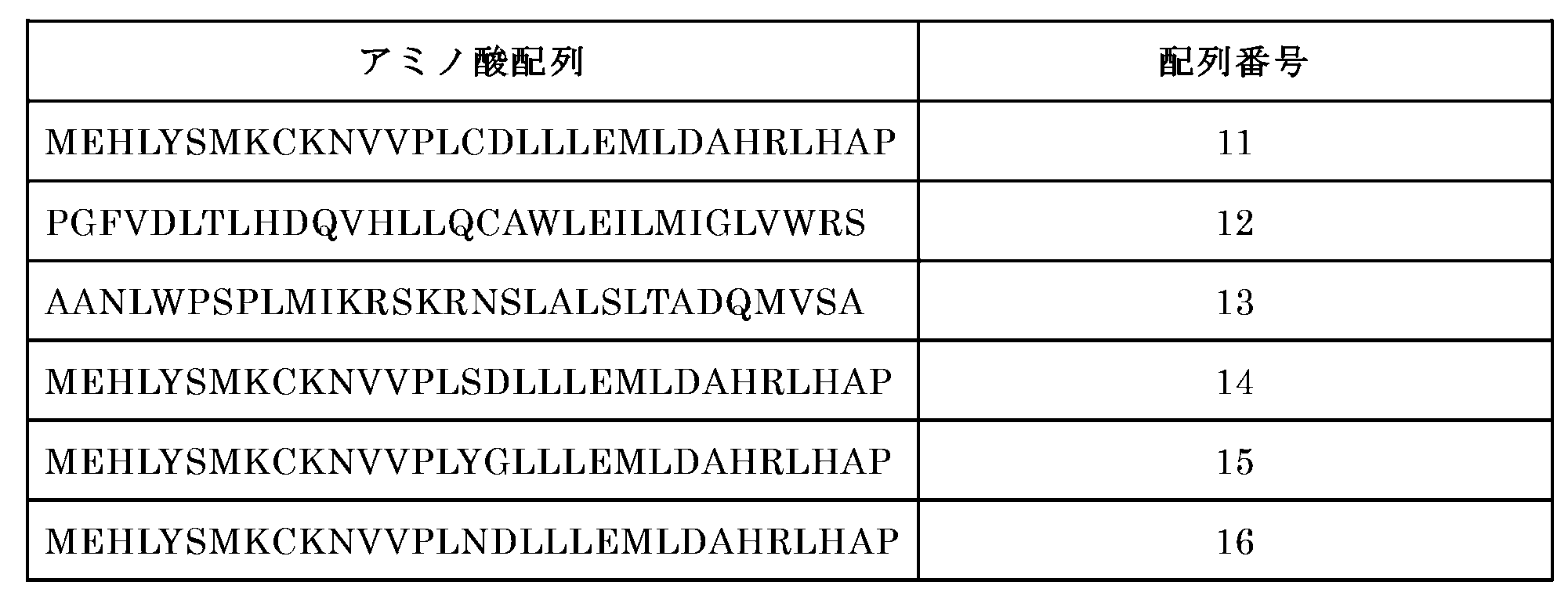
Table 1
いくつかの実施形態において、本開示の核酸構築物は、配列番号11~16のアミノ酸配列に対して少なくとも80%、少なくとも85%、少なくとも90%、少なくとも95%、少なくとも96%、少なくとも97%、少なくとも98%、少なくとも99%、又は100%の配列同一性を有するESR1の一部をコードする核酸配列を含む。 In some embodiments, the nucleic acid construct of the present disclosure comprises a nucleic acid sequence encoding a portion of ESR1 having at least 80%, at least 85%, at least 90%, at least 95%, at least 96%, at least 97%, at least 98%, at least 99%, or 100% sequence identity to the amino acid sequence of SEQ ID NOs: 11-16.
いくつかの実施形態において、本明細書に記載される核酸のポリペプチド構築物のコード配列は、1若しくは複数の分子改変を含む。本明細書に記載されるコード配列の分子改変の例示的なタイプは、1若しくは複数の欠失、置換、挿入、二重化、突然変異、フレームシフト変異、スプライス変異、又はそれらの組合せであり得る。 In some embodiments, the coding sequences of the nucleic acid polypeptide constructs described herein include one or more molecular modifications. Exemplary types of molecular modifications of the coding sequences described herein can be one or more deletions, substitutions, insertions, duplications, mutations, frameshift mutations, splice mutations, or combinations thereof.
いくつかの実施形態において、1若しくは複数の分子改変は、複数の改変カセットへと構成される。いくつかの実施形態において、複数の改変カセットが、コード配列の長さ方向にタンデムに配置される。いくつかの実施形態において、改変カセットの長さとアミノ酸組成は、コード配列又はその変異体の所望の活性又は特性を獲得するために最適化され得る。いくつかの実施形態において、複数の改変カセットのうちの1つの改変カセットは、約2~約50個のアミノ酸残基、例えば、約5~約45、約10~約40、約15~約30、約20~約50、約2~約30、約3~約25、約4~約20、約5~約15、約6~約10、約3~約15、約4~約10、約5~約30、約2~約5、約3~約5、約4~約8個のアミノ酸残基などを含む。いくつかの実施形態において、複数の改変カセットのうちの1つの改変カセットは、31個のアミノ酸残基を含む。いくつかの実施形態において、複数の改変カセットのうちの1つの改変カセットは、1、2、3、4、5個又はそれを超える分子改変を含む。 In some embodiments, one or more molecular modifications are organized into multiple modification cassettes. In some embodiments, multiple modification cassettes are arranged in tandem along the length of the coding sequence. In some embodiments, the length and amino acid composition of the modification cassettes can be optimized to obtain a desired activity or property of the coding sequence or a variant thereof. In some embodiments, one modification cassette of the multiple modification cassettes comprises about 2 to about 50 amino acid residues, e.g., about 5 to about 45, about 10 to about 40, about 15 to about 30, about 20 to about 50, about 2 to about 30, about 3 to about 25, about 4 to about 20, about 5 to about 15, about 6 to about 10, about 3 to about 15, about 4 to about 10, about 5 to about 30, about 2 to about 5, about 3 to about 5, about 4 to about 8 amino acid residues, etc. In some embodiments, one modification cassette of the multiple modification cassettes comprises 31 amino acid residues. In some embodiments, one modification cassette of the plurality of modification cassettes includes 1, 2, 3, 4, 5 or more molecular modifications.
いくつかの実施形態において、本明細書に記載されるESR1変異体は、リガンド非依存性受容体活性を促進する1若しくは複数の分子改変を含む。これらの変異体は、ホルモン療法に対してエストロゲン受容体非感受性の状態にするESR1のリガンド結合ドメインの活性化突然変異である。いくつかの実施形態において、1若しくは複数の分子改変が、配列番号1のアミノ酸配列に対応する位置にてK303R、E380Q、Y537C、Y537S、Y537N、及びD538Gから成る群から選択される活性化突然変異を含む。 In some embodiments, the ESR1 variants described herein comprise one or more molecular modifications that promote ligand-independent receptor activity. These variants are activating mutations in the ligand-binding domain of ESR1 that render the estrogen receptor insensitive to hormone therapy. In some embodiments, the one or more molecular modifications comprise an activating mutation selected from the group consisting of K303R, E380Q, Y537C, Y537S, Y537N, and D538G at a position corresponding to the amino acid sequence of SEQ ID NO:1.
いくつかの実施形態において、1若しくは複数の分子改変は、リンカーによって互いに作動可能に連結される。そのリンカーはペプチドリンカーであり、そしてそれは、本明細書に記載したように、2個の隣接した改変カセットを一緒に連結する。いくつかの実施形態において、ペプチドリンカー配列の長さ及びアミノ酸組成は、ESR1又はESR1変異体の所望の活性又は特性を達成するために互いに対する改変カセットの方向性、柔軟性、及び/又は近接性を変更するために最適化され得る。 In some embodiments, one or more molecular modifications are operably linked to each other by a linker. The linker is a peptide linker, which links two adjacent modification cassettes together, as described herein. In some embodiments, the length and amino acid composition of the peptide linker sequence can be optimized to alter the orientation, flexibility, and/or proximity of the modification cassettes relative to each other to achieve a desired activity or property of ESR1 or an ESR1 variant.
いくつかの実施形態において、ポリペプチドリンカーは、約1~約30個のアミノ酸残基(例えば、2、3、4、5、6、7、8、9、10、11、12、13、14、15、16、17、18、19、20個ほどのアミノ酸残基)を含む一本鎖ポリペプチド配列を含む。いくつかの実施形態において、リンカー配列は、約2~30、約3~25、約4~20、約5~15、約6~10、約3~15、約4~10、約5~30、約2~5、約3~5、約4~8個のアミノ酸残基を含む。 In some embodiments, the polypeptide linker comprises a single polypeptide sequence comprising about 1 to about 30 amino acid residues (e.g., 2, 3, 4, 5, 6, 7, 8, 9, 10, 11, 12, 13, 14, 15, 16, 17, 18, 19, 20 or so amino acid residues). In some embodiments, the linker sequence comprises about 2-30, about 3-25, about 4-20, about 5-15, about 6-10, about 3-15, about 4-10, about 5-30, about 2-5, about 3-5, or about 4-8 amino acid residues.
いくつかの実施形態において、リンカーペプチド配列の長さ及びアミノ酸組成は、コードされたポリペプチドの所望の活性又は特性を達成するために互いに対する改変カセットの方向性、柔軟性、及び/又は近接性を変更するために最適化され得る。いくつかの実施形態において、互いに関連する改変カセットの方向性、柔軟性、及び/又は近接性は、コードしているポリペプチド又はコードしているポリペプチド変異体の活性を増強又は低減するであろうチューニング効果を達成するための「チューニング」ツールとして変更され得る。特定の実施形態において、そのリンカーは、グリシン及び/又はセリン残基のみを含む(例えば、セリン-グリシンリンカー)。斯かるポリペプチドリンカーの例としては、Gly、Ser;Gly Ser;Gly Gly Ser;Ser Gly Gly;Gly Gly Gly Ser;Ser Gly Gly Gly;Gly Gly Gly Gly Ser;Ser Gly Gly Gly Gly;Gly Gly Gly Gly Gly Ser;Ser Gly Gly Gly Gly Gly;Gly Gly Gly Gly Gly Gly Ser;Ser Gly Gly Gly Gly Gly Gly;(Gly Gly Gly Gly Ser)n{式中、nは、1若しくは複数の整数である};及び(Ser Gly Gly Gly Gly)n{式中、nは1若しくは複数のの整数である}が挙げられる。いくつかの実施形態において、そのポリペプチドリンカーは、(従来のGly/Serリンカーポリペプチド反復の連結点にて起こる)アミノ酸配列Gly Ser Gly(GSG)が存在しないように改変される。いくつかの実施形態において、そのペプチドリンカーとしては、配列番号25~29から成る群から選択されるアミノ酸配列が挙げられる。 In some embodiments, the length and amino acid composition of the linker peptide sequence may be optimized to alter the orientation, flexibility, and/or proximity of the modification cassettes relative to one another to achieve a desired activity or property of the encoded polypeptide. In some embodiments, the orientation, flexibility, and/or proximity of the modification cassettes relative to one another may be altered as a "tuning" tool to achieve tuning effects that may enhance or reduce the activity of the encoded polypeptide or encoded polypeptide variant. In certain embodiments, the linker contains only glycine and/or serine residues (e.g., a serine-glycine linker). Examples of such polypeptide linkers include Gly, Ser; Gly Ser; Gly Gly Ser; Ser Gly Gly; Gly Gly Gly Ser; Ser Gly Gly Gly; Gly Gly Gly Gly Gly; Gly Gly Gly Gly Gly Gly; Gly Gly Gly Gly Gly Gly Gly Gly; Gly Gly Gly Gly Gly Gly Gly Gly Gly; Gly Gly Gly Gly Gly Gly Gly Gly; (Gly Gly Gly Gly Gly Ser)n, where n is one or more integers; and (Ser Gly Gly Gly Gly)n, where n is one or more integers. In some embodiments, the polypeptide linker is modified such that the amino acid sequence Gly Ser Gly (GSG), which occurs at the junction of a traditional Gly/Ser linker polypeptide repeat, is absent. In some embodiments, the peptide linker includes an amino acid sequence selected from the group consisting of SEQ ID NOs: 25-29.
いくつかの実施形態において、本明細書に記載される核酸構築物のポリペプチド構築物のコード配列は、(下線を引いた)GGGGSリンカーと作動可能に連結されたESR1アミノ酸配列の部分を含むESR1の変異体をコードする。例示的なアミノ酸配列は、次のような配列番号2のアミノ酸配列を含む:
MEHLYSMKCKNVVPLCDLLLEMLDAHRLHAPGGGGSPGFVDLTLHDQVHLLQCAWLEILMIGLVWRSGGGGSAANLWPSPLMIKRSKRNSLALSLTADQMVSAGGGGSMEHLYSMKCKNVVPLSDLLLEMLDAHRLHAPGGGGSMEHLYSMKCKNVVPLYGLLLEMLDAHRLHAPGGGGSMEHLYSMKCKNVVPLNDLLLEMLDAHRLHAPGGGGS
このタイプの構成の例示的な図解は、図4に示される。
In some embodiments, the coding sequence of a polypeptide construct of a nucleic acid construct described herein encodes a variant of ESR1 that includes a portion of the ESR1 amino acid sequence operably linked with a GGGGS linker (underlined). Exemplary amino acid sequences include the amino acid sequence of SEQ ID NO:2, as follows:
MEHLYSMKCKNVVPLCDLLLEMLDAHRLHAP GGGGS PGFVDLTLHDQVHLLQCAWLEILMIGLVWRS GGGGS AANLWPSPLMIKRSKRNSLALSLTADQMVSA GGGGS MEHLYSMKCKNVVPLSDLLLEMLDAHRLHAP GGGGS MEHLYSMKCKNVVPLYGLLLEMLDAHRLHAP GGGGS GGGGS
An exemplary illustration of this type of configuration is shown in FIG.
いくつかの実施形態において、本開示の核酸構築物としては、配列番号2のアミノ酸配列に対して少なくとも80%、少なくとも85%、少なくとも90%、少なくとも95%、少なくとも96%、少なくとも97%、少なくとも98%、少なくとも99%、又は100%の配列同一性を有するESR1をコードする核酸配列を含む。 In some embodiments, the nucleic acid construct of the present disclosure includes a nucleic acid sequence encoding ESR1 that has at least 80%, at least 85%, at least 90%, at least 95%, at least 96%, at least 97%, at least 98%, at least 99%, or 100% sequence identity to the amino acid sequence of SEQ ID NO:2.
上記に記載したとおり、本明細書に記載される核酸構築物はまた、PI3K又はその変異体のコード配列を含む。 As described above, the nucleic acid constructs described herein also include a coding sequence for PI3K or a mutant thereof.
PI3Kの完全長アミノ酸配列は、次の配列番号3に規定される:
MPPRPSSGELWGIHLMPPRILVECLLPNGMIVTLECLREATLITIKHELFKEARKYPLHQLLQDESSYIFVSVTQEAEREEFFDETRRLCDLRLFQPFLKVIEPVGNREEKILNREIGFAIGMPVCEFDMVKDPEVQDFRRNILNVCKEAVDLRDLNSPHSRAMYVYPPNVESSPELPKHIYNKLDKGQIIVVIWVIVSPNNDKQKYTLKINHDCVPEQVIAEAIRKKTRSMLLSSEQLKLCVLEYQGKYILKVCGCDEYFLEKYPLSQYKYIRSCIMLGRMPNLMLMAKESLYSQLPMDCFTMPSYSRRISTATPYMNGETSTKSLWVINSALRIKILCATYVNVNIRDIDKIYVRTGIYHGGEPLCDNVNTQRVPCSNPRWNEWLNYDIYIPDLPRAARLCLSICSVKGRKGAKEEHCPLAWGNINLFDYTDTLVSGKMALNLWPVPHGLEDLLNPIGVTGSNPNKETPCLELEFDWFSSVVKFPDMSVIEEHANWSVSREAGFSYSHAGLSNRLARDNELRENDKEQLKAISTRDPLSEITEQEKDFLWSHRHYCVTIPEILPKLLLSVKWNSRDEVAQMYCLVKDWPPIKPEQAMELLDCNYPDPMVRGFAVRCLEKYLTDDKLSQYLIQLVQVLKYEQYLDNLLVRFLLKKALTNQRIGHFFFWHLKSEMHNKTVSQRFGLLLESYCRACGMYLKHLNRQVEAMEKLINLTDILKQEKKDETQKVQMKFLVEQMRRPDFMDALQGFLSPLNPAHQLGNLRLEECRIMSSAKRPLWLNWENPDIMSELLFQNNEIIFKNGDDLRQDMLTLQIIRIMENIWQNQGLDLRMLPYGCLSIGDCVGLIEVVRNSHTIMQIQCKGGLKGALQFNSHTLHQWLKDKNKGEIYDAAIDLFTRSCAGYCVATFILGIGDRHNSNIMVKDDGQLFHIDFGHFLDHKKKKFGYKRERVPFVLTQDFLIVISKGAQECTKTREFERFQEMCYKAYLAIRQHANLFINLFSMMLGSGMPELQSFDDIAYIRKTLALDKTEQEALEYFMKQMNDAHHGGWTTKMDWIFHTIKQHALN
The full-length amino acid sequence of PI3K is set forth in SEQ ID NO:3:
いくつかの実施形態において、本明細書に記載される核酸構築物のPI3Kのコード配列は、配列番号3のアミノ酸配列をコードする。いくつかの実施形態において、本開示の核酸構築物としては、配列番号3のアミノ酸配列に対して少なくとも80%、少なくとも85%、少なくとも90%、少なくとも95%、少なくとも96%、少なくとも97%、少なくとも98%、少なくとも99%、又は100%の配列同一性を有するPI3Kをコードする核酸配列を含む。いくつかの実施形態において、PI3Kのコード配列は、配列番号3のアミノ酸配列のより小さい部分をコードする。これらのより小さい部分は、配列番号3の少なくとも8、10、12、14、16、18、20個又はそれを超えるアミノ酸を含み得る。本明細書に開示される構築物で有用なESR1の例示的な部分としては、以下の表2のものが挙げられる:
表2

Table 2
いくつかの実施形態において、本開示の核酸構築物は、配列番号17~20のアミノ酸配列に対して少なくとも80%、少なくとも85%、少なくとも90%、少なくとも95%、少なくとも96%、少なくとも97%、少なくとも98%、少なくとも99%、又は100%の配列同一性を有するPI3Kの一部をコードする核酸配列を含む。 In some embodiments, the nucleic acid construct of the present disclosure comprises a nucleic acid sequence encoding a portion of PI3K having at least 80%, at least 85%, at least 90%, at least 95%, at least 96%, at least 97%, at least 98%, at least 99%, or 100% sequence identity to the amino acid sequence of SEQ ID NOs: 17-20.
いくつかの実施形態において、本明細書に記載される核酸中のポリペプチド構築物のコード配列は、リガンド非依存性受容体活性を促進する1若しくは複数の分子改変を含むPI3K変異体をコードする。これらの変異体は、PI3Kのリガンド結合ドメインの活性化突然変異である。いくつかの実施形態において、1若しくは複数の分子改変が、配列番号3のアミノ酸配列のE542K、E545K、H1047L、及びH1047Rから成る群から選択される活性化突然変異を含む。 In some embodiments, the coding sequence of the polypeptide construct in the nucleic acid described herein encodes a PI3K mutant comprising one or more molecular modifications that promote ligand-independent receptor activity. These mutants are activating mutations in the ligand-binding domain of PI3K. In some embodiments, the one or more molecular modifications comprise an activating mutation selected from the group consisting of E542K, E545K, H1047L, and H1047R of the amino acid sequence of SEQ ID NO:3.
いくつかの実施形態において、1若しくは複数の分子改変は、リンカーによって互いに作動可能に連結される。本明細書に記載されるポリペプチド構築物における使用に好適なリンカーは、上記に記載される。いくつかの実施形態において、そのペプチドリンカーは、配列番号25~29から成る群から選択されるアミノ酸配列を含む。 In some embodiments, one or more molecular modifications are operably linked to one another by a linker. Linkers suitable for use in the polypeptide constructs described herein are described above. In some embodiments, the peptide linker comprises an amino acid sequence selected from the group consisting of SEQ ID NOs: 25-29.
いくつかの実施形態において、本明細書に記載される核酸構築物のポリペプチド構築物のコード配列は、(下線を引いた)GGGGSリンカーによって作動可能に連結されたPI3Kのアミノ酸配列の部分を含むPI3Kの変異体をコードする。例示的なアミノ酸配列は、次のような配列番号4のアミノ酸配列を含む:
MDKEQLKAISTRDPLSKITEQEKDFLWSHRHYGGGGSEQEALEYFMKQMNDALHGGWTTKMDWIFHTIKGGGGSQLKAISTRDPLSEITKQEKDFLWSHRHYCVTGGGGSEQEALEYFMKQMNDARHGGWTTKMDWIFHTIKGGGGS
In some embodiments, the coding sequence of a polypeptide construct of a nucleic acid construct described herein encodes a mutant of PI3K that includes a portion of the amino acid sequence of PI3K operably linked by a GGGGS linker (underlined). Exemplary amino acid sequences include the amino acid sequence of SEQ ID NO:4, as follows:
MDKEQLKAISTRDPLSKITEQEKDFLWSHRHY GGGGS EQEALEYFMKQMNDALHGGWTTKMDWIFHTIK GGGGS QLKAISTRDPLSEITKQEKDFLWSHRHYCVT GGGGS EQEALEYFMKQMNDARHGGWTTKMDWIFHTIK GGGGS
いくつかの実施形態において、本開示の核酸構築物としては、配列番号4のアミノ酸配列に対して少なくとも80%、少なくとも85%、少なくとも90%、少なくとも95%、少なくとも96%、少なくとも97%、少なくとも98%、少なくとも99%、又は100%の配列同一性を有するPI3Kをコードする核酸配列を含む。 In some embodiments, the nucleic acid construct of the present disclosure includes a nucleic acid sequence encoding a PI3K having at least 80%, at least 85%, at least 90%, at least 95%, at least 96%, at least 97%, at least 98%, at least 99%, or 100% sequence identity to the amino acid sequence of SEQ ID NO:4.
上記に記載したとおり、本明細書に記載される核酸構築物はまた、HER2又はその変異体のコード配列を含む。 As described above, the nucleic acid constructs described herein also include a coding sequence for HER2 or a variant thereof.
いくつかの実施形態において、本明細書に記載される核酸中のポリペプチド構築物のコード配列は、Crosby et al., “Vaccine-Induced Memory CD8+ T Cells Provide Clinical Benefit in HER2 Expressing Breast Cancer: A Mouse to Human Translational Study,” Clinical Cancer Research 25(9):2725-2736 (2019)に記載のHER2の細胞外ドメイン及び膜貫通ドメインを含む短縮型HER2変異体をコードする。 In some embodiments, the coding sequence of the polypeptide construct in the nucleic acid described herein encodes a truncated HER2 mutant comprising the extracellular and transmembrane domains of HER2 as described in Crosby et al., “Vaccine-Induced Memory CD8+ T Cells Provide Clinical Benefit in HER2 Expressing Breast Cancer: A Mouse to Human Translational Study,” Clinical Cancer Research 25(9):2725-2736 (2019).
いくつかの実施形態において、短縮型HER2変異体は、次の配列番号5のアミノ酸配列を含む:
MELAALCRWGLLLALLPPGAASTQVCTGTDMKLRLPASPETHLDMLRHLYQGCQVVQGNLELTYLPTNASLSFLQDIQEVQGYVLIAHNQVRQVPLQRLRIVRGTQLFEDNYALAVLDNGDPLNNTTPVTGASPGGLRELQLRSLTEILKGGVLIQRNPQLCYQDTILWKDIFHKNNQLALTLIDTNRSRACHPCSPMCKGSRCWGESSEDCQSLTRTVCAGGCARCKGPLPTDCCHEQCAAGCTGPKHSDCLACLHFNHSGICELHCPALVTYNTDTFESMPNPEGRYTFGASCVTACPYNYLSTDVGSCTLVCPLHNQEVTAEDGTQRCEKCSKPCARVCYGLGMEHLREVRAVTSANIQEFAGCKKIFGSLAFLPESFDGDPASNTAPLQPEQLQVFETLEEITGYLYISAWPDSLPDLSVFQNLQVIRGRILHNGAYSLTLQGLGISWLGLRSLRELGSGLALIHHNTHLCFVHTVPWDQLFRNPHQALLHTANRPEDECVGEGLACHQLCARGHCWGPGPTQCVNCSQFLRGQECVEECRVLQGLPREYVNARHCLPCHPECQPQNGSVTCFGPEADQCVACAHYKDPPFCVARCPSGVKPDLSYMPIWKFPDEEGACQPCPINCTHSPLTSIISAVVGILLVVVLGVVFGILIKRRQQKIRK
In some embodiments, the truncated HER2 mutant comprises the amino acid sequence of SEQ ID NO:5:
いくつかの実施形態において、本開示の核酸構築物としては、配列番号5のアミノ酸配列に対して少なくとも80%、少なくとも85%、少なくとも90%、少なくとも95%、少なくとも96%、少なくとも97%、少なくとも98%、少なくとも99%、又は100%の配列同一性を有するHER2変異体をコードする核酸配列を含む。 In some embodiments, the nucleic acid construct of the present disclosure includes a nucleic acid sequence encoding a HER2 variant having at least 80%, at least 85%, at least 90%, at least 95%, at least 96%, at least 97%, at least 98%, at least 99%, or 100% sequence identity to the amino acid sequence of SEQ ID NO:5.
上記に記載したとおり、本明細書に記載される核酸構築物はまた、HER3又はその変異体のコード配列を含む。 As described above, the nucleic acid constructs described herein also include a coding sequence for HER3 or a mutant thereof.
いくつかの実施形態において、本明細書に記載される核酸中のポリペプチド構築物のコード配列は、Osada et al., “Vaccination Targeting Human HER3 Alters the Phenotype of Infiltrating T cells and Responses to Immune Checkpoint Inhibition,” Oncoimmunology 6(6):e1315495 (2017)に記載のキナーゼ不活性HER3変異体をコードする。 In some embodiments, the coding sequence of the polypeptide construct in the nucleic acid described herein encodes a kinase-inactive HER3 mutant described in Osada et al., “Vaccination Targeting Human HER3 Alters the Phenotype of Infiltrating T cells and Responses to Immune Checkpoint Inhibition,” Oncoimmunology 6(6):e1315495 (2017).
いくつかの実施形態において、キナーゼ不活性HER3変異体は、次の配列番号6のアミノ酸配列を含む:
MRANDALQVLGLLFSLARGSEVGNSQAVCPGTLNGLSVTGDAENQYQTLYKLYERCEVVMGNLEIVLTGHNADLSFLQWIREVTGYVLVAMNEFSTLPLPNLRVVRGTQVYDGKFAIFVMLNYNTNSSHALRQLRLTQLTEILSGGVYIEKNDKLCHMDTIDWRDIVRDRDAEIVVKDNGRSCPPCHEVCKGRCWGPGSEDCQTLTKTICAPQCNGHCFGPNPNQCCHDECAGGCSGPQDTDCFACRHFNDSGACVPRCPQPLVYNKLTFQLEPNPHTKYQYGGVCVASCPHNFVVDQTSCVRACPPDKMEVDKNGLKMCEPCGGLCPKACEGTGSGSRFQTVDSSNIDGFVNCTKILGNLDFLITGLNGDPWHKIPALDPEKLNVFRTVREITGYLNIQSWPPHMHNFSVFSNLTTIGGRSLYNRGFSLLIMKNLNVTSLGFRSLKEISAGRIYISANRQLCYHHSLNWTKVLRGPTEERLDIKHNRPRRDCVAEGKVCDPLCSSGGCWGPGPGQCLSCRNYSRGGVCVTHCNFLNGEPREFAHEAECFSCHPECQPMEGTATCNGSGSDTCAQCAHFRDGPHCVSSCPHGVLGAKGPIYKYPDVQNECRPCHENCTQGCKGPELQDCLGQTLVLIGKTHLTMALTVIAGLVVIFMMLGGTFLYWRGRRIQNKRAMRRYLERGESIEPLDPSEKANKVLARIFKETELRKLKVLGSGVFGTVHKGVWIPEGESIKIPVCIKVIEDKSGRQSFQAVTDHMLAIGSLDHAHIVRLLGLCPGSSLQLVTQYLPLGSLLDHVRQHRGALGPQLLLNWGVQIAKGMYYLEEHGMVHRNLAARNVLLKSPSQVQVADFGVADLLPPDDKQLLYSEAKTPIKWMALESIHFGKYTHQSDVWSYGVTVWELMTFGAEPYAGLRLAEVPDLLEKGERLAQPQICTIDVYMVMVKCWMIDENIRPTFKELANEFTRMARDPPRYLVIKRESGPGIAPGPEPHGLTNKKLEEVELEPELDLDLDLEAEEDNLATTTLGSALSLPVGTLNRPRGSQSLLSPSSGYMPMNQGNLGESCQESAVSGSSERCPRPVSLHPMPRGCLASESSEGHVTGSEAELQEKVSMCRSRSRSRSPRPRGDSAYHSQRHSLLTPVTPLSPPGLEEEDVNGYVMPDTHLKGTPSSREGTLSSVGLSSVLGTEEEDEDEEYEYMNRRRRHSPPHPPRPSSLEELGYEYMDVGSDLSASLGSTQSCPLHPVPIMPTAGTTPDEDYEYMNRQRDGGGPGGDYAAMGACPASEQGYEEMRAFQGPGHQAPHVHYARLKTLRSLEATDSAFDNPDYWHSRLFPKANAQRT
In some embodiments, the kinase-inactive HER3 mutant comprises the amino acid sequence of SEQ ID NO:6:
いくつかの実施形態において、本開示の核酸構築物としては、配列番号6のアミノ酸配列に対して少なくとも80%、少なくとも85%、少なくとも90%、少なくとも95%、少なくとも96%、少なくとも97%、少なくとも98%、少なくとも99%、又は100%の配列同一性を有するHER3変異体をコードする核酸配列を含む。 In some embodiments, the nucleic acid construct of the present disclosure includes a nucleic acid sequence encoding a HER3 variant having at least 80%, at least 85%, at least 90%, at least 95%, at least 96%, at least 97%, at least 98%, at least 99%, or 100% sequence identity to the amino acid sequence of SEQ ID NO:6.
いくつかの実施形態において、ESR1又はその変異体、PI3K又はその変異体、HER2又はその変異体、及びHER3又はその変異体のコード配列は、単一ペプチド(例えば、一遺伝子構築物)のコード配列を含む。いくつかの実施形態において、ESR1又はその変異体、PI3K又はその変異体、HER2又はその変異体、及びHER3又はその変異体のコード配列は、複数のポリペプチド、例えば、多遺伝子(例えば、二遺伝子又は三遺伝子)のコード配列を含む。いくつかの実施形態において、ESR1又はその変異体、PI3K又はその変異体、HER2又はその変異体、及びHER3又はその変異体のコード配列のそれぞれが、別々のプロモーター配列に作動可能に連結される。いくつかの実施形態において、ESR1又はその変異体、PI3K又はその変異体、HER2又はその変異体、及びHER3又はその変異体のコード配列は、単一のオープンリーディングフレームの中(例えば、ポリシストロン性ORF内)に互いに作動可能に連結される。いくつかの実施形態において、ポリシストロン性ORFのコード配列は、プロモーター配列に作動可能に連結される。いくつかの実施形態において、プロモーター配列の少なくとも1つが、サブゲノム(sg)プロモーターである。いくつかの実施形態において、sgプロモーターは、26Sゲノムプロモーターである。 In some embodiments, the coding sequences of ESR1 or variants thereof, PI3K or variants thereof, HER2 or variants thereof, and HER3 or variants thereof comprise coding sequences of a single peptide (e.g., a monogene construct). In some embodiments, the coding sequences of ESR1 or variants thereof, PI3K or variants thereof, HER2 or variants thereof, and HER3 or variants thereof comprise coding sequences of multiple polypeptides, e.g., polygenes (e.g., bigenes or trigenes). In some embodiments, each of the coding sequences of ESR1 or variants thereof, PI3K or variants thereof, HER2 or variants thereof, and HER3 or variants thereof is operably linked to a separate promoter sequence. In some embodiments, the coding sequences of ESR1 or variants thereof, PI3K or variants thereof, HER2 or variants thereof, and HER3 or variants thereof are operably linked to each other in a single open reading frame (e.g., within a polycistronic ORF). In some embodiments, the coding sequences of the polycistronic ORF are operably linked to a promoter sequence. In some embodiments, at least one of the promoter sequences is a subgenomic (sg) promoter. In some embodiments, the sg promoter is a 26S genomic promoter.
いくつかの実施形態において、ESR1又はその変異体、PI3K又はその変異体、HER2又はその変異体、及びHER3又はその変異体のコード配列は、(例えば、1若しくは複数のコネクタ配列を介して)互いに直接的又は間接的に連結され得る。例えば、いくつかの実施形態において、そのコード配列は、例えば、互いに隣接して、互いに直接的に連結され得る。いくつかの実施形態において、そのコード配列のうちの少なくとも2つ(例えば、2、3、4、又は5つ)が、1若しくは複数のコネクタ配列によって互いに作動可能に連結される。いくつかの実施形態において、そのコネクタ配列の長さとアミノ酸組成は、コードされたタンパク質の所望の活性又は特性を達成するために互いに対するポリペプチドの方向性、柔軟性及び/又は近接性を変更するために最適化され得る。いくつかの実施形態において、複数のコネクタ配列のうちの1つのコネクタ配列は、自己タンパク質分解ペプチド配列の1若しくは複数のコード配列を含む。一般に、当該技術分野において公知の任意のタンパク質分解性切断部位は、本開示の核酸分子に組込まれ得、かつ、例えば、プロテアーゼによって産生後に切断されるタンパク質分解性切断配列であり得る。更なる好適なタンパク質分解性切断部位にはまた、外部プロテアーゼの添加後に切断可能なタンパク質分解性切断配列も含まれる。本明細書で使用される場合、「自己タンパク質分解ペプチド」という用語は、自己タンパク質分解活性を有し、かつ、より大きなポリペプチド部分からそれ自体を切断することができる「自己切断」ペプチドを指す。ピコルナウイルス群のメンバーである口蹄疫ウイルス(FMDV)において最初に同定された、いくつかの自己タンパク質分解ペプチド(例えば、ウマ鼻炎Aウイルス(E2A)、ブタテッショウウイルス-1(P2A)、及びゾセア・アシグナウイルス(T2A)由来の「2A様」ペプチドなど)がそれに続いて同定され、そして、タンパク質分解性切断におけるそれらの活性は、種々のエクスビトロ、インビトロ、エクスビボ、及びインビボにおける真核細胞系で示されている。このように、自己タンパク質分解ペプチドの概念は、当業者が入手可能であり、多くの天然に存在する自己プロテアーゼ系が同定されている。十分に研究されている自己プロテアーゼ系は、例えば、ウイルスプロテアーゼ、発生タンパク質(例えば、HetR、Hedgehogタンパク質)、RumA自己プロテアーゼドメイン、UmuDなど)である。本開示の組成物及び方法に好適な自己タンパク質分解ペプチドの非限定的な例としては、カルシウム依存性セリンエンドプロテアーゼ(furin)、ブタテッショウウイルス-1 2A(P2A)、口蹄疫ウイルス(FMDV)2A(F2A)、ウマ鼻炎Aウイルス(ERAV)2A(E2A)、ゾセア・アシグナウイルス2A(T2A)、細胞質多角体病ウイルス2A(BmCPV2A)、軟化病ウイルス2A(BmIFV2A)、又はそれらの組合せ由来の1若しくは複数の自己タンパク質分解性切断配列が挙げられる。 In some embodiments, the coding sequences of ESR1 or a mutant thereof, PI3K or a mutant thereof, HER2 or a mutant thereof, and HER3 or a mutant thereof may be directly or indirectly linked to each other (e.g., via one or more connector sequences). For example, in some embodiments, the coding sequences may be directly linked to each other, e.g., adjacent to each other. In some embodiments, at least two of the coding sequences (e.g., two, three, four, or five) are operably linked to each other by one or more connector sequences. In some embodiments, the length and amino acid composition of the connector sequences may be optimized to alter the orientation, flexibility, and/or proximity of the polypeptides relative to each other to achieve a desired activity or property of the encoded protein. In some embodiments, one connector sequence of the multiple connector sequences includes one or more coding sequences of an autoproteolytic peptide sequence. In general, any proteolytic cleavage site known in the art may be incorporated into the nucleic acid molecules of the present disclosure and may be, for example, a proteolytic cleavage sequence that is cleaved after production by a protease. Further suitable proteolytic cleavage sites also include proteolytic cleavage sequences that are cleavable after the addition of an external protease. As used herein, the term "autoproteolytic peptide" refers to an "autocleaving" peptide that has autoproteolytic activity and can cleave itself from a larger polypeptide moiety. Initially identified in the Foot and Mouth Disease Virus (FMDV), a member of the picornavirus group, several autoproteolytic peptides, such as the "2A-like" peptide from Equine Rhinitis A Virus (E2A), Porcine Teschovirus-1 (P2A), and Zosea asignavirus (T2A), have subsequently been identified and their activity in proteolytic cleavage has been shown in various ex vitro, in vitro, ex vivo, and in vivo eukaryotic cell systems. Thus, the concept of an autoproteolytic peptide is available to those skilled in the art, and many naturally occurring autoprotease systems have been identified. Well-studied autoprotease systems include, for example, viral proteases, developmental proteins (e.g., HetR, Hedgehog proteins), RumA autoprotease domain, UmuD, etc. Non-limiting examples of autoproteolytic peptides suitable for the compositions and methods of the present disclosure include one or more autoproteolytic cleavage sequences from calcium-dependent serine endoprotease (furin), porcine teschovirus-1 2A (P2A), foot and mouth disease virus (FMDV) 2A (F2A), equine rhinitis A virus (ERAV) 2A (E2A), Zosea asignavirus 2A (T2A), cytoplasmic polyhedrosis virus 2A (BmCPV2A), flacherie disease virus 2A (BmIFV2A), or combinations thereof.
いくつかの実施形態において、ESR1又はその変異体、PI3K又はその変異体、HER2又はその変異体、及びHER3又はその変異体のコード配列は、1若しくは複数の内部リボソーム進入部位(IRES)のコード配列によって互いに作動可能に連結される。IRES又は「内部リボソーム進入部位」は、ジシストロンmRNAの翻訳の内部開始によって第二の遺伝子から生じた発現産物の産生を可能にするポリシストロン性遺伝子間に位置する配列である。それは、シストロン(タンパク質コード領域)の、例えばATGなどの開始コドンへの直接的な内部リボソーム進入を促進し、その結果、その遺伝子のキャップ非依存的翻訳につながる。例えば、Jackson et al., 1990. Trends Biochem Sci 15(12):477-83) and Jackson and Kaminski. 1995. RNA 1(10):985-1000を参照のこと。いくつかの実施形態において、IRESは、ウイルスIRES、細胞IRES、又は人工的なIRESであり得る。当業者によって一般に用いられるIRESの例としては、米国特許番号第6,692,736号に記載されているものが挙げられる。いくつかの実施形態において、IRESは、カポジ肉腫関連ヘルペスウイルス(KSHV)IRES、肝炎ウイルスIRES、ペスチウイルスIRES、クリパウイルスIRES、ロパロシプム・パディウイルスIRES、線維芽細胞成長因子IRES、血小板由来成長因子IRES、血管内皮成長因子IRES、インスリン様成長因子IRES、ピコルナウイルスIRES、脳心筋炎ウイルス(EMCV)IRES、Pim-1 IRES、p53 IRES、Apaf-1 IRES、TDP2 IRES、L-myc IRES、及びc-myc IRESから選択される。いくつかの実施形態において、IRESは、EMCVから入手可能である。 In some embodiments, the coding sequences of ESR1 or a mutant thereof, PI3K or a mutant thereof, HER2 or a mutant thereof, and HER3 or a mutant thereof are operably linked to each other by coding sequences of one or more internal ribosome entry sites (IRES). An IRES or "internal ribosome entry site" is a sequence located between polycistronic genes that allows for the production of an expression product resulting from a second gene by internal initiation of translation of a dicistronic mRNA. It promotes direct internal ribosome entry to the initiation codon, e.g., ATG, of a cistron (protein coding region), resulting in cap-independent translation of that gene. See, e.g., Jackson et al., 1990. Trends Biochem Sci 15(12):477-83) and Jackson and Kaminski. 1995. RNA 1(10):985-1000. In some embodiments, the IRES can be a viral IRES, a cellular IRES, or an artificial IRES. Examples of IRES commonly used by those skilled in the art include those described in U.S. Patent No. 6,692,736. In some embodiments, the IRES is selected from Kaposi's Sarcoma-Associated Herpesvirus (KSHV) IRES, Hepatitis Virus IRES, Pestivirus IRES, Cripavirus IRES, Rhopalosipum Padivirus IRES, Fibroblast Growth Factor IRES, Platelet-Derived Growth Factor IRES, Vascular Endothelial Growth Factor IRES, Insulin-Like Growth Factor IRES, Picornavirus IRES, Encephalomyocarditis Virus (EMCV) IRES, Pim-1 IRES, p53 IRES, Apaf-1 IRES, TDP2 IRES, L-myc IRES, and c-myc IRES. In some embodiments, the IRES is available from EMCV.
当業者は、ESR1又はその変異体、PI3K又はその変異体、HER2又はその変異体、及びHER3又はその変異体のコード配列、自己タンパク質分解ペプチドをコードする配列、或いはIRESの様々な構成が、ESR1又はその変異体、PI3K又はその変異体、HER2又はその変異体、及びHER3又はその変異体の発現が適切に維持される限り、利用され得ることを理解する。これらの配列は、典型的には、着目の遺伝子によってコードされるポリペプチドが、自己プロテアーゼによる切断後にプロテアーゼ及び他の配列から放出されるように構成される。 Those skilled in the art will appreciate that various configurations of coding sequences for ESR1 or its variants, PI3K or its variants, HER2 or its variants, and HER3 or its variants, sequences encoding autoproteolytic peptides, or IRESs can be utilized so long as expression of ESR1 or its variants, PI3K or its variants, HER2 or its variants, and HER3 or its variants is appropriately maintained. These sequences are typically configured such that the polypeptide encoded by the gene of interest is released from the protease and other sequences after cleavage by the autoprotease.
「作動可能に連結された」という用語は、本明細書に使用される場合、2以上の配列間の機能的な連結を意味する。例えば、着目のポリヌクレオチドと調節配列(例えば、プロモーター)との間の作動可能な連結は、その着目のポリヌクレオチドの発現を可能にする機能的な連結である。この意味では、「作動可能に連結された」という用語は、調節領域が着目のコード配列の転写又は翻訳を調節するのに有効であるように調節領域及び転写されるコード配列の位置決定されることを指す。本明細書に開示されるいくつかの実施形態において、「作動可能に連結された」という用語は、制御配列が、ポリペプチドをコードするmRNA、ポリペプチド、及び/又は機能的なRNAの発現若しくは細胞局在化を指示するか又は調整するように、ポリペプチド又は機能的なRNAをコードする配列に対して適切な位置に調節配列が配置されている構成を意味する。よって、プロモーターは、それが核酸配列の転写を媒介できる場合、核酸配列と作動可能に連結されている。作動可能に連結された要素は、隣接していても、又は隣接していなくてもよい。 The term "operably linked" as used herein means a functional linkage between two or more sequences. For example, an operably linked linkage between a polynucleotide of interest and a regulatory sequence (e.g., a promoter) is a functional linkage that allows expression of the polynucleotide of interest. In this sense, the term "operably linked" refers to the positioning of a regulatory region and a coding sequence to be transcribed such that the regulatory region is effective to regulate transcription or translation of the coding sequence of interest. In some embodiments disclosed herein, the term "operably linked" refers to a configuration in which a regulatory sequence is positioned in an appropriate position relative to a sequence encoding a polypeptide or functional RNA such that the regulatory sequence directs or regulates the expression or cellular localization of the mRNA encoding the polypeptide, the polypeptide, and/or the functional RNA. Thus, a promoter is operably linked to a nucleic acid sequence if it is capable of mediating transcription of the nucleic acid sequence. Operably linked elements may be contiguous or non-contiguous.
DNAの2以上の配列を一緒に作動可能に連結するための基本的な技術は、当業者にとって周知であり、斯かる方法は、標準的な分子生物学的操作に関する多くの書籍に記載されている(例えば、Maniatis et al., “Molecular Cloning: A Laboratory Manual” 2nd ed. Cold Spring Harbor Laboratory Press, Cold Spring Harbor, N.Y.; and Gibson et al., Nature Methods 6:343-45, 2009を参照のこと)。 The basic techniques for operably linking two or more sequences of DNA together are well known to those of skill in the art, and such methods are described in many textbooks on standard molecular biology procedures (see, e.g., Maniatis et al., "Molecular Cloning: A Laboratory Manual" 2nd ed. Cold Spring Harbor Laboratory Press, Cold Spring Harbor, N.Y.; and Gibson et al., Nature Methods 6:343-45, 2009).
図3に示されているとおり、「遺伝子1」、「遺伝子2」、「遺伝子3」、又は「遺伝子4」の様々な序列を有する様々な一遺伝子、二遺伝子、及び四遺伝子構築物に対するT細胞応答が(PI3KはBALB/cマウスにおいて応答を形成しないので、図3に示さない)、計測された。いくつかの実施形態において、「遺伝子1」、「遺伝子2」、「遺伝子3」、又は「遺伝子4」は、ESR1又はその変異体であり得ることは、理解されるべきである。同様に、いくつかの実施形態において、「遺伝子1」、「遺伝子2」、「遺伝子3」、又は「遺伝子4」は、HER2又はその変異体であり得る。他の実施形態において、「遺伝子1」、「遺伝子2」、「遺伝子3」、又は「遺伝子4」は、HER3又はその変異体であり得る。いくつかの実施形態において、「遺伝子1」、「遺伝子2」、「遺伝子3」、又は「遺伝子4」は、PI3K又はその変異体であり得る。本明細書に記載される核酸構築物の例示的な構成を表3に示す。
表3.

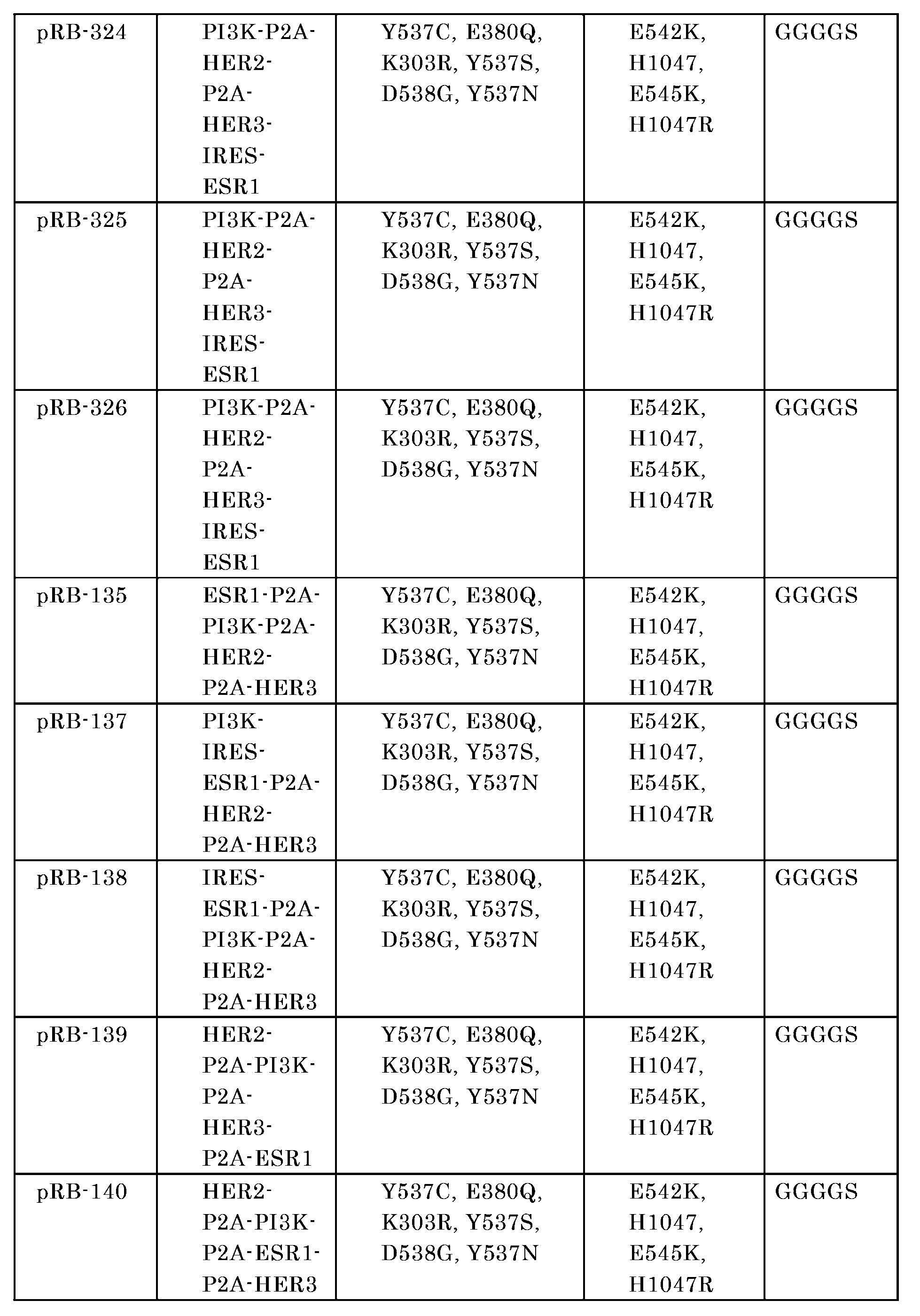

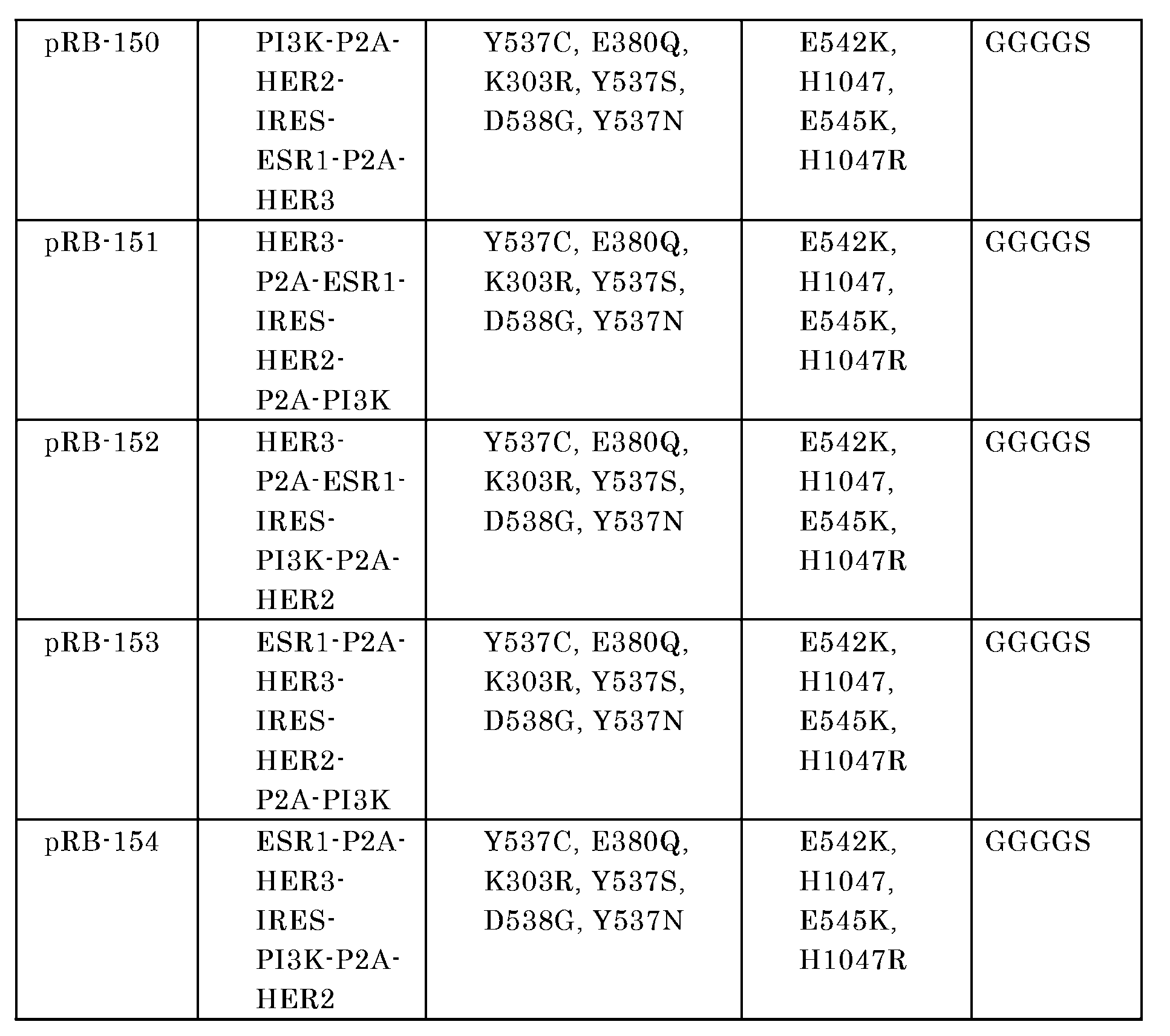
Table 3.
いくつかの実施形態において、構成が、pRB-136、pRB-146、pRB-151、及びpRB-153から成る群から選択される。 In some embodiments, the configuration is selected from the group consisting of pRB-136, pRB-146, pRB-151, and pRB-153.
いくつかの実施形態において、その核酸配列は、配列番号7~10から成る群から選択される核酸配列に対して少なくとも80%、少なくとも85%、少なくとも90%、少なくとも95%、少なくとも96%、少なくとも97%、少なくとも98%、少なくとも99%、又は100%の配列同一性を有する。 In some embodiments, the nucleic acid sequence has at least 80%, at least 85%, at least 90%, at least 95%, at least 96%, at least 97%, at least 98%, at least 99%, or 100% sequence identity to a nucleic acid sequence selected from the group consisting of SEQ ID NOs:7-10.
いくつかの実施形態において、ポリペプチド構築物のコード配列は、5’-から3’-の向きに、以下の:a) E542K、H1047L、E545K、及びH1047Rから選択される1若しくは複数の分子改変を含むPI3Kの変異体のコード配列、ここで、前記分子改変はGGGGSリンカーによって作動可能に連結され;b) 自己タンパク質分解ペプチドP2Aのコード配列;c) その細胞外ドメインと膜貫通ドメインを含むHER2の変異体のコード配列;d) 自己タンパク質分解ペプチドP2Aのコード配列;e) HER3のキナーゼ不活性変異体のコード配列;f) 内部リボソーム進入部位(IRES)のコード配列;及びg) Y537C、E380Q、K303R、Y537S、D538G、及びY537Nから選択される1若しくは複数の分子改変を含むESR1の変異体のコード配列、ここで、前記分子改変はGGGGSリンカーによって作動可能に連結される、を含む。 In some embodiments, the coding sequence of the polypeptide construct comprises, in the 5'- to 3'-direction, the following: a) a coding sequence for a mutant of PI3K comprising one or more molecular modifications selected from E542K, H1047L, E545K, and H1047R, wherein the molecular modifications are operably linked by a GGGGS linker; b) a coding sequence for the autoproteolytic peptide P2A; c) a coding sequence for a mutant of HER2 comprising its extracellular domain and transmembrane domain; d) a coding sequence for the autoproteolytic peptide P2A; e) a coding sequence for a kinase-inactive mutant of HER3; f) a coding sequence for an internal ribosome entry site (IRES); and g) a coding sequence for a mutant of ESR1 comprising one or more molecular modifications selected from Y537C, E380Q, K303R, Y537S, D538G, and Y537N, wherein the molecular modifications are operably linked by a GGGGS linker.
いくつかの実施形態において、ESR1、PI3K、HER2、及び/又はHER3のコード配列は、増強された安定性、効力、及び発現(例えば、翻訳効率)などの所望の特性のために再設計及び/又は最適化され、そしてそれは次々に、生物学的治療薬を産生、送達、及び投与する影響を最大化し得る。例えば、いくつかの実施形態において、コード配列は、参照コード配列の発現レベルよりも高いレベルでの発現に最適化される。ヌクレオチド配列の配列最適化に関して、遺伝暗号の縮重は、遺伝子から産生されるポリペプチドのアミノ酸配列を変化させることなく、遺伝子の配列をコードするタンパク質の少なくとも1つの塩基を異なる塩基で置換する可能性を提供する。従って、本開示の核酸構築物はまた、遺伝暗号の縮重に関連する置換によって、本明細書に開示される任意のポリヌクレオチド配列から変更された任意の塩基配列を有し得る。コドン使用頻度を記載する参考文献は、容易に公開されている。いくつかの実施形態では、ポリヌクレオチド配列変異体は、様々な理由、例えば、特定の宿主についての発現を最適化するため(例えば、アルファウイルスmRNAにおけるコドン使用を、ヒト、非ヒト霊長類、ハムスター、マウス、又はサルなどの他の生物に好ましいものに変更する)のために作製され得る。従って、いくつかの実施形態において、コード配列は、発現に最適化されたコドンの使用を通じて、標的宿主細胞における発現に最適化される。宿主細胞発現に最適な好ましいコドンを用いて遺伝子をコードする合成核酸配列を構築するための技術は、当技術分野で周知の技術によって、宿主細胞ゲノムの天然タンパク質をコードするためのコドン使用頻度及びそれらの相対存在量の共通性を分析する計算方法によって決定され得る。コドン使用頻度データベース(http://www.kazusa.or.jp/codon)は、哺乳類細胞環境におけるコドン最適化配列の生成に使用することができる。さらに、ある生物の配列を別の宿主生物の最適なコドン使用頻度に変換するためのさまざまなソフトウェアツール、例えばJCatコドン最適化ツール(www.jcat.de)、統合DNAテクノロジー(IDT)コドン最適化ツール(https://www.idtdna.com/CodonOpthttps://www.idtdna.com/CodonOpt)、オプティマイザーオンラインコドン最適化ツール(http://genomes.urv.es/OPTIMIZER)を利用可能である。このような合成配列は、合成核酸分子の構築のために当技術分野で公知の技術によって構築され得、様々な商業ベンダーから入手してもよい。 In some embodiments, the coding sequences of ESR1, PI3K, HER2, and/or HER3 are redesigned and/or optimized for desired properties such as enhanced stability, potency, and expression (e.g., translation efficiency), which in turn can maximize the impact of producing, delivering, and administering a biotherapeutic. For example, in some embodiments, the coding sequences are optimized for expression at a level higher than that of a reference coding sequence. With respect to sequence optimization of nucleotide sequences, the degeneracy of the genetic code provides the possibility to replace at least one base of a protein encoding sequence of a gene with a different base without changing the amino acid sequence of the polypeptide produced from the gene. Thus, the nucleic acid constructs of the present disclosure can also have any base sequence altered from any polynucleotide sequence disclosed herein by substitutions associated with the degeneracy of the genetic code. References describing codon usage are readily available. In some embodiments, polynucleotide sequence variants may be made for a variety of reasons, such as to optimize expression for a particular host (e.g., changing the codon usage in alphavirus mRNA to one preferred for humans, non-human primates, hamsters, mice, or other organisms such as monkeys). Thus, in some embodiments, coding sequences are optimized for expression in target host cells through the use of codons optimized for expression. Techniques for constructing synthetic nucleic acid sequences encoding genes with optimal preferred codons for host cell expression can be determined by techniques well known in the art, computational methods that analyze the commonality of codon usage and their relative abundance for encoding native proteins in the host cell genome. The codon usage database (http://www.kazusa.or.jp/codon) can be used to generate codon-optimized sequences in a mammalian cell environment. Additionally, various software tools are available for converting sequences from one organism to the optimal codon usage of another host organism, such as the JCat codon optimization tool (www.jcat.de), the Integrated DNA Technology (IDT) codon optimization tool (https://www.idtdna.com/CodonOpthttps://www.idtdna.com/CodonOpt), and the Optimizer online codon optimization tool (http://genomes.urv.es/OPTIMIZER). Such synthetic sequences may be constructed by techniques known in the art for the construction of synthetic nucleic acid molecules and may be obtained from a variety of commercial vendors.
いくつかの実施形態において、GOIのコード配列は、増強されたRNA安定性及び/又は発現に最適化される。RNAの安定性は一般にRNAの「半減期」に関係する。「半減期」は、活性、量、又は分子数の半分を除去するのに必要な期間に関係する。本開示の文脈において、RNAの半減期は、前記RNAの安定性の指標である。RNAの半減期は、RNAの「発現期間」に影響を与える可能性がある。RNA安定性の増強に使用するための原理、戦略、及び方法に関する追加情報は、例えば、Leppek K. et al., Combinatorial optimization of mRNA structure, stability, and translation for RNA-based therapeutics. bioRxiv. (Preprint). Mar 30, 2021. doi: 10.1101/2021.03.29.437587で知ることができる。
組換え細胞
In some embodiments, the coding sequence of the GOI is optimized for enhanced RNA stability and/or expression. RNA stability is generally related to the "half-life" of the RNA. "Half-life" relates to the period required to remove half of the activity, amount, or number of molecules. In the context of the present disclosure, the half-life of an RNA is an indication of the stability of said RNA. The half-life of an RNA may affect the "expression period" of the RNA. Additional information on principles, strategies, and methods for use in enhancing RNA stability can be found, for example, in Leppek K. et al., Combinatorial optimization of mRNA structure, stability, and translation for RNA-based therapeutics. bioRxiv. (Preprint). Mar 30, 2021. doi: 10.1101/2021.03.29.437587.
Recombinant cells
本開示の核酸構築物を宿主細胞に導入して、該核酸分子を含有する組換え細胞を産生することができる。従って、本明細書に記載の改変EEEVゲノムをコードする核酸構築物を含有する原核細胞又は真核細胞もまた、本開示の特徴である。関連する態様において、本明細書に開示されるいくつかの実施形態は、本明細書中で提供される核酸構築物を動物細胞などの宿主細胞に導入することを含む、細胞を形質転換する方法、次いで形質転換細胞を選択又はスクリーニングする方法に関連する。本開示の核酸構築物の細胞への導入は、当業者に公知の方法、例えば、ウイルス感染、トランスフェクション、コンジュゲーション、プロトプラスト融合、リポフェクション、エレクトロポレーション、ヌクレオフェクション、リン酸カルシウム沈殿、ポリエチレンイミン(PEI)媒介トランスフェクション、DEAE-デキストラン媒介トランスフェクション、リポソーム媒介トランスフェクション、パーティクルガン技術、直接マイクロインジェクション、ナノ粒子媒介核酸送達などによって達成することができる。 The nucleic acid constructs of the present disclosure can be introduced into a host cell to produce a recombinant cell containing the nucleic acid molecule. Thus, prokaryotic or eukaryotic cells containing a nucleic acid construct encoding a modified EEEV genome as described herein are also a feature of the present disclosure. In a related aspect, some embodiments disclosed herein relate to a method of transforming a cell, including introducing a nucleic acid construct provided herein into a host cell, such as an animal cell, and then selecting or screening for the transformed cell. Introduction of the nucleic acid constructs of the present disclosure into a cell can be accomplished by methods known to those of skill in the art, such as viral infection, transfection, conjugation, protoplast fusion, lipofection, electroporation, nucleofection, calcium phosphate precipitation, polyethyleneimine (PEI)-mediated transfection, DEAE-dextran-mediated transfection, liposome-mediated transfection, particle gun technology, direct microinjection, nanoparticle-mediated nucleic acid delivery, and the like.
一態様において、本開示のいくつかの実施形態は、組換え細胞、例えば、本明細書に開示される核酸構築物を含む組換え動物細胞に関する。核酸構築物は、宿主ゲノムに安定に組込まれることができ、エピソーム複製されることができ、若しくは安定な又は一過性の発現のためのミニサークル発現ベクターとして組換え宿主細胞内に存在する。従って、本開示のいくつかの実施形態において、核酸構築物は、エピソーム単位として組換え宿主細胞において維持及び複製される。いくつかの実施形態において、核酸構築物は、組換え細胞のゲノムに安定に組込まれる。安定した組込みは、古典的なランダムゲノム組換え技術、又はより正確なゲノム編集技術、例えば、ガイドRNA指向CRISPR/Cas9又はTALENゲノム編集の使用によって完了することができる。いくつかの実施形態において、核酸構築物は、安定な又は一過性の発現のためのミニサークル発現ベクターとして組換え宿主細胞中に存在する。 In one aspect, some embodiments of the present disclosure relate to a recombinant cell, e.g., a recombinant animal cell, comprising a nucleic acid construct disclosed herein. The nucleic acid construct can be stably integrated into the host genome, can be episomally replicated, or is present in the recombinant host cell as a minicircle expression vector for stable or transient expression. Thus, in some embodiments of the present disclosure, the nucleic acid construct is maintained and replicated in the recombinant host cell as an episomal unit. In some embodiments, the nucleic acid construct is stably integrated into the genome of the recombinant cell. Stable integration can be accomplished by the use of classical random genome recombination techniques, or more precise genome editing techniques, e.g., guide RNA-directed CRISPR/Cas9 or TALEN genome editing. In some embodiments, the nucleic acid construct is present in the recombinant host cell as a minicircle expression vector for stable or transient expression.
いくつかの実施形態において、組換え細胞は、細菌大腸菌などの原核細胞、又は昆虫細胞(例えば、蚊細胞又はSf21細胞)、若しくは哺乳動物細胞(例えば、COS細胞、NIH 3T3細胞、又はHeLa細胞)などの真核細胞である。いくつかの実施形態において、その細胞は、インビボである。いくつかの実施形態において、細胞はエクスビボである。いくつかの実施形態において、細胞はインビトロである。いくつかの実施形態において、組換え細胞は真核細胞である。いくつかの実施形態において、組換え細胞は動物細胞である。いくつかの実施形態において、動物細胞は、脊椎動物細胞又は無脊椎動物細胞である。いくつかの実施形態において、組換え細胞は、哺乳動物細胞である。いくつかの実施形態において、組換え細胞は、SV40により形質転換されたサル腎臓CV1細胞(COS-7)、ヒト胚性腎細胞(例えば、HEK 293又はHEK 293細胞)、ベビーハムスター腎細胞(BHK)、マウスセルトリ細胞(例えば、TM4細胞)、サル腎細胞(CV1)、ヒト子宮頸癌細胞(HeLa)、イヌ腎細胞(MDCK)、バッファローラット肝細胞(BRL3A)、ヒト肺細胞(W138)、ヒト肝細胞(Hep G2)、マウス乳腺腫瘍(MMT 060562)、TRI細胞、FS4細胞、チャイニーズハムスター卵巣細胞(CHO細胞)、アフリカミドリザル腎細胞(Vero細胞)、ヒトA549細胞、ヒト子宮頸部細胞、 ヒトCHME5細胞、ヒトPER.C6細胞、NS0マウスミエローマ細胞であり、ヒト表皮喉頭細胞、ヒト線維芽細胞、ヒトHUH-7細胞、ヒトMRC-5細胞、ヒト筋細胞、ヒトリンパ管内皮細胞、ヒトアストロサイト細胞、ヒトマクロファージ細胞、ヒトRAW264.7細胞、マウス3T3細胞、マウスL929細胞、マウス結合組織細胞、マウス筋細胞、ウサギ腎細胞からなる群から選択される。 In some embodiments, the recombinant cell is a prokaryotic cell, such as the bacterium E. coli, or a eukaryotic cell, such as an insect cell (e.g., a mosquito cell or an Sf21 cell), or a mammalian cell (e.g., a COS cell, an NIH 3T3 cell, or a HeLa cell). In some embodiments, the cell is in vivo. In some embodiments, the cell is ex vivo. In some embodiments, the cell is in vitro. In some embodiments, the recombinant cell is a eukaryotic cell. In some embodiments, the recombinant cell is an animal cell. In some embodiments, the animal cell is a vertebrate cell or an invertebrate cell. In some embodiments, the recombinant cell is a mammalian cell. In some embodiments, the recombinant cell is a SV40 transformed monkey kidney CV1 cell (COS-7), a human embryonic kidney cell (e.g., HEK 293 or HEK 293 cell), a baby hamster kidney cell (BHK), a mouse Sertoli cell (e.g., TM4 cell), a monkey kidney cell (CV1), a human cervical carcinoma cell (HeLa), a canine kidney cell (MDCK), a buffalo rat hepatocyte cell (BRL3A), a human lung cell (W138), a human hepatocyte cell (Hep G2), a mouse mammary tumor (MMT 060562), a TRI cell, a FS4 cell, a Chinese hamster ovary cell (CHO cell), an African green monkey kidney cell (Vero cell), a human A549 cell, a human cervical cell, Human CHME5 cells, human PER.C6 cells, NS0 mouse myeloma cells, selected from the group consisting of human epidermal laryngeal cells, human fibroblast cells, human HUH-7 cells, human MRC-5 cells, human muscle cells, human lymphatic endothelial cells, human astrocyte cells, human macrophage cells, human RAW264.7 cells, mouse 3T3 cells, mouse L929 cells, mouse connective tissue cells, mouse muscle cells, and rabbit kidney cells.
いくつかの実施形態において、組換え細胞は、昆虫細胞、例えば、昆虫細胞株の細胞である。いくつかの実施形態において、組換え細胞は、Sf21細胞である。さらなる好適な昆虫細胞株としては、非限定的に、昆虫目双翅目、鱗翅目及び半翅目から確立された細胞株が挙げられ、異なる組織源から誘導することができる。いくつかの実施形態において、組換え細胞は、鱗翅目昆虫細胞株の細胞である。過去数十年で、鱗翅目の昆虫細胞株の利用可能性は10年あたり約50株で増加した。利用可能な鱗翅目昆虫細胞株に関するより多くの情報は、例えば、Lynn D.E., Available lepidopteran insect cell lines. Methods Mol Biol. 2007; 388: 117-38で知ることができ、参照により本明細書に援用される。いくつかの実施形態において、組換え細胞は、蚊細胞、例えば、ハマダラカ属(An)、アカイエカ属(Cx.)、及びネッタイシマカ(Stegomyia)属内の蚊種の細胞である。本明細書に記載の組成物及び方法に適した例示的な蚊細胞株には、以下の蚊種由来の細胞株が含まれる: Aedes aegypti、Aedes albopictus、Aedes pseudoscutellaris、Aedes triseriatus、Aedes vexans、Anopheles gambiae、Anopheles stephensi、Anopheles albimanus、Culex quinquefasciatus、Culex theileri、Culex tritaeniorhynchus、Culex bitaeniorhynchus、及びToxorhynchites amboinensis。好適な蚊細胞株としては、非限定的に、CCL-125、Aag-2、RML-12、C6/26、C6/36、C7-10、AP-61、A.t. GRIP-1、A.t. GRIP-2、UM-AVE1、Mos.55、Sua1B、4A-3B、Mos.43、MSQ43、及びLSB-AA695BBが挙げられる。いくつかの実施形態において、蚊細胞は、C6/26細胞株の細胞である。 In some embodiments, the recombinant cell is an insect cell, e.g., a cell of an insect cell line. In some embodiments, the recombinant cell is an Sf21 cell. Further suitable insect cell lines include, but are not limited to, established cell lines from the insect orders Diptera, Lepidoptera, and Hemiptera, and can be derived from different tissue sources. In some embodiments, the recombinant cell is a cell of a lepidopteran insect cell line. In the past few decades, the availability of lepidopteran insect cell lines has increased by about 50 lines per decade. More information on available lepidopteran insect cell lines can be found, for example, in Lynn D.E., Available lepidopteran insect cell lines. Methods Mol Biol. 2007; 388: 117-38, incorporated herein by reference. In some embodiments, the recombinant cell is a mosquito cell, e.g., a cell of a mosquito species within the genera Anopheles (An), Culex (Cx.), and Stegomyia. Exemplary mosquito cell lines suitable for the compositions and methods described herein include cell lines from the following mosquito species: Aedes aegypti, Aedes albopictus, Aedes pseudoscutellaris, Aedes triseriatus, Aedes vexans, Anopheles gambiae, Anopheles stephensi, Anopheles albimanus, Culex quinquefasciatus, Culex theileri, Culex tritaeniorhynchus, Culex bitaeniorhynchus, and Toxorhynchites amboinensis. Suitable mosquito cell lines include, but are not limited to, CCL-125, Aag-2, RML-12, C6/26, C6/36, C7-10, AP-61, A.t. GRIP-1, A.t. GRIP-2, UM-AVE1, Mos.55, Sua1B, 4A-3B, Mos.43, MSQ43, and LSB-AA695BB. In some embodiments, the mosquito cell is a cell of the C6/26 cell line.
別の態様において、本明細書において提供されるのは、本明細書に開示される少なくとも1つの組換え細胞を含む細胞培養物、及び培養培地である。一般に、培養培地は、本明細書に記載の細胞を培養するための任意の好適な培養培地であり得る。多種多様な上記の宿主細胞及び種を形質転換するための技術は、当該技術分野において公知であり、技術文献及び科学文献に記載されている。従って、本明細書に開示される少なくとも1つの組換え細胞を含む細胞培養物も、本出願の範囲内にある。細胞培養物を生成及び維持するのに適した方法及びシステムは、当該技術分野において公知である。 In another aspect, provided herein is a cell culture comprising at least one recombinant cell disclosed herein, and a culture medium. In general, the culture medium can be any suitable culture medium for culturing the cells described herein. Techniques for transforming a wide variety of the above host cells and species are known in the art and described in the technical and scientific literature. Thus, a cell culture comprising at least one recombinant cell disclosed herein is also within the scope of this application. Methods and systems suitable for generating and maintaining cell cultures are known in the art.
本明細書に開示される方法によって産生される組換えポリペプチドもまた、本開示の範囲内にある。 Recombinant polypeptides produced by the methods disclosed herein are also within the scope of this disclosure.
組換えポリペプチドを産生するための開示された方法の非限定な例示的実施形態は、以下の特徴のうちの1若しくは複数を含み得る。いくつかの実施形態において、本開示の組換えポリペプチドを産生するための方法は、産生されたポリペプチドを単離及び/又は精製することをさらに含む。いくつかの実施形態において、本開示のポリペプチドを産生するための方法は、半減期を増加させるように産生されたポリペプチドを構造的に改変することをさらに含む。
医薬組成物
Non-limiting exemplary embodiments of the disclosed methods for producing a recombinant polypeptide may include one or more of the following features: In some embodiments, the methods for producing a recombinant polypeptide of the present disclosure further include isolating and/or purifying the produced polypeptide. In some embodiments, the methods for producing a polypeptide of the present disclosure further include structurally modifying the produced polypeptide to increase its half-life.
Pharmaceutical Compositions
本開示の核酸構築物、組換え細胞、組換えポリペプチドは、組成物(医薬組成物を含む)に組込むことができる。このような組成物は、一般に、核酸構築物、組換え細胞、本明細書に記載及び提供される組換えポリペプチド、及び医薬として許容される賦形剤、例えば担体のうちの1つ以上を含む。いくつかの実施形態において、本開示の組成物は、癌などの健康状態の予防、治療、又は管理のために処方される。例えば、本開示の組成物は、予防用組成物、治療用組成物、又は医薬として許容される賦形剤を含む医薬組成物、或いはそれらの混合物として処方され得る。いくつかの実施形態において、本開示の組成物は、ワクチンとして使用するために処方される。いくつかの実施形態において、本出願の組成物は、アジュバントとして使用するために処方される。 The nucleic acid constructs, recombinant cells, and recombinant polypeptides of the present disclosure can be incorporated into compositions, including pharmaceutical compositions. Such compositions generally include one or more of the nucleic acid constructs, recombinant cells, and recombinant polypeptides described and provided herein, and a pharma- ceutically acceptable excipient, e.g., a carrier. In some embodiments, the compositions of the present disclosure are formulated for the prevention, treatment, or management of a health condition, such as cancer. For example, the compositions of the present disclosure can be formulated as a prophylactic composition, a therapeutic composition, or a pharmaceutical composition comprising a pharma-ceutically acceptable excipient, or a mixture thereof. In some embodiments, the compositions of the present disclosure are formulated for use as a vaccine. In some embodiments, the compositions of the present application are formulated for use as an adjuvant.
従って、一態様において、本明細書中で提供されるのは、医薬として許容される賦形剤及び:a)本開示の核酸構築物;b)本開示の組換え細胞;及び/又はc)本開示の組換えポリペプチドを含む医薬組成物である。 Accordingly, in one aspect, provided herein is a pharmaceutical composition comprising a pharma- ceutical acceptable excipient and: a) a nucleic acid construct of the present disclosure; b) a recombinant cell of the present disclosure; and/or c) a recombinant polypeptide of the present disclosure.
本開示の医薬組成物の非限定的な例示的実施形態は、以下の特徴のうちの1若しくは複数を含み得る。本開示の核酸構築物は、裸の形態で使用され得るか、又は送達ビヒクルを用いて処方され得る。自由形式で使用される例示的な経路は、例えば、核酸、例えば、ベクター内に挿入された。例えば、以下により詳細に記載されるとおり、本明細書に記載される核酸構築物は、ワクチンとして使用され得る。 Non-limiting exemplary embodiments of pharmaceutical compositions of the present disclosure may include one or more of the following features. The nucleic acid constructs of the present disclosure may be used in naked form or may be formulated with a delivery vehicle. An exemplary route of use in free form is, for example, as a nucleic acid, e.g., inserted into a vector. For example, as described in more detail below, the nucleic acid constructs described herein may be used as a vaccine.
いくつかの実施形態において、本明細書に提供されるのは、本明細書に開示される核酸構築物及び医薬として許容される賦形剤を含む組成物である。いくつかの実施形態において、本明細書に開示される組換え細胞及び医薬として許容される賦形剤を含む組成物が本明細書に提供される。いくつかの実施形態において、組成物は、本明細書に開示される組換えポリペプチド及び医薬として許容される賦形剤を含む。 In some embodiments, provided herein is a composition comprising a nucleic acid construct disclosed herein and a pharma- ceutically acceptable excipient. In some embodiments, provided herein is a composition comprising a recombinant cell disclosed herein and a pharma-ceutically acceptable excipient. In some embodiments, a composition comprises a recombinant polypeptide disclosed herein and a pharma-ceutically acceptable excipient.
いくつかの実施形態において、本開示の組成物は、癌などの健康状態の予防、治療、又は管理のために処方される。例えば、本開示の組成物は、予防用組成物、治療用組成物、又は医薬として許容される賦形剤を含む医薬組成物、或いはそれらの混合物として処方され得る。 In some embodiments, the compositions of the present disclosure are formulated for the prevention, treatment, or management of a health condition, such as cancer. For example, the compositions of the present disclosure can be formulated as a prophylactic composition, a therapeutic composition, or a pharmaceutical composition containing a pharma- ceutically acceptable excipient, or a mixture thereof.
本開示の医薬組成物における使用のために、本明細書に記載される核酸又は組換え細胞は、送達ビヒクル中に又は送達ビヒクルを用いて処方され得る。本開示の組成物及び方法に好適な例示的な送達ビヒクルとしては、これだけに限定されるものではないが、リポソーム(例えば、中性又はアニオン系リポソーム)、ミクロスフェア、免疫刺激複合体(ISCOMS)、脂質ベースのナノ粒子(LNP)、ポリマーナノ粒子、ウイルスレプリコン粒子(VRP)、又は生物活性リガンドに抱合されたもの、が挙げられ、そしてそれらは、送出を容易にし、及び/又は免疫応答を賦活する。これらの化合物は、当業者にとって容易に入手可能である;例えば、Liposomes: A Practical Approach, RCP New Ed, IRL press (1990)を参照のこと。リポソームなど以外のアジュバントもまた使用され、かつ、当該技術分野で知られている。アジュバントは、限局性沈着においてそれが隔離することによって急速に散布することから抗原(例えば、srRNA構築物)を保護し得るか、又はそれらは免疫系のマクロファージの走化作用がある因子や他の成分を分泌するように宿主を刺激する物質を含み得る。適切な選択は、例えば、以下で記載したものから、当業者によって成される。 For use in the pharmaceutical compositions of the present disclosure, the nucleic acids or recombinant cells described herein may be formulated in or with a delivery vehicle. Exemplary delivery vehicles suitable for the compositions and methods of the present disclosure include, but are not limited to, liposomes (e.g., neutral or anionic liposomes), microspheres, immune stimulating complexes (ISCOMS), lipid-based nanoparticles (LNPs), polymeric nanoparticles, viral replicon particles (VRPs), or conjugated to bioactive ligands, which facilitate delivery and/or stimulate immune responses. These compounds are readily available to those of skill in the art; see, for example, Liposomes: A Practical Approach, RCP New Ed, IRL press (1990). Adjuvants other than liposomes and the like are also used and are known in the art. Adjuvants may protect the antigen (e.g., srRNA construct) from rapid dissemination by sequestering it in localized deposits, or they may contain substances that stimulate the host to secrete factors or other components that are chemotactic for macrophages of the immune system. An appropriate selection can be made by one of skill in the art, for example from those described below.
従って、いくつかの実施形態において、本開示の組成物としては、次の:生理学的緩衝液、リポソーム、脂質ベースのナノ粒子(LNP)、ポリマーナノ粒子、ウイルスレプリコン粒子(VRP)、ミクロスフェア、免疫刺激複合体(ISCOM)、生物活性リガンドのコンジュゲート、又はそれらの任意の組合せ、のうちの1若しくは複数を挙げることができる。 Thus, in some embodiments, the compositions of the present disclosure may include one or more of the following: physiological buffers, liposomes, lipid-based nanoparticles (LNPs), polymeric nanoparticles, viral replicon particles (VRPs), microspheres, immune stimulating complexes (ISCOMs), conjugates of bioactive ligands, or any combination thereof.
いくつかの実施形態において、本開示の核酸構築物は、脂質ベースのナノ粒子(LNP)によって細胞又は対象に送達され得る。LNPは一般に、ウイルス粒子より免疫原性が低い。多くのヒトがウイルス粒子に対する既存の免疫を有するが、LNPに対する既存の免疫は存在しない。加えて、LNPに対する適応的免疫反応は起こりそうになく、そしてそれは、LNPの反復投薬を可能にする。 In some embodiments, the nucleic acid constructs of the present disclosure may be delivered to a cell or subject by lipid-based nanoparticles (LNPs). LNPs are generally less immunogenic than viral particles. While many humans have pre-existing immunity to viral particles, there is no pre-existing immunity to LNPs. In addition, an adaptive immune response to LNPs is unlikely, which allows for repeated dosing of LNPs.
本明細書に記載される組成物及び方法に好適な脂質は、カチオン性脂質、イオン化可能なカチオン性脂質、アニオン性脂質、又は中性脂質である。 Lipids suitable for the compositions and methods described herein are cationic lipids, ionizable cationic lipids, anionic lipids, or neutral lipids.
いくつかの実施形態において、本開示のLNPとしては、1若しくは複数のイオン化可能な脂質を挙げることができる。本明細書で使用される場合、「イオン化可能な脂質」という用語は、カチオン性であるか、又はpHが脂質のイオン化可能な基のpKa未満に低下するとイオン化可能になる(プロトン化される)が、より高いpH値ではより中性である脂質を意味する。pKaより低いpH値で、脂質は負に帯電した核酸(例えば、オリゴヌクレオチド)と結合することができる。本明細書で使用される場合、「イオン化可能な脂質」という用語は、生理学的pHからのpH低下の際に正の電荷を帯びる脂質、及び生理学的pHのような選択的pHで正味の正電荷を担持する多くの脂質種のいずれかを含む。DOTMAのような永久にカチオン性の脂質は臨床用途には毒性であり過ぎることが証明されている。イオン化可能な脂質は、実施形態による脂質製剤中に、好ましくは幾つかの実施形態において約30~約70Mol%、他の実施形態において約30Mol%、他の実施形態において約40Mol%、他の実施形態において約45Mol%、他の実施形態において約47.5Mol%、更に他の実施形態において約50Mol%、更に他の場合において約60Mol%の比で存在し得る(「Mol%」は特定の成分の全モル数のパーセンテージを意味する)。この段落における「約」という用語は、プラス又はマイナス5Mol%の範囲を意味する。DODMA又は1,2-ジオレイルオキシ-3-ジメチルアミノプロパンはDLin-MC3-DMA又はO-(Z,Z,Z,Z-ヘプタトリアコンタ-6,9,26,29-テトラエン-19-イル)-4-(N,N-ジメチルアミノ)(「MC3」)のようにイオン化可能な脂質である。 In some embodiments, the LNPs of the present disclosure can include one or more ionizable lipids. As used herein, the term "ionizable lipid" refers to a lipid that is cationic or becomes ionizable (protonated) when the pH is lowered below the pKa of the lipid's ionizable group, but is more neutral at higher pH values. At pH values below the pKa, the lipid can bind to negatively charged nucleic acids (e.g., oligonucleotides). As used herein, the term "ionizable lipid" includes lipids that become positively charged upon lowering the pH from physiological pH, and any of the many lipid species that carry a net positive charge at a selective pH, such as physiological pH. Permanently cationic lipids such as DOTMA have proven too toxic for clinical use. The ionizable lipid may be present in the lipid formulation according to the embodiments in a ratio of about 30 to about 70 Mol% in some embodiments, about 30 Mol% in other embodiments, about 40 Mol% in other embodiments, about 45 Mol% in other embodiments, about 47.5 Mol% in other embodiments, about 50 Mol% in still other embodiments, and about 60 Mol% in still other cases ("Mol%" refers to the percentage of the total number of moles of a particular component). The term "about" in this paragraph refers to a range of plus or minus 5 Mol%. DODMA or 1,2-dioleyloxy-3-dimethylaminopropane is an ionizable lipid, as is DLin-MC3-DMA or O-(Z,Z,Z,Z-heptatriaconta-6,9,26,29-tetraen-19-yl)-4-(N,N-dimethylamino) ("MC3").
本開示の組成物及び方法に好適な例示的なイオン化可能な脂質としては、PCT公開公報WO2020252589A1及びWO2021000041A1、米国特許第8,450,298号及び同第10,844,028号、並びにLove K.T. et al., Proc Natl Acad Sci USA, Feb. 2, 2010 107 (5) 1864-1869に記載のものが挙げられ、上記文献を全体として参照により本明細書に援用する。従って、いくつかの実施形態において、本開示のLNPとしては、前掲のLove K.T. et al., 2010に記載の1若しくは複数の脂質化合物、例えば、C16-96、C14-110、及びC12-200などが挙げられる。いくつかの実施形態において、LNPとしては、ALC-0315、C12-200、LN16、MC3、MD1、SM-102、及びその任意の組合せから成る群から選択されるイオン化可能なカチオン性脂質が挙げられる。いくつかの実施形態において、本開示のLNPとしては、C12-200が挙げられる。C12-200脂質の構造は、当該技術分野で知られており、そして、例えば、米国特許第8,450,298号及び同第10,844,028号に記載されている(上記文献を全体として参照により本明細書に援用する)。いくつかの実施形態において、C12-200は、コレステロール、C14-PEG2000、及びDOPEと組合せられる。いくつかの実施形態において、C12-200は、DSPC及びDMG-PEG2000と組合せられる。 Exemplary ionizable lipids suitable for the compositions and methods of the present disclosure include those described in PCT Publications WO2020252589A1 and WO2021000041A1, U.S. Patent Nos. 8,450,298 and 10,844,028, and Love K.T. et al., Proc Natl Acad Sci USA, Feb. 2, 2010 107 (5) 1864-1869, which are incorporated by reference in their entirety. Thus, in some embodiments, the LNPs of the present disclosure include one or more lipid compounds described in Love K.T. et al., supra, 2010, such as C16-96, C14-110, and C12-200. In some embodiments, the LNPs include an ionizable cationic lipid selected from the group consisting of ALC-0315, C12-200, LN16, MC3, MD1, SM-102, and any combination thereof. In some embodiments, the LNPs of the present disclosure include C12-200. The structure of C12-200 lipids is known in the art and described, for example, in U.S. Pat. Nos. 8,450,298 and 10,844,028, which are incorporated by reference in their entirety. In some embodiments, C12-200 is combined with cholesterol, C14-PEG2000, and DOPE. In some embodiments, C12-200 is combined with DSPC and DMG-PEG2000.
いくつかの実施形態において、本開示のLNPは、1若しくは複数のカチオン性脂質を含む。好適なカチオン性脂質としては、これだけに限定されるものではないが、98N12-5、C12-200、C14-PEG2000、DLin-KC2-DMA(KC2)、DLin-MC3-DMA(MC3)、XTC、MD1、及び7C1が挙げられる。いくつかの実施形態において、本開示のLNPは、1若しくは複数の中性脂質を含む。本開示の組成物及び方法に好適な非限定的な中性脂質としては、DPSC、DPPC、POPC、DOPE、及びSMが挙げられる。いくつかの実施形態において、本開示のLNPとしては、PCT公開公報WO2020252589A1及びWO2021000041A1に記載の1若しくは複数のイオン化可能な脂質化合物が挙げられる(上記文献を全体として参照により本明細書に援用する)。 In some embodiments, the LNPs of the present disclosure include one or more cationic lipids. Suitable cationic lipids include, but are not limited to, 98N12-5, C12-200, C14-PEG2000, DLin-KC2-DMA (KC2), DLin-MC3-DMA (MC3), XTC, MD1, and 7C1. In some embodiments, the LNPs of the present disclosure include one or more neutral lipids. Non-limiting neutral lipids suitable for the compositions and methods of the present disclosure include DPSC, DPPC, POPC, DOPE, and SM. In some embodiments, the LNPs of the present disclosure include one or more ionizable lipid compounds described in PCT Publications WO2020252589A1 and WO2021000041A1, which are incorporated by reference in their entirety.
当該技術分野で知られている他の脂質類又は脂質の組合せの数は、LNPを製造するのに使用できる。LNPを製造するために使用するのに好適な脂質の非限定的な例としては、DOTMA、DOSPA、DOTAP、DMRIE、DC-コレステロール、DOTAP-コレステロール、GAP-DMORIE-DPyPE、及びGL67A-DOPE-DMPE-ポリエチレングリコール(PEG)が挙げられる。カチオン性脂質の非限定的な例としては、98N12-5、C12-200、C14-PEG2000、DLin-KC2-DMA(KC2)、DLin-MC3-DMA(MC3)、XTC、MD1、7C1、及びその任意の組合せが挙げられる。中性脂質の非限定的な例としては、DPSC、DPPC、POPC、DOPE、及びSMが挙げられる。PEG-修飾脂質の非限定的な例としては、PEG-DMG、PEG-CerC14、及びPEG-CerC20が挙げられる。 A number of other lipids or lipid combinations known in the art can be used to prepare LNPs. Non-limiting examples of lipids suitable for use in preparing LNPs include DOTMA, DOSPA, DOTAP, DMRIE, DC-cholesterol, DOTAP-cholesterol, GAP-DMORIE-DPyPE, and GL67A-DOPE-DMPE-polyethylene glycol (PEG). Non-limiting examples of cationic lipids include 98N12-5, C12-200, C14-PEG2000, DLin-KC2-DMA (KC2), DLin-MC3-DMA (MC3), XTC, MD1, 7C1, and any combination thereof. Non-limiting examples of neutral lipids include DPSC, DPPC, POPC, DOPE, and SM. Non-limiting examples of PEG-modified lipids include PEG-DMG, PEG-CerC14, and PEG-CerC20.
いくつかの実施形態において、本開示のLNPとしては、C12-200、C14-PEG2000、DOPE、DMG-PEG2000、DSPC、DOTMA、DOSPA、DOTAP、DMRIE、DC-コレステロール、DOTAP-コレステロール、GAP-DMORIE-DPyPE、及びGL67A-DOPE-DMPE-ポリエチレングリコール(PEG)から成る群から選択される少なくとも1つの脂質が挙げられる。いくつかの実施形態において、C12-200は、コレステロール、C14-PEG2000、及びDOPEと組合せられる。いくつかの実施形態において、C12-200は、DSPC及びDMG-PEG2000と組合せられる。 In some embodiments, the LNPs of the present disclosure include at least one lipid selected from the group consisting of C12-200, C14-PEG2000, DOPE, DMG-PEG2000, DSPC, DOTMA, DOSPA, DOTAP, DMRIE, DC-cholesterol, DOTAP-cholesterol, GAP-DMORIE-DPyPE, and GL67A-DOPE-DMPE-polyethylene glycol (PEG). In some embodiments, C12-200 is combined with cholesterol, C14-PEG2000, and DOPE. In some embodiments, C12-200 is combined with DSPC and DMG-PEG2000.
いくつかの実施形態において、LNP送達システムにおける脂質対核酸の質量比は、約100:1~約3:1、約70:1~約10:1、又は16:1~4:1である。いくつかの実施形態において、LNP送達システムにおける脂質対核酸の質量比は、約16:1~約4:1である。いくつかの実施形態において、LNP送達システムにおける脂質対核酸の質量比は、約20:1である。いくつかの実施形態において、LNP送達システムにおける脂質対核酸の質量比は、約8:1である。いくつかの実施形態において、脂質ベースのナノ粒子は、約1000nm未満、約500nm、約250nm、約200nm、約150nm、約100nm、約75nm、約50nm、又は約25nmの平均直径を有する。いくつかの実施形態において、LNPは、約70nm~100nmの範囲に及ぶ平均直径を有する。いくつかの実施形態において、LNPは、約88nm~約92nm、82nm~約86nm、又は約80nm~約95nmの範囲に及ぶ平均直径を有する。 In some embodiments, the lipid to nucleic acid mass ratio in the LNP delivery system is about 100:1 to about 3:1, about 70:1 to about 10:1, or 16:1 to 4:1. In some embodiments, the lipid to nucleic acid mass ratio in the LNP delivery system is about 16:1 to about 4:1. In some embodiments, the lipid to nucleic acid mass ratio in the LNP delivery system is about 20:1. In some embodiments, the lipid to nucleic acid mass ratio in the LNP delivery system is about 8:1. In some embodiments, the lipid-based nanoparticles have an average diameter of less than about 1000 nm, about 500 nm, about 250 nm, about 200 nm, about 150 nm, about 100 nm, about 75 nm, about 50 nm, or about 25 nm. In some embodiments, the LNPs have an average diameter ranging from about 70 nm to 100 nm. In some embodiments, the LNPs have an average diameter ranging from about 88 nm to about 92 nm, 82 nm to about 86 nm, or about 80 nm to about 95 nm.
いくつかの実施形態において、本開示の組成物は、リポソーム中に処方される。いくつかの実施形態において、本開示の組成物は、脂質ベースのナノ粒子(LNP)中に処方される。いくつかの実施形態において、本開示の組成物は、ポリマーナノ粒子中に処方される。 In some embodiments, the compositions of the present disclosure are formulated in liposomes. In some embodiments, the compositions of the present disclosure are formulated in lipid-based nanoparticles (LNPs). In some embodiments, the compositions of the present disclosure are formulated in polymeric nanoparticles.
先に記載したとおり、「構造脂質」又は「ヘルパー脂質」としても知られている中性脂質(neural lipids)は、いくつかの実施形態において脂質製剤及び脂質粒子に組込まれ得る。その脂質製剤及び脂質粒子は、組成物の約10~40Mol%にて1若しくは複数の構造脂質を含み得る。好適な構造脂質は製造中粒子の形成を支持する。構造脂質は生理学的pHでアニオン性、無電荷又は中性の双性イオン形態のいずれかで存在する多くの脂質種のうちのいずれか1つを指す。代表的な構造脂質にはジアシルホスファチジルコリン、ジアシルホスファチジルエタノールアミン、ジアシルホスファチジルグリセロール、セラミド、スフィンゴミエリン、ジヒドロスフィンゴミエリン、ケファリン、及びセレブロシドがある。 As previously described, neural lipids, also known as "structured lipids" or "helper lipids," may be incorporated into lipid formulations and lipid particles in some embodiments. The lipid formulations and lipid particles may include one or more structured lipids at about 10-40 mol % of the composition. Suitable structured lipids support particle formation during manufacture. Structured lipids refer to any one of a number of lipid species that exist in either anionic, uncharged, or neutral zwitterionic form at physiological pH. Exemplary structured lipids include diacylphosphatidylcholine, diacylphosphatidylethanolamine, diacylphosphatidylglycerol, ceramide, sphingomyelin, dihydrosphingomyelin, cephalin, and cerebrosides.
例示的な構造脂質には双性イオン脂質、例えば、ジステアロイルホスファチジルコリン(DSPC)、ジオレオイルホスファチジルコリン(DOPC)、ジパルミトイルホスファチジルコリン(DPPC)、ジオレオイル-ホスファチジルエタノールアミン(DOPE)、パルミトイルオレオイルホスファチジルコリン(POPC)、パルミトイルオレオイル-ホスファチジルエタノールアミン(POPE)及びジオレオイル-ホスファチジルエタノールアミン4-(N-マレイミドメチル)-シクロヘキサン-1-カルボキシレート(DOPE-mal)、ジパルミトイルホスファチジルエタノールアミン(DPPE)、ジミリストイルホスホエタノールアミン(DMPE)、ジステアロイル-ホスファチジルエタノールアミン(DSPE)、16-O-モノメチルPE、16-O-ジメチルPE、18-1-trans PE、1-ステアロイル-2-オレオイル-ホスファチジルエタノールアミン(SOPE)、及び1,2-ジエライドイル-sn-グリセロ-3-ホスホエタノールアミン(trans DOPE)がある。 Exemplary structured lipids include zwitterionic lipids, such as distearoylphosphatidylcholine (DSPC), dioleoylphosphatidylcholine (DOPC), dipalmitoylphosphatidylcholine (DPPC), dioleoyl-phosphatidylethanolamine (DOPE), palmitoyloleoylphosphatidylcholine (POPC), palmitoyloleoyl-phosphatidylethanolamine (POPE) and dioleoyl-phosphatidylethanolamine 4-(N-maleimidomethyl)-cyclohexane-1-carboxylate (DOPE-mal), dipalmitoylphosphatidylethanolamine (DPPE), dimyristoylphosphoethanolamine (DMPE), distearoyl-phosphatidylethanolamine (DSPE), 16-O-monomethylPE, 16-O-dimethylPE, 18-1-trans These include PE, 1-stearoyl-2-oleoyl-phosphatidylethanolamine (SOPE), and 1,2-dielideyl-sn-glycero-3-phosphoethanolamine (trans DOPE).
別の実施形態において、構造脂質は、生理学的pHにて負に帯電している任意の脂質であり得る。これらの脂質にはホスファチジルグリセロール、例えばジオレオイルホスファチジルグリセロール(DOPG)、ジパルミトイルホスファチジルグリセロール(DPPG)、パルミトイルオレオイルホスファチジルグリセロール(POPG)、カルジオリピン、ホスファチジルイノシトール、ジアシルホスファチジルセリン、ジアシルホスファチジン酸、及び中性脂質に結合した他のアニオン性修飾基がある。他の好適な構造脂質には糖脂質(例えば、モノシアロガングリオシドGM1)がある。 In another embodiment, the structured lipid can be any lipid that is negatively charged at physiological pH. These lipids include phosphatidylglycerols, such as dioleoylphosphatidylglycerol (DOPG), dipalmitoylphosphatidylglycerol (DPPG), palmitoyloleoylphosphatidylglycerol (POPG), cardiolipin, phosphatidylinositol, diacylphosphatidylserine, diacylphosphatidic acid, and other anionic modifying groups attached to neutral lipids. Other suitable structured lipids include glycolipids (e.g., monosialoganglioside GM1).
安定剤は、混合物の完全性を確保するために脂質製剤の実施形態に含まれ得る。安定剤は分子間の疎水性-親水性相互作用を破壊するか、又は形成を助ける種類の分子である。好適な安定剤には、限定されることはないが、ポリソルベート80(Tween80としても公知である、IUPAC名2-[2-[3,4-ビス(2-ヒドロキシエトキシ)オキソラン-2-イル]-2-(2-ヒドロキシエトキシ)エトキシ]エチルオクタデセ-9-エノエート)、Myrj52(ポリオキシエチレン(40)ステアレート)、及びBrij(商標)S10(ポリオキシエチレン(10)ステアリルエーテル)がある。ポリエチレングリコールコンジュゲート脂質も使用し得る。安定剤は単独で、又は互いに組合せて使用し得る。 Stabilizers may be included in embodiments of the lipid formulation to ensure mixture integrity. Stabilizers are a class of molecules that disrupt or aid in the formation of hydrophobic-hydrophilic interactions between molecules. Suitable stabilizers include, but are not limited to, polysorbate 80 (also known as Tween 80, IUPAC name 2-[2-[3,4-bis(2-hydroxyethoxy)oxolan-2-yl]-2-(2-hydroxyethoxy)ethoxy]ethyl octadec-9-enoate), Myrj52 (polyoxyethylene(40) stearate), and Brij™ S10 (polyoxyethylene(10) stearyl ether). Polyethylene glycol conjugated lipids may also be used. Stabilizers may be used alone or in combination with each other.
いくつかの実施形態において、安定剤は、全脂質混合物の約.1~3Mol%含まれる。いくつかの実施形態において、安定剤は全脂質混合物の約0.5~2.5Mol%含まれる。いくつかの実施形態において、安定剤は2.5Mol%より多く存在する。いくつかの実施形態において安定剤は5Mol%存在する。いくつかの実施形態において安定剤は10Mol%存在する。いくつかの実施形態において、安定剤は約0.5、0.6、0.7、0.8、0.9、1.0、1.1、1.2、1.3、1.4、1.5、1.6、1.7、1.8、1.9、2.0、2.1、2.2、2.3、2.4、2.5等である。他の実施形態において、安定剤は脂質混合物の2.6~10Mol%である。他の実施形態において、安定剤は脂質混合物の10Mol%超存在する。 In some embodiments, the stabilizer comprises about .1-3 mol% of the total lipid mixture. In some embodiments, the stabilizer comprises about 0.5-2.5 mol% of the total lipid mixture. In some embodiments, the stabilizer is present at greater than 2.5 mol%. In some embodiments, the stabilizer is present at 5 mol%. In some embodiments, the stabilizer is present at 10 mol%. In some embodiments, the stabilizer is about 0.5, 0.6, 0.7, 0.8, 0.9, 1.0, 1.1, 1.2, 1.3, 1.4, 1.5, 1.6, 1.7, 1.8, 1.9, 2.0, 2.1, 2.2, 2.3, 2.4, 2.5, etc. In other embodiments, the stabilizer is 2.6-10 mol% of the lipid mixture. In other embodiments, the stabilizer is present at greater than 10 mol% of the lipid mixture.
ステロイドもまた、特定の適用のための脂質組成物に含まれ得、そして、そこから作製される脂質粒子は、コレステロールや植物ステロールなどのステロールを含む。 Steroids may also be included in the lipid composition for certain applications, and lipid particles made therefrom include sterols, such as cholesterol or plant sterols.
いくつかの実施形態において、本明細書に記載される治療組成物、例えば、核酸構築物、組換え細胞、組換えポリペプチド、及び/又は医薬組成物は、癌を患っている、癌を患っていることが疑われる、又は癌を発症する高いリスクを有し得る対象を予防又は治療する方法における使用のための治療組成物に組込まれる。 In some embodiments, the therapeutic compositions described herein, e.g., nucleic acid constructs, recombinant cells, recombinant polypeptides, and/or pharmaceutical compositions, are incorporated into therapeutic compositions for use in methods of preventing or treating a subject who has cancer, is suspected of having cancer, or may be at high risk for developing cancer.
いくつかの実施形態において、組成物は、免疫原性組成物、例えば、対象における免疫応答を刺激することができる組成物である。いくつかの実施形態において、免疫原性組成物は、ワクチンとして処方される。いくつかの実施形態において、医薬組成物は、アジュバントとして処方される。いくつかの実施形態において、免疫原性組成物は、生物学的治療薬、例えば、生理活性を有する様々な分子の遺伝子送達のためのビヒクルとして、処方される。生物学的治療薬の非限定的な例としては、サイトカイン、ケモカイン、並びに他の可溶性免疫調節薬、酵素、ペプチド及びタンパク質作動薬、ペプチド及びタンパク質拮抗薬、ホルモン、受容体、抗体及び抗体誘導体、成長因子、転写因子、及び遺伝子サイレンシング/編集分子が挙げられる。いくつかの実施形態において、医薬組成物は、アジュバントとして処方される。 In some embodiments, the composition is an immunogenic composition, e.g., a composition capable of stimulating an immune response in a subject. In some embodiments, the immunogenic composition is formulated as a vaccine. In some embodiments, the pharmaceutical composition is formulated as an adjuvant. In some embodiments, the immunogenic composition is formulated as a vehicle for biotherapeutic agents, e.g., gene delivery of various biologically active molecules. Non-limiting examples of biotherapeutic agents include cytokines, chemokines and other soluble immunomodulatory agents, enzymes, peptide and protein agonists, peptide and protein antagonists, hormones, receptors, antibodies and antibody derivatives, growth factors, transcription factors, and gene silencing/editing molecules. In some embodiments, the pharmaceutical composition is formulated as an adjuvant.
いくつかの実施形態において、免疫原性組成物は、実質的に非免疫原性であるか、又は最小限の免疫原性(例えば、対象の免疫応答を最小限しか刺激しない組成物)である。いくつかの実施形態において、非免疫原性又は最小免疫原性組成物は、生物学的治療薬として処方される。いくつかの実施形態において、医薬組成物は、鼻腔内投与、経皮投与、腹腔内投与、筋肉内投与、節内投与、腫瘍内投与、関節内投与、静脈内投与、皮下投与、膣内投与、及び経口投与のうちの1若しくは複数のために処方される。 In some embodiments, the immunogenic composition is substantially non-immunogenic or minimally immunogenic (e.g., a composition that minimally stimulates an immune response in a subject). In some embodiments, the non-immunogenic or minimally immunogenic composition is formulated as a biotherapeutic. In some embodiments, the pharmaceutical composition is formulated for one or more of intranasal, transdermal, intraperitoneal, intramuscular, intranodal, intratumoral, intraarticular, intravenous, subcutaneous, intravaginal, and oral administration.
注射用に適した医薬組成物には、滅菌水溶液又は分散液、及び滅菌注射用溶液又は分散液の即時調製のための滅菌粉末が含まれる。静脈内投与の場合、適切な担体としては、生理食塩水、静菌水、クレモフォールEL(商標)(BASF, Parsippany, N.J.)、又はリン酸緩衝生理食塩水(PBS)、tris(トロメタミン)、及びHEPESが挙げられる。これらの場合、組成物は無菌であるべきであり、注射性が容易である程度に流動的であるべきである。組成物は、製造及び保管の条件下で安定であり、細菌及び真菌などの微生物の汚染作用に対して保存することができる。担体は、例えば、水、エタノール、ポリオール(例えば、グリセロール、プロピレングリコール、及び液体ポリエチレングリコールなど)、及びそれらの適切な混合物を含む溶媒又は分散溶媒であり得る。適切な流動性は、例えば、レシチンなどのコーティングの使用によって、分散の場合に必要な粒子サイズの維持によって、及び界面活性剤、例えばドデシル硫酸ナトリウムの使用によって維持することができる。微生物の作用の防止は、種々の抗菌剤及び抗真菌剤、例えばパラベン、クロロブタノール、フェノール、アスコルビン酸、チメロサールなどによって達成することができる。多くの場合、等張化剤、例えば糖、マンニトール、ソルビトール、スクロース、トレハロース、及び/又は塩化ナトリウムなどのポリアルコールを組成物に含めるのが一般的である。いくつかの実施形態において、その組成物は、tris及びスクロースを含む。注射用組成物の長期吸収は、吸収を遅延させる薬剤、例えばモノステアリン酸アルミニウム及びゼラチンを組成物中に含めることによってもたらされ得る。 Pharmaceutical compositions suitable for injection include sterile aqueous solutions or dispersions and sterile powders for the extemporaneous preparation of sterile injectable solutions or dispersions. For intravenous administration, suitable carriers include physiological saline, bacteriostatic water, Cremophor EL™ (BASF, Parsippany, N.J.), or phosphate buffered saline (PBS), tris (tromethamine), and HEPES. In these cases, the composition should be sterile and fluid to the extent that easy syringability exists. The composition is stable under the conditions of manufacture and storage and can be preserved against the contaminating action of microorganisms such as bacteria and fungi. The carrier can be a solvent or dispersion medium containing, for example, water, ethanol, polyol (for example, glycerol, propylene glycol, and liquid polyethylene glycol, and the like), and suitable mixtures thereof. Proper fluidity can be maintained, for example, by the use of a coating such as lecithin, by the maintenance of the required particle size in the case of dispersions, and by the use of surfactants, for example, sodium dodecyl sulfate. Prevention of the action of microorganisms can be achieved by various antibacterial and antifungal agents, such as parabens, chlorobutanol, phenol, ascorbic acid, thimerosal, and the like. It is often common to include an isotonic agent in the composition, for example, sugar, polyalcohols such as mannitol, sorbitol, sucrose, trehalose, and/or sodium chloride. In some embodiments, the composition includes tris and sucrose. Prolonged absorption of the injectable composition can be achieved by including in the composition an agent that delays absorption, for example, aluminum monostearate and gelatin.
滅菌注射用溶液は、必要に応じて上記に列挙した成分のうちの一種又は組合せと共に必要量の活性化合物を適切な溶媒中に組込み、続いて濾過滅菌することによって調製することができる。一般的に、分散液は、活性化合物を、塩基性分散溶媒及び上記に列挙したものから必要な他の成分を含有する滅菌ビヒクルに組込むことによって調製される。 Sterile injectable solutions can be prepared by incorporating the active compound in the required amount in an appropriate solvent with one or a combination of ingredients enumerated above, as required, followed by filtered sterilization. Generally, dispersions are prepared by incorporating the active compound into a sterile vehicle containing a basic dispersion medium and the required other ingredients from those enumerated above.
いくつかの実施形態において、その組成物は、鼻腔内投与、経皮投与、筋肉内投与、腫瘍内投与、節内投与、静脈内投与、腹腔内投与、経口投与、膣内、又は頭蓋内投与のうちの1若しくは複数のために処方される。
本開示の方法
In some embodiments, the composition is formulated for one or more of intranasal, transdermal, intramuscular, intratumoral, intranodal, intravenous, intraperitoneal, oral, intravaginal, or intracranial administration.
Methods of the Disclosure
本明細書に記載の治療用組成物、例えば、核酸構築物、組換え細胞、組換えポリペプチド、及び/又は医薬組成物のいずれか1つの投与は、例えば、癌などの関連する健康状態の治療に使用され得る。いくつかの実施形態において、本明細書に記載の核酸構築物、組換え細胞、組換えポリペプチド、及び/又は医薬組成物は、それを必要としている対象の免疫応答を誘発するのに有用である。いくつかの実施形態において、本明細書に記載の核酸構築物、組換え細胞、組換えポリペプチド、及び/又は医薬組成物は、1若しくは複数の関連する健康状態を発症する高いリスクを有する、有する疑いのある、又は発症するリスクが高い可能性のある対象を治療する方法において使用するための治療薬に組込まれ得る。例示的な健康状態又は疾患としては、これだけに限定されるものではないが、乳癌を含み得る。いくつかの実施形態において、該対象は、医師のケアを受けている患者である。 Administration of any one of the therapeutic compositions described herein, e.g., nucleic acid constructs, recombinant cells, recombinant polypeptides, and/or pharmaceutical compositions, may be used to treat an associated health condition, such as, for example, cancer. In some embodiments, the nucleic acid constructs, recombinant cells, recombinant polypeptides, and/or pharmaceutical compositions described herein are useful for eliciting an immune response in a subject in need thereof. In some embodiments, the nucleic acid constructs, recombinant cells, recombinant polypeptides, and/or pharmaceutical compositions described herein may be incorporated into a therapeutic agent for use in a method of treating a subject having, suspected of having, or potentially at high risk of developing one or more associated health conditions. Exemplary health conditions or diseases may include, but are not limited to, breast cancer. In some embodiments, the subject is a patient under the care of a physician.
本開示の方法に好適な乳癌の非限定的な例としては、乳房の管癌、乳房の小葉癌、乳房の未分化癌、乳房の小葉肉腫、乳房の血管肉腫、及び乳房の原発性リンパ腫が挙げられる。乳癌としては、ステージI、ステージII、ステージIIIA、ステージIIIB、ステージIIIC、及びステージIVの乳癌を挙げてもよい。乳房の管癌としては、侵襲性癌タイプである、管内成分優位の上皮内侵襲性癌、炎症性乳癌、及び乳房の管癌を挙げることができる。乳房の管癌としては、管内成分優位の侵襲性小葉癌、侵襲性小葉癌、及び浸潤性小葉腺癌を挙げることができる。乳癌としては、パジェット病、乳房外パジェット病、管内癌を伴ったパジェット病、及び侵襲性乳管癌を伴ったパジェット病を挙げてもよい。乳癌としては、組織学的及び超微細形態的不均一(例えば、混合細胞型)を有する乳房新生物を挙げてもよい。乳癌は、基底細胞様、管腔A、管腔B、ERBB2 / Her2+又は正常乳房様分子サブタイプとして分類され得る。 Non-limiting examples of breast cancer suitable for the methods of the present disclosure include ductal carcinoma of the breast, lobular carcinoma of the breast, undifferentiated carcinoma of the breast, lobular sarcoma of the breast, angiosarcoma of the breast, and primary lymphoma of the breast. Breast cancer may include stage I, stage II, stage IIIA, stage IIIB, stage IIIC, and stage IV breast cancer. Breast ductal carcinoma may include invasive carcinoma in situ with predominantly intraductal component, inflammatory breast cancer, and ductal carcinoma of the breast, which are invasive cancer types. Breast ductal carcinoma may include invasive lobular carcinoma with predominantly intraductal component, invasive lobular carcinoma, and invasive lobular adenocarcinoma. Breast cancer may include Paget's disease, extramammary Paget's disease, Paget's disease with intraductal carcinoma, and Paget's disease with invasive ductal carcinoma. Breast cancer may include breast neoplasms with histological and ultrastructural heterogeneity (e.g., mixed cell types). Breast cancers can be classified as basal-like, luminal A, luminal B, ERBB2/Her2+ or normal breast-like molecular subtypes.
従って、一態様において、本明細書中で提供されるのは、免疫応答の誘発を必要とする対象において免疫応答を誘発するための方法であり、該方法は、a) 本開示の核酸構築物;b) 本開示の組換え細胞;c) 本開示の組換えポリペプチド;及び/又はd) 本開示の医薬組成物、を含む組成物を対象に投与することを含む。 Thus, in one aspect, provided herein is a method for inducing an immune response in a subject in need thereof, the method comprising administering to the subject a composition comprising: a) a nucleic acid construct of the present disclosure; b) a recombinant cell of the present disclosure; c) a recombinant polypeptide of the present disclosure; and/or d) a pharmaceutical composition of the present disclosure.
別の態様において、本明細書中で提供されるのは、予防及び/又は治療を必要とする対象における健康状態を予防及び/又は治療するための方法であり、この方法は、a) 本開示の核酸構築物;b) 本開示の組換え細胞;c) 本開示の組換えポリペプチド;及び/又はd) 本開示のいずれか一項に記載の医薬組成物、を含む組成物を予防的又は治療的に対象に投与することを含む。 In another aspect, provided herein is a method for preventing and/or treating a condition in a subject in need thereof, the method comprising prophylactically or therapeutically administering to the subject a composition comprising: a) a nucleic acid construct of the present disclosure; b) a recombinant cell of the present disclosure; c) a recombinant polypeptide of the present disclosure; and/or d) a pharmaceutical composition described in any one of the present disclosure.
いくつかの実施形態において、健康状態は、癌である。いくつかの実施形態において、癌は乳癌である。いくつかの実施形態において、対象は、癌を患っているか、又はその疑いがある。 In some embodiments, the condition is cancer. In some embodiments, the cancer is breast cancer. In some embodiments, the subject has or is suspected of having cancer.
いくつかの実施形態において、開示された組成物は、その意図された投与経路に適合するように処方される。例えば、本開示の核酸構築物、組換え細胞、組換えポリペプチド、及び/又は医薬組成物は、経口、吸入によって、又は非経口経路を介して与えられ得る。非経口投与経路の例としては、例えば、筋肉内投与、腫瘍内投与、眼内投与、静脈内投与、節内投与、皮内投与、皮下投与、経皮経皮投与(局所投与)、経粘膜投与、膣内投与、及び直腸内投与が挙げられる。いくつかの実施形態において、その組成物は、筋肉内に投与される。いくつかの実施形態において、その組成物は、腫瘍内に投与される。非経口適用に使用される溶液又は懸濁液は、以下の成分:注射用水、生理食塩水、固定油、ポリエチレングリコール、グリセリン、プロピレングリコール又はその他の合成溶媒などの滅菌希釈剤;ベンジルアルコール又はメチルパラベンなどの抗菌剤;アスコルビン酸や亜硫酸水素ナトリウムなどの抗酸化剤;エチレンジアミン四酢酸(EDTA)などのキレート剤;酢酸塩、クエン酸塩、リン酸塩、tris、スクロースなどの緩衝液;及び塩化ナトリウム又はデキストロースなどの張度調整剤、を含み得る。pHは、一塩基性及び/又は二塩基性リン酸ナトリウム、塩酸又は水酸化ナトリウムなどの酸又は塩基で調整され得る(例えば、約7.2~7.8のpH、例えば、7.5)。非経口製剤は、アンプル、使い捨て注射器、又はガラスやプラスチック製の複数回投与バイアルに封入され得る。 In some embodiments, the disclosed compositions are formulated to be compatible with their intended route of administration. For example, the disclosed nucleic acid constructs, recombinant cells, recombinant polypeptides, and/or pharmaceutical compositions may be given orally, by inhalation, or via a parenteral route. Examples of parenteral routes of administration include, for example, intramuscular, intratumoral, intraocular, intravenous, intranodal, intradermal, subcutaneous, transdermal (topical), transmucosal, intravaginal, and intrarectal administration. In some embodiments, the compositions are administered intramuscularly. In some embodiments, the compositions are administered intratumorally. Solutions or suspensions used for parenteral application may contain the following components: a sterile diluent such as water for injection, saline, fixed oils, polyethylene glycols, glycerin, propylene glycol or other synthetic solvents; antibacterial agents such as benzyl alcohol or methylparabens; antioxidants such as ascorbic acid or sodium bisulfite; chelating agents such as ethylenediaminetetraacetic acid (EDTA); buffers such as acetate, citrate, phosphate, tris, sucrose; and tonicity adjusters such as sodium chloride or dextrose. The pH may be adjusted with acids or bases such as monobasic and/or dibasic sodium phosphate, hydrochloric acid or sodium hydroxide (e.g., a pH of about 7.2 to 7.8, e.g., 7.5). Parenteral formulations may be enclosed in ampoules, disposable syringes, or multiple dose vials made of glass or plastic.
本明細書に記載の治療用組成物、例えば、核酸構築物、組換え細胞、組換えポリペプチド、及び/又は医薬組成物は、1日おきに1回を含めた、1日に1若しくは複数回~1週間に1若しくは複数回投与され得る。治療的有効量の該対象の核酸構築物、組換え細胞、組換えポリペプチド、及び/又は本開示の医薬組成物を用いた対象の治療は、単独の治療を含み得るか、又は一連の治療を含み得る。いくつかの実施形態において、組成物は、1週間間隔で、例えば、1~2週間、2~3週間、又は3~4週間間隔にて投与される1~2、2~3、又は3~4回の用量にて投与される。これには、1カ月、2カ月、3カ月、又は4カ月毎の追加投与があとに続き得る。いくつかの実施形態において、3回の用量が、3~4週間間隔にて筋肉内投与され得、それに続いて、3カ月毎に筋肉内投与され得る。あるいは、組成物は、より短い間隔で、例えば、5日間にわたり8時間毎に投与され、続いて、2~14日の休息期間、例えば、9日間、続いて、さらに5日間にわたる8時間毎の投与が続く。核酸構築物及び組換えポリペプチドに関して、本開示の核酸構築物又は組換えポリペプチドの治療有効量(例えば、有効投与量)は、選択される核酸構築物又は組換えポリペプチドに依存する。 The therapeutic compositions, e.g., nucleic acid constructs, recombinant cells, recombinant polypeptides, and/or pharmaceutical compositions described herein, may be administered one or more times per day to one or more times per week, including once every other day. Treatment of a subject with a therapeutically effective amount of the subject's nucleic acid constructs, recombinant cells, recombinant polypeptides, and/or pharmaceutical compositions of the present disclosure may include a single treatment or may include a series of treatments. In some embodiments, the compositions are administered in 1-2, 2-3, or 3-4 doses administered at weekly intervals, e.g., 1-2 weeks, 2-3 weeks, or 3-4 weeks apart. This may be followed by additional administrations every month, 2 months, 3 months, or 4 months. In some embodiments, three doses may be administered intramuscularly at 3-4 week intervals, followed by intramuscular administration every 3 months. Alternatively, the composition is administered at shorter intervals, for example, every 8 hours for 5 days, followed by a rest period of 2-14 days, for example, 9 days, followed by administration every 8 hours for an additional 5 days. With respect to nucleic acid constructs and recombinant polypeptides, the therapeutically effective amount (e.g., effective dosage) of the nucleic acid construct or recombinant polypeptide of the present disclosure depends on the nucleic acid construct or recombinant polypeptide selected.
前述のとおり、治療有効量は、健康状態、例えば、癌を患っている者、有する疑いがある者、又はリスクがある者などを対象に投与した場合に、特定の効果を促進するのに十分である治療用組成物の量を含む。いくつかの実施形態において、有効量は、疾患の症状の発症を予防若しくは遅延させる、疾患の症状の経過を変化させる(例えば、非限定的に、疾患の症状の進行を遅らせる)、又は疾患の症状を逆転させるのに十分な量を含む。 As discussed above, a therapeutically effective amount includes an amount of a therapeutic composition that is sufficient to promote a particular effect when administered to a subject having, suspected of having, or at risk for a health condition, such as cancer. In some embodiments, an effective amount includes an amount sufficient to prevent or delay the onset of a disease symptom, alter the course of a disease symptom (e.g., without limitation, slow the progression of a disease symptom), or reverse a disease symptom.
疾患の徴候又は症状の少なくともいずれか1つ又はすべてが改善又は改良される場合には、治療は効果的な治療とみなされる。有効性は、入院又は医学的介入の必要性によって評価されるように、個体の悪化の減退によっても測定できる(例えば、疾患の進行が停止するか、少なくとも遅くなる)。これらの指標を測定する方法は、当業者に公知であり、及び/又は本明細書に記載される。治療は、対象又は動物(いくつかの非限定的な例は、ヒト又は哺乳動物を含む)における疾患の任意の治療を含み、(1) 疾患を阻害すること、例えば、症状の進行を停止又は遅らせること;若しくは(2) 疾患を緩和すること、例えば、症状の退行を引き起こすこと;及び(3) 症状が発症する可能性を予防又は低減すること、を含む。 A treatment is considered effective if at least any one or all of the signs or symptoms of a disease are improved or ameliorated. Efficacy can also be measured by a reduction in an individual's deterioration as assessed by the need for hospitalization or medical intervention (e.g., progression of the disease is halted or at least slowed). Methods for measuring these indicators are known to those of skill in the art and/or described herein. Treatment includes any treatment of a disease in a subject or animal (some non-limiting examples include a human or mammal), including (1) inhibiting the disease, e.g., halting or slowing the progression of a symptom; or (2) alleviating the disease, e.g., causing regression of a symptom; and (3) preventing or reducing the likelihood that a symptom will develop.
いくつかの実施形態において、本開示の核酸構築物、組換え細胞、組換えポリペプチド、及び/又は医薬組成物は、医薬として許容される担体を有する組成物中で、及び免疫応答を刺激するのに有効な量で、対象に投与され得る。一般に、対象は、最初の一連の注射(又は以下に説明される他の経路の1つを介した投与)によって免疫され、その後、元の一連の投与によって提供される保護を高めるためにブースターを与えられる。最初の一連の注射及びその後のブースターは、対象における免疫応答を刺激するために必要であるような当該用量及び当該期間にわたって投与される。開示された方法のいくつかの実施形態において、対象は哺乳動物である。いくつかの実施形態において、哺乳動物はヒト対象である。 In some embodiments, the nucleic acid constructs, recombinant cells, recombinant polypeptides, and/or pharmaceutical compositions of the disclosure may be administered to a subject in a composition with a pharma- ceutical acceptable carrier and in an amount effective to stimulate an immune response. Generally, a subject is immunized with an initial series of injections (or administration via one of the other routes described below) and then given boosters to enhance the protection provided by the original series. The initial series of injections and subsequent boosters are administered at such doses and for such periods as are necessary to stimulate an immune response in the subject. In some embodiments of the disclosed methods, the subject is a mammal. In some embodiments, the mammal is a human subject.
上述のように、注射用に適した医薬として許容される担体は、滅菌水溶液(ここで水溶性)又は分散液、及び滅菌注射用溶液又は分散液の即時調製のための滅菌粉末を含む。これらの場合、組成物は無菌でなければならず、注射性が容易である程度に流動的でなければならない。組成物はさらに、製造及び貯蔵条件下で安定でなければならず、細菌及び真菌などの微生物のコンタミに対して保護されなければならない。担体は、例えば、水、エタノール、ポリオール(例えば、グリセロール、プロピレングリコール、及び液体ポリエチレングリコールなど)、それらの適切な混合物、及び植物油を含む溶媒又は分散媒であり得る。適切な流動性は、例えば、レシチンなどのコーティングの使用によって、分散の場合に必要な粒子サイズの維持によって、及び界面活性剤の使用によって維持され得る。微生物の作用の防止は、種々の抗菌剤及び抗真菌剤、例えばパラベン、クロロブタノール、フェノール、アスコルビン酸、チメロサールなどによって達成され得る。 As mentioned above, pharma- ceutically acceptable carriers suitable for injection include sterile aqueous solutions (where water soluble) or dispersions, and sterile powders for the extemporaneous preparation of sterile injectable solutions or dispersions. In these cases, the compositions must be sterile and fluid to the extent that easy syringability exists. The compositions must further be stable under the conditions of manufacture and storage and must be preserved against the contaminating action of microorganisms, such as bacteria and fungi. The carrier can be, for example, a solvent or dispersion medium containing water, ethanol, polyol (for example, glycerol, propylene glycol, and liquid polyethylene glycol, and the like), suitable mixtures thereof, and vegetable oils. Proper fluidity can be maintained, for example, by the use of a coating such as lecithin, by the maintenance of the required particle size in the case of dispersions, and by the use of surfactants. Prevention of the action of microorganisms can be achieved by various antibacterial and antifungal agents, for example, parabens, chlorobutanol, phenol, ascorbic acid, thimerosal, and the like.
滅菌注射用溶液は、核酸構築物、組換え細胞、及び/又は組換えポリペプチドを、必要に応じて上記に列挙した成分の1つ又は組合せと共に、適切な溶媒中に必要なマウントで組込むことによって調製し、続いて濾過滅菌することによって調製することができる。 Sterile injectable solutions can be prepared by incorporating the nucleic acid construct, recombinant cells, and/or recombinant polypeptide, as required, with one or a combination of the above-listed components in a suitable solvent in the required mount, followed by filtered sterilization.
核酸構築物、組換え細胞、組換えポリペプチド、及び/又は医薬組成物が適切に保護される場合、上記のように、それらは、例えば、不活性希釈剤又は吸収可能な食用担体と共に経口投与され得る。核酸構築物、組換え細胞、組換えポリペプチド、及び/又は医薬組成物及びその他の成分は、硬質又は軟質シェルゼラチンカプセルに封入することも、錠剤に圧縮することも、個体の食事に直接組込むこともできる。経口治療投与のために、活性化合物は、賦形剤と共に組込まれ、摂取可能な錠剤、口腔錠剤、トローチ剤、カプセル剤、エリキシル剤、懸濁剤、シロップ剤、ウエハ剤などの形態で使用され得る。
追加の治療法
When the nucleic acid constructs, recombinant cells, recombinant polypeptides, and/or pharmaceutical compositions are properly protected, as described above, they may be orally administered, for example, with an inert diluent or an assimilable edible carrier. The nucleic acid constructs, recombinant cells, recombinant polypeptides, and/or pharmaceutical compositions and other ingredients may be enclosed in a hard or soft shell gelatin capsule, compressed into tablets, or incorporated directly into the individual's diet. For oral therapeutic administration, the active compounds may be incorporated with excipients and used in the form of ingestible tablets, buccal tablets, troches, capsules, elixirs, suspensions, syrups, wafers, and the like.
Additional Treatments
いくつかの実施形態において、本開示に記載の組成物は、単独療法(単独療法)として、又は少なくとも1つの追加療法(例えば、第2の療法)と組合せた第1の療法として、個別に対象に投与される。いくつかの実施形態において、第2の療法は、化学療法、放射線療法、免疫療法、ホルモン療法、毒素療法、標的療法、及び外科手術からなる群から選択される。いくつかの実施形態において、第2の療法は、化学療法、放射線療法、免疫療法、ホルモン療法、毒素療法又は手術からなる群から選択される。いくつかの実施形態において、第1の療法及び第2の療法は、付随して行われる。いくつかの実施形態において、第1の療法は、第2の療法と同時に行われる。いくつかの実施形態において、第1の療法及び第2の療法は、順次投与される。いくつかの実施形態において、第1の治療は、第2の療法の前に投与される。いくつかの実施形態において、第1の療法は、第2の療法の後に投与される。いくつかの実施形態において、第1の療法は、第2の療法の前及び/又は後に投与される。いくつかの実施形態において、第1の療法及び第2の療法は、交代で投与される。いくつかの実施形態において、第1の療法及び第2の療法は、単一の処方中で共に投与される。
キット
In some embodiments, the compositions described herein are administered to a subject individually as a monotherapy (monotherapy) or as a first therapy in combination with at least one additional therapy (e.g., a second therapy). In some embodiments, the second therapy is selected from the group consisting of chemotherapy, radiation therapy, immunotherapy, hormone therapy, toxin therapy, targeted therapy, and surgery. In some embodiments, the second therapy is selected from the group consisting of chemotherapy, radiation therapy, immunotherapy, hormone therapy, toxin therapy, or surgery. In some embodiments, the first therapy and the second therapy are administered concomitantly. In some embodiments, the first therapy is administered simultaneously with the second therapy. In some embodiments, the first therapy and the second therapy are administered sequentially. In some embodiments, the first treatment is administered before the second therapy. In some embodiments, the first therapy is administered after the second therapy. In some embodiments, the first therapy is administered before and/or after the second therapy. In some embodiments, the first therapy and the second therapy are administered in alternation. In some embodiments, the first and second therapies are administered together in a single formulation.
kit
本明細書に記載の方法を実施するための種々のキット、並びにそれらの製造及び使用に関する取扱説明書も本明細書に提供する。特に、本開示のいくつかの実施形態は、対象における免疫応答を誘発するためのキットを提供する。いくつかの他の実施形態は、治療を必要とする対象における癌を治療する方法のためのキットに関する。例えば、いくつかの実施形態において、本明細書で提供及び記載される核酸構築物、組換え細胞、組換えポリペプチド、及び/又は医薬組成物のうちの1若しくは複数、並びにそれらを産生及び使用するための書面による取扱説明書を含むキットが本明細書で提供される。 Also provided herein are various kits for carrying out the methods described herein, as well as instructions for their manufacture and use. In particular, some embodiments of the present disclosure provide kits for inducing an immune response in a subject. Some other embodiments relate to kits for methods of treating cancer in a subject in need of treatment. For example, in some embodiments, provided herein are kits that include one or more of the nucleic acid constructs, recombinant cells, recombinant polypeptides, and/or pharmaceutical compositions provided and described herein, as well as written instructions for producing and using the same.
いくつかの実施形態において、本開示のキットは、提供された核酸構築物、組換え細胞、組換えポリペプチド、及び/又は医薬組成物のいずれか1つを対象に投与するのに有用な1つ以上の手段をさらに含む。例えば、いくつかの実施形態において、本開示のキットは、提供された核酸構築物、組換え細胞、組換えポリペプチド、及び/又は医薬組成物のいずれか1つを対象に投与するために使用される、1つ以上のシリンジ(プレフィルドシリンジを含む)及び/又はカテーテル(プレフィルドシリンジを含む)をさらに含む。いくつかの実施形態において、キットは、所望の目的のために、例えば、診断、予防、又は治療を必要とする対象における健康状態を診断、予防、又は治療するために、他のキットの構成要素と同時に又は連続して投与することができる1つ以上の追加の治療薬を有することができる。 In some embodiments, the kits of the present disclosure further include one or more means useful for administering any one of the provided nucleic acid constructs, recombinant cells, recombinant polypeptides, and/or pharmaceutical compositions to a subject. For example, in some embodiments, the kits of the present disclosure further include one or more syringes (including pre-filled syringes) and/or catheters (including pre-filled syringes) used to administer any one of the provided nucleic acid constructs, recombinant cells, recombinant polypeptides, and/or pharmaceutical compositions to a subject. In some embodiments, the kits can have one or more additional therapeutic agents that can be administered simultaneously or sequentially with other kit components for a desired purpose, e.g., to diagnose, prevent, or treat a health condition in a subject in need of diagnosis, prevention, or treatment.
上述のキットのいずれかは、1若しくは複数の追加の試薬をさらに含むことができ、ここで、当該追加の試薬は、希釈緩衝液;再構成溶液、洗浄緩衝液、コントロール試薬、コントロール発現ベクター、陰性対照、陽性対照、提供された核酸構築物のインビトロ産生に適した試薬、組換え細胞、組換えポリペプチド、及び/又は本開示の医薬組成物から選択できる。 Any of the above-mentioned kits may further comprise one or more additional reagents, where the additional reagents may be selected from a dilution buffer; a reconstitution solution, a wash buffer, a control reagent, a control expression vector, a negative control, a positive control, a reagent suitable for in vitro production of the provided nucleic acid construct, a recombinant cell, a recombinant polypeptide, and/or a pharmaceutical composition of the present disclosure.
いくつかの実施形態において、キットの構成要素は、別々の容器に入れることができる。いくつかの他の実施形態において、キットの構成要素を単一の容器内で組合せることができる。従って、本開示のいくつかの実施形態において、キットは、1個のコンテナ内(例えば、滅菌ガラス又はプラスチックバイアル内)に、1若しくは複数の、本明細書に提供及び記載される核酸構築物、組換え細胞、組換えポリペプチド、及び/又は医薬組成物、並びに別のコンテナ内(例えば、滅菌ガラス又はプラスチックバイアル内)に更なる治療薬を含む。 In some embodiments, the kit components can be in separate containers. In some other embodiments, the kit components can be combined in a single container. Thus, in some embodiments of the present disclosure, the kit includes one or more of the nucleic acid constructs, recombinant cells, recombinant polypeptides, and/or pharmaceutical compositions provided and described herein in one container (e.g., in a sterile glass or plastic vial) and an additional therapeutic agent in another container (e.g., in a sterile glass or plastic vial).
別の実施形態において、キットは、単独の一般的なコンテナ内に、任意選択で、医薬組成物に一緒に処方された1若しくは複数の更なる治療薬と組合せて、1若しくは複数の本開示の核酸構築物、組換え細胞、及び/又は組換えポリペプチドを包含する、本明細書に記載した組成物の組合せを含む。 In another embodiment, the kit contains, in a single common container, a combination of compositions described herein, including one or more of the nucleic acid constructs, recombinant cells, and/or recombinant polypeptides of the present disclosure, optionally in combination with one or more additional therapeutic agents co-formulated into a pharmaceutical composition.
キットが対象への非経口投与のための医薬組成物を包含する場合、そのキットは、斯かる投与を実施するためのデバイス(例えば、注入デバイス又はカテーテル)を含むことができる。例えば、キットは、1若しくは複数の本開示の核酸構築物、組換え細胞、及び/又は組換えポリペプチドを含有する、1若しくは複数の先に述べた皮下注射針又は他の注入デバイスを含むことができる。 When the kit includes a pharmaceutical composition for parenteral administration to a subject, the kit can include a device for performing such administration (e.g., an injection device or catheter). For example, the kit can include one or more of the hypodermic needles or other injection devices described above that contain one or more of the nucleic acid constructs, recombinant cells, and/or recombinant polypeptides of the present disclosure.
いくつかの実施形態において、キットは、本明細書に開示される方法を実施するためにキットの構成要素を使用するための取扱説明書をさらに含むことができる。例えば、キットは、該キット内の医薬組成物と剤形に関する情報を含む添付文書を含むことができる。通常、斯かる情報は、患者や医師が同封された医薬組成物と剤形を効果的、かつ、安全に使用する際の助けとなる。例えば、本開示の組合せに関する以下の情報:薬物動態学、薬力学、臨床試験、有効性パラメーター、適応症と用法、禁忌、警告、注意、有害反応、過剰投与量、適切な用法と用量、供給方法、適切な保管条件、参照文献、製造業者/販売業者情報、及び知的所有権情報、が添付文書に提供され得る。 In some embodiments, the kit can further include instructions for using the components of the kit to practice the methods disclosed herein. For example, the kit can include a package insert containing information regarding the pharmaceutical compositions and dosage forms in the kit. Typically, such information will assist patients and physicians in effectively and safely using the enclosed pharmaceutical compositions and dosage forms. For example, the following information regarding the combinations disclosed herein may be provided in the package insert: pharmacokinetics, pharmacodynamics, clinical trials, efficacy parameters, indications and usage, contraindications, warnings, cautions, adverse reactions, overdosage, appropriate usage and dosage, method of delivery, suitable storage conditions, references, manufacturer/distributor information, and intellectual property information.
その方法を実施するための取扱説明書は、一般に適切な記録媒体に記録される。例えば、取扱説明書は、紙やプラスチックなどの基板に印刷することができる。取扱説明書は、添付文書としてキット中、キット又はその構成要素の容器のラベル中(例えば、包装又は副包装に関連する)などに存在することができる。取扱説明書は、適切なコンピュータ可読記憶媒体、例えばCD-ROM、フロッピーディスク、フラッシュドライブなどに存在する電子記憶データファイルとして存在することができる。いくつかの例において、実際の取扱説明書はキット中に存在しないが、遠隔の情報供給源から(例えば、インターネットを介して)取扱説明書を得るための手段を提供することができる。この実施形態の一例は、取扱説明書を閲覧することができる及び/又は取扱説明書をダウンロードすることができるウェブアドレスを含むキットである。取扱説明書と同様に、取扱説明書を得るためのこの手段は、適切な基板上に記録することができる。 The instructions for carrying out the method are generally recorded on a suitable recording medium. For example, the instructions can be printed on a substrate such as paper or plastic. The instructions can be present in the kit as a package insert, in a label on a container of the kit or a component thereof (e.g., associated with packaging or subpackaging), etc. The instructions can be present as an electronic stored data file present on a suitable computer-readable storage medium, such as a CD-ROM, floppy disk, flash drive, etc. In some instances, the actual instructions are not present in the kit, but a means for obtaining the instructions from a remote information source (e.g., via the Internet) can be provided. An example of this embodiment is a kit that includes a web address where the instructions can be viewed and/or from which the instructions can be downloaded. As with the instructions, this means for obtaining the instructions can be recorded on a suitable substrate.
本開示で言及された全ての刊行物及び特許出願は、個々の刊行物又は特許出願が参照により援用されることを具体的かつ個別に示した場合と同程度に、参照により本明細書に援用される。 All publications and patent applications mentioned in this disclosure are herein incorporated by reference to the same extent as if each individual publication or patent application was specifically and individually indicated to be incorporated by reference.
本明細書で引用された任意の参考文献は先行技術を構成することが認められない。参考文献の議論は、著者が主張することを述べており、出願者は引用文献の正確性及び関連性に異議を唱える権利を留保する。科学雑誌の記事、特許文献、及び教科書を含む多くの情報源が本明細書で参照されているが、この参照は、これらの文献のいずれかが当技術分野における技術常識の一部を形成することを認めるものではないことが、明確に理解される。 No admission is made that any reference cited herein constitutes prior art. The discussion of the references states what their authors assert, and applicants reserve the right to challenge the accuracy and relevance of the cited documents. Although many sources of information, including scientific journal articles, patent documents, and textbooks, have been referenced herein, it is expressly understood that such reference is not an admission that any of these documents form part of the common general knowledge in the art.
本明細書で与えられる一般的な方法の議論は、例示のみを目的としている。他の代替方法及び代替は、本開示の検討時に当業者には明らかであり、本出願の精神及び範囲に含まれるべきである。 The general method discussion provided herein is for illustrative purposes only. Other alternative methods and substitutions will be apparent to those of skill in the art upon review of this disclosure, and are to be included within the spirit and scope of this application.
さらなる実施形態は、例示として提供される以下の実施例においてさらに詳細に開示され、本開示又は特許請求の範囲を限定することを意図しない。 Further embodiments are disclosed in further detail in the following examples, which are provided by way of illustration and are not intended to limit the scope of the disclosure or claims.
本発明の実施は、別段の指示がない限り、分子生物学、微生物学、細胞生物学、生化学、核酸化学、及び免疫学の従来の技術を採用し、これらは当業者に周知である。斯かる技術は、例えば、Sambrook, J., & Russell, D. W. (2012). Molecular Cloning: A Laboratory Manual (4th ed.). Cold Spring Harbor, NY: Cold Spring Harbor Laboratory and Sambrook, J., & Russel, D. W. (2001). Molecular Cloning: A Laboratory Manual (3rd ed.). Cold Spring Harbor, NY: Cold Spring Harbor Laboratory (明細書中で一緒に「Sambrook」とも呼ばれる); Ausubel, F. M. (1987). Current Protocols in Molecular Biology. New York, NY: Wiley (2014年の間の付録を含む); Bollag, D. M. et al. (1996). Protein Methods. New York, NY: Wiley-Liss; Huang, L. et al. (2005). Nonviral Vectors for Gene Therapy. San Diego: Academic Press; Kaplitt, M. G. et al. (1995). Viral Vectors: Gene Therapy and Neuroscience Applications. San Diego, CA: Academic Press; Lefkovits, I. (1997). The Immunology Methods Manual: The Comprehensive Sourcebook of Techniques. San Diego, CA: Academic Press; Doyle, A. et al. (1998). Cell and Tissue Culture: Laboratory Procedures in Biotechnology. New York, NY: Wiley; Mullis, K. B., Ferre, F. & Gibbs, R. (1994). PCR: The Polymerase Chain Reaction. Boston: Birkhauser Publisher; Greenfield, E. A. (2014). Antibodies: A Laboratory Manual (2nd ed.). New York, NY: Cold Spring Harbor Laboratory Press; Beaucage, S. L. et al. (2000). Current Protocols in Nucleic Acid Chemistry. New York, NY: Wiley, (2014年の間の付録を含む);及びMakrides, S. C. (2003). Gene Transfer and Expression in Mammalian Cells. Amsterdam, NL: Elsevier Sciences B.V.などの文献において十分に説明されている(上記文献の開示を参照により本明細書に援用する)。 The practice of the present invention employs, unless otherwise indicated, conventional techniques of molecular biology, microbiology, cell biology, biochemistry, nucleic acid chemistry, and immunology, which are well known to those of skill in the art. Such techniques are described, for example, in Sambrook, J., & Russell, D. W. (2012). Molecular Cloning: A Laboratory Manual (4th ed.). Cold Spring Harbor, NY: Cold Spring Harbor Laboratory and Sambrook, J., & Russell, D. W. (2001). Molecular Cloning: A Laboratory Manual (3rd ed.). Cold Spring Harbor, NY: Cold Spring Harbor Laboratory (collectively referred to herein as "Sambrook"); Ausubel, F. M. (1987). Current Protocols in Molecular Biology. New York, NY: Wiley (including supplements during 2014); Bollag, D. M. et al. (1996). Protein Methods. New York, NY: Wiley-Liss; Huang, L. et al. (2005). Nonviral Vectors for Gene Therapy. San Diego: Academic Press; Kaplitt, M. G. et al. (1995). Viral Vectors: Gene Therapy and Neuroscience Applications. San Diego, CA: Academic Press; Lefkovits, I. (1997). The Immunology Methods Manual: The Comprehensive Sourcebook of Techniques. San Diego, CA: Academic Press; Doyle, A. et al. (1998). Cell and Tissue Culture: Laboratory Procedures in Biotechnology. New York, NY: Wiley; Mullis, K. B., Ferre, F. Gibbs, R. (1994). PCR: The Polymerase Chain Reaction. Boston: Birkhauser Publisher; Greenfield, E. A. (2014). Antibodies: A Laboratory Manual (2nd ed.). New York, NY: Cold Spring Harbor Laboratory Press; Beaucage, S. L. et al. (2000). Current Protocols in Nucleic Acid Chemistry. New York, NY: Wiley, (including appendices for 2014); and Makrides, S. C. (2003). Gene Transfer and Expression in Mammalian Cells. Amsterdam, NL: Elsevier Sciences B.V., the disclosures of which are incorporated herein by reference.
さらなる実施形態は、以下の実施例においてさらに詳細に開示されるが、これらは例示として提供され、本開示又は特許請求の範囲を限定することを意図していない。
実施例1.EEEVベクターの構造
Further embodiments are disclosed in more detail in the following examples, which are provided by way of illustration and are not intended to limit the scope of the disclosure or claims.
Example 1. Construction of EEEV vector
この実施例は、着目の(単数若しくは複数の)遺伝子(例えば、ESR1又はその変異体、PI3K又はその変異体、HER2又はその変異体、及びHER3又はその変異体)を発現するEEEVベクターの構築のためにその後に使用されるベースEEEVベクター(例えば、異種遺伝子なし)を構築するために実施される実験を説明する。 This example describes experiments performed to construct a base EEEV vector (e.g., no heterologous gene) that is subsequently used to construct an EEEV vector expressing a gene(s) of interest (e.g., ESR1 or mutants thereof, PI3K or mutants thereof, HER2 or mutants thereof, and HER3 or mutants thereof).
ベースEEEVベクター(すなわち、着目の異種遺伝子なし)は、次のように構築された:ベースEEEVベクターを、いくつかの改変を有する参照配列(Genbank EF151502)由来の4~4kb部分(Twist Bioscience)でデノボ合成した。サイレント突然変異G301A、A3550C、G4516A、G5725A、及びG7399Aを、制限酵素切断部位を排除するために組込んだ。固有の制限酵素切断部位(SpeI、5’-A’CTAG,T-3’)を、天然EEEV構造遺伝子のコード配列の代わりに組込んだ(ここで、5’Aは構造ポリタンパク質のATG開始コドンの位置と一致し、及び3’Tは構造ポリタンパク質の終止コドンTAAの位置と一致する)。その後のGibson Assembly(登録商標)手順(Gibson et al., Nat. Methods 6, 343-345, 2009)のために、5’アダプター配列(5’-CTGGAGACGTGGAGGAGAACCCTGGACCT-3’;配列番号21)をSpeI部位の上流に挿入し、及び3’アダプター配列(5’-GACCGCTACGCCCCAATGACCCGACCAGC-3’;配列番号22)をSpeI部位の下流に挿入した。バクテリオファージT7 RNAポリメラーゼプロモーター(5’-TAATACGACTCACTATAG-3’;配列番号23)をEEEVゲノム配列の上流に含み、下流にはポリ(A)配列とそれに続く(認識部位の上流を切断する)SapI部位を含んだ。SapI部位のすぐ下流は、T7終止配列(5’-AACCCCTCTCTAAACGGAGGGGTTTTTTT-3’;配列番号24)とそれに続く固有の制限酵素切断部位(NotI、5’-GC’GGCC,GC-3’)である。該部分は、5ピースのGibson Assembly(登録商標)反応において:線状化されたpYL骨格と4つの合成フラグメントとを組合せて、EEEVベースベクトルを得た。 The base EEEV vector (i.e., without the heterologous gene of interest) was constructed as follows: The base EEEV vector was synthesized de novo with a 4-4 kb portion (Twist Bioscience) derived from the reference sequence (Genbank EF151502) with several modifications. Silent mutations G301A, A3550C, G4516A, G5725A, and G7399A were incorporated to eliminate restriction sites. A unique restriction site (SpeI, 5'-A'CTAG,T-3') was incorporated in place of the coding sequence of the native EEEV structural gene (where 5'A corresponds to the position of the ATG start codon of the structural polyprotein and 3'T corresponds to the position of the TAA stop codon of the structural polyprotein). For the subsequent Gibson Assembly® procedure (Gibson et al., Nat. Methods 6, 343-345, 2009), a 5' adaptor sequence (5'-CTGGAGACGTGGAGGAGAACCCTGGACCT-3'; SEQ ID NO:21) was inserted upstream of the SpeI site, and a 3' adaptor sequence (5'-GACCGCTACGCCCCAATGACCCGACCAGC-3'; SEQ ID NO:22) was inserted downstream of the SpeI site. A bacteriophage T7 RNA polymerase promoter (5'-TAATACGACTCACTATAG-3'; SEQ ID NO:23) was included upstream of the EEEV genomic sequence, and downstream a poly(A) sequence followed by a SapI site (cutting upstream of the recognition site). Immediately downstream of the SapI site is a T7 termination sequence (5'-AACCCCTCTCTAAACGGAGGGGTTTTTTT-3'; SEQ ID NO:24) followed by a unique restriction site (NotI, 5'-GC'GGCC,GC-3'). The segments were combined in a five-piece Gibson Assembly® reaction with the linearized pYL backbone and the four synthetic fragments to yield the EEEV-based vector.
異種遺伝子を含有するEEEVベクターの構築を次のように実施した:ベースEEEVベクターをSpeI消化によって線状化した。ESR1、PI3K、HER2、及びHER3変異体を、ヒト発現向けにコンピュータによりコドン最適化/リファクタリングし、EMCV IRESと共に、デノボ合成した(GeneArt、IDT)。合成産物を、その遺伝子の末端に5’及び3’アダプター配列のいずれかに付加したプライマー、或いはP2A配列及び/又は隣接する遺伝子インサートに対する相同性の配列を加えたプライマーを使用して増幅した。消化産物とPCR産物を、Gibson Assembly(登録商標)手順によって組合せて、最終的なベクターを得た。
実施例2.改変EEEVベクターのインビトロ評価
Construction of EEEV vectors containing heterologous genes was performed as follows: the base EEEV vector was linearized by SpeI digestion. ESR1, PI3K, HER2, and HER3 mutants were computationally codon-optimized/refactored for human expression and synthesized de novo with the EMCV IRES (GeneArt, IDT). The synthesis products were amplified using primers that added either 5' and 3' adapter sequences to the ends of the genes or sequences homologous to P2A sequences and/or adjacent gene inserts. Digestion and PCR products were combined by the Gibson Assembly® procedure to obtain the final vectors.
Example 2. In vitro evaluation of modified EEEV vectors
この実施例は、上記の実施例1に記載される合成EEEVレプリコン構築物の発現レベルを評価し、その任意の差異的な挙動(例えば、複製及びタンパク質発現)を調査するために実施されたインビトロ実験の結果を記載する。 This example describes the results of in vitro experiments performed to evaluate the expression levels of the synthetic EEEV replicon constructs described in Example 1 above and to investigate any differential behavior (e.g., replication and protein expression) thereof.
インビトロ転写:RNAは、5’ARCAキャップ(HiScribe(商標) T7 ARCA mRNA kit、NEB)、又はキャップなし転写(HiScribe(商標) T7 High Yield RNA Synthesis Kit, NEB)のいずれかを有する、バクテリオファージT7ポリメラーゼを用いてSapI-線状化プラスミド鋳型からのインビトロ転写、続いて5’キャップ1(Vaccinia Capping System, mRNA Cap 2´-O-Methyltransferase, NEB)を添加することによって調製した。次に、フェノール/クロロホルム抽出、又はカラム精製(Monarch(登録商標) RNA Cleanup Kit, NEB)を用いてRNAを精製した。RNA濃度は、260nmでの吸光度(Nanodrop, Thermo Fisher Scientific)により決定した。 In vitro transcription: RNA was prepared by in vitro transcription from SapI-linearized plasmid templates using bacteriophage T7 polymerase with either a 5'ARCA cap (HiScribe™ T7 ARCA mRNA kit, NEB) or uncapped transcription (HiScribe™ T7 High Yield RNA Synthesis Kit, NEB), followed by addition of a 5' Cap 1 (Vaccinia Capping System, mRNA Cap 2'-O-Methyltransferase, NEB). RNA was then purified using phenol/chloroform extraction or column purification (Monarch® RNA Cleanup Kit, NEB). RNA concentration was determined by absorbance at 260 nm (Nanodrop, Thermo Fisher Scientific).
複製:RNAをエレクトロポレーションによりBHK-21又はVero細胞(例えば、4D-Nucleofector(商標)、Lonza)に形質転換した。形質転換後15~22時間で、細胞を固定及び透過処理し(eBioscience(商標) Foxp3 / Transcription Factor Staining Buffer Set、Invitrogen)、PE結合抗dsRNAマウスモノクローナル抗体(J2、Scicons)を用いて染色し、蛍光フローサイトメトリーによってdsRNA+細胞の頻度及び個々の細胞におけるdsRNAの平均蛍光強度(MFI)を定量化した。 Replication: RNA was transformed into BHK-21 or Vero cells (e.g., 4D-Nucleofector™, Lonza) by electroporation. 15-22 hours after transformation, cells were fixed and permeabilized (eBioscience™ Foxp3/Transcription Factor Staining Buffer Set, Invitrogen), stained with a PE-conjugated anti-dsRNA mouse monoclonal antibody (J2, Scicons), and the frequency of dsRNA+ cells and the mean fluorescence intensity (MFI) of dsRNA in individual cells were quantified by fluorescent flow cytometry.
タンパク質発現:RNAをエレクトロポレーションによりBHK-21又はVero細胞(例えば、4D-Nucleofector(商標)、Lonza)に形質転換した。ESR1:形質転換後15~22時間の時点で、細胞を回収し、そして、RIPA緩衝液で溶解した。溶解タンパク質濃度を正規化し、次に、抗ERαウサギ抗体(A300-497A、Bethyl)を用いた免疫ブロットでプローブし、そして、AF800結合抗ウサギヤギ抗体(A32735、Thermo)を使用して画像化した(図2A)。ESR1を発現する合成一遺伝子EEEVレプリコンによって形質転換された細胞サンプルからの蛍光シグナルを、二遺伝子及び四遺伝子レプリコンのパネルからの相対ESR1発現を評価するために発現レベルを正規化するのに使用した(図2B)。PI3K:形質転換後15~22時間の時点で、細胞を回収し、そして、RIPA緩衝液で溶解した。溶解タンパク質濃度を正規化し、次に、抗PI3KCAウサギ抗体(PA587398、Thermo)を用いた免疫ブロットでプローブし、そして、AF800結合抗ウサギヤギ抗体(A32735、Thermo)を使用して画像化した(図2C)。PI3Kを発現する合成一遺伝子EEEVレプリコンによって形質転換された細胞サンプルからの蛍光シグナルを、二遺伝子及び四遺伝子レプリコンのパネルからの相対PI3K発現を評価するために発現レベルを正規化するのに使用した(図2B)。HER2:形質転換後15~22時間の時点で、細胞を、固定及び透過処理し(eBioscience(商標) Foxp3 / Transcription Factor Staining Buffer Set、Invitrogen)、AF488-結合抗HER2マウスモノクローナル抗体(24D2、Biolegend)を使用して染色した。AF488の平均蛍光強度(MFI)を、HER2発現の読出しとして使用する。HER2を発現する合成一遺伝子EEEVレプリコンによって形質転換された細胞のMFIを、二遺伝子及び四遺伝子レプリコンのパネルからの相対HER2発現を評価するために発現レベルを正規化するのに使用した(図2E)。HER3:形質転換後15~22時間の時点で、細胞を、固定及び透過処理し(eBioscience(商標) Foxp3 / Transcription Factor Staining Buffer Set、Invitrogen)、APC-結合抗HER3マウスモノクローナル抗体(2 IB4C3、Biolegend)を使用して染色した。APCの平均蛍光強度(MFI)を、HER3発現の読出しとして使用する。HER3を発現する合成一遺伝子EEEVレプリコンによって形質転換された細胞のMFIを、二遺伝子及び四遺伝子レプリコンのパネルからの相対HER3発現を評価するために発現レベルを正規化するのに使用した(図2F)。四遺伝子レプリコンからの正規化ESR1、PI3K、HER2、及びHER3発現データを、スパイダーグラフにより視覚化した(図2G)。
実施例3.改変EEEVベクターのインビボにおける評価
Protein expression: RNA was transfected into BHK-21 or Vero cells (e.g., 4D-Nucleofector™, Lonza) by electroporation. ESR1: Cells were harvested and lysed with RIPA buffer at 15-22 hours post-transfection. Lysate protein concentrations were normalized and then probed by immunoblot with anti-ERα rabbit antibody (A300-497A, Bethyl) and imaged using AF800-conjugated anti-rabbit goat antibody (A32735, Thermo) (Figure 2A). Fluorescence signals from cell samples transformed with a synthetic monogene EEEV replicon expressing ESR1 were used to normalize expression levels to assess relative ESR1 expression from a panel of bigene and tetragene replicons (Figure 2B). PI3K: Cells were harvested and lysed with RIPA buffer at 15-22 hours post-transfection. Lysate protein concentrations were normalized and then probed on immunoblots with anti-PI3KCA rabbit antibody (PA587398, Thermo) and imaged using AF800-conjugated anti-rabbit goat antibody (A32735, Thermo) (Figure 2C). Fluorescent signals from cell samples transformed with a synthetic monogenic EEEV replicon expressing PI3K were used to normalize expression levels to assess relative PI3K expression from a panel of bigenic and tetragenic replicons (Figure 2B). HER2: At 15-22 hours post-transfection, cells were fixed and permeabilized (eBioscience™ Foxp3/Transcription Factor Staining Buffer Set, Invitrogen) and stained using AF488-conjugated anti-HER2 mouse monoclonal antibody (24D2, Biolegend). Mean fluorescence intensity (MFI) of AF488 is used as a readout for HER2 expression. The MFI of cells transformed by a synthetic monogene EEEV replicon expressing HER2 was used to normalize expression levels to assess relative HER2 expression from the panels of bigene and tetragene replicons (Figure 2E). HER3: At 15-22 hours post-transfection, cells were fixed and permeabilized (eBioscience™ Foxp3/Transcription Factor Staining Buffer Set, Invitrogen) and stained using an APC-conjugated anti-HER3 mouse monoclonal antibody (2 IB4C3, Biolegend). The mean fluorescence intensity (MFI) of the APC is used as a readout for HER3 expression. The MFI of cells transformed by a synthetic monogene EEEV replicon expressing HER3 was used to normalize expression levels to assess relative HER3 expression from the panels of bigene and tetragene replicons (Figure 2F). Normalized ESR1, PI3K, HER2, and HER3 expression data from the tetragene replicons were visualized by spider graphs (Figure 2G).
Example 3. In vivo evaluation of modified EEEV vectors
この実施例は、本明細書に記載される合成EEEVレプリコン構築物(例えば、非製剤化及びLNP製剤ベクターの両方)を伴うワクチン接種後の任意の差次的免疫応答を評価するために実施されたインビボ実験の結果を説明する。 This example describes the results of in vivo experiments performed to evaluate any differential immune responses following vaccination with the synthetic EEEV replicon constructs described herein (e.g., both unformulated and LNP-formulated vectors).
これらの実験において、EEEV菌株FL93-939に由来する合成レプリコン構築物を設計し、続けて評価した。 In these experiments, a synthetic replicon construct derived from EEEV strain FL93-939 was designed and subsequently evaluated.
マウス及び注射:BALB/cマウスは、Charles River Labs、Envigo、又はJackson Laboratoriesから購入した。投与当日、0.01~10μgの材料を、大腿四頭筋の一方に又は両方に分割して筋肉内注射した。ベクターは、生理食塩水中の非製剤化、又はLNP製剤化のものを投与した。動物を、研究の過程を通して体重及びその他の一般的な観察についてモニタリングした。免疫原性試験の場合、動物に0日目のみ又は0日目と21日目に投与された。 Mice and injections: BALB/c mice were purchased from Charles River Labs, Envigo, or Jackson Laboratories. On the day of dosing, 0.01-10 μg of material was injected intramuscularly in split doses into one or both quadriceps muscles. Vectors were administered unformulated in saline or LNP formulated. Animals were monitored for weight and other general observations throughout the course of the study. For immunogenicity studies, animals were dosed on day 0 only or on days 0 and 21.
LNP製剤化:srRNAを、マイクロフルイディクスミキサーを用いて脂質ナノ粒子中に製剤化し、動的光散乱及び封入効率を用いて粒子サイズ、多分散性について分析した。脂質をエタノール中に懸濁した。L1に関しては、RNAを172μg/mlの濃度にて10mMのクエン酸緩衝液pH5.0中に懸濁し、そして、3:1(水:有機物)の流量にて混合する。L2に関しては、RNAを82μg/mlの濃度にて250mMのNaOAc pH4.0中に懸濁し、3:1(水:有機物)の流量で混合する。 LNP formulation: srRNA was formulated into lipid nanoparticles using a microfluidic mixer and analyzed for particle size, polydispersity using dynamic light scattering and encapsulation efficiency. Lipids were suspended in ethanol. For L1, RNA was suspended in 10 mM citrate buffer pH 5.0 at a concentration of 172 μg/ml and mixed at a flow rate of 3:1 (aqueous:organic). For L2, RNA was suspended in 250 mM NaOAc pH 4.0 at a concentration of 82 μg/ml and mixed at a flow rate of 3:1 (aqueous:organic).
ELISpot。ESR1、HER2、又はHER3特異的T細胞応答の大きさを測定するために、製造元の指示に従ってマウスIFNγ ELISpot PLUSキット(HRP)(MabTech)を使用してIFNγ ELISpot分析を実施した。簡単に説明すると、脾細胞を単離し、そして、5×10⁶細胞/mLの濃度に、陽性対照としてのESR1、HER2、及びHER3、PMA/イオノマイシン由来のペプチド、又は模擬刺激としてのDMSO、を含有する培地中に再懸濁した。
リンカーの評価
ELISpot. To measure the magnitude of ESR1, HER2, or HER3-specific T cell responses, IFNγ ELISpot analysis was performed using the Mouse IFNγ ELISpot PLUS Kit (HRP) (MabTech) according to the manufacturer's instructions. Briefly, splenocytes were isolated and resuspended at a concentration of 5× 10⁶ cells/mL in medium containing ESR1, HER2, and HER3 as positive controls, peptides derived from PMA/ionomycin, or DMSO as mock stimulation.
Linker Evaluation
様々な序列及び様々なリンカーによる内部連結でESR1突然変異をコードする一遺伝子レプリコンRNAの筋肉内注射の14日後に、応答体脾臓T細胞に対応するスポット形成単位によって計測された場合のマウスIFNγ検出ELISpotアッセイの結果を、図1に示す。AAY、EAAAK、RVRR、GGGGS、及びGPGPGリンカーを、K303R、E380Q、Y537C、Y537S、Y537N、及びD538G変異を含有するESR1抗原カセットにおいて様々な序列で試験した。各カセットの列は、K303R、E380Q、Y537N、Y537S、Y537C、D538G、野生型ESR1、及び培地の順序で単一ペプチドを用いた以下の刺激条件に対応する。(細胞100万個あたりのカウントされたスポット形成単位としてプロットされる) 総T細胞応答をY軸に示す。序列1のGGGGSリンカーが、最もロバストなT細胞応答を生じさせた。
遺伝子の数と序列の評価
The results of a mouse IFNγ detection ELISpot assay as measured by spot-forming units corresponding to responder splenic T cells 14 days after intramuscular injection of monogenic replicon RNA encoding ESR1 mutations in various sequences and internally linked by various linkers are shown in FIG. 1. AAY, EAAAK, RVRR, GGGGS, and GPGPG linkers were tested in various sequences in ESR1 antigen cassettes containing K303R, E380Q, Y537C, Y537S, Y537N, and D538G mutations. The rows of each cassette correspond to the following stimulation conditions with single peptides in the following order: K303R, E380Q, Y537N, Y537S, Y537C, D538G, wild-type ESR1, and medium. The total T cell response (plotted as spot-forming units counted per million cells) is shown on the Y-axis. The GGGGS linker in sequence 1 generated the most robust T cell responses.
Evaluation of gene number and rank
ESR1、HER2、及びHER3をコードするレプリコンRNAの2回の筋肉内注射後35日目に、応答体脾臓T細胞に対応するスポット形成単位によって計測された場合のマウスIFNγ検出ELISpotアッセイの結果を、図3に示す。ESR1、PI3K、HER2、及びHER3の様々な序列及び接続配列を有する、一遺伝子、二遺伝子又は四遺伝子形態のいずれかである、様々な構築物を、構築物内の遺伝子のどの構成が刺激時に最もロバストなT細胞応答をもたらしたかを決定するために試験した。Y軸は総T細胞応答を示す。BALB/cマウスにおいてそれが応答を形成しないので、この実験ではPI3K応答を計測しなかった。
遺伝子及び脂質製剤の序列の評価
The results of a mouse IFNγ detection ELISpot assay as measured by spot forming units corresponding to responder splenic T cells 35 days after two intramuscular injections of replicon RNA encoding ESR1, HER2, and HER3 are shown in FIG. 3. Various constructs, either monogenic, digenic, or tetragenic, with various sequences and connecting sequences of ESR1, PI3K, HER2, and HER3, were tested to determine which configuration of genes in the constructs produced the most robust T cell response upon stimulation. The Y-axis indicates the total T cell response. PI3K responses were not measured in this experiment, since it does not produce a response in BALB/c mice.
Evaluation of sequence of gene and lipid formulations
生理的食塩水中の、或いはESR1、PI3K、HER2、及びHER3をコードする2つの異なるLNP組成物L1又はL2で製剤化されたか、のいずれかのレプリコンRNAの2回の筋肉内注射後35日目に、応答体脾臓T細胞に対応するスポット形成単位によって計測された場合のマウスIFNγ検出ELISpotアッセイの結果を、図5に示す。異なるレプリコンベクター骨格を有する、様々な四遺伝子構築物を試験して、どのRNAレプリコンベクター及び製剤が、刺激時に最もロバストなT細胞応答をもたらしたかを決定した。
実施例4.エストロゲン受容体陽性乳癌に対する有効性
The results of a mouse ELISpot assay detecting IFNγ as measured by spot forming units corresponding to responder splenic T cells 35 days after two intramuscular injections of replicon RNA either in saline or formulated in two different LNP compositions L1 or L2 encoding ESR1, PI3K, HER2, and HER3 are shown in Figure 5. Various four-gene constructs with different replicon vector backbones were tested to determine which RNA replicon vector and formulation produced the most robust T cell response upon stimulation.
Example 4. Efficacy against estrogen receptor-positive breast cancer
2つの有効性モデルを、2つの臨床シナリオを模倣するために図6に示す。治療モデルでは、ワクチンによって標的化される耐性突然変異を発現する腫瘍細胞株を、最初に移植する。それに続いて、ワクチン接種を投与する。これは、既存の突然変異を有する治療患者のシナリオをシミュレートする。予防モデルでは、ワクチンに含まれる耐性突然変異をコードする腫瘍細胞株を移植する前に、ワクチン接種を投与する。このシナリオは、後天性の突然変異の出現前の治療患者を模倣する。腫瘍細胞株によって発現される(単数若しくは複数の)突然変異をコードするレプリコンRNAの投与は、遅れた腫瘍増殖につながるマウスのロバストなT細胞応答を引き起こすはずである。腫瘍増殖が遅延しない場合、腫瘍細胞株が標的化変異を失うように進化し、そして、レプリコンRNAが活性化突然変異を失うように免疫系によって選択圧を発揮できることを示す可能性が高くなる。 Two efficacy models are shown in Figure 6 to mimic two clinical scenarios. In the therapeutic model, a tumor cell line expressing the resistance mutation targeted by the vaccine is implanted first. Following this, the vaccination is administered. This simulates the scenario of a treated patient with a pre-existing mutation. In the prophylactic model, the vaccination is administered before implanting the tumor cell line encoding the resistance mutation contained in the vaccine. This scenario mimics a treated patient before the emergence of acquired mutations. Administration of the replicon RNA encoding the mutation(s) expressed by the tumor cell line should trigger a robust T cell response in the mouse that leads to delayed tumor growth. If tumor growth is not delayed, it is more likely that the tumor cell line has evolved to lose the targeted mutation and that the replicon RNA can exert selective pressure by the immune system to lose the activating mutation.
本開示の特定の代替が開示されているが、様々な改変及び組合せが可能であり、添付の特許請求の範囲の真の精神及び範囲内で企図されることを理解されたい。従って、本明細書に提示される正確な要約及び開示に制限の意図はない。 While certain alternatives of the present disclosure have been disclosed, it should be understood that various modifications and combinations are possible and are contemplated within the true spirit and scope of the appended claims. Accordingly, no limitations are intended to the precise summary and disclosure presented herein.
Claims (30)
a) エストロゲン受容体1(ESR1)又はその変異体のコード配列;
b) PI3K又はその変異体のコード配列;
c) HER2又はその変異体のコード配列;及び
d) HER3又はその変異体のコード配列、
を含むポリペプチド構築物のコード配列によって置換された、前記核酸構築物。 1. A nucleic acid construct comprising a nucleic acid sequence encoding a modified Eastern Equine Encephalitis Virus (EEEV) genome or a self-replicating RNA (srRNA), wherein at least a portion of the nucleic acid sequence of the modified EEEV genome or srRNA that encodes a viral structural protein comprises the following:
a) the coding sequence of estrogen receptor 1 (ESR1) or a variant thereof;
b) a coding sequence for PI3K or a variant thereof;
c) a coding sequence for HER2 or a variant thereof; and
d) a coding sequence for HER3 or a variant thereof;
wherein the nucleic acid construct is replaced by a coding sequence for a polypeptide construct comprising:
Priority Applications (1)
| Application Number | Priority Date | Filing Date | Title |
|---|---|---|---|
| JP2025092042A JP2025124804A (en) | 2021-11-29 | 2025-06-02 | Compositions and methods for eliciting ESR1, PI3K, HER2, and HER3 immune responses |
Applications Claiming Priority (3)
| Application Number | Priority Date | Filing Date | Title |
|---|---|---|---|
| US17/537,199 US11510975B1 (en) | 2021-11-29 | 2021-11-29 | Compositions and methods for inducing ESR1, PI3K, HER2, and HER3 immune responses |
| US17/537,199 | 2021-11-29 | ||
| PCT/US2022/080522 WO2023097319A1 (en) | 2021-11-29 | 2022-11-28 | Compositions and methods for inducing esr1, pi3k, her2, and her3 immune responses |
Related Child Applications (1)
| Application Number | Title | Priority Date | Filing Date |
|---|---|---|---|
| JP2025092042A Division JP2025124804A (en) | 2021-11-29 | 2025-06-02 | Compositions and methods for eliciting ESR1, PI3K, HER2, and HER3 immune responses |
Publications (2)
| Publication Number | Publication Date |
|---|---|
| JP2024529810A true JP2024529810A (en) | 2024-08-14 |
| JP7692047B2 JP7692047B2 (en) | 2025-06-12 |
Family
ID=84230746
Family Applications (2)
| Application Number | Title | Priority Date | Filing Date |
|---|---|---|---|
| JP2023555345A Active JP7692047B2 (en) | 2021-11-29 | 2022-11-28 | Compositions and methods for eliciting ESR1, PI3K, HER2, and HER3 immune responses |
| JP2025092042A Pending JP2025124804A (en) | 2021-11-29 | 2025-06-02 | Compositions and methods for eliciting ESR1, PI3K, HER2, and HER3 immune responses |
Family Applications After (1)
| Application Number | Title | Priority Date | Filing Date |
|---|---|---|---|
| JP2025092042A Pending JP2025124804A (en) | 2021-11-29 | 2025-06-02 | Compositions and methods for eliciting ESR1, PI3K, HER2, and HER3 immune responses |
Country Status (9)
| Country | Link |
|---|---|
| US (1) | US11510975B1 (en) |
| EP (1) | EP4440612A4 (en) |
| JP (2) | JP7692047B2 (en) |
| KR (2) | KR20250107969A (en) |
| CN (1) | CN117279661A (en) |
| AU (2) | AU2022398689B2 (en) |
| CA (1) | CA3211313C (en) |
| IL (1) | IL313201A (en) |
| WO (1) | WO2023097319A1 (en) |
Families Citing this family (1)
| Publication number | Priority date | Publication date | Assignee | Title |
|---|---|---|---|---|
| WO2025090889A2 (en) * | 2023-10-27 | 2025-05-01 | Replicate Bioscience, Inc. | Compositions and methods for expression of egfr |
Citations (4)
| Publication number | Priority date | Publication date | Assignee | Title |
|---|---|---|---|---|
| JP2012508235A (en) * | 2008-11-07 | 2012-04-05 | マサチューセッツ インスティテュート オブ テクノロジー | Amino alcohol lipidoids and uses thereof |
| WO2016007504A1 (en) * | 2014-07-07 | 2016-01-14 | Duke University | Vaccines against an oncogenic isoform of esr1 and methods of using the same |
| WO2016007499A1 (en) * | 2014-07-07 | 2016-01-14 | Duke University | Vaccines against an oncogenic isoform of her2 (erbb2) and methods of using the same |
| WO2017129765A1 (en) * | 2016-01-29 | 2017-08-03 | Bavarian Nordic A/S | Recombinant modified vaccinia virus ankara (mva) equine encephalitis virus vaccine |
Family Cites Families (7)
| Publication number | Priority date | Publication date | Assignee | Title |
|---|---|---|---|---|
| CA2766907A1 (en) * | 2009-07-06 | 2011-01-13 | Novartis Ag | Self replicating rna molecules and uses thereof |
| WO2018223103A1 (en) * | 2017-06-02 | 2018-12-06 | Etubics Corporation | Compositions and methods for tumor vaccination and immunotherapy involving her antigens |
| AU2019359204B2 (en) * | 2018-10-08 | 2024-12-05 | Janssen Pharmaceuticals, Inc. | Alphavirus-based replicons for administration of biotherapeutics |
| CA3143577C (en) | 2019-06-20 | 2024-02-20 | Precision Nanosystems Inc. | Ionizable lipids for nucleic acid delivery |
| CN115279743B (en) | 2019-06-29 | 2024-05-14 | 精密纳米系统无限责任公司 | Ionizable lipids for nucleic acid delivery |
| US20220307013A1 (en) * | 2019-08-30 | 2022-09-29 | The Regents Of The University Of California | Gene fragment overexpression screening methodologies, and uses thereof |
| EP4117725A4 (en) * | 2020-03-09 | 2024-05-29 | Arcturus Therapeutics, Inc. | CORONAVIRUS VACCINE METHODS AND COMPOSITIONS |
-
2021
- 2021-11-29 US US17/537,199 patent/US11510975B1/en active Active
-
2022
- 2022-11-28 WO PCT/US2022/080522 patent/WO2023097319A1/en not_active Ceased
- 2022-11-28 CA CA3211313A patent/CA3211313C/en active Active
- 2022-11-28 JP JP2023555345A patent/JP7692047B2/en active Active
- 2022-11-28 CN CN202280030989.3A patent/CN117279661A/en active Pending
- 2022-11-28 KR KR1020257022191A patent/KR20250107969A/en active Pending
- 2022-11-28 AU AU2022398689A patent/AU2022398689B2/en active Active
- 2022-11-28 IL IL313201A patent/IL313201A/en unknown
- 2022-11-28 EP EP22899581.7A patent/EP4440612A4/en active Pending
- 2022-11-28 KR KR1020237033222A patent/KR102830941B1/en active Active
-
2024
- 2024-11-14 AU AU2024264638A patent/AU2024264638A1/en active Pending
-
2025
- 2025-06-02 JP JP2025092042A patent/JP2025124804A/en active Pending
Patent Citations (4)
| Publication number | Priority date | Publication date | Assignee | Title |
|---|---|---|---|---|
| JP2012508235A (en) * | 2008-11-07 | 2012-04-05 | マサチューセッツ インスティテュート オブ テクノロジー | Amino alcohol lipidoids and uses thereof |
| WO2016007504A1 (en) * | 2014-07-07 | 2016-01-14 | Duke University | Vaccines against an oncogenic isoform of esr1 and methods of using the same |
| WO2016007499A1 (en) * | 2014-07-07 | 2016-01-14 | Duke University | Vaccines against an oncogenic isoform of her2 (erbb2) and methods of using the same |
| WO2017129765A1 (en) * | 2016-01-29 | 2017-08-03 | Bavarian Nordic A/S | Recombinant modified vaccinia virus ankara (mva) equine encephalitis virus vaccine |
Also Published As
| Publication number | Publication date |
|---|---|
| KR20250107969A (en) | 2025-07-14 |
| US11510975B1 (en) | 2022-11-29 |
| WO2023097319A1 (en) | 2023-06-01 |
| CA3211313C (en) | 2025-05-27 |
| CA3211313A1 (en) | 2023-06-01 |
| AU2022398689B2 (en) | 2024-08-15 |
| KR20230144654A (en) | 2023-10-16 |
| AU2024264638A1 (en) | 2024-12-05 |
| EP4440612A1 (en) | 2024-10-09 |
| CN117279661A (en) | 2023-12-22 |
| JP7692047B2 (en) | 2025-06-12 |
| NZ803519A (en) | 2024-09-27 |
| AU2022398689A1 (en) | 2023-09-21 |
| IL313201A (en) | 2024-07-01 |
| EP4440612A4 (en) | 2025-12-17 |
| KR102830941B1 (en) | 2025-07-07 |
| WO2023097319A9 (en) | 2023-08-31 |
| JP2025124804A (en) | 2025-08-26 |
Similar Documents
| Publication | Publication Date | Title |
|---|---|---|
| JP7465310B2 (en) | RNA replicons for versatile and efficient gene expression | |
| EP3595676A1 (en) | Zoonotic disease rna vaccines | |
| JP7769644B2 (en) | RNA replicons for versatile and efficient gene expression | |
| CN111108203A (en) | Rabies virus antigen constructs | |
| JP2025124804A (en) | Compositions and methods for eliciting ESR1, PI3K, HER2, and HER3 immune responses | |
| US20230398200A1 (en) | Modified chikungunya viruses and sindbis viruses and uses thereof | |
| US20250027110A1 (en) | Compositions and methods for inducing esr1, pi3k, her2, and her3 immune responses | |
| US11730804B1 (en) | Compositions and methods for the prevention and treatment of rabies virus infection | |
| CN120265760A (en) | Modified Madariaga virus, self-replicating RNA constructs and uses thereof | |
| WO2025090889A2 (en) | Compositions and methods for expression of egfr | |
| JP2025517238A (en) | Multi-epitope constructs | |
| CN119301261A (en) | Modified Western equine encephalitis virus and its uses | |
| HK40094277A (en) | Rna replicon for versatile and efficient gene expression | |
| CN118556121A (en) | Compositions and methods for expressing IL-12 and IL-1RA |
Legal Events
| Date | Code | Title | Description |
|---|---|---|---|
| A521 | Request for written amendment filed |
Free format text: JAPANESE INTERMEDIATE CODE: A523 Effective date: 20240126 |
|
| A621 | Written request for application examination |
Free format text: JAPANESE INTERMEDIATE CODE: A621 Effective date: 20240126 |
|
| A871 | Explanation of circumstances concerning accelerated examination |
Free format text: JAPANESE INTERMEDIATE CODE: A871 Effective date: 20240126 |
|
| A131 | Notification of reasons for refusal |
Free format text: JAPANESE INTERMEDIATE CODE: A131 Effective date: 20240806 |
|
| A601 | Written request for extension of time |
Free format text: JAPANESE INTERMEDIATE CODE: A601 Effective date: 20241106 |
|
| A521 | Request for written amendment filed |
Free format text: JAPANESE INTERMEDIATE CODE: A523 Effective date: 20250206 |
|
| TRDD | Decision of grant or rejection written | ||
| A01 | Written decision to grant a patent or to grant a registration (utility model) |
Free format text: JAPANESE INTERMEDIATE CODE: A01 Effective date: 20250401 |
|
| A601 | Written request for extension of time |
Free format text: JAPANESE INTERMEDIATE CODE: A601 Effective date: 20250501 |
|
| A61 | First payment of annual fees (during grant procedure) |
Free format text: JAPANESE INTERMEDIATE CODE: A61 Effective date: 20250602 |
|
| R150 | Certificate of patent or registration of utility model |
Ref document number: 7692047 Country of ref document: JP Free format text: JAPANESE INTERMEDIATE CODE: R150 |