JP2024528491A - SYSTEM, DEVICE AND METHOD FOR ESTABLISHING WIRELESS LINKS ACROSS HETEROGENEOUS MEDIA - Patent application - Google Patents
SYSTEM, DEVICE AND METHOD FOR ESTABLISHING WIRELESS LINKS ACROSS HETEROGENEOUS MEDIA - Patent application Download PDFInfo
- Publication number
- JP2024528491A JP2024528491A JP2023579480A JP2023579480A JP2024528491A JP 2024528491 A JP2024528491 A JP 2024528491A JP 2023579480 A JP2023579480 A JP 2023579480A JP 2023579480 A JP2023579480 A JP 2023579480A JP 2024528491 A JP2024528491 A JP 2024528491A
- Authority
- JP
- Japan
- Prior art keywords
- signal
- data
- received
- wireless
- transducer array
- Prior art date
- Legal status (The legal status is an assumption and is not a legal conclusion. Google has not performed a legal analysis and makes no representation as to the accuracy of the status listed.)
- Pending
Links
Images

Classifications
-
- H—ELECTRICITY
- H04—ELECTRIC COMMUNICATION TECHNIQUE
- H04B—TRANSMISSION
- H04B11/00—Transmission systems employing sonic, ultrasonic or infrasonic waves
-
- H—ELECTRICITY
- H04—ELECTRIC COMMUNICATION TECHNIQUE
- H04L—TRANSMISSION OF DIGITAL INFORMATION, e.g. TELEGRAPHIC COMMUNICATION
- H04L27/00—Modulated-carrier systems
- H04L27/26—Systems using multi-frequency codes
- H04L27/2601—Multicarrier modulation systems
- H04L27/2626—Arrangements specific to the transmitter only
- H04L27/2627—Modulators
-
- A—HUMAN NECESSITIES
- A61—MEDICAL OR VETERINARY SCIENCE; HYGIENE
- A61B—DIAGNOSIS; SURGERY; IDENTIFICATION
- A61B5/00—Measuring for diagnostic purposes; Identification of persons
- A61B5/0002—Remote monitoring of patients using telemetry, e.g. transmission of vital signals via a communication network
- A61B5/0031—Implanted circuitry
-
- H—ELECTRICITY
- H02—GENERATION; CONVERSION OR DISTRIBUTION OF ELECTRIC POWER
- H02J—CIRCUIT ARRANGEMENTS OR SYSTEMS FOR SUPPLYING OR DISTRIBUTING ELECTRIC POWER; SYSTEMS FOR STORING ELECTRIC ENERGY
- H02J50/00—Circuit arrangements or systems for wireless supply or distribution of electric power
- H02J50/10—Circuit arrangements or systems for wireless supply or distribution of electric power using inductive coupling
- H02J50/12—Circuit arrangements or systems for wireless supply or distribution of electric power using inductive coupling of the resonant type
-
- H—ELECTRICITY
- H02—GENERATION; CONVERSION OR DISTRIBUTION OF ELECTRIC POWER
- H02J—CIRCUIT ARRANGEMENTS OR SYSTEMS FOR SUPPLYING OR DISTRIBUTING ELECTRIC POWER; SYSTEMS FOR STORING ELECTRIC ENERGY
- H02J50/00—Circuit arrangements or systems for wireless supply or distribution of electric power
- H02J50/40—Circuit arrangements or systems for wireless supply or distribution of electric power using two or more transmitting or receiving devices
- H02J50/402—Circuit arrangements or systems for wireless supply or distribution of electric power using two or more transmitting or receiving devices the two or more transmitting or the two or more receiving devices being integrated in the same unit, e.g. power mats with several coils or antennas with several sub-antennas
-
- H—ELECTRICITY
- H02—GENERATION; CONVERSION OR DISTRIBUTION OF ELECTRIC POWER
- H02J—CIRCUIT ARRANGEMENTS OR SYSTEMS FOR SUPPLYING OR DISTRIBUTING ELECTRIC POWER; SYSTEMS FOR STORING ELECTRIC ENERGY
- H02J50/00—Circuit arrangements or systems for wireless supply or distribution of electric power
- H02J50/80—Circuit arrangements or systems for wireless supply or distribution of electric power involving the exchange of data, concerning supply or distribution of electric power, between transmitting devices and receiving devices
-
- H—ELECTRICITY
- H04—ELECTRIC COMMUNICATION TECHNIQUE
- H04B—TRANSMISSION
- H04B5/00—Near-field transmission systems, e.g. inductive or capacitive transmission systems
- H04B5/70—Near-field transmission systems, e.g. inductive or capacitive transmission systems specially adapted for specific purposes
- H04B5/79—Near-field transmission systems, e.g. inductive or capacitive transmission systems specially adapted for specific purposes for data transfer in combination with power transfer
-
- H—ELECTRICITY
- H04—ELECTRIC COMMUNICATION TECHNIQUE
- H04B—TRANSMISSION
- H04B7/00—Radio transmission systems, i.e. using radiation field
- H04B7/02—Diversity systems; Multi-antenna system, i.e. transmission or reception using multiple antennas
- H04B7/04—Diversity systems; Multi-antenna system, i.e. transmission or reception using multiple antennas using two or more spaced independent antennas
- H04B7/0413—MIMO systems
- H04B7/0417—Feedback systems
-
- H—ELECTRICITY
- H04—ELECTRIC COMMUNICATION TECHNIQUE
- H04B—TRANSMISSION
- H04B5/00—Near-field transmission systems, e.g. inductive or capacitive transmission systems
- H04B5/20—Near-field transmission systems, e.g. inductive or capacitive transmission systems characterised by the transmission technique; characterised by the transmission medium
- H04B5/22—Capacitive coupling
-
- H—ELECTRICITY
- H04—ELECTRIC COMMUNICATION TECHNIQUE
- H04B—TRANSMISSION
- H04B5/00—Near-field transmission systems, e.g. inductive or capacitive transmission systems
- H04B5/20—Near-field transmission systems, e.g. inductive or capacitive transmission systems characterised by the transmission technique; characterised by the transmission medium
- H04B5/24—Inductive coupling
- H04B5/26—Inductive coupling using coils
- H04B5/263—Multiple coils at either side
-
- H—ELECTRICITY
- H04—ELECTRIC COMMUNICATION TECHNIQUE
- H04B—TRANSMISSION
- H04B5/00—Near-field transmission systems, e.g. inductive or capacitive transmission systems
- H04B5/40—Near-field transmission systems, e.g. inductive or capacitive transmission systems characterised by components specially adapted for near-field transmission
- H04B5/45—Transponders
Landscapes
- Engineering & Computer Science (AREA)
- Computer Networks & Wireless Communication (AREA)
- Signal Processing (AREA)
- Life Sciences & Earth Sciences (AREA)
- Power Engineering (AREA)
- Health & Medical Sciences (AREA)
- Heart & Thoracic Surgery (AREA)
- Surgery (AREA)
- Pathology (AREA)
- Biomedical Technology (AREA)
- Physics & Mathematics (AREA)
- Medical Informatics (AREA)
- Molecular Biology (AREA)
- Biophysics (AREA)
- Animal Behavior & Ethology (AREA)
- General Health & Medical Sciences (AREA)
- Public Health (AREA)
- Veterinary Medicine (AREA)
- Noise Elimination (AREA)
- Ultra Sonic Daignosis Equipment (AREA)
- Transceivers (AREA)
- Measurement Of Velocity Or Position Using Acoustic Or Ultrasonic Waves (AREA)
Abstract
2つ以上の無線デバイス間の無線リンクを確立するためのシステム、デバイス、及び方法が本明細書に説明される。一部の変形例では、無線システムは、第1の持続時間でフィードバック信号を送信するように構成された第1のデバイスを備え得る。システムはまた、トランスデューサアレイ及びプロセッサを含む第2のデバイスを備え得る。トランスデューサアレイは、第2の持続時間の間、トランスデューサアレイの1つ以上のトランスデューサ要素上でフィードバック信号を受信するように構成され得る。プロセッサは、トランスデューサアレイの1つ以上のトランスデューサ要素によって第2の持続時間内に受信されたフィードバック信号を処理して、フィードバック信号データを生成するように構成され得る。プロセッサは、フィードバック信号データに少なくとも部分的に基づいて、トランスデューサアレイ構成を決定するように更に構成され得る。第2のデバイスは、トランスデューサアレイ構成を使用して、1つ以上の無線信号を第1のデバイスと交換するように構成され得る。
【選択図】図1
Systems, devices, and methods for establishing a wireless link between two or more wireless devices are described herein. In some variations, the wireless system may include a first device configured to transmit a feedback signal for a first duration. The system may also include a second device including a transducer array and a processor. The transducer array may be configured to receive a feedback signal on one or more transducer elements of the transducer array for a second duration. The processor may be configured to process the feedback signal received within the second duration by the one or more transducer elements of the transducer array to generate feedback signal data. The processor may be further configured to determine a transducer array configuration based at least in part on the feedback signal data. The second device may be configured to exchange one or more wireless signals with the first device using the transducer array configuration.
[Selected Figure] Figure 1
Description
関連出願の相互参照
本出願は、2021年6月29日に出願された米国仮特許出願第63/216,282号に対する優先権を主張し、その内容は参照によりその全体が本明細書に組み込まれる。
CROSS-REFERENCE TO RELATED APPLICATIONS This application claims priority to U.S. Provisional Patent Application No. 63/216,282, filed June 29, 2021, the contents of which are incorporated by reference in their entirety herein.
本明細書のデバイス、システム、及び方法は、無線システムの2つ以上の無線デバイス間の無線リンクを確立することに関する。 The devices, systems, and methods described herein relate to establishing a wireless link between two or more wireless devices of a wireless system.
無線システムは、無線システムの2つ以上の無線デバイス間の無線リンクを含み得る。そのような無線リンクは、無線電力転送、無線データ通信、無線コマンドの転送、無線信号の転送、それらの組み合わせなどのうちの1つ以上に使用され得る。例えば、無線移植可能デバイスは、外部無線デバイスによって無線で電力供給され得、外部無線デバイスと無線通信し得る。体内の異なる組織構造などの、無線リンク内の異種媒体の存在、及び/又は無線デバイス間の相対動作は、無線リンクの信頼性及び/又は効率を制限し得る。このように、無線システムの2つ以上の無線デバイス間の信頼できる及び/又は効率的な無線リンクを確立するために、追加のデバイス、システム、及び方法が望ましい場合がある。 A wireless system may include a wireless link between two or more wireless devices of the wireless system. Such a wireless link may be used for one or more of wireless power transfer, wireless data communication, wireless command transfer, wireless signal transfer, combinations thereof, and the like. For example, a wireless implantable device may be wirelessly powered by and wirelessly communicate with an external wireless device. The presence of dissimilar media in the wireless link, such as different tissue structures within the body, and/or relative motion between the wireless devices, may limit the reliability and/or efficiency of the wireless link. Thus, additional devices, systems, and methods may be desirable to establish reliable and/or efficient wireless links between two or more wireless devices of a wireless system.
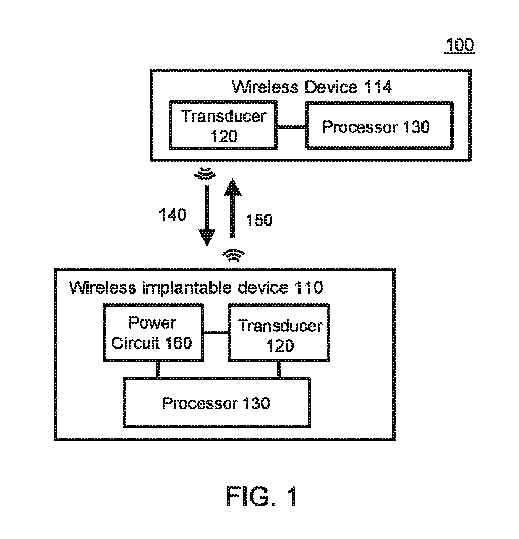
本明細書では、無線システムの無線デバイス間で無線信号を交換するためのシステム、デバイス、及び方法が説明される。概して、システムは、フィードバック信号、リンクスキャン信号、及びデータ信号のうちの1つ以上に基づいて、無線デバイス間で無線電力、無線データ、及び無線コマンドのうちの1つ以上を交換するように構成され得る。一部の変形例では、本明細書に説明されるシステム、デバイス、及び方法は、無線移植可能デバイスと外部無線デバイスとの間の無線信号(例えば、電力、データ、コマンド)の効率的かつ/又は信頼性の高い交換のために、異種組織媒体におけるマルチパス干渉の軽減を可能にし得る。一部の変形例では、無線電力又はデータを交換するよう構成されたシステムは、第1の持続時間でフィードバック信号を送信するように構成された第1のデバイスと、トランスデューサアレイ及びプロセッサを含む第2のデバイスと、を備え、トランスデューサアレイが、第2の持続時間の間、トランスデューサアレイの1つ以上のトランスデューサ要素上でフィードバック信号を受信するように構成され得、プロセッサが、トランスデューサアレイの1つ以上のトランスデューサ要素によって第2の持続時間内に受信されたフィードバック信号を処理して、フィードバック信号データを生成することと、フィードバック信号データに少なくとも部分的に基づいて、トランスデューサアレイ構成を決定することと、を行うように構成され得、第2のデバイスが、トランスデューサアレイ構成を使用して、1つ以上の無線信号を第1のデバイスと交換するように構成され得る。 Described herein are systems, devices, and methods for exchanging wireless signals between wireless devices of a wireless system. Generally, the systems may be configured to exchange one or more of wireless power, wireless data, and wireless commands between the wireless devices based on one or more of a feedback signal, a link scan signal, and a data signal. In some variations, the systems, devices, and methods described herein may enable mitigation of multipath interference in heterogeneous tissue media for efficient and/or reliable exchange of wireless signals (e.g., power, data, commands) between a wireless implantable device and an external wireless device. In some variations, a system configured to exchange wireless power or data may include a first device configured to transmit a feedback signal for a first duration and a second device including a transducer array and a processor, where the transducer array may be configured to receive a feedback signal on one or more transducer elements of the transducer array for a second duration, the processor may be configured to process the feedback signal received by the one or more transducer elements of the transducer array within the second duration to generate feedback signal data, and determine a transducer array configuration based at least in part on the feedback signal data, and the second device may be configured to exchange one or more wireless signals with the first device using the transducer array configuration.
一部の変形例では、第2の持続時間が、第1の持続時間を超え得る。一部の変形例では、プロセッサが、包絡線検波、所定のタイミング、コヒーレント検波、及び所定の閾値レベルに対する受信されたフィードバック信号振幅の比較のうちの1つ以上を使用して、トランスデューサアレイの1つ以上のトランスデューサ要素上の受信されたフィードバック信号の開始を検出するように更に構成され得る。 In some variations, the second duration may exceed the first duration. In some variations, the processor may be further configured to detect the onset of the received feedback signal on one or more transducer elements of the transducer array using one or more of envelope detection, predetermined timing, coherent detection, and a comparison of the received feedback signal amplitude to a predetermined threshold level.
一部の変形例では、フィードバック信号データが、トランスデューサアレイの1つ以上のトランスデューサ要素によって第2の持続時間以内に受信されたフィードバック信号の絶対振幅又は大きさ、相対振幅又は大きさ、絶対信号強度、相対信号強度、1つ以上の周波数帯域における信号エネルギー、アポダイゼーション、絶対位相、相対位相、絶対時間遅延、相対時間遅延、絶対到着時間、相対到着時間、周波数、持続時間、サイクル数、絶対信号対雑音比、並びに相対信号対雑音比のうちの1つ以上を含み得る。一部の変形例では、トランスデューサアレイ構成が、無線信号を第1のデバイスに送信するために、トランスデューサアレイの1つ以上のトランスデューサ要素に適用される、選択されたトランスデューサ要素のセット、アポダイゼーション、信号強度、電圧レベル、電流レベル、パルス幅、パルス幅変調、デューティサイクル、位相、時間遅延、周波数、及び送信持続時間のうちの1つ以上を含み得る。 In some variations, the feedback signal data may include one or more of absolute amplitude or magnitude, relative amplitude or magnitude, absolute signal strength, relative signal strength, signal energy in one or more frequency bands, apodization, absolute phase, relative phase, absolute time delay, relative time delay, absolute arrival time, relative arrival time, frequency, duration, number of cycles, absolute signal-to-noise ratio, and relative signal-to-noise ratio of the feedback signal received by one or more transducer elements of the transducer array during the second duration. In some variations, the transducer array configuration may include one or more of a selected set of transducer elements, apodization, signal strength, voltage level, current level, pulse width, pulse width modulation, duty cycle, phase, time delay, frequency, and transmission duration applied to one or more transducer elements of the transducer array to transmit a wireless signal to the first device.
一部の変形例では、無線信号を第1のデバイスに送信するためにトランスデューサアレイの1つ以上のトランスデューサ要素に適用される位相が、所定の周波数の第2の持続時間における受信されたフィードバック信号の相対位相、及び1つ以上のトランスデューサ要素上で受信されたフィードバック信号の到着時間のうちの1つ以上に基づき得る。一部の変形例では、無線信号を第1のデバイスに送信するためにトランスデューサアレイの1つ以上のトランスデューサ要素に適用される時間遅延が、所定の周波数の第2の持続時間における受信されたフィードバック信号の相対位相、及び1つ以上のトランスデューサ要素上で受信されたフィードバック信号の到着時間のうちの1つ以上に基づき得る。 In some variations, a phase applied to one or more transducer elements of the transducer array to transmit a wireless signal to the first device may be based on one or more of a relative phase of a received feedback signal at a second duration of a predetermined frequency and an arrival time of the feedback signal received on the one or more transducer elements. In some variations, a time delay applied to one or more transducer elements of the transducer array to transmit a wireless signal to the first device may be based on one or more of a relative phase of a received feedback signal at a second duration of a predetermined frequency and an arrival time of the feedback signal received on the one or more transducer elements.
一部の変形例では、受信されたフィードバック信号が、持続時間及び固定振幅を含み得る。一部の変形例では、フィードバック信号が、インパルス信号及びパルス信号のうちの1つ以上を含み得る。一部の変形例では、プロセッサが、時間領域解析、周波数領域解析、及び内挿解析のうちの1つ以上を使用して、フィードバック信号を処理するか、又はトランスデューサアレイ構成を決定するように構成され得る。一部の変形例では、時間領域解析が、相互相関及び時間反転のうちの1つ以上を含み得る。一部の変形例では、周波数領域解析が、フーリエ変換、離散フーリエ変換(DFT)、及び離散時間フーリエ変換(DTFT)のうちの1つ以上を1つ以上の所定の周波数で計算することを含み得る。一部の変形例では、プロセッサが、フーリエ変換、離散フーリエ変換(DFT)、及び離散時間フーリエ変換(DTFT)のうちの1つ以上を1つ以上の所定の周波数で計算するために、高速フーリエ変換(FFT)アルゴリズムを使用するように構成され得る。一部の変形例では、1つ以上の所定の周波数が、1つ以上のフィードバック信号周波数に基づき得る。一部の変形例では、プロセッサが、トランスデューサアレイの1つ以上のトランスデューサ要素によって、第1の持続時間、第2の持続時間、及び第3の持続時間のうちの1つ以上で受信されたフィードバック信号の時間領域解析及び周波数領域解析のうちの1つ以上に基づいて、1つ以上の所定の周波数を決定するように構成され得る。 In some variations, the received feedback signal may include a duration and a fixed amplitude. In some variations, the feedback signal may include one or more of an impulse signal and a pulse signal. In some variations, the processor may be configured to process the feedback signal or determine the transducer array configuration using one or more of a time domain analysis, a frequency domain analysis, and an interpolation analysis. In some variations, the time domain analysis may include one or more of a cross-correlation and a time reversal. In some variations, the frequency domain analysis may include computing one or more of a Fourier transform, a discrete Fourier transform (DFT), and a discrete-time Fourier transform (DTFT) at one or more predetermined frequencies. In some variations, the processor may be configured to use a fast Fourier transform (FFT) algorithm to compute one or more of a Fourier transform, a discrete Fourier transform (DFT), and a discrete-time Fourier transform (DTFT) at one or more predetermined frequencies. In some variations, the one or more predetermined frequencies may be based on one or more feedback signal frequencies. In some variations, the processor may be configured to determine the one or more predetermined frequencies based on one or more of a time domain analysis and a frequency domain analysis of a feedback signal received by one or more transducer elements of the transducer array at one or more of the first duration, the second duration, and the third duration.
一部の変形例では、プロセッサが、フィードバック信号データ及び送信されたフィードバック信号の所定の電力のうちの少なくとも1つを使用して、無線信号を第1のデバイスに送信するためのリンク効率及び送信電力のうちの1つ以上を決定するように構成され得る。一部の変形例では、第1のデバイスと交換される1つ以上の無線信号が、第1の周波数セットを含み得、フィードバック信号が、第2の周波数セットを含み得、第1の周波数セットが、第2の周波数セットとは異なる。 In some variations, the processor may be configured to use at least one of the feedback signal data and the predetermined power of the transmitted feedback signal to determine one or more of a link efficiency and a transmit power for transmitting the wireless signal to the first device. In some variations, the one or more wireless signals exchanged with the first device may include a first set of frequencies and the feedback signal may include a second set of frequencies, the first set of frequencies being different from the second set of frequencies.
一部の変形例では、フィードバック信号を受信するように構成された第1のトランスデューサ要素のセットが、無線信号を第1のデバイスと交換するように構成されたトランスデューサアレイ構成に対応する第2のトランスデューサ要素のセットを有する1つ以上の共通のトランスデューサ要素を含み得る。一部の変形例では、フィードバック信号を受信するように構成された第1のトランスデューサ要素のセットが、無線信号を第1のデバイスと交換するように構成されたトランスデューサアレイ構成に対応する第2のトランスデューサ要素のセットとは異なるトランスデューサ要素を含み得る。 In some variations, the first set of transducer elements configured to receive the feedback signal may include one or more common transducer elements with the second set of transducer elements corresponding to the transducer array configuration configured to exchange wireless signals with the first device. In some variations, the first set of transducer elements configured to receive the feedback signal may include transducer elements that are different from the second set of transducer elements corresponding to the transducer array configuration configured to exchange wireless signals with the first device.
一部の変形例では、第1のデバイスが、移植可能医療デバイスを含み得、第2のデバイスが、第1のデバイスから物理的に分離して配設されるように構成された外部無線デバイスを含み得る。一部の変形例では、第1のデバイスが、外部無線デバイスを含み得、第2のデバイスが、第1のデバイスから物理的に分離して配設されるように構成された移植可能医療デバイスを含み得る。 In some variations, the first device may include an implantable medical device and the second device may include an external wireless device configured to be disposed physically separate from the first device. In some variations, the first device may include an external wireless device and the second device may include an implantable medical device configured to be disposed physically separate from the first device.
一部の変形例では、第1のデバイスが、フィードバック信号を1回以上の所定の繰り返し間隔で送信するように構成され得る。一部の変形例では、第2のデバイスが、無線コマンドを第1のデバイスに送信するように更に構成されており、第1のデバイスが、無線コマンドを受信することに応答して、フィードバック信号を送信するように構成され得る。一部の変形例では、送信されたフィードバック信号が、第2のデバイスによって第1のデバイスに送信された無線信号を受信することに応答して、反射信号又は後方散乱信号を含み得る。一部の変形例では、送信されたフィードバック信号が、超音波信号、音響信号、振動信号、無線周波数信号、電磁信号、磁気信号、電気信号、及び光信号のうちの1つ以上を含み得る。 In some variations, the first device may be configured to transmit a feedback signal at one or more predetermined repetition intervals. In some variations, the second device may be further configured to transmit a wireless command to the first device, and the first device may be configured to transmit a feedback signal in response to receiving the wireless command. In some variations, the transmitted feedback signal may include a reflected or backscattered signal in response to receiving a wireless signal transmitted by the second device to the first device. In some variations, the transmitted feedback signal may include one or more of an ultrasonic signal, an acoustic signal, a vibration signal, a radio frequency signal, an electromagnetic signal, a magnetic signal, an electrical signal, and an optical signal.
一部の変形例では、第1のデバイスが、1つ以上のデータ信号を第2のデバイスに送信するように更に構成され得る。一部の変形例では、プロセッサが、1つ以上のデータ信号を処理するために、第2のデバイスのトランスデューサアレイの1つ以上のトランスデューサ要素を選択するように更に構成され得る。一部の変形例では、プロセッサが、受信されたフィードバック信号の信号強度、受信されたフィードバック信号の信号対雑音比、1つ以上の周波数帯域における受信されたフィードバック信号のエネルギー、トランスデューサ要素のアポダイゼーション、フィードバック信号振幅の移動平均、干渉物の信号強度、マルチパス干渉の信号強度、及びマルチパス時間のうちの1つ以上に基づいて、第2のデバイスのトランスデューサアレイの1つ以上のトランスデューサ要素を選択するように構成され得る。 In some variations, the first device may be further configured to transmit one or more data signals to the second device. In some variations, the processor may be further configured to select one or more transducer elements of a transducer array of the second device for processing the one or more data signals. In some variations, the processor may be configured to select one or more transducer elements of a transducer array of the second device based on one or more of a signal strength of the received feedback signal, a signal-to-noise ratio of the received feedback signal, an energy of the received feedback signal in one or more frequency bands, apodization of the transducer elements, a moving average of the feedback signal amplitude, a signal strength of an interferer, a signal strength of a multipath interferer, and a multipath time.
無線システムで無線信号を交換する方法も説明される。一部の変形例では、方法は、無線システムの第1のデバイスから無線システムの第2のデバイスに第1の持続時間でフィードバック信号を送信するステップと、第2のデバイスのトランスデューサアレイの1つ以上のトランスデューサ要素を使用して、第2の持続時間の間、フィードバック信号を受信するステップと、トランスデューサアレイの1つ以上のトランスデューサ要素を使用して第2の持続時間内に受信されたフィードバック信号を処理して、第2のデバイスのプロセッサを使用してフィードバック信号データを生成するステップと、第2のデバイスのプロセッサを使用して、フィードバック信号データに少なくとも部分的に基づいて、第2のデバイスのトランスデューサアレイ構成を決定するステップと、第2のデバイスのトランスデューサアレイ構成を使用して、1つ以上の無線信号を第1のデバイスと交換するステップと、を含み得る。 A method of exchanging wireless signals in a wireless system is also described. In some variations, the method may include transmitting a feedback signal from a first device of the wireless system to a second device of the wireless system for a first duration, receiving the feedback signal for a second duration using one or more transducer elements of a transducer array of the second device, processing the feedback signal received within the second duration using one or more transducer elements of the transducer array to generate feedback signal data using a processor of the second device, determining a transducer array configuration of the second device based at least in part on the feedback signal data using a processor of the second device, and exchanging one or more wireless signals with the first device using the transducer array configuration of the second device.
一部の変形例では、第2の持続時間が、第1の持続時間を超え得る。一部の変形例では、方法が、包絡線検波、所定のタイミング、コヒーレント検波、及び所定の閾値レベルに対する受信されたフィードバック信号振幅の比較のうちの1つ以上を使用して、トランスデューサアレイの1つ以上のトランスデューサ要素上の受信されたフィードバック信号の開始を検出することを含み得る。 In some variations, the second duration may exceed the first duration. In some variations, the method may include detecting the onset of the received feedback signal on one or more transducer elements of the transducer array using one or more of envelope detection, predetermined timing, coherent detection, and comparing the received feedback signal amplitude to a predetermined threshold level.
一部の変形例では、フィードバック信号データが、トランスデューサアレイの1つ以上のトランスデューサ要素によって第2の持続時間以内に受信されたフィードバック信号の絶対振幅又は大きさ、相対振幅又は大きさ、絶対信号強度、相対信号強度、1つ以上の周波数帯域における信号エネルギー、アポダイゼーション、絶対位相、相対位相、絶対時間遅延、相対時間遅延、絶対到着時間、相対到着時間、周波数、持続時間、サイクル数、絶対信号対雑音比、並びに相対信号対雑音比のうちの1つ以上を含み得る。一部の変形例では、トランスデューサアレイ構成が、無線信号を第1のデバイスに送信するために、トランスデューサアレイの1つ以上のトランスデューサ要素に適用される、トランスデューサ要素のセットの選択、アポダイゼーション、信号強度、電圧レベル、電流レベル、パルス幅、パルス幅変調、信号のデューティサイクル、位相、時間遅延、周波数、及び送信持続時間のうちの1つ以上を含み得る。 In some variations, the feedback signal data may include one or more of absolute amplitude or magnitude, relative amplitude or magnitude, absolute signal strength, relative signal strength, signal energy in one or more frequency bands, apodization, absolute phase, relative phase, absolute time delay, relative time delay, absolute arrival time, relative arrival time, frequency, duration, number of cycles, absolute signal-to-noise ratio, and relative signal-to-noise ratio of the feedback signal received by one or more transducer elements of the transducer array during the second duration. In some variations, the transducer array configuration may include one or more of a selection of a set of transducer elements, apodization, signal strength, voltage level, current level, pulse width, pulse width modulation, signal duty cycle, phase, time delay, frequency, and transmission duration applied to one or more transducer elements of the transducer array to transmit a wireless signal to the first device.
一部の変形例では、無線信号を第1のデバイスに送信するためにトランスデューサアレイの1つ以上のトランスデューサ要素に適用される位相が、所定の周波数の第2の持続時間における受信されたフィードバック信号の相対位相、及び1つ以上のトランスデューサ要素を使用して受信されたフィードバック信号の到着時間のうちの1つ以上に基づき得る。一部の変形例では、無線信号を第1のデバイスに送信するためにトランスデューサアレイの1つ以上のトランスデューサ要素に適用される時間遅延が、所定の周波数の第2の持続時間における受信されたフィードバック信号の相対位相、及び1つ以上のトランスデューサ要素を使用して受信されたフィードバック信号の到着時間のうちの1つ以上に基づき得る。 In some variations, a phase applied to one or more transducer elements of the transducer array to transmit a wireless signal to the first device may be based on one or more of a relative phase of a received feedback signal at a second duration of a predetermined frequency and an arrival time of the feedback signal received using one or more transducer elements. In some variations, a time delay applied to one or more transducer elements of the transducer array to transmit a wireless signal to the first device may be based on one or more of a relative phase of a received feedback signal at a second duration of a predetermined frequency and an arrival time of the feedback signal received using one or more transducer elements.
一部の変形例では、受信されたフィードバック信号が、持続時間及び固定振幅を含み得る。一部の変形例では、フィードバック信号が、インパルス信号及びパルス信号のうちの1つ以上を含み得る。一部の変形例では、フィードバック信号を処理すること、又は第2のデバイスのトランスデューサアレイ構成を決定することが、時間領域解析、周波数領域解析、及び内挿解析のうちの1つ以上を含み得る。一部の変形例では、時間領域解析が、相互相関及び時間反転のうちの1つ以上を含み得る。一部の変形例では、周波数領域解析が、フーリエ変換、離散フーリエ変換(DFT)、及び離散時間フーリエ変換(DTFT)のうちの1つ以上を1つ以上の所定の周波数で計算することを含み得る。一部の変形例では、フーリエ変換、離散フーリエ変換(DFT)、及び離散時間フーリエ変換(DTFT)のうちの1つ以上を1つ以上の所定の周波数で計算することが、高速フーリエ変換(FFT)アルゴリズムを使用することを含み得る。一部の変形例では、1つ以上の所定の周波数が、1つ以上のフィードバック信号周波数に基づき得る。一部の変形例では、方法が、トランスデューサアレイの1つ以上のトランスデューサ要素を使用して、第1の持続時間、第2の持続時間、及び第3の持続時間のうちの1つ以上で受信されたフィードバック信号の時間領域解析及び周波数領域解析のうちの1つ以上に基づいて、1つ以上の所定の周波数を決定するステップを含み得る。 In some variations, the received feedback signal may include a duration and a fixed amplitude. In some variations, the feedback signal may include one or more of an impulse signal and a pulse signal. In some variations, processing the feedback signal or determining the transducer array configuration of the second device may include one or more of a time domain analysis, a frequency domain analysis, and an interpolation analysis. In some variations, the time domain analysis may include one or more of a cross-correlation and a time reversal. In some variations, the frequency domain analysis may include computing one or more of a Fourier transform, a discrete Fourier transform (DFT), and a discrete-time Fourier transform (DTFT) at one or more predetermined frequencies. In some variations, computing one or more of a Fourier transform, a discrete Fourier transform (DFT), and a discrete-time Fourier transform (DTFT) at one or more predetermined frequencies may include using a fast Fourier transform (FFT) algorithm. In some variations, the one or more predetermined frequencies may be based on one or more feedback signal frequencies. In some variations, the method may include determining, using one or more transducer elements of the transducer array, the one or more predetermined frequencies based on one or more of a time domain analysis and a frequency domain analysis of the feedback signal received at one or more of the first duration, the second duration, and the third duration.
一部の変形例では、第2のデバイスのトランスデューサアレイ構成を決定することが、フィードバック信号データ及び送信されたフィードバック信号の所定の電力のうちの少なくとも1つを使用して、無線信号を第1のデバイスに送信するためのリンク効率及び送信電力のうちの1つ以上を決定することを含み得る。一部の変形例では、第1のデバイスと交換される1つ以上の無線信号が、第1の周波数セットを含み得、フィードバック信号が、第2の周波数セットを含み得、第1の周波数セットが、第2の周波数セットとは異なり得る。 In some variations, determining the transducer array configuration of the second device may include determining one or more of a link efficiency and a transmit power for transmitting wireless signals to the first device using at least one of the feedback signal data and a predetermined power of the transmitted feedback signal. In some variations, the one or more wireless signals exchanged with the first device may include a first set of frequencies, the feedback signal may include a second set of frequencies, and the first set of frequencies may be different from the second set of frequencies.
一部の変形例では、フィードバック信号を受信するように構成された第1のトランスデューサ要素のセットが、無線信号を第1のデバイスと交換するように構成されたトランスデューサアレイ構成に対応する第2のトランスデューサ要素のセットを有する1つ以上の共通のトランスデューサ要素を含み得る。一部の変形例では、フィードバック信号を受信するように構成された第1のトランスデューサ要素のセットが、無線信号を第1のデバイスと交換するように構成されたトランスデューサアレイ構成に対応する第2のトランスデューサ要素のセットとは異なるトランスデューサ要素を含み得る。 In some variations, the first set of transducer elements configured to receive the feedback signal may include one or more common transducer elements with the second set of transducer elements corresponding to the transducer array configuration configured to exchange wireless signals with the first device. In some variations, the first set of transducer elements configured to receive the feedback signal may include transducer elements that are different from the second set of transducer elements corresponding to the transducer array configuration configured to exchange wireless signals with the first device.
一部の変形例では、第1のデバイスが、移植可能医療デバイスを含み得、第2のデバイスが、第1のデバイスから物理的に分離して配設されるように構成された外部無線デバイスを含み得る。一部の変形例では、第1のデバイスが、外部無線デバイスを含み得、第2のデバイスが、第1のデバイスから物理的に分離して配設されるように構成された移植可能医療デバイスを含み得る。 In some variations, the first device may include an implantable medical device and the second device may include an external wireless device configured to be disposed physically separate from the first device. In some variations, the first device may include an external wireless device and the second device may include an implantable medical device configured to be disposed physically separate from the first device.
一部の変形例では、方法が、フィードバック信号を1回以上の所定の繰り返し間隔で第1のデバイスから送信するステップを更に含み得る。一部の変形例では、方法が、第2のデバイスから第1のデバイスに無線コマンドを送信することと、無線コマンドの受信に応答して、第1のデバイスから第2のデバイスにフィードバック信号を送信することと、を更に含み得る。一部の変形例では、送信されたフィードバック信号が、第2のデバイスによって第1のデバイスに送信された無線信号を受信することに応答して、反射信号又は後方散乱信号を含み得る。一部の変形例では、送信されたフィードバック信号が、超音波信号、音響信号、振動信号、無線周波数信号、電磁信号、磁気信号、電気信号、及び光信号のうちの1つ以上を含み得る。 In some variations, the method may further include transmitting a feedback signal from the first device at one or more predetermined repeat intervals. In some variations, the method may further include transmitting a wireless command from the second device to the first device, and transmitting a feedback signal from the first device to the second device in response to receiving the wireless command. In some variations, the transmitted feedback signal may include a reflected or backscattered signal in response to receiving a wireless signal transmitted by the second device to the first device. In some variations, the transmitted feedback signal may include one or more of an ultrasonic signal, an acoustic signal, a vibration signal, a radio frequency signal, an electromagnetic signal, a magnetic signal, an electrical signal, and an optical signal.
一部の変形例では、方法が、1つ以上のデータ信号を第1のデバイスから第2のデバイスに送信するステップを更に含み得る。一部の変形例では、方法が、第2のデバイスのプロセッサを使用して1つ以上のデータ信号を処理するために、第2のデバイスのトランスデューサアレイの1つ以上のトランスデューサ要素を選択するステップを含み得る。一部の変形例では、第2のデバイスのトランスデューサアレイの1つ以上のトランスデューサ要素を選択することが、受信されたフィードバック信号の信号強度、受信されたフィードバック信号の信号対雑音比、1つ以上の周波数帯域における受信されたフィードバック信号のエネルギー、トランスデューサ要素のアポダイゼーション、フィードバック信号振幅の移動平均、干渉物の信号強度、マルチパス干渉の信号強度、及びマルチパス時間のうちの1つ以上に基づき得る。 In some variations, the method may further include transmitting one or more data signals from the first device to the second device. In some variations, the method may include selecting one or more transducer elements of a transducer array of the second device for processing the one or more data signals using a processor of the second device. In some variations, selecting one or more transducer elements of a transducer array of the second device may be based on one or more of a signal strength of the received feedback signal, a signal-to-noise ratio of the received feedback signal, an energy of the received feedback signal in one or more frequency bands, apodization of the transducer elements, a moving average of the feedback signal amplitude, a signal strength of an interferer, a signal strength of a multipath interferer, and a multipath time.
無線データ通信のために構成されたシステムも説明される。一部の変形例では、システムは、リンクスキャン信号及び第1のデータ信号を送信するように構成された第1のデバイスと、1つ以上のトランスデューサ要素、及びプロセッサを含む、第2のデバイスと、を備え得、1つ以上のトランスデューサ要素が、第1のデバイスからリンクスキャン信号及び第1のデータ信号を受信するように構成され得、プロセッサが、受信されたリンクスキャン信号及び受信された第1のデータ信号を処理して、第2のデータ信号を生成し、第2のデータ信号に少なくとも部分的に基づいて第1のデータ信号を復号化するように構成され得る。 A system configured for wireless data communication is also described. In some variations, the system may include a first device configured to transmit a link scan signal and a first data signal, and a second device including one or more transducer elements and a processor, where the one or more transducer elements may be configured to receive the link scan signal and the first data signal from the first device, and the processor may be configured to process the received link scan signal and the received first data signal to generate a second data signal and to decode the first data signal based at least in part on the second data signal.
一部の変形例では、リンクスキャン信号が、フィードバック信号、インパルス信号、パルス信号、第1のデータ信号の単一のデータビットを表すパルス信号、第1のデータ信号の複数のデータビットを表すパルス信号、ヘッダ信号、フッタ信号、所定のデジタルコード、連続波信号、複数のインパルス信号、及び複数のパルス信号のうちの1つ以上を含み得る。一部の変形例では、パルス信号又はフィードバック信号が、矩形パルス、ディラックパルス、正弦波パルス、三角形パルス、台形パルス、二乗余弦パルス、シンクパルス、ガウスパルス、及びパルス信号のキャリア周波数の1つ以上のサイクルのうちの1つ以上を含み得る。一部の変形例では、第1のデータ信号が、オンオフキーイング(OOK)変調、振幅シフトキーイング(ASK)変調、パルス位置変調(PPM)、周波数シフトキーイング(FSK)変調、位相シフトキーイング(PSK)変調、及び直交振幅変調(QAM)のうちの1つ以上を含み得る。 In some variations, the link scan signal may include one or more of a feedback signal, an impulse signal, a pulse signal, a pulse signal representing a single data bit of the first data signal, a pulse signal representing multiple data bits of the first data signal, a header signal, a footer signal, a predetermined digital code, a continuous wave signal, multiple impulse signals, and multiple pulse signals. In some variations, the pulse signal or feedback signal may include one or more of a rectangular pulse, a Dirac pulse, a sine pulse, a triangular pulse, a trapezoidal pulse, a raised cosine pulse, a sinc pulse, a Gaussian pulse, and one or more cycles of a carrier frequency of the pulse signal. In some variations, the first data signal may include one or more of an on-off keying (OOK) modulation, an amplitude shift keying (ASK) modulation, a pulse position modulation (PPM), a frequency shift keying (FSK) modulation, a phase shift keying (PSK) modulation, and a quadrature amplitude modulation (QAM).
一部の変形例では、プロセッサが、所定のタイミング、信号開始検出、信号立ち上がりエッジ及び信号立ち下がりエッジのうちの1つ以上の検出、信号のヘッダ成分及びフッタ成分のうちの1つ以上の検出、受信されたリンクスキャン信号及び受信された第1のデータ信号のうちの1つ以上の周波数におけるマルチパス時間及びドリフトのうちの1つ以上に基づいて、受信されたリンクスキャン信号及び受信された第1のデータ信号のうちの1つ以上の1つ以上の持続時間を選択するように更に構成され得る。 In some variations, the processor may be further configured to select one or more durations of one or more of the received link scan signal and the received first data signal based on one or more of a predetermined timing, a signal start detection, a detection of one or more of a signal rising edge and a signal falling edge, a detection of one or more of a signal header component and a footer component, a multipath time and a drift in the frequency of one or more of the received link scan signal and the received first data signal.
一部の変形例では、プロセッサが、受信されたリンクスキャン信号を処理して、無線システムのスケーリングされたインパルス応答を決定するように構成され得る。一部の変形例では、リンクスキャン信号が、フィードバック信号を含み得、プロセッサが、周波数領域計算及び時間領域計算のうちの1つ以上を使用して、スケーリングされた受信されたフィードバック信号をスケーリングされた基準フィードバック信号でデコンボリューションすることによって、無線システムのスケーリングされたインパルス応答を決定するように構成され得る。一部の変形例では、スケーリングされたインパルス応答、スケーリングされた受信されたフィードバック信号、及びスケーリングされた基準フィードバック信号のうちの1つ以上が、時間領域内の振幅、ある周波数における振幅、1つ以上の周波数帯域におけるエネルギー、インパルス応答のうちの1つ以上に対する信号対雑音比、受信されたフィードバック信号、基準フィードバック信号、対応するトランスデューサ要素のアポダイゼーション、所定の倍率、及び正規化倍率のうちの1つ以上によってスケーリングされ得る。 In some variations, the processor may be configured to process the received link scan signal to determine a scaled impulse response of the wireless system. In some variations, the link scan signal may include a feedback signal, and the processor may be configured to determine the scaled impulse response of the wireless system by deconvolving the scaled received feedback signal with a scaled reference feedback signal using one or more of a frequency domain calculation and a time domain calculation. In some variations, one or more of the scaled impulse response, the scaled received feedback signal, and the scaled reference feedback signal may be scaled by one or more of the amplitude in the time domain, the amplitude at a frequency, the energy in one or more frequency bands, the signal-to-noise ratio for one or more of the impulse responses, the received feedback signal, the reference feedback signal, the apodization of the corresponding transducer element, a predetermined scaling factor, and a normalization scaling factor.
一部の変形例では、第2のデバイスが、スケーリングされた基準フィードバック信号の周波数領域表現及び時間領域表現のうちの1つ以上がプリロードされたメモリを備え得る。一部の変形例では、プロセッサが、受信されたリンクスキャン信号及び受信された第1のデータ信号のうちの1つ以上の1つ以上の特性に基づいて、スケーリングされた基準フィードバック信号の周波数領域表現及び時間領域表現のうちの1つ以上を生成するように更に構成され得る。一部の変形例では、受信されたリンクスキャン信号及び受信された第1のデータ信号のうちの1つ以上の1つ以上の特性が、周波数、持続時間、サイクル数、振幅、位相、及び到着時間のうちの1つ以上を含み得る。 In some variations, the second device may include a memory preloaded with one or more of a frequency domain representation and a time domain representation of the scaled reference feedback signal. In some variations, the processor may be further configured to generate one or more of the frequency domain representation and the time domain representation of the scaled reference feedback signal based on one or more characteristics of one or more of the received link scan signal and the received first data signal. In some variations, the one or more characteristics of one or more of the received link scan signal and the received first data signal may include one or more of a frequency, a duration, a number of cycles, an amplitude, a phase, and a time of arrival.
一部の変形例では、プロセッサが、周波数領域解析及び時間領域解析のうちの1つ以上を使用して、スケーリングされた受信された第1のデータ信号を、スケーリングされたインパルス応答及びスケーリングされた受信されたリンクスキャン信号のうちの1つ以上でデコンボリューションすることによって、受信されたリンクスキャン信号及び受信された第1のデータ信号を処理して、第2のデータ信号を生成するように構成され得る。一部の変形例では、スケーリングされた受信された第1のデータ信号、スケーリングされたインパルス応答、及びスケーリングされた受信されたリンクスキャン信号のうちの1つ以上が、時間領域における振幅、ある周波数における振幅、1つ以上の周波数帯域におけるエネルギー、受信された第1のデータ信号、インパルス応答、及び受信されたリンクスキャン信号のうちの1つ以上に対する信号対雑音比、対応するトランスデューサ要素のアポダイゼーション、所定の倍率、並びに正規化倍率によってスケーリングされ得る。 In some variations, the processor may be configured to process the received link scan signal and the received first data signal by deconvolving the scaled received first data signal with one or more of the scaled impulse response and the scaled received link scan signal using one or more of a frequency domain analysis and a time domain analysis to generate a second data signal. In some variations, one or more of the scaled received first data signal, the scaled impulse response, and the scaled received link scan signal may be scaled by an amplitude in the time domain, an amplitude at a frequency, an energy in one or more frequency bands, a signal-to-noise ratio for one or more of the received first data signal, the impulse response, and the received link scan signal, an apodization of the corresponding transducer element, a predetermined scaling factor, and a normalization scaling factor.
一部の変形例では、プロセッサが、周波数領域解析及び時間領域解析のうちの1つ以上を使用して、スケーリングされた受信された第1のデータ信号を、スケーリングされた受信されたリンクスキャン信号でデコンボリューションすることによって、受信されたリンクスキャン信号及び受信された第1のデータ信号を処理して、第2のデータ信号を生成するように構成され得る。一部の変形例では、リンクスキャン信号が、インパルス信号、フィードバック信号、パルス信号、第1のデータ信号の単一のデータビットを表すパルス信号、第1のデータ信号の複数のデータビットを表すパルス信号、複数のインパルス信号、及び複数のパルス信号のうちの1つ以上を含み得る。 In some variations, the processor may be configured to process the received link scan signal and the received first data signal by deconvolving the scaled received first data signal with the scaled received link scan signal using one or more of a frequency domain analysis and a time domain analysis to generate a second data signal. In some variations, the link scan signal may include one or more of an impulse signal, a feedback signal, a pulse signal, a pulse signal representing a single data bit of the first data signal, a pulse signal representing multiple data bits of the first data signal, a plurality of impulse signals, and a plurality of pulse signals.
一部の変形例では、プロセッサが、バンドパスフィルタ、ローパスフィルタ、ハイパスフィルタ、オールパスフィルタ、ノッチフィルタ、及びバンドリジェクトフィルタのうちの1つ以上を使用して、リンクスキャン信号、第1のデータ信号、及び第2のデータ信号のうちの1つ以上をフィルタリングするように更に構成され得る。 In some variations, the processor may be further configured to filter one or more of the link scan signal, the first data signal, and the second data signal using one or more of a band pass filter, a low pass filter, a high pass filter, an all pass filter, a notch filter, and a band reject filter.
一部の変形例では、プロセッサが、2つ以上の第2のデータ信号を、ヘッダチェック、フッタチェック、2つ以上の第2のデータ信号の相対強度、2つ以上の第2のデータ信号の相対信号対雑音比、2つ以上の第2のデータ信号の相対信号対干渉比、2つ以上の第2のデータ信号内に存在する残留干渉の相対強度、基準の第2のデータ信号に対する2つ以上の第2のデータ信号の相互相関値のうちの1つ以上に基づいて、信号合成のために選択するように更に構成され得る。一部の変形例では、プロセッサが、第2のデータ信号の振幅、エネルギー、信号対雑音比、又は信号対干渉比、対応する第1のデータ信号の振幅、エネルギー、信号対雑音比、又は信号対干渉比、対応するリンクスキャン信号の振幅、エネルギー、信号対雑音比、又は信号対干渉比、及びリンクスキャン信号又は第1のデータ信号が受信される対応するトランスデューサ要素のアポダイゼーションのうちの1つ以上に基づいて、基準の第2のデータ信号を決定するように更に構成され得る。 In some variations, the processor may be further configured to select two or more second data signals for signal combining based on one or more of a header check, a footer check, a relative strength of the two or more second data signals, a relative signal-to-noise ratio of the two or more second data signals, a relative signal-to-interference ratio of the two or more second data signals, a relative strength of residual interference present in the two or more second data signals, a cross-correlation value of the two or more second data signals relative to a reference second data signal. In some variations, the processor may be further configured to determine a reference second data signal based on one or more of the amplitude, energy, signal-to-noise ratio, or signal-to-interference ratio of the second data signal, the amplitude, energy, signal-to-noise ratio, or signal-to-interference ratio of the corresponding first data signal, the amplitude, energy, signal-to-noise ratio, or signal-to-interference ratio of the corresponding link scan signal, and the apodization of the corresponding transducer element on which the link scan signal or the first data signal is received.
一部の変形例では、プロセッサが、合計、遅延及び合計、平均化、並びに遅延及び平均化のうちの1つ以上を使用して、2つ以上のスケーリングされた第2のデータ信号を合成して、1つ以上の合成されたデータ信号を生成するように更に構成され得る。一部の変形例では、スケーリングされた第2のデータ信号が、時間領域における振幅、周波数における振幅、1つ以上の周波数帯域におけるエネルギー、第2のデータ信号の信号対雑音比、対応するトランスデューサ要素のアポダイゼーション、所定の倍率、及び正規化倍率のうちの1つ以上によってスケーリングされ得る。 In some variations, the processor may be further configured to combine two or more scaled second data signals using one or more of summing, delay and summing, averaging, and delay and averaging to generate one or more combined data signals. In some variations, the scaled second data signals may be scaled by one or more of amplitude in the time domain, amplitude in frequency, energy in one or more frequency bands, signal-to-noise ratio of the second data signals, apodization of the corresponding transducer elements, a predetermined scaling factor, and a normalization scaling factor.
一部の変形例では、プロセッサが、合成されたデータ信号の時間領域における振幅、ある周波数における合成されたデータ信号の振幅、1つ以上の周波数帯域における合成されたデータ信号のエネルギー、及び合成されたデータ信号の信号対雑音比のうちの1つ以上に基づいて、データビットを復号化するための合成されたデータ信号を選択するように更に構成され得る。一部の変形例では、プロセッサが、OOK復調、ASK復調、PPM復調、FSK復調、PSK復調、QAM復調、包絡線検波、整合フィルタリング、所定の閾値に対する1つ以上の合成されたデータ信号の振幅の比較、及び固定時間オフセットにおける1つ以上の合成されたデータ信号の振幅のサンプリングのうちの1つ以上を使用して、少なくとも1つ以上の合成されたデータ信号に基づいて、データビットを復号化するように更に構成され得る。 In some variations, the processor may be further configured to select a combined data signal for decoding data bits based on one or more of the combined data signal's amplitude in the time domain, the combined data signal's amplitude at a frequency, the combined data signal's energy in one or more frequency bands, and the combined data signal's signal-to-noise ratio. In some variations, the processor may be further configured to decode data bits based on at least one or more combined data signals using one or more of OOK demodulation, ASK demodulation, PPM demodulation, FSK demodulation, PSK demodulation, QAM demodulation, envelope detection, matched filtering, comparing the amplitude of one or more combined data signals to a predetermined threshold, and sampling the amplitude of one or more combined data signals at a fixed time offset.
一部の変形例では、プロセッサが、OOK復調、ASK復調、PPM復調、FSK復調、PSK復調、QAM復調、包絡線検波、整合フィルタリング、所定の閾値に対する1つ以上の第2のデータ信号の振幅の比較、及び固定時間オフセットにおける1つ以上の第2のデータ信号の振幅のサンプリングのうちの1つ以上を使用して、1つ以上の第2のデータ信号に対応するデータビットを復号化するように更に構成され得る。一部の変形例では、プロセッサが、ヘッダチェック、フッタチェック、1つ以上の第2のデータ信号の相対強度、1つ以上の第2のデータ信号の相対信号対雑音比、1つ以上の第2のデータ信号内に存在する残留干渉の相対強度、及び基準の第2のデータ信号に対する1つ以上の第2のデータ信号の相互相関値に基づいて、データビットを復号化する前に、1つ以上の第2のデータ信号を選択するように更に構成され得る。 In some variations, the processor may be further configured to decode data bits corresponding to the one or more second data signals using one or more of OOK demodulation, ASK demodulation, PPM demodulation, FSK demodulation, PSK demodulation, QAM demodulation, envelope detection, matched filtering, comparing the amplitude of the one or more second data signals to a predetermined threshold, and sampling the amplitude of the one or more second data signals at a fixed time offset. In some variations, the processor may be further configured to select one or more second data signals prior to decoding the data bits based on a header check, a footer check, a relative strength of the one or more second data signals, a relative signal-to-noise ratio of the one or more second data signals, a relative strength of residual interference present in the one or more second data signals, and a cross-correlation value of the one or more second data signals relative to a reference second data signal.
一部の変形例では、プロセッサが、2つ以上の第2のデータ信号に対応する復号化されたデータビット値のうちの、ビット値の最頻値、ビット値の加重最頻値、平均ビット値、及び加重平均ビット値のうちの1つ以上を決定するように更に構成され得る。一部の変形例では、プロセッサは、対応するリンクスキャン信号又は対応する第1のデータ信号が受信され得るトランスデューサ要素のアポダイゼーション、振幅、エネルギー、信号対雑音比、時間遅延、第2のデータ信号、対応する第1のデータ信号、及び対応するリンクスキャン信号のうちの1つ以上の位相及びマルチパス時間のうちの1つ以上によってビット値をスケーリングすることによって、加重最頻値又は加重平均ビット値を決定するように構成され得る。 In some variations, the processor may be further configured to determine one or more of a mode of bit values, a weighted mode of bit values, an average bit value, and a weighted average bit value of the decoded data bit values corresponding to two or more second data signals. In some variations, the processor may be configured to determine the weighted mode or weighted average bit value by scaling the bit values by one or more of apodization, amplitude, energy, signal-to-noise ratio, time delay, phase and multipath time of one or more of the second data signal, the corresponding first data signal, and the corresponding link scan signal of a transducer element on which the corresponding link scan signal or the corresponding first data signal may be received.
一部の変形例では、第1のデバイスが、移植可能医療デバイスを含み得、第2のデバイスが、第1のデバイスから物理的に分離して配設されるように構成された外部無線デバイスを含み得、第1のデータ信号が、アップリンクデータ信号を含み得る。一部の変形例では、第1のデバイスが、外部無線デバイスを含み得、第2のデバイスが、第1のデバイスから物理的に分離して配設されるように構成された移植可能医療デバイスを含み得、第1のデータ信号が、ダウンリンクデータ信号を含み得る。 In some variations, the first device may include an implantable medical device, the second device may include an external wireless device configured to be disposed physically separate from the first device, and the first data signal may include an uplink data signal. In some variations, the first device may include an external wireless device, the second device may include an implantable medical device configured to be disposed physically separate from the first device, and the first data signal may include a downlink data signal.
一部の変形例では、第1のデバイスが、リンクスキャン信号及び第1のデータ信号のうちの1つ以上を1回以上の所定の繰り返し間隔で送信するように構成され得る。一部の変形例では、第2のデバイスが、無線コマンドを第1のデバイスに送信するように更に構成され得、第1のデバイスが、無線コマンドを受信することに応答して、リンクスキャン信号及び第1のデータ信号を送信するように構成され得る。一部の変形例では、送信されたリンクスキャン信号及び送信された第1のデータ信号のうちの1つ以上が、第2のデバイスによって第1のデバイスに送信された無線信号を受信することに応答して、反射信号及び後方散乱信号のうちの1つ以上を含み得る。一部の変形例では、送信されたリンクスキャン信号及び送信された第1のデータ信号のうちの1つ以上が、超音波信号、音響信号、振動信号、無線周波数信号、電磁信号、磁気信号、電気信号、及び光信号のうちの1つ以上を含み得る。 In some variations, the first device may be configured to transmit one or more of the link scan signal and the first data signal at one or more predetermined repetition intervals. In some variations, the second device may be further configured to transmit a wireless command to the first device, and the first device may be configured to transmit the link scan signal and the first data signal in response to receiving the wireless command. In some variations, the one or more of the transmitted link scan signal and the transmitted first data signal may include one or more of a reflected signal and a backscattered signal in response to receiving a wireless signal transmitted by the second device to the first device. In some variations, the one or more of the transmitted link scan signal and the transmitted first data signal may include one or more of an ultrasonic signal, an acoustic signal, a vibration signal, a radio frequency signal, an electromagnetic signal, a magnetic signal, an electrical signal, and an optical signal.
無線システムでデータ信号を復号化する方法も説明される。一部の変形例では、方法は、リンクスキャン信号及び第1のデータ信号を、無線システムの第1のデバイスから無線システムの第2のデバイスに送信するステップと、第2のデバイスの1つ以上のトランスデューサ要素を使用して、リンクスキャン信号及び第1のデータ信号を受信するステップと、第2のデバイスのプロセッサを使用して、受信されたリンクスキャン信号及び受信された第1のデータ信号を処理して、第2のデータ信号を生成するステップと、第2のデータ信号に少なくとも部分的に基づいて、第1のデータ信号を復号化するステップと、を含み得る。 A method of decoding a data signal in a wireless system is also described. In some variations, the method may include transmitting a link scan signal and a first data signal from a first device of the wireless system to a second device of the wireless system, receiving the link scan signal and the first data signal using one or more transducer elements of the second device, processing the received link scan signal and the received first data signal using a processor of the second device to generate a second data signal, and decoding the first data signal based at least in part on the second data signal.
一部の変形例では、リンクスキャン信号が、フィードバック信号、インパルス信号、パルス信号、第1のデータ信号の単一のデータビットを表すパルス信号、第1のデータ信号の複数のデータビットを表すパルス信号、ヘッダ信号、フッタ信号、所定のデジタルコード、連続波信号、複数のインパルス信号、及び複数のパルス信号のうちの1つ以上を含み得る。一部の変形例では、パルス信号又はフィードバック信号が、矩形パルス、ディラックパルス、正弦波パルス、三角形パルス、台形パルス、二乗余弦パルス、シンクパルス、ガウスパルス、及びパルス信号のキャリア周波数の1つ以上のサイクルのうちの1つ以上を含み得る。一部の変形例では、第1のデータ信号が、オンオフキーイング(OOK)変調、振幅シフトキーイング(ASK)変調、パルス位置変調(PPM)、周波数シフトキーイング(FSK)変調、位相シフトキーイング(PSK)変調、及び直交振幅変調(QAM)のうちの1つ以上を含み得る。 In some variations, the link scan signal may include one or more of a feedback signal, an impulse signal, a pulse signal, a pulse signal representing a single data bit of the first data signal, a pulse signal representing multiple data bits of the first data signal, a header signal, a footer signal, a predetermined digital code, a continuous wave signal, multiple impulse signals, and multiple pulse signals. In some variations, the pulse signal or feedback signal may include one or more of a rectangular pulse, a Dirac pulse, a sine pulse, a triangular pulse, a trapezoidal pulse, a raised cosine pulse, a sinc pulse, a Gaussian pulse, and one or more cycles of a carrier frequency of the pulse signal. In some variations, the first data signal may include one or more of an on-off keying (OOK) modulation, an amplitude shift keying (ASK) modulation, a pulse position modulation (PPM), a frequency shift keying (FSK) modulation, a phase shift keying (PSK) modulation, and a quadrature amplitude modulation (QAM).
一部の変形例では、方法は、所定のタイミング、信号開始検出、信号立ち上がりエッジ及び信号立ち下がりエッジのうちの1つ以上の検出、信号のヘッダ成分及びフッタ成分のうちの1つ以上の検出、受信されたリンクスキャン信号及び受信された第1のデータ信号のうちの1つ以上の周波数におけるマルチパス時間及びドリフトのうちの1つ以上に基づいて、処理前に、受信されたリンクスキャン信号及び受信された第1のデータ信号のうちの1つ以上の1つ以上の持続時間を選択するステップを含み得る。 In some variations, the method may include selecting one or more durations of one or more of the received link scan signal and the received first data signal prior to processing based on one or more of a predetermined timing, signal start detection, detection of one or more of a signal rising edge and a signal falling edge, detection of one or more of a signal header component and a footer component, and multipath time and drift in frequency of one or more of the received link scan signal and the received first data signal.
一部の変形例では、受信されたリンクスキャン信号を処理することが、無線システムのスケーリングされたインパルス応答を決定することを含み得る。一部の変形例では、リンクスキャン信号が、フィードバック信号を含み得、無線システムのスケーリングされたインパルス応答を決定することが、周波数領域解析及び時間領域解析のうちの1つ以上を使用して、スケーリングされた受信されたフィードバック信号をスケーリングされた基準フィードバック信号でデコンボリューションすることを含み得る。一部の変形例では、スケーリングされたインパルス応答、スケーリングされた受信されたフィードバック信号、及びスケーリングされた基準フィードバック信号のうちの1つ以上が、時間領域内の振幅、ある周波数における振幅、1つ以上の周波数帯域におけるエネルギー、インパルス応答のうちの1つ以上に対する信号対雑音比、受信されたフィードバック信号、及び基準フィードバック信号、対応するトランスデューサ要素のアポダイゼーション、所定の倍率、及び正規化倍率のうちの1つ以上によってスケーリングされ得る。 In some variations, processing the received link scan signal may include determining a scaled impulse response of the wireless system. In some variations, the link scan signal may include a feedback signal, and determining the scaled impulse response of the wireless system may include deconvolving the scaled received feedback signal with a scaled reference feedback signal using one or more of a frequency domain analysis and a time domain analysis. In some variations, one or more of the scaled impulse response, the scaled received feedback signal, and the scaled reference feedback signal may be scaled by one or more of the amplitude in the time domain, the amplitude at a frequency, the energy in one or more frequency bands, the signal-to-noise ratio for one or more of the impulse responses, the received feedback signal, and the reference feedback signal, the apodization of the corresponding transducer element, a predetermined scaling factor, and a normalization scaling factor.
一部の変形例では、方法が、スケーリングされた基準フィードバック信号の周波数領域表現及び時間領域表現のうちの1つ以上を、第2のデバイスのメモリに記憶するステップを含み得る。一部の変形例では、方法が、受信されたリンクスキャン信号及び受信された第1のデータ信号のうちの1つ以上の1つ以上の特性に基づいて、スケーリングされた基準フィードバック信号の周波数領域表現及び時間領域表現のうちの1つ以上を生成するステップを含み得る。一部の変形例では、受信されたリンクスキャン信号及び受信された第1のデータ信号のうちの1つ以上の1つ以上の特性が、周波数、持続時間、サイクル数、振幅、位相、及び到着時間のうちの1つ以上を含み得る。 In some variations, the method may include storing one or more of a frequency domain representation and a time domain representation of the scaled reference feedback signal in a memory of the second device. In some variations, the method may include generating one or more of a frequency domain representation and a time domain representation of the scaled reference feedback signal based on one or more characteristics of one or more of the received link scan signal and the received first data signal. In some variations, the one or more characteristics of one or more of the received link scan signal and the received first data signal may include one or more of a frequency, a duration, a number of cycles, an amplitude, a phase, and a time of arrival.
一部の変形例では、受信されたリンクスキャン信号及び受信された第1のデータ信号を処理することが、周波数領域解析及び時間領域解析のうちの1つ以上を使用して、スケーリングされた受信された第1のデータ信号を、スケーリングされたインパルス応答及びスケーリングされた受信されたリンクスキャン信号のうちの1つ以上でデコンボリューションして、第2のデータ信号を生成することを含み得る。一部の変形例では、スケーリングされた受信された第1のデータ信号、スケーリングされたインパルス応答、及びスケーリングされた受信されたリンクスキャン信号のうちの1つ以上が、時間領域における振幅、ある周波数における振幅、1つ以上の周波数帯域におけるエネルギー、受信された第1のデータ信号、インパルス応答、及び受信されたリンクスキャン信号のうちの1つ以上に対する信号対雑音比、対応するトランスデューサ要素のアポダイゼーション、所定の倍率、並びに正規化倍率によってスケーリングされ得る。 In some variations, processing the received link scan signal and the received first data signal may include deconvolving the scaled received first data signal with one or more of the scaled impulse response and the scaled received link scan signal using one or more of a frequency domain analysis and a time domain analysis to generate a second data signal. In some variations, one or more of the scaled received first data signal, the scaled impulse response, and the scaled received link scan signal may be scaled by an amplitude in the time domain, an amplitude at a frequency, an energy in one or more frequency bands, a signal-to-noise ratio for one or more of the received first data signal, the impulse response, and the received link scan signal, an apodization of the corresponding transducer element, a predetermined scaling factor, and a normalization scaling factor.
一部の変形例では、受信されたリンクスキャン信号及び受信された第1のデータ信号を処理することが、周波数領域解析及び時間領域解析のうちの1つ以上を使用して、スケーリングされた受信された第1のデータ信号を、スケーリングされた受信されたリンクスキャン信号でデコンボリューションして、第2のデータ信号を生成することを含み得る。一部の変形例では、リンクスキャン信号が、インパルス信号、フィードバック信号、パルス信号、第1のデータ信号の単一のデータビットを表すパルス信号、第1のデータ信号の複数のデータビットを表すパルス信号、複数のインパルス信号、及び複数のパルス信号のうちの1つ以上を含み得る。一部の変形例では、方法が、バンドパスフィルタ、ローパスフィルタ、ハイパスフィルタ、オールパスフィルタ、ノッチフィルタ、及びバンドリジェクトフィルタのうちの1つ以上を使用して、リンクスキャン信号、第1のデータ信号、及び第2のデータ信号のうちの1つ以上をフィルタリングするステップを含み得る。 In some variations, processing the received link scan signal and the received first data signal may include deconvolving the scaled received first data signal with the scaled received link scan signal using one or more of a frequency domain analysis and a time domain analysis to generate a second data signal. In some variations, the link scan signal may include one or more of an impulse signal, a feedback signal, a pulse signal, a pulse signal representing a single data bit of the first data signal, a pulse signal representing multiple data bits of the first data signal, a plurality of impulse signals, and a plurality of pulse signals. In some variations, the method may include filtering one or more of the link scan signal, the first data signal, and the second data signal using one or more of a band pass filter, a low pass filter, a high pass filter, an all pass filter, a notch filter, and a band reject filter.
一部の変形例では、方法が、2つ以上の第2のデータ信号を、ヘッダチェック、フッタチェック、2つ以上の第2のデータ信号の相対強度、2つ以上の第2のデータ信号の相対信号対雑音比、2つ以上の第2のデータ信号の相対信号対干渉比、2つ以上の第2のデータ信号内に存在する残留干渉の相対強度、及び基準の第2のデータ信号に対する2つ以上の第2のデータ信号の相互相関値のうちの1つ以上に基づいて、信号合成のために選択するステップを含み得る。一部の変形例では、基準の第2のデータ信号が、第2のデータ信号の振幅、エネルギー、信号対雑音比、又は信号対干渉比、対応する第1のデータ信号の振幅、エネルギー、信号対雑音比、又は信号対干渉比、対応するリンクスキャン信号の振幅、エネルギー、信号対雑音比、又は信号対干渉比、及びリンクスキャン信号又は第1のデータ信号が受信され得る対応するトランスデューサ要素のアポダイゼーションのうちの1つ以上に基づいて決定され得る。 In some variations, the method may include selecting two or more second data signals for signal combining based on one or more of a header check, a footer check, a relative strength of the two or more second data signals, a relative signal-to-noise ratio of the two or more second data signals, a relative signal-to-interference ratio of the two or more second data signals, a relative strength of residual interference present in the two or more second data signals, and a cross-correlation value of the two or more second data signals relative to a reference second data signal. In some variations, the reference second data signal may be determined based on one or more of the amplitude, energy, signal-to-noise ratio, or signal-to-interference ratio of the second data signal, the amplitude, energy, signal-to-noise ratio, or signal-to-interference ratio of the corresponding first data signal, the amplitude, energy, signal-to-noise ratio, or signal-to-interference ratio of the corresponding link scan signal, and the apodization of the corresponding transducer element on which the link scan signal or the first data signal may be received.
一部の変形例では、方法が、合計、遅延及び合計、平均化、並びに遅延及び平均化のうちの1つ以上を使用して、2つ以上のスケーリングされた第2のデータ信号を合成して、1つ以上の合成されたデータ信号を生成するステップを含み得る。一部の変形例では、スケーリングされた第2のデータ信号が、時間領域における振幅、周波数における振幅、1つ以上の周波数帯域におけるエネルギー、第2のデータ信号の信号対雑音比、対応するトランスデューサ要素のアポダイゼーション、所定の倍率、及び正規化倍率のうちの1つ以上によってスケーリングされ得る。一部の変形例では、方法が、合成されたデータ信号の時間領域における振幅、ある周波数における合成されたデータ信号の振幅、1つ以上の周波数帯域における合成されたデータ信号のエネルギー、及び合成されたデータ信号の信号対雑音比のうちの1つ以上に基づいて、データビットを復号化するための合成されたデータ信号を選択するステップを含み得る。一部の変形例では、方法が、OOK復調、ASK復調、PPM復調、FSK復調、PSK復調、QAM復調、包絡線検波、整合フィルタリング、所定の閾値に対する1つ以上の合成されたデータ信号の振幅の比較、及び固定時間オフセットにおける1つ以上の合成されたデータ信号の振幅のサンプリングのうちの1つ以上を使用して、少なくとも1つ以上の合成されたデータ信号に基づいて、データビットを復号化するステップを含み得る。 In some variations, the method may include combining two or more scaled second data signals using one or more of summing, delay and summing, averaging, and delay and averaging to generate one or more combined data signals. In some variations, the scaled second data signals may be scaled by one or more of amplitude in the time domain, amplitude in frequency, energy in one or more frequency bands, signal-to-noise ratio of the second data signals, apodization of the corresponding transducer elements, a predetermined scaling factor, and a normalization scaling factor. In some variations, the method may include selecting a combined data signal for decoding data bits based on one or more of amplitude in the time domain of the combined data signals, amplitude of the combined data signals at a frequency, energy of the combined data signals in one or more frequency bands, and signal-to-noise ratio of the combined data signals. In some variations, the method may include decoding data bits based on at least one or more combined data signals using one or more of OOK demodulation, ASK demodulation, PPM demodulation, FSK demodulation, PSK demodulation, QAM demodulation, envelope detection, matched filtering, comparing the amplitude of the one or more combined data signals to a predetermined threshold, and sampling the amplitude of the one or more combined data signals at a fixed time offset.
一部の変形例では、方法が、OOK復調、ASK復調、PPM復調、FSK復調、PSK復調、QAM復調、包絡線検波、整合フィルタリング、所定の閾値に対する1つ以上の第2のデータ信号の振幅の比較、及び固定時間オフセットにおける1つ以上の第2のデータ信号の振幅のサンプリングのうちの1つ以上を使用して、1つ以上の第2のデータ信号に対応するデータビットを復号化するステップを含み得る。一部の変形例では、方法が、ヘッダチェック、フッタチェック、1つ以上の第2のデータ信号の相対強度、1つ以上の第2のデータ信号の相対信号対雑音比、1つ以上の第2のデータ信号内に存在する残留干渉の相対強度、及び基準の第2のデータ信号に対する1つ以上の第2のデータ信号の相互相関値に基づいて、データビットを復号化する前に、1つ以上の第2のデータ信号を選択するステップを含み得る。 In some variations, the method may include decoding data bits corresponding to the one or more second data signals using one or more of OOK demodulation, ASK demodulation, PPM demodulation, FSK demodulation, PSK demodulation, QAM demodulation, envelope detection, matched filtering, comparing the amplitude of the one or more second data signals to a predetermined threshold, and sampling the amplitude of the one or more second data signals at a fixed time offset. In some variations, the method may include selecting one or more second data signals prior to decoding the data bits based on a header check, a footer check, a relative strength of the one or more second data signals, a relative signal-to-noise ratio of the one or more second data signals, a relative strength of residual interference present in the one or more second data signals, and a cross-correlation value of the one or more second data signals relative to a reference second data signal.
一部の変形例では、方法が、2つ以上の第2のデータ信号に対応する復号化されたデータビット値のうちの、ビット値の最頻値、ビット値の加重最頻値、平均ビット値、及び加重平均ビット値のうちの1つ以上を決定するステップを含み得る。一部の変形例では、加重最頻値又は加重平均ビット値を決定することが、対応するリンクスキャン信号又は対応する第1のデータ信号が受信され得るトランスデューサ要素のアポダイゼーション、振幅、エネルギー、信号対雑音比、時間遅延、第2のデータ信号、対応する第1のデータ信号、及び対応するリンクスキャン信号のうちの1つ以上の位相及びマルチパス時間のうちの1つ以上によってビット値をスケーリングすることを含み得る。 In some variations, the method may include determining one or more of a mode of bit values, a weighted mode of bit values, an average bit value, and a weighted average bit value of the decoded data bit values corresponding to two or more second data signals. In some variations, determining the weighted mode or weighted average bit value may include scaling the bit values by one or more of apodization, amplitude, energy, signal-to-noise ratio, time delay, phase and multipath time of one or more of the second data signal, the corresponding first data signal, and the corresponding link scan signal of a transducer element on which the corresponding link scan signal or the corresponding first data signal may be received.
一部の変形例では、第1のデバイスが、移植可能医療デバイスを含み得、第2のデバイスが、第1のデバイスから物理的に分離して配設されるように構成された外部無線デバイスを含み得、第1のデータ信号が、アップリンクデータ信号を含み得る。一部の変形例では、第1のデバイスが、外部無線デバイスを含み得、第2のデバイスが、第1のデバイスから物理的に分離して配設されるように構成された移植可能医療デバイスを含み得、第1のデータ信号が、ダウンリンクデータ信号を含み得る。 In some variations, the first device may include an implantable medical device, the second device may include an external wireless device configured to be disposed physically separate from the first device, and the first data signal may include an uplink data signal. In some variations, the first device may include an external wireless device, the second device may include an implantable medical device configured to be disposed physically separate from the first device, and the first data signal may include a downlink data signal.
一部の変形例では、リンクスキャン信号及び第1のデータ信号のうちの1つ以上を、1つ以上の所定の繰り返し間隔で送信するステップを含み得る。一部の変形例では、方法が、第2のデバイスから第1のデバイスに無線コマンドを送信するステップと、第1のデバイスによって無線コマンドを受信することに応答して、第1のデバイスから第2のデバイスにリンクスキャン信号及び第1のデータ信号を送信するステップと、を含み得る。一部の変形例では、送信されたリンクスキャン信号及び送信された第1のデータ信号のうちの1つ以上が、第2のデバイスによって第1のデバイスに送信された無線信号を受信することに応答して、反射信号及び後方散乱信号のうちの1つ以上を含み得る。一部の変形例では、送信されたリンクスキャン信号及び送信された第1のデータ信号のうちの1つ以上が、超音波信号、音響信号、振動信号、無線周波数信号、電磁信号、磁気信号、電気信号、及び光信号のうちの1つ以上を含み得る。 In some variations, the method may include transmitting one or more of the link scan signal and the first data signal at one or more predetermined repetition intervals. In some variations, the method may include transmitting a wireless command from the second device to the first device, and transmitting the link scan signal and the first data signal from the first device to the second device in response to receiving the wireless command by the first device. In some variations, the one or more of the transmitted link scan signal and the transmitted first data signal may include one or more of a reflected signal and a backscattered signal in response to receiving the wireless signal transmitted by the second device to the first device. In some variations, the one or more of the transmitted link scan signal and the transmitted first data signal may include one or more of an ultrasonic signal, an acoustic signal, a vibration signal, a radio frequency signal, an electromagnetic signal, a magnetic signal, an electrical signal, and an optical signal.
無線データ通信のために構成されたシステムも説明される。一部の変形例では、システムは、リンクスキャン信号及び第1のデータ信号を送信するように構成された第1のデバイスと、1つ以上のトランスデューサ要素、及びプロセッサを含む、第2のデバイスと、を備え得、1つ以上のトランスデューサ要素が、第1のデバイスからリンクスキャン信号及び第1のデータ信号を受信するように構成され得、プロセッサが、受信されたリンクスキャン信号及び受信された第1のデータ信号のうちの1つ以上を処理して、第2のデバイスの1つ以上のトランスデューサ要素を選択し、第2のデバイスの選択された1つ以上のトランスデューサ要素に少なくとも部分的に基づいて第1のデータ信号を復号化するように構成され得る。 A system configured for wireless data communication is also described. In some variations, the system may include a first device configured to transmit a link scan signal and a first data signal, and a second device including one or more transducer elements and a processor, where the one or more transducer elements may be configured to receive the link scan signal and the first data signal from the first device, and the processor may be configured to process one or more of the received link scan signal and the received first data signal to select one or more transducer elements of the second device and to decode the first data signal based at least in part on the selected one or more transducer elements of the second device.
一部の変形例では、リンクスキャン信号が、フィードバック信号、インパルス信号、パルス信号、第1のデータ信号の単一のデータビットを表すパルス信号、第1のデータ信号の複数のデータビットを表すパルス信号、ヘッダ信号、フッタ信号、所定のデジタルコード、連続波信号、複数のインパルス信号、及び複数のパルス信号のうちの1つ以上を含み得る。一部の変形例では、プロセッサが、ヘッダチェック、フッタチェック、ビットエラーレート、リンクスキャン信号の相対強度、リンクスキャン信号の相対信号対雑音比、リンクスキャン信号の相対信号干渉比、1つ以上の周波数帯域におけるリンクスキャン信号のエネルギー、リンクスキャン信号振幅の移動平均、第1のデータ信号の相対強度、第1のデータ信号の相対信号対雑音比、第1のデータ信号の相対信号干渉比、1つ以上の周波数帯域における第1のデータ信号のエネルギー、第1のデータ信号振幅の移動平均、干渉物の信号強度、マルチパス干渉の信号強度、マルチパス時間、及び1つ以上のトランスデューサ要素のアポダイゼーションのうちの1つ以上に基づいて、第2のデバイスの1つ以上のトランスデューサ要素を選択するように構成され得る。 In some variations, the link scan signal may include one or more of a feedback signal, an impulse signal, a pulse signal, a pulse signal representing a single data bit of the first data signal, a pulse signal representing multiple data bits of the first data signal, a header signal, a footer signal, a predetermined digital code, a continuous wave signal, multiple impulse signals, and multiple pulse signals. In some variations, the processor may be configured to select one or more transducer elements of the second device based on one or more of a header check, a footer check, a bit error rate, a relative strength of the link scan signal, a relative signal-to-noise ratio of the link scan signal, a relative signal-to-interference ratio of the link scan signal, an energy of the link scan signal in one or more frequency bands, a moving average of the link scan signal amplitude, a relative strength of the first data signal, a relative signal-to-noise ratio of the first data signal, a relative signal-to-interference ratio of the first data signal, an energy of the first data signal in one or more frequency bands, a moving average of the first data signal amplitude, a signal strength of an interferer, a signal strength of a multipath interferer, a multipath time, and an apodization of the one or more transducer elements.
無線システムでデータ信号を復号化する方法も説明される。一部の変形例では、方法は、リンクスキャン信号及び第1のデータ信号を、無線システムの第1のデバイスから無線システムの第2のデバイスに送信するステップと、第2のデバイスの1つ以上のトランスデューサ要素を使用して、リンクスキャン信号及び第1のデータ信号を受信するステップと、第2のデバイスのプロセッサを使用して、受信されたリンクスキャン信号及び受信された第1のデータ信号のうちの1つ以上を処理して、第2のデバイスの1つ以上のトランスデューサ要素を選択するステップと、第2のデバイスの選択された1つ以上のトランスデューサ要素に少なくとも部分的に基づいて、第1のデータ信号を復号化するステップと、を含み得る。 A method of decoding a data signal in a wireless system is also described. In some variations, the method may include transmitting a link scan signal and a first data signal from a first device of the wireless system to a second device of the wireless system; receiving the link scan signal and the first data signal using one or more transducer elements of the second device; processing one or more of the received link scan signal and the received first data signal using a processor of the second device to select one or more transducer elements of the second device; and decoding the first data signal based at least in part on the selected one or more transducer elements of the second device.
一部の変形例では、リンクスキャン信号が、フィードバック信号、インパルス信号、パルス信号、第1のデータ信号の単一のデータビットを表すパルス信号、第1のデータ信号の複数のデータビットを表すパルス信号、ヘッダ信号、フッタ信号、所定のデジタルコード、連続波信号、複数のインパルス信号、及び複数のパルス信号のうちの1つ以上を含み得る。一部の変形例では、第2のデバイスの1つ以上のトランスデューサ要素を選択することが、ヘッダチェック、フッタチェック、ビットエラーレート、リンクスキャン信号の相対強度、リンクスキャン信号の相対信号対雑音比、リンクスキャン信号の相対信号干渉比、1つ以上の周波数帯域におけるリンクスキャン信号のエネルギー、リンクスキャン信号振幅の移動平均、第1のデータ信号の相対強度、第1のデータ信号の相対信号対雑音比、第1のデータ信号の相対信号干渉比、1つ以上の周波数帯域における第1のデータ信号のエネルギー、第1のデータ信号振幅の移動平均、干渉物の信号強度、マルチパス干渉の信号強度、マルチパス時間、及び1つ以上のトランスデューサ要素のアポダイゼーションのうちの1つ以上に基づき得る。 In some variations, the link scan signal may include one or more of a feedback signal, an impulse signal, a pulse signal, a pulse signal representing a single data bit of the first data signal, a pulse signal representing multiple data bits of the first data signal, a header signal, a footer signal, a predetermined digital code, a continuous wave signal, multiple impulse signals, and multiple pulse signals. In some variations, selecting one or more transducer elements of the second device may be based on one or more of a header check, a footer check, a bit error rate, a relative strength of the link scan signal, a relative signal-to-noise ratio of the link scan signal, a relative signal-to-interference ratio of the link scan signal, an energy of the link scan signal in one or more frequency bands, a moving average of the link scan signal amplitude, a relative strength of the first data signal, a relative signal-to-noise ratio of the first data signal, a relative signal-to-interference ratio of the first data signal, an energy of the first data signal in one or more frequency bands, a moving average of the first data signal amplitude, a signal strength of an interferer, a signal strength of a multipath interferer, a multipath time, and an apodization of one or more transducer elements.
無線電力及びデータのうちの1つ以上を交換するように構成されたシステムも説明される。一部の変形例では、システムは、フィードバック信号を送信するように構成された第1のデバイスと、第1のトランスデューサアレイ、第2のトランスデューサアレイ、及びプロセッサを含む第2のデバイスと、を備え得、第1のトランスデューサアレイが、第1のデバイスからフィードバック信号を受信するように構成され得、プロセッサが、第1のトランスデューサアレイの1つ以上のトランスデューサ要素によって受信された、受信されたフィードバック信号の1つ以上の部分を抽出し、受信されたフィードバック信号の抽出された1つ以上の部分を処理して、フィードバック信号データを生成し、フィードバック信号データに少なくとも部分的に基づいて第2のトランスデューサアレイ構成を決定するように構成され得、第2のトランスデューサアレイ構成が、1つ以上の無線信号を第1のデバイスと交換するように構成され得る。一部の変形例では、受信されたフィードバック信号の抽出された1つ以上の部分が、受信されたフィードバック信号の持続時間未満の持続時間を有し得る。一部の変形例では、フィードバック信号の持続時間が、フィードバック信号のキャリア周波数の約5サイクルを超え得る。 Systems configured to exchange one or more of wireless power and data are also described. In some variations, the system may include a first device configured to transmit a feedback signal and a second device including a first transducer array, a second transducer array, and a processor, where the first transducer array may be configured to receive a feedback signal from the first device, where the processor may be configured to extract one or more portions of a received feedback signal received by one or more transducer elements of the first transducer array, process the extracted one or more portions of the received feedback signal to generate feedback signal data, and determine a second transducer array configuration based at least in part on the feedback signal data, where the second transducer array configuration may be configured to exchange one or more wireless signals with the first device. In some variations, the extracted one or more portions of the received feedback signal may have a duration less than the duration of the received feedback signal. In some variations, the duration of the feedback signal may exceed about five cycles of a carrier frequency of the feedback signal.
一部の変形例では、フィードバック信号データが、第2のデバイスの第1のトランスデューサアレイの1つ以上のトランスデューサ要素によって受信されたフィードバック信号の絶対振幅、相対振幅、絶対信号強度、相対信号強度、絶対位相、相対位相、絶対時間遅延、及び相対時間遅延のうちの1つ以上を含み得る。 In some variations, the feedback signal data may include one or more of absolute amplitude, relative amplitude, absolute signal strength, relative signal strength, absolute phase, relative phase, absolute time delay, and relative time delay of a feedback signal received by one or more transducer elements of a first transducer array of the second device.
一部の変形例では、第1のデバイスが、移植可能医療デバイスを含み得、第2のデバイスが、第1のデバイスから物理的に分離して配設されるように構成された外部無線デバイスを含み得る。一部の変形例では、第1のトランスデューサアレイ及び第2のトランスデューサアレイが、1つ以上の共通のトランスデューサ要素を含み得る。一部の変形例では、第1のトランスデューサアレイが、第2のトランスデューサアレイのサブセットを含み得る。一部の変形例では、第1のトランスデューサアレイ及び第2のトランスデューサアレイが、別個のトランスデューサ要素を含み得る。一部の変形例では、第1のトランスデューサアレイ及び第2のトランスデューサアレイが、各々、音響トランスデューサアレイを含み得る。一部の変形例では、音響トランスデューサアレイが、超音波トランスデューサアレイを含み得る。 In some variations, the first device may include an implantable medical device and the second device may include an external wireless device configured to be disposed physically separate from the first device. In some variations, the first transducer array and the second transducer array may include one or more common transducer elements. In some variations, the first transducer array may include a subset of the second transducer array. In some variations, the first transducer array and the second transducer array may include separate transducer elements. In some variations, the first transducer array and the second transducer array may each include an acoustic transducer array. In some variations, the acoustic transducer array may include an ultrasound transducer array.
無線システムで無線信号を交換する方法も説明される。一部の変形例では、方法は、フィードバック信号を、無線システムの第1のデバイスから無線システムの第2のデバイスに送信するステップと、第2のデバイスの第1のトランスデューサアレイを使用してフィードバック信号を受信するステップと、第2のデバイスのプロセッサを使用して、第2のデバイスの第1のトランスデューサアレイの1つ以上のトランスデューサ要素によって受信された、受信されたフィードバック信号の1つ以上の部分を抽出するステップと、第2のデバイスのプロセッサを使用して、受信されたフィードバック信号の抽出された1つ以上の部分を処理して、フィードバック信号データを生成するステップと、フィードバック信号データに少なくとも部分的に基づいて、第2のデバイスの第2のトランスデューサアレイ構成を決定するステップと、第2のデバイスの第2のトランスデューサアレイ構成を使用して、1つ以上の無線信号を第1のデバイスと交換するステップと、を含み得る。一部の変形例では、受信されたフィードバック信号の抽出された1つ以上の部分が、受信されたフィードバック信号の持続時間未満の持続時間を有し得る。一部の変形例では、受信されたフィードバック信号の1つ以上の部分を抽出することが、固定振幅を有する受信されたフィードバック信号波形の1つ以上の領域を見つけることを含み得る。一部の変形例では、送信されたフィードバック信号の持続時間が、フィードバック信号のキャリア周波数の約5サイクルを超え得る。 A method of exchanging wireless signals in a wireless system is also described. In some variations, the method may include transmitting a feedback signal from a first device of the wireless system to a second device of the wireless system; receiving the feedback signal using a first transducer array of the second device; extracting, using a processor of the second device, one or more portions of the received feedback signal received by one or more transducer elements of the first transducer array of the second device; processing, using a processor of the second device, the extracted one or more portions of the received feedback signal to generate feedback signal data; determining a second transducer array configuration of the second device based at least in part on the feedback signal data; and exchanging one or more wireless signals with the first device using the second transducer array configuration of the second device. In some variations, the extracted one or more portions of the received feedback signal may have a duration less than a duration of the received feedback signal. In some variations, extracting one or more portions of the received feedback signal may include finding one or more regions of the received feedback signal waveform having a fixed amplitude. In some variations, the duration of the transmitted feedback signal may exceed about five cycles of the carrier frequency of the feedback signal.
一部の変形例では、方法が、受信されたフィードバック信号の1つ以上の部分を抽出する前に、受信されたフィードバック信号の立ち上がりエッジ及び立ち下がりエッジのうちの1つ以上を検出するステップを含み得る。一部の変形例では、受信されたフィードバック信号の1つ以上の部分を抽出することが、第1のトランスデューサアレイの要素のサブセットによって受信されたフィードバック信号に対して実施され得る。一部の変形例では、方法が、受信されたフィードバック信号の1つ以上の部分を抽出する前に、第1のトランスデューサアレイの1つ以上のトランスデューサ要素によって受信されたフィードバック信号をデジタル化するステップを含み得る。一部の変形例では、方法が、第1のトランスデューサアレイの1つ以上のトランスデューサ要素によって受信されたフィードバック信号をデジタル化する前に、アナログ信号処理を使用して、受信されたフィードバック信号の立ち上がりエッジを検出するステップを含み得る。一部の変形例では、受信されたフィードバック信号の1つ以上の部分を抽出することが、デジタル信号処理及びアナログ信号処理のうちの1つ以上を使用して実施され得る。 In some variations, the method may include detecting one or more of a rising edge and a falling edge of the received feedback signal before extracting one or more portions of the received feedback signal. In some variations, extracting one or more portions of the received feedback signal may be performed on a feedback signal received by a subset of elements of the first transducer array. In some variations, the method may include digitizing the feedback signal received by one or more transducer elements of the first transducer array before extracting one or more portions of the received feedback signal. In some variations, the method may include detecting a rising edge of the received feedback signal using analog signal processing before digitizing the feedback signal received by one or more transducer elements of the first transducer array. In some variations, extracting one or more portions of the received feedback signal may be performed using one or more of digital signal processing and analog signal processing.
一部の変形例では、フィードバック信号データが、第2のデバイスの第1のトランスデューサアレイの1つ以上のトランスデューサ要素によって受信されたフィードバック信号の絶対振幅、相対振幅、絶対信号強度、相対信号強度、絶対位相、相対位相、絶対時間遅延、及び相対時間遅延のうちの1つ以上を含み得る。一部の変形例では、第2のデバイスの第2のトランスデューサアレイ構成を決定することが、第2のトランスデューサアレイの1つ以上のトランスデューサ要素を通して無線信号を送信するための振幅、信号強度、位相、及び時間遅延のうちの1つ以上を決定することを含み得る。 In some variations, the feedback signal data may include one or more of absolute amplitude, relative amplitude, absolute signal strength, relative signal strength, absolute phase, relative phase, absolute time delay, and relative time delay of a feedback signal received by one or more transducer elements of a first transducer array of the second device. In some variations, determining a second transducer array configuration of the second device may include determining one or more of amplitude, signal strength, phase, and time delay for transmitting a wireless signal through one or more transducer elements of the second transducer array.
一部の変形例では、第2のトランスデューサアレイの1つ以上のトランスデューサ要素を通して無線信号を送信するための振幅、信号強度、位相、及び時間遅延のうちの1つ以上を決定することが、相互相関及び時間反転のうちの1つ以上を実施することを含み得る。一部の変形例では、第2のトランスデューサアレイの1つ以上のトランスデューサ要素を通して無線信号を送信するための振幅、信号強度、位相、及び時間遅延のうちの1つ以上を決定することが、第1のトランスデューサアレイ及び第2のトランスデューサアレイのトランスデューサ要素の相対的な空間位置に基づく、振幅、信号強度、位相、及び遅延のうちの1つ以上の補間を更に含み得る。一部の変形例では、第2のトランスデューサアレイ構成を決定することが、閉ループ給電の方法を含み得る。 In some variations, determining one or more of an amplitude, signal strength, phase, and time delay for transmitting a wireless signal through one or more transducer elements of the second transducer array may include performing one or more of cross-correlation and time reversal. In some variations, determining one or more of an amplitude, signal strength, phase, and time delay for transmitting a wireless signal through one or more transducer elements of the second transducer array may further include interpolating one or more of the amplitude, signal strength, phase, and delay based on the relative spatial positions of the transducer elements of the first transducer array and the second transducer array. In some variations, determining the second transducer array configuration may include a method of closed loop powering.
一部の変形例では、第1のデバイスが、移植可能医療デバイスを含み得、第2のデバイスが、第1のデバイスから物理的に分離して配設されるように構成された外部無線デバイスを含み得る。一部の変形例では、第1のトランスデューサアレイ及び第2のトランスデューサアレイが、1つ以上の共通のトランスデューサ要素を含む。一部の変形例では、第1のトランスデューサアレイが、第2のトランスデューサアレイのサブセットを含み得る。一部の変形例では、第1のトランスデューサアレイ及び第2のトランスデューサアレイが、別個のトランスデューサ要素を含み得る。一部の変形例では、第1のトランスデューサアレイ及び第2のトランスデューサアレイが、各々、音響トランスデューサアレイを含み得る。一部の変形例では、音響トランスデューサアレイが、超音波トランスデューサアレイを含み得る。 In some variations, the first device may include an implantable medical device and the second device may include an external wireless device configured to be disposed physically separate from the first device. In some variations, the first transducer array and the second transducer array include one or more common transducer elements. In some variations, the first transducer array may include a subset of the second transducer array. In some variations, the first transducer array and the second transducer array may include separate transducer elements. In some variations, the first transducer array and the second transducer array may each include an acoustic transducer array. In some variations, the acoustic transducer array may include an ultrasound transducer array.
電力及びデータのうちの1つ以上を交換するように構成されたシステムも説明される。一部の変形例では、システムは、リンクスキャン信号を送信するように構成された第1のデバイスと、第1のトランスデューサアレイ、第2のトランスデューサアレイ、及びプロセッサを含む第2のデバイスと、を備え得、第1のトランスデューサアレイが、第1のデバイスからリンクスキャン信号を受信するように構成され得、プロセッサが、第2のデバイスの第1のトランスデューサアレイの1つ以上のトランスデューサ要素によって受信された、受信されたリンクスキャン信号を処理して、リンクスキャン信号データを生成し、リンクスキャン信号データに少なくとも部分的に基づいて第2のトランスデューサアレイ構成を決定するように構成され得、第2のトランスデューサアレイ構成が、1つ以上の無線信号を第1のデバイスと交換するように構成され得る。一部の変形例では、リンクスキャン信号が、インパルス信号及びパルス信号のうちの1つ以上を含み得る。一部の変形例では、パルス信号が、矩形パルス、ディラックパルス、正弦波パルス、三角形パルス、台形パルス、二乗余弦パルス、シンクパルス、ガウスパルス、及びパルス信号のキャリア周波数の1つ以上のサイクルのうちの1つ以上を含み得る。 Systems configured to exchange one or more of power and data are also described. In some variations, the system may include a first device configured to transmit a link scan signal and a second device including a first transducer array, a second transducer array, and a processor, where the first transducer array may be configured to receive a link scan signal from the first device, the processor may be configured to process the received link scan signal received by one or more transducer elements of the first transducer array of the second device to generate link scan signal data and determine a second transducer array configuration based at least in part on the link scan signal data, and the second transducer array configuration may be configured to exchange one or more wireless signals with the first device. In some variations, the link scan signal may include one or more of an impulse signal and a pulse signal. In some variations, the pulse signal may include one or more of a rectangular pulse, a Dirac pulse, a sine pulse, a triangular pulse, a trapezoidal pulse, a raised cosine pulse, a sine pulse, a Gaussian pulse, and one or more cycles of the carrier frequency of the pulse signal.
一部の変形例では、第1のデバイスが、移植可能医療デバイスを含み得、第2のデバイスが、第1のデバイスから物理的に分離して配設されるように構成された外部無線デバイスを含み得る。一部の変形例では、第1のトランスデューサアレイ及び第2のトランスデューサアレイが、1つ以上の共通のトランスデューサ要素を含む。一部の変形例では、第1のトランスデューサアレイが、第2のトランスデューサアレイのサブセットを含み得る。一部の変形例では、第1のトランスデューサアレイ及び第2のトランスデューサアレイが、別個のトランスデューサ要素を含み得る。一部の変形例では、第1のトランスデューサアレイ及び第2のトランスデューサアレイが、各々、音響トランスデューサアレイを含み得る。一部の変形例では、音響トランスデューサアレイが、超音波トランスデューサアレイを含み得る。 In some variations, the first device may include an implantable medical device and the second device may include an external wireless device configured to be disposed physically separate from the first device. In some variations, the first transducer array and the second transducer array include one or more common transducer elements. In some variations, the first transducer array may include a subset of the second transducer array. In some variations, the first transducer array and the second transducer array may include separate transducer elements. In some variations, the first transducer array and the second transducer array may each include an acoustic transducer array. In some variations, the acoustic transducer array may include an ultrasound transducer array.
無線システムで無線信号を交換する方法も説明される。一部の変形例では、方法は、リンクスキャン信号を、無線システムの第1のデバイスから無線システムの第2のデバイスに送信するステップと、第2のデバイスの第1のトランスデューサアレイを使用してリンクスキャン信号を受信するステップと、第2のデバイスのプロセッサを使用して、第2のデバイスの第1のトランスデューサアレイの1つ以上のトランスデューサ要素によって受信された、受信されたリンクスキャン信号を処理して、リンクスキャン信号データを生成するステップと、リンクスキャン信号データに少なくとも部分的に基づいて、第2のデバイスの第2のトランスデューサアレイ構成を決定するステップと、第2のデバイスの第2のトランスデューサアレイ構成を使用して、1つ以上の無線信号を第1のデバイスと交換するステップと、を含み得る。一部の変形例では、リンクスキャン信号が、インパルス信号及びパルス信号のうちの1つ以上を含み得る。一部の変形例では、パルス信号が、パルス信号のキャリア周波数の1つ以上のサイクルを含み得る。 A method of exchanging wireless signals in a wireless system is also described. In some variations, the method may include transmitting a link scan signal from a first device of the wireless system to a second device of the wireless system; receiving the link scan signal using a first transducer array of the second device; processing the received link scan signal received by one or more transducer elements of the first transducer array of the second device using a processor of the second device to generate link scan signal data; determining a second transducer array configuration of the second device based at least in part on the link scan signal data; and exchanging one or more wireless signals with the first device using the second transducer array configuration of the second device. In some variations, the link scan signal may include one or more of an impulse signal and a pulse signal. In some variations, the pulse signal may include one or more cycles of a carrier frequency of the pulse signal.
一部の変形例では、第1のトランスデューサアレイのトランスデューサ要素によって受信された、受信されたリンクスキャン信号を処理することが、無線システムのインパルス応答を決定することを含み得る。一部の変形例では、受信されたリンクスキャン信号を処理することが、1つ以上のテンプレート信号との第1のトランスデューサアレイの1つ以上のトランスデューサ要素に対応する無線システムのインパルス応答のコンボリューションを実施することを更に含み得る。一部の変形例では、リンクスキャン信号データが、コンボリューションの出力信号を含み得る。 In some variations, processing the received link scan signal received by the transducer elements of the first transducer array may include determining an impulse response of the wireless system. In some variations, processing the received link scan signal may further include performing a convolution of the impulse response of the wireless system corresponding to one or more transducer elements of the first transducer array with one or more template signals. In some variations, the link scan signal data may include an output signal of the convolution.
一部の変形例では、リンクスキャン信号データが、コンボリューションの出力信号の絶対振幅、相対振幅、絶対信号強度、相対信号強度、絶対位相、相対位相、絶対時間遅延、及び相対時間遅延のうちの1つ以上を含み得る。一部の変形例では、テンプレート信号が、パルス信号を含み得る。一部の変形例では、テンプレート信号の持続時間が、テンプレート信号のキャリア周波数の約5サイクルを超え得る。一部の変形例では、パルス信号が、矩形パルス、ディラックパルス、正弦波パルス、三角形パルス、台形パルス、二乗余弦パルス、シンクパルス、ガウスパルス、及びパルス信号のキャリア周波数の1つ以上のサイクルのうちの1つ以上を含み得る。 In some variations, the link scan signal data may include one or more of absolute amplitude, relative amplitude, absolute signal strength, relative signal strength, absolute phase, relative phase, absolute time delay, and relative time delay of the output signal of the convolution. In some variations, the template signal may include a pulsed signal. In some variations, the duration of the template signal may exceed about five cycles of the carrier frequency of the template signal. In some variations, the pulsed signal may include one or more of a rectangular pulse, a Dirac pulse, a sine pulse, a triangular pulse, a trapezoidal pulse, a raised cosine pulse, a sinc pulse, a Gaussian pulse, and one or more cycles of the carrier frequency of the pulsed signal.
一部の変形例では、第2のデバイスの第2のトランスデューサアレイ構成を決定することが、第2のトランスデューサアレイの1つ以上のトランスデューサ要素を通して無線信号を送信するための振幅、信号強度、位相、及び時間遅延のうちの1つ以上を決定することを含み得る。一部の変形例では、第2のトランスデューサアレイの1つ以上のトランスデューサ要素を通して無線信号を送信するための振幅、信号強度、位相、及び時間遅延のうちの1つ以上を決定することが、相互相関及び時間反転のうちの1つ以上を実施することを含み得る。一部の変形例では、第2のトランスデューサアレイの1つ以上のトランスデューサ要素を通して無線信号を送信するための振幅、信号強度、位相、及び時間遅延のうちの1つ以上を決定することが、第1のトランスデューサアレイ及び第2のトランスデューサアレイのトランスデューサ要素の相対的な空間位置に基づく、振幅、信号強度、位相、及び時間遅延のうちの1つ以上の補間を更に含み得る。一部の変形例では、第2のトランスデューサアレイ構成を決定することが、閉ループ給電の方法を含み得る。 In some variations, determining the second transducer array configuration of the second device may include determining one or more of an amplitude, signal strength, phase, and time delay for transmitting wireless signals through one or more transducer elements of the second transducer array. In some variations, determining the one or more of an amplitude, signal strength, phase, and time delay for transmitting wireless signals through one or more transducer elements of the second transducer array may include performing one or more of cross-correlation and time reversal. In some variations, determining the one or more of an amplitude, signal strength, phase, and time delay for transmitting wireless signals through one or more transducer elements of the second transducer array may further include interpolating one or more of an amplitude, signal strength, phase, and time delay based on the relative spatial positions of the transducer elements of the first transducer array and the second transducer array. In some variations, determining the second transducer array configuration may include a method of closed loop powering.
一部の変形例では、第1のデバイスが、移植可能医療デバイスを含み得、第2のデバイスが、第1のデバイスから物理的に分離して配設されるように構成された外部無線デバイスを含み得る。一部の変形例では、第1のトランスデューサアレイ及び第2のトランスデューサアレイが、1つ以上の共通のトランスデューサ要素を含み得る。一部の変形例では、第1のトランスデューサアレイが、第2のトランスデューサアレイのサブセットを含み得る。一部の変形例では、第1のトランスデューサアレイ及び第2のトランスデューサアレイが、別個のトランスデューサ要素を含み得る。一部の変形例では、第1のトランスデューサアレイ及び第2のトランスデューサアレイが、各々、音響トランスデューサアレイを含み得る。一部の変形例では、音響トランスデューサアレイが、超音波トランスデューサアレイを含み得る。 In some variations, the first device may include an implantable medical device and the second device may include an external wireless device configured to be disposed physically separate from the first device. In some variations, the first transducer array and the second transducer array may include one or more common transducer elements. In some variations, the first transducer array may include a subset of the second transducer array. In some variations, the first transducer array and the second transducer array may include separate transducer elements. In some variations, the first transducer array and the second transducer array may each include an acoustic transducer array. In some variations, the acoustic transducer array may include an ultrasound transducer array.
電力及びデータのうちの1つ以上を交換するように構成されたシステムも説明される。一部の変形例では、システムは、リンクスキャン信号及びフィードバック信号を送信するように構成された第1のデバイスと、第1のトランスデューサアレイ、第2のトランスデューサアレイ、及びプロセッサを含む第2のデバイスと、を備え得、第1のトランスデューサアレイが、第1のデバイスからリンクスキャン信号及びフィードバック信号を受信するように構成され得、プロセッサが、第1のトランスデューサアレイの1つ以上のトランスデューサ要素によって受信された、受信されたリンクスキャン信号及び受信されたフィードバック信号を処理して、フィードバック信号データを生成し、フィードバック信号データに少なくとも部分的に基づいて、第2のトランスデューサアレイ構成を決定するように構成され得、第2のトランスデューサアレイ構成が、1つ以上の無線信号を第1のデバイスと交換するように構成され得る。 Systems configured to exchange one or more of power and data are also described. In some variations, the system may include a first device configured to transmit link scan signals and feedback signals, and a second device including a first transducer array, a second transducer array, and a processor, where the first transducer array may be configured to receive link scan signals and feedback signals from the first device, the processor may be configured to process the received link scan signals and received feedback signals received by one or more transducer elements of the first transducer array to generate feedback signal data, and determine a second transducer array configuration based at least in part on the feedback signal data, and the second transducer array configuration may be configured to exchange one or more wireless signals with the first device.
無線システムで無線信号を交換する方法も説明される。一部の変形例では、方法は、リンクスキャン信号及びフィードバック信号を、無線システムの第1のデバイスから無線システムの第2のデバイスに送信するステップと、第2のデバイスの第1のトランスデューサアレイを使用してリンクスキャン信号及びフィードバック信号を受信するステップと、第2のデバイスのプロセッサを使用して、第2のデバイスの第1のトランスデューサアレイの1つ以上のトランスデューサ要素によって受信された、受信されたリンクスキャン信号及び受信されたフィードバック信号を処理して、フィードバック信号データを生成するステップと、フィードバック信号データに少なくとも部分的に基づいて、第2のデバイスの第2のトランスデューサアレイ構成を決定するステップと、第2のデバイスの第2のトランスデューサアレイ構成を使用して、1つ以上の無線信号を第1のデバイスと交換するステップと、を含み得る。 A method of exchanging wireless signals in a wireless system is also described. In some variations, the method may include transmitting a link scan signal and a feedback signal from a first device of the wireless system to a second device of the wireless system; receiving the link scan signal and the feedback signal using a first transducer array of the second device; processing the received link scan signal and the received feedback signal received by one or more transducer elements of the first transducer array of the second device using a processor of the second device to generate feedback signal data; determining a second transducer array configuration of the second device based at least in part on the feedback signal data; and exchanging one or more wireless signals with the first device using the second transducer array configuration of the second device.
一部の変形例では、リンクスキャン信号が、インパルス信号及びパルス信号のうちの1つ以上を含み得る。一部の変形例では、パルス信号が、矩形パルス、ディラックパルス、正弦波パルス、三角形パルス、台形パルス、二乗余弦パルス、シンクパルス、ガウスパルス、及びパルス信号のキャリア周波数の1つ以上のサイクルのうちの1つ以上を含み得る。 In some variations, the link scan signal may include one or more of an impulse signal and a pulse signal. In some variations, the pulse signal may include one or more of a rectangular pulse, a Dirac pulse, a sine pulse, a triangular pulse, a trapezoidal pulse, a raised cosine pulse, a sinc pulse, a Gaussian pulse, and one or more cycles of a carrier frequency of the pulse signal.
一部の変形例では、受信されたリンクスキャン信号及び受信されたフィードバック信号を処理することが、受信されたリンクスキャン信号による受信されたフィードバック信号のデコンボリューションを実施することを含み得る。一部の変形例では、第1のトランスデューサアレイのトランスデューサ要素によって受信された、受信されたリンクスキャン信号を処理することが、無線システムのインパルス応答を決定することを含み得る。一部の変形例では、受信されたリンクスキャン信号及び受信されたフィードバック信号を処理することが、無線システムのインパルス応答による受信されたフィードバック信号のデコンボリューションを実施することを含み得る。 In some variations, processing the received link scan signal and the received feedback signal may include performing a deconvolution of the received feedback signal with the received link scan signal. In some variations, processing the received link scan signal received by the transducer elements of the first transducer array may include determining an impulse response of the wireless system. In some variations, processing the received link scan signal and the received feedback signal may include performing a deconvolution of the received feedback signal with the impulse response of the wireless system.
一部の変形例では、方法が、第2のデバイスのプロセッサを使用して、デコンボリューションの出力信号の1つ以上の部分を抽出するステップを更に含み得る。一部の変形例では、デコンボリューションの出力信号の1つ以上の部分を抽出することが、固定振幅を有するデコンボリューションの出力信号の1つ以上の領域を見つけることを含み得る。 In some variations, the method may further include extracting, using a processor of the second device, one or more portions of the deconvolution output signal. In some variations, extracting one or more portions of the deconvolution output signal may include finding one or more regions of the deconvolution output signal that have a fixed amplitude.
一部の変形例では、第2のデバイスの第2のトランスデューサアレイ構成を決定することが、第2のトランスデューサアレイの1つ以上のトランスデューサ要素を通して無線信号を送信するための振幅、信号強度、位相、及び時間遅延のうちの1つ以上を決定することを含み得る。一部の変形例では、第2のトランスデューサアレイの1つ以上のトランスデューサ要素を通して無線信号を送信するための振幅、信号強度、位相、及び時間遅延のうちの1つ以上を決定することが、相互相関及び時間反転のうちの1つ以上を実施することを含み得る。一部の変形例では、第2のトランスデューサアレイの1つ以上のトランスデューサ要素を通して無線信号を送信するための振幅、信号強度、位相、及び時間遅延のうちの1つ以上を決定することが、第1のトランスデューサアレイ及び第2のトランスデューサアレイのトランスデューサ要素の相対的な空間位置に基づく、振幅、信号強度、位相、及び遅延のうちの1つ以上の補間を更に含み得る。一部の変形例では、第2のトランスデューサアレイ構成を決定することが、閉ループ給電の方法を含み得る。 In some variations, determining the second transducer array configuration of the second device may include determining one or more of an amplitude, signal strength, phase, and time delay for transmitting wireless signals through one or more transducer elements of the second transducer array. In some variations, determining the one or more of an amplitude, signal strength, phase, and time delay for transmitting wireless signals through one or more transducer elements of the second transducer array may include performing one or more of cross-correlation and time reversal. In some variations, determining the one or more of an amplitude, signal strength, phase, and time delay for transmitting wireless signals through one or more transducer elements of the second transducer array may further include interpolation of one or more of an amplitude, signal strength, phase, and delay based on the relative spatial positions of the transducer elements of the first transducer array and the second transducer array. In some variations, determining the second transducer array configuration may include a method of closed loop powering.
無線システムでデータ信号を復号化する方法も説明される。一部の変形例では、方法は、リンクスキャン信号を、無線システムの第1のデバイスから無線システムの第2のデバイスに送信するステップと、第2のデバイスの1つ以上のトランスデューサ要素を使用して、リンクスキャン信号を受信するステップと、第2のデバイスのプロセッサを使用して、受信されたリンクスキャン信号を処理して、リンクスキャン信号データを生成するステップと、第2のデバイスのプロセッサを使用して、リンクスキャン信号データに基づいて、プリディストーションデータ信号を生成するステップと、プリディストーションデータ信号を第2のデバイスから第1のデバイスに送信するステップと、第1のデバイスの1つ以上のトランスデューサ要素を使用して、プリディストーションデータ信号を受信するステップと、第1のデバイスのプロセッサを使用して、受信されたプリディストーションデータ信号を処理して、復号化されたデータを生成するステップと、を含み得る。 A method of decoding a data signal in a wireless system is also described. In some variations, the method may include transmitting a link scan signal from a first device of the wireless system to a second device of the wireless system, receiving the link scan signal using one or more transducer elements of the second device, processing the received link scan signal using a processor of the second device to generate link scan signal data, generating a predistortion data signal based on the link scan signal data using a processor of the second device, transmitting the predistortion data signal from the second device to the first device, receiving the predistortion data signal using one or more transducer elements of the first device, and processing the received predistortion data signal using a processor of the first device to generate decoded data.
一部の変形例では、リンクスキャン信号が、インパルス信号を含み得、プリディストーションデータ信号を生成することが、受信されたリンクスキャン信号によるデータ信号のデコンボリューションを実施することを含み得る。一部の変形例では、リンクスキャン信号データが、無線システムのインパルス応答を含み得、プリディストーションデータ信号を生成することが、無線システムのインパルス応答によるデータ信号のデコンボリューションを実施することを含み得る。 In some variations, the link scan signal may include an impulse signal, and generating the predistortion data signal may include performing a deconvolution of the data signal with the received link scan signal. In some variations, the link scan signal data may include an impulse response of the wireless system, and generating the predistortion data signal may include performing a deconvolution of the data signal with the impulse response of the wireless system.
一部の変形例では、第1のデバイスが、移植可能医療デバイスを含み得、第2のデバイスが、第1のデバイスから物理的に分離して配設されるように構成された外部無線デバイスを含み得、プリディストーションデータ信号が、ダウンリンクデータ信号を含み得る。一部の変形例では、第1のデバイスが、外部無線デバイスを含み得、第2のデバイスが、第1のデバイスから物理的に分離して配設されるように構成された移植可能医療デバイスを含み得、プリディストーションデータ信号が、アップリンクデータ信号を含み得る。 In some variations, the first device may include an implantable medical device, the second device may include an external wireless device configured to be disposed physically separate from the first device, and the predistortion data signal may include a downlink data signal. In some variations, the first device may include an external wireless device, the second device may include an implantable medical device configured to be disposed physically separate from the first device, and the predistortion data signal may include an uplink data signal.
無線システムでデータ信号を復号化する方法も説明される。一部の変形例では、方法は、データ信号を、無線システムの第1のデバイスから無線システムの第2のデバイスに送信するステップと、第2のデバイスの複数のトランスデューサ要素を使用して、データ信号を受信するステップと、第2のデバイスの複数のトランスデューサ要素を使用して受信された、1つ以上の受信されたデータ信号に、第2のデバイスのプロセッサを使用して、所定の遅延を適用して、遅延されたデータ信号を生成するステップと、第2のデバイスのプロセッサを使用して2つ以上の遅延したデータ信号を合計して、1つ以上の遅延され合計されたデータ信号を生成するステップと、1つ以上の遅延され合計されたデータ信号に少なくとも部分的に基づいて、第2のデバイスのプロセッサを使用してデータ信号を復号化するステップと、を含み得る。 A method of decoding a data signal in a wireless system is also described. In some variations, the method may include transmitting a data signal from a first device of the wireless system to a second device of the wireless system, receiving the data signal using a plurality of transducer elements of the second device, applying a predetermined delay to one or more received data signals received using the plurality of transducer elements of the second device using a processor of the second device to generate a delayed data signal, summing the two or more delayed data signals using a processor of the second device to generate one or more delayed summed data signals, and decoding the data signal using a processor of the second device based at least in part on the one or more delayed summed data signals.
一部の変形例では、方法が、データ信号を送信する前に、第1のデバイスから第2のデバイスにフィードバック信号を送信するステップと、第2のデバイスの1つ以上のトランスデューサ要素を使用して、フィードバック信号を受信するステップと、第2のデバイスのプロセッサを使用して受信されたフィードバック信号を処理して、フィードバック信号データを生成するステップと、フィードバック信号データに少なくとも部分的に基づいて、所定の遅延を計算するステップと、を更に含み得る。 In some variations, the method may further include transmitting a feedback signal from the first device to the second device before transmitting the data signal; receiving the feedback signal using one or more transducer elements of the second device; processing the received feedback signal using a processor of the second device to generate feedback signal data; and calculating a predetermined delay based at least in part on the feedback signal data.
一部の変形例では、方法が、データ信号を送信する前に、第1のデバイスから第2のデバイスにリンクスキャン信号を送信するステップと、第2のデバイスの1つ以上のトランスデューサ要素を使用して、リンクスキャン信号を受信するステップと、第2のデバイスのプロセッサを使用して受信されたリンクスキャン信号を処理して、リンクスキャン信号データを生成するステップと、リンクスキャン信号データに少なくとも部分的に基づいて、所定の遅延を計算するステップと、を更に含み得る。 In some variations, the method may further include transmitting a link scan signal from the first device to the second device prior to transmitting the data signal; receiving the link scan signal using one or more transducer elements of the second device; processing the received link scan signal using a processor of the second device to generate link scan signal data; and calculating a predetermined delay based at least in part on the link scan signal data.
一部の変形例では、第1のデバイスが、移植可能医療デバイスを含み得、第2のデバイスが、第1のデバイスから物理的に分離して配設されるように構成された外部無線デバイスを含み得、データ信号が、アップリンクデータ信号を含み得る。一部の変形例では、第1のデバイスが、外部無線デバイスを含み得、第2のデバイスが、第1のデバイスから物理的に分離して配設されるように構成された移植可能医療デバイスを含み得、データ信号が、ダウンリンクデータ信号を含み得る。 In some variations, the first device may include an implantable medical device, the second device may include an external wireless device configured to be disposed physically separate from the first device, and the data signal may include an uplink data signal. In some variations, the first device may include an external wireless device, the second device may include an implantable medical device configured to be disposed physically separate from the first device, and the data signal may include a downlink data signal.
無線システムを較正する方法も説明される。一部の変形例では、方法は、1つ以上のキャリア周波数を含む1つ以上のテスト信号を、無線システムの第1のデバイスから無線システムの第2のデバイスに送信するステップと、第2のデバイスを使用して1つ以上のテスト信号を受信するステップと、第2のデバイスのプロセッサを使用して、1つ以上の受信されたテスト信号を処理して、テスト信号データを生成するステップと、テスト信号データに少なくとも部分的に基づいて、第2のデバイスのプロセッサを使用して、1つ以上の選択されたキャリア周波数を決定するステップと、1つ以上の選択されたキャリア周波数に対応する情報を含む、1つ以上の無線コマンドを第2のデバイスから第1のデバイスに送信するステップと、1つ以上の選択されたキャリア周波数に対応する情報を第1のデバイスのメモリに記憶するステップと、を含み得る。 A method of calibrating a wireless system is also described. In some variations, the method may include transmitting one or more test signals including one or more carrier frequencies from a first device of the wireless system to a second device of the wireless system, receiving the one or more test signals using the second device, processing the one or more received test signals using a processor of the second device to generate test signal data, determining one or more selected carrier frequencies using a processor of the second device based at least in part on the test signal data, transmitting one or more wireless commands from the second device to the first device including information corresponding to the one or more selected carrier frequencies, and storing the information corresponding to the one or more selected carrier frequencies in a memory of the first device.
一部の変形例では、方法が、1つ以上の選択されたキャリア周波数を含む無線信号を第1のデバイスから第2のデバイスに送信するステップを更に含み得る。一部の変形例では、送信された無線信号が、フィードバック信号、リンクスキャン信号、及びアップリンクデータ信号のうちの1つ以上を含み得る。一部の変形例では、1つ以上の選択されたキャリア周波数を決定することが、受信されたテスト信号のパラメータが所定の閾値よりも大きい値を有し得る1つ以上のキャリア周波数を決定することを含み得る。一部の変形例では、受信されたテスト信号のパラメータが、信号強度、信号振幅、信号電力、信号エネルギー、信号対ノイズ比、信号対干渉比、リンク効率、及びリンクゲインのうちの1つ以上を含み得る。一部の変形例では、第1のデバイスのメモリが、不揮発性メモリ及び揮発性メモリのうちの1つ以上を含み得る。 In some variations, the method may further include transmitting a wireless signal from the first device to the second device, the wireless signal including the one or more selected carrier frequencies. In some variations, the transmitted wireless signal may include one or more of a feedback signal, a link scan signal, and an uplink data signal. In some variations, determining the one or more selected carrier frequencies may include determining one or more carrier frequencies at which a parameter of the received test signal may have a value greater than a predetermined threshold. In some variations, the parameter of the received test signal may include one or more of signal strength, signal amplitude, signal power, signal energy, signal-to-noise ratio, signal-to-interference ratio, link efficiency, and link gain. In some variations, the memory of the first device may include one or more of a non-volatile memory and a volatile memory.
I.システム
A.概要
本明細書では、無線システムの2つ以上の無線デバイス間の無線リンクを確立するためのシステム、デバイス、及び方法が概して説明される。概して、無線システムは、1つ以上の無線モニタ又は無線移植可能デバイス又は移植可能医療デバイスと、1つ以上の無線デバイス又は外部無線デバイスと、を備え得る。無線移植可能デバイスは、無線電力転送を使用して、外部無線デバイスによって無線で給電又は再充電され得る。無線移植可能デバイスはまた、データ及び/又はコマンドを外部無線デバイスと双方向に無線通信し得る。
I. SYSTEM A. Overview Generally described herein are systems, devices, and methods for establishing a wireless link between two or more wireless devices of a wireless system. Generally, a wireless system may include one or more wireless monitors or wireless implantable devices or implantable medical devices and one or more wireless devices or external wireless devices. The wireless implantable devices may be wirelessly powered or recharged by the external wireless device using wireless power transfer. The wireless implantable devices may also wirelessly communicate data and/or commands bidirectionally with the external wireless device.
図1は、無線移植可能デバイス(110)及び無線デバイス(114)を備える無線システム(100)の例示的な変形例の概略ブロック図であり、構成要素の各々は、本明細書でより詳細に説明される。無線デバイス(114)は、無線ダウンリンク信号(140)を、電力、データ、コマンド、信号、それらの組み合わせなどのうちの1つ以上を含む、無線移植可能デバイス(110)に送信し得る。無線デバイス(114)は、無線アップリンク信号(150)を、電力、データ、コマンド、信号、それらの組み合わせなどのうちの1つ以上を含む、無線移植可能デバイス(110)から受信し得る。これらの信号の各々はまた、本明細書でより詳細に説明される。 1 is a schematic block diagram of an exemplary variation of a wireless system (100) comprising a wireless implantable device (110) and a wireless device (114), each of the components being described in more detail herein. The wireless device (114) may transmit wireless downlink signals (140) to the wireless implantable device (110), including one or more of power, data, commands, signals, combinations thereof, and the like. The wireless device (114) may receive wireless uplink signals (150) from the wireless implantable device (110), including one or more of power, data, commands, signals, combinations thereof, and the like. Each of these signals is also described in more detail herein.
図2は、組織(270)及びリブケージ又はリブ(272)によって取り囲まれた、心臓に移植された第1のデバイス(210)を、1つ以上のトランスデューサ要素(222)を備える1つ以上のトランスデューサアレイ(220)を備える外部の第2のデバイス(214)とともに備えるシステムの例示的な変形例である。一部の変形例では、第2のデバイス(214)は、患者の胸部上に配置され得る。第2のデバイス(214)は、問い合わせ信号、電力信号、ダウンリンクコマンド、ダウンリンクデータ信号などのうちの1つ以上を含むダウンリンク信号(242)を第1のデバイス(210)に送信するように構成され得る。第1のデバイス(210)は、フィードバック信号、アップリンクデータ信号、第1のデバイス(210)からの反射信号、第1のデバイス(210)からの後方散乱信号などのうちの1つ以上を含む無線信号(252)を生成するように構成され得る。一部の変形例では、第1のデバイス(210)は、空間経路(280)又は周期的軌道に沿って第2のデバイス(214)に対して移動し得る。 2 is an exemplary variation of a system including a first device (210) implanted in the heart surrounded by tissue (270) and a rib cage or ribs (272) along with an external second device (214) including one or more transducer arrays (220) including one or more transducer elements (222). In some variations, the second device (214) may be positioned on the patient's chest. The second device (214) may be configured to transmit downlink signals (242) including one or more of an interrogation signal, a power signal, a downlink command, a downlink data signal, etc. to the first device (210). The first device (210) may be configured to generate wireless signals (252) including one or more of a feedback signal, an uplink data signal, a reflected signal from the first device (210), a backscattered signal from the first device (210), etc. In some variations, the first device (210) may move relative to the second device (214) along a spatial path (280) or a periodic orbit.
B.無線モニタ
概して、無線モニタは、限定されるものではないが、感知、監視、刺激、療法の送達、それらの組み合わせなどを含む、1つ以上の機能を実施するように構成され得る。一部の変形例では、無線モニタは、無線電力、無線データ、無線コマンド、及び無線信号のうちの1つ以上を、外部無線デバイス又は別の無線モニタとの間で受信及び/又は送信し得る。例えば、無線モニタは、患者の1つ以上の生理学的パラメータを監視、測定、及び/又は処理するように構成され得る。
B. Wireless Monitors Generally, a wireless monitor may be configured to perform one or more functions, including, but not limited to, sensing, monitoring, stimulating, delivering therapy, combinations thereof, etc. In some variations, a wireless monitor may receive and/or transmit one or more of wireless power, wireless data, wireless commands, and wireless signals to an external wireless device or another wireless monitor. For example, a wireless monitor may be configured to monitor, measure, and/or process one or more physiological parameters of a patient.
一部の変形例では、本明細書に説明される無線モニタは、本明細書に説明される測定、処理、データストレージ、及び/又は信号送信ステップのサブセットのみを実施するように構成され得る。一部の変形例では、無線モニタは、本明細書に説明される構成要素又はブロックのサブセットのみを含み得る。例えば、一部の変形例では、無線モニタは、トランスデューサ、電源回路、及びプロセッサのみを含み得る。別の例として、一部の変形例では、無線モニタは、1つ以上のトランスデューサ、電源回路、プロセッサ、センサ、及びメモリを含み得る。一部の変形例では、無線モニタは、本明細書に説明され得るものに加えて他の構成要素(例えば、センサ、刺激装置、送達及び/若しくはアンカー機構、身体若しくは器官への配置を可能にする機械部品、又は他の構成要素)を含み得る。 In some variations, the wireless monitor described herein may be configured to perform only a subset of the measurement, processing, data storage, and/or signal transmission steps described herein. In some variations, the wireless monitor may include only a subset of the components or blocks described herein. For example, in some variations, the wireless monitor may include only a transducer, a power circuit, and a processor. As another example, in some variations, the wireless monitor may include one or more transducers, power circuits, a processor, sensors, and memory. In some variations, the wireless monitor may include other components in addition to those that may be described herein (e.g., sensors, stimulators, delivery and/or anchoring mechanisms, mechanical parts that enable placement in the body or organ, or other components).
一部の変形例では、無線モニタは、患者又は動物の内側に移植され得る。一部の変形例では、本明細書に説明される無線モニタは、移植可能デバイス、又は移植可能デバイスの任意の部分に結合され得る(例えば、取り付けられ得る)。例えば、1つ以上の無線モニタは、人工心臓弁又はステントに取り付けられ得る。別の例として、1つ以上の無線モニタは、パルス発生器及び/若しくはペースメーカーの1つ以上のリード、植込み型除細動器、並びに/又は心臓再同期療法デバイスのうちの1つ以上に取り付けられ得る。一部の変形例では、無線モニタは、心臓構造(例えば、心臓弁、心室)、血管構造(例えば、肺動脈、任意の他の血管)、体腔(body lumen)、体腔(body cavity)、組織、器官などのうちの1つ以上内又はその上に移植され得る。 In some variations, the wireless monitor may be implanted inside the patient or animal. In some variations, the wireless monitors described herein may be coupled to (e.g., attached to) an implantable device or any portion of an implantable device. For example, one or more wireless monitors may be attached to a prosthetic heart valve or stent. As another example, one or more wireless monitors may be attached to one or more leads of a pulse generator and/or pacemaker, an implantable cardioverter defibrillator, and/or a cardiac resynchronization therapy device. In some variations, the wireless monitor may be implanted in or on one or more of a cardiac structure (e.g., a heart valve, a ventricle), a vascular structure (e.g., a pulmonary artery, any other blood vessel), a body lumen, a body cavity, a tissue, an organ, etc.
一部の変形例では、無線モニタは、移植可能デバイスについて本明細書に説明される1つ以上の構成要素又はブロックを含み得る。一部の変形例では、移植可能デバイスは、無線モニタについて本明細書に説明される1つ以上の構成要素又はブロックを含み得る。例えば、無線モニタは、トランスデューサ、電源回路、エネルギー貯蔵デバイス、センサ、プロセッサ、メモリ、無線送信機、無線受信機、マルチプレクサ回路、それらの組み合わせなどのうちの1つ以上を含み得る。 In some variations, the wireless monitor may include one or more of the components or blocks described herein for the implantable device. In some variations, the implantable device may include one or more of the components or blocks described herein for the wireless monitor. For example, the wireless monitor may include one or more of a transducer, a power circuit, an energy storage device, a sensor, a processor, a memory, a wireless transmitter, a wireless receiver, a multiplexer circuit, combinations thereof, and the like.
C.移植可能デバイス
概して、本明細書に説明される移植可能デバイス、無線移植可能デバイス、又は移植可能医療デバイスは、患者又は動物の内側に移植されるように構成され得る。一部の変形例では、移植可能デバイスは、無線移植可能デバイスであり得る。一部の変形例では、無線移植可能デバイスは、無線電力、無線データ、無線コマンド、及び無線信号のうちの1つ以上を、外部無線デバイス又は別の無線移植可能デバイスとの間で受信及び/又は送信し得る。一部の変形例では、無線移植可能デバイスは、限定されるものではないが、感知、監視、刺激、療法の送達、それらの組み合わせなどを含む、1つ以上の機能を実施するように構成され得る。一部の変形例では、無線移植可能デバイスは、無線モニタであり得る。
C. Implantable Devices Generally, the implantable devices, wireless implantable devices, or implantable medical devices described herein may be configured to be implanted inside a patient or animal. In some variations, the implantable device may be a wireless implantable device. In some variations, the wireless implantable device may receive and/or transmit one or more of wireless power, wireless data, wireless commands, and wireless signals to and from an external wireless device or another wireless implantable device. In some variations, the wireless implantable device may be configured to perform one or more functions, including, but not limited to, sensing, monitoring, stimulating, delivering therapy, combinations thereof, and the like. In some variations, the wireless implantable device may be a wireless monitor.
一部の変形例では、移植可能デバイスが、人工心臓弁、人工心臓弁導管、弁尖接合デバイス、弁輪形成リング、弁修復デバイス(例えば、クリップ、綿球)、中隔欠損閉鎖器、左心耳閉鎖器、補助人工心臓、ペースメーカー(例えば、リード、パルス発生器を含む)、植込み型除細動器(例えば、リード、パルス発生器を含む)、心臓再同期療法デバイス(例えば、リード、パルス発生器を含む)、植込み型心臓モニタ、ステント(例えば、冠動脈又は末梢ステント、布製ステント、金属ステント)、ステントグラフト、足場、塞栓保護デバイス、塞栓コイル、血管内プラグ、血管パッチ、血管閉鎖デバイス、心房シャント、心不全を治療するためのパラシュートデバイス、心電計、それらの組み合わせなどのうちの1つ以上を含み得る。例えば、人工心臓弁は、経カテーテル心臓弁(THV)、自己拡張可能THV、バルーン拡張可能THV、外科用生体心臓弁、機械弁などのうちの1つ以上を含み得る。 In some variations, the implantable device may include one or more of a prosthetic heart valve, a prosthetic heart valve conduit, a valve leaflet coaptation device, an annuloplasty ring, a valve repair device (e.g., clip, pledget), a septal defect occluder, a left atrial appendage occluder, a ventricular assist device, a pacemaker (e.g., including a lead, a pulse generator), an implantable cardioverter defibrillator (e.g., including a lead, a pulse generator), a cardiac resynchronization therapy device (e.g., including a lead, a pulse generator), an implantable cardiac monitor, a stent (e.g., a coronary or peripheral stent, a fabric stent, a metal stent), a stent graft, a scaffold, an embolic protection device, an embolic coil, an intravascular plug, a vascular patch, a vascular closure device, an atrial shunt, a parachute device for treating heart failure, an electrocardiograph, combinations thereof, and the like. For example, the prosthetic heart valve may include one or more of a transcatheter heart valve (THV), a self-expandable THV, a balloon-expandable THV, a surgical bioprosthetic heart valve, a mechanical valve, and the like.
概して、本明細書に説明される移植可能デバイスは、限定されるものではないが、心臓弁(例えば、大動脈弁、僧帽弁)、心室(例えば、左心室又はLV、左心房又はLA、右心室又はRV、右心房又はRA)、血管(例えば、肺動脈、大動脈、浅大腿動脈、冠動脈、肺静脈など)、心臓組織(例えば、心筋又は壁、隔壁)、消化管(例えば、胃、食道)、膀胱、それらの組み合わせなどを含む身体内の任意の領域内又はその近く(例えば、隣接、近位)に位置し得る。 Generally, the implantable devices described herein may be located in or near (e.g., adjacent, proximal to) any region within the body, including, but not limited to, a heart valve (e.g., aortic valve, mitral valve), a ventricle (e.g., left ventricle or LV, left atrium or LA, right ventricle or RV, right atrium or RA), a blood vessel (e.g., pulmonary artery, aorta, superficial femoral artery, coronary artery, pulmonary vein, etc.), cardiac tissue (e.g., myocardium or wall, septum), gastrointestinal tract (e.g., stomach, esophagus), bladder, combinations thereof, etc.
図1に示されるように、無線移植可能デバイス(110)は、トランスデューサ(120)、プロセッサ(130)、及び電源回路(160)を備え得る。無線デバイス(114)は、トランスデューサ(120)及びプロセッサ(130)を備え得る。これらの構成要素の各々は、本明細書でより詳細に説明される。 As shown in FIG. 1, the wireless implantable device (110) may include a transducer (120), a processor (130), and a power circuit (160). The wireless device (114) may include a transducer (120) and a processor (130). Each of these components is described in more detail herein.
a.トランスデューサ
概して、本明細書に説明されるトランスデューサは、無線エネルギーモダリティと電気信号との間で変換するように構成され得る。一部の変形例では、デバイスのトランスデューサは、無線電力、無線信号、無線データ、無線コマンド、それらの組み合わせなどのうちの1つ以上を、別のデバイス及び/又は同じデバイスの別のトランスデューサと交換するように構成され得る。一部の変形例では、トランスデューサ(120)は、力学的な波(例えば、音響、超音波(ultrasonic又はultrasound)、振動)、磁界(例えば、誘導性)、電界(例えば、容量性)、電磁波(例えば、無線周波数又はRF、光学)、ガルバニック結合、表面波、それらの組み合わせなどのうちの1つ以上を使用して信号を受信及び/又は送信するとともに、信号を電気信号に及び/又はそれから変換するように構成され得る。本明細書に説明されるトランスデューサは、無線移植可能デバイス、無線モニタ、外部無線デバイスなど(例えば、本明細書に説明されるデバイスのうちのいずれか)のうちの1つ以上に含まれ得る。
a. Transducers Generally, the transducers described herein may be configured to convert between wireless energy modalities and electrical signals. In some variations, a transducer of a device may be configured to exchange one or more of wireless power, wireless signals, wireless data, wireless commands, combinations thereof, and the like with another device and/or another transducer of the same device. In some variations, the transducer (120) may be configured to receive and/or transmit signals using one or more of mechanical waves (e.g., acoustic, ultrasonic (ultrasonic or ultrasound), vibration), magnetic fields (e.g., inductive), electric fields (e.g., capacitive), electromagnetic waves (e.g., radio frequency or RF, optical), galvanic coupling, surface waves, combinations thereof, and the like, and to convert signals to and/or from electrical signals. The transducers described herein may be included in one or more of a wireless implantable device, a wireless monitor, an external wireless device, and the like (e.g., any of the devices described herein).
一部の変形例では、トランスデューサ(120)は、超音波トランスデューサ、無線周波数(RF)トランスデューサ(例えば、コイル、RFアンテナ)、静電容量トランスデューサ、それらの組み合わせなどのうちの1つ以上を含み得る。一部の変形例では、超音波トランスデューサは、圧電デバイス、容量性微細加工超音波トランスデューサ(CMUT)、圧電微細加工超音波トランスデューサ(PMUT)、それらの組み合わせなどのうちの1つ以上を含み得る。一部の変形例では、超音波トランスデューサは、圧力及び/又は力を電気信号に変換し得、及び/又はその逆であってもよい。一部の変形例では、トランスデューサ(120)は、限定されるものではないが、ピストン(例えば、ロッド、プレート)、円筒形、リング、球状(例えば、シェル)、屈曲(例えば、棒、ダイアフラム)、フレクテンショナル、それらの組み合わせなどを含む、1つ以上のタイプであり得る1つ以上の超音波トランスデューサを含み得る。一部の変形例では、圧電デバイスは、チタン酸ジルコン酸鉛(PZT)、PMN-PT、チタン酸バリウム(BaTiO3)、ポリフッ化ビニリデン(PVDF)、ニオブ酸リチウム(LiNbO3)、その任意の誘導体などのうちの1つ以上から作製され得る。一部の変形例では、無線周波数(RF)トランスデューサは、近距離無線及び/又は非近距離無線(例えば、遠距離無線)信号を送信及び/又は受信するように構成され得る。例えば、RFアンテナは、電力、データ、及び/又は他の信号の非近距離無線送信及び/又は受信のために構成され得る。RFコイルは、電力、データ、及び/又は他の信号の近距離無線(例えば、誘導性)送信及び/又は受信のために構成され得る。 In some variations, the transducer (120) may include one or more of an ultrasonic transducer, a radio frequency (RF) transducer (e.g., coil, RF antenna), a capacitive transducer, combinations thereof, and the like. In some variations, the ultrasonic transducer may include one or more of a piezoelectric device, a capacitive micromachined ultrasonic transducer (CMUT), a piezoelectric micromachined ultrasonic transducer (PMUT), combinations thereof, and the like. In some variations, the ultrasonic transducer may convert pressure and/or force into an electrical signal and/or vice versa. In some variations, the transducer (120) may include one or more ultrasonic transducers, which may be one or more types, including, but not limited to, piston (e.g., rod, plate), cylindrical, ring, spherical (e.g., shell), flexural (e.g., rod, diaphragm), flextensional, combinations thereof, and the like. In some variations, the piezoelectric device may be made from one or more of lead zirconate titanate (PZT), PMN-PT, barium titanate (BaTiO3), polyvinylidene fluoride (PVDF), lithium niobate (LiNbO3), any derivatives thereof, and the like. In some variations, the radio frequency (RF) transducer may be configured to transmit and/or receive short-range wireless and/or non-short-range wireless (e.g., long-range wireless) signals. For example, the RF antenna may be configured for non-short-range wireless transmission and/or reception of power, data, and/or other signals. The RF coil may be configured for short-range wireless (e.g., inductive) transmission and/or reception of power, data, and/or other signals.
一部の変形例では、トランスデューサ(120)は、無線電力の受信、別の無線デバイスとの間のデータの送信/受信、及び別の無線デバイスとの間の信号の送信/受信のうちの1つ以上のための1つ以上の超音波トランスデューサを含み得る。例えば、無線モニタの超音波トランスデューサは、外部無線デバイスから電力を受信するために、約20kHz~約20MHzの周波数で動作するように設計され得る。そのような周波数範囲の動作は、超音波トランスデューサをミリメートル又はミリメートル未満の寸法に小型化するために有用であり得、これは、1つ以上の無線モニタを別の移植可能デバイス(例えば、経カテーテル心臓弁、ステント)に統合するのに有利であり得る。一部の変形例では、超音波トランスデューサは、約数百オーム~約数百キロオーム(例えば、約100Ω~約500kΩ)程度の実部を有するインピーダンスを有し得る。一部の変形例では、超音波トランスデューサは、数十オーム程度の実部を有するインピーダンスを有し得る。 In some variations, the transducer (120) may include one or more ultrasound transducers for one or more of receiving wireless power, transmitting/receiving data to/from another wireless device, and transmitting/receiving signals to/from another wireless device. For example, the ultrasound transducer of the wireless monitor may be designed to operate at a frequency of about 20 kHz to about 20 MHz to receive power from an external wireless device. Operation in such a frequency range may be useful for miniaturizing the ultrasound transducer to millimeter or sub-millimeter dimensions, which may be advantageous for integrating one or more wireless monitors into another implantable device (e.g., transcatheter heart valve, stent). In some variations, the ultrasound transducer may have an impedance with a real part on the order of about several hundred ohms to several hundred kiloohms (e.g., about 100 Ω to about 500 kΩ). In some variations, the ultrasound transducer may have an impedance with a real part on the order of several tens of ohms.
一部の変形例では、トランスデューサ(120)は、無線モニタの小型化を可能にし得る単一のトランスデューサ要素(例えば、超音波圧電デバイス)を含み得る。一部の変形例では、単一のトランスデューサ要素は、外部無線デバイスから送信される電力信号(例えば、超音波電力)を受信し、信号を電力に変換するように構成され得る。追加的に、又は代替的に、単一のトランスデューサ要素は、外部無線デバイス又は無線モニタからダウンリンクデータ(例えば、超音波信号を使用して)及び/又は他の信号を受信するように構成され得る。一部の変形例では、単一のトランスデューサ要素は、アップリンクデータ(例えば、超音波信号を使用して)及び/又は他の信号を外部無線デバイス又は無線モニタに送信するように構成され得る。一部の変形例では、単一のトランスデューサ要素は、別のデバイス(例えば、外部無線デバイス)から超音波電力を受信すること、別のデバイス(例えば、外部無線デバイス、無線モニタ)との双方向超音波データ通信又は信号交換(例えば、アップリンク及びダウンリンク)を実施すること、それらの組み合わせなどのうちの1つ以上を実施するように構成された超音波トランスデューサを含み得る。 In some variations, the transducer (120) may include a single transducer element (e.g., an ultrasonic piezoelectric device), which may allow for miniaturization of the wireless monitor. In some variations, the single transducer element may be configured to receive a power signal (e.g., ultrasonic power) transmitted from an external wireless device and convert the signal into electrical power. Additionally or alternatively, the single transducer element may be configured to receive downlink data (e.g., using an ultrasonic signal) and/or other signals from an external wireless device or wireless monitor. In some variations, the single transducer element may be configured to transmit uplink data (e.g., using an ultrasonic signal) and/or other signals to an external wireless device or wireless monitor. In some variations, the single transducer element may include an ultrasonic transducer configured to perform one or more of receiving ultrasonic power from another device (e.g., an external wireless device), performing bidirectional ultrasonic data communication or signal exchange (e.g., uplink and downlink) with another device (e.g., an external wireless device, a wireless monitor), combinations thereof, etc.
一部の変形例では、トランスデューサ(120)は、2つ以上のトランスデューサ要素又はトランスデューサ要素の1つ以上のアレイを含み得る。例えば、トランスデューサ(120)は、超音波トランスデューサ要素のアレイを含み得る。別の例として、第1のトランスデューサ要素は、電力を受信し、データ及び/又は他の信号を外部無線デバイスと通信するように構成されたRFコイルを含み得る。第2のトランスデューサ要素は、他の信号を送信及び/又は受信するように構成された超音波トランスデューサを含み得る。一部の変形例では、外部無線デバイスの超音波トランスデューサは、無線モニタによる電力転送、データ転送、及び/又は他の信号の交換のうちの1つ以上のための超音波ビームを生成するように構成された超音波トランスデューサ要素の1つ以上のアレイを含み得る。 In some variations, the transducer (120) may include two or more transducer elements or one or more arrays of transducer elements. For example, the transducer (120) may include an array of ultrasonic transducer elements. As another example, the first transducer element may include an RF coil configured to receive power and communicate data and/or other signals with the external wireless device. The second transducer element may include an ultrasonic transducer configured to transmit and/or receive other signals. In some variations, the ultrasonic transducer of the external wireless device may include one or more arrays of ultrasonic transducer elements configured to generate ultrasonic beams for one or more of power transfer, data transfer, and/or exchange of other signals with the wireless monitor.
一部の変形例では、複数のトランスデューサ要素を含むトランスデューサ(120)は、所定の機能セットを実施するように構成され得る。例えば、第1のトランスデューサ要素は、無線電力を回収するように構成され得、第2のトランスデューサ要素は、データ及び/又は信号を受信するように構成され得、第3のトランスデューサ要素は、データ及び/又は信号を送信するように構成され得る。 In some variations, a transducer (120) including multiple transducer elements may be configured to perform a predetermined set of functions. For example, a first transducer element may be configured to harvest wireless power, a second transducer element may be configured to receive data and/or signals, and a third transducer element may be configured to transmit data and/or signals.
小さいトランスデューササイズは、1つ以上の無線モニタが小型化されることを可能にし得、これは、1つ以上の無線モニタを心臓移植可能デバイス(例えば、人工心臓弁)などの別の移植可能デバイスに取り付けるのに有用であり得、及び/又は体内への無線モニタ若しくは無線移植可能デバイスの低侵襲的な送達を可能にし得る(例えば、経皮的若しくは経カテーテル技術を介して)。一部の変形例では、トランスデューサは、約10cm3未満の体積を有し得る。 The small transducer size may allow the one or more wireless monitors to be miniaturized, which may be useful for attaching the one or more wireless monitors to another implantable device, such as a cardiac implantable device (e.g., a prosthetic heart valve), and/or may allow for minimally invasive delivery of the wireless monitor or wireless implantable device into the body (e.g., via percutaneous or transcatheter techniques). In some variations, the transducer may have a volume of less than about 10 cm3 .
一部の変形例では、無線モニタのトランスデューサ(例えば、超音波トランスデューサ)は、別の無線モニタのトランスデューサ、外部無線デバイスのトランスデューサ、それらの組み合わせなどのうちの1つ以上に向かって配向又は角度付けられ得る。これは、無線モニタと外部無線デバイスとの間で、又は2つの無線モニタの間で、電力、データ、及び/又は他の信号を送信/受信する信頼性を促進し得る。 In some variations, a transducer (e.g., an ultrasound transducer) of a wireless monitor may be oriented or angled toward one or more of a transducer of another wireless monitor, a transducer of an external wireless device, a combination thereof, etc. This may facilitate reliable transmission/reception of power, data, and/or other signals between a wireless monitor and an external wireless device, or between two wireless monitors.
一部の変形例では、無線モニタは、1つ以上のトランスデューサを備え得る。一部の変形例では、1つ以上の無線モニタは、1つ以上のトランスデューサを共有し得る。例えば、一部の変形例では、2つ以上の無線モニタは、2つ以上のフィード又はポートを有するトランスデューサ(例えば、RFコイル)に接続され得る。例えば、ステントデバイスは、2つ以上の無線モニタが接続され得る2つ以上のフィード又はポートを有するRFコイルを含み得る。一部の変形例では、2つ以上の無線モニタは、トランスデューサの単一のフィード又はポート(例えば、RFコイルの単一のフィード又はポートで並列に接続された2つ以上の無線モニタ)に接続され得る。 In some variations, a wireless monitor may include one or more transducers. In some variations, one or more wireless monitors may share one or more transducers. For example, in some variations, two or more wireless monitors may be connected to a transducer (e.g., an RF coil) having two or more feeds or ports. For example, a stent device may include an RF coil having two or more feeds or ports to which two or more wireless monitors may be connected. In some variations, two or more wireless monitors may be connected to a single feed or port of a transducer (e.g., two or more wireless monitors connected in parallel at a single feed or port of an RF coil).
b.電源回路
概して、本明細書に説明される電源回路は、電力又はエネルギーを回収、調整、検出、選択、合成、貯蔵、及び/又は供給するように構成され得る。例えば、電源回路は、トランスデューサによって受信された無線電力を回収し、それを無線モニタの1つ以上の回路ブロックに給電するために使用可能なエネルギーに変換するように構成され得る。一部の変形例では、電源回路は、トランスデューサによって受信されたエネルギーを貯蔵するように構成された1つ以上のエネルギー貯蔵要素(例えば、電池、コンデンサ)を含み得る。電源回路は、無線モニタの1つ以上の構成要素(例えば、回路ブロック)に提供される電力を制御(例えば、調節、制限)するように更に構成され得る。本明細書に説明される電源回路及びトランスデューサの組み合わせは、外部無線デバイスと、患者に移植された1つ以上の低電力デバイス(例えば、無線モニタ)との間の電力、データ、及び/又は信号転送に有用であり得る。一部の変形例では、電源回路(160)は、電力回収回路、電力管理回路、電力検出器回路、電力分配回路、それらの組み合わせなどのうちの1つ以上を含み得る。
b. Power Supply Circuit Generally, the power supply circuits described herein may be configured to harvest, regulate, detect, select, combine, store, and/or provide power or energy. For example, the power supply circuit may be configured to harvest wireless power received by the transducer and convert it into usable energy to power one or more circuit blocks of the wireless monitor. In some variations, the power supply circuit may include one or more energy storage elements (e.g., batteries, capacitors) configured to store the energy received by the transducer. The power supply circuit may be further configured to control (e.g., regulate, limit) the power provided to one or more components (e.g., circuit blocks) of the wireless monitor. The combination of the power supply circuit and transducer described herein may be useful for power, data, and/or signal transfer between an external wireless device and one or more low-power devices (e.g., a wireless monitor) implanted in a patient. In some variations, the power supply circuit (160) may include one or more of a power recovery circuit, a power management circuit, a power detector circuit, a power distribution circuit, combinations thereof, and the like.
一部の変形例では、電源回路(160)は、交流(AC)電圧をDC電圧に変換するように構成されたAC-DCコンバータを含み得る。例えば、電源回路(160)は、トランスデューサの端子におけるAC電圧をDC電圧レールに変換するように構成された整流器を含み得る。整流器は、受動整流器、能動整流器、受動電圧ダブラー、それらの組み合わせなどのうちの1つ以上を含み得る。一部の変形例では、電源回路(160)は、DC電圧レールを別のDC電圧レールに変換するように構成されたDC-DCコンバータを含み得る。例えば、電源回路(160)は、スイッチトキャパシタDC-DCコンバータ、充電ポンプ、それらの組み合わせなどを含み得る。一部の変形例では、電源回路(160)は、調節された又は一定のDC電圧レールを生成するように構成された電圧調節器(例えば、低ドロップアウト調節器(LDO)回路、電圧クランプ回路)を含み得る。一部の変形例では、電源回路(160)は、電流基準回路、バンドギャップ基準回路、電圧基準回路、それらの組み合わせなどの1つ以上の基準生成回路を含み得る。 In some variations, the power supply circuit (160) may include an AC-DC converter configured to convert an alternating current (AC) voltage to a DC voltage. For example, the power supply circuit (160) may include a rectifier configured to convert the AC voltage at the terminals of the transducer to a DC voltage rail. The rectifier may include one or more of a passive rectifier, an active rectifier, a passive voltage doubler, combinations thereof, and the like. In some variations, the power supply circuit (160) may include a DC-DC converter configured to convert a DC voltage rail to another DC voltage rail. For example, the power supply circuit (160) may include a switched capacitor DC-DC converter, a charge pump, combinations thereof, and the like. In some variations, the power supply circuit (160) may include a voltage regulator (e.g., a low dropout regulator (LDO) circuit, a voltage clamp circuit) configured to generate a regulated or constant DC voltage rail. In some variations, the power supply circuit (160) may include one or more reference generation circuits, such as a current reference circuit, a bandgap reference circuit, a voltage reference circuit, combinations thereof, and the like.
一部の変形例では、電源回路(160)は、無線モニタ上に位置する複数のトランスデューサ要素によって受信された無線電力を回収及び/又は合成するように構成され得る。例えば、複数のトランスデューサ要素に接続されたそのような電力回路は、AC電力合成、DC電力合成、DC電圧合成、DC電流合成、それらの任意の組み合わせなどのうちの1つ以上を実施し得る。 In some variations, the power circuit (160) may be configured to harvest and/or combine wireless power received by multiple transducer elements located on the wireless monitor. For example, such power circuitry connected to multiple transducer elements may perform one or more of AC power combining, DC power combining, DC voltage combining, DC current combining, any combination thereof, etc.
一部の変形例では、電源回路(160)は、その入力のうちの1つ以上で電力及び/又はエネルギーを検出又は測定するように構成された電力検出器回路を含み得る。一部の変形例では、電力検出器回路は、1つ以上の入力における電力の検出に応じて、無線モニタ内の1つ以上の回路ブロックに1つ以上の供給電圧又は電力を提供するように構成され得る。一部の変形例では、電力検出器回路は、本明細書に説明されるように、電力ORing回路、電力合成回路、電力選択回路、1つ以上のダイオード、及び1つ以上のスイッチのうちの1つ以上を含み得る。電力ORing回路、電力合成回路、又は電力選択回路は、概して、その入力で複数の電源上で動作し、その出力で1つ以上の電源又は電圧源を生成し得る。例えば、電力合成回路は、複数の供給源からの電力を合成し得る。例えば、電力選択回路は、複数の電源からの電源からの電力を選択し得る。 In some variations, the power supply circuit (160) may include a power detector circuit configured to detect or measure power and/or energy at one or more of its inputs. In some variations, the power detector circuit may be configured to provide one or more supply voltages or power to one or more circuit blocks in the wireless monitor in response to detecting power at one or more inputs. In some variations, the power detector circuit may include one or more of a power ORing circuit, a power combining circuit, a power selection circuit, one or more diodes, and one or more switches, as described herein. A power ORing circuit, a power combining circuit, or a power selection circuit generally operates on multiple power sources at its inputs and may generate one or more power sources or voltage sources at its output. For example, a power combining circuit may combine power from multiple sources. For example, a power selection circuit may select power from a source from multiple power sources.
一部の変形例では、電源回路(160)は、コンデンサ、スーパーキャパシタ、再充電可能又は二次電池、再充電不能又は一次電池、それらの組み合わせなどのうちの1つ以上を含むエネルギー貯蔵デバイスを含み得る。一部の変形例では、電源回路(160)は、エネルギー貯蔵のための再充電可能電池を、電池と並列なコンデンサとともに含み得、コンデンサは、再充電可能電池の過渡充電/放電中に電流の少なくとも一部を吸い込む/供給し得る。 In some variations, the power supply circuit (160) may include an energy storage device including one or more of a capacitor, a supercapacitor, a rechargeable or secondary battery, a non-rechargeable or primary battery, combinations thereof, and the like. In some variations, the power supply circuit (160) may include a rechargeable battery for energy storage with a capacitor in parallel with the battery, which may sink/source at least a portion of the current during transient charging/discharging of the rechargeable battery.
一部の変形例では、電源回路(160)は、エネルギー貯蔵デバイスから分離され得る。一部の変形例では、電源回路(160)は、いかなるエネルギー貯蔵デバイスも含まなくてもよく、無線モニタは、無線モニタの動作中に別のデバイス(例えば、外部無線デバイス、別の無線モニタなど)によって給電されてもよい。一部の変形例では、電力は、所定の機能セットを完了するまで無線モニタに提供され得、無線モニタは、再び給電されるまで非アクティブのままであってもよい。エネルギー貯蔵デバイスのない電源回路は、電源回路及び無線モニタのサイズの低減を可能にし得る。 In some variations, the power supply circuit (160) may be separate from the energy storage device. In some variations, the power supply circuit (160) may not include any energy storage device, and the wireless monitor may be powered by another device (e.g., an external wireless device, another wireless monitor, etc.) during operation of the wireless monitor. In some variations, power may be provided to the wireless monitor until it completes a predetermined set of functions, and the wireless monitor may remain inactive until it is powered again. A power supply circuit without an energy storage device may allow for a reduction in the size of the power supply circuit and the wireless monitor.
一部の変形例では、本明細書に開示されるシステム、デバイス、及び方法は、2014年5月13日出願の米国特許第9,544,068号、2016年9月30日出願の米国特許第10,177,606号、2016年12月7日出願の米国特許第10,014,570号、及び2020年7月10日出願の国際特許出願第PCT/US2020/041696号に説明される1つ以上のシステム、デバイス、及び方法を含み得、それらの各々の内容は、参照によりその全体が本明細書に組み込まれる。 In some variations, the systems, devices, and methods disclosed herein may include one or more of the systems, devices, and methods described in U.S. Patent No. 9,544,068, filed May 13, 2014, U.S. Patent No. 10,177,606, filed September 30, 2016, U.S. Patent No. 10,014,570, filed December 7, 2016, and International Patent Application No. PCT/US2020/041696, filed July 10, 2020, the contents of each of which are incorporated herein by reference in their entirety.
c.エネルギー貯蔵デバイス
概して、本明細書に説明されるエネルギー貯蔵デバイスは、無線移植可能デバイス又は無線モニタの1つ以上の回路ブロックに給電するために使用され得るエネルギーを貯蔵するように構成され得る。一部の変形例では、エネルギー貯蔵デバイスは、コンデンサ、スーパーキャパシタ、再充電可能又は二次電池、再充電不能又は一次電池、それらの組み合わせなどのうちの1つ以上を含み得る。
c. Energy Storage Device Generally, the energy storage devices described herein may be configured to store energy that may be used to power one or more circuit blocks of a wireless implantable device or wireless monitor. In some variations, the energy storage device may include one or more of a capacitor, a supercapacitor, a rechargeable or secondary battery, a non-rechargeable or primary battery, combinations thereof, and the like.
一部の変形例では、無線移植可能デバイス(110)のエネルギー貯蔵デバイスは、約100ミリワットアワー(約360ジュール)未満の容量を有する電池(例えば、再充電可能電池)を含み得る。一部の変形例では、無線移植可能デバイス(110)のエネルギー貯蔵デバイスは、約10ミリワットアワー(約36ジュール)未満の容量を有する電池(例えば、再充電可能電池)を含み得る。そのような電池は、ペースメーカー又は深部脳刺激装置などの従来の移植可能デバイスで使用される電池よりもサイズが著しく小さくてもよく、1センチメートル、1ミリメートル、又は1ミリメートル未満の程度の寸法への無線移植可能デバイス(110)の小型化を可能にする。 In some variations, the energy storage device of the wireless implantable device (110) may include a battery (e.g., a rechargeable battery) having a capacity of less than about 100 milliwatt-hours (about 360 joules). In some variations, the energy storage device of the wireless implantable device (110) may include a battery (e.g., a rechargeable battery) having a capacity of less than about 10 milliwatt-hours (about 36 joules). Such batteries may be significantly smaller in size than batteries used in conventional implantable devices such as pacemakers or deep brain stimulators, allowing for miniaturization of the wireless implantable device (110) to dimensions on the order of one centimeter, one millimeter, or even less than one millimeter.
一部の変形例では、無線移植可能デバイス(110)のエネルギー貯蔵デバイスは、約0.1ナノファラド(nF)~約100マイクロファラド(μF)の静電容量を有するコンデンサを含み得る。そのようなコンデンサは、オンチップ(すなわち、集積回路内に含まれる)又はオフチップであり得る。一部の変形例では、無線移植可能デバイス(110)は、複数のエネルギー貯蔵デバイスを含み得、それらの各々は、本明細書に説明される任意のタイプのエネルギー貯蔵デバイスを含み得る。 In some variations, the energy storage device of the wireless implantable device (110) may include a capacitor having a capacitance of about 0.1 nanofarads (nF) to about 100 microfarads (μF). Such a capacitor may be on-chip (i.e., contained within an integrated circuit) or off-chip. In some variations, the wireless implantable device (110) may include multiple energy storage devices, each of which may include any type of energy storage device described herein.
d.センサ
概して、本明細書に説明されるセンサは、1つ以上のパラメータを感知又は測定するように構成され得る。一部の変形例では、センサは、圧力センサ、フローセンサ、トランスデューサ(例えば、超音波トランスデューサ、赤外線/光学フォトダイオード、赤外線/光学LED、RFアンテナ、RFコイル)、温度センサ、電気センサ(例えば、インピーダンスを測定するための電極の使用、筋電図又はEMG、心電図又はECGなど)、磁気センサ(例えば、RFコイル)、電磁センサ(例えば、赤外線フォトダイオード、光学フォトダイオード、RFアンテナ)、神経センサ(例えば、神経活動電位を感知するための)、力センサ(例えば、歪みゲージ)、フロー又は速度センサ(例えば、熱線流速計、渦流量計)、加速度センサ(例えば、加速度計)、化学センサ(例えば、pHセンサ、タンパク質センサ、グルコースセンサ)、酸素センサ(例えば、パルスオキシメトリセンサ、心筋酸素消費センサ)、音声センサ(例えば、心雑音、人工弁雑音を検出するためのマイクロフォン、聴診)、他の生理学的パラメータを感知するためのセンサ(例えば、心拍数を感知、呼吸数、不整脈、心臓壁の動きを感知するためのセンサ)、刺激装置(例えば、刺激及び/又はペーシング機能のための)、それらの組み合わせなどのうちの1つ以上を含み得る。
d. Sensors Generally, the sensors described herein may be configured to sense or measure one or more parameters. In some variations, the sensor may include one or more of a pressure sensor, a flow sensor, a transducer (e.g., an ultrasound transducer, an infrared/optical photodiode, an infrared/optical LED, an RF antenna, an RF coil), a temperature sensor, an electrical sensor (e.g., using electrodes to measure impedance, an electromyogram or EMG, an electrocardiogram or ECG, etc.), a magnetic sensor (e.g., an RF coil), an electromagnetic sensor (e.g., an infrared photodiode, an optical photodiode, an RF antenna), a neural sensor (e.g., for sensing neural action potentials), a force sensor (e.g., a strain gauge), a flow or velocity sensor (e.g., a hot wire anemometer, a vortex flowmeter), an acceleration sensor (e.g., an accelerometer), a chemical sensor (e.g., a pH sensor, a protein sensor, a glucose sensor), an oxygen sensor (e.g., a pulse oximetry sensor, a myocardial oxygen consumption sensor), an audio sensor (e.g., a microphone for detecting heart murmurs, artificial valve noises, auscultation), a sensor for sensing other physiological parameters (e.g., a sensor for sensing heart rate, respiratory rate, arrhythmia, heart wall motion), a stimulator (e.g., for stimulation and/or pacing functions), combinations thereof, and the like.
一部の変形例では、1つ以上の圧力センサ(代替的に、圧力トランスデューサと呼ばれる)は、心機能及び/又は心不全を監視すること(例えば、LV、RV、LA、RA、肺動脈、大動脈などの圧力を測定すること)、人工弁(例えば、狭窄を監視するための弁圧力勾配)を監視すること、ステントデバイスを監視すること(例えば、内腔内の圧力を測定すること)、血液速度測定値の推定及び/又は検証(例えば、ベルヌーイ式を使用して)、それらの組み合わせなどのうちの1つ以上のために使用され得る。一部の変形例では、1つ以上の圧力センサは、限定されるものではないが、絶対圧力センサ、ゲージ圧力センサ、密閉型圧力センサ、差圧センサ、気圧センサ、それらの組み合わせなどを含む、タイプのものであり得る。一部の変形例では、1つ以上の圧力センサは、限定されるものではないが、抵抗(例えば、ピエゾ抵抗、歪みゲージ又は膜を使用して、感圧抵抗を生成するなど)、静電容量(例えば、ダイアフラム又は膜を使用して、感圧静電容量を生成するなど)、圧電、光学、共振(例えば、構造の感圧共鳴周波数など)、それらの組み合わせなどを含む、1つ以上の感圧技術に基づき得る。一部の変形例では、圧力センサは、マイクロ電気機械システム(MEMS)技術を使用して製造され得る。一部の変形例では、圧力センサは、よどみ点圧力センサ、静圧センサなどのうちの1つ以上を含み得る。 In some variations, one or more pressure sensors (alternatively referred to as pressure transducers) may be used for one or more of monitoring cardiac function and/or heart failure (e.g., measuring pressure in the LV, RV, LA, RA, pulmonary artery, aorta, etc.), monitoring prosthetic valves (e.g., valve pressure gradients to monitor stenosis), monitoring stent devices (e.g., measuring intraluminal pressure), estimating and/or verifying blood velocity measurements (e.g., using the Bernoulli equation), combinations thereof, and the like. In some variations, the one or more pressure sensors may be of a type including, but not limited to, absolute pressure sensors, gauge pressure sensors, sealed pressure sensors, differential pressure sensors, barometric pressure sensors, combinations thereof, and the like. In some variations, the one or more pressure sensors may be based on one or more pressure-sensitive technologies including, but not limited to, resistive (e.g., using piezoresistance, strain gauges, or membranes to create a pressure-sensitive resistance, capacitive (e.g., using a diaphragm or membrane to create a pressure-sensitive capacitance, etc.), piezoelectric, optical, resonant (e.g., pressure-sensitive resonant frequency of a structure, etc.), combinations thereof, and the like. In some variations, the pressure sensor may be fabricated using microelectromechanical systems (MEMS) technology. In some variations, the pressure sensor may include one or more of a stagnation pressure sensor, a static pressure sensor, and the like.
一部の変形例では、センサは、心臓組織(例えば、ヒス束、房室結節)、心室(例えば、LVの隔壁、側壁)、血管壁、それらの組み合わせなどのうちの1つ以上の筋肉及び/又はニューロン若しくは神経を刺激するために使用される刺激装置を含み得る。例えば、1つ以上の刺激装置は、ペーシング及び/又は心臓再同期のためにLV壁を刺激するために使用され得る。一部の変形例では、刺激装置は、電気刺激装置(例えば、電極)、超音波刺激装置(例えば、超音波トランスデューサ)、光学刺激装置(例えば、光学LED)、赤外線刺激装置(例えば、赤外線LED)、熱刺激装置(例えば、組織内で熱を発生させるための電極)、それらの組み合わせなどを含み得る。 In some variations, the sensor may include a stimulator used to stimulate one or more muscles and/or neurons or nerves of cardiac tissue (e.g., His bundle, atrioventricular node), ventricles (e.g., septum, lateral wall of LV), vascular walls, combinations thereof, etc. For example, one or more stimulators may be used to stimulate the LV walls for pacing and/or cardiac resynchronization. In some variations, the stimulator may include an electrical stimulator (e.g., electrodes), an ultrasound stimulator (e.g., ultrasound transducer), an optical stimulator (e.g., optical LEDs), an infrared stimulator (e.g., infrared LEDs), a thermal stimulator (e.g., electrodes for generating heat in tissue), combinations thereof, etc.
一部の変形例では、センサは、感知トランスデューサ及び感知回路のうちの1つ以上を含み得る。一部の変形例では、感知回路は、信号調整回路、アナログフロントエンド(AFE)、増幅器、フロントエンド増幅器(FEA)、計装増幅器、フィルタ、アンチエイリアシングフィルタ、アナログデジタルコンバータ(ADC)、コンパレータ、基準発生器、供給発生器、デジタルコントローラ、バイアス回路、クロック回路、タイマー回路、発振器、それらの組み合わせなどのうちの1つ以上を含み得る。 In some variations, the sensor may include one or more of a sensing transducer and a sensing circuit. In some variations, the sensing circuit may include one or more of a signal conditioning circuit, an analog front end (AFE), an amplifier, a front end amplifier (FEA), an instrumentation amplifier, a filter, an anti-aliasing filter, an analog to digital converter (ADC), a comparator, a reference generator, a supply generator, a digital controller, a bias circuit, a clock circuit, a timer circuit, an oscillator, combinations thereof, and the like.
一部の変形例では、センサは、患者の生理学的パラメータを測定するように構成され得る。一部の変形例では、患者の生理学的パラメータは、心内圧、血管内圧、血圧、血流速度、血流、血液酸素レベル、心拍数、呼吸数、温度、電圧(例えば、ECG、EMGなどの組織によって生成される電圧)、電流、インピーダンス(例えば、組織インピーダンス、胸部インピーダンスなど)、神経信号、心臓音、それらの組み合わせなどのうちの1つ以上を含み得る。 In some variations, the sensor may be configured to measure a physiological parameter of the patient. In some variations, the physiological parameter of the patient may include one or more of intracardiac pressure, intravascular pressure, blood pressure, blood velocity, blood flow, blood oxygen level, heart rate, respiratory rate, temperature, voltage (e.g., voltage generated by tissue such as ECG, EMG, etc.), current, impedance (e.g., tissue impedance, thoracic impedance, etc.), nerve signals, heart sounds, combinations thereof, etc.
e.プロセッサ
概して、本明細書に説明されるプロセッサ(例えば、CPU)は、データ及び/若しくは他の信号を受信、送信、及び/若しくは処理し、並びに/又はシステムの1つ以上の構成要素を制御し得る(例えば、無線モニタの1つ以上の回路ブロックを制御する)。プロセッサは、データ及び/又は他の信号を受信、処理、コンパイル、計算、記憶、アクセス、読み取り、書き込み、送信、及び/又は生成するように構成され得る。追加的に、又は代替的に、無線モニタのプロセッサの1つ以上のブロックは、プロセッサの1つ以上の他のブロック及び/又は無線モニタの1つ以上の構成要素(例えば、トランスデューサ、電源回路、メモリ、センサ、無線送信機、無線受信機など)を制御するように構成され得る。プロセッサは、本明細書に説明されるように、無線モニタ、無線移植可能デバイス、外部無線デバイスなどのうちの1つ以上に含まれ得る。
e. Processor Generally, a processor (e.g., a CPU) as described herein may receive, transmit, and/or process data and/or other signals and/or control one or more components of the system (e.g., control one or more circuit blocks of a wireless monitor). The processor may be configured to receive, process, compile, calculate, store, access, read, write, transmit, and/or generate data and/or other signals. Additionally or alternatively, one or more blocks of the processor of the wireless monitor may be configured to control one or more other blocks of the processor and/or one or more components of the wireless monitor (e.g., transducers, power circuits, memory, sensors, wireless transmitters, wireless receivers, etc.). The processor may be included in one or more of the wireless monitor, wireless implantable device, external wireless device, etc., as described herein.
一部の変形例では、無線デバイス(114)のプロセッサ(130)は、信号(例えば、フィードバック信号)を処理し、措置を講じる(例えば、フィードバック信号データを生成する)ように構成され得る。一部の変形例では、無線デバイス(114)のプロセッサ(130)は、本明細書で詳細に説明されるように、信号(例えば、フィードバック信号)を処理し、データ(例えば、フィードバック信号データ)を生成し、無線移植可能デバイス(110)に給電するための無線デバイスのトランスデューサ構成(例えば、信号強度及びトランスデューサアレイの要素に適用される遅延)を決定するように構成され得る。例えば、プロセッサは、そのような計算を実施するための、増幅器、位相検出器、周波数検出器、デジタル信号プロセッサ、アナログ信号プロセッサ、積分器、加算回路、乗算回路、有限状態機械、それらの組み合わせなどを含み得る。一部の変形例では、無線デバイス(114)及び/又は無線移植可能デバイス(110)のプロセッサ(130)は、無線リンク(例えば、無線移植可能デバイス110と無線デバイス114との間のリンク)を介して送信される1つ以上の無線信号を処理して、無線システムのインパルス応答を決定するように構成され得る。 In some variations, the processor (130) of the wireless device (114) may be configured to process signals (e.g., feedback signals) and take action (e.g., generate feedback signal data). In some variations, the processor (130) of the wireless device (114) may be configured to process signals (e.g., feedback signals), generate data (e.g., feedback signal data), and determine the transducer configuration (e.g., signal strength and delays applied to elements of the transducer array) of the wireless device for powering the wireless implantable device (110), as described in detail herein. For example, the processor may include an amplifier, a phase detector, a frequency detector, a digital signal processor, an analog signal processor, an integrator, a summing circuit, a multiplying circuit, a finite state machine, combinations thereof, and the like, for performing such calculations. In some variations, the processor (130) of the wireless device (114) and/or the wireless implantable device (110) may be configured to process one or more wireless signals transmitted over a wireless link (e.g., a link between the wireless implantable device 110 and the wireless device 114) to determine an impulse response of the wireless system.
一部の変形例では、無線移植可能デバイス(110)のプロセッサ(130)は、センサによって測定されたパラメータ(例えば、患者の生理学的パラメータ)を処理し、パラメータデータ(例えば、生理学的パラメータデータ)を生成するように構成され得る。一部の変形例では、プロセッサ(130)は、無線移植可能デバイス(110)及び/又は無線デバイス(114)の1つ以上の回路ブロックを制御するように構成され得る。例えば、プロセッサ(130)は、無線送信機の1つ以上のパラメータ(例えば、送信周波数)を調整するために、無線移植可能デバイス(110)の無線送信機を制御するように構成され得る。一部の変形例では、無線移植可能デバイス(110)及び/又は無線デバイス(114)のプロセッサ(130)は、無線移植可能デバイス(110)及び/又は無線デバイス(114)の1つ以上の回路ブロック又は構成要素を監視するように構成され得る。一部の変形例では、無線移植可能デバイス(110)のプロセッサ(130)は、アナログ信号(例えば、変換器によって受信された信号)をデジタル化するように構成され得る。 In some variations, the processor (130) of the wireless implantable device (110) may be configured to process parameters (e.g., physiological parameters of the patient) measured by a sensor and generate parameter data (e.g., physiological parameter data). In some variations, the processor (130) may be configured to control one or more circuit blocks of the wireless implantable device (110) and/or the wireless device (114). For example, the processor (130) may be configured to control the wireless transmitter of the wireless implantable device (110) to adjust one or more parameters (e.g., transmission frequency) of the wireless transmitter. In some variations, the processor (130) of the wireless implantable device (110) and/or the wireless device (114) may be configured to monitor one or more circuit blocks or components of the wireless implantable device (110) and/or the wireless device (114). In some variations, the processor (130) of the wireless implantable device (110) may be configured to digitize an analog signal (e.g., a signal received by a transducer).
一部の変形例では、プロセッサ(130)は、データ受信機であり得るデータ通信回路を含み得、データ通信回路は、トランスデューサ、センサ(例えば、圧力センサ)、及び記憶媒体(例えば、メモリ、フラッシュドライブ、メモリカード)のうちの1つ以上からのデータ及び/又は他の信号にアクセスするか、又はそれらを受信するように構成され得る。例えば、プロセッサは、トランスデューサを通してデータ及び/又は信号を受信するために、信号受信機(例えば、問い合わせ信号を検出する)、包絡線検波器回路、増幅器(例えば、低ノイズ増幅器又はLNA)、フィルタ、周波数検出器回路、位相検出器回路、コンパレータ回路、デコーダ回路、それらの組み合わせなどのうちの1つ以上を含み得る。 In some variations, the processor (130) may include data communications circuitry, which may be a data receiver, configured to access or receive data and/or other signals from one or more of a transducer, a sensor (e.g., a pressure sensor), and a storage medium (e.g., a memory, a flash drive, a memory card). For example, the processor may include one or more of a signal receiver (e.g., to detect an interrogation signal), an envelope detector circuit, an amplifier (e.g., a low noise amplifier or LNA), a filter, a frequency detector circuit, a phase detector circuit, a comparator circuit, a decoder circuit, combinations thereof, and the like, to receive data and/or signals through a transducer.
一部の変形例では、プロセッサ(130)は、命令又はコードのセットを動作及び/又は実行するように構成された任意の好適な処理デバイスを含み得、1つ以上のデータプロセッサ、画像プロセッサ、グラフィック処理ユニット(GPU)、物理処理ユニット、デジタル信号プロセッサ(DSP)、アナログ信号プロセッサ、混合信号プロセッサ、機械学習プロセッサ、深層学習プロセッサ、有限状態機械(FSM)、圧縮プロセッサ(例えば、データレート及び/若しくはメモリ要件を低減するためのデータ圧縮)、暗号化プロセッサ(例えば、安全な無線データ及び/若しくは電力転送のための)、並びに/又は中央処理装置(CPU)を含み得る。プロセッサは、例えば、汎用プロセッサ、フィールドプログラマブルゲートアレイ(FPGA)、特定用途向け集積回路(ASIC)、プロセッサボード、及び/又は類似物を含み得る。プロセッサは、システムと関連付けられたアプリケーションプロセス及び/若しくは他のモジュール、プロセス、並びに/又は機能を動作及び/又は実行するように構成され得る。基礎となるデバイス技術は、様々な構成要素タイプ(例えば、相補型金属酸化膜半導体(CMOS)のような金属酸化膜半導体電界効果トランジスタ(MOSFET)技術、エミッタ結合論理(ECL)のようなバイポーラ技術、ポリマー技術(例えば、シリコン共役ポリマー及び金属共役ポリマー金属構造)、混合アナログ及びデジタル、並びに/又は類似物において提供され得る。 In some variations, the processor (130) may include any suitable processing device configured to operate and/or execute a set of instructions or code, and may include one or more data processors, image processors, graphics processing units (GPUs), physical processing units, digital signal processors (DSPs), analog signal processors, mixed signal processors, machine learning processors, deep learning processors, finite state machines (FSMs), compression processors (e.g., data compression to reduce data rates and/or memory requirements), encryption processors (e.g., for secure wireless data and/or power transfer), and/or central processing units (CPUs). The processor may include, for example, a general-purpose processor, a field programmable gate array (FPGA), an application specific integrated circuit (ASIC), a processor board, and/or the like. The processor may be configured to operate and/or execute application processes and/or other modules, processes, and/or functions associated with the system. The underlying device technology may be provided in a variety of component types (e.g., metal oxide semiconductor field effect transistor (MOSFET) technologies such as complementary metal oxide semiconductor (CMOS), bipolar technologies such as emitter coupled logic (ECL), polymer technologies (e.g., silicon-conjugated polymer and metal-conjugated polymer-metal structures), mixed analog and digital, and/or the like.
本明細書に説明されるシステム、デバイス、及び/又は方法は、ソフトウェア(ハードウェア上で実行される)、ハードウェア、又はそれらの組み合わせによって実施され得る。ハードウェアモジュールは、例えば、汎用プロセッサ(又はマイクロプロセッサ若しくはマイクロコントローラ)、フィールドプログラマブルゲートアレイ(FPGA)、グラフィック処理ユニット(GPU)、中央処理装置(CPU)、及び/又は特定用途向け集積回路(ASIC)を含み得る。ソフトウェアモジュール(ハードウェア上で実行される)は、C、C++、Java(登録商標)、Python、Ruby、Visual Basic(登録商標)、並びに/又は他のオブジェクト指向言語、手続き型言語、若しくは他のプログラミング言語及び開発ツールを含む、様々なソフトウェア言語(例えば、コンピュータコード)で表現され得る。コンピュータコードの例としては、限定されるものではないが、マイクロコード又はマイクロ命令、コンパイラによって生成されるなどの機械命令、ウェブサービスを生成するために使用されるコード、及びインタプリタを使用してコンピュータによって実行されるより高いレベルの命令を含有するファイルが挙げられる。コンピュータコードの追加の例としては、限定されるものではないが、制御信号、暗号化コード、及び圧縮コードが挙げられる。 The systems, devices, and/or methods described herein may be implemented by software (executed on hardware), hardware, or a combination thereof. Hardware modules may include, for example, a general-purpose processor (or microprocessor or microcontroller), a field programmable gate array (FPGA), a graphics processing unit (GPU), a central processing unit (CPU), and/or an application-specific integrated circuit (ASIC). Software modules (executed on hardware) may be expressed in a variety of software languages (e.g., computer code), including C, C++, Java, Python, Ruby, Visual Basic, and/or other object-oriented, procedural, or other programming languages and development tools. Examples of computer code include, but are not limited to, microcode or microinstructions, machine instructions such as those generated by a compiler, code used to generate web services, and files containing higher-level instructions executed by a computer using an interpreter. Additional examples of computer code include, but are not limited to, control signals, encryption code, and compression code.
一部の変形例では、無線移植可能デバイス(110)のプロセッサ(130)は、包絡線検波回路、エネルギー検出器回路、電力検出器回路、電圧センサ、時間デジタルコンバータ(TDC)回路、積分回路、サンプリング回路、アナログデジタルコンバータ(ADC)回路、タイマー回路、クロック、カウンタ、発振器、位相同期ループ(PLL)、周波数同期ループ(FLL)、それらの組み合わせなどのうちの1つ以上を含み得る。一部の変形例では、プロセッサ(130)は、計算を実施するための、増幅器、位相検出器、周波数検出器、デジタル信号プロセッサ、積分器、加算回路、乗算回路、有限状態機械、それらの組み合わせなどを含み得る。 In some variations, the processor (130) of the wireless implantable device (110) may include one or more of an envelope detector circuit, an energy detector circuit, a power detector circuit, a voltage sensor, a time-to-digital converter (TDC) circuit, an integrator circuit, a sampling circuit, an analog-to-digital converter (ADC) circuit, a timer circuit, a clock, a counter, an oscillator, a phase-locked loop (PLL), a frequency-locked loop (FLL), combinations thereof, and the like. In some variations, the processor (130) may include an amplifier, a phase detector, a frequency detector, a digital signal processor, an integrator, a summing circuit, a multiplier circuit, a finite state machine, combinations thereof, and the like for performing calculations.
一部の変形例では、無線移植可能デバイス(110)のプロセッサ(130)は、データトランスミッタ又は無線トランスミッタであり得るデータ通信回路を含み得、これは、トランスデューサ、記憶媒体などのうちの1つ以上を通してデータ及び/又は他の信号を生成又は送信するように構成され得る。例えば、無線移植可能デバイス(110)のプロセッサ(130)は、トランスデューサを介してデータ及び/又は信号を生成又は送信するために、信号送信機、アップリンクデータ送信機、発振器、電力増幅器、ミキサー、インピーダンス整合回路、スイッチ、ドライバ回路、それらの組み合わせなどのうちの1つ以上を含み得る。一部の変形例では、第1のプロセッサは、無線モニタ又は無線移植可能デバイスに含まれ得、第2のプロセッサは、外部無線デバイスに含まれ得る。 In some variations, the processor (130) of the wireless implantable device (110) may include data communication circuitry, which may be a data transmitter or wireless transmitter, configured to generate or transmit data and/or other signals through one or more of a transducer, a storage medium, etc. For example, the processor (130) of the wireless implantable device (110) may include one or more of a signal transmitter, an uplink data transmitter, an oscillator, a power amplifier, a mixer, an impedance matching circuit, a switch, a driver circuit, combinations thereof, etc., to generate or transmit data and/or signals via a transducer. In some variations, a first processor may be included in the wireless monitor or wireless implantable device, and a second processor may be included in the external wireless device.
f.メモリ
概して、本明細書に説明される移植可能デバイス、無線モニタ、及び/又は無線デバイスは、データ及び/又は情報を記憶するように構成されたメモリを備え得る。一部の変形例では、メモリは、限定されるものではないが、ランダムアクセスメモリ(RAM)、静的RAM(SRAM)、動的RAM(DRAM)、抵抗ランダムアクセスメモリ(ReRAM又はRRAM)、磁気抵抗ランダムアクセスメモリ(MRAM)、強誘電体ランダムアクセスメモリ(FRAM)、スタンダードセルベースメモリ(SCM)、シフトレジスタ、読み出し専用メモリ(ROM)、プログラマブル読み出し専用メモリ(PROM)、消去可能なプログラマブル読み出し専用メモリ(EPROM)、電気的に消去可能なプログラマブル読み出し専用メモリ(EEPROM)、フラッシュメモリ(例えば、NOR、NAND)、埋め込みフラッシュ、揮発性メモリ、不揮発性メモリ、ワンタイムプログラマブル(OTP)メモリ、それらの組み合わせなどを含む、1つ以上のタイプのものであり得る。
f. Memory Generally, the implantable devices, wireless monitors, and/or wireless devices described herein may comprise memory configured to store data and/or information. In some variations, the memory may be of one or more types including, but not limited to, random access memory (RAM), static RAM (SRAM), dynamic RAM (DRAM), resistive random access memory (ReRAM or RRAM), magnetoresistive random access memory (MRAM), ferroelectric random access memory (FRAM), standard cell based memory (SCM), shift register, read only memory (ROM), programmable read only memory (PROM), erasable programmable read only memory (EPROM), electrically erasable programmable read only memory (EEPROM), flash memory (e.g., NOR, NAND), embedded flash, volatile memory, non-volatile memory, one-time programmable (OTP) memory, combinations thereof, and the like.
一部の変形例では、メモリは、命令及び/又はデータを記憶して、プロセッサに、無線モニタ及び/又は外部無線デバイスと関連付けられたモジュール、プロセス、及び/又は機能を実行させ得る(例えば、検索アルゴリズムを実行させる)。本明細書に説明される一部の変形例は、様々なコンピュータ実装動作を実施するための命令又はコンピュータコードを有する、非一時的コンピュータ可読媒体(非一時的プロセッサ可読媒体とも呼ばれ得る)を有するコンピュータストレージ製品に関連し得る。コンピュータ可読媒体(又はプロセッサ可読媒体)は、それ自体が一時的伝播信号(例えば、空間又はケーブルなどの伝送媒体上に情報を運ぶ伝播電磁波)を含まない場合があるという意味で、非一時的であり得る。媒体及びコンピュータコード(コード又はアルゴリズムとも呼ばれ得る)は、特定用途又は目的のために設計及び構築されたものであってもよい。 In some variations, the memory may store instructions and/or data to cause the processor to execute modules, processes, and/or functions associated with the wireless monitor and/or external wireless device (e.g., execute a search algorithm). Some variations described herein may relate to computer storage products having a non-transitory computer-readable medium (which may also be referred to as a non-transitory processor-readable medium) having instructions or computer code for performing various computer-implemented operations. The computer-readable medium (or processor-readable medium) may be non-transitory in the sense that it may not itself include a transitory propagating signal (e.g., a propagating electromagnetic wave that carries information over a transmission medium such as space or a cable). The medium and computer code (which may also be referred to as code or algorithm) may be designed and constructed for a specific use or purpose.
一部の変形例では、メモリは、センサデータ(例えば、生理学的パラメータデータ)、受信されたデータ、並びに/又は無線モニタによって生成されたデータ(例えば、無線モニタのプロセッサによって生成されたデータ、較正パラメータなど)、及び/若しくは外部無線デバイスによって生成されたデータ(例えば、周波数領域表現及び/又は時間領域表現における基準フィードバック信号)を記憶するように構成され得る。一部の変形例では、無線モニタのメモリは、センサによって感知された信号を処理する際に生成されたデータ(例えば、無線モニタに含まれ得る圧力センサによって感知された血圧データ)を記憶するように構成され得る。一部の変形例では、メモリは、一時的又は恒久的にデータを記憶するように構成され得る。 In some variations, the memory may be configured to store sensor data (e.g., physiological parameter data), received data, and/or data generated by the wireless monitor (e.g., data generated by a processor of the wireless monitor, calibration parameters, etc.), and/or data generated by an external wireless device (e.g., a reference feedback signal in a frequency domain representation and/or a time domain representation). In some variations, the memory of the wireless monitor may be configured to store data generated in processing signals sensed by the sensor (e.g., blood pressure data sensed by a pressure sensor that may be included in the wireless monitor). In some variations, the memory may be configured to store data temporarily or permanently.
g.無線送信機
概して、無線移植可能デバイス又は無線モニタの無線送信機は、無線信号、無線データ、無線コマンド、及び無線電力のうちの1つ以上を無線で送信するように構成され得る。例えば、無線移植可能デバイス(110)の無線送信機は、無線移植可能デバイス(110)のトランスデューサ(120)を介してデータ及び/又は信号を生成及び/又は無線で送信するために、信号送信機、アップリンクデータ送信機、発振器、クロック回路、電力増幅器、ミキサー、インピーダンス整合回路、スイッチ、ドライバ回路、それらの組み合わせなどのうちの1つ以上を含み得る。
Generally, the wireless transmitter of a wireless implantable device or monitor may be configured to wirelessly transmit one or more of wireless signals, wireless data, wireless commands, and wireless power. For example, the wireless transmitter of the wireless implantable device (110) may include one or more of a signal transmitter, an uplink data transmitter, an oscillator, a clock circuit, a power amplifier, a mixer, an impedance matching circuit, a switch, a driver circuit, combinations thereof, and the like, to generate and/or wirelessly transmit data and/or signals via the transducer (120) of the wireless implantable device (110).
h.無線受信機
概して、無線移植可能デバイス又は無線モニタの無線受信機は、無線信号、無線データ、無線コマンド、及び無線電力のうちの1つ以上を無線で受信するように構成され得る。例えば、無線移植可能デバイス(110)の無線受信機は、無線移植可能デバイス(110)のトランスデューサ(120)を介してデータ及び/又は信号を無線で受信するために、信号受信機、データ回収回路、クロック回収回路、クロック回路、電力回収回路、包絡線検波器、ウェイクアップ受信機回路、データ復調器、増幅器、ミキサー、アナログデジタルコンバータ(ADC)、位相同期ループ(PLL)、周波数同期ループ(FLL)、インピーダンス整合回路、スイッチ、コヒーレント受信機回路、非コヒーレント受信機回路、それらの組み合わせなどのうちの1つ以上を含み得る。
h. Wireless Receiver Generally, the wireless receiver of a wireless implantable device or wireless monitor may be configured to wirelessly receive one or more of wireless signals, wireless data, wireless commands, and wireless power. For example, the wireless receiver of the wireless implantable device (110) may include one or more of a signal receiver, a data recovery circuit, a clock recovery circuit, a clock circuit, a power recovery circuit, an envelope detector, a wake-up receiver circuit, a data demodulator, an amplifier, a mixer, an analog-to-digital converter (ADC), a phase-locked loop (PLL), a frequency-locked loop (FLL), an impedance matching circuit, a switch, a coherent receiver circuit, a non-coherent receiver circuit, combinations thereof, and the like, to wirelessly receive data and/or signals via the transducer (120) of the wireless implantable device (110).
i.マルチプレクサ回路
概して、本明細書に説明されるマルチプレクサ又はマルチプレクサ回路は、トランスデューサによって受信及び/又は送信される電力信号、データ信号、及び/又は他の信号のうちの1つ以上を分離するように構成され得る。これは、これらの信号間の干渉を回避し、無線モニタ、無線移植可能デバイス、及び/又は外部無線デバイスなどの無線デバイスの適切な機能を確保するために行われ得る。例えば、無線モニタ内のマルチプレクサは、電力信号が電力回収及び調整のために電源回路に提供され、かつデータ信号がデータ回収のために無線受信機又はプロセッサに提供されるように、無線モニタのトランスデューサによって受信されたデータ信号からの電力信号を、外部無線デバイスから分離するように構成され得る。
i. Multiplexer Circuits Generally, the multiplexers or multiplexer circuits described herein may be configured to separate one or more of the power signals, data signals, and/or other signals received and/or transmitted by the transducers. This may be done to avoid interference between these signals and ensure proper functionality of wireless devices, such as wireless monitors, wireless implantable devices, and/or external wireless devices. For example, a multiplexer in a wireless monitor may be configured to separate the power signal from the data signal received by the transducer of the wireless monitor from the external wireless device, such that the power signal is provided to a power supply circuit for power recovery and conditioning, and the data signal is provided to a wireless receiver or processor for data recovery.
一部の変形例では、マルチプレクサは、送信/受信スイッチ、受動デバイス(例えば、ダイオード、リレー、MEMS回路、ブロッカー、受動スイッチ)、サーキュレータ、周波数選択(例えば、フィルタ、インピーダンス整合ネットワークを使用する)、直接有線接続、それらの組み合わせなどのうちの1つ以上を含み得る。 In some variations, the multiplexer may include one or more of a transmit/receive switch, a passive device (e.g., a diode, a relay, a MEMS circuit, a blocker, a passive switch), a circulator, frequency selection (e.g., using a filter, an impedance matching network), a direct wired connection, combinations thereof, etc.
一部の変形例では、送信/受信スイッチは、電力信号、データ信号、及び他の信号のうちの1つ以上が異なる時間に無線モニタによって受信されるように、タイミング制御又は時間多重化に基づいて駆動され得る。一部の変形例では、送信/受信スイッチは、電力信号、データ信号、及び他の信号のうちの1つ以上が異なる振幅を有する振幅選択に基づいて駆動され得る。一部の変形例では、送信/受信スイッチは、電力信号、データ信号、及び他の信号のうちの1つ以上が異なる周波数を有する周波数選択又は周波数多重化に基づいて駆動され得る。一部の変形例では、送信/受信スイッチは、無線モニタが電力、貯蔵されたエネルギー、又は確立された電圧レールを有しなくてもよいときに動作するように、枯渇モードトランジスタを使用して実装され得る。 In some variations, the transmit/receive switch may be driven based on timing control or time multiplexing such that one or more of the power signal, data signal, and other signals are received by the wireless monitor at different times. In some variations, the transmit/receive switch may be driven based on amplitude selection such that one or more of the power signal, data signal, and other signals have different amplitudes. In some variations, the transmit/receive switch may be driven based on frequency selection or frequency multiplexing such that one or more of the power signal, data signal, and other signals have different frequencies. In some variations, the transmit/receive switch may be implemented using depletion mode transistors to operate when the wireless monitor may not have power, stored energy, or established voltage rails.
D.無線デバイス
概して、無線デバイス又は外部無線デバイスは、無線移植可能デバイス又は無線モニタから物理的に分離される任意のデバイスを指し得る。一部の変形例では、外部無線デバイスは、限定されるものではないが、トランスデューサ、電源回路、エネルギー貯蔵デバイス、センサ、プロセッサ、メモリ、無線送信機、無線受信機、マルチプレクサ回路、それらの組み合わせなどを含む無線移植可能デバイスの文脈で本明細書に説明される1つ以上のブロックを含み得る。無線移植可能デバイスの文脈で本明細書に説明されるこれらのブロックの変形例も、ここで適用可能である。
D. Wireless Devices Generally, a wireless device or external wireless device may refer to any device that is physically separate from a wireless implantable device or wireless monitor. In some variations, an external wireless device may include one or more of the blocks described herein in the context of a wireless implantable device, including, but not limited to, a transducer, a power supply circuit, an energy storage device, a sensor, a processor, a memory, a wireless transmitter, a wireless receiver, a multiplexer circuit, combinations thereof, etc. Variations of these blocks described herein in the context of a wireless implantable device are also applicable here.
一部の変形例では、外部無線デバイスのトランスデューサは、無線信号(送信及び/又は受信)を1つ以上の無線移植可能デバイスと交換するように構成された複数の超音波トランスデューサ要素又は超音波アレイを含み得る。別の例として、一部の変形例では、外部無線デバイスのトランスデューサは、1つ以上のRFコイル及び/又はRFアンテナを含み得る。一部の変形例では、外部無線デバイスのプロセッサは、1つ以上の無線モニタから受信されたデータ及び/又は信号を処理すること、1つ以上の他の無線デバイスから受信されたデータを処理すること、それらの組み合わせなどのうちの1つ以上を実施し得る。 In some variations, the transducer of the external wireless device may include multiple ultrasound transducer elements or an ultrasound array configured to exchange wireless signals (transmit and/or receive) with one or more wireless implantable devices. As another example, in some variations, the transducer of the external wireless device may include one or more RF coils and/or RF antennas. In some variations, the processor of the external wireless device may perform one or more of the following: processing data and/or signals received from one or more wireless monitors, processing data received from one or more other wireless devices, combinations thereof, etc.
一部の変形例では、外部無線デバイスは、限定されるものではないが、無線電力、データ、及び他の信号のうちの1つ以上を1つ以上の無線移植可能デバイスを送信すること、無線データ及び他の信号のうちの1つ以上を1つ以上の無線移植可能デバイスから受信すること、データ及び/又は信号を処理すること、感知及び/又は作動を実施すること(例えば、血圧、心拍数、心拍数変動性、ECG、EKG、胸部インピーダンス、呼吸速度又は呼吸、患者活動レベル、心音、温度、体重、血糖、血液酸素、それらの組み合わせなどを測定すること)、データ又は情報をメモリに記憶すること、有線を介して及び/又は無線リンク(例えば、Bluetooth)を使用して、他の外部無線デバイス(例えば、タブレット、電話、コンピュータ)と通信すること、データ又は情報(例えば、画面又はモニタ上の視覚的表示、音声信号)を表示又は提供すること、ユーザ(例えば、患者、看護師、医師)にアラート/通知(例えば、視覚的、音声、振動)を生成すること、それらの組み合わせなどを含む、1つ以上の機能を実施し得る。 In some variations, the external wireless device may perform one or more functions, including, but not limited to, transmitting one or more of wireless power, data, and other signals to one or more wireless implantable devices, receiving one or more of wireless data and other signals from one or more wireless implantable devices, processing data and/or signals, performing sensing and/or actuation (e.g., measuring blood pressure, heart rate, heart rate variability, ECG, EKG, chest impedance, respiratory rate or respiration, patient activity level, heart sounds, temperature, weight, blood glucose, blood oxygen, combinations thereof, etc.), storing data or information in memory, communicating with other external wireless devices (e.g., tablets, phones, computers) via wires and/or using wireless links (e.g., Bluetooth), displaying or providing data or information (e.g., visual display on a screen or monitor, audio signals), generating alerts/notifications (e.g., visual, audio, vibration) to a user (e.g., patient, nurse, doctor), combinations thereof, etc.
一部の変形例では、外部無線デバイスは、限定されるものではないが、身体の外側(例えば、ウェアラブルデバイス、ストラップ、ベルト、ハンドヘルドデバイス、測定セットアップに接続されたプローブ、皮膚上に配置されたデバイス、接着剤を使用して皮膚に取り付けられたデバイス、他の技術を使用して皮膚に取り付けられたデバイス、患者に接触しないデバイス、ラップトップ、コンピュータ、携帯電話、スマートウォッチなどとして)、体内に恒久的に移植されること(例えば、皮膚の下、器官の外壁に沿って、筋肉の下、心臓壁の外側などに移植される)、体内(例えば、手術又は処置中に使用される、血管、食道、又は胸壁を通して挿入されるカテーテル又はプローブに位置する)に一時的に移植されること(例えば、所定の時間)、それらの組み合わせなどを含む、1つ以上の場所に位置し得る。一部の変形例では、外部無線デバイスは、限定されるものではないが、平面、身体又は器官に共形、可撓性、伸縮性、平坦、プローブのような形状などを含む、異なる形状又は形態を有し得る。 In some variations, the external wireless device may be located in one or more locations, including, but not limited to, outside the body (e.g., as a wearable device, strap, belt, handheld device, probe connected to a measurement setup, device placed on the skin, device attached to the skin using adhesive, device attached to the skin using other techniques, device not in contact with the patient, laptop, computer, cell phone, smart watch, etc.), permanently implanted within the body (e.g., implanted under the skin, along the outer wall of an organ, under a muscle, outside the heart wall, etc.), temporarily implanted within the body (e.g., located in a catheter or probe inserted through a blood vessel, esophagus, or chest wall used during a surgery or procedure) (e.g., for a predetermined period of time), combinations thereof, etc. In some variations, the external wireless device may have different shapes or forms, including, but not limited to, planar, conformal to the body or organ, flexible, stretchable, flat, probe-like, etc.
一部の変形例では、外部無線デバイスは、ユーザ及び/又は医療従事者が、無線システムのデバイスのうちの1つ以上を制御することを可能にするように構成された通信デバイスを更に含み得る。通信デバイスは、有線又は無線接続によって外部無線デバイスを別のシステム(例えば、インターネット、遠隔サーバ、データベース)に接続するように構成されたネットワークインターフェースを含み得る。一部の変形例では、外部無線デバイスは、1つ以上の有線及び/又は無線ネットワークを介して、他のデバイス(例えば、携帯電話、タブレット、コンピュータ、スマートウォッチなど)と通信し得る。一部の変形例では、ネットワークインターフェースは、1つ以上のデバイス及び/又はネットワークと通信するように構成された無線周波数受信機/送信機、光学(例えば、赤外線)受信機/送信機、音響又は超音波受信機/送信機などのうちの1つ以上を含み得る。ネットワークインターフェースは、有線及び/又は無線によって、外部無線デバイス、ネットワーク、データベース、及びサーバのうちの1つ以上と通信し得る。 In some variations, the external wireless device may further include a communication device configured to enable a user and/or medical personnel to control one or more of the devices of the wireless system. The communication device may include a network interface configured to connect the external wireless device to another system (e.g., the Internet, a remote server, a database) by a wired or wireless connection. In some variations, the external wireless device may communicate with other devices (e.g., a mobile phone, a tablet, a computer, a smart watch, etc.) via one or more wired and/or wireless networks. In some variations, the network interface may include one or more of a radio frequency receiver/transmitter, an optical (e.g., infrared) receiver/transmitter, an acoustic or ultrasonic receiver/transmitter, etc. configured to communicate with one or more devices and/or networks. The network interface may communicate with one or more of the external wireless device, a network, a database, and a server by wire and/or wireless.
ネットワークインターフェースは、RF信号を受信及び/又は送信するように構成されたRF回路を含み得る。RF回路は、電磁信号に/電磁信号から電気信号を変換し、電磁信号を介して通信ネットワーク及び他の通信デバイスと通信し得る。RF回路は、限定されるものではないが、アンテナシステム、RF送受信機、1つ以上の増幅器、チューナ、1つ以上の発振器、ミキサー、デジタル信号プロセッサ、CODECチップセット、加入者識別モジュール(SIM)カード、メモリなどを含む、これらの機能を実施するための周知の回路を含み得る。 The network interface may include RF circuitry configured to receive and/or transmit RF signals. The RF circuitry may convert electrical signals to/from electromagnetic signals and communicate with communication networks and other communication devices via electromagnetic signals. The RF circuitry may include well-known circuits for performing these functions, including, but not limited to, an antenna system, an RF transceiver, one or more amplifiers, a tuner, one or more oscillators, a mixer, a digital signal processor, a CODEC chipset, a subscriber identity module (SIM) card, memory, etc.
デバイスのいずれかを通した無線通信は、限定されるものではないが、グローバルシステムフォーモバイルコミュニケーションズ(GSM)、拡張データGSM環境(EDGE)、高速ダウンリンクパケットアクセス(HSDPA)、高速アップリンクパケットアクセス(HSUPA)、エボリューションデータオンリー(EV-DO)、HSPA、HSPA+、デュアルセルHSPA(DC-HSPDA)、ロングタームエボリューション(LTE)、近距離無線通信(NFC)、広帯域コード分割マルチアクセス(W-CDMA)、コード分割マルチアクセス(CDMA)、時間分割マルチアクセス(TDMA)、Bluetooth、ワイヤレスフィディリティ(WiFi)(例えば、IEEE802.11a、IEEE802.11b、IEEE802.11g、IEEE802.11nなど)、ボイスオーバーインターネットプロトコル(VoIP)、Wi-MAX、電子メールのプロトコル(例えば、インターネットメッセージアクセスプロトコル(IMAP)及び/若しくはポストオフィスプロトコル(POP))、インスタントメッセージング(例えば、拡張可能なメッセージング及びプレゼンスプロトコル(XMPP)、インスタントメッセージング及びプレゼンス利用拡張のためのセッション開始プロトコル(SIMPLE)、インスタントメッセージング及びプレゼンスサービス(IMPS))、並びに/又はショートメッセージサービス(SMS)、あるいは任意の他の好適な通信プロトコルを含む、複数の通信規格、プロトコル、及び技術のうちのいずれかを使用し得る。一部の変形例では、本明細書のデバイスは、ネットワークを通じて(例えば、NFC、Bluetooth、WiFi、RFIDなどを通じて)データを送信することなく、互いに直接通信し得る。 Wireless communication through any of the devices may include, but is not limited to, Global System for Mobile Communications (GSM), Enhanced Data GSM Environment (EDGE), High Speed Downlink Packet Access (HSDPA), High Speed Uplink Packet Access (HSUPA), Evolution Data Only (EV-DO), HSPA, HSPA+, Dual Cell HSPA (DC-HSPDA), Long Term Evolution (LTE), Near Field Communication (NFC), Wideband Code Division Multiple Access (W-CDMA), Code Division Multiple Access (CDMA), Time Division Multiple Access (TDMA), Bluetooth, Wireless Fidelity (WiFi) (e.g., IEEE 802.11a, IEEE 802.11b, IEEE 802.11c, IEEE 802.11d, IEEE 802.11e, IEEE 802.11f, IEEE 802.11g, IEEE 802.11h, IEEE 802.11h, IEEE 802.11i, IEEE 802.11m ... IEEE 802.11g, IEEE 802.11n, etc.), Voice over Internet Protocol (VoIP), Wi-MAX, email protocols (e.g., Internet Message Access Protocol (IMAP) and/or Post Office Protocol (POP)), instant messaging (e.g., Extensible Messaging and Presence Protocol (XMPP), Session Initiation Protocol for Instant Messaging and Presence Extensions (SIMPLE), Instant Messaging and Presence Service (IMPS)), and/or Short Message Service (SMS), or any other suitable communication protocol. In some variations, devices herein may communicate directly with each other without transmitting data over a network (e.g., via NFC, Bluetooth, WiFi, RFID, etc.).
通信デバイスは、ユーザ(例えば、対象又は患者、パートナー、家族、医療従事者などの所定の連絡先)が外部無線デバイスを制御することを可能にするように構成されたユーザインターフェースを更に含み得る。通信デバイスは、ユーザが、直接及び/又は遠隔で外部無線デバイスと対話及び/又はそれを制御することを可能にし得る。例えば、外部無線デバイスのユーザインターフェースは、ユーザがコマンドを入力するための入力デバイスと、ユーザが出力(例えば、ディスプレイデバイス上の血圧読取値)を受信するための出力デバイスと、を含み得る。 The communication device may further include a user interface configured to enable a user (e.g., a subject or a predetermined contact, such as a patient, partner, family member, medical professional, etc.) to control the external wireless device. The communication device may enable a user to directly and/or remotely interact with and/or control the external wireless device. For example, the user interface of the external wireless device may include an input device through which the user inputs commands and an output device through which the user receives output (e.g., a blood pressure reading on a display device).
一部の変形例では、ユーザインターフェースの出力デバイスは、外部無線デバイスの組織又は皮膚への結合に関する情報、外部無線デバイスと無線モニタとの間の無線リンクに関する情報(例えば、信頼できるリンクが確立されていること)、無線モニタ及び外部無線デバイスのうちの1つ以上によって測定されたデータ(例えば、生理学的パラメータデータ)、それらの組み合わせなどのうちの1つ以上を出力し得る。一部の変形例では、ユーザインターフェースの出力デバイスは、ディスプレイデバイス及び音声デバイスのうちの1つ以上を含み得る。サーバによって生成されるデータ分析は、外部無線デバイスの出力デバイス(例えば、ディスプレイ)によって表示され得る。トランスデューサ構成を見つけるか、又は外部無線デバイスが組織に十分に結合されることを確保する際に使用されるデータは、ネットワークインターフェースを通して受信され、外部無線デバイスの1つ以上の出力デバイスを通して視覚的及び/又は聴覚的に出力され得る。一部の変形例では、出力デバイスは、発光ダイオード(LED)、液晶ディスプレイ(LCD)、電気発光ディスプレイ(ELD)、プラズマディスプレイパネル(PDP)、薄膜トランジスタ(TFT)、有機発光ダイオード(OLED)、電子紙/電子インクディスプレイ、レーザディスプレイ、及び/又はホログラフィックディスプレイのうちの少なくとも1つを含むディスプレイデバイスを含み得る。 In some variations, the output device of the user interface may output one or more of information regarding the coupling of the external wireless device to the tissue or skin, information regarding the wireless link between the external wireless device and the wireless monitor (e.g., that a reliable link is established), data measured by one or more of the wireless monitor and the external wireless device (e.g., physiological parameter data), combinations thereof, and the like. In some variations, the output device of the user interface may include one or more of a display device and an audio device. Data analysis generated by the server may be displayed by an output device (e.g., a display) of the external wireless device. Data used in finding the transducer configuration or ensuring that the external wireless device is sufficiently coupled to the tissue may be received through the network interface and output visually and/or audibly through one or more output devices of the external wireless device. In some variations, the output device may include a display device including at least one of a light emitting diode (LED), a liquid crystal display (LCD), an electroluminescent display (ELD), a plasma display panel (PDP), a thin film transistor (TFT), an organic light emitting diode (OLED), an e-paper/e-ink display, a laser display, and/or a holographic display.
一部の変形例では、音声デバイスは、任意のデータ、コマンド、ユーザへの命令、アラーム、通知などのうちの1つ以上を聴覚的に出力し得る。例えば、音声デバイスは、無線モニタと外部無線デバイスとの間のリンクが妨害又は中断され、ユーザによる手動調整が必要とされ得るときに可聴アラームを出力し得る。一部の変形例では、音声デバイスは、スピーカ、圧電音声デバイス、磁歪スピーカ、及び/又はデジタルスピーカのうちの少なくとも1つを含み得る。一部の変形例では、ユーザは、音声デバイス及び通信チャネルを使用して他のユーザと通信し得る。例えば、ユーザは、遠隔医療従事者との音声通信チャネル(例えば、VoIPコール)を形成し得る。 In some variations, the audio device may audibly output one or more of any data, commands, instructions to the user, alarms, notifications, etc. For example, the audio device may output an audible alarm when the link between the wireless monitor and the external wireless device is disturbed or interrupted and manual adjustment by the user may be required. In some variations, the audio device may include at least one of a speaker, a piezoelectric audio device, a magnetostrictive speaker, and/or a digital speaker. In some variations, a user may communicate with other users using the audio device and the communication channel. For example, a user may form an audio communication channel (e.g., a VoIP call) with a remote medical practitioner.
一部の変形例では、ユーザインターフェースは、入力デバイス(例えば、タッチスクリーン)及び出力デバイス(例えば、ディスプレイデバイス)を含み、無線モニタ、外部無線デバイス、ネットワーク、データベース、及びサーバのうちの1つ以上から入力データを受信するように構成され得る。例えば、入力デバイス(例えば、キーボード、ボタン、タッチスクリーン)のユーザ制御は、ユーザインターフェースによって受信され得、次いで、ユーザインターフェースのためのプロセッサ及びメモリによって処理されて、制御信号を無線モニタに出力し得る。入力デバイスの一部の変形例は、制御信号を生成するように構成された少なくとも1つのスイッチを含み得る。例えば、入力デバイスは、制御信号に対応する入力(例えば、タッチ表面への指の接触)をユーザが提供するためのタッチ表面を含み得る。タッチ表面を含む入力デバイスは、容量性、抵抗性、赤外線、光学撮像、分散信号、音響パルス認識、及び表面音響波技術を含む複数のタッチ感度技術のうちのいずれかを使用して、タッチ表面上の接触及び移動を検出するように構成され得る。少なくとも1つのスイッチを含む入力デバイスの変形例では、スイッチは、例えば、ボタン(例えば、ハードキー、ソフトキー)、タッチ表面、キーボード、アナログスティック(例えば、ジョイスティック)、方向パッド、マウス、トラックボール、ジョグダイヤル、ステップスイッチ、ロッカースイッチ、ポインタデバイス(例えば、スタイラス)、モーションセンサ、画像センサ、及びマイクロフォンのうちの少なくとも1つを含み得る。モーションセンサは、光学センサからユーザ動作データを受信し、ユーザジェスチャを制御信号として分類し得る。マイクロフォンは、音声データを受信し、ユーザボイスを制御信号として認識し得る。 In some variations, the user interface may include an input device (e.g., a touch screen) and an output device (e.g., a display device) and may be configured to receive input data from one or more of the wireless monitor, an external wireless device, a network, a database, and a server. For example, user control of an input device (e.g., a keyboard, a button, a touch screen) may be received by the user interface and then processed by a processor and memory for the user interface to output a control signal to the wireless monitor. Some variations of the input device may include at least one switch configured to generate a control signal. For example, the input device may include a touch surface for a user to provide an input (e.g., a finger touch on the touch surface) corresponding to the control signal. An input device including a touch surface may be configured to detect contact and movement on the touch surface using any of a number of touch sensitivity technologies including capacitive, resistive, infrared, optical imaging, dispersive signal, acoustic pulse recognition, and surface acoustic wave technologies. In variations of input devices that include at least one switch, the switch may include, for example, at least one of a button (e.g., hard key, soft key), a touch surface, a keyboard, an analog stick (e.g., joystick), a directional pad, a mouse, a trackball, a jog dial, a step switch, a rocker switch, a pointer device (e.g., a stylus), a motion sensor, an image sensor, and a microphone. The motion sensor may receive user movement data from an optical sensor and classify user gestures as control signals. The microphone may receive audio data and recognize the user voice as a control signal.
触覚デバイスは、追加的な感覚出力(例えば、力フィードバック)をユーザに提供するために、入力及び出力デバイスのうちの1つ以上に組み込まれ得る。例えば、触覚デバイスは、入力デバイス(例えば、接触表面)へのユーザ入力を確認するために触覚応答(例えば、振動)を生成し得る。別の例として、触覚フィードバックは、ユーザ入力が外部無線デバイスによって無効化されることを通知し得る。 A haptic device may be incorporated into one or more of the input and output devices to provide additional sensory output (e.g., force feedback) to the user. For example, the haptic device may generate a haptic response (e.g., vibration) to confirm a user input to an input device (e.g., a touch surface). As another example, the haptic feedback may inform that a user input is overridden by an external wireless device.
a.サブアレイ
サブアレイは、概して、無線デバイスの複数のトランスデューサ要素の任意のサブセットを指し得る。一部の変形例では、サブアレイは、隣接するトランスデューサ要素のセット、交互トランスデューサ要素のセット(例えば、第2の要素毎)、「第n」のトランスデューサ要素毎のセット、又はトランスデューサアレイのトランスデューサ要素の任意のサブセットのうちの1つ以上を含み得る。例えば、サブアレイは、本明細書で詳細に説明されるように、フィードバック信号に基づいて無線電力を無線移植可能デバイスに効率的に転送するために選択されたトランスデューサ要素のセットを含み得る。一部の変形例では、サブアレイは、外部無線デバイスの単一のトランスデューサ要素を含み得る。一部の変形例では、サブアレイは、外部無線デバイスの全てのトランスデューサ要素を含み得る。
A subarray may generally refer to any subset of a plurality of transducer elements of a wireless device. In some variations, a subarray may include one or more of a set of adjacent transducer elements, a set of alternating transducer elements (e.g., every second element), a set of every "nth" transducer element, or any subset of transducer elements of a transducer array. For example, a subarray may include a set of transducer elements selected to efficiently transfer wireless power to a wireless implantable device based on a feedback signal, as described in detail herein. In some variations, a subarray may include a single transducer element of an external wireless device. In some variations, a subarray may include all transducer elements of an external wireless device.
一部の変形例では、サブアレイは、トランスデューサ要素の非重複セットを含み得る。例えば、外部無線デバイスは、1、2、3などとラベル付けされたアレイ要素を有する線形1Dアレイを含み得、サブアレイは、要素番号1~8、9~16、17~24などから構成され得る。一部の変形例では、サブアレイは、トランスデューサ要素の重複セットを含み得る。例えば、線形1Dアレイの実施例では、サブアレイは、要素番号1~8、2~9、3~10などから構成され得る。一部の変形例では、サブアレイは、異なるサイズを有し得る。例えば、同じ外部無線デバイスの異なるサブアレイは、異なる数のトランスデューサ要素(例えば、一部のサブアレイが、4つのトランスデューサ要素を含み得、一部のサブアレイが、16個のトランスデューサ要素を含み得る)、異なるサイズを有するトランスデューサ要素、それらの組み合わせなどのうちの1つ以上を含み得る。一部の変形例では、外部無線デバイスの所定のサブアレイに対するトランスデューサ要素の選択は、本明細書に詳細に説明されるように、フィードバック信号データに基づき得る。 In some variations, the subarrays may include non-overlapping sets of transducer elements. For example, the external wireless device may include a linear 1D array with array elements labeled 1, 2, 3, etc., and the subarrays may be comprised of element numbers 1-8, 9-16, 17-24, etc. In some variations, the subarrays may include overlapping sets of transducer elements. For example, in an example linear 1D array, the subarrays may be comprised of element numbers 1-8, 2-9, 3-10, etc. In some variations, the subarrays may have different sizes. For example, different subarrays of the same external wireless device may include one or more of different numbers of transducer elements (e.g., some subarrays may include 4 transducer elements and some subarrays may include 16 transducer elements), transducer elements having different sizes, combinations thereof, etc. In some variations, the selection of transducer elements for a given subarray of the external wireless device may be based on feedback signal data, as described in detail herein.
b.トランスデューサ構成
トランスデューサ構成(例えば、トランスデューサアレイ構成、トランスデューサアレイの構成)は、概して、無線電力、データ、コマンド、及び信号のうちの1つ以上を別の無線デバイスと交換するように構成された無線デバイスの1つ以上のトランスデューサ要素を指し得る。トランスデューサ構成はまた、信号(例えば、周波数、振幅、位相、時間遅延、持続時間など、それらを用いて1つ以上のトランスデューサ要素が信号を送信するように構成され得る)を送信し、及び/又は信号(例えば、位相シフト、時間遅延、ゲインなど、それらを用いて1つ以上のトランスデューサ要素が信号を受信するように構成され得る)を受信するように構成された1つ以上のトランスデューサ要素(トランスデューサアレイの1つ以上のトランスデューサ要素)のパラメータ及び設定を指し得る。一部の変形例では、トランスデューサ構成は、別の無線デバイス(例えば、無線移植可能デバイス)から受信されたフィードバック信号に基づいて、無線デバイス(例えば、外部無線デバイス)のプロセッサによって選択され得る。
b. Transducer Configuration A transducer configuration (e.g., transducer array configuration, configuration of a transducer array) may generally refer to one or more transducer elements of a wireless device configured to exchange one or more of wireless power, data, commands, and signals with another wireless device. A transducer configuration may also refer to parameters and settings of one or more transducer elements (one or more transducer elements of a transducer array) configured to transmit a signal (e.g., frequency, amplitude, phase, time delay, duration, etc., with which one or more transducer elements may be configured to transmit a signal) and/or receive a signal (e.g., phase shift, time delay, gain, etc., with which one or more transducer elements may be configured to receive a signal). In some variations, a transducer configuration may be selected by a processor of a wireless device (e.g., an external wireless device) based on a feedback signal received from another wireless device (e.g., a wireless implantable device).
一部の変形例では、無線デバイスに無線信号を送信するように構成されたトランスデューサ構成は、送信トランスデューサ構成(TTC)と呼ばれ得る。一部の変形例では、無線デバイスから無線信号を受信するように構成されたトランスデューサ構成は、受信トランスデューサ構成(RTC)と呼ばれ得る。一部の変形例では、別の無線デバイスから受信されたフィードバック信号に基づいて無線デバイスのプロセッサによって選択されるトランスデューサ構成は、デフォルトのトランスデューサ構成と比較して改善され得るが、必ずしも最も最適なトランスデューサ構成ではなくてもよい、最適なトランスデューサ構成(OTC)と呼ばれ得る。一部の変形例では、無線デバイスのトランスデューサ要素のセットは、無線移植可能デバイスに給電するために、及び/又は他のダウンリンク信号を無線移植可能デバイスに送信するために選択的に構成され得る、それらのトランスデューサ要素の各々の駆動信号とともに、サブアレイ給電スナップショットと総称され得る。一部の変形例では、無線移植可能デバイスからアップリンク信号(例えば、データ)を受信するように構成された無線デバイスのトランスデューサ要素のセットは、信号を受信すること、又は信号を受信するためのゲイン、位相シフト、遅延、フィルタリング、時間ウィンドウなどの受信される信号を調整することに関連するパラメータとともに、サブアレイアップリンクデータスナップショットと総称され得る。 In some variations, a transducer configuration configured to transmit a wireless signal to a wireless device may be referred to as a transmit transducer configuration (TTC). In some variations, a transducer configuration configured to receive a wireless signal from a wireless device may be referred to as a receive transducer configuration (RTC). In some variations, a transducer configuration selected by a processor of a wireless device based on a feedback signal received from another wireless device may be referred to as an optimal transducer configuration (OTC), which may be an improvement compared to a default transducer configuration, but may not necessarily be the most optimal transducer configuration. In some variations, a set of transducer elements of a wireless device, along with drive signals for each of those transducer elements, which may be selectively configured to power the wireless implantable device and/or transmit other downlink signals to the wireless implantable device, may be collectively referred to as a subarray powering snapshot. In some variations, a set of transducer elements of a wireless device configured to receive an uplink signal (e.g., data) from a wireless implantable device, along with parameters associated with receiving the signal or adjusting the received signal, such as gain, phase shift, delay, filtering, time window, etc. for receiving the signal, may be collectively referred to as a sub-array uplink data snapshot.
c.ユーザプロンプト
ユーザプロンプト(ユーザフィードバックとも呼ばれる)は、概して、無線デバイスによってユーザに提供される1つ以上の命令、通知、推奨、アラートなどを指し得る。ユーザプロンプトは、限定されるものではないが、無線移植可能デバイスのエネルギー貯蔵デバイスの充電状態(SoC)及び/若しくは放電深度(DoD)、並びに/又は外部無線デバイスの電池に関するデータを通信すること、電池を再充電するようにユーザに求めること、データ転送及び/若しくは2つの無線デバイス間の無線信号の交換に関するデータ(例えば、データ転送完了率)を通信すること、患者の身体上の無線デバイスを手動で調整又は再配置するようにユーザに求めること、それらの組み合わせなどを含む、いくつかの目的に役立ち得る。一部の変形例では、ユーザプロンプトは、フィードバック信号データ(例えば、トランスデューサアレイの1つ以上のトランスデューサ要素のアポダイゼーション)、リンクスキャン信号データ、トランスデューサアレイ構成、第1のデータ信号の特性、第2のデータ信号の特性、合成されたデータ信号の特性、遅延及び合計されたデータ信号の特性、デコードされたデータビット、プリディストーションデータ信号の特性、テスト信号の特性、それらの組み合わせなどのうちの1つ以上を含み得る。一部の変形例では、ユーザプロンプトは、視覚的命令、音声命令、振動、通知(例えば、電話、コンピュータ上などのアラート、プッシュ通知、電子メールなど)、それらの組み合わせなどのうちの1つ以上を使用して提供され得る。本明細書に説明される通信デバイス、ユーザインターフェース、入力デバイス、出力デバイスなどの変形例は、ユーザプロンプトを提供するために使用され得る。
c. User Prompts User prompts (also referred to as user feedback) may generally refer to one or more instructions, notifications, recommendations, alerts, etc. provided to a user by a wireless device. User prompts may serve several purposes, including, but not limited to, communicating data regarding the state of charge (SoC) and/or depth of discharge (DoD) of an energy storage device of a wireless implantable device and/or a battery of an external wireless device, asking a user to recharge a battery, communicating data regarding data transfer and/or exchange of wireless signals between two wireless devices (e.g., data transfer completion rate), asking a user to manually adjust or reposition a wireless device on a patient's body, combinations thereof, etc. In some variations, a user prompt may include one or more of feedback signal data (e.g., apodization of one or more transducer elements of a transducer array), link scan signal data, transducer array configuration, characteristics of a first data signal, characteristics of a second data signal, characteristics of a combined data signal, characteristics of a delayed and summed data signal, decoded data bits, characteristics of a predistortion data signal, characteristics of a test signal, combinations thereof, etc. In some variations, the user prompts may be provided using one or more of visual commands, audio commands, vibrations, notifications (e.g., phone calls, alerts on computers, etc., push notifications, emails, etc.), combinations thereof, etc. Variations of communication devices, user interfaces, input devices, output devices, etc. described herein may be used to provide user prompts.
一部の変形例では、ユーザプロンプト(例えば、視覚的命令)は、患者の胸部の画像、写真、及び定型化された表現(例えば、概略図、漫画、図)(例えば、胸部、腕、首、頭部のうちの1つ以上を示す)、無線デバイスの現在のデバイス構成(例えば、位置、角度、傾斜など)、無線デバイスの標的デバイス構成(例えば、位置、角度、回転、傾斜など)、現在/標的位置を示すマップ、テキストの形態で表示される命令(例えば、無線デバイスを患者の左腕、右腕、頭部などに向かって移動させるようにユーザに求める文章、無線デバイスによって受信される電力を表す数又はパーセンテージ、電池のSoC及び/又はDoDなど)、ユーザが無線デバイスを移動、回転、及び/又は調整するように方向付ける矢印、LED(例えば、定常、点滅)、それらの組み合わせなどのうちの1つ以上を含み得る。例えば、一部の変形例では、無線デバイスの現在の位置及び標的位置は、胸部の画像上に重ねられ得る。ユーザは、無線デバイスが標的位置に到達するまで、無線デバイスを移動させるように命令され得る。 In some variations, the user prompts (e.g., visual instructions) may include one or more of images, photographs, and stylized representations (e.g., schematics, cartoons, diagrams) of the patient's chest (e.g., showing one or more of chest, arms, neck, head), a current device configuration (e.g., position, angle, tilt, etc.) of the wireless device, a target device configuration (e.g., position, angle, rotation, tilt, etc.) of the wireless device, a map showing the current/target location, instructions displayed in the form of text (e.g., asking the user to move the wireless device toward the patient's left arm, right arm, head, etc., a number or percentage representing the power received by the wireless device, the battery's SoC and/or DoD, etc.), arrows directing the user to move, rotate, and/or adjust the wireless device, LEDs (e.g., steady, flashing), combinations thereof, and the like. For example, in some variations, the current location and target location of the wireless device may be superimposed on the image of the chest. The user may be instructed to move the wireless device until the wireless device reaches the target location.
一部の変形例では、音声命令は、ボイスコマンド(例えば、無線デバイスを患者の左腕に向かって移動させるようにユーザに求めること、無線デバイスの電池を再充電するようにユーザに求めること、2つの無線デバイス間で完了したデータ転送をユーザに通知すること)、ビープ音、アラーム、それらの組み合わせなどのうちの1つ以上を含み得る。 In some variations, the audio instructions may include one or more of a voice command (e.g., asking the user to move the wireless device toward the patient's left arm, asking the user to recharge the battery of the wireless device, notifying the user of a completed data transfer between two wireless devices), a beep, an alarm, a combination thereof, etc.
d.ネットワーク
一部の変形例では、本明細書に説明されるシステム、デバイス、及び方法は、例えば、1つ以上のネットワークを介して他の無線デバイスと通信し得、それらの各々は、任意のタイプのネットワーク(例えば、有線ネットワーク、無線ネットワーク)であり得る。通信は、暗号化されてもよく、又は暗号化されなくてもよい。無線ネットワークは、いかなる種類のケーブルによっても接続されていない、任意のタイプのデジタルネットワークを指し得る。無線ネットワークにおける無線通信の例としては、限定されるものではないが、セルラー、無線、衛星、及びマイクロ波通信を含む。しかしながら、無線ネットワークは、インターネット、他のキャリアボイス及びデータネットワーク、ビジネスネットワーク、及びパーソナルネットワークとインターフェースするために、有線ネットワークに接続され得る。有線ネットワークは、典型的には、銅のツイストペア、同軸ケーブル、及び/又は光ファイバケーブルを介して伝送される。ワイドエリアネットワーク(WAN)、メトロポリタンエリアネットワーク(MAN)、ローカルエリアネットワーク(LAN)、インターネットエリアネットワーク(IAN)、キャンパスエリアネットワーク(CAN)、インターネットのようなグローバルエリアネットワーク(GAN)、及び仮想プライベートネットワーク(VPN)を含む、多くの異なるタイプの有線ネットワークが存在する。以下、ネットワークは、統一されたネットワーキング及び情報アクセスシステムを提供するために、典型的には、インターネットを通じて相互接続される無線、有線、公開、及びプライベートデータネットワークの任意の組み合わせを指す。
d. Networks In some variations, the systems, devices, and methods described herein may communicate with other wireless devices, for example, via one or more networks, each of which may be any type of network (e.g., wired network, wireless network). The communications may be encrypted or unencrypted. A wireless network may refer to any type of digital network that is not connected by any type of cable. Examples of wireless communications in a wireless network include, but are not limited to, cellular, radio, satellite, and microwave communications. However, wireless networks may be connected to wired networks to interface with the Internet, other carrier voice and data networks, business networks, and personal networks. Wired networks are typically transmitted over copper twisted pair, coaxial cable, and/or fiber optic cable. There are many different types of wired networks, including wide area networks (WANs), metropolitan area networks (MANs), local area networks (LANs), Internet area networks (IANs), campus area networks (CANs), global area networks (GANs) such as the Internet, and virtual private networks (VPNs). Hereinafter, a network refers to any combination of wireless, wired, public, and private data networks that are interconnected, typically through the Internet, to provide a unified networking and information access system.
セルラー通信は、GSM、PCS、CDMA又はGPRS、W-CDMA、EDGE又はCDMA2000、LTE、WiMAX、及び5Gネットワーキング規格などの技術を包含し得る。一部の無線ネットワーク展開は、複数のセルラーネットワークからのネットワークを組み合わせるか、又はセルラー通信、Wi-Fi通信、及び衛星通信の組み合わせを使用する。一部の変形例では、ネットワークは、本明細書に説明される無線システムによって使用される任意のデータ又は情報の遠隔処理に使用され得る。例えば、無線システムに関連する任意のデータ又は情報を処理し得るプロセッサは、無線移植可能デバイスと同じハウジング内及び/又は外部無線デバイスと同じハウジング内、無線移植可能デバイスと同じ部屋又は建物内の別個のハウジング内、無線移植可能デバイス及び外部無線デバイス(例えば、異なる建物、都市、国)から遠隔の場所、それらの任意の組み合わせなどに位置し得る。無線システムに関連するデータ又は情報の処理は、データ(例えば、フィードバック信号データ、生理学的データ)が受信又は記録される際にリアルタイムで実施されてもよく、又は異なる時間に実施されてもよい。 Cellular communications may encompass technologies such as GSM, PCS, CDMA or GPRS, W-CDMA, EDGE or CDMA2000, LTE, WiMAX, and 5G networking standards. Some wireless network deployments combine networks from multiple cellular networks or use a combination of cellular, Wi-Fi, and satellite communications. In some variations, the network may be used for remote processing of any data or information used by the wireless system described herein. For example, a processor that may process any data or information related to the wireless system may be located in the same housing as the wireless implantable device and/or in the same housing as the external wireless device, in a separate housing in the same room or building as the wireless implantable device, at a location remote from the wireless implantable device and the external wireless device (e.g., different building, city, country), any combination thereof, etc. Processing of data or information related to the wireless system may be performed in real time as data (e.g., feedback signal data, physiological data) is received or recorded, or may be performed at different times.
E.無線信号
本明細書で使用される無線信号は、概して、無線移植可能デバイス及び外部無線デバイスなどの2つのデバイス間で交換される任意の無線信号を指し得る。一部の変形例では、無線信号は、無線電力又は電力信号、ダウンリンクデータ信号、ダウンリンクコマンド、問い合わせ信号、フィードバック信号、リンクスキャン信号、アップリンクデータ信号、アップリンクコマンド、反射信号、後方散乱信号などのうちの1つ以上を含み得る。
E. Wireless Signals Wireless signals, as used herein, may generally refer to any wireless signals exchanged between two devices, such as a wireless implantable device and an external wireless device. In some variations, the wireless signals may include one or more of wireless power or power signals, downlink data signals, downlink commands, interrogation signals, feedback signals, link scan signals, uplink data signals, uplink commands, reflected signals, backscattered signals, and the like.
a.フィードバック信号
フィードバック信号は、概して、別の無線デバイス(例えば、無線移植可能デバイス)から無線デバイス(例えば、外部無線デバイス)によって受信される任意の信号を指し得る。一部の変形例では、フィードバック信号は、別の信号(例えば、問い合わせ信号)に応答して生成され得る。一部の変形例では、無線デバイス(例えば、無線移植可能デバイス)は、別の無線デバイスによって問い合わせられることなく、1つ以上のフィードバック信号を送信するように構成され得る。例えば、無線移植可能デバイスは、フィードバック信号を定期的に送信するように構成され得、これは、一部の変形例でビーコン信号とも呼ばれ得る。
A feedback signal may generally refer to any signal received by a wireless device (e.g., an external wireless device) from another wireless device (e.g., a wireless implantable device). In some variations, a feedback signal may be generated in response to another signal (e.g., an interrogation signal). In some variations, a wireless device (e.g., a wireless implantable device) may be configured to transmit one or more feedback signals without being interrogated by another wireless device. For example, a wireless implantable device may be configured to periodically transmit a feedback signal, which may also be referred to as a beacon signal in some variations.
一部の変形例では、フィードバック信号は、力学的な波(例えば、超音波、音響、振動)、磁界(例えば、誘導性)、電界(例えば、容量性)、電磁波(例えば、RF、光学)、ガルバニック結合、表面波などのうちの1つ以上を使用して生成され得る。一部の変形例では、フィードバック信号は、連続波(CW)信号又はパルス波(PW)信号の形態で生成され得る。一部の変形例では、フィードバック信号は、ASK、FSK、PSK、AM、FM、PM、パルス変調、PAM、PIMD、PPM、PCM、PDMなどの任意の既知のデジタル又はアナログ変調技術を使用して生成され得る。一部の変形例では、超音波フィードバック信号は、約20kHz~約20MHzのキャリア周波数を含み得る。一部の変形例では、超音波フィードバック信号パルスは、約1μs~約1msのパルス持続時間を含み得る。 In some variations, the feedback signal may be generated using one or more of mechanical waves (e.g., ultrasonic, acoustic, vibration), magnetic fields (e.g., inductive), electric fields (e.g., capacitive), electromagnetic waves (e.g., RF, optical), galvanic coupling, surface waves, and the like. In some variations, the feedback signal may be generated in the form of a continuous wave (CW) signal or a pulsed wave (PW) signal. In some variations, the feedback signal may be generated using any known digital or analog modulation technique, such as ASK, FSK, PSK, AM, FM, PM, pulse modulation, PAM, PIMD, PPM, PCM, PDM, and the like. In some variations, the ultrasonic feedback signal may include a carrier frequency of about 20 kHz to about 20 MHz. In some variations, the ultrasonic feedback signal pulse may include a pulse duration of about 1 μs to about 1 ms.
一部の変形例では、フィードバック信号は、1つ以上のパルスを含み得る。例えば、無線移植可能デバイスは、単一の超音波パルスをフィードバック信号として送信するように構成され得るか(例えば、キャリア周波数の1つ以上のサイクルを含む)、又は複数の超音波パルスを定期的に送信し得る。そのような超音波パルスは、本明細書でより詳細に説明されるように、無線移植可能デバイスの三角測量又は位置特定のために、及び/又は外部無線デバイスと無線移植可能デバイスとの間のリンクゲインを推定するために、外部無線デバイスによって使用され得る。一部の変形例では、フィードバック信号は、キャリア周波数の複数のサイクルを含み得る。例えば、フィードバック信号の持続時間が、フィードバック信号のキャリア周波数の約5サイクルを超え得る。一部の変形例では、フィードバック信号が、パルス信号を含み得る。一部の変形例では、パルス信号が、矩形パルス、ディラックパルス、正弦波パルス、三角形パルス、台形パルス、二乗余弦パルス、シンクパルス、ガウスパルス、パルス信号のキャリア周波数の1つ以上のサイクル、それらの組み合わせなどのうちの1つ以上を含み得る。一部の変形例では、パルス信号が、キャリア周波数の正弦波サイクルを含み得る。一部の変形例では、パルス信号は、2レベルの矩形波、3レベルの矩形波、5レベルの矩形波、多レベルの矩形波、それらの組み合わせなどのうちの1つ以上を含み得る。一部の変形例では、フィードバック信号は、第1のデバイスのマルチレベルパルス回路(例えば、3レベルパルス)によって生成され得る。 In some variations, the feedback signal may include one or more pulses. For example, the wireless implantable device may be configured to transmit a single ultrasound pulse as the feedback signal (e.g., including one or more cycles of a carrier frequency) or may periodically transmit multiple ultrasound pulses. Such ultrasound pulses may be used by the external wireless device for triangulation or localization of the wireless implantable device and/or to estimate link gain between the external wireless device and the wireless implantable device, as described in more detail herein. In some variations, the feedback signal may include multiple cycles of a carrier frequency. For example, the duration of the feedback signal may exceed about five cycles of the carrier frequency of the feedback signal. In some variations, the feedback signal may include a pulsed signal. In some variations, the pulsed signal may include one or more of a rectangular pulse, a Dirac pulse, a sinusoidal pulse, a triangular pulse, a trapezoidal pulse, a raised cosine pulse, a sine pulse, a Gaussian pulse, one or more cycles of the carrier frequency of the pulsed signal, combinations thereof, and the like. In some variations, the pulsed signal may include a sinusoidal cycle of the carrier frequency. In some variations, the pulse signal may include one or more of a two-level square wave, a three-level square wave, a five-level square wave, a multi-level square wave, combinations thereof, etc. In some variations, the feedback signal may be generated by a multi-level pulse circuit (e.g., a three-level pulse) of the first device.
一部の変形例では、フィードバック信号は、変調技術(例えば、デジタル変調)を使用して符号化されたデータを含み得る。例えば、一部の変形例では、無線移植可能デバイスが、フィードバック信号上に、限定されるものではないが、無線移植可能デバイスの1つ以上のトランスデューサによって受信された電力又は電圧(例えば、電力又は電圧のデジタル化後)、無線移植可能デバイスの電池及び/又はコンデンサ電圧、無線移植可能デバイスのエネルギー状態、無線移植可能デバイスの電源(例えば、電池、コンデンサ)上の貯蔵されたエネルギー、電池充電電流、無線移植可能デバイスの電源回路によって生成されるDC電圧、それらの組み合わせなどを含むもののうちの1つ以上を符号化し得る。別の例として、一部の変形例では、無線移植可能デバイスは、フィードバック信号上に一意の識別(ID)番号又はコードを符号化し得る。一部の変形例では、フィードバック信号は、時間遅延を符号化し得る。例えば、一部の変形例では、フィードバック信号は、外部無線デバイスからの問い合わせ及び/又は電力信号の受信と、外部無線デバイスへのフィードバック信号の送信との間の時間遅延(例えば、デジタル化後)を符号化し得る。 In some variations, the feedback signal may include data encoded using modulation techniques (e.g., digital modulation). For example, in some variations, the wireless implantable device may encode on the feedback signal one or more of the following, including but not limited to: power or voltage received by one or more transducers of the wireless implantable device (e.g., after digitization of the power or voltage), battery and/or capacitor voltage of the wireless implantable device, energy state of the wireless implantable device, stored energy on the power source (e.g., battery, capacitor) of the wireless implantable device, battery charging current, DC voltage generated by the power circuit of the wireless implantable device, combinations thereof, and the like. As another example, in some variations, the wireless implantable device may encode a unique identification (ID) number or code on the feedback signal. In some variations, the feedback signal may encode a time delay. For example, in some variations, the feedback signal may encode a time delay (e.g., after digitization) between receiving a query and/or power signal from an external wireless device and transmitting a feedback signal to the external wireless device.
一部の変形例では、フィードバック信号は、反射信号及び後方散乱信号のうちの1つ以上を含み得る。これらの信号は、1つ以上の無線移植可能デバイス及び/又は1つ以上の組織構造(肋骨、肺、2つの組織タイプ間の境界など)からの、外部無線デバイスによって送信される問い合わせ信号、又は任意の他の信号の反射又は後方散乱時に生成され得る。無線移植可能デバイスからの反射は、無線移植可能デバイスのハウジング、コーティング、又はカプセル化、無線移植可能デバイストランスデューサ(例えば、超音波トランスデューサ)、無線移植可能デバイスの表面(例えば、前部、後部、側部、外側、内側)、無線移植可能デバイスの任意の部分、それらの組み合わせなどのうちの1つ以上からの1つ以上の反射を含み得る。一部の変形例では、反射信号は、外部無線デバイスのサブアレイによって組織内に送信される超音波信号の反射時に生成される超音波反射信号を含み得る。 In some variations, the feedback signal may include one or more of a reflected signal and a backscattered signal. These signals may be generated upon reflection or backscattering of the interrogation signal, or any other signal, transmitted by the external wireless device from one or more wireless implantable devices and/or one or more tissue structures (such as ribs, lungs, a boundary between two tissue types, etc.). Reflections from the wireless implantable device may include one or more reflections from one or more of a housing, coating, or encapsulation of the wireless implantable device, a wireless implantable device transducer (e.g., an ultrasound transducer), a surface of the wireless implantable device (e.g., front, back, side, exterior, interior), any portion of the wireless implantable device, combinations thereof, etc. In some variations, the reflected signal may include an ultrasound reflected signal generated upon reflection of an ultrasound signal transmitted by a subarray of the external wireless device into tissue.
b.リンクスキャン信号
リンクスキャン信号は、概して、無線リンクの特性を決定するために処理され得る無線リンクで転送される任意の信号を指し得る。リンクスキャン信号は、無線システムの任意のデバイスによって送信され得る。例えば、リンクスキャン信号は、無線移植可能デバイス及び外部無線デバイスのうちの1つ以上によって送信され得る。例えば、リンクスキャン信号は、無線移植可能デバイスによって送信され、かつ外部無線デバイスによって受信されるインパルス信号であり得る。外部無線デバイスのプロセッサは、受信されたインパルス信号を処理して、無線リンク又はシステムのインパルス応答を決定するように構成され得る。
b. Link Scan Signal A link scan signal may generally refer to any signal transferred over a wireless link that may be processed to determine characteristics of the wireless link. A link scan signal may be transmitted by any device of a wireless system. For example, a link scan signal may be transmitted by one or more of a wireless implantable device and an external wireless device. For example, a link scan signal may be an impulse signal transmitted by the wireless implantable device and received by the external wireless device. A processor of the external wireless device may be configured to process the received impulse signal to determine an impulse response of the wireless link or system.
一部の変形例では、リンクスキャン信号は、フィードバック信号について説明されたものと同様のパラメータ又は特性(例えば、信号モダリティ、タイプ、変調など)を含み得る。一部の変形例では、リンクスキャン信号は、力学的な波(例えば、超音波、音響、振動)、磁界(例えば、誘導性)、電界(例えば、容量性)、電磁波(例えば、RF、光学)、ガルバニック結合、表面波などのうちの1つ以上を使用して生成され得る。一部の変形例では、リンクスキャン信号は、インパルス信号、パルス信号、フィードバック信号、所定のデジタルコード、及び連続波信号のうちの1つ以上を含み得る。一部の変形例では、パルス信号が、矩形パルス、ディラックパルス、正弦波パルス、三角形パルス、台形パルス、二乗余弦パルス、シンクパルス、ガウスパルス、パルス信号のキャリア周波数の1つ以上のサイクル、それらの組み合わせなどのうちの1つ以上を含み得る。一部の変形例では、パルス信号が、キャリア周波数の正弦波サイクルを含み得る。一部の変形例では、パルス信号は、2レベルの矩形波、3レベルの矩形波、5レベルの矩形波、多レベルの矩形波、それらの組み合わせなどのうちの1つ以上を含み得る。一部の変形例では、リンクスキャン信号は、第1のデバイスのマルチレベルパルス回路(例えば、3レベルパルス)によって生成され得る。一部の変形例では、超音波リンクスキャン信号は、約20kHz~約20MHzのキャリア周波数を含み得る。 In some variations, the link scan signal may include similar parameters or characteristics (e.g., signal modality, type, modulation, etc.) as described for the feedback signal. In some variations, the link scan signal may be generated using one or more of mechanical waves (e.g., ultrasonic, acoustic, vibration), magnetic fields (e.g., inductive), electric fields (e.g., capacitive), electromagnetic waves (e.g., RF, optical), galvanic coupling, surface waves, etc. In some variations, the link scan signal may include one or more of an impulse signal, a pulse signal, a feedback signal, a predetermined digital code, and a continuous wave signal. In some variations, the pulse signal may include one or more of a rectangular pulse, a Dirac pulse, a sinusoidal pulse, a triangular pulse, a trapezoidal pulse, a raised cosine pulse, a sinc pulse, a Gaussian pulse, one or more cycles of a carrier frequency of the pulse signal, combinations thereof, etc. In some variations, the pulse signal may include a sinusoidal cycle of a carrier frequency. In some variations, the pulse signal may include one or more of a two-level square wave, a three-level square wave, a five-level square wave, a multi-level square wave, combinations thereof, etc. In some variations, the link scan signal may be generated by a multi-level pulse circuit (e.g., a tri-level pulse) of the first device. In some variations, the ultrasonic link scan signal may include a carrier frequency of about 20 kHz to about 20 MHz.
一部の変形例では、リンクスキャン信号は、変調技術(例えば、デジタル変調)を使用して符号化されたデータを含み得る。一部の変形例では、リンクスキャン信号は、反射信号及び後方散乱信号のうちの1つ以上を含み得る。例えば、リンクスキャン信号は、外部無線デバイスによって組織内に送信される信号に対応する無線移植可能デバイスからの反射信号を含み得る。 In some variations, the link scan signal may include data encoded using a modulation technique (e.g., digital modulation). In some variations, the link scan signal may include one or more of a reflected signal and a backscattered signal. For example, the link scan signal may include a reflected signal from a wireless implantable device that corresponds to a signal transmitted into tissue by an external wireless device.
c.データ信号
データ信号は、概して、データ通信のために無線リンクで転送される任意の信号を指し得る。データ信号は、無線システムの任意のデバイスによって送信され得る。例えば、データ信号は、無線移植可能デバイス及び外部無線デバイスのうちの1つ以上によって送信され得る。データ信号は、アップリンクデータ信号及びダウンリンクデータ信号のうちの1つ以上を含み得る。アップリンクデータ信号は、無線移植可能デバイスから外部無線デバイスへのデータ信号を指し得る。ダウンリンクデータ信号は、外部無線デバイスから無線移植可能デバイスへのデータ信号を指し得る。
c. Data Signals Data signals may generally refer to any signal transferred over a wireless link for data communication. Data signals may be transmitted by any device of a wireless system. For example, data signals may be transmitted by one or more of a wireless implantable device and an external wireless device. Data signals may include one or more of an uplink data signal and a downlink data signal. An uplink data signal may refer to a data signal from a wireless implantable device to an external wireless device. A downlink data signal may refer to a data signal from an external wireless device to a wireless implantable device.
一部の変形例では、データ信号は、フィードバック信号について説明されたものと同様のパラメータ又は特性(例えば、信号モダリティ、タイプ、変調など)を含み得る。一部の変形例では、データ信号は、力学的な波(例えば、超音波、音響、振動)、磁界(例えば、誘導性)、電界(例えば、容量性)、電磁波(例えば、RF、光学)、ガルバニック結合、表面波などのうちの1つ以上を使用して生成され得る。一部の変形例では、データ信号は、連続波(CW)信号又はパルス波(PW)信号の形態で生成され得る。一部の変形例では、データ信号は、デジタルデータ及びアナログデータのうちの1つ以上を含み得る。一部の変形例では、データ信号は、ASK、FSK、PSK、AM、FM、PM、パルス変調、PAM、PIMD、PPM、PCM、PDMなどの任意の既知のデジタル又はアナログ変調技術を使用して生成され得る。一部の変形例では、超音波データ信号は、約20kHz~約20MHzのキャリア周波数を含み得る。一部の変形例では、データ信号(例えば、超音波データ信号)のデータビットは、約1μs~約1msのパルス持続時間(又はビット持続時間)を含み得る。一部の変形例では、データ信号は、反射信号及び後方散乱信号のうちの1つ以上を含み得る。例えば、データ信号は、後方散乱通信を含み得る。 In some variations, the data signal may include similar parameters or characteristics (e.g., signal modality, type, modulation, etc.) as described for the feedback signal. In some variations, the data signal may be generated using one or more of mechanical waves (e.g., ultrasound, acoustic, vibration), magnetic fields (e.g., inductive), electric fields (e.g., capacitive), electromagnetic waves (e.g., RF, optical), galvanic coupling, surface waves, etc. In some variations, the data signal may be generated in the form of a continuous wave (CW) signal or a pulsed wave (PW) signal. In some variations, the data signal may include one or more of digital data and analog data. In some variations, the data signal may be generated using any known digital or analog modulation technique, such as ASK, FSK, PSK, AM, FM, PM, pulse modulation, PAM, PIMD, PPM, PCM, PDM, etc. In some variations, the ultrasound data signal may include a carrier frequency of about 20 kHz to about 20 MHz. In some variations, the data bits of the data signal (e.g., an ultrasound data signal) may include a pulse duration (or bit duration) of about 1 μs to about 1 ms. In some variations, the data signal may include one or more of a reflected signal and a backscattered signal. For example, the data signal may include a backscattered communication.
一部の変形例では、データ信号は、生理学的パラメータ(例えば、無線移植可能デバイスによって感知された生理学的パラメータについての情報)、無線デバイスのパラメータ(例えば、無線移植可能デバイスのエネルギー貯蔵デバイスの電圧、無線デバイスの周波数、無線デバイスのIDなど)、無線リンクのパラメータ(例えば、リンクゲイン)、無線デバイスのプロセッサによって生成されるデータ(例えば、フィードバック信号データ)、ユーザによって生成されるデータ(例えば、ユーザコマンド)、無線コマンド又は命令、それらの組み合わせなどのうちの1つ以上を符号化し得る。 In some variations, the data signal may encode one or more of a physiological parameter (e.g., information about a physiological parameter sensed by the wireless implantable device), a parameter of the wireless device (e.g., the voltage of an energy storage device of the wireless implantable device, the frequency of the wireless device, the ID of the wireless device, etc.), a parameter of the wireless link (e.g., link gain), data generated by a processor of the wireless device (e.g., feedback signal data), data generated by a user (e.g., a user command), a wireless command or instruction, a combination thereof, etc.
II.方法
本明細書に説明されるシステム及びデバイスのいずれかを使用して、無線システムで無線信号を交換するための方法が本明細書に説明される。概して、無線システム又はデバイスは、本明細書に説明される方法、又は本明細書に説明される1つ以上の方法の任意のサブセット、又は方法若しくはそれらのサブセットの組み合わせのうちの1つ以上を実装し得る。本明細書に説明される1つ以上の方法、又はそのステップは、複数の無線移植可能デバイス及び/又は無線モニタに適用され得る。
II. Methods Described herein are methods for exchanging wireless signals in a wireless system using any of the systems and devices described herein. In general, a wireless system or device may implement one or more of the methods described herein, or any subset of one or more of the methods described herein, or a combination of the methods or subsets thereof. One or more of the methods described herein, or steps thereof, may be applied to multiple wireless implantable devices and/or wireless monitors.
異種媒体(例えば、肋骨、肺、筋肉など)を含む無線システムで交換される無線信号は、媒体内の異なる物体又は構造からの反射を経験し得る。そのような反射は、マルチパス干渉に起因して、無線信号の望ましくない破壊的及び/又は建設的な干渉を引き起こし得る。無線システムで無線信号(例えば、電力、データ、コマンドなど)を効率的及び/又は確実に転送するために、マルチパス干渉の影響を軽減及び/又は考慮するための解決策が本明細書に提供される。 Radio signals exchanged in a wireless system involving dissimilar media (e.g., ribs, lungs, muscles, etc.) may experience reflections from different objects or structures within the media. Such reflections may cause undesirable destructive and/or constructive interference of the wireless signals due to multipath interference. Solutions are provided herein to mitigate and/or take into account the effects of multipath interference in order to efficiently and/or reliably transfer wireless signals (e.g., power, data, commands, etc.) in a wireless system.
一部の変形例では、無線システムで無線信号を交換することは、フィードバック信号を無線システムの第1のデバイスから無線システムの第2のデバイスに送信することによって容易にされ得る。一部の変形例では、無線システムで無線信号を交換する方法は、限定されるものではないが、無線システムの第1のデバイスから無線システムの第2のデバイスに第1の持続時間でフィードバック信号を送信するステップと、第2のデバイスのトランスデューサアレイの1つ以上のトランスデューサ要素を使用して、第2の持続時間の間、フィードバック信号を受信するステップと、トランスデューサアレイの1つ以上のトランスデューサ要素を使用して第2の持続時間内に受信されたフィードバック信号を処理して、第2のデバイスのプロセッサを使用してフィードバック信号データを生成するステップと、第2のデバイスのプロセッサを使用して、フィードバック信号データに少なくとも部分的に基づいて、第2のデバイスのトランスデューサアレイ構成を決定するステップと、第2のデバイスのトランスデューサアレイ構成を使用して、1つ以上の無線信号を第1のデバイスと交換するステップと、を含むステップのうちの1つ以上を含み得る。 In some variations, exchanging wireless signals in a wireless system may be facilitated by transmitting a feedback signal from a first device of the wireless system to a second device of the wireless system. In some variations, a method of exchanging wireless signals in a wireless system may include one or more of the following steps, including, but not limited to: transmitting a feedback signal from a first device of the wireless system to a second device of the wireless system for a first duration; receiving the feedback signal for a second duration using one or more transducer elements of a transducer array of the second device; processing the feedback signal received within the second duration using one or more transducer elements of the transducer array to generate feedback signal data using a processor of the second device; determining a transducer array configuration of the second device based at least in part on the feedback signal data using a processor of the second device; and exchanging one or more wireless signals with the first device using the transducer array configuration of the second device.
一部の変形例では、無線システムで無線信号を交換する方法は、限定されるものではないが、フィードバック信号を、無線システムの第1のデバイスから無線システムの第2のデバイスに送信するステップと、第2のデバイスの第1のトランスデューサアレイを使用してフィードバック信号を受信するステップと、第2のデバイスのプロセッサを使用して、第2のデバイスの第1のトランスデューサアレイの1つ以上のトランスデューサ要素によって受信された、受信されたフィードバック信号の1つ以上の部分を抽出するステップと、第2のデバイスのプロセッサを使用して、受信されたフィードバック信号の抽出された1つ以上の部分を処理して、フィードバック信号データを生成するステップと、フィードバック信号データに少なくとも部分的に基づいて、第2のデバイスの第2のトランスデューサアレイ構成を決定するステップと、第2のデバイスの第2のトランスデューサアレイ構成を使用して、1つ以上の無線信号を第1のデバイスと交換するステップと、を含むステップのうちの1つ以上を含み得る。 In some variations, a method of exchanging wireless signals in a wireless system may include one or more of the following steps, including, but not limited to, transmitting a feedback signal from a first device of the wireless system to a second device of the wireless system; receiving the feedback signal using a first transducer array of the second device; extracting, using a processor of the second device, one or more portions of the received feedback signal received by one or more transducer elements of the first transducer array of the second device; processing, using a processor of the second device, the extracted one or more portions of the received feedback signal to generate feedback signal data; determining a second transducer array configuration of the second device based at least in part on the feedback signal data; and exchanging one or more wireless signals with the first device using the second transducer array configuration of the second device.
一部の変形例では、無線システムで無線信号を交換することは、リンクスキャン信号を無線システムの第1のデバイスから無線システムの第2のデバイスに送信することによって容易にされ得る。一部の変形例では、無線システムで無線信号を交換する方法は、限定されるものではないが、リンクスキャン信号を、無線システムの第1のデバイスから無線システムの第2のデバイスに送信するステップと、第2のデバイスの第1のトランスデューサアレイを使用してリンクスキャン信号を受信するステップと、第2のデバイスのプロセッサを使用して、第2のデバイスの第1のトランスデューサアレイの1つ以上のトランスデューサ要素によって受信された、受信されたリンクスキャン信号を処理して、リンクスキャン信号データを生成するステップと、リンクスキャン信号データに少なくとも部分的に基づいて、第2のデバイスの第2のトランスデューサアレイ構成を決定するステップと、第2のデバイスの第2のトランスデューサアレイ構成を使用して、1つ以上の無線信号を第1のデバイスと交換するステップと、を含むステップのうちの1つ以上を含み得る。 In some variations, exchanging wireless signals in a wireless system may be facilitated by transmitting a link scan signal from a first device of the wireless system to a second device of the wireless system. In some variations, a method of exchanging wireless signals in a wireless system may include one or more of the following steps, including, but not limited to: transmitting a link scan signal from a first device of the wireless system to a second device of the wireless system; receiving the link scan signal using a first transducer array of the second device; processing, using a processor of the second device, the received link scan signal received by one or more transducer elements of the first transducer array of the second device to generate link scan signal data; determining a second transducer array configuration of the second device based at least in part on the link scan signal data; and exchanging one or more wireless signals with the first device using the second transducer array configuration of the second device.
一部の変形例では、無線システムで無線信号を交換することは、リンクスキャン信号及びフィードバック信号の両方を無線システムの第1のデバイスから無線システムの第2のデバイスに送信することによって容易にされ得る。一部の変形例では、無線システムで無線信号を交換する方法は、限定されるものではないが、リンクスキャン信号及びフィードバック信号を、無線システムの第1のデバイスから無線システムの第2のデバイスに送信するステップと、第2のデバイスの第1のトランスデューサアレイを使用してリンクスキャン信号及びフィードバック信号を受信するステップと、第2のデバイスのプロセッサを使用して、第2のデバイスの第1のトランスデューサアレイの1つ以上のトランスデューサ要素によって受信された、受信されたリンクスキャン信号及びフィードバック信号を処理して、フィードバック信号データを生成するステップと、フィードバック信号データに少なくとも部分的に基づいて、第2のデバイスの第2のトランスデューサアレイの構成を決定するステップと、第2のデバイスの第2のトランスデューサアレイの構成を使用して、1つ以上の無線信号を第1のデバイスと交換するステップと、を含むステップのうちの1つ以上を含み得る。 In some variations, exchanging wireless signals in a wireless system may be facilitated by transmitting both a link scan signal and a feedback signal from a first device of the wireless system to a second device of the wireless system. In some variations, a method of exchanging wireless signals in a wireless system may include one or more of the following steps, including, but not limited to: transmitting a link scan signal and a feedback signal from a first device of the wireless system to a second device of the wireless system; receiving the link scan signal and the feedback signal using a first transducer array of the second device; processing the received link scan signal and the feedback signal received by one or more transducer elements of the first transducer array of the second device using a processor of the second device to generate feedback signal data; determining a configuration of the second transducer array of the second device based at least in part on the feedback signal data; and exchanging one or more wireless signals with the first device using the configuration of the second transducer array of the second device.
音響ビームのデフォーカスに基づいて無線信号を交換する方法も本明細書に説明される。無線電力を第2のデバイスから第1のデバイスに送信するときに、第1のデバイスで必要な電圧及び/又は電力レベルを標的化するための閉ループ給電の方法もまた、本明細書に説明される。 Also described herein is a method for exchanging wireless signals based on defocusing of an acoustic beam. Also described herein is a method for closed loop powering to target the voltage and/or power level required at a first device when transmitting wireless power from a second device to a first device.
無線システムの2つ以上のデバイス間の無線データ通信の方法も本明細書に説明される。一部の変形例では、2つの無線デバイス間の無線データ通信は、リンクスキャン信号を利用し得る。一部の変形例では、無線システムでデータ信号を復号化する方法は、限定されるものではないが、リンクスキャン信号及び第1のデータ信号を、無線システムの第1のデバイスから無線システムの第2のデバイスに送信するステップと、第2のデバイスの1つ以上のトランスデューサ要素を使用して、リンクスキャン信号及び第1のデータ信号を受信するステップと、第2のデバイスのプロセッサを使用して、受信されたリンクスキャン信号及び受信された第1のデータ信号を処理して、第2のデータ信号を生成するステップと、第2のデータ信号に少なくとも部分的に基づいて、第1のデータ信号を復号化するステップと、を含むステップを含み得る。 Also described herein is a method of wireless data communication between two or more devices of a wireless system. In some variations, the wireless data communication between the two wireless devices may utilize a link scan signal. In some variations, a method of decoding a data signal in a wireless system may include, but is not limited to, the steps of transmitting a link scan signal and a first data signal from a first device of the wireless system to a second device of the wireless system, receiving the link scan signal and the first data signal using one or more transducer elements of the second device, processing the received link scan signal and the received first data signal using a processor of the second device to generate a second data signal, and decoding the first data signal based at least in part on the second data signal.
一部の変形例では、無線システムの第1のデバイスと第2のデバイスとの間の無線データ通信は、第2のデバイスの1つ以上のトランスデューサ要素の選択を利用し得る。一部の変形例では、無線システムでデータ信号を復号化する方法は、限定されるものではないが、リンクスキャン信号及び第1のデータ信号を、無線システムの第1のデバイスから無線システムの第2のデバイスに送信するステップと、第2のデバイスの1つ以上のトランスデューサ要素を使用して、リンクスキャン信号及び第1のデータ信号を受信するステップと、第2のデバイスのプロセッサを使用して、受信されたリンクスキャン信号及び受信された第1のデータ信号のうちの1つ以上を処理して、第2のデバイスの1つ以上のトランスデューサ要素を選択するステップと、第2のデバイスの選択された1つ以上のトランスデューサ要素に少なくとも部分的に基づいて、第1のデータ信号を復号化するステップと、を含むステップを含み得る。 In some variations, wireless data communication between a first device and a second device of a wireless system may utilize selection of one or more transducer elements of the second device. In some variations, a method of decoding a data signal in a wireless system may include, but is not limited to, transmitting a link scan signal and a first data signal from a first device of the wireless system to a second device of the wireless system; receiving the link scan signal and the first data signal using one or more transducer elements of the second device; processing one or more of the received link scan signal and the received first data signal using a processor of the second device to select one or more transducer elements of the second device; and decoding the first data signal based at least in part on the selected one or more transducer elements of the second device.
一部の変形例では、2つの無線デバイス間の無線データ通信は、プリディストーションデータ信号を利用し得る。一部の変形例では、無線システムで信号を復号化する方法は、限定されるものではないが、リンクスキャン信号を、無線システムの第1のデバイスから無線システムの第2のデバイスに送信するステップと、第2のデバイスの1つ以上のトランスデューサ要素を使用して、リンクスキャン信号を受信するステップと、第2のデバイスのプロセッサを使用して、受信されたリンクスキャン信号を処理して、リンクスキャン信号データを生成するステップと、第2のデバイスのプロセッサを使用して、リンクスキャン信号データに基づいて、プリディストーションデータ信号を生成するステップと、プリディストーションデータ信号を第2のデバイスから第1のデバイスに送信するステップと、第1のデバイスの1つ以上のトランスデューサ要素を使用して、プリディストーションデータ信号を受信するステップと、第1のデバイスのプロセッサを使用して、受信されたプリディストーションデータ信号を処理して、復号化されたデータを生成するステップと、を含むステップを含み得る。 In some variations, wireless data communication between two wireless devices may utilize a predistorted data signal. In some variations, a method of decoding a signal in a wireless system may include, but is not limited to, steps of transmitting a link scan signal from a first device of the wireless system to a second device of the wireless system, receiving the link scan signal using one or more transducer elements of the second device, processing the received link scan signal using a processor of the second device to generate link scan signal data, generating a predistorted data signal based on the link scan signal data using a processor of the second device, transmitting the predistorted data signal from the second device to the first device, receiving the predistorted data signal using one or more transducer elements of the first device, and processing the received predistorted data signal using a processor of the first device to generate decoded data.
無線システムを較正する方法も本明細書に説明される。一部の変形例では、無線システムを較正する方法は、限定されるものではないが、1つ以上のキャリア周波数を含む1つ以上のテスト信号を、無線システムの第1のデバイスから無線システムの第2のデバイスに送信するステップと、第2のデバイスを使用して1つ以上のテスト信号を受信するステップと、第2のデバイスのプロセッサを使用して、1つ以上の受信されたテスト信号を処理して、テスト信号データを生成するステップと、テスト信号データに少なくとも部分的に基づいて、第2のデバイスのプロセッサを使用して、1つ以上の選択されたキャリア周波数を決定するステップと、1つ以上の選択されたキャリア周波数に対応する情報を含む、1つ以上の無線コマンドを第2のデバイスから第1のデバイスに送信するステップと、1つ以上の選択されたキャリア周波数に対応する情報を第1のデバイスのメモリに記憶するステップと、を含むステップを含み得る。 Methods of calibrating a wireless system are also described herein. In some variations, the method of calibrating a wireless system may include, but is not limited to, steps of transmitting one or more test signals including one or more carrier frequencies from a first device of the wireless system to a second device of the wireless system, receiving the one or more test signals using the second device, processing the one or more received test signals using a processor of the second device to generate test signal data, determining one or more selected carrier frequencies using a processor of the second device based at least in part on the test signal data, transmitting one or more wireless commands from the second device to the first device including information corresponding to the one or more selected carrier frequencies, and storing the information corresponding to the one or more selected carrier frequencies in a memory of the first device.
A.無線デバイスと無線信号を交換すること
一部の変形例では、ビームフォーミングは、2つ以上の無線デバイス間の信頼性のある及び/又は効率的な無線リンクを確立するために、無線システムで実施され得る。一部の変形例では、無線システムの第1のデバイスから無線で伝播するフィードバック信号などの無線信号は、無線システムの第2のデバイスによって受信され得る。そのような受信された信号は、無線信号を第1のデバイスと交換するための第2のデバイスのトランスデューサ構成を決定するために、第2のデバイスのプロセッサによって処理され得る。例えば、トランスデューサ構成は、無線電力を第1のデバイスに送信するための、第2のデバイスのトランスデューサアレイの要素のセット、並びにそれらの対応する信号強度及び遅延又は位相を含み得る。そのようなトランスデューサ構成の決定は、異種媒体及び構造からの無線リンク内で伝播する無線信号の反射に起因して、マルチパス干渉を経験する無線リンク又はシステムでは困難であり得る。例えば、胸郭で伝播する超音波信号は、肋骨、肺、及び/又は他の組織境界からの超音波の反射及び/又は散乱に起因して、マルチパス干渉を経験し得る。従来の超音波ビームフォーミング技術は、マルチパス干渉を考慮しない場合があるため、無線電力又はエネルギーを無線移植可能デバイスに送達するためのそのような技術を使用することは、結果的に、媒体内の1つ以上の反射器から無線移植可能デバイスに到達する超音波の潜在的な破壊的な干渉に起因して、総電力又はエネルギー送達の減少をもたらし得る。そのような課題を克服するために、解決策が本明細書に提供される。
A. Exchanging Wireless Signals with Wireless Devices In some variations, beamforming may be implemented in a wireless system to establish a reliable and/or efficient wireless link between two or more wireless devices. In some variations, a wireless signal, such as a feedback signal, propagating wirelessly from a first device of the wireless system may be received by a second device of the wireless system. Such a received signal may be processed by a processor of the second device to determine a transducer configuration of the second device for exchanging wireless signals with the first device. For example, the transducer configuration may include a set of elements of a transducer array of the second device, and their corresponding signal strengths and delays or phases, for transmitting wireless power to the first device. Determining such a transducer configuration may be difficult in wireless links or systems that experience multipath interference due to reflections of wireless signals propagating within the wireless link from disparate media and structures. For example, an ultrasound signal propagating in the thorax may experience multipath interference due to reflections and/or scattering of ultrasound from ribs, lungs, and/or other tissue boundaries. Because conventional ultrasound beamforming techniques may not account for multipath interference, using such techniques to deliver wireless power or energy to a wireless implantable device may result in a reduction in total power or energy delivery due to potentially destructive interference of ultrasound reaching the wireless implantable device from one or more reflectors in the medium. To overcome such challenges, solutions are provided herein.
a.フィードバック信号に基づいて無線信号を交換すること
一部の変形例では、無線システムの無線デバイスは、無線システムの第1のデバイスから無線システムの第2のデバイスに伝播するフィードバック信号に基づいて、無線信号を交換し得る。
a. Exchanging Wireless Signals Based on Feedback Signals In some variations, wireless devices of a wireless system may exchange wireless signals based on a feedback signal that propagates from a first device of the wireless system to a second device of the wireless system.
図3は、フィードバック信号に基づいて、無線信号をデバイスと交換する方法の変形例を概略的に説明するフローチャートである(300)。一部の変形例では、フィードバック信号データ(例えば、第1のデバイスと第2のデバイスとの間の無線リンクを特徴付ける)に少なくとも部分的に基づいて、第2のデバイスのトランスデューサアレイ構成を決定することは、集束した無線信号(例えば、超音波)が第2のデバイスによって送信されることを可能にし、それによって、結果的に、第2のデバイスと第1のデバイスとの間の信頼性のある及び/又は効率的な無線リンクをもたらし得る。方法(300)は、無線システムの第1のデバイスから無線システムの第2のデバイスに第1の持続時間でフィードバック信号を送信するステップ(302)と、第2のデバイスのトランスデューサアレイの1つ以上のトランスデューサ要素を使用して、第2の持続時間の間、フィードバック信号を受信するステップ(304)と、トランスデューサアレイの1つ以上のトランスデューサ要素によって第2の持続時間内に受信されたフィードバック信号を処理して、第2のデバイスのプロセッサを使用してフィードバック信号データを生成するステップ(306)と、第2のデバイスのプロセッサを使用して、フィードバック信号データに少なくとも部分的に基づいて、第2のデバイスのトランスデューサアレイ構成を決定するステップ(308)と、第2のデバイスのトランスデューサアレイ構成を使用して、1つ以上の無線信号を第1のデバイスと交換するステップ(310)と、を含み得る。 3 is a flow chart that generally illustrates variations of a method for exchanging wireless signals with a device based on a feedback signal (300). In some variations, determining a transducer array configuration of the second device based at least in part on feedback signal data (e.g., characterizing a wireless link between the first device and the second device) may enable a focused wireless signal (e.g., ultrasound) to be transmitted by the second device, thereby resulting in a reliable and/or efficient wireless link between the second device and the first device. The method (300) may include transmitting a feedback signal from a first device of the wireless system to a second device of the wireless system for a first duration (302); receiving the feedback signal for a second duration using one or more transducer elements of a transducer array of the second device (304); processing the feedback signal received by the one or more transducer elements of the transducer array during the second duration to generate feedback signal data using a processor of the second device (306); determining a transducer array configuration of the second device based at least in part on the feedback signal data using a processor of the second device (308); and exchanging one or more wireless signals with the first device using the transducer array configuration of the second device (310).
一部の変形例では、フィードバック信号は、1つ以上のアナログパルスを含み得る。一部の変形例では、フィードバック信号を処理することは、振幅、位相、時間遅延、到着時間、持続時間、サイクル数、周波数、電力、エネルギー、それらの組み合わせなどのうちの1つ以上などのフィードバック信号のアナログ特徴を抽出することを含み得る。 In some variations, the feedback signal may include one or more analog pulses. In some variations, processing the feedback signal may include extracting analog features of the feedback signal, such as one or more of amplitude, phase, time delay, time of arrival, duration, number of cycles, frequency, power, energy, combinations thereof, etc.
一部の変形例では、受信されたフィードバック信号は、フィードバック信号が受信されるトランスデューサ要素のサブセット(例えば、一部又は全て)上で処理され得る。一部の変形例では、受信されたフィードバック信号を処理するように選択されたトランスデューサ要素は、予め決定されてもよい。一部の変形例では、受信されたフィードバック信号を処理するように選択されたトランスデューサ要素は、受信されたフィードバック信号、無線システムの他の信号、トランスデューサ要素の特性、それらの組み合わせなどのうちの1つ以上の1つ以上の特性に基づいて選択され得る。例えば、受信されたフィードバック信号を処理するために選択されるトランスデューサ要素は、受信されたフィードバック信号の信号強度、受信されたフィードバック信号の信号対雑音比、1つ以上の周波数帯域における受信されたフィードバック信号のエネルギー、トランスデューサ要素の所定のアポダイゼーション、フィードバック信号振幅の移動平均、干渉物の信号強度、マルチパス干渉の信号強度、及びマルチパス時間に基づいて選択され得る。アポダイゼーションは、無線信号を送信及び/又は受信するために、トランスデューサアレイの異なるトランスデューサ要素に適用される相対的な振幅の重み付けを指し得る。例えば、0.7のアポダイゼーション値を有するトランスデューサ要素は、1.0のアポダイゼーション値を有する別のトランスデューサ要素と比較して、約70%である信号振幅、又は等価に約49%である電力レベルを送信するように構成され得る。一部の変形例では、マルチパス時間は、無線リンクのマルチパス反射又はマルチパス干渉が所定の閾値(例えば、所定の電力レベル)未満で散逸し得る持続時間を指し得る。 In some variations, the received feedback signal may be processed on a subset (e.g., some or all) of the transducer elements on which the feedback signal is received. In some variations, the transducer elements selected to process the received feedback signal may be predetermined. In some variations, the transducer elements selected to process the received feedback signal may be selected based on one or more characteristics of the received feedback signal, other signals of the wireless system, characteristics of the transducer elements, combinations thereof, and the like. For example, the transducer elements selected to process the received feedback signal may be selected based on the signal strength of the received feedback signal, the signal-to-noise ratio of the received feedback signal, the energy of the received feedback signal in one or more frequency bands, a predetermined apodization of the transducer elements, a moving average of the feedback signal amplitude, the signal strength of the interferer, the signal strength of the multipath interference, and the multipath time. Apodization may refer to the relative amplitude weighting applied to different transducer elements of a transducer array for transmitting and/or receiving wireless signals. For example, a transducer element having an apodization value of 0.7 may be configured to transmit a signal amplitude that is about 70%, or equivalently, a power level that is about 49%, compared to another transducer element having an apodization value of 1.0. In some variations, multipath time may refer to the duration over which multipath reflections or multipath interference of a wireless link may dissipate below a predetermined threshold (e.g., a predetermined power level).
一部の変形例では、第2の持続時間が、第1の持続時間を超え得る。一部の変形例では、第2の持続時間は、無線リンクにおけるマルチパス伝播、マルチパス時間、媒体における信号減衰、媒体における無線信号の伝播速度、システムを通して信号を送信し、かつマルチパスエコーが散逸するために必要な時間を測定することによるシステムの較正、それらの組み合わせなどのうちの1つ以上に基づいて予め決定され得る。一部の変形例では、第2の持続時間は、受信されたフィードバック信号の特性に基づいて、第2のデバイスのプロセッサによって決定され得る(例えば、受信されたフィードバック信号のマルチパスエコーが散逸するために必要な時間を測定することによって)。一部の変形例では、受信されたフィードバック信号の第2の持続時間は、送信されたフィードバック信号の第1の持続時間よりも小さくてもよい。例えば、送信されたフィードバック信号は、キャリア周波数の複数のサイクルを含むパルス信号を含み得、受信されたフィードバック信号の第2の持続時間は、固定信号振幅(例えば、マルチパスエコーが散逸された振幅)を有する1つ以上のサイクルを含むパルス信号の一部分を含み得る。 In some variations, the second duration may exceed the first duration. In some variations, the second duration may be predetermined based on one or more of multipath propagation in the wireless link, multipath time, signal attenuation in the medium, propagation speed of the wireless signal in the medium, calibration of the system by transmitting a signal through the system and measuring the time required for the multipath echo to dissipate, combinations thereof, and the like. In some variations, the second duration may be determined by a processor of the second device based on characteristics of the received feedback signal (e.g., by measuring the time required for the multipath echo of the received feedback signal to dissipate). In some variations, the second duration of the received feedback signal may be less than the first duration of the transmitted feedback signal. For example, the transmitted feedback signal may include a pulsed signal including multiple cycles of a carrier frequency, and the second duration of the received feedback signal may include a portion of the pulsed signal including one or more cycles having a fixed signal amplitude (e.g., the amplitude at which the multipath echo is dissipated).
一部の変形例では、方法(300)が、包絡線検波、所定のタイミング、コヒーレント検波(例えば、ミキシングを使用する)、所定の閾値レベルに対する受信されたフィードバック信号振幅の比較、それらの組み合わせなどのうちの1つ以上を使用して、トランスデューサアレイの1つ以上のトランスデューサ要素上の受信されたフィードバック信号の開始(例えば、立ち上がりエッジ、到着時間)を検出することを含み得る。一部の変形例では、開始検出は、包絡線検波、所定のタイミング(例えば、第1のデバイスが第1のデバイスから第2のデバイスにフィードバック信号及び信号伝播遅延を送信し得る時間に基づく)、コヒーレント検波、及び閾値レベル(例えば、所定の閾値)に対する受信されたフィードバック信号振幅の比較のうちの1つ以上を使用することを含み得る。 In some variations, the method (300) may include detecting the onset (e.g., rising edge, time of arrival) of a received feedback signal on one or more transducer elements of the transducer array using one or more of envelope detection, predetermined timing, coherent detection (e.g., using mixing), comparison of the received feedback signal amplitude to a predetermined threshold level, combinations thereof, and the like. In some variations, the onset detection may include using one or more of envelope detection, predetermined timing (e.g., based on a time that a first device may transmit a feedback signal and signal propagation delay from the first device to the second device), coherent detection, and comparison of the received feedback signal amplitude to a threshold level (e.g., a predetermined threshold).
一部の変形例では、フィードバック信号データが、トランスデューサアレイの1つ以上のトランスデューサ要素によって第2の持続時間以内に受信されたフィードバック信号の絶対振幅又は大きさ、相対振幅又は大きさ、絶対信号強度、相対信号強度、1つ以上の周波数帯域における信号エネルギー、アポダイゼーション、絶対位相、相対位相、絶対時間遅延、相対時間遅延、絶対到着時間、相対到着時間、周波数、持続時間、サイクル数、絶対信号対雑音比、相対信号対雑音比、それらの組み合わせなどのうちの1つ以上を含み得る。例えば、一部の変形例では、1つ以上のトランスデューサ要素上の受信されたフィードバック信号の到着時間は、受信されたフィードバック信号の立ち上がりエッジの絶対タイミング、又は基準トランスデューサ要素に対する受信されたフィードバック信号の立ち上がりエッジのタイミングを検出することを含み得る。一部の変形例では、基準トランスデューサ要素は、受信されたフィードバック信号の振幅、エネルギー、信号対ノイズ比、又は信号対干渉比、トランスデューサ要素のアポダイゼーション、それらの組み合わせなどのうちの1つ以上に基づいて決定され得る。例えば、基準トランスデューサ要素は、フィードバック信号の最も強い振幅又はSNRを受信するトランスデューサ要素であり得る。 In some variations, the feedback signal data may include one or more of the following: absolute amplitude or magnitude, relative amplitude or magnitude, absolute signal strength, relative signal strength, signal energy in one or more frequency bands, apodization, absolute phase, relative phase, absolute time delay, relative time delay, absolute arrival time, relative arrival time, frequency, duration, number of cycles, absolute signal-to-noise ratio, relative signal-to-noise ratio, combinations thereof, and the like, of the feedback signal received by one or more transducer elements of the transducer array during the second duration. For example, in some variations, the arrival time of the received feedback signal on one or more transducer elements may include detecting the absolute timing of a rising edge of the received feedback signal, or the timing of a rising edge of the received feedback signal relative to a reference transducer element. In some variations, the reference transducer element may be determined based on one or more of the amplitude, energy, signal-to-noise ratio, or signal-to-interference ratio of the received feedback signal, apodization of the transducer element, combinations thereof, and the like. For example, the reference transducer element may be the transducer element receiving the strongest amplitude or SNR of the feedback signal.
一部の変形例では、トランスデューサアレイ構成が、無線信号を第1のデバイスに送信するために、トランスデューサアレイの1つ以上のトランスデューサ要素に適用される、トランスデューサ要素の選択、アポダイゼーション、信号強度、電圧レベル、電流レベル、パルス幅、パルス幅変調、信号のデューティサイクル、位相、時間遅延、周波数、送信持続時間、それらの組み合わせなどのうちの1つ以上を含み得る。一部の変形例では、送信された無線信号は、電力、データ、コマンド、1つ以上の他の信号(例えば、パルス)、それらの組み合わせなどのうちの1つ以上を含み得る。一部の変形例では、第2のデバイスは、無線信号を送信するためのトランスデューサアレイの1つ以上のトランスデューサ要素を駆動するための1つ以上のパルス回路を含み得る。一部の変形例では、パルス回路の出力又は送信信号は、1つ以上の信号レベル(例えば、2レベルパルス出力又は矩形波、3レベルパルス出力、5レベルパルス出力、それらの組み合わせなど)を含み得る。一部の変形例では、マルチレベルパルス出力は、パルス幅又はデューティサイクルを含み得、これは、送信電力を変調するために変調(例えば、パルス幅変調)され得る。 In some variations, the transducer array configuration may include one or more of transducer element selection, apodization, signal strength, voltage level, current level, pulse width, pulse width modulation, signal duty cycle, phase, time delay, frequency, transmission duration, combinations thereof, etc., applied to one or more transducer elements of the transducer array to transmit a wireless signal to the first device. In some variations, the transmitted wireless signal may include one or more of power, data, commands, one or more other signals (e.g., pulses), combinations thereof, etc. In some variations, the second device may include one or more pulse circuits for driving one or more transducer elements of the transducer array to transmit a wireless signal. In some variations, the output or transmit signal of the pulse circuit may include one or more signal levels (e.g., a two-level pulse output or square wave, a three-level pulse output, a five-level pulse output, combinations thereof, etc.). In some variations, the multi-level pulse output may include a pulse width or duty cycle, which may be modulated (e.g., pulse width modulated) to modulate the transmit power.
一部の変形例では、トランスデューサアレイ構成は、フィードバック信号のパラメータ(例えば、位相)に基づいて、パラメータのセット(例えば、トランスデューサ要素位相)を含み得る。例えば、無線信号を第1のデバイスに送信するためにトランスデューサアレイの1つ以上のトランスデューサ要素に適用される位相が、所定の周波数の第2の持続時間における受信されたフィードバック信号の相対位相、及び1つ以上のトランスデューサ要素上で受信されたフィードバック信号の到着時間のうちの1つ以上に基づき得る。追加的又は代替的に、無線信号を第1のデバイスに送信するためにトランスデューサアレイの1つ以上のトランスデューサ要素に適用される時間遅延が、所定の周波数の第2の持続時間における受信されたフィードバック信号の相対位相、及び1つ以上のトランスデューサ要素上で受信されたフィードバック信号の到着時間のうちの1つ以上に基づき得る。一部の変形例では、所定の周波数は、フィードバック信号のキャリア周波数、キャリア周波数の高調波、キャリア周波数の低調波、受信されたフィードバック信号の周波数帯域の更に別の周波数、それらの組み合わせなどのうちの1つ以上を含み得る。一部の変形例では、トランスデューサ要素に適用される時間遅延は、フィードバック信号のキャリア周波数の期間に対する、切り捨てられたフィードバック信号の相対的な到着時間(例えば、基準トランスデューサ要素に対する)と、フィードバック信号のキャリア周波数における第2の持続時間中に受信された、受信されたフィードバック信号の相対位相(例えば、基準トランスデューサ要素に対する)に対応する時間遅延又は位相との合計を含み得る。例えば、これは、無線信号(例えば、超音波圧力波)の立ち上がりエッジ及び/又は立ち下がりエッジ、並びに第2のデバイスの異なるトランスデューサ要素から第1のデバイスのトランスデューサ要素によって受信された無線信号の定常状態位相の整列を容易にし得る。一部の変形例では、立ち下がりエッジ及び/又は立ち下がりエッジを整列させることは、第2のデバイス(例えば、外部デバイス)によって第1のデバイス(例えば、移植可能医療デバイス)に送信されるOOK変調ダウンリンクデータビットのビット持続時間を短縮することを可能にし得、それによって、より高いデータレート及びより速いデータ通信を可能にする。一部の変形例では、所定の周波数で第2の持続時間中に受信されたフィードバック信号の相対位相は、固定振幅を有するフィードバック信号の一部分の相対位相であり得る(例えば、マルチパス反射が所定の閾値未満で散逸している場合、振幅は、その定常状態値の約5%以内である)。一部の変形例では、送信位相又は時間遅延は、クロックサイクル数、遅延線、デジタル制御された位相又は時間遅延、アナログ位相又は時間遅延、それらの組み合わせなどのうちの1つ以上を使用して適用され得る。一部の変形例では、送信位相は、ラップされ得る(例えば、[0、2π)又は[-π、π)ラジアンに限定される)。一部の変形例では、送信位相は、アンラップされ得る。 In some variations, the transducer array configuration may include a set of parameters (e.g., transducer element phase) based on a parameter (e.g., phase) of the feedback signal. For example, a phase applied to one or more transducer elements of the transducer array to transmit a wireless signal to the first device may be based on one or more of a relative phase of a received feedback signal at a second duration of a predetermined frequency and an arrival time of the feedback signal received on the one or more transducer elements. Additionally or alternatively, a time delay applied to one or more transducer elements of the transducer array to transmit a wireless signal to the first device may be based on one or more of a relative phase of a received feedback signal at a second duration of a predetermined frequency and an arrival time of the feedback signal received on the one or more transducer elements. In some variations, the predetermined frequency may include one or more of a carrier frequency of the feedback signal, a harmonic of the carrier frequency, a subharmonic of the carrier frequency, a further frequency of a frequency band of the received feedback signal, combinations thereof, and the like. In some variations, the time delay applied to the transducer elements may include the sum of the relative arrival time of the truncated feedback signal (e.g., relative to a reference transducer element) with respect to the period of the carrier frequency of the feedback signal and a time delay or phase corresponding to the relative phase (e.g., relative to a reference transducer element) of the received feedback signal received during the second duration at the carrier frequency of the feedback signal. For example, this may facilitate aligning the rising and/or falling edges of the wireless signal (e.g., ultrasonic pressure wave) and the steady state phase of the wireless signal received by the transducer elements of the first device from different transducer elements of the second device. In some variations, aligning the rising and/or falling edges may allow for a shortened bit duration of the OOK modulated downlink data bits transmitted by the second device (e.g., an external device) to the first device (e.g., an implantable medical device), thereby enabling higher data rates and faster data communication. In some variations, the relative phase of the feedback signal received during the second duration at the predetermined frequency may be the relative phase of a portion of the feedback signal having a fixed amplitude (e.g., the amplitude is within about 5% of its steady-state value when multipath reflections are dissipated below a predetermined threshold). In some variations, the transmit phase or time delay may be applied using one or more of a number of clock cycles, a delay line, a digitally controlled phase or time delay, an analog phase or time delay, combinations thereof, and the like. In some variations, the transmit phase may be wrapped (e.g., limited to [0, 2π) or [-π, π) radians). In some variations, the transmit phase may be unwrapped.
一部の変形例では、受信されたフィードバック信号が、固定振幅とともに持続時間を含み得る。一部の変形例では、送信されたフィードバック信号の第1の持続時間は、無線リンクのマルチパス時間を超え得る(例えば、マルチパス反射が弱まり、結果的に、受信されたフィードバック信号の固定振幅をもたらすことを可能にする)。一部の変形例では、送信されたフィードバック信号の第1の持続時間が、フィードバック信号のキャリア周波数の約5サイクルを超え得る。一部の変形例では、フィードバック信号が、インパルス信号及びパルス信号のうちの1つ以上を含み得る。一部の変形例では、パルス信号が、矩形パルス、ディラックパルス、正弦波パルス、三角形パルス、台形パルス、二乗余弦パルス、シンクパルス、ガウスパルス、パルス信号のキャリア周波数の1つ以上のサイクル、それらの組み合わせなどのうちの1つ以上を含み得る。 In some variations, the received feedback signal may include a duration with a fixed amplitude. In some variations, the first duration of the transmitted feedback signal may exceed a multipath time of the wireless link (e.g., allowing multipath reflections to weaken and result in a fixed amplitude of the received feedback signal). In some variations, the first duration of the transmitted feedback signal may exceed about five cycles of a carrier frequency of the feedback signal. In some variations, the feedback signal may include one or more of an impulse signal and a pulse signal. In some variations, the pulse signal may include one or more of a rectangular pulse, a Dirac pulse, a sine pulse, a triangular pulse, a trapezoidal pulse, a raised cosine pulse, a sinc pulse, a Gaussian pulse, one or more cycles of a carrier frequency of the pulse signal, combinations thereof, and the like.
一部の変形例では、フィードバック信号を処理すること、又は第2のデバイスのトランスデューサアレイ構成を決定することが、時間領域解析、周波数領域解析、内挿解析、それらの組み合わせなどのうちの1つ以上を含み得る。一部の変形例では、時間領域解析が、相互相関及び時間反転のうちの1つ以上を含み得る。例えば、トランスデューサ要素上で受信されたフィードバック信号(又は固定振幅を有するフィードバック信号の一部分)は、それらの相対位相差又は時間遅延を決定するために、別のトランスデューサ要素上で受信されたフィードバック信号(又は固定振幅を有するフィードバック信号の一部分)と相互相関し得る。一部の変形例では、相対位相差又は時間遅延は、無線信号を第1のデバイスに送信するために(例えば、第1のデバイスのトランスデューサにおける電力又は連続波信号の集束を達成するために)、トランスデューサ要素に反転及び適用され得る。 In some variations, processing the feedback signal or determining the transducer array configuration of the second device may include one or more of a time domain analysis, a frequency domain analysis, an interpolation analysis, a combination thereof, and the like. In some variations, the time domain analysis may include one or more of a cross-correlation and a time reversal. For example, a feedback signal (or a portion of a feedback signal having a fixed amplitude) received on a transducer element may be cross-correlated with a feedback signal (or a portion of a feedback signal having a fixed amplitude) received on another transducer element to determine their relative phase difference or time delay. In some variations, the relative phase difference or time delay may be inverted and applied to the transducer elements to transmit a wireless signal to the first device (e.g., to achieve focusing of power or a continuous wave signal at the transducer of the first device).
一部の変形例では、周波数領域解析が、フーリエ変換、離散フーリエ変換(DFT)、離散時間フーリエ変換(DTFT)、それらの組み合わせなどのうちの1つ以上を1つ以上の所定の周波数で計算することを含み得る。一部の変形例では、フーリエ変換、離散フーリエ変換(DFT)、及び離散時間フーリエ変換(DTFT)のうちの1つ以上を1つ以上の所定の周波数で計算することが、高速フーリエ変換(FFT)アルゴリズム、Goertzelアルゴリズム、それらの組み合わせなどのうちの1つ以上を使用することを含み得る。一部の変形例では、Goertzelアルゴリズムを1つ以上の所定の周波数に適用することは、広周波数帯域のフーリエ変換又はDFTを決定することと比較して、計算上より効率的であり得る。一部の変形例では、1つ以上の所定の周波数が、1つ以上のフィードバック信号周波数(例えば、フィードバック信号のキャリア周波数)に基づき得る。一部の変形例では、1つ以上の所定の周波数を決定することは、トランスデューサアレイの1つ以上のトランスデューサ要素によって、第1の持続時間、第2の持続時間、及び第3の持続時間のうちの1つ以上で受信されたフィードバック信号の時間領域解析及び周波数領域解析のうちの1つ以上に基づき得る。例えば、第3の持続時間は、受信されたフィードバック信号のキャリア周波数の1つ以上のサイクルを含み得る。一部の変形例では、1つ以上のトランスデューサ要素上で受信されたフィードバック信号パルスの開始(例えば、立ち上がりエッジ)が検出され得、第3の持続時間は、開始時間(例えば、フィードバック信号パルスの立ち上がりエッジのタイミング)及びフィードバック信号の所定のパルス幅のうちの1つ以上に基づいて決定され得る。例えば、第3の持続時間は、開始時間又は開始時間の後の固定時間オフセット(例えば、開始時間後のキャリア周波数の1つ以上のサイクル)で開始し、受信されたフィードバック信号のキャリア周波数の1つ以上のサイクル(例えば、5サイクル)後に終了し得る。 In some variations, the frequency domain analysis may include computing one or more of a Fourier transform, a discrete Fourier transform (DFT), a discrete-time Fourier transform (DTFT), combinations thereof, and the like, at one or more predetermined frequencies. In some variations, computing one or more of a Fourier transform, a discrete Fourier transform (DFT), and a discrete-time Fourier transform (DTFT) at one or more predetermined frequencies may include using one or more of a fast Fourier transform (FFT) algorithm, a Goertzel algorithm, combinations thereof, and the like. In some variations, applying the Goertzel algorithm to one or more predetermined frequencies may be computationally more efficient compared to determining a Fourier transform or DFT of a wide frequency band. In some variations, the one or more predetermined frequencies may be based on one or more feedback signal frequencies (e.g., a carrier frequency of the feedback signal). In some variations, determining the one or more predetermined frequencies may be based on one or more of a time domain analysis and a frequency domain analysis of a feedback signal received by one or more transducer elements of the transducer array at one or more of the first duration, the second duration, and the third duration. For example, the third duration may include one or more cycles of a carrier frequency of the received feedback signal. In some variations, a start (e.g., a rising edge) of a feedback signal pulse received on one or more transducer elements may be detected, and the third duration may be determined based on one or more of a start time (e.g., timing of the rising edge of the feedback signal pulse) and a predetermined pulse width of the feedback signal. For example, the third duration may start at a start time or a fixed time offset after the start time (e.g., one or more cycles of the carrier frequency after the start time) and end one or more cycles (e.g., five cycles) after the carrier frequency of the received feedback signal.
一部の変形例では、内挿解析は、フィードバック信号データ及びトランスデューサアレイ構成のうちの1つ以上を、1つ以上のトランスデューサ要素から他の1つ以上のトランスデューサ要素(例えば、隣接するトランスデューサ要素)に補間することを含み得る。例えば、そのような内挿解析は、スプライン補間、線形補間、立方体補間、それらの組み合わせなどの1つ以上の補間技術に基づき得る。一部の変形例では、トランスデューサ要素の所定の空間位置は、補間(例えば、第1のデバイスから第2のデバイスの異なるトランスデューサ要素へのフィードバック信号伝播の経路長の差に基づいて、送信位相を計算する)に使用され得る。一部の変形例では、補間は、フィードバック信号を受信するか、又は受信されたフィードバック信号を処理するように構成されていなかった、1つ以上のトランスデューサ要素上の無線信号を送信することを可能にし得る。 In some variations, the interpolation analysis may include interpolating one or more of the feedback signal data and the transducer array configuration from one or more transducer elements to one or more other transducer elements (e.g., adjacent transducer elements). For example, such an interpolation analysis may be based on one or more interpolation techniques, such as spline interpolation, linear interpolation, cubic interpolation, combinations thereof, etc. In some variations, the predetermined spatial locations of the transducer elements may be used for the interpolation (e.g., calculating a transmit phase based on differences in path lengths of feedback signal propagation from a first device to different transducer elements of a second device). In some variations, the interpolation may allow transmitting a wireless signal on one or more transducer elements that were not configured to receive or process the received feedback signal.
一部の変形例では、第2のデバイスのトランスデューサアレイ構成を決定することが、フィードバック信号データ及び送信されたフィードバック信号の所定の電力のうちの少なくとも1つを使用して、無線信号を第1のデバイスに送信するためのリンク効率及び送信電力のうちの1つ以上を決定することを含み得る。例えば、本明細書に説明される閉ループ給電の方法が、リンク効率(例えば、アップリンク及び/又はダウンリンク効率)並びに無線信号を第2のデバイスから第1のデバイスに送信するための送信電力のうちの1つ以上を決定するために使用され得る。 In some variations, determining the transducer array configuration of the second device may include determining one or more of a link efficiency and a transmit power for transmitting a wireless signal to the first device using at least one of the feedback signal data and a predetermined power of the transmitted feedback signal. For example, the closed loop powering methods described herein may be used to determine one or more of a link efficiency (e.g., uplink and/or downlink efficiency) and a transmit power for transmitting a wireless signal from the second device to the first device.
一部の変形例では、第1のデバイスと交換される1つ以上の無線信号は、フィードバック信号の1つ以上の周波数と比較して、同一又は異なる1つ以上の周波数を含み得る。例えば、フィードバック信号は、キャリア周波数f1を含み得、受信されたフィードバック信号の周波数領域解析は、周波数f2でフィードバック信号データ(例えば、受信されたフィードバック信号の大きさ、位相など)を生成するために実施され得、f1は、f2と等しくなくてもよい。一部の変形例では、フィードバック信号データは、周波数f1及び/又は周波数f2で生成され得、トランスデューサアレイ構成(例えば、送信位相又は時間遅延、アポダイゼーション、送信信号強度、送信信号パルス幅など)は、周波数f2で決定され得(例えば、周波数f1~周波数f2の大きさ及び位相をスケーリングすることによって)、f1は、f2と等しくなくてもよい(例えば、f2は、f1の高調波、f1の低調波、又はf1に対する任意の周波数であってもよい)。 In some variations, the one or more wireless signals exchanged with the first device may include one or more frequencies that are the same or different compared to the one or more frequencies of the feedback signal. For example, the feedback signal may include a carrier frequency f1 , and a frequency domain analysis of the received feedback signal may be performed to generate feedback signal data (e.g., magnitude, phase, etc. of the received feedback signal) at frequency f2 , where f1 may not be equal to f2 . In some variations, the feedback signal data may be generated at frequency f1 and/or frequency f2 , and the transducer array configuration (e.g., transmit phase or time delay, apodization, transmit signal strength, transmit signal pulse width, etc.) may be determined at frequency f2 (e.g., by scaling the magnitude and phase from frequency f1 to frequency f2 ), where f1 may not be equal to f2 (e.g., f2 may be a harmonic of f1 , a subharmonic of f1 , or any frequency relative to f1 ).
一部の変形例では、フィードバック信号を受信するように構成されたトランスデューサ要素、及び無線信号を第1のデバイスと交換するために使用されるトランスデューサアレイ構成は、1つ以上の共通のトランスデューサ要素を含み得る。一部の変形例では、フィードバック信号を受信するために使用されるトランスデューサ要素、及び無線信号を第1のデバイスと交換するために使用されるトランスデューサアレイ構成は、異なるトランスデューサ要素を含み得る。一部の変形例では、補間(例えば、隣接するトランスデューサ要素に基づく)は、1つ以上のトランスデューサ要素がフィードバック信号を受信又は処理するために使用されなかった場合に、無線信号を第1のデバイスと交換するために使用される1つ以上のトランスデューサ要素の構成を決定するために使用され得る。 In some variations, the transducer elements configured to receive the feedback signal and the transducer array configuration used to exchange wireless signals with the first device may include one or more common transducer elements. In some variations, the transducer elements used to receive the feedback signal and the transducer array configuration used to exchange wireless signals with the first device may include different transducer elements. In some variations, interpolation (e.g., based on adjacent transducer elements) may be used to determine the configuration of one or more transducer elements used to exchange wireless signals with the first device if one or more transducer elements were not used to receive or process the feedback signal.
一部の変形例では、第1のデバイスが、移植可能医療デバイスを含み得、第2のデバイスが、第1のデバイスから物理的に分離して配設されるように構成された外部無線デバイスを含み得る。一部の変形例では、第1のデバイスが、外部無線デバイスを含み得、第2のデバイスが、第1のデバイスから物理的に分離して配設されるように構成された移植可能医療デバイスを含み得る。 In some variations, the first device may include an implantable medical device and the second device may include an external wireless device configured to be disposed physically separate from the first device. In some variations, the first device may include an external wireless device and the second device may include an implantable medical device configured to be disposed physically separate from the first device.
一部の変形例では、方法(300)は、第1のデバイスから1回以上の所定の繰り返し間隔でフィードバック信号又は複数のフィードバック信号を送信することを含み得る。一部の変形例では、所定の繰り返し間隔は、無線リンクが準静的であり得る持続時間(例えば、リンク効率が約3dB未満変動し得る持続時間)に対応し得るか、又は第1のデバイスが第1のデバイスに対して相対的に静止し得る。一部の変形例では、送信されたフィードバック信号の第1の持続時間は、異なる繰り返し間隔において同一であってもよく、又は異なっていてもよい。一部の変形例では、受信されたフィードバック信号の第2の持続時間は、異なる繰り返し間隔において同一であってもよく、又は異なっていてもよい。一部の変形例では、方法(300)が、第2のデバイスから第1のデバイスに無線コマンドを送信することと、無線コマンドを受信することに応答して、第1のデバイスから第2のデバイスにフィードバック信号を送信することと、を含み得る。一部の変形例では、無線コマンドは、無線信号、パルス信号、複数のパルス信号、符号化されたデータビットを有する信号(例えば、オンオフキーイング(OOK)変調を使用する)、それらの組み合わせなどのうちの1つ以上を含み得る。一部の変形例では、送信されたフィードバック信号が、第2のデバイスによって第1のデバイスに送信された無線信号に応答して、反射信号又は後方散乱信号を含み得る。一部の変形例では、送信されたフィードバック信号が、超音波信号、音響信号、振動信号、無線周波数信号、電磁信号、磁気信号、電気信号、光信号、それらの組み合わせなどのうちの1つ以上を含み得る。一部の変形例では、送信されたフィードバック信号は、約20kHz~約20MHzのキャリア周波数を有する超音波又は音響信号であり得る。一部の変形例では、送信されたフィードバック信号の第1の持続時間は、約1μs~1msであり得る(例えば、キャリア周波数の1つ以上のサイクルを有するパルス信号を含む)。一部の変形例では、受信されたフィードバック信号の第2の持続時間は、約1μs~100ms(例えば、送信されたフィードバック信号パルスのマルチパス反射を捕捉するために500μs)であり得る。 In some variations, the method (300) may include transmitting a feedback signal or multiple feedback signals at one or more predetermined repetition intervals from the first device. In some variations, the predetermined repetition interval may correspond to a duration during which the wireless link may be quasi-static (e.g., a duration during which the link efficiency may vary by less than about 3 dB) or the first device may be stationary relative to the first device. In some variations, the first duration of the transmitted feedback signal may be the same or different at different repetition intervals. In some variations, the second duration of the received feedback signal may be the same or different at different repetition intervals. In some variations, the method (300) may include transmitting a wireless command from the second device to the first device and transmitting a feedback signal from the first device to the second device in response to receiving the wireless command. In some variations, the wireless command may include one or more of a radio signal, a pulse signal, a plurality of pulse signals, a signal having encoded data bits (e.g., using on-off keying (OOK) modulation), combinations thereof, and the like. In some variations, the transmitted feedback signal may include a reflected or backscattered signal in response to a radio signal transmitted by the second device to the first device. In some variations, the transmitted feedback signal may include one or more of an ultrasonic signal, an acoustic signal, a vibration signal, a radio frequency signal, an electromagnetic signal, a magnetic signal, an electrical signal, an optical signal, combinations thereof, and the like. In some variations, the transmitted feedback signal may be an ultrasonic or acoustic signal having a carrier frequency of about 20 kHz to about 20 MHz. In some variations, the first duration of the transmitted feedback signal may be about 1 μs to 1 ms (e.g., including a pulse signal having one or more cycles of the carrier frequency). In some variations, the second duration of the received feedback signal may be about 1 μs to 100 ms (e.g., 500 μs to capture multipath reflections of the transmitted feedback signal pulse).
一部の変形例では、方法(300)は、第1のデバイスから第2のデバイスに1つ以上のデータ信号を送信することを含み得る。一部の変形例では、方法(300)が、第2のデバイスのプロセッサを使用して1つ以上のデータ信号を処理するために、第2のデバイスのトランスデューサアレイの1つ以上のトランスデューサ要素(例えば、一部又は全て)を選択することを更に含み得る。一部の変形例では、第2のデバイスのトランスデューサアレイの1つ以上のトランスデューサ要素を選択することが、受信されたフィードバック信号の信号強度、受信されたフィードバック信号の信号対雑音比、1つ以上の周波数帯域における受信されたフィードバック信号のエネルギー、トランスデューサ要素のアポダイゼーション、フィードバック信号振幅の移動平均、干渉物の信号強度、マルチパス干渉の信号強度、マルチパス時間、それらの組み合わせなどのうちの1つ以上に基づき得る。一部の変形例では、方法(300)は、第2のデバイスから第1のデバイスに1つ以上のデータ信号を送信することを含み得る。 In some variations, the method (300) may include transmitting one or more data signals from the first device to the second device. In some variations, the method (300) may further include selecting one or more transducer elements (e.g., some or all) of a transducer array of the second device for processing the one or more data signals using a processor of the second device. In some variations, selecting one or more transducer elements of the transducer array of the second device may be based on one or more of the following: signal strength of the received feedback signal, signal-to-noise ratio of the received feedback signal, energy of the received feedback signal in one or more frequency bands, apodization of the transducer elements, a moving average of the feedback signal amplitude, signal strength of an interferer, signal strength of a multipath interferer, multipath time, combinations thereof, and the like. In some variations, the method (300) may include transmitting one or more data signals from the second device to the first device.
図4は、無線信号を無線デバイスと交換する方法で使用されるフィードバック信号の例示的な変形例のタイミング図を示す(400)。示されるように、第1のデバイス(例えば、無線移植可能デバイス)からの送信されたフィードバック信号(402)は、第1の持続時間(404)を含み得る。第1のデバイスと第2のデバイスとの間の媒体(例えば、異種組織構造)を通した無線伝播時に、送信されたフィードバック信号(402)は、マルチパス干渉に供され得る。第2の持続時間(408)中にトランスデューサ要素によって受信されたフィードバック信号(406)も示されている。第2の持続時間(408)中に受信されたフィードバック信号(406)は、無線リンクにおけるマルチパス干渉に起因して、マルチパス反射(410)を含み得る。一部の変形例では、第2の持続時間(408)は、マルチパス反射(410)又はエコーが散逸するために必要な持続時間を超え得る(例えば、マルチパス反射の強度が、第1の受信されたフィードバック信号パルスの強度を下回るか、又は所定の閾値レベルを下回る、30dBなどの特定のレベルだけ散逸するために)。第2のデバイスのプロセッサは、周波数領域で受信されたフィードバック信号(406)を処理するように構成され得る。例えば、プロセッサは、1つ以上の所定の周波数でFFTアルゴリズム及びGoertzelアルゴリズムのうちの1つ以上を使用して、第2の持続時間(又は受信されたフィードバック信号をゼロパディングすることによって取得された第3の持続時間)で、受信されたフィードバック信号(406)のフーリエ変換の大きさ(412)及び位相(414)のうちの1つ以上を計算するように構成され得る。一部の変形例では、プロセッサは、図4のf0によって示される送信されたフィードバック信号のキャリア周波数などの、1つ以上の所定の周波数で、受信されたフィードバック信号(406)の大きさ値Mag0(416)及び位相値Phase0(418)のうちの1つ以上を含むフィードバック信号データを生成するように構成され得る。一例として、トランスデューサアレイの3つのトランスデューサ要素の受信されたフィードバック信号に対応するフィードバック信号データは、任意単位における[85.8、61.5、32.0]の大きさ、及び度の単位における[19.3、-89.6、72.5]の位相を含み得る。フィードバック信号データに基づいて、プロセッサは、任意単位における[1.00、0.72、0.37]のアポダイゼーション又は送信信号強度を含むトランスデューサアレイ構成、及び3つのトランスデューサ要素上の無線信号を第1のデバイスに送信するための[0、-108.9、53.2]度の送信位相を決定し得る。アポダイゼーションは、大きさを最大の大きさに正規化することによって計算され得る。送信位相は、基準トランスデューサ要素に対する位相差として計算され得る。 4 illustrates a timing diagram (400) of an exemplary variation of a feedback signal used in a method of exchanging wireless signals with a wireless device. As shown, a transmitted feedback signal (402) from a first device (e.g., a wireless implantable device) may include a first duration (404). During wireless propagation through a medium (e.g., a heterogeneous tissue structure) between the first and second devices, the transmitted feedback signal (402) may be subject to multipath interference. A feedback signal (406) received by a transducer element during a second duration (408) is also shown. The feedback signal (406) received during the second duration (408) may include multipath reflections (410) due to multipath interference in the wireless link. In some variations, the second duration (408) may exceed a duration required for the multipath reflections (410) or echoes to dissipate (e.g., for the strength of the multipath reflections to dissipate by a certain level, such as 30 dB, below the strength of the first received feedback signal pulse or below a predefined threshold level). The processor of the second device may be configured to process the received feedback signal (406) in the frequency domain. For example, the processor may be configured to calculate one or more of the magnitude (412) and phase (414) of a Fourier transform of the received feedback signal (406) at the second duration (or a third duration obtained by zero-padding the received feedback signal) using one or more of an FFT algorithm and a Goertzel algorithm at one or more predefined frequencies. In some variations, the processor may be configured to generate feedback signal data including one or more of a magnitude value Mag0 (416) and a phase value Phase0 (418) of a received feedback signal (406) at one or more predetermined frequencies, such as a carrier frequency of the transmitted feedback signal shown by f 0 in FIG. 4. As an example, feedback signal data corresponding to a received feedback signal of three transducer elements of a transducer array may include a magnitude of [85.8, 61.5, 32.0] in arbitrary units and a phase of [19.3, -89.6, 72.5] in degrees. Based on the feedback signal data, the processor may determine a transducer array configuration including an apodization or transmit signal strength of [1.00, 0.72, 0.37] in arbitrary units, and a transmit phase of [0, -108.9, 53.2] degrees for transmitting a wireless signal on the three transducer elements to the first device. The apodization may be calculated by normalizing the magnitude to the maximum magnitude. The transmit phase may be calculated as the phase difference relative to a reference transducer element.
図5は、フィードバック信号に基づいて、無線信号をデバイスと交換する方法の変形例を概略的に説明するフローチャートである(500)。方法(500)は、フィードバック信号を、無線システムの第1のデバイスから無線システムの第2のデバイスに送信するステップ(502)と、第2のデバイスの第1のトランスデューサアレイを使用してフィードバック信号を受信するステップ(504)と、第2のデバイスのプロセッサを使用して、第2のデバイスの第1のトランスデューサアレイの1つ以上のトランスデューサ要素によって受信された、受信されたフィードバック信号の1つ以上の部分を抽出するステップ(506)と、第2のデバイスのプロセッサを使用して、受信されたフィードバック信号の抽出された1つ以上の部分を処理して、フィードバック信号データを生成するステップ(508)と、フィードバック信号データに少なくとも部分的に基づいて、第2のデバイスの第2のトランスデューサアレイ構成を決定するステップ(510)と、第2のデバイスの第2のトランスデューサアレイ構成を使用して、1つ以上の無線信号を第1のデバイスと交換するステップ(512)と、を含み得る。本明細書に説明される、フィードバック信号、トランスデューサアレイ、プロセッサ、トランスデューサアレイ構成、フィードバック信号データ、及び無線信号は、本明細書に説明される方法のうちのいずれかに適用可能である。一部の変形例では、受信されたフィードバック信号の抽出された1つ以上の部分が、受信されたフィードバック信号の持続時間未満の持続時間を有し得る。 5 is a flow chart that generally illustrates a variation of a method for exchanging wireless signals with a device based on a feedback signal (500). The method (500) may include transmitting a feedback signal from a first device of a wireless system to a second device of the wireless system (502), receiving the feedback signal using a first transducer array of the second device (504), extracting, using a processor of the second device, one or more portions of the received feedback signal received by one or more transducer elements of the first transducer array of the second device (506), processing, using a processor of the second device, the extracted one or more portions of the received feedback signal to generate feedback signal data (508), determining a second transducer array configuration of the second device based at least in part on the feedback signal data (510), and exchanging one or more wireless signals with the first device using the second transducer array configuration of the second device (512). The feedback signal, transducer array, processor, transducer array configuration, feedback signal data, and wireless signal described herein may be applied to any of the methods described herein. In some variations, the extracted one or more portions of the received feedback signal may have a duration that is less than the duration of the received feedback signal.
図6は、無線信号を無線デバイスと交換する方法で使用されるフィードバック信号の例示的な変形例のタイミング図を示す(600)。示されるように、第1のデバイス(例えば、無線移植可能デバイス)から送信されたフィードバック信号(602)は、無線リンクでマルチパス干渉を受け得、それにより、第2のデバイス(例えば、外部無線デバイス)によって、受信されたフィードバック信号(604)は、変動する振幅レベルを含み得る。一部の変形例では、受信されたフィードバック信号(604)の1つ以上の部分を抽出することが、固定振幅(606)を有する受信されたフィードバック信号波形の1つ以上の領域を見つけることを含み得る。一部の変形例では、受信されたフィードバック信号(606)のそのような領域は、無線リンクのフィードバック信号の全ての主要な反射が定常状態にあり得る持続時間に対応し得る。一部の変形例では、受信されたフィードバック信号(606)のそのような領域は、フィードバック信号の最後の大部分の反射が第2のデバイスによって受信された後に発生し得る。一部の変形例では、送信されたフィードバック信号(602)の持続時間が、フィードバック信号のキャリア周波数の約5サイクルを超え得る。フィードバック信号のこの長い持続時間は、無線リンクのフィードバック信号の反射からの建設的及び/又は破壊的な干渉を考慮する、受信されたフィードバック信号の振幅の固定を可能にし得る。一部の変形例では、送信されたフィードバック信号(602)の持続時間は、第1のデバイス及び第2のデバイスの位置に対する無線リンクの反射器(例えば、肋骨、肺、組織境界など)の予想される位置に基づいて選択され得る。例えば、一部の変形例では、無線リンクの反射が約100マイクロ秒以内に固定されると予想される場合(例えば、5%又は1%以内の信号振幅の固定など)、フィードバック信号の持続時間は、約100マイクロ秒以上となるように選択され得る。一部の変形例では、送信されたフィードバック信号(602)の持続時間は、リンクのマルチパス時間(例えば、直接照準線信号又は第1の反射の到着時間と、無線システムの第1のデバイスから第2のデバイスに伝搬する信号の最後の反射との間の時間遅延)に基づいて選択され得る。一部の変形例では、受信されたフィードバック信号の一部分を抽出することは、受信されたフィードバック信号波形の1つ以上の領域を検出することを含み得、受信されたフィードバック信号の包絡線は、所定のパーセンテージの外側(例えば、±5%の外側)に変化しない場合がある。 FIG. 6 illustrates a timing diagram (600) of an exemplary variation of a feedback signal used in a method of exchanging wireless signals with a wireless device. As shown, a feedback signal (602) transmitted from a first device (e.g., a wireless implantable device) may experience multipath interference on the wireless link, such that a feedback signal (604) received by a second device (e.g., an external wireless device) may include varying amplitude levels. In some variations, extracting one or more portions of the received feedback signal (604) may include finding one or more regions of the received feedback signal waveform having a fixed amplitude (606). In some variations, such regions of the received feedback signal (606) may correspond to a duration during which all major reflections of the feedback signal of the wireless link may be at steady state. In some variations, such regions of the received feedback signal (606) may occur after the last major reflection of the feedback signal is received by the second device. In some variations, the duration of the transmitted feedback signal (602) may exceed about five cycles of the carrier frequency of the feedback signal. This long duration of the feedback signal may allow for a fixation of the amplitude of the received feedback signal that accounts for constructive and/or destructive interference from reflections of the feedback signal of the wireless link. In some variations, the duration of the transmitted feedback signal (602) may be selected based on the expected location of a reflector of the wireless link (e.g., ribs, lungs, tissue boundaries, etc.) relative to the locations of the first and second devices. For example, in some variations, if the reflections of the wireless link are expected to be fixed within about 100 microseconds (e.g., fixation of the signal amplitude within 5% or 1%), the duration of the feedback signal may be selected to be about 100 microseconds or longer. In some variations, the duration of the transmitted feedback signal (602) may be selected based on the multipath time of the link (e.g., the time delay between the arrival time of the direct line of sight signal or first reflection and the last reflection of the signal propagating from the first device to the second device of the wireless system). In some variations, extracting a portion of the received feedback signal may include detecting one or more regions of the received feedback signal waveform where the envelope of the received feedback signal may not vary outside a predetermined percentage (e.g., outside ±5%).
任意選択的に、一部の変形例では、方法(500)が、受信されたフィードバック信号の1つ以上の部分を抽出する前に、受信されたフィードバック信号の立ち上がりエッジ及び立ち下がりエッジのうちの1つ以上を検出することを含み得る。例えば、受信されたフィードバック信号の立ち上がりエッジが検出され得、立ち上がりエッジの発生のタイミングが決定され得、受信されたフィードバック信号の領域が、立ち上がりエッジの発生のタイミングの後の所定の持続時間であり得る時点で開始して抽出され得る。そのような所定の持続時間は、無線リンクのマルチパス時間、又はリンク内の反射が固定されるのに必要な時間に基づき得る。一部の変形例では、受信されたフィードバック信号の立ち上がりエッジ及び/又は立ち下がりエッジの検出は、受信されたフィードバック信号の振幅包絡線及び/又はエネルギーを所定の閾値と比較することによって実施され得る。一部の変形例では、所定の閾値に対するそのような比較は、時間領域及び/又は周波数領域で(例えば、受信されたフィードバック信号のフーリエ変換又は短時間フーリエ変換を計算した後に)実施され得る。一部の変形例では、動作ウィンドウ若しくはフィルタ、又は整合フィルタが、受信されたフィードバック信号に適用されて、立ち上がりエッジ及び/又は立ち下がりエッジを検出し得る。一部の変形例では、所定の持続時間にわたって平均化された、受信されたフィードバック信号の平均振幅包絡線及び/又は平均エネルギーが、その立ち上がりエッジ及び/又は立ち下がりエッジを検出するために、所定の閾値と比較され得る。例えば、受信されたフィードバック信号は、デジタル化され得、立ち上がりエッジは、受信されたフィードバック信号の振幅包絡線の所定の数の連続するサンプルが所定の閾値と交差するときをチェックすることによって検出され得る。 Optionally, in some variations, the method (500) may include detecting one or more of a rising edge and a falling edge of the received feedback signal before extracting one or more portions of the received feedback signal. For example, a rising edge of the received feedback signal may be detected, a timing of the occurrence of the rising edge may be determined, and a region of the received feedback signal may be extracted starting at a time that may be a predetermined duration after the timing of the occurrence of the rising edge. Such a predetermined duration may be based on the multipath time of the wireless link, or the time required for reflections in the link to settle. In some variations, the detection of the rising and/or falling edges of the received feedback signal may be performed by comparing the amplitude envelope and/or energy of the received feedback signal to a predetermined threshold. In some variations, such a comparison to a predetermined threshold may be performed in the time domain and/or the frequency domain (e.g., after computing a Fourier transform or a short-time Fourier transform of the received feedback signal). In some variations, an operating window or filter, or a matched filter, may be applied to the received feedback signal to detect the rising and/or falling edges. In some variations, the average amplitude envelope and/or average energy of the received feedback signal, averaged over a predetermined duration, may be compared to a predetermined threshold to detect its rising and/or falling edges. For example, the received feedback signal may be digitized and a rising edge may be detected by checking when a predetermined number of consecutive samples of the amplitude envelope of the received feedback signal cross a predetermined threshold.
一部の変形例では、第2のデバイスの第1のトランスデューサアレイ(例えば、超音波アレイ)は、複数のトランスデューサ要素(例えば、超音波トランスデューサ要素)を含み得る。一部の変形例では、受信されたフィードバック信号の1つ以上の部分を抽出することが、第1のトランスデューサアレイの要素のサブセットによって受信されたフィードバック信号に対して実施され得る。例えば、受信されたフィードバック信号の十分な信号強度を受信しない場合がある(例えば、肋骨による信号遮断に起因して)トランスデューサ要素は、計算資源を節約するために、更なる処理から省略され得る。一部の変形例では、受信されたフィードバック信号の1つ以上の部分を抽出することは、フィードバック信号の最も高い信号強度若しくは信号対雑音比(SNR)、又は所定の閾値を上回る信号強度若しくはSNRを受信し得る、第1のトランスデューサアレイの1つ以上のトランスデューサ要素に対してのみ実施され得る。一部の変形例では、受信されたフィードバック信号の1つ以上の部分を抽出することは、第1のデバイスによる最も高いリンクゲイン(若しくは効率)、又は所定の閾値を上回る第1のデバイスによるリンクゲイン(若しくは効率)を有し得る、第1のトランスデューサアレイの1つ以上のトランスデューサ要素に対してのみ実施され得る。一部の変形例では、受信されたフィードバック信号の1つ以上の部分を抽出することが、第2のデバイスの第1のトランスデューサアレイの1つ以上の所定のトランスデューサ要素に対してのみ実施され得る。 In some variations, the first transducer array (e.g., ultrasound array) of the second device may include multiple transducer elements (e.g., ultrasound transducer elements). In some variations, extracting one or more portions of the received feedback signal may be performed on feedback signals received by a subset of elements of the first transducer array. For example, transducer elements that may not receive sufficient signal strength of the received feedback signal (e.g., due to signal blockage by ribs) may be omitted from further processing to conserve computational resources. In some variations, extracting one or more portions of the received feedback signal may be performed only on one or more transducer elements of the first transducer array that may receive the highest signal strength or signal-to-noise ratio (SNR) of the feedback signal, or a signal strength or SNR above a predetermined threshold. In some variations, extracting one or more portions of the received feedback signal may be performed only on one or more transducer elements of the first transducer array that may have the highest link gain (or efficiency) by the first device, or a link gain (or efficiency) by the first device that is above a predetermined threshold. In some variations, extracting one or more portions of the received feedback signal may be performed only for one or more predetermined transducer elements of the first transducer array of the second device.
一部の変形例では、方法(500)が、受信されたフィードバック信号の1つ以上の部分を抽出する前に、第1のトランスデューサアレイの1つ以上のトランスデューサ要素によって受信されたフィードバック信号をデジタル化することを更に含み得る。一部の変形例では、方法(500)が、第1のトランスデューサアレイの1つ以上のトランスデューサ要素によって受信されたフィードバック信号をデジタル化する前に、アナログ信号処理を使用して、受信されたフィードバック信号の立ち上がりエッジを検出することを更に含み得る。例えば、そのようなアナログ信号処理は、包絡線検波(例えば、包絡線検波器回路を使用する)、積分(例えば、電荷積分ベースの待ちタイマー回路を使用する)、所定の閾値との比較(例えば、コンパレータ及び基準発生器回路を使用する)、それらの組み合わせなどのうちの1つ以上を含み得る。一部の変形例では、受信されたフィードバック信号の1つ以上の部分を抽出することが、デジタル信号処理、アナログ信号処理、それらの組み合わせなどのうちの1つ以上を使用して実施される。 In some variations, the method (500) may further include digitizing the feedback signal received by one or more transducer elements of the first transducer array before extracting one or more portions of the received feedback signal. In some variations, the method (500) may further include detecting a rising edge of the received feedback signal using analog signal processing before digitizing the feedback signal received by one or more transducer elements of the first transducer array. For example, such analog signal processing may include one or more of envelope detection (e.g., using an envelope detector circuit), integration (e.g., using a charge integration based wait timer circuit), comparison to a predetermined threshold (e.g., using a comparator and reference generator circuit), combinations thereof, and the like. In some variations, extracting one or more portions of the received feedback signal is performed using one or more of digital signal processing, analog signal processing, combinations thereof, and the like.
一部の変形例では、フィードバック信号データが、第2のデバイスの第1のトランスデューサアレイの1つ以上のトランスデューサ要素によって受信されるフィードバック信号の絶対振幅又は大きさ、相対振幅又は大きさ、絶対信号強度、相対信号強度、1つ以上の周波数帯域における信号エネルギー、アポダイゼーション、絶対位相、相対位相、絶対時間遅延、相対時間遅延、絶対到着時間、相対到着時間、周波数、持続時間、サイクル数、絶対信号対雑音比、相対信号対雑音比、それらの組み合わせなどのうちの1つ以上を含み得る。一部の変形例では、所与のトランスデューサ要素の相対振幅、信号強度、位相、及び/又は時間遅延は、第2のデバイスの別のトランスデューサ要素に対するものであり得る。一部の変形例では、第2のデバイスの第2のトランスデューサアレイの構成を決定することが、第2のトランスデューサアレイの1つ以上のトランスデューサ要素を通して無線信号を送信するための振幅、信号強度、位相、時間遅延、周波数、持続時間、サイクル数、それらの組み合わせなどのうちの1つ以上を決定することを含み得る。一部の変形例では、第2のトランスデューサアレイの1つ以上のトランスデューサ要素を通して無線信号を送信するために、振幅、信号強度、位相、時間遅延、周波数、持続時間、サイクル数、それらの組み合わせなどのうちの1つ以上を決定することは、相互相関、時間反転、周波数領域解析(例えば、FFT及びGoertzelアルゴリズムのうちの1つ以上を使用して、フーリエ変換、DFT、DTFTのうちの1つ以上を計算する)、内挿解析(例えば、隣接するトランスデューサ要素に基づいて)、それらの組み合わせなどのうちの1つ以上を実施することを含み得る。一部の変形例では、時間反転は、無線信号を第1のデバイスに送信するために、第2のデバイスのトランスデューサアレイの1つ以上のトランスデューサ要素によって第1のデバイスから受信された、受信されたフィードバック信号の時間遅延又は位相を反転させることを含み得る。一部の変形例では、時間反転は、結果的に、第1のデバイスにおける超音波ビームの集束をもたらし得、これは、第1のデバイス(例えば、無線移植可能デバイス)への効率的な無線電力送達に有利であり得る。 In some variations, the feedback signal data may include one or more of the following: absolute amplitude or magnitude, relative amplitude or magnitude, absolute signal strength, relative signal strength, signal energy in one or more frequency bands, apodization, absolute phase, relative phase, absolute time delay, relative time delay, absolute arrival time, relative arrival time, frequency, duration, number of cycles, absolute signal-to-noise ratio, relative signal-to-noise ratio, combinations thereof, and the like, of the feedback signal received by one or more transducer elements of the first transducer array of the second device. In some variations, the relative amplitude, signal strength, phase, and/or time delay of a given transducer element may be relative to another transducer element of the second device. In some variations, determining the configuration of the second transducer array of the second device may include determining one or more of the amplitude, signal strength, phase, time delay, frequency, duration, number of cycles, combinations thereof, and the like, for transmitting a wireless signal through one or more transducer elements of the second transducer array. In some variations, determining one or more of the amplitude, signal strength, phase, time delay, frequency, duration, number of cycles, combinations thereof, etc., to transmit a wireless signal through one or more transducer elements of the second transducer array may include performing one or more of cross-correlation, time reversal, frequency domain analysis (e.g., computing one or more of a Fourier transform, a DFT, a DTFT, using one or more of an FFT and a Goertzel algorithm), interpolation analysis (e.g., based on adjacent transducer elements), combinations thereof, etc. In some variations, the time reversal may include reversing the time delay or phase of a received feedback signal received from the first device by one or more transducer elements of the transducer array of the second device to transmit a wireless signal to the first device. In some variations, the time reversal may result in focusing of the ultrasound beam at the first device, which may be advantageous for efficient wireless power delivery to the first device (e.g., a wireless implantable device).
一部の変形例では、本明細書に説明される相互相関は、第2のデバイスの第1のトランスデューサアレイの少なくとも2つのトランスデューサ要素によって受信された、少なくとも2つの受信されたフィードバック信号のスライディングドット積を計算することを含み得る。一部の変形例では、相互相関は、少なくとも2つの受信されたフィードバック信号間の相対時間遅延、ラグ、又は位相差を決定するために実施され得る。一部の変形例では、少なくとも2つの受信されたフィードバック信号間の相対時間遅延、ラグ、又は位相差は、無線信号(例えば、電力)を第2のデバイスから第1のデバイスに送信するときに反転され得る。一部の変形例では、第1のトランスデューサアレイの1つ以上のトランスデューサ要素上で受信されたフィードバック信号は、最も高い信号強度又は振幅、SNR、及び/又はリンクゲインを有する受信されたフィードバック信号と相互相関し得る。一部の変形例では、受信されデジタル化されたフィードバック信号は、相互相関を使用して計算された相対的な時間遅延、ラグ、及び/又は位相差の分解能を変更(例えば、増加)するために、相互相関の前に再サンプリングされ得る(例えば、アップサンプリング、補間、拡張などを使用して)。一部の変形例では、1つ以上の受信されたフィードバック信号は、相互相関の前に正規化され得る(例えば、信号の振幅をスケーリングして、その最大値を1に設定する)。一部の変形例では、計算を低減するために、2つ以上の受信されたフィードバック信号間の相互相関は、受信されたフィードバック信号の期間に基づいて、最大ラグ(又は時間シフト)を使用して実施され得る。例えば、相互相関のための最大ラグは、フィードバック信号のキャリア周波数の1つの期間に設定され得る。 In some variations, the cross-correlation described herein may include calculating a sliding dot product of at least two received feedback signals received by at least two transducer elements of a first transducer array of the second device. In some variations, the cross-correlation may be performed to determine a relative time delay, lag, or phase difference between the at least two received feedback signals. In some variations, the relative time delay, lag, or phase difference between the at least two received feedback signals may be inverted when transmitting a wireless signal (e.g., power) from the second device to the first device. In some variations, the feedback signals received on one or more transducer elements of the first transducer array may be cross-correlated with the received feedback signal having the highest signal strength or amplitude, SNR, and/or link gain. In some variations, the received and digitized feedback signals may be resampled (e.g., using upsampling, interpolation, extension, etc.) prior to cross-correlation to change (e.g., increase) the resolution of the relative time delay, lag, and/or phase difference calculated using the cross-correlation. In some variations, one or more received feedback signals may be normalized (e.g., scaling the amplitude of the signal and setting its maximum value to one) before cross-correlation. In some variations, to reduce computation, cross-correlation between two or more received feedback signals may be performed using a maximum lag (or time shift) based on the period of the received feedback signals. For example, the maximum lag for cross-correlation may be set to one period of the carrier frequency of the feedback signals.
一部の変形例では、第2のトランスデューサアレイの1つ以上のトランスデューサ要素を通して無線信号を送信するための振幅及び信号強度のうちの1つ以上を決定することは、包絡線検波、所定の周波数帯域(例えば、送信されたフィードバック信号のキャリア周波数を中心とする帯域幅)、第1のトランスデューサアレイの異なるトランスデューサ要素上で受信された相対信号強度を比較すること、それらの組み合わせなどのうちの1つ以上を含み得る。送信振幅又は信号強度を決定するためのそのような信号処理は、受信されたフィードバック信号の抽出された1つ以上の部分上で実施され得る。受信されたフィードバック信号の固定領域の相対振幅を決定することに基づいて計算された相対送信信号強度は、第2のデバイスから第1のデバイスに効率的に給電するのに有益であり得る。 In some variations, determining one or more of the amplitude and signal strength for transmitting a wireless signal through one or more transducer elements of the second transducer array may include one or more of envelope detection, a predetermined frequency band (e.g., a bandwidth centered on a carrier frequency of the transmitted feedback signal), comparing the relative signal strength received on different transducer elements of the first transducer array, combinations thereof, and the like. Such signal processing to determine the transmit amplitude or signal strength may be performed on an extracted one or more portions of the received feedback signal. The calculated relative transmit signal strength based on determining the relative amplitude of a fixed region of the received feedback signal may be beneficial for efficiently powering the first device from the second device.
一部の変形例では、第2のトランスデューサアレイの1つ以上のトランスデューサ要素を通して無線信号を送信するための振幅、信号強度、位相、及び遅延のうちの1つ以上を決定することが、第1のトランスデューサアレイ及び第2のトランスデューサアレイのトランスデューサ要素の相対的な空間位置に基づく、振幅、信号強度、位相、及び遅延のうちの1つ以上の補間を更に含み得る。例えば、第1のトランスデューサアレイは、複数の等間隔のトランスデューサ要素を含む一次元の第2のトランスデューサアレイの代替的なトランスデューサ要素を含み得る。この場合、第1のトランスデューサアレイの要素について決定された振幅、信号強度、位相、及び遅延のうちの1つ以上は、補間されて(例えば、スプライン補間、線形補間などを使用して)、第2のトランスデューサアレイの1つ以上のトランスデューサ要素の振幅、信号強度、位相、及び遅延のうちの1つ以上を決定し得る。一部の変形例では、位相は、(-π、π]又は[0、2π)ラジアンのその主値に拘束されない連続位相信号を取得するために、補間前にアンラップされ得る。一部の変形例では、第2のトランスデューサアレイの構成を決定することはまた、本明細書に説明されるように、閉ループ給電の方法を含み得る。 In some variations, determining one or more of the amplitude, signal strength, phase, and delay for transmitting a wireless signal through one or more transducer elements of the second transducer array may further include interpolating one or more of the amplitude, signal strength, phase, and delay based on the relative spatial positions of the transducer elements of the first transducer array and the second transducer array. For example, the first transducer array may include alternative transducer elements of a one-dimensional second transducer array including a plurality of equally spaced transducer elements. In this case, one or more of the amplitude, signal strength, phase, and delay determined for the elements of the first transducer array may be interpolated (e.g., using spline interpolation, linear interpolation, etc.) to determine one or more of the amplitude, signal strength, phase, and delay of one or more transducer elements of the second transducer array. In some variations, the phase may be unwrapped before the interpolation to obtain a continuous phase signal that is not constrained to its principal value of (-π,π] or [0,2π) radians. In some variations, determining the configuration of the second transducer array may also include methods of closed loop powering, as described herein.
一部の変形例では、第1のデバイスが、移植可能医療デバイスを含み得、第2のデバイスが、第1のデバイスから物理的に分離して配設されるように構成された外部無線デバイスを含み得る。一部の変形例では、第1のトランスデューサアレイ及び第2のトランスデューサアレイが、1つ以上の共通のトランスデューサ要素(例えば、同じトランスデューサ要素のセット)を含み得る。一部の変形例では、第1のトランスデューサアレイが、第2のトランスデューサアレイのサブセットを含み得る。一部の変形例では、第1のトランスデューサアレイ及び第2のトランスデューサアレイが、別個のトランスデューサ要素を含み得る。一部の変形例では、第1のトランスデューサアレイ及び第2のトランスデューサアレイが、各々、音響(例えば、超音波)トランスデューサアレイを含み得る。 In some variations, the first device may include an implantable medical device and the second device may include an external wireless device configured to be disposed physically separate from the first device. In some variations, the first transducer array and the second transducer array may include one or more common transducer elements (e.g., the same set of transducer elements). In some variations, the first transducer array may include a subset of the second transducer array. In some variations, the first transducer array and the second transducer array may include separate transducer elements. In some variations, the first transducer array and the second transducer array may each include an acoustic (e.g., ultrasound) transducer array.
図7は、超音波トランスデューサアレイの超音波ビーム及び送信信号強度の変形例の断面概略図を示す(700)。第2のデバイス(714)のトランスデューサアレイ(720)のトランスデューサ要素(722)の相対送信信号強度又はアポダイゼーションが示されている。アポダイゼーションは、トランスデューサアレイの異なるトランスデューサ要素に適用される相対的な振幅の重み付けを指し得る。相対送信信号強度及び対応する送信遅延(図示せず)は、上記に説明される方法のうちのいずれかを使用して計算され得る。第2のトランスデューサアレイ(720)のこのトランスデューサ構成は、結果的に、胸郭又は肋骨(772)を含む胸部組織(770)に移植された無線移植可能デバイス(710)の場所に集束され得る超音波ビーム(742)をもたらし得る。 7 shows a cross-sectional schematic diagram of a variation of the ultrasound beam and transmit signal strength of an ultrasound transducer array (700). The relative transmit signal strength or apodization of the transducer elements (722) of the transducer array (720) of the second device (714) is shown. Apodization may refer to the relative amplitude weighting applied to different transducer elements of the transducer array. The relative transmit signal strength and corresponding transmit delay (not shown) may be calculated using any of the methods described above. This transducer configuration of the second transducer array (720) may result in an ultrasound beam (742) that may be focused at the location of the wireless implantable device (710) implanted in the thoracic tissue (770), including the rib cage or ribs (772).
b.リンクスキャン信号に基づいて無線信号を交換すること
一部の変形例では、長い持続時間(例えば、フィードバック信号のキャリア周波数の約5サイクルを超える)でフィードバック信号を送信することは、望ましくない場合がある。例えば、無線移植可能デバイスからの長い持続時間フィードバック信号の送信を、その限定されたエネルギー収支に起因して、回避することが望ましい場合がある(例えば、小型の移植可能デバイスは、十分な貯蔵されたエネルギーを有していない場合があるか、又は感知若しくは刺激などの他の動作のためにその貯蔵されたエネルギーを利用することが有利である場合がある)。これは、マルチパス干渉を経験する無線システムで特に困難であり得る。例えば、上記の実施例で論じられたように、一部の変形例では、無線システムのマルチパス時間が約100マイクロ秒である場合、約100マイクロ秒以上のフィードバック信号持続時間が、受信されたフィードバック信号の振幅の固定を可能にするために必要とされ得る。しかしながら、より電池の少ない無線移植可能デバイスは、そのような長い持続時間のフィードバック信号を送信するのに十分なエネルギーを有していない場合がある。この課題を克服するために、解決策が本明細書に提供される。
b. Exchanging wireless signals based on link scan signals In some variations, it may not be desirable to transmit feedback signals with long durations (e.g., more than about 5 cycles of the carrier frequency of the feedback signal). For example, it may be desirable to avoid transmitting long duration feedback signals from a wireless implantable device due to its limited energy budget (e.g., a small implantable device may not have enough stored energy or it may be advantageous to utilize its stored energy for other operations such as sensing or stimulation). This may be particularly difficult in wireless systems that experience multipath interference. For example, as discussed in the above example, in some variations, if the multipath time of a wireless system is about 100 microseconds, a feedback signal duration of about 100 microseconds or more may be required to allow the amplitude of the received feedback signal to lock. However, a wireless implantable device with a smaller battery may not have enough energy to transmit such a long duration feedback signal. To overcome this challenge, a solution is provided herein.
一部の変形例では、無線信号を交換する方法は、本明細書に説明されるように、リンクスキャン信号に基づき得る。図8は、リンクスキャン信号に基づいて、無線信号をデバイスと交換する方法の変形例を概略的に説明するフローチャートである(800)。方法(800)は、リンクスキャン信号を、無線システムの第1のデバイスから無線システムの第2のデバイスに送信するステップ(802)と、第2のデバイスの第1のトランスデューサアレイを使用してリンクスキャン信号を受信するステップ(804)と、第2のデバイスのプロセッサを使用して、第2のデバイスの第1のトランスデューサアレイの1つ以上のトランスデューサ要素によって受信された、受信されたリンクスキャン信号を処理して、リンクスキャン信号データを生成するステップ(806)と、リンクスキャン信号データに少なくとも部分的に基づいて、第2のデバイスの第2のトランスデューサアレイの構成を決定するステップ(808)と、第2のデバイスの第2のトランスデューサアレイ構成を使用して、1つ以上の無線信号を第1のデバイスと交換するステップ(810)と、を含み得る。本明細書に説明される、リンクスキャン信号、トランスデューサアレイ、プロセッサ、トランスデューサアレイ構成、リンクスキャン信号データ、及び無線信号は、本明細書に説明される方法のうちのいずれかに適用可能である。 In some variations, the method of exchanging wireless signals may be based on a link scan signal, as described herein. FIG. 8 is a flow chart (800) that generally illustrates a variation of a method of exchanging wireless signals with a device based on a link scan signal. The method (800) may include transmitting a link scan signal from a first device of a wireless system to a second device of the wireless system (802); receiving the link scan signal using a first transducer array of the second device (804); processing the received link scan signal received by one or more transducer elements of the first transducer array of the second device using a processor of the second device to generate link scan signal data (806); determining a configuration of a second transducer array of the second device based at least in part on the link scan signal data (808); and exchanging one or more wireless signals with the first device using the second transducer array configuration of the second device (810). The link scan signal, transducer array, processor, transducer array configuration, link scan signal data, and radio signal described herein may be applied to any of the methods described herein.
一部の変形例では、リンクスキャン信号が、インパルス信号、パルス信号、それらの組み合わせなどのうちの1つ以上を含み得る。一部の変形例では、パルス信号が、パルス信号のキャリア周波数の1つ以上のサイクルを含み得る。一部の変形例では、パルス信号が、矩形パルス、ディラックパルス、正弦波パルス、三角形パルス、台形パルス、二乗余弦パルス、シンクパルス、ガウスパルス、パルス信号のキャリア周波数の1つ以上のサイクル、それらの組み合わせなどのうちの1つ以上を含み得る。 In some variations, the link scan signal may include one or more of an impulse signal, a pulse signal, combinations thereof, and the like. In some variations, the pulse signal may include one or more cycles of a carrier frequency of the pulse signal. In some variations, the pulse signal may include one or more of a rectangular pulse, a Dirac pulse, a sine pulse, a triangular pulse, a trapezoidal pulse, a raised cosine pulse, a sinc pulse, a Gaussian pulse, one or more cycles of a carrier frequency of the pulse signal, combinations thereof, and the like.
一部の変形例では、第1のトランスデューサアレイのトランスデューサ要素によって受信された、受信されたリンクスキャン信号を処理することが、無線システムのインパルス応答を決定することを含み得る。例えば、送信されたリンクスキャン信号がインパルス信号を含む場合、受信されたリンクスキャン信号は、無線システムのインパルス応答を含み得る。一部の変形例では、無線システムのインパルス応答は、受信されたリンクスキャン信号及び送信されたリンクスキャン信号に基づいて決定され得る。例えば、無線システムのインパルス応答は、基準リンクスキャン信号(例えば、送信されたリンクスキャン信号)による受信されたリンクスキャン信号のデコンボリューションを実施することによって、第2のデバイスのプロセッサによって決定され得る。一部の変形例では、受信されたリンクスキャン信号のフーリエ変換は、無線システムのインパルス応答を決定するために、送信されたリンクスキャン信号のフーリエ変換によって除算され得る。 In some variations, processing the received link scan signal received by the transducer elements of the first transducer array may include determining an impulse response of the wireless system. For example, if the transmitted link scan signal includes an impulse signal, the received link scan signal may include an impulse response of the wireless system. In some variations, the impulse response of the wireless system may be determined based on the received link scan signal and the transmitted link scan signal. For example, the impulse response of the wireless system may be determined by a processor of the second device by performing a deconvolution of the received link scan signal with a reference link scan signal (e.g., the transmitted link scan signal). In some variations, a Fourier transform of the received link scan signal may be divided by a Fourier transform of the transmitted link scan signal to determine the impulse response of the wireless system.
一部の変形例では、受信されたリンクスキャン信号を処理することが、1つ以上のテンプレート信号との第1のトランスデューサアレイの1つ以上のトランスデューサ要素に対応する無線システムのインパルス応答のコンボリューションを実施することを更に含み得る。テンプレート信号は、第2のデバイスのプロセッサによって生成及び/又は受信される任意の信号であり得る。例えば、テンプレート信号は、キャリア周波数の1つ以上のサイクルを含む正弦波パルス又は矩形パルスを含み得る。一部の変形例では、テンプレート信号は、フィードバック信号に基づいて無線信号を交換する方法(500)の送信されたフィードバック信号を表し得るか、又は同じであり得る。一部の変形例では、テンプレート信号が、パルス信号を含み得る。一部の変形例では、パルス信号が、矩形パルス、ディラックパルス、正弦波パルス、三角形パルス、台形パルス、二乗余弦パルス、シンクパルス、ガウスパルス、パルス信号のキャリア周波数の1つ以上のサイクル、それらの組み合わせなどのうちの1つ以上を含み得る。一部の変形例では、テンプレート信号の持続時間が、テンプレート信号のキャリア周波数の約5サイクルを超え得る。一部の変形例では、同じテンプレート信号は、第2のデバイスの第1のトランスデューサアレイの異なるトランスデューサ要素によって受信されたリンクスキャン信号を処理するために使用され得る。一部の変形例では、異なるテンプレート信号は、第2のデバイスの第1のトランスデューサアレイの異なるトランスデューサ要素によって受信されたリンクスキャン信号を処理するために使用され得る。本明細書で論じられるフィードバック信号の持続時間(例えば、無線リンクのマルチパス時間以上のフィードバック信号持続時間)に対する検討事項は、テンプレート信号の持続時間にも同様に適用され得る。 In some variations, processing the received link scan signal may further include performing a convolution of an impulse response of the wireless system corresponding to one or more transducer elements of the first transducer array with one or more template signals. The template signal may be any signal generated and/or received by the processor of the second device. For example, the template signal may include a sine wave pulse or a rectangular pulse including one or more cycles of a carrier frequency. In some variations, the template signal may represent or be the same as the transmitted feedback signal of the method (500) of exchanging wireless signals based on a feedback signal. In some variations, the template signal may include one or more of a rectangular pulse, a Dirac pulse, a sine wave pulse, a triangular pulse, a trapezoidal pulse, a raised cosine pulse, a sine pulse, a Gaussian pulse, one or more cycles of the carrier frequency of the pulse signal, combinations thereof, and the like. In some variations, the duration of the template signal may exceed about five cycles of the carrier frequency of the template signal. In some variations, the same template signal may be used to process link scan signals received by different transducer elements of the first transducer array of the second device. In some variations, different template signals may be used to process link scan signals received by different transducer elements of the first transducer array of the second device. Considerations for feedback signal duration (e.g., feedback signal duration equal to or greater than the multipath time of the wireless link) discussed herein may apply to template signal duration as well.
一部の変形例では、リンクスキャン信号データは、テンプレート信号との受信されたリンクスキャン信号のコンボリューションの出力信号、又はコンボリューションの出力信号の任意の特性(例えば、振幅、時間遅延、位相、周波数など)を含み得る。一部の変形例では、リンクスキャン信号データが、コンボリューションの出力信号の絶対振幅、相対振幅、絶対信号強度、相対信号強度、アポダイゼーション、絶対位相、相対位相、絶対時間遅延、相対時間遅延、それらの組み合わせなどのうちの1つ以上を含み得る。一部の変形例では、所与のトランスデューサ要素の相対振幅、信号強度、位相、及び/又は時間遅延は、第2のデバイスの別のトランスデューサ要素に対するものであり得る。 In some variations, the link scan signal data may include an output signal of a convolution of the received link scan signal with a template signal, or any characteristic of the output signal of the convolution (e.g., amplitude, time delay, phase, frequency, etc.). In some variations, the link scan signal data may include one or more of the absolute amplitude, relative amplitude, absolute signal strength, relative signal strength, apodization, absolute phase, relative phase, absolute time delay, relative time delay, combinations thereof, etc. of the output signal of the convolution. In some variations, the relative amplitude, signal strength, phase, and/or time delay of a given transducer element may be relative to another transducer element of the second device.
図9は、リンクスキャン信号を使用して無線信号を交換する方法で使用される信号の例示的な変形例のタイミング図である(900)。示されるように、一部の変形例では、無線システムの第1のデバイスによって送信された、送信されたリンクスキャン信号(902)は、Diracパルス又はDirac Delta関数に近似し得る、短い持続時間の矩形パルスを含み得る。そのようなリンクスキャン信号は、無線システムのインパルス応答(例えば、無線システムの無線リンクの伝達関数を特徴付けるために)、又は無線システムの近似インパルス応答、又は無線システムのスケーリングされたインパルス応答を測定するのに有利であり得る。また、無線システムの第2のデバイスの第1のトランスデューサアレイのトランスデューサ要素によって受信された、対応する受信されたリンクスキャン信号(904)の概念表現も示される。受信されたリンクスキャン信号(904)は、第1のデバイスのトランスデューサ及び第2のデバイスのトランスデューサのうちの1つ以上の共振周波数及び帯域幅に基づくキャリア周波数及び帯域幅を含み得る。更に、受信されたリンクスキャン信号(904)は、マルチパス干渉(無線リンクの1つ以上の反射器又は散乱器から受信されたリンクスキャン信号の反射)に起因する1つ以上のパルス信号を含み得る。また、キャリア周波数の複数のサイクルを含むテンプレート信号(906)の例も示されている。受信されたリンクスキャン信号(904)は、第2のデバイスのプロセッサによってテンプレート信号(906)とコンボリューションされて、コンボリューションの出力信号(908)を生成し得る。一部の変形例では、コンボリューションの出力信号(908)は、フィードバック信号に基づいて無線信号を交換する方法(500)の受信されたフィードバック信号を模倣し得る。一部の変形例では、コンボリューション(908)の出力信号は、本明細書に説明されるフィードバック信号に基づいて無線信号を交換する方法(500)で受信されたフィードバック信号に適用されるものと同様の処理ステップを使用して更に処理され得る。 9 is a timing diagram (900) of an example variation of a signal used in a method of exchanging wireless signals using a link scan signal. As shown, in some variations, a transmitted link scan signal (902) transmitted by a first device of a wireless system may include a short duration rectangular pulse that may approximate a Dirac pulse or a Dirac Delta function. Such a link scan signal may be advantageous for measuring the impulse response of the wireless system (e.g., to characterize the transfer function of a wireless link of the wireless system), or an approximate impulse response of the wireless system, or a scaled impulse response of the wireless system. Also shown is a conceptual representation of a corresponding received link scan signal (904) received by a transducer element of a first transducer array of a second device of the wireless system. The received link scan signal (904) may include a carrier frequency and a bandwidth based on a resonant frequency and a bandwidth of one or more of the transducers of the first device and the transducers of the second device. Additionally, the received link scan signal (904) may include one or more pulse signals due to multipath interference (reflections of the received link scan signal from one or more reflectors or scatterers of the wireless link). Also shown is an example of a template signal (906) including multiple cycles of the carrier frequency. The received link scan signal (904) may be convolved with the template signal (906) by a processor of the second device to generate a convolution output signal (908). In some variations, the convolution output signal (908) may mimic the received feedback signal of the method (500) of exchanging wireless signals based on a feedback signal. In some variations, the convolution output signal (908) may be further processed using processing steps similar to those applied to the received feedback signal in the method (500) of exchanging wireless signals based on a feedback signal described herein.
一部の変形例では、第2のデバイスの第2のトランスデューサアレイの構成を決定することが、第2のトランスデューサアレイの1つ以上のトランスデューサ要素を通して無線信号を送信するための振幅、信号強度、位相、時間遅延、それらの組み合わせなどのうちの1つ以上を決定することを含み得る。一部の変形例では、第2のトランスデューサアレイの1つ以上のトランスデューサ要素を通して無線信号を送信するための振幅、信号強度、位相、及び時間遅延のうちの1つ以上を決定することが、相互相関、時間反転、それらの組み合わせなどのうちの1つ以上を実施することを含み得る。本明細書に説明されるように、相互相関及び時間反転のステップも、同様にここで適用可能であり得る。 In some variations, determining the configuration of the second transducer array of the second device may include determining one or more of an amplitude, signal strength, phase, time delay, combinations thereof, etc. for transmitting a wireless signal through one or more transducer elements of the second transducer array. In some variations, determining one or more of an amplitude, signal strength, phase, and time delay for transmitting a wireless signal through one or more transducer elements of the second transducer array may include performing one or more of a cross-correlation, a time reversal, combinations thereof, etc. As described herein, cross-correlation and time reversal steps may be applicable here as well.
一部の変形例では、第2のトランスデューサアレイの1つ以上のトランスデューサ要素を通して無線信号を送信するための振幅、信号強度、位相、及び時間遅延のうちの1つ以上を決定することが、第1のトランスデューサアレイ及び第2のトランスデューサアレイのトランスデューサ要素の相対的な空間位置に基づく、振幅、信号強度、位相、及び時間遅延のうちの1つ以上の補間を更に含み得る。一部の変形例では、第2のトランスデューサアレイの構成を決定することが、閉ループ給電の方法を含み得る。本明細書に説明されるように、補間のステップは、本明細書でも同様に適用され得る。 In some variations, determining one or more of an amplitude, signal strength, phase, and time delay for transmitting a wireless signal through one or more transducer elements of the second transducer array may further include interpolating one or more of the amplitude, signal strength, phase, and time delay based on the relative spatial positions of the transducer elements of the first transducer array and the second transducer array. In some variations, determining the configuration of the second transducer array may include a method of closed loop powering. As described herein, the step of interpolation may be applied herein as well.
一部の変形例では、第1のデバイスが、移植可能医療デバイスを含み得、第2のデバイスが、第1のデバイスから物理的に分離して配設されるように構成された外部無線デバイスを含み得る。一部の変形例では、第1のトランスデューサアレイ及び第2のトランスデューサアレイが、1つ以上の共通のトランスデューサ要素(例えば、同じトランスデューサ要素のセット)を含み得る。一部の変形例では、第1のトランスデューサアレイが、第2のトランスデューサアレイのサブセットを含み得る。一部の変形例では、第1のトランスデューサアレイ及び第2のトランスデューサアレイが、別個のトランスデューサ要素を含み得る。一部の変形例では、第1のトランスデューサアレイ及び第2のトランスデューサアレイが、各々、音響(例えば、超音波)トランスデューサアレイを含み得る。 In some variations, the first device may include an implantable medical device and the second device may include an external wireless device configured to be disposed physically separate from the first device. In some variations, the first transducer array and the second transducer array may include one or more common transducer elements (e.g., the same set of transducer elements). In some variations, the first transducer array may include a subset of the second transducer array. In some variations, the first transducer array and the second transducer array may include separate transducer elements. In some variations, the first transducer array and the second transducer array may each include an acoustic (e.g., ultrasound) transducer array.
一部の変形例では、第2のデバイスの第1のトランスデューサアレイ(例えば、超音波アレイ)は、複数のトランスデューサ要素(例えば、超音波トランスデューサ要素)を含み得る。一部の変形例では、受信されたリンクスキャン信号を処理することは、第1のトランスデューサアレイの要素のサブセットによって受信されたリンクスキャン信号に対して実施され得る。例えば、受信されたリンクスキャン信号の十分な信号強度を受信しない場合がある(例えば、肋骨による信号遮断に起因して)トランスデューサ要素は、計算資源を節約するために、更なる処理から省略され得る。一部の変形例では、受信されたリンクスキャン信号を処理することは、リンクスキャン信号の最も高い信号強度若しくは信号対雑音比、又は所定の閾値を上回る信号強度若しくはSNRを受信し得る、第1のトランスデューサアレイの1つ以上のトランスデューサ要素に対してのみ実施され得る。一部の変形例では、受信されたリンクスキャン信号を処理することは、第1のデバイスによる最も高いリンクゲイン(若しくは効率)、又は所定の閾値を上回る第1のデバイスによるリンクゲイン(若しくは効率)を有し得る、第1のトランスデューサアレイの1つ以上のトランスデューサ要素に対してのみ実施され得る。一部の変形例では、受信されたリンクスキャン信号を処理することが、第2のデバイスの第1のトランスデューサアレイの1つ以上の所定のトランスデューサ要素に対してのみ実施され得る。 In some variations, the first transducer array (e.g., ultrasonic array) of the second device may include multiple transducer elements (e.g., ultrasonic transducer elements). In some variations, processing the received link scan signal may be performed on link scan signals received by a subset of elements of the first transducer array. For example, transducer elements that may not receive sufficient signal strength of the received link scan signal (e.g., due to signal blockage by a rib) may be omitted from further processing to conserve computational resources. In some variations, processing the received link scan signal may be performed only on one or more transducer elements of the first transducer array that may receive the highest signal strength or signal-to-noise ratio of the link scan signal, or a signal strength or SNR above a predetermined threshold. In some variations, processing the received link scan signal may be performed only on one or more transducer elements of the first transducer array that may have the highest link gain (or efficiency) by the first device, or a link gain (or efficiency) by the first device above a predetermined threshold. In some variations, processing the received link scan signal may be performed only for one or more predetermined transducer elements of the first transducer array of the second device.
c.フィードバック信号及びリンクスキャン信号に基づいて無線信号を交換すること
一部の変形例では、無線信号を交換する方法は、本明細書に説明されるように、フィードバック信号及びリンクスキャン信号に基づき得る。図10は、フィードバック信号及びリンクスキャン信号に基づいて、無線信号をデバイスと交換する方法の変形例を概略的に説明するフローチャートである(1000)。方法(1000)は、リンクスキャン信号及びフィードバック信号を、無線システムの第1のデバイスから無線システムの第2のデバイスに送信するステップ(1002)と、第2のデバイスの第1のトランスデューサアレイを使用してリンクスキャン信号及びフィードバック信号を受信するステップ(1004)と、第2のデバイスのプロセッサを使用して、第2のデバイスの第1のトランスデューサアレイの1つ以上のトランスデューサ要素によって受信された、受信されたリンクスキャン信号及び受信されたフィードバック信号を処理して、フィードバック信号データを生成するステップ(1006)と、フィードバック信号データに少なくとも部分的に基づいて、第2のデバイスの第2のトランスデューサアレイの構成を決定するステップ(1008)と、第2のデバイスの第2のトランスデューサアレイの構成を使用して、1つ以上の無線信号を第1のデバイスと交換するステップ(1010)と、を含み得る。本明細書に説明される、フィードバック信号、リンクスキャン信号、トランスデューサアレイ、プロセッサ、トランスデューサアレイ構成、フィードバック信号データ、リンクスキャン信号データ、及び無線信号は、本明細書に説明される方法のうちのいずれかに適用可能である。
c. Exchanging Wireless Signals Based on Feedback Signals and Link Scan Signals In some variations, the method of exchanging wireless signals may be based on feedback signals and link scan signals as described herein. Figure 10 is a flow chart that generally illustrates a variation of a method of exchanging wireless signals with a device based on feedback signals and link scan signals (1000). The method (1000) may include transmitting (1002) a link scan signal and a feedback signal from a first device of a wireless system to a second device of the wireless system, receiving (1004) the link scan signal and the feedback signal using a first transducer array of the second device, processing (1006) the received link scan signal and the received feedback signal received by one or more transducer elements of the first transducer array of the second device using a processor of the second device to generate feedback signal data, determining (1008) a configuration of a second transducer array of the second device based at least in part on the feedback signal data, and exchanging (1010) one or more wireless signals with the first device using the configuration of the second transducer array of the second device. The feedback signal, link scan signal, transducer array, processor, transducer array configuration, feedback signal data, link scan signal data, and wireless signal described herein may be applicable to any of the methods described herein.
一部の変形例では、受信されたリンクスキャン信号及び受信されたフィードバック信号を処理することが、受信されたリンクスキャン信号による受信されたフィードバック信号のデコンボリューションを実施することを含み得る。一部の変形例では、第1のトランスデューサアレイのトランスデューサ要素によって受信された、受信されたリンクスキャン信号を処理することが、無線システムのインパルス応答を決定することを含み得る。一部の変形例では、受信されたリンクスキャン信号及び受信されたフィードバック信号を処理することが、無線システムのインパルス応答又は無線システムのスケーリングされたインパルス応答による受信されたフィードバック信号のデコンボリューションを実施することを含み得る。一部の変形例では、方法(1000)が、第2のデバイスのプロセッサを使用して、デコンボリューションの出力信号の1つ以上の部分を抽出することを更に含み得る。一部の変形例では、デコンボリューションの出力信号の1つ以上の部分を抽出することが、固定振幅を有するデコンボリューションの出力信号の1つ以上の領域を見つけることを含み得る。 In some variations, processing the received link scan signal and the received feedback signal may include performing a deconvolution of the received feedback signal with the received link scan signal. In some variations, processing the received link scan signal received by the transducer elements of the first transducer array may include determining an impulse response of the wireless system. In some variations, processing the received link scan signal and the received feedback signal may include performing a deconvolution of the received feedback signal with an impulse response of the wireless system or a scaled impulse response of the wireless system. In some variations, the method (1000) may further include extracting, using a processor of the second device, one or more portions of the deconvolution output signal. In some variations, extracting one or more portions of the deconvolution output signal may include finding one or more regions of the deconvolution output signal that have a fixed amplitude.
一部の変形例では、第2のデバイスの第2のトランスデューサアレイ構成を決定することが、第2のトランスデューサアレイの1つ以上のトランスデューサ要素を通して無線信号を送信するための振幅、信号強度、位相、及び時間遅延のうちの1つ以上を決定することを含み得る。一部の変形例では、第2のトランスデューサアレイの1つ以上のトランスデューサ要素を通して無線信号を送信するための振幅、信号強度、位相、及び時間遅延のうちの1つ以上を決定することが、相互相関及び時間反転のうちの1つ以上を実施することを含み得る。本明細書に説明されるように、相互相関及び時間反転のステップも、同様にここで適用可能であり得る。 In some variations, determining the second transducer array configuration of the second device may include determining one or more of an amplitude, signal strength, phase, and time delay for transmitting a wireless signal through one or more transducer elements of the second transducer array. In some variations, determining one or more of an amplitude, signal strength, phase, and time delay for transmitting a wireless signal through one or more transducer elements of the second transducer array may include performing one or more of cross-correlation and time reversal. As described herein, cross-correlation and time reversal steps may be applicable here as well.
一部の変形例では、第2のトランスデューサアレイの1つ以上のトランスデューサ要素を通して無線信号を送信するための振幅、信号強度、位相、及び遅延のうちの1つ以上を決定することが、第1のトランスデューサアレイ及び第2のトランスデューサアレイのトランスデューサ要素の相対的な空間位置に基づく、振幅、信号強度、位相、及び遅延のうちの1つ以上の補間を更に含み得る。本明細書に説明されるように、補間のステップは、本明細書でも同様に適用され得る。一部の変形例では、第2のトランスデューサアレイ構成を決定することが、閉ループ給電の方法を含む。 In some variations, determining one or more of an amplitude, signal strength, phase, and delay for transmitting a wireless signal through one or more transducer elements of the second transducer array may further include interpolating one or more of the amplitude, signal strength, phase, and delay based on the relative spatial positions of the transducer elements of the first transducer array and the second transducer array. As described herein, the step of interpolation may be applied herein as well. In some variations, determining the second transducer array configuration includes a method of closed loop powering.
一部の変形例では、第1のデバイスが、移植可能医療デバイスを含み得、第2のデバイスが、第1のデバイスから物理的に分離して配設されるように構成された外部無線デバイスを含み得る。一部の変形例では、第1のトランスデューサアレイ及び第2のトランスデューサアレイが、1つ以上の共通のトランスデューサ要素(例えば、同じトランスデューサ要素のセット)を含み得る。一部の変形例では、第1のトランスデューサアレイが、第2のトランスデューサアレイのサブセットを含み得る。一部の変形例では、第1のトランスデューサアレイ及び第2のトランスデューサアレイが、別個のトランスデューサ要素を含み得る。一部の変形例では、第1のトランスデューサアレイ及び第2のトランスデューサアレイが、各々、音響(例えば、超音波)トランスデューサアレイを含み得る。 In some variations, the first device may include an implantable medical device and the second device may include an external wireless device configured to be disposed physically separate from the first device. In some variations, the first transducer array and the second transducer array may include one or more common transducer elements (e.g., the same set of transducer elements). In some variations, the first transducer array may include a subset of the second transducer array. In some variations, the first transducer array and the second transducer array may include separate transducer elements. In some variations, the first transducer array and the second transducer array may each include an acoustic (e.g., ultrasound) transducer array.
一部の変形例では、第1のトランスデューサアレイの特定のトランスデューサ要素は、フィードバック信号に基づいて無線信号を交換する方法(500)及びリンクスキャン信号に基づいて無線信号を交換する方法(800)について説明されたものと同様の基準を使用して、それらの対応するフィードバック信号及びリンクスキャン信号を処理するために選択され得る。 In some variations, particular transducer elements of the first transducer array may be selected to process their corresponding feedback and link scan signals using criteria similar to those described for the method (500) of exchanging wireless signals based on a feedback signal and the method (800) of exchanging wireless signals based on a link scan signal.
d.デフォーカスに基づいて無線信号を交換すること
一部の変形例では、上記に説明された方法を使用して決定された第2のデバイスのトランスデューサアレイ構成は、第1のデバイスが第2のデバイスに対して過度の移動を呈する場合、無線信号を第1のデバイスと交換するのに十分ではない場合がある。例えば、心臓に移植された無線移植可能デバイスは、患者の胸部に位置する固定外部無線デバイスに対して移動し得る。一部の場合、フィードバック信号及び/又はリンクスキャン信号を送信した後、無線移植可能デバイスは、外部無線デバイスが、受信されたフィードバック信号及び/又は受信されたリンクスキャン信号を処理し、無線移植可能デバイスの元の場所に電力を送信し得る前に、外部無線デバイスに対して異なる場所に移動し得る。これは、結果的に、無線移植可能デバイスへの不十分な無線電力送達をもたらし得、したがって、その機能を著しく制限し得る。この課題を克服するために、解決策が本明細書に提供される。
d. Exchanging wireless signals based on defocus In some variations, the transducer array configuration of the second device determined using the method described above may not be sufficient to exchange wireless signals with the first device if the first device exhibits excessive movement relative to the second device. For example, a wireless implantable device implanted in the heart may move relative to a fixed external wireless device located in the patient's chest. In some cases, after transmitting a feedback signal and/or a link scan signal, the wireless implantable device may move to a different location relative to the external wireless device before the external wireless device can process the received feedback signal and/or the received link scan signal and transmit power to the original location of the wireless implantable device. This may result in insufficient wireless power delivery to the wireless implantable device, thus significantly limiting its functionality. To overcome this challenge, a solution is provided herein.
一部の変形例では、無線ビーム(例えば、超音波ビーム)のデフォーカスが、移動する無線移植可能デバイスと無線信号を交換するために意図的に実施され得る。これは、結果的に、所与の持続時間にわたる無線移植可能デバイスの動作範囲を収容するために、無線移植可能デバイスの場所の近くに大きいビーム直径をもたらし得る。 In some variations, defocusing of the wireless beam (e.g., ultrasound beam) may be intentionally implemented to exchange wireless signals with a moving wireless implantable device. This may result in a large beam diameter near the location of the wireless implantable device to accommodate the operating range of the wireless implantable device over a given duration.
一部の変形例では、無線システムの第1のデバイスと無線システムの第2のデバイスとの間で無線信号を交換する方法は、フィードバック信号及びリンクスキャン信号のうちの1つ以上に基づく、上記に説明された方法を含み得る。第2のデバイスのトランスデューサアレイ構成は、トランスデューサアレイのトランスデューサ要素のセット、信号強度、振幅、アポダイゼーション、時間遅延、位相、それらの組み合わせなどのうちの1つ以上を含むと決定され得る。トランスデューサ構成のそのようなパラメータは、本明細書に説明される相互相関及び/又は時間反転などの技術を使用して決定され得る。一部の変形例では、トランスデューサ構成のパラメータは、ビームをデフォーカスするために更に調整され得る。 In some variations, a method of exchanging wireless signals between a first device of a wireless system and a second device of the wireless system may include the methods described above based on one or more of a feedback signal and a link scan signal. A transducer array configuration of the second device may be determined to include one or more of a set of transducer elements of the transducer array, signal strength, amplitude, apodization, time delay, phase, combinations thereof, and the like. Such parameters of the transducer configuration may be determined using techniques such as cross-correlation and/or time reversal described herein. In some variations, the parameters of the transducer configuration may be further adjusted to defocus the beam.
一部の変形例では、トランスデューサアレイの開口及び/又はアポダイゼーションは、ビームをデフォーカスするように調整され得る。一部の変形例では、より小さい開口が、より広いビーム直径に対応し得るため、無線信号を第1のデバイスと交換するために、第2のデバイスのトランスデューサアレイのより小さいサブ開口又はサブアレイが選択され得る(例えば、アレイの他のトランスデューサ要素をオフにすることによって)。例えば、サブアレイ(連続的なトランスデューサ要素のセット又は非連続的なトランスデューサ要素のセットを含む)は、所定の閾値よりも大きいフィードバック信号強度を受信したトランスデューサ要素を選択することによって選択され得る。一部の変形例では、サブアレイは、所定の閾値(例えば、約0.5超)よりも大きいアポダイゼーション(受信されたフィードバック信号及び/又は受信されたリンクスキャン信号を処理した後に決定される)を有するトランスデューサ要素を選択することによって選択され得る。一部の変形例では、サブアレイは、最大又は最小の遅延又は位相を有するトランスデューサ要素に隣接して、又はその近くでトランスデューサ要素を選択することによって選択され得る。 In some variations, the aperture and/or apodization of the transducer array may be adjusted to defocus the beam. In some variations, a smaller aperture may correspond to a wider beam diameter, so a smaller subaperture or subarray of the transducer array of the second device may be selected to exchange wireless signals with the first device (e.g., by turning off other transducer elements of the array). For example, a subarray (including a set of contiguous transducer elements or a set of non-contiguous transducer elements) may be selected by selecting transducer elements that received a feedback signal strength greater than a predetermined threshold. In some variations, a subarray may be selected by selecting transducer elements that have an apodization (determined after processing the received feedback signal and/or the received link scan signal) greater than a predetermined threshold (e.g., greater than about 0.5). In some variations, a subarray may be selected by selecting transducer elements adjacent to or near a transducer element with a maximum or minimum delay or phase.
一部の変形例では、複数のフィードバック信号及び/又はリンクスキャン信号は、第2のデバイスに対する第1のデバイスの1つ以上の位置に対応する第1のデバイスから受信され得る。そのような複数の受信されたフィードバック信号及び/又は受信されたリンクスキャン信号は、相互相関、時間反転、それらの組み合わせなどのうちの1つ以上を使用して、複数のアポダイゼーション及び/又は遅延プロファイルを生成するために、第2のデバイスのプロセッサによって処理され得る。一部の変形例では、無線信号を第1のデバイスと交換するための第2のデバイスのトランスデューサアレイ構成は、複数のアポダイゼーション及び/又は遅延プロファイルの平均を含み得る。そのような平均アポダイゼーション及び/又は遅延プロファイルは、結果的に、第1のデバイスの動作範囲をカバーするより広いビーム直径をもたらし得る。一部の変形例では、無線信号を第1のデバイスと交換するための選択された遅延プロファイルは、複数の無線移植可能デバイスの場所にわたって、アポダイゼーションプロファイルが平均アポダイゼーションプロファイルに最も近い(又は最も類似している)、無線移植可能デバイスの場所に対応する遅延プロファイルを含み得る。 In some variations, multiple feedback signals and/or link scan signals may be received from the first device corresponding to one or more positions of the first device relative to the second device. Such multiple received feedback signals and/or received link scan signals may be processed by a processor of the second device to generate multiple apodization and/or delay profiles using one or more of cross-correlation, time reversal, combinations thereof, and the like. In some variations, the transducer array configuration of the second device for exchanging wireless signals with the first device may include an average of multiple apodization and/or delay profiles. Such an average apodization and/or delay profile may result in a wider beam diameter covering the operating range of the first device. In some variations, the selected delay profile for exchanging wireless signals with the first device may include a delay profile corresponding to a wireless implantable device location whose apodization profile is closest (or most similar) to the average apodization profile across multiple wireless implantable device locations.
一部の変形例では、トランスデューサアレイのトランスデューサ要素に適用される位相及び/又は遅延は、ビームをデフォーカスするように調整され得る。一部の変形例では、第2のデバイスのトランスデューサアレイにわたる遅延又は位相プロファイルの曲線は、超音波ビームの焦点を第1のデバイスと第2のデバイスとの間の場所、又は第2のデバイスから更に離れた第1のデバイスを越えてシフトさせるように調整(例えば、増加又は減少)され得る。そうすることによって、ビームが第1のデバイスの場所のうちの1つに直接集束されるときと比較して、より広いビーム直径が第1のデバイスの場所の近くで達成され得る(それによって、その動作範囲をカバーする)。 In some variations, the phase and/or delay applied to the transducer elements of the transducer array may be adjusted to defocus the beam. In some variations, the curve of the delay or phase profile across the transducer array of the second device may be adjusted (e.g., increased or decreased) to shift the focus of the ultrasound beam to a location between the first and second devices, or beyond the first device further away from the second device. By doing so, a wider beam diameter may be achieved near the location of the first device (thereby covering its operating range) compared to when the beam is directly focused at one of the locations of the first device.
一部の変形例では、第2のデバイスのトランスデューサアレイによって送信される無線信号の周波数は、ビームをデフォーカスするように調整され得る。一部の変形例では、低周波数は、結果的に、より大きい波長に起因して、より広いビーム直径をもたらし得るため、選択され得る。一部の変形例では、フィードバック信号は、第1の周波数で第1のデバイスから第2のデバイスによって受信され得るが、電力は、第2のデバイスによって第2の周波数で第1のデバイスに転送され得、第2の周波数は、第1の周波数よりも低くてもよい。一部の変形例では、第1の周波数のフィードバック信号に基づいて計算された同じアポダイゼーション及び時間遅延は、第2の周波数で第1のデバイスに無線信号を送信するために利用され得る。より低い第2の周波数を使用して無線電力を転送することは、結果的に、より広いビーム直径及びより少ない組織損失をもたらし、それによって、第2のデバイスに対する第1のデバイスの移動にもかかわらず、第1のデバイスへの信頼できる電力転送を可能にする。 In some variations, the frequency of the wireless signal transmitted by the transducer array of the second device may be adjusted to defocus the beam. In some variations, a lower frequency may be selected because it may result in a wider beam diameter due to a larger wavelength. In some variations, a feedback signal may be received by the second device from the first device at a first frequency, but power may be transferred by the second device to the first device at a second frequency, which may be lower than the first frequency. In some variations, the same apodization and time delay calculated based on the feedback signal at the first frequency may be utilized to transmit the wireless signal to the first device at the second frequency. Transferring wireless power using a lower second frequency may result in a wider beam diameter and less tissue loss, thereby allowing reliable power transfer to the first device despite movement of the first device relative to the second device.
e.閉ループ給電
閉ループ給電の方法が本明細書に説明される。一部の変形例では、閉ループ給電の方法は、無線システムにおいて、第2のデバイスから第1のデバイスに無線電力を送信するときに、第1のデバイスで必要な電力レベルを標的化するために使用され得る。第2のデバイスのトランスデューサアレイのトランスデューサ要素によって送信される絶対信号強度、又は第2のデバイスの総送信電力は、閉ループ給電の方法に基づいて決定され得る。
e. Closed Loop Powering A method of closed loop powering is described herein. In some variations, the method of closed loop powering may be used in a wireless system to target a required power level at a first device when transmitting wireless power from a second device to the first device. The absolute signal strength transmitted by the transducer elements of the transducer array of the second device, or the total transmit power of the second device, may be determined based on the method of closed loop powering.
一部の変形例では、第1のデバイスによって送信されるフィードバック信号の電力は、既知であり、PTX,fbによって示され得る。第2のデバイスによって受信されるフィードバック信号の電力は、PRX,fbによって示され得る。第2のデバイスのプロセッサは、アップリンクリンクゲイン又はアップリンクリンク効率、
一部の変形例では、ダウンリンク効率、
ダウンリンクリンク効率が、相互的システムのアップリンクリンク効率と等しいと仮定すると、第2のデバイスからの必要な送信電力レベルは、次のように計算され得る。
一部の変形例では、第2のデバイスのトランスデューサアレイの総送信電力レベルは、リンク変動又は異常に対して十分なマージンを保つために、上記の方程式を使用して計算された値を超えるように選択され得る。トランスデューサアレイの計算された総送信電力レベルに基づいて、アレイの個々のトランスデューサ要素に対する絶対送信信号強度は、トランスデューサ要素のそれらの相対信号強度及びインピーダンスに基づいて決定され得る。 In some variations, the total transmit power level of the transducer array of the second device may be selected to exceed the value calculated using the above equation to maintain sufficient margin for link variations or anomalies. Based on the calculated total transmit power level of the transducer array, the absolute transmit signal strength for the individual transducer elements of the array may be determined based on their relative signal strengths and impedances of the transducer elements.
一部の変形例では、第2のデバイスで必要とされる総送信電力レベルは、第1のデバイスからのフィードバックに基づいて決定され得る。例えば、第1のデバイスは、その受信された電圧又は電力レベルをデジタル化し、このデジタル化された電圧又は電力レベルを1つ以上のフィードバック信号を介して第2のデバイスに送信するように構成され得、第2のデバイスは、第1のデバイスで必要な電圧又は電力レベルを達成するために、その送信電力を調整(増加又は減少)し得る。 In some variations, the total transmit power level required at the second device may be determined based on feedback from the first device. For example, the first device may be configured to digitize its received voltage or power level and transmit this digitized voltage or power level via one or more feedback signals to the second device, and the second device may adjust (increase or decrease) its transmit power to achieve the required voltage or power level at the first device.
一部の変形例では、第1のデバイスが、移植可能医療デバイスを含み得、第2のデバイスが、第1のデバイスから物理的に分離して配設されるように構成された外部無線デバイスを含み得る。 In some variations, the first device may include an implantable medical device and the second device may include an external wireless device configured to be disposed physically separate from the first device.
B.無線データ信号を復号化すること
一部の変形例では、無線システムにおける無線データ通信は、異種媒体及び構造から無線リンクで伝播する無線信号の反射に起因して、マルチパス干渉によって影響され得る。マルチパス干渉は、結果的に、無線システムの受信デバイスによって受信された無線データ信号波形の破損をもたらし得る。従来の技術を使用してそのような無線データ信号を復号化することは、結果的に、望ましくないビットエラーをもたらし得る。例えば、心臓に移植された無線移植可能デバイスは、生理学的パラメータ(例えば、圧力)を感知し、それをデジタル化し、超音波アップリンクデータ信号を介して、デジタル化された生理学的パラメータデータを外部無線デバイスに送信し得る。超音波アップリンクデータ信号は、肋骨、肺、及び/又は他の組織境界からの超音波の反射及び/又は散乱に起因して、マルチパス干渉を経験し得る。これは、結果的に、外部無線デバイスによって受信されたアップリンクデータ信号波形の破損をもたらし得、復号化された生理学的パラメータデータのビットエラーにつながり、結果的に、患者の疾患の不適切又は不正確な管理をもたらし得る。そのような課題を克服するために、解決策が本明細書に提供される。
B. Decoding Wireless Data Signals In some variations, wireless data communication in a wireless system may be affected by multipath interference due to reflections of wireless signals propagating in a wireless link from disparate media and structures. Multipath interference may result in corruption of wireless data signal waveforms received by a receiving device of the wireless system. Decoding such wireless data signals using conventional techniques may result in undesirable bit errors. For example, a wireless implantable device implanted in the heart may sense a physiological parameter (e.g., pressure), digitize it, and transmit the digitized physiological parameter data to an external wireless device via an ultrasound uplink data signal. The ultrasound uplink data signal may experience multipath interference due to reflection and/or scattering of ultrasound from ribs, lungs, and/or other tissue boundaries. This may result in corruption of the uplink data signal waveforms received by the external wireless device, leading to bit errors in the decoded physiological parameter data, and resulting in inappropriate or inaccurate management of a patient's disease. To overcome such challenges, a solution is provided herein.
一部の変形例では、2つの無線デバイス間の無線データ通信は、リンクスキャン信号を利用し得る。図11は、無線システムでデータ信号を復号化する方法の変形例を概略的に説明するフローチャートである(1100)。方法(1100)は、リンクスキャン信号及び第1のデータ信号を、無線システムの第1のデバイスから無線システムの第2のデバイスに送信するステップ(1102)と、第2のデバイスの1つ以上のトランスデューサ要素を使用して、リンクスキャン信号及び第1のデータ信号を受信するステップ(1104)と、第2のデバイスのプロセッサを使用して、受信されたリンクスキャン信号及び受信された第1のデータ信号を処理して、第2のデータ信号を生成するステップ(1106)と、第2のデータ信号に少なくとも部分的に基づいて、第1のデータ信号を復号化するステップ(1108)と、を含み得る。本明細書に説明される、リンクスキャン信号、データ信号(第1のデータ信号、第2のデータ信号)、トランスデューサ要素、及びプロセッサは、本明細書に説明される方法のうちのいずれかに適用可能である。 In some variations, wireless data communication between two wireless devices may utilize a link scan signal. FIG. 11 is a flow chart (1100) that generally illustrates a variation of a method for decoding a data signal in a wireless system. The method (1100) may include transmitting (1102) a link scan signal and a first data signal from a first device of the wireless system to a second device of the wireless system, receiving (1104) the link scan signal and the first data signal using one or more transducer elements of the second device, processing (1106) the received link scan signal and the received first data signal using a processor of the second device to generate a second data signal, and decoding (1108) the first data signal based at least in part on the second data signal. The link scan signal, data signals (first data signal, second data signal), transducer elements, and processors described herein may be applicable to any of the methods described herein.
一部の変形例では、リンクスキャン信号が、フィードバック信号、インパルス信号、パルス信号、第1のデータ信号の単一のデータビットを表すパルス信号、第1のデータ信号の複数のデータビットを表すパルス信号、ヘッダ信号、フッタ信号、所定のデジタルコード、連続波信号、複数のインパルス信号、複数のパルス信号、それらの組み合わせなどのうちの1つ以上を含み得る。一部の変形例では、パルス信号が、矩形パルス、ディラックパルス、正弦波パルス、三角形パルス、台形パルス、二乗余弦パルス、シンクパルス、ガウスパルス、パルス信号のキャリア周波数の1つ以上のサイクル、それらの組み合わせなどのうちの1つ以上を含み得る。一部の変形例では、リンクスキャン信号は、第1のデータ信号の一部分を含み得る。例えば、リンクスキャン信号は、第1のデータ信号の1つ以上のヘッダ及び/又は1つ以上のフッタセクションを含み得る。一部の変形例では、リンクスキャン信号と第1のデータ信号との間の時間遅延(例えば、インパルス信号、フィードバック信号、又はパルス信号のマルチパス反射を捕捉するための時間遅延)が存在し得る。一部の変形例では、リンクスキャン信号と第1のデータ信号との間に時間ギャップがない場合がある(例えば、それらは連続波形であり得る)。 In some variations, the link scan signal may include one or more of a feedback signal, an impulse signal, a pulse signal, a pulse signal representing a single data bit of the first data signal, a pulse signal representing multiple data bits of the first data signal, a header signal, a footer signal, a predetermined digital code, a continuous wave signal, multiple impulse signals, multiple pulse signals, combinations thereof, and the like. In some variations, the pulse signal may include one or more of a rectangular pulse, a Dirac pulse, a sine wave pulse, a triangular pulse, a trapezoidal pulse, a raised cosine pulse, a sinc pulse, a Gaussian pulse, one or more cycles of a carrier frequency of the pulse signal, combinations thereof, and the like. In some variations, the link scan signal may include a portion of the first data signal. For example, the link scan signal may include one or more header and/or one or more footer sections of the first data signal. In some variations, there may be a time delay between the link scan signal and the first data signal (e.g., a time delay to capture multipath reflections of the impulse signal, the feedback signal, or the pulse signal). In some variations, there may be no time gap between the link scan signal and the first data signal (e.g., they may be continuous waveforms).
一部の変形例では、第1のデータ信号は、アップリンクデータ信号及びダウンリンクデータ信号のうちの1つ以上を含み得る。一部の変形例では、第1のデータ信号が、オンオフキーイング(OOK)変調、振幅シフトキーイング(ASK)変調、パルス位置変調(PPM)、周波数シフトキーイング(FSK)変調、位相シフトキーイング(PSK)変調、直交振幅変調(QAM)、それらの組み合わせなどのうちの1つ以上を含み得る。 In some variations, the first data signal may include one or more of an uplink data signal and a downlink data signal. In some variations, the first data signal may include one or more of on-off keying (OOK) modulation, amplitude shift keying (ASK) modulation, pulse position modulation (PPM), frequency shift keying (FSK) modulation, phase shift keying (PSK) modulation, quadrature amplitude modulation (QAM), combinations thereof, and the like.
一部の変形例では、1つ以上のトランスデューサ要素によって受信され、かつ本明細書の任意の方法で説明される、受信されたリンクスキャン信号及び/又は受信された第1のデータ信号を処理することは、アナログ信号処理、デジタル信号処理、信号増幅、ローパスフィルタリング(例えば、アンチエイリアスフィルタリング)、デジタル化、受信されたリンクスキャン信号又は無線システムのインパルス応答による受信されたデータ信号のデコンボリューション、バンドパスフィルタリング(例えば、帯域外の熱ノイズを除去し、それによって、SNRを改善するために)、整合フィルタリング(例えば、デジタル信号内のビット、ヘッダ、フッタなどを検出するために)、相互相関(例えば、2つのデータ信号を遅延及び合計するために、2つのデータ信号間の相対的なラグ又は遅延を決定するために)、自動相関、信号合成(例えば、データ信号のSNRを改善するために、2つ以上のデータ信号を遅延及び合計すること(例えば、SNRを改善するために)、デジタル復調(例えば、OOK復調)、所定の閾値との比較と、それらの組み合わせなどのうちの1つ以上を含み得る。 In some variations, processing the received link scan signal and/or the received first data signal received by one or more transducer elements and described in any manner herein may include one or more of analog signal processing, digital signal processing, signal amplification, low pass filtering (e.g., anti-alias filtering), digitization, deconvolution of the received link scan signal or the received data signal with the impulse response of the wireless system, band pass filtering (e.g., to remove out-of-band thermal noise and thereby improve the SNR), matched filtering (e.g., to detect bits, headers, footers, etc. in the digital signal), cross correlation (e.g., to determine the relative lag or delay between two data signals, to delay and sum two data signals), auto correlation, signal synthesis (e.g., to improve the SNR of the data signal, delaying and summing two or more data signals (e.g., to improve the SNR), digital demodulation (e.g., OOK demodulation), comparison to a predetermined threshold, and combinations thereof.
一部の変形例では、第2のデバイスの異なるトランスデューサ要素又はチャネルによって受信されたリンクスキャン信号及び第1のデータ信号は、最初に個別に処理されて(例えば、増幅、デジタル化、ローパスフィルタリング、デコンボリューション、整合フィルタリング、相互相関、それらの組み合わせなどを使用して)、処理されたチャネルの各々に対応する第2のデータ信号を生成し得る。次いで、異なるチャネルからの第2のデータ信号のうちの1つ以上が、互いに合成され得(例えば、相互相関を使用して、相対的なラグを決定し、信号、それらの組み合わせなどを合成するために遅延及び合計する)、続いて、合成された信号からデータを復号化する(例えば、合成された信号に整合フィルタを適用し、出力の包絡線を所定の閾値と比較して、比較の結果に応じて、「1」又は「0」ビットを検出することによって)。信号合成の理由は、復号化されたデータにおけるビットエラー又はビットエラーレートの数を低減するために、SNR及び/又は信号干渉比(SIR)を改善することであり得る。一部の変形例では、全ての処理されたチャネル上で信号合成動作を実施する代わりに、特定のチャネルが信号合成のために選択され得る。一部の変形例では、信号合成のために選択されるそのようなチャネルは、第2のデータ信号が、所定の閾値を上回る最も高いSNR、SIR、SNR、所定の閾値を上回るSIR、データストリームのヘッダビットの正しい値、それらの組み合わせなどを有し得るチャネルであり得る。 In some variations, the link scan signal and the first data signal received by the different transducer elements or channels of the second device may first be processed separately (e.g., using amplification, digitization, low-pass filtering, deconvolution, matched filtering, cross-correlation, combinations thereof, etc.) to generate second data signals corresponding to each of the processed channels. Then, one or more of the second data signals from the different channels may be combined with each other (e.g., using cross-correlation to determine relative lags, delaying and summing to combine signals, combinations thereof, etc.), followed by decoding data from the combined signal (e.g., by applying a matched filter to the combined signal, comparing the envelope of the output with a predetermined threshold, and detecting "1" or "0" bits depending on the result of the comparison). The reason for signal combining may be to improve the SNR and/or signal-to-interference ratio (SIR) to reduce the number of bit errors or bit error rate in the decoded data. In some variations, instead of performing a signal combining operation on all processed channels, specific channels may be selected for signal combining. In some variations, such a channel selected for signal combining may be a channel in which the second data signal may have the highest SNR, SIR, SNR above a predetermined threshold, SIR above a predetermined threshold, correct values of header bits of the data stream, combinations thereof, etc.
一部の変形例では、処理されたチャネルの各々に対応する第2のデータ信号を生成すると、信号を合成してデータ復号化する代わりに、データ復号化が、複数の第2のデータ信号上で実施され得る。一部の変形例では、復号化されたデータビットの最終結果は、ビットの大部分の発生に基づいて決定され得る(例えば、処理されたチャネルの大部分に対する第1の復号化されたビットが「1」である場合、第1の復号化されたビットは、「1」と指定され得る)。一部の変形例では、複数のチャネルからの受信されたリンクスキャン信号及び受信された第1のデータ信号は、第2のデータ信号の処理及び生成の前に合成され得る。例えば、第2のデバイスのトランスデューサアレイの複数のチャネル又はトランスデューサ要素からの受信されたリンクスキャン信号及び受信された第1のデータ信号は、相互相関を使用して計算された遅延、フィードバック信号を処理することから決定された遅延、本明細書に説明される無線データ信号を復号化する方法の以前の反復で決定又は使用された遅延、本明細書に説明される無線信号を交換する方法の以前の反復で決定又は使用された遅延、それらの組み合わせなどのうちの1つ以上に基づいて遅延及び合計され得る。 In some variations, upon generating a second data signal corresponding to each of the processed channels, instead of combining the signals and data decoding, data decoding may be performed on the multiple second data signals. In some variations, the final result of the decoded data bits may be determined based on the occurrence of a majority of the bits (e.g., if the first decoded bit for a majority of the processed channels is "1", the first decoded bit may be designated as "1"). In some variations, the received link scan signal and the received first data signal from the multiple channels may be combined prior to processing and generating the second data signal. For example, the received link scan signal and the received first data signal from the multiple channels or transducer elements of the transducer array of the second device may be delayed and summed based on one or more of delays calculated using cross-correlation, delays determined from processing feedback signals, delays determined or used in a previous iteration of the method of decoding wireless data signals described herein, delays determined or used in a previous iteration of the method of exchanging wireless signals described herein, combinations thereof, and the like.
一部の変形例では、第2のデバイスのプロセッサは、受信されたリンクスキャン信号及び受信された第1のデータ信号のうちの1つ以上の開始(例えば、立ち上がりエッジ、到着時間)を検出するように構成され得る。一部の変形例では、開始検出は、包絡線検波、所定のタイミング(例えば、第1のデバイスが第1のデバイスから第2のデバイスにリンクスキャン信号又は第1のデータ信号及び信号伝播遅延を送信し得る時間の知識に基づく)、コヒーレント検波、及び閾値レベル(例えば、所定の閾値)に対する受信されたフィードバック信号振幅の比較のうちの1つ以上を使用することを含み得る。 In some variations, the processor of the second device may be configured to detect the onset (e.g., rising edge, time of arrival) of one or more of the received link scan signal and the received first data signal. In some variations, the onset detection may include using one or more of envelope detection, predefined timing (e.g., based on knowledge of the time the first device may transmit the link scan signal or the first data signal and signal propagation delay from the first device to the second device), coherent detection, and a comparison of the received feedback signal amplitude against a threshold level (e.g., a predefined threshold).
一部の変形例では、受信されたリンクスキャン信号及び第1のデータ信号を処理することは、所定のタイミング、信号開始検出、信号立ち上がりエッジ及び信号立ち下がりエッジのうちの1つ以上の検出、信号のヘッダ成分及びフッタ成分のうちの1つ以上の検出、受信された第1のデータ信号の周波数におけるマルチパス時間及びドリフトのうちの1つ以上に基づいて、更なる処理前に、受信されたリンクスキャン信号及び受信された第1のデータ信号のうちの1つ以上の1つ以上の持続時間を選択することを含み得る。一部の変形例では、リンクスキャン信号(例えば、フィードバック信号パルス)及び第1のデータ信号のうちの1つ以上の立ち上がりエッジのタイミングが検出され得(例えば、包絡線検波を使用して、包絡線を所定の閾値と比較する)、リンクスキャン信号及び第1のデータ信号を処理するための持続時間は、立ち上がりエッジの時間の前後の所定の固定時間オフセットに基づいて選択され得る。立ち上がりエッジのタイミング前の固定時間オフセットは、第1のデバイスと第2のデバイスの異なるトランスデューサ要素との間の無線信号の最小伝播遅延と最大伝播遅延との間の差に基づいて決定され得る。立ち上がりエッジのタイミング後の固定時間オフセットは、第1のデバイスによって送信されたリンクスキャン信号の持続時間、第1のデバイスによって送信された第1のデータ信号の持続時間、マルチパス干渉の持続時間(例えば、マルチパス時間)、及びリンクスキャン信号及び第1のデータ信号のうちの1つ以上の終了(例えば、立ち下がりエッジ、フッタなど)の検出のうちの1つ以上に基づいて決定され得る。 In some variations, processing the received link scan signal and the first data signal may include selecting one or more durations of one or more of the received link scan signal and the received first data signal prior to further processing based on one or more of a predetermined timing, a signal start detection, detection of one or more of a signal rising edge and a signal falling edge, detection of one or more of a signal header component and a footer component, and multipath time and drift in the frequency of the received first data signal. In some variations, the timing of the rising edge of one or more of the link scan signal (e.g., a feedback signal pulse) and the first data signal may be detected (e.g., using envelope detection to compare the envelope to a predetermined threshold), and the duration for processing the link scan signal and the first data signal may be selected based on a predetermined fixed time offset before or after the time of the rising edge. The fixed time offset before the timing of the rising edge may be determined based on the difference between the minimum and maximum propagation delays of the wireless signals between different transducer elements of the first and second devices. The fixed time offset after the timing of the rising edge may be determined based on one or more of the duration of the link scan signal transmitted by the first device, the duration of the first data signal transmitted by the first device, the duration of the multipath interference (e.g., multipath time), and detection of the end (e.g., falling edge, footer, etc.) of one or more of the link scan signal and the first data signal.
一部の変形例では、本明細書で処理される1つ以上の信号は、更なる処理の前にゼロパディングされ得る(例えば、FFT計算などのデジタル処理動作のための所定の数のサンプルに適合するために)。例えば、信号は、本明細書に説明されるように、デコンボリューション及び/又はコンボリューション動作の前にゼロパディングされ得る。一部の変形例では、本明細書で処理される1つ以上の信号は、フィルタリングされ得る(例えば、バンドパスフィルタ、ローパスフィルタ、ハイパスフィルタ、オールパスフィルタ、ノッチフィルタ、及びバンドリジェクトフィルタのうちの1つ以上を使用する)。一部の変形例では、本明細書で処理される1つ以上の信号は、周波数領域又は時間領域のうちの1つ以上で処理を実施するために、時間領域から周波数領域への変換(例えば、FFT動作を使用する)及び周波数領域から時間領域への変換(例えば、逆FFT動作を使用する)のうちの1つ以上を受け得る。一部の変形例では、本明細書で処理される1つ以上の信号は、更なる処理の前に、アップサンプリング、ダウンサンプリング、又は再サンプリングされ得る。例えば、2つの信号は、それらの相対的なラグ又は時間遅延のより細かい時間分解能を取得するために、相互相関前にアップサンプリングされ得る(例えば、スプライン補間などの1つ以上の補間技術を使用して信号のサンプリング周波数を増加させる)。一部の変形例では、本明細書で処理される1つ以上の信号は、更なる処理の前にスケーリング又は正規化され得る。例えば、2つの信号は、両方、相互相関又はデコンボリューションの前に正規化され得る(例えば、-1~+1の振幅範囲に広がる)。 In some variations, one or more signals processed herein may be zero padded before further processing (e.g., to fit a predetermined number of samples for a digital processing operation such as an FFT calculation). For example, the signals may be zero padded before a deconvolution and/or convolution operation as described herein. In some variations, one or more signals processed herein may be filtered (e.g., using one or more of a band pass filter, a low pass filter, a high pass filter, an all pass filter, a notch filter, and a band reject filter). In some variations, one or more signals processed herein may undergo one or more of a time domain to frequency domain transformation (e.g., using an FFT operation) and a frequency domain to time domain transformation (e.g., using an inverse FFT operation) to perform processing in one or more of the frequency domain or the time domain. In some variations, one or more signals processed herein may be upsampled, downsampled, or resampled before further processing. For example, the two signals may be upsampled (e.g., increasing the sampling frequency of the signals using one or more interpolation techniques, such as spline interpolation) before cross-correlation to obtain finer time resolution of their relative lag or time delay. In some variations, one or more of the signals processed herein may be scaled or normalized before further processing. For example, the two signals may both be normalized (e.g., spread across an amplitude range of -1 to +1) before cross-correlation or deconvolution.
一部の変形例では、受信されたリンクスキャン信号を処理することが、無線システムのインパルス応答又はスケーリングされたインパルス応答を決定することを含み得る。インパルス応答を決定することは、本明細書に説明されるように、マルチパス干渉の存在下における正確なデータ復号化を可能にし得る、無線リンクの転送機能を特徴付け得る。一部の変形例では、受信されたリンクスキャン信号は、それ自体が、無線システムのインパルス応答又はスケーリングされたインパルス応答を表し得る(例えば、リンクスキャン信号がインパルス信号を含み得るとき)。一部の変形例では、無線システムのスケーリングされたインパルス応答は、1の値又は1以外の値を有し得る所定の係数によってスケーリングされた無線システムのインパルス応答を含み得る。 In some variations, processing the received link scan signal may include determining an impulse response or a scaled impulse response of the wireless system. Determining the impulse response may characterize a transfer function of the wireless link, which may enable accurate data decoding in the presence of multipath interference, as described herein. In some variations, the received link scan signal may itself represent the impulse response or the scaled impulse response of the wireless system (e.g., when the link scan signal may include an impulse signal). In some variations, the scaled impulse response of the wireless system may include the impulse response of the wireless system scaled by a predetermined factor, which may have a value of one or a value other than one.
一部の変形例では、無線システムのスケーリングされたインパルス応答(例えば、無線システム又は無線リンクの転送関数)を決定することは、周波数領域(又はLaplace領域)解析及び時間領域解析のうちの1つ以上を使用して、スケーリングされた基準リンクスキャン信号(例えば、基準フィードバック信号)を用いて、スケーリングされた受信されたリンクスキャン信号(例えば、フィードバック信号)をデコンボリューションすることを含み得る。 In some variations, determining the scaled impulse response of the wireless system (e.g., a transfer function of the wireless system or wireless link) may include deconvolving a scaled received link scan signal (e.g., a feedback signal) with a scaled reference link scan signal (e.g., a reference feedback signal) using one or more of a frequency domain (or Laplace domain) analysis and a time domain analysis.
一部の変形例では、本明細書に説明されるスケーリングされた信号(例えば、インパルス応答、受信されたフィードバック信号、基準フィードバック信号、受信されたリンクスキャン信号、基準リンクスキャン信号、受信された第1のデータ信号、第2のデータ信号、合成されたデータ信号、それらの組み合わせなど)は、時間領域における信号の振幅、周波数における信号の振幅、1つ以上の周波数帯域における信号のエネルギー、信号対雑音比、信号が受信される対応するトランスデューサ要素のアポダイゼーション、所定のスケーリング係数(例えば、1又は1以外の値のスケーリング係数、正規化のためのスケーリング係数、それらの組み合わせなどのうちの1つ以上によってスケーリングされた信号を含み得る。一部の変形例では、信号のスケーリング(例えば、信号の最大振幅の低減)は、振幅制限(例えば、FPGAレジスタ内の最大ビット数)に対する結果として生じる信号の振幅の飽和を回避するために、動作(例えば、別の信号による乗算又は別の信号とのコンボリューション)の前に実施され得る。一部の変形例では、信号を合成する前に信号のSNR値によって信号をスケーリングすることは、信号の事前のスケーリングなしで取得された合成された信号と比較して、より高いSNRを有する合成された信号を生成することを可能にし得る。 In some variations, the scaled signals described herein (e.g., impulse response, received feedback signal, reference feedback signal, received link scan signal, reference link scan signal, received first data signal, second data signal, combined data signal, combinations thereof, etc.) may include signals scaled by one or more of the following: the amplitude of the signal in the time domain, the amplitude of the signal in frequency, the energy of the signal in one or more frequency bands, the signal-to-noise ratio, the apodization of the corresponding transducer element on which the signal is received, a predetermined scaling factor (e.g., a scaling factor of one or a value other than one, a scaling factor for normalization, combinations thereof, etc. In some variations, the scaling of the signal (e.g., reduction of the maximum amplitude of the signal) may be performed before the operation (e.g., multiplication by or convolution with another signal) to avoid saturation of the amplitude of the resulting signal to an amplitude limit (e.g., maximum number of bits in an FPGA register). In some variations, scaling the signal by the SNR value of the signal before combining the signals may enable generating a combined signal having a higher SNR compared to a combined signal obtained without prior scaling of the signal.
一部の変形例では、スケーリングされた基準リンクスキャン信号は、第1のデバイスによって送信されたリンクスキャン信号を表し得る(すなわち、リンクスキャン信号が無線リンクを介して伝播する前の)。一部の変形例では、スケーリングされた基準リンクスキャン信号は、理想的なリンクスキャン信号(例えば、理想的なインパルス、理想的な矩形パルス)を含み得る。一部の変形例では、無線システムでデータ信号を復号化する方法は、周波数領域表現及び時間領域表現のうちの1つ以上を使用して、スケーリングされた基準リンクスキャン信号(例えば、スケーリングされた基準フィードバック信号)を第2のデバイスのメモリにプリロード(又は記憶)することを含み得る。例えば、これは、第1のデバイスによって送信されるリンクスキャン信号が第2のデバイスよりも前に既知である(例えば、送信されたリンクスキャン信号の周波数、持続時間、サイクル数、振幅、位相、それらの組み合わせなどのうちの1つ以上が、事前に既知であり得る)システムで可能であり得る。 In some variations, the scaled reference link scan signal may represent the link scan signal transmitted by the first device (i.e., before the link scan signal propagates over the wireless link). In some variations, the scaled reference link scan signal may include an ideal link scan signal (e.g., ideal impulse, ideal rectangular pulse). In some variations, a method of decoding a data signal in a wireless system may include preloading (or storing) the scaled reference link scan signal (e.g., scaled reference feedback signal) into a memory of the second device using one or more of a frequency domain representation and a time domain representation. For example, this may be possible in a system where the link scan signal transmitted by the first device is known in advance of the second device (e.g., one or more of the frequency, duration, number of cycles, amplitude, phase, combinations thereof, etc. of the transmitted link scan signal may be known in advance).
一部の変形例では、無線システムでデータ信号を復号化する方法が、受信されたリンクスキャン信号及び受信された第1のデータ信号のうちの1つ以上の1つ以上の特性に基づいて、スケーリングされた基準リンクスキャン信号(例えば、スケーリングされた基準フィードバック信号)の周波数領域表現及び時間領域表現のうちの1つ以上を生成することを含み得る。一部の変形例では、受信されたリンクスキャン信号及び受信された第1のデータ信号のうちの1つ以上の特性が、周波数、持続時間、サイクル数、振幅、位相、及び到着時間のうちの1つ以上を含み得る。例えば、第2のデバイスのプロセッサは、受信されたリンクスキャン信号及び受信された第1のデータ信号(1つ以上のトランスデューサ要素上)のうちの1つ以上のキャリア周波数を検出し、検出されたキャリア周波数及び所定のサイクル数に基づいてパルス信号を生成するように構成され得る。これは、信号送信のために第1のデバイスによって使用されるキャリア周波数が、第2のデバイスの前に知られていない可能性があるシステムで有用であり得る。 In some variations, a method of decoding a data signal in a wireless system may include generating one or more of a frequency domain representation and a time domain representation of a scaled reference link scan signal (e.g., a scaled reference feedback signal) based on one or more characteristics of one or more of the received link scan signal and the received first data signal. In some variations, the one or more characteristics of the received link scan signal and the received first data signal may include one or more of a frequency, a duration, a number of cycles, an amplitude, a phase, and a time of arrival. For example, a processor of the second device may be configured to detect a carrier frequency of one or more of the received link scan signal and the received first data signal (on one or more transducer elements) and generate a pulse signal based on the detected carrier frequency and a predetermined number of cycles. This may be useful in systems where the carrier frequency used by the first device for signal transmission may not be known prior to the second device.
一部の変形例では、デコンボリューションは、時間領域及びラプラス又は周波数領域のうちの1つ以上で実施され得る。例えば、ラプラス又は周波数領域の別の時間領域信号b(t)で時間領域信号a(t)をデコンボリューションすることは、時間領域信号を周波数領域信号(例えば、A(f)及びB(f))に変換し、除算A(f)/B(f))を計算することを含み得る。例えば、無線システムのインパルス応答(IR)は、受信されたフィードバック信号のFFTを基準(又は送信された)フィードバック信号のFFTで除算することによって決定され得る。一部の変形例では、本明細書に説明される1つ以上のデコンボリューション動作は、ゼロによる除算(若しくは非常に小さい数による除算)を回避するために、又はデコンボリューションの出力におけるアーチファクトを除去するために、正則化及びノイズフロアの追加のうちの1つ以上を追加的に含み得る。 In some variations, the deconvolution may be performed in one or more of the time domain and the Laplace or frequency domain. For example, deconvolving a time domain signal a(t) with another time domain signal b(t) in the Laplace or frequency domain may include converting the time domain signal to a frequency domain signal (e.g., A(f) and B(f)) and calculating the division A(f)/B(f). For example, the impulse response (IR) of a wireless system may be determined by dividing the FFT of a received feedback signal by the FFT of a reference (or transmitted) feedback signal. In some variations, one or more of the deconvolution operations described herein may additionally include one or more of regularization and the addition of a noise floor to avoid division by zero (or division by a very small number) or to remove artifacts in the output of the deconvolution.
一部の変形例では、受信されたリンクスキャン信号及び受信された第1のデータ信号を処理することが、周波数領域解析及び時間領域解析のうちの1つ以上を使用して、スケーリングされた受信された第1のデータ信号を、スケーリングされたインパルス応答及びスケーリングされた受信されたリンクスキャン信号のうちの1つ以上でデコンボリューションして、第2のデータ信号を生成することを含み得る。 In some variations, processing the received link scan signal and the received first data signal may include deconvolving the scaled received first data signal with one or more of the scaled impulse response and the scaled received link scan signal using one or more of a frequency domain analysis and a time domain analysis to generate a second data signal.
一部の変形例では、受信されたリンクスキャン信号(例えば、インパルス信号、フィードバック信号、パルス信号における)及び受信された第1のデータ信号を処理することは、周波数領域解析及び時間領域解析のうちの1つ以上を使用して、スケーリングされた受信された第1のデータ信号を、スケーリングされた受信されたリンクスキャン信号でデコンボリューションして、第2のデータ信号又はそのスケーリングされたバージョンを生成することを含み得る。例えば、受信されたリンクスキャン信号は、無線システムのインパルス応答又はパルス応答を表し得る。一部の変形例では、リンクスキャン信号が、インパルス信号、フィードバック信号、パルス信号、第1のデータ信号の単一のデータビットを表すパルス信号(例えば、OOK変調の「1」ビットを表すパルス)、第1のデータ信号の複数のデータビットを表すパルス信号、複数のインパルス信号、複数のパルス信号、それらの組み合わせなどのうちの1つ以上を含み得る。 In some variations, processing the received link scan signal (e.g., in an impulse signal, a feedback signal, a pulse signal) and the received first data signal may include deconvolving the scaled received first data signal with the scaled received link scan signal using one or more of a frequency domain analysis and a time domain analysis to generate the second data signal or a scaled version thereof. For example, the received link scan signal may represent an impulse response or a pulse response of the wireless system. In some variations, the link scan signal may include one or more of an impulse signal, a feedback signal, a pulse signal, a pulse signal representing a single data bit of the first data signal (e.g., a pulse representing a "1" bit of OOK modulation), a pulse signal representing multiple data bits of the first data signal, multiple impulse signals, multiple pulse signals, combinations thereof, and the like.
一部の変形例では、デコンボリューションは、マルチパス干渉を除去すること、及び信号を時間的に整列させることのうちの1つ以上を達成するために実施され得る。一部の変形例では、第2のデータ信号は、デコンボリューションの出力信号(例えば、時間領域、周波数領域、又は両方における)、インパルスの列、パルスの列、それらの組み合わせなどのうちの1つ以上を含み得る。 In some variations, deconvolution may be performed to achieve one or more of removing multipath interference and aligning the signals in time. In some variations, the second data signal may include one or more of the output signal of the deconvolution (e.g., in the time domain, the frequency domain, or both), a train of impulses, a train of pulses, combinations thereof, etc.
図12は、無線システムでデータ信号を復号化する方法で使用され得る信号の変形例のタイミング図を示す(1200)。受信されたリンクスキャン信号(1202)が示され、これは、無線リンクにおけるマルチパス干渉に起因する1つ以上のパルスを含み得る。OOK変調を使用して受信された第1のデータ信号(1204)も示されており、これは、破損している可能性があるか、又はマルチパス干渉に起因して、低い信号干渉比(SIR)、若しくはSNRを有する可能性がある。従来のOOK復調技術を使用して、そのような受信された第1のデータ信号(1204)を復号化することは困難であり得る。一部の変形例では、受信された第1のデータ信号(1204)は、無線システムのインパルス応答を表し得る、受信されたリンクスキャン信号(1202)を使用してデコンボリューションされ得る。一部の変形例では、デコンボリューションは、時間領域及び/又は周波数領域で実施され得る。デコンボリューションの出力信号、又は第2のデータ信号(1206)もまた、図12に示されている。受信された第1のデータ信号(1204)及び第2のデータ信号(1206)の検査時に、デコンボリューションが、マルチパス干渉を除去若しくは低減するか、又はデータ信号のSIR若しくはSNRを改善するのを助け得ることに留意されたい。第2のデータ信号(1206)上でOOK復調を実施することは、結果的に、図12の復号化されたデータ(1208)によって示されるように、正確なデータ回収をもたらし得る。一部の変形例では、コヒーレントOOK復調技術(例えば、ミキシングを使用する)、非コヒーレントOOK復調技術(例えば、包絡線検波を使用する)、それらの組み合わせなどのうちの1つ以上が、復号化に使用され得る。 FIG. 12 shows a timing diagram of a variation of signals that may be used in a method of decoding a data signal in a wireless system (1200). A received link scan signal (1202) is shown, which may include one or more pulses due to multipath interference in the wireless link. A first data signal (1204) received using OOK modulation is also shown, which may be corrupted or may have a low signal-to-interference ratio (SIR), or SNR, due to multipath interference. It may be difficult to decode such a received first data signal (1204) using conventional OOK demodulation techniques. In some variations, the received first data signal (1204) may be deconvolved using the received link scan signal (1202), which may represent an impulse response of the wireless system. In some variations, the deconvolution may be performed in the time domain and/or the frequency domain. An output signal of the deconvolution, or a second data signal (1206), is also shown in FIG. 12. Upon inspection of the received first data signal (1204) and second data signal (1206), it is noted that deconvolution may help to remove or reduce multipath interference or improve the SIR or SNR of the data signals. Performing OOK demodulation on the second data signal (1206) may result in accurate data recovery, as shown by the decoded data (1208) of FIG. 12. In some variations, one or more of coherent OOK demodulation techniques (e.g., using mixing), non-coherent OOK demodulation techniques (e.g., using envelope detection), combinations thereof, etc. may be used for decoding.
図13は、無線システムでデータ信号を復号化する方法で使用され得る信号の別の変形例のタイミング図を示す(1300)。トランスデューサ要素の受信されたリンクスキャン信号(1302)が示されており、これは、無線リンクにおけるマルチパス干渉に起因して、受信されたフィードバック信号パルス(例えば、キャリア周波数の1つ以上のサイクルを含む)及びそのマルチパス反射(1304)を含み得る。OOK変調に基づいてトランスデューサ要素の受信された第1のデータ信号(1306)も示されており、これは、破損している可能性があるか、又はマルチパス干渉に起因して、低い信号干渉比(SIR)若しくはSNRを有する可能性がある。従来のOOK復調技術を使用して、トランスデューサ要素のそのような受信された第1のデータ信号(1306)を復号化することは困難であり得る。一部の変形例では、トランスデューサ要素のインパルス応答(1310)は、トランスデューサ要素上の受信されたリンクスキャン信号(1302)を基準リンクスキャン信号(1308)でデコンボリューションすることによって決定され得る。例えば、基準リンクスキャン信号(1308)は、第1のデバイスによって送信されたリンクスキャン信号を表すキャリア周波数の1つ以上のサイクルを含み得る。一部の変形例では、トランスデューサ要素上の受信された第1のデータ信号(1306)は、トランスデューサ要素上の受信された第1のデータ信号(1306)内に存在するマルチパス干渉を除去又は低減するために、トランスデューサ要素に対する第2のデータ信号(1314)、又はデコンボリューション動作の出力信号を生成するために、トランスデューサ要素に対するインパルス応答(1310)でデコンボリューションされ得る。一部の変形例では、本明細書に説明されるデコンボリューション動作は、時間領域及び周波数領域のうちの1つ以上で実施され得る。一部の変形例では、OOK復調が、第1のデータ信号を正確に復号化するために、トランスデューサ要素に対する第2のデータ信号(1314)上で更に実施され得る(例えば、図14の合成されたデータ信号について説明されたものと同様の動作を使用する)。 FIG. 13 shows a timing diagram of another variation of signals that may be used in a method of decoding a data signal in a wireless system (1300). A received link scan signal (1302) of a transducer element is shown, which may include a received feedback signal pulse (e.g., including one or more cycles of a carrier frequency) and its multipath reflections (1304) due to multipath interference in the wireless link. A received first data signal (1306) of the transducer element based on OOK modulation is also shown, which may be corrupted or may have a low signal-to-interference ratio (SIR) or SNR due to multipath interference. It may be difficult to decode such a received first data signal (1306) of the transducer element using conventional OOK demodulation techniques. In some variations, the impulse response (1310) of the transducer element may be determined by deconvolving the received link scan signal (1302) on the transducer element with a reference link scan signal (1308). For example, the reference link scan signal (1308) may include one or more cycles of a carrier frequency representing the link scan signal transmitted by the first device. In some variations, the received first data signal (1306) on the transducer element may be deconvolved with the impulse response (1310) for the transducer element to generate a second data signal (1314) for the transducer element, or an output signal of the deconvolution operation, to remove or reduce multipath interference present in the received first data signal (1306) on the transducer element. In some variations, the deconvolution operation described herein may be performed in one or more of the time domain and the frequency domain. In some variations, OOK demodulation may further be performed on the second data signal (1314) for the transducer element to accurately decode the first data signal (e.g., using operations similar to those described for the combined data signal of FIG. 14).
一部の変形例では、無線システムでデータ信号を復号化する方法が、バンドパスフィルタ、ローパスフィルタ、ハイパスフィルタ、オールパスフィルタ、ノッチフィルタ、バンドリジェクトフィルタ、それらの組み合わせなどのうちの1つ以上を使用して、リンクスキャン信号、第1のデータ信号、及び第2のデータ信号のうちの1つ以上をフィルタリングすることを含み得る。一部の変形例では、フィルタリングは、熱ノイズの低減又は除去、干渉物の強度を低減すること、干渉物を除去すること、それらの組み合わせなどのうちの1つ以上を可能にし得る。 In some variations, a method of decoding a data signal in a wireless system may include filtering one or more of a link scan signal, a first data signal, and a second data signal using one or more of a bandpass filter, a lowpass filter, a highpass filter, an allpass filter, a notch filter, a band-reject filter, combinations thereof, and the like. In some variations, the filtering may enable one or more of reducing or eliminating thermal noise, reducing the strength of an interferer, eliminating an interferer, combinations thereof, and the like.
一部の変形例では、選択された第2のデータ信号を合成する方法は、結果として生じるSNR又はSIRを改善し、したがって、データビットを復号化する際のエラーの可能性を低減するために必要とされ得る。一部の変形例では、無線システムでデータ信号を復号化する方法は、単一のデータ信号に合成するための第2のデータ信号のうちの2つ以上を、ヘッダチェック、フッタチェック、2つ以上の第2のデータ信号の相対強度、2つ以上の第2のデータ信号の相対信号対雑音比、2つ以上の第2のデータ信号内に存在する残留干渉の相対強度、基準の第2のデータ信号に対する2つ以上の第2のデータ信号の相互相関値、それらの組み合わせなどのうちの1つ以上に基づいて選択することを更に含み得る。例えば、選択された2つ以上の第2のデータ信号は、正しいヘッダビットを有する2つ以上の第2のデータ信号を含み得る(例えば、ヘッダビットを復号化し、それらを所定のヘッダビットと比較すると)。ヘッダチェックに基づいて第2のデータ信号をスクリーニングすることは、正確なビット復号化のためにより高いSNR又はSIRを達成するために、合成前に第2のデータ信号をスクリーニングするための計算的に効率的な手法であり得る。一部の変形例では、第2のデータ信号又は第2のデバイスの対応するトランスデューサ要素は、第2のデータ信号の相対強度、第2のデータ信号の相対信号対雑音比、第2のデータ信号の相対信号干渉比、第2のデータ信号中に存在する残留干渉の相対強度、基準の第2のデータ信号に対する第2のデータ信号の相互相関値、それらの組み合わせなどのうちの1つ以上に従って選別又はランク付けされ得る。例えば、高ランク(例えば、高SNR又はSIR)を有する第2のデータ信号は、更なる処理(例えば、信号合成)に使用され得る。一部の変形例では、基準の第2のデータ信号が、第2のデータ信号の振幅、エネルギー、信号対雑音比、又は信号対干渉比、対応する第1のデータ信号の振幅、エネルギー、信号対雑音比、又は信号対干渉比、対応するリンクスキャン信号の振幅、エネルギー、信号対雑音比、又は信号対干渉比、及びリンクスキャン信号又は第1のデータ信号が受信され得る対応するトランスデューサ要素のアポダイゼーション、それらの組み合わせなどのうちの1つ以上に基づいて決定され得る。例えば、基準の第2のデータ信号は、最も高いSNR又はSIRを有する第2のデータ信号であり得る。 In some variations, a method of combining selected second data signals may be required to improve the resulting SNR or SIR and thus reduce the likelihood of errors in decoding the data bits. In some variations, a method of decoding data signals in a wireless system may further include selecting two or more of the second data signals for combining into a single data signal based on one or more of a header check, a footer check, a relative strength of the two or more second data signals, a relative signal-to-noise ratio of the two or more second data signals, a relative strength of residual interference present in the two or more second data signals, a cross-correlation value of the two or more second data signals relative to a reference second data signal, combinations thereof, and the like. For example, the selected two or more second data signals may include two or more second data signals having correct header bits (e.g., upon decoding the header bits and comparing them to the predetermined header bits). Screening the second data signals based on a header check may be a computationally efficient approach to screening the second data signals before combining to achieve a higher SNR or SIR for accurate bit decoding. In some variations, the second data signals or corresponding transducer elements of the second device may be sorted or ranked according to one or more of the relative strength of the second data signals, the relative signal-to-noise ratio of the second data signals, the relative signal-to-interference ratio of the second data signals, the relative strength of residual interference present in the second data signals, cross-correlation values of the second data signals with respect to a reference second data signal, combinations thereof, and the like. For example, second data signals having a high rank (e.g., high SNR or SIR) may be used for further processing (e.g., signal combining). In some variations, the reference second data signal may be determined based on one or more of the amplitude, energy, signal-to-noise ratio, or signal-to-interference ratio of the second data signal, the amplitude, energy, signal-to-noise ratio, or signal-to-interference ratio of the corresponding first data signal, the amplitude, energy, signal-to-noise ratio, or signal-to-interference ratio of the corresponding link scan signal, and the apodization of the corresponding transducer elements on which the link scan signal or the first data signal may be received, combinations thereof, and the like. For example, the reference second data signal may be the second data signal having the highest SNR or SIR.
一部の変形例では、受信されたリンクスキャン信号及び受信された第1のデータ信号を処理することは、デコンボリューションの出力信号(又は第2のデータ信号)のうちの1つ以上に対する整合フィルタリングを適用することを更に含み得る。例えば、ビット幅に等しい持続時間を有する正弦波パルスを含む整合フィルタが、復号化のための時間基準を決定するため、及び/又はビットを「1」若しくは「0」として指定するために、デコンボリューション(又は第2のデータ信号)の出力信号に適用され得る。一部の変形例では、データストリームのヘッダ及び/又はフッタに対応する整合フィルタが、データ信号内のヘッダ及び/又はフッタのタイミング及び/又は存在を検出するために、デコンボリューションの出力信号に適用され得る。一部の変形例では、第1のデータ信号は、第1のデータ信号のビットストリームの中間場所に複数のヘッダ、フッタ、及び/又は所定のビット若しくはワードを含み得る(例えば、時間同期の容易さ、又は第2のデバイス上でデータビットの復号化を実施する間にビット場所を決定するために、これは、多数のデータビットを含む長いデータストリームを復号化するのに特に有用であり得る)。 In some variations, processing the received link scan signal and the received first data signal may further include applying matched filtering to one or more of the output signal of the deconvolution (or the second data signal). For example, a matched filter including sinusoidal pulses having a duration equal to the bit width may be applied to the output signal of the deconvolution (or the second data signal) to determine a time reference for decoding and/or to designate bits as "1" or "0". In some variations, a matched filter corresponding to a header and/or footer of the data stream may be applied to the output signal of the deconvolution to detect the timing and/or presence of the header and/or footer in the data signal. In some variations, the first data signal may include multiple headers, footers, and/or predefined bits or words at intermediate locations of the bit stream of the first data signal (e.g., this may be particularly useful for decoding long data streams including a large number of data bits for ease of time synchronization or to determine bit locations while performing decoding of the data bits on the second device).
一部の変形例では、受信されたリンクスキャン信号及び受信された第1のデータ信号を処理することは、相互相関、遅延及び合計、それらの組み合わせなどのうちの1つ以上を使用して、デコンボリューション(又は第2のデータ信号)の出力信号のうちの2つ以上を合成することを更に含み得る。デコンボリューションのそのような2つ以上の出力信号は、第2のデバイスのトランスデューサアレイの2つ以上のトランスデューサ要素によって受信されたリンクスキャン信号及び第1のデータ信号を処理することによって生成され得る。このようにして、異なるトランスデューサ要素からの信号を合成することは、結果的に、個々の信号のSIR又はSNRと比較して、合成された信号に対する改善されたSIR又はSNRをもたらし得、それによって、正確なデータ回収を可能にするか、又はビットエラーレートを低減する(ビットエラーの数又は確率がSIR又はSNRに逆相関し得るため)。一部の変形例では、一方の信号を他方に対して遅延させることから結果的に生じる時間ギャップは、ゼロパディングされ得る。一部の変形例では、無線システムでデータ信号を復号化する方法は、合計、遅延及び合計、平均化、遅延及び平均化、それらの組み合わせなどのうちの1つ以上を使用して、2つ以上の第2のデータ信号又はスケーリングされた第2のデータ信号を合成して、1つ以上の合成されたデータ信号を生成することを含み得る。一部の変形例では、合成される信号は、選別、順序付け、又はランク付けされ得(例えば、S1、S2、S3など)、異なる遅延及び合計の組み合わせが計算されてもよい(例えば、S1+S2、S1+S2+S3など)。一部の変形例では、そのような選別、順序付け、又はランク付けは、基準信号(例えば、最も高いSNR又はSIRを有する信号)に対する信号の相互相関値(又は類似性)に基づき得る。一部の変形例では、無線システムでデータ信号を復号化する方法は、時間領域における合成されたデータ信号の振幅、周波数における合成されたデータ信号の振幅、1つ以上の周波数帯域における合成されたデータ信号のエネルギー、合成されたデータ信号の信号対雑音比、それらの組み合わせなどのうちの1つ以上に基づいて、データビットを復号化するための合成されたデータ信号(例えば、第2のデータ信号の遅延及び合計された組み合わせ)を選択することを更に含み得る。一部の変形例では、方法が、OOK復調、ASK復調、PPM復調、FSK復調、PSK復調、QAM復調、包絡線検波、整合フィルタリング、所定の閾値に対する1つ以上の合成されたデータ信号の振幅の比較、及び固定時間オフセットにおける1つ以上の合成されたデータ信号の振幅のサンプリング、それらの組み合わせなどのうちの1つ以上を使用して、少なくとも1つ以上の合成されたデータ信号に基づいて、データビットを復号化することを更に含み得る。 In some variations, processing the received link scan signal and the received first data signal may further include combining two or more of the output signals of the deconvolution (or the second data signal) using one or more of cross-correlation, delay and summation, combinations thereof, and the like. Such two or more output signals of the deconvolution may be generated by processing the link scan signal and the first data signal received by two or more transducer elements of the transducer array of the second device. In this manner, combining signals from different transducer elements may result in an improved SIR or SNR for the combined signal compared to the SIR or SNR of the individual signals, thereby enabling accurate data recovery or reducing the bit error rate (as the number or probability of bit errors may be inversely correlated to the SIR or SNR). In some variations, the time gap resulting from delaying one signal relative to the other may be zero padded. In some variations, a method of decoding a data signal in a wireless system may include combining two or more second data signals or scaled second data signals using one or more of summing, delay and summing, averaging, delay and averaging, combinations thereof, etc. to generate one or more combined data signals. In some variations, the combined signals may be sorted, ordered, or ranked (e.g., S1, S2, S3, etc.) and different delay and summing combinations may be calculated (e.g., S1+S2, S1+S2+S3, etc.). In some variations, such sorting, ordering, or ranking may be based on cross-correlation values (or similarities) of the signals relative to a reference signal (e.g., the signal with the highest SNR or SIR). In some variations, the method of decoding a data signal in a wireless system may further include selecting a combined data signal (e.g., a delayed and summed combination of the second data signal) for decoding data bits based on one or more of the following: an amplitude of the combined data signal in the time domain, an amplitude of the combined data signal in frequency, an energy of the combined data signal in one or more frequency bands, a signal-to-noise ratio of the combined data signal, combinations thereof, etc. In some variations, the method may further include decoding data bits based on at least one or more combined data signals using one or more of the following: OOK demodulation, ASK demodulation, PPM demodulation, FSK demodulation, PSK demodulation, QAM demodulation, envelope detection, matched filtering, comparing the amplitude of the one or more combined data signals to a predetermined threshold, and sampling the amplitude of the one or more combined data signals at a fixed time offset, combinations thereof, etc.
図14は、合成されたデータ信号及び整合フィルタリングに基づいて無線システムでデータ信号を復号化する方法で使用される信号の例示的な変形例のタイミング図である。図14によって例示されるように、同様の動作が、1つ以上の第1のデータ信号を復号化するために、1つ以上のインパルス応答による1つ以上の第1のデータ信号のデコンボリューションの1つ以上の出力信号などの、1つ以上の第2のデータ信号上で実施され得る。合成されたデータ信号(1402)が示されており、これは、2つ以上の第2のデータ信号(例えば、インパルス応答による、受信された第1のデータ信号のデコンボリューションの出力)を遅延及び合計した結果であり得る。一部の変形例では、合成されたデータ信号(1402)は、ヘッダ整合フィルタ(1404)とコンボリューションされて(例えば、時間領域又は周波数領域で)、ヘッダコンボリューション出力(1406)を生成し得る。一部の変形例では、ヘッダ整合フィルタ(1404)は、第1のデータ信号の開始時に存在することが知られている所定のヘッダビット(例えば、11001)に対応する基準OOKデータ信号(例えば、1つ以上のパルスを含む)を含み得る。一部の変形例では、ヘッダコンボリューション出力(1408)の包絡線が決定され得る(例えば、ヘッダコンボリューション出力を積算し、ローパスフィルタを適用するか、又は他の包絡線検波技術を使用することによって)。ヘッダコンボリューション出力(1408)の包絡線は、ヘッダコンボリューション閾値(1410)と比較されて、ヘッダコンボリューション閾値(1410)を交差するヘッダコンボリューション出力(1408)の包絡線の第1のピークのタイミングを含むヘッダ場所(1412)を決定し得る。一部の変形例では、合成されたデータ信号(1402)は、ビット整合フィルタ(1414)とコンボリューションされて(例えば、時間領域又は周波数領域で)、ビットコンボリューション出力(1416)を生成し得る。一部の変形例では、ビット整合フィルタ(1414)は、所定の単一の「1」ビットに対応する基準OOKデータ信号(例えば、単一のパルスを含む)を含み得る。一部の変形例では、ビットコンボリューション出力(1418)の包絡線が決定され得る(例えば、ヘッダコンボリューション出力を積算し、ローパスフィルタを適用するか、又は他の包絡線検波技術を使用することによって)。一部の変形例では、図14の矢印によって例示されるように、ビット場所(1422)は、ヘッダ場所(1412)、ヘッダビットの数、所定のビット持続時間(すなわち、持続時間、キャリア周波数のサイクル数、又は「1」及び/若しくは「0」ビットに対応するクロックサイクル数)、それらの組み合わせなどのうちの1つ以上に基づいて決定され得る。例えば、第1のビットの場所は、ヘッダ場所(1412)、ヘッダビットの数(例えば、5)、及び単一ビットの持続時間に基づいて決定され得、他のビットの場所は、第1のビットの場所から始まる単一ビットの持続時間に対応する固定タイミングオフセットに基づいて決定され得る。一部の変形例では、ビット場所(1422)におけるビットコンボリューション出力(1418)の包絡線の値は、ビットコンボリューション閾値(1420)と比較して、各ビットを「1」(例えば、ビットコンボリューション閾値を超える包絡線値)又は「0」(例えば、ビットコンボリューション閾値よりも小さい包絡線値)として復号化し得る。一部の変形例では、ヘッダ整合フィルタ(1404)、ビット整合フィルタ(1414)、ヘッダコンボリューション閾値(1410)、及びビットコンボリューション閾値(1420)のうちの1つ以上は、予め決定され、第2のデバイスのメモリにプリロード(例えば、記憶)され得る。一部の変形例では、ヘッダ整合フィルタ(1404)及びビット整合フィルタ(1414)のうちの1つ以上は、時間領域表現及び/又は周波数領域表現にプリロード(例えば、記憶)され得る。一部の変形例では、ヘッダ整合フィルタ(1404)、ビット整合フィルタ(1414)、ヘッダコンボリューション閾値(1410)、及びビットコンボリューション閾値(1420)のうちの1つ以上は、データ信号を復号化する方法の実行中に(例えば、リンクスキャン信号及び第1のデータ信号のうちの1つ以上のキャリア周波数を検出する際)、第2のデバイスのプロセッサによって計算され得る。 14 is a timing diagram of an exemplary variation of a combined data signal and a signal used in a method for decoding a data signal in a wireless system based on matched filtering. As illustrated by FIG. 14, similar operations may be performed on one or more second data signals, such as one or more output signals of a deconvolution of one or more first data signals with one or more impulse responses, to decode one or more first data signals. A combined data signal (1402) is shown, which may be the result of delaying and summing two or more second data signals (e.g., outputs of a deconvolution of a received first data signal with an impulse response). In some variations, the combined data signal (1402) may be convolved (e.g., in the time domain or frequency domain) with a header matched filter (1404) to generate a header convolution output (1406). In some variations, the header matched filter (1404) may include a reference OOK data signal (e.g., including one or more pulses) that corresponds to a predetermined header bit (e.g., 11001) known to be present at the beginning of the first data signal. In some variations, the envelope of the header convolution output (1408) may be determined (e.g., by integrating the header convolution output and applying a low pass filter or using other envelope detection techniques). The envelope of the header convolution output (1408) may be compared to a header convolution threshold (1410) to determine a header location (1412) that includes the timing of the first peak in the envelope of the header convolution output (1408) that crosses the header convolution threshold (1410). In some variations, the combined data signal (1402) may be convolved (e.g., in the time or frequency domain) with a bit matched filter (1414) to generate a bit convolution output (1416). In some variations, the bit matched filter (1414) may include a reference OOK data signal (e.g., including a single pulse) that corresponds to a predetermined single "1" bit. In some variations, the envelope of the bit convolution output (1418) may be determined (e.g., by integrating the header convolution output and applying a low pass filter or using other envelope detection techniques). In some variations, as illustrated by the arrows in FIG. 14, the bit location (1422) may be determined based on one or more of the header location (1412), the number of header bits, a predetermined bit duration (i.e., duration, number of cycles of a carrier frequency, or number of clock cycles corresponding to a "1" and/or "0" bit), combinations thereof, and the like. For example, the location of the first bit may be determined based on the header location (1412), the number of header bits (e.g., 5), and the duration of a single bit, and the locations of the other bits may be determined based on a fixed timing offset corresponding to the duration of a single bit starting from the first bit location. In some variations, the envelope value of the bit convolution output (1418) at the bit location (1422) may be compared to a bit convolution threshold (1420) to decode each bit as a "1" (e.g., an envelope value that exceeds the bit convolution threshold) or a "0" (e.g., an envelope value that is less than the bit convolution threshold). In some variations, one or more of the header matched filter (1404), the bit matched filter (1414), the header convolution threshold (1410), and the bit convolution threshold (1420) may be predetermined and preloaded (e.g., stored) in a memory of the second device. In some variations, one or more of the header matched filter (1404) and the bit matched filter (1414) may be preloaded (e.g., stored) in the time domain and/or frequency domain representation. In some variations, one or more of the header matched filter (1404), the bit matched filter (1414), the header convolution threshold (1410), and the bit convolution threshold (1420) may be calculated by a processor of the second device during the method of decoding the data signal (e.g., when detecting the carrier frequency of one or more of the link scan signal and the first data signal).
一部の変形例では、無線システムでデータ信号を復号化する方法は、OOK復調、ASK復調、PPM復調、FSK復調、PSK復調、QAM復調、包絡線検波、整合フィルタリング、所定の閾値に対する1つ以上の第2のデータ信号の振幅の比較、及び固定時間オフセットにおける1つ以上の第2のデータ信号の振幅のサンプリング、それらの組み合わせなどのうちの1つ以上を使用して、1つ以上の第2のデータ信号(例えば、無線システムのインパルス応答による第1のデータ信号のデコンボリューションの出力信号)に対応するデータビットを復号化することを含み得る。一部の変形例では、方法は、ヘッダチェック、フッタチェック、1つ以上の第2のデータ信号の相対強度、1つ以上の第2のデータ信号の相対信号対雑音比、1つ以上の第2のデータ信号内に存在する残留干渉の相対強度、基準の第2のデータ信号に対する1つ以上の第2のデータ信号の相互相関値、それらの組み合わせなどに基づいて、データビットを復号化する前に1つ以上の第2のデータ信号を選択することを更に含み得る。一部の変形例では、方法は、2つ以上の第2のデータ信号に対応する復号化されたデータビット値のうちの、ビット値の最頻値(過半数)、ビット値の加重最頻値、平均ビット値、加重平均ビット値、それらの組み合わせなどのうちの1つ以上を決定することを更に含み得る。一部の変形例では、最頻値の発生に基づくビットを復号化することは、第2のデータ信号を合成して、複数の合成された信号を生成すること、最も高いSNRを有する合成された信号を選択すること、及び最も高いSNRを有する合成された信号に基づいてビットを復号化することと比較して、あまり計算集約的ではない場合がある。一部の変形例では、加重最頻値又は加重平均ビット値を決定することが、対応するリンクスキャン信号又は対応する第1のデータ信号が受信されるトランスデューサ要素のアポダイゼーション、振幅、エネルギー、信号対雑音比、時間遅延、第2のデータ信号、対応する第1のデータ信号、対応するリンクスキャン信号、それらの組み合わせなどのうちの1つ以上の位相及びマルチパス時間のうちの1つ以上によってビット値をスケーリングすることを含み得る。例えば、トランスデューサ要素又はチャネルにわたる復号化された「1」及び「0」ビット値の平均が計算され、「1」又は「0」復号化されたビット値の最終割り当てのための所定の閾値(例えば、0.5)と比較され得る。 In some variations, a method of decoding a data signal in a wireless system may include decoding data bits corresponding to one or more second data signals (e.g., an output signal of deconvolution of a first data signal with an impulse response of the wireless system) using one or more of OOK demodulation, ASK demodulation, PPM demodulation, FSK demodulation, PSK demodulation, QAM demodulation, envelope detection, matched filtering, comparing the amplitude of the one or more second data signals to a predetermined threshold, and sampling the amplitude of the one or more second data signals at a fixed time offset, combinations thereof, and the like. In some variations, the method may further include selecting one or more second data signals prior to decoding the data bits based on a header check, a footer check, a relative strength of the one or more second data signals, a relative signal-to-noise ratio of the one or more second data signals, a relative strength of residual interference present in the one or more second data signals, a cross-correlation value of the one or more second data signals with respect to a reference second data signal, combinations thereof, and the like. In some variations, the method may further include determining one or more of a mode (majority) of bit values, a weighted mode of bit values, an average bit value, a weighted average bit value, combinations thereof, etc., of the decoded data bit values corresponding to two or more second data signals. In some variations, decoding bits based on the occurrence of the mode may be less computationally intensive compared to combining the second data signals to generate a plurality of combined signals, selecting the combined signal having the highest SNR, and decoding bits based on the combined signal having the highest SNR. In some variations, determining the weighted mode or weighted average bit value may include scaling the bit value by one or more of apodization, amplitude, energy, signal-to-noise ratio, time delay, phase and multipath time of one or more of the second data signal, the corresponding first data signal, the corresponding link scan signal, combinations thereof, etc., of the transducer element on which the corresponding link scan signal or the corresponding first data signal is received. For example, the average of the decoded "1" and "0" bit values across the transducer elements or channels may be calculated and compared to a predefined threshold (e.g., 0.5) for the final assignment of "1" or "0" decoded bit values.
一部の変形例では、無線システムでデータ信号を復号化する方法は、ビットを確実に復号化することができない可能性があるというエラー又は表示を報告することを含み得る。そのようなエラー又は表示は、ヘッダチェック、フッタチェック、ビットエラーレート、リンクスキャン信号の強度、リンクスキャン信号の信号対ノイズ比、リンクスキャン信号の信号干渉比、1つ以上の周波数帯域におけるリンクスキャン信号のエネルギー、リンクスキャン信号振幅の移動平均、第1のデータ信号の強度、第1のデータ信号の信号対雑音比、第1のデータ信号の信号対干渉比、1つ以上の周波数帯域における第1のデータ信号のエネルギー、第1のデータ信号振幅の移動平均、第2のデータ信号の強度、第2のデータ信号の信号対雑音比、第2のデータ信号の信号対干渉比、1つ以上の周波数帯域における第2のデータ信号のエネルギー、第2のデータ信号振幅の移動平均、干渉物の信号強度、マルチパス干渉の信号強度、マルチパス時間、1つ以上のトランスデューサ要素のアポダイゼーション、それらの組み合わせなどのうちの1つ以上に基づいて生成され得る。 In some variations, a method of decoding a data signal in a wireless system may include reporting an error or indication that bits may not be reliably decoded. Such an error or indication may be generated based on one or more of a header check, a footer check, a bit error rate, a strength of a link scan signal, a signal-to-noise ratio of a link scan signal, a signal-to-interference ratio of a link scan signal, an energy of the link scan signal in one or more frequency bands, a moving average of a link scan signal amplitude, a strength of a first data signal, a signal-to-noise ratio of a first data signal, a signal-to-interference ratio of a first data signal, an energy of a first data signal in one or more frequency bands, a moving average of a first data signal amplitude, a strength of a second data signal, a signal-to-noise ratio of a second data signal, a signal-to-interference ratio of a second data signal, an energy of a second data signal in one or more frequency bands, a moving average of a second data signal amplitude, a signal strength of an interferer, a signal strength of a multipath interferer, a multipath time, an apodization of one or more transducer elements, combinations thereof, and the like.
一部の変形例では、1つ以上のリンクスキャン信号は、1つ以上の第1のデータ信号を送信する前に、第1のデバイスによって送信され得る。例えば、一部の変形例では、複数の第1のデータ信号は、リンクスキャン信号を送信した後に第1のデバイスによって送信され得る。一部の変形例では、1つ以上の第1のデータ信号は、1つ以上のリンクスキャン信号を送信する前に、第1のデバイスによって送信され得る。一部の変形例では、1つ以上のリンクスキャン信号は、1つ以上の第1のデータ信号を送信する前及び後に、第1のデバイスによって送信され得る。 In some variations, one or more link scan signals may be transmitted by the first device prior to transmitting one or more first data signals. For example, in some variations, a plurality of first data signals may be transmitted by the first device after transmitting a link scan signal. In some variations, one or more first data signals may be transmitted by the first device prior to transmitting one or more link scan signals. In some variations, one or more link scan signals may be transmitted by the first device before and after transmitting one or more first data signals.
一部の変形例では、第1のデバイスが、移植可能医療デバイスを含み得、第2のデバイスが、第1のデバイスから物理的に分離して配設されるように構成された外部無線デバイスを含み得、第1のデータ信号が、アップリンクデータ信号を含み得る。一部の変形例では、第1のデバイスが、外部無線デバイスを含み得、第2のデバイスが、第1のデバイスから物理的に分離して配設されるように構成された移植可能医療デバイスを含み得、第1のデータ信号が、ダウンリンクデータ信号を含み得る。 In some variations, the first device may include an implantable medical device, the second device may include an external wireless device configured to be disposed physically separate from the first device, and the first data signal may include an uplink data signal. In some variations, the first device may include an external wireless device, the second device may include an implantable medical device configured to be disposed physically separate from the first device, and the first data signal may include a downlink data signal.
一部の変形例では、無線システムでデータ信号を復号化する方法は、無線システムの第1のデバイスから無線システムの第2のデバイスに、1回以上の所定の繰り返し間隔でリンクスキャン信号及び第1のデータ信号のうちの1つ以上を送信することを更に含み得る。一部の変形例では、これは、第1のデバイスと第2のデバイスとの間の相対動作(例えば、心拍及び呼吸に起因する)の存在下における第1のデバイス(例えば、無線心血管移植可能デバイス)と第2のデバイス(例えば、外部無線デバイス)との間の信頼できるデータ転送を可能にし得る。一部の変形例では、1つ以上の所定の繰り返し間隔は、第1のデバイスと第2のデバイスとの間の相対動作の速度に基づいて決定され得る。一部の変形例では、所定の繰り返し間隔は、無線リンクが準静的であり得る持続時間(例えば、リンク効率が約3dB未満変動し得る持続時間)に対応し得るか、又は第1のデバイスが第1のデバイスに対して相対的に静止し得る。一部の変形例では、第1のデバイスは、複数の第1のデータ信号に対応する1つのリンクスキャン信号(例えば、1つのフィードバック信号パルス)を送信し得る(例えば、複数の第1のデータ信号を送信する前にフィードバック信号パルスを含むリンクスキャン信号を送信するなど)。一部の変形例では、第1のデバイスは、単一の第1のデータ信号に対応する複数のリンクスキャン信号を送信し得る(例えば、第1のデータ信号を送信する前及び後にフィードバック信号パルスを含むリンクスキャン信号を送信するなど)。一部の変形例では、方法は、第2のデバイスから第1のデバイスに無線コマンドを送信することと、第1のデバイスによって無線コマンドを受信することに応答して、第1のデバイスから第2のデバイスにリンクスキャン信号及び第1のデータ信号を送信することと、を更に含み得る。一部の変形例では、無線コマンドは、無線信号、パルス信号、複数のパルス信号、符号化されたデータビットを有する信号(例えば、OOK変調を使用する)、それらの組み合わせなどのうちの1つ以上を含み得る。一部の変形例では、1つ以上の送信されたリンクスキャン信号及び1つ以上の送信された第1のデータ信号のうちの1つ以上が、第2のデバイスによって第1のデバイスに送信された無線信号を受信することに応答して、反射信号及び後方散乱信号を含み得る。 In some variations, the method of decoding a data signal in a wireless system may further include transmitting one or more of the link scan signal and the first data signal from a first device of the wireless system to a second device of the wireless system at one or more predetermined repetition intervals. In some variations, this may enable reliable data transfer between a first device (e.g., a wireless cardiovascular implantable device) and a second device (e.g., an external wireless device) in the presence of relative motion (e.g., due to heartbeat and breathing) between the first and second devices. In some variations, the one or more predetermined repetition intervals may be determined based on a speed of relative motion between the first and second devices. In some variations, the predetermined repetition interval may correspond to a duration during which the wireless link may be quasi-static (e.g., a duration during which link efficiency may vary by less than about 3 dB) or the first device may be stationary relative to the first device. In some variations, the first device may transmit one link scan signal (e.g., one feedback signal pulse) corresponding to the multiple first data signals (e.g., transmitting a link scan signal including a feedback signal pulse before transmitting the multiple first data signals, etc.). In some variations, the first device may transmit multiple link scan signals corresponding to a single first data signal (e.g., transmitting a link scan signal including a feedback signal pulse before and after transmitting the first data signal, etc.). In some variations, the method may further include transmitting a wireless command from the second device to the first device, and transmitting a link scan signal and the first data signal from the first device to the second device in response to receiving the wireless command by the first device. In some variations, the wireless command may include one or more of a wireless signal, a pulse signal, a multiple pulse signal, a signal having encoded data bits (e.g., using OOK modulation), combinations thereof, etc. In some variations, one or more of the one or more transmitted link scan signals and the one or more transmitted first data signals may include reflected and backscattered signals in response to receiving a radio signal transmitted by the second device to the first device.
一部の変形例では、送信されたリンクスキャン信号及び第1のデータ信号のうちの1つ以上が、超音波信号、音響信号、振動信号、無線周波数信号、電磁信号、磁気信号、電気信号、光信号、それらの組み合わせなどのうちの1つ以上を含み得る。 In some variations, one or more of the transmitted link scan signal and the first data signal may include one or more of an ultrasonic signal, an acoustic signal, a vibration signal, a radio frequency signal, an electromagnetic signal, a magnetic signal, an electrical signal, an optical signal, combinations thereof, and the like.
図15は、無線システムでデータ信号を復号化する方法の変形例を概略的に説明するフローチャートである(1500)。方法は、リンクスキャン信号及び第1のデータ信号を、無線システムの第1のデバイスから無線システムの第2のデバイスに送信するステップ(1502)と、第2のデバイスの1つ以上のトランスデューサ要素を使用して、リンクスキャン信号及び第1のデータ信号を受信するステップ(1504)と、受信されたリンクスキャン信号及び受信された第1のデータ信号のうちの1つ以上を処理して、第2のデバイスの1つ以上のトランスデューサ要素を選択するステップ(1506)と、第2のデバイスの選択された1つ以上のトランスデューサ要素に少なくとも部分的に基づいて、第1のデータ信号を復号化するステップ(1508)と、を含み得る。一部の変形例では、リンクスキャン信号が、フィードバック信号、インパルス信号、パルス信号、第1のデータ信号の単一のデータビットを表すパルス信号、第1のデータ信号の複数のデータビットを表すパルス信号、ヘッダ信号、フッタ信号、所定のデジタルコード、連続波信号、複数のインパルス信号、複数のパルス信号、それらの組み合わせなどのうちの1つ以上を含み得る。一部の変形例では、第2のデバイスの1つ以上のトランスデューサ要素を選択することは、ヘッダチェック、フッタチェック、ビットエラーレート、リンクスキャン信号の相対強度、リンクスキャン信号の相対信号対雑音比、リンクスキャン信号の相対信号干渉比、1つ以上の周波数帯域におけるリンクスキャン信号のエネルギー、リンクスキャン信号振幅の移動平均、第1のデータ信号の相対強度、第1のデータ信号の相対信号対雑音比、第1のデータ信号の相対信号干渉比、1つ以上の周波数帯域における第1のデータ信号のエネルギー、第1のデータ信号振幅の移動平均、干渉物の信号強度、マルチパス干渉の信号強度、マルチパス時間、1つ以上のトランスデューサ要素のアポダイゼーション、それらの組み合わせなどのうちの1つ以上に基づき得る。一部の変形例では、第2のデバイスの1つ以上のトランスデューサ要素を選択すると、選択されたトランスデューサ要素上で受信された、受信されたリンクスキャン信号及び受信された第1のデータ信号は、本明細書に説明される1つ以上の動作(例えば、信号合成、整合フィルタリング、OOK復調を使用したデータ復号化、バンドパスフィルタリング、それらの組み合わせなど)を使用して処理され得る。 15 is a flow chart outlining a variation of a method for decoding a data signal in a wireless system (1500). The method may include transmitting a link scan signal and a first data signal from a first device of the wireless system to a second device of the wireless system (1502); receiving the link scan signal and the first data signal using one or more transducer elements of the second device (1504); processing one or more of the received link scan signal and the received first data signal to select one or more transducer elements of the second device (1506); and decoding the first data signal based at least in part on the selected one or more transducer elements of the second device (1508). In some variations, the link scan signal may include one or more of a feedback signal, an impulse signal, a pulse signal, a pulse signal representing a single data bit of the first data signal, a pulse signal representing multiple data bits of the first data signal, a header signal, a footer signal, a predetermined digital code, a continuous wave signal, a multiple impulse signal, a multiple pulse signal, combinations thereof, and the like. In some variations, selecting one or more transducer elements of the second device may be based on one or more of a header check, a footer check, a bit error rate, a relative strength of the link scan signal, a relative signal-to-noise ratio of the link scan signal, a relative signal-to-interference ratio of the link scan signal, an energy of the link scan signal in one or more frequency bands, a moving average of the link scan signal amplitude, a relative strength of the first data signal, a relative signal-to-noise ratio of the first data signal, a relative signal-to-interference ratio of the first data signal, an energy of the first data signal in one or more frequency bands, a moving average of the first data signal amplitude, a signal strength of an interferer, a signal strength of a multipath interferer, a multipath time, an apodization of one or more transducer elements, combinations thereof, and the like. In some variations, upon selecting one or more transducer elements of the second device, the received link scan signal and the received first data signal received on the selected transducer elements may be processed using one or more operations described herein (e.g., signal combining, matched filtering, data decoding using OOK demodulation, bandpass filtering, combinations thereof, and the like).
一部の変形例では、データ信号のビット持続時間は、マルチパス干渉が固定されることを可能にするように選択され得る(例えば、無線リンクのマルチパス時間を超えるビット持続時間)。一部の変形例では、高周波は、マルチパス干渉の影響を低減するために(例えば、より高い周波数における組織内のより高い信号減衰に起因する)、データ信号(例えば、電力信号の周波数よりも高い)に使用され得る。一部の変形例では、第1のデータ信号は、パルス位置変調(PPM)を含み得、リンクスキャン信号は、時間同期(例えば、PPMパルスのタイミングを検出するために)に使用され得る。 In some variations, the bit duration of the data signal may be selected to allow multipath interference to be fixed (e.g., a bit duration that exceeds the multipath time of the wireless link). In some variations, a high frequency may be used for the data signal (e.g., higher than the frequency of the power signal) to reduce the effects of multipath interference (e.g., due to higher signal attenuation in tissue at higher frequencies). In some variations, the first data signal may include pulse position modulation (PPM) and the link scan signal may be used for time synchronization (e.g., to detect the timing of the PPM pulses).
一部の変形例では、受信された第1のデータ信号は、合計、遅延及び合計、平均化、遅延及び平均化、それらの組み合わせなどのうちの1つ以上を使用して合成されて、1つ以上の合成された信号を生成し得る。これは、1つ以上の第1のデータ信号と比較して、合成された信号のSNR又はSIRを改善するために行われ得る。一部の変形例では、遅延及び合計又は遅延及び平均化の遅延は、第2のデバイスの1つ以上のトランスデューサ要素上の受信されたリンクスキャン信号及び受信された第1のデータ信号のうちの1つ以上の到着時間に基づいて計算され得る。一部の変形例では、包絡線検波は、受信されたリンクスキャン信号及び受信された第1のデータ信号のうちの1つ以上で実施され得、包絡線は、信号を合成及び合計する前に信号を遅延させるために使用され得る、信号の開始、到着時間、又は立ち上がりエッジを検出するために、所定の閾値と比較され得る。 In some variations, the received first data signals may be combined using one or more of summing, delay and summing, averaging, delay and averaging, combinations thereof, and the like to generate one or more combined signals. This may be done to improve the SNR or SIR of the combined signal compared to the one or more first data signals. In some variations, the delay and summing or delay and averaging delay may be calculated based on the arrival time of one or more of the received link scan signal and the received first data signal on one or more transducer elements of the second device. In some variations, envelope detection may be performed on one or more of the received link scan signal and the received first data signal, and the envelope may be compared to a predetermined threshold to detect the start, arrival time, or rising edge of the signal, which may be used to delay the signal before combining and summing the signals.
図16は、無線システムでデータ信号を復号化する方法の更に別の変形例のフローチャートを示す(1600)。方法(1600)は、リンクスキャン信号を、無線システムの第1のデバイスから無線システムの第2のデバイスに送信するステップ(1602)と、第2のデバイスの1つ以上のトランスデューサ要素を使用して、リンクスキャン信号を受信するステップ(1604)と、第2のデバイスのプロセッサを使用して、受信されたリンクスキャン信号を処理して、リンクスキャン信号データを生成するステップ(1606)と、第2のデバイスのプロセッサを使用して、リンクスキャン信号データに基づいて、プリディストーションデータ信号を生成するステップ(1608)と、プリディストーションデータ信号を第2のデバイスから第1のデバイスに送信するステップ(1610)と、第1のデバイスの1つ以上のトランスデューサ要素を使用して、プリディストーションデータ信号を受信するステップ(1612)と、第1のデバイスのプロセッサを使用して、受信されたプリディストーションデータ信号を処理して、復号化されたデータを生成するステップ(1614)と、を含み得る。本明細書に説明される、リンクスキャン信号、データ信号、リンクスキャン信号データ、トランスデューサ要素、及びプロセッサは、本明細書に説明される方法のうちのいずれかに適用可能である。 16 shows a flowchart of yet another variation of a method for decoding a data signal in a wireless system (1600). The method (1600) may include the steps of: transmitting a link scan signal from a first device of the wireless system to a second device of the wireless system (1602); receiving the link scan signal using one or more transducer elements of the second device (1604); processing the received link scan signal using a processor of the second device to generate link scan signal data (1606); generating a predistortion data signal based on the link scan signal data using a processor of the second device (1608); transmitting the predistortion data signal from the second device to the first device (1610); receiving the predistortion data signal using one or more transducer elements of the first device (1612); and processing the received predistortion data signal using a processor of the first device to generate decoded data (1614). The link scan signal, data signal, link scan signal data, transducer elements, and processors described herein may be applied to any of the methods described herein.
一部の変形例では、リンクスキャン信号が、インパルス信号を含み得、プリディストーションデータ信号を生成することが、受信されたリンクスキャン信号によるデータ信号(例えば、いかなるマルチパス干渉もない理想的なOOKデータ波形)のデコンボリューションを実施することを含み得る。一部の変形例では、リンクスキャン信号データが、無線システムのインパルス応答を含み得、プリディストーションデータ信号を生成することが、無線システムのインパルス応答によるデータ信号(例えば、いかなるマルチパス干渉もない理想的なOOKデータ波形)のデコンボリューションを実施することを含み得る。プリディストーションデータ信号が第2のデバイスから第1のデバイスに移動するとき、無線システムのインパルス応答とのコンボリューションを受け得る。したがって、第1のデバイスによって受信される、受信されたプリディストーションデータ信号は、元のデータ信号(すなわち、いかなるマルチパス干渉もない理想的なOOKデータ波形)に類似し得、それによって、マルチパス干渉に起因して、任意の信号破損の軽減を可能にする。一部の変形例では、時間反転は、1つ以上の受信されたリンクスキャン信号に適用され得、結果として生じる1つ以上の時間反転信号は、プリディストーションデータ信号を生成及び送信するのではなく、1つ以上のデータ信号を第1のデバイスに送信するために使用され得る。 In some variations, the link scan signal may include an impulse signal, and generating the predistortion data signal may include performing a deconvolution of the data signal (e.g., an ideal OOK data waveform without any multipath interference) with the received link scan signal. In some variations, the link scan signal data may include an impulse response of a wireless system, and generating the predistortion data signal may include performing a deconvolution of the data signal (e.g., an ideal OOK data waveform without any multipath interference) with the impulse response of the wireless system. As the predistortion data signal travels from the second device to the first device, it may undergo convolution with the impulse response of the wireless system. Thus, the received predistortion data signal received by the first device may resemble the original data signal (i.e., an ideal OOK data waveform without any multipath interference), thereby enabling mitigation of any signal corruption due to multipath interference. In some variations, time reversal may be applied to one or more received link scan signals, and the resulting one or more time-reversed signals may be used to transmit one or more data signals to the first device rather than generating and transmitting a predistorted data signal.
一部の変形例では、第1のデバイスが、移植可能医療デバイスを含み得、第2のデバイスが、第1のデバイスから物理的に分離して配設されるように構成された外部無線デバイスを含み得、プリディストーションデータ信号が、ダウンリンクデータ信号を含み得る。一部の変形例では、第1のデバイスが、外部無線デバイスを含み得、第2のデバイスが、第1のデバイスから物理的に分離して配設されるように構成された移植可能医療デバイスを含み得、プリディストーションデータ信号が、アップリンクデータ信号を含み得る。 In some variations, the first device may include an implantable medical device, the second device may include an external wireless device configured to be disposed physically separate from the first device, and the predistortion data signal may include a downlink data signal. In some variations, the first device may include an external wireless device, the second device may include an implantable medical device configured to be disposed physically separate from the first device, and the predistortion data signal may include an uplink data signal.
図17は、無線システムでデータ信号を復号化する方法の更に別の変形例のフローチャートを示す(1700)。方法(1700)は、データ信号を、無線システムの第1のデバイスから無線システムの第2のデバイスに送信するステップ(1702)と、第2のデバイスの複数のトランスデューサ要素を使用して、データ信号を受信するステップ(1704)と、第2のデバイスの複数のトランスデューサ要素を使用して受信された、1つ以上の受信されたデータ信号に、第2のデバイスのプロセッサを使用して、所定の遅延を適用して、遅延されたデータ信号を生成するステップ(1706)と、第2のデバイスのプロセッサを使用して2つ以上の遅延したデータ信号を合計して、1つ以上の遅延され合計されたデータ信号を生成するステップ(1708)と、1つ以上の遅延され合計されたデータ信号に少なくとも部分的に基づいて、第2のデバイスのプロセッサを使用してデータ信号を復号化するステップ(1710)と、を含み得る。本明細書に説明される、データ信号、トランスデューサ要素、及びプロセッサは、本明細書に説明される方法のうちのいずれかに適用可能である。 17 shows a flowchart of yet another variation of a method for decoding a data signal in a wireless system (1700). The method (1700) may include transmitting a data signal from a first device of the wireless system to a second device of the wireless system (1702), receiving the data signal using a plurality of transducer elements of the second device (1704), applying a predetermined delay to one or more received data signals received using the plurality of transducer elements of the second device using a processor of the second device to generate a delayed data signal (1706), summing the two or more delayed data signals using a processor of the second device to generate one or more delayed summed data signals (1708), and decoding the data signal using a processor of the second device based at least in part on the one or more delayed summed data signals (1710). The data signal, transducer elements, and processor described herein may be applicable to any of the methods described herein.
一部の変形例では、方法(1700)が、データ信号を送信する前に、第1のデバイスから第2のデバイスにフィードバック信号を送信することと、第2のデバイスの1つ以上のトランスデューサ要素を使用して、フィードバック信号を受信することと、第2のデバイスのプロセッサを使用して受信されたフィードバック信号を処理して、フィードバック信号データを生成することと、フィードバック信号データに少なくとも部分的に基づいて、所定の遅延を計算することと、を更に含み得る。一部の変形例では、方法(1700)が、データ信号を送信する前に、第1のデバイスから第2のデバイスにリンクスキャン信号を送信することと、第2のデバイスの1つ以上のトランスデューサ要素を使用して、リンクスキャン信号を受信することと、第2のデバイスのプロセッサを使用して受信されたリンクスキャン信号を処理して、リンクスキャン信号データを生成することと、リンクスキャン信号データに少なくとも部分的に基づいて、所定の遅延を計算することと、を更に含み得る。本明細書に説明される、フィードバック信号、リンクスキャン信号、データ信号、トランスデューサ要素、プロセッサ、フィードバック信号データ、及びリンクスキャン信号データは、本明細書に説明される方法のうちのいずれかに適用可能である。 In some variations, the method (1700) may further include transmitting a feedback signal from the first device to the second device before transmitting the data signal, receiving the feedback signal using one or more transducer elements of the second device, processing the received feedback signal using a processor of the second device to generate feedback signal data, and calculating a predetermined delay based at least in part on the feedback signal data. In some variations, the method (1700) may further include transmitting a link scan signal from the first device to the second device before transmitting the data signal, receiving the link scan signal using one or more transducer elements of the second device, processing the received link scan signal using a processor of the second device to generate link scan signal data, and calculating a predetermined delay based at least in part on the link scan signal data. The feedback signal, link scan signal, data signal, transducer element, processor, feedback signal data, and link scan signal data described herein may be applicable to any of the methods described herein.
一部の変形例では、第1のデバイスが、移植可能医療デバイスを含み得、第2のデバイスが、第1のデバイスから物理的に分離して配設されるように構成された外部無線デバイスを含み得、データ信号が、アップリンクデータ信号を含み得る。一部の変形例では、第1のデバイスが、外部無線デバイスを含み得、第2のデバイスが、第1のデバイスから物理的に分離して配設されるように構成された移植可能医療デバイスを含み得、データ信号が、ダウンリンクデータ信号を含み得る。 In some variations, the first device may include an implantable medical device, the second device may include an external wireless device configured to be disposed physically separate from the first device, and the data signal may include an uplink data signal. In some variations, the first device may include an external wireless device, the second device may include an implantable medical device configured to be disposed physically separate from the first device, and the data signal may include a downlink data signal.
一部の変形例では、第2のデバイスのプロセッサは、リンクスキャン信号及び第1のデータ信号のうちの1つ以上の1つ以上の特性に基づくリンクスキャン信号及び第1のデータ信号のうちの1つ以上の更なる処理のために、第2のデバイスの1つ以上のトランスデューサ要素を選択するように構成され得る。 In some variations, the processor of the second device may be configured to select one or more transducer elements of the second device for further processing of one or more of the link scan signal and the first data signal based on one or more characteristics of one or more of the link scan signal and the first data signal.
一部の変形例では、データ信号を復号化する際に、無線システムの第2のデバイス及び第1のデバイスのうちの1つ以上のプロセッサは、エラー検出、エラー補正、それらの組み合わせなど(例えば、エラー補正コード又はECC、巡回冗長検査又はCRCなどを使用して)のうちの1つ以上を実施するように構成され得る。一部の変形例では、データ信号を検出すると、第2のデバイス及び第1のデバイスのうちの1つ以上のプロセッサは、確認応答信号(ACK)及び否定確認応答信号(NACK)のうちの1つ以上を生成するように構成され得る。例えば、第2のデバイスのプロセッサは、復号化された第1のデータ信号のゼロビットエラーを検出すると(例えば、巡回冗長検査を実施した後に)ACK信号を生成し、本明細書に説明される第2のデバイスのトランスデューサアレイ構成を使用してACK信号を第1のデバイスに送信するように構成され得る。本明細書に説明されるデータ信号の変形例は、ACK信号及びNACK信号のうちの1つ以上に適用可能であり得る。 In some variations, when decoding the data signal, one or more processors of the second device and the first device of the wireless system may be configured to perform one or more of error detection, error correction, combinations thereof, etc. (e.g., using an error correction code or ECC, a cyclic redundancy check or CRC, etc.). In some variations, upon detecting the data signal, one or more processors of the second device and the first device may be configured to generate one or more of an acknowledgement signal (ACK) and a negative acknowledgement signal (NACK). For example, the processor of the second device may be configured to generate an ACK signal upon detecting a zero bit error in the decoded first data signal (e.g., after performing a cyclic redundancy check) and transmit the ACK signal to the first device using the transducer array configuration of the second device described herein. The variations of the data signal described herein may be applicable to one or more of the ACK signal and the NACK signal.
C.無線システムを較正すること
一部の変形例では、無線移植可能デバイスは、共振周波数を有するトランスデューサと、発振器周波数を有する発振回路を含む無線送信機と、を備え得る。一部の変形例では、発振器周波数は、デバイス間の変動に起因して(例えば、集積回路製造プロセスの変動によって引き起こされるチップ間の変動に起因して)、異なる無線移植可能デバイスにわたって著しく変化し得る。一部のデバイスでは、無線移植可能デバイスのトランスデューサの共振周波数は、その過剰な変動に起因して、発振器周波数と整合しない場合があり、これは、結果的に、無線移植可能デバイスによって送信される任意のアップリンク信号に対して低出力電力をもたらし得る。そのような場合、発振器周波数の較正及び/又は調整が望ましい場合がある。しかしながら、無線移植可能デバイス及び/又はその構成要素をベンチ上でテストすることによって発振器周波数を較正する従来の方法は、時間が掛かり、かつ/又は高価であり得、全体的な無線システム性能を考慮しない場合がある。この課題を軽減するために、解決策が本明細書に提供される。
C. Calibrating the Wireless System In some variations, a wireless implantable device may include a transducer having a resonant frequency and a wireless transmitter including an oscillator circuit having an oscillator frequency. In some variations, the oscillator frequency may vary significantly across different wireless implantable devices due to device-to-device variations (e.g., due to chip-to-chip variations caused by integrated circuit manufacturing process variations). In some devices, the resonant frequency of the transducer of the wireless implantable device may not match the oscillator frequency due to its excessive variation, which may result in low output power for any uplink signal transmitted by the wireless implantable device. In such cases, calibration and/or adjustment of the oscillator frequency may be desirable. However, conventional methods of calibrating the oscillator frequency by testing the wireless implantable device and/or its components on a bench may be time-consuming and/or expensive and may not take into account the overall wireless system performance. To alleviate this challenge, a solution is provided herein.
図18は、無線システムを較正する方法の変形例を概略的に説明するフローチャートである(1800)。方法(1800)は、1つ以上のキャリア周波数を含む1つ以上のテスト信号を、無線システムの第1のデバイスから無線システムの第2のデバイスに送信するステップ(1802)と、第2のデバイスを使用して1つ以上のテスト信号を受信するステップ(1804)と、第2のデバイスのプロセッサを使用して、1つ以上の受信されたテスト信号を処理して、テスト信号データを生成するステップ(1806)と、テスト信号データに少なくとも部分的に基づいて、第2のデバイスのプロセッサを使用して、1つ以上の選択されたキャリア周波数を決定するステップ(1808)と、1つ以上の選択されたキャリア周波数に対応する情報を含む、1つ以上の無線コマンドを第2のデバイスから第1のデバイスに送信するステップ(1810)と、1つ以上の選択されたキャリア周波数に対応する情報を第1のデバイスのメモリに記憶するステップ(1812)と、を含み得る。テスト信号は、2つのデバイス間の無線リンクの1つ以上の特性をテストするために、無線システムのデバイスから無線システムの別のデバイスに送信される任意の信号であり得る。例えば、テスト信号は、テスト信号のキャリア周波数の1つ以上のサイクル、又は第1のデバイス(例えば、無線移植可能デバイス)の発振器周波数の1つ以上のサイクルを含む正弦波及び/又は矩形信号を含み得る。一部の変形例では、テスト信号データは、テスト信号の任意の特性(例えば、振幅、信号強度、周波数、位相など)及び/又は無線リンクの任意の特性(例えば、リンク効率)を含み得る。 18 is a flow chart outlining a variation of a method for calibrating a wireless system (1800). The method (1800) may include transmitting one or more test signals including one or more carrier frequencies from a first device of the wireless system to a second device of the wireless system (1802); receiving the one or more test signals using the second device (1804); processing the one or more received test signals using a processor of the second device to generate test signal data (1806); determining one or more selected carrier frequencies using a processor of the second device based at least in part on the test signal data (1808); transmitting one or more wireless commands from the second device to the first device (1810), the wireless commands including information corresponding to the one or more selected carrier frequencies; and storing the information corresponding to the one or more selected carrier frequencies in a memory of the first device (1812). The test signals may be any signal transmitted from a device of the wireless system to another device of the wireless system to test one or more characteristics of a wireless link between the two devices. For example, the test signal may include a sinusoidal and/or rectangular signal that includes one or more cycles of the carrier frequency of the test signal or one or more cycles of an oscillator frequency of the first device (e.g., a wireless implantable device). In some variations, the test signal data may include any characteristic of the test signal (e.g., amplitude, signal strength, frequency, phase, etc.) and/or any characteristic of the wireless link (e.g., link efficiency).
一部の変形例では、方法(1800)が、1つ以上の選択されたキャリア周波数を含む無線信号を第1のデバイスから第2のデバイスに送信することを更に含み得る。一部の変形例では、送信された無線信号が、フィードバック信号、リンクスキャン信号、アップリンクデータ信号、それらの組み合わせなどのうちの1つ以上を含み得る。 In some variations, the method (1800) may further include transmitting a wireless signal including one or more selected carrier frequencies from the first device to the second device. In some variations, the transmitted wireless signal may include one or more of a feedback signal, a link scan signal, an uplink data signal, combinations thereof, and the like.
一部の変形例では、1つ以上の選択されたキャリア周波数を決定することが、受信されたテスト信号のパラメータが所定の閾値よりも大きい値を有し得る1つ以上のキャリア周波数を決定することを含み得る。一部の変形例では、受信されたテスト信号のパラメータが、信号強度、信号振幅、信号電力、信号エネルギー、信号対ノイズ比、信号対干渉比、リンク効率、リンクゲイン、それらの組み合わせなどのうちの1つ以上を含み得る。一部の変形例では、第1のデバイスのメモリが、不揮発性メモリ、揮発性メモリ、それらの組み合わせなどのうちの1つ以上を含み得る。一部の変形例では、不揮発性メモリは、1つ以上の選択されたキャリア周波数に対応する情報を恒久的に記憶するために、及び/又は次の較正動作まで1つ以上の選択されたキャリア周波数に対応する情報を記憶するために構成され得る。 In some variations, determining the one or more selected carrier frequencies may include determining one or more carrier frequencies at which a parameter of the received test signal may have a value greater than a predetermined threshold. In some variations, the parameter of the received test signal may include one or more of signal strength, signal amplitude, signal power, signal energy, signal-to-noise ratio, signal-to-interference ratio, link efficiency, link gain, combinations thereof, and the like. In some variations, the memory of the first device may include one or more of non-volatile memory, volatile memory, combinations thereof, and the like. In some variations, the non-volatile memory may be configured to permanently store information corresponding to the one or more selected carrier frequencies and/or to store information corresponding to the one or more selected carrier frequencies until a next calibration operation.
図19は、較正用に構成された無線システムの概略ブロック図を示す(1900)。システム(1900)は、トランスデューサ(1920)及びプロセッサ(1930)を含む無線デバイス(1914)を備え得る。システムは、トランスデューサ(1920)と、無線送信機(1960)と、無線受信機(1970)と、プロセッサ(1930)と、メモリ(1980)とを含む、無線移植可能デバイス(1910)を更に備え得る。一部の変形例では、無線移植可能デバイス(1910)のプロセッサ(1930)は、無線送信機(1960)を制御して、無線移植可能デバイス(1910)のトランスデューサ(1920)を介して1つ以上のキャリア周波数を含む1つ以上のテスト信号(1950)を送信するように構成され得る。無線デバイス(1914)のトランスデューサ(1920)は、1つ以上のテスト信号(1950)を受信するように構成され得る。無線デバイス(1914)のプロセッサ(1930)は、1つ以上の受信されたテスト信号(1950)を処理して、テスト信号データを生成するように構成され得る。一部の変形例では、無線デバイス(1914)のプロセッサ(1930)は、テスト信号データに少なくとも部分的に基づいて、1つ以上の選択されたキャリア周波数を決定するように更に構成され得る。無線デバイス(1914)のプロセッサ(1930)は、無線デバイス(1914)のトランスデューサ(1920)を制御して、1つ以上のダウンリンク信号(1940)を介して1つ以上の無線コマンドを無線移植可能デバイス(1910)に送信するように更に構成され得、1つ以上の無線コマンドは、1つ以上の選択されたキャリア周波数に対応する情報を含み得る。無線移植可能デバイス(1910)の無線受信機(1970)は、トランスデューサ(1920)を介して1つ以上の無線コマンドを受信するように構成され得る。一部の変形例では、プロセッサ(1930)は、1つ以上の選択されたキャリア周波数に対応する情報を、無線移植可能デバイス(1910)のメモリ(1980)に記憶するように構成され得る。任意選択的に、一部の変形例では、プロセッサ(1930)は、無線送信機(1960)を制御して、1つ以上の選択されたキャリア周波数で1つ以上の無線信号を送信するように構成され得る。 FIG. 19 shows a schematic block diagram of a wireless system configured for calibration (1900). The system (1900) may include a wireless device (1914) including a transducer (1920) and a processor (1930). The system may further include a wireless implantable device (1910) including the transducer (1920), a wireless transmitter (1960), a wireless receiver (1970), a processor (1930), and a memory (1980). In some variations, the processor (1930) of the wireless implantable device (1910) may be configured to control the wireless transmitter (1960) to transmit one or more test signals (1950) including one or more carrier frequencies via the transducer (1920) of the wireless implantable device (1910). The transducer (1920) of the wireless device (1914) may be configured to receive the one or more test signals (1950). The processor (1930) of the wireless device (1914) may be configured to process the one or more received test signals (1950) to generate test signal data. In some variations, the processor (1930) of the wireless device (1914) may be further configured to determine one or more selected carrier frequencies based at least in part on the test signal data. The processor (1930) of the wireless device (1914) may be further configured to control the transducer (1920) of the wireless device (1914) to transmit one or more wireless commands to the wireless implantable device (1910) via one or more downlink signals (1940), the one or more wireless commands may include information corresponding to the one or more selected carrier frequencies. The wireless receiver (1970) of the wireless implantable device (1910) may be configured to receive the one or more wireless commands via the transducer (1920). In some variations, the processor (1930) may be configured to store information corresponding to one or more selected carrier frequencies in a memory (1980) of the wireless implantable device (1910). Optionally, in some variations, the processor (1930) may be configured to control the wireless transmitter (1960) to transmit one or more wireless signals at one or more selected carrier frequencies.
例示的な実施形態
実施形態A1.無線電力又はデータを交換するように構成されたシステムであって、
第1の持続時間でフィードバック信号を送信するように構成された第1のデバイスと、
トランスデューサアレイ及びプロセッサを含む第2のデバイスと、を備え、
トランスデューサアレイが、第2の持続時間の間、トランスデューサアレイの1つ以上のトランスデューサ要素上でフィードバック信号を受信するように構成されており、
プロセッサが、トランスデューサアレイの1つ以上のトランスデューサ要素によって第2の持続時間内に受信されたフィードバック信号を処理して、フィードバック信号データを生成し、フィードバック信号データに少なくとも部分的に基づいて、トランスデューサアレイ構成を決定するように構成されており、
第2のデバイスが、トランスデューサアレイ構成を使用して、1つ以上の無線信号を第1のデバイスと交換するように構成されている、システム。
Exemplary embodiments A1. A system configured to exchange wireless power or data, comprising:
a first device configured to transmit a feedback signal at a first duration;
a second device including a transducer array and a processor;
the transducer array is configured to receive a feedback signal on one or more transducer elements of the transducer array for a second duration;
a processor configured to process feedback signals received by one or more transducer elements of the transducer array within the second duration to generate feedback signal data and to determine a transducer array configuration based at least in part on the feedback signal data;
A system, wherein the second device is configured to exchange one or more wireless signals with the first device using a transducer array configuration.
実施形態A2.第2の持続時間が、第1の持続時間を超える、請求項A1に記載のシステム。 Embodiment A2. The system of claim A1, wherein the second duration exceeds the first duration.
実施形態A3.プロセッサが、包絡線検波、所定のタイミング、コヒーレント検波、及び所定の閾値レベルに対する受信されたフィードバック信号振幅の比較のうちの1つ以上を使用して、トランスデューサアレイの1つ以上のトランスデューサ要素上の受信されたフィードバック信号の開始を検出するように更に構成されている、請求項A1に記載のシステム。 Embodiment A3. The system of claim A1, wherein the processor is further configured to detect the onset of the received feedback signal on one or more transducer elements of the transducer array using one or more of envelope detection, predetermined timing, coherent detection, and comparing the received feedback signal amplitude to a predetermined threshold level.
実施形態A4.フィードバック信号データが、トランスデューサアレイの1つ以上のトランスデューサ要素によって第2の持続時間以内に受信されたフィードバック信号の絶対振幅又は大きさ、相対振幅又は大きさ、絶対信号強度、相対信号強度、1つ以上の周波数帯域における信号エネルギー、アポダイゼーション、絶対位相、相対位相、絶対時間遅延、相対時間遅延、絶対到着時間、相対到着時間、周波数、持続時間、サイクル数、絶対信号対雑音比、並びに相対信号対雑音比のうちの1つ以上を含む、請求項A1に記載のシステム。 Embodiment A4. The system of claim A1, wherein the feedback signal data includes one or more of absolute amplitude or magnitude, relative amplitude or magnitude, absolute signal strength, relative signal strength, signal energy in one or more frequency bands, apodization, absolute phase, relative phase, absolute time delay, relative time delay, absolute time of arrival, relative time of arrival, frequency, duration, number of cycles, absolute signal-to-noise ratio, and relative signal-to-noise ratio of the feedback signal received by one or more transducer elements of the transducer array during the second duration.
実施形態A5.トランスデューサアレイ構成が、無線信号を第1のデバイスに送信するために、トランスデューサアレイの1つ以上のトランスデューサ要素に適用される、選択されたトランスデューサ要素のセット、アポダイゼーション、信号強度、電圧レベル、電流レベル、パルス幅、パルス幅変調、デューティサイクル、位相、時間遅延、周波数、及び送信持続時間のうちの1つ以上を含む、請求項A1に記載のシステム。 Embodiment A5. The system of claim A1, wherein the transducer array configuration includes one or more of a selected set of transducer elements, apodization, signal strength, voltage level, current level, pulse width, pulse width modulation, duty cycle, phase, time delay, frequency, and transmission duration applied to one or more transducer elements of the transducer array to transmit a wireless signal to the first device.
実施形態A6.無線信号を第1のデバイスに送信するためにトランスデューサアレイの1つ以上のトランスデューサ要素に適用される位相が、所定の周波数の第2の持続時間における受信されたフィードバック信号の相対位相、及び1つ以上のトランスデューサ要素上で受信されたフィードバック信号の到着時間のうちの1つ以上に基づく、請求項A5に記載のシステム。 Embodiment A6. The system of claim A5, wherein the phase applied to one or more transducer elements of the transducer array to transmit a wireless signal to the first device is based on one or more of the relative phase of the received feedback signal at the second duration of the predetermined frequency and the arrival time of the received feedback signal on the one or more transducer elements.
実施形態A7.無線信号を第1のデバイスに送信するためにトランスデューサアレイの1つ以上のトランスデューサ要素に適用される時間遅延が、所定の周波数の第2の持続時間における受信されたフィードバック信号の相対位相、及び1つ以上のトランスデューサ要素上で受信されたフィードバック信号の到着時間のうちの1つ以上に基づく、請求項A5に記載のシステム。 Embodiment A7. The system of claim A5, wherein the time delay applied to one or more transducer elements of the transducer array to transmit a wireless signal to the first device is based on one or more of the relative phase of the received feedback signal at the second duration of the predetermined frequency and the arrival time of the received feedback signal on the one or more transducer elements.
実施形態A8.受信されたフィードバック信号が、持続時間及び固定振幅を含む、請求項A1に記載のシステム。 Embodiment A8. The system of claim A1, wherein the received feedback signal includes a duration and a fixed amplitude.
実施形態A9.フィードバック信号が、インパルス信号及びパルス信号のうちの1つ以上を含む、請求項A1に記載のシステム。 Embodiment A9. The system of claim A1, wherein the feedback signal includes one or more of an impulse signal and a pulse signal.
実施形態A10.プロセッサが、時間領域解析、周波数領域解析、及び内挿解析のうちの1つ以上を使用して、フィードバック信号を処理するか、又はトランスデューサアレイ構成を決定するように構成されている、請求項A1に記載のシステム。 Embodiment A10. The system of claim A1, wherein the processor is configured to process the feedback signal or determine the transducer array configuration using one or more of a time domain analysis, a frequency domain analysis, and an interpolation analysis.
実施形態A11.時間領域解析が、相互相関及び時間反転のうちの1つ以上を含む、請求項A10に記載のシステム。 Embodiment A11. The system of claim A10, wherein the time domain analysis includes one or more of cross-correlation and time reversal.
実施形態A12.周波数領域解析が、フーリエ変換、離散フーリエ変換(DFT)、及び離散時間フーリエ変換(DTFT)のうちの1つ以上を1つ以上の所定の周波数で計算することを含む、請求項A10に記載のシステム。 Embodiment A12. The system of claim A10, wherein the frequency domain analysis includes computing one or more of a Fourier transform, a discrete Fourier transform (DFT), and a discrete time Fourier transform (DTFT) at one or more predetermined frequencies.
実施形態A13.プロセッサが、フーリエ変換、離散フーリエ変換(DFT)、及び離散時間フーリエ変換(DTFT)のうちの1つ以上を1つ以上の所定の周波数で計算するために、高速フーリエ変換(FFT)アルゴリズムを使用するように構成されている、請求項A12に記載のシステム。 Embodiment A13. The system of claim A12, wherein the processor is configured to use a fast Fourier transform (FFT) algorithm to compute one or more of a Fourier transform, a discrete Fourier transform (DFT), and a discrete-time Fourier transform (DTFT) at one or more predetermined frequencies.
実施形態A14.1つ以上の所定の周波数が、1つ以上のフィードバック信号周波数に基づく、請求項A12に記載のシステム。 Embodiment A14. The system of claim A12, wherein the one or more predetermined frequencies are based on one or more feedback signal frequencies.
実施形態A15.プロセッサが、トランスデューサアレイの1つ以上のトランスデューサ要素によって、第1の持続時間、第2の持続時間、及び第3の持続時間のうちの1つ以上で受信されたフィードバック信号の時間領域解析及び周波数領域解析のうちの1つ以上に基づいて、1つ以上の所定の周波数を決定するように構成されている、請求項A12に記載のシステム。 Embodiment A15. The system of claim A12, wherein the processor is configured to determine the one or more predetermined frequencies based on one or more of a time domain analysis and a frequency domain analysis of a feedback signal received by one or more transducer elements of the transducer array at one or more of the first duration, the second duration, and the third duration.
実施形態A16.プロセッサが、フィードバック信号データ及び送信されたフィードバック信号の所定の電力のうちの少なくとも1つを使用して、無線信号を第1のデバイスに送信するためのリンク効率及び送信電力のうちの1つ以上を決定するように構成されている、請求項A1に記載のシステム。 Embodiment A16. The system of claim A1, wherein the processor is configured to use at least one of the feedback signal data and the predetermined power of the transmitted feedback signal to determine one or more of a link efficiency and a transmit power for transmitting the wireless signal to the first device.
実施形態A17.第1のデバイスと交換される1つ以上の無線信号が、第1の周波数セットを含み、フィードバック信号が、第2の周波数セットを含み、第1の周波数セットが、第2の周波数セットとは異なる、請求項A1に記載のシステム。 Embodiment A17. The system of claim A1, wherein the one or more wireless signals exchanged with the first device include a first set of frequencies and the feedback signal includes a second set of frequencies, the first set of frequencies being different from the second set of frequencies.
実施形態A18.フィードバック信号を受信するように構成された第1のトランスデューサ要素のセットが、無線信号を第1のデバイスと交換するように構成されたトランスデューサアレイ構成に対応する第2のトランスデューサ要素のセットを有する1つ以上の共通のトランスデューサ要素を含む、請求項A1に記載のシステム。 Embodiment A18. The system of claim A1, wherein the first set of transducer elements configured to receive feedback signals includes one or more common transducer elements with a second set of transducer elements corresponding to a transducer array configuration configured to exchange wireless signals with the first device.
実施形態A19.フィードバック信号を受信するように構成された第1のトランスデューサ要素のセットが、無線信号を第1のデバイスと交換するように構成されたトランスデューサアレイ構成に対応する第2のトランスデューサ要素のセットとは異なるトランスデューサ要素を含む、請求項A1に記載のシステム。 Embodiment A19. The system of claim A1, wherein a first set of transducer elements configured to receive feedback signals includes transducer elements that are different from a second set of transducer elements corresponding to a transducer array configuration configured to exchange wireless signals with the first device.
実施形態A20.第1のデバイスが、移植可能医療デバイスを含み、第2のデバイスが、第1のデバイスから物理的に分離して配設されるように構成された外部無線デバイスを含む、請求項A1に記載のシステム。 Embodiment A20. The system of claim A1, wherein the first device includes an implantable medical device and the second device includes an external wireless device configured to be disposed physically separate from the first device.
実施形態A21.第1のデバイスが、外部無線デバイスを含み、第2のデバイスが、第1のデバイスから物理的に分離して配設されるように構成された移植可能医療デバイスを含む、請求項A1に記載のシステム。 Embodiment A21. The system of claim A1, wherein the first device includes an external wireless device and the second device includes an implantable medical device configured to be disposed physically separate from the first device.
実施形態A22.第1のデバイスが、フィードバック信号を1回以上の所定の繰り返し間隔で送信するように構成されている、請求項A1に記載のシステム。 Embodiment A22. The system of claim A1, wherein the first device is configured to transmit the feedback signal at one or more predetermined repetition intervals.
実施形態A23.第2のデバイスが、無線コマンドを第1のデバイスに送信するように更に構成されており、第1のデバイスが、無線コマンドを受信することに応答して、フィードバック信号を送信するように構成されている、請求項A1に記載のシステム。 Embodiment A23. The system of claim A1, wherein the second device is further configured to transmit a wireless command to the first device, and the first device is configured to transmit a feedback signal in response to receiving the wireless command.
実施形態A24.送信されたフィードバック信号が、第2のデバイスによって第1のデバイスに送信された無線信号を受信することに応答して、反射信号又は後方散乱信号を含む、請求項A1に記載のシステム。 Embodiment A24. The system of claim A1, wherein the transmitted feedback signal comprises a reflected or backscattered signal in response to receiving a wireless signal transmitted by the second device to the first device.
実施形態A25.送信されたフィードバック信号が、超音波信号、音響信号、振動信号、無線周波数信号、電磁信号、磁気信号、電気信号、及び光信号のうちの1つ以上を含む、請求項A1に記載のシステム。 Embodiment A25. The system of claim A1, wherein the transmitted feedback signal comprises one or more of an ultrasonic signal, an acoustic signal, a vibration signal, a radio frequency signal, an electromagnetic signal, a magnetic signal, an electrical signal, and an optical signal.
実施形態A26.第1のデバイスが、1つ以上のデータ信号を第2のデバイスに送信するように更に構成されている、請求項A1に記載のシステム。 Embodiment A26. The system of claim A1, wherein the first device is further configured to transmit one or more data signals to the second device.
実施形態A27.プロセッサが、1つ以上のデータ信号を処理するために、第2のデバイスのトランスデューサアレイの1つ以上のトランスデューサ要素を選択するように更に構成されている、請求項A26に記載のシステム。 Embodiment A27. The system of claim A26, wherein the processor is further configured to select one or more transducer elements of a transducer array of the second device for processing one or more data signals.
実施形態A28.プロセッサが、受信されたフィードバック信号の信号強度、受信されたフィードバック信号の信号対雑音比、1つ以上の周波数帯域における受信されたフィードバック信号のエネルギー、トランスデューサ要素のアポダイゼーション、フィードバック信号振幅の移動平均、干渉物の信号強度、マルチパス干渉の信号強度、及びマルチパス時間のうちの1つ以上に基づいて、第2のデバイスのトランスデューサアレイの1つ以上のトランスデューサ要素を選択するように構成されている、請求項A27に記載のシステム。 Embodiment A28. The system of claim A27, wherein the processor is configured to select one or more transducer elements of the transducer array of the second device based on one or more of the signal strength of the received feedback signal, the signal-to-noise ratio of the received feedback signal, the energy of the received feedback signal in one or more frequency bands, the apodization of the transducer elements, the moving average of the feedback signal amplitude, the signal strength of the interferer, the signal strength of the multipath interference, and the multipath time.
実施形態B1.無線システムで無線信号を交換する方法であって、
無線システムの第1のデバイスから無線システムの第2のデバイスに第1の持続時間でフィードバック信号を送信することと、
第2のデバイスのトランスデューサアレイの1つ以上のトランスデューサ要素を使用して、第2の持続時間の間、フィードバック信号を受信することと、
トランスデューサアレイの1つ以上のトランスデューサ要素を使用して第2の持続時間内に受信されたフィードバック信号を処理して、第2のデバイスのプロセッサを使用してフィードバック信号データを生成することと、
第2のデバイスのプロセッサを使用して、フィードバック信号データに少なくとも部分的に基づいて、第2のデバイスのトランスデューサアレイ構成を決定することと、
第2のデバイスのトランスデューサアレイ構成を使用して、1つ以上の無線信号を第1のデバイスと交換することと、を含む、方法。
Embodiment B1. A method for exchanging wireless signals in a wireless system, comprising:
transmitting a feedback signal from a first device of the wireless system to a second device of the wireless system for a first duration;
receiving a feedback signal for a second duration using one or more transducer elements of a transducer array of a second device;
processing the feedback signals received within the second duration using one or more transducer elements of the transducer array to generate feedback signal data using a processor of the second device;
determining, using a processor of the second device, a transducer array configuration of the second device based at least in part on the feedback signal data;
and exchanging one or more wireless signals with the first device using a transducer array arrangement of the second device.
実施形態B2.第2の持続時間が、第1の持続時間を超える、請求項B1に記載の方法。 Embodiment B2. The method of claim B1, wherein the second duration is greater than the first duration.
実施形態B3.包絡線検波、所定のタイミング、コヒーレント検波、及び所定の閾値レベルに対する受信されたフィードバック信号振幅の比較のうちの1つ以上を使用して、トランスデューサアレイの1つ以上のトランスデューサ要素上の受信されたフィードバック信号の開始を検出することを更に含む、請求項B1に記載の方法。 Embodiment B3. The method of claim B1, further comprising detecting the onset of the received feedback signal on one or more transducer elements of the transducer array using one or more of envelope detection, predetermined timing, coherent detection, and comparing the received feedback signal amplitude to a predetermined threshold level.
実施形態B4.フィードバック信号データが、トランスデューサアレイの1つ以上のトランスデューサ要素によって第2の持続時間以内に受信されたフィードバック信号の絶対振幅又は大きさ、相対振幅又は大きさ、絶対信号強度、相対信号強度、1つ以上の周波数帯域における信号エネルギー、アポダイゼーション、絶対位相、相対位相、絶対時間遅延、相対時間遅延、絶対到着時間、相対到着時間、周波数、持続時間、サイクル数、絶対信号対雑音比、並びに相対信号対雑音比のうちの1つ以上を含む、請求項B1に記載の方法。 Embodiment B4. The method of claim B1, wherein the feedback signal data includes one or more of absolute amplitude or magnitude, relative amplitude or magnitude, absolute signal strength, relative signal strength, signal energy in one or more frequency bands, apodization, absolute phase, relative phase, absolute time delay, relative time delay, absolute time of arrival, relative time of arrival, frequency, duration, number of cycles, absolute signal-to-noise ratio, and relative signal-to-noise ratio of the feedback signal received by one or more transducer elements of the transducer array during the second duration.
実施形態B5.トランスデューサアレイ構成が、無線信号を第1のデバイスに送信するために、トランスデューサアレイの1つ以上のトランスデューサ要素に適用される、トランスデューサ要素のセットの選択、アポダイゼーション、信号強度、電圧レベル、電流レベル、パルス幅、パルス幅変調、信号のデューティサイクル、位相、時間遅延、周波数、及び送信持続時間のうちの1つ以上を含む、請求項B1に記載の方法。 Embodiment B5. The method of claim B1, wherein the transducer array configuration includes one or more of transducer element set selection, apodization, signal strength, voltage level, current level, pulse width, pulse width modulation, signal duty cycle, phase, time delay, frequency, and transmission duration applied to one or more transducer elements of the transducer array to transmit a wireless signal to the first device.
実施形態B6.無線信号を第1のデバイスに送信するためにトランスデューサアレイの1つ以上のトランスデューサ要素に適用される位相が、所定の周波数の第2の持続時間における受信されたフィードバック信号の相対位相、及び1つ以上のトランスデューサ要素を使用して受信されたフィードバック信号の到着時間のうちの1つ以上に基づく、請求項B5に記載の方法。 Embodiment B6. The method of claim B5, wherein the phase applied to one or more transducer elements of the transducer array to transmit the wireless signal to the first device is based on one or more of the relative phase of the received feedback signal at the second duration of the predetermined frequency and the arrival time of the feedback signal received using the one or more transducer elements.
実施形態B7.無線信号を第1のデバイスに送信するためにトランスデューサアレイの1つ以上のトランスデューサ要素に適用される時間遅延が、所定の周波数の第2の持続時間における受信されたフィードバック信号の相対位相、及び1つ以上のトランスデューサ要素を使用して受信されたフィードバック信号の到着時間のうちの1つ以上に基づく、請求項B5に記載の方法。 Embodiment B7. The method of claim B5, wherein the time delay applied to one or more transducer elements of the transducer array to transmit the wireless signal to the first device is based on one or more of the relative phase of the received feedback signal at the second duration of the predetermined frequency and the arrival time of the feedback signal received using the one or more transducer elements.
実施形態B8.受信されたフィードバック信号が、持続時間及び固定振幅を含む、請求項B1に記載の方法。 Embodiment B8. The method of claim B1, wherein the received feedback signal includes a duration and a fixed amplitude.
実施形態B9.フィードバック信号が、インパルス信号及びパルス信号のうちの1つ以上を含む、請求項B1に記載の方法。 Embodiment B9. The method of claim B1, wherein the feedback signal includes one or more of an impulse signal and a pulse signal.
実施形態B10.フィードバック信号を処理すること、又は第2のデバイスのトランスデューサアレイ構成を決定することが、時間領域解析、周波数領域解析、及び内挿解析のうちの1つ以上を含む、請求項B1に記載の方法。 Embodiment B10. The method of claim B1, wherein processing the feedback signal or determining the transducer array configuration of the second device includes one or more of a time domain analysis, a frequency domain analysis, and an interpolation analysis.
実施形態B11.時間領域解析が、相互相関及び時間反転のうちの1つ以上を含む、請求項B10に記載の方法。 Embodiment B11. The method of claim B10, wherein the time domain analysis includes one or more of cross-correlation and time reversal.
実施形態B12.周波数領域解析が、フーリエ変換、離散フーリエ変換(DFT)、及び離散時間フーリエ変換(DTFT)のうちの1つ以上を1つ以上の所定の周波数で計算することを含む、請求項B10に記載の方法。 Embodiment B12. The method of claim B10, wherein the frequency domain analysis includes computing one or more of a Fourier transform, a discrete Fourier transform (DFT), and a discrete time Fourier transform (DTFT) at one or more predetermined frequencies.
実施形態B13.フーリエ変換、離散フーリエ変換(DFT)、及び離散時間フーリエ変換(DTFT)のうちの1つ以上を1つ以上の所定の周波数で計算することが、高速フーリエ変換(FFT)アルゴリズムを使用することを含む、請求項B12に記載の方法。 Embodiment B13. The method of claim B12, in which computing one or more of a Fourier transform, a discrete Fourier transform (DFT), and a discrete-time Fourier transform (DTFT) at one or more predetermined frequencies includes using a fast Fourier transform (FFT) algorithm.
実施形態B14.1つ以上の所定の周波数が、1つ以上のフィードバック信号周波数に基づく、請求項B12に記載の方法。 Embodiment B14. The method of claim B12, wherein the one or more predetermined frequencies are based on one or more feedback signal frequencies.
実施形態B15.トランスデューサアレイの1つ以上のトランスデューサ要素を使用して、第1の持続時間、第2の持続時間、及び第3の持続時間のうちの1つ以上で受信されたフィードバック信号の時間領域解析及び周波数領域解析のうちの1つ以上に基づいて、1つ以上の所定の周波数を決定することを更に含む、請求項B12に記載の方法。 Embodiment B15. The method of claim B12, further comprising determining, using one or more transducer elements of the transducer array, the one or more predetermined frequencies based on one or more of a time domain analysis and a frequency domain analysis of the feedback signal received at one or more of the first duration, the second duration, and the third duration.
実施形態B16.第2のデバイスのトランスデューサアレイ構成を決定することが、フィードバック信号データ及び送信されたフィードバック信号の所定の電力のうちの少なくとも1つを使用して、無線信号を第1のデバイスに送信するためのリンク効率及び送信電力のうちの1つ以上を決定することを含む、請求項B1に記載の方法。 Embodiment B16. The method of claim B1, in which determining the transducer array configuration of the second device includes determining one or more of a link efficiency and a transmit power for transmitting a wireless signal to the first device using at least one of the feedback signal data and a predetermined power of the transmitted feedback signal.
実施形態B17.第1のデバイスと交換される1つ以上の無線信号が、第1の周波数セットを含み、フィードバック信号が、第2の周波数セットを含み、第1の周波数セットが、第2の周波数セットとは異なる、請求項B1に記載の方法。 Embodiment B17. The method of claim B1, in which the one or more wireless signals exchanged with the first device include a first set of frequencies and the feedback signal includes a second set of frequencies, the first set of frequencies being different from the second set of frequencies.
実施形態B18.フィードバック信号を受信するように構成された第1のトランスデューサ要素のセットが、無線信号を第1のデバイスと交換するように構成されたトランスデューサアレイ構成に対応する第2のトランスデューサ要素のセットを有する1つ以上の共通のトランスデューサ要素を含む、請求項B1に記載の方法。 Embodiment B18. The method of claim B1, wherein the first set of transducer elements configured to receive the feedback signal includes one or more common transducer elements with a second set of transducer elements corresponding to a transducer array configuration configured to exchange wireless signals with the first device.
実施形態B19.フィードバック信号を受信するように構成された第1のトランスデューサ要素のセットが、無線信号を第1のデバイスと交換するように構成されたトランスデューサアレイ構成に対応する第2のトランスデューサ要素のセットとは異なるトランスデューサ要素を含む、請求項B1に記載の方法。 Embodiment B19. The method of claim B1, wherein a first set of transducer elements configured to receive feedback signals includes transducer elements that are different from a second set of transducer elements corresponding to a transducer array configuration configured to exchange wireless signals with the first device.
実施形態B20.第1のデバイスが、移植可能医療デバイスを含み、第2のデバイスが、第1のデバイスから物理的に分離して配設されるように構成された外部無線デバイスを含む、請求項B1に記載の方法。 Embodiment B20. The method of claim B1, wherein the first device includes an implantable medical device and the second device includes an external wireless device configured to be disposed physically separate from the first device.
実施形態B21.第1のデバイスが、外部無線デバイスを含み、第2のデバイスが、第1のデバイスから物理的に分離して配設されるように構成された移植可能医療デバイスを含む、請求項B1に記載の方法。 Embodiment B21. The method of claim B1, wherein the first device includes an external wireless device and the second device includes an implantable medical device configured to be disposed physically separate from the first device.
実施形態B22.フィードバック信号を1回以上の所定の繰り返し間隔で第1のデバイスから送信することを更に含む、請求項B1に記載の方法。 Embodiment B22. The method of claim B1, further comprising transmitting the feedback signal from the first device at one or more predetermined repetition intervals.
実施形態B23.第2のデバイスから第1のデバイスに無線コマンドを送信することと、無線コマンドの受信に応答して、第1のデバイスから第2のデバイスにフィードバック信号を送信することと、を更に含む、請求項B1に記載の方法。 Embodiment B23. The method of claim B1, further comprising: transmitting a wireless command from the second device to the first device; and transmitting a feedback signal from the first device to the second device in response to receiving the wireless command.
実施形態B24.送信されたフィードバック信号が、第2のデバイスによって第1のデバイスに送信された無線信号を受信することに応答して、反射信号又は後方散乱信号を含む、請求項B1に記載の方法。 Embodiment B24. The method of claim B1, in which the transmitted feedback signal comprises a reflected or backscattered signal in response to receiving a wireless signal transmitted by the second device to the first device.
実施形態B25.送信されたフィードバック信号が、超音波信号、音響信号、振動信号、無線周波数信号、電磁信号、磁気信号、電気信号、及び光信号のうちの1つ以上を含む、請求項B1に記載の方法。 Embodiment B25. The method of claim B1, wherein the transmitted feedback signal comprises one or more of an ultrasonic signal, an acoustic signal, a vibration signal, a radio frequency signal, an electromagnetic signal, a magnetic signal, an electrical signal, and an optical signal.
実施形態B26.1つ以上のデータ信号を第1のデバイスから第2のデバイスに送信することを更に含む、請求項B1に記載の方法。 Embodiment B26. The method of claim B1, further comprising transmitting one or more data signals from the first device to the second device.
実施形態B27.第2のデバイスのプロセッサを使用して1つ以上のデータ信号を処理するために、第2のデバイスのトランスデューサアレイの1つ以上のトランスデューサ要素を選択することを更に含む、請求項B26に記載の方法。 Embodiment B27. The method of claim B26, further comprising selecting one or more transducer elements of a transducer array of the second device for processing one or more data signals using a processor of the second device.
実施形態B28.受信されたフィードバック信号の信号強度、受信されたフィードバック信号の信号対雑音比、1つ以上の周波数帯域における受信されたフィードバック信号のエネルギー、トランスデューサ要素のアポダイゼーション、フィードバック信号振幅の移動平均、干渉物の信号強度、マルチパス干渉の信号強度、及びマルチパス時間のうちの1つ以上に基づいて、第2のデバイスのトランスデューサアレイの1つ以上のトランスデューサ要素を選択することを含む、請求項B27に記載の方法。 Embodiment B28. The method of claim B27, comprising selecting one or more transducer elements of a transducer array of the second device based on one or more of a signal strength of the received feedback signal, a signal-to-noise ratio of the received feedback signal, an energy of the received feedback signal in one or more frequency bands, apodization of transducer elements, a moving average of the feedback signal amplitude, a signal strength of an interferer, a signal strength of a multipath interferer, and a multipath time.
実施形態C1.無線データ通信のために構成されたシステムであって、
リンクスキャン信号及び第1のデータ信号を送信するように構成された第1のデバイスと、
1つ以上のトランスデューサ要素、及びプロセッサを含む、第2のデバイスと、を備え、
1つ以上のトランスデューサ要素が、第1のデバイスからリンクスキャン信号及び第1のデータ信号を受信するように構成されており、
プロセッサが、受信されたリンクスキャン信号及び受信された第1のデータ信号を処理して、第2のデータ信号を生成し、第2のデータ信号に少なくとも部分的に基づいて第1のデータ信号を復号化するように構成されている、システム。
Embodiment C1. A system configured for wireless data communication, comprising:
a first device configured to transmit a link scan signal and a first data signal;
a second device including one or more transducer elements and a processor;
the one or more transducer elements are configured to receive a link scan signal and a first data signal from the first device;
a processor configured to process the received link scan signal and the received first data signal to generate a second data signal, and to decode the first data signal based at least in part on the second data signal.
実施形態C2.リンクスキャン信号が、フィードバック信号、インパルス信号、パルス信号、第1のデータ信号の単一のデータビットを表すパルス信号、第1のデータ信号の複数のデータビットを表すパルス信号、ヘッダ信号、フッタ信号、所定のデジタルコード、連続波信号、複数のインパルス信号、及び複数のパルス信号のうちの1つ以上を含む、請求項C1に記載のシステム。 Embodiment C2. The system of claim C1, wherein the link scan signal comprises one or more of a feedback signal, an impulse signal, a pulse signal, a pulse signal representing a single data bit of the first data signal, a pulse signal representing multiple data bits of the first data signal, a header signal, a footer signal, a predetermined digital code, a continuous wave signal, a multiple impulse signal, and a multiple pulse signal.
実施形態C3.パルス信号又はフィードバック信号が、矩形パルス、ディラックパルス、正弦波パルス、三角形パルス、台形パルス、二乗余弦パルス、シンクパルス、ガウスパルス、及びパルス信号のキャリア周波数の1つ以上のサイクルのうちの1つ以上を含む、請求項C2に記載のシステム。 Embodiment C3. The system of claim C2, wherein the pulsed or feedback signal comprises one or more of a rectangular pulse, a Dirac pulse, a sine pulse, a triangular pulse, a trapezoidal pulse, a raised cosine pulse, a sinc pulse, a Gaussian pulse, and one or more cycles of a carrier frequency of the pulsed signal.
実施形態C4.第1のデータ信号が、オンオフキーイング(OOK)変調、振幅シフトキーイング(ASK)変調、パルス位置変調(PPM)、周波数シフトキーイング(FSK)変調、位相シフトキーイング(PSK)変調、及び直交振幅変調(QAM)のうちの1つ以上を含む、請求項C1に記載のシステム。 Embodiment C4. The system of claim C1, wherein the first data signal includes one or more of on-off keying (OOK) modulation, amplitude shift keying (ASK) modulation, pulse position modulation (PPM), frequency shift keying (FSK) modulation, phase shift keying (PSK) modulation, and quadrature amplitude modulation (QAM).
実施形態C5.プロセッサが、所定のタイミング、信号開始検出、信号立ち上がりエッジ及び信号立ち下がりエッジのうちの1つ以上の検出、信号のヘッダ成分及びフッタ成分のうちの1つ以上の検出、受信されたリンクスキャン信号及び受信された第1のデータ信号のうちの1つ以上の周波数におけるマルチパス時間及びドリフトのうちの1つ以上に基づいて、受信されたリンクスキャン信号及び受信された第1のデータ信号のうちの1つ以上の1つ以上の持続時間を選択するように更に構成されている、請求項C1に記載のシステム。 Embodiment C5. The system of claim C1, wherein the processor is further configured to select one or more durations of one or more of the received link scan signal and the received first data signal based on one or more of a predetermined timing, a signal start detection, a detection of one or more of a signal rising edge and a signal falling edge, a detection of one or more of a header component and a footer component of the signal, a multipath time and a drift in the frequency of one or more of the received link scan signal and the received first data signal.
実施形態C6.プロセッサが、受信されたリンクスキャン信号を処理して、無線システムのスケーリングされたインパルス応答を決定するように構成されている、請求項C1に記載のシステム。 Embodiment C6. The system of claim C1, wherein the processor is configured to process the received link scan signal to determine a scaled impulse response of the wireless system.
実施形態C7.リンクスキャン信号が、フィードバック信号を含み、プロセッサが、周波数領域計算及び時間領域計算のうちの1つ以上を使用して、スケーリングされた受信されたフィードバック信号をスケーリングされた基準フィードバック信号でデコンボリューションすることによって、無線システムのスケーリングされたインパルス応答を決定するように構成されている、請求項C6に記載のシステム。 Embodiment C7. The system of claim C6, wherein the link scan signal includes a feedback signal, and the processor is configured to determine a scaled impulse response of the wireless system by deconvolving the scaled received feedback signal with a scaled reference feedback signal using one or more of frequency domain and time domain calculations.
実施形態C8.スケーリングされたインパルス応答、スケーリングされた受信されたフィードバック信号、及びスケーリングされた基準フィードバック信号のうちの1つ以上が、時間領域内の振幅、ある周波数における振幅、1つ以上の周波数帯域におけるエネルギー、インパルス応答のうちの1つ以上に対する信号対雑音比、受信されたフィードバック信号、及び基準フィードバック信号、対応するトランスデューサ要素のアポダイゼーション、所定の倍率、及び正規化倍率のうちの1つ以上によってスケーリングされる、請求項C7に記載のシステム。 Embodiment C8. The system of claim C7, wherein one or more of the scaled impulse response, the scaled received feedback signal, and the scaled reference feedback signal are scaled by one or more of the following: amplitude in the time domain, amplitude at a frequency, energy in one or more frequency bands, signal-to-noise ratio for one or more of the impulse responses, the received feedback signal, and the reference feedback signal, apodization of the corresponding transducer element, a predetermined scaling factor, and a normalization scaling factor.
実施形態C9.第2のデバイスが、スケーリングされた基準フィードバック信号の周波数領域表現及び時間領域表現のうちの1つ以上がプリロードされたメモリを備える、請求項C7に記載のシステム。 Embodiment C9. The system of claim C7, wherein the second device comprises a memory preloaded with one or more of a frequency domain representation and a time domain representation of the scaled reference feedback signal.
実施形態C10.プロセッサが、受信されたリンクスキャン信号及び受信された第1のデータ信号のうちの1つ以上の1つ以上の特性に基づいて、スケーリングされた基準フィードバック信号の周波数領域表現及び時間領域表現のうちの1つ以上を生成するように更に構成されている、請求項C7に記載のシステム。 Embodiment C10. The system of claim C7, wherein the processor is further configured to generate one or more of a frequency domain representation and a time domain representation of the scaled reference feedback signal based on one or more characteristics of one or more of the received link scan signal and the received first data signal.
実施形態C11.受信されたリンクスキャン信号及び受信された第1のデータ信号のうちの1つ以上の1つ以上の特性が、周波数、持続時間、サイクル数、振幅、位相、及び到着時間のうちの1つ以上を含む、請求項C10に記載のシステム。 Embodiment C11. The system of claim C10, wherein the one or more characteristics of one or more of the received link scan signal and the received first data signal include one or more of frequency, duration, number of cycles, amplitude, phase, and time of arrival.
実施形態C12.プロセッサが、周波数領域解析及び時間領域解析のうちの1つ以上を使用して、スケーリングされた受信された第1のデータ信号を、スケーリングされたインパルス応答及びスケーリングされた受信されたリンクスキャン信号のうちの1つ以上でデコンボリューションすることによって、受信されたリンクスキャン信号及び受信された第1のデータ信号を処理して、第2のデータ信号を生成するように構成されている、請求項C6に記載のシステム。 Embodiment C12. The system of claim C6, wherein the processor is configured to process the received link scan signal and the received first data signal by deconvolving the scaled received first data signal with one or more of the scaled impulse response and the scaled received link scan signal using one or more of a frequency domain analysis and a time domain analysis to generate a second data signal.
実施形態C13.スケーリングされた受信された第1のデータ信号、スケーリングされたインパルス応答、及びスケーリングされた受信されたリンクスキャン信号のうちの1つ以上が、時間領域における振幅、ある周波数における振幅、1つ以上の周波数帯域におけるエネルギー、受信された第1のデータ信号、インパルス応答、及び受信されたリンクスキャン信号のうちの1つ以上に対する信号対雑音比、対応するトランスデューサ要素のアポダイゼーション、所定の倍率、並びに正規化倍率によってスケーリングされる、請求項C12に記載のシステム。 Embodiment C13. The system of claim C12, wherein one or more of the scaled received first data signal, the scaled impulse response, and the scaled received link scan signal are scaled by amplitude in the time domain, amplitude at a frequency, energy in one or more frequency bands, signal-to-noise ratio for one or more of the received first data signal, the impulse response, and the received link scan signal, apodization of the corresponding transducer element, a predetermined scaling factor, and a normalization scaling factor.
実施形態C14.プロセッサが、周波数領域解析及び時間領域解析のうちの1つ以上を使用して、スケーリングされた受信された第1のデータ信号を、スケーリングされた受信されたリンクスキャン信号でデコンボリューションすることによって、受信されたリンクスキャン信号及び受信された第1のデータ信号を処理して、第2のデータ信号を生成するように構成されている、請求項C1に記載のシステム。 Embodiment C14. The system of claim C1, wherein the processor is configured to process the received link scan signal and the received first data signal by deconvolving the scaled received first data signal with the scaled received link scan signal using one or more of a frequency domain analysis and a time domain analysis to generate a second data signal.
実施形態C15.リンクスキャン信号が、インパルス信号、フィードバック信号、パルス信号、第1のデータ信号の単一のデータビットを表すパルス信号、第1のデータ信号の複数のデータビットを表すパルス信号、複数のインパルス信号、及び複数のパルス信号のうちの1つ以上を含む、請求項C14に記載のシステム。 Embodiment C15. The system of claim C14, wherein the link scan signal comprises one or more of an impulse signal, a feedback signal, a pulse signal, a pulse signal representing a single data bit of the first data signal, a pulse signal representing multiple data bits of the first data signal, multiple impulse signals, and multiple pulse signals.
実施形態C16.プロセッサが、バンドパスフィルタ、ローパスフィルタ、ハイパスフィルタ、オールパスフィルタ、ノッチフィルタ、及びバンドリジェクトフィルタのうちの1つ以上を使用して、リンクスキャン信号、第1のデータ信号、及び第2のデータ信号のうちの1つ以上をフィルタリングするように更に構成されている、請求項C1に記載のシステム。 Embodiment C16. The system of claim C1, wherein the processor is further configured to filter one or more of the link scan signal, the first data signal, and the second data signal using one or more of a bandpass filter, a lowpass filter, a highpass filter, an allpass filter, a notch filter, and a band-reject filter.
実施形態C17.プロセッサが、2つ以上の第2のデータ信号を、ヘッダチェック、フッタチェック、2つ以上の第2のデータ信号の相対強度、2つ以上の第2のデータ信号の相対信号対雑音比、2つ以上の第2のデータ信号の相対信号対干渉比、2つ以上の第2のデータ信号内に存在する残留干渉の相対強度、基準の第2のデータ信号に対する2つ以上の第2のデータ信号の相互相関値のうちの1つ以上に基づいて、信号合成のために選択するように更に構成されている、請求項C1に記載のシステム。 Embodiment C17. The system of claim C1, wherein the processor is further configured to select two or more second data signals for signal combining based on one or more of a header check, a footer check, a relative strength of the two or more second data signals, a relative signal-to-noise ratio of the two or more second data signals, a relative signal-to-interference ratio of the two or more second data signals, a relative strength of residual interference present in the two or more second data signals, and a cross-correlation value of the two or more second data signals relative to a reference second data signal.
実施形態C18.プロセッサが、第2のデータ信号の振幅、エネルギー、信号対雑音比、又は信号対干渉比、対応する第1のデータ信号の振幅、エネルギー、信号対雑音比、又は信号対干渉比、対応するリンクスキャン信号の振幅、エネルギー、信号対雑音比、又は信号対干渉比、及びリンクスキャン信号又は第1のデータ信号が受信される対応するトランスデューサ要素のアポダイゼーションのうちの1つ以上に基づいて、基準の第2のデータ信号を決定するように更に構成されている、請求項C17に記載のシステム。 Embodiment C18. The system of claim C17, wherein the processor is further configured to determine the reference second data signal based on one or more of the amplitude, energy, signal-to-noise ratio, or signal-to-interference ratio of the second data signal, the amplitude, energy, signal-to-noise ratio, or signal-to-interference ratio of the corresponding first data signal, the amplitude, energy, signal-to-noise ratio, or signal-to-interference ratio of the corresponding link scan signal, and the apodization of the corresponding transducer element on which the link scan signal or the first data signal is received.
実施形態C19.プロセッサが、合計、遅延及び合計、平均化、並びに遅延及び平均化のうちの1つ以上を使用して、2つ以上のスケーリングされた第2のデータ信号を合成して、1つ以上の合成されたデータ信号を生成するように更に構成されている、請求項C1に記載のシステム。 Embodiment C19. The system of claim C1, wherein the processor is further configured to combine two or more scaled second data signals using one or more of summing, delaying and summing, averaging, and delaying and averaging to generate one or more combined data signals.
実施形態C20.スケーリングされた第2のデータ信号が、時間領域における振幅、周波数における振幅、1つ以上の周波数帯域におけるエネルギー、第2のデータ信号の信号対雑音比、対応するトランスデューサ要素のアポダイゼーション、所定の倍率、及び正規化倍率のうちの1つ以上によってスケーリングされる、請求項C19に記載のシステム。 Embodiment C20. The system of claim C19, wherein the scaled second data signal is scaled by one or more of: amplitude in the time domain, amplitude in frequency, energy in one or more frequency bands, signal-to-noise ratio of the second data signal, apodization of the corresponding transducer element, a predetermined scaling factor, and a normalization scaling factor.
実施形態C21.プロセッサが、合成されたデータ信号の時間領域における振幅、ある周波数における合成されたデータ信号の振幅、1つ以上の周波数帯域における合成されたデータ信号のエネルギー、及び合成されたデータ信号の信号対雑音比のうちの1つ以上に基づいて、データビットを復号化するための合成されたデータ信号を選択するように更に構成されている、請求項C19に記載のシステム。 Embodiment C21. The system of claim C19, wherein the processor is further configured to select a combined data signal for decoding data bits based on one or more of the combined data signal's amplitude in the time domain, the combined data signal's amplitude at a frequency, the combined data signal's energy in one or more frequency bands, and the combined data signal's signal-to-noise ratio.
実施形態C22.プロセッサが、OOK復調、ASK復調、PPM復調、FSK復調、PSK復調、QAM復調、包絡線検波、整合フィルタリング、所定の閾値に対する1つ以上の合成されたデータ信号の振幅の比較、及び固定時間オフセットにおける1つ以上の合成されたデータ信号の振幅のサンプリングのうちの1つ以上を使用して、少なくとも1つ以上の合成されたデータ信号に基づいて、データビットを復号化するように更に構成されている、請求項C19に記載のシステム。 Embodiment C22. The system of claim C19, wherein the processor is further configured to decode data bits based on at least one or more combined data signals using one or more of OOK demodulation, ASK demodulation, PPM demodulation, FSK demodulation, PSK demodulation, QAM demodulation, envelope detection, matched filtering, comparing the amplitude of the one or more combined data signals to a predetermined threshold, and sampling the amplitude of the one or more combined data signals at a fixed time offset.
実施形態C23.プロセッサが、OOK復調、ASK復調、PPM復調、FSK復調、PSK復調、QAM復調、包絡線検波、整合フィルタリング、所定の閾値に対する1つ以上の第2のデータ信号の振幅の比較、及び固定時間オフセットにおける1つ以上の第2のデータ信号の振幅のサンプリングのうちの1つ以上を使用して、1つ以上の第2のデータ信号に対応するデータビットを復号化するように更に構成されている、請求項C1に記載のシステム。 Embodiment C23. The system of claim C1, wherein the processor is further configured to decode data bits corresponding to the one or more second data signals using one or more of OOK demodulation, ASK demodulation, PPM demodulation, FSK demodulation, PSK demodulation, QAM demodulation, envelope detection, matched filtering, comparing the amplitude of the one or more second data signals to a predetermined threshold, and sampling the amplitude of the one or more second data signals at a fixed time offset.
実施形態C24.プロセッサが、ヘッダチェック、フッタチェック、1つ以上の第2のデータ信号の相対強度、1つ以上の第2のデータ信号の相対信号対雑音比、1つ以上の第2のデータ信号内に存在する残留干渉の相対強度、及び基準の第2のデータ信号に対する1つ以上の第2のデータ信号の相互相関値に基づいて、データビットを復号化する前に、1つ以上の第2のデータ信号を選択するように更に構成されている、請求項C23に記載のシステム。 Embodiment C24. The system of claim C23, wherein the processor is further configured to select one or more second data signals prior to decoding the data bits based on a header check, a footer check, a relative strength of the one or more second data signals, a relative signal-to-noise ratio of the one or more second data signals, a relative strength of residual interference present in the one or more second data signals, and a cross-correlation value of the one or more second data signals relative to a reference second data signal.
実施形態C25.プロセッサが、2つ以上の第2のデータ信号に対応する復号化されたデータビット値のうちの、ビット値の最頻値、ビット値の加重最頻値、平均ビット値、及び加重平均ビット値のうちの1つ以上を決定するように更に構成されている、請求項C23に記載のシステム。 Embodiment C25. The system of claim C23, wherein the processor is further configured to determine one or more of a mode of bit values, a weighted mode of bit values, an average bit value, and a weighted average bit value of the decoded data bit values corresponding to two or more second data signals.
実施形態C26.プロセッサは、対応するリンクスキャン信号又は対応する第1のデータ信号が受信されるトランスデューサ要素のアポダイゼーション、振幅、エネルギー、信号対雑音比、時間遅延、第2のデータ信号、対応する第1のデータ信号、及び対応するリンクスキャン信号のうちの1つ以上の位相及びマルチパス時間のうちの1つ以上によってビット値をスケーリングすることによって、加重最頻値又は加重平均ビット値を決定するように構成されている、請求項C25に記載のシステム。 Embodiment C26. The system of claim C25, wherein the processor is configured to determine the weighted mode or weighted average bit value by scaling the bit value by one or more of apodization, amplitude, energy, signal-to-noise ratio, time delay, phase and multipath time of one or more of the second data signal, the corresponding first data signal, and the corresponding link scan signal of the transducer element on which the corresponding link scan signal or the corresponding first data signal is received.
実施形態C27.第1のデバイスが、移植可能医療デバイスを含み、第2のデバイスが、第1のデバイスから物理的に分離して配設されるように構成された外部無線デバイスを含み、第1のデータ信号が、アップリンクデータ信号を含む、請求項C1に記載のシステム。 Embodiment C27. The system of claim C1, wherein the first device includes an implantable medical device, the second device includes an external wireless device configured to be disposed physically separate from the first device, and the first data signal includes an uplink data signal.
実施形態C28.第1のデバイスが、外部無線デバイスを含み、第2のデバイスが、第1のデバイスから物理的に分離して配設されるように構成された移植可能医療デバイスを含み、第1のデータ信号が、ダウンリンクデータ信号を含む、請求項C1に記載のシステム。 Embodiment C28. The system of claim C1, wherein the first device includes an external wireless device, the second device includes an implantable medical device configured to be disposed physically separate from the first device, and the first data signal includes a downlink data signal.
実施形態C29.第1のデバイスが、リンクスキャン信号及び第1のデータ信号のうちの1つ以上を1回以上の所定の繰り返し間隔で送信するように構成されている、請求項C1に記載のシステム。 Embodiment C29. The system of claim C1, wherein the first device is configured to transmit one or more of the link scan signal and the first data signal at one or more predetermined repetition intervals.
実施形態C30.第2のデバイスが、無線コマンドを第1のデバイスに送信するように更に構成されており、第1のデバイスが、無線コマンドを受信することに応答して、リンクスキャン信号及び第1のデータ信号を送信するように構成されている、請求項C1に記載のシステム。 Embodiment C30. The system of claim C1, wherein the second device is further configured to transmit a wireless command to the first device, and the first device is configured to transmit a link scan signal and a first data signal in response to receiving the wireless command.
実施形態C31.送信されたリンクスキャン信号及び送信された第1のデータ信号のうちの1つ以上が、第2のデバイスによって第1のデバイスに送信された無線信号を受信することに応答して、反射信号及び後方散乱信号のうちの1つ以上を含む、請求項C1に記載のシステム。 Embodiment C31. The system of claim C1, wherein one or more of the transmitted link scan signal and the transmitted first data signal include one or more of a reflected signal and a backscattered signal in response to receiving a wireless signal transmitted by the second device to the first device.
実施形態C32.送信されたリンクスキャン信号及び送信された第1のデータ信号のうちの1つ以上が、超音波信号、音響信号、振動信号、無線周波数信号、電磁信号、磁気信号、電気信号、及び光信号のうちの1つ以上を含む、請求項C1に記載のシステム。 Embodiment C32. The system of claim C1, wherein one or more of the transmitted link scan signal and the transmitted first data signal include one or more of an ultrasonic signal, an acoustic signal, a vibration signal, a radio frequency signal, an electromagnetic signal, a magnetic signal, an electrical signal, and an optical signal.
実施形態D1.無線システムでデータ信号を復号化する方法であって、
リンクスキャン信号及び第1のデータ信号を、無線システムの第1のデバイスから無線システムの第2のデバイスに送信することと、
第2のデバイスの1つ以上のトランスデューサ要素を使用して、リンクスキャン信号及び第1のデータ信号を受信することと、
第2のデバイスのプロセッサを使用して、受信されたリンクスキャン信号及び受信された第1のデータ信号を処理して、第2のデータ信号を生成することと、
第2のデータ信号に少なくとも部分的に基づいて、第1のデータ信号を復号化することと、を含む、方法。
Embodiment D1. A method of decoding a data signal in a wireless system, comprising:
transmitting a link scan signal and a first data signal from a first device of the wireless system to a second device of the wireless system;
receiving a link scan signal and a first data signal using one or more transducer elements of a second device;
processing, using a processor of the second device, the received link scan signal and the received first data signal to generate a second data signal;
and decoding the first data signal based at least in part on the second data signal.
実施形態D2.リンクスキャン信号が、フィードバック信号、インパルス信号、パルス信号、第1のデータ信号の単一のデータビットを表すパルス信号、第1のデータ信号の複数のデータビットを表すパルス信号、ヘッダ信号、フッタ信号、所定のデジタルコード、連続波信号、複数のインパルス信号、及び複数のパルス信号のうちの1つ以上を含む、請求項D1に記載の方法。 Embodiment D2. The method of claim D1, wherein the link scan signal comprises one or more of a feedback signal, an impulse signal, a pulse signal, a pulse signal representing a single data bit of the first data signal, a pulse signal representing multiple data bits of the first data signal, a header signal, a footer signal, a predetermined digital code, a continuous wave signal, a multiple impulse signal, and a multiple pulse signal.
実施形態D3.パルス信号又はフィードバック信号が、矩形パルス、ディラックパルス、正弦波パルス、三角形パルス、台形パルス、二乗余弦パルス、シンクパルス、ガウスパルス、及びパルス信号のキャリア周波数の1つ以上のサイクルのうちの1つ以上を含む、請求項D2に記載の方法。 Embodiment D3. The method of claim D2, wherein the pulsed or feedback signal comprises one or more of a rectangular pulse, a Dirac pulse, a sine pulse, a triangular pulse, a trapezoidal pulse, a raised cosine pulse, a sinc pulse, a Gaussian pulse, and one or more cycles of a carrier frequency of the pulsed signal.
実施形態D4.第1のデータ信号が、オンオフキーイング(OOK)変調、振幅シフトキーイング(ASK)変調、パルス位置変調(PPM)、周波数シフトキーイング(FSK)変調、位相シフトキーイング(PSK)変調、及び直交振幅変調(QAM)のうちの1つ以上を含む、請求項D1に記載の方法。 Embodiment D4. The method of claim D1, wherein the first data signal includes one or more of on-off keying (OOK) modulation, amplitude shift keying (ASK) modulation, pulse position modulation (PPM), frequency shift keying (FSK) modulation, phase shift keying (PSK) modulation, and quadrature amplitude modulation (QAM).
実施形態D5.所定のタイミング、信号開始検出、信号立ち上がりエッジ及び信号立ち下がりエッジのうちの1つ以上の検出、信号のヘッダ成分及びフッタ成分のうちの1つ以上の検出、受信されたリンクスキャン信号及び受信された第1のデータ信号のうちの1つ以上の周波数におけるマルチパス時間及びドリフトのうちの1つ以上に基づいて、処理前に、受信されたリンクスキャン信号及び受信された第1のデータ信号のうちの1つ以上の1つ以上の持続時間を選択することを更に含む、請求項D1に記載の方法。 Embodiment D5. The method of claim D1, further comprising selecting, prior to processing, one or more durations of one or more of the received link scan signal and the received first data signal based on one or more of a predetermined timing, a signal start detection, a detection of one or more of a signal rising edge and a signal falling edge, a detection of one or more of a signal header component and a footer component, a multipath time and a drift in frequency of one or more of the received link scan signal and the received first data signal.
実施形態D6.受信されたリンクスキャン信号を処理することが、無線システムのスケーリングされたインパルス応答を決定することを含む、請求項D1に記載の方法。 Embodiment D6. The method of claim D1, in which processing the received link scan signal includes determining a scaled impulse response of the wireless system.
実施形態D7.リンクスキャン信号が、フィードバック信号を含み、無線システムのスケーリングされたインパルス応答を決定することが、周波数領域解析及び時間領域解析のうちの1つ以上を使用して、スケーリングされた受信されたフィードバック信号をスケーリングされた基準フィードバック信号でデコンボリューションすることを含む、請求項D6に記載の方法。 Embodiment D7. The method of claim D6, wherein the link scan signal includes a feedback signal, and determining a scaled impulse response of the wireless system includes deconvolving the scaled received feedback signal with a scaled reference feedback signal using one or more of a frequency domain analysis and a time domain analysis.
実施形態D8.スケーリングされたインパルス応答、スケーリングされた受信されたフィードバック信号、及びスケーリングされた基準フィードバック信号のうちの1つ以上が、時間領域内の振幅、ある周波数における振幅、1つ以上の周波数帯域におけるエネルギー、インパルス応答のうちの1つ以上に対する信号対雑音比、受信されたフィードバック信号、基準フィードバック信号、対応するトランスデューサ要素のアポダイゼーション、所定の倍率、及び正規化倍率のうちの1つ以上によってスケーリングされる、請求項D7に記載の方法。 Embodiment D8. The method of claim D7, wherein one or more of the scaled impulse response, the scaled received feedback signal, and the scaled reference feedback signal are scaled by one or more of the following: amplitude in the time domain, amplitude at a frequency, energy in one or more frequency bands, signal-to-noise ratio for one or more of the impulse responses, the received feedback signal, the reference feedback signal, apodization of the corresponding transducer element, a predetermined scaling factor, and a normalization scaling factor.
実施形態D9.スケーリングされた基準フィードバック信号の周波数領域表現及び時間領域表現のうちの1つ以上を、第2のデバイスのメモリに記憶することを更に含む、請求項D7に記載の方法。 Embodiment D9. The method of claim D7, further comprising storing one or more of a frequency domain representation and a time domain representation of the scaled reference feedback signal in a memory of the second device.
実施形態D10.受信されたリンクスキャン信号及び受信された第1のデータ信号のうちの1つ以上の1つ以上の特性に基づいて、スケーリングされた基準フィードバック信号の周波数領域表現及び時間領域表現のうちの1つ以上を生成することを更に含む、請求項D7に記載の方法。 Embodiment D10. The method of claim D7, further comprising generating one or more of a frequency domain representation and a time domain representation of the scaled reference feedback signal based on one or more characteristics of one or more of the received link scan signal and the received first data signal.
実施形態D11.受信されたリンクスキャン信号及び受信された第1のデータ信号のうちの1つ以上の1つ以上の特性が、周波数、持続時間、サイクル数、振幅、位相、及び到着時間のうちの1つ以上を含む、請求項D10に記載の方法。 Embodiment D11. The method of claim D10, wherein the one or more characteristics of one or more of the received link scan signal and the received first data signal include one or more of frequency, duration, number of cycles, amplitude, phase, and time of arrival.
実施形態D12.受信されたリンクスキャン信号及び受信された第1のデータ信号を処理することが、周波数領域解析及び時間領域解析のうちの1つ以上を使用して、スケーリングされた受信された第1のデータ信号を、スケーリングされたインパルス応答及びスケーリングされた受信されたリンクスキャン信号のうちの1つ以上でデコンボリューションして、第2のデータ信号を生成することを含む、請求項D6に記載の方法。 Embodiment D12. The method of claim D6, wherein processing the received link scan signal and the received first data signal includes deconvolving the scaled received first data signal with one or more of the scaled impulse response and the scaled received link scan signal using one or more of a frequency domain analysis and a time domain analysis to generate the second data signal.
実施形態D13.スケーリングされた受信された第1のデータ信号、スケーリングされたインパルス応答、及びスケーリングされた受信されたリンクスキャン信号のうちの1つ以上が、時間領域における振幅、ある周波数における振幅、1つ以上の周波数帯域におけるエネルギー、受信された第1のデータ信号、インパルス応答、及び受信されたリンクスキャン信号のうちの1つ以上に対する信号対雑音比、対応するトランスデューサ要素のアポダイゼーション、所定の倍率、並びに正規化倍率によってスケーリングされる、請求項D12に記載の方法。 Embodiment D13. The method of claim D12, wherein one or more of the scaled received first data signal, the scaled impulse response, and the scaled received link scan signal are scaled by amplitude in the time domain, amplitude at a frequency, energy in one or more frequency bands, signal-to-noise ratio for one or more of the received first data signal, the impulse response, and the received link scan signal, apodization of the corresponding transducer element, a predetermined scaling factor, and a normalization scaling factor.
実施形態D14.受信されたリンクスキャン信号及び受信された第1のデータ信号を処理することが、周波数領域解析及び時間領域解析のうちの1つ以上を使用して、スケーリングされた受信された第1のデータ信号を、スケーリングされた受信されたリンクスキャン信号でデコンボリューションして、第2のデータ信号を生成することを含む、請求項D1に記載の方法。 Embodiment D14. The method of claim D1, in which processing the received link scan signal and the received first data signal includes deconvolving the scaled received first data signal with the scaled received link scan signal using one or more of a frequency domain analysis and a time domain analysis to generate the second data signal.
実施形態D15.リンクスキャン信号が、インパルス信号、フィードバック信号、パルス信号、第1のデータ信号の単一のデータビットを表すパルス信号、第1のデータ信号の複数のデータビットを表すパルス信号、複数のインパルス信号、及び複数のパルス信号のうちの1つ以上を含む、請求項D14に記載の方法。 Embodiment D15. The method of claim D14, wherein the link scan signal comprises one or more of an impulse signal, a feedback signal, a pulse signal, a pulse signal representing a single data bit of the first data signal, a pulse signal representing multiple data bits of the first data signal, multiple impulse signals, and multiple pulse signals.
実施形態D16.バンドパスフィルタ、ローパスフィルタ、ハイパスフィルタ、オールパスフィルタ、ノッチフィルタ、及びバンドリジェクトフィルタのうちの1つ以上を使用して、リンクスキャン信号、第1のデータ信号、及び第2のデータ信号のうちの1つ以上をフィルタリングすることを更に含む、請求項D1に記載の方法。 Embodiment D16. The method of claim D1, further comprising filtering one or more of the link scan signal, the first data signal, and the second data signal using one or more of a bandpass filter, a lowpass filter, a highpass filter, an allpass filter, a notch filter, and a band-reject filter.
実施形態D17.2つ以上の第2のデータ信号を、ヘッダチェック、フッタチェック、2つ以上の第2のデータ信号の相対強度、2つ以上の第2のデータ信号の相対信号対雑音比、2つ以上の第2のデータ信号の相対信号対干渉比、2つ以上の第2のデータ信号内に存在する残留干渉の相対強度、基準の第2のデータ信号に対する2つ以上の第2のデータ信号の相互相関値のうちの1つ以上に基づいて、信号合成のために選択することを更に含む、請求項D1に記載の方法。 Embodiment D17. The method of claim D1, further comprising selecting two or more second data signals for signal combining based on one or more of a header check, a footer check, a relative strength of the two or more second data signals, a relative signal-to-noise ratio of the two or more second data signals, a relative signal-to-interference ratio of the two or more second data signals, a relative strength of residual interference present in the two or more second data signals, and a cross-correlation value of the two or more second data signals relative to a reference second data signal.
実施形態D18.基準の第2のデータ信号が、第2のデータ信号の振幅、エネルギー、信号対雑音比、又は信号対干渉比、対応する第1のデータ信号の振幅、エネルギー、信号対雑音比、又は信号対干渉比、対応するリンクスキャン信号の振幅、エネルギー、信号対雑音比、又は信号対干渉比、及びリンクスキャン信号又は第1のデータ信号が受信される対応するトランスデューサ要素のアポダイゼーションのうちの1つ以上に基づいて決定される、請求項D17に記載の方法。 Embodiment D18. The method of claim D17, in which the reference second data signal is determined based on one or more of the amplitude, energy, signal-to-noise ratio, or signal-to-interference ratio of the second data signal, the amplitude, energy, signal-to-noise ratio, or signal-to-interference ratio of the corresponding first data signal, the amplitude, energy, signal-to-noise ratio, or signal-to-interference ratio of the corresponding link scan signal, and the apodization of the corresponding transducer element on which the link scan signal or the first data signal is received.
実施形態D19.合計、遅延及び合計、平均化、並びに遅延及び平均化のうちの1つ以上を使用して、2つ以上のスケーリングされた第2のデータ信号を合成して、1つ以上の合成されたデータ信号を生成することを更に含む、請求項D1に記載の方法。 Embodiment D19. The method of claim D1, further comprising combining two or more scaled second data signals using one or more of summing, delay and summing, averaging, and delay and averaging to generate one or more combined data signals.
実施形態D20.スケーリングされた第2のデータ信号が、時間領域における振幅、周波数における振幅、1つ以上の周波数帯域におけるエネルギー、第2のデータ信号の信号対雑音比、対応するトランスデューサ要素のアポダイゼーション、所定の倍率、及び正規化倍率のうちの1つ以上によってスケーリングされる、請求項D19に記載の方法。 Embodiment D20. The method of claim D19, wherein the scaled second data signal is scaled by one or more of: amplitude in the time domain, amplitude in frequency, energy in one or more frequency bands, signal-to-noise ratio of the second data signal, apodization of the corresponding transducer element, a predetermined scaling factor, and a normalization scaling factor.
実施形態D21.合成されたデータ信号の時間領域における振幅、ある周波数における合成されたデータ信号の振幅、1つ以上の周波数帯域における合成されたデータ信号のエネルギー、及び合成されたデータ信号の信号対雑音比のうちの1つ以上に基づいて、データビットを復号化するための合成されたデータ信号を選択することを更に含む、請求項D19に記載の方法。 Embodiment D21. The method of claim D19, further comprising selecting a combined data signal for decoding data bits based on one or more of the combined data signal's amplitude in the time domain, the combined data signal's amplitude at a frequency, the combined data signal's energy in one or more frequency bands, and the combined data signal's signal-to-noise ratio.
実施形態D22.OOK復調、ASK復調、PPM復調、FSK復調、PSK復調、QAM復調、包絡線検波、整合フィルタリング、所定の閾値に対する1つ以上の合成されたデータ信号の振幅の比較、及び固定時間オフセットにおける1つ以上の合成されたデータ信号の振幅のサンプリングのうちの1つ以上を使用して、少なくとも1つ以上の合成されたデータ信号に基づいて、データビットを復号化することを更に含む、請求項D19に記載の方法。 Embodiment D22. The method of claim D19, further comprising decoding data bits based on at least one or more combined data signals using one or more of OOK demodulation, ASK demodulation, PPM demodulation, FSK demodulation, PSK demodulation, QAM demodulation, envelope detection, matched filtering, comparing the amplitude of the one or more combined data signals to a predetermined threshold, and sampling the amplitude of the one or more combined data signals at a fixed time offset.
実施形態D23.OOK復調、ASK復調、PPM復調、FSK復調、PSK復調、QAM復調、包絡線検波、整合フィルタリング、所定の閾値に対する1つ以上の第2のデータ信号の振幅の比較、及び固定時間オフセットにおける1つ以上の第2のデータ信号の振幅のサンプリングのうちの1つ以上を使用して、1つ以上の第2のデータ信号に対応するデータビットを復号化することを更に含む、請求項D1に記載の方法。 Embodiment D23. The method of claim D1, further comprising decoding data bits corresponding to the one or more second data signals using one or more of OOK demodulation, ASK demodulation, PPM demodulation, FSK demodulation, PSK demodulation, QAM demodulation, envelope detection, matched filtering, comparing the amplitude of the one or more second data signals to a predetermined threshold, and sampling the amplitude of the one or more second data signals at a fixed time offset.
実施形態D24.プロセッサが、ヘッダチェック、フッタチェック、1つ以上の第2のデータ信号の相対強度、1つ以上の第2のデータ信号の相対信号対雑音比、1つ以上の第2のデータ信号内に存在する残留干渉の相対強度、及び基準の第2のデータ信号に対する1つ以上の第2のデータ信号の相互相関値に基づいて、データビットを復号化する前に、1つ以上の第2のデータ信号を選択することを更に含む、請求項D23に記載の方法。 Embodiment D24. The method of claim D23, further comprising the processor selecting one or more second data signals prior to decoding the data bits based on a header check, a footer check, a relative strength of the one or more second data signals, a relative signal-to-noise ratio of the one or more second data signals, a relative strength of residual interference present in the one or more second data signals, and a cross-correlation value of the one or more second data signals relative to a reference second data signal.
実施形態D25.2つ以上の第2のデータ信号に対応する復号化されたデータビット値のうちの、ビット値の最頻値、ビット値の加重最頻値、平均ビット値、及び加重平均ビット値のうちの1つ以上を決定することを更に含む、請求項D23に記載の方法。 Embodiment D25. The method of claim D23, further comprising determining one or more of a mode of bit values, a weighted mode of bit values, an average bit value, and a weighted average bit value of the decoded data bit values corresponding to the two or more second data signals.
実施形態D26.加重最頻値又は加重平均ビット値を決定することが、対応するリンクスキャン信号又は対応する第1のデータ信号が受信されるトランスデューサ要素のアポダイゼーション、振幅、エネルギー、信号対雑音比、時間遅延、第2のデータ信号、対応する第1のデータ信号、及び対応するリンクスキャン信号のうちの1つ以上の位相及びマルチパス時間のうちの1つ以上によってビット値をスケーリングすることを含む、請求項D25に記載の方法。 Embodiment D26. The method of claim D25, wherein determining the weighted mode or weighted average bit value includes scaling the bit value by one or more of apodization, amplitude, energy, signal-to-noise ratio, time delay, phase and multipath time of one or more of the second data signal, the corresponding first data signal, and the corresponding link scan signal of the transducer element on which the corresponding link scan signal or the corresponding first data signal is received.
実施形態D27.第1のデバイスが、移植可能医療デバイスを含み、第2のデバイスが、第1のデバイスから物理的に分離して配設されるように構成された外部無線デバイスを含み、第1のデータ信号が、アップリンクデータ信号を含む、請求項D1に記載の方法。 Embodiment D27. The method of claim D1, wherein the first device includes an implantable medical device, the second device includes an external wireless device configured to be disposed physically separate from the first device, and the first data signal includes an uplink data signal.
実施形態D28.第1のデバイスが、外部無線デバイスを含み、第2のデバイスが、第1のデバイスから物理的に分離して配設されるように構成された移植可能医療デバイスを含み、第1のデータ信号が、ダウンリンクデータ信号を含む、請求項D1に記載の方法。 Embodiment D28. The method of claim D1, wherein the first device includes an external wireless device, the second device includes an implantable medical device configured to be disposed physically separate from the first device, and the first data signal includes a downlink data signal.
実施形態D29.リンクスキャン信号及び第1のデータ信号のうちの1つ以上を、1つ以上の所定の繰り返し間隔で送信することを更に含む、請求項D1に記載の方法。 Embodiment D29. The method of claim D1, further comprising transmitting one or more of the link scan signal and the first data signal at one or more predetermined repetition intervals.
実施形態D30.第2のデバイスから第1のデバイスに無線コマンドを送信することと、第1のデバイスによって無線コマンドを受信することに応答して、第1のデバイスから第2のデバイスにリンクスキャン信号及び第1のデータ信号を送信することと、を更に含む、請求項D1に記載の方法。 Embodiment D30. The method of claim D1, further comprising: transmitting a wireless command from the second device to the first device; and, in response to receiving the wireless command by the first device, transmitting a link scan signal and a first data signal from the first device to the second device.
実施形態D31.送信されたリンクスキャン信号及び送信された第1のデータ信号のうちの1つ以上が、第2のデバイスによって第1のデバイスに送信された無線信号を受信することに応答して、反射信号及び後方散乱信号のうちの1つ以上を含む、請求項D1に記載の方法。 Embodiment D31. The method of claim D1, in which the transmitted link scan signal and one or more of the transmitted first data signal include one or more of a reflected signal and a backscattered signal in response to receiving a wireless signal transmitted by the second device to the first device.
実施形態D32.送信されたリンクスキャン信号及び送信された第1のデータ信号のうちの1つ以上が、超音波信号、音響信号、振動信号、無線周波数信号、電磁信号、磁気信号、電気信号、及び光信号のうちの1つ以上を含む、請求項D1に記載の方法。 Embodiment D32. The method of claim D1, wherein one or more of the transmitted link scan signal and the transmitted first data signal include one or more of an ultrasonic signal, an acoustic signal, a vibration signal, a radio frequency signal, an electromagnetic signal, a magnetic signal, an electrical signal, and an optical signal.
実施形態E1.無線データ通信のために構成されたシステムであって、
リンクスキャン信号及び第1のデータ信号を送信するように構成された第1のデバイスと、
1つ以上のトランスデューサ要素、及びプロセッサを含む、第2のデバイスと、を備え、
1つ以上のトランスデューサ要素が、第1のデバイスからリンクスキャン信号及び第1のデータ信号を受信するように構成されており、
プロセッサが、受信されたリンクスキャン信号及び受信された第1のデータ信号のうちの1つ以上を処理して、第2のデバイスの1つ以上のトランスデューサ要素を選択し、第2のデバイスの選択された1つ以上のトランスデューサ要素に少なくとも部分的に基づいて第1のデータ信号を復号化するように構成されている、システム。
Embodiment E1. A system configured for wireless data communication, comprising:
a first device configured to transmit a link scan signal and a first data signal;
a second device including one or more transducer elements and a processor;
the one or more transducer elements are configured to receive a link scan signal and a first data signal from the first device;
a processor configured to process one or more of the received link scan signal and the received first data signal to select one or more transducer elements of a second device and to decode the first data signal based at least in part on the selected one or more transducer elements of the second device.
実施形態E2.リンクスキャン信号が、フィードバック信号、インパルス信号、パルス信号、第1のデータ信号の単一のデータビットを表すパルス信号、第1のデータ信号の複数のデータビットを表すパルス信号、ヘッダ信号、フッタ信号、所定のデジタルコード、連続波信号、複数のインパルス信号、及び複数のパルス信号のうちの1つ以上を含む、請求項E1に記載のシステム。 Embodiment E2. The system of claim E1, wherein the link scan signal comprises one or more of a feedback signal, an impulse signal, a pulse signal, a pulse signal representing a single data bit of the first data signal, a pulse signal representing multiple data bits of the first data signal, a header signal, a footer signal, a predetermined digital code, a continuous wave signal, a multiple impulse signal, and a multiple pulse signal.
実施形態E3.プロセッサが、ヘッダチェック、フッタチェック、ビットエラーレート、リンクスキャン信号の相対強度、リンクスキャン信号の相対信号対雑音比、リンクスキャン信号の相対信号干渉比、1つ以上の周波数帯域におけるリンクスキャン信号のエネルギー、リンクスキャン信号振幅の移動平均、第1のデータ信号の相対強度、第1のデータ信号の相対信号対雑音比、第1のデータ信号の相対信号干渉比、1つ以上の周波数帯域における第1のデータ信号のエネルギー、第1のデータ信号振幅の移動平均、干渉物の信号強度、マルチパス干渉の信号強度、マルチパス時間、及び1つ以上のトランスデューサ要素のアポダイゼーションのうちの1つ以上に基づいて、第2のデバイスの1つ以上のトランスデューサ要素を選択するように構成されている、請求項E1に記載のシステム。 Embodiment E3. The system of claim E1, wherein the processor is configured to select one or more transducer elements of the second device based on one or more of a header check, a footer check, a bit error rate, a relative strength of the link scan signal, a relative signal-to-noise ratio of the link scan signal, a relative signal-to-interference ratio of the link scan signal, an energy of the link scan signal in one or more frequency bands, a moving average of the link scan signal amplitude, a relative strength of the first data signal, a relative signal-to-noise ratio of the first data signal, a relative signal-to-interference ratio of the first data signal, an energy of the first data signal in one or more frequency bands, a moving average of the first data signal amplitude, a signal strength of an interferer, a signal strength of a multipath interferer, a multipath time, and an apodization of the one or more transducer elements.
実施形態F1.無線システムでデータ信号を復号化する方法であって、
リンクスキャン信号及び第1のデータ信号を、無線システムの第1のデバイスから無線システムの第2のデバイスに送信することと、
第2のデバイスの1つ以上のトランスデューサ要素を使用して、リンクスキャン信号及び第1のデータ信号を受信することと、
第2のデバイスのプロセッサを使用して、受信されたリンクスキャン信号及び受信された第1のデータ信号のうちの1つ以上を処理して、第2のデバイスの1つ以上のトランスデューサ要素を選択することと、
第2のデバイスの選択された1つ以上のトランスデューサ要素に少なくとも部分的に基づいて、第1のデータ信号を復号化することと、を含む、方法。
Embodiment F1. A method of decoding a data signal in a wireless system, comprising:
transmitting a link scan signal and a first data signal from a first device of the wireless system to a second device of the wireless system;
receiving a link scan signal and a first data signal using one or more transducer elements of a second device;
processing, using a processor of the second device, one or more of the received link scan signal and the received first data signal to select one or more transducer elements of the second device;
and decoding the first data signal based at least in part on the selected one or more transducer elements of the second device.
実施形態F2.リンクスキャン信号が、フィードバック信号、インパルス信号、パルス信号、第1のデータ信号の単一のデータビットを表すパルス信号、第1のデータ信号の複数のデータビットを表すパルス信号、ヘッダ信号、フッタ信号、所定のデジタルコード、連続波信号、複数のインパルス信号、及び複数のパルス信号のうちの1つ以上を含む、請求項F1に記載の方法。 Embodiment F2. The method of claim F1, wherein the link scan signal comprises one or more of a feedback signal, an impulse signal, a pulse signal, a pulse signal representing a single data bit of the first data signal, a pulse signal representing multiple data bits of the first data signal, a header signal, a footer signal, a predetermined digital code, a continuous wave signal, a multiple impulse signal, and a multiple pulse signal.
実施形態F3.第2のデバイスの1つ以上のトランスデューサ要素を選択することが、ヘッダチェック、フッタチェック、ビットエラーレート、リンクスキャン信号の相対強度、リンクスキャン信号の相対信号対雑音比、リンクスキャン信号の相対信号干渉比、1つ以上の周波数帯域におけるリンクスキャン信号のエネルギー、リンクスキャン信号振幅の移動平均、第1のデータ信号の相対強度、第1のデータ信号の相対信号対雑音比、第1のデータ信号の相対信号干渉比、1つ以上の周波数帯域における第1のデータ信号のエネルギー、第1のデータ信号振幅の移動平均、干渉物の信号強度、マルチパス干渉の信号強度、マルチパス時間、及び1つ以上のトランスデューサ要素のアポダイゼーションのうちの1つ以上に基づく、請求項F1に記載の方法。 Embodiment F3. The method of claim F1, wherein selecting one or more transducer elements of the second device is based on one or more of a header check, a footer check, a bit error rate, a relative strength of the link scan signal, a relative signal-to-noise ratio of the link scan signal, a relative signal-to-interference ratio of the link scan signal, an energy of the link scan signal in one or more frequency bands, a moving average of the link scan signal amplitude, a relative strength of the first data signal, a relative signal-to-noise ratio of the first data signal, a relative signal-to-interference ratio of the first data signal, an energy of the first data signal in one or more frequency bands, a moving average of the first data signal amplitude, a signal strength of an interferer, a signal strength of a multipath interferer, a multipath time, and an apodization of one or more transducer elements.
実施形態G1.無線電力又はデータを交換するように構成されたシステムであって、
フィードバック信号を送信するように構成された第1のデバイスと、
第1のトランスデューサアレイ、第2のトランスデューサアレイ、及びプロセッサを含む第2のデバイスと、を備え、
第1のトランスデューサアレイが、第1のデバイスからフィードバック信号を受信するように構成されており、
プロセッサが、第1のトランスデューサアレイの1つ以上のトランスデューサ要素によって受信された、受信されたフィードバック信号の1つ以上の部分を抽出し、受信されたフィードバック信号の抽出された1つ以上の部分を処理して、フィードバック信号データを生成し、フィードバック信号データに少なくとも部分的に基づいて第2のトランスデューサアレイ構成を決定するように構成されており、
第2のトランスデューサアレイ構成が、1つ以上の無線信号を第1のデバイスと交換するように構成されている、システム。
Embodiment G1. A system configured to exchange wireless power or data, comprising:
a first device configured to transmit a feedback signal;
a second device including a first transducer array, a second transducer array, and a processor;
a first transducer array configured to receive a feedback signal from the first device;
a processor configured to extract one or more portions of a received feedback signal received by one or more transducer elements of the first transducer array, process the extracted one or more portions of the received feedback signal to generate feedback signal data, and determine a second transducer array configuration based at least in part on the feedback signal data;
The system, wherein the second transducer array arrangement is configured to exchange one or more wireless signals with the first device.
実施形態G2.受信されたフィードバック信号の抽出された1つ以上の部分が、受信されたフィードバック信号の持続時間未満の持続時間を有する、請求項G1に記載のシステム。 Embodiment G2. The system of claim G1, wherein the extracted one or more portions of the received feedback signal have a duration that is less than the duration of the received feedback signal.
実施形態G3.フィードバック信号の持続時間が、フィードバック信号のキャリア周波数の約5サイクルを超える、請求項G1に記載のシステム。 Embodiment G3. The system of claim G1, wherein the duration of the feedback signal exceeds about 5 cycles of the carrier frequency of the feedback signal.
実施形態G4.フィードバック信号データが、第2のデバイスの第1のトランスデューサアレイの1つ以上のトランスデューサ要素によって受信されたフィードバック信号の絶対振幅、相対振幅、絶対信号強度、相対信号強度、絶対位相、相対位相、絶対時間遅延、及び相対時間遅延のうちの1つ以上を含む、請求項G1に記載のシステム。 Embodiment G4. The system of claim G1, wherein the feedback signal data includes one or more of absolute amplitude, relative amplitude, absolute signal strength, relative signal strength, absolute phase, relative phase, absolute time delay, and relative time delay of a feedback signal received by one or more transducer elements of the first transducer array of the second device.
実施形態G5.第1のデバイスが、移植可能医療デバイスを含み、第2のデバイスが、第1のデバイスから物理的に分離して配設されるように構成された外部無線デバイスを含む、請求項G1に記載のシステム。 Embodiment G5. The system of claim G1, wherein the first device includes an implantable medical device and the second device includes an external wireless device configured to be disposed physically separate from the first device.
実施形態G6.第1のトランスデューサアレイ及び第2のトランスデューサアレイが、1つ以上の共通のトランスデューサ要素を含む、請求項G1に記載のシステム。 Embodiment G6. The system of claim G1, wherein the first transducer array and the second transducer array include one or more common transducer elements.
実施形態G7.第1のトランスデューサアレイが、第2のトランスデューサアレイのサブセットを含む、請求項G1に記載のシステム。 Embodiment G7. The system of claim G1, wherein the first transducer array comprises a subset of the second transducer array.
実施形態G8.第1のトランスデューサアレイ及び第2のトランスデューサアレイが、別個のトランスデューサ要素を含む、請求項G1に記載のシステム。 Embodiment G8. The system of claim G1, wherein the first transducer array and the second transducer array include separate transducer elements.
実施形態G9.第1のトランスデューサアレイ及び第2のトランスデューサアレイが、各々、音響トランスデューサアレイを含む、請求項G1に記載のシステム。 Embodiment G9. The system of claim G1, wherein the first transducer array and the second transducer array each include an acoustic transducer array.
実施形態G10.音響トランスデューサアレイが、超音波トランスデューサアレイを含む、請求項G9に記載のシステム。 Embodiment G10. The system of claim G9, wherein the acoustic transducer array includes an ultrasonic transducer array.
実施形態H1.無線システムで無線信号を交換する方法であって、
フィードバック信号を、無線システムの第1のデバイスから無線システムの第2のデバイスに送信することと、
第2のデバイスの第1のトランスデューサアレイを使用してフィードバック信号を受信することと、
第2のデバイスのプロセッサを使用して、第2のデバイスの第1のトランスデューサアレイの1つ以上のトランスデューサ要素によって受信された、受信されたフィードバック信号の1つ以上の部分を抽出することと、
第2のデバイスのプロセッサを使用して、受信されたフィードバック信号の抽出された1つ以上の部分を処理して、フィードバック信号データを生成することと、
フィードバック信号データに少なくとも部分的に基づいて、第2のデバイスの第2のトランスデューサアレイ構成を決定することと、
第2のデバイスの第2のトランスデューサアレイ構成を使用して、1つ以上の無線信号を第1のデバイスと交換することと、を含む、方法。
Embodiment H1. A method of exchanging wireless signals in a wireless system, comprising:
transmitting a feedback signal from a first device of the wireless system to a second device of the wireless system;
receiving a feedback signal using a first transducer array of a second device;
extracting, using a processor of the second device, one or more portions of a received feedback signal received by one or more transducer elements of a first transducer array of the second device;
processing the extracted one or more portions of the received feedback signal using a processor of the second device to generate feedback signal data;
determining a second transducer array configuration of a second device based at least in part on the feedback signal data;
and exchanging one or more wireless signals with the first device using a second transducer array configuration of the second device.
実施形態H2.受信されたフィードバック信号の抽出された1つ以上の部分が、受信されたフィードバック信号の持続時間未満の持続時間を有する、請求項H1に記載の方法。 Embodiment H2. The method of claim H1, wherein the extracted one or more portions of the received feedback signal have a duration that is less than the duration of the received feedback signal.
実施形態H3.受信されたフィードバック信号の1つ以上の部分を抽出することが、固定振幅を有する受信されたフィードバック信号波形の1つ以上の領域を見つけることを含む、請求項H1に記載の方法。 Embodiment H3. The method of claim H1, in which extracting one or more portions of the received feedback signal includes finding one or more regions of the received feedback signal waveform that have a fixed amplitude.
実施形態H4.送信されたフィードバック信号の持続時間が、フィードバック信号のキャリア周波数の約5サイクルを超える、請求項H1に記載の方法。 Embodiment H4. The method of claim H1, wherein the duration of the transmitted feedback signal exceeds about 5 cycles of the carrier frequency of the feedback signal.
実施形態H5.受信されたフィードバック信号の1つ以上の部分を抽出する前に、受信されたフィードバック信号の立ち上がりエッジ及び立ち下がりエッジのうちの1つ以上を検出することを更に含む、請求項H1に記載の方法。 Embodiment H5. The method of claim H1, further comprising detecting one or more of a rising edge and a falling edge of the received feedback signal prior to extracting one or more portions of the received feedback signal.
実施形態H6.受信されたフィードバック信号の1つ以上の部分を抽出することが、第1のトランスデューサアレイの要素のサブセットによって受信されたフィードバック信号に対して実施される、請求項H1に記載の方法。 Embodiment H6. The method of claim H1, in which extracting one or more portions of the received feedback signal is performed on a feedback signal received by a subset of elements of the first transducer array.
実施形態H7.受信されたフィードバック信号の1つ以上の部分を抽出する前に、第1のトランスデューサアレイの1つ以上のトランスデューサ要素によって受信されたフィードバック信号をデジタル化することを更に含む、請求項H1に記載の方法。 Embodiment H7. The method of claim H1, further comprising digitizing the feedback signal received by one or more transducer elements of the first transducer array prior to extracting one or more portions of the received feedback signal.
実施形態H8.第1のトランスデューサアレイの1つ以上のトランスデューサ要素によって受信されたフィードバック信号をデジタル化する前に、アナログ信号処理を使用して、受信されたフィードバック信号の立ち上がりエッジを検出することを更に含む、請求項H7に記載の方法。 Embodiment H8. The method of claim H7, further comprising using analog signal processing to detect rising edges of the received feedback signal prior to digitizing the feedback signal received by one or more transducer elements of the first transducer array.
実施形態H9.受信されたフィードバック信号の1つ以上の部分を抽出することが、デジタル信号処理及びアナログ信号処理のうちの1つ以上を使用して実施される、請求項H1に記載の方法。 Embodiment H9. The method of claim H1, wherein extracting one or more portions of the received feedback signal is performed using one or more of digital signal processing and analog signal processing.
実施形態H10.フィードバック信号データが、第2のデバイスの第1のトランスデューサアレイの1つ以上のトランスデューサ要素によって受信されたフィードバック信号の絶対振幅、相対振幅、絶対信号強度、相対信号強度、絶対位相、相対位相、絶対時間遅延、及び相対時間遅延のうちの1つ以上を含む、請求項H1に記載の方法。 Embodiment H10. The method of claim H1, wherein the feedback signal data includes one or more of absolute amplitude, relative amplitude, absolute signal strength, relative signal strength, absolute phase, relative phase, absolute time delay, and relative time delay of a feedback signal received by one or more transducer elements of a first transducer array of the second device.
実施形態H11.第2のデバイスの第2のトランスデューサアレイ構成を決定することが、第2のトランスデューサアレイの1つ以上のトランスデューサ要素を通して無線信号を送信するための振幅、信号強度、位相、及び時間遅延のうちの1つ以上を決定することを含む、請求項H1に記載の方法。 Embodiment H11. The method of claim H1, wherein determining a second transducer array configuration of the second device includes determining one or more of an amplitude, signal strength, phase, and time delay for transmitting wireless signals through one or more transducer elements of the second transducer array.
実施形態H12.第2のトランスデューサアレイの1つ以上のトランスデューサ要素を通して無線信号を送信するための振幅、信号強度、位相、及び時間遅延のうちの1つ以上を決定することが、相互相関及び時間反転のうちの1つ以上を実施することを含む、請求項H11に記載の方法。 Embodiment H12. The method of claim H11, wherein determining one or more of amplitude, signal strength, phase, and time delay for transmitting a wireless signal through one or more transducer elements of the second transducer array includes performing one or more of cross-correlation and time reversal.
実施形態H13.第2のトランスデューサアレイの1つ以上のトランスデューサ要素を通して無線信号を送信するための振幅、信号強度、位相、及び時間遅延のうちの1つ以上を決定することが、第1のトランスデューサアレイ及び第2のトランスデューサアレイのトランスデューサ要素の相対的な空間位置に基づく、振幅、信号強度、位相、及び遅延のうちの1つ以上の補間を更に含む、請求項H11に記載の方法。 Embodiment H13. The method of claim H11, wherein determining one or more of an amplitude, signal strength, phase, and time delay for transmitting a wireless signal through one or more transducer elements of the second transducer array further comprises interpolating one or more of the amplitude, signal strength, phase, and delay based on relative spatial positions of the transducer elements of the first transducer array and the second transducer array.
実施形態H14.第2のトランスデューサアレイ構成を決定することが、閉ループ給電の方法を含む、請求項H1に記載の方法。 Embodiment H14. The method of claim H1, wherein determining the second transducer array configuration includes a method of closed loop powering.
実施形態H15.第1のデバイスが、移植可能医療デバイスを含み、第2のデバイスが、第1のデバイスから物理的に分離して配設されるように構成された外部無線デバイスを含む、請求項H1に記載の方法。 Embodiment H15. The method of claim H1, wherein the first device includes an implantable medical device and the second device includes an external wireless device configured to be disposed physically separate from the first device.
実施形態H16.第1のトランスデューサアレイ及び第2のトランスデューサアレイが、1つ以上の共通のトランスデューサ要素を含む、請求項H1に記載の方法。 Embodiment H16. The method of claim H1, wherein the first transducer array and the second transducer array include one or more common transducer elements.
実施形態H17.第1のトランスデューサアレイが、第2のトランスデューサアレイのサブセットを含む、請求項H1に記載の方法。 Embodiment H17. The method of claim H1, wherein the first transducer array comprises a subset of the second transducer array.
実施形態H18.第1のトランスデューサアレイ及び第2のトランスデューサアレイが、別個のトランスデューサ要素を含む、請求項H1に記載の方法。 Embodiment H18. The method of claim H1, wherein the first transducer array and the second transducer array include separate transducer elements.
実施形態H19.第1のトランスデューサアレイ及び第2のトランスデューサアレイが、各々、音響トランスデューサアレイを含む、請求項H1に記載の方法。 Embodiment H19. The method of claim H1, wherein the first transducer array and the second transducer array each comprise an acoustic transducer array.
実施形態H20.音響トランスデューサアレイが、超音波トランスデューサアレイを含む、請求項H19に記載の方法。 Embodiment H20. The method of claim H19, wherein the acoustic transducer array comprises an ultrasonic transducer array.
実施形態I1.無線電力又はデータを交換するように構成されたシステムであって、
リンクスキャン信号を送信するように構成された第1のデバイスと、
第1のトランスデューサアレイ、第2のトランスデューサアレイ、及びプロセッサを含む第2のデバイスと、を備え、
第1のトランスデューサアレイが、第1のデバイスからリンクスキャン信号を受信するように構成されており、
プロセッサが、第2のデバイスの第1のトランスデューサアレイの1つ以上のトランスデューサ要素によって受信された、受信されたリンクスキャン信号を処理して、リンクスキャン信号データを生成し、リンクスキャン信号データに少なくとも部分的に基づいて第2のトランスデューサアレイ構成を決定するように構成されており、
第2のトランスデューサアレイ構成が、1つ以上の無線信号を第1のデバイスと交換するように構成されている、システム。
Embodiment I1. A system configured to exchange wireless power or data, comprising:
a first device configured to transmit a link scan signal;
a second device including a first transducer array, a second transducer array, and a processor;
a first transducer array configured to receive a link scan signal from the first device;
a processor configured to process a received link scan signal received by one or more transducer elements of a first transducer array of the second device to generate link scan signal data and to determine a second transducer array configuration based at least in part on the link scan signal data;
The system, wherein the second transducer array arrangement is configured to exchange one or more wireless signals with the first device.
実施形態I2.リンクスキャン信号が、インパルス信号及びパルス信号のうちの1つ以上を含む、請求項I1に記載のシステム。 Embodiment I2. The system of claim I1, wherein the link scan signal comprises one or more of an impulse signal and a pulse signal.
実施形態I3.パルス信号が、矩形パルス、ディラックパルス、正弦波パルス、三角形パルス、台形パルス、二乗余弦パルス、シンクパルス、ガウスパルス、及びパルス信号のキャリア周波数の1つ以上のサイクルのうちの1つ以上を含む、請求項I2に記載のシステム。 Embodiment I3. The system of claim I2, wherein the pulsed signal comprises one or more of a rectangular pulse, a Dirac pulse, a sine pulse, a triangular pulse, a trapezoidal pulse, a raised cosine pulse, a sine pulse, a Gaussian pulse, and one or more cycles of a carrier frequency of the pulsed signal.
実施形態I4.第1のデバイスが、移植可能医療デバイスを含み、第2のデバイスが、第1のデバイスから物理的に分離して配設されるように構成された外部無線デバイスを含む、請求項I1に記載のシステム。 Embodiment I4. The system of claim I1, wherein the first device includes an implantable medical device and the second device includes an external wireless device configured to be disposed physically separate from the first device.
実施形態I5.第1のトランスデューサアレイ及び第2のトランスデューサアレイが、1つ以上の共通のトランスデューサ要素を含む、請求項I1に記載のシステム。 Embodiment I5. The system of claim I1, wherein the first transducer array and the second transducer array include one or more common transducer elements.
実施形態I6.第1のトランスデューサアレイが、第2のトランスデューサアレイのサブセットを含む、請求項I1に記載のシステム。 Embodiment I6. The system of claim I1, wherein the first transducer array comprises a subset of the second transducer array.
実施形態I7.第1のトランスデューサアレイ及び第2のトランスデューサアレイが、別個のトランスデューサ要素を含む、請求項I1に記載のシステム。 Embodiment I7. The system of claim I1, wherein the first transducer array and the second transducer array include separate transducer elements.
実施形態I8.第1のトランスデューサアレイ及び第2のトランスデューサアレイが、各々、音響トランスデューサアレイを含む、請求項I1に記載のシステム。 Embodiment I8. The system of claim I1, wherein the first transducer array and the second transducer array each include an acoustic transducer array.
実施形態I9.音響トランスデューサアレイが、超音波トランスデューサアレイを含む、請求項I8に記載のシステム。 Embodiment I9. The system of claim I8, wherein the acoustic transducer array comprises an ultrasonic transducer array.
実施形態J1.無線システムで無線信号を交換する方法であって、
リンクスキャン信号を、無線システムの第1のデバイスから無線システムの第2のデバイスに送信することと、
第2のデバイスの第1のトランスデューサアレイを使用してリンクスキャン信号を受信することと、
第2のデバイスのプロセッサを使用して、第2のデバイスの第1のトランスデューサアレイの1つ以上のトランスデューサ要素によって受信された、受信されたリンクスキャン信号を処理して、リンクスキャン信号データを生成することと、
リンクスキャン信号データに少なくとも部分的に基づいて、第2のデバイスの第2のトランスデューサアレイ構成を決定することと、
第2のデバイスの第2のトランスデューサアレイ構成を使用して、1つ以上の無線信号を第1のデバイスと交換することと、を含む、方法。
Embodiment J1. A method of exchanging wireless signals in a wireless system, comprising:
transmitting a link scan signal from a first device in a wireless system to a second device in the wireless system;
receiving a link scan signal using a first transducer array of a second device;
processing, using a processor of the second device, the received link scan signal received by one or more transducer elements of the first transducer array of the second device to generate link scan signal data;
determining a second transducer array configuration of a second device based at least in part on the link scan signal data;
and exchanging one or more wireless signals with the first device using a second transducer array configuration of the second device.
実施形態J2.リンクスキャン信号が、インパルス信号及びパルス信号のうちの1つ以上を含む、請求項J1に記載の方法。 Embodiment J2. The method of claim J1, wherein the link scan signal includes one or more of an impulse signal and a pulse signal.
実施形態J3.パルス信号が、パルス信号のキャリア周波数の1つ以上のサイクルを含む、請求項J2に記載の方法。 Embodiment J3. The method of claim J2, wherein the pulsed signal includes one or more cycles of the carrier frequency of the pulsed signal.
実施形態J4.第1のトランスデューサアレイのトランスデューサ要素によって受信された、受信されたリンクスキャン信号を処理することが、無線システムのインパルス応答を決定することを含む、請求項J1に記載の方法。 Embodiment J4. The method of claim J1, in which processing the received link scan signals received by the transducer elements of the first transducer array includes determining an impulse response of the wireless system.
実施形態J5.受信されたリンクスキャン信号を処理することが、1つ以上のテンプレート信号との第1のトランスデューサアレイの1つ以上のトランスデューサ要素に対応する無線システムのインパルス応答のコンボリューションを実施することを更に含む、請求項J4に記載の方法。 Embodiment J5. The method of claim J4, wherein processing the received link scan signal further comprises performing a convolution of an impulse response of the wireless system corresponding to one or more transducer elements of the first transducer array with one or more template signals.
実施形態J6.リンクスキャン信号データが、コンボリューションの出力信号を含む、請求項J5に記載の方法。 Embodiment J6. The method of claim J5, wherein the link scan signal data includes an output signal of the convolution.
実施形態J7.リンクスキャン信号データが、コンボリューションの出力信号の絶対振幅、相対振幅、絶対信号強度、相対信号強度、絶対位相、相対位相、絶対時間遅延、及び相対時間遅延のうちの1つ以上を含む、請求項J5に記載の方法。 Embodiment J7. The method of claim J5, wherein the link scan signal data includes one or more of absolute amplitude, relative amplitude, absolute signal strength, relative signal strength, absolute phase, relative phase, absolute time delay, and relative time delay of the output signal of the convolution.
実施形態J8.テンプレート信号が、パルス信号を含む、請求項J5に記載の方法。 Embodiment J8. The method of claim J5, wherein the template signal comprises a pulse signal.
実施形態J9.テンプレート信号の持続時間が、テンプレート信号のキャリア周波数の約5サイクルを超える、請求項J5に記載の方法。 Embodiment J9. The method of claim J5, wherein the duration of the template signal exceeds about 5 cycles of the carrier frequency of the template signal.
実施形態J10.パルス信号が、矩形パルス、ディラックパルス、正弦波パルス、三角形パルス、台形パルス、二乗余弦パルス、シンクパルス、ガウスパルス、及びパルス信号のキャリア周波数の1つ以上のサイクルのうちの1つ以上を含む、請求項J2又はJ8に記載の方法。 Embodiment J10. The method of claim J2 or J8, wherein the pulsed signal comprises one or more of a rectangular pulse, a Dirac pulse, a sine pulse, a triangular pulse, a trapezoidal pulse, a raised cosine pulse, a sine pulse, a Gaussian pulse, and one or more cycles of a carrier frequency of the pulsed signal.
実施形態J11.第2のデバイスの第2のトランスデューサアレイ構成を決定することが、第2のトランスデューサアレイの1つ以上のトランスデューサ要素を通して無線信号を送信するための振幅、信号強度、位相、及び時間遅延のうちの1つ以上を決定することを含む、請求項J1に記載の方法。 Embodiment J11. The method of claim J1, wherein determining a second transducer array configuration of the second device includes determining one or more of an amplitude, a signal strength, a phase, and a time delay for transmitting a wireless signal through one or more transducer elements of the second transducer array.
実施形態J12.第2のトランスデューサアレイの1つ以上のトランスデューサ要素を通して無線信号を送信するための振幅、信号強度、位相、及び時間遅延のうちの1つ以上を決定することが、相互相関及び時間反転のうちの1つ以上を実施することを含む、請求項J11に記載の方法。 Embodiment J12. The method of claim J11, wherein determining one or more of an amplitude, signal strength, phase, and time delay for transmitting a wireless signal through one or more transducer elements of the second transducer array includes performing one or more of a cross-correlation and a time reversal.
実施形態J13.第2のトランスデューサアレイの1つ以上のトランスデューサ要素を通して無線信号を送信するための振幅、信号強度、位相、及び時間遅延のうちの1つ以上を決定することが、第1のトランスデューサアレイ及び第2のトランスデューサアレイのトランスデューサ要素の相対的な空間位置に基づく、振幅、信号強度、位相、及び時間遅延のうちの1つ以上の補間を更に含む、請求項J11に記載の方法。 Embodiment J13. The method of claim J11, wherein determining one or more of an amplitude, signal strength, phase, and time delay for transmitting a wireless signal through one or more transducer elements of the second transducer array further comprises interpolating one or more of the amplitude, signal strength, phase, and time delay based on relative spatial positions of the transducer elements of the first transducer array and the second transducer array.
実施形態J14.第2のトランスデューサアレイ構成を決定することが、閉ループ給電の方法を含む、請求項J1に記載の方法。 Embodiment J14. The method of claim J1, wherein determining the second transducer array configuration includes a method of closed loop powering.
実施形態J15.第1のデバイスが、移植可能医療デバイスを含み、第2のデバイスが、第1のデバイスから物理的に分離して配設されるように構成された外部無線デバイスを含む、請求項J1に記載の方法。 Embodiment J15. The method of claim J1, wherein the first device includes an implantable medical device and the second device includes an external wireless device configured to be disposed physically separate from the first device.
実施形態J16.第1のトランスデューサアレイ及び第2のトランスデューサアレイが、1つ以上の共通のトランスデューサ要素を含む、請求項J1に記載の方法。 Embodiment J16. The method of claim J1, wherein the first transducer array and the second transducer array include one or more common transducer elements.
実施形態J17.第1のトランスデューサアレイが、第2のトランスデューサアレイのサブセットを含む、請求項J1に記載の方法。 Embodiment J17. The method of claim J1, wherein the first transducer array comprises a subset of the second transducer array.
実施形態J18.第1のトランスデューサアレイ及び第2のトランスデューサアレイが、別個のトランスデューサ要素を含む、請求項J1に記載の方法。 Embodiment J18. The method of claim J1, wherein the first transducer array and the second transducer array include separate transducer elements.
実施形態J19.第1のトランスデューサアレイ及び第2のトランスデューサアレイが、各々、音響トランスデューサアレイを含む、請求項J1に記載の方法。 Embodiment J19. The method of claim J1, wherein the first transducer array and the second transducer array each include an acoustic transducer array.
実施形態J20.音響トランスデューサアレイが、超音波トランスデューサアレイを含む、請求項J19に記載の方法。 Embodiment J20. The method of claim J19, wherein the acoustic transducer array comprises an ultrasonic transducer array.
実施形態K1.無線電力又はデータを交換するように構成されたシステムであって、
リンクスキャン信号及びフィードバック信号を送信するように構成された第1のデバイスと、
第1のトランスデューサアレイ、第2のトランスデューサアレイ、及びプロセッサを含む第2のデバイスと、を備え、
第1のトランスデューサアレイが、第1のデバイスからリンクスキャン信号及びフィードバック信号を受信するように構成されており、
プロセッサが、第1のトランスデューサアレイの1つ以上のトランスデューサ要素によって受信された、受信されたリンクスキャン信号及び受信されたフィードバック信号を処理して、フィードバック信号データを生成し、フィードバック信号データに少なくとも部分的に基づいて、第2のトランスデューサアレイ構成を決定するように構成されており、
第2のトランスデューサアレイ構成が、1つ以上の無線信号を第1のデバイスと交換するように構成されている、システム。
Embodiment K1. A system configured to exchange wireless power or data, comprising:
a first device configured to transmit a link scan signal and a feedback signal;
a second device including a first transducer array, a second transducer array, and a processor;
a first transducer array configured to receive a link scan signal and a feedback signal from the first device;
a processor configured to process the received link scan signal and the received feedback signal received by the one or more transducer elements of the first transducer array to generate feedback signal data and to determine a second transducer array configuration based at least in part on the feedback signal data;
The system, wherein the second transducer array arrangement is configured to exchange one or more wireless signals with the first device.
実施形態L1.無線システムで無線信号を交換する方法であって、
リンクスキャン信号及びフィードバック信号を、無線システムの第1のデバイスから無線システムの第2のデバイスに送信することと、
第2のデバイスの第1のトランスデューサアレイを使用してリンクスキャン信号及びフィードバック信号を受信することと、
第2のデバイスのプロセッサを使用して、第2のデバイスの第1のトランスデューサアレイの1つ以上のトランスデューサ要素によって受信された、受信されたリンクスキャン信号及び受信されたフィードバック信号を処理して、フィードバック信号データを生成することと、
フィードバック信号データに少なくとも部分的に基づいて、第2のデバイスの第2のトランスデューサアレイ構成を決定することと、
第2のデバイスの第2のトランスデューサアレイ構成を使用して、1つ以上の無線信号を第1のデバイスと交換することと、を含む、方法。
Embodiment L1. A method of exchanging wireless signals in a wireless system, comprising:
transmitting a link scan signal and a feedback signal from a first device of the wireless system to a second device of the wireless system;
receiving a link scan signal and a feedback signal using a first transducer array of a second device;
processing, using a processor of the second device, the received link scan signal and the received feedback signal received by one or more transducer elements of the first transducer array of the second device to generate feedback signal data;
determining a second transducer array configuration of a second device based at least in part on the feedback signal data;
and exchanging one or more wireless signals with the first device using a second transducer array configuration of the second device.
実施形態L2.リンクスキャン信号が、インパルス信号及びパルス信号のうちの1つ以上を含む、請求項L1に記載の方法。 Embodiment L2. The method of claim L1, wherein the link scan signal comprises one or more of an impulse signal and a pulse signal.
実施形態L3.パルス信号が、矩形パルス、ディラックパルス、正弦波パルス、三角形パルス、台形パルス、二乗余弦パルス、シンクパルス、ガウスパルス、及びパルス信号のキャリア周波数の1つ以上のサイクルのうちの1つ以上を含む、請求項L2に記載の方法。 Embodiment L3. The method of claim L2, wherein the pulse signal comprises one or more of a rectangular pulse, a Dirac pulse, a sine pulse, a triangular pulse, a trapezoidal pulse, a raised cosine pulse, a sine pulse, a Gaussian pulse, and one or more cycles of a carrier frequency of the pulse signal.
実施形態L4.受信されたリンクスキャン信号及び受信されたフィードバック信号を処理することが、受信されたリンクスキャン信号による受信されたフィードバック信号のデコンボリューションを実施することを含む、請求項L1に記載の方法。 Embodiment L4. The method of claim L1, wherein processing the received link scan signal and the received feedback signal includes performing a deconvolution of the received feedback signal with the received link scan signal.
実施形態L5.第1のトランスデューサアレイのトランスデューサ要素によって受信された、受信されたリンクスキャン信号を処理することが、無線システムのインパルス応答を決定することを含む、請求項L1に記載の方法。 Embodiment L5. The method of claim L1, wherein processing the received link scan signal received by the transducer elements of the first transducer array includes determining an impulse response of the wireless system.
実施形態L6.受信されたリンクスキャン信号及び受信されたフィードバック信号を処理することが、無線システムのインパルス応答による受信されたフィードバック信号のデコンボリューションを実施することを含む、請求項L5に記載の方法。 Embodiment L6. The method of claim L5, wherein processing the received link scan signal and the received feedback signal includes performing a deconvolution of the received feedback signal with an impulse response of the wireless system.
実施形態L7.第2のデバイスのプロセッサを使用して、デコンボリューションの出力信号の1つ以上の部分を抽出することを更に含む、請求項L6に記載の方法。 Embodiment L7. The method of claim L6, further comprising extracting, using a processor of the second device, one or more portions of the deconvolution output signal.
実施形態L8.デコンボリューションの出力信号の1つ以上の部分を抽出することが、固定振幅を有するデコンボリューションの出力信号の1つ以上の領域を見つけることを含む、請求項L7に記載の方法。 Embodiment L8. The method of claim L7, wherein extracting one or more portions of the deconvolution output signal includes finding one or more regions of the deconvolution output signal that have a fixed amplitude.
実施形態L9.第2のデバイスの第2のトランスデューサアレイ構成を決定することが、第2のトランスデューサアレイの1つ以上のトランスデューサ要素を通して無線信号を送信するための振幅、信号強度、位相、及び時間遅延のうちの1つ以上を決定することを含む、請求項L1に記載の方法。 Embodiment L9. The method of claim L1, wherein determining a second transducer array configuration of the second device includes determining one or more of an amplitude, signal strength, phase, and time delay for transmitting wireless signals through one or more transducer elements of the second transducer array.
実施形態L10.第2のトランスデューサアレイの1つ以上のトランスデューサ要素を通して無線信号を送信するための振幅、信号強度、位相、及び時間遅延のうちの1つ以上を決定することが、相互相関及び時間反転のうちの1つ以上を実施することを含む、請求項L9に記載の方法。 Embodiment L10. The method of claim L9, wherein determining one or more of an amplitude, signal strength, phase, and time delay for transmitting a wireless signal through one or more transducer elements of the second transducer array includes performing one or more of a cross-correlation and a time reversal.
実施形態L11.第2のトランスデューサアレイの1つ以上のトランスデューサ要素を通して無線信号を送信するための振幅、信号強度、位相、及び時間遅延のうちの1つ以上を決定することが、第1のトランスデューサアレイ及び第2のトランスデューサアレイのトランスデューサ要素の相対的な空間位置に基づく、振幅、信号強度、位相、及び遅延のうちの1つ以上の補間を更に含む、請求項L9に記載の方法。 Embodiment L11. The method of claim L9, wherein determining one or more of an amplitude, signal strength, phase, and time delay for transmitting a wireless signal through one or more transducer elements of the second transducer array further comprises interpolating one or more of the amplitude, signal strength, phase, and delay based on relative spatial positions of the transducer elements of the first transducer array and the second transducer array.
実施形態L12.第2のトランスデューサアレイ構成を決定することが、閉ループ給電の方法を含む、請求項L11に記載の方法。 Embodiment L12. The method of claim L11, wherein determining the second transducer array configuration includes a method of closed loop powering.
実施形態M1.無線システムでデータ信号を復号化する方法であって、
リンクスキャン信号を、無線システムの第1のデバイスから無線システムの第2のデバイスに送信することと、
第2のデバイスの1つ以上のトランスデューサ要素を使用して、リンクスキャン信号を受信することと、
第2のデバイスのプロセッサを使用して、受信されたリンクスキャン信号を処理して、リンクスキャン信号データを生成することと、
第2のデバイスのプロセッサを使用して、リンクスキャン信号データに基づいて、プリディストーションデータ信号を生成することと、
プリディストーションデータ信号を第2のデバイスから第1のデバイスに送信することと、
第1のデバイスの1つ以上のトランスデューサ要素を使用して、プリディストーションデータ信号を受信することと、
第1のデバイスのプロセッサを使用して、受信されたプリディストーションデータ信号を処理して、復号化されたデータを生成することと、を含む、方法。
Embodiment M1. A method of decoding a data signal in a wireless system, comprising:
transmitting a link scan signal from a first device in a wireless system to a second device in the wireless system;
receiving a link scan signal using one or more transducer elements of a second device;
processing the received link scan signal using a processor of the second device to generate link scan signal data;
generating a predistortion data signal based on the link scan signal data using a processor of the second device;
transmitting a predistortion data signal from the second device to the first device;
receiving a predistortion data signal using one or more transducer elements of a first device;
and processing, using a processor of the first device, the received predistortion data signal to generate decoded data.
実施形態M2.リンクスキャン信号が、インパルス信号を含み、プリディストーションデータ信号を生成することが、受信されたリンクスキャン信号によるデータ信号のデコンボリューションを実施することを含む、請求項M1に記載の方法。 Embodiment M2. The method of claim M1, in which the link scan signal includes an impulse signal, and generating the predistortion data signal includes performing a deconvolution of the data signal with the received link scan signal.
実施形態M3.リンクスキャン信号データが、無線システムのインパルス応答を含み、プリディストーションデータ信号を生成することが、無線システムのインパルス応答によるデータ信号のデコンボリューションを実施することを含む、請求項M1に記載の方法。 Embodiment M3. The method of claim M1, in which the link scan signal data includes an impulse response of a wireless system, and generating the predistortion data signal includes performing a deconvolution of the data signal with the impulse response of the wireless system.
実施形態M4.第1のデバイスが、移植可能医療デバイスを含み、第2のデバイスが、第1のデバイスから物理的に分離して配設されるように構成された外部無線デバイスを含み、プリディストーションデータ信号が、ダウンリンクデータ信号を含む、請求項M1に記載の方法。 Embodiment M4. The method of claim M1, wherein the first device includes an implantable medical device, the second device includes an external wireless device configured to be disposed physically separate from the first device, and the predistortion data signal includes a downlink data signal.
実施形態M5.第1のデバイスが、外部無線デバイスを含み、第2のデバイスが、第1のデバイスから物理的に分離して配設されるように構成された移植可能医療デバイスを含み、プリディストーションデータ信号が、アップリンクデータ信号を含む、請求項M1に記載の方法。 Embodiment M5. The method of claim M1, wherein the first device includes an external wireless device, the second device includes an implantable medical device configured to be disposed physically separate from the first device, and the predistortion data signal includes an uplink data signal.
実施形態N1.無線システムでデータ信号を復号化する方法であって、
データ信号を、無線システムの第1のデバイスから無線システムの第2のデバイスに送信することと、
第2のデバイスの複数のトランスデューサ要素を使用して、データ信号を受信することと、
第2のデバイスの複数のトランスデューサ要素を使用して受信された、1つ以上の受信されたデータ信号に、第2のデバイスのプロセッサを使用して、所定の遅延を適用して、遅延されたデータ信号を生成することと、
第2のデバイスのプロセッサを使用して2つ以上の遅延したデータ信号を合計して、1つ以上の遅延され合計されたデータ信号を生成することと、
1つ以上の遅延され合計されたデータ信号に少なくとも部分的に基づいて、第2のデバイスのプロセッサを使用してデータ信号を復号化することと、を含む、方法。
Embodiment N1. A method for decoding a data signal in a wireless system, comprising:
Transmitting a data signal from a first device of the wireless system to a second device of the wireless system;
receiving a data signal using a plurality of transducer elements of a second device;
applying a predetermined delay, using a processor of the second device, to one or more received data signals received using the plurality of transducer elements of the second device to generate a delayed data signal;
summing the two or more delayed data signals using a processor of the second device to generate one or more delayed summed data signals;
and decoding the data signal using a processor of the second device based at least in part on the one or more delayed and summed data signals.
実施形態N2.
データ信号を送信する前に、第1のデバイスから第2のデバイスにフィードバック信号を送信することと、
第2のデバイスの1つ以上のトランスデューサ要素を使用して、フィードバック信号を受信することと、
第2のデバイスのプロセッサを使用して受信されたフィードバック信号を処理して、フィードバック信号データを生成することと、
フィードバック信号データに少なくとも部分的に基づいて、所定の遅延を計算することと、を更に含む、請求項N1に記載の方法。
Embodiment N2.
transmitting a feedback signal from the first device to the second device prior to transmitting the data signal;
receiving a feedback signal using one or more transducer elements of a second device;
processing the received feedback signal using a processor of the second device to generate feedback signal data;
The method of claim N1, further comprising: calculating the predetermined delay based at least in part on the feedback signal data.
実施形態N3.
データ信号を送信する前に、第1のデバイスから第2のデバイスにリンクスキャン信号を送信することと、
第2のデバイスの1つ以上のトランスデューサ要素を使用して、リンクスキャン信号を受信することと、
第2のデバイスのプロセッサを使用して、受信されたリンクスキャン信号を処理して、リンクスキャン信号データを生成することと、
リンクスキャン信号データに少なくとも部分的に基づいて、所定の遅延を計算することと、を更に含む、請求項N1に記載の方法。
Embodiment N3.
transmitting a link scan signal from the first device to the second device prior to transmitting the data signal;
receiving a link scan signal using one or more transducer elements of a second device;
processing the received link scan signal using a processor of the second device to generate link scan signal data;
The method of claim N1, further comprising: calculating the predetermined delay based at least in part on the link scan signal data.
実施形態N4.第1のデバイスが、移植可能医療デバイスを含み、第2のデバイスが、第1のデバイスから物理的に分離して配設されるように構成された外部無線デバイスを含み、データ信号が、アップリンクデータ信号を含む、請求項N1に記載の方法。 Embodiment N4. The method of claim N1, wherein the first device includes an implantable medical device, the second device includes an external wireless device configured to be disposed physically separate from the first device, and the data signal includes an uplink data signal.
実施形態N5.第1のデバイスが、外部無線デバイスを備え、第2のデバイスが、第1のデバイスから物理的に分離して配置されるように構成された移植可能医療デバイスを備え、データ信号が、ダウンリンクデータ信号を含む、請求項N1に記載の方法。 Embodiment N5. The method of claim N1, wherein the first device comprises an external wireless device, the second device comprises an implantable medical device configured to be located physically separate from the first device, and the data signal comprises a downlink data signal.
実施形態O1.無線システムを較正する方法であって、
1つ以上のキャリア周波数を含む1つ以上のテスト信号を、無線システムの第1のデバイスから無線システムの第2のデバイスに送信することと、
第2のデバイスを使用して1つ以上のテスト信号を受信することと、
第2のデバイスのプロセッサを使用して、1つ以上の受信されたテスト信号を処理して、テスト信号データを生成することと、
テスト信号データに少なくとも部分的に基づいて、第2のデバイスのプロセッサを使用して、1つ以上の選択されたキャリア周波数を決定することと、
1つ以上の選択されたキャリア周波数に対応する情報を含む、1つ以上の無線コマンドを第2のデバイスから第1のデバイスに送信することと、
1つ以上の選択されたキャリア周波数に対応する情報を第1のデバイスのメモリに記憶することと、を含む、方法。
Embodiment O1. A method of calibrating a wireless system, comprising:
transmitting one or more test signals including one or more carrier frequencies from a first device of a wireless system to a second device of the wireless system;
receiving one or more test signals using a second device;
processing the one or more received test signals using a processor of the second device to generate test signal data;
determining, using a processor of the second device based at least in part on the test signal data, one or more selected carrier frequencies;
transmitting one or more wireless commands from the second device to the first device, the wireless commands including information corresponding to the one or more selected carrier frequencies;
storing information corresponding to the one or more selected carrier frequencies in a memory of the first device.
実施形態O2.1つ以上の選択されたキャリア周波数を含む無線信号を第1のデバイスから第2のデバイスに送信することを更に含む、請求項O1に記載の方法。 Embodiment O2. The method of claim O1, further comprising transmitting a radio signal including one or more selected carrier frequencies from the first device to the second device.
実施形態O3.送信された無線信号が、フィードバック信号、リンクスキャン信号、及びアップリンクデータ信号のうちの1つ以上を含む、請求項O2に記載の方法。 Embodiment O3. The method of claim O2, wherein the transmitted wireless signals include one or more of a feedback signal, a link scan signal, and an uplink data signal.
実施形態O4.1つ以上の選択されたキャリア周波数を決定することが、受信されたテスト信号のパラメータが所定の閾値よりも大きい値を有する1つ以上のキャリア周波数を決定することを含む、請求項O1に記載の方法。 Embodiment O4. The method of claim O1, in which determining one or more selected carrier frequencies includes determining one or more carrier frequencies at which a parameter of the received test signal has a value greater than a predetermined threshold.
実施形態O5.受信されたテスト信号のパラメータが、信号強度、信号振幅、信号電力、信号エネルギー、信号対ノイズ比、信号対干渉比、リンク効率、及びリンクゲインのうちの1つ以上を含む、請求項O4に記載の方法。 Embodiment O5. The method of claim O4, wherein the parameters of the received test signal include one or more of signal strength, signal amplitude, signal power, signal energy, signal-to-noise ratio, signal-to-interference ratio, link efficiency, and link gain.
実施形態O6.第1のデバイスのメモリが、不揮発性メモリ及び揮発性メモリのうちの1つ以上を含む、請求項O1に記載の方法。 Embodiment O6. The method of claim O1, wherein the memory of the first device includes one or more of non-volatile memory and volatile memory.
上記の説明は、説明の目的で、本発明の完全な理解を提供するために特定の命名法を使用した。しかしながら、本発明を実施するために特定の詳細は必要とされないことは、当業者には明らかであろう。したがって、本発明の特定の変形例の上記の説明は、例示及び説明の目的で提示される。これらは網羅的であること、又は本発明を開示される正確な形態に限定することを意図するものではなく、当然ながら、上記の教示を考慮して多くの修正及び変形が可能である。変形は、本発明の原理及びその実用的な用途を最もよく説明するために選択及び説明され、それによって、当業者であれば、企図される特定の使用に適している様々な修正を用いて、本発明及び様々な実装を最もよく利用することができる。以下の特許請求の範囲及びそれらの均等物は、本発明の範囲を定義することが意図される。
The above description, for purposes of explanation, used specific nomenclature to provide a thorough understanding of the invention. However, it will be apparent to one skilled in the art that specific details are not required to practice the present invention. Thus, the above descriptions of specific variations of the present invention are presented for purposes of illustration and description. They are not intended to be exhaustive or to limit the invention to the precise forms disclosed, and, of course, many modifications and variations are possible in light of the above teachings. The variations have been selected and described in order to best explain the principles of the invention and its practical application, so that one skilled in the art can best utilize the present invention and its various implementations with various modifications suited to the particular use contemplated. It is intended that the following claims and their equivalents define the scope of the present invention.
Claims (214)
第1の持続時間でフィードバック信号を送信するように構成された第1のデバイスと、
トランスデューサアレイ及びプロセッサを含む第2のデバイスと、を備え、
前記トランスデューサアレイが、第2の持続時間の間、前記トランスデューサアレイの1つ以上のトランスデューサ要素上で前記フィードバック信号を受信するように構成されており、
前記プロセッサが、前記トランスデューサアレイの1つ以上のトランスデューサ要素によって前記第2の持続時間内に受信された前記フィードバック信号を処理して、フィードバック信号データを生成し、前記フィードバック信号データに少なくとも部分的に基づいて、トランスデューサアレイ構成を決定するように構成されており、
前記第2のデバイスが、前記トランスデューサアレイ構成を使用して、1つ以上の無線信号を前記第1のデバイスと交換するように構成されている、システム。 1. A system configured for wireless power or data exchange, comprising:
a first device configured to transmit a feedback signal at a first duration;
a second device including a transducer array and a processor;
the transducer array is configured to receive the feedback signal on one or more transducer elements of the transducer array for a second duration;
the processor is configured to process the feedback signals received by one or more transducer elements of the transducer array within the second time duration to generate feedback signal data; and determine a transducer array configuration based at least in part on the feedback signal data;
The system, wherein the second device is configured to exchange one or more wireless signals with the first device using the transducer array arrangement.
前記無線システムの第1のデバイスから前記無線システムの第2のデバイスに第1の持続時間でフィードバック信号を送信することと、
前記第2のデバイスのトランスデューサアレイの1つ以上のトランスデューサ要素を使用して、第2の持続時間の間、前記フィードバック信号を受信することと、
前記トランスデューサアレイの1つ以上のトランスデューサ要素を使用して前記第2の持続時間内に受信された前記フィードバック信号を処理して、前記第2のデバイスのプロセッサを使用してフィードバック信号データを生成することと、
前記第2のデバイスの前記プロセッサを使用して、前記フィードバック信号データに少なくとも部分的に基づいて、前記第2のデバイスのトランスデューサアレイ構成を決定することと、
前記第2のデバイスの前記トランスデューサアレイ構成を使用して、1つ以上の無線信号を前記第1のデバイスと交換することと、を含む、方法。 1. A method for exchanging wireless signals in a wireless system, comprising:
transmitting a feedback signal from a first device of the wireless system to a second device of the wireless system for a first duration;
receiving the feedback signal for a second duration using one or more transducer elements of a transducer array of the second device;
processing the feedback signals received within the second time duration using one or more transducer elements of the transducer array to generate feedback signal data using a processor of the second device;
determining, using the processor of the second device, a transducer array configuration of the second device based at least in part on the feedback signal data;
and exchanging one or more wireless signals with the first device using the transducer array arrangement of the second device.
リンクスキャン信号及び第1のデータ信号を送信するように構成された第1のデバイスと、
1つ以上のトランスデューサ要素、及びプロセッサを含む、第2のデバイスと、を備え、
前記1つ以上のトランスデューサ要素が、前記第1のデバイスから前記リンクスキャン信号及び前記第1のデータ信号を受信するように構成されており、
前記プロセッサが、前記受信されたリンクスキャン信号及び前記受信された第1のデータ信号を処理して、第2のデータ信号を生成し、前記第2のデータ信号に少なくとも部分的に基づいて前記第1のデータ信号を復号化するように構成されている、システム。 1. A system configured for wireless data communication, comprising:
a first device configured to transmit a link scan signal and a first data signal;
a second device including one or more transducer elements and a processor;
the one or more transducer elements are configured to receive the link scan signal and the first data signal from the first device;
the processor is configured to process the received link scan signal and the received first data signal to generate a second data signal and to decode the first data signal based at least in part on the second data signal.
リンクスキャン信号及び第1のデータ信号を、前記無線システムの第1のデバイスから前記無線システムの第2のデバイスに送信することと、
前記第2のデバイスの1つ以上のトランスデューサ要素を使用して、前記リンクスキャン信号及び前記第1のデータ信号を受信することと、
前記第2のデバイスのプロセッサを使用して、前記受信されたリンクスキャン信号及び前記受信された第1のデータ信号を処理して、第2のデータ信号を生成することと、
前記第2のデータ信号に少なくとも部分的に基づいて、前記第1のデータ信号を復号化することと、を含む、方法。 1. A method for decoding a data signal in a wireless system, comprising:
transmitting a link scan signal and a first data signal from a first device of the wireless system to a second device of the wireless system;
receiving the link scan signal and the first data signal using one or more transducer elements of the second device;
processing, using a processor of the second device, the received link scan signal and the received first data signal to generate a second data signal;
and decoding the first data signal based at least in part on the second data signal.
リンクスキャン信号及び第1のデータ信号を送信するように構成された第1のデバイスと、
1つ以上のトランスデューサ要素、及びプロセッサを含む、第2のデバイスと、を備え、
前記1つ以上のトランスデューサ要素が、前記第1のデバイスから前記リンクスキャン信号及び前記第1のデータ信号を受信するように構成されており、
前記プロセッサが、前記受信されたリンクスキャン信号及び前記受信された第1のデータ信号のうちの1つ以上を処理して、前記第2のデバイスの1つ以上のトランスデューサ要素を選択し、前記第2のデバイスの前記選択された1つ以上のトランスデューサ要素に少なくとも部分的に基づいて前記第1のデータ信号を復号化するように構成されている、システム。 1. A system configured for wireless data communication, comprising:
a first device configured to transmit a link scan signal and a first data signal;
a second device including one or more transducer elements and a processor;
the one or more transducer elements are configured to receive the link scan signal and the first data signal from the first device;
the processor is configured to process one or more of the received link scan signal and the received first data signal to select one or more transducer elements of the second device and to decode the first data signal based at least in part on the selected one or more transducer elements of the second device.
リンクスキャン信号及び第1のデータ信号を、前記無線システムの第1のデバイスから前記無線システムの第2のデバイスに送信することと、
前記第2のデバイスの1つ以上のトランスデューサ要素を使用して、前記リンクスキャン信号及び前記第1のデータ信号を受信することと、
前記第2のデバイスのプロセッサを使用して、前記受信されたリンクスキャン信号及び前記受信された第1のデータ信号のうちの1つ以上を処理して、前記第2のデバイスの1つ以上のトランスデューサ要素を選択することと、
前記第2のデバイスの前記選択された1つ以上のトランスデューサ要素に少なくとも部分的に基づいて、前記第1のデータ信号を復号化することと、を含む、方法。 1. A method for decoding a data signal in a wireless system, comprising:
transmitting a link scan signal and a first data signal from a first device of the wireless system to a second device of the wireless system;
receiving the link scan signal and the first data signal using one or more transducer elements of the second device;
processing, using a processor of the second device, one or more of the received link scan signal and the received first data signal to select one or more transducer elements of the second device;
and decoding the first data signal based at least in part on the selected one or more transducer elements of the second device.
フィードバック信号を送信するように構成された第1のデバイスと、
第1のトランスデューサアレイ、第2のトランスデューサアレイ、及びプロセッサを含む第2のデバイスと、を備え、
前記第1のトランスデューサアレイが、前記第1のデバイスから前記フィードバック信号を受信するように構成されており、
前記プロセッサが、前記第1のトランスデューサアレイの1つ以上のトランスデューサ要素によって受信された、前記受信されたフィードバック信号の1つ以上の部分を抽出し、前記受信されたフィードバック信号の前記抽出された1つ以上の部分を処理して、フィードバック信号データを生成し、前記フィードバック信号データに少なくとも部分的に基づいて第2のトランスデューサアレイ構成を決定するように構成されており、
前記第2のトランスデューサアレイ構成が、1つ以上の無線信号を前記第1のデバイスと交換するように構成されている、システム。 1. A system configured for wireless power or data exchange, comprising:
a first device configured to transmit a feedback signal;
a second device including a first transducer array, a second transducer array, and a processor;
the first transducer array is configured to receive the feedback signal from the first device;
the processor is configured to extract one or more portions of the received feedback signals received by one or more transducer elements of the first transducer array, process the extracted one or more portions of the received feedback signals to generate feedback signal data, and determine a second transducer array configuration based at least in part on the feedback signal data;
The system, wherein the second transducer array arrangement is configured to exchange one or more wireless signals with the first device.
フィードバック信号を、前記無線システムの第1のデバイスから前記無線システムの第2のデバイスに送信することと、
前記第2のデバイスの第1のトランスデューサアレイを使用して前記フィードバック信号を受信することと、
前記第2のデバイスのプロセッサを使用して、前記第2のデバイスの前記第1のトランスデューサアレイの1つ以上のトランスデューサ要素によって受信された、前記受信されたフィードバック信号の1つ以上の部分を抽出することと、
前記第2のデバイスの前記プロセッサを使用して、前記受信されたフィードバック信号の前記抽出された1つ以上の部分を処理して、フィードバック信号データを生成することと、
前記フィードバック信号データに少なくとも部分的に基づいて、前記第2のデバイスの第2のトランスデューサアレイ構成を決定することと、
前記第2のデバイスの前記第2のトランスデューサアレイ構成を使用して、1つ以上の無線信号を前記第1のデバイスと交換することと、を含む、方法。 1. A method for exchanging wireless signals in a wireless system, comprising:
transmitting a feedback signal from a first device of the wireless system to a second device of the wireless system;
receiving the feedback signal using a first transducer array of the second device;
extracting, using a processor of the second device, one or more portions of the received feedback signal received by one or more transducer elements of the first transducer array of the second device;
processing the extracted one or more portions of the received feedback signal using the processor of the second device to generate feedback signal data;
determining a second transducer array configuration of the second device based at least in part on the feedback signal data;
exchanging one or more wireless signals with the first device using the second transducer array configuration of the second device.
リンクスキャン信号を送信するように構成された第1のデバイスと、
第1のトランスデューサアレイ、第2のトランスデューサアレイ、及びプロセッサを含む第2のデバイスと、を備え、
前記第1のトランスデューサアレイが、前記第1のデバイスから前記リンクスキャン信号を受信するように構成されており、
前記プロセッサが、前記第2のデバイスの前記第1のトランスデューサアレイの1つ以上のトランスデューサ要素によって受信された、前記受信されたリンクスキャン信号を処理して、リンクスキャン信号データを生成し、前記リンクスキャン信号データに少なくとも部分的に基づいて第2のトランスデューサアレイ構成を決定するように構成されており、
前記第2のトランスデューサアレイ構成が、1つ以上の無線信号を前記第1のデバイスと交換するように構成されている、システム。 1. A system configured for wireless power or data exchange, comprising:
a first device configured to transmit a link scan signal;
a second device including a first transducer array, a second transducer array, and a processor;
the first transducer array is configured to receive the link scan signal from the first device;
the processor is configured to process the received link scan signal received by one or more transducer elements of the first transducer array of the second device to generate link scan signal data and to determine a second transducer array configuration based at least in part on the link scan signal data;
The system, wherein the second transducer array arrangement is configured to exchange one or more wireless signals with the first device.
リンクスキャン信号を、前記無線システムの第1のデバイスから前記無線システムの第2のデバイスに送信することと、
前記第2のデバイスの第1のトランスデューサアレイを使用して前記リンクスキャン信号を受信することと、
前記第2のデバイスのプロセッサを使用して、前記第2のデバイスの前記第1のトランスデューサアレイの1つ以上のトランスデューサ要素によって受信された、前記受信されたリンクスキャン信号を処理して、リンクスキャン信号データを生成することと、
前記リンクスキャン信号データに少なくとも部分的に基づいて、前記第2のデバイスの第2のトランスデューサアレイ構成を決定することと、
前記第2のデバイスの前記第2のトランスデューサアレイ構成を使用して、1つ以上の無線信号を前記第1のデバイスと交換することと、を含む、方法。 1. A method for exchanging wireless signals in a wireless system, comprising:
transmitting a link scan signal from a first device of the wireless system to a second device of the wireless system;
receiving the link scan signal using a first transducer array of the second device;
processing, using a processor of the second device, the received link scan signal received by one or more transducer elements of the first transducer array of the second device to generate link scan signal data;
determining a second transducer array configuration of the second device based at least in part on the link scan signal data;
exchanging one or more wireless signals with the first device using the second transducer array configuration of the second device.
リンクスキャン信号及びフィードバック信号を送信するように構成された第1のデバイスと、
第1のトランスデューサアレイ、第2のトランスデューサアレイ、及びプロセッサを含む第2のデバイスと、を備え、
前記第1のトランスデューサアレイが、前記第1のデバイスから前記リンクスキャン信号及び前記フィードバック信号を受信するように構成されており、
前記プロセッサが、前記第1のトランスデューサアレイの1つ以上のトランスデューサ要素によって受信された、前記受信されたリンクスキャン信号及び前記受信されたフィードバック信号を処理して、フィードバック信号データを生成し、前記フィードバック信号データに少なくとも部分的に基づいて、第2のトランスデューサアレイ構成を決定するように構成されており、
前記第2のトランスデューサアレイ構成が、1つ以上の無線信号を前記第1のデバイスと交換するように構成されている、システム。 1. A system configured for wireless power or data exchange, comprising:
a first device configured to transmit a link scan signal and a feedback signal;
a second device including a first transducer array, a second transducer array, and a processor;
the first transducer array is configured to receive the link scan signal and the feedback signal from the first device;
the processor is configured to process the received link scan signal and the received feedback signal received by one or more transducer elements of the first transducer array to generate feedback signal data and to determine a second transducer array configuration based at least in part on the feedback signal data;
The system, wherein the second transducer array arrangement is configured to exchange one or more wireless signals with the first device.
リンクスキャン信号及びフィードバック信号を、前記無線システムの第1のデバイスから前記無線システムの第2のデバイスに送信することと、
前記第2のデバイスの第1のトランスデューサアレイを使用して前記リンクスキャン信号及び前記フィードバック信号を受信することと、
前記第2のデバイスのプロセッサを使用して、前記第2のデバイスの前記第1のトランスデューサアレイの1つ以上のトランスデューサ要素によって受信された、前記受信されたリンクスキャン信号及び前記受信されたフィードバック信号を処理して、フィードバック信号データを生成することと、
前記フィードバック信号データに少なくとも部分的に基づいて、前記第2のデバイスの第2のトランスデューサアレイ構成を決定することと、
前記第2のデバイスの前記第2のトランスデューサアレイ構成を使用して、1つ以上の無線信号を前記第1のデバイスと交換することと、を含む、方法。 1. A method for exchanging wireless signals in a wireless system, comprising:
transmitting a link scan signal and a feedback signal from a first device of the wireless system to a second device of the wireless system;
receiving the link scan signal and the feedback signal using a first transducer array of the second device;
processing, using a processor of the second device, the received link scan signal and the received feedback signal received by one or more transducer elements of the first transducer array of the second device to generate feedback signal data;
determining a second transducer array configuration of the second device based at least in part on the feedback signal data;
exchanging one or more wireless signals with the first device using the second transducer array configuration of the second device.
リンクスキャン信号を、前記無線システムの第1のデバイスから前記無線システムの第2のデバイスに送信することと、
前記第2のデバイスの1つ以上のトランスデューサ要素を使用して、前記リンクスキャン信号を受信することと、
前記第2のデバイスのプロセッサを使用して、前記受信されたリンクスキャン信号を処理して、リンクスキャン信号データを生成することと、
前記第2のデバイスの前記プロセッサを使用して、前記リンクスキャン信号データに基づいて、プリディストーションデータ信号を生成することと、
前記プリディストーションデータ信号を前記第2のデバイスから前記第1のデバイスに送信することと、
前記第1のデバイスの1つ以上のトランスデューサ要素を使用して、前記プリディストーションデータ信号を受信することと、
前記第1のデバイスのプロセッサを使用して、前記受信されたプリディストーションデータ信号を処理して、復号化されたデータを生成することと、を含む、方法。 1. A method for decoding a data signal in a wireless system, comprising:
transmitting a link scan signal from a first device of the wireless system to a second device of the wireless system;
receiving the link scan signal using one or more transducer elements of the second device;
processing the received link scan signal using a processor of the second device to generate link scan signal data;
generating, using the processor of the second device, a predistortion data signal based on the link scan signal data;
transmitting the predistortion data signal from the second device to the first device;
receiving the predistortion data signal using one or more transducer elements of the first device;
and processing the received predistorted data signal using a processor of the first device to generate decoded data.
データ信号を、前記無線システムの第1のデバイスから前記無線システムの第2のデバイスに送信することと、
前記第2のデバイスの複数のトランスデューサ要素を使用して、前記データ信号を受信することと、
前記第2のデバイスの前記複数のトランスデューサ要素を使用して受信された、1つ以上の受信されたデータ信号に、前記第2のデバイスのプロセッサを使用して、所定の遅延を適用して、遅延されたデータ信号を生成することと、
前記第2のデバイスの前記プロセッサを使用して2つ以上の遅延したデータ信号を合計して、1つ以上の遅延され合計されたデータ信号を生成することと、
前記1つ以上の遅延され合計されたデータ信号に少なくとも部分的に基づいて、前記第2のデバイスの前記プロセッサを使用して前記データ信号を復号化することと、を含む、方法。 1. A method for decoding a data signal in a wireless system, comprising:
transmitting a data signal from a first device of the wireless system to a second device of the wireless system;
receiving the data signal using a plurality of transducer elements of the second device;
applying a predetermined delay to one or more received data signals received using the plurality of transducer elements of the second device, using a processor of the second device, to generate a delayed data signal;
summing two or more delayed data signals using the processor of the second device to generate one or more delayed summed data signals;
and decoding the data signal using the processor of the second device based at least in part on the one or more delayed and summed data signals.
前記第2のデバイスの1つ以上のトランスデューサ要素を使用して、前記フィードバック信号を受信することと、
前記第2のデバイスの前記プロセッサを使用して前記受信されたフィードバック信号を処理して、フィードバック信号データを生成することと、
前記フィードバック信号データに少なくとも部分的に基づいて、前記所定の遅延を計算することと、を更に含む、請求項204に記載の方法。 transmitting a feedback signal from the first device to the second device prior to transmitting the data signal;
receiving the feedback signal using one or more transducer elements of the second device;
processing the received feedback signal using the processor of the second device to generate feedback signal data;
205. The method of claim 204, further comprising: calculating the predetermined delay based at least in part on the feedback signal data.
前記第2のデバイスの1つ以上のトランスデューサ要素を使用して、前記リンクスキャン信号を受信することと、
前記第2のデバイスの前記プロセッサを使用して、前記受信されたリンクスキャン信号を処理して、リンクスキャン信号データを生成することと、
前記リンクスキャン信号データに少なくとも部分的に基づいて、前記所定の遅延を計算することと、を更に含む、請求項204に記載の方法。 transmitting a link scan signal from the first device to the second device prior to transmitting the data signal;
receiving the link scan signal using one or more transducer elements of the second device;
processing the received link scan signal using the processor of the second device to generate link scan signal data;
205. The method of claim 204, further comprising: calculating said predetermined delay based at least in part on said link scan signal data.
1つ以上のキャリア周波数を含む1つ以上のテスト信号を、前記無線システムの第1のデバイスから前記無線システムの第2のデバイスに送信することと、
前記第2のデバイスを使用して前記1つ以上のテスト信号を受信することと、
前記第2のデバイスのプロセッサを使用して、前記1つ以上の受信されたテスト信号を処理して、テスト信号データを生成することと、
前記テスト信号データに少なくとも部分的に基づいて、前記第2のデバイスの前記プロセッサを使用して、1つ以上の選択されたキャリア周波数を決定することと、
前記1つ以上の選択されたキャリア周波数に対応する情報を含む、1つ以上の無線コマンドを前記第2のデバイスから前記第1のデバイスに送信することと、
前記1つ以上の選択されたキャリア周波数に対応する前記情報を前記第1のデバイスのメモリに記憶することと、を含む、方法。 1. A method of calibrating a wireless system, comprising:
transmitting one or more test signals including one or more carrier frequencies from a first device of the wireless system to a second device of the wireless system;
receiving the one or more test signals using the second device;
processing the one or more received test signals using a processor of the second device to generate test signal data;
determining, using the processor of the second device, one or more selected carrier frequencies based at least in part on the test signal data;
transmitting one or more wireless commands from the second device to the first device, the wireless commands including information corresponding to the one or more selected carrier frequencies;
and storing the information corresponding to the one or more selected carrier frequencies in a memory of the first device.
210. The method of claim 209, wherein the memory of the first device includes one or more of non-volatile memory and volatile memory.
Applications Claiming Priority (3)
| Application Number | Priority Date | Filing Date | Title |
|---|---|---|---|
| US202163216282P | 2021-06-29 | 2021-06-29 | |
| US63/216,282 | 2021-06-29 | ||
| PCT/US2022/035574 WO2023278612A1 (en) | 2021-06-29 | 2022-06-29 | Systems, devices, and methods for establishing a wireless link in a heterogeneous medium |
Publications (2)
| Publication Number | Publication Date |
|---|---|
| JP2024528491A true JP2024528491A (en) | 2024-07-30 |
| JPWO2023278612A5 JPWO2023278612A5 (en) | 2025-07-07 |
Family
ID=82851719
Family Applications (1)
| Application Number | Title | Priority Date | Filing Date |
|---|---|---|---|
| JP2023579480A Pending JP2024528491A (en) | 2021-06-29 | 2022-06-29 | SYSTEM, DEVICE AND METHOD FOR ESTABLISHING WIRELESS LINKS ACROSS HETEROGENEOUS MEDIA - Patent application |
Country Status (7)
| Country | Link |
|---|---|
| US (2) | US12407558B2 (en) |
| EP (1) | EP4364319A1 (en) |
| JP (1) | JP2024528491A (en) |
| CN (1) | CN117882321A (en) |
| AU (1) | AU2022301200A1 (en) |
| CA (1) | CA3223126A1 (en) |
| WO (1) | WO2023278612A1 (en) |
Families Citing this family (5)
| Publication number | Priority date | Publication date | Assignee | Title |
|---|---|---|---|---|
| EP3906085A4 (en) | 2019-01-04 | 2022-09-28 | Shifamed Holdings, LLC | INTERNAL RECHARGING SYSTEMS AND USE PROCEDURES |
| US12440656B2 (en) | 2020-04-23 | 2025-10-14 | Shifamed Holdings, Llc | Power management for interatrial shunts and associated systems and methods |
| JP2024528491A (en) | 2021-06-29 | 2024-07-30 | ユーリンク ラブス,インコーポレイテッド | SYSTEM, DEVICE AND METHOD FOR ESTABLISHING WIRELESS LINKS ACROSS HETEROGENEOUS MEDIA - Patent application |
| JP2026502122A (en) * | 2022-12-23 | 2026-01-21 | ユーリンク ラブス,インコーポレイテッド | Systems, devices and methods for exchanging wireless signals |
| US20250012909A1 (en) * | 2023-07-06 | 2025-01-09 | Luma Vision Limited | Systems and methods for event-driven ultrasound sampling |
Citations (1)
| Publication number | Priority date | Publication date | Assignee | Title |
|---|---|---|---|---|
| WO2021007555A1 (en) * | 2019-07-10 | 2021-01-14 | Ulink Labs, Inc. | Systems, devices, and methods for establishing a wireless link |
Family Cites Families (175)
| Publication number | Priority date | Publication date | Assignee | Title |
|---|---|---|---|---|
| US4227407A (en) | 1978-11-30 | 1980-10-14 | Cornell Research Foundation, Inc. | Volume flow measurement system |
| US5078148A (en) | 1988-10-05 | 1992-01-07 | Cardiometrics, Inc. | Apparatus and method for continuously measuring volumetric blood flow using multiple transducers and catheter for use therewith |
| US5289821A (en) | 1993-06-30 | 1994-03-01 | Swartz William M | Method of ultrasonic Doppler monitoring of blood flow in a blood vessel |
| US5476488A (en) | 1993-12-15 | 1995-12-19 | Pacesetter, Inc. | Telemetry system power control for implantable medical devices |
| US5487760A (en) | 1994-03-08 | 1996-01-30 | Ats Medical, Inc. | Heart valve prosthesis incorporating electronic sensing, monitoring and/or pacing circuitry |
| JP3620118B2 (en) | 1995-10-24 | 2005-02-16 | 松下電器産業株式会社 | Constant current / constant voltage charger |
| US5683432A (en) | 1996-01-11 | 1997-11-04 | Medtronic, Inc. | Adaptive, performance-optimizing communication system for communicating with an implanted medical device |
| US20020045812A1 (en) | 1996-02-01 | 2002-04-18 | Shlomo Ben-Haim | Implantable sensor for determining position coordinates |
| IL119137A0 (en) | 1996-02-15 | 1996-11-14 | Biosense Ltd | Intrabody energy focusing |
| US6362737B1 (en) | 1998-06-02 | 2002-03-26 | Rf Code, Inc. | Object Identification system with adaptive transceivers and methods of operation |
| ES2208963T3 (en) | 1997-01-03 | 2004-06-16 | Biosense, Inc. | PRESSURE SENSITIVE VASCULAR ENDOPROTESIS. |
| US6585763B1 (en) | 1997-10-14 | 2003-07-01 | Vascusense, Inc. | Implantable therapeutic device and method |
| US6398734B1 (en) | 1997-10-14 | 2002-06-04 | Vascusense, Inc. | Ultrasonic sensors for monitoring the condition of flow through a cardiac valve |
| US6239724B1 (en) | 1997-12-30 | 2001-05-29 | Remon Medical Technologies, Ltd. | System and method for telemetrically providing intrabody spatial position |
| US6432050B1 (en) | 1997-12-30 | 2002-08-13 | Remon Medical Technologies Ltd. | Implantable acoustic bio-sensing system and method |
| US6475170B1 (en) | 1997-12-30 | 2002-11-05 | Remon Medical Technologies Ltd | Acoustic biosensor for monitoring physiological conditions in a body implantation site |
| US20030036746A1 (en) | 2001-08-16 | 2003-02-20 | Avi Penner | Devices for intrabody delivery of molecules and systems and methods utilizing same |
| US7549960B2 (en) | 1999-03-11 | 2009-06-23 | Biosense, Inc. | Implantable and insertable passive tags |
| US7558616B2 (en) | 1999-03-11 | 2009-07-07 | Biosense, Inc. | Guidance of invasive medical procedures using implantable tags |
| US7575550B1 (en) | 1999-03-11 | 2009-08-18 | Biosense, Inc. | Position sensing based on ultrasound emission |
| US20010050087A1 (en) | 1999-03-24 | 2001-12-13 | Pmd Holdings Corp. | Ultrasonic detection of restenosis in stents |
| US6644321B1 (en) | 1999-10-29 | 2003-11-11 | Medtronic, Inc. | Tactile feedback for indicating validity of communication link with an implantable medical device |
| US6277078B1 (en) | 1999-11-19 | 2001-08-21 | Remon Medical Technologies, Ltd. | System and method for monitoring a parameter associated with the performance of a heart |
| US20100114602A1 (en) | 1999-12-18 | 2010-05-06 | Raymond Anthony Joao | Apparatus and method for processing and/or for providing healthcare information and/or healthcare-related information |
| US7485095B2 (en) | 2000-05-30 | 2009-02-03 | Vladimir Shusterman | Measurement and analysis of trends in physiological and/or health data |
| US6716166B2 (en) | 2000-08-18 | 2004-04-06 | Biosense, Inc. | Three-dimensional reconstruction using ultrasound |
| US7198603B2 (en) | 2003-04-14 | 2007-04-03 | Remon Medical Technologies, Inc. | Apparatus and methods using acoustic telemetry for intrabody communications |
| US6764446B2 (en) | 2000-10-16 | 2004-07-20 | Remon Medical Technologies Ltd | Implantable pressure sensors and methods for making and using them |
| US7273457B2 (en) | 2000-10-16 | 2007-09-25 | Remon Medical Technologies, Ltd. | Barometric pressure correction based on remote sources of information |
| US7283874B2 (en) | 2000-10-16 | 2007-10-16 | Remon Medical Technologies Ltd. | Acoustically powered implantable stimulating device |
| US6628989B1 (en) | 2000-10-16 | 2003-09-30 | Remon Medical Technologies, Ltd. | Acoustic switch and apparatus and methods for using acoustic switches within a body |
| US7024248B2 (en) | 2000-10-16 | 2006-04-04 | Remon Medical Technologies Ltd | Systems and methods for communicating with implantable devices |
| US6738671B2 (en) | 2000-10-26 | 2004-05-18 | Medtronic, Inc. | Externally worn transceiver for use with an implantable medical device |
| US6792310B1 (en) | 2001-01-12 | 2004-09-14 | Pacesetter, Inc. | Methods, systems and devices for optimizing cardiac pacing parameters |
| US20030013947A1 (en) | 2001-07-10 | 2003-01-16 | Frattarola Joseph R. | Method and apparatus for non-invasive blood analyte detector |
| US6795732B2 (en) | 2001-10-30 | 2004-09-21 | Medtronic, Inc. | Implantable medical device employing sonomicrometer output signals for detection and measurement of cardiac mechanical function |
| US20040162507A1 (en) | 2003-02-19 | 2004-08-19 | Assaf Govari | Externally-applied high intensity focused ultrasound (HIFU) for therapeutic treatment |
| US7201749B2 (en) | 2003-02-19 | 2007-04-10 | Biosense, Inc. | Externally-applied high intensity focused ultrasound (HIFU) for pulmonary vein isolation |
| US7865233B2 (en) | 2003-04-11 | 2011-01-04 | Cardiac Pacemakers, Inc. | Subcutaneous cardiac signal discrimination employing non-electrophysiologic signal |
| CN100475121C (en) | 2003-04-25 | 2009-04-08 | 奥林巴斯株式会社 | Radio-type in-subject information acquisition system and device for introduction into subject |
| US20050037256A1 (en) | 2003-08-11 | 2005-02-17 | Hiroshi Mukainakano | Rechargeable implantable battery pack with battery management circuit |
| US7245117B1 (en) | 2004-11-01 | 2007-07-17 | Cardiomems, Inc. | Communicating with implanted wireless sensor |
| US7466120B2 (en) | 2004-11-01 | 2008-12-16 | Cardiomems, Inc. | Communicating with an implanted wireless sensor |
| WO2005032339A2 (en) | 2003-09-29 | 2005-04-14 | Dvx, Llc | Vessel flow monitoring system and method |
| US7416530B2 (en) | 2003-11-04 | 2008-08-26 | L & P 100 Limited | Medical devices |
| US7765001B2 (en) | 2005-08-31 | 2010-07-27 | Ebr Systems, Inc. | Methods and systems for heart failure prevention and treatments using ultrasound and leadless implantable devices |
| US7489967B2 (en) | 2004-07-09 | 2009-02-10 | Cardiac Pacemakers, Inc. | Method and apparatus of acoustic communication for implantable medical device |
| US7751891B2 (en) | 2004-07-28 | 2010-07-06 | Cyberonics, Inc. | Power supply monitoring for an implantable device |
| US8271093B2 (en) | 2004-09-17 | 2012-09-18 | Cardiac Pacemakers, Inc. | Systems and methods for deriving relative physiologic measurements using a backend computing system |
| US7862508B2 (en) | 2004-09-20 | 2011-01-04 | Innervision Medical Technologies Inc. | Systems and methods for ultrasound imaging |
| US7819805B2 (en) | 2004-09-20 | 2010-10-26 | Mgb Investments Limited Partnership | Sub-nyquist sampling of acoustic signals in ultrasound imaging |
| US7813808B1 (en) | 2004-11-24 | 2010-10-12 | Remon Medical Technologies Ltd | Implanted sensor system with optimized operational and sensing parameters |
| US8374693B2 (en) | 2004-12-03 | 2013-02-12 | Cardiac Pacemakers, Inc. | Systems and methods for timing-based communication between implantable medical devices |
| JP5153343B2 (en) | 2004-12-21 | 2013-02-27 | イービーアール システムズ, インコーポレイテッド | Implantable transducer device |
| US9451932B2 (en) | 2004-12-30 | 2016-09-27 | Crystalview Medical Imaging Limited | Clutter suppression in ultrasonic imaging systems |
| US7404802B2 (en) | 2005-05-05 | 2008-07-29 | Cardiac Pacemakers, Inc. | Trending of systolic murmur intensity for monitoring cardiac disease with implantable device |
| US7570998B2 (en) | 2005-08-26 | 2009-08-04 | Cardiac Pacemakers, Inc. | Acoustic communication transducer in implantable medical device header |
| AU2006287615B2 (en) | 2005-09-06 | 2012-02-09 | Cardiomems, Inc. | Preventing false locks in a system that communicates with an implanted wireless sensor |
| US7566308B2 (en) | 2005-10-13 | 2009-07-28 | Cardiac Pacemakers, Inc. | Method and apparatus for pulmonary artery pressure signal isolation |
| US20070088214A1 (en) | 2005-10-14 | 2007-04-19 | Cardiac Pacemakers Inc. | Implantable physiologic monitoring system |
| US7616990B2 (en) | 2005-10-24 | 2009-11-10 | Cardiac Pacemakers, Inc. | Implantable and rechargeable neural stimulator |
| WO2007057825A2 (en) | 2005-11-17 | 2007-05-24 | Koninklijke Philips Electronics, N.V. | Cpr guided by vascular flow measurement |
| US20070170887A1 (en) | 2005-12-15 | 2007-07-26 | Cardiac Pacemakers, Inc. | Battery/capacitor charger integrated in implantable device |
| US7813801B2 (en) | 2005-12-15 | 2010-10-12 | Cardiac Pacemakers, Inc. | Implantable medical device powered by rechargeable battery |
| US8060214B2 (en) | 2006-01-05 | 2011-11-15 | Cardiac Pacemakers, Inc. | Implantable medical device with inductive coil configurable for mechanical fixation |
| US20070208390A1 (en) | 2006-03-01 | 2007-09-06 | Von Arx Jeffrey A | Implantable wireless sound sensor |
| US7744542B2 (en) | 2006-04-20 | 2010-06-29 | Cardiac Pacemakers, Inc. | Implanted air passage sensors |
| US7650185B2 (en) | 2006-04-25 | 2010-01-19 | Cardiac Pacemakers, Inc. | System and method for walking an implantable medical device from a sleep state |
| US8323189B2 (en) | 2006-05-12 | 2012-12-04 | Bao Tran | Health monitoring appliance |
| US8078283B2 (en) | 2006-06-20 | 2011-12-13 | Ebr Systems, Inc. | Systems and methods for implantable leadless bone stimulation |
| WO2007149936A2 (en) | 2006-06-20 | 2007-12-27 | Ebr Systems, Inc. | Systems and methods for implantable leadless tissue stimulation |
| US7912548B2 (en) | 2006-07-21 | 2011-03-22 | Cardiac Pacemakers, Inc. | Resonant structures for implantable devices |
| EP2043738A1 (en) | 2006-07-21 | 2009-04-08 | Cardiac Pacemakers, Inc. | Acoustic communication transducer in implantable medical device header |
| US7955268B2 (en) | 2006-07-21 | 2011-06-07 | Cardiac Pacemakers, Inc. | Multiple sensor deployment |
| US7949396B2 (en) | 2006-07-21 | 2011-05-24 | Cardiac Pacemakers, Inc. | Ultrasonic transducer for a metallic cavity implated medical device |
| US8512241B2 (en) | 2006-09-06 | 2013-08-20 | Innurvation, Inc. | Methods and systems for acoustic data transmission |
| CA2662917C (en) | 2006-09-08 | 2013-04-16 | Cardiomems, Inc. | Physiological data acquisition and management system for use with an implanted wireless sensor |
| US7953613B2 (en) | 2007-01-03 | 2011-05-31 | Gizewski Theodore M | Health maintenance system |
| US10003862B2 (en) | 2007-03-15 | 2018-06-19 | Endotronix, Inc. | Wireless sensor reader |
| US8340776B2 (en) | 2007-03-26 | 2012-12-25 | Cardiac Pacemakers, Inc. | Biased acoustic switch for implantable medical device |
| US8718773B2 (en) | 2007-05-23 | 2014-05-06 | Ebr Systems, Inc. | Optimizing energy transmission in a leadless tissue stimulation system |
| EP2162185B1 (en) | 2007-06-14 | 2015-07-01 | Cardiac Pacemakers, Inc. | Multi-element acoustic recharging system |
| JP5555164B2 (en) | 2007-09-19 | 2014-07-23 | コーニンクレッカ フィリップス エヌ ヴェ | Abnormal state detection method and apparatus |
| US8301262B2 (en) | 2008-02-06 | 2012-10-30 | Cardiac Pacemakers, Inc. | Direct inductive/acoustic converter for implantable medical device |
| WO2009102640A1 (en) * | 2008-02-12 | 2009-08-20 | Cardiac Pacemakers, Inc. | Systems and methods for controlling wireless signal transfers between ultrasound-enabled medical devices |
| US10007761B2 (en) | 2008-03-20 | 2018-06-26 | 3 Net Wise, Inc. | Method and apparatus for sharing medical information |
| EP2330968B1 (en) | 2008-07-20 | 2013-04-03 | CardioMems, Inc. | Physical property sensor with active electronic circuit and wireless power and data transmission |
| US9248318B2 (en) | 2008-08-06 | 2016-02-02 | Mirabilis Medica Inc. | Optimization and feedback control of HIFU power deposition through the analysis of detected signal characteristics |
| US8126566B2 (en) | 2008-08-14 | 2012-02-28 | Cardiac Pacemakers, Inc. | Performance assessment and adaptation of an acoustic communication link |
| JP2010094236A (en) | 2008-10-15 | 2010-04-30 | Olympus Corp | Electrocardiographic signal detecting apparatus, heart treatment apparatus and electrocardiographic signal detection system |
| KR101707701B1 (en) | 2009-06-26 | 2017-02-16 | 감브로 룬디아 아베 | Devices, a computer program product and a method for data extraction |
| US20110009746A1 (en) | 2009-07-10 | 2011-01-13 | Tran Binh C | System and methods for pulmonary edema detection with implantable acoustic devices |
| US8626295B2 (en) | 2010-03-04 | 2014-01-07 | Cardiac Pacemakers, Inc. | Ultrasonic transducer for bi-directional wireless communication |
| US8908616B2 (en) * | 2010-07-15 | 2014-12-09 | Canon Kabushiki Kaisha | Methods and devices for transmitting and receiving data signals in a wireless network over a plurality of transmission paths |
| EP2601633A4 (en) | 2010-08-06 | 2016-11-30 | Cardiomems Inc | Systems and methods for using physiological information |
| US10076303B2 (en) | 2010-09-07 | 2018-09-18 | Insightec, Ltd. | Motion compensation for non-invasive treatment therapies |
| US20120123284A1 (en) | 2010-11-17 | 2012-05-17 | Arash Kheradvar | Wireless hemodynamic monitoring system integrated with implantable heart valves |
| ITPI20110054A1 (en) | 2011-05-16 | 2012-11-17 | Echolight S R L | ULTRASOUND APPARATUS TO ASSESS THE STATE OF THE BONE STRUCTURE OF A PATIENT |
| KR101185112B1 (en) | 2011-05-27 | 2012-09-21 | 주식회사 엠아이텍 | Medical instrument and power controlling method thereof |
| JP5965591B2 (en) | 2011-06-07 | 2016-08-10 | オリンパス株式会社 | Sensing wireless terminal, sensing method, and sensing system |
| WO2012170837A2 (en) | 2011-06-08 | 2012-12-13 | Nader Najafi | Implantable wireless sensor systems |
| US20130116575A1 (en) | 2011-11-04 | 2013-05-09 | Marlin Mickle | Implantable doppler blood flow monitor and doppler probe |
| US10312715B2 (en) * | 2015-09-16 | 2019-06-04 | Energous Corporation | Systems and methods for wireless power charging |
| EP2898470A4 (en) | 2012-09-21 | 2017-09-06 | CardioMems, Inc. | Method and system for trend-based patient management |
| US9774277B2 (en) | 2012-11-13 | 2017-09-26 | The Board Of Trustees Of The Leland Stanford Junior University | Energy harvesting |
| US10424044B2 (en) | 2012-12-21 | 2019-09-24 | Koninklijke Philips N.V. | Anatomically intelligent echocardiography for point-of-care |
| US9332941B2 (en) | 2012-12-31 | 2016-05-10 | Tosense, Inc. | Body-worn sensor for characterizing patients with heart failure |
| KR101381424B1 (en) | 2013-01-31 | 2014-04-14 | 계명대학교 산학협력단 | Insertion Wireless ECG Sensor Device |
| CN104936517B (en) | 2013-03-09 | 2020-06-05 | 科纳医药股份有限公司 | Transducers, systems and manufacturing techniques for focused ultrasound therapy |
| WO2014179739A1 (en) | 2013-05-03 | 2014-11-06 | Cardiomems, Inc. | Method and system for treating cardiovascular disease |
| US10014570B2 (en) | 2013-05-13 | 2018-07-03 | The Board Of Trustees Of The Leland Stanford Junior University | Single transducer for data and power in wirelessly powered devices |
| US9544068B2 (en) | 2013-05-13 | 2017-01-10 | The Board Of Trustees Of The Leland Stanford Junior University | Hybrid communication system for implantable devices and ultra-low power sensors |
| JP2015054007A (en) | 2013-09-11 | 2015-03-23 | セイコーエプソン株式会社 | Ultrasonic measurement device, ultrasonic imaging device and control method of ultrasonic measurement device |
| US20170238833A1 (en) | 2013-09-25 | 2017-08-24 | Bardy Diagnostics, Inc. | Electrocardiography And Syncope Monitor Recorder |
| US9620983B2 (en) | 2013-10-01 | 2017-04-11 | Intel Corporation | Ultrasonic universal wireless charging |
| US9585632B2 (en) | 2014-04-23 | 2017-03-07 | Siemens Medical Solutions Usa, Inc. | Estimation of a mechanical property of anatomy from medical scan data |
| KR102056491B1 (en) * | 2014-06-13 | 2020-01-22 | 박성훈 | Power Transmission System and Method of Power Recharge via Short-Range Ultrasonic Radio |
| CA2990816A1 (en) | 2014-06-25 | 2015-12-30 | William L. Hunter | Devices, systems and methods for using and monitoring heart valves |
| CN106714666A (en) | 2014-07-01 | 2017-05-24 | 注射感知股份有限公司 | Ultra low power charging implant sensors with wireless interface for patient monitoring |
| WO2016028581A1 (en) | 2014-08-18 | 2016-02-25 | St. Jude Medical, Cardiology Division, Inc. | Prosthetic heart devices having diagnostic capabilities |
| EP3182930B1 (en) | 2014-08-18 | 2020-09-23 | St. Jude Medical, Cardiology Division, Inc. | Sensors for prosthetic heart devices |
| US10299735B2 (en) | 2014-08-22 | 2019-05-28 | Pulse Tectonics Llc | Automated diagnosis based at least in part on pulse waveforms |
| US9427589B2 (en) | 2014-08-22 | 2016-08-30 | Cardiac Pacemakers, Inc. | Leadless cardiac pacemaker having a sensor with a lower power mode |
| US10466349B2 (en) | 2015-01-02 | 2019-11-05 | Reservoir Labs, Inc. | Systems and methods for efficient targeting |
| EP3254212A1 (en) | 2015-02-03 | 2017-12-13 | Medtronic Inc. | Systems and methods for regulating treatment and monitoring an implantable medical device |
| KR20160102779A (en) | 2015-02-23 | 2016-08-31 | 한국전자통신연구원 | Wireless power transmission device, wireless power transmission system including thereof and wireless power transmission method thereof |
| US10091026B2 (en) * | 2015-03-18 | 2018-10-02 | Lattice Semiconductor Corporation | Full duplex radio in wireless tunneling system |
| US10709383B2 (en) | 2015-04-02 | 2020-07-14 | Microsoft Technology Licnesing, Llc | Wrist-worn pulse transit time sensor |
| WO2017040153A1 (en) | 2015-08-28 | 2017-03-09 | Cardiac Pacemakers, Inc. | Systems and methods for behaviorally responsive signal detection and therapy delivery |
| US10177606B2 (en) | 2015-10-21 | 2019-01-08 | The Board Of Trustees Of The Leland Stanford Junior University | Dynamic reconfiguration for maximizing the overall link efficiency of energy receivers in a reliable implantable system |
| US10617880B2 (en) | 2015-12-08 | 2020-04-14 | Intelligent Implants Limited | System and method for an electrical implant device with increased patient compliance |
| US10827929B2 (en) | 2016-01-08 | 2020-11-10 | Cardiac Pacemakers, Inc. | Obtaining high-resolution information from an implantable medical device |
| WO2017136639A1 (en) | 2016-02-03 | 2017-08-10 | Cognita Labs, LLC | Forced oscillation technique based lung function testing |
| US9883836B2 (en) | 2016-02-08 | 2018-02-06 | International Business Machines Corporation | Embedded device for flow monitoring |
| US10667904B2 (en) | 2016-03-08 | 2020-06-02 | Edwards Lifesciences Corporation | Valve implant with integrated sensor and transmitter |
| KR102592492B1 (en) | 2016-03-31 | 2023-10-23 | 삼성전자주식회사 | Wireless power transmitter and method for controlling thereof |
| US10252066B2 (en) | 2016-05-05 | 2019-04-09 | Piezo Energy Technologies Llc | Miniaturized wireless ultrasound energy transfer system for powering a bio-implantable medical device |
| WO2017198871A1 (en) | 2016-05-20 | 2017-11-23 | Koninklijke Philips N.V. | Determining pulse wave velocity using intravascular pressure measurement and external ultrasound imaging, and associated devices, systems, and methods |
| EP3481501B1 (en) | 2016-07-06 | 2020-03-25 | Cardiac Pacemakers, Inc. | Energy efficient heart sound data collection |
| PT3795067T (en) * | 2016-07-07 | 2024-11-11 | Univ California | Implants using ultrasonic waves for stimulating tissue |
| US10426962B2 (en) | 2016-07-07 | 2019-10-01 | Cardiac Pacemakers, Inc. | Leadless pacemaker using pressure measurements for pacing capture verification |
| US10835205B2 (en) | 2016-12-06 | 2020-11-17 | Gerardo Rodriquez | Stand-alone continuous cardiac doppler pulse monitoring patch with integral visual and auditory alerts, and patch-display system and method |
| GB2557345B (en) | 2016-12-08 | 2021-10-13 | Bae Systems Plc | MIMO communication system and data link |
| US20180178022A1 (en) | 2016-12-23 | 2018-06-28 | Cardiac Pacemakers, Inc. | Wireless communication between multiple implanted devices |
| US10707692B2 (en) | 2017-01-26 | 2020-07-07 | Medtronic, Inc. | Recharge of implanted medical devices |
| US20180226838A1 (en) | 2017-02-03 | 2018-08-09 | Qualcomm Incorporated | Phased array ultrasonic transmitter for detecting and powering a wireless power receiver |
| US20190030375A1 (en) | 2017-02-23 | 2019-01-31 | Oron Zachar | Transcranial ultrasound focusing |
| AU2018224198B2 (en) | 2017-02-24 | 2023-06-29 | Endotronix, Inc. | Wireless sensor reader assembly |
| KR102328712B1 (en) | 2017-03-03 | 2021-11-22 | 삼성전자주식회사 | Transmitter for Transferring Wireless Power and Controlling Method Thereof |
| US20200375480A1 (en) | 2017-03-24 | 2020-12-03 | Beth Israel Deaconess Medical Center, Inc. | Non-Invasive Cardiovascular Risk Assessment Using Heart Rate Variability Fragmentation |
| WO2018183892A1 (en) | 2017-03-30 | 2018-10-04 | Energous Corporation | Flat antennas having two or more resonant frequencies for use in wireless power transmission systems |
| WO2018191201A1 (en) | 2017-04-11 | 2018-10-18 | Access Business Group International Llc | Coupling detection for ultrasound treatment device |
| US11944495B2 (en) | 2017-05-31 | 2024-04-02 | Foundry Innovation & Research 1, Ltd. | Implantable ultrasonic vascular sensor |
| FR3068815A1 (en) | 2017-07-05 | 2019-01-11 | Evolucare Technologies | SYSTEM, DEVICE AND METHOD FOR PERSONALLY MONITORING THE HEALTH STATUS OF AT LEAST ONE RISK PATIENT |
| WO2019018644A1 (en) | 2017-07-19 | 2019-01-24 | Endotronix, Inc. | Physiological monitoring system |
| EP3664891B1 (en) | 2017-08-08 | 2024-02-21 | EBR Systems, Inc. | Systems for electromechanical sensing and mapping |
| US20190134409A1 (en) | 2017-11-07 | 2019-05-09 | Qualcomm Incorporated | Electrostatic generation of ultrasound power signals |
| US20190199139A1 (en) | 2017-12-21 | 2019-06-27 | uBeam Inc. | Coordinated wireless power transfer |
| US11110281B2 (en) | 2018-01-04 | 2021-09-07 | Cardiac Pacemakers, Inc. | Secure transdermal communication with implanted device |
| BR112020021286A2 (en) | 2018-04-19 | 2021-01-26 | Iota Biosciences, Inc. | implants using ultrasonic communication to modulate splenic nerve activity |
| JP7577646B2 (en) | 2018-08-29 | 2024-11-05 | イオタ バイオサイエンシズ, インコーポレイテッド | IMPLANTABLE CLOSED-LOOP NEUROMODULATION DEVICES, SYSTEMS, AND METHODS |
| WO2020142733A1 (en) | 2019-01-04 | 2020-07-09 | Iota Biosciences, Inc. | Power controls for an implantable device powered using ultrasonic waves |
| EP3952730A4 (en) | 2019-04-12 | 2023-01-18 | Ulink Labs, Inc. | WIRELESS MONITORING SYSTEMS, DEVICES AND METHODS |
| US11253685B2 (en) | 2019-12-05 | 2022-02-22 | Shifamed Holdings, Llc | Implantable shunt systems and methods |
| WO2021217055A1 (en) | 2020-04-23 | 2021-10-28 | Shifamed Holdings, Llc | Intracardiac sensors with switchable configurations and associated systems and methods |
| US12440656B2 (en) | 2020-04-23 | 2025-10-14 | Shifamed Holdings, Llc | Power management for interatrial shunts and associated systems and methods |
| JP2023528599A (en) | 2020-06-08 | 2023-07-05 | ユーリンク ラブス,インコーポレイテッド | Systems, devices and methods for wireless energy management |
| WO2022046921A1 (en) | 2020-08-25 | 2022-03-03 | Shifamed Holdings, Llc | Adjustable interatrial shunts and associated systems and methods |
| US20240252792A1 (en) | 2021-05-21 | 2024-08-01 | Shifamed Holdings, Llc | Implantable medical devices having canisters enclosed in anchors with cavities, and associated systems and methods |
| WO2022266503A2 (en) | 2021-06-17 | 2022-12-22 | Shifamed Holdings, Llc | Methods for manufacturing sensors for medical systems and associated systems and devices |
| WO2022272131A2 (en) | 2021-06-25 | 2022-12-29 | Shifamed Holdings, Llc | Radio transmitters and antenna assemblies for medical systems |
| JP2024528491A (en) | 2021-06-29 | 2024-07-30 | ユーリンク ラブス,インコーポレイテッド | SYSTEM, DEVICE AND METHOD FOR ESTABLISHING WIRELESS LINKS ACROSS HETEROGENEOUS MEDIA - Patent application |
| WO2023278725A1 (en) | 2021-06-30 | 2023-01-05 | Shifamed Holdings, Llc | Systems for wirelessly delivering energy to implanted medical devices and associated methods |
| EP4415654A4 (en) | 2021-10-13 | 2025-08-13 | Shifamed Holdings Llc | Shunting systems and methods, including systems and methods for providing and using the same |
| WO2023122521A1 (en) | 2021-12-20 | 2023-06-29 | Shifamed Holdings, Llc | Implantable closure devices and associated systems and methods |
-
2022
- 2022-06-29 JP JP2023579480A patent/JP2024528491A/en active Pending
- 2022-06-29 WO PCT/US2022/035574 patent/WO2023278612A1/en not_active Ceased
- 2022-06-29 EP EP22754202.4A patent/EP4364319A1/en active Pending
- 2022-06-29 CN CN202280052950.1A patent/CN117882321A/en active Pending
- 2022-06-29 CA CA3223126A patent/CA3223126A1/en active Pending
- 2022-06-29 AU AU2022301200A patent/AU2022301200A1/en active Pending
-
2023
- 2023-12-21 US US18/393,412 patent/US12407558B2/en active Active
-
2025
- 2025-08-01 US US19/288,348 patent/US20250358162A1/en active Pending
Patent Citations (1)
| Publication number | Priority date | Publication date | Assignee | Title |
|---|---|---|---|---|
| WO2021007555A1 (en) * | 2019-07-10 | 2021-01-14 | Ulink Labs, Inc. | Systems, devices, and methods for establishing a wireless link |
Also Published As
| Publication number | Publication date |
|---|---|
| CN117882321A (en) | 2024-04-12 |
| AU2022301200A1 (en) | 2024-01-04 |
| WO2023278612A1 (en) | 2023-01-05 |
| CA3223126A1 (en) | 2023-01-05 |
| US12407558B2 (en) | 2025-09-02 |
| EP4364319A1 (en) | 2024-05-08 |
| US20240348482A1 (en) | 2024-10-17 |
| US20250358162A1 (en) | 2025-11-20 |
Similar Documents
| Publication | Publication Date | Title |
|---|---|---|
| US20220131424A1 (en) | Systems, devices, and methods for establishing a wireless link | |
| US12407558B2 (en) | Systems, devices, and methods for establishing a wireless link in a heterogeneous medium | |
| US20220265157A1 (en) | Systems, devices, and methods for wireless monitoring | |
| JP7034155B2 (en) | Reconfigurable implantable medical system for ultrasonic power control and telemetry | |
| JP5525655B2 (en) | Lead wire movement detection by cable microphone effect | |
| US20230210374A1 (en) | Systems, devices, and methods for wireless energy management | |
| US12029605B2 (en) | Chronic monitoring of blood pressure using heart sounds | |
| CA3254495A1 (en) | In vivo fluid flow sensor | |
| JP2022539525A (en) | Sensing for heart failure management | |
| US20250323686A1 (en) | Systems, devices, and methods for exchanging wireless signals | |
| HK40105939A (en) | Systems, devices, and methods for establishing a wireless link in a heterogeneous medium | |
| AU2026200186A1 (en) | Systems, devices, and methods for establishing a wireless link | |
| HK40071341A (en) | Systems, devices, and methods for establishing a wireless link | |
| HK40085453A (en) | Systems, devices, and methods for wireless energy management |
Legal Events
| Date | Code | Title | Description |
|---|---|---|---|
| A521 | Request for written amendment filed |
Free format text: JAPANESE INTERMEDIATE CODE: A523 Effective date: 20250627 |
|
| A621 | Written request for application examination |
Free format text: JAPANESE INTERMEDIATE CODE: A621 Effective date: 20250627 |
|
| A871 | Explanation of circumstances concerning accelerated examination |
Free format text: JAPANESE INTERMEDIATE CODE: A871 Effective date: 20250627 |
|
| A131 | Notification of reasons for refusal |
Free format text: JAPANESE INTERMEDIATE CODE: A131 Effective date: 20250925 |
|
| A601 | Written request for extension of time |
Free format text: JAPANESE INTERMEDIATE CODE: A601 Effective date: 20251218 |