JP2024525114A - Database optimization using record correlation and intermediate storage media. - Google Patents
Database optimization using record correlation and intermediate storage media. Download PDFInfo
- Publication number
- JP2024525114A JP2024525114A JP2023565382A JP2023565382A JP2024525114A JP 2024525114 A JP2024525114 A JP 2024525114A JP 2023565382 A JP2023565382 A JP 2023565382A JP 2023565382 A JP2023565382 A JP 2023565382A JP 2024525114 A JP2024525114 A JP 2024525114A
- Authority
- JP
- Japan
- Prior art keywords
- records
- record
- database
- correlation
- usage
- Prior art date
- Legal status (The legal status is an assumption and is not a legal conclusion. Google has not performed a legal analysis and makes no representation as to the accuracy of the status listed.)
- Pending
Links
Classifications
-
- G—PHYSICS
- G06—COMPUTING OR CALCULATING; COUNTING
- G06F—ELECTRIC DIGITAL DATA PROCESSING
- G06F11/00—Error detection; Error correction; Monitoring
- G06F11/07—Responding to the occurrence of a fault, e.g. fault tolerance
- G06F11/14—Error detection or correction of the data by redundancy in operation
- G06F11/1402—Saving, restoring, recovering or retrying
- G06F11/1446—Point-in-time backing up or restoration of persistent data
- G06F11/1448—Management of the data involved in backup or backup restore
- G06F11/1451—Management of the data involved in backup or backup restore by selection of backup contents
-
- G—PHYSICS
- G06—COMPUTING OR CALCULATING; COUNTING
- G06F—ELECTRIC DIGITAL DATA PROCESSING
- G06F11/00—Error detection; Error correction; Monitoring
- G06F11/07—Responding to the occurrence of a fault, e.g. fault tolerance
- G06F11/16—Error detection or correction of the data by redundancy in hardware
- G06F11/20—Error detection or correction of the data by redundancy in hardware using active fault-masking, e.g. by switching out faulty elements or by switching in spare elements
- G06F11/202—Error detection or correction of the data by redundancy in hardware using active fault-masking, e.g. by switching out faulty elements or by switching in spare elements where processing functionality is redundant
- G06F11/2023—Failover techniques
-
- G—PHYSICS
- G06—COMPUTING OR CALCULATING; COUNTING
- G06F—ELECTRIC DIGITAL DATA PROCESSING
- G06F11/00—Error detection; Error correction; Monitoring
- G06F11/07—Responding to the occurrence of a fault, e.g. fault tolerance
- G06F11/16—Error detection or correction of the data by redundancy in hardware
- G06F11/20—Error detection or correction of the data by redundancy in hardware using active fault-masking, e.g. by switching out faulty elements or by switching in spare elements
- G06F11/2053—Error detection or correction of the data by redundancy in hardware using active fault-masking, e.g. by switching out faulty elements or by switching in spare elements where persistent mass storage functionality or persistent mass storage control functionality is redundant
- G06F11/2094—Redundant storage or storage space
-
- G—PHYSICS
- G06—COMPUTING OR CALCULATING; COUNTING
- G06F—ELECTRIC DIGITAL DATA PROCESSING
- G06F11/00—Error detection; Error correction; Monitoring
- G06F11/07—Responding to the occurrence of a fault, e.g. fault tolerance
- G06F11/16—Error detection or correction of the data by redundancy in hardware
- G06F11/20—Error detection or correction of the data by redundancy in hardware using active fault-masking, e.g. by switching out faulty elements or by switching in spare elements
- G06F11/2097—Error detection or correction of the data by redundancy in hardware using active fault-masking, e.g. by switching out faulty elements or by switching in spare elements maintaining the standby controller/processing unit updated
-
- G—PHYSICS
- G06—COMPUTING OR CALCULATING; COUNTING
- G06F—ELECTRIC DIGITAL DATA PROCESSING
- G06F11/00—Error detection; Error correction; Monitoring
- G06F11/30—Monitoring
- G06F11/34—Recording or statistical evaluation of computer activity, e.g. of down time, of input/output operation ; Recording or statistical evaluation of user activity, e.g. usability assessment
- G06F11/3452—Performance evaluation by statistical analysis
-
- G—PHYSICS
- G06—COMPUTING OR CALCULATING; COUNTING
- G06F—ELECTRIC DIGITAL DATA PROCESSING
- G06F16/00—Information retrieval; Database structures therefor; File system structures therefor
- G06F16/20—Information retrieval; Database structures therefor; File system structures therefor of structured data, e.g. relational data
- G06F16/24—Querying
- G06F16/245—Query processing
- G06F16/2455—Query execution
- G06F16/24553—Query execution of query operations
- G06F16/24561—Intermediate data storage techniques for performance improvement
-
- G—PHYSICS
- G06—COMPUTING OR CALCULATING; COUNTING
- G06F—ELECTRIC DIGITAL DATA PROCESSING
- G06F16/00—Information retrieval; Database structures therefor; File system structures therefor
- G06F16/20—Information retrieval; Database structures therefor; File system structures therefor of structured data, e.g. relational data
- G06F16/28—Databases characterised by their database models, e.g. relational or object models
- G06F16/284—Relational databases
- G06F16/285—Clustering or classification
-
- G—PHYSICS
- G06—COMPUTING OR CALCULATING; COUNTING
- G06F—ELECTRIC DIGITAL DATA PROCESSING
- G06F3/00—Input arrangements for transferring data to be processed into a form capable of being handled by the computer; Output arrangements for transferring data from processing unit to output unit, e.g. interface arrangements
- G06F3/06—Digital input from, or digital output to, record carriers, e.g. RAID, emulated record carriers or networked record carriers
- G06F3/0601—Interfaces specially adapted for storage systems
- G06F3/0602—Interfaces specially adapted for storage systems specifically adapted to achieve a particular effect
- G06F3/061—Improving I/O performance
-
- G—PHYSICS
- G06—COMPUTING OR CALCULATING; COUNTING
- G06F—ELECTRIC DIGITAL DATA PROCESSING
- G06F3/00—Input arrangements for transferring data to be processed into a form capable of being handled by the computer; Output arrangements for transferring data from processing unit to output unit, e.g. interface arrangements
- G06F3/06—Digital input from, or digital output to, record carriers, e.g. RAID, emulated record carriers or networked record carriers
- G06F3/0601—Interfaces specially adapted for storage systems
- G06F3/0628—Interfaces specially adapted for storage systems making use of a particular technique
- G06F3/0646—Horizontal data movement in storage systems, i.e. moving data in between storage devices or systems
- G06F3/0647—Migration mechanisms
- G06F3/0649—Lifecycle management
-
- G—PHYSICS
- G06—COMPUTING OR CALCULATING; COUNTING
- G06F—ELECTRIC DIGITAL DATA PROCESSING
- G06F3/00—Input arrangements for transferring data to be processed into a form capable of being handled by the computer; Output arrangements for transferring data from processing unit to output unit, e.g. interface arrangements
- G06F3/06—Digital input from, or digital output to, record carriers, e.g. RAID, emulated record carriers or networked record carriers
- G06F3/0601—Interfaces specially adapted for storage systems
- G06F3/0628—Interfaces specially adapted for storage systems making use of a particular technique
- G06F3/0655—Vertical data movement, i.e. input-output transfer; data movement between one or more hosts and one or more storage devices
- G06F3/0656—Data buffering arrangements
-
- G—PHYSICS
- G06—COMPUTING OR CALCULATING; COUNTING
- G06F—ELECTRIC DIGITAL DATA PROCESSING
- G06F3/00—Input arrangements for transferring data to be processed into a form capable of being handled by the computer; Output arrangements for transferring data from processing unit to output unit, e.g. interface arrangements
- G06F3/06—Digital input from, or digital output to, record carriers, e.g. RAID, emulated record carriers or networked record carriers
- G06F3/0601—Interfaces specially adapted for storage systems
- G06F3/0668—Interfaces specially adapted for storage systems adopting a particular infrastructure
- G06F3/067—Distributed or networked storage systems, e.g. storage area networks [SAN], network attached storage [NAS]
-
- G—PHYSICS
- G06—COMPUTING OR CALCULATING; COUNTING
- G06F—ELECTRIC DIGITAL DATA PROCESSING
- G06F2201/00—Indexing scheme relating to error detection, to error correction, and to monitoring
- G06F2201/80—Database-specific techniques
Landscapes
- Engineering & Computer Science (AREA)
- Theoretical Computer Science (AREA)
- General Engineering & Computer Science (AREA)
- Physics & Mathematics (AREA)
- General Physics & Mathematics (AREA)
- Databases & Information Systems (AREA)
- Quality & Reliability (AREA)
- Human Computer Interaction (AREA)
- Data Mining & Analysis (AREA)
- Probability & Statistics with Applications (AREA)
- Computer Hardware Design (AREA)
- Evolutionary Biology (AREA)
- Bioinformatics & Computational Biology (AREA)
- Bioinformatics & Cheminformatics (AREA)
- Life Sciences & Earth Sciences (AREA)
- Computational Linguistics (AREA)
- Information Retrieval, Db Structures And Fs Structures Therefor (AREA)
- Debugging And Monitoring (AREA)
Abstract
方法は、データベースの複数のレコードに対する読み取り操作を実行する為の要求を監視することによって、該データベースの該複数のレコードに関連付けられた使用状況データを導出することを含む。該方法は、該データベースの該複数のレコードに関連付けられた該使用状況データを解析することによって、該データベースの該複数のレコードの各グループ間の相関を表すレコード相関データを生成する。該方法は、夫々の書き込み要求として第1の時間間隔の間に受信した複数のレコードを中間ストレージ媒体内に記憶する。該方法は、該複数のレコードのうちの第1のレコードと該複数のレコードのうちの第2のレコードとの間の該レコード相関データにおける相関を識別する。該方法は、前記相関を識別することに応答して、該第1のレコードを書き込む為の該データベースにおける第1の位置と、該第2のレコードを書き込む為の該データベースにおける第2の位置とを、該第1の位置と該第2の位置との近接に基づいて選択する。
【選択図】図3
The method includes deriving usage data associated with a plurality of records of a database by monitoring requests to perform read operations on the plurality of records. The method generates record correlation data representing a correlation between each group of the plurality of records of the database by analyzing the usage data associated with the plurality of records of the database. The method stores a plurality of records received during a first time interval as respective write requests in an intermediate storage medium. The method identifies a correlation in the record correlation data between a first record of the plurality of records and a second record of the plurality of records. In response to identifying the correlation, the method selects a first location in the database for writing the first record and a second location in the database for writing the second record based on a proximity of the first location to the second location.
[Selected figure] Figure 3
Description
本発明は一般的に、データベース管理の為の、方法、システム及びコンピュータプログラム製品に関する。より特には、本発明は、レコード相関及び中間ストレージ媒体を用いたデータベース最適化の為の、方法、システム及びコンピュータプログラム製品に関する。 The present invention relates generally to methods, systems, and computer program products for database management. More particularly, the present invention relates to methods, systems, and computer program products for database optimization using record correlation and intermediate storage media.
一般的に、データベースは、操作、例えば、データの検索及びソート、を可能にする様式で編成されたデータの集合体である。コンピューティング環境及びシステムの文脈において、データは、コンピュータ可読媒体(例えば、メモリ、ハードディスク)上に値として記憶されることができる全ての形態の情報を一般的に包含することができる。データ、特にデータの1以上のインスタンスはまた、データオブジェクトとして言及される。データオブジェクトは、1つの値又は複数の値のグループを含むストレージの領域である。各値は、その識別子を使って、又はオブジェクトを参照するところのより複雑な表現を使ってアクセスされることができる。加えて、各オブジェクトは固有のデータ型を有する。オブジェクトのデータ型により、そのオブジェクトについてのストレージ割り当てと、その後のアクセスの間の値の解釈とが決定される。 In general, a database is a collection of data organized in a manner that allows manipulation, e.g., retrieval and sorting of the data. In the context of computing environments and systems, data can generally encompass all forms of information that can be stored as values on a computer-readable medium (e.g., memory, hard disk). Data, and in particular one or more instances of data, are also referred to as data objects. A data object is an area of storage that contains a value or a group of values. Each value can be accessed using its identifier or using a more complex expression that references the object. In addition, each object has a unique data type. The data type of an object determines the storage allocation for that object and the interpretation of the values during subsequent access.
データは様々な理由で、及び様々なエンティティ又は「ユーザ」の為に、データベース内に記憶される。一般的に、データベース内に記憶されたデータは、データベースのユーザによって使用されることができる。データベースのユーザは例えば、個人、データベース管理者、又はデータベースと相互作用するように設計されたコンピュータプログラム又はプロセスであることができる。 Data is stored in a database for a variety of reasons and for a variety of entities or "users." Generally, data stored in a database can be used by a user of the database. A user of a database can be, for example, an individual, a database administrator, or a computer program or process designed to interact with the database.
データベースプログラム又はデータベース管理システム(DBMS:database management system)は、読み取り要求に基づいてデータを検索し及び表示する等、データと対話することができるところの実行可能なコンピュータプログラムである。一般的に、データベースシステムは年々進化しており、益々複雑な機能を含むようになってきている。例えば、現在使用されている幾つかのデータベースは、複数のユーザが複雑なクエリを同時に実行することができることをサポートすることができる。また、今日のDBMSは、あらゆる形式のデータ、例えば、テキスト、画像、音声及びビデオを包含する上記のあらゆる形式のデータ、を管理することができる。全てのデータベースは、性能の最適化、エッジケースの処理、又はアーキテクチャの決定を含む区別を用いて、微妙に異なる方法で構築されている。 A database program or database management system (DBMS) is an executable computer program that can interact with data, such as retrieving and displaying data based on read requests. In general, database systems have evolved over the years to include more and more complex features. For example, some databases in use today can support multiple users to run complex queries simultaneously. Today's DBMSs can also manage all types of data, including text, images, audio, and video. Every database is built in a slightly different way, with distinctions including performance optimization, handling edge cases, or architectural decisions.
DBMSは、データベースシステムインスタンスがサーバとして機能し且つアプリケーションがクライアントとして扱われるところのクライアント/サーバモデルを使用して、複数のアプリケーションからの様々な要求を処理しうる。クライアントの要求はクエリの形式で到着し、そして、該クエリを解析し且つ解釈するクエリプロセッサによって解釈される。そのようなクエリは典型的には、データベース内のデータを作成すること、読み込むこと、更新すること、又は削除することを伴う。 A DBMS may process various requests from multiple applications using a client/server model, where the database system instance acts as the server and the applications are treated as clients. Client requests arrive in the form of queries and are interpreted by a query processor, which parses and interprets the queries. Such queries typically involve creating, reading, updating, or deleting data in the database.
今日、データベースはビジネス及び個人生活の実質的に全ての観点において普及している。一般的に、データベースとそれを管理するDBMSとは、データを記憶すること及びデータを解析することの増え続けるニーズをサポートする為に、非常に大きく且つ部分的には非常に複雑であることができる。例えば、或るデータベースは、複数のストレージデバイス(例えば、光ディスク若しくはソリッドステートディスク又はそれらの組み合わせ)に分散された膨大な量のデータを記憶する。時間が経つにつれて、データベース内のデータ量が増加するにつれて、頻繁に一緒にアクセスされるレコードが、複数の位置に分散されることが多くなり、場合によっては1以上の地理的位置にある複数のディスクにわたって分散されるであろう。例えば、従業員の名前、役職、及び部署のレコードを含む従業員データベースは、従業員の役職及び部署のレコードをまた照会する従業員名のクエリを頻繁に受信しうる。これらの複数のレコードが異なる位置に記憶されているときに、名前、役職、及び部署のレコードについての複数の位置にアクセスする為に必要とされる時間が長くなる故に、データベースの性能に悪影響が生じる。 Today, databases are prevalent in virtually every aspect of business and personal life. Typically, databases and the DBMSs that manage them can be very large and in part very complex to support the ever-increasing needs of storing and analyzing data. For example, some databases store vast amounts of data distributed across multiple storage devices (e.g., optical or solid-state disks, or a combination thereof). Over time, as the amount of data in a database increases, records that are frequently accessed together will often be distributed across multiple locations, possibly even across multiple disks in one or more geographic locations. For example, an employee database that contains records of employee names, job titles, and departments may frequently receive queries for employee names that also query the employee's job title and department records. When these multiple records are stored in different locations, database performance is adversely affected due to the increased time required to access the multiple locations for the name, job title, and department records.
例示的な実施態様は、レコード相関及び中間ストレージ媒体を用いたデータベース最適化を提供する。1つの実施態様は、データベースの複数のレコードに対する読み取り操作を実行する為の要求を監視することによって、該データベースの該複数のレコードに関連付けられた使用状況データを導出することを含む。1つの実施態様はまた、該データベースの該複数のレコードに関連付けられた該使用状況データを解析することによって、該データベースの該複数のレコードの各グループ間の相関を表すレコード相関データを生成することを含む。1つの実施態様はまた、夫々の書き込み要求として第1の時間間隔の間に受信した複数のレコードを中間ストレージ媒体内に記憶することを含む。1つの実施態様はまた、該複数のレコードのうちの第1のレコードと該複数のレコードのうちの第2のレコードとの間の該レコード相関データにおける相関を識別することを含む。1つの実施態様はまた、該相関を識別することに応答して、該第1のレコードを書き込む為の該データベースにおける第1の位置と、該第2のレコードを書き込む為の該データベースにおける第2の位置とを、該第1の位置と該第2の位置との近接に基づいて選択することを含む。この観点の他の実施態様は、対応するコンピュータシステム、装置、及び1以上のコンピュータストレージデバイス上に記録されたコンピュータプログラムを含み、各々が該実施態様の動作を実行するように構成される。 An exemplary embodiment provides database optimization using record correlation and an intermediate storage medium. One embodiment includes deriving usage data associated with a plurality of records of a database by monitoring requests to perform read operations on the plurality of records of the database. One embodiment also includes generating record correlation data representing a correlation between each group of the plurality of records of the database by analyzing the usage data associated with the plurality of records of the database. One embodiment also includes storing a plurality of records received during a first time interval as respective write requests in an intermediate storage medium. One embodiment also includes identifying a correlation in the record correlation data between a first record of the plurality of records and a second record of the plurality of records. One embodiment also includes selecting, in response to identifying the correlation, a first location in the database for writing the first record and a second location in the database for writing the second record based on a proximity of the first location to the second location. Other embodiments of this aspect include corresponding computer systems, apparatus, and computer programs stored on one or more computer storage devices, each configured to perform the operations of the embodiments.
幾つかの実施態様において、使用状況データを導出することが、複数のレコードの各グループに関連付けられた複数の使用状況パターンを示す統計を収集することを含み、ここで、各使用状況パターンが、1つの対応する、複数のレコードグループのレコード属性を含む。幾つかのそのような実施態様において、該複数の使用状況パターンの少なくとも1つは、1つの対応する、複数のレコードグループのレコードが一緒にアクセスされる頻度を含む。幾つかのそのような実施態様において、レコード相関データを生成することが、夫々の該使用状況パターンについての強度値を計算することを含む。幾つかの実施態様において、各強度値を計算することが、該夫々の使用状況パターンの該レコード属性がキー値を含むか否かに少なくとも部分的に基づく。該強度値は、有利には、複数の無関係なレコードとの相関を有する複数のレコードの相関競合を解決する為に使用されることができるメトリックを提供する。 In some embodiments, deriving the usage data includes collecting statistics indicative of a plurality of usage patterns associated with each group of a plurality of records, where each usage pattern includes record attributes of a corresponding one of the plurality of record groups. In some such embodiments, at least one of the plurality of usage patterns includes a frequency with which records of a corresponding one of the plurality of record groups are accessed together. In some such embodiments, generating the record correlation data includes calculating an intensity value for each of the usage patterns. In some embodiments, calculating each intensity value is based at least in part on whether the record attributes of the respective usage pattern include a key value. The intensity value advantageously provides a metric that can be used to resolve correlation conflicts of a plurality of records having correlations with a plurality of unrelated records.
幾つかの実施態様は、該使用状況パターンと、関連付けられた強度値とを、コンピュータ可読ストレージ媒体上の使用状況パターンリポジトリ内に記憶することを更に含む。幾つかのそのような実施態様において、該レコード相関データにおける該相関を識別することが、該第1のレコードと該第2のレコードとの両方に該当するレコード属性について、該使用状況パターンリポジトリ内の使用状況パターンを検索することを含む。相関を識別する為に使用状況パターンを使用することによって、有利には、定期的に一緒にアクセスされる複数のレコードが一緒に記憶されることになり、それによってデータベースの性能が向上する。 Some embodiments further include storing the usage patterns and associated intensity values in a usage pattern repository on a computer-readable storage medium. In some such embodiments, identifying the correlations in the record correlation data includes searching the usage patterns in the usage pattern repository for record attributes that apply to both the first record and the second record. By using usage patterns to identify correlations, records that are regularly accessed together are advantageously stored together, thereby improving database performance.
幾つかの実施態様は、バッファをコンピュータ可読ストレージ媒体内に割り当てることを含み、ここで、該中間ストレージ媒体がバッファを含む。幾つかの実施態様は、コンピュータ可読ストレージ媒体の一部を仮想ディスクとして割り当てることを含み、ここで、該中間ストレージ媒体が該仮想ディスクを含む。幾つかの実施態様は、該複数のレコードをデータベースファイルに書き込む前に、該複数のレコードのフェイルオーバーコピーとして該中間ストレージ媒体からのフェイルオーバーレコードをフェイルオーバーメモリに書き込むことを含み、ここで、該フェイルオーバーメモリがコンピュータ可読ストレージ媒体を含む。そのような幾つかの実施態様は、該フェイルオーバーメモリ内の対応するフェイルオーバーレコードを有する少なくとも1つのレコードに関与するデータベースエラーを検出することを含み、及び有利には、該対応するフェイルオーバーレコードを使用して該データベースエラーを解決することができる。 Some embodiments include allocating a buffer in a computer-readable storage medium, where the intermediate storage medium comprises the buffer. Some embodiments include allocating a portion of a computer-readable storage medium as a virtual disk, where the intermediate storage medium comprises the virtual disk. Some embodiments include writing a failover record from the intermediate storage medium to a failover memory as a failover copy of the plurality of records prior to writing the plurality of records to a database file, where the failover memory comprises a computer-readable storage medium. Some such embodiments include detecting a database error involving at least one record having a corresponding failover record in the failover memory, and advantageously, the corresponding failover record can be used to resolve the database error.
1つの実施態様は、コンピュータが使用可能なプログラム製品を含む。該コンピュータが使用可能なプログラム製品は、コンピュータ可読ストレージ媒体、及び該ストレージ媒体上に記憶されたプログラム命令を含む。 One embodiment includes a computer usable program product. The computer usable program product includes a computer readable storage medium and program instructions stored on the storage medium.
1つの実施態様は、コンピュータシステムを含む。該コンピュータシステムは、プロセッサ、コンピュータ可読メモリ及びコンピュータ可読ストレージ媒体、並びにメモリを介したプロセッサによる実行の為に該ストレージ媒体上に記憶されたプログラム命令を含む。 One embodiment includes a computer system including a processor, a computer-readable memory and a computer-readable storage medium, and program instructions stored on the storage medium for execution by the processor via the memory.
本発明の特徴であると考えられている新規な特徴は、添付の特許請求の範囲に記載されている。しかしながら、本発明それ自体、並びにその好ましい使用態様、更なる目的及び利点は、添付の図面と併せて読まれたときに、例示的な実施態様の以下の詳細な説明を参照することによって最もよく理解されるであろう。 The novel features believed to be characteristic of this invention are set forth in the appended claims. However, the invention itself, together with its preferred modes of use, further objects and advantages, will best be understood by reference to the following detailed description of illustrative embodiments when read in conjunction with the accompanying drawings.
データベース管理システム(DBMS)は一般的に、複数のデータフィールドを含む複数のデータレコードの形式でデータを記憶する。該複数のデータレコードは複数のページに分割された複数のデータファイルとして記憶されるが、それらのサイズは1以上のディスクブロックであり、まとめて1以上のディスクにまたがるデータファイルを含みうる。新しい複数のレコードは一般的に、特に書き込みの多いワークロードにおいて、特定の順序に従う必要はない。そのような場合、新しい複数のレコードは多くの場合、書き込み順、すなわち、関連付けられた書き込みコマンドが受信した順序に従って1つのディスク又は複数のディスク上に、順番に配置される。該複数のレコードに関連付けられたメタデータを記憶するインデックスファイルはまた、該複数のレコードについての位置情報を記憶し、それ故に、1以上のディスクに書き込まれた複数のレコードの位置を特定する為に使用される。 Database management systems (DBMSs) typically store data in the form of data records, each containing multiple data fields. The data records are stored as data files split into pages, which may be one or more disk blocks in size and collectively comprise a data file that spans one or more disks. New records generally do not need to follow a particular order, especially in write-heavy workloads. In such cases, new records are often placed on a disk or disks in sequential order according to write order, i.e., the order in which associated write commands were received. An index file that stores metadata associated with the records also stores location information for the records and is therefore used to locate records written to one or more disks.
複数のレコードを書き込み順に記憶するアプローチは書き込み性能について利点をもたらす一方で、そのような複数のレコードに関連付けられた後続のクエリを処理することはコストがかかる可能性がある。例えば、新しいレコードが、他のブロック内又は他のディスク上に記憶されている1以上の他の複数のレコードと強い相関を有するところのデータベースに書き込まれうる。複数のレコード間の物理的距離はアクセス時間を増加させる。1秒間に何千ものクエリを処理するようなビジーなデータベースにおいて、アクセス時間のわずかな増加であっても、そのような多数のクエリに適用される場合には重大なものとなる。従って、そのような書き込み順のデータストレージは、書き込みの多いシステムにおいて書き込みクエリを効率的に処理することができるが、一緒にアクセスされる場合が多いところの別々に記憶されたデータにアクセスするときにコストのかかる操作を結果として生じ、従って、効率的な書き込み性能の利点を得る為に、読み取り性能又は更新性能の低下という望ましくないトレードオフを必要とするという技術的問題を提示する。 While the approach of storing records in write order provides benefits in terms of write performance, it can be costly to process subsequent queries associated with such records. For example, a new record may be written to a database where it is highly correlated with one or more other records stored in other blocks or on other disks. The physical distance between the records increases access time. In a busy database that processes thousands of queries per second, even a small increase in access time becomes significant when applied to such a large number of queries. Thus, such write-ordered data storage presents a technical problem in that, although it can efficiently process write queries in a write-heavy system, it results in costly operations when accessing separately stored data that are often accessed together, thus requiring an undesirable trade-off of reduced read or update performance to obtain the benefits of efficient write performance.
これらの技術的問題に対処する為に、開示された実施態様は、データベースに書き込まれるべき運命にある複数のデータレコードを収集する中間ストレージ媒体を導入する。本明細書において使用される場合に、中間ストレージ媒体は、コンピュータ可読ストレージ媒体であり、一過性の信号それ自体、例えば、電波又は他の自由に伝播する電磁波、導波管又は他の伝送媒体(例えば、光ファイバケーブルを通過する光パルス)を伝播する電磁波、又はワイヤを通じて伝送される電気信号等、であると解釈されるべきでない。該中間ストレージ媒体は、データベースの最終のデータファイルに書き込まれる前に、該複数のレコードを書き込み順序から再編成されることを可能にする。 To address these technical issues, the disclosed embodiments introduce an intermediate storage medium that collects multiple data records destined to be written to a database. As used herein, the intermediate storage medium is a computer-readable storage medium and should not be construed as a transient signal per se, such as radio waves or other freely propagating electromagnetic waves, electromagnetic waves propagating through a waveguide or other transmission medium (e.g., light pulses passing through a fiber optic cable), or electrical signals transmitted through wires. The intermediate storage medium allows the multiple records to be reorganized out of write order before being written to the final data file of the database.
例示的な実施態様は、2以上のレコード間の相関を識別する為に、該中間ストレージ媒体内に記憶された複数のレコードを評価する。次に、該複数のレコードは並び替えられ、そして、複数の相関レコード(correlated ecords)のグループとして該データベース内に記憶される。そのような複数の相関レコードは、例えば、読み取りクエリ又は更新クエリを介して、一緒にアクセスされることが多い故に、それらを互いに近接して記憶することによって、別々に配置されたそのような複数のレコードにクエリを行う場合と比較して、そのようなクエリのコストを低減する。 An exemplary embodiment evaluates the records stored in the intermediate storage medium to identify correlations between two or more records. The records are then sorted and stored in the database as groups of correlated records. Because such correlated records are often accessed together, e.g., via read or update queries, storing them in close proximity to one another reduces the cost of such queries compared to querying such separately located records.
本明細書において使用される場合に、相関は、2以上のレコード間の相互依存関係又は関連性であり、それは本質的に定量的又は定性的であり且つ該2以上のレコード間の因果関係を含んでいてもよく又は含んでいなくてもよい。幾つかの実施態様において、2以上のレコード間の相関は、データクエリにおける使用状況パターンに基づいて検出される。幾つかのそのような実施態様において、クエリに応答して、又は時間的に互いに近接する複数のクエリに応答して、繰り返し一緒に検索されたデータレコードのグループは、相関データレコード(correlated data record)であるとして指定される。非限定的な例として、1つの実施態様において、検出された使用状況パターンは、キー列に同じ値を持つ複数のレコードが頻繁に一緒にアクセスされるようなソート操作によって頻繁に使用されるところのクラスタ化されたインデックスキーの列に基づく。従って、下記の構造化クエリ言語(SQL:Structured Query Language)定義の場合に、同じユーザ名を持つ複数のレコードは一緒にアクセスされる可能性が高く、従って、そのような複数のレコードは相関を有するとして識別される。 As used herein, correlation is an interdependence or association between two or more records, which may be quantitative or qualitative in nature and may or may not include a causal relationship between the two or more records. In some embodiments, correlation between two or more records is detected based on usage patterns in a data query. In some such embodiments, a group of data records that are repeatedly retrieved together in response to a query or in response to multiple queries that are close to each other in time are designated as being correlated data records. As a non-limiting example, in one embodiment, the detected usage pattern is based on a clustered index key column that is frequently used by a sort operation such that multiple records with the same value in the key column are frequently accessed together. Thus, for the following Structured Query Language (SQL) definition, multiple records with the same username are likely to be accessed together, and therefore such multiple records are identified as being correlated:
また、幾つかの実施態様において、複数のデータレコード間の相関は、知覚された相関強度(perceived strength of the correlation)に基づいて特徴付けられる。そのような実施態様において、所与のレコードは、別々に記憶された異なるデータレコードとの検出された2以上の相関を有しうる。そのような状況において、該所与のレコードをどこに記憶するかを決定するときに、相関競合が、該所与のレコードについての検出された2以上の相関の間で生じる。そのような実施態様において、該2以上の相関の夫々の強度が比較され、そして、該所与のレコードは、該相関の最も強いものに関連付けられた複数の他のレコードに近接して記憶される。 Also, in some embodiments, correlations between multiple data records are characterized based on the perceived strength of the correlation. In such embodiments, a given record may have two or more detected correlations with different data records that are stored separately. In such a situation, correlation conflicts arise between the two or more detected correlations for the given record when determining where to store the given record. In such embodiments, the respective strengths of the two or more correlations are compared, and the given record is stored proximate to the other records associated with the strongest of the correlations.
データベース最適化アプリケーションの例示的な実施態様において、該アプリケーションが、データベースの複数のレコードに対する読み取り操作を実行する為の要求を監視することによって、該データベースの複数のレコードに関連付けられた使用状況データを導出する。幾つかの実施態様において、該アプリケーションは、読み取り要求を受信し、そして解析する。幾つかの実施態様において、該解析することは、該読み取り要求の妥当性を判定する為の1以上のチェック、例えば、該読み取り要求が適切な構文を有するかを判定する為の構文チェック、若しくは該読み取り要求が意味のあるものであるかを判定する(例えば、該要求において命名されたテーブルが存在するかを判定する)為のセマンティックチェック、又はそれらの組み合わせのチェック、を実行することを含む。幾つかのそのような実施態様において、該アプリケーションは、該使用状況データを導出する為に、要求に関与するデータベース要素、例えば、テーブル名、データフィールド、キー値等、を決定する。 In an exemplary embodiment of a database optimization application, the application derives usage data associated with a plurality of records of a database by monitoring requests to perform read operations on the plurality of records of the database. In some embodiments, the application receives and analyzes the read requests. In some embodiments, the analyzing includes performing one or more checks to determine the validity of the read request, such as a syntactic check to determine whether the read request has proper syntax, or a semantic check to determine whether the read request is meaningful (e.g., whether a table named in the request exists), or a combination thereof. In some such embodiments, the application determines the database elements involved in the request, such as table names, data fields, key values, etc., to derive the usage data.
幾つかの実施態様において、該アプリケーションは、該データベースの複数のレコードに関連付けられた該使用状況データを解析することによって、該データベースの該複数のレコード間の相関を表すレコード相関データを生成する。幾つかの実施態様において、該相関は、2以上のレコード間の相互依存関係又は関連性を含み、それは本質的に定量的又は定性的であり且つ該2以上のレコード間の因果関係を含んでいてもよく又は含んでいなくてもよい。幾つかの実施態様において、該アプリケーションは、導出された使用状況データに基づいて相関を検出する。幾つかの実施態様において、該アプリケーションは、複数のレコードのグループに関連付けられた使用状況パターンを示す統計を収集することによって、該使用状況データを導出する。 In some embodiments, the application generates record correlation data representing correlations between the records of the database by analyzing the usage data associated with the records of the database. In some embodiments, the correlations include interdependencies or associations between two or more records, which may be quantitative or qualitative in nature and may or may not include causal relationships between the two or more records. In some embodiments, the application detects correlations based on derived usage data. In some embodiments, the application derives the usage data by collecting statistics indicative of usage patterns associated with groups of a plurality of records.
幾つかのそのような実施態様において、該使用状況パターンは、該検出された相関についての基礎として役立つ1以上のレコード属性を含む。例えば、幾つかの実施態様において、使用状況パターンは、複数のレコードのグループが認識可能なパターンで一緒に又は互いに近接してアクセスされるところの頻度を含む。従って、幾つかのそのような実施態様において、クエリに応答して、又は時間的に互いに近接する複数のクエリに応答して、繰り返し一緒に検索されたデータレコードのグループは、相関データレコードであるとして指定される。 In some such embodiments, the usage pattern includes one or more record attributes that serve as a basis for the detected correlation. For example, in some embodiments, the usage pattern includes the frequency with which a group of multiple records are accessed together or in close proximity to one another in a recognizable pattern. Thus, in some such embodiments, a group of data records that are repeatedly retrieved together in response to a query, or in response to multiple queries that are close to one another in time, are designated as being correlated data records.
また、幾つかの実施態様において、該アプリケーションは、複数のデータレコード間の相関を、知覚された相関強度に基づいて特徴付ける。そのような実施態様において、所与のレコードが、別々に記憶された異なるデータレコードとの検出された2以上の相関を有しうる。そのような状況において、該所与のレコードをどこに記憶するかを決定するときに、相関競合が、該所与のレコードについての検出された2以上の相関の間で生じる。そのような実施態様において、該2以上の相関の夫々の強度が比較され、該所与のレコードは、該相関の最も強いものに関連付けられた複数の他のレコードに近接して記憶される。 Also, in some embodiments, the application characterizes correlations between multiple data records based on perceived correlation strength. In such embodiments, a given record may have two or more detected correlations with different data records that are stored separately. In such a situation, when determining where to store the given record, correlation conflicts arise between the two or more detected correlations for the given record. In such embodiments, the respective strengths of the two or more correlations are compared, and the given record is stored proximate to multiple other records associated with the strongest of the correlations.
幾つかの実施態様において、該アプリケーションは、該検出された相関に関連付けられた使用状況パターンを、コンピュータ可読ストレージ媒体上の使用状況パターンリポジトリ内に記憶する。幾つかの実施態様において、該アプリケーションはまた、該検出された相関に関連付けられた強度値を該使用状況パターンリポジトリ内に記憶する。 In some embodiments, the application stores a usage pattern associated with the detected correlation in a usage pattern repository on a computer-readable storage medium. In some embodiments, the application also stores a strength value associated with the detected correlation in the usage pattern repository.
幾つかの実施態様において、該アプリケーションは、夫々の書き込み要求として第1の時間間隔の間に受信した複数のレコードを中間ストレージ媒体内に記憶する。幾つかの実施態様において、該アプリケーションは、該書き込み要求を受信し、そして解析する。幾つかの実施態様において、該解析することは、該書き込み要求の妥当性を判定する為の1以上のチェック、例えば、読み取り要求が適切な構文を有するかを判定する為の構文チェック、若しくは該読み取り要求が意味のあるものであるかを判定する(例えば、該要求において命名されたテーブルが存在するかを判定する)為のセマンティックチェック、又はそれらの組み合わせのチェック、を実行することを含む。次に、該アプリケーションは、該書き込み要求に関連付けられた該レコードを該中間ストレージ媒体に書き込む。 In some embodiments, the application stores a number of records received during a first time interval as respective write requests in an intermediate storage medium. In some embodiments, the application receives and analyzes the write requests. In some embodiments, the analyzing includes performing one or more checks to determine the validity of the write request, such as a syntactic check to determine whether a read request has proper syntax, or a semantic check to determine whether the read request makes sense (e.g., whether a table named in the request exists), or a combination thereof. The application then writes the records associated with the write request to the intermediate storage medium.
幾つかの実施態様において、該アプリケーションは、該中間ストレージ媒体として使用する為に、バッファをコンピュータ可読ストレージ媒体内に割り当てる。幾つかの実施態様において、該アプリケーションは、該中間ストレージ媒体として使用する為に、コンピュータ可読ストレージ媒体の一部を仮想ディスクとして割り当てる。 In some embodiments, the application allocates a buffer in the computer-readable storage medium for use as the intermediate storage medium. In some embodiments, the application allocates a portion of the computer-readable storage medium as a virtual disk for use as the intermediate storage medium.
幾つかの実施態様において、該アプリケーションは、該複数のレコードのうちの第1のレコードと該複数のレコードのうちの第2のレコードとの間の相関データにおける相関を識別する。幾つかの実施態様において、複数のレコードが該中間ストレージ媒体に書き込まれる場合に、該アプリケーションは、該中間ストレージ媒体内に記憶された該複数のレコードに適用される相関について該使用状況パターンリポジトリを検索する。幾つかの実施態様において、該アプリケーションは、該中間ストレージ媒体内に記憶された該複数のレコードのうちの2以上に適用可能であるレコード属性について該使用状況パターンリポジトリ内の使用状況パターンを検索することによって、該使用状況パターンリポジトリ内の相関を識別する。該アプリケーションが該中間ストレージ媒体内に記憶された該複数のレコードに適用される相関を識別する場合に、2以上のアプリケーションは、適用可能な該複数のレコードをグループへと編成する。 In some embodiments, the application identifies a correlation in the correlation data between a first record of the plurality of records and a second record of the plurality of records. In some embodiments, when the plurality of records are written to the intermediate storage medium, the application searches the usage pattern repository for correlations that apply to the plurality of records stored in the intermediate storage medium. In some embodiments, the application identifies correlations in the usage pattern repository by searching usage patterns in the usage pattern repository for record attributes that are applicable to two or more of the plurality of records stored in the intermediate storage medium. When the application identifies correlations that apply to the plurality of records stored in the intermediate storage medium, the two or more applications organize the applicable plurality of records into groups.
幾つかの実施態様において、該アプリケーションは、レコードが他の複数のレコードの複数のグループと相関する相関競合が存在するかを判定する。そうである場合、該アプリケーションは、使用状況データの指定された使用状況属性に基づいて、検出された任意の相関競合を解決する。幾つかの実施態様において、該使用状況データの該指定された使用状況属性は、知覚された相関強度を計算する為に使用される。そのような実施態様において、2以上の該相関の夫々の強度が比較され、そして、該レコードは、該相関の最も強いものに関連付けられた複数の他のレコードに近接して記憶される。 In some embodiments, the application determines whether a correlation conflict exists in which the record is correlated with multiple groups of multiple other records. If so, the application resolves any detected correlation conflicts based on specified usage attributes of the usage data. In some embodiments, the specified usage attributes of the usage data are used to calculate a perceived correlation strength. In such embodiments, the respective strengths of two or more of the correlations are compared, and the record is stored in proximity to multiple other records associated with the strongest of the correlations.
幾つかの実施態様において、該アプリケーションは、識別された相関を有する複数のレコードの各グループについて、そのグループ内の該複数のレコードが互いに近接して記憶されるように、該中間ストレージ媒体内に記憶された該複数のレコードの各々を書き込む為のデータベース内の位置を選択する。幾つかの実施態様において、第1の時間間隔の直後の第2の時間間隔の間に、該アプリケーションは、該第1の時間間隔の間に該中間ストレージ媒体内に記憶された該複数のレコードを該データベースに移動する。該アプリケーションは、該識別された相関に従って、該複数のレコードをグループ単位で該データベースに書き込む。例えば、幾つかの実施態様において、該アプリケーションは、該グループ化された複数のレコードが互いに近接して記憶されるように、該グループ化された複数のレコードを記憶する為の該データベース内の位置を選択する。言い換えれば、該アプリケーションは、複数の相関レコードを該データベース内で互いに近接して記憶するように、該選択された各位置の相互の近接に基づいて、該グループ化された複数のレコードについての位置を選択する。 In some embodiments, the application selects, for each group of records having an identified correlation, a location in the database to write each of the records stored in the intermediate storage medium such that the records in the group are stored proximate to one another. In some embodiments, during a second time interval immediately following the first time interval, the application moves the records stored in the intermediate storage medium during the first time interval to the database. The application writes the records to the database in groups according to the identified correlation. For example, in some embodiments, the application selects locations in the database to store the grouped records such that the grouped records are stored proximate to one another. In other words, the application selects locations for the grouped records based on the mutual proximity of the selected locations such that correlated records are stored proximate to one another in the database.
幾つかの実施態様において、該アプリケーションはまた、フェイルオーバー機能を提供する。そのような実施態様において、該アプリケーションは、該中間ストレージ媒体に書き込まれた各レコードを、該複数のレコードのフェイルオーバーコピーとしてフェイルオーバーメモリにコピーする。そのような実施態様において、該アプリケーションは、エラーについて該データベースを監視する。該アプリケーションが、該フェイルオーバーメモリ内にフェイルオーバーコピーを有する複数のレコードを含むデータベースエラーを検出した場合に、該アプリケーションは、影響を受けた1以上のレコードの対応するフェイルオーバーコピーを該データベースに提供することによって、該データベースエラーを解決する。幾つかの実施態様において、該フェイルオーバーメモリはコンピュータ可読ストレージ媒体を備えている。幾つかの実施態様において、該アプリケーションは、複数のレコードが該中間ストレージ媒体に書き込まれる第1の時間間隔の間に、該フェイルオーバーコピーを該フェイルオーバーメモリに書き込む。代替的な実施態様において、該アプリケーションは、複数のレコードが該データベースに書き込まれる第2の時間間隔の間に、該フェイルオーバーコピーを該フェイルオーバーメモリに書き込む。 In some embodiments, the application also provides a failover function. In such embodiments, the application copies each record written to the intermediate storage medium to a failover memory as a failover copy of the plurality of records. In such embodiments, the application monitors the database for errors. If the application detects a database error involving a plurality of records having a failover copy in the failover memory, the application resolves the database error by providing the corresponding failover copy of one or more of the affected records to the database. In some embodiments, the failover memory comprises a computer-readable storage medium. In some embodiments, the application writes the failover copy to the failover memory during a first time interval during which a plurality of records are written to the intermediate storage medium. In an alternative embodiment, the application writes the failover copy to the failover memory during a second time interval during which a plurality of records are written to the database.
説明を明瞭にする為に及びそれに対する何らかの限定を意味すること無しに、例示的な実施態様は、幾つかの例示的な構成を使用して説明される。本開示から、当業者は、記載された目的を達成する為に、記載された構成の多くの変更、適合及び修正を想到することができ、並びに同じことが、例示的な実施態様の範囲内で企図される。 For clarity of explanation and without implying any limitations thereto, the exemplary embodiments are described using several exemplary configurations. From this disclosure, one skilled in the art may conceive of numerous changes, adaptations and modifications of the described configurations to achieve the described objectives, and the same are contemplated within the scope of the exemplary embodiments.
その上、データ処理環境の簡略化された図が、図面及び例示的な実施態様において使用される。実際のコンピューティング環境において、本明細書において図示又は記載されていない追加の構造若しくはコンポーネント、又は本明細書において図示されたものとは異なるが本明細書において記載されているものと同様の機能の為の構造若しくはコンポーネントが、例示的な実施態様の範囲を逸脱すること無しに存在しうる。 Moreover, a simplified diagram of a data processing environment is used in the figures and exemplary embodiments. In an actual computing environment, additional structures or components not shown or described herein, or structures or components different from those shown herein but for similar functionality to those described herein, may be present without departing from the scope of the exemplary embodiments.
その上、例示的な実施態様は、例としてのみ、特定の実際のコンポーネント又は仮想のコンポーネントに関して説明される。様々な例示的な実施態様によって説明される工程は、例えば、機械学習分類器モデルによってなされる決定についての説明を提供する為に適合されることができる。 Moreover, the exemplary embodiments are described with respect to specific real or hypothetical components, by way of example only. The processes described by the various exemplary embodiments can be adapted to provide explanations for decisions made by, for example, a machine learning classifier model.
これら及び他の類似のアーチファクト(artifact)の任意の具体的な表現は、本発明を限定することを意図していない。これら及び他の類似のアーチファクトの任意の好適な表現は、例示的な実施態様の範囲内で選択されることができる。 Any specific representations of these and other similar artifacts are not intended to limit the invention. Any suitable representations of these and other similar artifacts may be selected within the scope of the exemplary embodiments.
本開示における実施例は、説明の明確化の為にのみ使用され、例示的な実施態様に限定されない。本明細書において列挙された利点は、例示に過ぎず、例示的な実施態様に限定されることを意図するものでない。追加の又は異なる利点が、特定の例示的な実施態様によって実現されうる。その上、特定の例示的な実施態様は、上記に列挙された利点の一部若しくは全てを有していてもよく、又はいずれも有していなくてもよい。 The examples in this disclosure are used for clarity of explanation only and are not limited to the exemplary embodiments. The advantages listed herein are merely exemplary and are not intended to be limited to the exemplary embodiments. Additional or different advantages may be realized by a particular exemplary embodiment. Moreover, a particular exemplary embodiment may have some, all, or none of the advantages listed above.
その上、例示的な実施態様は、任意のタイプのデータ、データソース、又はデータネットワーク上のデータソースへのアクセスに関して実施されうる。任意のタイプのデータストレージデバイスは、本発明の範囲内で、データ処理システムでローカルに又はデータネットワークを介して、本発明の実施態様に該データを提供しうる。1つの実施態様がモバイルデバイスを使用して説明される場合、モバイルデバイスと共に使用する為に適した任意のタイプのデータストレージデバイスは、例示的な実施態様の範囲内で、モバイルデバイスでローカルに又はデータネットワーク上のいずれかで、そのような実施態様に該データを提供しうる。 Moreover, the exemplary embodiments may be implemented with respect to any type of data, data source, or access to a data source on a data network. Any type of data storage device may provide data to an embodiment of the invention locally at a data processing system or over a data network within the scope of the present invention. Where an embodiment is described using a mobile device, any type of data storage device suitable for use with a mobile device may provide data to such an embodiment within the scope of the exemplary embodiments, either locally at the mobile device or over a data network.
例示的な実施態様は、特定のコード、対照的な説明、コンピュータ可読ストレージ媒体、高レベルの特徴、履歴データ、設計、アーキテクチャ、プロトコル、レイアウト、回路図、及びツールを例としてのみ使用して記載されており、該例示的な実施態様に限定されるものでない。その上、該例示的な実施態様は、記載の明確化の為に、特定のソフトウェア、ツール、及びデータ処理環境を例としてのみ使用して記載されている場合がある。該例示的な実施態様は、他の同等の又は類似の目的の構造、システム、アプリケーション、又はアーキテクチャと組み合わせて使用されうる。例えば、他の比較可能なモバイルデバイス、構造、システム、アプリケーション、又はその為のアーキテクチャが、本発明の範囲内で、本発明のそのような実施態様と組み合わせて使用されうる。例示的な実施態様は、ハードウェア、ソフトウェア、又はそれらの組み合わせにおいて実装されうる。 The exemplary embodiments are described using specific code, contrastive descriptions, computer-readable storage media, high-level features, historical data, designs, architectures, protocols, layouts, circuit diagrams, and tools as examples only and are not limited to the exemplary embodiments. Moreover, the exemplary embodiments may be described using specific software, tools, and data processing environments as examples only for clarity of description. The exemplary embodiments may be used in combination with other structures, systems, applications, or architectures of equivalent or similar purposes. For example, other comparable mobile devices, structures, systems, applications, or architectures therefor may be used in combination with such embodiments of the present invention within the scope of the present invention. The exemplary embodiments may be implemented in hardware, software, or a combination thereof.
本開示における例は、説明を明確にする為にのみ使用され、例示的な実施態様を限定するものでない。追加のデータ、動作、アクション、タスク、アクティビティ、及び操作が本開示から考えられ、同じものが例示的な実施態様の範囲内で企図される。 The examples in this disclosure are used for clarity of explanation only and are not intended to limit the exemplary embodiments. Additional data, operations, actions, tasks, activities, and operations are contemplated by this disclosure, and the same are contemplated within the scope of the exemplary embodiments.
本明細書において記載された任意の利点は、例示に過ぎず、例示的な実施態様を限定することを意図していない。追加の又は異なる利点が、特定の例示的な実施態様によって実現されうる。その上、特定の例示的な実施態様は、上記に列挙された利点の一部若しくは全てを有していてもよく、又はいずれも有していなくてもよい。 Any advantages described herein are exemplary only and are not intended to limit the exemplary embodiments. Additional or different advantages may be realized by a particular exemplary embodiment. Moreover, a particular exemplary embodiment may have some, all, or none of the advantages listed above.
本開示はクラウドコンピューティングに関する詳細な説明を含むが、本明細書に列挙される教示の実装はクラウドコンピューティング環境に限定されないことが理解されるべきである。寧ろ、本発明の実施態様は、現在知られている又は後に開発される任意の他のタイプのコンピューティング環境と組み合わされて実装されることができる。 Although this disclosure includes detailed descriptions of cloud computing, it should be understood that implementation of the teachings recited herein is not limited to a cloud computing environment. Rather, embodiments of the present invention can be implemented in conjunction with any other type of computing environment now known or later developed.
クラウドコンピューティングは、最小限の管理労力又はサービスのプロバイダとの相互作用で迅速にプロビジョニングされ且つ解放されることができる構成可能なコンピューティングリソース(例えば、ネットワーク、ネットワーク帯域幅、サーバ、処理(processing)、メモリ、ストレージ、アプリケーション、仮想マシン、及びサービス)の共有プールへの便利なオンデマンドネットワークアクセスを可能にする為のサービス提供のモデルである。このクラウドモデルは、少なくとも5つの特徴、少なくとも3つのサービスモデル、及び少なくとも4つのデプロイメントモデル(deployment model)を含みうる。 Cloud computing is a model of service delivery for enabling convenient, on-demand network access to a shared pool of configurable computing resources (e.g., networks, network bandwidth, servers, processing, memory, storage, applications, virtual machines, and services) that can be rapidly provisioned and released with minimal administrative effort or interaction with the service provider. The cloud model may include at least five characteristics, at least three service models, and at least four deployment models.
特徴は下記の通りである。 The features are as follows:
オンデマンドセルフサービス(On-demand self-service):クラウドコンシューマ(cloud consumer)は、サービスのプロバイダとのヒューマンインタラクション(human interaction)を必要とせずに、必要に応じて、コンピューティング機能、例えばサーバ時間及びネットワークストレージ、を一方的にプロビジョニングすることができる。 On-demand self-service: Cloud consumers can unilaterally provision computing capacity, such as server time and network storage, as they need it, without the need for human interaction with the provider of the service.
ブロードネットワークアクセス:機能は、ネットワークを介して利用可能であり、及び異種のシン(thin)クライアント・プラットフォーム又はシック(thick)クライアント・プラットフォーム(例えば、携帯電話、ラップトップ、及びPDA)による使用を促進する標準的なメカニズムを介してアクセスされる。 Broad network access: Functionality is available over the network and accessed via standard mechanisms that facilitate use by heterogeneous thin or thick client platforms (e.g., mobile phones, laptops, and PDAs).
リソースのプーリング:プロバイダのコンピューティングリソースは、マルチテナントモデルを使用して複数のコンシューマにサービスを提供する為にプールされ、及び様々な物理リソースと仮想リソースが需要に従って動的に割り当てられ及び再割り当てされる。コンシューマは一般的に、提供されたリソースの正確な場所についての制御又は知識を有していないが、より高いレベルの抽象化での場所(例えば、国、州又はデータセンター)を特定できうるという点で、場所に依存しないといえる。 Resource Pooling: Provider computing resources are pooled to serve multiple consumers using a multi-tenant model, and various physical and virtual resources are dynamically allocated and reallocated according to demand. Consumers generally have no control or knowledge of the exact location of the resources provided, but are location-independent in that they may be able to specify a location at a higher level of abstraction (e.g., country, state, or data center).
迅速な順応性:機能は、迅速且つ弾力的にプロビジョニングされ、場合によっては自動的に、迅速にスケールアウトされ、迅速にリリースされて迅速にスケールインされうる。コンシューマにとって、プロビジョニングに利用可能な機能はしばしば、無制限であり及びいつでも任意の量で購入されることができる。 Rapid Elasticity: Capabilities can be provisioned quickly and elastically, sometimes automatically, scaled out quickly, and released quickly and scaled in quickly. To the consumer, the capabilities available for provisioning are often unlimited and can be purchased in any quantity at any time.
測定されたサービス:クラウド・システムは、サービスのタイプ(例えば、ストレージ、処理、帯域幅、及びアクティブなユーザアカウント)に適した何らかの抽象化レベルでの計量機能を用いることによって、リソースの使用を自動的に制御し及び最適化する。リソース使用は監視され、制御され、及び報告されることができ、利用されるサービスのプロバイダ及びコンシューマの両方についての透明性を提供することができる。 Measured Services: Cloud systems automatically control and optimize resource usage by using metering capabilities at some level of abstraction appropriate to the type of service (e.g., storage, processing, bandwidth, and active user accounts). Resource usage can be monitored, controlled, and reported, providing transparency to both providers and consumers of the services being utilized.
サービスモデルは下記の通りである。 The service model is as follows:
サービスとしてのソフトウェア(SaaS:Software as a Service):クラウドインフラストラクチャにおいて実行しているプロバイダのアプリケーションを使用する為に、コンシューマに提供される機能である。該アプリケーションは、シン・クライアント・インタフェース、例えばウェブブラウザ(例えば、ウェブベースの電子メール)、を通じて、様々なクライアントデバイスからアクセス可能である。該コンシューマは、制限されたユーザ固有のアプリケーション構成設定のありうる例外として、基礎をなすクラウドインフラストラクチャ、例えば、ネットワーク、サーバ、オペレーティングシステム、ストレージ、又は個々のアプリケーション機能さえも包含する基礎をなすクラウドインフラストラクチャ、を管理又は制御しない。 Software as a Service (SaaS): The capability offered to consumers to use a provider's applications running on a cloud infrastructure. The applications are accessible from a variety of client devices through thin-client interfaces, e.g., web browsers (e.g., web-based email). The consumer does not manage or control the underlying cloud infrastructure, including networks, servers, operating systems, storage, or even individual application functions, with the possible exception of limited user-specific application configuration settings.
サービスとしてのプラットフォーム(PaaS:Platform as a Service):プロバイダによってサポートされるプログラミング言語及びツールを用いて生成された、コンシューマが生成した又は取得したアプリケーションを、クラウドインフラストラクチャ上にデプロイする為に、該コンシューマに提供される機能である。該コンシューマは、基礎をなすクラウドインフラストラクチャ、例えば、ネットワーク、サーバ、オペレーティングシステム、又はストレージを包含する基礎をなすクラウドインフラストラクチャ、を管理又は制御しないが、デプロイされたアプリケーション、及び場合によってはアプリケーションホスティング環境構成に対して制御を有する。 Platform as a Service (PaaS): The capability offered to a consumer to deploy consumer-created or acquired applications, created using programming languages and tools supported by the provider, onto a cloud infrastructure. The consumer does not manage or control the underlying cloud infrastructure, e.g., the underlying cloud infrastructure including networks, servers, operating systems, or storage, but does have control over the deployed applications and, potentially, the application hosting environment configuration.
サービスとしてのインフラストラクチャ(IaaS:Infrastructure as a Service):コンシューマが、オペレーティングシステム及びアプリケーションを含むことができる任意のソフトウェアをデプロイ及び実行することができる、処理、ストレージ、ネットワーク、及び他の基本的なコンピューティングリソースをプロビジョニングする為に、該コンシューマに提供される機能である。該コンシューマは、基礎をなすクラウドインフラストラクチャを管理又は制御しないが、オペレーティングシステム、ストレージ、デプロイされたアプリケーションに対する制御、及び、場合によっては、ネットワーク・コンポーネント(例えば、ホストのファイアウォール)を選択することの制限された制御を有する。 Infrastructure as a Service (IaaS): The capability offered to consumers to provision processing, storage, network, and other basic computing resources on which they can deploy and run any software, which may include operating systems and applications. The consumer does not manage or control the underlying cloud infrastructure, but has control over the operating systems, storage, deployed applications, and in some cases limited control over selecting network components (e.g., host firewalls).
デプロイメントモデル(Deployment Models)は下記の通りである。 The deployment models are as follows:
プライベートクラウド:クラウドインフラストラクチャは、ある組織の為のみに運営される。該クラウドインフラストラクチャは、該組織又は第三者によって管理され得、及びオンプレミス(on-premises)又はオフプレミス(off-premises)に存在しうる。 Private Cloud: The cloud infrastructure is operated exclusively for an organization. The cloud infrastructure may be managed by the organization or a third party, and may be on-premises or off-premises.
コミュニティクラウド:クラウドインフラストラクチャは、幾つかの組織によって共有され、及び共通の関心事項(例えば、ミッション、セキュリティ要件、ポリシー、及びコンプライアンス考慮事項)を有する特定のコミュニティをサポートする。該クラウドインフラストラクチャは、該組織又は第三者によって管理され得、及びオンプレミス又はオフプレミスに存在しうる。 Community Cloud: Cloud infrastructure is shared by several organizations and supports a specific community with common concerns (e.g., mission, security requirements, policies, and compliance considerations). The cloud infrastructure may be managed by the organizations or a third party, and may reside on-premise or off-premise.
パブリッククラウド:クラウドインフラストラクチャは、一般公衆又は大規模な業界グループに対して利用可能であり、及びクラウドサービスを販売する組織によって所有される。 Public cloud: The cloud infrastructure is available to the general public or a large industry group and is owned by an organization that sells cloud services.
ハイブリッドクラウド:クラウドインフラストラクチャは、固有のエンティティのままであるが、データ及びアプリケーションの移行性を可能にする標準化された又は専用の技術(例えば、クラウド間の負荷分散の為のクラウド・バースティング)によって一緒にされる2以上のクラウド(プライベート、コミュニティ、又はパブリック)の混成物である。 Hybrid cloud: A cloud infrastructure is a mixture of two or more clouds (private, community, or public) that remain unique entities but are brought together by standardized or specialized technologies that enable data and application portability (e.g., cloud bursting for load balancing between clouds).
クラウドコンピューティング環境は、無国籍性(statelessness)、低結合性、モジュール性、及びセマンティック相互運用性(semantic interoperability)に焦点を有する指向されたサービスである。クラウドコンピューティングの中核(heart)は、相互接続されたノードのネットワークを含むインフラストラクチャである。 A cloud computing environment is service oriented with a focus on statelessness, low coupling, modularity, and semantic interoperability. The heart of cloud computing is an infrastructure that includes a network of interconnected nodes.
ここで図1を参照すると、例示的なクラウドコンピューティング環境50が図示されている。図示されているように、クラウドコンピューティング環境50は、クラウドコンシューマ、例えば、パーソナルデジタルアシスタント(PDA:personal digital assistant)又は携帯電話54A、デスクトップコンピュータ54B、ラップトップコンピュータ54C若しくは自動車コンピュータシステム54N等又はそれらの組み合わせ、によって用いられるローカルコンピューティングデバイスが通信しうる1以上のクラウドコンピューティングノード10を備えている。ノード10は、互いに通信しうる。それらは、1以上のネットワーク、例えば、本明細書において記載されている、プライベートクラウド、コミュニティクラウド、パブリッククラウド、若しくはハイブリッドクラウド、又はそれらの組み合わせ、において物理的又は仮想的にグループ化されていてもよい(図示せず)。これによって、クラウドコンピューティング環境50は、クラウドコンシューマがローカルコンピューティングデバイス上のリソースを維持する必要がないサービスとして、インフラストラクチャ、プラットフォーム若しくはソフトウェア又はそれらの組み合わせを提供することができる。図示されているコンピューティングデバイス54A~54Nのタイプは、例示のみを意図されていること、並びにコンピューティングノード10及びクラウドコンピューティング環境50は、任意のタイプのネットワーク若しくはネットワークアドレス可能接続又はそれらの組み合わせを介して(例えば、ウェブブラウザを使用して)任意のタイプのコンピュータ化されたデバイスと通信することが理解される。 1, an exemplary cloud computing environment 50 is illustrated. As illustrated, the cloud computing environment 50 includes one or more cloud computing nodes 10 with which local computing devices used by cloud consumers, such as a personal digital assistant (PDA) or mobile phone 54A, a desktop computer 54B, a laptop computer 54C, or an automobile computer system 54N, or combinations thereof, may communicate. The nodes 10 may communicate with each other. They may be physically or virtually grouped in one or more networks, such as a private cloud, a community cloud, a public cloud, or a hybrid cloud, or combinations thereof, as described herein (not shown). This allows the cloud computing environment 50 to provide infrastructure, platform, or software, or combinations thereof, as a service without the cloud consumer having to maintain resources on the local computing device. It is understood that the types of computing devices 54A-54N shown are intended to be illustrative only, and that the computing node 10 and cloud computing environment 50 communicate with any type of computerized device (e.g., using a web browser) over any type of network or network-addressable connection or combination thereof.
ここで図2を参照すると、クラウドコンピューティング環境50(図1)によって提供される機能的抽象化層の1組が示されている。図2において示されているコンポーネント、層及び機能は、単に例示であることが意図されていること、及び本発明の実施態様はそれらに限定されないことが理解されるべきである。図示されている通り、下記の複数の層及び対応する複数の機能が提供される。 Referring now to FIG. 2, one set of functional abstraction layers provided by cloud computing environment 50 (FIG. 1) is shown. It should be understood that the components, layers, and functions shown in FIG. 2 are intended to be merely exemplary, and that embodiments of the present invention are not limited thereto. As shown, the following layers and corresponding functions are provided:
ハードウェア及びソフトウェア層60は、ハードウェアコンポーネント及びソフトウェアコンポーネントを包含する。ハードウェアコンポーネントの例は、メインフレーム61、RISC(Reduced Instruction Set Computer(縮小命令セット・コンピュータ))アーキテクチャ・ベースのサーバ62;サーバ63;ブレード・サーバ64;ストレージデバイス65;並びに、ネットワーク及びネットワーキング・コンポーネント66を包含する。幾つかの実施態様において、ソフトウェアコンポーネントは、ネットワーク・アプリケーション・サーバ・ソフトウェア67及びデータベース・ソフトウェア68を包含する。 The hardware and software layer 60 includes hardware components and software components. Examples of hardware components include mainframes 61, RISC (Reduced Instruction Set Computer) architecture-based servers 62; servers 63; blade servers 64; storage devices 65; and networks and networking components 66. In some embodiments, the software components include network application server software 67 and database software 68.
仮想化層70は、抽象化層を提供し、この抽象化層から、仮想エンティティの下記の例が提供されうる:すなわち、仮想サーバ71;仮想ストレージ72;仮想ネットワーク73;例えば仮想プライベートネットワークを包含する該仮想ネットワーク73;仮想アプリケーション及びオペレーティングシステム74;並びに、仮想クライアント75。 The virtualization layer 70 provides an abstraction layer from which the following examples of virtual entities may be provided: virtual servers 71; virtual storage 72; virtual networks 73, including, for example, virtual private networks; virtual applications and operating systems 74; and virtual clients 75.
1つの例において、管理層80は、以下で説明される複数の機能を提供しうる。リソース・プロビジョニング81は、クラウドコンピューティング環境内でタスクを実行する為に利用されるコンピューティングリソース及び他のリソースの動的な調達を提供する。計量及び価格決定82は、リソースがクラウドコンピューティング環境内で利用される場合のコスト追跡と、これらのリソースの消費についての課金又は請求とを提供する。1つの例において、これらのリソースは、アプリケーション・ソフトウェア・ライセンスを包含しうる。セキュリティは、クラウドコンシューマ及びタスクに対する識別検証と、データ及び他のリソースに対する保護とを提供する。ユーザ・ポータル83は、コンシューマ及びシステム管理者の為に、クラウドコンピューティング環境へのアクセスを提供する。サービスレベル管理84は、要求されるサービスレベルが満たされるように、クラウド・コンピューティング・リソースの割り当て及び管理を提供する。サービス・レベル・アグリーメント(SLA:Service Level Agreement)の計画及び履行85は、将来の要件がSLAに従って予測されるクラウド・コンピューティング・リソースの為の事前配置及びその調達を提供する。 In one example, the management layer 80 may provide multiple functions described below. Resource provisioning 81 provides dynamic procurement of computing and other resources utilized to execute tasks within the cloud computing environment. Metering and pricing 82 provides cost tracking as resources are utilized within the cloud computing environment and billing or invoicing for the consumption of these resources. In one example, these resources may include application software licenses. Security provides identity verification for cloud consumers and tasks, and protection for data and other resources. User portal 83 provides access to the cloud computing environment for consumers and system administrators. Service level management 84 provides allocation and management of cloud computing resources such that required service levels are met. Service level agreement (SLA) planning and fulfillment 85 provides pre-provisioning and procurement of cloud computing resources where future requirements are forecasted according to SLAs.
ワークロード層90は、該クラウドコンピューティング環境が利用されうる複数の機能の例を提供する。この層から提供されうる複数のワークロード及び複数の機能の例は、マッピング及びナビゲーション91;ソフトウェア開発及びライフサイクル管理92;仮想教室教育の提供93;データ分析処理94;トランザクション処理95;並びに、データ相関処理96を包含する。 The workload layer 90 provides examples of functions for which the cloud computing environment may be utilized. Examples of workloads and functions that may be provided from this layer include mapping and navigation 91; software development and lifecycle management 92; virtual classroom instructional delivery 93; data analytics processing 94; transaction processing 95; and data correlation processing 96.
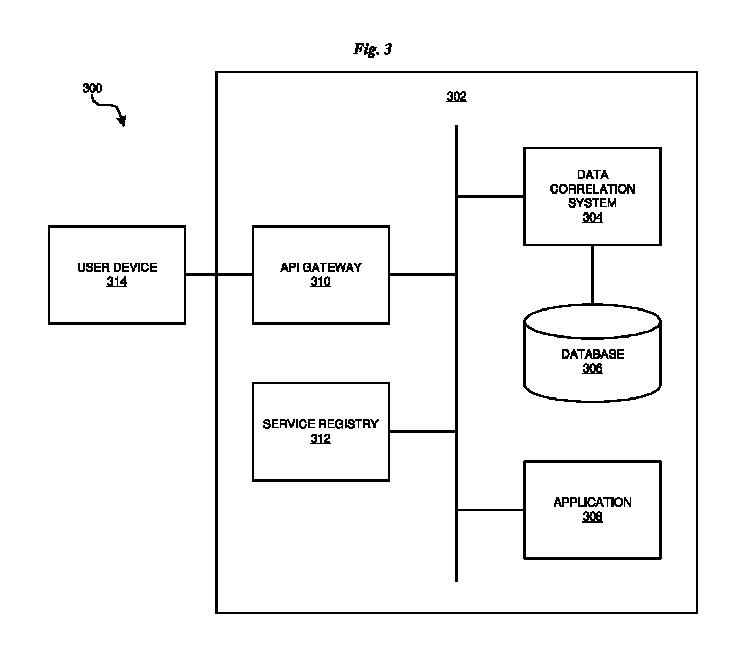
図3を参照すると、この図は、例示的な実施態様に従う例示的なクラウドコンピューティング環境300のブロック図を図示する。図示された実施態様において、クラウドコンピューティング環境300は、アプリケーション308を通じて直接的又は間接的に、サービス及びサービスインスタンスを1以上のユーザデバイス314に提供するサービスインフラストラクチャ302を備えており、サービスインフラストラクチャ302は、データ相関システム304からのデータ相関サービスとデータベース306からのデータベースサービスとを備えている。幾つかの実施態様において、データ相関システム304は、図2のワークロード層90内にデプロイされる。1つの例として、幾つかの実施態様において、データ相関システム304は、図2におけるデータ相関処理96を提供する。 Referring now to FIG. 3, this figure illustrates a block diagram of an exemplary cloud computing environment 300 in accordance with an exemplary embodiment. In the illustrated embodiment, the cloud computing environment 300 comprises a service infrastructure 302 that provides services and service instances to one or more user devices 314, directly or indirectly through applications 308, including data correlation services from a data correlation system 304 and database services from a database 306. In some embodiments, the data correlation system 304 is deployed within the workload tier 90 of FIG. 2. As an example, in some embodiments, the data correlation system 304 provides data correlation processing 96 in FIG. 2.
図示された実施態様において、ユーザデバイス314は、アプリケーションプログラミングインタフェース(API:Application Programming Interface)ゲートウェイ310を介して、1以上のネットワークにわたってサービスインフラストラクチャ302と通信する。幾つかの実施態様において、サービスインフラストラクチャ302は分散されたマイクロサービスアーキテクチャを使用する。幾つかのそのような実施態様において、データベース306は、1以上のサーバにわたって分散データベースとして実行されるところの、マイクロサービスベースに基づくデータベースである。幾つかの実施態様において、データ相関システム304及びアプリケーション308は、1以上のサーバにわたって分散システムとして実行されるところの、マイクロサービスベースに基づくアプリケーションである。様々な実施態様において、サービスインフラストラクチャ302及びそれに関連付けられたデータ相関システム304、データベース306、及びアプリケーション308は、複数のユーザ及び複数のテナントにサービスを提供する。テナントは、ソフトウェアインスタンスに対する特定の特権を有する共通のアクセスを共有するユーザのグループ(例えば、企業)である。サービスインフラストラクチャ302は、テナント固有のデータが他のテナントから分離されることを保証する。 In the illustrated embodiment, user devices 314 communicate with the service infrastructure 302 across one or more networks via an application programming interface (API) gateway 310. In some embodiments, the service infrastructure 302 uses a distributed microservices architecture. In some such embodiments, the database 306 is a microservices-based database that runs as a distributed database across one or more servers. In some embodiments, the data correlation system 304 and the applications 308 are microservices-based applications that run as a distributed system across one or more servers. In various embodiments, the service infrastructure 302 and its associated data correlation system 304, database 306, and applications 308 provide services to multiple users and multiple tenants. A tenant is a group of users (e.g., a company) that share common access with certain privileges to a software instance. The service infrastructure 302 ensures that tenant-specific data is isolated from other tenants.
幾つかの実施態様において、ユーザデバイス314は、任意の適切なネットワーク又は複数のネットワークの組み合わせ、例えばインターネット等、を介してAPIゲートウェイ310と接続し、及び任意の適切な通信プロトコル、例えばWi-Fi及びBluetooth等、を使用する。サービスインフラストラクチャ302は、クラウドコンピューティングに基づいて構築されうる。APIゲートウェイ310は、クライアントアプリケーション、例えば、データ相関システム304、データベース306、及びアプリケーション308、へのアクセスを提供する。APIゲートウェイ310は、クライアントアプリケーションによって発行されたサービス要求を受信し、そして、該サービス要求に基づいてサービスルックアップ要求(service lookup request)を作成する。非限定的な例として、1つの実施態様において、ユーザデバイス314は、アプリケーション308への要求を開始するルーチンを実行し、それにより、データ相関システム304を介してデータベース306に1以上のクエリを発行する。 In some embodiments, the user device 314 connects to the API gateway 310 via any suitable network or combination of networks, such as the Internet, and uses any suitable communication protocol, such as Wi-Fi and Bluetooth. The service infrastructure 302 may be built based on cloud computing. The API gateway 310 provides access to client applications, such as the data correlation system 304, the database 306, and the application 308. The API gateway 310 receives service requests issued by the client applications and creates service lookup requests based on the service requests. As a non-limiting example, in one embodiment, the user device 314 executes a routine that initiates a request to the application 308, thereby issuing one or more queries to the database 306 via the data correlation system 304.
図示された実施態様において、サービスインフラストラクチャ302は、サービスレジストリ312を備えている。幾つかの実施態様において、サービスレジストリ312は、サービスルックアップ要求、例えば、ユーザデバイス314からのサービス要求に応答するAPIゲートウェイ310からのサービスルックアップ要求、に応答して、データ相関システム304、データベース306、若しくはアプリケーション308、又はそれらの組み合わせのサービスインスタンスをルックアップする。例えば、幾つかの実施態様において、サービスレジストリ312は、ユーザデバイス314からの関連する要求に応答して、データ相関システム304、データベース306、若しくはアプリケーション308、又はそれらの組み合わせのサービスインスタンスをルックアップする。 In the illustrated embodiment, the service infrastructure 302 includes a service registry 312. In some embodiments, the service registry 312 looks up a service instance of the data correlation system 304, the database 306, or the application 308, or a combination thereof, in response to a service lookup request, such as a service lookup request from the API gateway 310 in response to a service request from a user device 314. For example, in some embodiments, the service registry 312 looks up a service instance of the data correlation system 304, the database 306, or the application 308, or a combination thereof, in response to an associated request from the user device 314.
幾つかの実施態様において、サービスインフラストラクチャ302は、データ相関システム304、データベース306、若しくはアプリケーション308、又はそれらの組み合わせの1以上のインスタンスを備えている。幾つかのそのような実施態様において、データ相関システム304、データベース306、若しくはアプリケーション308、又はそれらの組み合わせの複数のインスタンスの各々は、複数のコンピューティングシステム上で独立して実行される。幾つかのそのような実施態様において、データ相関システム304、データベース306、及びアプリケーション308、並びにデータ相関システム304、データベース306、及びアプリケーション308の他のサービスインスタンスは、サービスレジストリ312内に登録される。 In some embodiments, the service infrastructure 302 includes one or more instances of the data correlation system 304, the database 306, or the application 308, or a combination thereof. In some such embodiments, each of the multiple instances of the data correlation system 304, the database 306, or the application 308, or a combination thereof, executes independently on multiple computing systems. In some such embodiments, the data correlation system 304, the database 306, and the application 308, as well as other service instances of the data correlation system 304, the database 306, and the application 308, are registered in the service registry 312.
幾つかの実施態様において、サービスレジストリ312は、各サービスインスタンスの状態又は健全性に関する情報、例えば、各サービスインスタンスに関連付けられた性能情報を包含する上記の情報、を維持する。例えば、本明細書においてより詳細に説明されるように、そのような性能情報は、所与のサービスインスタンスの様々なタイプの性能特性(例えば、キャッシュメトリクス等)を含みうる。本明細書においてより詳細に説明されるように、拡張されたサービスレジストリ312は、それらの夫々の性能特性に基づいてサービスインスタンスをランク付けし、そして、サービス発見又はサービスルックアップ要求の為のトップランキングサービスインスタンス(top-ranking service instances)を選択する。サービスインスタンスが応答不能(unresponsive)になった場合又は異常(unhealthy)になった場合には、該サービスレジストリは、そのアドレス又はこのサービスインスタンスに関する情報を他のサービスに提供しなくなる。 In some embodiments, the service registry 312 maintains information regarding the status or health of each service instance, such as the information described above, including performance information associated with each service instance. For example, as described in more detail herein, such performance information may include various types of performance characteristics (e.g., cache metrics, etc.) of a given service instance. As described in more detail herein, the extended service registry 312 ranks the service instances based on their respective performance characteristics and selects the top-ranking service instances for service discovery or service lookup requests. If a service instance becomes unresponsive or unhealthy, the service registry will no longer provide its address or information about this service instance to other services.
図4を参照すると、この図は、例示的な実施態様に従って、データベース420の為の書き込み位置を最適化する為のデータ相関システム400のブロック図を図示する。特定の実施態様において、データ相関システム400は、図3のデータ相関システム304の1つの例であり、及びデータベース420は、図3のデータベース306の1つの例である。 Referring to FIG. 4, this figure illustrates a block diagram of a data correlation system 400 for optimizing write locations for a database 420 according to an exemplary embodiment. In a particular embodiment, the data correlation system 400 is an example of the data correlation system 304 of FIG. 3, and the database 420 is an example of the database 306 of FIG. 3.
幾つかの実施態様において、データ相関システム400は、使用状況パターンコレクター406、使用状況パターンマネージャ410、レコードライター408、レコード再グループマネージャ412、及びレコードシンクロナイザー414を備えている。代替的な実施態様において、データ相関システム400は、本明細書において記載された機能の一部又は全てを備えていることができるが、1以上のモジュール内に異なるようにグループ化される。幾つかの実施態様において、本明細書において記載された機能は複数のシステム間で分散され、それは、ソフトウェアベースの若しくはハードウェアベースの又はそれらの組み合わせのシステム、例えば特定用途向け集積回路(ASIC:Application-Specific Integrated Circuit)、コンピュータプログラム、又はスマートフォンアプリケーションの組み合わせを備えていることができる。 In some embodiments, the data correlation system 400 includes a usage pattern collector 406, a usage pattern manager 410, a record writer 408, a record regroup manager 412, and a record synchronizer 414. In alternative embodiments, the data correlation system 400 can include some or all of the functionality described herein, but grouped differently in one or more modules. In some embodiments, the functionality described herein is distributed among multiple systems, which can include a combination of software-based or hardware-based systems, such as application-specific integrated circuits (ASICs), computer programs, or smartphone applications.
図示された実施態様において、データ相関システム400は、ユーザデバイス314からのユーザコマンドに応答して、データベースクエリをアプリケーション308から受信する。データ相関システム400は、該データベースクエリを自動的に監視し、それは、一般的に読み取り要求402A~402Cとして示されている読み取り要求、及び一般的に書き込み要求404A~404Cとして示されている書き込み要求を含む。データ相関システム400は、データレコード間の相関を、読み取り要求402A~402Cに基づいて識別する。3つの読み取り要求が示されているが、実際の実装は、数百又は数千の読み取り要求に基づいて相関を識別しうる。データ相関システム400はまた、一般的に書き込み要求404A~404Cとして示されている書き込み要求を受信し、及び書き込み要求404A~404Cに関連付けられた複数のデータレコードを中間ストレージ媒体416に一時的に記憶する。3つの書き込み要求が示されているが、実際の実装は、数百又は数千の書き込み要求を一時的に記憶しうる。データ相関システム400は、該識別された相関に基づいてデータベース420内に記憶する為に一時的に記憶された複数のデータレコードをグループ化することによって、書き込み要求404A~404Cに関連付けられたデータレコードを書き込む為のデータベース420内のストレージ位置(storage locations)を最適化する。 In the illustrated embodiment, the data correlation system 400 receives database queries from the application 308 in response to user commands from the user device 314. The data correlation system 400 automatically monitors the database queries, which include read requests, generally shown as read requests 402A-402C, and write requests, generally shown as write requests 404A-404C. The data correlation system 400 identifies correlations between data records based on the read requests 402A-402C. Although three read requests are shown, an actual implementation may identify correlations based on hundreds or thousands of read requests. The data correlation system 400 also receives write requests, generally shown as write requests 404A-404C, and temporarily stores a plurality of data records associated with the write requests 404A-404C in the intermediate storage medium 416. Although three write requests are shown, an actual implementation may temporarily store hundreds or thousands of write requests. The data correlation system 400 optimizes storage locations within the database 420 for writing the data records associated with the write requests 404A-404C by grouping the temporarily stored data records for storage within the database 420 based on the identified correlations.
図示された実施態様において、使用状況パターンコレクター406は、読み取り要求402A~402Cを受信し、そして解析する。例えば、幾つかの実施態様において、使用状況パターンコレクター406は、読み取り要求の妥当性を判定する為に1以上のチェック、例えば、読み取り要求が適切な構文を有するかを判定する構文チェック、若しくは該読み取り要求が意味のあるものであるかを判定する(例えば、該要求において命名されたテーブルが存在するかを判定する)為のセマンティックチェック、又はそれらの組み合わせのチェック、を実行する。幾つかの実施態様において、使用状況パターンコレクター406は、要求に関与するデータベース要素、例えば、テーブル名、データフィールド、キー値等、を決定する。次に、使用状況パターンコレクター406は、該解析された要求を使用状況パターンマネージャ410に渡す。 In the illustrated embodiment, the usage pattern collector 406 receives and parses the read requests 402A-402C. For example, in some embodiments, the usage pattern collector 406 performs one or more checks to determine the validity of the read request, such as a syntactic check to determine whether the read request has proper syntax, or a semantic check to determine whether the read request makes sense (e.g., whether a table named in the request exists), or a combination thereof. In some embodiments, the usage pattern collector 406 determines the database elements involved in the request, such as table names, data fields, key values, etc. The usage pattern collector 406 then passes the parsed request to the usage pattern manager 410.
図示された実施態様において、使用状況パターンマネージャ410は、使用状況パターンコレクター406から受信した該解析された要求を監視することによって、データベース420の複数のレコードに関連付けられた使用状況データを導出する。使用状況パターンマネージャ410は、データベース420の2以上のレコードのグループ間で識別された相関を表すレコード相関データを生成する。幾つかの実施態様において、該相関は、本質的に定量的又は定性的である2以上のレコード間の因果関係又は関連性を含んでいてもよく又は含んでいなくてもよい。幾つかの実施態様において、使用状況パターンマネージャ410は、該導出された使用状況データに基づいて相関を検出する。幾つかの実施態様において、使用状況パターンマネージャ410は、複数のレコードのグループに関連付けられた使用状況パターンを示す統計を収集することによって、該使用状況データを導出する。 In the illustrated embodiment, the usage pattern manager 410 derives usage data associated with a plurality of records in the database 420 by monitoring the parsed requests received from the usage pattern collector 406. The usage pattern manager 410 generates record correlation data representing correlations identified between groups of two or more records in the database 420. In some embodiments, the correlations may or may not include causal relationships or associations between the two or more records that are quantitative or qualitative in nature. In some embodiments, the usage pattern manager 410 detects correlations based on the derived usage data. In some embodiments, the usage pattern manager 410 derives the usage data by collecting statistics indicative of usage patterns associated with groups of the plurality of records.
幾つかのそのような実施態様において、該使用状況パターンは、該検出された相関についての基礎として役立つ1以上のレコード属性を含む。例えば、幾つかの実施態様において、使用状況パターンは、複数のレコードのグループが認識可能なパターンで一緒に又は互いに近接してアクセスされるところの頻度を含む。従って、幾つかのそのような実施態様において、クエリに応答して、又は時間的に近接する複数のクエリに応答して、繰り返し一緒に検索されたデータレコードのグループは、相関データレコードであるとして指定される。非限定的な例として、1つの実施態様において、検出された使用状況パターンは、キー列に同じ値を持つ複数のレコードが頻繁に一緒にアクセスされるようなソート操作によって頻繁に使用されるところのクラスタ化されたインデックスキーの列に基づく。従って、下記のSQL定義の場合に、同じユーザ名を持つ複数のレコードは一緒にアクセスされる可能性が高く、従って、そのような複数のレコードは相関を有するとして識別される。 In some such embodiments, the usage pattern includes one or more record attributes that serve as a basis for the detected correlation. For example, in some embodiments, the usage pattern includes the frequency with which a group of records are accessed together or in close proximity to one another in a recognizable pattern. Thus, in some such embodiments, a group of data records that are repeatedly retrieved together in response to a query, or in response to multiple queries that are close in time, are designated as being correlated data records. As a non-limiting example, in one embodiment, the detected usage pattern is based on columns of a clustered index key that are frequently used by a sorting operation such that multiple records with the same value in the key column are frequently accessed together. Thus, for the following SQL definition, multiple records with the same username are likely to be accessed together, and therefore such multiple records are identified as being correlated:
また、幾つかの実施態様において、使用状況パターンマネージャ410は、複数のデータレコード間の相関を、知覚された相関強度に基づいて特徴付ける。そのような実施態様において、所与のレコードが、別々に記憶された異なるデータレコードとの検出された2以上の相関を有しうる。そのような状況において、該所与のレコードをどこに記憶するかを決定するときに、相関競合が、該所与のレコードについての検出された該2以上の相関の間で生じる。そのような実施態様において、該2以上の相関の夫々の強度が比較され、そして、該所与のレコードは、該相関の最も強いものに関連付けられた複数の他のレコードに近接して記憶される。 Also, in some embodiments, the usage pattern manager 410 characterizes correlations between multiple data records based on perceived correlation strength. In such embodiments, a given record may have two or more detected correlations with different data records that are stored separately. In such a situation, when determining where to store the given record, a correlation conflict arises between the two or more detected correlations for the given record. In such embodiments, the respective strengths of the two or more correlations are compared, and the given record is stored proximate to multiple other records associated with the strongest of the correlations.
図示された実施態様において、使用状況パターンマネージャ410は、該検出された相関に関連付けられた使用状況パターンを使用状況パターンリポジトリ418内に記憶する。幾つかの実施態様において、使用状況パターンリポジトリ418は、コンピュータ可読ストレージ媒体上に記憶される。幾つかの実施態様において、使用状況パターンマネージャ410はまた、該検出された相関に関連付けられた強度値を使用状況パターンリポジトリ418内に記憶する。 In the illustrated embodiment, the usage pattern manager 410 stores the usage pattern associated with the detected correlation in a usage pattern repository 418. In some embodiments, the usage pattern repository 418 is stored on a computer-readable storage medium. In some embodiments, the usage pattern manager 410 also stores a strength value associated with the detected correlation in the usage pattern repository 418.
図示された実施態様において、レコードライター408は、書き込み要求404A~404Cを受信し、そして解析する。例えば、幾つかの実施態様において、レコードライター408は、該書き込み要求の妥当性を判定する為の1以上のチェック、例えば、読み取り要求が適切な構文を有するかを判定する為の構文チェック、若しくは該読み取り要求が意味のあるものであるかを判定する(例えば、該要求において命名されたテーブルが存在するかを判定する)為のセマンティックチェック、又はそれらの組み合わせのチェック、を実行する。図示された実施態様において、次に、レコードライター408は、該書き込み要求に関連付けられた該レコードを中間ストレージ媒体416に書き込む。 In the illustrated embodiment, record writer 408 receives and parses write requests 404A-404C. For example, in some embodiments, record writer 408 performs one or more checks to determine the validity of the write request, such as a syntactic check to determine whether a read request has proper syntax, or a semantic check to determine whether the read request makes sense (e.g., whether a table named in the request exists), or a combination thereof. In the illustrated embodiment, record writer 408 then writes the record associated with the write request to intermediate storage medium 416.
幾つかの実施態様において、データ相関システム400は、中間ストレージ媒体416として使用する為に、バッファをコンピュータ可読ストレージ媒体内に割り当てる。幾つかの実施態様において、データ相関システム400は、中間ストレージ媒体416として使用する為に、コンピュータ可読ストレージ媒体の一部を仮想ディスクとして割り当てる。 In some embodiments, the data correlation system 400 allocates a buffer in the computer-readable storage medium for use as the intermediate storage medium 416. In some embodiments, the data correlation system 400 allocates a portion of the computer-readable storage medium as a virtual disk for use as the intermediate storage medium 416.
図示された実施態様において、第1の時間間隔の間に、レコードライター408は書き込み要求404A~404Cを受信する。書き込み要求404A~404Cに応答して、レコードライター408は、データベース420に直接ではなく、対応する書き込み操作を中間ストレージ媒体416に実行する。複数のレコードが中間ストレージ媒体416に書き込まれる場合に、レコード再グループマネージャ412は、中間ストレージ媒体416内に記憶された複数のレコードに適用される相関について、使用状況パターンリポジトリ418を検索する。幾つかの実施態様において、レコード再グループマネージャ412は、中間ストレージ媒体416内に記憶された2以上のレコードに適用可能であるレコード属性について使用状況パターンリポジトリ418内の使用状況パターンを検索することによって、使用状況パターンリポジトリ418内の相関を識別する。レコード再グループマネージャ412が中間ストレージ媒体416内に記憶された複数のレコードに適用される相関を識別する場合に、レコード再グループマネージャ412は適用可能な該複数のレコードをグループへと編成する。該グループは、複数の相関レコードが一緒にグループ化されるように、データベース420への保存に備えて該複数のレコードを編成する。該複数の相関レコードをデータベース420内にまとめて記憶することにより、該複数の相関レコードが別々に記憶される従前のシステムと比較して、読み取り及び更新の性能が向上する。 In the illustrated embodiment, during the first time interval, the record writer 408 receives write requests 404A-404C. In response to the write requests 404A-404C, the record writer 408 performs corresponding write operations to the intermediate storage medium 416, rather than directly to the database 420. When records are written to the intermediate storage medium 416, the record regroup manager 412 searches the usage pattern repository 418 for correlations that apply to the records stored in the intermediate storage medium 416. In some embodiments, the record regroup manager 412 identifies correlations in the usage pattern repository 418 by searching usage patterns in the usage pattern repository 418 for record attributes that are applicable to two or more records stored in the intermediate storage medium 416. When the record regroup manager 412 identifies correlations that apply to the records stored in the intermediate storage medium 416, the record regroup manager 412 organizes the applicable records into groups. The groups organize the correlated records for storage in database 420 such that the correlated records are grouped together. Storing the correlated records together in database 420 improves read and update performance as compared to previous systems in which the correlated records are stored separately.
幾つかの実施態様において、第1の時間間隔の長さは、指定された期間に基づく。代替的な実施態様において、該第1の時間間隔は、1以上の条件が満たされるまでの経過する時間量(an amount of time that elapses)に応じて変化する。例えば、幾つかの実施態様において、第1の時間間隔の長さは、中間ストレージ媒体416が満杯になるまで、又は中間ストレージ媒体416の指定されたパーセンテージが満杯になるまで、経過する時間量に依存する。 In some embodiments, the length of the first time interval is based on a specified time period. In alternative embodiments, the first time interval varies depending on an amount of time that elapses until one or more conditions are met. For example, in some embodiments, the length of the first time interval depends on an amount of time that elapses until intermediate storage medium 416 is full or until a specified percentage of intermediate storage medium 416 is full.
図示された実施態様において、第1の時間間隔の直後に第2の時間間隔がある。該第2の時間間隔の間に、レコードシンクロナイザー414は、該第1の時間間隔の間に中間ストレージ媒体416に記憶された複数のレコードをデータベース420に移動する。レコードシンクロナイザー414は、レコード再グループマネージャ412によって識別された相関に従って、該複数のレコードをグループ単位でデータベース420に書き込む。例えば、幾つかの実施態様において、レコードシンクロナイザー414は、該グループ化された複数のレコードが互いに近接して記憶されるように、該グループ化されたレコードを記憶する為のデータベース420内の位置を選択する。言い換えれば、レコードシンクロナイザー414は、複数の相関レコードをデータベース420内で互いに近接して記憶するように、該選択された各位置の相互の近接に基づいて、該グループ化された複数のレコードについての位置を選択する。 In the illustrated embodiment, the first time interval is immediately followed by a second time interval. During the second time interval, the record synchronizer 414 moves the records stored in the intermediate storage medium 416 during the first time interval to the database 420. The record synchronizer 414 writes the records to the database 420 in groups according to correlations identified by the record regroup manager 412. For example, in some embodiments, the record synchronizer 414 selects locations in the database 420 for storing the grouped records such that the grouped records are stored in close proximity to one another. In other words, the record synchronizer 414 selects locations for the grouped records based on the mutual proximity of the selected locations such that the correlated records are stored in close proximity to one another in the database 420.
幾つかの実施態様において、データ相関システム400はまたフェイルオーバー機能を提供する。そのような実施態様において、中間ストレージ媒体416に書き込まれた各レコードは、そのレコードのフェイルオーバーコピーとしてメモリデバイス422にコピーされる。そのような実施態様において、データ相関システム400は、エラーについてデータベース420を監視する。データ相関システム400が、メモリデバイス422内にフェイルオーバーコピーを有する複数のレコードを含むデータベースエラーを検出した場合に、データ相関システム400は、影響を受けた1以上のレコードの対応するフェイルオーバーコピーをデータベース420に提供することによって、該データベースエラーを解決する。 In some embodiments, data correlation system 400 also provides a failover capability. In such embodiments, each record written to intermediate storage medium 416 is copied to memory device 422 as a failover copy of that record. In such embodiments, data correlation system 400 monitors database 420 for errors. If data correlation system 400 detects a database error involving multiple records that have failover copies in memory device 422, data correlation system 400 resolves the database error by providing database 420 with corresponding failover copies of one or more of the affected records.
幾つかの実施態様において、メモリデバイス422はコンピュータ可読ストレージ媒体を備えており、及びフェイルオーバーメモリとして役立つ。幾つかの実施態様において、該フェイルオーバーコピーは、複数のレコードが中間ストレージ媒体416に書き込まれる第1の時間間隔の間にメモリデバイス422に書き込まれる。別の実施態様において、該フェイルオーバーコピーは、複数のレコードがデータベース420に書き込まれる第2の時間間隔の間にメモリデバイス422に書き込まれる。 In some embodiments, the memory device 422 comprises a computer-readable storage medium and serves as a failover memory. In some embodiments, the failover copy is written to the memory device 422 during a first time interval in which the records are written to the intermediate storage medium 416. In other embodiments, the failover copy is written to the memory device 422 during a second time interval in which the records are written to the database 420.
図5を参照すると、この図は、例示的な実施態様に従って、第1の時間間隔と第2の時間間隔との間にデータ相関システム400によって実行される書き込み操作のブロック図を図示する。特定の実施態様において、クライアント502A~502Cは図3のアプリケーション308の例であり、中間ストレージ媒体504は図4の中間ストレージ媒体416の例であり、及びディスク506A~506Bは図4のデータベース420のデータストレージ位置の例である。 Referring now to FIG. 5, this figure illustrates a block diagram of write operations performed by data correlation system 400 between a first time interval and a second time interval in accordance with an exemplary embodiment. In a particular embodiment, clients 502A-502C are examples of application 308 of FIG. 3, intermediate storage medium 504 is an example of intermediate storage medium 416 of FIG. 4, and disks 506A-506B are examples of data storage locations of database 420 of FIG. 4.
図示された実施態様において、時刻1(TIME 1)として示されている第1の時間間隔の間に、データ相関システム400は、書き込み要求をクライアント502A~502Cから受信する。該書き込み要求に応答して、データ相関システム400は、レコードA1~A3、B1~B3、及びC1~C2をデータベースディスク506A~506Bに直接ではなく、中間ストレージ媒体504に書き込むことによって、対応する書き込み操作を実行する。複数のレコードが中間ストレージ媒体504に書き込まれる場合に、図4のレコード再グループマネージャ412は、中間ストレージ媒体504内に記憶された複数のレコードに適用される相関を検索し、複数の相関レコードをグループへと編成する。図示された実施態様において、レコード再グループマネージャ412は、レコードA1~A3間の相関を識別し、レコードB1~B3間の相関を識別し、及びレコードC1~C2間の相関を識別する。 In the illustrated embodiment, during a first time interval, shown as TIME 1, the data correlation system 400 receives write requests from clients 502A-502C. In response to the write requests, the data correlation system 400 performs the corresponding write operations by writing records A1-A3, B1-B3, and C1-C2 to the intermediate storage medium 504, rather than directly to the database disks 506A-506B. When the records are written to the intermediate storage medium 504, the record regroup manager 412 of FIG. 4 searches for correlations that apply to the records stored in the intermediate storage medium 504 and organizes the correlated records into groups. In the illustrated embodiment, the record regroup manager 412 identifies a correlation between records A1-A3, identifies a correlation between records B1-B3, and identifies a correlation between records C1-C2.
図示された実施態様において、時刻2(TIME 2)として示されている第2の時間間隔の間に、データ相関システム400は、複数のレコードを中間ストレージ媒体504からデータベースディスク506A~506Bに移動する。図示されているように、データ相関システム400は、第1の時間間隔の間に識別された相関に従って、該複数のレコードをグループ単位でデータベースディスク506A~506Bに書き込む。従って、データ相関システム400は、レコードA1~A3を一緒に記憶する為のデータベースディスク506A上の位置を選択し、レコードB1~B3を一緒に記憶する為のデータベースディスク506B上の位置を選択し、及びレコードC1~C2を一緒に記憶する為のデータベースディスク506B上の位置を選択する。 In the illustrated embodiment, during a second time interval, shown as TIME 2, data correlation system 400 moves the records from intermediate storage medium 504 to database disks 506A-506B. As shown, data correlation system 400 writes the records to database disks 506A-506B in groups according to the correlations identified during the first time interval. Thus, data correlation system 400 selects a location on database disk 506A to store records A1-A3 together, selects a location on database disk 506B to store records B1-B3 together, and selects a location on database disk 506B to store records C1-C2 together.
図6A~図6Bを参照すると、これらの図は、例示的な実施態様に従って、第1の時間間隔、第2の時間間隔、及び第3の時間間隔の間にデータ相関システム400によって実行される書き込み及びフェイルオーバーの動作のブロック図を示す。特定の実施態様において、クライアント602A~602Cは図3のアプリケーション308の1つの例であり、中間ストレージ媒体604は図4の中間ストレージ媒体416の1つの例であり、ディスク606A~606Bは図4のデータベース420のデータストレージ位置の1つの例であり、及びフェイルオーバーメモリ608は図4のメモリデバイス422の1つの例である。 6A-6B, which illustrate block diagrams of write and failover operations performed by data correlation system 400 during a first time interval, a second time interval, and a third time interval, according to an exemplary embodiment. In a particular embodiment, clients 602A-602C are an example of application 308 of FIG. 3, intermediate storage medium 604 is an example of intermediate storage medium 416 of FIG. 4, disks 606A-606B are an example of data storage locations for database 420 of FIG. 4, and failover memory 608 is an example of memory device 422 of FIG. 4.
図示された実施態様において、時刻1(TIME 1)として示されている第1の時間間隔の間に、データ相関システム400は、クライアント602A~602Cから書き込み要求を受信する。該書き込み要求に応答して、データ相関システム400は、レコードA1~A3、B1~B3、及びC1~C2をデータベースディスク606A~606Bに直接ではなく、中間ストレージ媒体604に書き込むことによって、対応する書き込み操作を実行する。図示された実施態様において、データ相関システム400はまた、レコードA1~A3、B1~B3、及びC1~C2のフェイルオーバーコピーとして、レコードA1~A3、B1~B3、及びC1~C2の夫々のコピーをフェイルオーバーメモリ608に書き込む。複数のレコードが中間ストレージ媒体604内に書き込まれる場合に、図4のレコード再グループマネージャ412は、中間ストレージ媒体604内に記憶された複数のレコードに適用される相関を検索し、複数の相関レコードをグループへと編成する。図示された実施態様において、レコード再グループマネージャ412は、レコードA1~A3間の相関を識別し、レコードB1~B3間の相関を識別し、及びレコードC1~C2間の相関を識別する。 In the illustrated embodiment, during a first time interval, shown as TIME 1, the data correlation system 400 receives write requests from clients 602A-602C. In response to the write requests, the data correlation system 400 performs the corresponding write operations by writing records A1-A3, B1-B3, and C1-C2 to the intermediate storage medium 604, rather than directly to the database disks 606A-606B. In the illustrated embodiment, the data correlation system 400 also writes copies of each of the records A1-A3, B1-B3, and C1-C2 to the failover memory 608 as failover copies of the records A1-A3, B1-B3, and C1-C2. When multiple records are written into the intermediate storage medium 604, the record regroup manager 412 of FIG. 4 searches for correlations that apply to the multiple records stored in the intermediate storage medium 604 and organizes the multiple correlated records into groups. In the illustrated embodiment, the record regrouping manager 412 identifies a correlation between records A1-A3, identifies a correlation between records B1-B3, and identifies a correlation between records C1-C2.
図示された実施態様において、時刻2(TIME 2)として示されている第2の時間間隔の間に、データ相関システム400は、複数のレコードを中間ストレージ媒体604からデータベースディスク606A~606Bに移動する。図示されているように、データ相関システム400は、第1の時間間隔の間に識別された相関に従って、該複数のレコードをグループ単位でデータベースディスク606A~606Bに書き込む。従って、データ相関システム400は、レコードA1~A3を一緒に記憶する為のデータベースディスク606A上の位置を選択し、レコードB1~B3を一緒に記憶する為のデータベースディスク606B上の位置を選択し、及びレコードC1~C2を一緒に記憶する為のデータベースディスク606B上の位置を選択する。しかしながら、レコードA1~A3、B1~B3、及びC1~C2のフェイルオーバーコピーは、フェイルオーバーメモリ608内に保持される。 In the illustrated embodiment, during a second time interval, shown as TIME 2, the data correlation system 400 moves the records from the intermediate storage medium 604 to the database disks 606A-606B. As shown, the data correlation system 400 writes the records to the database disks 606A-606B in groups according to the correlations identified during the first time interval. Thus, the data correlation system 400 selects a location on the database disk 606A to store records A1-A3 together, selects a location on the database disk 606B to store records B1-B3 together, and selects a location on the database disk 606B to store records C1-C2 together. However, failover copies of records A1-A3, B1-B3, and C1-C2 are maintained in the failover memory 608.
特に図6Bを参照すると、時刻3(TIME 3)として示される第3の時間間隔の間に、データ相関システム400は、エラーについてデータベースを監視し、そして、データベースエラーを解決する為に必要に応じて複数のレコードの該フェイルオーバーコピーを提供する。非限定的な例として、図示された実施態様は、データ相関システム400が、第2の時間間隔の間に発生したディスク606AへのレコードA1~A3の書き込みを含むデータベースエラーを検出することを示す。該エラーを検出することに応答して、データ相関システム400は、データベースエラーを解決する為に、フェイルオーバーメモリ608からディスク606AにレコードA1~A3の該フェイルオーバーコピーを提供する。 With particular reference to FIG. 6B, during a third time interval, shown as TIME 3, data correlation system 400 monitors the database for errors and provides the failover copies of records as necessary to resolve the database error. As a non-limiting example, the illustrated embodiment shows data correlation system 400 detecting a database error involving the writing of records A1-A3 to disk 606A that occurred during the second time interval. In response to detecting the error, data correlation system 400 provides the failover copies of records A1-A3 from failover memory 608 to disk 606A to resolve the database error.
図7を参照すると、この図は、例示的な実施態様に従う、レコード相関及び中間ストレージ媒体を用いたデータベース最適化の為の例示的なプロセス700のフローチャート図を図示する。特定の実施態様において、データ相関システム400がプロセス700を実行する。 Referring now to FIG. 7, this figure illustrates a flow chart diagram of an exemplary process 700 for database optimization using record correlation and intermediate storage media in accordance with an exemplary embodiment. In certain embodiments, the data correlation system 400 performs the process 700.
1つの実施態様において、ブロック702では、該プロセスは、データベースの複数のレコードに対する読み取り操作を実行する為の要求を監視することによって、該データベースの該複数のレコードに関連付けられた使用状況データを導出する。幾つかの実施態様において、該プロセスは、読み取り要求を受信し、そして解析する。幾つかの実施態様において、該解析することは、読み取り要求の妥当性を判定する為の1以上のチェック、例えば、該読み取り要求が適切な構文を有するかを判定する為の構文チェック、若しくは該読み取り要求が意味のあるものであるかを判定する(例えば、該要求において命名されたテーブルが存在するかを判定する)為のセマンティックチェック、又はそれらの組み合わせのチェック、を実行することを含む。幾つかのそのような実施態様において、該プロセスは、要求に関与するデータベース要素、例えば、該使用状況データを導出する為に、テーブル名、データフィールド、キー値等、を決定する。 In one embodiment, at block 702, the process derives usage data associated with a plurality of records of a database by monitoring requests to perform read operations on the plurality of records of the database. In some embodiments, the process receives and analyzes the read requests. In some embodiments, the analyzing includes performing one or more checks to determine the validity of the read request, such as a syntactic check to determine whether the read request has proper syntax, or a semantic check to determine whether the read request is meaningful (e.g., whether a table named in the request exists), or a combination thereof. In some such embodiments, the process determines the database elements involved in the request, such as table names, data fields, key values, etc., to derive the usage data.
次に、ブロック704では、該プロセスは、該データベースの該複数のレコードに関連付けられた該使用状況データを解析することによって、該データベースの該複数のレコード間の相関を表すレコード相関データを生成する。幾つかの実施態様において、該相関は、2以上のレコード間の相互依存関係又は関連性を含み、それは本質的に定量的又は定性的であり且つ該2以上のレコード間の因果関係を含んでいてもよく又は含んでいなくてもよい。幾つかの実施態様において、該プロセスは、該導出された使用状況データに基づいて相関を検出する。幾つかの実施態様において、該プロセスは、複数のレコードのグループに関連付けられた使用状況パターンを示す統計を収集することによって、該使用状況データを導出する。幾つかのそのような実施態様において、該使用状況パターンは、該検出された相関についての基礎として役立つ1以上のレコード属性を含む。例えば、幾つかの実施態様において、使用状況パターンは、複数のレコードのグループが認識可能なパターンで一緒に又は互いに近接してアクセスされるところの頻度を含む。従って、幾つかのそのような実施態様において、クエリに応答して、又は時間的に近接する複数のクエリに応答して、繰り返し一緒に検索されたデータレコードのグループは、相関データレコードであると指定される。また、幾つかの実施態様において、該プロセスは、複数のデータレコード間の相関を、知覚された相関強度に基づいて特徴付ける。そのような実施態様において、所与のレコードが、別々に記憶された異なるデータレコードとの検出された2以上の相関を有しうる。そのような状況において、該所与のレコードをどこに記憶するかを決定するときに、相関競合が、該所与のレコードについての検出された該2以上の相関の間で生じる。そのような実施態様において、該2以上の相関の夫々の強度が比較され、該所与のレコードは、該相関の最も強いものに関連付けられた他のレコードに近接して記憶される。幾つかの実施態様において、該プロセスは、該検出された相関に関連付けられた使用状況パターンを、コンピュータ可読ストレージ媒体上の使用状況パターンリポジトリ内に記憶する。幾つかの実施態様において、該プロセスはまた、該検出された相関に関連付けられた強度値を該使用状況パターンリポジトリ内に記憶する。 Next, at block 704, the process generates record correlation data representing correlations between the records of the database by analyzing the usage data associated with the records of the database. In some embodiments, the correlations include interdependencies or associations between two or more records, which may be quantitative or qualitative in nature and may or may not include causal relationships between the two or more records. In some embodiments, the process detects correlations based on the derived usage data. In some embodiments, the process derives the usage data by collecting statistics indicative of usage patterns associated with groups of a plurality of records. In some such embodiments, the usage patterns include one or more record attributes that serve as a basis for the detected correlations. For example, in some embodiments, the usage patterns include a frequency at which a group of a plurality of records is accessed together or in close proximity to one another in a recognizable pattern. Thus, in some such embodiments, a group of data records that are repeatedly retrieved together in response to a query or in response to multiple queries that are close in time are designated to be correlated data records. Also, in some embodiments, the process characterizes the correlations between a plurality of data records based on a perceived correlation strength. In such embodiments, a given record may have two or more detected correlations with different data records that are stored separately. In such a situation, when determining where to store the given record, a correlation conflict arises between the two or more detected correlations for the given record. In such embodiments, the strengths of each of the two or more correlations are compared, and the given record is stored proximate to other records associated with the strongest of the correlations. In some embodiments, the process stores the usage patterns associated with the detected correlations in a usage pattern repository on a computer-readable storage medium. In some embodiments, the process also stores the strength values associated with the detected correlations in the usage pattern repository.
次に、ブロック706では、該プロセスは、夫々の書き込み要求として第1の時間間隔の間に受信した複数のレコードを中間ストレージ媒体内に記憶する。幾つかの実施態様において、該プロセスは、該書き込み要求を受信し、そして解析する。幾つかの実施態様において、該解析することは、該書き込み要求の妥当性を判定する為の1以上のチェック、例えば、読み取り要求が適切な構文を有するかを判定する為の構文チェック、若しくは該読み取り要求が意味のあるものであるかを判定する(例えば、該要求において命名されたテーブルが存在するかを判定する)為のセマンティックチェック、又はそれらの組み合わせのチェック、を実行することを含む。次に、該プロセスは、該書き込み要求に関連付けられた該レコードを中間ストレージ媒体に書き込む。幾つかの実施態様において、該プロセスは、中間ストレージ媒体として使用する為に、コンピュータ可読ストレージ媒体内にバッファを割り当てる。幾つかの実施態様において、該プロセスは、該中間ストレージ媒体として使用する為に、コンピュータ可読ストレージ媒体の一部を仮想ディスクとして割り当てる。 Next, in block 706, the process stores the records received during the first time interval as respective write requests in an intermediate storage medium. In some embodiments, the process receives and analyzes the write requests. In some embodiments, the analyzing includes performing one or more checks to determine the validity of the write request, such as a syntactic check to determine whether a read request has proper syntax, or a semantic check to determine whether the read request is meaningful (e.g., whether a table named in the request exists), or a combination thereof. The process then writes the records associated with the write request to an intermediate storage medium. In some embodiments, the process allocates a buffer in a computer-readable storage medium for use as the intermediate storage medium. In some embodiments, the process allocates a portion of the computer-readable storage medium as a virtual disk for use as the intermediate storage medium.
次に、ブロック708では、該プロセスは、該複数のレコードのうちの第1のレコードと該複数のレコードのうちの第2のレコードとの間の相関データにおける相関を識別する。幾つかの実施態様において、複数のレコードが該中間ストレージ媒体に書き込まれる場合に、該プロセスは、該中間ストレージ媒体内に記憶された該複数のレコードに適用される相関について該使用状況パターンリポジトリを検索する。幾つかの実施態様において、該プロセスは、該中間ストレージ媒体内に記憶された該複数のレコードのうちの2以上に適用可能であるレコード属性について該使用状況パターンリポジトリ内の使用状況パターンを検索することによって、該使用状況パターンリポジトリ内の相関を識別する。該プロセスが該中間ストレージ媒体内に記憶された該複数のレコードに適用される相関を識別する場合において、該プロセスは、適用可能な該複数のレコードを複数のグループへと編成する。 Next, at block 708, the process identifies correlations in the correlation data between a first record of the plurality of records and a second record of the plurality of records. In some embodiments, when a plurality of records are written to the intermediate storage medium, the process searches the usage pattern repository for correlations that apply to the plurality of records stored in the intermediate storage medium. In some embodiments, the process identifies correlations in the usage pattern repository by searching usage patterns in the usage pattern repository for record attributes that are applicable to two or more of the plurality of records stored in the intermediate storage medium. When the process identifies correlations that apply to the plurality of records stored in the intermediate storage medium, the process organizes the applicable plurality of records into a plurality of groups.
次に、ブロック710では、該プロセスは、レコードが他の複数のレコードの複数のグループと相関する相関競合が存在するかを判定する。そうである場合、ブロック712において、該プロセスは、検出された相関競合を、該使用状況データの指定された使用状況属性に基づいて解決する。幾つかの実施態様において、該使用状況データの該指定された使用状況属性は、知覚された相関強度を決定する為に使用される。そのような実施態様において、2以上の相関の夫々の強度が比較され、そして、該レコードは、該相関の最も強いものに関連付けられた複数の他のレコードに近接して記憶される。 Next, at block 710, the process determines whether a correlation conflict exists in which the record is correlated with multiple groups of other records. If so, at block 712, the process resolves the detected correlation conflict based on designated usage attributes of the usage data. In some embodiments, the designated usage attributes of the usage data are used to determine a perceived correlation strength. In such embodiments, the respective strengths of two or more correlations are compared, and the record is stored proximate to multiple other records associated with the strongest of the correlations.
次に、ブロック714では、該プロセスは、識別された相関を有する複数のレコードの各グループについて、そのグループ内の該複数のレコードが互いに近接して記憶されるように、該中間ストレージ媒体内に記憶された該複数のレコードの各々を書き込む為のデータベース内の位置を選択する。幾つかの実施態様において、第1の時間間隔の直後の第2の時間間隔の間に、該プロセスは、該第1の時間間隔の間に該中間ストレージ媒体内に記憶された該複数のレコードを該データベースに移動する。該プロセスは、該識別された相関に従って、該複数のレコードをグループ単位で該データベースに書き込む。例えば、幾つかの実施態様において、該プロセスは、該グループ化された複数のレコードが互いに近接して記憶されるように、該グループ化された複数のレコードを記憶する為の該データベース内の位置を選択する。言い換えれば、該プロセスは、複数の相関レコードを該データベース内で互いに近接して記憶するように、該選択された各位置の相互の近接に基づいて、該グループ化された複数のレコードについての位置を選択する。 Next, in block 714, the process selects, for each group of records having an identified correlation, a location in the database to write each of the records stored in the intermediate storage medium such that the records in the group are stored proximate to one another. In some embodiments, during a second time interval immediately following the first time interval, the process moves the records stored in the intermediate storage medium during the first time interval to the database. The process writes the records to the database in groups according to the identified correlation. For example, in some embodiments, the process selects locations in the database to store the grouped records such that the grouped records are stored proximate to one another. In other words, the process selects locations for the grouped records based on the mutual proximity of the selected locations such that correlated records are stored proximate to one another in the database.
幾つかの実施態様において、該プロセスはまた、フェイルオーバー機能を提供する。そのような実施態様において、該プロセスは、該中間ストレージ媒体に書き込まれた各レコードを、該複数のレコードのフェイルオーバーコピーとしてフェイルオーバーメモリにコピーする。そのような実施態様において、該プロセスは、エラーについて該データベースを監視する。該プロセスが、該フェイルオーバーメモリ内にフェイルオーバーコピーを有する複数のレコードを含むデータベースエラーを検出した場合に、該プロセスは、影響を受けた1以上のレコードの対応するフェイルオーバーコピーを該データベースに提供することによって、該データベースエラーを解決する。幾つかの実施態様において、該フェイルオーバーメモリはコンピュータ可読ストレージ媒体を備えている。幾つかの実施態様において、該プロセスは、複数のレコードが該中間ストレージ媒体に書き込まれる第1の時間間隔の間に、該フェイルオーバーコピーを該フェイルオーバーメモリに書き込む。代替的な実施態様において、該プロセスは、複数のレコードが該データベースに書き込まれる第2の時間間隔の間に、該フェイルオーバーコピーを該フェイルオーバーメモリに書き込む。 In some embodiments, the process also provides a failover function. In such embodiments, the process copies each record written to the intermediate storage medium to a failover memory as a failover copy of the plurality of records. In such embodiments, the process monitors the database for errors. If the process detects a database error involving a plurality of records having a failover copy in the failover memory, the process resolves the database error by providing the corresponding failover copy of one or more of the affected records to the database. In some embodiments, the failover memory comprises a computer-readable storage medium. In some embodiments, the process writes the failover copy to the failover memory during a first time interval during which a plurality of records are written to the intermediate storage medium. In an alternative embodiment, the process writes the failover copy to the failover memory during a second time interval during which a plurality of records are written to the database.
以下の定義及び略語は、特許請求の範囲及び明細書の解釈の為に使用されるものとする。本明細書において使用される場合、語「備えている」(comprises)、「備えている」(comprising)、「包含する」(includes)、「包含している」(including)、「有する」(has)、「有している」(having)、「含む」(contains)若しくは「含んでいる」(containing)又はその他の変形は、非排他的な含有をカバーすることを意図している。例えば、要素のリストを含む組成物、混合物、プロセス、方法、物品、又は装置は、必ずしもそれらの要素のみに限定されず、明示的にリストされていない他の要素又はそのような組成物、混合物、プロセス、方法、物品、又は装置に固有の要素を含むことができる。 The following definitions and abbreviations shall be used for the interpretation of the claims and the specification. As used herein, the words "comprises," "comprising," "includes," "including," "has," "having," "contains," or "containing," or other variations, are intended to cover non-exclusive inclusions. For example, a composition, mixture, process, method, article, or device that includes a list of elements is not necessarily limited to only those elements, but may include other elements not expressly listed or inherent to such composition, mixture, process, method, article, or device.
加えて、語「例示的な」は、本明細書において、「1つの例、例示又は具体例として機能する」ことを意味する為に使用される。本明細書において「例示的な」として記載される任意の実施態様又は設計は、必ずしも他の実施態様又は設計よりも好ましい又は有利であると解釈されるものでない。語「少なくとも1つ」及び「1以上」は、1以上の任意の整数、すなわち、1、2、3、4等、を包含すると理解されてもよい。語「複数」は、2以上の任意の整数、すなわち、2、3、4、5等、を包含すると理解されてもよい。語「接続」は、間接的な「接続」及び直接的な「接続」の両方を包含しうる。 Additionally, the word "exemplary" is used herein to mean "serving as an example, instance, or illustration." Any embodiment or design described herein as "exemplary" is not necessarily to be construed as preferred or advantageous over other embodiments or designs. The words "at least one" and "one or more" may be understood to include any integer number greater than one, i.e., 1, 2, 3, 4, etc. The word "plurality" may be understood to include any integer number greater than two, i.e., 2, 3, 4, 5, etc. The word "connected" may include both indirect and direct "connections."
本明細書における「1つの実施態様」、「或る実施態様」、「例示的な実施態様」等への言及は、記載された実施態様が特定の特徴、構造、又は特性を包含することができるが、全ての実施態様が特定の特徴、構造、又は特性を含んでいてもよく又は含んでいなくてもよいことを示す。その上、そのような句は、必ずしも同じ実施態様を言及するものでない。更に、特定の特徴、構造、又は特性が実施態様に関連して記載されている場合、明示的に記載されているかどうかにかかわらず、他の実施態様に関連してそのような特徴、構造、又は特性に影響を与えることは当業者の知識の範囲内であることが提示される。 References herein to "one embodiment," "an embodiment," "an exemplary embodiment," and the like indicate that the described embodiment may include a particular feature, structure, or characteristic, but that all embodiments may or may not include the particular feature, structure, or characteristic. Moreover, such phrases do not necessarily refer to the same embodiment. Furthermore, when a particular feature, structure, or characteristic is described in connection with an embodiment, it is submitted that it is within the knowledge of one of ordinary skill in the art to affect such feature, structure, or characteristic in connection with other embodiments, whether or not expressly described.
語「約」、「実質的に」、「ほぼ」及びそれらの変形は、出願の時点で利用可能な機器に基づく特定の量の測定に関連付けられた誤差の程度を含むことが意図されている。例えば、「約」は、所与の値の±8%又は±5%又は±2%の範囲を含むことができる。 The words "about," "substantially," "approximately," and variations thereof are intended to include the degree of error associated with the measurement of a particular quantity based on equipment available at the time of filing. For example, "about" can include a range of ±8% or ±5% or ±2% of a given value.
本発明の様々な実施態様の記載は、例示の目的の為に提示されたものであり、網羅的であること又は開示された実施態様に限定されることが意図されたものでない。多くの修正及び変形が、記載された実施態様の範囲及び精神から逸脱すること無しに当業者に明らかであろう。本明細書において使用される語は、実施態様の原理、実用的な用途、又は市場において見られる技術に対する技術的改善を最もよく説明する為に、又は当業者が本明細書において開示されている実施態様を理解することができるようにする為に選択された。 The description of various embodiments of the present invention has been presented for illustrative purposes and is not intended to be exhaustive or limited to the disclosed embodiments. Many modifications and variations will be apparent to those skilled in the art without departing from the scope and spirit of the described embodiments. The terms used in this specification have been selected to best explain the principles of the embodiments, practical applications, or technical improvements to the technology found in the market, or to enable those skilled in the art to understand the embodiments disclosed herein.
本発明の様々な実施態様の記載は、例示の目的の為に提示されたものであり、網羅的であること又は開示された実施態様に限定されることが意図されたものでない。多くの修正及び変形が、記載された実施態様の範囲及び精神から逸脱すること無しに当業者に明らかであろう。本明細書において使用される語は、実施態様の原理、実用的な用途、又は市場において見られる技術に対する技術的改善を最もよく説明する為に、又は当業者が本明細書において開示されている実施態様を理解することができるようにする為に選択された。 The description of various embodiments of the present invention has been presented for illustrative purposes and is not intended to be exhaustive or limited to the disclosed embodiments. Many modifications and variations will be apparent to those skilled in the art without departing from the scope and spirit of the described embodiments. The terms used in this specification have been selected to best explain the principles of the embodiments, practical applications, or technical improvements to the technology found in the market, or to enable those skilled in the art to understand the embodiments disclosed herein.
従って、コンピュータに実装された方法、システム又は装置及びコンピュータプログラム製品が、共用可能なアプリケーションスナップショット及び他の関連する特徴、機能又は操作の為のコンパイル化戦略の為の例示的な実施態様において提供される。1つの実施形態又はその一部が或るタイプのデバイスに関して説明されている場合、コンピュータに実装された方法、システム若しくは装置及びコンピュータプログラム製品、又はその一部は、そのタイプのデバイスの適切で且つ同等の表現と共に使用する為に適合又は構成されている。 Thus, computer-implemented methods, systems or apparatus and computer program products are provided in exemplary embodiments for compilation strategies for shareable application snapshots and other related features, functions or operations. Where an embodiment or portion thereof is described with respect to a type of device, the computer-implemented methods, systems or apparatus and computer program products, or portions thereof, are adapted or configured for use with appropriate and equivalent representations of that type of device.
1つの実施態様がアプリケーション内に実装されるものとして説明される場合、例示的な実施態様の範囲内で、サービスとしてのソフトウェア(SaaS)モデルにおけるアプリケーションの配信が企図される。SaaSモデルにおいて、1つの実施態様を実装するアプリケーションの機能は、クラウドインフラストラクチャにおいてアプリケーションを実行することによって、ユーザに提供される。該ユーザは、シン・クライアント・インタフェース、例えばウェブブラウザ(例えば、ウェブベースの電子メール)、又は他の軽量(light-weight)クライアントアプリケーションを介して、様々なクライアントデバイスを使用してアプリケーションにアクセスすることができる。該ユーザは、基礎となるクラウドインフラストラクチャ、例えば、ネットワーク、サーバ、オペレーティングシステム、又はクラウドインフラのストレージを包含する上記のクラウドインフラストラクチャ、を管理又は制御することはない。場合によっては、該ユーザはSaaSアプリケーションの機能を管理又は制御しないことさえありうる。他の幾つかの場合において、該アプリケーションのSaaS実装は、限られたユーザ固有のアプリケーション構成設定のありうる例外を許可しうる。 Where an embodiment is described as being implemented in an application, delivery of the application in a software as a service (SaaS) model is contemplated within the scope of the exemplary embodiment. In the SaaS model, the functionality of an application implementing an embodiment is provided to a user by running the application in a cloud infrastructure. The user can access the application using a variety of client devices via a thin client interface, such as a web browser (e.g., web-based email) or other light-weight client application. The user does not manage or control the underlying cloud infrastructure, such as the network, servers, operating system, or storage of the cloud infrastructure. In some cases, the user may not even manage or control the functionality of the SaaS application. In some other cases, the SaaS implementation of the application may allow possible exceptions to limited user-specific application configuration settings.
本発明は、統合のありうる任意の技術的詳細レベルでの、システム、方法若しくはコンピュータプログラム製品若しくはコンピュータプログラム、又はそれらの組み合わせでありうる。該コンピュータプログラム製品は、プロセッサに本発明の観点を実行させる為のコンピュータ可読プログラム命令を有する1以上のコンピュータ可読記憶媒体を包含しうる。 The present invention may be a system, method, or computer program product or computer program, or combinations thereof, at any level of technical detail that may be integrated. The computer program product may include one or more computer-readable storage media having computer-readable program instructions for causing a processor to perform aspects of the present invention.
該コンピュータ可読記憶媒体は、命令実行デバイスによって使用する為の命令を保持且つ記憶することができる有形のデバイスであることができる。該コンピュータ可読記憶媒体は、例えば、電子ストレージデバイス、磁気ストレージデバイス、光ストレージデバイス、電磁ストレージデバイス、半導体ストレージデバイス、又はそれらの任意の適切な組み合わせでありうるが、これらに限定されない。該コンピュータ可読記憶媒体のより具体的な例の非網羅的なリストは、下記を包含する:ポータブルのコンピュータディスケット(登録商標)、ハードディスク、ランダムアクセスメモリ(RAM:random access memory)、読み取り専用メモリ(ROM:read only memory)、消去可能なプログラム可能な読み取り専用メモリ(EPROM(erasable programmable read-only memory)又はフラッシュメモリ)、スタティックランダムアクセスメモリ(SRAM:static random access memory)、ポータブル・コンパクトディスク読み取り専用メモリ(CD-ROM:compact disc read-only memory)、デジタル多用途ディスク(DVD:digital versatile disk)、メモリスティック、フロッピーディスク、機械的に符号化されたデバイス、例えばパンチカード若しくは命令が記憶されている溝内の隆起構造又はそれらの任意の適切な組み合わせ。本明細書において使用される場合、コンピュータ可読記憶媒体は、一時的な信号それ自体、例えば、電波又は他の自由に伝播する電磁波、導波管若しくは他の伝送媒体を伝播する電磁波(例えば、光ファイバケーブルを通過する光パルス)、又は電線を介して送信される電気信号、であると解釈されるべきでない。 The computer readable storage medium can be a tangible device capable of holding and storing instructions for use by an instruction execution device. The computer readable storage medium can be, for example, but not limited to, an electronic storage device, a magnetic storage device, an optical storage device, an electromagnetic storage device, a semiconductor storage device, or any suitable combination thereof. A non-exhaustive list of more specific examples of the computer readable storage medium includes the following: portable computer diskettes, hard disks, random access memory (RAM), read only memory (ROM), erasable programmable read-only memory (EPROM or flash memory), static random access memory (SRAM), portable compact disc read-only memory (CD-ROM), digital versatile disk (DVD), memory sticks, floppy disks, mechanically encoded devices such as punch cards or raised structures in grooves in which instructions are stored, or any suitable combination thereof. As used herein, a computer-readable storage medium should not be construed as a transitory signal per se, such as an electric wave or other freely propagating electromagnetic wave, an electromagnetic wave propagating through a waveguide or other transmission medium (e.g., a light pulse passing through a fiber optic cable), or an electrical signal transmitted over an electrical wire.
本明細書において記載されたコンピュータ可読プログラム命令は、コンピュータ可読記憶媒体から個々のコンピューティングデバイス/処理デバイスに、又はネットワーク、例えば、インターネット、ローカルエリアネットワーク、ワイドエリアネットワーク若しくはワイヤレスネットワーク又はそれらの組み合わせ、を介して外部コンピュータ又は外部記憶デバイスにダウンロードされることができる。該ネットワークは、銅線伝送ケーブル、光伝送ファイバ、無線伝送、ルータ、ファイアウォール、スイッチ、ゲートウェイコンピュータ若しくはエッジサーバ又はそれらの組み合わせで構成されうる。各コンピューティングデバイス/処理デバイスにおけるネットワークアダプタカード又はネットワークインタフェースは、ネットワークからコンピュータ可読プログラム命令を受信し、そして、該コンピュータ可読プログラム命令を、個々のコンピューティングデバイス/処理デバイス内のコンピュータ可読記憶媒体中に記憶する為に転送する。 The computer-readable program instructions described herein can be downloaded from a computer-readable storage medium to an individual computing device/processing device or to an external computer or external storage device via a network, such as the Internet, a local area network, a wide area network, or a wireless network, or a combination thereof. The network can be comprised of copper transmission cables, optical transmission fiber, wireless transmission, routers, firewalls, switches, gateway computers, or edge servers, or a combination thereof. A network adapter card or network interface in each computing device/processing device receives the computer-readable program instructions from the network and forwards the computer-readable program instructions for storage in a computer-readable storage medium within the individual computing device/processing device.
本発明の動作を実行する為のコンピュータ可読プログラム命令は、アセンブラ命令、命令セットアーキテクチャ(ISA:instruction-set-architecture)命令、マシン命令、マシン依存命令、マイクロコード、ファームウェア命令、状態設定データ、集積回路の為の構成データ、又は、1以上のプログラミング言語、例えばオブジェクト指向プログラミング言語、例えば、Smalltalk、C++等、慣用的な手続き型プログラミング言語(例えば、「C」プログラミング言語又は同様のプログラミング言語)、の任意の組み合わせで書かれているソースコード又はオブジェクトコードのいずれか、でありうる。該コンピュータ可読プログラム命令は、ユーザのコンピュータ上で全体的に、ユーザのコンピュータ上で部分的に、ユーザのコンピュータ上でスタンドアロン・ソフトウェア・パッケージとして部分的に、ユーザのコンピュータ上で部分的に且つリモート・コンピュータ上で部分的に、又はリモート・コンピュータ若しくはサーバ上で全体的に、実行されうる。後者のシナリオにおいて、該リモート・コンピュータは、任意の種類のネットワーク、例えば、ローカルエリアネットワーク(LAN:local area network)若しくはワイドエリアネットワーク(WAN:wide area network)、を介してユーザのコンピュータに接続されうるか、又は該接続は(例えば、インターネットサービスプロバイダを使用したインターネットを通じて)外部コンピュータに対して行われうる。幾つかの実施態様において、電子回路、例えば、プログラム可能な論理回路、フィールドプログラム可能なゲートアレイ(FPGA:field-programmable gate arrays)又はプログラム可能なロジックアレイ(PLA:programmable logic arrays)、は、本発明の観点を実行する為に、コンピュータ可読プログラム命令の状態情報を利用することによって、電子回路をパーソナライズすることによって、コンピュータ可読プログラム命令を実行しうる。 The computer-readable program instructions for carrying out the operations of the present invention may be either assembler instructions, instruction-set-architecture (ISA) instructions, machine instructions, machine-dependent instructions, microcode, firmware instructions, state setting data, configuration data for an integrated circuit, or source or object code written in any combination of one or more programming languages, such as object-oriented programming languages, such as Smalltalk, C++, or conventional procedural programming languages (e.g., the "C" programming language or a similar programming language). The computer-readable program instructions may be executed entirely on the user's computer, partially on the user's computer, partially on the user's computer as a standalone software package on the user's computer, partially on the user's computer and partially on a remote computer, or entirely on a remote computer or server. In the latter scenario, the remote computer may be connected to the user's computer via any kind of network, such as a local area network (LAN) or a wide area network (WAN), or the connection may be made to an external computer (e.g., through the Internet using an Internet Service Provider). In some embodiments, electronic circuitry, such as programmable logic circuits, field-programmable gate arrays (FPGAs), or programmable logic arrays (PLAs), may execute computer-readable program instructions by utilizing state information of the computer-readable program instructions to personalize the electronic circuitry to perform aspects of the invention.
本発明の観点は、本発明の実施態様に従う、方法、装置(システム)及びコンピュータプログラム製品若しくはコンピュータプログラムのフローチャート図若しくはブロック図又はそれらの組み合わせを参照して本明細書において記載されている。該フローチャート図若しくは該ブロック図又はそれらの組み合わせの各ブロック、及び該フローチャート図若しくは該ブロック図又はそれらの組み合わせにおける複数のブロックの組み合わせは、コンピュータ可読プログラム命令によって実装されることができることが理解されるであろう。 Aspects of the invention are described herein with reference to flowchart illustrations or block diagrams, or combinations thereof, of methods, apparatus (systems), and computer program products or computer programs according to embodiments of the invention. It will be understood that each block of the flowchart illustrations or block diagrams, or combinations thereof, and combinations of blocks in the flowchart illustrations or block diagrams, or combinations thereof, can be implemented by computer readable program instructions.
これらのコンピュータ可読プログラム命令は、コンピュータ又は他のプログラム可能なデータ処理装置のプロセッサを介して実行する命令が該フローチャート図若しくは該ブロック図又はそれらの組み合わせの1以上のブロックにおいて特定された機能/動作を実装する為の手段を作成するように、コンピュータのプロセッサ又は他のプログラム可能なデータ処理装置に提供されて、マシンを作り出しうる。記憶された命令を有するコンピュータ可読記憶媒体が該フローチャート図若しくは該ブロック図又はそれらの組み合わせの1以上のブロックにおいて特定される機能/動作の観点を実装する命令を含む製造品を含むように、これらのコンピュータ可読プログラム命令はまた、コンピュータプログラム可能なデータ処理装置若しくは他のデバイス又はそれらの組み合わせに特定の様式で機能するように指示することができるコンピュータ可読記憶媒体中に記憶されうる。 These computer readable program instructions may be provided to a processor of a computer or other programmable data processing apparatus such that the instructions, which execute via the processor of the computer or other programmable data processing apparatus, create means for implementing the functions/operations identified in one or more blocks of the flowchart diagram or the block diagram, or combinations thereof, to produce a machine. These computer readable program instructions may also be stored in a computer readable storage medium that can direct a computer programmable data processing apparatus or other device, or combinations thereof, to function in a particular manner, such that a computer readable storage medium having stored thereon instructions includes an article of manufacture that includes instructions that implement aspects of the functions/operations identified in one or more blocks of the flowchart diagram or the block diagram, or combinations thereof.
該コンピュータ可読プログラム命令はまた、コンピュータ上、他のプログラム可能なデータ処理装置上又は他のデバイス上で実行される命令が、該フローチャート図若しくは該ブロック図又はそれらの組み合わせの1以上のブロックにおいて特定される機能/動作を実装するように、上記のコンピュータ上、他のプログラム可能なデータ処理装置上又は他のデバイス上にロードされて、コンピュータ、他のプログラム可能な装置又は他のデバイス上で一連の動作工程を実行させて、コンピュータに実装されたプロセスを生成しうる。 The computer-readable program instructions may also be loaded onto a computer, other programmable data processing apparatus, or other device such that the instructions, which execute on the computer, other programmable data processing apparatus, or other device, implement the functions/operations identified in one or more blocks of the flowchart diagram or block diagram, or a combination thereof, to cause the computer, other programmable apparatus, or other device to perform a series of operational steps to generate a computer-implemented process.
図面中のフローチャート図及びブロック図は、本発明の様々な実施態様に従う、システム、方法及びコンピュータプログラム製品又はコンピュータプログラムのありうる実装の、アーキテクチャ、機能及び動作を示す。これに関連して、該フローチャート図又は該ブロック図における各ブロックは、命令のモジュール、セグメント、又はその一部を表し得、それは、特定された1以上の論理機能を実装する為の1以上の実行可能命令を含む。幾つかの代替の実装において、該ブロックにおいて示されている機能は、図面中に示されている順序とは異なって生じうる。例えば、連続して示されている2つのブロックは、実際には、関与する機能に依存して、同時に、実質的に同時に、部分的又は全体的に時間的に重複する様式で実行される1つの工程として達成されうるか、又は該ブロックは、逆の順序で実行されうる。該ブロック図若しくは該フローチャート図又はそれらの組み合わせの各ブロック、及び該ブロック図若しくは該フローチャート図又はそれらの組み合わせの複数のブロックの組み合わせは、特定された機能又は動作を実行する特別な目的のハードウェアベースのシステムによって実装することができ、又は特別な目的のハードウェアとコンピュータ命令との組み合わせを実行することができることに留意されたい。 The flowcharts and block diagrams in the drawings illustrate the architecture, functionality and operation of possible implementations of systems, methods and computer program products or computer programs according to various embodiments of the present invention. In this regard, each block in the flowcharts or block diagrams may represent a module, segment or portion of an instruction, which includes one or more executable instructions for implementing one or more specified logical functions. In some alternative implementations, the functions shown in the blocks may occur out of the order shown in the drawings. For example, two blocks shown in succession may actually be accomplished as one step performed simultaneously, substantially simultaneously, partially or fully in a time-overlapping manner, depending on the functions involved, or the blocks may be performed in the reverse order. It should be noted that each block of the block diagrams or flowchart diagrams or combinations thereof, and combinations of multiple blocks of the block diagrams or flowchart diagrams or combinations thereof, may be implemented by a special purpose hardware-based system that performs the specified functions or operations, or may execute a combination of special purpose hardware and computer instructions.
本発明の実施態様はまた、クライアント企業、非営利組織、政府機関、内部組織構造等とのサービス契約の一部として提供されることができる。これらの実施態様の観点は、本明細書において記載された方法の一部又は全部を実行するようにコンピュータシステムを構成すること、並びに実装するソフトウェア、ハードウェア及びウェブサービスを展開することを含みうる。これらの実施態様の観点はまた、クライアントの操作を解析すること、該解析に応答する推奨事項を作成すること、該推奨事項の一部を実装するシステムを構築すること、該システムを既存のプロセス及びインフラストラクチャへと統合すること、該システムの使用を計量すること、該システムのユーザに費用を配分すること、及び該システムの使用に対して課金することを含みうる。本発明の上記された複数の実施態様がそれらの夫々の利点を述べることによって記載されてきたが、本発明は、それらの特定の組み合わせに限定されない。それどころか、そのような実施態様がまた、それらの有益な効果を失うこと無しに、本発明の意図された展開に従って任意の方法及び数で組み合わせられうる。 Embodiments of the present invention may also be provided as part of a service contract with a client company, a non-profit organization, a government agency, an internal organizational structure, and the like. Aspects of these embodiments may include configuring a computer system to perform some or all of the methods described herein, as well as deploying implementing software, hardware, and web services. Aspects of these embodiments may also include analyzing the operations of a client, making recommendations responsive to the analysis, building a system that implements some of the recommendations, integrating the system into existing processes and infrastructure, metering the use of the system, allocating costs to users of the system, and charging for the use of the system. Although the above-mentioned embodiments of the present invention have been described by setting forth their respective advantages, the present invention is not limited to any particular combination thereof. Rather, such embodiments may also be combined in any manner and number in accordance with the intended development of the present invention without losing their beneficial effects.
Claims (20)
データベースの複数のレコードに対する読み取り操作を実行する為の要求を監視することによって、前記データベースの前記複数のレコードに関連付けられた使用状況データを導出すること;
前記データベースの前記複数のレコードに関連付けられた前記使用状況データを解析することによって、前記データベースの前記複数のレコードの各グループ間の相関を表すレコード相関データを生成すること;
夫々の書き込み要求として第1の時間間隔の間に受信した複数のレコードを中間ストレージ媒体内に記憶すること;
前記複数のレコードのうちの第1のレコードと前記複数のレコードのうちの第2のレコードとの間の前記レコード相関データにおける相関を識別すること;及び、
前記相関を識別することに応答して、前記第1のレコードを書き込む為の前記データベースにおける第1の位置と、前記第2のレコードを書き込む為の前記データベースにおける第2の位置とを、前記第1の位置と前記第2の位置との近接に基づいて選択すること
を含む、前記方法。 1. A computer-implemented method for database optimization, comprising:
deriving usage data associated with a plurality of records of a database by monitoring requests to perform read operations on the plurality of records of the database;
generating record correlation data representing correlations between each group of the plurality of records of the database by analyzing the usage data associated with the plurality of records of the database;
storing a plurality of records received during a first time interval for each write request within an intermediate storage medium;
identifying a correlation in the record correlation data between a first record of the plurality of records and a second record of the plurality of records; and
in response to identifying the correlation, selecting a first location in the database for writing the first record and a second location in the database for writing the second record based on a proximity of the first location to the second location.
データベースの複数のレコードに対する読み取り操作を実行する為の要求を監視することによって、前記データベースの前記複数のレコードに関連付けられた使用状況データを導出すること;
前記データベースの前記複数のレコードに関連付けられた前記使用状況データを解析することによって、前記データベースの前記複数のレコードの各グループ間の相関を表すレコード相関データを生成すること;
夫々の書き込み要求として第1の時間間隔の間に受信した複数のレコードを中間ストレージ媒体内に記憶すること;
前記複数のレコードのうちの第1のレコードと前記複数のレコードのうちの第2のレコードとの間の前記レコード相関データにおける相関を識別すること;
前記相関を識別することに応答して、前記第1のレコードを書き込む為の前記データベースにおける第1の位置と、前記第2のレコードを書き込む為の前記データベースにおける第2の位置とを、前記第1の位置と前記第2の位置との近接に基づいて選択すること
を含む命令を実行させる、前記コンピュータプログラム製品。 A computer program product, the computer program product comprising one or more computer readable storage media and program instructions collectively stored on the one or more computer readable storage media, the program instructions being executable by a processor, the processor comprising:
deriving usage data associated with a plurality of records of a database by monitoring requests to perform read operations on the plurality of records of the database;
generating record correlation data representing correlations between each group of the plurality of records of the database by analyzing the usage data associated with the plurality of records of the database;
storing a plurality of records received during a first time interval for each write request within an intermediate storage medium;
identifying a correlation in the record correlation data between a first record of the plurality of records and a second record of the plurality of records;
in response to identifying the correlation, selecting a first location in the database to write the first record and a second location in the database to write the second record based on a proximity of the first location to the second location.
前記命令が、
前記要求に関連付けられた前記プログラム命令の使用量を計る為のプログラム命令;及び、
前記測定された使用量に基づいて請求書を作成する為のプログラム命令
を更に含む、請求項13に記載のコンピュータプログラム製品。 the stored program instructions are stored in a computer readable storage device in a server data processing system, and the stored program instructions are downloaded in response to a request over a network to a remote data processing system for use in a computer readable storage device associated with the remote data processing system;
The instruction:
program instructions for metering usage of the program instructions associated with the request; and
14. The computer program product of claim 13, further comprising: program instructions for generating a bill based on the metered usage.
ここで、前記レコード相関データにおける前記相関を識別することが、前記第1のレコードと前記第2のレコードとの両方に該当するレコード属性について、前記使用状況パターンリポジトリ内の使用状況パターンを検索することを含む、
請求項17に記載のコンピュータプログラム製品。 the instructions further include storing the usage pattern and associated intensity values in a usage pattern repository on a computer readable storage medium;
wherein identifying the correlation in the record correlation data includes searching usage patterns in the usage pattern repository for record attributes that apply to both the first record and the second record.
20. A computer program product as claimed in claim 17.
データベースの複数のレコードに対する読み取り操作を実行する為の要求を監視することによって、前記データベースの前記複数のレコードに関連付けられた使用状況データを導出すること;
前記データベースの前記複数のレコードに関連付けられた前記使用状況データを解析することによって、前記データベースの前記複数のレコードの各グループ間の相関を表すレコード相関データを生成すること;
夫々の書き込み要求として第1の時間間隔の間に受信した複数のレコードを中間ストレージ媒体内に記憶すること;
前記複数のレコードのうちの第1のレコードと前記複数のレコードのうちの第2のレコードとの間の前記レコード相関データにおける相関を識別すること;及び、
前記相関を識別することに応答して、前記第1のレコードを書き込む為の前記データベースにおける第1の位置と、前記第2のレコードを書き込む為の前記データベースにおける第2の位置とを、前記第1の位置と前記第2の位置との近接に基づいて選択すること
を含む命令を実行させる、
前記コンピュータシステム。 1. A computer system comprising a processor, one or more computer readable storage media, and program instructions collectively stored on the one or more computer readable storage media, the program instructions being executable by the processor, and causing the processor to:
deriving usage data associated with a plurality of records of a database by monitoring requests to perform read operations on the plurality of records of the database;
generating record correlation data representing correlations between each group of the plurality of records of the database by analyzing the usage data associated with the plurality of records of the database;
storing a plurality of records received during a first time interval for each write request within an intermediate storage medium;
identifying a correlation in the record correlation data between a first record of the plurality of records and a second record of the plurality of records; and
in response to identifying the correlation, selecting a first location in the database for writing the first record and a second location in the database for writing the second record based on a proximity of the first location to the second location.
The computer system.
Applications Claiming Priority (3)
| Application Number | Priority Date | Filing Date | Title |
|---|---|---|---|
| US17/343,878 | 2021-06-10 | ||
| US17/343,878 US11586631B2 (en) | 2021-06-10 | 2021-06-10 | Database optimization using record correlation and intermediate storage media |
| PCT/CN2022/093282 WO2022257709A1 (en) | 2021-06-10 | 2022-05-17 | Database optimization using record correlation and intermediate storage media |
Publications (1)
| Publication Number | Publication Date |
|---|---|
| JP2024525114A true JP2024525114A (en) | 2024-07-10 |
Family
ID=84389744
Family Applications (1)
| Application Number | Title | Priority Date | Filing Date |
|---|---|---|---|
| JP2023565382A Pending JP2024525114A (en) | 2021-06-10 | 2022-05-17 | Database optimization using record correlation and intermediate storage media. |
Country Status (4)
| Country | Link |
|---|---|
| US (1) | US11586631B2 (en) |
| JP (1) | JP2024525114A (en) |
| GB (1) | GB2622538A (en) |
| WO (1) | WO2022257709A1 (en) |
Families Citing this family (4)
| Publication number | Priority date | Publication date | Assignee | Title |
|---|---|---|---|---|
| US11983085B1 (en) * | 2022-03-31 | 2024-05-14 | Amazon Technologies, Inc. | Dynamic usage-based segmentation |
| US11652650B1 (en) * | 2022-09-20 | 2023-05-16 | Veiovia Limited | Externally validated proof of work for appending a block record to a blockchain with a commitment database server |
| US12211039B2 (en) * | 2022-09-20 | 2025-01-28 | Veiovia Limited | Externally validated proof of work for appending a block record to a blockchain with a data broker server |
| US12216661B2 (en) | 2022-09-20 | 2025-02-04 | Veiovia Ltd. | Externally validated proof of work for appending a block record to a blockchain with a mining node |
Citations (5)
| Publication number | Priority date | Publication date | Assignee | Title |
|---|---|---|---|---|
| US20150066879A1 (en) * | 2013-08-29 | 2015-03-05 | Cleversafe, Inc. | Defragmenting slices in dispersed storage network memory |
| JP2015125597A (en) * | 2013-12-26 | 2015-07-06 | 富士通株式会社 | Data arrangement control program, data arrangement control method, and data arrangement control device |
| JP2016126619A (en) * | 2015-01-06 | 2016-07-11 | 富士通株式会社 | Data arrangement device, data arrangement program, and data arrangement method |
| JP2017072929A (en) * | 2015-10-06 | 2017-04-13 | 富士通株式会社 | Data management program, data management apparatus, and data management method |
| JP2017162194A (en) * | 2016-03-09 | 2017-09-14 | 富士通株式会社 | Data management program, data management apparatus, and data management method |
Family Cites Families (10)
| Publication number | Priority date | Publication date | Assignee | Title |
|---|---|---|---|---|
| GB2397904B (en) * | 2003-01-29 | 2005-08-24 | Hewlett Packard Co | Control of access to data content for read and/or write operations |
| US8412700B2 (en) | 2008-01-11 | 2013-04-02 | International Business Machines Corporation | Database query optimization using index carryover to subset an index |
| CN102651007A (en) | 2011-02-28 | 2012-08-29 | 国际商业机器公司 | Method and device for managing database indexes |
| US8909996B2 (en) | 2011-08-12 | 2014-12-09 | Oracle International Corporation | Utilizing multiple storage devices to reduce write latency for database logging |
| GB2516501A (en) | 2013-07-25 | 2015-01-28 | Ibm | Method and system for processing data in a parallel database environment |
| US10296627B2 (en) | 2015-08-18 | 2019-05-21 | Fiserv, Inc. | Generating integrated data records by correlating source data records from disparate data sources |
| US10868674B2 (en) | 2016-08-12 | 2020-12-15 | ALTR Solutions, Inc. | Decentralized database optimizations |
| US20190171755A1 (en) | 2017-12-01 | 2019-06-06 | Uber Technologies, Inc. | Systems and methods for determining relevance of place data |
| US10997168B2 (en) | 2018-12-13 | 2021-05-04 | Teradata Us, Inc. | Management of soft correlation for databases and optimization of database queries |
| US10983992B1 (en) | 2020-12-10 | 2021-04-20 | Antonio Ferez Lafon | Automatically storing records generated by users based on scheduled recurring event information |
-
2021
- 2021-06-10 US US17/343,878 patent/US11586631B2/en active Active
-
2022
- 2022-05-17 WO PCT/CN2022/093282 patent/WO2022257709A1/en not_active Ceased
- 2022-05-17 GB GB2400109.1A patent/GB2622538A/en active Pending
- 2022-05-17 JP JP2023565382A patent/JP2024525114A/en active Pending
Patent Citations (5)
| Publication number | Priority date | Publication date | Assignee | Title |
|---|---|---|---|---|
| US20150066879A1 (en) * | 2013-08-29 | 2015-03-05 | Cleversafe, Inc. | Defragmenting slices in dispersed storage network memory |
| JP2015125597A (en) * | 2013-12-26 | 2015-07-06 | 富士通株式会社 | Data arrangement control program, data arrangement control method, and data arrangement control device |
| JP2016126619A (en) * | 2015-01-06 | 2016-07-11 | 富士通株式会社 | Data arrangement device, data arrangement program, and data arrangement method |
| JP2017072929A (en) * | 2015-10-06 | 2017-04-13 | 富士通株式会社 | Data management program, data management apparatus, and data management method |
| JP2017162194A (en) * | 2016-03-09 | 2017-09-14 | 富士通株式会社 | Data management program, data management apparatus, and data management method |
Also Published As
| Publication number | Publication date |
|---|---|
| US11586631B2 (en) | 2023-02-21 |
| GB2622538A (en) | 2024-03-20 |
| GB202400109D0 (en) | 2024-02-21 |
| WO2022257709A1 (en) | 2022-12-15 |
| US20220398250A1 (en) | 2022-12-15 |
Similar Documents
| Publication | Publication Date | Title |
|---|---|---|
| US9253055B2 (en) | Transparently enforcing policies in hadoop-style processing infrastructures | |
| US11176128B2 (en) | Multiple access path selection by machine learning | |
| US11586631B2 (en) | Database optimization using record correlation and intermediate storage media | |
| WO2019166940A2 (en) | Transactional operations in multi-master distributed data management systems | |
| JP7573639B2 (en) | Multi-valued primary keys for multiple unique identifiers of an entity | |
| US11308066B1 (en) | Optimized database partitioning | |
| US10394788B2 (en) | Schema-free in-graph indexing | |
| US11055285B2 (en) | Access path optimization | |
| US9679013B2 (en) | Generating and accessing a data table | |
| US10713228B2 (en) | Generating and accessing a data table | |
| US11561979B2 (en) | Dynamically detecting and correcting errors in queries | |
| US11379478B2 (en) | Optimizing a join operation | |
| US11294892B2 (en) | Virtual archiving of database records | |
| US20170344454A1 (en) | Determining dynamic statistics based on key value patterns | |
| US20200334302A1 (en) | Automatic check of search configuration changes | |
| US20200387507A1 (en) | Optimization of database execution planning | |
| US11841857B2 (en) | Query efficiency using merged columns | |
| US12461913B2 (en) | Building cross table index in relational database | |
| US11556507B2 (en) | Processing metrics data with graph data context analysis | |
| CA3170205C (en) | Multi-value primary keys for plurality of unique identifiers of entities | |
| US12493578B2 (en) | Handling compressed critical files | |
| US11914586B2 (en) | Automated partitioning of a distributed database system | |
| US20170344586A1 (en) | De-Duplication Optimized Platform for Object Grouping |
Legal Events
| Date | Code | Title | Description |
|---|---|---|---|
| A521 | Request for written amendment filed |
Free format text: JAPANESE INTERMEDIATE CODE: A523 Effective date: 20240105 |
|
| RD16 | Notification of change of power of sub attorney |
Free format text: JAPANESE INTERMEDIATE CODE: A7436 Effective date: 20231124 |
|
| A621 | Written request for application examination |
Free format text: JAPANESE INTERMEDIATE CODE: A621 Effective date: 20241017 |
|
| A977 | Report on retrieval |
Free format text: JAPANESE INTERMEDIATE CODE: A971007 Effective date: 20250910 |
|
| A131 | Notification of reasons for refusal |
Free format text: JAPANESE INTERMEDIATE CODE: A131 Effective date: 20250917 |
|
| A521 | Request for written amendment filed |
Free format text: JAPANESE INTERMEDIATE CODE: A523 Effective date: 20251202 |
|
| A131 | Notification of reasons for refusal |
Free format text: JAPANESE INTERMEDIATE CODE: A131 Effective date: 20260113 |
|
| A521 | Request for written amendment filed |
Free format text: JAPANESE INTERMEDIATE CODE: A523 Effective date: 20260114 |
|
| A01 | Written decision to grant a patent or to grant a registration (utility model) |
Free format text: JAPANESE INTERMEDIATE CODE: A01 Effective date: 20260121 |
|
| RD14 | Notification of resignation of power of sub attorney |
Free format text: JAPANESE INTERMEDIATE CODE: A7434 Effective date: 20260123 |