JP2024524222A - Muscle-targeting complexes and their use for treating friedreich's ataxia - Patents.com - Google Patents
Muscle-targeting complexes and their use for treating friedreich's ataxia - Patents.com Download PDFInfo
- Publication number
- JP2024524222A JP2024524222A JP2023578940A JP2023578940A JP2024524222A JP 2024524222 A JP2024524222 A JP 2024524222A JP 2023578940 A JP2023578940 A JP 2023578940A JP 2023578940 A JP2023578940 A JP 2023578940A JP 2024524222 A JP2024524222 A JP 2024524222A
- Authority
- JP
- Japan
- Prior art keywords
- antibody
- oligonucleotide
- tfr1
- seq
- nucleoside
- Prior art date
- Legal status (The legal status is an assumption and is not a legal conclusion. Google has not performed a legal analysis and makes no representation as to the accuracy of the status listed.)
- Pending
Links
Images


Classifications
-
- A—HUMAN NECESSITIES
- A61—MEDICAL OR VETERINARY SCIENCE; HYGIENE
- A61K—PREPARATIONS FOR MEDICAL, DENTAL OR TOILETRY PURPOSES
- A61K47/00—Medicinal preparations characterised by the non-active ingredients used, e.g. carriers or inert additives; Targeting or modifying agents chemically bound to the active ingredient
- A61K47/50—Medicinal preparations characterised by the non-active ingredients used, e.g. carriers or inert additives; Targeting or modifying agents chemically bound to the active ingredient the non-active ingredient being chemically bound to the active ingredient, e.g. polymer-drug conjugates
- A61K47/51—Medicinal preparations characterised by the non-active ingredients used, e.g. carriers or inert additives; Targeting or modifying agents chemically bound to the active ingredient the non-active ingredient being chemically bound to the active ingredient, e.g. polymer-drug conjugates the non-active ingredient being a modifying agent
- A61K47/68—Medicinal preparations characterised by the non-active ingredients used, e.g. carriers or inert additives; Targeting or modifying agents chemically bound to the active ingredient the non-active ingredient being chemically bound to the active ingredient, e.g. polymer-drug conjugates the non-active ingredient being a modifying agent the modifying agent being an antibody, an immunoglobulin or a fragment thereof, e.g. an Fc-fragment
- A61K47/6801—Drug-antibody or immunoglobulin conjugates defined by the pharmacologically or therapeutically active agent
- A61K47/6803—Drugs conjugated to an antibody or immunoglobulin, e.g. cisplatin-antibody conjugates
- A61K47/6807—Drugs conjugated to an antibody or immunoglobulin, e.g. cisplatin-antibody conjugates the drug or compound being a sugar, nucleoside, nucleotide, nucleic acid, e.g. RNA antisense
-
- A—HUMAN NECESSITIES
- A61—MEDICAL OR VETERINARY SCIENCE; HYGIENE
- A61K—PREPARATIONS FOR MEDICAL, DENTAL OR TOILETRY PURPOSES
- A61K38/00—Medicinal preparations containing peptides
- A61K38/16—Peptides having more than 20 amino acids; Gastrins; Somatostatins; Melanotropins; Derivatives thereof
- A61K38/17—Peptides having more than 20 amino acids; Gastrins; Somatostatins; Melanotropins; Derivatives thereof from animals; from humans
- A61K38/1703—Peptides having more than 20 amino acids; Gastrins; Somatostatins; Melanotropins; Derivatives thereof from animals; from humans from vertebrates
- A61K38/1709—Peptides having more than 20 amino acids; Gastrins; Somatostatins; Melanotropins; Derivatives thereof from animals; from humans from vertebrates from mammals
-
- A—HUMAN NECESSITIES
- A61—MEDICAL OR VETERINARY SCIENCE; HYGIENE
- A61K—PREPARATIONS FOR MEDICAL, DENTAL OR TOILETRY PURPOSES
- A61K47/00—Medicinal preparations characterised by the non-active ingredients used, e.g. carriers or inert additives; Targeting or modifying agents chemically bound to the active ingredient
- A61K47/50—Medicinal preparations characterised by the non-active ingredients used, e.g. carriers or inert additives; Targeting or modifying agents chemically bound to the active ingredient the non-active ingredient being chemically bound to the active ingredient, e.g. polymer-drug conjugates
- A61K47/51—Medicinal preparations characterised by the non-active ingredients used, e.g. carriers or inert additives; Targeting or modifying agents chemically bound to the active ingredient the non-active ingredient being chemically bound to the active ingredient, e.g. polymer-drug conjugates the non-active ingredient being a modifying agent
- A61K47/68—Medicinal preparations characterised by the non-active ingredients used, e.g. carriers or inert additives; Targeting or modifying agents chemically bound to the active ingredient the non-active ingredient being chemically bound to the active ingredient, e.g. polymer-drug conjugates the non-active ingredient being a modifying agent the modifying agent being an antibody, an immunoglobulin or a fragment thereof, e.g. an Fc-fragment
- A61K47/6835—Medicinal preparations characterised by the non-active ingredients used, e.g. carriers or inert additives; Targeting or modifying agents chemically bound to the active ingredient the non-active ingredient being chemically bound to the active ingredient, e.g. polymer-drug conjugates the non-active ingredient being a modifying agent the modifying agent being an antibody, an immunoglobulin or a fragment thereof, e.g. an Fc-fragment the modifying agent being an antibody or an immunoglobulin bearing at least one antigen-binding site
- A61K47/6849—Medicinal preparations characterised by the non-active ingredients used, e.g. carriers or inert additives; Targeting or modifying agents chemically bound to the active ingredient the non-active ingredient being chemically bound to the active ingredient, e.g. polymer-drug conjugates the non-active ingredient being a modifying agent the modifying agent being an antibody, an immunoglobulin or a fragment thereof, e.g. an Fc-fragment the modifying agent being an antibody or an immunoglobulin bearing at least one antigen-binding site the antibody targeting a receptor, a cell surface antigen or a cell surface determinant
-
- A—HUMAN NECESSITIES
- A61—MEDICAL OR VETERINARY SCIENCE; HYGIENE
- A61K—PREPARATIONS FOR MEDICAL, DENTAL OR TOILETRY PURPOSES
- A61K47/00—Medicinal preparations characterised by the non-active ingredients used, e.g. carriers or inert additives; Targeting or modifying agents chemically bound to the active ingredient
- A61K47/50—Medicinal preparations characterised by the non-active ingredients used, e.g. carriers or inert additives; Targeting or modifying agents chemically bound to the active ingredient the non-active ingredient being chemically bound to the active ingredient, e.g. polymer-drug conjugates
- A61K47/51—Medicinal preparations characterised by the non-active ingredients used, e.g. carriers or inert additives; Targeting or modifying agents chemically bound to the active ingredient the non-active ingredient being chemically bound to the active ingredient, e.g. polymer-drug conjugates the non-active ingredient being a modifying agent
- A61K47/68—Medicinal preparations characterised by the non-active ingredients used, e.g. carriers or inert additives; Targeting or modifying agents chemically bound to the active ingredient the non-active ingredient being chemically bound to the active ingredient, e.g. polymer-drug conjugates the non-active ingredient being a modifying agent the modifying agent being an antibody, an immunoglobulin or a fragment thereof, e.g. an Fc-fragment
- A61K47/6889—Conjugates wherein the antibody being the modifying agent and wherein the linker, binder or spacer confers particular properties to the conjugates, e.g. peptidic enzyme-labile linkers or acid-labile linkers, providing for an acid-labile immuno conjugate wherein the drug may be released from its antibody conjugated part in an acidic, e.g. tumoural or environment
-
- A—HUMAN NECESSITIES
- A61—MEDICAL OR VETERINARY SCIENCE; HYGIENE
- A61P—SPECIFIC THERAPEUTIC ACTIVITY OF CHEMICAL COMPOUNDS OR MEDICINAL PREPARATIONS
- A61P25/00—Drugs for disorders of the nervous system
-
- C—CHEMISTRY; METALLURGY
- C07—ORGANIC CHEMISTRY
- C07K—PEPTIDES
- C07K16/00—Immunoglobulins [IGs], e.g. monoclonal or polyclonal antibodies
- C07K16/18—Immunoglobulins [IGs], e.g. monoclonal or polyclonal antibodies against material from animals or humans
- C07K16/28—Immunoglobulins [IGs], e.g. monoclonal or polyclonal antibodies against material from animals or humans against receptors, cell surface antigens or cell surface determinants
- C07K16/2881—Immunoglobulins [IGs], e.g. monoclonal or polyclonal antibodies against material from animals or humans against receptors, cell surface antigens or cell surface determinants against CD71
-
- C—CHEMISTRY; METALLURGY
- C12—BIOCHEMISTRY; BEER; SPIRITS; WINE; VINEGAR; MICROBIOLOGY; ENZYMOLOGY; MUTATION OR GENETIC ENGINEERING
- C12N—MICROORGANISMS OR ENZYMES; COMPOSITIONS THEREOF; PROPAGATING, PRESERVING, OR MAINTAINING MICROORGANISMS; MUTATION OR GENETIC ENGINEERING; CULTURE MEDIA
- C12N15/00—Mutation or genetic engineering; DNA or RNA concerning genetic engineering, vectors, e.g. plasmids, or their isolation, preparation or purification; Use of hosts therefor
- C12N15/09—Recombinant DNA-technology
- C12N15/11—DNA or RNA fragments; Modified forms thereof; Non-coding nucleic acids having a biological activity
- C12N15/113—Non-coding nucleic acids modulating the expression of genes, e.g. antisense oligonucleotides; Antisense DNA or RNA; Triplex- forming oligonucleotides; Catalytic nucleic acids, e.g. ribozymes; Nucleic acids used in co-suppression or gene silencing
-
- C—CHEMISTRY; METALLURGY
- C12—BIOCHEMISTRY; BEER; SPIRITS; WINE; VINEGAR; MICROBIOLOGY; ENZYMOLOGY; MUTATION OR GENETIC ENGINEERING
- C12N—MICROORGANISMS OR ENZYMES; COMPOSITIONS THEREOF; PROPAGATING, PRESERVING, OR MAINTAINING MICROORGANISMS; MUTATION OR GENETIC ENGINEERING; CULTURE MEDIA
- C12N15/00—Mutation or genetic engineering; DNA or RNA concerning genetic engineering, vectors, e.g. plasmids, or their isolation, preparation or purification; Use of hosts therefor
- C12N15/09—Recombinant DNA-technology
- C12N15/11—DNA or RNA fragments; Modified forms thereof; Non-coding nucleic acids having a biological activity
- C12N15/113—Non-coding nucleic acids modulating the expression of genes, e.g. antisense oligonucleotides; Antisense DNA or RNA; Triplex- forming oligonucleotides; Catalytic nucleic acids, e.g. ribozymes; Nucleic acids used in co-suppression or gene silencing
- C12N15/1137—Non-coding nucleic acids modulating the expression of genes, e.g. antisense oligonucleotides; Antisense DNA or RNA; Triplex- forming oligonucleotides; Catalytic nucleic acids, e.g. ribozymes; Nucleic acids used in co-suppression or gene silencing against enzymes
-
- A—HUMAN NECESSITIES
- A61—MEDICAL OR VETERINARY SCIENCE; HYGIENE
- A61K—PREPARATIONS FOR MEDICAL, DENTAL OR TOILETRY PURPOSES
- A61K39/00—Medicinal preparations containing antigens or antibodies
- A61K2039/505—Medicinal preparations containing antigens or antibodies comprising antibodies
-
- C—CHEMISTRY; METALLURGY
- C07—ORGANIC CHEMISTRY
- C07K—PEPTIDES
- C07K2317/00—Immunoglobulins specific features
- C07K2317/50—Immunoglobulins specific features characterized by immunoglobulin fragments
- C07K2317/55—Fab or Fab'
-
- C—CHEMISTRY; METALLURGY
- C12—BIOCHEMISTRY; BEER; SPIRITS; WINE; VINEGAR; MICROBIOLOGY; ENZYMOLOGY; MUTATION OR GENETIC ENGINEERING
- C12N—MICROORGANISMS OR ENZYMES; COMPOSITIONS THEREOF; PROPAGATING, PRESERVING, OR MAINTAINING MICROORGANISMS; MUTATION OR GENETIC ENGINEERING; CULTURE MEDIA
- C12N2310/00—Structure or type of the nucleic acid
- C12N2310/10—Type of nucleic acid
- C12N2310/11—Antisense
-
- C—CHEMISTRY; METALLURGY
- C12—BIOCHEMISTRY; BEER; SPIRITS; WINE; VINEGAR; MICROBIOLOGY; ENZYMOLOGY; MUTATION OR GENETIC ENGINEERING
- C12N—MICROORGANISMS OR ENZYMES; COMPOSITIONS THEREOF; PROPAGATING, PRESERVING, OR MAINTAINING MICROORGANISMS; MUTATION OR GENETIC ENGINEERING; CULTURE MEDIA
- C12N2310/00—Structure or type of the nucleic acid
- C12N2310/30—Chemical structure
- C12N2310/31—Chemical structure of the backbone
- C12N2310/315—Phosphorothioates
-
- C—CHEMISTRY; METALLURGY
- C12—BIOCHEMISTRY; BEER; SPIRITS; WINE; VINEGAR; MICROBIOLOGY; ENZYMOLOGY; MUTATION OR GENETIC ENGINEERING
- C12N—MICROORGANISMS OR ENZYMES; COMPOSITIONS THEREOF; PROPAGATING, PRESERVING, OR MAINTAINING MICROORGANISMS; MUTATION OR GENETIC ENGINEERING; CULTURE MEDIA
- C12N2310/00—Structure or type of the nucleic acid
- C12N2310/30—Chemical structure
- C12N2310/32—Chemical structure of the sugar
- C12N2310/321—2'-O-R Modification
-
- C—CHEMISTRY; METALLURGY
- C12—BIOCHEMISTRY; BEER; SPIRITS; WINE; VINEGAR; MICROBIOLOGY; ENZYMOLOGY; MUTATION OR GENETIC ENGINEERING
- C12N—MICROORGANISMS OR ENZYMES; COMPOSITIONS THEREOF; PROPAGATING, PRESERVING, OR MAINTAINING MICROORGANISMS; MUTATION OR GENETIC ENGINEERING; CULTURE MEDIA
- C12N2310/00—Structure or type of the nucleic acid
- C12N2310/30—Chemical structure
- C12N2310/33—Chemical structure of the base
- C12N2310/334—Modified C
- C12N2310/3341—5-Methylcytosine
-
- C—CHEMISTRY; METALLURGY
- C12—BIOCHEMISTRY; BEER; SPIRITS; WINE; VINEGAR; MICROBIOLOGY; ENZYMOLOGY; MUTATION OR GENETIC ENGINEERING
- C12N—MICROORGANISMS OR ENZYMES; COMPOSITIONS THEREOF; PROPAGATING, PRESERVING, OR MAINTAINING MICROORGANISMS; MUTATION OR GENETIC ENGINEERING; CULTURE MEDIA
- C12N2310/00—Structure or type of the nucleic acid
- C12N2310/30—Chemical structure
- C12N2310/34—Spatial arrangement of the modifications
- C12N2310/341—Gapmers, i.e. of the type ===---===
-
- C—CHEMISTRY; METALLURGY
- C12—BIOCHEMISTRY; BEER; SPIRITS; WINE; VINEGAR; MICROBIOLOGY; ENZYMOLOGY; MUTATION OR GENETIC ENGINEERING
- C12N—MICROORGANISMS OR ENZYMES; COMPOSITIONS THEREOF; PROPAGATING, PRESERVING, OR MAINTAINING MICROORGANISMS; MUTATION OR GENETIC ENGINEERING; CULTURE MEDIA
- C12N2310/00—Structure or type of the nucleic acid
- C12N2310/30—Chemical structure
- C12N2310/35—Nature of the modification
- C12N2310/351—Conjugate
- C12N2310/3513—Protein; Peptide
-
- C—CHEMISTRY; METALLURGY
- C12—BIOCHEMISTRY; BEER; SPIRITS; WINE; VINEGAR; MICROBIOLOGY; ENZYMOLOGY; MUTATION OR GENETIC ENGINEERING
- C12N—MICROORGANISMS OR ENZYMES; COMPOSITIONS THEREOF; PROPAGATING, PRESERVING, OR MAINTAINING MICROORGANISMS; MUTATION OR GENETIC ENGINEERING; CULTURE MEDIA
- C12N2320/00—Applications; Uses
- C12N2320/30—Special therapeutic applications
- C12N2320/32—Special delivery means, e.g. tissue-specific
Landscapes
- Health & Medical Sciences (AREA)
- Life Sciences & Earth Sciences (AREA)
- Engineering & Computer Science (AREA)
- Chemical & Material Sciences (AREA)
- Bioinformatics & Cheminformatics (AREA)
- General Health & Medical Sciences (AREA)
- Immunology (AREA)
- Medicinal Chemistry (AREA)
- Genetics & Genomics (AREA)
- Organic Chemistry (AREA)
- Veterinary Medicine (AREA)
- Pharmacology & Pharmacy (AREA)
- Public Health (AREA)
- Animal Behavior & Ethology (AREA)
- Molecular Biology (AREA)
- Epidemiology (AREA)
- Biomedical Technology (AREA)
- Biochemistry (AREA)
- Zoology (AREA)
- Biophysics (AREA)
- Biotechnology (AREA)
- General Engineering & Computer Science (AREA)
- Wood Science & Technology (AREA)
- Proteomics, Peptides & Aminoacids (AREA)
- Plant Pathology (AREA)
- Physics & Mathematics (AREA)
- Cell Biology (AREA)
- Microbiology (AREA)
- Nuclear Medicine, Radiotherapy & Molecular Imaging (AREA)
- Neurology (AREA)
- Neurosurgery (AREA)
- Chemical Kinetics & Catalysis (AREA)
- General Chemical & Material Sciences (AREA)
- Gastroenterology & Hepatology (AREA)
- Marine Sciences & Fisheries (AREA)
- Virology (AREA)
- Pharmaceuticals Containing Other Organic And Inorganic Compounds (AREA)
- Medicines That Contain Protein Lipid Enzymes And Other Medicines (AREA)
- Peptides Or Proteins (AREA)
- Measuring Or Testing Involving Enzymes Or Micro-Organisms (AREA)
Abstract
本出願は、FXN RNAを標的化するように設計されたオリゴヌクレオチド(例として、ギャップマーなどのアンチセンスオリゴヌクレオチド)およびオリゴヌクレオチドを細胞(例として、筋細胞)へ送達するための標的化複合体ならびにその使用、特に疾患の処置に関する使用に関する。いくつかの態様において、筋標的化剤は、筋細胞上の内在化する細胞表面受容体へ特異的に結合する。いくつかの態様において、分子ペイロードは、疾患関連反復を含むFXN対立遺伝子の発現または活性を増加させる。This application relates to oligonucleotides (e.g., antisense oligonucleotides such as gapmers) designed to target FXN RNA and targeting complexes for delivering oligonucleotides to cells (e.g., muscle cells) and their uses, particularly for the treatment of disease. In some embodiments, the muscle targeting agent specifically binds to an internalizing cell surface receptor on muscle cells. In some embodiments, the molecular payload increases the expression or activity of FXN alleles that contain disease-associated repeats.
Description
関連出願
本出願は、その内容全体が参照により本明細書に組み込まれる、2021年6月21日に出願された「MUSCLE-TARGETING COMPLEXES AND USES THEREOF FOR TREATING FRIEDREICH'S ATAXIA」と題する米国仮出願第63/212,816号に対する35 U.S.C.§119(e)の下での優先権を主張する。
RELATED APPLICATIONS This application claims priority under 35 USC § 119(e) to U.S. Provisional Application No. 63/212,816, entitled “MUSCLE-TARGETING COMPLEXES AND USES THEREOF FOR TREATING FRIEDREICH'S ATAXIA,” filed June 21, 2021, the entire contents of which are incorporated herein by reference.
EFS-WEBを介しテキストファイルとして提出された配列表への言及
これはEFS-WebからASCIIフォーマットで提出されており、その全体が参照によってここに組み込まれる。2022年6月17日に作成された該ASCIIコピーは、D082470049WO00-SEQ-ZJGと称され、サイズは191,024バイトである。
REFERENCE TO SEQUENCE LISTING SUBMITTED AS A TEXT FILE VIA EFS-WEB, WHICH HAS BEEN SUBMITTED IN ASCII FORMAT VIA EFS-WEB AND IS INCORPORATED HEREIN BY REFERENCE IN ITS ENTIRETY. The ASCII copy, created on Jun. 17, 2022, is designated D082470049WO00-SEQ-ZJG and is 191,024 bytes in size.
発明の分野
本出願は、FXN RNAを標的化するように設計されたオリゴヌクレオチドおよびオリゴヌクレオチドを細胞(例として、筋細胞)に送達するための標的化複合体ならびにその使用、特に疾患の処置に関する使用に関する。
FIELD OF THEINVENTION This application relates to oligonucleotides designed to target FXN RNA and targeting complexes for delivering oligonucleotides to cells (e.g., muscle cells) and their uses, particularly for the treatment of disease.
背景
フリードライヒ運動失調症は、筋組織および神経系の進行性損傷をもたらす稀な常染色体劣性疾患である。この疾患の特徴としては、重篤な心臓状態、例として、肥大型心筋症、心筋線維症および心不全、ならびに脊髄および末梢神経系の神経線維の変性が挙げられる。フリードライヒ運動失調症は、鉄ホメオスタシスで機能すると説明されているタンパク質であるフラタキシンをコードするFXN遺伝子の変異に起因する。具体的には、疾患を有する対象は、フラタキシンのレベルの低下をもたらす、伸長したトリヌクレオチドGAA配列を有する。フリードライヒ運動失調症は、遺伝性運動失調の最も一般的な形態であり、50,000人に約1人の発生率である。最も重篤な症例では、疾患を有する対象は10~20歳までに自由に歩くことができず、多くの対象は平均余命が短くなる。フリードライヒ運動失調症では、FXN発現の減少は、エピジェネティックサイレンシングに起因し得、かつ/または伸長したGAA反復を含むFXNプレ-mRNAの第1のイントロンをスプライスアウトする能力の低下に由来し得る。疾患の症状に対処するための支持療法を除いて、フリードライヒ運動失調症に利用可能な現在の有効な処置法はない。
Background Friedreich's ataxia is a rare autosomal recessive disorder that results in progressive damage to muscle tissue and the nervous system. The disease is characterized by severe cardiac conditions, including hypertrophic cardiomyopathy, myocardial fibrosis and heart failure, and degeneration of nerve fibers in the spinal cord and peripheral nervous system. Friedreich's ataxia is caused by mutations in the FXN gene, which encodes frataxin, a protein described to function in iron homeostasis. Specifically, diseased subjects have an expanded trinucleotide GAA sequence that results in reduced levels of frataxin. Friedreich's ataxia is the most common form of hereditary ataxia, with an incidence of approximately 1 in 50,000. In the most severe cases, diseased subjects are unable to walk freely by age 10-20, and many have a shortened life expectancy. In Friedreich's ataxia, the decrease in FXN expression may be due to epigenetic silencing and/or may result from a reduced ability to splice out the first intron of the FXN pre-mRNA, which contains an expanded GAA repeat. Except for supportive therapy to address the symptoms of the disease, there is currently no effective treatment available for Friedreich's ataxia.
概要
いくつかの側面によれば、本開示は、FXN RNAを標的化するように設計されたオリゴヌクレオチドを提供する。いくつかの態様において、本開示は、例として、フリードライヒ運動失調症を有するかまたは有すると疑われる対象において、伸長したGAA反復を含有するFXN RNAを遮断することによって機能的FXNのレベルを増加させるのに有用な、FXN RNAと相補的なオリゴヌクレオチドを提供する。いくつかの態様において、オリゴヌクレオチドは、伸長したGAA反復を含有するFXN RNAのRNase H媒介分解を指示するように設計される。いくつかの態様において、オリゴヌクレオチドは、染色体DNAとの伸長したGAA反復を含有するFXN RNAによってRNAループ(Rループ)の形成を阻害するように設計される。いくつかの態様において、オリゴヌクレオチドは、FXN RNAを含有する伸長したGAA反復と染色体DNAとの間のRNAループ(Rループ)の形成を阻害することによってFXNタンパク質レベルを増強するように設計される。いくつかの態様において、オリゴヌクレオチドは、望ましいバイオアベイラビリティおよび/または血清安定性を有するように設計される。いくつかの態様において、オリゴヌクレオチドは、望ましい結合親和性特性を有するように設計される。いくつかの態様において、オリゴヌクレオチドは、望ましい毒性プロファイルを有するように設計される。いくつかの態様において、オリゴヌクレオチドは、低補体活性化および/またはサイトカイン誘導特性を有するように設計される。
SUMMARY According to some aspects, the present disclosure provides oligonucleotides designed to target FXN RNA. In some embodiments, the present disclosure provides oligonucleotides complementary to FXN RNA, useful for increasing the level of functional FXN by blocking FXN RNA containing expanded GAA repeats, for example, in subjects with or suspected of having Friedreich's ataxia. In some embodiments, the oligonucleotides are designed to direct RNase H-mediated degradation of FXN RNA containing expanded GAA repeats. In some embodiments, the oligonucleotides are designed to inhibit the formation of an RNA loop (R-loop) by FXN RNA containing expanded GAA repeats with chromosomal DNA. In some embodiments, the oligonucleotides are designed to enhance FXN protein levels by inhibiting the formation of an RNA loop (R-loop) between FXN RNA containing expanded GAA repeats and chromosomal DNA. In some embodiments, the oligonucleotides are designed to have a desired bioavailability and/or serum stability. In some embodiments, the oligonucleotides are designed to have a desired binding affinity property. In some embodiments, the oligonucleotides are designed to have a desired toxicity profile. In some embodiments, the oligonucleotides are designed to have low complement activation and/or cytokine inducing properties.
いくつかの態様において、本明細書に提供されるオリゴヌクレオチドは、他の分子、例として、標的化剤、例として、筋標的化剤にコンジュゲートされる。したがって、いくつかの側面では、本開示は、オリゴヌクレオチドをそれらの細胞に送達する目的で特定の細胞型を標的化する複合体を提供する。例えば、いくつかの態様において、本開示は、筋細胞にオリゴヌクレオチドを送達する目的で筋細胞を標的化する複合体を提供する。いくつかの態様において、本明細書に提供される複合体は、例としてフリードライヒ運動失調症を有するかまたは有すると疑われる対象において、伸長した疾患関連反復を含有するFXN RNAのレベルを低下させることによって機能的FXNタンパク質の発現または活性を増加させる分子ペイロードを送達するのに特に有用である。いくつかの態様において、本明細書に提供される複合体は、分子ペイロードを筋細胞へ送達することを目的として、筋細胞の表面上の受容体へ特異的に結合する筋標的化剤(例として、筋標的化抗体)を含む。いくつかの態様において、複合体は、受容体に媒介される内在化を介して細胞中へ取り入れられ、これを受け分子ペイロードは細胞内部に放出されて機能を果たしてもよい。例えば、オリゴヌクレオチドを送達するように操作された複合体は、オリゴヌクレオチドが筋細胞における変異FXNを遮断することができるようにオリゴヌクレオチドを放出し得る。いくつかの態様において、オリゴヌクレオチドは、複合体のオリゴヌクレオチドと筋標的化剤とを接続する共有結合性リンカーのエンドソーム切断によって放出される。 In some embodiments, the oligonucleotides provided herein are conjugated to other molecules, e.g., targeting agents, e.g., muscle targeting agents. Thus, in some aspects, the disclosure provides complexes that target specific cell types for the purpose of delivering oligonucleotides to those cells. For example, in some embodiments, the disclosure provides complexes that target muscle cells for the purpose of delivering oligonucleotides to muscle cells. In some embodiments, the complexes provided herein are particularly useful for delivering molecular payloads that increase the expression or activity of functional FXN protein by reducing the levels of FXN RNA containing expanded disease-associated repeats, e.g., in subjects with or suspected of having Friedreich's ataxia. In some embodiments, the complexes provided herein include a muscle targeting agent (e.g., a muscle targeting antibody) that specifically binds to a receptor on the surface of a muscle cell for the purpose of delivering the molecular payload to the muscle cell. In some embodiments, the complex is taken up into the cell via receptor-mediated internalization, whereupon the molecular payload may be released inside the cell to perform its function. For example, a complex engineered to deliver an oligonucleotide may release the oligonucleotide so that the oligonucleotide can block mutant FXN in the muscle cell. In some embodiments, the oligonucleotide is released by endosomal cleavage of a covalent linker connecting the oligonucleotide and the muscle targeting agent of the complex.
本開示のいくつかの側面は、FXN発現を増加させるように構成されたオリゴヌクレオチドに共有結合的に連結された筋標的化剤を含む複合体を提供し、オリゴヌクレオチドは、疾患に関連する伸長したGAA反復を含有するFXN RNAの反復領域に対する相補性領域を含み、反復領域は、配列番号162~164のいずれか1つに示される標的配列を含み、相補性領域は、少なくとも12ヌクレオチド長である。 Some aspects of the disclosure provide a complex comprising a muscle targeting agent covalently linked to an oligonucleotide configured to increase FXN expression, the oligonucleotide comprising a region of complementarity to a repeat region of FXN RNA containing an expanded GAA repeat associated with a disease, the repeat region comprising a target sequence set forth in any one of SEQ ID NOs: 162-164, and the region of complementarity being at least 12 nucleotides in length.
いくつかの態様において、筋標的化剤は抗トランスフェリン受容体1(TfR1)抗体である。 In some embodiments, the muscle targeting agent is an anti-transferrin receptor 1 (TfR1) antibody.
いくつかの態様において、オリゴヌクレオチドは、配列番号165~176のうちのいずれか1つの少なくとも16個の連続するヌクレオチドを含み、ここで、Uの各々は、任意に独立してTである。いくつかの態様において、オリゴヌクレオチドは、配列番号165~176のうちのいずれか1つのヌクレオチド配列を含み、ここで、Uの各々は、任意に独立してTである。 In some embodiments, the oligonucleotide comprises at least 16 contiguous nucleotides of any one of SEQ ID NOs: 165-176, where each U is optionally and independently a T. In some embodiments, the oligonucleotide comprises a nucleotide sequence of any one of SEQ ID NOs: 165-176, where each U is optionally and independently a T.
いくつかの態様において、オリゴヌクレオチドは、5'-X-Y-Z-3'配置を含み、式中、Xは3~5個の連結されたヌクレオシドを含み、X中のヌクレオシドの少なくとも1つは2'-修飾ヌクレオシドであり、Yは6~14個の連結された2'-デオキシリボヌクレオシドを含み、Y中の各シチジンは任意に独立して5-メチル-シチジンであり、Zは3~5個の連結されたヌクレオシドを含み、Z中のヌクレオシドの少なくとも1つは2'-修飾ヌクレオシドである。 In some embodiments, the oligonucleotide comprises a 5'-X-Y-Z-3' configuration, where X comprises 3-5 linked nucleosides, at least one of the nucleosides in X is a 2'-modified nucleoside, Y comprises 6-14 linked 2'-deoxyribonucleosides, each cytidine in Y is optionally independently a 5-methyl-cytidine, and Z comprises 3-5 linked nucleosides, at least one of the nucleosides in Z is a 2'-modified nucleoside.
いくつかの態様において、オリゴヌクレオチドは、配列番号165~167のうちのいずれか1つのヌクレオチド配列を含み、Xは5個の連結されたヌクレオシドを含み、X中の各ヌクレオシドは、2'-MOE修飾ヌクレオシドであり、Yは10個の連結された2'-デオキシリボヌクレオシドを含み、Y中の各シチジンは任意に独立して5-メチル-シチジンであり、Zは5個の連結されたヌクレオシドを含み、Z中の各ヌクレオシドは2'-MOE修飾ヌクレオシドである。 In some embodiments, the oligonucleotide comprises a nucleotide sequence of any one of SEQ ID NOs: 165-167, where X comprises 5 linked nucleosides, each nucleoside in X is a 2'-MOE modified nucleoside, Y comprises 10 linked 2'-deoxyribonucleosides, each cytidine in Y is optionally independently a 5-methyl-cytidine, and Z comprises 5 linked nucleosides, each nucleoside in Z is a 2'-MOE modified nucleoside.
いくつかの態様において、オリゴヌクレオチドは、配列番号165~167のうちのいずれか1つのヌクレオチド配列を含み、Xは5個の連結されたヌクレオシドを含み、X中の各ヌクレオシドはLNAヌクレオシドであり、Yは10個の連結された2'-デオキシリボヌクレオシドを含み、Y中の各シチジンは任意に独立して5-メチル-シチジンであり、Zは5つの連結されたヌクレオシドを含み、Z中の各ヌクレオシドはLNAヌクレオシドである。 In some embodiments, the oligonucleotide comprises a nucleotide sequence of any one of SEQ ID NOs: 165-167, wherein X comprises 5 linked nucleosides, each nucleoside in X is an LNA nucleoside, Y comprises 10 linked 2'-deoxyribonucleosides, each cytidine in Y is optionally independently a 5-methyl-cytidine, and Z comprises 5 linked nucleosides, each nucleoside in Z is an LNA nucleoside.
いくつかの態様において、オリゴヌクレオチドは、配列番号171~173のうちのいずれか1つのヌクレオチド配列を含み、Xは3個の連結されたヌクレオシドを含み、X中の各ヌクレオシドはLNAヌクレオシドであり、Yは14個の連結された2'-デオキシリボヌクレオシドを含み、Y中の各シチジンは任意に独立して5-メチル-シチジンであり、Zは3つの連結されたヌクレオシドを含み、Z中の各ヌクレオシドはLNAヌクレオシドである。 In some embodiments, the oligonucleotide comprises a nucleotide sequence of any one of SEQ ID NOs: 171-173, wherein X comprises 3 linked nucleosides, each nucleoside in X is an LNA nucleoside, Y comprises 14 linked 2'-deoxyribonucleosides, each cytidine in Y is optionally and independently a 5-methyl-cytidine, and Z comprises 3 linked nucleosides, each nucleoside in Z is an LNA nucleoside.
いくつかの態様において、オリゴヌクレオチドは、配列番号168~170のうちのいずれか1つのヌクレオチド配列を含み、オリゴヌクレオチドの各ヌクレオシドは、2'-MOE修飾ヌクレオシドである。 In some embodiments, the oligonucleotide comprises a nucleotide sequence of any one of SEQ ID NOs: 168-170, and each nucleoside of the oligonucleotide is a 2'-MOE modified nucleoside.
いくつかの態様において、オリゴヌクレオチドは、配列番号168~170のうちのいずれか1つのヌクレオチド配列を含み、オリゴヌクレオチド中の各TはLNAヌクレオシドであり、オリゴヌクレオチド中の各Cは5-メチル-デオキシシチジンである。 In some embodiments, the oligonucleotide comprises a nucleotide sequence of any one of SEQ ID NOs: 168-170, wherein each T in the oligonucleotide is an LNA nucleoside and each C in the oligonucleotide is a 5-methyl-deoxycytidine.
いくつかの態様において、オリゴヌクレオチドは、配列番号174~176のうちのいずれか1つのヌクレオチド配列を含み、オリゴヌクレオチド中の各CはLNAヌクレオシドであり、各Tはデオキシチミジンである。 In some embodiments, the oligonucleotide comprises a nucleotide sequence of any one of SEQ ID NOs: 174-176, wherein each C in the oligonucleotide is an LNA nucleoside and each T is a deoxythymidine.
いくつかの態様において、オリゴヌクレオチドは、1以上のホスホロチオアートヌクレオシド間連結を含む。いくつかの態様において、オリゴヌクレオチド中の各ヌクレオシド間結合は、ホスホロチオアートヌクレオシド間結合である。 In some embodiments, the oligonucleotide comprises one or more phosphorothioate internucleoside linkages. In some embodiments, each internucleoside linkage in the oligonucleotide is a phosphorothioate internucleoside linkage.
いくつかの態様において、オリゴヌクレオチドは、以下から選択される。

いくつかの態様において、抗TfR1抗体は、表2に列挙される抗TfR1抗体のいずれかの重鎖相補性決定領域1(CDR-H1)、重鎖相補性決定領域2(CDR-H2)、重鎖相補性決定領域3(CDR-H3)、軽鎖相補性決定領域1(CDR-L1)、軽鎖相補性決定領域2(CDR-L2)、軽鎖相補性決定領域3(CDR-L3)を含む。 In some embodiments, the anti-TfR1 antibody comprises heavy chain complementarity determining region 1 (CDR-H1), heavy chain complementarity determining region 2 (CDR-H2), heavy chain complementarity determining region 3 (CDR-H3), light chain complementarity determining region 1 (CDR-L1), light chain complementarity determining region 2 (CDR-L2), and light chain complementarity determining region 3 (CDR-L3) of any of the anti-TfR1 antibodies listed in Table 2.
いくつかの態様において、抗TfR1抗体は、表3に列挙される抗TfR1抗体のいずれかの重鎖可変領域(VH)および軽鎖可変領域(VL)を含む。いくつかの態様において、抗TfR1抗体は、Fabである。いくつかの態様において、Fabは、表5に列挙される抗TfR1 Fabのいずれかの重鎖および軽鎖を含む。 In some embodiments, the anti-TfR1 antibody comprises the heavy chain variable region (VH) and light chain variable region (VL) of any of the anti-TfR1 antibodies listed in Table 3. In some embodiments, the anti-TfR1 antibody is a Fab. In some embodiments, the Fab comprises the heavy chain and light chain of any of the anti-TfR1 Fabs listed in Table 5.
いくつかの態様において、筋標的化剤およびオリゴヌクレオチドは、リンカーを介して共有結合的に連結されている。いくつかの態様において、リンカーは、バリン-シトルリン配列を含む。 In some embodiments, the muscle targeting agent and the oligonucleotide are covalently linked via a linker. In some embodiments, the linker comprises a valine-citrulline sequence.
本開示のいくつかの側面は、筋細胞におけるFXN発現を増加させる方法であって、本方法は、筋細胞へのオリゴヌクレオチドの内在化を促進するために、筋細胞を本明細書に記載の有効量の複合体と接触させることを含む、方法を提供する。 Some aspects of the disclosure provide a method of increasing FXN expression in a muscle cell, the method comprising contacting the muscle cell with an effective amount of a complex described herein to promote internalization of an oligonucleotide into the muscle cell.
本開示のいくつかの側面は、フリードライヒ運動失調症(FA)を処置する方法であって、本方法は、それを必要とする対象に有効量の本明細書に記載の複合体を投与することを含み、対象が疾患関連GAA反復を含む変異FXN対立遺伝子を有する、方法を提供する。 Some aspects of the present disclosure provide a method of treating Friedreich's ataxia (FA), the method comprising administering to a subject in need thereof an effective amount of a complex described herein, the subject having a mutant FXN allele that includes a disease-associated GAA repeat.
いくつかの態様において、複合体の投与は、FXNタンパク質レベルの増加をもたらす。 In some embodiments, administration of the complex results in an increase in FXN protein levels.
本開示のいくつかの側面は、以下から選択されるオリゴヌクレオチドを提供する。


ナトリウム塩形態の本明細書に記載のオリゴヌクレオチドを含む組成物も提供される。 Compositions are also provided that include the oligonucleotides described herein in sodium salt form.
詳細な記載
いくつかの側面によれば、本開示は、FXN RNAを標的化するように設計されたオリゴヌクレオチドを提供する。いくつかの態様において、本開示は、例としてフリードライヒ運動失調症を有するかまたは有すると疑われる対象において、伸長したGAA反復を含有する機能的FXN遮断FXN RNAのレベルを増加させるのに有用なFXN RNAと相補的なオリゴヌクレオチドを提供する。いくつかの態様において、オリゴヌクレオチドは、伸長したGAA反復を含有するFXN RNAのRNase H媒介分解を指示するように設計される。いくつかの態様において、オリゴヌクレオチドは、染色体DNAとの伸長したGAA反復を含有するFXN RNAによってRNAループ(Rループ)の形成を阻害するように設計される。いくつかの態様において、オリゴヌクレオチドは、望ましいバイオアベイラビリティおよび/または血清安定性を有するように設計される。いくつかの態様において、オリゴヌクレオチドは、望ましい結合親和性特性を有するように設計される。いくつかの態様において、オリゴヌクレオチドは、望ましい毒性プロファイルを有するように設計される。いくつかの態様において、オリゴヌクレオチドは、低補体活性化および/またはサイトカイン誘導特性を有するように設計される。
DETAILED DESCRIPTION According to some aspects, the present disclosure provides oligonucleotides designed to target FXN RNA. In some embodiments, the present disclosure provides oligonucleotides complementary to FXN RNA useful for increasing the level of functional FXN-blocking FXN RNA containing expanded GAA repeats, for example in subjects with or suspected of having Friedreich's ataxia. In some embodiments, the oligonucleotides are designed to direct RNase H-mediated degradation of FXN RNA containing expanded GAA repeats. In some embodiments, the oligonucleotides are designed to inhibit the formation of RNA loops (R-loops) by FXN RNA containing expanded GAA repeats with chromosomal DNA. In some embodiments, the oligonucleotides are designed to have desirable bioavailability and/or serum stability. In some embodiments, the oligonucleotides are designed to have desirable binding affinity properties. In some embodiments, the oligonucleotides are designed to have desirable toxicity profiles. In some embodiments, the oligonucleotides are designed to have low complement activation and/or cytokine induction properties.
いくつかの態様において、本明細書に提供されるオリゴヌクレオチドは、他の分子、例として、標的化剤、例として、筋標的化剤にコンジュゲートされる。したがって、いくつかの側面では、本開示は、オリゴヌクレオチドをそれらの細胞に送達する目的で特定の細胞型を標的化する複合体を提供する。例えば、いくつかの態様において、本開示は、筋細胞にオリゴヌクレオチドを送達する目的で筋細胞を標的化する複合体を提供する。いくつかの態様において、本明細書に提供される複合体は、例としてフリードライヒ運動失調症を有するかまたは有すると疑われる対象において、伸長した疾患関連反復を含有するFXN RNAのレベルを低下させることによって機能的FXNタンパク質の発現または活性を増加させる分子ペイロードを送達するのに特に有用である。いくつかの態様において、本明細書に提供される複合体は、分子ペイロードを筋細胞へ送達することを目的として、筋細胞の表面上の受容体へ特異的に結合する筋標的化剤(例として、筋標的化抗体)を含む。いくつかの態様において、複合体は、受容体に媒介される内在化を介して細胞中へ取り入れられ、これを受け分子ペイロードは細胞内部に放出されて機能を果たしてもよい。例えば、オリゴヌクレオチドを送達するように操作された複合体は、オリゴヌクレオチドが筋細胞における変異FXNを遮断することができるようにオリゴヌクレオチドを放出し得る。いくつかの態様において、オリゴヌクレオチドは、複合体のオリゴヌクレオチドと筋標的化剤とを接続する共有結合性リンカーのエンドソーム切断によって放出される。 In some embodiments, the oligonucleotides provided herein are conjugated to other molecules, e.g., targeting agents, e.g., muscle targeting agents. Thus, in some aspects, the disclosure provides complexes that target specific cell types for the purpose of delivering oligonucleotides to those cells. For example, in some embodiments, the disclosure provides complexes that target muscle cells for the purpose of delivering oligonucleotides to muscle cells. In some embodiments, the complexes provided herein are particularly useful for delivering molecular payloads that increase the expression or activity of functional FXN protein by reducing the level of FXN RNA containing expanded disease-associated repeats, e.g., in subjects with or suspected of having Friedreich's ataxia. In some embodiments, the complexes provided herein include a muscle targeting agent (e.g., a muscle targeting antibody) that specifically binds to a receptor on the surface of a muscle cell for the purpose of delivering the molecular payload to the muscle cell. In some embodiments, the complex is taken up into the cell via receptor-mediated internalization, whereupon the molecular payload may be released inside the cell to perform its function. For example, a complex engineered to deliver an oligonucleotide may release the oligonucleotide so that the oligonucleotide can block mutant FXN in the muscle cell. In some embodiments, the oligonucleotide is released by endosomal cleavage of a covalent linker connecting the oligonucleotide and the muscle targeting agent of the complex.
一例として、オリゴヌクレオチドは、フラタキシン発現を増加させるために、GAA反復の伸長を有するFXNのRループ部分を標的化し得る。いくつかの態様において、例として、伸長したGAA反復に結合することができる分子ペイロードによるRループ形成の阻害は、FXN遺伝子の正常な発現および疾患の処置を可能にし得る。いくつかの態様において、本明細書に提供される複合体は、FXNの疾患関連反復GAA配列またはその近傍の配列を標的化することができる、アンチセンスオリゴヌクレオチド(ASO)などの分子ペイロードを含み得る。定義された用語の記載を含む本開示のさらなる側面は、以下に提供される。 As an example, an oligonucleotide may target the R-loop portion of FXN that has an expansion of GAA repeats to increase frataxin expression. In some embodiments, as an example, inhibition of R-loop formation by a molecular payload that can bind to the expanded GAA repeats may allow normal expression of the FXN gene and treatment of disease. In some embodiments, the complexes provided herein may include a molecular payload, such as an antisense oligonucleotide (ASO), that can target a disease-associated repeat GAA sequence of FXN or a sequence near the repeat GAA sequence. Further aspects of the disclosure, including a description of defined terms, are provided below.
I.定義
投与する(施す)こと:
本明細書に使用される場合、用語「投与する(施す)こと」または「投与(施し)」は、生理学的におよび/または(例として、および)薬理学的に有用なやり方で対象へ複合体を提供すること(例として、対象における疾病を処置すること)を意味する。
I. Definitions Administering:
As used herein, the term "administering" or "administration" means providing a conjugate to a subject in a physiologically and/or (for example and) pharmacologically useful manner (for example, to treat a disease in a subject).
およそ:
本明細書に使用される場合、用語「およそ」または「約」は、目的の1以上の値へ適用されるとき、規定された参照値と類似の値を指す。ある態様において、用語「およそ」または「約」は、別様に述べられない限りまたは文脈から明らかでない限り(かかる数字が実行可能な値の100%を超える場合を除く)、規定された参照値のプラスマイナス(超または未満)の15%、14%、13%、12%、11%、10%、9%、8%、7%、6%、5%、4%、3%、2%、1%、またはこれ未満に収まる広範な値を指す。
about:
As used herein, the term "approximately" or "about" when applied to one or more values of interest refers to a value similar to a stated reference value. In some embodiments, the term "approximately" or "about" refers to a broad range of values that fall within plus or minus (greater or less than) 15%, 14%, 13%, 12%, 11%, 10%, 9%, 8%, 7%, 6%, 5%, 4%, 3%, 2%, 1%, or less of the stated reference value, unless otherwise stated or clear from the context (except where such number exceeds 100% of a feasible value).
抗体:
本明細書に使用される場合、用語「抗体」は、少なくとも1つの免疫グロブリン可変ドメインまたは少なくとも1つの抗原決定基、例として、抗原へ特異的に結合するパラトープを包含するポリペプチドを指す。いくつかの態様において、抗体は、完全長の抗体である。いくつかの態様において、抗体は、キメラ抗体である。いくつかの態様において、抗体は、ヒト化抗体である。ただし、いくつかの態様において、抗体は、Fabフラグメント、Fab'フラグメント、F(ab')2フラグメント、Fvフラグメント、またはscFvフラグメントである。いくつかの態様において、抗体は、ラクダ科の動物の抗体に由来するナノボディ、またはサメ抗体に由来するナノボディである。いくつかの態様において、抗体は、二重特異性抗体である。いくつかの態様において、抗体は、ヒト生殖細胞系配列を有するフレームワークを含む。別の態様において、抗体は、IgG、IgG1、IgG2、IgG2A、IgG2B、IgG2C、IgG3、IgG4、IgA1、IgA2、IgD、IgM、およびIgEの定常領域からなる群から選択される重鎖定常領域を含む。いくつかの態様において、抗体は、重(H)鎖可変領域(本明細書にはVHと略される)、および/または(例として、および)、軽(L)鎖可変領域(本明細書にはVLと略される)を含む。いくつかの態様において、抗体は、定常領域、例としてFc領域を含む。免疫グロブリン定常領域は、重鎖または軽鎖定常領域を指す。ヒトIgG重鎖および軽鎖定常領域アミノ酸配列およびそれらの機能的変異は知られている。重鎖に関し、いくつかの態様において本明細書に記載の抗体の重鎖は、アルファ(α)、デルタ(Δ)、イプシロン(ε)、ガンマ(γ)、またはミュー(μ)重鎖であり得る。いくつかの態様において、本明細書に記載の抗体の重鎖は、ヒトのアルファ(α)、デルタ(Δ)、イプシロン(ε)、ガンマ(γ)、またはミュー(μ)重鎖を含み得る。具体的な態様において、本明細書に記載の抗体は、ヒトのガンマ1 CH1ドメイン、CH2ドメイン、および/または(例として、および)、CH3ドメインを含む。いくつかの態様において、VHドメインのアミノ酸配列は、ヒトガンマ(γ)重鎖定常領域のアミノ酸配列、例えば当該技術分野において知られているいずれの配列も含む。ヒト定常領域配列の非限定例は当該技術分野において記載されており、例として、米国特許第5,693,780号および上記のKabat E A et al.,(1991)を参照されたい。いくつかの態様において、VHドメインは、本明細書に提供される可変鎖定常領域のいずれかと少なくとも70%、75%、80%、85%、90%、95%、98%、または少なくとも99%同一であるアミノ酸配列を含む。いくつかの態様において、抗体は修飾されている(例として、グリコシル化、リン酸化、SUMO化、および/または(例として、および)、メチル化を介して修飾されている)。いくつかの態様において、抗体は、1以上の糖または炭水化物分子にコンジュゲートされたグリコシル化抗体である。いくつかの態様において、1以上の糖または炭水化物分子は、N-グリコシル化、O-グリコシル化、C-グリコシル化、グリピエーション(GPIアンカー付着)、および/または(例として、および)、ホスホグリコシル化を介して、抗体にコンジュゲートされている。いくつかの態様において、1以上の糖または炭水化物分子は、単糖類、二糖類、オリゴ糖類、またはグリカンである。いくつかの態様において、1以上の糖または炭水化物分子は、分枝オリゴ糖類または分枝グリカンである。いくつかの態様において、1以上の糖または炭水化物分子は、マンノース単位、グルコース単位、N-アセチルグルコサミン単位、N-アセチルガラクトサミン単位、ガラクトース単位、フコース単位、またはホスホ脂質単位を包含する。いくつかの態様において、抗体は、リンカーポリペプチドまたは免疫グロブリン定常領域へ連結された本開示の1以上の抗原結合性フラグメントを含むポリペプチドを含む構築物である。リンカーポリペプチドは、ペプチド結合によって結び合わされた2個以上のアミノ酸残基を含み、1以上の抗原結合部と連結させるために使用される。リンカーポリペプチドの例は報告されている(例として、Holliger,P.,et al.(1993)Proc.Natl.Acad.Sci.USA 90:6444-6448;Poljak,R.J.,et al.(1994)Structure 2:1121-1123を参照されたい)。またさらに、抗体は、1以上の他のタンパク質またはペプチドと、抗体もしくは抗体部分との共有結合または非共有結合の結び付きによって形成される、より大きな免疫接着分子の一部であってもよい。かかる免疫接着分子の例は、四量体scFv分子を作製するためのストレプトアビジンコア領域の使用(Kipriyanov,S.M.,et al.(1995)Human Antibodies and Hybridomas 6:93-101)、ならびに二価のおよびビオチン化されたscFv分子を作製するためのシステイン残基、マーカーペプチド、およびC末ポリヒスチジンタグの使用(Kipriyanov,S.M.,et al.(1994)Mol.Immunol.31:1047-1058)を包含する。
antibody:
As used herein, the term "antibody" refers to a polypeptide that includes at least one immunoglobulin variable domain or at least one antigenic determinant, e.g., a paratope, that specifically binds to an antigen. In some embodiments, the antibody is a full-length antibody. In some embodiments, the antibody is a chimeric antibody. In some embodiments, the antibody is a humanized antibody. However, in some embodiments, the antibody is a Fab fragment, a Fab' fragment, a F(ab')2 fragment, an Fv fragment, or an scFv fragment. In some embodiments, the antibody is a nanobody derived from a camelid antibody or a nanobody derived from a shark antibody. In some embodiments, the antibody is a bispecific antibody. In some embodiments, the antibody comprises a framework having human germline sequences. In another embodiment, the antibody comprises a heavy chain constant region selected from the group consisting of IgG, IgG1, IgG2, IgG2A, IgG2B, IgG2C, IgG3, IgG4, IgA1, IgA2, IgD, IgM, and IgE constant regions. In some embodiments, the antibody comprises a heavy (H) chain variable region (abbreviated herein as VH) and/or (for example and) a light (L) chain variable region (abbreviated herein as VL). In some embodiments, the antibody comprises a constant region, for example an Fc region. Immunoglobulin constant region refers to heavy or light chain constant region. Human IgG heavy and light chain constant region amino acid sequences and functional variants thereof are known. With respect to the heavy chain, the heavy chain of the antibody described herein in some embodiments can be an alpha (α), delta (Δ), epsilon (ε), gamma (γ), or mu (μ) heavy chain. In some embodiments, the heavy chain of the antibody described herein can comprise a human alpha (α), delta (Δ), epsilon (ε), gamma (γ), or mu (μ) heavy chain. In specific embodiments, the antibody described herein comprises a human gamma 1 CH1 domain, CH2 domain, and/or (for example and) a CH3 domain. In some embodiments, the amino acid sequence of the VH domain comprises the amino acid sequence of a human gamma (γ) heavy chain constant region, such as any sequence known in the art. Non-limiting examples of human constant region sequences are described in the art, see, for example, U.S. Patent No. 5,693,780 and Kabat EA et al., (1991) supra. In some embodiments, the VH domain comprises an amino acid sequence that is at least 70%, 75%, 80%, 85%, 90%, 95%, 98%, or at least 99% identical to any of the variable chain constant regions provided herein. In some embodiments, the antibody is modified (e.g., modified via glycosylation, phosphorylation, sumoylation, and/or (e.g., and) methylation). In some embodiments, the antibody is a glycosylated antibody conjugated to one or more sugars or carbohydrate molecules. In some embodiments, one or more sugar or carbohydrate molecules are conjugated to the antibody via N-glycosylation, O-glycosylation, C-glycosylation, glypiation (GPI anchor attachment), and/or (for example, and) phosphoglycosylation. In some embodiments, one or more sugar or carbohydrate molecules are monosaccharides, disaccharides, oligosaccharides, or glycans. In some embodiments, one or more sugar or carbohydrate molecules are branched oligosaccharides or branched glycans. In some embodiments, one or more sugar or carbohydrate molecules include mannose units, glucose units, N-acetylglucosamine units, N-acetylgalactosamine units, galactose units, fucose units, or phospholipid units. In some embodiments, the antibody is a construct comprising a linker polypeptide or a polypeptide comprising one or more antigen-binding fragments of the present disclosure linked to an immunoglobulin constant region. The linker polypeptide comprises two or more amino acid residues linked together by peptide bonds and is used to link one or more antigen-binding moieties. Examples of linker polypeptides have been reported (see, e.g., Holliger, P., et al. (1993) Proc. Natl. Acad. Sci. USA 90:6444-6448; Poljak, RJ, et al. (1994) Structure 2:1121-1123). Still further, an antibody may be part of a larger immunoadhesion molecule formed by covalent or noncovalent association of the antibody or antibody portion with one or more other proteins or peptides. Examples of such immunoadhesion molecules include the use of streptavidin core regions to generate tetrameric scFv molecules (Kipriyanov, SM, et al. (1995) Human Antibodies and Hybridomas 6:93-101), and the use of cysteine residues, marker peptides, and C-terminal polyhistidine tags to generate bivalent and biotinylated scFv molecules (Kipriyanov, SM, et al. (1994) Mol. Immunol. 31:1047-1058).
CDR:
本明細書に使用される場合、用語「CDR」は、抗体可変配列内の相補性決定領域を指す。典型的な抗体分子は、重鎖可変領域(VH)および軽鎖可変領域(VL)を含み、これらは通常、抗原結合に関与する。VHおよびVL領域は、「フレームワーク領域」(「FR」)として知られるより保存された領域が散在する、「相補性決定領域」(「CDR」)としても知られる超可変領域にさらに細分することができる。各VHおよびVLは、典型的には、アミノ末端からカルボキシ末端に向かって以下の順序、FR1、CDR1、FR2、CDR2、FR3、CDR3、FR4で配置された3つのCDRおよび4つのFRで構成される。フレームワーク領域およびCDRの範囲は、当技術分野で公知の方法論を使用して、例えば、Kabat定義、IMGT定義、Chothia定義、AbM定義、および/または(例として、および)接触定義によって正確に同定され得、これらはすべて当技術分野で周知である。例として、Kabat,E.A.,et al.(1991)Sequences of Proteins of Immunological Interest,Fifth Edition,U.S.Department of Health and Human Services,NIH Publication No.91-3242;IMGT(登録商標),the international ImMunoGeneTics information system(登録商標)www.imgt.org,Lefranc,M.-P.et al.,Nucleic Acids Res.,27:209-212(1999);Ruiz,M.et al.,Nucleic Acids Res.,28:219-221(2000);Lefranc,M.-P.,Nucleic Acids Res.,29:207-209(2001);Lefranc,M.-P.,Nucleic Acids Res.,31:307-310(2003);Lefranc,M.-P.et al.,In Silico Biol.,5,0006(2004)[Epub],5:45-60(2005);Lefranc,M.-P.et al.,Nucleic Acids Res.,33:D593-597(2005);Lefranc,M.-P.et al.,Nucleic Acids Res.,37:D1006-1012(2009);Lefranc,M.-P.et al.,Nucleic Acids Res.,43:D413-422(2015);Chothia et al.,(1989)Nature 342:877;Chothia,C.et al.(1987)J.Mol.Biol.196:901-917,Al-lazikani et al(1997)J.Molec.Biol.273:927-948;およびAlmagro,J.Mol.Recognit.17:132-143(2004)を参照されたい。hgmp.mrc.ac.ukおよびbioinf.org.uk/absも見よ。本明細書に使用される場合、CDRは、当技術分野で公知の任意の方法によって定義されるCDRを指し得る。同じCDRを有する2つの抗体は、同じ方法、例えば、IMGT定義によって決定される場合、2つの抗体がそのCDRの同じアミノ酸配列を有することを意味する。
CDR:
As used herein, the term "CDR" refers to a complementarity determining region within an antibody variable sequence. A typical antibody molecule comprises a heavy chain variable region (VH) and a light chain variable region (VL), which are usually involved in antigen binding. The VH and VL regions can be further subdivided into hypervariable regions, also known as "complementarity determining regions"("CDRs"), interspersed with more conserved regions known as "framework regions"("FRs"). Each VH and VL is typically composed of three CDRs and four FRs, arranged from amino-terminus to carboxy-terminus in the following order: FR1, CDR1, FR2, CDR2, FR3, CDR3, FR4. The extent of framework regions and CDRs can be precisely identified using methodologies known in the art, for example, by Kabat definition, IMGT definition, Chothia definition, AbM definition, and/or (for example and) contact definition, all of which are well known in the art. See, for example, Kabat, E. A., et al. (1991) Sequences of Proteins of Immunological Interest, Fifth Edition, USDepartment of Health and Human Services, NIH Publication No. 91-3242; IMGT®, the international ImMunoGeneTics information system®, www.imgt.org; Lefranc, M.-P. et al., Nucleic Acids Res., 27:209-212 (1999); Ruiz, M. et al., Nucleic Acids Res., 28:219-221 (2000); Lefranc, M.-P., Nucleic Acids Res., 29:207-209 (2001); Lefranc, M.-P., Nucleic Acids Res., 31:307-310 (2003); Lefranc, M.-P. et al., In Silico Biol.,5,0006(2004) [Epub],5:45-60(2005);Lefranc,M.-P.et al.,Nucleic Acids Res.,33:D593-597(2005);Lefranc,M.-P.et al.,Nucleic Acids Res.,37:D1006-1012(2009);Lefranc,M.-P.et al.,Nucleic Acids Res.,43:D413-422(2015);Chothia et al.,(1989)Nature 342:877;Chothia,C.et al.(1987)J.Mol.Biol.196:901-917,Al-lazikani et al. See, e.g., J. Molec. Biol. 273:927-948; and Almagro, J. Mol. Recognit. 17:132-143 (2004). See also hgmp.mrc.ac.uk and bioinf.org.uk/abs. As used herein, CDR can refer to a CDR defined by any method known in the art. Two antibodies with the same CDR means that the two antibodies have the same amino acid sequence of the CDR when determined by the same method, e.g., the IMGT definition.
重鎖および軽鎖の可変領域の各々において3つのCDRがあり、これらは可変領域の各々につきCDR1、CDR2、およびCDR3と指定される。用語「CDRセット」は、本明細書に使用される場合、抗原に結合することが可能な単一の可変領域に生じる3つのCDRの一群を指す。これらのCDRの厳密な境界は、種々の系に従い異なって定義されている。Kabat(Kabat et al.,Sequence of Proteins of Immunological Interest(国立衛生研究所,Bethesda,Md.(1987)および(1991))によって記載される系は、抗体のいずれの可変領域へも適用可能な一義的な残基番号付け系を提供するのみならず、3つのCDRを定義する正確な残基境界をも提供する。これらのCDRは、Kabat CDRと称されることもある。CDRの下位部(Sub-portions)は、L1、L2、およびL3、またはH1、H2、およびH3と指定されることがあり、ここで「L」および「H」は夫々、軽鎖および重鎖領域を指定する。これらの領域は、Kabat CDRと重複する境界を有するChothia CDRと称されることもある。Kabat CDRと重複するCDRを定義する他の境界は、Padlan(FASEB J.9:133-139(1995))およびMacCallum(J Mol Biol 262(5):732-45(1996))によって記載されている。さらに他のCDR境界定義は、上の系の1つに厳重に従わなくてもよいが、それでもなおKabat CDRと重複することがあり、具体的な残基もしくは残基の群またはCDR全体でさえも抗原結合に有意に影響を及ぼすものではないという予測あるいは実験的知見を踏まえ、それらは短縮または伸長されてもよい。本明細書に使用される方法は、これらの系のいずれかに従って定義されたCDRを利用してもよい。CDR定義系の例は表1に示される。

CDR接合(-grafted)抗体:
用語「CDR接合抗体」は、マウス重鎖および軽鎖可変領域を有するがマウスCDRの1以上(例として、CDR3)がヒトCDR配列に置き換えられている抗体などの、ある種からの重鎖および軽鎖可変領域配列を含むが、そのVHおよび/または(例として、および)VLのCDR領域の1以上の配列が別の種のCDR配列に置き換えられている抗体を指す。
CDR-grafted antibodies:
The term "CDR-grafted antibody" refers to an antibody that contains heavy and light chain variable region sequences from one species but in which the sequence of one or more of the CDR regions of its VH and/or (for example and) VL have been replaced with CDR sequences of another species, such as an antibody having murine heavy and light chain variable regions but in which one or more of the murine CDRs (for example, CDR3) have been replaced with human CDR sequences.
キメラ抗体:
用語「キメラ抗体」は、ヒト定常領域へ連結されたマウス重鎖および軽鎖可変領域を有する抗体などの、ある種からの重鎖および軽鎖可変領域配列と別の種からの定常領域配列を含む抗体を指す。
Chimeric antibodies:
The term "chimeric antibody" refers to an antibody that contains heavy and light chain variable region sequences from one species and constant region sequences from another species, such as an antibody having murine heavy and light chain variable regions linked to a human constant region.
相補的:
本明細書に使用される場合、用語「相補的」は、2つのヌクレオシド間または2組のヌクレシシド間の正確な対形成のための能力を指す。とりわけ、相補的は、2ヌクレオシド間または2組のヌクレオシド間に結合をもたらす水素結合対形成の程度を特徴付ける用語である。例えば、ある位置のオリゴヌクレオチドの塩基が、対応する位置の標的核酸(例として、mRNA)の塩基と水素結合することが可能である場合、そのとき塩基は、その位置にて互いに相補的であると見なされる。塩基対合は、標準的なWatson-Crick塩基対合と非Watson-Crick塩基対合(例として、Wobble塩基対合およびHoogsteen塩基対合)との両方を包含してもよい。例えば、いくつかの態様において、相補的な塩基対合として、アデノシン型塩基(A)は、チミジン型塩基(T)またはウラシル型塩基(U)に相補的であり、シトシン型塩基(C)は、グアノシン型塩基(G)に相補的であり、3-ニトロピロールまたは5-ニトロインドールなどのユニバーサル塩基は、いずれのA、C、U、またはTとハイブリダイズし得る。イノシン(I)はまた、当該技術分野においてユニバーサル塩基であるとも見なされており、いずれのA、C、U、またはTに相補的であると見なされる。
Complementary:
As used herein, the term "complementary" refers to the ability for precise pairing between two nucleosides or two sets of nucleosides.In particular, complementary is a term that characterizes the degree of hydrogen bond pairing that results in binding between two nucleosides or two sets of nucleosides.For example, if the base of an oligonucleotide at a position can hydrogen bond with the base of a target nucleic acid (e.g., mRNA) at the corresponding position, then the bases are considered to be complementary to each other at that position.Base pairing may include both standard Watson-Crick base pairing and non-Watson-Crick base pairing (e.g., Wobble base pairing and Hoogsteen base pairing). For example, in some embodiments, for complementary base pairing, an adenosine-type base (A) is complementary to a thymidine-type base (T) or a uracil-type base (U), a cytosine-type base (C) is complementary to a guanosine-type base (G), and a universal base such as 3-nitropyrrole or 5-nitroindole can hybridize with any A, C, U, or T. Inosine (I) is also considered to be a universal base in the art and is considered to be complementary to any A, C, U, or T.
保存アミノ酸置換:
本明細書に使用される場合、「保存アミノ酸置換」は、アミノ酸置換がなされたタンパク質の相対的な電荷またはサイズの特徴を変更しないアミノ酸置換を指す。バリアントは、当業者に知られているポリペプチド配列を変更するための方法に従って調製され得、例えば、かかる方法をまとめた参考文献、例として、Molecular Cloning:A Laboratory Manual,J.Sambrook,et al.,eds.,Fourth Edition,Cold Spring Harbor Laboratory Press,Cold Spring Harbor,New York,2012、またはCurrent Protocols in Molecular Biology,F.M.Ausubel,et al.,eds.,John Wiley&Sons,Inc.,New Yorkに見られる。アミノ酸の保存的置換は、以下の群:(a)M、I、L、V;(b)F、Y、W;(c)K、R、H;(d)A、G;(e)S、T;(f)Q、N;および(g)E、D内のアミノ酸に対してなされる置換を包含する。
Conservative Amino Acid Substitutions:
As used herein, "conservative amino acid substitution" refers to an amino acid substitution that does not change the relative charge or size characteristics of the protein in which the amino acid substitution is made.Variants can be prepared according to methods for modifying polypeptide sequences known to those skilled in the art, for example, references that summarize such methods, such as Molecular Cloning: A Laboratory Manual, J. Sambrook, et al., eds., Fourth Edition, Cold Spring Harbor Laboratory Press, Cold Spring Harbor, New York, 2012, or Current Protocols in Molecular Biology, FMAusubel, et al., eds., John Wiley & Sons, Inc., New York.Conservative amino acid substitutions include those made to amino acids in the following groups: (a) M, I, L, V; (b) F, Y, W; (c) K, R, H; (d) A, G; (e) S, T; (f) Q, N; and (g) E, D.
共有結合的に連結された:
本明細書に使用される場合、用語「共有結合的に連結された」は、少なくとも1個の共有結合を介して一緒に連結されている2個以上の分子の特徴を指す。いくつかの態様において、2個の分子は一緒に、分子間リンカーとして働く単結合(例として、ジスルフィド結合またはジスルフィド架橋)によって共有結合的に連結され得る。しかしながら、いくつかの態様において、複数の共有結合を介して2個以上の分子を一緒に結び合わせるリンカーとして働く分子を介して、2個以上の分子は一緒に、共有結合的に連結され得る。いくつかの態様において、リンカーは、切断可能なリンカーであってもよい。しかしながら、いくつかの態様において、リンカーは、切断不能なリンカーであってもよい。
Covalently linked:
As used herein, the term "covalently linked" refers to the characteristic of two or more molecules being linked together through at least one covalent bond. In some embodiments, two molecules can be covalently linked together by a single bond (e.g., a disulfide bond or a disulfide bridge) that acts as an intermolecular linker. However, in some embodiments, two or more molecules can be covalently linked together through a molecule that acts as a linker that connects two or more molecules together through multiple covalent bonds. In some embodiments, the linker can be a cleavable linker. However, in some embodiments, the linker can be a non-cleavable linker.
交差反応すること:
本明細書に使用される場合、および標的化剤(例として、抗体)の文脈において、用語「交差反応すること」は、同様のタイプまたはクラスの1種より多くの抗原(例として、複数のホモログ、パラログ、もしくはオルソログの抗原)へ、同様の親和性または結合活性で特異的に結合することが可能な剤の特性を指す。例えば、いくつかの側面において、同様のタイプまたはクラスのヒトおよび霊長目の非ヒト動物の抗原(例として、ヒトトランスフェリン受容体および霊長目の非ヒト動物のトランスフェリン受容体)に対して交差反応する抗体は、ヒト抗原および霊長目の非ヒト動物の抗原へ、同様の親和性または結合活性で結合することが可能である。いくつかの態様において、抗体は、同様のタイプまたはクラスのヒト抗原および齧歯類動物抗原に対して交差反応する。いくつかの態様において、抗体は、同様のタイプまたはクラスの齧歯類動物の抗原および霊長目の非ヒト動物の抗原に対して交差反応する。いくつかの態様において、抗体は、同様のタイプまたはクラスのヒト抗原、霊長目の非ヒト動物の抗原、および齧歯類動物の抗原に対して交差反応する。
Cross-reacting:
As used herein, and in the context of targeting agents (e.g., antibodies), the term "cross-reacting" refers to the property of an agent that can specifically bind to more than one antigen of the same type or class (e.g., multiple homologs, paralogs, or orthologs of antigens) with similar affinity or avidity. For example, in some aspects, an antibody that cross-reacts to a similar type or class of human and non-human primate antigens (e.g., human transferrin receptor and non-human primate transferrin receptor) can bind to a human antigen and a non-human primate antigen with similar affinity or avidity. In some embodiments, the antibody cross-reacts to a similar type or class of human antigen and rodent antigen. In some embodiments, the antibody cross-reacts to a similar type or class of rodent antigen and non-human primate antigen. In some embodiments, the antibody cross-reacts to a similar type or class of human antigen, non-human primate antigen, and rodent antigen.
疾患関連反復:
本明細書に使用される場合、用語「疾患関連反復」は、反復ヌクレオチド配列の数ユニットが、遺伝的疾患と相関する、および/または(例として、および)、これに直接的にもしくは間接的に寄与する、またはこれを引き起こす、ゲノムの場所での反復ヌクレオチド配列を指す。疾患関連反復の各反復単位は、2、3、4、5またはそれ以上のヌクレオチド長であり得る。例えば、いくつかの態様において、疾患関連反復は、ジヌクレオチド反復である。いくつかの態様において、疾患関連反復は、トリヌクレオチド反復である。いくつかの態様において、疾患関連反復は、テトラヌクレオチド反復である。いくつかの態様において、疾患関連反復は、ペンタヌクレオチド反復である。いくつかの態様において、疾患関連反復は、GAA反復、またはそれらのいずれかのヌクレオチド相補体を含む。いくつかの態様において、疾患関連反復は、遺伝子の非コード部分にある。しかしながら、いくつかの態様において、疾患関連反復は、遺伝子のコード領域にある。いくつかの態様において、疾患関連反復は、正常な状態から、遺伝的疾患に直接的にまたは間接的に寄与するまたはこれを引き起こす長さへ、伸長される。いくつかの態様において、疾患関連反復は、RNA(例として、RNA転写産物)にある。いくつかの態様において、疾患関連反復は、DNA(例として、染色体、プラスミド)にある。いくつかの態様において、疾患関連反復は、生殖細胞系列細胞の染色体において伸長される。いくつかの態様において、疾患関連反復は、体細胞の染色体において伸長される。いくつかの態様において、疾患関連反復は、先天性発症に関連する数多の反復単位へ伸長される。いくつかの態様において、疾患関連反復は、疾患の小児期発症に関連する数多の反復単位へ伸長される。いくつかの態様において、疾患関連反復は、疾患の成人発症に関連する数多の反復単位へ伸長される。
Disease-associated repeats:
As used herein, the term "disease-associated repeat" refers to a repeated nucleotide sequence at a genomic location where several units of the repeated nucleotide sequence correlate with and/or (for example, and) directly or indirectly contribute to or cause a genetic disease. Each repeat unit of the disease-associated repeat can be 2, 3, 4, 5 or more nucleotides in length. For example, in some embodiments, the disease-associated repeat is a dinucleotide repeat. In some embodiments, the disease-associated repeat is a trinucleotide repeat. In some embodiments, the disease-associated repeat is a tetranucleotide repeat. In some embodiments, the disease-associated repeat is a pentanucleotide repeat. In some embodiments, the disease-associated repeat comprises a GAA repeat, or any nucleotide complement thereof. In some embodiments, the disease-associated repeat is in a non-coding portion of a gene. However, in some embodiments, the disease-associated repeat is in a coding region of a gene. In some embodiments, the disease-associated repeat is extended from a normal state to a length that directly or indirectly contributes to or causes a genetic disease. In some embodiments, the disease-associated repeat is in an RNA (for example, an RNA transcript). In some embodiments, the disease-associated repeats are in DNA (e.g., chromosomes, plasmids). In some embodiments, the disease-associated repeats are expanded in a chromosome of a germline cell. In some embodiments, the disease-associated repeats are expanded in a chromosome of a somatic cell. In some embodiments, the disease-associated repeats are expanded into a number of repeat units associated with congenital onset. In some embodiments, the disease-associated repeats are expanded into a number of repeat units associated with childhood onset of the disease. In some embodiments, the disease-associated repeats are expanded into a number of repeat units associated with adult onset of the disease.
フレームワーク:
本明細書に使用される場合、用語「フレームワーク」または「フレームワーク配列」は、CDRを差し引いた可変領域の残りの配列を指す。CDR配列の厳密な定義が種々の系によって決定され得ることから、フレームワーク配列の意味は、相応に異なる解釈に依存する。6つのCDR(軽鎖のCDR-L1、CDR-L2、およびCDR-L3、ならびに重鎖のCDR-H1、CDR-H2、およびCDR-H3)もまた、軽鎖および重鎖上のフレームワーク領域を各鎖上の4つの下位領域(FR1、FR2、FR3、およびFR4)に分け、ここでCDR1はFR1とFR2との間に、CDR2はFR2とFR3との間に、CDR3はFR3とFR4との間に位置付けられる。具体的な下位領域をFR1、FR2、FR3、またはFR4と特定しないフレームワーク領域は、他によって言及されるとき、天然に存在する単一の免疫グロブリン鎖の可変領域内の組み合わされたFR(複数)を表す。本明細書に使用される場合、FRは4つの下位領域のうち1つを表し、FR(複数)はフレームワーク領域を含有する4つの下位領域のうち2以上を表す。ヒト重鎖および軽鎖アクセプター配列は、当該技術分野において知られている。一態様において、当該技術分野において知られているアクセプター配列は、本明細書に開示の抗体に使用されていてもよい。
Framework:
As used herein, the term "framework" or "framework sequence" refers to the remaining sequence of the variable region minus the CDRs. Since the exact definition of the CDR sequence can be determined by various systems, the meaning of the framework sequence is subject to correspondingly different interpretations. The six CDRs (CDR-L1, CDR-L2, and CDR-L3 of the light chain, and CDR-H1, CDR-H2, and CDR-H3 of the heavy chain) also divide the framework region on the light chain and the heavy chain into four subregions (FR1, FR2, FR3, and FR4) on each chain, where CDR1 is located between FR1 and FR2, CDR2 is located between FR2 and FR3, and CDR3 is located between FR3 and FR4. The framework region that does not specify a specific subregion as FR1, FR2, FR3, or FR4, when referred to by others, represents the combined FR(s) in the variable region of a naturally occurring single immunoglobulin chain. As used herein, FR refers to one of the four subregions, and FR refers to two or more of the four subregions that contain framework regions. Human heavy and light chain acceptor sequences are known in the art. In one embodiment, acceptor sequences known in the art may be used in the antibodies disclosed herein.
フリードライヒ運動失調症:
本明細書に使用される場合、用語「フリードライヒ運動失調症」は、FXN遺伝子の変異によって引き起こされる常染色体劣性遺伝子疾患を指し、筋組織および神経系の進行性損傷を特徴とする。フリードライヒ運動失調症は、FXNの発現の減少をもたらすFXN遺伝子内のGAAトリヌクレオチド反復の伸長に関連する。第1のイントロン内に位置する伸長したGAAトリヌクレオチド反復は、正常な転写プロセスを妨害し得るRループを形成してFXN遺伝子発現を低下させる。健康な個体におけるFXN対立遺伝子は、36回未満のGAA反復を含有する一方で、FRDA患者では、70回から1700回のGAA反復に及ぶGAA伸長がFXN mRNA欠損をもたらし、それに続いて、生活に不可欠な核コードミトコンドリアタンパク質であるフラタキシンのレベル低下をもたらす(例として、Silva et al.,「Expanded GAA repeats impair FXN gene expression and reposition the FXN locus to the nuclear lamina in single cells.」Hum.Molec.Genet.,2015,Vol.24,No.12 3457-3471を参照されたい)。フリードライヒ運動失調症、この疾患の遺伝的根拠、および関連する症状は、当技術分野において説明されている(例として、Montermini,L.et al.「The Friedreich's ataxia GAA triplet repeat:premutation and normal alleles.」Hum.Molec.Genet.,1997,6:1261-1266.、Filla,A.et al.「The relationship between trinucleotide(GAA)repeat length and clinical features in Friedreich's ataxia.」Am.J.Hum.Genet.1996,59:554-560.、Pandolfo,M.Friedreich's ataxia:the clinical picture.J.Neurol.2009,256,3-8を参照されたい)。フリードライヒ運動失調症は、Online Mendelian Inheritance in Man(OMIM)Entry #229300に関連付けられている。
Friedreich's ataxia:
As used herein, the term "Friedreich's ataxia" refers to an autosomal recessive genetic disease caused by mutations in the FXN gene, characterized by progressive damage to muscle tissue and nervous system.Friedreich's ataxia is associated with the expansion of GAA trinucleotide repeats in the FXN gene, which leads to reduced expression of FXN.The expanded GAA trinucleotide repeats located in the first intron form an R-loop that can disrupt normal transcription process, reducing FXN gene expression. While FXN alleles in healthy individuals contain fewer than 36 GAA repeats, in FRDA patients, GAA expansions ranging from 70 to 1700 GAA repeats result in FXN mRNA deficiency and subsequently reduced levels of frataxin, an essential nuclear-encoded mitochondrial protein (see, for example, Silva et al., "Expanded GAA repeats impair FXN gene expression and reposition the FXN locus to the nuclear lamina in single cells." Hum. Molec. Genet., 2015, Vol. 24, No. 12 3457-3471). Friedreich's ataxia, its genetic basis, and associated symptoms are described in the art (see, for example, Montermini, L. et al. "The Friedreich's ataxia GAA triplet repeat: premutation and normal alleles." Hum. Molec. Genet., 1997, 6:1261-1266.; Filla, A. et al. "The relationship between trinucleotide (GAA) repeat length and clinical features in Friedreich's ataxia." Am. J. Hum. Genet., 1996, 59:554-560.; Pandolfo, M. Friedreich's ataxia: the clinical picture. J. Neurol. 2009, 256, 3-8). Friedreich's ataxia is associated with Online Mendelian Inheritance in Man (OMIM) Entry #229300.
FXN:
本明細書に使用される場合、用語「FXN」は、鉄ホメオスタシスに関与するタンパク質であるフラタキシンをコードする遺伝子を指す。いくつかの態様において、FXNは、ヒト(遺伝子ID:2395)、非ヒト霊長類(例として、遺伝子ID:737660)、または齧歯類遺伝子(例として、遺伝子ID:14297、遺伝子ID:499335)であり得る。ヒトでは、FXNの第1のイントロンにおけるGAA反復伸長は、フリードライヒ運動失調症に関連する。さらに、異なるタンパク質アイソフォームをコードする複数のヒト転写バリアント(例として、GenBank RefSeqアクセッション番号NM_000144.4およびNM_181425.2で注釈が付けられている)がキャラクタライズされている。
FXN:
As used herein, the term "FXN" refers to the gene encoding frataxin, a protein involved in iron homeostasis. In some embodiments, FXN can be a human (gene ID: 2395), non-human primate (e.g., gene ID: 737660), or rodent gene (e.g., gene ID: 14297, gene ID: 499335). In humans, the GAA repeat expansion in the first intron of FXN is associated with Friedreich's ataxia. In addition, multiple human transcript variants (e.g., annotated with GenBank RefSeq accession numbers NM_000144.4 and NM_181425.2) that code for different protein isoforms have been characterized.
FXN対立遺伝子:
本明細書に使用される場合、用語「FXN対立遺伝子」は、FXN遺伝子の代替形態(例として、野生型または変異型)のいずれか1つを指す。いくつかの態様において、FXN対立遺伝子は、その正常で典型的な機能を保持する野生型フラタキシンをコードし得る。いくつかの態様において、FXN対立遺伝子は、1以上の疾患関連反復伸長を含み得る。いくつかの態様において、正常な対象は、36個未満のGAAトリヌクレオチド反復単位を含む2つのFXN対立遺伝子を有する。いくつかの態様において、正常な対象は、8個から33個の範囲でGAAトリヌクレオチド反復単位を含む2つのFXN対立遺伝子を有する。いくつかの態様において、フリードライヒ運動失調症を有する対象のFXN対立遺伝子中のGAA反復単位の数は、およそ70からおよそ1700の範囲である。いくつかの態様において、フリードライヒ運動失調症を有する対象のFXN対立遺伝子中のGAA反復単位の数は、およそ90からおよそ1300の範囲であり、反復回数が多いほど疾患の重症度が増す。いくつかの態様において、軽度に罹患したフリードライヒ運動失調症の対象は、90個から150個の範囲で反復単位を有する少なくとも1つのFXN対立遺伝子を有する。いくつかの態様において、古典的なフリードライヒ運動失調症を有する対象は、90個から1,000個またはそれを超える範囲で反復単位を有する少なくとも1つのFXN対立遺伝子を有する。
FXN allele:
As used herein, the term "FXN allele" refers to any one of the alternative forms (e.g., wild type or mutant) of the FXN gene. In some embodiments, the FXN allele can encode wild type frataxin that retains its normal and typical function. In some embodiments, the FXN allele can contain one or more disease-associated repeat expansions. In some embodiments, a normal subject has two FXN alleles that contain less than 36 GAA trinucleotide repeat units. In some embodiments, a normal subject has two FXN alleles that contain GAA trinucleotide repeat units in the range of 8 to 33. In some embodiments, the number of GAA repeat units in the FXN allele of a subject with Friedreich's ataxia ranges from about 70 to about 1700. In some embodiments, the number of GAA repeat units in the FXN allele of a subject with Friedreich's ataxia ranges from about 90 to about 1300, with the higher number of repeats being associated with increased disease severity. In some embodiments, subjects with mildly affected Friedreich's ataxia have at least one FXN allele with repeat units in the range of 90 to 150. In some embodiments, subjects with classical Friedreich's ataxia have at least one FXN allele with repeat units in the range of 90 to 1,000 or more.
ヒト抗体:
用語「ヒト抗体」は、本明細書に使用される場合、ヒト生殖細胞系免疫グロブリン配列に由来する可変領域および定常領域を有する抗体を包含することが意図される。本開示のヒト抗体は、例えば、CDR、とりわけCDR3において、ヒト生殖細胞系免疫グロブリン配列によってコードされないアミノ酸残基(例として、in vitroでのランダム変異誘発もしくは部位特異的変異誘発によってか、またはin vivoでの体細胞変異によって導入された変異)を包含していてもよい。ただし、用語「ヒト抗体」は、本明細書に使用される場合、マウスなどの別の哺乳動物種の生殖細胞系列に由来するCDR配列がヒトフレームワーク配列上へ接合された抗体を包含することは意図されない。
Human antibodies:
The term "human antibody" as used herein is intended to include antibodies having variable and constant regions derived from human germline immunoglobulin sequences. Human antibodies of the present disclosure may include, for example, amino acid residues in the CDRs, particularly CDR3, that are not encoded by human germline immunoglobulin sequences (e.g., mutations introduced by random or site-specific mutagenesis in vitro or by somatic mutation in vivo). However, the term "human antibody" as used herein is not intended to include antibodies in which CDR sequences derived from the germline of another mammalian species, such as a mouse, are grafted onto human framework sequences.
ヒト化抗体:
用語「ヒト化抗体」は、非ヒト種(例として、マウス)からの重鎖および軽鎖の可変領域配列を含むが、VH配列および/または(例として、および)VL配列の少なくとも一部がより「ヒト様」に、すなわち、ヒト生殖細胞系可変配列とより同様なものに変更された抗体を指す。ヒト化抗体のあるタイプは、ヒトCDR配列が非ヒトVHおよびVL配列上へ導入されて対応する非ヒトCDR配列と置き換えられたCDR接合抗体である。一態様において、ヒト化された抗トランスフェリン受容体(TfR1)抗体および抗原結合部分が提供される。かかる抗体は、既存のハイブリドーマ技術、これに続くin vitroの遺伝子工学を使用するヒト化(Kasaianらの国際公開第2005/123126号に開示されたものなど)を使用してマウス抗トランスフェリン受容体(TfR1)モノクローナル抗体を得ることによって生成され得る。
Humanized antibodies:
The term "humanized antibody" refers to an antibody that contains heavy and light chain variable region sequences from a non-human species (e.g., mouse), but at least a portion of the VH and/or (e.g., and) VL sequences have been altered to be more "human-like", i.e., more similar to human germline variable sequences. One type of humanized antibody is a CDR-grafted antibody, in which human CDR sequences are introduced onto non-human VH and VL sequences to replace the corresponding non-human CDR sequences. In one embodiment, humanized anti-transferrin receptor (TfR1) antibodies and antigen-binding portions are provided. Such antibodies can be produced by obtaining a mouse anti-transferrin receptor (TfR1) monoclonal antibody using existing hybridoma technology, followed by humanization using in vitro genetic engineering (such as that disclosed in Kasaian et al., WO 2005/123126).
内在化する細胞表面受容体:
本明細書に使用される場合、用語「内在化する細胞表面受容体」は、例として、外部刺激(例として、受容体に結合するリガンド)の際、細胞によって内在化される細胞表面受容体を指す。いくつかの態様において、内在化する細胞表面受容体は、エンドサイトーシスによって内在化される。いくつかの態様において、内在化する細胞表面受容体は、クラスリン媒介エンドサイトーシスによって内在化される。しかしながら、いくつかの態様において、内在化する細胞表面受容体は、クラスリンに依存しない経路、例えば、食作用、マクロピノサイトーシス、カベオラ-およびラフト-媒介取り込み、またはクラスリンに依存しない構成的エンドサイトーシスなどによって内在化される。いくつかの態様において、内在化する細胞表面受容体は、細胞内ドメイン、膜貫通ドメイン、および/または(例として、および)、細胞外ドメインを含み、これらは任意にさらにリガンド結合ドメインを含む。いくつかの態様において、細胞表面受容体は、リガンド結合後に細胞によって内在化されるようになる。いくつかの態様において、リガンドは、筋標的化剤または筋標的化抗体であってもよい。いくつかの態様において、内在化する細胞表面受容体は、トランスフェリン受容体である。
Internalizing cell surface receptors:
As used herein, the term "internalizing cell surface receptor" refers to a cell surface receptor that is internalized by a cell upon an external stimulus (e.g., a ligand binding to the receptor). In some embodiments, the internalizing cell surface receptor is internalized by endocytosis. In some embodiments, the internalizing cell surface receptor is internalized by clathrin-mediated endocytosis. However, in some embodiments, the internalizing cell surface receptor is internalized by a clathrin-independent pathway, such as phagocytosis, macropinocytosis, caveolae- and raft-mediated uptake, or clathrin-independent constitutive endocytosis. In some embodiments, the internalizing cell surface receptor comprises an intracellular domain, a transmembrane domain, and/or (e.g., and), an extracellular domain, which optionally further comprises a ligand-binding domain. In some embodiments, the cell surface receptor becomes internalized by a cell after ligand binding. In some embodiments, the ligand may be a muscle-targeting agent or a muscle-targeting antibody. In some embodiments, the internalizing cell surface receptor is a transferrin receptor.
単離された抗体:
「単離された抗体」は、本明細書に使用される場合、異なる抗原特異性を有する他の抗体が実質的にない抗体を指すことが意図される(例として、トランスフェリン受容体に特異的に結合する単離された抗体は、トランスフェリン受容体以外の抗原に特異的に結合する抗体が実質的にない)。しかしながら、トランスフェリン受容体複合体に特異的に結合する単離された抗体は、他の種からのトランスフェリン受容体分子などの他の抗原への交差反応性を有していてもよい。その上、単離された抗体は、他の細胞の材料および/または(例として、および)化学物質が実質的になくてもよい。
Isolated antibodies:
An "isolated antibody," as used herein, is intended to refer to an antibody that is substantially free of other antibodies having different antigenic specificities (by way of example, an isolated antibody that specifically binds to the transferrin receptor is substantially free of antibodies that specifically bind to antigens other than the transferrin receptor). However, an isolated antibody that specifically binds to the transferrin receptor complex may have cross-reactivity to other antigens, such as transferrin receptor molecules from other species. Moreover, an isolated antibody may be substantially free of other cellular material and/or (by way of example and) chemicals.
Kabat番号付け:
用語「Kabat番号付け」、「Kabat定義」、および「Kabat標識化」は、本明細書では互換的に使用される。これらの用語は、当該技術分野において認識されているが、抗体またはその抗原結合部分の重鎖および軽鎖可変領域中の他のアミノ酸残基より可変(すなわち、高可変)であるアミノ酸残基を番号付けする系を指す(Kabat et al.(1971)Ann.NY Acad,Sci.190:382-391および、Kabat,E.A.,et al.(1991)Sequences of Proteins of Immunological Interest,Fifth Edition,U.S.Department of Health and Human Services,NIH Publication No.91-3242)。重鎖可変領域において、超可変領域は、CDR1につきアミノ酸位置31~35、CDR2につきアミノ酸位置50~65、およびCDR3につきアミノ酸位置95~102に及ぶ。軽鎖可変領域において、超可変領域は、CDR1につきアミノ酸位置24~34、CDR2につきアミノ酸位置50~56、およびCDR3につきアミノ酸位置89~97に及ぶ。
Kabat numbering:
The terms "Kabat numbering,""Kabatdefinition," and "Kabat labeling" are used interchangeably herein. These terms, while recognized in the art, refer to a system for numbering amino acid residues that are more variable (i.e., more variable) than other amino acid residues in the heavy and light chain variable regions of an antibody or antigen-binding portion thereof (Kabat et al. (1971) Ann. NY Acad, Sci. 190:382-391 and Kabat, EA, et al. (1991) Sequences of Proteins of Immunological Interest, Fifth Edition, USDepartment of Health and Human Services, NIH Publication No. 91-3242). In the heavy chain variable region, the hypervariable region spans amino acid positions 31-35 for CDR1, amino acid positions 50-65 for CDR2, and amino acid positions 95-102 for CDR3. In the light chain variable region, the hypervariable region spans amino acid positions 24-34 for CDR1, amino acid positions 50-56 for CDR2, and amino acid positions 89-97 for CDR3.
分子ペイロード:
本明細書に使用される場合、用語「分子ペイロード」は、生物学的結果(biological outcome)をモジュレートするよう機能する分子または種を指す。いくつかの態様において、分子ペイロードは、筋標的化剤へ連結されているか、または別様に結び付けられている。いくつかの態様において、分子ペイロードは、筋標的化剤に共有結合的に連結されている。いくつかの態様において、分子ペイロードは、小分子、タンパク質、ペプチド、核酸、またはオリゴヌクレオチドである。いくつかの態様において、分子ペイロードは、DNA配列の転写をモジュレートするよう、タンパク質の発現をモジュレートするよう、またはタンパク質の活性をモジュレートするよう機能する。いくつかの態様において、分子ペイロードは、標的遺伝子に対する相補性領域を有する鎖を含むオリゴヌクレオチドである。
Molecular payload:
As used herein, the term "molecular payload" refers to a molecule or species that functions to modulate a biological outcome. In some embodiments, the molecular payload is linked or otherwise associated with a muscle targeting agent. In some embodiments, the molecular payload is covalently linked to the muscle targeting agent. In some embodiments, the molecular payload is a small molecule, a protein, a peptide, a nucleic acid, or an oligonucleotide. In some embodiments, the molecular payload functions to modulate the transcription of a DNA sequence, to modulate the expression of a protein, or to modulate the activity of a protein. In some embodiments, the molecular payload is an oligonucleotide that includes a strand having a region of complementarity to a target gene.
筋標的化剤:
本明細書に使用される場合、用語「筋標的化剤」は、筋細胞上に発現されている抗原へ特異的に結合する分子を指す。筋細胞中または筋細胞上の抗原は、膜タンパク質、例えば、内在性膜タンパク質または表在性膜タンパク質であってもよい。典型的には、筋標的化剤は、筋細胞中への筋標的化剤(および結び付けられたいずれの分子ペイロード)の内在化を容易にさせる筋細胞上の抗原へ特異的に結合する。いくつかの態様において、筋標的化剤は、筋肉上の内在化する細胞表面受容体へ特異的に結合し、受容体媒介内在化を通して筋細胞中へ内在化されることが可能である。いくつかの態様において、筋標的化剤は、小分子、タンパク質、ペプチド、核酸(例として、アプタマー)、または抗体である。いくつかの態様において、筋標的化剤は、分子ペイロードへ連結されている。
Muscle-targeting agents:
As used herein, the term "muscle targeting agent" refers to a molecule that specifically binds to an antigen expressed on a muscle cell. The antigen in or on a muscle cell may be a membrane protein, such as an integral membrane protein or a peripheral membrane protein. Typically, a muscle targeting agent specifically binds to an antigen on a muscle cell that facilitates internalization of the muscle targeting agent (and any associated molecular payload) into the muscle cell. In some embodiments, the muscle targeting agent specifically binds to an internalizing cell surface receptor on muscle and is capable of being internalized into the muscle cell through receptor-mediated internalization. In some embodiments, the muscle targeting agent is a small molecule, a protein, a peptide, a nucleic acid (e.g., an aptamer), or an antibody. In some embodiments, the muscle targeting agent is linked to a molecular payload.
筋標的化抗体:
本明細書に使用される場合、用語「筋標的化抗体」は、筋細胞中または筋細胞上に見出される抗原へ特異的に結合する抗体である筋標的化剤を指す。いくつかの態様において、筋標的化抗体は、筋細胞中への筋標的化抗体(および結び付けられたいずれの分子ペイロード)の内在化を容易にする筋細胞上の抗原へ特異的に結合する。いくつかの態様において、筋標的化抗体は、筋細胞上に存在する、内在化する細胞表面受容体へ特異的に結合する。いくつかの態様において、筋標的化抗体は、トランスフェリン受容体へ特異的に結合する抗体である。
Muscle-targeting antibodies:
As used herein, the term "muscle-targeting antibody" refers to a muscle targeting agent that is an antibody that specifically binds to an antigen found in or on a muscle cell. In some embodiments, the muscle-targeting antibody specifically binds to an antigen on a muscle cell that facilitates internalization of the muscle-targeting antibody (and any attached molecular payload) into the muscle cell. In some embodiments, the muscle-targeting antibody specifically binds to an internalizing cell surface receptor present on a muscle cell. In some embodiments, the muscle-targeting antibody is an antibody that specifically binds to the transferrin receptor.
オリゴヌクレオチド:
本明細書に使用される場合、用語「オリゴヌクレオチド」は、最大で200ヌクレオチド長のオリゴマーの核酸化合物を指す。オリゴヌクレオチドの例は、これらに限定されないが、RNAiオリゴヌクレオチド(例として、siRNA、shRNA)、マイクロRNA、ギャップマー、mixmer、ホスホロジアミダート、モルホリノ、ペプチド核酸、アプタマー、ガイド核酸(例として、Cas9ガイドRNA)等々を包含する。オリゴヌクレオチドは一本鎖または二本鎖であってもよい。いくつかの態様において、オリゴヌクレオチドは、1以上の修飾ヌクレオシド(例として、2'-O-メチル糖修飾、プリンまたはピリミジン修飾)を含んでいてもよい。いくつかの態様において、オリゴヌクレオチドは、1以上の修飾ヌクレオシド間連結を含んでいてもよい。いくつかの態様において、オリゴヌクレオチドは、RpまたはSpの立体化学配置にあってもよい1以上のホスホロチオアート連結を含んでいてもよい。
Oligonucleotides:
As used herein, the term "oligonucleotide" refers to an oligomeric nucleic acid compound of up to 200 nucleotides in length. Examples of oligonucleotides include, but are not limited to, RNAi oligonucleotides (e.g., siRNA, shRNA), microRNA, gapmers, mixmers, phosphorodiamidates, morpholinos, peptide nucleic acids, aptamers, guide nucleic acids (e.g., Cas9 guide RNA), and the like. Oligonucleotides may be single-stranded or double-stranded. In some embodiments, oligonucleotides may contain one or more modified nucleosides (e.g., 2'-O-methyl sugar modifications, purine or pyrimidine modifications). In some embodiments, oligonucleotides may contain one or more modified internucleoside linkages. In some embodiments, oligonucleotides may contain one or more phosphorothioate linkages that may be in Rp or Sp stereochemical configuration.
組換え抗体:
用語「組換えヒト抗体」は、本明細書に使用される場合、組換え手段によって調製、発現、創出、もしくは単離されたすべてのヒト抗体、例えば、宿主細胞中へトランスフェクトされた組換え発現ベクターを使用して発現された抗体(本開示により詳細に記載される)、組換えコンビナトリアルヒト抗体ライブラリから単離された抗体(Hoogenboom H.R.,(1997)TIB Tech.15:62-70;Azzazy H.,and Highsmith W.E.,(2002)Clin.Biochem.35:425-445;Gavilondo J.V.,and Larrick J.W.(2002)BioTechniques 29:128-145;Hoogenboom H.,and Chames P.(2000)Immunology Today 21:371-378)、ヒト免疫グロブリン遺伝子トランスジェニック動物(例として、マウス)から単離された抗体(例として、Taylor,L.D.,et al.(1992)Nucl.Acids Res.20:6287-6295;Kellermann S-A.,and Green L.L.(2002)Current Opinion in Biotechnology 13:593-597;Little M.et al(2000)Immunology Today 21:364-370を参照されたい)、またはヒト免疫グロブリン遺伝子配列の他のDNA配列とのスプライシングを伴ういずれの他の手段によって調製、発現、創出、もしくは単離された抗体を包含することが意図される。かかる組換えヒト抗体は、ヒト生殖細胞系免疫グロブリン配列に由来する可変領域および定常領域を有する。ただし、ある態様において、かかる組換えヒト抗体は、in vitroでの変異誘発(または、ヒトIg配列トランスジェニック動物が使用されるとき、in vivoでの体細胞変異誘発)へ供され、よって、組換え抗体のVHおよびVL領域のアミノ酸配列は、ヒト生殖細胞系のVH配列およびVL配列に由来しかつこれに関するとはいえ、in vivoでのヒト抗体の生殖細胞系列レパートリー内には天然に存在しないこともある配列である。本開示の一実施形態は、当該技術分野において周知である技法を使用して、例えば、これらに限定されないが、ヒトIgファージライブラリ(例えば、Jermutusらの国際公開第2005/007699号に開示されたもの)を使用する技法を使用して生成され得るヒトトランスフェリン受容体に結合することが可能な完全ヒト抗体を提供する。
Recombinant antibodies:
The term "recombinant human antibody," as used herein, refers to any human antibody that is prepared, expressed, created, or isolated by recombinant means, e.g., antibodies expressed using a recombinant expression vector transfected into a host cell (as described in more detail in this disclosure), antibodies isolated from a recombinant combinatorial human antibody library (Hoogenboom HR, (1997) TIB Tech. 15:62-70; Azzazy H., and Highsmith WE, (2002) Clin. Biochem. 35:425-445; Gavilondo JV, and Larrick JW (2002) BioTechniques 29:128-145; Hoogenboom H., and Chames P. (2000) Immunology Today 21:371-378), antibodies isolated from a human immunoglobulin gene transgenic animal (e.g., a mouse) (see, e.g., Taylor, LD, et al., J. Immunology 29:128-145; Hoogenboom H., and Chames P. (2000) Immunology Today 21:371-378), or antibodies isolated from a human immunoglobulin gene transgenic animal (e.g., a mouse) (see, e.g., Taylor, LD, et al., J. Immunology 29:128-145; Hoogenboom ... al. (1992) Nucl. Acids Res. 20:6287-6295; Kellermann SA., and Green LL (2002) Current Opinion in Biotechnology 13:593-597; Little M. et al (2000) Immunology Today 21:364-370), or any other means involving splicing of human immunoglobulin gene sequences with other DNA sequences. Such recombinant human antibodies have variable and constant regions derived from human germline immunoglobulin sequences. However, in certain aspects, such recombinant human antibodies are subjected to in vitro mutagenesis (or in vivo somatic mutagenesis when human Ig sequence transgenic animals are used) such that the amino acid sequences of the VH and VL regions of the recombinant antibodies are derived from and related to human germline VH and VL sequences, sequences that may not naturally occur within the germline repertoire of human antibodies in vivo. One embodiment of the present disclosure provides fully human antibodies capable of binding to the human transferrin receptor that can be generated using techniques well known in the art, including, but not limited to, techniques using human Ig phage libraries (e.g., those disclosed in Jermutus et al., WO 2005/007699).
相補性領域:
本明細書に使用される場合、用語「相補性領域」は、2つのヌクレオチド配列が生理学的な条件下(例として、細胞中)相互にアニーリングすることが可能であるような、同族の(cognate)ヌクレオチド配列(例として、標的核酸のヌクレオチド配列)に充分に相補的であるヌクレオチド配列(例として、オリゴヌクレオチドのヌクレオチド配列)を指す。いくつかの態様において、相補性領域は、標的核酸の同族のヌクレオチド配列に完全に相補的である。しかしながら、いくつかの態様において、相補性領域は、標的核酸の同族のヌクレオチド配列に部分的に相補的(例として、少なくとも80%、90%、95%、または99%相補性)である。いくつかの態様において、相補性領域は、標的核酸の同族のヌクレオチド配列と比較して1個、2個、3個、または4個のミスマッチを含有する。
Complementarity region:
As used herein, the term "complementary region" refers to a nucleotide sequence (e.g., a nucleotide sequence of an oligonucleotide) that is sufficiently complementary to a cognate nucleotide sequence (e.g., a nucleotide sequence of a target nucleic acid) such that the two nucleotide sequences can anneal to each other under physiological conditions (e.g., in a cell). In some embodiments, the complementary region is fully complementary to the cognate nucleotide sequence of the target nucleic acid. However, in some embodiments, the complementary region is partially complementary (e.g., at least 80%, 90%, 95%, or 99% complementary) to the cognate nucleotide sequence of the target nucleic acid. In some embodiments, the complementary region contains 1, 2, 3, or 4 mismatches compared to the cognate nucleotide sequence of the target nucleic acid.
特異的に結合する:
本明細書に使用される場合、用語「特異的に結合する」は、結合アッセイまたは他の結合に関する文脈(binding context)において、分子が、適切な対照から結合パートナーを区別するために使用され得る親和性または結合活性の程度での、分子の、結合パートナーへの結合能を指す。抗体に関し、用語「特異的に結合する」は、親和性または結合活性の程度で(例として、本明細書に記載のとおり、抗原への結合を通してある細胞(例として、筋細胞)への優先的な標的化を許容する程度で)、適切な参照抗原、または抗体が他の抗原から特定の抗原を区別するために使用され得る抗原と比較して、抗体が特定の抗原に結合する能力を指す。いくつかの態様において、抗体が標的へ結合に関して、少なくとも約10-4M、10-5M、10-6M、10-7M、10-8M、10-9M、10-10M、10-11M、10-12M、10-13M、またはこれ未満のKDを有する場合、抗体は標的へ特異的に結合する。いくつかの態様において、抗体が、トランスフェリン受容体、例として、トランスフェリン受容体の先端ドメインのエピトープへ特異的に結合する。
Specific binding to:
As used herein, the term "specifically binds" refers to the ability of a molecule to bind to a binding partner with a degree of affinity or avidity that can be used to distinguish the binding partner from an appropriate control in a binding assay or other binding context. With respect to an antibody, the term "specifically binds" refers to the ability of an antibody to bind to a particular antigen, relative to an appropriate reference antigen, or an antigen that can be used to distinguish the particular antigen from other antigens, with a degree of affinity or avidity (e.g., a degree that allows preferential targeting to a cell (e.g., a muscle cell) through binding to the antigen, as described herein). In some embodiments, an antibody specifically binds to a target if it has a K D of at least about 10 -4 M, 10 -5 M, 10 -6 M, 10 -7 M, 10 -8 M, 10 -9 M, 10 -10 M, 10 -11 M, 10 -12 M, 10 -13 M, or less for binding to the target. In some embodiments, the antibody specifically binds to a transferrin receptor, eg, an epitope of the apical domain of the transferrin receptor.
対象:
本明細書に使用される場合、用語「対象」は、哺乳動物を指す。いくつかの態様において、対象は、霊長目の非ヒト動物または齧歯類動物である。いくつかの態様において、対象は、ヒトである。いくつかの態様において、対象は、疾患を有するかまたは疾患を有すると疑われる患者/患畜(patient)、例として、ヒト患者である。いくつかの態様において、対象は、例としてFXN対立遺伝子における疾患関連反復伸長に起因する疾患を有するかまたは有すると疑われるヒト患者である。
subject:
As used herein, the term "subject" refers to a mammal. In some embodiments, the subject is a non-human animal of the primate order or a rodent. In some embodiments, the subject is a human. In some embodiments, the subject is a patient with or suspected of having a disease, for example, a human patient. In some embodiments, the subject is a human patient with or suspected of having a disease caused by a disease-associated repeat expansion, for example, in the FXN allele.
トランスフェリン受容体:
本明細書に使用される場合、用語「トランスフェリン受容体」(またTFRC、CD71、p90、TFR、またはTFR1としても知られている)は、エンドサイトーシスによる鉄取り込みを容易にするためのトランスフェリンに結合する、内在化する細胞表面受容体を指す。いくつかの態様において、トランスフェリン受容体は、ヒト(NCBI Gene ID 7037)、霊長目の非ヒト動物(例として、NCBI Gene ID 711568もしくはNCBI Gene ID 102136007)、または齧歯類の動物(例として、NCBI Gene ID 22042)を起源としていてもよい。加えて、受容体の種々のアイソフォームをコードした複数のヒト転写産物バリアントが(例として、GenBank RefSeqアクセッション番号:NP_001121620.1、NP_003225.2、NP_001300894.1、およびNP_001300895.1の注釈付きのものであるように)特徴付けられている。
Transferrin Receptor:
As used herein, the term "transferrin receptor" (also known as TFRC, CD71, p90, TFR, or TFR1) refers to an internalizing cell surface receptor that binds to transferrin to facilitate iron uptake by endocytosis. In some embodiments, the transferrin receptor may originate from humans (NCBI Gene ID 7037), non-human primates (e.g., NCBI Gene ID 711568 or NCBI Gene ID 102136007), or rodents (e.g., NCBI Gene ID 22042). In addition, multiple human transcript variants encoding different isoforms of the receptor have been characterized (e.g., as annotated with GenBank RefSeq accession numbers: NP_001121620.1, NP_003225.2, NP_001300894.1, and NP_001300895.1).
2'修飾ヌクレオシド:
本明細書に使用される場合、用語「2'修飾ヌクレオシド」および「2'修飾リボヌクレオシド」は互換的に使用され、2'位にて修飾された糖部分を有するヌクレオシドを指す。いくつかの態様において、2'修飾ヌクレオシドは、2'-4'二環式ヌクレオシドであり、ここで糖の2'および4'位は架橋されている(例として、メチレン、エチレン、または(S)-拘束エチル架橋による)。いくつかの態様において、2'修飾ヌクレオシドは非二環式2'修飾ヌクレオシドであり、例としてここで糖部分の2'位は置換されている。2'修飾ヌクレオシドの非限定例としては、2'デオキシ、2'-フルオロ(2'-F)、2'-O-メチル(2'-O-Me)、2'-O-メトキシエチル(2'-MOE)、2'-O-アミノプロピル(2'-O-AP)、2'-O-ジメチルアミノエチル(2'-O-DMAOE)、2'-O-ジメチルアミノプロピル(2'-O-DMAP)、2'-O-ジメチルアミノエチルオキシエチル(2'-O-DMAEOE)、2'-O-N-メチルアセトアミド(2'-O-NMA)、ロックド核酸(LNA、メチレン架橋核酸)、エチレン架橋核酸(ENA)、および(S)-拘束エチル架橋核酸(cEt)が挙げられる。いくつかの態様において、本明細書に記載の2'修飾ヌクレオシドは高親和性修飾ヌクレオシドであり、2'修飾ヌクレオシドを含むオリゴヌクレオチドは、未修飾のオリゴヌクレオチドと比べて標的配列に対する増大した親和性を有する。2'修飾ヌクレオシドの構造の例は、下に提供される:
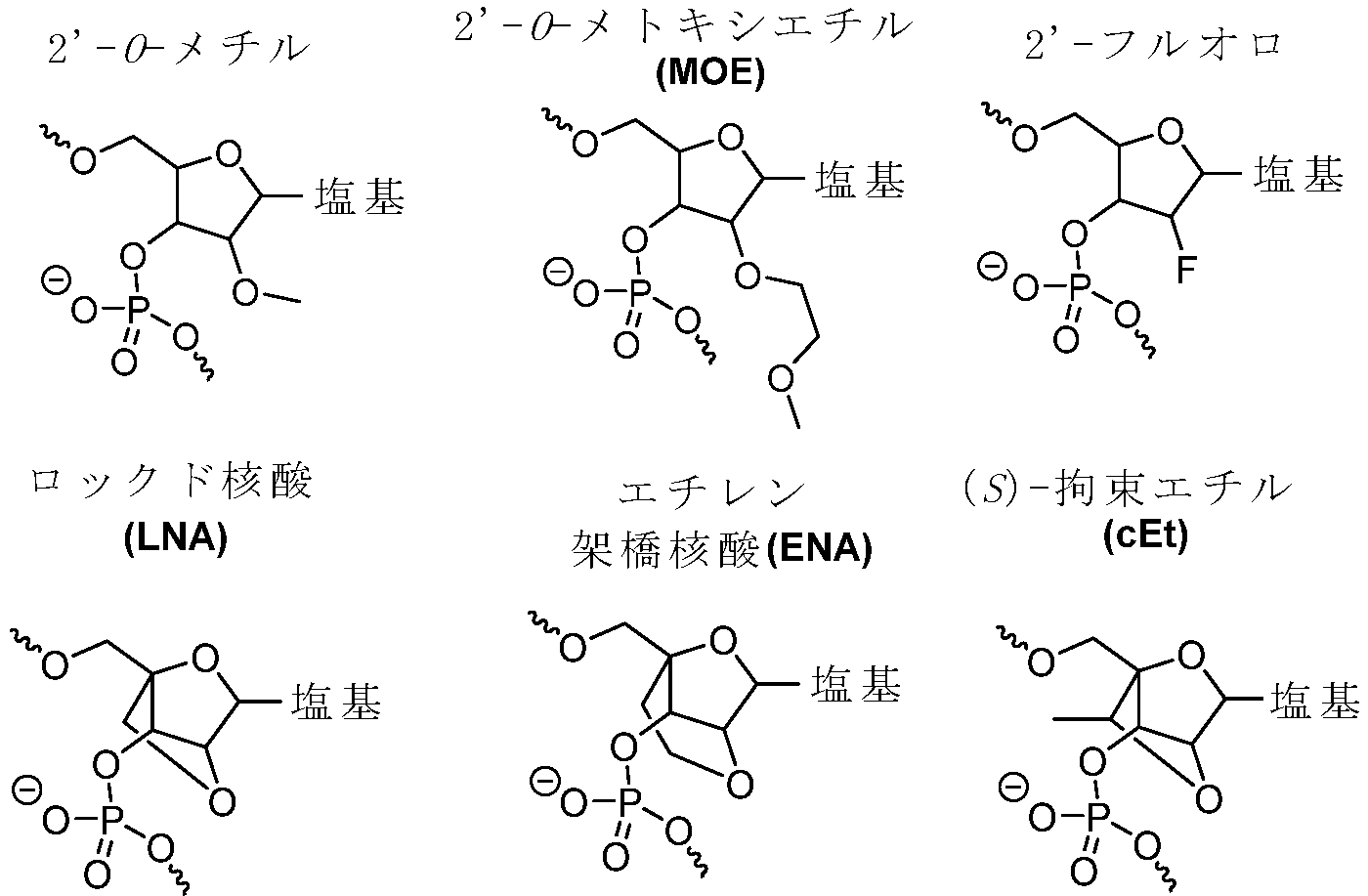
As used herein, the terms "2'-modified nucleoside" and "2'-modified ribonucleoside" are used interchangeably and refer to a nucleoside having a sugar moiety modified at the 2'-position. In some embodiments, the 2'-modified nucleoside is a 2'-4' bicyclic nucleoside, in which the 2' and 4' positions of the sugar are bridged (e.g., by a methylene, ethylene, or (S)-constrained ethyl bridge). In some embodiments, the 2'-modified nucleoside is a non-bicyclic 2'-modified nucleoside, in which the 2' position of the sugar moiety is substituted. Non-limiting examples of 2' modified nucleosides include 2' deoxy, 2'-fluoro (2'-F), 2'-O-methyl (2'-O-Me), 2'-O-methoxyethyl (2'-MOE), 2'-O-aminopropyl (2'-O-AP), 2'-O-dimethylaminoethyl (2'-O-DMAOE), 2'-O-dimethylaminopropyl (2'-O-DMAP), 2'-O-dimethylaminoethyloxyethyl (2'-O-DMAEOE), 2'-ON-methylacetamide (2'-O-NMA), locked nucleic acid (LNA, methylene bridged nucleic acid), ethylene bridged nucleic acid (ENA), and (S)-constrained ethyl bridged nucleic acid (cEt). In some embodiments, the 2' modified nucleosides described herein are high affinity modified nucleosides, and oligonucleotides comprising the 2' modified nucleosides have increased affinity for target sequences compared to unmodified oligonucleotides. Examples of 2' modified nucleosides structures are provided below:
II.複合体
本明細書には、標的化剤、例として、分子ペイロードへ共有結合的に連結された抗体を含む複合体がさらに提供される。いくつかの態様において、複合体は、オリゴヌクレオチドへ共有結合的に連結された筋標的化抗体を含む。複合体は、単一の抗原部位に特異的に結合する抗体、または同じ抗原上もしくは異なる抗原上に存在していてもよい少なくとも2つの抗原部位に結合する抗体を含んでいてもよい。
II. Conjugates Further provided herein are conjugates comprising a targeting agent, for example an antibody, covalently linked to a molecular payload. In some embodiments, the conjugate comprises a muscle-targeting antibody covalently linked to an oligonucleotide. The conjugate may comprise an antibody that specifically binds to a single antigen site, or an antibody that binds to at least two antigen sites, which may be present on the same antigen or on different antigens.
複合体は、少なくとも1つの遺伝子、タンパク質、および/または(例として、および)、核酸の活性あるいは機能をモジュレートするために使用されてもよい。いくつかの態様において、複合体とともに存在する分子ペイロードは、遺伝子、タンパク質、および/または(例として、および)、核酸のモジュレーションを担う。分子ペイロードは、細胞中の遺伝子、タンパク質、および/または(例として、および)、核酸の活性あるいは機能をモジュレートすることが可能な、小分子、タンパク質、核酸、オリゴヌクレオチド、あるいはいずれの分子実体であってもよい。いくつかの態様において、分子ペイロードは、筋細胞における疾患関連反復を標的化するオリゴヌクレオチドである。 The complex may be used to modulate the activity or function of at least one gene, protein, and/or (for example, and) nucleic acid. In some embodiments, the molecular payload present with the complex is responsible for modulating the gene, protein, and/or (for example, and) nucleic acid. The molecular payload may be a small molecule, protein, nucleic acid, oligonucleotide, or any molecular entity capable of modulating the activity or function of a gene, protein, and/or (for example, and) nucleic acid in a cell. In some embodiments, the molecular payload is an oligonucleotide that targets disease-associated repeats in muscle cells.
いくつかの態様において、複合体は、分子ペイロード、例として、疾患関連反復、例として、FXN対立遺伝子を標的化するアンチセンスオリゴヌクレオチドへ共有結合的に連結された、筋標的化剤、例として、抗トランスフェリン受容体1(TfR1)抗体を含む。 In some embodiments, the conjugate comprises a muscle targeting agent, e.g., an anti-transferrin receptor 1 (TfR1) antibody, covalently linked to a molecular payload, e.g., an antisense oligonucleotide that targets a disease-associated repeat, e.g., an FXN allele.
A.筋標的化剤
本開示のいくつかの側面は、筋標的化剤、例として、分子ペイロードを筋細胞へ送達するための筋標的化剤を提供する。いくつかの態様において、かかる筋標的化剤は、例として、筋細胞上の抗原への特異的な結合を介して、筋細胞に結合すること、および結び付けられた分子ペイロードを筋細胞へ送達することが可能である。いくつかの態様において、分子ペイロードは、筋標的化剤へ結合されて(例として、共有結合的に結合されて)おり、筋標的化剤が筋細胞上の抗原へ結合した際、例として、エンドサイトーシスを介して、筋細胞中へ内在化される。当然のことながら、様々なタイプの筋標的化剤が本開示に従って使用され得る。当然のことながら、様々なタイプの筋標的化剤が本開示に従って使用されてもよく、いずれの筋標的(例として、筋肉表面タンパク質)も本明細書に記載のいずれかのタイプの筋標的化剤によって標的化され得る。例えば、筋標的化剤は、小分子、核酸(例として、DNAまたはRNA)、ペプチド(例として、抗体)、脂質(例として、マイクロベシクル)、または糖部(例として、多糖類)を含んでいてもよく、またはこれらからなっていてもよい。例示の筋標的化剤は本明細書においてさらに詳細に記載されているが、当然のことながら、本明細書に提供される例示の筋標的化剤が限定されることを意図していない。
A. Muscle Targeting Agents Some aspects of the present disclosure provide muscle targeting agents, e.g., muscle targeting agents for delivering molecular payloads to muscle cells. In some embodiments, such muscle targeting agents are capable of binding to muscle cells, e.g., via specific binding to an antigen on the muscle cell, and delivering the associated molecular payload to the muscle cell. In some embodiments, the molecular payload is bound (e.g., covalently bound) to the muscle targeting agent and is internalized into the muscle cell, e.g., via endocytosis, when the muscle targeting agent binds to the antigen on the muscle cell. It should be understood that various types of muscle targeting agents can be used in accordance with the present disclosure. It should be understood that various types of muscle targeting agents can be used in accordance with the present disclosure, and any muscle target (e.g., muscle surface protein) can be targeted by any type of muscle targeting agent described herein. For example, a muscle targeting agent may comprise or consist of a small molecule, a nucleic acid (e.g., DNA or RNA), a peptide (e.g., an antibody), a lipid (e.g., a microvesicle), or a sugar moiety (e.g., a polysaccharide). Exemplary muscle targeting agents are described in further detail herein, although it should be understood that the exemplary muscle targeting agents provided herein are not intended to be limiting.
本開示のいくつかの側面は、骨格筋、平滑筋、または心筋などの筋肉上の抗原へ特異的に結合する筋標的化剤を提供する。いくつかの態様において、本明細書に提供される筋標的化剤のいずれも、骨格筋細胞、平滑筋細胞、および/または(例として、および)、心筋細胞上の抗原に結合する(例として、特異的に結合する)。 Some aspects of the present disclosure provide muscle targeting agents that specifically bind to antigens on muscles, such as skeletal, smooth, or cardiac muscles. In some embodiments, any of the muscle targeting agents provided herein bind (e.g., specifically bind) to antigens on skeletal muscle cells, smooth muscle cells, and/or (e.g., and) cardiac muscle cells.
筋肉特異的細胞表面認識要素(例として、細胞膜タンパク質)との相互作用によって、組織局在化と筋細胞への選択的取り込みとの両方が達成され得る。いくつかの態様において、筋肉の取り込みトランスポーターの基質である分子は、分子ペイロードを筋組織中へ送達するのに有用である。筋肉表面認識要素への結合、これに続くエンドサイトーシスは、抗体などの巨大分子さえも筋細胞へ侵入できるようにし得る。別の例として、トランスフェリンまたは抗トランスフェリン受容体1(TfR1)抗体にコンジュゲートされた分子ペイロードは、トランスフェリン受容体への結合を介し筋細胞によって取り入れられ得、次いで、例としてクラスリン媒介エンドサイトーシスを介し、形質膜陥入され(endocytosed)てもよい。 Through interaction with muscle-specific cell surface recognition elements (e.g., cell membrane proteins), both tissue localization and selective uptake into muscle cells can be achieved. In some embodiments, molecules that are substrates for muscle uptake transporters are useful for delivering molecular payloads into muscle tissue. Binding to muscle surface recognition elements, followed by endocytosis, can allow even macromolecules, such as antibodies, to enter muscle cells. As another example, molecular payloads conjugated to transferrin or anti-transferrin receptor 1 (TfR1) antibodies can be taken up by muscle cells via binding to the transferrin receptor and then endocytosed, e.g., via clathrin-mediated endocytosis.
筋標的化剤の使用は、他の組織において効果に関連する毒性を低減しつつ、筋肉中の分子ペイロード(例として、オリゴヌクレオチド)を濃縮するのに有用な場合がある。いくつかの態様において、筋標的化剤は、対象内の別の細胞型と比較して、筋細胞中の結合された分子ペイロードを濃縮させる。いくつかの態様において、筋標的化剤は、筋細胞(例として、骨格筋細胞、平滑筋細胞、または心筋細胞)中の結合された分子ペイロードを、非筋細胞(例として、肝臓細胞、神経細胞、血液細胞、または脂肪細胞)中の量より少なくとも1倍、2倍、3倍、4倍、5倍、6倍、7倍、8倍、9倍、10倍、15倍、20倍、30倍、40倍、50倍、60倍、70倍、80倍、90倍、または100倍多い量に濃縮する。いくつかの態様において、筋標的化剤へ結合された場合の分子ペイロードの対象における毒性は、これが対象へ送達されたとき、少なくとも1%、2%、3%、4%、5%、10%、15%、20%、25%、30%、35%、40%、45%、50%、55%、60%、65%、70%、75%、80%、90%、または95%低減される。 The use of muscle targeting agents can be useful to concentrate molecular payloads (e.g., oligonucleotides) in muscle while reducing toxicity associated with effects in other tissues. In some embodiments, the muscle targeting agent concentrates the bound molecular payload in muscle cells compared to another cell type in the subject. In some embodiments, the muscle targeting agent concentrates the bound molecular payload in muscle cells (e.g., skeletal muscle cells, smooth muscle cells, or cardiomyocytes) to an amount at least 1-fold, 2-fold, 3-fold, 4-fold, 5-fold, 6-fold, 7-fold, 8-fold, 9-fold, 10-fold, 15-fold, 20-fold, 30-fold, 40-fold, 50-fold, 60-fold, 70-fold, 80-fold, 90-fold, or 100-fold greater than the amount in non-muscle cells (e.g., liver cells, neural cells, blood cells, or adipocytes). In some embodiments, the toxicity in a subject of a molecular payload when conjugated to a muscle targeting agent is reduced by at least 1%, 2%, 3%, 4%, 5%, 10%, 15%, 20%, 25%, 30%, 35%, 40%, 45%, 50%, 55%, 60%, 65%, 70%, 75%, 80%, 90%, or 95% when delivered to a subject.
いくつかの態様において、筋肉選択性を獲得するために、筋肉認識要素(例として、筋細胞抗原)が必要とされ得る。一例として、筋標的化剤は、筋肉特異的取り込みトランスポーターの基質である小分子であってもよい。別の例として、筋標的化剤は、トランスポーター媒介エンドサイトーシスを介して筋細胞へ侵入する抗体であってもよい。別の例として、筋標的化剤は、筋細胞上の細胞表面受容体に結合するリガンドであってもよい。当然のことながら、トランスポーターをベースとしたアプローチが細胞侵入への直通路を提供するのに対し、受容体をベースとした標的化が所望の作用部位に達するために刺激されたエンドサイトーシスを伴うこともある。 In some embodiments, a muscle recognition element (e.g., a muscle cell antigen) may be required to achieve muscle selectivity. As one example, the muscle targeting agent may be a small molecule that is a substrate for a muscle-specific uptake transporter. As another example, the muscle targeting agent may be an antibody that enters muscle cells via transporter-mediated endocytosis. As another example, the muscle targeting agent may be a ligand that binds to a cell surface receptor on muscle cells. Of course, while a transporter-based approach provides a direct pathway for cell entry, receptor-based targeting may also involve stimulated endocytosis to reach the desired site of action.
i.筋標的抗体
いくつかの態様において、筋標的化剤は抗体である。一般に、それらの標的抗原に対する抗体の高い特異性は、筋細胞(例として、骨格筋細胞、平滑筋細胞、および/または(例として、および)、心筋細胞)を選択的に標的化する可能性をもたらす。この特異性はまた、オフターゲット毒性(off-target toxicity)を限定することもある。筋細胞の表面抗原を標的化することが可能な抗体の例は報告されており、かつ本開示の範囲内にある。例えば、筋細胞の表面を標的化する抗体は、Arahata K.,et al.「Immunostaining of skeletal and cardiac muscle surface membrane with antibody against Duchenne muscular dystrophy peptide」Nature 1988;333:861-3;Song K.S.,et al.「Expression of caveolin-3 in skeletal,cardiac,and smooth muscle cells.Caveolin-3 is a component of the sarcolemma and co-fractionates with dystrophin and dystrophin-associated glycoproteins」J Biol Chem 1996;271:15160-5;およびWeisbart R.H.et al.,「Cell type specific targeted intracellular delivery into muscle of a monoclonal antibody that binds myosin IIb」Mol Immunol.2003 Mar,39(13):78309に記載されており、これら各々の内容全体は参照により本明細書に組み込まれる。
i. Muscle-targeting antibodies In some embodiments, the muscle targeting agent is an antibody. In general, the high specificity of antibodies to their target antigens allows them to selectively target muscle cells (e.g., skeletal muscle cells, smooth muscle cells, and/or (e.g., and) cardiomyocytes). This specificity may also limit off-target toxicity. Examples of antibodies capable of targeting surface antigens of muscle cells have been reported and are within the scope of this disclosure. For example, antibodies that target the surface of muscle cells are described in Arahata K., et al. "Immunostaining of skeletal and cardiac muscle surface membrane with antibody against Duchenne muscular dystrophy peptide" Nature 1988;333:861-3; Song KS, et al. "Expression of caveolin-3 in skeletal, cardiac, and smooth muscle cells. Caveolin-3 is a component of the sarcolemma and co-fractionates with dystrophin and dystrophin-associated glycoproteins" J Biol Chem 1996;271:15160-5; and Weisbart RH et al., "Cell type specific targeted intracellular delivery into muscle of a monoclonal antibody that binds myosin IIb" Mol Immunol. 2003 Mar,39(13):78309, the entire contents of each of which are incorporated herein by reference.
a.抗トランスフェリン受容体1(TfR1)抗体
本開示のいくつかの側面は、トランスフェリン受容体、例として抗トランスフェリン受容体抗体に結合する剤は筋細胞を標的化することが可能であるという認識に基づく。トランスフェリン受容体は、細胞膜を越えてトランスフェリンを輸送し細胞内鉄レベルの調節およびホメオスタシスに加わる内在化する細胞表面受容体である。本開示のいくつかの側面は、トランスフェリン受容体に結合することが可能なトランスフェリン受容体結合タンパク質を提供する。したがって、本開示の側面は、トランスフェリン受容体に結合する結合タンパク質(例として、抗体)を提供する。いくつかの態様において、トランスフェリン受容体に結合する結合タンパク質は、結合されたいずれの分子ペイロードと共に、筋細胞中へ内在化される。本明細書に使用される場合、トランスフェリン受容体に結合する抗体は、トランスフェリン受容体抗体、抗トランスフェリン受容体抗体、または抗TfR1抗体と互換的に称されることもある。トランスフェリン受容体に結合する、例として特異的に結合する抗体は、トランスフェリン受容体へ結合した際、例として受容体媒介エンドサイトーシスを通して、細胞中へ内在化され得る。
a. Anti-Transferrin Receptor 1 (TfR1) Antibody Some aspects of the present disclosure are based on the recognition that agents that bind to the transferrin receptor, e.g., anti-transferrin receptor antibodies, can target muscle cells. The transferrin receptor is an internalizing cell surface receptor that transports transferrin across the cell membrane and participates in the regulation and homeostasis of intracellular iron levels. Some aspects of the present disclosure provide transferrin receptor binding proteins capable of binding to the transferrin receptor. Thus, aspects of the present disclosure provide binding proteins (e.g., antibodies) that bind to the transferrin receptor. In some embodiments, the binding proteins that bind to the transferrin receptor are internalized into muscle cells along with any molecular payloads attached. As used herein, antibodies that bind to the transferrin receptor may be interchangeably referred to as transferrin receptor antibodies, anti-transferrin receptor antibodies, or anti-TfR1 antibodies. Antibodies that bind, e.g., specifically bind, to the transferrin receptor can be internalized into cells, e.g., through receptor-mediated endocytosis, upon binding to the transferrin receptor.
当然のことながら、抗TfR1抗体が、知られている数種の方法論、例として、ファージディスプレーを使用するライブラリ設計を使用して、産生、合成、および/または(例として、および)、誘導体化され得る。例示的な方法論は、当該技術分野において特徴付けられており、参照により組み込まれる(Diez,P.et al.「High-throughput phage-display screening in array format」,Enzyme and Microb Technol,2015,79,34-41.、Hammers C.M.and Stanley,J.R.,「Antibody Phage Display:Technique and Applications」J Invest Dermatol.2014,134:2.、Engleman,Edgar(Ed.)「Human Hybridomas and Monoclonal Antibodies.」1985,Springer.)。他の態様において、抗TfR1抗体はこれまでにキャラクタライズされているかまたは開示されている。トランスフェリン受容体に特異的に結合する抗体は、当技術分野で公知である(例として、米国特許第4,364,934号、1979年12月4日出願、「Monoclonal antibody to a human early thymocyte antigen and methods for preparing same」、米国特許第8,409,573号、2006年6月14日出願、「Anti-CD71 monoclonal antibodies and uses thereof for treating malignant tumor cells」、米国特許第9,708,406号、2014年5月20日出願、「Anti-transferrin receptor antibodies and methods of use」、米国特許第9,611,323号、2014年12月19日出願、「Low affinity blood brain barrier receptor antibodies and uses therefor」、国際公開第2015/098989号、2014年12月24日出願、「Novel anti-transferrin receptor antibody that passes through blood-brain barrier」、Schneider C.et al.「Structural features of the cell surface receptor for transferrin that is recognized by the monoclonal antibody OKT9.」J Biol Chem.1982,257:14,8516-8522.、Lee et al.「Targeting Rat Anti-Mouse Transferrin Receptor Monoclonal Antibodies through Blood-Brain Barrier in Mouse」2000,J Pharmacol.Exp.Ther.,292:1048-1052を参照されたい)。 It will be appreciated that anti-TfR1 antibodies can be produced, synthesized, and/or (for example and) derivatized using several known methodologies, for example library design using phage display. Exemplary methodologies have been characterized in the art and are incorporated by reference (Diez, P. et al. "High-throughput phage-display screening in array format", Enzyme and Microb Technol, 2015, 79, 34-41.; Hammers C.M. and Stanley, J.R., "Antibody Phage Display: Technique and Applications" J Invest Dermatol. 2014, 134:2.; Engleman, Edgar (Ed.) "Human Hybridomas and Monoclonal Antibodies." 1985, Springer.). In other embodiments, anti-TfR1 antibodies have been previously characterized or disclosed. Antibodies that specifically bind to the transferrin receptor are known in the art (see, e.g., U.S. Pat. No. 4,364,934, filed December 4, 1979, entitled "Monoclonal antibody to a human early thymocyte antigen and methods for preparing same"; U.S. Pat. No. 8,409,573, filed June 14, 2006, entitled "Anti-CD71 monoclonal antibodies and uses thereof for treating malignant tumor cells"; U.S. Pat. No. 9,708,406, filed May 20, 2014, entitled "Anti-transferrin receptor antibodies and methods of use"; U.S. Pat. No. 9,611,323, filed December 19, 2014, entitled "Low affinity blood brain barrier receptor antibodies and uses therefor"; WO 2015/098989, filed December 24, 2014, entitled "Novel anti-transferrin receptor antibody that passes through blood-brain barrier"; Schneider C. et al. (See, for example, Lee et al., "Structural features of the cell surface receptor for transferrin that is recognized by the monoclonal antibody OKT9." J. Biol. Chem. 1982, 257:14, 8516-8522; Lee et al., "Targeting Rat Anti-Mouse Transferrin Receptor Monoclonal Antibodies through Blood-Brain Barrier in Mouse," 2000, J. Pharmacol. Exp. Ther., 292:1048-1052.)
いくつかの態様において、本明細書に記載の抗TfR1抗体は、高い特異性および親和性でトランスフェリン受容体に結合する。いくつかの態様において、本明細書に記載の抗TfR1抗体は、トランスフェリン受容体のいずれかの細胞外エピトープまたは抗体に対して暴露されるようになるエピトープに特異的に結合する。いくつかの態様において、本明細書に提供される抗TfR1抗体はヒト、霊長目の非ヒト動物、マウス、ラットなどからのトランスフェリン受容体に特異的に結合する。いくつかの態様において、本明細書に提供される抗TfR1抗体はヒトトランスフェリン受容体に結合する。いくつかの態様において、本明細書に記載の抗TfR1抗体は、配列番号105~108に提供されるような、ヒトまたは非ヒト霊長類トランスフェリン受容体のアミノ酸セグメントに結合する。いくつかの態様において、本明細書に記載の抗TfR1抗体は、トランスフェリン受容体の先端ドメインにはない、配列番号105に示されるヒトトランスフェリン受容体のアミノ酸90~96に対応するアミノ酸セグメントに結合する。 In some embodiments, the anti-TfR1 antibodies described herein bind to the transferrin receptor with high specificity and affinity. In some embodiments, the anti-TfR1 antibodies described herein specifically bind to any extracellular epitope of the transferrin receptor or epitope that becomes exposed to the antibody. In some embodiments, the anti-TfR1 antibodies provided herein specifically bind to transferrin receptor from humans, non-human animals of the primate order, mice, rats, etc. In some embodiments, the anti-TfR1 antibodies provided herein bind to the human transferrin receptor. In some embodiments, the anti-TfR1 antibodies described herein bind to an amino acid segment of the human or non-human primate transferrin receptor, such as those provided in SEQ ID NOs: 105-108. In some embodiments, the anti-TfR1 antibodies described herein bind to an amino acid segment corresponding to amino acids 90-96 of the human transferrin receptor as set forth in SEQ ID NO: 105, which is not in the apical domain of the transferrin receptor.
NCBI配列NP_003225.2(トランスフェリン受容体タンパク質1アイソフォーム1、Homo sapiens)に対応する、ヒトトランスフェリン受容体アミノ酸配列の例は、以下のとおりである:
MMDQARSAFSNLFGGEPLSYTRFSLARQVDGDNSHVEMKLAVDEEENADNNTKANVTKPKRCSGSICYGTIAVIVFFLIGFMIGYLGYCKGVEPKTECERLAGTESPVREEPGEDFPAARRLYWDDLKRKLSEKLDSTDFTGTIKLLNENSYVPREAGSQKDENLALYVENQFREFKLSKVWRDQHFVKIQVKDSAQNSVIIVDKNGRLVYLVENPGGYVAYSKAATVTGKLVHANFGTKKDFEDLYTPVNGSIVIVRAGKITFAEKVANAESLNAIGVLIYMDQTKFPIVNAELSFFGHAHLGTGDPYTPGFPSFNHTQFPPSRSSGLPNIPVQTISRAAAEKLFGNMEGDCPSDWKTDSTCRMVTSESKNVKLTVSNVLKEIKILNIFGVIKGFVEPDHYVVVGAQRDAWGPGAAKSGVGTALLLKLAQMFSDMVLKDGFQPSRSIIFASWSAGDFGSVGATEWLEGYLSSLHLKAFTYINLDKAVLGTSNFKVSASPLLYTLIEKTMQNVKHPVTGQFLYQDSNWASKVEKLTLDNAAFPFLAYSGIPAVSFCFCEDTDYPYLGTTMDTYKELIERIPELNKVARAAAEVAGQFVIKLTHDVELNLDYERYNSQLLSFVRDLNQYRADIKEMGLSLQWLYSARGDFFRATSRLTTDFGNAEKTDRFVMKKLNDRVMRVEYHFLSPYVSPKESPFRHVFWGSGSHTLPALLENLKLRKQNNGAFNETLFRNQLALATWTIQGAANALSGDVWDIDNEF(配列番号105)
An example of a human transferrin receptor amino acid sequence, which corresponds to the NCBI sequence NP_003225.2 (transferrin receptor protein 1 isoform 1, Homo sapiens), is as follows:
(SEQ ID NO:105)
NCBI配列NP_001244232.1(トランスフェリン受容体タンパク質1、Macaca mulatta)に対応する、霊長目の非ヒト動物トランスフェリン受容体アミノ酸配列の例は、以下のとおりである:
MMDQARSAFSNLFGGEPLSYTRFSLARQVDGDNSHVEMKLGVDEEENTDNNTKPNGTKPKRCGGNICYGTIAVIIFFLIGFMIGYLGYCKGVEPKTECERLAGTESPAREEPEEDFPAAPRLYWDDLKRKLSEKLDTTDFTSTIKLLNENLYVPREAGSQKDENLALYIENQFREFKLSKVWRDQHFVKIQVKDSAQNSVIIVDKNGGLVYLVENPGGYVAYSKAATVTGKLVHANFGTKKDFEDLDSPVNGSIVIVRAGKITFAEKVANAESLNAIGVLIYMDQTKFPIVKADLSFFGHAHLGTGDPYTPGFPSFNHTQFPPSQSSGLPNIPVQTISRAAAEKLFGNMEGDCPSDWKTDSTCKMVTSENKSVKLTVSNVLKETKILNIFGVIKGFVEPDHYVVVGAQRDAWGPGAAKSSVGTALLLKLAQMFSDMVLKDGFQPSRSIIFASWSAGDFGSVGATEWLEGYLSSLHLKAFTYINLDKAVLGTSNFKVSASPLLYTLIEKTMQDVKHPVTGRSLYQDSNWASKVEKLTLDNAAFPFLAYSGIPAVSFCFCEDTDYPYLGTTMDTYKELVERIPELNKVARAAAEVAGQFVIKLTHDTELNLDYERYNSQLLLFLRDLNQYRADVKEMGLSLQWLYSARGDFFRATSRLTTDFRNAEKRDKFVMKKLNDRVMRVEYYFLSPYVSPKESPFRHVFWGSGSHTLSALLESLKLRRQNNSAFNETLFRNQLALATWTIQGAANALSGDVWDIDNEF
(配列番号106)
An example of a primate non-human transferrin receptor amino acid sequence that corresponds to the NCBI sequence NP_001244232.1 (Transferrin receptor protein 1, Macaca mulatta) is as follows:
(SEQ ID NO:106)
NCBI配列XP_005545315.1(トランスフェリン受容体タンパク質1、Macaca fascicularis)に対応する、霊長目の非ヒト動物トランスフェリン受容体アミノ酸配列の例は、以下のとおりである:
MMDQARSAFSNLFGGEPLSYTRFSLARQVDGDNSHVEMKLGVDEEENTDNNTKANGTKPKRCGGNICYGTIAVIIFFLIGFMIGYLGYCKGVEPKTECERLAGTESPAREEPEEDFPAAPRLYWDDLKRKLSEKLDTTDFTSTIKLLNENLYVPREAGSQKDENLALYIENQFREFKLSKVWRDQHFVKIQVKDSAQNSVIIVDKNGGLVYLVENPGGYVAYSKAATVTGKLVHANFGTKKDFEDLDSPVNGSIVIVRAGKITFAEKVANAESLNAIGVLIYMDQTKFPIVKADLSFFGHAHLGTGDPYTPGFPSFNHTQFPPSQSSGLPNIPVQTISRAAAEKLFGNMEGDCPSDWKTDSTCKMVTSENKSVKLTVSNVLKETKILNIFGVIKGFVEPDHYVVVGAQRDAWGPGAAKSSVGTALLLKLAQMFSDMVLKDGFQPSRSIIFASWSAGDFGSVGATEWLEGYLSSLHLKAFTYINLDKAVLGTSNFKVSASPLLYTLIEKTMQDVKHPVTGRSLYQDSNWASKVEKLTLDNAAFPFLAYSGIPAVSFCFCEDTDYPYLGTTMDTYKELVERIPELNKVARAAAEVAGQFVIKLTHDTELNLDYERYNSQLLLFLRDLNQYRADVKEMGLSLQWLYSARGDFFRATSRLTTDFRNAEKRDKFVMKKLNDRVMRVEYYFLSPYVSPKESPFRHVFWGSGSHTLSALLESLKLRRQNNSAFNETLFRNQLALATWTIQGAANALSGDVWDIDNEF(配列番号107)
An example of a primate non-human animal transferrin receptor amino acid sequence that corresponds to the NCBI sequence XP_005545315.1 (transferrin receptor protein 1, Macaca fascicularis) is as follows:
(SEQ ID NO:107)
NCBI配列NP_001344227.1(トランスフェリン受容体タンパク質1、Mus musculus)に対応する、マウストランスフェリン受容体アミノ酸配列の例は、以下のとおりである:
MMDQARSAFSNLFGGEPLSYTRFSLARQVDGDNSHVEMKLAADEEENADNNMKASVRKPKRFNGRLCFAAIALVIFFLIGFMSGYLGYCKRVEQKEECVKLAETEETDKSETMETEDVPTSSRLYWADLKTLLSEKLNSIEFADTIKQLSQNTYTPREAGSQKDESLAYYIENQFHEFKFSKVWRDEHYVKIQVKSSIGQNMVTIVQSNGNLDPVESPEGYVAFSKPTEVSGKLVHANFGTKKDFEELSYSVNGSLVIVRAGEITFAEKVANAQSFNAIGVLIYMDKNKFPVVEADLALFGHAHLGTGDPYTPGFPSFNHTQFPPSQSSGLPNIPVQTISRAAAEKLFGKMEGSCPARWNIDSSCKLELSQNQNVKLIVKNVLKERRILNIFGVIKGYEEPDRYVVVGAQRDALGAGVAAKSSVGTGLLLKLAQVFSDMISKDGFRPSRSIIFASWTAGDFGAVGATEWLEGYLSSLHLKAFTYINLDKVVLGTSNFKVSASPLLYTLMGKIMQDVKHPVDGKSLYRDSNWISKVEKLSFDNAAYPFLAYSGIPAVSFCFCEDADYPYLGTRLDTYEALTQKVPQLNQMVRTAAEVAGQLIIKLTHDVELNLDYEMYNSKLLSFMKDLNQFKTDIRDMGLSLQWLYSARGDYFRATSRLTTDFHNAEKTNRFVMREINDRIMKVEYHFLSPYVSPRESPFRHIFWGSGSHTLSALVENLKLRQKNITAFNETLFRNQLALATWTIQGVANALSGDIWNIDNEF
(配列番号108)
An example of a mouse transferrin receptor amino acid sequence, which corresponds to the NCBI sequence NP_001344227.1 (transferrin receptor protein 1, Mus musculus), is as follows:
(SEQ ID NO:108)
いくつかの態様において、抗TfR1抗体は、以下のような受容体:
FVKIQVKDSAQNSVIIVDKNGRLVYLVENPGGYVAYSKAATVTGKLVHANFGTKKDFEDLYTPVNGSIVIVRAGKITFAEKVANAESLNAIGVLIYMDQTKFPIVNAELSFFGHAHLGTGDPYTPGFPSFNHTQFPPSRSSGLPNIPVQTISRAAAEKLFGNMEGDCPSDWKTDSTCRMVTSESKNVKLTVSNVLKE(配列番号109)のアミノ酸セグメントに結合し、トランスフェリン受容体とトランスフェリンおよび/または(例として、および)ヒト血色素症タンパク質(HFEとしても知られる)との間の結合相互作用を阻害しない。いくつかの態様において、本明細書に記載の抗TfR1受容体抗体は、配列番号109のエピトープには結合しない。
In some embodiments, the anti-TfR1 antibody binds to a receptor such as:
FVKIQVKDSAQNSVIIVDKNGRLVYLVENPGGYVAYSKAATVTGKLVHANFGTKKDFEDLYTPVNGSIVIVRAGKITFAEKVANAESLNAIGVLIYMDQTKFPIVNAELSFFGHAHLGTGDPYTPGFPSFNHTQFPPSRSSGLPNIPVQTISRAAAEKLFGNMEGDCPSDWKTDSTCRMVTSESKNVKLTVSNVLKE (SEQ ID NO: 109) and does not inhibit the binding interaction between the transferrin receptor and transferrin and/or (by way of example and) human hemochromatosis protein (also known as HFE). In some embodiments, the anti-TfR1 receptor antibodies described herein do not bind to the epitope of SEQ ID NO: 109.
適切な方法論は、例として、組換えDNAプロトコルの使用を通じて、抗体、抗体フラグメント、もしくは抗原結合剤を得るか、および/または(例として、および)、産生するために使用されてもよい。いくつかの態様において、抗体はまた、ハイブリドーマの生成を通しても産生されてよい(例として、Kohler,G and Milstein,C.「Continuous cultures of fused cells secreting antibody of predefined specificity」Nature,1975,256:495-497を参照されたい)。関心のある抗原は、いずれの型または実体の、例として、組換え型もしくは天然に存在する型または実体の免疫原として使用されてもよい。ハイブリドーマは、標準的な方法、例としてELISAスクリーニングを使用してスクリーニングされることで、具体的な抗原を標的化する抗体を産生する少なくとも1個のハイブリドーマが見出される。抗体はまた、抗体を発現するタンパク質発現ライブラリ(例として、ファージディスプレーライブラリ)のスクリーニングを通しても産生されてよい。ファージディスプレーライブラリ設計はまた、いくつかの態様において使用されてもよい(例として、米国特許第5,223,409号、1991年3月1日出願、「Directed evolution of novel binding proteins」、国際公開第1992/18619号、1992年4月10日出願、「Heterodimeric receptor libraries using phagemids」、国際公開第1991/17271号、1991年5月1日出願、「Recombinant library screening methods」、国際公開第1992/20791号、1992年5月15日出願、「Methods for producing members of specific binding pairs」、および国際公開第1992/15679号、1992年2月28日出願、「Improved epitope displaying phage」を参照されたい)。いくつかの態様において、関心のある抗原は、非ヒト動物、例として、齧歯類の動物またはヤギを免疫するために使用されてもよい。いくつかの態様において、次いで抗体が非ヒト動物から得られたら、任意に数多の方法論を使用し、例として組換えDNA技法を使用し、修飾してもよい。抗体産生および方法論の追加の例も当該技術分野において公知である(例として、Harlow et al.「Antibodies:A Laboratory Manual」,Cold Spring Harbor Laboratory,1988を参照されたい)。 Suitable methodologies may be used to obtain and/or (for example and) produce antibodies, antibody fragments, or antigen-binding agents, for example through the use of recombinant DNA protocols. In some embodiments, antibodies may also be produced through the generation of hybridomas (see, for example, Kohler, G and Milstein, C. "Continuous cultures of fused cells secreting antibody of predefined specificity" Nature, 1975, 256:495-497). The antigen of interest may be used as an immunogen of any type or entity, for example, recombinant or naturally occurring type or entity. Hybridomas are screened using standard methods, for example, ELISA screening, to find at least one hybridoma that produces an antibody targeting a specific antigen. Antibodies may also be produced through screening of protein expression libraries (for example, phage display libraries) that express antibodies. Phage display library design may also be used in some embodiments (see, e.g., U.S. Pat. No. 5,223,409, filed March 1, 1991, entitled "Directed evolution of novel binding proteins," WO 1992/18619, filed April 10, 1992, entitled "Heterodimeric receptor libraries using phagemids," WO 1991/17271, filed May 1, 1991, entitled "Recombinant library screening methods," WO 1992/20791, filed May 15, 1992, entitled "Methods for producing members of specific binding pairs," and WO 1992/15679, filed February 28, 1992, entitled "Improved epitope displaying phage"). In some embodiments, the antigen of interest may be used to immunize a non-human animal, e.g., a rodent animal or a goat. In some embodiments, once the antibodies are obtained from the non-human animal, they may then be optionally modified using a number of methodologies, for example using recombinant DNA techniques. Additional examples of antibody production and methodologies are also known in the art (see, for example, Harlow et al., "Antibodies: A Laboratory Manual," Cold Spring Harbor Laboratory, 1988).
いくつかの態様において、抗体は修飾されている(例として、グリコシル化、リン酸化、SUMO化、および/または(例として、および)、メチル化を介して修飾されている)。いくつかの態様において、抗体は、1以上の糖または炭水化物分子にコンジュゲートされたグリコシル化抗体である。いくつかの態様において、1以上の糖または炭水化物分子は、N-グリコシル化、O-グリコシル化、C-グリコシル化、グリピエーション(GPIアンカー付着)、および/または(例として、および)、ホスホグリコシル化を介して、抗体にコンジュゲートされている。いくつかの態様において、1以上の糖または炭水化物分子は、単糖類、二糖類、オリゴ糖類、またはグリカンである。いくつかの態様において、1以上の糖または炭水化物分子は、分枝オリゴ糖類または分枝グリカンである。いくつかの態様において、1以上の糖または炭水化物分子は、マンノース単位、グルコース単位、N-アセチルグルコサミン単位、N-アセチルガラクトサミン単位、ガラクトース単位、フコース単位、またはホスホ脂質単位を包含する。いくつかの態様において、糖分子は、約1~10個、約1~5個、約5~10個、約1~4個、約1~3個、または約2個存在する。いくつかの態様において、グリコシル化抗体は、全体的にまたは部分的にグリコシル化されている。いくつかの態様において、抗体は、化学反応によって、または酵素的な手段によってグリコシル化されている。いくつかの態様において、抗体は、in vitroまたは細胞内でグリコシル化され、任意に、N-またはO-グリコシル化経路において酵素(例として、グリコシルトランスフェラーゼ)が欠乏し得る。いくつかの態様において、抗体は、「Modified antibody,antibody-conjugate and process for the preparation thereof」と題する2014年5月1日に公開された国際公開第2014065661号に記載されるような糖または炭水化物分子で官能化されている。 In some embodiments, the antibody is modified (e.g., modified via glycosylation, phosphorylation, sumoylation, and/or (e.g., and) methylation). In some embodiments, the antibody is a glycosylated antibody conjugated to one or more sugar or carbohydrate molecules. In some embodiments, the one or more sugar or carbohydrate molecules are conjugated to the antibody via N-glycosylation, O-glycosylation, C-glycosylation, glypiation (GPI anchor attachment), and/or (e.g., and) phosphoglycosylation. In some embodiments, the one or more sugar or carbohydrate molecules are monosaccharides, disaccharides, oligosaccharides, or glycans. In some embodiments, the one or more sugar or carbohydrate molecules are branched oligosaccharides or branched glycans. In some embodiments, the one or more sugar or carbohydrate molecules include mannose units, glucose units, N-acetylglucosamine units, N-acetylgalactosamine units, galactose units, fucose units, or phospholipid units. In some embodiments, the sugar molecules are present in about 1-10, about 1-5, about 5-10, about 1-4, about 1-3, or about 2 units. In some embodiments, the glycosylated antibody is fully or partially glycosylated. In some embodiments, the antibody is glycosylated by chemical reaction or by enzymatic means. In some embodiments, the antibody is glycosylated in vitro or intracellularly, and optionally may be deficient in an enzyme (e.g., glycosyltransferase) in the N- or O-glycosylation pathway. In some embodiments, the antibody is functionalized with a sugar or carbohydrate molecule as described in WO2014065661, published May 1, 2014, entitled "Modified antibody, antibody-conjugate and process for the preparation thereof."
いくつかの態様において、本開示の抗TfR1抗体は、表2~7のうちのいずれか1つから選択される抗TfR1抗体のいずれか1つのVLドメインおよび/または(例として、および)VHドメインを含み、IgG、IgE、IgM、IgD、IgA、またはIgY免疫グロブリン分子、いずれかのクラス(例として、IgG1、IgG2、IgG3、IgG4、IgA1、およびIgA2)、またはいずれかのサブクラス(例として、IgG2aおよびIgG2b)の免疫グロブリン分子の定常領域のアミノ酸配列を含む定常領域を含む。ヒト定常領域の非限定例は当該技術分野において記載されており、例として、上述のKabat E A et al.,(1991)を参照されたい。 In some embodiments, the anti-TfR1 antibody of the present disclosure comprises a VL domain and/or (for example and) a VH domain of any one of the anti-TfR1 antibodies selected from any one of Tables 2-7, and comprises a constant region comprising the amino acid sequence of the constant region of an immunoglobulin molecule of an IgG, IgE, IgM, IgD, IgA, or IgY, of any class (for example, IgG1, IgG2, IgG3, IgG4, IgA1, and IgA2), or of any subclass (for example, IgG2a and IgG2b). Non-limiting examples of human constant regions are described in the art, see, for example, Kabat E A et al., (1991), supra.
いくつかの態様において、トランスフェリン受容体に結合する薬剤、例として抗TfR1抗体は、筋細胞を標的化することができ、および/または(例として、および)血液脳関門を通過する薬剤の輸送を媒介する。トランスフェリン受容体は、細胞膜を越えてトランスフェリンを輸送し細胞内鉄レベルの調節およびホメオスタシスに加わる内在化する細胞表面受容体である。本開示のいくつかの側面は、トランスフェリン受容体に結合することが可能なトランスフェリン受容体結合タンパク質を提供する。トランスフェリン受容体に結合する、例として特異的に結合する抗体は、トランスフェリン受容体へ結合した際、例として受容体媒介エンドサイトーシスを通して、細胞中へ内在化され得る。 In some embodiments, agents that bind to the transferrin receptor, e.g., anti-TfR1 antibodies, can target muscle cells and/or mediate transport of agents across the blood-brain barrier (e.g., and). The transferrin receptor is an internalizing cell surface receptor that transports transferrin across the cell membrane and participates in the regulation and homeostasis of intracellular iron levels. Some aspects of the disclosure provide transferrin receptor binding proteins capable of binding to the transferrin receptor. Antibodies that bind, e.g., specifically bind, to the transferrin receptor can be internalized into the cell upon binding to the transferrin receptor, e.g., through receptor-mediated endocytosis.
いくつかの側面では、トランスフェリン受容体に高い特異性および親和性で結合するヒト化抗体が本明細書に提供される。いくつかの態様において、本明細書に記載のヒト化抗TfR1抗体は、トランスフェリン受容体のいずれかの細胞外エピトープ、または抗体に対して暴露されるようになるエピトープに特異的に結合する。いくつかの態様において、本明細書に提供されるヒト化抗TfR1抗体はヒト、霊長目の非ヒト動物、マウス、ラットなどからのトランスフェリン受容体に特異的に結合する。いくつかの態様において、本明細書に提供されるヒト化抗TfR1抗体はヒトトランスフェリン受容体に結合する。いくつかの態様において、本明細書に記載のヒト化抗TfR1抗体は、配列番号105~108に提供されるような、ヒトまたは非ヒト霊長類トランスフェリン受容体のアミノ酸セグメントに結合する。いくつかの態様において、本明細書に記載のヒト化抗TfR1抗体は、トランスフェリン受容体の先端ドメインにはない、配列番号105に示されるヒトトランスフェリン受容体のアミノ酸90~96に対応するアミノ酸セグメントに結合する。いくつかの態様において、本明細書に記載のヒト化抗TfR1抗体は、TfR1に結合するが、TfR2には結合しない。 In some aspects, provided herein are humanized antibodies that bind to the transferrin receptor with high specificity and affinity. In some embodiments, the humanized anti-TfR1 antibodies described herein specifically bind to any extracellular epitope of the transferrin receptor or epitope that becomes exposed to the antibody. In some embodiments, the humanized anti-TfR1 antibodies provided herein specifically bind to transferrin receptor from humans, non-human primates, mice, rats, etc. In some embodiments, the humanized anti-TfR1 antibodies provided herein bind to the human transferrin receptor. In some embodiments, the humanized anti-TfR1 antibodies described herein bind to an amino acid segment of the human or non-human primate transferrin receptor, such as those provided in SEQ ID NOs: 105-108. In some embodiments, the humanized anti-TfR1 antibodies described herein bind to an amino acid segment corresponding to amino acids 90-96 of the human transferrin receptor as set forth in SEQ ID NO: 105, which is not in the apical domain of the transferrin receptor. In some embodiments, the humanized anti-TfR1 antibodies described herein bind to TfR1 but not to TfR2.
いくつかの態様において、本明細書に記載の抗TfR1抗体(例として、以下の表2の抗TfR1クローン8)は、TfR1のエピトープに結合し、エピトープは、配列番号105のアミノ酸214~241および/またはアミノ酸354~381の残基を含む。いくつかの態様において、本明細書に記載の抗TfR1抗体は、配列番号105のアミノ酸214~241およびアミノ酸354~381の残基を含むエピトープに結合する。いくつかの態様において、本明細書に記載の抗TfR1抗体は、配列番号105に示されるヒトTfR1の残基Y222、T227、K231、H234、T367、S368、S370、T376、およびS378のうちの1以上を含むエピトープに結合する。いくつかの態様において、本明細書に記載の抗TfR1抗体は、配列番号105に示されるヒトTfR1の残基Y222、T227、K231、H234、T367、S368、S370、T376およびS378を含むエピトープに結合する。 In some embodiments, the anti-TfR1 antibodies described herein (e.g., anti-TfR1 clone 8 in Table 2 below) bind to an epitope of TfR1, the epitope comprising residues at amino acids 214-241 and/or amino acids 354-381 of SEQ ID NO:105. In some embodiments, the anti-TfR1 antibodies described herein bind to an epitope comprising residues at amino acids 214-241 and amino acids 354-381 of SEQ ID NO:105. In some embodiments, the anti-TfR1 antibodies described herein bind to an epitope comprising one or more of residues Y222, T227, K231, H234, T367, S368, S370, T376, and S378 of human TfR1 as set forth in SEQ ID NO:105. In some embodiments, the anti-TfR1 antibodies described herein bind to an epitope that includes residues Y222, T227, K231, H234, T367, S368, S370, T376, and S378 of human TfR1 as set forth in SEQ ID NO:105.
いくつかの態様において、本明細書に記載の抗TfR1抗体(例として、以下の表2の3M12およびそのヒト化バリアント)は、配列番号105のアミノ酸258~291および/またはアミノ酸358~381の残基を含むTfR1のエピトープに結合する。いくつかの態様において、本明細書に記載の抗TfR1抗体(例として、以下の表2の3M12およびそのヒト化バリアント)は、配列番号105のアミノ酸258~291およびアミノ酸358~381の残基を含むエピトープに結合する。いくつかの態様において、本明細書に記載の抗TfR1抗体(例として、以下の表2の3M12およびそのヒト化バリアント)は、配列番号105に示されるヒトTfR1の残基K261、S273、Y282、T362、S368、S370、およびK371の1以上を含むエピトープに結合する。いくつかの態様において、本明細書に記載の抗TfR1抗体(例として、以下の表2の3M12およびそのヒト化バリアント)は、配列番号105に示されるヒトTfR1の残基K261、S273、Y282、T362、S368、S370、およびK371を含むエピトープに結合する。 In some embodiments, the anti-TfR1 antibodies described herein (e.g., 3M12 and its humanized variants in Table 2 below) bind to an epitope of TfR1 that includes residues of amino acids 258-291 and/or amino acids 358-381 of SEQ ID NO:105. In some embodiments, the anti-TfR1 antibodies described herein (e.g., 3M12 and its humanized variants in Table 2 below) bind to an epitope that includes residues of amino acids 258-291 and amino acids 358-381 of SEQ ID NO:105. In some embodiments, the anti-TfR1 antibodies described herein (e.g., 3M12 and its humanized variants in Table 2 below) bind to an epitope that includes one or more of residues K261, S273, Y282, T362, S368, S370, and K371 of human TfR1 as shown in SEQ ID NO:105. In some embodiments, the anti-TfR1 antibodies described herein (e.g., 3M12 and its humanized variants in Table 2 below) bind to an epitope that includes residues K261, S273, Y282, T362, S368, S370, and K371 of human TfR1 as set forth in SEQ ID NO:105.
いくつかの態様において、抗TfR1抗体は、少なくとも約10-4M、10-5M、10-6M、10-7M、10-8M、10-9M、10-10M、10-11M、10-12M、10-13M、またはより小さい結合親和性(例として、Kdによって指し示される)をもってTfR1(例として、ヒトまたは霊長目の非ヒト動物TfR1)に特異的に結合する。いくつかの態様において、本明細書に記載の抗TfR1抗体はサブナノモル範囲のKDをもってTfR1に結合する。いくつかの態様において、本明細書に記載の抗TfR1抗体はトランスフェリン受容体1(TfR1)に選択的に結合するが、トランスフェリン受容体2(TfR2)には結合しない。いくつかの態様において、本明細書に記載の抗TfR1抗体はヒトTfR1およびカニクイTfR1に結合するが(例として、10-7M、10-8M、10-9M、10-10M、10-11M、10-12M、10-13M、またはより小さいKdをもって)、マウスTfR1には結合しない。抗TfR1抗体の親和性および結合動態は、限定するものではないが、バイオセンサ技術(例として、OCTETまたはBIACORE)などの任意の好適な方法を使用して試験され得る。いくつかの態様において、本明細書に記載の抗TfR1抗体のいずれか1つの結合は、TfR1へのトランスフェリン結合と競合も阻害もしない。いくつかの態様において、本明細書に記載の抗TfR1抗体のいずれか1つの結合は、TfR1に対するHFE-ベータ2-ミクログロブリン結合と競合も阻害もしない。 In some embodiments, the anti-TfR1 antibodies specifically bind to TfR1 (e.g., human or non-human primate TfR1) with a binding affinity (e.g., indicated by Kd) of at least about 10-4 M, 10-5 M, 10-6 M, 10-7 M, 10-8 M, 10-9 M, 10-10 M, 10-11 M, 10-12 M, 10-13 M, or less. In some embodiments, the anti-TfR1 antibodies described herein bind to TfR1 with a KD in the sub-nanomolar range. In some embodiments, the anti-TfR1 antibodies described herein selectively bind to transferrin receptor 1 (TfR1) but not transferrin receptor 2 (TfR2). In some embodiments, the anti-TfR1 antibodies described herein bind to human TfR1 and cynomolgus TfR1 (e.g., with a Kd of 10-7 M, 10-8 M, 10-9 M, 10-10 M, 10-11 M, 10-12 M, 10-13 M, or less), but do not bind to mouse TfR1. The affinity and binding kinetics of the anti-TfR1 antibodies can be tested using any suitable method, including, but not limited to, biosensor technology (e.g., OCTET or BIACORE). In some embodiments, the binding of any one of the anti-TfR1 antibodies described herein does not compete with or inhibit transferrin binding to TfR1. In some embodiments, the binding of any one of the anti-TfR1 antibodies described herein does not compete with or inhibit HFE-beta2-microglobulin binding to TfR1.
抗TfR1抗体の非限定的な例は表2に示される。


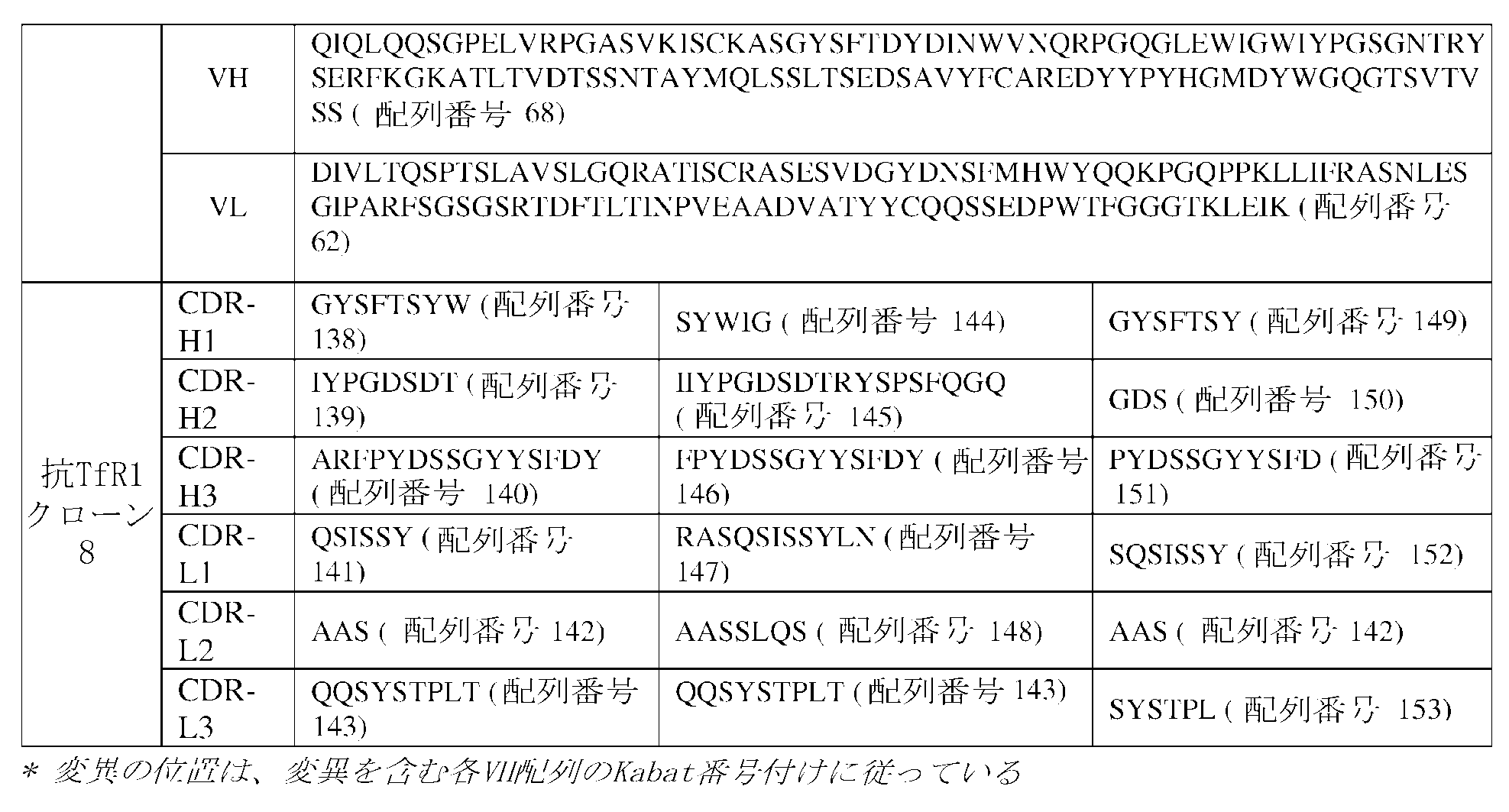
いくつかの態様において、本開示の抗TfR1抗体は、表2に示される抗TfR1抗体のいずれか1つのヒト化バリアントである。いくつかの態様において、本開示の抗TfR1抗体は、表2に提供される示される抗TfR1抗体のいずれか1つのCDR-H1、CDR-H2、およびCDR-H3と同じCDR-H1、CDR-H2、CDR-H3、CDR-L1、CDR-L2、およびCDR-L3を含み、ヒト化重鎖可変領域および/または(例として、および)ヒト化軽鎖可変領域を含む。 In some embodiments, the anti-TfR1 antibody of the disclosure is a humanized variant of any one of the anti-TfR1 antibodies shown in Table 2. In some embodiments, the anti-TfR1 antibody of the disclosure comprises a CDR-H1, CDR-H2, CDR-H3, CDR-L1, CDR-L2, and CDR-L3 that are the same as the CDR-H1, CDR-H2, and CDR-H3 of any one of the shown anti-TfR1 antibodies provided in Table 2, and comprises a humanized heavy chain variable region and/or (by way of example and) a humanized light chain variable region.
本明細書に記載の抗TfR1抗体のアミノ酸配列の例は、表3に示される。


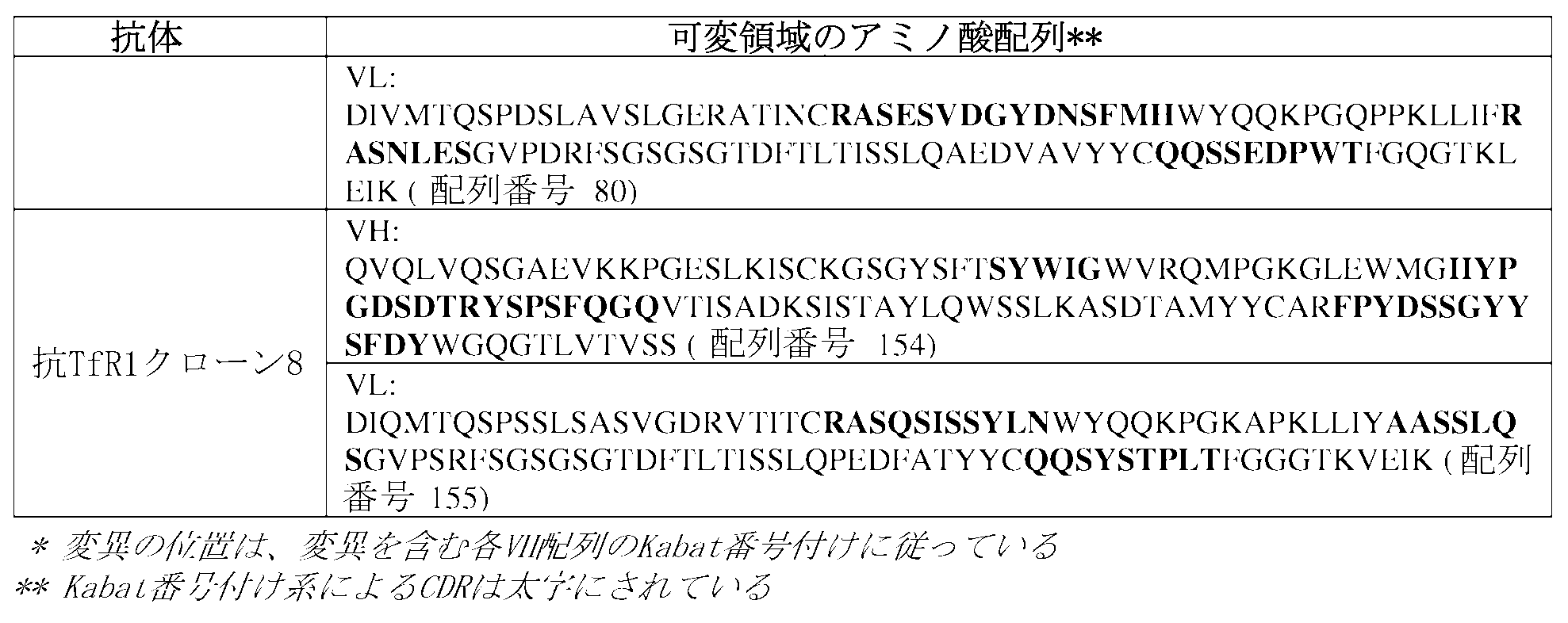
いくつかの態様において、本開示の抗TfR1抗体は、表3に示される抗TfR1抗体のいずれか1つのCDR-H1、CDR-H2、およびCDR-H3を含むVHを含み、表3に提供されるそれぞれのヒト化VHと比較して、1以上(例として、1、2、3、4、5、6、7、8、9、10個またはそれ以上)のアミノ酸変異を含む。あるいは、または加えて(例として、加えて)、本開示の抗TfR1抗体は、表3に提供される抗TfR1抗体のいずれか1つのCDR-L1、CDR-L2、およびCDR-L3を含むVLを含み、表3に提供されるそれぞれのヒト化VLと比較して、1以上(例として、1、2、3、4、5、6、7、8、9、10、またはそれ以上)のアミノ酸変異を含む。 In some embodiments, the anti-TfR1 antibodies of the present disclosure include a VH that includes the CDR-H1, CDR-H2, and CDR-H3 of any one of the anti-TfR1 antibodies shown in Table 3, and includes one or more (e.g., 1, 2, 3, 4, 5, 6, 7, 8, 9, 10 or more) amino acid mutations compared to the respective humanized VHs provided in Table 3. Alternatively or additionally (e.g., in addition), the anti-TfR1 antibodies of the present disclosure include a VL that includes the CDR-L1, CDR-L2, and CDR-L3 of any one of the anti-TfR1 antibodies provided in Table 3, and includes one or more (e.g., 1, 2, 3, 4, 5, 6, 7, 8, 9, 10 or more) amino acid mutations compared to the respective humanized VLs provided in Table 3.
いくつかの態様において、本開示の抗TfR1抗体は、表3に示される抗TfR1抗体のうちのいずれか1つのCDR-H1、CDR-H2、およびCDR-H3を含み、かつ、表3に示されるそれぞれのVHと比較して、フレームワーク領域において少なくとも70%(例として、少なくとも70%、少なくとも75%、少なくとも80%、少なくとも85%、少なくとも90%、少なくとも95%、少なくとも99%)同一であるアミノ酸配列を含むVHを含む。あるいは、または加えて(例として、加えて)、本開示の抗TfR1抗体は、表3に示される抗TfR1抗体のいずれか1つのCDR-L1、CDR-L2およびCDR-L3を含み、かつ、表3に示されるそれぞれのVLと比較してフレームワーク領域において少なくとも70%(例として、少なくとも70%、少なくとも75%、少なくとも80%、少なくとも85%、少なくとも90%、少なくとも95%、少なくとも99%)同一であるアミノ酸配列を含むVLを含む。 In some embodiments, the anti-TfR1 antibody of the present disclosure includes a VH that includes CDR-H1, CDR-H2, and CDR-H3 of any one of the anti-TfR1 antibodies shown in Table 3 and includes an amino acid sequence that is at least 70% (e.g., at least 70%, at least 75%, at least 80%, at least 85%, at least 90%, at least 95%, at least 99%) identical in the framework region compared to each VH shown in Table 3. Alternatively or in addition (e.g., in addition), the anti-TfR1 antibody of the present disclosure includes a VL that includes CDR-L1, CDR-L2, and CDR-L3 of any one of the anti-TfR1 antibodies shown in Table 3 and includes an amino acid sequence that is at least 70% (e.g., at least 70%, at least 75%, at least 80%, at least 85%, at least 90%, at least 95%, at least 99%) identical in the framework region compared to each VL shown in Table 3.
いくつかの態様において、本開示の抗TfR1抗体は、配列番号69のアミノ酸配列を含むVHおよび配列番号70のアミノ酸配列を含むヒト化VLを含む。 In some embodiments, the anti-TfR1 antibody of the present disclosure comprises a VH comprising the amino acid sequence of SEQ ID NO:69 and a humanized VL comprising the amino acid sequence of SEQ ID NO:70.
いくつかの態様において、本開示の抗TfR1抗体は、配列番号71のアミノ酸配列を含むVHおよび配列番号70のアミノ酸配列を含むヒト化VLを含む。 In some embodiments, the anti-TfR1 antibody of the present disclosure comprises a VH comprising the amino acid sequence of SEQ ID NO:71 and a humanized VL comprising the amino acid sequence of SEQ ID NO:70.
いくつかの態様において、本開示の抗TfR1抗体は、配列番号72のアミノ酸配列を含むVHおよび配列番号70のアミノ酸配列を含むヒト化VLを含む。 In some embodiments, the anti-TfR1 antibody of the present disclosure comprises a VH comprising the amino acid sequence of SEQ ID NO:72 and a humanized VL comprising the amino acid sequence of SEQ ID NO:70.
いくつかの態様において、本開示の抗TfR1抗体は、配列番号73のアミノ酸配列を含むVHおよび配列番号74のアミノ酸配列を含むヒト化VLを含む。 In some embodiments, the anti-TfR1 antibody of the present disclosure comprises a VH comprising the amino acid sequence of SEQ ID NO:73 and a humanized VL comprising the amino acid sequence of SEQ ID NO:74.
いくつかの態様において、本開示の抗TfR1抗体は、配列番号73のアミノ酸配列を含むVHおよび配列番号75のアミノ酸配列を含むヒト化VLを含む。 In some embodiments, the anti-TfR1 antibody of the present disclosure comprises a VH comprising the amino acid sequence of SEQ ID NO:73 and a humanized VL comprising the amino acid sequence of SEQ ID NO:75.
いくつかの態様において、本開示の抗TfR1抗体は、配列番号76のアミノ酸配列を含むVHおよび配列番号74のアミノ酸配列を含むヒト化VLを含む。 In some embodiments, the anti-TfR1 antibody of the present disclosure comprises a VH comprising the amino acid sequence of SEQ ID NO:76 and a humanized VL comprising the amino acid sequence of SEQ ID NO:74.
いくつかの態様において、本開示の抗TfR1抗体は、配列番号76のアミノ酸配列を含むVHおよび配列番号75のアミノ酸配列を含むヒト化VLを含む。 In some embodiments, the anti-TfR1 antibody of the present disclosure comprises a VH comprising the amino acid sequence of SEQ ID NO:76 and a humanized VL comprising the amino acid sequence of SEQ ID NO:75.
いくつかの態様において、本開示の抗TfR1抗体は、配列番号77のアミノ酸配列を含むVHおよび配列番号78のアミノ酸配列を含むヒト化VLを含む。 In some embodiments, the anti-TfR1 antibody of the present disclosure comprises a VH comprising the amino acid sequence of SEQ ID NO:77 and a humanized VL comprising the amino acid sequence of SEQ ID NO:78.
いくつかの態様において、本開示の抗TfR1抗体は、配列番号79のアミノ酸配列を含むVHおよび配列番号80のアミノ酸配列を含むヒト化VLを含む。 In some embodiments, the anti-TfR1 antibody of the present disclosure comprises a VH comprising the amino acid sequence of SEQ ID NO:79 and a humanized VL comprising the amino acid sequence of SEQ ID NO:80.
いくつかの態様において、本開示の抗TfR1抗体は、配列番号77のアミノ酸配列を含むVHおよび配列番号80のアミノ酸配列を含むヒト化VLを含む。 In some embodiments, the anti-TfR1 antibody of the present disclosure comprises a VH comprising the amino acid sequence of SEQ ID NO:77 and a humanized VL comprising the amino acid sequence of SEQ ID NO:80.
いくつかの態様において、本開示の抗TfR1抗体は、配列番号154のアミノ酸配列を含むVHおよび配列番号155のアミノ酸配列を含むヒト化VLを含む。 In some embodiments, the anti-TfR1 antibody of the present disclosure comprises a VH comprising the amino acid sequence of SEQ ID NO: 154 and a humanized VL comprising the amino acid sequence of SEQ ID NO: 155.
いくつかの態様において、本明細書に記載の抗TfR1抗体は、完全長IgGであり、これはヒト抗体からの重鎖定常領域および軽鎖定常領域を包含し得る。いくつかの態様において、本明細書に記載の抗TfR1抗体のいずれかの重鎖は、重鎖定常領域(CH)またはそのある部分(例として、CH1、CH2、CH3、またはそれらの組み合わせ)を含み得る。重鎖定常領域は、任意の好適な起源、例として、ヒト、マウス、ラット、またはウサギに由来し得る。特定の一例において、重鎖定常領域は、ヒトIgG(ガンマ重鎖)、例として、IgG1、IgG2、またはIgG4に由来する。ヒトIgG1定常領域の例は下記のとおりである:
ASTKGPSVFPLAPSSKSTSGGTAALGCLVKDYFPEPVTVSWNSGALTSGVHTFPAVLQSSGLYSLSSVVTVPSSSLGTQTYICNVNHKPSNTKVDKKVEPKSCDKTHTCPPCPAPELLGGPSVFLFPPKPKDTLMISRTPEVTCVVVDVSHEDPEVKFNWYVDGVEVHNAKTKPREEQYNSTYRVVSVLTVLHQDWLNGKEYKCKVSNKALPAPIEKTISKAKGQPREPQVYTLPPSRDELTKNQVSLTCLVKGFYPSDIAVEWESNGQPENNYKTTPPVLDSDGSFFLYSKLTVDKSRWQQGNVFSCSVMHEALHNHYTQKSLSLSPGK(配列番号81)
In some embodiments, the anti-TfR1 antibodies described herein are full-length IgG, which may include heavy and light chain constant regions from a human antibody. In some embodiments, the heavy chain of any of the anti-TfR1 antibodies described herein may include a heavy chain constant region (CH) or a portion thereof (e.g., CH1, CH2, CH3, or a combination thereof). The heavy chain constant region may be derived from any suitable source, e.g., human, mouse, rat, or rabbit. In one particular example, the heavy chain constant region is derived from human IgG (gamma heavy chain), e.g., IgG1, IgG2, or IgG4. An example of a human IgG1 constant region is as follows:
ASTKGPSVFPLAPSSKSTSGGTAALGCLVKDYFPEPVTVSWNSGALTSGVHTFPAVLQSSGLYSLSSVVTVPSSSLGTQTYICNVNHKPSNTKVDKKVEPKSCDKTHTCPPCPAPELLGGPSVFLFPPKPKDTLMISRTPEVTCVVVDVSHEDPEVKFNWYVDGVEVHNAKTKPREEQYNSTYRVVSVLTVLHQDWLNGKEYKCKVSNKALPAPIEKTISKAKGQPREPQVYTLPPSRDELTKNQVSLTCLVKGFYPSDIAVEWESNGQPENNYKTTPPVLDSDGSFFLYSKLTVDKSRWQQGNVFSCSVMHEALHNHYTQKSLSLSPGK (SEQ ID NO: 81)
いくつかの態様において、本明細書に記載の抗TfR1抗体のいずれかの重鎖は、変異体ヒトIgG1定常領域を含む。例えば、ヒトIgG1のCH2ドメイン上のLALA変異の導入(ヒンジ下部残基Leu234 Leu235をAla234およびAla235によって置き換えるように変異させられたmAb b12に由来する変異体)は、Fcγ受容体結合を低減することが知られている(Bruhns,P.,et al.(2009)およびXu,D.et al.(2000))。変異ヒトIgG1定常領域を以下に示す(変異は太字にされ下線が付される):

いくつかの態様において、本明細書に記載の抗TfR1抗体のいずれかの軽鎖はさらに、軽鎖定常領域(CL)を含み得、これは当該技術分野において知られているいずれかのCLであり得る。いくつかの例において、CLは、カッパ軽鎖である。他の例において、CLは、ラムダ軽鎖である。いくつかの態様において、CLはカッパ軽鎖であって、その配列は下に与えられる:
RTVAAPSVFIFPPSDEQLKSGTASVVCLLNNFYPREAKVQWKVDNALQSGNSQESVTEQDSKDSTYSLSSTLTLSKADYEKHKVYACEVTHQGLSSPVTKSFNRGEC(配列番号83)
In some embodiments, the light chain of any of the anti-TfR1 antibodies described herein may further comprise a light chain constant region (CL), which may be any CL known in the art. In some examples, the CL is a kappa light chain. In other examples, the CL is a lambda light chain. In some embodiments, the CL is a kappa light chain, the sequence of which is given below:
RTVAAPSVFIFPPSDEQLKSGTASVVCLLNNFYPREAKVQWKVDNALQSGNSQESVTEQDSKDSTYSLSSTLTLSKADYEKHKVYACEVTHQGLSSPVTKSFNRGEC (SEQ ID NO: 83)
他の抗体の重鎖および軽鎖定常領域は当該技術分野において周知であり、例として、IMGTデータベース(www.imgt.org)において、またはwww.vbase2.org/vbstat.php.にて提供されるものであるが、これらの両方とも参照により本明細書に組み込まれる。 Other antibody heavy and light chain constant regions are well known in the art and are provided, for example, in the IMGT database (www.imgt.org) or at www.vbase2.org/vbstat.php., both of which are incorporated herein by reference.
いくつかの態様において、本明細書に記載の抗TfR1抗体は、表3に挙げられるVHまたはそれらのいずれかのバリアントのいずれか1つ、および配列番号81または配列番号82と少なくとも80%、少なくとも85%、少なくとも90%、少なくとも95%、または少なくとも99%同一である重鎖定常領域を含む重鎖を含む。いくつかの態様において、本明細書に記載の抗TfR1抗体は、表3に挙げられるVHまたはそれらのいずれかのバリアントのいずれか1つ、および配列番号81または配列番号82と比較して25以下のアミノ酸変異(例として、25、24、23、22、21、20、19、18、17、16、15、14、13、12、11、10、9、8、7、6、5、4、3、2、または1以下のアミノ酸変異)を含有する重鎖定常領域を含む重鎖を含む。いくつかの態様において、本明細書に記載の抗TfR1抗体は、表3に挙げられるVHまたはそれらのいずれかのバリアントのいずれか1つ、および配列番号81に示される重鎖定常領域を含む重鎖を含む。いくつかの態様において、本明細書に記載の抗TfR1抗体は、表3に挙げられるVHまたはそれらのいずれかのバリアントのいずれか1つ、および配列番号82に示される重鎖定常領域を含む重鎖を含む。 In some embodiments, the anti-TfR1 antibodies described herein comprise a heavy chain comprising any one of the VHs or any variants thereof listed in Table 3, and a heavy chain constant region that is at least 80%, at least 85%, at least 90%, at least 95%, or at least 99% identical to SEQ ID NO:81 or SEQ ID NO:82. In some embodiments, the anti-TfR1 antibodies described herein comprise a heavy chain comprising any one of the VHs or any variants thereof listed in Table 3, and a heavy chain constant region that contains 25 or less amino acid mutations (e.g., 25, 24, 23, 22, 21, 20, 19, 18, 17, 16, 15, 14, 13, 12, 11, 10, 9, 8, 7, 6, 5, 4, 3, 2, or 1 or less amino acid mutations) compared to SEQ ID NO:81 or SEQ ID NO:82. In some embodiments, the anti-TfR1 antibodies described herein comprise a heavy chain comprising any one of the VHs or any variants thereof listed in Table 3, and a heavy chain constant region as set forth in SEQ ID NO:81. In some embodiments, the anti-TfR1 antibodies described herein comprise any one of the VHs listed in Table 3 or any variant thereof, and a heavy chain comprising the heavy chain constant region set forth in SEQ ID NO:82.
いくつかの態様において、本明細書に記載の抗TfR1抗体は、表3に挙げられるVLまたはそれらのいずれかのバリアントのいずれか1つ、および配列番号83と少なくとも80%、少なくとも85%、少なくとも90%、少なくとも95%、または少なくとも99%同一である軽鎖定常領域を含む軽鎖を含む。いくつかの態様において、本明細書に記載の抗TfR1抗体は、表3に挙げられるVLまたはそれらのいずれかのバリアントのいずれか1つ、および配列番号83と比較して25個以下のアミノ酸変異(例として、25、24、23、22、21、20、19、18、17、16、15、14、13、12、11、10、9、8、7、6、5、4、3、2、または1個以下のアミノ酸変異)を含有する軽鎖定常領域を含む軽鎖を含む。いくつかの態様において、本明細書に記載の抗TfR1抗体は、表3に挙げられるVLまたはそれらのいずれかのバリアントのいずれか1つ、および配列番号83で表されるとおりの軽鎖定常領域を含む軽鎖を含む。 In some embodiments, the anti-TfR1 antibodies described herein comprise a light chain comprising any one of the VLs or any variants thereof listed in Table 3, and a light chain constant region that is at least 80%, at least 85%, at least 90%, at least 95%, or at least 99% identical to SEQ ID NO:83. In some embodiments, the anti-TfR1 antibodies described herein comprise a light chain comprising any one of the VLs or any variants thereof listed in Table 3, and a light chain constant region that contains 25 or less amino acid mutations (e.g., 25, 24, 23, 22, 21, 20, 19, 18, 17, 16, 15, 14, 13, 12, 11, 10, 9, 8, 7, 6, 5, 4, 3, 2, or 1 or less amino acid mutations) compared to SEQ ID NO:83. In some embodiments, the anti-TfR1 antibodies described herein comprise a light chain comprising any one of the VLs or any variants thereof listed in Table 3, and a light chain constant region as represented by SEQ ID NO:83.
記載される抗TfR1抗体のIgG重鎖および軽鎖アミノ酸配列の例は、下の表4に示される。
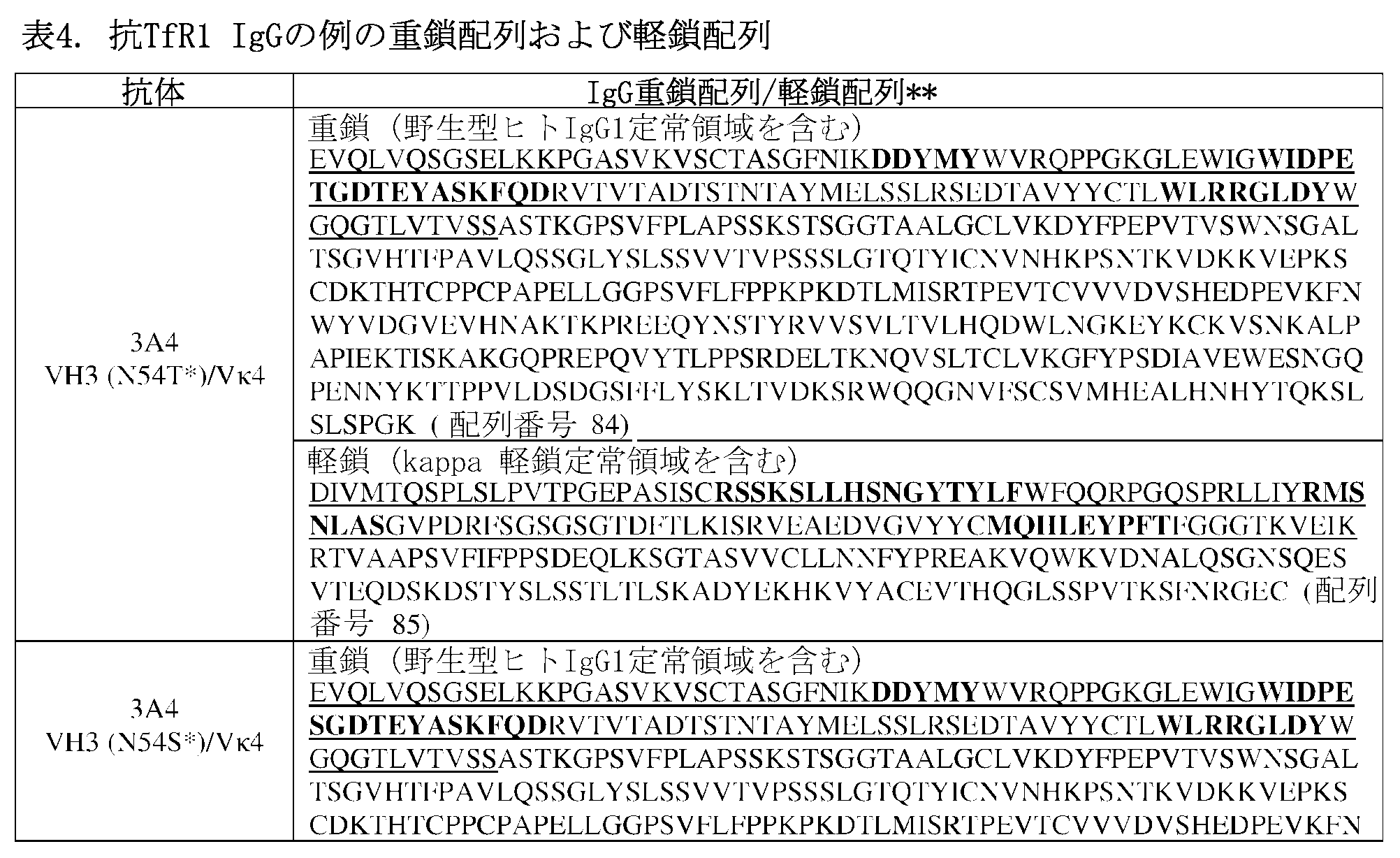

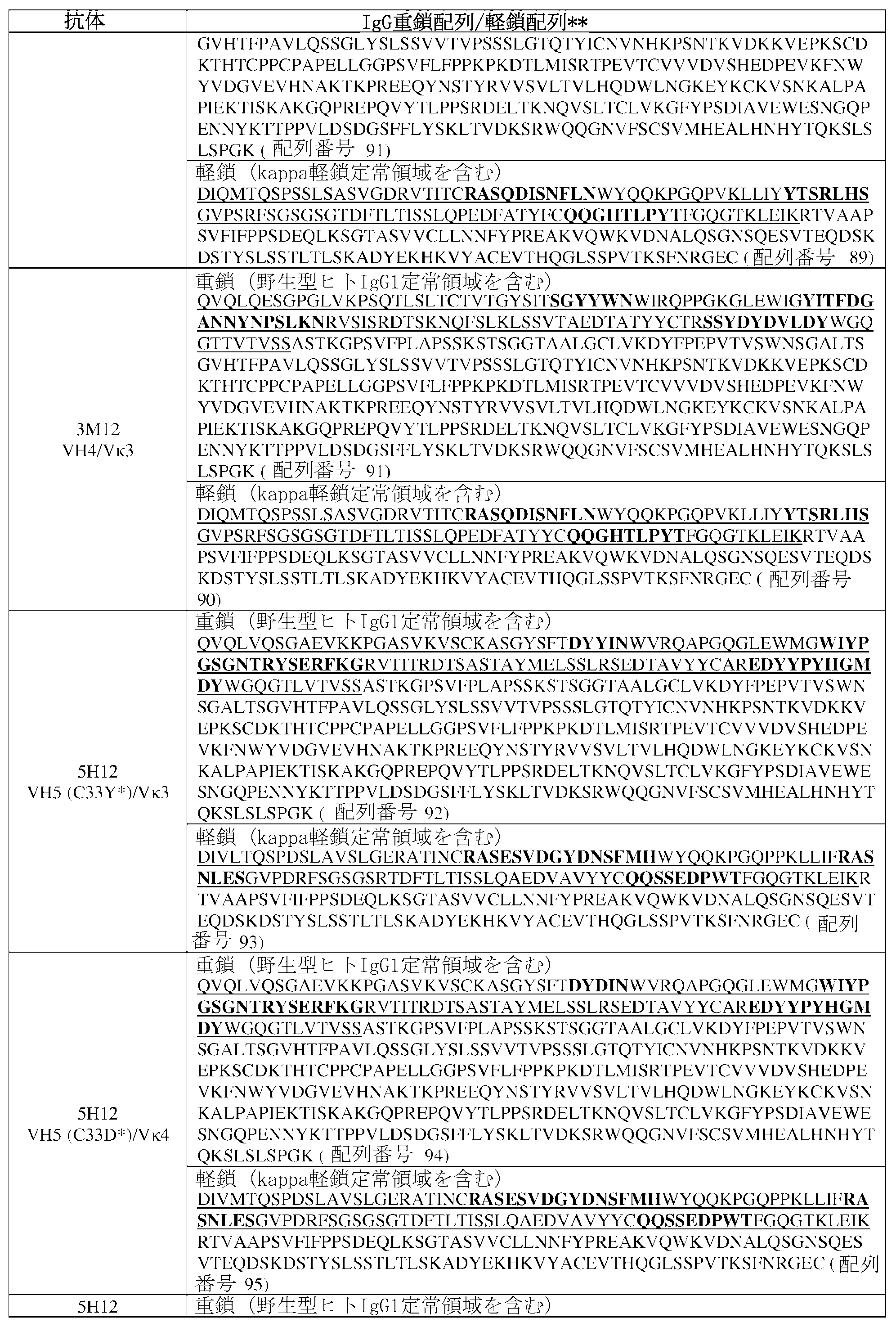

いくつかの態様において、本開示の抗TfR1抗体は、配列番号84、86、87、88、91、92、94、および156のいずれか1つに示される重鎖と比較して、25個以下のアミノ酸変異(例として、25、24、23、22、21、20、19、18、17、16、15、14、13、12、11、10、9、8、7、6、5、4、3、2、または1個以下のアミノ酸変異)を含有する重鎖を含む。あるいは、または加えて、(例として、追加で)、本開示の抗TfR1抗体は、配列番号85、89、90、93、95および157のいずれか1つに示される軽鎖と比較して、25個以下のアミノ酸変異(例として、25、24、23、22、21、20、19、18、17、16、15、14、13、12、11、10、9、8、7、6、5、4、3、2、または1個以下のアミノ酸変異)を含有する軽鎖を含む。 In some embodiments, an anti-TfR1 antibody of the present disclosure comprises a heavy chain that contains 25 or fewer amino acid mutations (e.g., no more than 25, 24, 23, 22, 21, 20, 19, 18, 17, 16, 15, 14, 13, 12, 11, 10, 9, 8, 7, 6, 5, 4, 3, 2, or 1 amino acid mutation) compared to a heavy chain set forth in any one of SEQ ID NOs: 84, 86, 87, 88, 91, 92, 94, and 156. Alternatively or additionally (for example, additionally), the anti-TfR1 antibodies of the present disclosure include a light chain that contains 25 or fewer amino acid mutations (for example, 25, 24, 23, 22, 21, 20, 19, 18, 17, 16, 15, 14, 13, 12, 11, 10, 9, 8, 7, 6, 5, 4, 3, 2, or 1 or fewer amino acid mutations) compared to the light chain set forth in any one of SEQ ID NOs: 85, 89, 90, 93, 95, and 157.
いくつかの態様において、本明細書に記載の抗TfR1抗体は、配列番号84、86、87、88、91、92、94および156のいずれか1つと少なくとも75%(例として、75%、80%、85%、90%、95%、98%、または99%)同一であるアミノ酸配列を含む重鎖を含む。あるいは、または加えて(例として、加えて)、本明細書に記載の抗TfR1抗体は、配列番号85、89、90、93、95、および157のうちのいずれか1つと少なくとも75%(例として、75%、80%、85%、90%、95%、98%、または99%)同一であるアミノ酸配列を含む軽鎖を含む。いくつかの態様において、本明細書に記載の抗TfR1抗体は、配列番号84、86、87、88、91、92、94および156のいずれか1つのアミノ酸配列を含む重鎖を含む。あるいは、または加えて(例として、加えて)、本明細書に記載の抗TfR1抗体は、配列番号85、89、90、93、95および157のいずれか1つのアミノ酸配列を含む軽鎖を含む。 In some embodiments, the anti-TfR1 antibodies described herein comprise a heavy chain comprising an amino acid sequence that is at least 75% (e.g., 75%, 80%, 85%, 90%, 95%, 98%, or 99%) identical to any one of SEQ ID NOs: 84, 86, 87, 88, 91, 92, 94, and 156. Alternatively, or in addition (e.g., in addition), the anti-TfR1 antibodies described herein comprise a light chain comprising an amino acid sequence that is at least 75% (e.g., 75%, 80%, 85%, 90%, 95%, 98%, or 99%) identical to any one of SEQ ID NOs: 85, 89, 90, 93, 95, and 157. In some embodiments, the anti-TfR1 antibodies described herein comprise a heavy chain comprising an amino acid sequence of any one of SEQ ID NOs: 84, 86, 87, 88, 91, 92, 94, and 156. Alternatively or additionally (for example, in addition), the anti-TfR1 antibodies described herein include a light chain comprising an amino acid sequence of any one of SEQ ID NOs: 85, 89, 90, 93, 95, and 157.
いくつかの態様において、本開示の抗TfR1抗体は、配列番号84のアミノ酸配列を含む重鎖および配列番号85のアミノ酸配列を含む軽鎖を含む。 In some embodiments, the anti-TfR1 antibody of the present disclosure comprises a heavy chain comprising the amino acid sequence of SEQ ID NO:84 and a light chain comprising the amino acid sequence of SEQ ID NO:85.
いくつかの態様において、本開示の抗TfR1抗体は、配列番号86のアミノ酸配列を含む重鎖および配列番号85のアミノ酸配列を含む軽鎖を含む。 In some embodiments, the anti-TfR1 antibody of the present disclosure comprises a heavy chain comprising the amino acid sequence of SEQ ID NO:86 and a light chain comprising the amino acid sequence of SEQ ID NO:85.
いくつかの態様において、本開示の抗TfR1抗体は、配列番号87のアミノ酸配列を含む重鎖および配列番号85のアミノ酸配列を含む軽鎖を含む。 In some embodiments, the anti-TfR1 antibody of the present disclosure comprises a heavy chain comprising the amino acid sequence of SEQ ID NO:87 and a light chain comprising the amino acid sequence of SEQ ID NO:85.
いくつかの態様において、本開示の抗TfR1抗体は、配列番号88のアミノ酸配列を含む重鎖および配列番号89のアミノ酸配列を含む軽鎖を含む。 In some embodiments, the anti-TfR1 antibody of the present disclosure comprises a heavy chain comprising the amino acid sequence of SEQ ID NO:88 and a light chain comprising the amino acid sequence of SEQ ID NO:89.
いくつかの態様において、本開示の抗TfR1抗体は、配列番号88のアミノ酸配列を含む重鎖および配列番号90のアミノ酸配列を含む軽鎖を含む。 In some embodiments, the anti-TfR1 antibody of the present disclosure comprises a heavy chain comprising the amino acid sequence of SEQ ID NO:88 and a light chain comprising the amino acid sequence of SEQ ID NO:90.
いくつかの態様において、本開示の抗TfR1抗体は、配列番号91のアミノ酸配列を含む重鎖および配列番号89のアミノ酸配列を含む軽鎖を含む。 In some embodiments, the anti-TfR1 antibody of the present disclosure comprises a heavy chain comprising the amino acid sequence of SEQ ID NO:91 and a light chain comprising the amino acid sequence of SEQ ID NO:89.
いくつかの態様において、本開示の抗TfR1抗体は、配列番号91のアミノ酸配列を含む重鎖および配列番号90のアミノ酸配列を含む軽鎖を含む。 In some embodiments, the anti-TfR1 antibody of the present disclosure comprises a heavy chain comprising the amino acid sequence of SEQ ID NO:91 and a light chain comprising the amino acid sequence of SEQ ID NO:90.
いくつかの態様において、本開示の抗TfR1抗体は、配列番号92のアミノ酸配列を含む重鎖および配列番号93のアミノ酸配列を含む軽鎖を含む。 In some embodiments, the anti-TfR1 antibody of the present disclosure comprises a heavy chain comprising the amino acid sequence of SEQ ID NO:92 and a light chain comprising the amino acid sequence of SEQ ID NO:93.
いくつかの態様において、本開示の抗TfR1抗体は、配列番号94のアミノ酸配列を含む重鎖および配列番号95のアミノ酸配列を含む軽鎖を含む。 In some embodiments, the anti-TfR1 antibody of the present disclosure comprises a heavy chain comprising the amino acid sequence of SEQ ID NO:94 and a light chain comprising the amino acid sequence of SEQ ID NO:95.
いくつかの態様において、本開示の抗TfR1抗体は、配列番号92のアミノ酸配列を含む重鎖および配列番号95のアミノ酸配列を含む軽鎖を含む。 In some embodiments, the anti-TfR1 antibody of the present disclosure comprises a heavy chain comprising the amino acid sequence of SEQ ID NO:92 and a light chain comprising the amino acid sequence of SEQ ID NO:95.
いくつかの態様において、本開示の抗TfR1抗体は、配列番号156のアミノ酸配列を含む重鎖および配列番号157のアミノ酸配列を含む軽鎖を含む。 In some embodiments, the anti-TfR1 antibody of the present disclosure comprises a heavy chain comprising the amino acid sequence of SEQ ID NO: 156 and a light chain comprising the amino acid sequence of SEQ ID NO: 157.
いくつかの態様において、抗TfR1抗体は、インタクトな抗体(完全長抗体)のFabフラグメント、Fab'フラグメント、またはF(ab')2フラグメントである。インタクトな抗体(全長抗体)の抗原結合フラグメントは定型的な方法によって(例として、組み換え的に、または全長IgGの重鎖定常領域をパパインなどの酵素を使用して消化することによって)調製され得る。例えば、F(ab')2フラグメントは抗体分子のペプシンまたはパパイン消化によって産生され得、FabフラグメントはF(ab')2フラグメントのジスルフィド架橋を還元することによって生成され得る。いくつかの態様において、本明細書に記載の抗TfR1抗体のFabフラグメントにおける重鎖領域は、ASTKGPSVFPLAPSSKSTSGGTAALGCLVKDYFPEPVTVSWNSGALTSGVHTFPAVLQSSGLYSLSSVVTVPSSSLGTQTYICNVNHKPSNTKVDKKVEPKSCDKTHT(配列番号96)のアミノ酸配列を含む。 In some embodiments, the anti-TfR1 antibody is a Fab fragment, a Fab' fragment, or a F(ab') 2 fragment of an intact antibody (full-length antibody). An antigen-binding fragment of an intact antibody (full-length antibody) can be prepared by conventional methods (e.g., recombinantly or by digesting the heavy chain constant region of a full-length IgG using an enzyme such as papain). For example, an F(ab') 2 fragment can be produced by pepsin or papain digestion of an antibody molecule, and an Fab fragment can be generated by reducing disulfide bridges of an F(ab') 2 fragment. In some embodiments, the heavy chain region of the Fab fragment of the anti-TfR1 antibody described herein comprises the amino acid sequence of ASTKGPSVFPLAPSSKSTSGGTAALGCLVKDYFPEPVTVSWNSGALTSGVHTFPAVLQSSGLYSLSSVVTVPSSSLGTQTYICNVNHKPSNTKVDKKVEPKSCDKTHT (SEQ ID NO: 96).
いくつかの態様において、本明細書に記載の抗TfR1抗体は、表3に挙げられるVHまたはそれらのいずれかのバリアントのいずれか1つ、および配列番号96と少なくとも80%、少なくとも85%、少なくとも90%、少なくとも95%、または少なくとも99%同一である重鎖定常領域を含む重鎖を含む。いくつかの態様において、本明細書に記載の抗TfR1抗体は、表3に挙げられるVHまたはそれらのいずれかのバリアントのいずれか1つ、および配列番号96と比較して25個以下のアミノ酸変異(例として、25、24、23、22、21、20、19、18、17、16、15、14、13、12、11、10、9、8、7、6、5、4、3、2、または1個以下のアミノ酸変異)を含有する重鎖定常領域を含む重鎖を含む。いくつかの態様において、本明細書に記載の抗TfR1抗体は、表3に挙げられるVHまたはそれらのいずれかのバリアントのいずれか1つ、および配列番号96に示される重鎖定常領域を含む重鎖を含む。 In some embodiments, the anti-TfR1 antibodies described herein comprise a heavy chain comprising any one of the VHs or any variants thereof listed in Table 3, and a heavy chain constant region that is at least 80%, at least 85%, at least 90%, at least 95%, or at least 99% identical to SEQ ID NO:96. In some embodiments, the anti-TfR1 antibodies described herein comprise a heavy chain comprising any one of the VHs or any variants thereof listed in Table 3, and a heavy chain constant region that contains 25 or less amino acid mutations (e.g., 25, 24, 23, 22, 21, 20, 19, 18, 17, 16, 15, 14, 13, 12, 11, 10, 9, 8, 7, 6, 5, 4, 3, 2, or 1 or less amino acid mutations) compared to SEQ ID NO:96. In some embodiments, the anti-TfR1 antibodies described herein comprise a heavy chain comprising any one of the VHs or any variants thereof listed in Table 3, and a heavy chain constant region as set forth in SEQ ID NO:96.
いくつかの態様において、本明細書に記載の抗TfR1抗体は、表3に挙げられるVLまたはそれらのいずれかのバリアントのいずれか1つ、および配列番号83と少なくとも80%、少なくとも85%、少なくとも90%、少なくとも95%、または少なくとも99%同一である軽鎖定常領域を含む軽鎖を含む。いくつかの態様において、本明細書に記載の抗TfR1抗体は、表3に挙げられるVLまたはそれらのいずれかのバリアントのいずれか1つ、および配列番号83と比較して25個以下のアミノ酸変異(例として、25、24、23、22、21、20、19、18、17、16、15、14、13、12、11、10、9、8、7、6、5、4、3、2、または1個以下のアミノ酸変異)を含有する軽鎖定常領域を含む軽鎖を含む。いくつかの態様において、本明細書に記載の抗TfR1抗体は、表3に挙げられるVLまたはそれらのいずれかのバリアントのいずれか1つ、および配列番号83で表されるとおりの軽鎖定常領域を含む軽鎖を含む。 In some embodiments, the anti-TfR1 antibodies described herein comprise a light chain comprising any one of the VLs or any variants thereof listed in Table 3, and a light chain constant region that is at least 80%, at least 85%, at least 90%, at least 95%, or at least 99% identical to SEQ ID NO:83. In some embodiments, the anti-TfR1 antibodies described herein comprise a light chain comprising any one of the VLs or any variants thereof listed in Table 3, and a light chain constant region that contains 25 or less amino acid mutations (e.g., 25, 24, 23, 22, 21, 20, 19, 18, 17, 16, 15, 14, 13, 12, 11, 10, 9, 8, 7, 6, 5, 4, 3, 2, or 1 or less amino acid mutations) compared to SEQ ID NO:83. In some embodiments, the anti-TfR1 antibodies described herein comprise a light chain comprising any one of the VLs or any variants thereof listed in Table 3, and a light chain constant region as represented by SEQ ID NO:83.
記載される抗TfR1抗体のFab重鎖および軽鎖アミノ酸配列の例は、下の表5に示される。


いくつかの態様において、本開示の抗TfR1抗体は、配列番号97~103、158および159のいずれか1つに示される重鎖と比較して、25個以下のアミノ酸変異(例として、25、24、23、22、21、20、19、18、17、16、15、14、13、12、11、10、9、8、7、6、5、4、3、2、または1個以下のアミノ酸変異)を含有する重鎖を含む。あるいは、または加えて、(例として、追加で)、本開示の抗TfR1抗体は、配列番号85、89、90、93、95および157のいずれか1つに示される軽鎖と比較して、25個以下のアミノ酸変異(例として、25、24、23、22、21、20、19、18、17、16、15、14、13、12、11、10、9、8、7、6、5、4、3、2、または1個以下のアミノ酸変異)を含有する軽鎖を含む。 In some embodiments, an anti-TfR1 antibody of the present disclosure comprises a heavy chain that contains 25 or fewer amino acid mutations (e.g., 25, 24, 23, 22, 21, 20, 19, 18, 17, 16, 15, 14, 13, 12, 11, 10, 9, 8, 7, 6, 5, 4, 3, 2, or 1 or fewer amino acid mutations) compared to a heavy chain set forth in any one of SEQ ID NOs: 97-103, 158, and 159. Alternatively or additionally (for example, additionally), the anti-TfR1 antibodies of the present disclosure include a light chain that contains 25 or fewer amino acid mutations (for example, 25, 24, 23, 22, 21, 20, 19, 18, 17, 16, 15, 14, 13, 12, 11, 10, 9, 8, 7, 6, 5, 4, 3, 2, or 1 or fewer amino acid mutations) compared to the light chain set forth in any one of SEQ ID NOs: 85, 89, 90, 93, 95, and 157.
いくつかの態様において、本明細書に記載の抗TfR1抗体は、配列番号97~103、158および159のいずれか1つと少なくとも75%(例として、75%、80%、85%、90%、95%、98%、または99%)同一であるアミノ酸配列を含む重鎖を含む。あるいは、または加えて(例として、加えて)、本明細書に記載の抗TfR1抗体は、配列番号85、89、90、93、95、および157のうちのいずれか1つと少なくとも75%(例として、75%、80%、85%、90%、95%、98%、または99%)同一であるアミノ酸配列を含む軽鎖を含む。いくつかの態様において、本明細書に記載の抗TfR1抗体は、配列番号97~103、158および159のいずれか1つのアミノ酸配列を含む重鎖を含む。あるいは、または加えて(例として、加えて)、本明細書に記載の抗TfR1抗体は、配列番号85、89、90、93、95および157のいずれか1つのアミノ酸配列を含む軽鎖を含む。 In some embodiments, the anti-TfR1 antibodies described herein comprise a heavy chain comprising an amino acid sequence that is at least 75% (e.g., 75%, 80%, 85%, 90%, 95%, 98%, or 99%) identical to any one of SEQ ID NOs: 97-103, 158, and 159. Alternatively, or in addition (e.g., in addition), the anti-TfR1 antibodies described herein comprise a light chain comprising an amino acid sequence that is at least 75% (e.g., 75%, 80%, 85%, 90%, 95%, 98%, or 99%) identical to any one of SEQ ID NOs: 85, 89, 90, 93, 95, and 157. In some embodiments, the anti-TfR1 antibodies described herein comprise a heavy chain comprising an amino acid sequence of any one of SEQ ID NOs: 97-103, 158, and 159. Alternatively or additionally (for example, in addition), the anti-TfR1 antibodies described herein include a light chain comprising an amino acid sequence of any one of SEQ ID NOs: 85, 89, 90, 93, 95, and 157.
いくつかの態様において、本開示の抗TfR1抗体は、配列番号97のアミノ酸配列を含む重鎖および配列番号85のアミノ酸配列を含む軽鎖を含む。 In some embodiments, the anti-TfR1 antibody of the present disclosure comprises a heavy chain comprising the amino acid sequence of SEQ ID NO:97 and a light chain comprising the amino acid sequence of SEQ ID NO:85.
いくつかの態様において、本開示の抗TfR1抗体は、配列番号98のアミノ酸配列を含む重鎖および配列番号85のアミノ酸配列を含む軽鎖を含む。 In some embodiments, the anti-TfR1 antibody of the present disclosure comprises a heavy chain comprising the amino acid sequence of SEQ ID NO:98 and a light chain comprising the amino acid sequence of SEQ ID NO:85.
いくつかの態様において、本開示の抗TfR1抗体は、配列番号99のアミノ酸配列を含む重鎖および配列番号85のアミノ酸配列を含む軽鎖を含む。 In some embodiments, the anti-TfR1 antibody of the present disclosure comprises a heavy chain comprising the amino acid sequence of SEQ ID NO:99 and a light chain comprising the amino acid sequence of SEQ ID NO:85.
いくつかの態様において、本開示の抗TfR1抗体は、配列番号100のアミノ酸配列を含む重鎖および配列番号89のアミノ酸配列を含む軽鎖を含む。 In some embodiments, the anti-TfR1 antibody of the present disclosure comprises a heavy chain comprising the amino acid sequence of SEQ ID NO: 100 and a light chain comprising the amino acid sequence of SEQ ID NO: 89.
いくつかの態様において、本開示の抗TfR1抗体は、配列番号100のアミノ酸配列を含む重鎖および配列番号90のアミノ酸配列を含む軽鎖を含む。 In some embodiments, the anti-TfR1 antibody of the present disclosure comprises a heavy chain comprising the amino acid sequence of SEQ ID NO: 100 and a light chain comprising the amino acid sequence of SEQ ID NO: 90.
いくつかの態様において、本開示の抗TfR1抗体は、配列番号101のアミノ酸配列を含む重鎖および配列番号89のアミノ酸配列を含む軽鎖を含む。 In some embodiments, the anti-TfR1 antibody of the present disclosure comprises a heavy chain comprising the amino acid sequence of SEQ ID NO:101 and a light chain comprising the amino acid sequence of SEQ ID NO:89.
いくつかの態様において、本開示の抗TfR1抗体は、配列番号101のアミノ酸配列を含む重鎖および配列番号90のアミノ酸配列を含む軽鎖を含む。 In some embodiments, the anti-TfR1 antibody of the present disclosure comprises a heavy chain comprising the amino acid sequence of SEQ ID NO:101 and a light chain comprising the amino acid sequence of SEQ ID NO:90.
いくつかの態様において、本開示の抗TfR1抗体は、配列番号102のアミノ酸配列を含む重鎖および配列番号93のアミノ酸配列を含む軽鎖を含む。 In some embodiments, the anti-TfR1 antibody of the present disclosure comprises a heavy chain comprising the amino acid sequence of SEQ ID NO:102 and a light chain comprising the amino acid sequence of SEQ ID NO:93.
いくつかの態様において、本開示の抗TfR1抗体は、配列番号103のアミノ酸配列を含む重鎖および配列番号95のアミノ酸配列を含む軽鎖を含む。 In some embodiments, the anti-TfR1 antibody of the present disclosure comprises a heavy chain comprising the amino acid sequence of SEQ ID NO: 103 and a light chain comprising the amino acid sequence of SEQ ID NO: 95.
いくつかの態様において、本開示の抗TfR1抗体は、配列番号102のアミノ酸配列を含む重鎖および配列番号95のアミノ酸配列を含む軽鎖を含む。 In some embodiments, the anti-TfR1 antibody of the present disclosure comprises a heavy chain comprising the amino acid sequence of SEQ ID NO: 102 and a light chain comprising the amino acid sequence of SEQ ID NO: 95.
いくつかの態様において、本開示の抗TfR1抗体は、配列番号158のアミノ酸配列を含む重鎖および配列番号157のアミノ酸配列を含む軽鎖を含む。 In some embodiments, the anti-TfR1 antibody of the present disclosure comprises a heavy chain comprising the amino acid sequence of SEQ ID NO: 158 and a light chain comprising the amino acid sequence of SEQ ID NO: 157.
いくつかの態様において、本開示の抗TfR1抗体は、配列番号159のアミノ酸配列を含む重鎖および配列番号157のアミノ酸配列を含む軽鎖を含む。 In some embodiments, the anti-TfR1 antibody of the present disclosure comprises a heavy chain comprising the amino acid sequence of SEQ ID NO: 159 and a light chain comprising the amino acid sequence of SEQ ID NO: 157.
他の公知の抗TfR1抗体
当該技術分野において知られているいずれか他の適切な抗TfR1抗体は、本明細書に開示の複合体において筋標的化剤として使用され得る。知られている抗TfR1抗体(関連する参考文献および結合エピトープを包含する)の例は、表6に挙げられる。いくつかの態様において、抗TfR1抗体は、本明細書に提供される抗TfR1抗体のいずれかの相補性決定領域(CDR-H1、CDR-H2、CDR-H3、CDR-L1、CDR-L2、およびCDR-L3)、例として表6に列挙される抗TfR1抗体を含む。
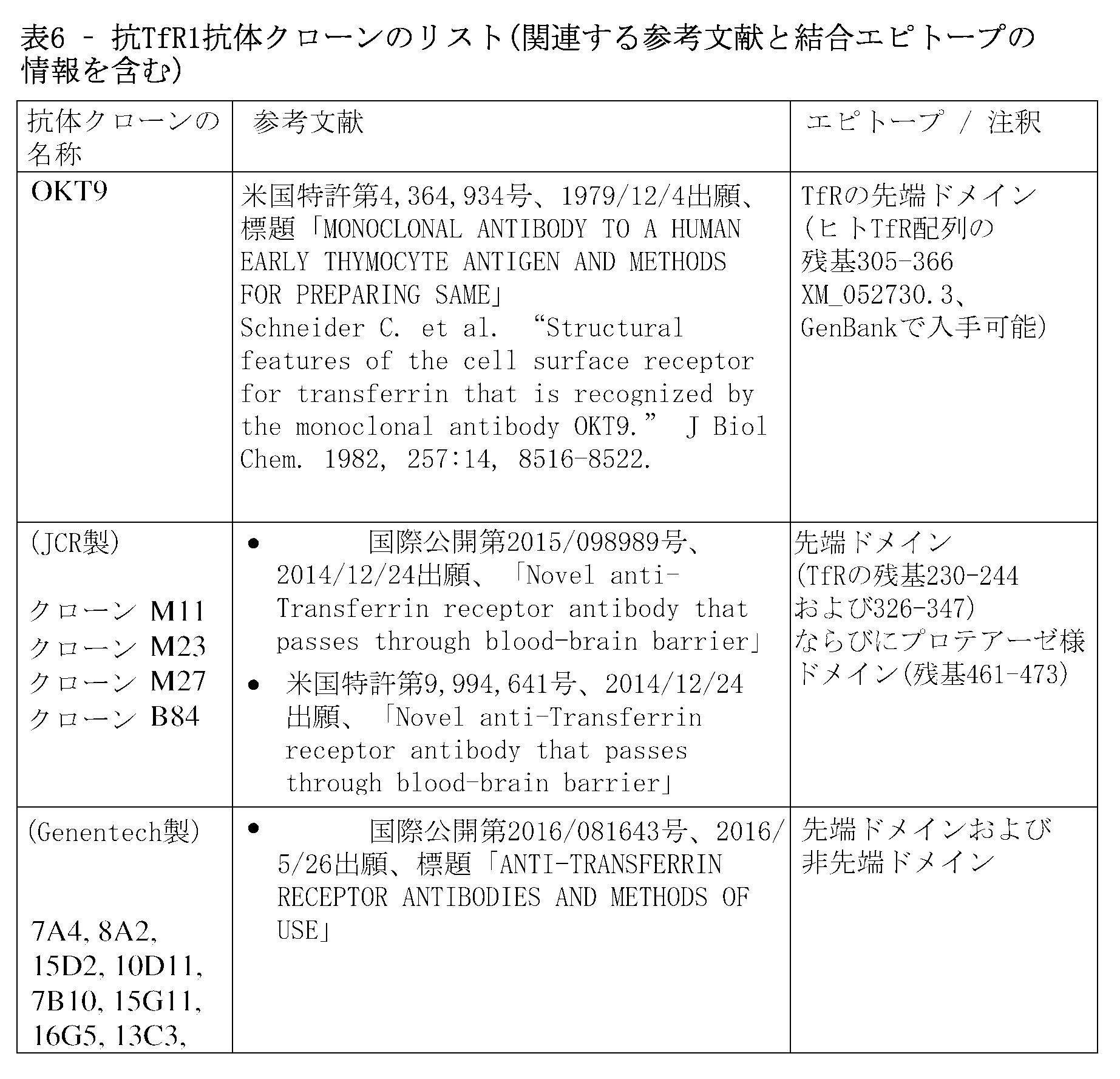


いくつかの態様において、本開示の抗TfR1抗体は、表6から選択される抗TfR1抗体のいずれか1つからのCDR-H(例として、CDR-H1、CDR-H2、およびCDR-H3)アミノ酸配列の1以上を含む。いくつかの態様において、抗TfR1抗体は、表6から選択される抗TfR1抗体のいずれか1つについて提供されるCDR-L1、CDR-L2、およびCDR-L3を含む。いくつかの態様において、抗TfR1抗体は、表6から選択される抗TfR1抗体のいずれか1つについて提供されるCDR-H1、CDR-H2、CDR-H3、CDR-L1、CDR-L2、およびCDR-L3を含む。 In some embodiments, the anti-TfR1 antibody of the present disclosure comprises one or more of the CDR-H (e.g., CDR-H1, CDR-H2, and CDR-H3) amino acid sequences from any one of the anti-TfR1 antibodies selected from Table 6. In some embodiments, the anti-TfR1 antibody comprises the CDR-L1, CDR-L2, and CDR-L3 provided for any one of the anti-TfR1 antibodies selected from Table 6. In some embodiments, the anti-TfR1 antibody comprises the CDR-H1, CDR-H2, CDR-H3, CDR-L1, CDR-L2, and CDR-L3 provided for any one of the anti-TfR1 antibodies selected from Table 6.
いくつかの態様において、本開示の抗TfR1抗体は、表6から選択される抗TfR1抗体のいずれか1つなどの、任意の抗TfR1抗体の重鎖可変ドメインおよび/または(例として、および)軽鎖可変ドメインを含む任意の抗体を含む。いくつかの態様において、本開示の抗TfR1抗体は、任意の抗TfR1抗体の重鎖可変対および軽鎖可変対を含む、表6から選択される抗TfR1抗体のいずれか1つなどの任意の抗体を含む。 In some embodiments, the anti-TfR1 antibodies of the disclosure include any antibody that includes a heavy chain variable domain and/or (by way of example and) a light chain variable domain of any anti-TfR1 antibody, such as any one of the anti-TfR1 antibodies selected from Table 6. In some embodiments, the anti-TfR1 antibodies of the disclosure include any antibody, such as any one of the anti-TfR1 antibodies selected from Table 6, that includes a heavy chain variable pair and a light chain variable pair of any anti-TfR1 antibody.
本開示の側面は、本明細書に記載のもののいずれかに相同な重鎖可変(VH)および/または(例として、および)軽鎖可変(VL)ドメインアミノ酸配列を有する抗TfR1抗体を提供する。いくつかの態様において、抗TfR1抗体は、表6から選択される抗TfR1抗体のいずれか1つなどの任意の抗TfR1抗体の重鎖可変配列および/またはいずれの軽鎖可変配列と少なくとも75%(例として、80%、85%、90%、95%、98%、または99%)同一の重鎖可変配列または軽鎖可変配列を含む。いくつかの態様において、相同な重鎖可変および/または(例として、および)軽鎖可変アミノ酸配列は、本明細書に提供されるCDR配列のいずれかにおいては変動しない。例えば、いくつかの態様において、配列変異の程度(例として、75%、80%、85%、90%、95%、98%、または99%)は、本明細書に提供されるCDR配列のいずれかを除外した重鎖可変および/または(例として、および)軽鎖可変配列内で起こり得る。いくつかの態様において、本明細書に提供される抗TfR1抗体のいずれも、表6から選択される抗TfR1抗体のいずれか1つなどの任意の抗TfR1抗体のフレームワーク配列と少なくとも75%、80%、85%、90%、95%、98%、または99%同一のフレームワーク配列を含む重鎖可変配列および軽鎖可変配列を含む。 Aspects of the present disclosure provide anti-TfR1 antibodies having heavy chain variable (VH) and/or (by way of example and) light chain variable (VL) domain amino acid sequences homologous to any of those described herein. In some embodiments, the anti-TfR1 antibody comprises a heavy chain variable sequence or a light chain variable sequence that is at least 75% (by way of example, 80%, 85%, 90%, 95%, 98%, or 99%) identical to the heavy chain variable sequence and/or any light chain variable sequence of any anti-TfR1 antibody, such as any one of the anti-TfR1 antibodies selected from Table 6. In some embodiments, the homologous heavy chain variable and/or (by way of example and) light chain variable amino acid sequences do not vary in any of the CDR sequences provided herein. For example, in some embodiments, the degree of sequence variation (e.g., 75%, 80%, 85%, 90%, 95%, 98%, or 99%) can occur within the heavy chain variable and/or (e.g., and) light chain variable sequences excluding any of the CDR sequences provided herein. In some embodiments, any of the anti-TfR1 antibodies provided herein include heavy and light chain variable sequences that include framework sequences that are at least 75%, 80%, 85%, 90%, 95%, 98%, or 99% identical to the framework sequences of any anti-TfR1 antibody, such as any one of the anti-TfR1 antibodies selected from Table 6.
本開示に従って使用され得るトランスフェリン受容体抗体の例は、参照により本明細書に組み込まれる国際公開第2016/081643号に記載されている。この抗体のアミノ酸配列は表7に示される。


いくつかの態様において、本開示の抗TfR1抗体は、表7に示されるCDR-H1、CDR-H2、およびCDR-H3と同じであるCDR-H1、CDR-H2、およびCDR-H3を含む。あるいは、または加えて(例として、加えて)、本開示の抗TfR1抗体は、表7に示されるCDR-L1、CDR-L2、およびCDR-L3と同じであるCDR-L1、CDR-L2、およびCDR-L3を含む。 In some embodiments, an anti-TfR1 antibody of the disclosure comprises a CDR-H1, CDR-H2, and CDR-H3 that are the same as the CDR-H1, CDR-H2, and CDR-H3 shown in Table 7. Alternatively, or in addition (for example, in addition), an anti-TfR1 antibody of the disclosure comprises a CDR-L1, CDR-L2, and CDR-L3 that are the same as the CDR-L1, CDR-L2, and CDR-L3 shown in Table 7.
いくつかの態様において、本開示の抗TfR1抗体は、CDR-L3を含み、これは表7に示されるCDR-L3と比較して3個以下のアミノ酸変異(例として、3、2、または1個以下のアミノ酸変異)を含む。いくつかの態様において、本開示の抗TfR1抗体は、表7に示されるCDR-L3と比較して1つのアミノ酸変異を含有するCDR-L3を含む。いくつかの態様において、本開示の抗TfR1抗体は、QHFAGTPLT(配列番号126)KabatおよびChothia定義系に従う)またはQHFAGTPL(配列番号127)Contact定義系に従う)のCDR-L3を含む。いくつかの態様において、本開示の抗TfR1抗体は、表7に示されるCDR-H1、CDR-H2、およびCDR-H3と同じであるCDR-H1、CDR-H2、CDR-H3、CDR-L1、およびCDR-L2を含み、QHFAGTPLT(配列番号126)KabatおよびChothia定義系に従う)またはQHFAGTPL(配列番号127)Contact定義系に従う)のCDR-L3を含む。 In some embodiments, an anti-TfR1 antibody of the disclosure comprises a CDR-L3 that contains no more than three amino acid mutations (e.g., no more than three, two, or one amino acid mutations) compared to the CDR-L3 shown in Table 7. In some embodiments, an anti-TfR1 antibody of the disclosure comprises a CDR-L3 that contains one amino acid mutation compared to the CDR-L3 shown in Table 7. In some embodiments, an anti-TfR1 antibody of the disclosure comprises a CDR-L3 of QHFAGTPLT (SEQ ID NO: 126) according to the Kabat and Chothia definition system) or QHFAGTPL (SEQ ID NO: 127) according to the Contact definition system). In some embodiments, the anti-TfR1 antibodies of the present disclosure comprise CDR-H1, CDR-H2, CDR-H3, CDR-L1, and CDR-L2 that are the same as the CDR-H1, CDR-H2, and CDR-H3 shown in Table 7, and comprise a CDR-L3 of QHFAGTPLT (SEQ ID NO: 126) according to the Kabat and Chothia definition system) or QHFAGTPL (SEQ ID NO: 127) according to the Contact definition system).
いくつかの態様において、本開示の抗TfR1抗体は、表7に示される重鎖CDRと、合わせて少なくとも80%(例として、80%、85%、90%、95%、または98%)同一である重鎖CDRを含む。あるいは、または加えて、(例として、加えて)、本開示の抗TfR1抗体は、表7に示される軽鎖CDRと、合わせて少なくとも80%(例として、80%、85%、90%、95%、または98%)同一である軽鎖CDRを含む。 In some embodiments, the anti-TfR1 antibodies of the disclosure include heavy chain CDRs that are, in combination, at least 80% (e.g., 80%, 85%, 90%, 95%, or 98%) identical to the heavy chain CDRs shown in Table 7. Alternatively, or in addition (e.g., in addition), the anti-TfR1 antibodies of the disclosure include light chain CDRs that are, in combination, at least 80% (e.g., 80%, 85%, 90%, 95%, or 98%) identical to the light chain CDRs shown in Table 7.
いくつかの態様において、本開示の抗TfR1抗体は、配列番号124のアミノ酸配列を含むVHを含む。あるいは、または加えて(例として、加えて)、本開示の抗TfR1抗体は、配列番号125のアミノ酸配列を含むVLを含む。 In some embodiments, an anti-TfR1 antibody of the present disclosure comprises a VH comprising the amino acid sequence of SEQ ID NO: 124. Alternatively, or in addition (for example, in addition), an anti-TfR1 antibody of the present disclosure comprises a VL comprising the amino acid sequence of SEQ ID NO: 125.
いくつかの態様において、本開示の抗TfR1抗体は、配列番号128のアミノ酸配列を含むVHを含む。あるいは、または加えて(例として、加えて)、本開示の抗TfR1抗体は、配列番号129のアミノ酸配列を含むVLを含む。 In some embodiments, an anti-TfR1 antibody of the present disclosure comprises a VH comprising the amino acid sequence of SEQ ID NO: 128. Alternatively, or in addition (for example, in addition), an anti-TfR1 antibody of the present disclosure comprises a VL comprising the amino acid sequence of SEQ ID NO: 129.
いくつかの態様において、本開示の抗TfR1抗体は、配列番号128に示されるVHと比較して、25個以下のアミノ酸変異(例として、25、24、23、22、21、20、19、18、17、16、15、14、13、12、11、10、9、8、7、6、5、4、3、2、または1個以下のアミノ酸変異)を含有するVHを含む。あるいは、または加えて(例として、加えて)、本開示の抗TfR1抗体は、配列番号129に示されるVLと比較して、15個以下のアミノ酸変異(例として、20、19、18、17、16、15、14、13、12、11、9、8、7、6、5、4、3、2、または1個以下のアミノ酸変異)を含有するVLを含む。 In some embodiments, the anti-TfR1 antibodies of the present disclosure include a VH that contains 25 or fewer amino acid mutations (e.g., 25, 24, 23, 22, 21, 20, 19, 18, 17, 16, 15, 14, 13, 12, 11, 10, 9, 8, 7, 6, 5, 4, 3, 2, or 1 or fewer amino acid mutations) compared to the VH set forth in SEQ ID NO: 128. Alternatively or in addition (e.g., in addition), the anti-TfR1 antibodies of the present disclosure include a VL that contains 15 or fewer amino acid mutations (e.g., 20, 19, 18, 17, 16, 15, 14, 13, 12, 11, 9, 8, 7, 6, 5, 4, 3, 2, or 1 or fewer amino acid mutations) compared to the VL set forth in SEQ ID NO: 129.
いくつかの態様において、本開示の抗TfR1抗体は、完全長IgG1抗体であり、これはヒト抗体からの重鎖定常領域および軽鎖定常領域を含み得る。いくつかの態様において、本明細書に記載の抗TfR1抗体のいずれかの重鎖は、重鎖定常領域(CH)またはそのある部分(例として、CH1、CH2、CH3、またはそれらの組み合わせ)を含み得る。重鎖定常領域は、任意の好適な起源、例として、ヒト、マウス、ラット、またはウサギに由来し得る。特定の一例において、重鎖定常領域は、ヒトIgG(ガンマ重鎖)、例として、IgG1、IgG2、またはIgG4に由来する。ヒトIgG1定常領域の例は下記のとおりである:
ASTKGPSVFPLAPSSKSTSGGTAALGCLVKDYFPEPVTVSWNSGALTSGVHTFPAVLQSSGLYSLSSVVTVPSSSLGTQTYICNVNHKPSNTKVDKKVEPKSCDKTHTCPPCPAPELLGGPSVFLFPPKPKDTLMISRTPEVTCVVVDVSHEDPEVKFNWYVDGVEVHNAKTKPREEQYNSTYRVVSVLTVLHQDWLNGKEYKCKVSNKALPAPIEKTISKAKGQPREPQVYTLPPSRDELTKNQVSLTCLVKGFYPSDIAVEWESNGQPENNYKTTPPVLDSDGSFFLYSKLTVDKSRWQQGNVFSCSVMHEALHNHYTQKSLSLSPGK(配列番号81)
In some embodiments, the anti-TfR1 antibodies of the present disclosure are full-length IgG1 antibodies, which may include heavy and light chain constant regions from a human antibody. In some embodiments, the heavy chain of any of the anti-TfR1 antibodies described herein may include a heavy chain constant region (CH) or a portion thereof (e.g., CH1, CH2, CH3, or a combination thereof). The heavy chain constant region may be derived from any suitable source, e.g., human, mouse, rat, or rabbit. In one particular example, the heavy chain constant region is derived from human IgG (gamma heavy chain), e.g., IgG1, IgG2, or IgG4. An example of a human IgG1 constant region is as follows:
ASTKGPSVFPLAPSSKSTSGGTAALGCLVKDYFPEPVTVSWNSGALTSGVHTFPAVLQSSGLYSLSSVVTVPSSSLGTQTYICNVNHKPSNTKVDKKVEPKSCDKTHTCPPCPAPELLGGPSVFLFPPKPKDTLMISRTPEVTCVVVDVSHEDPEVKFNWYVDGVEVHNAKTKPREEQYNSTYRVVSVLTVLHQDWLNGKEYKCKVSNKALPAPIEKTISKAKGQPREPQVYTLPPSRDELTKNQVSLTCLVKGFYPSDIAVEWESNGQPENNYKTTPPVLDSDGSFFLYSKLTVDKSRWQQGNVFSCSVMHEALHNHYTQKSLSLSPGK (SEQ ID NO: 81)
いくつかの態様において、本明細書に記載の抗TfR1抗体のいずれかの軽鎖はさらに、軽鎖定常領域(CL)を含み得、これは当該技術分野において知られているいずれかのCLであり得る。いくつかの例において、CLは、カッパ軽鎖である。他の例において、CLは、ラムダ軽鎖である。いくつかの態様において、CLはカッパ軽鎖であって、その配列は下に与えられる:
RTVAAPSVFIFPPSDEQLKSGTASVVCLLNNFYPREAKVQWKVDNALQSGNSQESVTEQDSKDSTYSLSSTLTLSKADYEKHKVYACEVTHQGLSSPVTKSFNRGEC(配列番号83)
In some embodiments, the light chain of any of the anti-TfR1 antibodies described herein may further comprise a light chain constant region (CL), which may be any CL known in the art. In some examples, the CL is a kappa light chain. In other examples, the CL is a lambda light chain. In some embodiments, the CL is a kappa light chain, the sequence of which is given below:
RTVAAPSVFIFPPSDEQLKSGTASVVCLLNNFYPREAKVQWKVDNALQSGNSQESVTEQDSKDSTYSLSSTLTLSKADYEKHKVYACEVTHQGLSSPVTKSFNRGEC (SEQ ID NO: 83)
いくつかの態様において、本明細書に記載の抗TfR1抗体は、配列番号132のアミノ酸配列を含む重鎖を含むキメラ抗体である。あるいは、または加えて(例として、加えて)、本明細書に記載の抗TfR1抗体は、配列番号133のアミノ酸配列を含む軽鎖を含む。 In some embodiments, the anti-TfR1 antibodies described herein are chimeric antibodies comprising a heavy chain comprising the amino acid sequence of SEQ ID NO: 132. Alternatively, or in addition (for example, in addition), the anti-TfR1 antibodies described herein comprise a light chain comprising the amino acid sequence of SEQ ID NO: 133.
いくつかの態様において、本明細書に記載の抗TfR1抗体は、配列番号134のアミノ酸配列を含む重鎖を含む完全ヒト抗体である。あるいは、または加えて(例として、加えて)、本明細書に記載の抗TfR1抗体は、配列番号135のアミノ酸配列を含む軽鎖を含む。 In some embodiments, the anti-TfR1 antibodies described herein are fully human antibodies comprising a heavy chain comprising the amino acid sequence of SEQ ID NO: 134. Alternatively, or in addition (for example, in addition), the anti-TfR1 antibodies described herein comprise a light chain comprising the amino acid sequence of SEQ ID NO: 135.
いくつかの態様において、抗TfR1抗体は、インタクトな抗体(完全長抗体)の抗原結合性フラグメント(Fab)である。いくつかの態様において、本明細書に記載の抗TfR1 Fabは、配列番号136のアミノ酸配列を含む重鎖を含む。あるいは、または加えて(例として、加えて)、本明細書に記載の抗TfR1 Fabは、配列番号133のアミノ酸配列を含む軽鎖を含む。いくつかの態様において、本明細書に記載の抗TfR1 Fabは、配列番号137のアミノ酸配列を含む重鎖を含む。あるいは、または加えて(例として、加えて)、本明細書に記載の抗TfR1 Fabは、配列番号135のアミノ酸配列を含む軽鎖を含む。 In some embodiments, the anti-TfR1 antibody is an antigen-binding fragment (Fab) of an intact antibody (full-length antibody). In some embodiments, the anti-TfR1 Fab described herein comprises a heavy chain comprising the amino acid sequence of SEQ ID NO: 136. Alternatively, or in addition (for example, in addition), the anti-TfR1 Fab described herein comprises a light chain comprising the amino acid sequence of SEQ ID NO: 133. In some embodiments, the anti-TfR1 Fab described herein comprises a heavy chain comprising the amino acid sequence of SEQ ID NO: 137. Alternatively, or in addition (for example, in addition), the anti-TfR1 Fab described herein comprises a light chain comprising the amino acid sequence of SEQ ID NO: 135.
本明細書に記載の抗TfR1抗体は、いずれかの抗体形態であり得、インタクトな(すなわち全長)抗体、それらの抗原結合フラグメント(Fab、Fab'、F(ab')2、Fvなど)、一本鎖抗体、二重特異性抗体、またはナノボディを含むが、これらに限定されない。いくつかの態様において、本明細書に記載の抗TfR1抗体はscFvである。いくつかの態様において、本明細書に記載の抗TfR1抗体は、scFv-Fabである(例として、定常領域のある部分に融合されたscFv)。いくつかの態様において、本明細書に記載の抗TfR1抗体は、定常領域(例として、配列番号81で示されるヒトIgG1定常領域)と縮合されたscFvである。 The anti-TfR1 antibodies described herein can be in any antibody form, including, but not limited to, intact (i.e., full-length) antibodies, antigen-binding fragments thereof (Fab, Fab', F(ab')2, Fv, etc.), single-chain antibodies, bispecific antibodies, or nanobodies. In some embodiments, the anti-TfR1 antibodies described herein are scFvs. In some embodiments, the anti-TfR1 antibodies described herein are scFv-Fabs (e.g., scFvs fused to a portion of a constant region). In some embodiments, the anti-TfR1 antibodies described herein are scFvs fused to a constant region (e.g., the human IgG1 constant region set forth in SEQ ID NO:81).
いくつかの態様において、保存的変異は、その残基が標的抗原(例として、トランスフェリン受容体)との相互作用に関与する可能性が低い、例えば、結晶構造に基づき決定される位置で、抗体配列(例として、CDRまたはフレームワーク配列)に導入され得る。いくつかの態様において、1つ、2つまたはそれ以上の変異(例として、アミノ酸置換)は、血清半減期、補体結合、Fc受容体結合、および/または(例として、および)細胞への抗原依存的細胞傷害性などの、抗体の1以上の機能特性を変更させるために、本明細書に記載の抗TfR1抗体のFc領域中(例として、Kabat番号付け系(例として、KabatのEUインデックス)に従う番号付けで、CH2ドメイン(ヒトIgG1の残基231~340)中、および/または(例として、および)CH3ドメイン(ヒトIgG1の残基341~447)中、および/または(例として、および)ヒンジ領域中)へ導入される。 In some embodiments, conservative mutations can be introduced into an antibody sequence (e.g., CDR or framework sequences) at positions where the residues are unlikely to be involved in interactions with a target antigen (e.g., transferrin receptor), e.g., as determined based on a crystal structure. In some embodiments, one, two or more mutations (e.g., amino acid substitutions) are introduced into the Fc region (e.g., in the CH2 domain (residues 231-340 of human IgG1), and/or (e.g., in the CH3 domain (residues 341-447 of human IgG1), and/or (e.g., in the hinge region), numbered according to the Kabat numbering system (e.g., EU index of Kabat)) of an anti-TfR1 antibody described herein to alter one or more functional properties of the antibody, such as serum half-life, complement binding, Fc receptor binding, and/or (e.g., and) antigen-dependent cellular cytotoxicity to cells.
いくつかの態様において、1つ、2つまたはそれ以上の変異(例として、アミノ酸置換)は、ヒンジ領域中のシステイン残基の数が、例として米国特許第5,677,425号に記載のとおり変動(例として、増大または減少)され得るように、Fc領域(CH1ドメイン)のヒンジ領域に導入される。CH1ドメインのヒンジ領域中のシステイン残基の数は、例として、軽鎖と重鎖の会合を容易にさせるために、または抗体の安定性を変える(例として、増大または減少させる)ため、またはリンカーのコンジュゲーションを容易にさせるために、変更され得る。 In some embodiments, one, two or more mutations (e.g., amino acid substitutions) are introduced into the hinge region of the Fc region (CH1 domain) such that the number of cysteine residues in the hinge region can be varied (e.g., increased or decreased) as described, e.g., in U.S. Pat. No. 5,677,425. The number of cysteine residues in the hinge region of the CH1 domain can be altered, e.g., to facilitate association of the light and heavy chains, or to alter (e.g., increase or decrease) the stability of the antibody, or to facilitate conjugation of a linker.
いくつかの態様において、1つ、2つまたはそれ以上の変異(例として、アミノ酸置換)は、抗体の、エフェクター細胞表面上のFc受容体(例として、活性化されたFc受容体)への親和性を増加または減少させるため、本明細書に記載の筋標的化抗体のFc領域中(例として、Kabat番号付け系(例として、KabatのEUインデックス)に従う番号付けで、CH2ドメイン(ヒトIgG1の残基231~340)中、および/または(例として、および)CH3ドメイン(ヒトIgG1の残基341~447)中、および/または(例として、および)ヒンジ領域中)へ導入される。抗体のFc受容体への親和性を増大または減少させる抗体のFc領域中の変異、およびかかる変異をFc受容体中またはそのフラグメントに導入するための技法は、当業者に知られている。抗体のFc受容体への親和性を変更するためになされ得る、抗体のFc受容体中の変異の例は、例として、Smith P et al.,(2012)PNAS 109:6181-6186、米国特許第6,737,056号、ならびに国際公開第02/060919号、国際公開第98/23289号、および国際公開第97/34631号(これらは参照により本明細書に組み込まれる)に記載されている。 In some embodiments, one, two or more mutations (e.g., amino acid substitutions) are introduced into the Fc region of the muscle-targeting antibody described herein (e.g., in the CH2 domain (residues 231-340 of human IgG1), and/or (e.g., and) in the CH3 domain (residues 341-447 of human IgG1), and/or (e.g., and) in the hinge region, numbered according to the Kabat numbering system (e.g., EU index of Kabat)) to increase or decrease the affinity of the antibody for an Fc receptor (e.g., an activated Fc receptor) on the surface of an effector cell. Mutations in the Fc region of an antibody that increase or decrease the affinity of the antibody for an Fc receptor, and techniques for introducing such mutations into an Fc receptor or fragment thereof, are known to those skilled in the art. Examples of mutations in the Fc receptor of an antibody that can be made to alter the affinity of the antibody to the Fc receptor are described, for example, in Smith P et al., (2012) PNAS 109:6181-6186, U.S. Patent No. 6,737,056, and WO 02/060919, WO 98/23289, and WO 97/34631, which are incorporated herein by reference.
いくつかの態様において、1つ、2つまたはそれ以上のアミノ酸変異(すなわち、置換、挿入、または欠失)は、in vivoでの抗体の半減期を変更(例として、増加または減少)させるため、IgG定常領域またはそのFcRn-結合フラグメント(好ましくは、Fcまたはヒンジ-Fcドメインフラグメント)に導入される。例として、in vivoでの抗体の半減期を変更(例として、増加または減少)させるであろう変異の例として、国際公開第02/060919号、国際公開第98/23289号、および国際公開第97/34631号、ならびに米国特許第5,869,046号、米国特許第6,121,022号、米国特許第6,277,375号、および米国特許第6,165,745号を参照されたい。 In some embodiments, one, two or more amino acid mutations (i.e., substitutions, insertions, or deletions) are introduced into the IgG constant region or FcRn-binding fragment thereof (preferably, the Fc or hinge-Fc domain fragment) to alter (e.g., increase or decrease) the half-life of the antibody in vivo. For example, see WO 02/060919, WO 98/23289, and WO 97/34631, as well as U.S. Pat. Nos. 5,869,046, 6,121,022, 6,277,375, and 6,165,745 for examples of mutations that may alter (e.g., increase or decrease) the half-life of the antibody in vivo.
いくつかの態様において、1つ、2つまたはそれ以上のアミノ酸変異(すなわち、置換、挿入、または欠失)は、in vivoでの抗TfR1抗体の半減期を減少させるため、IgG定常領域またはそのFcRn-結合フラグメント(好ましくは、Fcまたはヒンジ-Fcドメインフラグメント)に導入される。いくつかの態様において、1つ、2つまたはそれ以上のアミノ酸変異(すなわち、置換、挿入、または欠失)は、in vivoでの抗体の半減期を増加させるため、IgG定常領域またはそのFcRn-結合フラグメント(好ましくは、Fcまたはヒンジ-Fcドメインフラグメント)に導入される。いくつかの態様において、抗体は、KabatのEUインデックス(上記のKabat E A et al.,(1991))に従う番号付けで第2定常(CH2)ドメイン(ヒトIgG1の残基231~340)中および/または(例として、および)第3定常(CH3)ドメイン(ヒトIgG1の残基341~447)中に、1以上のアミノ酸変異(例として、置換)を有し得る。いくつかの態様において、本明細書に記載の抗体のIgG1定常領域は、KabatにあるようなEUインデックスに従ってナンバリングされた位置252におけるメチオニン(M)からチロシン(Y)への置換、位置254におけるセリン(S)からトレオニン(T)への置換、および位置256におけるトレオニン(T)からグルタミン酸(E)への置換を含む。米国特許第7,658,921号(これは、参照により本明細書に組み込まれる)を参照されたい。「YTE変異体」と称されるこのタイプの変異IgGは、同じ抗体の野生型バージョンと比較して4倍増大した半減期を発揮したことが示されている(Dall'Acqua W F et al.,(2006)J Biol Chem 281:23514-24を参照されたい)。いくつかの態様において、抗体は、KabatにあるようなEUインデックスに従ってナンバリングされた位置251~257、285~290、308~314、385~389、および428~436でのアミノ酸残基の1つ、2つ、3つまたはそれ以上のアミノ酸置換を含むIgG定常領域を含む。 In some embodiments, one, two or more amino acid mutations (i.e., substitutions, insertions, or deletions) are introduced into the IgG constant region or FcRn-binding fragment thereof (preferably, Fc or hinge-Fc domain fragment) to decrease the half-life of the anti-TfR1 antibody in vivo. In some embodiments, one, two or more amino acid mutations (i.e., substitutions, insertions, or deletions) are introduced into the IgG constant region or FcRn-binding fragment thereof (preferably, Fc or hinge-Fc domain fragment) to increase the half-life of the antibody in vivo. In some embodiments, the antibody may have one or more amino acid mutations (e.g., substitutions) in the second constant (CH2) domain (residues 231-340 of human IgG1) and/or (e.g., and) in the third constant (CH3) domain (residues 341-447 of human IgG1) numbered according to the EU index of Kabat (Kabat E A et al., (1991) supra). In some embodiments, the IgG1 constant region of the antibody described herein comprises a methionine (M) to tyrosine (Y) substitution at position 252, a serine (S) to threonine (T) substitution at position 254, and a threonine (T) to glutamic acid (E) substitution at position 256, numbered according to the EU index as in Kabat. See U.S. Patent No. 7,658,921, which is incorporated herein by reference. This type of mutant IgG, referred to as a "YTE mutant", has been shown to exhibit a 4-fold increased half-life compared to the wild-type version of the same antibody (see Dall'Acqua W F et al., (2006) J Biol Chem 281:23514-24). In some embodiments, the antibody comprises an IgG constant region comprising one, two, three or more amino acid substitutions of amino acid residues at positions 251-257, 285-290, 308-314, 385-389, and 428-436, numbered according to the EU index as in Kabat.
いくつかの態様において、1つ、2つまたはそれ以上のアミノ酸置換は、抗TfR1抗体のエフェクター機能を変更するため、IgG定常領域Fc領域に導入される。自身への親和性が変更されたエフェクターリガンドは、例えば、Fc受容体または補体のC1構成要素であり得る。このアプローチは、米国特許第5,624,821号および第5,648,260号においてさらに詳細に記載される。いくつかの態様において、定常領域ドメインの欠失または不活化(点変異または他の手段を通して)は、循環抗体のFc受容体への結合を低減し、それによって腫瘍局在化を増大し得る。定常領域を欠失または不活化し、それによって腫瘍局在化を増大させる変異の記載については、例として、米国特許第5,585,097号および米国特許第8,591,886号を参照されたい。いくつかの態様において、1以上のアミノ酸置換は、Fc領域上の潜在的なグリコシル化部位を除去するため(これによってFc受容体への結合が低減されることもある)、本明細書に記載の抗体のFc領域に導入されてもよい(例として、Shields R L et al.,(2001)J Biol Chem 276:6591-604を参照されたい)。 In some embodiments, one, two or more amino acid substitutions are introduced into the IgG constant region Fc region to alter the effector function of the anti-TfR1 antibody. The effector ligand with altered affinity to itself can be, for example, an Fc receptor or the C1 component of complement. This approach is described in more detail in U.S. Pat. Nos. 5,624,821 and 5,648,260. In some embodiments, deletion or inactivation of the constant region domain (through point mutations or other means) can reduce binding of circulating antibodies to Fc receptors, thereby increasing tumor localization. See, for example, U.S. Pat. Nos. 5,585,097 and 8,591,886 for a description of mutations that delete or inactivate constant regions, thereby increasing tumor localization. In some embodiments, one or more amino acid substitutions may be introduced into the Fc region of an antibody described herein to remove potential glycosylation sites in the Fc region, which may reduce binding to Fc receptors (see, e.g., Shields R L et al., (2001) J Biol Chem 276:6591-604).
いくつかの態様において、本明細書に記載の抗TfR1抗体の定常領域中の1以上のアミノ酸残基は、抗体が変更されたC1q結合および/または(例として、および)低減もしくは消失された補体依存性細胞傷害性(CDC)を有し得るように、異なるアミノ酸残基に置き換えられ得る。このアプローチは、米国特許第6,194,551号(Idusogie et al)においてさらに詳細に記載されている。いくつかの態様において、本明細書に記載の抗体のCH2ドメインのN末領域中の1以上のアミノ酸残基は変更されて、それによって抗体の補体結合能を変更する。このアプローチは、国際公開第94/29351号にさらに詳しく記載されている。いくつかの態様において、本明細書に記載の抗体のFc領域は、抗体の、細胞への抗体依存性細胞傷害性(ADCC)の媒介能を増大させるため、および/または(例として、および)、抗体のFcγ受容体への親和性を増大させるため、修飾されている。このアプローチは、国際公開第00/42072号にさらに詳しく記載されている。 In some embodiments, one or more amino acid residues in the constant region of the anti-TfR1 antibodies described herein may be replaced with a different amino acid residue such that the antibody may have altered C1q binding and/or (by way of example and) reduced or eliminated complement dependent cytotoxicity (CDC). This approach is described in further detail in U.S. Pat. No. 6,194,551 (Idusogie et al.). In some embodiments, one or more amino acid residues in the N-terminal region of the CH2 domain of the antibodies described herein are altered to thereby alter the ability of the antibody to fix complement. This approach is described in further detail in WO 94/29351. In some embodiments, the Fc region of the antibodies described herein is modified to increase the ability of the antibody to mediate antibody-dependent cellular cytotoxicity (ADCC) to cells and/or (by way of example and) to increase the affinity of the antibody for Fcγ receptors. This approach is described in further detail in WO 00/42072.
いくつかの態様において、本明細書に提供される抗体の重鎖および/または(例として、および)軽鎖可変ドメイン配列は、本明細書の他の箇所に記載されるとおり、例えば、CDR接合抗体、キメラ抗体、ヒト化抗体、もしくは複合ヒト抗体、または抗原結合性フラグメントを生成するために使用され得る。当業者によって理解されるとおり、本明細書に提供される抗体のいずれかに由来するいずれのバリアント、CDR接合抗体、キメラ抗体、ヒト化抗体、または複合抗体は、本明細書に記載の組成物および方法に有用であってもよく、バリアント、CDR接合抗体、キメラ抗体、ヒト化抗体、または複合抗体が、これが由来する元の抗体と比べて、トランスフェリン受容体への少なくとも50%、少なくとも60%、少なくとも70%、少なくとも80%、少なくとも90%、少なくとも95%以上の結合を有し得るように、トランスフェリン受容体への特異的結合能を維持するであろう。 In some embodiments, the heavy and/or (by way of example) light chain variable domain sequences of the antibodies provided herein may be used to generate, for example, CDR-grafted, chimeric, humanized, or composite human antibodies, or antigen-binding fragments, as described elsewhere herein. As will be appreciated by one of skill in the art, any variant, CDR-grafted, chimeric, humanized, or composite antibody derived from any of the antibodies provided herein may be useful in the compositions and methods described herein, and will retain specific binding ability to the transferrin receptor, such that the variant, CDR-grafted, chimeric, humanized, or composite antibody may have at least 50%, at least 60%, at least 70%, at least 80%, at least 90%, at least 95% or more binding to the transferrin receptor compared to the original antibody from which it is derived.
いくつかの態様において、本明細書に提供される抗体は、所望の特性を抗体へ付与する変異を含む。例えば、天然のIgG4 mAbに生じることが知られているFabアーム交換(Fab-arm exchange)に起因する潜在的合併症を回避するため、本明細書に提供される抗体は、安定化「Adair」変異を含み得(Angal S.,et al.,「A single amino acid substitution abolishes the heterogeneity of chimeric mouse/human(IgG4)antibody」,Mol Immunol 30,105-108;1993)、ここでセリン228(EU番号付け;残基241 Kabat番号付け)は、IgG1様ヒンジ配列をもたらすプロリンへ変換されている。したがって、抗体のいずれかは、安定化「Adair」変異を含み得る。 In some embodiments, the antibodies provided herein contain mutations that confer desired properties to the antibody. For example, to avoid potential complications due to Fab-arm exchange that is known to occur in natural IgG4 mAbs, the antibodies provided herein may contain a stabilizing "Adair" mutation (Angal S., et al., "A single amino acid substitution abolishes the heterogeneity of chimeric mouse/human (IgG4) antibody", Mol Immunol 30, 105-108; 1993), in which serine 228 (EU numbering; residue 241 Kabat numbering) is converted to a proline resulting in an IgG1-like hinge sequence. Thus, any of the antibodies may contain a stabilizing "Adair" mutation.
いくつかの態様において、抗体は修飾されている(例として、グリコシル化、リン酸化、SUMO化、および/または(例として、および)、メチル化を介して修飾されている)。いくつかの態様において、抗体は、1以上の糖または炭水化物分子にコンジュゲートされたグリコシル化抗体である。いくつかの態様において、1以上の糖または炭水化物分子は、N-グリコシル化、O-グリコシル化、C-グリコシル化、グリピエーション(GPIアンカー付着)、および/または(例として、および)、ホスホグリコシル化を介して、抗体にコンジュゲートされている。いくつかの態様において、1以上の糖または炭水化物分子は、単糖類、二糖類、オリゴ糖類、またはグリカンである。いくつかの態様において、1以上の糖または炭水化物分子は、分枝オリゴ糖類または分枝グリカンである。いくつかの態様において、1以上の糖または炭水化物分子は、マンノース単位、グルコース単位、N-アセチルグルコサミン単位、N-アセチルガラクトサミン単位、ガラクトース単位、フコース単位、またはホスホ脂質単位を包含する。いくつかの態様において、糖分子は、約1~10個、約1~5個、約5~10個、約1~4個、約1~3個、または約2個存在する。いくつかの態様において、グリコシル化抗体は、全体的にまたは部分的にグリコシル化されている。いくつかの態様において、抗体は、化学反応によって、または酵素的な手段によってグリコシル化されている。いくつかの態様において、抗体は、in vitroまたは細胞内でグリコシル化され、任意に、N-またはO-グリコシル化経路において酵素(例として、グリコシルトランスフェラーゼ)が欠乏し得る。いくつかの態様において、抗体は、「Modified antibody,antibody-conjugate and process for the preparation thereof」と題する2014年5月1日に公開された国際公開第2014065661号に記載されるような糖または炭水化物分子で官能化されている。 In some embodiments, the antibody is modified (e.g., modified via glycosylation, phosphorylation, sumoylation, and/or (e.g., and) methylation). In some embodiments, the antibody is a glycosylated antibody conjugated to one or more sugar or carbohydrate molecules. In some embodiments, the one or more sugar or carbohydrate molecules are conjugated to the antibody via N-glycosylation, O-glycosylation, C-glycosylation, glypiation (GPI anchor attachment), and/or (e.g., and) phosphoglycosylation. In some embodiments, the one or more sugar or carbohydrate molecules are monosaccharides, disaccharides, oligosaccharides, or glycans. In some embodiments, the one or more sugar or carbohydrate molecules are branched oligosaccharides or branched glycans. In some embodiments, the one or more sugar or carbohydrate molecules include mannose units, glucose units, N-acetylglucosamine units, N-acetylgalactosamine units, galactose units, fucose units, or phospholipid units. In some embodiments, the sugar molecules are present in about 1-10, about 1-5, about 5-10, about 1-4, about 1-3, or about 2 units. In some embodiments, the glycosylated antibody is fully or partially glycosylated. In some embodiments, the antibody is glycosylated by chemical reaction or by enzymatic means. In some embodiments, the antibody is glycosylated in vitro or intracellularly, and optionally may be deficient in an enzyme (e.g., glycosyltransferase) in the N- or O-glycosylation pathway. In some embodiments, the antibody is functionalized with a sugar or carbohydrate molecule as described in WO2014065661, published May 1, 2014, entitled "Modified antibody, antibody-conjugate and process for the preparation thereof."
いくつかの態様において、本明細書に記載の抗TfR1抗体のいずれか1つは、重鎖および/または(例として、および)軽鎖配列上にシグナルペプチド(例として、N末端シグナルペプチド)を含み得る。いくつかの態様において、本明細書に記載の抗TfR1抗体は、VHおよびVL配列のいずれか1つ、IgG重鎖および軽鎖配列のいずれか1つ、または本明細書に記載のF(ab')重鎖および軽鎖配列のいずれか1つを含み、さらにシグナルペプチド(例として、N末端シグナルペプチド)を含む。いくつかの態様において、シグナルペプチドはMGWSCIILFLVATATGVHS(配列番号104)のアミノ酸配列を含む。
いくつかの態様において、本明細書に提供される抗体は、1以上の翻訳後修飾を有し得る。いくつかの態様において、ピログルタミン酸形成(ピロGlu)ともまた呼ばれるN末端環化が、産生中に抗体に生じ得る。いくつかの態様において、ピログルタミン酸形成は、N末端グルタミン酸(Glu)および/またはグルタミン(Gln)残基で、産生中に抗体に生じ得る。したがって、当然のことながら、N末端グルタメートまたはグルタミン残基を含む配列を有すると特定される抗体は、翻訳後修飾に起因するピログルタメート形成を受けた抗体を包含する。いくつかの態様において、ピログルタミン酸形成は、重鎖配列に生起する。いくつかの態様において、ピログルタミン酸形成は軽鎖配列に生起する。
In some embodiments, any one of the anti-TfR1 antibodies described herein may include a signal peptide (e.g., an N-terminal signal peptide) on the heavy and/or (e.g., and) light chain sequences. In some embodiments, the anti-TfR1 antibodies described herein include any one of the VH and VL sequences, any one of the IgG heavy and light chain sequences, or any one of the F(ab') heavy and light chain sequences described herein, and further include a signal peptide (e.g., an N-terminal signal peptide). In some embodiments, the signal peptide includes the amino acid sequence of MGWSCIILFLVATATGVHS (SEQ ID NO: 104).
In some embodiments, the antibodies provided herein may have one or more post-translational modifications. In some embodiments, N-terminal cyclization, also referred to as pyroglutamic acid formation (pyroGlu), may occur on antibodies during production. In some embodiments, pyroglutamic acid formation may occur on antibodies during production at N-terminal glutamic acid (Glu) and/or glutamine (Gln) residues. Thus, it should be understood that an antibody identified as having a sequence that includes an N-terminal glutamate or glutamine residue includes an antibody that has undergone pyroglutamate formation due to post-translational modification. In some embodiments, pyroglutamic acid formation occurs on heavy chain sequences. In some embodiments, pyroglutamic acid formation occurs on light chain sequences.
b.他の筋標的抗体
いくつかの態様において、筋標的化抗体は、ヘモジュベリン(hemojuvelin)、カベオリン-3、デュシェンヌ型筋ジストロフィーペプチド、ミオシンIIb、またはCD63に特異的に結合する抗体である。いくつかの態様において、筋標的化抗体は、筋原性前駆体タンパク質に特異的に結合する抗体である。例示の筋原性前駆体タンパク質は、限定せずに、ABCG2、M-カドヘリン/カドヘリン-15、カベオリン-1、CD34、FoxK1、インテグリンアルファ7、インテグリンアルファ7ベータ1、MYF-5、MyoD、ミオゲニン、NCAM-1/CD56、Pax3、Pax7、およびPax9を包含する。いくつかの態様において、筋標的化抗体は、骨格筋タンパク質に特異的に結合する抗体である。例示的な骨格筋タンパク質としては、限定するものではないが、アルファ-サルコグリカン、ベータ-サルコグリカン、カルパインインヒビター、クレアチンキナーゼMM/CKMM、eIF5A、エノラーゼ2/ニューロン特異的エノラーゼ、イプシロン-サルコグリカン、FABP3/H-FABP、GDF-8/ミオスタチン、GDF-11/GDF-8、インテグリンアルファ7、インテグリンアルファ7ベータ1、インテグリンベータ1/CD29、MCAM/CD146、MyoD、ミオゲニン、ミオシン軽鎖キナーゼインヒビター、NCAM-1/CD56、およびトロポニンIが挙げられ、いくつかの態様において、筋標的化抗体は、平滑筋タンパク質に特異的に結合する抗体である。例示の平滑筋タンパク質は、限定せずに、アルファ-平滑筋アクチン、VE-カドヘリン、カルデスモン/CALD1、カルポニン1、デスミン、ヒスタミンH2 R、モチリンR/GPR38、トランスジェリン(Transgelin)/TAGLN、およびビメンチンを包含する。しかしながら、当然のことながら、追加の標的への抗体が本開示の範囲内であること、および本明細書に提供される標的の例示のリストが限定することを意図していない。
b. Other Muscle-Targeting Antibodies In some embodiments, the muscle-targeting antibody is an antibody that specifically binds to hemojuvelin, caveolin-3, Duchenne muscular dystrophy peptide, myosin IIb, or CD63. In some embodiments, the muscle-targeting antibody is an antibody that specifically binds to a myogenic precursor protein. Exemplary myogenic precursor proteins include, but are not limited to, ABCG2, M-cadherin/cadherin-15, caveolin-1, CD34, FoxK1, integrin alpha 7, integrin alpha 7 beta 1, MYF-5, MyoD, myogenin, NCAM-1/CD56, Pax3, Pax7, and Pax9. In some embodiments, the muscle-targeting antibody is an antibody that specifically binds to a skeletal muscle protein. Exemplary skeletal muscle proteins include, but are not limited to, alpha-sarcoglycan, beta-sarcoglycan, calpain inhibitor, creatine kinase MM/CKMM, eIF5A, enolase 2/neuron-specific enolase, epsilon-sarcoglycan, FABP3/H-FABP, GDF-8/myostatin, GDF-11/GDF-8, integrin alpha 7, integrin alpha 7 beta 1, integrin beta 1/CD29, MCAM/CD146, MyoD, myogenin, myosin light chain kinase inhibitor, NCAM-1/CD56, and troponin I; in some embodiments, the muscle-targeting antibody is an antibody that specifically binds to a smooth muscle protein. Exemplary smooth muscle proteins include, without limitation, alpha-smooth muscle actin, VE-cadherin, caldesmon/CALD1, calponin 1, desmin, histamine H2 R, motilin R/GPR38, Transgelin/TAGLN, and vimentin, however, it will be understood that antibodies to additional targets are within the scope of this disclosure and that the exemplary list of targets provided herein is not intended to be limiting.
c.抗体特色/変更
いくつかの態様において、保存的変異は、その残基が標的抗原(例として、トランスフェリン受容体)との相互作用に関与する可能性が低い、例えば、結晶構造に基づき決定される位置で、抗体配列(例として、CDRまたはフレームワーク配列)に導入され得る。いくつかの態様において、1つ、2つまたはそれ以上の変異(例として、アミノ酸置換)は、血清半減期、補体結合、Fc受容体結合、および/または(例として、および)細胞への抗原依存的細胞傷害性などの、抗体の1以上の機能特性を変更させるために、本明細書に記載の筋標的化抗体のFc領域中(例として、Kabat番号付け系(例として、KabatのEUインデックス)に従う番号付けで、CH2ドメイン(ヒトIgG1の残基231~340)中、および/または(例として、および)CH3ドメイン(ヒトIgG1の残基341~447)中、および/または(例として、および)ヒンジ領域中)へ導入される。
c. Antibody Features/Modifications In some embodiments, conservative mutations can be introduced into an antibody sequence (e.g., CDR or framework sequences) at positions where the residues are unlikely to be involved in interactions with the target antigen (e.g., transferrin receptor), as determined, e.g., based on a crystal structure. In some embodiments, one, two or more mutations (e.g., amino acid substitutions) are introduced into the Fc region (e.g., in the CH2 domain (residues 231-340 of human IgG1), and/or (e.g., in the CH3 domain (residues 341-447 of human IgG1), and/or (e.g., in the hinge region), numbered according to the Kabat numbering system (e.g., EU index of Kabat)) of a muscle-targeting antibody described herein to alter one or more functional properties of the antibody, such as serum half-life, complement binding, Fc receptor binding, and/or (e.g., and) antigen-dependent cellular cytotoxicity to cells.
いくつかの態様において、1つ、2つまたはそれ以上の変異(例として、アミノ酸置換)は、ヒンジ領域中のシステイン残基の数が、例として米国特許第5,677,425号に記載のとおり変動(例として、増大または減少)され得るように、Fc領域(CH1ドメイン)のヒンジ領域に導入される。CH1ドメインのヒンジ領域中のシステイン残基の数は、例として、軽鎖と重鎖の会合を容易にさせるために、または抗体の安定性を変える(例として、増大または減少させる)ため、またはリンカーのコンジュゲーションを容易にさせるために、変更され得る。 In some embodiments, one, two or more mutations (e.g., amino acid substitutions) are introduced into the hinge region of the Fc region (CH1 domain) such that the number of cysteine residues in the hinge region can be varied (e.g., increased or decreased) as described, e.g., in U.S. Pat. No. 5,677,425. The number of cysteine residues in the hinge region of the CH1 domain can be altered, e.g., to facilitate association of the light and heavy chains, or to alter (e.g., increase or decrease) the stability of the antibody, or to facilitate conjugation of a linker.
いくつかの態様において、1つ、2つまたはそれ以上の変異(例として、アミノ酸置換)は、抗体の、エフェクター細胞表面上のFc受容体(例として、活性化されたFc受容体)への親和性を増加または減少させるため、本明細書に記載の筋標的化抗体のFc領域中(例として、Kabat番号付け系(例として、KabatのEUインデックス)に従う番号付けで、CH2ドメイン(ヒトIgG1の残基231~340)中、および/または(例として、および)CH3ドメイン(ヒトIgG1の残基341~447)中、および/または(例として、および)ヒンジ領域中)へ導入される。抗体のFc受容体への親和性を増大または減少させる抗体のFc領域中の変異、およびかかる変異をFc受容体中またはそのフラグメントに導入するための技法は、当業者に知られている。抗体のFc受容体への親和性を変更するためになされ得る、抗体のFc受容体中の変異の例は、例として、Smith P et al.,(2012)PNAS 109:6181-6186、米国特許第6,737,056号、ならびに国際公開第02/060919号、国際公開第98/23289号、および国際公開第97/34631号(これらは参照により本明細書に組み込まれる)に記載されている。 In some embodiments, one, two or more mutations (e.g., amino acid substitutions) are introduced into the Fc region of the muscle-targeting antibody described herein (e.g., in the CH2 domain (residues 231-340 of human IgG1), and/or (e.g., and) in the CH3 domain (residues 341-447 of human IgG1), and/or (e.g., and) in the hinge region, numbered according to the Kabat numbering system (e.g., EU index of Kabat)) to increase or decrease the affinity of the antibody for an Fc receptor (e.g., an activated Fc receptor) on the surface of an effector cell. Mutations in the Fc region of an antibody that increase or decrease the affinity of the antibody for an Fc receptor, and techniques for introducing such mutations into an Fc receptor or fragment thereof, are known to those skilled in the art. Examples of mutations in the Fc receptor of an antibody that can be made to alter the affinity of the antibody to the Fc receptor are described, for example, in Smith P et al., (2012) PNAS 109:6181-6186, U.S. Patent No. 6,737,056, and WO 02/060919, WO 98/23289, and WO 97/34631, which are incorporated herein by reference.
いくつかの態様において、1つ、2つまたはそれ以上のアミノ酸変異(すなわち、置換、挿入、または欠失)は、in vivoでの抗体の半減期を変更(例として、増加または減少)させるため、IgG定常領域またはそのFcRn-結合フラグメント(好ましくは、Fcまたはヒンジ-Fcドメインフラグメント)に導入される。例として、in vivoでの抗体の半減期を変更(例として、増加または減少)させるであろう変異の例として、国際公開第02/060919号、国際公開第98/23289号、および国際公開第97/34631号、ならびに米国特許第5,869,046号、米国特許第6,121,022号、米国特許第6,277,375号、および米国特許第6,165,745号を参照されたい。 In some embodiments, one, two or more amino acid mutations (i.e., substitutions, insertions, or deletions) are introduced into the IgG constant region or FcRn-binding fragment thereof (preferably, the Fc or hinge-Fc domain fragment) to alter (e.g., increase or decrease) the half-life of the antibody in vivo. For example, see WO 02/060919, WO 98/23289, and WO 97/34631, as well as U.S. Pat. Nos. 5,869,046, 6,121,022, 6,277,375, and 6,165,745 for examples of mutations that may alter (e.g., increase or decrease) the half-life of the antibody in vivo.
いくつかの態様において、1つ、2つまたはそれ以上のアミノ酸変異(すなわち、置換、挿入、または欠失)は、in vivoでの抗トランスフェリン受容体抗体の半減期を減少させるため、IgG定常領域またはそのFcRn-結合フラグメント(好ましくは、Fcまたはヒンジ-Fcドメインフラグメント)に導入される。いくつかの態様において、1つ、2つまたはそれ以上のアミノ酸変異(すなわち、置換、挿入、または欠失)は、in vivoでの抗体の半減期を増加させるため、IgG定常領域またはそのFcRn-結合フラグメント(好ましくは、Fcまたはヒンジ-Fcドメインフラグメント)に導入される。いくつかの態様において、抗体は、KabatのEUインデックス(上記のKabat E A et al.,(1991))に従う番号付けで第2定常(CH2)ドメイン(ヒトIgG1の残基231~340)中および/または(例として、および)第3定常(CH3)ドメイン(ヒトIgG1の残基341~447)中に、1以上のアミノ酸変異(例として、置換)を有し得る。いくつかの態様において、本明細書に記載の抗体のIgG1定常領域は、KabatにあるようなEUインデックスに従ってナンバリングされた位置252におけるメチオニン(M)からチロシン(Y)への置換、位置254におけるセリン(S)からトレオニン(T)への置換、および位置256におけるトレオニン(T)からグルタミン酸(E)への置換を含む。米国特許第7,658,921号(これは、参照により本明細書に組み込まれる)を参照されたい。「YTE変異体」と称されるこのタイプの変異IgGは、同じ抗体の野生型バージョンと比較して4倍増大した半減期を発揮したことが示されている(Dall'Acqua W F et al.,(2006)J Biol Chem 281:23514-24を参照されたい)。いくつかの態様において、抗体は、KabatにあるようなEUインデックスに従ってナンバリングされた位置251~257、285~290、308~314、385~389、および428~436でのアミノ酸残基の1つ、2つ、3つまたはそれ以上のアミノ酸置換を含むIgG定常領域を含む。 In some embodiments, one, two or more amino acid mutations (i.e., substitutions, insertions, or deletions) are introduced into the IgG constant region or FcRn-binding fragment thereof (preferably, Fc or hinge-Fc domain fragment) to decrease the half-life of the anti-transferrin receptor antibody in vivo. In some embodiments, one, two or more amino acid mutations (i.e., substitutions, insertions, or deletions) are introduced into the IgG constant region or FcRn-binding fragment thereof (preferably, Fc or hinge-Fc domain fragment) to increase the half-life of the antibody in vivo. In some embodiments, the antibody may have one or more amino acid mutations (e.g., substitutions) in the second constant (CH2) domain (residues 231-340 of human IgG1) and/or (e.g., and) in the third constant (CH3) domain (residues 341-447 of human IgG1) numbered according to the EU index of Kabat (Kabat E A et al., supra, (1991)). In some embodiments, the IgG1 constant region of the antibody described herein comprises a methionine (M) to tyrosine (Y) substitution at position 252, a serine (S) to threonine (T) substitution at position 254, and a threonine (T) to glutamic acid (E) substitution at position 256, numbered according to the EU index as in Kabat. See U.S. Patent No. 7,658,921, which is incorporated herein by reference. This type of mutant IgG, referred to as a "YTE mutant", has been shown to exhibit a 4-fold increased half-life compared to the wild-type version of the same antibody (see Dall'Acqua W F et al., (2006) J Biol Chem 281:23514-24). In some embodiments, the antibody comprises an IgG constant region comprising one, two, three or more amino acid substitutions of amino acid residues at positions 251-257, 285-290, 308-314, 385-389, and 428-436, numbered according to the EU index as in Kabat.
いくつかの態様において、1、2以上のアミノ酸置換は、抗トランスフェリン受容体抗体のエフェクター機能を変更するため、IgG定常領域Fc領域に導入される。自身への親和性が変更されたエフェクターリガンドは、例えば、Fc受容体または補体のC1構成要素であり得る。このアプローチは、米国特許第5,624,821号および第5,648,260号においてさらに詳細に記載される。いくつかの態様において、定常領域ドメインの欠失または不活化(点変異または他の手段を通して)は、循環抗体のFc受容体への結合を低減し、それによって腫瘍局在化を増大し得る。定常領域を欠失または不活化し、それによって腫瘍局在化を増大させる変異の記載については、例として、米国特許第5,585,097号および米国特許第8,591,886号を参照されたい。いくつかの態様において、1以上のアミノ酸置換は、Fc領域上の潜在的なグリコシル化部位を除去するため(これによってFc受容体への結合が低減されることもある)、本明細書に記載の抗体のFc領域に導入されてもよい(例として、Shields R L et al.,(2001)J Biol Chem 276:6591-604を参照されたい)。 In some embodiments, one or more amino acid substitutions are introduced into the IgG constant region Fc region to alter the effector function of the anti-transferrin receptor antibody. The effector ligand with altered affinity to itself can be, for example, an Fc receptor or the C1 component of complement. This approach is described in more detail in U.S. Pat. Nos. 5,624,821 and 5,648,260. In some embodiments, deletion or inactivation of the constant region domain (through point mutations or other means) can reduce binding of circulating antibodies to Fc receptors, thereby increasing tumor localization. See, for example, U.S. Pat. Nos. 5,585,097 and 8,591,886 for a description of mutations that delete or inactivate constant regions, thereby increasing tumor localization. In some embodiments, one or more amino acid substitutions may be introduced into the Fc region of an antibody described herein to remove potential glycosylation sites in the Fc region, which may reduce binding to Fc receptors (see, e.g., Shields R L et al., (2001) J Biol Chem 276:6591-604).
いくつかの態様において、本明細書に記載の筋標的化抗体の定常領域中の1以上のアミノ酸残基は、抗体が変更されたC1q結合および/または(例として、および)低減もしくは消失された補体依存性細胞傷害性(CDC)を有し得るように、異なるアミノ酸残基に置き換えられ得る。このアプローチは、米国特許第6,194,551号(Idusogie et al)においてさらに詳細に記載されている。いくつかの態様において、本明細書に記載の抗体のCH2ドメインのN末領域中の1以上のアミノ酸残基は変更されて、それによって抗体の補体結合能を変更する。このアプローチは、国際公開第94/29351号にさらに詳しく記載されている。いくつかの態様において、本明細書に記載の抗体のFc領域は、抗体の、細胞への抗体依存性細胞傷害性(ADCC)の媒介能を増大させるため、および/または(例として、および)、抗体のFcγ受容体への親和性を増大させるため、修飾されている。このアプローチは、国際公開第00/42072号にさらに詳しく記載されている。 In some embodiments, one or more amino acid residues in the constant region of the muscle-targeting antibodies described herein may be replaced with a different amino acid residue such that the antibody may have altered C1q binding and/or (by way of example and) reduced or eliminated complement-dependent cytotoxicity (CDC). This approach is described in further detail in U.S. Pat. No. 6,194,551 (Idusogie et al.). In some embodiments, one or more amino acid residues in the N-terminal region of the CH2 domain of the antibodies described herein are altered to thereby alter the antibody's ability to fix complement. This approach is described in further detail in WO 94/29351. In some embodiments, the Fc region of the antibodies described herein is modified to increase the antibody's ability to mediate antibody-dependent cellular cytotoxicity (ADCC) to cells and/or (by way of example and) to increase the affinity of the antibody for Fcγ receptors. This approach is described in further detail in WO 00/42072.
いくつかの態様において、本明細書に提供される抗体の重鎖および/または(例として、および)軽鎖可変ドメイン配列は、本明細書の他の箇所に記載されるとおり、例えば、CDR接合抗体、キメラ抗体、ヒト化抗体、もしくは複合ヒト抗体、または抗原結合性フラグメントを生成するために使用され得る。当業者によって理解されるとおり、本明細書に提供される抗体のいずれかに由来するいずれのバリアント、CDR接合抗体、キメラ抗体、ヒト化抗体、または複合抗体は、本明細書に記載の組成物および方法に有用であってもよく、バリアント、CDR接合抗体、キメラ抗体、ヒト化抗体、または複合抗体が、これが由来する元の抗体と比べて、トランスフェリン受容体への少なくとも50%、少なくとも60%、少なくとも70%、少なくとも80%、少なくとも90%、少なくとも95%以上の結合を有し得るように、トランスフェリン受容体への特異的結合能を維持するであろう。 In some embodiments, the heavy and/or (by way of example) light chain variable domain sequences of the antibodies provided herein may be used to generate, for example, CDR-grafted, chimeric, humanized, or composite human antibodies, or antigen-binding fragments, as described elsewhere herein. As will be appreciated by one of skill in the art, any variant, CDR-grafted, chimeric, humanized, or composite antibody derived from any of the antibodies provided herein may be useful in the compositions and methods described herein, and will retain specific binding ability to the transferrin receptor, such that the variant, CDR-grafted, chimeric, humanized, or composite antibody may have at least 50%, at least 60%, at least 70%, at least 80%, at least 90%, at least 95% or more binding to the transferrin receptor compared to the original antibody from which it is derived.
いくつかの態様において、本明細書に提供される抗体は、所望の特性を抗体へ付与する変異を含む。例えば、天然のIgG4 mAbに生じることが知られているFabアーム交換(Fab-arm exchange)に起因する潜在的合併症を回避するため、本明細書に提供される抗体は、安定化「Adair」変異を含み得(Angal S.,et al.,「A single amino acid substitution abolishes the heterogeneity of chimeric mouse/human(IgG4)antibody」,Mol Immunol 30,105-108;1993)、ここでセリン228(EU番号付け;残基241 Kabat番号付け)は、IgG1様ヒンジ配列をもたらすプロリンへ変換されている。したがって、抗体のいずれかは、安定化「Adair」変異を含み得る。 In some embodiments, the antibodies provided herein contain mutations that confer desired properties to the antibody. For example, to avoid potential complications due to Fab-arm exchange that is known to occur in natural IgG4 mAbs, the antibodies provided herein may contain a stabilizing "Adair" mutation (Angal S., et al., "A single amino acid substitution abolishes the heterogeneity of chimeric mouse/human (IgG4) antibody", Mol Immunol 30, 105-108; 1993), in which serine 228 (EU numbering; residue 241 Kabat numbering) is converted to a proline resulting in an IgG1-like hinge sequence. Thus, any of the antibodies may contain a stabilizing "Adair" mutation.
本明細書に提供されるとおり、本開示の抗体は、任意に、定常領域またはその一部を含んでいてもよい。例えば、VLドメインは、そのC末端にて、軽鎖定常領域様CκまたはCλへ付着されていてもよい。同様に、VHドメインまたはその一部は、すべてのまたは一部の重鎖様IgA、IgD、IgE、IgG、およびIgM、およびいずれのアイソタイプのサブクラスへ付着されていてもよい。抗体は、好適な定常領域を包含していてもよい(例えば、Kabat et al.,Sequences of Proteins of Immunological Interest,No.91-3242,National Institutes of Health Publications,Bethesda,Md.(1991)を参照されたい)。したがって、本開示の範囲内の抗体は、いずれの好適な定常領域と組み合わされて、VHおよびVLドメイン、またはその抗原結合部を包含していてもよい。 As provided herein, the antibodies of the present disclosure may optionally include a constant region or a portion thereof. For example, a VL domain may be attached at its C-terminus to a light chain constant region like Cκ or Cλ. Similarly, a VH domain or a portion thereof may be attached to all or a portion of a heavy chain like IgA, IgD, IgE, IgG, and IgM, and any subclass of isotype. The antibody may include any suitable constant region (see, e.g., Kabat et al., Sequences of Proteins of Immunological Interest, No. 91-3242, National Institutes of Health Publications, Bethesda, Md. (1991)). Thus, antibodies within the scope of the present disclosure may include VH and VL domains, or antigen binding portions thereof, in combination with any suitable constant region.
ii.筋標的化ペプチド
本開示のいくつかの側面は、筋標的化ペプチドを筋標的化剤として提供する。特定の細胞型に結合する短いペプチド配列(例として、長さが5~20アミノ酸のペプチド配列)は記載されている。例えば、細胞標的化ペプチドは、Vines e.,et al.,A.「Cell-penetrating and cell-targeting peptides in drug delivery」Biochim Biophys Acta 2008,1786:126-38、Jarver P.,et al.,「In vivo biodistribution and efficacy of peptide mediated delivery」Trends Pharmacol Sci 2010;31:528-35、Samoylova T.I.,et al.,「Elucidation of muscle-binding peptides by phage display screening」Muscle Nerve 1999;22:460-6、米国特許第6,329,501号、2001年12月11日発行、表題「METHODS AND COMPOSITIONS FOR TARGETING COMPOUNDS TO MUSCLE」、およびSamoylov A.M.,et al.,「Recognition of cell-specific binding of phage display derived peptides using an acoustic wave sensor.」Biomol Eng 2002;18:269-72に記載されており、これら各々の内容全体は参照により本明細書に組み込まれる。特定の細胞表面抗原(例として、受容体)と相互作用するようにペプチドを設計することによって、所望される組織、例として、筋肉への選択性が獲得され得る。骨格筋標的化が調査されており、広範な分子ペイロードが送達されることができる。巨大な抗体またはウイルス粒子についての実際上の不利な点の多くが存在しないこれらのアプローチは、筋組織への高選択性を有していてもよい。したがって、いくつかの態様において、筋標的化剤は、4から50アミノ酸長の筋標的化ペプチドである。いくつかの態様において、筋標的化ペプチドは、長さが4、5、6、7、8、9、10、11、12、13、14、15、16、17、18、19、20、21、22、23、24、25、26、27、28、29、30、31、32、33、34、35、36、37、38、39、40、41、42、43、44、45、46、47、48、49、または50アミノ酸である。筋標的化ペプチドは、ファージディスプレーなどの数種の方法のいずれかを使用して生成され得る。
ii. Muscle-targeting peptides Some aspects of the present disclosure provide muscle-targeting peptides as muscle targeting agents. Short peptide sequences (e.g., peptide sequences between 5 and 20 amino acids in length) that bind to specific cell types have been described. For example, cell-targeting peptides can be found in Vines e.,et al.,A., "Cell-penetrating and cell-targeting peptides in drug delivery," Biochim Biophys Acta 2008,1786:126-38; Jarver P.,et al., "In vivo biodistribution and efficacy of peptide mediated delivery," Trends Pharmacol Sci 2010;31:528-35; Samoylova TI,et al., "Elucidation of muscle-binding peptides by phage display screening," Muscle Nerve 1999;22:460-6; U.S. Patent No. 6,329,501, issued December 11, 2001, entitled "METHODS AND COMPOSITIONS FOR TARGETING COMPOUNDS TO MUSCLE," and Samoylov AM,et al., "Recognition of cell-specific binding of phage display derived peptides using an acoustic wave sensor." Biomol Eng 2002;18:269-72, the entire contents of each of which are incorporated herein by reference. By designing peptides to interact with specific cell surface antigens (e.g., receptors), selectivity to a desired tissue, e.g., muscle, can be obtained. Skeletal muscle targeting has been explored, and a wide range of molecular payloads can be delivered. These approaches, which do not have many of the practical disadvantages of large antibodies or viral particles, may have high selectivity for muscle tissue. Thus, in some embodiments, the muscle targeting agent is a muscle targeting peptide of 4 to 50 amino acids in length. In some embodiments, the muscle-targeting peptide is 4, 5, 6, 7, 8, 9, 10, 11, 12, 13, 14, 15, 16, 17, 18, 19, 20, 21, 22, 23, 24, 25, 26, 27, 28, 29, 30, 31, 32, 33, 34, 35, 36, 37, 38, 39, 40, 41, 42, 43, 44, 45, 46, 47, 48, 49, or 50 amino acids in length. Muscle-targeting peptides can be generated using any of several methods, such as phage display.
いくつかの態様において、筋標的化ペプチドは、他のある細胞と比較して、筋細胞において過剰発現されているかまたは相対的に高度に発現されている、内在化する細胞表面受容体(例として、トランスフェリン受容体)へ結合し得る。いくつかの態様において、筋標的化ペプチドは、トランスフェリン受容体を標的にしてもよい(例として、トランスフェリン受容体へ結合し得る)。いくつかの態様において、トランスフェリン受容体を標的化するペプチドは、天然に存在するリガンド、例として、トランスフェリンのセグメントを含み得る。いくつかの態様において、トランスフェリン受容体を標的化するペプチドは、米国特許第6,743,893号、11/30/2000出願、「RECEPTOR-MEDIATED UPTAKE OF PEPTIDES THAT BIND THE HUMAN TRANSFERRIN RECEPTOR」に記載のとおりである。いくつかの態様において、トランスフェリン受容体を標的化するペプチドは、Kawamoto,M.et al,「A novel transferrin receptor-targeted hybrid peptide disintegrates cancer cell membrane to induce rapid killing of cancer cells.」BMC Cancer.2011 Aug 18;11:359に記載のとおりである。いくつかの態様において、トランスフェリン受容体を標的化するペプチドは、米国特許第8,399,653号、5/20/2011出願、「TRANSFERRIN/TRANSFERRIN RECEPTOR-MEDIATED SIRNA DELIVERY」に記載のとおりである。 In some embodiments, the muscle targeting peptide may bind to an internalizing cell surface receptor (e.g., transferrin receptor) that is overexpressed or relatively highly expressed in muscle cells compared to certain other cells. In some embodiments, the muscle targeting peptide may target (e.g., bind to) the transferrin receptor. In some embodiments, the transferrin receptor targeting peptide may include a segment of a naturally occurring ligand, e.g., transferrin. In some embodiments, the transferrin receptor targeting peptide is as described in U.S. Patent No. 6,743,893, 11/30/2000 application, "RECEPTOR-MEDIATED UPTAKE OF PEPTIDES THAT BIND THE HUMAN TRANSFERRIN RECEPTOR." In some embodiments, the peptide targeting the transferrin receptor is as described in Kawamoto, M. et al, "A novel transferrin receptor-targeted hybrid peptide disintegrates cancer cell membrane to induce rapid killing of cancer cells." BMC Cancer. 2011 Aug 18; 11:359. In some embodiments, the peptide targeting the transferrin receptor is as described in U.S. Patent No. 8,399,653, filed 5/20/2011, "TRANSFERRIN/TRANSFERRIN RECEPTOR-MEDIATED SIRNA DELIVERY."
上述のとおり、筋標的化ペプチドの例は報告されている。例えば、筋肉特異的ペプチドは、表面へプタペプチドを提示するファージディスプレーライブラリを使用して同定された。一例として、アミノ酸配列ASSLNIA(配列番号130)を有するペプチドは、in vitroではC2C12マウス筋管に結合し、in vivoではマウス筋組織に結合した。したがって、いくつかの態様において、筋標的化剤は、アミノ酸配列ASSLNIA(配列番号130)を含む。このペプチドは、肝臓、腎臓、および脳への結合が低減された、マウスへの静脈内注射後の心筋組織および骨格筋組織への結合について改善された特異性を発揮した。追加の筋肉特異的ペプチドがファージディスプレーを使用して同定されている。例えば、DMDへの処置という文脈において、12アミノ酸ペプチドが、筋標的化のためのファージディスプレーライブラリによって同定された。Yoshida D.,et al.,「Targeting of salicylate to skin and muscle following topical injections in rats.」Int J Pharm 2002;231:177-84を参照されたい。この内容全体はこれによって参照により組み込まれる。ここで、配列SKTFNTHPQSTP(配列番号131)を有する12アミノ酸ペプチドが同定され、この筋標的化ペプチドは、ASSLNIA(配列番号130)ペプチドと比べてC2C12細胞への改善された結合を示した。 As mentioned above, examples of muscle-targeting peptides have been reported. For example, muscle-specific peptides have been identified using phage display libraries that display surface heptapeptides. As an example, a peptide having the amino acid sequence ASSLNIA (SEQ ID NO: 130) bound to C2C12 mouse myotubes in vitro and to mouse muscle tissue in vivo. Thus, in some embodiments, the muscle targeting agent comprises the amino acid sequence ASSLNIA (SEQ ID NO: 130). This peptide exhibited improved specificity for binding to cardiac and skeletal muscle tissue after intravenous injection in mice, with reduced binding to the liver, kidney, and brain. Additional muscle-specific peptides have been identified using phage display. For example, in the context of treatment for DMD, a 12 amino acid peptide was identified by a phage display library for muscle targeting. See Yoshida D., et al., "Targeting of salicylate to skin and muscle following topical injections in rats." Int J Pharm 2002;231:177-84. The entire contents of which are hereby incorporated by reference. Herein, a 12 amino acid peptide having the sequence SKTFNTHPQSTP (SEQ ID NO: 131) was identified, and this muscle-targeting peptide showed improved binding to C2C12 cells compared to the ASSLNIA (SEQ ID NO: 130) peptide.
他の細胞型より筋肉(例として、骨格筋)に対して選択的なペプチドを同定するためのいずれの追加の方法はin vitroでの選択を含み、これはGhosh D.,et al.,「Selection of muscle-binding peptides from context-specific peptide-presenting phage libraries for adenoviral vector targeting」J Virol 2005;79:13667-72に記載されている。この内容全体は参照により本明細書に組み込まれる。ランダム12-merペプチドファージディスプレーライブラリを非筋細胞型の混合物とプレインキュベートすることによって、非特異的細胞バインダーが選出された。選択を繰り返した後、12個のアミノ酸のペプチドTARGEHKEEELI(配列番号189)が最も頻繁に現れた。したがって、いくつかの態様において、筋標的化剤は、アミノ酸配列TARGEHKEEELI(配列番号189)を含む。 Any additional methods for identifying peptides selective for muscle (e.g., skeletal muscle) over other cell types include in vitro selection, as described in Ghosh D., et al., "Selection of muscle-binding peptides from context-specific peptide-presenting phage libraries for adenoviral vector targeting," J Virol 2005;79:13667-72, the entire contents of which are incorporated herein by reference. Non-specific cell binders were selected by pre-incubating a random 12-mer peptide phage display library with a mixture of non-muscle cell types. After repeated selection, the 12 amino acid peptide TARGEHKEEELI (SEQ ID NO: 189) emerged most frequently. Thus, in some embodiments, the muscle targeting agent comprises the amino acid sequence TARGEHKEEELI (SEQ ID NO: 189).
筋標的化剤は、アミノ酸含有分子またはペプチドであってもよい。筋標的化ペプチドは、筋細胞から見出されたタンパク質受容体へ優先的に結合するタンパク質の配列に対応していてもよい。いくつかの態様において、筋標的化ペプチドは、ペプチドが筋細胞を優先的に標的化し得るように、疎水性アミノ酸(例として、バリン)の性質を強く有する。いくつかの態様において、筋標的化ペプチドは、これまでに特徴付けも開示もされていない。これらのペプチドは、数種の方法論のいずれか、例として、ファージディスプレードペプチドライブラリ、1ビーズ1化合物(one-bead one-compound)ペプチドライブラリ、または位置走査合成ペプチドコンビナトリアルライブラリを使用して、着想、産生、合成、および/または(例として、および)、誘導体化され得る。例示の方法論は、当該技術分野において特徴付けられており、参照により組み込まれる(Gray,B.P.and Brown,K.C.「Combinatorial Peptide Libraries:Mining for Cell-Binding Peptides」Chem Rev.2014,114:2,1020-1081.、Samoylova,T.I.and Smith,B.F.「Elucidation of muscle-binding peptides by phage display screening.」Muscle Nerve,1999,22:4.460-6.)。いくつかの態様において、筋標的化ペプチドはこれまでに開示されている(例として、Writer M.J.et al.「Targeted gene delivery to human airway epithelial cells with synthetic vectors incorporating novel targeting peptides selected by phage display.」J.Drug Targeting.2004;12:185;Cai,D.「BDNF-mediated enhancement of inflammation and injury in the aging heart.」Physiol Genomics.2006,24:3,191-7.、Zhang,L.「Molecular profiling of heart endothelial cells.」Circulation,2005,112:11,1601-11.、McGuire,M.J.et al.「In vitro selection of a peptide with high selectivity for cardiomyocytes in vivo.」J Mol Biol.2004,342:1,171-82を参照されたい)。例示の筋標的化ペプチドは、以下の群のアミノ酸配列を含む:CQAQGQLVC(配列番号201)、CSERSMNFC(配列番号202)、CPKTRRVPC(配列番号203)、WLSEAGPVVTVRALRGTGSW(配列番号204)、ASSLNIA(配列番号130)、CMQHSMRVC(配列番号205)、およびDDTRHWG(配列番号206)。いくつかの態様において、筋標的化ペプチドは、約2~25アミノ酸、約2~20アミノ酸、約2~15アミノ酸、約2~10アミノ酸、または約2~5アミノ酸を含んでいてもよい。筋標的化ペプチドは、天然に存在するアミノ酸、例として、システイン、アラニン、または天然に存在しないアミノ酸、もしくは修飾アミノ酸を含み得る。天然に存在しないアミノ酸には、β-アミノ酸、ホモ-アミノ酸、プロリン誘導体、3-置換アラニン誘導体、線形コアアミノ酸、N-メチルアミノ酸、および当該技術分野において知られているその他のアミノ酸が含まれる。いくつかの態様において、筋標的化ペプチドは線状であり得、他の態様において、筋標的化ペプチドは環状(例として、二環式)であり得る(例として、Silvana,M.G.et al.Mol.Therapy,2018,26:1,132-147を参照されたい)。 The muscle targeting agent may be an amino acid-containing molecule or peptide. The muscle targeting peptide may correspond to a sequence of a protein that preferentially binds to a protein receptor found on muscle cells. In some embodiments, the muscle targeting peptide has a strong hydrophobic amino acid (e.g., valine) such that the peptide may preferentially target muscle cells. In some embodiments, the muscle targeting peptide has not been previously characterized or disclosed. These peptides may be conceived, produced, synthesized, and/or (for example and) derivatized using any of several methodologies, for example, phage-displayed peptide libraries, one-bead one-compound peptide libraries, or position-scanning synthetic peptide combinatorial libraries. Exemplary methodologies are characterized in the art and are incorporated by reference (Gray, B.P. and Brown, K.C. "Combinatorial Peptide Libraries: Mining for Cell-Binding Peptides" Chem Rev. 2014, 114:2, 1020-1081.; Samoylova, T.I. and Smith, B.F. "Elucidation of muscle-binding peptides by phage display screening." Muscle Nerve, 1999, 22:4.460-6.). In some embodiments, muscle-targeting peptides have been previously disclosed (see, e.g., Writer M.J. et al. "Targeted gene delivery to human airway epithelial cells with synthetic vectors incorporating novel targeting peptides selected by phage display." J. Drug Targeting. 2004;12:185; Cai, D. "BDNF-mediated enhancement of inflammation and injury in the aging heart." Physiol Genomics. 2006,24:3,191-7.; Zhang, L. "Molecular profiling of heart endothelial cells." Circulation, 2005,112:11,1601-11.; McGuire, M.J. et al. "In vitro selection of a peptide with high selectivity for cardiomyocytes in vivo." J Mol Biol. 2004,342:1,171-82). Exemplary muscle-targeting peptides include the following groups of amino acid sequences: CQAQGQLVC (SEQ ID NO:201), CSERSMNFC (SEQ ID NO:202), CPKTRRVPC (SEQ ID NO:203), WLSEAGPVVTVRALRGTGSW (SEQ ID NO:204), ASSLNIA (SEQ ID NO:130), CMQHSMRVC (SEQ ID NO:205), and DDTRHWG (SEQ ID NO:206). In some embodiments, muscle-targeting peptides may include about 2-25 amino acids, about 2-20 amino acids, about 2-15 amino acids, about 2-10 amino acids, or about 2-5 amino acids. Muscle-targeting peptides may include naturally occurring amino acids, such as cysteine, alanine, or non-naturally occurring amino acids, or modified amino acids. Non-naturally occurring amino acids include β-amino acids, homo-amino acids, proline derivatives, 3-substituted alanine derivatives, linear core amino acids, N-methyl amino acids, and others known in the art. In some embodiments, the muscle-targeting peptide can be linear, and in other embodiments, the muscle-targeting peptide can be cyclic (e.g., bicyclic) (see, e.g., Silvana, M.G. et al. Mol. Therapy, 2018, 26:1, 132-147).
iii.筋標的化受容体リガンド
筋標的化剤は、リガンド、例として、受容体タンパク質に結合するリガンドであってもよい。筋標的化リガンドは、筋細胞によって発現される内在化する細胞表面受容体に結合するタンパク質、例として、トランスフェリンであってもよい。したがって、いくつかの態様において、筋標的化剤は、トランスフェリン、またはトランスフェリン受容体に結合するその誘導体である。筋標的化リガンドは、代替的に、小分子、例として、他の細胞型と比べて優先的に筋細胞を標的化する親油性小分子であってもよい。筋細胞を標的にしてもよい例示の親油性小分子は、コレステロール、コレステリル、ステアリン酸、パルミチン酸、オレイン酸、オレイル、リノレン酸、リノール酸、ミリスチン酸、ステロール、ジヒドロテストステロン、テストステロン誘導体、グリセリン、アルキル鎖、トリチル基、およびアルコキシ酸を含む化合物を包含する。
iii. Muscle-targeting receptor ligands The muscle targeting agent may be a ligand, e.g., a ligand that binds to a receptor protein. The muscle-targeting ligand may be a protein, e.g., transferrin, that binds to an internalized cell surface receptor expressed by muscle cells. Thus, in some embodiments, the muscle targeting agent is transferrin or a derivative thereof that binds to the transferrin receptor. The muscle-targeting ligand may alternatively be a small molecule, e.g., a lipophilic small molecule that preferentially targets muscle cells over other cell types. Exemplary lipophilic small molecules that may target muscle cells include compounds that include cholesterol, cholesteryl, stearic acid, palmitic acid, oleic acid, oleyl, linoleic acid, linoleic acid, myristic acid, sterol, dihydrotestosterone, testosterone derivatives, glycerin, alkyl chains, trityl groups, and alkoxy acids.
iv.筋標的化アプタマー
筋標的化剤は、他の細胞型と比べて優先的に筋細胞を標的化するアプタマー、例としてRNAアプタマーであってもよい。いくつかの態様において、筋標的化アプタマーはこれまでに特徴付けも開示もされていない。これらのアプタマーは、数種の方法論のいずれか、例として、指数関数的濃縮によるリガンドの体系的進化を使用して、着想、産生、合成、および/または(例として、および)、誘導体化されてもよい。例示の方法論は当該技術分野において特徴付けされており、参照により組み込まれる(Yan,A.C.and Levy,M.「Aptamers and aptamer targeted delivery」RNA biology,2009,6:3,316-20.;Germer,K.et al.「RNA aptamers and their therapeutic and diagnostic applications.」Int.J.Biochem.Mol.Biol.2013;4:27-40)。いくつかの態様において、筋標的化アプタマーはこれまでに開示されている(例として、Phillippou,S.et al.「Selection and Identification of Skeletal-Muscle-Targeted RNA Aptamers.」Mol Ther Nucleic Acids.2018,10:199-214.;Thiel,W.H.et al.「Smooth Muscle Cell-targeted RNA Aptamer Inhibits Neointimal Formation.」Mol Ther.2016,24:4,779-87を参照されたい)。例示の筋標的化アプタマーは、A01B RNAアプタマーおよびRNA Apt 14を包含する。いくつかの態様において、アプタマーは、核酸をベースとしたアプタマー、オリゴヌクレオチドアプタマー、またはペプチドアプタマーである。いくつかの態様において、アプタマーは、約5~15kDa、約5~10kDa、約10~15kDa、約1~5Da、約1~3kDa、またはこれより小さいものであってもよい。
iv. Muscle-Targeting Aptamers The muscle targeting agent may be an aptamer, e.g., an RNA aptamer, that preferentially targets muscle cells over other cell types. In some embodiments, the muscle-targeting aptamers have not been previously characterized or disclosed. These aptamers may be conceived, produced, synthesized, and/or (e.g., and) derivatized using any of several methodologies, e.g., systematic evolution of ligands by exponential enrichment. Exemplary methodologies have been characterized in the art and are incorporated by reference (Yan, AC and Levy, M. "Aptamers and aptamer targeted delivery" RNA biology, 2009, 6:3, 316-20.; Germer, K. et al. "RNA aptamers and their therapeutic and diagnostic applications." Int. J. Biochem. Mol. Biol. 2013; 4:27-40). In some embodiments, muscle-targeting aptamers have been previously disclosed (see, e.g., Phillippou, S. et al. "Selection and Identification of Skeletal-Muscle-Targeted RNA Aptamers." Mol Ther Nucleic Acids. 2018, 10:199-214.; Thiel, W H et al. "Smooth Muscle Cell-targeted RNA Aptamer Inhibits Neointimal Formation." Mol Ther. 2016, 24:4, 779-87). Exemplary muscle-targeting aptamers include the A01B RNA aptamer and RNA Apt 14. In some embodiments, the aptamer is a nucleic acid-based aptamer, an oligonucleotide aptamer, or a peptide aptamer. In some embodiments, the aptamer may be about 5-15 kDa, about 5-10 kDa, about 10-15 kDa, about 1-5 Da, about 1-3 kDa, or smaller.
v.他の筋標的化剤
筋細胞(例として、骨格筋細胞)を標的化するための1つのストラテジーは、筋線維鞘上に発現されたトランスポータータンパク質などの筋肉トランスポータータンパク質の基質を使用することである。いくつかの態様において、筋標的化剤は、筋組織に特異的な流入トランスポーターの基質である。いくつかの態様において、流入トランスポーターは、骨格筋組織に特異的である。骨格筋の筋線維鞘上に発現されるトランスポーターの二大クラスは、(1)骨格筋組織からの流出に容易にさせる、アデノシン三リン酸(ATP)結合カセット(ABC)スーパーファミリー、および(2)基質の骨格筋中への流入を容易にし得る、溶質輸送体(solute carrier)(SLC)スーパーファミリーである。いくつかの態様において、筋標的化剤は、トランスポーターのABCスーパーファミリーまたはSLCスーパーファミリーに結合する基質である。いくつかの態様において、トランスポーターのABCまたはSLCスーパーファミリーに結合する基質は、天然に存在する基質である。いくつかの態様において、トランスポーターのABCまたはSLCスーパーファミリーに結合する基質は、天然に存在しない基質、例えば、トランスポーターのABCまたはSLCスーパーファミリーに結合するその合成誘導体である。
v. Other Muscle Targeting Agents One strategy for targeting muscle cells (e.g., skeletal muscle cells) is to use a substrate of a muscle transporter protein, such as a transporter protein expressed on the sarcolemma. In some embodiments, the muscle targeting agent is a substrate of an influx transporter specific to muscle tissue. In some embodiments, the influx transporter is specific to skeletal muscle tissue. The two major classes of transporters expressed on the sarcolemma of skeletal muscle are (1) the adenosine triphosphate (ATP)-binding cassette (ABC) superfamily, which facilitates efflux from skeletal muscle tissue, and (2) the solute carrier (SLC) superfamily, which can facilitate the influx of substrates into skeletal muscle. In some embodiments, the muscle targeting agent is a substrate that binds to the ABC or SLC superfamily of transporters. In some embodiments, the substrate that binds to the ABC or SLC superfamily of transporters is a naturally occurring substrate. In some embodiments, the substrate that binds to the ABC or SLC superfamily of transporters is a non-naturally occurring substrate, such as a synthetic derivative thereof that binds to the ABC or SLC superfamily of transporters.
いくつかの態様において、筋標的化剤は、輸送体のSLCスーパーファミリーを標的化する本明細書に記載のいずれかの筋標的化剤(例として、抗体、核酸、小分子、ペプチド、アプタマー、脂質、糖部分)である。いくつかの態様において、筋標的化剤は、トランスポーターのSLCスーパーファミリーの基質である。SLCトランスポーターは、平衡型であるか、または基質の輸送を推進させる膜にわたって創出されたプロトンもしくはナトリウムのイオン勾配を使用するかのいずれかである。骨格筋への高発現を有する例示のSLCトランスポーターは、限定せずに、SATTトランスポーター(ASCT1;SLC1A4)、GLUT4トランスポーター(SLC2A4)、GLUT7トランスポーター(GLUT7;SLC2A7)、ATRC2トランスポーター(CAT-2;SLC7A2)、LAT3トランスポーター(KIAA0245;SLC7A6)、PHT1トランスポーター(PTR4;SLC15A4)、OATP-Jトランスポーター(OATP5A1;SLC21A15)、OCT3トランスポーター(EMT;SLC22A3)、OCTN2トランスポーター(FLJ46769;SLC22A5)、ENTトランスポーター(ENT1;SLC29A1およびENT2;SLC29A2)、PAT2トランスポーター(SLC36A2)、およびSAT2トランスポーター(KIAA1382;SLC38A2)を包含する。これらのトランスポーターは、基質の骨格筋中への流入を容易にさせることで、筋標的化のための好機を提供し得る。 In some embodiments, the muscle targeting agent is any muscle targeting agent described herein (e.g., antibodies, nucleic acids, small molecules, peptides, aptamers, lipids, sugar moieties) that targets the SLC superfamily of transporters. In some embodiments, the muscle targeting agent is a substrate for the SLC superfamily of transporters. SLC transporters are either equilibria or use proton or sodium ion gradients created across the membrane to drive transport of the substrate. Exemplary SLC transporters with high expression in skeletal muscle include, without limitation, the SATT transporter (ASCT1; SLC1A4), the GLUT4 transporter (SLC2A4), the GLUT7 transporter (GLUT7; SLC2A7), the ATRC2 transporter (CAT-2; SLC7A2), the LAT3 transporter (KIAA0245; SLC7A6), the PHT1 transporter (PTR4; SLC15A4), the OATP-J transporter (OATP5A1; SLC21A15), the OCT3 transporter (EMT; SLC22A3), the OCTN2 transporter (FLJ46769; SLC22A5), the ENT transporters (ENT1; SLC29A1 and ENT2; SLC29A2), the PAT2 transporter (SLC36A2), and the SAT2 transporter (KIAA1382; SLC38A2). These transporters may facilitate the entry of substrates into skeletal muscle, providing opportunities for muscle targeting.
いくつかの態様において、筋標的化剤は、平衡型ヌクレオシドトランスポーター2(ENT2)トランスポーターの基質である。他のトランスポーターと比べて、ENT2は、骨格筋において最高発現するmRNAの1つを有する。ヒトENT2(hENT2)は、脳、心臓、胎盤、胸腺、膵臓、前立腺、および腎臓などのほとんどの体器官に発現されるものの、特に骨格筋に豊富である。ヒトENT2は、その基質の取り込みを、それらの濃度勾配に応じて容易にさせる。ENT2は、広範なプリンおよびピリミジン核酸塩基を輸送することによってヌクレオシドホメオスタシスを維持する役割を果たす。hENT2トランスポーターは、イノシンを除くすべてのヌクレオシド(アデノシン、グアノシン、ウリジン、チミジン、およびシチジン)に対して低親和性を有する。したがって、いくつかの態様において、筋標的化剤は、ENT2基質である。例示のENT2基質は、限定せずに、イノシン、2',3'-ジデオキシイノシン、およびクロファラビンを包含する。いくつかの態様において、本明細書に提供される筋標的化剤のいずれも、分子ペイロード(例として、オリゴヌクレオチドペイロード)に関連する。いくつかの態様において、筋標的化剤は、分子ペイロードへ共有結合的に連結されている。いくつかの態様において、筋標的化剤は、分子ペイロードへ非共有結合的に連結されている。 In some embodiments, the muscle targeting agent is a substrate for the equilibrative nucleoside transporter 2 (ENT2) transporter. Compared to other transporters, ENT2 has one of the highest mRNAs expressed in skeletal muscle. Human ENT2 (hENT2) is particularly abundant in skeletal muscle, although it is expressed in most body organs, such as the brain, heart, placenta, thymus, pancreas, prostate, and kidney. Human ENT2 facilitates the uptake of its substrates according to their concentration gradient. ENT2 plays a role in maintaining nucleoside homeostasis by transporting a wide range of purine and pyrimidine nucleobases. The hENT2 transporter has low affinity for all nucleosides except inosine (adenosine, guanosine, uridine, thymidine, and cytidine). Thus, in some embodiments, the muscle targeting agent is an ENT2 substrate. Exemplary ENT2 substrates include, without limitation, inosine, 2',3'-dideoxyinosine, and clofarabine. In some embodiments, any of the muscle targeting agents provided herein are associated with a molecular payload (e.g., an oligonucleotide payload). In some embodiments, the muscle targeting agent is covalently linked to the molecular payload. In some embodiments, the muscle targeting agent is non-covalently linked to the molecular payload.
いくつかの態様において、筋標的化剤は、ナトリウムイオン依存性の高親和性カルニチントランスポーターである有機カチオン/カルニチントランスポーター(OCTN2)の基質である。いくつかの態様において、筋標的化剤は、カルニチン、ミルドロネート、アセチルカルニチン、またはOCTN2に結合するそのいずれかの誘導体である。いくつかの態様において、カルニチン、ミルドロネート、アセチルカルニチン、またはそれらの誘導体は、分子ペイロード(例として、オリゴヌクレオチドペイロード)へ共有結合的に連結されている。 In some embodiments, the muscle targeting agent is a substrate for the organic cation/carnitine transporter (OCTN2), a sodium ion-dependent, high affinity carnitine transporter. In some embodiments, the muscle targeting agent is carnitine, mildronate, acetylcarnitine, or any derivative thereof that binds to OCTN2. In some embodiments, carnitine, mildronate, acetylcarnitine, or a derivative thereof is covalently linked to a molecular payload (e.g., an oligonucleotide payload).
筋標的化剤は、筋細胞を標的化する少なくとも1つの可溶性形態で存在するタンパク質であるタンパク質であってもよい。いくつかの態様において、筋標的化タンパク質は、鉄過剰およびホメオスタシスに関与するタンパク質ヘモジュベリン(またrepulsive guidance molecule Cまたはヘモクロマトーシスタイプ2タンパク質としても知られている)であってもよい。いくつかの態様において、ヘモジュベリンは、完全長もしくはフラグメントであっても、または機能的ヘモジュベリンタンパク質と少なくとも75%、少なくとも80%、少なくとも85%、少なくとも90%、少なくとも95%、少なくとも98%、もしくは少なくとも99%配列同一性をもつ変異体であってもよい。いくつかの態様において、ヘモジュベリン変異体は、可溶性フラグメントであってもよく、N末端シグナリングを欠いていてもよく、かつ/または(例として、かつ)、C末端アンカードメインを欠いていてもよい。いくつかの態様において、ヘモジュベリンは、GenBank RefSeqアクセッション番号NM_001316767.1、NM_145277.4、NM_202004.3、NM_213652.3、またはNM_213653.3の注釈付きのものであってもよい。当然のことながら、ヘモジュベリンがヒト、霊長目の非ヒト動物、または齧歯類の動物を起源とするものであってもよい。 The muscle targeting agent may be a protein, which is a protein that exists in at least one soluble form that targets muscle cells. In some embodiments, the muscle targeting protein may be the protein hemojuvelin (also known as repulsive guidance molecule C or hemochromatosis type 2 protein), which is involved in iron overload and homeostasis. In some embodiments, the hemojuvelin may be full-length or a fragment, or a variant having at least 75%, at least 80%, at least 85%, at least 90%, at least 95%, at least 98%, or at least 99% sequence identity to a functional hemojuvelin protein. In some embodiments, the hemojuvelin variant may be a soluble fragment, may lack the N-terminal signaling and/or (by way of example and) may lack the C-terminal anchoring domain. In some embodiments, the hemojuvelin may be annotated with GenBank RefSeq accession numbers NM_001316767.1, NM_145277.4, NM_202004.3, NM_213652.3, or NM_213653.3. Of course, the hemojuvelin may be of human, non-human primate, or rodent origin.
B.分子ペイロード
本開示のいくつかの側面は、分子ペイロード、例として、生物学的結果(例として、DNA配列の転写、タンパク質の発現、またはタンパク質の活性)をモジュレートするための分子ペイロードを提供する。いくつかの態様において、分子ペイロードは、分子ペイロードへ共有結合的に連結されているか、そうでなければ会合している。いくつかの態様において、かかる分子ペイロードは、例として、関連する筋標的化剤による筋細胞への送達を受けた筋細胞中の核酸またはタンパク質への特異的結合を介して、筋細胞を標的化することが可能である。当然のことながら、様々なタイプの筋標的化剤が本開示に従って使用され得る。例えば、分子ペイロードは、オリゴヌクレオチド(例として、アンチセンスオリゴヌクレオチド)、ペプチド(例として、疾患に関連する筋細胞中の核酸もしくはタンパク質に結合するペプチド)、タンパク質(例として、疾患に関連する筋細胞中の核酸もしくはタンパク質に結合するタンパク質)、または小分子(例として、疾患に関連する筋細胞中の核酸もしくはタンパク質の機能をモジュレートする小分子)を含んでいてもよく、またはこれらからなっていてもよい。いくつかの態様において、分子ペイロードは、FXN(例として、GAA反復)に対する相補性領域を有する鎖を含むオリゴヌクレオチドである。例示的な分子ペイロードが本明細書にさらに詳細に記載されているが、当然のことながら、本明細書に提供される例示の分子ペイロードが限定されることを意図するものではない。
B. Molecular Payloads Some aspects of the present disclosure provide molecular payloads, e.g., molecular payloads for modulating a biological outcome (e.g., transcription of a DNA sequence, expression of a protein, or activity of a protein). In some embodiments, the molecular payload is covalently linked to or otherwise associated with the molecular payload. In some embodiments, such molecular payloads are capable of targeting muscle cells, e.g., via specific binding to a nucleic acid or protein in a muscle cell upon delivery to the muscle cell by an associated muscle targeting agent. Of course, various types of muscle targeting agents can be used in accordance with the present disclosure. For example, the molecular payload can include or consist of an oligonucleotide (e.g., an antisense oligonucleotide), a peptide (e.g., a peptide that binds to a nucleic acid or protein in a muscle cell associated with a disease), a protein (e.g., a protein that binds to a nucleic acid or protein in a muscle cell associated with a disease), or a small molecule (e.g., a small molecule that modulates the function of a nucleic acid or protein in a muscle cell associated with a disease). In some embodiments, the molecular payload is an oligonucleotide that includes a strand having a region of complementarity to FXN (e.g., GAA repeats). Exemplary molecular payloads are described in further detail herein, although it will be understood that the exemplary molecular payloads provided herein are not intended to be limiting.
i.オリゴヌクレオチド
いずれの好適なオリゴヌクレオチドも、分子ペイロードとして、本明細書に記載のように使用され得る。いくつかの態様において、オリゴヌクレオチドは、mRNAの分解を引き起こすよう設計されていてもよい(例として、オリゴヌクレオチドは、分解を引き起こすギャップマー、siRNA、リボザイム、またはアプタマーであってもよい)。いくつかの態様において、オリゴヌクレオチドは、mRNAの翻訳を遮断するよう設計されていてもよい(例として、オリゴヌクレオチドは、翻訳を遮断するmixmer、siRNA、またはアプタマーであってもよい)。いくつかの態様において、オリゴヌクレオチドは、伸長したGAA反復を含有するFXN RNAと染色体DNAとの間のRループの形成を遮断するように設計され得る。いくつかの態様において、オリゴヌクレオチドは、FXN RNAに相補的であり、例として、フリードライヒ運動失調症を有するかまたは有すると疑われる対象において、伸長したGAA反復を含有するFXN RNAを遮断することによって機能的FXNのレベルを増加させるのに有用である。いくつかの態様において、オリゴヌクレオチドは、mRNAの分解を引き起こしてその翻訳を遮断するよう設計されていてもよい。いくつかの態様において、オリゴヌクレオチドは、酵素(例として、遺伝子編集酵素)の活性に向かわせるためのガイド核酸(例として、ガイドRNA)であってもよい。オリゴヌクレオチドの他の例は本明細書に示されている。当然のことながら、いくつかの態様において、一方のフォーマット(format)からの機能的配列(例として、アンチセンス鎖配列)を他方のフォーマットへ組み込むことによって、あるフォーマットのオリゴヌクレオチド(例として、アンチセンスオリゴヌクレオチド)が、別のフォーマット(例として、siRNAオリゴヌクレオチド)へ好適に適応されてもよい。
i. Oligonucleotides Any suitable oligonucleotide may be used as described herein as a molecular payload. In some embodiments, the oligonucleotide may be designed to cause degradation of mRNA (e.g., the oligonucleotide may be a gapmer, siRNA, ribozyme, or aptamer that causes degradation). In some embodiments, the oligonucleotide may be designed to block translation of mRNA (e.g., the oligonucleotide may be a mixmer, siRNA, or aptamer that blocks translation). In some embodiments, the oligonucleotide may be designed to block the formation of an R-loop between FXN RNA containing an expanded GAA repeat and chromosomal DNA. In some embodiments, the oligonucleotide is complementary to FXN RNA and is useful, e.g., in subjects with or suspected of having Friedreich's ataxia, to increase the level of functional FXN by blocking FXN RNA containing an expanded GAA repeat. In some embodiments, the oligonucleotide may be designed to cause degradation of mRNA to block its translation. In some embodiments, the oligonucleotide may be a guide nucleic acid (e.g., a guide RNA) to direct the activity of an enzyme (e.g., a gene editing enzyme). Other examples of oligonucleotides are provided herein. It will be appreciated that in some embodiments, oligonucleotides of one format (e.g., antisense oligonucleotides) may be suitably adapted to another format (e.g., siRNA oligonucleotides) by incorporating functional sequences from one format (e.g., antisense strand sequences) into the other format.
FXNを標的化するためにおよび/またはそうでなければフラタキシン欠乏症を補償するために有用なオリゴヌクレオチドの例は、Li,L.et al「Activating frataxin expression by repeat-targeted nucleic acids」Nat.Comm.2016,7:10606.、国際公開第2016/094374号、2016年6月16日公開、「Compositions and methods for treatment of Friedreich's ataxia.」、国際公開第2015/020993号、2015年2月12日公開、「RNAi COMPOSITIONS AND METHODS FOR TREATMENT OF FRIEDREICH'S ATAXIA」、国際公開第2017/186815号、2017年11月2日公開、「Antisense oligonucleotides for enhanced expression of frataxin」、国際公開第2008/018795年、2008年2月14日公開、「Methods and means for treating DNA repeat instability associated genetic disorders」、米国特許出願公開2018/0028557号、2018年2月1日公開、「Hybrid oligonucleotides and uses thereof」、国際公開第2015/023975号、2015年2月19日公開、「Compositions and methods for modulating RNA」、国際公開第2015/023939号、2015年2月19日公開、「Compositions and methods for modulating expression of frataxin」、米国特許出願公開第2017/0281643号、2017年10月5日公開、「Compounds and methods for modulating frataxin expression」;Li L.et al.,「Activating frataxin expression by repeat-targeted nucleic acids」Nature Communications、2016年2月4日公開、およびLi L.et al.「Activation of Frataxin Protein Expression by Antisense Oligonucleotides Targeting the Mutant Expanded Repeat」Nucleic Acid Ther.2018 Feb;28(1):23-33.に示されており、これら各々の内容全体は本明細書に組み込まれる。 Examples of oligonucleotides useful for targeting FXN and/or otherwise compensating for frataxin deficiency are described in Li, L. et al., "Activating frataxin expression by repeat-targeted nucleic acids," Nat.Comm. 2016,7:10606., WO 2016/094374, published June 16, 2016; "Compositions and methods for treatment of Friedreich's ataxia.", WO 2015/020993, published February 12, 2015; "RNAi COMPOSITIONS AND METHODS FOR TREATMENT OF FRIEDREICH'S ATAXIA," WO 2017/186815, published November 2, 2017; and "Antisense oligonucleotides for enhanced expression of "Compositions and methods for modulating expression of frataxin", WO 2008/018795, published February 14, 2008; "Methods and means for treating DNA repeat instability associated genetic disorders", U.S. Patent Application Publication No. 2018/0028557, published February 1, 2018; "Hybrid oligonucleotides and uses thereof", WO 2015/023975, published February 19, 2015; "Compositions and methods for modulating RNA", WO 2015/023939, published February 19, 2015; "Compositions and methods for modulating expression of frataxin", U.S. Patent Application Publication No. 2017/0281643, published October 5, 2017; "Compounds and methods for modulating frataxin expression", Li L. et al., "Activating frataxin expression by repeat-targeted nucleic acid "Frtaxin Protein Expression by Antisense Oligonucleotides Targeting the Mutant Expanded Repeat" Nucleic Acid Ther. 2018 Feb;28(1):23-33. The entire contents of each of these are incorporated herein.
いくつかの態様において、オリゴヌクレオチドペイロードは、例として、米国特許第9,593,330号、6/9/2011出願、「Treatment of frataxin(FXN)related diseases by inhibition of natural antisense transcript to FXN」(この内容全体は参照によって本明細書に組み込まれる)において開示されたように、FXN発現を阻害する天然アンチセンス転写産物の発現を阻害するために構成される(例として、ギャップマーまたはRNAiオリゴヌクレオチドとして)。 In some embodiments, the oligonucleotide payload is configured to inhibit expression of natural antisense transcripts that inhibit FXN expression (e.g., as gapmers or RNAi oligonucleotides), as disclosed, for example, in U.S. Patent No. 9,593,330, filed 6/9/2011, entitled "Treatment of frataxin (FXN)-related diseases by inhibition of natural antisense transcript to FXN," the entire contents of which are incorporated herein by reference.
FXN遺伝子編集を促進するためのオリゴヌクレオチドの例としては、国際公開第2016/094845号、2016年6月16日公開、「Compositions and methods for editing nucleic acids in cells utilizing oligonucleotides」、国際公開第2015/089354号、2015年6月18日公開、「Compositions and methods of use of CRISPR-Cas systems in nucleotide repeat disorders」、国際公開第2015/139139号、2015年9月24日公開、「CRISPR-based methods and products for increasing frataxin levels and uses thereof」、および国際公開第2018/002783号、2018年1月4日公開、「Materials and methods for treatment of Friedreich ataxia and other related disorders」が挙げられ、これら各々の内容全体が本明細書に組み込まれる。 Examples of oligonucleotides for facilitating FXN gene editing are described in WO 2016/094845, published June 16, 2016, entitled "Compositions and methods for editing nucleic acids in cells utilizing oligonucleotides," WO 2015/089354, published June 18, 2015, entitled "Compositions and methods of use of CRISPR-Cas systems in nucleotide repeat disorders," WO 2015/139139, published September 24, 2015, entitled "CRISPR-based methods and products for increasing frataxin levels and uses thereof," and WO 2018/002783, published January 4, 2018, entitled "Materials and methods for treatment of Friedreich ataxia and other related disorders," the contents of each of which are incorporated herein in their entirety.
非FXN遺伝子、例としてFXNの後成的調節因子、の標的化を通じてFXN遺伝子発現を促進するためのオリゴヌクレオチドの例としては、国際公開第2015/023938号、2015年2月19日公開、「Epigenetic regulators of frataxin」が挙げられ、この内容全体が本明細書に組み込まれる。 Examples of oligonucleotides for promoting FXN gene expression through targeting non-FXN genes, e.g., epigenetic regulators of FXN, are described in WO 2015/023938, published February 19, 2015, entitled "Epigenetic regulators of frataxin," the contents of which are incorporated herein in their entirety.
いくつかの態様において、オリゴヌクレオチドは、ヒト由来のFXN遺伝子(Gene ID 2395;NC_000009.12)および/またはマウス由来のFXN遺伝子(Gene ID 14297;NC_000085.6)として規定される配列に対する相補性領域を有してもよい。いくつかの態様において、オリゴヌクレオチドは、例えば、例として、Montermini,L.et al.「The Friedreich ataxia GAA triplet repeat:premutation and normal alleles.」Hum.Molec.Genet.,1997,6:1261-1266.;Filla,A.et al.「The relationship between trinucleotide(GAA)repeat length and clinical features in Friedreich ataxia.」Am.J.Hum.Genet.1996,59:554-560.;Pandolfo,M.Friedreich ataxia:the clinical picture.J.Neurol.2009,256,3-8.(これら各々の内容全体は参照により本明細書に組み込まれる)に報告されているように、FXNの変異型に対する相補性領域を有してもよい。 In some embodiments, the oligonucleotide may have a region of complementarity to a sequence defined as the FXN gene from human (Gene ID 2395; NC_000009.12) and/or the FXN gene from mouse (Gene ID 14297; NC_000085.6). In some embodiments, the oligonucleotide may have a region of complementarity to a mutant form of FXN, as reported, for example, in Montermini, L. et al. "The Friedreich ataxia GAA triplet repeat: premutation and normal alleles." Hum. Molec. Genet., 1997, 6:1261-1266.; Filla, A. et al. "The relationship between trinucleotide (GAA) repeat length and clinical features in Friedreich ataxia." Am. J. Hum. Genet. 1996, 59:554-560.; Pandolfo, M. Friedreich ataxia: the clinical picture. J. Neurol. 2009, 256, 3-8. (the entire contents of each of which are incorporated herein by reference).
遺伝子ID2395に対応する例示的なヒトFXN遺伝子ヌクレオチド配列;NM_000144.5は以下のとおりである。
AGGGCGGAGCGGGCGGCAGACCCGGAGCAGCATGTGGACTCTCGGGCGCCGCGCAGTAGCCGGCCTCCTGGCGTCACCCAGCCCAGCCCAGGCCCAGACCCTCACCCGGGTCCCGCGGCCGGCAGAGTTGGCCCCACTCTGCGGCCGCCGTGGCCTGCGCACCGACATCGATGCGACCTGCACGCCCCGCCGCGCAAGTTCGAACCAACGTGGCCTCAACCAGATTTGGAATGTCAAAAAGCAGAGTGTCTATTTGATGAATTTGAGGAAATCTGGAACTTTGGGCCACCCAGGCTCTCTAGATGAGACCACCTATGAAAGACTAGCAGAGGAAACGCTGGACTCTTTAGCAGAGTTTTTTGAAGACCTTGCAGACAAGCCATACACGTTTGAGGACTATGATGTCTCCTTTGGGAGTGGTGTCTTAACTGTCAAACTGGGTGGAGATCTAGGAACCTATGTGATCAACAAGCAGACGCCAAACAAGCAAATCTGGCTATCTTCTCCATCCAGTGGACCTAAGCGTTATGACTGGACTGGGAAAAACTGGGTGTACTCCCACGACGGCGTGTCCCTCCATGAGCTGCTGGCCGCAGAGCTCACTAAAGCCTTAAAAACCAAACTGGACTTGTCTTCCTTGGCCTATTCCGGAAAAGATGCTTGATGCCCAGCCCCGTTTTAAGGACATTAAAAGCTATCAGGCCAAGACCCCAGCTTCATTATGCAGCTGAGGTCTGTTTTTTGTTGTTGTTGTTGTTTATTTTTTTTATTCCTGCTTTTGAGGACAGTTGGGCTATGTGTCACAGCTCTGTAGAAAGAATGTGTTGCCTCCTACCTTGCCCCCAAGTTCTGATTTTTAATTTCTATGGAAGATTTTTTGGATTGTCGGATTTCCTCCCTCACATGATACCCCTTATCTTTTATAATGTCTTATGCCTATACCTGAATATAACAACCTTTAAAAAAGCAAAATAATAAGAAGGAAAAATTCCAGGAGGGAAAATGAATTGTCTTCACTCTTCATTCTTTGAAGGATTTACTGCAAGAAGTACATGAAGAGCAGCTGGTCAACCTGCTCACTGTTCTATCTCCAAATGAGACACATTAAAGGGTAGCCTACAAATGTTTTCAGGCTTCTTTCAAAGTGTAAGCACTTCTGAGCTCTTTAGCATTGAAGTGTCGAAAGCAACTCACACGGGAAGATCATTTCTTATTTGTGCTCTGTGACTGCCAAGGTGTGGCCTGCACTGGGTTGTCCAGGGAGACCTAGTGCTGTTTCTCCCACATATTCACATACGTGTCTGTGTGTATATATATTTTTTCAATTTAAAGGTTAGTATGGAATCAGCTGCTACAAGAATGCAAAAAATCTTCCAAAGACAAGAAAAGAGGAAAAAAAGCCGTTTTCATGAGCTGAGTGATGTAGCGTAACAAACAAAATCATGGAGCTGAGGAGGTGCCTTGTAAACATGAAGGGGCAGATAAAGGAAGGAGATACTCATGTTGATAAAGAGAGCCCTGGTCCTAGACATAGTTCAGCCACAAAGTAGTTGTCCCTTTGTGGACAAGTTTCCCAAATTCCCTGGACCTCTGCTTCCCCATCTGTTAAATGAGAGAATAGAGTATGGTTGATTCCCAGCATTCAGTGGTCCTGTCAAGCAACCTAACAGGCTAGTTCTAATTCCCTATTGGGTAGATGAGGGGATGACAAAGAACAGTTTTTAAGCTATATAGGAAACATTGTTATTGGTGTTGCCCTATCGTGATTTCAGTTGAATTCATGTGAAAATAATAGCCATCCTTGGCCTGGCGCGGTGGCTCACACCTGTAATCCCAGCACTTTTGGAGGCCAAGGTGGGTGGATCACCTGAGGTCAGGAGTTCAAGACCAGCCTGGCCAACATGATGAAACCCCGTCTCTACTAAAAATACAAAAAATTAGCCGGGCATGATGGCAGGTGCCTGTAATCCCAGCTACTTGGGAGGCTGAAGCGGAAGAATCGCTTGAACCCAGAGGTGGAGGTTGCAGTGAGCCGAGATCGTGCCATTGCACTGTAACCTGGGTGACTGAGCAAAACTCTGTCTCAAAATAATAATAACAATATAATAATAATAATAGCCATCCTTTATTGTACCCTTACTGGGTTAATCGTATTATACCACATTACCTCATTTTAATTTTTACTGACCTGCACTTTATACAAAGCAACAAGCCTCCAGGACATTAAAATTCATGCAAAGTTATGCTCATGTTATATTATTTTCTTACTTAAAGAAGGATTTATTAGTGGCTGGGCATGGTGGCGTGCACCTGTAATCCCAGGTACTCAGGAGGCTGAGACGGGAGAATTGCTTGACCCCAGGCGGAGGAGGTTACAGTGAGTCGAGATCGTACCTGAGCGACAGAGCGAGACTCCGTCTCAAAAAAAAAAAAAAGGAGGGTTTATTAATGAGAAGTTTGTATTAATATGTAGCAAAGGCTTTTCCAATGGGTGAATAAAAACACATTCCATTAAGTCAAGCTGGGAGCAGTGGCATATACCTATAGTCCCAGCTGCACAGGAGGCTGAGACAGGAGGATTGCTTGAAGCCAGGAATTGGAGATCAGCCTGGGCAACACAGCAAGATCCTATCTCTTAAAAAAAGAAAAAAAAACCTATTAATAATAAAACAGTATAAACAAAAGCTAAATAGGTAAAATATTTTTTCTGAAATAAAATTATTTTTTGAGTCTGATGGAAATGTTTAAGTGCAGTAGGCCAGTGCCAGTGAGAAAATAAATAACATCATACATGTTTGTATGTGTTTGCATCTTGCTTCTACTGAAAGTTTCAGTGCACCCCACTTACTTAGAACTCGGTGACATGATGTACTCCTTTATCTGGGACACAGCACAAAAGAGGTATGCAGTGGGGCTGCTCTGACATGAAAGTGGAAGTTAAGGAATCTGGGCTCTTATGGGGTCCTTGTGGGCCAGCCCTTCAGGCCTATTTTACTTTCATTTTACATATAGCTCTAATTGGTTTGATTATCTCGTTCCCAAGGCAGTGGGAGATCCCCATTTAAGGAAAGAAAAGGGGCCTGGCACAGTGGCTCATGCCTGTAATCCCAGCACTTTGGGAGGCTGAGGCAAGTGTATCACCTGAGGTCAGGAGTTCAAGACCAGCCTGGCCAACATGGCAAAATCCCGTCTCTACTAAAAATATTAAAAAATTGGCTGGGCGTGGTGGTTCGTGCCTATAATTTCAGCTACTCAGGAGGCTGAGGCAGGAGAATCGCTGTAACCTGGGGGGTGGAGGTTGCAGTGAGACGAGATCATGCCACTTCACTCCAGCCTGGCCAACAGAGCCATACTCCGTCTCAAATAAATAAATAAATAAATAAAGGGACTTCAAACACATGAACAGCAGCCAGGGGAAGAATCAAAATCATATTCTGTCAAGCAAACTGGAAAAGTACCACTGTGTGTACCAATAGCCTCCCCACCACAGACCCTGGGAGCATCGCCTCATTTATGGTGTGGTCCAGTCATCCATGTGAAGGATGAGTTTCCAGGAAAAGGTTATTAAATATTCACTGTAACATACTGGAGGAGGTGAGGAATTGCATAATACAATCTTAGAAAACTTTTTTTTCCCCTTTCTATTTTTTGAGACAGGATCTCACTTTGGCACTCAGGCTGGAGGACAGTGGTACAATCAAAGCTCATGGCAGCCTCGACCTCCCTGGGCTTGGGCAATCCTCCCACAGGTGTGCACCTCCATAGCTGGCTAATTTGTGTATTTTTTGTAGAGATGGGGTTTCACCATGTTGCCCAGGCTGGTCTCTAACACTTAGGCTCAAGTGATCCACCTGCCTCGTCCTCCCAAGATGCTGGGATTACAGGTGTGTGCCACAGGTGTTCATCAGAAAGCTTTTTCTATTATTTTTACCTTCTTGAGTGGGTAGAACCTCAGCCACATAGAAAATAAAATGTTCTGGCATGACTTATTTAGCTCTCTGGAATTACAAAGAAGGAATGAGGTGTGTAAAAGAGAACCTGGGTTTTTGAATCACAAATTTAGAATTTAATCGAAACTCTGCCTCTTACTTGTTTGTAGACACTGACAGTGGCCTCATGTTTTTTTTTTTTTTAATCTATAAAATGGAGATATCTAACATGTTGAGCCTGGGCCCACAGGCAAAGCACAATCCTGATGTGAGAAGTACTCAGTTCATGACAACTGTTGTTCTCACATGCATAGCATAATTTCATATTCACATTGGAGGACTTCTCCCAAAATATGGATGACGTTCCCTACTCAACCTTGAACTTAATCAAAATACTCAGTTTACTTAACTTCGTATTAGATTCTGATTCCCTGGAACCATTTATCGTGTGCCTTACCATGCTTATATTTTACTTGATCTTTTGCATACCTTCTAAAACTATTTTAGCCAATTTAAAATTTGACAGTTTGCATTAAATTATAGGTTTACAATATGCTTTATCCAGCTATACCTGCCCCAAATTCTGACAGATGCTTTTGCCACCTCTAAAGGAAGACCCATGTTCATAGTGATGGAGTTTGTGTGGACTAACCATGCAAGGTTGCCAAGGAAAAATCGCTTTACGCTTCCAAGGTACACACTAAGATGAAAGTAATTTTAGTCCGTGTCCAGTTGGATTCTTGGCACATAGTTATCTTCTGCTAGAACAAACTAAAACAGCTACATGCCAGCAAGGGAGAAAGGGGAAGGAGGGGCAAAGTTTTGAAATTTCATGTAAATTTATGCTGTTCAAAACGACGAGTTCATGACTTTGTGTATAGAGTAAGAAATGCCTTTTCTTTTTTGAGACAGAGTCTTGCTCTGTCACCCAGGCTGGAGTGCAGTGGCACGATCTGGGCTCACTACAACCTCCGCCTCCTGGGTTCAAGCAATTCTCTGCCTCAGCCTCCCGAGTAGCTGGGATTACAGGTGCCTGCCACCACACCCGGCTAATTTTTGTATTTTTAGTAGAGACGGGGTTTCACCATCATGGCCAGGCTGGTCTTGAACTCCTGACCTAGTAATCCACCTGCCTCCGCCTCCCAAAGTGCTGGGATTACAGGCGTGAGCCACTGCACCCAGCCAGAAATGCCTTCTAATCTTTGGTTTATCTTAATTAGCCAGGACACTTGGAGTGCATCCCGAAGTACCTGATCAGTGGCCCCTTTGGAATGTGTAAAACTCAGCTCACTTATATCCCTGCATCCGCTACAGAGACAGAATCCAAGCTCATATGTTCCATCTTCTCTGGCTGTATAGTTTAAGGAATGGAAGGCACCAGAACAGATTTATTGAAATGTTTATTAGCTGAAGATTTATTTAGACAGTTGAGGAAAACATCAGCACCCAGCAGTAAAATTGGCTCTCAAAGATTTTCTTCTCCTGTGGAAAGTCAGACCTCTGAGGCCCCATCCAGGTAGAAGTACTAGTGCAAGAAGGGCCTCTGCTGTCCACTTGTGTTTCTGTGATCTGTGGGAACATTGTTAACGCCACATCTTGACCTCAAATTGTTTAGCTCCTGGCCAGACACGGTGGCTCACACCTGTAATCCCAGCACTTTGAGAGGCTGAGGCAGGTGGATCACCTGAGGTTAGGAGTTCGAGGCCAGCCTGGTCAACATGGTAAAACCCCGCCTCTACTAAAAATACAAAAATTAGCTGGCCGTAGTGGCGCACGCCTGTTATCCCAGCTACTCGGGAGGCTGAGGCAGGAGAATTGCTTGAACCTGGGTGGTGGAGGTTGCAGTGAGCCGAGATTACACCACTGCACTCCAGCCTGGGTGACAAGAGGGAAACTCCATTAAAAAAATGTAATTCCCGTGTCTGCCATCTTAAGTGTAAAGGTGGCTAAATTATATAGAAAAATAAGACAATATCATTTCCCAATTACATTCCTTTCCTACCGCACTCTATGATGCTAGCTGAGATTTTTCCAAAAGAAAATGGCTTAAATAAAACCCTAAGAGAAAGAAAAACTTTAAATCCCTCCAAAGCTCAAAAGTAATAGAAACAGATGAGTTTGGAGTCAGGATTTCTCTGTAAGATTGCCTAGGCTGTGTACTGCACATCTCCAGGTGCCACTGTTGACAGAGATTATAACTACAATGTGAAGTGAATGGTGCCACTGACAGTTATGCAAACCGTCCAGAGCATAGCCACCTGATCCTGCTGGGATTCCTCTTGCCAGTCCATCAGCAGTTCCCCTTGAAAGTTTCACCAAACATCCCTTAAATCTGCCCTCTCCTGCCCGTCCCCAGTGGAGGTCCTCATCATTTTTCACCTGCATTTTTGCAGGAGCTTTCTTATATCCACCTTCCTCCTTTTCTCTCAGCCCATCATCTAGCTACACAGTCTCCAGGGTAAGCTTTCAGAAAGGCAATCTCTTGTCTGTAAAACCTAAGCAGGACCAAGGCCAAGTTTCTTAGCCTGAAAAATGTGCTTTTCTGACTGAACTGTTCAGGCACTGACTCTACATATAATTATGCTTTTCTACCCCCTCACACTCAACACTTTGACTCCAGCAATCCCAAATCCCCAGATCCCTAAGTGTGCTGTGCTATTTTCACGTGGCTCTCAGACTTGGCCAGTGCTGTTTCCATTTTGGTCTTTATTCCCCACATCTCTGCCTGGGGGGTAGATTCTACCCTGAAAAATGTTCTTGGCACAGCCTTGCAAACTCCTCCTCCACTCAGCCTCTGCCTGGATGCCCTTGATTGTTCCATGTCCTCAGCATACCATGTTTGTCTTTCCCAGCACTGACCTACCATGTGTCACCCCTGCTTGGCTGTACCTTCCATGAGGCTAGGACTATGTGTCTCCTTTGTTGACTGCTGTTGCCCTAGCATCTTGCACAGTTCCTTGCACACAATTAGAGCTCTATAAATGTCAAATAAATGTGTTATAATTATATGTTTAAGATAGTTGTTCAAATAAACTCTAAATAACCCCAA(配列番号160)
An exemplary human FXN gene nucleotide sequence corresponding to gene ID 2395; NM_000144.5 is as follows:
(SEQ ID NO:160)
遺伝子ID 2395に対応する例示的なマウスFXN遺伝子ヌクレオチド配列;NM_008044.3は以下のとおりである。
GGAGCGGCCGCGGAGCTGGAGTAGCATGTGGGCGTTCGGAGGTCGCGCAGCCGTGGGCTTGCTGCCCCGGACGGCGTCCCGGGCCTCCGCCTGGGTCGGGAACCCGCGCTGGAGGGAACCGATCGTAACCTGCGGCCGCCGAGGCCTACATGTCACAGTCAACGCCGGCGCCACCCGCCACGCCCATTTGAACCTCCACTACCTCCAGATTCTGAACATCAAAAAGCAGAGCGTCTGCGTGGTGCATTTGAGGAACTTGGGGACATTGGACAACCCAAGCTCTCTAGACGAGACAGCGTATGAAAGACTGGCGGAAGAGACCCTGGACTCCCTGGCCGAGTTCTTTGAAGACCTCGCAGACAAGCCCTATACCCTGGAGGACTACGATGTCTCTTTTGGGGATGGCGTGCTCACCATTAAGCTGGGCGGGGATCTAGGGACCTACGTGATCAACAAGCAGACCCCAAACAAGCAAATCTGGCTGTCTTCTCCTTCCAGCGGCCCCAAGCGCTATGACTGGACCGGGAAGAACTGGGTGTACTCTCATGACGGCGTGTCTCTGCATGAGCTGCTGGCCAGGGAGCTGACTAAAGCTTTAAACACCAAACTGGACTTGTCTTCATTGGCCTATTCTGGAAAAGGCACTTGACTGCCAGCCAGATTCCAAGACATTAAACACTGTCAGGTGAAGACCCCCAGCCTCCTCCTGTAGCTGAATGTCTGCCTTCCCATACCTGCTCCTGAAGATAGTCACACCGTGTGTGACAGCTCTGTGAAAAAAGTGTGTTCCCTCCCACCCTGTCCCCGGACCTGGCTCTTCATTTCTACAGACATTTGTTAGGATTATGTCATTTGCTCCCCAACCTGAGACCTCTGGTCTCTTAGAAAGTCTTATATGCTGGGCAGTGGTGGCGCACGCCTTTAATCCCAGCACTCGGGAGGCAGAGGCAGGCGGATTTCTGAGTTCGAGGCCAGCCTGGTCTACAGAGTGAGTTCCAGGACAGCCAGGACTACACAGAGAAACCCTGTCTCGAAAAAAAAAAAAAAAAAAGAAAGAAAGAAAGTCTTACACCACAAGTGTGTCCATGATATAACAGCCTCAAAATGTCTTACACTGTGTGTGCTAATAACCTACACCATGTGTGCTAATAACCTCCTGAAAAGGAAAAAGGCTCAGAGGGAGACATGAGTCGTTCCCACTCTTCCATTGTCTCTGAAAAGATACTCTAAAAGTAACTTCTAAATGTACCCAAGACTCCAAGTATGTACACTTCTGAGTCCTGAGCAGCAAAGAGTCAAAAGAAACCATCTTAAAATGCCCTTTCGTGCTTTGTCACCTACACTCGGTACCCAGGACCTGGTGCTATTAACTCTGTGCCTTCATAGTGGGGGTCATTTACACAGTTGGCAGCTACGACATGGACCTGAGATGTCTGAAAATTTTGAAAATTGAGCTGGGCATGGTGGGGCATGCCTTTAATCCCAGCAATCAGGTGGCAGAGGCATGCAGATATCTCGGTGAGTTTGAGGCCAGCCTGGTCTATAAATCCAGGAGAGTCAGGCCAATTACACAGAGAAACCCTGTCTAAGGAAAATACGAAGAAAATTTGAGCTGGAGAGATCACTTAGTCCACACAAGCATGAAGACTCAAGTTTGATCCTAGGCGTCCACGTTTAAAGCCCAGGCATATTCTTCACTCGGAAAGTGGAGATGAGGGGCTTGCAGCCTCAGCAGTAAGCCTGGGGTCTCTGAGAAACACTATTTCAAAGAAGGAAACTTGCCTGGCTTCAGTTGACCTGTCCTACACATATGTGCACATGCACTAGTATAGACATAAACATGCACACAAATTCACACATGTTAAATAAATGCAGAAATAACTACAGGCAAGGAGGACAGACAAAAATCCCTACCATAAACCAAAGAACTAAACAGTGTCATGGAGCCGAGGTCTCGGTTATCCATGAGAGAGATGTCTGTACTGGTACAGAGAGCCCGGCCCTTCATTTCCAATCTACTCAGGGAGAGGGTAGAATATAGCTGATACCTGACATCCAGTGGAGTGGACCTATCAGGCCATCCACAAAGCTCTCCTTGTTCCCACTGGGTAGGTGGAAGAAATGGTATTGTTCTTGCTACTGCTCTGTTAGAATTTCAGATGAATTCCTAGGGAGCTAGCAGCTGCCCCTTGCTCTCTCTGCTGAATCCGGAGCACCATTGCCCTGCCTTAAGTGTGACAGGCTGCGCTTTGTACTGGAAGCAACACAGCTCCAGAACACCCACACGGAGCAACTCTAAACTCGGGTTTGTTTCGGGTTCAGTTCGTTTCTAACTGAAGGAAAATTGAGAGCAGGGACTCTAGCCCAGTGTGAAGGCTTGCCTAGCATGCAGAAGGGCCCTAAAGTTCCATCCCCACACTACAAAGGGCTGAGAGATTTGTCAGTGACAACTCTTATGCAAATGCCCAGCAGAGGCTATGCAGGGTGAACTGAACACATTACATCATAGACAAAACAATGGAACAGTGTAAACAGGCTAAGTGACTATTTAAGATATTTCCTTCTTCACAATTTTTTTTTTAGTCTGGTGGAAATTTTTGAGTGGTGTAAGTCGGTGCTAGAGAGATAATAAATAGGACCATGTGTGGACATGCCTATGGGTGTCCCTTTGTCTTCTTATGAAAGACACACACACACCCCACACCCCGCTTGACCCTTATCAGACCTTCAGAATGTGCACAGGGCGCGTTCTGAATGTGTATGGACGTTAGGGAGTCAGATGTTATGGGCTCCTCCTGGACCAGTTTTTGGACTTCTTAACTTTCACTTTATGTATTTCTCTGACTGGGTTTCAAGGCAGCCTCGATCACACTTAAGAGAGAGTATGAACACTGTGTTGTGTGAGTCAAGTCATTCTGAACTCCAGGCATGGGGATGCTCTTCTGTAGTCCTGGCACTTTGAACTCCAAGGCTCAAAGGTAAAAGAAGGATGGAAGTTTGGACTTGA(配列番号161)
An exemplary mouse FXN gene nucleotide sequence corresponding to gene ID 2395; NM_008044.3 is as follows:
(SEQ ID NO:161)
a.オリゴヌクレオチドサイズ/配列
オリゴヌクレオチドは、例としてフォーマットに応じて、様々な異なる長さのものであってもよい。いくつかの態様において、オリゴヌクレオチドは、7、8、9、10、11、12、13、14、15、16、17、18、19、20、21、22、23、24、25、26、27、28、29、30、35、40、45、50、75、またはそれ以上のヌクレオチド長である。いくつかの態様において、オリゴヌクレオチドは、8~50ヌクレオチド長、8~40ヌクレオチド長、8~30ヌクレオチド長、10~15ヌクレオチド長、10~20ヌクレオチド長、15~25ヌクレオチド長、21~23ヌクレオチド長、20~25ヌクレオチド長などである。
Oligonucleotide Size/Sequence Oligonucleotides may be of a variety of different lengths, for example depending on the format. In some embodiments, oligonucleotides are 7, 8, 9, 10, 11, 12, 13, 14, 15, 16, 17, 18, 19, 20, 21, 22, 23, 24, 25, 26, 27, 28, 29, 30, 35, 40, 45, 50, 75, or more nucleotides long. In some embodiments, oligonucleotides are 8-50 nucleotides long, 8-40 nucleotides long, 8-30 nucleotides long, 10-15 nucleotides long, 10-20 nucleotides long, 15-25 nucleotides long, 21-23 nucleotides long, 20-25 nucleotides long, etc.
いくつかの態様において、本開示の目的のためのオリゴヌクレオチドの核酸配列は、標的核酸に特異的にハイブリダイズ可能である場合、標的核酸に「相補的」である。いくつかの態様において、標的核酸(例として、mRNAまたはプレmRNA分子)にハイブリダイズするオリゴヌクレオチドは、標的の活性または発現の調節(例として、mRNA翻訳の減少、プレ-mRNAスプライシングの変化、エキソンスキッピング、標的mRNA分解など)をもたらす。いくつかの態様において、オリゴヌクレオチドの核酸配列は、その標的核酸に対して、非特異的結合の回避が望まれる条件下、例として生理学的条件下で非標的配列にハイブリダイズしないように、充分な程度の相補性を有する。よって、いくつかの態様において、オリゴヌクレオチドは、標的核酸の連続したヌクレオチドに少なくとも80%、少なくとも85%、少なくとも90%、少なくとも91%、少なくとも92%、少なくとも93%、少なくとも94%、少なくとも95%、少なくとも96%、少なくとも97%、少なくとも98%、少なくとも99%、または100%相補的であり得る。いくつかの態様において、相補的なヌクレオチド配列は、標的核酸に特異的にハイブリダイズ可能であるか、または標的核酸に特異的であるその標的の配列に100%相補的である必要はない。特定の態様において、オリゴヌクレオチドは、標的核酸に対して1以上のミスマッチ核酸塩基を含む。特定の態様において、標的に関連する活性は、そのようなミスマッチによって低下するが、非標的に関連する活性は、より大きく低下する(すなわち、標的核酸に対する選択性が増加し、標的外効果が減少する)。 In some embodiments, a nucleic acid sequence of an oligonucleotide for purposes of this disclosure is "complementary" to a target nucleic acid if it is capable of specifically hybridizing to the target nucleic acid. In some embodiments, an oligonucleotide that hybridizes to a target nucleic acid (e.g., an mRNA or pre-mRNA molecule) results in modulation of the activity or expression of the target (e.g., reduced mRNA translation, altered pre-mRNA splicing, exon skipping, target mRNA degradation, etc.). In some embodiments, the nucleic acid sequence of an oligonucleotide has a sufficient degree of complementarity to its target nucleic acid such that it does not hybridize to non-target sequences under conditions where it is desired to avoid non-specific binding, e.g., physiological conditions. Thus, in some embodiments, an oligonucleotide can be at least 80%, at least 85%, at least 90%, at least 91%, at least 92%, at least 93%, at least 94%, at least 95%, at least 96%, at least 97%, at least 98%, at least 99%, or 100% complementary to consecutive nucleotides of a target nucleic acid. In some embodiments, a complementary nucleotide sequence need not be 100% complementary to the sequence of its target to be specifically hybridizable to or specific for a target nucleic acid. In certain embodiments, an oligonucleotide contains one or more mismatched nucleobases relative to a target nucleic acid. In certain embodiments, target-associated activity is reduced by such mismatches, while non-target-associated activity is reduced to a greater extent (i.e., selectivity for the target nucleic acid is increased and off-target effects are reduced).
いくつかの態様において、FXN標的化オリゴヌクレオチドは、配列番号160または配列番号161中の少なくとも10個の連続的なヌクレオチド(例として、少なくとも10個、少なくとも12個、少なくとも14個、少なくとも16個、少なくとも18個、少なくとも20個、またはそれ以上の連続的なヌクレオチド)を含む標的領域に相補的な領域を含むヌクレオチド配列を含む。いくつかの態様において、FXN標的化オリゴヌクレオチドは、GAAトリヌクレオチド反復を含む標的領域に相補的な領域を含むヌクレオチド配列を含む。いくつかの態様において、FXN標的化オリゴヌクレオチドは、伸長したGAAトリヌクレオチド反復に相補的な領域を含むヌクレオチド配列を含む。いくつかの態様において、相補性領域は、標的核酸の少なくとも8つの連続したヌクレオチドと相補的である。いくつかの態様において、オリゴヌクレオチドは、標的核酸の一部の連続したヌクレオチドと比較して1、2または3塩基ミスマッチを含有し得る。いくつかの態様において、オリゴヌクレオチドは、15塩基に対して最大3ミスマッチまで、または10塩基に対して最大2ミスマッチまで有し得る。 In some embodiments, the FXN-targeting oligonucleotide comprises a nucleotide sequence comprising a region complementary to a target region comprising at least 10 consecutive nucleotides (e.g., at least 10, at least 12, at least 14, at least 16, at least 18, at least 20, or more consecutive nucleotides) in SEQ ID NO: 160 or SEQ ID NO: 161. In some embodiments, the FXN-targeting oligonucleotide comprises a nucleotide sequence comprising a region complementary to a target region comprising a GAA trinucleotide repeat. In some embodiments, the FXN-targeting oligonucleotide comprises a nucleotide sequence comprising a region complementary to an extended GAA trinucleotide repeat. In some embodiments, the region of complementarity is complementary to at least 8 consecutive nucleotides of the target nucleic acid. In some embodiments, the oligonucleotide may contain 1, 2, or 3 base mismatches compared to a portion of the consecutive nucleotides of the target nucleic acid. In some embodiments, the oligonucleotide may have up to 3 mismatches for 15 bases or up to 2 mismatches for 10 bases.
いくつかの態様において、オリゴヌクレオチドは、配列番号165~176のいずれか1つを含む配列の少なくとも10、11、12、13、14、15、16、17、18、19または20個の連続するヌクレオチドを含む。いくつかの態様において、オリゴヌクレオチドは、配列番号165~176のいずれか1つを含む配列を含む。いくつかの態様において、オリゴヌクレオチドは、配列番号165~176のいずれか1つの少なくとも12個または少なくとも15個の連続するヌクレオチドと少なくとも70%、75%、80%、85%、90%、95%、または97%配列同一性を共有する配列を含む。 In some embodiments, the oligonucleotide comprises at least 10, 11, 12, 13, 14, 15, 16, 17, 18, 19, or 20 contiguous nucleotides of a sequence comprising any one of SEQ ID NOs: 165-176. In some embodiments, the oligonucleotide comprises a sequence comprising any one of SEQ ID NOs: 165-176. In some embodiments, the oligonucleotide comprises a sequence that shares at least 70%, 75%, 80%, 85%, 90%, 95%, or 97% sequence identity with at least 12 or at least 15 contiguous nucleotides of any one of SEQ ID NOs: 165-176.
いくつかの態様において、オリゴヌクレオチドは、配列番号162~164のいずれか1つに示される標的配列に対する相補性領域を含む。いくつかの態様において、オリゴヌクレオチドは、配列番号162~164のいずれか1つに示されるヌクレオチド配列に対して相補的である少なくとも10、11、12、13、14、15、16、17、18、19、または20個のヌクレオチド(例として、連続するヌクレオチド)を含む。いくつかの態様において、オリゴヌクレオチドは、配列番号162~164のいずれか1つの少なくとも12個または少なくとも15個の一続きのヌクレオチドと少なくとも70%、75%、80%、85%、90%、95%、97%、99%、または100%相補的である配列を含む。 In some embodiments, the oligonucleotide comprises a region of complementarity to a target sequence set forth in any one of SEQ ID NOs: 162-164. In some embodiments, the oligonucleotide comprises at least 10, 11, 12, 13, 14, 15, 16, 17, 18, 19, or 20 nucleotides (e.g., contiguous nucleotides) that are complementary to a nucleotide sequence set forth in any one of SEQ ID NOs: 162-164. In some embodiments, the oligonucleotide comprises a sequence that is at least 70%, 75%, 80%, 85%, 90%, 95%, 97%, 99%, or 100% complementary to at least 12 or at least 15 consecutive nucleotides of any one of SEQ ID NOs: 162-164.
いくつかの態様において、オリゴヌクレオチドは、本明細書に提供されるオリゴヌクレオチド(例として、表8に列挙されるオリゴヌクレオチド)のいずれか1つの標的配列に対して相補的である(例として、少なくとも85%、少なくとも90%、少なくとも95%、または100%)。いくつかの態様において、かかる標的配列は表8に列挙されるオリゴヌクレオチドに対して100%相補的である。 In some embodiments, the oligonucleotide is complementary (e.g., at least 85%, at least 90%, at least 95%, or 100%) to the target sequence of any one of the oligonucleotides provided herein (e.g., the oligonucleotides listed in Table 8). In some embodiments, such target sequence is 100% complementary to the oligonucleotides listed in Table 8.
いくつかの態様において、当然のことながら、C5位での核酸塩基ウラシルのメチル化がチミンを形成する。したがって、いくつかの態様において、C5メチル化ウラシル(または5-メチル-ウラシル)を有するヌクレオチドまたはヌクレオシドは、チミンヌクレオチドまたはヌクレオシドとして同等に同定されてもよい。 In some embodiments, it will be appreciated that methylation of the nucleobase uracil at the C5 position forms thymine. Thus, in some embodiments, a nucleotide or nucleoside having a C5 methylated uracil (or 5-methyl-uracil) may be equivalently identified as a thymine nucleotide or nucleoside.
いくつかの態様において、本明細書に提供されるオリゴヌクレオチド(例として、表8に列挙されるオリゴヌクレオチド)のいずれか1つにおけるチミン塩基(T)のいずれか1以上は、任意にウラシル塩基(U)であり得、および/またはUのいずれか1以上は、任意にTであり得る。 In some embodiments, any one or more of the thymine bases (T) in any one of the oligonucleotides provided herein (e.g., the oligonucleotides listed in Table 8) can optionally be uracil bases (U) and/or any one or more of the U can optionally be T.
b.オリゴヌクレオチド修飾
本明細書に記載のオリゴヌクレオチドは、修飾されていてもよく、例として、修飾された糖部、修飾されたヌクレオシド間連結、修飾ヌクレオチドもしくはヌクレオシド、および/またはそれらの組み合わせを含む。加えて、いくつかの態様において、オリゴヌクレオチドは、以下の特性の1以上を呈してもよい:選択的スプライシングを媒介しない;免疫刺激性ではない;ヌクレアーゼ抵抗性である;非修飾オリゴヌクレオチドと比較して改善された細胞取り込みを有する;細胞または哺乳動物への毒性がない;改善されたエンドソームの内部への出口を細胞中に有する;TLR刺激を最小限に抑える;または、パターン認識受容体を回避する。本明細書に記載のオリゴヌクレオチドの修飾された化学的性質またはフォーマットはいずれも、互いに組み合わせられ得る。例えば、1、2、3、4、5つ、またはそれ以上の異なるタイプの修飾が、同じオリゴヌクレオチド内に含まれ得る。
b. Oligonucleotide Modification The oligonucleotides described herein may be modified, including, for example, modified sugar moieties, modified internucleoside linkages, modified nucleotides or nucleosides, and/or combinations thereof. In addition, in some embodiments, the oligonucleotides may exhibit one or more of the following properties: do not mediate alternative splicing; are not immunostimulatory; are nuclease resistant; have improved cellular uptake compared to unmodified oligonucleotides; are not toxic to cells or mammals; have improved endosomal internal exit in cells; minimize TLR stimulation; or avoid pattern recognition receptors. Any modified chemical nature or format of the oligonucleotides described herein may be combined with each other. For example, 1, 2, 3, 4, 5 or more different types of modifications may be included in the same oligonucleotide.
いくつかの態様において、それらが組み込まれているオリゴヌクレオチドを、天然のオリゴデオキシヌクレオチドまたはオリゴリボヌクレオチド分子よりもヌクレアーゼ消化に対して耐性にする特定のヌクレオチドまたはヌクレオシド修飾を使用することができ、これらの修飾されたオリゴヌクレオチドは、修飾されていないオリゴヌクレオチドよりも長期間インタクトに存続する。修飾されたオリゴヌクレオチドの特定例としては、修飾された主鎖、例えば、ホスホロチオアート、ホスホトリエステル、メチルホスホナート、短鎖アルキルもしくはシクロアルキル糖間連結、または短鎖ヘテロ原子のもしくは複素環式の糖間連結などの修飾されたヌクレオシド間連結を含むものが挙げられる。したがって、本開示のオリゴヌクレオチドは、修飾、例として、ヌクレオチドまたはヌクレオシド修飾の組み込みなどによる核酸分解に対して安定化され得る。 In some embodiments, certain nucleotide or nucleoside modifications can be used that render the oligonucleotides into which they are incorporated more resistant to nuclease digestion than naturally occurring oligodeoxynucleotide or oligoribonucleotide molecules, and these modified oligonucleotides remain intact for longer periods of time than unmodified oligonucleotides. Specific examples of modified oligonucleotides include those that contain modified backbones, e.g., phosphorothioates, phosphotriesters, methylphosphonates, short alkyl or cycloalkyl intersugar linkages, or modified internucleoside linkages, such as short heteroatomic or heterocyclic intersugar linkages. Thus, the oligonucleotides of the present disclosure can be stabilized against nucleic acid degradation by modifications, e.g., by incorporation of nucleotide or nucleoside modifications.
いくつかの態様において、オリゴヌクレオチドは、最大50ヌクレオチド長または最大100ヌクレオチド長であり得、オリゴヌクレオチドの2~10、2~15、2~16、2~17、2~18、2~19、2~20、2~25、2~30、2~40、2~45個、またはそれ以上のヌクレオチドもしくはヌクレオシドは修飾ヌクレオチド/ヌクレオシドである。オリゴヌクレオチドは、8から30ヌクレオチド長であり得、オリゴヌクレオチドの2~10、2~15、2~16、2~17、2~18、2~19、2~20、2~25、2~30個のヌクレオチドまたはヌクレオシドは修飾ヌクレオチド/ヌクレオシドである。オリゴヌクレオチドは、8~15ヌクレオチド長であり得、オリゴヌクレオチドの2~4、2~5、2~6、2~7、2~8、2~9、2~10、2~11、2~12、2~13、2~14個のヌクレオチドまたはヌクレオシドは修飾ヌクレオチド/ヌクレオシドである。任意に、オリゴヌクレオチドは、1、2、3、4、5、6、7、8、9、または10個のヌクレオチド/ヌクレオシドを除くすべてのヌクレオチドまたはヌクレオシドが修飾され得る。オリゴヌクレオチド修飾は本明細書にさらに詳細に記載されている。 In some embodiments, the oligonucleotides can be up to 50 nucleotides in length or up to 100 nucleotides in length, and 2-10, 2-15, 2-16, 2-17, 2-18, 2-19, 2-20, 2-25, 2-30, 2-40, 2-45, or more nucleotides or nucleosides of the oligonucleotide are modified nucleotides/nucleosides. The oligonucleotides can be 8 to 30 nucleotides in length, and 2-10, 2-15, 2-16, 2-17, 2-18, 2-19, 2-20, 2-25, 2-30 nucleotides or nucleosides of the oligonucleotide are modified nucleotides/nucleosides. The oligonucleotides can be 8-15 nucleotides in length, with 2-4, 2-5, 2-6, 2-7, 2-8, 2-9, 2-10, 2-11, 2-12, 2-13, 2-14 nucleotides or nucleosides of the oligonucleotide being modified nucleotides/nucleosides. Optionally, the oligonucleotides can be modified at all nucleotides or nucleosides except 1, 2, 3, 4, 5, 6, 7, 8, 9, or 10 nucleotides/nucleosides. Oligonucleotide modifications are described in further detail herein.
c.修飾ヌクレオシド
いくつかの態様において、本明細書に記載のオリゴヌクレオチドは、糖の2'位において修飾された少なくとも1つのヌクレオシドを含む。いくつかの態様において、オリゴヌクレオチドは少なくとも1つの2'修飾ヌクレオシドを含む。いくつかの態様において、オリゴヌクレオチド上のヌクレオシドのすべては2'修飾ヌクレオシドである。
c. Modified Nucleosides In some embodiments, the oligonucleotides described herein comprise at least one nucleoside modified at the 2' position of the sugar. In some embodiments, the oligonucleotide comprises at least one 2' modified nucleoside. In some embodiments, all of the nucleosides on the oligonucleotide are 2' modified nucleosides.
いくつかの態様において、本明細書に記載のオリゴヌクレオチドは、1以上の非二環式2'-修飾ヌクレオシド、例として、2'-デオキシ、2'-フルオロ(2'-F)、2'-O-メチル(2'-O-Me)、2'-O-メトキシエチル(2'-MOE)、2'-O-アミノプロピル(2'-O-AP)、2'-O-ジメチルアミノエチル(2'-O-DMAOE)、2'-O-ジメチルアミノプロピル(2'-O-DMAP)、2'-O-ジメチルアミノエチルオキシエチル(2'-O-DMAEOE)、または2'-O--N-メチルアセトアミド(2'-O-NMA)の修飾ヌクレオシドを含む。 In some embodiments, the oligonucleotides described herein include one or more non-bicyclic 2'-modified nucleosides, such as 2'-deoxy, 2'-fluoro (2'-F), 2'-O-methyl (2'-O-Me), 2'-O-methoxyethyl (2'-MOE), 2'-O-aminopropyl (2'-O-AP), 2'-O-dimethylaminoethyl (2'-O-DMAOE), 2'-O-dimethylaminopropyl (2'-O-DMAP), 2'-O-dimethylaminoethyloxyethyl (2'-O-DMAEOE), or 2'-O-N-methylacetamido (2'-O-NMA) modified nucleosides.
いくつかの態様において、本明細書に記載のオリゴヌクレオチドは、1以上の2'-4'二環式ヌクレオシドを含むが、ヌクレオシド中リボース環は、その環中2個の原子を接続する(例として、メチレン(LNA)架橋、エチレン(ENA)架橋、または(S)-拘束エチル(cEt)架橋を介して、2'-O原子を4'-C原子へ接続する)架橋部分を含む。LNAの例は、2008年4月17日公開の「RNA Antagonist Compounds For The Modulation Of PCSK9」と題する国際公開第2008/043753号に記載されており、この内容は、その全体が参照により本明細書に組み込まれる。ENAの例は、2005年5月12日公開の「APP/ENA Antisense」と題する国際公開第2005/042777号、Morita et al.,Nucleic Acid Res.,Suppl 1:241-242,2001;Surono et al.,Hum.Gene Ther.,15:749-757,2004;Koizumi,Curr.Opin.Mol.Ther.,8:144-149,2006;およびHorie et al.,Nucleic Acids Symp.Ser(Oxf),49:171-172,2005に示されており、これらの開示はそれらの全体が参照により本明細書に組み込まれる。cEtの例は、米国特許第7,101,993号、米国特許第7,399,845号および米国特許第7,569,686号に示されており、これら各々はそれら全体が参照により本明細書に組み込まれる。 In some embodiments, the oligonucleotides described herein include one or more 2'-4' bicyclic nucleosides in which the ribose ring contains a bridging moiety connecting two atoms in the ring (e.g., connecting the 2'-O atom to the 4'-C atom via a methylene (LNA) bridge, an ethylene (ENA) bridge, or an (S)-constrained ethyl (cEt) bridge). Examples of LNAs are described in International Publication No. WO 2008/043753, published April 17, 2008, entitled "RNA Antagonist Compounds For The Modulation Of PCSK9," the contents of which are incorporated herein by reference in their entirety. Examples of ENAs are provided in International Publication No. 2005/042777, published May 12, 2005, entitled "APP/ENA Antisense," Morita et al., Nucleic Acid Res., Suppl 1:241-242, 2001; Surono et al., Hum. Gene Ther., 15:749-757, 2004; Koizumi, Curr. Opin. Mol. Ther., 8:144-149, 2006; and Horie et al., Nucleic Acids Symp. Ser(Oxf), 49:171-172, 2005, the disclosures of which are incorporated herein by reference in their entireties. Examples of cEt are shown in U.S. Patent No. 7,101,993, U.S. Patent No. 7,399,845, and U.S. Patent No. 7,569,686, each of which is incorporated herein by reference in its entirety.
いくつかの態様において、オリゴヌクレオチドは、以下の米国特許または特許出願公開:米国特許第7,399,845号、2008年7月15日発行、表題「6-Modified Bicyclic Nucleic Acid Analogs」、米国特許第7,741,457号、2010年6月22日発行、表題「6-Modified Bicyclic Nucleic Acid Analogs」、米国特許第8,022,193号、2011年9月20日発行、表題「6-Modified Bicyclic Nucleic Acid Analogs」、米国特許第7,569,686号、2009年8月4日発行、表題「Compounds And Methods For Synthesis Of Bicyclic Nucleic Acid Analogs」、米国特許第7,335,765号、2008年2月26日発行、表題「Novel Nucleoside And Oligonucleotide Analogues」、米国特許第7,314,923号、2008年1月1日発行、表題「Novel Nucleoside And Oligonucleotide Analogues」、米国特許第7,816,333号、2010年10月19日発行、表題「Oligonucleotide Analogues And Methods Utilizing The Same」、および米国特許出願公開第2011/0009471号であって、現在は米国特許第8,957,201号、2015年2月17日発行、表題「Oligonucleotide Analogues And Methods Utilizing The Same」(あらゆる目的のために、これら各々の内容全体は参照により本明細書に組み込まれる)のうちの1つに開示された修飾ヌクレオシドを含む。 In some embodiments, the oligonucleotides are disclosed in any of the following U.S. patents or published patent applications: U.S. Patent No. 7,399,845, issued July 15, 2008, entitled "6-Modified Bicyclic Nucleic Acid Analogs"; U.S. Patent No. 7,741,457, issued June 22, 2010, entitled "6-Modified Bicyclic Nucleic Acid Analogs"; U.S. Patent No. 8,022,193, issued September 20, 2011, entitled "6-Modified Bicyclic Nucleic Acid Analogs"; U.S. Patent No. 7,569,686, issued August 4, 2009, entitled "Compounds And Methods For Synthesis Of Bicyclic Nucleic Acid Analogs"; and U.S. Patent No. 7,335,765, issued February 26, 2008, entitled "Novel Nucleoside And Oligonucleotide Analogs." No. 7,314,923, issued Jan. 1, 2008, entitled "Novel Nucleoside And Oligonucleotide Analogues," U.S. Pat. No. 7,816,333, issued Oct. 19, 2010, entitled "Oligonucleotide Analogues And Methods Utilizing The Same," and U.S. Patent Application Publication No. 2011/0009471, now U.S. Pat. No. 8,957,201, issued Feb. 17, 2015, entitled "Oligonucleotide Analogues And Methods Utilizing The Same," the entire contents of each of which are incorporated herein by reference for all purposes.
いくつかの態様において、オリゴヌクレオチドは、少なくとも1個の修飾ヌクレオシドも有さないオリゴヌクレオチドと比較して、1℃、2℃、3℃、4℃、または5℃の範囲にあるオリゴヌクレオチドのTmの増大をもたらす少なくとも1個の修飾ヌクレオシドを含む。オリゴヌクレオチドは、修飾ヌクレオシドを有さないオリゴヌクレオチドと比較して、合計で2℃、3℃、4℃、5℃、6℃、7℃、8℃、9℃、10℃、15℃、20℃、25℃、30℃、35℃、40℃、45℃、またはそれ以上の温度の範囲にあるオリゴヌクレオチドのTmの増大をもたらす複数の修飾ヌクレオシドを有していてもよい。 In some embodiments, the oligonucleotide comprises at least one modified nucleoside that results in an increase in the Tm of the oligonucleotide in the range of 1°C, 2°C, 3°C, 4°C, or 5°C compared to an oligonucleotide that does not have at least one modified nucleoside. The oligonucleotide may have multiple modified nucleosides that, in total, result in an increase in the Tm of the oligonucleotide in the range of 2°C, 3°C, 4°C, 5°C, 6°C, 7°C, 8°C, 9°C, 10°C, 15°C, 20°C, 25°C, 30°C, 35°C, 40°C, 45°C, or more, compared to an oligonucleotide that does not have the modified nucleoside.
オリゴヌクレオチドは、異なる種類のヌクレオシドの混合物を含み得る。例えば、オリゴヌクレオチドは、2'-デオキシリボヌクレオシドまたはリボヌクレオシドと、2'-フルオロ修飾ヌクレオシドとの混合物を含み得る。オリゴヌクレオチドは、デオキシリボヌクレオシドまたはリボヌクレオシドと、2'-O-Me修飾ヌクレオシドとの混合物を含み得る。オリゴヌクレオチドは、2'-フルオロ修飾ヌクレオシドと2'-O-メチル修飾ヌクレオシドとの混合物を含み得る。オリゴヌクレオチドは、架橋ヌクレオシドと、2'-フルオロまたは2'-O-メチル修飾ヌクレオチドとの混合物を含み得る。オリゴヌクレオチドは、非二環式2'修飾ヌクレオシド(例として、2'-O-MOE)と2'-4'二環式ヌクレオシド(例として、LNA、ENA、cEt)との混合物を含み得る。オリゴヌクレオチドは、2'-フルオロ修飾ヌクレオシドと2'-O-Me修飾ヌクレオシドとの混合物を含み得る。オリゴヌクレオチドは、2'-4'二環式ヌクレオシドと、2'MOE、2'-フルオロまたは2'-O-Me修飾ヌクレオシドとの混合物を含み得る。オリゴヌクレオチドは、非二環式2'修飾ヌクレオシド(例として、2'-MOE、2'-フルオロ、または2'-O-Me)と2'-4'二環式ヌクレオシド(例として、LNA、ENA、cEt)との混合物を含み得る。 An oligonucleotide may contain a mixture of different types of nucleosides. For example, an oligonucleotide may contain a mixture of 2'-deoxyribonucleosides or ribonucleosides and 2'-fluoro modified nucleosides. An oligonucleotide may contain a mixture of deoxyribonucleosides or ribonucleosides and 2'-O-Me modified nucleosides. An oligonucleotide may contain a mixture of 2'-fluoro modified nucleosides and 2'-O-methyl modified nucleosides. An oligonucleotide may contain a mixture of bridged nucleosides and 2'-fluoro or 2'-O-methyl modified nucleotides. An oligonucleotide may contain a mixture of non-bicyclic 2' modified nucleosides (e.g., 2'-O-MOE) and 2'-4' bicyclic nucleosides (e.g., LNA, ENA, cEt). The oligonucleotides may contain a mixture of 2'-fluoro and 2'-O-Me modified nucleosides. The oligonucleotides may contain a mixture of 2'-4' bicyclic nucleosides and 2'MOE, 2'-fluoro or 2'-O-Me modified nucleosides. The oligonucleotides may contain a mixture of non-bicyclic 2' modified nucleosides (e.g., 2'-MOE, 2'-fluoro or 2'-O-Me) and 2'-4' bicyclic nucleosides (e.g., LNA, ENA, cEt).
オリゴヌクレオチドは、異なる種類の交互のヌクレオシドを含み得る。例えば、オリゴヌクレオチドは、交互の2'-デオキシリボヌクレオシドまたはリボヌクレオシドおよび2'-フルオロ修飾ヌクレオシドを含み得る。オリゴヌクレオチドは、交互のデオキシリボヌクレオシドまたはリボヌクレオシドおよび2'-O-Me修飾ヌクレオシドを含み得る。オリゴヌクレオチドは、交互の2'-フルオロ修飾ヌクレオシドおよび2'-O-Me修飾ヌクレオシドを含み得る。オリゴヌクレオチドは、交互の架橋ヌクレオチドおよび2'-フルオロまたは2'-O-メチル修飾ヌクレオチドを含み得る。オリゴヌクレオチドは、交互の非二環式2'修飾ヌクレオシド(例として、2'-O-MOE)および2'-4'二環式ヌクレオシド(例として、LNA、ENA、cEt)を含み得る。オリゴヌクレオチドは、交互の2'-4'二環式ヌクレオシドおよび2'-MOE、2'-フルオロ、または2'-O-Me修飾ヌクレオシドを含み得る。オリゴヌクレオチドは、交互の非二環式2'修飾ヌクレオシド(例として、2'-MOE、2'-フルオロ、または2'-O-Me)および2'-4'二環式ヌクレオシド(例として、LNA、ENA、cEt)を含み得る。 Oligonucleotides may contain alternating nucleosides of different kinds. For example, oligonucleotides may contain alternating 2'-deoxyribonucleosides or ribonucleosides and 2'-fluoro modified nucleosides. Oligonucleotides may contain alternating deoxyribonucleosides or ribonucleosides and 2'-O-Me modified nucleosides. Oligonucleotides may contain alternating 2'-fluoro modified nucleosides and 2'-O-Me modified nucleosides. Oligonucleotides may contain alternating bridged nucleotides and 2'-fluoro or 2'-O-methyl modified nucleotides. Oligonucleotides may contain alternating non-bicyclic 2' modified nucleosides (e.g., 2'-O-MOE) and 2'-4' bicyclic nucleosides (e.g., LNA, ENA, cEt). The oligonucleotides may contain alternating 2'-4' bicyclic nucleosides and 2'-MOE, 2'-fluoro, or 2'-O-Me modified nucleosides. The oligonucleotides may contain alternating non-bicyclic 2' modified nucleosides (e.g., 2'-MOE, 2'-fluoro, or 2'-O-Me) and 2'-4' bicyclic nucleosides (e.g., LNA, ENA, cEt).
いくつかの態様において、本明細書に記載のオリゴヌクレオチドは、5'-ビニルホスホン酸修飾、1以上の脱塩基残基、および/または1以上の逆脱塩基残基を含む。 In some embodiments, the oligonucleotides described herein include 5'-vinylphosphonate modifications, one or more abasic residues, and/or one or more reverse abasic residues.
d.ヌクレオシド間連結/主鎖
いくつかの態様において、オリゴヌクレオチドは、ホスホロチオアートまたは他の修飾ヌクレオシド間連結を含み得る。いくつかの態様において、オリゴヌクレオチドは、ホスホロチオアートヌクレオシド間連結を含む。いくつかの態様において、オリゴヌクレオチドは、ホスホロチオアートヌクレオシド間連結を、少なくとも2個のヌクレオシド間に含む。いくつかの態様において、オリゴヌクレオチドは、ホスホロチオアートヌクレオシド間連結を、すべてのヌクレオシド間に含む。例えば、いくつかの態様において、オリゴヌクレオチドは、修飾ヌクレオシド間連結を、ヌクレオチド配列の5'または3'末端の、第1の、第2の、および/または(例として、および)、第3のヌクレオシド間連結にて含む。
d. Internucleoside linkage/backbone In some embodiments, the oligonucleotide may contain phosphorothioate or other modified internucleoside linkages. In some embodiments, the oligonucleotide contains phosphorothioate internucleoside linkages. In some embodiments, the oligonucleotide contains phosphorothioate internucleoside linkages between at least two nucleosides. In some embodiments, the oligonucleotide contains phosphorothioate internucleoside linkages between all nucleosides. For example, in some embodiments, the oligonucleotide contains modified internucleoside linkages at the first, second, and/or (for example, and) third internucleoside linkages at the 5' or 3' end of the nucleotide sequence.
使用されてもよい、リンを含有する連結としては、これらに限定されないが、正常な3'-5'連結、これらの2'-5'連結類似体を有する、ホスホロチオアート、キラルのホスホロチオアート、ホスホロジチオアート、ホスホトリエステル、アミノアルキルホスホトリエステル、メチルおよび他のアルキルホスホナート(3'アルキレンホスホナートおよびキラルのホスホナートを含む)、ホスフィナート、ホスホロアミダート(3'-アミノホスホロアミダートおよびアミノアルキルホスホロアミダートを含む)、チオノホスホロアミダート、チオノアルキルホスホナート、チオノアルキルホスホトリエステル、ならびにボラノホスファートと、逆方向の極性を有するこれら(ここでヌクレオシド単位の隣接する対は3'-5'から5'-3'へまたは2'-5'から5'-2'へ連結されている)が挙げられ、米国特許第3,687,808号、米国特許第4,469,863号、米国特許第4,476,301号、米国特許第5,023,243号、米国特許第5,177,196号、米国特許第5,188,897号、米国特許第5,264,423号、米国特許第5,276,019号、米国特許第5,278,302号、米国特許第5,286,717号、米国特許第5,321,131号、米国特許第5,399,676号、米国特許第5,405,939号、米国特許第5,453,496号、米国特許第5,455,233号、米国特許第5,466,677号、米国特許第5,476,925号、米国特許第5,519,126号、米国特許第5,536,821号、米国特許第5,541,306号、米国特許第5,550,111号、米国特許第5,563,253号、米国特許第5,571,799号、米国特許第5,587,361号、および米国特許第5,625,050号を参照されたい。 Phosphorus-containing linkages that may be used include, but are not limited to, phosphorothioates, chiral phosphorothioates, phosphorodithioates, phosphotriesters, aminoalkyl phosphotriesters, methyl and other alkyl phosphonates (including 3' alkylene phosphonates and chiral phosphonates), phosphinates, phosphoramidates (including 3'-amino phosphoramidates and aminoalkyl phosphoramidates), thionophosphoramidates, thionoalkylphosphonates, thionoalkylphosphotriesters, and boranophosphates, as well as those of reverse polarity (where adjacent pairs of nucleoside units are linked 3'-5' to 5'-3' or 2'-5' to 5'-2'), having normal 3'-5' linkages, their 2'-5' linkage analogs, and are described in U.S. Pat. No. 3,687,808, U.S. Pat. No. 3,687,808, U.S. Pat. No. 4,469,863, U.S. Pat. No. 4,476,301, U.S. Pat. No. 5,023,243, U.S. Pat. No. 5,177,196, U.S. Pat. No. 5,188,897, U.S. Pat. No. 5,264,423, U.S. Pat. No. 5,276,019, U.S. Pat. No. 5,278,302, U.S. Pat. No. 5,286,717, U.S. Pat. No. 5,321,131, U.S. Pat. No. 5,399,676, U.S. Pat. No. 5,405,939, U.S. Pat. No. 5,4 See U.S. Patent Nos. 5,3496, 5,455,233, 5,466,677, 5,476,925, 5,519,126, 5,536,821, 5,541,306, 5,550,111, 5,563,253, 5,571,799, 5,587,361, and 5,625,050.
いくつかの態様において、オリゴヌクレオチドは、メチレン(メチルイミノ)またはMMI主鎖、アミド主鎖(De Mesmaeker et al.Ace.Chem.Res.1995,28:366-374を参照されたい)、モルホリノ主鎖(SummertonおよびWeller、米国特許第5,034,506号を参照されたい)、またはペプチド核酸(PNA)主鎖(オリゴヌクレオチドのホスホジエステル主鎖がポリアミド主鎖に置き換えられており、ヌクレオチドがポリアミド主鎖のアザ窒素原子へ直接的または間接的に結合されている、Nielsen et al.,Science 1991,254,1497を参照されたい)などのヘテロ原子主鎖を有し得る。 In some embodiments, oligonucleotides can have heteroatom backbones such as methylene (methylimino) or MMI backbones, amide backbones (see De Mesmaeker et al. Ace. Chem. Res. 1995, 28:366-374), morpholino backbones (see Summerton and Weller, U.S. Pat. No. 5,034,506), or peptide nucleic acid (PNA) backbones (in which the phosphodiester backbone of the oligonucleotide is replaced by a polyamide backbone and the nucleotides are attached directly or indirectly to the aza nitrogen atoms of the polyamide backbone, see Nielsen et al., Science 1991, 254, 1497).
e.立体特異的オリゴヌクレオチド
いくつかの態様において、オリゴヌクレオチドのヌクレオチド間のリン原子はキラルであり、およびオリゴヌクレオチドの特性はキラルのリン原子の立体配置に基づき調整される。いくつかの態様において、適切な方法を使用して、立体制御された側面で(例として、Oka N,Wada T,Stereocontrolled synthesis of oligonucleotide analogs containing chiral internucleotidic phosphorus atoms.Chem Soc Rev.2011 Dec;40(12):5829-43に記載のように)P-キラルオリゴヌクレオチド類似体を合成し得る。いくつかの態様において、実質的にすべてのSpホスホロチオアート糖間連結または実質的にすべてのRpホスホロチオアート糖間連結のいずれかによって互いに結合されたヌクレオシド単位を含む、ホスホロチオアート含有オリゴヌクレオチドが提供される。いくつかの態様において、実質的にキラル純粋な糖間連結を有するかかるホスホロチオアートオリゴヌクレオチドは、例えば、1996年12月12日に発行された米国特許第5,587,261号(この内容は全体が参照されることによって本明細書に組み込まれる)に記載されるように、酵素合成または化学合成によって調製される。いくつかの態様において、キラル制御されたオリゴヌクレオチドは、標的核酸の選択的切断パターンをもたらす。例えば、いくつかの態様において、キラル制御されたオリゴヌクレオチドは、例えば、2017年2月2日に公開された表題「CHIRAL DESIGN」の米国特許出願公開第20170037399号(この内容は全体が参照されることによって本明細書に組み込まれる)に記載されるように、核酸の相補的な配列内に単一の切断部位をもたらす。
e. Stereospecific oligonucleotides In some embodiments, the phosphorus atom between oligonucleotides of oligonucleotides is chiral, and the properties of the oligonucleotide are adjusted based on the configuration of the chiral phosphorus atom. In some embodiments, suitable methods can be used to synthesize P-chiral oligonucleotide analogs with stereocontrolled aspects (e.g., as described in Oka N, Wada T, Stereocontrolled synthesis of oligonucleotide analogs containing chiral internucleotidic phosphorus atoms. Chem Soc Rev. 2011 Dec; 40(12): 5829-43). In some embodiments, phosphorothioate-containing oligonucleotides are provided that include nucleoside units linked together by either substantially all Sp phosphorothioate intersugar linkages or substantially all Rp phosphorothioate intersugar linkages. In some embodiments, such phosphorothioate oligonucleotides with substantially chiral pure intersugar linkages are prepared by enzymatic synthesis or chemical synthesis, for example, as described in U.S. Patent No. 5,587,261, issued Dec. 12, 1996, the contents of which are incorporated herein by reference in their entirety. In some embodiments, chiral controlled oligonucleotides provide selective cleavage patterns of target nucleic acid.For example, in some embodiments, chiral controlled oligonucleotides provide single cleavage sites within the complementary sequence of nucleic acid, as described, for example, in U.S. Patent Application Publication No. 20170037399, entitled "CHIRAL DESIGN," published on February 2, 2017 (the contents of which are incorporated herein by reference in their entirety).
f.ギャップマー
いくつかの態様において、本明細書に記載のオリゴヌクレオチドは、ギャップマーである。ギャップマーオリゴヌクレオチドは、一般に、ギャップ領域Yの周りの隣接領域としてXおよびZを有する式5'-X-Y-Z-3'を有する。いくつかの態様において、式5'-X-Y-Z-3'の隣接領域Xは、X領域、隣接配列X、5'ウイング領域X、または5'ウイングセグメントとも呼ばれる。いくつかの態様において、式5'-X-Y-Z-3'の隣接領域ZはZ領域、隣接配列Z、3'ウイング領域Z、または3'ウイングセグメントとも呼ばれる。いくつかの態様において、式5'-X-Y-Z-3'のギャップ領域Yは、Y領域、Yセグメント、またはギャップセグメントYとも呼ばれる。いくつかの態様において、ギャップ領域Yの各ヌクレオシドは2'-デオキシリボヌクレオシドであり、5'ウイング領域Xまたは3'ウイング領域Zのいずれも2'-デオキシリボヌクレオシドを含有しない。
f. Gapmers In some embodiments, the oligonucleotides described herein are gapmers. Gapmer oligonucleotides generally have the formula 5'-XYZ-3' with X and Z as flanking regions around the gap region Y. In some embodiments, the flanking region X of the formula 5'-XYZ-3' is also referred to as the X region, flanking sequence X, 5' wing region X, or 5' wing segment. In some embodiments, the flanking region Z of the formula 5'-XYZ-3' is also referred to as the Z region, flanking sequence Z, 3' wing region Z, or 3' wing segment. In some embodiments, the gap region Y of the formula 5'-XYZ-3' is also referred to as the Y region, Y segment, or gap segment Y. In some embodiments, each nucleoside of the gap region Y is a 2'-deoxyribonucleoside, and neither the 5' wing region X nor the 3' wing region Z contains a 2'-deoxyribonucleoside.
いくつかの態様において、Y領域は、ヌクレオチドの連続した伸び、例として、6以上のDNAヌクレオチドであり、それらはRNase HなどのRNaseを動員することができる。いくつかの態様において、ギャップマーは標的核酸に結合し、この点において、RNaseが動員され、それから標的核酸を切断し得る。いくつかの態様において、Y領域は、高親和性修飾ヌクレオシド、例として1から6つの高親和性修飾ヌクレオシドを含む領域XおよびZによって5'および3'に隣接している。高親和性修飾ヌクレオシドの例としては、2'修飾ヌクレオシド(例として、2'-MOE、2'O-Me、2'-F)または2'-4'二環式ヌクレオシド(例として、LNA、cEt、ENA)が挙げられるが、これらに限定されない。いくつかの態様において、隣接配列XおよびZは、1~20ヌクレオチド長、1~8ヌクレオチド長、または1~5ヌクレオチド長であり得る。隣接配列XおよびZは類似の長さまたは非類似の長さであり得る。いくつかの態様において、ギャップセグメントYは、5~20ヌクレオチド長、5~15、12ヌクレオチド長、または6~10ヌクレオチド長のヌクレオチド配列であり得る。 In some embodiments, the Y region is a contiguous stretch of nucleotides, e.g., six or more DNA nucleotides, that can recruit RNases, such as RNase H. In some embodiments, the gapmer binds to a target nucleic acid, at which point RNases can be recruited and cleave the target nucleic acid from it. In some embodiments, the Y region is flanked on the 5' and 3' by regions X and Z that contain high affinity modified nucleosides, e.g., one to six high affinity modified nucleosides. Examples of high affinity modified nucleosides include, but are not limited to, 2' modified nucleosides (e.g., 2'-MOE, 2'O-Me, 2'-F) or 2'-4' bicyclic nucleosides (e.g., LNA, cEt, ENA). In some embodiments, the flanking sequences X and Z can be 1-20 nucleotides long, 1-8 nucleotides long, or 1-5 nucleotides long. The flanking sequences X and Z can be of similar or dissimilar lengths. In some embodiments, the gap segment Y can be a nucleotide sequence that is 5 to 20 nucleotides in length, 5 to 15, 12 nucleotides in length, or 6 to 10 nucleotides in length.
いくつかの態様において、ギャップマーオリゴヌクレオチドのギャップ領域は、DNAヌクレオチドに加えて、効率的なRNase H作用にとって許容されることが知られている、C4'置換ヌクレオチド、非環状ヌクレオチドおよびアラビノ型ヌクレオチドなどの修飾ヌクレオチドを含有し得る。いくつかの態様において、ギャップ領域は1以上の未修飾のヌクレオシド間を含む。いくつかの態様において、一方または両方の隣接領域は、各々独立して、1以上のホスホロチオアートヌクレオシド間連結(例として、ホスホロチオアートヌクレオシド間連結または他の連結)を少なくとも2つ、少なくとも3つ、少なくとも4つ、少なくとも5つ、またはそれ以上のヌクレオチド間に含む。いくつかの態様において、ギャップ領域および2つの隣接領域は、各々が独立して、修飾されたヌクレオシド間連結(例として、ホスホロチオアートヌクレオシド間連結または他の連結)を少なくとも2つ、少なくとも3つ、少なくとも4つ、少なくとも5つ、またはそれ以上のヌクレオチド間に含む。 In some embodiments, the gap region of a gapmer oligonucleotide may contain, in addition to DNA nucleotides, modified nucleotides such as C4' substituted nucleotides, acyclic nucleotides, and arabino nucleotides that are known to be permissive for efficient RNase H action. In some embodiments, the gap region contains one or more unmodified internucleosides. In some embodiments, one or both flanking regions each independently contain one or more phosphorothioate internucleoside linkages (e.g., phosphorothioate internucleoside linkages or other linkages) between at least two, at least three, at least four, at least five, or more nucleotides. In some embodiments, the gap region and the two flanking regions each independently contain modified internucleoside linkages (e.g., phosphorothioate internucleoside linkages or other linkages) between at least two, at least three, at least four, at least five, or more nucleotides.
ギャップマーは適切な方法を使用して生成し得る。ギャップマーの調製を教示する代表的な米国特許、米国特許出願公開、および国際公開としては、限定するものではないが、米国特許第5,013,830号、米国特許第5,149,797号、米国特許第5,220,007号、米国特許第5,256,775号、米国特許第5,366,878号、米国特許第5,403,711号、米国特許第5,491,133号、米国特許第5,565,350号、米国特許第5,623,065号、米国特許第5,652,355号、米国特許第5,652,356号、米国特許第5,700,922号、米国特許第5,898,031号、米国特許第7,015,315号、米国特許第7,101,993号、米国特許第7,399,845号、米国特許第7,432,250号、米国特許第7,569,686号、米国特許第7,683,036号、米国特許第7,750,131号、米国特許第8,580,756号、米国特許第9,045,754号、米国特許第9,428,534号、米国特許第9,695,418号、米国特許第10,017,764号、米国特許第10,260,069号、米国特許第9,428,534号、米国特許第8,580,756号、米国特許出願公開第20050074801号、米国特許出願公開第20090221685号、米国特許出願公開第20090286969号、米国特許出願公開第20100197762号、および米国特許出願公開第20110112170号、国際公開第2004069991号、国際公開第2005023825号、国際公開第2008049085号および国際公開第2009090182号、ならびに欧州特許第2,149,605号が挙げられ、これら各々はその全体が参照によって本明細書に組み込まれる。 Gapmers may be produced using any suitable method. Representative U.S. patents, U.S. patent application publications, and international publications that teach the preparation of gapmers include, but are not limited to, U.S. Pat. No. 5,013,830, U.S. Pat. No. 5,149,797, U.S. Pat. No. 5,220,007, U.S. Pat. No. 5,256,775, U.S. Pat. No. 5,366,878, U.S. Pat. No. 5,403,711, U.S. Pat. No. 5,491,133, U.S. Pat. No. 5,565,350, U.S. Pat. No. 5,571,142 ... Patent No. 5,623,065, U.S. Patent No. 5,652,355, U.S. Patent No. 5,652,356, U.S. Patent No. 5,700,922, U.S. Patent No. 5,898,031, U.S. Patent No. 7,015,315, U.S. Patent No. 7,101,993, U.S. Patent No. 7,399,845, U.S. Patent No. 7,432,250, U.S. Patent No. 7,569,686, U.S. Patent No. 7,683,036, U.S. Patent No. 7,750,1 31, U.S. Patent No. 8,580,756, U.S. Patent No. 9,045,754, U.S. Patent No. 9,428,534, U.S. Patent No. 9,695,418, U.S. Patent No. 10,017,764, U.S. Patent No. 10,260,069, U.S. Patent No. 9,428,534, U.S. Patent No. 8,580,756, U.S. Patent Application Publication No. 20050074801, U.S. Patent Application Publication No. 20090221685, U.S. Patent Application Publication No. No. 20090286969, U.S. Patent Application Publication No. 20100197762, and U.S. Patent Application Publication No. 20110112170, International Publication No. 2004069991, International Publication No. 2005023825, International Publication No. 2008049085, and International Publication No. 2009090182, and European Patent No. 2,149,605, each of which is incorporated herein by reference in its entirety.
いくつかの態様において、ギャップマーは、10~40ヌクレオシド長である。例えば、ギャップマーは、10~40、10~35、10~30、10~25、10~20、10~15、15~40、15~35、15~30、15~25、15~20、20~40、20~35、20~30、20~25、25~40、25~35、25~30、30~40、30~35、または35~40ヌクレオシド長であり得る。いくつかの態様において、ギャップマーは、10、11、12、13、14、15、16、17、18、19、20、21、22、23、24、25、26、27、28、29、30、31、32、33、34、35、36、37、38、39、または40ヌクレオシド長である。 In some embodiments, the gapmer is 10-40 nucleosides in length. For example, the gapmer can be 10-40, 10-35, 10-30, 10-25, 10-20, 10-15, 15-40, 15-35, 15-30, 15-25, 15-20, 20-40, 20-35, 20-30, 20-25, 25-40, 25-35, 25-30, 30-40, 30-35, or 35-40 nucleosides in length. In some embodiments, the gapmer is 10, 11, 12, 13, 14, 15, 16, 17, 18, 19, 20, 21, 22, 23, 24, 25, 26, 27, 28, 29, 30, 31, 32, 33, 34, 35, 36, 37, 38, 39, or 40 nucleosides in length.
いくつかの態様において、ギャップマーのギャップ領域Yは、5~20ヌクレオシド長である。例えば、ギャップ領域Yは、5~20、5~15、5~10、10~20、10~15、または15~20ヌクレオシド長であり得る。いくつかの態様において、ギャップ領域Yは、5、6、7、8、9、10、11、12、13、14、15、16、17、18、19、または20ヌクレオシド長である。いくつかの態様において、ギャップ領域Yの各ヌクレオシドは2'-デオキシリボヌクレオシドである。いくつかの態様において、ギャップ領域Yのすべてのヌクレオシドが2'デオキシリボヌクレオシドである。いくつかの態様において、ギャップ領域Yのヌクレオシドの1以上は修飾ヌクレオシドである(例として、本明細書に記載のものなどの2'修飾ヌクレオシド)。いくつかの態様において、ギャップ領域Yの1以上のシチジンは任意に5-メチルシチジンである。いくつかの態様において、ギャップ領域Yの各シチジンは5-メチルシチジンである。 In some embodiments, the gap region Y of the gapmer is 5-20 nucleosides in length. For example, the gap region Y can be 5-20, 5-15, 5-10, 10-20, 10-15, or 15-20 nucleosides in length. In some embodiments, the gap region Y is 5, 6, 7, 8, 9, 10, 11, 12, 13, 14, 15, 16, 17, 18, 19, or 20 nucleosides in length. In some embodiments, each nucleoside in the gap region Y is a 2'-deoxyribonucleoside. In some embodiments, all nucleosides in the gap region Y are 2'-deoxyribonucleosides. In some embodiments, one or more of the nucleosides in the gap region Y are modified nucleosides (e.g., 2'-modified nucleosides such as those described herein). In some embodiments, one or more cytidines in gap region Y are optionally 5-methylcytidines. In some embodiments, each cytidine in gap region Y is a 5-methylcytidine.
いくつかの態様において、ギャップマーの5'ウイング領域(5'-X-Y-Z-3'式のX)およびギャップマーの3'ウイング領域(5'-X-Y-Z-3'式のZ)は、独立して1~20ヌクレオシド長である。例えば、ギャップマーの5'ウイング領域(5'-X-Y-Z-3'式のX)およびギャップマーの3'ウイング領域(5'-X-Y-Z-3'式のZ)は、独立して1~20、1~15、1~10、1~7、1~5、1~3、1~2、2~5、2~7、3~5、3~7、5~20、5~15、5~10、10~20、10~15、または15~20ヌクレオシド長であり得る。いくつかの態様において、ギャップマーの5'ウイング領域(5'-X-Y-Z-3'式のX)およびギャップマーの3'ウイング領域(5'-X-Y-Z-3'式のZ)は、独立して1、2、3、4、5、6、7、8、9、10、11、12、13、14、15、16、17、18、19、または20ヌクレオシド長である。いくつかの態様において、ギャップマーの5'ウイング領域(5'-X-Y-Z-3'式のX)およびギャップマーの3'ウイング領域(5'-X-Y-Z-3'式のZ)は同じ長さである。いくつかの態様において、ギャップマーの5'ウイング領域(5'-X-Y-Z-3'式のX)およびギャップマーの3'ウイング領域(5'-X-Y-Z-3'式のZ)は異なる長さである。いくつかの態様において、ギャップマーの5'ウイング領域(5'-X-Y-Z-3'式のX)はギャップマーの3'ウイング領域(5'-X-Y-Z-3'式のZ)よりも長い。いくつかの態様において、ギャップマーの5'ウイング領域(5'-X-Y-Z-3'式のX)はギャップマーの3'ウイング領域(5'-X-Y-Z-3'式のZ)よりも短い。 In some embodiments, the 5' wing region of the gapmer (X of the formula 5'-X-Y-Z-3') and the 3' wing region of the gapmer (Z of the formula 5'-X-Y-Z-3') are independently 1 to 20 nucleosides in length. For example, the 5' wing region of the gapmer (X of the formula 5'-X-Y-Z-3') and the 3' wing region of the gapmer (Z of the formula 5'-X-Y-Z-3') can independently be 1 to 20, 1 to 15, 1 to 10, 1 to 7, 1 to 5, 1 to 3, 1 to 2, 2 to 5, 2 to 7, 3 to 5, 3 to 7, 5 to 20, 5 to 15, 5 to 10, 10 to 20, 10 to 15, or 15 to 20 nucleosides in length. In some embodiments, the 5' wing region of the gapmer (X of the formula 5'-X-Y-Z-3') and the 3' wing region of the gapmer (Z of the formula 5'-X-Y-Z-3') are independently 1, 2, 3, 4, 5, 6, 7, 8, 9, 10, 11, 12, 13, 14, 15, 16, 17, 18, 19, or 20 nucleosides in length. In some embodiments, the 5' wing region of the gapmer (X of the formula 5'-X-Y-Z-3') and the 3' wing region of the gapmer (Z of the formula 5'-X-Y-Z-3') are the same length. In some embodiments, the 5' wing region of the gapmer (X of the formula 5'-X-Y-Z-3') and the 3' wing region of the gapmer (Z of the formula 5'-X-Y-Z-3') are different lengths. In some embodiments, the 5' wing region of the gapmer (X of the formula 5'-X-Y-Z-3') is longer than the 3' wing region of the gapmer (Z of the formula 5'-X-Y-Z-3'). In some embodiments, the 5' wing region of the gapmer (X of the formula 5'-X-Y-Z-3') is shorter than the 3' wing region of the gapmer (Z of the formula 5'-X-Y-Z-3').
いくつかの態様において、ギャップマーは、5-10-5、4-12-4、3-14-3、2-16-2、1-18-1、3-10-3、2-10-2、1-10-1、2-8-2、4-6-4、3-6-3、2-6-2、4-7-4、3-7-3、2-7-2、4-8-4、3-8-3、2-8-2、1-8-1、2-9-2、1-9-1、2-10-2、1-10-1、1-12-1、1-16-1、2-15-1、1-15-2、1-14-3、3-14-1、2-14-2、1-13-4、4-13-1、2-13-3、3-13-2、1-12-5、5-12-1、2-12-4、4-12-2、3-12-3、1-11-6、6-11-1、2-11-5、5-11-2、3-11-4、4-11-3、1-17-1、2-16-1、1-16-2、1-15-3、3-15-1、2-15-2、1-14-4、4-14-1、2-14-3、3-14-2、1-13-5、5-13-1、2-13-4、4-13-2、3-13-3、1-12-6、6-12-1、2-12-5、5-12-2、3-12-4、4-12-3、1-11-7、7-11-1、2-11-6、6-11-2、3-11-5、5-11-3、4-11-4、1-18-1、1-17-2、2-17-1、1-16-3、1-16-3、2-16-2、1-15-4、4-15-1、2-15-3、3-15-2、1-14-5、5-14-1、2-14-4、4-14-2、3-14-3、1-13-6、6-13-1、2-13-5、5-13-2、3-13-4、4-13-3、1-12-7、7-12-1、2-12-6、6-12-2、3-12-5、5-12-3、1-11-8、8-11-1、2-11-7、7-11-2、3-11-6、6-11-3、4-11-5、5-11-4、1-18-1、1-17-2、2-17-1、1-16-3、3-16-1、2-16-2、1-15-4、4-15-1、2-15-3、3-15-2、1-14-5、2-14-4、4-14-2、3-14-3、1-13-6、6-13-1、2-13-5、5-13-2、3-13-4、4-13-3、1-12-7、7-12-1、2-12-6、6-12-2、3-12-5、5-12-3、1-11-8、8-11-1、2-11-7、7-11-2、3-11-6、6-11-3、4-11-5、5-11-4、1-19-1、1-18-2、2-18-1、1-17-3、3-17-1、2-17-2、1-16-4、4-16-1、2-16-3、3-16-2、1-15-5、2-15-4、4-15-2、3-15-3、1-14-6、6-14-1、2-14-5、5-14-2、3-14-4、4-14-3、1-13-7、7-13-1、2-13-6、6-13-2、3-13-5、5-13-3、4-13-4、1-12-8、8-12-1、2-12-7、7-12-2、3-12-6、6-12-3、4-12-5、5-12-4、2-11-8、8-11-2、3-11-7、7-11-3、4-11-6、6-11-4、5-11-5、1-20-1、1-19-2、2-19-1、1-18-3、3-18-1、2-18-2、1-17-4、4-17-1、2-17-3、3-17-2、1-16-5、2-16-4、4-16-2、3-16-3、1-15-6、6-15-1、2-15-5、5-15-2、3-15-4、4-15-3、1-14-7、7-14-1、2-14-6、6-14-2、3-14-5、5-14-3、4-14-4、1-13-8、8-13-1、2-13-7、7-13-2、3-13-6、6-13-3、4-13-5、5-13-4、2-12-8、8-12-2、3-12-7、7-12-3、4-12-6、6-12-4、5-12-5、3-11-8、8-11-3、4-11-7、7-11-4、5-11-6、6-11-5、1-21-1、1-20-2、2-20-1、1-20-3、3-19-1、2-19-2、1-18-4、4-18-1、2-18-3、3-18-2、1-17-5、2-17-4、4-17-2、3-17-3、1-16-6、6-16-1、2-16-5、5-16-2、3-16-4、4-16-3、1-15-7、7-15-1、2-15-6、6-15-2、3-15-5、5-15-3、4-15-4、1-14-8、8-14-1、2-14-7、7-14-2、3-14-6、6-14-3、4-14-5、5-14-4、2-13-8、8-13-2、3-13-7、7-13-3、4-13-6、6-13-4、5-13-5、1-12-10、10-12-1、2-12-9、9-12-2、3-12-8、8-12-3、4-12-7、7-12-4、5-12-6、6-12-5、4-11-8、8-11-4、5-11-7、7-11-5、6-11-6、1-22-1、1-21-2、2-21-1、1-21-3、3-20-1、2-20-2、1-19-4、4-19-1、2-19-3、3-19-2、1-18-5、2-18-4、4-18-2、3-18-3、1-17-6、6-17-1、2-17-5、5-17-2、3-17-4、4-17-3、1-16-7、7-16-1、2-16-6、6-16-2、3-16-5、5-16-3、4-16-4、1-15-8、8-15-1、2-15-7、7-15-2、3-15-6、6-15-3、4-15-5、5-15-4、2-14-8、8-14-2、3-14-7、7-14-3、4-14-6、6-14-4、5-14-5、3-13-8、8-13-3、4-13-7、7-13-4、5-13-6、6-13-5、4-12-8、8-12-4、5-12-7、7-12-5、6-12-6、5-11-8、8-11-5、6-11-7、または7-11-6の5'-X-Y-Z-3'を含む。数字は、5'-X-Y-Z-3'ギャップマーにおけるX、Y、およびZ領域のヌクレオシドの数を示す。 In some embodiments, the gapmer is 5-10-5, 4-12-4, 3-14-3, 2-16-2, 1-18-1, 3-10-3, 2-10-2, 1-10-1, 2-8-2, 4-6-4, 3-6-3, 2-6-2, 4-7-4, 3-7-3, 2-7-2, 4-8-4, 3-8-3, 2-8-2, 1-8-1, 2-9-2, 1-9-1 , 2-10-2, 1-10-1, 1-12-1, 1-16-1, 2-15-1, 1-15-2, 1-14-3, 3-14-1, 2-14-2, 1-13-4, 4-13-1, 2-13-3, 3-13-2, 1-12-5, 5-12-1, 2-12-4, 4-12-2, 3-12-3, 1-11-6, 6-11-1, 2-11-5, 5-11- 2, 3-11-4, 4-11-3, 1-17-1, 2-16-1, 1-16-2, 1-15-3, 3-15-1, 2-15-2, 1-14-4, 4-14-1, 2-14-3, 3-14-2, 1-13-5, 5-13-1, 2-13-4, 4-13-2, 3-13-3, 1-12-6, 6-12-1, 2-12-5, 5-12-2, 3-12 -4, 4-12-3, 1-11-7, 7-11-1, 2-11-6, 6-11-2, 3-11-5, 5-11-3, 4-11-4, 1-18-1, 1-17-2, 2-17-1, 1-16-3, 1-16-3, 2-16-2, 1-15-4, 4-15-1, 2-15-3, 3-15-2, 1-14-5, 5-14-1, 2-14-4, 4-1 4-2, 3-14-3, 1-13-6, 6-13-1, 2-13-5, 5-13-2, 3-13-4, 4-13-3, 1-12-7, 7-12-1, 2-12-6, 6-12-2, 3-12-5, 5-12-3, 1-11-8, 8-11-1, 2-11-7, 7-11-2, 3-11-6, 6-11-3, 4-11-5, 5-11-4, 1- 18-1, 1-17-2, 2-17-1, 1-16-3, 3-16-1, 2-16-2, 1-15-4, 4-15-1, 2-15-3, 3-15-2, 1-14-5, 2-14-4, 4-14-2, 3-14-3, 1-13-6, 6-13-1, 2-13-5, 5-13-2, 3-13-4, 4-13-3, 1-12-7, 7-12-1, 2 -12-6, 6-12-2, 3-12-5, 5-12-3, 1-11-8, 8-11-1, 2-11-7, 7-11-2, 3-11-6, 6-11-3, 4-11-5, 5-11-4, 1-19-1, 1-18-2, 2-18-1, 1-17-3, 3-17-1, 2-17-2, 1-16-4, 4-16-1, 2-16-3, 3-16-2, 1-15-5, 2-15-4, 4-15-2, 3-15-3, 1-14-6, 6-14-1, 2-14-5, 5-14-2, 3-14-4, 4-14-3, 1-13-7, 7-13-1, 2-13-6, 6-13-2, 3-13-5, 5-13-3, 4-13-4, 1-12-8, 8-12-1, 2-12-7, 7-12-2, 3-12-6 , 6-12-3, 4-12-5, 5-12-4, 2-11-8, 8-11-2, 3-11-7, 7-11-3, 4-11-6, 6-11-4, 5-11-5, 1-20-1, 1-19-2, 2-19-1, 1-18-3, 3-18-1, 2-18-2, 1-17-4, 4-17-1, 2-17-3, 3-17-2, 1-16-5, 2-16- 4, 4-16-2, 3-16-3, 1-15-6, 6-15-1, 2-15-5, 5-15-2, 3-15-4, 4-15-3, 1-14-7, 7-14-1, 2-14-6, 6-14-2, 3-14-5, 5-14-3, 4-14-4, 1-13-8, 8-13-1, 2-13-7, 7-13-2, 3-13-6, 6-13-3, 4-13 -5, 5-13-4, 2-12-8, 8-12-2, 3-12-7, 7-12-3, 4-12-6, 6-12-4, 5-12-5, 3-11-8, 8-11-3, 4-11-7, 7-11-4, 5-11-6, 6-11-5, 1-21-1, 1-20-2, 2-20-1, 1-20-3, 3-19-1, 2-19-2, 1-18-4, 4-1 8-1, 2-18-3, 3-18-2, 1-17-5, 2-17-4, 4-17-2, 3-17-3, 1-16-6, 6-16-1, 2-16-5, 5-16-2, 3-16-4, 4-16-3, 1-15-7, 7-15-1, 2-15-6, 6-15-2, 3-15-5, 5-15-3, 4-15-4, 1-14-8, 8-14-1, 2- 14-7, 7-14-2, 3-14-6, 6-14-3, 4-14-5, 5-14-4, 2-13-8, 8-13-2, 3-13-7, 7-13-3, 4-13-6, 6-13-4, 5-13-5, 1-12-10, 10-12-1, 2-12-9, 9-12-2, 3-12-8, 8-12-3, 4-12-7, 7-12-4, 5-12-6 , 6-12-5, 4-11-8, 8-11-4, 5-11-7, 7-11-5, 6-11-6, 1-22-1, 1-21-2, 2-21-1, 1-21-3, 3-20-1, 2-20-2, 1-19-4, 4-19-1, 2-19-3, 3-19-2, 1-18-5, 2-18-4, 4-18-2, 3-18-3, 1-17-6, 6-17- 1, 2-17-5, 5-17-2, 3-17-4, 4-17-3, 1-16-7, 7-16-1, 2-16-6, 6-16-2, 3-16-5, 5-16-3, 4-16-4, 1-15-8, 8-15-1, 2-15-7, 7-15-2, 3-15-6, 6-15-3, 4-15-5, 5-15-4, 2-14-8, 8-14-2, 3-14 -7, 7-14-3, 4-14-6, 6-14-4, 5-14-5, 3-13-8, 8-13-3, 4-13-7, 7-13-4, 5-13-6, 6-13-5, 4-12-8, 8-12-4, 5-12-7, 7-12-5, 6-12-6, 5-11-8, 8-11-5, 6-11-7, or 7-11-6 5'-X-Y-Z-3' gapmers. The numbers indicate the number of nucleosides in the X, Y, and Z regions in the 5'-X-Y-Z-3' gapmer.
いくつかの態様において、ギャップマーの5'ウイング領域(5'-X-Y-Z-3'式のX)またはギャップマーの3'ウイング領域(5'-X-Y-Z-3'式のZ)の1以上のヌクレオシドは、修飾ヌクレオチドである(例として、高親和性修飾ヌクレオシド)。いくつかの態様において、修飾ヌクレオシド(例として、高親和性修飾ヌクレオシド)は2'修飾ヌクレオシドである。いくつかの態様において、2'修飾ヌクレオシドは2'-4'二環式ヌクレオシドまたは非二環式2'修飾ヌクレオシドである。いくつかの態様において、高親和性修飾ヌクレオシドは、2'-4'二環式ヌクレオシド(例として、LNA、cEt、またはENA)または非二環式2'-修飾ヌクレオシド(例として、2'-フルオロ(2'-F)、2'-O-メチル(2'-O-Me)、2'-O-メトキシエチル(2'-MOE)、2'-O-アミノプロピル(2'-O-AP)、2'-O-ジメチルアミノエチル(2'-O-DMAOE)、2'-O-ジメチルアミノプロピル(2'-O-DMAP)、2'-O-ジメチルアミノエチルオキシエチル(2'-O-DMAEOE)、または2'-O-N-メチルアセトアミド(2'-O-NMA))である。 In some embodiments, one or more nucleosides in the 5' wing region of a gapmer (X in the formula 5'-X-Y-Z-3') or the 3' wing region of a gapmer (Z in the formula 5'-X-Y-Z-3') are modified nucleotides (e.g., high affinity modified nucleosides). In some embodiments, the modified nucleoside (e.g., high affinity modified nucleoside) is a 2' modified nucleoside. In some embodiments, the 2' modified nucleoside is a 2'-4' bicyclic nucleoside or a non-bicyclic 2' modified nucleoside. In some embodiments, the high affinity modified nucleoside is a 2'-4' bicyclic nucleoside (e.g., LNA, cEt, or ENA) or a non-bicyclic 2'-modified nucleoside (e.g., 2'-fluoro (2'-F), 2'-O-methyl (2'-O-Me), 2'-O-methoxyethyl (2'-MOE), 2'-O-aminopropyl (2'-O-AP), 2'-O-dimethylaminoethyl (2'-O-DMAOE), 2'-O-dimethylaminopropyl (2'-O-DMAP), 2'-O-dimethylaminoethyloxyethyl (2'-O-DMAEOE), or 2'-O-N-methylacetamide (2'-O-NMA)).
いくつかの態様において、ギャップマーの5'ウイング領域(5'-X-Y-Z-3'式のX)の1以上のヌクレオシドは高親和性修飾ヌクレオシドである。いくつかの態様において、ギャップマーの5'ウイング領域(5'-X-Y-Z-3'式のX)の各ヌクレオシドは高親和性修飾ヌクレオシドである。いくつかの態様において、ギャップマーの3'ウイング領域(5'-X-Y-Z-3'式のZ)の1以上のヌクレオシドは高親和性修飾ヌクレオシドである。いくつかの態様において、ギャップマーの3'ウイング領域(5'-X-Y-Z-3'式のZ)の各ヌクレオシドは高親和性修飾ヌクレオシドである。いくつかの態様において、ギャップマーの5'ウイング領域(5'-X-Y-Z-3'式のX)の1以上のヌクレオシドは高親和性修飾ヌクレオシドであり、ギャップマーの3'ウイング領域(5'-X-Y-Z-3'式のZ)の1以上のヌクレオシドは高親和性修飾ヌクレオシドである。いくつかの態様において、ギャップマーの5'ウイング領域(5'-X-Y-Z-3'式のX)の各ヌクレオシドは高親和性修飾ヌクレオシドであり、ギャップマーの3'ウイング領域(5'-X-Y-Z-3'式のZ)の各ヌクレオシドは高親和性修飾ヌクレオシドである。 In some embodiments, one or more nucleosides in the 5' wing region of the gapmer (X in the formula 5'-X-Y-Z-3') are high affinity modified nucleosides. In some embodiments, each nucleoside in the 5' wing region of the gapmer (X in the formula 5'-X-Y-Z-3') is a high affinity modified nucleoside. In some embodiments, one or more nucleosides in the 3' wing region of the gapmer (Z in the formula 5'-X-Y-Z-3') are high affinity modified nucleosides. In some embodiments, each nucleoside in the 3' wing region of the gapmer (Z in the formula 5'-X-Y-Z-3') is a high affinity modified nucleoside. In some embodiments, one or more nucleosides in the 5' wing region of the gapmer (X of the formula 5'-X-Y-Z-3') are high affinity modified nucleosides and one or more nucleosides in the 3' wing region of the gapmer (Z of the formula 5'-X-Y-Z-3') are high affinity modified nucleosides. In some embodiments, each nucleoside in the 5' wing region of the gapmer (X of the formula 5'-X-Y-Z-3') is a high affinity modified nucleoside and each nucleoside in the 3' wing region of the gapmer (Z of the formula 5'-X-Y-Z-3') is a high affinity modified nucleoside.
いくつかの態様において、ギャップマーの5'ウイング領域(5'-X-Y-Z-3'式のX)は、ギャップマーの3'ウイング領域(5'-X-Y-Z-3'式のZ)と同じ高親和性ヌクレオシドを含む。例えば、ギャップマーの5'ウイング領域(5'-X-Y-Z-3'式のX)およびギャップマーの3'ウイング領域(5'-X-Y-Z-3'式のZ)は、1以上の非二環式2'修飾ヌクレオシド(例として、2'-MOEまたは2'-O-Me)を含み得る。別の例では、ギャップマーの5'ウイング領域(5'-X-Y-Z-3'式のX)およびギャップマーの3'ウイング領域(5'-X-Y-Z-3'式のZ)は、1以上の2'-4'二環式ヌクレオシド(例として、LNAまたはcEt)を含み得る。いくつかの態様において、ギャップマーの5'ウイング領域(5'-X-Y-Z-3'式のX)およびギャップマーの3'ウイング領域(5'-X-Y-Z-3'式のZ)の各ヌクレオシドは、非二環式2'修飾ヌクレオシド(例として、2'-MOEまたは2'-O-Me)である。いくつかの態様において、ギャップマーの5'ウイング領域(5'-X-Y-Z-3'式のX)およびギャップマーの3'ウイング領域(5'-X-Y-Z-3'式のZ)の各ヌクレオシドは、2'-4'二環式ヌクレオシド(例として、LNAまたはcEt)である。 In some embodiments, the 5' wing region of the gapmer (X of the formula 5'-X-Y-Z-3') contains the same high affinity nucleosides as the 3' wing region of the gapmer (Z of the formula 5'-X-Y-Z-3'). For example, the 5' wing region of the gapmer (X of the formula 5'-X-Y-Z-3') and the 3' wing region of the gapmer (Z of the formula 5'-X-Y-Z-3') can contain one or more non-bicyclic 2' modified nucleosides (e.g., 2'-MOE or 2'-O-Me). In another example, the 5' wing region of the gapmer (X of the formula 5'-X-Y-Z-3') and the 3' wing region of the gapmer (Z of the formula 5'-X-Y-Z-3') can contain one or more 2'-4' bicyclic nucleosides (e.g., LNA or cEt). In some embodiments, each nucleoside in the 5' wing region of the gapmer (X of the formula 5'-X-Y-Z-3') and the 3' wing region of the gapmer (Z of the formula 5'-X-Y-Z-3') is a non-bicyclic 2' modified nucleoside (e.g., 2'-MOE or 2'-O-Me). In some embodiments, each nucleoside in the 5' wing region of the gapmer (X of the formula 5'-X-Y-Z-3') and the 3' wing region of the gapmer (Z of the formula 5'-X-Y-Z-3') is a 2'-4' bicyclic nucleoside (e.g., LNA or cEt).
いくつかの態様において、ギャップマーは5'-X-Y-Z-3'構成を含み、XおよびZは、独立して、1~7(例として、1、2、3、4、5、6、または7)ヌクレオシド長であり、Yは、6~10(例として、6、7、8、9、または10)ヌクレオシド長であり、XおよびZの各ヌクレオシドは非二環式2'修飾ヌクレオシド(例として、2'-MOEまたは2'-O-Me)であり、Yの各ヌクレオシドは2'デオキシリボヌクレオシドである。いくつかの態様において、ギャップマーは5'-X-Y-Z-3'構成を含み、XおよびZは、独立して、1~7(例として、1、2、3、4、5、6、または7)ヌクレオシド長であり、Yは、6~10(例として、6、7、8、9、または10)ヌクレオシド長であり、XおよびZの各ヌクレオシドは2'-4'二環式ヌクレオシド(例として、LNAまたはcEt)であり、Yの各ヌクレオシドは2'デオキシリボヌクレオシドである。いくつかの態様において、ギャップマーの5'ウイング領域(5'-X-Y-Z-3'式のX)は、ギャップマーの3'ウイング領域(5'-X-Y-Z-3'式のZ)とは異なる高親和性ヌクレオシドを含む。例えば、ギャップマーの5'ウイング領域(5'-X-Y-Z-3'式のX)は、1以上の非二環式2'修飾ヌクレオシド(例として、2'-MOEまたは2'-O-Me)を含み得、ギャップマーの3'ウイング領域(5'-X-Y-Z-3'式のZ)は、1以上の2'-4'二環式ヌクレオシド(例として、LNAまたはcEt)を含み得る。別の例では、ギャップマーの3'ウイング領域(5'-X-Y-Z-3'式のZ)は、1以上の非二環式2'修飾ヌクレオシド(例として、2'-MOEまたは2'-O-Me)を含み得、ギャップマーの5'ウイング領域(5'-X-Y-Z-3'式のX)は、1以上の2'-4'二環式ヌクレオシド(例として、LNAまたはcEt)を含み得る。 In some embodiments, a gapmer comprises a 5'-X-Y-Z-3' configuration, where X and Z are independently 1 to 7 (e.g., 1, 2, 3, 4, 5, 6, or 7) nucleosides in length, Y is 6 to 10 (e.g., 6, 7, 8, 9, or 10) nucleosides in length, each nucleoside of X and Z is a non-bicyclic 2'-modified nucleoside (e.g., 2'-MOE or 2'-O-Me), and each nucleoside of Y is a 2' deoxyribonucleoside. In some embodiments, a gapmer comprises a 5'-X-Y-Z-3' configuration, where X and Z are independently 1 to 7 (e.g., 1, 2, 3, 4, 5, 6, or 7) nucleosides in length, Y is 6 to 10 (e.g., 6, 7, 8, 9, or 10) nucleosides in length, each nucleoside of X and Z is a 2'-4' bicyclic nucleoside (e.g., LNA or cEt), and each nucleoside of Y is a 2' deoxyribonucleoside. In some embodiments, the 5' wing region of the gapmer (X in the 5'-X-Y-Z-3' formula) comprises a different high affinity nucleoside than the 3' wing region of the gapmer (Z in the 5'-X-Y-Z-3' formula). For example, the 5' wing region of the gapmer (X of the formula 5'-X-Y-Z-3') can include one or more non-bicyclic 2' modified nucleosides (e.g., 2'-MOE or 2'-O-Me) and the 3' wing region of the gapmer (Z of the formula 5'-X-Y-Z-3') can include one or more 2'-4' bicyclic nucleosides (e.g., LNA or cEt). In another example, the 3' wing region of the gapmer (Z of the formula 5'-X-Y-Z-3') can include one or more non-bicyclic 2' modified nucleosides (e.g., 2'-MOE or 2'-O-Me) and the 5' wing region of the gapmer (X of the formula 5'-X-Y-Z-3') can include one or more 2'-4' bicyclic nucleosides (e.g., LNA or cEt).
いくつかの態様において、ギャップマーは5'-X-Y-Z-3'構成を含み、XおよびZは独立して長さが1~7(例として、1、2、3、4、5、6、または7)ヌクレオシドであり、Yは長さが6~10(例として、6、7、8、9、または10)ヌクレオシドであり、Xの各ヌクレオシドは非二環式2'修飾ヌクレオシド(例として、2'-MOEまたは2'-O-Me)であり、Zの各ヌクレオシドは2'-4'二環式ヌクレオシド(例として、LNAまたはcEt)であり、Yの各ヌクレオシドは2'-デオキシリボヌクレオシドである。いくつかの態様において、ギャップマーは5'-X-Y-Z-3'構成を含み、XおよびZは、独立して、1~7(例として、1、2、3、4、5、6、または7)ヌクレオシド長であり、Yは、6~10(例として、6、7、8、9、または10)ヌクレオシド長であり、Xの各ヌクレオシドは2'-4'二環式ヌクレオシド(例として、LNAまたはcEt)であり、Zの各ヌクレオシドは非二環式2'修飾ヌクレオシド(例として、2'MOEまたは2'-O-Me)であり、Yの各ヌクレオシドは2'-デオキシリボヌクレオシドである。 In some embodiments, the gapmer comprises a 5'-X-Y-Z-3' configuration, where X and Z are independently 1-7 (e.g., 1, 2, 3, 4, 5, 6, or 7) nucleosides in length, Y is 6-10 (e.g., 6, 7, 8, 9, or 10) nucleosides in length, each nucleoside of X is a non-bicyclic 2'-modified nucleoside (e.g., 2'-MOE or 2'-O-Me), each nucleoside of Z is a 2'-4' bicyclic nucleoside (e.g., LNA or cEt), and each nucleoside of Y is a 2'-deoxyribonucleoside. In some embodiments, the gapmer comprises a 5'-X-Y-Z-3' configuration, where X and Z are independently 1-7 (e.g., 1, 2, 3, 4, 5, 6, or 7) nucleosides in length, Y is 6-10 (e.g., 6, 7, 8, 9, or 10) nucleosides in length, each nucleoside of X is a 2'-4' bicyclic nucleoside (e.g., LNA or cEt), each nucleoside of Z is a non-bicyclic 2' modified nucleoside (e.g., 2'MOE or 2'-O-Me), and each nucleoside of Y is a 2'-deoxyribonucleoside.
いくつかの態様において、ギャップマーの5'ウイング領域(5'-X-Y-Z-3'式のX)は、1以上の非二環式2'修飾ヌクレオシド(例として、2'-MOEまたは2'-O-Me)および1以上の2'-4'二環式ヌクレオシド(例として、LNAまたはcEt)を含む。いくつかの態様において、ギャップマーの3'ウイング領域(5'-X-Y-Z-3'式のZ)は、1以上の非二環式2'修飾ヌクレオシド(例として、2'-MOEまたは2'-O-Me)および1以上の2'-4'二環式ヌクレオシド(例として、LNAまたはcEt)を含む。いくつかの態様において、ギャップマーの5'ウイング領域(5'-X-Y-Z-3'式のX)およびギャップマーの3'ウイング領域(5'-X-Y-Z-3'式のZ)両方は、1以上の非二環式2'修飾ヌクレオシド(例として、2'-MOEまたは2'-O-Me)および1以上の2'-4'二環式ヌクレオシド(例として、LNAまたはcEt)を含む。 In some embodiments, the 5' wing region of the gapmer (X of the formula 5'-X-Y-Z-3') comprises one or more non-bicyclic 2' modified nucleosides (e.g., 2'-MOE or 2'-O-Me) and one or more 2'-4' bicyclic nucleosides (e.g., LNA or cEt). In some embodiments, the 3' wing region of the gapmer (Z of the formula 5'-X-Y-Z-3') comprises one or more non-bicyclic 2' modified nucleosides (e.g., 2'-MOE or 2'-O-Me) and one or more 2'-4' bicyclic nucleosides (e.g., LNA or cEt). In some embodiments, both the 5' wing region of the gapmer (X of the formula 5'-X-Y-Z-3') and the 3' wing region of the gapmer (Z of the formula 5'-X-Y-Z-3') contain one or more non-bicyclic 2' modified nucleosides (e.g., 2'-MOE or 2'-O-Me) and one or more 2'-4' bicyclic nucleosides (e.g., LNA or cEt).
いくつかの態様において、ギャップマーは5'-X-Y-Z-3'構成を含み、XおよびZは,独立して長さが2~7(例として、2、3、4、5、6、または7)ヌクレオシドであり、Yは長さが6~10(例として、6、7、8、9、または10)ヌクレオシドであり、X(最も5'の位置は位置1である)の位置1、2、3、4、5、6、または7のすべてではないが少なくとも1つ(例として、1、2、3、4、5、または6)は、非二環式2'修飾ヌクレオシド(例として、2'-MOEまたは2'-O-Me)であり、XおよびZ両方のヌクレオシドの残りは2'-4'二環式ヌクレオシド(例として、LNAまたはcEt)であり、Yの各ヌクレオシドは2'デオキシリボヌクレオシドである。いくつかの態様において、ギャップマーは5'-X-Y-Z-3'構成を含み、XおよびZは、独立して、2~7(例として、2、3、4、5、6、または7)ヌクレオシド長であり、Yは、6~10(例として、6、7、8、9、または10)ヌクレオシド長であり、Z(最も5'の位置は位置1である)の位置1、2、3、4、5、6、または7のすべてではないが少なくとも1つ(例として、1、2、3、4、5、または6つ)は、非二環式2'修飾ヌクレオシド(例として、2'-MOEまたは2'-O-Me)であり、XおよびZ両方のヌクレオシドの残りは2'-4'二環式ヌクレオシド(例として、LNAまたはcEt)であり、Yの各ヌクレオシドは2'デオキシリボヌクレオシドである。いくつかの態様において、ギャップマーは5'-X-Y-Z-3'構成を含み、XおよびZは独立して長さが2~7(例として、2、3、4、5、6、または7)ヌクレオシドであり、Yは長さが6~10(例として、6、7、8、9、または10)ヌクレオシドであり、Xの位置1、2、3、4、5、6、または7のすべてではないが少なくとも1つ(例として、1、2、3、4、5、または6)およびZ(最も5'の位置は位置1である)のすべてではないが位置(例として、1、2、3、4、5、または6)1、2、3、4、5、6、または7の少なくとも1つが、非二環式2'修飾ヌクレオシド(例として、2'-MOEまたは2'-O-Me)であり、XおよびZ両方のヌクレオシドの残りは2'-4'二環式ヌクレオシド(例として、LNAまたはcEt)であり、Yの各ヌクレオシドは2'デオキシリボヌクレオシドである。 In some embodiments, the gapmer comprises a 5'-X-Y-Z-3' configuration, where X and Z are independently 2-7 (e.g., 2, 3, 4, 5, 6, or 7) nucleosides in length, Y is 6-10 (e.g., 6, 7, 8, 9, or 10) nucleosides in length, at least one but not all (e.g., 1, 2, 3, 4, 5, or 6) of positions 1, 2, 3, 4, 5, 6, or 7 of X (the 5'-most position being position 1) is a non-bicyclic 2'-modified nucleoside (e.g., 2'-MOE or 2'-O-Me), the remainder of the nucleosides of both X and Z are 2'-4' bicyclic nucleosides (e.g., LNA or cEt), and each nucleoside of Y is a 2' deoxyribonucleoside. In some embodiments, a gapmer comprises a 5'-X-Y-Z-3' configuration, where X and Z are independently 2 to 7 (e.g., 2, 3, 4, 5, 6, or 7) nucleosides in length, Y is 6 to 10 (e.g., 6, 7, 8, 9, or 10) nucleosides in length, at least one but not all (e.g., 1, 2, 3, 4, 5, or 6) of positions 1, 2, 3, 4, 5, 6, or 7 of Z (the 5'-most position is position 1) is a non-bicyclic 2' modified nucleoside (e.g., 2'-MOE or 2'-O-Me), the remainder of the nucleosides of both X and Z are 2'-4' bicyclic nucleosides (e.g., LNA or cEt), and each nucleoside of Y is a 2' deoxyribonucleoside. In some embodiments, a gapmer comprises a 5'-X-Y-Z-3' configuration, where X and Z are independently 2 to 7 (e.g., 2, 3, 4, 5, 6, or 7) nucleosides in length, Y is 6 to 10 (e.g., 6, 7, 8, 9, or 10) nucleosides in length, and at least one, but not all (e.g., 1, 2, 3, 4, 5, 6, or 7) of positions 1, 2, 3, 4, 5, 6, or 7 of X and Z (the 5'-most At least one of positions 1, 2, 3, 4, 5, 6, or 7, but not all of positions 1, 2, 3, 4, 5, 6, or 7, is a non-bicyclic 2' modified nucleoside (e.g., 2'-MOE or 2'-O-Me), the remainder of the nucleosides in both X and Z are 2'-4' bicyclic nucleosides (e.g., LNA or cEt), and each nucleoside in Y is a 2' deoxyribonucleoside.
ギャップマーの5'ウイング領域(5'-X-Y-Z-3'式中のX)および/またはギャップマーの3'ウイング領域(5'-X-Y-Z-3'式中のZ)中に非二環式2'修飾ヌクレオシド(例として、2'-MOEまたは2'-O-Me)と2'-4'二環式ヌクレオシド(例として、LNAまたはcEt)との混合物を有するギャップマー構成の非限定的な例としては、BBB-(D)n-BBBAA;KKK-(D)n-KKKAA;LLL-(D)n-LLLAA;BBB-(D)n-BBBEE;KKK-(D)n-KKKEE;LLL-(D)n-LLLEE;BBB-(D)n-BBBAA;KKK-(D)n-KKKAA;LLL-(D)n-LLLAA;BBB-(D)n-BBBEE;KKK-(D)n-KKKEE;LLL-(D)n-LLLEE;BBB-(D)n-BBBAAA;KKK-(D)n-KKKAAA;LLL-(D)n-LLLAAA;BBB-(D)n-BBBEEE;KKK-(D)n-KKKEEE;LLL-(D)n-LLLEEE;BBB-(D)n-BBBAAA;KKK-(D)n-KKKAAA;LLL-(D)n-LLLAAA;BBB-(D)n-BBBEEE;KKK-(D)n-KKKEEE;LLL-(D)n-LLLEEE;BABA-(D)n-ABAB;KAKA-(D)n-AKAK;LALA-(D)n-ALAL;BEBE-(D)n-EBEB;KEKE-(D)n-EKEK;LELE-(D)n-ELEL;BABA-(D)n-ABAB;KAKA-(D)n-AKAK;LALA-(D)n-ALAL;BEBE-(D)n-EBEB;KEKE-(D)n-EKEK;LELE-(D)n-ELEL;ABAB-(D)n-ABAB;AKAK-(D)n-AKAK;ALAL-(D)n-ALAL;EBEB-(D)n-EBEB;EKEK-(D)n-EKEK;ELEL-(D)n-ELEL;ABAB-(D)n-ABAB;AKAK-(D)n-AKAK;ALAL-(D)n-ALAL;EBEB-(D)n-EBEB;EKEK-(D)n-EKEK;ELEL-(D)n-ELEL;AABB-(D)n-BBAA;BBAA-(D)n-AABB;AAKK-(D)n-KKAA;AALL-(D)n-LLAA;EEBB-(D)n-BBEE;EEKK-(D)n-KKEE;EELL-(D)n-LLEE;AABB-(D)n-BBAA;AAKK-(D)n-KKAA;AALL-(D)n-LLAA;EEBB-(D)n-BBEE;EEKK-(D)n-KKEE;EELL-(D)n-LLEE;BBB-(D)n-BBA;KKK-(D)n-KKA;LLL-(D)n-LLA;BBB-(D)n-BBE;KKK-(D)n-KKE;LLL-(D)n-LLE;BBB-(D)n-BBA;KKK-(D)n-KKA;LLL-(D)n-LLA;BBB-(D)n-BBE;KKK-(D)n-KKE;LLL-(D)n-LLE;BBB-(D)n-BBA;KKK-(D)n-KKA;LLL-(D)n-LLA;BBB-(D)n-BBE;KKK-(D)n-KKE;LLL-(D)n-LLE;ABBB-(D)n-BBBA;AKKK-(D)n-KKKA;ALLL-(D)n-LLLA;EBBB-(D)n-BBBE;EKKK-(D)n-KKKE;ELLL-(D)n-LLLE;ABBB-(D)n-BBBA;AKKK-(D)n-KKKA;ALLL-(D)n-LLLA;EBBB-(D)n-BBBE;EKKK-(D)n-KKKE;ELLL-(D)n-LLLE;ABBB-(D)n-BBBAA;AKKK-(D)n-KKKAA;ALLL-(D)n-LLLAA;EBBB-(D)n-BBBEE;EKKK-(D)n-KKKEE;ELLL-(D)n-LLLEE;ABBB-(D)n-BBBAA;AKKK-(D)n-KKKAA;ALLL-(D)n-LLLAA;EBBB-(D)n-BBBEE;EKKK-(D)n-KKKEE;ELLL-(D)n-LLLEE;AABBB-(D)n-BBB;AAKKK-(D)n-KKK;AALLL-(D)n-LLL;EEBBB-(D)n-BBB;EEKKK-(D)n-KKK;EELLL-(D)n-LLL;AABBB-(D)n-BBB;AAKKK-(D)n-KKK;AALLL-(D)n-LLL;EEBBB-(D)n-BBB;EEKKK-(D)n-KKK;EELLL-(D)n-LLL;AABBB-(D)n-BBBA;AAKKK-(D)n-KKKA;AALLL-(D)n-LLLA;EEBBB-(D)n-BBBE;EEKKK-(D)n-KKKE;EELLL-(D)n-LLLE;AABBB-(D)n-BBBA;AAKKK-(D)n-KKKA;AALLL-(D)n-LLLA;EEBBB-(D)n-BBBE;EEKKK-(D)n-KKKE;EELLL-(D)n-LLLE;ABBAABB-(D)n-BB;AKKAAKK-(D)n-KK;ALLAALLL-(D)n-LL;EBBEEBB-(D)n-BB;EKKEEKK-(D)n-KK;ELLEELL-(D)n-LL;ABBAABB-(D)n-BB;AKKAAKK-(D)n-KK;ALLAALL-(D)n-LL;EBBEEBB-(D)n-BB;EKKEEKK-(D)n-KK;ELLEELL-(D)n-LL;ABBABB-(D)n-BBB;AKKAKK-(D)n-KKK;ALLALLL-(D)n-LLL;EBBEBB-(D)n-BBB;EKKEKK-(D)n-KKK;ELLELL-(D)n-LLL;ABBABB-(D)n-BBB;AKKAKK-(D)n-KKK;ALLALL-(D)n-LLL;EBBEBB-(D)n-BBB;EKKEKK-(D)n-KKK;ELLELL-(D)n-LLL;EEEK-(D)n-EEEEEEEE;EEK-(D)n-EEEEEEEEE;EK-(D)n-EEEEEEEEEE;EK-(D)n-EEEKK;K-(D)n-EEEKEKE;K-(D)n-EEEKEKEE;K-(D)n-EEKEK;EK-(D)n-EEEEKEKE;EK-(D)n-EEEKEK;EEK-(D)n-KEEKE;EK-(D)n-EEKEK;EK-(D)n-KEEK;EEK-(D)n-EEEKEK;EK-(D)n-KEEEKEE;EK-(D)n-EEKEKE;EK-(D)n-EEEKEKE;and EK-(D)n-EEEEKEK;.が挙げられる。「A」ヌクレオシドは2'修飾ヌクレオシドを含み、「B」は2'-4'二環式ヌクレオシドを表し、「K」は拘束エチルヌクレオシド(cEt)を表し、「L」はLNAヌクレオシドを表し、「E」は2'-MOE修飾リボヌクレオシドを表し、「D」は2'デオキシリボヌクレオシドを表し、「n」はギャップセグメント(5'-X-Y-Z-3'構成のY)の長さを表し、1~20の間の整数である。 Non-limiting examples of gapmer configurations having a mixture of non-bicyclic 2' modified nucleosides (e.g., 2'-MOE or 2'-O-Me) and 2'-4' bicyclic nucleosides (e.g., LNA or cEt) in the 5' wing region of the gapmer (X in the 5'-X-Y-Z-3' formula) and/or the 3' wing region of the gapmer (Z in the 5'-X-Y-Z-3' formula) include: ,BBB-(D)n-BBBAA;KKK-(D)n-KKKAA;LLL-(D)n-LLLAA;BBB-(D)n-BBBEE;KKK-(D)n-KKKEE;LLL-(D)n-LLLEE;BBB-(D)n-BBBAA;KKK-(D)n-KKKAA;LLL-(D)n-LLLAA;BBB-(D)n-BBBEE;KKK-(D)n-KKKEE;LLL- (D)n-LLLEE;BBB-(D)n-BBBAAA;KKK-(D)n-KKKAAA;LLL-(D)n-LLLAAA;BBB-(D)n-BBBEEE;KKK-(D)n-KKKEEE;LLL-(D)n-LLLEEE;BBB-(D)n-BBBAAA;KKK-(D)n-KKKAAA;LLL-(D)n-LLLAAA;BBB-(D)n-BBBEEE ;KKK-(D)n-KKKEEE;LLL-(D)n-LLLEEE;BABA-(D)n-ABAB;KAKA-(D)n-AKAK;LALA-(D)n-ALAL;BEBE-(D)n-EBEB;KEKE-(D)n-EKEK;LELE-(D)n-ELEL;BABA-(D)n-ABAB;KAKA-(D)n-AKAK;LALA-(D)n-ALAL;BE BE-(D)n-EBEB;KEKE-(D)n-EKEK;LELE-(D)n-ELEL;ABAB-(D)n-ABAB;AKAK-(D)n-AKAK;ALAL-(D)n-ALAL;EBEB-(D)n-EBEB;EKEK-(D)n-EKEK;ELEL-(D)n-ELEL;ABAB-(D)n-ABAB;AKAK-(D)n-AKAK;ALAL-( D)n-ALAL;EBEB-(D)n-EBEB;EKEK-(D)n-EKEK;ELEL-(D)n-ELEL;AABB-(D)n-BBAA;BBAA-(D)n-AABB;AAKK-(D)n-KKAA;AALL-(D)n-LLAA;EEBB-(D)n-BBEE;EEKK-(D)n-KKEE;EELL-(D)n-LLEE;AABB-(D)n-B BAA;AAKK-(D)n-KKAA;AALL-(D)n-LLAA;EEBB-(D)n-BBEE;EEKK-(D)n-KKEE;EELL-(D)n-LLEE;BBB-(D)n-BBA;KKK-(D)n-KKA;LLL-(D)n-LLA;BBB-(D)n-BBE;KKK-(D)n-KKE;LLL-(D)n-LLE;BBB-(D)n-BBA; KKK-(D)n-KKA;LLL-(D)n-LLA;BBB-(D)n-BBE;KKK-(D)n-KKE;LLL-(D)n-LLE;BBB-(D)n-BBA;KKK-(D)n-KKA;LLL-(D)n-LLA;BBB-(D)n-BBE;KKK-(D)n-KKE;LLL-(D)n-LLE;ABBB-(D)n-BBBA;AKKK-(D)n-KK KA;ALLL-(D)n-LLLA;EBBB-(D)n-BBBE;EKKK-(D)n-KKKE;ELLL-(D)n-LLLE;ABBB-(D)n-BBBA;AKKK-(D)n-KKKA;ALLL-(D)n-LLLA;EBBB-(D)n-BBBE;EKKK-(D)n-KKKE;ELLL-(D)n-LLLE;ABBB-(D)n-BBBAA; AKKK-(D)n-KKKAA;ALLL-(D)n-LLLAA;EBBB-(D)n-BBBEE;EKKK-(D)n-KKKEE;ELLL-(D)n-LLLEE;ABBB-(D)n-BBBAA;AKKK-(D)n-KKKAA;ALLL-(D)n-LLLAA;EBBB-(D)n-BBBEE;EKKK-(D)n-KKKEE;ELLL-(D)n- LLLEE;AABBB-(D)n-BBB;AAKKK-(D)n-KKK;AALLL-(D)n-LLL;EEBBB-(D)n-BBB;EEKKK-(D)n-KKK;EELLL-(D)n-LLL;AABBB-(D)n-BBB;AAKKK-(D)n-KKK;AALLL-(D)n-LLL;EEBBB-(D)n-BBB;EEKKK-(D)n-KKK ;EELLL-(D)n-LLL;AABBB-(D)n-BBBA;AAKKK-(D)n-KKKA;AALLL-(D)n-LLLA;EEBBB-(D)n-BBBE;EEKKK-(D)n-KKKE;EELLL-(D)n-LLLE;AABBB-(D)n-BBBA;AAKKK-(D)n-KKKA;AALLL-(D)n-LLLA;EEBBB-(D)n -BBBE;EEKKK-(D)n-KKKE;EELLL-(D)n-LLLE;ABBAABB-(D)n-BB;AKKAAKK-(D)n-KK;ALLAALLL-(D)n-LL;EBBEEBB-(D)n-BB;EKKEEKK-(D)n-KK;ELLEELL-(D)n-LL;ABBAABB-(D)n-BB;AKKAAKK-(D)n-KK;AL LAALL-(D)n-LL;EBBEEBB-(D)n-BB;EKKEEKK-(D)n-KK;ELLEELL-(D)n-LL;ABBABB-(D)n-BBB;AKKAKK-(D)n-KKK;ALLALLL-(D)n-LLL;EBBEBB-(D)n-BBB;EKKEKK-(D)n-KKK;ELLELL-(D)n-LLL;ABBABB-(D)n -BBB;AKKAKK-(D)n-KKK;ALLALL-(D)n-LLL;EBBEBB-(D)n-BBB;EKKEKK-(D)n-KKK;ELLELL-(D)n-LLL;EEEK-(D)n-EEEEEEEE;EEK-(D)n-EEEEEEEEE;EK-(D)n-EEEEEEEEEE;EK-(D)n-EEEKK;K-(D)n-EEEKEKE ;K-(D)n-EEEKEKEE;K-(D)n-EEKEK;EK-(D)n-EEEEKEKE;EK-(D)n-EEEKEK;EEK-(D)n-KEEKE;EK-(D)n-EEKEK;EK-(D)n-KEEK;EEK-(D)n-EEEKEK;EK-(D)n-KEEEKEE;EK-(D)n-EEKEKE;EK-(D)n-EEEKEKE;and EK-(D)n-EEEEKEK;. "A" nucleosides include 2' modified nucleosides, "B" represents a 2'-4' bicyclic nucleoside, "K" represents a constrained ethyl nucleoside (cEt), "L" represents an LNA nucleoside, "E" represents a 2'-MOE modified ribonucleoside, "D" represents a 2' deoxyribonucleoside, and "n" represents the length of the gap segment (Y in the 5'-X-Y-Z-3' configuration) and is an integer between 1 and 20.
いくつかの態様において、本明細書に記載のギャップマーのいずれか1つは、1以上の修飾されたヌクレオシド間連結(例として、ホスホロチオアート連結)をX、Y、およびZ領域の各々に含む。いくつかの態様において、本明細書に記載のギャップマーのいずれか1つにおける各ヌクレオシド間連結はホスホロチオアート連結である。いくつかの態様において、X、Y、およびZ領域の各々は、独立して、ホスホロチオアート連結とホスホジエステル連結との混合物を含む。いくつかの態様において、ギャップ領域Yの各ヌクレオシド間連結はホスホロチオアート連結であり、5'ウイング領域Xはホスホロチオアート連結およびホスホジエステル連結の混合物を含み、3'ウイング領域Zはホスホロチオアート連結とホスホジエステル連結との混合物を含む。 In some embodiments, any one of the gapmers described herein includes one or more modified internucleoside linkages (e.g., phosphorothioate linkages) in each of the X, Y, and Z regions. In some embodiments, each internucleoside linkage in any one of the gapmers described herein is a phosphorothioate linkage. In some embodiments, each of the X, Y, and Z regions independently includes a mixture of phosphorothioate and phosphodiester linkages. In some embodiments, each internucleoside linkage in gap region Y is a phosphorothioate linkage, 5' wing region X includes a mixture of phosphorothioate and phosphodiester linkages, and 3' wing region Z includes a mixture of phosphorothioate and phosphodiester linkages.
FXN標的化オリゴヌクレオチドの非限定的な例は表8に示される。


いくつかの態様において、本明細書に記載のFXN標的化オリゴヌクレオチドは、15~20ヌクレオシド長(例として、15、16、17、18、19、または20ヌクレオシド長)であり、配列番号162~164のいずれか1つの少なくとも15個の連続するヌクレオシド(例として、少なくとも15、少なくとも16、少なくとも17、少なくとも18、少なくとも19、または少なくとも20個)に対する相補性領域を含み、5'-X-Y-Z-3'配置を含み、Xは3~5個(例として、3、4、または5個)の連結したヌクレオシドを含み、X中のヌクレオシドの少なくとも1つは2'-修飾ヌクレオシド(例として、2'-MOE修飾ヌクレオシド、LNA、cEtまたはENA)であり、Yは、6~10個(例として、6、7、8、9、または10個)の連結2'-デオキシリボヌクレオシドを含み、ここで、Y中の各シチジンは、任意選択的で独立して、5-メチル-シチジンであり、Zは、3~5個(例として、3、4、または5個)の連結されたヌクレオシドを含み、ここで、Z中のヌクレオシドの少なくとも1つは、2'-修飾ヌクレオシド(例として、2'-MOE修飾ヌクレオシド、2'-O-Me修飾ヌクレオシド、LNA、cEtまたはENA)である。 In some embodiments, the FXN-targeting oligonucleotides described herein are 15-20 nucleosides in length (e.g., 15, 16, 17, 18, 19, or 20 nucleosides in length), contain a region of complementarity to at least 15 contiguous nucleosides (e.g., at least 15, at least 16, at least 17, at least 18, at least 19, or at least 20) of any one of SEQ ID NOs: 162-164, and contain a 5'-X-Y-Z-3' configuration, where X contains 3-5 (e.g., 3, 4, or 5) linked nucleosides, and at least one of the nucleosides in X is Y is a 2'-modified nucleoside (e.g., a 2'-MOE modified nucleoside, LNA, cEt, or ENA), Y comprises 6 to 10 (e.g., 6, 7, 8, 9, or 10) linked 2'-deoxyribonucleosides, where each cytidine in Y is optionally and independently a 5-methyl-cytidine, and Z comprises 3 to 5 (e.g., 3, 4, or 5) linked nucleosides, where at least one of the nucleosides in Z is a 2'-modified nucleoside (e.g., a 2'-MOE modified nucleoside, a 2'-O-Me modified nucleoside, LNA, cEt, or ENA).
いくつかの態様において、FXN標的化オリゴヌクレオチドは、配列番号165~176のうちのいずれか1つのヌクレオチド配列の少なくとも15個の連続するヌクレオシド(例として、少なくとも15、少なくとも16、少なくとも17、少なくとも18、少なくとも19、または少なくとも20個)を含み、5'-X-Y-Z-3'配置を含み、Xは3~5個(例として、3、4、または5個)の連結されたヌクレオシドを含み、X中のヌクレオシドの少なくとも1つは2'-修飾ヌクレオシド(例として、2'-MOE修飾ヌクレオシド、2'-O-Me修飾ヌクレオシド、LNA、cEtまたはENA)であり、Yは、6~10個(例として、6、7、8、9、または10個)の連結された2'-デオキシリボヌクレオシドを含み、ここで、Y中の各シチジンは、任意に独立して、5-メチル-シチジンであり、Zは、3~5個(例として、3、4、または5個)の連結されたヌクレオシドを含み、ここで、Z中のヌクレオシドの少なくとも1つは、2'-修飾ヌクレオシド(例として、2'-MOE修飾ヌクレオシド、2'-O-Me修飾ヌクレオシド、LNA、cEtまたはENA)である。 In some embodiments, the FXN-targeting oligonucleotide comprises at least 15 contiguous nucleosides (e.g., at least 15, at least 16, at least 17, at least 18, at least 19, or at least 20) of any one of the nucleotide sequences of SEQ ID NOs: 165-176, and comprises a 5'-X-Y-Z-3' configuration, where X comprises 3 to 5 (e.g., 3, 4, or 5) linked nucleosides, and at least one of the nucleosides in X is a 2'-modified nucleoside (e.g., a 2'-MOE modified nucleoside, a 2'- Y comprises 6 to 10 (e.g., 6, 7, 8, 9, or 10) linked 2'-deoxyribonucleosides, where each cytidine in Y is optionally independently a 5-methyl-cytidine, and Z comprises 3 to 5 (e.g., 3, 4, or 5) linked nucleosides, where at least one of the nucleosides in Z is a 2'-modified nucleoside (e.g., 2'-MOE modified nucleoside, 2'-O-Me modified nucleoside, LNA, cEt, or ENA).
いくつかの態様において、FXN標的化オリゴヌクレオチドは、配列番号165~176のうちのいずれか1つのヌクレオチド配列を含み、5'-X-Y-Z-3'配置を含み、Xは3~5個(例として、3、4、または5個)の連結されたヌクレオシドを含み、X中のヌクレオシドの少なくとも1つは2'-修飾ヌクレオシド(例として、2'-MOE修飾ヌクレオシド、2'-O-Me修飾ヌクレオシド、LNA、cEtまたはENA)であり、Yは、6~10個(例として、6、7、8、9、または10個)の連結された2'-デオキシリボヌクレオシドを含み、ここで、Y中の各シチジンは、任意に独立して、5-メチル-シチジンであり、Zは、3~5個(例として、3、4、または5個)の連結されたヌクレオシドを含み、ここで、Z中のヌクレオシドの少なくとも1つは、2'-修飾ヌクレオシド(例として、2'-MOE修飾ヌクレオシド、2'-O-Me修飾ヌクレオシド、LNA、cEtまたはENA)である。 In some embodiments, the FXN-targeting oligonucleotide comprises a nucleotide sequence of any one of SEQ ID NOs: 165-176 and comprises a 5'-X-Y-Z-3' configuration, where X comprises 3-5 (e.g., 3, 4, or 5) linked nucleosides, at least one of the nucleosides in X is a 2'-modified nucleoside (e.g., a 2'-MOE modified nucleoside, a 2'-O-Me modified nucleoside, LNA, cEt, or ENA), and Y is 6-10 (e.g., 6, 7, 8, 9, or 10) linked 2'-deoxyribonucleosides, where each cytidine in Y is optionally independently a 5-methyl-cytidine, and Z comprises 3 to 5 (e.g., 3, 4, or 5) linked nucleosides, where at least one of the nucleosides in Z is a 2'-modified nucleoside (e.g., a 2'-MOE modified nucleoside, a 2'-O-Me modified nucleoside, LNA, cEt, or ENA).
いくつかの態様において、X中の各ヌクレオシドは、2'-修飾ヌクレオシドであり、かつ/または(例として、かつ)Z中の各ヌクレオシドは、2'-修飾ヌクレオシドである。いくつかの態様において、2'-修飾ヌクレオシドは、2'-4'二環式ヌクレオシド(例として、LNA、cEtまたはENA)または非二環式2'-修飾ヌクレオシド(例として、2'-MOE修飾ヌクレオシドまたは2'-O-Me修飾ヌクレオシド)である。 In some embodiments, each nucleoside in X is a 2'-modified nucleoside and/or (for example and) each nucleoside in Z is a 2'-modified nucleoside. In some embodiments, the 2'-modified nucleoside is a 2'-4' bicyclic nucleoside (for example, LNA, cEt, or ENA) or a non-bicyclic 2'-modified nucleoside (for example, a 2'-MOE modified nucleoside or a 2'-O-Me modified nucleoside).
いくつかの態様において、X中の各ヌクレオシドは、非二環式2'修飾ヌクレオシド(例として、2'-MOE修飾ヌクレオシド)であり、かつ/または(例として、かつ)Z中の各ヌクレオシドは、非二環式2'修飾ヌクレオシド(例として、2'-MOE修飾ヌクレオシド)である。いくつかの態様において、X中の各ヌクレオシドは、2'-4'二環式ヌクレオシド(例として、LNA、cEtまたはENA)であり、かつ/または(例として、かつ)Z中の各ヌクレオシドは、2'-4'二環式ヌクレオシド(例として、LNA、cEtまたはENA)である。 In some embodiments, each nucleoside in X is a non-bicyclic 2'-modified nucleoside (e.g., a 2'-MOE modified nucleoside) and/or (e.g., and) each nucleoside in Z is a non-bicyclic 2'-modified nucleoside (e.g., a 2'-MOE modified nucleoside). In some embodiments, each nucleoside in X is a 2'-4' bicyclic nucleoside (e.g., an LNA, cEt, or ENA) and/or (e.g., and) each nucleoside in Z is a 2'-4' bicyclic nucleoside (e.g., an LNA, cEt, or ENA).
いくつかの態様において、FXN標的化オリゴヌクレオチドは、配列番号165~167のうちのいずれか1つのヌクレオチド配列を含み、5'-X-Y-Z-3'配置を含み、Xは5個の連結されたヌクレオシドを含み、X中の各ヌクレオシドは2'-MOE修飾ヌクレオシドであり、Yは、10個の連結された2'-デオキシリボヌクレオシドを含み、ここで、Y中の各シチジンは、任意に独立して、5-メチル-シチジンであり、Zは5個の連結されたヌクレオシドを含み、Z中の各ヌクレオシドは2'-MOE修飾ヌクレオシドである。 In some embodiments, the FXN-targeting oligonucleotide comprises a nucleotide sequence of any one of SEQ ID NOs: 165-167 and comprises a 5'-X-Y-Z-3' configuration, where X comprises 5 linked nucleosides, each nucleoside in X is a 2'-MOE modified nucleoside, and Y comprises 10 linked 2'-deoxyribonucleosides, where each cytidine in Y is optionally and independently a 5-methyl-cytidine, and Z comprises 5 linked nucleosides, each nucleoside in Z is a 2'-MOE modified nucleoside.
いくつかの態様において、FXN標的化オリゴヌクレオチドは、配列番号165~167のうちのいずれか1つのヌクレオチド配列を含み、5'-X-Y-Z-3'配置を含み、Xは5個の連結されたヌクレオシドを含み、X中の各ヌクレオシドはLNAヌクレオシドであり、Yは、10個の連結された2'-デオキシリボヌクレオシドを含み、ここで、Y中の各シチジンは、任意に独立して、5-メチル-シチジンであり、Zは5個の連結されたヌクレオシドを含み、Z中の各ヌクレオシドはLNAヌクレオシドである。 In some embodiments, the FXN-targeting oligonucleotide comprises a nucleotide sequence of any one of SEQ ID NOs: 165-167 and comprises a 5'-X-Y-Z-3' configuration, where X comprises 5 linked nucleosides, each nucleoside in X is an LNA nucleoside, and Y comprises 10 linked 2'-deoxyribonucleosides, where each cytidine in Y is optionally and independently a 5-methyl-cytidine, and Z comprises 5 linked nucleosides, each nucleoside in Z is an LNA nucleoside.
いくつかの態様において、FXN標的化オリゴヌクレオチドは、配列番号171~173のうちのいずれか1つのヌクレオチド配列を含み、5'-X-Y-Z-3'配置を含み、Xは3個の連結されたヌクレオシドを含み、X中の各ヌクレオシドはLNAヌクレオシドであり、Yは、14個の連結された2'-デオキシリボヌクレオシドを含み、ここで、Y中の各シチジンは、任意に独立して、5-メチル-シチジンであり、Zは3個の連結されたヌクレオシドを含み、Z中の各ヌクレオシドはLNAヌクレオシドである。 In some embodiments, the FXN-targeting oligonucleotide comprises a nucleotide sequence of any one of SEQ ID NOs: 171-173 and comprises a 5'-X-Y-Z-3' configuration, where X comprises three linked nucleosides, each nucleoside in X is an LNA nucleoside, and Y comprises 14 linked 2'-deoxyribonucleosides, where each cytidine in Y is optionally and independently a 5-methyl-cytidine, and Z comprises three linked nucleosides, each nucleoside in Z is an LNA nucleoside.
いくつかの態様において、FXN標的化オリゴヌクレオチドは、配列番号168~170のうちのいずれか1つのヌクレオチド配列を含み、各ヌクレオシドは2'-MOE修飾ヌクレオシドである。 In some embodiments, the FXN-targeting oligonucleotide comprises a nucleotide sequence of any one of SEQ ID NOs: 168-170, wherein each nucleoside is a 2'-MOE modified nucleoside.
いくつかの態様において、FXN標的化オリゴヌクレオチドは、配列番号168~170のうちのいずれか1つのヌクレオチド配列を含み、オリゴヌクレオチド中の各TはLNAヌクレオシドであり、オリゴヌクレオチド中の各Cは5-メチル-デオキシシチジンである。 In some embodiments, the FXN-targeting oligonucleotide comprises the nucleotide sequence of any one of SEQ ID NOs: 168-170, wherein each T in the oligonucleotide is an LNA nucleoside and each C in the oligonucleotide is a 5-methyl-deoxycytidine.
いくつかの態様において、FXN標的化オリゴヌクレオチドは、配列番号174~176のうちのいずれか1つのヌクレオチド配列を含み、オリゴヌクレオチド中の各CはLNAヌクレオシドであり、各Tはデオキシチミジンである。 In some embodiments, the FXN-targeting oligonucleotide comprises the nucleotide sequence of any one of SEQ ID NOs: 174-176, wherein each C in the oligonucleotide is an LNA nucleoside and each T is a deoxythymidine.
いくつかの態様において、本明細書に記載のFXN標的化オリゴヌクレオチドのいずれか1つにおいて、Xおよび/またはZ中の各シチジン(例として、2'-修飾シチジン)は、任意に独立して5-メチル-シチジンであり、かつ/または、Xおよび/またはZ中の各ウリジン(例として、2'-修飾ウリジン)は任意に独立して5-メチル-ウリジンである。 In some embodiments, in any one of the FXN-targeting oligonucleotides described herein, each cytidine (e.g., a 2'-modified cytidine) in X and/or Z is optionally and independently a 5-methyl-cytidine, and/or each uridine (e.g., a 2'-modified uridine) in X and/or Z is optionally and independently a 5-methyl-uridine.
いくつかの態様において、本明細書に記載されるFXN標的化オリゴヌクレオチドのいずれか1つは、1以上のホスホロチオアートヌクレオシド間結合を含む。いくつかの態様において、FXN標的化オリゴヌクレオチド中の各ヌクレオシド間結合は、ホスホロチオアートヌクレオシド間結合である。 In some embodiments, any one of the FXN-targeted oligonucleotides described herein includes one or more phosphorothioate internucleoside linkages. In some embodiments, each internucleoside linkage in an FXN-targeted oligonucleotide is a phosphorothioate internucleoside linkage.
いくつかの態様において、FXN標的化オリゴヌクレオチドは、表8に列挙される修飾ASO1~18から選択される。いくつかの態様において、FXN標的化オリゴヌクレオチドのいずれか1つは、例として、ナトリウム、カリウム、またはマグネシウム塩のような塩形態であり得る。 In some embodiments, the FXN-targeting oligonucleotide is selected from modified ASO1-18 listed in Table 8. In some embodiments, any one of the FXN-targeting oligonucleotides can be in a salt form, such as, by way of example, a sodium, potassium, or magnesium salt.
いくつかの態様において、本明細書に記載のオリゴヌクレオチド(例として、表8に列挙されたオリゴヌクレオチド)のいずれか1つの5'または3'ヌクレオシド(例として、末端ヌクレオシド)は、任意にスペーサーを介してアミン基にコンジュゲートされる。いくつかの態様において、スペーサーは脂肪族部分を含む。いくつかの態様において、スペーサーはポリエチレングリコール部分を含む。いくつかの態様において、ホスホジエステル連結がスペーサーとオリゴヌクレオチドの5'または3'ヌクレオシドとの間に存在する。いくつかの態様において、本明細書に記載のオリゴヌクレオチド(例として、表8に列挙されたオリゴヌクレオチド)のいずれかの5'または3'ヌクレオシド(例として、末端ヌクレオシド)はスペーサーにコンジュゲートされ、これが置換もしくは非置換の脂肪族、置換もしくは非置換のヘテロ脂肪族、置換もしくは非置換のカルボシクリレン、置換もしくは非置換のヘテロシクリレン、置換もしくは非置換のアリーレン、置換もしくは非置換のヘテロアリーレン、-O-、-N(RA)-、-S-、-C(=O)-、-C(=O)O-、-C(=O)NRA-、-NRAC(=O)-、-NRAC(=O)RA-、-C(=O)RA-、-NRAC(=O)O-、-NRAC(=O)N(RA)-、-OC(=O)-、-OC(=O)O-、-OC(=O)N(RA)-、-S(O)2NRA-、-NRAS(O)2-、またはそれらの組み合わせであり、各RAは独立して水素または置換もしくは非置換のアルキルである。ある種の態様において、スペーサーは置換もしくは非置換のアルキレン、置換もしくは非置換のヘテロシクリレン、置換もしくは非置換のヘテロアリーレン、-O-、-N(RA)-、または-C(=O)N(RA)2、あるいはそれらの組み合わせである。 In some embodiments, the 5' or 3' nucleoside (e.g., the terminal nucleoside) of any one of the oligonucleotides described herein (e.g., the oligonucleotides listed in Table 8) is conjugated to an amine group, optionally via a spacer. In some embodiments, the spacer comprises an aliphatic moiety. In some embodiments, the spacer comprises a polyethylene glycol moiety. In some embodiments, a phosphodiester linkage is present between the spacer and the 5' or 3' nucleoside of the oligonucleotide. In some embodiments, the 5' or 3' nucleoside (e.g., the terminal nucleoside) of any of the oligonucleotides described herein (e.g., the oligonucleotides listed in Table 8) is conjugated to a spacer, which is a substituted or unsubstituted aliphatic, substituted or unsubstituted heteroaliphatic, substituted or unsubstituted carbocyclylene, substituted or unsubstituted heterocyclylene, substituted or unsubstituted arylene, substituted or unsubstituted heteroarylene, -O-, -N( RA )-, -S-, -C(=O)-, -C(=O)O-, -C(=O)NRAA- , -NRAA C(=O)-, -NRAA C (=O)RAA-, -C(=O) RAA- , -NRAA C (=O)O-, -NRAA C (=O)N( RA )-, -OC(=O)-, -OC(=O)O-, -OC(=O)N( RA )-, -S(O) 2 NR A -, -NR A S(O) 2 -, or a combination thereof, where each RA is independently hydrogen or substituted or unsubstituted alkyl. In certain embodiments, the spacer is substituted or unsubstituted alkylene, substituted or unsubstituted heterocyclylene, substituted or unsubstituted heteroarylene, -O-, -N( RA )-, or -C(=O)N( RA ) 2 , or a combination thereof.
いくつかの態様において、本明細書に記載のオリゴヌクレオチド(例として、表8に列挙されたオリゴヌクレオチド)のいずれか1つの5'または3'ヌクレオシドは、式-NH2-(CH2)n-の化合物にコンジュゲートされ、nは1~12の整数である。いくつかの態様において、nは6、7、8、9、10、11、または12である。いくつかの態様において、ホスホジエステル連結が式NH2-(CH2)n-の化合物とオリゴヌクレオチドの5'または3'ヌクレオシドとの間に存在する。いくつかの態様において、式NH2-(CH2)6-の化合物は6-アミノ-1-ヘキサノール(NH2-(CH2)6-OH)とオリゴヌクレオチドの5'リン酸との間の反応によってオリゴヌクレオチドにコンジュゲートされる。 In some embodiments, the 5' or 3' nucleoside of any one of the oligonucleotides described herein (e.g., the oligonucleotides listed in Table 8) is conjugated to a compound of the formula -NH2- ( CH2 ) n- , where n is an integer from 1 to 12. In some embodiments, n is 6, 7, 8, 9, 10, 11, or 12. In some embodiments, a phosphodiester linkage is present between the compound of the formula NH2- ( CH2 ) n- and the 5' or 3' nucleoside of the oligonucleotide. In some embodiments, the compound of the formula NH2- ( CH2 ) 6- is conjugated to the oligonucleotide by reaction between 6-amino-1-hexanol ( NH2- ( CH2 ) 6 -OH) and the 5' phosphate of the oligonucleotide.
いくつかの態様において、オリゴヌクレオチドは、標的化薬剤、例として抗TfR1抗体などの筋標的化剤に、例としてアミン基を介してコンジュゲートされる。 In some embodiments, the oligonucleotide is conjugated to a targeting agent, e.g., a muscle targeting agent such as an anti-TfR1 antibody, e.g., via an amine group.
g.RNA干渉(RNAi)
いくつかの態様において、本明細書に提供されるFXN標的化オリゴヌクレオチドは、低分子干渉RNAまたはサイレンシングRNAとしても知られている、低分子干渉RNA(siRNA)である。siRNAは、二本鎖RNA分子のクラスであって、細胞中のRNA干渉(RNAi)経路を介した分解のために核酸(例として、mRNA)を標的化する、典型的には約20~25塩基対長である。siRNA分子の特異性は、アンチセンス鎖分子のその標的RNAへの結合によって決定され得る。有効なsiRNA分子は、インターフェロン応答を介した細胞における非特異的RNA干渉経路の誘発を防止するために、一般に30から35塩基対未満の長さであるが、より長いsiRNAも有効であり得る。いくつかの態様において、siRNA分子は長さが7、8、9、10、11、12、13、14、15、16、17、18、19、20、21、22、23、24、25、26、27、28、29、30、35、40、45、50、またはそれ以上の塩基対長である。いくつかの態様において、siRNA分子は、8~30塩基対長、10~15塩基対長、10~20塩基対長、15~25塩基対長、19~21塩基対長、21~23塩基対長である。
g. RNA interference (RNAi)
In some embodiments, the FXN-targeting oligonucleotides provided herein are small interfering RNAs (siRNAs), also known as small interfering RNAs or silencing RNAs. siRNAs are a class of double-stranded RNA molecules, typically about 20-25 base pairs in length, that target nucleic acids (e.g., mRNAs) for degradation via the RNA interference (RNAi) pathway in cells. The specificity of an siRNA molecule can be determined by the binding of the antisense strand molecule to its target RNA. Effective siRNA molecules are generally less than 30 to 35 base pairs in length to prevent the induction of non-specific RNA interference pathways in cells via the interferon response, although longer siRNAs can also be effective. In some embodiments, siRNA molecules are 7, 8, 9, 10, 11, 12, 13, 14, 15, 16, 17, 18, 19, 20, 21, 22, 23, 24, 25, 26, 27, 28, 29, 30, 35, 40, 45, 50, or more base pairs in length. In some embodiments, the siRNA molecule is 8-30 base pairs in length, 10-15 base pairs in length, 10-20 base pairs in length, 15-25 base pairs in length, 19-21 base pairs in length, 21-23 base pairs in length.
適切な標的RNA配列の選択を受けて、すべてのまたは一部の標的配列に相補的なヌクレオチド配列、すなわちアンチセンス配列を含むsiRNA分子は、適切な方法(例として、国際公開第2004/016735号、および米国特許出願公開第2004/0077574号および米国特許出願公開第2008/0081791号を参照されたい)を使用して設計および調製され得る。 Following selection of an appropriate target RNA sequence, an siRNA molecule containing a nucleotide sequence complementary to all or a portion of the target sequence, i.e., an antisense sequence, can be designed and prepared using suitable methods (see, for example, WO 2004/016735, and U.S. Patent Application Publication Nos. 2004/0077574 and 2008/0081791).
siRNA分子は、二本鎖(すなわち、アンチセンス鎖と、相補的センス鎖とを含むdsRNA分子)または一本鎖(すなわち、アンチセンス鎖だけを含むssRNA分子)であり得る。siRNA分子は、自己相補的センスおよびアンチセンス鎖を有する、二重鎖、非対称二重鎖、ヘアピン、または非対称ヘアピン2次構造を含み得る。いくつかの態様において、本明細書に記載のFXN標的化オリゴヌクレオチドは、アンチセンス鎖およびセンス鎖を含むsiRNAである。 siRNA molecules can be double-stranded (i.e., a dsRNA molecule comprising an antisense strand and a complementary sense strand) or single-stranded (i.e., a ssRNA molecule comprising only an antisense strand). siRNA molecules can comprise duplex, asymmetric duplex, hairpin, or asymmetric hairpin secondary structures having self-complementary sense and antisense strands. In some embodiments, the FXN-targeting oligonucleotides described herein are siRNAs comprising an antisense strand and a sense strand.
いくつかの態様において、siRNA分子のアンチセンス鎖は、7、8、9、10、11、12、13、14、15、16、17、18、19、20、21、22、23、24、25、26、27、28、29、30、35、40、45、50、またはそれ以上のヌクレオチド長である。いくつかの態様において、アンチセンス鎖は、8から50ヌクレオチド長、8から40ヌクレオチド長、8から30ヌクレオチド長、10から15ヌクレオチド長、10から20ヌクレオチド長、15から25ヌクレオチド長、19から21ヌクレオチド長、21から23ヌクレオチド長である。 In some embodiments, the antisense strand of the siRNA molecule is 7, 8, 9, 10, 11, 12, 13, 14, 15, 16, 17, 18, 19, 20, 21, 22, 23, 24, 25, 26, 27, 28, 29, 30, 35, 40, 45, 50, or more nucleotides in length. In some embodiments, the antisense strand is 8 to 50 nucleotides in length, 8 to 40 nucleotides in length, 8 to 30 nucleotides in length, 10 to 15 nucleotides in length, 10 to 20 nucleotides in length, 15 to 25 nucleotides in length, 19 to 21 nucleotides in length, 21 to 23 nucleotides in length.
いくつかの態様において、siRNA分子のセンス鎖は、7、8、9、10、11、12、13、14、15、16、17、18、19、20、21、22、23、24、25、26、27、28、29、30、35、40、45、50、またはそれ以上のヌクレオチド長である。いくつかの態様において、センス鎖は、8から50ヌクレオチド長、8から40ヌクレオチド長、8から30ヌクレオチド長、10から15ヌクレオチド長、10から20ヌクレオチド長、15から25ヌクレオチド長、19から21ヌクレオチド長、21から23ヌクレオチド長である。 In some embodiments, the sense strand of the siRNA molecule is 7, 8, 9, 10, 11, 12, 13, 14, 15, 16, 17, 18, 19, 20, 21, 22, 23, 24, 25, 26, 27, 28, 29, 30, 35, 40, 45, 50, or more nucleotides in length. In some embodiments, the sense strand is 8 to 50 nucleotides in length, 8 to 40 nucleotides in length, 8 to 30 nucleotides in length, 10 to 15 nucleotides in length, 10 to 20 nucleotides in length, 15 to 25 nucleotides in length, 19 to 21 nucleotides in length, 21 to 23 nucleotides in length.
いくつかの態様において、siRNA分子は、FXN mRNA上の標的領域に対する相補性領域を含むアンチセンス鎖を含む。いくつかの態様において、相補性領域は、FXN mRNAの標的領域に対して少なくとも80%、少なくとも85%、少なくとも90%、少なくとも91%、少なくとも92%、少なくとも93%、少なくとも94%、少なくとも95%、少なくとも96%、少なくとも97%、少なくとも98%、少なくとも99%、または100%相補的である。いくつかの態様において、標的領域は、FXN mRNAの連続するヌクレオチドの領域である。いくつかの態様において、標的RNA配列について特異的にハイブリダイゼーション可能または特異的であるためには、相補的なヌクレオチド配列は、その標的の配列に対して100%相補的である必要はない。 In some embodiments, the siRNA molecule comprises an antisense strand that includes a region of complementarity to a target region on FXN mRNA. In some embodiments, the region of complementarity is at least 80%, at least 85%, at least 90%, at least 91%, at least 92%, at least 93%, at least 94%, at least 95%, at least 96%, at least 97%, at least 98%, at least 99%, or 100% complementary to the target region of FXN mRNA. In some embodiments, the target region is a region of contiguous nucleotides of FXN mRNA. In some embodiments, a complementary nucleotide sequence need not be 100% complementary to the target sequence to be specifically hybridizable or specific for a target RNA sequence.
いくつかの態様において、siRNA分子はFXN mRNA配列に対する相補性領域を含むアンチセンス鎖を含み、相補性領域は、8~15、8~30、8~40、または10~50、または5~50、または5~40ヌクレオチド長の範囲である。いくつかの態様において、相補性領域は、5、6、7、8、9、10、11、12、13、14、15、16、17、18、19、20、21、22、23、24、25、26、27、28、29、30、31、32、33、34、35、36、37、38、39、40、41、42、43、44、45、46、47、48、49、または50ヌクレオチド長である。いくつかの態様において、相補性領域は、FXN mRNA配列の少なくとも6、少なくとも7、少なくとも8、少なくとも9、少なくとも10、少なくとも11、少なくとも12、少なくとも13、少なくとも14、少なくとも15、少なくとも16、少なくとも17、少なくとも18、少なくとも19、少なくとも20、少なくとも21、少なくとも22、少なくとも23、少なくとも24、少なくとも25、またはそれ以上の連続するヌクレオチドと相補的である。いくつかの態様において、相補性領域は、FXN mRNA配列の相補的部分と比較して1、2、3、4、または5個以下の塩基ミスマッチを含むヌクレオチド配列を含む。いくつかの態様において、相補性領域は、15塩基に対して最大3個のミスマッチ、または10塩基に対して最大2個のミスマッチを有するヌクレオチド配列を含む。 In some embodiments, the siRNA molecule comprises an antisense strand that includes a region of complementarity to an FXN mRNA sequence, the region of complementarity being in the range of 8-15, 8-30, 8-40, or 10-50, or 5-50, or 5-40 nucleotides in length. In some embodiments, the region of complementarity is 5, 6, 7, 8, 9, 10, 11, 12, 13, 14, 15, 16, 17, 18, 19, 20, 21, 22, 23, 24, 25, 26, 27, 28, 29, 30, 31, 32, 33, 34, 35, 36, 37, 38, 39, 40, 41, 42, 43, 44, 45, 46, 47, 48, 49, or 50 nucleotides in length. In some embodiments, the region of complementarity is complementary to at least 6, at least 7, at least 8, at least 9, at least 10, at least 11, at least 12, at least 13, at least 14, at least 15, at least 16, at least 17, at least 18, at least 19, at least 20, at least 21, at least 22, at least 23, at least 24, at least 25, or more contiguous nucleotides of the FXN mRNA sequence. In some embodiments, the region of complementarity comprises a nucleotide sequence that contains no more than 1, 2, 3, 4, or 5 base mismatches compared to the complementary portion of the FXN mRNA sequence. In some embodiments, the region of complementarity comprises a nucleotide sequence with up to 3 mismatches for 15 bases or up to 2 mismatches for 10 bases.
二本鎖siRNAは、同じ長さまたは異なる長さのRNA鎖を含んでもよい。二本鎖siRNA分子はまた、ステムループ構造の単一オリゴヌクレオチド(ここでsiRNA分子の自己相補的センスおよびアンチセンス領域は、核酸ベースのまたは非核酸ベースのリンカーを用いて連結されている)、ならびに2以上のループ構造と自己相補的センスおよびアンチセンス鎖を含むステムとを有する環状一本鎖RNA(ここで環状RNAは、in vivoまたはin vitroのいずれかで処理されてRNAiを媒介することが可能な活性siRNA分子を生成し得る)からも会合され得る。よって小さいヘアピンRNA(shRNA)分子もまた、本明細書に企図される。これらの分子は、逆相補的(センス)配列に加えて、特定のアンチセンス配列を含み、典型的にはスペーサーまたはループ配列によって分離されている。スペーサーまたはループの切断は、(任意に、片鎖または両鎖の3'末端および/または(例として、および)5'末端から1、2、3個以上のヌクレオチドの付加または除去をもたらすこともある追加のプロセシングステップにより)一本鎖RNA分子およびその逆相補体を、それらがアニールしてdsRNA分子を形成し得るように提供する。スペーサーは、スペーサーの切断(および任意に、これに続く、片鎖または両鎖の3'末端および/または(例として、および)5'末端から1、2、3、4、もしくはこれより多いヌクレオチドの付加または除去をもたらすこともあるプロセシングステップ)に先立ちアンチセンス配列とセンス配列とをアニールさせて二本鎖構造体(またはステム)を形成させるのに充分な長さであり得る。スペーサー配列は、2つの相補的ヌクレオチド配列領域間に置かれた無関係なヌクレオチド配列であってもよく、領域はアニールして二本鎖核酸になったらshRNAを含むことになる。 Double-stranded siRNAs may contain RNA strands of the same or different lengths. Double-stranded siRNA molecules can also be assembled from a single oligonucleotide in a stem-loop structure (where the self-complementary sense and antisense regions of the siRNA molecule are linked using a nucleic acid-based or non-nucleic acid-based linker), as well as from a circular single-stranded RNA having two or more loop structures and a stem containing self-complementary sense and antisense strands (where the circular RNA can be processed either in vivo or in vitro to generate an active siRNA molecule capable of mediating RNAi). Small hairpin RNA (shRNA) molecules are thus also contemplated herein. These molecules contain a specific antisense sequence in addition to the reverse-complementary (sense) sequence, typically separated by a spacer or loop sequence. Cleavage of the spacer or loop provides the single stranded RNA molecule and its reverse complement (optionally with additional processing steps that may result in the addition or removal of 1, 2, 3 or more nucleotides from the 3' end and/or (by way of example and) the 5' end of one or both strands) such that they can anneal to form a dsRNA molecule. The spacer may be of sufficient length to allow the antisense and sense sequences to anneal to form a double stranded structure (or stem) prior to cleavage of the spacer (and optionally with subsequent processing steps that may result in the addition or removal of 1, 2, 3, 4 or more nucleotides from the 3' end and/or (by way of example and) the 5' end of one or both strands). The spacer sequence may be an unrelated nucleotide sequence placed between two complementary nucleotide sequence regions that, once annealed into the double stranded nucleic acid, will comprise the shRNA.
siRNA分子の全体的な長さは、設計されたsiRNA分子のタイプに応じて、約14から約100ヌクレオチドまで変動し得る。一般に、これらのヌクレオチドの約14個と約50個との間は、RNA標的配列に相補的である、すなわちsiRNA分子の特定のアンチセンス配列を構成する。例えば、siRNAが二本鎖siRNAまたは一本鎖siRNAであるとき、長さは約14から約50ヌクレオチドまで変動し得るが一方、siRNAがshRNAまたは環状分子であるとき、長さは約40ヌクレオチドから約100ヌクレオチドまで変動し得る。 The overall length of an siRNA molecule can vary from about 14 to about 100 nucleotides, depending on the type of siRNA molecule designed. Generally, between about 14 and about 50 of these nucleotides are complementary to the RNA target sequence, i.e., constitute the specific antisense sequence of the siRNA molecule. For example, when the siRNA is a double-stranded siRNA or a single-stranded siRNA, the length can vary from about 14 to about 50 nucleotides, whereas when the siRNA is an shRNA or a circular molecule, the length can vary from about 40 nucleotides to about 100 nucleotides.
siRNA分子は、分子の一端に3'オーバーハングを含み得る。他端は、平滑末端であり得、またはオーバーハング(5'または3')を有し得る。siRNA分子が分子の両末端にオーバーハングを含むとき、オーバーハングの長さは、同じであっても、または異なっていてもよい。一態様において、本開示のsiRNA分子は、分子の両末端に約1から約3個(例として、1、2、3個)のヌクレオチドからなる3'オーバーハングを含む。いくつかの態様において、siRNA分子は約1から約3個のヌクレオチドからなる3'オーバーハングをセンス鎖に含む。いくつかの態様において、siRNA分子は約1から約3個(例として、1、2、3個)のヌクレオチドからなる3'オーバーハングをアンチセンス鎖に含む。いくつかの態様において、siRNA分子は約1から約3個(例として、1、2、3個)のヌクレオチドからなる3'オーバーハングをセンス鎖およびアンチセンス鎖の両方に含む。 The siRNA molecule may include a 3' overhang on one end of the molecule. The other end may be blunt or may have an overhang (5' or 3'). When the siRNA molecule includes an overhang on both ends of the molecule, the length of the overhang may be the same or different. In one embodiment, the siRNA molecule of the present disclosure includes a 3' overhang of about 1 to about 3 (e.g., 1, 2, 3) nucleotides on both ends of the molecule. In some embodiments, the siRNA molecule includes a 3' overhang of about 1 to about 3 nucleotides on the sense strand. In some embodiments, the siRNA molecule includes a 3' overhang of about 1 to about 3 (e.g., 1, 2, 3) nucleotides on the antisense strand. In some embodiments, the siRNA molecule includes a 3' overhang of about 1 to about 3 (e.g., 1, 2, 3) nucleotides on both the sense strand and the antisense strand.
いくつかの態様において、siRNA分子は1以上(例として、1、2、3、4、5、6、7、8、9、10、またはそれ以上)の修飾ヌクレオチドを含む。いくつかの態様において、siRNA分子は1以上の修飾ヌクレオチドおよび/または(例として、および)1以上の修飾されたヌクレオシド間連結を含む。いくつかの態様において、修飾ヌクレオチドは、修飾された糖部分(例として、2'修飾ヌクレオチド)である。いくつかの態様において、siRNA分子は、1以上の2'修飾ヌクレオチド、例として2'-デオキシ、2'-フルオロ(2'-F)、2'-O-メチル(2'-O-Me)、2'-O-メトキシエチル(2'-MOE)、2'-O-アミノプロピル(2'-O-AP)、2'-O-ジメチルアミノエチル(2'-O-DMAOE)、2'-O-ジメチルアミノプロピル(2'-O-DMAP)、2'-O-ジメチルアミノエチルオキシエチル(2'-O-DMAEOE)、または2'-O-N-メチルアセトアミド(2'-O--NMA)を含む。いくつかの態様において、siRNA分子の各ヌクレオチドは修飾ヌクレオチド(例として、2'修飾ヌクレオチド)である。いくつかの態様において、siRNA分子は1以上の2'-O-メチル修飾ヌクレオチドを含む。いくつかの態様において、siRNA分子は1以上の2'-F修飾ヌクレオチドを含む。いくつかの態様において、siRNA分子は1以上の2'-O-メチル修飾ヌクレオチドおよび2'-F修飾ヌクレオチドを含む。 In some embodiments, the siRNA molecule comprises one or more (e.g., 1, 2, 3, 4, 5, 6, 7, 8, 9, 10, or more) modified nucleotides. In some embodiments, the siRNA molecule comprises one or more modified nucleotides and/or (e.g., and) one or more modified internucleoside linkages. In some embodiments, the modified nucleotide is a modified sugar moiety (e.g., a 2'-modified nucleotide). In some embodiments, the siRNA molecule comprises one or more 2' modified nucleotides, such as 2'-deoxy, 2'-fluoro (2'-F), 2'-O-methyl (2'-O-Me), 2'-O-methoxyethyl (2'-MOE), 2'-O-aminopropyl (2'-O-AP), 2'-O-dimethylaminoethyl (2'-O-DMAOE), 2'-O-dimethylaminopropyl (2'-O-DMAP), 2'-O-dimethylaminoethyloxyethyl (2'-O-DMAEOE), or 2'-O-N-methylacetamide (2'-O-NMA). In some embodiments, each nucleotide of the siRNA molecule is a modified nucleotide (e.g., a 2' modified nucleotide). In some embodiments, the siRNA molecule comprises one or more 2'-O-methyl modified nucleotides. In some embodiments, the siRNA molecule comprises one or more 2'-F modified nucleotides. In some embodiments, the siRNA molecule comprises one or more 2'-O-methyl modified nucleotides and 2'-F modified nucleotides.
いくつかの態様において、siRNA分子はホスホロチオアートまたは他の修飾されたヌクレオチド間連結を含有する。いくつかの態様において、siRNA分子はホスホロチオアートヌクレオシド間連結を含む。いくつかの態様において、siRNA分子はホスホロチオアートヌクレオシド間連結を少なくとも2つのヌクレオチド間に含む。いくつかの態様において、siRNA分子はホスホロチオアートヌクレオシド間連結をすべてのヌクレオチド間に含む。例えば、いくつかの態様において、siRNA分子は、修飾されたヌクレオチド間連結をsiRNA分子の5'または3'端の第1の、第2の、および/または(例として、および)第3のヌクレオシド間連結に含む。 In some embodiments, the siRNA molecule contains phosphorothioate or other modified internucleotidic linkages. In some embodiments, the siRNA molecule comprises phosphorothioate internucleoside linkages. In some embodiments, the siRNA molecule comprises phosphorothioate internucleoside linkages between at least two nucleotides. In some embodiments, the siRNA molecule comprises phosphorothioate internucleoside linkages between all nucleotides. For example, in some embodiments, the siRNA molecule comprises a modified internucleotidic linkage at the first, second, and/or (by way of example and) third internucleoside linkage at the 5' or 3' end of the siRNA molecule.
いくつかの態様において、修飾されたヌクレオチド間連結はリン含有連結である。いくつかの態様において、使用され得るリン含有連結として、限定するものではないが、正常な3'-5'連結を有するホスホロチオアート、キラルホスホロチオアート、ホスホロジチオアート、ホスホトリエステル、アミノアルキルホスホトリエステル、3'アルキレンホスホナートおよびキラルホスホナートを含むメチルおよび他のアルキルホスホナート、ホスフィナート、3'-アミノホスホロアミダートおよびアミノアルキルホスホロアミダートを含むホスホロアミダート、チオノホスホロアミダート、チオノアルキルホスホナート、チオノアルキルホスホトリエステル、およびボラノホスファート、これらの2'-5'連結アナログ、ならびにヌクレオシド単位の隣接するペアが3'-5'対5'-3'または2'-5'対5'-2'で連結される逆向きの極性を有するものが挙げられ、米国特許第3,687,808号、米国特許第4,469,863号、米国特許第4,476,301号、米国特許第5,023,243号、米国特許第5,177,196号、米国特許第5,188,897号、米国特許第5,264,423号、米国特許第5,276,019号、米国特許第5,278,302号、米国特許第5,286,717号、米国特許第5,321,131号、米国特許第5,399,676号、米国特許第5,405,939号、米国特許第5,453,496号、米国特許第5,455,233号、米国特許第5,466,677号、米国特許第5,476,925号、米国特許第5,519,126号、米国特許第5,536,821号、米国特許第5,541,306号、米国特許第5,550,111号、米国特許第5,563,253号、米国特許第5,571,799号、米国特許第5,587,361号、および米国特許第5,625,050号を参照されたい。 In some embodiments, the modified internucleotide linkage is a phosphorus-containing linkage. In some embodiments, phosphorus-containing linkages that may be used include, but are not limited to, phosphorothioates, chiral phosphorothioates, phosphorodithioates, phosphotriesters, aminoalkyl phosphotriesters, methyl and other alkyl phosphonates, including 3' alkylene phosphonates and chiral phosphonates, phosphinates, phosphoramidates, including 3'-amino phosphoramidates and aminoalkyl phosphoramidates, thionophosphoramidates, thionoalkyl phosphonates, thionoalkyl phosphotriesters, and boranophosphates, their 2'-5' linked analogs, and those with reverse polarity, in which adjacent pairs of nucleoside units are linked 3'-5' to 5'-3' or 2'-5' to 5'-2', as described in U.S. Pat. No. 3,687,808; U.S. Pat. No. 4,469,133; ,863, U.S. Patent No. 4,476,301, U.S. Patent No. 5,023,243, U.S. Patent No. 5,177,196, U.S. Patent No. 5,188,897, U.S. Patent No. 5,264,423, U.S. Patent No. 5,276,019, U.S. Patent No. 5,278,302, U.S. Patent No. 5,286,717, U.S. Patent No. 5,321,131, U.S. Patent No. 5,399,676, U.S. Patent No. 5,405,939, U.S. Patent No. 5,453 ,496, U.S. Patent No. 5,455,233, U.S. Patent No. 5,466,677, U.S. Patent No. 5,476,925, U.S. Patent No. 5,519,126, U.S. Patent No. 5,536,821, U.S. Patent No. 5,541,306, U.S. Patent No. 5,550,111, U.S. Patent No. 5,563,253, U.S. Patent No. 5,571,799, U.S. Patent No. 5,587,361, and U.S. Patent No. 5,625,050.
本明細書に記載のsiRNA分子のあらゆる修飾された化学的性質またはフォーマットは、互いに組み合わせることができる。例えば、1、2、3、4、5、またはそれ以上の異なる型の修飾が同じsiRNA分子に含まれることができる。 Any of the modified chemistries or formats of the siRNA molecules described herein can be combined with each other. For example, one, two, three, four, five, or more different types of modifications can be included in the same siRNA molecule.
いくつかの態様において、アンチセンス鎖は1以上(例として、1、2、3、4、5、6、7、8、9、10、またはそれ以上)の修飾ヌクレオシドを含む。いくつかの態様において、アンチセンス鎖は1以上の修飾ヌクレオシドおよび/または(例として、および)1以上の修飾されたヌクレオシド間連結を含む。いくつかの態様において、修飾ヌクレオチドは修飾された糖部分(例として、2'修飾ヌクレオチド)を含む。いくつかの態様において、アンチセンス鎖は、1以上の2'修飾ヌクレオシド、例として2'-デオキシ、2'-フルオロ(2'-F)、2'-O-メチル(2'-O-Me)、2'-O-メトキシエチル(2'-MOE)、2'-O-アミノプロピル(2'-O-AP)、2'-O-ジメチルアミノエチル(2'-O-DMAOE)、2'-O-ジメチルアミノプロピル(2'-O-DMAP)、2'-O-ジメチルアミノエチルオキシエチル(2'-O-DMAEOE)、または2'-O-N-メチルアセトアミド(2'-O--NMA)を含む。いくつかの態様において、アンチセンス鎖の各ヌクレオシドは修飾ヌクレオチド(例として、2'修飾ヌクレオシド)である。いくつかの態様において、アンチセンス鎖は1以上の2'-O-メチル修飾ヌクレオシドを含む。いくつかの態様において、アンチセンス鎖は1以上の2'-F修飾ヌクレオシドを含む。いくつかの態様において、アンチセンス鎖は、1以上の2'-O-メチル修飾ヌクレオシドおよび2'-F修飾ヌクレオシドを含む。 In some embodiments, the antisense strand comprises one or more (e.g., 1, 2, 3, 4, 5, 6, 7, 8, 9, 10, or more) modified nucleosides. In some embodiments, the antisense strand comprises one or more modified nucleosides and/or (e.g., and) one or more modified internucleoside linkages. In some embodiments, the modified nucleotides comprise modified sugar moieties (e.g., 2' modified nucleotides). In some embodiments, the antisense strand comprises one or more 2' modified nucleosides, such as 2'-deoxy, 2'-fluoro (2'-F), 2'-O-methyl (2'-O-Me), 2'-O-methoxyethyl (2'-MOE), 2'-O-aminopropyl (2'-O-AP), 2'-O-dimethylaminoethyl (2'-O-DMAOE), 2'-O-dimethylaminopropyl (2'-O-DMAP), 2'-O-dimethylaminoethyloxyethyl (2'-O-DMAEOE), or 2'-O-N-methylacetamide (2'-O--NMA). In some embodiments, each nucleoside in the antisense strand is a modified nucleotide (such as a 2' modified nucleoside). In some embodiments, the antisense strand comprises one or more 2'-O-methyl modified nucleosides. In some embodiments, the antisense strand comprises one or more 2'-F modified nucleosides. In some embodiments, the antisense strand contains one or more 2'-O-methyl modified nucleosides and 2'-F modified nucleosides.
いくつかの態様において、アンチセンス鎖はホスホロチオアートヌクレオチド間連結または他の修飾されたヌクレオシド間連結を含有する。いくつかの態様において、アンチセンス鎖はホスホロチオアートヌクレオシド間連結を含む。いくつかの態様において、アンチセンス鎖はホスホロチオアートヌクレオシド間連結を少なくとも2つのヌクレオシド間に含む。いくつかの態様において、アンチセンス鎖はホスホロチオアートヌクレオシド間連結をすべてのヌクレオシド間に含む。例えば、いくつかの態様において、アンチセンス鎖は、修飾されたヌクレオシド間連結をsiRNA分子の5'または3'端の第1の、第2の、および/または(例として、および)第3のヌクレオシド間連結に含む。いくつかの態様において、アンチセンス鎖の3'末端における2つのヌクレオシド間結合は、ホスホロチオアートヌクレオシド間結合である。 In some embodiments, the antisense strand contains phosphorothioate internucleoside linkages or other modified internucleoside linkages. In some embodiments, the antisense strand includes phosphorothioate internucleoside linkages. In some embodiments, the antisense strand includes phosphorothioate internucleoside linkages between at least two nucleosides. In some embodiments, the antisense strand includes phosphorothioate internucleoside linkages between all nucleosides. For example, in some embodiments, the antisense strand includes modified internucleoside linkages at the first, second, and/or (for example and) third internucleoside linkages at the 5' or 3' end of the siRNA molecule. In some embodiments, the two internucleoside linkages at the 3' end of the antisense strand are phosphorothioate internucleoside linkages.
いくつかの態様において、修飾されたヌクレオシド間連結はリン含有連結である。いくつかの態様において、使用され得るリン含有連結として、限定するものではないが、正常な3'-5'連結を有するホスホロチオアート、キラルホスホロチオアート、ホスホロジチオアート、ホスホトリエステル、アミノアルキルホスホトリエステル、3'アルキレンホスホナートおよびキラルホスホナートを含むメチルおよび他のアルキルホスホナート、ホスフィナート、3'-アミノホスホロアミダートおよびアミノアルキルホスホロアミダートを含むホスホロアミダート、チオノホスホロアミダート、チオノアルキルホスホナート、チオノアルキルホスホトリエステル、およびボラノホスファート、これらの2'-5'連結アナログ、ならびにヌクレオシド単位の隣接するペアが3'-5'対5'-3'または2'-5'対5'-2'で連結される逆向きの極性を有するものが挙げられ、米国特許第3,687,808号、米国特許第4,469,863号、米国特許第4,476,301号、米国特許第5,023,243号、米国特許第5,177,196号、米国特許第5,188,897号、米国特許第5,264,423号、米国特許第5,276,019号、米国特許第5,278,302号、米国特許第5,286,717号、米国特許第5,321,131号、米国特許第5,399,676号、米国特許第5,405,939号、米国特許第5,453,496号、米国特許第5,455,233号、米国特許第5,466,677号、米国特許第5,476,925号、米国特許第5,519,126号、米国特許第5,536,821号、米国特許第5,541,306号、米国特許第5,550,111号、米国特許第5,563,253号、米国特許第5,571,799号、米国特許第5,587,361号、および米国特許第5,625,050号を参照されたい。 In some embodiments, the modified internucleoside linkage is a phosphorus-containing linkage. In some embodiments, phosphorus-containing linkages that may be used include, but are not limited to, phosphorothioates, chiral phosphorothioates, phosphorodithioates, phosphotriesters, aminoalkyl phosphotriesters, methyl and other alkyl phosphonates, including 3' alkylene phosphonates and chiral phosphonates, phosphinates, phosphoramidates, including 3'-amino phosphoramidates and aminoalkyl phosphoramidates, thionophosphoramidates, thionoalkyl phosphonates, thionoalkyl phosphotriesters, and boranophosphates, their 2'-5' linked analogs, as well as those with opposite polarity, in which adjacent pairs of nucleoside units are linked 3'-5' to 5'-3' or 2'-5' to 5'-2', as described in U.S. Pat. No. 3,687,808; U.S. Pat. No. 4,469,133; ,863, U.S. Patent No. 4,476,301, U.S. Patent No. 5,023,243, U.S. Patent No. 5,177,196, U.S. Patent No. 5,188,897, U.S. Patent No. 5,264,423, U.S. Patent No. 5,276,019, U.S. Patent No. 5,278,302, U.S. Patent No. 5,286,717, U.S. Patent No. 5,321,131, U.S. Patent No. 5,399,676, U.S. Patent No. 5,405,939, U.S. Patent No. 5,453 ,496, U.S. Patent No. 5,455,233, U.S. Patent No. 5,466,677, U.S. Patent No. 5,476,925, U.S. Patent No. 5,519,126, U.S. Patent No. 5,536,821, U.S. Patent No. 5,541,306, U.S. Patent No. 5,550,111, U.S. Patent No. 5,563,253, U.S. Patent No. 5,571,799, U.S. Patent No. 5,587,361, and U.S. Patent No. 5,625,050.
本明細書に記載のアンチセンス鎖の修飾されたケミストリーまたはフォーマットのいずれかは、互いと組み合わせられ得る。例えば、1、2、3、4、5、またはより多くの異なる型の修飾が同じアンチセンス鎖上に包含され得る。 Any of the antisense strand modified chemistries or formats described herein may be combined with each other. For example, one, two, three, four, five, or more different types of modifications may be included on the same antisense strand.
いくつかの態様において、センス鎖は1以上(例として、1、2、3、4、5、6、7、8、9、10個、またはそれ以上)の修飾ヌクレオチドを含む。いくつかの態様において、センス鎖は1以上の修飾ヌクレオシドおよび/または(例として、および)1以上の修飾されたヌクレオシド間連結を含む。いくつかの態様において、修飾ヌクレオチドは、修飾された糖部分(例として、2'修飾ヌクレオシド)である。いくつかの態様において、センス鎖は、1以上の2'修飾ヌクレオシド、例として2'-デオキシ、2'-フルオロ(2'-F)、2'-O-メチル(2'-O-Me)、2'O-メトキシエチル(2'-MOE)、2'-O-アミノプロピル(2'-O-AP)、2'-O-ジメチルアミノエチル(2'-O-DMAOE)、2'-O-ジメチルアミノプロピル(2'-O-DMAP)、2'-O-ジメチルアミノエチルオキシエチル(2'-O-DMAEOE)、または2'-O-N-メチルアセトアミド(2'-O--NMA)を含む。いくつかの態様において、センス鎖の各ヌクレオシドは修飾ヌクレオシド(例として、2'修飾ヌクレオシド)である。いくつかの態様において、センス鎖は1以上のホスホロジアミダートモルフォリノを含む。いくつかの態様において、センス鎖はホスホロジアミダートモルフォリノオリゴマー(PMO)である。いくつかの態様において、センス鎖は1以上の2'-O-メチル修飾ヌクレオシドを含む。いくつかの態様において、センス鎖は1以上の2'-F修飾ヌクレオシドを含む。いくつかの態様において、センス鎖は、1以上の2'-O-メチル修飾ヌクレオシドおよび2'-F修飾ヌクレオシドを含む。 In some embodiments, the sense strand comprises one or more (e.g., 1, 2, 3, 4, 5, 6, 7, 8, 9, 10, or more) modified nucleotides. In some embodiments, the sense strand comprises one or more modified nucleosides and/or (e.g., and) one or more modified internucleoside linkages. In some embodiments, the modified nucleotide is a modified sugar moiety (e.g., a 2'-modified nucleoside). In some embodiments, the sense strand comprises one or more 2' modified nucleosides, such as 2'-deoxy, 2'-fluoro (2'-F), 2'-O-methyl (2'-O-Me), 2'O-methoxyethyl (2'-MOE), 2'-O-aminopropyl (2'-O-AP), 2'-O-dimethylaminoethyl (2'-O-DMAOE), 2'-O-dimethylaminopropyl (2'-O-DMAP), 2'-O-dimethylaminoethyloxyethyl (2'-O-DMAEOE), or 2'-O-N-methylacetamide (2'-O-NMA). In some embodiments, each nucleoside in the sense strand is a modified nucleoside (e.g., a 2' modified nucleoside). In some embodiments, the sense strand comprises one or more phosphorodiamidate morpholinos. In some embodiments, the sense strand is a phosphorodiamidate morpholino oligomer (PMO). In some embodiments, the sense strand comprises one or more 2'-O-methyl modified nucleosides. In some embodiments, the sense strand comprises one or more 2'-F modified nucleosides. In some embodiments, the sense strand comprises one or more 2'-O-methyl modified nucleosides and 2'-F modified nucleosides.
いくつかの態様において、センス鎖はホスホロチオアートまたは他の修飾されたヌクレオシド間連結を含有する。いくつかの態様において、センス鎖はホスホロチオアートヌクレオシド間連結を含む。いくつかの態様において、センス鎖はホスホロチオアートヌクレオシド間連結を少なくとも2つのヌクレオシド間に含む。いくつかの態様において、センス鎖はホスホロチオアートヌクレオシド間連結をすべてのヌクレオシド間に含む。例えば、いくつかの態様において、センス鎖は、修飾されたヌクレオチド間連結をセンス鎖の5'または3'端の第1の、第2の、および/または(例として、および)第3のヌクレオシド間連結に含む。いくつかの態様において、センス鎖はホスホロジエステルヌクレオシド間連結を含む。いくつかの態様において、センス鎖はホスホロチオアートヌクレオシド間連結を含まない。いくつかの態様において、修飾されたヌクレオチド間連結はリン含有連結である。いくつかの態様において、使用され得るリン含有連結として、限定するものではないが、正常な3'-5'連結を有するホスホロチオアート、キラルホスホロチオアート、ホスホロジチオアート、ホスホトリエステル、アミノアルキルホスホトリエステル、3'アルキレンホスホナートおよびキラルホスホナートを含むメチルおよび他のアルキルホスホナート、ホスフィナート、3'-アミノホスホロアミダートおよびアミノアルキルホスホロアミダートを含むホスホロアミダート、チオノホスホロアミダート、チオノアルキルホスホナート、チオノアルキルホスホトリエステル、およびボラノホスファート、これらの2'-5'連結アナログ、ならびにヌクレオシド単位の隣接するペアが3'-5'対5'-3'または2'-5'対5'-2'で連結される逆向きの極性を有するものが挙げられ、米国特許第3,687,808号、米国特許第4,469,863号、米国特許第4,476,301号、米国特許第5,023,243号、米国特許第5,177,196号、米国特許第5,188,897号、米国特許第5,264,423号、米国特許第5,276,019号、米国特許第5,278,302号、米国特許第5,286,717号、米国特許第5,321,131号、米国特許第5,399,676号、米国特許第5,405,939号、米国特許第5,453,496号、米国特許第5,455,233号、米国特許第5,466,677号、米国特許第5,476,925号、米国特許第5,519,126号、米国特許第5,536,821号、米国特許第5,541,306号、米国特許第5,550,111号、米国特許第5,563,253号、米国特許第5,571,799号、米国特許第5,587,361号、および米国特許第5,625,050号を参照されたい。 In some embodiments, the sense strand contains phosphorothioate or other modified internucleoside linkages. In some embodiments, the sense strand includes phosphorothioate internucleoside linkages. In some embodiments, the sense strand includes phosphorothioate internucleoside linkages between at least two nucleosides. In some embodiments, the sense strand includes phosphorothioate internucleoside linkages between all nucleosides. For example, in some embodiments, the sense strand includes modified internucleoside linkages at the first, second, and/or (for example and) third internucleoside linkages at the 5' or 3' end of the sense strand. In some embodiments, the sense strand includes phosphorodiester internucleoside linkages. In some embodiments, the sense strand does not include phosphorothioate internucleoside linkages. In some embodiments, the modified internucleoside linkages are phosphorus-containing linkages. In some embodiments, phosphorus-containing linkages that may be used include, but are not limited to, phosphorothioates, chiral phosphorothioates, phosphorodithioates, phosphotriesters, aminoalkyl phosphotriesters, methyl and other alkyl phosphonates including 3' alkylene phosphonates and chiral phosphonates, phosphinates, phosphoramidates including 3'-amino phosphoramidates and aminoalkyl phosphoramidates, thionophosphoramidates, thionoalkylphosphonates, thionoalkylphosphotriesters, and boranophosphates having normal 3'-5' linkages, as well as 2'-5' linked analogs thereof, and those having opposite polarity where adjacent pairs of nucleoside units are linked 3'-5' to 5'-3' or 2'-5' to 5'-2', as described in U.S. Pat. No. 3,687,808; U.S. Pat. No. 4,469,633; ,863, U.S. Patent No. 4,476,301, U.S. Patent No. 5,023,243, U.S. Patent No. 5,177,196, U.S. Patent No. 5,188,897, U.S. Patent No. 5,264,423, U.S. Patent No. 5,276,019, U.S. Patent No. 5,278,302, U.S. Patent No. 5,286,717, U.S. Patent No. 5,321,131, U.S. Patent No. 5,399,676, U.S. Patent No. 5,405,939, U.S. Patent No. 5,453 ,496, U.S. Patent No. 5,455,233, U.S. Patent No. 5,466,677, U.S. Patent No. 5,476,925, U.S. Patent No. 5,519,126, U.S. Patent No. 5,536,821, U.S. Patent No. 5,541,306, U.S. Patent No. 5,550,111, U.S. Patent No. 5,563,253, U.S. Patent No. 5,571,799, U.S. Patent No. 5,587,361, and U.S. Patent No. 5,625,050.
本明細書に記載のセンス鎖の修飾されたケミストリーまたはフォーマットのいずれかは、互いと組み合わせられ得る。例えば、1、2、3、4、5、またはより多くの異なる型の修飾が同じセンス鎖上に包含され得る。 Any of the sense strand modification chemistries or formats described herein can be combined with each other. For example, one, two, three, four, five, or more different types of modifications can be included on the same sense strand.
いくつかの態様において、siRNA分子のアンチセンスまたはセンス鎖は、RNA誘導サイレンシング複合体(RISC)ローディングを増強または低減する修飾を含む。いくつかの態様において、siRNA分子のアンチセンス鎖はRISCローディングを増強する修飾を含む。いくつかの態様において、siRNA分子のセンス鎖は、RISCローディングを低減およびオフターゲット効果を低減する修飾を含む。いくつかの態様において、siRNA分子のアンチセンス鎖は2'-メトキシエチル(2'-MOE)修飾を含む。その全体が参照によって本明細書に組み込まれるSong et al.,(2017)Mol Ther Nucleic Acids 9:242-250に記載されているように、切断部位における2'-メトキシエチル(2'-MOE)基の追加は、修飾鎖の指向的なRNA誘導サイレンシング複合体(RISC)ローディングを容易化することによって、siRNAの特異性およびサイレンシング効果の両方を改善する。いくつかの態様において、siRNA分子のアンチセンス鎖は2'-O-Me-ホスホロジチオアート修飾を含み、これは、その全体が参照によって本明細書に組み込まれるWu et al.(2014)Nat Commun 5:3459に記載されているように、RISCローディングを増大させる。 In some embodiments, the antisense or sense strand of the siRNA molecule comprises a modification that enhances or reduces RNA-induced silencing complex (RISC) loading. In some embodiments, the antisense strand of the siRNA molecule comprises a modification that enhances RISC loading. In some embodiments, the sense strand of the siRNA molecule comprises a modification that reduces RISC loading and reduces off-target effects. In some embodiments, the antisense strand of the siRNA molecule comprises a 2'-methoxyethyl (2'-MOE) modification. As described in Song et al., (2017) Mol Ther Nucleic Acids 9:242-250, which is incorporated herein by reference in its entirety, the addition of a 2'-methoxyethyl (2'-MOE) group at the cleavage site improves both the specificity and silencing efficacy of the siRNA by facilitating directed RNA-induced silencing complex (RISC) loading of the modified strand. In some embodiments, the antisense strand of the siRNA molecule contains a 2'-O-Me-phosphorodithioate modification, which increases RISC loading, as described in Wu et al. (2014) Nat Commun 5:3459, which is incorporated by reference in its entirety.
いくつかの態様において、siRNA分子のセンス鎖は5'モルホリノを含み、これは、その全体が参照によって本明細書に組み込まれるKumar et al.,(2019)Chem Commun(Camb)55(35):5139-5142に記載されているように、センス鎖のRISCローディングを低減ならびにアンチセンス鎖選択およびRNAi活性を改善する。いくつかの態様において、siRNA分子のセンス鎖は、合成RNA様高親和性ヌクレオチドアナログのロックド核酸(LNA)によって修飾される。これは、その全体が参照によって本明細書に組み込まれるElman et al.,(2005)Nucleic Acids Res.33(1):439-447に記載されているように、センス鎖のRISCローディングを低減し、RISCへのアンチセンス鎖組み込みをさらに増強する。いくつかの態様において、siRNA分子のセンス鎖は5'アンロックド核酸(UNA)修飾を含み、これは、その全体が参照によって本明細書に組み込まれるSnead et al.,(2013)Mol Ther Nucleic Acids 2(7):e103に記載されているように、センス鎖のRISCローディングを低減し、アンチセンス鎖のサイレンシング効果を改善する。いくつかの態様において、siRNA分子のセンス鎖は5-ニトロインドール修飾を含み、これは、その全体が参照によって本明細書に組み込まれるZhang et al.,(2012)Chembiochem 13(13):1940-1945に記載されているように、センス鎖のRNAi力価を減少させ、オフターゲット効果を低減する。いくつかの態様において、センス鎖は2'-O'メチル(2'-O-Me)修飾を含み、これは、その全体が参照によって本明細書に組み込まれるZheng et al.,FASEB(2013)27(10):4017-4026に記載されているように、センス鎖のRISCローディングおよびオフターゲット効果を低減する。いくつかの態様において、siRNA分子のセンス鎖はモルホリノ、2'-MOE、または2'-O-Me残基によって完全に置換され、その全体が参照によって本明細書に組み込まれるKole et al.,(2012)Nature reviews.Drug Discovery 11(2):125-140に記載されているように、RISCによって認識されない。いくつかの態様において、siRNA分子のアンチセンス鎖はMOE修飾を含み、センス鎖は2'-O-Me修飾を含む(例として、Song et al.,(2017)Mol Ther Nucleic Acids 9:242-250を参照されたい)。いくつかの態様において、少なくとも1つ(例として、少なくとも2、少なくとも3、少なくとも4、少なくとも5、少なくとも10)のsiRNA分子が(例として、共有結合的に)筋標的化剤に連結される。いくつかの態様において、筋標的化剤は、核酸(例として、DNAまたはRNA)、ペプチド(例として、抗体)、脂質(例として、マイクロベシクル)、または糖部分(例として、多糖)を含み得るか、またはそれからなり得る。いくつかの態様において、筋標的化剤は抗体である。いくつかの態様において、筋標的化剤は抗トランスフェリン受容体抗体である(例として、表2~7に示される抗TfR1抗体のいずれか1つ)。いくつかの態様において、筋標的化剤はsiRNA分子のセンス鎖の5'末端に共有結合的に連結され得る。いくつかの態様において、筋標的化剤はsiRNA分子のセンス鎖の3'末端に共有結合的に連結され得る。いくつかの態様において、筋標的化剤はsiRNA分子のセンス鎖に内部で共有結合的に連結され得る。いくつかの態様において、筋標的化剤はsiRNA分子のアンチセンス鎖の5'末端に共有結合的に連結され得る。いくつかの態様において、筋標的化剤はsiRNA分子のアンチセンス鎖の3'末端に共有結合的に連結され得る。いくつかの態様において、筋標的化剤はsiRNA分子のアンチセンス鎖に内部で共有結合的に連結され得る。 In some embodiments, the sense strand of the siRNA molecule contains a 5' morpholino, which reduces RISC loading of the sense strand and improves antisense strand selection and RNAi activity, as described in Kumar et al., (2019) Chem Commun (Camb) 55(35):5139-5142, which is incorporated herein by reference in its entirety. In some embodiments, the sense strand of the siRNA molecule is modified with a synthetic RNA-like high affinity nucleotide analog, locked nucleic acid (LNA), which reduces RISC loading of the sense strand and further enhances antisense strand incorporation into RISC, as described in Elman et al., (2005) Nucleic Acids Res. 33(1):439-447, which is incorporated herein by reference in its entirety. In some embodiments, the sense strand of the siRNA molecule comprises 5'unlocked nucleic acid (UNA) modification, which reduces the RISC loading of the sense strand and improves the silencing effect of the antisense strand, as described in Snead et al., (2013) Mol Ther Nucleic Acids 2(7):e103, the entirety of which is incorporated herein by reference.In some embodiments, the sense strand of the siRNA molecule comprises 5-nitroindole modification, which reduces the RNAi potency of the sense strand and reduces off-target effects, as described in Zhang et al., (2012) Chembiochem 13(13):1940-1945, the entirety of which is incorporated herein by reference. In some embodiments, the sense strand comprises a 2'-O' methyl (2'-O-Me) modification, which reduces the RISC loading and off-target effects of the sense strand, as described in Zheng et al., FASEB (2013) 27(10): 4017-4026, the entirety of which is incorporated herein by reference. In some embodiments, the sense strand of the siRNA molecule is completely replaced by morpholino, 2'-MOE, or 2'-O-Me residues, and is not recognized by RISC, as described in Kole et al., (2012) Nature reviews. Drug Discovery 11(2): 125-140, the entirety of which is incorporated herein by reference. In some embodiments, the antisense strand of the siRNA molecule comprises a MOE modification and the sense strand comprises a 2'-O-Me modification (see, for example, Song et al., (2017) Mol Ther Nucleic Acids 9: 242-250). In some embodiments, at least one (e.g., at least 2, at least 3, at least 4, at least 5, at least 10) siRNA molecule is linked (e.g., covalently) to the muscle targeting agent. In some embodiments, the muscle targeting agent may comprise or consist of a nucleic acid (e.g., DNA or RNA), a peptide (e.g., an antibody), a lipid (e.g., a microvesicle), or a sugar moiety (e.g., a polysaccharide). In some embodiments, the muscle targeting agent is an antibody. In some embodiments, the muscle targeting agent is an anti-transferrin receptor antibody (e.g., any one of the anti-TfR1 antibodies shown in Tables 2-7). In some embodiments, the muscle targeting agent may be covalently linked to the 5' end of the sense strand of the siRNA molecule. In some embodiments, the muscle targeting agent may be covalently linked to the 3' end of the sense strand of the siRNA molecule. In some embodiments, the muscle targeting agent may be covalently linked internally to the sense strand of the siRNA molecule. In some embodiments, the muscle targeting agent may be covalently linked to the 5' end of the antisense strand of the siRNA molecule. In some embodiments, the muscle targeting agent can be covalently linked to the 3' end of the antisense strand of the siRNA molecule. In some embodiments, the muscle targeting agent can be covalently linked internally to the antisense strand of the siRNA molecule.
C.リンカー
本明細書に記載の複合体は一般に、本明細書に記載の抗TfR1抗体のいずれか1つを分子ペイロードに共有結合的に連結するリンカーを含む。リンカーは、少なくとも1つの共有結合を含む。いくつかの態様において、リンカーは、抗TfR1抗体を分子ペイロードに共有結合的に連結する単結合、例として、ジスルフィド結合またはジスルフィド架橋であり得る。しかしながら、いくつかの態様において、リンカーは、複数の共有結合を介して、本明細書に記載の抗TfR1抗体のいずれか1つを分子ペイロードに共有結合的に連結し得る。いくつかの態様において、リンカーは、切断可能なリンカーであってもよい。しかしながら、いくつかの態様において、リンカーは、切断不能なリンカーであってもよい。リンカーは、典型的には、in vitroおよびin vivoで安定しており、特定の細胞環境において安定し得る。加えて、典型的にリンカーは、抗TfR1抗体または分子ペイロードのいずれかの機能特性に負の影響を及ぼさない。リンカー合成の例および方法は、当該技術分野において公知である(例として、Kline,T.et al.「Methods to Make Homogenous Antibody Drug Conjugates.」Pharmaceutical Research,2015,32:11,3480-3493.;Jain,N.et al.「Current ADC Linker Chemistry」Pharm Res.2015,32:11,3526-3540.;McCombs,J.R.and Owen,S.C.「Antibody Drug Conjugates:Design and Selection of Linker,Payload and Conjugation Chemistry」AAPS J.2015,17:2,339-351.を参照されたい)。
C. Linker The conjugates described herein generally comprise a linker that covalently links any one of the anti-TfR1 antibodies described herein to a molecular payload. The linker comprises at least one covalent bond. In some embodiments, the linker can be a single bond, such as a disulfide bond or a disulfide bridge, that covalently links the anti-TfR1 antibody to the molecular payload. However, in some embodiments, the linker can covalently link any one of the anti-TfR1 antibodies described herein to the molecular payload through multiple covalent bonds. In some embodiments, the linker can be a cleavable linker. However, in some embodiments, the linker can be a non-cleavable linker. The linker is typically stable in vitro and in vivo and can be stable in a particular cellular environment. In addition, the linker typically does not negatively affect the functional properties of either the anti-TfR1 antibody or the molecular payload. Examples and methods of linker synthesis are known in the art (see, e.g., Kline, T. et al. "Methods to Make Homogenous Antibody Drug Conjugates." Pharmaceutical Research, 2015, 32:11, 3480-3493.; Jain, N. et al. "Current ADC Linker Chemistry." Pharm Res. 2015, 32:11, 3526-3540.; McCombs, JR and Owen, S.C. "Antibody Drug Conjugates: Design and Selection of Linker, Payload and Conjugation Chemistry" AAPS J. 2015, 17:2, 339-351.).
リンカーは、典型的には、抗TfR1抗体と分子ペイロードとの両方へ付着できる2つの異なる反応性の高い種を含む。いくつかの態様において、2つの異なる反応性の高い種は、求核試薬および/または求電子試薬であってもよい。いくつかの態様において、リンカーは、2つの異なる求核剤または求電子剤に特異的な2つの異なる求電子剤または求核剤を含む。いくつかの態様において、リンカーは、抗TfR1抗体のリジン残基またはシステイン残基へのコンジュゲーションを介して、抗TfR1抗体に共有結合的に連結されている。いくつかの態様において、リンカーは、マレイミド含有リンカーを介して抗TfR1抗体のシステイン残基に共有結合的に連結されており、任意に、マレイミド含有リンカーは、マレイミドカプロイルまたはマレイミドメチルシクロヘキサン-1-カルボキシラート基を含む。いくつかの態様において、リンカーは、3-アリールプロピオニトリル官能基を介して、抗TfR1抗体のシステイン残基またはチオール官能化分子ペイロードに共有結合的に連結されている。いくつかの態様において、リンカーは、抗TfR1抗体のリジン残基に共有結合的に連結されている。いくつかの態様において、リンカーは、独立して、アミド結合、カルバメート結合、ヒドラジド、トリアゾール、チオエーテル、および/またはジスルフィド結合を介して、抗TfR1抗体および/または分子ペイロード(例として、および)に共有結合的に連結されている。 The linker typically comprises two different reactive species that can be attached to both the anti-TfR1 antibody and the molecular payload. In some embodiments, the two different reactive species may be nucleophiles and/or electrophiles. In some embodiments, the linker comprises two different electrophiles or nucleophiles specific for two different nucleophiles or electrophiles. In some embodiments, the linker is covalently linked to the anti-TfR1 antibody via conjugation to a lysine or cysteine residue of the anti-TfR1 antibody. In some embodiments, the linker is covalently linked to a cysteine residue of the anti-TfR1 antibody via a maleimide-containing linker, optionally comprising a maleimidocaproyl or maleimidomethylcyclohexane-1-carboxylate group. In some embodiments, the linker is covalently linked to a cysteine residue of the anti-TfR1 antibody or a thiol-functionalized molecular payload via a 3-arylpropionitrile functional group. In some embodiments, the linker is covalently linked to a lysine residue of the anti-TfR1 antibody. In some embodiments, the linker is covalently linked to the anti-TfR1 antibody and/or the molecular payload (e.g., and) independently via an amide bond, a carbamate bond, a hydrazide, a triazole, a thioether, and/or a disulfide bond.
i.切断可能なリンカー
切断可能なリンカーは、プロテアーゼ感受性リンカー、pH感受性リンカー、またはグルタチオン感受性リンカーであってもよい。これらのリンカーは典型的には、細胞内のみで切断可能であって、好ましくは、細胞外環境において、例として、筋細胞の細胞外において安定している。
i. Cleavable Linkers The cleavable linker may be a protease-sensitive linker, a pH-sensitive linker, or a glutathione-sensitive linker. These linkers are typically only cleavable intracellularly and are preferably stable in the extracellular environment, e.g., outside of a muscle cell.
プロテアーゼ感受性リンカーは、プロテアーゼ酵素活性によって切断可能である。これらのリンカーは、典型的にはペプチド配列を含んでおり、2~10アミノ酸長、約2~5アミノ酸長、約5~10アミノ酸長、約10アミノ酸長、約5アミノ酸長、約3アミノ酸長、または約2アミノ酸長であり得る。いくつかの態様において、ペプチド配列は、天然に存在するアミノ酸、例として、システイン、アラニン、または天然に存在しないアミノ酸もしくは修飾されたアミノ酸を含んでいてもよい。天然に存在しないアミノ酸には、β-アミノ酸、ホモ-アミノ酸、プロリン誘導体、3-置換アラニン誘導体、線形コアアミノ酸、N-メチルアミノ酸、および当該技術分野において知られているその他のアミノ酸が含まれる。いくつかの態様において、プロテアーゼ感受性リンカーは、バリン-シトルリンまたはアラニン-シトルリンの配列を含む。いくつかの態様において、プロテアーゼ感受性リンカーは、リソソームのプロテアーゼ、例として、カテプシンB、および/または(例として、および)エンドソームのプロテアーゼによって切断され得る。 Protease-sensitive linkers are cleavable by protease enzyme activity. These linkers typically comprise peptide sequences and can be 2-10 amino acids long, about 2-5 amino acids long, about 5-10 amino acids long, about 10 amino acids long, about 5 amino acids long, about 3 amino acids long, or about 2 amino acids long. In some embodiments, the peptide sequence may comprise naturally occurring amino acids, such as cysteine, alanine, or non-naturally occurring or modified amino acids. Non-naturally occurring amino acids include β-amino acids, homo-amino acids, proline derivatives, 3-substituted alanine derivatives, linear core amino acids, N-methyl amino acids, and other amino acids known in the art. In some embodiments, the protease-sensitive linker comprises a valine-citrulline or alanine-citrulline sequence. In some embodiments, the protease-sensitive linker can be cleaved by lysosomal proteases, such as cathepsin B, and/or endosomal proteases (such as and).
pH感受性リンカーは、高または低pH環境において容易に分解される共有結合の連結である。いくつかの態様において、pH感受性リンカーは、4~6の範囲にあるpHにて切断されてもよい。いくつかの態様において、pH感受性リンカーは、ヒドラゾンまたは環状アセタールを含む。いくつかの態様において、pH感受性リンカーは、エンドソームまたはリソソーム内で切断される。 A pH-sensitive linker is a covalent linkage that is readily degraded in high or low pH environments. In some embodiments, the pH-sensitive linker may be cleaved at a pH in the range of 4 to 6. In some embodiments, the pH-sensitive linker comprises a hydrazone or a cyclic acetal. In some embodiments, the pH-sensitive linker is cleaved in an endosome or lysosome.
いくつかの態様において、グルタチオン感受性リンカーは、ジスルフィド部を含む。いくつかの態様において、グルタチオン感受性リンカーは、細胞内部でのグルタチオン種とのジスルフィド交換反応によって切断される。いくつかの態様において、ジスルフィド部はさらに、少なくとも1つのアミノ酸、例としてシステイン残基を含む。 In some embodiments, the glutathione-sensitive linker comprises a disulfide moiety. In some embodiments, the glutathione-sensitive linker is cleaved by a disulfide exchange reaction with a glutathione species inside the cell. In some embodiments, the disulfide moiety further comprises at least one amino acid, e.g., a cysteine residue.
いくつかの態様において、リンカーは、バリン-シトルリン配列を含む(例として、参照により本明細書に組み込まれる米国特許第6,214,345号に記載されているように)。いくつかの態様において、コンジュゲーションの前に、リンカーは、以下の構造を含む。

いくつかの態様において、コンジュゲーション後に、リンカーは、以下の構造を含む。

いくつかの態様において、コンジュゲーションの前に、リンカーは、以下の構造を含む。
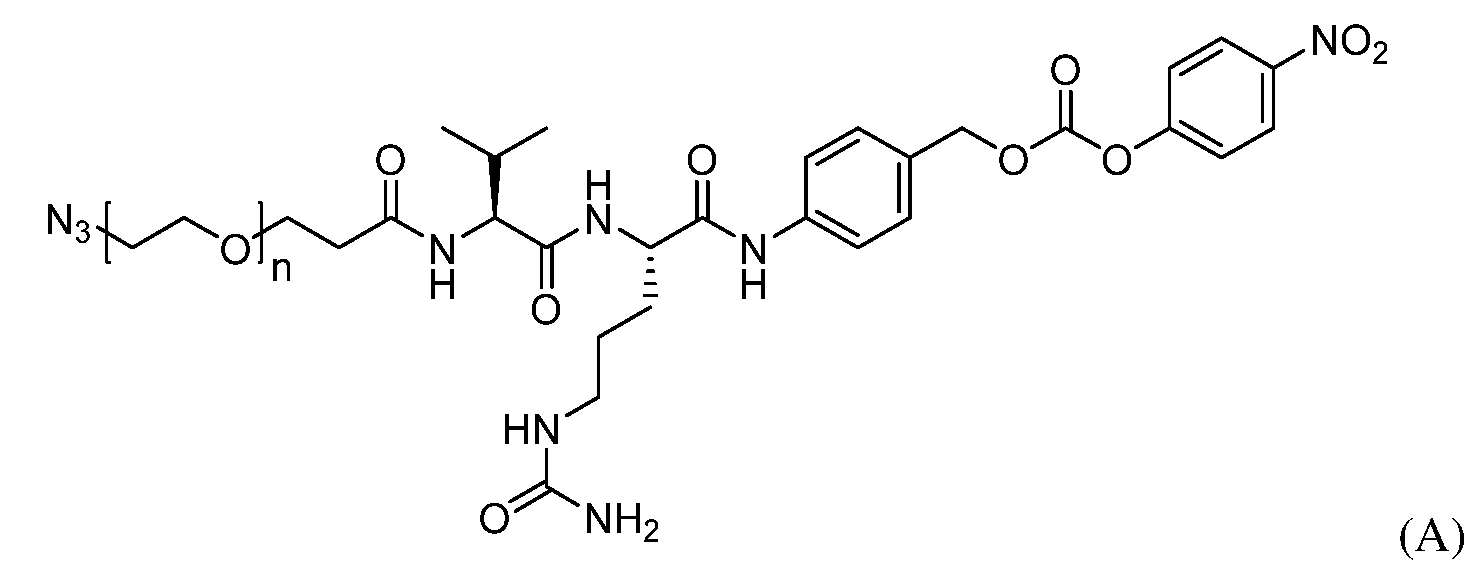
いくつかの態様において、リンカーは、以下の構造を含む。

いくつかの態様において、リンカーは、以下の構造を含む。

ii.切断不能なリンカー
いくつかの態様において、切断不能なリンカーが使用されてもよい。一般に、切断不能なリンカーは、細胞環境または生理環境において容易に分解され得ない。いくつかの態様において、切断不能なリンカーは、任意に置換されていてもよいアルキル基を含むが、ここで置換は、ハロゲン、ヒドロキシル基、酸素種、および他の一般的な置換を含んでいてもよい。いくつかの態様において、リンカーは、任意に置換されていてもよいアルキル、任意に置換されていてもよいアルキレン、任意に置換されていてもよいアリーレン、ヘテロアリーレン、少なくとも1個の非天然アミノ酸を含むペプチド配列、トランケートされたグリカン、酵素的に分解され得ない糖(単数もしくは複数)、アジド、アルキン-アジド、LPXT配列を含むペプチド配列、チオエーテル、ビオチン、ビフェニル、反復単位のポリエチレングリコールもしくは等価な化合物、酸エステル、酸アミド、スルファミド、および/または、アルコキシ-アミンリンカーを含んでいてもよい。いくつかの態様において、ソルターゼ媒介ライゲーションは、LPXT配列を含む抗TfR1抗体を、(G)n配列を含む分子ペイロードへ共有結合的に連結するために利用され得る(例として、Proft T.Sortase-mediated protein ligation:an emerging biotechnology tool for protein modification and immobilization.Biotechnol Lett.2010,32(1):1-10.を参照されたい)。
ii. Non-cleavable linkers In some embodiments, non-cleavable linkers may be used. In general, non-cleavable linkers are not easily degraded in cellular or physiological environments. In some embodiments, non-cleavable linkers include optionally substituted alkyl groups, where the substitutions may include halogens, hydroxyl groups, oxygen species, and other common substitutions. In some embodiments, linkers may include optionally substituted alkyl, optionally substituted alkylene, optionally substituted arylene, heteroarylene, peptide sequences containing at least one unnatural amino acid, truncated glycans, sugar(s) that cannot be enzymatically degraded, azide, alkyne-azide, peptide sequences containing LPXT sequences, thioether, biotin, biphenyl, repeating units of polyethylene glycol or equivalent compounds, acid ester, acid amide, sulfamide, and/or alkoxy-amine linkers. In some embodiments, sortase-mediated ligation may be utilized to covalently link an anti-TfR1 antibody comprising an LPXT sequence to a molecular payload comprising a (G) n sequence (see, e.g., Proft T. Sortase-mediated protein ligation: an emerging biotechnology tool for protein modification and immobilization. Biotechnol Lett. 2010, 32(1):1-10.).
いくつかの態様において、リンカーは、置換されたアルキレン、任意に置換されていてもよいアルケニレン、任意に置換されていてもよいアルキニレン、任意に置換されていてもよいシクロアルキレン、任意に置換されていてもよいシクロアルケニレン、任意に置換されていてもよいアリーレン、N、O、およびSから選択される少なくとも1個のヘテロ原子をさらに含む任意に置換されていてもよいヘテロアリーレン、N、O、およびSから選択される少なくとも1個のヘテロ原子をさらに含む任意に置換されていてもよいヘテロシクリレン、イミノ、任意に置換されていてもよい窒素種、任意に置換されていてもよい酸素種O、任意に置換されていてもよい硫黄種、またはポリ(アルキレンオキシド)、例として、ポリエチレンオキシドまたはポリプロピレンオキシドを含んでいてもよい。いくつかの態様において、リンカーは、切断不能なN-ガンマ-マレイミドブチリル-オキシスクシンイミドエステル(GMBS)リンカーであり得る。 In some embodiments, the linker may comprise a substituted alkylene, an optionally substituted alkenylene, an optionally substituted alkynylene, an optionally substituted cycloalkylene, an optionally substituted cycloalkenylene, an optionally substituted arylene, an optionally substituted heteroarylene further comprising at least one heteroatom selected from N, O, and S, an optionally substituted heterocyclylene further comprising at least one heteroatom selected from N, O, and S, an imino, an optionally substituted nitrogen species, an optionally substituted oxygen species O, an optionally substituted sulfur species, or a poly(alkylene oxide), such as polyethylene oxide or polypropylene oxide. In some embodiments, the linker may be a non-cleavable N-gamma-maleimidobutyryl-oxysuccinimide ester (GMBS) linker.
iii.リンカーのコンジュゲーション
いくつかの態様において、リンカーは、ホスファート、チオエーテル、エーテル、炭素-炭素、カルバマート、またはアミド結合を介して抗TfR1抗体および/または(例として、および)分子ペイロードに共有結合的に連結されている。いくつかの態様において、リンカーは、ホスファートまたはホスホロチオアート基、例として、オリゴヌクレオチド主鎖の末端のホスファートを介してオリゴヌクレオチドに共有結合的に連結されている。いくつかの態様において、リンカーは、抗TfR1抗体上に存在するリシン残基またはシステイン残基を介して、抗TfR1抗体に共有結合的に連結されている。
iii. Linker conjugation In some embodiments, the linker is covalently linked to the anti-TfR1 antibody and/or (for example and) the molecular payload via phosphate, thioether, ether, carbon-carbon, carbamate, or amide bond. In some embodiments, the linker is covalently linked to the oligonucleotide via a phosphate or phosphorothioate group, for example, the phosphate at the end of the oligonucleotide backbone. In some embodiments, the linker is covalently linked to the anti-TfR1 antibody via a lysine or cysteine residue present on the anti-TfR1 antibody.
いくつかの態様において、リンカーまたはその一部が、トリアゾールを形成するアジドとアルキンとの間のシクロ付加反応によって、抗TfR1抗体および/または(例として、および)分子ペイロードに共有結合的に連結されており、アジドまたはアルキンは、抗TfR1抗体、分子ペイロード、またはリンカー上に位置し得る。いくつかの態様において、アルキンは、環状アルキン、例としてシクロオクチンであってもよい。いくつかの態様において、アルキンは、ビシクロノニン(またビシクロ[6.1.0]ノニンまたはBCNとしても知られている)または置換ビシクロノニンであってもよい。いくつかの態様において、シクロオクタンは、2011年11月3日公開の国際公開第2011136645号、表題「Fused Cyclooctyne Compounds And Their Use In Metal-free Click Reactions」に記載のとおりである。いくつかの態様において、アジドは、アジドを含む糖または炭水化物分子であってもよい。いくつかの態様において、アジドは、6-アジド-6-デオキシガラクトースまたは6-アジド-N-アセチルガラクトサミンであってもよい。いくつかの態様において、アジドを含む糖または炭水化物分子は、2016年10月27日公開の国際公開第2016170186号、表題「Process For The Modification Of A Glycoprotein Using A Glycosyltransferase That Is Or Is Derived From A β(1,4)-N-Acetylgalactosaminyltransferase」に記載のとおりである。いくつかの態様において、トリアゾールを形成するアジドとアルキンとの間のシクロ付加反応(ここでアジドおよびアルキンは、抗TfR1抗体、分子ペイロード、またはリンカー上に位置し得る)は、2014年5月1日に公開の国際公開第2014065661号、表題「Modified antibody,antibody-conjugate and process for the preparation thereof」;または2016年10月27日に公開の国際公開第2016170186号、表題「Process For The Modification Of A Glycoprotein Using A Glycosyltransferase That Is Or Is Derived From A β(1,4)-N-Acetylgalactosaminyltransferase」に記載のとおりである。 In some embodiments, the linker or a portion thereof is covalently linked to the anti-TfR1 antibody and/or (for example and) the molecular payload by a cycloaddition reaction between an azide and an alkyne forming a triazole, the azide or alkyne may be located on the anti-TfR1 antibody, the molecular payload, or the linker. In some embodiments, the alkyne may be a cyclic alkyne, for example, a cyclooctyne. In some embodiments, the alkyne may be a bicyclononyne (also known as bicyclo[6.1.0]nonyne or BCN) or a substituted bicyclononyne. In some embodiments, the cyclooctane is as described in International Publication No. 2011136645, published November 3, 2011, entitled "Fused Cyclooctyne Compounds And Their Use In Metal-free Click Reactions." In some embodiments, the azide may be an azide-containing sugar or carbohydrate molecule. In some embodiments, the azide may be 6-azido-6-deoxygalactose or 6-azido-N-acetylgalactosamine. In some embodiments, the azide-containing sugar or carbohydrate molecule is as described in International Publication No. WO 2016170186, published October 27, 2016, entitled "Process For The Modification Of A Glycoprotein Using A Glycosyltransferase That Is Or Is Derived From A β(1,4)-N-Acetylgalactosaminyltransferase." In some embodiments, the cycloaddition reaction between an azide and an alkyne to form a triazole (wherein the azide and alkyne can be located on the anti-TfR1 antibody, the molecular payload, or the linker) is as described in WO 2014065661, published May 1, 2014, entitled "Modified antibody, antibody-conjugate and process for the preparation thereof"; or WO 2016170186, published October 27, 2016, entitled "Process For The Modification Of A Glycoprotein Using A Glycosyltransferase That Is Or Is Derived From A β(1,4)-N-Acetylgalactosaminyltransferase."
いくつかの態様において、リンカーは、スペーサー、例として、ポリエチレングリコールスペーサーまたはアシル/カルバモイルスルファミドスペーサー、例として、HydraSpace(商標)スペーサーを含む。いくつかの態様において、スペーサーは、Verkade,J.M.M.et al.,「A Polar Sulfamide Spacer Significantly Enhances the Manufacturability,Stability,and Therapeutic Index of Antibody-Drug Conjugates」,Antibodies,2018,7,12に記載のとおりである。 In some embodiments, the linker comprises a spacer, e.g., a polyethylene glycol spacer or an acyl/carbamoyl sulfamide spacer, e.g., a HydraSpace™ spacer. In some embodiments, the spacer is as described in Verkade, J.M.M. et al., "A Polar Sulfamide Spacer Significantly Enhances the Manufacturability, Stability, and Therapeutic Index of Antibody-Drug Conjugates", Antibodies, 2018, 7, 12.
いくつかの態様において、リンカーは、求ジエン体とジエン/ヘテロ-ジエンとの間のディールス・アルダー反応によって、抗TfR1抗体および/または(例として、および)分子ペイロードに共有結合的に連結されるが、求ジエン体またはジエン/ヘテロ-ジエンは、抗TfR1抗体、分子ペイロード、またはリンカー上に位置し得る。いくつかの態様において、リンカーは、エン反応などの他のペリ環状反応によって、抗TfR1抗体および/または(例として、および)分子ペイロードに共有結合的に連結される。いくつかの態様において、リンカーは、アミド、チオアミド、またはスルホンアミド結合反応によって、抗TfR1抗体および/または(例として、および)分子ペイロードに共有結合的に連結される。いくつかの態様において、リンカーは、リンカーと抗TfR1抗体および/または(例として、および)分子ペイロードとの間に存在するオキシム基、ヒドラゾン基、またはセミカルバジド基を形成する縮合反応によって、抗TfR1抗体および/または(例として、および)分子ペイロードに共有結合的に連結される。 In some embodiments, the linker is covalently linked to the anti-TfR1 antibody and/or (for example and) the molecular payload by a Diels-Alder reaction between a dienophile and a diene/hetero-diene, although the dienophile or diene/hetero-diene may be located on the anti-TfR1 antibody, the molecular payload, or the linker. In some embodiments, the linker is covalently linked to the anti-TfR1 antibody and/or (for example and) the molecular payload by other pericyclic reactions such as ene reactions. In some embodiments, the linker is covalently linked to the anti-TfR1 antibody and/or (for example and) the molecular payload by an amide, thioamide, or sulfonamide coupling reaction. In some embodiments, the linker is covalently linked to the anti-TfR1 antibody and/or (for example and) the molecular payload by a condensation reaction forming an oxime group, a hydrazone group, or a semicarbazide group present between the linker and the anti-TfR1 antibody and/or (for example and) the molecular payload.
いくつかの態様において、リンカーは、求核試薬、例として、アミン基またはヒドロキシル基と求電子試薬、例として、カルボン酸、カーボナート、またはアルデヒドとの間の共役付加反応によって、抗TfR1抗体および/または(例として、および)分子ペイロードに共有結合的に連結される。いくつかの態様において、リンカーと抗TfR1抗体または分子ペイロードとの間の反応に先立ち、求核試薬はリンカー上に存在し得、求電子試薬は抗TfR1抗体または分子ペイロード上に存在し得る。いくつかの態様において、リンカーと抗TfR1抗体または分子ペイロードとの間の反応に先立ち、求電子試薬はリンカー上に存在し得、求核試薬は抗TfR1抗体または分子ペイロード上に存在し得る。いくつかの態様において、求電子試薬は、アジド、ペンタフルオロフェニル、ケイ素中心、カルボニル、カルボン酸、無水物、イソシアナート、チオイソシアナート、スクシニミジルエステル、スルホスクシニミジルエステル、マレイミド、アルキルハロゲン化物、アルキル擬ハロゲン化物、エポキシド、エピスルフィド、アジリジン、アリール、活性化リン中心、および/または、活性化硫黄中心であってもよい。いくつかの態様において、求核試薬は、任意に置換されていてもよいアルケン、任意に置換されていてもよいアルキン、任意に置換されていてもよいアリール、任意に置換されていてもよいヘテロシクリル、ヒドロキシル基、アミノ基、アルキルアミノ基、アニリド基、および/またはチオール基であってもよい。 In some embodiments, the linker is covalently linked to the anti-TfR1 antibody and/or (for example and) the molecular payload by a conjugate addition reaction between a nucleophile, for example an amine group or a hydroxyl group, and an electrophile, for example a carboxylic acid, carbonate, or aldehyde. In some embodiments, prior to the reaction between the linker and the anti-TfR1 antibody or the molecular payload, the nucleophile can be present on the linker and the electrophile can be present on the anti-TfR1 antibody or the molecular payload. In some embodiments, prior to the reaction between the linker and the anti-TfR1 antibody or the molecular payload, the electrophile can be present on the linker and the nucleophile can be present on the anti-TfR1 antibody or the molecular payload. In some embodiments, the electrophile may be an azide, pentafluorophenyl, silicon center, carbonyl, carboxylic acid, anhydride, isocyanate, thioisocyanate, succinimidyl ester, sulfosuccinimidyl ester, maleimide, alkyl halide, alkyl pseudohalide, epoxide, episulfide, aziridine, aryl, activated phosphorus center, and/or activated sulfur center. In some embodiments, the nucleophile may be an optionally substituted alkene, an optionally substituted alkyne, an optionally substituted aryl, an optionally substituted heterocyclyl, a hydroxyl group, an amino group, an alkylamino group, an anilide group, and/or a thiol group.
いくつかの態様において、リンカーは、反応性化学部分(例として、クリックケミストリーのためのアジド部分またはBCN部分)に共有結合的に連結されたバリン-シトルリン配列を含む。いくつかの態様において、反応性化学部分(例として、クリックケミストリーのためのアジド部分)に共有結合的に連結されたバリン-シトルリン配列を含むリンカーは、以下の構造を含む。

いくつかの態様において、式(A)の構造を含むリンカーは、分子ペイロード(例として、オリゴヌクレオチド)に(例として、任意に追加の化学部分を介して)共有結合的に連結されている。いくつかの態様において、式(A)の構造を含むリンカーは、例として、カルバメート結合を形成するアミン-L1-オリゴヌクレオチドによる求核置換を介して、オリゴヌクレオチドに共有結合的に連結され、以下の構造を含む化合物を生じる。

いくつかの態様において、式(B)の化合物はさらに、トリアゾールを介してさらなる部分に共有結合的に連結され、トリアゾールは、式(A)または式(B)のアジドと、ビシクロノニン上に提供されるアルキンとの間のクリック反応によって形成される。いくつかの態様において、ビシクロノニンを含む化合物は、以下の構造を含む。

いくつかの態様において、構造(B)の化合物のアジドは、構造(C)の化合物のアルキンとのクリック反応を介してトリアゾールを形成し、以下の構造を含む化合物を形成する。

いくつかの態様において、構造(D)の化合物はさらに、抗TfR1抗体のリジンに共有結合的に連結され、以下の構造を含む複合体を形成する。

いくつかの態様において、式(C)の化合物はさらに、抗TfR1抗体のリジンに共有結合的に連結され、以下の構造を含む化合物を形成する。

いくつかの態様において、構造(B)の化合物のアジドは、構造(F)の化合物のアルキンとのクリック反応を介してトリアゾールを形成し、以下の構造を含む複合体を形成する。

いくつかの態様において、構造(A)の化合物のアジドは、構造(F)の化合物のアルキンとのクリック反応を介してトリアゾールを形成し、以下の構造を含む化合物を形成する。

いくつかの態様において、本明細書に記載の複合体のいずれか1つにおいて、抗TfR1抗体は、抗TfR1抗体のリジンを介し、以下の構造を含むリンカーを介して分子ペイロード(例として、オリゴヌクレオチド)に共有結合的に連結されている。

いくつかの態様において、本明細書に記載の複合体のいずれか1つにおいて、抗TfR1抗体は、抗TfR1抗体のリジンを介し、以下の構造を含むリンカーを介して分子ペイロード(例として、オリゴヌクレオチド)に共有結合的に連結されている。

いくつかの態様において、式(B)、(D)、(E)、および(I)中、L1は、いくつかの態様において、置換もしくは非置換の脂肪族、置換もしくは非置換のヘテロ脂肪族、置換もしくは非置換のカルボシクリレン、置換もしくは非置換のヘテロシクリレン、置換もしくは非置換のアリーレン、置換もしくは非置換のヘテロアリーレン、-O-、-N(RA)-、-S-、-C(=O)-、-C(=O)O-、-C(=O)NRA-、-NRAC(=O)-、-NRAC(=O)RA-、-C(=O)RA-、-NRAC(=O)O-、-NRAC(=O)N(RA)-、-OC(=O)-、-OC(=O)O-、-OC(=O)N(RA)-、-S(O)2NRA-、-NRAS(O)2-、またはそれらの組み合わせであるスペーサーであり、RAは、独立して、水素または置換もしくは非置換アルキルである。いくつかの態様において、L1は、

(式中、L2は、

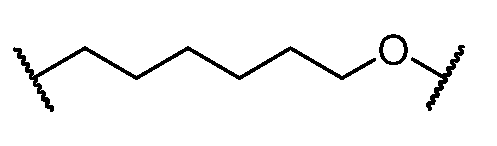
(Wherein, L2 is
いくつかの態様において、L1は、

いくつかの態様において、L1は、

いくつかの態様において、L1は、オリゴヌクレオチドの5'ホスファートへ連結される。いくつかの態様において、L1は、オリゴヌクレオチドの5'ホスホロチオアートへ連結される。いくつかの態様において、L1は、オリゴヌクレオチドの5'ホスホロアミダートへ連結される。 In some embodiments, L1 is linked to the 5' phosphate of the oligonucleotide. In some embodiments, L1 is linked to the 5' phosphorothioate of the oligonucleotide. In some embodiments, L1 is linked to the 5' phosphoroamidate of the oligonucleotide.
いくつかの態様において、L1は、オリゴヌクレオチドの5'ホスファートへ連結される。いくつかの態様において、オリゴヌクレオチドの5'リン酸へのL1の結合は、L1とオリゴヌクレオチドとの間にホスホジエステル結合を形成する。 In some embodiments, L1 is linked to the 5' phosphate of the oligonucleotide. In some embodiments, the attachment of L1 to the 5' phosphate of the oligonucleotide forms a phosphodiester bond between L1 and the oligonucleotide.
いくつかの態様において、L1は、オリゴヌクレオチドの3'ホスファートへ連結される。いくつかの態様において、オリゴヌクレオチドの3'リン酸へのL1の結合は、L1とオリゴヌクレオチドとの間にホスホジエステル結合を形成する。 In some embodiments, L1 is linked to the 3' phosphate of the oligonucleotide. In some embodiments, the attachment of L1 to the 3' phosphate of the oligonucleotide forms a phosphodiester bond between L1 and the oligonucleotide.
いくつかの態様において、L1は、任意である(例として、存在する必要はない)。 In some embodiments, L1 is optional (e.g., it need not be present).
いくつかの態様において、本明細書に記載の複合体のいずれか1つは、以下の構造を有する。

いくつかの態様において、本明細書に記載の複合体のいずれか1つは、以下の構造を有する。

いくつかの態様において、オリゴヌクレオチドは、化合物、例として、式(A)または式(G)の化合物に連結する前に、5'末端もしくは3'末端に、または内部に(例として、アミン官能化核酸塩基として)アミン基を含むように修飾される。 In some embodiments, the oligonucleotide is modified to include an amine group at the 5' or 3' end, or internally (e.g., as an amine-functionalized nucleobase) prior to linking to a compound, e.g., a compound of formula (A) or formula (G).
リンカー結合は抗TfR1抗体およびオリゴヌクレオチド分子ペイロードに関連して説明されているが、当然のことながら、他の筋標的化抗体などの他の筋標的化剤および/または他の分子ペイロードに対するそのようなリンカー結合の使用が企図される。 Although the linker linkages are described in relation to anti-TfR1 antibodies and oligonucleotide molecular payloads, it will be appreciated that the use of such linker linkages for other muscle targeting agents, such as other muscle targeting antibodies, and/or other molecular payloads is contemplated.
D.抗体-分子ペイロード複合体の例
本明細書に記載の分子ペイロード(例として、オリゴヌクレオチド)のいずれかへ共有結合的に連結された、本明細書に記載のいずれか1つの抗TfR1抗体を含む複合体の非限定的な例が、本明細書にさらに提供される。いくつかの態様において、抗TfR1抗体(例として、表2~7に示される抗TfR1抗体のいずれか1つ)は、リンカーを介して分子ペイロード(例として、表8に示されるオリゴヌクレオチドなどのオリゴヌクレオチド)に共有結合的に連結されている。本明細書に記載のリンカーのいずれも、使用されてもよい。いくつかの態様において、分子ペイロードがオリゴヌクレオチドである場合、リンカーは、オリゴヌクレオチドの5'末端、3'末端、または内部へ共有結合的に連結されている。いくつかの態様において、リンカーは、チオール反応性の連結を介して(例として、抗TfR1抗体中のシステインを介して)抗TfR1抗体に共有結合的に連結されている。いくつかの態様において、リンカーは、抗体(例として、本明細書に記載の抗TfR1抗体)にアミン基を介して(例として、抗体中のリシンを介して)共有結合的に連結されている。いくつかの態様において、分子ペイロードは、FXN標的化オリゴヌクレオチド(例として、表8に列挙されるFXN標的化オリゴヌクレオチド)である。
D. Examples of Antibody-Molecular Payload Conjugates Further provided herein are non-limiting examples of conjugates comprising any one of the anti-TfR1 antibodies described herein covalently linked to any of the molecular payloads described herein (e.g., oligonucleotides). In some embodiments, the anti-TfR1 antibody (e.g., any one of the anti-TfR1 antibodies shown in Tables 2-7) is covalently linked to the molecular payload (e.g., an oligonucleotide such as the oligonucleotides shown in Table 8) via a linker. Any of the linkers described herein may be used. In some embodiments, when the molecular payload is an oligonucleotide, the linker is covalently linked to the 5' end, 3' end, or internally of the oligonucleotide. In some embodiments, the linker is covalently linked to the anti-TfR1 antibody via a thiol-reactive linkage (e.g., via a cysteine in the anti-TfR1 antibody). In some embodiments, the linker is covalently linked to the antibody (e.g., an anti-TfR1 antibody described herein) via an amine group (e.g., via a lysine in the antibody). In some embodiments, the molecular payload is an FXN-targeting oligonucleotide (eg, an FXN-targeting oligonucleotide listed in Table 8).
リンカーを介して分子ペイロードに共有結合的に連結された抗TfR1抗体を含む複合体の構造の例が、以下に提供される。

リンカーを介して分子ペイロードに共有結合的に連結した抗TfR1抗体を含む複合体の構造の別の例を以下に提供される。
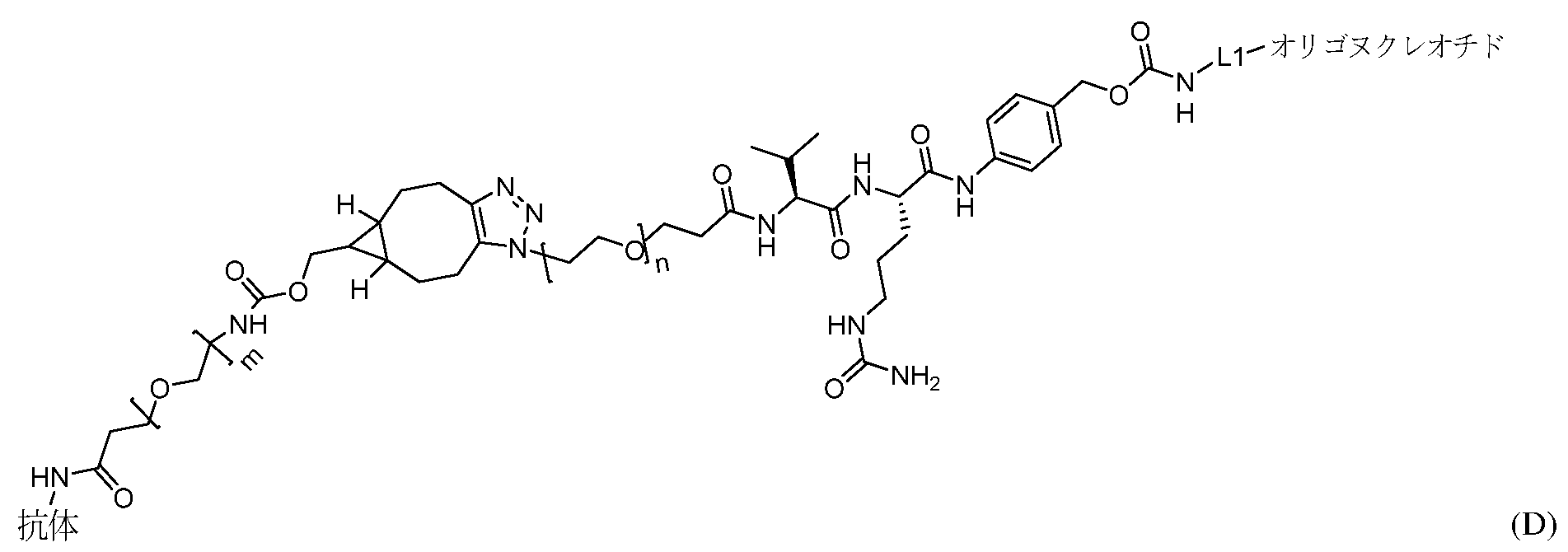
いくつかの態様において、L1は、

In some embodiments, L1 is
当然のことながら、抗体は、種々の化学量論で分子ペイロードに共有結合的に連結され得、その特性は薬物抗体比(DAR)と称されてもよく、「薬物」は分子ペイロードである。いくつかの態様において、1つの分子ペイロードが抗体共有結合的に連結されている(DAR=1)。いくつかの態様において、2つの分子ペイロードが抗体共有結合的に連結されている(DAR=2)。いくつかの態様において、3つの分子ペイロードが抗体共有結合的に連結されている(DAR=3)。いくつかの態様において、4つの分子ペイロードが抗体共有結合的に連結されている(DAR=4)。いくつかの態様において、各々が異なるDARを有する異なる複合体の混合物が提供される。いくつかの態様において、かかる混合物中の複合体の平均DARは、1から3、1から4、1から5、またはそれ以上の範囲にあり得る。DARは、分子ペイロードを抗体上の種々の部位へコンジュゲートさせることによって、かつ/または(例として、かつ)、マルチマーを抗体上の1以上の部位へコンジュゲートさせることによって、増大され得る。例えば、2のDARは、単一分子ペイロードを抗体上の2つの異なる部位へコンジュゲートさせることによって、または二量体分子ペイロードを抗体の単一部位へコンジュゲートさせることによって、達成され得る。 Of course, the antibody may be covalently linked to the molecular payload with various stoichiometries, a property that may be referred to as the drug-antibody ratio (DAR), where the "drug" is the molecular payload. In some embodiments, one molecular payload is covalently linked to the antibody (DAR=1). In some embodiments, two molecular payloads are covalently linked to the antibody (DAR=2). In some embodiments, three molecular payloads are covalently linked to the antibody (DAR=3). In some embodiments, four molecular payloads are covalently linked to the antibody (DAR=4). In some embodiments, a mixture of different conjugates, each having a different DAR, is provided. In some embodiments, the average DAR of the conjugates in such a mixture may range from 1 to 3, 1 to 4, 1 to 5, or more. The DAR may be increased by conjugating the molecular payload to various sites on the antibody and/or (by way of example and) by conjugating a multimer to one or more sites on the antibody. For example, a DAR of 2 can be achieved by conjugating a single molecular payload to two different sites on an antibody, or by conjugating a dimeric molecular payload to a single site on an antibody.
いくつかの態様において、本明細書に記載の複合体は、分子ペイロードに共有結合的に連結した本明細書に記載の抗TfR1抗体(例として、表2~7に示される抗体)を含む。いくつかの態様において、本明細書に記載の複合体は、分子ペイロードにリンカーを介して共有結合的に連結した本明細書に記載の抗TfR1抗体(例として、表2~7に提供される抗体)を含む。いくつかの態様において、リンカーは、チオール反応性の連結を介して(例として、抗体中のシステインを介して)、抗体(例として、本明細書に記載される抗TfR1抗体)に共有結合的に連結されている。いくつかの態様において、リンカーは、抗体(例として、本明細書に記載の抗TfR1抗体)にアミン基を介して(例として、抗体中のリシンを介して)共有結合的に連結されている。いくつかの態様において、分子ペイロードは、FXN標的化オリゴヌクレオチド(例として、表8に列挙されるFXN標的化オリゴヌクレオチド)である。 In some embodiments, the conjugates described herein comprise an anti-TfR1 antibody described herein (e.g., an antibody shown in Tables 2-7) covalently linked to a molecular payload. In some embodiments, the conjugates described herein comprise an anti-TfR1 antibody described herein (e.g., an antibody shown in Tables 2-7) covalently linked to a molecular payload via a linker. In some embodiments, the linker is covalently linked to the antibody (e.g., an anti-TfR1 antibody described herein) via a thiol-reactive linkage (e.g., via a cysteine in the antibody). In some embodiments, the linker is covalently linked to the antibody (e.g., an anti-TfR1 antibody described herein) via an amine group (e.g., via a lysine in the antibody). In some embodiments, the molecular payload is an FXN-targeting oligonucleotide (e.g., an FXN-targeting oligonucleotide listed in Table 8).
いくつかの態様において、本明細書に記載される複合体は、分子ペイロードに共有結合的に連結された抗TfR1抗体を含み、抗TfR1抗体は、表2に列挙される抗体のいずれか1つのCDR-H1、CDR-H2、CDR-H3、CDR-L1、CDR-L2、およびCDR-L3を含む。いくつかの態様において、分子ペイロードは、FXN標的化オリゴヌクレオチド(例として、表8に列挙されるFXN標的化オリゴヌクレオチド)である。 In some embodiments, the conjugates described herein comprise an anti-TfR1 antibody covalently linked to a molecular payload, the anti-TfR1 antibody comprising the CDR-H1, CDR-H2, CDR-H3, CDR-L1, CDR-L2, and CDR-L3 of any one of the antibodies listed in Table 2. In some embodiments, the molecular payload is an FXN-targeting oligonucleotide (e.g., an FXN-targeting oligonucleotide listed in Table 8).
いくつかの態様において、本明細書に記載の複合体は、分子ペイロードへ共有結合的に連結された抗TfR1抗体を含み、抗TfR1抗体は、配列番号69、配列番号71または配列番号72のアミノ酸配列を含むVH、および配列番号70のアミノ酸配列を含むVLを含む。いくつかの態様において、分子ペイロードは、FXN標的化オリゴヌクレオチド(例として、表8に列挙されるFXN標的化オリゴヌクレオチド)である。 In some embodiments, the conjugates described herein comprise an anti-TfR1 antibody covalently linked to a molecular payload, the anti-TfR1 antibody comprising a VH comprising the amino acid sequence of SEQ ID NO:69, SEQ ID NO:71, or SEQ ID NO:72, and a VL comprising the amino acid sequence of SEQ ID NO:70. In some embodiments, the molecular payload is an FXN-targeting oligonucleotide (e.g., an FXN-targeting oligonucleotide listed in Table 8).
いくつかの態様において、本明細書に記載の複合体は、分子ペイロードへ共有結合的に連結された抗TfR1抗体を含み、抗TfR1抗体は、配列番号73または配列番号76のアミノ酸配列を含むVH、および配列番号74のアミノ酸配列を含むVLを含む。いくつかの態様において、分子ペイロードは、FXN標的化オリゴヌクレオチド(例として、表8に列挙されるFXN標的化オリゴヌクレオチド)である。 In some embodiments, the conjugates described herein comprise an anti-TfR1 antibody covalently linked to a molecular payload, the anti-TfR1 antibody comprising a VH comprising the amino acid sequence of SEQ ID NO: 73 or SEQ ID NO: 76, and a VL comprising the amino acid sequence of SEQ ID NO: 74. In some embodiments, the molecular payload is an FXN-targeting oligonucleotide (e.g., an FXN-targeting oligonucleotide listed in Table 8).
いくつかの態様において、本明細書に記載の複合体は、分子ペイロードへ共有結合的に連結された抗TfR1抗体を含み、抗TfR1抗体は、配列番号73または配列番号76のアミノ酸配列を含むVH、および配列番号75のアミノ酸配列を含むVLを含む。いくつかの態様において、分子ペイロードは、FXN標的化オリゴヌクレオチド(例として、表8に列挙されるFXN標的化オリゴヌクレオチド)である。 In some embodiments, the conjugates described herein comprise an anti-TfR1 antibody covalently linked to a molecular payload, the anti-TfR1 antibody comprising a VH comprising the amino acid sequence of SEQ ID NO: 73 or SEQ ID NO: 76, and a VL comprising the amino acid sequence of SEQ ID NO: 75. In some embodiments, the molecular payload is an FXN-targeting oligonucleotide (e.g., an FXN-targeting oligonucleotide listed in Table 8).
いくつかの態様において、本明細書に記載の複合体は、分子ペイロードへ共有結合的に連結された抗TfR1抗体を含み、抗TfR1抗体は、配列番号77を含むVHおよび配列番号78のアミノ酸配列を含むVLを含む。いくつかの態様において、分子ペイロードは、FXN標的化オリゴヌクレオチド(例として、表8に列挙されるFXN標的化オリゴヌクレオチド)である。 In some embodiments, the conjugates described herein comprise an anti-TfR1 antibody covalently linked to a molecular payload, the anti-TfR1 antibody comprising a VH comprising SEQ ID NO: 77 and a VL comprising the amino acid sequence of SEQ ID NO: 78. In some embodiments, the molecular payload is an FXN-targeting oligonucleotide (e.g., an FXN-targeting oligonucleotide listed in Table 8).
いくつかの態様において、本明細書に記載の複合体は、分子ペイロードへ共有結合的に連結された抗TfR1抗体を含み、抗TfR1抗体は、配列番号77または配列番号79のアミノ酸配列を含むVH、および配列番号80のアミノ酸配列を含むVLを含む。いくつかの態様において、分子ペイロードは、FXN標的化オリゴヌクレオチド(例として、表8に列挙されるFXN標的化オリゴヌクレオチド)である。 In some embodiments, the conjugates described herein comprise an anti-TfR1 antibody covalently linked to a molecular payload, the anti-TfR1 antibody comprising a VH comprising the amino acid sequence of SEQ ID NO: 77 or SEQ ID NO: 79, and a VL comprising the amino acid sequence of SEQ ID NO: 80. In some embodiments, the molecular payload is an FXN-targeting oligonucleotide (e.g., an FXN-targeting oligonucleotide listed in Table 8).
いくつかの態様において、本明細書に記載の複合体は、分子ペイロードへ共有結合的に連結された抗TfR1抗体を含み、抗TfR1抗体は、配列番号154を含むVHおよび配列番号155のアミノ酸配列を含むVLを含む。いくつかの態様において、分子ペイロードは、FXN標的化オリゴヌクレオチド(例として、表8に列挙されるFXN標的化オリゴヌクレオチド)である。 In some embodiments, the conjugates described herein comprise an anti-TfR1 antibody covalently linked to a molecular payload, the anti-TfR1 antibody comprising a VH comprising SEQ ID NO: 154 and a VL comprising the amino acid sequence of SEQ ID NO: 155. In some embodiments, the molecular payload is an FXN-targeting oligonucleotide (e.g., an FXN-targeting oligonucleotide listed in Table 8).
いくつかの態様において、本明細書に記載の複合体は、分子ペイロードへ共有結合的に連結された抗TfR1抗体を含み、抗TfR1抗体は、配列番号84、配列番号86または配列番号87のアミノ酸配列を含む重鎖、および配列番号85のアミノ酸配列を含む軽鎖を含む。いくつかの態様において、分子ペイロードは、FXN標的化オリゴヌクレオチド(例として、表8に列挙されるFXN標的化オリゴヌクレオチド)である。 In some embodiments, the conjugates described herein comprise an anti-TfR1 antibody covalently linked to a molecular payload, the anti-TfR1 antibody comprising a heavy chain comprising the amino acid sequence of SEQ ID NO:84, SEQ ID NO:86, or SEQ ID NO:87, and a light chain comprising the amino acid sequence of SEQ ID NO:85. In some embodiments, the molecular payload is an FXN-targeting oligonucleotide (e.g., an FXN-targeting oligonucleotide listed in Table 8).
いくつかの態様において、本明細書に記載の複合体は、分子ペイロードへ共有結合的に連結された抗TfR1抗体を含み、抗TfR1抗体は、配列番号88または配列番号91のアミノ酸配列を含む重鎖、および配列番号89のアミノ酸配列を含む軽鎖を含む。いくつかの態様において、分子ペイロードは、FXN標的化オリゴヌクレオチド(例として、表8に列挙されるFXN標的化オリゴヌクレオチド)である。 In some embodiments, the conjugates described herein comprise an anti-TfR1 antibody covalently linked to a molecular payload, the anti-TfR1 antibody comprising a heavy chain comprising the amino acid sequence of SEQ ID NO:88 or SEQ ID NO:91, and a light chain comprising the amino acid sequence of SEQ ID NO:89. In some embodiments, the molecular payload is an FXN-targeting oligonucleotide (e.g., an FXN-targeting oligonucleotide listed in Table 8).
いくつかの態様において、本明細書に記載の複合体は、分子ペイロードへ共有結合的に連結された抗TfR1抗体を含み、抗TfR1抗体は、配列番号88または配列番号91のアミノ酸配列を含む重鎖、および配列番号90のアミノ酸配列を含む軽鎖を含む。いくつかの態様において、分子ペイロードは、FXN標的化オリゴヌクレオチド(例として、表8に列挙されるFXN標的化オリゴヌクレオチド)である。 In some embodiments, the conjugates described herein comprise an anti-TfR1 antibody covalently linked to a molecular payload, the anti-TfR1 antibody comprising a heavy chain comprising the amino acid sequence of SEQ ID NO:88 or SEQ ID NO:91, and a light chain comprising the amino acid sequence of SEQ ID NO:90. In some embodiments, the molecular payload is an FXN-targeting oligonucleotide (e.g., an FXN-targeting oligonucleotide listed in Table 8).
いくつかの態様において、本明細書に記載の複合体は、分子ペイロードへ共有結合的に連結された抗TfR1抗体を含み、抗TfR1抗体は、配列番号92または配列番号94のアミノ酸配列を含む重鎖、および配列番号95のアミノ酸配列を含む軽鎖を含む。いくつかの態様において、分子ペイロードは、FXN標的化オリゴヌクレオチド(例として、表8に列挙されるFXN標的化オリゴヌクレオチド)である。 In some embodiments, the conjugates described herein comprise an anti-TfR1 antibody covalently linked to a molecular payload, the anti-TfR1 antibody comprising a heavy chain comprising the amino acid sequence of SEQ ID NO:92 or SEQ ID NO:94, and a light chain comprising the amino acid sequence of SEQ ID NO:95. In some embodiments, the molecular payload is an FXN-targeted oligonucleotide (e.g., an FXN-targeted oligonucleotide listed in Table 8).
いくつかの態様において、本明細書に記載の複合体は、分子ペイロードへ共有結合的に連結された抗TfR1抗体を含み、抗TfR1抗体は、配列番号92のアミノ酸配列を含む重鎖、および配列番号93のアミノ酸配列を含む軽鎖を含む。いくつかの態様において、分子ペイロードは、FXN標的化オリゴヌクレオチド(例として、表8に列挙されるFXN標的化オリゴヌクレオチド)である。 In some embodiments, the conjugates described herein comprise an anti-TfR1 antibody covalently linked to a molecular payload, the anti-TfR1 antibody comprising a heavy chain comprising the amino acid sequence of SEQ ID NO: 92 and a light chain comprising the amino acid sequence of SEQ ID NO: 93. In some embodiments, the molecular payload is an FXN-targeting oligonucleotide (e.g., an FXN-targeting oligonucleotide listed in Table 8).
いくつかの態様において、本明細書に記載の複合体は、分子ペイロードへ共有結合的に連結された抗TfR1抗体を含み、抗TfR1抗体は、配列番号156のアミノ酸配列を含む重鎖、および配列番号157のアミノ酸配列を含む軽鎖を含む。いくつかの態様において、分子ペイロードは、FXN標的化オリゴヌクレオチド(例として、表8に列挙されるFXN標的化オリゴヌクレオチド)である。 In some embodiments, the conjugates described herein comprise an anti-TfR1 antibody covalently linked to a molecular payload, the anti-TfR1 antibody comprising a heavy chain comprising the amino acid sequence of SEQ ID NO: 156 and a light chain comprising the amino acid sequence of SEQ ID NO: 157. In some embodiments, the molecular payload is an FXN-targeted oligonucleotide (e.g., an FXN-targeted oligonucleotide listed in Table 8).
いくつかの態様において、本明細書に記載の複合体は、分子ペイロードへ共有結合的に連結された抗TfR1抗体を含み、抗TfR1抗体は、配列番号97、配列番号98または配列番号99のアミノ酸配列を含む重鎖、および配列番号85のアミノ酸配列を含むVLを含む。いくつかの態様において、分子ペイロードは、FXN標的化オリゴヌクレオチド(例として、表8に列挙されるFXN標的化オリゴヌクレオチド)である。 In some embodiments, the conjugates described herein comprise an anti-TfR1 antibody covalently linked to a molecular payload, the anti-TfR1 antibody comprising a heavy chain comprising the amino acid sequence of SEQ ID NO:97, SEQ ID NO:98, or SEQ ID NO:99, and a VL comprising the amino acid sequence of SEQ ID NO:85. In some embodiments, the molecular payload is an FXN-targeting oligonucleotide (e.g., an FXN-targeting oligonucleotide listed in Table 8).
いくつかの態様において、本明細書に記載の複合体は、分子ペイロードへ共有結合的に連結された抗TfR1抗体を含み、抗TfR1抗体は、配列番号100または配列番号101のアミノ酸配列を含む重鎖、および配列番号89のアミノ酸配列を含む軽鎖を含む。いくつかの態様において、分子ペイロードは、FXN標的化オリゴヌクレオチド(例として、表8に列挙されるFXN標的化オリゴヌクレオチド)である。 In some embodiments, the conjugates described herein comprise an anti-TfR1 antibody covalently linked to a molecular payload, the anti-TfR1 antibody comprising a heavy chain comprising the amino acid sequence of SEQ ID NO: 100 or SEQ ID NO: 101, and a light chain comprising the amino acid sequence of SEQ ID NO: 89. In some embodiments, the molecular payload is an FXN-targeting oligonucleotide (e.g., an FXN-targeting oligonucleotide listed in Table 8).
いくつかの態様において、本明細書に記載の複合体は、分子ペイロードへ共有結合的に連結された抗TfR1抗体を含み、抗TfR1抗体は、配列番号100または配列番号101のアミノ酸配列を含む重鎖、および配列番号90のアミノ酸配列を含む軽鎖を含む。いくつかの態様において、分子ペイロードは、FXN標的化オリゴヌクレオチド(例として、表8に列挙されるFXN標的化オリゴヌクレオチド)である。 In some embodiments, the conjugates described herein comprise an anti-TfR1 antibody covalently linked to a molecular payload, the anti-TfR1 antibody comprising a heavy chain comprising the amino acid sequence of SEQ ID NO: 100 or SEQ ID NO: 101, and a light chain comprising the amino acid sequence of SEQ ID NO: 90. In some embodiments, the molecular payload is an FXN-targeting oligonucleotide (e.g., an FXN-targeting oligonucleotide listed in Table 8).
いくつかの態様において、本明細書に記載の複合体は、分子ペイロードへ共有結合的に連結された抗TfR1抗体を含み、抗TfR1抗体は、配列番号102のアミノ酸配列を含む重鎖、および配列番号93のアミノ酸配列を含む軽鎖を含む。いくつかの態様において、分子ペイロードは、FXN標的化オリゴヌクレオチド(例として、表8に列挙されるFXN標的化オリゴヌクレオチド)である。 In some embodiments, the conjugates described herein comprise an anti-TfR1 antibody covalently linked to a molecular payload, the anti-TfR1 antibody comprising a heavy chain comprising the amino acid sequence of SEQ ID NO: 102 and a light chain comprising the amino acid sequence of SEQ ID NO: 93. In some embodiments, the molecular payload is an FXN-targeting oligonucleotide (e.g., an FXN-targeting oligonucleotide listed in Table 8).
いくつかの態様において、本明細書に記載の複合体は、分子ペイロードへ共有結合的に連結された抗TfR1抗体を含み、抗TfR1抗体は、配列番号102または配列番号103のアミノ酸配列を含む重鎖、および配列番号95のアミノ酸配列を含む軽鎖を含む。いくつかの態様において、分子ペイロードは、FXN標的化オリゴヌクレオチド(例として、表8に列挙されるFXN標的化オリゴヌクレオチド)である。 In some embodiments, the conjugates described herein comprise an anti-TfR1 antibody covalently linked to a molecular payload, the anti-TfR1 antibody comprising a heavy chain comprising the amino acid sequence of SEQ ID NO: 102 or SEQ ID NO: 103, and a light chain comprising the amino acid sequence of SEQ ID NO: 95. In some embodiments, the molecular payload is an FXN-targeting oligonucleotide (e.g., an FXN-targeting oligonucleotide listed in Table 8).
いくつかの態様において、本明細書に記載の複合体は、分子ペイロードへ共有結合的に連結された抗TfR1抗体を含み、抗TfR1抗体は、配列番号158または配列番号159のアミノ酸配列を含む重鎖、および配列番号157のアミノ酸配列を含む軽鎖を含む。いくつかの態様において、分子ペイロードは、FXN標的化オリゴヌクレオチド(例として、表8に列挙されるFXN標的化オリゴヌクレオチド)である。 In some embodiments, the conjugates described herein comprise an anti-TfR1 antibody covalently linked to a molecular payload, the anti-TfR1 antibody comprising a heavy chain comprising the amino acid sequence of SEQ ID NO: 158 or SEQ ID NO: 159, and a light chain comprising the amino acid sequence of SEQ ID NO: 157. In some embodiments, the molecular payload is an FXN-targeting oligonucleotide (e.g., an FXN-targeting oligonucleotide listed in Table 8).
いくつかの態様において、本明細書に記載される複合体は、抗TfR1抗体中のリジンを介してFXN標的化オリゴヌクレオチド(例として、表8に列挙されるFXN標的化オリゴヌクレオチド)の5'末端に共有結合的に連結された抗TfR1抗体を含み、抗TfR1抗体は、表2に列挙される抗体のいずれか1つのCDR-H1、CDR-H2、CDR-H3、CDR-L1、CDR-L2、およびCDR-L3を含み、複合体は以下の構造を有する。


いくつかの態様において、本明細書に記載される複合体は、抗TfR1抗体中のリジンを介してFXN標的化オリゴヌクレオチド(例として、表8に列挙されるFXN標的化オリゴヌクレオチド)の5'末端に共有結合的に連結された抗TfR1抗体を含み、抗TfR1抗体は、表3に列挙される抗体のいずれか1つのVHおよびVLを含み、複合体は以下の構造を有する。


いくつかの態様において、本明細書に記載される複合体は、抗TfR1抗体中のリジンを介してFXN標的化オリゴヌクレオチド(例として、表8に列挙されるFXN標的化オリゴヌクレオチド)の5'末端に共有結合的に連結された抗TfR1抗体を含み、抗TfR1抗体は、表4に列挙される抗体のいずれか1つの重鎖および軽鎖を含み、複合体は以下の構造を有する。
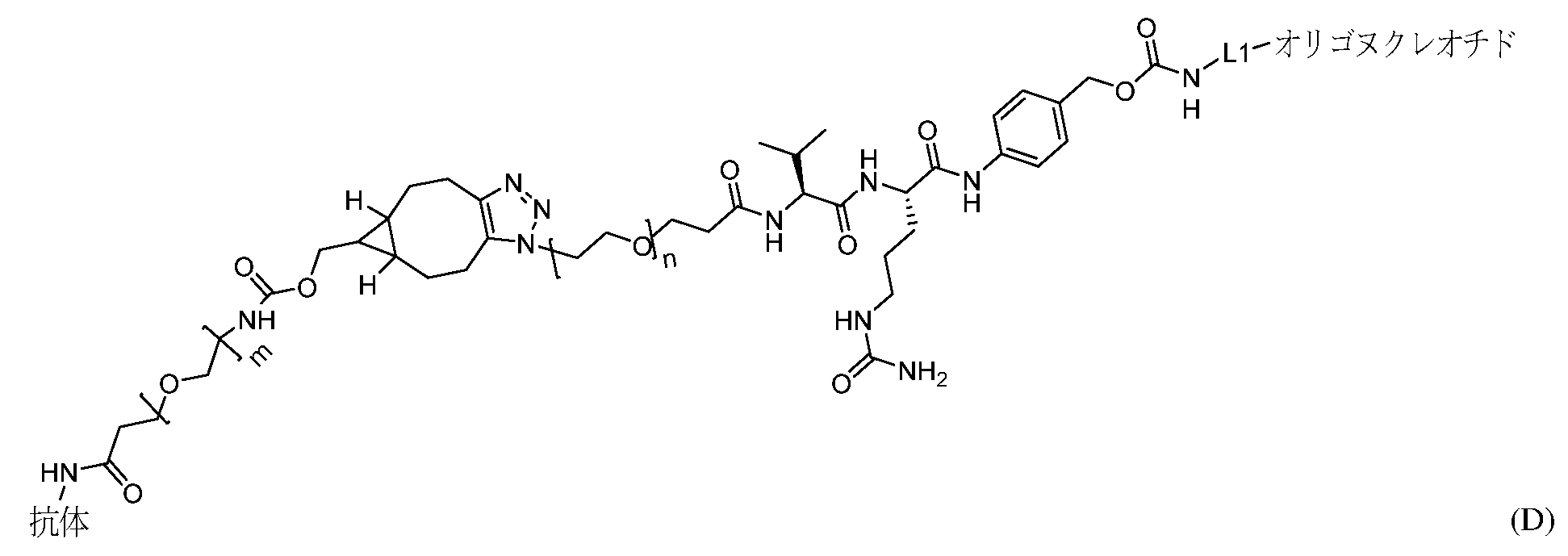

いくつかの態様において、本明細書に記載される複合体は、抗TfR1 Fab中のリジンを介してFXN標的化オリゴヌクレオチド(例として、表8に列挙されるFXN標的化オリゴヌクレオチド)の5'末端に共有結合的に連結された抗TfR1抗体を含み、抗TfR1 Fabは、表5に列挙される抗体のいずれか1つの重鎖および軽鎖を含み、複合体は以下の構造を有する。


いくつかの態様において、L1は、オリゴヌクレオチドの5'ホスファートへ連結される。いくつかの態様において、L1は、オリゴヌクレオチドの5'ホスホロチオアートへ連結される。いくつかの態様において、L1は、オリゴヌクレオチドの5'ホスホロアミダートへ連結される。 In some embodiments, L1 is linked to the 5' phosphate of the oligonucleotide. In some embodiments, L1 is linked to the 5' phosphorothioate of the oligonucleotide. In some embodiments, L1 is linked to the 5' phosphoroamidate of the oligonucleotide.
いくつかの態様において、L1は、オリゴヌクレオチドの5'ホスファートへ連結される。いくつかの態様において、オリゴヌクレオチドの5'リン酸へのL1の結合は、L1とオリゴヌクレオチドとの間にホスホジエステル結合を形成する。 In some embodiments, L1 is linked to the 5' phosphate of the oligonucleotide. In some embodiments, the attachment of L1 to the 5' phosphate of the oligonucleotide forms a phosphodiester bond between L1 and the oligonucleotide.
いくつかの態様において、L1は、オリゴヌクレオチドの3'ホスファートへ連結される。いくつかの態様において、オリゴヌクレオチドの3'リン酸へのL1の結合は、L1とオリゴヌクレオチドとの間にホスホジエステル結合を形成する。 In some embodiments, L1 is linked to the 3' phosphate of the oligonucleotide. In some embodiments, the attachment of L1 to the 3' phosphate of the oligonucleotide forms a phosphodiester bond between L1 and the oligonucleotide.
いくつかの態様において、L1は、任意である(例として、存在する必要はない)。 In some embodiments, L1 is optional (e.g., it need not be present).
III.製剤
本明細書に提供される複合体は、任意の好適な方法で製剤化され得る。一般に、本明細書に提供される複合体は、医薬への使用に好適な方法で製剤化される。例えば、複合体は、分解を最小限に抑え、送達および/または(例として、および)取り込みを容易にし、あるいは、製剤中の複合体に別の有益な特性を提供する製剤を使用して対象へ送達され得る。いくつかの態様において、複合体および薬学的に許容し得る担体を含む組成物が本明細書に提供される。そのような組成物は、対象に投与されると、標的細胞の周囲の環境または全身のいずれかに、充分な量の複合体が標的筋細胞に入るように適切に製剤化することができる。いくつかの態様において、複合体は、リン酸緩衝生理食塩溶液などの緩衝溶液、リポソーム、ミセル構造体、およびカプシドの中に製剤化される。
III. Formulations The conjugates provided herein may be formulated in any suitable manner. In general, the conjugates provided herein are formulated in a manner suitable for pharmaceutical use. For example, the conjugates may be delivered to a subject using a formulation that minimizes degradation, facilitates delivery and/or (for example and) uptake, or provides another beneficial property to the conjugate in the formulation. In some embodiments, compositions are provided herein that include the conjugate and a pharma- ceutically acceptable carrier. Such compositions can be appropriately formulated so that, upon administration to a subject, a sufficient amount of the conjugate enters the target muscle cell, either in the environment surrounding the target cell or throughout the body. In some embodiments, the conjugates are formulated in a buffer solution, such as phosphate buffered saline solution, liposomes, micellar structures, and capsids.
当然のことながら、いくつかの態様において、組成物が、本明細書に提供される複合体の1以上の構成要素(例として、筋標的化剤、リンカー、分子ペイロード、またはこれらのいずれか1つの前駆体分子)を個別に包含していてもよい。 Of course, in some embodiments, the composition may individually include one or more components of the conjugates provided herein (e.g., a muscle targeting agent, a linker, a molecular payload, or a precursor molecule of any one of these).
いくつかの態様において、複合体は、水中または水性溶液(例として、pH調整された水)中に製剤化される。いくつかの態様において、複合体は、塩基性緩衝水性溶液(例として、PBS)中に製剤化される。いくつかの態様において、本明細書に開示のとおりの製剤は、賦形剤を含む。いくつかの態様において、賦形剤は、組成物へ、改善された安定性、改善された吸収、改善された可溶性、および/または(例として、および)、活性成分の治療増強を付与する。いくつかの態様において、賦形剤は、緩衝剤(例として、クエン酸ナトリウム、リン酸ナトリウム、トリス塩基、もしくは水酸化ナトリウム)、またはビヒクル(例として、緩衝溶液、ワセリン、ジメチルスルホキシド、または鉱油)である。 In some embodiments, the complex is formulated in water or an aqueous solution (e.g., pH-adjusted water). In some embodiments, the complex is formulated in a basic buffered aqueous solution (e.g., PBS). In some embodiments, the formulation as disclosed herein includes an excipient. In some embodiments, the excipient confers improved stability, improved absorption, improved solubility, and/or (e.g., and) therapeutic enhancement of the active ingredient to the composition. In some embodiments, the excipient is a buffer (e.g., sodium citrate, sodium phosphate, Tris base, or sodium hydroxide) or a vehicle (e.g., a buffer solution, petrolatum, dimethyl sulfoxide, or mineral oil).
いくつかの態様において、複合体またはその構成要素(例として、オリゴヌクレオチドまたは抗体)は、その貯蔵寿命を延長するため凍結乾燥され、次いで使用(例として、対象への投与)前に溶液にさせられる。したがって、本明細書に記載の複合体またはその構成要素を含む組成物中の賦形剤は、凍結保護剤(例として、マンニトール、ラクトース、ポリエチレングリコール、もしくはポリビニルピロリドン)、または崩壊温度修飾因子(例として、デキストラン、フィコール、もしくはゼラチン)であってもよい。 In some embodiments, the complex or a component thereof (e.g., an oligonucleotide or an antibody) is lyophilized to extend its shelf life and then brought into solution prior to use (e.g., administration to a subject). Thus, the excipient in a composition comprising the complex or a component thereof described herein may be a cryoprotectant (e.g., mannitol, lactose, polyethylene glycol, or polyvinylpyrrolidone) or a collapse temperature modifier (e.g., dextran, ficoll, or gelatin).
いくつかの態様において、医薬組成物は、その意図された投与経路に適合するよう製剤化されている。投与経路の例としては、非経口投与、例として、静脈内投与、皮内投与、皮下投与が挙げられる。典型的には、投与経路は、静脈内投与または皮下投与である。 In some embodiments, the pharmaceutical composition is formulated to be compatible with its intended route of administration. Examples of routes of administration include parenteral administration, e.g., intravenous administration, intradermal administration, and subcutaneous administration. Typically, the route of administration is intravenous or subcutaneous administration.
注射剤への使用に好適な医薬組成物は、滅菌水性溶液(ここで水に可溶性である)または分散溶液、および滅菌注射剤溶液または分散溶液の即時調製のための滅菌粉末を包含する。担体は、例えば、水、エタノール、ポリオール(例えば、グリセロール、プロピレングリコール、および液体ポリエチレングリコールなど)、および好適なそれらの混合物を含有する溶媒または分散媒体であり得る。いくつかの態様において、製剤は、組成物中に等張剤、例えば、糖、マンニトール、ソルビトールなどのポリアルコール、および塩化ナトリウムを包含する。滅菌注射剤溶液は、要求量の複合体を、上に列挙された成分の1つまたはそれらの組み合わせとともに、選択された溶媒に組み込むこと、要求に応じ、これに続き濾過滅菌することによって調製され得る。 Pharmaceutical compositions suitable for use in injections include sterile aqueous solutions (wherein they are soluble in water) or dispersions, and sterile powders for the extemporaneous preparation of sterile injectable solutions or dispersions. The carrier can be, for example, a solvent or dispersion medium containing water, ethanol, polyol (e.g., glycerol, propylene glycol, liquid polyethylene glycol, and the like), and suitable mixtures thereof. In some embodiments, the formulation includes an isotonic agent in the composition, for example, sugar, polyalcohol such as mannitol, sorbitol, and sodium chloride. Sterile injectable solutions can be prepared by incorporating the required amount of the complex in the selected solvent with one or a combination of the ingredients listed above, as required, followed by filtered sterilization.
いくつかの態様において、組成物は、少なくとも約0.1%の複合体またはその構成要素、またはそれ以上を含有し得るが、活性成分のパーセンテージは組成物全体の重量または体積の約1%~約80%、またはそれ以上であってもよい。可溶性、バイオアベイラビリティ、生物学的半減期、投与経路、産物の貯蔵寿命などの因子、ならびに他の薬理学的留意事項は、かかる医薬製剤を調製する当業者によって企図されるであろう。そのため様々な投薬量および処置計画が所望されることもある。 In some embodiments, the composition may contain at least about 0.1% of the complex or its components, or more, although the percentage of active ingredient may be from about 1% to about 80%, or more, by weight or volume of the total composition. Factors such as solubility, bioavailability, biological half-life, route of administration, shelf life of the product, as well as other pharmacological considerations, will be taken into account by those skilled in the art of preparing such pharmaceutical formulations. Various dosages and treatment regimens may therefore be desirable.
IV.使用/処置の方法
本明細書に記載のとおりの分子ペイロードへ共有結合的に連結された筋標的化剤を含む複合体は、フリードライヒ運動失調症を処置するのに有効である。いくつかの態様において、FAは、両方のFXN対立遺伝子のイントロン1におけるGAAトリヌクレオチド反復の拡大に関連する。いくつかの態様において、ヌクレオチド伸長は、エピジェネティックな変化および反復付近でのヘテロクロマチンの形成をもたらし、FXNの発現低下をもたらす。
IV. Methods of Use/Treatment The complex comprising the muscle targeting agent covalently linked to the molecular payload as described herein is effective for treating Friedreich's ataxia.In some embodiments, FA is associated with the expansion of the GAA trinucleotide repeat in intron 1 of both FXN alleles.In some embodiments, the nucleotide expansion leads to epigenetic changes and the formation of heterochromatin near the repeat, resulting in reduced expression of FXN.
いくつかの態様において、対象は、ヒト対象、霊長目の非ヒト動物対象、齧歯類動物対象、またはいずれの好適な哺乳動物対象であり得る。いくつかの態様において、対象はフリードライヒ運動失調症を有し得る。いくつかの態様において、対象はFXN対立遺伝子を有し、これは場合により疾患関連反復を含み得る。いくつかの態様において、対象は、約2~10個の反復単位、約2~50個の反復単位、約2~100個の反復単位、約50~1,000個の反復単位、約50~500個の反復単位、約50~250個の反復単位、約50~100個の反復単位、約500~10,000個の反復単位、約500~5,000個の反復単位、約500~2,500個の反復単位、約500~1,000個の反復単位、または約1,000~10,000個の反復単位を含む、伸長した疾患関連反復を有するFXN対立遺伝子を有し得る。いくつかの態様において、対象は、FAの症状、例として、肥大型心筋症、筋萎縮または筋力低下を患っている。いくつかの態様において、対象は、FAの症状を患っていない。いくつかの態様において、対象は、先天性肥大性心筋症を有する。 In some embodiments, the subject may be a human subject, a primate non-human animal subject, a rodent animal subject, or any suitable mammalian subject. In some embodiments, the subject may have Friedreich's ataxia. In some embodiments, the subject may have an FXN allele, which may optionally include a disease-associated repeat. In some embodiments, the subject may have an FXN allele with an expanded disease-associated repeat comprising about 2-10 repeat units, about 2-50 repeat units, about 2-100 repeat units, about 50-1,000 repeat units, about 50-500 repeat units, about 50-250 repeat units, about 50-100 repeat units, about 500-10,000 repeat units, about 500-5,000 repeat units, about 500-2,500 repeat units, about 500-1,000 repeat units, or about 1,000-10,000 repeat units. In some embodiments, the subject suffers from symptoms of FA, such as hypertrophic cardiomyopathy, muscle atrophy or muscle weakness. In some embodiments, the subject does not suffer from symptoms of FA. In some embodiments, the subject has congenital hypertrophic cardiomyopathy.
本開示の側面は、本明細書に記載のとおりの有効量の複合体を対象へ投与することを伴う方法を含む。いくつかの態様において、分子ペイロードへ共有結合的に連結された筋標的化剤を含む複合体を含む有効量の医薬組成物は、処置を必要とする対象へ投与され得る。いくつかの態様において、本明細書に記載の複合体を含む医薬組成物は、例として静脈内ボーラス投与または一定期間にわたる連続注入による静脈内投与を含み得る適切な経路によって投与され得る。いくつかの態様において、静脈内投与は、筋肉内の、腹腔内の、脳脊髄内の、皮下の、関節内の、滑液嚢内の、または髄腔内の経路によって実施されてもよい。いくつかの態様において、医薬組成物は、固体形態、水性形態、または液体形態であってもよい。いくつかの態様において、水性または液体形態は、噴霧されてもよく、または凍結乾燥されてもよい。いくつかの態様において、噴霧形態または凍結乾燥形態は、水性または液体溶液で再構成されてもよい。 Aspects of the present disclosure include methods involving administering to a subject an effective amount of a conjugate as described herein. In some embodiments, an effective amount of a pharmaceutical composition comprising a conjugate comprising a muscle targeting agent covalently linked to a molecular payload may be administered to a subject in need of treatment. In some embodiments, a pharmaceutical composition comprising a conjugate as described herein may be administered by a suitable route, which may include, for example, intravenous administration by intravenous bolus administration or continuous infusion over a period of time. In some embodiments, intravenous administration may be performed by intramuscular, intraperitoneal, intracerebrospinal, subcutaneous, intraarticular, intrasynovial, or intrathecal routes. In some embodiments, the pharmaceutical composition may be in a solid, aqueous, or liquid form. In some embodiments, the aqueous or liquid form may be sprayed or lyophilized. In some embodiments, the sprayed or lyophilized form may be reconstituted with an aqueous or liquid solution.
静脈内投与のための組成物は、植物油、ジメチルアセトアミド、ジメチルホルムアミド、乳酸エチル、炭酸エチル、ミリスチン酸イソプロピル、エタノール、およびポリオール(グリセロール、プロピレングリコール、液体ポリエチレングリコールなど)などの様々な担体を含有していてもよい。静脈内注射のための水可溶性抗体は点滴法によって投与され得、これによって抗体および薬学的に許容し得る賦形剤を含有する医薬製剤が注入される。生理学的に許容し得る賦形剤は、例えば、5%デキストロース、0.9%生理食塩水、リンガー溶液、または他の好適な賦形剤を包含していてもよい。筋肉内用調製物、例として、抗体の好適な可溶性の塩形態の滅菌製剤は、注射用水、0.9%生理食塩水、または5%グルコース溶液などの医薬賦形剤に溶解されて投与され得る。 Compositions for intravenous administration may contain a variety of carriers, such as vegetable oils, dimethylacetamide, dimethylformamide, ethyl lactate, ethyl carbonate, isopropyl myristate, ethanol, and polyols (glycerol, propylene glycol, liquid polyethylene glycol, etc.). Water-soluble antibodies for intravenous injection may be administered by infusion, whereby a pharmaceutical formulation containing the antibody and a pharma- ceutically acceptable excipient is infused. Physiologically acceptable excipients may include, for example, 5% dextrose, 0.9% saline, Ringer's solution, or other suitable excipients. Intramuscular preparations, for example, a sterile formulation of a suitable soluble salt form of the antibody, may be administered dissolved in a pharmaceutical excipient, such as water for injection, 0.9% saline, or 5% glucose solution.
いくつかの態様において、分子ペイロードへ共有結合的に連結されたた筋標的化剤を含む複合体を含む医薬組成物は、部位特異的または局部的な送達技法を介して投与される。これらの技法の例は、複合体の埋め込み型デポー供給源、局部送達カテーテル、部位特異的担体、直接注射、または直塗り(direct application)を包含する。 In some embodiments, pharmaceutical compositions comprising a conjugate comprising a muscle targeting agent covalently linked to a molecular payload are administered via site-specific or localized delivery techniques. Examples of these techniques include an implanted depot source of the conjugate, a localized delivery catheter, a site-specific carrier, direct injection, or direct application.
いくつかの態様において、分子ペイロードへ共有結合的に連結された筋標的化剤を含む複合体を含む医薬組成物は、治療効果を対象に付与する有効濃度にて投与される。有効量は、当業者によって認識されるとおり、疾患の重症度、処置される対象の特有な特徴、例として、年齢、体調、健康状態、または体重、処置期間、いずれの併用治療の性質、投与ルート、および関連因子に応じて変動する。これらの関連因子は当業者には公知であり、日常的な実験程度で対処し得る。いくつかの態様において、有効濃度は、患者に安全であると見なされる最大用量である。いくつかの態様において、有効濃度は、最大限の効き目を提供する、実行可能な最低濃度であろう。 In some embodiments, the pharmaceutical composition comprising a conjugate comprising a muscle targeting agent covalently linked to a molecular payload is administered at an effective concentration to impart a therapeutic effect to the subject. The effective amount will vary depending on the severity of the disease, the specific characteristics of the subject being treated, such as age, physical condition, health, or weight, the duration of treatment, the nature of any concomitant treatments, the route of administration, and related factors, as will be recognized by those of skill in the art. These related factors are known to those of skill in the art and can be addressed with no more than routine experimentation. In some embodiments, the effective concentration is the maximum dose deemed safe for the patient. In some embodiments, the effective concentration will be the lowest concentration practicable that provides maximum efficacy.
経験的考慮事項、例として、対象における複合体の半減期は一般に、処置のために使用される医薬組成物の濃度を決定するのに役立つであろう。投与頻度は、処置の効き目を最大化するために経験的に決定かつ調整されてもよい。 Empirical considerations, such as the half-life of the conjugate in the subject, will generally help determine the concentration of pharmaceutical composition used for treatment. Dosing frequency may be empirically determined and adjusted to maximize efficacy of treatment.
処置の有効性は、任意の好適な方法を使用して査定され得る。いくつかの態様において、処置の有効性は、FAに関連する症状、例として肥大型心筋症、筋萎縮、または筋力低下の観察の評価によって、対象の自己報告された転帰、例として運動性、セルフケア、通常の活動、疼痛/不快感、および不安/抑うつの尺度を通して、または生活の質の指標、例として寿命によって評価され得る。 The efficacy of treatment may be assessed using any suitable method. In some embodiments, the efficacy of treatment may be assessed by evaluation of symptoms associated with FA, such as hypertrophic cardiomyopathy, muscle atrophy, or muscle weakness, through subject self-reported outcomes, such as measures of mobility, self-care, usual activities, pain/discomfort, and anxiety/depression, or by quality of life indicators, such as lifespan.
いくつかの態様において、本明細書に記載の分子ペイロードへ共有結合的に連結された筋標的化剤を含む複合体を含む医薬組成物は、対照(例として、処置に先立つ遺伝子発現のベースラインレベル)と比べて、標的遺伝子の活性または発現を少なくとも10%、少なくとも20%、少なくとも30%、少なくとも40%、少なくとも50%、少なくとも60%、少なくとも70%、少なくとも80%、少なくとも90%、または少なくとも95%阻害するのに充分な有効濃度にて、対象へ投与される。 In some embodiments, a pharmaceutical composition comprising a conjugate comprising a muscle targeting agent covalently linked to a molecular payload described herein is administered to a subject at an effective concentration sufficient to inhibit target gene activity or expression by at least 10%, at least 20%, at least 30%, at least 40%, at least 50%, at least 60%, at least 70%, at least 80%, at least 90%, or at least 95% as compared to a control (e.g., a baseline level of gene expression prior to treatment).
いくつかの態様において、本明細書に記載の分子ペイロードへ共有結合的に連結された筋標的化剤を含む複合体を含む医薬組成物の対象への単回投薬または投与は、少なくとも1~5日間、1~10日間、5~15日間、10~20日間、15~30日間、20~40日間、25~50日間、またはこれより長い期間、標的遺伝子の活性または発現を阻害するのに充分である。いくつかの態様において、本明細書に記載の分子ペイロードへ共有結合的に連結された筋標的化剤を含む複合体を含む医薬組成物の対象への単回投薬または投与は、少なくとも1、2、3、4、5、6、7、8、9、10、11、12、15、20、または24週間、標的遺伝子の活性または発現を阻害するのに充分である。いくつかの態様において、本明細書に記載の分子ペイロードへ共有結合的に連結された筋標的化剤を含む複合体を含む医薬組成物の対象への単回投薬または投与は、少なくとも1~5、1~10、2~5、2~10、4~8、4~12、5~10、5~12、5~15、8~12、8~15、10~12、10~15、10~20、12~15、12~20、15~20、または15~25週間、標的遺伝子の活性または発現を阻害するのに充分である。いくつかの態様において、本明細書に記載の分子ペイロードへ共有結合的に連結された筋標的化剤を含む複合体を含む医薬組成物の対象への単回投薬または投与は、少なくとも1、2、3、4、5、または6カ月間、標的遺伝子の活性または発現を阻害するのに充分である。 In some embodiments, a single dose or administration to a subject of a pharmaceutical composition comprising a conjugate comprising a muscle targeting agent covalently linked to a molecular payload as described herein is sufficient to inhibit the activity or expression of a target gene for at least 1-5 days, 1-10 days, 5-15 days, 10-20 days, 15-30 days, 20-40 days, 25-50 days, or longer. In some embodiments, a single dose or administration to a subject of a pharmaceutical composition comprising a conjugate comprising a muscle targeting agent covalently linked to a molecular payload as described herein is sufficient to inhibit the activity or expression of a target gene for at least 1, 2, 3, 4, 5, 6, 7, 8, 9, 10, 11, 12, 15, 20, or 24 weeks. In some embodiments, a single dose or administration to a subject of a pharmaceutical composition comprising a conjugate comprising a muscle targeting agent covalently linked to a molecular payload as described herein is sufficient to inhibit target gene activity or expression for at least 1-5, 1-10, 2-5, 2-10, 4-8, 4-12, 5-10, 5-12, 5-15, 8-12, 8-15, 10-12, 10-15, 10-20, 12-15, 12-20, 15-20, or 15-25 weeks. In some embodiments, a single dose or administration to a subject of a pharmaceutical composition comprising a conjugate comprising a muscle targeting agent covalently linked to a molecular payload as described herein is sufficient to inhibit target gene activity or expression for at least 1, 2, 3, 4, 5, or 6 months.
いくつかの態様において、医薬組成物は、分子ペイロードに共有結合的に連結された筋標的化剤を含む、2以上の複合体を含み得る。いくつかの態様において、薬学的組成物は、対象、例として、FAを有するヒト対象を処置するための任意の他の好適な治療剤をさらに含み得る。いくつかの態様において、他の治療剤は、本明細書に記載の複合体の有効性を増強または補完するものであってもよい。いくつかの態様において、他の治療剤は、本明細書に記載の複合体とは異なる症状または疾患を処置するよう機能し得る。 In some embodiments, the pharmaceutical composition may include two or more conjugates that include a muscle targeting agent covalently linked to a molecular payload. In some embodiments, the pharmaceutical composition may further include any other suitable therapeutic agent for treating a subject, e.g., a human subject, with FA. In some embodiments, the other therapeutic agent may enhance or complement the efficacy of the conjugates described herein. In some embodiments, the other therapeutic agent may function to treat a different condition or disease than the conjugates described herein.
例
例1. FXN標的化オリゴヌクレオチド(ASO)のin vitro活性
表8に列挙したFXN標的化オリゴヌクレオチド(ASO)の活性を調べるためにin vitro実験を行った。オリゴヌクレオチドは、GAA反復を含有するFXN RNAの領域(反復領域)を標的化する。オリゴヌクレオチドがFXN RNAレベルをノックダウンする能力は、反復領域における標的配列の接近可能性の指標である。接近可能な標的配列は、FXN RNA含有伸長反復と染色体DNAとの間のRループ形成を阻害するためのオリゴヌクレオチドによって標的化され得、それによりFXNタンパク質発現が増強され得る。
EXAMPLES Example 1. In vitro activity of FXN targeting oligonucleotides (ASOs) In vitro experiments were performed to examine the activity of the FXN targeting oligonucleotides (ASOs) listed in Table 8. The oligonucleotides target regions of FXN RNA that contain GAA repeats (repeat regions). The ability of the oligonucleotides to knock down FXN RNA levels is an indication of the accessibility of target sequences in the repeat regions. Accessible target sequences can be targeted by oligonucleotides to inhibit R-loop formation between FXN RNA-containing expanded repeats and chromosomal DNA, thereby enhancing FXN protein expression.
フリードライヒ運動失調症の遺伝子発現プロファイルを再現するために、LS 174T結腸直腸腺癌細胞において内因性FXN mRNAがノックダウンされた。ノックダウン後、LS 174T細胞が96ウェルプレートに15,000細胞/ウェルの密度で播種され、一晩インキュベートされた。一晩のインキュベーションの後、リポフェクタミンRNAiMaxを技術的な4連で使用して、20nMまたは5nMのいずれかのFXN標的化オリゴヌクレオチドで細胞がトランスフェクトされた。その後、細胞は72時間インキュベートされ、次いで回収された。転写物レベルは、FXNに特異的な分岐DNAアッセイを使用して評価された。すべての転写物データは、GAPDH転写物レベルを測定する参照分枝DNAアッセイに対して正規化された。4連の値が平均され、平均転写レベルが記録された。表9は、各ASOで処理した後の平均残存転写レベル(%)を示し、転写レベルは、GAPDH転写レベルに対して正規化され、4回の反復にわたって平均化されたFXN転写レベルとして記録されている。各4連セットの標準偏差も記録されている。
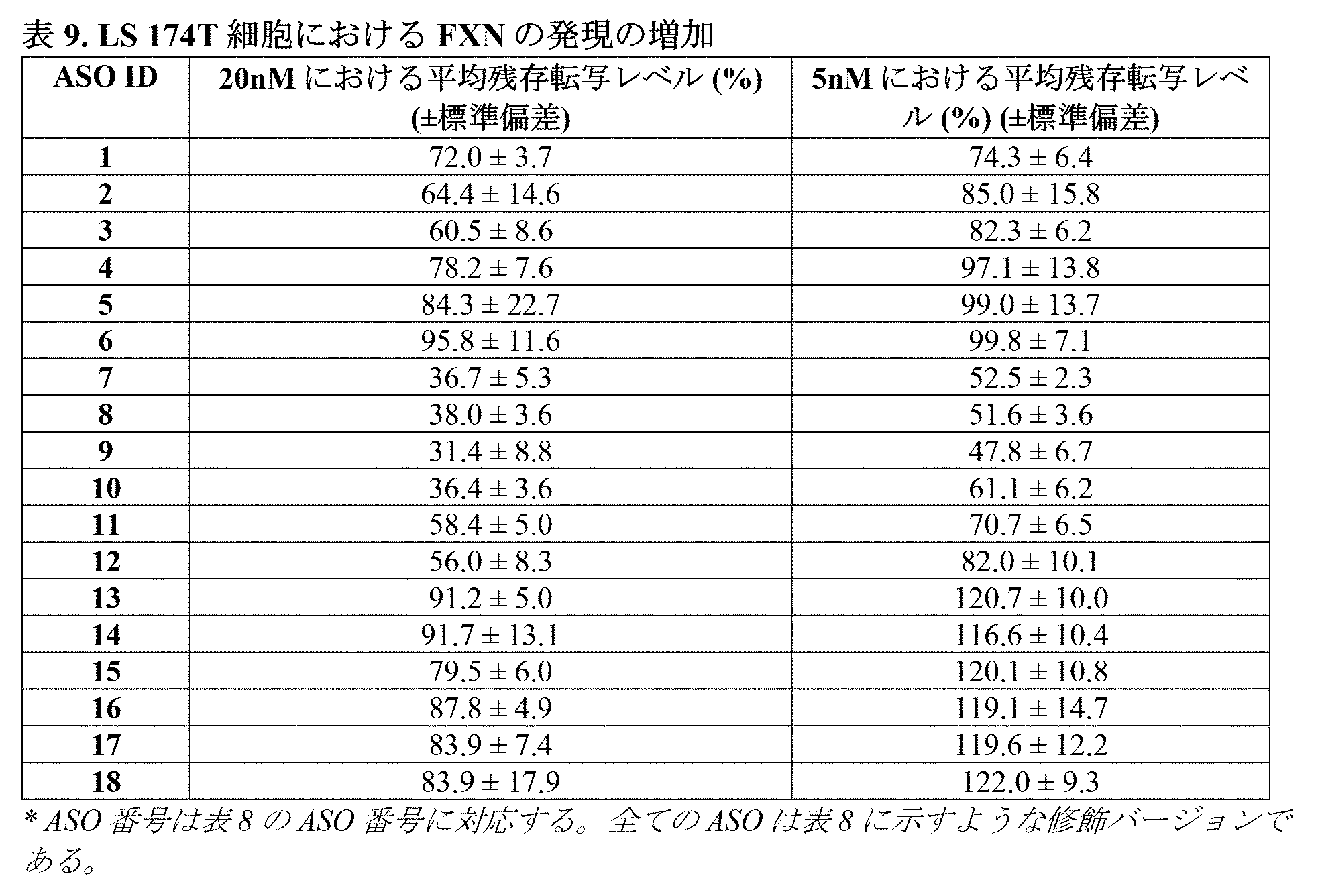
例2: FXN標的化ASO-用量応答
FXN mRNAは、標的化する5つのASO(表10)を、LS 174T結腸直腸腺癌細胞における用量応答実験でFXN mRNAをノックダウンする能力について試験された。LS 174T細胞は、96ウェルプレートに15,000細胞/ウェルの密度で播種され、一晩回復させた。翌日、技術的な4連でリポフェクタミンRNAiMaxを使用して、様々な濃度のFXN標的化ASOで細胞がトランスフェクトされた。細胞は72時間インキュベートされ、回収された。試験されたASOのIC20およびIC50値の計算を含む用量応答分析が実施され、結果が表10に示される。
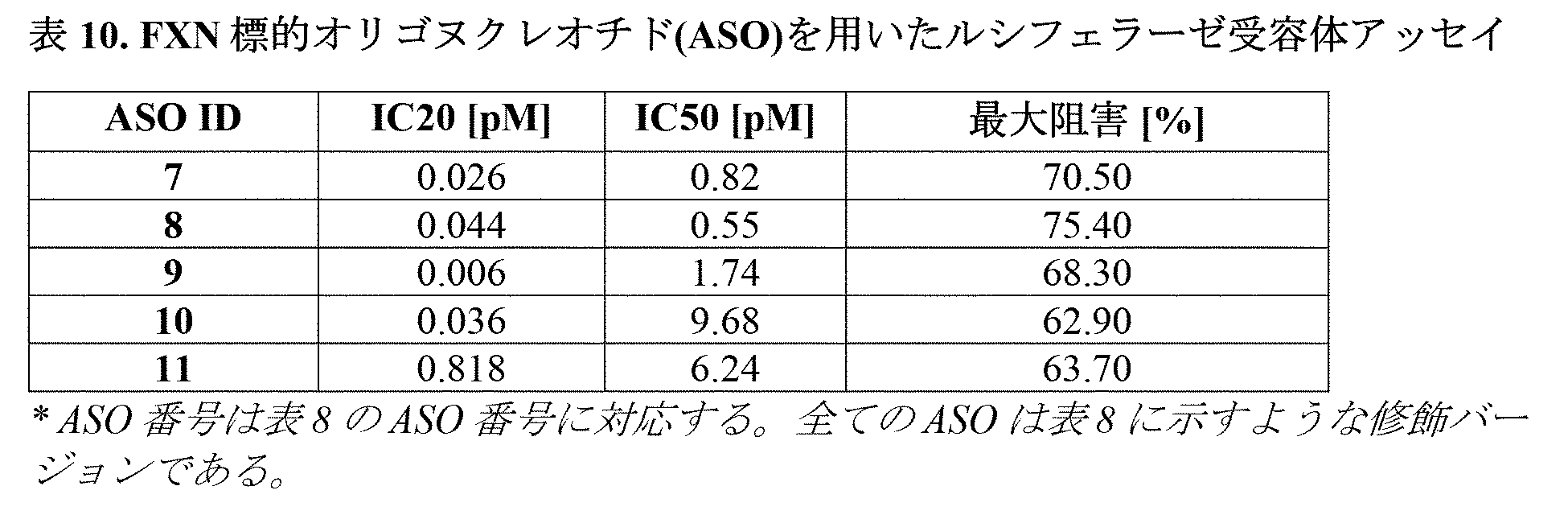
Five FXN mRNA targeting ASOs (Table 10) were tested for their ability to knockdown FXN mRNA in a dose response experiment in LS 174T colorectal adenocarcinoma cells. LS 174T cells were seeded at a density of 15,000 cells/well in 96-well plates and allowed to recover overnight. The following day, cells were transfected with various concentrations of FXN-targeting ASOs using Lipofectamine RNAiMax in technical quadruplicates. Cells were incubated for 72 hours and harvested. A dose response analysis was performed, including calculation of IC20 and IC50 values for the tested ASOs, and the results are shown in Table 10.
例3. ヒトTfR1を発現するマウスにおけるDMPK標的化オリゴヌクレオチドにコンジュゲートした抗TfR1 Fabを含有するコンジュゲートのin vivo活性
DMPK標的化オリゴヌクレオチドにコンジュゲートした抗TfR1 Fab 3M12-VH4/VK3を含有する抱合体が、ヒトTfR1を発現するマウスモデルにおいて試験された。抗TfR Fab1 3M12-VH4/VK3が、式(I)の構造を有する切断可能なリンカーを介してDMPK標的化オリゴヌクレオチドにコンジュゲートされた。抱合体が、0日目および7日目に10mg/kgオリゴヌクレオチドに相当する用量でマウスに投与された。マウスは14日目に屠殺され、異なる筋組織が回収され、組織中のdmpk mRNAレベルおよびオリゴヌクレオチド濃度について分析された。抱合体は、マウス野生型dmpkを前脛骨筋で79%減少させ(図1A)、腓腹筋で76%減少させ(図1B)、心臓で70%減少させ(図1C)、横隔膜で88%減少させた(図1D)。前脛骨筋、腓腹筋、心臓、および横隔膜におけるオリゴヌクレオチド分布が図1E~図1Hに示されている。
Example 3. In vivo activity of conjugates containing anti-TfR1 Fab conjugated to DMPK-targeted oligonucleotides in mice expressing human TfR1
A conjugate containing anti-TfR1 Fab 3M12-VH4/VK3 conjugated to a DMPK-targeting oligonucleotide was tested in a mouse model expressing human TfR1. Anti-TfR Fab1 3M12-VH4/VK3 was conjugated to a DMPK-targeting oligonucleotide via a cleavable linker having the structure of formula (I). The conjugate was administered to mice at a dose equivalent to 10 mg/kg oligonucleotide on days 0 and 7. Mice were sacrificed on day 14, and different muscle tissues were collected and analyzed for dmpk mRNA levels and oligonucleotide concentrations in the tissues. The conjugate reduced mouse wild-type dmpk by 79% in tibialis anterior muscle (Figure 1A), 76% in gastrocnemius muscle (Figure 1B), 70% in heart (Figure 1C), and 88% in diaphragm (Figure 1D). Oligonucleotide distribution in tibialis anterior, gastrocnemius, heart, and diaphragm is shown in Figures 1E-H.
これらのデータは、抗TfR Fab1 3M12-VH4/VK3が、in vivoマウスモデルにおいて筋肉特異的組織への抱合体の細胞内在化を可能にし、それによってDMPK標的化オリゴヌクレオチドがDMPKの発現を減少させたことを示す。同様に、抗TfR1抗体(例として、抗TfR1 Fab 3M12-VH4/VK3)は、FXNタンパク質発現を増強するために、FXN標的化オリゴヌクレオチドにコンジュゲートした抗TfR1抗体を含む抱合体の細胞内在化を可能にすることができる。 These data indicate that anti-TfR Fab1 3M12-VH4/VK3 enabled cellular internalization of conjugates to muscle-specific tissues in an in vivo mouse model, whereby DMPK-targeted oligonucleotides reduced DMPK expression. Similarly, anti-TfR1 antibodies (e.g., anti-TfR1 Fab 3M12-VH4/VK3) can enable cellular internalization of conjugates containing anti-TfR1 antibodies conjugated to FXN-targeted oligonucleotides to enhance FXN protein expression.
均等物および用語
例証的に本明細書に記載された開示は、好適には、本明細書に具体的には開示されないいずれかの要素、限定の非存在下において実施され得る。それゆえに、例えば、本明細書の各事例において、用語「含む」、「から本質的になる」、および「からなる」のいずれかは、他の2つの用語のどちらかによって置き換えられ得る。採用された用語および表現は、限定ではなく記載の用語として使用され、かかる用語および表現の使用には、示されるおよび記載される特徴のいずれかの等価物またはそれらの部分を排除する意図はなく、種々の改変が本開示の範囲内で可能であることが認識される。それゆえに、本開示は好ましい実施形態によって具体的に開示されたが、本明細書に開示される概念の任意の特徴、改変、および変形が当業者によって頼られ得ることと、かかる改変および変形は本開示の範囲内であると考慮されることとは理解されるべきである。
Equivalents and Terms The disclosure illustratively described herein may suitably be implemented in the absence of any element or limitation not specifically disclosed herein. Thus, for example, in each instance herein, any of the terms "comprise", "consist essentially of" and "consist of" may be replaced by either of the other two terms. The terms and expressions employed are used as terms of description and not of limitation, and the use of such terms and expressions is not intended to exclude any equivalents or portions of the features shown and described, and it is recognized that various modifications are possible within the scope of the present disclosure. Thus, although the present disclosure has been specifically disclosed by preferred embodiments, it should be understood that any features, modifications and variations of the concepts disclosed herein may be resorted to by those skilled in the art, and such modifications and variations are considered to be within the scope of the present disclosure.
加えて、本開示の特徴または側面がマーカッシュ群または代替物の他の群分けとして記載されるところでは、当業者は、本開示がそれによってマーカッシュ群または他の群のいずれかの個々の構成員または構成員のサブグループとしてもまた記載されることを認識するであろう。 In addition, where features or aspects of the disclosure are described as a Markush group or other grouping of alternatives, those skilled in the art will recognize that the disclosure is thereby also described as any individual member or subgroup of members of the Markush group or other group.
当然のことながら、いくつかの態様において、オリゴヌクレオチドまたは他の核酸の構造を記載する際には、配列表で提示される配列が参照され得る。かかる態様において、実際のオリゴヌクレオチドまたは他の核酸は、指定された配列と本質的に同じかまたは類似の相補的な特性を保持しながら、指定された配列と比較して、1以上の代替的なヌクレオチドまたはヌクレオシド(例として、DNAヌクレオシドのRNAカウンターパート、またはRNAヌクレオシドのDNAカウンターパート)および/または(例として、および)1以上の修飾ヌクレオチド/ヌクレオシドおよび/または(例として、および)1以上の修飾されたヌクレオシド間連結および/または(例として、および)1以上の他の改変を有し得る。 Of course, in some embodiments, reference may be made to the sequences presented in the sequence listing when describing the structure of an oligonucleotide or other nucleic acid. In such embodiments, the actual oligonucleotide or other nucleic acid may have one or more alternative nucleotides or nucleosides (e.g., RNA counterparts of DNA nucleosides, or DNA counterparts of RNA nucleosides) and/or (by way of example and) one or more modified nucleotides/nucleosides and/or (by way of example and) one or more modified internucleoside linkages and/or (by way of example and) one or more other modifications compared to the specified sequence while retaining essentially the same or similar complementary properties as the specified sequence.
本発明を説明する文脈における(特に以下の請求項の文脈における)用語「a」および「an」および「the」ならびに同様のレファレントの使用は、本明細書に別段の指示がないかまたは文脈と明らかに矛盾しない限り、単数および複数の両方を包含すると解釈されるべきである。用語「備える」、「有する」、「含む」、および「含有する」は、特に断りのない限り、オープンエンドの用語として解釈されるべきである(すなわち、「含むが、それらに限定されない」を意味する)。本明細書における値の範囲の記載は、本明細書に別段の指示がない限り、単に、範囲内に収まる各別個の値を個々に参照する簡略な方法として働くことが意図され、各別個の値は、それがあたかも本明細書に個々に記載されているかのように本明細書に組み込まれる。本明細書に別段の指示がないかまたは文脈と明らかに矛盾しない限り、本明細書に記載のすべての方法は任意の好適な順序で行われ得る。別様の主張がなされない限り、本明細書に提供されるありとあらゆる例または例示的な文言(例として、「などの」)の使用は、単に本発明をより良く解き明かすことが意図され、本発明の範囲に限定を課さない。本明細書のいかなる文言も、いずれかの請求されない要素を本発明の実施にとって必須であると指し示すものと解釈されるべきではない。 The use of the terms "a" and "an" and "the" and similar referents in the context of describing the present invention (particularly in the context of the claims below) should be construed to encompass both the singular and the plural, unless otherwise indicated herein or clearly contradicted by context. The terms "comprises," "has," "includes," and "containing" should be construed as open-ended terms (i.e., meaning "including, but not limited to"), unless otherwise indicated herein. The recitation of ranges of values herein is intended merely to serve as a shorthand method of individually referring to each separate value falling within the range, and each separate value is incorporated herein as if it were individually set forth herein. Unless otherwise indicated herein or clearly contradicted by context, all methods described herein may be performed in any suitable order. Unless otherwise stated, the use of any and all examples or exemplary language provided herein (such as, for example, "etc.") is intended merely to better illuminate the invention and does not impose limitations on the scope of the invention. Nothing in this specification should be construed as indicating any non-claimed element as essential to the practice of the invention.
本発明の側面が本明細書に記載されている。それらの実施形態の変形は、先述の記載を読むことによって当業者には明らかになり得る。 Aspects of the invention are described herein. Variations of those embodiments may become apparent to one of ordinary skill in the art upon reading the foregoing description.
本発明者は当業者がかかる変形を適当に採用することを予期し、本発明者は本発明が本明細書に具体的に記載されるとおりとは別様に実施されることを意図する。したがって、本発明は、然るべき法律によって許可される本明細書に添付される請求項に記載される主題のすべての改変および等価物を包含する。その上、それらのすべての可能な変形における上に記載された要素のいずれかの組み合わせは、本明細書に別段の指示がないかまたは文脈と明らかに矛盾しない限り、本発明によって包摂される。当業者は、本明細書に記載される本発明の特定の実施形態の多くの均等物を認識するか、またはせいぜい慣例的な実験作業を用いて確かめることができるであろう。かかる等価物は次の請求項によって包摂されることを意図される。 The inventors anticipate that those skilled in the art will adopt such variations as appropriate, and the inventors intend for the invention to be practiced otherwise than as specifically described herein. Accordingly, this invention includes all modifications and equivalents of the subject matter recited in the claims appended hereto as permitted by applicable law. Moreover, any combination of the above-described elements in all possible variations thereof is encompassed by the invention unless otherwise indicated herein or clearly contradicted by context. Those skilled in the art will recognize, or be able to ascertain using no more than routine experimentation, many equivalents to the specific embodiments of the invention described herein. Such equivalents are intended to be encompassed by the following claims.
Claims (22)
任意にここでオリゴヌクレオチドが、配列番号165~176のうちのいずれか1つのヌクレオチド配列を含み、およびここでUの各々が、任意にかつ独立して、Tである、請求項1または請求項2に記載の複合体。 the oligonucleotide comprises at least 16 contiguous nucleotides of any one of SEQ ID NOs: 165-176, wherein each U is, optionally and independently, T;
3. The complex of claim 1 or claim 2, optionally wherein the oligonucleotide comprises the nucleotide sequence of any one of SEQ ID NOs: 165-176, and wherein each U is, optionally and independently, T.
Xが、3~5個の連結されたヌクレオシドを含み、ここでX中のヌクレオシドの少なくとも1個が、2'-修飾ヌクレオシドであり;
Yが、6~14個の連結された2'-デオキシリボヌクレオシドを含み、ここでY中の各シチジンが、任意にかつ独立して、5-メチル-シチジンであり;および
Zが、3~5個の連結されたヌクレオシドを含み、ここでZ中のヌクレオシドの少なくとも1個が、2'-修飾ヌクレオシドである、
請求項1~3のいずれか一項に記載の複合体。 The oligonucleotide comprises a 5'-XYZ-3' configuration,
X comprises 3 to 5 linked nucleosides, where at least one of the nucleosides in X is a 2'-modified nucleoside;
Y comprises 6 to 14 linked 2'-deoxyribonucleosides, where each cytidine in Y is optionally and independently a 5-methyl-cytidine; and
Z comprises 3 to 5 linked nucleosides, where at least one of the nucleosides in Z is a 2'-modified nucleoside;
The complex according to any one of claims 1 to 3.
Xが、5個の連結されたヌクレオシドを含み、およびX中の各ヌクレオシドが、2'-MOE修飾ヌクレオシドであり;
Yが、10個の連結された2'-デオキシリボヌクレオシドを含み、ここでY中の各シチジンが、任意にかつ独立して、5-メチル-シチジンであり;ならびに
Zが、5個の連結されたヌクレオシドを含み、およびZ中の各ヌクレオシドが、2'-MOE修飾ヌクレオシドである、請求項4に記載の複合体。 The oligonucleotide comprises the nucleotide sequence of any one of SEQ ID NOs: 165-167,
X comprises 5 linked nucleosides, and each nucleoside in X is a 2'-MOE modified nucleoside;
Y comprises 10 linked 2'-deoxyribonucleosides, where each cytidine in Y is optionally and independently a 5-methyl-cytidine; and
5. The conjugate of claim 4, wherein Z comprises five linked nucleosides and each nucleoside in Z is a 2'-MOE modified nucleoside.
Xが、5個の連結されたヌクレオシドを含み、ここでX中の各ヌクレオシドが、LNAヌクレオシドであり;
Yが、10個の連結された2'-デオキシリボヌクレオシドを含み、ここでY中の各シチジンが、任意にかつ独立して、5-メチル-シチジンであり;および
Zが、5個の連結されたヌクレオシドを含み、ここでZ中の各ヌクレオシドが、LNAヌクレオシドである、請求項4に記載の複合体。 The oligonucleotide comprises the nucleotide sequence of any one of SEQ ID NOs: 165-167,
X comprises 5 linked nucleosides, where each nucleoside in X is an LNA nucleoside;
Y comprises 10 linked 2'-deoxyribonucleosides, where each cytidine in Y is optionally and independently a 5-methyl-cytidine; and
5. The conjugate of claim 4, wherein Z comprises five linked nucleosides, wherein each nucleoside in Z is an LNA nucleoside.
Xが、3個の連結されたヌクレオシドを含み、ここでX中の各ヌクレオシドが、LNAヌクレオシドであり;
Yが、14個の連結された2'-デオキシリボヌクレオシドを含み、ここでY中の各シチジンが、任意にかつ独立して、5-メチル-シチジンであり;および
Zが、3個の連結されたヌクレオシドを含み、ここでZ中の各ヌクレオシドが、LNAヌクレオシドである、請求項4に記載の複合体。 The oligonucleotide comprises the nucleotide sequence of any one of SEQ ID NOs: 171-173,
X comprises 3 linked nucleosides, where each nucleoside in X is an LNA nucleoside;
Y comprises 14 linked 2'-deoxyribonucleosides, where each cytidine in Y is optionally and independently a 5-methyl-cytidine; and
5. The conjugate of claim 4, wherein Z comprises three linked nucleosides, wherein each nucleoside in Z is an LNA nucleoside.
オリゴヌクレオチドの各ヌクレオシドが、2'-MOE修飾ヌクレオシドである、請求項1~3のいずれか一項に記載の複合体。 The complex of any one of claims 1 to 3, wherein the oligonucleotide comprises a nucleotide sequence of any one of SEQ ID NOs: 168 to 170, and each nucleoside of the oligonucleotide is a 2'-MOE modified nucleoside.
オリゴヌクレオチド中の各Tが、LNAヌクレオシドであり、およびオリゴヌクレオチド中の各Cが、5-メチル-デオキシシチジンである、請求項1~3のいずれか一項に記載の複合体。 4. The conjugate of any one of claims 1 to 3, wherein the oligonucleotide comprises a nucleotide sequence of any one of SEQ ID NOs: 168 to 170, and each T in the oligonucleotide is an LNA nucleoside and each C in the oligonucleotide is a 5-methyl-deoxycytidine.
オリゴヌクレオチド中の各Cが、LNAヌクレオシドであり、および各Tが、デオキシチミジンである、請求項1~3のいずれか一項に記載の複合体。 4. The conjugate of any one of claims 1 to 3, wherein the oligonucleotide comprises a nucleotide sequence of any one of SEQ ID NOs: 174 to 176, and each C in the oligonucleotide is an LNA nucleoside and each T is a deoxythymidine.
任意にここでオリゴヌクレオチド中の各ヌクレオシド間結合が、ホスホロチオアートヌクレオシド間結合である、請求項1~9のいずれか一項に記載の複合体。 the oligonucleotide contains one or more phosphorothioate internucleoside linkages,
10. The conjugate of any one of claims 1 to 9, optionally wherein each internucleoside linkage in the oligonucleotide is a phosphorothioate internucleoside linkage.


から選択される、請求項1~4のいずれか一項に記載の複合体。 The oligonucleotide is
The conjugate according to any one of claims 1 to 4, which is selected from:
任意にここでFabが、表5に列挙される抗TfR1 Fabのいずれかの重鎖および軽鎖を含む、請求項2~13のいずれか一項に記載の複合体。 the anti-TfR1 antibody is a Fab;
The conjugate of any one of claims 2 to 13, optionally wherein the Fab comprises the heavy and light chains of any of the anti-TfR1 Fabs listed in Table 5.
任意にここでリンカーが、バリン-シトルリン配列を含む、請求項1~15のいずれか一項に記載の複合体。 the muscle targeting agent and the oligonucleotide are covalently linked via a linker;
16. The conjugate of any one of claims 1 to 15, optionally wherein the linker comprises a valine-citrulline sequence.

から選択される、オリゴヌクレオチド。
An oligonucleotide selected from:
Applications Claiming Priority (3)
| Application Number | Priority Date | Filing Date | Title |
|---|---|---|---|
| US202163212816P | 2021-06-21 | 2021-06-21 | |
| US63/212,816 | 2021-06-21 | ||
| PCT/US2022/033956 WO2022271543A2 (en) | 2021-06-21 | 2022-06-17 | Muscle targeting complexes and uses thereof for treating friedreich's ataxia |
Publications (2)
| Publication Number | Publication Date |
|---|---|
| JP2024524222A true JP2024524222A (en) | 2024-07-05 |
| JPWO2022271543A5 JPWO2022271543A5 (en) | 2025-06-25 |
Family
ID=84545809
Family Applications (1)
| Application Number | Title | Priority Date | Filing Date |
|---|---|---|---|
| JP2023578940A Pending JP2024524222A (en) | 2021-06-21 | 2022-06-17 | Muscle-targeting complexes and their use for treating friedreich's ataxia - Patents.com |
Country Status (6)
| Country | Link |
|---|---|
| US (1) | US20250099603A9 (en) |
| EP (1) | EP4359008A2 (en) |
| JP (1) | JP2024524222A (en) |
| CN (1) | CN118251238A (en) |
| CA (1) | CA3222816A1 (en) |
| WO (1) | WO2022271543A2 (en) |
Families Citing this family (14)
| Publication number | Priority date | Publication date | Assignee | Title |
|---|---|---|---|---|
| US12370264B1 (en) | 2018-08-02 | 2025-07-29 | Dyne Therapeutics, Inc. | Complexes comprising an anti-transferrin receptor antibody linked to an oligonucleotide and method of delivering oligonucleotide to a subject |
| US12097263B2 (en) | 2018-08-02 | 2024-09-24 | Dyne Therapeutics, Inc. | Muscle targeting complexes and uses thereof for treating myotonic dystrophy |
| US11911484B2 (en) | 2018-08-02 | 2024-02-27 | Dyne Therapeutics, Inc. | Muscle targeting complexes and uses thereof for treating myotonic dystrophy |
| US11168141B2 (en) | 2018-08-02 | 2021-11-09 | Dyne Therapeutics, Inc. | Muscle targeting complexes and uses thereof for treating dystrophinopathies |
| US12018087B2 (en) | 2018-08-02 | 2024-06-25 | Dyne Therapeutics, Inc. | Muscle-targeting complexes comprising an anti-transferrin receptor antibody linked to an oligonucleotide and methods of delivering oligonucleotide to a subject |
| US20220193250A1 (en) | 2018-08-02 | 2022-06-23 | Dyne Therapeutics, Inc. | Muscle targeting complexes and uses thereof for treating facioscapulohumeral muscular dystrophy |
| SG11202100934PA (en) | 2018-08-02 | 2021-02-25 | Dyne Therapeutics Inc | Muscle targeting complexes and uses thereof for treating dystrophinopathies |
| US11638761B2 (en) | 2021-07-09 | 2023-05-02 | Dyne Therapeutics, Inc. | Muscle targeting complexes and uses thereof for treating Facioscapulohumeral muscular dystrophy |
| US11771776B2 (en) | 2021-07-09 | 2023-10-03 | Dyne Therapeutics, Inc. | Muscle targeting complexes and uses thereof for treating dystrophinopathies |
| AU2022309028A1 (en) | 2021-07-09 | 2024-01-25 | Dyne Therapeutics, Inc. | Muscle targeting complexes and formulations for treating dystrophinopathies |
| US11633498B2 (en) | 2021-07-09 | 2023-04-25 | Dyne Therapeutics, Inc. | Muscle targeting complexes and uses thereof for treating myotonic dystrophy |
| US11969475B2 (en) | 2021-07-09 | 2024-04-30 | Dyne Therapeutics, Inc. | Muscle targeting complexes and uses thereof for treating facioscapulohumeral muscular dystrophy |
| US11672872B2 (en) | 2021-07-09 | 2023-06-13 | Dyne Therapeutics, Inc. | Anti-transferrin receptor antibody and uses thereof |
| CA3255934A1 (en) | 2022-04-15 | 2023-10-19 | Dyne Therapeutics, Inc. | Muscle targeting complexes and formulations for treating myotonic dystrophy |
Family Cites Families (3)
| Publication number | Priority date | Publication date | Assignee | Title |
|---|---|---|---|---|
| WO2017172914A1 (en) * | 2016-03-30 | 2017-10-05 | Wisconsin Alumni Research Foundation | Methods and compositions for modulating frataxin expression |
| US11459564B2 (en) * | 2017-12-21 | 2022-10-04 | Ionis Pharmaceuticals, Inc. | Modulation of frataxin expression |
| CA3108386A1 (en) * | 2018-08-02 | 2020-02-06 | Dyne Therapeutics, Inc. | Muscle targeting complexes and uses thereof for treating friedreich's ataxia |
-
2022
- 2022-06-17 WO PCT/US2022/033956 patent/WO2022271543A2/en not_active Ceased
- 2022-06-17 EP EP22829057.3A patent/EP4359008A2/en active Pending
- 2022-06-17 US US18/572,321 patent/US20250099603A9/en active Pending
- 2022-06-17 CN CN202280050965.4A patent/CN118251238A/en active Pending
- 2022-06-17 JP JP2023578940A patent/JP2024524222A/en active Pending
- 2022-06-17 CA CA3222816A patent/CA3222816A1/en active Pending
Also Published As
| Publication number | Publication date |
|---|---|
| CA3222816A1 (en) | 2022-12-29 |
| US20240216522A1 (en) | 2024-07-04 |
| CN118251238A (en) | 2024-06-25 |
| US20250099603A9 (en) | 2025-03-27 |
| EP4359008A2 (en) | 2024-05-01 |
| WO2022271543A2 (en) | 2022-12-29 |
| WO2022271543A3 (en) | 2023-02-16 |
Similar Documents
| Publication | Publication Date | Title |
|---|---|---|
| JP7611825B2 (en) | Muscle-targeting complexes and their uses for treating dystrophinopathies | |
| JP7804685B2 (en) | Muscle-targeting complexes and uses thereof for treating myotonic dystrophy | |
| JP2024524222A (en) | Muscle-targeting complexes and their use for treating friedreich's ataxia - Patents.com | |
| JP2024122993A (en) | Muscle-targeting complexes and their uses for treating facioscapulohumeral muscular dystrophy - Patent Application 20070123333 | |
| JP2025071093A (en) | Muscle-targeting complexes and their uses for treating Pompe disease - Patents.com | |
| JP2021532195A (en) | Muscle-targeted complexes and their use in the treatment of muscle atrophy | |
| EP4185383A2 (en) | Muscle targeting complexes and uses thereof for treating myotonic dystrophy | |
| WO2022020106A1 (en) | Muscle targeting complexes and uses thereof for treating facioscapulohumeral muscular dystrophy | |
| JP2021533199A (en) | Muscle-targeted complexes and their use for treating muscular dystrophy | |
| JP2024525610A (en) | Muscle-targeting complexes and their use for treating dystrophinopathies - Patents.com | |
| JP2021533196A (en) | Muscle-targeted complexes and their use to treat progressive ossifying fibrodysplasia | |
| EP4367143A1 (en) | Muscle targeting complexes and uses thereof for treating myotonic dystrophy | |
| EP4359534A1 (en) | Muscle targeting complexes and uses thereof for treating pompe disease | |
| JP2024546436A (en) | Muscle-targeting complexes and their uses for treating facioscapulohumeral muscular dystrophy - Patent Application 20070123333 | |
| JP2021532832A (en) | Muscle-targeted complexes and their use for treating Frietrich ataxia | |
| WO2022020109A1 (en) | Muscle-targeting complexes and uses thereof in treating muscle atrophy | |
| JP2024501872A (en) | Muscle targeting complexes and their use to treat facioscapulohumeral muscular dystrophy | |
| WO2021142269A1 (en) | Muscle targeting complexes and uses thereof for modulation of genes associated with muscle atrophy | |
| JP2025522875A (en) | Muscle-targeting complexes and their uses for treating facioscapulohumeral muscular dystrophy - Patent Application 20070123333 | |
| CN118251240A (en) | Muscle-targeted complex for the treatment of facioscapulohumeral muscular dystrophy | |
| JP2024532964A (en) | Muscle targeting complexes and their use for treating myotonic dystrophy - Patent Application 20070123333 |
Legal Events
| Date | Code | Title | Description |
|---|---|---|---|
| A521 | Request for written amendment filed |
Free format text: JAPANESE INTERMEDIATE CODE: A523 Effective date: 20250617 |
|
| A621 | Written request for application examination |
Free format text: JAPANESE INTERMEDIATE CODE: A621 Effective date: 20250617 |