JP2024523583A - Particulate material for composite electrodes and method for producing particulate material - Google Patents
Particulate material for composite electrodes and method for producing particulate material Download PDFInfo
- Publication number
- JP2024523583A JP2024523583A JP2023579713A JP2023579713A JP2024523583A JP 2024523583 A JP2024523583 A JP 2024523583A JP 2023579713 A JP2023579713 A JP 2023579713A JP 2023579713 A JP2023579713 A JP 2023579713A JP 2024523583 A JP2024523583 A JP 2024523583A
- Authority
- JP
- Japan
- Prior art keywords
- lithium
- component
- particulate material
- sulfide compound
- electrode active
- Prior art date
- Legal status (The legal status is an assumption and is not a legal conclusion. Google has not performed a legal analysis and makes no representation as to the accuracy of the status listed.)
- Pending
Links
Images

Classifications
-
- H—ELECTRICITY
- H01—ELECTRIC ELEMENTS
- H01M—PROCESSES OR MEANS, e.g. BATTERIES, FOR THE DIRECT CONVERSION OF CHEMICAL ENERGY INTO ELECTRICAL ENERGY
- H01M4/00—Electrodes
- H01M4/02—Electrodes composed of, or comprising, active material
- H01M4/36—Selection of substances as active materials, active masses, active liquids
- H01M4/362—Composites
- H01M4/364—Composites as mixtures
-
- H—ELECTRICITY
- H01—ELECTRIC ELEMENTS
- H01M—PROCESSES OR MEANS, e.g. BATTERIES, FOR THE DIRECT CONVERSION OF CHEMICAL ENERGY INTO ELECTRICAL ENERGY
- H01M10/00—Secondary cells; Manufacture thereof
- H01M10/05—Accumulators with non-aqueous electrolyte
- H01M10/052—Li-accumulators
-
- H—ELECTRICITY
- H01—ELECTRIC ELEMENTS
- H01M—PROCESSES OR MEANS, e.g. BATTERIES, FOR THE DIRECT CONVERSION OF CHEMICAL ENERGY INTO ELECTRICAL ENERGY
- H01M4/00—Electrodes
- H01M4/02—Electrodes composed of, or comprising, active material
- H01M4/13—Electrodes for accumulators with non-aqueous electrolyte, e.g. for lithium-accumulators; Processes of manufacture thereof
-
- H—ELECTRICITY
- H01—ELECTRIC ELEMENTS
- H01M—PROCESSES OR MEANS, e.g. BATTERIES, FOR THE DIRECT CONVERSION OF CHEMICAL ENERGY INTO ELECTRICAL ENERGY
- H01M4/00—Electrodes
- H01M4/02—Electrodes composed of, or comprising, active material
- H01M4/13—Electrodes for accumulators with non-aqueous electrolyte, e.g. for lithium-accumulators; Processes of manufacture thereof
- H01M4/131—Electrodes based on mixed oxides or hydroxides, or on mixtures of oxides or hydroxides, e.g. LiCoOx
-
- H—ELECTRICITY
- H01—ELECTRIC ELEMENTS
- H01M—PROCESSES OR MEANS, e.g. BATTERIES, FOR THE DIRECT CONVERSION OF CHEMICAL ENERGY INTO ELECTRICAL ENERGY
- H01M4/00—Electrodes
- H01M4/02—Electrodes composed of, or comprising, active material
- H01M4/13—Electrodes for accumulators with non-aqueous electrolyte, e.g. for lithium-accumulators; Processes of manufacture thereof
- H01M4/136—Electrodes based on inorganic compounds other than oxides or hydroxides, e.g. sulfides, selenides, tellurides, halogenides or LiCoFy
-
- H—ELECTRICITY
- H01—ELECTRIC ELEMENTS
- H01M—PROCESSES OR MEANS, e.g. BATTERIES, FOR THE DIRECT CONVERSION OF CHEMICAL ENERGY INTO ELECTRICAL ENERGY
- H01M4/00—Electrodes
- H01M4/02—Electrodes composed of, or comprising, active material
- H01M4/36—Selection of substances as active materials, active masses, active liquids
- H01M4/38—Selection of substances as active materials, active masses, active liquids of elements or alloys
- H01M4/381—Alkaline or alkaline earth metals elements
-
- H—ELECTRICITY
- H01—ELECTRIC ELEMENTS
- H01M—PROCESSES OR MEANS, e.g. BATTERIES, FOR THE DIRECT CONVERSION OF CHEMICAL ENERGY INTO ELECTRICAL ENERGY
- H01M4/00—Electrodes
- H01M4/02—Electrodes composed of, or comprising, active material
- H01M4/36—Selection of substances as active materials, active masses, active liquids
- H01M4/48—Selection of substances as active materials, active masses, active liquids of inorganic oxides or hydroxides
- H01M4/483—Selection of substances as active materials, active masses, active liquids of inorganic oxides or hydroxides for non-aqueous cells
-
- H—ELECTRICITY
- H01—ELECTRIC ELEMENTS
- H01M—PROCESSES OR MEANS, e.g. BATTERIES, FOR THE DIRECT CONVERSION OF CHEMICAL ENERGY INTO ELECTRICAL ENERGY
- H01M4/00—Electrodes
- H01M4/02—Electrodes composed of, or comprising, active material
- H01M4/36—Selection of substances as active materials, active masses, active liquids
- H01M4/58—Selection of substances as active materials, active masses, active liquids of inorganic compounds other than oxides or hydroxides, e.g. sulfides, selenides, tellurides, halogenides or LiCoFy; of polyanionic structures, e.g. phosphates, silicates or borates
-
- H—ELECTRICITY
- H01—ELECTRIC ELEMENTS
- H01M—PROCESSES OR MEANS, e.g. BATTERIES, FOR THE DIRECT CONVERSION OF CHEMICAL ENERGY INTO ELECTRICAL ENERGY
- H01M4/00—Electrodes
- H01M4/02—Electrodes composed of, or comprising, active material
- H01M4/36—Selection of substances as active materials, active masses, active liquids
- H01M4/58—Selection of substances as active materials, active masses, active liquids of inorganic compounds other than oxides or hydroxides, e.g. sulfides, selenides, tellurides, halogenides or LiCoFy; of polyanionic structures, e.g. phosphates, silicates or borates
- H01M4/581—Chalcogenides or intercalation compounds thereof
- H01M4/5815—Sulfides
-
- H—ELECTRICITY
- H01—ELECTRIC ELEMENTS
- H01M—PROCESSES OR MEANS, e.g. BATTERIES, FOR THE DIRECT CONVERSION OF CHEMICAL ENERGY INTO ELECTRICAL ENERGY
- H01M4/00—Electrodes
- H01M4/02—Electrodes composed of, or comprising, active material
- H01M4/62—Selection of inactive substances as ingredients for active masses, e.g. binders, fillers
- H01M4/624—Electric conductive fillers
- H01M4/625—Carbon or graphite
-
- H—ELECTRICITY
- H01—ELECTRIC ELEMENTS
- H01M—PROCESSES OR MEANS, e.g. BATTERIES, FOR THE DIRECT CONVERSION OF CHEMICAL ENERGY INTO ELECTRICAL ENERGY
- H01M4/00—Electrodes
- H01M4/02—Electrodes composed of, or comprising, active material
- H01M2004/026—Electrodes composed of, or comprising, active material characterised by the polarity
- H01M2004/028—Positive electrodes
-
- Y—GENERAL TAGGING OF NEW TECHNOLOGICAL DEVELOPMENTS; GENERAL TAGGING OF CROSS-SECTIONAL TECHNOLOGIES SPANNING OVER SEVERAL SECTIONS OF THE IPC; TECHNICAL SUBJECTS COVERED BY FORMER USPC CROSS-REFERENCE ART COLLECTIONS [XRACs] AND DIGESTS
- Y02—TECHNOLOGIES OR APPLICATIONS FOR MITIGATION OR ADAPTATION AGAINST CLIMATE CHANGE
- Y02E—REDUCTION OF GREENHOUSE GAS [GHG] EMISSIONS, RELATED TO ENERGY GENERATION, TRANSMISSION OR DISTRIBUTION
- Y02E60/00—Enabling technologies; Technologies with a potential or indirect contribution to GHG emissions mitigation
- Y02E60/10—Energy storage using batteries
Landscapes
- Chemical & Material Sciences (AREA)
- Chemical Kinetics & Catalysis (AREA)
- Electrochemistry (AREA)
- General Chemical & Material Sciences (AREA)
- Inorganic Chemistry (AREA)
- Engineering & Computer Science (AREA)
- Materials Engineering (AREA)
- Composite Materials (AREA)
- Manufacturing & Machinery (AREA)
- Battery Electrode And Active Subsutance (AREA)
Abstract
本発明は、元の酸化状態が5+、任意に4+及び/又は3+である遷移金属Mを含む電極活性成分と、Li、Al、Cu、Fe、Cr、Mn、Sn、Mo、Ni、Sn、Ag、Ru又はTiからなる群から選択される少なくとも1つの第2追加酸化物と、P、Ge、Si又はSnである元素Xを含む第1含リチウムスルフィド化合物と、のボールミル粉砕を含む複合電極用粒子材料の作製方法であって、電子伝導成分を電極活性成分及び第1含リチウムスルフィド化合物に添加して粒子材料を得る方法を開示する。更に、本発明はこの方法により得られる粒子材料、この粒子材料を含む複合カソード、及びこの複合カソードを含む電池セルを開示する。
【選択図】図3
The present invention discloses a method for making a particulate material for a composite electrode comprising ball milling an electrode active component comprising a transition metal M whose original oxidation state is 5+, optionally 4+ and/or 3+, at least one second additional oxide selected from the group consisting of Li, Al, Cu, Fe, Cr, Mn, Sn, Mo, Ni, Sn, Ag, Ru or Ti, and a first lithium-containing sulfide compound comprising an element X which is P, Ge, Si or Sn, where an electronically conductive component is added to the electrode active component and the first lithium-containing sulfide compound to obtain the particulate material. The present invention further discloses a particulate material obtained by this method, a composite cathode comprising this particulate material, and a battery cell comprising this composite cathode.
[Selected figure] Figure 3
Description
本発明は、複合電極用粒子材料の作製方法に関する。更に、本発明は電池又は電池セルの複合電極用粒子材料、特に本発明の方法により得られる粒子材料に関する。更に、本発明はこの粒子材料を含む複合電極、特に複合カソード、及びこの複合電極、特に複合カソードを含む電池セルに関する。 The present invention relates to a method for producing a particulate material for a composite electrode. Furthermore, the present invention relates to a particulate material for a composite electrode of a battery or battery cell, in particular a particulate material obtainable by the method of the present invention. Furthermore, the present invention relates to a composite electrode, in particular a composite cathode, comprising this particulate material, and to a battery cell comprising this composite electrode, in particular a composite cathode.
今日、固体電解質(SSE)を含む電池、いわゆる全固体電池(SSB)、例えば全固体リチウムイオン(Li-ion)電池及び全固体リチウム金属電池は次世代電池と考えられている。液体電解質を含む従来の電池は、ほとんどの液体電解質が引火性であるために使用上の安全性が限定されるが、これら全固体電池で使用される固体電解質は引火性が低いため、全固体電池はより安全に使用される。 Today, batteries containing solid electrolytes (SSEs), so-called solid-state batteries (SSBs), such as solid-state lithium-ion (Li-ion) batteries and solid-state lithium metal batteries, are considered the next generation of batteries. Conventional batteries containing liquid electrolytes have limited safety in use because most liquid electrolytes are flammable, but the solid electrolytes used in these solid-state batteries are less flammable, making them safer to use.
更に、市販の固体電解質は、特に高いイオン伝導性を有するリチウムリン硫化物(Li3PS4、簡潔にはLPS)などの固体電解質を含む硫化リチウムについて、性能の観点で従来用いられる液体電解質に迫りつつある。 Furthermore, commercially available solid electrolytes are approaching traditionally used liquid electrolytes in terms of performance, especially for lithium sulfide containing solid electrolytes such as lithium phosphorus sulfide (Li 3 PS 4 , or simply LPS), which has high ionic conductivity.
LPS及びLPSBrなど、硫化リチウム固体電解質の欠点の1つは1.5g/cm3から2.0g/cm3の比較的高い密度であり、通常0.9g/cm3から1.1g/cm3である従来の液体電解質よりも著しく高い。結果として、同じエネルギ密度(単位:W*h/l)として、全固体電池は従来の電池と比べると、アノード及びカソード、特にアノード及びカソードの活性物質が両電池で同一である場合に重くなる。 One of the drawbacks of lithium sulfide solid electrolytes, such as LPS and LPSBr, is their relatively high density of 1.5 g/ cm3 to 2.0 g/ cm3 , which is significantly higher than conventional liquid electrolytes, which are usually 0.9 g/ cm3 to 1.1 g/ cm3 . As a result, for the same energy density (unit: W * h/l), the all-solid-state battery is heavier than the conventional battery in terms of anode and cathode, especially when the active materials of the anode and cathode are the same in both batteries.
硫化リチウム電解質の更なる欠点は、1.5Vから2.5V(vs.Li/Li+)の熱力学的に狭い電気化学的安定性窓を示すことである。結果として、これらの固体電解質は、高電圧のカソード活性物質を使用する場合に劣化しやすい。高電圧のカソード活性物質は、例えばリチウムニッケルマンガンコバルト酸化物(NMC)、コバルト酸リチウム(LCO)、マンガン酸リチウム(LMO)又はリン酸鉄リチウム(LFP)である。 A further drawback of lithium sulfide electrolytes is that they exhibit a thermodynamically narrow electrochemical stability window from 1.5 V to 2.5 V (vs. Li/Li + ). As a result, these solid electrolytes are prone to degradation when using high voltage cathode active materials, such as lithium nickel manganese cobalt oxide (NMC), lithium cobalt oxide (LCO), lithium manganese oxide (LMO) or lithium iron phosphate (LFP).
高電圧のカソード活性物質による劣化から硫化リチウム固体電解質を保護するための公知の解決策は、カソード活性物質及び固体電解質間の境界面として、LiNbO3、LiTiO3及び/又はAl2O3を含む被膜など、保護被膜を使用することが挙げられる。被膜使用のデメリットの1つは、電池コストの増加及びより複雑な製造プロセスである。 Known solutions to protect the lithium sulfide solid electrolyte from degradation by the high voltage cathode active material include the use of protective coatings as an interface between the cathode active material and the solid electrolyte, such as coatings containing LiNbO3 , LiTiO3 and/or Al2O3 . One of the disadvantages of using coatings is increased battery costs and a more complicated manufacturing process.
別の解決策はカソード活性物質のカプセル化である。 Another solution is encapsulation of the cathode active material.
国際公開第97/44840号は、硫黄含有電気活性材料を含む複合カソードを開示しており、酸化状態においてmが3以上であるポリスルフィド部分-Sm-を含む。硫黄含有電気活性材料は、酸化バナジウムなどの電気活性な遷移金属カルコゲニド組成物にカプセル化される。電気活性な遷移金属カルコゲニド組成物は、硫黄含有電気活性材料のアニオン性還元生成物の輸送を遅延させる。 WO 97/44840 discloses a composite cathode comprising a sulfur-containing electroactive material, which in its oxidation state comprises a polysulfide moiety -S m -, where m is 3 or greater. The sulfur-containing electroactive material is encapsulated in an electroactive transition metal chalcogenide composition, such as vanadium oxide. The electroactive transition metal chalcogenide composition retards transport of anionic reduction products of the sulfur-containing electroactive material.
国際公開第2009/029746号は全固体電池のカソードを開示しており、これはリチウムインターカレーション材料、例えばリチウムスズ酸化物などのカソード活性物質と、電子伝導材料と、リチウム系固体電解質などのイオン伝導性固体材料との焼結混合物である。 WO 2009/029746 discloses a cathode for an all-solid-state battery, which is a sintered mixture of a cathode active material such as a lithium intercalation material, e.g. lithium tin oxide, an electronic conducting material, and an ionically conducting solid material such as a lithium-based solid electrolyte.
米国特許出願公開第2015/0056520号明細書は、焼結した多孔性活性物質を含む固体複合カソードを開示しており、その細孔は非晶質のイオン伝導性無機固体電解質で満たされる。 U.S. Patent Application Publication No. 2015/0056520 discloses a solid composite cathode comprising a sintered porous active material, the pores of which are filled with an amorphous, ionically conductive inorganic solid electrolyte.
国際公開第2013/131005号は複合カソードを開示しており、バインダとして作用する非晶質のイオン伝導性無機金属酸化物に分散した活性物質である。この非晶質のイオン伝導性無機金属酸化物はリチウム、ランタン、ジルコニウム及び酸素、例えばリチウムランタンジルコニウム酸化物(ジルコン酸リチウムランタン、Li7La3Zr2O12、簡潔にはLLZO)を含む。 WO 2013/131005 discloses a composite cathode, which is an active material dispersed in an amorphous, ionically conductive inorganic metal oxide that acts as a binder, the amorphous, ionically conductive inorganic metal oxide containing lithium, lanthanum, zirconium and oxygen, such as lithium lanthanum zirconium oxide ( lithium lanthanum zirconate, Li7La3Zr2O12 , briefly LLZO ).
上記方法の欠点/デメリットは、やや複雑であることが多く、及び/又は(例えば焼結のために)高温を必要とする場合があり、複合電極を作製するのに使用する1つ又は複数の成分を損傷させることがある。更に、イオン伝導性材料としてのLLZOの使用は、硫黄系イオン伝導性材料と比較して伝導性が低く、従って性能が低いことが知られている。 The drawbacks/disadvantages of the above methods are that they are often somewhat complicated and/or may require high temperatures (e.g., for sintering), which may damage one or more of the components used to make the composite electrode. Furthermore, the use of LLZO as an ionically conductive material is known to have lower conductivity and therefore lower performance compared to sulfur-based ionically conductive materials.
本発明の目的は、1つ又は複数の上記欠点を克服することである。本発明の目標は、より単純な複合電極用粒子材料の作製方法を提供することである。 The object of the present invention is to overcome one or more of the above-mentioned shortcomings. The goal of the present invention is to provide a simpler method for producing particulate materials for composite electrodes.
本発明の更なる目標は、複合電極、特に複合カソード用粒子材料を提供することである。電池セルの電極に使用する場合、この粒子材料は高いカソード容量、特に優れたエネルギ密度と相まって、理論予測値より高いカソード容量を提供する。容量及びエネルギ密度はカソードの析出/剥離及び電池セルの充電/放電の繰り返しに対して安定している。 A further object of the present invention is to provide a particulate material for composite electrodes, particularly composite cathodes. When used in electrodes of battery cells, the particulate material provides high cathode capacity, particularly higher than theoretically predicted, combined with excellent energy density. The capacity and energy density are stable against cathode deposition/peeling and repeated charging/discharging of the battery cell.
本発明の第1の態様によれば、添付の特許請求の範囲に開示するように、複合電極用粒子材料の作製方法を提供する。本方法は、電極活性成分及び第1含リチウムスルフィド化合物のボールミル粉砕を含む。 According to a first aspect of the present invention, there is provided a method for preparing a particulate material for a composite electrode, as disclosed in the accompanying claims. The method comprises ball milling an electrode active component and a first lithium-containing sulfide compound.
電極活性成分は少なくとも1つの遷移金属Mを含む。遷移金属Mは元の酸化状態が5+、任意に4+及び/又は3+である。 The electrode active component comprises at least one transition metal M. The transition metal M has an original oxidation state of 5+, optionally 4+ and/or 3+.
有利には、遷移金属Mはバナジウム(V)である。遷移金属Mがバナジウムであるとき、有利には元の酸化状態は5+、任意に4+である。 Advantageously, the transition metal M is vanadium (V). When the transition metal M is vanadium, advantageously the original oxidation state is 5+, optionally 4+.
代替的には、遷移金属はチタン(Ti)、クロム(Cr)、鉄(Fe)、マンガン(Mn)、ニッケル(Ni)、アルミニウム(Al)、ルテニウム(Ru)、マグネシウム(Mg)又はコバルト(Co)であり得る。遷移金属Mが鉄であるとき、有利には元の酸化状態は5+、4+、任意に3+である。 Alternatively, the transition metal may be titanium (Ti), chromium (Cr), iron (Fe), manganese (Mn), nickel (Ni), aluminium (Al), ruthenium (Ru), magnesium (Mg) or cobalt (Co). When the transition metal M is iron, advantageously the original oxidation state is 5+, 4+, optionally 3+.
有利には、遷移金属Mがバナジウムであるとき、電極活性成分はV2O5、V2O3、VO、H3V5O7、H2V3O8、又はこれらの任意の2つ以上の化合物の混合物を含む。 Advantageously, when the transition metal M is vanadium, the electrode active component comprises V2O5, V2O3, VO, H3V5O7 , H2V3O8 , or a mixture of any two or more compounds thereof.
第1含リチウムスルフィド化合物は元素Xを含み、XはP、Ge、Si又はSnである。 The first lithium-containing sulfide compound contains an element X, where X is P, Ge, Si, or Sn.
電子伝導成分を電極活性成分及び第1含リチウムスルフィド化合物に添加して、粒子材料が得られる。電子伝導成分は含炭素成分を含むのが好ましい。 The particulate material is obtained by adding an electronically conductive component to the electrode active component and the first lithium-containing sulfide compound. The electronically conductive component preferably includes a carbon-containing component.
本発明の第1の態様における第1の実施形態によれば、有利には第1含リチウムスルフィド化合物は元の状態でLi-S-X結合を含む。有利には、第1含リチウムスルフィド化合物はLiPS系成分、LiGePS系成分、LiSiPS系成分、LiSnPS系成分、LiSiSnPS系成分、LiGeSnPS系成分、又はこれらの任意の2つ以上の成分の混合物を含む。 According to a first embodiment of the first aspect of the present invention, the first lithium-containing sulfide compound preferably contains Li-S-X bonds in the original state. Advantageously, the first lithium-containing sulfide compound contains a LiPS-based component, a LiGePS-based component, a LiSiPS-based component, a LiSnPS-based component, a LiSiSnPS-based component, a LiGeSnPS-based component, or a mixture of any two or more of these components.
LiPS系成分の例はLi3PS4(LPS)、YがCl、Br又はIであるLi6PS5Y(LPSY)、Y及びZが異なり、Y及びZがCl、Br又はIであるLi6PS5Y0.5Z0.5、並びにLi7P3S11である。Li6PS5Y0.5Z0.5の例はLi6PS5Cl0.5Br0.5である。 Examples of LiPS based components are Li3PS4 (LPS), Li6PS5Y (LPSY) where Y is Cl, Br or I , Li6PS5Y0.5Z0.5 where Y and Z are different and Y and Z are Cl , Br or I , and Li7P3S11 . An example of Li6PS5Y0.5Z0.5 is Li6PS5Cl0.5Br0.5 .
本発明の第1の態様における第2の実施形態によれば、第1含リチウムスルフィド化合物はLi2S及びP2S5を含む。有利には、本発明の方法の第2の実施形態は、第1含リチウムスルフィド化合物の第1ボールミル粉砕工程を含み、第2含リチウムスルフィド化合物が得られる。有利には、第2含リチウムスルフィド化合物はLi-S-X結合を含む。有利には、第2含リチウムスルフィド化合物はLiPS系成分、LiGePS系成分、LiSiPS系成分、LiSnPS系成分、LiSiSnPS系成分、LiGeSnPS系成分、又はこれらの任意の2つ以上の成分の混合物を含む。 According to a second embodiment of the first aspect of the present invention, the first lithium-sulfide-containing compound comprises Li 2 S and P 2 S 5. Advantageously, the second embodiment of the method of the present invention comprises a first ball milling step of the first lithium-sulfide-containing compound to obtain a second lithium-sulfide-containing compound. Advantageously, the second lithium-sulfide-containing compound comprises a Li-S-X bond. Advantageously, the second lithium-sulfide-containing compound comprises a LiPS-based component, a LiGePS-based component, a LiSiPS-based component, a LiSnPS-based component, a LiSiSnPS-based component, a LiGeSnPS-based component, or a mixture of any two or more of these components.
LiPS系成分の例はLi3PS4(LPS)、YがCl、Br又はIであるLi6PS5Y(LPSY)、Y及びZが異なり、Y及びZがCl、Br又はIであるLi6PS5Y0.5Z0.5、並びにLi7P3S11である。Li6PS5Y0.5Z0.5の例はLi6PS5Cl0.5Br0.5である。 Examples of LiPS based components are Li3PS4 (LPS), Li6PS5Y (LPSY) where Y is Cl, Br or I , Li6PS5Y0.5Z0.5 where Y and Z are different and Y and Z are Cl , Br or I , and Li7P3S11 . An example of Li6PS5Y0.5Z0.5 is Li6PS5Cl0.5Br0.5 .
第2の実施形態は、有利には更に第2含リチウムスルフィド化合物及び電極活性成分の第2ボールミル粉砕工程を含み、粒子材料が得られる。 The second embodiment advantageously further includes a second ball milling step of the second lithium-containing sulfide compound and the electrode active component to obtain a particulate material.
有利には、溶媒、好ましくは芳香族もしくは脂肪族溶媒又はその混合物をボールミル粉砕工程中に添加する。このような脂肪族溶媒は例えばヘプタンであり、芳香族溶媒は例えばキシレン又はメシチレンである。芳香族溶媒の混合物も企図することができる。 Advantageously, a solvent, preferably an aromatic or aliphatic solvent or a mixture thereof, is added during the ball milling process. Such an aliphatic solvent is for example heptane, and an aromatic solvent is for example xylene or mesitylene. Mixtures of aromatic solvents can also be envisaged.
本発明の第2の態様によれば、添付の特許請求の範囲に開示するように、複合電極用粒子材料を提供する。この粒子材料は電極活性成分、含リチウムスルフィド化合物及び電子伝導成分を含む。粒子材料は以下の結合:X-Sx-X、MySz、MuXvの1つ又は複数を含み、xは0から2、yは0から2、zは0から4、uは0から2である。 According to a second aspect of the present invention, there is provided a particulate material for a composite electrode, as disclosed in the accompanying claims. The particulate material comprises an electrode active component, a lithium-containing sulfide compound and an electronically conductive component. The particulate material comprises one or more of the following bonds: X-S x -X, M y S z , M u X v , where x is 0 to 2, y is 0 to 2, z is 0 to 4 and u is 0 to 2.
電極活性成分は少なくとも1つの遷移金属Mを含む。遷移金属Mは組成物の酸化状態が3+、4+、5+であり、又はこの2つ以上の遷移金属の混合物を有する。含リチウムスルフィド化合物は元素Xを含み、XはP、Ge、Si又はSnである。電子伝導成分は含炭素成分を含むのが好ましい。 The electrode active component includes at least one transition metal M, the composition having an oxidation state of 3+, 4+, 5+, or a mixture of two or more transition metals. The lithium-containing sulfide compound includes an element X, where X is P, Ge, Si, or Sn. The electronically conductive component preferably includes a carbon-containing component.
有利には、遷移金属Mはバナジウム(V)である。 Advantageously, the transition metal M is vanadium (V).
有利には、電極活性成分はV2O5、V2O3、VO、H3V5O7、H2V3O8、又はこれらの任意の2つ以上の化合物の混合物を含む。 Advantageously, the electrode active component comprises V2O5, V2O3, VO, H3V5O7 , H2V3O8 , or a mixture of any two or more of these compounds.
有利には、含リチウムスルフィド化合物はLiPS系成分、LiGePS系成分、LiSiPS系成分、LiSnPS系成分、LiSiSnPS系成分、LiGeSnPS系成分、又はこれらの任意の2つ以上の成分の混合物を含む。 Advantageously, the lithium-containing sulfide compound comprises a LiPS-based component, a LiGePS-based component, a LiSiPS-based component, a LiSnPS-based component, a LiSiSnPS-based component, a LiGeSnPS-based component, or a mixture of any two or more of these components.
LiPS系成分の例はLi3PS4(LPS)、YがCl、Br又はIであるLi6PS5Y(LPSY)、Y及びZが異なり、Y及びZがCl、Br又はIであるLi6PS5Y0.5Z0.5、並びにLi7P3S11である。Li6PS5Y0.5Z0.5の例はLi6PS5Cl0.5Br0.5である。 Examples of LiPS based components are Li3PS4 (LPS), Li6PS5Y (LPSY) where Y is Cl, Br or I , Li6PS5Y0.5Z0.5 where Y and Z are different and Y and Z are Cl , Br or I , and Li7P3S11 . An example of Li6PS5Y0.5Z0.5 is Li6PS5Cl0.5Br0.5 .
有利には、粒子材料は電極活性成分及び含リチウムスルフィド化合物を0.1から0.9、例えば0.25から0.9、好ましくは0.5から0.85、より好ましくは0.6から0.75の比で含み、この比は電極活性成分の重量を電極活性成分の重量及び含リチウムスルフィド化合物の重量の合計で割ったものとして表される。 Advantageously, the particulate material comprises the electrode active component and the lithium sulfide-containing compound in a ratio of 0.1 to 0.9, for example 0.25 to 0.9, preferably 0.5 to 0.85, more preferably 0.6 to 0.75, the ratio being expressed as the weight of the electrode active component divided by the sum of the weight of the electrode active component and the weight of the lithium sulfide-containing compound.
粒子材料は有利には本発明の方法により得られる。 The particulate material is advantageously obtained by the method of the present invention.
本発明は更に、本発明の粒子材料を含む複合電極を提供する。複合電極は複合カソードであるのが好ましい。 The present invention further provides a composite electrode comprising the particulate material of the present invention. The composite electrode is preferably a composite cathode.
本発明は更に、本発明の複合電極、好ましくは複合カソードを含む電池セルを提供する。 The present invention further provides a battery cell comprising a composite electrode, preferably a composite cathode, of the present invention.
本発明の方法の利点は、限定されないが、電池セルのカソードで使用する場合に、驚くほど高いカソード容量及び優れたエネルギ密度を有する粒子材料が得られることである。更に、この高い容量及びエネルギ密度値は、充電/放電の繰り返しに対して安定しており、従って電池セルの寿命延長に寄与することができる。更に、本発明の方法は最先端の方法よりも簡便であり、バインダ材料を使用する必要性がない。 Advantages of the method of the present invention include, but are not limited to, the provision of particulate material with surprisingly high cathode capacity and excellent energy density when used in the cathode of a battery cell. Furthermore, the high capacity and energy density values are stable over repeated charge/discharge cycles, and therefore can contribute to extending the life of the battery cell. Furthermore, the method of the present invention is simpler than state-of-the-art methods and does not require the use of binder materials.
以下、本発明の態様を添付の図面を参照して詳細に記載する。同じ参照番号は同じ特徴を示す。 Aspects of the present invention will now be described in detail with reference to the accompanying drawings, in which like reference numbers refer to like features.
本発明の実施形態を示す添付の図面を参照して、以下、本発明をより完全に記載するが、本発明は多くの異なる形態で具体化されている場合があり、ここに示す実施形態に限定されるものとして解釈されるべきではない。むしろ、これらの実施形態は徹底性及び完全性のために提供される。 The present invention will now be described more fully hereinafter with reference to the accompanying drawings showing embodiments of the invention; however, the invention may be embodied in many different forms and should not be construed as being limited to the embodiments shown. Rather, these embodiments are provided for thoroughness and completeness.
本発明の第1の態様にかかる複合電極用粒子材料の製造方法は、電極活性成分及び第1含リチウムスルフィド化合物のボールミル粉砕を含む。 The method for producing particulate material for a composite electrode according to the first aspect of the present invention includes ball milling an electrode active component and a first lithium-containing sulfide compound.
有利には、電極活性成分は少なくとも1つの遷移金属Mを含む。遷移金属Mは有利には元の酸化状態が5+、任意に4+及び/又は3+である。遷移金属はバナジウム(V)、チタン(Ti)、クロム(Cr)、鉄(Fe)、マンガン(Mn)、ニッケル(Ni)、アルミニウム(Al)、マグネシウム(Mg)、銀(Ag)、金(Au)、コバルト(Co)、銅(Cu)、亜鉛(Zn)、ルテニウム(Ru)、パラジウム(Pd)、カドミウム(Cd)又は白金(Pt)でよい。好ましくは、遷移金属はバナジウム(V)である。遷移金属Mがバナジウムであるとき、有利には元の酸化状態は5+、任意に4+である。遷移金属Mが鉄であるとき、有利には元の酸化状態は5+、4+、任意に3+である。 Advantageously, the electrode active component comprises at least one transition metal M. The transition metal M advantageously has an original oxidation state of 5+, optionally 4+ and/or 3+. The transition metal may be vanadium (V), titanium (Ti), chromium (Cr), iron (Fe), manganese (Mn), nickel (Ni), aluminium (Al), magnesium (Mg), silver (Ag), gold (Au), cobalt (Co), copper (Cu), zinc (Zn), ruthenium (Ru), palladium (Pd), cadmium (Cd) or platinum (Pt). Preferably, the transition metal is vanadium (V). When the transition metal M is vanadium, advantageously, the original oxidation state is 5+, optionally 4+. When the transition metal M is iron, advantageously, the original oxidation state is 5+, 4+, optionally 3+.
有利には、遷移金属Mがバナジウムであるとき、電極活性成分はV2O5(元の酸化状態5+)、V2O3、VO、H3V5O7、H2V3O8(元の酸化状態4+及び5+)、又はこれらの任意の2つ以上の化合物の混合物を含む。 Advantageously, when the transition metal M is vanadium , the electrode active component comprises V2O5 (original oxidation state 5+), V2O3 , VO, H3V5O7 , H2V3O8 ( original oxidation states 4+ and 5+ ), or a mixture of any two or more of these compounds .
有利には、第1含リチウムスルフィド化合物は元素Xを含む。有利には、XはP、Ge、Si又はSnである。 Advantageously, the first lithium-containing sulfide compound contains an element X. Advantageously, X is P, Ge, Si or Sn.
有利には、電子伝導成分を電極活性成分及び第1含リチウムスルフィド化合物に添加する。ボールミル粉砕の実施前、実施中及び/又は実施後に電子伝導成分を添加することができる。例えば、電子伝導成分の第1の部分又は第1電子伝導成分をボールミル粉砕実施前に添加し、電子伝導成分の第2の部分又は第2電子伝導成分をボールミル粉砕中に添加する。 Advantageously, the electronically conductive component is added to the electrode active component and the first lithium-containing sulfide compound. The electronically conductive component can be added before, during and/or after ball milling. For example, a first portion of the electronically conductive component or the first electronically conductive component is added before ball milling and a second portion of the electronically conductive component or the second electronically conductive component is added during ball milling.
電子伝導成分は炭素繊維、カーボンナノチューブ、粒子状炭素(例、粉末)などの含炭素成分、又はこれらの2つ以上の物質の組合せを含むのが好ましい。 The electronically conductive component preferably comprises a carbon-containing component such as carbon fibers, carbon nanotubes, particulate carbon (e.g., powder), or a combination of two or more of these materials.
任意に、ボールミル粉砕前及び/又は粉砕中に追加成分を添加することができる。このような追加成分の好ましい例は、Li、Al、Cu、Fe、Cr、Mn、Sn、Mo、Ni、Sn、Ag、Ruなどのドーパント元素、例えば1つ又は複数のドーパント元素を含む酸化物である。 Optionally, additional components can be added before and/or during ball milling. Preferred examples of such additional components are dopant elements such as Li, Al, Cu, Fe, Cr, Mn, Sn, Mo, Ni, Sn, Ag, Ru, e.g., oxides containing one or more dopant elements.
このような1つ又は複数のドーパント元素を含む酸化物は、例えばLi2O、LiO2、MnO2、MnO3、Mn2O7、TiO2、TiO、T12O3、RuO2、NiO、Ni2O3、Cr2O3又はCrO5である。 Such oxides containing one or more dopant elements are for example Li2O , LiO2 , MnO2 , MnO3 , Mn2O7 , TiO2 , TiO , T12O3 , RuO2 , NiO , Ni2O3 , Cr2O3 or CrO5 .
任意に、電極活性成分及び第1含リチウムスルフィド化合物に溶媒を添加する。溶媒の好ましい例は、ヘプタン、キシレン、アセトニトリル、メシチレン及びこれらの2つ以上の溶媒の混合物である。溶媒を添加すると、ボールミル粉砕は湿式ボールミル粉砕とみなされる。任意に、ボールミル粉砕前及び/又は粉砕中に溶媒を添加する。 Optionally, a solvent is added to the electrode active component and the first lithium-containing sulfide compound. Preferred examples of solvents are heptane, xylene, acetonitrile, mesitylene, and mixtures of two or more of these solvents. If a solvent is added, the ball milling is considered to be wet ball milling. Optionally, a solvent is added before and/or during ball milling.
有利には、ボールミル粉砕を100rpmから1000rpm、例えば150rpmから750rpm、好ましくは200rpmから600rpmの速度で実施する。ボールミル粉砕の最適速度は、限定されないが、成分の組成及び相対量、溶媒及び/又は電子伝導成分を添加しているかどうか、溶媒の種類、並びに使用装置によって決まる。 Advantageously, ball milling is carried out at a speed of 100 rpm to 1000 rpm, for example 150 rpm to 750 rpm, preferably 200 rpm to 600 rpm. The optimal speed of ball milling depends on, but is not limited to, the composition and relative amounts of the components, whether a solvent and/or an electronically conductive component is added, the type of solvent, and the equipment used.
有利には、ボールミル粉砕を1分から240分、例えば5分から180分、10分から150分、好ましくは15分から120分、例えば30分から90分、より好ましくは45分から75分の継続時間で実施する。ボールミル粉砕の最適継続時間は、限定されないが、成分の組成及び相対量、溶媒及び/又は電子伝導成分を添加しているかどうか、溶媒の種類、ボールミル粉砕速度、並びに使用装置によって決まる。 Advantageously, ball milling is carried out for a duration of 1 to 240 minutes, e.g., 5 to 180 minutes, 10 to 150 minutes, preferably 15 to 120 minutes, e.g., 30 to 90 minutes, more preferably 45 to 75 minutes. The optimal duration of ball milling depends on, but is not limited to, the composition and relative amounts of the components, whether a solvent and/or an electronically conductive component is added, the type of solvent, the ball milling speed, and the equipment used.
驚くべきことに本発明者は、ボールミル粉砕を受ける成分の混合物に関するパラメータ、例えば速度及び継続時間などの最適な組合せを使用することで、驚くほど高いエネルギ容量、特に個別の成分の混合物から計算した理論予測値より著しく高いエネルギ容量を有する粒子材料が得られることを発見している。本発明者は更に、粒子材料を電池セルのカソードで使用する場合、繰り返し充放電することができることが分かっている。 Surprisingly, the inventors have found that by using an optimal combination of parameters, such as speed and duration, for the mixture of components subjected to ball milling, particulate materials can be obtained that have surprisingly high energy capacities, particularly energy capacities that are significantly higher than theoretically predicted from the mixture of the individual components. The inventors have further found that the particulate materials, when used in the cathode of a battery cell, can be repeatedly charged and discharged.
本発明者は更に、個別の成分、特に電極活性成分と、含リチウムスルフィド化合物、つまり第1の実施形態の第1含リチウムスルフィド化合物及び第2の実施形態の第2含リチウムスルフィド化合物とが、粒子材料においてもはや区別できないことが分かっている。言い換えると、任意の理論に束縛されるものではないが、これらの成分は本発明によるボールミル粉砕中に互いに反応する。 The inventors have further found that the individual components, particularly the electrode active component and the lithium sulfide-containing compounds, i.e., the first lithium sulfide-containing compound of the first embodiment and the second lithium sulfide-containing compound of the second embodiment, are no longer distinguishable in the particulate material. In other words, without being bound by any theory, these components react with each other during ball milling according to the present invention.
本発明の第1の態様における第1の実施形態によれば、第1含リチウムスルフィド化合物は有利には元の状態でLi-S-X結合を含む。有利には、第1含リチウムスルフィド化合物はLiPS系成分、LiGePS系成分、LiSiPS系成分、LiSnPS系成分、LiSiSnPS系成分、LiGeSnPS系成分、又はこれらの任意の2つ以上の成分の混合物を含む。 According to a first embodiment of the first aspect of the present invention, the first lithium-containing sulfide compound preferably contains Li-S-X bonds in the original state. Advantageously, the first lithium-containing sulfide compound contains a LiPS-based component, a LiGePS-based component, a LiSiPS-based component, a LiSnPS-based component, a LiSiSnPS-based component, a LiGeSnPS-based component, or a mixture of any two or more of these components.
LiPS系成分の例はLi3PS4(LPS)、YがCl、Br又はIであるLi6PS5Y(LPSY)、Y及びZが異なり、Y及びZがCl、Br又はIであるLi6PS5Y0.5Z0.5、並びにLi7P3S11である。Li6PS5Y0.5Z0.5の例はLi6PS5Cl0.5Br0.5である。LiPS系成分の例はLi3PS4(LPS)、YがCl、Br又はIであるLi6PS5Y(LPSY)、Y及びZが異なり、Y及びZがCl、Br又はIであるLi6PS5Y0.5Z0.5、並びにLi7P3S11である。Li6PS5Y0.5Z0.5の例はLi6PS5Cl0.5Br0.5である。 Examples of LiPS system components are Li 3 PS 4 (LPS), Li 6 PS 5 Y (LPSY) where Y is Cl, Br or I, Li 6 PS 5 Y 0.5 Z 0.5 where Y and Z are different and Y and Z are Cl, Br or I, and Li 7 P 3 S 11. An example of Li 6 PS 5 Y 0.5 Z 0.5 is Li 6 PS 5 Cl 0.5 Br 0.5 . Examples of LiPS system components are Li 3 PS 4 (LPS), Li 6 PS 5 Y (LPSY) where Y is Cl, Br or I, Li 6 PS 5 Y 0.5 Z 0.5 where Y and Z are different and Y and Z are Cl, Br or I, and Li 7 P 3 S 11 . An example of Li6PS5Y0.5Z0.5 is Li6PS5Cl0.5Br0.5 .
LiGePS系成分の例はxが0から1であるLi4-aGe1-aPaS4、及びLi10GeP2S12である。LiSnPS系成分の例はxが0から1であるLi4-aSn1-aPaS4である。LiSiPS系成分の例はxが0から1であるLi4-aSi1-aPaS4である。LiSiSnPS系成分の例はxが0から1、bが0から1であるLi4-a(Si1-bSnb)1-aPaS4である。LiGeSnPS系成分の例はxが0から1、bが0から1であるLi4-a(Ge1-bSnb)1-aPaS4である。 Examples of LiGePS system components are Li 4-a Ge 1-a P a S 4 , where x is from 0 to 1, and Li 10 GeP 2 S 12. Examples of LiSnPS system components are Li 4-a Sn 1-a P a S 4 , where x is from 0 to 1. An example of a LiSiPS system component is Li 4-a Si 1-a P a S 4 , where x is from 0 to 1. An example of a LiSiSnPS system component is Li 4-a (Si 1-b Sn b ) 1-a P a S 4 , where x is from 0 to 1 and b is from 0 to 1. An example of a LiGeSnPS system component is Li4 -a (Ge1 -bSnb ) 1 - aPaS4 , where x is 0 to 1 and b is 0 to 1.
電極活性成分は有利には上記の通りである。 The electrode active components are preferably as described above.
電子伝導成分は有利には上記の通りであり、有利には上記の電極活性成分及び第1含リチウムスルフィド化合物に添加される。 The electronically conductive component is preferably as described above and is preferably added to the electrode active component and the first lithium-containing sulfide compound described above.
任意に、上記の溶媒を上記の電極活性成分及び第1含リチウムスルフィド化合物に添加する。 Optionally, the solvent is added to the electrode active component and the first lithium-containing sulfide compound.
有利には、電極活性成分及び第1含リチウムスルフィド化合物の比は0.1から0.9、好ましくは0.5から0.85、より好ましくは0.6から0.75であり、この比は電極活性成分の重量を電極活性成分の重量及び含リチウムスルフィド化合物の重量の合計で割ったものとして表される。 Advantageously, the ratio of the electrode active component to the first lithium-containing sulfide compound is from 0.1 to 0.9, preferably from 0.5 to 0.85, more preferably from 0.6 to 0.75, and this ratio is expressed as the weight of the electrode active component divided by the sum of the weight of the electrode active component and the weight of the lithium-containing sulfide compound.
有利には、電子伝導成分の重量は電極活性成分、第1含リチウムスルフィド化合物及び電子伝導成分の重量の合計に基づき0.5重量%から20重量%であり、例えば1重量%から15重量%、好ましくは2重量%から10重量%、より好ましくは2.5重量%から7.5重量%、例えば4重量%から6重量%である。 Advantageously, the weight of the electronically conductive component is from 0.5% to 20% by weight, for example from 1% to 15% by weight, preferably from 2% to 10% by weight, more preferably from 2.5% to 7.5% by weight, for example from 4% to 6% by weight, based on the combined weight of the electrode active component, the first lithium-containing sulfide compound and the electronically conductive component.
溶媒を使用する場合、溶媒と、電極活性成分、第1含リチウムスルフィド化合物及び電子伝導成分との比は有利には0.5から4、好ましくは0.75から3、より好ましくは1から2である。この比は、ボールミル粉砕前又は粉砕中に添加する場合、溶媒の重量を電極活性成分、第1含リチウムスルフィド化合物及び電子伝導成分の重量の合計で割ったものとして表される。 When a solvent is used, the ratio of the solvent to the electrode active component, the first lithium-containing sulfide compound, and the electronically conductive component is advantageously 0.5 to 4, preferably 0.75 to 3, and more preferably 1 to 2. This ratio is expressed as the weight of the solvent, when added before or during ball milling, divided by the sum of the weights of the electrode active component, the first lithium-containing sulfide compound, and the electronically conductive component.
本発明の第1の態様における第2の実施形態は、第1含リチウムスルフィド化合物がLi2S及びP2S5を含む点、Li2S及びP2S5を含む第1含リチウムスルフィド化合物の第1ボールミル粉砕工程を実施して、第2含リチウムスルフィド化合物が得られる点で第1の実施形態と異なる。第1ボールミル粉砕を欧州特許第2988360号明細書に記載される速度及び継続時間で実施することができる。 The second embodiment of the first aspect of the present invention differs from the first embodiment in that the first lithium-containing sulfide compound comprises Li 2 S and P 2 S 5 , and a first ball milling step is carried out on the first lithium-containing sulfide compound comprising Li 2 S and P 2 S 5 to obtain a second lithium-containing sulfide compound. The first ball milling may be carried out at a rate and for a duration as described in EP 2 988 360.
第2含リチウムスルフィド化合物は、有利には第1の実施形態における第1含リチウムスルフィド化合物と同じ組成を有する。有利には、第2含リチウムスルフィド化合物はLi-S-X結合を含む。有利には、第2含リチウムスルフィド化合物はLiPS系成分、LiGePS系成分、LiSiPS系成分、LiSnPS系成分、LiSiSnPS系成分、LiGeSnPS系成分、又はこれらの任意の2つ以上の成分の混合物を含む。 The second lithium-containing sulfide compound preferably has the same composition as the first lithium-containing sulfide compound in the first embodiment. Advantageously, the second lithium-containing sulfide compound contains a Li-S-X bond. Advantageously, the second lithium-containing sulfide compound contains a LiPS-based component, a LiGePS-based component, a LiSiPS-based component, a LiSnPS-based component, a LiSiSnPS-based component, a LiGeSnPS-based component, or a mixture of any two or more of these components.
LiPS系成分の例はLi3PS4(LPS)、YがCl、Br又はIであるLi6PS5Y(LPSY)、Y及びZが異なり、Y及びZがCl、Br又はIであるLi6PS5Y0.5Z0.5、並びにLi7P3S11である。Li6PS5Y0.5Z0.5の例はLi6PS5Cl0.5Br0.5である。LiPS系成分の例はLi3PS4(LPS)、YがCl、Br又はIであるLi6PS5Y(LPSY)、Y及びZが異なり、Y及びZがCl、Br又はIであるLi6PS5Y0.5Z0.5、並びにLi7P3S11である。Li6PS5Y0.5Z0.5の例はLi6PS5Cl0.5Br0.5である。 Examples of LiPS system components are Li 3 PS 4 (LPS), Li 6 PS 5 Y (LPSY) where Y is Cl, Br or I, Li 6 PS 5 Y 0.5 Z 0.5 where Y and Z are different and Y and Z are Cl, Br or I, and Li 7 P 3 S 11. An example of Li 6 PS 5 Y 0.5 Z 0.5 is Li 6 PS 5 Cl 0.5 Br 0.5 . Examples of LiPS system components are Li 3 PS 4 (LPS), Li 6 PS 5 Y (LPSY) where Y is Cl, Br or I, Li 6 PS 5 Y 0.5 Z 0.5 where Y and Z are different and Y and Z are Cl, Br or I, and Li 7 P 3 S 11 . An example of Li6PS5Y0.5Z0.5 is Li6PS5Cl0.5Br0.5 .
LiGePS系成分の例はxが0から1であるLi4-aGe1-aPaS4、及びLi10GeP2S12である。LiSnPS系成分の例はxが0から1であるLi4-aSn1-aPaS4である。LiSiPS系成分の例はxが0から1であるLi4-aSi1-aPaS4である。LiSiSnPS系成分の例はxが0から1、bが0から1であるLi4-a(Si1-bSnb)1-aPaS4である。LiGeSnPS系成分の例はxが0から1、bが0から1であるLi4-a(Ge1-bSnb)1-aPaS4である。 Examples of LiGePS system components are Li 4-a Ge 1-a P a S 4 , where x is from 0 to 1, and Li 10 GeP 2 S 12. Examples of LiSnPS system components are Li 4-a Sn 1-a P a S 4 , where x is from 0 to 1. An example of a LiSiPS system component is Li 4-a Si 1-a P a S 4 , where x is from 0 to 1. An example of a LiSiSnPS system component is Li 4-a (Si 1-b Sn b ) 1-a P a S 4 , where x is from 0 to 1 and b is from 0 to 1. An example of a LiGeSnPS system component is Li4 -a (Ge1 -bSnb ) 1 - aPaS4 , where x is 0 to 1 and b is 0 to 1.
第2の実施形態は更に、電極活性成分及び第2含リチウムスルフィド化合物の第2ボールミル粉砕工程を含む。有利には、継続時間及び速度に関して、第1の実施形態におけるボールミル粉砕に従って第2ボールミル粉砕工程を実施する。 The second embodiment further comprises a second ball milling step of the electrode active component and the second lithium-containing sulfide compound. Advantageously, the second ball milling step is carried out according to the ball milling step in the first embodiment in terms of duration and speed.
電極活性物質は有利には上記の通りである。 The electrode active material is preferably as described above.
有利には、電極活性成分及び第2含リチウムスルフィド化合物は、第2ボールミル粉砕工程において0.1から0.9、好ましくは0.5から0.85、より好ましくは0.6から0.75の比で存在している。この比は、電極活性成分の重量を電極活性成分の重量及び含リチウムスルフィド化合物の重量の合計で割ったものとして表される。 Advantageously, the electrode active component and the second lithium-containing sulfide compound are present in the second ball milling step in a ratio of 0.1 to 0.9, preferably 0.5 to 0.85, more preferably 0.6 to 0.75. This ratio is expressed as the weight of the electrode active component divided by the sum of the weight of the electrode active component and the weight of the lithium-containing sulfide compound.
電子伝導成分は有利には上記の通りである。電子伝導成分を第1ボールミル粉砕工程前及び/又は工程中に第1含リチウムスルフィド化合物に、並びに/或いは第2ボールミル粉砕工程前、工程中及び/又は工程後に第2含リチウムスルフィド化合物に添加することができる。 The electronically conductive component is preferably as described above. The electronically conductive component may be added to the first lithium-containing sulfide compound before and/or during the first ball milling step, and/or to the second lithium-containing sulfide compound before, during and/or after the second ball milling step.
電子伝導成分を第1含リチウムスルフィド化合物に添加するとき、電子伝導成分の重量は、第1含リチウムスルフィド化合物及び電子伝導成分の重量の合計に基づき0.5重量%から20重量%、例えば1重量%から15重量%、好ましくは2重量%から10重量%、より好ましくは2.5重量%から7.5重量%、例えば4重量%から6重量%である。 When the electronically conductive component is added to the first lithium-containing sulfide compound, the weight of the electronically conductive component is 0.5% to 20% by weight, for example 1% to 15% by weight, preferably 2% to 10% by weight, more preferably 2.5% to 7.5% by weight, for example 4% to 6% by weight, based on the total weight of the first lithium-containing sulfide compound and the electronically conductive component.
電子伝導成分を第2含リチウムスルフィド化合物、従って電極活性化合物にも添加するとき、電子伝導成分の重量は、電極活性物質、第2含リチウムスルフィド化合物及び電子伝導成分の重量の合計に基づき0.5重量%から20重量%、例えば1重量%から15重量%、好ましくは2重量%から10重量%、より好ましくは2.5重量%から7.5重量%、例えば4重量%から6重量%である。 When an electronically conductive component is added to the second lithium-containing sulfide compound and thus also to the electrode active compound, the weight of the electronically conductive component is from 0.5% to 20% by weight, for example from 1% to 15% by weight, preferably from 2% to 10% by weight, more preferably from 2.5% to 7.5% by weight, for example from 4% to 6% by weight, based on the combined weight of the electrode active material, the second lithium-containing sulfide compound and the electronically conductive component.
任意に、上記の溶媒を第1ボールミル粉砕前及び/又は粉砕中に添加する。任意に、上記の溶媒を第2ボールミル粉砕前及び/又は粉砕中に添加する。 Optionally, the above solvent is added before and/or during the first ball mill grinding. Optionally, the above solvent is added before and/or during the second ball mill grinding.
溶媒を第1含リチウムスルフィド化合物に、及び第2含リチウムスルフィド化合物に添加するとき、溶媒は有利には同じである。代替的には、第1の溶媒を第1含リチウムスルフィド化合物に添加することができ、第2の溶媒を第2含リチウムスルフィド化合物に添加することができる。 When a solvent is added to the first lithium-containing sulfide compound and to the second lithium-containing sulfide compound, the solvent is preferably the same. Alternatively, the first solvent can be added to the first lithium-containing sulfide compound and the second solvent can be added to the second lithium-containing sulfide compound.
溶媒を第1含リチウムスルフィド化合物に添加するとき、溶媒と、第1含リチウムスルフィド化合物、及び第1含リチウムスルフィド化合物に添加される場合の電子伝導成分との比は、有利には0.5から1.5、好ましくは0.75から1.25、より好ましくは0.9から1.1である。この比は、溶媒の重量を第1含リチウムスルフィド化合物、及び第1含リチウムスルフィド化合物に添加される場合の電子伝導成分の重量の合計で割ったものとして表される。 When the solvent is added to the first lithium-containing sulfide compound, the ratio of the solvent to the first lithium-containing sulfide compound and the electronically conductive component when added to the first lithium-containing sulfide compound is advantageously 0.5 to 1.5, preferably 0.75 to 1.25, more preferably 0.9 to 1.1. This ratio is expressed as the weight of the solvent divided by the sum of the weight of the first lithium-containing sulfide compound and the electronically conductive component when added to the first lithium-containing sulfide compound.
溶媒を第2含リチウムスルフィド化合物に添加するとき、溶媒と、電極活性成分、第2含リチウムスルフィド化合物、及び電極活性成分、第2含リチウムスルフィド化合物に添加される場合の電子伝導成分との比は有利には0.5から4、好ましくは0.75から3、より好ましくは1から2である。この比は、溶媒の重量を電極活性物質、第2含リチウムスルフィド化合物、及び添加される場合、電子伝導成分の重量の合計で割ったものとして表される。 When the solvent is added to the second lithium-containing sulfide compound, the ratio of the solvent to the electrode active material, the second lithium-containing sulfide compound, and the electrode active material, the electronically conductive component, if added to the second lithium-containing sulfide compound, is advantageously 0.5 to 4, preferably 0.75 to 3, and more preferably 1 to 2. This ratio is expressed as the weight of the solvent divided by the sum of the weights of the electrode active material, the second lithium-containing sulfide compound, and the electronically conductive component, if added.
本発明の第1の態様における第3の実施形態は、第1ボールミル粉砕工程及び第2ボールミル粉砕工程が1つのボールミル粉砕工程に組み合わされる点で第2の実施形態と異なる。言い換えると、本方法は上記のような電極活性成分、並びにLi2S及びP2S5を含む第1含リチウムスルフィド化合物のボールミル粉砕を含む。 The third embodiment of the first aspect of the present invention differs from the second embodiment in that the first ball milling step and the second ball milling step are combined into one ball milling step, in other words, the method comprises ball milling the electrode active components as described above, and a first lithium-containing sulfide compound comprising Li2S and P2S5 .
有利には、ボールミル粉砕を上記のような速度及び/又は継続時間で実施する。 Advantageously, ball milling is carried out at the speed and/or duration as described above.
有利には、上記の電子伝導成分を第1の実施形態に記載するように添加する。 Advantageously, the above-mentioned electronically conductive components are added as described in the first embodiment.
上記の溶媒を第1の実施形態に記載するように添加することができる。 The above solvents can be added as described in the first embodiment.
本発明の第2の態様は複合電極用粒子材料を開示している。粒子材料は電極活性成分、含リチウムスルフィド化合物、及び電子伝導成分を含む。粒子材料は以下の結合:X-Sx-X、MySz、MuXvの1つ又は複数を含み、xは0から2、yは0から2、zは0から4、uは0から2である。 A second aspect of the present invention discloses a particulate material for a composite electrode. The particulate material comprises an electrode active component, a lithium-containing sulfide compound, and an electronically conductive component. The particulate material comprises one or more of the following bonds: X- Sx - X , MySz , MuXv , where x is 0 to 2, y is 0 to 2, z is 0 to 4, and u is 0 to 2.
電極活性成分は、粒子材料における酸化状態が3+、4+、5+である少なくとも1つの遷移金属M、又はこの2つ以上の遷移金属の混合物を含む。有利には、遷移金属は上記の通りであり、好ましくはバナジウム(V)である。有利には、電極活性成分はV2O5、V2O3、VO、H3V5O7、H2V3O8、又はこれらの任意の2つ以上の化合物の混合物を含む。 The electrode active component comprises at least one transition metal M, whose oxidation state in the particulate material is 3+, 4+, 5+, or a mixture of two or more of said transition metals. Advantageously, the transition metal is as described above, preferably vanadium (V) . Advantageously, the electrode active component comprises V2O5 , V2O3, VO, H3V5O7 , H2V3O8 , or a mixture of any two or more of these compounds.
含リチウムスルフィド化合物は元素Xを含み、XはP、Ge、Si又はSnである。有利には、含リチウムスルフィド化合物はLiPS系成分、LiGePS系成分、LiSiPS系成分、LiSnPS系成分、LiSiSnPS系成分、LiGeSnPS系成分、又はこれらの任意の2つ以上の成分の混合物を含む。 The lithium-containing sulfide compound contains an element X, where X is P, Ge, Si, or Sn. Advantageously, the lithium-containing sulfide compound contains a LiPS-based component, a LiGePS-based component, a LiSiPS-based component, a LiSnPS-based component, a LiSiSnPS-based component, a LiGeSnPS-based component, or a mixture of any two or more of these components.
LiPS系成分の例はLi3PS4(LPS)、YがCl、Br又はIであるLi6PS5Y(LPSY)、Y及びZが異なり、Y及びZがCl、Br又はIであるLi6PS5Y0.5Z0.5、並びにLi7P3S11である。Li6PS5Y0.5Z0.5の例はLi6PS5Cl0.5Br0.5である。LiPS系成分の例はLi3PS4(LPS)、YがCl、Br又はIであるLi6PS5Y(LPSY)、Y及びZが異なり、Y及びZがCl、Br又はIであるLi6PS5Y0.5Z0.5、並びにLi7P3S11である。Li6PS5Y0.5Z0.5の例はLi6PS5Cl0.5Br0.5である。 Examples of LiPS system components are Li 3 PS 4 (LPS), Li 6 PS 5 Y (LPSY) where Y is Cl, Br or I, Li 6 PS 5 Y 0.5 Z 0.5 where Y and Z are different and Y and Z are Cl, Br or I, and Li 7 P 3 S 11. An example of Li 6 PS 5 Y 0.5 Z 0.5 is Li 6 PS 5 Cl 0.5 Br 0.5 . Examples of LiPS system components are Li 3 PS 4 (LPS), Li 6 PS 5 Y (LPSY) where Y is Cl, Br or I, Li 6 PS 5 Y 0.5 Z 0.5 where Y and Z are different and Y and Z are Cl, Br or I, and Li 7 P 3 S 11 . An example of Li6PS5Y0.5Z0.5 is Li6PS5Cl0.5Br0.5 .
LiGePS系成分の例はxが0から1であるLi4-aGe1-aPaS4、及びLi10GeP2S12である。LiSnPS系成分の例はxが0から1であるLi4-aSn1-aPaS4である。LiSiPS系成分の例はxが0から1であるLi4-aSi1-aPaS4である。LiSiSnPS系成分の例はxが0から1、bが0から1であるLi4-a(Si1-bSnb)1-aPaS4である。LiGeSnPS系成分の例はxが0から1、bが0から1であるLi4-a(Ge1-bSnb)1-aPaS4である。 Examples of LiGePS system components are Li 4-a Ge 1-a P a S 4 , where x is from 0 to 1, and Li 10 GeP 2 S 12. Examples of LiSnPS system components are Li 4-a Sn 1-a P a S 4 , where x is from 0 to 1. An example of a LiSiPS system component is Li 4-a Si 1-a P a S 4 , where x is from 0 to 1. An example of a LiSiSnPS system component is Li 4-a (Si 1-b Sn b ) 1-a P a S 4 , where x is from 0 to 1 and b is from 0 to 1. An example of a LiGeSnPS system component is Li4 -a (Ge1 -bSnb ) 1 - aPaS4 , where x is 0 to 1 and b is 0 to 1.
有利には、電子伝導成分は上記の通りである。電子伝導成分は、炭素繊維又はカーボンナノチューブなどの含炭素成分を含むのが好ましい。 Advantageously, the electronically conductive component is as described above. Preferably, the electronically conductive component comprises a carbon-containing component, such as carbon fibers or carbon nanotubes.
有利には、粒子材料は、電極活性成分及び含リチウムスルフィド化合物を0.1から0.9、好ましくは0.5から0.85、より好ましくは0.6から0.75の比で含む。この比は電極活性成分の重量を電極活性成分の重量及び含リチウムスルフィド化合物の重量の合計で割ったものとして表される。 Advantageously, the particulate material comprises an electrode active component and a lithium sulfide-containing compound in a ratio of 0.1 to 0.9, preferably 0.5 to 0.85, more preferably 0.6 to 0.75. This ratio is expressed as the weight of the electrode active component divided by the sum of the weight of the electrode active component and the weight of the lithium sulfide-containing compound.
粒子材料は本発明の方法で得るのが好ましい。 The particulate material is preferably obtained by the method of the present invention.
本発明者は本発明の粒子材料、特に本発明の方法で得られる粒子材料において、粒子材料の2つ以上の成分をもはや一つ一つ区別できないことが分かっている。特に、電極活性成分及び含リチウムスルフィド化合物は、粒子材料において区別できず、これは粒子材料の製造中にこれらの成分間の反応が起こり、成分間に結合が形成されることを示している。 The inventors have found that in the particulate material of the present invention, and in particular in the particulate material obtained by the method of the present invention, two or more components of the particulate material can no longer be distinguished one from the other. In particular, the electrode active component and the lithium sulfide-containing compound are indistinguishable in the particulate material, indicating that a reaction between these components occurs during the preparation of the particulate material, forming bonds between the components.
特に、遷移金属がバナジウムであるとき、3+、4+、5+である粒子材料の酸化状態の存在は、電極活性成分及び別の成分間に化学反応が起こることを示す。 In particular, when the transition metal is vanadium, the presence of oxidation states of the particulate material that are 3+, 4+, and 5+ indicates that a chemical reaction occurs between the electrode active component and another component.
驚くべきことに本発明者は、本発明の方法で得られる粒子材料が驚くほど高いエネルギ容量、特に個別の成分の混合物から計算した理論予測値より著しく高いエネルギ容量を有することを発見している。更に、本発明者は、粒子材料を電池セルのカソードで使用する場合、繰り返し充放電することができることが分かっている。 Surprisingly, the inventors have found that the particulate material obtained by the method of the present invention has a surprisingly high energy capacity, in particular an energy capacity significantly higher than theoretically predicted from a mixture of the individual components. Furthermore, the inventors have found that when the particulate material is used in the cathode of a battery cell, it can be repeatedly charged and discharged.
更に、本発明はこの粒子材料を含む複合電極を開示している。この電極はカソード、つまり粒子材料を含む複合カソードであるのが好ましい。有利には、カソードはこの粒子材料からなる。 Furthermore, the present invention discloses a composite electrode comprising this particulate material. The electrode is preferably a cathode, i.e. a composite cathode comprising the particulate material. Advantageously, the cathode consists of this particulate material.
更に、本発明はこのような複合電極、好ましくはこのような複合カソードを含む電池又は電池セルを開示している。 The present invention further discloses a battery or battery cell comprising such a composite electrode, preferably such a composite cathode.
図1は電池セル10の例示的な実施形態を示す。電池セル10はCR2032型構造として当技術分野で公知のコインセル構造を有する。電池セル10はアノード11及びカソード12を含む。カソード12は本発明による電極である。電池セル10は更にアノード11及びカソード12間に固体電解質13を含む。アノードは例えばグラファイト系アノードでよい。有利には、電池セル10は更にコインセルキャップ14、コインセルベース15、スペーサ16及びスプリング17を含む。スペーサ16及びスプリング17は電池セル10の他の部品11、12、13、14、15を良好に接触させる。 Figure 1 shows an exemplary embodiment of a battery cell 10. The battery cell 10 has a coin cell structure known in the art as a CR2032 type structure. The battery cell 10 includes an anode 11 and a cathode 12. The cathode 12 is an electrode according to the present invention. The battery cell 10 further includes a solid electrolyte 13 between the anode 11 and the cathode 12. The anode may be, for example, a graphite-based anode. Advantageously, the battery cell 10 further includes a coin cell cap 14, a coin cell base 15, a spacer 16, and a spring 17. The spacer 16 and the spring 17 provide good contact between the other components 11, 12, 13, 14, 15 of the battery cell 10.
固体電解質は固体ポリマー、或いは固体無機ガラス又はセラミック材料などの固体無機材料、例えばガーネット材料でよい。例えば、固体電解質は硫化リチウム固体電解質、好ましくはLi3PS4又はLi6PS5Brでよい。代替的には、そのポリマーマトリックスに分散したリチウム塩を有するポリ(エチレンオキシド)(PEO)でよい。代替的には、固体電解質はリチウム含有ガーネット材料などのガーネットセラミック、例えばリチウムランタンジルコニウム酸化物(Li7La3Zr2O12、略称LLZO)でよい。 The solid electrolyte may be a solid polymer or a solid inorganic material such as a solid inorganic glass or ceramic material, for example a garnet material. For example, the solid electrolyte may be a lithium sulfide solid electrolyte, preferably Li3PS4 or Li6PS5Br . Alternatively, it may be poly(ethylene oxide) (PEO) with a lithium salt dispersed in its polymer matrix. Alternatively, the solid electrolyte may be a garnet ceramic, such as a lithium-containing garnet material, for example lithium lanthanum zirconium oxide ( Li7La3Zr2O12 , abbreviated LLZO).
固体電解質はカソードに含まれる粒子材料の含リチウムスルフィド化合物と同じでよい。 The solid electrolyte may be the same as the lithium-containing sulfide compound of the particulate material contained in the cathode.
比較例1
溶媒としてヘプタン20gにおいて、電極活性成分としてリチウムニッケルマンガンコバルト酸化物(LiNiMnCoO2)(NMCと略す)6.9gと、第1含リチウムスルフィド化合物としてリチウムリン硫化物(Li3PS4)(LPSと略す)2.6gと、電子伝導成分としてVGCF(昭和電工株式会社製気相成長炭素繊維)0.5gとをボールミル粉砕することにより第1参考カソードを作製した。4mm径ジルコニアボール1058gを使用し、500rpmで1時間、ボールミル装置(フリッチュ、P6)によりボールミル粉砕を実施した。その後、得られた混合物を圧力100MPaでプレスしてペレットにし、φ10mm×90μmのカソードを作製した。第1参考カソードと、固体電解質としてLPSと、アノードとしてInLi(インジウムリチウム合金)を用いて図1の電池セルを作製した。電池セルを圧力80MPaの空気圧プレスで封止した。
Comparative Example 1
A first reference cathode was prepared by ball milling 6.9 g of lithium nickel manganese cobalt oxide (LiNiMnCoO 2 ) (abbreviated as NMC) as an electrode active component, 2.6 g of lithium phosphorus sulfide (Li 3 PS 4 ) (abbreviated as LPS) as a first lithium-containing sulfide compound, and 0.5 g of VGCF (vapor grown carbon fiber manufactured by Showa Denko K.K.) as an electronic conductive component in 20 g of heptane as a solvent. Ball milling was carried out using 1058 g of 4 mm diameter zirconia balls at 500 rpm for 1 hour using a ball mill device (Fritsch, P6). The resulting mixture was then pressed at a pressure of 100 MPa to form a pellet, and a cathode of φ10 mm×90 μm was prepared. A battery cell of FIG. 1 was prepared using the first reference cathode, LPS as a solid electrolyte, and InLi (indium lithium alloy) as an anode. The battery cell was sealed in a pneumatic press at a pressure of 80 MPa.
比較例2
溶媒としてヘプタン20gにおいて、電極活性成分としてV2O56.9gと、第1含リチウムスルフィド化合物としてリチウムリン硫化物(Li3PS4)(LPSと略す)2.6gと、電子伝導成分としてVGCF(昭和電工株式会社)0.5gとを混合することにより第2参考カソードを作製した。乳鉢を用いて15分間手動で混合した。その後、得られた混合物を圧力500MPaでプレスしてペレットにし、φ10mm×90μmのカソードを作製した。第2参考カソードを使用して比較例1に記載するように電池セルを作製した。
Comparative Example 2
A second reference cathode was prepared by mixing 6.9 g of V2O5 as an electrode active component, 2.6 g of lithium phosphorus sulfide ( Li3PS4 ) (abbreviated as LPS ) as a first lithium-containing sulfide compound, and 0.5 g of VGCF (Showa Denko K.K.) as an electronic conductive component in 20 g of heptane as a solvent. The mixture was mixed manually for 15 minutes using a mortar. The resulting mixture was then pressed into a pellet at a pressure of 500 MPa to prepare a cathode of φ10 mm×90 μm. A battery cell was prepared using the second reference cathode as described in Comparative Example 1.
実施例1
電極活性成分としてV2O5と、第1含リチウムスルフィド化合物としてLPSとを様々な量で用いて、本発明による4つのカソードを作製した。表1はカソードの組成を示し、実施例1-1から実施例1-4は本実施例の4つのカソードを示す。V2O5及びLPSの総量を9.5gとし、電子伝導成分の量及び種類(0.5gのVGCF(昭和電工株式会社))並びに溶媒(ヘプタン20g)を一定とした。実施例1-5及び1-6は実施例1-1で得られるようなカソードであり、溶媒としてヘプタン20gの代わりにそれぞれキシレン20g及びメシチレン20gを使用している。ボールミル粉砕を比較例1に記載するように実施した。本発明のカソードを使用し、比較例1に記載するように4つの電池セルを作製した。
Example 1
Four cathodes according to the present invention were prepared using various amounts of V 2 O 5 as the electrode active component and LPS as the first lithium-containing sulfide compound. Table 1 shows the cathode composition, and Examples 1-1 to 1-4 show the four cathodes of this example. The total amount of V 2 O 5 and LPS was 9.5 g, and the amount and type of electronic conductive component (0.5 g VGCF (Showa Denko K.K.)) and solvent (20 g heptane) were constant. Examples 1-5 and 1-6 are cathodes as obtained in Example 1-1, using 20 g xylene and 20 g mesitylene, respectively, instead of 20 g heptane as the solvent. Ball milling was performed as described in Comparative Example 1. Four battery cells were prepared as described in Comparative Example 1 using the cathodes of the present invention.
実施例1’
電極活性成分としてV2O5及びNiOと、第1含リチウムスルフィド化合物としてLPSとを様々な量で用いて、本発明による4つのカソードを作製した。表1はカソードの組成を示し、実施例1’-1から実施例1’-4は本実施例の4つのカソードを示す。V2O5、NiO及びLPSの総量を9.5gとし、電子伝導成分の量及び種類(0.5gのVGCF(昭和電工株式会社))並びに溶媒(ヘプタン20g)を一定とした。実施例1’-5は実施例1’-1で得られるようなカソードであり、溶媒としてヘプタン20gの代わりにメシチレン又はキシレン20gを使用している。ボールミル粉砕を比較例1’に記載するように実施した。本発明のカソードを使用し、比較例1に記載するように4つの電池セルを作製した。
Example 1'
Four cathodes according to the present invention were prepared using various amounts of V 2 O 5 and NiO as the electrode active components and LPS as the first lithium-containing sulfide compound. Table 1 shows the cathode composition, and Example 1'-1 to Example 1'-4 show the four cathodes of this example. The total amount of V 2 O 5 , NiO and LPS was 9.5 g, and the amount and type of electronic conductive component (0.5 g VGCF (Showa Denko K.K.)) and solvent (20 g heptane) were constant. Example 1'-5 is a cathode as obtained in Example 1'-1, using 20 g mesitylene or xylene as the solvent instead of 20 g heptane. Ball milling was carried out as described in Comparative Example 1'. Four battery cells were prepared as described in Comparative Example 1 using the cathodes of the present invention.
実施例1’’
電極活性成分としてV2O5及びMnO2と、第1含リチウムスルフィド化合物としてLPSとを様々な量で用いて、本発明による4つのカソードを作製した。表1はカソードの組成を示し、実施例1’’-1から実施例1’’-4は本実施例の4つのカソードを示す。V2O5、MnO2及びLPSの総量を9.5gとし、電子伝導成分の量及び種類(0.5gのVGCF(昭和電工株式会社))並びに溶媒(ヘプタン20g)を一定とした。実施例1’’-5は実施例1’’-1で得られるようなカソードであり、溶媒としてヘプタン20gの代わりにメシチレン又はキシレン20gを使用している。ボールミル粉砕を比較例1に記載するように実施した。本発明のカソードを使用し、比較例1に記載するように4つの電池セルを作製した。
Example 1''
Four cathodes according to the present invention were prepared using various amounts of V 2 O 5 and MnO 2 as the electrode active components and LPS as the first lithium-containing sulfide compound. Table 1 shows the cathode composition, and Example 1″-1 to Example 1″-4 show the four cathodes of this example. The total amount of V 2 O 5 , MnO 2 and LPS was 9.5 g, and the amount and type of electronic conductive component (0.5 g of VGCF (Showa Denko K.K.)) and solvent (20 g of heptane) were constant. Example 1″-5 is a cathode as obtained in Example 1″-1, using 20 g of mesitylene or xylene as the solvent instead of 20 g of heptane. Ball milling was performed as described in Comparative Example 1. Four battery cells were prepared as described in Comparative Example 1 using the cathodes of the present invention.
実施例1’’’
電極活性成分としてV2O5及びMn2O3と、第1含リチウムスルフィド化合物としてLPSとを様々な量で用いて、本発明による4つのカソードを作製した。表1はカソードの組成を示し、実施例1’’’-1から実施例1’’’-4は本実施例の4つのカソードを示す。V2O5、Mn2O3及びLPSの総量を9.5gとし、電子伝導成分の量及び種類(0.5gのVGCF(昭和電工株式会社))並びに溶媒(ヘプタン20g)を一定とした。実施例1’’’-5は実施例1’’’-1で得られるようなカソードであり、溶媒としてヘプタン20gの代わりにメシチレン又はキシレン20gを使用している。ボールミル粉砕を比較例1に記載するように実施した。本発明のカソードを使用し、比較例1に記載するように4つの電池セルを作製した。
Example 1"
Four cathodes according to the present invention were prepared using various amounts of V 2 O 5 and Mn 2 O 3 as the electrode active components and LPS as the first lithium-containing sulfide compound. Table 1 shows the cathode composition, and Example 1'''-1 to Example 1'''-4 show the four cathodes of this example. The total amount of V 2 O 5 , Mn 2 O 3 and LPS was 9.5 g, and the amount and type of electronic conductive component (0.5 g VGCF (Showa Denko K.K.)) and solvent (20 g heptane) were constant. Example 1'''-5 is a cathode as obtained in Example 1'''-1, using 20 g mesitylene or xylene as the solvent instead of 20 g heptane. Ball milling was carried out as described in Comparative Example 1. Four battery cells were prepared as described in Comparative Example 1 using the cathodes of the present invention.
実施例2
電極活性成分としてV2O5と、第1含リチウムスルフィド化合物としてLi6PS5Brとを様々な量で用いて、本発明による4つのカソードを作製した。表1はカソードの組成を示し、実施例2-1から実施例2-4は本実施例の4つのカソードを示す。V2O5及びLi6PS5Brの総量を9.5gとし、電子伝導成分の量及び種類(0.5gのVGCF(昭和電工株式会社))並びに溶媒(ヘプタン20g)を一定とした。ボールミル粉砕を比較例1に記載するように実施した。本発明のカソードを使用し、固体電解質としてLi6PS5Brを用いて、比較例1に記載するように4つの電池セルを作製した。
Example 2
Four cathodes according to the present invention were prepared using various amounts of V 2 O 5 as the electrode active component and Li 6 PS 5 Br as the first lithium-containing sulfide compound. Table 1 shows the cathode composition, and Examples 2-1 to 2-4 show the four cathodes of this example. The total amount of V 2 O 5 and Li 6 PS 5 Br was 9.5 g, and the amount and type of electronic conductive component (0.5 g VGCF (Showa Denko K.K.)) and solvent (20 g heptane) were constant. Ball milling was performed as described in Comparative Example 1. Four battery cells were prepared as described in Comparative Example 1 using the cathodes of the present invention and Li 6 PS 5 Br as the solid electrolyte.
表1
Table 1
実施例3
バイオロジックのポテンショスタットVMP-300によりカソード容量、平均電圧及びエネルギ密度を測定すること、測定カソード容量を理論カソード容量と比較することにより電池セルの性能を測定した。
Example 3
The performance of the battery cells was determined by measuring the cathode capacity, average voltage and energy density with a Biologic potentiostat VMP-300 and comparing the measured cathode capacity with the theoretical cathode capacity.
表2は、2つの各参考電池セル(「比較1」及び「比較2」)並びに本発明の各電池セルについて、理論容量、カソード容量、平均電圧及びエネルギ密度の値を示す。 Table 2 shows the theoretical capacity, cathode capacity, average voltage, and energy density values for each of the two reference battery cells ("Comparative 1" and "Comparative 2") and each battery cell of the present invention.
電極活性成分1グラムあたりのmAhで表される理論容量は、カソード作製に使用する成分に基づき計算されるカソード容量値であり、これらの成分の混合物では任意の相互作用又は反応が2つ以上の成分間で起こらないと仮定している。 Theoretical capacity, expressed in mAh per gram of electrode active component, is a calculated cathode capacity value based on the components used to make the cathode and assumes that no interactions or reactions occur between two or more components in the mixture of these components.
測定容量は測定された通りのカソード容量である。 Measured capacity is the cathode capacity as measured.
表2
aメシチレン及びキシレンを使用して調製したカソードに関し、容量及びエネルギ密度測定値はほぼ同一の値であった。
Table 2
The capacity and energy density measurements for the cathodes prepared using mesitylene and xylene were nearly identical.
表2から、カソードの電極活性成分としてNMCを含む参考電池セル(「比較1」)について、測定カソード容量は理論カソード容量と同じであるのが明らかである。また、カソードの電極活性成分としてV2O5を含み、このカソードが手動混合により得られた粒子材料で作製されている参考電池セル(「比較2」)は、理論カソード容量と等しい測定カソード容量を有する。 From Table 2, it is clear that for the reference battery cell containing NMC as the electrode active component of the cathode ("Comparative 1"), the measured cathode capacity is the same as the theoretical cathode capacity, and the reference battery cell containing V2O5 as the electrode active component of the cathode, the cathode being made of particulate material obtained by manual mixing ("Comparative 2 "), has a measured cathode capacity equal to the theoretical cathode capacity.
しかしながら、本発明のボールミル粉砕で得られた粒子材料を含むカソードを用いた電池セルは、すべてが理論容量より高い測定カソード容量を有する。第2参考電池セル(「比較2」)を同じ開始組成(各成分の種類及び質量)のカソードを有する電池セル(「実施例1-4」)と比較すると、カソードを作製するのに使用する粒子材料がボールミル粉砕で得られる場合、測定カソード容量が著しく高いことは明らかである。 However, all of the battery cells using cathodes containing particulate material obtained by ball milling of the present invention have measured cathode capacities that are higher than the theoretical capacity. When comparing the second reference battery cell ("Comparative 2") to battery cells having cathodes of the same starting composition (type and mass of each component) ("Examples 1-4"), it is clear that the measured cathode capacities are significantly higher when the particulate material used to make the cathode is obtained by ball milling.
ボールミル粉砕中、電極活性成分及び含リチウムスルフィド化合物間に新しい結合が形成されて粒子材料の性質が改善されるため、これらの高い値が得られる。 These high values are achieved because new bonds are formed between the electrode active components and the lithium sulfide-containing compound during ball milling, improving the properties of the particulate material.
図2は、V2O5と、LPSと、実施例1-2に使用する成分をボールミル粉砕することで得られる粒子材料とのX線光電子分光分析(XPS)の結果を示す。LPSにLi-S-P結合の存在が確認されることは明らかである。しかしながら、ボールミル粉砕で得られた粒子材料には、Li-S-P結合だけでなく、P-Sx-P結合又はVxSy結合及びVxPy結合が特定される。P-Sx-P(硫黄架橋)又はVxPy結合は、LPSがV2O5と化学反応することで生じる。 FIG. 2 shows the results of X-ray photoelectron spectroscopy (XPS) of the particulate material obtained by ball milling V 2 O 5 , LPS, and the components used in Example 1-2. It is clear that Li-S-P bonds are present in LPS. However, in addition to Li-S-P bonds, P-S x -P bonds or V x S y bonds and V x P y bonds are identified in the particulate material obtained by ball milling. P-S x -P (sulfur bridge) or V x P y bonds are formed by chemical reaction of LPS with V 2 O 5 .
更に、電極材料1グラム当たりで表される測定カソード容量は、電極における電極活性成分の比が増加するのに伴って高くなる。 Furthermore, the measured cathode capacity, expressed per gram of electrode material, increases with increasing ratio of electrode active components in the electrode.
表2から、含リチウムスルフィド化合物として、及び固体電解質としてLi6PS5Brを含む電池セルの値は、含リチウムスルフィド化合物として、及び固体電解質としてLPSを含む電池セルより高いという結果になる(それぞれ実施例2-1から2-4対実施例1-1から1-4)。 From Table 2, it can be seen that the values of the battery cells containing Li 6 PS 5 Br as the lithium sulfide compound and as the solid electrolyte are higher than the battery cells containing LPS as the lithium sulfide compound and as the solid electrolyte (Examples 2-1 to 2-4 vs. Examples 1-1 to 1-4, respectively).
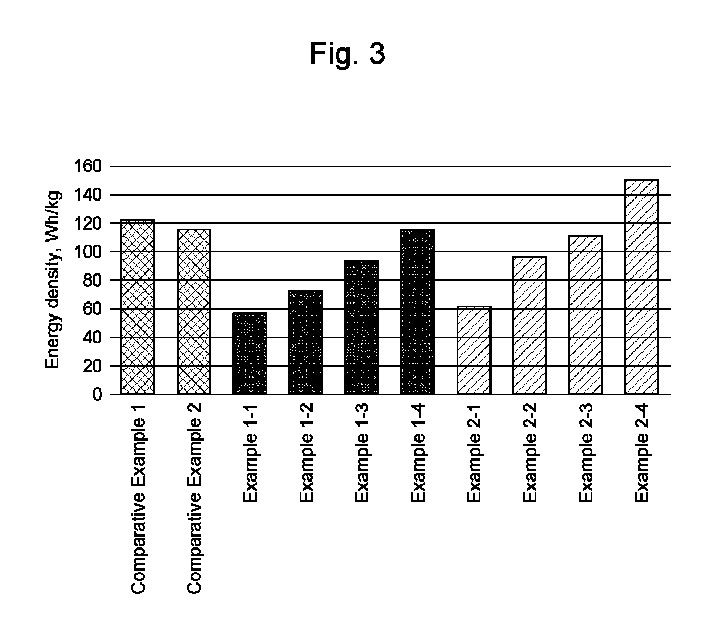
図3は電池セルの測定エネルギ密度を示す。手動混合ではなく、ボールミル粉砕を行い、同じ開始混合物から得られた電池セルのカソード(実施例1-4)は、手動混合サンプル(比較例2)より高いエネルギ密度を示すだけでなく、ボールミル粉砕したNMCの参考サンプル(比較例1)より高いエネルギ密度を示すことが明らかである。 Figure 3 shows the measured energy density of the battery cells. It is clear that the battery cell cathodes obtained from the same starting mixture but with ball milling rather than hand mixing (Examples 1-4) not only exhibit a higher energy density than the hand mixed sample (Comparative Example 2), but also a higher energy density than the ball milled NMC reference sample (Comparative Example 1).
Claims (15)
・Li、Al、Cu、Fe、Cr、Mn、Sn、Mo、Ni、Sn、Ag、Ru又はTiからなる群から選択される少なくとも1つの追加の第2酸化物と、
・P、Ge、Si又はSnである元素Xを含む含リチウムスルフィド化合物と、
・好ましくは含炭素成分を含む電子伝導成分と、
を含む複合電極用粒子材料であって、
以下の結合:X-Sx-X、MySz、MuXvの1つ又は複数を含み、xは0から2、yは0から2、zは0から4、uは0から2であることを特徴とする、粒子材料。 an electrode active component comprising one or more first transition metal M oxides having oxidation states of 3+, 4+, 5+ in said particulate material;
at least one additional second oxide selected from the group consisting of Li, Al, Cu, Fe, Cr, Mn, Sn, Mo, Ni, Sn, Ag, Ru or Ti;
a lithium-containing sulfide compound containing an element X which is P, Ge, Si or Sn;
- an electronically conductive component, preferably including a carbon-containing component;
A particulate material for a composite electrode comprising:
A particulate material characterised in that it comprises one or more of the following bonds: X-- S.sub.x --X, M.sub.yS.sub.z , M.sub.uX.sub.v , where x is 0-2, y is 0-2, z is 0-4 and u is 0-2.
Applications Claiming Priority (3)
| Application Number | Priority Date | Filing Date | Title |
|---|---|---|---|
| EP21187031.6 | 2021-07-21 | ||
| EP21187031.6A EP4123753A1 (en) | 2021-07-21 | 2021-07-21 | Particulate material for a composite electrode and method of producing the particulate material |
| PCT/EP2022/056517 WO2023001413A1 (en) | 2021-07-21 | 2022-03-14 | Particulate material for a composite electrode and method of producing the particulate material |
Publications (1)
| Publication Number | Publication Date |
|---|---|
| JP2024523583A true JP2024523583A (en) | 2024-06-28 |
Family
ID=77021189
Family Applications (1)
| Application Number | Title | Priority Date | Filing Date |
|---|---|---|---|
| JP2023579713A Pending JP2024523583A (en) | 2021-07-21 | 2022-03-14 | Particulate material for composite electrodes and method for producing particulate material |
Country Status (5)
| Country | Link |
|---|---|
| US (1) | US12519100B2 (en) |
| EP (2) | EP4123753A1 (en) |
| JP (1) | JP2024523583A (en) |
| CN (1) | CN117678086A (en) |
| WO (1) | WO2023001413A1 (en) |
Families Citing this family (1)
| Publication number | Priority date | Publication date | Assignee | Title |
|---|---|---|---|---|
| CN119674254B (en) * | 2024-12-13 | 2025-05-27 | 安徽金马能源科技有限公司 | Preparation method of diaphragm-free all-solid-state battery |
Citations (11)
| Publication number | Priority date | Publication date | Assignee | Title |
|---|---|---|---|---|
| JPS5460422A (en) * | 1977-10-24 | 1979-05-15 | Hitachi Ltd | Battery |
| JPS63285871A (en) * | 1987-05-19 | 1988-11-22 | Bridgestone Corp | Nonaqueous electrolyte secondary battery |
| JPH08162151A (en) * | 1994-12-01 | 1996-06-21 | Matsushita Electric Ind Co Ltd | All-solid-state lithium battery |
| JPH117981A (en) * | 1997-06-16 | 1999-01-12 | Nec Corp | Secondary battery |
| US20100104948A1 (en) * | 1999-11-23 | 2010-04-29 | Sion Power Corporation | Protection of anodes for electrochemical cells |
| WO2017085900A1 (en) * | 2015-11-18 | 2017-05-26 | パナソニックIpマネジメント株式会社 | Nonaqueous electrolyte battery |
| JP2017157473A (en) * | 2016-03-03 | 2017-09-07 | 三星電子株式会社Samsung Electronics Co.,Ltd. | Lithium ion secondary battery |
| US20190173082A1 (en) * | 2017-12-05 | 2019-06-06 | Nanotek Instruments, Inc. | Method of Producing Anode or Cathode Participates for Alkali Metal Batteries |
| JP2020035607A (en) * | 2018-08-29 | 2020-03-05 | トヨタ自動車株式会社 | Lithium niobate and manufacturing method thereof |
| JP2020115425A (en) * | 2019-01-17 | 2020-07-30 | トヨタ自動車株式会社 | Sulfide solid electrolyte particle and all-solid battery |
| CN106898750B (en) * | 2017-03-28 | 2020-12-04 | 苏州大学 | Metal-sulfur battery based on sulfur-rich transition metal sulfide and preparation method thereof |
Family Cites Families (6)
| Publication number | Priority date | Publication date | Assignee | Title |
|---|---|---|---|---|
| DE69710787T2 (en) | 1996-05-22 | 2002-11-21 | Moltech Corp., Tucson | COMPOSITE CATHODES, ELECTROCHEMICAL CELLS WITH COMPOSITE CATHODES AND METHOD FOR THE PRODUCTION THEREOF |
| US20090092903A1 (en) | 2007-08-29 | 2009-04-09 | Johnson Lonnie G | Low Cost Solid State Rechargeable Battery and Method of Manufacturing Same |
| JP5521899B2 (en) | 2010-08-26 | 2014-06-18 | トヨタ自動車株式会社 | Sulfide solid electrolyte material and lithium solid state battery |
| JP6173357B2 (en) | 2012-03-01 | 2017-08-02 | ジョンソン・アイピー・ホールディング・エルエルシー | High-capacity solid composite cathode, solid composite separator, solid lithium secondary battery, and production method thereof |
| WO2013130983A2 (en) | 2012-03-01 | 2013-09-06 | Excellatron Solid State, Llc | Impregnated sintered solid state composite electrode, solid state battery, and methods of preparation |
| JP2018503220A (en) * | 2014-12-05 | 2018-02-01 | クアンタムスケイプ コーポレイション | Nanocomposite particles of conversion chemicals and electron-ion mixed conductors |
-
2021
- 2021-07-21 EP EP21187031.6A patent/EP4123753A1/en not_active Withdrawn
-
2022
- 2022-03-14 CN CN202280050884.4A patent/CN117678086A/en active Pending
- 2022-03-14 US US18/578,090 patent/US12519100B2/en active Active
- 2022-03-14 EP EP22714798.0A patent/EP4374432A1/en active Pending
- 2022-03-14 JP JP2023579713A patent/JP2024523583A/en active Pending
- 2022-03-14 WO PCT/EP2022/056517 patent/WO2023001413A1/en not_active Ceased
Patent Citations (11)
| Publication number | Priority date | Publication date | Assignee | Title |
|---|---|---|---|---|
| JPS5460422A (en) * | 1977-10-24 | 1979-05-15 | Hitachi Ltd | Battery |
| JPS63285871A (en) * | 1987-05-19 | 1988-11-22 | Bridgestone Corp | Nonaqueous electrolyte secondary battery |
| JPH08162151A (en) * | 1994-12-01 | 1996-06-21 | Matsushita Electric Ind Co Ltd | All-solid-state lithium battery |
| JPH117981A (en) * | 1997-06-16 | 1999-01-12 | Nec Corp | Secondary battery |
| US20100104948A1 (en) * | 1999-11-23 | 2010-04-29 | Sion Power Corporation | Protection of anodes for electrochemical cells |
| WO2017085900A1 (en) * | 2015-11-18 | 2017-05-26 | パナソニックIpマネジメント株式会社 | Nonaqueous electrolyte battery |
| JP2017157473A (en) * | 2016-03-03 | 2017-09-07 | 三星電子株式会社Samsung Electronics Co.,Ltd. | Lithium ion secondary battery |
| CN106898750B (en) * | 2017-03-28 | 2020-12-04 | 苏州大学 | Metal-sulfur battery based on sulfur-rich transition metal sulfide and preparation method thereof |
| US20190173082A1 (en) * | 2017-12-05 | 2019-06-06 | Nanotek Instruments, Inc. | Method of Producing Anode or Cathode Participates for Alkali Metal Batteries |
| JP2020035607A (en) * | 2018-08-29 | 2020-03-05 | トヨタ自動車株式会社 | Lithium niobate and manufacturing method thereof |
| JP2020115425A (en) * | 2019-01-17 | 2020-07-30 | トヨタ自動車株式会社 | Sulfide solid electrolyte particle and all-solid battery |
Also Published As
| Publication number | Publication date |
|---|---|
| US12519100B2 (en) | 2026-01-06 |
| EP4123753A1 (en) | 2023-01-25 |
| US20240322123A1 (en) | 2024-09-26 |
| EP4374432A1 (en) | 2024-05-29 |
| WO2023001413A1 (en) | 2023-01-26 |
| CN117678086A (en) | 2024-03-08 |
Similar Documents
| Publication | Publication Date | Title |
|---|---|---|
| JP6377997B2 (en) | Positive electrode composite material and sulfide all solid state battery using the same | |
| US20150349338A1 (en) | Antimony-Based Anode on Aluminum Current Collector | |
| TW201505240A (en) | Electrode composition, electrochemical cell and method of making electrochemical cells | |
| WO2022224505A1 (en) | Positive electrode material and battery | |
| US7625673B2 (en) | Electrode material for electrochemical element and method for production thereof, and electrochemical element | |
| CN115336036A (en) | Positive electrode material and battery | |
| JP2008501214A (en) | Battery with tin-based negative electrode material | |
| CN115280553A (en) | Positive electrode active material for all-solid-state lithium ion secondary battery, method for producing same, and all-solid-state lithium ion secondary battery | |
| KR20220028942A (en) | Sulfide solid electrolyte for all solid secondary battery, preparing method thereof, and all solid secondary battery including the same | |
| CN121420402A (en) | All-solid-state secondary batteries and manufacturing methods thereof | |
| JP2024523583A (en) | Particulate material for composite electrodes and method for producing particulate material | |
| SK500742020U1 (en) | Secondary battery cell for electric vehicles, containing solid amorphous glass materials and nano/micro materials | |
| US12224430B2 (en) | Positive electrode material and battery | |
| WO2022255002A1 (en) | Battery | |
| JP6411959B2 (en) | Positive electrode mixture and all-solid-state lithium battery | |
| KR20230114345A (en) | Positive electrode for all solid state battery comprising conductive material composite and manufacturing method thereof | |
| JP2022125899A (en) | All-solid secondary battery and charging method for the same | |
| US20220328804A1 (en) | Electrode and battery | |
| JP2019129096A (en) | All-solid battery and method for manufacturing the same | |
| CN121058097A (en) | Anode-free coating and all-solid-state battery comprising same | |
| CH718845A2 (en) | Particulate material for a composite electrode and method of producing the particulate material. | |
| CN114846642A (en) | Electrode and battery | |
| WO2025037616A1 (en) | Positive-electrode active material for all-solid-state lithium ion secondary batteries, and all-solid-state lithium ion secondary battery | |
| CN120814067A (en) | Composite positive electrode active material, method for preparing same, positive electrode comprising same, and all-solid-state secondary battery | |
| JP2022157526A (en) | Composite material for battery electrode, electrode for lithium ion battery, and lithium ion battery |
Legal Events
| Date | Code | Title | Description |
|---|---|---|---|
| A521 | Request for written amendment filed |
Free format text: JAPANESE INTERMEDIATE CODE: A523 Effective date: 20231226 |
|
| A621 | Written request for application examination |
Free format text: JAPANESE INTERMEDIATE CODE: A621 Effective date: 20231226 |
|
| A131 | Notification of reasons for refusal |
Free format text: JAPANESE INTERMEDIATE CODE: A131 Effective date: 20250107 |
|
| A521 | Request for written amendment filed |
Free format text: JAPANESE INTERMEDIATE CODE: A523 Effective date: 20250403 |
|
| A02 | Decision of refusal |
Free format text: JAPANESE INTERMEDIATE CODE: A02 Effective date: 20250610 |
|
| A521 | Request for written amendment filed |
Free format text: JAPANESE INTERMEDIATE CODE: A523 Effective date: 20250926 |