JP2024512261A - In vivo CRISPR screening system to discover therapeutic targets in CD8 T cells - Google Patents
In vivo CRISPR screening system to discover therapeutic targets in CD8 T cells Download PDFInfo
- Publication number
- JP2024512261A JP2024512261A JP2023551129A JP2023551129A JP2024512261A JP 2024512261 A JP2024512261 A JP 2024512261A JP 2023551129 A JP2023551129 A JP 2023551129A JP 2023551129 A JP2023551129 A JP 2023551129A JP 2024512261 A JP2024512261 A JP 2024512261A
- Authority
- JP
- Japan
- Prior art keywords
- cells
- cell
- fli1
- sgrna
- sgfli1
- Prior art date
- Legal status (The legal status is an assumption and is not a legal conclusion. Google has not performed a legal analysis and makes no representation as to the accuracy of the status listed.)
- Pending
Links
Images


Classifications
-
- C—CHEMISTRY; METALLURGY
- C12—BIOCHEMISTRY; BEER; SPIRITS; WINE; VINEGAR; MICROBIOLOGY; ENZYMOLOGY; MUTATION OR GENETIC ENGINEERING
- C12N—MICROORGANISMS OR ENZYMES; COMPOSITIONS THEREOF; PROPAGATING, PRESERVING, OR MAINTAINING MICROORGANISMS; MUTATION OR GENETIC ENGINEERING; CULTURE MEDIA
- C12N15/00—Mutation or genetic engineering; DNA or RNA concerning genetic engineering, vectors, e.g. plasmids, or their isolation, preparation or purification; Use of hosts therefor
- C12N15/09—Recombinant DNA-technology
- C12N15/11—DNA or RNA fragments; Modified forms thereof; Non-coding nucleic acids having a biological activity
- C12N15/113—Non-coding nucleic acids modulating the expression of genes, e.g. antisense oligonucleotides; Antisense DNA or RNA; Triplex- forming oligonucleotides; Catalytic nucleic acids, e.g. ribozymes; Nucleic acids used in co-suppression or gene silencing
-
- A—HUMAN NECESSITIES
- A61—MEDICAL OR VETERINARY SCIENCE; HYGIENE
- A61K—PREPARATIONS FOR MEDICAL, DENTAL OR TOILETRY PURPOSES
- A61K40/00—Cellular immunotherapy
- A61K40/10—Cellular immunotherapy characterised by the cell type used
- A61K40/11—T-cells, e.g. tumour infiltrating lymphocytes [TIL] or regulatory T [Treg] cells; Lymphokine-activated killer [LAK] cells
-
- A—HUMAN NECESSITIES
- A61—MEDICAL OR VETERINARY SCIENCE; HYGIENE
- A61K—PREPARATIONS FOR MEDICAL, DENTAL OR TOILETRY PURPOSES
- A61K40/00—Cellular immunotherapy
- A61K40/40—Cellular immunotherapy characterised by antigens that are targeted or presented by cells of the immune system
- A61K40/41—Vertebrate antigens
- A61K40/42—Cancer antigens
- A61K40/4242—Transcription factors, e.g. SOX or c-MYC
-
- A—HUMAN NECESSITIES
- A61—MEDICAL OR VETERINARY SCIENCE; HYGIENE
- A61K—PREPARATIONS FOR MEDICAL, DENTAL OR TOILETRY PURPOSES
- A61K40/00—Cellular immunotherapy
- A61K40/40—Cellular immunotherapy characterised by antigens that are targeted or presented by cells of the immune system
- A61K40/46—Viral antigens
-
- A—HUMAN NECESSITIES
- A61—MEDICAL OR VETERINARY SCIENCE; HYGIENE
- A61P—SPECIFIC THERAPEUTIC ACTIVITY OF CHEMICAL COMPOUNDS OR MEDICINAL PREPARATIONS
- A61P35/00—Antineoplastic agents
-
- C—CHEMISTRY; METALLURGY
- C07—ORGANIC CHEMISTRY
- C07K—PEPTIDES
- C07K14/00—Peptides having more than 20 amino acids; Gastrins; Somatostatins; Melanotropins; Derivatives thereof
- C07K14/435—Peptides having more than 20 amino acids; Gastrins; Somatostatins; Melanotropins; Derivatives thereof from animals; from humans
- C07K14/46—Peptides having more than 20 amino acids; Gastrins; Somatostatins; Melanotropins; Derivatives thereof from animals; from humans from vertebrates
- C07K14/47—Peptides having more than 20 amino acids; Gastrins; Somatostatins; Melanotropins; Derivatives thereof from animals; from humans from vertebrates from mammals
- C07K14/4701—Peptides having more than 20 amino acids; Gastrins; Somatostatins; Melanotropins; Derivatives thereof from animals; from humans from vertebrates from mammals not used
- C07K14/4702—Regulators; Modulating activity
- C07K14/4705—Regulators; Modulating activity stimulating, promoting or activating activity
-
- C—CHEMISTRY; METALLURGY
- C07—ORGANIC CHEMISTRY
- C07K—PEPTIDES
- C07K14/00—Peptides having more than 20 amino acids; Gastrins; Somatostatins; Melanotropins; Derivatives thereof
- C07K14/82—Translation products from oncogenes
-
- C—CHEMISTRY; METALLURGY
- C12—BIOCHEMISTRY; BEER; SPIRITS; WINE; VINEGAR; MICROBIOLOGY; ENZYMOLOGY; MUTATION OR GENETIC ENGINEERING
- C12N—MICROORGANISMS OR ENZYMES; COMPOSITIONS THEREOF; PROPAGATING, PRESERVING, OR MAINTAINING MICROORGANISMS; MUTATION OR GENETIC ENGINEERING; CULTURE MEDIA
- C12N15/00—Mutation or genetic engineering; DNA or RNA concerning genetic engineering, vectors, e.g. plasmids, or their isolation, preparation or purification; Use of hosts therefor
- C12N15/09—Recombinant DNA-technology
- C12N15/11—DNA or RNA fragments; Modified forms thereof; Non-coding nucleic acids having a biological activity
-
- C—CHEMISTRY; METALLURGY
- C12—BIOCHEMISTRY; BEER; SPIRITS; WINE; VINEGAR; MICROBIOLOGY; ENZYMOLOGY; MUTATION OR GENETIC ENGINEERING
- C12N—MICROORGANISMS OR ENZYMES; COMPOSITIONS THEREOF; PROPAGATING, PRESERVING, OR MAINTAINING MICROORGANISMS; MUTATION OR GENETIC ENGINEERING; CULTURE MEDIA
- C12N5/00—Undifferentiated human, animal or plant cells, e.g. cell lines; Tissues; Cultivation or maintenance thereof; Culture media therefor
- C12N5/06—Animal cells or tissues; Human cells or tissues
- C12N5/0602—Vertebrate cells
- C12N5/0634—Cells from the blood or the immune system
- C12N5/0636—T lymphocytes
-
- C—CHEMISTRY; METALLURGY
- C12—BIOCHEMISTRY; BEER; SPIRITS; WINE; VINEGAR; MICROBIOLOGY; ENZYMOLOGY; MUTATION OR GENETIC ENGINEERING
- C12N—MICROORGANISMS OR ENZYMES; COMPOSITIONS THEREOF; PROPAGATING, PRESERVING, OR MAINTAINING MICROORGANISMS; MUTATION OR GENETIC ENGINEERING; CULTURE MEDIA
- C12N9/00—Enzymes; Proenzymes; Compositions thereof; Processes for preparing, activating, inhibiting, separating or purifying enzymes
- C12N9/14—Hydrolases (3)
- C12N9/16—Hydrolases (3) acting on ester bonds (3.1)
- C12N9/22—Ribonucleases [RNase]; Deoxyribonucleases [DNase]
-
- C—CHEMISTRY; METALLURGY
- C12—BIOCHEMISTRY; BEER; SPIRITS; WINE; VINEGAR; MICROBIOLOGY; ENZYMOLOGY; MUTATION OR GENETIC ENGINEERING
- C12N—MICROORGANISMS OR ENZYMES; COMPOSITIONS THEREOF; PROPAGATING, PRESERVING, OR MAINTAINING MICROORGANISMS; MUTATION OR GENETIC ENGINEERING; CULTURE MEDIA
- C12N2310/00—Structure or type of the nucleic acid
- C12N2310/10—Type of nucleic acid
- C12N2310/20—Type of nucleic acid involving clustered regularly interspaced short palindromic repeats [CRISPR]
-
- C—CHEMISTRY; METALLURGY
- C12—BIOCHEMISTRY; BEER; SPIRITS; WINE; VINEGAR; MICROBIOLOGY; ENZYMOLOGY; MUTATION OR GENETIC ENGINEERING
- C12N—MICROORGANISMS OR ENZYMES; COMPOSITIONS THEREOF; PROPAGATING, PRESERVING, OR MAINTAINING MICROORGANISMS; MUTATION OR GENETIC ENGINEERING; CULTURE MEDIA
- C12N2320/00—Applications; Uses
- C12N2320/10—Applications; Uses in screening processes
- C12N2320/12—Applications; Uses in screening processes in functional genomics, i.e. for the determination of gene function
-
- C—CHEMISTRY; METALLURGY
- C12—BIOCHEMISTRY; BEER; SPIRITS; WINE; VINEGAR; MICROBIOLOGY; ENZYMOLOGY; MUTATION OR GENETIC ENGINEERING
- C12N—MICROORGANISMS OR ENZYMES; COMPOSITIONS THEREOF; PROPAGATING, PRESERVING, OR MAINTAINING MICROORGANISMS; MUTATION OR GENETIC ENGINEERING; CULTURE MEDIA
- C12N2510/00—Genetically modified cells
Landscapes
- Health & Medical Sciences (AREA)
- Life Sciences & Earth Sciences (AREA)
- Chemical & Material Sciences (AREA)
- Engineering & Computer Science (AREA)
- Genetics & Genomics (AREA)
- Organic Chemistry (AREA)
- General Health & Medical Sciences (AREA)
- Biomedical Technology (AREA)
- Zoology (AREA)
- Wood Science & Technology (AREA)
- Bioinformatics & Cheminformatics (AREA)
- Biotechnology (AREA)
- Molecular Biology (AREA)
- Animal Behavior & Ethology (AREA)
- Veterinary Medicine (AREA)
- Public Health (AREA)
- General Engineering & Computer Science (AREA)
- Biochemistry (AREA)
- Epidemiology (AREA)
- Microbiology (AREA)
- Medicinal Chemistry (AREA)
- Immunology (AREA)
- Biophysics (AREA)
- Chemical Kinetics & Catalysis (AREA)
- Pharmacology & Pharmacy (AREA)
- Nuclear Medicine, Radiotherapy & Molecular Imaging (AREA)
- General Chemical & Material Sciences (AREA)
- Plant Pathology (AREA)
- Physics & Mathematics (AREA)
- Hematology (AREA)
- Cell Biology (AREA)
- Gastroenterology & Hepatology (AREA)
- Proteomics, Peptides & Aminoacids (AREA)
- Oncology (AREA)
- Toxicology (AREA)
- Medicines Containing Material From Animals Or Micro-Organisms (AREA)
- Measuring Or Testing Involving Enzymes Or Micro-Organisms (AREA)
- Micro-Organisms Or Cultivation Processes Thereof (AREA)
- Medicines That Contain Protein Lipid Enzymes And Other Medicines (AREA)
- Medicines Containing Antibodies Or Antigens For Use As Internal Diagnostic Agents (AREA)
Abstract
本開示は、破壊されたFli1を含む改変された免疫細胞またはその前駆体を提供する。また、組成物および治療方法も提供される。本開示はまた、T細胞疲弊を評価することを含む、T細胞をスクリーニングするための方法を提供する。TIFF2024512261000018.tif78166The present disclosure provides engineered immune cells or precursors thereof that contain disrupted Fli1. Also provided are compositions and methods of treatment. The present disclosure also provides methods for screening T cells, including assessing T cell exhaustion. TIFF2024512261000018.tif78166
Description
関連出願の相互参照
本出願は、米国特許法119条(e)項の下、2021年2月24日に出願された米国仮特許出願第63/153,191号の優先権を主張する権利を有し、該仮特許出願は、参照によりその全体が本明細書に組み入れられる。
CROSS-REFERENCE TO RELATED APPLICATIONS This application claims priority under 35 U.S.C. § 119(e) to U.S. Provisional Patent Application No. 63/153,191, filed February 24, 2021. , which is incorporated herein by reference in its entirety.
連邦政府支援による研究開発に関する言明
本発明は、米国国立衛生研究所により授与されたAI105343、AI117950、AI082630、AI112521、AI115712、AI108545、CA210944、CA234842、CA009140、MH109905、およびHG010480の下、政府の支援を受けてなされた。政府は、本発明において一定の権利を有する。
Statement Regarding Federally Sponsored Research and Development This invention was made with federal support under awards AI105343, AI117950, AI082630, AI112521, AI115712, AI108545, CA210944, CA234842, CA009140, MH109905, and HG010480 awarded by the National Institutes of Health. It was received and done. The Government has certain rights in this invention.
発明の背景
エフェクターCD8 T細胞(TEFF)分化を調節する機序を理解することは、がんおよび他の疾患に対する治療的アプローチを改善するために極めて重要である。急性回復感染期またはワクチン接種後のナイーブCD8 T細胞(TN)の活性化は、転写的かつエピジェネティックなリモデリングを伴うTEFF細胞への分化をもたらす。抗原消失後、TEFF細胞の最終分化サブセットは、その後数日~数週間で死ぬが、一方、ごく一部のメモリー前駆体(TMP)は、長期メモリーCD8 T細胞(TMEM)へと分化する。しかしながら、慢性感染およびがん期間中は、CD8 T細胞分化は、疲弊の道へ方向転換する。これらの病態下では、TEFF細胞は、過剰刺激されることになり、あまり持続しないが、活性化された前駆体の集団は、疲弊CD8 T細胞(TEX)へと分化する。TEX細胞は、PD-1を含めた複数の抑制性受容体の高発現、減少したエフェクター機能、TMEM細胞と比較して変更された恒常性調節、およびまったく異なる転写的かつエピジェネティックなプログラムを有する。PD-1などの抑制性受容体を遮断することは、TEXを再活性させ、増殖およびいくつかのエフェクター様特性を一時的に回復させることができ、複数のがんタイプにおいて臨床的有益性が実証されている。しかしながら、チェックポイント遮断の成功にもかかわらず、ほとんどの患者は、永続的な臨床的有益性を得ることなく、がんまたは他の疾患においてチェックポイント遮断後または細胞療法中にT細胞分化およびエフェクター様活性を強化することが強く求められている。
BACKGROUND OF THE INVENTION Understanding the mechanisms that regulate effector CD8 T cell ( TEFF ) differentiation is critical to improving therapeutic approaches to cancer and other diseases. Activation of naïve CD8 T cells (T N ) during acute convalescent infection or after vaccination results in differentiation into T EFF cells with transcriptional and epigenetic remodeling. After antigen disappearance, a terminally differentiated subset of T EFF cells dies over the next few days to weeks, while a small proportion of memory precursors (T MP ) differentiate into long-term memory CD8 T cells (T MEM ). do. However, during chronic infection and cancer, CD8 T cell differentiation redirects towards exhaustion. Under these pathological conditions, T EFF cells become overstimulated and, although short-lived, the activated progenitor population differentiates into exhausted CD8 T cells (T EX ). T EX cells have high expression of multiple inhibitory receptors including PD-1, reduced effector function, altered homeostatic regulation compared to T MEM cells, and a completely different transcriptional and epigenetic program. has. Blocking inhibitory receptors such as PD-1 can reactivate TEX and temporarily restore proliferation and some effector-like properties, with clinical benefit in multiple cancer types. has been proven. However, despite the success of checkpoint blockade, most patients fail to develop T cell differentiation and effector differentiation after checkpoint blockade or during cell therapy in cancer or other diseases without obtaining durable clinical benefit. There is a strong need to enhance this activity.
チェックポイント遮断に応答するT細胞の集団を定義すること、そして、細胞療法のための最適な分化状態を調べることに関心が高まっている。TEX細胞は、ヒト腫瘍において顕著であり、腫瘍反応性T細胞の主要な供給源である可能性が高い。PD-1経路遮断は、TEX細胞を再活性化してTEX細胞がTEFF細胞プログラムの一部に再アクセス可能となることに少なくとも部分的に起因して、臨床的有益性を仲介する。しかしながら、限定された治療有効性が、TEX細胞の最適でない再活性化と関連している。また、CAR T細胞の治療の失敗も、疲弊と関連しており、疲弊に対抗するアプローチが積極的に調査されている。しかしながら、がんを制御するためのチェックポイント遮断と細胞療法の両方への応答の鍵は、エフェクター活性の量的な増大および誘発を含めたロバストなエフェクタープログラムを効果的に働かせることができるかである。このエフェクター活性を制御する根底の分子機序を理解することは、慢性感染およびがんに対する治療的介入を効果的に設計するために必要である。 There is growing interest in defining T cell populations that respond to checkpoint blockade and in determining optimal differentiation states for cell therapy. T EX cells are prominent in human tumors and are likely the major source of tumor-reactive T cells. PD-1 pathway blockade mediates clinical benefit due, at least in part, to reactivating T EX cells, allowing them to reaccess parts of the T EFF cell program. However, limited therapeutic efficacy has been associated with suboptimal reactivation of T EX cells. CAR T cell treatment failure is also associated with exhaustion, and approaches to counteract exhaustion are being actively investigated. However, the key to the response to both checkpoint blockade and cell therapy to control cancer lies in the ability to effectively mobilize robust effector programs, including quantitative increase and induction of effector activity. be. Understanding the underlying molecular mechanisms that control this effector activity is necessary to effectively design therapeutic interventions against chronic infections and cancer.
TEFF対TMEMまたはTEXの分化の調節における転写因子(TF)の役割に大きな注目が集まっている。例えば、TFのBatfおよびIrf4は、T細胞活性化において初期の役割を果たし、また、エフェクター遺伝子の転写誘導の第2波も誘導する。Runx3は、T-betおよびEomesを通じてTEFF遺伝子発現を誘導し、組織常在性のメモリーCD8 T細胞(TRM)にとって重要である。Runx3はまた、TCF-1発現を阻害することによって濾胞性様CD8 T細胞の運命をアンタゴナイズする。Runx1は、対照的に、TEFF分化中にRunx3によってアンタゴナイズされる。ほとんどのTEFF関連遺伝子とそれらの同族シス調節領域は、TN状態では接近不能であり、このことから、エフェクター駆動TFの役割は、TNからTEFFへの移行の間に生じるクロマチンアクセシビリティの変化と関係がある。実際に、Batfなどのこれらの初期に作用するTFのいくつかは、クロマチンリモデリングを通じてTEFF遺伝子アクセシビリティに寄与し得るという証拠があるが、他の制御機序については、依然として明らかにされていない。 Significant attention has been focused on the role of transcription factors (TFs) in regulating T EFF versus T MEM or T EX differentiation. For example, the TFs Batf and Irf4 play an early role in T cell activation and also induce a second wave of transcriptional induction of effector genes. Runx3 induces T EFF gene expression through T-bet and Eomes and is important for tissue-resident memory CD8 T cells (T RM ). Runx3 also antagonizes follicular-like CD8 T cell fate by inhibiting TCF-1 expression. Runx1, in contrast, is antagonized by Runx3 during T EFF differentiation. Most T EFF- related genes and their cognate cis-regulatory regions are inaccessible in the TN state, and this suggests that the role of effector-driven TFs may influence the chromatin accessibility that occurs during the TN to T EFF transition. It has to do with change. Indeed, there is evidence that some of these early-acting TFs, such as Batf, may contribute to T EFF gene accessibility through chromatin remodeling, but other regulatory mechanisms remain to be elucidated. .
TEFF形成を促進するTFに加え、相反する機序が、エフェクター分化への完全関与を和らげ、将来のまたは進行中の応答のためのより永続的なT細胞集団を保存する。2つの交互の細胞運命であるTMEMおよびTEXは、完全に関与しているTEFFから形成できず、このことは、TMEMおよびTEXが分化可能になるために、TEFFプログラムの一部がアンタゴナイズされなければならないことを示唆している。高移動度群(HMG)TF、例えば、TCF-1は、TMEMとTEXの両方の発生および維持に必要不可欠である。TCF-1は、T-betおよびBlimp-1などのTEFF駆動TFを抑制し、エピジェネティック変化を促進し得る。さらに、第2のHMG TFであるToxは、TEX細胞運命の発生に必要不可欠であり、TEFF系列分化を抑制する。この研究にもかかわらず、TEFF分化への関与を防ぐ機序は、依然としてほとんど理解されていない。そのような情報は、がんおよび慢性感染に対して免疫療法を有効にする可能性がある。ただ、TEFF分化のプログラム全体を抑制解除するであろうTCF-1またはToxのような経路を不活性化することに関心が向かう一方で、そのようなアプローチは、最終TEFFをもたらし、そして、係る細胞は永続的な応答を持続できないので、治療的有益性が限定され得る。 In addition to TFs promoting T EFF formation, opposing mechanisms moderate full commitment to effector differentiation and preserve a more durable T cell population for future or ongoing responses. Two alternating cell fates, T MEM and T EX , cannot be formed from fully committed T EFFs , and this suggests that in order for T MEM and T EX to be able to differentiate, part of the T EFF program is required. suggests that the division must be antagonized. High mobility group (HMG) TFs, such as TCF-1, are essential for the generation and maintenance of both T MEM and T EX . TCF-1 can suppress T EFF- driven TFs such as T-bet and Blimp-1 and promote epigenetic changes. Furthermore, a second HMG TF, Tox, is essential for the development of T EX cell fate and suppresses T EFF lineage differentiation. Despite this study, the mechanisms that prevent T commitment to EFF differentiation remain poorly understood. Such information could potentially enable immunotherapy against cancer and chronic infections. However, while there is interest in inactivating pathways such as TCF-1 or Tox, which would derepress the entire program of T EFF differentiation, such approaches result in final T EFF and , therapeutic benefit may be limited because such cells cannot sustain durable responses.
したがって、TEFF分化の鍵となる側面を選択的に抑制解除する機序、特に、量的増大および/または防御免疫の制御に関与するものの発見が、当技術分野において必要とされている。本発明は、この必要性に応えるものである。 Therefore, there is a need in the art to discover mechanisms to selectively derepress key aspects of T EFF differentiation, particularly those involved in quantitative expansion and/or control of protective immunity. The present invention addresses this need.
一局面では、Fli1をコードする内因性遺伝子座中に改変を含む、改変された免疫細胞またはその前駆体が、本明細書に提供される。 In one aspect, provided herein is an engineered immune cell or precursor thereof that includes a modification in the endogenous locus encoding Fli1.
別の局面では、内因性Fli1遺伝子またはタンパク質が破壊されている、改変された免疫細胞またはその前駆体が、本明細書に提供される。 In another aspect, provided herein is a modified immune cell or precursor thereof in which the endogenous Fli1 gene or protein has been disrupted.
ある特定の態様では、改変または破壊は、CRISPRシステム、抗体、siRNA、miRNA、アンタゴニスト、薬物、低分子阻害剤、PROTAC標的、TALEN、およびジンクフィンガーヌクレアーゼからなる群より選択される方法によってなされる。 In certain embodiments, the modification or disruption is accomplished by a method selected from the group consisting of CRISPR systems, antibodies, siRNAs, miRNAs, antagonists, drugs, small molecule inhibitors, PROTAC targets, TALENs, and zinc finger nucleases.
ある特定の態様では、CRISPRシステムは、SEQ ID NO:152~156またはSEQ ID NO:676~713のいずれか1つを含む少なくとも1つのsgRNAを含む。 In certain embodiments, the CRISPR system comprises at least one sgRNA comprising any one of SEQ ID NO: 152-156 or SEQ ID NO: 676-713.
ある特定の態様では、細胞は、ヒト細胞である。ある特定の態様では、細胞は、T細胞である。ある特定の態様では、T細胞は、T細胞疲弊に抵抗性である。 In certain embodiments, the cells are human cells. In certain embodiments, the cells are T cells. In certain embodiments, the T cells are resistant to T cell exhaustion.
別の局面では、Fli1の阻害剤を含む薬学的組成物が本明細書に提供される。ある特定の態様では、阻害剤は、CRISPRシステム、抗体、siRNA、miRNA、アンタゴニスト、薬物、低分子阻害剤、PROTAC標的、TALEN、およびジンクフィンガーヌクレアーゼからなる群より選択される。ある特定の態様では、CRISPRシステムは、SEQ ID NO:152~156またはSEQ ID NO:676~713のいずれか1つを含む少なくとも1つのsgRNAを含む。 In another aspect, provided herein is a pharmaceutical composition comprising an inhibitor of Fli1. In certain embodiments, the inhibitor is selected from the group consisting of CRISPR systems, antibodies, siRNAs, miRNAs, antagonists, drugs, small molecule inhibitors, PROTAC targets, TALENs, and zinc finger nucleases. In certain embodiments, the CRISPR system comprises at least one sgRNA comprising any one of SEQ ID NO: 152-156 or SEQ ID NO: 676-713.
別の局面では、本発明は、その必要のある対象における疾患または障害を治療する方法を含む。該方法は、対象に、本明細書において企図される細胞のいずれかまたは組成物のいずれかを投与することを含む。 In another aspect, the invention includes a method of treating a disease or disorder in a subject in need thereof. The method includes administering to the subject any of the cells or any of the compositions contemplated herein.
ある特定の態様では、疾患または障害は、感染症である。ある特定の態様では、疾患は、がんである。 In certain embodiments, the disease or disorder is an infectious disease. In certain embodiments, the disease is cancer.
別の局面では、T細胞をスクリーニングする方法が本明細書に提供される。該方法は、i)活性化T細胞にCas酵素(またはCasをコードする核酸)およびsgRNAライブラリーを導入すること、ii)該T細胞を感染マウスに投与すること、iii)該感染マウスからT細胞を単離すること、ならびにiv)T細胞を分析することを含む。 In another aspect, provided herein is a method of screening T cells. The method involves i) introducing a Cas enzyme (or a nucleic acid encoding Cas) and an sgRNA library into activated T cells, ii) administering the T cells to an infected mouse, and iii) extracting T from the infected mouse. isolating the cells, and iv) analyzing the T cells.
ある特定の態様では、sgRNAライブラリーは、複数の転写因子を標的とする複数のsgRNAを含む。ある特定の態様では、複数の転写因子は、表1に列挙される転写因子のいずれかを含む。ある特定の態様では、各sgRNAは、各転写因子のDNA結合ドメインを標的とする。ある特定の態様では、sgRNAライブラリーは、SEQ ID NO:1~675からなる群より選択される少なくとも1つの配列を含む。ある特定の態様では、sgRNAライブラリーは、SEQ ID NO:1~675に示されるヌクレオチド配列からなる。 In certain embodiments, the sgRNA library includes multiple sgRNAs that target multiple transcription factors. In certain embodiments, the plurality of transcription factors comprises any of the transcription factors listed in Table 1. In certain embodiments, each sgRNA targets the DNA binding domain of each transcription factor. In certain embodiments, the sgRNA library comprises at least one sequence selected from the group consisting of SEQ ID NO: 1-675. In certain embodiments, the sgRNA library consists of the nucleotide sequences set forth in SEQ ID NO: 1-675.
ある特定の態様では、スクリーニングは、T細胞疲弊を評価する。ある特定の態様では、該方法は、TEFFおよびTEX細胞分化を支配する新規転写因子を同定する。 In certain embodiments, the screen assesses T cell exhaustion. In certain embodiments, the method identifies novel transcription factors that govern T EFF and T EX cell differentiation.
ある特定の態様では、細胞を分析することは、シーケンシング、PCR、MACS、およびFACSからなる群より選択される方法を含む。ある特定の態様では、シーケンシングは、関心対象の標的を明らかにする。ある特定の態様では、関心対象の標的に対して薬物が設計される。ある特定の態様では、薬物がT細胞に投与されたとき、少なくとも1つのT細胞応答が増加する。 In certain embodiments, analyzing the cells includes a method selected from the group consisting of sequencing, PCR, MACS, and FACS. In certain embodiments, sequencing reveals targets of interest. In certain embodiments, drugs are designed against targets of interest. In certain embodiments, at least one T cell response is increased when the drug is administered to a T cell.
ある特定の態様では、1×10⁵個のT細胞が感染マウスに投与される。 In certain embodiments, 1×10 5 T cells are administered to infected mice.
本開示の前述および他の特徴および利点は、添付の図面と併せて、下記の例示的な態様の詳細な説明からより十分に理解されよう。 The foregoing and other features and advantages of the present disclosure will be more fully understood from the following detailed description of exemplary embodiments, taken in conjunction with the accompanying drawings.
詳細な説明
抗原特異的T細胞のエフェクター活性を改善することは、がん免疫療法における主要な目標である。エフェクターT細胞(TEFF)駆動転写因子(TF)がいくつか同定されているにもかかわらず、TEFF生物学の転写調整は、依然としてほとんど理解されていない。本明細書において、インビボT細胞CRISPRスクリーニングプラットフォームを開発した。ETSファミリーTFのFli1を通じてTEFF生物学を抑止する新規機序が同定された。Fli1の遺伝子欠失は、メモリーまたは疲弊前駆体を損なうことなくTEFF応答を増強した。Fli1は、エフェクター関連遺伝子のシス調節要素に結合することによってTEFF系列分化を抑止した。Fli1の喪失は、ETS:RUNXモチーフでのクロマチンアクセシビリティを増加させ、より効率的なRunx3駆動TEFF生物学を可能にした。Fli1を欠いているCD8 T細胞は、複数の感染および腫瘍に対して明らかに良好な防御を提供した。これらのデータは、Fli1が、発生段階のCD8 T細胞転写ランドスケープを、過剰なETS:RUNXにより駆動されるTEFF細胞分化から保護することを示す。さらに、Fli1の遺伝子欠失は、感染およびがんにおけるTEFF分化および防御免疫を改善する。
Detailed Description Improving the effector activity of antigen-specific T cells is a major goal in cancer immunotherapy. Despite the identification of several effector T cell (T EFF )-driven transcription factors (TFs), the transcriptional regulation of T EFF biology remains poorly understood. Herein, we developed an in vivo T cell CRISPR screening platform. A novel mechanism was identified that suppresses T EFF biology through the ETS family TF Fli1. Genetic deletion of Fli1 enhanced T EFF responses without impairing memory or exhausted precursors. Fli1 suppressed T EFF lineage differentiation by binding to cis-regulatory elements of effector-related genes. Loss of Fli1 increased chromatin accessibility at the ETS:RUNX motif, allowing more efficient Runx3-driven T EFF biology. CD8 T cells lacking Fli1 provided clearly better protection against multiple infections and tumors. These data indicate that Fli1 protects the developmental CD8 T cell transcriptional landscape from excessive ETS:RUNX-driven T EFF cell differentiation. Furthermore, genetic deletion of Fli1 improves T EFF differentiation and protective immunity in infection and cancer.
本開示に記載される方法は、本明細書において開示される特定の方法および/または実験条件が変動し得るので、そのような方法および条件に限定されないことを理解されたい。また、本明細書において使用される用語法は、特定の態様だけを説明することを目的とし、限定的であることは意図しないことも理解されたい。 It is to be understood that the methods described in this disclosure are not limited to the specific methods and/or experimental conditions disclosed herein, as such may vary. It is also to be understood that the terminology used herein is for the purpose of describing particular embodiments only and is not intended to be limiting.
さらに、本明細書に記載される実験は、特に示さない限り、当業者の技能の範囲内で従来の分子細胞生物学的および免疫学的技法を使用する。そのような技法は、熟練の作業者に周知であり、文献に十分に説明されている。例えば、すべての補遺を含むAusubel, et al., ed., Current Protocols in Molecular Biology, John Wiley & Sons, Inc., NY, N.Y. (1987-2008)、MR GreenおよびJ. SambrookによるMolecular Cloning: A Laboratory Manual (Fourth Edition)ならびにHarlow et al., Antibodies: A Laboratory Manual, Chapter 14, Cold Spring Harbor Laboratory, Cold Spring Harbor (2013, 2nd edition)を参照されたい。
Additionally, the experiments described herein employ conventional molecular cell biological and immunological techniques within the skill of those in the art, unless otherwise indicated. Such techniques are well known to those skilled in the art and are fully explained in the literature. For example, Ausubel, et al., ed., Current Protocols in Molecular Biology, John Wiley & Sons, Inc., NY, N.Y. (1987-2008), including all supplements, Molecular Cloning by MR Green and J. Sambrook: A See Laboratory Manual (Fourth Edition) and Harlow et al., Antibodies: A Laboratory Manual,
A. 定義
特に定義されない限り、本明細書において用いられる科学用語および技術用語は、当業者によって広く理解されている意味を有する。何らかの潜在的意味不確定が発生した場合、本明細書において提供される定義が、任意の辞書または外部の定義よりも優先される。状況により特に必要とされない限り、単数の用語は複数を含むものとし、複数の用語は単数を含むものとする。特に述べない限り、「または」の使用は「および/または」を意味する。「含んでいる(including)」という用語ならびに「含む(includes)」および「含んだ(included)」などの他の形態の使用は、非限定的である。
A. Definitions Unless otherwise defined, scientific and technical terms used herein have meanings that are commonly understood by those of ordinary skill in the art. In the event of any potential semantic uncertainty, the definitions provided herein will take precedence over any dictionary or external definitions. Unless the context otherwise requires, singular terms shall include pluralities and plural terms shall include the singular. Unless stated otherwise, the use of "or" means "and/or." The use of the term "including" and other forms such as "includes" and "included" is non-limiting.
一般的に、本明細書に記載される細胞および組織培養、分子生物学、免疫学、微生物学、遺伝学ならびにタンパク質および核酸の化学およびハイブリダイゼーションに関連して使用される命名法は周知であり、当技術分野において広く使用される。本明細書において提供される方法および技法は、特に示さない限り一般的に当技術分野において周知の従来法に従って、本明細書全体にわたり引用され、論じられる様々な一般的でより具体的な参考文献に記載されるように行われる。酵素反応および精製技法は、当技術分野において広く成し遂げられる、または本明細書に記載されるように製造業者の規格に従って行われる。本明細書に記載される分析化学、合成有機化学、および医薬化学に関連して使用される命名法ならびにその検査手技および技法は、周知であり、当技術分野において広く使用されるものである。化学合成、化学分析、薬学的調製、製剤化、および送達ならびに患者の処置のために標準的な技法が使用される。 In general, the nomenclature used in connection with cell and tissue culture, molecular biology, immunology, microbiology, genetics, and protein and nucleic acid chemistry and hybridization described herein is well known. , widely used in the art. The methods and techniques provided herein are generally in accordance with conventional methods well known in the art, unless otherwise indicated, and various general and more specific references cited and discussed throughout this specification. carried out as described in . Enzymatic reactions and purification techniques are performed according to manufacturer's specifications as commonly accomplished in the art or as described herein. The nomenclature and laboratory procedures and techniques used in connection with analytical, synthetic organic, and medicinal chemistry described herein are well known and widely used in the art. Standard techniques are used for chemical synthesis, chemical analysis, pharmaceutical preparation, formulation, and delivery and patient treatment.
本開示がより容易に理解され得るように、選ばれた用語を以下に定義する。 In order that this disclosure may be more easily understood, selected terms are defined below.
「1つの(a)」および「1つの(an)」という冠詞は、本明細書においてその冠詞の文法的対象物の1つまたは1つよりも多く(すなわち、少なくとも1つ)をいうように用いられる。例として、「1つの(an)要素」は、1つの要素または1つよりも多い要素を意味する。 The articles "a" and "an" are used herein to refer to one or more than one (i.e., at least one) of the grammatical object of the article. used. By way of example, "an element" means one element or more than one element.
量、時間的持続期間などのような測定可能な値をいう場合に本明細書において用いられる「約」は、特定された値から±20%または±10%、より好ましくは±5%、さらにより好ましくは±1%、なおより好ましくは±0.1%のばらつきを包含するものとするが、これはそのようなばらつきが、開示された方法を実施する上で妥当なためである。 "About" as used herein when referring to a measurable value, such as an amount, time duration, etc., means ±20% or ±10%, more preferably ±5%, and even ±5% from the specified value. More preferably, variations of ±1% and even more preferably ±0.1% are included, as such variations are reasonable in practicing the disclosed method.
本明細書において用いられる「活性化」とは、検出可能な細胞増殖を誘導するように十分に刺激されたT細胞の状態のことを指す。活性化はまた、誘導されたサイトカイン産生、および検出可能なエフェクター機能に関連することができる。「活性化T細胞」という用語は、特に、細胞分裂を起こしているT細胞のことを指す。 As used herein, "activation" refers to the state of a T cell that has been sufficiently stimulated to induce detectable cell proliferation. Activation can also be associated with induced cytokine production and detectable effector function. The term "activated T cell" specifically refers to a T cell that is undergoing cell division.
本明細書において使用される場合、疾患を「緩和する」は、疾患の1つまたは複数の症状の重症度を低減することを意味する。 As used herein, "alleviating" a disease means reducing the severity of one or more symptoms of the disease.
本明細書において用いられる「抗原」という用語は、免疫応答を引き起こす分子と定義される。この免疫応答には、抗体産生、または特異的免疫適格細胞の活性化のいずれかまたは両方が含まれ得る。当業者は、事実上、すべてのタンパク質またはペプチドを含む任意の高分子が抗原として働くことができることを理解するであろう。 The term "antigen" as used herein is defined as a molecule that elicits an immune response. This immune response may include either or both antibody production or activation of specific immunocompetent cells. Those skilled in the art will appreciate that virtually any macromolecule, including any protein or peptide, can serve as an antigen.
さらに、抗原は、組換えDNAまたはゲノムDNAに由来することができる。当業者は、免疫応答を誘発するタンパク質をコードするヌクレオチド配列または部分ヌクレオチド配列を含む任意のDNAが、それゆえ、本明細書においてその用語が用いられる通りの「抗原」をコードすることを理解するであろう。さらに、当業者は、抗原が遺伝子の完全長ヌクレオチド配列のみによってコードされる必要はないことを理解するであろう。本開示が、1つよりも多い遺伝子の部分ヌクレオチド配列の使用を含むが、これに限定されるわけではないこと、およびこれらのヌクレオチド配列が、所望の免疫応答を誘発するために様々な組み合わせで配置されることは、容易に明らかである。さらに、当業者は、抗原が「遺伝子」によってコードされる必要はまったくないことを理解するであろう。抗原が生物学的試料から生成、合成または由来することができることは、容易に明らかである。そのような生物学的試料は、組織試料、腫瘍試料、細胞または生体液を含むことができるが、それに限定されるわけではない。 Additionally, the antigen can be derived from recombinant or genomic DNA. Those skilled in the art will understand that any DNA that includes a nucleotide sequence or partial nucleotide sequence that encodes a protein that elicits an immune response therefore encodes an "antigen" as that term is used herein. Will. Furthermore, those skilled in the art will understand that an antigen need not be encoded solely by the full-length nucleotide sequence of a gene. The present disclosure includes, but is not limited to, the use of partial nucleotide sequences of more than one gene, and that these nucleotide sequences can be used in various combinations to elicit a desired immune response. It is readily apparent that Furthermore, those skilled in the art will understand that an antigen need not be encoded by a "gene" at all. It is readily apparent that antigens can be produced, synthesized or derived from biological samples. Such biological samples can include, but are not limited to, tissue samples, tumor samples, cells or biological fluids.
本明細書において用いられる場合、「自己」という用語は、後にその個体に再び導入される、同じ個体に由来する任意の材料をいうよう意図される。 As used herein, the term "self" is intended to refer to any material derived from the same individual that is later reintroduced to that individual.
「共刺激分子」は、共刺激リガンドと特異的に結合し、それにより、非限定的に増殖などのT細胞による共刺激応答を媒介する、T細胞上の同族結合パートナーを指す。共刺激分子には、MHCクラスI分子、BTLAおよびTollリガンド受容体が含まれるが、それに限定されるわけではない。 "Co-stimulatory molecule" refers to a cognate binding partner on a T cell that specifically binds a costimulatory ligand and thereby mediates a costimulatory response by the T cell, including, but not limited to, proliferation. Co-stimulatory molecules include, but are not limited to, MHC class I molecules, BTLA and Toll ligand receptors.
「共刺激シグナル」は、本明細書において使用される場合、TCR/CD3の連結などの一次シグナルとの組み合わせで、T細胞増殖および/または鍵となる分子のアップレギュレーションもしくはダウンレギュレーションを導くシグナルを指す。 "Co-stimulatory signal" as used herein refers to a signal that, in combination with a primary signal such as TCR/CD3 ligation, leads to T cell proliferation and/or up- or down-regulation of key molecules. Point.
「疾患」は、動物が恒常性を維持できず、疾患が改善されなければその動物の健康が悪化し続ける、動物の健康状態である。対照的に、動物における「障害」は、その動物が恒常性を維持できるが、その動物の健康状態が障害のない場合よりも好ましくない健康状態である。未処置のまま放置されても、障害が必ずしも動物の健康状態のさらなる低下を引き起こすとは限らない。 A "disease" is a state of health in an animal in which the animal is unable to maintain homeostasis and the animal's health continues to deteriorate unless the disease is corrected. In contrast, a "disorder" in an animal is a state of health in which the animal is able to maintain homeostasis, but the state of health of the animal is less favorable than it would be without the disorder. If left untreated, the disorder does not necessarily cause a further decline in the animal's health.
用語「ダウンレギュレーション」は、本明細書において使用される場合、1つまたは複数の遺伝子の遺伝子発現の減少または消失を指す。 The term "downregulation" as used herein refers to a reduction or elimination of gene expression of one or more genes.
「有効量」または「治療的有効量」は、本明細書において互換的に用いられ、特定の生物学的結果を達成するのに有効な、または治療的もしくは予防的利益をもたらす、本明細書において記述される化合物、製剤、材料または組成物の量のことを指す。そのような結果には、哺乳動物に投与した場合に、本開示の組成物の非存在下で検出される免疫応答と比較して検出可能なレベルの免疫抑制または耐容性を引き起こす量が含まれ得るが、それに限定されるわけではない。免疫応答は、おびただしい数の当技術分野において認識されている方法によって容易に評価することができる。当業者は、本明細書において投与される組成物の量が、変動すること、そして、処置されている疾患または状態、処置されている哺乳動物の齢および健康および身体の状態、疾患の重症度、投与されている特定の化合物などの多数の要因に基づいてこれを容易に決定できることを理解するであろう。 "Effective amount" or "therapeutically effective amount" are used interchangeably herein and refer to a term effective to achieve a particular biological result or to provide a therapeutic or prophylactic benefit. Refers to the amount of a compound, formulation, material or composition described in . Such results include an amount that, when administered to a mammal, causes a detectable level of immunosuppression or tolerance as compared to the immune response detected in the absence of the compositions of the present disclosure. obtain, but are not limited to. Immune responses can be readily assessed by a number of art-recognized methods. Those skilled in the art will appreciate that the amount of the compositions administered herein will vary and will depend on the disease or condition being treated, the age and health and physical condition of the mammal being treated, and the severity of the disease. It will be appreciated that this can be readily determined based on a number of factors, such as the particular compound being administered.
「コードする」とは、定義されたヌクレオチド(すなわち、rRNA、tRNAおよびmRNA)配列または定義されたアミノ酸配列のいずれかを有する、生物学的過程において他のポリマーおよび高分子の合成のための鋳型として働く、遺伝子、cDNAまたはmRNAのようなポリヌクレオチドにおける特定のヌクレオチド配列の固有の特性ならびにそれに起因する生物学的特性をいう。したがって、遺伝子は、その遺伝子に対応するmRNAの転写および翻訳によって細胞または他の生体系においてタンパク質が産生される場合、タンパク質をコードする。mRNA配列と同一であり通常は配列表に示されるヌクレオチド配列であるコード鎖も、遺伝子またはcDNAの転写のための鋳型として用いられる非コード鎖も共に、その遺伝子またはcDNAのタンパク質または他の産物をコードするということができる。 "Encodes" means a template for the synthesis of other polymers and macromolecules in biological processes, having either a defined nucleotide (i.e., rRNA, tRNA, and mRNA) sequence or a defined amino acid sequence. refers to the inherent properties of a particular nucleotide sequence in a polynucleotide, such as a gene, cDNA, or mRNA, and the biological properties attributed thereto. Thus, a gene encodes a protein if the protein is produced in a cell or other biological system by transcription and translation of the mRNA corresponding to the gene. Both the coding strand, which is the nucleotide sequence that is identical to the mRNA sequence and usually shown in a sequence listing, and the non-coding strand, which is used as a template for the transcription of a gene or cDNA, produce proteins or other products of that gene or cDNA. It can be said to be coded.
本明細書において用いられる場合、「内因性」とは、生物、細胞、組織もしくは系の内部に由来するか、またはそれらの内部で産生される、任意の材料をいう。 As used herein, "endogenous" refers to any material that originates from or is produced within an organism, cell, tissue or system.
用語「エピトープ」は、本明細書において使用される場合、免疫応答を誘発し、B細胞応答および/またはT細胞応答を誘導することができる、抗原上の小化学分子として定義される。抗原は、1つまたは複数のエピトープを有することができる。ほとんどの抗原は、多くのエピトープを有する;すなわち、これらは多価である。一般に、エピトープは、おおよそ約10アミノ酸および/または糖のサイズである。好ましくは、エピトープは、約4~18アミノ酸、より好ましくは約5~16アミノ酸、さらにより最も好ましくは6~14アミノ酸、より好ましくは約7~12、そして、最も好ましくは約8~10アミノ酸である。一般には、分子の特定の直鎖状配列よりも全体の三次元構造が抗原の特異性の主な基準であること、それゆえ、これによってあるエピトープが別のエピトープと区別されることを、当業者は理解する。本開示に基づいて、本開示で用いられるペプチドは、エピトープであることができる。 The term "epitope" as used herein is defined as a small chemical molecule on an antigen that is capable of eliciting an immune response and inducing a B cell response and/or a T cell response. An antigen can have one or more epitopes. Most antigens have many epitopes; ie, they are multivalent. Generally, epitopes are approximately about 10 amino acids and/or sugars in size. Preferably, the epitope is about 4 to 18 amino acids, more preferably about 5 to 16 amino acids, even more preferably 6 to 14 amino acids, more preferably about 7 to 12 amino acids, and most preferably about 8 to 10 amino acids. be. It is generally accepted that the overall three-dimensional structure of the molecule, rather than the specific linear sequence, is the main criterion for antigen specificity and that this distinguishes one epitope from another. Businesses understand. Based on this disclosure, peptides used in this disclosure can be epitopes.
本明細書において用いられる場合、「外因性」という用語は、生物、細胞、組織もしくは系の外部から導入されるか、またはそれらの外部で産生される、任意の材料をいう。 As used herein, the term "exogenous" refers to any material that is introduced or produced from outside an organism, cell, tissue or system.
本明細書において用いられる「増大する」という用語は、T細胞の数の増加のように、数が増加することをいう。一態様では、エクスビボで増大したT細胞は、培養物中に当初存在している数と比べて数が増加する。別の態様では、エクスビボで増大したT細胞は、培養物中の他の細胞型と比べて数が増加する。本明細書において用いられる「エクスビボ」という用語は、生物(例えば、ヒト)から取り出され、生物の外側で(例えば、培養皿、試験管、またはバイオリアクタ中で)繁殖させた細胞をいう。 As used herein, the term "expand" refers to an increase in number, such as an increase in the number of T cells. In one embodiment, the ex vivo expanded T cells are increased in number compared to the number originally present in the culture. In another embodiment, ex vivo expanded T cells are increased in number relative to other cell types in culture. As used herein, the term "ex vivo" refers to cells that have been removed from an organism (eg, a human) and propagated outside the organism (eg, in a culture dish, test tube, or bioreactor).
本明細書において用いられる「発現」という用語は、そのプロモーターによって駆動される特定のヌクレオチド配列の転写および/または翻訳と定義される。 The term "expression" as used herein is defined as the transcription and/or translation of a particular nucleotide sequence driven by its promoter.
「発現ベクター」とは、発現されるべきヌクレオチド配列に機能的に連結された発現制御配列を含む組換えポリヌクレオチドを含むベクターをいう。発現ベクターは、発現のために十分なシス作用性エレメントを含み;発現のための他のエレメントは、宿主細胞によって、またはインビトロ発現系において供給されることができる。発現ベクターには、組換えポリヌクレオチドを組み入れたコスミド、プラスミド(例えば、裸のもの、またはリポソーム中に含まれるもの)ならびにウイルス(例えば、センダイウイルス、レンチウイルス、レトロウイルス、アデノウイルスおよびアデノ随伴ウイルス)のような、当技術分野において公知のすべてのものが含まれる。 "Expression vector" refers to a vector that contains a recombinant polynucleotide that includes an expression control sequence operably linked to the nucleotide sequence to be expressed. Expression vectors contain sufficient cis-acting elements for expression; other elements for expression can be supplied by the host cell or in an in vitro expression system. Expression vectors include cosmids that incorporate recombinant polynucleotides, plasmids (e.g., naked or contained in liposomes) and viruses (e.g., Sendai virus, lentiviruses, retroviruses, adenoviruses and adeno-associated viruses). ), as known in the art.
本明細書において用いられる「同一性」とは、2つのポリマー分子間の、特に2つのポリペプチド分子間のような2つのアミノ酸分子間のサブユニット配列の同一性をいう。2つのアミノ酸配列が同じ位置に同じ残基を有する場合;例えば、2つのポリペプチド分子の各々における位置がアルギニンによって占有されているなら、それらはその位置で同一である。2つのアミノ酸配列がアライメントにおいて同じ位置に同じ残基を有する同一性または程度は、百分率として表現されることが多い。2つのアミノ酸配列間の同一性は、一致しているまたは同一である位置の数の一次関数である;例えば、2つの配列における位置の半分(例えば、10アミノ酸長のポリマーにおける5つの位置)が同一であるなら、2つの配列は50%同一であり;位置の90%(例えば、10中9)が一致しているまたは同一であるなら、2つのアミノ酸配列は90%同一である。 As used herein, "identity" refers to the identity of subunit sequences between two polymer molecules, particularly between two amino acid molecules, such as between two polypeptide molecules. Two amino acid sequences are identical at a position if they have the same residue at the same position; for example, if the position in each of two polypeptide molecules is occupied by an arginine. The identity or degree to which two amino acid sequences have the same residues at the same positions in an alignment is often expressed as a percentage. Identity between two amino acid sequences is a linear function of the number of positions that are matched or identical; for example, half of the positions in the two sequences (e.g., five positions in a 10 amino acid long polymer) are Two sequences are 50% identical if they are identical; two amino acid sequences are 90% identical if 90% (eg, 9 out of 10) of the positions are matched or identical.
本明細書において用いられる「免疫応答」という用語は、リンパ球が抗原分子を異物と同定し、抗体の形成を誘導し、かつ/またはリンパ球を活性化して抗原を除去する場合に起きる、抗原に対する細胞応答と定義される。 As used herein, the term "immune response" refers to an antigen response that occurs when lymphocytes identify an antigen molecule as foreign, induce the formation of antibodies, and/or activate the lymphocytes to remove the antigen. defined as the cellular response to
「免疫抑制」という用語は、本明細書において免疫応答全体を低減することを指すために使用される。 The term "immunosuppression" is used herein to refer to reducing the overall immune response.
一般に「indel」と略される「挿入/欠失」は、ゲノム中に特定のヌクレオチド配列が存在する(挿入)または存在しない(欠失)、遺伝子多型の一種である。 "Insertion/deletion", commonly abbreviated as "indel", is a type of genetic polymorphism in which a specific nucleotide sequence is present (insertion) or absent (deletion) in the genome.
「単離された」とは、天然の状態から変えられたまたは取り出されたことを意味する。例えば、生きている動物に天然に存在する核酸またはペプチドは「単離されて」いないが、その天然状態の共存物質から部分的にまたは完全に分離された同じ核酸またはペプチドは「単離されて」いる。単離された核酸またはタンパク質は、実質的に精製された形態で存在することができ、または例えば、宿主細胞のような、非天然環境で存在することができる。 "Isolated" means altered or removed from its natural state. For example, a nucleic acid or peptide that occurs naturally in a living animal is not "isolated," but the same nucleic acid or peptide that is partially or completely separated from its natural state coexisting materials is "isolated." ”There is. An isolated nucleic acid or protein can exist in substantially purified form or can exist in a non-natural environment, such as, for example, a host cell.
「ノックダウン」という用語は、本明細書において使用される場合、1つまたは複数の遺伝子の遺伝子発現の減少のことを指す。 The term "knockdown" as used herein refers to a decrease in gene expression of one or more genes.
「ノックイン」という用語は、本明細書において使用される場合、標的配列(例えば、内因性遺伝子座)に挿入された外因性核酸配列のことを指す。いくつかの態様では、標的配列が遺伝子である場合、外因性核酸配列が、標的遺伝子の発現を制御する任意の上流および/または下流調節要素と機能的連結状態になる、ノックインが生成される。いくつかの態様では、外因性核酸配列が、標的遺伝子の発現を制御する任意の上流および/または下流調節要素と機能的連結状態にならない、ノックインが生成される。 The term "knock-in" as used herein refers to an exogenous nucleic acid sequence inserted into a target sequence (eg, an endogenous genetic locus). In some embodiments, when the target sequence is a gene, a knock-in is produced in which the exogenous nucleic acid sequence is placed in operative linkage with any upstream and/or downstream regulatory elements that control expression of the target gene. In some embodiments, a knock-in is produced in which the exogenous nucleic acid sequence is not in functional linkage with any upstream and/or downstream regulatory elements that control expression of the target gene.
「ノックアウト」という用語は、本明細書において使用される場合、1つまたは複数の遺伝子の遺伝子発現の消失のことを指す。 The term "knockout" as used herein refers to the loss of gene expression of one or more genes.
本明細書において用いられる「レンチウイルス」とは、レトロウイルス科(Retroviridae)ファミリーの属をいう。レンチウイルスは、非分裂細胞に感染できるという点で、レトロウイルスの中でも独特である;それらはかなりの量の遺伝情報を宿主細胞のDNA中に送達することができるため、それらは遺伝子送達ベクターの最も効率的な方法の1つである。HIV、SIVおよびFIVはすべて、レンチウイルスの例である。レンチウイルスに由来するベクターは、インビボで有意なレベルの遺伝子移入を達成するための手段を与える。 As used herein, "lentivirus" refers to a genus of the Retroviridae family. Lentiviruses are unique among retroviruses in that they can infect nondividing cells; they can deliver significant amounts of genetic information into the host cell's DNA, making them useful for gene delivery vectors. It is one of the most efficient methods. HIV, SIV and FIV are all examples of lentiviruses. Vectors derived from lentiviruses provide a means to achieve significant levels of gene transfer in vivo.
本明細書において用いられる用語「改変された」とは、本開示の分子または細胞の変化した状態または構造を意味する。分子は化学的に、構造的に、および機能的になど、多くの方法で改変され得る。細胞は、核酸の導入によって改変され得る。 The term "altered" as used herein refers to an altered state or structure of a molecule or cell of the present disclosure. Molecules can be modified in many ways, including chemically, structurally, and functionally. Cells can be modified by introducing nucleic acids.
本明細書において用いられる用語「モジュレートする」とは、処置もしくは化合物の非存在下での対象における応答のレベルと比較して、および/または他の点では同一であるが処置を受けていない対象における応答のレベルと比較して、対象における応答のレベルの検出可能な増加または減少を媒介することを意味する。この用語は、対象、好ましくはヒトにおいて、天然のシグナルもしくは応答を撹乱させ、かつ/またはそれに影響を与え、それにより有益な治療応答を媒介することを包含する。 As used herein, the term "modulate" refers to the level of response in a subject in the absence of treatment or compound and/or in an otherwise identical subject not receiving treatment. Means to mediate a detectable increase or decrease in the level of response in a subject as compared to the level of response in the subject. The term encompasses disrupting and/or influencing natural signals or responses in a subject, preferably a human, thereby mediating a beneficial therapeutic response.
本開示の文脈において、一般的に存在する核酸塩基に関する以下の略語が用いられる。「A」はアデノシンをいい、「C」はシトシンをいい、「G」はグアノシンをいい、「T」はチミジンをいい、そして「U」はウリジンをいう。 In the context of this disclosure, the following abbreviations relating to commonly occurring nucleobases are used. "A" refers to adenosine, "C" refers to cytosine, "G" refers to guanosine, "T" refers to thymidine, and "U" refers to uridine.
「オリゴヌクレオチド」という用語は、典型的には、短いポリヌクレオチドのことを指す。ヌクレオチド配列がDNA配列(すなわち、A、T、C、G)によって表される場合、このヌクレオチド配列はRNA配列(すなわち、A、U、C、G)(「U」が「T」に置き換わる)も含むことが理解されよう。 The term "oligonucleotide" typically refers to short polynucleotides. If a nucleotide sequence is represented by a DNA sequence (i.e. A, T, C, G), this nucleotide sequence is represented by an RNA sequence (i.e. A, U, C, G) ('U' replaces 'T') It will be understood that this includes
別途指定がなされない限り、「アミノ酸配列をコードするヌクレオチド配列」は、互いに縮重したバージョンでありかつ同じアミノ酸配列をコードするすべてのヌクレオチド配列を含む。タンパク質またはRNAをコードするヌクレオチド配列という語句は、該タンパク質をコードするヌクレオチド配列が、あるバージョンにおいてイントロンを含有し得る限り、イントロンも含み得る。 Unless otherwise specified, a "nucleotide sequence encoding an amino acid sequence" includes all nucleotide sequences that are degenerate versions of each other and encode the same amino acid sequence. The phrase nucleotide sequence encoding a protein or RNA can also include introns, insofar as the nucleotide sequence encoding the protein can contain introns in some versions.
免疫原性組成物の「非経口」投与は、例えば、皮下(s.c.)、静脈内(i.v.)、筋肉内(i.m.)、もしくは胸骨内注射、または注入技術を含む。 "Parenteral" administration of an immunogenic composition includes, for example, subcutaneous (s.c.), intravenous (i.v.), intramuscular (i.m.), or intrasternal injection or infusion techniques.
本明細書において用いられる「ポリヌクレオチド」という用語は、ヌクレオチドの鎖と定義される。さらに、核酸はヌクレオチドのポリマーである。したがって、本明細書において用いられる核酸およびポリヌクレオチドは互換的である。当業者は、核酸がポリヌクレオチドであり、それらは単量体「ヌクレオチド」に加水分解することができるという一般知識を有する。単量体ヌクレオチドは、ヌクレオシドに加水分解することができる。本明細書において用いられる場合、ポリヌクレオチドには、非限定的に、組換え手段、すなわち通常のクローニング技術およびPCRなどを用いた組換えライブラリーまたは細胞ゲノムからの核酸配列のクローニングを含む、当技術分野において利用可能な任意の手段により、ならびに合成手段により得られるすべての核酸配列が含まれるが、それに限定されるわけではない。 The term "polynucleotide" as used herein is defined as a chain of nucleotides. Furthermore, nucleic acids are polymers of nucleotides. Accordingly, nucleic acids and polynucleotides as used herein are interchangeable. Those skilled in the art have the general knowledge that nucleic acids are polynucleotides, which can be hydrolyzed into monomeric "nucleotides." Monomeric nucleotides can be hydrolyzed into nucleosides. As used herein, polynucleotides include, but are not limited to, the cloning of nucleic acid sequences from recombinant libraries or cellular genomes using conventional cloning techniques and PCR, etc. It includes, but is not limited to, all nucleic acid sequences obtained by any means available in the art, as well as by synthetic means.
本明細書において用いられる場合、「ペプチド」、「ポリペプチド」および「タンパク質」という用語は、互換的に用いられ、ペプチド結合によって共有結合されたアミノ酸残基で構成される化合物をいう。タンパク質またはペプチドは、少なくとも2つのアミノ酸を含まなくてはならず、タンパク質またはペプチドの配列を構成することができるアミノ酸の最大数に制限はない。ポリペプチドには、ペプチド結合によって相互につなぎ合わされた2つまたはそれよりも多いアミノ酸を含む任意のペプチドまたはタンパク質が含まれる。本明細書において用いられる場合、この用語は、例えば、当技術分野において一般的にはペプチド、オリゴペプチドおよびオリゴマーともいわれる短鎖と、当技術分野において一般にタンパク質といわれる長鎖の両方をいい、その中には多くのタイプがある。「ポリペプチド」には、とりわけ、例えば、生物学的に活性なフラグメント、実質的に相同なポリペプチド、オリゴペプチド、ホモ二量体、ヘテロ二量体、ポリペプチドのバリアント、修飾ポリペプチド、誘導体、類似体、融合タンパク質が含まれる。ポリペプチドには、天然ペプチド、組換えペプチド、合成ペプチド、またはそれらの組み合わせが含まれる。 As used herein, the terms "peptide," "polypeptide," and "protein" are used interchangeably and refer to a compound composed of amino acid residues covalently linked by peptide bonds. A protein or peptide must contain at least two amino acids, and there is no limit to the maximum number of amino acids that can make up the protein or peptide sequence. Polypeptide includes any peptide or protein that contains two or more amino acids joined together by peptide bonds. As used herein, the term refers, for example, to both short chains, also commonly referred to in the art as peptides, oligopeptides, and oligomers, and longer chains, commonly referred to in the art as proteins; There are many types. "Polypeptide" includes, among others, biologically active fragments, substantially homologous polypeptides, oligopeptides, homodimers, heterodimers, polypeptide variants, modified polypeptides, derivatives, etc. , analogs, and fusion proteins. Polypeptides include naturally occurring peptides, recombinant peptides, synthetic peptides, or combinations thereof.
抗体に関して本明細書において用いられる用語「特異的に結合する」とは、特異的抗原を認識するが、試料中の他の分子を実質的に認識またはそれと結合しない抗体を意味する。例えば、1つの種由来の抗原に特異的に結合する抗体が、1つまたは複数の種由来のその抗原にも結合する場合がある。しかし、そのような異種間反応性はそれ自体で、特異的としての抗体の分類を変化させることはない。別の例において、抗原に特異的に結合する抗体が、その抗原の異なる対立遺伝子型にも結合する場合がある。しかし、そのような交差反応性はそれ自体で、特異的としての抗体の分類を変化させることはない。場合によっては、「特異的結合」または「特異的に結合する」という用語を、抗体、タンパク質またはペプチドと第2の化学種との相互作用に関連して用いて、相互作用が化学種上の特定の構造(例えば、抗原決定基またはエピトープ)の存在に依存することを意味することができる;例えば、抗体は、タンパク質全体ではなく特定のタンパク質構造を認識し、それに結合する。抗体がエピトープ「A」に特異的であるなら、標識された「A」およびその抗体を含む反応物中にエピトープAを含む分子(または遊離した、標識されていないA)が存在することにより、その抗体に結合した標識されたAの量が低減するであろう。 The term "specifically binds" as used herein with reference to antibodies means an antibody that recognizes a specific antigen but does not substantially recognize or bind to other molecules in a sample. For example, an antibody that specifically binds an antigen from one species may also bind that antigen from one or more species. However, such cross-species reactivity does not in itself alter the classification of the antibody as specific. In another example, an antibody that specifically binds an antigen may also bind a different allelic form of that antigen. However, such cross-reactivity does not in itself alter the classification of the antibody as specific. In some cases, the terms "specific binding" or "specifically binds" are used in connection with the interaction of an antibody, protein, or peptide with a second species, and the interaction is It can be meant to depend on the presence of a particular structure (eg, an antigenic determinant or epitope); for example, an antibody recognizes and binds to a particular protein structure rather than the entire protein. If an antibody is specific for epitope "A," then the presence of a molecule containing epitope A (or free, unlabeled A) in a reaction containing labeled "A" and that antibody The amount of labeled A bound to the antibody will be reduced.
「刺激」という用語は、刺激分子(例えば、TCR/CD3複合体)がその同族リガンドと結合し、それによって、非限定的に、TCR/CD3複合体を介するシグナル伝達のような、シグナル伝達事象を媒介することにより誘導される一次応答を意味する。刺激は、TGF-ベータのダウンレギュレーション、および/または細胞骨格構造の再編成などのような、ある特定の分子の発現の変化を媒介することができる。 The term "stimulation" refers to a signaling event in which a stimulatory molecule (e.g., TCR/CD3 complex) binds to its cognate ligand, thereby causing a signaling event, such as, but not limited to, signaling through the TCR/CD3 complex. refers to the primary response induced by mediating Stimulation can mediate changes in the expression of certain molecules, such as downregulation of TGF-beta and/or reorganization of cytoskeletal structures.
「刺激分子」とは、この用語が本明細書において用いられる場合、抗原提示細胞上に存在する同族刺激リガンドと特異的に結合する、T細胞上の分子を意味する。 "Stimulatory molecule", as the term is used herein, refers to a molecule on a T cell that specifically binds a cognate stimulatory ligand present on an antigen presenting cell.
本明細書において用いられる「刺激リガンド」は、抗原提示細胞(例えば、aAPC、樹状細胞、B細胞など)に存在する場合、T細胞上の同族結合パートナー(本明細書において「刺激分子」といわれる)と特異的に結合でき、それによって、活性化、免疫応答の開始、増殖などを含むが、それに限定されるわけではない、T細胞による一次応答を媒介するリガンドを意味する。刺激リガンドは当技術分野において周知であり、とりわけ、ペプチドが負荷されたMHCクラスI分子、抗CD3抗体、スーパーアゴニスト抗CD28抗体、およびスーパーアゴニスト抗CD2抗体を包含する。 As used herein, a "stimulatory ligand" refers to a cognate binding partner on a T cell (referred to herein as a "stimulatory molecule") when present on an antigen presenting cell (e.g., aAPC, dendritic cell, B cell, etc.). refers to a ligand capable of specifically binding to a T-cell, thereby mediating a primary response by a T cell, including, but not limited to, activation, initiation of an immune response, proliferation, etc. Stimulatory ligands are well known in the art and include peptide-loaded MHC class I molecules, anti-CD3 antibodies, superagonist anti-CD28 antibodies, and superagonist anti-CD2 antibodies, among others.
「対象」という用語は、免疫応答を誘発することができる生物(例えば、哺乳動物)を含むよう意図される。本明細書において用いられる「対象」または「患者」は、ヒトまたは非ヒト哺乳動物であり得る。非ヒト哺乳動物には、例えば、ヒツジ、ウシ、ブタ、イヌ、ネコおよびマウス哺乳動物のような、家畜およびペットが含まれる。好ましくは、対象はヒトである。 The term "subject" is intended to include organisms (eg, mammals) capable of eliciting an immune response. A "subject" or "patient" as used herein can be a human or non-human mammal. Non-human mammals include livestock and pets, such as, for example, sheep, cows, pigs, dogs, cats and mouse mammals. Preferably the subject is a human.
「標的部位」または「標的配列」とは、結合が起きるのに十分な条件の下で結合分子が特異的に結合し得る核酸の一部分を規定する核酸配列をいう。いくつかの態様では、標的配列は、結合が起こるのに十分な条件下で結合分子が特異的に結合し得る核酸の一部を規定するゲノム核酸配列のことを指す。 "Target site" or "target sequence" refers to a nucleic acid sequence that defines a portion of a nucleic acid to which a binding molecule can specifically bind under conditions sufficient for binding to occur. In some embodiments, a target sequence refers to a genomic nucleic acid sequence that defines a portion of a nucleic acid to which a binding molecule can specifically bind under conditions sufficient for binding to occur.
本明細書において用いられる「治療的」という用語は、処置および/または予防を意味する。治療効果は、疾患状態の抑制、寛解または根絶によって得られる。 The term "therapeutic" as used herein means treatment and/or prevention. A therapeutic effect is achieved by suppressing, ameliorating or eradicating the disease state.
「移植片」は、移植されることになる生体適合性の格子またはドナーの組織、臓器または細胞のことをいう。移植片の例には、皮膚細胞または組織、骨髄ならびに心臓、膵臓、腎臓、肺および肝臓などの実質臓器が含まれ得るが、それに限定されるわけではない。移植片はまた、宿主に投与されることになる任意の材料を指すことができる。例えば、移植片は、核酸またはタンパク質を指すことができる。 "Graft" refers to a biocompatible lattice or donor tissue, organ, or cell that is to be transplanted. Examples of grafts may include, but are not limited to, skin cells or tissue, bone marrow and solid organs such as the heart, pancreas, kidneys, lungs and liver. A graft can also refer to any material that is to be administered to a host. For example, a graft can refer to a nucleic acid or a protein.
本明細書において用いられる「トランスフェクションされた」または「形質転換された」または「形質導入された」という用語は、外因性核酸が宿主細胞に移入または導入される過程をいう。「トランスフェクションされた」または「形質転換された」または「形質導入された」細胞は、外因性核酸でトランスフェクションされた、形質転換された、または形質導入されたものである。この細胞には初代対象細胞およびその子孫が含まれる。 As used herein, the terms "transfected" or "transformed" or "transduced" refer to the process by which exogenous nucleic acid is transferred or introduced into a host cell. A "transfected" or "transformed" or "transduced" cell is one that has been transfected, transformed, or transduced with an exogenous nucleic acid. The cells include the primary subject cell and its progeny.
疾患を「処置する」とは、この用語が本明細書において用いられる場合、対象が被っている疾患または障害の少なくとも1つの徴候または症状の頻度または重症度を低減することを意味する。 "Treat" a disease, as the term is used herein, means reducing the frequency or severity of at least one sign or symptom of a disease or disorder suffered by a subject.
「ベクター」は、単離された核酸を含み、かつ単離された核酸を細胞の内部に送達するために使用できる材料の組成物である。直鎖状ポリヌクレオチド、イオン性または両親媒性化合物と結び付いたポリヌクレオチド、プラスミドおよびウイルスを含むが、それに限定されるわけではない、多数のベクターが当技術分野において公知である。したがって、「ベクター」という用語は、自律的に複製するプラスミドまたはウイルスを含む。この用語はまた、例えばポリリシン化合物、リポソームなどのような、細胞内への核酸の移入を容易にする非プラスミド性および非ウイルス性の化合物を含むと解釈されるべきである。ウイルスベクターの例としては、センダイウイルスベクター、アデノウイルスベクター、アデノ随伴ウイルスベクター、レトロウイルスベクター、レンチウイルスベクターなどが挙げられるが、それに限定されるわけではない。 A "vector" is a composition of material that contains an isolated nucleic acid and that can be used to deliver the isolated nucleic acid inside a cell. A large number of vectors are known in the art, including, but not limited to, linear polynucleotides, polynucleotides associated with ionic or amphipathic compounds, plasmids, and viruses. Thus, the term "vector" includes autonomously replicating plasmids or viruses. This term should also be construed to include non-plasmid and non-viral compounds that facilitate the transfer of nucleic acids into cells, such as, for example, polylysine compounds, liposomes, and the like. Examples of viral vectors include, but are not limited to, Sendai virus vectors, adenovirus vectors, adeno-associated virus vectors, retrovirus vectors, lentivirus vectors, and the like.
範囲:本開示の全体を通じて、本開示の様々な局面を範囲の形式で提示することができる。範囲の形式の記述は、単に便宜および簡略化のためのものであり、本発明の範囲に対する柔軟性のない制限と解釈されるべきではないことが理解されるべきである。したがって、範囲の記述は、可能なすべての部分範囲およびその範囲内の個々の数値を具体的に開示したものとみなされるべきである。例えば、1~6のような範囲の記述は、1~3、1~4、1~5、2~4、2~6、3~6などのような部分範囲、ならびにその範囲内の個々の数、例えば、1、2、2.7、3、4、5、5.3および6を具体的に開示したものとみなされるべきである。これは、範囲の幅に関係なく適用される。 Range: Throughout this disclosure, various aspects of the disclosure may be presented in the form of a range. It should be understood that the description in range format is merely for convenience and simplicity and is not to be construed as an inflexible limitation on the scope of the invention. Accordingly, range statements should be considered as specifically disclosing all possible subranges and individual numerical values within that range. For example, a description of a range such as 1 to 6 can be used to describe subranges such as 1 to 3, 1 to 4, 1 to 5, 2 to 4, 2 to 6, 3 to 6, etc., as well as individual subranges within that range. Numbers such as 1, 2, 2.7, 3, 4, 5, 5.3 and 6 should be considered as specifically disclosed. This applies regardless of the width of the range.
B. 改変された免疫細胞
内因性Fli1が破壊されている、改変された免疫細胞またはその前駆体(例えば、T細胞)が本明細書に提供される。内因性Fli1は、当業者に公知の任意の手段によって遺伝子またはタンパク質レベルで破壊することができる。Fli1を破壊するそのような方法は、CRISPRシステム、抗体、siRNA、miRNA、薬物、アンタゴニスト、低分子阻害剤、およびPROTAC標的を含むが、それらに限定されない。
B. Modified Immune Cells Provided herein are modified immune cells or precursors thereof (eg, T cells) in which endogenous Fli1 has been disrupted. Endogenous Fli1 can be disrupted at the gene or protein level by any means known to those skilled in the art. Such methods of disrupting Fli1 include, but are not limited to, CRISPR systems, antibodies, siRNA, miRNA, drugs, antagonists, small molecule inhibitors, and PROTAC targets.
一局面では、本開示は、Fli1をコードする内因性遺伝子座中に改変を含む、改変された免疫細胞またはその前駆体(例えば、T細胞)を提供する。ある特定の態様では、細胞は、内因性Fli1の遺伝子発現をダウンレギュレーション可能な核酸を含む。 In one aspect, the disclosure provides modified immune cells or precursors thereof (eg, T cells) that include modifications in the endogenous locus encoding Fli1. In certain embodiments, the cell comprises a nucleic acid capable of downregulating endogenous Fli1 gene expression.
一局面では、本開示は、Fli1をコードする内因性遺伝子座中に内因性Fli1の遺伝子発現をダウンレギュレーション可能なCRISPR媒介改変を含む、改変された免疫細胞またはその前駆体(例えば、T細胞)を提供する。 In one aspect, the present disclosure provides modified immune cells or precursors thereof (e.g., T cells) that contain CRISPR-mediated modifications in the endogenous locus encoding Fli1 that can downregulate gene expression of endogenous Fli1. I will provide a.
ある特定の態様では、改変細胞は、ヒト細胞である。 In certain embodiments, the modified cells are human cells.
本開示は、遺伝子編集された改変細胞を提供する。いくつかの態様では、本開示の改変細胞は、Fli1をコードする内因性遺伝子座の発現を破壊するように遺伝子編集される。いくつかの態様では、遺伝子編集された免疫細胞(例えば、T細胞)は、内因性Fli1の発現のダウンレギュレーション、低減、欠失、排除、ノックアウトまたは破壊を有する。 The present disclosure provides gene-edited modified cells. In some embodiments, the modified cells of the present disclosure are gene edited to disrupt expression of the endogenous locus encoding Fli1. In some embodiments, the gene-edited immune cell (eg, T cell) has downregulation, reduction, deletion, elimination, knockout, or destruction of endogenous Fli1 expression.
免疫療法は、がん患者の治療において様々な有効性を示してきた。それらの効果を制限する主要な問題の1つは、T細胞が、腫瘍細胞による持続的な刺激後に疲弊することである。疲弊したT細胞は、低減されたエフェクター機能、例えばサイトカインの産生および腫瘍細胞に対する細胞傷害性を有し、これらは、より高いレベルのチェックポイント阻害性分子、例えばPD-1およびCTLA-4を発現する。PD-1およびCTLA-4抗体が、複数の種類のがんを治療するために臨床的に使用されている。 Immunotherapy has shown variable efficacy in treating cancer patients. One of the major problems limiting their effectiveness is that T cells become exhausted after sustained stimulation by tumor cells. Exhausted T cells have reduced effector functions, such as cytokine production and cytotoxicity against tumor cells, and they express higher levels of checkpoint inhibitory molecules, such as PD-1 and CTLA-4. do. PD-1 and CTLA-4 antibodies are used clinically to treat multiple types of cancer.
いくつかの態様では、本開示の改変細胞は、さらなる内因性遺伝子の発現を破壊するように遺伝子編集される。例えば、細胞は、内因性PDCD1遺伝子産物(例えば、プログラム死1受容体;PD-1)を破壊するようにさらに編集され得る。内因性PD-1の発現を破壊することは、「チェックポイント」抵抗性の改変細胞を創出し、結果として、増加した腫瘍制御をもたらし得る。チェックポイント抵抗性の改変細胞はまた、例えば、非限定的に、アデノシンA2A受容体(A2AR)、B7-H3(CD276)、B7-H4(VTCN1)、BおよびTリンパ球アテニュエータータンパク質(BTLA/CD272)、CD96、細胞傷害性T-リンパ球関連タンパク質4(CTLA-4/CD152)、インドールアミン 2,3-ジオキシゲナーゼ(IDO)、キラー細胞免疫グロブリン様受容体(KIR)、リンパ球活性化遺伝子-3(LAG3)、IgおよびITIMドメインを有するT細胞免疫受容体(TIGIT)、T-細胞免疫グロブリンドメインおよびムチンドメイン3(TIM-3)、またはT細胞活性化のV-ドメインIgサプレッサー(VISTA)の発現を破壊することによっても創出され得る。
In some embodiments, modified cells of the present disclosure are gene edited to disrupt expression of additional endogenous genes. For example, cells can be further edited to destroy the endogenous PDCD1 gene product (eg, programmed
様々な遺伝子編集技術が当業者に公知である。遺伝子編集技術は、非限定的に、ホーミングエンドヌクレアーゼ、ジンクフィンガーヌクレアーゼ(ZFN)、転写活性化因子様エフェクター(TALE)ヌクレアーゼ(TALEN)、およびクラスター化して規則的な配置の短い回文配列リピート(CRISPR)関連タンパク質9(Cas9)を含む。ホーミングエンドヌクレアーゼは、一般的に、それらのDNA基質を二量体として切断し、異なる結合および切断ドメインを有しない。ZFNは、FokI切断ドメインによって認識される5~7塩基対(bp)のスペーサー配列に隣接する2つのジンクフィンガー結合部位からなる標的部位を認識する。TALENは、FokI切断ドメインによって認識される12~20bpのスペーサー配列に隣接する2つのTALE DNA結合部位からなる標的部位を認識する。Cas9ヌクレアーゼは、適合するプロトスペーサー隣接モチーフ(PAM)のすぐ上流に位置する単一ガイドRNA(gRNA)内のターゲティング配列と相補的なDNA配列にターゲティングされる。したがって、当業者は、本開示のための適切な遺伝子編集技術を選択できるであろう。 Various gene editing techniques are known to those skilled in the art. Gene editing technologies include, but are not limited to, homing endonucleases, zinc finger nucleases (ZFNs), transcription activator-like effector (TALE) nucleases (TALENs), and clustered regularly arranged short palindromic repeats ( CRISPR) associated protein 9 (Cas9). Homing endonucleases generally cleave their DNA substrates as dimers and do not have distinct binding and cleavage domains. ZFNs recognize a target site consisting of two zinc finger binding sites flanked by a 5-7 base pair (bp) spacer sequence recognized by the FokI cleavage domain. TALENs recognize a target site consisting of two TALE DNA binding sites flanked by a 12-20 bp spacer sequence recognized by the FokI cleavage domain. The Cas9 nuclease is targeted to a DNA sequence that is complementary to the targeting sequence within a single guide RNA (gRNA) located immediately upstream of a matching protospacer adjacent motif (PAM). Accordingly, one skilled in the art would be able to select an appropriate gene editing technique for the present disclosure.
いくつかの局面では、破壊は、破壊される遺伝子(例えば、Fli1)に特異的なCRISPR-Casシステム(CRISPR-Cas9システムなど)などのRNAガイドヌクレアーゼを使用した遺伝子編集によって行われる。いくつかの態様では、遺伝子座の領域を標的とする、Cas9とターゲティングドメインを含有するガイドRNA(gRNA)とを含有する作用物質が、細胞に導入される。いくつかの態様では、作用物質は、Cas9ポリペプチドとgRNAのリボヌクレオタンパク質(RNP)複合体(Cas9/gRNA RNP)であるか、またはそれを含む。いくつかの態様では、導入は、作用物質またはその部分を細胞とインビトロで接触させることを含み、これは、細胞と作用物質とを、最大で24、36もしくは48時間、または3、4、5、6、7もしくは8日間カルチベーションまたはインキュベーションすることを含むことができる。いくつかの態様では、導入はさらに、作用物質の細胞への送達を遂行することを含むことができる。様々な態様では、本開示に係る方法、組成物および細胞は、Cas9とgRNAのリボヌクレオタンパク質(RNP)複合体の、例えばエレクトロポレーションによる、細胞への直接送達を利用する。いくつかの態様では、RNP複合体は、3'ポリ-Aテールおよび5'アンチリバースキャップアナログ(ARCA)キャップを含むように改変されているgRNAを含む。 In some aspects, disruption is accomplished by gene editing using an RNA-guided nuclease, such as a CRISPR-Cas system (such as the CRISPR-Cas9 system), specific for the gene to be disrupted (eg, Fli1). In some embodiments, an agent containing Cas9 and a guide RNA (gRNA) containing a targeting domain that targets a region of a genetic locus is introduced into a cell. In some embodiments, the agent is or comprises a ribonucleoprotein (RNP) complex of a Cas9 polypeptide and gRNA (Cas9/gRNA RNP). In some embodiments, introducing comprises contacting the agent, or portion thereof, with the cells in vitro, which involves contacting the cells and the agent for up to 24, 36 or 48 hours, or 3, 4, 5 , cultivating or incubating for 6, 7 or 8 days. In some embodiments, introducing can further include effecting delivery of the agent to the cell. In various embodiments, the methods, compositions, and cells of the present disclosure utilize direct delivery of Cas9 and gRNA ribonucleoprotein (RNP) complexes to cells, such as by electroporation. In some embodiments, the RNP complex comprises a gRNA that has been modified to include a 3' poly-A tail and a 5' anti-reverse cap analog (ARCA) cap.
CRISPR/Cas9システムは、標的遺伝子変異を誘導するための簡単かつ効率的なシステムである。Cas9タンパク質による標的認識は、ガイドRNA(gRNA)内の「シード」配列、およびgRNA結合領域の上流にある保存されたジヌクレオチド含有プロトスペーサー隣接モチーフ(PAM)配列を必要とする。CRISPR/Cas9システムは、それにより、細胞株(293T細胞など)、初代細胞およびTCR T細胞においてgRNAを再設計することによって、ほぼすべてのDNA配列を切断するように操作することができる。CRISPR/Cas9システムは、単一のCas9タンパク質を2つ以上のgRNAと共に共発現させることによって、複数のゲノム遺伝子座を同時に標的とすることができ、それにより、このシステムは、標的遺伝子の多重遺伝子編集または相乗的活性化に適している。 The CRISPR/Cas9 system is a simple and efficient system for inducing targeted gene mutations. Target recognition by the Cas9 protein requires a “seed” sequence within the guide RNA (gRNA) and a conserved dinucleotide-containing protospacer adjacent motif (PAM) sequence upstream of the gRNA binding region. The CRISPR/Cas9 system can thereby be engineered to cleave almost any DNA sequence by redesigning the gRNA in cell lines (such as 293T cells), primary cells and TCR T cells. The CRISPR/Cas9 system can target multiple genomic loci simultaneously by coexpressing a single Cas9 protein with two or more gRNAs, thereby allowing this system to Suitable for editing or synergistic activation.
Cas9タンパク質およびガイドRNAは、標的配列を同定かつ切断する複合体を形成する。Cas9は、6つのドメイン:REC I、REC II、ブリッジヘリックス、PAM相互作用、HNH、およびRuvCから構成される。REC Iドメインは、ガイドRNAに結合する一方で、ブリッジヘリックスは、標的DNAに結合する。HNHおよびRuvCドメインは、ヌクレアーゼドメインである。ガイドRNAは、標的DNA配列と相補的な5'端を有するように操作される。ガイドRNAがCas9タンパク質に結合すると、立体構造変化が起こって、タンパク質を活性化する。活性化されたら、Cas9は、そのプロトスペーサー隣接モチーフ(PAM)配列に一致する配列に結合することによって標的DNAを探し出す。PAMは、ガイドRNAと相補的な領域の1ヌクレオチド下流内にある2つまたは3つのヌクレオチド塩基配列である。非限定的な一例として、PAM配列は、5'-NGG-3'である。Cas9タンパク質が、適切なPAMを有するその標的配列を見つけると、PAMの上流にある塩基を融解し、それらをガイドRNA上の相補領域と対合させる。次いで、RuvCおよびHNHヌクレアーゼドメインが、PAMの上流にある3番目のヌクレオチド塩基の後ろで標的DNAを切断する。 Cas9 protein and guide RNA form a complex that identifies and cleaves the target sequence. Cas9 is composed of six domains: REC I, REC II, bridge helix, PAM interaction, HNH, and RuvC. The REC I domain binds the guide RNA, while the bridge helix binds the target DNA. The HNH and RuvC domains are nuclease domains. The guide RNA is engineered to have a 5' end that is complementary to the target DNA sequence. When the guide RNA binds to the Cas9 protein, a conformational change occurs that activates the protein. Once activated, Cas9 seeks out target DNA by binding to sequences that match its protospacer adjacent motif (PAM) sequence. A PAM is a two or three nucleotide base sequence within one nucleotide downstream of a region complementary to a guide RNA. As a non-limiting example, the PAM sequence is 5'-NGG-3'. When the Cas9 protein finds its target sequence with the appropriate PAM, it melts the bases upstream of the PAM and pairs them with complementary regions on the guide RNA. The RuvC and HNH nuclease domains then cleave the target DNA after the third nucleotide base upstream of the PAM.
遺伝子発現を阻害するために使用されるCRISPR/Casシステムの非限定的な一例であるCRISPRiは、米国特許出願公開番号US20140068797に記載されている。CRISPRiは、RNAガイドCas9エンドヌクレアーゼを利用してDNA二本鎖切断を導入し、エラーが起こりやすい修復経路を誘発してフレームシフト変異をもたらす、恒久的な遺伝子破壊を誘導する。触媒活性を伴わないCas9は、エンドヌクレアーゼ活性を欠いている。ガイドRNAと共発現されると、転写伸長、RNAポリメラーゼ結合または転写因子結合に特異的に干渉するDNA認識複合体が生成される。このCRISPRiシステムは、標的遺伝子の発現を効率的に抑制する。 CRISPRi, a non-limiting example of a CRISPR/Cas system used to inhibit gene expression, is described in US Patent Application Publication No. US20140068797. CRISPRi uses RNA-guided Cas9 endonuclease to introduce DNA double-strand breaks and induce permanent gene disruption that triggers error-prone repair pathways resulting in frameshift mutations. Cas9 without catalytic activity lacks endonuclease activity. When coexpressed with a guide RNA, a DNA recognition complex is generated that specifically interferes with transcription elongation, RNA polymerase binding, or transcription factor binding. This CRISPRi system efficiently suppresses target gene expression.
CRISPR/Cas遺伝子破壊は、標的遺伝子に特異的なガイド核酸配列およびCasエンドヌクレアーゼが細胞に導入されて、Casエンドヌクレアーゼが標的遺伝子に二本鎖切断を導入できるようにする複合体を形成するときに起きる。ある特定の態様では、CRISPR/Casシステムは、限定されないが、pAd5F35-CRISPRベクターなどの発現ベクターを含む。他の態様では、Cas発現ベクターは、Cas9エンドヌクレアーゼの発現を誘導する。限定されないが、Cas12a(Cpf1)、T7、Cas3、Cas8a、Cas8b、Cas10d、Cse1、Csy1、Csn2、Cas4、Cas10、Csm2、Cmr5、Fok1、当技術分野において公知の他のヌクレアーゼ、およびそれらの任意の組み合わせを含めた、他のエンドヌクレアーゼも使用され得る。 CRISPR/Cas gene disruption occurs when a guide nucleic acid sequence specific for a target gene and a Cas endonuclease are introduced into a cell to form a complex that allows the Cas endonuclease to introduce a double-strand break into the target gene. It happens on. In certain embodiments, the CRISPR/Cas system includes an expression vector such as, but not limited to, the pAd5F35-CRISPR vector. In other embodiments, the Cas expression vector directs expression of Cas9 endonuclease. including, but not limited to, Cas12a (Cpf1), T7, Cas3, Cas8a, Cas8b, Cas10d, Cse1, Csy1, Csn2, Cas4, Cas10, Csm2, Cmr5, Fok1, other nucleases known in the art, and any of them. Other endonucleases may also be used, including combinations.
ある特定の態様では、Cas発現ベクターを誘導することは、細胞を、Cas発現ベクターにおいて誘導性プロモーターを活性化する作用物質に曝露させることを含む。そのような態様では、Cas発現ベクターは、誘導性プロモーター、例えば、抗生物質への曝露によって(例えば、テトラサイクリンまたはテトラサイクリンの誘導体、例えばドキシサイクリンによって)誘導可能なものを含む。当業者によって知られている他の誘導性プロモーターを使用することもできる。誘導物質は、誘導性プロモーターの誘導をもたらす選択的条件(例えば、作用物質、例えば、抗生物質への曝露)であることができる。これは、Cas発現ベクターの発現をもたらす。 In certain embodiments, inducing the Cas expression vector comprises exposing the cell to an agent that activates an inducible promoter in the Cas expression vector. In such embodiments, the Cas expression vector includes an inducible promoter, eg, one inducible by exposure to an antibiotic (eg, by tetracycline or a derivative of tetracycline, eg, doxycycline). Other inducible promoters known to those skilled in the art may also be used. An inducer can be a selective condition (eg, exposure to an agent, eg, an antibiotic) that results in induction of an inducible promoter. This results in expression of the Cas expression vector.
本明細書において使用される場合、「ガイドRNA」または「gRNA」という用語は、Cas9などのRNAガイドヌクレアーゼが、細胞中の標的配列(例えば、ゲノムまたはエピソーム配列)に特異的に会合(または「ターゲティング」)するのを促進する、任意の核酸のことを指す。 As used herein, the term "guide RNA" or "gRNA" means that an RNA guide nuclease, such as Cas9, specifically associates (or " Refers to any nucleic acid that facilitates targeting.
本明細書において使用される場合、「モジュラー」または「デュアルRNA」ガイドは、通常、例えば二重化によって、互いに会合している、1を超える、典型的には2つの、別々のRNA分子、例えば、CRISPR RNA(crRNA)およびトランス活性化crRNA(tracrRNA)を含む。gRNAおよびそれらの構成部分は、文献(例えば、Briner et al. Mol. Cell, 56(2), 333-339 (2014)を参照されたく、これは、参照により組み入れられる)を通して説明されている。 As used herein, a "modular" or "dual RNA" guide typically refers to more than one, typically two, separate RNA molecules that are associated with each other, e.g., by duplexing, e.g. Includes CRISPR RNA (crRNA) and transactivating crRNA (tracrRNA). gRNAs and their component parts are described throughout the literature (see, eg, Briner et al. Mol. Cell, 56(2), 333-339 (2014), which is incorporated by reference).
本明細書において使用される場合、「単分子gRNA」、「キメラgRNA」または「単一ガイドRNA(sgRNA)」は、単一RNA分子を含む。sgRNAは、一緒に連結されているcrRNAおよびtracrRNAであり得る。例えば、crRNAの3'端は、tracrRNAの5'端に連結され得る。crRNAおよびtracrRNAは、例えば、crRNA(その3'端で)とtracrRNA(その5'端で)の相補領域を架橋する4ヌクレオチド(例えば、GAAA)「テトラループ」または「リンカー」配列によって接続されて、単一の単分子またはキメラgRNAになり得る。 As used herein, "unimolecular gRNA," "chimeric gRNA," or "single guide RNA (sgRNA)" includes a single RNA molecule. The sgRNA can be crRNA and tracrRNA linked together. For example, the 3' end of crRNA can be linked to the 5' end of tracrRNA. crRNA and tracrRNA are connected by a four-nucleotide (e.g., GAAA) "tetraloop" or "linker" sequence that bridges the complementary regions of, e.g., crRNA (at its 3' end) and tracrRNA (at its 5' end). , can be a single unimolecular or chimeric gRNA.
本明細書において使用される場合、「リピート」配列または領域は、tracrRNAのアンチリピート配列と相補的なcrRNAの3'端またはその近くにあるヌクレオチド配列である。 As used herein, a "repeat" sequence or region is a nucleotide sequence at or near the 3' end of a crRNA that is complementary to an anti-repeat sequence of the tracrRNA.
本明細書において使用される場合、「アンチリピート」配列または領域は、crRNAのリピート配列と相補的なtracrRNAの5'端またはその近くにあるヌクレオチド配列である。 As used herein, an "anti-repeat" sequence or region is a nucleotide sequence at or near the 5' end of a tracrRNA that is complementary to a repeat sequence of the crRNA.
ゲノム編集のためのgRNA/Cas9複合体を含めた、ガイドRNAの構造および機能に関するさらなる詳細については、少なくとも、Mali et al. Science, 339 (6121), 823-826 (2013);Jiang et al. Nat. Biotechnol. 31(3). 233-239 (2013);およびJinek et al. Science, 337(6096), 816-821 (2012)に見いだすことができ;これらは、参照により本明細書に組み入れられる。 Further details regarding the structure and function of guide RNAs, including gRNA/Cas9 complexes for genome editing, can be found at least in Mali et al. Science, 339 (6121), 823-826 (2013); Jiang et al. Nat. Biotechnol. 31(3). 233-239 (2013); and Jinek et al. Science, 337(6096), 816-821 (2012); incorporated herein by reference. It will be done.
本明細書において使用される場合、「ガイド配列」または「ターゲティング配列」は、編集が所望される細胞のゲノム中のDNA配列内の標的ドメインまたは標的ポリヌクレオチドと完全にまたは部分的に相補的な、単分子かモジュラーかの、gRNAのヌクレオチド配列のことを指す。ガイド配列は、典型的には、10~30ヌクレオチド長、好ましくは16~24ヌクレオチド長(例えば、16、17、18、19、20、21、22、23または24ヌクレオチド長)であり、Cas9 gRNAの5'末端またはその近くにある。 As used herein, a "guide sequence" or "targeting sequence" refers to a sequence that is fully or partially complementary to a target domain or target polynucleotide within a DNA sequence in the genome of the cell in which editing is desired. , refers to the nucleotide sequence of gRNA, whether single-molecule or modular. The guide sequence is typically 10-30 nucleotides long, preferably 16-24 nucleotides long (e.g. 16, 17, 18, 19, 20, 21, 22, 23 or 24 nucleotides long) and is at or near the 5' end of
本明細書において使用される場合、「標的ドメイン」または「標的ポリヌクレオチド配列」または「標的配列」は、gRNAのガイド配列と相補的な細胞のゲノム中のDNA配列である。 As used herein, a "target domain" or "target polynucleotide sequence" or "target sequence" is a DNA sequence in the genome of a cell that is complementary to a guide sequence of a gRNA.
CRISPR複合体の形成との関連で、「標的配列」は、ガイド配列がある適度の相補性を有するように設計される配列のことを指し、ある適度の相補性は、標的配列とガイド配列との間でハイブリダイゼーションが起こった場合にCRISPR複合体の形成が促進されるものである。ハイブリダイゼーションを引き起こし、CRISPR複合体の形成を促進するのに十分な相補性があれば、完全な相補性は必ずしも必要とされない。標的配列は、DNAまたはRNAポリヌクレオチドなどの任意のポリヌクレオチドを含み得る。ある特定の態様では、標的配列は、細胞の核または細胞質に位置する。他の態様では、標的配列は、真核細胞の細胞小器官、例えば、ミトコンドリアまたは核の内部にあり得る。典型的には、CRISPRシステムとの関連で、CRISPR複合体(標的配列にハイブリダイズし、1つまたは複数のCasタンパク質と複合化されたガイド配列を含む)の形成は、標的配列中またはその近く(例えば、約1、2、3、4、5、6、7、8、9、10、20、50またはそれ以上の塩基対内)の一方または両方の鎖の切断をもたらす。標的配列と同様に、これが機能するのに十分であれば、完全な相補性は必要ないと考えられる。 In the context of CRISPR complex formation, "target sequence" refers to a sequence that is designed to have some degree of complementarity with the guide sequence; The formation of a CRISPR complex is promoted when hybridization occurs between the two. Perfect complementarity is not necessarily required, provided there is sufficient complementarity to cause hybridization and promote CRISPR complex formation. A target sequence can include any polynucleotide, such as a DNA or RNA polynucleotide. In certain embodiments, the target sequence is located in the nucleus or cytoplasm of the cell. In other embodiments, the target sequence may be within an organelle of a eukaryotic cell, such as a mitochondria or nucleus. Typically, in the context of a CRISPR system, the formation of a CRISPR complex (comprising a guide sequence hybridized to a target sequence and complexed with one or more Cas proteins) occurs in or near the target sequence. (e.g., within about 1, 2, 3, 4, 5, 6, 7, 8, 9, 10, 20, 50 or more base pairs) of one or both strands. As with the target sequence, perfect complementarity is not believed to be necessary if this is sufficient for function.
ある特定の態様では、CRISPRシステムの要素の発現が1つまたは複数の標的部位でのCRISPR複合体の形成を指令するように、CRISPRシステムの1つまたは複数の要素の発現を駆動する1つまたは複数のベクターが宿主細胞に導入される。例えば、Casヌクレアーゼ、crRNA、およびtracrRNAを、各々、別々のベクター上の別々の調節要素に機能的に連結することもできる。あるいは、同じまたは異なる調節要素から発現される2つ以上の要素を、単一のベクターにおいて組み合わせて、1つまたは複数のさらなるベクターが、第1のベクターに含まれないCRISPRシステムの任意の成分を提供してもよい。単一のベクターにおいて組み合わされるCRISPRシステム要素は、1つの要素が、第2の要素に対して5'側(その「上流」)または第2の要素に対して3'側(その「下流」)に位置するなど、任意の好適な配向に配置され得る。1つの要素のコード配列は、第2の要素のコード配列の同じまたは反対の鎖上に位置し、同じまたは反対の方向に配向され得る。ある特定の態様では、単一のプロモーターが、CRISPR酵素と、ガイド配列、tracr mate配列(任意で、ガイド配列に機能的に連結されている)、および1つまたは複数のイントロン配列内に(例えば、各々が異なるイントロン中に、2つ以上が少なくとも1つのイントロン中に、またはすべてが単一のイントロン中に)埋め込まれたtracr配列の1つまたは複数とをコードする転写物の発現を駆動する。 In certain embodiments, one or more elements that drive expression of one or more elements of the CRISPR system, such that expression of the element of the CRISPR system directs the formation of a CRISPR complex at one or more target sites. Multiple vectors are introduced into host cells. For example, the Cas nuclease, crRNA, and tracrRNA can each be operably linked to separate regulatory elements on separate vectors. Alternatively, two or more elements expressed from the same or different regulatory elements can be combined in a single vector, such that one or more additional vectors can express any component of the CRISPR system not contained in the first vector. May be provided. CRISPR system elements that are combined in a single vector are such that one element is either 5' to the second element (its "upstream") or 3' to the second element (its "downstream"). may be arranged in any suitable orientation, such as located at. The coding sequences of one element may be located on the same or opposite strands and oriented in the same or opposite directions of the coding sequences of a second element. In certain embodiments, a single promoter includes a CRISPR enzyme, a guide sequence, a tracr mate sequence (optionally operably linked to the guide sequence), and one or more intron sequences (e.g. , each embedded in a different intron, two or more in at least one intron, or all in a single intron) and drive expression of a transcript encoding a .
ある特定の態様では、CRISPR酵素は、1つまたは複数の異種タンパク質ドメイン(例えば、CRISPR酵素に加えて、約1、2、3、4、5、6、7、8、9、10、もしくはそれ以上のドメイン、または約1、2、3、4、5、6、7、8、9、10超、もしくはそれ以上のドメイン)を含む融合タンパク質の一部である。CRISPR酵素融合タンパク質は、任意のさらなるタンパク質配列、および任意でいずれか2つのドメイン間のリンカー配列を含み得る。CRISPR酵素に融合され得るタンパク質ドメインの例は、非限定的に、エピトープタグ、レポーター遺伝子配列、および以下の活性の1つまたは複数を有するタンパク質ドメインを含む:メチラーゼ活性、デメチラーゼ活性、転写活性化活性、転写抑制活性、転写放出因子活性、ヒストン修飾活性、RNA切断活性および核酸結合活性。CRISPR酵素を含む融合タンパク質の一部を形成し得るさらなるドメインは、参照により本明細書に組み入れられる、米国特許出願公開番号US20110059502に記載されている。ある特定の態様では、標的配列の位置を同定するために、タグ化されたCRISPR酵素が使用される。 In certain embodiments, the CRISPR enzyme comprises one or more heterologous protein domains (e.g., in addition to the CRISPR enzyme, about 1, 2, 3, 4, 5, 6, 7, 8, 9, 10, or or more than about 1, 2, 3, 4, 5, 6, 7, 8, 9, 10, or more domains). A CRISPR enzyme fusion protein may include any additional protein sequences and optionally a linker sequence between any two domains. Examples of protein domains that can be fused to CRISPR enzymes include, but are not limited to, epitope tags, reporter gene sequences, and protein domains that have one or more of the following activities: methylase activity, demethylase activity, transcriptional activation activity. , transcription repression activity, transcription release factor activity, histone modification activity, RNA cleavage activity and nucleic acid binding activity. Additional domains that can form part of fusion proteins containing CRISPR enzymes are described in United States Patent Application Publication No. US20110059502, which is incorporated herein by reference. In certain embodiments, tagged CRISPR enzymes are used to identify the location of target sequences.
従来のウイルスおよび非ウイルスベースの遺伝子移入法を使用して、哺乳動物および非哺乳動物細胞または標的組織に核酸を導入することができる。そのような方法を使用して、CRISPRシステムの成分をコードする核酸を、培養中の細胞または宿主生物中の細胞に投与することができる。非ウイルスベクター送達システムは、DNAプラスミド、RNA(例えば、本明細書に記載されるベクターの転写物)、裸の核酸、およびリポソームなどの送達ビヒクルと複合化された核酸を含む。ウイルスベクター送達システムは、細胞への送達後にエピソームゲノムまたは組み込まれたゲノムのいずれかを有する、DNAおよびRNAウイルスを含む(Anderson, 1992, Science 256:808-813;およびYu, et al., 1994, Gene Therapy 1:13-26)。 Conventional viral and non-viral-based gene transfer methods can be used to introduce nucleic acids into mammalian and non-mammalian cells or target tissues. Using such methods, nucleic acids encoding components of the CRISPR system can be administered to cells in culture or to cells in a host organism. Non-viral vector delivery systems include DNA plasmids, RNA (eg, transcripts of the vectors described herein), naked nucleic acids, and nucleic acids complexed with delivery vehicles such as liposomes. Viral vector delivery systems include DNA and RNA viruses that have either episomal or integrated genomes after delivery to cells (Anderson, 1992, Science 256:808-813; and Yu, et al., 1994 , Gene Therapy 1:13-26).
いくつかの態様では、CRISPR/Casは、II型CRISPR/Casシステムに由来する。他の態様では、CRISPR/Casシステムは、Cas9ヌクレアーゼに由来する。本開示において使用され得る例示的なCas9ヌクレアーゼは、S. ピオゲネスCas9(SpCas9)、S. アウレウスCas9(SaCas9)、S. サーモフィルスCas9(StCas9)、N. メニンジティディスCas9(NmCas9)、C. ジェジュニCas9(CjCas9)、およびゲオバチルスCas9(GeoCas9)を含むが、それらに限定されない。 In some embodiments, the CRISPR/Cas is derived from a type II CRISPR/Cas system. In other embodiments, the CRISPR/Cas system is derived from Cas9 nuclease. Exemplary Cas9 nucleases that may be used in this disclosure include S. pyogenes Cas9 (SpCas9), S. aureus Cas9 (SaCas9), S. thermophilus Cas9 (StCas9), N. meningitidis Cas9 (NmCas9), C. including, but not limited to, C. jejuni Cas9 (CjCas9), and Geobacillus Cas9 (GeoCas9).
一般に、Casタンパク質は、少なくとも1つのRNA認識および/またはRNA結合ドメインを含む。RNA認識および/またはRNA結合ドメインは、ガイドするRNAと相互作用する。Casタンパク質はまた、ヌクレアーゼドメイン(すなわち、DNaseまたはRNaseドメイン)、DNA結合ドメイン、ヘリカーゼドメイン、RNAseドメイン、タンパク質-タンパク質相互作用ドメイン、二量体化ドメイン、ならびに他のドメインを含むこともできる。Casタンパク質は、核酸結合親和性および/または特異性を高めるために、酵素活性を変更するために、ならびに/またはタンパク質の別の特性を変化させるために改変することができる。ある特定の態様では、融合タンパク質のCas様タンパク質は、野生型Cas9タンパク質またはその断片に由来することができる。他の態様では、Casは、改変Cas9タンパク質に由来することができる。例えば、Cas9タンパク質のアミノ酸配列を修飾して、タンパク質の1つまたは複数の特性(例えば、ヌクレアーゼ活性、親和性、安定性など)を変更することができる。あるいは、改変Cas9タンパク質が野生型Cas9タンパク質よりも小さくなるように、RNAガイド切断に関与しないCas9タンパク質のドメインをタンパク質から排除することができる。一般に、Cas9タンパク質は、少なくとも2つのヌクレアーゼ(すなわち、DNase)ドメインを含む。例えば、Cas9タンパク質は、RuvC様ヌクレアーゼドメインおよびHNH様ヌクレアーゼドメインを含むことができる。RuvCおよびHNHドメインは、共同して一本鎖を切断し、DNA中に二本鎖切断を生じさせる(Jinek, et al., 2012, Science, 337:816-821)。ある特定の態様では、機能的なヌクレアーゼドメインを1つだけ(RuvC様またはHNH様のいずれかのヌクレアーゼドメインのいずれか)含有するように、Cas9由来タンパク質を改変することができる。例えば、ヌクレアーゼドメインの1つが欠失または変異して、それがもはや機能しなくなる(すなわち、ヌクレアーゼ活性が存在しない)ように、Cas9由来タンパク質を改変することができる。ヌクレアーゼドメインの1つが不活性であるいくつかの態様では、Cas9由来タンパク質は、二本鎖核酸にニックを導入することができる(そのようなタンパク質は、「ニッカーゼ」と称される)が、二本鎖DNAを切断しない。上記態様のいずれにおいても、部位特異的変異誘発、PCR媒介変異誘発および全遺伝子合成などの周知の方法、ならびに当技術分野において公知の他の方法を使用して、1つまたは複数の欠失変異、挿入変異、および/または置換変異によって、ヌクレアーゼドメインのいずれかまたはすべてを不活性化することができる。 Generally, Cas proteins include at least one RNA recognition and/or RNA binding domain. The RNA recognition and/or RNA binding domain interacts with the guiding RNA. Cas proteins can also include nuclease domains (ie, DNase or RNase domains), DNA binding domains, helicase domains, RNAse domains, protein-protein interaction domains, dimerization domains, as well as other domains. Cas proteins can be modified to increase nucleic acid binding affinity and/or specificity, to alter enzymatic activity, and/or to change other properties of the protein. In certain embodiments, the Cas-like protein of the fusion protein can be derived from wild-type Cas9 protein or a fragment thereof. In other embodiments, the Cas can be derived from a modified Cas9 protein. For example, the amino acid sequence of a Cas9 protein can be modified to alter one or more properties of the protein (eg, nuclease activity, affinity, stability, etc.). Alternatively, domains of the Cas9 protein that are not involved in RNA-guided cleavage can be eliminated from the protein such that the modified Cas9 protein is smaller than the wild-type Cas9 protein. Generally, Cas9 proteins contain at least two nuclease (ie, DNase) domains. For example, a Cas9 protein can include a RuvC-like nuclease domain and a HNH-like nuclease domain. The RuvC and HNH domains cooperate to make single-strand breaks and create double-strand breaks in DNA (Jinek, et al., 2012, Science, 337:816-821). In certain embodiments, a Cas9-derived protein can be modified to contain only one functional nuclease domain (either a RuvC-like or a HNH-like nuclease domain). For example, a Cas9-derived protein can be modified such that one of the nuclease domains is deleted or mutated so that it is no longer functional (ie, there is no nuclease activity). In some embodiments where one of the nuclease domains is inactive, the Cas9-derived protein is capable of introducing a nick into double-stranded nucleic acids (such proteins are referred to as "nickases"), Does not cut double-stranded DNA. In any of the above embodiments, one or more deletion mutations may be generated using well-known methods such as site-directed mutagenesis, PCR-mediated mutagenesis and whole gene synthesis, as well as other methods known in the art. Any or all of the nuclease domains can be inactivated by , insertional, and/or substitutional mutations.
1つの非限定的な態様では、ベクターは、CRISPRシステムの発現を駆動する。当技術分野には、本開示において有用である好適なベクターが豊富にある。使用されるべきベクターは、複製に適しており、任意で、真核細胞への組み込みに適しているものである。典型的なベクターは、転写および翻訳ターミネーター、開始配列、ならびに所望の核酸配列の発現の調節に有用なプロモーターを含有する。本開示のベクターは、核酸の標準的な遺伝子送達プロトコルにも使用され得る。遺伝子送達のための方法は、当技術分野において公知である(米国特許第5,399,346号、同第5,580,859号&同第5,589,466号、これらは参照によりその全体が本明細書に組み入れられる)。 In one non-limiting embodiment, the vector drives expression of a CRISPR system. The art is replete with suitable vectors that are useful in this disclosure. The vector to be used is one that is suitable for replication and, optionally, for integration into eukaryotic cells. A typical vector contains transcription and translation terminators, initiation sequences, and a promoter useful for regulating the expression of the desired nucleic acid sequence. Vectors of the present disclosure can also be used in standard gene delivery protocols for nucleic acids. Methods for gene delivery are known in the art (US Pat. Nos. 5,399,346, 5,580,859 & 5,589,466, incorporated herein by reference in their entirety).
さらに、ベクターは、ウイルスベクターの形態で細胞に提供され得る。ウイルスベクター技術は、当技術分野において周知であり、例えば、Sambrookら(4th Edition, Molecular Cloning: A Laboratory Manual, Cold Spring Harbor Laboratory, New York, 2012)に、そして、他のウイルス学および分子生物学マニュアルに記載されている。ベクターとして有用なウイルスは、レトロウイルス、アデノウイルス、アデノ随伴ウイルス、ヘルペスウイルス、シンドビスウイルス、ガンマレトロウイルスおよびレンチウイルスを含むが、それらに限定されない。一般に、好適なベクターは、少なくとも1つの生物において機能する複製起点、プロモーター配列、好都合な制限エンドヌクレアーゼ部位、および1つまたは複数の選択マーカーを含有する(例えば、WO 01/96584;WO 01/29058;および米国特許第6,326,193号)。 Additionally, the vector can be provided to the cell in the form of a viral vector. Viral vector technology is well known in the art, for example in Sambrook et al. (4th Edition, Molecular Cloning: A Laboratory Manual, Cold Spring Harbor Laboratory, New York, 2012), and in other virology and molecular biology studies. described in the manual. Viruses useful as vectors include, but are not limited to, retroviruses, adenoviruses, adeno-associated viruses, herpesviruses, Sindbis viruses, gammaretroviruses, and lentiviruses. In general, suitable vectors contain an origin of replication that is functional in at least one organism, a promoter sequence, convenient restriction endonuclease sites, and one or more selectable markers (e.g. WO 01/96584; WO 01/29058 ; and U.S. Patent No. 6,326,193).
いくつかの態様では、ガイドRNA(複数)およびCas9は、リボヌクレオタンパク質(RNP)複合体(例えば、Cas9/RNA-タンパク質複合体)として細胞に送達することができる。RNPは、gRNAと複合化された精製Cas9タンパク質から構成され、限定されないが幹細胞および免疫細胞を含めた複数の種類の細胞に効率的に送達されることが当技術分野において周知である(Addgene, Cambridge, MA, Mirus Bio LLC, Madison, WI)。いくつかの態様では、Cas9/RNA-タンパク質複合体は、エレクトロポレーションによって細胞に送達される。 In some embodiments, the guide RNA(s) and Cas9 can be delivered to the cell as a ribonucleoprotein (RNP) complex (eg, a Cas9/RNA-protein complex). It is well known in the art that RNPs are composed of purified Cas9 protein complexed with gRNA and are efficiently delivered to multiple cell types, including but not limited to stem cells and immune cells (Addgene, Cambridge, MA, Mirus Bio LLC, Madison, WI). In some embodiments, the Cas9/RNA-protein complex is delivered to the cell by electroporation.
いくつかの態様では、本開示の改変細胞は、CRISPR/Cas9を使用して、Fli1をコードする内因性遺伝子座を破壊するように編集される。Fli1を破壊する際に使用するための好適なgRNAは、本明細書に示しており(表1および表2を参照のこと)、SEQ ID NO:152~156およびSEQ ID NO:676~713を含むが、それらに限定されない。当業者には、ガイドRNA配列がチミジン(T)またはウリジン(U)ヌクレオチドを用いて列記され得ることが理解されよう。 In some embodiments, modified cells of the present disclosure are edited using CRISPR/Cas9 to disrupt the endogenous locus encoding Fli1. Suitable gRNAs for use in disrupting Fli1 are provided herein (see Tables 1 and 2) and include SEQ ID NO: 152-156 and SEQ ID NO: 676-713. including but not limited to. Those skilled in the art will appreciate that guide RNA sequences can be listed using thymidine (T) or uridine (U) nucleotides.
(表2)ヒトFli1 sgRNA
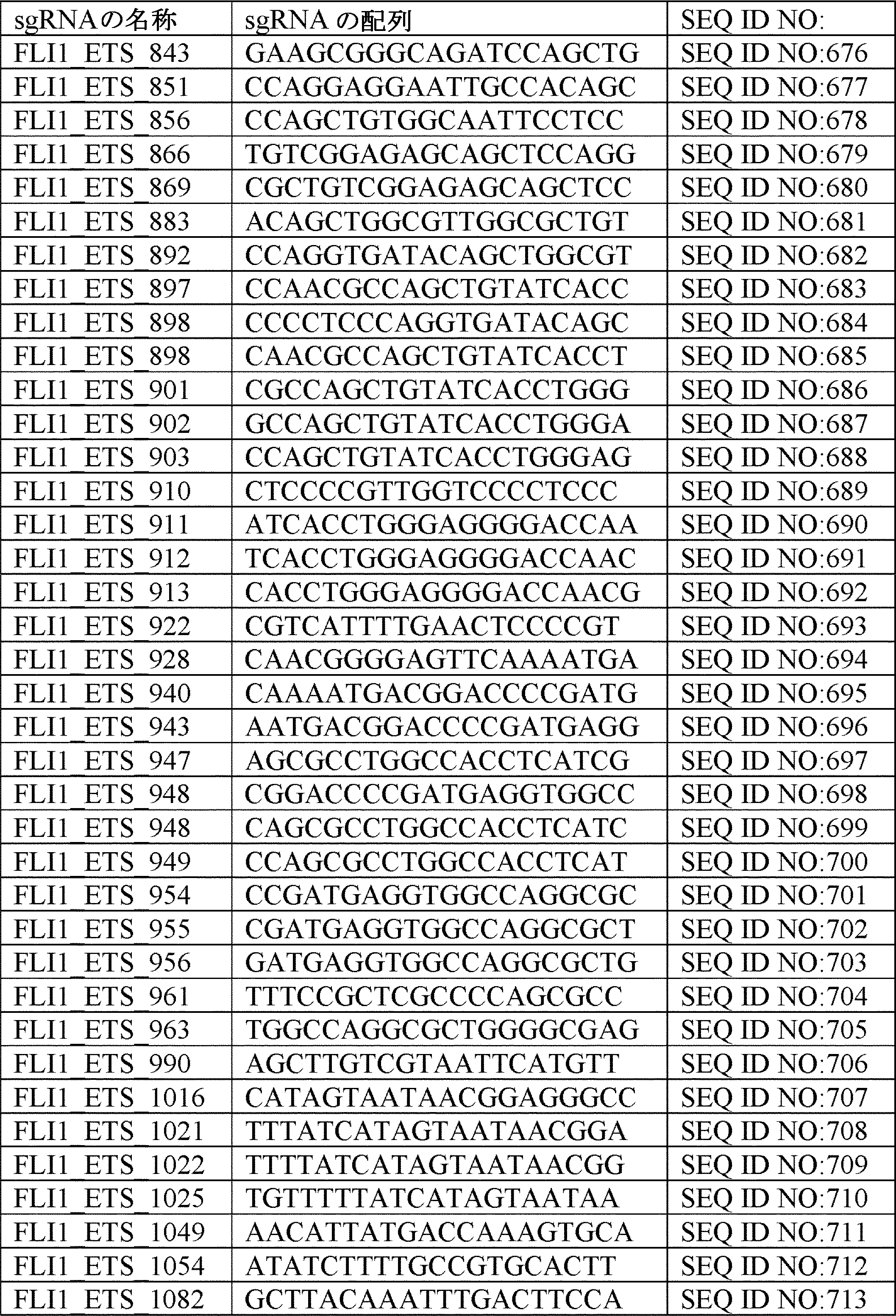
CRISPR媒介改変の非限定的な種類は、置換、挿入、欠失、および挿入/欠失(INDEL)を含む。改変は、限定されないがエクソン、スプライスドナーまたはスプライスアクセプターを含めた、Fli1をコードする内因性遺伝子座の任意の部分に位置することができる。 Non-limiting types of CRISPR-mediated modifications include substitutions, insertions, deletions, and insertions/deletions (INDELs). Modifications can be located in any part of the endogenous locus encoding Fli1, including but not limited to exons, splice donors or splice acceptors.
ある特定の態様では、ガイドRNAは、Fli1をコードする内因性遺伝子座中の標的配列と十分に相補的なガイド配列を含む。ある特定の態様では、ガイドRNAは、例えば、SEQ ID NO:152~156またはSEQ ID NO:676~713に示される配列のいずれか1つを含むガイド配列などの、Fli1をコードする内因性遺伝子座中の標的配列と十分に相補的なガイド配列を含む。 In certain embodiments, the guide RNA comprises a guide sequence that is sufficiently complementary to a target sequence in the endogenous locus encoding Fli1. In certain embodiments, the guide RNA is derived from an endogenous gene encoding Fli1, such as a guide sequence comprising any one of the sequences set forth in SEQ ID NO: 152-156 or SEQ ID NO: 676-713. Contains a guide sequence that is sufficiently complementary to the target sequence in the locus.
ある特定の態様では、改変細胞は、細胞機能障害に抵抗性である。ある特定の態様では、改変細胞は、細胞疲弊に抵抗性である。ある特定の態様では、改変細胞は、自己由来細胞である。ある特定の態様では、改変細胞は、ヒト対象から単離された細胞である。ある特定の態様では、改変細胞は、改変免疫細胞である。ある特定の態様では、改変細胞は、改変T細胞である。ある特定の態様では、改変細胞は、T細胞疲弊に抵抗性である改変T細胞である。ある特定の態様では、改変細胞は、T細胞機能障害に抵抗性である改変T細胞である。 In certain embodiments, the modified cells are resistant to cellular dysfunction. In certain embodiments, the modified cells are resistant to cell exhaustion. In certain embodiments, the modified cells are autologous cells. In certain embodiments, the modified cell is a cell isolated from a human subject. In certain embodiments, the modified cells are modified immune cells. In certain embodiments, the modified cell is a modified T cell. In certain embodiments, the modified cells are modified T cells that are resistant to T cell exhaustion. In certain embodiments, the modified cell is a modified T cell that is resistant to T cell dysfunction.
いくつかの局面では、提供される組成物および方法は、免疫細胞の組成物中の免疫細胞の少なくとも約50%、60%、65%、70%、75%、80%、85%、90%もしくは95%または約50%、60%、65%、70%、75%、80%、85%、90%もしくは95%超が所望の遺伝子改変を含有するものを含む。例えば、内因性遺伝子(例えば、Fli1)のノックアウトまたは遺伝子破壊のための作用物質(例えば、gRNA/Cas9)が導入された細胞の組成物中の免疫細胞の約50%、60%、65%、70%、75%、80%、85%、90%または95%が、遺伝子破壊を含有する;標的内因性ポリペプチドを発現しない、または標的遺伝子の連続的および/もしくは機能的コピーを含有しない。いくつかの態様では、本開示に係る方法、組成物および細胞は、標的遺伝子のノックアウトまたは遺伝子破壊のための作用物質(例えば、gRNA/Cas9)が導入された細胞の組成物中の細胞の少なくとも約50%、60%、65%、70%、75%、80%、85%、90%もしくは95%または約50%、60%、65%、70%、75%、80%、85%、90%もしくは95%超が、免疫細胞の表面などに標的ポリペプチドを発現しないものを含む。いくつかの態様では、標的遺伝子のノックアウトまたは遺伝子破壊のための作用物質(例えば、gRNA/Cas9)が導入された細胞の組成物中の細胞の少なくとも約50%、60%、65%、70%、75%、80%、85%、90%もしくは95%または約50%、60%、65%、70%、75%、80%、85%、90%もしくは95%超が、両対立遺伝子でノックアウトされている、すなわち、そのようなパーセンテージの細胞において、二対立遺伝子欠失を含む。 In some aspects, provided compositions and methods provide at least about 50%, 60%, 65%, 70%, 75%, 80%, 85%, 90% of the immune cells in the composition of immune cells. or 95% or about 50%, 60%, 65%, 70%, 75%, 80%, 85%, 90% or more than 95% contains the desired genetic modification. For example, about 50%, 60%, 65% of the immune cells in the composition of cells into which an agent (e.g., gRNA/Cas9) for knockout or gene disruption of an endogenous gene (e.g., Fli1) has been introduced; 70%, 75%, 80%, 85%, 90% or 95% contain a gene disruption; do not express the target endogenous polypeptide or do not contain a continuous and/or functional copy of the target gene. In some embodiments, the methods, compositions, and cells of the present disclosure provide at least one cell in a composition of cells into which an agent for knockout or gene disruption of a target gene (e.g., gRNA/Cas9) has been introduced. about 50%, 60%, 65%, 70%, 75%, 80%, 85%, 90% or 95% or about 50%, 60%, 65%, 70%, 75%, 80%, 85%, 90% or more than 95% of these include those that do not express the target polypeptide on the surface of immune cells. In some embodiments, at least about 50%, 60%, 65%, 70% of the cells in the composition of cells have been introduced with an agent for target gene knockout or gene disruption (e.g., gRNA/Cas9). , 75%, 80%, 85%, 90% or 95% or about 50%, 60%, 65%, 70%, 75%, 80%, 85%, 90% or more than 95% of biallelic In such a percentage of cells that are knocked out, ie, contain a biallelic deletion.
いくつかの態様では、標的遺伝子またはその近く(例えば、切断部位の上流または下流の、100塩基対以内もしくは約100塩基対以内、50塩基対以内もしくは約50塩基対以内、または25塩基対以内もしくは約25塩基対以内、または10塩基対以内もしくは約10塩基対以内)でのCas9媒介切断効率(インデル%)が、標的遺伝子のノックアウトまたは遺伝子破壊のための作用物質(例えば、gRNA/Cas9)が導入されている細胞の組成物の細胞において少なくとも約50%、60%、65%、70%、75%、80%、85%、90%もしくは95%または約50%、60%、65%、70%、75%、80%、85%、90%もしくは95%超である、組成物および方法が提供される。 In some embodiments, at or near the target gene (e.g., within or about 100 base pairs, within or about 50 base pairs, or within or near 25 base pairs, upstream or downstream of the cleavage site). Cas9-mediated cleavage efficiency (indel %) within about 25 base pairs, or within 10 base pairs, or within about 10 base pairs) of an agent (e.g., gRNA/Cas9) for target gene knockout or gene disruption at least about 50%, 60%, 65%, 70%, 75%, 80%, 85%, 90% or 95% or about 50%, 60%, 65% of the cells of the composition of the cells being introduced; Compositions and methods are provided that are 70%, 75%, 80%, 85%, 90% or greater than 95%.
いくつかの態様では、提供される細胞、組成物および方法は、標的遺伝子のノックアウトまたは遺伝子破壊のための作用物質(例えば、gRNA/Cas9)が導入された細胞の組成物中の細胞の少なくとも約50%、60%、65%、70%、75%、80%、85%、90%もしくは95%または約50%、60%、65%、70%、75%、80%、85%、90%もしくは95%超において、内因性を介して送達されるシグナルの低減または破壊をもたらす。 In some embodiments, provided cells, compositions, and methods provide at least about 100 cells in a composition of cells into which an agent for knockout or gene disruption of a target gene (e.g., gRNA/Cas9) has been introduced. 50%, 60%, 65%, 70%, 75%, 80%, 85%, 90% or 95% or approximately 50%, 60%, 65%, 70%, 75%, 80%, 85%, 90 % or greater than 95%, resulting in a reduction or destruction of the endogenously delivered signal.
いくつかの態様では、組換え受容体で操作された細胞を含み、かつ、内因性遺伝子の発現の低減、欠失、排除、ノックアウトまたは破壊(例えば、Fli1の遺伝子破壊)を含む、提供される開示に係る組成物は、同じ条件下で評価した場合の該受容体を含むが遺伝子の遺伝子破壊を含まないまたはポリペプチドを発現しない対応または参照組成物の操作された細胞において発現される受容体と比較して、該受容体の機能的特性または活性を保持する。いくつかの態様では、提供される組成物の操作された細胞は、同じ条件下で評価した場合の組換え受容体で操作されているが遺伝子破壊を含まないまたは標的ポリペプチドを発現しない操作された細胞を含む対応または参照組成物と比較して、機能的特性または活性を保持する。いくつかの態様では、該細胞は、そのような対応または参照組成物と比較して、細胞傷害性、増殖、生存またはサイトカイン分泌を保持する。 In some embodiments, there is provided a cell that has been engineered with a recombinant receptor and that has reduced, deleted, eliminated, knocked out or disrupted the expression of an endogenous gene (e.g., gene disruption of Fli1). The compositions of the disclosure express the receptor expressed in engineered cells of the corresponding or reference composition containing said receptor but without genetic disruption of the gene or expressing the polypeptide when evaluated under the same conditions. retains the functional properties or activity of the receptor compared to In some embodiments, the engineered cells of the provided compositions are engineered cells that are engineered with a recombinant receptor but do not include gene disruption or that do not express the target polypeptide when evaluated under the same conditions. retains a functional property or activity compared to a corresponding or reference composition containing cells that have been modified. In some embodiments, the cells retain cytotoxicity, proliferation, survival, or cytokine secretion compared to such counterpart or reference composition.
いくつかの態様では、該組成物中の免疫細胞は、同じ条件下で評価した場合の対応または参照組成物中の細胞の表現型と比較して、免疫細胞(1つまたは複数)の表現型を保持する。いくつかの態様では、該組成物中の細胞は、ナイーブ細胞、エフェクターメモリー細胞、セントラルメモリー細胞、ステムセントラルメモリー細胞、エフェクターメモリー細胞、および長期生存エフェクターメモリー細胞を含む。いくつかの態様では、標的遺伝子(例えば、Fli1)の遺伝子破壊を含むT細胞の割合は、遺伝子破壊を含有しない細胞の対応または参照集団または組成物と同じまたは実質的に同じ、活性化されていない長期生存メモリーまたはセントラルメモリー表現型を示す。いくつかの態様では、そのような特性、活性または表現型は、インビトロアッセイにおいて測定することができる。いくつかの態様では、評価される活性、特性または表現型はいずれも、作用物質のエレクトロポレーション後または他の導入後の様々な日時に、例えば、3、4、5、6、7日後にまたは3、4、5、6、7日までに評価することができる。いくつかの態様では、そのような活性、特性または表現型は、同じ条件下で評価した場合の標的遺伝子の遺伝子破壊を含まない細胞を含有する対応する組成物の活性と比較して、組成物中の細胞の少なくとも80%、85%、90%、95%または100%によって保持される。 In some embodiments, the immune cells in the composition have a phenotype of the immune cell(s) compared to the phenotype of the cells in the corresponding or reference composition when evaluated under the same conditions. hold. In some embodiments, the cells in the composition include naive cells, effector memory cells, central memory cells, stem central memory cells, effector memory cells, and long-lived effector memory cells. In some embodiments, the proportion of T cells containing a gene disruption of the target gene (e.g., Fli1) is the same or substantially the same as a corresponding or reference population or composition of cells that does not contain the gene disruption, and is not activated. exhibit no long-term survival memory or central memory phenotype. In some embodiments, such properties, activities or phenotypes can be measured in in vitro assays. In some embodiments, any activities, properties, or phenotypes that are assessed are performed at various times after electroporation or other introduction of the agent, e.g., 3, 4, 5, 6, 7 days after the electroporation or other introduction of the agent. Or can be evaluated by 3, 4, 5, 6, 7 days. In some embodiments, such activity, property, or phenotype is compared to the activity of a corresponding composition containing cells that do not contain a genetic disruption of the target gene when evaluated under the same conditions. retained by at least 80%, 85%, 90%, 95% or 100% of the cells.
本明細書において使用される場合、「対応する組成物」または「対応する免疫細胞集団」(「参照組成物」または「参照細胞集団」とも呼ばれる)への言及は、免疫細胞または免疫細胞集団に作用物質が導入されなかった以外は同じまたは実質的に同じ条件下で得られた、単離された、生成された、産生されたおよび/またはインキュベートされた免疫細胞(例えば、T細胞)のことを指す。いくつかの局面では、作用物質の導入を含まないこと以外、そのような免疫細胞は、阻害性分子のアップレギュレーションまたは発現を含めた細胞の活性または特性に影響を与え得るいずれか1つまたは複数の条件が、作用物質の導入を除き、細胞間で変動しないまたは実質的に変動しないように、作用物質が導入されている免疫細胞と同様にまたは実質的に同様に処理される。 As used herein, reference to a "corresponding composition" or "corresponding immune cell population" (also referred to as a "reference composition" or "reference cell population") refers to an immune cell or immune cell population. An immune cell (e.g., a T cell) obtained, isolated, generated, produced, and/or incubated under the same or substantially the same conditions except that no agent has been introduced. refers to In some aspects, other than including the introduction of an agent, such immune cells are treated with any one or more agents that may affect the activity or properties of the cells, including upregulation or expression of inhibitory molecules. are treated the same or substantially the same as the immune cells into which the agent has been introduced, such that the conditions of the immune cells do not vary or substantially vary from cell to cell, except for the introduction of the agent.
T細胞マーカーの発現および/またはレベルを評価するための方法および技法は、当技術分野において公知である。そのようなマーカーの検出のための抗体および試薬は、当技術分野において周知であり、容易に入手可能である。そのようなマーカーを検出するためのアッセイおよび方法は、細胞内フローサイトメトリーを含めたフローサイトメトリー、ELISA、ELISPOT、サイトメトリービーズアレイまたは他のマルチプレックス法、ウエスタンブロットおよび他の免疫親和性に基づく方法を含むが、それらに限定されない。いくつかの態様では、細胞は、フローサイトメトリーまたは他の免疫親和性に基づく方法によって、係る細胞に特有のマーカーの発現について検出することができ、次いで、係る細胞を、別の細胞表面マーカー(1つまたは複数)について共染色することができる。 Methods and techniques for assessing T cell marker expression and/or levels are known in the art. Antibodies and reagents for the detection of such markers are well known in the art and readily available. Assays and methods for detecting such markers include flow cytometry including intracellular flow cytometry, ELISA, ELISPOT, cytometric bead arrays or other multiplex methods, Western blots and other immunoaffinity methods. including, but not limited to, methods based on In some embodiments, a cell can be detected for expression of a marker unique to such cell by flow cytometry or other immunoaffinity-based methods, and then such cell can be detected for expression of a marker unique to such cell ( one or more).
いくつかの態様では、該細胞、組成物および方法は、養子移入しようとする免疫細胞(例えば、T細胞)において標的遺伝子の発現の欠失、ノックアウト、破壊または低減を提供する。いくつかの態様では、該方法は、初代細胞、例えば、対象からの初代免疫細胞(例えば、T細胞)に対してエクスビボで実施される。いくつかの局面では、そのような遺伝子操作されたT細胞を産生または生成する方法は、免疫細胞(例えば、T細胞)を含有する細胞の集団に、ターゲティングしようとする遺伝子(例えば、Fli1)を破壊可能な作用物質(1つまたは複数)を導入することを含む。本明細書において使用される場合、「導入すること」という用語は、DNAを細胞にインビトロまたはインビボのいずれかで導入する多様な方法を包含し、そのような方法は、形質転換、形質導入、トランスフェクション(例えば、エレクトロポレーション)、および感染を含む。ベクターは、DNAをコードする分子を細胞に導入するのに有用である。可能なベクターは、プラスミドベクターおよびウイルスベクターを含む。ウイルスベクターは、レトロウイルスベクター、レンチウイルスベクター、またはアデノウイルスベクターもしくはアデノ随伴ベクターなどの他のベクターを含む。 In some embodiments, the cells, compositions, and methods provide for deletion, knockout, disruption, or reduction of expression of a target gene in an immune cell (eg, a T cell) to be adoptively transferred. In some embodiments, the method is performed ex vivo on primary cells, eg, primary immune cells (eg, T cells) from a subject. In some aspects, methods of producing or generating such genetically engineered T cells involve targeting a gene (e.g., Fli1) to a population of cells, including immune cells (e.g., T cells). Including introducing destructible agent(s). As used herein, the term "introducing" encompasses a variety of methods of introducing DNA into cells either in vitro or in vivo, such methods including transformation, transduction, transfection (eg, electroporation), and infection. Vectors are useful for introducing DNA-encoding molecules into cells. Possible vectors include plasmid vectors and viral vectors. Viral vectors include retroviral vectors, lentiviral vectors, or other vectors such as adenoviral vectors or adeno-associated vectors.
T細胞を含有する細胞の集団は、対象から得られた、例えば、末梢血単核細胞(PBMC)試料、未分画T細胞試料、リンパ球試料、白血球試料、アフェレーシス産物または白血球アフェレーシス産物から得られた、細胞であることができる。いくつかの態様では、T細胞は、陽性または陰性選択および濃縮法を使用して、分離または選択して、集団中のT細胞を濃縮することができる。いくつかの態様では、該集団は、CD4+、CD8+またはCD4+かつCD8+ T細胞を含有する。いくつかの態様では、遺伝子操作された抗原受容体をコードする核酸を導入する工程と作用物質(例えば、Cas9/gRNA RNP)を導入する工程は、同時にまたは逐次的に任意の順序で行うことができる。いくつかの態様では、外因性受容体および1つまたは複数の遺伝子編集物質(例えば、Cas9/gRNA RNP)の導入に続いて、細胞は、細胞の増大および/または増殖を刺激するための条件下で培養またはインキュベートされる。 The population of cells containing T cells can be obtained from a subject, e.g., a peripheral blood mononuclear cell (PBMC) sample, an unfractionated T cell sample, a lymphocyte sample, a leukocyte sample, an apheresis product, or a leukocyte apheresis product. It can be a cell that has been In some embodiments, T cells can be separated or selected to enrich T cells in a population using positive or negative selection and enrichment methods. In some embodiments, the population contains CD4+, CD8+ or CD4+ and CD8+ T cells. In some embodiments, introducing a nucleic acid encoding a genetically engineered antigen receptor and introducing an agent (e.g., Cas9/gRNA RNP) can occur simultaneously or sequentially in any order. can. In some embodiments, following introduction of the exogenous receptor and one or more gene editing agents (e.g., Cas9/gRNA RNP), the cells are subjected to conditions to stimulate expansion and/or proliferation of the cells. cultured or incubated in
したがって、投与された遺伝子操作細胞の活性および効力を高めるなどによって、移入された細胞の経時的な持続性または曝露を維持しつつ、養子細胞療法における免疫細胞(例えば、T細胞)機能を増強する、例えば、改善された有効性を提供する、細胞、組成物および方法が提供される。いくつかの態様では、遺伝子操作された細胞は、対象にインビボ投与されたときに、ある特定の利用可能な方法と比較して高められた増大および/または持続性を示す。いくつかの態様では、提供される免疫細胞は、対象にインビボ投与されたときに、高められた持続性を示す。いくつかの態様では、投与されたときの対象における遺伝子操作された免疫細胞の持続性は、代替法、例えば、内因性受容体をコードする遺伝子の発現を低減するまたは該遺伝子を破壊する作用物質がT細胞に導入されない方法により遺伝子操作された細胞を投与する方法によって達成されるであろう持続性と比較してより大きい。いくつかの態様では、持続性は、少なくとも1.5倍、2倍、3倍、4倍、5倍、6倍、7倍、8倍、9倍、10倍、20倍、30倍、50倍、60倍、70倍、80倍、90倍、100倍もしくはそれ以上、または約少なくとも1.5倍、2倍、3倍、4倍、5倍、6倍、7倍、8倍、9倍、10倍、20倍、30倍、50倍、60倍、70倍、80倍、90倍、100倍もしくはそれ以上増加する。 Thus, enhancing immune cell (e.g., T cell) function in adoptive cell therapy while maintaining persistence or exposure of transferred cells over time, such as by increasing the activity and potency of administered genetically engineered cells. For example, cells, compositions, and methods are provided that provide improved efficacy. In some embodiments, the genetically engineered cells exhibit enhanced expansion and/or persistence when administered to a subject in vivo compared to certain available methods. In some embodiments, the provided immune cells exhibit enhanced persistence when administered to a subject in vivo. In some embodiments, the persistence of genetically engineered immune cells in a subject upon administration of an alternative method, e.g., an agent that reduces expression of or disrupts a gene encoding an endogenous receptor. is greater compared to the persistence that would be achieved by methods of administering genetically engineered cells by methods that do not introduce T cells. In some embodiments, the persistence is at least 1.5x, 2x, 3x, 4x, 5x, 6x, 7x, 8x, 9x, 10x, 20x, 30x, 50x, 60x, 70x, 80x, 90x, 100x or more, or about at least 1.5x, 2x, 3x, 4x, 5x, 6x, 7x, 8x, 9x, 10x , 20x, 30x, 50x, 60x, 70x, 80x, 90x, 100x or more.
いくつかの態様では、投与された細胞の持続性の程度または範囲は、対象に投与した後に検出または定量することができる。例えば、いくつかの局面では、定量的PCR(qPCR)が、対象の血液または血清または臓器または組織(例えば、疾患部位)中の細胞の量を評価するために使用される。いくつかの局面では、持続性は、DNA 1マイクログラム当たりの、外因性受容体をコードするDNAまたはプラスミドのコピーとして、あるいは、試料、例えば、血液もしくは血清1マイクロリットル当たりの、または試料1マイクロリットル当たりの末梢血単核細胞(PBMC)もしくは白血球もしくはT細胞の総数当たりの、受容体発現細胞の数として定量される。いくつかの態様では、細胞を一般的にその細胞に特異的な抗体を使用して検出するフローサイトメトリーアッセイを実施することもできる。また、細胞ベースのアッセイを使用して、機能性細胞、例えば、疾患もしくは病態の細胞または受容体によって認識される抗原を発現する細胞に結合可能および/または中和可能な、ならびに/またはその細胞に対して応答、例えば、細胞傷害性応答を誘導可能な、細胞の数または割合を検出してもよい。そのような態様のいずれにおいても、細胞に関連する別のマーカーの発現の範囲またはレベルを使用して、対象において投与された細胞と内因性細胞とを区別することができる。 In some embodiments, the degree or extent of persistence of administered cells can be detected or quantified after administration to a subject. For example, in some aspects quantitative PCR (qPCR) is used to assess the amount of cells in a subject's blood or serum or an organ or tissue (eg, a disease site). In some aspects, persistence is as copies of exogenous receptor-encoding DNA or plasmid per microgram of DNA, or per microliter of sample, e.g., blood or serum, or as copies of exogenous receptor-encoding DNA or plasmid per microgram of DNA. It is quantified as the number of receptor-expressing cells per liter of peripheral blood mononuclear cells (PBMCs) or total number of white blood cells or T cells. In some embodiments, flow cytometry assays can also be performed in which cells are generally detected using antibodies specific for the cells. Also, using cell-based assays, cells capable of binding and/or neutralizing functional cells, such as cells of a disease or pathology or cells expressing an antigen recognized by a receptor, and/or The number or proportion of cells that are capable of inducing a response, eg, a cytotoxic response, may be detected. In any such embodiment, the range or level of expression of another marker associated with a cell can be used to distinguish between administered and endogenous cells in a subject.
C. 免疫細胞の供給源
いくつかの態様では、エクスビボ操作のために免疫細胞の供給源が対象から得られる。エクスビボ操作のための標的細胞の供給源はまた、例えば、自己または異種のドナー血、臍帯血、または骨髄も含む場合がある。例えば、免疫細胞の供給源は、本開示の改変された免疫細胞により処置されるべき対象に由来する場合があり、例えば、対象の血液、対象の臍帯血、または対象の骨髄であり得る。対象の非限定的な例には、ヒト、イヌ、ネコ、マウス、ラット、およびそれらのトランスジェニック種が含まれる。好ましくは、対象はヒトである。
C. Source of Immune Cells In some embodiments, a source of immune cells is obtained from the subject for ex vivo manipulation. Sources of target cells for ex vivo manipulation may also include, for example, autologous or xenogeneic donor blood, umbilical cord blood, or bone marrow. For example, the source of immune cells may be derived from the subject to be treated with the modified immune cells of the present disclosure, and may be, for example, the subject's blood, the subject's umbilical cord blood, or the subject's bone marrow. Non-limiting examples of subjects include humans, dogs, cats, mice, rats, and transgenic species thereof. Preferably the subject is a human.
免疫細胞は、血液、末梢血単核細胞、骨髄、リンパ節組織、脾臓組織、臍帯、リンパ液、またはリンパ器官を含むいくつかの供給源から得ることができる。免疫細胞は、免疫系の細胞、例えば自然免疫または適応免疫の細胞、例えば、リンパ球、典型的にはT細胞および/またはNK細胞を含む骨髄系細胞またはリンパ球系細胞である。他の例示的な細胞には、人工多能性幹細胞(iPSC)を含む、複能性および多能性幹細胞などの幹細胞が含まれる。いくつかの局面では、細胞はヒト細胞である。処置されるべき対象に関して、細胞は、同種および/または自己であり得る。細胞は、典型的には、初代細胞、例えば、対象から直接単離され、かつ/または対象から単離され凍結された初代細胞である。 Immune cells can be obtained from several sources including blood, peripheral blood mononuclear cells, bone marrow, lymph node tissue, spleen tissue, umbilical cord, lymph, or lymphoid organs. Immune cells are cells of the immune system, such as cells of innate or adaptive immunity, such as lymphocytes, typically myeloid cells or lymphoid cells, including T cells and/or NK cells. Other exemplary cells include stem cells such as multipotent and pluripotent stem cells, including induced pluripotent stem cells (iPSCs). In some aspects, the cell is a human cell. With respect to the subject to be treated, the cells may be allogeneic and/or autologous. The cells are typically primary cells, eg, primary cells isolated directly from the subject and/or isolated and frozen from the subject.
ある特定の態様では、免疫細胞は、T細胞、例えば、CD8+ T細胞(例えば、CD8+ ナイーブT細胞、中枢性メモリーT細胞、またはエフェクターメモリーT細胞)、CD4+ T細胞、ナチュラルキラーT細胞(NKT細胞)、制御性T細胞(Treg)、幹細胞メモリーT細胞、リンパ球系前駆細胞、造血幹細胞、ナチュラルキラー細胞(NK細胞)または樹状細胞である。いくつかの態様では、細胞は、単球または顆粒球、例えば、骨髄系細胞、マクロファージ、好中球、樹状細胞、マスト細胞、好酸球、および/または好塩基球である。ある態様では、標的細胞は、人工多能性幹(iPS)細胞またはiPS細胞に由来する細胞、例えば、対象から生成され、1つまたは複数の標的遺伝子の発現を変化させる(例えばそれに変異を誘導する)または操作するように操作され、例えば、T細胞、例えば、CD8+ T細胞(例えば、CD8+ ナイーブT細胞、中枢性メモリーT細胞、またはエフェクターメモリーT細胞)、CD4+ T細胞、幹細胞メモリーT細胞、リンパ球系前駆細胞または造血幹細胞に分化したiPS細胞である。 In certain embodiments, the immune cell is a T cell, e.g., a CD8+ T cell (e.g., a CD8+ naive T cell, a central memory T cell, or an effector memory T cell), a CD4+ T cell, a natural killer T cell (NKT cell). ), regulatory T cells (Tregs), stem cell memory T cells, lymphoid progenitor cells, hematopoietic stem cells, natural killer cells (NK cells), or dendritic cells. In some embodiments, the cells are monocytes or granulocytes, such as myeloid cells, macrophages, neutrophils, dendritic cells, mast cells, eosinophils, and/or basophils. In certain embodiments, the target cell is an induced pluripotent stem (iPS) cell or a cell derived from an iPS cell, e.g., generated from a subject, that alters the expression of one or more target genes (e.g., induces a mutation therein). T cells, e.g., CD8+ T cells (e.g., CD8+ naive T cells, central memory T cells, or effector memory T cells), CD4+ T cells, stem cell memory T cells, These are iPS cells that have differentiated into lymphoid progenitor cells or hematopoietic stem cells.
いくつかの態様では、細胞は、T細胞または他の細胞型の1つまたは複数のサブセット、例えばT細胞集団全体、CD4+細胞、CD8+細胞、およびその部分集団、例えば機能、活性化状態、成熟、分化能、増大、再循環、局在、および/もしくは持続能、抗原特異性、抗原受容体の種類、特定の器官もしくは区画における存在、マーカーもしくはサイトカイン分泌プロファイル、および/または分化の度合いにより定義されるものを含む。T細胞ならびに/またはCD4+および/もしくはCD8+ T細胞のサブタイプおよび部分集団は中でも、ナイーブT(TN)細胞、エフェクターT細胞(TEFF)、メモリーT細胞およびそれらのサブタイプ、例えば幹細胞メモリーT(TSCM)、中枢性メモリーT(TCM)、エフェクターメモリーT(TEM)、または最終分化エフェクターメモリーT細胞、腫瘍浸潤リンパ球(TIL)、未熟T細胞、成熟T細胞、ヘルパーT細胞、細胞傷害性T細胞、粘膜関連インバリアントT(MAIT)細胞、自然および適応制御性T(Treg)細胞、ヘルパーT細胞、例えばTH1細胞、TH2細胞、TH3細胞、TH17細胞、TH9細胞、TH22細胞、濾胞性ヘルパーT細胞、アルファ/ベータT細胞、およびデルタ/ガンマT細胞である。ある特定の態様では、当技術分野において入手可能ないくつものT細胞系が、使用される場合がある。 In some embodiments, the cells are characterized by one or more subsets of T cells or other cell types, e.g., the entire T cell population, CD4+ cells, CD8+ cells, and subpopulations thereof, e.g., function, activation status, maturation, defined by differentiation potential, expansion, recycling, localization, and/or persistence, antigen specificity, type of antigen receptor, presence in specific organs or compartments, marker or cytokine secretion profile, and/or degree of differentiation. including those that Subtypes and subpopulations of T cells and/or CD4+ and/or CD8+ T cells include, among others, naïve T (TN) cells, effector T cells (TEFF), memory T cells and their subtypes, such as stem cell memory T (TSCM). ), central memory T (TCM), effector memory T (TEM), or terminally differentiated effector memory T cells, tumor-infiltrating lymphocytes (TILs), immature T cells, mature T cells, helper T cells, cytotoxic T cells , mucosa-associated invariant T (MAIT) cells, innate and adaptive regulatory T (Treg) cells, helper T cells such as TH1 cells, TH2 cells, TH3 cells, TH17 cells, TH9 cells, TH22 cells, follicular helper T cells , alpha/beta T cells, and delta/gamma T cells. In certain embodiments, any number of T cell lines available in the art may be used.
いくつかの態様では、方法は、対象から免疫細胞を単離する段階、それらを調製、処理、培養、および/または操作する段階を含む。いくつかの態様では、操作された細胞の調製は、1つまたは複数の培養および/または調製段階を含む。記載のように操作するための細胞は、生物学的試料などの試料、例えば対象から得られたまたは対象に由来する試料から単離される場合がある。いくつかの態様では、細胞が単離される対象は、疾患もしくは状態を有する対象、または細胞療法を必要とする、もしくは細胞療法が投与されるであろう対象である。対象は、いくつかの態様では、そのために細胞が単離、処理、および/または操作される、養子細胞療法などの特定の治療的介入の必要のあるヒトである。したがって、細胞は、いくつかの態様では、初代細胞、例えば、初代ヒト細胞である。試料には、対象から直接採取された組織、液体、および他の試料、ならびに分離、遠心分離、遺伝子操作(例えばウイルスベクターによる形質導入)、洗浄、および/またはインキュベーションなどの1つまたは複数の処理段階の結果として生じる試料が含まれる。生物学的試料は、生物学的供給源から直接得られる試料または処理された試料であることができる。生物学的試料には、血液、血漿、血清、脳脊髄液、滑液、尿および汗などの体液、組織、ならびに器官試料が、それらに由来する処理された試料を含めて含まれるが、それに限定されるわけではない。 In some embodiments, the method includes isolating immune cells from a subject, preparing, treating, culturing, and/or manipulating them. In some embodiments, preparation of engineered cells includes one or more culture and/or preparation steps. Cells for manipulation as described may be isolated from a sample, such as a biological sample, eg, a sample obtained from or derived from a subject. In some embodiments, the subject from which the cells are isolated is a subject that has a disease or condition, or is in need of or will be administered cell therapy. The subject, in some embodiments, is a human in need of a specific therapeutic intervention, such as adoptive cell therapy, for which cells are isolated, treated, and/or manipulated. Thus, the cell is, in some embodiments, a primary cell, eg, a primary human cell. Samples include tissues, fluids, and other samples taken directly from a subject and one or more treatments such as separation, centrifugation, genetic manipulation (e.g., transduction with a viral vector), washing, and/or incubation. The sample resulting from the step is included. A biological sample can be a sample obtained directly from a biological source or a processed sample. Biological samples include, but are not limited to, body fluids such as blood, plasma, serum, cerebrospinal fluid, synovial fluid, urine and sweat, tissue, and organ samples, including processed samples derived therefrom. It is not limited.
いくつかの局面では、細胞が由来または単離される試料は、血液もしくは血液由来試料であるか、またはアフェレーシスもしくは白血球アフェレーシス産物である、もしくはそれに由来する。例示的な試料には、全血、末梢血単核細胞(PBMC)、白血球、骨髄、胸腺、組織生検、腫瘍、白血病、リンパ腫、リンパ節、腸管関連リンパ組織、粘膜関連リンパ組織、脾臓、他のリンパ系組織、肝臓、肺、胃、腸、結腸、腎臓、膵臓、乳房、骨、前立腺、子宮頸、精巣、卵巣、扁桃、もしくは他の器官、および/またはそれらに由来する細胞が含まれる。試料は、細胞療法、例えば、養子細胞療法に関連して、自己および同種供給源からの試料を含む。 In some aspects, the sample from which the cells are derived or isolated is blood or a blood-derived sample, or is or is derived from an apheresis or leukapheresis product. Exemplary samples include whole blood, peripheral blood mononuclear cells (PBMCs), white blood cells, bone marrow, thymus, tissue biopsy, tumor, leukemia, lymphoma, lymph nodes, gut-associated lymphoid tissue, mucosa-associated lymphoid tissue, spleen, Includes other lymphoid tissue, liver, lungs, stomach, intestines, colon, kidneys, pancreas, breast, bone, prostate, cervix, testes, ovaries, tonsils, or other organs, and/or cells derived therefrom. It will be done. Samples include samples from autologous and allogeneic sources in connection with cell therapy, eg, adoptive cell therapy.
いくつかの態様では、細胞は、細胞株、例えば、T細胞株に由来する。細胞は、いくつかの態様では、異種供給源から、例えば、マウス、ラット、非ヒト霊長類、およびブタから得られる。いくつかの態様では、細胞の単離は、1つまたは複数の調製段階および/または親和性に基づかない細胞分離段階を含む。いくつかの例では、細胞が、洗浄、遠心分離、および/または1つもしくは複数の試薬の存在下でインキュベートされて、例えば、望まれない成分が除去され、所望の成分が濃縮され、特定の試薬に感受性の細胞が溶解または除去される。いくつかの例では、細胞は、密度、接着特性、サイズ、特定の成分に対する感受性および/または耐性などの1つまたは複数の特性に基づき分離される。 In some embodiments, the cell is derived from a cell line, such as a T cell line. Cells, in some embodiments, are obtained from xenogeneic sources, such as mice, rats, non-human primates, and pigs. In some embodiments, isolation of cells includes one or more preparation steps and/or non-affinity-based cell separation steps. In some examples, the cells are washed, centrifuged, and/or incubated in the presence of one or more reagents to, for example, remove unwanted components, concentrate desired components, and Cells sensitive to the reagent are lysed or removed. In some examples, cells are separated based on one or more characteristics, such as density, adhesive properties, size, sensitivity and/or resistance to particular components.
いくつかの例では、対象の循環血からの細胞は、例えば、アフェレーシスまたは白血球アフェレーシスにより得られる。試料は、いくつかの局面では、T細胞、単球、顆粒球、B細胞を含むリンパ球、他の有核白血球、赤血球、および/または血小板を含有し、いくつかの局面では、赤血球および血小板以外の細胞を含有する。いくつかの態様では、対象から収集された血液細胞は、洗浄されて、例えば、血漿画分を除去し、その後の処理段階に適した緩衝液または媒質中に細胞を入れる。いくつかの態様では、細胞は、リン酸緩衝食塩水(PBS)で洗浄される。いくつかの局面では、洗浄段階は、タンジェント流濾過(TFF)により、製造業者の説明に従って成し遂げられる。いくつかの態様では、細胞は洗浄後に多様な生体適合性緩衝液中に再懸濁される。ある特定の態様では、血液細胞試料の成分が除去され、細胞が培地中に直接再懸濁される。いくつかの態様では、方法は、赤血球を溶解し、PercollまたはFicoll勾配による遠心分離を行うことによる末梢血からの白血球の調製などの、密度に基づく細胞分離方法を含む。 In some instances, cells from the subject's circulating blood are obtained by, for example, apheresis or leukapheresis. The sample, in some aspects, contains T cells, monocytes, granulocytes, lymphocytes including B cells, other nucleated white blood cells, red blood cells, and/or platelets, and in some aspects, red blood cells and platelets. Contains cells other than In some embodiments, blood cells collected from a subject are washed, eg, to remove the plasma fraction and place the cells in a suitable buffer or medium for subsequent processing steps. In some embodiments, cells are washed with phosphate buffered saline (PBS). In some aspects, the washing step is accomplished by tangential flow filtration (TFF) according to the manufacturer's instructions. In some embodiments, cells are resuspended in various biocompatible buffers after washing. In certain embodiments, components of the blood cell sample are removed and the cells are resuspended directly in culture medium. In some embodiments, the method includes a density-based cell separation method, such as preparation of leukocytes from peripheral blood by lysing red blood cells and centrifuging through a Percoll or Ficoll gradient.
一態様では、免疫は、アフェレーシスまたは白血球アフェレーシスによって得られた個体の循環血から得られた細胞である。アフェレーシス産物は、典型的には、T細胞を含むリンパ球、単球、顆粒球、B細胞、他の有核白血球、赤血球、および血小板を含有する。血漿画分を除去するため、および適切な緩衝液もしくは媒質、例えばリン酸緩衝食塩水(PBS)中に細胞を入れるために、アフェレーシスによって収集された細胞が洗浄される場合があり、または洗浄溶液は、その後の処理段階のためにカルシウムを欠如し、かつマグネシウムを欠如する場合があり、もしくはすべてとはいわないまでも多くの二価陽イオンを欠如する場合がある。洗浄後、細胞は、多様な生体適合性緩衝液、例えば、Ca不含、Mg不含PBSなどの中に再懸濁される場合がある。あるいは、アフェレーシス試料の望ましくない成分が、除去され、細胞が培地中に直接再懸濁される場合がある。 In one aspect, the immunization is cells obtained from the circulating blood of an individual obtained by apheresis or leukapheresis. Apheresis products typically contain lymphocytes, including T cells, monocytes, granulocytes, B cells, other nucleated white blood cells, red blood cells, and platelets. Cells collected by apheresis may be washed to remove the plasma fraction and place the cells in a suitable buffer or medium, such as phosphate-buffered saline (PBS), or a wash solution. may lack calcium and may lack magnesium due to subsequent processing steps, or may lack many, if not all, divalent cations. After washing, cells may be resuspended in a variety of biocompatible buffers, such as Ca-free, Mg-free PBS, etc. Alternatively, undesirable components of the apheresis sample may be removed and cells resuspended directly in culture medium.
いくつかの態様では、単離方法は、1種または複数種の特異的分子、例えば表面マーカー、例えば、表面タンパク質、細胞内マーカー、または核酸の細胞中の発現または存在に基づく、異なる細胞型の分離を含む。いくつかの態様では、そのようなマーカーに基づく分離のために、任意の公知の方法が使用される場合がある。いくつかの態様では、分離は、親和性または免疫親和性に基づく分離である。例えば、分離は、いくつかの局面では、例えば、そのようなマーカーに特異的に結合する抗体または結合パートナーと一緒のインキュベーション、一般的にそれに続く洗浄段階、および抗体または結合パートナーに結合していない細胞からの抗体または結合パートナーと結合した細胞の分離による、1つまたは複数のマーカー、典型的には細胞表面マーカーの細胞発現または発現レベルに基づく細胞および細胞集団の分離を含む。 In some embodiments, the isolation method is based on the expression or presence in the cell of one or more specific molecules, e.g., surface markers, e.g., surface proteins, intracellular markers, or nucleic acids, of different cell types. Including separation. In some embodiments, any known method for such marker-based separation may be used. In some embodiments, the separation is an affinity or immunoaffinity-based separation. For example, separation may include, in some aspects, e.g., incubation with an antibody or binding partner that specifically binds to such marker, typically followed by a washing step, and an antibody or binding partner that does not bind to the marker. It involves separation of cells and cell populations based on cellular expression or expression levels of one or more markers, typically cell surface markers, by separation of cells bound by antibodies or binding partners from cells.
そのような分離段階は、試薬と結合した細胞がさらなる使用のために保持される正の選択、および/または抗体もしくは結合パートナーに結合していない細胞が保持される負の選択に基づくことができる。いくつかの例では、両方の画分がさらなる使用のために保持される。いくつかの局面では、所望の集団以外の細胞により発現されるマーカーに基づいて分離が最も良好に行われるように、不均一な集団中の細胞型を特異的に特定する抗体が利用不能な場合に、負の選択は特に有用であることができる。分離は、特定の細胞集団または特定のマーカーを発現している細胞の100%の濃縮または除去を生じる必要はない。例えば、特定の種類の細胞、例えばマーカーを発現している細胞の正の選択または濃縮は、そのような細胞の数またはパーセンテージを増加させることを指すが、マーカーを発現していない細胞の完全な非存在をもたらす必要はない。同様に、マーカーを発現している細胞などの特定の種類の細胞の負の選択、除去、または枯渇は、そのような細胞の数またはパーセンテージを減少させることを指すが、そのような細胞のすべての完全な除去をもたらす必要はない。 Such separation steps can be based on positive selection, in which cells bound to the reagent are retained for further use, and/or negative selection, in which cells not bound to the antibody or binding partner are retained. . In some instances, both fractions are retained for further use. In some aspects, antibodies that specifically identify cell types in a heterogeneous population are not available, such that separation is best done based on markers expressed by cells outside the desired population. Negative selection can be particularly useful. Separation need not result in 100% enrichment or removal of a particular cell population or cells expressing a particular marker. For example, positive selection or enrichment of a particular type of cell, e.g. cells expressing a marker, refers to increasing the number or percentage of such cells, but not the total number of cells not expressing the marker. There is no need to bring about non-existence. Similarly, negative selection, removal, or depletion of a particular type of cell, such as a marker-expressing cell, refers to reducing the number or percentage of such cells, but not all such cells. need not result in complete removal of
いくつかの例では、複数ラウンドの分離段階が実施され、その際、1つの段階から正または負の選択をされた画分が、後続の正または負の選択などの別の分離段階に供される。いくつかの例では、それぞれが負の選択のための標的とされるマーカーに特異的な複数の抗体または結合パートナーと共に細胞をインキュベートすることなどによって、複数のマーカーを同時発現している細胞を単一の分離段階で枯渇させることができる。同様に、複数の抗体または様々な細胞型に発現される結合パートナーと共に細胞をインキュベートすることによって、複数の細胞型に同時に正の選択を行うことができる。 In some instances, multiple rounds of separation steps are performed, where positively or negatively selected fractions from one step are subjected to another separation step, such as a subsequent positive or negative selection. Ru. In some examples, cells co-expressing multiple markers can be isolated, such as by incubating the cells with multiple antibodies or binding partners, each specific for a targeted marker for negative selection. It can be depleted in one separation step. Similarly, positive selection can be performed on multiple cell types simultaneously by incubating cells with multiple antibodies or binding partners expressed on different cell types.
いくつかの態様では、T細胞集団の1つまたは複数は、1つまたは複数の特定のマーカー、例えば表面マーカーについて陽性(マーカー+)である、もしくはそれを高レベル発現する(マーカーhigh)細胞、または1つもしくは複数のマーカーについて陰性である(マーカー-)もしくはそれを比較的低レベルを発現する(マーカーlow)細胞が濃縮または枯渇されている。例えば、いくつかの局面では、T細胞の特定の部分集団、例えば、1つまたは複数の表面マーカー、例えば、CD28+、CD62L+、CCR7+、CD27+、CD127+、CD4+、CD8+、CD45RA+、および/またはCD45RO+ T細胞について陽性またはそれを高レベル発現している細胞は、正または負の選択技法により単離される。場合によっては、そのようなマーカーは、T細胞のある特定の集団(非メモリー細胞など)に存在しない、または比較的低レベルで発現されるが、T細胞のある特定の他の集団(メモリー細胞など)に存在する、または比較的高レベル発現されるマーカーである。一態様では、細胞(CD8+細胞、またはT細胞、例えばCD3+細胞など)は、CD45RO、CCR7、CD28、CD27、CD44、CD127、および/もしくはCD62Lについて陽性である、もしくはその高い表面レベルを発現する細胞が濃縮されている(すなわち、正の選択をされている)、かつ/またはCD45RAについて陽性である、もしくはその高い表面レベルを発現する細胞が枯渇されている(例えば、それについて負の選択をされている)。いくつかの態様では、細胞は、CD122、CD95、CD25、CD27、および/またはIL7-Ra(CD127)について陽性であるまたはその高い表面レベルを発現している細胞が濃縮されているまたはそれを枯渇している。いくつかの例では、CD8+ T細胞は、CD45ROについて陽性(またはCD45RAについて陰性)およびCD62Lについて陽性の細胞が濃縮されている。例えば、CD3+、CD28+ T細胞は、CD3/CD28コンジュゲート磁気ビーズ(例えば、DYNABEADS(登録商標)M-450 CD3/CD28 T Cell Expander)を使用して正の選択を行うことができる。 In some embodiments, one or more of the T cell populations are positive for (marker+) or express high levels of (marker high ) one or more particular markers, e.g., surface markers; or cells that are negative for one or more markers ( marker- ) or express relatively low levels of it (marker low ) are enriched or depleted. For example, in some aspects, specific subpopulations of T cells, e.g., one or more surface markers, e.g., CD28+, CD62L+, CCR7+, CD27+, CD127+, CD4+, CD8+, CD45RA+, and/or CD45RO+ T cells Cells positive for or expressing high levels of it are isolated by positive or negative selection techniques. In some cases, such markers are absent or expressed at relatively low levels on certain populations of T cells (e.g., non-memory cells), but on certain other populations of T cells (e.g., memory cells). ) or expressed at relatively high levels. In one aspect, the cells (CD8+ cells, or T cells, such as CD3+ cells) are positive for, or express high surface levels of, CD45RO, CCR7, CD28, CD27, CD44, CD127, and/or CD62L. are enriched for (i.e., positively selected for) and/or cells that are positive for or express high surface levels of CD45RA are depleted (e.g., negatively selected for). ing). In some embodiments, the cells are enriched for or depleted of cells that are positive for or express high surface levels of CD122, CD95, CD25, CD27, and/or IL7-Ra (CD127). are doing. In some instances, CD8+ T cells are enriched for cells positive for CD45RO (or negative for CD45RA) and positive for CD62L. For example, CD3+, CD28+ T cells can be positively selected using CD3/CD28 conjugated magnetic beads (eg, DYNABEADS® M-450 CD3/CD28 T Cell Expander).
いくつかの態様では、T細胞は、B細胞、単球、または他の白血球などの非T細胞に発現されるマーカー、例えばCD14の負の選択によってPBMC試料から分離される。いくつかの局面では、CD4+またはCD8+選択段階は、CD4+ヘルパーT細胞およびCD8+細胞傷害性T細胞を分離するために使用される。そのようなCD4+集団およびCD8+集団は、1つまたは複数のナイーブ、メモリー、および/またはエフェクターT細胞部分集団上に発現されるまたは比較的高い度合いで発現されるマーカーについて正の選択または負の選択により部分集団にさらに選別することができる。いくつかの態様では、CD8+細胞は、例えば、それぞれの部分集団に関連する表面抗原に基づく正の選択または負の選択により、ナイーブ、中枢性メモリー、エフェクターメモリー、および/または中枢性メモリー幹細胞についてさらに濃縮または枯渇される。いくつかの態様では、中枢性メモリーT(TCM)細胞についての濃縮は、有効性を増加させるために、例えば、投与後に長期生存、増大、および/または生着を改善するために実施され、それは、いくつかの局面ではそのような部分集団において特に堅固である。いくつかの態様では、TCMが濃縮されたCD8+ T細胞およびCD4+ T細胞を組み合わせることで、有効性がさらに高まる。 In some embodiments, T cells are separated from a PBMC sample by negative selection for a marker expressed on non-T cells such as B cells, monocytes, or other leukocytes, eg, CD14. In some aspects, a CD4+ or CD8+ selection step is used to separate CD4+ helper T cells and CD8+ cytotoxic T cells. Such CD4+ and CD8+ populations are subject to positive or negative selection for markers that are expressed or are expressed to a relatively high degree on one or more naïve, memory, and/or effector T cell subpopulations. can be further sorted into subpopulations. In some embodiments, CD8+ cells are further selected for naïve, central memory, effector memory, and/or central memory stem cells, e.g., by positive or negative selection based on surface antigens associated with each subpopulation. Concentrated or depleted. In some embodiments, enrichment for central memory T (TCM) cells is performed to increase efficacy, e.g., to improve long-term survival, expansion, and/or engraftment after administration, which , some aspects are particularly robust in such subpopulations. In some embodiments, combining TCM-enriched CD8+ T cells and CD4+ T cells further increases efficacy.
いくつかの態様では、メモリーT細胞は、CD8+末梢血リンパ球のCD62L+およびCD62L-サブセットの両方に存在する。PBMCは、抗CD8抗体および抗CD62L抗体などを使用して、CD62L-CD8+および/またはCD62L+CD8+画分について濃縮されているまたはそれを枯渇していることができる。いくつかの態様では、CD4+ T細胞集団およびCD8+ T細胞部分集団、例えば、中枢性メモリー(TCM)細胞について濃縮された部分集団である。いくつかの態様では、中枢性メモリーT(TCM)細胞についての濃縮は、CD45RO、CD62L、CCR7、CD28、CD3、および/またはCD127について陽性またはその高い表面発現に基づく;いくつかの局面では、それは、CD45RAおよび/またはグランザイムBを発現しているまたは高度に発現している細胞についての負の選択に基づく。いくつかの局面では、TCM細胞が濃縮されたCD8+集団の単離は、CD4、CD14、CD45RAを発現している細胞の枯渇、およびCD62Lを発現している細胞についての正の選択または濃縮により実施される。一局面では、中枢性メモリーT(TCM)細胞の濃縮は、CD4の発現に基づき選択される細胞の負の画分から開始して実施され、それが、CD14およびCD45RAの発現に基づく負の選択、ならびにCD62Lに基づく正の選択に供される。そのような選択は、いくつかの局面では、同時に実施され、他の局面では、どちらかの順序で順次に実施される。いくつかの局面では、CD8+細胞集団または部分集団を調製するのに使用されるCD4発現に基づく同じ選択段階はまた、CD4+細胞集団または部分集団を生成するために使用され、それにより、CD4に基づく分離からの正の画分および負の画分の両方が、任意で1つまたは複数のさらなる正または負の選択段階に続いて、方法のその後の段階において保持および使用される。 In some embodiments, memory T cells are present in both the CD62L+ and CD62L- subsets of CD8+ peripheral blood lymphocytes. PBMCs can be enriched for or depleted of the CD62L-CD8+ and/or CD62L+CD8+ fraction using anti-CD8 antibodies and anti-CD62L antibodies, and the like. In some embodiments, it is a CD4+ T cell population and a CD8+ T cell subpopulation, such as a subpopulation enriched for central memory (TCM) cells. In some embodiments, enrichment for central memory T (TCM) cells is based on positivity for or high surface expression of CD45RO, CD62L, CCR7, CD28, CD3, and/or CD127; , based on negative selection for cells expressing or highly expressing CD45RA and/or granzyme B. In some aspects, isolation of a CD8+ population enriched for TCM cells is performed by depletion of cells expressing CD4, CD14, CD45RA, and positive selection or enrichment for cells expressing CD62L. be done. In one aspect, enrichment of central memory T (TCM) cells is performed starting with a negative fraction of cells selected on the basis of CD4 expression, which includes negative selection on the basis of CD14 and CD45RA expression; as well as subjected to positive selection based on CD62L. Such selections are performed simultaneously in some aspects, and sequentially in either order in other aspects. In some aspects, the same selection step based on CD4 expression used to prepare a CD8+ cell population or subpopulation is also used to generate a CD4+ cell population or subpopulation, thereby Both the positive and negative fractions from the separation are retained and used in subsequent steps of the method, optionally following one or more further positive or negative selection steps.
CD4+ Tヘルパー細胞は、細胞表面抗原を有する細胞集団を特定することにより、ナイーブ、中枢性メモリー、およびエフェクター細胞に選別される。CD4+ リンパ球は、標準的な方法により得ることができる。いくつかの態様では、ナイーブCD4+ Tリンパ球は、CD45RO-、CD45RA+、CD62L+、CD4+ T細胞である。いくつかの態様では、中枢性メモリーCD4+細胞は、CD62L+およびCD45RO+である。いくつかの態様では、エフェクターCD4+細胞は、CD62L-およびCD45ROである。一例では、負の選択によりCD4+細胞を濃縮するために、モノクローナル抗体カクテルは、典型的には、CD14、CD20、CD11b、CD16、HLA-DR、およびCD8に対する抗体を含む。いくつかの態様では、抗体または結合パートナーは、正および/または負の選択のための細胞の分離を可能にするために磁気ビーズまたは常磁性ビーズなどの固体支持体またはマトリックスに結合される。 CD4+ T helper cells are sorted into naïve, central memory, and effector cells by identifying cell populations with cell surface antigens. CD4+ lymphocytes can be obtained by standard methods. In some embodiments, the naive CD4+ T lymphocytes are CD45RO-, CD45RA+, CD62L+, CD4+ T cells. In some embodiments, the central memory CD4+ cells are CD62L+ and CD45RO+. In some embodiments, the effector CD4+ cells are CD62L- and CD45RO. In one example, to enrich for CD4+ cells by negative selection, the monoclonal antibody cocktail typically includes antibodies against CD14, CD20, CD11b, CD16, HLA-DR, and CD8. In some embodiments, the antibody or binding partner is attached to a solid support or matrix, such as magnetic or paramagnetic beads, to enable separation of cells for positive and/or negative selection.
いくつかの態様では、細胞は、遺伝子操作の前またはそれに関連してインキュベートおよび/または培養される。インキュベーション段階は、培養(culture)、培養(cultivation)、刺激、活性化、および/または繁殖を含むことができる。いくつかの態様では、組成物または細胞は、刺激条件または刺激物質の存在下でインキュベートされる。そのような条件には、集団中の細胞の増殖、増大、活性化、および/もしくは生存を誘導するために、抗原曝露を模倣するために、ならびに/または遺伝子操作、例えば組換え抗原受容体の導入のために細胞をプライミングするために設計された条件が含まれる。条件は、特定の媒質、温度、酸素含量、二酸化炭素含量、時間、作用物質、例えば、栄養素、アミノ酸、抗生物質、イオン、および/または刺激因子、例えばサイトカイン、ケモカイン、抗原、結合パートナー、融合タンパク質、組換え可溶性受容体、および細胞を活性化するように設計された任意の他の作用物質のうちの1つまたは複数を含むことができる。いくつかの態様では、刺激条件または刺激物質は、TCR複合体の細胞内シグナル伝達ドメインを活性化することが可能な1つまたは複数の作用物質、例えば、リガンドを含む。いくつかの局面では、作用物質は、T細胞におけるTCR/CD3細胞内シグナル伝達カスケードを始動する、または開始する。そのような作用物質は、例えば、ビーズなどの固体支持体に結合した抗体、例えば、TCR成分および/もしくは共刺激受容体に特異的な抗体、例えば、抗CD3、抗CD28、ならびに/または1つもしくは複数のサイトカインを含むことができる。任意で、増大方法は、培地に抗CD3および/または抗CD28抗体を(例えば、少なくとも約0.5ng/mlの濃度で)添加する段階をさらに含む場合がある。いくつかの態様では、刺激物質は、IL-2および/またはIL-15、例えば、少なくとも約10ユニット/mLのIL-2濃度を含む。 In some embodiments, the cells are incubated and/or cultured prior to or in conjunction with genetic manipulation. Incubation steps can include culture, cultivation, stimulation, activation, and/or propagation. In some embodiments, the composition or cells are incubated under stimulatory conditions or in the presence of a stimulant. Such conditions may include genetic manipulation, e.g., of recombinant antigen receptors, to mimic antigen exposure, to induce proliferation, expansion, activation, and/or survival of cells in the population. Contains conditions designed to prime cells for transfection. Conditions include specific media, temperature, oxygen content, carbon dioxide content, time, agents such as nutrients, amino acids, antibiotics, ions, and/or stimulatory factors such as cytokines, chemokines, antigens, binding partners, fusion proteins. , a recombinant soluble receptor, and any other agent designed to activate the cell. In some embodiments, the stimulating conditions or agents include one or more agents, eg, ligands, capable of activating the intracellular signaling domain of the TCR complex. In some aspects, the agent triggers or initiates the TCR/CD3 intracellular signaling cascade in the T cell. Such agents may be, for example, antibodies bound to a solid support such as beads, e.g. antibodies specific for TCR components and/or costimulatory receptors, e.g. anti-CD3, anti-CD28, and/or one Alternatively, it can contain multiple cytokines. Optionally, the expansion method may further include adding anti-CD3 and/or anti-CD28 antibodies (eg, at a concentration of at least about 0.5 ng/ml) to the medium. In some embodiments, the stimulant comprises IL-2 and/or IL-15, eg, an IL-2 concentration of at least about 10 units/mL.
別の態様では、T細胞は、赤血球を溶解することおよび単球を枯渇させることによって、例えば、PERCOLL(商標)勾配による遠心分離により、末梢血から単離される。あるいは、T細胞は、臍帯から単離することができる。任意の事象では、T細胞の特定の部分集団を正または負の選択技法によりさらに単離することができる。 In another embodiment, T cells are isolated from peripheral blood by lysing red blood cells and depleting monocytes, eg, by centrifugation through a PERCOLL™ gradient. Alternatively, T cells can be isolated from the umbilical cord. In any event, specific subpopulations of T cells can be further isolated by positive or negative selection techniques.
そのように単離された臍帯血単核細胞は、非限定的にCD34、CD8、CD14、CD19、およびCD56を含む、ある特定の抗原を発現している細胞を枯渇していることができる。これらの細胞の枯渇は、単離された抗体、抗体を含む生物学的試料、例えば腹水、物理的支持体に結合した抗体、細胞と結合した抗体を使用して成し遂げることができる。 Cord blood mononuclear cells so isolated can be depleted of cells expressing certain antigens, including, but not limited to, CD34, CD8, CD14, CD19, and CD56. Depletion of these cells can be accomplished using isolated antibodies, antibody-containing biological samples such as ascites fluid, antibodies bound to physical supports, antibodies bound to cells.
負の選択によるT細胞集団の濃縮は、負の選択をされた細胞に独特な表面マーカーに対する抗体の組み合わせを使用して成し遂げることができる。好ましい方法は、負の選択をされた細胞上に存在する細胞表面マーカーに対するモノクローナル抗体のカクテルを使用する負磁気免疫接着(negative magnetic immunoadherence)またはフローサイトメトリーを介する細胞選別および/または選択である。例えば、負の選択によりCD4+細胞を濃縮するために、モノクローナル抗体カクテルは、典型的には、CD14、CD20、CD11b、CD16、HLA-DR、およびCD8に対する抗体を含む。 Enrichment of T cell populations by negative selection can be accomplished using a combination of antibodies against surface markers unique to the negatively selected cells. Preferred methods are cell sorting and/or selection via negative magnetic immunoadherence or flow cytometry using a cocktail of monoclonal antibodies against cell surface markers present on the negatively selected cells. For example, to enrich for CD4 + cells by negative selection, monoclonal antibody cocktails typically include antibodies against CD14, CD20, CD11b, CD16, HLA-DR, and CD8.
正または負の選択により細胞の所望の集団を単離するために、細胞濃度および表面(例えば、ビーズなどの粒子)を変化させることができる。ある特定の態様では、ビーズおよび細胞が一緒に混合される体積を顕著に減少させて(すなわち、細胞の濃度を増加させて)、細胞とビーズとの最大の接触を保証することが望ましい場合がある。例えば、一態様では、20億個/mlの細胞濃度が使用される。一態様では、10億個/mlの細胞濃度が使用される。さらなる態様では、細胞1億個/ml超が使用される。さらなる態様では、1000万、1500万、2000万、2500万、3000万、3500万、4000万、4500万、または5000万個/mlの細胞濃度が使用される。なお別の態様では、7500万、8000万、8500万、9000万、9500万、または1億個/mlの細胞濃度が使用される。さらなる態様では、1億2500万または1億5000万個/mlの細胞濃度を使用することができる。高濃度を使用することは、増加した細胞収量、細胞活性化、および細胞増大をもたらすことができる。 Cell concentrations and surfaces (eg, particles such as beads) can be varied to isolate desired populations of cells by positive or negative selection. In certain embodiments, it may be desirable to significantly reduce the volume in which beads and cells are mixed together (i.e., increase the concentration of cells) to ensure maximum contact between cells and beads. be. For example, in one embodiment, a cell concentration of 2 billion cells/ml is used. In one embodiment, a cell concentration of 1 billion cells/ml is used. In further embodiments, greater than 100 million cells/ml are used. In further embodiments, cell concentrations of 10 million, 15 million, 20 million, 25 million, 30 million, 35 million, 40 million, 45 million, or 50 million cells/ml are used. In still other embodiments, cell concentrations of 75 million, 80 million, 85 million, 90 million, 95 million, or 100 million cells/ml are used. In further embodiments, a cell concentration of 125 million or 150 million cells/ml can be used. Using high concentrations can result in increased cell yield, cell activation, and cell expansion.
T細胞はまた、単球の除去段階を必要としない洗浄段階の後に凍結することができる。理論に縛られることを望むわけではないが、凍結およびその後の解凍段階は、細胞集団中の顆粒球およびある程度の単球を除去することによって、より均一な産物を提供する。血漿および血小板を除去する洗浄段階の後で、細胞が凍結溶液中に懸濁される場合がある。多数の凍結溶液およびパラメーターが当技術分野において公知であり、この状況で有用であろうものの、非限定的な例では、1つの方法は、20% DMSOおよび8%ヒト血清アルブミンを含有するPBS、または他の適切な細胞凍結媒を使用することを伴う。次いで細胞は、1℃/分の速度で-80℃に凍結され、液体窒素保存タンクの気相中で保管される。制御凍結の他の方法および-20℃または液体窒素中での即時の非制御凍結が使用される場合もある。 T cells can also be frozen after a washing step that does not require a monocyte removal step. Without wishing to be bound by theory, the freezing and subsequent thawing step provides a more homogeneous product by removing granulocytes and some monocytes in the cell population. After a washing step to remove plasma and platelets, the cells may be suspended in a freezing solution. Although numerous freezing solutions and parameters are known in the art and would be useful in this situation, in a non-limiting example, one method is PBS containing 20% DMSO and 8% human serum albumin; or using other suitable cell freezing media. Cells are then frozen to -80°C at a rate of 1°C/min and stored in the gas phase in a liquid nitrogen storage tank. Other methods of controlled freezing and immediate uncontrolled freezing at -20°C or in liquid nitrogen may be used.
一態様では、T細胞の集団は、末梢血単核細胞、臍帯血細胞、T細胞の精製集団、およびT細胞株などの細胞中に含まれる。別の態様では、末梢血単核細胞は、T細胞集団を含む。なお別の態様では、精製T細胞は、T細胞集団を含む。 In one embodiment, the population of T cells is comprised in cells such as peripheral blood mononuclear cells, umbilical cord blood cells, purified populations of T cells, and T cell lines. In another embodiment, the peripheral blood mononuclear cells include a T cell population. In yet another embodiment, the purified T cells comprise a population of T cells.
ある特定の態様では、制御性T細胞(Treg)は、試料から単離することができる。試料は、臍帯血または末梢血を含むことができるが、それに限定されるわけではない。ある特定の態様では、Tregは、フローサイトメトリー選別によって単離される。試料は、当技術分野において公知の任意の手段により単離前にTregが濃縮されることができる。単離されたTregを、凍結保存し、かつ/または使用前に増大させることができる。Tregを単離するための方法は、米国特許第7,754,482号、同第8,722,400号、および同第9,555,105号、ならびに米国特許出願第13/639,927号に記載されており、それらの内容は、その全体で本明細書に組み入れられる。 In certain embodiments, regulatory T cells (Tregs) can be isolated from the sample. Samples can include, but are not limited to, umbilical cord blood or peripheral blood. In certain embodiments, Tregs are isolated by flow cytometric selection. The sample can be enriched for Tregs prior to isolation by any means known in the art. Isolated Tregs can be cryopreserved and/or expanded prior to use. Methods for isolating Tregs are described in U.S. Pat. No. 7,754,482, U.S. Pat. Incorporated herein.
D. 改変された免疫細胞を産生する方法
本開示は、改変された免疫細胞またはその前駆体(例えば、T細胞)を産生または生成するための方法を提供する。
D. Methods of Producing Modified Immune Cells The present disclosure provides methods for producing or generating modified immune cells or precursors thereof (eg, T cells).
ある特定の態様では、本開示は、免疫または前駆細胞に、内因性Fli1の遺伝子発現をダウンレギュレーション可能な1つまたは複数のポリペプチドおよび/または核酸を含むCRISPRシステムを導入することを含む、改変された免疫細胞またはその前駆細胞を生成するための方法を提供する。 In certain aspects, the present disclosure provides a modification comprising introducing into an immune or progenitor cell a CRISPR system comprising one or more polypeptides and/or nucleic acids capable of downregulating endogenous Fli1 gene expression. Provided are methods for producing immune cells or progenitor cells thereof.
いくつかの態様では、核酸は、発現ベクターによって細胞に導入される。好適な発現ベクターは、レンチウイルスベクター、ガンマレトロウイルスベクター、泡沫状ウイルスベクター、アデノ随伴ウイルス(AAV)ベクター、アデノウイルスベクター、操作ハイブリッドウイルス、裸のDNAを含み、限定されないがトランスポゾン媒介性ベクター、例えばスリーピングビューティー、ピギーバック(Piggybak)、およびPhi31などのインテグラーゼを含む。いくつかの他の好適な発現ベクターは、単純ヘルペスウイルス(HSV)およびレトロウイルス発現ベクターを含む。 In some embodiments, the nucleic acid is introduced into the cell by an expression vector. Suitable expression vectors include lentiviral vectors, gammaretroviral vectors, foamy viral vectors, adeno-associated virus (AAV) vectors, adenoviral vectors, engineered hybrid viruses, naked DNA, and, without limitation, transposon-mediated vectors, Examples include integrases such as Sleeping Beauty, Piggybak, and Phi31. Some other suitable expression vectors include herpes simplex virus (HSV) and retroviral expression vectors.
ある特定の態様では、核酸は、ウイルス形質導入を介して細胞に導入される。ある特定の態様では、ウイルス形質導入は、免疫または前駆細胞を、核酸を含むウイルスベクターと接触させることを含む。ある特定の態様では、ウイルスベクターは、アデノ随伴ウイルス(AAV)ベクターである。ある特定の態様では、AAVベクターは、5'ITRおよび3'ITRを含む。ある特定の態様では、AAVベクターは、ウッドチャック肝炎ウイルス転写後調節要素(WPRE)を含む。ある特定の態様では、AAVベクターは、ポリアデニル化(ポリA)配列を含む。ある特定の態様では、ポリA配列は、ウシ成長ホルモン(BGH)ポリA配列である。 In certain embodiments, the nucleic acid is introduced into the cell via viral transduction. In certain embodiments, viral transduction involves contacting an immune or progenitor cell with a viral vector containing a nucleic acid. In certain embodiments, the viral vector is an adeno-associated virus (AAV) vector. In certain embodiments, the AAV vector comprises a 5'ITR and a 3'ITR. In certain embodiments, the AAV vector comprises a woodchuck hepatitis virus post-transcriptional regulatory element (WPRE). In certain embodiments, the AAV vector includes a polyadenylation (polyA) sequence. In certain embodiments, the poly A sequence is a bovine growth hormone (BGH) poly A sequence.
アデノウイルス発現ベクターは、アデノウイルスをベースとしており、ゲノムDNAへの組み込みについて低い容量を有するが、宿主細胞へのトランスフェクションについて高い効率を有する。アデノウイルス発現ベクターは、(a)発現ベクターのパッケージングを支援するために、かつ(b)宿主細胞において標的配列を最終的に発現させるために十分な、アデノウイルス配列を含有する。いくつかの態様では、アデノウイルスゲノムは、36kbの線状の二本鎖DNAであり、そこに、本開示の発現ベクターを作製するため、外来DNA配列が、アデノウイルスDNAの大きな塊と置き換わるように挿入され得る(例えば、Danthinne and Imperiale, Gene Therapy (2000) 7(20): 1707-1714を参照されたい)。 Adenovirus expression vectors are adenovirus-based and have low capacity for integration into genomic DNA but high efficiency for transfection into host cells. The adenoviral expression vector contains sufficient adenoviral sequences (a) to support packaging of the expression vector and (b) to ultimately express the target sequence in the host cell. In some embodiments, the adenoviral genome is a 36 kb linear double-stranded DNA into which foreign DNA sequences are inserted to replace large chunks of adenoviral DNA to create the expression vectors of the present disclosure. (see, eg, Danthinne and Imperiale, Gene Therapy (2000) 7(20): 1707-1714).
別の発現ベクターは、アデノ随伴ウイルス(AAV)をベースとしており、アデノウイルス共役系を活用する。このAAV発現ベクターは、宿主ゲノムへの高頻度の組み込みを有する。該ベクターは、非分裂細胞に感染することができ、それにより、例えば、組織培養物でのまたはインビボでの、哺乳動物細胞への遺伝子の送達に有用である。AAVベクターは、感染力について広い宿主範囲を有する。AAVベクターの生成および使用に関する詳細は、米国特許第5,139,941号および同第4,797,368号に記載されている。 Another expression vector is based on adeno-associated virus (AAV) and utilizes an adenovirus coupling system. This AAV expression vector has a high frequency of integration into the host genome. The vectors are capable of infecting non-dividing cells and are therefore useful for delivering genes to mammalian cells, eg, in tissue culture or in vivo. AAV vectors have a wide host range for infectivity. Details regarding the production and use of AAV vectors are described in US Pat. No. 5,139,941 and US Pat. No. 4,797,368.
レトロウイルス発現ベクターは、宿主ゲノムへの組み込み、大量の外来遺伝物質の送達、広範囲の種および細胞型への感染、ならびに特別な細胞株へのパッケージングが可能である。レトロウイルスベクターは、核酸をウイルスゲノムのある特定の場所に挿入して複製欠損ウイルスを産生することによって構築される。レトロウイルスベクターは、幅広い細胞型に感染できるが、遺伝子/タンパク質の組み込みおよび安定発現は、宿主細胞の分裂を必要とする。 Retroviral expression vectors are capable of integration into the host genome, delivery of large amounts of foreign genetic material, infection of a wide range of species and cell types, and packaging into specialized cell lines. Retroviral vectors are constructed by inserting a nucleic acid into a specific location in the viral genome to produce a replication-defective virus. Although retroviral vectors can infect a wide range of cell types, integration and stable expression of genes/proteins requires division of the host cell.
レンチウイルスベクターは、レンチウイルスに由来し、共通のレトロウイルス遺伝子gag、polおよびenvに加えて調節的または構造的機能を有する他の遺伝子を含有する、複合レトロウイルスである(例えば、米国特許第6,013,516号および同第5,994,136号を参照のこと)。レンチウイルスのいくつかの例は、ヒト免疫不全ウイルス(HIV-1、HIV-2)およびサル免疫不全ウイルス(SIV)を含む。レンチウイルスベクターは、HIV病原性遺伝子を多重減弱化することによって生成されており、例えば、遺伝子env、vif、vpr、vpuおよびnefが欠失されて、ベクターが生物学的に安全となる。レンチウイルスベクターは、非分裂細胞に感染可能であり、インビボおよびエクスビボの両方の遺伝子移入および発現に使用することができる(例えば、米国特許第5,994,136号を参照のこと)。 Lentiviral vectors are complex retroviruses derived from lentiviruses and containing the common retroviral genes gag, pol and env, as well as other genes with regulatory or structural functions (e.g. U.S. Pat. 6,013,516 and 5,994,136). Some examples of lentiviruses include human immunodeficiency virus (HIV-1, HIV-2) and simian immunodeficiency virus (SIV). Lentiviral vectors have been generated by multiple attenuations of HIV virulence genes, eg, the genes env, vif, vpr, vpu and nef have been deleted, making the vector biologically safe. Lentiviral vectors are capable of infecting non-dividing cells and can be used for both in vivo and ex vivo gene transfer and expression (see, eg, US Pat. No. 5,994,136).
本開示の核酸を含む発現ベクターは、当業者に公知の任意の手段によって宿主細胞に導入することができる。発現ベクターは、所望であればトランスフェクションのためのウイルス配列を含み得る。あるいは、発現ベクターは、融合、エレクトロポレーション、バイオリスティクス、トランスフェクション、リポフェクションなどによって導入され得る。宿主細胞は、発現ベクターの導入前に培養で成長および増大され、続いてベクターの導入および組み込みに適した処理が行われ得る。次いで、宿主細胞が増大され、ベクター中に存在するマーカーに基づいてスクリーニングされ得る。使用され得る様々なマーカーが当技術分野において公知であり、hprt、ネオマイシン耐性、チミジンキナーゼ、ハイグロマイシン耐性などを含み得る。本明細書において使用される場合、「細胞」、「細胞株」および「細胞培養(物)」という用語は、互換的に使用され得る。いくつかの態様では、宿主細胞は、免疫細胞またはその前駆体、例えば、T細胞、NK細胞、またはNKT細胞である。 Expression vectors containing nucleic acids of the present disclosure can be introduced into host cells by any means known to those skilled in the art. The expression vector may contain viral sequences for transfection if desired. Alternatively, expression vectors can be introduced by fusion, electroporation, biolistics, transfection, lipofection, and the like. Host cells may be grown and expanded in culture prior to introduction of the expression vector, followed by appropriate treatments for introduction and integration of the vector. Host cells can then be expanded and screened based on the markers present in the vector. A variety of markers that may be used are known in the art and may include hprt, neomycin resistance, thymidine kinase, hygromycin resistance, and the like. As used herein, the terms "cell," "cell line," and "cell culture" may be used interchangeably. In some embodiments, the host cell is an immune cell or a precursor thereof, such as a T cell, NK cell, or NKT cell.
本開示はまた、内因性Fli1が破壊されている遺伝子操作された細胞を提供する。いくつかの態様では、遺伝子操作された細胞は、治療上適切な子孫を生じさせることが可能な遺伝子操作されたT-リンパ球(T細胞)、ナイーブT細胞(TN)、メモリーT細胞(例えば、セントラルメモリーT細胞(TCM)、エフェクターメモリー細胞(TEM))、ナチュラルキラー細胞(NK細胞)、およびマクロファージである。ある特定の態様では、遺伝子操作された細胞は、自己由来細胞である。ある特定の態様では、改変細胞は、T細胞疲弊に抵抗性である。ある特定の態様では、改変細胞は、T細胞機能障害に抵抗性である。 The present disclosure also provides genetically engineered cells in which endogenous Fli1 has been disrupted. In some embodiments, the genetically engineered cells include genetically engineered T-lymphocytes (T cells) capable of giving rise to therapeutically suitable progeny, naive T cells (TNs), memory T cells (e.g. , central memory T cells (TCM), effector memory cells (TEM)), natural killer cells (NK cells), and macrophages. In certain embodiments, the genetically engineered cells are autologous cells. In certain embodiments, the modified cells are resistant to T cell exhaustion. In certain embodiments, the modified cells are resistant to T cell dysfunction.
改変細胞は、本開示の核酸を含む発現ベクターを宿主細胞に安定的にトランスフェクションすることによって産生され得る。本開示の改変細胞を生成するためのさらなる方法は、非限定的に、化学的形質転換法(例えば、リン酸カルシウム、デンドリマー、リポソームおよび/または陽イオン性ポリマーを使用した)、非化学的形質転換法(例えば、エレクトロポレーション、光形質転換、遺伝子電気移入および/または流体力学的送達)および/または粒子ベースの方法(例えば、遺伝子銃を使用したインペールフェクション、および/またはマグネトフェクション)を含む。トランスフェクションされた本開示の細胞は、エクスビボで増大され得る。 Modified cells can be produced by stably transfecting a host cell with an expression vector containing a nucleic acid of the present disclosure. Additional methods for producing modified cells of the present disclosure include, but are not limited to, chemical transformation methods (e.g., using calcium phosphate, dendrimers, liposomes and/or cationic polymers), non-chemical transformation methods. (e.g. electroporation, phototransformation, gene electrotransfer and/or hydrodynamic delivery) and/or particle-based methods (e.g. imperfection using a gene gun, and/or magnetofection). . Transfected cells of the present disclosure can be expanded ex vivo.
宿主細胞に発現ベクターを導入するための物理的方法は、リン酸カルシウム沈殿、リポフェクション、微粒子銃、マイクロインジェクション、エレクトロポレーションなどを含む。ベクターおよび/または外因性核酸を含む細胞を産生するための方法は、当技術分野において周知である。例えば、Sambrook et al. (2001), Molecular Cloning: A Laboratory Manual, Cold Spring Harbor Laboratory, New Yorkを参照されたい。宿主細胞に発現ベクターを導入するための化学的方法は、巨大分子複合体、ナノカプセル、ミクロスフェア、ビーズなどのコロイド分散系、ならびに水中油型エマルジョン、ミセル、混合ミセルおよびリポソームを含む脂質ベース系を含む。 Physical methods for introducing expression vectors into host cells include calcium phosphate precipitation, lipofection, particle bombardment, microinjection, electroporation, and the like. Methods for producing cells containing vectors and/or exogenous nucleic acids are well known in the art. See, eg, Sambrook et al. (2001), Molecular Cloning: A Laboratory Manual, Cold Spring Harbor Laboratory, New York. Chemical methods for introducing expression vectors into host cells include macromolecular complexes, colloidal dispersion systems such as nanocapsules, microspheres, beads, and lipid-based systems including oil-in-water emulsions, micelles, mixed micelles, and liposomes. including.
使用に適した脂質は、商業的供給源から入手することができる。例えば、ジミリスチルホスファチジルコリン(「DMPC」)は、Sigma, St. Louis, MOから入手することができ;リン酸ジセチル(「DCP」)は、K & K Laboratories(Plainview, NY)から入手することができ;コレステロール(「Choi」)は、Calbiochem-Behringから入手することができ;ジミリスチルホスファチジルグリセロール(「DMPG」)および他の脂質は、Avanti Polar Lipids, Inc.(Birmingham, AL)から入手してもよい。脂質のクロロホルムまたはクロロホルム/メタノール溶液の原液は、約-20℃で保管することができる。クロロホルムは、メタノールよりも容易に蒸発するので唯一の溶媒として使用され得る。「リポソーム」は、封入された脂質二重層または凝集体の生成によって形成される、多様な単一および多重膜脂質ビヒクルを包含する総称である。リポソームは、リン脂質二重層膜および内部水性媒体を備えた小胞構造を有するものとして特徴付けることができる。多重膜リポソームは、水性媒体によって分離された複数の脂質層を有する。それらは、リン脂質を過剰の水溶液中に懸濁させると自然に形成される。閉鎖構造の形成前に、脂質成分は自己再構成を経て、脂質二重層間に水と溶解した溶質を閉じ込める(Ghosh et al., 1991 Glycobiology 5: 505-10)。また、溶液状態で通常の小胞構造と異なる構造を有する組成物も包含される。例えば、脂質は、ミセル構造をとるか、または単に脂質分子の非均一凝集体として存在し得る。また、リポフェクタミン-核酸複合体も想定される。 Lipids suitable for use can be obtained from commercial sources. For example, dimyristyl phosphatidylcholine (“DMPC”) can be obtained from Sigma, St. Louis, MO; dicetyl phosphate (“DCP”) can be obtained from K & K Laboratories (Plainview, NY). Cholesterol (“Choi”) is available from Calbiochem-Behring; dimyristylphosphatidylglycerol (“DMPG”) and other lipids are available from Avanti Polar Lipids, Inc. (Birmingham, AL). Good too. Stock solutions of lipids in chloroform or chloroform/methanol can be stored at about -20°C. Chloroform can be used as the only solvent since it evaporates more easily than methanol. "Liposome" is a generic term encompassing a variety of uni- and multilamellar lipid vehicles formed by the production of encapsulated lipid bilayers or aggregates. Liposomes can be characterized as having a vesicular structure with a phospholipid bilayer membrane and an internal aqueous medium. Multilamellar liposomes have multiple lipid layers separated by an aqueous medium. They are formed naturally when phospholipids are suspended in an excess of aqueous solution. Prior to the formation of closed structures, the lipid components undergo self-reorganization, trapping water and dissolved solutes between the lipid bilayers (Ghosh et al., 1991 Glycobiology 5: 505-10). Also included are compositions that have a structure different from a normal vesicle structure in a solution state. For example, lipids may adopt micellar structures or simply exist as non-homogeneous aggregates of lipid molecules. Also envisioned are lipofectamine-nucleic acid complexes.
外因性核酸を宿主細胞に導入するために使用される方法か、それ以外の本開示の阻害剤に細胞を曝露するために使用される方法かに関係なく、宿主細胞中の核酸の存在を確認するために多様なアッセイが実施され得る。そのようなアッセイは、例えば、サザンブロッティング、ノーザンブロッティング、RT-PCRおよびPCRなどの当業者に周知の分子生物学的アッセイ;特定のペプチドの存在または非存在を検出するなどの生化学的アッセイ、例えば、免疫学的手段(ELISAおよびウエスタンブロット)によるもの、または本開示の範囲内に入る作用物質を同定するための本明細書に記載されるアッセイによるものを含む。 Confirming the presence of a nucleic acid in a host cell, whether the method used to introduce the exogenous nucleic acid into the host cell or to otherwise expose the cell to an inhibitor of the present disclosure A variety of assays can be performed to determine. Such assays include, for example, molecular biological assays well known to those skilled in the art, such as Southern blotting, Northern blotting, RT-PCR and PCR; biochemical assays, such as detecting the presence or absence of specific peptides; For example, by immunological means (ELISA and Western blots) or by the assays described herein to identify agents falling within the scope of this disclosure.
一態様では、宿主細胞に導入される核酸は、RNAである。別の態様では、RNAは、インビトロ転写されたRNAまたは合成RNAを含むmRNAである。RNAは、ポリメラーゼ連鎖反応(PCR)により生成された鋳型を使用したインビトロ転写によって産生され得る。任意の供給源からの関心対象のDNAを、PCRによって、適切なプライマーおよびRNAポリメラーゼを使用して、インビトロmRNA合成のための鋳型に直接変換することができる。DNAの供給源は、例えば、ゲノムDNA、プラスミドDNA、ファージDNA、cDNA、合成DNA配列または任意の他の適切なDNA供給源であり得る。 In one embodiment, the nucleic acid introduced into the host cell is RNA. In another embodiment, the RNA is mRNA, including in vitro transcribed RNA or synthetic RNA. RNA can be produced by in vitro transcription using templates generated by polymerase chain reaction (PCR). DNA of interest from any source can be directly converted by PCR into a template for in vitro mRNA synthesis using appropriate primers and RNA polymerase. The source of DNA can be, for example, genomic DNA, plasmid DNA, phage DNA, cDNA, synthetic DNA sequences or any other suitable DNA source.
PCRを使用して、その後に細胞に導入されるmRNAのインビトロ転写のための鋳型を生成してもよい。PCRを実施するための方法は、当技術分野において周知である。PCRに使用するためのプライマーは、PCRのための鋳型として使用しようとするDNA領域と実質的に相補的な領域を有するように設計される。「実質的に相補的な」は、本明細書において使用される場合、プライマー配列中の塩基の大部分またはすべてが相補的なヌクレオチド配列のことを指す。実質的に相補的な配列は、PCRに使用されるアニーリング条件下で意図するDNA標的とアニールまたはハイブリダイズすることが可能である。プライマーは、DNA鋳型の任意の部分と実質的に相補的であるように設計することができる。例えば、プライマーは、5'UTRおよび3'UTRを含めた、細胞において通常転写される遺伝子部分(オープンリーディングフレーム)を増幅するように設計することができる。プライマーはまた、関心対象の特定のドメインをコードする遺伝子の一部分を増幅するように設計され得る。一態様では、プライマーは、5'UTRおよび3'UTRのすべてまたは部分を含めた、ヒトcDNAのコード領域を増幅するように設計される。PCRに有用なプライマーは、当技術分野において周知の合成方法により生成される。「フォワードプライマー」は、増幅しようとするDNA配列の上流にあるDNA鋳型上のヌクレオチドと実質的に相補的なヌクレオチド領域を含有するプライマーである。「上流」は、本明細書において、コード鎖に対して増幅しようとするDNA配列の5位を指すために使用される。「リバースプライマー」は、増幅しようとするDNA配列の下流にある二本鎖DNA鋳型と実質的に相補的なヌクレオチド領域を含有するプライマーである。「下流」は、本明細書において、コード鎖に対して増幅しようとするDNA配列の3'位を指すために使用される。
PCR may be used to generate a template for in vitro transcription of mRNA that is subsequently introduced into cells. Methods for performing PCR are well known in the art. Primers for use in PCR are designed to have regions that are substantially complementary to the DNA region to be used as a template for PCR. "Substantially complementary" as used herein refers to a nucleotide sequence in which most or all of the bases in the primer sequence are complementary. Substantially complementary sequences are capable of annealing or hybridizing with the intended DNA target under the annealing conditions used for PCR. Primers can be designed to be substantially complementary to any portion of the DNA template. For example, primers can be designed to amplify portions of genes that are normally transcribed in cells (open reading frames), including the 5'UTR and 3'UTR. Primers can also be designed to amplify a portion of a gene encoding a particular domain of interest. In one embodiment, the primers are designed to amplify the coding region of the human cDNA, including all or part of the 5'UTR and 3'UTR. Primers useful for PCR are produced by synthetic methods well known in the art. A "forward primer" is a primer that contains a nucleotide region that is substantially complementary to a nucleotide on a DNA template upstream of the DNA sequence to be amplified. "Upstream" is used herein to refer to
RNAの安定性および/または翻訳効率を促進する能力を有する化学構造も使用され得る。RNAは、好ましくは、5'UTRおよび3'UTRを有する。一態様では、5'UTRは、ゼロ~3000ヌクレオチド長である。コード領域に付加させる5'UTRおよび3'UTR配列の長さは、UTRの異なる領域にアニールするPCR用プライマーを設計することを非限定的に含め、異なる方法によって変更することができる。このアプローチを使用して、当業者は、転写されたRNAのトランスフェクション後に最適な翻訳効率を達成するために必要な5'UTRおよび3'UTRの長さを改変することができる。 Chemical structures that have the ability to promote RNA stability and/or translation efficiency may also be used. The RNA preferably has a 5'UTR and a 3'UTR. In one embodiment, the 5'UTR is between zero and 3000 nucleotides in length. The length of the 5'UTR and 3'UTR sequences added to the coding region can be varied by different methods, including, but not limited to, designing PCR primers that anneal to different regions of the UTR. Using this approach, one skilled in the art can modify the length of the 5'UTR and 3'UTR necessary to achieve optimal translation efficiency after transfection of the transcribed RNA.
5'UTRおよび3'UTRは、関心対象の遺伝子についての天然に存在する内因性の5'UTRおよび3'UTRであることができる。あるいは、関心対象の遺伝子に対して内因性でないUTR配列を、フォワードプライマーおよびリバースプライマー中にUTR配列を組み込むことによって、または鋳型の任意の他の改変によって付加することができる。関心対象の遺伝子に対して内因性でないUTR配列の使用は、RNAの安定性および/または翻訳効率を改変するために有用であることができる。例えば、3'UTR配列中のAUに富む要素は、mRNAの安定性を減少させ得ることが知られている。それゆえ、転写されたRNAの安定性を増加させるために、当技術分野において周知であるUTRの特性に基づいて3'UTRを選択または設計することができる。 The 5'UTR and 3'UTR can be the naturally occurring endogenous 5'UTR and 3'UTR for the gene of interest. Alternatively, UTR sequences that are not endogenous to the gene of interest can be added by incorporating UTR sequences into the forward and reverse primers, or by any other modification of the template. The use of UTR sequences that are not endogenous to the gene of interest can be useful for modifying RNA stability and/or translation efficiency. For example, it is known that AU-rich elements in the 3'UTR sequence can decrease mRNA stability. Therefore, to increase the stability of transcribed RNA, 3'UTRs can be selected or designed based on properties of UTRs that are well known in the art.
一態様では、5'UTRは、内因性遺伝子のKozak配列を含有することができる。あるいは、関心対象の遺伝子に対して内因性でない5'UTRが上記のようにPCRによって付加される場合、5'UTR配列を付加することによりコンセンサスKozak配列を再設計することができる。Kozak配列は、いくつかのRNA転写物の翻訳効率を増加させることができるが、効率的な翻訳を可能にするためにすべてのRNAにとって必要であるとは思われない。多くのmRNAに対するKozak配列の必要条件は、当技術分野において公知である。他の態様では、5'UTRは、RNAゲノムが細胞中で安定なRNAウイルスに由来することができる。他の態様では、mRNAのエキソヌクレアーゼ分解を阻むために、3'UTRまたは5'UTR中に様々なヌクレオチド類似体を使用することができる。 In one embodiment, the 5'UTR can contain the Kozak sequence of the endogenous gene. Alternatively, if a 5'UTR that is not endogenous to the gene of interest is added by PCR as described above, the consensus Kozak sequence can be redesigned by adding the 5'UTR sequence. Although Kozak sequences can increase the translation efficiency of some RNA transcripts, they do not appear to be necessary for all RNAs to enable efficient translation. Kozak sequence requirements for many mRNAs are known in the art. In other embodiments, the 5'UTR can be derived from an RNA virus whose RNA genome is stable in cells. In other embodiments, various nucleotide analogs can be used in the 3'UTR or 5'UTR to prevent exonucleolytic degradation of the mRNA.
遺伝子クローニングを必要とすることなくDNA鋳型からRNA合成が可能となるように、転写させようとする配列の上流のDNA鋳型に、転写プロモーターを付着させるべきである。RNAポリメラーゼのためのプロモーターとして機能する配列がフォワードプライマーの5'端に付加される場合、RNAポリメラーゼプロモーターは、PCR産物中の転写させようとするオープンリーディングフレームの上流に組み込まれるようになる。一態様では、プロモーターは、本明細書の別の箇所に記載されるようなT7ポリメラーゼプロモーターである。他の有用なプロモーターは、T3およびSP6 RNAポリメラーゼプロモーターを含むが、それらに限定されない。T7、T3およびSP6プロモーターに対するコンセンサスヌクレオチド配列は、当技術分野において公知である。 A transcription promoter should be attached to the DNA template upstream of the sequence to be transcribed to allow RNA synthesis from the DNA template without the need for gene cloning. When a sequence that functions as a promoter for RNA polymerase is added to the 5' end of the forward primer, the RNA polymerase promoter will be incorporated upstream of the open reading frame to be transcribed in the PCR product. In one aspect, the promoter is a T7 polymerase promoter as described elsewhere herein. Other useful promoters include, but are not limited to, the T3 and SP6 RNA polymerase promoters. Consensus nucleotide sequences for the T7, T3 and SP6 promoters are known in the art.
一態様では、mRNAは、5'端上のキャップと3'ポリ(A)テールの両方を有しており、これらが、リボソームの結合、翻訳開始および細胞中でのmRNAの安定性を決定する。環状DNA鋳型、例えば、プラスミドDNA上で、RNAポリメラーゼは、真核細胞における発現に適さない長いコンカテマー産物を産生する。3'UTRの端で直鎖状にされたプラスミドDNAの転写は、通常サイズのmRNAを生じ、このmRNAは、転写後にポリアデニル化されたとしても真核生物のトランスフェクションに有効でない。 In one aspect, the mRNA has both a cap on the 5' end and a 3' poly(A) tail, which determine ribosome binding, translation initiation, and stability of the mRNA in the cell. . On circular DNA templates, such as plasmid DNA, RNA polymerases produce long concatemeric products that are unsuitable for expression in eukaryotic cells. Transcription of plasmid DNA linearized at the 3'UTR end yields a normal-sized mRNA that is ineffective for transfection of eukaryotes even if polyadenylated after transcription.
直鎖状DNA鋳型上で、ファージT7 RNAポリメラーゼは、転写物の3'端を、鋳型の最終塩基を超えて延長することができる(Schenborn and Mierendorf, Nuc Acids Res., 13:6223-36 (1985);Nacheva and Berzal-Herranz, Eur. J. Biochem., 270:1485-65 (2003))。 On linear DNA templates, phage T7 RNA polymerase can extend the 3' end of the transcript beyond the final base of the template (Schenborn and Mierendorf, Nuc Acids Res., 13:6223-36 ( 1985); Nacheva and Berzal-Herranz, Eur. J. Biochem., 270:1485-65 (2003)).
転写DNA鋳型のポリA/Tセグメントは、100TテールなどのポリTテール(サイズは50~5000Tであることができる)を含有するリバースプライマーを使用することによってPCRの間に、または非限定的にDNAライゲーションもしくはインビトロ組換えを含めた任意の他の方法によってPCRの後に、産生することができる。ポリ(A)テールはまた、RNAに安定性を提供し、それらの分解を低減する。一般的に、ポリ(A)テールの長さは、転写されたRNAの安定性と正に相関する。一態様では、ポリ(A)テールは、100~5000アデノシンである。 The polyA/T segment of the transcribed DNA template can be isolated during PCR by using a reverse primer containing a polyT tail (sizes can be from 50 to 5000T), such as a 100T tail, or, without limitation, It can be produced after PCR by any other method including DNA ligation or in vitro recombination. Poly(A) tails also provide stability to RNAs and reduce their degradation. Generally, the length of the poly(A) tail correlates positively with the stability of transcribed RNA. In one embodiment, the poly(A) tail is 100-5000 adenosines.
RNAのポリ(A)テールは、インビトロ転写後に大腸菌(E. coli)ポリAポリメラーゼ(E-PAP)などのポリ(A)ポリメラーゼの使用によりさらに伸長することができる。一態様では、ポリ(A)テールの長さを100ヌクレオチドから300~400ヌクレオチドへと増加させることは、RNAの翻訳効率に約2倍の増加をもたらす。さらに加えて、3'端への異なる化学基の付着も、mRNAの安定性を増加させることができる。そのような付着は、修飾/人工ヌクレオチド、アプタマーおよび他の化合物を含有することができる。例えば、ポリ(A)ポリメラーゼを使用して、ポリ(A)テールにATP類似体を組み込むことができる。ATP類似体は、RNAの安定性をさらに増加させることができる。 The poly(A) tail of the RNA can be further extended after in vitro transcription by the use of a poly(A) polymerase such as E. coli polyA polymerase (E-PAP). In one embodiment, increasing the length of the poly(A) tail from 100 nucleotides to 300-400 nucleotides results in an approximately 2-fold increase in RNA translation efficiency. Additionally, the attachment of different chemical groups to the 3' end can also increase mRNA stability. Such attachments can contain modified/artificial nucleotides, aptamers and other compounds. For example, poly(A) polymerase can be used to incorporate ATP analogs into the poly(A) tail. ATP analogs can further increase RNA stability.
5'キャップもまた、RNA分子に安定性を提供する。好ましい態様では、本明細書に開示される方法によって産生されるRNAは、5'キャップを含む。5'キャップは、当技術分野において公知の技法および本明細書に記載される技法を使用して提供される(Cougot, et al., Trends in Biochem. Sci., 29:436-444 (2001);Stepinski, et al., RNA, 7:1468-95 (2001);Elango, et al., Biochim. Biophys. Res. Commun., 330:958-966 (2005))。 The 5' cap also provides stability to the RNA molecule. In preferred embodiments, the RNA produced by the methods disclosed herein includes a 5' cap. The 5' cap is provided using techniques known in the art and described herein (Cougot, et al., Trends in Biochem. Sci., 29:436-444 (2001) ; Stepinski, et al., RNA, 7:1468-95 (2001); Elango, et al., Biochim. Biophys. Res. Commun., 330:958-966 (2005)).
いくつかの態様では、RNAは、インビトロ転写RNAのように細胞中にエレクトロポレーションされる。糖、ペプチド、脂質、タンパク質、抗酸化物質および界面活性剤などの細胞透過性および生存率を助長する因子を含有することができる、細胞エレクトロポレーションに適した任意の溶質を含むことができる。 In some embodiments, RNA is electroporated into cells such as in vitro transcribed RNA. Any solute suitable for cell electroporation can be included, which can contain factors that promote cell permeability and viability, such as sugars, peptides, lipids, proteins, antioxidants and surfactants.
開示される方法は、がん、幹細胞、急性および慢性感染ならびに自己免疫疾患の分野において、遺伝子改変T細胞の標的がん細胞を殺傷する能力の評価を含め、基礎研究および治療法におけるT細胞活性のモジュレーションに適用することができる。 The disclosed methods are useful in the field of cancer, stem cells, acute and chronic infections, and autoimmune diseases, including the evaluation of the ability of genetically modified T cells to kill target cancer cells, as well as T cell activity in basic research and therapeutics. can be applied to modulation.
該方法はまた、例えば、プロモーターまたは投入RNAの量を変化させることによって、発現レベルを広い範囲で制御する能力を提供し、発現レベルを個別に調節することを可能にする。さらに、mRNA産生のPCRベースの技法は、異なる構造およびそれらのドメインの組み合わせを有するmRNAの設計を極めて容易にする。 The method also provides the ability to control expression levels over a wide range, for example by varying the promoter or the amount of input RNA, allowing expression levels to be adjusted individually. Furthermore, PCR-based techniques of mRNA production greatly facilitate the design of mRNAs with different structures and combinations of their domains.
本開示のRNAトランスフェクション法の1つの利点は、RNAトランスフェクションが本質的に一過性であり、ベクターが不要であることである。RNA導入遺伝子は、リンパ球に送達することができ、いかなる追加のウイルス配列も必要とせずに最小の発現カセットとして、短時間のインビトロ細胞活性化後にその中で発現させることができる。これらの条件下では、宿主細胞ゲノムへの導入遺伝子の組み込みが起こる可能性は低い。RNAのトランスフェクション効率およびリンパ球集団全体を均一に改変するその能力により、細胞のクローニングは不必要である。 One advantage of the RNA transfection methods of the present disclosure is that RNA transfection is transient in nature and does not require a vector. RNA transgenes can be delivered to lymphocytes and expressed therein after a brief in vitro cell activation as a minimal expression cassette without the need for any additional viral sequences. Under these conditions, integration of the transgene into the host cell genome is unlikely to occur. Due to the transfection efficiency of RNA and its ability to uniformly modify the entire lymphocyte population, cloning of cells is unnecessary.
インビトロ転写RNA(IVT-RNA)によるT細胞の遺伝的改変は、共に様々な動物モデルで試験に成功している2つの異なる戦略を利用する。細胞に、インビトロ転写RNAがリポフェクションまたはエレクトロポレーションによってトランスフェクションされる。移入されたIVT-RNAの長期発現を達成するために、様々な改変を使用してIVT-RNAを安定化させることが望ましい。 Genetic modification of T cells by in vitro transcribed RNA (IVT-RNA) utilizes two different strategies that have both been successfully tested in various animal models. Cells are transfected with in vitro transcribed RNA by lipofection or electroporation. To achieve long-term expression of transferred IVT-RNA, it is desirable to stabilize IVT-RNA using various modifications.
インビトロ転写のための鋳型として標準的な手法で利用されており、安定化されたRNA転写物が産生されるように遺伝的に改変されている、いくつかのIVTベクターが文献から公知である。現在、当技術分野において使用されるプロトコルは、以下の構造を有するプラスミドベクターに基づく:RNA転写を可能にする5'RNAポリメラーゼプロモーターに続いて、3'および/または5'のいずれかに非翻訳領域(UTR)が隣接する関心対象の遺伝子、ならびに50~70個のAヌクレオチドを含有する3'ポリアデニルカセット。インビトロ転写の前に、II型制限酵素により環状プラスミドがポリアデニルカセットの下流で直鎖状にされる(認識配列は切断部位に対応する)。したがって、ポリアデニルカセットは、転写物中のその後のポリ(A)配列に対応する。この手順の結果として、いくつかのヌクレオチドは、直鎖状にされた後に酵素切断部位の部分として残り、3'端でポリ(A)配列を伸長またはマスクする。この非生理学的オーバーハングが、そのような構築物から細胞内産生されるタンパク質の量に影響するかどうかは明らかでない。 Several IVT vectors are known from the literature that are utilized by standard techniques as templates for in vitro transcription and are genetically modified to produce stabilized RNA transcripts. Currently, the protocols used in the art are based on plasmid vectors with the following structure: a 5' RNA polymerase promoter that allows RNA transcription, followed by either a 3' and/or 5' untranslated The gene of interest flanked by regions (UTRs) and a 3' polyadenyl cassette containing 50-70 A nucleotides. Prior to in vitro transcription, the circular plasmid is linearized downstream of the polyadenyl cassette by type II restriction enzymes (recognition sequence corresponds to the cleavage site). The polyadenyl cassette thus corresponds to the subsequent poly(A) sequence in the transcript. As a result of this procedure, some nucleotides remain as part of the enzyme cleavage site after being linearized, extending or masking the poly(A) sequence at the 3' end. It is not clear whether this non-physiological overhang affects the amount of protein produced intracellularly from such constructs.
別の局面では、RNA構築物は、エレクトロポレーションによって細胞に送達される。例えば、US 2004/0014645、US 2005/0052630A1、US 2005/0070841A1、US 2004/0059285A1、US 2004/0092907A1において教示されるような、哺乳動物細胞への核酸構築物のエレクトロポレーションの製剤および方法論を参照されたい。任意の公知の細胞型のエレクトロポレーションに必要な電場の強さを含めた様々なパラメーターが、関連する研究文献ならびに本分野の数多くの特許および出願から一般的に公知である。例えば、米国特許第6,678,556号、米国特許第7,171,264号、および米国特許第7,173,116号を参照されたい。エレクトロポレーションの治療的適用のための装置は、市販されており、例えば、MedPulser(商標)DNA Electroporation Therapy System(Inovio/Genetronics, San Diego, Calif.)、米国特許第6,567,694号;米国特許第6,516,223号、米国特許第5,993,434号、米国特許第6,181,964号、米国特許第6,241,701号、および米国特許第6,233,482号などの特許に記載されている;エレクトロポレーションはまた、例えばUS20070128708A1に記載されているように、細胞のインビトロトランスフェクションにも使用され得る。エレクトロポレーションはまた、核酸を細胞にインビトロ送達するためにも利用され得る。したがって、当業者に公知の多くの利用可能なデバイスおよびエレクトロポレーションシステムのいずれかを利用した、発現構築物を含む核酸の細胞へのエレクトロポレーション媒介投与は、関心対象のRNAを標的細胞に送達するための刺激的な新しい手段を提示する。 In another aspect, the RNA construct is delivered to the cell by electroporation. See, e.g., formulations and methodologies for electroporation of nucleic acid constructs into mammalian cells, as taught in US 2004/0014645, US 2005/0052630A1, US 2005/0070841A1, US 2004/0059285A1, US 2004/0092907A1. I want to be The various parameters, including electric field strength, required for electroporation of any known cell type are generally known from the relevant research literature as well as numerous patents and applications in the field. See, eg, US Patent No. 6,678,556, US Patent No. 7,171,264, and US Patent No. 7,173,116. Devices for therapeutic applications of electroporation are commercially available, such as the MedPulser™ DNA Electroporation Therapy System (Inovio/Genetronics, San Diego, Calif.), U.S. Patent No. 6,567,694; U.S. Patent No. 6,516,223. Electroporation is also described in patents such as US Pat. No. 5,993,434, US Pat. No. 6,181,964, US Pat. No. 6,241,701, and US Pat. , can also be used for in vitro transfection of cells. Electroporation can also be utilized to deliver nucleic acids to cells in vitro. Accordingly, electroporation-mediated administration of nucleic acids containing expression constructs to cells, utilizing any of the many available devices and electroporation systems known to those skilled in the art, delivers RNA of interest to target cells. We present exciting new ways to do so.
いくつかの態様では、免疫細胞(例えば、T細胞)は、遺伝子編集物質(例えば、Cas9/gRNA RNP)をコードする核酸分子を導入する前に、その途中におよび/またはそれに続いて、インキュベーションまたはカルチベーションすることができる。いくつかの態様では、該方法は、遺伝子編集物質、例えば、Cas9/gRNA RNPを導入する前に、刺激物質または活性化物質(例えば、抗CD3/抗CD28抗体)で細胞を活性化または刺激することを含む。いくつかの態様では、作用物質の導入前に、細胞は、例えば任意の刺激または活性化物質を除去することにより、静止させることが可能である。いくつかの態様では、作用物質を導入する前に、刺激もしくは活性化物質および/またはサイトカインは除去されない。 In some embodiments, the immune cell (e.g., T cell) undergoes incubation or Can be cultivated. In some embodiments, the method involves activating or stimulating the cells with a stimulatory or activating agent (e.g., anti-CD3/anti-CD28 antibodies) prior to introducing the gene editing agent, e.g., Cas9/gRNA RNP. Including. In some embodiments, prior to introduction of the agent, the cells can be quiesced, eg, by removing any stimulus or activator. In some embodiments, stimulatory or activating agents and/or cytokines are not removed prior to introducing the agent.
E. 改変細胞による治療の方法
本明細書に記載される改変細胞(例えば、T細胞)は、免疫療法のための組成物中に含まれ得る。組成物は、薬学的組成物を含み得、薬学的に許容される担体をさらに含み得る。改変T細胞を含む薬学的組成物の治療有効量が投与され得る。
E. Methods of Treatment with Modified Cells The modified cells (eg, T cells) described herein can be included in compositions for immunotherapy. The composition may include a pharmaceutical composition and may further include a pharmaceutically acceptable carrier. A therapeutically effective amount of a pharmaceutical composition comprising modified T cells can be administered.
一局面では、その必要のある対象に本開示の改変細胞を投与することを含む、養子細胞移入療法のための方法が本明細書に提供される。別の局面では、その必要のある対象に改変細胞の集団を投与することを含む、対象における疾患または病態を治療する方法が本明細書に提供される。また、対象に遺伝子編集された改変細胞(例えば、内因性Fli1のダウンレギュレーションされた発現を含む)を投与することを含む、その必要のある対象における疾患または病態を治療する方法も含まれる。 In one aspect, provided herein are methods for adoptive cell transfer therapy comprising administering modified cells of the present disclosure to a subject in need thereof. In another aspect, provided herein is a method of treating a disease or condition in a subject that includes administering a population of modified cells to a subject in need thereof. Also included are methods of treating a disease or condition in a subject in need thereof comprising administering to the subject gene-edited modified cells (e.g., containing down-regulated expression of endogenous Fli1).
養子細胞療法のための免疫細胞の投与のための方法は、公知であり、提供される方法および組成物と共に使用される場合がある。例えば、養子T細胞療法は、例えば、Gruenbergらの米国特許出願公開第2003/0170238号;Rosenbergの米国特許第4,690,915号;Rosenberg (2011) Nat Rev Clin Oncol. 8(10):577-85)に記載されている。例えば、Themeli et al. (2013) Nat Biotechnol. 31(10): 928-933;Tsukahara et al. (2013) Biochem Biophys Res Commun 438(1): 84-9;Davila et al. (2013) PLoS ONE 8(4): e61338を参照されたい。いくつかの態様では、細胞療法、例えば、養子T細胞療法は、細胞療法を受けることになる対象もしくはそのような対象に由来する試料から細胞が単離され、かつ/またはその他の方法で調製される、自己移入によって実施される。したがって、いくつかの局面では、細胞は、処置を必要とする対象、例えば、患者に由来し、細胞は、単離および処理の後に同じ対象に投与される。 Methods for the administration of immune cells for adoptive cell therapy are known and may be used in conjunction with the provided methods and compositions. For example, adoptive T cell therapy has been described, e.g., in Gruenberg et al., US Pat. No. 2003/0170238; Rosenberg, US Pat. Are listed. For example, Themeli et al. (2013) Nat Biotechnol. 31(10): 928-933; Tsukahara et al. (2013) Biochem Biophys Res Commun 438(1): 84-9; Davila et al. (2013) PLoS ONE 8(4): See e61338. In some embodiments, cell therapy, e.g., adoptive T cell therapy, involves cells being isolated and/or otherwise prepared from the subject who is to undergo cell therapy or from a sample derived from such a subject. This is done by self-population. Thus, in some aspects, the cells are derived from a subject in need of treatment, eg, a patient, and the cells are administered to the same subject after isolation and treatment.
いくつかの態様では、細胞療法、例えば、養子T細胞療法は、細胞が、細胞療法を受けることになる、または最終的に受ける対象、例えば、第1の対象以外の対象から単離され、かつ/またはその他の方法で調製される、同種移入によって実施される。そのような態様では、次いで細胞は、同じ種の異なる対象、例えば、第2の対象に投与される。いくつかの態様では、第1および第2の対象は、遺伝的に同一である。いくつかの態様では、第1および第2の対象は、遺伝的に類似である。いくつかの態様では、第2の対象は、第1の対象と同じHLAクラスまたは上位タイプを発現する。 In some embodiments, cell therapy, e.g., adoptive T cell therapy, is performed in such a way that the cells are isolated from a subject other than the subject who will or ultimately receives the cell therapy, e.g., the first subject, and / or otherwise prepared, carried out by homologous transfer. In such embodiments, the cells are then administered to a different subject of the same species, eg, a second subject. In some embodiments, the first and second subjects are genetically identical. In some embodiments, the first and second subjects are genetically similar. In some embodiments, the second subject expresses the same HLA class or supertype as the first subject.
いくつかの態様では、対象は、細胞または細胞を含有する組成物の投与前に疾患または状態、例えば、腫瘍を標的とする治療剤により処置されている。いくつかの局面では、対象は、他の治療剤に対して抗療性または非応答性である。いくつかの態様では、対象は、例えば、化学療法、放射線、および/または造血幹細胞移植(HSCT)、例えば、同種HSCTを含む別の治療的介入による処置の後に持続性疾患または再発性疾患を有する。いくつかの態様では、投与は、対象が別の治療法に抵抗性になったにもかかわらず、対象を効果的に処置する。 In some embodiments, the subject has been treated with a therapeutic agent that targets a disease or condition, eg, a tumor, prior to administration of the cells or compositions containing the cells. In some aspects, the subject is refractory or unresponsive to other therapeutic agents. In some embodiments, the subject has persistent or recurrent disease after treatment with another therapeutic intervention, including, e.g., chemotherapy, radiation, and/or hematopoietic stem cell transplantation (HSCT), e.g., allogeneic HSCT. . In some embodiments, the administration effectively treats the subject even though the subject has become resistant to another treatment.
いくつかの態様では、対象は、他の治療剤に応答性であり、治療剤による処置は、疾病負荷を低減する。いくつかの局面では、対象は、最初は治療剤に応答性であるが、時間が経つにつれて疾患または状態の再発を示す。いくつかの態様では、対象は再発していない。いくつかのそのような態様では、対象は、再発の危険性がある、例えば再発の高い危険性があると決定され、したがって細胞は、例えば、再発の可能性を低減するまたは再発を防止するために、予防的に投与される。いくつかの局面では、対象は、別の治療剤による事前の処置を受けたことがない。 In some embodiments, the subject is responsive to other therapeutic agents and treatment with the therapeutic agent reduces disease burden. In some aspects, the subject is initially responsive to the therapeutic agent but exhibits recurrence of the disease or condition over time. In some embodiments, the subject has not had a recurrence. In some such embodiments, the subject is determined to be at risk of relapse, e.g., at high risk of relapse, and thus the cells are administered, e.g., to reduce the likelihood of relapse or to prevent relapse. is administered prophylactically. In some aspects, the subject has not received prior treatment with another therapeutic agent.
いくつかの態様では、対象は、例えば、化学療法、放射線、および/または造血幹細胞移植(HSCT)、例えば、同種HSCTを含む別の治療的介入による処置の後で、持続性疾患または再発性疾患を有する。いくつかの態様では、投与は、対象が別の治療法に抵抗性になったにもかかわらず、対象を効果的に処置する。 In some embodiments, the subject develops persistent or recurrent disease after treatment with another therapeutic intervention, including, e.g., chemotherapy, radiation, and/or hematopoietic stem cell transplantation (HSCT), e.g., allogeneic HSCT. has. In some embodiments, the administration effectively treats the subject even though the subject has become resistant to another treatment.
本開示の改変された免疫細胞を、動物、好ましくは哺乳動物、なおより好ましくはヒトに投与して、がんを処置することができる。加えて、本開示の細胞は、疾患を処置または軽減することが望ましい場合に、がんに関係する任意の状態の処置、特に腫瘍細胞に対する細胞媒介免疫応答のために使用することができる。本開示の改変された細胞または薬学的組成物により処置されるべきがんの種類には、がん腫、芽腫、および肉腫、ならびにある特定の白血病またはリンパ系腫瘍、良性腫瘍および悪性腫瘍、ならびに悪性疾患、例えば、肉腫、がん腫、および黒色腫が含まれる。他の例示的ながんには、乳がん、前立腺がん、卵巣がん、子宮頸がん、皮膚がん、膵臓がん、結腸直腸がん、腎臓がん、肝臓がん、脳がん、リンパ腫、白血病、肺がん、甲状腺がんなどが含まれるが、それに限定されるわけではない。がんは、非固形腫瘍(血液腫瘍など)または固形腫瘍であり得る。成人腫瘍/がんおよび小児腫瘍/がんもまた含まれる。一態様では、がんは固形腫瘍または血液学的腫瘍である。一態様では、がんは癌種である。一態様では、がんは肉腫である。一態様では、がんは白血病である。一態様では、がんは固形腫瘍である。 The modified immune cells of the present disclosure can be administered to animals, preferably mammals, and even more preferably humans to treat cancer. In addition, the cells of the present disclosure can be used to treat any condition related to cancer, particularly for cell-mediated immune responses against tumor cells, where it is desired to treat or alleviate the disease. Types of cancers to be treated by the modified cells or pharmaceutical compositions of the present disclosure include carcinomas, blastomas, and sarcomas, as well as certain leukemic or lymphoid tumors, benign and malignant tumors; and malignant diseases such as sarcomas, carcinomas, and melanomas. Other exemplary cancers include breast cancer, prostate cancer, ovarian cancer, cervical cancer, skin cancer, pancreatic cancer, colorectal cancer, kidney cancer, liver cancer, brain cancer, These include, but are not limited to, lymphoma, leukemia, lung cancer, and thyroid cancer. A cancer can be a non-solid tumor (such as a hematologic tumor) or a solid tumor. Also included are adult tumors/cancers and pediatric tumors/cancers. In one aspect, the cancer is a solid tumor or a hematological tumor. In one aspect, the cancer is a cancer type. In one aspect, the cancer is a sarcoma. In one aspect, the cancer is leukemia. In one aspect, the cancer is a solid tumor.
固形腫瘍は、通常、嚢胞または液体領域を含有しない組織の異常塊である。固形腫瘍は、良性または悪性であることができる。異なる種類の固形腫瘍が、それら(肉腫、がん腫、およびリンパ腫など)を形成する細胞の種類にちなんで名付けられる。肉腫およびがん腫などの固形腫瘍の例には、線維肉腫、粘液肉腫、脂肪肉腫、軟骨肉腫、骨肉腫、および他の肉腫、滑膜腫、中皮腫、ユーイング肉腫、平滑筋肉腫、横紋筋肉腫、結腸がん、リンパ系腫瘍、膵臓がん、乳がん、肺がん、卵巣がん、前立腺がん、肝細胞がん、扁平上皮がん、基底細胞がん、腺がん、汗腺がん、甲状腺髄様がん、乳頭様甲状腺がん、褐色細胞腫、脂腺がん、乳頭状がん、乳頭状腺がん、髄様がん、気管支原性がん、腎細胞がん、肝細胞腫、胆管がん、絨毛がん、ウィルムス腫瘍、子宮頸がん、精巣腫瘍、精上皮腫、膀胱がん、黒色腫、およびCNS腫瘍(神経膠腫(脳幹神経膠腫および混合性神経膠腫など)、神経膠芽腫(多形神経膠芽腫としても知られる)、星状細胞腫、CNSリンパ腫、胚細胞腫、髄芽腫、シュワン細胞腫、頭蓋咽頭腫、上衣腫、松果体腫、血管芽腫、聴神経腫、乏突起神経膠腫、髄膜腫、神経芽細胞腫、網膜芽細胞腫および脳転移など)が含まれる。 Solid tumors are abnormal masses of tissue that usually do not contain cysts or areas of fluid. Solid tumors can be benign or malignant. Different types of solid tumors are named after the type of cells that form them, such as sarcomas, carcinomas, and lymphomas. Examples of solid tumors such as sarcomas and carcinomas include fibrosarcoma, myxosarcoma, liposarcoma, chondrosarcoma, osteosarcoma, and other sarcomas, synoviomas, mesothelioma, Ewing's sarcoma, leiomyosarcoma, Chariosarcoma, colon cancer, lymphatic tumor, pancreatic cancer, breast cancer, lung cancer, ovarian cancer, prostate cancer, hepatocellular carcinoma, squamous cell carcinoma, basal cell carcinoma, adenocarcinoma, sweat gland carcinoma , medullary thyroid cancer, papillary thyroid cancer, pheochromocytoma, sebaceous gland carcinoma, papillary carcinoma, papillary adenocarcinoma, medullary carcinoma, bronchogenic carcinoma, renal cell carcinoma, liver Cytomas, cholangiocarcinomas, choriocarcinomas, Wilms tumors, cervical cancers, testicular tumors, seminomas, bladder cancers, melanomas, and CNS tumors (gliomas (brainstem gliomas and mixed gliomas) glioblastoma (also known as glioblastoma multiforme), astrocytoma, CNS lymphoma, germinoma, medulloblastoma, Schwannoma, craniopharyngioma, ependymoma, pineal tumor including somatomas, hemangioblastomas, acoustic neuromas, oligodendrogliomas, meningiomas, neuroblastomas, retinoblastomas, and brain metastases).
本明細書に開示される方法による治療の対象となるがん腫には、食道がん、肝細胞がん、基底細胞がん(皮膚がんの一形態)、扁平上皮がん(様々な組織)、移行上皮がん(膀胱の悪性新生物)を含む膀胱がん、気管支原性がん、結腸がん、結腸直腸がん、胃がん、肺がん、小細胞肺がんおよび非小細胞肺がんを含む肺がん、副腎皮質がん、甲状腺がん、膵臓がん、乳がん、卵巣がん、前立腺がん、腺がん、汗腺がん、脂腺がん、乳頭状がん、乳頭状腺がん、嚢胞腺がん、髄様がん、腎細胞がん、非浸潤性乳管がんまたは胆管がん、絨毛がん、精上皮腫、胎児性がん、ウィルムス腫瘍、子宮頸がん、子宮がん、精巣がん、骨原性がん、上皮がん、および上咽頭がんが含まれるが、それに限定されるわけではない。 Cancers amenable to treatment by the methods disclosed herein include esophageal cancer, hepatocellular carcinoma, basal cell carcinoma (a form of skin cancer), and squamous cell carcinoma (a form of skin cancer). ), bladder cancer, including transitional cell carcinoma (malignant neoplasm of the bladder), bronchogenic cancer, colon cancer, colorectal cancer, gastric cancer, lung cancer, including small cell lung cancer and non-small cell lung cancer, Adrenocortical cancer, thyroid cancer, pancreatic cancer, breast cancer, ovarian cancer, prostate cancer, adenocarcinoma, sweat gland cancer, sebaceous gland cancer, papillary cancer, papillary adenocarcinoma, cystic gland cancer Medullary carcinoma, renal cell carcinoma, ductal or cholangiocarcinoma in situ, choriocarcinoma, seminoma, embryonal carcinoma, Wilms tumor, cervical cancer, uterine cancer, testicular cancer cancer, osteogenic cancer, epithelial cancer, and nasopharyngeal cancer.
本明細書に開示の方法による治療の対象となる肉腫には、線維肉腫、粘液肉腫、脂肪肉腫、軟骨肉腫、脊索腫、骨原性肉腫、骨肉腫、血管肉腫、内皮肉腫、リンパ管肉腫、リンパ管内皮肉腫、滑膜腫、中皮腫、ユーイング肉腫、平滑筋肉腫、横紋筋肉腫、および他の軟組織肉腫が含まれるが、それに限定されるわけではない。 Sarcomas that can be treated by the methods disclosed herein include fibrosarcoma, myxosarcoma, liposarcoma, chondrosarcoma, chordoma, osteogenic sarcoma, osteosarcoma, angiosarcoma, endosarcoma, lymphangiosarcoma, These include, but are not limited to, intralymphatic sarcomas, synoviomas, mesotheliomas, Ewing's sarcomas, leiomyosarcoma, rhabdomyosarcomas, and other soft tissue sarcomas.
ある特定の例示的な態様では、本開示の改変された免疫細胞は、骨髄腫、または骨髄腫に関連する病態を処置するために使用される。骨髄腫またはそれに関連する病態の例は、非限定的に、軽鎖骨髄腫、非分泌性骨髄腫、意義不明の単クローン性高ガンマグロブリン血症(MGUS)、形質細胞腫(例えば、孤立性形質細胞腫、多発性孤立性形質細胞腫、髄外性形質細胞腫)、アミロイドーシス、および多発性骨髄腫を含む。一態様では、本開示の方法は、多発性骨髄腫を処置するために使用される。一態様では、本開示の方法は、難治性骨髄腫を処置するために使用される。一態様では、本開示の方法は、再発性骨髄腫を処置するために使用される。 In certain exemplary embodiments, the modified immune cells of the present disclosure are used to treat myeloma or a condition associated with myeloma. Examples of myeloma or related conditions include, but are not limited to, light chain myeloma, nonsecretory myeloma, monoclonal hypergammaglobulinemia of undetermined significance (MGUS), plasmacytoma (e.g., solitary plasmacytoma, multiple solitary plasmacytoma, extramedullary plasmacytoma), amyloidosis, and multiple myeloma. In one aspect, the methods of the present disclosure are used to treat multiple myeloma. In one aspect, the methods of the present disclosure are used to treat refractory myeloma. In one aspect, the methods of the present disclosure are used to treat relapsed myeloma.
ある特定の例示的な態様では、本開示の改変された免疫細胞は、黒色腫、または黒色腫に関連する病態を処置するために使用される。黒色腫またはそれに関連する病態の例は、非限定的に、表在拡大型黒色腫、結節型黒色腫、悪性黒子型黒色腫、肢端黒子型黒色腫、メラニン欠乏性黒色腫、または皮膚の黒色腫(例えば、皮膚黒色腫、眼黒色腫、外陰部黒色腫、膣黒色腫、直腸黒色腫)を含む。一態様では、本開示の方法は、皮膚黒色腫を処置するために使用される。一態様では、本開示の方法は、難治性黒色腫を処置するために使用される。一態様では、本開示の方法は、再発性黒色腫を処置するために使用される。 In certain exemplary embodiments, the modified immune cells of the present disclosure are used to treat melanoma or a condition associated with melanoma. Examples of melanoma or related conditions include, but are not limited to, superficial melanoma, nodular melanoma, lentigo maligna melanoma, acral lentiginous melanoma, melanotic melanoma, or cutaneous melanoma. Includes melanoma (eg, cutaneous melanoma, ocular melanoma, vulvar melanoma, vaginal melanoma, rectal melanoma). In one aspect, the methods of the present disclosure are used to treat cutaneous melanoma. In one aspect, the methods of the present disclosure are used to treat refractory melanoma. In one aspect, the methods of the present disclosure are used to treat recurrent melanoma.
さらに他の例示的な態様では、本開示の改変された免疫細胞は、肉腫、または肉腫に関連する病態を処置するために使用される。肉腫またはそれに関連する病態の例は、非限定的に、血管肉腫、軟骨肉腫、ユーイング肉腫、線維肉腫、消化管間質腫瘍、平滑筋肉腫、脂肪肉腫、悪性末梢神経鞘腫瘍、骨肉腫、多形肉腫、横紋筋肉腫、および滑膜肉腫を含む。一態様では、本開示の方法は、滑膜肉腫を処置するために使用される。一態様では、本開示の方法は、粘液状/円形細胞脂肪肉腫、分化型/脱分化型脂肪肉腫、および多形脂肪肉腫などの脂肪肉腫を処置するために使用される。一態様では、本開示の方法は、粘液状/円形細胞脂肪肉腫を処置するために使用される。一態様では、本開示の方法は、難治性肉腫を処置するために使用される。一態様では、本開示の方法は、再発性肉腫を処置するために使用される。 In yet other exemplary embodiments, the modified immune cells of the present disclosure are used to treat sarcoma, or a condition associated with sarcoma. Examples of sarcomas or related conditions include, but are not limited to, angiosarcoma, chondrosarcoma, Ewing's sarcoma, fibrosarcoma, gastrointestinal stromal tumor, leiomyosarcoma, liposarcoma, malignant peripheral nerve sheath tumor, osteosarcoma, including rhabdomyosarcoma, rhabdomyosarcoma, and synovial sarcoma. In one aspect, the methods of the present disclosure are used to treat synovial sarcoma. In one aspect, the methods of the present disclosure are used to treat liposarcoma, such as myxoid/round cell liposarcoma, differentiated/dedifferentiated liposarcoma, and pleomorphic liposarcoma. In one aspect, the methods of the present disclosure are used to treat myxoid/round cell liposarcoma. In one aspect, the methods of the present disclosure are used to treat refractory sarcoma. In one aspect, the methods of the present disclosure are used to treat recurrent sarcoma.
投与されるべき本開示の細胞は、治療を受けている対象に対して自己であり得る。 The cells of the present disclosure to be administered may be autologous to the subject undergoing treatment.
ある特定の例示的な態様では、本開示の改変された免疫細胞は、感染症を処置するために使用される。ある特定の態様では、感染症は急性感染症である。ある特定の態様では、感染症はウイルス感染症である。ある特定の態様では、本開示の方法は、疾患、状態、またはLCMV、HIV、B型肝炎、C型肝炎、マラリア、もしくは結核からなる群から選択される感染症を処置するために使用される。 In certain exemplary embodiments, the modified immune cells of the present disclosure are used to treat infectious diseases. In certain embodiments, the infection is an acute infection. In certain embodiments, the infectious disease is a viral infection. In certain embodiments, the methods of the present disclosure are used to treat a disease, condition, or infection selected from the group consisting of LCMV, HIV, hepatitis B, hepatitis C, malaria, or tuberculosis. .
本開示の細胞の投与は、当業者に公知の任意の好都合な方法で実施される場合がある。本開示の細胞は、エアロゾル吸入、注射、経口摂取、輸注、埋め込みまたは移植により対象に投与される場合がある。本明細書に記載される組成物は、患者に経動脈的、皮下、皮内、腫瘍内、結節内、髄内、筋肉内に、静脈内(i.v.)注射により、または腹腔内に投与される場合がある。他の例では、本開示の細胞は、対象における炎症部位、対象における局所疾患部位、リンパ節、器官、腫瘍などに直接注射される。 Administration of cells of the present disclosure may be carried out in any convenient manner known to those skilled in the art. Cells of the present disclosure may be administered to a subject by aerosol inhalation, injection, ingestion, infusion, implantation, or transplantation. The compositions described herein are administered to a patient intraarterially, subcutaneously, intradermally, intratumorally, intranodally, intramedullary, intramuscularly, by intravenous (i.v.) injection, or intraperitoneally. There are cases. In other examples, cells of the present disclosure are injected directly into a site of inflammation in a subject, a local disease site in a subject, a lymph node, an organ, a tumor, etc.
いくつかの態様では、細胞は、所望の投薬量で投与され、投薬量は、いくつかの局面では、細胞もしくは細胞型の所望の用量もしくは数および/または細胞型の所望の比を含む。したがって、細胞の投薬量は、いくつかの態様では細胞の合計数(またはkg体重当たりの数)およびCD4+対CD8+の比のように個別の集団またはサブタイプの所望の比に基づく。いくつかの態様では、細胞の投薬量は、個別の集団における、または個別の細胞型の細胞の所望の合計数(またはkg体重当たりの数)に基づく。いくつかの態様では、投薬量は、所望の総細胞数、所望の比、および個別の集団中の所望の細胞合計数などの、そのような特徴の組み合わせに基づく。 In some embodiments, the cells are administered at a desired dosage, which in some aspects comprises a desired dose or number of cells or cell types and/or a desired ratio of cell types. Accordingly, the dosage of cells is in some embodiments based on the total number of cells (or number per kg body weight) and the desired ratio of individual populations or subtypes, such as the ratio of CD4+ to CD8+. In some embodiments, the dosage of cells is based on the desired total number of cells (or number per kg body weight) in the individual population or of the individual cell type. In some embodiments, the dosage is based on a combination of such characteristics, such as the desired total number of cells, the desired ratio, and the desired total number of cells in the individual population.
いくつかの態様では、CD8+ T細胞およびCD4+ T細胞などの細胞の集団またはサブタイプは、所望の用量の総細胞、例えば所望の用量のT細胞の許容される差異でまたは差異内で投与される。いくつかの局面では、所望の用量は、所望の細胞数、または細胞が投与される対象の単位体重当たりの所望の細胞数、例えば、個/kgである。いくつかの局面では、所望の用量は、最小細胞数または単位体重当たりの最小細胞数である、またはそれを超える。いくつかの局面では、所望の用量で投与される総細胞の中で、個別の集団またはサブタイプは、所望のアウトプット比(CD4+対CD8+の比など)でまたはそれ近くで、例えば、そのような比のある特定の許容される差異または誤差内で存在する。 In some embodiments, populations or subtypes of cells, such as CD8 + T cells and CD4 + T cells, are administered at or within a desired dose of total cells, e.g., a desired dose of T cells. be done. In some aspects, the desired dose is a desired number of cells, or a desired number of cells per unit body weight of the subject to whom the cells are administered, eg, cells/kg. In some aspects, the desired dose is at or exceeds the minimum number of cells or cells per unit body weight. In some aspects, among the total cells administered at a desired dose, distinct populations or subtypes are at or near a desired output ratio (such as a CD4 + to CD8 + ratio), e.g. Existing within certain acceptable differences or errors in such ratios.
いくつかの態様では、細胞は、細胞の個別の集団またはサブタイプのうち1つまたは複数の所望の用量、例えば、CD4+細胞の所望の用量および/またはCD8+細胞の所望の用量の許容される差異でまたは差異内で投与される。いくつかの局面では、所望の用量は、サブタイプもしくは集団の所望の細胞数、または細胞が投与される対象の単位体重当たりのそのような細胞の所望の数、例えば、個/kgである。いくつかの局面では、所望の用量は、集団もしくはサブタイプの最小細胞数、または単位体重当たりの集団もしくはサブタイプの最小細胞数である、またはそれを超える。したがって、いくつかの態様では、投薬量は、総細胞の所望の固定用量および所望の比に基づき、かつ/または個別のサブタイプもしくは部分集団の1つもしくは複数、例えば、それぞれの所望の固定用量に基づく。したがって、いくつかの態様では、投薬量は、T細胞の所望の固定用量もしくは最小用量およびCD4+細胞対CD8+細胞の所望の比に基づき、かつ/またはCD4+細胞および/もしくはCD8+細胞の所望の固定用量もしくは最小用量に基づく。 In some embodiments, the cells are provided at a desired dose of one or more of the distinct populations or subtypes of cells, for example, a desired dose of CD4+ cells and/or a desired dose of CD8+ cells. Administered at or within a difference. In some aspects, the desired dose is the desired number of cells of a subtype or population, or the desired number of such cells per unit body weight of the subject to whom the cells are administered, eg, cells/kg. In some aspects, the desired dose is or exceeds the minimum cell number of a population or subtype, or the minimum cell number of a population or subtype per unit body weight. Thus, in some embodiments, the dosage is based on a desired fixed dose and desired ratio of total cells, and/or a desired fixed dose of one or more of the individual subtypes or subpopulations, e.g. based on. Thus, in some embodiments, the dosage is based on a desired fixed or minimal dose of T cells and a desired ratio of CD4 + to CD8 + cells, and / or Based on a desired fixed dose or minimum dose.
ある特定の態様では、細胞、または細胞のサブタイプの個別の集団は、対象に、約100万~約1000億個の細胞の範囲で、例えば、100万~約500億個の細胞(例えば、約500万個の細胞、約2500万個の細胞、約5億個の細胞、約10億個の細胞、約50億個の細胞、約200億個の細胞、約300億個の細胞、約400億個の細胞、または前記値の任意の2つにより定義される範囲)、例えば約1000万~約1000億個の細胞(例えば、約2000万個の細胞、約3000万個の細胞、約4000万個の細胞、約6000万個の細胞、約7000万個の細胞、約8000万個の細胞、約9000万個の細胞、約100億個の細胞、約250億個の細胞、約500億個の細胞、約750億個の細胞、約900億個の細胞、または前記値の任意の2つにより定義される範囲)で、場合によっては約1億個の細胞~約500億個の細胞(例えば、約1億2000万個の細胞、約2億5000万個の細胞、約3億5000万個の細胞、約4億5000万個の細胞、約6億5000万個の細胞、約8億個の細胞、約9億個の細胞、約30億個の細胞、約300億個の細胞、約450億個の細胞)またはこれらの範囲の間の任意の値で投与される。 In certain embodiments, the discrete population of cells, or subtypes of cells, is present in the subject in the range of about 1 million to about 100 billion cells, such as 1 million to about 50 billion cells (e.g., About 5 million cells, about 25 million cells, about 500 million cells, about 1 billion cells, about 5 billion cells, about 20 billion cells, about 30 billion cells, about 40 billion cells, or a range defined by any two of the foregoing values), such as about 10 million to about 100 billion cells (e.g., about 20 million cells, about 30 million cells, about 40 million cells, about 60 million cells, about 70 million cells, about 80 million cells, about 90 million cells, about 10 billion cells, about 25 billion cells, about 500 approximately 75 billion cells, approximately 90 billion cells, or a range defined by any two of the foregoing values), and in some cases from approximately 100 million cells to approximately 50 billion cells. cells (e.g., approximately 120 million cells, approximately 250 million cells, approximately 350 million cells, approximately 450 million cells, approximately 650 million cells, approximately 800 million cells, about 900 million cells, about 3 billion cells, about 30 billion cells, about 45 billion cells) or any value between these ranges.
いくつかの態様では、総細胞の用量および/または細胞の個別の部分集団の用量は、細胞1×105個または約1×105個/kg~約1×1011個/kg、細胞104個~1011個または約1011個/キログラム(kg)体重、例えば、細胞105~106個/kg体重の範囲内であり、例えば、細胞1×105個または約1×105個/kg、細胞1.5×105個/kg、細胞2×105個/kg、または細胞1×106個/kg体重である。例えば、いくつかの態様では、細胞は、T細胞104個または約104個~109個または約109個/キログラム(kg)体重、例えば、T細胞105個~106個/kg体重で、またはその誤差のある特定の範囲内で、例えば、T細胞1×105個もしくは約1×105個/kg、T細胞1.5×105個/kg、T細胞2×105個/kg、またはT細胞1×106個/kg体重で投与される。他の例示的な態様では、本開示の方法に使用するために適した、改変された細胞の投薬量範囲は、細胞約1×105個/kg~細胞約1×106個/kg、細胞約1×106個/kg~細胞約1×107個/kg、細胞約1×107個/kg~細胞約1×108個/kg、細胞約1×108個/kg~細胞約1×109個/kg、細胞約1×109個/kg~細胞約1×1010個/kg、細胞約1×1010個/kg~細胞約1×1011個/kgを含むが、それに限定されるわけではない。例示的な態様では、本開示の方法に使用するために適した投薬量は、細胞約1×108個/kgである。例示的な態様では、本開示の方法に使用するために適した投薬量は、細胞約1×107個/kgである。他の態様では、適切な投薬量は、総細胞約1×107個~総細胞約5×107個である。いくつかの態様では、適切な投薬量は、総細胞約1×108個~総細胞約5×108個である。いくつかの態様では、適切な投薬量は、総細胞約1.4×107個~総細胞約1.1×109個である。例示的な態様では、本開示の方法に使用するために適した投薬量は、総細胞約7×109個である。 In some embodiments, the dose of total cells and/or the dose of individual subpopulations of cells ranges from 1×10 5 cells or about 1×10 5 cells/kg to about 1×10 11 cells/kg, 10 within the range of 4 to 10 cells or about 10 cells per kilogram (kg) body weight, such as 10 cells to 10 cells per kg body weight, such as 1 x 10 cells or about 1 x 10 cells. cells/kg, 1.5×10 5 cells/kg, 2×10 5 cells/kg, or 1×10 6 cells/kg body weight. For example, in some embodiments, the cells include 10 4 or about 10 4 to 10 9 or about 10 9 T cells/kilogram (kg) body weight, e.g., 10 5 to 10 6 T cells/kg. By body weight or within a certain range of error, e.g. 1 x 10 5 T cells or approximately 1 x 10 5 /kg, 1.5 x 10 5 T cells/kg, 2 x 10 5 T cells /kg, or 1 x 10 6 T cells/kg body weight. In other exemplary embodiments, the dosage range of modified cells suitable for use in the methods of the present disclosure is from about 1×10 5 cells/kg to about 1×10 6 cells/kg; Approximately 1×10 6 cells/kg to approximately 1×10 7 cells/kg, approximately 1×10 7 cells/kg to approximately 1×10 8 cells/kg, approximately 1×10 8 cells/kg to approximately 1×10 8 cells/kg Approximately 1 × 10 9 cells/kg, approximately 1 × 10 9 cells/kg to approximately 1 × 10 10 cells/kg, approximately 1 × 10 10 cells/kg to approximately 1 × 10 11 cells/kg Including, but not limited to. In an exemplary embodiment, a suitable dosage for use in the methods of the present disclosure is about 1×10 8 cells/kg. In an exemplary embodiment, a suitable dosage for use in the methods of this disclosure is about 1×10 7 cells/kg. In other embodiments, a suitable dosage is about 1×10 7 total cells to about 5×10 7 total cells. In some embodiments, a suitable dosage is about 1×10 8 total cells to about 5×10 8 total cells. In some embodiments, a suitable dosage is about 1.4 x 10 7 total cells to about 1.1 x 10 9 total cells. In an exemplary embodiment, a suitable dosage for use in the methods of the present disclosure is about 7 x 10 9 total cells.
いくつかの態様では、細胞は、104または約104~109または約109個/キログラム(kg)体重のCD4+および/またはCD8+細胞、例えば、105~106個/kg体重のCD4+および/またはCD8+細胞で、またはその誤差のある特定の範囲内で、例えば、1×105もしくは約1×105個/kgのCD4+および/もしくはCD8+細胞、1.5×105個/kgのCD4+および/もしくはCD8+細胞、2×105個/kgのCD4+および/もしくはCD8+細胞、または1×106個/kg体重のCD4+および/もしくはCD8+細胞で投与される。いくつかの態様では、細胞は、約1×106個、約2.5×106個、約5×106個、約7.5×106個、もしくは約9×106個を超える、もしくは少なくとも約1×106個、約2.5×106個、約5×106個、約7.5×106個、もしくは約9×106個のCD4+細胞、および/または少なくとも約1×106個、約2.5×106個、約5×106個、約7.5×106個、もしくは約9×106個のCD8+細胞、および/または少なくとも約1×106個、約2.5×106個、約5×106個、約7.5×106個、もしくは約9×106個のT細胞で、またはその誤差のある特定の範囲内で投与される。いくつかの態様では、細胞は、約108個~1012個もしくは約1010個~1011個のT細胞、約108個~1012個もしくは約1010個~1011個のCD4+細胞、および/または約108個~1012個もしくは約1010個~1011個のCD8+細胞で、またはその誤差のある特定の範囲内で投与される。 In some embodiments, the cells include 10 4 or about 10 4 to 10 9 or about 10 9 cells/kilogram (kg) body weight of CD4 + and/or CD8 + cells, e.g., 10 5 to 10 6 cells/kg body weight. of CD4 + and/or CD8 + cells, or within a certain range of error, e.g. 1 x 10⁵ or about 1 x 10⁵ CD4 + and/or CD8 + cells/kg, 1.5 x 10 with 5 CD4 + and/or CD8 + cells, 2 × 10 5 CD4 + and/or CD8 + cells, or 1 × 10 6 CD4 + and/or CD8 + cells/kg body weight. administered. In some embodiments, the cells are greater than about 1×10 6 , about 2.5×10 6 , about 5×10 6 , about 7.5×10 6 , or about 9×10 6 , or at least about 1 x 10⁶ , about 2.5 x 10⁶ , about 5 x 10⁶ , about 7.5 x 10⁶ , or about 9 x 10⁶ CD4 + cells, and/or at least about 1 x 10⁶ , about 2.5 x 10⁶ , about 5 x 10⁶ , about 7.5 x 10⁶ , or about 9 x 10⁶ CD8 + cells, and/or at least about 1 x 10⁶ , about 2.5 x 10⁶ cells. , about 5 x 10 6 , about 7.5 x 10 6 , or about 9 x 10 6 T cells, or within certain tolerances thereof. In some embodiments, the cells include about 10 8 to 10 12 or about 10 10 to 10 11 T cells, about 10 8 to 10 12 or about 10 10 to 10 11 CD4 + and/or about 10 8 to 10 12 or about 10 10 to 10 11 CD8 + cells, or within certain tolerances thereof.
いくつかの態様では、細胞は、CD4+およびCD8+細胞またはサブタイプなどの、複数の細胞集団またはサブタイプの所望のアウトプット比で、またはその耐容される範囲内で投与される。いくつかの局面では、所望の比は、特定の比であることができる、または比の範囲であることができ、例えば、いくつかの態様では、所望の比(例えば、CD4+細胞対CD8+細胞の比)は、5:1もしくは約5:1~5:1もしくは約5:1(または約1:5よりも大きく、約5:1よりも小さい)、または1:3もしくは約1:3~3:1もしくは約3:1(または約1:3よりも大きく、約3:1よりも小さい)、例えば、2:1もしくは約2:1~1:5もしくは約1:5(または約1:5よりも大きく、約2:1よりも小さい、例えば、5:1、4.5:1、4:1、3.5:1、3:1、2.5:1、2:1、1.9:1、1.8:1、1.7:1、1.6:1、1.5:1、1.4:1、1.3:1、1.2:1、1.1:1、1:1、1:1.1、1:1.2、1:1.3、1:1.4、1:1.5、1:1.6、1:1.7、1:1.8、1:1.9、1:2、1:2.5、1:3、1:3.5、1:4、1:4.5、もしくは1:5、または約5:1、約4.5:1、約4:1、約3.5:1、約3:1、約2.5:1、約2:1、約1.9:1、約1.8:1、約1.7:1、約1.6:1、約1.5:1、約1.4:1、約1.3:1、約1.2:1、約1.1:1、約1:1、約1:1.1、約1:1.2、約1:1.3、約1:1.4、約1:1.5、約1:1.6、約1:1.7、約1:1.8、約1:1.9、約1:2、約1:2.5、約1:3、約1:3.5、約1:4、約1:4.5、もしくは約1:5である。いくつかの局面では、耐容される差は、所望の比の約1%、約2%、約3%、約4%、約5%、約10%、約15%、約20%、約25%、約30%、約35%、約40%、約45%、約50%以内であり、これらの範囲の間の任意の値を含む。 In some embodiments, cells are administered at a desired output ratio of multiple cell populations or subtypes, such as CD4+ and CD8+ cells or subtypes, or within a tolerated range thereof. In some aspects, the desired ratio can be a specific ratio, or can be a range of ratios; for example, in some embodiments, the desired ratio (e.g., CD4 + cells to CD8 + the cell ratio) is 5:1 or about 5:1 to or about 5:1 (or greater than about 1:5 and less than about 5:1), or 1:3 or about 1: 3 to 3:1 or about 3:1 (or greater than about 1:3 and less than about 3:1), such as 2:1 or about 2:1 to 1:5 or about 1:5 (or greater than about 1:5 and less than about 2:1, e.g., 5:1, 4.5:1, 4:1, 3.5:1, 3:1, 2.5:1, 2:1, 1.9:1, 1.8:1, 1.7:1, 1.6:1, 1.5:1, 1.4:1, 1.3:1, 1.2:1, 1.1:1, 1:1, 1:1.1, 1:1.2, 1:1.3, 1: 1.4, 1:1.5, 1:1.6, 1:1.7, 1:1.8, 1:1.9, 1:2, 1:2.5, 1:3, 1:3.5, 1:4, 1:4.5, or 1:5 , or about 5:1, about 4.5:1, about 4:1, about 3.5:1, about 3:1, about 2.5:1, about 2:1, about 1.9:1, about 1.8:1, about 1.7: 1, about 1.6:1, about 1.5:1, about 1.4:1, about 1.3:1, about 1.2:1, about 1.1:1, about 1:1, about 1:1.1, about 1:1.2, about 1: 1.3, approximately 1:1.4, approximately 1:1.5, approximately 1:1.6, approximately 1:1.7, approximately 1:1.8, approximately 1:1.9, approximately 1:2, approximately 1:2.5, approximately 1:3, approximately 1: 3.5, about 1:4, about 1:4.5, or about 1:5. In some aspects, the tolerated difference is about 1%, about 2%, about 3%, about 4 of the desired ratio. %, about 5%, about 10%, about 15%, about 20%, about 25%, about 30%, about 35%, about 40%, about 45%, about 50%, and between these ranges Contains any value of .
いくつかの態様では、改変された細胞の用量は、その必要のある対象に単回用量または複数回用量で投与される。いくつかの態様では、改変された細胞の用量は、複数回用量で、例えば、週1回または7日毎、2週1回または14日毎、3週1回または21日毎、4週1回または28日毎に投与される。例示的な態様では、改変された細胞の単回用量が、その必要のある対象に投与される。例示的な態様では、改変された細胞の単回用量は、急速静脈内注入によりその必要のある対象に投与される。 In some embodiments, a dose of modified cells is administered to a subject in need thereof in a single dose or in multiple doses. In some embodiments, the dose of modified cells is in multiple doses, for example, once a week or every 7 days, once every 2 weeks or every 14 days, once every 3 weeks or every 21 days, once every 4 weeks or every 28 days. Administered daily. In an exemplary embodiment, a single dose of modified cells is administered to a subject in need thereof. In an exemplary embodiment, a single dose of modified cells is administered to a subject in need thereof by bolus intravenous infusion.
疾患の予防または治療に適した投薬量は、処置されるべき疾患の種類、細胞もしくは組換え受容体の種類、疾患の重症度および経過、細胞が予防目的それとも治療目的で投与されるか、事前の療法、対象の臨床歴および細胞に対する応答、ならびに担当医師の判断に依存する場合がある。組成物および細胞は、いくつかの態様では、対象に1回でまたは一連の処置にわたり適宜投与される。 Appropriate dosages for the prevention or treatment of a disease depend on the type of disease to be treated, the type of cells or recombinant receptors, the severity and course of the disease, whether the cells are being administered for prophylactic or therapeutic purposes, therapy, the subject's clinical history and response to the cells, and the judgment of the attending physician. The compositions and cells, in some embodiments, are suitably administered to a subject at one time or over a series of treatments.
いくつかの態様では、細胞は、組み合わせ処置の部分として、例えば、別の治療的介入、例えば、抗体または操作された細胞または受容体または作用物質、例えば細胞傷害剤もしくは治療剤と同時にまたは任意の順序で順次に投与される。細胞は、いくつかの態様では、1つまたは複数の追加的な治療剤と共に、または別の治療的介入に関連して、同時にまたは任意の順序で順次に共投与される。いくつかの状況では、細胞は、細胞集団が1つまたは複数の追加的な治療剤の効果を高めるように十分に近い時間で別の療法と共に、またはその逆で共投与される。いくつかの態様では、細胞は、1つまたは複数の追加的な治療剤の前に投与される。いくつかの態様では、細胞は、1つまたは複数の追加的な治療剤の後に投与される。いくつかの態様では、1つまたは複数の追加的な作用物質は、例えば持続性を高めるための、IL-2などのサイトカインを含む。いくつかの態様では、この方法は、化学療法剤の投与を含む。 In some embodiments, the cells are used as part of a combination treatment, e.g., simultaneously with another therapeutic intervention, e.g., an antibody or an engineered cell or receptor or agent, e.g., a cytotoxic or therapeutic agent, or with any Administered sequentially in order. The cells, in some embodiments, are co-administered with one or more additional therapeutic agents or in conjunction with another therapeutic intervention, either simultaneously or sequentially in any order. In some situations, cells are co-administered with another therapy or vice versa sufficiently close in time such that the cell population enhances the effectiveness of one or more additional therapeutic agents. In some embodiments, the cells are administered before one or more additional therapeutic agents. In some embodiments, the cells are administered after one or more additional therapeutic agents. In some embodiments, the one or more additional agents include a cytokine, such as IL-2, eg, to increase persistence. In some embodiments, the method includes administration of a chemotherapeutic agent.
ある特定の態様では、本開示の改変された細胞(例えば、改変された外因性Fli1を含む改変された細胞)は、免疫チェックポイント抗体(例えば、抗PD1抗体、抗CTLA-4抗体、または抗PDL1抗体)と組み合わせて対象に投与され得る。例えば、改変された細胞は、例えば、PD-1(プログラム死1タンパク質)を標的とする抗体または抗体フラグメントと組み合わせて投与され得る。抗PD-1抗体の例は、ペムブロリズマブ(KEYTRUDA(登録商標)、以前はランブロリズマブ、MK-3475としても知られている)、およびニボルマブ(BMS-936558、MDX-1106、ONO-4538、OPDIVA(登録商標))またはその抗原結合フラグメントを含むが、それらに限定されない。ある特定の態様では、改変された細胞は、抗PD-L1抗体またはその抗原結合フラグメントと組み合わせて投与され得る。抗PD-L1抗体の例は、BMS-936559、MPDL3280A(TECENTRIQ(登録商標)、アテゾリズマブ)、およびMEDI4736(デュルバルマブ、イミフィンジ)を含むが、それらに限定されない。ある特定の態様では、改変された細胞は、抗CTLA-4抗体またはその抗原結合フラグメントと組み合わせて投与され得る。抗CTLA-4抗体の例は、イピリムマブ(商標名Yervoy)を含むが、それに限定されない。低分子、siRNA、miRNAおよびCRISPR系を非限定的に含む他のタイプの免疫チェックポイントモジュレーターを使用してもよい。免疫チェックポイントモジュレーターは、改変された細胞の前に、その後に、またはそれと同時に投与され得る。ある特定の態様では、免疫チェックポイントモジュレーターを含む併用処置は、本開示の改変された細胞を含む療法の治療有効性を高め得る。
In certain embodiments, the modified cells of the present disclosure (e.g., modified cells comprising modified exogenous Fli1) have immune checkpoint antibodies (e.g., anti-PD1 antibodies, anti-CTLA-4 antibodies, or anti- PDL1 antibody). For example, the modified cells can be administered in combination with antibodies or antibody fragments that target, eg, PD-1 (programmed
細胞の投与に続いて、いくつかの態様では、操作された細胞集団の生物学的活性が、例えば、多数の公知の方法のいずれかによって測定される。評価するためのパラメーターは、例えば画像化によるインビボ、または例えばELISAもしくはフローサイトメトリーによるエクスビボの、抗原への操作されたまたは天然のT細胞または他の免疫細胞の特異的結合を含む。ある特定の態様では、操作された細胞の標的細胞を破壊する能力を、例えば、Kochenderfer et al., J. Immunotherapy, 32(7): 689-702 (2009)、およびHerman et al. J. Immunological Methods, 285(1): 25-40 (2004)に記載されている細胞傷害アッセイなどの当技術分野において公知の任意の適切な方法を使用して測定することができる。ある特定の態様では、細胞の生物学的活性は、CD 107a、IFNγ、IL-2およびTNFなどの1つまたは複数のサイトカインの発現および/または分泌をアッセイすることによって測定される。いくつかの局面では、生物学的活性は、全身腫瘍組織量または腫瘍負荷量の減少などの臨床結果を評価することによって測定される。 Following administration of cells, in some embodiments the biological activity of the engineered cell population is measured, eg, by any of a number of known methods. Parameters to assess include specific binding of engineered or native T cells or other immune cells to antigen, eg, in vivo, by imaging, or ex vivo, eg, by ELISA or flow cytometry. In certain embodiments, the ability of engineered cells to destroy target cells is determined by, for example, Kochenderfer et al., J. Immunotherapy, 32(7): 689-702 (2009), and Herman et al. J. Immunological. Methods, 285(1): 25-40 (2004). In certain embodiments, biological activity of a cell is measured by assaying the expression and/or secretion of one or more cytokines, such as CD 107a, IFNγ, IL-2, and TNF. In some aspects, biological activity is measured by evaluating clinical outcomes, such as reduction in total tumor burden or tumor burden.
ある特定の態様では、対象に二次的処置が提供される。二次的処置は、化学療法、放射線照射、外科手術および薬物治療を含むが、それらに限定されない。 In certain embodiments, the subject is provided with a secondary treatment. Secondary treatments include, but are not limited to, chemotherapy, radiation, surgery and drug therapy.
いくつかの態様では、改変された細胞の投与の前に、対象に条件づけ療法を投与することができる。いくつかの態様では、条件づけ療法は、シクロホスファミドの有効量を対象に投与することを含む。いくつかの態様では、条件づけ療法は、フルダラビンの有効量を対象に投与することを含む。好ましい態様では、条件づけ療法は、シクロホスファミドとフルダラビンの組み合わせの有効量を対象に投与することを含む。改変された細胞の前の条件づけ療法の投与は、改変された細胞の有効性を高め得る。T細胞療法のための患者を条件づける方法は、米国特許第9,855,298号に記載されており、それは、参照によりその全体が本明細書に組み入れられる。 In some embodiments, conditioning therapy can be administered to the subject prior to administration of the modified cells. In some embodiments, conditioning therapy comprises administering to the subject an effective amount of cyclophosphamide. In some embodiments, conditioning therapy comprises administering to the subject an effective amount of fludarabine. In a preferred embodiment, the conditioning therapy comprises administering to the subject an effective amount of a combination of cyclophosphamide and fludarabine. Administration of conditioning therapy prior to modified cells may enhance the effectiveness of modified cells. A method of conditioning a patient for T cell therapy is described in US Pat. No. 9,855,298, which is incorporated herein by reference in its entirety.
いくつかの態様では、本開示の特定の投薬レジメンは、改変されたT細胞の投与前にリンパ球枯渇工程を含む。例示的な態様では、リンパ球枯渇工程は、シクロホスファミドおよび/またはフルダラビンの投与を含む。 In some embodiments, certain dosing regimens of the present disclosure include a lymphocyte depletion step prior to administration of the modified T cells. In an exemplary embodiment, the lymphocyte depletion step includes administration of cyclophosphamide and/or fludarabine.
本開示の細胞は、適切な前臨床および臨床の実験および試験で決定されるべき投与量および経路かつ回数で投与することができる。細胞組成物は、これらの範囲内の投与量で複数回投与され得る。本開示の細胞の投与は、当業者によって決定されるような所望の疾患または病態を処置するのに有用な他の方法と併用してもよい。 The cells of the present disclosure can be administered at dosages and routes and times to be determined through appropriate preclinical and clinical experimentation and testing. Cell compositions may be administered multiple times at dosages within these ranges. Administration of cells of the present disclosure may be combined with other methods useful for treating the desired disease or condition as determined by those skilled in the art.
ある特定の態様では、改変細胞の投与に続いて、対象に、炎症性サイトカインの上昇を招く免疫活性化であるサイトカイン放出症候群(CRS)の治療が投与され得る。したがって、本開示は、CRSの診断に続いて、改変細胞の抗腫瘍有効性を弱めることなく、制御されない炎症の生理的症状を緩和するための適切なCRS管理戦略を提供する。CRS管理戦略は、当技術分野において公知である。例えば、全身コルチコステロイドが、初期の抗腫瘍応答を損なうことなくsCRS(例えば、グレード3のCRS)の症状を急速に後退させるために投与され得る。いくつかの態様では、抗IL-6R抗体が投与され得る。抗IL-6R抗体の一例は、米国食品医薬品局によって承認されているモノクローナル抗体のトシリズマブであり、アトリズマブ(Actemra、またはRoActemraとして販売されている)としても知られている。トシリズマブは、インターロイキン-6受容体(IL-6R)に対するヒト化モノクローナル抗体である。トシリズマブの投与は、CRSのほぼ即時の後退を実証した。
In certain embodiments, following administration of the engineered cells, the subject can be administered treatment for cytokine release syndrome (CRS), which is immune activation leading to elevated inflammatory cytokines. Therefore, following diagnosis of CRS, the present disclosure provides appropriate CRS management strategies to alleviate the physiological symptoms of uncontrolled inflammation without compromising the antitumor efficacy of engineered cells. CRS management strategies are known in the art. For example, systemic corticosteroids can be administered to rapidly regress symptoms of sCRS (eg,
本開示の改変免疫細胞は、本明細書に記載されるような治療の方法において使用され得る。いくつかの態様では、改変免疫細胞は、Fli1遺伝子座にFli1の遺伝子発現をダウンレギュレーション可能な挿入および/または欠失を含む。いくつかの態様では、Fli1がダウンレギュレーションされると、免疫細胞の機能が増強される。例えば、非限定的に、ダウンレギュレーションされると、Fli1は、免疫細胞の腫瘍浸潤、腫瘍殺傷、および/または免疫抑制に対する抵抗性を増強する。いくつかの態様では、Fli1がダウンレギュレーションされると、T細胞疲弊が低減または排除される。いくつかの態様では、Fli1がダウンレギュレーションされると、T細胞機能障害が低減または排除される。 The modified immune cells of this disclosure can be used in methods of treatment as described herein. In some embodiments, the modified immune cell comprises an insertion and/or deletion in the Fli1 locus that is capable of downregulating Fli1 gene expression. In some embodiments, downregulation of Fli1 enhances immune cell function. For example, and without limitation, when downregulated, Fli1 enhances resistance of immune cells to tumor infiltration, tumor killing, and/or immunosuppression. In some embodiments, downregulation of Fli1 reduces or eliminates T cell exhaustion. In some embodiments, downregulation of Fli1 reduces or eliminates T cell dysfunction.
一局面では、本開示は、本明細書に開示される改変された免疫または前駆体細胞のいずれか1つを対象に投与することを含む、その必要のある対象におけるがんを治療する方法を含む。本開示のなお別の局面は、本明細書に開示される方法のいずれか1つによって生成された改変された免疫または前駆細胞を対象に投与することを含む、その必要のある対象におけるがんを治療する方法を含む。 In one aspect, the present disclosure provides a method of treating cancer in a subject in need thereof comprising administering to the subject any one of the modified immune or progenitor cells disclosed herein. include. Yet another aspect of the present disclosure provides a method for treating cancer in a subject in need thereof, comprising administering to the subject modified immune or progenitor cells produced by any one of the methods disclosed herein. including methods of treating.
本開示のさらに別の局面は、以下を含む改変細胞を対象に投与することを含む、その必要のある対象における疾患または障害を治療する方法を含む:
Fli1をコードする内因性遺伝子座におけるCRISPR媒介改変であって、内因性Fli1の遺伝子発現をダウンレギュレーション可能な改変。
Yet another aspect of the disclosure includes a method of treating a disease or disorder in a subject in need thereof, comprising administering to the subject a modified cell comprising:
A CRISPR-mediated modification at the endogenous locus encoding Fli1 that is capable of down-regulating endogenous Fli1 gene expression.
F. 細胞をスクリーニングする方法
本開示は、細胞(例えば、T細胞)をスクリーニングするための方法、例えば、図1A、8A、および8Bに例示されているような最適化T細胞インビボCRISPRスクリーニング(Optimized T cell In vivo CRISPR Screening: OpTICS)法を提供する。
F. Methods of Screening Cells This disclosure describes methods for screening cells (e.g., T cells), such as Optimized T Cell In Vivo CRISPR Screening ( Op . RISPR S screening (OpTICS ) method .
一局面では、本開示は、i)活性化細胞にCas酵素(またはCasをコードする核酸)およびsgRNAライブラリーを導入すること、ii)該細胞を感染または腫瘍担持マウスに投与すること、iii)感染マウスから細胞を単離すること、ならびにiv)細胞を分析することを含む、細胞をスクリーニングする方法を提供する。 In one aspect, the present disclosure provides methods for i) introducing Cas enzymes (or Cas-encoding nucleic acids) and sgRNA libraries into activated cells; ii) administering the cells to infected or tumor-bearing mice; iii) A method of screening cells is provided comprising: isolating cells from an infected mouse; and iv) analyzing the cells.
一局面では、本開示は、i)活性化T細胞にCas酵素およびsgRNAライブラリーを導入すること、ii)該T細胞を感染または腫瘍担持マウスに投与すること、iii)感染マウスからT細胞を単離すること、ならびにiv)T細胞を分析することを含む、T細胞をスクリーニングする方法を提供する。 In one aspect, the present disclosure provides methods for i) introducing Cas enzymes and sgRNA libraries into activated T cells, ii) administering the T cells to infected or tumor-bearing mice, and iii) extracting T cells from infected mice. A method of screening T cells is provided, comprising isolating and iv) analyzing the T cells.
sgRNAライブラリーは、限定されないがアノテーションされた機能的ドメインを有するあらゆるすべての遺伝子を含めた、いくつもの関心対象の遺伝子を標的とするいくつものsgRNAを含有するように構築されるべきである。 The sgRNA library should be constructed to contain any number of sgRNAs targeting any number of genes of interest, including but not limited to any and all genes with annotated functional domains.
ある特定の態様では、sgRNAライブラリーは、複数の転写因子を標的とする複数のsgRNAを含む。ある特定の態様では、複数の転写因子は、表1に列挙される転写因子のいずれかを含む。ある特定の態様では、各sgRNAは、各転写因子のDNA結合ドメインを標的とする。ある特定の態様では、sgRNAライブラリーは、SEQ ID NO:1~675からなる群より選択される少なくとも1つの配列を含む。ある特定の態様では、sgRNAライブラリーは、SEQ ID NO:1~675に示されるヌクレオチド配列からなる。ライブラリーは、SEQ ID NO:1~675からなる群より選択されるあらゆるすべての数のsgRNAを含有するように構築されるべきである。例えば、sgRNAライブラリー中のsgRNAの数は、1、10、20、50、100、200、300、400、500、600、675、または1~675中のあらゆるすべての数であることができる。 In certain embodiments, the sgRNA library includes multiple sgRNAs that target multiple transcription factors. In certain embodiments, the plurality of transcription factors comprises any of the transcription factors listed in Table 1. In certain embodiments, each sgRNA targets the DNA binding domain of each transcription factor. In certain embodiments, the sgRNA library comprises at least one sequence selected from the group consisting of SEQ ID NO: 1-675. In certain embodiments, the sgRNA library consists of the nucleotide sequences set forth in SEQ ID NO: 1-675. The library should be constructed to contain any and all numbers of sgRNAs selected from the group consisting of SEQ ID NO: 1-675. For example, the number of sgRNAs in an sgRNA library can be 1, 10, 20, 50, 100, 200, 300, 400, 500, 600, 675, or any and all numbers between 1 and 675.
ある特定の態様では、該方法は、T細胞疲弊を評価するためにT細胞をスクリーニングする。ある特定の態様では、該方法は、TEFFおよびTEX細胞分化を支配する新規転写因子を同定する。 In certain embodiments, the method screens T cells to assess T cell exhaustion. In certain embodiments, the method identifies novel transcription factors that govern T EFF and T EX cell differentiation.
ある特定の態様では、該方法は、腫瘍系においてスクリーニングするために、すなわち腫瘍/がんにおける関心対象の遺伝子を同定するために使用される。ある特定の態様では、該方法は、メモリーB細胞および形質細胞形成を評価するためにB細胞をスクリーニングする。ある特定の態様では、該方法は、幹細胞および関連系列を評価するために造血または組織幹細胞をスクリーニングする。 In certain embodiments, the method is used to screen in tumor systems, ie, to identify genes of interest in tumors/cancers. In certain embodiments, the method screens B cells to assess memory B cell and plasma cell formation. In certain embodiments, the method screens hematopoietic or tissue stem cells to assess stem cells and related lineages.
ある特定の態様では、細胞を分析することは、シーケンシング、PCR、MACS、およびFACSからなる群より選択される方法を含む。ある特定の態様では、シーケンシングは、関心対象の標的を明らかにする。ある特定の態様では、薬物が、関心対象の標的に対して設計される。ある特定の態様では、薬物がT細胞に投与されたとき、少なくとも1つのT細胞応答が増加するまたは誘発される。ある特定の態様では、解析の間、例えば図1Aに示しているように、CRISPRスコア(CS)が算出される。 In certain embodiments, analyzing the cells includes a method selected from the group consisting of sequencing, PCR, MACS, and FACS. In certain embodiments, sequencing reveals targets of interest. In certain embodiments, drugs are designed against targets of interest. In certain embodiments, at least one T cell response is increased or induced when the drug is administered to a T cell. In certain embodiments, during analysis, a CRISPR score (CS) is calculated, eg, as shown in FIG. 1A.
ある特定の態様では、1×10⁵個前後のT細胞が感染マウスに投与される。 In certain embodiments, around 1×10 5 T cells are administered to infected mice.
G. 薬学的組成物および製剤
また、本開示の免疫細胞集団、ならびにそのような細胞を含有するおよび/またはそのような細胞が濃縮された組成物も提供される。組成物は中でも、養子細胞療法のためなどの、投与のための薬学的組成物および製剤である。また、細胞および組成物を、対象、例えば、患者に投与するための治療法も提供される。
G. Pharmaceutical Compositions and Formulations Also provided are the immune cell populations of the present disclosure, and compositions containing and/or enriched for such cells. The compositions are, among other things, pharmaceutical compositions and formulations for administration, such as for adoptive cell therapy. Also provided are therapeutic methods for administering cells and compositions to a subject, eg, a patient.
また、薬学的組成物および製剤を含めた投与のための細胞を含む組成物、例えば、所与の用量またはその画分での投与のための細胞数を含む単位用量形態組成物も提供される。薬学的組成物および製剤は、一般には、1つまたは複数の任意の薬学的に許容される担体または賦形剤を含む。いくつかの態様では、組成物は、少なくとも1つの追加の治療剤を含む。 Also provided are compositions containing cells for administration, including pharmaceutical compositions and formulations, e.g., unit dose form compositions containing a number of cells for administration in a given dose or fraction thereof. . Pharmaceutical compositions and formulations generally include one or more optional pharmaceutically acceptable carriers or excipients. In some embodiments, the composition includes at least one additional therapeutic agent.
用語「薬学的製剤」は、それに含有される活性成分の生物学的活性を有効にさせるような形態の調製物であって、製剤が投与されるであろう対象に対して許容できないほど有毒な追加の成分を含有しない、調製物を指す。「薬学的に許容される担体」は、対象に対して無毒である、活性成分以外の薬学的製剤中の成分を指す。薬学的に許容される担体は、緩衝液、賦形剤、安定剤または保存料を含むが、それに限定されるわけではない。いくつかの局面では、担体の選択は、一部には、特定の細胞によっておよび/または投与方法によって決定される。したがって、多種多様な適切な製剤がある。例えば、薬学的組成物は、保存料を含有することができる。適切な保存料は、例えば、メチルパラベン、プロピルパラベン、安息香酸ナトリウムおよび塩化ベンザルコニウムを含み得る。いくつかの局面では、2つまたはそれよりも多い保存料の混合物が使用される。保存料またはその混合物は、典型的には、全組成物の重量に対して約0.0001%~約2%の量で存在する。担体は、例えば、Remington's Pharmaceutical Sciences 16th edition, Osol, A. Ed. (1980)により記載されている。薬学的に許容される担体は、一般には、採用される投与量および濃度でレシピエントに対して無毒であり、リン酸塩、クエン酸塩および他の有機酸などの緩衝液;アスコルビン酸およびメチオニンを含む酸化防止剤;保存料(塩化オクタデシルジメチルベンジルアンモニウム;塩化ヘキサメトニウム;塩化ベンザルコニウム、塩化ベンゼトニウム;フェノール、ブチルアルコールもしくはベンジルアルコール;メチルパラベンもしくはプロピルパラベンなどのアルキルパラベン類;カテコール;レソルシノール;シクロヘキサノール;3-ペンタノール;およびm-クレゾールなど);低分子量(約10残基未満の)ポリペプチド;血清アルブミン、ゼラチンもしくは免疫グロブリンなどのタンパク質;ポリビニルピロリドンなどの親水性ポリマー;グリシン、グルタミン、アスパラギン、ヒスチジン、アルギニンもしくはリシンなどのアミノ酸;グルコース、マンノースもしくはデキストリンを含む単糖、二糖および他の炭水化物;EDTAなどのキレート剤;スクロース、マンニトール、トレハロースもしくはソルビトールなどの糖;ナトリウムなどの塩形成対イオン;金属錯体(例えば、Zn-タンパク質錯体);ならびに/またはポリエチレングリコール(PEG)などの非イオン性界面活性剤を含むが、それに限定されるわけではない。 The term "pharmaceutical preparation" refers to a preparation in such a form as to effectuate the biological activity of the active ingredient contained therein, but without being unacceptably toxic to the subject to whom the preparation is to be administered. Refers to a preparation that does not contain additional ingredients. "Pharmaceutically acceptable carrier" refers to an ingredient in a pharmaceutical formulation, other than the active ingredient, that is non-toxic to the subject. Pharmaceutically acceptable carriers include, but are not limited to, buffers, excipients, stabilizers or preservatives. In some aspects, the choice of carrier is determined in part by the particular cell and/or by the method of administration. Accordingly, there is a wide variety of suitable formulations. For example, a pharmaceutical composition can contain a preservative. Suitable preservatives may include, for example, methylparaben, propylparaben, sodium benzoate and benzalkonium chloride. In some aspects, a mixture of two or more preservatives is used. The preservative or mixture thereof is typically present in an amount of about 0.0001% to about 2% by weight of the total composition. Carriers are described, for example, by Remington's Pharmaceutical Sciences 16th edition, Osol, A. Ed. (1980). Pharmaceutically acceptable carriers are generally non-toxic to recipients at the dosages and concentrations employed and include buffers such as phosphate, citrate and other organic acids; ascorbic acid and methionine. antioxidants, including preservatives (octadecyldimethylbenzylammonium chloride; hexamethonium chloride; benzalkonium chloride, benzethonium chloride; phenol, butyl alcohol or benzyl alcohol; alkylparabens such as methylparaben or propylparaben; catechol; resorcinol; cyclohexanol; 3-pentanol; and m-cresol); low molecular weight (less than about 10 residues) polypeptides; proteins such as serum albumin, gelatin or immunoglobulins; hydrophilic polymers such as polyvinylpyrrolidone; glycine, glutamine , asparagine, histidine, arginine or lysine; monosaccharides, disaccharides and other carbohydrates including glucose, mannose or dextrin; chelating agents such as EDTA; sugars such as sucrose, mannitol, trehalose or sorbitol; salts such as sodium forming counterions; metal complexes (eg, Zn-protein complexes); and/or nonionic surfactants such as polyethylene glycol (PEG).
いくつかの局面では、緩衝剤が組成物中に含まれる。適切な緩衝剤は、例えば、クエン酸、クエン酸ナトリウム、リン酸、リン酸カリウムならびに様々な他の酸および塩を含む。いくつかの局面では、2種またはそれより多くの緩衝剤の混合物が使用される。緩衝剤またはその混合物は、典型的には、全組成物の重量に対して約0.001%~約4%の量で存在する。投与可能な薬学的組成物を調製するための方法は公知である。例示的な方法は、例えば、Remington: The Science and Practice of Pharmacy, Lippincott Williams & Wilkins; 21st ed. (May 1, 2005)に、より詳細に記載されている。 In some aspects, a buffering agent is included in the composition. Suitable buffers include, for example, citric acid, sodium citrate, phosphoric acid, potassium phosphate, and various other acids and salts. In some aspects, mixtures of two or more buffers are used. The buffering agent or mixture thereof is typically present in an amount of about 0.001% to about 4% by weight of the total composition. Methods for preparing administrable pharmaceutical compositions are known. Exemplary methods are described in more detail in, eg, Remington: The Science and Practice of Pharmacy, Lippincott Williams &Wilkins; 21st ed. (May 1, 2005).
製剤は、水溶液を含むことができる。製剤または組成物はまた、細胞により処置される特定の適応症、疾患、または状態に有用な1つよりも多い活性成分、好ましくは細胞を補完する活性であって、それぞれが、互いに悪影響を及ぼさない活性を有するもの、を含有し得る。そのような活性成分は、適切には、意図する目的に効果的な量で組み合わされて存在する。したがって、いくつかの態様では、薬学的組成物は、他の薬学的に活性な作用物質または薬物、例えば、化学療法剤、例えば、アスパラギナーゼ、ブスルファン、カルボプラチン、シスプラチン、ダウノルビシン、ドキソルビシン、フルオロウラシル、ゲムシタビン、ヒドロキシウレア、メトトレキサート、パクリタキセル、リツキシマブ、ビンブラスチンおよび/またはビンクリスチンをさらに含む。薬学的組成物は、いくつかの態様では、疾患または状態を治療または予防するのに有効な量、例えば、治療有効量または予防有効量で細胞を含有する。治療有効性または予防有効性は、いくつかの態様では、処置される対象を定期的に評価することによってモニタリングされる。細胞の単回ボーラス投与によって、細胞の複数回ボーラス投与によって、または細胞の連続注入投与によって、所望の投与量を送達することができる。 Formulations can include aqueous solutions. The formulation or composition also contains more than one active ingredient useful for the particular indication, disease, or condition being treated by the cells, preferably complementary activities, each of which does not adversely affect the other. may contain substances that have no activity. Such active ingredients are suitably present in combination in an effective amount for the intended purpose. Thus, in some embodiments, the pharmaceutical composition includes other pharmaceutically active agents or drugs, such as chemotherapeutic agents, such as asparaginase, busulfan, carboplatin, cisplatin, daunorubicin, doxorubicin, fluorouracil, gemcitabine, Further comprising hydroxyurea, methotrexate, paclitaxel, rituximab, vinblastine and/or vincristine. Pharmaceutical compositions, in some embodiments, contain cells in an amount effective to treat or prevent a disease or condition, eg, a therapeutically effective amount or a prophylactically effective amount. Treatment or prophylactic effectiveness is monitored in some embodiments by periodically evaluating the treated subject. The desired dose can be delivered by a single bolus of cells, by multiple boluses of cells, or by continuous infusion administration of cells.
製剤は、経口、静脈内、腹腔内、皮下、肺内、経皮、筋肉内、鼻腔内、口腔、舌下または坐剤投与のための製剤を含む。いくつかの態様では、細胞集団は、非経口投与される。用語「非経口」は、本明細書において使用される場合、静脈内、筋肉内、皮下、直腸、膣内および腹腔内投与を含む。いくつかの態様では、細胞は、静脈内、腹腔内または皮下注射による末梢全身送達を使用して対象に投与される。組成物は、いくつかの態様では、無菌の液体調製物、例えば、等張性水溶液、懸濁液、エマルジョン、分散液または粘性組成物として提供され、これらは、いくつかの局面では、選択されたpHに緩衝化され得る。液体調製物は、通常、ゲル、他の粘性組成物および固体組成物よりも調製しやすい。追加的に、液体組成物が、投与に、とりわけ、注射による投与にいくらか便利である。他方で、粘性組成物を、特定の組織とのより長い接触期間をもたらすのに適した粘性範囲内で製剤化することができる。液体組成物または粘性組成物は、例えば、水、食塩水、リン酸緩衝食塩水、ポリオール(例えば、グリセロール、プロピレングリコール、液体ポリエチレングリコール)およびそれらの適切な混合物を含有する溶媒または分散媒であることができる、担体を含むことができる。 Formulations include those for oral, intravenous, intraperitoneal, subcutaneous, intrapulmonary, transdermal, intramuscular, intranasal, buccal, sublingual or suppository administration. In some embodiments, the cell population is administered parenterally. The term "parenteral" as used herein includes intravenous, intramuscular, subcutaneous, rectal, intravaginal and intraperitoneal administration. In some embodiments, the cells are administered to the subject using peripheral systemic delivery by intravenous, intraperitoneal, or subcutaneous injection. The compositions, in some embodiments, are provided as sterile liquid preparations, such as isotonic aqueous solutions, suspensions, emulsions, dispersions or viscous compositions, which in some aspects are selected from It can be buffered to a different pH. Liquid preparations are usually easier to prepare than gels, other viscous compositions, and solid compositions. Additionally, liquid compositions are more convenient for administration, particularly by injection. On the other hand, viscous compositions can be formulated within a suitable viscosity range to provide a longer period of contact with a particular tissue. Liquid or viscous compositions are solvents or dispersion media containing, for example, water, saline, phosphate buffered saline, polyols (e.g., glycerol, propylene glycol, liquid polyethylene glycol) and suitable mixtures thereof. A carrier may be included.
無菌注射液は、溶媒中に、例えば、滅菌水、生理食塩水、グルコース、デキストロースなどの適切な担体、希釈剤または賦形剤と混合された溶媒中に細胞を取り入れることによって、調製することができる。組成物は、所望の投与経路および調製に応じて、湿潤剤、分散剤、または乳化剤(例えば、メチルセルロース)、pH緩衝剤、ゲル化もしくは粘性増強添加物、保存料、着香剤および/または着色剤などの補助物質を含有することができる。いくつかの局面では、適切な調製物を調製するために標準的な教科書に助言を求めてよい。 Sterile injectable solutions can be prepared by incorporating the cells into a solvent, for example, mixed with a suitable carrier, diluent or excipient, such as sterile water, saline, glucose, dextrose, and the like. can. The composition can contain, depending on the desired route of administration and preparation, wetting agents, dispersing agents, or emulsifying agents (e.g. methylcellulose), pH buffering agents, gelling or viscosity-enhancing additives, preservatives, flavoring and/or coloring agents. It may contain auxiliary substances such as agents. In some aspects, standard textbooks may be consulted for the preparation of appropriate preparations.
抗菌保存料、酸化防止剤、キレート剤、および緩衝液を含む、組成物の安定性および無菌性を増強する様々な添加物を添加することができる。微生物の作用の防止は、様々な抗菌剤および抗真菌剤、例えば、パラベン、クロロブタノール、フェノールおよびソルビン酸によって保証することができる。注射用薬学的剤形の長期吸収は、吸収を遅延させる作用物質、例えば、モノステアリン酸アルミニウムおよびゼラチンを使用することによってもたらすことができる。 Various additives can be added that enhance the stability and sterility of the composition, including antimicrobial preservatives, antioxidants, chelating agents, and buffers. Prevention of the action of microorganisms can be ensured by various antibacterial and antifungal agents, for example parabens, chlorobutanol, phenol and sorbic acid. Prolonged absorption of injectable pharmaceutical forms can be brought about by the use of agents that delay absorption, such as aluminum monostearate and gelatin.
インビボ投与に使用されるべき製剤は、一般に無菌のものである。無菌は、例えば滅菌濾過膜で濾過することによって、容易に達成され得る。 Formulations to be used for in vivo administration are generally sterile. Sterility can be easily achieved, for example, by filtration with a sterile filter membrane.
本明細書において言及または引用される論文、特許および特許出願、ならびにすべての他の文書および電子的に入手可能な情報の内容は、それぞれの個々の刊行物が参照によって組み入れられることが具体的かつ個々に示されているかのように、参照によってそれらの全体が同程度に本明細書に組み入れられる。出願人等は、そのような任意の論文、特許、特許出願または他の物理的および電子的文書からのあらゆる資料および情報を本出願中に物理的に組み入れる権利を有する。 The contents of articles, patents and patent applications, and all other documents and electronically available information mentioned or cited herein, are specifically and exclusively incorporated by reference. They are incorporated herein by reference in their entirety to the same extent as if individually indicated. Applicants have the right to physically incorporate into this application any materials and information from any such articles, patents, patent applications or other physical and electronic documents.
本開示は、その具体的な態様を参照しながら記載されてきたが、本発明の真の精神および範囲から逸脱しなければ、様々な変更を行っても等価物に置換してもよいことが、当業者によって理解されるべきである。本明細書に開示の態様の範囲から逸脱しなければ、適切な等価物を使用して本明細書に記載の方法の他の適切な改変および適合を行ってよいことが、当業者には容易に明らかとなろう。加えて、多くの改変を行って、特定の状況、材料、物質の組成、プロセス、1つまたは複数のプロセス段階を本開示の目的、精神および範囲に適合させてもよい。そのような改変はすべて、添付の特許請求の範囲内であることが意図される。ここでは特定の態様を詳細に記載してきたが、同じものが以下の実施例を参照することによってより明確に理解され、以下の実施例は、例証を目的としてのみ含まれるものであって、限定を意図するものではない。 Although the present disclosure has been described with reference to specific embodiments thereof, it is understood that various changes may be made and equivalents may be substituted without departing from the true spirit and scope of the invention. , should be understood by those skilled in the art. It will be readily apparent to those skilled in the art that other suitable modifications and adaptations of the methods described herein may be made using suitable equivalents without departing from the scope of the embodiments disclosed herein. It will become clear. In addition, many modifications may be made to adapt a particular situation, material, composition of matter, process, process step or steps, to the objective, spirit and scope of the disclosure. All such modifications are intended to be within the scope of the appended claims. Although certain embodiments have been described herein in detail, the same will be more clearly understood by reference to the following examples, which are included for illustrative purposes only and are not limiting. is not intended.
実験的実施例
以下の実施例を参照して本発明をこれから説明する。これらの実施例は、例証だけの目的で提供されるものであって、本発明は、これらの実施例に限定されるわけではなく、本明細書において提供される教示の結果として明白であるすべての変形を包含する。
EXPERIMENTAL EXAMPLES The invention will now be described with reference to the following examples. These examples are provided for illustrative purposes only; the invention is not limited to these examples, but is intended to incorporate all that is apparent as a result of the teachings provided herein. It includes variations of .
材料および方法
マウス:CD4CRE、LSL-Cas9-GFPおよび構成的Cas9-GFPマウスをJackson Laboratoryから購入した。LSL-Cas9-GFPマウスを、CD4CREマウスおよびTCRトランスジェニックP14 C57BL/6マウス(LCMV DbGP33-41に特異的なTCR)と交配させ、使用前に6世代超戻し交配した。構成的Cas9-GFPマウスを、TCRトランスジェニックP14 C57BL/6マウスと交配させた。レシピエント使用のための構成的Cas9-GFPマウスを施設内で繁殖させた。6~8週齢のC57BL/6 Ly5.2CR(CD45.1)またはC57BL/6(CD45.2)マウスをNCIから購入した。6週齢のC57BL/6(CD45.2)マウスをJackson Laboratoryから購入した。5~7週齢のRag2-/-C57BL/6マウスをJackson Laboratoryから購入した。LCMV負荷のためのレシピエントマウスは、図の説明において特に断りのない限り、NCIからのものとした。雄と雌の両方のマウスを使用した。マウスはすべて、ペンシルベニア大学の施設内動物管理使用委員会指針を遵守して使用した。
Materials and Methods Mice: CD4CRE, LSL-Cas9-GFP and constitutive Cas9-GFP mice were purchased from Jackson Laboratory. LSL-Cas9-GFP mice were crossed with CD4CRE mice and TCR transgenic P14 C57BL/6 mice (TCR specific for LCMV DbGP33-41) and backcrossed for more than 6 generations before use. Constitutive Cas9-GFP mice were crossed with TCR transgenic P14 C57BL/6 mice. Constitutive Cas9-GFP mice were bred in-house for recipient use. Six to eight week old C57BL/6 Ly5.2CR (CD45.1) or C57BL/6 (CD45.2) mice were purchased from NCI. Six-week-old C57BL/6 (CD45.2) mice were purchased from Jackson Laboratory. Rag2-/-C57BL/6 mice, 5-7 weeks old, were purchased from Jackson Laboratory. Recipient mice for LCMV challenge were from NCI unless otherwise noted in figure legends. Both male and female mice were used. All mice were used in compliance with the University of Pennsylvania Institutional Animal Care and Use Committee guidelines.
実験モデル
LCMV感染:マウスに、2×10⁵のプラーク形成単位(PFU)のArmを腹腔内(i.p.)に、または4×10⁶のPFUのCl13を静脈内(i.v.)に感染させた。ウイルス量を検出するためのLCMV Cl13に対するプラークアッセイを、過去に記載されているように進めた(Pauken et al., 2016)。基本的には、組織をホモジナイズし、1:10、1:102、1:103希釈度の血清または1:10、1:102、1:103、1:104、1:105および1:106希釈度のホモジナイズした組織含有培地のいずれかを、接着Vero細胞と1時間インキュベートした。細胞に、培地と1%アガロースの1:1混合物を重ねて、4日間培養した。培地:1%アガロース:ニュートラルレッドの9.5:9.5:1混合物を16時間重ねた後に、プラーク(PFU)をカウントした。
experimental model
LCMV infection: Mice were infected intraperitoneally (ip) with 2×10 5 plaque-forming units (PFU) of Arm or intravenously (iv) with 4×10 6 PFU of Cl13. Plaque assays for LCMV Cl13 to detect viral load were performed as previously described (Pauken et al., 2016). Basically, homogenize the tissue and dilute serum at 1:10, 1: 102 , 1: 103 or 1:10, 1: 102 , 1: 103 , 1: 104 , 1:10. Either 5 or 1:10 dilutions of homogenized tissue-containing medium were incubated with adherent Vero cells for 1 hour. Cells were overlaid with a 1:1 mixture of medium and 1% agarose and cultured for 4 days. Plaques (PFU) were counted after overlaying a 9.5:9.5:1 mixture of medium: 1% agarose: neutral red for 16 hours.
リステリア・モノサイトゲネス(LM)感染:DbGP33を発現するLM(LM-gp33)の濃度は、ブレインハートインフュージョン(BHI)培地中で一晩培養した後、光学密度(OD)によって測定した(1 ODは、8×10⁸のLM-gp33のことを指す)。各レシピエントマウスに、1×10⁵のCFUのLM-gp33を静脈内(i.v.)感染させた。調整済み生存率は、30%体重減少の強制的な施設内動物管理使用委員会(IACUC)安楽死カットオフを上回り残存するマウスを基準とした。細菌量に対する単位計算当たりのLM-gp33コロニー形成を、完全BHI培地を含む2%アガロースプレートを使用して算出した。感染臓器を1mlのBHI培地中で粉砕し、臓器の20ul(2%)を取り出す。1:10、1:102、1:103、1:104、1:105および1:106希釈度の感染臓器BHI培地を作り、BHIアガロースプレートにプレーティングする。37℃のインキュベーター内でプレートを16時間インキュベートした後、コロニーをカウントする。 Listeria monocytogenes (LM) infection: The concentration of LM expressing DbGP33 (LM-gp33) was determined by optical density (OD) after overnight culture in brain heart infusion (BHI) medium (1 OD refers to 8 × 10⁸ LM-gp33). Each recipient mouse was infected intravenously (iv) with 1×10 5 CFU of LM-gp33. Adjusted survival rates were based on mice remaining above the mandatory Institutional Animal Care and Use Committee (IACUC) euthanasia cutoff of 30% weight loss. LM-gp33 colony formation per unit calculation for bacterial load was calculated using 2% agarose plates containing complete BHI medium. Grind the infected organ in 1 ml of BHI medium and remove 20 ul (2%) of the organ. Make infected organs BHI medium at 1:10, 1:102, 1:103, 1:104, 1:105 and 1:106 dilutions and plate on BHI agarose plates. Count the colonies after incubating the plate for 16 hours in a 37 °C incubator.
インフルエンザPR8感染:マウスに、DbGP33を発現するPR8系統(PR8-gp33)を3.0 LD50の用量で鼻腔内(i.n.)感染させた。i.n.感染の前に、マウスに麻酔をかけた。ウイルスRNA量についてのPR8ウイルスのqPCR検出を、過去に記載されているように算出した(Laidlaw et al., (2013) PLOS Pathogens 9, e1003207)。PR8-GP33感染マウスの肺ならびに対を成す脾臓から全RNA(宿主およびウイルスRNAを含めた)を精製し、続いて、ランダムプライマーを用いて逆転写した。インフルエンザPAタンパク質を標的とするcDNAに対して、リアルタイム定量的PCRをテクニカルトリプリケートで実施した。インフルエンザウイルスRNA量を、インフルエンザPAタンパク質cDNA標準を使用して標準化した。
Influenza PR8 infection: Mice were infected intranasally (i.n.) with the PR8 strain expressing DbGP33 (PR8-gp33) at a dose of 3.0 LD50. Mice were anesthetized before i.n. infection. qPCR detection of PR8 viruses for viral RNA abundance was calculated as previously described (Laidlaw et al., (2013)
腫瘍移入:DbGP33を発現するB16F10メラノーマ細胞(B16F10-gp33(Prevost-Blondel et al., (1998) The Journal of Immunology 161, 2187-2194))を、10% FBS、ペニシリン、ストレプトマイシンおよびL-グルタミンを補充したDMEM培地中、37℃で維持した。腫瘍細胞を、Rag2-/-マウスの脇腹に1×105個の細胞/レシピエントで、そして、Cas9+ B6マウスの脇腹に2×10⁵個の細胞/レシピエントで皮下注射した。活性化sgRNA+ C9P14細胞をソーティングし、1×10⁶個の細胞/レシピエント(Rag2-/-について)または3×106個の細胞/レシピエント(Cas9+について)の用量でレシピエントマウスに移入した。接種後2~3日毎にデジタルノギスを使用して、腫瘍サイズを測定した。 Tumor transfer: B16F10 melanoma cells expressing DbGP33 (B16F10-gp33 (Prevost-Blondel et al., (1998) The Journal of Immunology 161, 2187-2194)) were treated with 10% FBS, penicillin, streptomycin and L-glutamine. It was maintained at 37°C in supplemented DMEM medium. Tumor cells were injected subcutaneously into the flanks of Rag2−/− mice at 1×10 5 cells/recipient and into the flanks of Cas9+ B6 mice at 2×10 5 cells/recipient. Activated sgRNA+ C9P14 cells were sorted and transferred into recipient mice at a dose of 1 x 10 cells/recipient (for Rag2-/-) or 3 x 10 cells/recipient (for Cas9+). . Tumor size was measured using a digital caliper every 2-3 days after inoculation.
ベクター構築およびsgRNAクローニング:この研究では、pSL21-VEXまたはpSL21-mCherryを使用してSpCas9 sgRNAを発現させた(U6-sgRNA-EFS-VEXまたはU6-sgRNA-EFS-mCherry)。pSL21-VEXまたはpSL21-mCherryを生成するために、U6-sgRNA発現カセットを、LRG2.1からレトロウイルスベクターMSCV-NeoにPCRクローニングし、続いて、Neo選択マーカーとVEXまたはmCherry蛍光レポーターとを交換した。2つのDNAオリゴのアニーリングおよびBbs1消化pSL21-VEXまたはpSL21-mCherryベクターへのT4 DNAライゲーションによって、sgRNAをクローニングした。U6プロモーターの転写効率を改善するため、5'Gから始まっていないすべてのsgRNAオリゴ設計に追加の5'Gヌクレオチドを付加した。Runx1およびRunx3構築物をMIGRまたはMSCV-mCherry構築物上に組み立て、空のMIGRまたはMSCV-mCherryをこれらのベクターの対照として使用する。 Vector construction and sgRNA cloning: In this study, pSL21-VEX or pSL21-mCherry was used to express SpCas9 sgRNA (U6-sgRNA-EFS-VEX or U6-sgRNA-EFS-mCherry). To generate pSL21-VEX or pSL21-mCherry, the U6-sgRNA expression cassette was PCR cloned from LRG2.1 into the retroviral vector MSCV-Neo, followed by replacing the Neo selection marker with the VEX or mCherry fluorescent reporter. did. sgRNAs were cloned by annealing of two DNA oligos and T4 DNA ligation into Bbs1-digested pSL21-VEX or pSL21-mCherry vectors. To improve transcription efficiency of the U6 promoter, we added an additional 5'G nucleotide to all sgRNA oligo designs that did not start with 5'G. Runx1 and Runx3 constructs are assembled on MIGR or MSCV-mCherry constructs, and empty MIGR or MSCV-mCherry is used as a control for these vectors.
細胞培養およびインビトロ刺激:EasySep Mouse CD8+ T Cell Isolation Kit(STEMCELL Technologies)を製造業者の指示に従って使用した陰性選択によって、脾臓からCD8 T細胞を精製した。細胞を、10%ウシ胎児血清(FBS)、10mM HEPES、100μM 非必須アミノ酸(NEAA)、50U/mL ペニシリン、50μg/mL ストレプトマイシンおよび50μM β-メルカプトエタノールを含むRPMI-1640培地中、100U/mL 組換えヒトIL-2、1μg/mL 抗マウスCD3ε、および5μg/mL 抗マウスCD28で刺激した。 Cell culture and in vitro stimulation: CD8 T cells were purified from spleen by negative selection using the EasySep Mouse CD8+ T Cell Isolation Kit (STEMCELL Technologies) according to the manufacturer's instructions. Cells were cultured at 100 U/mL in RPMI-1640 medium containing 10% fetal bovine serum (FBS), 10 mM HEPES, 100 μM non-essential amino acids (NEAA), 50 U/mL penicillin, 50 μg/mL streptomycin, and 50 μM β-mercaptoethanol. Stimulation was performed with recombinant human IL-2, 1 μg/mL anti-mouse CD3ε, and 5 μg/mL anti-mouse CD28.
レトロウイルスベクター(RV)実験:Lipofectamine 3000を使用してMSCVおよびpCL-Ecoプラスミドで293T細胞においてRVを生産した。RV形質導入を、記載されているように実施した(Kurachi et al., (2017) Nature Protocols, 12:9 12, 1980-1998)。簡単に述べると、EasySepTM Mouse CD8+ T Cell Isolation Kitを使用してP14マウスの脾臓からCD8+ T細胞を精製した。インビトロ刺激の18~24時間後、P14細胞に、ポリブレン(0.5μg/ml)の存在下、スピン感染(2,000gにて32℃で60分間)の間に、37℃で単一RVおよびsgRNAライブラリーについて6時間または二重RVについて12時間インキュベートした後、RVが形質導入された。移入の24~48時間前に感染させたレシピエントマウスに、RV形質導入P14細胞を養子移入した。
Retroviral vector (RV) experiments: RV was produced in 293T cells with MSCV and pCL-Eco
フローサイトメトリーおよびソーティング:マウス実験について、記載されているように(Wherry et al., (2003) Nature Immunology 2006 7:12 4, 225-234)、組織を処理し、単一細胞懸濁液を得て、細胞を染色した。マウス細胞は、LIVE/DEAD cell stain(Invitrogen)および表面または細胞内タンパク質を標的とする抗体で染色した。細胞内サイトカイン染色は、GolgiPlug、GolgiStopおよび抗CD107aの存在下、GP33-41ペプチドでのエクスビボ刺激の5時間後に実施した。刺激後、細胞を、表面抗体で染色し、続いて、Fixation/Permeabilization Bufferで固定し、次いで、Permeabilization Wash Bufferを製造業者の指示に従って使用して、TNF、IFN-γおよびMIP1αについて細胞内抗体で染色した。フローサイトメトリーは、LSRIIで実施した。細胞ソーティング実験は、BD-Aria sorterで実施し、シーケンシング、ウエスタンおよびTIDEアッセイに、70ミクロンノズルおよび4℃循環冷却システムを用いた。 Flow cytometry and sorting: For mouse experiments, process tissues and single cell suspensions as described (Wherry et al., (2003) Nature Immunology 2006 7:12 4, 225-234). and the cells were stained. Mouse cells were stained with LIVE/DEAD cell stain (Invitrogen) and antibodies targeting surface or intracellular proteins. Intracellular cytokine staining was performed 5 hours after ex vivo stimulation with GP33-41 peptide in the presence of GolgiPlug, GolgiStop and anti-CD107a. After stimulation, cells were stained with surface antibodies, followed by fixation with Fixation/Permeabilization Buffer, and then with intracellular antibodies for TNF, IFN-γ, and MIP1α using Permeabilization Wash Buffer according to the manufacturer's instructions. Stained. Flow cytometry was performed on LSRII. Cell sorting experiments were performed on a BD-Aria sorter, using a 70 micron nozzle and a 4°C circulating cooling system for sequencing, Western and TIDE assays.
移入実験において最適化されたソーティングでRV+細胞をソーティングするために、BD Aria Sorterを37℃および100ミクロンノズルに設定し、流速を3.0より遅くした。ソーティング中、3×10⁶個の細胞を、100U/mLの組換えヒトIL-2を含む300ulの10%完全RPMI中で濃縮した。10%完全RPMI(100U/mlのIL-2)を含む37℃に予め温めておいた収集チューブを使用した。ソーティングした細胞を、レシピエントに移入する前に37℃の温かい純粋RPMIで洗浄した。 To sort RV+ cells with optimized sorting in transfer experiments, the BD Aria Sorter was set at 37°C and a 100 micron nozzle, with a flow rate slower than 3.0. During sorting, 3×10 6 cells were concentrated in 300ul of 10% complete RPMI containing 100U/mL of recombinant human IL-2. Collection tubes prewarmed to 37°C containing 10% complete RPMI (100 U/ml IL-2) were used. Sorted cells were washed with warm pure RPMI at 37°C before transfer to recipients.
TIDEアッセイ:少なくとも1×10⁴個のCas9+sgRNA+ T細胞ペレットを凍結させた。これらの試料から、QIAmp DNA Mini Kitを使用してゲノムDNAを単離した。2x Phusion Flash High-Fidelity PCR Master MixおよびsgRNA標的部分のゲノム領域を中心に設計されたプライマーを使用したTIDE PCRを、試料毎に実行して、ゲノムDNAからガイド領域を抽出した;結果として生じた産物を、次いで、ゲル検証し、PCR精製し、サンガーシーケンシングに送った。 TIDE assay: At least 1 x 10⁴ Cas9+sgRNA+ T cell pellets were frozen. Genomic DNA was isolated from these samples using the QIAmp DNA Mini Kit. TIDE PCR using 2x Phusion Flash High-Fidelity PCR Master Mix and primers designed around the genomic region of the sgRNA target portion was performed on each sample to extract the guide region from the genomic DNA; The product was then gel verified, PCR purified, and sent for Sanger sequencing.
ウエスタンブロット:FACS機器を使用して2×10⁵個のT細胞をソーティングし、ペレットを凍結させた。これらの試料からのタンパク質を抽出し、2X working loading sample buffer(1M Tris-HCl、10% SDS、グリセロール、10%ブロモフェノールブルー)中にて95℃で煮沸させることによって変性させた。溶解物を10% SDS-PAGEゲル上に流し、次いで、ニトロセルロースメンブレンに移した。一次Fli1(1:200)およびGAPDH(1:1000)抗体で一晩染色し、続いて、翌日に1:5000の二次抗体染色を行った。 Western blot: 2 x 10 T cells were sorted using a FACS machine and the pellet was frozen. Proteins from these samples were extracted and denatured by boiling at 95°C in 2X working loading sample buffer (1M Tris-HCl, 10% SDS, glycerol, 10% bromophenol blue). The lysate was run on a 10% SDS-PAGE gel and then transferred to a nitrocellulose membrane. Primary Fli1 (1:200) and GAPDH (1:1000) antibodies were stained overnight, followed by 1:5000 secondary antibody staining the next day.
OpTICSスクリーニング
sgRNA候補選択:以下の基準を満たす271個のTFを選択した:1)全体のうち発現変動した上位50に含まれる(Doering et al., (2012) Immunity 37, 1130-1144)および(Philip et al., (2017) Nature 2017 545:7652 545, 452-456)、2)過去に記載されたナイーブ、D8 ArmおよびD8 Cl13の中で上位10の差次的なオープンTFモチーフに含まれる(Sen et al., (2016) Science 354, 1165-1169)、3)IRFおよびSTATタンパク質などの上位の免疫調節ファミリーに関与する。TFライブラリーに含めるために以下の原理により120個のTFを手動で選んだ:1)CD8 T細胞において既知の機能を有するTF;2)免疫機能に関連するもののTFファミリーメンバー、例えば、IRF、STATおよびSmad;3)公表されているCD8 T細胞データベース全体で最も有意な変動RNA発現を有するTF;4)過去のCD8 T細胞データセットのATAC-seqデータにおいて最も高いモチーフエンリッチメントを有するTF。
OpTICS screening
sgRNA candidate selection: We selected 271 TFs that met the following criteria: 1) Among the top 50 with variable expression (Doering et al., (2012)
ライブラリー構築:NCBI Conserved Domains Databaseから検索したドメイン配列情報に基づき、各TFの個々のDNA結合ドメインまたは他の機能的ドメインに対して4~5個のsgRNAを設計した。陽性および陰性対照sgRNAを含むすべてのsgRNAオリゴを、Integrated DNA Technologies(IDT)によって合成し、等モル濃度でプールした。次いで、プールしたsgRNAオリゴをPCRによって増幅させ、Gibson Assembly Kitを使用してBsmBI消化SL21ベクターにクローニングした。プールしたプラスミド中のsgRNAの同一性および相対リプレゼンテーションを検証するために、MiSeq装置でディープシーケンシング解析を実施した。本発明者らは、設計したsgRNAの100%がSL21ベクターにクローニングされたこと、そして、個々のsgRNA構築物の>95%の存在量が平均の5倍以内であったことを確認した。 Library construction: Four to five sgRNAs were designed against individual DNA-binding domains or other functional domains of each TF based on domain sequence information retrieved from the NCBI Conserved Domains Database. All sgRNA oligos, including positive and negative control sgRNAs, were synthesized by Integrated DNA Technologies (IDT) and pooled at equimolar concentrations. The pooled sgRNA oligos were then amplified by PCR and cloned into the BsmBI-digested SL21 vector using the Gibson Assembly Kit. Deep sequencing analysis was performed on a MiSeq instrument to verify the identity and relative representation of sgRNAs in the pooled plasmids. We confirmed that 100% of the designed sgRNAs were cloned into the SL21 vector and that the abundance of >95% of individual sgRNA constructs was within 5-fold of the average.
マウス実験ワークフロー:0日目に、CD45.2+ C9P14マウスの脾臓およびリンパ節からC9P14細胞を単離し、抗CD3/CD28およびIL-2を使用した標準的なT細胞活性化プロトコルを遂行した;同日、ナイーブCD45.1+レシピエントマウスにLCMVを感染させた。感染後D1に、活性化C9P14細胞をRV-sgRNAライブラリーによって形質導入し、6時間インキュベートした後、RV上清を洗い流した。18~24時間後、形質導入sgRNA+Cas9+細胞をソーティングした。次いで、いずれの選択の前にも、sgRNA+Cas9+ T細胞の10%をD2ベースライン(T0時点)対照として凍結し、一方で、該細胞の90%を感染レシピエントに移入する(最大1×10⁵個の細胞/レシピエント)。T1時点(グラフ中のD8)に、レシピエントの複数の臓器からsgRNA+Cas9+ CD45.2+ T細胞をソーティングした。
Mouse experimental workflow: On
単離ライブラリーの構築およびMiSeq処理:参照および最終時点のsgRNA存在量を定量するために、ハイフィデリティポリメラーゼを使用してゲノムDNAからsgRNAカセットをPCR増幅させた。PCR産物を、T4 DNAポリメラーゼ、DNAポリメラーゼI、ラージ(クレノウ)断片、およびT4ポリヌクレオチドキナーゼによって末端修復した。次に、3'Aオーバーハングを、その後、クレノウ断片を有する平滑化DNA断片の端に付加した(3'-5'エキソ)。Quickライゲーションキットを用いて、多様性が増加したカスタムバーコードにDNA断片をライゲーションした。バーコード化されたライゲーション産物に、ハイフィデリティポリメラーゼによるPCR反応を通じて、Illuminaペアエンドシーケンシングアダプターを付着させた。最終産物を、Bioanalyzer Agilent DNA 1000によって定量し、等モル比でまとめてプールし、MiSeq(Illumina)を使用してMiSeq Reagent Kit V3 150-cycle(Illumina)でペアエンドシーケンシングした。
Isolation library construction and MiSeq processing: To quantify sgRNA abundance at reference and final time points, sgRNA cassettes were PCR amplified from genomic DNA using high-fidelity polymerase. PCR products were end repaired with T4 DNA polymerase, DNA polymerase I, large (Klenow) fragment, and T4 polynucleotide kinase. A 3'A overhang was then added to the end of the blunted DNA fragment with the subsequent Klenow fragment (3'-5' exo). DNA fragments were ligated to custom barcodes with increased diversity using a Quick ligation kit. Illumina paired-end sequencing adapters were attached to the barcoded ligation products through a PCR reaction with high-fidelity polymerase. The final products were quantified by
データ処理:シーケンシングデータを逆多重化し、sgRNA配列カセットだけを含むようにトリミングした。それぞれ個々のsgRNAのリードカウントをミスマッチなしで算出し、過去に記載されているように参照sgRNAの配列と比較した(Shi et al., (2015) Nature Biotechnology 2015 33:6 33, 661-667)。各試料のデータを同じリードアカウントに対して正規化した。ウォーターフォールプロット(図1B):遺伝子毎に、多重sgRNAからlog2変化倍率の平均を計算した。ヒートマップ(図1C):遺伝子毎に、多重sgRNAからlog10変化倍率の平均を計算した。条件別の遺伝子の行列において、各条件が同じ値分布を有するように条件全体でクオンタイル正規化を実施した。遺伝子を各行の平均値順に並べた。ヒストグラム(図1D):条件毎に、すべての遺伝子のsgRNAについてバックグラウンド(灰色の棒およびヒストグラム)をプロットした。バックグラウンド値の5パーセンタイルおよび95パーセンタイルを使用することによって5%および95%信頼区間を抽出した。赤色の棒は、1つの遺伝子についてのsgRNA(または対照)のlog変化倍率を示す。 Data processing: Sequencing data was demultiplexed and trimmed to include only the sgRNA sequence cassette. Read counts for each individual sgRNA were calculated without mismatches and compared to the reference sgRNA sequence as previously described (Shi et al., (2015) Nature Biotechnology 2015 33:6 33, 661-667) . Data for each sample was normalized to the same read account. Waterfall plot (Figure 1B): For each gene, the average log2 fold change was calculated from multiplex sgRNAs. Heatmap (Figure 1C): For each gene, the average log10 fold change was calculated from multiplex sgRNAs. In the matrix of genes by condition, quantile normalization was performed across conditions so that each condition had the same value distribution. Genes were arranged in order of average value in each row. Histogram (Fig. 1D): Background (gray bars and histogram) was plotted for sgRNAs of all genes for each condition. 5% and 95% confidence intervals were extracted by using the 5th and 95th percentiles of background values. Red bars indicate log fold change of sgRNA (or control) for one gene.
RNAシーケンシング
実験ワークフロー:Cl13感染後D8に、感染レシピエントの脾臓からCD8 T細胞を単離した。FACSを使用して>95%純度でVEX+GFP+細胞をソーティングする。1試料当たり2×10⁴個の細胞でQIAGEN RNeasy Micro Kitを使用してRNAを単離した。SMARTSeq V4 Ultra Low kitを使用してcDNAライブラリーを生成した。ライブラリーを、KAPA Library Quant Kit(KAPA Biosystems)を使用したqPCRによって定量した。正規化したライブラリーをプールし、TG NextSeq 500/550 Mid Output Kit v2(150サイクル、130Mリード、Illumina)上にロードする1.8pg/mlまで希釈し、NextSeq 550(Illumina)でペアエンドシーケンシングを実施した。1試料当たりの推定リード深度は、15Mリードである。
RNA Sequencing Experimental Workflow: CD8 T cells were isolated from the spleens of infected recipients at D8 after Cl13 infection. Sort VEX + GFP + cells with >95% purity using FACS. RNA was isolated using the QIAGEN RNeasy Micro Kit at 2 × 10 4 cells per sample. cDNA libraries were generated using the SMARTSeq V4 Ultra Low kit. Libraries were quantified by qPCR using the KAPA Library Quant Kit (KAPA Biosystems). Normalized libraries were pooled and diluted to 1.8 pg/ml to be loaded onto the
データ処理:RNAseqペアエンドシーケンシングからの生FASTQファイルを、Kallisto(https://pachterlab.github.io/kallisto/)を使用してGRCm38/mm10参照ゲノムに対して整列させた。19357個の遺伝子および8個の試料に対してシーケンシングリードを読み取った。3を超える条件でゼロリードカウントを有する遺伝子をフィルターで除外した。この工程後に13628個の遺伝子が残った。次いで、DESeq 2パッケージを使用して発現変動解析を実行した。
Data processing: Raw FASTQ files from RNAseq paired-end sequencing were aligned against the GRCm38/mm10 reference genome using Kallisto (https://pachterlab.github.io/kallisto/). Sequencing reads were read for 19357 genes and 8 samples. Genes with zero read counts in more than 3 conditions were filtered out. After this step, 13,628 genes remained. Expression variation analysis was then performed using the
1440個の遺伝子の発現が、BH補正P値<0.05により、2つの条件間で有意に異なることが見いだされた。GOエンリッチメント解析を、ClusterProfilerを使用して実施した。上位20の最も濃縮された経路をプロットにおいて示す。GSEAを、Broad Institute software(https://www.broadinstitute.org/gsea/index.jsp)を使用して実施した。sgCtrl群とsgFli1群とを比較することによって、エンリッチメントスコアを算出した。TEX前駆体遺伝子シグネチャーは、(Chen et al., (2019) Immunity, 51 6, 970-972)からであった。TEFF遺伝子シグネチャーは、(Bengsch et al., (2018) Immunity 48, 1029-1045.e5)からであった。 The expression of 1440 genes was found to be significantly different between the two conditions with a BH-corrected P value <0.05. GO enrichment analysis was performed using ClusterProfiler. The top 20 most enriched pathways are shown in the plot. GSEA was performed using Broad Institute software (https://www.broadinstitute.org/gsea/index.jsp). Enrichment scores were calculated by comparing the sgCtrl and sgFli1 groups. The T EX precursor gene signature was from (Chen et al., (2019) Immunity, 51 6, 970-972). The T EFF gene signature was from (Bengsch et al., (2018) Immunity 48, 1029-1045.e5).
ATACシーケンシング
実験ワークフロー:ATACseq試料調製は、記載されている通りであるが小さな改変を加えて実施した(Buenrostro et al., 2013)。FACSを使用して>95%純度でVEX+GFP+細胞をソーティングした。ソーティングした細胞(2.5×10⁴個)を冷PBS中で2回洗浄し、50μlの冷溶解緩衝液(10nM Tris-HCl、pH 7.4、10mM NaCl、3mM MgCl2、0.1% Tween)に再懸濁した。溶解物を遠心分離にかけ(750×g、10分、4℃)、核を50μlの転位反応ミックス(TD緩衝液[25μl]、Tn5トランスポザーゼ[2.5μl]、ヌクレアーゼフリー水[22.5μl];(Illumina))に再懸濁し、37℃で30分間インキュベートした。転位したDNA断片を、Qiagen Reaction MiniElute Kitを使用して精製し、NEXTERAデュアルインデックス(Illumina)でバーコード化し、NEBNext High Fidelity 2x PCR Master Mix(New England Biolabs)を使用してPCRによって11サイクル増幅させた。PCR Purification Kit(Qiagen)を使用してPCR産物を精製し、増幅した断片サイズを、2200 TapeStation(Agilent Technologies)でHigh Sensitivity D1000 ScreenTapes(Agilent Technologies)を使用して検証した。
ATAC Sequencing Experimental Workflow: ATACseq sample preparation was performed as described with minor modifications (Buenrostro et al., 2013). VEX + GFP + cells were sorted with >95% purity using FACS. Sorted cells (2.5 × 10 cells) were washed twice in cold PBS and resuspended in 50 μl of cold lysis buffer (10 nM Tris-HCl, pH 7.4, 10 mM NaCl, 3 mM MgCl, 0.1% Tween). . The lysate was centrifuged (750 x g, 10 min, 4°C) and the nuclei were mixed with 50 μl of transposition reaction mix (TD buffer [25 μl], Tn5 transposase [2.5 μl], nuclease-free water [22.5 μl]; (Illumina )) and incubated for 30 min at 37°C. Transposed DNA fragments were purified using Qiagen Reaction MiniElute Kit, barcoded with NEXTERA Dual Index (Illumina), and amplified by PCR for 11 cycles using NEBNext High Fidelity 2x PCR Master Mix (New England Biolabs). Ta. PCR products were purified using the PCR Purification Kit (Qiagen) and amplified fragment sizes were verified using High Sensitivity D1000 ScreenTapes (Agilent Technologies) on a 2200 TapeStation (Agilent Technologies).
ライブラリーを、KAPA Library Quant Kit(KAPA Biosystems)を使用したqPCRによって定量した。正規化したライブラリーをプールし、TG NextSeq 500/550 Mid Output Kit v2(150サイクル、130Mリード、Illumina)上にロードする1.8pg/mlまで希釈し、NextSeq 550(Illumina)でペアエンドシーケンシングを実施した。1試料当たりの推定リード深度は、10Mリードである。
Libraries were quantified by qPCR using the KAPA Library Quant Kit (KAPA Biosystems). Normalized libraries were pooled and diluted to 1.8 pg/ml to be loaded onto the
データ処理:ペアエンドシーケンシングからの生ATACseq FASTQファイルを、以下のリポジトリ(https://github.com/wherrylab/jogiles_ATAC)で利用可能なスクリプトを使用して処理した。Bowtie2を使用して、試料をGRCm38/mm10参照ゲノムに対して整列させた。Samtoolsを使用して、マッピングされていない対になっていないミトコンドリアリードを除去した。また、ENCODEブラックリスト領域も除去した(https://sites.google.com/site/anshulkundaje/projects/blacklists)。Picardを使用して、PCRデュプリケートを除去した。ピークコーリングを、MACS v2(FDR q値0.01)を使用して実施した。実験毎に、すべての試料のピークを合わせてユニオンピークリストを作成し、BedToolsマージで重複ピークをマージする。各ピーク中のリードの数を、BedToolsカバレッジを使用して決定した。特に指定のない限りFDRカットオフ<0.05を使用して、DESeq2正規化後に差次的にアクセス可能な領域を同定した。sgCtrl群およびsgFli1群にわたって差次的にアクセス可能なピークに対してHOMER(デフォルトパラメーター)を使用して、モチーフエンリッチメントを算出した。転写結合部位予測解析を、既知のモチーフ発見戦略を使用して実施した。 Data processing: Raw ATACseq FASTQ files from paired-end sequencing were processed using scripts available in the following repository (https://github.com/wherrylab/jogiles_ATAC). Samples were aligned against the GRCm38/mm10 reference genome using Bowtie2. Unmapped and unpaired mitochondrial reads were removed using Samtools. Also removed the ENCODE blacklist area (https://sites.google.com/site/anshulkundaje/projects/blacklists). PCR duplicates were removed using Picard. Peak calling was performed using MACS v2 (FDR q value 0.01). For each experiment, create a union peak list by combining peaks from all samples, and use BedTools Merge to merge duplicate peaks. The number of reads in each peak was determined using BedTools coverage. Differentially accessible regions were identified after DESeq2 normalization using an FDR cutoff <0.05 unless otherwise specified. Motif enrichment was calculated using HOMER (default parameters) for differentially accessible peaks across the sgCtrl and sgFli1 groups. Transcription binding site prediction analysis was performed using known motif discovery strategies.
CUT&RUN
実験ワークフロー:CUT&RUN実験は、過去に記載されている通りであるが(Skene et al., (2018) Nature Protocols 2017 12:9 13, 1006-1019)改変を加えて実施した。簡単に述べると、2×10⁵個のソーティングした細胞を、1.5mlのチューブ中、1mlの冷洗浄緩衝液(20mM HEPES-NaOH pH 7.5、150mM NaCl、0.5mM スペルミジン、およびSigmaからのプロテアーゼ阻害剤カクテル)で2回洗浄した。次いで、細胞を1mlの冷洗浄緩衝液に再懸濁し、10μlのBioMagPlus Concanavalin A(Bangs laboratories)と4℃で25分間回転させながらインキュベートして、細胞を結合させた。チューブを磁気スタンド上に置き、溶液が透明になった後に液体を除去した。250μlの冷抗体緩衝液(20mM HEPES-NaOH pH 7.5、150mM NaCl、0.5mM スペルミジン、2mM EDTA、0.1%ジギトニン、およびSigmaからのプロテアーゼ阻害剤カクテル)中の一次抗体をチューブに加え、4℃で一晩回転させた。翌日、1mlの冷洗浄緩衝液で細胞を1回洗浄した後、250μlの冷ジギトニン緩衝液(20mM HEPES-NaOH pH 7.5、150mM NaCl、0.5mM スペルミジン、0.1%ジギトニン、およびSigmaからのプロテアーゼ阻害剤カクテル)中のプロテインA-MNase(pA-MN)をチューブに加え、4℃で1時間回転させた。未結合のpA-MNを洗い流すために、細胞を、1mlの冷ジギトニン緩衝液で2回洗浄し、次いで、150μlの冷ジギトニン緩衝液に再懸濁した。チューブを予冷しておいた金属ブロック上に置いた。pA-MN消化を開始するために、3μlの0.1M CaCl2と150μlの冷ジギトニン緩衝液中の細胞とを、チューブを10回軽くはじくことによって混合した。チューブを直ちに金属ブロックに戻した。30分間のインキュベーション後、150μlの2×停止緩衝液(340mM NaCl、20mM EDTA、4mM EGTA、0.02%ジギトニン、50μg/ml RNase A、50μg/ml グリコーゲン、および4pg/ml 酵母異種スパイクインDNA)を加えることによって消化を停止した。チューブを37℃のヒートブロック上で10分間インキュベートすることによって、標的クロマチンを放出させた。16,000gにて4℃で5分間上清をスピンし、新しいチューブに移した。クロマチンを3μlの10% SDSおよび2.5μlの20mg/ml プロテイナーゼKと70℃で10分間インキュベートし、続いて、フェノール:クロロホルム:イソアミルアルコール抽出を行った。DNAを含有する上相を20μgのグリコーゲンと混合し、750μlの冷100%エタノールと-20℃で一晩インキュベートした。20,000gにて4℃で30分間遠心することによってDNAを沈降させた。DNAペレットを冷100%エタノールによって1回洗浄し、風乾させ、ライブラリー調製のために-20℃で保管した。プロテインA-MNase(バッチ6、1:200で使用)および酵母異種スパイクインDNAは、好意によりDr. Steve Henikoffによって提供された。使用した抗体は、以下であった:Fli1、ab15289、1:50で使用(abcam)、およびモルモット抗ウサギIgG、1:100で使用、ABIN101961(抗体オンライン)。
CUT & RUN
Experimental workflow: The CUT&RUN experiment was performed as previously described (Skene et al., (2018) Nature Protocols 2017 12:9 13, 1006-1019) with modifications. Briefly, 2 × 10⁵ sorted cells were incubated in a 1.5 ml tube with 1 ml of cold wash buffer (20 mM HEPES-NaOH pH 7.5, 150 mM NaCl, 0.5 mM spermidine, and protease inhibitors from Sigma). cocktail) twice. Cells were then resuspended in 1 ml of cold wash buffer and incubated with 10 μl of BioMagPlus Concanavalin A (Bangs laboratories) for 25 min at 4°C with rotation to allow cells to bind. The tube was placed on a magnetic stand and the liquid was removed after the solution became clear. Add 250 μl of primary antibody in cold antibody buffer (20 mM HEPES-NaOH pH 7.5, 150 mM NaCl, 0.5 mM spermidine, 2 mM EDTA, 0.1% digitonin, and protease inhibitor cocktail from Sigma) to the tube and incubate at 4 °C. I rotated it in the evening. The next day, cells were washed once with 1 ml of cold wash buffer, followed by 250 μl of cold digitonin buffer (20 mM HEPES-NaOH pH 7.5, 150 mM NaCl, 0.5 mM spermidine, 0.1% digitonin, and protease inhibitor cocktail from Sigma). Protein A-MNase (pA-MN) in ) was added to the tube and rotated for 1 hour at 4°C. To wash away unbound pA-MN, cells were washed twice with 1 ml of cold digitonin buffer and then resuspended in 150 μl of cold digitonin buffer. The tube was placed on a pre-cooled metal block. To start pA-MN digestion, 3 μl of 0.1 M CaCl2 and cells in 150 μl of cold digitonin buffer were mixed by flicking the
CUT&RUN DNAライブラリーは、過去に記載されている通りであるが(Liu et al., 2018)わずかな改変を加えて調製した。簡単に述べると、pA-MN消化から沈降したすべてのDNAを、NEBNext Ultra II DNA Library Prep Kit(NEB)を使用するライブラリー調製に使用した。アダプターをアダプターライゲーション用に1:25に希釈した。DNAをバーコード化し、14回のPCRサイクルで増幅させ、AMPure XP beads(Liu et al., 2018)によってDNAライブラリーをクリーンアップした。ライブラリーの品質は、Qubitおよびバイオアナライザーでチェックし、ライブラリーの量は、qPCRにより、NEBNext Library Quant Kit for Illumina(NEB)を製造業者の指示に従って使用して判定した。18のバーコード化ライブラリーを等モル濃度でプールし、NextSeq 550プラットフォームにてNextSeq 500/550 High Output Kit(75サイクル)v2.5 kitを用いて配列決定した。ペアエンドシーケンシングを行った(42:6:0:42)。
The CUT&RUN DNA library was prepared as previously described (Liu et al., 2018) with minor modifications. Briefly, all DNA precipitated from pA-MN digestion was used for library preparation using the NEBNext Ultra II DNA Library Prep Kit (NEB). Adapters were diluted 1:25 for adapter ligation. The DNA was barcoded, amplified with 14 PCR cycles, and the DNA library was cleaned up with AMPure XP beads (Liu et al., 2018). Library quality was checked with Qubit and a bioanalyzer, and library quantity was determined by qPCR using the NEBNext Library Quant Kit for Illumina (NEB) according to the manufacturer's instructions. Eighteen barcoded libraries were pooled at equimolar concentrations and sequenced on the NextSeq 550 platform using the
データ処理:Henikoffにより提案されたオプションを加えたBowtie2 v2.3.4.1を使用して、ペアエンドリードをmm10参照ゲノムに対して整列させた(Skene et al., (2018) Nature Protocols 2017 12:9 13, 1006-1019)。Picard tools v1.96を使用し、MarkDuplicatesコマンドを使用して、推定のPCRデュプリケートを除去した。Samtools v1.1を使用して、独自にマッピングされたリードを含有するBamファイルを作成した。下流解析のために、生物学的リプリケート(1条件当たり3つ)をこの工程でマージした。Bedtools v2.28.0を使用して、40bp~500bpのサイズの断片BEDファイルを生成した。ブラックリスト領域、ランダムな染色体、およびミトコンドリアを除去した。フィルター処理したBEDファイルを下流解析に使用した。 Data processing: Paired-end reads were aligned against the mm10 reference genome using Bowtie2 v2.3.4.1 with options suggested by Henikoff (Skene et al., (2018) Nature Protocols 2017 12:9 13, 1006-1019). Picard tools v1.96 was used to remove putative PCR duplicates using the MarkDuplicates command. Bam files containing uniquely mapped reads were created using Samtools v1.1. Biological replicates (3 per condition) were merged at this step for downstream analysis. Bedtools v2.28.0 was used to generate fragment BED files ranging in size from 40bp to 500bp. Removed blacklist regions, random chromosomes, and mitochondria. Filtered BED files were used for downstream analysis.
bedGraphToBigWig(UCSC)を使用して、100万個当たりのリード数(Read per million)(RPM)に正規化したbigwigファイルを作成し、これを使用して結合シグナルを可視化した。MACS v2.1を使用し、p値カットオフ1e-8、-f BEDPEおよびIgGを対照としてbroadPeak設定を使用して、ピークをコールした。HOMER v4からのannotatePeaks.plを使用して、ピークの近位にある遺伝子をmm10ゲノムに対してアノテーションした。HOMER v4からのfindMotifsGenome.plを使用して、Fli1結合モチーフを同定した。ATAC-Seqピークとの比較のベン図を、Bioconductor package ChIPpeakAnnoを使用してプロットした。ヒートマップを、Bioconductor package ComplexHeatmapを使用して作成した。
bedGraphToBigWig (UCSC) was used to create bigwig files normalized to Read per million (RPM) and used to visualize binding signals. Peaks were called using MACS v2.1 with p-
統計解析:統計的有意性は、Prism 7(GraphPad Software)による対応のない両側スチューデントのt検定または一元配置分散分析とテューキーの多重比較検定で算出した。P値を図の説明において報告する。 Statistical analysis: Statistical significance was calculated using unpaired two-tailed Student's t-test or one-way ANOVA and Tukey's multiple comparison test using Prism 7 (GraphPad Software). P values are reported in the figure legends.
実験の結果をこれから説明する。 The results of the experiment will now be explained.
実施例1:インビボのマウス初代T細胞における遺伝子編集のための最適化CRISPR-Cas9
抗原特異的初代CD8 T細胞において遺伝子編集を可能にするために、LSL-Cas9+マウス(Platt et al., (2014) Cell 159, 440-455)を、LCMV DbGP33-41エピトープに特異的なCD8 T細胞を担持するCD4CRE+P14+マウスと交雑させた(Cas9+P14、またはC9P14と称される)。骨格最適化したCas9単一ガイドRNA(sgRNA)(Grevet et al., (2018) Science 361, 285-290)を、レトロウイルス(RV)ベクターにおいて蛍光マーカーで発現させた(図8A)。インビボの遺伝子編集効率を評価するために、C9P14細胞に、陰性対照sgRNA



To enable gene editing in antigen-specific primary CD8 T cells, LSL-Cas9 + mice (Platt et al., (2014) Cell 159, 440-455) were engineered to specifically target the LCMV D b GP 33-41 epitope. were crossed with CD4 CRE+ P14 + mice carrying standard CD8 T cells (referred to as Cas9 + P14, or C9P14). Backbone-optimized Cas9 single guide RNA (sgRNA) (Grevet et al., (2018) Science 361, 285-290) was expressed with a fluorescent marker in a retroviral (RV) vector (Figure 8A). To assess in vivo gene editing efficiency, negative control sgRNA was added to C9P14 cells.
実施例2:OpTICSは、インビボのCD8 T細胞におけるプール遺伝子スクリーニングを可能にする
LCMV感染系におけるインビボのプール遺伝子スクリーニングを可能にするために、C9P14およびRV sgRNAプラットフォーム(図1A)をさらに最適化した。最初に、スクリーニングのための養子移入されたCD8 T細胞の生理学的数を決定した;これは、移入されたT細胞の数が、腫瘍モデルにおけるがんの進行またはインビボの感染の結果に影響し得るからである。それゆえ、養子移入されたRV形質導入CD8 T細胞の数は、慢性感染において過去に最適化された数であるマウス1匹当たり1×10⁵個(採取後は約1×10⁴個)に限定した。次に、このシステムの性能は、LCMVモデルを使用して、インビボのCD8 T細胞において、29個のTFのうち焦点を絞ったセットをターゲティングすることによって評価した。過去には、インフレーム変異とフレームシフト変異が両方とも機能喪失型対立遺伝子を生成することに寄与するため、機能的に重要なタンパク質コードドメインを標的とするsgRNAが、遺伝子スクリーニング効率を実質的に改善できることが見いだされた。29個のTFのDNA結合ドメインを標的とするものおよび他の対照遺伝子(例えば、非選択対照sgRNAおよびPdcd1)のsgRNAライブラリーを、1標的当たり4~5個のsgRNAとなるように設計およびクローニングした。CD8 T細胞生着後sgRNA 1個当たり細胞約400個の平均インプットカバレッジが、シグナル対ノイズ比を改善し、sgRNA 1個当たり細胞100個と比較してヒットを首尾よく同定した(図8H)。第3に、インビボスクリーンの性能を、LSL-Cas9導入遺伝子のヘテロ接合性とホモ接合性の対立遺伝子を発現するP14細胞を使用して評価した。Cas9ヘテロ接合性P14細胞は、Cas9ホモ接合性P14細胞よりも、シグナル対ノイズおよび独立したスクリーン間の一貫性という点で優れていたが(図8H~8I)、それは、おそらくヘテロ接合性状況下での低減されたオフターゲットDNA損傷によるものであろう。これらの予備の最適化スクリーンBatf、Irf4およびMycから、これらの遺伝子の遺伝子ターゲティングがT細胞活性化をインビボで強力に阻害したので、本発明者らは、これらを初期T細胞活性化に必須なものであると確認し(図8H)、このことは、TEFF生物学におけるBatf、Irf4およびMycの既知の役割と整合した。このシステムは、CD8 T細胞応答に必須の遺伝子が最大で約100倍の濃縮であり(図8H)、そして、T細胞活性化および分化を抑制する遺伝子がほぼ20倍の濃縮であり(図8J)、非常に効率的であった。
Example 2: OpTICS enables pooled genetic screening in CD8 T cells in vivo
We further optimized the C9P14 and RV sgRNA platforms (Figure 1A) to enable in vivo pooled genetic screening in the LCMV infection system. First, we determined the physiological number of adoptively transferred CD8 T cells for screening; this indicates that the number of transferred T cells influences cancer progression in tumor models or the outcome of infection in vivo. Because you will get it. Therefore, the number of adoptively transferred RV-transduced CD8 T cells was reduced to 1 × 10 5 per mouse (approximately 1 × 10 4 after harvest), the number previously optimized in chronic infections. Limited. The performance of this system was then evaluated by targeting a focused set of 29 TFs in CD8 T cells in vivo using the LCMV model. In the past, sgRNAs targeting functionally important protein-coding domains have substantially reduced genetic screening efficiency, as both in-frame and frameshift mutations contribute to generating loss-of-function alleles. It was discovered that improvements could be made. Design and clone an sgRNA library targeting the DNA-binding domain of 29 TFs and other control genes (e.g., non-selected control sgRNA and Pdcd1) with 4-5 sgRNAs per target. did. An average input coverage of approximately 400 cells per sgRNA after CD8 T cell engraftment improved the signal-to-noise ratio and successfully identified hits compared to 100 cells per sgRNA (Figure 8H). Third, the performance of the in vivo screen was evaluated using P14 cells expressing heterozygous and homozygous alleles of the LSL-Cas9 transgene. Cas9-heterozygous P14 cells were superior to Cas9-homozygous P14 cells in terms of signal-to-noise and consistency between independent screens (Figures 8H-8I), likely under the heterozygous situation. This may be due to reduced off-target DNA damage at . From these preliminary optimization screens Batf, Irf4, and Myc, we identified these genes as essential for early T cell activation, as genetic targeting of these genes potently inhibited T cell activation in vivo. (Fig. 8H), consistent with the known roles of Batf, Irf4, and Myc in T EFF biology. This system provides ~100-fold enrichment of genes essential for CD8 T-cell responses (Figure 8H) and nearly 20-fold enrichment of genes that suppress T-cell activation and differentiation (Figure 8J). ), was very efficient.
実施例3:OpTICSは、T EFF およびT EX 細胞分化に関与する新規TFを同定する
TEFFおよびTEX細胞分化を支配する新たなTFを同定するために、別のドメインに焦点を当てたsgRNAライブラリーを120個のTFに対して構築した(表1)。このライブラリーは、1つのDNA結合ドメイン当たり4~5個のsgRNAを含む合計675個のsgRNA、陽性選択対照(sgPdcd1)、および非選択対照(例えば、sgAno9、sgRosa26など)を有する(図1A)。この120個のTF標的sgRNAライブラリーを用いて、急性回復LCMV Arm(Arm)または慢性Cl13(図1A)による感染後1週目または2週目に、インビボ選択およびsgRNA濃縮を調べた。感染に対するCD8 T細胞応答に広く重要なTFを同定するために、異なる臓器(PBMC、脾臓、肝臓および肺)からのC9P14細胞を調べた。一般に、群は、解剖学的位置ではなく、時点および感染によってクラスタリングした(図8K)。感染後2週目に、ArmおよびCl13のデータは分岐したが(図8K)、このことは、急性回復感染期と慢性感染期でのT細胞分化のまったく異なる軌跡と整合した。脾臓に焦点を当てると、両感染の両時点で最も強く陰性選択されたヒットの一部としてBatf、Irf4およびMycが出現した(図1B~1C)。Tbx21(T-betをコードする)、Id2、Stat5a、Stat5bおよびNF-kB複合体の成分を含め、いくつかの他の既知のエフェクター駆動TFを確認した(図1B~1C)。加えて、Smad4、Smad7およびMybl2を含め、T細胞活性化および分化において潜在的な新規役割を有するいくつかのTFも明らかになった(図1B~1C)。
Example 3: OpTICS identifies novel TFs involved in T EFF and T EX cell differentiation
To identify new TFs that govern T EFF and T EX cell differentiation, an sgRNA library focusing on different domains was constructed for 120 TFs (Table 1). This library has a total of 675 sgRNAs, including 4-5 sgRNAs per DNA-binding domain, a positive selection control (sgPdcd1), and non-selection controls (e.g., sgAno9, sgRosa26, etc.) (Figure 1A) . This 120 TF-targeted sgRNA library was used to examine in vivo selection and sgRNA enrichment at 1 or 2 weeks post-infection with acutely recovered LCMV Arm (Arm) or chronic Cl13 (Figure 1A). C9P14 cells from different organs (PBMC, spleen, liver and lung) were examined to identify TFs that are broadly important for CD8 T cell responses to infection. In general, groups clustered by time point and infection rather than anatomical location (Figure 8K). At 2 weeks postinfection, the Arm and Cl13 data diverged (Figure 8K), consistent with distinct trajectories of T cell differentiation during the acute recovery and chronic infection stages. Focusing on the spleen, Batf, Irf4 and Myc emerged as some of the most strongly negatively selected hits at both time points of both infections (Figures 1B-1C). Several other known effector-driven TFs were identified, including Tbx21 (encoding T-bet), Id2, Stat5a, Stat5b and components of the NF-kB complex (Figures 1B-1C). In addition, several TFs with potential novel roles in T cell activation and differentiation were also revealed, including Smad4, Smad7 and Mybl2 (Figures 1B-1C).
OpTICSシステムをまた、「UP」スクリーン(Kaelin, (2017) Nature Reviews Cancer 2012 13:1 17, 441-450)として使用して、最適なT細胞活性化およびTEFF細胞分化を抑制する遺伝子を同定した。Pdcd1のような係る遺伝子は、がんまたは感染におけるT細胞応答を改善するための潜在的な免疫療法標的となる。PD-1は、プロトタイプの陽性対照としての役目を果たし、予想していた通り、Pdcd1-sgRNAは、感染、時点およびすべての組織間で強く陽性選択された(図1B~1D)。このスクリーンはまた、ロバストなCD8 T細胞応答をアンタゴナイズするTFも同定した(図1B~1C)。これらの中で、Smad2は、急性感染期と慢性感染期の両方でTEFF細胞応答を制限することが示された。Nfatc2およびNr4a2も同定され(図1C)、いずれも、T細胞疲弊の促進、したがって、TEFF応答の制限に関わっていた。加えて、ここで同定されたGata3も、T細胞機能障害の駆動およびTEFF細胞応答の阻害に関わっていた。したがって、このスクリーンは、TEFF分化を抑止し、いくつかの場合には、疲弊を促進することが知られている、鍵となるTFを同定した。 The OpTICS system was also used as an “UP” screen (Kaelin, (2017) Nature Reviews Cancer 2012 13:1 17, 441-450) to identify genes that suppress optimal T cell activation and T EFF cell differentiation. did. Such genes, such as Pdcd1, represent potential immunotherapeutic targets for improving T cell responses in cancer or infection. PD-1 served as a prototypical positive control and, as expected, Pdcd1-sgRNA was strongly positively selected across infections, time points and all tissues (Figures 1B-1D). This screen also identified TFs that antagonized robust CD8 T cell responses (Figures 1B-1C). Among these, Smad2 was shown to limit T EFF cell responses during both acute and chronic infection phases. Nfatc2 and Nr4a2 were also identified (Fig. 1C), both of which were involved in promoting T cell exhaustion and thus limiting the T EFF response. In addition, the Gata3 identified here was also involved in driving T cell dysfunction and inhibiting T EFF cell responses. This screen thus identified key TFs known to suppress T EFF differentiation and, in some cases, promote exhaustion.
このOpTICSスクリーンはまた、最適なTEFF分化を抑止した新規TFも同定した。この遺伝子セットは、Atf6、Irf2、ErgおよびFli1を含み、Fli1は、TEFF分化の抑制において最も強いヒットの1つであった。TEFF分化のリプレッサーとしてのFli1の同定は、ArmおよびCl13感染において同様に行われたが(図1B~1D)、このことは、このTFが、TEFF生物学の抑止において共通の役割を有することを示している。2つのFli1-sgRNA

実施例4:Fli1の遺伝子欠失は、急性回復感染期にロバストなT EFF 分化を促進する
次に、Fli1-sgRNA(sgFli1)またはCtrl-sgRNA(sgCtrl)を形質導入したC9P14細胞の分化状態を急性回復感染期において調べた。感染後8日目に、Fli1欠失は、CD127Hiメモリー前駆体(TMP)の割合を低下させたが、KLRG1Hi最終エフェクター(TEFF)集団の頻度は未変化のままで、CD127LoKLRG1Lo集団はわずかに増加した(図2Aおよび10A)。これらの効果は、感染後15日目により劇的であり、この時、CD127Hi TMP集団の頻度が低下し、KLRG1Hi TEFF細胞集団が増加した(図2A)。しかしながら、両時点で、TMPとTEFFの両方の絶対数は、Fli1欠損CD8 T細胞の増殖的な増大により約2~10倍増加した(図2A)。TEFF様集団へ向かうこのT細胞分化の偏りはまた、CX3CR1およびCXCR3を使用して観察され、sgFli1が、CX3CR1-CXCR3+初期TMEMサブセットと比較してCX3CR1+CXCR3- TEFF集団を有意に濃縮した(図2B)。sgFli1+群において細胞傷害性能が増加したC9P14細胞(GzmB+TCF-1-)も増加したが(図10B)、T-betまたはEomesを発現する細胞の割合は群間で同等であった(図10C)。エクスビボペプチド刺激後のIFN-γを産生するC9P14細胞の頻度は、sgCtrl+群に対してsgFli1+群においてわずかに低かったが、IFN-γ産生細胞、または複数のエフェクター分子を共産生する細胞の絶対数が同時に増加した(図10D)。
Example 4: Genetic Deletion of Fli1 Promotes Robust T EFF Differentiation During Acute Recovery Infection We next determined the differentiation status of C9P14 cells transduced with Fli1-sgRNA (sgFli1) or Ctrl-sgRNA (sgCtrl). The acute recovery phase of infection was investigated. At
TEFFの増加を促進させることの1つの懸念は、TMEMの形成を妨げることである。したがって、感染後1ヶ月目にFli1欠損TMEMの形成を調べた。実際に、KLRG1HiエフェクターメモリーC9P14細胞の数は、感染後29日目に、sgCtrl+群と比較し、sgFli1+ C9P14群においてより高いままであった。この時点でのCD127Hi TMEMの数は、群間で同等であったが(図10E~10F)、このことは、Fli1の非存在下で生じたKRLG1HI TEFF集団のロバストな増加が、TMEMの形成を損なうことはなかったことを示している。TMEMに対するFli1欠損の効果をさらに調べるために、アポトーシス促進分子および抗アポトーシス分子であるBcl-2、Bcl-XLおよびBimの発現を調べた。感染後15日目に、sgFli1+ C9P14細胞は、sgCtrl+群と比較して、Bcl-2とBimの両方のより低い発現を有していたが、Bcl-XL発現に変化はなく(図10G~10H)、結果として、sgFli1+ C9P14群においてより高いBclXL/Bim比への傾向が生じた(図10H)。TEFFまたはTMPサブセットにおいてBcl-2、Bcl-XLまたはBimの発現に差はなく(図10I~10J)、このことは、全C9P14集団における差が、部分的に、最終のTEFFおよびTMPの異なる割合を反映することを示唆している。これらの観察は、Bcl-2/Bim比よりもBcl-XL/Bim比が最終TEFFの生存においてより重要であり得るという観察と整合し得る。
One concern with promoting the increase in T EFF is that it may impede the formation of T MEM . Therefore, we examined the formation of Fli1-deficient T MEMs at 1 month postinfection. Indeed, the number of KLRG1 Hi effector memory C9P14 cells remained higher in the sgFli1 + C9P14 group compared to the sgCtrl + group at
RVベースの過剰発現(OE)システム(Kurachi et al., (2017) Nature Protocols, 12:9 12, 1980-1998)を使用して、WT LCMV特異的P14細胞においてFli1発現を強制した。感染後8日目および16日目に、空のベクター対照と比較して、応答しているFli1-OE-RV形質導入P14細胞の約5倍の低減が観察された(図2C)。さらに、強制されたFli1発現は、応答しているP14細胞をTMP分化へと方向転換させた(図2D~2E)。総合して、これらのデータは、急性感染期のTEFF分化の抑止およびTMP発生の促進におけるFli1の役割を明らかにする。
An RV-based overexpression (OE) system (Kurachi et al., (2017) Nature Protocols, 12:9 12, 1980-1998) was used to force Fli1 expression in WT LCMV-specific P14 cells. At
実施例5:Fli1は、慢性感染期にT EFF 様分化をアンタゴナイズする
慢性ウイルス感染期に、CD8 T細胞応答の初期運命分岐が存在し、そこでは、抗ウイルスCD8 T細胞は、最終TEFF様細胞へと進化するか、または最終的に成熟TEX集団の種となるTEX前駆体を形成する。それゆえ、この細胞運命決定におけるFli1の役割を慢性感染期の初期に調査した。急性回復感染と同様に、Fli1の遺伝的摂動は、ウイルス特異的CD8 T細胞応答を、TCF-1-GrzmB+またはLy108-CD39+細胞として定義されるTEFF経路へ偏向させた(図3A)。全Fli1欠損細胞の5~10倍の増加に起因して、TEFF様とTEX前駆体の両集団の細胞数が増加した(図11A~11B)。また、初期TEX形成に関与することが知られているTF回路も調査した。この初期時点でのTCF-1は、TEX形成の中心となる別のTFであるEomesの発現を駆動し、実際に、Eomesは、Fli1の非存在下で低減された(図11C)。別のT-box TFであるT-betの発現は、sgCtrl+群とsgFli1+群との間で同等であった(図11C)。また、Fli1の喪失が、Cl13感染後15日目のTEX主要制御因子Toxのより低い発現に関連しており、このことは、Fli1欠損がTEXの発生をアンタゴナイズし、代わりにTEFF様分化を促進することを示唆している(図11C)。TEFF運命へのこの偏りは、細胞傷害性分子の発現増加(図3A)およびサイトカイン産生細胞数の増加へと転換されるより高い細胞数(図11D)に関連していた。さらに、Fli1の遺伝的摂動は、慢性感染においてCX3CR1+およびTim3+ TEFF様細胞の割合増加をもたらした(図3B)。対照的に、強制されたFli1発現は、反対の効果を有し、より低い細胞数をもたらすだけでなく(図11E)、Ly108+CD39-またはTCF-1+GrzmB- TEX前駆体およびより少ないCX3CR1+細胞の形成も促進した(図11F~11H)。注目すべきことに、PD-1発現は変化することなく、そして、急性回復感染とは異なり、KLRG1発現は影響を受けなかった(図3B)。
Example 5: Fli1 antagonizes T EFF -like differentiation during chronic infection There is an early fate divergence of CD8 T cell responses during chronic viral infection, in which antiviral CD8 T cells TEX-like cells or form TEX precursors that ultimately seed the mature TEX population. We therefore investigated the role of Fli1 in this cell fate decision early in the chronic infection phase. Similar to acute convalescent infection, genetic perturbation of Fli1 biased virus-specific CD8 T cell responses toward the T EFF pathway, defined as TCF-1 - GrzmB + or Ly108 - CD39 + cells (Fig. 3A) . Cell numbers of both T EFF- like and T EX precursor populations increased due to a 5-10-fold increase in total Fli1-deficient cells (Figures 11A-11B). We also investigated the TF circuit, which is known to be involved in early T EX formation. TCF-1 at this early time point drives the expression of Eomes, another TF central to T EX formation, and indeed Eomes was reduced in the absence of Fli1 (Figure 11C). Expression of T-bet, another T-box TF, was comparable between the sgCtrl + and sgFli1 + groups (Figure 11C). Additionally, loss of Fli1 was associated with lower expression of the T EX master regulator Tox at
根底にある機序を詳細に分析するため、Cl13感染の9日目に、ソーティングしたsgCtrl+またはsgFli1+ C9P14細胞に対してRNA-seqを実施した。Fli1を標的とする両sgRNAは、同等の転写効果をもたらした(図3C、12A)。sgFli1+ C9P14細胞は、sgCtrl+ C9P14細胞と転写的に明らかに異なっており、2つの条件間で1400を超える遺伝子が発現変動していた(図3C、12A)。Prf1、Gzmb、Cd28、Ccl3およびPrdm1などのエフェクター関連遺伝子は、sgFli1+ C9P14細胞においてロバストに増加したが、sgCtrl+ C9P14は、Tcf7、Cxcr5、Slamf6およびId3などのTEX前駆体遺伝子が濃縮していた(図3C)。遺伝子オントロジーエンリッチメント解析もまた、sgFli1+ C9P14細胞における細胞分裂関連およびT細胞活性化関連経路を同定したが(図3D)、sgCtrl+ C9P14は、代謝経路、特に、ヌクレオチド、ヌクレオシドおよびプリン生合成が濃縮していた(図3E)。遺伝子セットエンリッチメント解析(GSEA)を使用して、TEFF様細胞運命またはTEX前駆細胞運命いずれかへの分化の分岐が生じる慢性感染の初期段階を調べた。実際に、TEX前駆体シグネチャーは、sgFli1+ C9P14集団と比較してsgCtrl+ C9P14細胞において強く濃縮されたが、TEFF遺伝子シグネチャーは、sgFli1+ C9P14集団において強く濃縮された(図3F~3G)。したがって、Fli1は、急性回復と慢性感染の両方において最適なTEFF分化を抑制し、Fli1の喪失は、TEX細胞の発生をアンタゴナイズした。しかしながら、慢性感染の9日目にFli1の遺伝的摂動がエフェクター関連遺伝子の発現の増加を駆動したものの、Tox、Tox2およびCd28も増加した。この効果から、Fli1の喪失は、TEFF様生物学を増強するが、この効果が、がんの慢性感染において応答を持続するのに必要な遺伝子の犠牲によるものではないことが示唆され得る。
To dissect the underlying mechanisms, we performed RNA-seq on sorted sgCtrl + or sgFli1 + C9P14 cells on
実施例6:Fli1は、CD8 T細胞のエピジェネティックランドスケープをリモデリングし、T EFF に関連する遺伝子発現をアンタゴナイズする
急性骨髄性白血病では、FLI1は、クロマチンリモデラーのBRD4と共存し、ユーイング肉腫を駆動するEWS-Fli1融合がんタンパク質は、クロマチンリモデリングを介してデノボエンハンサー形成を誘発することができ、ETSファミリーメンバーと置き換わることによって既存のエンハンサーを不活性化することができる。しかしながら、Fli1が、TEFF、TMEMまたはTEX細胞の発生におけるエピジェネティックランドスケープ変化にどのように影響するかは明らかになっていない。
Example 6: Fli1 remodels the epigenetic landscape of CD8 T cells and antagonizes gene expression associated with T EFF In acute myeloid leukemia, FLI1 colocalizes with the chromatin remodeler BRD4 and in Ewing sarcoma The EWS-Fli1 fusion oncoprotein that drives Fli1 can induce de novo enhancer formation through chromatin remodeling and can inactivate existing enhancers by replacing ETS family members. However, it is not clear how Fli1 influences epigenetic landscape changes in the development of TEFF , TMEM or TEX cells.
CD8 T細胞のエピジェネティックランドスケープの支援におけるFli1の役割を調べるために、Cl13感染後9日目に、sgFli1+およびsgCtrl+ C9P14細胞に対してATAC-seqを実施した。sgCtrl+ C9P14細胞と比較して、sgFli1+群は、クロマチンアクセシビリティにおいて著しい変化があった(図4A)。対照とFli1摂動群との間で5000を超えるオープンクロマチン領域(OCR)が異なっており、ほぼ同数のピークが獲得または喪失された(図4B~4D)。これらの変化のほとんどは、シス調節またはエンハンサー要素と一致するイントロンまたは遺伝子間領域に位置していた(図4C)。
To investigate the role of Fli1 in supporting the epigenetic landscape of CD8 T cells, ATAC-seq was performed on sgFli1 + and sgCtrl + C9P14 cells at
これらのシス調節要素によって調節され得る遺伝子を推定するために、各OCRを最近接遺伝子に割り当てた。Ccl3、Ccl5、Cd28、Cx3cr1およびPrdm1などのTEFF関連遺伝子は、RNA-seqデータと合致して、sgFli1+群においてクロマチンアクセシビリティを高めた(図4D)。対照的に、sgFli1+群において、Tcf7、Slamf6、Id3およびCxcr5などのT細胞前駆体生物学に関与する遺伝子近くのクロマチンアクセシビリティは減少した(図4D)。さらに、sgFli1+C9P14細胞は、Tox(およびTox2)遺伝子座において変更されたアクセシビリティを有していたが、これらの変化は、ピークによって増加したアクセシビリティと減少したアクセシビリティの両方を含んでいた(図4D)。クロマチンアクセシビリティのこれらの変化は、遺伝子発現の変化に対応し、変化した遺伝子の約1/3が、差次的にアクセス可能なクロマチン領域と転写的に関連していた(1467のうち402)(図4E)。一般に、増加したアクセシビリティは、増加した転写と相関関係にあるが、減少したアクセシビリティが増加した転写に対応する明確な領域サブセットがあった(図4F)。 To estimate the genes that could be regulated by these cis-regulatory elements, we assigned each OCR to its nearest neighbor gene. T EFF -related genes such as Ccl3, Ccl5, Cd28, Cx3cr1 and Prdm1 had increased chromatin accessibility in the sgFli1 + group (Fig. 4D), consistent with RNA-seq data. In contrast, in the sgFli1 + group, chromatin accessibility near genes involved in T cell precursor biology, such as Tcf7, Slamf6, Id3 and Cxcr5, was reduced (Fig. 4D). Furthermore, sgFli1 + C9P14 cells had altered accessibility at the Tox (and Tox2) loci, but these changes included both increased and decreased accessibility by peak (Figure 4D ). These changes in chromatin accessibility corresponded to changes in gene expression, with approximately one-third of the altered genes being transcriptionally associated with differentially accessible chromatin regions (402 of 1467) ( Figure 4E). In general, increased accessibility correlated with increased transcription, but there was a distinct subset of regions where decreased accessibility corresponded to increased transcription (Fig. 4F).
次に、変更されたアクセシビリティについてFli1に依存するOCR中に存在するTFモチーフを定義した。Fli1の非存在下でアクセシビリティが減少したOCRの中で、最も濃縮されたTFモチーフは、IRF1およびIRF2に対するものであり(図4G)、このことから、Fli1は、IFNシグナル伝達の下流のIRF1およびIRF2と、またはこれらのTFによる細胞サイクルの調節と潜在的に関係がある。Fli1の非存在下でアクセシビリティが増加したOCRの群では、ETSおよびRUNXモチーフが高度に濃縮された(図4G)。複合ETS:RUNXモチーフが、18倍の濃縮で、群を抜いて変化した(図4G)。これらの観察は、Fli1が、他のETSファミリーメンバー(例えば、ETS1、ETV1またはELK1)の活性を制限し得るか、またはETS:RUNX結合部位でのアクセシビリティを変更させ得ることを示唆した(図4G)。Runx3は、TEFF分化の中心的な駆動因子であり、エフェクター遺伝子発現を直接調節し、T-betおよびEomesを介してエフェクター遺伝子調節を調整およびそれを可能にし、かつTCF-1発現をアンタゴナイズすることによって機能する。したがって、Runx3生物学におけるFli1の潜在的役割は、Fli1の喪失と改善されたTEFF分化との間の機構的関係性を提供するだろう。 Next, we defined TF motifs present in OCR that depend on Fli1 for altered accessibility. Among the OCRs with reduced accessibility in the absence of Fli1, the most enriched TF motifs were for IRF1 and IRF2 (Figure 4G), suggesting that Fli1 may be associated with IRF1 and IRF2 downstream of IFN signaling. Potentially related to IRF2 or to regulation of the cell cycle by these TFs. In the group of OCRs with increased accessibility in the absence of Fli1, ETS and RUNX motifs were highly enriched (Figure 4G). The complex ETS:RUNX motif was by far the most altered, with an 18-fold enrichment (Figure 4G). These observations suggested that Fli1 may limit the activity of other ETS family members (e.g., ETS1, ETV1 or ELK1) or alter their accessibility at the ETS:RUNX binding site (Fig. 4G ). Runx3 is a central driver of T EFF differentiation, directly regulates effector gene expression, orchestrates and enables effector gene regulation via T-bet and Eomes, and antagonizes TCF-1 expression. It works by doing. Therefore, a potential role for Fli1 in Runx3 biology would provide a mechanistic link between loss of Fli1 and improved T EFF differentiation.
Fli1 CUT&RUN(Skene et al. (2017) Cdn.Elifesciences.org)を使用して、Fli1ゲノム結合がどのようにクロマチンアクセシビリティの変化およびTEFF生物学に関係するのかを試験した。Cl13感染後9日目に、同定されたFli1結合部位の>90%が、ATAC-seqによって検出されたOCRに含まれていた(図12B~12D)。具体的には、Fli1は、Cx3cr1、Cd28およびHavcr2などのTEFF様遺伝子のOCRに結合した。クロマチンアクセシビリティは、Fli1欠失時にこれらの位置で増加し(図4H)、増加した転写(図3C)およびタンパク質発現(図3Bおよび4I)をもたらした。対照的に、Tcf7およびId3などのFli1の非存在下で発現が減少した前駆体生物学に関与する遺伝子について、Fli1の直接的な結合は観察されず(図12D)、このことは、Fli1の主要な役割が、メモリー/前駆体生物学を直接的に有効にするというよりも、過度にロバストなTEFFプログラムを防ぐことであることを示している可能性が高い。さらに、CUT&RUNによってFli1が結合すると定義された部位の78%で、Fli1の非存在下でのクロマチンアクセシビリティが増加し;対照的に、22%でアクセシビリティが減少したが(図4J)、このことは、Fli1が、クロマチンアクセシビリティを抑制するように主に機能することを示唆している。Fli1 CUT&RUNデータにおいてDNA結合モチーフを分析すると、予想されたFLI1モチーフが明らかになった。しかしながら、SP2、NFY1およびRUNX1モチーフはまた、Fli1が結合した場所でも有意に濃縮されていた(図4K)。上記のFli1欠損ATAC-seq観察におけるETS:RUNXモチーフの増加と併せて、これらのデータは、Fli1がRUNXファミリーメンバーと連係してTEFF分化を制御するモデルを支持している。
We used Fli1 CUT&RUN (Skene et al. (2017) Cdn.Elifesciences.org) to test how Fli1 genomic binding relates to changes in chromatin accessibility and T EFF biology. At
実施例7:強制されたRunx3発現は、Fli1欠失と相乗効果を発揮してT EFF 応答を増強する
TEFF生物学とは異なり、TEX発生におけるRunx1およびRunx3の役割はそれほど明確ではない。TEFFおよびTEXは慢性感染において相反する運命にあり、ETS:RUNXモチーフはFli1の非存在下でよりアクセス可能となるので、RUNX-Fli1軸は、TEFF分化対TEX分化に影響を及ぼすだろうと仮説を立てた。それゆえ、Fli1欠損CD8 T細胞におけるRunx1またはRunx3発現が、初期慢性感染におけるTEFF分化に影響を与えるかどうかを試験した。
Example 7: Forced Runx3 expression synergizes with Fli1 deletion to enhance T EFF responses
Unlike T EFF biology, the role of Runx1 and Runx3 in T EX development is less clear. The RUNX-Fli1 axis influences T EFF differentiation versus T EX differentiation, as T EFF and T EX have opposing fates in chronic infection and the ETS:RUNX motif becomes more accessible in the absence of Fli1. I hypothesized that. We therefore tested whether Runx1 or Runx3 expression in Fli1-deficient CD8 T cells affected T EFF differentiation in early chronic infection.
WT P14細胞におけるRunx1の強制発現は、Cl13感染後(p.i.)7日目に細胞数を低下させた(図12E)。さらに、Runx1-OEは、この時点でより多くのTEFF様Ly108-CD39+集団を犠牲にしてLy108+CD39- TEX前駆体の形成を促進した(図12E)。Fli1の非存在下での強制されたRunx1発現の影響を調べるために、二重RV形質導入アプローチを使用し、対照またはFli1 sgRNA RV形質導入を、空のRVまたはRunx1を発現するRVのいずれかと組み合わせた。単一形質導入細胞対二重形質導入細胞をVEX(sgRNAについて)およびmCherryを使用して識別した。C9P14細胞を効率的に単一または二重形質導入し(図12F)、Cl13感染マウスに養子移入して、二重形質導入(すなわち、GFP+VEX+mCherry+)C9P14細胞を感染後8日目に分析した(図5A)。sgFli1+Runx1-OE群では、GFP+VEX+mCherry+ C9P14細胞の数は低下し、Ly108-CD39+細胞がより少なかった。対照的に、sgFli1+空RV群は、GFP+VEX+mCherry+ C9P14細胞集団の増加を有し、これらの細胞は、上記のようにLy108-CD39+ TEFF様運命へと偏った(図5B~5D、12G)。しかしながら、増強されたCD8 T細胞増大が存在したFli1欠損状況下では、Runx1過剰発現は、応答の規模を低下させ、Fli1の喪失によって引き起こされたLy108-CD39+ TEFF様運命への偏りを部分的に回復させた(図5B~5D)。
Forced expression of Runx1 in WT P14 cells reduced cell number 7 days post-Cl13 infection (pi) (Figure 12E). Furthermore, Runx1-OE promoted the formation of Ly108 + CD39 - T EX precursors at the expense of a more T EFF- like Ly108 - CD39 + population at this time point (Fig. 12E). To examine the effects of forced Runx1 expression in the absence of Fli1, we used a dual RV transduction approach, combining control or Fli1 sgRNA RV transduction with either empty RV or RV expressing Runx1. Combined. Single versus double transduced cells were identified using VEX (for sgRNA) and mCherry. C9P14 cells were efficiently single- or double-transduced (Figure 12F) and adoptively transferred into Cl13-infected mice to generate double-transduced (i.e., GFP + VEX + mCherry + ) C9P14
Runx1の効果と対照的に、Runx3単独の強制発現(sgCtrl+群での)は、CD8 T細胞応答の規模を適度に増加させたが、G GFP+VEX+mCherry+ C9P14集団をCD39+Ly108- TEFF様集団へとロバストに偏向させた(図5A、5E~5G)。これらの効果は、Fli1の非存在下でより劇的であり、sgFli1+Runx3-OE強制発現群において、数的増幅はより大きく、CD39+Ly108-TEFF様細胞へさらに偏った(図5E~5G)。sgFli1+Runx3-OE群は、より低い頻度のTEX前駆体集団を有していたが、この集団の絶対数は対照と比較して未変化のままであった(図5E、5G、12I)。総合すれば、これらのデータは、Fli1の喪失がRunx1および/またはRunx3によって使用され得るETS:RUNXモチーフを明らかにするモデルを支持している。しかしながら、Runx3は、より多くのTEFF様集団を駆動する(Fli1の非存在下で増幅される効果である)が、Runx1は、TEFF生成をアンタゴナイズするように見え、このことは、Runx1とRunx3の相反する機能と合致する。したがって、Fli1は、ゲノムアクセスを制限し、ETS:RUNX結合部位を保護することによって、Runx3機能のTEFF促進活性を抑止する。これらのデータは、Fli1、Runx3およびおそらくRunx1を、初期活性化後の早期段階でのTEFFとTEXとの間の運命選択の鍵となる調節因子として明らかにする。 In contrast to the effect of Runx1, forced expression of Runx3 alone (in the sgCtrl + group) moderately increased the magnitude of CD8 T cell responses, but reduced the G GFP + VEX + mCherry + C9P14 population to CD39 + Ly108 - robustly biased toward T EFF -like populations (Figures 5A, 5E-5G). These effects were more dramatic in the absence of Fli1, and in the sgFli1+Runx3-OE forced expression group, the numerical amplification was larger and further biased towards CD39+Ly108-T EFF -like cells (Figures 5E- 5G). The sgFli1 + Runx3-OE group had a lower frequency of T EX precursor population, but the absolute number of this population remained unchanged compared to controls (Figures 5E, 5G, 12I) . Taken together, these data support a model in which loss of Fli1 reveals an ETS:RUNX motif that can be used by Runx1 and/or Runx3. However, while Runx3 drives more T EFF- like populations (an effect that is amplified in the absence of Fli1), Runx1 appears to antagonize T EFF production, indicating that Runx1 and Runx3's contradictory features. Thus, Fli1 abrogates the T EFF- promoting activity of Runx3 function by restricting genomic access and protecting ETS:RUNX binding sites. These data reveal Fli1, Runx3 and possibly Runx1 as key regulators of fate selection between T EFF and T EX at early stages after initial activation.
実施例8:Fli1の非存在下での強化されたT EFF 細胞応答は、病原体に対する防御免疫を改善する
上記データから、Fli1の喪失が、強化されたTEFF分化に起因して感染制御を改善するのかどうかの疑問が生まれる。この着想を試験するために、LCMV Cl13を使用して、以下の急性感染の2つのモデルと一緒に慢性感染期の防御免疫を調査した:それぞれがP14細胞によって認識されるLCMV GP33-41エピトープ(PR8GP33およびLMGP33)を発現するインフルエンザウイルス(PR8)またはリステリア・モノサイトゲネス(LM)(図6A)。
Example 8: Enhanced T EFF Cell Responses in the Absence of Fli1 Improves Protective Immunity Against Pathogens From the above data, loss of Fli1 improves infection control due to enhanced T EFF differentiation The question arises as to whether or not to do so. To test this idea, we used LCMV Cl13 to investigate protective immunity during the chronic infection phase along with two models of acute infection: each with the LCMV GP33-41 epitope recognized by P14 cells ( Influenza virus ( PR8 ) or Listeria monocytogenes (LM) expressing PR8 (GP33 and LM GP33 ) (Figure 6A).
Cl13感染期に、sgCtrl+ C9P14細胞の養子移入は、非移入条件(NT、図6B)と比較して適度なウイルス制御を付与した。しかしながら、sgFli1+ C9P14は、感染後約2週目に、sgCtrl+ C9P14細胞と比較して実質的に改善されたウイルス複製制御を提供し(図6B)、このことは、疲弊の誘導が有効な防御免疫の大きな障壁となる慢性ウイルス感染でさえ、Fli1の喪失による有益性を実証している。注目すべきことに、いくつかの実験では、sgCtrl+ C9P14ではなくsgFli1+ C9P14のレシピエントマウスは、重症疾患を経験し、感染後D7~D13に安楽死させなければならなかったが(図13A)、このことは、Fli1が、過剰なTEFF様分化を防ぎ、T細胞が媒介する免疫病理学を制限し得ることを示唆している。 During the Cl13 infection phase, adoptive transfer of sgCtrl + C9P14 cells conferred modest viral control compared to non-transfer conditions (NT, Figure 6B). However, sgFli1 + C9P14 provided substantially improved viral replication control compared to sgCtrl + C9P14 cells at approximately 2 weeks postinfection (Figure 6B), indicating that induction of exhaustion was effective. Even chronic viral infections, which pose a major barrier to protective immunity, demonstrate benefit from loss of Fli1. Of note, in some experiments, sgCtrl + C9P14 but not sgFli1 + C9P14 recipient mice experienced severe disease and had to be euthanized between D7 and D13 post-infection (Fig. 13A ), suggesting that Fli1 may prevent excessive T EFF -like differentiation and limit T cell-mediated immunopathology.
次に、急性回復感染期のFli1の喪失の影響を評価した。インフルエンザ-PR8GP33感染中、sgFli1+ C9P14細胞を摂取したマウスは、対照の移入しなかったマウスまたはsgCtrl+ C9P14細胞を摂取したマウスよりも少ない体重減少を示した(図6C)。減少した体重減少は、sgFli1+ C9P14細胞を摂取したマウスの肺でのより良好なウイルス複製制御と関連していた(図6D)。この状況下では、PR8GP33感染後の肺においてsgFli1+ C9P14増大の規模に変動があった(図13B~13D)。T細胞応答におけるこの不均一性は、ウイルス制御の違いと関連しており、一部のマウスは、この時点までにウイルスRNAをほとんど排除し(図6D)、体重減少から回復した。実際に、感染を未だ制御できないマウスにおいて増加したT細胞増大を駆動する長期のウイルス複製およびより高い抗原量があったことと整合して、C9P14応答の全体の規模は、回復したマウスでより低かった(図13B~13C)。注目すべきことに、sgFli1+ C9P14細胞を摂取したマウス12匹のうち6匹がこの時点までに疾患制御を有していたが、対して、sgCtrl+ C9P14を摂取したマウスでは11匹のうち1匹のみだった(図6D、13C)。肺にウイルスRNAを未だ保持しているマウス群では、sgFli1+ C9P14細胞は、sgCtrl+ C9P14細胞よりも実質的に多くの数に増大した(図13C)。脾臓においてもTEFF細胞増大に同様の違いが観察された(図13D)。 Next, we assessed the effects of loss of Fli1 during the acute recovery infection phase. During influenza-PR8 GP33 infection, mice that received sgFli1 + C9P14 cells showed less weight loss than control untransfected mice or mice that received sgCtrl + C9P14 cells (Figure 6C). Reduced weight loss was associated with better viral replication control in the lungs of mice receiving sgFli1 + C9P14 cells (Fig. 6D). In this situation, there was variation in the magnitude of sgFli1 + C9P14 expansion in the lungs after PR8GP33 infection (Figures 13B-13D). This heterogeneity in T cell responses is associated with differences in viral control, with some mice having largely cleared viral RNA by this point (Figure 6D) and recovered from weight loss. Indeed, the overall magnitude of the C9P14 response was lower in mice that recovered, consistent with prolonged viral replication and higher antigen loads driving increased T-cell expansion in mice that still had no control over infection. (Figures 13B-13C). Of note, 6 of 12 mice receiving sgFli1 + C9P14 cells had disease control by this point, compared to 1 of 11 mice receiving sgCtrl + C9P14. (Figures 6D, 13C). In the group of mice that still harbored viral RNA in the lungs, sgFli1 + C9P14 cells expanded to substantially greater numbers than sgCtrl + C9P14 cells (Figure 13C). Similar differences in T EFF cell expansion were observed in the spleen (Figure 13D).
Fli1の喪失は、LMGP33感染後に類似の利点を付与した。sgCtrl+およびsgFli1+ C9P14細胞は共に、高用量LMGP33負荷後に生存を改善したが(図6E)、sgFli1+ C9P14細胞は、感染後7日目に、sgCtrl+ C9P14細胞と比較して明らかに良好な細菌複製制御をもたらした(図6F)。インフルエンザウイルスモデルと整合して、この改善された防御免疫は、sgCtrl+群と比較してより大きなsgFli1+ C9P14細胞の数的増大に関連していた(図13E)。したがって、Fli1の欠損は、慢性Cl13感染、呼吸器インフルエンザウイルス感染および細胞内細菌による全身性感染の期間に、TEFF細胞増大および防御免疫に対して実質的な有益性を付与する。 Loss of Fli1 conferred a similar advantage after LMGP33 infection. Both sgCtrl + and sgFli1 + C9P14 cells had improved survival after high-dose LMGP33 loading (Fig. 6E), but sgFli1 + C9P14 cells clearly showed better survival compared to sgCtrl + C9P14 cells at day 7 postinfection. resulted in bacterial replication control (Figure 6F). Consistent with the influenza virus model, this improved protective immunity was associated with a greater numerical expansion of sgFli1 + C9P14 cells compared to the sgCtrl + group (Figure 13E). Thus, loss of Fli1 confers substantial benefits to T EFF cell expansion and protective immunity during chronic Cl13 infections, respiratory influenza virus infections, and systemic infections with intracellular bacteria.
実施例9:CD8 T細胞におけるFli1の喪失は、腫瘍に対する免疫を増強する
次に、Fli1欠損が、増強された腫瘍制御を提供するかどうかの答えを求めた。皮下B16GP33腫瘍モデルを採用した。腫瘍接種後(p.t.)5日目に、腫瘍担持マウスに同数のsgCtrl+またはsgFli1+ C9P14細胞を摂取させた(図7A)。Rag2-/-レシピエントマウスを使用して、sgCtrl+対sgFli1+ C9P14細胞の効果を分離した(図7A)。この状況下で、sgFli1+ C9P14細胞は、移入しなかったマウスまたはsgCtrl+ C9P14群と比較して、腫瘍進行をロバストに制御した(図7B)。さらに、腫瘍重量は、終点において、いずれの対照群と比較しても、sgFli1+ C9P14群において有意に低かった(図7C)。C9P14細胞の数/腫瘍のグラムに明らかな違いはなかったが、この腫瘍制御は、sgFli1+群におけるLy108-CD39+ドナーC9P14の有意な増加と関連しており、このことは、より多くのTEFF様集団と整合した(図7D~7E)。しかしながら、脾臓では、sgFli1+ C9P14細胞数も、Ly108-CD39+細胞の割合も、sgCtrl+群と比較して有意に増加していた(図7F~7G)。これらの知見を免疫正常マウスに拡張した。Cas9+ C57BL/6レシピエントマウスを使用して、C9P14ドナー細胞の拒絶反応を防ぎ、応答を長期間分析できるようにした(図14A)。この状況下で、sgFli1+ C9P14細胞は、sgCtrl+ C9P14細胞と比較して、腫瘍制御に対しても実質的な有益性を付与した(図14B~14C)。さらに、この改善された腫瘍制御は、腫瘍、流入領域リンパ節(dLN)および脾臓中のLy108-CD39+ TEFF様集団の増加、ならびにdLNおよび脾臓中の増加したC9P14細胞数と関連していた(図14D~14G)。したがって、Fli1の遺伝子欠失は、腫瘍制御に対して実質的な有益性を付与し、このことは、腫瘍進行中の防御的TEFF応答の調整および抑止におけるFli1の中心的役割を示している。総合して、これらのデータは、Fli1の喪失が、全身性および局所性の急性回復感染および慢性感染の状況下でも、腫瘍進行の状況下でも、改善された防御免疫をもたらすことを示している。
Example 9: Loss of Fli1 in CD8 T cells enhances immunity against tumors We next sought to answer whether Fli1 deficiency provides enhanced tumor control. A subcutaneous B16 GP33 tumor model was employed. At
実施例10:考察
本明細書における取り組みは、TEXおよびTEFF分化の生物学のより良い理解を通じてがんおよび慢性感染の免疫療法を改善することに重点をおいた。インビボCRISPRスクリーニングアプローチを使用して、TEX対TEFFの分化を支配する機序を具体的に調べた。Fli1は、完全なTEFF分化への転写的かつエピジェネティックな関与を防ぐ鍵となるTFとして同定された。機構的には、Fli1は、ETS:RUNX部位へのエピジェネティックアクセシビリティを制限し、Runx3がエフェクタープログラムを完全に有効にするのを妨げた。結果として、Fli1の欠失は、急性感染、慢性感染およびがんの複数のモデルにおいて防御免疫をロバストに改善したので、Fli1は、TEFF対TEXの分化プログラムの新規調節因子、および将来の免疫療法戦略のための標的として同定された。
Example 10: Discussion Efforts herein focused on improving immunotherapy of cancer and chronic infections through a better understanding of the biology of T EX and T EFF differentiation. Using an in vivo CRISPR screening approach, we specifically investigated the mechanisms governing T EX versus T EFF differentiation. Fli1 was identified as a key TF that prevents transcriptional and epigenetic commitment to full T EFF differentiation. Mechanistically, Fli1 restricted epigenetic accessibility to ETS:RUNX sites and prevented Runx3 from fully activating the effector program. As a result, deletion of Fli1 robustly improved protective immunity in multiple models of acute infection, chronic infection and cancer, making Fli1 a novel regulator of the T EFF versus T EX differentiation program and a potential candidate for the future. Identified as a target for immunotherapeutic strategies.
CRISPRをベースとしたスクリーニングアプローチの最近の進歩は、感染および腫瘍に対するインビトロT細胞活性化およびインビボ応答の詳細な分析を可能にした。TEFFおよびTEXの運命関与をより良く理解するために、本明細書においてOpTICSを開発した。OpTICSは、とりわけ、発病機序および正常なCD8 T細胞分化生物学を保存する生理学的T細胞数を使用して成熟CD8 T細胞におけるスクリーニングを可能にする、インビボCRISPRシステムである。CD8 T細胞応答の多くの既知の調節因子を同定することに加えて、このアプローチは、Smad2、ErgおよびFli1を含めたTEFF分化のいくつかの新規の負調節因子も同定した。実際に、Fli1の遺伝子喪失は、急性または慢性感染およびがんの複数の状況下で防御免疫を改善した。さらに、TEX駆動TFであるToxの喪失に伴って見られた、TEX前駆体細胞の喪失により慢性感染またはがん期間中にCD8 T細胞応答を持続できない効果と異なり、Fli1の欠損は、TEX前駆体集団を減少させることはなかった。 Recent advances in CRISPR-based screening approaches have enabled detailed analysis of in vitro T cell activation and in vivo responses to infection and tumors. To better understand the fate involvement of T EFF and T EX , OpTICS was developed herein. OpTICS is an in vivo CRISPR system that, among other things, allows screening in mature CD8 T cells using physiological T cell numbers that preserve pathogenesis and normal CD8 T cell differentiation biology. In addition to identifying many known regulators of CD8 T cell responses, this approach also identified several novel negative regulators of T EFF differentiation, including Smad2, Erg and Fli1. Indeed, genetic loss of Fli1 improved protective immunity under multiple conditions of acute or chronic infection and cancer. Furthermore, unlike the effect seen with loss of the T EX driving TF Tox, which fails to sustain CD8 T cell responses during chronic infection or cancer due to loss of T EX progenitor cells, loss of Fli1 There was no reduction in the T EX precursor population.
Fli1は、造血幹細胞分化において役割を担っており、Gata1/2およびRunx1などの他のTFと共存する。本明細書では、ウイルス感染に応答する抗原特異的CD8 T細胞において、Fli1の遺伝的摂動が、ETS:RUNXモチーフでのクロマチンアクセシビリティを有意に増加させることが発見された。さらに、強制されたRunx3発現の効果は、Fli1の非存在下で増強される。これらの観察は、Fli1が、RUNX結合部位へのアクセシビリティを妨げ、エフェクター促進TFであるRunx3の活性を制限することを示唆している。さらに、Runx3は、他のエフェクター促進TFをコードする遺伝子座でのエピジェネティック変化を調整することができる。Runx1は、Runx3をアンタゴナイズする可能性が高く、その逆もまた同様であるが、T細胞活性化の状況下ではRunx3が優勢であるように見える。本明細書におけるデータはまた、Fli1が、Runx1と協力して、おそらくFli1とRunx1のETS-RUNXモチーフでの同時結合により、TEFF分化を抑止することができることも示唆している。総合して、これらのデータは、Fli1が、Runx1との組み合わせで、Runx3の効率的なゲノムアクセシビリティまたは活性を妨げ、ひいては、Runx3の正のフィードフォワードエフェクター促進活性を伴う完全なエフェクター遺伝子プログラムを抑止するモデルを示唆している。したがって、Fli1の遺伝子欠失は、少なくとも部分的により効率的なRunx3活性の機会を生み出すことによって、TEFF分化を抑制解除する。 Fli1 plays a role in hematopoietic stem cell differentiation and coexists with other TFs such as Gata1/2 and Runx1. Herein, we discovered that genetic perturbation of Fli1 significantly increases chromatin accessibility at the ETS:RUNX motif in antigen-specific CD8 T cells responding to viral infection. Furthermore, the effect of forced Runx3 expression is enhanced in the absence of Fli1. These observations suggest that Fli1 prevents accessibility of the RUNX binding site and limits the activity of the effector-promoting TF Runx3. Additionally, Runx3 can coordinate epigenetic changes at loci encoding other effector-promoting TFs. Runx1 likely antagonizes Runx3 and vice versa, although Runx3 appears to predominate in the context of T cell activation. The data herein also suggest that Fli1, in cooperation with Runx1, can suppress T EFF differentiation, possibly through simultaneous binding of Fli1 and Runx1 at the ETS-RUNX motif. Taken together, these data demonstrate that Fli1, in combination with Runx1, prevents efficient genomic accessibility or activity of Runx3 and, in turn, suppresses the complete effector gene program with Runx3's positive feedforward effector-promoting activity. This suggests a model to do so. Thus, genetic deletion of Fli1 derepresses T EFF differentiation, at least in part by creating an opportunity for more efficient Runx3 activity.
最近の研究は、最終TEFF、TMEMおよびTEX間の運命決定を方向付ける転写回路を定義しつつある。1つの細胞運命を促進するこれらの転写機序の多くは、相反する運命を直接抑制する。例えば、Toxは、TEFFを抑制しながらTEXを促進し、TCF-1は、TEFFを犠牲にしてTMEMまたはTEXを促進し、そして、Blimp-1、T-bet、Id2および他のものは、TEFFを駆動し、TMEMを抑制する。エフェクター分化への過剰関与に対するゲノム「セーフガード」の一種としてのFli1の同定は、いくつかの新規概念を明らかにする。第1に、慢性感染期に、TCF-1またはToxの喪失は、最終分化TEFFへの関与により感染後期に応答を持続する能力をもたらす。これらの観察から、TEFF細胞運命の増加の促進が、必然的にTMEMまたはTEX系列の喪失という犠牲により成り立つのかどうかの疑問が生まれる。Fli1は、他のロバストなフィードフォワードエフェクター転写回路に対するまったく異なるタイプのダンパーである。エフェクターワイヤリングにおけるRunx3ノードを抑止することによって、Fli1は、鍵となるエフェクター遺伝子の発現を直接制御するだけでなく他の協力エフェクターTFも正に強化する中心的段階を和らげる。しかしながら、TCF-1およびToxとは異なり、Fli1は、前駆体生物学に必要とされず、Fli1の非存在下でTEFF細胞とTMP(急性回復感染における)またはTEX前駆体細胞(慢性感染における)の両方の数が増加した。したがって、TMPまたはTEX分化のマスタースイッチを欠失させることよりむしろ、回路におけるこの「ダンパー」を妨害することによって、長期免疫を損なうことなく短期防御免疫の有益な側面を強化することが可能であろう。第2に、本明細書におけるデータは、Fli1とETS:RUNXモチーフに結合する他の因子との間のエピジェネティックアクセスに対する競合の機序を明らかにする。これらの効果は、Fli1が、クロマチンアクセシビリティ変化を触媒するETS:RUNXファミリーTFが結合可能なゲノム位置を占有する理由を明示し得る。あるいは、これらの効果は、Fli1それ自体によって調整されるクロマチン変化に起因し得る。例えば、EWS-FLI1融合は、がん細胞において、BAF複合体を動員してクロマチン変化を開始する。したがって、CD8 T細胞におけるFli1の役割は、クロマチンアクセシビリティに基づく機序を伴い、ETS:RUNXによって駆動されるエフェクター生物学を抑止する可能性が高いが、IRF1/IRF2を通じた他の効果も存在し得る。 Recent studies are defining the transcriptional circuitry that directs the fate decisions between the final T EFF , T MEM and T EX . Many of these transcriptional mechanisms that promote one cell fate directly repress opposing fates. For example, Tox promotes T EX while suppressing T EFF , TCF-1 promotes T MEM or T EX at the expense of T EFF , and Blimp-1, T-bet, Id2 and others. those that drive T EFF and suppress T MEM . The identification of Fli1 as a type of genomic "safeguard" against overcommitment to effector differentiation reveals several novel concepts. First, during chronic infection, loss of TCF-1 or Tox confers the ability to sustain the response late in infection by engaging terminally differentiated T EFFs . These observations raise the question of whether the promotion of increased T EFF cell fate necessarily comes at the cost of loss of T MEM or T EX lineages. Fli1 is a completely different type of damper to other robust feedforward effector transcription circuits. By repressing the Runx3 node in effector wiring, Fli1 moderates a central step that not only directly controls the expression of key effector genes but also positively enhances other cooperating effector TFs. However, unlike TCF-1 and Tox, Fli1 is not required for precursor biology and, in the absence of Fli1, T EFF cells and TMP (in acute convalescent infections) or T EX progenitor cells (in chronic infections) ) in both numbers increased. Therefore, by interfering with this "damper" in the circuitry, rather than deleting the master switch of TMP or TEX differentiation, it is possible to enhance the beneficial aspects of short-term protective immunity without compromising long-term immunity. Probably. Second, the data herein reveal a mechanism of competition for epigenetic access between Fli1 and other factors that bind to the ETS:RUNX motif. These effects may explain why Fli1 occupies genomic locations where ETS:RUNX family TFs that catalyze chromatin accessibility changes can bind. Alternatively, these effects may be due to chromatin changes regulated by Fli1 itself. For example, the EWS-FLI1 fusion recruits the BAF complex to initiate chromatin changes in cancer cells. Thus, the role of Fli1 in CD8 T cells likely involves a chromatin accessibility-based mechanism and suppresses effector biology driven by ETS:RUNX, but other effects through IRF1/IRF2 also exist. obtain.
本研究は、感染およびがんの複数の状況下での防御免疫に対するFli1の喪失の主な有益効果を実証する。Fli1の欠如は、全モデルにわたって防御免疫を一貫して改善した。免疫療法にとって特に有意義なことは、Fli1の欠失が、疲弊の誘導により通常免疫が制限される腫瘍成長と慢性LCMV感染の両方の制御を改善したことである。最後に、CRISPR媒介遺伝子操作を細胞療法環境へ適用できれば、Fli1または関連経路を標的とすることによって臨床的有益性を得ることができる。 This study demonstrates the major beneficial effects of loss of Fli1 on protective immunity under multiple conditions of infection and cancer. Absence of Fli1 consistently improved protective immunity across all models. Of particular significance for immunotherapy, deletion of Fli1 improved control of both tumor growth and chronic LCMV infection, where induction of exhaustion normally limits immunity. Finally, if CRISPR-mediated genetic manipulation can be applied to cell therapy settings, clinical benefit could be obtained by targeting Fli1 or related pathways.
したがって、OpTICSプラットフォームは、腫瘍免疫療法に関係するものとして、CD8 T細胞分化の調節に関与する遺伝子をスクリーニングするための高度にロバストなインビボプラットフォームを提供する。この高度に特化しかつ最適化されたプラットフォームは、sgRNA検出の20~100倍の濃縮、および機能獲得型スクリーニングへの十分な解像度を可能にする。ここで明らかとなったFli1の新規役割に加えて、他の多くの有望な調査標的がこのスクリーンから存在する。さらに、OpTICSを使用して、このTFに重点をおいた生物学から他の細胞生物学領域へ拡張することは、将来の発見のためのロバストなプラットフォームを提供するはずである。 The OpTICS platform therefore provides a highly robust in vivo platform to screen genes involved in the regulation of CD8 T cell differentiation as relevant to tumor immunotherapy. This highly specialized and optimized platform enables 20- to 100-fold enrichment of sgRNA detection and sufficient resolution for gain-of-function screening. In addition to the novel role of Fli1 revealed here, there are many other promising investigation targets from this screen. Furthermore, extending this TF-focused biology to other cell biology areas using OpTICS should provide a robust platform for future discoveries.
態様の列記
以下の態様の列記が提供されるが、その番号付けは、重要度のレベルを示すものと解釈されるべきではない。
態様1は、Fli1をコードする内因性遺伝子座中に改変を含む、改変された免疫細胞またはその前駆体を提供する。
態様2は、内因性Fli1遺伝子またはタンパク質が破壊されている、態様1記載の改変された免疫細胞またはその前駆体を提供する。
態様3は、前記改変または破壊が、CRISPRシステム、抗体、siRNA、miRNA、アンタゴニスト、薬物、低分子阻害剤、PROTAC標的、TALEN、およびジンクフィンガーヌクレアーゼからなる群より選択される方法によってなされる、態様1または2記載の改変された免疫細胞またはその前駆体を提供する。
態様4は、CRISPRシステムが、SEQ ID NO:152~156またはSEQ ID NO:676~713のいずれか1つを含む少なくとも1つのsgRNAを含む、態様3記載の改変された免疫細胞またはその前駆体を提供する。
態様5は、前記細胞がヒト細胞である、前記態様のいずれか記載の改変された免疫細胞またはその前駆体を提供する。
態様6は、前記細胞がT細胞である、前記態様のいずれか記載の改変された免疫細胞またはその前駆体を提供する。
態様7は、前記T細胞が、T細胞疲弊に抵抗性である、態様6記載の改変された免疫細胞またはその前駆体を提供する。
態様8は、Fli1の阻害剤を含む、薬学的組成物を提供する。
態様9は、前記阻害剤が、CRISPRシステム、抗体、siRNA、miRNA、アンタゴニスト、薬物、低分子阻害剤、PROTAC標的、TALEN、およびジンクフィンガーヌクレアーゼからなる群より選択される、態様8記載の薬学的組成物を提供する。
態様10は、CRISPRシステムが、SEQ ID NO:152~156またはSEQ ID NO:676~713のいずれか1つを含む少なくとも1つのsgRNAを含む、態様9記載の組成物を提供する。
態様11は、その必要のある対象における疾患または障害を治療する方法であって、態様1~7のいずれか記載の細胞または態様8~10のいずれか記載の組成物を対象に投与することを含む、方法を提供する。
態様12は、前記疾患または障害が、感染症である、態様11記載の方法を提供する。
態様13は、前記疾患が、がんである、態様11記載の方法を提供する。
態様14は、T細胞をスクリーニングする方法であって、
i)活性化T細胞に、Cas酵素およびsgRNAライブラリーを導入すること、
ii)該T細胞を感染マウスに投与すること、
iii)該感染マウスから該T細胞を単離すること、ならびに
iv)該T細胞を分析すること
を含む、方法を提供する。
態様15は、前記sgRNAライブラリーが、複数の転写因子を標的とする複数のsgRNAを含む、態様14記載の方法を提供する。
態様16は、前記複数の転写因子が、表1に列挙される転写因子のいずれかを含む、態様15記載の方法を提供する。
態様17は、各sgRNAが、各転写因子のDNA結合ドメインを標的とする、態様15記載の方法を提供する。
態様18は、前記sgRNAライブラリーが、SEQ ID NO:1~675からなる群より選択される少なくとも1つの配列を含む、態様14記載の方法を提供する。
態様19は、前記sgRNAライブラリーが、SEQ ID NO:1~675に示されるヌクレオチド配列からなる、態様14記載の方法を提供する。
態様20は、前記スクリーニングが、T細胞疲弊を評価する、態様14記載の方法を提供する。
態様21は、細胞を分析することが、シーケンシング、PCR、MACS、およびFACSからなる群より選択される方法を含む、態様14記載の方法を提供する。
態様22は、前記シーケンシングが、関心対象の標的を明らかにする、態様14記載の方法を提供する。
態様23は、前記関心対象の標的に対して薬物が設計される、態様22記載の方法を提供する。
態様24は、前記薬物がT細胞に投与されたとき、少なくとも1つのT細胞応答が増加する、態様22記載の方法を提供する。
態様25は、1×10⁵個のT細胞が感染マウスに投与される、態様14記載の方法を提供する。
態様26は、TEFFおよびTEX細胞分化を支配する新規転写因子を同定する、態様14記載の方法を提供する。
Listing of Aspects The following list of aspects is provided, the numbering of which should not be construed as indicating a level of importance.
Aspect 7 provides the modified immune cell or precursor thereof according to
i) introducing Cas enzyme and sgRNA library into activated T cells;
ii) administering the T cells to infected mice;
iii) isolating the T cells from the infected mouse; and
iv) analyzing said T cells.
Aspect 16 provides the method of
本明細書において引用されるあらゆるすべての特許、特許出願および刊行物の開示は、参照によりその全体が本明細書に組み入れられる。本発明は、具体的な態様を参照しながら開示してきたが、本発明の他の態様および変形が、本開示の真の趣旨および範囲から逸脱することなく当業者によって考案され得ることは明白である。添付の特許請求の範囲は、そのようなすべての態様および等価な変形を含むとして解釈されるものと意図される。 The disclosures of any and all patents, patent applications, and publications cited herein are incorporated by reference in their entirety. Although the invention has been disclosed with reference to specific embodiments, it will be apparent that other embodiments and modifications of the invention may be devised by those skilled in the art without departing from the true spirit and scope of the disclosure. be. It is intended that the appended claims be construed as including all such aspects and equivalent modifications.
(表1)
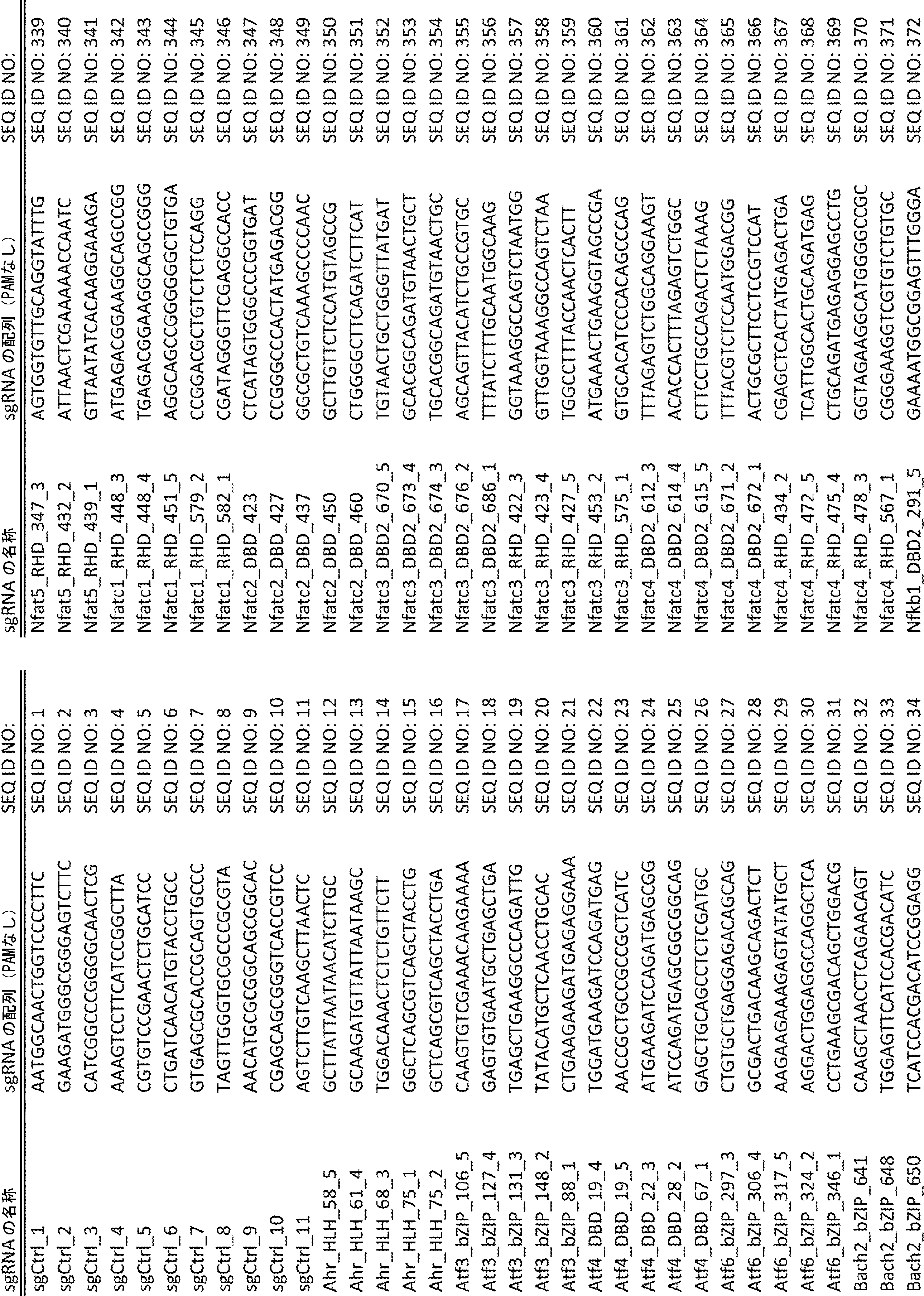

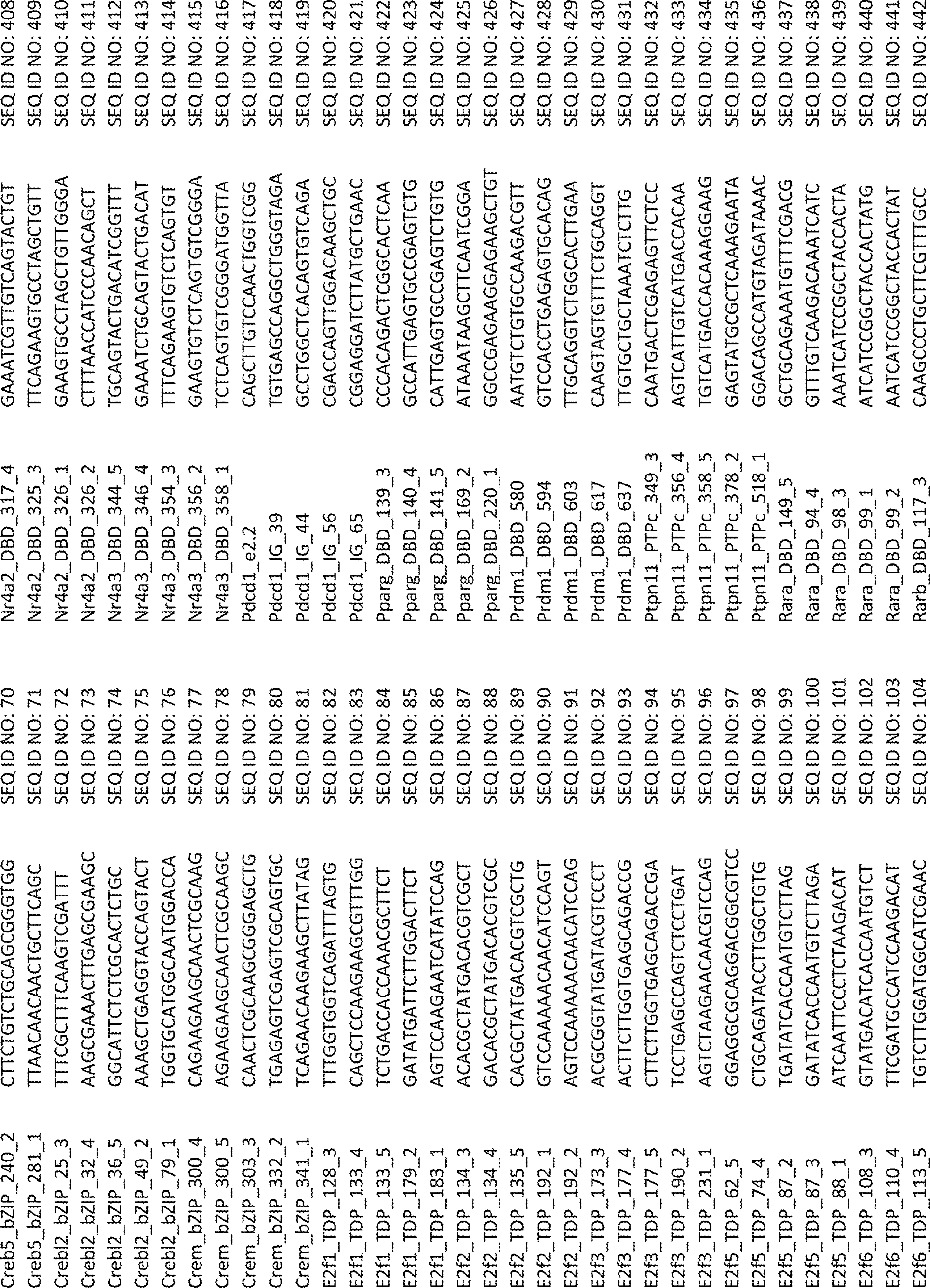
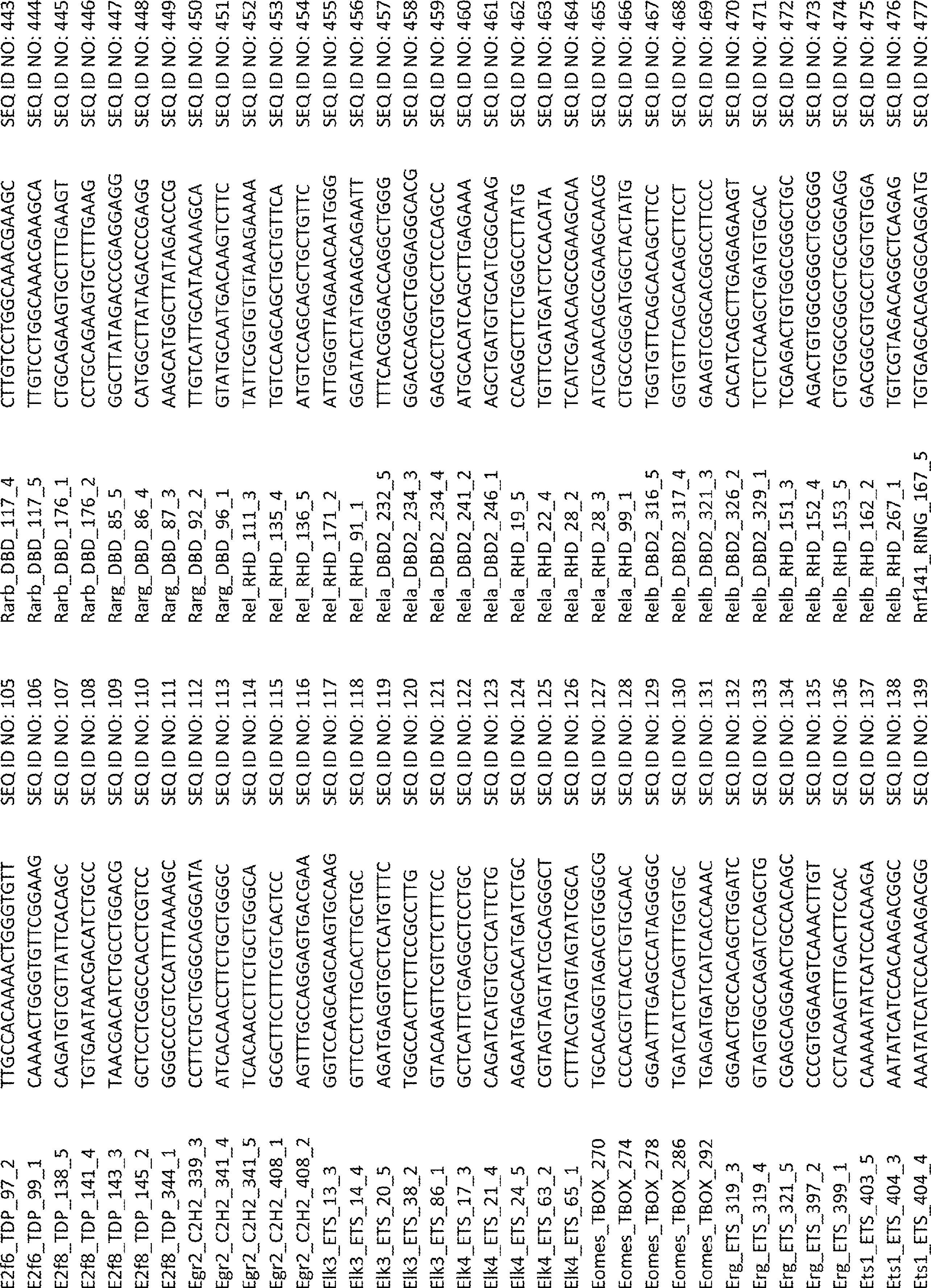
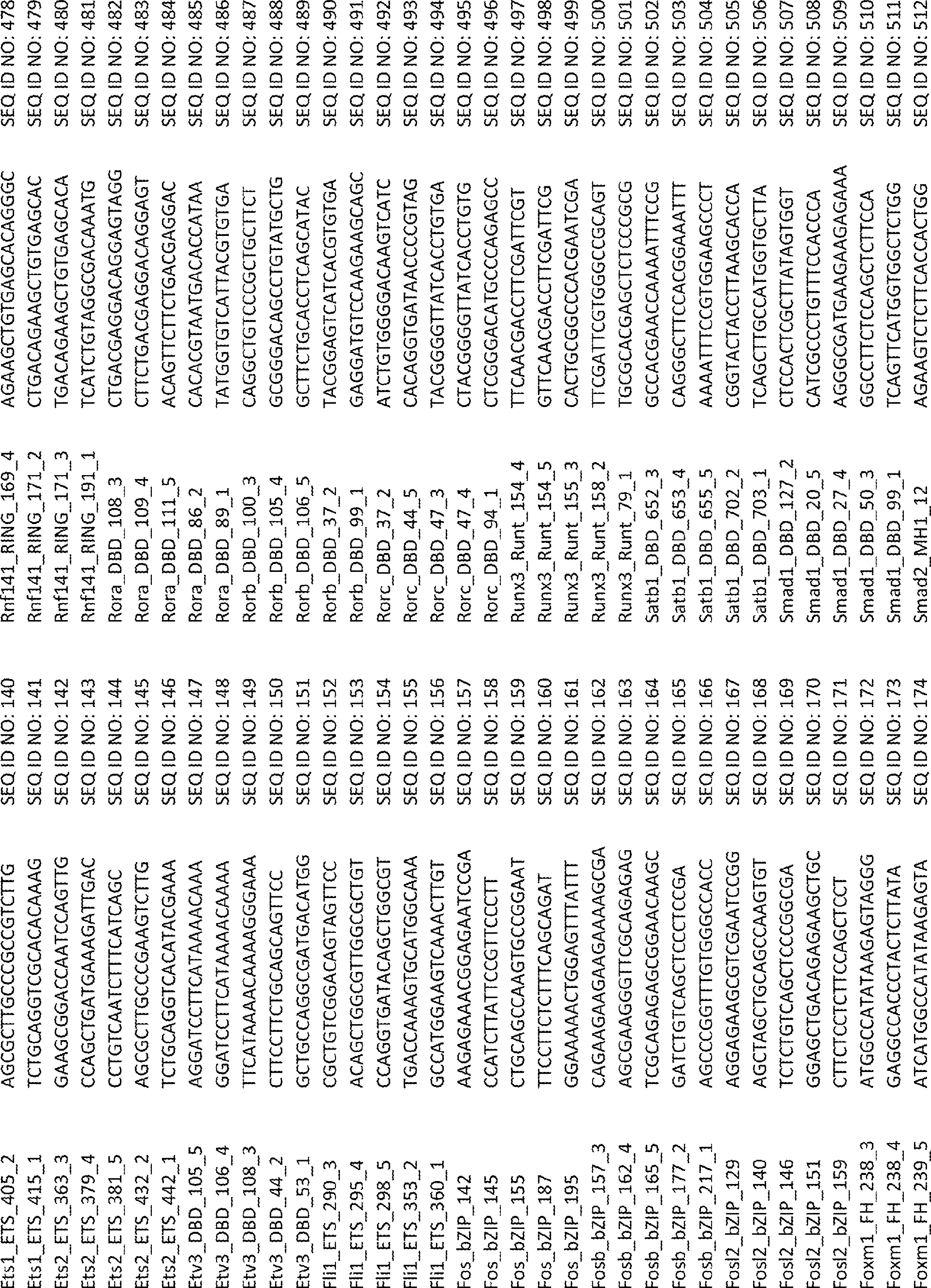
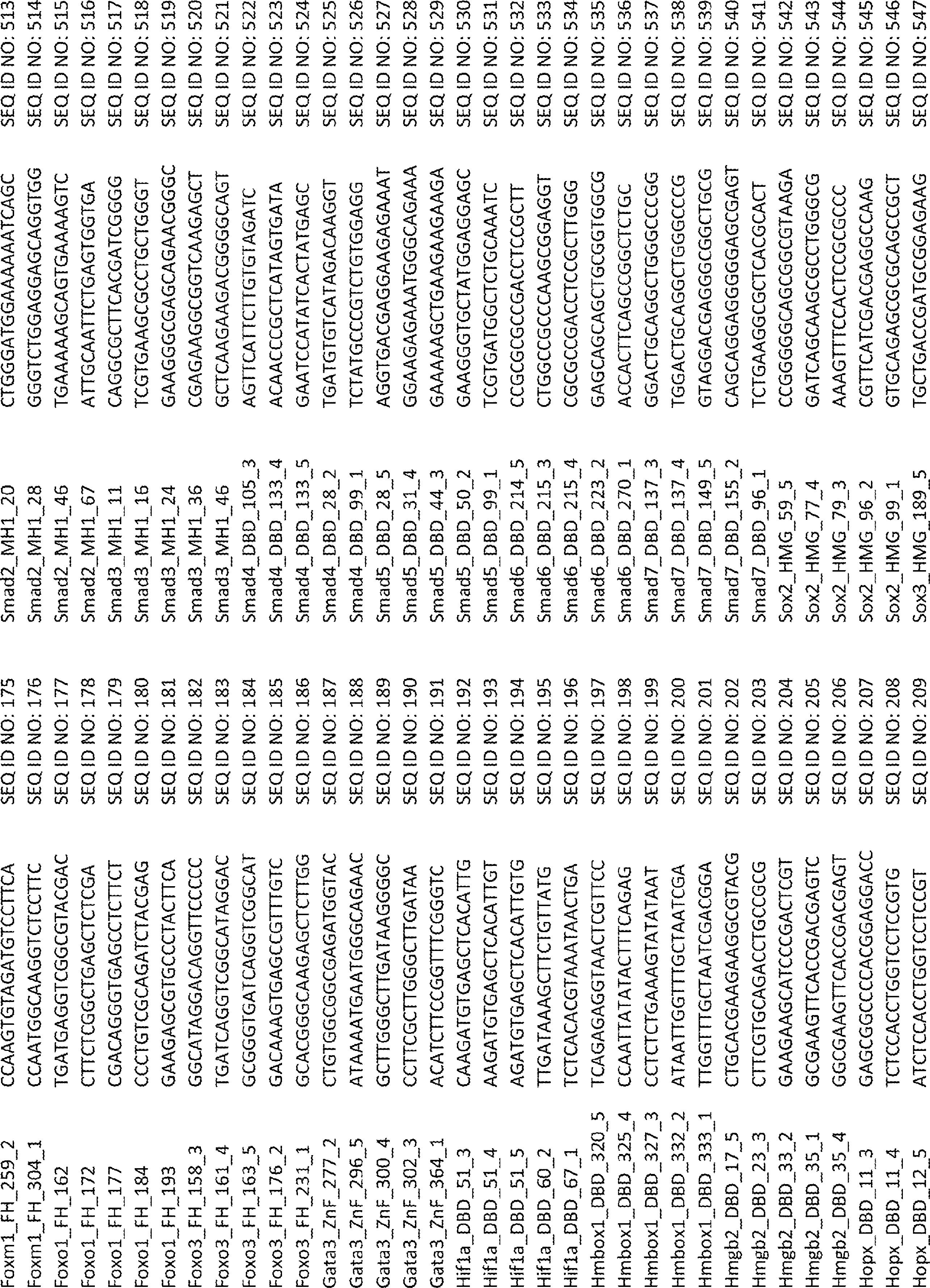
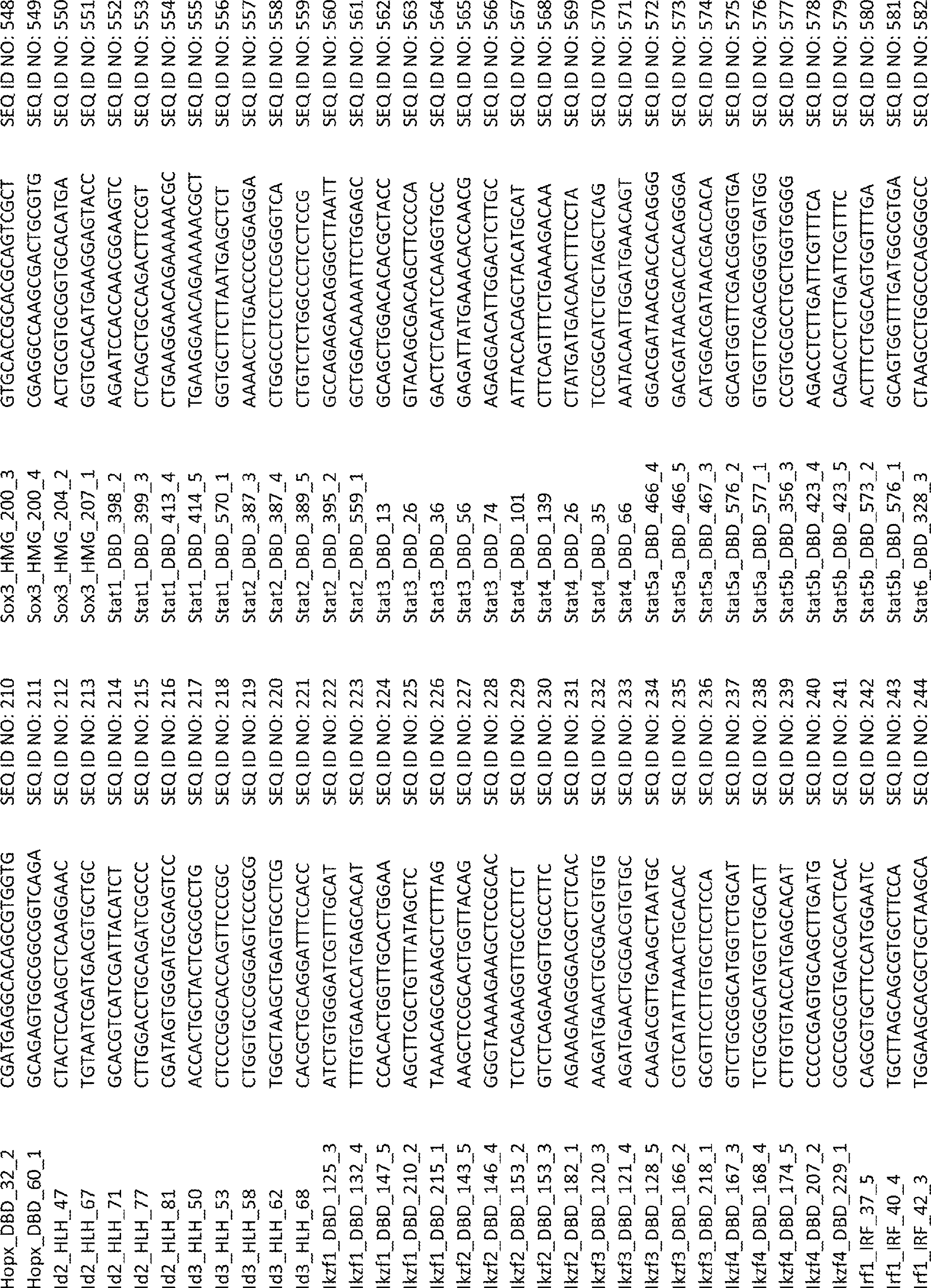

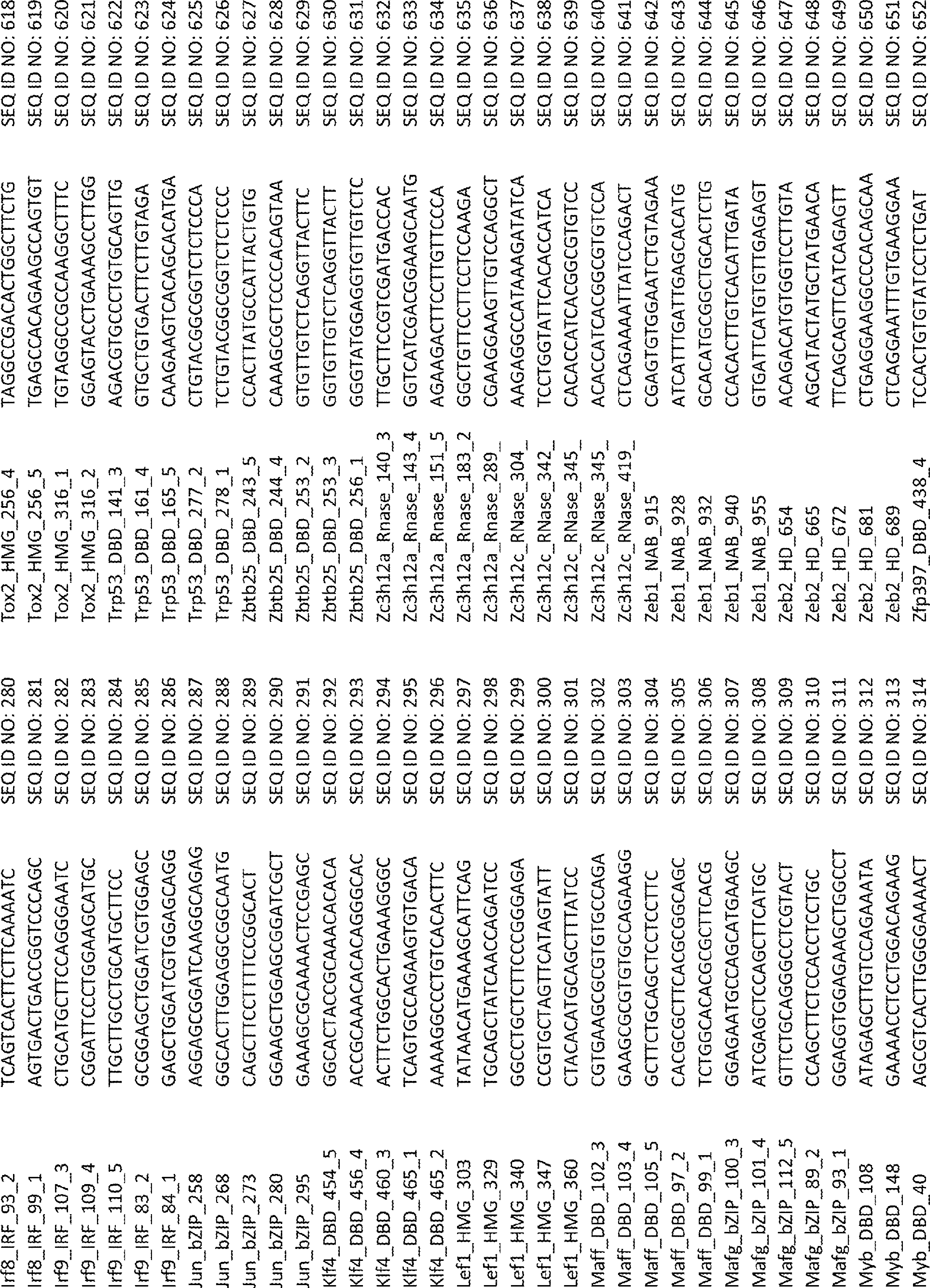

Claims (26)
i)活性化T細胞に、Cas酵素およびsgRNAライブラリーを導入すること、
ii)該T細胞を感染マウスに投与すること、
iii)該感染マウスから該T細胞を単離すること、ならびに
iv)該T細胞を分析すること
を含む、方法。 A method of screening T cells, the method comprising:
i) introducing Cas enzyme and sgRNA library into activated T cells;
ii) administering the T cells to infected mice;
iii) isolating the T cells from the infected mouse; and
iv) analyzing said T cells.
Applications Claiming Priority (3)
| Application Number | Priority Date | Filing Date | Title |
|---|---|---|---|
| US202163153191P | 2021-02-24 | 2021-02-24 | |
| US63/153,191 | 2021-02-24 | ||
| PCT/US2022/017564 WO2022182788A1 (en) | 2021-02-24 | 2022-02-23 | In vivo crispr screening system for discovering therapeutic targets in cd8 t cells |
Publications (1)
| Publication Number | Publication Date |
|---|---|
| JP2024512261A true JP2024512261A (en) | 2024-03-19 |
Family
ID=83048444
Family Applications (1)
| Application Number | Title | Priority Date | Filing Date |
|---|---|---|---|
| JP2023551129A Pending JP2024512261A (en) | 2021-02-24 | 2022-02-23 | In vivo CRISPR screening system to discover therapeutic targets in CD8 T cells |
Country Status (5)
| Country | Link |
|---|---|
| US (1) | US20250011764A1 (en) |
| EP (1) | EP4297759A4 (en) |
| JP (1) | JP2024512261A (en) |
| CN (1) | CN117120062A (en) |
| WO (1) | WO2022182788A1 (en) |
Families Citing this family (1)
| Publication number | Priority date | Publication date | Assignee | Title |
|---|---|---|---|---|
| CN121219418A (en) * | 2023-05-26 | 2025-12-26 | 爱迪塔斯医药公司 | CRISPR-related methods and compositions targeting FL1-1 expression |
Family Cites Families (5)
| Publication number | Priority date | Publication date | Assignee | Title |
|---|---|---|---|---|
| EP3308778A1 (en) * | 2016-10-12 | 2018-04-18 | Institute for Research in Biomedicine | Arginine and its use as a t cell modulator |
| EP4001437A1 (en) * | 2016-11-07 | 2022-05-25 | The United States of America, as represented by The Secretary, Department of Health and Human Services | Methods for selecting therapy for a cancer patient |
| AU2018289555A1 (en) * | 2017-06-23 | 2020-01-16 | Yale University | Compositions and methods for efficacy enhancement of T-cell based immunotherapy |
| WO2019040098A1 (en) * | 2017-08-21 | 2019-02-28 | Dana-Farber Cancer Institute, Inc. | Methods for modulating the interaction between ews-fli1 and baf complexes |
| WO2020077110A1 (en) * | 2018-10-10 | 2020-04-16 | The Regents Of The University Of California | Compositions and methods for modifying regulatory t cells |
-
2022
- 2022-02-23 WO PCT/US2022/017564 patent/WO2022182788A1/en not_active Ceased
- 2022-02-23 EP EP22760353.7A patent/EP4297759A4/en active Pending
- 2022-02-23 US US18/547,445 patent/US20250011764A1/en active Pending
- 2022-02-23 JP JP2023551129A patent/JP2024512261A/en active Pending
- 2022-02-23 CN CN202280026712.3A patent/CN117120062A/en active Pending
Also Published As
| Publication number | Publication date |
|---|---|
| EP4297759A4 (en) | 2025-04-16 |
| EP4297759A1 (en) | 2024-01-03 |
| CN117120062A (en) | 2023-11-24 |
| US20250011764A1 (en) | 2025-01-09 |
| WO2022182788A1 (en) | 2022-09-01 |
Similar Documents
| Publication | Publication Date | Title |
|---|---|---|
| US20240041928A1 (en) | Genetically Modified Immune Cells Targeting NY-ESO-1 and Methods of Use Thereof | |
| US11186825B2 (en) | Compositions and methods for evaluating and modulating immune responses by detecting and targeting POU2AF1 | |
| EP3368689B1 (en) | Composition for modulating immune responses by use of immune cell gene signature | |
| US20200347386A1 (en) | Combination gene targets for improved immunotherapy | |
| JP2021129588A (en) | Composition and methods for regulating inhibitory interactions in genetically engineered cells | |
| WO2018067991A1 (en) | Modulation of novel immune checkpoint targets | |
| WO2017069958A2 (en) | Modulation of novel immune checkpoint targets | |
| JP2020517247A (en) | Platform for manipulation of T lymphocyte genome and its in vivo high throughput screening method | |
| JP7642548B2 (en) | Gene Regulatory Compositions and Methods for Improved Immunotherapy - Patent application | |
| US12365918B2 (en) | Engineered regulatory T cells | |
| JP2024512368A (en) | Compositions and methods for assessing and treating T cell dysfunction | |
| JP2024512261A (en) | In vivo CRISPR screening system to discover therapeutic targets in CD8 T cells | |
| US20140294793A1 (en) | Gpr15-mediated homing and uses thereof | |
| JP2020528046A (en) | Compositions and Methods for Enhancing the Efficacy of T Cell-Based Immunotherapy | |
| US20220202900A1 (en) | Compositions and methods for crispr/cas9 knock-out of cd33 in human hematopoietic stem / progenitor cells for allogenic transplantation in patients with relapsed - refractory acute myeloid leukemia | |
| HK40103142A (en) | In vivo crispr screening system for discovering therapeutic targets in cd8 t cells | |
| US20210069245A1 (en) | Mirna modulation of t cell signaling and uses thereof | |
| US20240342280A1 (en) | Optimizing t cell differentiation state with micrornas | |
| US20250228941A1 (en) | Cellular therapy | |
| Althoff | Improvement of adoptive T cell therapy by T cell specific targeting of T cell inhibitory receptors instead of systemic antibody treatment | |
| WO2023196921A1 (en) | Granzyme expressing t cells and methods of use | |
| Wirges | Immunological and translational consequences of an altered CD8+ T cell cytolytic activity |
Legal Events
| Date | Code | Title | Description |
|---|---|---|---|
| A521 | Request for written amendment filed |
Free format text: JAPANESE INTERMEDIATE CODE: A523 Effective date: 20231006 |
|
| A621 | Written request for application examination |
Free format text: JAPANESE INTERMEDIATE CODE: A621 Effective date: 20250221 |