JP2024512024A - Pyrimidine derivatives useful as LRRK2 kinase inhibitors - Google Patents
Pyrimidine derivatives useful as LRRK2 kinase inhibitors Download PDFInfo
- Publication number
- JP2024512024A JP2024512024A JP2023558377A JP2023558377A JP2024512024A JP 2024512024 A JP2024512024 A JP 2024512024A JP 2023558377 A JP2023558377 A JP 2023558377A JP 2023558377 A JP2023558377 A JP 2023558377A JP 2024512024 A JP2024512024 A JP 2024512024A
- Authority
- JP
- Japan
- Prior art keywords
- compound according
- disease
- cycloalkyl
- heterocyclyl
- membered
- Prior art date
- Legal status (The legal status is an assumption and is not a legal conclusion. Google has not performed a legal analysis and makes no representation as to the accuracy of the status listed.)
- Pending
Links
Classifications
-
- C—CHEMISTRY; METALLURGY
- C07—ORGANIC CHEMISTRY
- C07D—HETEROCYCLIC COMPOUNDS
- C07D239/00—Heterocyclic compounds containing 1,3-diazine or hydrogenated 1,3-diazine rings
- C07D239/02—Heterocyclic compounds containing 1,3-diazine or hydrogenated 1,3-diazine rings not condensed with other rings
- C07D239/24—Heterocyclic compounds containing 1,3-diazine or hydrogenated 1,3-diazine rings not condensed with other rings having three or more double bonds between ring members or between ring members and non-ring members
- C07D239/28—Heterocyclic compounds containing 1,3-diazine or hydrogenated 1,3-diazine rings not condensed with other rings having three or more double bonds between ring members or between ring members and non-ring members with hetero atoms or with carbon atoms having three bonds to hetero atoms with at the most one bond to halogen, directly attached to ring carbon atoms
- C07D239/46—Two or more oxygen, sulphur or nitrogen atoms
- C07D239/47—One nitrogen atom and one oxygen or sulfur atom, e.g. cytosine
-
- C—CHEMISTRY; METALLURGY
- C07—ORGANIC CHEMISTRY
- C07D—HETEROCYCLIC COMPOUNDS
- C07D403/00—Heterocyclic compounds containing two or more hetero rings, having nitrogen atoms as the only ring hetero atoms, not provided for by group C07D401/00
- C07D403/14—Heterocyclic compounds containing two or more hetero rings, having nitrogen atoms as the only ring hetero atoms, not provided for by group C07D401/00 containing three or more hetero rings
-
- A—HUMAN NECESSITIES
- A61—MEDICAL OR VETERINARY SCIENCE; HYGIENE
- A61K—PREPARATIONS FOR MEDICAL, DENTAL OR TOILETRY PURPOSES
- A61K31/00—Medicinal preparations containing organic active ingredients
- A61K31/33—Heterocyclic compounds
- A61K31/395—Heterocyclic compounds having nitrogen as a ring hetero atom, e.g. guanethidine or rifamycins
- A61K31/495—Heterocyclic compounds having nitrogen as a ring hetero atom, e.g. guanethidine or rifamycins having six-membered rings with two or more nitrogen atoms as the only ring heteroatoms, e.g. piperazine or tetrazines
- A61K31/505—Pyrimidines; Hydrogenated pyrimidines, e.g. trimethoprim
- A61K31/513—Pyrimidines; Hydrogenated pyrimidines, e.g. trimethoprim having oxo groups directly attached to the heterocyclic ring, e.g. cytosine
-
- A—HUMAN NECESSITIES
- A61—MEDICAL OR VETERINARY SCIENCE; HYGIENE
- A61K—PREPARATIONS FOR MEDICAL, DENTAL OR TOILETRY PURPOSES
- A61K31/00—Medicinal preparations containing organic active ingredients
- A61K31/33—Heterocyclic compounds
- A61K31/395—Heterocyclic compounds having nitrogen as a ring hetero atom, e.g. guanethidine or rifamycins
- A61K31/535—Heterocyclic compounds having nitrogen as a ring hetero atom, e.g. guanethidine or rifamycins having six-membered rings with at least one nitrogen and one oxygen as the ring hetero atoms, e.g. 1,2-oxazines
- A61K31/5375—1,4-Oxazines, e.g. morpholine
- A61K31/5377—1,4-Oxazines, e.g. morpholine not condensed and containing further heterocyclic rings, e.g. timolol
-
- A—HUMAN NECESSITIES
- A61—MEDICAL OR VETERINARY SCIENCE; HYGIENE
- A61P—SPECIFIC THERAPEUTIC ACTIVITY OF CHEMICAL COMPOUNDS OR MEDICINAL PREPARATIONS
- A61P25/00—Drugs for disorders of the nervous system
-
- A—HUMAN NECESSITIES
- A61—MEDICAL OR VETERINARY SCIENCE; HYGIENE
- A61P—SPECIFIC THERAPEUTIC ACTIVITY OF CHEMICAL COMPOUNDS OR MEDICINAL PREPARATIONS
- A61P25/00—Drugs for disorders of the nervous system
- A61P25/14—Drugs for disorders of the nervous system for treating abnormal movements, e.g. chorea, dyskinesia
- A61P25/16—Anti-Parkinson drugs
-
- A—HUMAN NECESSITIES
- A61—MEDICAL OR VETERINARY SCIENCE; HYGIENE
- A61P—SPECIFIC THERAPEUTIC ACTIVITY OF CHEMICAL COMPOUNDS OR MEDICINAL PREPARATIONS
- A61P25/00—Drugs for disorders of the nervous system
- A61P25/28—Drugs for disorders of the nervous system for treating neurodegenerative disorders of the central nervous system, e.g. nootropic agents, cognition enhancers, drugs for treating Alzheimer's disease or other forms of dementia
-
- A—HUMAN NECESSITIES
- A61—MEDICAL OR VETERINARY SCIENCE; HYGIENE
- A61P—SPECIFIC THERAPEUTIC ACTIVITY OF CHEMICAL COMPOUNDS OR MEDICINAL PREPARATIONS
- A61P29/00—Non-central analgesic, antipyretic or antiinflammatory agents, e.g. antirheumatic agents; Non-steroidal antiinflammatory drugs [NSAID]
-
- A—HUMAN NECESSITIES
- A61—MEDICAL OR VETERINARY SCIENCE; HYGIENE
- A61P—SPECIFIC THERAPEUTIC ACTIVITY OF CHEMICAL COMPOUNDS OR MEDICINAL PREPARATIONS
- A61P35/00—Antineoplastic agents
-
- C—CHEMISTRY; METALLURGY
- C07—ORGANIC CHEMISTRY
- C07D—HETEROCYCLIC COMPOUNDS
- C07D239/00—Heterocyclic compounds containing 1,3-diazine or hydrogenated 1,3-diazine rings
- C07D239/02—Heterocyclic compounds containing 1,3-diazine or hydrogenated 1,3-diazine rings not condensed with other rings
- C07D239/24—Heterocyclic compounds containing 1,3-diazine or hydrogenated 1,3-diazine rings not condensed with other rings having three or more double bonds between ring members or between ring members and non-ring members
- C07D239/28—Heterocyclic compounds containing 1,3-diazine or hydrogenated 1,3-diazine rings not condensed with other rings having three or more double bonds between ring members or between ring members and non-ring members with hetero atoms or with carbon atoms having three bonds to hetero atoms with at the most one bond to halogen, directly attached to ring carbon atoms
- C07D239/46—Two or more oxygen, sulphur or nitrogen atoms
- C07D239/52—Two oxygen atoms
-
- C—CHEMISTRY; METALLURGY
- C07—ORGANIC CHEMISTRY
- C07D—HETEROCYCLIC COMPOUNDS
- C07D401/00—Heterocyclic compounds containing two or more hetero rings, having nitrogen atoms as the only ring hetero atoms, at least one ring being a six-membered ring with only one nitrogen atom
- C07D401/02—Heterocyclic compounds containing two or more hetero rings, having nitrogen atoms as the only ring hetero atoms, at least one ring being a six-membered ring with only one nitrogen atom containing two hetero rings
- C07D401/12—Heterocyclic compounds containing two or more hetero rings, having nitrogen atoms as the only ring hetero atoms, at least one ring being a six-membered ring with only one nitrogen atom containing two hetero rings linked by a chain containing hetero atoms as chain links
-
- C—CHEMISTRY; METALLURGY
- C07—ORGANIC CHEMISTRY
- C07D—HETEROCYCLIC COMPOUNDS
- C07D401/00—Heterocyclic compounds containing two or more hetero rings, having nitrogen atoms as the only ring hetero atoms, at least one ring being a six-membered ring with only one nitrogen atom
- C07D401/14—Heterocyclic compounds containing two or more hetero rings, having nitrogen atoms as the only ring hetero atoms, at least one ring being a six-membered ring with only one nitrogen atom containing three or more hetero rings
-
- C—CHEMISTRY; METALLURGY
- C07—ORGANIC CHEMISTRY
- C07D—HETEROCYCLIC COMPOUNDS
- C07D403/00—Heterocyclic compounds containing two or more hetero rings, having nitrogen atoms as the only ring hetero atoms, not provided for by group C07D401/00
- C07D403/02—Heterocyclic compounds containing two or more hetero rings, having nitrogen atoms as the only ring hetero atoms, not provided for by group C07D401/00 containing two hetero rings
- C07D403/12—Heterocyclic compounds containing two or more hetero rings, having nitrogen atoms as the only ring hetero atoms, not provided for by group C07D401/00 containing two hetero rings linked by a chain containing hetero atoms as chain links
-
- C—CHEMISTRY; METALLURGY
- C07—ORGANIC CHEMISTRY
- C07D—HETEROCYCLIC COMPOUNDS
- C07D405/00—Heterocyclic compounds containing both one or more hetero rings having oxygen atoms as the only ring hetero atoms, and one or more rings having nitrogen as the only ring hetero atom
- C07D405/02—Heterocyclic compounds containing both one or more hetero rings having oxygen atoms as the only ring hetero atoms, and one or more rings having nitrogen as the only ring hetero atom containing two hetero rings
- C07D405/12—Heterocyclic compounds containing both one or more hetero rings having oxygen atoms as the only ring hetero atoms, and one or more rings having nitrogen as the only ring hetero atom containing two hetero rings linked by a chain containing hetero atoms as chain links
-
- C—CHEMISTRY; METALLURGY
- C07—ORGANIC CHEMISTRY
- C07D—HETEROCYCLIC COMPOUNDS
- C07D405/00—Heterocyclic compounds containing both one or more hetero rings having oxygen atoms as the only ring hetero atoms, and one or more rings having nitrogen as the only ring hetero atom
- C07D405/14—Heterocyclic compounds containing both one or more hetero rings having oxygen atoms as the only ring hetero atoms, and one or more rings having nitrogen as the only ring hetero atom containing three or more hetero rings
-
- C—CHEMISTRY; METALLURGY
- C07—ORGANIC CHEMISTRY
- C07D—HETEROCYCLIC COMPOUNDS
- C07D409/00—Heterocyclic compounds containing two or more hetero rings, at least one ring having sulfur atoms as the only ring hetero atoms
- C07D409/14—Heterocyclic compounds containing two or more hetero rings, at least one ring having sulfur atoms as the only ring hetero atoms containing three or more hetero rings
-
- C—CHEMISTRY; METALLURGY
- C07—ORGANIC CHEMISTRY
- C07D—HETEROCYCLIC COMPOUNDS
- C07D413/00—Heterocyclic compounds containing two or more hetero rings, at least one ring having nitrogen and oxygen atoms as the only ring hetero atoms
- C07D413/02—Heterocyclic compounds containing two or more hetero rings, at least one ring having nitrogen and oxygen atoms as the only ring hetero atoms containing two hetero rings
- C07D413/12—Heterocyclic compounds containing two or more hetero rings, at least one ring having nitrogen and oxygen atoms as the only ring hetero atoms containing two hetero rings linked by a chain containing hetero atoms as chain links
-
- C—CHEMISTRY; METALLURGY
- C07—ORGANIC CHEMISTRY
- C07D—HETEROCYCLIC COMPOUNDS
- C07D413/00—Heterocyclic compounds containing two or more hetero rings, at least one ring having nitrogen and oxygen atoms as the only ring hetero atoms
- C07D413/14—Heterocyclic compounds containing two or more hetero rings, at least one ring having nitrogen and oxygen atoms as the only ring hetero atoms containing three or more hetero rings
-
- C—CHEMISTRY; METALLURGY
- C07—ORGANIC CHEMISTRY
- C07D—HETEROCYCLIC COMPOUNDS
- C07D451/00—Heterocyclic compounds containing 8-azabicyclo [3.2.1] octane, 9-azabicyclo [3.3.1] nonane, or 3-oxa-9-azatricyclo [3.3.1.0<2,4>] nonane ring systems, e.g. tropane or granatane alkaloids, scopolamine; Cyclic acetals thereof
- C07D451/02—Heterocyclic compounds containing 8-azabicyclo [3.2.1] octane, 9-azabicyclo [3.3.1] nonane, or 3-oxa-9-azatricyclo [3.3.1.0<2,4>] nonane ring systems, e.g. tropane or granatane alkaloids, scopolamine; Cyclic acetals thereof containing not further condensed 8-azabicyclo [3.2.1] octane or 3-oxa-9-azatricyclo [3.3.1.0<2,4>] nonane ring systems, e.g. tropane; Cyclic acetals thereof
-
- C—CHEMISTRY; METALLURGY
- C07—ORGANIC CHEMISTRY
- C07D—HETEROCYCLIC COMPOUNDS
- C07D491/00—Heterocyclic compounds containing in the condensed ring system both one or more rings having oxygen atoms as the only ring hetero atoms and one or more rings having nitrogen atoms as the only ring hetero atoms, not provided for by groups C07D451/00 - C07D459/00, C07D463/00, C07D477/00 or C07D489/00
- C07D491/02—Heterocyclic compounds containing in the condensed ring system both one or more rings having oxygen atoms as the only ring hetero atoms and one or more rings having nitrogen atoms as the only ring hetero atoms, not provided for by groups C07D451/00 - C07D459/00, C07D463/00, C07D477/00 or C07D489/00 in which the condensed system contains two hetero rings
- C07D491/10—Spiro-condensed systems
- C07D491/107—Spiro-condensed systems with only one oxygen atom as ring hetero atom in the oxygen-containing ring
-
- C—CHEMISTRY; METALLURGY
- C07—ORGANIC CHEMISTRY
- C07D—HETEROCYCLIC COMPOUNDS
- C07D498/00—Heterocyclic compounds containing in the condensed system at least one hetero ring having nitrogen and oxygen atoms as the only ring hetero atoms
- C07D498/02—Heterocyclic compounds containing in the condensed system at least one hetero ring having nitrogen and oxygen atoms as the only ring hetero atoms in which the condensed system contains two hetero rings
- C07D498/08—Bridged systems
Landscapes
- Chemical & Material Sciences (AREA)
- Organic Chemistry (AREA)
- Health & Medical Sciences (AREA)
- Public Health (AREA)
- Veterinary Medicine (AREA)
- General Health & Medical Sciences (AREA)
- Animal Behavior & Ethology (AREA)
- Life Sciences & Earth Sciences (AREA)
- Pharmacology & Pharmacy (AREA)
- Medicinal Chemistry (AREA)
- Engineering & Computer Science (AREA)
- Bioinformatics & Cheminformatics (AREA)
- Biomedical Technology (AREA)
- Neurology (AREA)
- Neurosurgery (AREA)
- Nuclear Medicine, Radiotherapy & Molecular Imaging (AREA)
- General Chemical & Material Sciences (AREA)
- Chemical Kinetics & Catalysis (AREA)
- Hospice & Palliative Care (AREA)
- Psychiatry (AREA)
- Epidemiology (AREA)
- Psychology (AREA)
- Pain & Pain Management (AREA)
- Rheumatology (AREA)
- Pharmaceuticals Containing Other Organic And Inorganic Compounds (AREA)
- Nitrogen Condensed Heterocyclic Rings (AREA)
- Plural Heterocyclic Compounds (AREA)
Abstract

LRRK2キナーゼの阻害剤としての活性を有する化合物を提供する。化合物は、構造(I):

を有するか、またはその医薬的に許容される塩、立体異性体もしくはプロドラッグであって、式中A、B、R1a、R1b、R2およびLは、本願で定義されるとおりである。該化合物の製造および使用に関する方法、該化合物を含む医薬組成物およびLRRK2キナーゼの活性を調節する方法もまた提供する。
Compounds having activity as inhibitors of LRRK2 kinase are provided. The compound has structure (I):
or a pharmaceutically acceptable salt, stereoisomer or prodrug thereof, wherein A, B, R 1a , R 1b , R 2 and L are as defined herein. . Also provided are methods for making and using the compounds, pharmaceutical compositions containing the compounds, and methods for modulating the activity of LRRK2 kinase.
Description
本開示の実施態様は、一般に、例えば神経変性疾患、中枢神経系(CNS)障害、癌および炎症性疾患の処置のための、化合物およびその製造方法および治療剤もしくは予防剤としての使用に関する。 Embodiments of the present disclosure generally relate to compounds and methods for their preparation and use as therapeutic or prophylactic agents, for example, for the treatment of neurodegenerative diseases, central nervous system (CNS) disorders, cancer, and inflammatory diseases.
パーキンソン病、レヴィー小体認知症およびハンチントン病などの神経変性疾患は、何百万もの人々に影響を与えている。パーキンソン病は、およそ1000人に1人が罹患する慢性で進行性の運動系障害であり、遺伝性パーキンソン病は全患者の5~10%を占める。パーキンソン病は、中脳ドーパミンニューロンの進行性の喪失によって引き起こされ、患者は、自分の動きを指示および制御する能力に障害を受けている。主なパーキンソン病の症状は、震え、硬直、動作緩慢および平衡感覚障害である。 Neurodegenerative diseases such as Parkinson's disease, Lewy body dementia and Huntington's disease affect millions of people. Parkinson's disease is a chronic, progressive motor system disorder that affects approximately 1 in 1,000 people, with inherited Parkinson's disease accounting for 5-10% of all patients. Parkinson's disease is caused by the progressive loss of midbrain dopamine neurons, leaving patients with an impaired ability to direct and control their movements. The main Parkinson's disease symptoms are tremor, rigidity, bradykinesia and loss of balance.
ロイシンリッチリピートキナーゼ2タンパク質(leucine-rich repeat kinase 2 protein、LRRK2)をコードする遺伝子は、遺伝性パーキンソン病と関連して特定されている(例えば、Paisan-Ruiz et al., Neuron, Vol. 44(4), 2004, pp 595-600; Zimprich et al., Neuron, Vol. 44(4), 2004, 601-607参照)。インビトロ研究は、パーキンソン病関連変異が、野生型と比較してLRRK2キナーゼ活性の上昇およびGTP加水分解速度の低下をもたらすことを示している(Guo et al., Experimental Cell Research, Vol. 313(16), 2007, pp. 3658-3670)。抗LRRK2抗体は、パーキンソン病に関連する脳幹レヴィー小体およびレヴィー小体認知症に関連する皮質抗体に用いられており、これは、LRRK2がこれらの疾患に関連するレヴィー小体の形成および病因に重要な役割を果たし得ることを示唆している(Zhou et al., Molecular Degeneration, 2006, 1:17 doi:10.1186/1750-1326-1-17)。LRRK2はまた、クローン病への感受性およびハンセン病への感受性の増加に関連する可能性のある遺伝子として特定されいる(Zhang et al., New England J. Med. Vol. 361 (2009) pp. 2609-2618)。 The gene encoding leucine-rich repeat kinase 2 protein (LRRK2) has been identified in association with hereditary Parkinson's disease (e.g., Paisan-Ruiz et al., Neuron, Vol. 44 (4), 2004, pp 595-600; see Zimprich et al., Neuron, Vol. 44(4), 2004, 601-607). In vitro studies show that Parkinson's disease-associated mutations lead to increased LRRK2 kinase activity and decreased GTP hydrolysis rate compared to wild type (Guo et al., Experimental Cell Research, Vol. 313(16) ), 2007, pp. 3658-3670). Anti-LRRK2 antibodies have been used for brainstem Lewy bodies associated with Parkinson's disease and cortical antibodies associated with Lewy body dementia, suggesting that LRRK2 may be involved in the formation and pathogenesis of Lewy bodies associated with these diseases. This suggests that it may play an important role (Zhou et al., Molecular Degeneration, 2006, 1:17 doi:10.1186/1750-1326-1-17). LRRK2 has also been identified as a gene potentially associated with susceptibility to Crohn's disease and increased susceptibility to leprosy (Zhang et al., New England J. Med. Vol. 361 (2009) pp. 2609- 2618).
LRRK2は、L-DOPA誘発ジスキネジア(Hurley et al., Eur. J. Neurosci., Vol. 26, 2007, pp. 171-177);神経前駆細胞の分化に関連するCNS障害(Milosevic et al., Neurodegen., Vol. 4, 2009, p. 25);腎臓癌、乳癌、前立腺癌、血液癌および肺癌などの癌ならびに急性骨髄性白血病(例えばPCT公報WO 2011/038572参照);乳頭状腎癌腫および甲状腺癌腫(Looyenga et al., www.pnas.org/cgi/doi/10.1073/pnas.1012500108);多発性骨髄腫(Chapman et al., Nature Vol. 471, 2011, pp. 467-472);筋萎縮性側索硬化症(Shtilbans et al., Amyotrophic Lateral Sclerosis Early Online 2011, pp. 1-7);リウマチ性関節炎(Nakamura et al., DNA Res. Vol. 13(4), 2006, pp. 169-183);および強直性脊椎炎(Danoy et al., PLoS Genetics, Vol. 6(12), 2010, e1001195, pp. 1-5)にもまた関連する。 LRRK2 is involved in L-DOPA-induced dyskinesia (Hurley et al., Eur. J. Neurosci., Vol. 26, 2007, pp. 171-177); CNS disorders associated with neural progenitor cell differentiation (Milosevic et al., Neurodegen., Vol. 4, 2009, p. 25); cancers such as kidney cancer, breast cancer, prostate cancer, blood cancer and lung cancer; and acute myeloid leukemia (see e.g. PCT Publication WO 2011/038572); papillary renal carcinoma and Thyroid carcinoma (Looyenga et al., www.pnas.org/cgi/doi/10.1073/pnas.1012500108); multiple myeloma (Chapman et al., Nature Vol. 471, 2011, pp. 467-472); Atrophic lateral sclerosis (Shtilbans et al., Amyotrophic Lateral Sclerosis Early Online 2011, pp. 1-7); Rheumatoid arthritis (Nakamura et al., DNA Res. Vol. 13(4), 2006, pp. 169) -183); and ankylosing spondylitis (Danoy et al., PLoS Genetics, Vol. 6(12), 2010, e1001195, pp. 1-5).
したがって、LRRK2キナーゼ活性を調節するのに有効な化合物および組成物は、神経変性疾患、例えばパーキンソン病およびレヴィー小体認知症、CNS障害、例えばアルツハイマー病およびL-DOPA誘発ジスキネジア、癌、例えば腎臓癌、乳癌、前立腺癌、血液癌、乳頭がんおよび肺癌、急性骨髄性白血病および多発性骨髄腫、ならびに炎症性疾患、例えばハンセン病、クローン病、筋萎縮性側索硬化症、リウマチ性関節炎および強直性脊椎炎の処置を提供し得る。本開示の実施態様は、この要求を満たし、さらに関連する利点を提供する。 Compounds and compositions effective for modulating LRRK2 kinase activity are therefore useful in neurodegenerative diseases such as Parkinson's disease and Lewy body dementia, in CNS disorders such as Alzheimer's disease and L-DOPA-induced dyskinesia, in cancers such as renal cancer. , breast cancer, prostate cancer, blood cancer, papillary and lung cancer, acute myeloid leukemia and multiple myeloma, and inflammatory diseases such as leprosy, Crohn's disease, amyotrophic lateral sclerosis, rheumatoid arthritis and ankylosing disease. May provide treatment for spondylitis. Embodiments of the present disclosure meet this need and provide further related advantages.
簡潔には、本開示の実施態様は、LRRK2のキナーゼ活性を調節できる、その医薬的に許容される塩、立体異性体およびプロドラッグを含む、化合物を提供する。 Briefly, embodiments of the present disclosure provide compounds, including pharmaceutically acceptable salts, stereoisomers, and prodrugs thereof, that are capable of modulating the kinase activity of LRRK2.
一態様において、本開示は、構造(I):

で示される化合物、その医薬的に許容される塩、立体異性体またはプロドラッグを提供し、式中、A、B、R1a、R1b、R2およびLの各々は、以下に記載するとおりである。
In one aspect, the present disclosure provides structure (I):
, a pharmaceutically acceptable salt, stereoisomer or prodrug thereof, wherein each of A, B, R 1a , R 1b , R 2 and L is as described below. It is.
別の態様において、本開示の化合物を含む医薬組成物、および神経変性疾患、中枢神経系(CNS)障害、癌、炎症性疾患およびそれらの組合せの処置のためのその使用方法もまた提供する。 In another aspect, pharmaceutical compositions comprising compounds of the present disclosure and methods of use thereof for the treatment of neurodegenerative diseases, central nervous system (CNS) disorders, cancers, inflammatory diseases, and combinations thereof are also provided.
以下の説明では、本開示の様々な実施態様の完全な理解を提供するために、特定の具体的な詳細を記載する。しかしながら、当業者は、本開示がこれらの詳細なしに実施され得ることを理解するであろう。 In the following description, certain specific details are set forth to provide a thorough understanding of the various implementations of the present disclosure. However, one of ordinary skill in the art will understand that the present disclosure may be practiced without these details.
文脈上他の意味に解す場合を除き、本明細書および特許請求の範囲の全体を通じて、用語「含む(comprise)」およびその変形、例えば「含む(comprises)」および「含むこと(comprising)」は、オープンで包括的な意味で、すなわち「含むがこれらに限定されない」と解釈されるべきである。 Unless the context requires otherwise, the term "comprise" and variations thereof, such as "comprises" and "comprising," shall be used throughout this specification and claims as used herein. , should be construed in an open and inclusive sense, i.e. "including but not limited to".
本明細書において、任意の濃度範囲、パーセンテージ範囲、比率範囲または整数範囲は、他に断らない限り、記載する範囲内の任意の整数の値、および適切な場合その分数(例えば、整数の10分の1および100分の1)を含むものと理解されるべきである。本明細書で用いる、用語「約」および「およそ」は、他に断らない限り、示した範囲、値または構造の±20%、±10%、±5%または±1%を意味する。本明細書で用いる用語「ある(a)」および「ある(an)」は、列挙する構成要素の「1つまたは複数」を指すことを理解されるべきである。代替物(例えば「または」)の使用は、代替物のいずれか一方、両方またはその任意の組合せを意味すると理解されるべきである。 As used herein, any concentration range, percentage range, ratio range, or integer range refers to any integer value within the recited range, and where appropriate, a fraction thereof (e.g., tenths of an integer), unless otherwise specified. 1 and 100). As used herein, the terms "about" and "approximately" mean ±20%, ±10%, ±5% or ±1% of the stated range, value or structure, unless otherwise specified. As used herein, the terms "a" and "an" should be understood to refer to "one or more" of the listed elements. Use of an alternative (eg, "or") should be understood to mean either one, both, or any combination thereof.
本明細書全体にわたる「一実施態様」または「ある実施態様」への言及は、実施態様に関連して記載する特定の特徴、構造または特性が本開示の少なくとも1つの実施態様に含まれることを意味する。したがって、本明細書全体にわたる様々な箇所に現れる語句「一実施態様において」または「ある実施態様において」は、必ずしもすべてが同じ実施態様を指すものではない。さらに、特定の特徴、構造または特徴は、1つまたは複数の実施態様において任意の適切な方法で組み合わせ得る。 References throughout this specification to "one embodiment" or "an embodiment" imply that a particular feature, structure, or characteristic described in connection with an embodiment is included in at least one embodiment of the present disclosure. means. Thus, the appearances of the phrases "in one embodiment" or "in an embodiment" in various places throughout this specification are not necessarily all referring to the same embodiment. Furthermore, the particular features, structures or characteristics may be combined in any suitable manner in one or more embodiments.
他に定義されない限り、本明細書で用いるすべての技術用語および科学用語は、本開示が属する当業者によって一般に理解されるのと同じ意味を有する。本明細書および特許請求の範囲において用いる場合、単数形「ある(a)」、「ある(an)」および「その(the)」は、文脈上明らかに他に断らない限り、複数形の言及を含む。 Unless defined otherwise, all technical and scientific terms used herein have the same meaning as commonly understood by one of ordinary skill in the art to which this disclosure belongs. As used in this specification and the claims, the singular forms "a," "an," and "the" refer to plural referents unless the context clearly dictates otherwise. including.
「アミノ」は、-NH2基を指す。 "Amino" refers to the group -NH2 .
「カルボキシ」または「カルボキシル」は、-CO2H基を指し、条件(例えばpH、対イオンなど)に応じて-CO2-基としても存在し得る。 "Carboxy" or "carboxyl" refers to a -CO2H group, which may also exist as a -CO2- group depending on conditions (eg, pH, counterion, etc.).
「シアノ」は、-CN基を指す。 "Cyano" refers to the -CN group.
「ヒドロキシ」または「ヒドロキシル」は、-OH基を指す。 "Hydroxy" or "hydroxyl" refers to the -OH group.
「アルキル」は、炭素原子と水素原子のみからなる飽和の直鎖または分岐鎖の炭化水素鎖基を指し、1~12個の炭素原子(C1-C12アルキル)、1~8個の炭素原子(C1-C8アルキル)または1~6個の炭素原子(C1-C6アルキル)、またはこれらの範囲内の任意の値、例えばC4-C6アルキルなどを有し、単結合によって分子の残りの部分と結合しており、例えば、メチル、エチル、n-プロピル、1-メチルエチル(イソ-プロピル)、n-ブチル、n-ペンチル、1,1-ジメチルエチル(t-ブチル)、3-メチルヘキシル、2-メチルヘキシルなどである。言及する炭素の数は、炭素主鎖および炭素分岐に関するが、任意の置換基に属する炭素原子は含まれない。本明細書において具体的に他に断らない限り、アルキル基は、所望により置換される。 "Alkyl" refers to a saturated straight or branched hydrocarbon chain group consisting only of carbon and hydrogen atoms, with 1 to 12 carbon atoms (C 1 -C 12 alkyl), 1 to 8 carbon atoms atoms (C 1 -C 8 alkyl) or 1 to 6 carbon atoms (C 1 -C 6 alkyl), or any value within these ranges, such as C 4 -C 6 alkyl, and a single bond for example, methyl, ethyl, n-propyl, 1-methylethyl (iso-propyl), n-butyl, n-pentyl, 1,1-dimethylethyl (t-butyl). ), 3-methylhexyl, 2-methylhexyl, etc. The number of carbons mentioned refers to the carbon backbone and carbon branches, but does not include carbon atoms belonging to any substituents. Unless stated otherwise specifically in the specification, an alkyl group is optionally substituted.
「アルコキシ」は、式-ORa基を指し、式中、Raは、1~12個の炭素原子(C1-C12アルコキシ)、1~8個の炭素原子(C1-C8アルコキシ)または1~6個の炭素原子(C1-C6アルコキシ)、またはこれらの範囲内の任意の値を含む上記で定義したアルキル基である。本明細書において具体的に他に断らない限り、アルコキシ基は、所望により置換される。 "Alkoxy" refers to a group of the formula -OR a , where R a has 1 to 12 carbon atoms (C 1 -C 12 alkoxy), 1 to 8 carbon atoms (C 1 -C 8 alkoxy ) or an alkyl group as defined above containing 1 to 6 carbon atoms (C 1 -C 6 alkoxy), or any value within these ranges. Unless stated otherwise specifically in the specification, an alkoxy group is optionally substituted.
「アミニル」は、式-NRaRb基を指し、式中、RaおよびRbは、各々独立して、Hまたは上で定義したC1-C6アルキルである。RaおよびRbの両方がHである場合、「アミニル」基は、上で定義した「アミノ」基と同じである。他に断らない限り、アミニル基のC1-C6アルキル部分は、所望により置換される。 "Aminyl" refers to a group of the formula -NR a R b where R a and R b are each independently H or C 1 -C 6 alkyl as defined above. When R a and R b are both H, an "aminyl" group is the same as an "amino" group as defined above. Unless otherwise specified, the C 1 -C 6 alkyl portion of an aminyl group is optionally substituted.
「芳香環」は、同じ原子セットを有する他の結合配置と比較して安定性の向上を示す、共鳴結合の環を有する環状平面分子または分子の一部(すなわち、基)を指す。一般に、芳香環は、共有結合した同一平面上の原子のセットを含み、偶数であるが4の倍数ではない(すなわち、4n+2π電子、n=0、1、2、3など)数のπ電子(例えば、二重結合と単結合が交互に並ぶ)を含む。芳香環は、フェニル、ナフテニル、イミダゾリル、ピロリル、ピリジニル、ピリミジニル、ピラジニル、ピリドニル、ピリダジニル、ピリミドニルを含むがこれらに限定されない。本明細書において具体的に他に断らない限り、「芳香環」は、所望により置換されるすべての基を含む。 "Aromatic ring" refers to a cyclic planar molecule or portion of a molecule (ie, a group) that has a resonantly bonded ring that exhibits increased stability compared to other bonding arrangements with the same set of atoms. Generally, an aromatic ring contains a covalently bonded coplanar set of atoms, with an even number but not a multiple of 4 (i.e., 4n + 2π electrons, n = 0, 1, 2, 3, etc.) number of π electrons ( For example, double bonds and single bonds alternate). Aromatic rings include, but are not limited to, phenyl, naphthenyl, imidazolyl, pyrrolyl, pyridinyl, pyrimidinyl, pyrazinyl, pyridonyl, pyridazinyl, pyrimidonyl. Unless specifically stated otherwise herein, "aromatic ring" includes all optionally substituted groups.
「アリール」は、6~18個の炭素原子、例えば6~10個の炭素原子(C6-C10アリール)および少なくとも1つの炭素環式芳香環を含む炭素環系基を指す。本開示の実施態様の目的のために、アリール基は、単環式、二環式、三環式または四環式の環系であり、縮合または架橋環系を含み得る。アリール基は、アセアントリレン、アセナフチレン、アセフェナントリレン、アントラセン、アズレン、ベンゼン、クリセン、フルオランテン、フルオレン、as-インダセン、s-インダセン、インダン、インデン、ナフタレン、フェナレン、フェナントレン、プレアデン、ピレンおよびトリフェニレン由来のアリール基を含むがこれらに限定されない。本明細書において具体的に他に断らない限り、アリール基は、所望により置換される。 "Aryl" refers to a carbocyclic group containing 6 to 18 carbon atoms, such as 6 to 10 carbon atoms (C 6 -C 10 aryl) and at least one carbocyclic aromatic ring. For purposes of embodiments of the present disclosure, an aryl group is a monocyclic, bicyclic, tricyclic or tetracyclic ring system, and may include fused or bridged ring systems. Aryl groups include aceantrylene, acenaphthylene, acephenanthrylene, anthracene, azulene, benzene, chrysene, fluoranthene, fluorene, as-indacene, s-indacene, indane, indene, naphthalene, phenalene, phenanthrene, preadene, pyrene and triphenylene. including, but not limited to, aryl groups derived from Unless stated otherwise specifically in the specification, an aryl group is optionally substituted.
本明細書で用いる「アリーレン」は、分子の一部を1つの基、2つ以上の基とまたは第1の分子を第2の分子の一部と結合する二価または多価のアリール基(すなわち、上で定義したとおり)を指す。アリーレン基は、フェニレンを含むがこれらに限定されない。具体的に他に断らない限り、アリーレンは、所望により置換される。 As used herein, "arylene" refers to a divalent or polyvalent aryl group ( i.e., as defined above). Arylene groups include, but are not limited to, phenylene. Unless specifically stated otherwise, arylene is optionally substituted.
「炭素環式」または「炭素環」は、環原子のそれぞれが炭素である環系を指す。 "Carbocyclic" or "carbocycle" refers to a ring system in which each of the ring atoms is carbon.
「シクロアルキル」は、炭素原子および水素原子のみからなる非芳香族単環式または多環式炭素環基を指し、縮合または架橋環系を含み得て、3~15個の環炭素原子(C3-C15シクロアルキル)、3~10個の環炭素原子(C3-C10シクロアルキル)、または3~8個の環炭素原子(C3-C8シクロアルキル)、またはこれらの範囲内の任意の値、例えば3~4個の炭素原子(C3-C4シクロアルキル)を有し、飽和または部分的に不飽和であり、単結合によって分子の残りの部分と結合結合している。単環式基は、例えば、シクロプロピル、シクロブチル、シクロペンチル、シクロヘキシル、シクロヘプチルおよびシクロオクチルを含む。多環式基は、例えば、アダマンチル、ノルボルニル、デカリニル、7,7-ジメチル-ビシクロ[2.2.1]ヘプタニル、(1S,2S,3S,4S,6S,7S)-キュバニルなどを含む。本明細書において具体的に他に断らない限り、シクロアルキル基は、所望により置換される。 "Cycloalkyl" refers to a non-aromatic monocyclic or polycyclic carbocyclic group consisting only of carbon and hydrogen atoms, which may contain fused or bridged ring systems, and having from 3 to 15 ring carbon atoms (C 3 -C 15 cycloalkyl), 3 to 10 ring carbon atoms (C 3 -C 10 cycloalkyl), or 3 to 8 ring carbon atoms (C 3 -C 8 cycloalkyl), or within these ranges any value of, for example, 3 to 4 carbon atoms (C 3 -C 4 cycloalkyl), is saturated or partially unsaturated, and is bonded to the rest of the molecule by a single bond. . Monocyclic groups include, for example, cyclopropyl, cyclobutyl, cyclopentyl, cyclohexyl, cycloheptyl and cyclooctyl. Polycyclic groups include, for example, adamantyl, norbornyl, decalinyl, 7,7-dimethyl-bicyclo[2.2.1]heptanyl, (1S,2S,3S,4S,6S,7S)-cubanyl, and the like. Unless stated otherwise specifically in the specification, a cycloalkyl group is optionally substituted.
「縮合」は、2つ以上の環を有し、少なくとも2つの環が2つの隣接する原子を共有する任意の環構造を指す。例えば、いくつかの実施態様において、縮合環基は、下記構造:

本明細書において具体的に他に断らない限り、縮合環基は、所望により置換される。
"Fused" refers to any ring structure having two or more rings, where at least two rings share two adjacent atoms. For example, in some embodiments, the fused ring group has the following structure:
Unless stated otherwise specifically herein, fused ring groups are optionally substituted.
「架橋」は、3つ以上の原子を共有し、炭素環(すなわち、すべての環原子は炭素である)または複素環(すなわち、環は炭素と1つ以上のヘテロ原子を含む)であり得る2つ以上の結合した環を有する本明細書に記載の任意の環構造を指す。例えば、いくつかの実施態様において、架橋環基は、下記構造:

本明細書において具体的に他に断らない限り、縮合環基は、所望により置換される。
A "bridge" shares three or more atoms and can be carbocyclic (i.e., all ring atoms are carbon) or heterocyclic (i.e., the ring contains carbon and one or more heteroatoms) Refers to any ring structure described herein having two or more attached rings. For example, in some embodiments, the bridged ring group has the following structure:
Unless stated otherwise specifically herein, fused ring groups are optionally substituted.
「スピロ」は、ただ1つの共通原子を有する少なくとも2つの分子環を有する、本明細書に記載する任意の環構造を指す。いくつかの実施態様において、スピロ環基は、下記構造:

本明細書において具体的に他に断らない限り、スピロ環基は、所望により置換される。
"Spiro" refers to any ring structure described herein having at least two molecular rings that have only one common atom. In some embodiments, the spirocyclic group has the following structure:
Unless stated otherwise specifically herein, spirocyclic groups are optionally substituted.
「ハロ」は、ブロモ、クロロ、フルオロまたはヨードを指す。 "Halo" refers to bromo, chloro, fluoro or iodo.
「ハロアルキル」は、上で定義した1つ以上のハロ基で置換された上で定義したアルキル基を指し、例えば、トリフルオロメチル、ジフルオロメチル、トリクロロメチル、2,2,2-トリフルオロエチル、1,2-ジフルオロエチル、3-ブロモ-2-フルオロプロピル、1,2-ジブロモエチルなどである。本明細書において具体的に他に断らない限り、ハロアルキル基は、所望により置換される。 "Haloalkyl" refers to an alkyl group as defined above substituted with one or more halo groups as defined above, for example trifluoromethyl, difluoromethyl, trichloromethyl, 2,2,2-trifluoroethyl, 1,2-difluoroethyl, 3-bromo-2-fluoropropyl, 1,2-dibromoethyl, etc. Unless stated otherwise specifically in the specification, a haloalkyl group is optionally substituted.
「ハロシクロアルキル」は、上で定義した1つ以上のハロ基で置換された上で定義したシクロアルキル基を指し、例えば、トリフルオロシクロプロピル、ジフルオロシクロブチル、トリクロロシクロペンチル、2,2,2-トリフルオロシクロヘキシル、1,2-ジフルオロシクロプロピル、3-ブロモ-2-フルオロシクロプロピル、1,2-ジブロモシクロペンチルなどである。本明細書において具体的に他に断らない限り、ハロシクロアルキル基は、所望により置換される。 "Halocycloalkyl" refers to a cycloalkyl group as defined above substituted with one or more halo groups as defined above, e.g. trifluorocyclopropyl, difluorocyclobutyl, trichlorocyclopentyl, 2,2,2 -trifluorocyclohexyl, 1,2-difluorocyclopropyl, 3-bromo-2-fluorocyclopropyl, 1,2-dibromocyclopentyl, etc. Unless stated otherwise specifically in the specification, a halocycloalkyl group is optionally substituted.
「ヒドロキシルアルキル」は、1つ以上のヒドロキシル基で置換された上で定義したアルキル基を指す。ヒドロキシアルキル基は、アルキル炭素原子を介して主鎖に結合している。本明細書において具体的に他に断らない限り、ヒドロキシルアルキル基は、所望により置換される。 "Hydroxylalkyl" refers to an alkyl group as defined above substituted with one or more hydroxyl groups. Hydroxyalkyl groups are attached to the main chain through an alkyl carbon atom. Unless stated otherwise specifically in the specification, a hydroxylalkyl group is optionally substituted.
「アルキルアミニル」は、式-NHRaまたは-NRaRa基を指し、式中、各Raは、独立して、1~12個の炭素原子を含む上で定義したアルキル基である。「ハロアルキルアミニル」基は、アルキル基上に少なくとも1つのハロ置換基を含むアルキルアミニル基である。「ヒドロキシルアルキルアミニル」基は、アルキル基上に少なくとも1つのヒドロキシル置換基を含むアルキルアミニル基である。「アミジニルアルキルアミニル」基は、アルキル基上に少なくとも1つのアミジニル置換基を含むアルキルアミニル基である。本明細書において具体的に他に断らない限り、アルキルアミニル基、ハロアルキルアミニル基、ヒドロキシルアルキルアミニル基および/またはアミジニルアルキルアミニル基は、所望により置換される。 "Alkylaminyl" refers to a group of the formula -NHR a or -NR a R a where each R a is independently an alkyl group as defined above containing from 1 to 12 carbon atoms. . A "haloalkylaminyl" group is an alkylaminyl group that contains at least one halo substituent on the alkyl group. A "hydroxyalkylaminyl" group is an alkylaminyl group that contains at least one hydroxyl substituent on the alkyl group. An "amidinylalkylaminyl" group is an alkylaminyl group that contains at least one amidinyl substituent on the alkyl group. Unless specifically stated otherwise herein, alkylaminyl, haloalkylaminyl, hydroxyalkylaminyl and/or amidinylalkylaminyl groups are optionally substituted.
「アルキルアミニルアルキル」は、少なくとも1つのアルキルアミニル置換基を含むアルキル基を指す。アルキルアミニル置換基は、第3級、第2級または第1級炭素上にあってよい。本明細書において具体的に他に断らない限り、アルキルアミニルアルキル基は、所望により置換される。 "Alkylaminylalkyl" refers to an alkyl group that contains at least one alkylaminyl substituent. Alkylaminyl substituents may be on tertiary, secondary or primary carbons. Unless stated otherwise specifically in the specification, an alkylaminylalkyl group is optionally substituted.
「アルキルカルボニル」は、式-C(=O)Ra基を指し、式中、Raは、1~12個の炭素原子を含む上で定義したアルキル基である。本明細書において具体的に他に断らない限り、アルキルカルボニル基は、所望により置換される。 "Alkylcarbonyl" refers to a group of the formula -C(=O)R a where R a is an alkyl group as defined above containing 1 to 12 carbon atoms. Unless stated otherwise specifically in the specification, an alkylcarbonyl group is optionally substituted.
「ハロアルキルカルボニル」は、式-C(=O)Ra基を指し、式中、Raは、1~12個の炭素原子を含む上で定義したハロアルキル基である。本明細書において具体的に他に断らない限り、ハロアルキルカルボニル基は、所望により置換される。 "Haloalkylcarbonyl" refers to a group of the formula -C(=O)R a where R a is a haloalkyl group as defined above containing 1 to 12 carbon atoms. Unless stated otherwise specifically in the specification, a haloalkylcarbonyl group is optionally substituted.
「シクロアルキルカルボニル」は、式-C(=O)Ra基を指し、式中、Raは、上で定義したシクロアルキルである。本明細書において具体的に他に断らない限り、シクロアルキルカルボニル基は、所望により置換される。 "Cycloalkylcarbonyl" refers to a group of the formula -C(=O)R a where R a is cycloalkyl as defined above. Unless stated otherwise specifically in the specification, a cycloalkylcarbonyl group is optionally substituted.
「ハロシクロアルキルアミニル」は、式-NRaRb基を指し、式中、RaおよびRbは、各々独立して、HまたはC1-C6アルキルあり、その他は、上で定義したハロシクロアルキル基を含む。他に断らない限り、ハロシクロアルキルアミニル基のC1-C6アルキルおよび/またはハロシクロアルキル部分は、所望により置換される。 "Halocycloalkylaminyl" refers to a group of the formula -NR a R b where R a and R b are each independently H or C 1 -C 6 alkyl, the others as defined above containing a halocycloalkyl group. Unless otherwise specified, the C 1 -C 6 alkyl and/or halocycloalkyl portions of a halocycloalkylaminyl group are optionally substituted.
「アルキルカルボニルアミニル」は、式-NRaRb基を指し、式中、Raは、HまたはC1-C6アルキルであり、Rbは、上で定義したアルキルカルボニル基である。他に断らない限り、アルキルカルボニルアミニル基のC1-C6アルキルおよび/またはアルキルカルボニル部分は、所望により置換される。いくつかの実施態様において、アルキルカルボニルアミニルは、下記構造:

「ハロアルキルカルボニルアミニル」は、式-NRaRb基を指し、式中、Raは、HまたはC1-C6アルキルであり、Rbは、上で定義したハロアルキルカルボニル基である。他に断らない限り、ハロアルキルカルボニルアミニル基のC1-C6アルキルおよび/またはハロアルキルカルボニル部分は、所望により置換される。 "Haloalkylcarbonylaminyl" refers to a group of the formula -NR a R b where R a is H or C 1 -C 6 alkyl and R b is a haloalkylcarbonyl group as defined above. Unless otherwise specified, the C 1 -C 6 alkyl and/or haloalkylcarbonyl portions of a haloalkylcarbonylaminyl group are optionally substituted.
「シクロアルキルカルボニルアミニル」は、式-NRaRb基を指し、式中、Raは、HまたはC1-C6アルキルであり、Rbは、上で定義したシクロアルキルカルボニル基である。他に断らない限り、シクロアルキルカルボニルアミニル基のC1-C6アルキルおよび/またはシクロアルキルカルボニル部分は、所望により置換される。 "Cycloalkylcarbonylaminyl" refers to a group of the formula -NR a R b where R a is H or C 1 -C 6 alkyl and R b is a cycloalkyl carbonyl group as defined above. be. Unless otherwise specified, the C 1 -C 6 alkyl and/or cycloalkylcarbonyl portions of a cycloalkylcarbonylaminyl group are optionally substituted.
「ヘテロシクリル」は、1~10個の環炭素原子(例えば、2~10個)と、窒素、酸素および硫黄からなる群より選択される1~6個の環ヘテロ原子を有する、3~18員、例えば3~10員または3~8員の非芳香環基を指す。本明細書において具体的に他に断らない限り、ヘテロシクリル基は、部分的または完全に飽和しており、単環式、二環式、三環式または四環式の環系であり、縮合環、スピロ環および/または架橋環を含み得る。ヘテロシクリル基中の窒素および硫黄原子は、所望により酸化され、窒素原子は、所望により4級化されてもよい。このようなヘテロシクリル基の例としては、ジオキソラニル、チエニル[1,3]ジチアニル、デカヒドロイソキノリル、フラノニル、イミダゾリニル、イミダゾリジニル、イソチアゾリジニル、イソオキサゾリジニル、モルホリニル、オクタヒドロインドリル、オクタヒドロイソインドリル、ヘキサヒドロ-1H-ピロリジン、2-オキソピペラジニル、2-オキソピペリジニル、2-オキソピロリジニル、オキサゾリジニル、オキシラニル、ピペリジニル、ピペラジニル、4-ピペリドニル、アゼチジニル、ピロリジニル、ピラゾリジニル、キヌクリジニル、チアゾリジニル、テトラヒドロフリル、トリチアニル、テトラヒドロピラニル、チオモルホリニル、チアモルホリニル、1-オキソ-チオモルホリニル、2-オキサスピロ[3.3]ヘプタニルおよび1,1-ジオキソ-チオモルホリニルを含むがこれらに限定されない。本明細書において具体的に他に断らない限り、ヘテロシクリル基は、所望により置換される。 "Heterocyclyl" means a 3- to 18-membered ring having 1 to 10 ring carbon atoms (e.g., 2 to 10) and 1 to 6 ring heteroatoms selected from the group consisting of nitrogen, oxygen, and sulfur. , for example, refers to a 3- to 10-membered or 3- to 8-membered non-aromatic ring group. Unless specifically stated otherwise herein, a heterocyclyl group is a partially or fully saturated, monocyclic, bicyclic, tricyclic or tetracyclic ring system, with fused rings. , spiro rings and/or bridged rings. The nitrogen and sulfur atoms in the heterocyclyl group may be optionally oxidized, and the nitrogen atom may be optionally quaternized. Examples of such heterocyclyl groups include dioxolanyl, thienyl[1,3]dithianyl, decahydroisoquinolyl, furanonyl, imidazolinyl, imidazolidinyl, isothiazolidinyl, isoxazolidinyl, morpholinyl, octahydroindolyl, Octahydroisoindolyl, hexahydro-1H-pyrrolidine, 2-oxopiperazinyl, 2-oxopiperidinyl, 2-oxopyrrolidinyl, oxazolidinyl, oxiranyl, piperidinyl, piperazinyl, 4-piperidonyl, azetidinyl, pyrrolidinyl, pyrazolidinyl , quinuclidinyl, thiazolidinyl, tetrahydrofuryl, trithianyl, tetrahydropyranyl, thiomorpholinyl, thiamorpholinyl, 1-oxo-thiomorpholinyl, 2-oxaspiro[3.3]heptanyl and 1,1-dioxo-thiomorpholinyl. Unless stated otherwise specifically in the specification, a heterocyclyl group is optionally substituted.
「ヘテロシクリルアルキル」は、少なくとも1つのヘテロシクリル置換基を含むアルキル基を指す。本明細書において具体的に他に断らない限り、ヘテロシクリルアルキル基は、所望により置換される。 "Heterocyclylalkyl" refers to an alkyl group that contains at least one heterocyclyl substituent. Unless stated otherwise specifically in the specification, a heterocyclylalkyl group is optionally substituted.
「ヘテロアリール」は、1~13個の環炭素原子と、窒素、酸素および硫黄からなる群より選択される1~6個の環ヘテロ原子と、少なくとも1つの芳香環を有する、5~18員、例えば5~6員の環基を指す。ヘテロアリール基は、単環式、二環式、三環式または四環式の環系であってもよく、縮合環または架橋環を含んでもよく;ヘテロアリール基中の窒素、炭素または硫黄原子は、所望により酸化されてもよく;窒素原子は、所望により4級化されてもよい。例としては、アゼピニル、アクリジニル、ベンゾイミダゾリル、ベンゾチアゾリル、ベンズインドリル、ベンゾジオキソリル、ベンゾフラニル、ベンゾオキサゾリル、ベンゾチアゾリル、ベンゾチアジアゾリル、ベンゾ[b][1,4]ジオキセピニル、1,4-ベンゾジオキサニル、ベンゾナフエトフラニル、ベンゾオキサゾリル、ベンゾジオキソリル、ベンゾジオキシニル、ベンゾピラニル、ベンゾピラノニル、ベンゾフラニル、ベンゾフラノニル、ベンゾチエニル(ベンゾチオフェニル)、ベンゾトリアゾリル、ベンゾ[4,6]イミダゾ[1,2-a]ピリジニル、カルバゾリル、シンノリニル、ジベンゾフラニル、ジベンゾチオフェニル、フラニル、イソチアゾリル、イミダゾリル、インダゾリル、インドリル、インダゾリル、イソインドリル、インドリニル、イソインドリニル、イソキノリル、インドリジニル、イソオキサゾリル、ナフチリジニル、オキサジアゾリル、2-オキソアゼピニル、オキサゾリル、1-オキシドピリジニル、1-オキシドピリミジニル、1-オキシドピラジニル、1-オキシドピリダジニル、1-フェニル-1H-ピロリル、フェナジニル、フェノチアジニル、フェノキサジニル、フタラジニル、プテリジニル、プリニル、ピロリル、ピラゾリル、ピリジニル、ピラジニル、ピリミジニル、ピリダジニル、キナゾリニル、キノキサリニル、キノリニル、イソキノリニル、テトラヒドロキノリニル、チアゾリル、チアジアゾリル、トリアゾリル、テトラゾリル、トリアジニルおよびチオフェニル(すなわち、チエニル)を含むがこれらに限定されない。「ヘテロアリーレン」は、二価または多価のヘテロアリール基である。本明細書において具体的に他に断らない限り、ヘテロアリール基およびヘテロアリーレン基は、所望により置換される。 "Heteroaryl" means a 5- to 18-membered ring having 1 to 13 ring carbon atoms, 1 to 6 ring heteroatoms selected from the group consisting of nitrogen, oxygen, and sulfur, and at least one aromatic ring. , for example, refers to a 5- to 6-membered ring group. A heteroaryl group may be a monocyclic, bicyclic, tricyclic or tetracyclic ring system and may contain fused or bridged rings; nitrogen, carbon or sulfur atoms in the heteroaryl group. may be optionally oxidized; the nitrogen atom may be optionally quaternized. Examples include azepinyl, acridinyl, benzimidazolyl, benzothiazolyl, benzindolyl, benzodioxolyl, benzofuranyl, benzoxazolyl, benzothiazolyl, benzothiadiazolyl, benzo[b][1,4]dioxepinyl, 1,4- Benzodioxanyl, benzonaphethofuranyl, benzoxazolyl, benzodioxolyl, benzodioxynyl, benzopyranyl, benzopyranonyl, benzofuranyl, benzofuranonyl, benzothienyl (benzothiophenyl), benzotriazolyl, benzo[ 4,6]imidazo[1,2-a]pyridinyl, carbazolyl, cinnolinyl, dibenzofuranyl, dibenzothiophenyl, furanyl, isothiazolyl, imidazolyl, indazolyl, indolyl, indazolyl, isoindolyl, indolinyl, isoindolinyl, isoquinolyl, indolizinyl, isoxazolyl, Naphthyridinyl, oxadiazolyl, 2-oxoazepinyl, oxazolyl, 1-oxidopyridinyl, 1-oxidopyrimidinyl, 1-oxidopyrazinyl, 1-oxidopyridazinyl, 1-phenyl-1H-pyrrolyl, phenazinyl, phenothiazinyl, Phenoxazinyl, phthalazinyl, pteridinyl, purinyl, pyrrolyl, pyrazolyl, pyridinyl, pyrazinyl, pyrimidinyl, pyridazinyl, quinazolinyl, quinoxalinyl, quinolinyl, isoquinolinyl, tetrahydroquinolinyl, thiazolyl, thiadiazolyl, triazolyl, tetrazolyl, triazinyl and thiophenyl (i.e. thienyl) including but not limited to. "Heteroarylene" is a divalent or polyvalent heteroaryl group. Unless stated otherwise specifically herein, heteroaryl and heteroarylene groups are optionally substituted.
本明細書で用いる用語「置換される」は、少なくとも1つの水素原子(例えば、1、2、3個またはすべての水素原子)が非水素置換基への結合によって置換されている上記の基のいずれか(例えば、アルキル、アルケニル、アルキレン、アルキルカルボニル、アルコキシ、アルコキシアルキル、アミニルアルキル、アリール、シアノアルキル、シクロアルキル、ハロアルキル、ヘテロシクリル、ヘテロシクレン、ヘテロシクリルアルキル、ヘテロアリール、ヘテロアリールアルキルおよび/またはヒドロキシルアルキル)を意味する。非水素置換基の例としては、アミノ、カルボキシル、シアノ、ヒドロキシル、ハロ、ニトロ、オキソ、チオール、チオキソ、アルキル、アルケニル、アルキルカルボニル、アルコキシ、アリール、シアノアルキル、シクロアルキル、ハロアルキル、ヘテロシクリル、ヘテロシクリルアルキル、ヘテロアリール、ヘテロアリールアルキルおよび/またはヒドロキシルアルキル置換基を含むがこれらに限定されず、それぞれがまた、所望により、上記置換基の1つ以上で置換されてもよい。 As used herein, the term "substituted" refers to the above groups in which at least one hydrogen atom (e.g., 1, 2, 3, or all hydrogen atoms) is replaced by a bond to a non-hydrogen substituent. Any (e.g., alkyl, alkenyl, alkylene, alkylcarbonyl, alkoxy, alkoxyalkyl, aminylalkyl, aryl, cyanoalkyl, cycloalkyl, haloalkyl, heterocyclyl, heterocyclene, heterocyclylalkyl, heteroaryl, heteroarylalkyl, and/or hydroxyl) alkyl). Examples of non-hydrogen substituents include amino, carboxyl, cyano, hydroxyl, halo, nitro, oxo, thiol, thioxo, alkyl, alkenyl, alkylcarbonyl, alkoxy, aryl, cyanoalkyl, cycloalkyl, haloalkyl, heterocyclyl, heterocyclylalkyl. , heteroaryl, heteroarylalkyl, and/or hydroxylalkyl substituents, each of which may also be optionally substituted with one or more of the above substituents.
いくつかの具体的な実施態様において、所望の置換基は、独立して、ハロ、C1-C6アルキルおよびC1-C6アルコキシからなる群より選択される。他の実施態様において、所望の置換基は、独立して、アミノ、ハロ、ヒドロキシル、オキソ、シアノ、C1-C6アルキル、C1-C6ハロアルキル、C1-C6ヒドロキシルアルキル、C1-C6アミノアルキル、C1-C6アルキルアミニルアルキル、C1-C6アルコキシ;C1-C6ハロアルコキシ C1-C6アルキルカルボニル、C1-C6ハロアルキルカルボニル、C1-C6アルキルアミニル、C1-C6ハロアルキルアミニル、C1-C6アルキルカルボニルアミニル、C1-C6ハロアルキルカルボニルアミニル、C3-C8シクロアルキル、C3-C8シクロアルキルカルボニル、C3-C8ハロシクロアルキルアミニルおよびC3-C8シクロアルキルカルボニルアミニルからなる群より選択される。いくつかのより具体的な実施態様において、所望の置換基は、独立して、ハロ、シアノ、C1-C6アルキルおよびC1-C6ハロアルキルからなる群より選択される。 In some specific embodiments, the desired substituents are independently selected from the group consisting of halo, C1 - C6 alkyl, and C1 - C6 alkoxy. In other embodiments, the desired substituents are independently amino, halo, hydroxyl, oxo, cyano, C 1 -C 6 alkyl, C 1 -C 6 haloalkyl, C 1 -C 6 hydroxylalkyl, C 1 -C6 aminoalkyl, C1 - C6 alkylaminylalkyl, C1- C6 alkoxy; C1 - C6 haloalkoxy C1 - C6 alkylcarbonyl, C1 - C6 haloalkylcarbonyl, C1 -C 6- alkyl-aminyl, C1 - C6 haloalkylaminyl, C1- C6 alkylcarbonyl-aminyl, C1 - C6 haloalkylcarbonyl -aminyl, C3 - C8 cycloalkyl, C3 - C8 cycloalkylcarbonyl , C3 - C8 halocycloalkylaminyl, and C3 - C8 cycloalkylcarbonylaminyl. In some more specific embodiments, the desired substituents are independently selected from the group consisting of halo, cyano, C1 - C6 alkyl, and C1 - C6 haloalkyl.
用語「有効量」または「治療有効量」は、以下に定義する疾患処置を含むがこれに限定されない意図する用途を達成するのに十分な本明細書に記載の化合物の量を指す。治療有効量は、意図する処置用途(インビボ)、または処置される対象体および疾患状態、例えば対象体の体重および年齢、疾患状態の重症度、投与方法などに応じて変化し得て、これは当業者であれば容易に決定できる。当該用語はまた、標的細胞における特定の反応、例えば血小板接着および/または細胞遊走の減少を誘導する用量に適用される。具体的な用量は、選択した特定の化合物、従うべき投与レジメン、他の化合物と組み合わせて投与するかどうか、投与のタイミング、投与される組織、および運ばれる物理的送達システムに応じて変化する。 The term "effective amount" or "therapeutically effective amount" refers to an amount of a compound described herein sufficient to accomplish its intended use, including, but not limited to, disease treatment as defined below. A therapeutically effective amount may vary depending on the intended therapeutic application (in vivo) or the subject being treated and the disease state, such as the subject's weight and age, the severity of the disease state, the method of administration, etc. This can be easily determined by a person skilled in the art. The term also applies to doses that induce a specific response in target cells, such as a reduction in platelet adhesion and/or cell migration. The specific dosage will vary depending on the particular compound chosen, the dosing regimen followed, whether it is administered in combination with other compounds, the timing of administration, the tissue to which it is administered, and the physical delivery system being delivered.
本明細書で用いる「処置」または「処置すること」は、治療効果および/または予防効果を含むがこれらに限定されない、疾患、障害または医学的状態に関して有益なまたは所望の結果を得るためのアプローチを指す。治療的利益は、処置される根本の障害の根絶または改善を意味する。また、治療的利益は、対象体が依然として根本障害に罹患している可能性があるにもかかわらず、対象体において改善が観察されるように、根本の障害に関連する生理学的症状の1つ以上を根絶または改善することによって達成される。予防効果は、疾患または状態の出現を遅延または除去すること、疾患または状態の症状の発症を遅延または除去すること、疾患または状態の進行を遅らせる、停止するまたは逆転させること、またはそれらの任意の組合せを含む。特定の実施態様において、予防的利益のために、組成物は、特定の疾患を発症するリスクがある対象体、または、この疾患の診断がなされていない場合であっても、疾患の生理学的症状の1つ以上を報告している対象体に投与される。 "Treatment" or "treating" as used herein refers to an approach for obtaining beneficial or desired results with respect to a disease, disorder or medical condition, including but not limited to therapeutic and/or prophylactic effects. refers to Therapeutic benefit refers to eradication or amelioration of the underlying disorder being treated. Therapeutic benefit is also one of the physiological symptoms associated with the underlying disorder, such that an improvement is observed in the subject even though the subject may still be suffering from the underlying disorder. This is achieved by eradicating or improving the above. A prophylactic effect includes delaying or eliminating the appearance of a disease or condition, delaying or eliminating the onset of symptoms of a disease or condition, slowing, halting, or reversing the progression of a disease or condition, or any of the following. Including combinations. In certain embodiments, for prophylactic benefit, the compositions are administered to a subject at risk of developing a particular disease or to the physiological symptoms of the disease, even if a diagnosis of the disease has not been made. administered to subjects reporting one or more of the following:
本明細書で用いる用語「共投与」、「と組み合わせて投与される」および文法的等価物は、両方の薬剤および/またはそれらの代謝産物が同時に対象体に存在するように、ヒトを含む動物に2つ以上の薬剤を投与することを包含する。共投与は、別個の組成物での同時投与、別個の組成物で異なる時間での投与、または両方の薬剤が存在する組成物での投与を含む。 As used herein, the terms "co-administration", "administered in combination with" and grammatical equivalents refer to an animal, including a human, such that both drugs and/or their metabolites are present in the subject at the same time. This includes the administration of two or more drugs. Co-administration includes simultaneous administration in separate compositions, administration at different times in separate compositions, or administration in a composition in which both agents are present.
「医薬的に許容される塩」は、酸および塩基付加塩の両方を含む。 "Pharmaceutically acceptable salts" include both acid and base addition salts.
「医薬的に許容される酸付加塩」は、遊離塩基の生物学的有効性を保持し、生物学的に許容される、または対象体への投与に生物学的に適した塩を指す。一般に、S.M. Berge, et al., "Pharmaceutical Salts", J. Pharm. Sci., 1977, 66:1-19、およびHandbook of Pharmaceutical Salts, Properties, Selection, and Use, Stahl and Wermuth, Eds., Wiley-VCH and VHCA, Zurich, 2002参照。好ましい医薬的に許容される酸付加塩は、過度の毒性、刺激またはアレルギー反応なしに患者の組織と接触するのに、薬理学的に有効で適したものである。医薬的に許容される酸付加塩は、例えば、塩酸、臭化水素酸、硫酸、硝酸、リン酸などであるが、これらに限定されない無機酸、および例えば、酢酸、2,2-ジクロロ酢酸、アジピン酸、アルギン酸、アスコルビン酸、アスパラギン酸、ベンゼンスルホン酸、安息香酸、4-アセトアミド安息香酸、樟脳酸、樟脳-10-スルホン酸、カプリン酸、カプロン酸、カプリル酸、炭酸、ケイ皮酸、クエン酸、シクラミン酸、ドデシル硫酸、エタン-1,2-ジスルホン酸、エタンスルホン酸、2-ヒドロキシエタンスルホン酸、ギ酸、フマル酸、ガラクタル酸、ゲンチジン酸、グルコヘプトン酸、グルコン酸、グルクロン酸、グルタミン酸、グルタル酸、2-オキソグルタル酸、グリセロリン酸、グリコール酸、馬尿酸、イソ酪酸、乳酸、ラクトビオン酸、ラウリン酸、マレイン酸、リンゴ酸、マロン酸、マンデル酸、メタンスルホン酸、粘液酸、ナフタレン-1,5-ジスルホン酸、ナフタレン-2-スルホン酸、1-ヒドロキシ-2-ナフトエ酸、ニコチン酸、オレイン酸、オロチン酸、シュウ酸、パルミチン酸、パモ酸、プロピオン酸、ピログルタミン酸、ピルビン酸、サリチル酸、4-アミノサリチル酸、セバシン酸、ステアリン酸、コハク酸、酒石酸、チオシアン酸、p-トルエンスルホン酸、トリフルオロ酢酸、ウンデシレン酸などであるが、これらに限定されない有機酸と形成される。 "Pharmaceutically acceptable acid addition salt" refers to a salt that retains the biological effectiveness of the free base and is biologically acceptable or biologically suitable for administration to a subject. In general, S.M. Berge, et al., "Pharmaceutical Salts", J. Pharm. Sci., 1977, 66:1-19, and Handbook of Pharmaceutical Salts, Properties, Selection, and Use, Stahl and Wermuth, Eds., Wiley. -See VCH and VHCA, Zurich, 2002. Preferred pharmaceutically acceptable acid addition salts are those that are pharmacologically effective and suitable for contacting the patient's tissues without undue toxicity, irritation or allergic reactions. Pharmaceutically acceptable acid addition salts include inorganic acids such as, but not limited to, hydrochloric acid, hydrobromic acid, sulfuric acid, nitric acid, phosphoric acid, and, for example, acetic acid, 2,2-dichloroacetic acid, Adipic acid, alginic acid, ascorbic acid, aspartic acid, benzenesulfonic acid, benzoic acid, 4-acetamidobenzoic acid, camphoric acid, camphor-10-sulfonic acid, capric acid, caproic acid, caprylic acid, carbonic acid, cinnamic acid, citric acid Acid, cyclamic acid, dodecyl sulfate, ethane-1,2-disulfonic acid, ethanesulfonic acid, 2-hydroxyethanesulfonic acid, formic acid, fumaric acid, galactaric acid, gentisic acid, glucoheptonic acid, gluconic acid, glucuronic acid, glutamic acid, Glutaric acid, 2-oxoglutaric acid, glycerophosphoric acid, glycolic acid, hippuric acid, isobutyric acid, lactic acid, lactobionic acid, lauric acid, maleic acid, malic acid, malonic acid, mandelic acid, methanesulfonic acid, mucinic acid, naphthalene-1 ,5-disulfonic acid, naphthalene-2-sulfonic acid, 1-hydroxy-2-naphthoic acid, nicotinic acid, oleic acid, orotic acid, oxalic acid, palmitic acid, pamoic acid, propionic acid, pyroglutamic acid, pyruvic acid, salicylic acid , 4-aminosalicylic acid, sebacic acid, stearic acid, succinic acid, tartaric acid, thiocyanic acid, p-toluenesulfonic acid, trifluoroacetic acid, undecylenic acid, and others.
「医薬的に許容される塩基付加塩」は、遊離酸の生物学的有効性を保持し、生物学的に許容される、または対象体への投与に生物学的に適した塩を指す。一般に、S.M. Berge, et al., "Pharmaceutical Salts", J. Pharm. Sci., 1977, 66:1-19、およびHandbook of Pharmaceutical Salts, Properties, Selection, and Use, Stahl and Wermuth, Eds., Wiley-VCH and VHCA, Zurich, 2002参照。好ましい医薬的に許容される酸付加塩基は、過度の毒性、刺激またはアレルギー反応なしに患者の組織と接触するのに、薬理学的に有効で適したものである。医薬的に許容される塩基付加塩は、無機塩基または有機塩基へ遊離酸を付加することにより製造される。無機塩基由来の塩ナトリウム、カリウム、リチウム、アンモニウム、カルシウム、マグネシウム、鉄、亜鉛、銅、マンガン、アルミニウムの塩などを含むがこれらに限定されない。好ましい無機塩は、アンモニウム、ナトリウム、カリウム、カルシウムおよびマグネシウムの塩である。有機塩基由来の塩は、第1級、第2級および第3級アミン、天然に存在する置換アミンを含む置換アミン、環状アミン、塩基性イオン交換樹脂の塩、例えばアンモニア、イソプロピルアミン、トリメチルアミン、ジエチルアミン、トリエチルアミン、トリプロピルアミン、ジエタノールアミン、エタノールアミン、デアノール、2-ジメチルアミノエタノール、2-ジエチルアミノエタノール、ジシクロヘキシルアミン、リジン、アルギニン、ヒスチジン、カフェイン、プロカイン、ヒドラバミン、コリン、ベタイン、ベネタミン、ベンザチン、エチレンジアミン、グルコサミン、メチルグルカミン、テオブロミン、トリエタノールアミン、トロメタミン、プリン、ピペラジン、ピペリジン、N-エチルピペリジン、ポリアミン樹脂などの塩を含むがこれらに限定されない。特に好ましい有機塩基は、イソプロピルアミン、ジエチルアミン、エタノールアミン、トリメチルアミン、ジシクロヘキシルアミン、コリンおよびカフェインである。 "Pharmaceutically acceptable base addition salt" refers to a salt that retains the biological effectiveness of the free acid and is biologically acceptable or biologically suitable for administration to a subject. In general, S.M. Berge, et al., "Pharmaceutical Salts", J. Pharm. Sci., 1977, 66:1-19, and Handbook of Pharmaceutical Salts, Properties, Selection, and Use, Stahl and Wermuth, Eds., Wiley. -See VCH and VHCA, Zurich, 2002. Preferred pharmaceutically acceptable acid addition bases are those that are pharmacologically effective and suitable for contacting the patient's tissues without undue toxicity, irritation or allergic reactions. Pharmaceutically acceptable base addition salts are prepared by adding the free acid to an inorganic or organic base. Salts derived from inorganic bases include, but are not limited to, sodium, potassium, lithium, ammonium, calcium, magnesium, iron, zinc, copper, manganese, aluminum salts, and the like. Preferred inorganic salts are ammonium, sodium, potassium, calcium and magnesium salts. Salts derived from organic bases include primary, secondary and tertiary amines, substituted amines including naturally occurring substituted amines, cyclic amines, salts of basic ion exchange resins such as ammonia, isopropylamine, trimethylamine, Diethylamine, triethylamine, tripropylamine, diethanolamine, ethanolamine, deanol, 2-dimethylaminoethanol, 2-diethylaminoethanol, dicyclohexylamine, lysine, arginine, histidine, caffeine, procaine, hydrabamine, choline, betaine, benetamine, benzathine, Salts include, but are not limited to, ethylenediamine, glucosamine, methylglucamine, theobromine, triethanolamine, tromethamine, purine, piperazine, piperidine, N-ethylpiperidine, polyamine resins, and the like. Particularly preferred organic bases are isopropylamine, diethylamine, ethanolamine, trimethylamine, dicyclohexylamine, choline and caffeine.
いくつかの実施態様において、医薬的に許容される塩は、第4級アンモニウム塩、例えば第4級アミンアルキルハロゲン化物塩(例えば臭化メチル)を含む。 In some embodiments, pharmaceutically acceptable salts include quaternary ammonium salts, such as quaternary amine alkyl halide salts (eg, methyl bromide).
用語「アンタゴニスト」および「阻害剤」は、相互交換可能に用いられ、LRRK2などのタンパク質の活性または発現を阻害することによって、標的タンパク質の生物学的機能を阻害する能力を有する化合物を指す。したがって、用語「アンタゴニスト」および「阻害剤」は、標的タンパク質の生物学的役割に関連して定義される。本明細書における好ましいアンタゴニストは標的と特異的に相互作用する(例えば、結合する)が、標的タンパク質がメンバーであるシグナル伝達経路の他のメンバーと相互作用することによって標的タンパク質の生物学的活性を阻害する化合物もまた、この定義に特に含まれる。アンタゴニストによって阻害される好ましい生物学的活性は、腫瘍の発生、増殖または拡散に関連する。 The terms "antagonist" and "inhibitor" are used interchangeably and refer to a compound that has the ability to inhibit the biological function of a target protein by inhibiting the activity or expression of a protein such as LRRK2. Accordingly, the terms "antagonist" and "inhibitor" are defined in relation to the biological role of the target protein. Preferred antagonists herein specifically interact with (e.g., bind to) the target, but inhibit the biological activity of the target protein by interacting with other members of the signaling pathway of which the target protein is a member. Also specifically included in this definition are compounds that inhibit. Preferred biological activities inhibited by antagonists are related to tumor initiation, growth or spread.
「対象体」は、動物、例えば哺乳類、例えばヒトを指す。本明細書に記載の方法は、ヒトの治療および獣医学的応用の両方に有用であり得る。いくつかの実施態様において、対象体は哺乳類であり、いくつかの実施態様において、対象体はヒトである。 "Subject" refers to an animal, such as a mammal, such as a human. The methods described herein can be useful for both human therapy and veterinary applications. In some embodiments, the subject is a mammal, and in some embodiments, the subject is human.
「哺乳類」は、ヒト、ならびに実験動物およびペット(例えば、ネコ、イヌ、ブタ、ウシ、ヒツジ、ヤギ、ウマ、ウサギ)などの飼育動物と、野生動物などの非飼育動物の両方を含む。 "Mammal" includes both domesticated animals such as humans and laboratory animals and pets (eg, cats, dogs, pigs, cows, sheep, goats, horses, rabbits), and non-domesticated animals such as wild animals.
「プロドラッグ」は、生理学的条件下または加溶媒分解によって本明細書に記載の生物学的に活性な化合物(例えば、構造(I)の化合物)に変換され得る化合物を示すことを意味する。したがって、用語「プロドラッグ」は、医薬的に許容される生物学的に活性な化合物の前駆体を指す。いくつかの態様において、プロドラッグは、対象体に投与されたときは不活性であるが、例えば加水分解によってインビボで活性化合物に変換される。プロドラッグ化合物は、多くの場合、哺乳類生物における溶解性、組織適合性または遅延放出という利点を提供する(例えばBundgard, H., Design of Prodrugs (1985), pp. 7-9, 21-24 (Elsevier, Amsterdam)参照)。プロドラッグの説明は、Higuchi, T., et al., "Pro-drugs as Novel Delivery Systems," A.C.S. Symposium Series, Vol. 14、およびBioreversible Carriers in Drug Design, ed. Edward B. Roche, American Pharmaceutical Association and Pergamon Press, 1987(これら両方は出典明示によりその全体として本明細書の一部とする)で提供される。用語「プロドラッグ」はまた、そのようなプロドラッグが哺乳類対象体に投与されるとインビボで活性化合物を放出する、任意の共有結合した担体を含むことを意味する。本明細書に記載の活性化合物のプロドラッグは、典型的には、修飾がルーチン操作またはインビボで親活性化合物に開裂するような方法で、活性化合物中に存在する官能基を修飾することにより製造される。プロドラッグは、ヒドロキシ基、アミノ基またはチオール基が、活性化合物のプロドラッグが哺乳類対象体に投与されたときに開裂してそれぞれ遊離ヒドロキシ基、遊離アミノ基または遊離メルカプト基を形成する任意の基に結合している化合物を含む。プロドラッグの例としては、活性化合物中のヒドロキシ官能基の酢酸塩、ギ酸塩および安息香酸塩誘導体、またはアミン官能基のアセトアミド、ホルムアミドおよびベンズアミド誘導体などを含むがこれらに限定されない。 "Prodrug" is meant to refer to a compound that can be converted under physiological conditions or by solvolysis to a biologically active compound described herein (eg, a compound of structure (I)). Accordingly, the term "prodrug" refers to a pharmaceutically acceptable precursor of a biologically active compound. In some embodiments, the prodrug is inactive when administered to a subject, but is converted to the active compound in vivo, eg, by hydrolysis. Prodrug compounds often offer advantages of solubility, tissue compatibility, or delayed release in mammalian organisms (e.g. Bundgard, H., Design of Prodrugs (1985), pp. 7-9, 21-24 ( (See Elsevier, Amsterdam). A description of prodrugs can be found in Higuchi, T., et al., "Pro-drugs as Novel Delivery Systems," A.C.S. Symposium Series, Vol. 14, and Bioreversible Carriers in Drug Design, ed. Edward B. Roche, American Pharmaceutical Association. and Pergamon Press, 1987, both of which are hereby incorporated by reference in their entirety. The term "prodrug" is also meant to include any covalently bound carrier that releases the active compound in vivo when such prodrug is administered to a mammalian subject. Prodrugs of the active compounds described herein are typically prepared by modifying a functional group present in the active compound in such a way that the modification is cleaved to the parent active compound in routine manipulation or in vivo. be done. A prodrug is any group in which the hydroxy, amino, or thiol group is cleaved to form a free hydroxy, amino, or mercapto group, respectively, when the prodrug of the active compound is administered to a mammalian subject. Contains compounds that are bound to. Examples of prodrugs include, but are not limited to, acetate, formate, and benzoate derivatives of hydroxy functional groups, or acetamide, formamide, and benzamide derivatives of amine functional groups in the active compound.
用語「インビボ」は、対象体の体内で生じる事象を指す。 The term "in vivo" refers to events that occur within the body of a subject.
本明細書に開示される実施態様はまた、すべての医薬的に許容される構造(I)の化合物を包含することを意味する。 Embodiments disclosed herein are also meant to encompass all pharmaceutically acceptable compounds of structure (I).
特定の実施態様は、本開示の化合物のインビボ代謝産物を包含することも意味する。このような生成物は、例えば、主に酵素プロセスによる、投与された化合物の酸化、還元、加水分解、アミド化、エステル化などから生じ得る。したがって、実施態様は、本開示の化合物を、その代謝産物を得るのに十分な期間、哺乳類に投与することを含むプロセスによって生成される化合物を含む。このような生成物は、典型的には、本開示の放射標識化合物をラット、マウス、モルモット、サルなどの動物またはヒトに検出可能な用量で投与し、代謝が起こるのに十分な時間を与え、その変換生成物を尿、血液またはその他の生体サンプルから単離することによって同定される。 Certain embodiments are also meant to encompass in vivo metabolites of the compounds of the disclosure. Such products may result, for example, from the oxidation, reduction, hydrolysis, amidation, esterification, etc. of the administered compound, primarily by enzymatic processes. Accordingly, embodiments include compounds produced by a process that includes administering a compound of the present disclosure to a mammal for a period sufficient to obtain its metabolites. Such products are typically produced by administering a radiolabeled compound of the present disclosure to an animal such as a rat, mouse, guinea pig, monkey, or human at a detectable dose and allowing sufficient time for metabolism to occur. , identified by isolating its conversion products from urine, blood or other biological samples.
「安定な化合物」および「安定な構造」は、反応混合物からの有用な純度までの単離および有効な治療薬への製剤化に耐えるのに十分に頑健な化合物を示すことを意味する。 "Stable compound" and "stable structure" are meant to indicate a compound that is sufficiently robust to withstand isolation to a useful degree of purity from a reaction mixture and formulation into an effective therapeutic agent.
多くの場合、結晶化により、本明細書に開示される化合物の溶媒和物が生成される。本明細書で用いる用語「溶媒和物」は、1つ以上の本開示の化合物と1つ以上の溶媒分子とを含む凝集体を指す。いくつかの実施態様において、溶媒は水であり、この場合、溶媒和物は水和物である。あるいは、他の実施態様において、溶媒は有機溶媒である。したがって、本開示の化合物は、一水和物、二水和物、半水和物、セスキ水和物、三水和物、四水和物などを含む水和物、ならびに対応する溶媒和形態として存在し得る。いくつかの態様において、本開示の化合物は真の溶媒和物であるが、他の場合では、本開示の化合物は単に不定水を保持するか、または水と何らかの不定溶媒との混合物である。 Crystallization often produces solvates of the compounds disclosed herein. The term "solvate" as used herein refers to an aggregate comprising one or more compounds of the present disclosure and one or more solvent molecules. In some embodiments, the solvent is water, in which case the solvate is a hydrate. Alternatively, in other embodiments, the solvent is an organic solvent. Accordingly, the compounds of the present disclosure can be found in hydrated forms, including monohydrates, dihydrates, hemihydrates, sesquihydrates, trihydrates, tetrahydrates, etc., as well as corresponding solvated forms. can exist as In some embodiments, the compounds of the present disclosure are true solvates, while in other cases, the compounds of the present disclosure simply carry amorphous water or are a mixture of water and some amorphous solvent.
「所望の」または「所望により」は、その後に記載される状況の事象が発生する場合も発生しない場合もあること、およびその記載には当該事象または状況が発生する場合と発生しない場合が含まれることを意味する。例えば、「所望により置換されたアリール」は、アリール基が置換されていてよく、または置換されなくてもよいこと、およびその記載には置換されたアリール基と置換されていないアリール基の両方が含まれることを意味する。 "As desired" or "as desired" refers to the occurrence or non-occurrence of an event of the subsequently described condition, and includes the occurrence or non-occurrence of such event or condition. means to be For example, "optionally substituted aryl" means that the aryl group may be substituted or unsubstituted, and the description includes both substituted and unsubstituted aryl groups. It means to be included.
「医薬組成物」は、本開示の化合物の製剤、および本開示の化合物を哺乳類、例えばヒトに送達するために当技術分野で一般に受け入れられる媒体を指す。このような媒体は、医薬的に許容されるすべての担体、希釈剤または添加剤を含む。 "Pharmaceutical composition" refers to a formulation of a compound of the present disclosure and a vehicle generally accepted in the art for delivering a compound of the present disclosure to a mammal, such as a human. Such vehicles include any pharmaceutically acceptable carriers, diluents or additives.
「医薬的に許容される担体、希釈剤または添加剤」は、あらゆるアジュバント、担体、添加剤、流動促進剤、甘味剤、希釈剤、防腐剤、色素/着色剤、風味増強剤、界面活性剤、湿潤剤、分散剤、懸濁化剤、安定化剤、等張化剤、溶媒または乳化剤を含むがこれらに限定されない。 "Pharmaceutically acceptable carrier, diluent or additive" means any adjuvant, carrier, additive, glidant, sweetener, diluent, preservative, dye/colorant, flavor enhancer, surfactant. , wetting agents, dispersing agents, suspending agents, stabilizing agents, tonicity agents, solvents or emulsifying agents.
「立体異性体」は、同じ原子が同じ結合で結合しているが、相互交換可能ではない異なる三次元構造を有する化合物を指す。本開示は、様々な立体異性体およびその混合物を企図しており、分子が互いに重ね合わせることができない鏡像である2つの立体異性体を指す「エナンチオマー」を含む。 "Stereoisomer" refers to a compound in which the same atoms are joined by the same bonds, but which have different three-dimensional structures that are not interchangeable. This disclosure contemplates various stereoisomers and mixtures thereof, including "enantiomers" which refer to two stereoisomers whose molecules are non-superimposable mirror images of each other.
本開示の化合物(すなわち、構造(I)の化合物)またはそれらの医薬的に許容される塩は、1つ以上の幾何学的不斉中心を含み得て、したがって、立体異性体、例えばエナンチオマー、ジアステレオマー、および絶対立体化学の観点で、アミノ酸の(R)-または(S)-、または(D)-または(L)-として定義される他の立体異性形態を生じさせ得る。したがって、実施態様は、そのような可能な異性体すべて、ならびにそれらのラセミ体および光学的に純粋な形態を含む。光学活性な(+)および(-)、(R)-および(S)-、または(D)-および(L)-異性体は、キラルシントンまたはキラル試薬を用いて製造されてもよく、または従来の技術、例えばクロマトグラフィーおよび分別結晶化を用いて分割されてもよい。個々のエナンチオマーを製造/単離するための従来の技術は、適切な光学的に純粋な前駆体からのキラル合成、または例えばキラル高圧液体クロマトグラフィー(HPLC)を用いたラセミ体(または塩もしくは誘導体のラセミ体)の分割を含む。本明細書に記載の化合物がオレフィン性二重結合または他の幾何学的不斉中心を含む場合、他に特定しない限り、化合物はEおよびZ幾何異性体の両方を含むことが意図される。同様に、すべての互変異性形態も含まれることが意図される。 A compound of the present disclosure (i.e., a compound of structure (I)) or a pharmaceutically acceptable salt thereof may contain one or more centers of geometric asymmetry and, therefore, may contain stereoisomers, e.g., enantiomers, Diastereomers and other stereoisomeric forms defined in terms of absolute stereochemistry as (R)- or (S)-, or (D)- or (L)- of an amino acid may occur. Accordingly, embodiments include all such possible isomers, as well as racemic and optically pure forms thereof. Optically active (+) and (-), (R)- and (S)-, or (D)- and (L)-isomers may be prepared using chiral synthons or chiral reagents, or Resolution may be made using conventional techniques such as chromatography and fractional crystallization. Conventional techniques for producing/isolating individual enantiomers include chiral synthesis from appropriate optically pure precursors, or racemic synthesis (or salts or derivatives) using e.g. chiral high pressure liquid chromatography (HPLC). (racemic form). When a compound described herein contains an olefinic double bond or other center of geometric asymmetry, the compound is intended to include both E and Z geometric isomers, unless otherwise specified. Similarly, all tautomeric forms are intended to be included.
本開示の実施態様は、本開示の化合物のあらゆる種類の回転異性体および立体構造的に制限された状態を含む。アトロプ異性体は、単結合に対して回転が妨げられるために生じる立体異性体であり、立体ひずみまたは他の要因によるエネルギー差が、個々の配座異性体の単離を可能にするのに十分な高さの回転への障壁を形成する場合、含まれる。一例として、本開示の特定の化合物は、アトロプ異性体の混合物として存在してもよく、または1つのアトロプ異性体の存在に関して精製または濃縮されて存在してもよい。 Embodiments of the present disclosure include all types of rotamers and conformationally restricted states of the compounds of the present disclosure. Atropisomers are stereoisomers that arise due to hindered rotation about a single bond, such that the energy difference due to steric strain or other factors is sufficient to allow isolation of the individual conformers. Included if forming a barrier to rotation of a certain height. By way of example, certain compounds of the present disclosure may exist as a mixture of atropisomers, or may be purified or enriched with respect to the presence of one atropisomer.
いくつかの実施態様において、構造(I)の化合物は、エナンチオマーまたはジアステレオマーの混合物である。他の実施態様において、構造(I)の化合物は、実質的に1つのエナンチオマーまたはジアステレオマーである。 In some embodiments, the compound of structure (I) is a mixture of enantiomers or diastereomers. In other embodiments, the compound of structure (I) is substantially one enantiomer or diastereomer.
「互変異性体」は、分子のある原子から同じ分子の別の原子へのプロトンの移動を指す。したがって、実施態様は、本開示の化合物の互変異性体を含む。 "Tautomerism" refers to the movement of protons from one atom of a molecule to another atom of the same molecule. Accordingly, embodiments include tautomers of the compounds of the present disclosure.
本明細書で用いる化学的命名手順および構造図は、ACD/Nameバージョン9.07ソフトウェアプログラムおよび/またはChemDraw Professionalバージョン17.0.0.206ソフトウェア命名プログラム(CambridgeSoft)を使用した、IUPAC命名システムの修正された形式である。本明細書で使用される複雑な化学名について、置換基は、典型的には、それが結合する基の前に命名される。例えば、シクロプロピルエチルは、シクロプロピル置換基を有するエチル主鎖を含む。以下に記載する場合を除いて、すべての結合は、一部の炭素原子上のすべての結合を除き、本明細書の化学構造図で特定されており、原子価を完成させるのに十分な水素原子と結合していると考えられる。 The chemical nomenclature procedures and structure diagrams used herein are in a modified form of the IUPAC naming system using the ACD/Name version 9.07 software program and/or the ChemDraw Professional version 17.0.0.206 software naming program (CambridgeSoft). . For complex chemical names used herein, a substituent is typically named before the group to which it is attached. For example, cyclopropylethyl contains an ethyl backbone with cyclopropyl substituents. Except as noted below, all bonds are identified in the chemical structure diagrams herein, with the exception of all bonds on some carbon atoms and sufficient hydrogen to complete the valence. It is thought to be bonded to atoms.
(化合物)
本開示は、LRRK2キナーゼを阻害できる、その医薬的に許容される塩、立体異性体およびプロドラッグを含む化合物を提供する。
(Compound)
The present disclosure provides compounds, including pharmaceutically acceptable salts, stereoisomers, and prodrugs thereof, that are capable of inhibiting LRRK2 kinase.
したがって、一実施態様は、下記構造(I):

有する化合物、またはその医薬的に許容される塩、立体異性体もしくはプロドラッグを提供し、式中:
Aは、フェニレンまたは5または6員のヘテロアリーレンであり、それぞれは、ハロ、C1-C6アルキルおよびC1-C6アルコキシより選択される、1つ以上の置換基で置換されていてもよく;
Bは、C3-C8単環式シクロアルキル、C6-C10スピロ環式シクロアルキル、C6-C10縮合多環式シクロアルキル、C6-C10架橋多環式シクロアルキル、3~8員の単環式ヘテロシクリル、3~8員の単環式ヘテロシクリルアルキル、6~10員のスピロ環式ヘテロシクリル、6~10員の縮合多環式ヘテロシクリルまたは6~10員の架橋多環式ヘテロシクリルであり、それぞれは、アミノ、ハロ、ヒドロキシル、オキソ、シアノ、C1-C6アルキル、C1-C6ハロアルキル、C1-C6ヒドロキシルアルキル、C1-C6アミノアルキル、C1-C6アルキルアミニルアルキル、C1-C6アルコキシ;C1-C6ハロアルコキシ C1-C6アルキルカルボニル、C1-C6ハロアルキルカルボニル、C1-C6アルキルアミニル、C1-C6ハロアルキルアミニル、C1-C6アルキルカルボニルアミニル、C1-C6ハロアルキルカルボニルアミニル、C3-C8シクロアルキル、C3-C8シクロアルキルカルボニル、C3-C8ハロシクロアルキルアミニルおよびC3-C8シクロアルキルカルボニルアミニルより選択される、1つ以上の置換基で置換されていてもよく;
Lは、直接結合、CH2またはC=Oであり;
R1aおよびR1bは、各々独立して、H、ハロ、シアノ、C1-C6アルキル、C1-C6ハロアルキル、C1-C6アルコキシまたはC3-C8シクロアルキルであり;そして
R2は、C1-C6アルキル、C3-C8シクロアルキル、3~8員のヘテロシクリル、6~10員のスピロ環式ヘテロシクリル、6~10員の縮合多環式ヘテロシクリルまたは6~10員の架橋多環式ヘテロシクリルであり、それぞれは、ハロ、シアノ、C1-C6アルキルおよびC1-C6ハロアルキルより選択される、1つ以上の置換基で置換されていてもよい。
Accordingly, one embodiment provides the following structure (I):
or a pharmaceutically acceptable salt, stereoisomer or prodrug thereof, having the formula:
A is phenylene or 5- or 6-membered heteroarylene, each optionally substituted with one or more substituents selected from halo, C 1 -C 6 alkyl and C 1 -C 6 alkoxy often;
B is C3 - C8 monocyclic cycloalkyl, C6 - C10 spirocyclic cycloalkyl, C6 - C10 fused polycyclic cycloalkyl, C6 - C10 bridged polycyclic cycloalkyl, 3 ~8-membered monocyclic heterocyclyl, 3- to 8-membered monocyclic heterocyclylalkyl, 6- to 10-membered spirocyclic heterocyclyl, 6- to 10-membered fused polycyclic heterocyclyl, or 6- to 10-membered bridged polycyclic Heterocyclyl, each of which is amino, halo, hydroxyl, oxo, cyano, C1 - C6 alkyl, C1 - C6 haloalkyl, C1 - C6 hydroxylalkyl, C1 - C6 aminoalkyl, C1- C 6 alkylaminylalkyl, C 1 -C 6 alkoxy; C 1 -C 6 haloalkoxy C 1 -C 6 alkylcarbonyl, C 1 -C 6 haloalkylcarbonyl, C 1 -C 6 alkylaminyl, C 1 -C 6- haloalkylaminyl, C1 - C6alkylcarbonylaminyl , C1 - C6haloalkylcarbonylaminyl , C3 - C8cycloalkyl , C3 - C8cycloalkylcarbonyl , C3 - C8halocycloalkyl optionally substituted with one or more substituents selected from aminyl and C3 - C8 cycloalkylcarbonylaminyl;
L is a direct bond, CH 2 or C=O;
R 1a and R 1b are each independently H, halo, cyano, C 1 -C 6 alkyl, C 1 -C 6 haloalkyl, C 1 -C 6 alkoxy or C 3 -C 8 cycloalkyl; and
R 2 is C 1 -C 6 alkyl, C 3 -C 8 cycloalkyl, 3-8 membered heterocyclyl, 6-10 member spirocyclic heterocyclyl, 6-10 member fused polycyclic heterocyclyl, or 6-10 member a bridged polycyclic heterocyclyl member, each optionally substituted with one or more substituents selected from halo, cyano, C1 - C6 alkyl and C1 - C6 haloalkyl.
一実施態様は、下記構造(I):

有する化合物、またはその医薬的に許容される塩、立体異性体もしくはプロドラッグを提供し、式中:
Aは、フェニレンまたは5または6員のヘテロアリーレンであり、それぞれは、ハロ、C1-C6アルキル、C1-C6シクロアルキル(例えば、シクロプロピル、シクロブチル)およびC1-C6アルコキシより選択される、1つ以上の置換基で置換されていてもよく;
Bは、C3-C8単環式シクロアルキル、C6-C10スピロ環式シクロアルキル、C6-C10縮合多環式シクロアルキル、C6-C10架橋多環式シクロアルキル、3~8員の単環式ヘテロシクリル、3~8員の単環式ヘテロシクリルアルキル、6~10員のスピロ環式ヘテロシクリル、6~10員の縮合多環式ヘテロシクリルまたは6~10員の架橋多環式ヘテロシクリルであり、それぞれは、アミノ、ハロ、ヒドロキシル、オキソ、シアノ、C1-C6アルキル、C1-C6ハロアルキル、C1-C6ヒドロキシルアルキル、C1-C6アミノアルキル、C1-C6アルキルアミニルアルキル、C1-C6アルコキシ;C1-C6ハロアルコキシ C1-C6アルキルカルボニル、C1-C6ハロアルキルカルボニル、C1-C6アルキルアミニル、C1-C6ハロアルキルアミニル、C1-C6アルキルカルボニルアミニル、C1-C6ハロアルキルカルボニルアミニル、C3-C8シクロアルキル、C3-C8シクロアルキルカルボニル、C3-C8ハロシクロアルキルアミニルおよびC3-C8シクロアルキルカルボニルアミニルより選択される、1つ以上の置換基で置換されていてもよく;
Lは、直接結合またはC(RaRb)であり、ここでRaおよびRbは、各々独立して、水素、C1-C6アルキル(例えば、メチル)であるか、またはRaおよびRbは、それらが結合している炭素と一緒に結合してC1-C6シクロアルキル(例えば、シクロプロピルまたはシクロブチル)を形成し得て;
R1aおよびR1bは、各々独立して、H、ハロ、シアノ、C1-C6アルキル、C1-C6ハロアルキル、C1-C6アルコキシまたはC3-C8シクロアルキルであり;そして
R2は、C1-C6アルキル、C3-C8シクロアルキル、3~8員のヘテロシクリル、6~10員のスピロ環式ヘテロシクリル、6~10員の縮合多環式ヘテロシクリルまたは6~10員の架橋多環式ヘテロシクリルであり、それぞれは、ハロ、シアノ、C1-C6アルキルおよびC1-C6ハロアルキルより選択される、1つ以上の置換基で置換されていてもよい。
One embodiment has the following structure (I):
or a pharmaceutically acceptable salt, stereoisomer or prodrug thereof, having the formula:
A is phenylene or 5- or 6-membered heteroarylene, each from halo, C 1 -C 6 alkyl, C 1 -C 6 cycloalkyl (e.g. cyclopropyl, cyclobutyl) and C 1 -C 6 alkoxy optionally substituted with one or more substituents selected;
B is C3 - C8 monocyclic cycloalkyl, C6 - C10 spirocyclic cycloalkyl, C6 - C10 fused polycyclic cycloalkyl, C6 - C10 bridged polycyclic cycloalkyl, 3 ~8-membered monocyclic heterocyclyl, 3- to 8-membered monocyclic heterocyclylalkyl, 6- to 10-membered spirocyclic heterocyclyl, 6- to 10-membered fused polycyclic heterocyclyl, or 6- to 10-membered bridged polycyclic Heterocyclyl, each of which is amino, halo, hydroxyl, oxo, cyano, C1 - C6 alkyl, C1 - C6 haloalkyl, C1 - C6 hydroxylalkyl, C1 - C6 aminoalkyl, C1- C 6 alkylaminylalkyl, C 1 -C 6 alkoxy; C 1 -C 6 haloalkoxy C 1 -C 6 alkylcarbonyl, C 1 -C 6 haloalkylcarbonyl, C 1 -C 6 alkylaminyl, C 1 -C 6- haloalkylaminyl, C1 - C6alkylcarbonylaminyl , C1 - C6haloalkylcarbonylaminyl , C3 - C8cycloalkyl , C3 - C8cycloalkylcarbonyl , C3 - C8halocycloalkyl optionally substituted with one or more substituents selected from aminyl and C3 - C8 cycloalkylcarbonylaminyl;
L is a direct bond or C(R a R b ), where R a and R b are each independently hydrogen, C 1 -C 6 alkyl (e.g., methyl), or R a and R b may be joined together with the carbon to which they are attached to form a C 1 -C 6 cycloalkyl (e.g. cyclopropyl or cyclobutyl);
R 1a and R 1b are each independently H, halo, cyano, C 1 -C 6 alkyl, C 1 -C 6 haloalkyl, C 1 -C 6 alkoxy or C 3 -C 8 cycloalkyl; and
R 2 is C 1 -C 6 alkyl, C 3 -C 8 cycloalkyl, 3-8 membered heterocyclyl, 6-10 member spirocyclic heterocyclyl, 6-10 member fused polycyclic heterocyclyl, or 6-10 member a bridged polycyclic heterocyclyl member, each optionally substituted with one or more substituents selected from halo, cyano, C1 - C6 alkyl and C1 - C6 haloalkyl.
一実施態様は、下記構造(I):

有する化合物、またはその医薬的に許容される塩、立体異性体もしくはプロドラッグを提供し、式中:
Aは、フェニレンまたは5または6員のヘテロアリーレンであり、それぞれは、ハロ、C1-C6アルキル、C3-C8シクロアルキル(例えば、シクロプロピル、シクロブチル)およびC1-C6アルコキシより選択される、1つ以上の置換基で置換されていてもよく;
Bは、C3-C8単環式シクロアルキル、C6-C10スピロ環式シクロアルキル、C6-C10縮合多環式シクロアルキル、C6-C10架橋多環式シクロアルキル、3~8員の単環式ヘテロシクリル、3~8員の単環式ヘテロシクリルアルキル、6~10員のスピロ環式ヘテロシクリル、6~10員の縮合多環式ヘテロシクリルまたは6~10員の架橋多環式ヘテロシクリルであり、それぞれは、アミノ、ハロ、ヒドロキシル、オキソ、シアノ、C1-C6アルキル、C1-C6ハロアルキル、C1-C6ヒドロキシルアルキル、C1-C6アミノアルキル、C1-C6アルキルアミニルアルキル、C1-C6アルコキシ;C1-C6ハロアルコキシ C1-C6アルキルカルボニル、C1-C6ハロアルキルカルボニル、C1-C6アルキルアミニル、C1-C6ハロアルキルアミニル、C1-C6アルキルカルボニルアミニル、C1-C6ハロアルキルカルボニルアミニル、C3-C8シクロアルキル、C3-C8シクロアルキルカルボニル、C3-C8ハロシクロアルキルアミニルおよびC3-C8シクロアルキルカルボニルアミニルより選択される、1つ以上の置換基で置換されていてもよく;
Lは、直接結合またはC(RaRb)であり、ここでRaおよびRbは、各々独立して、水素、C1-C6アルキル(例えば、メチル)であるか、またはRaおよびRbは、それらが結合している炭素と一緒に結合してC3-C8シクロアルキル(例えば、シクロプロピルまたはシクロブチル)を形成し得て;
R1aおよびR1bは、各々独立して、H、ハロ、シアノ、C1-C6アルキル、C1-C6ハロアルキル、C1-C6アルコキシまたはC3-C8シクロアルキルであり;そして
R2は、C1-C6アルキル、C3-C8シクロアルキル、3~8員のヘテロシクリル、6~10員のスピロ環式ヘテロシクリル、6~10員の縮合多環式ヘテロシクリルまたは6~10員の架橋多環式ヘテロシクリルであり、それぞれは、ハロ、シアノ、C1-C6アルキル、ヒドロキシル、アルコキシおよびC1-C6ハロアルキルより選択される、1つ以上の置換基で置換されていてもよい。
One embodiment has the following structure (I):
or a pharmaceutically acceptable salt, stereoisomer or prodrug thereof, having the formula:
A is phenylene or 5- or 6-membered heteroarylene, each from halo, C 1 -C 6 alkyl, C 3 -C 8 cycloalkyl (e.g. cyclopropyl, cyclobutyl) and C 1 -C 6 alkoxy optionally substituted with one or more substituents selected;
B is C3 - C8 monocyclic cycloalkyl, C6 - C10 spirocyclic cycloalkyl, C6 - C10 fused polycyclic cycloalkyl, C6 - C10 bridged polycyclic cycloalkyl, 3 ~8-membered monocyclic heterocyclyl, 3- to 8-membered monocyclic heterocyclylalkyl, 6- to 10-membered spirocyclic heterocyclyl, 6- to 10-membered fused polycyclic heterocyclyl, or 6- to 10-membered bridged polycyclic Heterocyclyl, each of which is amino, halo, hydroxyl, oxo, cyano, C1 - C6 alkyl, C1 - C6 haloalkyl, C1 - C6 hydroxylalkyl, C1 - C6 aminoalkyl, C1- C 6 alkylaminylalkyl, C 1 -C 6 alkoxy; C 1 -C 6 haloalkoxy C 1 -C 6 alkylcarbonyl, C 1 -C 6 haloalkylcarbonyl, C 1 -C 6 alkylaminyl, C 1 -C 6- haloalkylaminyl, C1 - C6alkylcarbonylaminyl , C1 - C6haloalkylcarbonylaminyl , C3 - C8cycloalkyl , C3 - C8cycloalkylcarbonyl , C3 - C8halocycloalkyl optionally substituted with one or more substituents selected from aminyl and C3 - C8 cycloalkylcarbonylaminyl;
L is a direct bond or C(R a R b ), where R a and R b are each independently hydrogen, C 1 -C 6 alkyl (e.g., methyl), or R a and R b may be joined together with the carbon to which they are attached to form a C 3 -C 8 cycloalkyl (e.g. cyclopropyl or cyclobutyl);
R 1a and R 1b are each independently H, halo, cyano, C 1 -C 6 alkyl, C 1 -C 6 haloalkyl, C 1 -C 6 alkoxy or C 3 -C 8 cycloalkyl; and
R 2 is C 1 -C 6 alkyl, C 3 -C 8 cycloalkyl, 3-8 membered heterocyclyl, 6-10 member spirocyclic heterocyclyl, 6-10 member fused polycyclic heterocyclyl, or 6-10 member a bridged polycyclic heterocyclyl member, each substituted with one or more substituents selected from halo, cyano, C 1 -C 6 alkyl, hydroxyl, alkoxy and C 1 -C 6 haloalkyl. Good too.
特定の実施態様において、Aは、フェニレンである。いくつかのより具体的な実施態様において、Aは、置換フェニレンである。特定のより具体的な実施態様において、Aは、ハロ、C1-C6アルコキシ、およびそれらの組合せからなる群より選択される、1つ以上の置換基で置換されたフェニレンである。いくつかの実施態様において、Aは、ハロおよびC1-C6アルコキシからなる群より選択される、1つ以上の置換基で置換されたフェニレンである。いくつかの実施態様において、Aは、非置換フェニレンである。 In certain embodiments, A is phenylene. In some more specific embodiments, A is substituted phenylene. In certain more specific embodiments, A is phenylene substituted with one or more substituents selected from the group consisting of halo, C1 - C6 alkoxy, and combinations thereof. In some embodiments, A is phenylene substituted with one or more substituents selected from the group consisting of halo and C 1 -C 6 alkoxy. In some embodiments, A is unsubstituted phenylene.
他の実施態様において、Aは、5または6員のヘテロアリーレンである。より具体的な実施態様において、Aは、ピリジニレンまたはピラゾリレンである。特定の実施態様において、Aは、ハロ、C1-C6アルキルおよびC1-C6アルコキシより選択される、1つ以上の置換基で置換されている。いくつかの実施態様において、Aは、単環式である。いくつかの実施態様において、Aは、ハロ、C1-C6アルキル、C3-C8シクロアルキルおよびC1-C6アルコキシより選択される、1つ以上の置換基で置換されている。 In other embodiments, A is a 5- or 6-membered heteroarylene. In a more specific embodiment, A is pyridinylene or pyrazolylene. In certain embodiments, A is substituted with one or more substituents selected from halo, C1 - C6 alkyl, and C1 - C6 alkoxy. In some embodiments, A is monocyclic. In some embodiments, A is substituted with one or more substituents selected from halo, C1 - C6 alkyl, C3 - C8 cycloalkyl, and C1 - C6 alkoxy.
いくつかの実施態様において、Bは、C3-C8単環式シクロアルキルである。いくつかの実施態様において、Bは、3~8員の単環式ヘテロシクリルである。いくつかの実施態様において、Bは、3~8員のスピロ環式ヘテロシクリルである。いくつかの実施態様において、Bは、C3-C8縮合多環式シクロアルキルである。特定の具体的な実施態様において、Bは、3~8員の単環式ヘテロシクリルアルキルである。いくつかの実施態様において、Bは、C6-C10スピロ環式シクロアルキルである。 In some embodiments, B is C3 - C8 monocyclic cycloalkyl. In some embodiments, B is a 3-8 membered monocyclic heterocyclyl. In some embodiments, B is a 3-8 membered spirocyclic heterocyclyl. In some embodiments, B is a C3 - C8 fused polycyclic cycloalkyl. In certain specific embodiments, B is a 3-8 membered monocyclic heterocyclylalkyl. In some embodiments, B is C 6 -C 10 spirocyclic cycloalkyl.
更なる実施態様において、Bは、置換されている。より具体的な実施態様において、Bは、アミノ、ハロ、ヒドロキシル、オキソ、シアノ、C1-C6アルキル、C1-C6ハロアルキル、C1-C6ヒドロキシルアルキル、C1-C6アミノアルキル、C1-C6アルキルアミニルアルキル、C1-C6アルコキシ、C1-C6ハロアルキルカルボニル、C1-C6アルキルアミニル、C1-C6ハロアルキルアミニル、C1-C6アルキルカルボニルアミニル、C1-C6ハロアルキルカルボニルアミニル、C3-C8シクロアルキルカルボニルアミニル、C3-C8ハロシクロアルキルアミニル、およびそれらの組合せからなる群より選択される、1つ以上の置換基で置換されている。いくつかの具体的な実施態様において、Bは、非置換である。 In a further embodiment, B is substituted. In a more specific embodiment, B is amino, halo, hydroxyl, oxo, cyano, C1 - C6 alkyl, C1 - C6 haloalkyl, C1 - C6 hydroxylalkyl, C1 - C6 aminoalkyl , C1 - C6 alkylaminylalkyl, C1 - C6 alkoxy, C1-C6 haloalkylcarbonyl, C1 - C6 alkylaminyl , C1 - C6 haloalkylaminyl, C1 - C6 alkyl one selected from the group consisting of carbonylaminyl, C1 - C6 haloalkylcarbonylaminyl, C3 - C8 cycloalkylcarbonylaminyl, C3 - C8 halocycloalkylaminyl, and combinations thereof. Substituted with the above substituents. In some specific embodiments, B is unsubstituted.
更なる実施態様において、Bは、置換されている。より具体的な実施態様において、Bは、アミノ、ハロ、ヒドロキシル、オキソ、シアノ、C1-C6アルキル、C1-C6ハロアルキル、C1-C6ヒドロキシルアルキル、C1-C6アミノアルキル、C1-C6アルキルアミニルアルキル、C1-C6アルコキシ、C1-C6ハロアルキルカルボニル、C1-C6アルキルアミニル、C1-C6ハロアルキルアミニル、C1-C6アルキルカルボニルアミニル、C1-C6ハロアルキルカルボニルアミニル、C3-C8シクロアルキルカルボニルアミニルおよびC3-C8ハロシクロアルキルアミニルからなる群より選択される、1つ以上の置換基で置換されている。 In a further embodiment, B is substituted. In a more specific embodiment, B is amino, halo, hydroxyl, oxo, cyano, C1 - C6 alkyl, C1 - C6 haloalkyl, C1 - C6 hydroxylalkyl, C1 - C6 aminoalkyl , C1 - C6 alkylaminylalkyl, C1 - C6 alkoxy, C1-C6 haloalkylcarbonyl, C1 - C6 alkylaminyl , C1 - C6 haloalkylaminyl, C1 - C6 alkyl with one or more substituents selected from the group consisting of carbonylaminyl, C1 - C6 haloalkylcarbonylaminyl, C3 - C8 cycloalkylcarbonylaminyl and C3 - C8 halocycloalkylaminyl has been replaced.
いくつかのより具体的な実施態様において、Bは、下記構造:


いくつかの実施態様において、Bは、下記構造:


いくつかのより具体的な実施態様において、Bは、下記構造:


いくつかの実施態様において、Bは、下記構造:


いくつかの実施態様において、Lは、直接結合である。他の特定の実施態様において、Lは、CH2である。他のいくつかの実施態様において、Lは、C=Oである。 In some embodiments, L is a direct bond. In other specific embodiments, L is CH2 . In some other embodiments, L is C=O.
いくつかの実施態様において、R1aもしくはR1bまたはその両方は、H、メチル、フルオロ、クロロ、シアノ、メトキシ、トリフルオロメチルおよびシクロプロピルからなる群より選択される。特定の実施態様において、R1bは、Hであり、R1aは、フルオロまたはクロロである。いくつかの具体的な実施態様において、R1bは、Hであり、R1aは、シクロプロピルである。特定の具体的な実施態様において、R1bは、Hであり、R1aは、メチルである。いくつかのより具体的な実施態様において、R1bは、Hであり、R1aは、シアノである。特定のより具体的な実施態様において、R1bは、Hであり、R1aは、Hである。いくつかの具体的な実施態様において、R1bは、Hであり、R1aは、メトキシである。特定の実施態様において、R1bは、Hであり、R1aは、トリフルオロメチルである。いくつかの実施態様において、R1bは、メチルであり、R1aは、フルオロまたはクロロである。特定の実施態様において、R1bは、クロロまたはフルオロであり、R1aは、フルオロまたはクロロである。 In some embodiments, R 1a or R 1b or both are selected from the group consisting of H, methyl, fluoro, chloro, cyano, methoxy, trifluoromethyl, and cyclopropyl. In certain embodiments, R 1b is H and R 1a is fluoro or chloro. In some specific embodiments, R 1b is H and R 1a is cyclopropyl. In certain specific embodiments, R 1b is H and R 1a is methyl. In some more specific embodiments, R 1b is H and R 1a is cyano. In certain more specific embodiments, R 1b is H and R 1a is H. In some specific embodiments, R 1b is H and R 1a is methoxy. In certain embodiments, R 1b is H and R 1a is trifluoromethyl. In some embodiments, R 1b is methyl and R 1a is fluoro or chloro. In certain embodiments, R 1b is chloro or fluoro and R 1a is fluoro or chloro.
いくつかの実施態様において、R2は、C1-C6アルキルである。特定の実施態様において、R2は、C3-C8シクロアルキルである。いくつかの具体的な実施態様において、R2は、3~8員のヘテロシクリルである。いくつかの実施態様において、R2は、6~10員のスピロ環式ヘテロシクリルである。特定のより具体的な実施態様において、R2は、6~10員の縮合多環式ヘテロシクリルである。いくつかの具体的な実施態様において、R2は、6~10員の架橋多環式ヘテロシクリルである。 In some embodiments, R2 is C1 - C6 alkyl. In certain embodiments, R 2 is C 3 -C 8 cycloalkyl. In some specific embodiments, R 2 is 3-8 membered heterocyclyl. In some embodiments, R 2 is a 6-10 membered spirocyclic heterocyclyl. In certain more specific embodiments, R 2 is a 6-10 membered fused polycyclic heterocyclyl. In some specific embodiments, R 2 is a 6-10 membered bridged polycyclic heterocyclyl.
特定の具体的な実施態様において、R2は、置換されている。いくつかのより具体的な実施態様において、R2は、メチル、エチル、イソ-プロピル、フルオロ、トリフルオロメチルおよびシアノからなる群より選択される、1つ以上の置換基で置換されている。特定のより具体的な実施態様において、R2は、非置換である。 In certain specific embodiments, R 2 is substituted. In some more specific embodiments, R 2 is substituted with one or more substituents selected from the group consisting of methyl, ethyl, iso-propyl, fluoro, trifluoromethyl, and cyano. In certain more specific embodiments, R 2 is unsubstituted.
いくつかの実施態様において、
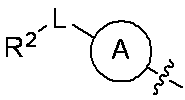

いくつかの実施態様において、


特定の実施態様において、


特定の実施態様において、


様々な異なる実施態様において、化合物は、以下の表1に示す構造のうちの1つ、またはその医薬的に許容される塩、立体異性体もしくはプロドラッグを有する。表1の化合物を、実施例に記載するように、または当技術分野で公知の方法に従って製造し、質量分析法および/または1H NMR分光法によって分析した。


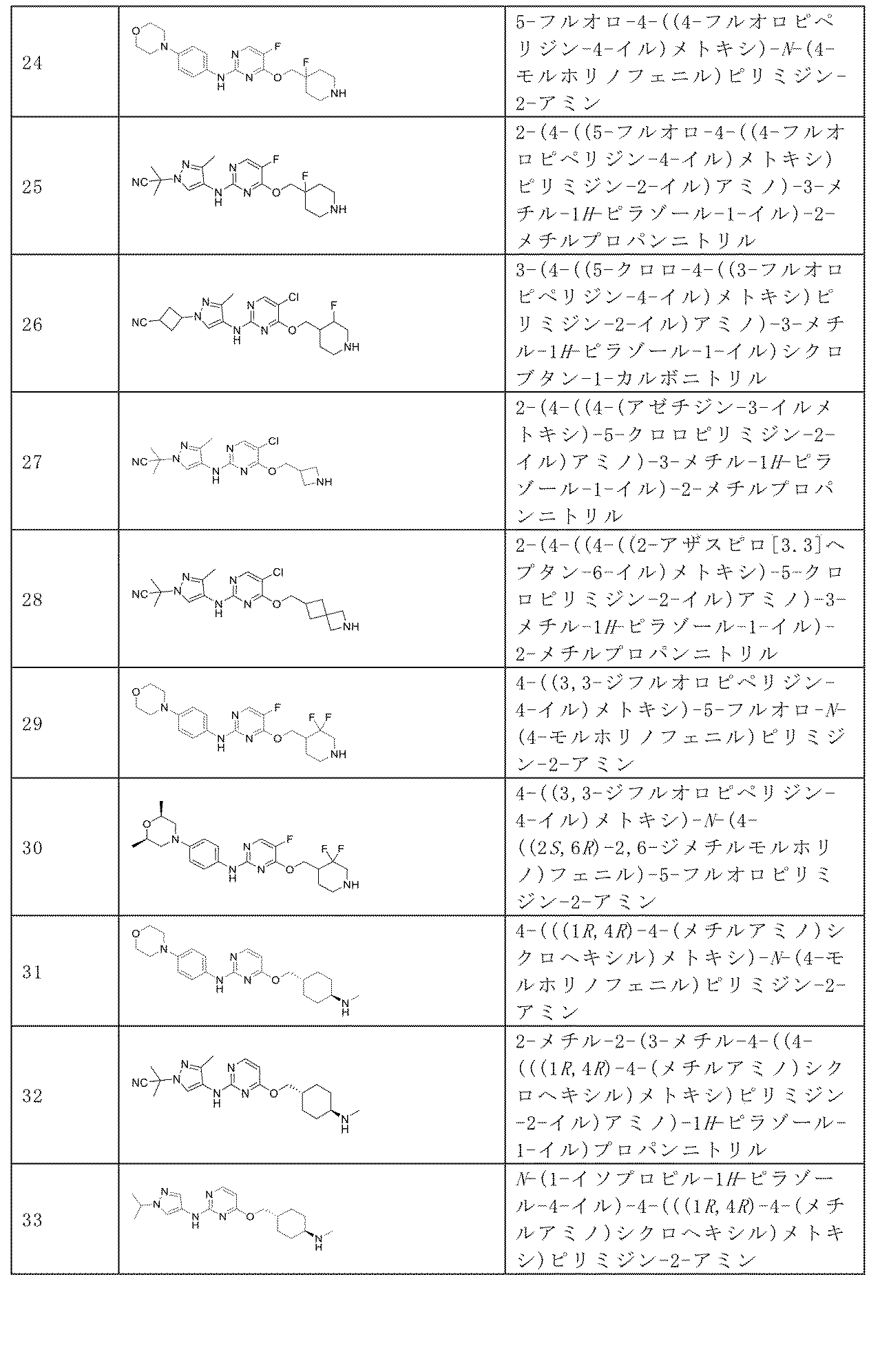


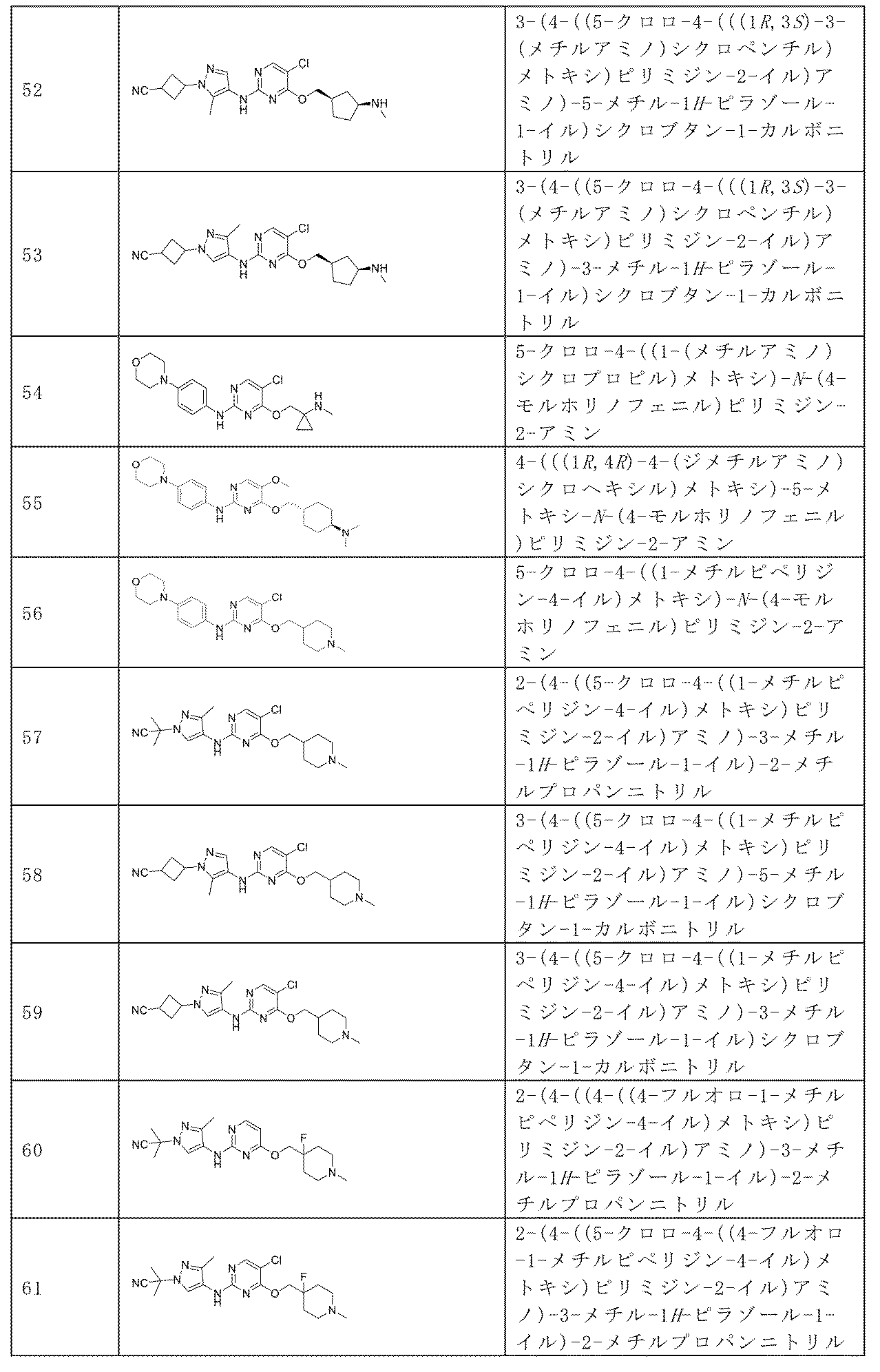


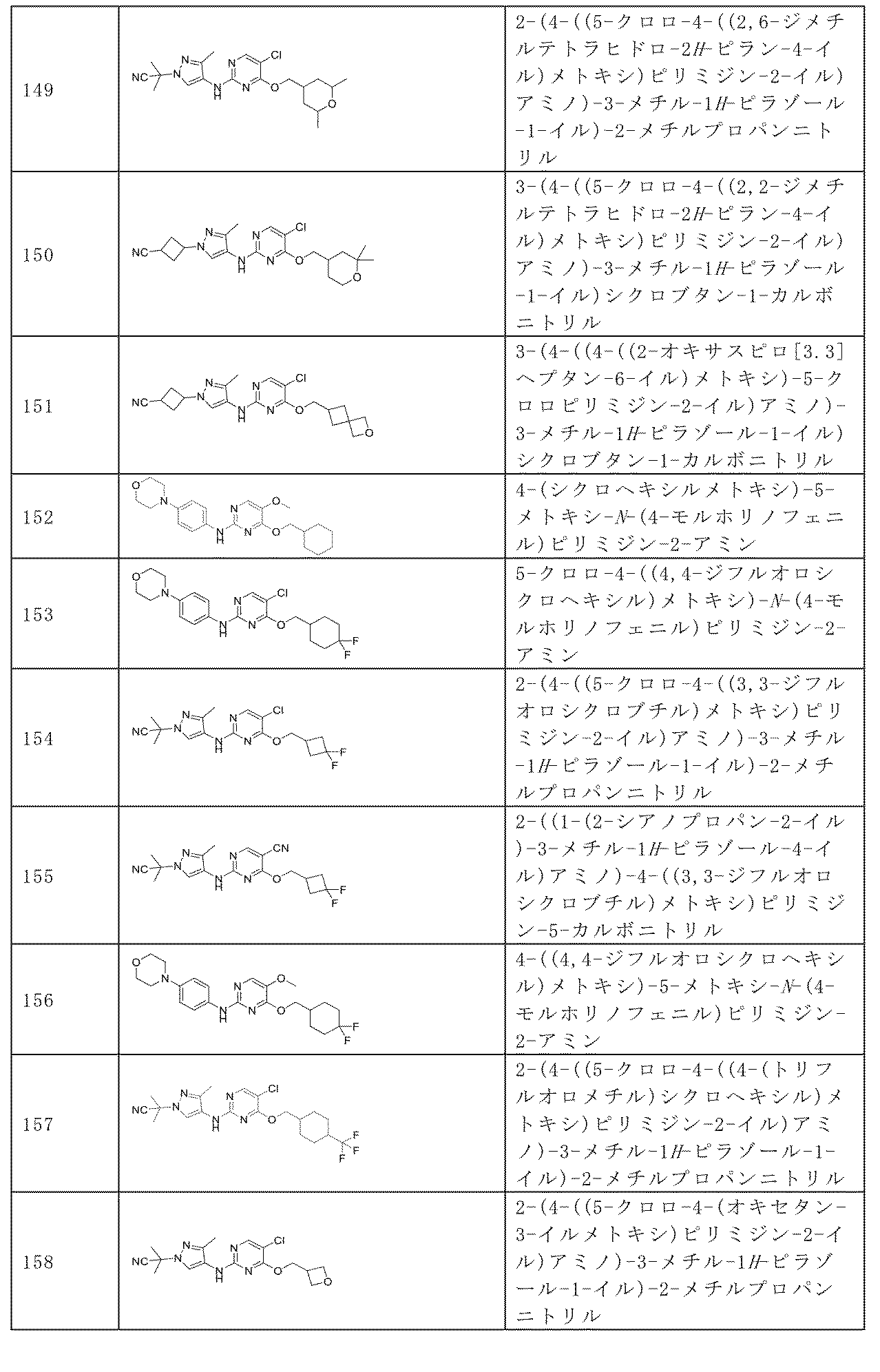


本明細書において、示される式の置換基および/または変数の組合せは、そのような寄与が安定な化合物をもたらす場合にのみ許容されることが理解される。 It is understood herein that combinations of substituents and/or variables in the formulas shown are permissible only if such contributions result in stable compounds.
更なる実施態様において、遊離塩基または酸の形態で存在する本開示の様々な化合物は、当業者に知られている方法により、適切な無機または有機の塩基または酸で処理することによって、それらの医薬的に許容される塩に変換できる。本開示の化合物の塩は、標準的な技術によってそれらの遊離塩基または酸の形態に変換できる。 In a further embodiment, various compounds of the present disclosure that exist in the free base or acid form are freed from their oxidation by treatment with a suitable inorganic or organic base or acid by methods known to those skilled in the art. Can be converted into pharmaceutically acceptable salts. Salts of the compounds of this disclosure can be converted to their free base or acid forms by standard techniques.
本明細書に記載の化合物を製造する方法は、以下の実施例で提供される。一般に、出発物質は、Sigma Aldrich、Lancaster Synthesis, Inc.、Maybridge、Matrix Scientific、TCIおよびFluorochem USAなどの供給源から得てもよく、または当業者に知られている情報源に従って合成してもよく(例えば、Advanced Organic Chemistry: Reactions, Mechanisms, and Structure, 5th edition (Wiley, December 2000)参照)、または本明細書に記載のとおり製造されてもよい。 Methods of making the compounds described herein are provided in the Examples below. In general, starting materials may be obtained from sources such as Sigma Aldrich, Lancaster Synthesis, Inc., Maybridge, Matrix Scientific, TCI and Fluorochem USA, or may be synthesized according to sources known to those skilled in the art. (see, eg, Advanced Organic Chemistry: Reactions, Mechanisms, and Structure, 5th edition (Wiley, December 2000)), or as described herein.
(医薬組成物)
他の実施態様は、医薬組成物に関する。医薬組成物は、前記の化合物および医薬的に許容される担体のいずれか1つ(または複数)を含む。いくつかの実施態様において、医薬組成物は、経口投与用に製剤化される。他の実施態様において、医薬組成物は、注射用に製剤化される。更なる実施態様において、医薬組成物は、本明細書に開示される化合物および更なる治療剤(例えば抗癌剤)を含む。治療剤の非限定的例は以下に記載する。
(Pharmaceutical composition)
Other embodiments relate to pharmaceutical compositions. Pharmaceutical compositions include any one (or more) of a compound described above and a pharmaceutically acceptable carrier. In some embodiments, pharmaceutical compositions are formulated for oral administration. In other embodiments, the pharmaceutical composition is formulated for injection. In further embodiments, the pharmaceutical composition comprises a compound disclosed herein and an additional therapeutic agent (eg, an anti-cancer agent). Non-limiting examples of therapeutic agents are described below.
適切な投与経路は、経口、静脈内、直腸、エアロゾル、非経腸、眼、肺、経粘膜、経皮、膣、耳、鼻および局所投与を含むがこれらに限定されない。また、単なる例として、非経腸送達は、筋肉内、皮下、静脈内、髄内注射、ならびにくも膜下腔内、直接脳室内、腹腔内、リンパ内および鼻腔内注射を含む。 Suitable routes of administration include, but are not limited to, oral, intravenous, rectal, aerosol, parenteral, ophthalmic, pulmonary, transmucosal, transdermal, vaginal, otic, nasal and topical administration. Also, by way of example only, parenteral delivery includes intramuscular, subcutaneous, intravenous, intramedullary injection, as well as intrathecal, directly intraventricular, intraperitoneal, intralymphatic and intranasal injection.
特定の実施態様において、本明細書に記載の化合物は、全身的ではなく局所的に、例えば、多くの場合デポー製剤または徐放性製剤で、臓器への化合物の直接注射によって投与される。特定の実施態様において、長時間作用型製剤は、移植(例えば、皮下または筋肉内)または筋肉内注射によって投与される。さらに、他の実施態様において、化合物は、標的薬物送達システム、例えば臓器特異的抗体で被覆されたリポソーム中で送達される。このような実施態様において、リポソームは、臓器に標的化され、臓器によって選択的に取り込まれる。さらに他の実施態様において、本明細書に記載の化合物は、急速放出製剤の形態、持続放出製剤の形態、または中間放出製剤の形態で提供される。さらに他の実施態様において、本明細書に記載の化合物は、局所投与される。 In certain embodiments, the compounds described herein are administered locally rather than systemically, eg, by injection of the compound directly into an organ, often in a depot or sustained release formulation. In certain embodiments, long-acting formulations are administered by implantation (eg, subcutaneously or intramuscularly) or by intramuscular injection. Additionally, in other embodiments, the compound is delivered in a targeted drug delivery system, such as a liposome coated with an organ-specific antibody. In such embodiments, the liposomes are targeted to and selectively taken up by the organ. In still other embodiments, the compounds described herein are provided in an immediate release formulation, a sustained release formulation, or an intermediate release formulation. In yet other embodiments, the compounds described herein are administered topically.
本開示の実施態様による処置方法において、有効量の少なくとも1つの構造(I)の化合物が、そのような疾患、障害または医学的状態に罹患している、またはそれらを有すると診断された対象体に投与される。有効量または用量は、モデル化、用量漸増試験または臨床試験などの方法、例えば、投与または薬物送達の様式または経路、薬剤の薬物動態、疾患、障害または状態の重症度および経過、対象体の以前のまたは進行中の治療、対象体の健康状態および薬物に対する反応、および治療医師の判断によって特定され得る。 In methods of treatment according to embodiments of the present disclosure, an effective amount of at least one compound of structure (I) is administered to a subject suffering from or diagnosed as having such a disease, disorder or medical condition. administered to The effective amount or dose will depend on methods such as modeling, dose escalation studies or clinical trials, e.g., the mode or route of administration or drug delivery, the pharmacokinetics of the drug, the severity and course of the disease, disorder or condition, the subject's previous or ongoing treatment, the subject's health status and response to drugs, and the judgment of the treating physician.
本開示による化合物は、広い用量範囲にわたって有効である。例えば、成人の処置では、1日当たり10~5000mg、100~5000mg、1000mg~4000mg、および1日当たり1000~3000mgの用量が、いくつかの実施態様で使用される用量の例である。正確な用量は、投与経路、化合物が投与される形態、処置される対象体、治療される対象体の体重、および担当医師の優先度および経験に依存する。 Compounds according to the present disclosure are effective over a wide dosage range. For example, for adult treatment, doses of 10-5000 mg, 100-5000 mg, 1000-4000 mg, and 1000-3000 mg per day are examples of doses used in some embodiments. The precise dose will depend on the route of administration, the mode in which the compound is administered, the subject being treated, the weight of the subject being treated, and the preferences and experience of the attending physician.
いくつかの実施態様において、本開示の化合物は、単回用量で投与される。典型的には、そのような投与は、薬剤を迅速に導入するために、注射、例えば静脈内注射によって行われる。ただし、他の経路は必要に応じて用いられる。本開示の化合物の単回用量は、急性状態の処置にも用いられ得る。 In some embodiments, compounds of the present disclosure are administered in a single dose. Typically, such administration is by injection, such as intravenous injection, to rapidly introduce the drug. However, other routes may be used as needed. A single dose of a compound of the present disclosure may also be used to treat acute conditions.
いくつかの実施態様において、本開示の化合物は、複数回用量で投与される。いくつかの実施態様において、投与は、およそ1日当たり1回、2回、3回、4回、5回、6回または6回を超える回数である。他の実施態様において、投与は、およそ1月に1回、2週間に1回、1週間に1回または2日に1回である。別の実施態様において、本開示の化合物と別の薬剤(例えば抗癌剤)は、1日当たり約1回から1日当たり約6回一緒に投与される。別の実施態様において、本開示の化合物および薬剤の投与は、約7日未満継続される。さらに別の実施態様において、投与は、およそ6、10、14、28日、2か月、6か月または1年を超えて継続される。いくつかの例において、連続投与が達成され、必要な限り維持される。 In some embodiments, compounds of the present disclosure are administered in multiple doses. In some embodiments, administration is approximately once, twice, three times, four times, five times, six times, or more than six times per day. In other embodiments, administration is approximately once a month, once every two weeks, once a week, or once every two days. In another embodiment, a compound of the present disclosure and another agent (eg, an anti-cancer agent) are administered together from about 1 time per day to about 6 times per day. In another embodiment, administration of compounds and agents of the present disclosure continues for less than about 7 days. In yet other embodiments, administration continues for more than about 6, 10, 14, 28 days, 2 months, 6 months or 1 year. In some instances, continuous administration is achieved and maintained for as long as necessary.
本開示の化合物の投与は、必要な限り継続され得る。いくつかの実施態様において、本開示の化合物は、1、2、3、4、5、6、7、14または28日を超えて投与される。いくつかの実施態様において、本開示の化合物は、28、14、7、6、5、4、3、2または1日間未満投与される。いくつかの実施態様において、本開示の化合物は、例えば慢性効果の治療のために、継続的に慢性的に投与される。 Administration of compounds of the present disclosure can be continued for as long as necessary. In some embodiments, compounds of the present disclosure are administered for more than 1, 2, 3, 4, 5, 6, 7, 14 or 28 days. In some embodiments, the compounds of this disclosure are administered for less than 28, 14, 7, 6, 5, 4, 3, 2, or 1 days. In some embodiments, compounds of the present disclosure are administered chronically on a continuous basis, eg, for treatment of chronic effects.
いくつかの実施態様において、本開示の化合物は、個別の剤形で投与される。化合物の薬物動態における対象体間のばらつきのため、投与レジメンの個別化が適切な治療のために必要であることが当技術分野で知られている。 In some embodiments, compounds of the present disclosure are administered in separate dosage forms. It is known in the art that due to intersubject variability in the pharmacokinetics of compounds, individualization of dosing regimens is necessary for proper treatment.
いくつかの実施態様において、本明細書に記載の化合物は、医薬組成物に製剤化される。特定の実施態様において、医薬組成物は、本開示の化合物を医薬的に使用できる製剤に加工するのを容易にする添加剤および助剤を含む1つ以上の生理学的に許容される担体を用いて従来の方法で製剤化される。適切な製剤は、選択した投与経路に依存する。任意の医薬的に許容される技術、担体および添加剤が、本明細書に記載の医薬組成物を製剤化するのに適したものとして使用される:Remington: The Science and Practice of Pharmacy, Nineteenth Ed (Easton, Pa.: Mack Publishing Company, 1995); Hoover, John E., Remington’s Pharmaceutical Sciences, Mack Publishing Co., Easton, Pennsylvania 1975; Liberman, H.A. and Lachman, L., Eds., Pharmaceutical Dosage Forms, Marcel Decker, New York, N.Y., 1980; and Pharmaceutical Dosage Forms and Drug Delivery Systems, Seventh Ed. (Lippincott Williams & Wilkins1999)。 In some embodiments, the compounds described herein are formulated into pharmaceutical compositions. In certain embodiments, pharmaceutical compositions include one or more physiologically acceptable carriers that include excipients and auxiliaries that facilitate processing of the compounds of the present disclosure into pharmaceutically usable formulations. It is formulated using conventional methods. Proper formulation is dependent on the route of administration chosen. Any pharmaceutically acceptable technique, carrier and excipient suitable for formulating the pharmaceutical compositions described herein may be used: Remington: The Science and Practice of Pharmacy, Nineteenth Ed. (Easton, Pa.: Mack Publishing Company, 1995); Hoover, John E., Remington's Pharmaceutical Sciences, Mack Publishing Co., Easton, Pennsylvania 1975; Liberman, H.A. and Lachman, L., Eds., Pharmaceutical Dosage Forms, Marcel Decker, New York, N.Y., 1980; and Pharmaceutical Dosage Forms and Drug Delivery Systems, Seventh Ed. (Lippincott Williams & Wilkins1999).
1つ以上の構造(I)の化合物と、医薬的に許容される担体を含む医薬組成物を提供する。 Pharmaceutical compositions are provided that include one or more compounds of structure (I) and a pharmaceutically acceptable carrier.
構造(I)の化合物より選択される1つ以上の化合物と、医薬的に許容される希釈剤、添加剤および担体を含む医薬組成物を提供する。特定の実施態様において、本記載の化合物は、併用療法におけるように、構造(I)の化合物より選択される1つ以上の化合物が他の活性成分と混合された医薬組成物として投与される。以下の併用療法のセクションおよび本開示全体にわたって記載される活性物質のすべての組合せが本明細書に包含される。特定の実施態様において、医薬組成物は、1つ以上の構造(I)の化合物を含む。 Pharmaceutical compositions are provided that include one or more compounds selected from compounds of structure (I) and pharmaceutically acceptable diluents, excipients, and carriers. In certain embodiments, the compounds described herein are administered as a pharmaceutical composition in which one or more compounds selected from compounds of structure (I) are mixed with other active ingredients, such as in combination therapy. All combinations of active agents described in the Combination Therapy section below and throughout this disclosure are encompassed herein. In certain embodiments, the pharmaceutical composition comprises one or more compounds of structure (I).
特定の実施態様において、構造(I)の化合物の医薬組成物は、患者または生体サンプルに投与されると、LRRK2キナーゼを阻害する。 In certain embodiments, pharmaceutical compositions of compounds of structure (I) inhibit LRRK2 kinase when administered to a patient or biological sample.
本明細書で用いる医薬組成物は、構造(I)の化合物より選択される1つ以上の化合物と、他の化学成分、例えば担体、安定化剤、希釈剤、分散剤、懸濁化剤、増粘剤および/または添加剤との混合物を指す。特定の実施態様において、医薬組成物は、生物への化合物の投与を容易にする。いくつかの実施態様において、本明細書で提供される構造(I)の化合物より選択される1つ以上の化合物の治療有効量は、処置される疾患、障害または医学状態を有する哺乳類に医薬組成物として投与される。特定の実施態様において、哺乳類は、ヒトである。特定の実施態様において、治療有効量は、疾患の重症度、対象体の年齢および相対的な健康状態、使用される化合物の効力、および他の要因に応じて変化する。本明細書に記載の化合物は、単独で、または混合物の成分として1つ以上の治療薬と組み合わせて用いられる。 Pharmaceutical compositions as used herein include one or more compounds selected from compounds of structure (I) and other chemical ingredients such as carriers, stabilizers, diluents, dispersants, suspending agents, Refers to mixtures with thickeners and/or additives. In certain embodiments, the pharmaceutical composition facilitates administration of the compound to an organism. In some embodiments, a therapeutically effective amount of one or more compounds selected from compounds of structure (I) provided herein is administered to a mammal having a disease, disorder, or medical condition to be treated in a pharmaceutical composition. administered as a substance. In certain embodiments, the mammal is a human. In certain embodiments, a therapeutically effective amount varies depending on the severity of the disease, the age and relative health of the subject, the potency of the compound used, and other factors. The compounds described herein are used alone or in combination with one or more therapeutic agents as a component of a mixture.
一実施態様において、構造(I)の化合物より選択される1つ以上の化合物は、水溶液中で製剤化される。特定の実施態様において、水溶液は、単なる例として、生理学的に適合する緩衝液、例えばハンクス液、リンガー液または生理食塩水緩衝液より選択される。他の実施態様において、構造(I)の化合物より選択される1つ以上の化合物は、経皮粘膜投与用に製剤化される。特定の実施態様において、経皮粘膜製剤は、バリアを透過するのに適した浸透剤を含む。本明細書に記載の化合物が他の非経腸注射用に製剤化される更なる他の実施態様において、適切な製剤は、水性または非水性溶液を含む。特定の実施態様において、このような溶液は、生理学的に適合する緩衝液および/または添加剤を含む。 In one embodiment, one or more compounds selected from compounds of structure (I) are formulated in an aqueous solution. In certain embodiments, the aqueous solution is selected from physiologically compatible buffers, such as Hank's solution, Ringer's solution or saline buffers, by way of example only. In other embodiments, one or more compounds selected from compounds of structure (I) are formulated for transdermal mucosal administration. In certain embodiments, transdermal mucosal formulations include penetrants suitable for penetrating the barrier. In yet other embodiments in which the compounds described herein are formulated for other parenteral injections, suitable formulations include aqueous or non-aqueous solutions. In certain embodiments, such solutions include physiologically compatible buffers and/or additives.
別の実施態様において、本明細書に記載の化合物は、経口投与用に製剤化される。本明細書に記載の化合物は、活性化合物を、例えば医薬的に許容される担体または添加剤と組み合わせることにより製剤化される。様々な実施態様において、本明細書に記載の化合物は、単なる例として、錠剤、散剤、丸剤、糖衣錠、カプセル剤、液剤、ゲル剤、シロップ剤、エリキシル剤、スラリー、懸濁剤などを含む経口剤形として製剤化される。 In another embodiment, the compounds described herein are formulated for oral administration. The compounds described herein are formulated by combining the active compound with, for example, a pharmaceutically acceptable carrier or excipient. In various embodiments, the compounds described herein include, by way of example only, tablets, powders, pills, dragees, capsules, solutions, gels, syrups, elixirs, slurries, suspensions, and the like. Formulated as an oral dosage form.
特定の実施態様において、経口使用のための医薬製剤は、1つ以上の固形添加剤を1つ以上の本明細書に記載の化合物と混合し、場合により得られた混合物を粉砕し、必要に応じて適切な助剤を添加した後、顆粒の混合物を処理して、錠剤または糖衣錠の芯を得ることによって得られる。適切な添加剤は、特に、賦形剤、例えば、ラクトース、スクロース、マンニトールまたはソルビトールを含む糖類;セルロース調製物、例えば:トウモロコシデンプン、小麦デンプン、米デンプン、ジャガイモデンプン、ゼラチン、トラガカントゴム、メチルセルロース、結晶セルロース、ヒドロキシプロピルメチルセルロース、カルボキシメチルセルロースナトリウム;または、その他、例えば:ポリビニルピロリドン(PVPまたはポビドン)またはリン酸カルシウムである。特定の実施態様において、崩壊剤は、所望により添加される。崩壊剤は、単なる例として、架橋クロスカルメロースナトリウム、ポリビニルピロリドン、寒天、またはアルギン酸もしくはその塩、例えばアルギン酸ナトリウムを含む。 In certain embodiments, pharmaceutical formulations for oral use are prepared by mixing one or more solid excipients with one or more compounds described herein, optionally grinding the resulting mixture, and optionally After adding appropriate auxiliaries accordingly, the mixture of granules is processed to obtain tablet or dragee cores. Suitable additives are in particular sugars, including excipients such as lactose, sucrose, mannitol or sorbitol; cellulose preparations, such as: corn starch, wheat starch, rice starch, potato starch, gelatin, tragacanth, methylcellulose, crystalline Cellulose, hydroxypropylmethylcellulose, sodium carboxymethylcellulose; or others, such as: polyvinylpyrrolidone (PVP or povidone) or calcium phosphate. In certain embodiments, disintegrants are optionally added. Disintegrants include, by way of example only, cross-linked croscarmellose sodium, polyvinylpyrrolidone, agar, or alginic acid or a salt thereof, such as sodium alginate.
一実施態様において、糖衣錠コアおよび錠剤などの剤形は、1つ以上の適切なコーティングと共に提供される。特定の実施態様において、濃縮糖溶液が剤形をコーティングするために用いられる。糖溶液は、所望により、単なる例として、アラビアゴム、タルク、ポリビニルピロリドン、カーボポールゲル、ポリエチレングリコールおよび/または二酸化チタン、ラッカー溶液、および適切な有機溶媒または溶媒混合物などの追加の成分を含む。染料および/または色素もまた、所望により、識別の目的でコーティングに添加される。また、染料および/または色素は、所望により、異なる組合せの活性化合物の用量を特徴付けるために利用される。 In one embodiment, dosage forms such as dragee cores and tablets are provided with one or more suitable coatings. In certain embodiments, a concentrated sugar solution is used to coat the dosage form. The sugar solution optionally contains additional ingredients such as, by way of example only, gum arabic, talc, polyvinylpyrrolidone, carbopol gel, polyethylene glycol and/or titanium dioxide, lacquer solution, and suitable organic solvents or solvent mixtures. Dyes and/or pigments are also optionally added to the coating for identification purposes. Dyestuffs and/or pigments are also optionally utilized to characterize doses of different combinations of active compounds.
特定の実施態様において、治療有効量の本明細書に記載の化合物の少なくとも1つは、他の経口剤形に製剤化される。経口剤形は、ゼラチンで作られたプッシュフィットカプセル、およびゼラチンとグリセロールまたはソルビトールなどの可塑剤で作られた密封ソフトカプセルを含む。特定の実施態様において、プッシュフィットカプセルは、1つ以上の賦形剤と混合して活性成分を含有する。賦形剤は、単なる例として、ラクトース、結合剤、例えばデンプン、および/または滑沢剤、例えばタルクまたはステアリン酸マグネシウム、および所望により、安定化剤を含む。他の実施態様において、ソフトカプセルは、適切な液体に溶解または懸濁した1つ以上の活性化合物を含有する。適切な液体は、単なる例として、1つ以上の脂肪油、流動パラフィン、または液体ポリエチレングリコールを含む。また、安定化剤は、所望により添加される。 In certain embodiments, a therapeutically effective amount of at least one of the compounds described herein is formulated into other oral dosage forms. Oral dosage forms include push-fit capsules made of gelatin, and soft, sealed capsules made of gelatin and a plasticizer, such as glycerol or sorbitol. In certain embodiments, push-fit capsules contain active ingredients in admixture with one or more excipients. Excipients include, by way of example only, lactose, binders such as starch, and/or lubricants such as talc or magnesium stearate, and, optionally, stabilizers. In other embodiments, soft capsules contain one or more active compounds dissolved or suspended in a suitable liquid. Suitable liquids include, by way of example only, one or more fatty oils, liquid paraffin, or liquid polyethylene glycols. Further, a stabilizer may be added if desired.
更なる他の実施態様において、本明細書に記載の化合物は、ボーラス注射または持続注入に適した製剤を含む非経腸注射用に製剤化される。特定の実施態様において、注射用製剤は、単位剤形(例えば、アンプル)または複数回用量の容器で提供される。防腐剤は、所望により添加される。更なる他の実施態様において、医薬組成物は、油性または水性ビヒクル中の滅菌懸濁液、溶液または乳濁液として非経腸注射に適した形態で製剤化される。非経腸注射製剤は、所望により、製剤化剤、例えば懸濁化剤、安定化剤および/または分散剤を含む。特定の実施態様において、非経腸投与用の医薬製剤は、水溶性形態の活性化合物の水溶液を含む。更なる実施態様において、構造(I)の化合物より選択される1つ以上の化合物の懸濁液は、適切な油性注射懸濁液として製造される。本明細書に記載の医薬組成物に使用するのに適した親油性溶媒またはビヒクルは、単なる例として、脂肪油、例えばゴマ油、合成脂肪酸エステル、例えばオレイン酸エチルまたはトリグリセリド、またはリポソームを含む。特定の具体的な実施態様において、水性注射懸濁液は、懸濁液の粘度を増加させる物質、例えばカルボキシメチルセルロースナトリウム、ソルビトールまたはデキストランを含む。所望により、懸濁液は、高濃度の溶液の製造を可能にするために化合物の溶解度を増加させる適切な安定化剤または物質を含有する。あるいは、他の実施態様において、活性成分は、使用前に適切なビヒクル、例えば発熱物質を含まない滅菌水で構成するための粉末形態である。 In yet other embodiments, the compounds described herein are formulated for parenteral injection, including formulations suitable for bolus injection or continuous infusion. In certain embodiments, injectable formulations are presented in unit dosage form (eg, ampoules) or multi-dose containers. Preservatives are added if desired. In yet other embodiments, the pharmaceutical compositions are formulated in a form suitable for parenteral injection as a sterile suspension, solution, or emulsion in an oily or aqueous vehicle. Parenteral injection formulations optionally contain formulation agents such as suspending, stabilizing and/or dispersing agents. In certain embodiments, pharmaceutical formulations for parenteral administration include aqueous solutions of the active compounds in water-soluble form. In a further embodiment, suspensions of one or more compounds selected from compounds of structure (I) are prepared as appropriate oily injection suspensions. Lipophilic solvents or vehicles suitable for use in the pharmaceutical compositions described herein include, by way of example only, fatty oils such as sesame oil, synthetic fatty acid esters such as ethyl oleate or triglycerides, or liposomes. In certain specific embodiments, aqueous injection suspensions contain substances that increase the viscosity of the suspension, such as sodium carboxymethylcellulose, sorbitol, or dextran. Optionally, the suspension contains suitable stabilizers or substances that increase the solubility of the compounds to allow for the preparation of highly concentrated solutions. Alternatively, in other embodiments, the active ingredient is in powder form for constitution with a suitable vehicle, eg, sterile pyrogen-free water, before use.
医薬組成物は、少なくとも1つの医薬的に許容される担体、希釈剤または添加剤、および活性成分として本明細書に記載される構造(I)の化合物より選択される1つ以上の化合物を含む。活性成分は、遊離酸または遊離塩基の形態、または医薬的に許容される塩の形態である。また、本明細書に記載の方法および医薬組成物は、N-オキシド、結晶形(多形体としても知られる)、ならびに同じ種類の活性を有するこれらの化合物の活性代謝物の使用を含む。本明細書に記載の化合物のすべての互変異性体は、本明細書に記載の化合物の範囲内に含まれる。また、本明細書に記載の化合物は、非溶媒和物形態、ならびに医薬的に許容される溶媒、例えば水、エタノールなどとの溶媒和物形態を包含する。本明細書に記載の化合物の溶媒和物形態もまた、本明細書に開示されるものとみなされる。また、医薬組成物は、所望により、他の薬剤または医薬品、担体、アジュバント、例えば保存剤、安定化剤、湿潤剤または乳化剤、溶解促進剤、浸透圧を調節するための塩、緩衝剤、および/または他の治療上価値のある物質を含む。 The pharmaceutical composition comprises at least one pharmaceutically acceptable carrier, diluent or excipient, and one or more compounds selected from compounds of structure (I) described herein as active ingredients. . The active ingredient is in the free acid or free base form, or in the form of a pharmaceutically acceptable salt. The methods and pharmaceutical compositions described herein also include the use of N-oxides, crystalline forms (also known as polymorphs), and active metabolites of these compounds that have the same type of activity. All tautomers of the compounds described herein are included within the scope of the compounds described herein. The compounds described herein also include unsolvated forms as well as solvated forms with pharmaceutically acceptable solvents such as water, ethanol, and the like. Solvate forms of the compounds described herein are also considered to be disclosed herein. The pharmaceutical composition may also contain, if desired, other agents or pharmaceutical agents, carriers, adjuvants such as preservatives, stabilizers, wetting agents or emulsifiers, solubility promoters, salts for adjusting osmotic pressure, buffers, and / or contains other therapeutically valuable substances.
本明細書に記載の化合物を含む組成物の製造方法は、化合物を1つ以上の不活性な医薬的に許容される添加剤または担体と配合して、固形、半固形または液体を形成することを含む。固形組成物は、散剤、錠剤、分散性顆粒剤、カプセル剤、カシェ剤および坐剤を含むがこれらに限定されない。液体組成物は、化合物が溶解している溶液、化合物を含むエマルション、または本明細書に開示される化合物を含むリポソーム、ミセルもしくはナノ粒子を含む溶液を含む。半固形組成物は、ゲル剤、懸濁剤およびクリーム剤を含むがこれらに限定されない。本明細書に記載の医薬組成物の形態は、液体溶液または懸濁液、使用前の液体中の溶液または懸濁液に適した固体形態、またはエマルションを含む。これらの組成物はまた、所望により、少量の非毒性の補助物質、例えば湿潤剤または乳化剤、pH緩衝剤などを含む。 A method of making a composition comprising a compound described herein includes combining the compound with one or more inert pharmaceutically acceptable excipients or carriers to form a solid, semisolid, or liquid. including. Solid compositions include, but are not limited to, powders, tablets, dispersible granules, capsules, cachets, and suppositories. Liquid compositions include solutions in which the compound is dissolved, emulsions containing the compound, or solutions containing liposomes, micelles or nanoparticles containing the compounds disclosed herein. Semi-solid compositions include, but are not limited to, gels, suspensions and creams. Forms of the pharmaceutical compositions described herein include liquid solutions or suspensions, solid forms suitable for solution or suspension in liquid prior to use, or emulsions. These compositions also optionally contain small amounts of non-toxic auxiliary substances, such as wetting or emulsifying agents, pH buffering agents, and the like.
いくつかの実施態様において、構造(I)の化合物より選択される1つ以上の化合物を含む医薬組成物は、例えば、薬剤が溶液、懸濁液またはその両方で存在する液体の形態をとる。典型的には、組成物が懸濁液として投与される場合、薬剤の第1の部分は溶液中に存在し、薬剤の第2の部分は液体マトリックス中の懸濁液中に粒子の形態で存在する。いくつかの実施態様において、液体組成物は、ゲル製剤を含む。他の実施態様において、液体組成物は、水性である。 In some embodiments, pharmaceutical compositions comprising one or more compounds selected from compounds of structure (I) are in liquid form, eg, in which the agent is in solution, suspension, or both. Typically, when the composition is administered as a suspension, a first portion of the drug is in solution and a second portion of the drug is in the form of particles in suspension in the liquid matrix. exist. In some embodiments, liquid compositions include gel formulations. In other embodiments, the liquid composition is aqueous.
特定の実施態様において、水性懸濁液は、懸濁化剤として1つ以上のポリマーを含む。ポリマーは、水溶性ポリマー、例えばセルロース系ポリマー、例えばヒドロキシプロピルメチルセルロース、および水不溶性ポリマー、例えば架橋カルボキシル含有ポリマーを含む。本明細書に記載する特定の医薬組成物は、例えばカルボキシメチルセルロース、カルボマー(アクリル酸ポリマー)、ポリ(メチルメタクリレート)、ポリアクリルアミド、ポリカルボフィル、アクリル酸/アクリル酸ブチルコポリマー、アルギン酸ナトリウムおよびデキストランより選択される粘膜付着性ポリマーを含む。 In certain embodiments, aqueous suspensions include one or more polymers as suspending agents. Polymers include water-soluble polymers, such as cellulosic polymers, such as hydroxypropyl methylcellulose, and water-insoluble polymers, such as crosslinked carboxyl-containing polymers. Certain pharmaceutical compositions described herein are made from, for example, carboxymethylcellulose, carbomer (acrylic acid polymer), poly(methyl methacrylate), polyacrylamide, polycarbophil, acrylic acid/butyl acrylate copolymer, sodium alginate, and dextran. including selected mucoadhesive polymers.
医薬組成物はまた、所望により、構造(I)の化合物より選択される1つ以上の化合物の溶解を助けるための可溶化剤を含む。用語「可溶化剤」は、一般に、物質のミセル溶液または真の溶液の形成をもたらす物質を含む。特定の許容される非イオン性界面活性剤、例えばポリソルベート80は、眼科的に許容されるグリコール、ポリグリコール、例えばポリエチレングリコール400、およびグリコールエーテルと同様に、可溶化剤として有用である。 The pharmaceutical composition also optionally includes a solubilizing agent to aid in solubilizing one or more compounds selected from compounds of structure (I). The term "solubilizer" generally includes substances that result in the formation of micellar or true solutions of the substance. Certain acceptable nonionic surfactants, such as polysorbate 80, are useful as solubilizing agents, as are ophthalmically acceptable glycols, polyglycols such as polyethylene glycol 400, and glycol ethers.
さらに、医薬組成物は、所望により、酸、例えば酢酸、ホウ酸、クエン酸、乳酸、リン酸および塩酸;塩基、例えば水酸化ナトリウム、リン酸ナトリウム、ホウ酸ナトリウム、クエン酸ナトリウム、酢酸ナトリウム、乳酸ナトリウム、トリスヒドロキシメチルアミノメタン;および緩衝剤、例えばクエン酸塩/ブドウ糖、重炭酸ナトリウム、塩化アンモニウムを含む、1つ以上のpH調節整剤または緩衝剤を含む。このような酸、塩基および緩衝剤は、組成物のpHを許容範囲に維持するのに必要な量で含まれる。 Additionally, the pharmaceutical compositions may optionally contain acids such as acetic acid, boric acid, citric acid, lactic acid, phosphoric acid and hydrochloric acid; bases such as sodium hydroxide, sodium phosphate, sodium borate, sodium citrate, sodium acetate, and one or more pH adjusting agents or buffers, including sodium lactate, trishydroxymethylaminomethane; and buffers, such as citrate/dextrose, sodium bicarbonate, ammonium chloride. Such acids, bases and buffers are included in amounts necessary to maintain the pH of the composition within an acceptable range.
組成物はまた、所望により、組成物のオスモル濃度を許容範囲にするのに必要な量で1つ以上の塩を含む。このような塩は、ナトリウム、カリウムまたはアンモニウムのカチオンと、塩化物、クエン酸、アスコルビン酸、ホウ酸、リン酸、重炭酸、硫酸、チオ硫酸または重亜硫酸のアニオンを有するものを含み;適切な塩は、塩化ナトリウム、塩化カリウム、チオ硫酸ナトリウム、亜硫酸水素ナトリウムおよび硫酸アンモニウムを含む。 The composition also optionally includes one or more salts in an amount necessary to bring the osmolarity of the composition into an acceptable range. Such salts include those with a sodium, potassium or ammonium cation and an anion of chloride, citric acid, ascorbic acid, boric acid, phosphoric acid, bicarbonate, sulfate, thiosulfate or bisulfite; Salts include sodium chloride, potassium chloride, sodium thiosulfate, sodium bisulfite and ammonium sulfate.
他の医薬組成物は、所望により、微生物の活性を阻害するために1つ以上の防腐剤を含む。適切な防腐剤は、水銀含有物質、例えばメルフェンおよびチオメルサール;安定化二酸化塩素;第4級アンモニウム化合物、例えば塩化ベンザルコニウム、臭化セチルトリメチルアンモニウム、塩化セチルピリジニウムを含む。 Other pharmaceutical compositions optionally include one or more preservatives to inhibit microbial activity. Suitable preservatives include mercury-containing substances such as melfen and thiomersal; stabilized chlorine dioxide; quaternary ammonium compounds such as benzalkonium chloride, cetyltrimethylammonium bromide, cetylpyridinium chloride.
組成物は、物理的安定性を高めるため、または他の目的のために、1つ以上の界面活性剤を含み得る。適切な非イオン性界面活性剤は、ポリオキシエチレン脂肪酸グリセリドおよび植物油、例えばポリオキシエチレン(60)硬化ヒマシ油;およびポリオキシエチレンアルキルエーテルおよびアルキルフェニルエーテル、例えば、オクトキシノール10、オクトキシノール40を含む。 The composition may include one or more surfactants to increase physical stability or for other purposes. Suitable nonionic surfactants are polyoxyethylene fatty acid glycerides and vegetable oils, such as polyoxyethylene (60) hydrogenated castor oil; and polyoxyethylene alkyl ethers and alkylphenyl ethers, such as octoxynol 10, octoxynol Including 40.
組成物は、必要に応じて化学的安定性を高めるために1つ以上の抗酸化剤を含み得る。適切な抗酸化剤は、単なる例として、アスコルビン酸および亜硫酸水素ナトリウムを含む。 The composition may optionally include one or more antioxidants to increase chemical stability. Suitable antioxidants include, by way of example only, ascorbic acid and sodium bisulfite.
特定の実施態様において、水性懸濁液組成物は、単回用量の再密閉不可能な容器に包装される。あるいは、複数回用量の再密閉可能な容器が使用され、この場合、組成物中に防腐剤が含まれるのが典型的である。 In certain embodiments, aqueous suspension compositions are packaged in single-dose non-reclosable containers. Alternatively, multi-dose recloseable containers are used, in which case a preservative is typically included in the composition.
別の実施態様において、疎水性医薬化合物のための他の送達システムが用いられる。リポソームおよびエマルションは、本明細書で有用な送達ビヒクルまたは担体の例である。特定の実施態様において、有機溶媒、例えばN-メチルピロリドンもまた用いられる。更なる実施態様において、本明細書に記載の化合物は、治療薬を含有する固形疎水性ポリマーの半透性マトリックスなどの徐放システムを用いて送達される。様々な徐放性材料が本発明において有用である。いくつかの実施態様において、徐放性カプセル剤は、数週間から最大100日を超えて化合物を放出する。治療薬の化学的性質および生物学的安定性に応じて、タンパク質の安定化のための更なる戦略が採用される。 In other embodiments, other delivery systems for hydrophobic pharmaceutical compounds are used. Liposomes and emulsions are examples of delivery vehicles or carriers useful herein. In certain embodiments, organic solvents such as N-methylpyrrolidone are also used. In further embodiments, the compounds described herein are delivered using a sustained release system, such as a semipermeable matrix of solid hydrophobic polymers containing the therapeutic agent. A variety of sustained release materials are useful in the present invention. In some embodiments, sustained release capsules release the compound for several weeks up to over 100 days. Depending on the chemical nature and biological stability of the therapeutic agent, further strategies for protein stabilization are employed.
特定の実施態様において、本明細書に記載の製剤は、1つ以上の抗酸化剤、金属キレート剤、チオール含有化合物、および/または他の一般的な安定化剤を含む。安定化剤の例としては、:(a)約0.5w/v%~約2w/v%のグリセロール、(b)約0.1w/v%~約1w/v%のメチオニン、(c)約0.1w/v%~約2w/v%のモノチオグリセロール、(d)約1mM~約10mMのEDTA、(e)約0.01w/v%~約2w/v%のアスコルビン酸、(f)0.003w/v%~約0.02w/v%のポリソルベート80、(g)0.001w/v%~約0.05%w/vのポリソルベート20、(h)アルギニン、(i)ヘパリン、(j)デキストラン硫酸、(k)シクロデキストリン、(l)ペントサンポリ硫酸および他のヘパリノイド、(m)二価カチオン、例えばマグネシウムおよび亜鉛;または(n)それらの組合せを含むがこれらに限定されない。 In certain embodiments, the formulations described herein include one or more antioxidants, metal chelators, thiol-containing compounds, and/or other common stabilizing agents. Examples of stabilizers include: (a) about 0.5 w/v% to about 2 w/v% glycerol, (b) about 0.1 w/v% to about 1 w/v% methionine, (c) about 0.1 w/v% to about 1 w/v% methionine. w/v% to about 2w/v% monothioglycerol, (d) about 1mM to about 10mM EDTA, (e) about 0.01w/v% to about 2w/v% ascorbic acid, (f) 0.003w /v% to about 0.02 w/v% polysorbate 80, (g) 0.001 w/v% to about 0.05% w/v polysorbate 20, (h) arginine, (i) heparin, (j) dextran sulfate, ( (m) divalent cations such as magnesium and zinc; or (n) combinations thereof.
いくつかの実施態様において、いくつかの実施態様において、本開示の医薬組成物で提供される構造(I)の化合物より選択される1つ以上の化合物の濃度は、w/w、w/vまたはv/vで、90%、80%、70%、60%、50%、40%、30%、20%、19.75%、19.50%、19.25%、19%、18.75%、18.50%、18.25%、18%、17.75%、17.50%、17.25%、17%、16.75%、16.50%、16.25%、16%、15.75%、15.50%、15.25%、15%、14.75%、14.50%、14.25%、14%、13.75%、13.50%、13.25%、13%、12.75%、12.50%、12.25%、12%、11.75%、11.50%、11.25%、11%、10.75%、10.50%、10.25%、10%、9.75%、9.50%、9.25%、9%、8.75%、8.50%、8.25%、8%、7.75%、7.50%、7.25%、7%、6.75%、6.50%、6.25%、6%、5.75%、5.50%、5.25%、5%、4.75%、4.50%、4.25%、4%、3.75%、3.50%、3.25%、3%、2.75%、2.50%、2.25%、2%、1.75%、1.50%、125%、1%、0.5%、0.4%、0.3%、0.2%、0.1%、0.09%、0.08%、0.07%、0.06%、0.05%、0.04%、0.03%、0.02%、0.01%、0.009%、0.008%、0.007%、0.006%、0.005%、0.004%、0.003%、0.002%、0.001%、0.0009%、0.0008%、0.0007%、0.0006%、0.0005%、0.0004%、0.0003%、0.0002%または0.0001%を超える。 In some embodiments, the concentration of one or more compounds selected from compounds of structure (I) provided in the pharmaceutical compositions of the present disclosure is w/w, w/v or v/v, 90%, 80%, 70%, 60%, 50%, 40%, 30%, 20%, 19.75%, 19.50%, 19.25%, 19%, 18.75%, 18.50%, 18.25% , 18%, 17.75%, 17.50%, 17.25%, 17%, 16.75%, 16.50%, 16.25%, 16%, 15.75%, 15.50%, 15.25%, 15%, 14.75%, 14.50%, 14.25%, 14 %, 13.75%, 13.50%, 13.25%, 13%, 12.75%, 12.50%, 12.25%, 12%, 11.75%, 11.50%, 11.25%, 11%, 10.75%, 10.50%, 10.25%, 10%, 9.75%, 9.50%, 9.25%, 9%, 8.75%, 8.50%, 8.25%, 8%, 7.75%, 7.50%, 7.25%, 7%, 6.75%, 6.50%, 6.25%, 6%, 5.75% , 5.50%, 5.25%, 5%, 4.75%, 4.50%, 4.25%, 4%, 3.75%, 3.50%, 3.25%, 3%, 2.75%, 2.50%, 2.25%, 2%, 1.75%, 1.50 %, 125%, 1%, 0.5%, 0.4%, 0.3%, 0.2%, 0.1%, 0.09%, 0.08%, 0.07%, 0.06%, 0.05%, 0.04%, 0.03%, 0.02%, 0.01%, 0.009%, 0.008%, 0.007%, 0.006%, 0.005%, 0.004%, 0.003%, 0.002%, 0.001%, 0.0009%, 0.0008%, 0.0007%, 0.0006%, 0.0005%, 0.0004%, 0.0003%, 0.00 02% or more than 0.0001%.
いくつかの実施態様において、本開示の医薬組成物で提供される構造(I)の化合物より選択される1つ以上の化合物の濃度は、w/w、w/vまたはv/vで、約0.0001%~約50%、約0.001%~約40%、約0.01%~約30%、約0.02%~約29%、約0.03%~約28%、約0.04%~約27%、約0.05%~約26%、約0.06%~約25%、約0.07%~約24%、約0.08%~約23%、約0.09%~約22%、約0.1%~約21%、約0.2%~約20%、約0.3%~約19%、約0.4%~約18%、約0.5%~約17%、約0.6%~約16%、約0.7%~約15%、約0.8%~約14%、約0.9%~約12%、約1%~約10%の範囲である。 In some embodiments, the concentration of one or more compounds selected from compounds of structure (I) provided in the pharmaceutical compositions of the present disclosure, w/w, w/v, or v/v, is about 0.0001% to approximately 50%, approximately 0.001% to approximately 40%, approximately 0.01% to approximately 30%, approximately 0.02% to approximately 29%, approximately 0.03% to approximately 28%, approximately 0.04% to approximately 27%, approximately 0.05% ~26%, approximately 0.06% to approximately 25%, approximately 0.07% to approximately 24%, approximately 0.08% to approximately 23%, approximately 0.09% to approximately 22%, approximately 0.1% to approximately 21%, approximately 0.2% to approximately 20%, about 0.3% to about 19%, about 0.4% to about 18%, about 0.5% to about 17%, about 0.6% to about 16%, about 0.7% to about 15%, about 0.8% to about 14% , about 0.9% to about 12%, about 1% to about 10%.
いくつかの実施態様において、本開示の医薬組成物で提供される構造(I)の化合物より選択される1つ以上の化合物の量は、10g、9.5g、9.0g、8.5g、8.0g、7.5g、7.0g、6.5g、6.0g、5.5g、5.0g、4.5g、4.0g、3.5g、3.0g、2.5g、2.0g、1.5g、1.0g、0.95g、0.9g、0.85g、0.8g、0.75g、0.7g、0.65g、0.6g、0.55g、0.5g、0.45g、0.4g、0.35g、0.3g、0.25g、0.2g、0.15g、0.1g、0.09g、0.08g、0.07g、0.06g、0.05g、0.04g、0.03g、0.02g、0.01g、0.009g、0.008g、0.007g、0.006g、0.005g、0.004g、0.003g、0.002g、0.001g、0.0009g、0.0008g、0.0007g、0.0006g、0.0005g、0.0004g、0.0003g、0.0002gまたは0.0001gと等しいかまたはそれ未満である。 In some embodiments, the amount of one or more compounds selected from compounds of structure (I) provided in the pharmaceutical compositions of the present disclosure is 10 g, 9.5 g, 9.0 g, 8.5 g, 8.0 g, 7.5g, 7.0g, 6.5g, 6.0g, 5.5g, 5.0g, 4.5g, 4.0g, 3.5g, 3.0g, 2.5g, 2.0g, 1.5g, 1.0g, 0.95g, 0.9g, 0.85g , 0.8g, 0.75g, 0.7g, 0.65g, 0.6g, 0.55g, 0.5g, 0.45g, 0.4g, 0.35g, 0.3g, 0.25g, 0.2g, 0.15g, 0.1g, 0.09g, 0.08 g, 0.07g, 0.06g, 0.05g, 0.04g, 0.03g, 0.02g, 0.01g, 0.009g, 0.008g, 0.007g, 0.006g, 0.005g, 0.004g, 0.003g, 0.002g, 0.001g, Equal to or less than 0.0009g, 0.0008g, 0.0007g, 0.0006g, 0.0005g, 0.0004g, 0.0003g, 0.0002g or 0.0001g.
いくつかの実施態様において、本開示の医薬組成物で提供される構造(I)の化合物より選択される1つ以上の化合物の量は、0.0001~10g、0.0005~9g、0.001~8g、0.005~7g、0.01~6g、0.05~5g、0.1~4g、0.5~4gまたは1~3gの範囲内である。 In some embodiments, the amount of one or more compounds selected from compounds of structure (I) provided in the pharmaceutical compositions of the present disclosure is from 0.0001 to 10 g, from 0.0005 to 9 g, from 0.001 to 8 g, from 0.005 to Within the range of 7g, 0.01-6g, 0.05-5g, 0.1-4g, 0.5-4g or 1-3g.
本明細書に記載の医薬組成物を包装するのに用いるための包装材料は、例えば、米国特許第5,323,907号、第5,052,558号および第5,033,252号に記載のものを含む。医薬品包装材料の例としては、ブリスターパック、ボトル、チューブ、吸入器、ポンプ、バッグ、バイアル、容器、シリンジ、ボトル、および選択した製剤および意図した投与様式および処置に適したあらゆる包装材料を含むがこれらに限定されない。例えば、容器は、1つ以上の本明細書に記載の化合物を、所望により、組成物中にまたは本明細書に開示される別の物質と組み合わせて含む。容器は、所望により、滅菌アクセスポートを有する(例えば、容器は、皮下注射針によって穿刺可能なストッパーを有する静脈内溶液バッグまたはバイアルである)。このようなキットは、所望により、本明細書に記載の方法におけるその使用に関する識別用の記載またはラベルまたは説明書と共に化合物を含む。 Packaging materials for use in packaging the pharmaceutical compositions described herein include, for example, those described in US Pat. Nos. 5,323,907, 5,052,558, and 5,033,252. Examples of pharmaceutical packaging materials include blister packs, bottles, tubes, inhalers, pumps, bags, vials, containers, syringes, bottles, and any packaging material appropriate for the selected formulation and intended mode of administration and treatment. Not limited to these. For example, the container includes one or more compounds described herein, optionally in a composition or in combination with another substance disclosed herein. The container optionally has a sterile access port (eg, the container is an intravenous solution bag or vial with a stopper pierceable by a hypodermic needle). Such kits will contain the compound, optionally along with an identifying statement or label or instructions regarding its use in the methods described herein.
例えば、キットは、典型的には、本明細書に記載の化合物の使用に商業的およびユーザーの観点から望ましい様々な材料(例えば、所望により濃縮された形態の試薬、および/またはデバイス)の1つ以上をそれぞれ含む1つ以上の更なる容器を含む。このような材料の非限定的な例としては、緩衝液、希釈剤、フィルター、針、シリンジ;内容物および/または使用説明書を記載したキャリア、包装、容器、バイアルおよび/またはチューブのラベル、および使用説明書を含む添付文書を含むがこれらに限定されない。典型的には、説明書一式が含まれる。ラベルは、所望により、容器上にあるか、または容器に付随する。例えば、ラベルを形成する文字、数字または他の文字が容器自体に取り付けられ、成形されまたは刻印されている場合、ラベルは容器上にあり、ラベルが容器を保持する入れ物またはキャリア内に例えば添付文書として存在する場合、ラベルは容器に付随する。また、ラベルは、内容物が特定の治療用途に使用されることを示すために用いられる。さらに、ラベルは、内容物の使用に関する指示、例えば本明細書に記載の方法を示す。特定の実施態様において、医薬組成物は、本明細書に示す化合物を含有する1つ以上の単位剤形を含むパックまたはディスペンサーデバイス中で提供される。パックは、例えば、金属またはプラスチック箔、例えばブリスターパックを含む。あるいは、パックまたはディスペンサーデバイスに、投与に関する説明書が付属する。あるいは、パックまたはディスペンサーに、医薬品の製造、使用または販売を規制する政府機関によって規定された形式の容器に関連する通知が添付されており、この通知は、ヒトまたは動物への投与のための薬物の形態の機関による承認を反映している。このような通知は、例えば、米国食品医薬品局によって承認された処方薬のラベル、または承認された製品の添付文書である。いくつかの実施態様において、適合する医薬担体中に配合した本明細書に示す化合物を含む組成物を製造し、適切な容器に入れ、所定の状態の処置のためにラベルを貼付する。 For example, kits typically include one or more of a variety of materials (e.g., reagents, optionally in concentrated form, and/or devices) that are desirable from a commercial and user standpoint for use of the compounds described herein. one or more further containers each containing one or more. Non-limiting examples of such materials include buffers, diluents, filters, needles, syringes; labels on carriers, packaging, containers, vials and/or tubes with contents and/or instructions for use; and package inserts, including, but not limited to, instructions for use. A set of instructions will typically be included. A label is optionally on or associated with the container. For example, if the letters, numbers or other characters forming the label are affixed, molded or stamped onto the container itself, the label is on the container and the label is placed within the receptacle or carrier that holds the container, e.g. the package insert. If present as a label, the label accompanies the container. Labels are also used to indicate that the contents are used for a particular therapeutic application. Additionally, the label indicates instructions regarding use of the contents, such as the methods described herein. In certain embodiments, pharmaceutical compositions are provided in a pack or dispenser device containing one or more unit dosage forms containing a compound provided herein. The pack includes, for example, metal or plastic foil, such as a blister pack. Alternatively, the pack or dispenser device is provided with instructions for administration. or the pack or dispenser is accompanied by a notice relating to the container in a form prescribed by a government agency that regulates the manufacture, use or sale of pharmaceutical products, and this notice indicates that the drug is intended for administration to humans or animals. reflects the form of institutional approval. Such a notice is, for example, a prescription drug label approved by the US Food and Drug Administration or an approved product insert. In some embodiments, a composition comprising a compound provided herein formulated in a compatible pharmaceutical carrier is prepared, placed in an appropriate container, and labeled for treatment of a given condition.
(方法)
本開示の実施態様は、宿主種におけるLRRK2の阻害剤として有用である。宿主または患者は、任意の哺乳動物種、例えば霊長類種、特にヒト;マウス、ラット、ハムスターを含むげっ歯類;ウサギ;ウマ、ウシ、イヌ、ネコなどに属し得る。動物モデルは、実験研究の対象であり、ヒトの疾患の処置モデルを提供する。
(Method)
Embodiments of the present disclosure are useful as inhibitors of LRRK2 in a host species. The host or patient may belong to any mammalian species, such as primate species, especially humans; rodents, including mice, rats, hamsters; rabbits; horses, cows, dogs, cats, etc. Animal models are the subject of experimental research and provide models for the treatment of human diseases.
したがって、いくつかの実施態様は、疾患または障害の症状を処置、予防または管理する方法を含み、ここで、疾患または障害は、神経変性疾患、中枢神経系(CNS)障害、癌、炎症性疾患、およびそれらの組合せより選択される。 Accordingly, some embodiments include methods of treating, preventing, or managing symptoms of a disease or disorder, wherein the disease or disorder is a neurodegenerative disease, a central nervous system (CNS) disorder, a cancer, an inflammatory disease. , and combinations thereof.
いくつかの実施態様において、疾患または障害は、神経変性疾患である。例えば、いくつかのより具体的な実施態様において、神経変性疾患は、パーキンソン病またはレヴィー小体認知症である。特定の実施態様において、疾患または障害は、CNS障害(例えば、アルツハイマー病またはL-DOPA誘発ジスキネジア)である。特定の実施態様において、疾患または障害は、癌である。特定のより具体的な実施態様において、癌は、腎臓癌、乳癌、前立腺癌、血液癌、乳頭癌、肺癌、急性骨髄性白血病または多発性骨髄腫である。いくつかの実施態様において、疾患または障害は、炎症性疾患である。いくつかのより具体的な実施態様において、炎症性疾患は、ハンセン病、クローン病、筋萎縮性側索硬化症、リウマチ性関節炎または強直性脊椎炎である。 In some embodiments, the disease or disorder is a neurodegenerative disease. For example, in some more specific embodiments, the neurodegenerative disease is Parkinson's disease or Lewy body dementia. In certain embodiments, the disease or disorder is a CNS disorder (eg, Alzheimer's disease or L-DOPA-induced dyskinesia). In certain embodiments, the disease or disorder is cancer. In certain more specific embodiments, the cancer is kidney cancer, breast cancer, prostate cancer, blood cancer, papillary cancer, lung cancer, acute myeloid leukemia or multiple myeloma. In some embodiments, the disease or disorder is an inflammatory disease. In some more specific embodiments, the inflammatory disease is leprosy, Crohn's disease, amyotrophic lateral sclerosis, rheumatoid arthritis or ankylosing spondylitis.
本開示の実施態様はまた、LRRK2キナーゼ活性によって引き起こされ、媒介され、および/または調節される疾患の予防的または治療的処置および/またはモニタリングのための、構造(I)による化合物および/またはその生理学的に許容される塩の使用に関する。さらに、本開示の実施態様は、LRRK2キナーゼ活性によって引き起こされ、媒介され、および/または調節される疾患の予防的または治療的処置および/またはモニタリングのための医薬の製造のための、構造(I)による化合物および/またはその生理学的に許容される塩の使用に関する。特定の実施態様において、本開示は、LRRK2介在性障害の予防的または治療的処置のための医薬の製造のための、構造Iによる化合物またはその生理学的に許容される塩の使用を提供する。 Embodiments of the present disclosure also provide compounds according to structure (I) and/or their Concerning the use of physiologically acceptable salts. Furthermore, embodiments of the present disclosure provide a structure (I ) of the compounds and/or their physiologically acceptable salts. In certain embodiments, the present disclosure provides the use of a compound according to Structure I, or a physiologically acceptable salt thereof, for the manufacture of a medicament for the prophylactic or therapeutic treatment of LRRK2-mediated disorders.
別の実施態様において、本開示は、処置を必要とする患者に治療有効量の構造(I)の化合物を投与することにより、LRRK2によって媒介される炎症性疾患または症状を処置する方法に関する。 In another embodiment, the present disclosure relates to a method of treating an inflammatory disease or condition mediated by LRRK2 by administering a therapeutically effective amount of a compound of structure (I) to a patient in need of treatment.
また、少なくとも1つの構造(I)の化合物を抗炎症剤または治療剤と組み合わせて投与する処置方法も本明細書に含まれる。抗炎症薬は、NSAID、非特異的およびCOX-2特異的シクロオキシゲナーゼ酵素阻害剤、金化合物、コルチコステロイド、メトトレキサート、腫瘍壊死因子(TNF)アンタゴニスト、免疫抑制剤およびメトトレキサートを含むがこれらに限定されない。NSAIDの例としては、イブプロフェン、フルルビプロフェン、ナプロキセンおよびナプロキセンナトリウム、ジクロフェナク、ジクロフェナクナトリウムとミソプロストールの組合せ、スリンダク、オキサプロジン、ジフルニサル、ピロキシカム、インドメタシン、エトドラク、フェノプロフェンカルシウム、ケトプロフェン、ナブメトンナトリウム、スルファサラジン、トルメチンナトリウムおよびヒドロキシクロロキンを含むがこれらに限定されない。 Also included herein are methods of treatment in which at least one compound of structure (I) is administered in combination with an anti-inflammatory or therapeutic agent. Anti-inflammatory drugs include, but are not limited to, NSAIDs, non-specific and COX-2 specific cyclooxygenase enzyme inhibitors, gold compounds, corticosteroids, methotrexate, tumor necrosis factor (TNF) antagonists, immunosuppressants and methotrexate. . Examples of NSAIDs include ibuprofen, flurbiprofen, naproxen and naproxen sodium, diclofenac, diclofenac sodium and misoprostol combination, sulindac, oxaprozin, diflunisal, piroxicam, indomethacin, etodolac, fenoprofen calcium, ketoprofen, nabumetone. including, but not limited to, sodium, sulfasalazine, tolmetin sodium and hydroxychloroquine.
NSAIDの例としてはまた、COX-2特異的阻害剤、例えばセレコキシブ、バルデコキシブ、ルミラコキシブおよび/またはエトリコキシブを含む。 Examples of NSAIDs also include COX-2 specific inhibitors such as celecoxib, valdecoxib, lumiracoxib and/or etoricoxib.
いくつかの実施態様において、抗炎症剤は、サリチレートである。サリチレートは、アセチルサリチル酸またはアスピリン、サリチル酸ナトリウム、サリチル酸コリンおよびサリチル酸マグネシウムを含むがこれらに限定されない。 In some embodiments, the anti-inflammatory agent is a salicylate. Salicylates include, but are not limited to, acetylsalicylic acid or aspirin, sodium salicylate, choline salicylate, and magnesium salicylate.
抗炎症薬はまた、コルチコステロイドであり得る。例えば、コルチコステロイドは、コルチゾン、デキサメタゾン、メチルプレドニゾロン、プレドニゾロン、プレドニゾロンリン酸ナトリウムまたはプレドニゾンであり得る。 Anti-inflammatory drugs can also be corticosteroids. For example, the corticosteroid can be cortisone, dexamethasone, methylprednisolone, prednisolone, prednisolone sodium phosphate or prednisone.
更なる実施態様において、抗炎症剤は、金化合物、例えば金チオリンゴ酸ナトリウムまたはオーラノフィンである。 In a further embodiment, the anti-inflammatory agent is a gold compound, such as sodium gold thiomalate or auranofin.
本開示はまた、抗炎症剤が、代謝阻害剤、例えばメトトレキサートなどのジヒドロ葉酸レダクターゼ阻害剤、またはレフルノミドなどのジヒドロオロテートデヒドロゲナーゼ阻害剤である実施態様を含む。 The present disclosure also includes embodiments in which the anti-inflammatory agent is a metabolic inhibitor, such as a dihydrofolate reductase inhibitor such as methotrexate, or a dihydroorotate dehydrogenase inhibitor such as leflunomide.
治療薬はまた、疼痛または炎症のための薬物、例えばヒスタミンおよびヒスタミンアンタゴニスト、ブラジキニンおよびブラジキニンアンタゴニスト、5-ヒドロキシトリプタミン(セロトニン)、膜リン脂質の選択的加水分解生成物の生物変換によって生成される脂質物質、エイコサノイド、プロスタグランジン、トロンボキサン、ロイコトリエン、アスピリン、非ステロイド性抗炎症薬、鎮痛鎮痛薬、プロスタグランジンおよびトロンボキサンの合成阻害薬、誘導性シクロオキシゲナーゼの選択的阻害薬、誘導性シクロオキシゲナーゼ-2の選択的阻害薬、オータコイド、パラクリンホルモン、ソマトスタチン、ガストリン、体液性および細胞性免疫応答に関与する相互作用を媒介するサイトカイン、脂質由来のオータコイド、エイコサノイド、β-アドレナリンアゴニスト、イプラトロピウム、グルココルチコイド、メチルキサンチン、ナトリウムチャネルブロッカー、オピオイド受容体アゴニスト、カルシウムチャネルブロッカー、膜安定化薬およびロイコトリエン阻害薬を含み得る。 Therapeutic agents also include drugs for pain or inflammation, such as histamine and histamine antagonists, bradykinin and bradykinin antagonists, 5-hydroxytryptamine (serotonin), lipids produced by the bioconversion of selective hydrolysis products of membrane phospholipids. Substances, eicosanoids, prostaglandins, thromboxanes, leukotrienes, aspirin, non-steroidal anti-inflammatory drugs, analgesics, prostaglandin and thromboxane synthesis inhibitors, selective inhibitors of inducible cyclooxygenases, inducible cyclooxygenases - 2 selective inhibitors of autocoids, paracrine hormones, somatostatin, gastrin, cytokines that mediate interactions involved in humoral and cellular immune responses, lipid-derived autocoids, eicosanoids, β-adrenergic agonists, ipratropium, glucocorticoids, May include methylxanthines, sodium channel blockers, opioid receptor agonists, calcium channel blockers, membrane stabilizers and leukotriene inhibitors.
本開示の他の実施態様は、少なくとも1つの抗炎症化合物が、抗モノクローナル抗体(例えばエクリズマブまたはペキセリズマブ)、TNFアンタゴニスト(例えばエンタネルセプト)、または抗TNFαモノクローナル抗体であるインフリキシマブである組合せに関する。 Other embodiments of the present disclosure relate to combinations where the at least one anti-inflammatory compound is an anti-monoclonal antibody (eg, eculizumab or pexelizumab), a TNF antagonist (eg, entanercept), or an anti-TNFα monoclonal antibody, infliximab.
本開示の更なる他の実施態様は、少なくとも1つの活性薬物が、免疫抑制化合物、例えばメトトレキサート、レフルノミド、シクロスポリン、タクロリムス、アザチオプリンおよびミコフェノール酸モフェチルより選択される免疫抑制化合物である組合せに関する。 Yet other embodiments of the present disclosure relate to combinations where at least one active drug is an immunosuppressive compound selected from methotrexate, leflunomide, cyclosporine, tacrolimus, azathioprine and mycophenolate mofetil.
いくつかの実施態様において、本明細書に記載の化合物と併用して投与される医薬は、吸入により有効に送達される任意の適切な薬物、例えば、鎮痛剤、例えばコデイン、ジヒドロモルヒネ、エルゴタミン、フェンタニルまたはモルヒネ;狭心症の製剤、例えばジルチアゼム;抗アレルギー薬、例えばクロモグリケート、ケトチフェンまたはネドクロミル;抗感染症薬、例えばセファロスポリン、ペニシリン、ストレプトマイシン、スルホンアミド、テトラサイクリンまたははペンタミジン;抗ヒスタミン薬、例えばメタピリレン;抗炎症薬、例えばベクロメタゾン、フルニソリド、ブデソニド、チプレダン、トリアムシノロンアセトニドまたはフルチカゾン;鎮咳薬、例えばノスカピン;気管支拡張薬、例えばエフェドリン、アドレナリン、フェノテロール、フォルモテロール、イソプレナリン、メタプロテレノール、フェニレフリン、フェニルプロパノールアミン、ピルブテロール、レプロテロール、リミテロール、サルブタモール、サルメテロール、テルブタリン、イソエタリン、ツロブテロール、オルシプレナリンまたは(-)-4-アミノ-3,5-ジクロロ-α-[[[6-[2-(2-ピリジニル)エトキシ]ヘキシル]-アミノ]メチル]ベンゼンメタノール;利尿薬、例えばアミロライド;抗コリン薬、例えばイプラトロピウム、アトロピンまたはオキシトロピウム;ホルモン、例えばコルチゾン、ヒドロコルチゾンまたはプレドニゾロン;キサンチン、例えば、アミノフィリン、テオフィリン酸コリン、テオフィリン酸リジンまたはテオフィリン;および治療用タンパク質およびペプチド、例えばインスリンまたはグルカゴンを含む。適切な場合、医薬を塩の形態(例えば、アルカリ金属もしくはアミン塩、または酸付加塩として)またはエステル(例えば、低級アルキルエステル)または溶媒和物(例えば、水和物)として用いて、医薬の活性および/または安定性を最適化し得ることは当業者には明らかである。 In some embodiments, the medicament administered in combination with a compound described herein is any suitable drug that is effectively delivered by inhalation, such as analgesics such as codeine, dihydromorphine, ergotamine, Fentanyl or morphine; preparations for angina, such as diltiazem; anti-allergic drugs, such as cromoglycate, ketotifen or nedocromil; anti-infective drugs, such as cephalosporins, penicillins, streptomycin, sulfonamides, tetracyclines or pentamidine; antihistamines drugs, such as metapyrilene; anti-inflammatory drugs, such as beclomethasone, flunisolide, budesonide, tipredan, triamcinolone acetonide or fluticasone; antitussives, such as noscapine; bronchodilators, such as ephedrine, adrenaline, fenoterol, formoterol, isoprenaline, metaproterenol, Phenylephrine, phenylpropanolamine, pirbuterol, leproterol, limiterol, salbutamol, salmeterol, terbutaline, isoethaline, tulobuterol, orciprenaline or (-)-4-amino-3,5-dichloro-α-[[[6-[2-(2 -pyridinyl)ethoxy]hexyl]-amino]methyl]benzenemethanol; diuretics, e.g. amiloride; anticholinergics, e.g. ipratropium, atropine or oxitropium; hormones, e.g. cortisone, hydrocortisone or prednisolone; xanthines, e.g. aminophylline, theophylline Acid choline, theophyllic acid lysine or theophylline; and therapeutic proteins and peptides such as insulin or glucagon. Where appropriate, the pharmaceutical may be used in the form of a salt (e.g. as an alkali metal or amine salt, or an acid addition salt) or as an ester (e.g. lower alkyl ester) or a solvate (e.g. hydrate). It will be clear to those skilled in the art that activity and/or stability may be optimized.
本明細書に開示される薬物または他の適切な薬物は、処置される状態に応じて投与される。したがって、いくつかの実施態様において、本開示の1つ以上の化合物は、上記の他の薬物と共投与される。併用療法で使用する場合、本明細書に記載の化合物は、第2の薬物と同時にまたは別個に投与される。この併用投与は、同じ剤形中で2つの薬物の同時投与、別個の剤形中で同時投与、および別個の投与を含み得る。すなわち、本明細書に記載の化合物および上記の薬物のいずれかは、同じ剤形中で一緒に製剤化され、同時に投与され得る。あるいは、本開示の化合物および上記の薬物のいずれかは、同時に投与され得て、この場合、両方の薬物は別個の製剤中に存在する。別の選択肢において、本開示の化合物は、上記の薬物のいずれかの直後に投与され得て、またはその逆も可能である。別個の投与プロトコールのいくつかの実施態様において、本開示の化合物および上記の薬物のいずれかは、数分間隔または数時間間隔または数日間隔で投与される。 The drugs disclosed herein or other suitable drugs are administered depending on the condition being treated. Thus, in some embodiments, one or more compounds of the present disclosure are co-administered with other drugs described above. When used in combination therapy, the compounds described herein are administered simultaneously or separately with the second drug. This combined administration can include simultaneous administration of the two drugs in the same dosage form, simultaneous administration in separate dosage forms, and separate administration. That is, a compound described herein and any of the drugs described above can be formulated together in the same dosage form and administered at the same time. Alternatively, a compound of the present disclosure and any of the drugs described above can be administered simultaneously, in which case both drugs are in separate formulations. In another option, a compound of the disclosure can be administered immediately after any of the drugs listed above, or vice versa. In some embodiments of separate administration protocols, the compound of the present disclosure and any of the drugs described above are administered minutes or hours or days apart.
いくつかの実施態様において、構造(I)の化合物は、単剤療法として投与される。 In some embodiments, a compound of structure (I) is administered as monotherapy.
本開示の実施態様の方法は、インビトロまたはインビボのいずれかで行い得る。構造(I)の化合物による処置に対する特定の細胞の感受性は、研究または臨床応用の過程いずれにおいても、インビトロ試験によって特に決定し得る。典型的には、細胞の培養物を、活性物質がLRRK2キナーゼ活性を阻害するのに十分な期間、通常約1時間から1週間の間、様々な濃度の化合物と組み合わせる。インビトロ処置は、生検サンプルまたは細胞株からの培養細胞を用いて実施され得る。いくつかの実施態様において、LRRK2キナーゼを阻害するための構造(I)の化合物のIC50は、LRRK2の活性の50%を阻害するのに必要な化合物の濃度によって決定された。 The methods of embodiments of the present disclosure may be performed either in vitro or in vivo. The susceptibility of a particular cell to treatment with a compound of structure (I) may be specifically determined by in vitro tests, either in the course of research or clinical application. Typically, a culture of cells is combined with various concentrations of the compound for a period of time sufficient for the active agent to inhibit LRRK2 kinase activity, usually from about 1 hour to 1 week. In vitro treatment can be performed using cultured cells from biopsy samples or cell lines. In some embodiments, the IC 50 of a compound of structure (I) for inhibiting LRRK2 kinase was determined by the concentration of compound required to inhibit 50% of the activity of LRRK2.
以下に示す実施例および製造は、本開示の化合物、そのような化合物を製造および試験する方法をさらに説明および例示する。本開示の範囲は、以下の実施例および製造の範囲によっていかなる方法においても制限されないと理解されるべきである。以下の実施例において、および明細書および特許請求の範囲全体にわたって、単一の立体中心を有する分子は、他に断らない限り、ラセミ混合物として存在する。2つ以上の立体中心を有するこれらの分子は、他に断らない限り、ジアステレオマーのラセミ混合物として存在する。単一のエナンチオマー/ジアステレオマーは、当業者に知られている方法によって得ることができる。 The Examples and Preparations presented below further describe and illustrate the compounds of the present disclosure and methods of making and testing such compounds. It is to be understood that the scope of this disclosure is not limited in any way by the following examples and scope of manufacture. In the examples below, and throughout the specification and claims, molecules having a single stereocenter are present as racemic mixtures, unless otherwise indicated. Those molecules with two or more stereocenters exist as racemic mixtures of diastereomers, unless otherwise specified. Single enantiomers/diastereomers can be obtained by methods known to those skilled in the art.
以下の実施例は、例示の目的で示される。構造(I)の化合物をもたらす例については、他に断らない限り、一般的合成スキーム1~12を一般的に用いる。 The following examples are presented for illustrative purposes. For examples leading to compounds of structure (I), general synthetic schemes 1-12 are generally used, unless otherwise noted.
以下の一般的反応スキームは、構造(I):

の化合物、またはその医薬的に許容される塩、立体異性体もしくはプロドラッグを製造するための例示的な方法を示し、式中、A、B、R1a、R1b、R2およびLの各々は、本明細書で定義されるとおりである。
The general reaction scheme below is structure (I):
, or a pharmaceutically acceptable salt, stereoisomer or prodrug thereof, wherein each of A, B, R 1a , R 1b , R 2 and L is as defined herein.
反応スキームのいずれも、所望の化合物の合成全体のいずれかの段階中で必要に応じて置換基を添加および/または修飾するために任意の工程で変更し得る。 Any of the reaction schemes may be modified at any step to add and/or modify substituents as necessary during any stage of the overall synthesis of the desired compound.
また、本明細書に記載の化合物の製造方法において、中間体化合物の官能基を適切な保護基によって保護する必要がある場合があることは当業者には理解されるだろう。このような官能基は、ヒドロキシ、アミノ、メルカプトおよびカルボン酸を含むがこれらに限定されない。ヒドロキシの適切な保護基は、トリアルキルシリルまたはジアリールアルキルシリル(例えば、t-ブチルジメチルシリル、t-ブチルジフェニルシリルまたはトリメチルシリル)、テトラヒドロピラニル、ベンジルなどを含む。アミノ、アミジノおよびグアニジノの適切な保護基は、t-ブトキシカルボニル、ベンジルオキシカルボニルなどを含む。メルカプトの適切な保護基は、-C(O)-R''(式中、R''は、アルキル、アリールまたはアリールアルキルである)、p-メトキシベンジル、トリチルなどを含む。カルボン酸の適切な保護基は、アルキル、アリールまたはアリールアルキルエステルを含む。保護基は、当業者に公知であり、本明細書に記載されている標準的な技術に従って、所望により追加または除去される。保護基の使用は、Green, T.W. and P.G.M. Wutz, Protective Groups in Organic Synthesis (1999), 3rd Ed., Wileyに詳しく説明されている。当業者であれば理解するように、保護基は、ポリマー樹脂、例えばWang樹脂、Rink樹脂、または2-クロロトリチル-クロリド樹脂であり得る。 It will also be appreciated by those skilled in the art that in the methods of making the compounds described herein, it may be necessary to protect the functional groups of intermediate compounds with appropriate protecting groups. Such functional groups include, but are not limited to, hydroxy, amino, mercapto and carboxylic acid. Suitable protecting groups for hydroxy include trialkylsilyl or diarylalkylsilyl (eg, t-butyldimethylsilyl, t-butyldiphenylsilyl or trimethylsilyl), tetrahydropyranyl, benzyl, and the like. Suitable protecting groups for amino, amidino and guanidino include t-butoxycarbonyl, benzyloxycarbonyl, and the like. Suitable protecting groups for mercapto include -C(O)-R'' where R'' is alkyl, aryl or arylalkyl, p-methoxybenzyl, trityl, and the like. Suitable protecting groups for carboxylic acids include alkyl, aryl or arylalkyl esters. Protecting groups are added or removed as desired according to standard techniques known to those skilled in the art and described herein. The use of protecting groups is explained in detail in Green, T.W. and P.G.M. Wutz, Protective Groups in Organic Synthesis (1999), 3rd Ed., Wiley. As one skilled in the art will appreciate, the protecting group can be a polymeric resin, such as a Wang resin, a Rink resin, or a 2-chlorotrityl-chloride resin.
また、本開示の化合物のそのような保護された誘導体は、それ自体は薬理活性を有さない場合もあるが、それを哺乳類に投与して、その後体内で代謝されて、薬理学的に活性である本開示の化合物を形成し得ることは当業者には理解されるだろう。したがって、そのような誘導体は、「プロドラッグ」と記載され得る。本開示の化合物のプロドラッグは、本開示の実施態様の範囲内に含まれる。 Additionally, such protected derivatives of the compounds of the present disclosure may not themselves have pharmacological activity, but when administered to a mammal, they are subsequently metabolized within the body and may be pharmacologically active. It will be understood by those skilled in the art that compounds of the present disclosure may be formed that are . Such derivatives may therefore be described as "prodrugs." Prodrugs of the compounds of this disclosure are included within the embodiments of this disclosure.
(一般的手順)
すべてのプロトンNMR実験を、BBFOプローブを備えたBruker NEO分光計で400MHzにて記録した。重水素化溶媒には、参照シグナル(0.00ppmに設定)として用いたテトラメチルシランが0.05%v/v未満含まれていた。重水素化溶媒がテトラメチルシランを含まない場合、残留する非重水素化溶媒のピークを、公開されているガイドライン(J. Org. Chem. 1997, 62(21), 7512-7515)に従って参照シグナルとして用いた。化学シフトを百万分率(ppm、δ単位)で表す。
(General procedure)
All proton NMR experiments were recorded at 400MHz on a Bruker NEO spectrometer equipped with a BBFO probe. The deuterated solvent contained less than 0.05% v/v of tetramethylsilane, which was used as a reference signal (set at 0.00 ppm). If the deuterated solvent does not contain tetramethylsilane, the remaining non-deuterated solvent peak was converted to the reference signal according to published guidelines (J. Org. Chem. 1997, 62(21), 7512-7515). It was used as Chemical shifts are expressed in parts per million (ppm, δ units).
結合定数の単位はヘルツ(Hz)である。分割パターンは見かけの多重度を記載し、ブロードシングレット(bs)、s(シングレット)、d(ダブレット)、t(トリプレット)、q(カルテット)、m(マルチプレット)、qt(クインプレット)、またはbrs(ブロードシングレット)と表される。 The unit of coupling constant is hertz (Hz). The division pattern describes the apparent multiplicity and can be broad singlet (bs), s (singlet), d (doublet), t (triplet), q (quartet), m (multiplet), qt (quinplet), or It is expressed as brs (broad singlet).
LC/MS分析を、G6125 MS検出器を備えたAgilent Technologies UHPLC 1290 Infinity IIで実施した。 LC/MS analysis was performed on an Agilent Technologies UHPLC 1290 Infinity II equipped with a G6125 MS detector.
マイクロ波反応を、標準的なプロトコールを用いてAnton Paar GmbHのMonowave 300で実施した。 Microwave reactions were carried out on a Monowave 300 from Anton Paar GmbH using standard protocols.
(略語)
℃(摂氏温度);1H NMR(プロトン核磁気共鳴);ACN(アセトニトリル);AcOH(酢酸);BINAP(2,2'-ビス(ジフェニルホスフィノ)-1,1'-ジナフチル);DCE(ジクロロエタン);DCM(ジクロロメタン);DFAA(ジフルオロ酢酸無水物);DIPEA(N,N-ジイソプロピルエチルアミン);DPPA(ジフェニルホスホリルアジド);EDC・HCl(N-(3-ジメチルアミノプロピル)-N'-エチルカルボジイミド塩酸塩);DMF(N,N-ジメチルホルムアミド);DMSO-d6(重水素化ジメチルスルホキシド);eq(当量);EtOAc(酢酸エチル);g(グラム);h(時間);HPLC(高速液体クロマトグラフィー);LC-MS(液体クロマトグラフィー質量分析);MeOH(メタノール);mg(ミリグラム);min(分間);mL(ミリリットル);mmol(ミリモル);MsCl(塩化メタンスルホニル);Pd(dppf)Cl2・DCM([1,1'-ビス(ジフェニルホスフィノ)フェロセン]ジクロロパラジウム(II)、ジクロロメタンとの錯体);Pd(OAc)2(酢酸パラジウム(II));SFC(超臨界流体クロマトグラフィー);tBu(tert-ブチル);tBuOH(tert-ブタノール);TFA(トリフルオロ酢酸);TFAA(トリフルオロ酢酸無水物);THF(テトラヒドロフラン);TLC(薄層クロマトグラフィー);TTIP(チタン(IV)イソプロポキシド)。
(abbreviation)
°C (degrees Celsius); 1 H NMR (proton nuclear magnetic resonance); ACN (acetonitrile); AcOH (acetic acid); BINAP (2,2'-bis(diphenylphosphino)-1,1'-dinaphthyl); DCE( dichloroethane); DCM (dichloromethane); DFAA (difluoroacetic anhydride); DIPEA (N,N-diisopropylethylamine); DPPA (diphenylphosphoryl azide); EDC・HCl (N-(3-dimethylaminopropyl)-N'- Ethylcarbodiimide hydrochloride); DMF (N,N-dimethylformamide); DMSO-d 6 (deuterated dimethyl sulfoxide); eq (equivalent); EtOAc (ethyl acetate); g (gram); h (hour); HPLC (High Performance Liquid Chromatography); LC-MS (Liquid Chromatography Mass Spectrometry); MeOH (methanol); mg (milligrams); min (minutes); mL (milliliter); mmol (millimol); MsCl (methanesulfonyl chloride); Pd(dppf)Cl 2 DCM ([1,1'-bis(diphenylphosphino)ferrocene]dichloropalladium(II), complex with dichloromethane); Pd(OAc) 2 (palladium(II) acetate); SFC( tBu (tert-butyl); tBuOH (tert-butanol); TFA (trifluoroacetic acid); TFAA (trifluoroacetic anhydride); THF (tetrahydrofuran); TLC (thin layer chromatography); TTIP (Titanium(IV) Isopropoxide).
(合成中間体の製造) (Manufacture of synthetic intermediates)

すべてのジクロロピリミジン中間体Aは市販されている。 All dichloropyrimidine intermediates A are commercially available.


以下を除き、すべてのアルコール中間体Bは市販されている:
中間体B5を、PCT公報WO2020/087024A1に示されるとおり製造した。
中間体B8を、PCT公報WO2016/191312A1に示されるとおり製造した。
中間体B9を、PCT公報WO2019/232053A1に示されるとおり製造した。
中間体B12を、J. Org. Chem. 2010, 75, 3, 929-932に示されるとおり製造した。
中間体B13を、PCT公報WO2018/227067A1に示されるとおり製造した。
中間体B15を、PCT公報WO2018/112382A1に示されるとおり製造した。
中間体B36を、PCT公報US2016/0122318A1に示されるとおり製造した。
中間体B43を、Bioorg. Med. Chem. Lett. 2009, 19, 209-213に示されるとおり製造した。
中間体B44を、Bioorg. Med. Chem. Lett. 2010, 20, 1830-1833に示されるとおり製造した。
中間体B47を、PCT公報WO2014/154794A1に示されるとおり製造した。
中間体B16、B17、B18、B41、B45、B46、B48およびB49を以下のとおり製造した:
All alcohol intermediates B are commercially available except:
Intermediate B5 was prepared as shown in PCT Publication WO2020/087024A1.
Intermediate B8 was prepared as shown in PCT Publication WO2016/191312A1.
Intermediate B9 was prepared as shown in PCT Publication WO2019/232053A1.
Intermediate B12 was prepared as shown in J. Org. Chem. 2010, 75, 3, 929-932.
Intermediate B13 was prepared as shown in PCT Publication WO2018/227067A1.
Intermediate B15 was prepared as shown in PCT Publication WO2018/112382A1.
Intermediate B36 was prepared as shown in PCT Publication US2016/0122318A1.
Intermediate B43 was prepared as shown in Bioorg. Med. Chem. Lett. 2009, 19, 209-213.
Intermediate B44 was prepared as shown in Bioorg. Med. Chem. Lett. 2010, 20, 1830-1833.
Intermediate B47 was prepared as shown in PCT Publication WO2014/154794A1.
Intermediates B16, B17, B18, B41, B45, B46, B48 and B49 were prepared as follows:
中間体B16
tert-ブチル(4-(ヒドロキシメチル)キュバン-1-イル)カルバメート
Intermediate B16
tert-butyl(4-(hydroxymethyl)cuban-1-yl)carbamate
工程1:メチル 4-((tert-ブトキシカルボニル)アミノ)キュバン-1-カルボキシレートの合成

工程2:4-((tert-ブトキシカルボニル)アミノ)キュバン-1-カルボン酸の合成
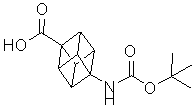
工程3:tert-ブチル(4-(ヒドロキシメチル)キュバン-1-イル)カルバメートの合成

中間体B17
tert-ブチル(4-(ヒドロキシメチル)シクロヘプチル)カルバメート

tert-Butyl (4-(hydroxymethyl)cycloheptyl)carbamate
中間体B18
tert-ブチル(4-(ヒドロキシメチル)-4-メチルシクロヘキシル)カルバメート

tert-butyl (4-(hydroxymethyl)-4-methylcyclohexyl)carbamate
中間体B41
4-(ヒドロキシメチル)シクロヘプタン-1-オール

4-(Hydroxymethyl)cycloheptan-1-ol
中間体B45
(4-(トリフルオロメトキシ)シクロヘキシル)メタノール

(4-(trifluoromethoxy)cyclohexyl)methanol
中間体B46
トランス4-(ジフルオロメトキシ)シクロヘキシル)メタノール

Trans-4-(difluoromethoxy)cyclohexyl)methanol
中間体B48
3-(ヒドロキシメチル)チエタン1,1-ジオキシド

3-(Hydroxymethyl)thietane 1,1-dioxide
中間体B49
3-(ヒドロキシメチル)チエタン1,1-ジオキシド
Intermediate B49
3-(Hydroxymethyl)thietane 1,1-dioxide
工程1:(1S,3R,4R)-3-フルオロ-4-ヒドロキシシクロヘキサン-1-カルボン酸の合成

工程2:(1R,2R,4S)-2-フルオロ-4-(ヒドロキシメチル)シクロヘキサン-1-オールの合成


以下を除き、すべてのアミン中間体Cは市販されている:
中間体C5を、PCT公報WO2017/087905A1に示されるとおり製造した。
中間体C8を、PCT公報WO2006/064189A1に示されるとおり製造した。
中間体C10を、J. Med. Chem. 2012, 55, 22, 9416-9433に示されるとおり製造した。
中間体C19を、PCT公報WO2012/062783A1に示されるとおり製造した。
中間体C22およびC24を、PCT公報WO2020/088390A1に示されるとおり製造した。
中間体C26を、PCT公報WO2020/216371A1に示されるとおり製造した。
中間体C28を、J. Med. Chem. 2012, 55(22), 9416-9433に示されるとおり製造した。
中間体C29を、PCT公報WO2020/070331A1に示されるとおり製造した。
中間体C30を、PCT公報WO2019/121691A1に示されるとおり製造した。
中間体C33およびC34を、PCT公報WO2019/112269A1に示されるとおり製造した。
中間体C41を、PCT公報CN110467615A1に示されるとおり製造した。
中間体C45を、PCT公報WO2016/049211A1に示されるとおり製造した。
中間体C47を、PCT公報WO2021/005222A1に示されるとおり製造した。
中間体C6およびC7を以下の合成スキームに従って製造した:
Intermediate C5 was prepared as shown in PCT publication WO2017/087905A1.
Intermediate C8 was prepared as shown in PCT Publication WO2006/064189A1.
Intermediate C10 was prepared as shown in J. Med. Chem. 2012, 55, 22, 9416-9433.
Intermediate C19 was prepared as shown in PCT Publication WO2012/062783A1.
Intermediates C22 and C24 were prepared as shown in PCT publication WO2020/088390A1.
Intermediate C26 was prepared as shown in PCT Publication WO2020/216371A1.
Intermediate C28 was prepared as shown in J. Med. Chem. 2012, 55(22), 9416-9433.
Intermediate C29 was prepared as shown in PCT Publication WO2020/070331A1.
Intermediate C30 was prepared as shown in PCT Publication WO2019/121691A1.
Intermediates C33 and C34 were prepared as shown in PCT publication WO2019/112269A1.
Intermediate C41 was prepared as shown in PCT Publication CN110467615A1.
Intermediate C45 was prepared as shown in PCT Publication WO2016/049211A1.
Intermediate C47 was prepared as shown in PCT Publication WO2021/005222A1.
Intermediates C6 and C7 were prepared according to the following synthetic scheme:
中間体C6
3-(4-アミノ-3-メチル-1H-ピラゾール-1-イル)シクロブタン-1-カルボニトリル
Intermediate C6
3-(4-amino-3-methyl-1H-pyrazol-1-yl)cyclobutane-1-carbonitrile
工程1:メチル 3-((メチルスルホニル)オキシ)シクロブタン-1-カルボキシレートの合成:
DIPEA(10.43g、81.0mmol)およびMsCl(5.03ml、64.5mmol)を、メチル 3-ヒドロキシシクロブタン-1-カルボキシレート(7.00g、53.8mmol)のDCM(70mL)中溶液に0℃にて加えて、得られた混合物を、25℃にて3時間撹拌した。反応完了後(TLCにより示される)、反応混合物をDCM(100mL)で希釈し、食塩水(50mL)で洗浄し、Na2SO4で乾燥し、ろ過し、減圧下で濃縮して、表題化合物を褐色の固体として得て(10.5g、収率94%)、これをさらに精製することなく用いた。1H NMR(400 MHz, CDCl3)δ = 4.91-4.98(m, 1H), 3.72(s, 3H), 3.02(s, 3H), 2.69-2.77(m, 2H), 2.55-2.64(m, 2H)。
Step 1: Synthesis of methyl 3-((methylsulfonyl)oxy)cyclobutane-1-carboxylate:
DIPEA (10.43 g, 81.0 mmol) and MsCl (5.03 ml, 64.5 mmol) were added to a solution of methyl 3-hydroxycyclobutane-1-carboxylate (7.00 g, 53.8 mmol) in DCM (70 mL) at 0 °C. The resulting mixture was stirred at 25°C for 3 hours. After the reaction was complete (as indicated by TLC), the reaction mixture was diluted with DCM (100 mL), washed with brine (50 mL ), dried over Na2SO4 , filtered, and concentrated under reduced pressure to give the title compound. was obtained as a brown solid (10.5 g, 94% yield), which was used without further purification. 1 H NMR(400 MHz, CDCl 3 )δ = 4.91-4.98(m, 1H), 3.72(s, 3H), 3.02(s, 3H), 2.69-2.77(m, 2H), 2.55-2.64(m, 2H).
工程2:メチル 3-(3-メチル-4-ニトロ-1H-ピラゾール-1-イル)シクロブタン-1-カルボキシレートの合成
メチル 3-((メチルスルホニル)オキシ)シクロブタン-1-カルボキシレート(11.80g、56.6mmol)およびCs2CO3(23.07g、70.8mmol)を、3-メチル-4-ニトロ-1H-ピラゾール(6.00g、47.2mmol)のDMF(60mL)中溶液に25℃にて加えて、得られた混合物を、80℃にて16時間撹拌した。反応完了後(TLCにより示される)、反応混合物を砕いた氷(500g)へ注ぎ、EtOAc(3×100mL)で抽出した。合わせた有機抽出物を、水(3×100mL)および食塩水(200mL)で洗浄し、Na2SO4で乾燥し、ろ過し、減圧下で濃縮して、粗物質を得て、これをIsolera(シリカゲル230~400メッシュ、石油エーテル中40%EtOAcで溶出)により精製して、表題化合物をオフホワイト色の固体として得た(位置異性体の混合物、6.5g、収率54%)。1H NMR(400 MHz, CDCl3)δ = 8.14(s, 1H), 4.96-5.00(m, 1H), 3.74-3.78(m, 3H), 3.22-3.26(m, 1H), 2.87-3.02(m, 2H), 2.64-2.80(m, 2H), 2.55-2.57(m, 3H)。LCMS:240.1 [M+H]。
Step 2: Synthesis of methyl 3-(3-methyl-4-nitro-1H-pyrazol-1-yl)cyclobutane-1-carboxylate Methyl 3-((methylsulfonyl)oxy)cyclobutane-1-carboxylate (11.80g) , 56.6 mmol) and Cs 2 CO 3 (23.07 g, 70.8 mmol) were added to a solution of 3-methyl-4-nitro-1H-pyrazole (6.00 g, 47.2 mmol) in DMF (60 mL) at 25 °C. The resulting mixture was stirred at 80°C for 16 hours. After the reaction was complete (as indicated by TLC), the reaction mixture was poured onto crushed ice (500 g) and extracted with EtOAc (3 x 100 mL). The combined organic extracts were washed with water (3 x 100 mL) and brine ( 200 mL), dried over Na2SO4 , filtered, and concentrated under reduced pressure to give the crude material, which was purified by Isolera. Purification by (silica gel 230-400 mesh, eluting with 40% EtOAc in petroleum ether) afforded the title compound as an off-white solid (mixture of regioisomers, 6.5 g, 54% yield). 1 H NMR(400 MHz, CDCl 3 )δ = 8.14(s, 1H), 4.96-5.00(m, 1H), 3.74-3.78(m, 3H), 3.22-3.26(m, 1H), 2.87-3.02( m, 2H), 2.64-2.80(m, 2H), 2.55-2.57(m, 3H). LCMS: 240.1 [M+H].
工程3:3-(3-メチル-4-ニトロ-1H-ピラゾール-1-イル)シクロブタン-1-カルボン酸の合成
水酸化リチウム一水和物(1.301g、54.3mmol)を、メチル 3-(3-メチル-4-ニトロ-1H-ピラゾール-1-イル)シクロブタン-1-カルボキシレート(6.500g、27.2mmol)のMeOH:水:THF(1:1:1、150mL)中溶液に0℃にて加えて、得られた混合物を、25℃にて16時間撹拌した。反応完了後(TLCにより示される)、反応混合物を減圧下で濃縮して、残渣を得て、これを水(50mL)中に溶解させ、HCl(1.5N)を用いてpH2に酸性化した。得られた沈殿をろ過し、水(2×10mL)で洗浄し、乾燥して、表題化合物をオフホワイト色の固体として得た(位置異性体の混合物、収率4.2g、68%)。1H NMR(400 MHz, DMSO-d6)δ = 12.45(bs, 1H), 8.91(s, 1H), 5.01-5.05(m, 1H), 3.07-3.14(m, 1H), 2.72-2.80(m, 2H), 2.46-2.69(m, 5H)。LCMS:224.1 [M-H]。
Step 3: Synthesis of 3-(3-methyl-4-nitro-1H-pyrazol-1-yl)cyclobutane-1-carboxylic acid Lithium hydroxide monohydrate (1.301 g, 54.3 mmol) was converted into methyl 3-( 3-Methyl-4-nitro-1H-pyrazol-1-yl)cyclobutan-1-carboxylate (6.500 g, 27.2 mmol) in MeOH:water:THF (1:1:1, 150 mL) at 0 °C. and the resulting mixture was stirred at 25° C. for 16 hours. After the reaction was complete (as indicated by TLC), the reaction mixture was concentrated under reduced pressure to give a residue, which was dissolved in water (50 mL) and acidified to pH 2 using HCl (1.5N). The resulting precipitate was filtered, washed with water (2 x 10 mL) and dried to give the title compound as an off-white solid (mixture of regioisomers, yield 4.2 g, 68%). 1 H NMR (400 MHz, DMSO-d 6 )δ = 12.45(bs, 1H), 8.91(s, 1H), 5.01-5.05(m, 1H), 3.07-3.14(m, 1H), 2.72-2.80( m, 2H), 2.46-2.69(m, 5H). LCMS: 224.1 [MH].
工程4:3-(3-メチル-4-ニトロ-1H-ピラゾール-1-イル)シクロブタン-1-カルボキサミドの合成
塩化オキサリル(1.127ml、12.88mmol)およびDMF(0.583mL、7.49mmol)を、3-(3-メチル-4-ニトロ-1H-ピラゾール-1-イル)シクロブタン-1-カルボン酸(2.900g、12.88mmol)のDCM(35mL)中撹拌溶液に0℃にてゆっくり加えて、得られた混合物を、25℃にて1時間撹拌した。その後、反応混合物を減圧下で濃縮して、残渣を得て、これをTHF(46.7mL)中に取った。水性アンモニア(水中25%、58.5mL、2678mmol)を、ゆっくり0℃にて加えて、得られた混合物を、25℃にて16時間撹拌した。反応完了後(TLCにより示される)、反応混合物を減圧下で濃縮して、残渣を得て、これを0℃に冷却した。得られた沈殿をろ過し、水(2×5mL)で洗浄し、乾燥して、表題化合物をオフホワイト色の固体として得た(位置異性体の混合物、2.7g、収率91%)。LCMS:225.1 [M+H]。
Step 4: Synthesis of 3-(3-methyl-4-nitro-1H-pyrazol-1-yl)cyclobutane-1-carboxamide Oxalyl chloride (1.127 ml, 12.88 mmol) and DMF (0.583 mL, 7.49 mmol) were -(3-Methyl-4-nitro-1H-pyrazol-1-yl)cyclobutane-1-carboxylic acid (2.900 g, 12.88 mmol) was added slowly to a stirred solution of DCM (35 mL) at 0 °C to obtain the The mixture was stirred at 25°C for 1 hour. The reaction mixture was then concentrated under reduced pressure to give a residue, which was taken up in THF (46.7 mL). Aqueous ammonia (25% in water, 58.5 mL, 2678 mmol) was added slowly at 0°C and the resulting mixture was stirred at 25°C for 16 hours. After the reaction was complete (as indicated by TLC), the reaction mixture was concentrated under reduced pressure to give a residue, which was cooled to 0°C. The resulting precipitate was filtered, washed with water (2 x 5 mL) and dried to give the title compound as an off-white solid (mixture of regioisomers, 2.7 g, 91% yield). LCMS: 225.1 [M+H].
工程5:3-(3-メチル-4-ニトロ-1H-ピラゾール-1-イル)シクロブタン-1-カルボニトリル(C6a)および3-(5-メチル-4-ニトロ-1H-ピラゾール-1-イル)シクロブタン-1-カルボニトリル(C7a)の合成
ホスホリルクロリド(13.90mL、149.0mmol)を、3-(3-メチル-4-ニトロ-1H-ピラゾール-1-イル)シクロブタン-1-カルボキサミド(6.70g、29.9mmol)のDCE(40mL)中溶液に加えて、得られた混合物を、30分間加熱還流した。反応完了後(TLCにより示される)、反応混合物を減圧下で濃縮して、残渣を得て、これを砕いた氷へゆっくり注ぎ、その後、NaHCO3で中和し、DCM(3×100mL)で抽出した。合わせた有機抽出物を、Na2SO4で乾燥し、ろ過し、減圧下で濃縮して、粗物質を得て、これをIsolera(シリカゲル230~400メッシュ、石油エーテル中20%EtOAcで溶出)により精製して、表題生成物をオフホワイト色の固体として得た(位置異性体C7aおよびC8aの混合物、5.4g、収率87%)。1H NMR(400 MHz, CDCl3)δ = 8.15-8.16(m, 1H), 4.97-5.09(m, 1H), 3.36-3.42(m, 1H), 3.05-3.19(m, 2H), 2.87-2.96(m, 2H), 2.58-2.67(m, 3H)。LCMS:207.1 [M+H]。
Step 5: 3-(3-methyl-4-nitro-1H-pyrazol-1-yl)cyclobutane-1-carbonitrile (C6a) and 3-(5-methyl-4-nitro-1H-pyrazol-1-yl) ) Synthesis of cyclobutane-1-carbonitrile (C7a) Phosphoryl chloride (13.90mL, 149.0mmol) was mixed with 3-(3-methyl-4-nitro-1H-pyrazol-1-yl)cyclobutane-1-carboxamide (6.70g). , 29.9 mmol) in DCE (40 mL) and the resulting mixture was heated to reflux for 30 min. After the reaction was complete (as indicated by TLC), the reaction mixture was concentrated under reduced pressure to give a residue, which was poured slowly onto crushed ice, then neutralized with NaHCO and treated with DCM ( 3 x 100 mL). Extracted. The combined organic extracts were dried over Na 2 SO 4 , filtered, and concentrated under reduced pressure to give the crude material, which was purified by Isolera (silica gel 230-400 mesh, eluted with 20% EtOAc in petroleum ether). Purification by to give the title product as an off-white solid (mixture of regioisomers C7a and C8a, 5.4 g, 87% yield). 1 H NMR(400 MHz, CDCl 3 )δ = 8.15-8.16(m, 1H), 4.97-5.09(m, 1H), 3.36-3.42(m, 1H), 3.05-3.19(m, 2H), 2.87- 2.96(m, 2H), 2.58-2.67(m, 3H). LCMS: 207.1 [M+H].
0.90gの位置異性体の混合物を、SFC(Chiralpak AS-Hカラム、IPA中0.5%イソプロピルアミンで溶出:30%CO2)により精製して、0.65gの主異性体(第2溶出ピーク)および0.25gの副異性体(第1溶出ピーク)を得た。副異性体の報告されている1H NMRデータ(WO2017/218843A1)に基づいて、第1溶出ピークはC7aに起因し、第2溶出ピークC6aに起因した。
3-(3-メチル-4-ニトロ-1H-ピラゾール-1-イル)シクロブタン-1-カルボニトリル(C6a):1H NMR(400 MHz, CDCl3)δ = 8.14(s, 1H), 4.98-5.03(m, 1H), 3.34-3.42(m, 1H), 3.04-3.14(m, 2H), 2.88-2.96(m, 2H), 2.58(s, 3H)。LCMS:207.1 [M+H]。
3-(5-メチル-4-ニトロ-1H-ピラゾール-1-イル)シクロブタン-1-カルボニトリル(C7a):1H NMR(400 MHz, CDCl3)δ = 8.16(s, 1H), 5.06-5.08(m, 1H), 3.36-3.37(m, 1H), 3.10-3.13(m, 2H), 2.87-2.90(m, 2H), 2.67(s, 3H)。LCMS:207.1 [M+H]。
0.90 g of the mixture of regioisomers was purified by SFC (Chiralpak AS-H column, eluting with 0.5% isopropylamine in IPA: 30% CO2 ) to yield 0.65 g of the major isomer (second elution peak) and 0.25 g of minor isomer (first elution peak) was obtained. Based on the reported 1 H NMR data of the minor isomers (WO2017/218843A1), the first elution peak was attributed to C7a and the second elution peak was attributed to C6a.
3-(3-Methyl-4-nitro-1H-pyrazol-1-yl)cyclobutane-1-carbonitrile (C6a): 1 H NMR (400 MHz, CDCl 3 )δ = 8.14(s, 1H), 4.98- 5.03(m, 1H), 3.34-3.42(m, 1H), 3.04-3.14(m, 2H), 2.88-2.96(m, 2H), 2.58(s, 3H). LCMS: 207.1 [M+H].
3-(5-Methyl-4-nitro-1H-pyrazol-1-yl)cyclobutane-1-carbonitrile (C7a): 1 H NMR (400 MHz, CDCl 3 )δ = 8.16(s, 1H), 5.06- 5.08(m, 1H), 3.36-3.37(m, 1H), 3.10-3.13(m, 2H), 2.87-2.90(m, 2H), 2.67(s, 3H). LCMS: 207.1 [M+H].
工程6:3-(4-アミノ-3-メチル-1H-ピラゾール-1-イル)シクロブタン-1-カルボニトリルの合成
鉄粉末(1.600g、29.10mmol)および塩化アンモニウム(0.156g、2.91mmol)を、3-(3-メチル-4-ニトロ-1H-ピラゾール-1-イル)シクロブタン-1-カルボニトリル(C6a、0.600g、2.91mmol)のエタノール(8mL)と水(2mL)との混合物中懸濁液に加えて、得られた懸濁液を、90℃にて3時間撹拌した。反応完了後(TLCにより示される)、反応混合物をセライト(登録商標)(すなわち珪藻土)のパッドによりろ過し、その後、これをEtOAc(10mL)ですすいだ。合わせたろ液を、減圧下で濃縮して、粗物質を得て、これをDCM(20mL)中に取り、食塩水(2mL)で洗浄し、Na2SO4で乾燥し、ろ過し、減圧下で濃縮して、表題化合物を得て(0.48g)、これをさらに精製することなく用いた。LCMS:177.1 [M+H]。
Step 6: Synthesis of 3-(4-amino-3-methyl-1H-pyrazol-1-yl)cyclobutane-1-carbonitrile Iron powder (1.600 g, 29.10 mmol) and ammonium chloride (0.156 g, 2.91 mmol) , 3-(3-methyl-4-nitro-1H-pyrazol-1-yl)cyclobutane-1-carbonitrile (C6a, 0.600 g, 2.91 mmol) suspended in a mixture of ethanol (8 mL) and water (2 mL). The resulting suspension was stirred at 90° C. for 3 hours. After the reaction was complete (as indicated by TLC), the reaction mixture was filtered through a pad of Celite® (ie, diatomaceous earth), which was then rinsed with EtOAc (10 mL). The combined filtrates were concentrated under reduced pressure to give the crude material, which was taken up in DCM (20 mL), washed with brine (2 mL), dried over Na 2 SO 4 , filtered and concentrated under reduced pressure. to give the title compound (0.48g), which was used without further purification. LCMS: 177.1 [M+H].
中間体C7
3-(4-アミノ-5-メチル-1H-ピラゾール-1-イル)シクロブタン-1-カルボニトリル
Intermediate C7
3-(4-Amino-5-methyl-1H-pyrazol-1-yl)cyclobutane-1-carbonitrile
工程7:3-(4-アミノ-3-メチル-1H-ピラゾール-1-イル)シクロブタン-1-カルボニトリルの合成
鉄粉末(0.680g、12.120mmol)および塩化アンモニウム(0.065g、1.212mmol)を、3-(5-メチル-4-ニトロ-1H-ピラゾール-1-イル)シクロブタン-1-カルボニトリル(C7a、0.250g、1.212mmol)のエタノール(4mL)と水(1mL)との混合物中懸濁液に加えて、得られた懸濁液を、90℃にて3時間撹拌した。反応完了後(TLCにより示される)、反応混合物をセライト(登録商標)(すなわち珪藻土)のパッドによりろ過し、その後、これをEtOAc(5mL)ですすいだ。合わせたろ液を、減圧下で濃縮して、粗物質を得て、これをDCM(10mL)中に取り、食塩水(2mL)で洗浄し、Na2SO4で乾燥し、ろ過し、減圧下で濃縮して、表題化合物を得て(0.16g)、これをさらに精製することなく用いた。LCMS:177.1 [M+H]。
Step 7: Synthesis of 3-(4-amino-3-methyl-1H-pyrazol-1-yl)cyclobutane-1-carbonitrile Iron powder (0.680 g, 12.120 mmol) and ammonium chloride (0.065 g, 1.212 mmol) were , 3-(5-methyl-4-nitro-1H-pyrazol-1-yl)cyclobutane-1-carbonitrile (C7a, 0.250 g, 1.212 mmol) suspended in a mixture of ethanol (4 mL) and water (1 mL). The resulting suspension was stirred at 90° C. for 3 hours. After the reaction was complete (as indicated by TLC), the reaction mixture was filtered through a pad of Celite® (ie, diatomaceous earth), which was then rinsed with EtOAc (5 mL). The combined filtrates were concentrated under reduced pressure to give the crude material, which was taken up in DCM (10 mL), washed with brine (2 mL), dried over Na 2 SO 4 , filtered and concentrated under reduced pressure. to give the title compound (0.16g), which was used without further purification. LCMS: 177.1 [M+H].
中間体C35
1-シクロプロピル-3-メチル-1H-ピラゾール-4-アミン
Intermediate C35
1-cyclopropyl-3-methyl-1H-pyrazol-4-amine
工程1:1-シクロプロピル-3-メチル-4-ニトロ-1H-ピラゾールの合成

工程2:1-シクロプロピル-3-メチル-1H-ピラゾール-4-アミンの合成

中間体C36
1-シクロプロピル-3-メトキシ-1H-ピラゾール-4-アミン
Intermediate C36
1-Cyclopropyl-3-methoxy-1H-pyrazol-4-amine
工程1:1-シクロプロピル-3-メトキシ-4-ニトロ-1H-ピラゾールの合成

工程2:1-シクロプロピル-3-メトキシ-1H-ピラゾール-4-アミンの合成

中間体C43
4-(6-オキサ-2-アザスピロ[3.4]オクタン-2-イル)アニリン
Intermediate C43
4-(6-oxa-2-azaspiro[3.4]octan-2-yl)aniline
工程1:2-(4-ニトロフェニル)-6-オキサ-2-アザスピロ[3.4]オクタンの合成
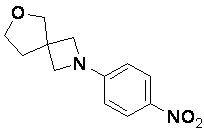
工程2:4-(6-オキサ-2-アザスピロ[3.4]オクタン-2-イル)アニリンの合成

中間体C46
(R)-4-(3-メチルモルホリノ)アニリン
Intermediate C46
(R)-4-(3-methylmorpholino)aniline
工程1:(R)-3-メチル-4-(4-ニトロフェニル)モルホリンの合成

工程2:(R)-4-(3-メチルモルホリノ)アニリンの合成

中間体C48
4-(2-(トリフルオロメチル)モルホリノ)アニリン
Intermediate C48
4-(2-(trifluoromethyl)morpholino)aniline
工程1:4-(4-ニトロフェニル)-2-(トリフルオロメチル)モルホリンの合成

工程2:4-(2-(トリフルオロメチル)モルホリノ)アニリンの合成
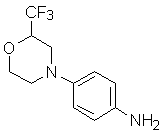
中間体C49
2-(4-アミノ-5-メチル-1H-ピラゾール-1-イル)-2-メチルプロパンニトリル
Intermediate C49
2-(4-amino-5-methyl-1H-pyrazol-1-yl)-2-methylpropanenitrile
工程1:2-メチル-2-(5-メチル-4-ニトロ-1H-ピラゾール-1-イル)プロパンアミドの合成
工程2:2-メチル-2-(5-メチル-4-ニトロ-1H-ピラゾール-1-イル)プロパンニトリルの合成
POCl3(3.11mL、33.400mmol)を、2-メチル-2-(5-メチル-4-ニトロ-1H-ピラゾール-1-イル)プロパンアミド(0.50g、2.356mmol)に0℃にて加えて、得られた溶液を、110℃にて2時間撹拌した。反応完了後(TLCにより示される)、反応混合物を減圧下で濃縮して、粗物質を得て、これをEtOAc(10mL)中に取り、水性NaHCO3(10%)で中和した。得られた水層を、EtOAc(2×5mL)で抽出し、合わせた有機抽出物を、Na2SO4で乾燥し、ろ過し、減圧下で濃縮して、粗物質を得て、これをフラッシュクロマトグラフィー(シリカゲル230~400メッシュ、石油エーテル中15%EtOAcで溶出)により精製して、表題化合物を淡黄色のガム状物として得た(0.300g、収率66%)。1H NMR(400 MHz, CD3OD)δ = 8.79(s, 1H), 2.55(s, 3H), 2.03(s, 6H)。LCMS:195.1 [M+H]。
Step 2: Synthesis of 2-methyl-2-(5-methyl-4-nitro-1H-pyrazol-1-yl)propanenitrile
POCl 3 (3.11 mL, 33.400 mmol) was added to 2-methyl-2-(5-methyl-4-nitro-1H-pyrazol-1-yl)propanamide (0.50 g, 2.356 mmol) at 0 °C. The resulting solution was stirred at 110°C for 2 hours. After the reaction was complete (as indicated by TLC), the reaction mixture was concentrated under reduced pressure to obtain the crude material, which was taken up in EtOAc (10 mL) and neutralized with aqueous NaHCO 3 (10%). The resulting aqueous layer was extracted with EtOAc (2 x 5 mL) and the combined organic extracts were dried over Na2SO4 , filtered and concentrated under reduced pressure to give the crude material , which was Purification by flash chromatography (silica gel 230-400 mesh, eluting with 15% EtOAc in petroleum ether) afforded the title compound as a pale yellow gum (0.300 g, 66% yield). 1H NMR (400 MHz, CD3OD ) δ = 8.79(s, 1H), 2.55(s, 3H), 2.03(s, 6H). LCMS: 195.1 [M+H].
工程3:2-(4-アミノ-5-メチル-1H-ピラゾール-1-イル)-2-メチルプロパンニトリルの合成
鉄粉末(0.575g、10.30mmol)およびNH4Cl(0.551g、10.30mmol)を、2-メチル-2-(5-メチル-4-ニトロ-1H-ピラゾール-1-イル)プロパンニトリル(0.200g、1.030mmol)のエタノール(4mL)と水(1mL)との混合物中懸濁液に加えて、得られた懸濁液を、75℃にて2時間撹拌した。反応完了後(TLCにより示される)、反応混合物をセライト(登録商標)(すなわち珪藻土)のパッドによりろ過し、その後、これをEtOAc(5mL)ですすいだ。合わせたろ液を、減圧下で濃縮して、粗物質を得て、これをDCM(10mL)中に取り、食塩水(2mL)で洗浄し、Na2SO4で乾燥し、ろ過し、減圧下で濃縮して、粗物質を得て、これをフラッシュクロマトグラフィー(シリカゲル230~400メッシュ、石油エーテル中30%EtOAcで溶出)により精製して、表題化合物をオフホワイト色の固体として得た(0.084g、収率46%)。1H NMR(400 MHz, CD3OD)δ = 7.34(s, 1H), 2.19(s, 3H), 1.93(s, 6H)。LCMS:165.2 [M+H]。
Step 3: Synthesis of 2-(4-amino-5-methyl-1H-pyrazol-1-yl)-2-methylpropanenitrile Iron powder (0.575g, 10.30mmol) and NH 4 Cl (0.551g, 10.30mmol) of 2-methyl-2-(5-methyl-4-nitro-1H-pyrazol-1-yl)propanenitrile (0.200 g, 1.030 mmol) suspended in a mixture of ethanol (4 mL) and water (1 mL). The resulting suspension was stirred at 75°C for 2 hours. After the reaction was complete (as indicated by TLC), the reaction mixture was filtered through a pad of Celite® (ie, diatomaceous earth), which was then rinsed with EtOAc (5 mL). The combined filtrates were concentrated under reduced pressure to give the crude material, which was taken up in DCM (10 mL), washed with brine (2 mL), dried over Na 2 SO 4 , filtered and concentrated under reduced pressure. to give a crude material that was purified by flash chromatography (silica gel 230-400 mesh, eluting with 30% EtOAc in petroleum ether) to give the title compound as an off-white solid (0.084 g, yield 46%). 1H NMR (400 MHz, CD3OD ) δ = 7.34(s, 1H), 2.19(s, 3H), 1.93(s, 6H). LCMS: 165.2 [M+H].
(実施例の製造) (Production of Example)
実施例1~16を合成するための一般的合成スキーム1:
工程1:中間体Dを合成するための一般的手順GP1:
アルコール中間体B(1.0eq)のDMF中溶液を、NaH(鉱油中60%、1.2eq)のDMF中撹拌懸濁液に0℃にて加えて、得られた混合物を、25℃にて10分間撹拌した。その後、ジクロロピリミジン中間体A(1.0eq)のDMF中溶液を加えて、得られた混合物を、25℃にて反応完了まで(TLCにより示される)撹拌した。その後、反応混合物を飽和NH4Clでクエンチし、EtAOcで希釈した。層を分離し、有機層を水および食塩水で洗浄し、Na2SO4で乾燥し、ろ過し、減圧下で濃縮して、粗物質を得て、これをフラッシュクロマトグラフィーにより精製して、所望の中間体Dを得た。
Step 1: General procedure for synthesizing intermediate D GP1:
A solution of alcohol intermediate B (1.0 eq) in DMF was added to a stirred suspension of NaH (60% in mineral oil, 1.2 eq) in DMF at 0°C and the resulting mixture was incubated at 25°C for 10 Stir for a minute. A solution of dichloropyrimidine intermediate A (1.0 eq) in DMF was then added and the resulting mixture was stirred at 25° C. until reaction completion (as indicated by TLC). The reaction mixture was then quenched with saturated NH 4 Cl and diluted with EtAOc. The layers were separated and the organic layer was washed with water and brine, dried over Na 2 SO 4 , filtered and concentrated under reduced pressure to give the crude material, which was purified by flash chromatography. The desired intermediate D was obtained.
工程2:中間体Eを合成するための一般的手順GP2(ブッフバルト-ハートウィングカップリング):
Cs2CO3(2.0eq)を、中間体D(1.0eq)およびアミン中間体C(1.0eq)のジオキサン中撹拌溶液に加えて、得られた混合物にN2を10分間パージした。その後、BINAP(0.2eq)およびPd(OAc)2(0.1eq)を加えて、反応混合物を100℃にて2時間マイクロ波照射に供した。反応完了後(TLCにより示される)、反応混合物をセライト(登録商標)(すなわち珪藻土)のパッドによりろ過し、ろ液を、減圧下で濃縮して、粗物質を得て、これをフラッシュクロマトグラフィーにより精製して、所望の中間体Eを得た。
Step 2: General procedure GP2 (Buchwald-Hartwing coupling) to synthesize intermediate E:
Cs 2 CO 3 (2.0eq) was added to a stirred solution of Intermediate D (1.0eq) and Amine Intermediate C (1.0eq) in dioxane and the resulting mixture was purged with N 2 for 10 minutes. Afterwards, BINAP (0.2eq) and Pd(OAc) 2 (0.1eq) were added and the reaction mixture was subjected to microwave irradiation at 100° C. for 2 hours. After the reaction is complete (as indicated by TLC), the reaction mixture is filtered through a pad of Celite® (i.e. diatomaceous earth) and the filtrate is concentrated under reduced pressure to obtain the crude material, which is subjected to flash chromatography. The desired intermediate E was purified by .
工程3:実施例1~16を合成するための一般的手順GP3(Boc脱保護):
TFA(5容量)を、中間体E(1eq)の乾燥DCM中溶液に0℃にて加えて、得られた混合物を、25℃にて反応完了まで(TLCにより示される)撹拌した。その後、反応混合物を減圧下で濃縮して、粗物質を得て、これを分取HPLCにより精製して、所望の実施例1~16を得た。
Step 3: General procedure for synthesizing Examples 1-16 GP3 (Boc deprotection):
TFA (5 volumes) was added to a solution of intermediate E (1 eq) in dry DCM at 0°C and the resulting mixture was stirred at 25°C until reaction completion (as indicated by TLC). The reaction mixture was then concentrated under reduced pressure to obtain the crude material, which was purified by preparative HPLC to yield the desired Examples 1-16.
一般的合成スキーム1に従って以下の実施例を合成した:

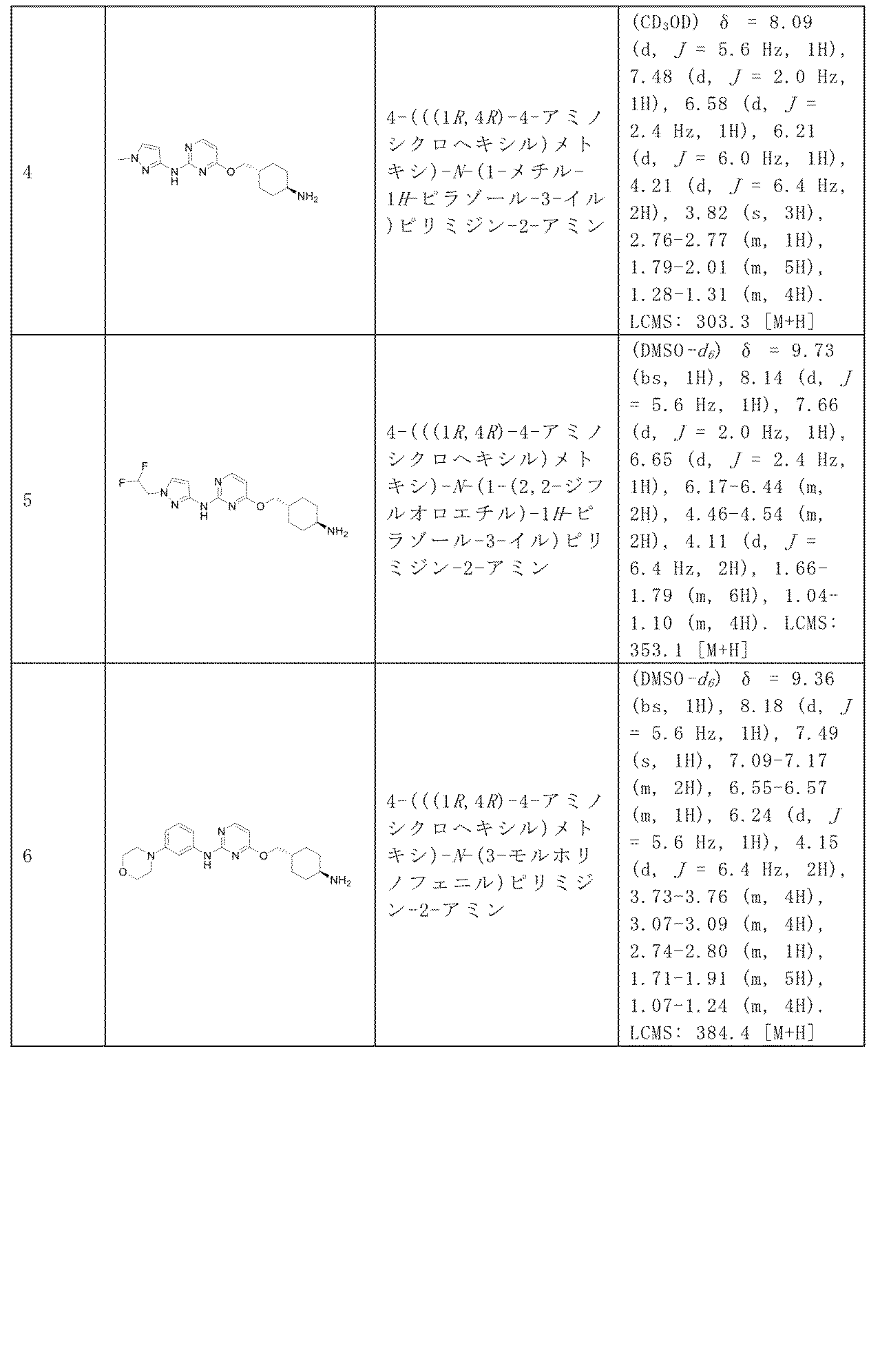


実施例17~30、95~96および163~177を合成するための一般的合成スキーム2:
工程1:中間体Fの合成:
中間体Fを、上記一般的手順GP1に従って合成した。
Step 1: Synthesis of intermediate F:
Intermediate F was synthesized according to the general procedure GP1 above.
工程2:中間体G(実施例95~96および172~177を含む)の合成:
中間体G(実施例95~96および172~177を含み、式中、RpはC(O)CH3である)を、上記一般的手順GP2に従って合成した。実施例95~96および172~177については、粗物質を、分取HPLCにより精製した。
Step 2: Synthesis of Intermediate G (including Examples 95-96 and 172-177):
Intermediate G (comprising Examples 95-96 and 172-177, where R p is C(O)CH 3 ) was synthesized according to general procedure GP2 above. For Examples 95-96 and 172-177, the crude material was purified by preparative HPLC.
工程3:実施例17~28および163~171の合成:
実施例17~28および163~171を、上記一般的手順GP3に従って合成した。
Step 3: Synthesis of Examples 17-28 and 163-171:
Examples 17-28 and 163-171 were synthesized according to general procedure GP3 above.
工程4:実施例29~30の合成:
実施例29~30(式中、RpはC(O)CF3である)を、上記一般的手順GP2に従って合成した。トリフルオロアセトアミド保護基は、ブッフバルト-ハートウィングカップリング条件下で不安定であることが分かり、所望の実施例29~30(これを分取HPLCにより精製した)を専用の脱保護工程なしで得た。
Step 4: Synthesis of Examples 29-30:
Examples 29-30, where R p is C(O)CF 3 , were synthesized according to general procedure GP2 above. The trifluoroacetamide protecting group was found to be unstable under Buchwald-Hartwing coupling conditions, allowing the desired Examples 29-30 (which were purified by preparative HPLC) to be obtained without a dedicated deprotection step. Ta.
一般的合成スキーム2に従って以下の実施例を合成した:

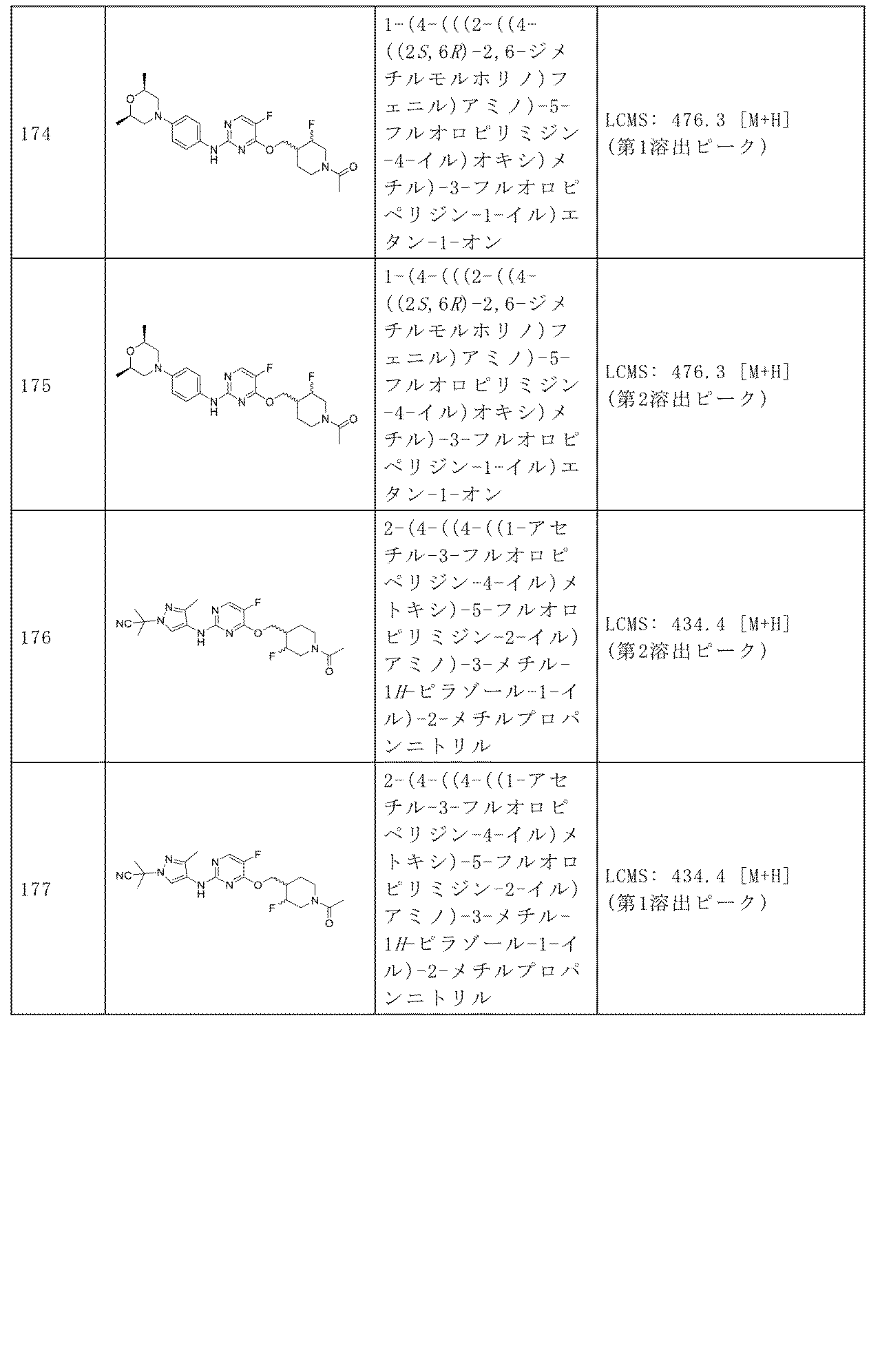


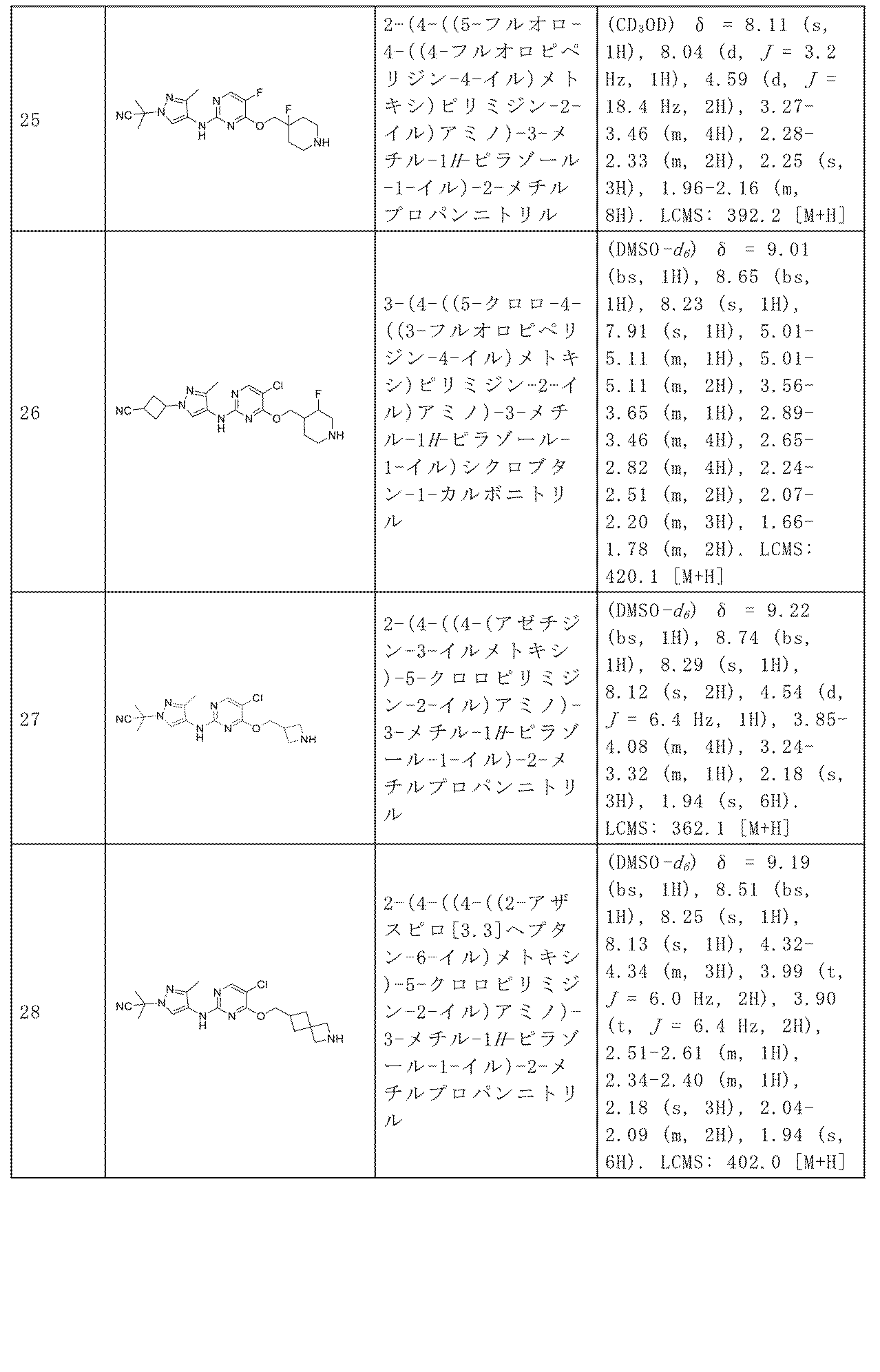


実施例31~55を合成するための一般的合成スキーム3
工程1:中間体Hの合成:
Boc保護アミン(中間体D、1.0eq)のDMF中溶液を、NaH(鉱油中60%、2.0eq)のDMF中撹拌懸濁液に0℃にて加えて、得られた混合物を、25℃にて10分間撹拌した。その後、ヨードメタン(2.0eq)を加えて、得られた混合物を、25℃にて反応完了まで(TLCにより示される)撹拌した。その後、反応混合物を飽和NH4Clでクエンチし、EtOAcで希釈した。層を分離し、有機層を水および食塩水で洗浄した。層を分離し、有機層を水および食塩水で洗浄し、Na2SO4で乾燥し、ろ過し、減圧下で濃縮して、粗物質を得て、これをフラッシュクロマトグラフィーにより精製して、所望の中間体Hを得た。
Step 1: Synthesis of intermediate H:
A solution of Boc-protected amine (Intermediate D, 1.0 eq) in DMF was added to a stirred suspension of NaH (60% in mineral oil, 2.0 eq) in DMF at 0°C and the resulting mixture was added at 25°C. The mixture was stirred for 10 minutes. Then iodomethane (2.0eq) was added and the resulting mixture was stirred at 25°C until reaction completion (as indicated by TLC). The reaction mixture was then quenched with saturated NH4Cl and diluted with EtOAc. The layers were separated and the organic layer was washed with water and brine. The layers were separated and the organic layer was washed with water and brine, dried over Na 2 SO 4 , filtered and concentrated under reduced pressure to give the crude material, which was purified by flash chromatography. The desired intermediate H was obtained.
工程2:中間体Iの合成:
中間体Iを、上記一般的手順GP2に従って合成した。
Step 2: Synthesis of intermediate I:
Intermediate I was synthesized according to general procedure GP2 above.
工程3:実施例31~54の合成:
実施例31~54を、上記一般的手順GP3に従って合成した。
Step 3: Synthesis of Examples 31-54:
Examples 31-54 were synthesized according to general procedure GP3 above.
工程4:実施例55の合成:
ホルムアルデヒド(水中37%、2.0eq)、AcOH(0.2eq)およびMP-シアノボロヒドリド樹脂(2.5eq)を、5-メトキシ-4-(((1R,4R)-4-(メチルアミノ)シクロヘキシル)メトキシ)-N-(4-モルホリノフェニル)ピリミジン-2-アミン(実施例35、1.0eq)のMeOH中溶液に0℃にて加えて、得られた混合物を、25℃にて16時間撹拌した。反応完了後(LCMSにより示される)、反応混合物をセライト(登録商標)(すなわち珪藻土)のパッドによりろ過し、これをMeOH(2×5mL)ですすいだ。合わせたろ液を、減圧下で濃縮して、粗物質を得て、これを分取HPLCにより精製して、実施例55をオフホワイト色の固体として得た。
Step 4: Synthesis of Example 55:
Formaldehyde (37% in water, 2.0eq), AcOH (0.2eq) and MP-cyanoborohydride resin (2.5eq) were combined with 5-methoxy-4-(((1R,4R)-4-(methylamino)cyclohexyl) methoxy)-N-(4-morpholinophenyl)pyrimidin-2-amine (Example 35, 1.0 eq) in MeOH at 0°C and the resulting mixture was stirred at 25°C for 16 hours. . After the reaction was complete (as indicated by LCMS), the reaction mixture was filtered through a pad of Celite® (ie, diatomaceous earth), which was rinsed with MeOH (2×5 mL). The combined filtrates were concentrated under reduced pressure to give the crude material, which was purified by preparative HPLC to give Example 55 as an off-white solid.
一般的合成スキーム3に従って以下の実施例を合成した:


実施例56~70を合成するための一般的合成スキーム4
工程1:中間体Jの合成
中間体Jを、上記一般的手順GP3に従って合成した。粗物質を、フラッシュクロマトグラフィーにより精製した。
Step 1: Synthesis of Intermediate J Intermediate J was synthesized according to general procedure GP3 above. The crude material was purified by flash chromatography.
工程2:実施例56~70の合成
ホルムアルデヒド(水中37%、2.0eq)、AcOH(0.2eq)およびNaBH4(1.5eq)を、アミン中間体J(1.0eq)のDCM中溶液に0℃にて加えて、得られた混合物を、45℃にて反応完了まで(LCMSにより示される)撹拌した。その後、反応混合物を0℃に冷却し、氷水でクエンチし、DCM(2×50)で抽出した。合わせた有機抽出物を、Na2SO4で乾燥し、ろ過し、減圧下で濃縮して、粗物質を得て、これを分取HPLCにより精製して、所望の実施例56~70を得た。
Step 2: Synthesis of Examples 56-70 Formaldehyde (37% in water, 2.0eq), AcOH (0.2eq) and NaBH4 (1.5eq) are added to a solution of amine intermediate J (1.0eq) in DCM at 0 °C. and the resulting mixture was stirred at 45° C. until reaction completion (as indicated by LCMS). The reaction mixture was then cooled to 0° C., quenched with ice water and extracted with DCM (2×50). The combined organic extracts were dried over Na 2 SO 4 , filtered, and concentrated under reduced pressure to give the crude material, which was purified by preparative HPLC to yield the desired Examples 56-70. Ta.
一般的合成スキーム4に従って以下の実施例を合成した:
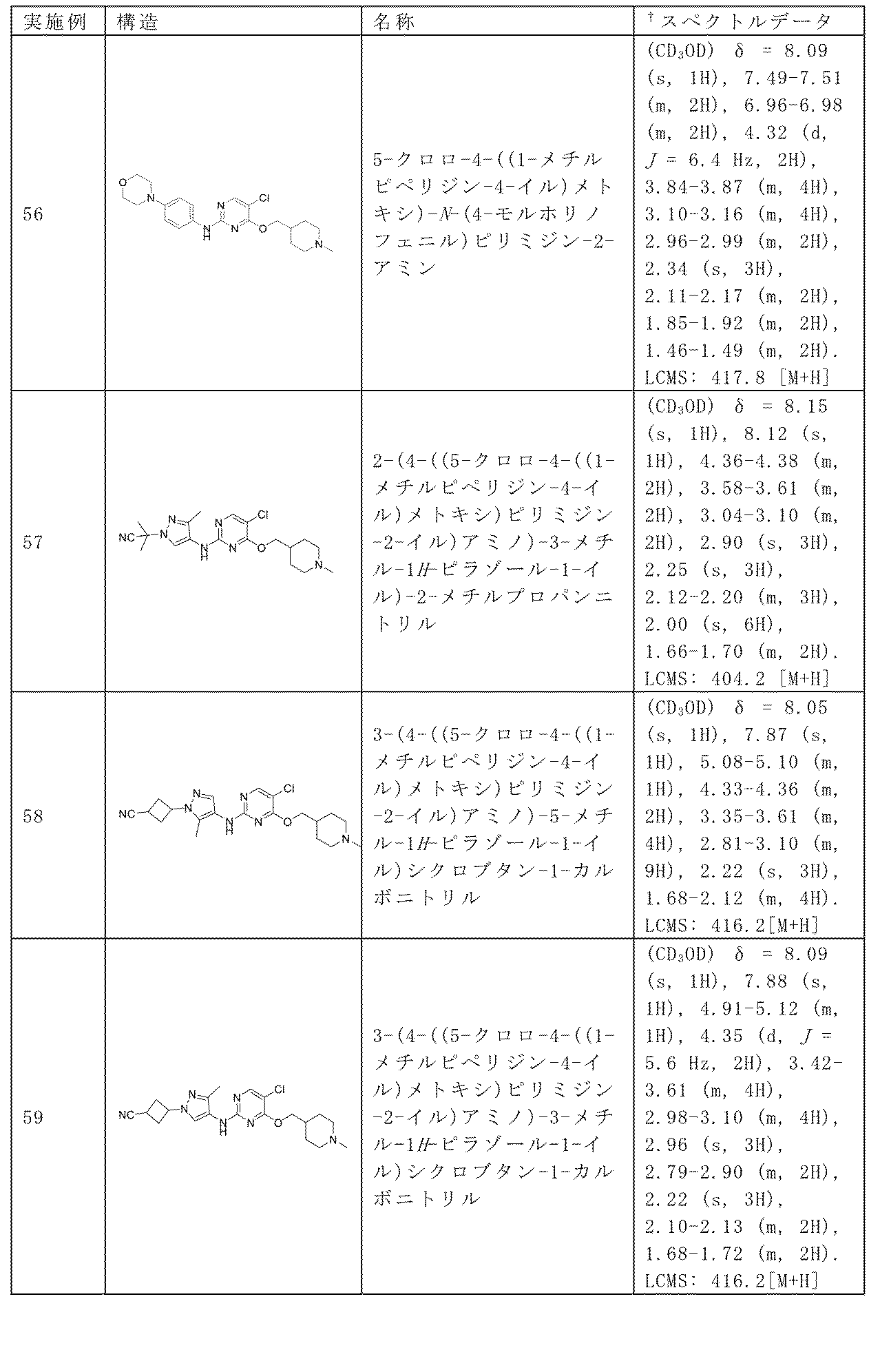


実施例71~94および178~208を合成するための一般的合成スキーム5
工程1:中間体Eの合成:
中間体Eを、上記一般的手順GP2に従って合成した。
Step 1: Synthesis of intermediate E:
Intermediate E was synthesized according to general procedure GP2 above.
工程2:実施例71の合成
tert-ブチル((1R,4R)-4-(((2-((4-モルホリノフェニル)アミノ)ピリミジン-4-イル)オキシ)メチル)シクロヘキシル)カルバメートのBoc脱保護を、上記一般的手順GP3に従って行い、4-(((1R,4R)-4-アミノシクロヘキシル)メトキシ)-N-(4-モルホリノフェニル)ピリミジン-2-アミン(実施例2、1.0eq)を得て、これを、1-メチルシクロプロパン-1-カルボン酸(1.0eq)を含むDCM(10容量)中に溶解させた。HOBt(1.2eq)およびEDC・HCl(1.5eq)を加えて、得られた混合物を、25℃にて16時間撹拌した。反応完了後(LCMSにより示される)、反応混合物をDCM(10mL)で希釈し、水性NaHCO3(2mL)および食塩水(2mL)で洗浄し、Na2SO4で乾燥し、ろ過し、減圧下で濃縮した。得られた粗物質を、分取HPLCにより精製して、実施例71を淡黄色の固体として得た。
Step 2: Synthesis of Example 71
Boc deprotection of tert-butyl ((1R,4R)-4-(((2-((4-morpholinophenyl)amino)pyrimidin-4-yl)oxy)methyl)cyclohexyl)carbamate was performed using the general procedure GP3 described above. 4-(((1R,4R)-4-aminocyclohexyl)methoxy)-N-(4-morpholinophenyl)pyrimidin-2-amine (Example 2, 1.0eq) was obtained, which was converted into 1 -Methylcyclopropane-1-carboxylic acid (1.0 eq) was dissolved in DCM (10 volumes). HOBt (1.2eq) and EDC·HCl (1.5eq) were added and the resulting mixture was stirred at 25°C for 16 hours. After the reaction was complete (as indicated by LCMS), the reaction mixture was diluted with DCM (10 mL), washed with aqueous NaHCO (2 mL) and brine ( 2 mL), dried over Na SO , filtered, and purified under reduced pressure. It was concentrated with The resulting crude material was purified by preparative HPLC to yield Example 71 as a pale yellow solid.
工程3:中間体Kの合成:
中間体Kを、上記一般的手順GP3に従って合成した。粗物質を、フラッシュクロマトグラフィーにより精製した。
Step 3: Synthesis of intermediate K:
Intermediate K was synthesized according to general procedure GP3 above. The crude material was purified by flash chromatography.
工程4:中間体Lを合成するための一般的手順GP4(アセトアミド形成):
トリエチルアミン(3.0eq)および酢酸無水物(1.5eq)を、アミン中間体K(1.0eq)のDCM(10容量)中溶液に0℃にて加えて、得られた混合物を、0℃にて2時間撹拌した。反応完了後(TLCにより示される)、反応混合物を氷水でクエンチし、DCMで抽出した。合わせた有機層を、食塩水で洗浄し、Na2SO4で乾燥し、ろ過し、減圧下で濃縮して、粗物質を得て、これをフラッシュクロマトグラフィー(シリカゲル230~400メッシュ)により精製して、所望の中間体Lを得た。
Step 4: General procedure GP4 to synthesize intermediate L (acetamide formation):
Triethylamine (3.0eq) and acetic anhydride (1.5eq) were added to a solution of amine intermediate K (1.0eq) in DCM (10 volumes) at 0°C and the resulting mixture was dissolved at 0°C for 2 hours. Stir for hours. After the reaction was complete (as indicated by TLC), the reaction mixture was quenched with ice water and extracted with DCM. The combined organic layers were washed with brine, dried over Na 2 SO 4 , filtered, and concentrated under reduced pressure to yield the crude material, which was purified by flash chromatography (silica gel 230-400 mesh). The desired intermediate L was obtained.
工程5:実施例72~89および178~208の合成:
実施例72~89および178~208を、上記一般的手順GP2に従って合成した;粗物質を、分取HPLCにより精製した。
Step 5: Synthesis of Examples 72-89 and 178-208:
Examples 72-89 and 178-208 were synthesized according to the general procedure GP2 above; the crude material was purified by preparative HPLC.
一般的合成スキーム5に従って以下の実施例を合成した:


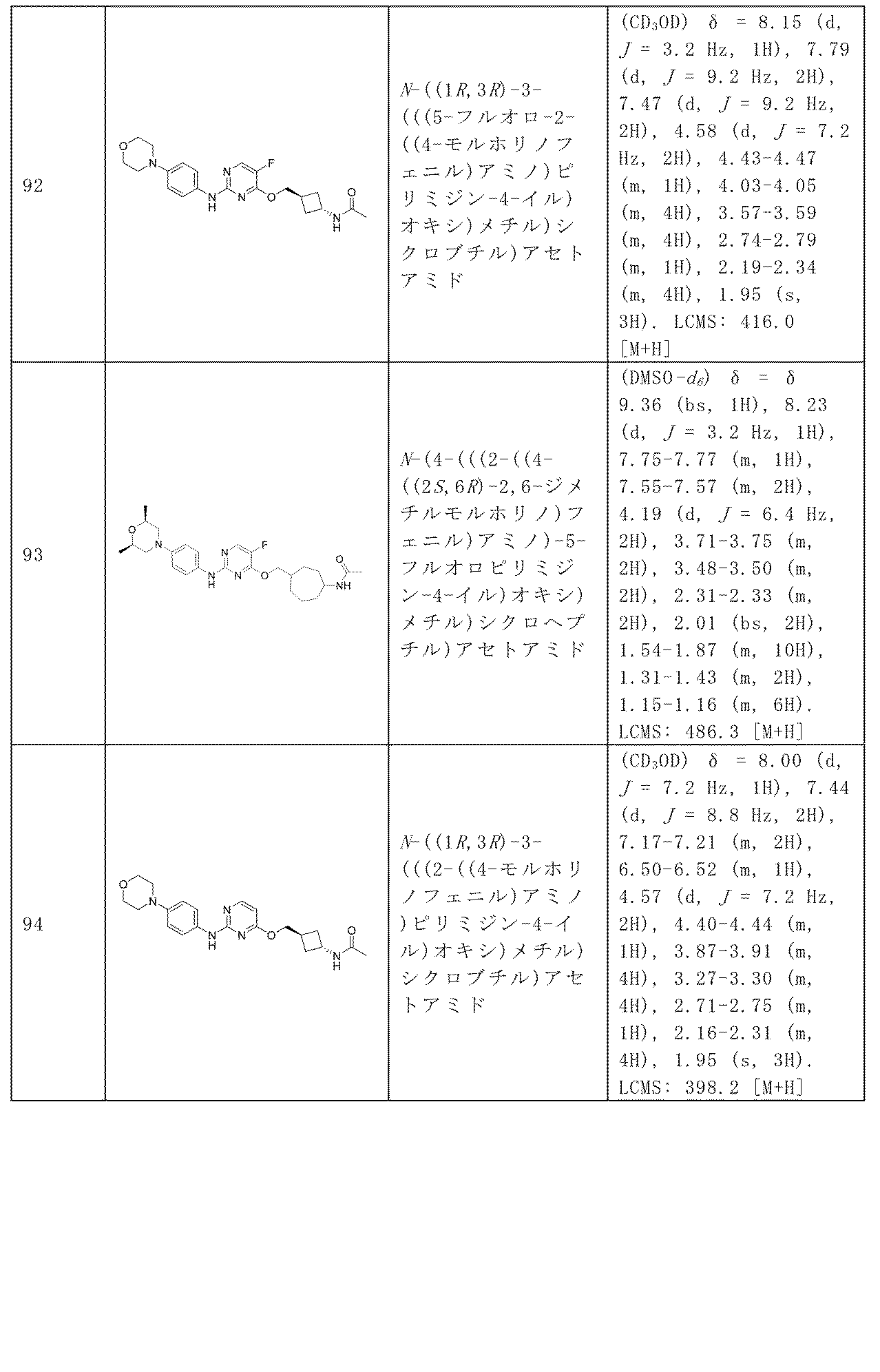


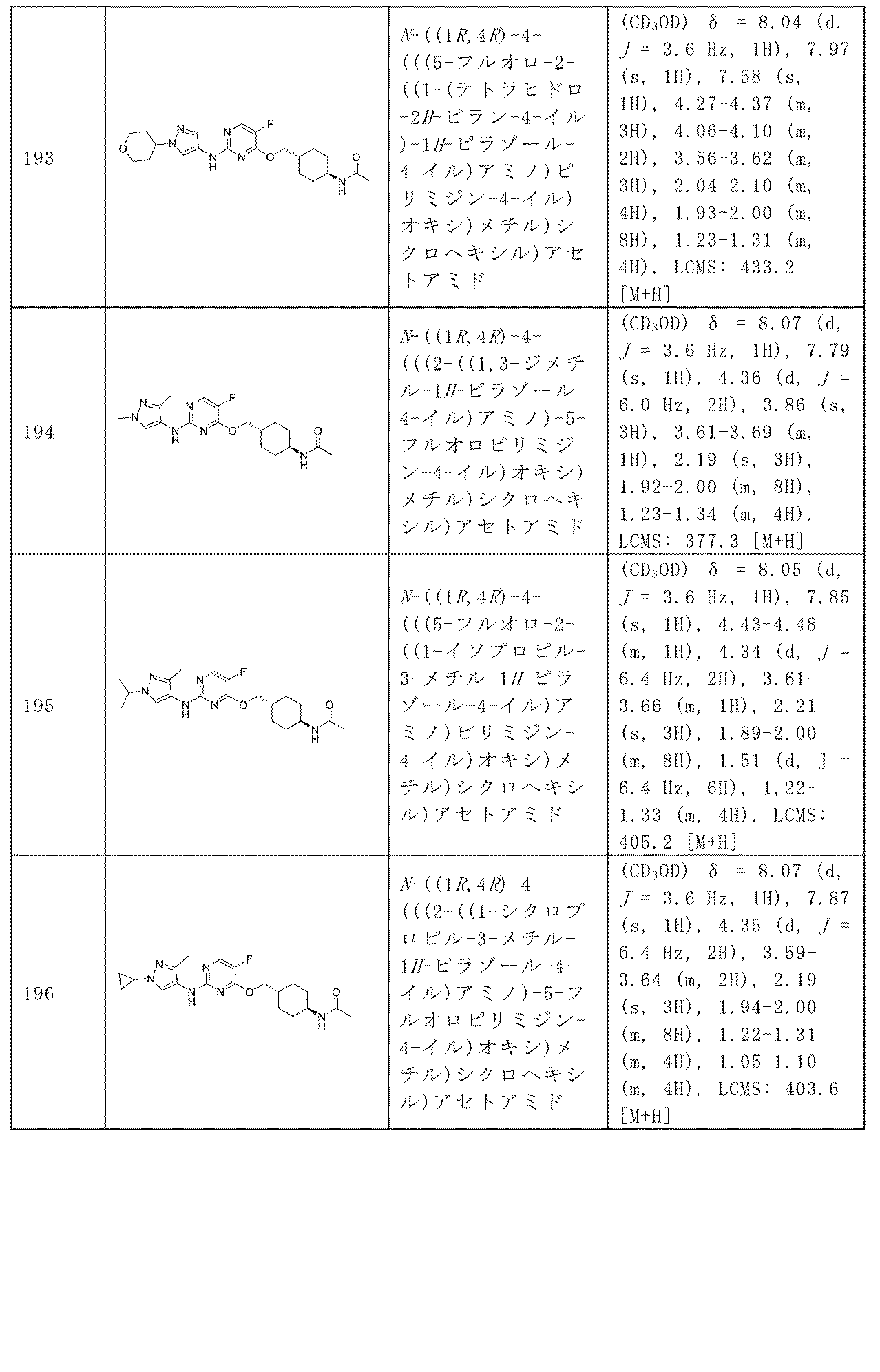


実施例97を合成するための合成スキーム6
工程1:中間体Mの合成:
中間体Mを、上記一般的手順GP1に従って合成した。
Step 1: Synthesis of intermediate M:
Intermediate M was synthesized according to the general procedure GP1 above.
工程2:中間体Nの合成:
中間体Nを、上記一般的手順GP3に従って合成した。粗物質を、フラッシュクロマトグラフィーにより精製した。
Step 2: Synthesis of intermediate N:
Intermediate N was synthesized according to general procedure GP3 above. The crude material was purified by flash chromatography.
工程3:中間体Oの合成:
中間体Oを、上記一般的手順GP4に従って合成した。
Step 3: Synthesis of intermediate O:
Intermediate O was synthesized according to general procedure GP4 above.
工程4:実施例97の合成
1-(6-(((2-((4-((2S,6R)-2,6-ジメチルモルホリノ)フェニル)アミノ)-5-フルオロピリミジン-4-イル)オキシ)メチル)-2-アザスピロ[3.3]ヘプタン-2-イル)エタン-1-オン(実施例97)を、上記一般的手順GP2に従って合成し、分取HPLCにより精製した。1H NMR(400 MHz, CD3OD)δ = δ 8.11(d, J = 2.0 Hz, 1H), 7.72(d, J = 8.8 Hz, 2H), 7.34-7.37(m, 2H), 4.43-4.44(m, 2H), 4.25(s, 1H), 4.17(s, 1H), 3.93-4.01(m, 4H), 3.56-3.59(m, 2H), 2.88-2.95(m, 2H), 2.72-2.75(m, 1H), 2.42-2.47(m, 2H), 2.14-2.40(m, 2H), 1.85-1.86(m, 3H), 1.24-1.29(m, 6H)。LCMS:470.2 [M+H]
Step 4: Synthesis of Example 97
1-(6-(((2-((4-((2S,6R)-2,6-dimethylmorpholino)phenyl)amino)-5-fluoropyrimidin-4-yl)oxy)methyl)-2-azaspiro [3.3]Heptan-2-yl)ethan-1-one (Example 97) was synthesized according to the general procedure GP2 above and purified by preparative HPLC. 1 H NMR(400 MHz, CD 3 OD)δ = δ 8.11(d, J = 2.0 Hz, 1H), 7.72(d, J = 8.8 Hz, 2H), 7.34-7.37(m, 2H), 4.43-4.44 (m, 2H), 4.25(s, 1H), 4.17(s, 1H), 3.93-4.01(m, 4H), 3.56-3.59(m, 2H), 2.88-2.95(m, 2H), 2.72-2.75 (m, 1H), 2.42-2.47(m, 2H), 2.14-2.40(m, 2H), 1.85-1.86(m, 3H), 1.24-1.29(m, 6H). LCMS:470.2 [M+H]
実施例98~108および209~213を合成するための一般的合成スキーム7:
工程1:中間体Pの合成:
中間体Pを、酢酸無水物を、トリフルオロ酢酸無水物(RFがCF3である場合)またはジフルオロ酢酸無水物(RFがCHF2である場合)に置き換えた、改変した上記の一般的手順GP4に従って合成した。
Step 1: Synthesis of intermediate P:
Intermediate P is modified from the general as described above in which acetic anhydride is replaced by trifluoroacetic anhydride (when R F is CF 3 ) or difluoroacetic anhydride (when R F is CHF 2 ). Synthesized according to procedure GP4.
工程2:中間体Q(実施例98~102および209~213を含む)の合成:
中間体Q(実施例98~102および209~213を含む)を、上記一般的手順GP2に従って合成した。実施例98~102および209-213については、粗物質を、分取HPLCにより精製した。
Step 2: Synthesis of Intermediate Q (including Examples 98-102 and 209-213):
Intermediates Q (including Examples 98-102 and 209-213) were synthesized according to the general procedure GP2 above. For Examples 98-102 and 209-213, the crude material was purified by preparative HPLC.
工程3:実施例103~108を合成するための一般的手順GP5(アミド還元):
ボラン-テトラヒドロフラン錯体(THF中1M、1.0eq)を、アミド(実施例98~102、1.0eq)のTHF(10容量)中溶液に0℃にて滴下し、得られた混合物を、25℃にて2時間撹拌した。反応完了後(TLCにより示される)、反応混合物を飽和NH4Clでクエンチし、EtOAcで2回抽出した。合わせた有機抽出物を、Na2SO4で乾燥し、ろ過し、減圧下で濃縮して、粗物質を得て、これを分取HPLCにより精製して、実施例99~106を得た。
Step 3: General procedure for synthesizing Examples 103-108 GP5 (amide reduction):
Borane-tetrahydrofuran complex (1M in THF, 1.0eq) was added dropwise to a solution of amides (Examples 98-102, 1.0eq) in THF (10 volumes) at 0°C and the resulting mixture was heated to 25°C. The mixture was stirred for 2 hours. After the reaction was complete (as indicated by TLC), the reaction mixture was quenched with saturated NH 4 Cl and extracted twice with EtOAc. The combined organic extracts were dried over Na 2 SO 4 , filtered, and concentrated under reduced pressure to give crude material, which was purified by preparative HPLC to give Examples 99-106.
一般的合成スキーム7に従って以下の実施例を合成した:


実施例109~114を合成するための一般的合成スキーム8
工程1:中間体Rの合成:
中間体Rを、上記一般的手順GP3に従って合成した。粗物質を、フラッシュクロマトグラフィーにより精製した。
Step 1: Synthesis of intermediate R:
Intermediate R was synthesized according to general procedure GP3 above. The crude material was purified by flash chromatography.
工程2:中間体Sの合成:
中間体Sを、改変した上記の一般的手順GP4に従って合成し、ここで、酢酸無水物は、トリフルオロ酢酸無水物(RFがCF3である場合)またはジフルオロ酢酸無水物(RFがCHF2である場合)に置き換えた。
Step 2: Synthesis of intermediate S:
Intermediate S was synthesized according to the general procedure GP4 described above with a modification, where acetic anhydride is trifluoroacetic anhydride (when R F is CF 3 ) or difluoroacetic anhydride (when R F is CHF 2 ).
工程3:実施例109~112の合成:
実施例109~112を、上記一般的手順GP2に従って合成した。粗物質を、分取HPLCにより精製した。
Step 3: Synthesis of Examples 109-112:
Examples 109-112 were synthesized according to general procedure GP2 above. The crude material was purified by preparative HPLC.
工程4:実施例113~114の合成:
実施例113~114を、上記一般的手順GP5に従って合成した。
Step 4: Synthesis of Examples 113-114:
Examples 113-114 were synthesized according to general procedure GP5 above.
一般的合成スキーム8に従って以下の実施例を合成した:


実施例115~116を合成するための一般的合成スキーム9
工程1:実施例115および116の合成:
1,1,1-トリフルオロプロパン-2-オン(1.5eq)を、アミン(実施例2、10、1.0eq)のMeOH(10容量)中溶液に加えて、得られた混合物を、25℃にて2時間撹拌した。その後、MP-シアノボロヒドリド樹脂(1.0eq)を加えて、反応混合物を60℃にて48時間撹拌した。反応完了後(LCMSにより示される)、反応混合物をセライト(登録商標)(すなわち珪藻土)のパッドによりろ過し、その後、これをMeOH(2×5mL)で洗浄した。合わせたろ液を、減圧下で濃縮して、粗物質を得て、これを分取HPLCにより精製して、実施例115~116を淡黄色の固体として得た。
Step 1: Synthesis of Examples 115 and 116:
1,1,1-trifluoropropan-2-one (1.5 eq) was added to a solution of the amine (Example 2, 10, 1.0 eq) in MeOH (10 vol) and the resulting mixture was heated at 25°C. The mixture was stirred for 2 hours. Then, MP-cyanoborohydride resin (1.0 eq) was added and the reaction mixture was stirred at 60°C for 48 hours. After the reaction was complete (as indicated by LCMS), the reaction mixture was filtered through a pad of Celite® (ie, diatomaceous earth), which was then washed with MeOH (2×5 mL). The combined filtrates were concentrated under reduced pressure to give the crude material, which was purified by preparative HPLC to give Examples 115-116 as pale yellow solids.
一般的合成スキーム9に従って以下の実施例を合成した:

実施例117~144および214~264を合成するための一般的合成スキーム10:
工程1:中間体Tを合成するための一般的手順GP6:
アルコール中間体B(1.2eq)およびK2CO3(2.0eq)を、ジクロロピリミジン中間体A(1.0eq)のACN(10容量)中溶液に加えて、得られた混合物を、85℃にて18時間撹拌した。反応完了後(TLCにより示される)、反応混合物を氷水でクエンチし、EtOAcで2回抽出した。合わせた有機抽出物を、Na2SO4で乾燥し、ろ過し、減圧下で濃縮して、粗物質を得て、これをフラッシュクロマトグラフィー(シリカゲル230~400メッシュ、石油中15%EtOAcで溶出)により精製して、所望の中間体Tを得た。
Step 1: General procedure for synthesizing intermediate T GP6:
Alcohol intermediate B (1.2 eq) and K 2 CO 3 (2.0 eq) were added to a solution of dichloropyrimidine intermediate A (1.0 eq) in ACN (10 vol) and the resulting mixture was heated at 85 °C. Stirred for 18 hours. After the reaction was complete (as indicated by TLC), the reaction mixture was quenched with ice water and extracted twice with EtOAc. The combined organic extracts were dried over Na 2 SO 4 , filtered, and concentrated under reduced pressure to give the crude material, which was purified by flash chromatography (silica gel 230-400 mesh, eluting with 15% EtOAc in petroleum). ) to obtain the desired intermediate T.
工程2:中間体Uを合成するための一般的手順GP7:
NaBH4(1.5eq)を、中間体T(1.0eq)のMeOH(5容量)中溶液に0℃にて分けて加えて、混合物を、25℃にて2時間撹拌した。反応完了後(TLCにより示される)、反応混合物を飽和NH4Clでクエンチし、DCMで2回抽出した。合わせた有機抽出物を、Na2SO4で乾燥し、ろ過し、減圧下で濃縮して、粗物質を得て、これをフラッシュクロマトグラフィー(シリカゲル230~400メッシュ、石油エーテル中30%EtOAcで溶出)により精製して、所望の中間体Uを得た。
Step 2: General procedure for synthesizing intermediate U GP7:
NaBH 4 (1.5eq) was added portionwise to a solution of intermediate T (1.0eq) in MeOH (5 vol) at 0°C and the mixture was stirred at 25°C for 2 hours. After the reaction was complete (as indicated by TLC), the reaction mixture was quenched with saturated NH 4 Cl and extracted twice with DCM. The combined organic extracts were dried over Na 2 SO 4 , filtered, and concentrated under reduced pressure to give the crude material, which was purified by flash chromatography (silica gel 230-400 mesh, 30% EtOAc in petroleum ether). Purification by elution) gave the desired intermediate U.
工程3:実施例117~134および214~250の合成:
実施例117~134および214~250を、上記一般的手順GP2に従って合成した。粗物質を、分取HPLCにより精製した。
Step 3: Synthesis of Examples 117-134 and 214-250:
Examples 117-134 and 214-250 were synthesized according to general procedure GP2 above. The crude material was purified by preparative HPLC.
工程4:4-(((2,5-ジクロロピリミジン-4-イル)オキシ)メチル)-1-メチルシクロヘキサン-1-オール(中間体V)の合成:
メチルマグネシウムクロリド(THF中3M、1.56mL、4.68mmol)を、4-(((2,5-ジクロロピリミジン-4-イル)オキシ)メチル)シクロヘキサン-1-オン(0.20g、0.73mmol)のテトラヒドロフラン(5mL)中溶液に0℃にてゆっくり加えて、得られた混合物を、25℃にて2時間撹拌した。反応完了後(TLCにより示される)、反応混合物を水(2mL)でクエンチし、ろ過して、不溶性材料を除去し、EtOAc(2×10mL)で抽出した。合わせた有機抽出物を、Na2SO4で乾燥し、ろ過し、減圧下で濃縮して、粗物質を得て、これをフラッシュクロマトグラフィー(シリカゲル230~400メッシュ、石油エーテル中25%EtOAcで溶出)により精製して、表題化合物を(中間体V、100mg、収率50%)無色のガム状物として得た。LCMS:277.2 [M+H]。
Step 4: Synthesis of 4-(((2,5-dichloropyrimidin-4-yl)oxy)methyl)-1-methylcyclohexan-1-ol (intermediate V):
Methylmagnesium chloride (3M in THF, 1.56 mL, 4.68 mmol) was dissolved in 4-(((2,5-dichloropyrimidin-4-yl)oxy)methyl)cyclohexan-1-one (0.20 g, 0.73 mmol) in tetrahydrofuran. (5 mL) at 0°C and the resulting mixture was stirred at 25°C for 2 hours. After the reaction was complete (as indicated by TLC), the reaction mixture was quenched with water (2 mL), filtered to remove insoluble material, and extracted with EtOAc (2 x 10 mL). The combined organic extracts were dried over Na 2 SO 4 , filtered, and concentrated under reduced pressure to give the crude material, which was purified by flash chromatography (silica gel 230-400 mesh, 25% EtOAc in petroleum ether). Purification by elution) gave the title compound (Intermediate V, 100 mg, 50% yield) as a colorless gum. LCMS: 277.2 [M+H].
工程5:実施例135および251~253の合成
実施例135および251~253を、上記一般的手順GP2に従って合成し、分取HPLCにより精製した。
Step 5: Synthesis of Examples 135 and 251-253 Examples 135 and 251-253 were synthesized according to the general procedure GP2 above and purified by preparative HPLC.
工程6:中間体Wの合成:
中間体Wを、上記一般的手順GP1に従って合成した。
Step 6: Synthesis of intermediate W:
Intermediate W was synthesized according to the general procedure GP1 above.
工程7:実施例136~144および254~264の合成:
実施例136~144および254~264を、上記一般的手順GP2に従って合成した。粗物質を、分取HPLCにより精製した。
Step 7: Synthesis of Examples 136-144 and 254-264:
Examples 136-144 and 254-264 were synthesized according to general procedure GP2 above. The crude material was purified by preparative HPLC.
一般的合成スキーム10に従って以下の実施例を合成した:

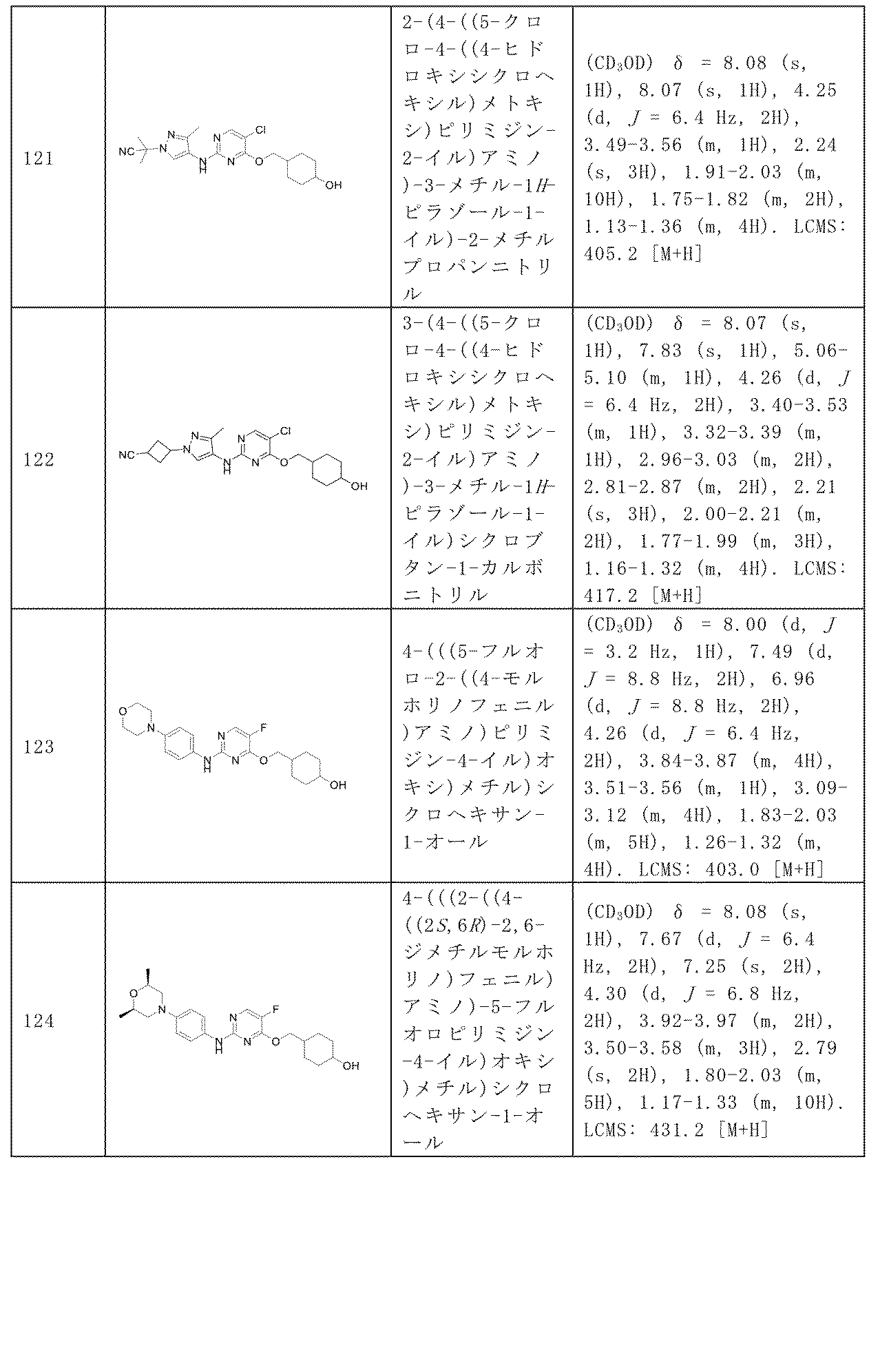


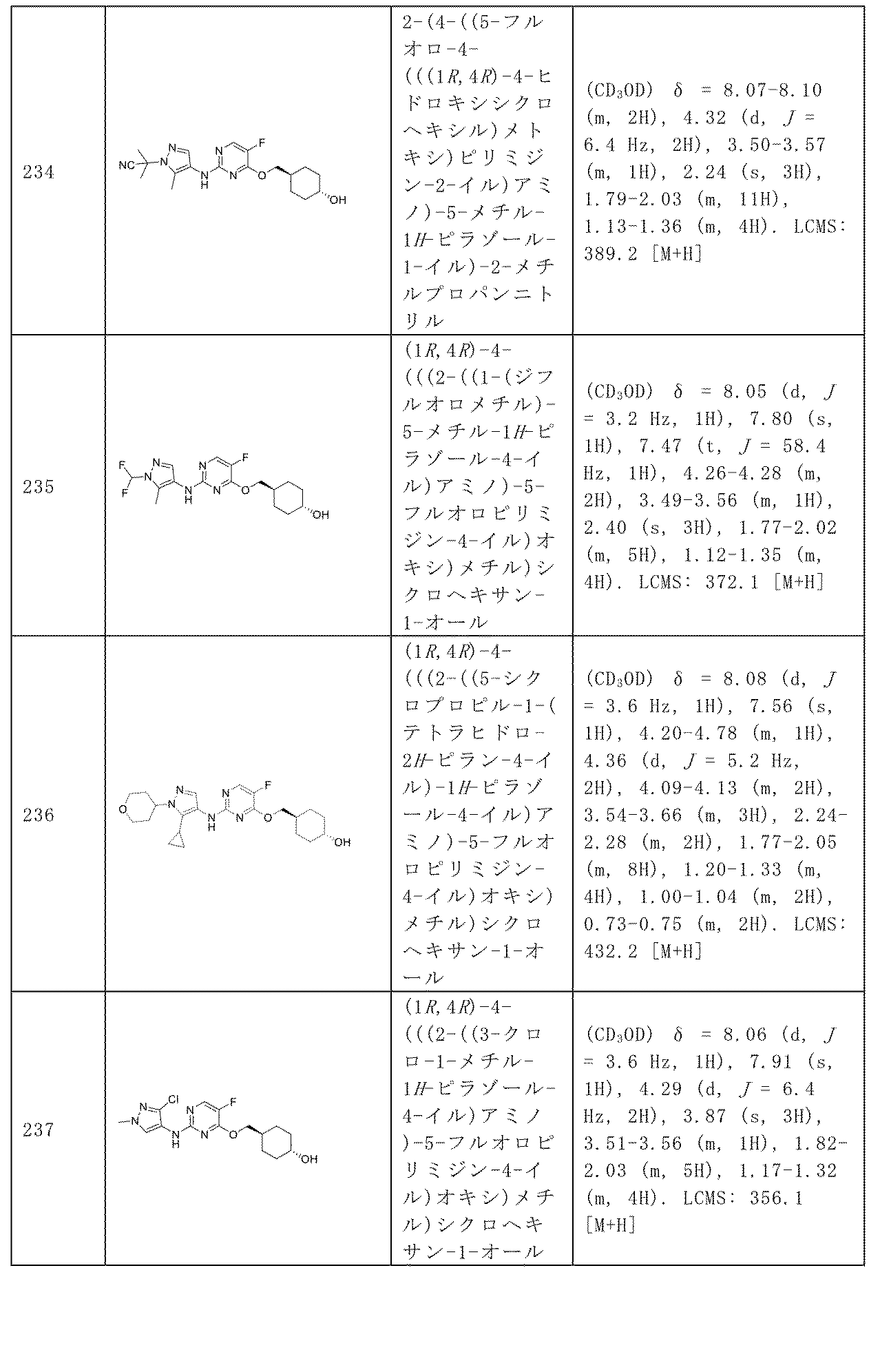


実施例265~267を合成するための一般的合成スキーム11:
工程1:中間体Xの合成:
中間体Xを、上記一般的手順GP2に従って合成した。
Step 1: Synthesis of intermediate X:
Intermediate X was synthesized according to general procedure GP2 above.
工程2:中間体Yの合成:
Cs2CO3(3.0eq)を、中間体X(1.0eq)およびトリメチルボロキシン(THF中50%、2.0eq)のTHF中撹拌溶液に加えて、得られた混合物にN2を10分間パージした。その後、Pd(dppf)Cl2・DCM(0.1eq)を加えて、得られた混合物を、70℃にて7時間密閉チューブ中で撹拌した。反応完了後(TLCにより示される)、反応混合物をセライト(登録商標)(すなわち珪藻土)のパッドによりろ過し、その後、これをTHFですすいだ。合わせたろ液を、減圧下で濃縮して、粗物質を得て、これをフラッシュクロマトグラフィーにより精製して、所望の中間体Yを得た。
Step 2: Synthesis of intermediate Y:
Add Cs2CO3 ( 3.0eq ) to a stirred solution of Intermediate X (1.0eq) and trimethylboroxine (50% in THF, 2.0eq) in THF and purge the resulting mixture with N2 for 10 min. did. Then, Pd(dppf)Cl 2 .DCM (0.1 eq) was added and the resulting mixture was stirred at 70° C. for 7 hours in a sealed tube. After the reaction was complete (as indicated by TLC), the reaction mixture was filtered through a pad of Celite® (ie, diatomaceous earth), which was then rinsed with THF. The combined filtrates were concentrated under reduced pressure to give the crude material, which was purified by flash chromatography to yield the desired intermediate Y.
工程1:実施例265~267の合成:
実施例265~267を、上記一般的手順GP7に従って合成した;粗物質を、分取HPLCにより精製した。
Step 1: Synthesis of Examples 265-267:
Examples 265-267 were synthesized according to the general procedure GP7 above; the crude material was purified by preparative HPLC.
一般的合成スキーム11に従って以下の実施例を合成した:

実施例145~146を合成するための一般的合成スキーム12:
工程1:4-(((2,5-ジクロロピリミジン-4-イル)オキシ)メチル)-N-(3,3-ジフルオロシクロブチル)シクロヘキサン-1-アミンの合成:
チタン(IV)イソプロポキシド(TTIP、0.639mL、2.181mmol)を、4-(((2,5-ジクロロピリミジン-4-イル)オキシ)メチル)シクロヘキサン-1-オン(中間体T、0.150g、0.545mmol)および3,3-ジフルオロシクロブタン-1-アミン(0.070g、0.654mmol)のTHF(10mL)とDCM(3mL)とDMF(1mL)との混合物中懸濁液に加えて、得られた混合物を、25℃にて16時間撹拌し、55℃にて16時間加熱した。その後、反応混合物を0℃に冷却し、シアノ水素化ホウ素ナトリウム(0.051g、0.818mmol)を、0℃にて加えて、反応混合物を25℃にてさらに16時間撹拌した。反応完了後(TLCにより示される)、反応混合物をセライト(登録商標)(すなわち珪藻土)のパッドによりろ過し、その後、これをEtOAc(15mL)で洗浄した。合わせたろ液を、減圧下で濃縮して、残渣を得て、これをDCM(20mL)中に溶解させ、水(5mL)および食塩水(5mL)で洗浄し、Na2SO4で乾燥し、ろ過し、減圧下で濃縮して、粗物質を得て、これをさらに精製することなく用いた。LCMS:365.9 [M+H]。
Step 1: Synthesis of 4-(((2,5-dichloropyrimidin-4-yl)oxy)methyl)-N-(3,3-difluorocyclobutyl)cyclohexan-1-amine:
Titanium(IV) isopropoxide (TTIP, 0.639 mL, 2.181 mmol) was added to 4-(((2,5-dichloropyrimidin-4-yl)oxy)methyl)cyclohexan-1-one (Intermediate T, 0.150 g , 0.545 mmol) and 3,3-difluorocyclobutan-1-amine (0.070 g, 0.654 mmol) in a mixture of THF (10 mL), DCM (3 mL) and DMF (1 mL) to obtain the The mixture was stirred at 25°C for 16 hours and heated at 55°C for 16 hours. The reaction mixture was then cooled to 0°C, sodium cyanoborohydride (0.051 g, 0.818 mmol) was added at 0°C, and the reaction mixture was stirred at 25°C for an additional 16 hours. After the reaction was complete (as indicated by TLC), the reaction mixture was filtered through a pad of Celite® (ie, diatomaceous earth), which was then washed with EtOAc (15 mL). The combined filtrates were concentrated under reduced pressure to give a residue, which was dissolved in DCM (20 mL), washed with water (5 mL) and brine (5 mL), dried over Na 2 SO 4 and Filtration and concentration under reduced pressure afforded the crude material, which was used without further purification. LCMS: 365.9 [M+H].
工程2:実施例145~146の合成
実施例145~146を、上記一般的手順GP2に従って合成した。粗物質を、分取HPLCにより精製した。
Step 2: Synthesis of Examples 145-146 Examples 145-146 were synthesized according to the general procedure GP2 above. The crude material was purified by preparative HPLC.
一般的合成スキーム12に従って以下の実施例を合成した:

実施例147~162を合成するための一般的合成スキーム13
工程1:中間体Zの合成:
中間体Zを、上記一般的手順GP1に従って合成した。
Step 1: Synthesis of intermediate Z:
Intermediate Z was synthesized according to the general procedure GP1 above.
工程2:実施例147~162および268~291の合成:
実施例147~162および268~291を、上記一般的手順GP2に従って合成した。粗物質を、分取HPLCにより精製した。
Step 2: Synthesis of Examples 147-162 and 268-291:
Examples 147-162 and 268-291 were synthesized according to general procedure GP2 above. The crude material was purified by preparative HPLC.
一般的合成スキーム13に従って以下の実施例を合成した:
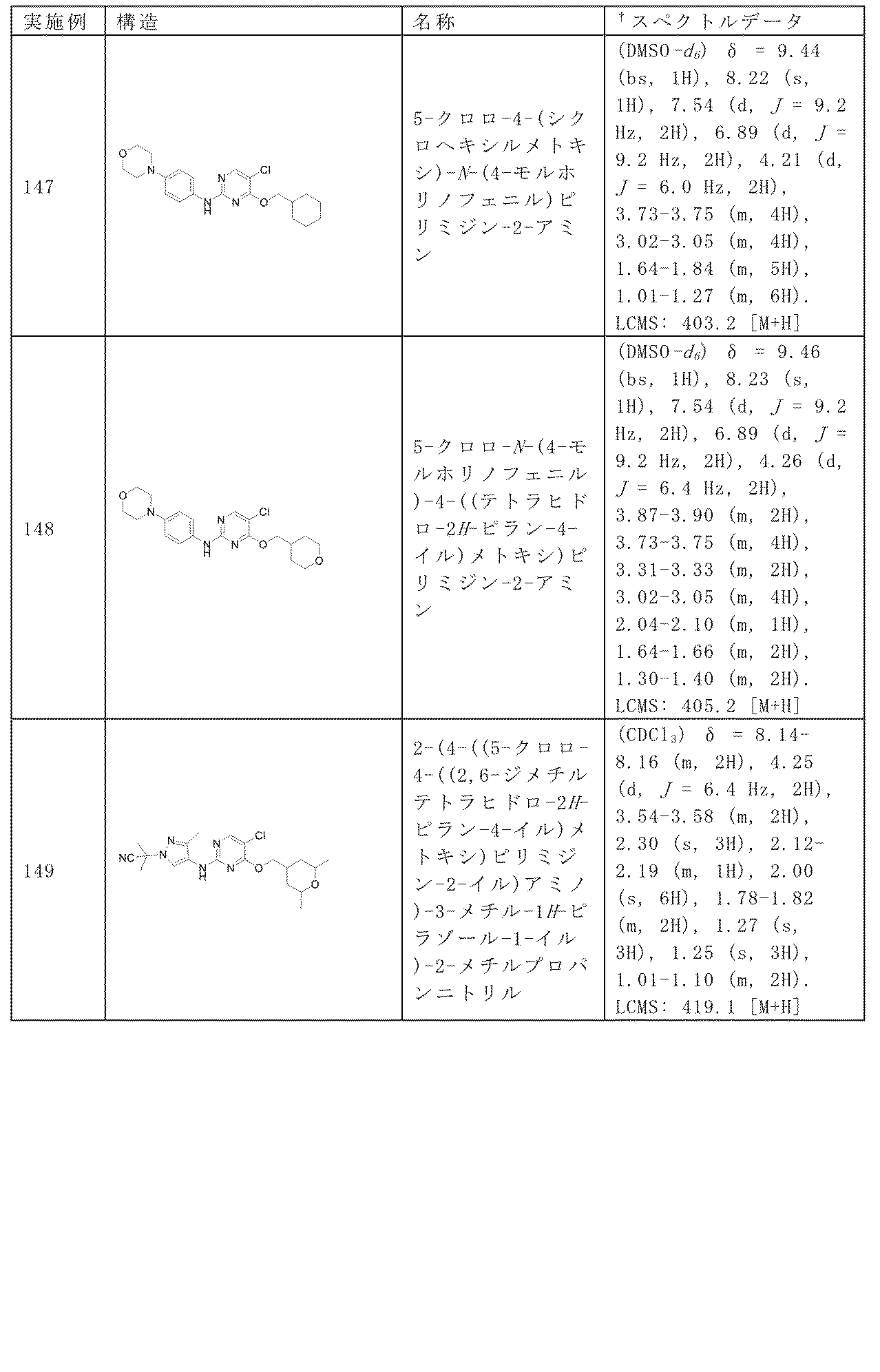


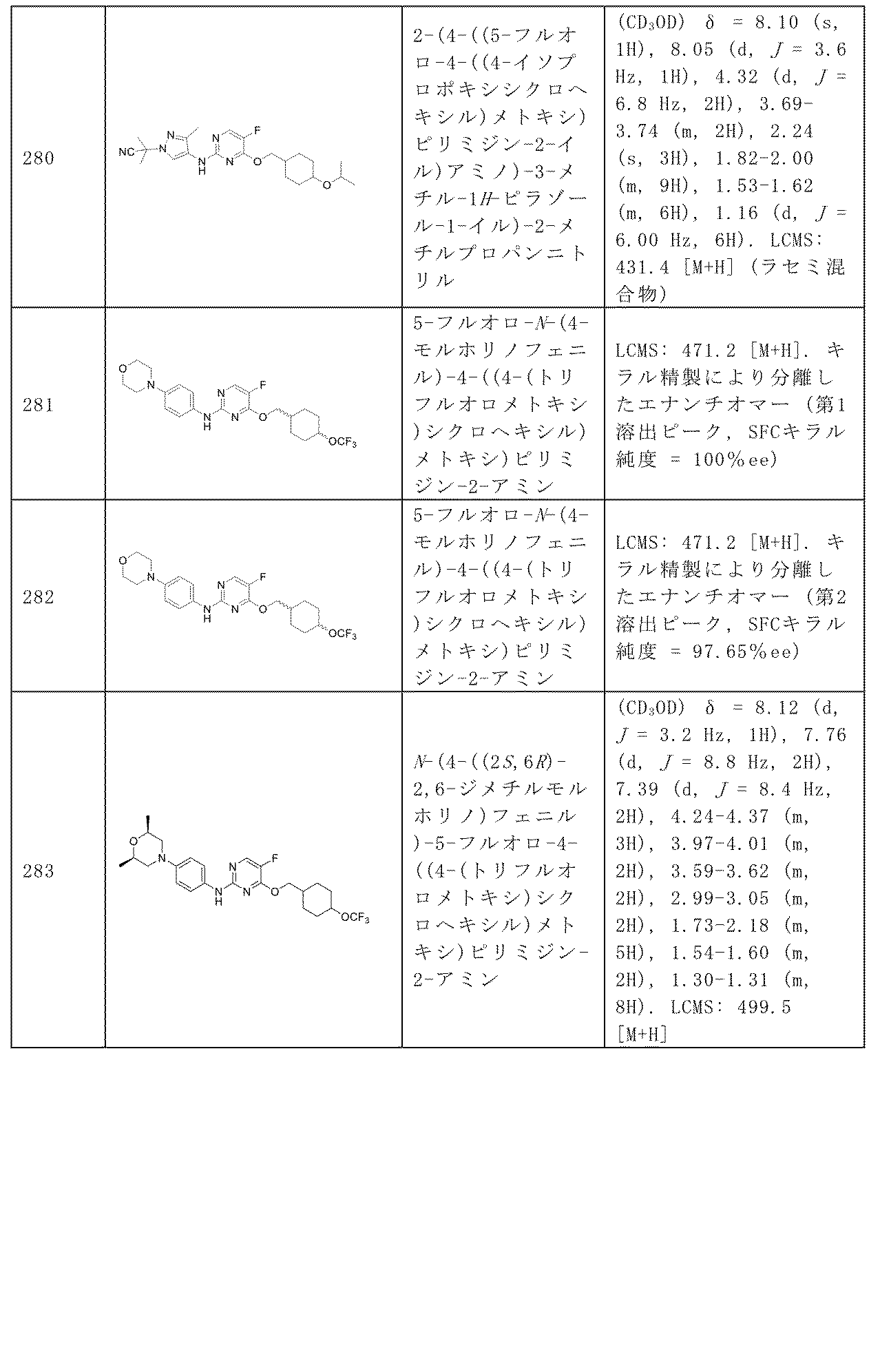


(酵素アッセイ)
LRRK2酵素アッセイ
LRRKtide基質(ペプチド配列RLGRDKYKTLRQIRQ、ヒトエズリン[アミノ酸561-573]、モエシン[アミノ酸539-553]、およびラディキシン[アミノ酸558-570]由来、Signal Chemから入手、カタログ番号L10-58、pH7.5の20mM Tris-HCl中で再構成して最終濃度1mg/mLにする、アッセイ濃度20μM)および組換えヒトLRRK2(触媒ドメインのみ[アミノ酸970-2527]、GSTタグ付き、昆虫細胞で発現、Thermo Fisher Scientificから入手、カタログ番号PV4874、0.35mg/mL、アッセイ濃度30nM)を、アッセイ緩衝液(20mM Hepes pH7.5、10mM MgCl2、1mM EGTA、0.02%Brij35、0.02mg/ml BSA、0.1mM Na3VO4、2mM DTT、1%DMSO)中で混合した。目的の化合物(DMSO中、10μMから0.5nMまで連続3倍希釈)または対照(1%DMSO)を、Acoustic technology(Echo550;ナノリットル範囲)によってキナーゼ反応混合物に分注した。室温で20分間インキュベートした後、キナーゼ反応を[32P]-ATP(比活性10μCi/μl)の添加よって開始し、混合物を室温で2時間インキュベートした。その後、反応混合物をホスホセルロースP81紙のストリップ上にスポットすることによって、反応を停止させた。洗浄後、P81紙の放射能を測定し、キナーゼ活性データを、ビヒクル(ジメチルスルホキシド)反応物と比較した試験試料中の残存キナーゼ活性のパーセントとして表した。IC50値および曲線適合は、Prism(GraphPad Software)を用いて得た。
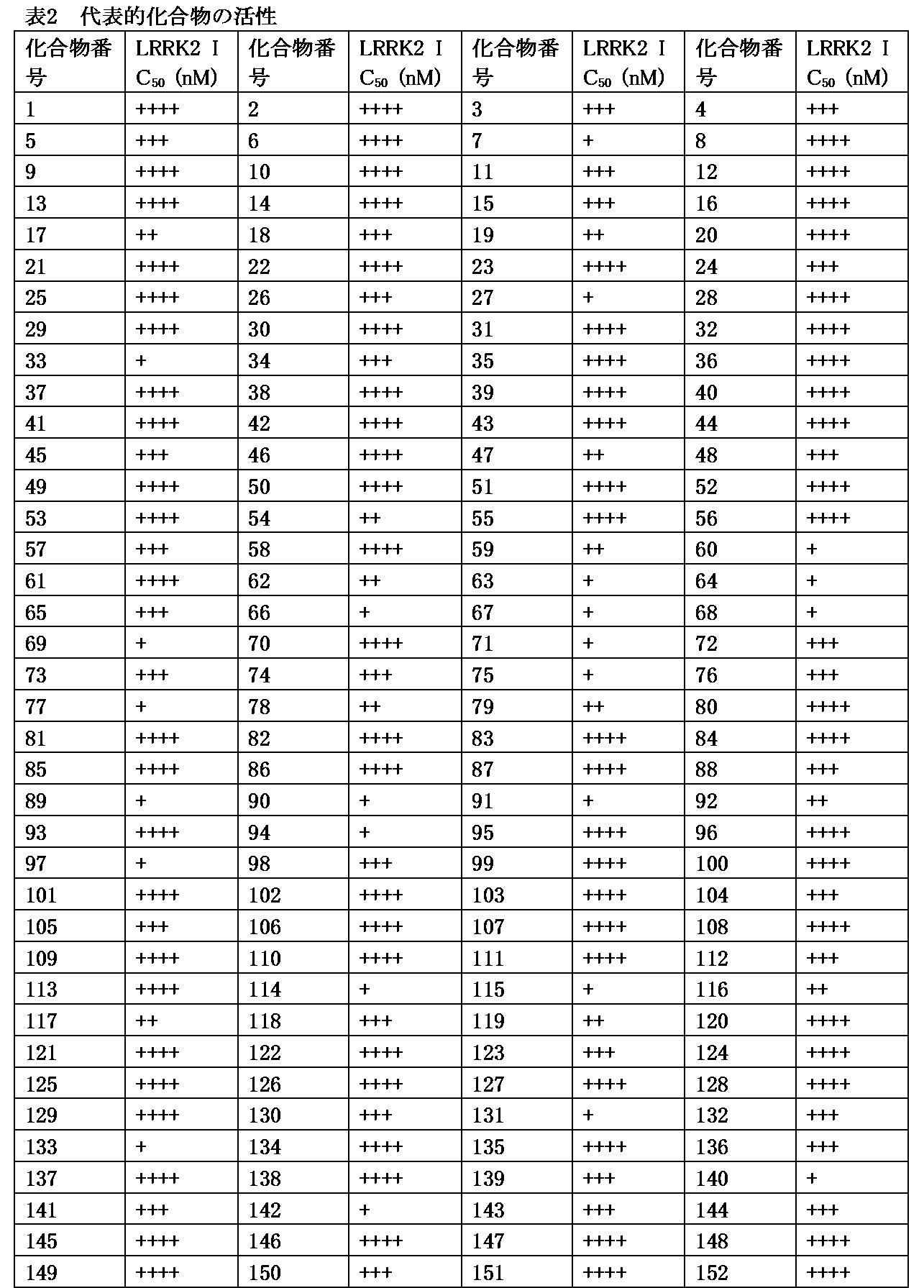

LRRK2 enzyme assay
LRRKtide substrate (peptide sequence RLGRDKYKTLRQIRQ, derived from human ezrin [amino acids 561-573], moesin [amino acids 539-553], and radixin [amino acids 558-570], obtained from Signal Chem, catalog number L10-58, 20mM Tris at pH 7.5) -reconstituted in HCl to a final concentration of 1 mg/mL, assay concentration 20 μM) and recombinant human LRRK2 (catalytic domain only [amino acids 970-2527], GST-tagged, expressed in insect cells, obtained from Thermo Fisher Scientific) , catalog number PV4874, 0.35 mg/mL, assay concentration 30 nM), assay buffer (20 mM Hepes pH7.5, 10 mM MgCl 2 , 1 mM EGTA, 0.02% Brij35, 0.02 mg/ml BSA, 0.1 mM Na 3 VO 4 , 2mM DTT, 1% DMSO). Compounds of interest (serial 3-fold dilutions from 10 μM to 0.5 nM in DMSO) or controls (1% DMSO) were dispensed into the kinase reaction mixture by Acoustic technology (Echo550; nanoliter range). After incubation for 20 minutes at room temperature, the kinase reaction was initiated by the addition of [ 32 P]-ATP (specific activity 10 μCi/μl) and the mixture was incubated for 2 hours at room temperature. The reaction was then stopped by spotting the reaction mixture onto a strip of phosphocellulose P81 paper. After washing, the radioactivity of the P81 paper was measured and the kinase activity data were expressed as the percentage of remaining kinase activity in the test sample compared to the vehicle (dimethyl sulfoxide) reaction. IC 50 values and curve fits were obtained using Prism (GraphPad Software).
上記の様々な実施態様を組み合わせて、更なる実施態様を提供できる。2021年3月23日出願の米国仮特許出願第63/164,804を含む本明細書で参照するおよび/または出願データシートに記載されている、米国特許、米国特許出願公開、米国特許出願、外国特許、外国特許出願および非特許出版物のすべてを、出典明示によりその全体として本明細書の一部とする。実施態様の態様を、必要に応じて変更して、様々な特許、出願および出版物の概念を用いて、更なる実施態様を提供し得る。 The various embodiments described above can be combined to provide further embodiments. U.S. patents, U.S. patent application publications, U.S. patent applications, and foreign patents referenced herein and/or described in application data sheets, including U.S. Provisional Patent Application No. 63/164,804 filed March 23, 2021 , foreign patent applications and non-patent publications, all of which are hereby incorporated by reference in their entirety. Aspects of the embodiments may be modified as necessary to provide further embodiments using concepts from various patents, applications, and publications.
上記の詳細な説明を考慮して、実施態様に対してこれらおよび他の変更を行うことができる。一般に、以下の特許請求の範囲において、使用される用語は、特許請求の範囲を明細書および特許請求の範囲に開示された特定の実施態様に限定するものと解釈されるべきではなく、すべての可能な実施態様を、そのような特許請求の範囲が権利を有するその均等物の全範囲と共に含むものと解釈されるべきである。したがって、特許請求の範囲は、本開示によって限定されるものではない。 These and other changes can be made to the implementations in light of the above detailed description. In general, in the following claims, the terms used should not be construed as limiting the scope of the claims to the particular embodiments disclosed in the specification and claims, but rather all It is intended that such claims be interpreted to include possible embodiments, along with the full scope of equivalents to which such claims are entitled. Accordingly, the scope of the claims should not be limited by this disclosure.
Claims (55)
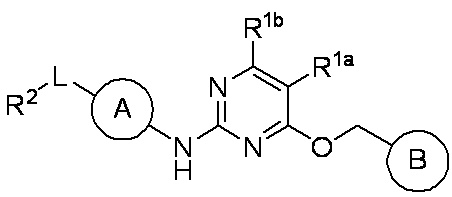
[式中、
Aは、フェニレンまたは5または6員のヘテロアリーレンであり、それぞれは、ハロ、C1-C6アルキル、C3-C8シクロアルキルおよびC1-C6アルコキシより選択される、1つ以上の置換基で置換されていてもよく;
Bは、C3-C8単環式シクロアルキル、C6-C10スピロ環式シクロアルキル、C6-C10縮合多環式シクロアルキル、C6-C10架橋多環式シクロアルキル、3~8員の単環式ヘテロシクリル、3~8員の単環式ヘテロシクリルアルキル、6~10員のスピロ環式ヘテロシクリル、6~10員の縮合多環式ヘテロシクリルまたは6~10員の架橋多環式ヘテロシクリルであり、それぞれは、アミノ、ハロ、ヒドロキシル、オキソ、シアノ、C1-C6アルキル、C1-C6ハロアルキル、C1-C6ヒドロキシルアルキル、C1-C6アミノアルキル、C1-C6アルキルアミニルアルキル、C1-C6アルコキシ;C1-C6ハロアルコキシ、C1-C6アルキルカルボニル、C1-C6ハロアルキルカルボニル、C1-C6アルキルアミニル、C1-C6ハロアルキルアミニル、C1-C6アルキルカルボニルアミニル、C1-C6ハロアルキルカルボニルアミニル、C3-C8シクロアルキル、C3-C8シクロアルキルカルボニル、C3-C8ハロシクロアルキルアミニルおよびC3-C8シクロアルキルカルボニルアミニルより選択される、1つ以上の置換基で置換されていてもよく;
Lは、直接結合、CH2またはC=Oであり;
R1aおよびR1bは、各々独立して、H、ハロ、シアノ、C1-C6アルキル、C1-C6ハロアルキル、C1-C6アルコキシまたはC3-C8シクロアルキルであり;そして
R2は、C1-C6アルキル、C3-C8シクロアルキル、3~8員のヘテロシクリル、6~10員のスピロ環式ヘテロシクリル、6~10員の縮合多環式ヘテロシクリルまたは6~10員の架橋多環式ヘテロシクリルであり、それぞれは、ハロ、シアノ、C1-C6アルキル、ヒドロキシル、アルコキシおよびC1-C6ハロアルキルより選択される、1つ以上の置換基で置換されていてもよい]
を有する化合物、またはその医薬的に許容される塩、立体異性体もしくはプロドラッグ。 Structure (I) below:
[In the formula,
A is phenylene or 5- or 6-membered heteroarylene, each containing one or more members selected from halo, C1 - C6 alkyl, C3 - C8 cycloalkyl and C1 - C6 alkoxy. Optionally substituted with a substituent;
B is C3 - C8 monocyclic cycloalkyl, C6 - C10 spirocyclic cycloalkyl, C6 - C10 fused polycyclic cycloalkyl, C6 - C10 bridged polycyclic cycloalkyl, 3 ~8-membered monocyclic heterocyclyl, 3- to 8-membered monocyclic heterocyclylalkyl, 6- to 10-membered spirocyclic heterocyclyl, 6- to 10-membered fused polycyclic heterocyclyl, or 6- to 10-membered bridged polycyclic Heterocyclyl, each of which is amino, halo, hydroxyl, oxo, cyano, C1 - C6 alkyl, C1 - C6 haloalkyl, C1 - C6 hydroxylalkyl, C1 - C6 aminoalkyl, C1- C6alkylaminylalkyl , C1 - C6alkoxy ; C1 - C6haloalkoxy , C1 - C6alkylcarbonyl, C1 - C6haloalkylcarbonyl , C1 - C6alkylaminyl , C1- C6 haloalkylaminyl, C1 - C6 alkylcarbonylaminyl, C1 - C6 haloalkylcarbonylaminyl, C3 - C8 cycloalkyl , C3 - C8 cycloalkylcarbonyl, C3 - C8 halocyclo optionally substituted with one or more substituents selected from alkylaminyl and C3 - C8 cycloalkylcarbonylaminyl;
L is a direct bond, CH 2 or C=O;
R 1a and R 1b are each independently H, halo, cyano, C 1 -C 6 alkyl, C 1 -C 6 haloalkyl, C 1 -C 6 alkoxy or C 3 -C 8 cycloalkyl; and
R 2 is C 1 -C 6 alkyl, C 3 -C 8 cycloalkyl, 3-8 membered heterocyclyl, 6-10 member spirocyclic heterocyclyl, 6-10 member fused polycyclic heterocyclyl, or 6-10 member a bridged polycyclic heterocyclyl member, each substituted with one or more substituents selected from halo, cyano, C 1 -C 6 alkyl, hydroxyl, alkoxy and C 1 -C 6 haloalkyl. Moyoi]
or a pharmaceutically acceptable salt, stereoisomer or prodrug thereof.

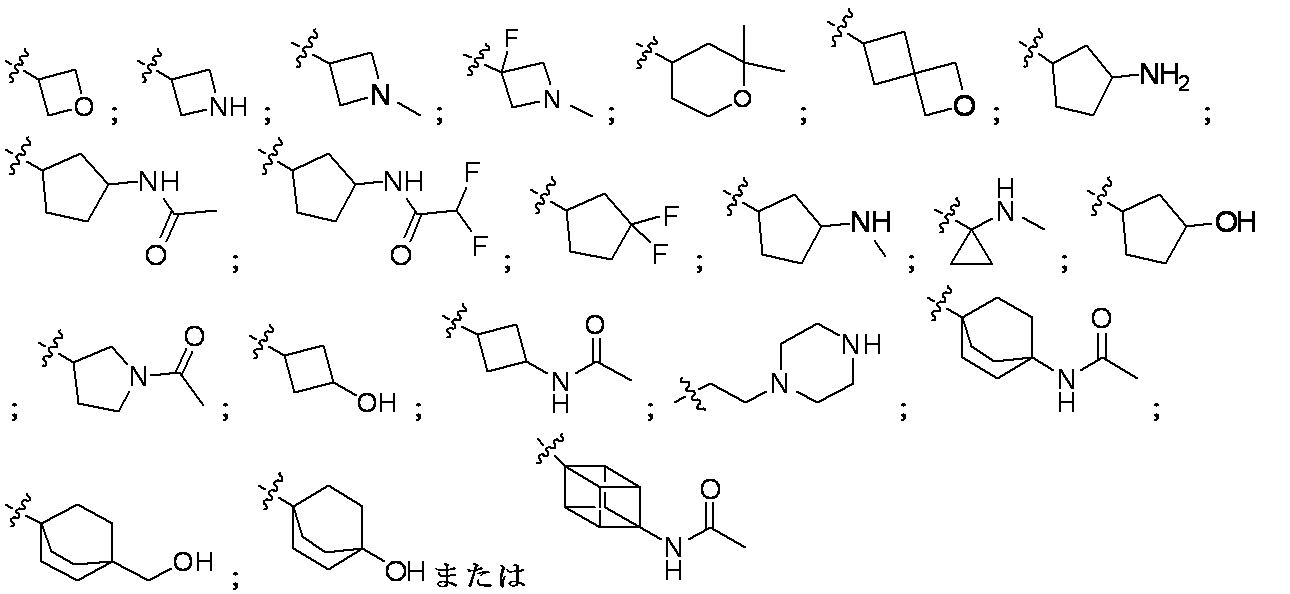


Applications Claiming Priority (3)
| Application Number | Priority Date | Filing Date | Title |
|---|---|---|---|
| US202163164804P | 2021-03-23 | 2021-03-23 | |
| US63/164,804 | 2021-03-23 | ||
| PCT/US2022/021573 WO2022204299A1 (en) | 2021-03-23 | 2022-03-23 | Pyrimidine derivatives useful as lrrk2 kinase inhibitors |
Publications (2)
| Publication Number | Publication Date |
|---|---|
| JP2024512024A true JP2024512024A (en) | 2024-03-18 |
| JPWO2022204299A5 JPWO2022204299A5 (en) | 2025-03-18 |
Family
ID=81328290
Family Applications (1)
| Application Number | Title | Priority Date | Filing Date |
|---|---|---|---|
| JP2023558377A Pending JP2024512024A (en) | 2021-03-23 | 2022-03-23 | Pyrimidine derivatives useful as LRRK2 kinase inhibitors |
Country Status (12)
| Country | Link |
|---|---|
| US (3) | US11578061B2 (en) |
| EP (1) | EP4313955A1 (en) |
| JP (1) | JP2024512024A (en) |
| KR (1) | KR20230170684A (en) |
| CN (1) | CN117355507A (en) |
| AU (1) | AU2022246081A1 (en) |
| BR (1) | BR112023019388A2 (en) |
| CA (1) | CA3214360A1 (en) |
| CO (1) | CO2023012903A2 (en) |
| IL (1) | IL306008A (en) |
| MX (1) | MX2023011027A (en) |
| WO (1) | WO2022204299A1 (en) |
Families Citing this family (1)
| Publication number | Priority date | Publication date | Assignee | Title |
|---|---|---|---|---|
| JP2024512024A (en) * | 2021-03-23 | 2024-03-18 | ハリア・セラピューティクス・インコーポレイテッド | Pyrimidine derivatives useful as LRRK2 kinase inhibitors |
Citations (2)
| Publication number | Priority date | Publication date | Assignee | Title |
|---|---|---|---|---|
| JP2013545741A (en) * | 2010-11-10 | 2013-12-26 | エフ.ホフマン−ラ ロシュ アーゲー | Pyrazole aminopyrimidine derivatives as LRRK2 modulators |
| JP2015501810A (en) * | 2011-11-29 | 2015-01-19 | エフ.ホフマン−ラ ロシュ アーゲーF. Hoffmann−La Roche Aktiengesellschaft | 2-Phenylaminopyrimidine derivatives as kinase LRRK2 modulators for the treatment of Parkinson's disease |
Family Cites Families (14)
| Publication number | Priority date | Publication date | Assignee | Title |
|---|---|---|---|---|
| GB0619343D0 (en) | 2006-09-30 | 2006-11-08 | Vernalis R&D Ltd | New chemical compounds |
| TW201024281A (en) | 2008-11-24 | 2010-07-01 | Boehringer Ingelheim Int | New compounds |
| EP2512246B1 (en) | 2009-12-17 | 2015-09-30 | Merck Sharp & Dohme Corp. | Aminopyrimidines as syk inhibitors |
| US8759366B2 (en) | 2009-12-17 | 2014-06-24 | Merck Sharp & Dohme Corp. | Aminopyrimidines as SYK inhibitors |
| HUE029196T2 (en) | 2010-06-04 | 2017-02-28 | Hoffmann La Roche | Aminopyrimidine derivatives as lrrk2 modulators |
| WO2017156493A1 (en) * | 2016-03-11 | 2017-09-14 | Denali Therapeutics Inc. | Compounds, compositions, and methods |
| NO3004079T3 (en) | 2013-06-04 | 2018-06-16 | ||
| ES2717757T3 (en) | 2014-01-29 | 2019-06-25 | Glaxosmithkline Ip Dev Ltd | Compounds |
| WO2015158233A1 (en) | 2014-04-14 | 2015-10-22 | 上海海雁医药科技有限公司 | 2,3,4,6-tetra-substituted benzene-1,5-diamine derivatives, preparation method therefor and medicinal use thereof |
| US11214565B2 (en) * | 2015-11-20 | 2022-01-04 | Denali Therapeutics Inc. | Compound, compositions, and methods |
| US11174248B2 (en) | 2017-10-11 | 2021-11-16 | Merck Sharp & Dohme Corp. | Indazolyl-spiro[2.3]hexane-carbonitrile derivatives as LRRK2 inhibitors, pharmaceutical compositions, and uses thereof |
| ES2936517T3 (en) | 2017-12-19 | 2023-03-17 | Bristol Myers Squibb Co | Triazole azines of cyclohexylic acid as LPA antagonists |
| CN110872277B (en) | 2019-11-14 | 2021-06-04 | 浙江大学 | N-substituted aromatic ring-2-aminopyrimidine compounds and application thereof |
| JP2024512024A (en) * | 2021-03-23 | 2024-03-18 | ハリア・セラピューティクス・インコーポレイテッド | Pyrimidine derivatives useful as LRRK2 kinase inhibitors |
-
2022
- 2022-03-23 JP JP2023558377A patent/JP2024512024A/en active Pending
- 2022-03-23 EP EP22715927.4A patent/EP4313955A1/en active Pending
- 2022-03-23 US US17/702,600 patent/US11578061B2/en active Active
- 2022-03-23 BR BR112023019388A patent/BR112023019388A2/en unknown
- 2022-03-23 WO PCT/US2022/021573 patent/WO2022204299A1/en not_active Ceased
- 2022-03-23 MX MX2023011027A patent/MX2023011027A/en unknown
- 2022-03-23 CA CA3214360A patent/CA3214360A1/en active Pending
- 2022-03-23 CN CN202280036432.0A patent/CN117355507A/en active Pending
- 2022-03-23 AU AU2022246081A patent/AU2022246081A1/en active Pending
- 2022-03-23 IL IL306008A patent/IL306008A/en unknown
- 2022-03-23 KR KR1020237035536A patent/KR20230170684A/en active Pending
- 2022-12-13 US US18/065,259 patent/US11866423B2/en active Active
-
2023
- 2023-09-28 CO CONC2023/0012903A patent/CO2023012903A2/en unknown
- 2023-11-20 US US18/514,959 patent/US12428404B2/en active Active
Patent Citations (2)
| Publication number | Priority date | Publication date | Assignee | Title |
|---|---|---|---|---|
| JP2013545741A (en) * | 2010-11-10 | 2013-12-26 | エフ.ホフマン−ラ ロシュ アーゲー | Pyrazole aminopyrimidine derivatives as LRRK2 modulators |
| JP2015501810A (en) * | 2011-11-29 | 2015-01-19 | エフ.ホフマン−ラ ロシュ アーゲーF. Hoffmann−La Roche Aktiengesellschaft | 2-Phenylaminopyrimidine derivatives as kinase LRRK2 modulators for the treatment of Parkinson's disease |
Also Published As
| Publication number | Publication date |
|---|---|
| US20220324845A1 (en) | 2022-10-13 |
| BR112023019388A2 (en) | 2023-11-07 |
| MX2023011027A (en) | 2023-09-27 |
| US11578061B2 (en) | 2023-02-14 |
| CN117355507A (en) | 2024-01-05 |
| US20240190848A1 (en) | 2024-06-13 |
| US20230183217A1 (en) | 2023-06-15 |
| KR20230170684A (en) | 2023-12-19 |
| CO2023012903A2 (en) | 2023-10-09 |
| US11866423B2 (en) | 2024-01-09 |
| IL306008A (en) | 2023-11-01 |
| US12428404B2 (en) | 2025-09-30 |
| CA3214360A1 (en) | 2022-09-29 |
| WO2022204299A1 (en) | 2022-09-29 |
| EP4313955A1 (en) | 2024-02-07 |
| AU2022246081A1 (en) | 2023-10-12 |
Similar Documents
| Publication | Publication Date | Title |
|---|---|---|
| JP6849711B2 (en) | KRAS G12C covalent inhibitor | |
| JP7631434B2 (en) | Ligand for cereblon (CRBN) | |
| CN110177788B (en) | Compounds as BCL-2 selective apoptosis inducers | |
| CA3105748A1 (en) | Pyridazine compounds for inhibiting nav1.8 | |
| KR20090101905A (en) | Indol-4-yl-pyrimidinyl-2-yl-amine derivatives and use thereof as cyclin dependant kinase inhibitors | |
| KR20090091306A (en) | Heteroaryl-heteroaryl Compounds as CDX Inhibitors for the Treatment of Cancer, Inflammation and Viral Infections | |
| HK1217484A1 (en) | Substituted5-(3,5-dimethylisoxazol-4-yl)indoline-2-ones | |
| WO2008109154A1 (en) | Chemokine receptor modulators | |
| CN120699028A (en) | Inhibitors of NEK7 kinase | |
| JP6713000B2 (en) | Compounds with antitumor activity | |
| JP2023533616A (en) | Pyridine-1,5-diones exhibiting MNK inhibition and methods of their use | |
| JP6100755B2 (en) | (2-Heteroarylamino) succinic acid derivatives | |
| JP2024512024A (en) | Pyrimidine derivatives useful as LRRK2 kinase inhibitors | |
| US20240400551A1 (en) | Nek7 inhibitors | |
| EP4598907A1 (en) | Phenyl oxy amide kinase inhibitors | |
| US20250177382A1 (en) | Nek7 inhibitors | |
| JP7186874B2 (en) | Pyrazolyl compound and method of use thereof | |
| JP2024516194A (en) | Compounds as PD1/PD-L1 inhibitors and methods thereof | |
| CN107635996A (en) | imidazodiazepine* compounds | |
| US20250312335A1 (en) | Flt combination therapy for cancer and compositions therefor | |
| TW202523670A (en) | Pde 7 modulator compounds | |
| JP2023553417A (en) | Imidazole compounds as ENPP1 inhibitors | |
| JP2025503030A (en) | CDK9 inhibitors | |
| CN103319456A (en) | Dihydropyridine compounds, and compositions, preparation methods and applications thereof |
Legal Events
| Date | Code | Title | Description |
|---|---|---|---|
| A521 | Request for written amendment filed |
Free format text: JAPANESE INTERMEDIATE CODE: A523 Effective date: 20250310 |
|
| A621 | Written request for application examination |
Free format text: JAPANESE INTERMEDIATE CODE: A621 Effective date: 20250310 |
|
| A131 | Notification of reasons for refusal |
Free format text: JAPANESE INTERMEDIATE CODE: A131 Effective date: 20251223 |
|
| A977 | Report on retrieval |
Free format text: JAPANESE INTERMEDIATE CODE: A971007 Effective date: 20251218 |