JP2024509664A - Medication for treatment with anti-CD20/anti-CD3 bispecific antibodies - Google Patents
Medication for treatment with anti-CD20/anti-CD3 bispecific antibodies Download PDFInfo
- Publication number
- JP2024509664A JP2024509664A JP2023541607A JP2023541607A JP2024509664A JP 2024509664 A JP2024509664 A JP 2024509664A JP 2023541607 A JP2023541607 A JP 2023541607A JP 2023541607 A JP2023541607 A JP 2023541607A JP 2024509664 A JP2024509664 A JP 2024509664A
- Authority
- JP
- Japan
- Prior art keywords
- bispecific antibody
- dose
- dosing
- antibody
- dosing cycle
- Prior art date
- Legal status (The legal status is an assumption and is not a legal conclusion. Google has not performed a legal analysis and makes no representation as to the accuracy of the status listed.)
- Granted
Links
Images


Classifications
-
- C—CHEMISTRY; METALLURGY
- C07—ORGANIC CHEMISTRY
- C07K—PEPTIDES
- C07K16/00—Immunoglobulins [IGs], e.g. monoclonal or polyclonal antibodies
- C07K16/18—Immunoglobulins [IGs], e.g. monoclonal or polyclonal antibodies against material from animals or humans
- C07K16/28—Immunoglobulins [IGs], e.g. monoclonal or polyclonal antibodies against material from animals or humans against receptors, cell surface antigens or cell surface determinants
- C07K16/2887—Immunoglobulins [IGs], e.g. monoclonal or polyclonal antibodies against material from animals or humans against receptors, cell surface antigens or cell surface determinants against CD20
-
- A—HUMAN NECESSITIES
- A61—MEDICAL OR VETERINARY SCIENCE; HYGIENE
- A61K—PREPARATIONS FOR MEDICAL, DENTAL OR TOILETRY PURPOSES
- A61K38/00—Medicinal preparations containing peptides
- A61K38/16—Peptides having more than 20 amino acids; Gastrins; Somatostatins; Melanotropins; Derivatives thereof
- A61K38/17—Peptides having more than 20 amino acids; Gastrins; Somatostatins; Melanotropins; Derivatives thereof from animals; from humans
- A61K38/177—Receptors; Cell surface antigens; Cell surface determinants
- A61K38/1774—Immunoglobulin superfamily (e.g. CD2, CD4, CD8, ICAM molecules, B7 molecules, Fc-receptors, MHC-molecules)
-
- A—HUMAN NECESSITIES
- A61—MEDICAL OR VETERINARY SCIENCE; HYGIENE
- A61K—PREPARATIONS FOR MEDICAL, DENTAL OR TOILETRY PURPOSES
- A61K31/00—Medicinal preparations containing organic active ingredients
- A61K31/33—Heterocyclic compounds
- A61K31/395—Heterocyclic compounds having nitrogen as a ring hetero atom, e.g. guanethidine or rifamycins
- A61K31/435—Heterocyclic compounds having nitrogen as a ring hetero atom, e.g. guanethidine or rifamycins having six-membered rings with one nitrogen as the only ring hetero atom
- A61K31/47—Quinolines; Isoquinolines
- A61K31/475—Quinolines; Isoquinolines having an indole ring, e.g. yohimbine, reserpine, strychnine, vinblastine
-
- A—HUMAN NECESSITIES
- A61—MEDICAL OR VETERINARY SCIENCE; HYGIENE
- A61K—PREPARATIONS FOR MEDICAL, DENTAL OR TOILETRY PURPOSES
- A61K31/00—Medicinal preparations containing organic active ingredients
- A61K31/56—Compounds containing cyclopenta[a]hydrophenanthrene ring systems; Derivatives thereof, e.g. steroids
- A61K31/57—Compounds containing cyclopenta[a]hydrophenanthrene ring systems; Derivatives thereof, e.g. steroids substituted in position 17 beta by a chain of two carbon atoms, e.g. pregnane or progesterone
- A61K31/573—Compounds containing cyclopenta[a]hydrophenanthrene ring systems; Derivatives thereof, e.g. steroids substituted in position 17 beta by a chain of two carbon atoms, e.g. pregnane or progesterone substituted in position 21, e.g. cortisone, dexamethasone, prednisone or aldosterone
-
- A—HUMAN NECESSITIES
- A61—MEDICAL OR VETERINARY SCIENCE; HYGIENE
- A61K—PREPARATIONS FOR MEDICAL, DENTAL OR TOILETRY PURPOSES
- A61K31/00—Medicinal preparations containing organic active ingredients
- A61K31/66—Phosphorus compounds
- A61K31/664—Amides of phosphorus acids
-
- A—HUMAN NECESSITIES
- A61—MEDICAL OR VETERINARY SCIENCE; HYGIENE
- A61K—PREPARATIONS FOR MEDICAL, DENTAL OR TOILETRY PURPOSES
- A61K31/00—Medicinal preparations containing organic active ingredients
- A61K31/66—Phosphorus compounds
- A61K31/675—Phosphorus compounds having nitrogen as a ring hetero atom, e.g. pyridoxal phosphate
-
- A—HUMAN NECESSITIES
- A61—MEDICAL OR VETERINARY SCIENCE; HYGIENE
- A61K—PREPARATIONS FOR MEDICAL, DENTAL OR TOILETRY PURPOSES
- A61K31/00—Medicinal preparations containing organic active ingredients
- A61K31/70—Carbohydrates; Sugars; Derivatives thereof
- A61K31/7028—Compounds having saccharide radicals attached to non-saccharide compounds by glycosidic linkages
- A61K31/7034—Compounds having saccharide radicals attached to non-saccharide compounds by glycosidic linkages attached to a carbocyclic compound, e.g. phloridzin
- A61K31/704—Compounds having saccharide radicals attached to non-saccharide compounds by glycosidic linkages attached to a carbocyclic compound, e.g. phloridzin attached to a condensed carbocyclic ring system, e.g. sennosides, thiocolchicosides, escin, daunorubicin
-
- A—HUMAN NECESSITIES
- A61—MEDICAL OR VETERINARY SCIENCE; HYGIENE
- A61K—PREPARATIONS FOR MEDICAL, DENTAL OR TOILETRY PURPOSES
- A61K39/00—Medicinal preparations containing antigens or antibodies
- A61K39/395—Antibodies; Immunoglobulins; Immune serum, e.g. antilymphocytic serum
- A61K39/39533—Antibodies; Immunoglobulins; Immune serum, e.g. antilymphocytic serum against materials from animals
- A61K39/3955—Antibodies; Immunoglobulins; Immune serum, e.g. antilymphocytic serum against materials from animals against proteinaceous materials, e.g. enzymes, hormones, lymphokines
-
- A—HUMAN NECESSITIES
- A61—MEDICAL OR VETERINARY SCIENCE; HYGIENE
- A61K—PREPARATIONS FOR MEDICAL, DENTAL OR TOILETRY PURPOSES
- A61K39/00—Medicinal preparations containing antigens or antibodies
- A61K39/395—Antibodies; Immunoglobulins; Immune serum, e.g. antilymphocytic serum
- A61K39/39533—Antibodies; Immunoglobulins; Immune serum, e.g. antilymphocytic serum against materials from animals
- A61K39/39558—Antibodies; Immunoglobulins; Immune serum, e.g. antilymphocytic serum against materials from animals against tumor tissues, cells, antigens
-
- A—HUMAN NECESSITIES
- A61—MEDICAL OR VETERINARY SCIENCE; HYGIENE
- A61P—SPECIFIC THERAPEUTIC ACTIVITY OF CHEMICAL COMPOUNDS OR MEDICINAL PREPARATIONS
- A61P35/00—Antineoplastic agents
-
- C—CHEMISTRY; METALLURGY
- C07—ORGANIC CHEMISTRY
- C07K—PEPTIDES
- C07K16/00—Immunoglobulins [IGs], e.g. monoclonal or polyclonal antibodies
- C07K16/18—Immunoglobulins [IGs], e.g. monoclonal or polyclonal antibodies against material from animals or humans
- C07K16/28—Immunoglobulins [IGs], e.g. monoclonal or polyclonal antibodies against material from animals or humans against receptors, cell surface antigens or cell surface determinants
- C07K16/2803—Immunoglobulins [IGs], e.g. monoclonal or polyclonal antibodies against material from animals or humans against receptors, cell surface antigens or cell surface determinants against the immunoglobulin superfamily
- C07K16/2809—Immunoglobulins [IGs], e.g. monoclonal or polyclonal antibodies against material from animals or humans against receptors, cell surface antigens or cell surface determinants against the immunoglobulin superfamily against the T-cell receptor (TcR)-CD3 complex
-
- A—HUMAN NECESSITIES
- A61—MEDICAL OR VETERINARY SCIENCE; HYGIENE
- A61K—PREPARATIONS FOR MEDICAL, DENTAL OR TOILETRY PURPOSES
- A61K39/00—Medicinal preparations containing antigens or antibodies
- A61K2039/505—Medicinal preparations containing antigens or antibodies comprising antibodies
-
- A—HUMAN NECESSITIES
- A61—MEDICAL OR VETERINARY SCIENCE; HYGIENE
- A61K—PREPARATIONS FOR MEDICAL, DENTAL OR TOILETRY PURPOSES
- A61K39/00—Medicinal preparations containing antigens or antibodies
- A61K2039/505—Medicinal preparations containing antigens or antibodies comprising antibodies
- A61K2039/507—Comprising a combination of two or more separate antibodies
-
- A—HUMAN NECESSITIES
- A61—MEDICAL OR VETERINARY SCIENCE; HYGIENE
- A61K—PREPARATIONS FOR MEDICAL, DENTAL OR TOILETRY PURPOSES
- A61K39/00—Medicinal preparations containing antigens or antibodies
- A61K2039/54—Medicinal preparations containing antigens or antibodies characterised by the route of administration
-
- A—HUMAN NECESSITIES
- A61—MEDICAL OR VETERINARY SCIENCE; HYGIENE
- A61K—PREPARATIONS FOR MEDICAL, DENTAL OR TOILETRY PURPOSES
- A61K39/00—Medicinal preparations containing antigens or antibodies
- A61K2039/545—Medicinal preparations containing antigens or antibodies characterised by the dose, timing or administration schedule
-
- A—HUMAN NECESSITIES
- A61—MEDICAL OR VETERINARY SCIENCE; HYGIENE
- A61K—PREPARATIONS FOR MEDICAL, DENTAL OR TOILETRY PURPOSES
- A61K2300/00—Mixtures or combinations of active ingredients, wherein at least one active ingredient is fully defined in groups A61K31/00 - A61K41/00
-
- C—CHEMISTRY; METALLURGY
- C07—ORGANIC CHEMISTRY
- C07K—PEPTIDES
- C07K2317/00—Immunoglobulins specific features
- C07K2317/20—Immunoglobulins specific features characterized by taxonomic origin
- C07K2317/24—Immunoglobulins specific features characterized by taxonomic origin containing regions, domains or residues from different species, e.g. chimeric, humanized or veneered
-
- C—CHEMISTRY; METALLURGY
- C07—ORGANIC CHEMISTRY
- C07K—PEPTIDES
- C07K2317/00—Immunoglobulins specific features
- C07K2317/30—Immunoglobulins specific features characterized by aspects of specificity or valency
- C07K2317/31—Immunoglobulins specific features characterized by aspects of specificity or valency multispecific
-
- C—CHEMISTRY; METALLURGY
- C07—ORGANIC CHEMISTRY
- C07K—PEPTIDES
- C07K2317/00—Immunoglobulins specific features
- C07K2317/50—Immunoglobulins specific features characterized by immunoglobulin fragments
- C07K2317/52—Constant or Fc region; Isotype
-
- C—CHEMISTRY; METALLURGY
- C07—ORGANIC CHEMISTRY
- C07K—PEPTIDES
- C07K2317/00—Immunoglobulins specific features
- C07K2317/50—Immunoglobulins specific features characterized by immunoglobulin fragments
- C07K2317/52—Constant or Fc region; Isotype
- C07K2317/522—CH1 domain
-
- C—CHEMISTRY; METALLURGY
- C07—ORGANIC CHEMISTRY
- C07K—PEPTIDES
- C07K2317/00—Immunoglobulins specific features
- C07K2317/50—Immunoglobulins specific features characterized by immunoglobulin fragments
- C07K2317/55—Fab or Fab'
-
- C—CHEMISTRY; METALLURGY
- C07—ORGANIC CHEMISTRY
- C07K—PEPTIDES
- C07K2317/00—Immunoglobulins specific features
- C07K2317/50—Immunoglobulins specific features characterized by immunoglobulin fragments
- C07K2317/56—Immunoglobulins specific features characterized by immunoglobulin fragments variable (Fv) region, i.e. VH and/or VL
-
- C—CHEMISTRY; METALLURGY
- C07—ORGANIC CHEMISTRY
- C07K—PEPTIDES
- C07K2317/00—Immunoglobulins specific features
- C07K2317/60—Immunoglobulins specific features characterized by non-natural combinations of immunoglobulin fragments
- C07K2317/64—Immunoglobulins specific features characterized by non-natural combinations of immunoglobulin fragments comprising a combination of variable region and constant region components
-
- C—CHEMISTRY; METALLURGY
- C07—ORGANIC CHEMISTRY
- C07K—PEPTIDES
- C07K2319/00—Fusion polypeptide
- C07K2319/30—Non-immunoglobulin-derived peptide or protein having an immunoglobulin constant or Fc region, or a fragment thereof, attached thereto
-
- C—CHEMISTRY; METALLURGY
- C12—BIOCHEMISTRY; BEER; SPIRITS; WINE; VINEGAR; MICROBIOLOGY; ENZYMOLOGY; MUTATION OR GENETIC ENGINEERING
- C12N—MICROORGANISMS OR ENZYMES; COMPOSITIONS THEREOF; PROPAGATING, PRESERVING, OR MAINTAINING MICROORGANISMS; MUTATION OR GENETIC ENGINEERING; CULTURE MEDIA
- C12N2320/00—Applications; Uses
- C12N2320/30—Special therapeutic applications
- C12N2320/35—Special therapeutic applications based on a specific dosage / administration regimen
Landscapes
- Health & Medical Sciences (AREA)
- Chemical & Material Sciences (AREA)
- Life Sciences & Earth Sciences (AREA)
- Medicinal Chemistry (AREA)
- General Health & Medical Sciences (AREA)
- Immunology (AREA)
- Veterinary Medicine (AREA)
- Animal Behavior & Ethology (AREA)
- Public Health (AREA)
- Pharmacology & Pharmacy (AREA)
- Epidemiology (AREA)
- Organic Chemistry (AREA)
- Molecular Biology (AREA)
- Proteomics, Peptides & Aminoacids (AREA)
- Engineering & Computer Science (AREA)
- Genetics & Genomics (AREA)
- Biophysics (AREA)
- Biochemistry (AREA)
- Bioinformatics & Cheminformatics (AREA)
- Mycology (AREA)
- Microbiology (AREA)
- Nuclear Medicine, Radiotherapy & Molecular Imaging (AREA)
- Chemical Kinetics & Catalysis (AREA)
- General Chemical & Material Sciences (AREA)
- Zoology (AREA)
- Cell Biology (AREA)
- Gastroenterology & Hepatology (AREA)
- Biomedical Technology (AREA)
- Oncology (AREA)
- Endocrinology (AREA)
- Medicines Containing Antibodies Or Antigens For Use As Internal Diagnostic Agents (AREA)
- Peptides Or Proteins (AREA)
- Pharmaceuticals Containing Other Organic And Inorganic Compounds (AREA)
Abstract
本発明は、抗CD20/抗CD3二重特異性抗体を投与することにより、B細胞増殖性疾患を治療する方法、及び抗CD20/抗CD3二重特異性抗体の投与に応答した有害作用の低減のための方法に関する。本発明はさらに、B細胞増殖性疾患を治療する併用治療法に関する。【選択図】なしThe present invention provides methods for treating B cell proliferative diseases and reducing adverse effects in response to administration of anti-CD20/anti-CD3 bispecific antibodies. Regarding the method for. The invention further relates to combination therapy methods for treating B cell proliferative diseases. [Selection diagram] None
Description
配列表
本出願は、ASCIIフォーマットで電子的に提出された配列表を含み、その全内容は本明細書において参照により援用される。2021年7月22日に作成された前記ASCIIコピーは、
名称を51177-036002_Sequence_Listing_7.22.21_ST25とされ、21,026バイトのサイズを有する。
SEQUENCE LISTING This application contains a Sequence Listing submitted electronically in ASCII format, the entire contents of which are incorporated herein by reference. The ASCII copy created on July 22, 2021 is
It is named 51177-036002_Sequence_Listing_7.22.21_ST25 and has a size of 21,026 bytes.
発明の分野
本発明は、抗CD20/抗CD3二重特異性抗体を投与することにより、疾患、特にB細胞増殖性疾患を治療する方法、及び抗CD20/抗CD3二重特異性抗体の投与に応答した有害作用の低減のための方法に関する。
FIELD OF THE INVENTION The present invention relates to methods of treating diseases, particularly B cell proliferative diseases, by administering anti-CD20/anti-CD3 bispecific antibodies; The present invention relates to methods for reducing adverse effects in response.
B細胞増殖性疾患は、白血病とリンパ腫の両方を含む悪性腫瘍の異種群を表す。リンパ腫は、リンパ細胞から発生し、2つの主なカテゴリー:ホジキンリンパ腫(HL)及び非ホジキンリンパ腫(NHL)を含む。米国では、B細胞起源のリンパ腫はすべての非ホジキンリンパ腫症例の約80~85%を構成し、B細胞サブセット内には、起源のB細胞における遺伝子型及び表現型の発現パターンに基づき、大きな不均一性がある。例えば、B細胞リンパ腫のサブセットは、濾胞性リンパ腫(FL)又は慢性リンパ球性白血病(CLL)といった成長の遅い無痛性及び難治性疾患と、より侵襲性のサブタイプであるマントル細胞リンパ腫(MCL)及びびまん性大細胞型B細胞リンパ腫(DLBCL)を含む。びまん性大細胞型B細胞リンパ腫(DLBCL)は、NHLの最も一般的なタイプであり、全NHL診断のおよそ30%~40%を占め、濾胞性リンパ腫(FL;全NHL診断の20%~25%)及びマントル細胞リンパ腫(MCL;全NHL診断の6%~10%)がこれに続く。B細胞慢性リンパ性白血病(CLL)は、成人において最も一般的な白血病であり、米国では毎年およそ15,000人が新たに症例を有する(American Cancer Society 2015)。 B-cell proliferative diseases represent a heterogeneous group of malignancies, including both leukemias and lymphomas. Lymphomas arise from lymphoid cells and include two main categories: Hodgkin's lymphoma (HL) and non-Hodgkin's lymphoma (NHL). In the United States, lymphomas of B-cell origin constitute approximately 80-85% of all non-Hodgkin lymphoma cases, and there is a large disparity within B-cell subsets based on genotypic and phenotypic expression patterns in the B-cell of origin. There is uniformity. For example, subsets of B-cell lymphomas include slow-growing, indolent and refractory diseases such as follicular lymphoma (FL) or chronic lymphocytic leukemia (CLL), and a more aggressive subtype, mantle cell lymphoma (MCL). and diffuse large B-cell lymphoma (DLBCL). Diffuse large B-cell lymphoma (DLBCL) is the most common type of NHL, accounting for approximately 30% to 40% of all NHL diagnoses, and follicular lymphoma (FL; 20% to 25% of all NHL diagnoses). %) and mantle cell lymphoma (MCL; 6%-10% of all NHL diagnoses). B-cell chronic lymphocytic leukemia (CLL) is the most common leukemia in adults, with approximately 15,000 new cases each year in the United States (American Cancer Society 2015).
二重特異性抗体は、結合された細胞傷害性細胞が結合されたがん細胞を破壊する意図をもって、細胞表面抗原を、複数の細胞傷害性細胞上に(例えば、表面抗原分類3(CD3)に結合することを介して、T細胞上に)及びがん細胞上に(例えば、CD20に結合することを介して、B細胞上に)、同時に結合させることができる。グロフィタマブは、B細胞上に発現されるCD20及びT細胞上に存在するCD3イプシロン鎖(CD3ε)を標的とするT細胞二重特異性(TCB)抗体である。 Bispecific antibodies target cell surface antigens (e.g., surface antigen class 3 (CD3)) on multiple cytotoxic cells with the intent that the bound cytotoxic cells destroy the bound cancer cells. (on T cells via binding to CD20) and on cancer cells (e.g., on B cells via binding to CD20). Grofitamab is a T cell bispecific (TCB) antibody that targets CD20 expressed on B cells and CD3 epsilon chain (CD3ε) present on T cells.
しかしながら、グロフィタマブのような抗CD20/抗CD3二重特異性抗体を用いる免疫療法は、サイトカインによる毒性(例えば、サイトカイン放出症候群(CRS))、インフュージョンリアクション(IRR)、重症の腫瘍崩壊症候群(TLS)、及び中枢神経系(CNS)毒性を含む、望まれない影響により制限される可能性がある。 However, immunotherapy using anti-CD20/anti-CD3 bispecific antibodies, such as grofitamab, has been shown to reduce cytokine toxicity (e.g., cytokine release syndrome (CRS)), infusion reaction (IRR), and severe tumor lysis syndrome (TLS). ), and can be limited by undesired effects, including central nervous system (CNS) toxicity.
したがって、より有利なベネフィットリスクプロファイルを達成する、CD20陽性B細胞増殖性疾患(例えば、非ホジキンリンパ腫、NHL)の治療のために抗CD20/抗CD3二重特異性抗体(例えばグロフィタマブ)を投薬する有効な方法の開発分野において、未だ満たされていないニーズが存在する。 Therefore, dosing anti-CD20/anti-CD3 bispecific antibodies (e.g., glofitamab) for the treatment of CD20-positive B-cell proliferative diseases (e.g., non-Hodgkin's lymphoma, NHL) achieves a more favorable benefit-risk profile. There is an unmet need in the area of developing effective methods.
本発明は、臨床有効性を達成しながら、特異的な投薬レジメンによって、対象に対する抗CD20/抗CD3二重特異性抗体(例えばグロフィタマブ)の投与に関連付けられるサイトカイン放出関連副作用を有意に低減することができるという発見に基づいている。 The present invention significantly reduces cytokine release-related side effects associated with administration of anti-CD20/anti-CD3 bispecific antibodies (e.g., glofitamab) to a subject through a specific dosing regimen while achieving clinical efficacy. It is based on the discovery that
一態様において、本発明は、少なくとも第1の投薬サイクルと第2の投薬サイクルとを含む投薬レジメンにおいて、抗CD20/抗CD3二重特異性抗体を対象に投与することを含む、CD20陽性B細胞増殖性疾患を有する対象を治療する方法を特徴とし:(a)第1の投薬サイクルは、抗CD20/抗CD3二重特異性抗体の第1の用量(C1D1)と第2の用量(C1D2)とを含み、C1D1は2.5mgであり、C1D2は10mgであり;(b)第2の投薬サイクルは、16又は30mgの抗CD20/抗CD3二重特異性抗体の単回用量(C2D1)を含む。 In one aspect, the invention provides a method for treating CD20 positive B cells comprising administering to a subject an anti-CD20/anti-CD3 bispecific antibody in a dosing regimen comprising at least a first dosing cycle and a second dosing cycle. A method of treating a subject having a proliferative disease characterized by: (a) a first dosing cycle comprising a first dose (C1D1) and a second dose (C1D2) of an anti-CD20/anti-CD3 bispecific antibody; and C1D1 is 2.5 mg and C1D2 is 10 mg; (b) the second dosing cycle comprises a single dose of 16 or 30 mg of anti-CD20/anti-CD3 bispecific antibody (C2D1); include.
一実施形態では、第2の投薬サイクルの単回用量は、30mgの抗CD20/抗CD3二重特異性抗体を含む。 In one embodiment, the single dose of the second dosing cycle comprises 30 mg of anti-CD20/anti-CD3 bispecific antibody.
一実施形態では、第1の用量(C1D1)は、第1の投薬サイクルの、1日目に投与され、第2の用量(C1D2)は、8日目に投与される。
In one embodiment, the first dose (C1D1) is administered on
一実施形態では、第2の投薬サイクル(C2D1)の単回用量は、第2の投薬サイクルの1日目に投与される。
In one embodiment, the single dose of the second dosing cycle (C2D1) is administered on
一実施形態では、CD20陽性B細胞増殖性疾患を有する対象を治療する方法は、1から10(C3D1からC12D1)の追加の投薬サイクルを含む。このような一実施形態では、1から10の追加の投薬サイクル(C3D1からC12D1)は、16又は30mgの抗CD20/抗CD3二重特異性抗体の単回用量を含む。一実施形態では、追加の投薬サイクル(C3D1からC12D1)の単回用量は、30mgの抗CD20/抗CD3二重特異性抗体を含む。一実施形態では、追加の投薬サイクル(C3D1からC12D1)の単回用量は、それぞれの追加の投薬サイクルの1日目に投与される。
In one embodiment, the method of treating a subject with a CD20-positive B cell proliferative disease comprises 1 to 10 (C3D1 to C12D1) additional dosing cycles. In one such embodiment, 1 to 10 additional dosing cycles (C3D1 to C12D1) include a single dose of 16 or 30 mg of anti-CD20/anti-CD3 bispecific antibody. In one embodiment, the single dose of the additional dosing cycle (C3D1 to C12D1) comprises 30 mg of anti-CD20/anti-CD3 bispecific antibody. In one embodiment, a single dose of additional dosing cycles (C3D1 to C12D1) is administered on
一実施形態では、CD20陽性B細胞増殖性疾患を有する対象を治療する方法は、合計で12の投薬サイクルを含む。 In one embodiment, the method of treating a subject with a CD20-positive B-cell proliferative disease includes a total of 12 dosing cycles.
一実施形態では、1つの治療サイクルは、14日又は21日を含む。一実施形態では、1つの治療サイクルは、21日を含む。 In one embodiment, one treatment cycle includes 14 or 21 days. In one embodiment, one treatment cycle includes 21 days.
一実施形態では、CD20陽性B細胞増殖性疾患は、非ホジキンリンパ腫(NHL)である。一実施形態では、B細胞増殖性疾患は、再発性又は難治性NHLである。一実施形態では、NHLは、無痛性NHL(iNHL)又は侵襲性NHL(aNHL)である。一実施形態では、NHLは、びまん性大細胞型B細胞リンパ腫(DLBCL)、高悪性度B細胞リンパ腫(HGBCL)、縦隔原発大細胞型B細胞リンパ腫(PMBCL)、又は辺縁層リンパ腫(MZL)である。一実施形態では、DLBCLは、リヒター形質転換である。一実施形態では、NHLは、マントル細胞リンパ腫(MCL)である。一実施形態では、MCLは、再発性又は難治性(R/R)MCLである。一実施形態では、R/R MCLに罹患している対象は、ブルトン型チロシンキナーゼ阻害剤(BTKi)を含む少なくとも1つの先行する全身治療レジメンを受けたことがある。一実施形態では、BTKiは、イブルチニブ、アカラブルチニブ、又はザヌブルチニブを含む。 In one embodiment, the CD20-positive B-cell proliferative disease is non-Hodgkin's lymphoma (NHL). In one embodiment, the B cell proliferative disease is relapsed or refractory NHL. In one embodiment, the NHL is indolent NHL (iNHL) or aggressive NHL (aNHL). In one embodiment, the NHL is diffuse large B-cell lymphoma (DLBCL), high-grade B-cell lymphoma (HGBCL), primary mediastinal large B-cell lymphoma (PMBCL), or marginal zone lymphoma (MZL). ). In one embodiment, the DLBCL is Richter-transformed. In one embodiment, the NHL is mantle cell lymphoma (MCL). In one embodiment, the MCL is relapsed or refractory (R/R) MCL. In one embodiment, the subject suffering from R/R MCL has received at least one prior systemic treatment regimen that includes a Bruton's tyrosine kinase inhibitor (BTKi). In one embodiment, the BTKi comprises ibrutinib, acalabrutinib, or zanubrutinib.
一実施形態では、NHLは、濾胞性リンパ腫(FL)である。一実施形態では、FLは、グレード1、2、又は3aのFLである。一実施形態では、FLは、形質転換したFLである。一実施形態では、FLは、再発性又は難治性(R/R)のFLである。一実施形態では、FLに罹患している対象は:
(a)少なくとも2つの先行する治療法の後に再発したか、又は少なくとも2つの先行する治療法に対して抵抗性である;
(b)ホスホイノシチド 3-キナーゼ(PI3K)阻害剤を用いた治療後に再発したか、又はホスホイノシチド 3-キナーゼ(PI3K)阻害剤を用いた治療に対して抵抗性である;
(c)最前線の治療の24カ月以内に疾患の進行を経験する;及び/又は
(d)病変直径の積の合計が≧3,000mm2である病変を有している、
高リスクの対象である。
In one embodiment, the NHL is follicular lymphoma (FL). In one embodiment, the FL is a
(a) has relapsed after at least two prior treatments or is resistant to at least two prior treatments;
(b) has relapsed after treatment with a phosphoinositide 3-kinase (PI3K) inhibitor or is resistant to treatment with a phosphoinositide 3-kinase (PI3K) inhibitor;
(c) experience disease progression within 24 months of frontline treatment; and/or (d) have lesions with a sum of product of lesion diameters ≧3,000 mm2;
Subject to high risk.
一実施形態では、CD20陽性B細胞増殖性疾患を有する対象の集団は、二重特異性抗体を投与した後にサイトカイン放出症候群を呈し、(American Society for Transplantation and Cellular Therapy,2019;ASTCTによって規定して)グレード3以上のサイトカイン放出症候群の率が、約5%以下である。
In one embodiment, the population of subjects with a CD20-positive B-cell proliferative disease exhibits cytokine release syndrome after administration of the bispecific antibody, as defined by the American Society for Transplantation and Cellular Therapy, 2019; ) The rate of
一実施形態では、複数の対象への抗CD20/抗CD3二重特異性抗体の投与は、少なくとも約70%の完全寛解率をもたらす。 In one embodiment, administration of anti-CD20/anti-CD3 bispecific antibodies to multiple subjects results in a complete remission rate of at least about 70%.
一実施形態では、複数の対象への抗CD20/抗CD3二重特異性抗体の投与は、iNHLに罹患している対象に少なくとも約70%の完全寛解率をもたらす。一実施形態では、複数の対象への抗CD20/抗CD3二重特異性抗体の投与は、aNHLに罹患している対象に少なくとも約70%の完全寛解率をもたらす。 In one embodiment, administration of anti-CD20/anti-CD3 bispecific antibodies to multiple subjects results in a complete remission rate of at least about 70% in subjects suffering from iNHL. In one embodiment, administration of anti-CD20/anti-CD3 bispecific antibodies to multiple subjects results in a complete remission rate of at least about 70% in subjects suffering from aNHL.
一実施形態では、複数の対象への抗CD20/抗CD3二重特異性抗体の投与は、MCLに罹患している対象に少なくとも約80%の全奏効率をもたらす。一実施形態では、複数の対象への抗CD20/抗CD3二重特異性抗体の投与は、MCLに罹患している対象に少なくとも約65%の完全寛解率をもたらす。一実施形態では、MCLは、再発性又は難治性(R/R)MCLである。一実施形態では、R/R MCLに罹患している対象は、ブルトン型チロシンキナーゼ阻害剤(BTKi)を含む少なくとも1つの先行する全身的治療レジメンを受けたことがある。一実施形態では、BTKiは、イブルチニブ、アカラブルチニブ、又はザヌブルチニブを含む。 In one embodiment, administration of anti-CD20/anti-CD3 bispecific antibodies to multiple subjects results in an overall response rate of at least about 80% in subjects suffering from MCL. In one embodiment, administration of anti-CD20/anti-CD3 bispecific antibodies to multiple subjects results in a complete remission rate of at least about 65% in subjects suffering from MCL. In one embodiment, the MCL is relapsed or refractory (R/R) MCL. In one embodiment, the subject suffering from R/R MCL has received at least one prior systemic treatment regimen that includes a Bruton's tyrosine kinase inhibitor (BTKi). In one embodiment, the BTKi comprises ibrutinib, acalabrutinib, or zanubrutinib.
一実施形態では、複数の対象への抗CD20/抗CD3二重特異性抗体の投与は、FLに罹患している対象に少なくとも約80%の全奏効率をもたらす。一実施形態では、FLは、グレード1、2、又は3aのFLである。一実施形態では、FLは、形質転換したFLである。一実施形態では、FLは、再発性又は難治性(R/R)のFLである。
In one embodiment, administration of anti-CD20/anti-CD3 bispecific antibodies to multiple subjects results in an overall response rate of at least about 80% in subjects suffering from FL. In one embodiment, the FL is a
一実施形態では、複数の対象への抗CD20/抗CD3二重特異性抗体の投与は:
(a)少なくとも2つの先行する治療法の後に再発したか、又は少なくとも2つの先行する治療法に対して抵抗性である;
(b)ホスホイノシチド 3-キナーゼ(PI3K)阻害剤を用いた治療後に再発したか、又はホスホイノシチド 3-キナーゼ(PI3K)阻害剤を用いた治療に対して抵抗性である;
(c)最前線の治療の24カ月以内に疾患の進行を経験する;及び/又は
(d)病変直径の積の合計が≧3,000mm2である病変を有している、
高リスクのFLに罹患している対象に少なくとも約40%の完全代謝応答率をもたらす。
In one embodiment, the administration of anti-CD20/anti-CD3 bispecific antibodies to multiple subjects includes:
(a) has relapsed after at least two prior treatments or is resistant to at least two prior treatments;
(b) has relapsed after treatment with a phosphoinositide 3-kinase (PI3K) inhibitor or is resistant to treatment with a phosphoinositide 3-kinase (PI3K) inhibitor;
(c) experience disease progression within 24 months of frontline treatment; and/or (d) have lesions with a sum of product of lesion diameters ≧3,000 mm2;
Provides a complete metabolic response rate of at least about 40% in subjects suffering from high-risk FL.
第2の態様では、少なくとも第1の投薬サイクル、第2の投薬サイクル及び第3の投薬サイクルを含む投薬レジメンにおいて、抗CD20/抗CD3二重特異性抗体を対象に投与することを含む、濾胞性リンパ腫(FL)を有する対象を治療する方法が提供され: In a second aspect, a dosing regimen comprising at least a first dosing cycle, a second dosing cycle, and a third dosing cycle comprises administering to the subject an anti-CD20/anti-CD3 bispecific antibody. A method of treating a subject having sexual lymphoma (FL) is provided:
(i)第1の投薬サイクルは、抗CD20/抗CD3二重特異性抗体の第1の用量(C1D1)と第2の用量(C1D2)とを含み、C1D1は0.5mgの、C1D2は2.5mgの抗CD20/抗CD3二重特異性抗体であり、
(ii)第2の投薬サイクルは、10mgの抗CD20/抗CD3二重特異性抗体の単回用量(C2D1)を含み、
(iii)第3の投薬サイクルは、16又は30mgの抗CD20/抗CD3二重特異性抗体の単回用量(C3D1)を含む。
(i) The first dosing cycle comprises a first dose (C1D1) and a second dose (C1D2) of anti-CD20/anti-CD3 bispecific antibody, where C1D1 is 0.5 mg and C1D2 is 2 mg. .5 mg of anti-CD20/anti-CD3 bispecific antibody;
(ii) the second dosing cycle comprises a single dose of 10 mg of anti-CD20/anti-CD3 bispecific antibody (C2D1);
(iii) The third dosing cycle comprises a single dose of 16 or 30 mg of anti-CD20/anti-CD3 bispecific antibody (C3D1).
一実施形態では、第3の投薬サイクルの単回用量(C3D1)は、30mgの抗CD20/抗CD3二重特異性抗体を含む。 In one embodiment, the single dose of the third dosing cycle (C3D1) comprises 30 mg of anti-CD20/anti-CD3 bispecific antibody.
一実施形態では、第1の用量(C1D1)は、第1の投薬サイクルの1日目に投与され、第2の用量(C1D2)は、第1の投薬サイクルの8日目に投与される。
In one embodiment, the first dose (C1D1) is administered on
一実施形態では、第2の投薬サイクル(C2D1)の単回用量は、第2の投薬サイクルの1日目に投与される。
In one embodiment, the single dose of the second dosing cycle (C2D1) is administered on
一実施形態では、第3の投薬サイクル(C3D1)の単回用量は、第3の投薬サイクルの1日目に投与される。
In one embodiment, the single dose of the third dosing cycle (C3D1) is administered on
一実施形態では、濾胞性リンパ腫(FL)を有する対象を治療する方法は、1から9(C4D1からC12D1)の追加の投薬サイクルを含む。一実施形態では、1から9の追加の投薬サイクル(C4D1からC12D1)は、16又は30mgの抗CD20/抗CD3二重特異性抗体の単回用量を含む。一実施形態では、追加の投薬サイクル(C4D1からC12D1)の単回用量は、30mgの抗CD20/抗CD3二重特異性抗体を含む。一実施形態では、追加の投薬サイクル(C4D1からC12D1)の単回用量は、それぞれの追加の投薬サイクルの1日目に投与される。
In one embodiment, a method of treating a subject with follicular lymphoma (FL) comprises 1 to 9 (C4D1 to C12D1) additional dosing cycles. In one embodiment, 1 to 9 additional dosing cycles (C4D1 to C12D1) include a single dose of 16 or 30 mg of anti-CD20/anti-CD3 bispecific antibody. In one embodiment, the single dose of the additional dosing cycle (C4D1 to C12D1) comprises 30 mg of anti-CD20/anti-CD3 bispecific antibody. In one embodiment, a single dose of additional dosing cycles (C4D1 to C12D1) is administered on
一実施形態では、濾胞性リンパ腫(FL)を有する対象を治療する方法は、合計で12の投薬サイクルを含む。 In one embodiment, a method of treating a subject with follicular lymphoma (FL) includes a total of 12 dosing cycles.
一実施形態では、1つの治療サイクルは、14日又は21日を含む。一実施形態では、1つの治療サイクルは、21日を含む。 In one embodiment, one treatment cycle includes 14 or 21 days. In one embodiment, one treatment cycle includes 21 days.
一実施形態では、FLは、グレード1、2、又は3aのFLである。一実施形態では、FLは、形質転換したFLである。一実施形態では、FLは、再発性又は難治性(R/R)のFLである。一実施形態では、FLに罹患している対象は:
(a)少なくとも2つの先行する治療法の後に再発したか、又は少なくとも2つの先行する治療法に対して抵抗性である;
(b)ホスホイノシチド 3-キナーゼ(PI3K)阻害剤を用いた治療後に再発したか、又はホスホイノシチド 3-キナーゼ(PI3K)阻害剤を用いた治療に対して抵抗性である;
(c)最前線の治療の24カ月以内に疾患の進行を経験する;及び/又は
(d)病変直径の積の合計が≧3,000mm2である病変を有している、
高リスクの対象である。
In one embodiment, the FL is a
(a) has relapsed after at least two prior treatments or is resistant to at least two prior treatments;
(b) has relapsed after treatment with a phosphoinositide 3-kinase (PI3K) inhibitor or is resistant to treatment with a phosphoinositide 3-kinase (PI3K) inhibitor;
(c) experience disease progression within 24 months of frontline treatment; and/or (d) have lesions with a sum of product of lesion diameters ≧3,000 mm2;
Subject to high risk.
一実施形態では、複数の対象への抗CD20/抗CD3二重特異性抗体の投与は、FLに罹患している対象に少なくとも約80%の全奏効率をもたらす。一実施形態では、対象は、R/R FLを有する高リスクの対象であり、複数の対象への抗CD20/抗CD3二重特異性抗体の投与は、少なくとも約40%の完全寛解率をもたらす。一実施形態では、FLを有する対象の集団は、二重特異性抗体を投与した後にサイトカイン放出症候群を呈し、(American Society for Transplantation and Cellular Therapy,2019;ASTCTによって規定して)グレード3以上のサイトカイン放出症候群の率が約3%である。
In one embodiment, administration of anti-CD20/anti-CD3 bispecific antibodies to multiple subjects results in an overall response rate of at least about 80% in subjects suffering from FL. In one embodiment, the subject is a high-risk subject with R/R FL, and administration of the anti-CD20/anti-CD3 bispecific antibody to multiple subjects results in a complete remission rate of at least about 40%. . In one embodiment, the population of subjects with FL exhibits cytokine release syndrome after administration of the bispecific antibody and has a
一実施形態では、CD20陽性B細胞増殖性疾患を有する対象を治療する方法は、オブヌツズマブ又はリツキシマブの投与と組み合わせられる。一実施形態では、濾胞性リンパ腫(FL)を有する対象を治療する方法は、オブヌツズマブ又はリツキシマブの投与と組み合わせられる。一実施形態では、MCLを有する対象を治療する方法は、オブヌツズマブ又はリツキシマブの投与と組み合わせられる。一実施形態では、対象は、MCLに罹患しており、少なくとも2つの先行する全身療法を受けたことがある。 In one embodiment, the method of treating a subject with a CD20-positive B cell proliferative disease is combined with administration of obnutuzumab or rituximab. In one embodiment, the method of treating a subject with follicular lymphoma (FL) is combined with administration of obnutuzumab or rituximab. In one embodiment, the method of treating a subject with MCL is combined with administration of obnutuzumab or rituximab. In one embodiment, the subject has MCL and has received at least two prior systemic therapies.
一実施形態では、オビヌツズマブ又はリツキシマブは、抗CD20/抗CD3二重特異性抗体(C1D1)の第1の用量の7日前に投与される。一実施形態では、オビヌツズマブは、1000mgの1単回用量で投与される。一実施形態では、オビヌツズマブは、各1000mgのオビヌツズマブの第1及び第2の用量で投与される。一実施形態では、オビヌツズマブの第1及び第2の用量は、同じ日に投与される。 In one embodiment, obinutuzumab or rituximab is administered 7 days before the first dose of anti-CD20/anti-CD3 bispecific antibody (C1D1). In one embodiment, obinutuzumab is administered in one single dose of 1000 mg. In one embodiment, obinutuzumab is administered in first and second doses of 1000 mg each of obinutuzumab. In one embodiment, the first and second doses of obinutuzumab are administered on the same day.
一実施形態では、2000mgのオビヌツズマブが、抗CD20/抗CD3二重特異性抗体の第1の用量(C1D1)の7日前に投与される。 In one embodiment, 2000 mg of obinutuzumab is administered 7 days before the first dose of anti-CD20/anti-CD3 bispecific antibody (C1D1).
一実施形態では、オビヌツズマブの第1及び第2の用量は、異なる日に投与される。 In one embodiment, the first and second doses of obinutuzumab are administered on different days.
一実施形態では、オビヌツズマブの第1の用量は、抗CD20/抗CD3二重特異性抗体の第1の用量(C1D1)の7日前に投与され、オビヌツズマブの第2の用量は、抗CD20/抗CD3二重特異性抗体の第1の用量(C1D1)の1日前に投与される。 In one embodiment, the first dose of obinutuzumab is administered 7 days before the first dose of anti-CD20/anti-CD3 bispecific antibody (C1D1), and the second dose of obinutuzumab is Administered one day before the first dose of CD3 bispecific antibody (C1D1).
一実施形態では、マントル細胞リンパ腫(MCL)に罹患した対象は、少なくとも2つの先行する全身療法を受けたことがある。 In one embodiment, the subject with mantle cell lymphoma (MCL) has received at least two prior systemic therapies.
一実施形態では、オビヌツズマブ又はリツキシマブは、第2のサイクルの1日目(C2D1)、及び後続のサイクルの1日目に投与される。
In one embodiment, obinutuzumab or rituximab is administered on
一実施形態では、オビヌツズマブ又はリツキシマブは、第2のサイクルの1日目(C2D1)及び第3のサイクルの1日目(C3D1)から第12のサイクル(C12D1)の1日目に投与される。
In one embodiment, obinutuzumab or rituximab is administered on
一実施形態では、オビヌツズマブは、1000mgの用量で投与される。 In one embodiment, obinutuzumab is administered at a dose of 1000 mg.
一実施形態では、患者は、抗CD20/抗CD3二重特異性抗体に先立ってコルチコステロイドの前投薬を受ける。 In one embodiment, the patient receives corticosteroid premedication prior to the anti-CD20/anti-CD3 bispecific antibody.
一実施形態では、コルチコステロイドの前投薬は、プレドニゾロンとメチルプレドニゾロン、及び/又はデキサメタゾンを含む。 In one embodiment, the corticosteroid premedication comprises prednisolone and methylprednisolone, and/or dexamethasone.
一実施形態では、コルチコステロイドの前投薬は、抗CD20/抗CD3二重特異性抗体の第1の用量(C1D1)に先立って与えられる。 In one embodiment, a corticosteroid premedication is given prior to the first dose (C1D1) of anti-CD20/anti-CD3 bispecific antibody.
一実施形態では、治療は、合計で12の治療サイクルの後で停止される。 In one embodiment, treatment is stopped after a total of 12 treatment cycles.
一実施形態では、患者は、再発が起こった場合及び/又は疾患が進行した場合に、本明細書に記載される方法で治療される。 In one embodiment, the patient is treated with the methods described herein if relapse occurs and/or if the disease progresses.
第3の態様では、抗CD20抗体、シクロホスファミド、ドキソルビシン、コルチコステロイド並びにCD20及びCD3に結合する二重特異性抗体を対象に投与することを含む、CD20陽性細胞増殖性疾患を有する対象を治療する方法が提供される。 In a third aspect, the subject has a CD20-positive cell proliferative disease, comprising administering to the subject an anti-CD20 antibody, cyclophosphamide, doxorubicin, a corticosteroid, and a bispecific antibody that binds to CD20 and CD3. A method of treating is provided.
一実施形態では、抗CD20抗体、シクロホスファミド、ドキソルビシン、コルチコステロイド並びにCD20及びCD3に結合する二重特異性抗体を対象に投与することを含む、CD20陽性細胞増殖性疾患を有する対象を治療する方法が提供され、抗CD20抗体、シクロホスファミド、ドキソルビシン、コルチコステロイド並びにCD20及びCD3に結合する二重特異性抗体の複数のヒトへの投与は、抗CD20抗体、シクロホスファミド、ドキソルビシン、コルチコステロイド並びにCD20及びCD3に結合する二重特異性抗体での治療後に、複数のヒトの少なくとも約60%、少なくとも約70%又は少なくとも約80%に完全寛解をもたらす。 In one embodiment, the method comprises administering to the subject an anti-CD20 antibody, cyclophosphamide, doxorubicin, a corticosteroid, and a bispecific antibody that binds CD20 and CD3. Methods of treating a plurality of humans are provided with anti-CD20 antibodies, cyclophosphamide, doxorubicin, corticosteroids, and bispecific antibodies that bind CD20 and CD3. , doxorubicin, a corticosteroid, and a bispecific antibody that binds CD20 and CD3, resulting in complete remission in at least about 60%, at least about 70%, or at least about 80% of humans.
一実施形態では、抗CD20抗体、シクロホスファミド、ドキソルビシン、コルチコステロイド並びにCD20及びCD3に結合する二重特異性抗体を対象に投与することを含む、CD20陽性細胞増殖性疾患を有する対象を治療する方法が提供され、抗CD20抗体、シクロホスファミド、ドキソルビシン、コルチコステロイド並びにCD20及びCD3に結合する二重特異性抗体の複数のヒトへの投与は、抗CD20抗体、シクロホスファミド、ドキソルビシン、コルチコステロイド並びにCD20及びCD3に結合する二重特異性抗体での治療後に、複数のヒトの少なくとも約80%、少なくとも約85%又は少なくとも約90%に全体応答をもたらす。 In one embodiment, the method comprises administering to the subject an anti-CD20 antibody, cyclophosphamide, doxorubicin, a corticosteroid, and a bispecific antibody that binds CD20 and CD3. Methods of treating a plurality of humans are provided with anti-CD20 antibodies, cyclophosphamide, doxorubicin, corticosteroids, and bispecific antibodies that bind CD20 and CD3. , doxorubicin, a corticosteroid, and a bispecific antibody that binds CD20 and CD3, resulting in an overall response in at least about 80%, at least about 85%, or at least about 90% of the plurality of humans.
一実施形態では、抗CD20抗体、シクロホスファミド、ドキソルビシン、コルチコステロイド並びにCD20及びCD3に結合する二重特異性抗体を対象に投与することを含む、CD20陽性細胞増殖性疾患を有する対象を治療する方法が提供され、抗CD20抗体、シクロホスファミド、ドキソルビシン、コルチコステロイド並びにCD20及びCD3に結合する二重特異性抗体のヒトへの投与は、グレード2以上のCRSを生じさせない。
In one embodiment, the method comprises administering to the subject an anti-CD20 antibody, cyclophosphamide, doxorubicin, a corticosteroid, and a bispecific antibody that binds CD20 and CD3. A method of treating is provided in which administration of anti-CD20 antibodies, cyclophosphamide, doxorubicin, corticosteroids, and bispecific antibodies that bind to CD20 and CD3 to humans does not result in
一実施形態では、方法は、少なくとも第1の投薬サイクル、第2の投薬サイクル及び第3の投薬サイクルを含む投薬レジメンを含み:
(a)第1の投薬サイクルは、抗CD20抗体、シクロホスファミド、ドキソルビシン及びコルチコステロイドの第1の用量(C1D1)を含み、二重特異性抗体の用量を含まず;
(b)第2の投薬サイクルは、抗CD20抗体、シクロホスファミド、ドキソルビシン及びコルチコステロイドの第2の用量(C2D1)と、二重特異性抗体の第1の用量(C2D8)及び第2の用量(C2D15)とを含み、二重特異性抗体のC2D8は約2.5mgであり、C2D15は約10mgであり;
(c)第3の投薬サイクルは、抗CD20抗体、シクロホスファミド、ドキソルビシン及びコルチコステロイドの第3の用量(C3D1)と、二重特異性抗体の第3の用量(C3D8)とを含み、二重特異性抗体のC3D8は約30mgである。
In one embodiment, the method includes a dosing regimen comprising at least a first dosing cycle, a second dosing cycle, and a third dosing cycle:
(a) the first dosing cycle includes a first dose (C1D1) of anti-CD20 antibody, cyclophosphamide, doxorubicin and corticosteroid, and does not include a dose of bispecific antibody;
(b) The second dosing cycle includes a second dose of anti-CD20 antibody, cyclophosphamide, doxorubicin and corticosteroid (C2D1) and a first dose of bispecific antibody (C2D8) and a second dose of (C2D15), the C2D8 of the bispecific antibody is about 2.5 mg, and the C2D15 is about 10 mg;
(c) The third dosing cycle includes a third dose of anti-CD20 antibody, cyclophosphamide, doxorubicin and corticosteroid (C3D1) and a third dose of bispecific antibody (C3D8). , the C3D8 of the bispecific antibody is approximately 30 mg.
一実施形態では、抗CD20抗体、シクロホスファミド、ドキソルビシン及びコルチコステロイドは、各投薬サイクルの1日目に投与される。一実施形態では、二重特異性抗体の第1の用量(C2D8)は、第2の投薬サイクルの8日目に投与され、第2の用量(C2D15)は、第2の投薬サイクルの15日目に投与される。
In one embodiment, the anti-CD20 antibody, cyclophosphamide, doxorubicin and corticosteroid are administered on
一実施形態では、二重特異性抗体の第3の用量(C3D8)は、第3の投薬サイクルの8日目に投与される。
In one embodiment, the third dose of bispecific antibody (C3D8) is administered on
一実施形態では、方法は、1から5(C4からC8)の追加の投薬サイクルを含む。一実施形態では、1から5の追加の投薬サイクル(C4からC8)は、抗CD20抗体、シクロホスファミド、ドキソルビシン、コルチコステロイドの単回用量と、30mgの抗CD20/抗CD3二重特異性抗体の単回用量とを含む。一実施形態では、抗CD20抗体、シクロホスファミド、ドキソルビシン及びコルチコステロイドの単回用量は、それぞれの追加の投薬サイクル(C4からC8)の、1日目に投与され、抗CD20/抗CD3二重特異性抗体の単回用量は、8日目に投与される。
In one embodiment, the method includes 1 to 5 (C4 to C8) additional dosing cycles. In one embodiment, 1 to 5 additional dosing cycles (C4 to C8) include a single dose of anti-CD20 antibody, cyclophosphamide, doxorubicin, corticosteroid and 30 mg anti-CD20/anti-CD3 bispecific a single dose of a sex antibody. In one embodiment, a single dose of anti-CD20 antibody, cyclophosphamide, doxorubicin and corticosteroid is administered on
一実施形態では、コルチコステロイドは、プレドニゾンであり、抗CD20抗体は、リツキシマブである。 In one embodiment, the corticosteroid is prednisone and the anti-CD20 antibody is rituximab.
一実施形態では、少なくとも第1の投薬サイクル、第2の投薬サイクル及び第3の投薬サイクルを含む投薬レジメンにおいて、リツキシマブ、シクロホスファミド、ドキソルビシン、ビンクリスチン及びプレドニゾン(R-CHOP)、並びに抗CD20/抗CD3二重特異性抗体を対象に投与することを含む、CD20陽性B細胞増殖性疾患を有する対象を治療する方法が提供され:
(a)第1の投薬サイクルは、リツキシマブ、シクロホスファミド、ドキソルビシン、ビンクリスチン及びプレドニゾン(R-CHOP)の第1の用量(C1D1)を含み、二重特異性抗体の用量を含まず;
(b)第2の投薬サイクルは、R-CHOPの第2の用量(C2D1)と、二重特異性抗体の第1の用量(C2D8)及び第2の用量(C2D15)とを含み、二重特異性抗体のC2D8は約2.5mgであり、C2D15は約10mgであり;
(c)第3の投薬サイクルは、R-CHOPの第3の用量(C3D1)と、二重特異性抗体の第3の用量(C3D8)とを含み、二重特異性抗体のC3D8は約30mgである。
In one embodiment, in a dosing regimen comprising at least a first dosing cycle, a second dosing cycle, and a third dosing cycle, rituximab, cyclophosphamide, doxorubicin, vincristine and prednisone (R-CHOP), and anti-CD20 /Provided is a method of treating a subject with a CD20-positive B-cell proliferative disease comprising administering to the subject an anti-CD3 bispecific antibody:
(a) the first dosing cycle includes a first dose (C1D1) of rituximab, cyclophosphamide, doxorubicin, vincristine and prednisone (R-CHOP) and does not include a dose of bispecific antibody;
(b) the second dosing cycle comprises a second dose of R-CHOP (C2D1) and a first dose (C2D8) and a second dose (C2D15) of bispecific antibody; The specific antibody C2D8 is about 2.5 mg and C2D15 is about 10 mg;
(c) The third dosing cycle includes a third dose of R-CHOP (C3D1) and a third dose of bispecific antibody (C3D8), where the bispecific antibody C3D8 is approximately 30 mg It is.
一実施形態では、R-CHOPは、各投薬サイクルの1日目に投与される。一実施形態では、二重特異性抗体の第1の用量(C2D8)は、第2の投薬サイクルの8日目に投与され、第2の用量(C2D15)は、第2の投薬サイクルの15日目に投与される。一実施形態では、二重特異性抗体の第3の用量(C3D8)は、第3の投薬サイクルの8日目に投与される。一実施形態では、方法は、1から5(C4からC8)の追加の投薬サイクルを含む。一実施形態では、1から5の追加の投薬サイクル(C4からC8)は、R-CHOPの単回用量と、30mgの抗CD20/抗CD3二重特異性抗体の単回用量とを含む。一実施形態では、R-CHOPの単回用量は、それぞれの追加の投薬サイクル(C4からC8)の、1日目に投与され、抗CD20/抗CD3二重特異性抗体の単回用量は、8日目に投与される。一実施形態では、第1の投薬サイクルにおいて、リツキシマブは、オビヌツズマブによって置き換えられる。
In one embodiment, R-CHOP is administered on
一実施形態では、方法は、合計で6の投薬サイクルを含む。一実施形態では、1つの治療サイクルは、14日又は21日を含む。一実施形態では、1つの治療サイクルは、21日を含む。一実施形態では、CD20陽性B細胞増殖性疾患は、以前に治療されていないDLBCLである。一実施形態では、治療される対象は、国際予後指標(international prognostics indicator)[IPI]2~5を有する。 In one embodiment, the method includes a total of 6 dosing cycles. In one embodiment, one treatment cycle includes 14 or 21 days. In one embodiment, one treatment cycle includes 21 days. In one embodiment, the CD20 positive B cell proliferative disease is previously untreated DLBCL. In one embodiment, the subject being treated has an international prognostics indicator [IPI] of 2-5.
一実施形態では、抗CD20/抗CD3二重特異性抗体は、静脈内投与される。 In one embodiment, the anti-CD20/anti-CD3 bispecific antibody is administered intravenously.
一実施形態では、対象はヒトである。一実施形態では、ヒトは、高リスクの対象である。 In one embodiment, the subject is a human. In one embodiment, humans are high risk subjects.
一実施形態では、抗CD20/抗CD3二重特異性抗体は、CD20に特異的に結合する少なくとも1つの抗原結合ドメインを含み、この抗原結合ドメインは、
(i)配列番号1のアミノ酸配列を含むHVR-H1;
(ii)配列番号2のアミノ酸配列を含むHVR-H2;
(iii)配列番号3のアミノ酸配列を含むHVR-H3
を含む重鎖可変領域と、
(i)配列番号4のアミノ酸配列を含むHVR-L1;
(ii)配列番号5のアミノ酸配列を含むHVR-L2;及び
(iii)配列番号6のアミノ酸配列を含むHVR-L3
を含む軽鎖可変領域と
を含む。
In one embodiment, the anti-CD20/anti-CD3 bispecific antibody comprises at least one antigen binding domain that specifically binds CD20, the antigen binding domain comprising:
(i) HVR-H1 comprising the amino acid sequence of SEQ ID NO: 1;
(ii) HVR-H2 comprising the amino acid sequence of SEQ ID NO: 2;
(iii) HVR-H3 comprising the amino acid sequence of SEQ ID NO: 3
a heavy chain variable region comprising;
(i) HVR-L1 comprising the amino acid sequence of SEQ ID NO: 4;
(ii) HVR-L2 comprising the amino acid sequence of SEQ ID NO: 5; and (iii) HVR-L3 comprising the amino acid sequence of SEQ ID NO: 6.
and a light chain variable region comprising.
一実施形態では、抗CD20/抗CD3二重特異性抗体は、CD20に特異的に結合する少なくとも1つの抗原結合ドメインを含み、この抗原結合ドメインは、配列番号7のアミノ酸配列を含むVHドメインと、配列番号8のアミノ酸配列を含むVLドメインとを含む。 In one embodiment, the anti-CD20/anti-CD3 bispecific antibody comprises at least one antigen binding domain that specifically binds CD20, the antigen binding domain comprising a VH domain comprising the amino acid sequence of SEQ ID NO: 7; , and a VL domain comprising the amino acid sequence of SEQ ID NO:8.
一実施形態では、抗CD20/抗CD3二重特異性抗体は、CD3に特異的に結合する少なくとも1つの抗原結合ドメインを含み、この抗原結合ドメインは、
(i)配列番号9のアミノ酸配列を含むHVR-H1;
(ii)配列番号10のアミノ酸配列を含むHVR-H2;
(iii)配列番号11のアミノ酸配列を含むHVR-H3
を含む重鎖可変領域と、
(i)配列番号12のアミノ酸配列を含むHVR-L1;
(ii)配列番号13のアミノ酸配列を含むHVR-L2;
(iii)配列番号14のアミノ酸配列を含むHVR-L3
を含む軽鎖可変領域と
を含む。
In one embodiment, the anti-CD20/anti-CD3 bispecific antibody comprises at least one antigen binding domain that specifically binds CD3, the antigen binding domain comprising:
(i) HVR-H1 comprising the amino acid sequence of SEQ ID NO: 9;
(ii) HVR-H2 comprising the amino acid sequence of SEQ ID NO: 10;
(iii) HVR-H3 comprising the amino acid sequence of SEQ ID NO: 11
a heavy chain variable region comprising;
(i) HVR-L1 comprising the amino acid sequence of SEQ ID NO: 12;
(ii) HVR-L2 comprising the amino acid sequence of SEQ ID NO: 13;
(iii) HVR-L3 comprising the amino acid sequence of SEQ ID NO: 14
and a light chain variable region comprising.
一実施形態では、抗CD20/抗CD3二重特異性抗体は、CD3に特異的に結合する少なくとも1つの抗原結合ドメインを含み、この抗原結合ドメインは、配列番号15のアミノ酸配列を含むVHドメインと、配列番号16のアミノ酸配列を含むVLドメインとを含む。 In one embodiment, the anti-CD20/anti-CD3 bispecific antibody comprises at least one antigen binding domain that specifically binds CD3, the antigen binding domain comprising a VH domain comprising the amino acid sequence of SEQ ID NO: 15; , and a VL domain comprising the amino acid sequence of SEQ ID NO: 16.
一実施形態では、抗CD20/抗CD3二重特異性抗体は、CD3に特異的に結合する抗原結合ドメインを含み、Fab重鎖と軽鎖の可変ドメイン又は定常ドメインが交換されているクロスFab分子である。 In one embodiment, an anti-CD20/anti-CD3 bispecific antibody is a cross-Fab molecule that comprises an antigen-binding domain that specifically binds CD3, and in which the variable or constant domains of the Fab heavy and light chains are exchanged. It is.
一実施形態では、抗CD20/抗CD3二重特異性抗体は、Fc受容体への結合を低減する及び/又はエフェクター機能を低下させる1つ又は複数のアミノ酸置換を含むIgG1 Fcドメインを含む。 In one embodiment, the anti-CD20/anti-CD3 bispecific antibody comprises an IgG1 Fc domain that includes one or more amino acid substitutions that reduce binding to Fc receptors and/or reduce effector function.
一実施形態では、抗CD20/抗CD3二重特異性抗体は、アミノ酸置換L234A、L235A及びP329Gを含むIgG1 Fcドメインを含む(Kabat EUインデックスによる番号付け)。 In one embodiment, the anti-CD20/anti-CD3 bispecific antibody comprises an IgG1 Fc domain containing amino acid substitutions L234A, L235A and P329G (numbering according to the Kabat EU index).
一実施形態では、抗CD20/抗CD3二重特異性抗体は、CD20に特異的に結合する抗原結合ドメインを含む少なくとも1つのFab分子を含み、Fab分子の定常ドメインCLにおいて、位置124のアミノ酸は、リジン(K)によって置換されており(Kabatによる番号付け)、位置123のアミノ酸は、アルギニン(R)又はリジン(K)によって置換されており(Kabatによる番号付け)、Fab分子の定常ドメインCH1において、位置147のアミノ酸は、グルタミン酸(E)によって置換されており(Kabat EUインデックスによる番号付け)、位置213のアミノ酸は、グルタミン酸(E)によって置換されている(Kabat EUインデックスによる番号付け)。 In one embodiment, the anti-CD20/anti-CD3 bispecific antibody comprises at least one Fab molecule comprising an antigen binding domain that specifically binds CD20, and in the constant domain CL of the Fab molecule, the amino acid at position 124 is , is substituted by lysine (K) (numbering according to Kabat), and the amino acid at position 123 is replaced by arginine (R) or lysine (K) (numbering according to Kabat), in the constant domain CH1 of the Fab molecule. In , the amino acid at position 147 is replaced by glutamic acid (E) (numbering according to Kabat EU index) and the amino acid at position 213 is replaced by glutamic acid (E) (numbering according to Kabat EU index).
一実施形態では、抗CD20/抗CD3二重特異性抗体は、CD20に特異的に結合する2つの抗原結合ドメインと、CD3に特異的に結合する1つの抗原結合ドメインとを含む。 In one embodiment, the anti-CD20/anti-CD3 bispecific antibody comprises two antigen binding domains that specifically bind CD20 and one antigen binding domain that specifically binds CD3.
一実施形態では、抗CD20/抗CD3二重特異性抗体は、CD20に対して二価であり、CD3に対して一価である。 In one embodiment, the anti-CD20/anti-CD3 bispecific antibody is bivalent for CD20 and monovalent for CD3.
一実施形態では、抗CD20/抗CD3二重特異性抗体は、
(i)Fab重鎖のC末端でFcドメインの第1のサブユニットのN末端に融合するCD3に特異的に結合する抗原結合ドメイン
(ii)Fab重鎖のC末端でCD3に特異的に結合する抗原結合ドメインのFab重鎖のN末端に融合するCD20に特異的に結合する第1の抗原結合ドメイン、
(iii)Fab重鎖のC末端でFcドメイン第2のサブユニットのN末端に融合するCD20に特異的に結合する第2の抗原結合ドメイン
を含む。
In one embodiment, the anti-CD20/anti-CD3 bispecific antibody is
(i) Antigen-binding domain that specifically binds to CD3, which is fused to the N-terminus of the first subunit of the Fc domain at the C-terminus of the Fab heavy chain. (ii) Binds specifically to CD3 at the C-terminus of the Fab heavy chain. a first antigen-binding domain that specifically binds to CD20 fused to the N-terminus of the Fab heavy chain of the antigen-binding domain;
(iii) comprises a second antigen-binding domain that specifically binds CD20 fused to the N-terminus of the Fc domain second subunit at the C-terminus of the Fab heavy chain.
一実施形態では、抗CD20/抗CD3二重特異性抗体は、グロフィタマブである。 In one embodiment, the anti-CD20/anti-CD3 bispecific antibody is glofitamab.
一実施形態では、CD20陽性B細胞増殖性疾患を有する対象を治療する方法における使用のための抗CD20/抗CD3二重特異性抗体が提供され、前記方法は、少なくとも第1の投薬サイクル及び第2の投薬サイクルを含む投薬レジメンにおいて、抗CD20/抗CD3二重特異性抗体を対象に投与することを含み:(a)第1の投薬サイクルは、抗CD20/抗CD3二重特異性抗体の第1の用量(C1D1)と第2の用量(C1D2)とを含み、C1D1は2.5mgであり、C1D2は10mgであり;(b)第2の投薬サイクルは、16又は30mgの抗CD20/抗CD3二重特異性抗体の単回用量(C2D1)を含む。 In one embodiment, an anti-CD20/anti-CD3 bispecific antibody is provided for use in a method of treating a subject with a CD20-positive B-cell proliferative disease, the method comprising at least a first dosing cycle and a first dosing cycle. administering to the subject an anti-CD20/anti-CD3 bispecific antibody in a dosing regimen comprising two dosing cycles: (a) the first dosing cycle comprises administering to the subject an anti-CD20/anti-CD3 bispecific antibody; a first dose (C1D1) and a second dose (C1D2), where C1D1 is 2.5 mg and C1D2 is 10 mg; (b) the second dosing cycle comprises 16 or 30 mg of anti-CD20/ Contains a single dose of anti-CD3 bispecific antibody (C2D1).
一実施形態では、濾胞性リンパ腫(FL)を有する対象を治療する方法における使用のための抗CD20/抗CD3二重特異性抗体が提供され、前記方法は、少なくとも第1の投薬サイクル、第2の投薬サイクル及び第3の投薬サイクルを含む投薬レジメンにおいて、抗CD20/抗CD3二重特異性抗体を対象に投与することを含み:
(i)第1の投薬サイクルは、抗CD20/抗CD3二重特異性抗体の第1の用量(C1D1)と第2の用量(C1D2)とを含み、C1D1は0.5mgの、C1D2は2.5mgの抗CD20/抗CD3二重特異性抗体であり、
(ii)第2の投薬サイクルは、10mgの抗CD20/抗CD3二重特異性抗体の単回用量(C2D1)を含み、
(iii)第3の投薬サイクルは、16又は30mgの抗CD20/抗CD3二重特異性抗体の単回用量(C3D1)を含む。
In one embodiment, an anti-CD20/anti-CD3 bispecific antibody is provided for use in a method of treating a subject with follicular lymphoma (FL), the method comprising at least a first dosing cycle, a second administering to the subject an anti-CD20/anti-CD3 bispecific antibody in a dosing regimen comprising a dosing cycle of and a third dosing cycle of:
(i) The first dosing cycle comprises a first dose (C1D1) and a second dose (C1D2) of anti-CD20/anti-CD3 bispecific antibody, where C1D1 is 0.5 mg and C1D2 is 2 mg. .5 mg of anti-CD20/anti-CD3 bispecific antibody;
(ii) the second dosing cycle comprises a single dose of 10 mg of anti-CD20/anti-CD3 bispecific antibody (C2D1);
(iii) The third dosing cycle comprises a single dose of 16 or 30 mg of anti-CD20/anti-CD3 bispecific antibody (C3D1).
一実施形態では、CD20陽性細胞増殖性疾患を有する対象を治療する方法における使用のための抗CD20/抗CD3二重特異性抗体が提供され、前記方法は、抗CD20抗体、シクロホスファミド、ドキソルビシン、コルチコステロイド並びにCD20及びCD3に結合する二重特異性抗体を対象に投与することを含む。 In one embodiment, an anti-CD20/anti-CD3 bispecific antibody is provided for use in a method of treating a subject with a CD20-positive cell proliferative disease, the method comprising: an anti-CD20 antibody, a cyclophosphamide; The method includes administering to the subject doxorubicin, a corticosteroid, and a bispecific antibody that binds CD20 and CD3.
一実施形態では、CD20陽性細胞増殖性疾患の治療のための医薬の製造における抗CD20/抗CD3二重特異性抗体の使用が提供され、前記治療は、少なくとも第1の投薬サイクル及び第2の投薬サイクルを含む投薬レジメンにおいて、抗CD20/抗CD3二重特異性抗体を対象に投与することを含み:(a)第1の投薬サイクルは、抗CD20/抗CD3二重特異性抗体の第1の用量(C1D1)と第2の用量(C1D2)とを含み、C1D1は2.5mgであり、C1D2は10mgであり;(b)第2の投薬サイクルは、16又は30mgの抗CD20/抗CD3二重特異性抗体の単回用量(C2D1)を含む。 In one embodiment, there is provided the use of an anti-CD20/anti-CD3 bispecific antibody in the manufacture of a medicament for the treatment of a CD20-positive cell proliferative disease, said treatment comprising at least a first dosing cycle and a second dosing cycle. A dosing regimen comprising a dosing cycle comprising administering to a subject an anti-CD20/anti-CD3 bispecific antibody: (a) a first dosing cycle comprising a first dosing cycle of the anti-CD20/anti-CD3 bispecific antibody; (C1D1) and a second dose (C1D2), where C1D1 is 2.5 mg and C1D2 is 10 mg; (b) the second dosing cycle comprises 16 or 30 mg of anti-CD20/anti-CD3; Contains a single dose of bispecific antibody (C2D1).
一実施形態では、CD20陽性細胞増殖性疾患の治療のための医薬の製造における抗CD20/抗CD3二重特異性抗体の使用が提供され、前記治療は、少なくとも第1の投薬サイクル、第2の投薬サイクル及び第3の投薬サイクルを含む投薬レジメンにおいて、抗CD20/抗CD3二重特異性抗体を対象に投与することを含み:
(i)第1の投薬サイクルは、抗CD20/抗CD3二重特異性抗体の第1の用量(C1D1)と第2の用量(C1D2)とを含み、C1D1は0.5mgの、C1D2は2.5mgの抗CD20/抗CD3二重特異性抗体であり、
(ii)第2の投薬サイクルは、10mgの抗CD20/抗CD3二重特異性抗体の単回用量(C2D1)を含み、
(iii)第3の投薬サイクルは、16又は30mgの抗CD20/抗CD3二重特異性抗体の単回用量(C3D1)を含む。
In one embodiment, there is provided the use of an anti-CD20/anti-CD3 bispecific antibody in the manufacture of a medicament for the treatment of a CD20-positive cell proliferative disease, said treatment comprising at least one dosing cycle, a second administering to the subject an anti-CD20/anti-CD3 bispecific antibody in a dosing regimen comprising a dosing cycle and a third dosing cycle:
(i) The first dosing cycle comprises a first dose (C1D1) and a second dose (C1D2) of anti-CD20/anti-CD3 bispecific antibody, where C1D1 is 0.5 mg and C1D2 is 2 mg. .5 mg of anti-CD20/anti-CD3 bispecific antibody;
(ii) the second dosing cycle comprises a single dose of 10 mg of anti-CD20/anti-CD3 bispecific antibody (C2D1);
(iii) The third dosing cycle comprises a single dose of 16 or 30 mg of anti-CD20/anti-CD3 bispecific antibody (C3D1).
一実施形態では、CD20陽性細胞増殖性疾患の治療のための医薬の製造における抗CD20/抗CD3二重特異性抗体の使用が提供され、前記治療は、抗CD20抗体、シクロホスファミド、ドキソルビシン、コルチコステロイド及びCD20及びCD3に結合する二重特異性抗体を対象に投与することを含む。 In one embodiment, there is provided the use of an anti-CD20/anti-CD3 bispecific antibody in the manufacture of a medicament for the treatment of a CD20-positive cell proliferative disease, said treatment comprising an anti-CD20 antibody, cyclophosphamide, doxorubicin , comprising administering to the subject a corticosteroid and a bispecific antibody that binds CD20 and CD3.
本出願ファイルの内容は、カラーで作成された少なくとも1つの図面を含む。カラー図面付きの本特許又は本特許出願のコピーは、要請と必要な手数料を支払うことにより、特許庁から提供される。 The contents of this application file include at least one drawing executed in color. Copies of this patent or patent application with color drawing(s) will be provided by the Office upon request and payment of the necessary fee.
I.一般的な技法
本開示の実施は、別途指示がない限り、当業者の技術範囲内である、分子生物学(組み換え技術を含む)、微生物学、細胞生物学、生化学、及び免疫学の従来の技術を用いる。このような技術は、文献、例えば、“Molecular Cloning:A Laboratory Manual”,second edition(Sambrook et al.,1989);“Oligonucleotide Synthesis”(M.J.Gait,ed.,1984);“Animal Cell Culture”(R.I.Freshney,ed.,1987);“Methods in Enzymology”(Academic Press,Inc.);“Current Protocols in Molecular Biology”(F.M.Ausubel et al.,eds.,1987,and periodic updates);“PCR:The Polymerase Chain Reaction”,(Mullis et al.,ed.,1994);“A Practical Guide to Molecular Cloning”(Perbal Bernard V.,1988);“Phage Display:A Laboratory Manual”(Barbas et al.,2001)に詳細に説明されている。
I. GENERAL TECHNIQUES The practice of the present disclosure will, unless otherwise indicated, be performed using conventional methods of molecular biology (including recombinant techniques), microbiology, cell biology, biochemistry, and immunology, which are within the skill of those in the art. using the following techniques. Such techniques are described in the literature, for example, “Molecular Cloning: A Laboratory Manual”, second edition (Sambrook et al., 1989); “Oligonucleotide Synthesis” (M.J. Gait, ed., 1984); “Animal Cell Culture” (R.I. Freshney, ed., 1987); “Methods in Enzymology” (Academic Press, Inc.); “Current Protocols in Molecular Biology” (F.M. .Ausubel et al., eds., 1987, and periodic updates); “PCR: The Polymerase Chain Reaction”, (Mullis et al., ed., 1994); “A Practical Guide to Molecular Cloning” (Perbal Bernard V., 1988); “Phage Display: A Laboratory Manual ” (Barbas et al., 2001).
II.定義
本明細書の用語は、別途定義のない限り、当技術分野で一般に使用されるように使用される。
II. Definitions Terms herein are used as commonly used in the art, unless otherwise defined.
CD20(Bリンパ球抗原CD20、Bリンパ球表面抗原B1、Leu-16、Bp35、BM5、及びLF5としても知られる;ヒトタンパク質は、UniProtデータベースエントリー番号P11836を特徴とする)は、プレB及び成熟Bリンパ球上に発現して約35kDの分子量を有する疎水性膜貫通タンパク質である(Valentine,M.A.et al.,J.Biol.Chem.264(1989)11282-11287;Tedder,T.F.,et al.,Proc.Natl.Acad.Sci.U.S.A.85(1988)208-212;Stamenkovic,I.,et al.,J.Exp.Med.167(1988)1975-1980;Einfeld,D.A.,et al.,EMBO J.7(1988)711-717;Tedder,T.F.,et al.,J.Immunol.142(1989)2560-2568)。対応するヒト遺伝子は、MS4A1としても知られる膜貫通4ドメイン、サブファミリーA、メンバー1である。この遺伝子は、膜貫通4A遺伝子ファミリーのメンバーをコードする。この新生タンパク質ファミリーのメンバーは、共通の構造的特徴及び類似のイントロン/エクソンスプライス境界によって特徴付けられ、造血細胞及び非リンパ組織の中に固有の発現パターンを示す。この遺伝子は、B細胞の形質細胞への発達及び分化において役割を果たすBリンパ球表面分子をコードする。このファミリーメンバーは、ファミリーメンバーのクラスターの中で11q12に局在している。この遺伝子の選択的スプライシングは、同じタンパク質をコードする2つの転写バリアントをもたらす。
CD20 (also known as B lymphocyte antigen CD20, B lymphocyte surface antigen B1, Leu-16, Bp35, BM5, and LF5; human protein is characterized by UniProt database entry number P11836) is a pre-B and mature protein. It is a hydrophobic transmembrane protein expressed on B lymphocytes and has a molecular weight of approximately 35 kD (Valentine, M.A. et al., J. Biol. Chem. 264 (1989) 11282-11287; Tedder, T. F., et al., Proc. Natl. Acad. Sci. USA 85 (1988) 208-212; Stamenkovic, I., et al., J. Exp. Med. 167 (1988) 1975- 1980; Einfeld, D. A., et al., EMBO J. 7 (1988) 711-717; Tedder, T. F., et al., J. Immunol. 142 (1989) 2560-2568). The corresponding human gene is transmembrane 4 domain, subfamily A,
「CD20」という用語は、ここで使用される場合、別途指示がない限り、霊長類(例えばヒト)及びげっ歯類(例えばマウス及びラット)などの哺乳動物を含む、任意の脊椎動物源由来の任意の天然CD20を指す。この用語は、「完全長」の、未処理のCD20、並びに細胞内でのプロセシングから生じる任意の形態のCD20を包含する。この用語は、CD20の天然に存在するバリアント、例えばスプライスバリアント又は対立遺伝子バリアントも包含する。一実施形態では、CD20は、ヒトCD20である。 As used herein, the term "CD20" refers to any vertebrate source, including mammals such as primates (e.g., humans) and rodents (e.g., mice and rats), unless otherwise indicated. Refers to any natural CD20. The term encompasses "full length", unprocessed CD20, as well as any form of CD20 that results from processing within the cell. The term also encompasses naturally occurring variants of CD20, such as splice variants or allelic variants. In one embodiment, the CD20 is human CD20.
「抗CD20抗体」及び「CD20に結合する抗体」という用語は、抗体がCD20の標的化において診断剤及び/又は治療剤として有用であるために十分な親和性でCD20に結合できる抗体を指す。一実施形態では、無関係な非CD20タンパク質に対する抗CD20抗体の結合の程度は、例えばラジオイムノアッセイ(RIA)によって測定した場合に、CD20に対する抗体の結合の約10%未満である。一部の実施形態では、CD20に結合する抗体は、≦1μM、≦100nM、≦10nM、≦1nM、≦0.1nM、≦0.01nM、又は≦0.001nM(例えば、10-8M以下、例えば10-8Mから10-13M、例えば、10-9Mから10-13M)の解離定数(Kd)を有する。一部の実施形態では、抗CD20抗体は、異なる種に由来するCD20間で保存されているCD20のエピトープに結合する。 The terms "anti-CD20 antibody" and "antibody that binds CD20" refer to an antibody that can bind to CD20 with sufficient affinity for the antibody to be useful as a diagnostic and/or therapeutic agent in targeting CD20. In one embodiment, the extent of binding of the anti-CD20 antibody to an unrelated non-CD20 protein is less than about 10% of the binding of the antibody to CD20, as measured, for example, by radioimmunoassay (RIA). In some embodiments, the antibody that binds CD20 is ≦1 μM, ≦100 nM, ≦10 nM, ≦1 nM, ≦0.1 nM, ≦0.01 nM, or ≦0.001 nM (e.g., 10 −8 M or less, For example, it has a dissociation constant (Kd) of from 10 −8 M to 10 −13 M, such as from 10 −9 M to 10 −13 M). In some embodiments, the anti-CD20 antibody binds to an epitope of CD20 that is conserved among CD20 from different species.
「II型抗CD20抗体」は、Cragg et al.,Blood 103(2004)27382743;Cragg et al.,Blood 101(2003)10451052,Klein et al.,mAbs 5(2013),2233に記載され、以下の表1にまとめられたII型抗CD20抗体の結合特性及び生物活性を有する抗CD20抗体を意味する。 "Type II anti-CD20 antibody" was described by Cragg et al. , Blood 103 (2004) 27382743; Cragg et al. , Blood 101 (2003) 10451052, Klein et al. , mAbs 5 (2013), 2233, and which has the binding properties and biological activities of type II anti-CD20 antibodies as summarized in Table 1 below.
表1.I型及びII型抗CD20抗体の特性

II型抗CD20抗体の例には、例えば、オビヌツズマブ(GA101)、トシツモマブ(B1)、ヒト化B-Ly1抗体IgG1(国際公開第2005/044859号に開示されるキメラヒト化IgG1抗体)、11B8 IgG1(国際公開第2004/035607号に開示)及びAT80 IgG1が含まれる。
I型抗CD20抗体の例には、例えばリツキシマブ、オファツムマブ、ベルツズマブ、オカラツズマブ、オクレリズマブ、PRO131921、ウブリツキシマブ、HI47 IgG3(ECACC、ハイブリドーマ)、2C6 IgG1(国際公開第2005/103081号に開示)、2F2 IgG1 国際公開第2004/035607号及び同第2005/103081号に開示)及び2H7 IgG1(国際公開第2004/056312号に開示)が含まれる。
Examples of type II anti-CD20 antibodies include, for example, obinutuzumab (GA101), tositumomab (B1), humanized B-Ly1 antibody IgG1 (chimeric humanized IgG1 antibody disclosed in WO 2005/044859), 11B8 IgG1 ( WO 2004/035607) and AT80 IgG1.
Examples of type I anti-CD20 antibodies include, for example, rituximab, ofatumumab, veltuzumab, ocaratuzumab, ocrelizumab, PRO131921, ublituximab, HI47 IgG3 (ECACC, hybridoma), 2C6 IgG1 (disclosed in WO 2005/103081), 2F2 IgG1 WO 2004/035607 and WO 2005/103081) and 2H7 IgG1 (disclosed in WO 2004/056312).
「CD3」は、別途指示がない限り、霊長類(例えば、ヒト)、非ヒト霊長類(例えば、カニクイザル)及びげっ歯類(例えば、マウス及びラット)などの哺乳動物を含む、任意の脊椎動物源由来の任意の天然CD3を指す。この用語は、「完全長」の、未処理のCD3、並びに細胞内でのプロセシングから生じる任意の形態のCD3を包含する。この用語は、CD3の天然に存在するバリアント、例えばスプライスバリアント又は対立遺伝子バリアントも包含する。一実施形態では、CD3は、ヒトCD3、特にヒトCD3のイプシロンサブユニット(CD3ε)である。ヒトCD3εのアミノ酸配列は、UniProt(www.uniprot.org)受託番号P07766(バージョン144)、又はNCBI(www.ncbi.nlm.nih.gov/)RefSeq NP_000724.1に示されている。カニクイザル[Macaca fascicularis]のアミノ酸配列CD3εは、NCBI GenBank番号BAB71849.1に示されている。 "CD3" means any vertebrate, including mammals such as primates (e.g., humans), non-human primates (e.g., cynomolgus monkeys), and rodents (e.g., mice and rats), unless otherwise indicated. Refers to any naturally occurring CD3 from a source. The term encompasses "full length", unprocessed CD3, as well as any form of CD3 that results from processing within the cell. The term also encompasses naturally occurring variants of CD3, such as splice variants or allelic variants. In one embodiment, the CD3 is human CD3, particularly the epsilon subunit of human CD3 (CD3ε). The amino acid sequence of human CD3ε is shown in UniProt (www.uniprot.org) accession number P07766 (version 144) or NCBI (www.ncbi.nlm.nih.gov/) RefSeq NP_000724.1. The cynomolgus monkey [Macaca fascicularis] amino acid sequence CD3ε is shown in NCBI GenBank number BAB71849.1.
用語「抗CD20/抗CD3二重特異性抗体」及び「CD20及びCD3に結合する二重特異性抗体」は、交換可能に使用することができ、抗体が、CD20及び/又はCD3の標的化において診断剤及び/又は治療剤として有用であるように、CD20及びCD3の両方に十分な親和性で結合することのできる二重特異性抗体を指す。一実施形態では、無関係の非CD3タンパク質及び/又は非CD20タンパク質に対する、CD20及びCD3に結合する二重特異性抗体の結合の程度は、例えば、ラジオイムノアッセイ(RIA)によって測定した場合に、CD3及び/又はCD20への抗体の結合の約10%未満である。一部の実施形態では、CD20及びCD3に結合する二重特異性抗体は、≦1μM、≦100nM、≦10nM、≦1nM、≦0.1nM、≦0.01nM又は≦0.001nM(例えば、10-8M以下、例えば10-8Mから10-13M、例えば10-9Mから10-13M)の解離定数(Kd)を有する。一部の実施形態では、CD20及びCD3に結合する二重特異性抗体は、異なる種由来のCD3の間で保存されているCD3のエピトープ及び/又は異なる種由来のCD20の間で保存されているCD20のエピトープに結合する。抗CD20/抗CD3二重特異性抗体の一例は、グロフィタマブである。 The terms "anti-CD20/anti-CD3 bispecific antibody" and "bispecific antibody that binds CD20 and CD3" can be used interchangeably and indicate that the antibody is in the targeting of CD20 and/or CD3. Refers to a bispecific antibody capable of binding both CD20 and CD3 with sufficient affinity to be useful as a diagnostic and/or therapeutic agent. In one embodiment, the extent of binding of a bispecific antibody that binds CD20 and CD3 to an unrelated non-CD3 protein and/or non-CD20 protein is determined, for example, by radioimmunoassay (RIA). and/or less than about 10% of the binding of the antibody to CD20. In some embodiments, the bispecific antibody that binds CD20 and CD3 is ≦1 μM, ≦100 nM, ≦10 nM, ≦1 nM, ≦0.1 nM, ≦0.01 nM or ≦0.001 nM (e.g., 10 It has a dissociation constant (Kd) of -8 M or less, for example from 10 -8 M to 10 -13 M, for example from 10 -9 M to 10 -13 M). In some embodiments, the bispecific antibody that binds CD20 and CD3 has an epitope of CD3 that is conserved between CD3 from different species and/or an epitope of CD3 that is conserved between CD20 from different species. Binds to an epitope of CD20. An example of an anti-CD20/anti-CD3 bispecific antibody is glofitamab.
本明細書で使用される用語「サイトカインの放出」又は「サイトカイン放出」は、「サイトカインストーム」又は「サイトカイン放出症候群」(「CRS」と略記)と同義であり、有害な症候をもたらす、治療剤の投与中又は直後(例えば1日以内)の対象の血液中の、サイトカイン、特に腫瘍壊死因子アルファ(TNF-α)、インターフェロンガンマ(IFN-γ)、インターロイキン-6(IL-6)、インターロイキン-10(IL-10)、インターロイキン-2(IL-2)及び/又はインターロイキン-8(IL-8)のレベルの上昇を指す。サイトカイン放出は、インフュージョンリアクション(IRR)の一種で、治療剤に対する一般的な有害薬物反応であり、治療剤の投与に時間的に関連する。IRRは、典型的には治療剤の投与中又は直後、すなわち典型的には注入後24時間以内に、主に初回注入時に起こる。いくつかの事例では、例えばCAR-T細胞の投与後、CRSは、CAR-T細胞の増殖時に、遅延して、例えば投与後数日後にのみ発生することもある。発生率及び重症度は、典型的にはその後の注入とともに低下する。症状は、症状のある不快感から致死的な事象までにわたり、発熱、悪寒、めまい、高血圧、低血圧、呼吸困難、不穏状態、発汗、潮紅、皮膚発疹、頻脈、頻呼吸、頭痛、腫瘍疼痛、悪心、嘔吐及び/又は臓器不全を含みうる。 As used herein, the term "cytokine release" or "cytokine release" is synonymous with "cytokine storm" or "cytokine release syndrome" (abbreviated as "CRS"), in which therapeutic agents that result in adverse symptoms Cytokines, particularly tumor necrosis factor alpha (TNF-α), interferon gamma (IFN-γ), interleukin-6 (IL-6), interleukin-6 (IL-6), interleukin-6 (IL-6), Refers to increased levels of leukin-10 (IL-10), interleukin-2 (IL-2) and/or interleukin-8 (IL-8). Cytokine release is a type of infusion reaction (IRR) that is a common adverse drug response to therapeutic agents and is temporally related to the administration of the therapeutic agent. IRR typically occurs during or immediately after administration of the therapeutic agent, typically within 24 hours after injection, primarily upon the first injection. In some cases, eg, after administration of CAR-T cells, CRS may occur delayed, eg, only several days after administration, as the CAR-T cells proliferate. Incidence and severity typically decrease with subsequent infusions. Symptoms range from symptomatic discomfort to fatal events and include fever, chills, dizziness, hypertension, hypotension, difficulty breathing, restlessness, sweating, flushing, skin rash, tachycardia, tachypnea, headache, and tumor pain. , nausea, vomiting and/or organ failure.
本明細書で使用される用語「アミノ酸変異」は、アミノ酸置換、欠失、挿入及び修飾を包含することを意味する。置換、欠失、挿入及び修飾の任意の組み合わせは、最終構築物が、所望の特徴、例えば、FC受容体に対する結合の減少を有する限り、最終構築物に到達するように行うことができる。アミノ酸配列の欠失及び挿入には、アミノ末端及び/又はカルボキシ末端の欠失、並びにアミノ酸の挿入が含まれる。特にアミノ酸の変異は、アミノ酸置換である。例えばFc領域の結合特性を変化させるためには、非保存的アミノ酸置換、すなわち1つのアミノ酸を異なる構造的及び/又は化学的特性を有する別のアミノ酸で置き換えることが特に好ましい。アミノ酸置換には、天然に存在しないアミノ酸による置き換え、又は20種類の標準のアミノ酸の天然に存在するアミノ酸誘導体(例えば、4-ヒドロキシプロリン、3-メチルヒスチジン、オルニチン、ホモセリン、5-ヒドロキシリジン)による置き換えが含まれる。アミノ酸変異は、当技術分野で周知の遺伝的方法又は化学的方法を使用して生じさせることができる。遺伝的方法には、部位特異的突然変異誘発、PCR、遺伝子合成などが含まれうる。遺伝子操作以外の方法、例えば化学修飾によりアミノ酸の側鎖基を変化させる方法も有用でありうると考えられる。本明細書では、同じアミノ酸変異を示すために、種々の表記が使用されうる。例えば、Fc領域の位置329におけるプロリンからグリシンへの置換は、329G、G329、G329、P329G又はPro329Glyと示すことができる。 The term "amino acid variation" as used herein is meant to include amino acid substitutions, deletions, insertions and modifications. Any combination of substitutions, deletions, insertions and modifications can be made to arrive at a final construct, so long as the final construct has the desired characteristics, eg, reduced binding to the FC receptor. Amino acid sequence deletions and insertions include amino-terminal and/or carboxy-terminal deletions and amino acid insertions. In particular, amino acid mutations are amino acid substitutions. For example, to alter the binding properties of the Fc region, non-conservative amino acid substitutions, ie replacing one amino acid with another having different structural and/or chemical properties, are particularly preferred. Amino acid substitutions include substitutions with non-naturally occurring amino acids or naturally occurring amino acid derivatives of the 20 standard amino acids (e.g., 4-hydroxyproline, 3-methylhistidine, ornithine, homoserine, 5-hydroxylysine). Includes replacement. Amino acid mutations can be made using genetic or chemical methods well known in the art. Genetic methods can include site-directed mutagenesis, PCR, gene synthesis, and the like. It is believed that methods other than genetic engineering, such as changing the side chain groups of amino acids by chemical modification, may also be useful. Various notations may be used herein to indicate the same amino acid variation. For example, a proline to glycine substitution at position 329 of the Fc region can be designated as 329G, G329, G 329 , P329G or Pro329Gly.
「親和性」は、分子の単一の結合部位(例えば、受容体)とその結合パートナー(例えば、リガンド)との間の非共有相互作用の合計の強度を指す。別途指示がない限り、本明細書で使用される「結合親和性」は、結合対(例えば、受容体とリガンド)のメンバー間の1:1の相互作用を反映する固有の結合親和性を指す。分子XのそのパートナーYに対する親和性は、一般に解離定数(KD)によって表すことができ、これは、解離速度定数と会合速度定数(それぞれkoff及びkon)の比である。したがって、速度定数の比が同じままである限り、同等の親和性は異なる速度定数を含みうる。親和性は、当技術分野で既知である確立された方法によって測定することができる。親和性を測定するための特定の方法は、表面プラズモン共鳴(SPR)である。 "Affinity" refers to the total strength of non-covalent interactions between a single binding site of a molecule (eg, a receptor) and its binding partner (eg, a ligand). Unless otherwise indicated, "binding affinity" as used herein refers to an inherent binding affinity that reflects a 1:1 interaction between members of a binding pair (e.g., receptor and ligand). . The affinity of molecule X for its partner Y can generally be expressed by the dissociation constant (K D ), which is the ratio of the dissociation rate constant and the association rate constant (k off and k on , respectively). Thus, equivalent affinities may include different rate constants as long as the ratio of rate constants remains the same. Affinity can be measured by established methods known in the art. A particular method for measuring affinity is surface plasmon resonance (SPR).
本明細書で使用される用語「抗原結合部分」は、抗原決定基に特異的に結合するポリペプチド分子を指す。一実施形態では、抗原結合部分は、結合している実体(例えばサイトカイン又は第2の抗原結合部分)を標的部位、例えば抗原決定基を持つ特定の種類の腫瘍細胞又は腫瘍間質に向けることができる。抗原結合部分は、本明細書にさらに定義される抗体及びその断片を含む。好ましい抗原結合部分は、抗体重鎖可変領域と抗体軽鎖可変領域とを含む、抗体の抗原結合ドメインを含む。一部の実施形態では、抗原結合部分は、本明細書でさらに定義され、当技術分野で知られているような抗体定常領域を含んでいてもよい。有用な重鎖定常領域には、5つのアイソタイプ:α、δ、ε、γ又はμのいずれかが含まれる。有用な軽鎖定常領域には、2つのアイソタイプ:κ及びλのいずれかが含まれる。 The term "antigen-binding moiety" as used herein refers to a polypeptide molecule that specifically binds to an antigenic determinant. In one embodiment, the antigen-binding moiety is capable of directing the binding entity (e.g., a cytokine or a second antigen-binding moiety) to a target site, e.g., a particular type of tumor cell or tumor stroma bearing the antigenic determinant. can. Antigen binding portions include antibodies and fragments thereof as further defined herein. Preferred antigen-binding portions include the antigen-binding domain of an antibody, including an antibody heavy chain variable region and an antibody light chain variable region. In some embodiments, the antigen binding portion may include an antibody constant region as further defined herein and known in the art. Useful heavy chain constant regions include any of the five isotypes: α, δ, ε, γ, or μ. Useful light chain constant regions include either of two isotypes: kappa and lambda.
「特異的に結合する」とは、結合が抗原選択性であり、望ましくない相互作用又は非特異的な相互作用とは判別することができることを意味する。特定の抗原決定基に対する抗原結合部分の結合能は、酵素結合免疫吸着法(ELISA)又は当業者によく知られた他の技術、例えば表面プラズモン共鳴法(BIAcore機器で分析)(Liljeblad et al.,Glyco J 17,323-329(2000))及び古典的な結合アッセイ(Heeley,Endocr Res 28,217-229(2002))により測定することができる。一実施形態では、無関係なタンパク質に対する抗原結合部分の結合の程度は、例えばSPRによって測定した場合に、抗原に対する抗原結合部分の結合の約10%未満である。一部の実施形態では、抗原に結合する抗原結合部分、又は抗原結合部分を含む抗原結合分子は、≦1μM、≦100nM、≦10nM、≦1nM、≦0.1nM、≦0.01nM又は≦0.001nM(例えば10-8M以下、例えば10-8Mから10-13M、例えば10-9Mから10-13M)の解離定数(KD)を有する。
「結合の減少」、例えばFc受容体に対する結合の減少は、例えばSPRによって測定した場合に、それぞれの相互作用に対する親和性の低下を指す。明確性のために、この用語は、親和性のゼロ(又は分析方法の検出限界を下回る)までの低下、すなわち相互作用の完全な消失も含む。逆に、「結合の増加」は、それぞれの相互作用の結合親和性の上昇を指す。
By "specifically binds" is meant that the binding is antigen-selective and can be distinguished from unwanted or non-specific interactions. The ability of an antigen-binding moiety to bind to a particular antigenic determinant can be determined by enzyme-linked immunosorbent assay (ELISA) or other techniques well known to those skilled in the art, such as surface plasmon resonance (analyzed on a BIAcore instrument) (Liljeblad et al. ,
"Reduced binding", eg, decreased binding to an Fc receptor, refers to a decreased affinity for the respective interaction, eg, as measured by SPR. For clarity, this term also includes a reduction in affinity to zero (or below the detection limit of the analytical method), ie complete disappearance of the interaction. Conversely, "increased binding" refers to an increase in the binding affinity of the respective interaction.
本明細書で使用される場合、「抗原結合分子」という用語は、その最も広い意味で、抗原決定基に特異的に結合する分子を指す。抗原結合分子の例は、免疫グロブリン及びその誘導体、例えば断片である。 As used herein, the term "antigen-binding molecule" in its broadest sense refers to a molecule that specifically binds to an antigenic determinant. Examples of antigen binding molecules are immunoglobulins and derivatives, such as fragments thereof.
本明細書で使用される場合、「抗原決定基」という用語は、「抗原」及び「エピトープ」と同義であり、抗原結合部分-抗原複合体を形成する、抗原結合部分が結合するポリペプチド巨大分子上の部位(例えば、アミノ酸の連続伸長部又は非連続アミノ酸の異なる領域から構成される立体構造)を指す。有用な抗原決定基は、例えば、腫瘍細胞の表面上に、ウイルス感染細胞の表面上に、他の罹患細胞の表面上に、血清中で遊離して、及び/又は細胞外マトリックス(ECM)内に、認めることができる。別途指示がない限り、本明細書において抗原と呼ばれるタンパク質(例えばCD3)は、霊長類(例えばヒト)及びげっ歯類(例えば、マウス及びラット)などの哺乳動物を含む任意の脊椎動物源由来のタンパク質の任意の天然型を指す。特定の実施形態では、抗原は、ヒトタンパク質である。本明細書において特定のタンパク質が言及される場合、その用語は、「完全長」の、未処理のタンパク質だけでなく、細胞内でのプロセシングから生じる任意の型のタンパク質を包含する。この用語は、タンパク質の天然に存在するバリアント、例えばスプライスバリアント又は対立遺伝子バリアントも包含する。抗原として有用な例示的なヒトタンパク質は、CD3、特にCD3のイプシロンサブユニット(ヒト配列の場合、UniProt番号P07766(バージョン130)、NCBI RefSeq no.NP_000724.1;又はカニクイザル[Macaca fascicularis]配列の場合、UniProt番号Q95LI5(バージョン49)、NCBI GenBank no.BAB71849.1)である。一部の実施形態では、本発明のT細胞活性化二重特異性抗原結合分子は、異なる種由来のCD3又は標的細胞抗原の中で保存されているCD3又は標的細胞抗原のエピトープに結合する。 As used herein, the term "antigenic determinant" is synonymous with "antigen" and "epitope" and is a polypeptide macromolecule to which an antigen-binding moiety binds to form an antigen-binding moiety-antigen complex. Refers to a site on a molecule (eg, a continuous stretch of amino acids or a three-dimensional structure composed of different regions of non-consecutive amino acids). Useful antigenic determinants can be found, for example, on the surface of tumor cells, on the surface of virus-infected cells, on the surface of other diseased cells, free in the serum, and/or within the extracellular matrix (ECM). can be recognized. Unless otherwise indicated, proteins referred to herein as antigens (e.g., CD3) may be derived from any vertebrate source, including mammals such as primates (e.g., humans) and rodents (e.g., mice and rats). Refers to any naturally occurring form of the protein. In certain embodiments, the antigen is a human protein. When a particular protein is referred to herein, the term encompasses "full-length", unprocessed protein as well as any form of protein that results from processing within the cell. The term also encompasses naturally occurring variants of the protein, such as splice variants or allelic variants. An exemplary human protein useful as an antigen is CD3, particularly the epsilon subunit of CD3 (for the human sequence, UniProt number P07766 (version 130), NCBI RefSeq no. NP_000724.1; or for the cynomolgus [Macaca fascicularis] sequence). , UniProt number Q95LI5 (version 49), NCBI GenBank no. BAB71849.1). In some embodiments, the T cell activating bispecific antigen binding molecules of the invention bind to epitopes of CD3 or target cell antigens that are conserved among CD3 or target cell antigens from different species.
本明細書で使用される用語「ポリペプチド」は、アミノ結合(ペプチド結合としても知られる)により直鎖状に結合した単量体(アミノ酸)で構成される分子を指す。用語「ポリペプチド」は、2つ以上のアミノ酸の任意の鎖を指すのであって、生成物の特定の長さを指すのではない。したがって、ペプチド、ジペプチド、トリペプチド、オリゴペプチド、「タンパク質」、「アミノ酸鎖」又は2つ以上のアミノ酸の鎖を指すために使用される他の任意の用語は、「ポリペプチド」の定義内に含まれ、用語「ポリペプチド」は、これら用語の代わりに、又はこれらと互換的に使用されうる。用語「ポリペプチド」は、ポリペプチドの発現後修飾の生成物を指すことも意図されており、このような生成物には、限定されないが、グリコシル化、アセチル化、リン酸化、アミド化、既知の保護基/ブロッキング基による誘導体化、タンパク質切断、又は天然に存在しないアミノ酸による修飾が含まれる。ポリペプチドは、天然の生物学的供給源から得られるもの又は組み換え技術により生成されるものでよいが、必ずしも指定された核酸配列から翻訳されたものではない。ポリペプチドは、化学合成を含む任意の手法で生成することができる。本発明のポリペプチドは、約3以上、5以上、10以上、20以上、25以上、50以上、75以上、100以上、200以上、500以上、1000以上、又は2000以上のアミノ酸のサイズでありうる。ポリペプチドは、定義された三次元構造を有する場合もあるが、必ずしもそのような構造を有さない。定義された三次元構造を有するポリペプチドは、折り畳まれたポリペプチドと呼ばれ、定義された三次元構造を有さずに多数の異なるコンフォメーションを採りうるポリペプチドは、折り畳まれていないポリペプチドと呼ばれる。 The term "polypeptide" as used herein refers to a molecule composed of monomers (amino acids) linked in a linear chain by amino bonds (also known as peptide bonds). The term "polypeptide" refers to any chain of two or more amino acids and does not refer to a specific length of the product. Thus, a peptide, dipeptide, tripeptide, oligopeptide, "protein," "amino acid chain," or any other term used to refer to a chain of two or more amino acids is included within the definition of "polypeptide." and the term "polypeptide" may be used in place of or interchangeably with these terms. The term "polypeptide" is also intended to refer to the product of post-expression modification of a polypeptide, including, but not limited to, glycosylation, acetylation, phosphorylation, amidation, derivatization with protective/blocking groups, proteolytic cleavage, or modification with non-naturally occurring amino acids. Polypeptides may be obtained from natural biological sources or produced by recombinant techniques, but are not necessarily translated from a specified nucleic acid sequence. Polypeptides can be produced by any method, including chemical synthesis. The polypeptides of the invention are about 3 or more, 5 or more, 10 or more, 20 or more, 25 or more, 50 or more, 75 or more, 100 or more, 200 or more, 500 or more, 1000 or more, or 2000 or more amino acids in size. sell. A polypeptide may have a defined three-dimensional structure, but does not necessarily have such a structure. Polypeptides that have a defined three-dimensional structure are called folded polypeptides, and polypeptides that do not have a defined three-dimensional structure and can adopt a number of different conformations are called unfolded polypeptides. It is called.
「単離された」ポリペプチド若しくはバリアント又はその誘導体は、その自然の環境にないポリペプチドを意味する。特定のレベルの精製は必要とされない。例えば、単離されたポリペプチドは、その天然又は自然の環境から取り出すことができる。宿主細胞に発現される、組み換えにより生成されたポリペプチド及びタンパク質は、任意の適切な技術により分離、断片化、又は部分的若しくは実質的に精製された天然又は組み換えポリペプチドのように、本発明の目的のために単離されると考慮される。 An "isolated" polypeptide or variant or derivative thereof refers to a polypeptide that is not in its natural environment. No particular level of purification is required. For example, an isolated polypeptide can be removed from its natural or natural environment. Recombinantly produced polypeptides and proteins expressed in host cells, as well as natural or recombinant polypeptides isolated, fragmented, or partially or substantially purified by any suitable technique, are included in the present invention. considered isolated for the purpose of
参照ポリペプチド配列に対する「アミノ酸配列の同一性パーセント(%)」は、配列を整列させ、必要ならばギャップを導入して最大の配列同一性パーセントを達成した後、配列同一性の一部としてどのような保存的置換も考慮せずに、参照ポリペプチド配列中のアミノ酸残基と同一である、候補配列中のアミノ酸残基のパーセンテージとして定義される。アミノ酸配列同一性パーセントを決定する目的のためのアラインメントは、当分野の技術の範囲内にある種々の方法、例えばBLAST、BLAST-2、ALIGN又はMegalign(DNASTAR)ソフトウェアのような公的に入手可能なコンピュータソフトウェアを使用して達成することができる。当業者であれば、比較される配列の完全長に対して最大のアラインメントを達成するために必要な任意のアルゴリズムを含む、配列を整列させるための適切なパラメータを決定することができる。しかしながら、本明細書の目的のために、アミノ酸配列同一性%値は、配列比較コンピュータープログラムALIGN-2を使用して生成される。ALIGN-2配列比較コンピュータープログラムは、Genentech,Inc.によって作成され、ソースコードは、米国著作権局、Washington D.C.,20559にユーザドキュメントと共に提出され、ここで米国著作権登録番号TXU510087の下に登録されている。ALIGN-2プログラムは、Genentech,Inc.,South San Francisco,Californiaから公的に入手可能であるか、又はソースコードからコンパイルすることができる。ALIGN-2プログラムは、デジタルUNIX V4.0Dを含むUNIXオペレーティングシステムで使用するためにコンパイルする必要がある。すべての配列比較パラメータは、ALIGN-2プログラムによって設定され、変化しない。ALIGN-2がアミノ酸配列比較に用いられる状況では、所与のアミノ酸配列Bへの、アミノ酸配列Bとの、又はアミノ酸配列Bに対する、所与のアミノ酸配列Aのアミノ酸配列同一性%(代替的に、所与のアミノ酸配列Bへの、アミノ酸配列Bとの、又はアミノ酸配列Bに対する、特定のアミノ酸配列同一性%を有する又は含む、所与のアミノ酸配列Aとして記述することができる)は、以下のように計算される:
100×分数X/Y
ここで、Xは、配列アラインメントプログラムALIGN-2により、AとBのそのプログラムのアラインメントにおいて完全一致とスコア付けされたアミノ酸残基の数であり、Yは、Bのアミノ酸残基の全数である。アミノ酸配列Aの長さがアミノ酸配列Bの長さと異なる場合、AのBに対するアミノ酸配列同一性%は、BのAに対するアミノ酸配列同一性%とは異なることは理解されるであろう。別途指示のない限り、本明細書で使用されるすべてのアミノ酸配列同一性%値は、ALIGN-2コンピュータープログラムを使用して、直前の段落で説明したように得られる。
"Percent Amino Acid Sequence Identity" (%) to a reference polypeptide sequence is defined as the percentage of sequence identity, after aligning the sequences and introducing gaps, if necessary, to achieve maximum percent sequence identity. It is defined as the percentage of amino acid residues in a candidate sequence that are identical to amino acid residues in a reference polypeptide sequence, without taking into account such conservative substitutions. Alignments for the purpose of determining percent amino acid sequence identity are publicly available using a variety of methods within the skill of the art, such as BLAST, BLAST-2, ALIGN or Megalign (DNASTAR) software. This can be accomplished using advanced computer software. Those skilled in the art can determine appropriate parameters for aligning sequences, including any algorithms necessary to achieve maximal alignment over the full length of the sequences being compared. However, for purposes herein, % amino acid sequence identity values are generated using the sequence comparison computer program ALIGN-2. The ALIGN-2 sequence comparison computer program is available from Genentech, Inc. The source code was created by the United States Copyright Office, Washington D.C. C. , 20559, and is hereby registered under United States Copyright Registration No. TXU510087. The ALIGN-2 program is available from Genentech, Inc. , South San Francisco, California, or can be compiled from source code. The ALIGN-2 program must be compiled for use with UNIX operating systems, including Digital UNIX V4.0D. All sequence comparison parameters are set by the ALIGN-2 program and remain unchanged. In situations where ALIGN-2 is used for amino acid sequence comparisons, the percent amino acid sequence identity of a given amino acid sequence A to, with, or to a given amino acid sequence B (alternatively , can be described as a given amino acid sequence A having or comprising a specified % amino acid sequence identity to, with, or to a given amino acid sequence B): Calculated like:
100 x fraction X/Y
where X is the number of amino acid residues scored by the sequence alignment program ALIGN-2 as a perfect match in that program's alignment of A and B, and Y is the total number of amino acid residues in B. . It will be appreciated that if the length of amino acid sequence A differs from the length of amino acid sequence B, then the percent amino acid sequence identity of A to B will be different than the percent amino acid sequence identity of B to A. Unless otherwise indicated, all percent amino acid sequence identity values used herein are obtained as described in the immediately preceding paragraph using the ALIGN-2 computer program.
本明細書で「抗体」という用語は、最も広い意味で使用され、種々の抗体構造を包含し、限定されないが、所望の抗原結合活性を示す限り、モノクローナル抗体、ポリクローナル抗体、多重特異性抗体(例えば、二重特異性抗体)、及び抗体フラグメントを含む。 The term "antibody" is used herein in its broadest sense and includes a variety of antibody structures, including, but not limited to, monoclonal antibodies, polyclonal antibodies, multispecific antibodies ( For example, bispecific antibodies), and antibody fragments.
「完全長抗体」、「インタクトな抗体」、及び「全抗体」という用語は、本明細書において、同義に使用され、天然抗体構造と実質的に同様の構造を有するか、又は本明細書に定義されるFc領域を含有する重鎖を有する抗体を指す。 The terms "full-length antibody," "intact antibody," and "whole antibody" are used interchangeably herein and have a structure substantially similar to the natural antibody structure, or as defined herein. Refers to an antibody having a heavy chain containing a defined Fc region.
「抗体断片」は、インタクトな抗体が結合する抗原に結合するインタクトな抗体の一部分を含むインタクトな抗体以外の分子を指す。抗体断片の例には、限定されないが、Fv、Fab、Fab’、Fab’-SH、F(ab’)2、ダイアボディ、直鎖状抗体、単鎖抗体分子(例えばscFv)、及び抗体断片から形成された多重特異性抗体が含まれる。本明細書で使用される用語「抗体断片」は、単一ドメイン抗体も包含する。 "Antibody fragment" refers to a molecule other than an intact antibody that includes a portion of an intact antibody that binds the antigen that the intact antibody binds. Examples of antibody fragments include, but are not limited to, Fv, Fab, Fab', Fab'-SH, F(ab') 2 , diabodies, linear antibodies, single chain antibody molecules (e.g., scFv), and antibody fragments. Includes multispecific antibodies formed from. The term "antibody fragment" as used herein also encompasses single domain antibodies.
「免疫グロブリン分子」という用語は、天然に存在する抗体の構造を有するタンパク質を指す。例えば、IgGクラスの免疫グロブリンは、ジスルフィド結合している2つの軽鎖及び2つの重鎖から構成される約150000ダルトンのヘテロ四量体糖タンパク質である。N末端からC末端に、各重鎖は、可変重鎖ドメイン又は重鎖可変ドメインとも呼ばれる可変領域(VH)と、それに続く重鎖定常領域とも呼ばれる3つの定常ドメイン(CH1、CH2及びCH3)とを有する。同様に、N末端からC末端に、各軽鎖は、可変軽鎖ドメイン又は軽鎖可変ドメインとも呼ばれる可変領域(VL)と、それに続く軽鎖定常領域とも呼ばれる定常軽鎖(CL)ドメインとを有する。免疫グロブリンの重鎖は、α(IgA)、δ(IgD)、ε(IgE)、γ(IgG)又はμ(IgM)と呼ばれる5つのクラスのうちの1つに割り当てられてもよく、このいくつかは、例えば、γ1(IgG1)、γ2(IgG2)、γ3(IgG3)、γ4(IgG4)、α1(IgA1)及びα2(IgA2)などのサブタイプにさらに分けることができる。免疫グロブリンの軽鎖は、その定常ドメインのアミノ酸配列に基づいて、カッパ(κ)とラムダ(λ)と呼ばれる2種類のうちの1つに割り当てることができる。免疫グロブリンは、本質的に、免疫グロブリンのヒンジ領域を介して結合された2つのFab分子とFcドメインからなる。 The term "immunoglobulin molecule" refers to a protein that has the structure of a naturally occurring antibody. For example, the IgG class of immunoglobulins are approximately 150,000 Dalton heterotetrameric glycoproteins composed of two light chains and two heavy chains that are disulfide-linked. From N-terminus to C-terminus, each heavy chain has a variable region (VH), also called variable heavy chain domain or heavy chain variable domain, followed by three constant domains (CH1, CH2 and CH3), also called heavy chain constant region. has. Similarly, from the N-terminus to the C-terminus, each light chain has a variable region (VL), also called a variable light chain domain or light chain variable domain, followed by a constant light chain (CL) domain, also called a light chain constant region. have Immunoglobulin heavy chains may be assigned to one of five classes, called α (IgA), δ (IgD), ε (IgE), γ (IgG) or μ (IgM); For example, subtypes such as γ 1 (IgG 1 ), γ 2 (IgG 2 ), γ 3 (IgG 3 ), γ 4 (IgG 4 ), α 1 (IgA 1 ), and α 2 (IgA 2 ) It can be further divided into Immunoglobulin light chains can be assigned to one of two types, called kappa (κ) and lambda (λ), based on the amino acid sequence of their constant domains. Immunoglobulins essentially consist of two Fab molecules and an Fc domain joined through the immunoglobulin's hinge region.
用語「抗原結合ドメイン」は、抗原の一部又は全部に特異的に結合し、それに相補的な領域を含む、抗体の部分を指す。抗原結合ドメインは、例えば、1つ又は複数の抗体可変ドメイン(抗体可変領域とも呼ばれる)によって提供されてもよい。好ましくは、抗原結合ドメインは、抗体軽鎖可変領域(VL)と、抗体重鎖可変領域(VH)とを含む。 The term "antigen-binding domain" refers to the portion of an antibody that specifically binds and includes a region that is complementary to part or all of an antigen. An antigen binding domain may be provided, for example, by one or more antibody variable domains (also referred to as antibody variable regions). Preferably, the antigen binding domain includes an antibody light chain variable region (VL) and an antibody heavy chain variable region (VH).
用語「可変領域」又は「可変ドメイン」は、抗体と抗原との結合に関与する、抗体の重鎖又は軽鎖のドメインを指す。天然抗体の重鎖及び軽鎖の可変ドメイン(それぞれVH及びVL)は、一般に類似の構造を有し、各ドメインは、4つの保存されたフレームワーク領域(FR)と3つの超可変領域(HVR)とを含む。例えば、Kindt et al.,Kuby Immunology,6th ed.,W.H.Freeman and Co.,page 91(2007)を参照されたい。抗原結合特異性を付与するために、単一のVH又はVLドメインで十分な場合がある。 The term "variable region" or "variable domain" refers to the domain of an antibody heavy or light chain that is involved in binding the antibody to antigen. The heavy and light chain variable domains (VH and VL, respectively) of natural antibodies generally have similar structures, with each domain containing four conserved framework regions (FR) and three hypervariable regions (HVR). ). For example, Kindt et al. , Kuby Immunology, 6th ed. , W. H. Freeman and Co. , page 91 (2007). A single VH or VL domain may be sufficient to confer antigen binding specificity.
「ヒト抗体」は、ヒト若しくはヒト細胞により生成された抗体、又はヒト抗体レパートリー若しくは他のヒト抗体をコードする配列を利用した非ヒト由来の抗体のアミノ酸配列に対応するアミノ酸配列を有する抗体である。このヒト抗体の定義は、非ヒト抗原結合残基を含むヒト化抗体を特に除外する。 A "human antibody" is an antibody produced by humans or human cells, or an antibody that has an amino acid sequence that corresponds to that of an antibody of non-human origin that utilizes the human antibody repertoire or other human antibody-encoding sequences. . This definition of human antibody specifically excludes humanized antibodies that contain non-human antigen binding residues.
「ヒト化」抗体は、非ヒトHVR由来のアミノ酸残基、及びヒトFR由来のアミノ酸残基を含むキメラ抗体を指す。一部の実施形態では、ヒト化抗体は、少なくとも1つ、典型的には2つの可変ドメインの実質的にすべてを含み、HVR(例えば、CDR)のすべて又は実質的にすべてが、非ヒト抗体のHVRに対応し、FRのすべて又は実質的にすべてが、ヒト抗体のFRに対応する。ヒト化抗体は、任意選択的に、ヒト抗体に由来する抗体定常領域の少なくとも一部分を含みうる。抗体、例えば、非ヒト抗体の「ヒト化形態」は、ヒト化を受けた抗体を指す。 A "humanized" antibody refers to a chimeric antibody that contains amino acid residues from non-human HVR and amino acid residues from human FR. In some embodiments, the humanized antibody comprises substantially all of the variable domains of at least one, typically two, such that all or substantially all of the HVRs (e.g., CDRs) of the non-human antibody of the HVR and all or substantially all of the FRs correspond to the FRs of a human antibody. A humanized antibody may optionally include at least a portion of an antibody constant region derived from a human antibody. A "humanized form" of an antibody, eg, a non-human antibody, refers to an antibody that has undergone humanization.
「超可変領域」又は「HVR」という用語は、本明細書で使用される場合、配列において超可変性であり(「相補性決定領域」又は「CDR」)、及び/又は構造的に所定のループ(「超可変ループ」)を形成し、及び/又は抗原に接触する残基(「抗原接触」)を含有する抗体可変ドメインのそれぞれの領域を指す。一般的に、抗体は、VHに3つ(H1、H2、H3)、VLに3つ(L1、L2、L3)の計6個のHVRを含む。本明細書の例示的なHVRには:
(a)アミノ酸残基2632(L1)、5052(L2)、9196(L3)、2632(H1)、5355(H2)、及び96101(H3)に生じる超可変ループ(Chothia and Lesk,J.Mol.Biol.196:901917(1987));
(b)アミノ酸残基24-34(L1)、50-56(L2)、89-97(L3)、31-35b(H1)、50-65(H2)、及び95-102(H3)に生じるCDR(Kabat et al.Sequences of Proteins of Immunological Interest,5th Ed.Public Health Service,National Institutes of Health,Bethesda,MD(1991));
(c)アミノ酸残基27c-36(L1)、46-55(L2)、89-96(L3)、30-35b(H1)、47-58(H2)、及び93-101(H3)に生じる抗原接触(MacCallum et al.J.Mol.Biol.262:732-745(1996));及び
(d)HVRアミノ酸残基4656(L2)、4756(L2)、4856(L2)、4956(L2)、2635(H1)、26-35b(H1)、4965(H2)、93102(H3)、及び94102(H3)を含む(a),(b)、及び/又は(c)の組み合わせ
が含まれる。
The term "hypervariable region" or "HVR" as used herein refers to a region that is hypervariable in sequence ("complementarity determining region" or "CDR") and/or structurally defined Refers to each region of an antibody variable domain that forms loops (“hypervariable loops”) and/or contains residues that contact antigen (“antigen contacts”). Generally, antibodies contain six HVRs, three in the VH (H1, H2, H3) and three in the VL (L1, L2, L3). Exemplary HVRs herein include:
(a) Hypervariable loops (Chothia and Lesk, J. Mol. Biol. 196:901917 (1987));
(b) Occurs at amino acid residues 24-34 (L1), 50-56 (L2), 89-97 (L3), 31-35b (H1), 50-65 (H2), and 95-102 (H3) CDR (Kabat et al. Sequences of Proteins of Immunological Interest, 5th Ed. Public Health Service, National Institutes of Healt h, Bethesda, MD (1991));
(c) Occurs at amino acid residues 27c-36 (L1), 46-55 (L2), 89-96 (L3), 30-35b (H1), 47-58 (H2), and 93-101 (H3) Antigen contact (MacCallum et al. J. Mol. Biol. 262:732-745 (1996)); and (d) HVR amino acid residues 4656 (L2), 4756 (L2), 4856 (L2), 4956 (L2) , 2635 (H1), 26-35b (H1), 4965 (H2), 93102 (H3), and 94102 (H3).
別途指示がない限り、可変ドメイン内のHVR残基及び他の残基(例えば、FR残基)は、本明細書では上掲のKabat et al.に従って番号付けされている。 Unless otherwise indicated, HVR residues and other residues (eg, FR residues) within the variable domains are used herein as described in Kabat et al., supra. numbered according to.
「フレームワーク」又は「FR」は、超可変領域(HVR)残基以外の可変ドメイン残基を指す。可変ドメインのFRは、一般に、4つのFRドメイン:FR1、FR2、FR3、及びFR4からなる。したがって、HVR及びFR配列は、一般に、VH(又はVL)中において以下の配列:FR1-H1(L1)-FR2-H2(L2)-FR3-H3(L3)-FR4に現れる。 "Framework" or "FR" refers to variable domain residues other than hypervariable region (HVR) residues. The variable domain FR generally consists of four FR domains: FR1, FR2, FR3, and FR4. Therefore, HVR and FR sequences generally appear in the VH (or VL) as the following sequence: FR1-H1(L1)-FR2-H2(L2)-FR3-H3(L3)-FR4.
抗体の「クラス」は、その重鎖によって保有される定常ドメイン又は定常領域の種類を指す。抗体の5つの主要なクラス、IgA、IgD、IgE、IgG、及びIgMがあり、これらのうちのいくつかは、さらにサブクラス(アイソタイプ)、例えば、IgG1、IgG2、IgG3、IgG4、IgA1、及びIgA2に分けることができる。免疫グロブリンの異なるクラスに対応する重鎖定常ドメインは、それぞれ、α、δ、ε、γ、及びμと呼ばれる。 The "class" of an antibody refers to the type of constant domain or region possessed by its heavy chain. There are five major classes of antibodies, IgA, IgD, IgE, IgG, and IgM, and some of these have further subclasses (isotypes), such as IgG 1 , IgG 2 , IgG 3 , IgG 4 , IgA 1 , and IgA 2 . The heavy chain constant domains corresponding to the different classes of immunoglobulins are called α, δ, ε, γ, and μ, respectively.
「Fcドメイン」又は「Fc領域」という用語は、本明細書では、定常領域の少なくとも一部分を含有する免疫グロブリン重鎖のC末端領域を規定するために使用される。この用語は、天然配列Fc領域とバリアントFc領域とを含む。IgG重鎖のFc領域の境界は、わずかに変動してもよいが、ヒトIgG重鎖Fc領域は、通常、Cys226から、又はPro230から、重鎖のカルボキシ末端まで延びると定義されている。しかしながら、宿主細胞によって生成された抗体は、重鎖のC末端から1つ又は複数、特に1つ又は2つのアミノ酸の翻訳後切断を受けることがある。したがって、完全長重鎖をコードする特定の核酸分子の発現によって、宿主細胞により生成される抗体は、完全長重鎖を含んでいてもよく、又は完全長重鎖の開裂したバリアントを含んでいてもよい(本明細書で「開裂したバリアント重鎖」とも呼ばれる)。これは、重鎖の最後の2つのC末端アミノ酸がグリシン(G446)とリジン(K447、Kabat EUインデックスによる番号付け)である場合に当てはまりうる。したがって、Fc領域のC末端リジン(Lys447)、又はC末端グリシン(Gly446)及びリジン(K447)は、存在することもしないこともありうる。本明細書に別途指定のない限り、Fc領域又は定常領域内のアミノ酸残基の番号付けは、Kabat et al.,Sequences of Proteins of Immunological Interest,5th Ed.Public Health Service,National Institutes of Health,Bethesda,MD,1991(上記も参照)に記載されている、EUインデックスとも呼ばれるEU番号付けシステムに従う。本明細書で使用されるFcドメインの「サブユニット」は、二量体Fcドメインを形成する2つのポリペプチドの一方、すなわち、免疫グロブリン重鎖のC末端定常領域を含み、安定な自己会合能を有するポリペプチドを指す。例えば、IgG Fcドメインのサブユニットは、IgG CH2及びIgG CH3定常ドメインを含む。 The term "Fc domain" or "Fc region" is used herein to define the C-terminal region of an immunoglobulin heavy chain that contains at least a portion of the constant region. This term includes native sequence Fc regions and variant Fc regions. Although the boundaries of the IgG heavy chain Fc region may vary slightly, the human IgG heavy chain Fc region is generally defined to extend from Cys226 or from Pro230 to the carboxy terminus of the heavy chain. However, antibodies produced by host cells may undergo post-translational cleavage of one or more, especially one or two, amino acids from the C-terminus of the heavy chain. Thus, by expression of a particular nucleic acid molecule encoding a full-length heavy chain, antibodies produced by a host cell may contain a full-length heavy chain, or may contain a cleaved variant of a full-length heavy chain. (also referred to herein as a "cleaved variant heavy chain"). This may be the case if the last two C-terminal amino acids of the heavy chain are glycine (G446) and lysine (K447, numbering according to the Kabat EU index). Thus, the C-terminal lysine (Lys447) or the C-terminal glycine (Gly446) and lysine (K447) of the Fc region may or may not be present. Unless otherwise specified herein, the numbering of amino acid residues within the Fc region or constant region is as per Kabat et al. , Sequences of Proteins of Immunological Interest, 5th Ed. The EU numbering system, also referred to as the EU index, is followed, as described in Public Health Service, National Institutes of Health, Bethesda, MD, 1991 (see also above). As used herein, a "subunit" of an Fc domain includes one of the two polypeptides that form a dimeric Fc domain, i.e., the C-terminal constant region of an immunoglobulin heavy chain, and is capable of stable self-association. Refers to a polypeptide having the following. For example, subunits of the IgG Fc domain include the IgG CH2 and IgG CH3 constant domains.
「Fcドメインの第1及び第2のサブユニットの会合を促進する修飾」は、ホモ二量体を形成するためのFcドメインサブユニットを含むペプチドと同一のポリペプチドとの会合を低減又は防止する、ペプチド骨格の操作又はFcドメインサブユニットの翻訳後修飾である。本明細書で使用される会合を促進する修飾は、会合することが望ましい2つのFcドメインサブユニット(すなわちFcドメインの第1及び第2のサブユニット)の各々に対して行われる別々の修飾を特に含み、これらの修飾は、2つのFcドメインサブユニットの会合を促進するために、互いに対して相補的である。例えば、会合を促進する修飾は、Fcドメインサブユニットの一方又は両方の構造又は電荷を変化させることにより、それらの会合を、それぞれ立体的に又は静電的に好ましいものにすることができる。したがって、(ヘテロ)二量体化は、サブユニット(例えば抗原結合部分)の各々に融合したさらなる成分が同じでないという意味で非同一でありうる、第1のFcドメインサブユニットを含むポリペプチドと第2のFcドメインサブユニットを含むポリペプチドとの間に起こる。いくつかの実施形態では、結合を促進する修飾は、Fcドメイン内のアミノ酸変異、具体的にはアミノ酸置換を含む。特定の実施形態では、会合を促進する修飾は、Fcドメインの2つのサブユニットの各々における、別個のアミノ酸変異、具体的にはアミノ酸置換を含む。 A "modification that promotes association of the first and second subunits of an Fc domain" reduces or prevents association of a peptide containing an Fc domain subunit with the same polypeptide to form a homodimer. , manipulation of the peptide backbone or post-translational modification of Fc domain subunits. As used herein, association-facilitating modifications refer to separate modifications made to each of the two Fc domain subunits (i.e., the first and second subunits of the Fc domain) that are desired to associate. In particular, these modifications are complementary to each other to promote association of the two Fc domain subunits. For example, modifications that promote association can alter the structure or charge of one or both of the Fc domain subunits to render their association sterically or electrostatically favorable, respectively. (Hetero)dimerization therefore refers to polypeptides comprising a first Fc domain subunit, which may be non-identical in the sense that the further components fused to each of the subunits (e.g. antigen binding moieties) are not the same. occurs between a polypeptide containing a second Fc domain subunit. In some embodiments, modifications that promote binding include amino acid variations, particularly amino acid substitutions, within the Fc domain. In certain embodiments, the association-promoting modification comprises separate amino acid mutations, particularly amino acid substitutions, in each of the two subunits of the Fc domain.
「活性化Fc受容体」は、抗体のFc領域による係合の後に、エフェクター機能を発揮するために受容体を有する細胞を刺激するシグナル伝達事象を誘発するFc受容体である。活性化Fc受容体には、FcγRIIIa(CD16a)、FcγRI(CD64)、FcγRIIa(CD32)及びFcαRI(CD89)が含まれる。 An "activating Fc receptor" is an Fc receptor that, upon engagement by the Fc region of an antibody, triggers a signaling event that stimulates a cell bearing the receptor to exert an effector function. Activated Fc receptors include FcγRIIIa (CD16a), FcγRI (CD64), FcγRIIa (CD32) and FcαRI (CD89).
「エフェクター機能」という用語は、抗体に言及して使用されるとき、抗体のFc領域に起因する生物活性を指し、抗体アイソタイプによって変わる。抗体エフェクター機能の例には:C1q結合及び補体依存性細胞傷害(CDC)、Fc受容体結合、抗体依存性細胞媒介性細胞傷害(ADCC)、抗体依存性細胞食作用(ADCP)、サイトカイン分泌、抗原提示細胞による免疫複合体媒介性抗原取り込み、細胞表面受容体(例えばB細胞受容体)の下方制御、及びB細胞活性化が含まれる。 The term "effector function" when used in reference to an antibody refers to the biological activity attributable to the Fc region of the antibody and varies depending on the antibody isotype. Examples of antibody effector functions include: C1q binding and complement-dependent cytotoxicity (CDC), Fc receptor binding, antibody-dependent cell-mediated cytotoxicity (ADCC), antibody-dependent cellular phagocytosis (ADCP), and cytokine secretion. , immune complex-mediated antigen uptake by antigen-presenting cells, downregulation of cell surface receptors (eg, B cell receptors), and B cell activation.
本明細書で使用される用語「エフェクター細胞」は、エフェクター部分受容体、例えばサイトカイン受容体、及び/又はFc受容体を表面上に発現し、それによりエフェクター部分、例えばサイトカイン、及び/又は抗体のFc領域に結合して標的細胞、例えば腫瘍細胞の破壊に貢献するリンパ球の集団を指す。エフェクター細胞は、例えば細胞傷害性又は食作用効果を媒介する。エフェクター細胞には、限定されないが、エフェクターT細胞、例えばCD8+細胞傷害性T細胞、CD4+ヘルパーT細胞、γδT細胞、NK細胞、リンホカイン活性化キラー(LAK)細胞及びマクロファージ/単球が含まれる。 As used herein, the term "effector cell" expresses on its surface an effector moiety receptor, e.g., a cytokine receptor, and/or an Fc receptor, and thereby Refers to a population of lymphocytes that bind to the Fc region and contribute to the destruction of target cells, such as tumor cells. Effector cells mediate, for example, cytotoxic or phagocytic effects. Effector cells include, but are not limited to, effector T cells such as CD8 + cytotoxic T cells, CD4 + helper T cells, γδ T cells, NK cells, lymphokine-activated killer (LAK) cells, and macrophages/monocytes. .
本明細書で使用される用語「操作する、操作された、操作」は、ペプチド骨格の任意の操作、又は天然に存在するポリペプチド若しくは組み換えポリペプチド又はその断片の翻訳後修飾を含むと考えられる。操作には、アミノ酸配列、グリコシル化パターン、又は個々のアミノ酸の側鎖基の修飾と、このような手法の組み合わせが含まれる。特に接頭語「グリコ」を伴う「操作」、並びに用語「グリコシル化操作」は、細胞内で発現される糖タンパク質のグリコシル化の変化を達成するためのオリゴ糖合成経路の遺伝子操作を含む、細胞のグリコシル化機構の代謝操作を含む。さらに、グリコシル化操作には、グリコシル化に対する突然変異及び細胞環境の影響が含まれる。一実施形態では、グリコシル化操作は、グリコシルトランスフェラーゼ活性の変化である。特定の実施形態では、操作は、グルコサミニルトランスフェラーゼ活性及び/又はフコシルトランスフェラーゼ活性の変化をもたらす。グリコシル化操作を使用して、「増大したGnTIII活性を有する宿主細胞」(例えばβ(1,4)-N-アセチルグルコサミニルトランスフェラーゼIII(GnTIII)活性を有する上昇したレベルの1つ又は複数のポリペプチドを発現するように操作された宿主細胞),「増大したManII活性を有する宿主細胞」(例えばα-マンノシダーゼII(ManII)活性を有する上昇したレベルの1つ又は複数のポリペプチドを発現するように操作された宿主細胞)、又は「低減したα(1,6)フコシルトランスフェラーゼ活性を有する宿主細胞」(例えば低下したレベルのα(1,6)フコシルトランスフェラーゼを発現するように操作された宿主細胞)を得ることができる。 The term "engineering, manipulated, manipulation" as used herein is intended to include any manipulation of the peptide backbone or post-translational modification of naturally occurring or recombinant polypeptides or fragments thereof. . Manipulations include modification of the amino acid sequence, glycosylation pattern, or side chain groups of individual amino acids and combinations of such techniques. "Manipulation", particularly with the prefix "glyco", as well as the term "glycosylation manipulation" refers to the genetic manipulation of oligosaccharide synthesis pathways in cells to achieve changes in the glycosylation of glycoproteins expressed within the cell. including metabolic manipulation of the glycosylation machinery. Additionally, glycosylation manipulation includes mutations and the influence of the cellular environment on glycosylation. In one embodiment, the glycosylation manipulation is a change in glycosyltransferase activity. In certain embodiments, the manipulation results in a change in glucosaminyltransferase activity and/or fucosyltransferase activity. Glycosylation engineering can be used to generate host cells with increased GnTIII activity, e.g. a host cell engineered to express a polypeptide), a "host cell with increased ManII activity" (e.g., a host cell engineered to express an increased level of one or more polypeptides with α-mannosidase II (ManII) activity) host cells engineered to express reduced levels of alpha(1,6) fucosyltransferase), or host cells with reduced alpha(1,6) fucosyltransferase activity (e.g. cells) can be obtained.
「宿主細胞」、「宿主細胞株」、及び「宿主細胞培養物」という用語は、交換可能に使用され、外因性核酸が導入された細胞を指し、そのような細胞の子孫を含む。宿主細胞は、「形質転換体」及び「形質転換細胞」を含み、これらは、継代の数にかかわらず、初代の形質転換細胞と、初代の形質転換細胞から誘導された子孫とを含む。子孫は、核酸含有量が親細胞と完全に同一でない場合があり、変異を含んでもよい。元の形質転換細胞においてスクリーニング又は選択されたものと同じ機能又は生物活性を有する変異子孫が本明細書に含まれる。宿主細胞は、本発明に使用されるタンパク質を生成するために使用できる任意の種類の細胞系である。一実施形態では、宿主細胞は、修飾されたオリゴ糖を有する抗体の生成を可能にするために操作される。一部の実施形態では、宿主細胞は、上昇したレベルの、β(1,4)-N-アセチルグルコサミニルトランスフェラーゼIII(GnTIII)活性を有する1つ又は複数のポリペプチドを発現するように操作されている。一部の実施形態では、宿主細胞はさらに、上昇したレベルの、α-マンノシダーゼII(ManII)活性を有する1つ又は複数のポリペプチドを発現するように操作されている。宿主細胞には、培養細胞、例えば哺乳動物培養細胞、ほんの数例を挙げると、CHO細胞、BHK細胞、NS0細胞、SP2/0細胞、YO骨髄腫細胞、P3X63マウス骨髄腫細胞、PER細胞、PER.C6細胞又はハイブリドーマ細胞、酵母細胞、昆虫細胞、及び植物細胞が含まれるが、トランスジェニック動物、トランスジェニック植物又は培養植物若しくは動物組織に含まれる細胞も含まれる。 The terms "host cell," "host cell line," and "host cell culture" are used interchangeably and refer to a cell into which exogenous nucleic acid has been introduced, including the progeny of such cells. Host cells include "transformants" and "transformed cells," which include primary transformed cells and progeny derived from primary transformed cells, regardless of the number of passages. Progeny may not be completely identical in nucleic acid content to the parent cell and may contain mutations. Mutant progeny having the same function or biological activity as that screened for or selected for in the originally transformed cell are included herein. A host cell is any type of cell line that can be used to produce the proteins used in the invention. In one embodiment, host cells are engineered to allow production of antibodies with modified oligosaccharides. In some embodiments, the host cell is engineered to express elevated levels of one or more polypeptides with β(1,4)-N-acetylglucosaminyltransferase III (GnTIII) activity. has been done. In some embodiments, the host cell is further engineered to express elevated levels of one or more polypeptides with α-mannosidase II (ManII) activity. Host cells include cultured cells such as cultured mammalian cells, CHO cells, BHK cells, NS0 cells, SP2/0 cells, YO myeloma cells, P3X63 mouse myeloma cells, PER cells, PER .. Included are C6 cells or hybridoma cells, yeast cells, insect cells, and plant cells, but also transgenic animals, transgenic plants, or cells contained in cultured plant or animal tissue.
本明細書で使用される用語「GnTIII活性を有するポリペプチド」は、β結合型マンノシドに対するN結合型オリゴ糖のトリマンノシルコアのβ-1,4結合内のN-アセチルグルコサミン(GlcNAc)残基の付加を触媒できるポリペプチドを指す。これには、特定の生物学的アッセイで測定した場合に、用量依存性あり又はなしで、Nomenclature Committee of the International Union of Biochemistry and Molecular Biology(NC-IUBMB)によればβ-1,4-マンノシル-糖タンパク質 4-ベータ-N-アセチルグルコサミニル-トランスフェラーゼ(EC 2.4.1.144)としても知られる、β(1,4)-N-アセチルグルコサミニルトランスフェラーゼIIIの活性と必ずしも同一ではないが類似の酵素活性を呈する融合ポリペプチドが含まれる。用量依存性が存在する場合には、GnTIIIのものと同一である必要はなく、むしろGnTIIIと比較したとき、所与の活性における用量依存性と実質的に類似している必要がある(すなわち候補ポリペプチドは、より大きな活性を呈するか又はGnTIIIの約25分の1以下、好ましくは約10分の1以下、最も好ましくは約3分の1以下の活性を呈するであろう)。一部の実施形態では、GnTIII活性を有するポリペプチドは、GnTIIIの触媒ドメインと異種ゴルジ常在ポリペプチドのゴルジ局在化ドメインとを含む融合ポリペプチドである。特に、ゴルジ局在化ドメインは、マンノシダーゼII又はGnTIの局在化ドメイン、最も詳細にはマンノシダーゼIIの局在化ドメインである。代替的に、ゴルジ局在化ドメインは、マンノシダーゼIの局在化ドメイン、GnTIIの局在化ドメイン、及びα1,6コアフコシルトランスフェラーゼの局在化ドメインからなる群から選択される。このような融合ポリペプチドを生成し、それを使用して増大したエフェクター機能を有する抗体を生成するための方法は、国際公開第2004/065540号、米国仮特許出願番号60/495,142号及び米国特許出願公開第2004/0241817号に開示されており、これらの内容全体は参照により本明細書に明示的に援用される。 As used herein, the term "polypeptide having GnTIII activity" refers to the N-acetylglucosamine (GlcNAc) residue within the β-1,4 linkage of the trimannosyl core of the N-linked oligosaccharide to the β-linked mannoside. Refers to a polypeptide that can catalyze the addition of This includes β-1, according to the Nomenclature Committee of the International Union of Biochemistry and Molecular Biology (NC-IUBMB), with or without a dose-dependent effect, as measured by specific biological assays. ,4-mannosyl - Glycoprotein Not necessarily identical to the activity of β(1,4)-N-acetylglucosaminyltransferase III, also known as 4-beta-N-acetylglucosaminyltransferase (EC 2.4.1.144) Fusion polypeptides that exhibit similar but not similar enzymatic activity are included. If a dose dependence exists, it need not be identical to that of GnTIII, but rather it needs to be substantially similar to the dose dependence in a given activity when compared to GnTIII (i.e. the candidate The polypeptide will exhibit greater activity or about 25 times less activity than GnTIII, preferably about 10 times less, most preferably about 3 times less activity). In some embodiments, the polypeptide having GnTIII activity is a fusion polypeptide comprising the catalytic domain of GnTIII and the Golgi localization domain of a heterologous Golgi resident polypeptide. In particular, the Golgi localization domain is a mannosidase II or GnTI localization domain, most particularly a mannosidase II localization domain. Alternatively, the Golgi localization domain is selected from the group consisting of a mannosidase I localization domain, a GnTII localization domain, and an α1,6 core fucosyltransferase localization domain. Methods for producing such fusion polypeptides and using them to produce antibodies with increased effector function are described in WO 2004/065540, U.S. Provisional Patent Application No. 60/495,142 and No. 2004/0241817, the entire contents of which are hereby expressly incorporated by reference.
本明細書で使用される用語「ゴルジ局在化ドメイン」は、ゴルジ複合体内部の位置へのポリペプチドの繋留を担うゴルジ常在ポリペプチドのアミノ酸配列を指す。通常、局在化ドメインは、酵素のアミノ末端「尾部」を含む。 As used herein, the term "Golgi localization domain" refers to the amino acid sequence of a Golgi-resident polypeptide that is responsible for anchoring the polypeptide to a location within the Golgi complex. Typically, the localization domain comprises the amino-terminal "tail" of the enzyme.
本明細書で使用される用語「ManII活性を有するポリペプチド」は、N-結合型オリゴ糖の中間にある分枝状GlcNAcMan5GlcNAc2 マンノース中における、末端1,3-及び1,6-結合型α-D-マンノース残基の加水分解を触媒することのできるポリペプチドを指す。これには、Nomenclature Committee of the International Union of Biochemistry and Molecular Biology(NC-IUBMB)によればマンノシルオリゴ糖 1,3-1,6-α-マンノシダーゼII(EC 3.2.1.114)としても知られている、ゴルジα-マンノシダーゼIIの活性に類似しているが必ずしも同一でない酵素活性を呈するポリペプチドが含まれる。
As used herein, the term "polypeptide with ManII activity" refers to
抗体依存性細胞媒介性細胞傷害(ADCC)は、免疫エフェクター細胞により抗体でコートされた標的細胞の溶解を招く免疫機構である。標的細胞は、Fc領域を含む抗体又はその断片が、通常Fc領域に対するN末端であるタンパク質部分を介して特異的に結合する細胞である。本明細書で使用される用語「増加した/減少したADCC」は、標的細胞を囲む媒質中の所定の抗体濃度において、上記に定義したADCCの機構により所定の時間内に溶解する標的細胞数の増加/減少、及び/又はADCCの機構により所定の時間内に所定の数の標的細胞を溶解させるために必要な、標的細胞を囲む媒質中の抗体濃度の低下/上昇のいずれかと定義される。ADCCの増加/減少は、同じ標準の生成、精製、製剤化及び貯蔵方法(当業者に既知の)を使用して、同じ種類の宿主細胞により生成された同じ抗体が媒介するADCCであって、但し操作されていないものに対してである。例えば、本明細書に記載される方法により改変されたグリコシル化パターンを有する(例えばグリコシルトランスフェラーゼ、GnTIII、又はその他のグリコシルトランスフェラーゼを発現する)ように操作された宿主細胞により生成される抗体が媒介するADCCの増加は、同じ種類の非操作宿主細胞により生成された同じ抗体が媒介するADCCに対してである。 Antibody-dependent cell-mediated cytotoxicity (ADCC) is an immune mechanism that leads to the lysis of antibody-coated target cells by immune effector cells. A target cell is a cell to which an Fc region-containing antibody or fragment thereof specifically binds via a protein moiety that is usually N-terminal to the Fc region. As used herein, the term "increased/decreased ADCC" refers to the number of target cells lysed in a given time by the mechanism of ADCC defined above at a given antibody concentration in the medium surrounding the target cells. It is defined as either the increase/decrease and/or the decrease/increase in antibody concentration in the medium surrounding target cells required to lyse a given number of target cells in a given time by the mechanism of ADCC. The increase/decrease in ADCC is ADCC mediated by the same antibody produced by the same type of host cell using the same standard production, purification, formulation and storage methods (known to those skilled in the art), However, this applies to items that are not being operated. For example, antibodies produced by host cells engineered to have altered glycosylation patterns (e.g., express glycosyltransferases, GnTIII, or other glycosyltransferases) by the methods described herein. The increase in ADCC is relative to ADCC mediated by the same antibody produced by the same type of non-engineered host cell.
「増加した/減少した抗体依存性細胞媒介性細胞傷害性(ADCC)を有する抗体」は、当業者に既知の任意の適切な方法により決定した場合に、増加した/減少したADCCを有する抗体を意味する。1つの許容されるin vitro ADCCアッセイは、以下の通りである:
1)アッセイは、抗体の抗原結合領域によって認識される標的抗原を発現することが既知である標的細胞を使用する;
2)アッセイは、エフェクター細胞として、無作為に選ばれた健常なドナーの血液から単離されたヒト末梢血単核細胞(PBMC)を使用する;
3)アッセイは、以下のプロトコールに従って行われる:
i)標準的な密度遠心分離手順を使用してPBMCを単離し、5x10⁶細胞/mlでRPMI細胞培養培地に懸濁する;
ii)標的細胞を、標準の組織培養法によって増殖させ、指数増殖期に90%を上回る生存率で回収し、RPMI細胞培地中で洗浄し、100マイクロキュリーの51Crで標識し、細胞培地で2回洗浄し、細胞培地中に105細胞/mlの密度で再懸濁する;
iii)100マイクロリットルの上記最終的な標的細胞懸濁液を、96ウェルマイクロタイタープレートの各ウェルに移す;
iv)抗体を、細胞培地において4000ng/mlから0.04ng/mlへ段階希釈し、得られた抗体溶液50マイクロリットルを96ウェルマイクロタイタープレートの標的細胞に加え、上記全濃度範囲をカバーする種々の抗体濃度を三重に試験する;
v)最大放出(MR)コントロールのために、標識した標的細胞を含むプレート内のさらに3つのウェルに、抗体溶液(上記iv)の代わりに非イオン性洗剤(Nonidet,Sigma,St.Louis)の2%((vVN)水溶液50マイクロリットルを入れる;
vi)自然放出(SR)コントロールのために、標識した標的細胞を含むプレート内のさらに3つのウェルに、抗体溶液(上記iv)の代わりにRPMI細胞培地50マイクロリットルを入れる;
vii)次いで96ウェルマイクロタイタープレートを50×gで1分間遠心分離し、1時間4℃でインキュベートする;
viii)PBMC懸濁液50マイクロリットル(上記i)を各ウェルに加えて、エフェクターと標的との比を25:1とし、プレートを、5%のCO2雰囲気下で37℃で4時間インキュベーター内に置く;
ix)各ウェルから無細胞上清を回収し、実験的に放出された放射能(ER)を、ガンマカウンターを使用して定量する;
x)特異的溶解のパーセンテージを、各抗体濃度について、式(ER-MR)/(MR-SR)×100(ERは、その抗体濃度について定量化された平均放射能(上記ix参照)であり、MRはMRコントロール(上記v参照)について定量化された平均放射能(上記ix参照)であり、SRはSRコントロール(上記vi参照)について定量化された平均放射能(上記ix参照)である))に従って算出する;
4)「増加した/減少したADCC」は、上記試験された抗体濃度範囲内で観察される特異的溶解の最大パーセンテージの増加/減少、及び/又は上記試験された抗体濃度範囲内で観察される特異的溶解の最大パーセンテージの二分の一を達成するために必要な抗体濃度の低下/上昇と定義される。ADCCの上昇/低下は、当業者に既知の、同じ標準的な生成、精製、製剤化、及び貯蔵方法を使用して、同じ型の宿主細胞により生成され、同じ抗体により媒介された、但し改変されていない、上記アッセイを用いて測定されたADCCに対するものである。
"Antibody with increased/decreased antibody-dependent cell-mediated cytotoxicity (ADCC)" means an antibody with increased/decreased ADCC as determined by any suitable method known to those skilled in the art. means. One acceptable in vitro ADCC assay is as follows:
1) The assay uses target cells known to express the target antigen recognized by the antigen binding region of the antibody;
2) The assay uses human peripheral blood mononuclear cells (PBMC) isolated from the blood of randomly selected healthy donors as effector cells;
3) The assay is performed according to the following protocol:
i) Isolate PBMC using standard density centrifugation procedures and suspend in RPMI cell culture medium at 5x10 cells/ml;
ii) Target cells were grown by standard tissue culture methods, harvested at >90% viability in exponential phase, washed in RPMI cell medium, labeled with 100 microcuries of 51 Cr, and cultured in cell culture medium. Wash twice and resuspend in cell culture medium at a density of 10 5 cells/ml;
iii)
iv) The antibody was serially diluted from 4000 ng/ml to 0.04 ng/ml in cell culture medium and 50 microliters of the resulting antibody solution was added to the target cells in a 96-well microtiter plate with various dilutions covering the entire concentration range mentioned above. test the antibody concentration in triplicate;
v) For maximum release (MR) control, add non-ionic detergent (Nonidet, Sigma, St. Louis) instead of antibody solution (iv) to three more wells in the plate containing labeled target cells. Add 50 microliters of 2% (vVN) aqueous solution;
vi) For spontaneous release (SR) control, place 50 microliters of RPMI cell medium in place of the antibody solution (iv) in three more wells in the plate containing labeled target cells;
vii) then centrifuge the 96-well microtiter plate at 50 x g for 1 minute and incubate for 1 hour at 4°C;
viii) Add 50 microliters of PBMC suspension (i) to each well to give an effector to target ratio of 25:1 and place the plate in an incubator for 4 hours at 37°C under 5% CO2 atmosphere. put on;
ix) collecting cell-free supernatant from each well and quantifying experimentally released radioactivity (ER) using a gamma counter;
x) The percentage of specific lysis is calculated for each antibody concentration using the formula (ER-MR)/(MR-SR) x 100, where ER is the average radioactivity quantified for that antibody concentration (see ix above). , MR is the mean radioactivity (see ix above) quantified for the MR control (see v above) and SR is the mean radioactivity (see ix above) quantified for the SR control (see vi above). ));
4) "Increased/Decreased ADCC" is an increase/decrease in the maximum percentage of specific lysis observed within the antibody concentration range tested above and/or an increase/decrease in the maximum percentage of specific lysis observed within the antibody concentration range tested above. It is defined as the decrease/increase in antibody concentration required to achieve one-half of the maximum percentage of specific lysis. The increase/decrease in ADCC was produced by the same type of host cell and mediated by the same antibody, using the same standard production, purification, formulation, and storage methods known to those skilled in the art, but with modifications. ADCC measured using the assay described above.
本明細書で使用される用語「モノクローナル抗体」は、実質的に均一な抗体の集団から得られる抗体を指し、すなわち集団を構成する個々の抗体は、例えば天然に存在する変異を含むか又はモノクローナル抗体調製物の生成中に生じる、ありうるバリアント抗体、例えば通常は少量で存在するバリアントを除き、同一である、及び/又は同じエピトープに結合する。一般に異なる決定基(エピトープ)に対する異なる抗体を含むポリクローナル抗体製剤とは対照的に、モノクローナル抗体製剤の各モノクローナル抗体は、抗原上の単一の決定基に対するものである。したがって、修飾語「モノクローナル」は、抗体の実質的に均一な集団から得られる抗体の特徴を示し、任意の特定の方法による抗体の生成を必要とするように解釈すべきではない。例えば、本発明に従って使用されるモノクローナル抗体は、ハイブリドーマ法、組み換えDNA法、ファージディスプレイ法、及びヒト免疫グロブリン遺伝子座の全部又は一部を含有するトランスジェニック動物を利用する方法を含むが、これらに限定されない多様な技術によって作製することができ、モノクローナル抗体を作製するためのそのような方法及び他の例示的な方法が本明細書に記載されている。 As used herein, the term "monoclonal antibody" refers to an antibody that is obtained from a population of substantially homogeneous antibodies, i.e., the individual antibodies that make up the population may contain, e.g., naturally occurring mutations or monoclonal antibodies. Except for possible variant antibodies that arise during the production of an antibody preparation, eg, variants that are usually present in small amounts, are identical and/or bind to the same epitope. In contrast to polyclonal antibody formulations, which generally include different antibodies directed against different determinants (epitopes), each monoclonal antibody in a monoclonal antibody formulation is directed against a single determinant on the antigen. The modifier "monoclonal" therefore indicates the character of the antibody as being obtained from a substantially homogeneous population of antibodies, and is not to be construed as requiring production of the antibody by any particular method. For example, monoclonal antibodies for use in accordance with the invention may be produced using methods such as hybridoma methods, recombinant DNA methods, phage display methods, and methods that utilize transgenic animals containing all or part of human immunoglobulin loci. Such and other exemplary methods for making monoclonal antibodies, which can be made by a variety of non-limiting techniques, are described herein.
本明細書において、抗原結合部分又はドメインに関して使用される「第1」、「第2」、「第3」などの用語は、各種の部分又はドメインが複数存在するとき、便宜上区別するために使用されている。これら用語の使用は、そのように明示的に示されていない限り、特定の順序又は向きを与えることを意図していない。 As used herein, terms such as "first," "second," and "third" used with respect to antigen-binding portions or domains are used for convenience to distinguish when there are multiple portions or domains of each type. has been done. The use of these terms is not intended to imply any particular order or orientation unless explicitly indicated as such.
用語「多重特異性」及び「二重特異性」は、抗原結合分子が、少なくとも2つの別個の抗原決定基に特異的に結合することができることを意味する。典型的には、二重特異性抗原結合分子は2つの抗原結合部位を含み、それらの各々は異なる抗原決定基に対して特異的である。一部の実施形態では、二重特異性抗原結合分子は、2つの抗原決定基、特に2つの別個の細胞上に発現する2つの抗原決定基に同時に結合することができる。 The terms "multispecific" and "bispecific" mean that an antigen binding molecule is capable of specifically binding at least two distinct antigenic determinants. Typically, bispecific antigen binding molecules contain two antigen binding sites, each of which is specific for a different antigenic determinant. In some embodiments, a bispecific antigen binding molecule is capable of simultaneously binding two antigenic determinants, particularly two antigenic determinants expressed on two separate cells.
本明細書で使用される用語「価」は、特定数の抗原結合部位が抗原結合分子内に存在することを示す。したがって、「抗原への一価の結合」という用語は、抗原に特異的な1つ(かつ1つまで)の抗原結合部位が抗原結合分子内に存在することを示す。 The term "valence" as used herein indicates that a specific number of antigen binding sites are present within an antigen binding molecule. Thus, the term "monovalent binding to an antigen" indicates that one (and up to one) antigen binding site specific for the antigen is present within the antigen binding molecule.
「抗原結合部位」は、抗原との相互作用を提供する抗原結合分子の部位、すなわち1つ又は複数のアミノ酸残基を指す。例えば、抗体の抗原結合部位は、相補性決定領域(CDR)のアミノ酸残基を含む。天然免疫グロブリン分子は、典型的には2つの抗原結合部位を有し、Fab分子は、典型的には単一の抗原結合部位を有する。 "Antigen-binding site" refers to the site of an antigen-binding molecule that provides interaction with an antigen, ie, one or more amino acid residues. For example, the antigen-binding site of an antibody includes the amino acid residues of the complementarity determining regions (CDRs). Natural immunoglobulin molecules typically have two antigen binding sites, and Fab molecules typically have a single antigen binding site.
本明細書で使用される「T細胞活性化抗原」は、Tリンパ球、特に細胞傷害性Tリンパ球によって発現される抗原決定基を指し、抗原結合分子との相互作用時にT細胞活性化を誘導又は増強することができる。具体的には、抗原結合分子のT細胞活性化抗原との相互作用は、T細胞受容体複合体のシグナル伝達のカスケードをトリガーすることにより、T細胞活性化を誘導することができる。例示的なT細胞活性化抗原は、CD3である。特定の一実施形態では、T細胞活性化抗原は、CD3、特にCD3のイプシロンサブユニット(ヒト配列の場合、UniProt番号P07766(バージョン130)、NCBI RefSeq no.NP_000724;又はカニクイザル[Macaca fascicularis]配列の場合、UniProt番号Q95LI5(バージョン49)、NCBI GenBank no.BAB71849.1)である。 As used herein, "T cell activation antigen" refers to an antigenic determinant expressed by T lymphocytes, particularly cytotoxic T lymphocytes, that upon interaction with an antigen-binding molecule induces T cell activation. Can be induced or enhanced. Specifically, interaction of an antigen-binding molecule with a T-cell activating antigen can induce T-cell activation by triggering a T-cell receptor complex signaling cascade. An exemplary T cell activation antigen is CD3. In one particular embodiment, the T cell activation antigen is CD3, particularly the epsilon subunit of CD3 (for the human sequence, UniProt number P07766 (version 130), NCBI RefSeq no. NP_000724; or the cynomolgus [Macaca fascicularis] sequence). UniProt number Q95LI5 (version 49), NCBI GenBank no. BAB71849.1).
本明細書で使用される「T細胞活性化」は、Tリンパ球、特に細胞傷害性Tリンパ球の、増殖、分化、サイトカイン分泌、細胞傷害性エフェクター分子の放出、細胞傷害性活性、及び活性化マーカーの発現から選択される1つ又は複数の細胞応答を指す。本発明で使用されるT細胞活性化治療剤は、T細胞活性化を誘導することができる。T細胞活性化を測定するために適したアッセイは、本明細書に記載される本技術分野で既知である。 As used herein, "T cell activation" refers to the proliferation, differentiation, cytokine secretion, release of cytotoxic effector molecules, cytotoxic activity, and activation of T lymphocytes, particularly cytotoxic T lymphocytes. refers to one or more cellular responses selected from the expression of markers. The T cell activation therapeutic agent used in the present invention is capable of inducing T cell activation. Assays suitable for measuring T cell activation are known in the art and described herein.
本明細書で使用される「標的細胞抗原」は、標的細胞、例えばがん細胞又は腫瘍間質の細胞といった腫瘍中の細胞の表面上に存在する抗原決定基を指す。特定の実施形態では、標的細胞抗原は、CD20、特にヒトCD20(UniProt番号P11836を参照されたい)である。 As used herein, "target cell antigen" refers to an antigenic determinant present on the surface of a target cell, eg, a cell in a tumor, such as a cancer cell or a cell of the tumor stroma. In certain embodiments, the target cell antigen is CD20, particularly human CD20 (see UniProt number P11836).
本明細書で使用される「B細胞抗原」は、Bリンパ球、特に悪性Bリンパ球の表面上に存在する抗原決定基を指す(この場合、抗原は「悪性B細胞抗原」とも呼ばれる)。 As used herein, "B cell antigen" refers to an antigenic determinant present on the surface of B lymphocytes, particularly malignant B lymphocytes (in which case the antigen is also referred to as "malignant B cell antigen").
本明細書で使用される「T細胞抗原」は、Tリンパ球、特に細胞傷害性Tリンパ球の表面に提示される抗原決定基を指す。 As used herein, "T cell antigen" refers to an antigenic determinant presented on the surface of T lymphocytes, particularly cytotoxic T lymphocytes.
「Fab分子」は、免疫グロブリンの重鎖のVH及びCH1ドメイン(「Fab重鎖」)と、軽鎖のVL及びCLドメイン(「Fab軽鎖」)とからなるタンパク質を指す。 "Fab molecule" refers to a protein consisting of the VH and CH1 domains of an immunoglobulin heavy chain ("Fab heavy chain") and the VL and CL domains of a light chain ("Fab light chain").
「キメラ抗原受容体」又は「CAR」は、抗原結合部分、例えば標的化抗体の短鎖可変断片(scFv)、膜貫通ドメイン、細胞内T細胞活性化シグナル伝達ドメイン(例えばT細胞受容体のCD3ゼータ鎖)、及び任意選択的に1つ又は複数の細胞内共刺激性ドメイン(例えばCD28、CD27、CD137(4-1BB)、Ox40の)を含む、遺伝的に操作された受容体タンパク質を意味する。CARは、抗原認識,T細胞活性化を媒介し、第2世代のCARの場合、T細胞の機能性及び残留性を増大させる共刺激を媒介する。概説として、例えばJackson et al.,Nat Rev Clin Oncol(2016)13、370-383を参照されたい。 A "chimeric antigen receptor" or "CAR" includes an antigen binding portion, e.g. a short variable fragment (scFv) of a targeting antibody, a transmembrane domain, an intracellular T cell activation signaling domain (e.g. CD3 of the T cell receptor) zeta chain), and optionally one or more intracellular co-stimulatory domains (e.g. CD28, CD27, CD137(4-1BB), Ox40) do. CARs mediate antigen recognition, T cell activation and, in the case of second generation CARs, costimulation that increases T cell functionality and persistence. For an overview, see, for example, Jackson et al. , Nat Rev Clin Oncol (2016) 13, 370-383.
「融合した」とは、成分(例えば、Fab分子及びFcドメインサブユニット)がペプチド結合によって、直接、又は1つ又は複数のペプチドリンカーを介して、結合されることを意味する。 "Fused" means that the components (eg, Fab molecule and Fc domain subunit) are joined by a peptide bond, either directly or through one or more peptide linkers.
「有効量」の薬剤は、それが投与される細胞又は組織の生理的変化をもたらすために必要な量である。 An "effective amount" of an agent is that amount necessary to effect a physiological change in the cells or tissues to which it is administered.
薬剤、例えば、薬学的組成物の「治療有効量」は、所望の治療結果又は予防結果を達成するために、有効な量、必要な投薬量及び必要な期間を指す。薬剤の治療的有効量は、例えば、疾患の有害作用を除去するか、低減するか、遅延させるか、最小化するか、又は予防する。 A "therapeutically effective amount" of an agent, eg, a pharmaceutical composition, refers to an amount effective, at dosages, and for periods of time necessary, to achieve the desired therapeutic or prophylactic result. A therapeutically effective amount of an agent, for example, eliminates, reduces, delays, minimizes, or prevents the adverse effects of a disease.
「治療剤」は、治療される対象における疾患の自然な経過を変える試みにおいて対象に投与される、例えば薬学的組成物の、活性成分を意味し、予防のために又は臨床病理の過程で実施することができる。「免疫療法剤」は、例えば腫瘍に対する、対象の免疫応答を回復するか又は強化する試みにおいて、対象に投与される治療剤を指す。 "Therapeutic agent" means an active ingredient, e.g., of a pharmaceutical composition, that is administered to a subject in an attempt to alter the natural course of the disease in the subject being treated, whether for prophylaxis or in the course of clinical pathology. can do. "Immunotherapeutic agent" refers to a therapeutic agent that is administered to a subject in an attempt to restore or enhance the subject's immune response, eg, against a tumor.
「薬学的組成物」という用語は、その中に含まれる活性成分の生物活性を有効にし、組成物が投与される対象に対して許容できないほど毒性であるさらなる成分を含まないような形態の調製物を指す。 The term "pharmaceutical composition" refers to the preparation of a form that enables the biological activity of the active ingredients contained therein and does not contain further ingredients that are unacceptably toxic to the subject to whom the composition is administered. point to something
「薬学的に許容される担体」は、薬学的組成物中の活性成分以外の成分であって、対象にとって非毒性である成分を指す。薬学的に許容される担体には、限定されないが、バッファー、賦形剤、安定剤、又は防腐剤が含まれる。 "Pharmaceutically acceptable carrier" refers to an ingredient other than the active ingredient in a pharmaceutical composition that is non-toxic to the subject. Pharmaceutically acceptable carriers include, but are not limited to, buffers, excipients, stabilizers, or preservatives.
「添付文書」又は「使用説明書」という用語は、治療製品の商品包装に通例含まれる説明書を指すために使用され、そのような治療製品の使用法、用法、用量、投与、併用療法、使用に関する禁忌及び/又は注意事項についての情報を含む。 The term "package insert" or "instructions for use" is used to refer to the instructions typically included on the commercial packaging of a therapeutic product, and which describe the use, dosage, dosage, administration, combination therapy, etc. of such therapeutic product. Contains information on contraindications and/or precautions for use.
本明細書で述べる「併用治療」」という用語は、併用投与(2つ以上の治療剤が同じ又は別個の製剤に含まれる場合)及び別個の投与を包含し、本明細書に報告される抗体の投与は、1つ以上の追加の治療剤、好ましくは1つ以上の抗体の投与の前、投与と同時に及び/又は投与の後に行うことができる。 As used herein, the term "combination therapy" encompasses combined administration (where two or more therapeutic agents are included in the same or separate formulations) and separate administration of the antibodies reported herein. The administration of can occur before, simultaneously with, and/or after the administration of one or more additional therapeutic agents, preferably one or more antibodies.
「クロスオーバー」Fab分子(「Crossfab」とも呼ばれる)は、Fab重鎖と軽鎖の可変ドメイン又は定常ドメインが交換された(すなわち、互いにより置き換えられた)Fab分子を意味し、すなわち、クロスオーバーFab分子は、軽鎖可変ドメインVL及び重鎖定常ドメイン1 CH1(VL-CH1、N末端からC末端方向に)で構成されるペプチド鎖と、重鎖可変ドメインVH及び軽鎖定常ドメインCL(VH-CL、N末端からC末端方向に)で構成されるペプチド鎖とを含む。明確性のために、Fab軽鎖とFab重鎖の可変ドメインが交換されているクロスオーバーFab分子では、重鎖定常ドメイン1 CH1を含むペプチド鎖は、本明細書では(クロスオーバー)Fab分子の「重鎖」と呼ばれる。反対に、Fab軽鎖とFab重鎖の定常ドメインが交換されているクロスオーバーFab分子において、重鎖可変ドメインVHを含むペプチド鎖は、本明細書では(クロスオーバー)Fab分子の「重鎖」と呼ばれる。
"Crossover" Fab molecule (also referred to as "Crossfab") means a Fab molecule in which the variable or constant domains of the Fab heavy and light chains have been exchanged (i.e., replaced by each other), i.e., a crossover The Fab molecule consists of a peptide chain consisting of a light chain variable domain VL and a heavy chain
それと対照的に、「一般的な」Fab分子は、その天然形式の、すなわち重鎖可変ドメイン及び定常ドメイン(VH-CH1、N末端からC末端の方向に)から構成される重鎖と、軽鎖可変ドメイン及び定常ドメイン(VL-CL、N末端からC末端の方向に)を含む軽鎖とを含むFab分子である。 In contrast, a "common" Fab molecule consists of a heavy chain in its native form, consisting of a heavy chain variable domain and a constant domain (VH-CH1, in the N-terminus to C-terminus direction) and a light chain. A Fab molecule comprising a light chain comprising a chain variable domain and a constant domain (VL-CL, in the N-terminus to C-terminus direction).
「ポリヌクレオチド」という用語は、単離された核酸分子又は構築物、例えば、メッセンジャーRNA(mRNA)、ウイルス由来のRNA、又はプラスミドDNA(pDNA)を指す。ポリヌクレオチドは、一般的なホスホジエステル結合又は非一般的な結合(例えばペプチド核酸(PNA)に見られるようなアミド結合)を含みうる。「核酸分子」という用語は、任意の1つ又は複数の核酸セグメント、例えば、ポリヌクレオチド中に存在するDNA又はRNA断片を指す。 The term "polynucleotide" refers to an isolated nucleic acid molecule or construct, such as messenger RNA (mRNA), RNA from a virus, or plasmid DNA (pDNA). Polynucleotides may contain common phosphodiester linkages or unconventional linkages, such as amide linkages such as those found in peptide nucleic acids (PNA). The term "nucleic acid molecule" refers to any one or more nucleic acid segments, eg, DNA or RNA fragments, present in a polynucleotide.
「単離された」核酸分子又はポリヌクレオチドは、その天然環境から取り除かれた核酸分子、DNA又はRNAを意図している。例えば、ベクターに含有されるポリペプチドをコードする組み換えポリヌクレオチドは、本発明の目的のために単離されたものと考慮される。単離されたポリヌクレオチドのさらなる例には、異種宿主細胞内に維持されている組み換えポリヌクレオチド、又は溶液中の(部分的に又は実質的に)精製されたポリヌクレオチドが含まれる。単離されたポリヌクレオチドは、ポリヌクレオチド分子を通常含む細胞に含まれるポリヌクレオチド分子を含むが、そのポリヌクレオチド分子は、染色体外に、又はその本来の染色体上の位置とは異なる染色体上の位置に存在している。単離されたRNA分子は、in vivo又はin vitroでの本発明のRNA転写物と、プラス鎖及びマイナス鎖形態、及び二本鎖形態とを含む。本発明による単離されたポリヌクレオチド又は核酸は、合成により生成されたそのような分子をさらに含む。加えて、ポリヌクレオチド又は核酸は、プロモーター、リボソーム結合部位、又は転写ターミネーターなどの調節要素であってもよいか、又は調節要素を含んでいてもよい。 By "isolated" nucleic acid molecule or polynucleotide is intended a nucleic acid molecule, DNA or RNA, that has been removed from its natural environment. For example, a recombinant polynucleotide encoding a polypeptide contained in a vector is considered isolated for purposes of this invention. Further examples of isolated polynucleotides include recombinant polynucleotides maintained in a heterologous host cell, or purified polynucleotides (partially or substantially) in solution. Isolated polynucleotide includes a polynucleotide molecule that is contained in a cell that normally contains the polynucleotide molecule, but that polynucleotide molecule is located extrachromosomally or at a chromosomal location different from its natural chromosomal location. exists in Isolated RNA molecules include in vivo or in vitro RNA transcripts of the invention, plus and minus strand forms, and double-stranded forms. Isolated polynucleotides or nucleic acids according to the invention further include synthetically produced such molecules. In addition, the polynucleotide or nucleic acid may be or contain regulatory elements such as promoters, ribosome binding sites, or transcription terminators.
本発明の参照ヌクレオチド配列と、例えば、少なくとも95%「同一」であるヌクレオチド配列を有する核酸又はポリヌクレオチドとは、ポリヌクレオチドのヌクレオチド配列が、参照ヌクレオチド配列の100ヌクレオチドあたり5つまでの点変異を含みうること以外は、参照配列と同一であることを意味する。換言すれば、参照ヌクレオチド配列と少なくとも95%同一であるヌクレオチド配列を有するポリヌクレオチドを得るために、参照配列中最大5%のヌクレオチドが欠失しているか又は別のヌクレオチドで置換されていてもよく、或いは参照配列中の全ヌクレオチドの最大5%の数のヌクレオチドが参照配列に挿入されていてもよい。参照配列のこのような変更は、参照ヌクレオチド配列の5’若しくは3’末端位置で発生しても、これらの末端位置の間のいずれの位置で発生してもよく、参照配列内の残基中に個別に散在しているか又は参照配列内の1つ又は複数の連続したグループ内に散在している。実際の方式として、いずれか特定のポリヌクレオチド配列が、本発明のヌクレオチド配列と少なくとも80%、85%、90%、95%、96%、97%、98%又は99%同一であるかどうかは、既知のコンピュータープログラム、例えばポリペプチドについて上述したもの(例えばALIGN-2)を使用して、従来通りに決定することができる。 A nucleic acid or polynucleotide having a nucleotide sequence that is, e.g., at least 95% "identical" to a reference nucleotide sequence of the invention means that the nucleotide sequence of the polynucleotide contains up to 5 point mutations per 100 nucleotides of the reference nucleotide sequence. means identical to the reference sequence except that it may contain. In other words, up to 5% of the nucleotides in the reference sequence may be deleted or replaced by another nucleotide to obtain a polynucleotide having a nucleotide sequence that is at least 95% identical to the reference nucleotide sequence. , or up to 5% of the total number of nucleotides in the reference sequence may be inserted into the reference sequence. Such changes in the reference sequence may occur at the 5' or 3' terminal positions of the reference nucleotide sequence, or at any position between these terminal positions, and may occur at any residue within the reference sequence. individually or in one or more consecutive groups within the reference sequence. In a practical manner, whether any particular polynucleotide sequence is at least 80%, 85%, 90%, 95%, 96%, 97%, 98% or 99% identical to a nucleotide sequence of the invention; can be determined conventionally using known computer programs, such as those described above for polypeptides (eg, ALIGN-2).
用語「発現カセット」は、標的細胞内の特定の核酸の転写を可能にする一連の特定の核酸エレメントを用いて、組み換え又は合成により生成されたポリヌクレオチドを指す。組み換え発現カセットは、プラスミド、染色体、ミトコンドリアDNA、プラスチドDNA、ウイルス又は核酸断片に組み込むことができる。典型的には、発現ベクターの組み換え発現カセット部分には、他の配列の中でも、転写される核酸配列及びプロモーターが含まれる。一部の実施形態では、本発明の発現カセットは、本発明の二重特異性抗原結合分子をコードするポリヌクレオチド配列又はその断片を含む。 The term "expression cassette" refers to a recombinantly or synthetically produced polynucleotide using a series of specific nucleic acid elements that enable transcription of a specific nucleic acid within a target cell. Recombinant expression cassettes can be incorporated into plasmids, chromosomes, mitochondrial DNA, plastid DNA, viruses or nucleic acid fragments. Typically, the recombinant expression cassette portion of the expression vector includes, among other sequences, the nucleic acid sequence to be transcribed and a promoter. In some embodiments, an expression cassette of the invention comprises a polynucleotide sequence encoding a bispecific antigen binding molecule of the invention or a fragment thereof.
用語「ベクター」又は「発現ベクター」は、「発現コンストラクト」と同義であり、標的細胞内で自身が作動可能に結合する特定の遺伝子を導入し、その発現を導くために使用されるDNA分子を指す。この用語は、自己複製核酸構造体としてのベクター、及びそれが導入された宿主細胞のゲノムに組み込まれたベクターを含む。本発明の発現ベクターは、発現カセットを含む。発現ベクターは、大量の安定なmRNAの転写を可能にする。発現ベクターが標的細胞内部に入ると、遺伝子によってコードされているリボ核酸分子又はタンパク質が、細胞転写及び/又は翻訳機構によって生成される。一実施形態では、本発明の発現ベクターは、本発明の二重特異性抗原結合分子又はその断片をコードするポリヌクレオチド配列を含む発現カセットを含む。 The term "vector" or "expression vector" is synonymous with "expression construct" and refers to a DNA molecule used to introduce and direct the expression of a specific gene to which it is operably linked within a target cell. Point. The term includes vectors as self-replicating nucleic acid structures and vectors that have integrated into the genome of the host cell into which they are introduced. Expression vectors of the invention include an expression cassette. Expression vectors allow for the stable transcription of large amounts of mRNA. Once the expression vector is inside the target cell, the ribonucleic acid molecule or protein encoded by the gene is produced by the cellular transcription and/or translation machinery. In one embodiment, an expression vector of the invention comprises an expression cassette containing a polynucleotide sequence encoding a bispecific antigen binding molecule of the invention or a fragment thereof.
本明細書で使用される「約」という用語は、この技術分野の当業者であれば容易に理解する、それぞれの値の通常の誤差範囲を指す。本明細書における「約」に続く値又はパラメータへの言及は、その値又はパラメータ自体を対象とする実施形態を含む(かつ記載する)。 The term "about" as used herein refers to the normal margin of error for the respective value as readily understood by those skilled in the art. References herein to a value or parameter following "about" include (and describe) embodiments that are directed to that value or parameter itself.
「B細胞増殖性疾患」は、患者のB細胞の数が健常者のB細胞の数と比較して増加する疾患、特にB細胞数の増加が疾患の原因又は証明である疾患を意味する。「CD20陽性B細胞増殖性疾患」は、B細胞、特に悪性B細胞(通常のB細胞に加えて)がCD20を発現するB細胞増殖性疾患である。 "B cell proliferative disease" refers to a disease in which the number of B cells in a patient is increased compared to the number of B cells in a healthy person, particularly a disease in which an increase in the number of B cells is the cause or evidence of the disease. A "CD20-positive B-cell proliferative disease" is a B-cell proliferative disease in which B cells, particularly malignant B cells (in addition to normal B cells), express CD20.
例示的なB細胞増殖性疾患には、非ホジキンリンパ腫(NHL)、びまん性大細胞型B細胞リンパ腫(DLBCL;他に規定のない限り(NOS)r/r DLBCL)、高悪性度B細胞リンパ腫(HGBCL)、縦隔原発大細胞型B細胞リンパ腫(PMBCL)、FLから生じるDLBCL[形質転換したFL;trFL];リヒター形質転換;グレード1~3bのFLを含む濾胞性リンパ腫(FL);マントル細胞リンパ腫(MCL)、脾臓、結節性又は節外性MZLを含む辺縁層リンパ腫(MZL)が含まれる。一実施形態では、CD20陽性B細胞増殖性疾患は、再発性又は難治性NHL(例えば、再発性又は難治性DLBCL、再発性又は難治性FL、又は再発性又は難治性MCL)である。「以前に治療されていないNHL」又は「治療未経験のNHL」(例えば以前に治療されていないDLBCL又は治療未経験のDLBCL)は、以前に治療されていない疾患を指す。一実施形態では、本明細書に記載される治療の方法は、第1選択治療である。一実施形態では、治療の方法は、CD20を発現すると予想される、組織学的に確認された以前に治療されていないDLBCL(IPI 2~5)を有する対象のためのものである。 Exemplary B-cell proliferative diseases include non-Hodgkin's lymphoma (NHL), diffuse large B-cell lymphoma (DLBCL; unless otherwise specified (NOS) r/r DLBCL), high-grade B-cell lymphoma (HGBCL), primary mediastinal large B-cell lymphoma (PMBCL), DLBCL arising from FL [transformed FL; trFL]; Richter transformation; follicular lymphoma (FL), including grade 1-3b FL; mantle Included are cellular lymphomas (MCL), marginal zone lymphomas (MZL), including splenic, nodal or extranodal MZL. In one embodiment, the CD20-positive B-cell proliferative disease is relapsed or refractory NHL (eg, relapsed or refractory DLBCL, relapsed or refractory FL, or relapsed or refractory MCL). "Previously untreated NHL" or "treatment-naive NHL" (eg, previously untreated DLBCL or treatment-naive DLBCL) refers to a disease that has not been previously treated. In one embodiment, the method of treatment described herein is a first line treatment. In one embodiment, the method of treatment is for a subject with histologically confirmed previously untreated DLBCL (IPI 2-5) that is predicted to express CD20.
「難治性疾患」は、第1選択治療法に対して完全寛解のないことと定義される。一実施形態では、難治性疾患は、先行する治療法に対して応答がないこと、又は先行治療法の6ヶ月以内に再発することと定義される。一実施形態では、難治性疾患は、以下のうちの1つ又は複数を特徴とする:第1選択治療法に対する最良の応答が進行(PD:progressive disease)であること、第1選択治療法を少なくとも4サイクル行った後(例えば、R-CHOPとも略される、リツキシマブ、シクロホスファミド、塩酸ドキソルビシン(ヒドロキシダウノルビシン)、硫酸ビンクリスチン(オンコビン)、及びプレドニゾンを4サイクル行った後)の最良の応答が安定(SD:stable disease)であること、又は少なくとも6サイクルを行った後の最良の応答が部分寛解(PR)であり、部分寛解後に残存病変又は疾患進行が生検により証明されること。「再発性疾患」は、第1選択治療法に対する完全寛解と定義される。一実施形態では、疾患の再発は生検によって証明される。一実施形態では、患者は、少なくとも1つの先行する全身治療レジメン(抗CD20指向療法、例えばリツキシマブ又はオビヌツズマブを含有する少なくとも1つの先行するレジメンを含む)後に再発したか、又は同治療レジメンに応答しなかった。一実施形態では、患者は、少なくとも2つの先行する全身治療レジメン(アントラサイクリンを含有する少なくとも1つの先行するレジメン、及び抗CD20指向療法を含有する少なくとも1つの先行するレジメンを含む)後に再発したか、又は同治療レジメンに応答しなかった。 "Refractory disease" is defined as no complete response to first-line therapy. In one embodiment, refractory disease is defined as no response to prior therapy or relapse within 6 months of prior therapy. In one embodiment, the refractory disease is characterized by one or more of the following: the best response to first-line therapy is progressive disease (PD); Best response after at least 4 cycles (e.g., after 4 cycles of rituximab, cyclophosphamide, doxorubicin hydrochloride (hydroxydaunorubicin), vincristine sulfate (Oncovin), and prednisone, also abbreviated as R-CHOP) stable disease (SD), or the best response after at least 6 cycles is partial remission (PR) with biopsy evidence of residual disease or disease progression after partial remission. "Relapsing disease" is defined as complete response to first-line therapy. In one embodiment, disease recurrence is evidenced by biopsy. In one embodiment, the patient has relapsed after or responded to at least one prior systemic treatment regimen, including at least one prior regimen containing anti-CD20-directed therapy, e.g., rituximab or obinutuzumab. There wasn't. In one embodiment, the patient has relapsed after at least two prior systemic treatment regimens, including at least one prior regimen containing an anthracycline and at least one prior regimen containing an anti-CD20 directed therapy. , or did not respond to the same treatment regimen.
「個体」又は「対象」は、哺乳動物である。哺乳動物には、限定されないが、家畜動物(例えば、ウシ、ヒツジ、ネコ、イヌ及びウマ)、霊長類(例えば、ヒト及びサルなどの非ヒト霊長類)、ウサギ、げっ歯類(例えば、マウス及びラット)が含まれる。好ましくは、個体又は対象は、ヒトである。 An "individual" or "subject" is a mammal. Mammals include, but are not limited to, domestic animals (e.g., cows, sheep, cats, dogs, and horses), primates (e.g., humans and non-human primates such as monkeys), rabbits, rodents (e.g., mice). and rats). Preferably the individual or subject is a human.
本明細書で使用される場合、「治療(treatment)」(及び「治療する(treat)」又は「治療すること(treating)」などのその文法的変形)は、治療される個体の疾患の自然な経過を変える試みにおける臨床的介入を指し、予防のために、又は臨床病理の過程で、実施することができる。治療の所望の効果には、限定されないが、疾患の発症又は再発を予防すること、症候の軽減、疾患の任意の直接的又は間接的な病理学的帰結の減弱、転移を予防すること、疾患進行速度を低下させること、病状の改善又は緩和、及び回復又は予後の改善が含まれる。いくつかの実施形態では、本発明の抗体は、疾患の発症を遅延させるため、又は疾患の進行を減速させるために使用される。 As used herein, "treatment" (and grammatical variations thereof such as "treat" or "treating") refers to the nature of the disease in the individual being treated. refers to clinical intervention in an attempt to alter the course of a disease, and can be carried out for prevention or in the course of clinical pathology. Desired effects of treatment include, but are not limited to, preventing the onset or recurrence of the disease, alleviating symptoms, attenuating any direct or indirect pathological consequences of the disease, preventing metastasis, disease Includes reducing the rate of progression, improving or alleviating the disease state, and improving recovery or prognosis. In some embodiments, antibodies of the invention are used to delay the onset of a disease or slow the progression of a disease.
本明細書で使用される障害又は疾患の「進行を遅延させること」は、疾患又は障害(例えば、CD20陽性B細胞増殖性疾患、例えば、NHL、例えば、DLBCL)の発症を遅らせる、妨げる、減速させる、遅滞させる、安定化させる、及び/又は延期することを意味する。この遅延は、病歴及び/又は治療される個体に応じて様々な期間でありうる。当業者には明らかであるように、十分な又は有意な遅延は、事実上、個体が疾患を発症しないという点で予防を包含することができる。例えば、後期がんでは、中枢神経系(CNS)転移の発生が遅延されうる。 As used herein, "delaying the progression" of a disorder or disease means delaying, preventing, slowing the onset of the disease or disorder (e.g., CD20-positive B-cell proliferative disease, e.g., NHL, e.g., DLBCL). means to cause, retard, stabilize, and/or postpone. This delay may be of varying duration depending on the medical history and/or the individual being treated. As will be clear to those skilled in the art, sufficient or significant delay can encompass prevention in that the individual does not, in fact, develop the disease. For example, in late-stage cancers, the development of central nervous system (CNS) metastases may be delayed.
「減少させる」又は「阻害する」は、例えば、20%、30%、40%、50%、60%、70%、75%、80%、85%、90%、95%、又はそれよりも大きく全体的な減少を引き起こす能力を意味する。明確性のために、用語はゼロ(又は分析方法の検出限界を下回る値)への減少、すなわち完全な消失又は排除も含む。一部の実施形態では、減少させる又は阻害するとは、二重特異性抗体の標的用量を用いた一定のプリセット投薬に対して本発明の段階投薬レジメンを使用する抗CD20/抗CD3二重特異性抗体での治療後の、サイトカイン駆動毒性(例えば、サイトカイン放出症候群(CRS))、インフュージョンリアクション(IRR)、マクロファージ活性化症候群(MAS)、神経毒性、重症の腫瘍崩壊症候群(TLS)、好中球減少症、血小板減少症、肝酵素上昇、及び/又は中枢神経系(CNS)毒性などの望ましくない事象の減少又は阻害を指す。他の実施形態では、減少させる又は阻害するとは、抗体Fc領域によって媒介される抗体のエフェクター機能を指すことができ、このようなエフェクター機能は、具体的に、補体依存性細胞傷害(CDC)、抗体依存性細胞傷害(ADCC)、及び抗体依存性細胞食作用(ADCP)を含む。他の実施形態では、減少させる又は阻害するとは、治療されるCD20陽性B細胞増殖性疾患(例えば、NHL(例えば、DLBCL)、FL(例えば、再発性及び/若しくは難治性FL又は形質転換したFL)、MCL、高悪性度B細胞リンパ腫、又はPMLBCL)の症状、転移の存在若しくはサイズ、又は原発腫瘍のサイズに言及することができる。 "Reduce" or "inhibit" means, for example, 20%, 30%, 40%, 50%, 60%, 70%, 75%, 80%, 85%, 90%, 95%, or more. Refers to the ability to cause a large overall decrease. For clarity, the term also includes a reduction to zero (or a value below the detection limit of the analytical method), ie complete disappearance or elimination. In some embodiments, reducing or inhibiting an anti-CD20/anti-CD3 bispecific using a step dosing regimen of the invention for a fixed preset dosing using a target dose of the bispecific antibody. Cytokine-driven toxicity (e.g., cytokine release syndrome (CRS)), infusion reaction (IRR), macrophage activation syndrome (MAS), neurotoxicity, severe tumor lysis syndrome (TLS), neutrophils after treatment with antibodies. Refers to the reduction or inhibition of undesirable events such as cytopenias, thrombocytopenia, elevated liver enzymes, and/or central nervous system (CNS) toxicity. In other embodiments, reducing or inhibiting can refer to antibody effector functions mediated by the antibody Fc region, and such effector functions specifically include complement-dependent cytotoxicity (CDC). , antibody-dependent cellular cytotoxicity (ADCC), and antibody-dependent cellular phagocytosis (ADCP). In other embodiments, reducing or inhibiting refers to a CD20-positive B-cell proliferative disease being treated (e.g., NHL (e.g., DLBCL), FL (e.g., relapsed and/or refractory FL, or transformed FL). ), MCL, high-grade B-cell lymphoma, or PMLBCL), the presence or size of metastases, or the size of the primary tumor.
本明細書で使用される「投与する」は、ある投薬量の化合物(例えば、抗CD20/抗CD3二重特異性抗体)又は組成物(例えば、薬学的組成物、例えば、抗CD20/抗CD3二重特異性抗体を含む薬学的組成物)を対象に与える方法を意味する。本明細書に記載される方法で利用される化合物及び/又は組成物は、静脈内に投与することができる(例えば、静脈内注入によって)。 As used herein, "administering" refers to a dosage of a compound (e.g., an anti-CD20/anti-CD3 bispecific antibody) or a composition (e.g., a pharmaceutical composition, e.g., an anti-CD20/anti-CD3 bispecific antibody). (a pharmaceutical composition comprising a bispecific antibody) to a subject. The compounds and/or compositions utilized in the methods described herein can be administered intravenously (eg, by intravenous infusion).
本明細書における治療剤(例えば、二重特異性抗体)の「固定」又は「フラット」用量は、患者の体重又は体表面積(BSA)に関係なく患者に投与される用量を指す。したがって、固定用量又はフラット用量は、mg/kg用量又はmg/m2用量としてではなく、治療剤の絶対量(例えば、mg)として提供される。 A "fixed" or "flat" dose of a therapeutic agent (eg, a bispecific antibody) herein refers to a dose that is administered to a patient regardless of the patient's weight or body surface area (BSA). Thus, a fixed or flat dose is provided as an absolute amount (eg, mg) of the therapeutic agent, rather than as a mg/kg dose or mg/ m2 dose.
本明細書で「標的用量」は、治療効果を達成する、すなわち所望の臨床有効性を達成する抗CD20/抗CD3二重特異性抗体の用量を指す。グロフィタマブの場合、可能な標的用量は、16mg又は30mgである。好ましい実施形態では、グロフィタマブの場合、標的用量は30mgである。 As used herein, "target dose" refers to the dose of anti-CD20/anti-CD3 bispecific antibody that achieves a therapeutic effect, ie, achieves the desired clinical efficacy. For glofitamab, possible target doses are 16 mg or 30 mg. In a preferred embodiment, for glofitamab, the target dose is 30 mg.
「標的用量を用いる一定の又はプリセット投薬」及び「段階投薬レジメンを用いない治療レジメン」は、最初の1~2回の治療サイクルにおいてより低い投薬量を使用し、第2のサイクル以降の治療サイクルにおいてのみ標的用量に到達する段階投薬とは対照的に、第1のサイクルと第2のサイクルに同じ投薬量を使用し、任意選択的に後続の治療サイクルも使用する投薬スケジュールを指す。 "Fixed or preset dosing with targeted doses" and "therapy regimens without stepped dosing regimens" use lower dosages in the first 1-2 treatment cycles and in subsequent treatment cycles. Refers to a dosing schedule in which the same dosage is used in the first cycle and the second cycle, and optionally in subsequent treatment cycles, as opposed to step dosing, in which the target dose is reached only in the first cycle.
本明細書で使用される用語「治療サイクル」又は「サイクル」(略語:「C」)は、任意選択的に間に休止期間(治療なし)を挟んで、通常のスケジュールで繰り返される、抗CD20/抗CD3二重特異性抗体の1つ又は複数の用量の経過を意味する。本発明の一態様では、第1の治療サイクルは、抗CD20/抗CD3二重特異性抗体の第1の用量及び第2の用量と、それに続く休止期間を含む。このような一実施形態では、第1の治療サイクルは、第1のサイクルの1日目に抗CD20/抗CD3二重特異性抗体の第1の用量を、第1のサイクルの8日目に抗CD20/抗CD3二重特異性抗体の第2の用量を含み、続いて12日間の休止を含む。一実施形態では、第2及び後続のサイクルは、そのサイクルの1日目に与えられる抗CD20/抗CD3二重特異性抗体の一用量を含み、続いて20日間の休止を含む。一実施形態では、1つの治療サイクルは、21日を含む抗CD20/抗CD3二重特異性抗体の1つ又は複数の用量を含む治療サイクルは、例えば抗CD20抗体、特にオビヌツズマブといった1つ又は複数の他の治療剤の1つ又は複数の投薬量をさらに含んでもよい。本発明による治療スケジュールは、2以上の治療サイクル、又は3、4、5、6、7、8、9、10、11、特に12の治療サイクルを含みうる。
As used herein, the term "therapy cycle" or "cycle" (abbreviation: "C") refers to anti-CD20 therapy repeated on a regular schedule, optionally with a rest period (no treatment) in between. / refers to the course of one or more doses of anti-CD3 bispecific antibody. In one aspect of the invention, the first treatment cycle includes a first dose and a second dose of anti-CD20/anti-CD3 bispecific antibody followed by a rest period. In one such embodiment, the first treatment cycle comprises administering the first dose of the anti-CD20/anti-CD3 bispecific antibody on
「個々の応答」又は「応答」は、対象の利益を示す任意の評価項目を使用して評価することができ、これには、限定されないが、(1)疾患の進行(例えば、CD20陽性細胞増殖性疾患、例えば、非ホジキンリンパ腫(NHL))の進行)のある程度の阻害;減速及び完全停止を含む;(2)腫瘍サイズの縮小;(3)隣接する末梢臓器及び/又は組織へのがん細胞浸潤の阻害(すなわち、減少、減速又は完全停止);(4)転移の阻害(すなわち、減少、減速又は完全停止);(5)CD20陽性B細胞増殖性疾患、例えば、B細胞増殖性疾患に関連付けられる1つ又は複数の症状のある程度の軽減;(6)全生存及び無増悪生存を含む生存率の上昇又は生存期間の延長;及び/又は(9)治療後のある時点における死亡率の低下が含まれる。 An "individual response" or "response" can be assessed using any endpoint that indicates a benefit of interest, including, but not limited to: (1) disease progression (e.g., CD20 positive cell (2) reduction in tumor size; (3) inhibition of the progression of proliferative diseases, such as non-Hodgkin's lymphoma (NHL); including slowing and complete arrest; (4) Inhibition of metastasis (i.e., reduction, deceleration or complete arrest); (5) CD20-positive B cell proliferative diseases, e.g. (6) increased survival, including overall survival and progression-free survival, or prolonged survival; and/or (9) mortality at some point after treatment. This includes a decrease in
本明細書で使用される「完全寛解」又は「CR」は、全標的病巣の消滅を指す。一実施形態では、CRを決定するために、標準のNHL応答基準が評価される。(Lugano Criteria,Cheson et al.J Clin Oncol.2014 Sep 20;32(27):3059-3067.)。CRは、PET-CT(「完全代謝応答」又は「CMR」)又はCT(「完全放射線学的応答」)によって決定することができる。いくつかの実施形態では、完全寛解(CR)は、「完全代謝応答」又は「CMR」と交換可能に使用することができる。PET-CTに基づいて(完全代謝応答)及びCTに基づいて(完全放射線学的応答)、完全寛解と部分寛解とを評価するためのルガーノ基準を、以下の表2に詳細に示す。
"Complete response" or "CR" as used herein refers to disappearance of all target lesions. In one embodiment, standard NHL response criteria are evaluated to determine CR. (Lugano Criteria, Cheson et al. J Clin Oncol. 2014
表2:悪性リンパ腫のルガーノ応答基準(Cheson et al.2014)


「完全寛解の期間」(DOCR)は、実証されたCRの最初の発生から、いずれかの原因による実証された疾患進行又は死亡までの時間のうち、最初に起こるものと定義される。一実施形態では、DOCRは、ルガーノ分類に基づいて評価される(Cheson et al.J Clin Oncol.2014 Sep 20;32(27):3059-3067.)。
"Duration of complete remission" (DOCR) is defined as the first occurrence of the time from the first documented CR to documented disease progression or death from any cause. In one embodiment, DOCR is assessed based on the Lugano classification (Cheson et al. J Clin Oncol. 2014
「客観的奏効の期間」(DOR)は、実証された客観的奏効の最初の発生から、いずれかの原因による疾患進行、再発又は死亡の時点までと定義される。一実施形態では、DORは、ルガーノ分類に基づいて評価される(Cheson et al.J Clin Oncol.2014 Sep 20;32(27):3059-3067.)。
"Duration of Objective Response" (DOR) is defined as from the first occurrence of a demonstrated objective response to the time of disease progression, relapse, or death from any cause. In one embodiment, DOR is assessed based on the Lugano classification (Cheson et al. J Clin Oncol. 2014
「無増悪生存」(PFS)は、抗CD20/抗CD3二重特異性抗体を用いた最初の治療から、疾患進行の最初の発生又はいずれかの原因による死亡のうち、最初に起こるものまでの時間と定義される。一実施形態では、PFSは、ルガーノ分類に基づいて評価される(Cheson et al.J Clin Oncol.2014 Sep 20;32(27):3059-3067.)。
“Progression-free survival” (PFS) is defined as the period from initial treatment with anti-CD20/anti-CD3 bispecific antibody to the first occurrence of disease progression or death from any cause. Defined as time. In one embodiment, PFS is assessed based on the Lugano classification (Cheson et al. J Clin Oncol. 2014
「全生存」(OS)は、抗CD20/抗CD3二重特異性抗体を用いた最初の治療から、いずれかの原因による死亡の日までの時間と定義される。 "Overall survival" (OS) is defined as the time from first treatment with anti-CD20/anti-CD3 bispecific antibody to the date of death from any cause.
「最初の全体応答までの時間」(TFOR)は、治療開始から最初の実証された応答までの時間と定義される。一実施形態では、TFORは、ルガーノ分類に基づいて評価される(Cheson et al.J Clin Oncol.2014 Sep 20;32(27):3059-3067.)。
"Time to first overall response" (TFOR) is defined as the time from initiation of treatment to first demonstrated response. In one embodiment, TFOR is evaluated based on the Lugano classification (Cheson et al. J Clin Oncol. 2014
「最初の完全寛解までの時間」(TFCR)は、治療開始から最初の実証された完全寛解までの時間と定義される。一実施形態では、TFCRは、ルガーノ分類に基づいて評価される(Cheson et al.J Clin Oncol.2014 Sep 20;32(27):3059-3067.)。
"Time to first complete response" (TFCR) is defined as the time from the start of treatment to the first demonstrated complete response. In one embodiment, TFCR is assessed based on the Lugano classification (Cheson et al. J Clin Oncol. 2014
本明細書で使用される「客観的奏効率」は、患者集団のうちの、完全寛解[CR]した患者、部分寛解[PR])した患者、及び安定(SD)した患者の合計を指す。一実施形態では、客観的奏効率は、ルガーノ分類に基づいて評価される(Cheson et al.J Clin Oncol.2014 Sep 20;32(27):3059-3067.)。
As used herein, "objective response rate" refers to the sum of patients in complete response (CR), patients in partial response (PR), and stable disease (SD) among the patient population. In one embodiment, objective response rate is assessed based on the Lugano classification (Cheson et al. J Clin Oncol. 2014
「全奏効率」(ORR)は、部分寛解(PR)率と完全寛解(CR)率の合計と定義される。一実施形態では、全体応答は、ルガーノ分類に基づいて評価される(Cheson et al.J Clin Oncol.2014 Sep 20;32(27):3059-3067.)。
The "overall response rate" (ORR) is defined as the sum of the partial response (PR) and complete response (CR) rates. In one embodiment, the overall response is assessed based on the Lugano classification (Cheson et al. J Clin Oncol. 2014
「高リスクの対象」は、最前線の治療の24カ月以内に疾患の進行を有するか、又は複数の薬剤クラスに対して抵抗性である対象である。一実施形態では、高リスクの対象は:(a)少なくとも2つの先行する治療法の後に再発したか、又は少なくとも2つの先行する治療法に対して抵抗性である;(b)ホスホイノシチド 3-キナーゼ(PI3K)阻害剤を用いた治療の後に再発したか、又はホスホイノシチド 3-キナーゼ(PI3K)阻害剤を用いた治療に対して抵抗性である;(c)最前線の治療の24カ月以内に疾患の進行を経験する;及び/又は(d)病変直径の積の合計が≧3,000mm2である病変を有する対象を含む。 A "high-risk subject" is one who has disease progression within 24 months of front-line treatment or is resistant to multiple drug classes. In one embodiment, the high-risk subject: (a) has relapsed after at least two prior therapies or is refractory to at least two prior therapies; (b) phosphoinositide 3-kinase (c) relapsed after treatment with a phosphoinositide 3-kinase (PI3K) inhibitor or is refractory to treatment with a phosphoinositide 3-kinase (PI3K) inhibitor; and/or (d) have lesions where the sum of the product of lesion diameters is ≧3,000 mm2 .
III.抗CD20/抗CD3二重特異性抗体
本発明は、抗CD20/抗CD3二重特異性抗体のための新しい投薬量及び併用療法を提供する。一実施形態では、抗体は、モノクローナル抗体である。一実施形態では、抗CD20/抗CD3二重特異性抗体は、ポリクローナル抗体である。一実施形態では、抗CD20/抗CD3二重特異性抗体は、ヒト抗体である。一実施形態では、抗CD20/抗CD3二重特異性抗体は、ヒト化抗体である。一実施形態では、抗CD20/抗CD3二重特異性抗体は、キメラ抗体である。一実施形態では、抗CD20/抗CD3二重特異性抗体は、完全長抗体である。一実施形態では、抗CD20/抗CD3二重特異性抗体は、IgGクラス抗体、特にIgG1サブクラス抗体である。一実施形態では、抗CD20/抗CD3二重特異性抗体は、組み換え抗体である。
III. Anti-CD20/Anti-CD3 Bispecific Antibodies The present invention provides new dosages and combination therapies for anti-CD20/anti-CD3 bispecific antibodies. In one embodiment, the antibody is a monoclonal antibody. In one embodiment, the anti-CD20/anti-CD3 bispecific antibody is a polyclonal antibody. In one embodiment, the anti-CD20/anti-CD3 bispecific antibody is a human antibody. In one embodiment, the anti-CD20/anti-CD3 bispecific antibody is a humanized antibody. In one embodiment, the anti-CD20/anti-CD3 bispecific antibody is a chimeric antibody. In one embodiment, the anti-CD20/anti-CD3 bispecific antibody is a full-length antibody. In one embodiment, the anti-CD20/anti-CD3 bispecific antibody is an IgG class antibody, particularly an IgG1 subclass antibody. In one embodiment, the anti-CD20/anti-CD3 bispecific antibody is a recombinant antibody.
一部の実施形態では、抗CD20/抗CD3二重特異性抗体は、抗体断片を含む。抗体断片には、限定されないが、Fab断片、Fab’断片、Fab’-SH断片、F(ab’)2断片、Fv断片、及びscFv断片、並びに以下に記載される他の断片が含まれる。特定の抗体断片の総説については、Hudson et al.Nat.Med.9:129-134(2003)を参照されたい。scFv断片の総説としては、例えば、Pluckthun,in The Pharmacology of Monoclonal Antibodies,vol.113,Rosenburg and Moore eds.,(Springer-Verlag,New York),pp.269-315(1994)を参照されたい。また、国際公開第93/16185号;及び米国特許第5,571,894号及び同第5,587,4585号を参照されたい。サルベージ受容体結合エピトープ残基を含み、延長されたin vivo半減期を有するFab及びF(ab’)2断片の説明については、米国特許第5,869,046号を参照のこと。一実施形態では、抗体断片は、Fab断片又はscFv断片である。 In some embodiments, the anti-CD20/anti-CD3 bispecific antibody comprises an antibody fragment. Antibody fragments include, but are not limited to, Fab fragments, Fab' fragments, Fab'-SH fragments, F(ab') 2 fragments, Fv fragments, and scFv fragments, as well as other fragments described below. For a review of specific antibody fragments, see Hudson et al. Nat. Med. 9:129-134 (2003). For a review of scFv fragments, see, for example, Pluckthun, in The Pharmacology of Monoclonal Antibodies, vol. 113, Rosenburg and Moore eds. , (Springer-Verlag, New York), pp. 269-315 (1994). See also WO 93/16185; and US Pat. Nos. 5,571,894 and 5,587,4585. See US Pat. No. 5,869,046 for a description of Fab and F(ab') 2 fragments that contain salvage receptor binding epitope residues and have extended in vivo half-lives. In one embodiment, the antibody fragment is a Fab fragment or a scFv fragment.
ダイアボディは、二価又は二重特異性でありうる2つの抗原結合部位を有する抗体断片である。例えば、EP404,097;国際公開第1993/01161号;Hudson et al.,Nat.Med.9:129134(2003);及びHollinger et al.,Proc.Natl.Acad.Sci.USA 90:64446448(1993)を参照されたい。トリアボディ及びテトラボディは、Hudson et al.,Nat.Med.9:129134(2003)にも記載がある。 Diabodies are antibody fragments with two antigen-binding sites that can be bivalent or bispecific. For example, EP 404,097; WO 1993/01161; Hudson et al. , Nat. Med. 9:129134 (2003); and Hollinger et al. , Proc. Natl. Acad. Sci. USA 90:64446448 (1993). Triabodies and tetrabodies are described by Hudson et al. , Nat. Med. 9:129134 (2003).
単一ドメイン抗体は、抗体の重鎖可変ドメインの全部若しくは一部又は軽鎖可変ドメインの全部若しくは一部を含む抗体断片である。特定の実施形態では、単一ドメイン抗体は、ヒト単一ドメイン抗体である(Domantis,Inc.,Waltham、MA;例えば、米国特許第6248516号を参照)。 Single domain antibodies are antibody fragments that contain all or part of the heavy chain variable domain or all or part of the light chain variable domain of an antibody. In certain embodiments, the single domain antibody is a human single domain antibody (Domantis, Inc., Waltham, MA; see, eg, US Pat. No. 6,248,516).
抗体断片は、本明細書に記載されるように、インタクトな抗体のタンパク質消化、及び組み換え宿主細胞(例えば、大腸菌又はファージ)による生成を含むがこれらに限定されない様々な技術により作製することができる。 Antibody fragments can be made by a variety of techniques, including, but not limited to, proteolytic digestion of intact antibodies and production by recombinant host cells (e.g., E. coli or phages), as described herein. .
一部の実施形態では、抗CD20/抗CD3二重特異性抗体は、キメラ抗体である。一部のキメラ抗体は、例えば、米国特許第4,816,567号、及びMorrison et al.,Proc.Natl.Acad.Sci.USA,81:6851-6855(1984)に記載されている。一例では、キメラ抗体は、非ヒト可変領域(例えば、マウス、ラット、ハムスター、ウサギ、又はサルなどの非ヒト霊長類に由来する可変領域)と、ヒト定常領域とを含む。さらなる例では、キメラ抗体は、クラス又はサブクラスが親抗体のそれらから変更されている「クラススイッチ」抗体である。キメラ抗体は、その抗原結合断片を含む。 In some embodiments, the anti-CD20/anti-CD3 bispecific antibody is a chimeric antibody. Some chimeric antibodies are described, for example, in U.S. Pat. No. 4,816,567 and by Morrison et al. , Proc. Natl. Acad. Sci. USA, 81:6851-6855 (1984). In one example, a chimeric antibody comprises a non-human variable region (eg, a variable region derived from a non-human primate such as a mouse, rat, hamster, rabbit, or monkey) and a human constant region. In a further example, a chimeric antibody is a "class-switched" antibody in which the class or subclass has been changed from that of the parent antibody. Chimeric antibodies include antigen-binding fragments thereof.
一部の実施形態では、抗CD20/抗CD3二重特異性抗体は、ヒト化抗体である。典型的には、非ヒト抗体は、ヒトに対する免疫原性を低下させながら、親非ヒト抗体の特異性及び親和性を保持するようにヒト化される。一般に、ヒト化抗体は、HVR、例えば、CDR(又はその一部)が非ヒト抗体由来であり、かつFR(又はその一部)がヒト抗体配列由来である1つ又は複数の可変ドメインを含む。ヒト化抗体はまた、場合によってヒト定常領域の少なくとも一部分を含むであろう。いくつかの実施形態では、ヒト化抗体のいくつかのFR残基は、例えば、抗体特異性又は親和性を回復するか、又は改善するために、非ヒト抗体(例えば、HVR残基が由来する抗体)由来の対応する残基で置換される。 In some embodiments, the anti-CD20/anti-CD3 bispecific antibody is a humanized antibody. Typically, non-human antibodies are humanized to reduce immunogenicity to humans while retaining the specificity and affinity of the parent non-human antibody. Generally, a humanized antibody comprises one or more variable domains in which the HVR, e.g., the CDRs (or portions thereof) are derived from a non-human antibody and the FRs (or portions thereof) are derived from human antibody sequences. . A humanized antibody will also optionally include at least a portion of a human constant region. In some embodiments, some FR residues of a humanized antibody are derived from a non-human antibody (e.g., from which the HVR residues are derived), e.g., to restore or improve antibody specificity or affinity. the corresponding residue from the antibody).
ヒト化抗体及びそれらの作製方法は、例えばAlmagro and Fransson,Front.Biosci.13:1619-1633(2008)に総説があり、さらに、例えばRiechmann et al.,Nature 332:323-329(1988);Queen et al.,Proc.Nat’l Acad.Sci.USA 86:10029-10033(1989);米国特許第5821337号、第7527791号、第6982321号及び第7087409号;Kashmiri et al.,Methods 36:25-34(2005)(特異性決定領域(SDR)のグラフティングを記載);Padlan,Mol.Immunol.28:489-498(1991)(「リサーフェシング」を記載);Dall’Acqua et al.,Methods 36:43-60(2005)(「FRシャッフリング」を記載);並びにOsbourn et al.,Methods 36:61-68(2005)及びKlimka et al.,Br.J.Cancer,83:252-260(2000)(FRシャッフリングに対する「誘導選択」手法を記載)に記載されている。 Humanized antibodies and methods for their production are described, for example, by Almagro and Fransson, Front. Biosci. 13:1619-1633 (2008); further, see, for example, Riechmann et al. , Nature 332:323-329 (1988); Queen et al. , Proc. Nat'l Acad. Sci. USA 86:10029-10033 (1989); US Patent Nos. 5,821,337, 7,527,791, 6,982,321 and 7,087,409; , Methods 36:25-34 (2005) (describing specificity determining region (SDR) grafting); Padlan, Mol. Immunol. 28:489-498 (1991) (describing "resurfacing"); Dall'Acqua et al. , Methods 36:43-60 (2005) (describing "FR shuffling"); and Osbourn et al. , Methods 36:61-68 (2005) and Klimka et al. , Br. J. Cancer, 83:252-260 (2000) (describing a "guided selection" approach to FR shuffling).
ヒト化に使用されうるヒトフレームワーク領域には、限定されないが、「ベストフィット」法を用いて選択されるフレームワーク領域(例えば、Sims et al.J.Immunol.151:2296(1993)を参照);軽鎖又は重鎖可変領域の特定のサブグループのヒト抗体のコンセンサス配列に由来するフレームワーク領域(例えば、Carter et al.Proc.Natl.Acad.Sci.USA,89:4285(1992);及びPresta et al.J.Immunol.,151:2623(1993)を参照);ヒト成熟(体細胞変異)フレームワーク領域又はヒトの生殖細胞系フレームワーク領域(例えば、Almagro and Fransson,Front.Biosci.13:1619-1633(2008)を参照);及びFRライブラリースクリーニング由来のフレームワーク領域(例えば、Baca et al.,J.Biol.Chem.272:10678-10684(1997)及び Rosok et al.,J.Biol.Chem.271:22611-22618(1996)を参照)が含まれる。 Human framework regions that can be used for humanization include, but are not limited to, framework regions selected using "best fit" methods (see, e.g., Sims et al. J. Immunol. 151:2296 (1993)). ); framework regions derived from human antibody consensus sequences of specific subgroups of light or heavy chain variable regions (e.g., Carter et al. Proc. Natl. Acad. Sci. USA, 89:4285 (1992); and Presta et al. J. Immunol., 151:2623 (1993)); human mature (somatic mutation) framework regions or human germline framework regions (e.g., Almagro and Fransson, Front. Biosci. 13:1619-1633 (2008)); and framework regions from FR library screening (e.g., Baca et al., J. Biol. Chem. 272:10678-10684 (1997) and Rosok et al., J. Biol. Chem. 271:22611-22618 (1996)).
一部の実施形態では、抗CD20/抗CD3二重特異性抗体は、ヒト抗体である。ヒト抗体は、当技術分野で既知の種々の技術を使用して生成することができる。ヒト抗体は、一般に、van Dijk and van de Winkel,Curr.Opin.Pharmacol.5:368-74(2001)及びLonberg,Curr.Opin.Immunol.20:450-459(2008)に記載されている。 In some embodiments, the anti-CD20/anti-CD3 bispecific antibody is a human antibody. Human antibodies can be produced using a variety of techniques known in the art. Human antibodies are generally described in van Dijk and van de Winkel, Curr. Open. Pharmacol. 5:368-74 (2001) and Lonberg, Curr. Open. Immunol. 20:450-459 (2008).
ヒト抗体は、抗原曝露に応答してヒト可変領域を有するインタクトな抗体又はインタクトなヒト抗体を生成するように修飾されたトランスジェニック動物に、免疫原を投与することによって調製されてもよい。このような動物は、典型的には、内因性免疫グロブリン遺伝子座を置き換えるか、又は染色体外に存在するか若しくは動物の染色体にランダムに統合されるヒト免疫グロブリン遺伝子座の全部又は一部を含む。そのようなトランスジェニックマウスでは、内因性免疫グロブリン遺伝子座は、通常不活性化されている。トランスジェニック動物からヒト抗体を得るための方法の概説については、Lonberg,Nat.Biotech.23:1117-1125(2005)を参照のこと。例えば、XENOMOUSETM技術について記載した米国特許第6,075,181号及び同第6,150,584号;HUMAB(登録商標)技術について記載した米国特許第5,770,429号;K-M MOUSE(登録商標)技術について記載した米国特許第7,041,870号;並びにVelociMouse(登録商標)技術について記載した米国特許出願公開第2007/0061900号も参照のこと。このような動物によって生成されたインタクトな抗体由来のヒト可変領域は、例えば、異なるヒト定常領域と組み合わせることによって、さらに修飾されてもよい。 Human antibodies may be prepared by administering an immunogen to transgenic animals that have intact antibodies with human variable regions or that have been modified to produce intact human antibodies in response to antigen challenge. Such animals typically contain all or a portion of human immunoglobulin loci that replace endogenous immunoglobulin loci or are extrachromosomal or randomly integrated into the animal's chromosomes. . In such transgenic mice, endogenous immunoglobulin loci are usually inactivated. For a review of methods for obtaining human antibodies from transgenic animals, see Lonberg, Nat. Biotech. 23:1117-1125 (2005). For example, US Pat. No. 6,075,181 and US Pat. No. 6,150,584 describing XENOMOUSE ™ technology; US Pat. See also US Patent No. 7,041,870, which describes VelociMouse® technology; and US Patent Application Publication No. 2007/0061900, which describes VelociMouse® technology. Human variable regions derived from intact antibodies produced by such animals may be further modified, for example, by combining with different human constant regions.
ヒト抗体は、ハイブリドーマに基づく方法によって作製することもできる。ヒトモノクローナル抗体の生成のためのヒト骨髄腫細胞株及びマウス-ヒト異種骨髄腫細胞株が記載されている。(例えば、Kozbor J.Immunol.,133:3001(1984);Brodeur et al.,Monoclonal Antibody Production Techniques and Applications,pp.51-63(Marcel Dekker,Inc.,New York、1987);及びBoerner et al.,J.Immunol.,147:86(1991)を参照)。また、ヒトB細胞ハイブリドーマ技術により生成されるヒト抗体が、Li et al.,Proc.Natl.Acad.Sci.USA,103:3557-3562(2006)に記載されている。さらなる方法は、例えば、米国特許第7,189,826号(ハイブリドーマ細胞株からのモノクローナルヒトIgM抗体の生成を記載)及びNi,Xiandai Mianyixue,26(4):265-268(2006)(ヒト-ヒトハイブリドーマを記載)に記載されるものを含む。ヒトハイブリドーマ技術(トリオーマ技術)も、Vollmers and Brandlein,Histology and Histopathology,20(3):927-937(2005)及びVollmers and Brandlein,Methods and Findings in Experimental and Clinical Pharmacology,27(3):185-91(2005)に記載されている。 Human antibodies can also be produced by hybridoma-based methods. Human myeloma cell lines and mouse-human xenomyeloma cell lines for the production of human monoclonal antibodies have been described. (For example, Kozbor J. Immunol., 133:3001 (1984); Brodeur et al., Monoclonal Antibody Production Techniques and Applications, pp. 51-63 (M Arcel Dekker, Inc., New York, 1987); and Boerner et al. ., J. Immunol., 147:86 (1991)). Human antibodies produced by human B cell hybridoma technology have also been described by Li et al. , Proc. Natl. Acad. Sci. USA, 103:3557-3562 (2006). Additional methods are described, for example, in U.S. Pat. human hybridomas). Human hybridoma technology (trioma technology) is also described in Vollmers and Brandlein, Histology and Histopathology, 20(3):927-937 (2005) and Vollmers and Brandlein, Methods and Fi. ndings in Experimental and Clinical Pharmacology, 27(3): 185-91 (2005).
ヒト抗体は、ヒト由来のファージディスプレイライブラリーから選択されるFvクローン可変ドメイン配列を単離することによっても作製されうる。そのような可変ドメイン配列は次いで、所望のヒト定常ドメインと組み合わせられうる。抗体ライブラリーからヒト抗体を選択するための技術を以下に記載する。 Human antibodies can also be made by isolating Fv clone variable domain sequences selected from human-derived phage display libraries. Such variable domain sequences can then be combined with the desired human constant domains. Techniques for selecting human antibodies from antibody libraries are described below.
抗CD20/抗CD3二重特異性抗体に含まれる結合ドメインは、1つ以上の所望の活性を有する結合部分についてコンビナトリアルライブラリーをスクリーニングすることにより単離されうる。例えば、ファージディスプレイライブラリーを生成し、所望の結合特性を有する抗体についてこのようなライブラリーをスクリーニングするための様々な方法が当技術分野で知られている。そのような方法は、例えば、Hoogenboom et al.in Methods in Molecular Biology 178:1-37(O’Brien et al.,ed.,Human Press,Totowa,NJ,2001)に総説が、さらに、例えば、McCafferty et al.,Nature 348:552-554;Clackson et al.,Nature 352:624-628(1991);Marks et al.,J.Mol.Biol.222:581-597(1992);Marks and Bradbury,in Methods in Molecular Biology 248:161-175(Lo,ed.,Human Press,Totowa、NJ、2003);Sidhu et al.,J.Mol.Biol.338(2):299-310(2004);Lee et al.,J.Mol.Biol.340(5):1073-1093(2004);Fellouse,Proc.Natl.Acad.Sci.USA 101(34):12467-12472(2004);及びLee et al.,J.Immunol.Methods 284(1-2):119-132(2004)に記載がある。 Binding domains contained in anti-CD20/anti-CD3 bispecific antibodies can be isolated by screening combinatorial libraries for binding moieties with one or more desired activities. For example, various methods are known in the art for generating phage display libraries and screening such libraries for antibodies with desired binding properties. Such methods are described, for example, in Hoogenboom et al. In Methods in Molecular Biology 178:1-37 (O'Brien et al., ed., Human Press, Totowa, NJ, 2001) for a review; , Nature 348:552-554; Clackson et al. , Nature 352:624-628 (1991); Marks et al. , J. Mol. Biol. 222:581-597 (1992); Marks and Bradbury, in Methods in Molecular Biology 248:161-175 (Lo, ed., Human Press, Totowa, NJ, 2003); Sidhu e tal. , J. Mol. Biol. 338(2):299-310 (2004); Lee et al. , J. Mol. Biol. 340(5):1073-1093 (2004); Fellouse, Proc. Natl. Acad. Sci. USA 101(34):12467-12472 (2004); and Lee et al. , J. Immunol. Methods 284(1-2):119-132 (2004).
特定のファージディスプレイ法において、VH及びVL遺伝子のレパートリーを、ポリメラーゼ連鎖反応(PCR)により個別にクローニングし、ファージライブラリーにランダムに再結合させ、その後、Winter et al.,Ann.Rev.Immunol.,12:433-455(1994)に記載されるように、抗原結合ファージについてスクリーニングすることができる。ファージは、典型的には、抗体断片を単鎖Fv(scFv)断片又はFab断片として表示する。免疫源からのライブラリーは、ハイブリドーマを構築する必要なしに、免疫原に対する高親和性抗体を提供する。代替的に、Griffiths et al.,EMBO J,12:725-734(1993)に記載されるように、ナイーブなレパートリーを、いかなる免疫感作も無く、広範囲の非自己抗原及び自己抗原に対して抗体の単一起源を提供するために、(例えば、ヒトから)クローニングすることができる。最後に、ナイーブなライブラリーは、幹細胞由来の再配置されていないV遺伝子セグメントをクローニングし、ランダム配列を含むPCRプライマーを用いて高度に可変のCDR3領域をコードし、Hoogenboom and Winter,J.Mol.Biol.,227:381-388(1992)により記載されるようにin vitroでの再配置を達成することにより、合成的に作製することもできる。ヒト抗体ファージライブラリーについて記載する特許公報には、例えば:米国特許第5,750,373号、並びに米国特許出願公開第2005/0079574号、同第2005/0119455号、同第2005/0266000号、同第2007/0117126号、同第2007/0160598号、同第2007/0237764号、同第2007/0292936号、及び同第2009/0002360号が含まれる。 In a particular phage display method, a repertoire of VH and VL genes is individually cloned by polymerase chain reaction (PCR) and randomly recombined into a phage library, followed by the method described by Winter et al. , Ann. Rev. Immunol. , 12:433-455 (1994). Phage typically display antibody fragments as single chain Fv (scFv) or Fab fragments. Libraries from immunogens provide high affinity antibodies against the immunogen without the need to construct hybridomas. Alternatively, Griffiths et al. , EMBO J, 12:725-734 (1993), a naive repertoire provides a single source of antibodies against a wide range of non-self and self antigens without any immunization. can be cloned (e.g., from a human) to Finally, a naive library was created by cloning unrearranged V gene segments derived from stem cells and encoding highly variable CDR3 regions using PCR primers containing random sequences, as described by Hoogenboom and Winter, J. et al. Mol. Biol. They can also be made synthetically by achieving in vitro rearrangement as described by J.D., 227:381-388 (1992). Patent publications describing human antibody phage libraries include, for example: U.S. Patent No. 5,750,373; This includes No. 2007/0117126, No. 2007/0160598, No. 2007/0237764, No. 2007/0292936, and No. 2009/0002360.
ヒト抗体ライブラリーから単離された抗体又は抗体断片は、本明細書ではヒト抗体又はヒト抗体断片とみなされる。
二重特異性抗体を作製するための技術には、限定されないが、異なる特異性を有する2つの免疫グロブリン重鎖-軽鎖対の組み換え共発現(Milstein and Cuello,Nature 305:537(1983)、国際公開第93/08829号、及びTraunecker et al.,EMBO J.10:3655(1991)を参照)及び「ノブ・イン・ホール」エンジニアリング(例えば、米国特許第 5,731,168号を参照)が含まれる。多重特異抗体はまた、抗体のFc-ヘテロ二量体分子を作成するための静電ステアリング効果を操作すること(国際公開第2009/089004A1号);2つ以上の抗体又は断片を架橋すること(例えば米国特許第4676980号、及びBrennan et al.,Science、229:81(1985)を参照);二重特異性抗体を生成するためにロイシンジッパーを使用すること(例えば、Kostelny et al.,J.Immunol.,148(5):1547-1553(1992)を参照);二重特異性抗体断片を作製するために「ダイアボディ」技術を使用すること(例えば、Hollinger et al.,Proc.Natl.Acad.Sci.USA,90:6444-6448(1993)を参照);単鎖Fv(sFv)二量体を使用すること(例えば、Gruber et al.,J.Immunol.,152:5368(1994)を参照);及び、例えば、Tutt et al.J.Immunol.147:60(1991)に記載されているように、三重特異性抗体を調製することによって作製することができる。
Antibodies or antibody fragments isolated from human antibody libraries are considered herein to be human antibodies or human antibody fragments.
Techniques for producing bispecific antibodies include, but are not limited to, recombinant coexpression of two immunoglobulin heavy-light chain pairs with different specificities (Milstein and Cuello, Nature 305:537 (1983); WO 93/08829 and Traunecker et al., EMBO J. 10:3655 (1991)) and "knob-in-hole" engineering (see, e.g., U.S. Pat. No. 5,731,168). is included. Multispecific antibodies can also be used to manipulate electrostatic steering effects to create Fc-heterodimeric molecules of antibodies (WO 2009/089004A1); to cross-link two or more antibodies or fragments ( See, e.g., U.S. Pat. No. 4,676,980 and Brennan et al., Science, 229:81 (1985)); the use of leucine zippers to generate bispecific antibodies (e.g., Kostelny et al., J. Immunol., 148(5):1547-1553 (1992)); using "diabody" technology to generate bispecific antibody fragments (see, e.g., Hollinger et al., Proc. Natl. Acad.Sci.USA, 90:6444-6448 (1993)); using single chain Fv (sFv) dimers (see, eg, Gruber et al., J. Immunol., 152:5368 (1994) ); and, for example, Tutt et al. J. Immunol. 147:60 (1991), by preparing trispecific antibodies.
「オクトパス抗体」を含む3つ以上の機能的抗原結合部位を有する操作された抗体も本明細書に含まれる(例えば、米国特許出願公開第2006/0025576号参照)。 Also included herein are engineered antibodies with three or more functional antigen binding sites, including "octopus antibodies" (see, eg, US Patent Application Publication No. 2006/0025576).
本明細書の抗CD20/抗CD3二重特異性抗体は、2つの異なる抗原に結合する抗原結合部位を含む「二重作用FAb」又は「DAF」も含む(例えば、米国特許出願公開第2008/0069820号参照)。 Anti-CD20/anti-CD3 bispecific antibodies herein also include "dual-acting FAbs" or "DAFs" that contain antigen-binding sites that bind two different antigens (e.g., U.S. Pat. 0069820).
「Crossmab」抗体も本明細書に含まれる(例えば国際公開第2009080251号、国際公開第2009080252号、国際公開第2009080253号、国際公開第2009080254号参照)。 "Crossmab" antibodies are also included herein (see, eg, WO2009080251, WO2009080252, WO2009080253, WO2009080254).
二重特異性抗体断片を作製するための別の技術は、「二重特異性T細胞誘導」又はBiTE(登録商標)手法である(例えば、国際公開第2004/106381号、同第2005/061547号、同第2007/042261、及び同第WO2008/119567号参照)。この手法は、単一のポリペプチド上に配置される2つの抗体可変ドメインを利用する。例えば、単一のポリペプチド鎖は、各々が可変重鎖(VH)及び可変軽鎖(VL)ドメインを各々有する2つの一本鎖Fv(scFv)断片を含み、これら2つのドメインは、その間の分子内会合を可能にするのに十分な長さのポリペプチドリンカーにより分離される。この単一のポリペプチドは、2つのscFv断片間のポリペプチドスペーサー配列をさらに含む。各scFvは、異なるエピトープを認識し、これらエピトープは、2つの異なる細胞型の細胞が、各scFvがその同種のエピトープと係合するときに近接するか又は係留されるように、異なる細胞型に対して特異的でありうる。この手法の1つの特定の実施形態は、免疫細胞によって発現される細胞表面抗原を認識するscFv、例えば、T細胞上のCD3ポリペプチドを含み、これは、悪性又は腫瘍細胞などの標的細胞によって発現される細胞表面抗原を認識する別のscFvに結合される。 Another technique for generating bispecific antibody fragments is the "bispecific T cell induction" or BiTE® approach (e.g., WO 2004/106381, WO 2005/061547). (see WO 2007/042261 and WO 2008/119567). This approach utilizes two antibody variable domains placed on a single polypeptide. For example, a single polypeptide chain comprises two single chain Fv (scFv) fragments, each having a variable heavy (VH) and a variable light (VL) domain, and these two domains have a Separated by a polypeptide linker of sufficient length to allow intramolecular association. This single polypeptide further includes a polypeptide spacer sequence between the two scFv fragments. Each scFv recognizes different epitopes, and these epitopes are attached to different cell types such that cells of two different cell types are brought into close proximity or tethered when each scFv engages its cognate epitope. It can be specific to One particular embodiment of this approach involves scFvs that recognize cell surface antigens expressed by immune cells, such as CD3 polypeptides on T cells, which are expressed by target cells such as malignant or tumor cells. conjugated to another scFv that recognizes a cell surface antigen that is expressed.
単一ポリペプチドであるため、二重特異性T細胞エンゲージャーは、当技術分野で知られる任意の原核生物又は真核生物細胞発現系、例えばCHO細胞株を使用して発現されうる。しかしながら、特定の精製技術(例えばEP1691833参照)が、モノマーの意図された活性以外の生物活性を有しうる他の多量体種からモノマーの二重特異性T細胞エンゲージャーを分離するために必要でありうる。1つの例示的な精製スキームにおいて、分泌ポリペプチドを含有する溶液はまず、金属親和性クロマトグラフィーにかけられ、ポリペプチドは、イミダゾール濃度の勾配を用いて溶出される。この溶出物は、アニオン交換クロマトグラフィーを使用してさらに精製され、ポリペプチドは、塩化ナトリウム濃度の勾配を使用して溶出される。最後に、この溶出物は、多量体種から単量体を分離するために、サイズ排除クロマトグラフィーにかけられる。
As a single polypeptide, the bispecific T cell engager can be expressed using any prokaryotic or eukaryotic cell expression system known in the art, such as the CHO cell line. However, specific purification techniques (see
一部の実施形態では、抗CD20/抗CD3二重特異性抗体は、当技術分野で既知の容易に入手可能な追加の非タンパク質部分を含有するように、さらに修飾されうる。抗CD20/抗CD3二重特異性抗体の誘導体化に適した部分には、限定されないが、水溶性ポリマーが含まれる。水溶性ポリマーの非限定的な例には、限定されないが、ポリエチレングリコール(PEG)、エチレングリコール/プロピレングリコールのコポリマー、カルボキシメチルセルロース、デキストラン、ポリビニルアルコール、ポリビニルピロリドン、ポリ-1,3-ジオキソラン、ポリ-1,3,6-トリオキサン、エチレン/無水マレイン酸コポリマー、ポリアミノ酸(ホモポリマー又はランダムコポリマー)、及びデキストラン又はポリ(n-ビニルピロリドン)ポリエチレングリコール、ポリプロピレングリコールホモポリマー、ポリプロピレンオキシド/エチレンオキシドコポリマー、ポリオキシエチル化ポリオール(例えば、グリセロール)、ポリビニルアルコール、及びこれらの混合物が含まれる。ポリエチレングリコールプロピオンアルデヒドは、水中でのその安定性に起因して、製造時に有利でありうる。ポリマーは、任意の分子量であってもよく、分岐でも、非分岐でもよい。抗体に結合しているポリマーの数は様々であってよく、複数のポリマーが結合している場合、それらは、同じ分子であっても異なった分子であってもよい。一般に、誘導体化のために使用されるポリマーの数及び/又は種類は、限定するものではないが、改良される抗体の特定の特性又は機能、抗体誘導体が定義される条件下で治療に使用されるかどうかなどを含む考慮事項に基づいて決定することができる。 In some embodiments, anti-CD20/anti-CD3 bispecific antibodies can be further modified to contain additional non-protein moieties that are known and readily available in the art. Suitable moieties for derivatizing anti-CD20/anti-CD3 bispecific antibodies include, but are not limited to, water-soluble polymers. Non-limiting examples of water-soluble polymers include, but are not limited to, polyethylene glycol (PEG), ethylene glycol/propylene glycol copolymers, carboxymethylcellulose, dextran, polyvinyl alcohol, polyvinylpyrrolidone, poly-1,3-dioxolane, -1,3,6-trioxane, ethylene/maleic anhydride copolymers, polyamino acids (homopolymers or random copolymers), and dextran or poly(n-vinylpyrrolidone) polyethylene glycol, polypropylene glycol homopolymers, polypropylene oxide/ethylene oxide copolymers, Included are polyoxyethylated polyols (eg, glycerol), polyvinyl alcohol, and mixtures thereof. Polyethylene glycol propionaldehyde may be advantageous during manufacturing due to its stability in water. The polymer may be of any molecular weight and may be branched or unbranched. The number of polymers attached to the antibody can vary, and if multiple polymers are attached, they can be the same or different molecules. In general, the number and/or type of polymers used for derivatization depends on, but is not limited to, the particular property or function of the antibody to be improved, the antibody derivative to be used therapeutically under the defined conditions, etc. The decision can be made based on considerations including whether the
抗CD20/抗CD3二重特異性抗体は、1つ又は複数の細胞傷害性剤、例えば化学療法剤又は化学療法薬、成長阻害剤、毒素(例えば、タンパク質毒素、細菌、真菌、植物、若しくは動物起源の酵素的に活性な毒素、又はその断片)、又は放射性同位元素にコンジュゲートしていていもよい。 The anti-CD20/anti-CD3 bispecific antibody can be used in combination with one or more cytotoxic agents, such as chemotherapeutic agents or agents, growth inhibitors, toxins (e.g., protein toxins, bacterial, fungal, plant, or animal). the enzymatically active toxin (or a fragment thereof) or a radioactive isotope.
一実施形態では、抗CD20/抗CD3二重特異性抗体は、抗体が1つ又は複数の薬物にコンジュゲートしている抗体-薬物コンジュゲート(ADC)を含み、これには、限定されないが、メイタンシノイド(米国特許第5,208,020号、同第5,416,064号及び欧州特許EP 0 425 235参照);アウリスタチン、例えばモノメチルアウリスタチンの薬物部分DE及びDF(MMAE及びMMAF)(米国特許第5,635,483号及び同第5,780,588号、及び同第7,498,298号参照);ドラスタチン;カリケアマイシン又はその誘導体(米国特許第5,712,374号、同第5,714,586号、同第5,739,116号、同第5,767,285号、同第5,770,701号、同第5,770,710号、同第5,773,001号、及び同第5,877,296号;Hinman et al.,Cancer Res.53:3336-3342(1993);及びLode et al.,Cancer Res.58:2925-2928(1998));アントラサイクリン、例えばダウノマイシン又はドキソルビシン(Kratz et al.,Current Med.Chem.13:477-523(2006);Jeffrey et al.,Bioorganic & Med.Chem.Letters 16:358-362(2006);Torgov et al.,Bioconj.Chem.16:717-721(2005);Nagy et al.,Proc.Natl.Acad.Sci.USA 97:829-834(2000);Dubowchik et al.,Bioorg.& Med.Chem.Letters 12:1529-1532(2002);King et al.,J.Med.Chem.45:4336-4343(2002);及び米国特許第6,630,579号参照);メトトレキサート;ビンデシン;タキサン、例えばドセタキセル、パクリタキセル、ラロタキセル、テセタキセル、及びオルタタキセル;トリコテセン;並びにCC1065が含まれる。
In one embodiment, anti-CD20/anti-CD3 bispecific antibodies include antibody-drug conjugates (ADCs) in which the antibody is conjugated to one or more drugs, including, but not limited to, Maytansinoids (see US Pat. Nos. 5,208,020, 5,416,064 and
別の実施形態では、抗CD20/抗CD3二重特異性抗体は、ジフテリアA鎖、ジフテリア毒素の非結合活性断片、外毒素A鎖(緑膿菌由来)、リシンA鎖、アブリンA鎖、モデシンA鎖、アルファ-サルシン、シナアブラギリタンパク質、ジアンシンタンパク質、ヨウシュヤマゴボウタンパク質(PAPI、PAPII、及びPAP-S)、ツルレイシ阻害剤、クルシン、クロチン、サポンソウ(sapaonaria officinalis)阻害剤、ゲロニン、ミトゲリン、レストリクトシン、フェノマイシン、エノマイシン、及びトリコテセンを含むがこれらに限定されない酵素活性毒素又はその断片にコンジュゲートしている。 In another embodiment, the anti-CD20/anti-CD3 bispecific antibody comprises diphtheria A chain, non-binding active fragment of diphtheria toxin, exotoxin A chain (from Pseudomonas aeruginosa), ricin A chain, abrin A chain, modecin A-chain, alpha-sarcin, chinensis protein, diasin protein, pokeweed protein (PAPI, PAPII, and PAP-S), turmeric inhibitor, curcin, crotin, sapaonaria officinalis inhibitor, gelonin, mitgelin, Conjugated to enzymatically active toxins or fragments thereof, including but not limited to restrictocin, phenomycin, enomycin, and trichothecenes.
別の実施形態では、抗CD20/抗CD3二重特異性抗体は、放射性原子にコンジュゲートして、放射性コンジュゲートを形成する。種々の放射性同位体が、放射性コンジュゲートの生成のために入手可能である。例には、At211、I131、I125、Y90、Re186、Re188、Sm153、Bi212、P32、Pb212、及びLuの放射性同位元素が含まれる。放射性コンジュゲートは、検出用に使用されるとき、シンチグラフ検査のための放射性原子、例えばTC99m若しくはI123、又は核磁気共鳴(NMR)画像法(磁気共鳴画像法、MRIとしても知られる)のためのスピン標識、例えば、再びヨウ素-123、ヨウ素-131、インジウム-111、フッ素-19、炭素-13、窒素-15、酸素-17、ガドリニウム、マンガン又は鉄を含みうる。 In another embodiment, the anti-CD20/anti-CD3 bispecific antibody is conjugated to a radioactive atom to form a radioactive conjugate. A variety of radioisotopes are available for the production of radioactive conjugates. Examples include radioisotopes of At 211 , I 131 , I 125 , Y 90 , Re 186 , Re 188 , Sm 153 , Bi 212 , P 32 , Pb 212 , and Lu. When used for detection, the radioactive conjugate is a radioactive atom, such as TC 99m or I 123 for scintigraphic examination, or nuclear magnetic resonance (NMR) imaging (also known as magnetic resonance imaging, MRI). Spin labels for, for example, again iodine-123, iodine-131, indium-111, fluorine-19, carbon-13, nitrogen-15, oxygen-17, gadolinium, manganese or iron.
抗CD20/抗CD3二重特異性抗体及び細胞傷害性剤のコンジュゲートは、N-スクシンイミジル-3-(2-ピリジルジチオ)プロピオネート(SPDP)、スクシンイミジル-4-(N-マレイミドメチル)シクロヘキサン-1-カルボキシレート(SMCC)、イミノチオラン(IT)、イミドエステルの二官能性誘導体(例えば、アジプイミド酸ジメチルHCl)、活性エステル(例えば、スベリン酸ジスクシンイミジル)、アルデヒド(例えば、グルタルアルデヒド)、ビス-アジド化合物(例えば、ビス(p-アジドベンゾイル)ヘキサンジアミン)、ビス-ジアゾニウム誘導体(例えば、ビス-(p-ジアゾニウムベンゾイル)-エチレンジアミン)、ジイソシアネート(例えば、トルエン2,6-ジイソシアネート)、及びビス-活性フッ素化合物(例えば、1,5-ジフルオロ-2,4-ジニトロベンゼン)などの様々な二官能性タンパク質結合剤を使用して作製されうる。例えば、リシンイムノトキシンは、Vitetta et al.,Science 238:1098(1987)に記載されているように調製することができる。炭素-14-標識1-イソチオシアナトベンジル-3-メチルジエチレントリアミン五酢酸(MX-DTPA)は、抗体に対する放射性ヌクレオチドのコンジュゲーションのための例示的キレート剤である。国際公開第94/11026号を参照されたい。リンカーは、細胞内での細胞傷害性薬物の放出を促進する「開裂性リンカー」であってもよい。例えば、酸不安定性リンカー、ペプチダーゼ感受性リンカー、光不安定性リンカー、ジメチルリンカー又はジスルフィド含有リンカー(Chari et al.,Cancer Res.52:127131(1992);米国特許第5,208,020号)が使用されうる。
Conjugates of anti-CD20/anti-CD3 bispecific antibodies and cytotoxic agents include N-succinimidyl-3-(2-pyridyldithio)propionate (SPDP), succinimidyl-4-(N-maleimidomethyl)cyclohexane-1 - carboxylates (SMCC), iminothiolanes (IT), difunctional derivatives of imidoesters (e.g. dimethyl adipimidate HCl), active esters (e.g. disuccinimidyl suberate), aldehydes (e.g. glutaraldehyde), bis - azide compounds (e.g. bis(p-azidobenzoyl)hexanediamine), bis-diazonium derivatives (e.g. bis-(p-diazoniumbenzoyl)-ethylenediamine), diisocyanates (e.g.
一実施形態では、抗CD20/抗CD3二重特異性抗体は、がんの治療に適応される。一実施形態では、がんは、B細胞増殖性疾患である。一実施形態では、がんは、CD20陽性 B細胞増殖性疾患である。一実施形態では、がんは、非ホジキンリンパ腫(NHL)である。一実施形態では、NHLは、びまん性大細胞型B細胞リンパ腫(DLBCL)、高悪性度B細胞リンパ腫(HGBCL)、FL[形質転換したFL;trFL]から生じたDLBCL、縦隔原発大細胞型B細胞リンパ腫(PMBCL)、又は辺縁層リンパ腫(MZL)である。MZLは、脾臓MZL、結節性MZL及び節外性MZLに分類することができる。一実施形態では、DLBCLは、リヒター形質転換である。一実施形態では、NHLは、マントル細胞リンパ腫(MCL)である。一実施形態では、NHLは、グレード1~3aの濾胞性リンパ腫(FL)である。一実施形態では、CD20陽性B細胞増殖性疾患は、再発性又は難治性B細胞増殖性疾患である。一実施形態では、再発性又は難治性B細胞増殖性疾患は、再発性又は難治性NHL(例えば、再発性若しくは難治性DLBCL、再発性若しくは難治性FL、又は再発性若しくは難治性MCL)である。一実施形態では、抗CD20/抗CD3二重特異性抗体、例えばグロフィタマブは、2ライン以上の全身療法の後の、再発性又は難治性びまん性大細胞型B細胞リンパ腫(DLBCL)、濾胞性リンパ腫から生じたDLBCL、及び高悪性度B細胞リンパ腫(HGBCL)の治療に適応される。 In one embodiment, the anti-CD20/anti-CD3 bispecific antibody is indicated for the treatment of cancer. In one embodiment, the cancer is a B cell proliferative disease. In one embodiment, the cancer is a CD20 positive B cell proliferative disease. In one embodiment, the cancer is non-Hodgkin's lymphoma (NHL). In one embodiment, the NHL is diffuse large B-cell lymphoma (DLBCL), high-grade B-cell lymphoma (HGBCL), DLBCL arising from FL [transformed FL; trFL], primary mediastinal large cell lymphoma B-cell lymphoma (PMBCL) or marginal zone lymphoma (MZL). MZL can be classified into splenic MZL, nodular MZL and extranodal MZL. In one embodiment, the DLBCL is Richter-transformed. In one embodiment, the NHL is mantle cell lymphoma (MCL). In one embodiment, the NHL is grade 1-3a follicular lymphoma (FL). In one embodiment, the CD20 positive B cell proliferative disease is a relapsed or refractory B cell proliferative disease. In one embodiment, the relapsed or refractory B-cell proliferative disease is relapsed or refractory NHL (e.g., relapsed or refractory DLBCL, relapsed or refractory FL, or relapsed or refractory MCL). . In one embodiment, an anti-CD20/anti-CD3 bispecific antibody, e.g., grofitamab, is used in relapsed or refractory diffuse large B-cell lymphoma (DLBCL), follicular lymphoma after two or more lines of systemic therapy. It is indicated for the treatment of DLBCL arising from , and high-grade B-cell lymphoma (HGBCL).
一実施形態では、抗CD20/抗CD3二重特異性抗体、例えばグロフィタマブは、2ライン以上の全身療法後に、他に規定のない限りびまん性大細胞型B細胞リンパ腫(DLBCL)、濾胞性リンパ腫から生じたDLBCL、高悪性度B細胞リンパ腫(HGBCL)、及び縦隔原発B細胞性リンパ腫(PMBCL)を含む再発性又は難治性大細胞型B細胞リンパ腫を有する成人患者の治療に適応される。 In one embodiment, an anti-CD20/anti-CD3 bispecific antibody, e.g., grofitamab, is administered from diffuse large B-cell lymphoma (DLBCL), follicular lymphoma, unless otherwise specified, after two or more lines of systemic therapy. It is indicated for the treatment of adult patients with relapsed or refractory large B-cell lymphoma, including developed DLBCL, high-grade B-cell lymphoma (HGBCL), and primary mediastinal B-cell lymphoma (PMBCL).
一実施形態では、抗CD20/抗CD3二重特異性抗体、例えばグロフィタマブは、2ライン以上の全身療法後の、再発性又は難治性濾胞性リンパ腫(FL)の治療に適応される。 In one embodiment, anti-CD20/anti-CD3 bispecific antibodies, such as glofitamab, are indicated for the treatment of relapsed or refractory follicular lymphoma (FL) after two or more lines of systemic therapy.
一実施形態では、抗CD20/抗CD3二重特異性抗体、例えばグロフィタマブは、2ライン以上の全身療法後の、再発性又は難治性濾胞性リンパ腫(FL)を有する成人患者の治療に適応される。 In one embodiment, an anti-CD20/anti-CD3 bispecific antibody, such as glofitamab, is indicated for the treatment of adult patients with relapsed or refractory follicular lymphoma (FL) after two or more lines of systemic therapy. .
一実施形態では、抗CD20/抗CD3二重特異性抗体、例えばグロフィタマブは、2ライン以上の全身療法後の、再発性又は難治性マントル細胞リンパ腫(MCL)の治療に適応される。 In one embodiment, an anti-CD20/anti-CD3 bispecific antibody, such as grofitamab, is indicated for the treatment of relapsed or refractory mantle cell lymphoma (MCL) after two or more lines of systemic therapy.
一実施形態では、抗CD20/抗CD3二重特異性抗体、例えばグロフィタマブは、2ライン以上の全身療法後の、再発性又は難治性マントル細胞リンパ腫(MCL)を有する成人患者の治療に適応される。 In one embodiment, an anti-CD20/anti-CD3 bispecific antibody, such as glofitamab, is indicated for the treatment of adult patients with relapsed or refractory mantle cell lymphoma (MCL) after two or more lines of systemic therapy. .
一実施形態では、抗CD20/抗CD3二重特異性抗体、例えばグロフィタマブは、ブルトン型チロシンキナーゼ(BTK)阻害剤を含む少なくとも1ラインの全身療法後の、再発性又は難治性マントル細胞リンパ腫(MCL)の治療に適応される。 In one embodiment, an anti-CD20/anti-CD3 bispecific antibody, e.g., grofitamab, is used to treat relapsed or refractory mantle cell lymphoma (MCL) after at least one line of systemic therapy including a Bruton's tyrosine kinase (BTK) inhibitor. ) is indicated for the treatment of
一実施形態では、抗CD20/抗CD3二重特異性抗体、例えばグロフィタマブは、ブルトン型チロシンキナーゼ(BTK)阻害剤を含む少なくとも1ラインの全身療法後の、再発性又は難治性マントル細胞リンパ腫(MCL)を有する成人患者の治療に適応される。 In one embodiment, an anti-CD20/anti-CD3 bispecific antibody, e.g., grofitamab, is used to treat relapsed or refractory mantle cell lymphoma (MCL) after at least one line of systemic therapy including a Bruton's tyrosine kinase (BTK) inhibitor. ) is indicated for the treatment of adult patients with
一実施形態では、抗CD20/抗CD3二重特異性抗体、例えばグロフィタマブは、例えば抗CD20抗体、シクロホスファミド、ドキソルビシン及びコルチコステロイドとの組み合わせで、以前に治療されていないDLBCLの治療に適応される。一実施形態では、コルチコステロイドは、プレドニゾンであり、抗CD20抗体は、リツキシマブである。 In one embodiment, anti-CD20/anti-CD3 bispecific antibodies, e.g. glofitamab, are used in the treatment of previously untreated DLBCL, e.g. in combination with anti-CD20 antibodies, cyclophosphamide, doxorubicin and corticosteroids. Adapted. In one embodiment, the corticosteroid is prednisone and the anti-CD20 antibody is rituximab.
一実施形態では、抗CD20/抗CD3二重特異性抗体は、CD3εに特異的に結合する。 In one embodiment, the anti-CD20/anti-CD3 bispecific antibody specifically binds CD3ε.
一実施形態では、抗CD20/抗CD3二重特異性抗体は、抗体H2C(国際公開第2008/119567号)、抗体V9(Rodrigues et al.,Int J Cancer Suppl 7,45-50(1992)及び米国特許第6,054,297号)、抗体FN18(Nooij et al.,Eur J Immunol 19,981-984(1986))、抗体SP34(Pessano et al.,EMBO J 4,337-340(1985))、抗体OKT3(Kung et al.,Science 206,347-349(1979))、抗体WT31(Spits et al.,J Immunol 135,1922(1985))、抗体UCHT1(Burns et al.,J Immunol 129,1451-1457(1982))、抗体7D6(Coulie et al.,Eur J Immunol 21,1703-1709(1991))又は抗体Leu-4との結合について競合することができる。いくつかの実施形態では、抗CD20/抗CD3二重特異性抗体は、国際公開第2005/040220号、国際公開第2005/118635号、国際公開第2007/042261号、国際公開第2008/119567号、国際公開第2008/119565号、国際公開第2012/162067号、国際公開第2013/158856号、国際公開第2013/188693号、国際公開第2013/186613号、国際公開第2014/110601号、国際公開第2014/145806号、国際公開第2014/191113号、国際公開第2014/047231号、国際公開第2015/095392号、国際公開第2015/181098号、国際公開第2015/001085号、国際公開第2015/104346号、国際公開第2015/172800号、国際公開第2016/020444号、又は国際公開第2016/014974号に記載されるように、CD3に特異的に結合する抗原結合部分を含みうる。
In one embodiment, the anti-CD20/anti-CD3 bispecific antibodies are antibody H2C (WO 2008/119567), antibody V9 (Rodrigues et al., Int
いくつかの実施形態では、抗CD20/抗CD3二重特異性抗体は、ツキシマブ、オビヌツズマブ オクレリズマブ、オファツムマブ、オカラツズマブ、ベルツズマブ、及びウブリツキシマブに由来する抗体又は抗原結合部分を含みうる。 In some embodiments, the anti-CD20/anti-CD3 bispecific antibody can include antibodies or antigen binding portions derived from tuximab, obinutuzumab, ocrelizumab, ofatumumab, ocaratuzumab, veltuzumab, and ublituximab.
一実施形態では、抗CD20/抗CD3二重特異性抗体は、XmAb(登録商標)13676である。一実施形態では、抗CD20/抗CD3二重特異性抗体は、REGN1979である。一実施形態では、抗CD20/抗CD3二重特異性抗体は、FBTA05(Lymphomun)である。一実施形態では、抗CD20/抗CD3二重特異性抗体は、グロフィタマブである。 In one embodiment, the anti-CD20/anti-CD3 bispecific antibody is XmAb® 13676. In one embodiment, the anti-CD20/anti-CD3 bispecific antibody is REGN1979. In one embodiment, the anti-CD20/anti-CD3 bispecific antibody is FBTA05 (Lymphomun). In one embodiment, the anti-CD20/anti-CD3 bispecific antibody is glofitamab.
いくつかの実施形態では、抗CD20/抗CD3二重特異性抗体は、本明細書で命名される、抗体のジェネリック、バイオ後続品又は比較不可バージョンを含みうる。 In some embodiments, the anti-CD20/anti-CD3 bispecific antibody may include a generic, biosimilar or non-comparable version of the antibody named herein.
一実施形態では、抗CD20/抗CD3二重特異性抗体は、CD20に特異的に結合する少なくとも1つの抗原結合ドメインを含み、この抗原結合ドメインは、
(i)配列番号1のアミノ酸配列を含むHVR-H1;
(ii)配列番号2のアミノ酸配列を含むHVR-H2;
(iii)配列番号3のアミノ酸配列を含むHVR-H3
を含む重鎖可変領域と、
(i)配列番号4のアミノ酸配列を含むHVR-L1;
(ii)配列番号5のアミノ酸配列を含むHVR-L2;及び
(iii)配列番号6のアミノ酸配列を含むHVR-L3
を含む軽鎖可変領域と
を含む。
In one embodiment, the anti-CD20/anti-CD3 bispecific antibody comprises at least one antigen binding domain that specifically binds CD20, the antigen binding domain comprising:
(i) HVR-H1 comprising the amino acid sequence of SEQ ID NO: 1;
(ii) HVR-H2 comprising the amino acid sequence of SEQ ID NO: 2;
(iii) HVR-H3 comprising the amino acid sequence of SEQ ID NO: 3
a heavy chain variable region comprising;
(i) HVR-L1 comprising the amino acid sequence of SEQ ID NO: 4;
(ii) HVR-L2 comprising the amino acid sequence of SEQ ID NO: 5; and (iii) HVR-L3 comprising the amino acid sequence of SEQ ID NO: 6.
and a light chain variable region comprising.
一実施形態では、抗CD20/抗CD3二重特異性抗体は、CD20に特異的に結合する少なくとも1つの抗原結合ドメインを含み、この抗原結合ドメインは、配列番号7と少なくとも80%、85%、90%、95%、96%、97%、98%、又は99%同一である重鎖可変領域配列と、配列番号8の配列と少なくとも80%、85%、90%、95%、96%、97%、98%、又は99%同一である軽鎖可変領域配列とを含む。さらなる実施形態では、抗CD20/抗CD3二重特異性抗体は、配列番号7の重鎖可変領域配列と、配列番号8の軽鎖可変領域配列とを含むCD20に特異的に結合する少なくとも1つの抗原結合ドメインを含む。 In one embodiment, the anti-CD20/anti-CD3 bispecific antibody comprises at least one antigen binding domain that specifically binds CD20, the antigen binding domain being at least 80%, 85%, a heavy chain variable region sequence that is 90%, 95%, 96%, 97%, 98%, or 99% identical to the sequence of SEQ ID NO: 8; and light chain variable region sequences that are 97%, 98%, or 99% identical. In a further embodiment, the anti-CD20/anti-CD3 bispecific antibody comprises at least one antibody that specifically binds to CD20 comprising the heavy chain variable region sequence of SEQ ID NO: 7 and the light chain variable region sequence of SEQ ID NO: 8. Contains an antigen binding domain.
一実施形態では、抗CD20/抗CD3二重特異性抗体は、CD3に特異的に結合する少なくとも1つの抗原結合ドメインを含み、この抗原結合ドメインは:
(i)配列番号9のアミノ酸配列を含むHVR-H1;
(ii)配列番号10のアミノ酸配列を含むHVR-H2;
(iii)配列番号11のアミノ酸配列を含むHVR-H3
を含む重鎖可変領域と、
(i)配列番号12のアミノ酸配列を含むHVR-L1;
(ii)配列番号13のアミノ酸配列を含むHVR-L2;及び
(iii)配列番号14のアミノ酸配列を含むHVR-L3
を含む軽鎖可変領域と
を含む。
In one embodiment, the anti-CD20/anti-CD3 bispecific antibody comprises at least one antigen binding domain that specifically binds CD3, the antigen binding domain:
(i) HVR-H1 comprising the amino acid sequence of SEQ ID NO: 9;
(ii) HVR-H2 comprising the amino acid sequence of SEQ ID NO: 10;
(iii) HVR-H3 comprising the amino acid sequence of SEQ ID NO: 11
a heavy chain variable region comprising;
(i) HVR-L1 comprising the amino acid sequence of SEQ ID NO: 12;
(ii) HVR-L2 comprising the amino acid sequence of SEQ ID NO: 13; and (iii) HVR-L3 comprising the amino acid sequence of SEQ ID NO: 14.
and a light chain variable region comprising.
一実施形態では、抗CD20/抗CD3二重特異性抗体は、少なくとも1つのCD3に特異的に結合する抗原結合ドメインを含み、この抗原結合ドメインは、配列番号15と少なくとも80%、85%、90%、95%、96%、97%、98%、又は99%同一である重鎖可変領域配列と、配列番号16の配列と少なくとも80%、85%、90%、95%、96%、97%、98%、又は99%同一である軽鎖可変領域配列とを含む。さらなる実施形態では、抗CD20/抗CD3二重特異性抗体は、配列番号15の重鎖可変領域配列と配列番号16の軽鎖可変領域配列とを含む、CD3に特異的に結合する少なくとも1つの抗原結合ドメインを含む。 In one embodiment, the anti-CD20/anti-CD3 bispecific antibody comprises at least one antigen-binding domain that specifically binds CD3, the antigen-binding domain having at least 80%, 85%, a heavy chain variable region sequence that is 90%, 95%, 96%, 97%, 98%, or 99% identical to the sequence of SEQ ID NO: 16; and light chain variable region sequences that are 97%, 98%, or 99% identical. In a further embodiment, the anti-CD20/anti-CD3 bispecific antibody comprises at least one antibody that specifically binds to CD3, comprising a heavy chain variable region sequence of SEQ ID NO: 15 and a light chain variable region sequence of SEQ ID NO: 16. Contains an antigen binding domain.
一実施形態では、抗CD20/抗CD3二重特異性抗体は、
a)CD20に特異的に結合する少なくとも1つの抗原結合ドメインであって:
(i)配列番号1のアミノ酸配列を含むHVR-H1;
(ii)配列番号2のアミノ酸配列を含むHVR-H2;
(iii)配列番号3のアミノ酸配列を含むHVR-H3
を含む重鎖可変領域と、
(i)配列番号4のアミノ酸配列を含むHVR-L1;
(ii)配列番号5のアミノ酸配列を含むHVR-L2;
(iii)配列番号6のアミノ酸配列を含むHVR-L3
を含む軽鎖可変領域と
を含むCD20に特異的に結合する少なくとも1つの抗原結合ドメイン、及び
b)CD3に特異的に結合する少なくとも1つの抗原結合ドメインであって:
(i)配列番号9のアミノ酸配列を含むHVR-H1;
(ii)配列番号10のアミノ酸配列を含むHVR-H2;
(iii)配列番号11のアミノ酸配列を含むHVR-H3
を含む重鎖可変領域と、
(i)配列番号12のアミノ酸配列を含むHVR-L1;
(ii)配列番号13のアミノ酸配列を含むHVR-L2;及び
(iii)配列番号14のアミノ酸配列を含むHVR-L3
を含む軽鎖可変領域と
を含むCD3に特異的に結合する少なくとも1つの抗原結合ドメイン
を含む。
In one embodiment, the anti-CD20/anti-CD3 bispecific antibody is
a) at least one antigen binding domain that specifically binds to CD20, comprising:
(i) HVR-H1 comprising the amino acid sequence of SEQ ID NO: 1;
(ii) HVR-H2 comprising the amino acid sequence of SEQ ID NO: 2;
(iii) HVR-H3 comprising the amino acid sequence of SEQ ID NO: 3
a heavy chain variable region comprising;
(i) HVR-L1 comprising the amino acid sequence of SEQ ID NO: 4;
(ii) HVR-L2 comprising the amino acid sequence of SEQ ID NO: 5;
(iii) HVR-L3 comprising the amino acid sequence of SEQ ID NO: 6
and b) at least one antigen binding domain that specifically binds CD3, comprising: a light chain variable region comprising:
(i) HVR-H1 comprising the amino acid sequence of SEQ ID NO: 9;
(ii) HVR-H2 comprising the amino acid sequence of SEQ ID NO: 10;
(iii) HVR-H3 comprising the amino acid sequence of SEQ ID NO: 11
a heavy chain variable region comprising;
(i) HVR-L1 comprising the amino acid sequence of SEQ ID NO: 12;
(ii) HVR-L2 comprising the amino acid sequence of SEQ ID NO: 13; and (iii) HVR-L3 comprising the amino acid sequence of SEQ ID NO: 14.
and at least one antigen-binding domain that specifically binds to CD3.
一実施形態では、抗CD20/抗CD3二重特異性抗体は、
(i)配列番号7の重鎖可変領域配列と配列番号8の軽鎖可変領域配列とを含むCD20に特異的に結合する少なくとも1つの抗原結合ドメイン、及び
(ii)配列番号15の重鎖可変領域配列と配列番号16の軽鎖可変領域配列とを含むCD3に特異的に結合する少なくとも1つの抗原結合ドメイン
を含む。
In one embodiment, the anti-CD20/anti-CD3 bispecific antibody is
(i) at least one antigen-binding domain that specifically binds to CD20 comprising a heavy chain variable region sequence of SEQ ID NO: 7 and a light chain variable region sequence of SEQ ID NO: 8; and (ii) a heavy chain variable region of SEQ ID NO: 15. and at least one antigen-binding domain that specifically binds to CD3, comprising a region sequence and a light chain variable region sequence of SEQ ID NO: 16.
一実施形態では、抗CD20/抗CD3二重特異性抗体のCD3に特異的に結合する抗原結合ドメインは、抗体断片、特にFab分子又はscFv分子、さらに詳細にはFab分子である。特定の実施形態では、抗CD20/抗CD3二重特異性抗体のCD3に特異的に結合する抗原結合ドメインは、Fab重鎖と軽鎖の可変ドメイン又は定常ドメインが交換されている(すなわち互いによって置き換えられている)クロスオーバーFab分子である。 In one embodiment, the antigen binding domain that specifically binds to CD3 of the anti-CD20/anti-CD3 bispecific antibody is an antibody fragment, particularly a Fab molecule or scFv molecule, more particularly a Fab molecule. In certain embodiments, the antigen-binding domains that specifically bind CD3 of the anti-CD20/anti-CD3 bispecific antibody have the variable or constant domains of the Fab heavy and light chains exchanged (i.e., by each other). (replaced) crossover Fab molecules.
一実施形態では、抗CD20/抗CD3二重特異性抗体は、CD20に特異的に結合する少なくとも1つの抗原結合ドメインと、CD3に特異的に結合する1つの抗原結合ドメインとを含む。一実施形態では、抗CD20/抗CD3二重特異性抗体は、CD3に特異的に結合する第1の抗原結合ドメインと、CD20に特異的に結合する第2及び第3の抗原結合ドメインとを含む。一実施形態では、第1の抗原結合ドメインはクロスオーバーFab分子であり、第2及び第3の抗原結合ドメインは、各々が従来のFab分子である。一実施形態では、抗CD20/抗CD3二重特異性抗体は、Fcドメインをさらに含む。抗CD20/抗CD3二重特異性抗体は、Fc領域及び/又は本明細書に記載される抗原結合ドメインに修飾を含みうる。一実施形態では、抗CD20/抗CD3二重特異性抗体は、Fc受容体への結合を低減する及び/又はエフェクター機能を低下させる1つ又は複数のアミノ酸置換を含むIgG1 Fcドメインを含む。一実施形態では、抗CD20/抗CD3二重特異性抗体は、アミノ酸置換 L234A、L235A及びP329Gを含むIgG1 Fcドメインを含む(Kabat EUインデックスによる番号付け)。 In one embodiment, the anti-CD20/anti-CD3 bispecific antibody comprises at least one antigen binding domain that specifically binds CD20 and one antigen binding domain that specifically binds CD3. In one embodiment, the anti-CD20/anti-CD3 bispecific antibody comprises a first antigen-binding domain that specifically binds CD3, and second and third antigen-binding domains that specifically bind CD20. include. In one embodiment, the first antigen binding domain is a crossover Fab molecule and the second and third antigen binding domains are each conventional Fab molecules. In one embodiment, the anti-CD20/anti-CD3 bispecific antibody further comprises an Fc domain. Anti-CD20/anti-CD3 bispecific antibodies may include modifications in the Fc region and/or the antigen binding domain described herein. In one embodiment, the anti-CD20/anti-CD3 bispecific antibody comprises an IgG1 Fc domain that includes one or more amino acid substitutions that reduce binding to Fc receptors and/or reduce effector function. In one embodiment, the anti-CD20/anti-CD3 bispecific antibody comprises an IgG1 Fc domain containing amino acid substitutions L234A, L235A and P329G (numbering according to the Kabat EU index).
一実施形態では、抗CD20/抗CD3二重特異性抗体は、
(i)Fab重鎖のC末端でFcドメインの第1のサブユニットのN末端に融合するCD3に特異的に結合する抗原結合ドメイン、
(ii)Fab重鎖のC末端でCD3に特異的に結合する抗原結合ドメインのFab重鎖のN末端に融合するCD20に特異的に結合する第1の抗原結合ドメイン、
(iii)Fab重鎖のC末端でFcドメインの第2のサブユニットのN末端に融合するCD20に特異的に結合する第2の抗原結合ドメイン
を含む。
In one embodiment, the anti-CD20/anti-CD3 bispecific antibody is
(i) an antigen-binding domain that specifically binds to CD3 fused to the N-terminus of the first subunit of the Fc domain at the C-terminus of the Fab heavy chain;
(ii) a first antigen-binding domain that specifically binds to CD20 fused to the N-terminus of the Fab heavy chain of an antigen-binding domain that specifically binds to CD3 at the C-terminus of the Fab heavy chain;
(iii) comprises a second antigen-binding domain that specifically binds CD20 fused to the N-terminus of the second subunit of the Fc domain at the C-terminus of the Fab heavy chain.
特定の実施形態では、抗CD20/抗CD3二重特異性抗体は、
a)CD3、特にCD3イプシロンに特異的に結合する第1のFab分子であって、Fab軽鎖とFab重鎖の可変ドメインVLとVHが互いによって置き換えられている第1のFab分子;
b)CD20に特異的に結合する第2のFab及び第3のFab分子であって、第2のFabと第3のFab分子の定常ドメインCLにおいて、位置124のアミノ酸がリジン(K)によって置換されており(Kabatによる番号付け)、位置123のアミノ酸がリジン(K)又はアルギニン(R)によって、特にアルギニン(R)によって置換されており(Kabatによる番号付け)、第2のFab及び第3のFab分子の定常ドメインCH1において、位置147のアミノ酸がグルタミン酸(E)によって置換されており(Kabat EUインデックスによる番号付け)、位置213のアミノ酸が、グルタミン酸(E)によって置換されている(Kabat EUインデックスによる番号付け)、CD20に特異的に結合する第2のFab及び第3のFab分子;及び
(c)安定に会合しうる第1のサブユニットと第2のサブユニットとから構成されるFcドメイン
を含む。
In certain embodiments, the anti-CD20/anti-CD3 bispecific antibody is
a) a first Fab molecule that specifically binds CD3, in particular CD3 epsilon, wherein the variable domains VL and VH of the Fab light chain and Fab heavy chain are replaced by each other;
b) a second Fab and a third Fab molecule that specifically bind to CD20, wherein the amino acid at position 124 is replaced by lysine (K) in the constant domain CL of the second Fab and the third Fab molecule; (numbering according to Kabat), the amino acid at position 123 is replaced by lysine (K) or arginine (R), in particular by arginine (R) (numbering according to Kabat), and the second Fab and the third In the constant domain CH1 of the Fab molecule of (numbering by index), a second Fab and a third Fab molecule that specifically bind to CD20; and (c) an Fc composed of a first subunit and a second subunit that are capable of stably associating. Contains domains.
一実施形態では、抗CD20/抗CD3二重特異性抗体は、CD20に特異的に結合する2つの抗原結合ドメインと、CD3に特異的に結合する1つの抗原結合ドメインとを含む。 In one embodiment, the anti-CD20/anti-CD3 bispecific antibody comprises two antigen binding domains that specifically bind CD20 and one antigen binding domain that specifically binds CD3.
一実施形態では、抗CD20/抗CD3二重特異性抗体は、CD20に対して二価であり、CD3に対して一価である。 In one embodiment, the anti-CD20/anti-CD3 bispecific antibody is bivalent for CD20 and monovalent for CD3.
一実施形態では、a)の第1のFab分子は、Fab重鎖のC末端でc)のFcドメインのサブユニットのうちの1つのN末端に融合しており、b)の第2のFab分子は、a)の第1のFab分子のFab重鎖のC末端で重鎖のN末端に融合しており、b)の第3のFab分子は、Fab重鎖のC末端でc)のFcドメインの他のサブユニットのN末端に融合している。 In one embodiment, the first Fab molecule of a) is fused at the C-terminus of the Fab heavy chain to the N-terminus of one of the subunits of the Fc domain of c), and the second Fab molecule of b) The molecule is fused to the N-terminus of the Fab heavy chain at the C-terminus of the Fab heavy chain of the first Fab molecule of a), and the third Fab molecule of b) is fused to the N-terminus of the Fab heavy chain of the first Fab molecule of c). It is fused to the N-terminus of the other subunit of the Fc domain.
一実施形態では、a)の第1のFab分子は、配列番号15の配列と少なくとも95%、96%、97%、98%、又は99%同一である重鎖可変領域と、配列番号16の配列と少なくとも95%、96%、97%、98%、又は99%同一である軽鎖可変領域とを含む。 In one embodiment, the first Fab molecule of a) has a heavy chain variable region that is at least 95%, 96%, 97%, 98%, or 99% identical to the sequence of SEQ ID NO: 15 and a heavy chain variable region of SEQ ID NO: 16. and a light chain variable region that is at least 95%, 96%, 97%, 98%, or 99% identical to the sequence.
またさらなる実施形態では、a)の第1のFab分子は、配列番号15の重鎖可変領域配列と、配列番号16の軽鎖可変領域配列とを含む。 In yet a further embodiment, the first Fab molecule of a) comprises the heavy chain variable region sequence of SEQ ID NO: 15 and the light chain variable region sequence of SEQ ID NO: 16.
一実施形態では、b)の第2のFab分子及び第3のFab分子は、各々が、配列番号7の配列と少なくとも95%、96%、97%、98%、又は99%同一である重鎖可変領域と、配列番号8の配列と少なくとも95%、96%、97%、98%、又は99%同一である軽鎖可変領域とを含む。 In one embodiment, the second Fab molecule and the third Fab molecule of b) are each at least 95%, 96%, 97%, 98%, or 99% identical to the sequence of SEQ ID NO: 7. and a light chain variable region that is at least 95%, 96%, 97%, 98%, or 99% identical to the sequence of SEQ ID NO:8.
一実施形態では、b)の第2のFab分子及び第3のFab分子は、各々が、配列番号7の重鎖可変領域配列と、配列番号8の軽鎖可変領域配列とを含む。 In one embodiment, the second Fab molecule and the third Fab molecule of b) each comprise the heavy chain variable region sequence of SEQ ID NO: 7 and the light chain variable region sequence of SEQ ID NO: 8.
特定の実施形態では、抗CD20/抗CD3二重特異性抗体は、配列番号17の配列と少なくとも95%、96%、97%、98%、又は99%同一であるポリペプチド、配列番号18の配列と少なくとも95%、96%、97%、98%、又は99%同一であるポリペプチド、配列番号19の配列と少なくとも95%、96%、97%、98%、又は99%同一であるポリペプチド、及び配列番号20の配列と少なくとも95%、96%、97%、98%、又は99%同一であるポリペプチドを含む。さらなる特定の実施形態では、二重特異性抗体は、配列番号17のポリペプチド配列、配列番号18のポリペプチド配列、配列番号19のポリペプチド配列及び配列番号20のポリペプチド配列を含む。さらなる特定の実施形態では、二重特異性抗体は、配列番号17を含む1つのポリペプチド鎖、配列番号18を含む1つのポリペプチド鎖、配列番号19を含む2つのポリペプチド鎖、及び配列番号20を含む1つのポリペプチド鎖を含む。 In certain embodiments, the anti-CD20/anti-CD3 bispecific antibody comprises a polypeptide that is at least 95%, 96%, 97%, 98%, or 99% identical to the sequence of SEQ ID NO: 17, SEQ ID NO: 18. Polypeptides that are at least 95%, 96%, 97%, 98%, or 99% identical to the sequence SEQ ID NO: 19; peptides, and polypeptides that are at least 95%, 96%, 97%, 98%, or 99% identical to the sequence of SEQ ID NO:20. In a further specific embodiment, the bispecific antibody comprises the polypeptide sequence of SEQ ID NO: 17, the polypeptide sequence of SEQ ID NO: 18, the polypeptide sequence of SEQ ID NO: 19, and the polypeptide sequence of SEQ ID NO: 20. In a further particular embodiment, the bispecific antibody has one polypeptide chain comprising SEQ ID NO: 17, one polypeptide chain comprising SEQ ID NO: 18, two polypeptide chains comprising SEQ ID NO: 19, and SEQ ID NO: Contains one polypeptide chain containing 20.
特定の抗CD20/抗CD3二重特異性抗体は、国際公開第2016/020309号及び欧州特許出願番号EP15188093及びEP16169160(各々は参照によりその全体が本明細書に援用される)に記載されている。 Certain anti-CD20/anti-CD3 bispecific antibodies are described in WO 2016/020309 and European Patent Application Nos. EP15188093 and EP16169160, each of which is incorporated herein by reference in its entirety. .
一実施形態では、前記抗CD20/抗CD3二重特異性抗体は、以下に記載されるグロフィタマブである。 In one embodiment, the anti-CD20/anti-CD3 bispecific antibody is glofitamab, described below.
抗体フォーマット
抗CD20/抗CD3二重特異性抗体の成分は、様々な構造で互いに融合させることができる。例示的な構造を図1に示す。
Antibody Format The components of an anti-CD20/anti-CD3 bispecific antibody can be fused together in a variety of structures. An exemplary structure is shown in FIG.
特定の実施形態では、抗CD20/抗CD3二重特異性抗体に含まれる抗原結合部分は、Fab分子である。このような実施形態では、第1、第2、第3などの抗原結合部分は、本明細書では、それぞれ第1、第2、第3などのFab分子と呼ばれる場合がある。さらに、特定の実施形態では、抗CD20/抗CD3二重特異性抗体は、安定に会合することのできる第1のサブユニットと第2のサブユニットから構成されるFcドメインを含む。 In certain embodiments, the antigen binding portion included in the anti-CD20/anti-CD3 bispecific antibody is a Fab molecule. In such embodiments, the first, second, third, etc. antigen binding moieties may be referred to herein as first, second, third, etc. Fab molecules, respectively. Furthermore, in certain embodiments, the anti-CD20/anti-CD3 bispecific antibody comprises an Fc domain comprised of a first subunit and a second subunit that are capable of stably associating.
いくつかの実施形態では、第1のFab分子は、Fab重鎖のC末端でFcドメインの第1又は第2のサブユニットのN末端に融合している。 In some embodiments, the first Fab molecule is fused to the N-terminus of the first or second subunit of the Fc domain at the C-terminus of the Fab heavy chain.
このような一実施形態では、第2のFab分子は、Fab重鎖のC末端で第1のFab分子のFab重鎖のN末端に融合している。このような具体的な実施形態では、抗CD20/抗CD3二重特異性抗体は、第1及び第2のFab分子、第1及び第2のサブユニットから構成されるFcドメイン、並びに任意選択的に1つ又は複数のペプチドリンカーから本質的になり、第1のFab分子は、Fab重鎖のC末端でFcドメインの第1又は第2のサブユニットのN末端に融合しており、第2のFab分子は、Fab重鎖のC末端で第1のFab分子のFab重鎖のN末端に融合している。このような構造は、図1G及び1Kに模式的に示されている。任意選択的に、第1のFab分子のFab軽鎖と第2のFab分子のFab軽鎖とは、さらに互いに融合していてよい。 In one such embodiment, the second Fab molecule is fused at the C-terminus of the Fab heavy chain to the N-terminus of the Fab heavy chain of the first Fab molecule. In such specific embodiments, the anti-CD20/anti-CD3 bispecific antibody comprises first and second Fab molecules, an Fc domain comprised of first and second subunits, and optionally consisting essentially of one or more peptide linkers, the first Fab molecule being fused at the C-terminus of the Fab heavy chain to the N-terminus of the first or second subunit of the Fc domain; The Fab molecules are fused at the C-terminus of the Fab heavy chain to the N-terminus of the Fab heavy chain of the first Fab molecule. Such a structure is shown schematically in FIGS. 1G and 1K. Optionally, the Fab light chain of the first Fab molecule and the Fab light chain of the second Fab molecule may be further fused to each other.
別の実施形態では、第2のFab分子は、Fab重鎖のC末端でFcドメインの第1又は第2のサブユニットのN末端に融合している。このような具体的な実施形態では、抗体は、第1及び第2のFab分子、第1及び第2のサブユニットから構成されるFcドメイン、並びに任意選択的に1つ又は複数のペプチドリンカーから本質的になり、第1及び第2のFab分子は、各々がFab重鎖のC末端でFcドメインのサブユニットのうちの1つのN末端に融合している。このような構造は、図1A及び1Dに模式的に示されている。第1及び第2のFab分子は、直接又はペプチドリンカーを介してFcドメインに融合されうる。特定の実施形態では、第1及び第2のFab分子は、各々が免疫グロブリンヒンジ領域を介してFcドメインに融合している。具体的な実施形態では、免疫グロブリンヒンジ領域は、ヒトIgG1ヒンジ領域であり、特に、Fcドメインは、IgG1Fcドメインである。 In another embodiment, the second Fab molecule is fused to the N-terminus of the first or second subunit of the Fc domain at the C-terminus of the Fab heavy chain. In such specific embodiments, the antibody comprises an Fc domain comprised of first and second Fab molecules, first and second subunits, and optionally one or more peptide linkers. Essentially, the first and second Fab molecules are each fused to the C-terminus of the Fab heavy chain and the N-terminus of one of the subunits of the Fc domain. Such a structure is shown schematically in FIGS. 1A and 1D. The first and second Fab molecules can be fused to the Fc domain directly or via a peptide linker. In certain embodiments, the first and second Fab molecules are each fused to an Fc domain via an immunoglobulin hinge region. In a specific embodiment, the immunoglobulin hinge region is a human IgG 1 hinge region, and in particular, the Fc domain is an IgG 1 Fc domain.
他の実施形態では、第2のFab分子は、Fab重鎖のC末端でFcドメインの第1又は第2のサブユニットのN末端に融合している。このような一実施形態では、第1のFab分子は、Fab重鎖のC末端で第2のFab分子のFab重鎖のN末端に融合している。このような具体的な態様において、抗体は、第1及び第2のFab分子、第1及び第2のサブユニットから構成されるFcドメイン、並びに任意選択的に1つ又は複数のペプチドリンカーから本質的になり、第1のFab分子は、Fab重鎖のC末端で第2のFab分子のFab重鎖のN末端に融合しており、第2のFab分子は、Fab重鎖のC末端でFcドメインの第1又は第2のサブユニットのN末端に融合している。このような構造は、図1H及び1Lに模式的に示されている。任意選択的に、第1のFab分子のFab軽鎖及び第2のFab分子のFab軽鎖はさらに、互いに融合されうる。 In other embodiments, the second Fab molecule is fused to the N-terminus of the first or second subunit of the Fc domain at the C-terminus of the Fab heavy chain. In one such embodiment, the first Fab molecule is fused at the C-terminus of the Fab heavy chain to the N-terminus of the Fab heavy chain of the second Fab molecule. In such specific embodiments, the antibody consists essentially of a first and second Fab molecule, an Fc domain comprised of first and second subunits, and optionally one or more peptide linkers. the first Fab molecule is fused at the C-terminus of the Fab heavy chain to the N-terminus of the Fab heavy chain of the second Fab molecule, and the second Fab molecule is fused at the C-terminus of the Fab heavy chain. It is fused to the N-terminus of the first or second subunit of the Fc domain. Such a structure is shown schematically in FIGS. 1H and 1L. Optionally, the Fab light chain of the first Fab molecule and the Fab light chain of the second Fab molecule can be further fused to each other.
Fab分子は、Fcドメインに、又は互いに、直接又は1つ又は複数のアミノ酸、典型的には約2~20個のアミノ酸を含むペプチドリンカーを介して、融合しうる。ペプチドリンカーは、当技術分野で既知であり、本明細書に記載されている。適切な非免疫原性ペプチドリンカーには、例えば、(G4S)n、(SG4)n、(G4S)n又はG4(SG4)nペプチドリンカーが含まれる。「n」は、通常、1から10、典型的には2から4の整数である。一実施形態では、前記ペプチドリンカーは、少なくとも5アミノ酸長を有し、一実施形態では、5から100アミノ酸長、さらなる実施形態では10から50アミノ酸長を有する。一実施形態では、前記ペプチドリンカーは、(GxS)n又は(GxS)nGmであり、ここで、G=グリシン、S=セリン、及び(x=3、n=3、4、5又は6、m=0、1、2又は3)、又は(x=4、n=2、3、4又は5、及びm=0、1、2又は3)であり、一実施形態では、x=4、n=2又は3、さらなる実施形態では、x=4、n=2である。一実施形態では、前記ペプチドリンカーは、(G4S)2である。第1及び第2のFab分子のFab軽鎖を互いに融合させるのに特に適したペプチドリンカーは、(G4S)2である。第1及び第2のFab断片のFab重鎖に接続するのに適した例示的なペプチドリンカーは、配列(D)-(G4S)2を含む。別の適切なそのようなリンカーは、配列(G4S)4を含む。加えて、リンカーは、免疫グロブリンヒンジ領域(の一部分)を含むことができる。特にFab分子がFcドメインサブユニットのN末端に融合している場合、追加のペプチドリンカーの有無にかかわらず、免疫グロブリンヒンジ領域又はその一部分を介して融合されうる。 Fab molecules can be fused to Fc domains or to each other, either directly or via a peptide linker containing one or more amino acids, typically about 2 to 20 amino acids. Peptide linkers are known in the art and described herein. Suitable non-immunogenic peptide linkers include, for example, (G 4 S) n , (SG 4 ) n , (G 4 S) n or G 4 (SG 4 ) n peptide linkers. "n" is usually an integer from 1 to 10, typically 2 to 4. In one embodiment, the peptide linker has a length of at least 5 amino acids, in one embodiment from 5 to 100 amino acids, and in a further embodiment from 10 to 50 amino acids. In one embodiment, the peptide linker is (GxS) n or (GxS) n G m , where G = glycine, S = serine, and (x = 3, n = 3, 4, 5 or 6 , m=0, 1, 2, or 3), or (x=4, n=2, 3, 4, or 5, and m=0, 1, 2, or 3), and in one embodiment, x=4 , n=2 or 3, in a further embodiment x=4, n=2. In one embodiment, the peptide linker is (G 4 S) 2 . A particularly suitable peptide linker for fusing together the Fab light chains of the first and second Fab molecules is (G 4 S) 2 . An exemplary peptide linker suitable for connecting the Fab heavy chains of the first and second Fab fragments includes the sequence (D)-(G 4 S) 2 . Another suitable such linker includes the sequence (G 4 S) 4 . Additionally, the linker can include (a portion of) an immunoglobulin hinge region. In particular, if the Fab molecule is fused to the N-terminus of an Fc domain subunit, it may be fused through the immunoglobulin hinge region or a portion thereof, with or without an additional peptide linker.
標的細胞抗原(例えば図1A、D、G、H、K、Lに示される)に特異的に結合することのできる、単一の抗原結合部分(例えばFab分子)を含む抗体は、特に高親和性抗原結合部分の結合に続いて標的細胞抗原の内部移行が予想される場合、有用である。このような場合、標的細胞抗原に特異的な1つより多い抗原結合部分の存在は、標的細胞抗原の内部移行を増進させ、それによってその利用可能性を低下させうる。 Antibodies that contain a single antigen-binding moiety (e.g., a Fab molecule) that can specifically bind to a target cell antigen (e.g., shown in Figures 1A, D, G, H, K, L) are particularly high-affinity antibodies. This is useful if internalization of the target cell antigen is expected following binding of the sexual antigen binding moiety. In such cases, the presence of more than one antigen binding moiety specific for the target cell antigen may enhance internalization of the target cell antigen, thereby reducing its availability.
しかしながら、他の多くの事例では、標的細胞抗原に特異的な2つ以上の抗原結合部分(例えばFab分子)を含む抗体(図1B、1C、1E、1F、1I、1J、1M又は1Nに示される実施例参照)を有することは、例えば標的部位への標的化を最適化するため、又は標的細胞抗原の架橋を可能にするために有利であろう。 However, in many other cases antibodies containing two or more antigen-binding moieties (e.g. Fab molecules) specific for a target cell antigen (as shown in Figures 1B, 1C, 1E, 1F, 1I, 1J, 1M or 1N) It may be advantageous, for example, to optimize targeting to a target site or to enable cross-linking of target cell antigens.
したがって、特定の実施形態では、抗CD20/抗CD3二重特異性抗体は、2つの抗CD20結合部分、例えばCD20を標的とする2つのFab分子を含む。一実施形態では、CD20を標的とする2つのFab分子は、従来のFab分子である。一実施形態では、CD20を標的とする2つのFab分子は、同じ重鎖及び軽鎖のアミノ酸配列を含み、同じ構成のドメインを有する(すなわち従来の又はクロスオーバー)。 Thus, in certain embodiments, an anti-CD20/anti-CD3 bispecific antibody comprises two anti-CD20 binding moieties, eg, two Fab molecules that target CD20. In one embodiment, the two Fab molecules that target CD20 are conventional Fab molecules. In one embodiment, two Fab molecules targeting CD20 contain the same heavy and light chain amino acid sequences and have the same configuration of domains (ie, conventional or crossover).
代替的な実施形態では、抗CD20/抗CD3二重特異性抗体は、2つの抗CD3結合部分、例えばCD3を標的とする2つのFab分子を含む。このような一実施形態では、CD3を標的とする2つのFab分子は、ともにクロスオーバーFab分子(Fab重鎖と軽鎖の可変ドメインVHとVL又は定常ドメインCLとCH1が、互いによって交換されている/置き換えられているFab分子)である。このような一実施形態では、CD3を標的とする2つのFab分子は、同じ重鎖及び軽鎖のアミノ酸配列を含み、同じ構成のドメインを有する(すなわち従来の又はクロスオーバー)。 In an alternative embodiment, the anti-CD20/anti-CD3 bispecific antibody comprises two anti-CD3 binding moieties, eg, two Fab molecules that target CD3. In one such embodiment, two Fab molecules targeting CD3 are both cross-over Fab molecules (in which the variable domains VH and VL or the constant domains CL and CH1 of the Fab heavy and light chains are exchanged by each other). Fab molecules that are present/replaced). In one such embodiment, the two Fab molecules targeting CD3 contain the same heavy and light chain amino acid sequences and have the same configuration of domains (ie, conventional or crossover).
一実施形態では、第3のFab分子は、Fab重鎖のC末端でFcドメインの第1又は第2のサブユニットのN末端に融合している。 In one embodiment, the third Fab molecule is fused to the N-terminus of the first or second subunit of the Fc domain at the C-terminus of the Fab heavy chain.
特定の実施形態では、第2及び第3のFab分子は、各々がFab重鎖のC末端でFcドメインのサブユニットのうちの1つのN末端に融合しており、第1のFab分子は、Fab重鎖のC末端で第2のFab分子のFab重鎖のN末端に融合している。このような具体的な実施形態では、抗体は、第1、第2及び第3のFab分子、第1及び第2のサブユニットから構成されるFcドメイン、並びに任意選択的に1つ又は複数のペプチドリンカーから本質的になり、第1のFab分子は、Fab重鎖のC末端で第2のFab分子のFab重鎖のN末端に融合しており、第2のFab分子は、Fab重鎖のC末端でFcドメインの第1のサブユニットのN末端に融合しており、第3のFab分子は、Fab重鎖のC末端でFcドメインの第2のサブユニットのN末端に融合している。このような構造は、図1B及び1E(第3のFab分子が、従来のFab分子であり、第2のFab分子と同一である実施形態)、図1I及び1M(第3のFab分子が、クロスオーバーFab分子であり、好ましくは第1のFab分子と同一である実施形態)に模式的に示されている。第2及び第3のFab分子は、直接又はペプチドリンカーを介してFcドメインに融合されうる。特定の実施形態では、第2及び第3のFab分子は、各々が免疫グロブリンヒンジ領域を介してFcドメインに融合している。具体的な実施形態では、免疫グロブリンヒンジ領域は、ヒトIgG1ヒンジ領域であり、特に、Fcドメインは、IgG1Fcドメインである。任意選択的に、第1のFab分子のFab軽鎖及び第2のFab分子のFab軽鎖はさらに互いに融合されうる。 In certain embodiments, the second and third Fab molecules are each fused to the N-terminus of one of the subunits of the Fc domain at the C-terminus of the Fab heavy chain, and the first Fab molecule is The C-terminus of the Fab heavy chain is fused to the N-terminus of the Fab heavy chain of a second Fab molecule. In such specific embodiments, the antibody comprises an Fc domain comprised of first, second and third Fab molecules, first and second subunits, and optionally one or more Fab molecules. consisting essentially of a peptide linker, the first Fab molecule fused at the C-terminus of the Fab heavy chain to the N-terminus of the Fab heavy chain of a second Fab molecule; A third Fab molecule is fused at the C-terminus of the Fab heavy chain to the N-terminus of the first subunit of the Fc domain, and a third Fab molecule is fused at the C-terminus of the Fab heavy chain to the N-terminus of the second subunit of the Fc domain. There is. Such structures are illustrated in FIGS. 1B and 1E (embodiments in which the third Fab molecule is a conventional Fab molecule and is identical to the second Fab molecule), FIGS. 1I and 1M (in which the third Fab molecule is A cross-over Fab molecule, preferably identical to the first Fab molecule (embodiment), is schematically illustrated in an embodiment). The second and third Fab molecules can be fused to the Fc domain directly or via a peptide linker. In certain embodiments, the second and third Fab molecules are each fused to an Fc domain via an immunoglobulin hinge region. In a specific embodiment, the immunoglobulin hinge region is a human IgG 1 hinge region, and in particular, the Fc domain is an IgG 1 Fc domain. Optionally, the Fab light chain of the first Fab molecule and the Fab light chain of the second Fab molecule can be further fused to each other.
別の実施形態では、第2及び第3のFab分子は、各々がFab重鎖のC末端でFcドメインのサブユニットのうちの1つのN末端に融合しており、第1のFab分子は、Fab重鎖のC末端で第2のFab分子のFab重鎖のN末端に融合している。このような具体的な実施形態では、抗体は、第1、第2及び第3のFab分子、Fcドメインは、第1及び第2のサブユニット、並びに任意選択的に1つ又は複数のペプチドリンカーから本質的になり、第1のFab分子は、Fab重鎖のC末端で第2のFab分子のFab重鎖のN末端に融合しており、第2のFab分子は、Fab重鎖のC末端でFcドメインの第1のサブユニットのN末端に融合しており、第3のFab分子は、Fab重鎖のC末端でFcドメインの第2のサブユニットのN末端に融合している。このような構造は、図1C及び1F(第3のFab分子が、従来のFab分子であり、第2のFab分子と同一である実施形態)、図1J及び1N(第3のFab分子が、クロスオーバーFab分子であり、第1のFab分子と同一である実施形態)に模式的に示されている。第1及び第3のFab分子は、直接又はペプチドリンカーを介してFcドメインに融合されうる。特定の実施形態では、第2及び第3のFab分子は、免疫グロブリンヒンジ領域を介して、それぞれFcドメインに融合している。具体的な実施形態では、免疫グロブリンヒンジ領域は、ヒトIgG1ヒンジ領域であり、特に、Fcドメインは、IgG1Fcドメインである。任意選択的に、第1のFab分子のFab軽鎖及び第2のFab分子のFab軽鎖はさらに互いに融合されうる。 In another embodiment, the second and third Fab molecules are each fused to the C-terminus of the Fab heavy chain and the N-terminus of one of the subunits of the Fc domain, and the first Fab molecule is The C-terminus of the Fab heavy chain is fused to the N-terminus of the Fab heavy chain of a second Fab molecule. In such specific embodiments, the antibody comprises first, second and third Fab molecules, the Fc domain comprises first and second subunits, and optionally one or more peptide linkers. consisting essentially of a first Fab molecule fused at the C-terminus of the Fab heavy chain to the N-terminus of the Fab heavy chain of a second Fab molecule; The third Fab molecule is fused at the C-terminus of the Fab heavy chain to the N-terminus of the second subunit of the Fc domain. Such structures are shown in FIGS. 1C and 1F (embodiments in which the third Fab molecule is a conventional Fab molecule and is identical to the second Fab molecule), FIGS. 1J and 1N (in which the third Fab molecule is A cross-over Fab molecule is shown schematically in an embodiment) that is identical to the first Fab molecule. The first and third Fab molecules can be fused to the Fc domain directly or via a peptide linker. In certain embodiments, the second and third Fab molecules are each fused to an Fc domain via an immunoglobulin hinge region. In a specific embodiment, the immunoglobulin hinge region is a human IgG 1 hinge region, and in particular, the Fc domain is an IgG 1 Fc domain. Optionally, the Fab light chain of the first Fab molecule and the Fab light chain of the second Fab molecule can be further fused to each other.
Fab分子がFab重鎖のC末端で免疫グロブリンヒンジ領域を介してFcドメインのサブユニットの各々のN末端に融合している抗体の構造において、2つのFab分子、ヒンジ領域とFcドメインとは、本質的に免疫グロブリン分子を形成する。特定の実施形態では、免疫グロブリン分子は、IgGクラスの免疫グロブリンである。さらに詳細な実施形態では、免疫グロブリンは、IgG1サブクラスの免疫グロブリンである。別の実施形態では、免疫グロブリンは、IgG4サブクラスの免疫グロブリンである。さらに詳細な実施形態では、免疫グロブリンは、ヒト免疫グロブリンである。他の実施形態では、免疫グロブリンは、キメラ免疫グロブリン又はヒト化免疫グロブリンである。 In the structure of an antibody in which the Fab molecule is fused at the C-terminus of the Fab heavy chain via the immunoglobulin hinge region to the N-terminus of each of the subunits of the Fc domain, the two Fab molecules, the hinge region and the Fc domain, are: Essentially forming immunoglobulin molecules. In certain embodiments, the immunoglobulin molecule is an IgG class immunoglobulin. In a more particular embodiment, the immunoglobulin is an immunoglobulin of the IgG 1 subclass. In another embodiment, the immunoglobulin is an immunoglobulin of the IgG 4 subclass. In more particular embodiments, the immunoglobulin is a human immunoglobulin. In other embodiments, the immunoglobulin is a chimeric or humanized immunoglobulin.
抗体のいくつかでは、第1のFab分子のFab軽鎖と第2のFab分子のFab軽鎖とは、任意選択的にペプチドリンカーを介して、互いに融合している。第1及び第2のFab分子の構造に応じて、第1のFab分子のFab軽鎖は、そのC末端で第2のFab分子のFab軽鎖のN末端に融合していてよいか、又は第2のFab分子のFab軽鎖は、そのC末端で第1のFab分子のFab軽鎖のN末端に融合していてよい。第1及び第2のFab分子のFab軽鎖の融合は、一致しないFab重鎖と軽鎖との誤対合をさらに減少させ、また、抗体のいくつかの発現に必要なプラスミドの数を減少させる。 In some antibodies, the Fab light chain of a first Fab molecule and the Fab light chain of a second Fab molecule are fused to each other, optionally via a peptide linker. Depending on the structure of the first and second Fab molecules, the Fab light chain of the first Fab molecule may be fused at its C-terminus to the N-terminus of the Fab light chain of the second Fab molecule, or The Fab light chain of the second Fab molecule may be fused at its C-terminus to the N-terminus of the Fab light chain of the first Fab molecule. Fusion of Fab light chains of first and second Fab molecules further reduces mispairing of mismatched Fab heavy and light chains and also reduces the number of plasmids required for expression of some antibodies. let
一部の実施形態では、抗体は、第1のFab分子のFab軽鎖可変領域が、カルボキシ末端ペプチド結合を第1のFab分子のFab重鎖定常領域と共有し(すなわち、第1のFab分子が、クロスオーバーFab重鎖を含み、重鎖可変領域が、軽鎖可変領域により置き換えられている)、第1のFab分子のFab重鎖定常領域が、カルボキシ末端ペプチド結合をFcドメインサブユニットと共有するポリペプチド(VL(1)-CH1(1)-CH2-CH3(-CH4))と、第2のFab分子のFab重鎖が、カルボキシ末端ペプチド結合をFcドメインサブユニットと共有するポリペプチド(VH(2)-CH1(2)-CH2-CH3(-CH4))とを含む。いくつかの実施形態では、抗体は、第1のFab分子のFab重鎖可変領域が、カルボキシ末端ペプチド結合を第1のFab分子のFab軽鎖定常領域と共有するポリペプチド(VH(1)-CL(1))と、第2のFab分子のFab軽鎖ポリペプチド(VL(2)-CL(2))とをさらに含む。一部の実施形態では、これらポリペプチドは、例えばジスルフィド結合によって、共有結合している。 In some embodiments, the antibody is provided such that the Fab light chain variable region of the first Fab molecule shares a carboxy-terminal peptide bond with the Fab heavy chain constant region of the first Fab molecule (i.e., the Fab light chain variable region of the first Fab molecule contains a crossover Fab heavy chain in which the heavy chain variable region is replaced by a light chain variable region), the Fab heavy chain constant region of the first Fab molecule makes a carboxy-terminal peptide bond with the Fc domain subunit. A polypeptide in which a shared polypeptide (VL (1) -CH1 (1) -CH2-CH3 (-CH4)) and a Fab heavy chain of a second Fab molecule share a carboxy-terminal peptide bond with an Fc domain subunit. (VH (2) -CH1 (2) -CH2-CH3(-CH4)). In some embodiments, the antibody is a polypeptide (VH (1) - CL (1) ) and a Fab light chain polypeptide (VL (2) -CL (2) ) of a second Fab molecule. In some embodiments, the polypeptides are covalently linked, eg, by a disulfide bond.
一部の実施形態では、抗体は、第1のFab分子のFab重鎖可変領域が、カルボキシ末端ペプチド結合を第1のFab分子のFab軽鎖定常領域と共有し(すなわち、第1のFab分子が、クロスオーバーFab重鎖を含み、重鎖定常領域が、軽鎖定常領域により置き換えられている)、第1のFab分子のFab軽鎖定常領域が、カルボキシ末端ペプチド結合をFcドメインサブユニットと共有するポリペプチド(VH(1)-CL(1)-CH2-CH3(-CH4))と、第2のFab分子のFab重鎖が、カルボキシ末端ペプチド結合をFcドメインサブユニットと共有するポリペプチド(VH(2)-CH1(2)-CH2-CH3(-CH4))とを含む。いくつかの実施形態では、抗体は、第1のFab分子のFab軽鎖可変領域が、カルボキシ末端ペプチド結合を第1のFab分子のFab重鎖定常領域と共有するポリペプチド(VL(1)-CH1(1))と、第2のFab分子のFab軽鎖ポリペプチド(VL(2)-CL(2))とをさらに含む。一部の実施形態では、これらポリペプチドは、例えばジスルフィド結合によって、共有結合している。 In some embodiments, the antibody is characterized in that the Fab heavy chain variable region of the first Fab molecule shares a carboxy-terminal peptide bond with the Fab light chain constant region of the first Fab molecule (i.e., the Fab heavy chain variable region of the first Fab molecule contains a crossover Fab heavy chain in which the heavy chain constant region is replaced by a light chain constant region), the Fab light chain constant region of the first Fab molecule makes a carboxy-terminal peptide bond with the Fc domain subunit. A polypeptide in which a shared polypeptide (VH (1) -CL (1) -CH2-CH3 (-CH4)) and a Fab heavy chain of a second Fab molecule share a carboxy-terminal peptide bond with an Fc domain subunit (VH (2) -CH1 (2) -CH2-CH3(-CH4)). In some embodiments, the antibody is a polypeptide (VL (1) - CH1 (1) ) and a Fab light chain polypeptide (VL (2) -CL (2) ) of a second Fab molecule. In some embodiments, the polypeptides are covalently linked, eg, by a disulfide bond.
いくつかの実施形態では、抗体は、第1のFab分子のFab軽鎖可変領域が、カルボキシ末端ペプチド結合を第1のFab分子のFab重鎖定常領域と共有し(すなわち、第1のFab分子が、クロスオーバーFab重鎖を含み、重鎖可変領域が軽鎖可変領域により置き換えられている)、第1のFab分子のFab重鎖定常領域が、カルボキシ末端ペプチド結合を第2のFab分子のFab重鎖と共有し、第2のFab分子のFab重鎖が、カルボキシ末端ペプチド結合をFcドメインサブユニットと共有するポリペプチド(VL(1)-CH1(1)-VH(2)-CH1(2)-CH2-CH3(-CH4))を含む。他の実施形態では、抗体は、第2のFab分子のFab重鎖が、カルボキシ末端ペプチド結合を第1のFab分子のFab軽鎖可変領域と共有し、第1のFab分子のFab軽鎖可変領域が、カルボキシ末端ペプチド結合を第1のFab分子のFab重鎖定常領域と共有し(すなわち、第1のFab分子がクロスオーバーFab重鎖を含み、重鎖可変領域が軽鎖可変領域により置き換えられている)、第1のFab分子のFab重鎖定常領域が、カルボキシ末端ペプチド結合をFcドメインサブユニットと共有するポリペプチド(VH(2)-CH1(2)-VL(1)-CH1(1)-CH2-CH3(-CH4))を含む。 In some embodiments, the antibody is characterized in that the Fab light chain variable region of the first Fab molecule shares a carboxy-terminal peptide bond with the Fab heavy chain constant region of the first Fab molecule (i.e., the Fab light chain variable region of the first Fab molecule contains a crossover Fab heavy chain in which the heavy chain variable region is replaced by a light chain variable region), the Fab heavy chain constant region of the first Fab molecule connects the carboxy-terminal peptide bond of the second Fab molecule. The Fab heavy chain of the second Fab molecule shares a carboxy terminal peptide bond with the Fc domain subunit (VL (1) -CH1 (1) -VH (2) -CH1 ( 2) Contains -CH2-CH3(-CH4)). In other embodiments, the antibody has a Fab heavy chain of the second Fab molecule that shares a carboxy-terminal peptide bond with the Fab light chain variable region of the first Fab molecule, region that shares a carboxy-terminal peptide bond with the Fab heavy chain constant region of the first Fab molecule (i.e., the first Fab molecule contains a crossover Fab heavy chain and the heavy chain variable region is replaced by the light chain variable region). The Fab heavy chain constant region of the first Fab molecule shares a carboxy-terminal peptide bond with the Fc domain subunit (VH (2) -CH1 (2) -VL (1) -CH1 ( 1) Contains -CH2-CH3(-CH4)).
これらの実施形態のいくつかでは、抗体は、第1のFab分子のFab重鎖可変領域が、カルボキシ末端ペプチド結合を第1のFab分子のFab軽鎖定常領域と共有する第1のFab分子のクロスオーバーFab軽鎖ポリペプチド(VH(1)-CL(1))と、第2のFab分子のFab軽鎖ポリペプチド(VL(2)-CL(2))をさらに含む。これら実施形態の他において、必要に応じて、抗体は、第1のFab分子のFab重鎖可変領域が、カルボキシ末端ペプチド結合を第1のFab分子のFab軽鎖定常領域と共有し、第1のFab分子のFab軽鎖定常領域が、カルボキシ末端ペプチド結合を第2のFab分子のFab軽鎖ポリペプチドと共有するポリペプチド(VH(1)-CL(1)-VL(2)-CL(2))、又は第2のFab分子のFab軽鎖ポリペプチドが、カルボキシ末端ペプチド結合を第1のFab分子のFab重鎖可変領域と共有し、第1のFab分子のFab重鎖可変領域が、カルボキシ末端ペプチド結合を第1のFab分子のFab軽鎖定常領域と共有するポリペプチド(VL(2)-CL(2)-VH(1)-CL(1))をさらに含む。 In some of these embodiments, the antibody comprises a first Fab molecule in which the Fab heavy chain variable region of the first Fab molecule shares a carboxy-terminal peptide bond with the Fab light chain constant region of the first Fab molecule. It further includes a crossover Fab light chain polypeptide (VH (1) - CL (1) ) and a Fab light chain polypeptide of a second Fab molecule (VL (2) - CL (2) ). In addition to these embodiments, optionally, the antibody is characterized in that the Fab heavy chain variable region of the first Fab molecule shares a carboxy-terminal peptide bond with the Fab light chain constant region of the first Fab molecule; The Fab light chain constant region of a Fab molecule shares a carboxy-terminal peptide bond with the Fab light chain polypeptide of a second Fab molecule (VH (1) -CL (1) -VL (2) -CL ( 2) ), or the Fab light chain polypeptide of the second Fab molecule shares a carboxy-terminal peptide bond with the Fab heavy chain variable region of the first Fab molecule, and the Fab heavy chain variable region of the first Fab molecule , further comprising a polypeptide (VL (2) -CL (2) -VH (1) -CL (1) ) that shares a carboxy-terminal peptide bond with the Fab light chain constant region of the first Fab molecule.
これら実施形態による抗体は、(i)Fcドメインサブユニットポリペプチド(CH2-CH3(-CH4))、又は(ii)第3のFab分子のFab重鎖がカルボキシ末端ペプチド結合をFcドメインサブユニットと共有するポリペプチド(VH(3)-CH1(3)-CH2-CH3(-CH4))と、第3のFab分子のFab軽鎖ポリペプチド(VL(3)-CL(3))とをさらに含みうる。一部の実施形態では、これらポリペプチドは、例えばジスルフィド結合によって、共有結合している。 Antibodies according to these embodiments include (i) an Fc domain subunit polypeptide (CH2-CH3(-CH4)), or (ii) a Fab heavy chain of a third Fab molecule that makes a carboxy-terminal peptide bond with an Fc domain subunit. The shared polypeptide (VH (3) -CH1 (3) -CH2-CH3 (-CH4)) and the Fab light chain polypeptide (VL (3) -CL (3) ) of the third Fab molecule are further It can be included. In some embodiments, the polypeptides are covalently linked, eg, by a disulfide bond.
いくつかの実施形態では、抗体は、第2のFab分子のFab重鎖可変領域が、カルボキシ末端ペプチド結合を第1のFab分子のFab軽鎖定常領域と共有し(すなわち、第1のFab分子がクロスオーバーFab重鎖を含み、重鎖定常領域が軽鎖定常領域により置き換えられている)、第1のFab分子のFab軽鎖定常領域が、カルボキシ末端ペプチド結合を第2のFab分子のFab重鎖と共有し、第2のFab分子のFab重鎖が、カルボキシ末端ペプチド結合をFcドメインサブユニットと共有するポリペプチド(VH(1)-CL(1)-VH(2)-CH1(2)-CH2-CH3(-CH4))を含む。他の実施形態では、抗体は、第2のFab分子のFab重鎖が、カルボキシ末端ペプチド結合を第1のFab分子のFab重鎖可変領域と共有し、第1のFab分子のFab重鎖可変領域が、カルボキシ末端ペプチド結合を第1のFab分子のFab軽鎖定常領域と共有し(すなわち、第1のFab分子が、クロスオーバーFab重鎖を含み、重鎖定常領域が軽鎖定常領域により置き換えられている)、第1のFab分子のFab軽鎖定常領域が、カルボキシ末端ペプチド結合をFcドメインサブユニットと共有するポリペプチド(VH(2)-CH1(2)-VH(1)-CL(1)-CH2-CH3(-CH4))を含む。 In some embodiments, the antibody is characterized in that the Fab heavy chain variable region of the second Fab molecule shares a carboxy-terminal peptide bond with the Fab light chain constant region of the first Fab molecule (i.e., contains a crossover Fab heavy chain and the heavy chain constant region is replaced by a light chain constant region), the Fab light chain constant region of the first Fab molecule connects the carboxy-terminal peptide bond to the Fab of the second Fab molecule. The Fab heavy chain of the second Fab molecule shares a carboxy-terminal peptide bond with the Fc domain subunit (VH (1) -CL (1) -VH (2) -CH1 (2 ) -CH2-CH3 (-CH4)). In other embodiments, the antibody has a Fab heavy chain of the second Fab molecule that shares a carboxy-terminal peptide bond with the Fab heavy chain variable region of the first Fab molecule; region that shares a carboxy-terminal peptide bond with the Fab light chain constant region of the first Fab molecule (i.e., the first Fab molecule contains a crossover Fab heavy chain and the heavy chain constant region is separated by the light chain constant region). ), the Fab light chain constant region of the first Fab molecule shares a carboxy-terminal peptide bond with the Fc domain subunit (VH (2) -CH1 (2) -VH (1) -CL (1) Contains -CH2-CH3(-CH4)).
これら実施形態のいくつかでは、抗体は、第1のFab分子のFab軽鎖が、カルボキシ末端ペプチド結合を第1のFab分子のFab重鎖定常領域と共有する第1のFab分子のクロスオーバーFab軽鎖ポリペプチド(VL(1)-CH1(1))と、第2のFab分子のFab軽鎖ポリペプチド(VL(2)-CL(2))とをさらに含む。これら実施形態の他において、必要に応じて、抗体は、第1のFab分子のFab軽鎖可変領域が、カルボキシ末端ペプチド結合を第1のFab分子のFab重鎖定常領域と共有し、第1のFab分子のFab重鎖定常領域が、カルボキシ末端ペプチド結合を第2のFab分子のFab軽鎖ポリペプチドと共有するポリペプチド(VL(1)-CH1(1)-VL(2)-CL(2))、又は第2のFab分子のFab軽鎖ポリペプチドが、カルボキシ末端ペプチド結合を第1のFab分子のFab重鎖可変領域と共有し、第1のFab分子のFab重鎖可変領域が、カルボキシ末端ペプチド結合を第1のFab分子のFab軽鎖定常領域と共有するポリペプチド(VL(2)-CL(2)-VH(1)-CL(1))をさらに含む。 In some of these embodiments, the antibody is a cross-over Fab of the first Fab molecule, wherein the Fab light chain of the first Fab molecule shares a carboxy-terminal peptide bond with the Fab heavy chain constant region of the first Fab molecule. It further includes a light chain polypeptide (VL (1) - CH1 (1) ) and a Fab light chain polypeptide (VL (2) -CL (2) ) of a second Fab molecule. In addition to these embodiments, optionally, the antibody is characterized in that the Fab light chain variable region of the first Fab molecule shares a carboxy-terminal peptide bond with the Fab heavy chain constant region of the first Fab molecule; The Fab heavy chain constant region of a Fab molecule shares a carboxy-terminal peptide bond with the Fab light chain polypeptide of a second Fab molecule (VL (1) -CH1 (1) -VL (2) -CL ( 2) ), or the Fab light chain polypeptide of the second Fab molecule shares a carboxy-terminal peptide bond with the Fab heavy chain variable region of the first Fab molecule, and the Fab heavy chain variable region of the first Fab molecule , further comprising a polypeptide (VL (2) -CL (2) -VH (1) -CL (1) ) that shares a carboxy-terminal peptide bond with the Fab light chain constant region of the first Fab molecule.
これら実施形態による抗体は、(i)Fcドメインサブユニットポリペプチド(CH2-CH3(-CH4))、又は(ii)第3のFab分子のFab重鎖がカルボキシ末端ペプチド結合をFcドメインサブユニットと共有するポリペプチド(VH(3)-CH1(3)-CH2-CH3(-CH4))と、第3のFab分子のFab軽鎖ポリペプチド(VL(3)-CL(3))とをさらに含みうる。一部の実施形態では、これらポリペプチドは、例えばジスルフィド結合によって、共有結合している。 Antibodies according to these embodiments include (i) an Fc domain subunit polypeptide (CH2-CH3(-CH4)), or (ii) a Fab heavy chain of a third Fab molecule that makes a carboxy-terminal peptide bond with an Fc domain subunit. The shared polypeptide (VH (3) -CH1 (3) -CH2-CH3 (-CH4)) and the Fab light chain polypeptide (VL (3) -CL (3) ) of the third Fab molecule are further It can be included. In some embodiments, the polypeptides are covalently linked, eg, by a disulfide bond.
一部の実施形態では、抗体は、第1のFab分子のFab重鎖が、カルボキシ末端ペプチド結合を第2のFab分子のFab軽鎖可変領域と共有し、第2のFab分子のFab軽鎖可変領域が、カルボキシ末端ペプチド結合を第2のFab分子のFab重鎖定常領域と共有する(すなわち、第2のFab分子がクロスオーバーFab重鎖を含み、重鎖可変領域が軽鎖可変領域によって置き換えられている)ポリペプチド(VH(1)-CH1(1)-VL(2)-CH1(2))を含む。いくつかの実施形態では、抗体は、第2のFab分子のFab重鎖可変領域が、カルボキシ末端ペプチド結合を第2のFab分子のFab軽鎖定常領域と共有するポリペプチド(VH(2)-CL(2))と、第1のFab分子のFab軽鎖ポリペプチド(VL(1)-CL(1))をさらに含む。 In some embodiments, the antibody is characterized in that the Fab heavy chain of the first Fab molecule shares a carboxy-terminal peptide bond with the Fab light chain variable region of the second Fab molecule; The variable region shares a carboxy-terminal peptide bond with the Fab heavy chain constant region of the second Fab molecule (i.e., the second Fab molecule contains a crossover Fab heavy chain and the heavy chain variable region is separated by the light chain variable region. VH (1) -CH1 (1) -VL (2) -CH1 (2) ). In some embodiments, the antibody is a polypeptide (VH (2) - CL (2) ) and a Fab light chain polypeptide (VL (1) -CL (1) ) of the first Fab molecule.
一部の実施形態では、抗体は、第2のFab分子のFab軽鎖可変領域が、カルボキシ末端ペプチド結合を第2のFab分子のFab重鎖定常領域と共有し(すなわち、第2のFab分子がクロスオーバーFab重鎖を含み、重鎖可変領域が軽鎖可変領域によって置き換えられている)、第2のFab分子のFab重鎖定常領域が、カルボキシ末端ペプチド結合を第1のFab分子のFab重鎖と共有するポリペプチド(VL(2)-CH1(2)-VH(1)-CH1(1))を含む。いくつかの実施形態では、抗体は、第2のFab分子のFab重鎖可変領域が、カルボキシ末端ペプチド結合を第2のFab分子のFab軽鎖定常領域と共有するポリペプチド(VH(2)-CL(2))と、第1のFab分子のFab軽鎖ポリペプチド(VL(1)-CL(1))をさらに含む。 In some embodiments, the antibody provides a method in which the Fab light chain variable region of the second Fab molecule shares a carboxy-terminal peptide bond with the Fab heavy chain constant region of the second Fab molecule (i.e., the Fab light chain variable region of the second Fab molecule contains a crossover Fab heavy chain and the heavy chain variable region is replaced by a light chain variable region), the Fab heavy chain constant region of the second Fab molecule connects the carboxy-terminal peptide bond to the Fab molecule of the first Fab molecule. It contains a polypeptide (VL (2) -CH1 (2) -VH (1) -CH1 (1) ) shared with the heavy chain. In some embodiments, the antibody is a polypeptide (VH (2) - CL (2) ) and a Fab light chain polypeptide (VL (1) -CL (1) ) of the first Fab molecule.
いくつかの実施形態では、抗体は、第2のFab分子のFab重鎖可変領域が、カルボキシ末端ペプチド結合を第2のFab分子のFab軽鎖定常領域と共有し(すなわち、第2のFab分子がクロスオーバーFab重鎖を含み、重鎖定常領域が軽鎖定常領域によって置き換えられている)、第2のFab分子のFab軽鎖定常領域が、カルボキシ末端ペプチド結合を第1のFab分子のFab重鎖と共有するポリペプチド(VH(2)-CL(2)-VH(1)-CH1(1))を含む。いくつかの実施形態では、抗体は、第2のFab分子のFab軽鎖可変領域が、カルボキシ末端ペプチド結合を第2のFab分子のFab重鎖定常領域と共有するポリペプチド(VL(2)-CH1(2))と、第1のFab分子のFab軽鎖ポリペプチド(VL(1)-CL(1))とをさらに含む。 In some embodiments, the antibody is characterized in that the Fab heavy chain variable region of the second Fab molecule shares a carboxy-terminal peptide bond with the Fab light chain constant region of the second Fab molecule (i.e., the Fab heavy chain variable region of the second Fab molecule contains a crossover Fab heavy chain and the heavy chain constant region is replaced by a light chain constant region), the Fab light chain constant region of the second Fab molecule connects the carboxy-terminal peptide bond to the Fab of the first Fab molecule. It contains a polypeptide (VH (2) -CL (2) -VH (1) -CH1 (1) ) shared with the heavy chain. In some embodiments, the antibody is a polypeptide in which the Fab light chain variable region of the second Fab molecule shares a carboxy-terminal peptide bond with the Fab heavy chain constant region of the second Fab molecule (VL (2) CH1 (2) ) and a Fab light chain polypeptide (VL (1) -CL (1) ) of the first Fab molecule.
一部の実施形態では、抗体は、第3のFab分子のFab重鎖が、カルボキシ末端ペプチド結合を第1のFab分子のFab重鎖と共有し、第1のFab分子のFab重鎖が、カルボキシ末端ペプチド結合を第2のFab分子のFab軽鎖可変領域と共有し、第2のFab分子のFab軽鎖可変領域が、カルボキシ末端ペプチド結合を第2のFab分子のFab重鎖定常領域と共有する(すなわち、第2のFab分子がクロスオーバーFab重鎖を含み、重鎖可変領域が軽鎖可変領域によって置き換えられている)ポリペプチド(VH(3)-CH1(3)-VH(1)-CH1(1)-VL(2)-CH1(2))を含む。いくつかの実施形態では、抗体は、第2のFab分子のFab重鎖可変領域が、カルボキシ末端ペプチド結合を第2のFab分子のFab軽鎖定常領域と共有するポリペプチド(VH(2)-CL(2))と、第1のFab分子のFab軽鎖ポリペプチド(VL(1)-CL(1))をさらに含む。いくつかの実施形態では、抗体は、第3のFab分子のFab軽鎖ポリペプチド(VL(3)-CL(3))をさらに含む。 In some embodiments, the antibody is characterized in that the Fab heavy chain of the third Fab molecule shares a carboxy-terminal peptide bond with the Fab heavy chain of the first Fab molecule, and the Fab heavy chain of the first Fab molecule is sharing a carboxy-terminal peptide bond with the Fab light chain variable region of the second Fab molecule, and the Fab light chain variable region of the second Fab molecule sharing a carboxy-terminal peptide bond with the Fab heavy chain constant region of the second Fab molecule. A shared (i.e., the second Fab molecule contains a crossover Fab heavy chain and the heavy chain variable region is replaced by a light chain variable region) polypeptide (VH (3) -CH1 (3) -VH (1 ) -CH1 (1) -VL (2) -CH1 (2) ). In some embodiments, the antibody is a polypeptide (VH (2) - CL (2) ) and a Fab light chain polypeptide (VL (1) -CL (1) ) of the first Fab molecule. In some embodiments, the antibody further comprises a Fab light chain polypeptide (VL (3) -CL (3) ) of a third Fab molecule.
一部の実施形態では、抗体は、第3のFab分子のFab重鎖が、カルボキシ末端ペプチド結合を第1のFab分子のFab重鎖と共有し、第1のFab分子のFab重鎖が、カルボキシ末端ペプチド結合を第2のFab分子のFab重鎖可変領域と共有し、第2のFab分子のFab重鎖可変領域が、カルボキシ末端ペプチド結合を第2のFab分子のFab軽鎖定常領域と共有する(すなわち、第2のFab分子がクロスオーバーFab重鎖を含み、重鎖定常領域が軽鎖定常領域によって置き換えられている)ポリペプチド(VH(3)-CH1(3)-VH(1)-CH1(1)-VH(2)-CL(2))を含む。いくつかの実施形態では、抗体は、第2のFab分子のFab軽鎖可変領域が、カルボキシ末端ペプチド結合を、第2のFab分子のFab重鎖定常領域と共有するポリペプチド(VL(2)-CH1(2))と、第1のFab分子のFab軽鎖ポリペプチド(VL(1)-CL(1))とをさらに含む。いくつかの実施形態では、抗体は、第3のFab分子のFab軽鎖ポリペプチド(VL(3)-CL(3))をさらに含む。 In some embodiments, the antibody is characterized in that the Fab heavy chain of the third Fab molecule shares a carboxy-terminal peptide bond with the Fab heavy chain of the first Fab molecule, and the Fab heavy chain of the first Fab molecule is shares a carboxy-terminal peptide bond with the Fab heavy chain variable region of the second Fab molecule, and the Fab heavy chain variable region of the second Fab molecule shares a carboxy-terminal peptide bond with the Fab light chain constant region of the second Fab molecule. A shared (i.e., the second Fab molecule contains a crossover Fab heavy chain and the heavy chain constant region is replaced by a light chain constant region) polypeptide (VH (3) -CH1 (3) -VH (1 ) -CH1 (1) -VH (2) -CL (2) ). In some embodiments, the antibody is a polypeptide (VL (2)) in which the Fab light chain variable region of the second Fab molecule shares a carboxy-terminal peptide bond with the Fab heavy chain constant region of the second Fab molecule. -CH1 (2) ) and a Fab light chain polypeptide (VL (1) -CL (1) ) of the first Fab molecule. In some embodiments, the antibody further comprises a Fab light chain polypeptide (VL (3) -CL (3) ) of a third Fab molecule.
一部の実施形態では、抗体は、第2のFab分子のFab軽鎖可変領域が、カルボキシ末端ペプチド結合を第2のFab分子のFab重鎖定常領域と共有し(すなわち、第2のFab分子がクロスオーバーFab重鎖を含み、重鎖可変領域が軽鎖可変領域によって置き換えられている)、第2のFab分子のFab重鎖定常領域が、カルボキシ末端ペプチド結合を第1のFab分子のFab重鎖と共有し、第1のFab分子のFab重鎖が、カルボキシ末端ペプチド結合を第3のFab分子のFab重鎖と共有するポリペプチド(VL(2)-CH1(2)-VH(1)-CH1(1)-VH(3)-CH1(3))を含む。いくつかの実施形態では、抗体は、第2のFab分子のFab重鎖可変領域が、カルボキシ末端ペプチド結合を第2のFab分子のFab軽鎖定常領域と共有するポリペプチド(VH(2)-CL(2))と、第1のFab分子のFab軽鎖ポリペプチド(VL(1)-CL(1))をさらに含む。いくつかの実施形態では、抗体は、第3のFab分子のFab軽鎖ポリペプチド(VL(3)-CL(3))をさらに含む。 In some embodiments, the antibody provides a method in which the Fab light chain variable region of the second Fab molecule shares a carboxy-terminal peptide bond with the Fab heavy chain constant region of the second Fab molecule (i.e., the Fab light chain variable region of the second Fab molecule contains a crossover Fab heavy chain and the heavy chain variable region is replaced by a light chain variable region), the Fab heavy chain constant region of the second Fab molecule connects the carboxy-terminal peptide bond to the Fab of the first Fab molecule. The Fab heavy chain of the first Fab molecule shares a carboxy-terminal peptide bond with the Fab heavy chain of the third Fab molecule (VL (2) -CH1 (2) -VH (1 ) -CH1 (1) -VH (3) -CH1 (3) ). In some embodiments, the antibody is a polypeptide (VH (2) - CL (2) ) and a Fab light chain polypeptide (VL (1) -CL (1) ) of the first Fab molecule. In some embodiments, the antibody further comprises a Fab light chain polypeptide (VL (3) -CL (3) ) of a third Fab molecule.
一部の実施形態では、抗体は、第2のFab分子のFab重鎖可変領域が、カルボキシ末端ペプチド結合を第2のFab分子のFab軽鎖定常領域と共有し(すなわち、第2のFab分子がクロスオーバーFab重鎖を含み、重鎖可変領域が軽鎖可変領域によって置き換えられている)、第2のFab分子のFab軽鎖定常領域が、カルボキシ末端ペプチド結合を第1のFab分子のFab重鎖と共有し、第1のFab分子のFab重鎖が、カルボキシ末端ペプチド結合を第3のFab分子のFab重鎖と共有するポリペプチド(VH(2)-CL(2)-VH(1)-CH1(1)-VH(3)-CH1(3))を含む。いくつかの実施形態では、抗体は、第2のFab分子のFab軽鎖可変領域が、カルボキシ末端ペプチド結合を、第2のFab分子のFab重鎖定常領域と共有するポリペプチド(VL(2)-CH1(2))と、第1のFab分子のFab軽鎖ポリペプチド(VL(1)-CL(1))とをさらに含む。いくつかの実施形態では、抗体は、第3のFab分子のFab軽鎖ポリペプチド(VL(3)-CL(3))をさらに含む。 In some embodiments, the antibody provides a method in which the Fab heavy chain variable region of the second Fab molecule shares a carboxy-terminal peptide bond with the Fab light chain constant region of the second Fab molecule (i.e., the Fab heavy chain variable region of the second Fab molecule contains a crossover Fab heavy chain and the heavy chain variable region is replaced by a light chain variable region), the Fab light chain constant region of the second Fab molecule connects the carboxy-terminal peptide bond to the Fab of the first Fab molecule. The Fab heavy chain of the first Fab molecule shares a carboxy-terminal peptide bond with the Fab heavy chain of the third Fab molecule (VH (2) -CL (2) -VH (1 ) -CH1 (1) -VH (3) -CH1 (3) ). In some embodiments, the antibody is a polypeptide (VL (2)) in which the Fab light chain variable region of the second Fab molecule shares a carboxy-terminal peptide bond with the Fab heavy chain constant region of the second Fab molecule. -CH1 (2) ) and a Fab light chain polypeptide (VL (1) -CL (1) ) of the first Fab molecule. In some embodiments, the antibody further comprises a Fab light chain polypeptide (VL (3) -CL (3) ) of a third Fab molecule.
一部の実施形態では、抗体は、第1のFab分子のFab重鎖が、カルボキシ末端ペプチド結合を第2のFab分子のFab軽鎖可変領域と共有し、第2のFab分子のFab軽鎖可変領域が、カルボキシ末端ペプチド結合を第2のFab分子のFab重鎖定常領域と共有し(すなわち、第2のFab分子がクロスオーバーFab重鎖を含み、重鎖可変領域が軽鎖可変領域により置き換えられている)、第2のFab分子のFab重鎖定常領域が、カルボキシ末端ペプチド結合を第3のFab分子のFab軽鎖可変領域と共有し、第3のFab分子のFab軽鎖可変領域が、カルボキシ末端ペプチド結合を第3のFab分子のFab重鎖定常領域と共有する(すなわち、第3のFab分子がクロスオーバーFab重鎖を含み、重鎖可変領域が軽鎖可変領域によって置き換えられている)ポリペプチド(VH(1)-CH1(1)-VL(2)-CH1(2)-VL(3)-CH1(3))を含む。いくつかの実施形態では、抗体は、第2のFab分子のFab重鎖可変領域が、カルボキシ末端ペプチド結合を第2のFab分子のFab軽鎖定常領域と共有するポリペプチド(VH(2)-CL(2))と、第1のFab分子のFab軽鎖ポリペプチド(VL(1)-CL(1))をさらに含む。いくつかの実施形態では、抗体は、第3のFab分子のFab重鎖可変領域が、カルボキシ末端ペプチド結合を第3のFab分子のFab軽鎖定常領域と共有するポリペプチド(VH(3)-CL(3))をさらに含む。 In some embodiments, the antibody is characterized in that the Fab heavy chain of the first Fab molecule shares a carboxy-terminal peptide bond with the Fab light chain variable region of the second Fab molecule; The variable region shares a carboxy-terminal peptide bond with the Fab heavy chain constant region of the second Fab molecule (i.e., the second Fab molecule contains a crossover Fab heavy chain and the heavy chain variable region is separated by the light chain variable region). ), the Fab heavy chain constant region of the second Fab molecule shares a carboxy-terminal peptide bond with the Fab light chain variable region of the third Fab molecule; shares a carboxy-terminal peptide bond with the Fab heavy chain constant region of the third Fab molecule (i.e., the third Fab molecule contains a crossover Fab heavy chain and the heavy chain variable region is replaced by the light chain variable region). ) polypeptide (VH (1) -CH1 (1) -VL (2) -CH1 (2) -VL (3) -CH1 (3) ). In some embodiments, the antibody is a polypeptide (VH (2) - CL (2) ) and a Fab light chain polypeptide (VL (1) -CL (1) ) of the first Fab molecule. In some embodiments, the antibody is a polypeptide (VH (3) - CL (3) ).
一部の実施形態では、抗体は、第1のFab分子のFab重鎖が、カルボキシ末端ペプチド結合を第2のFab分子のFab重鎖可変領域と共有し、第2のFab分子のFab重鎖可変領域が、カルボキシ末端ペプチド結合を第2のFab分子のFab軽鎖定常領域と共有し(すなわち、第2のFab分子がクロスオーバーFab重鎖を含み、重鎖定常領域が軽定常領域により置き換えられている)、第2のFab分子のFab軽鎖定常領域が、カルボキシ末端ペプチド結合を第3のFab分子のFab重鎖可変領域と共有し、第3のFab分子のFab重鎖可変領域が、カルボキシ末端ペプチド結合を第3のFab分子のFab軽鎖定常領域と共有する(すなわち、第3のFab分子がクロスオーバーFab重鎖を含み、重鎖定常領域が軽鎖定常領域によって置き換えられている)ポリペプチド(VH(1)-CH1(1)-VH(2)-CL(2)-VH(3)-CL(3))を含む。いくつかの実施形態では、抗体は、第2のFab分子のFab軽鎖可変領域が、カルボキシ末端ペプチド結合を、第2のFab分子のFab重鎖定常領域と共有するポリペプチド(VL(2)-CH1(2))と、第1のFab分子のFab軽鎖ポリペプチド(VL(1)-CL(1))とをさらに含む。いくつかの実施形態では、抗体は、第3のFab分子のFab軽鎖可変領域が、カルボキシ末端ペプチド結合を第3のFab分子のFab重鎖定常領域と共有するポリペプチド(VL(3)-CH1(3))をさらに含む。 In some embodiments, the antibody is characterized in that the Fab heavy chain of the first Fab molecule shares a carboxy-terminal peptide bond with the Fab heavy chain variable region of the second Fab molecule, and the Fab heavy chain of the second Fab molecule the variable region shares a carboxy-terminal peptide bond with the Fab light chain constant region of the second Fab molecule (i.e., the second Fab molecule contains a crossover Fab heavy chain and the heavy chain constant region is replaced by the light constant region); ), the Fab light chain constant region of the second Fab molecule shares a carboxy-terminal peptide bond with the Fab heavy chain variable region of the third Fab molecule, and the Fab heavy chain variable region of the third Fab molecule , shares a carboxy-terminal peptide bond with the Fab light chain constant region of the third Fab molecule (i.e., the third Fab molecule contains a crossover Fab heavy chain and the heavy chain constant region is replaced by the light chain constant region). ) polypeptide (VH (1) -CH1 (1) -VH (2) -CL (2) -VH (3) -CL (3) ). In some embodiments, the antibody is a polypeptide (VL (2)) in which the Fab light chain variable region of the second Fab molecule shares a carboxy-terminal peptide bond with the Fab heavy chain constant region of the second Fab molecule. -CH1 (2) ) and a Fab light chain polypeptide (VL (1) -CL (1) ) of the first Fab molecule. In some embodiments, the antibody is a polypeptide (VL (3) - CH1 (3) ).
一部の実施形態では、抗体は、第3のFab分子のFab軽鎖可変領域が、カルボキシ末端ペプチド結合を第3のFab分子のFab重鎖定常領域と共有し(すなわち、第3のFab分子がクロスオーバーFab重鎖を含み、重鎖可変領域が軽鎖可変領域によって置き換えられている)、第3のFab分子のFab重鎖定常領域が、カルボキシ末端ペプチド結合を第2のFab分子のFab軽鎖可変領域と共有し、第2のFab分子のFab軽鎖可変領域が、カルボキシ末端ペプチド結合を第2のFab分子のFab重鎖定常領域と共有し(すなわち、第2のFab分子がクロスオーバーFab重鎖を含み、重鎖可変領域が軽鎖可変領域によって置き換えられている)、第2のFab分子のFab重鎖定常領域が、カルボキシ末端ペプチド結合を第1のFab分子のFab重鎖と共有するポリペプチド(VL(3)-CH1(3)-VL(2)-CH1(2)-VH(1)-CH1(1))を含む。いくつかの実施形態では、抗体は、第2のFab分子のFab重鎖可変領域が、カルボキシ末端ペプチド結合を第2のFab分子のFab軽鎖定常領域と共有するポリペプチド(VH(2)-CL(2))と、第1のFab分子のFab軽鎖ポリペプチド(VL(1)-CL(1))をさらに含む。いくつかの実施形態では、抗体は、第3のFab分子のFab重鎖可変領域が、カルボキシ末端ペプチド結合を第3のFab分子のFab軽鎖定常領域と共有するポリペプチド(VH(3)-CL(3))をさらに含む。 In some embodiments, the antibody has a Fab light chain variable region of the third Fab molecule that shares a carboxy-terminal peptide bond with the Fab heavy chain constant region of the third Fab molecule (i.e., the Fab light chain variable region of the third Fab molecule contains a crossover Fab heavy chain and the heavy chain variable region is replaced by a light chain variable region), the Fab heavy chain constant region of the third Fab molecule connects the carboxy-terminal peptide bond to the Fab heavy chain of the second Fab molecule. The Fab light chain variable region of the second Fab molecule shares a carboxy-terminal peptide bond with the Fab heavy chain constant region of the second Fab molecule (i.e., the Fab light chain variable region of the second Fab molecule shares a carboxy-terminal peptide bond with the Fab heavy chain constant region of the second Fab molecule). over the Fab heavy chain and the heavy chain variable region is replaced by the light chain variable region), the Fab heavy chain constant region of the second Fab molecule connects the carboxy-terminal peptide bond to the Fab heavy chain of the first Fab molecule. (VL (3) -CH1 (3) -VL (2) -CH1 (2) -VH (1) -CH1 (1) ). In some embodiments, the antibody is a polypeptide (VH (2) - CL (2) ) and a Fab light chain polypeptide (VL (1) -CL (1) ) of the first Fab molecule. In some embodiments, the antibody is a polypeptide (VH (3) - CL (3) ).
一部の実施形態では、抗体は、第3のFab分子のFab重鎖可変領域が、カルボキシ末端ペプチド結合を第3のFab分子のFab軽鎖定常領域と共有し(すなわち、第3のFab分子がクロスオーバーFab重鎖を含み、重鎖定常領域が軽鎖定常領域によって置き換えられている)、第3のFab分子のFab軽鎖定常領域が、カルボキシ末端ペプチド結合を第2のFab分子のFab重鎖可変領域と共有し、第2のFab分子のFab重鎖可変領域が、カルボキシ末端ペプチド結合を第2のFab分子のFab軽鎖定常領域と共有し(すなわち、第2のFab分子がクロスオーバーFab重鎖を含み、重鎖定常領域が軽鎖定常領域によって置き換えられている)、第2のFab分子のFab軽鎖定常領域が、カルボキシ末端ペプチド結合を第1のFab分子のFab重鎖と共有するポリペプチド(VH(3)-CL(3)-VH(2)-CL(2)-VH(1)-CH1(1))を含む。いくつかの実施形態では、抗体は、第2のFab分子のFab軽鎖可変領域が、カルボキシ末端ペプチド結合を、第2のFab分子のFab重鎖定常領域と共有するポリペプチド(VL(2)-CH1(2))と、第1のFab分子のFab軽鎖ポリペプチド(VL(1)-CL(1))とをさらに含む。いくつかの実施形態では、抗体は、第3のFab分子のFab軽鎖可変領域が、カルボキシ末端ペプチド結合を、第3のFab分子のFab重鎖定常領域と共有するポリペプチド(VL(3)-CH1(3))をさらに含む。 In some embodiments, the antibody has a Fab heavy chain variable region of the third Fab molecule that shares a carboxy-terminal peptide bond with the Fab light chain constant region of the third Fab molecule (i.e., the Fab heavy chain variable region of the third Fab molecule contains a crossover Fab heavy chain and the heavy chain constant region is replaced by a light chain constant region), the Fab light chain constant region of the third Fab molecule connects the carboxy-terminal peptide bond to the Fab of the second Fab molecule. the Fab heavy chain variable region of the second Fab molecule shares a carboxy-terminal peptide bond with the Fab light chain constant region of the second Fab molecule (i.e., the Fab heavy chain variable region of the second Fab molecule shares a carboxy-terminal peptide bond with the Fab light chain constant region of the second Fab molecule). over the Fab heavy chain and the heavy chain constant region is replaced by the light chain constant region), the Fab light chain constant region of the second Fab molecule connects the carboxy-terminal peptide bond to the Fab heavy chain of the first Fab molecule. (VH (3) -CL (3) -VH (2) -CL (2) -VH (1) -CH1 (1) ). In some embodiments, the antibody is a polypeptide (VL (2)) in which the Fab light chain variable region of the second Fab molecule shares a carboxy-terminal peptide bond with the Fab heavy chain constant region of the second Fab molecule. -CH1 (2) ) and a Fab light chain polypeptide (VL (1) -CL (1) ) of the first Fab molecule. In some embodiments, the antibody is a polypeptide (VL (3)) in which the Fab light chain variable region of the third Fab molecule shares a carboxy-terminal peptide bond with the Fab heavy chain constant region of the third Fab molecule. -CH1 (3) ).
上記実施形態によれば、抗体の成分(例えば、Fab分子、Fcドメイン)は、直接的に又は種々のリンカー、特に、本明細書に記載されている又は当技術分野で既知の1つ又は複数のアミノ酸、典型的には約2~20のアミノ酸)を含むペプチドリンカーを介して、融合されうる。適切な非免疫原性ペプチドリンカーには、例えば、(G4S)n、(SG4)n、(G4S)n又はG4(SG4)nペプチドリンカーが含まれ、ここでnは、一般に1から10、典型的には2から4の整数である。 According to the above embodiments, the components of the antibody (e.g. Fab molecules, Fc domains) may be linked directly or with various linkers, in particular one or more of those described herein or known in the art. of amino acids, typically about 2 to 20 amino acids). Suitable non-immunogenic peptide linkers include, for example, ( G4S ) n , ( SG4 ) n , ( G4S ) n or G4 ( SG4 ) n peptide linkers, where n is , generally an integer from 1 to 10, typically from 2 to 4.
Fcドメイン
抗CD20/抗CD3二重特異性抗体は、抗体分子の重鎖ドメインを含む一対のポリペプチド鎖からなるFcドメインを含みうる。例えば、免疫グロブリンG(IgG)分子のFcドメインは二量体であり、その各サブユニットはCH2及びCH3 IgG重鎖定常ドメインを含む。Fcドメインの2つのサブユニットは、互いに安定に会合することができる。
Fc Domain Anti-CD20/anti-CD3 bispecific antibodies may contain an Fc domain consisting of a pair of polypeptide chains that includes the heavy chain domain of the antibody molecule. For example, the Fc domain of immunoglobulin G (IgG) molecules is dimeric, each subunit containing CH2 and CH3 IgG heavy chain constant domains. The two subunits of the Fc domain can stably associate with each other.
一実施形態において、Fcドメインは、IgGのFcドメインである。特定の実施形態では、Fcドメインは、IgG1のFcドメインである。別の実施形態では、Fcドメインは、IgG4のFcドメインである。具体的な実施形態では、Fcドメインは、位置S228(Kabat番号付け)にアミノ酸置換、特にアミノ酸置換S228Pを含むIgG4のFcドメインである。このアミノ酸置換は、IgG4抗体のin vivoでのFabアーム交換を低減する(Stubenrauch et al.,Drug Metabolism and Disposition 38,84-91(2010)参照)。さらなる特定の実施形態では、Fcドメインはヒトである。
In one embodiment, the Fc domain is an IgG Fc domain. In certain embodiments, the Fc domain is an IgG 1 Fc domain. In another embodiment, the Fc domain is an IgG4 Fc domain. In a specific embodiment, the Fc domain is an IgG4 Fc domain comprising an amino acid substitution, particularly amino acid substitution S228P, at position S228 (Kabat numbering). This amino acid substitution reduces in vivo Fab arm exchange of IgG4 antibodies (see Stubenrauch et al., Drug Metabolism and
(i)ヘテロ二量体化を促進するFcドメイン修飾
抗CD20/抗CD3二重特異性抗体は、Fcドメインの2つのサブユニットの一方又は他方に融合した異なる成分(例えば抗原結合ドメイン)を含むことができ、したがってFcドメインの2つのサブユニットは、通常2つの非同一なポリペプチド鎖に含まれている。これらポリペプチドの組み換え共発現及びその後の二量体化により、2つのポリペプチドの複数の可能な組み合わせが生じる。したがって、組み換え生成においてこのような抗体の収率及び純度を改善するために、抗体のFcドメインに、所望のポリペプチドの会合を促進する修飾を含めることが有利であろう。
(i) Fc domain modifications that promote heterodimerization Anti-CD20/anti-CD3 bispecific antibodies contain different components (e.g., antigen-binding domains) fused to one or the other of the two subunits of the Fc domain. The two subunits of the Fc domain are therefore usually contained in two non-identical polypeptide chains. Recombinant co-expression and subsequent dimerization of these polypeptides results in multiple possible combinations of the two polypeptides. Therefore, to improve the yield and purity of such antibodies in recombinant production, it would be advantageous to include modifications in the Fc domain of antibodies that promote association of the desired polypeptide.
したがって、特定の実施形態では、Fcドメインは、Fcドメインの第1のサブユニットと第2のサブユニットの会合を促進する修飾を含む。ヒトIgG Fcドメインの2つのサブユニット間のタンパク質間相互作用が最も広範囲に及ぶ部位は、FcドメインのCH3ドメイン内にある。したがって、一実施形態では、前記修飾は、FcドメインのCH3ドメイン内にある。 Thus, in certain embodiments, the Fc domain includes a modification that promotes association of the first and second subunits of the Fc domain. The most extensive site of protein-protein interaction between the two subunits of the human IgG Fc domain is within the CH3 domain of the Fc domain. Thus, in one embodiment said modification is within the CH3 domain of the Fc domain.
ヘテロ二量体化を強制するために、FcドメインのCH3ドメインを修飾するためのいくつかの手法が、例えば、国際公開第96/27011号、国際公開第98/050431号、EP1870459、国際公開第2007/110205号、国際公開第2007/147901号、国際公開第2009/089004号、国際公開第2010/129304号、国際公開第2011/90754号、国際公開第2011/143545号、国際公開第2012058768号、国際公開第2013157954号、国際公開第2013096291号に、十分記載されている。典型的には、そのような手法のすべてにおいて、Fcドメインの第1のサブユニットのCH3ドメイン及びFcドメインの第2のサブユニットのCH3ドメインの両方は、各CH3ドメイン(又はそれを含む重鎖)がそれ自体ともはやホモ二量体化することがなく、相補的に操作された他のCH3ドメインとヘテロ二量体化することができるように(それにより第1のCH3ドメインと第2のCH3ドメインがヘテロ二量体化し、2つの第1のCH3ドメイン又は2つの第2のCH3ドメイン間にホモ二量体が形成されないように)、相補的に操作される。改善された重鎖ヘテロ二量体化のためのこれら異なる手法は、重鎖-軽鎖修飾(例えばFabアームにおける可変又は定常領域交換/置き換え、又はCH1/CL接触面における反対の電荷での荷電アミノ酸の置換の導入)と組み合わせた、軽鎖誤対合及びベンス・ジョーンズタイプの副生成物を減少させる異なる代替法として企図されたものである。 Several approaches to modify the CH3 domain of Fc domains to force heterodimerization have been described, e.g., WO 96/27011, WO 98/050431, EP 1870459, WO International Publication No. 2007/110205, International Publication No. 2007/147901, International Publication No. 2009/089004, International Publication No. 2010/129304, International Publication No. 2011/90754, International Publication No. 2011/143545, International Publication No. 2012058768 , International Publication No. 2013157954 and International Publication No. 2013096291. Typically, in all such approaches, both the CH3 domain of the first subunit of the Fc domain and the CH3 domain of the second subunit of the Fc domain are linked to each CH3 domain (or to the heavy chain containing it). ) no longer homodimerizes with itself but can heterodimerize with other complementary engineered CH3 domains (thereby linking the first CH3 domain with the second The CH3 domains are engineered to be complementary (such that the CH3 domains heterodimerize and no homodimers are formed between the two first CH3 domains or the two second CH3 domains). These different approaches for improved heavy chain heterodimerization include heavy chain-light chain modifications (e.g. variable or constant region exchange/replacement in the Fab arms, or charging with opposite charges at the CH1/CL interface). (Introduction of amino acid substitutions) was contemplated as a different alternative to reduce light chain mispairing and Bence-Jones type side products.
具体的な実施形態では、Fcドメインの第1のサブユニットと第2のサブユニットの会合を促進する修飾は、いわゆる「ノブ・イントゥ・ホール」修飾であり、Fcドメインの2つのサブユニットの一方に「ノブ」修飾を、Fcドメインの2つのサブユニットの他方に「ホール」修飾を含む。 In a specific embodiment, the modification that promotes association of the first and second subunits of the Fc domain is a so-called "knob-into-hole" modification, in which one of the two subunits of the Fc domain contains a "knob" modification on the Fc domain and a "hole" modification on the other of the two subunits of the Fc domain.
ノブ・イントゥ・ホール技術は、例えば、米国特許第5,731,168号、米国特許第7,695,936号、Ridgway et al.,Prot Eng 9,617-621(1996)and Carter,J Immunol Meth 248,7-15(2001)に記載されている。一般に、この方法は、突起が空洞内に位置することにより、ヘテロ二量体形成を促進してホモ二量体形成を妨害することができるように、第1のポリペプチドの接触面にある隆起(「ノブ」)と、第2のポリペプチドの接触面にある対応する空洞(「ホール」)とを導入することを含む。隆起は、第1のポリペプチドの接触面からの小さなアミノ酸側鎖をより大きな側鎖(例えばチロシン又はトリプトファン)で置き換えることによって構築される。隆起と同じ又は類似のサイズの相補的空洞は、大きなアミノ酸側鎖をそれよりも小さなアミノ酸側鎖(例えばアラニン又はスレオニン)で置き換えることによって、第2のポリペプチドの接触面に作り出される。
Knob-into-hole technology is described, for example, in U.S. Pat. No. 5,731,168, U.S. Pat. No. 7,695,936, Ridgway et al. ,
したがって、特定の一実施形態では、Fcドメインの第1のサブユニットのCH3ドメインにおいて、アミノ酸残基がそれよりも大きな側鎖体積を有するアミノ酸残基で置き換えられ、それにより、第1のサブユニットのCH3ドメイン内部に、第2のサブユニットのCH3ドメイン内部の空洞内に配置することのできる隆起が生成され、Fcドメインの第2のサブユニットのCH3ドメインにおいて、アミノ酸残基がそれよりも小さな側鎖体積を有するアミノ酸残基で置き換えられ、それにより、第2のサブユニットのCH3ドメイン内部に、第1のサブユニットのCH3ドメイン内部の隆起を配置することのできる空洞が生成される。 Thus, in one particular embodiment, an amino acid residue is replaced in the CH3 domain of the first subunit of the Fc domain with an amino acid residue having a larger side chain volume, thereby In the CH3 domain of the second subunit of the Fc domain, a ridge is generated that can be placed within the cavity of the CH3 domain of the second subunit, and in the CH3 domain of the second subunit of the Fc domain, amino acid residues are It is replaced with an amino acid residue having a side chain volume, thereby creating a cavity within the CH3 domain of the second subunit in which a bulge within the CH3 domain of the first subunit can be placed.
好ましくは、より大きな側鎖体積を有する前記アミノ酸残基は、アルギニン(R)、フェニルアラニン(F)、チロシン(Y)、及びトリプトファン(W)からなる群から選択される。 Preferably, said amino acid residue having a larger side chain volume is selected from the group consisting of arginine (R), phenylalanine (F), tyrosine (Y), and tryptophan (W).
好ましくは、より小さな側鎖体積を有する前記アミノ酸残基は、アラニン(A)、セリン(S)、スレオニン(T)、及びバリン(V)からなる群から選択される。 Preferably, said amino acid residue having a smaller side chain volume is selected from the group consisting of alanine (A), serine (S), threonine (T), and valine (V).
隆起及び空洞は、ポリペプチドをコードする核酸を、例えば部位特異的突然変異誘発により、又はペプチド合成により変化させることにより、作製することができる。 Ridges and cavities can be created by altering the nucleic acid encoding the polypeptide, for example, by site-directed mutagenesis or by peptide synthesis.
特定の一実施態様では、Fcドメインの第1のサブユニット(「ノブ」サブユニット)のCH3ドメインにおいて、位置366のスレオニン残基がトリプトファン残基で置き換えられ(T366W)、Fcドメインの第2のサブユニット(「ホール」サブユニット)のCH3ドメインにおいて、位置407のチロシン残基がバリン残基で置き換えられる(Y407V)。一実施形態では、Fcドメインの第2のサブユニットにおいて、さらに、位置366のスレオニン残基が、セリン残基で置き換えられ(T366S)、位置368のロイシン残基が、アラニン残基で置き換えられる(L368A)(Kabat EUインデックスによる番号付け)。 In one particular embodiment, in the CH3 domain of the first subunit of the Fc domain (the "knob" subunit), the threonine residue at position 366 is replaced with a tryptophan residue (T366W); In the CH3 domain of the subunit (the "hole" subunit), the tyrosine residue at position 407 is replaced by a valine residue (Y407V). In one embodiment, in the second subunit of the Fc domain, the threonine residue at position 366 is further replaced with a serine residue (T366S) and the leucine residue at position 368 is replaced with an alanine residue ( L368A) (numbering according to Kabat EU index).
またさらなる実施形態ではFcドメインの第1のサブユニットにおいてさらに、位置354のセリン残基がシステイン残基で置き換えられる(S354C)か、又は位置356のグルタミン酸残基がシステイン残基で置き換えられ(E356C)、Fcドメインの第2のサブユニットにおいてさらに、位置349のチロシン残基がシステイン残基で置き換えられる(Y349C)(Kabat EUインデックスによる番号付け)。これら2つのシステイン残基の導入により、Fcドメインの2つのサブユニット間にジスルフィド架橋が形成され、さらに二量体を安定させる(Carter,J Immunol Methods 248,7-15(2001))。 In still further embodiments, the first subunit of the Fc domain further comprises replacing the serine residue at position 354 with a cysteine residue (S354C) or replacing the glutamic acid residue at position 356 with a cysteine residue (E356C). ), in the second subunit of the Fc domain the tyrosine residue at position 349 is further replaced by a cysteine residue (Y349C) (numbering according to the Kabat EU index). The introduction of these two cysteine residues forms a disulfide bridge between the two subunits of the Fc domain, further stabilizing the dimer (Carter, J Immunol Methods 248, 7-15 (2001)).
特定の一実施態様では、Fcドメインの第1のサブユニットは、アミノ酸置換S354C及びT366Wを含み、Fcドメインの第2のサブユニットは、アミノ酸置換Y349C、T366S、L368A及びY407Vを含む(Kabat EUインデックスによる番号付け)。 In one particular embodiment, the first subunit of the Fc domain comprises the amino acid substitutions S354C and T366W, and the second subunit of the Fc domain comprises the amino acid substitutions Y349C, T366S, L368A and Y407V (Kabat EU Index numbering).
特定の実施形態では、本明細書に記載されるCD3抗原結合部分は、Fcドメインの第1のサブユニットに融合している(「ノブ」修飾を含む。理論に縛られることを望まないが、Fcドメインのノブ含有サブユニットに対するCD3抗原結合部分の融合は(さらに)、2つのCD3抗原結合部分を含む二重特異性抗体の生成を最小化する(2つのノブ含有ポリペプチドの立体的衝突)。 In certain embodiments, the CD3 antigen-binding portion described herein is fused to the first subunit of the Fc domain (including a "knob" modification; without wishing to be bound by theory, Fusion of the CD3 antigen-binding moiety to the knob-containing subunit of the Fc domain (further) minimizes the generation of bispecific antibodies comprising two CD3 antigen-binding moieties (steric clash of the two knob-containing polypeptides). .
ヘテロ二量体化を実施するためのCH3修飾の他の技術が、本発明による代替法として企図され、例えば、国際公開第96/27011号、国際公開第98/050431号、EP1870459、国際公開第2007/110205号、国際公開第2007/147901号、国際公開第2009/089004号、国際公開第2010/129304号、国際公開第2011/90754号、国際公開第2011/143545号、国際公開第2012/058768号、国際公開第2013/157954号、国際公開第2013/096291号に記載されている。 Other techniques of CH3 modification to perform heterodimerization are contemplated as alternatives according to the present invention, for example WO 96/27011, WO 98/050431, EP 1870459, WO International Publication No. 2007/110205, International Publication No. 2007/147901, International Publication No. 2009/089004, International Publication No. 2010/129304, International Publication No. 2011/90754, International Publication No. 2011/143545, International Publication No. 2012/ No. 058768, International Publication No. 2013/157954, and International Publication No. 2013/096291.
一実施形態では、EP1870459A1に記載されるヘテロ二量体化手法が代わりに使用される。この手法は、Fcドメインの2つのサブユニット間のCH3/CH3ドメイン接触面の特定のアミノ酸位置に反対の電荷を有する荷電アミノ酸を導入することに基づいている。好ましい一実施態様は、(Fcドメインの)2つのCH3ドメインの一方にあるアミノ酸変異体R409D;K370E及びFcドメインのCH3ドメインの他方にあるアミノ酸変異体D399K;E357Kである(Kabatによる番号付け)。 In one embodiment, the heterodimerization approach described in EP1870459A1 is used instead. This approach is based on the introduction of charged amino acids with opposite charges at specific amino acid positions at the CH3/CH3 domain interface between the two subunits of the Fc domain. One preferred embodiment is the amino acid variant R409D; K370E in one of the two CH3 domains (of the Fc domain) and the amino acid variant D399K; E357K in the other CH3 domain of the Fc domain (numbering according to Kabat).
別の実施形態では、抗CD20/抗CD3二重特異性抗体は、Fcドメインの第1のサブユニットのCH3ドメインにアミノ酸変異T366Wを、Fcドメインの第2のサブユニットのCH3ドメインにアミノ酸変異T366S、L368A、Y407Vを含み、加えて、Fcドメインの第1のサブユニットのCH3ドメインにさらなるアミノ酸変異R409D;K370Eを、Fcドメインの第2のサブユニットのCH3ドメインにアミノ酸変異D399K;E357Kを含む(Kabat EUインデックスによる番号付け)。 In another embodiment, the anti-CD20/anti-CD3 bispecific antibody has an amino acid mutation T366W in the CH3 domain of the first subunit of the Fc domain and an amino acid mutation T366S in the CH3 domain of the second subunit of the Fc domain. , L368A, Y407V, and additionally contains an additional amino acid mutation R409D; K370E in the CH3 domain of the first subunit of the Fc domain, and an amino acid mutation D399K; Kabat EU index numbering).
別の実施形態では、抗CD20/抗CD3二重特異性抗体は、Fcドメインの第1のサブユニットのCH3ドメインにアミノ酸変異S354C、T366Wを、Fcドメインの第2のサブユニットのCH3ドメインにアミノ酸変異Y349C、T366S、L368A、Y407Vを含むか、又は抗体は、Fcドメインの第1のサブユニットのCH3ドメインにアミノ酸変異Y349C、T366Wを、Fcドメインの第2のサブユニットのCH3ドメインにアミノ酸変異S354C、T366S、L368A、Y407Vを含み、加えて、Fcドメインの第1のサブユニットのCH3ドメインにアミノ酸変異R409D;K370Eを、Fcドメインの第2のサブユニットのCH3ドメインにアミノ酸変異D399K;E357Kを含む(すべてKabat EUインデックスによる番号付け)。 In another embodiment, the anti-CD20/anti-CD3 bispecific antibody has amino acid mutations S354C, T366W in the CH3 domain of the first subunit of the Fc domain and amino acid mutations S354C, T366W in the CH3 domain of the second subunit of the Fc domain. The antibody contains mutations Y349C, T366S, L368A, Y407V, or the antibody has amino acid mutations Y349C, T366W in the CH3 domain of the first subunit of the Fc domain and amino acid mutation S354C in the CH3 domain of the second subunit of the Fc domain. , T366S, L368A, Y407V, and in addition contains amino acid mutation R409D; K370E in the CH3 domain of the first subunit of the Fc domain, and amino acid mutation D399K; E357K in the CH3 domain of the second subunit of the Fc domain. (All numbering according to Kabat EU index).
一実施形態では、国際公開第2013/157953号に記載されるヘテロ二量体化手法が代わりに使用される。一実施形態では、第1のCH3ドメインは、アミノ酸変異T366Kを含み、第2のCH3ドメインは、アミノ酸変異L351Dを含む(Kabat EUインデックスによる番号付け)。さらなる実施形態では、第1のCH3ドメインは、さらなるアミノ酸変異L351Kを含む。さらなる実施形態では、第2のCH3ドメインは、Y349E、Y349D及びL368Eから選択されるさらなるアミノ酸変異(好ましくはL368E)を含む(Kabat EUインデックスによる番号付け)。 In one embodiment, the heterodimerization approach described in WO 2013/157953 is used instead. In one embodiment, the first CH3 domain comprises the amino acid mutation T366K and the second CH3 domain comprises the amino acid mutation L351D (numbering according to the Kabat EU index). In a further embodiment, the first CH3 domain comprises an additional amino acid mutation L351K. In a further embodiment, the second CH3 domain comprises a further amino acid mutation (preferably L368E) selected from Y349E, Y349D and L368E (numbering according to Kabat EU index).
一実施形態では、国際公開第2012/058768号に記載されるヘテロ二量体化手法が代わりに使用される。一実施形態では、第1のCH3ドメインは、アミノ酸変異L351Y、Y407Aを含み、第2のCH3ドメインは、アミノ酸変異T366A、K409Fを含む。さらなる実施形態では、第2のCH3ドメインは、位置T411、D399、S400、F405、N390又はK392にあるさらなるアミノ酸変異、例えば、(a)T411N、T411R、T411Q、T411K、T411D、T411E又はT411W、(b)D399R、D399W、D399Y又はD399K、(c)S400E、S400D、S400R又はS400K、(d)F405I、F405M、F405T、F405S、F405V又はF405W、(e)N390R、N390K又はN390D、(f)K392V、K392M、K392R、K392L、K392F又はK392Eから選択されるアミノ酸変異を含む(Kabat EUインデックスによる番号付け)。さらなる実施形態では、第1のCH3ドメインは、アミノ酸変異L351Y、Y407Aを含み、第2のCH3ドメインは、アミノ酸変異T366V、K409Fを含む。さらなる実施形態では、第1のCH3ドメインは、アミノ酸変異Y407Aを含み、第2のCH3ドメインは、アミノ酸変異T366A、K409Fを含む。さらなる実施形態では、第2のCH3ドメインは、アミノ酸変異K392E、T411E、D399R及びS400Rをさらに含む(Kabat EUインデックスによる番号付け)。 In one embodiment, the heterodimerization approach described in WO 2012/058768 is used instead. In one embodiment, the first CH3 domain comprises the amino acid mutation L351Y, Y407A and the second CH3 domain comprises the amino acid mutation T366A, K409F. In a further embodiment, the second CH3 domain comprises an additional amino acid mutation at position T411, D399, S400, F405, N390 or K392, such as (a) T411N, T411R, T411Q, T411K, T411D, T411E or T411W, ( b) D399R, D399W, D399Y or D399K, (c) S400E, S400D, S400R or S400K, (d) F405I, F405M, F405T, F405S, F405V or F405W, (e) N390R, N390K or N390D, (f) K392V, Contains an amino acid mutation selected from K392M, K392R, K392L, K392F or K392E (numbering according to the Kabat EU index). In a further embodiment, the first CH3 domain comprises the amino acid mutation L351Y, Y407A and the second CH3 domain comprises the amino acid mutation T366V, K409F. In a further embodiment, the first CH3 domain comprises the amino acid mutation Y407A and the second CH3 domain comprises the amino acid mutation T366A, K409F. In a further embodiment, the second CH3 domain further comprises amino acid mutations K392E, T411E, D399R and S400R (numbering according to Kabat EU index).
一実施形態では、国際公開第2011/143545号に記載されるヘテロ二量化手法が代わりに使用され、例えば、368及び409(Kabat EUインデックスによる番号付け)からなる群から選択される位置にアミノ酸修飾を有する。 In one embodiment, the heterodimerization approach described in WO 2011/143545 is used instead, e.g., an amino acid modification at a position selected from the group consisting of 368 and 409 (numbering according to the Kabat EU index). has.
一実施形態では、上述のノブ・イントゥ・ホール技術も使用する、国際公開第2011/090762号に記載されるヘテロ二量化手法が代わりに使用される。一実施形態では、第1のCH3ドメインは、アミノ酸変異T366Wを含み、第2のCH3ドメインは、アミノ酸変異Y407Aを含む。一実施形態では、第1のCH3ドメインは、アミノ酸変異T366Yを含み、第2のCH3ドメインは、アミノ酸変異Y407Tを含む(Kabat EUインデックスによる番号付け)。 In one embodiment, the heterodimerization approach described in WO 2011/090762 is used instead, which also uses the above-mentioned knob-into-hole technique. In one embodiment, the first CH3 domain comprises the amino acid mutation T366W and the second CH3 domain comprises the amino acid mutation Y407A. In one embodiment, the first CH3 domain comprises the amino acid mutation T366Y and the second CH3 domain comprises the amino acid mutation Y407T (numbering according to the Kabat EU index).
一実施形態では、抗CD20/抗CD3二重特異性抗体又はそのFcドメインは、IgG2サブクラスのものであり、国際公開第2010/129304号に記載されるヘテロ二量体化手法が使用される。 In one embodiment, the anti-CD20/anti-CD3 bispecific antibody or Fc domain thereof is of the IgG 2 subclass and the heterodimerization approach described in WO 2010/129304 is used. .
代替的な実施形態では、Fcドメインの第1のサブユニットと第2のサブユニットの会合を促進する修飾は、例えば、国際公開第2009/089004号に記載されるように、静電ステアリング効果を媒介する修飾を含む。通常、この方法は、ホモ二量体形成が静電的に望ましくなく、ヘテロ二量体化が静電的に望ましくなるような、荷電アミノ酸残基による2つのFcドメインサブユニットの接触面における1つ又は複数のアミノ酸残基の置き換えを伴う。そのような一実施形態では、第1のCH3ドメインは、K392又はN392の、負に帯電したアミノ酸(例えばグルタミン酸(E)又はアスパラギン酸(D)、好ましくはK392D又はN392D)によるアミノ酸置換を含み、第2のCH3ドメインは、D399、E356、D356又はE357の、正に帯電したアミノ酸(例えばリジン(K)又はアルギニン(R)によるアミノ酸置換、好ましくはD399K、E356K、D356K又はE357K、より好ましくはD399K及びE356K)を含む。さらなる実施形態では、第1のCH3ドメインは、K409又はR409の、負に帯電したアミノ酸(例えば、グルタミン酸(E)又はアスパラギン酸(D)、好ましくはK409D又はR409D)によるアミノ酸置換をさらに含む。さらなる実施形態では、第1のCH3ドメインは、さらに又は代わりに、負に帯電したアミノ酸(例えばグルタミン酸(E)又はアスパラギン酸(D))によるK439及び/又はK370のアミノ酸置換を含む(すべてKabat EUインデックスによる番号付け)。 In an alternative embodiment, modifications that promote association of the first and second subunits of the Fc domain enhance electrostatic steering effects, e.g., as described in WO 2009/089004. Including mediating modifications. Typically, this method involves the use of charged amino acid residues at the interface of two Fc domain subunits such that homodimerization is electrostatically undesirable and heterodimerization is electrostatically favorable. involves the substitution of one or more amino acid residues. In one such embodiment, the first CH3 domain comprises an amino acid substitution of K392 or N392 by a negatively charged amino acid (e.g. glutamic acid (E) or aspartic acid (D), preferably K392D or N392D); The second CH3 domain comprises an amino acid substitution of D399, E356, D356 or E357 with a positively charged amino acid such as lysine (K) or arginine (R), preferably D399K, E356K, D356K or E357K, more preferably D399K and E356K). In a further embodiment, the first CH3 domain further comprises an amino acid substitution of K409 or R409 with a negatively charged amino acid, such as glutamic acid (E) or aspartic acid (D), preferably K409D or R409D. In a further embodiment, the first CH3 domain additionally or alternatively comprises an amino acid substitution of K439 and/or K370 with a negatively charged amino acid (e.g. glutamic acid (E) or aspartic acid (D)) (all Kabat EU numbering by index).
またさらなる実施形態では、国際公開第2007/147901号に記載されるヘテロ二量体化手法が代わりに使用される。一実施形態では、第1のCH3ドメインは、アミノ酸変異K253E、D282K及びK322Dを含み、第2のCH3ドメインは、アミノ酸変異D239K、E240K及びK292Dを含む(Kabat EUインデックスによる番号付け)。 In yet a further embodiment, the heterodimerization approach described in WO 2007/147901 is used instead. In one embodiment, the first CH3 domain comprises amino acid mutations K253E, D282K and K322D and the second CH3 domain comprises amino acid mutations D239K, E240K and K292D (numbering according to Kabat EU index).
さらに別の実施形態では、国際公開第2007/110205号に記載されるヘテロ二量体化手法を代わりに使用することができる。 In yet another embodiment, the heterodimerization approach described in WO 2007/110205 can be used instead.
一実施形態では、Fcドメインの第1のサブユニットは、アミノ酸置換K392D及びK409Dを含み、Fcドメインの第2のサブユニットは、アミノ酸置換D356K及びD399Kを含む(Kabat EUインデックスによる番号付け)。 In one embodiment, the first subunit of the Fc domain includes amino acid substitutions K392D and K409D, and the second subunit of the Fc domain includes amino acid substitutions D356K and D399K (numbering according to the Kabat EU index).
(ii)Fc受容体の結合を低減させる及び/又はエフェクター機能を低下させるFcドメインの修飾
Fcドメインは、抗CD20/抗CD3二重特異性抗体などの抗体に対し、標的組織中への良好な蓄積に貢献する長い血清半減期、及び望ましい組織-血液分布比を含む望ましい薬物動態特性を付与する。しかしながら、同時に、Fcドメインは、好ましい抗原保有細胞に対してではなく、Fc受容体を発現する細胞に対する抗体の望ましくない標的化の原因となることがある。さらに、Fc受容体シグナル伝達経路の共活性化は、サイトカイン放出を招くことがあり、これは、抗体が有しうる他の免疫賦活特性及び抗体の長い半減期と組み合わさって、サイトカイン受容体の過剰な活性化を招き、全身投与されると重い副作用を引き起こす。
(ii) Modifications of the Fc domain that reduce Fc receptor binding and/or reduce effector function. It confers desirable pharmacokinetic properties, including a long serum half-life that contributes to accumulation, and a desirable tissue-to-blood distribution ratio. At the same time, however, Fc domains may cause unwanted targeting of antibodies to cells expressing Fc receptors rather than to preferred antigen-bearing cells. Furthermore, coactivation of Fc receptor signaling pathways can lead to cytokine release, which, in combination with other immunostimulatory properties that antibodies may have and the long half-life of antibodies, may lead to cytokine release. It leads to excessive activation and causes severe side effects when administered systemically.
したがって、特定の実施様態では、抗CEA/抗CD3二重特異性抗体のFcドメインは、陰性のIgG1 Fcドメインと比較した場合に、Fc受容体に対する結合親和性の低下及び/又はエフェクター機能の低下を呈する。このような一実施形態では、Fcドメイン(又は前記Fcドメインを含む分子、例えば抗体)は、天然のIgG1 Fcドメイン(又は天然のIgG1 Fcドメインを含む対応する分子)と比較して、50%未満、好ましくは20%未満、さらに好ましくは10%未満、最も好ましくは5%未満の、Fc受容体への結合親和性を呈する、及び/又は、天然のIgG1 Fcドメイン(又は天然のIgG1 Fcドメインを含む対応する分子)と比較して、50%未満、好ましくは20%未満、さらに好ましくは10%未満、最も好ましくは5%未満のエフェクター機能を呈する。一実施形態では、Fcドメイン(又は前記Fcドメインを含む分子、例えば抗体)は実質的に、Fc受容体に結合しない、及び/又はエフェクター機能を誘導しない。特定の実施形態では、Fc受容体は、Fcγ受容体である。一実施形態では、Fc受容体は、ヒトFc受容体である。一実施形態では、Fc受容体は、活性化Fc受容体である。具体的な実施形態では、Fc受容体は、活性化ヒトFcγ受容体、具体的にはヒトFcγRIIIa、FcγRI又はFcγRIIa、最も具体的にはヒトFcγRIIIaである。一実施形態では、エフェクター機能は、CDC、ADCC、ADCP及びサイトカイン分泌の群から選択される1つ又は複数である。特定の実施形態では、エフェクター機能はADCCである。一実施形態では、Fcドメインは、天然IgG1 Fcドメインドメインと比較して、新生児Fc受容体(FcRn)に対して実質的に同様の結合を呈する。FcRnに対する実質的に同様の結合は、Fcドメイン(又は前記Fcドメインを含む分子、例えば抗体)が、FcRnに対して、天然IgG1 Fcドメイン(又は天然IgG1 Fcドメインを含む対応する分子)の約70%、特に約80%を上回る、さらに詳細には約90%を上回る結合親和性を呈するとき、達成される。 Thus, in certain embodiments, the Fc domain of an anti-CEA/anti-CD3 bispecific antibody has reduced binding affinity for Fc receptors and/or reduced effector function when compared to a negative IgG 1 Fc domain. exhibits a decline. In one such embodiment, the Fc domain ( or a molecule comprising said Fc domain, e.g. an antibody ) has a molecular weight of 50 %, preferably less than 20%, more preferably less than 10%, most preferably less than 5%, and/or exhibits a binding affinity for the Fc receptor of less than 1%, preferably less than 20%, more preferably less than 10 % , most preferably less than 5%. 1 Fc domain) exhibiting less than 50%, preferably less than 20%, more preferably less than 10%, and most preferably less than 5% effector function. In one embodiment, the Fc domain (or molecule comprising said Fc domain, eg, an antibody) does not substantially bind to Fc receptors and/or induce effector function. In certain embodiments, the Fc receptor is an Fcγ receptor. In one embodiment, the Fc receptor is a human Fc receptor. In one embodiment, the Fc receptor is an activated Fc receptor. In a specific embodiment, the Fc receptor is an activated human Fcγ receptor, specifically human FcγRIIIa, FcγRI or FcγRIIa, most specifically human FcγRIIIa. In one embodiment, the effector function is one or more selected from the group of CDC, ADCC, ADCP and cytokine secretion. In certain embodiments, the effector function is ADCC. In one embodiment, the Fc domain exhibits substantially similar binding to neonatal Fc receptors (FcRn) compared to native IgGi Fc domain domains. Substantially similar binding to FcRn indicates that an Fc domain (or a molecule comprising said Fc domain, e.g., an antibody) has a binding of a native IgG 1 Fc domain (or a corresponding molecule comprising a native IgG 1 Fc domain) to FcRn. This is achieved when it exhibits a binding affinity of greater than about 70%, particularly greater than about 80%, and more particularly greater than about 90%.
一部の実施形態では、Fcドメインは、非操作Fcドメインと比較した場合に、Fc受容体に対する低下した結合親和性及び/又は低下したエフェクター機能を有するように操作される。特定の実施形態では、Fcドメインは、Fc受容体に対するFcドメインの結合親和性及び/又はエフェクター機能を低下させる1つ又は複数のアミノ酸変異を含む。典型的には、同じ1つ又は複数のアミノ酸変異は、Fcドメインの2つのサブユニットの各々に存在する。一実施形態では、アミノ酸変異は、Fc受容体に対するFcドメインの結合親和性を低下させる。一実施形態において、アミノ酸変異は、Fc受容体に対するFcドメインの結合親和性を、少なくとも2分の1、少なくとも5分の1又は少なくとも10分の1低下させる。Fc受容体に対するFcドメインの結合親和性を低下させる1つより多いアミノ酸変異が存在する実施形態では、これらアミノ酸変異の組み合わせは、Fc受容体に対するFcドメインの結合親和性を、少なくとも10分の1、少なくとも20分の1又はさらには少なくとも50分の1低下させうる。一実施形態では、操作されたFcドメインを含む分子、例えば抗体は、非操作Fcドメインを含む対応する分子と比較して、Fc受容体に対する20%未満、特に10%未満、さらに詳細には5%未満の結合親和性を呈する。特定の実施形態では、Fc受容体は、Fcγ受容体である。いくつかの実施形態では、Fc受容体は、ヒトFc受容体である。いくつかの実施形態では、Fc受容体は、活性化Fc受容体である。具体的な実施形態では、Fc受容体は、活性化ヒトFcγ受容体、さらに具体的にはヒトFcγRIIIa、FcγRI又はFcγRIIa、最も具体的にはヒトFcγRIIIaである。好ましくは、これら受容体の各々に対する結合が低減する。いくつかの実施形態では、補体成分に対する結合親和性、具体的にはC1qに対する結合親和性も低下する。一実施形態では、新生児Fc受容体(FcRn)に対する結合親和性は低下しない。FcRnに対する実質的に同様の結合、すなわち、前記受容体に対するFcドメインの結合親和性の保存は、Fcドメイン(又は前記Fcドメインを含む分子、例えば抗体)が、FcRnに対するFcドメインの非操作形態(又はFcドメインの前記非操作形態を含む対応する分子)の結合親和性の約70%を上回る親和性を呈するとき、達成される。Fcドメイン、又は前記Fcドメインを含む分子(例えば抗体)は、このような親和性の約80%、場合によっては約90%を上回る親和性を呈しうる。一部の実施形態では、Fcドメインは、非操作Fcドメインと比較して、低下したエフェクター機能を有するように操作される。低下したエフェクター機能は、限定されないが、補体依存性細胞傷害(CDC)の低減、抗体依存性T細胞媒介性細胞傷害(ADCC)の低減、抗体依存性細胞貪食(ADCP)の低減、サイトカイン分泌の低減、抗原提示細胞による免疫複合体媒介性抗原取り込みの低減、NK細胞への結合の低減、マクロファージへの結合の低減、単球への結合の低減、多形核細胞への結合の低減、アポトーシスを誘導する直接的シグナル伝達の低減、標的結合抗体の架橋の低減、樹状細胞成熟の低減、又はT細胞プライミングの低減のうちの1つ又は複数を含むことができる。一実施形態では、低下したエフェクター機能、低下したCDC、低下したADCC、低下したADCP及び減少したサイトカイン分泌の群から選択される1つ又は複数である。特定の実施形態では、低下したエフェクター機能は、低下したADCCである。一実施形態では、低下したADCCは、非操作Fcドメイン(又は非操作Fcドメインを含む対応する分子)によって誘導されるADCCの20%未満である。 In some embodiments, the Fc domain is engineered to have reduced binding affinity for an Fc receptor and/or reduced effector function when compared to an unengineered Fc domain. In certain embodiments, the Fc domain comprises one or more amino acid mutations that reduce the binding affinity and/or effector function of the Fc domain for an Fc receptor. Typically, the same amino acid variation or mutations are present in each of the two subunits of the Fc domain. In one embodiment, the amino acid variation reduces the binding affinity of the Fc domain for an Fc receptor. In one embodiment, the amino acid variation reduces the binding affinity of the Fc domain for the Fc receptor by at least a factor of 2, at least by a factor of 5, or by a factor of at least 10. In embodiments where there is more than one amino acid mutation that reduces the binding affinity of the Fc domain for the Fc receptor, the combination of amino acid mutations reduces the binding affinity of the Fc domain for the Fc receptor by at least a factor of 10. , may be reduced by at least a factor of 20 or even by a factor of at least 50. In one embodiment, the molecule, e.g. an antibody, comprising an engineered Fc domain is less than 20%, particularly less than 10%, more particularly 5% exhibits a binding affinity of less than %. In certain embodiments, the Fc receptor is an Fcγ receptor. In some embodiments, the Fc receptor is a human Fc receptor. In some embodiments, the Fc receptor is an activated Fc receptor. In a specific embodiment, the Fc receptor is an activated human Fcγ receptor, more specifically human FcγRIIIa, FcγRI or FcγRIIa, most specifically human FcγRIIIa. Preferably, binding to each of these receptors is reduced. In some embodiments, binding affinity for complement components, specifically binding affinity for C1q, is also reduced. In one embodiment, binding affinity for neonatal Fc receptors (FcRn) is not reduced. Substantially similar binding to FcRn, i.e. conservation of the binding affinity of the Fc domain for said receptor, indicates that the Fc domain (or a molecule comprising said Fc domain, e.g. an antibody) has a non-engineered form of the Fc domain for FcRn ( or a corresponding molecule comprising said unengineered form of an Fc domain). An Fc domain, or a molecule (eg, an antibody) comprising said Fc domain, can exhibit an affinity of about 80%, and in some cases greater than about 90% of such affinity. In some embodiments, the Fc domain is engineered to have reduced effector function compared to an unengineered Fc domain. Reduced effector functions include, but are not limited to, reduced complement-dependent cytotoxicity (CDC), reduced antibody-dependent T cell-mediated cytotoxicity (ADCC), reduced antibody-dependent cellular phagocytosis (ADCP), and cytokine secretion. reduced immune complex-mediated antigen uptake by antigen-presenting cells, reduced binding to NK cells, reduced binding to macrophages, reduced binding to monocytes, reduced binding to polymorphonuclear cells, It can include one or more of reducing direct signaling that induces apoptosis, reducing cross-linking of target-binding antibodies, reducing dendritic cell maturation, or reducing T cell priming. In one embodiment, one or more selected from the group of decreased effector function, decreased CDC, decreased ADCC, decreased ADCP and decreased cytokine secretion. In certain embodiments, the decreased effector function is decreased ADCC. In one embodiment, the reduced ADCC is less than 20% of the ADCC induced by a non-engineered Fc domain (or a corresponding molecule comprising a non-engineered Fc domain).
一実施形態では、Fc受容体に対するFcドメインの結合親和性及び/又はエフェクター機能を低下させるアミノ酸変異は、アミノ酸置換である。一実施形態では、Fcドメインは、E233、L234、L235、N297、P331及びP329の群から選択される位置にアミノ酸置換を含む(Kabat EUインデックスによる番号付け)。具体的な実施形態では、Fcドメインは、L234、L235及びP329の群から選択される位置にアミノ酸置換を含む(Kabat EUインデックスによる番号付け)。いくつかの実施形態では、Fcドメインは、アミノ酸置換L234A及びL235Aを含む(Kabat EUインデックスによる番号付け)。このような一実施形態では、Fcドメインは、IgG1 Fcドメイン、特にヒトIgG1 Fcドメインである。一実施形態では、Fcドメインは、位置P329にアミノ酸置換を含む。具体的な実施形態では、アミノ酸置換は、P329A又はP329G、特にP329Gである(Kabat EUインデックスによる番号付け)。一実施形態では、Fcドメインは、位置P329にアミノ酸置換を含み、E233、L234、L235、N297及びP331から選択される位置にさらなるアミノ酸置換を含む(Kabat EUインデックスによる番号付け)。具体的な実施形態では、さらなるアミノ酸置換は、E233P、L234A、L235A、L235E、N297A、N297D又はP331Sである。特定の実施形態では、Fcドメインは、位置P329、L234及びL235にアミノ酸置換を含む(Kabat EUインデックスによる番号付け)。さらに詳細な実施形態では、Fcドメインは、アミノ酸変異L234A、L235A、及びP329G(「P329G LALA」)を含む。このような一実施形態では、Fcドメインは、IgG1 Fcドメイン、特にヒトIgG1 Fcドメインである。アミノ酸置換の「P329G LALA」の組み合わせは、参照により全体が本明細書に援用される国際公開第2012/130831号に記載されるように、ヒトIgG1 FcドメインのFcγ受容体(並びに補体)結合をほぼ完全に消失させる。国際公開第2012/130831号には、このような変異Fcドメインを調製する方法及びその特性、例えばFc受容体結合又はエフェクター機能を決定するための方法も記載されている。 In one embodiment, the amino acid variation that reduces the binding affinity and/or effector function of the Fc domain for an Fc receptor is an amino acid substitution. In one embodiment, the Fc domain comprises an amino acid substitution at a position selected from the group E233, L234, L235, N297, P331 and P329 (numbering according to the Kabat EU index). In a specific embodiment, the Fc domain comprises an amino acid substitution at a position selected from the group L234, L235 and P329 (numbering according to the Kabat EU index). In some embodiments, the Fc domain comprises amino acid substitutions L234A and L235A (numbering according to the Kabat EU index). In one such embodiment, the Fc domain is an IgG 1 Fc domain, particularly a human IgG 1 Fc domain. In one embodiment, the Fc domain includes an amino acid substitution at position P329. In a specific embodiment, the amino acid substitution is P329A or P329G, especially P329G (numbering according to the Kabat EU index). In one embodiment, the Fc domain includes an amino acid substitution at position P329 and an additional amino acid substitution at a position selected from E233, L234, L235, N297 and P331 (numbering according to the Kabat EU index). In specific embodiments, the additional amino acid substitution is E233P, L234A, L235A, L235E, N297A, N297D or P331S. In certain embodiments, the Fc domain includes amino acid substitutions at positions P329, L234, and L235 (numbering according to the Kabat EU index). In a more particular embodiment, the Fc domain comprises amino acid mutations L234A, L235A, and P329G ("P329G LALA"). In one such embodiment, the Fc domain is an IgG 1 Fc domain, particularly a human IgG 1 Fc domain. The "P329G LALA" combination of amino acid substitutions is effective for the Fcγ receptor (as well as complement) of the human IgG 1 Fc domain, as described in WO 2012/130831, which is hereby incorporated by reference in its entirety. Almost completely eliminates bonding. WO 2012/130831 also describes methods for preparing such variant Fc domains and methods for determining their properties, such as Fc receptor binding or effector function.
IgG4抗体は、IgG1抗体と比較して、Fc受容体に対する結合親和性の低下及びエフェクター機能の低下を呈する。したがって、いくつかの実施形態では、Fcドメインは、IgG4のFcドメイン、特にヒトIgG4のFcドメインである。一実施形態では、IgG4 Fcドメインは、位置S228にアミノ酸置換を含み、具体的にはアミノ酸置換S228Pを含む(Kabat EUインデックスによる番号付け)。Fc受容体に対する結合親和性及び/又はそのエフェクター機能をさらに低下させるために、一実施形態では、IgG4Fcドメインは、位置L235にアミノ酸置換を含み、具体的には、アミノ酸置換L235Eを含む(Kabat EUインデックスによる番号付け)。別の実施形態では、IgG4Fcドメインは、位置P329にアミノ酸置換を含み、具体的には、アミノ酸置換P329Gを含む(Kabat EUインデックスによる番号付け)。特定の実施形態では、IgG4Fcドメインは、位置S228、L235及びP329にアミノ酸置換を含み、具体的には、アミノ酸置換S228P、L235E及びP329Gを含む(Kabat EUインデックスによる番号付け)。このようなIgG4 Fcドメイン変異体及びそのFcγ受容体結合特性は、国際公開第2012/130831号(参照により全体が本明細書に援用される)に記載されている。 IgG4 antibodies exhibit reduced binding affinity for Fc receptors and reduced effector function compared to IgG1 antibodies. Thus, in some embodiments, the Fc domain is an IgG4 Fc domain, particularly a human IgG4 Fc domain. In one embodiment, the IgG 4 Fc domain comprises an amino acid substitution at position S228, specifically the amino acid substitution S228P (numbering according to the Kabat EU index). To further reduce the binding affinity for the Fc receptor and/or its effector function, in one embodiment, the IgG 4 Fc domain comprises an amino acid substitution at position L235, specifically the amino acid substitution L235E ( Kabat EU index numbering). In another embodiment, the IgG 4 Fc domain comprises an amino acid substitution at position P329, specifically the amino acid substitution P329G (numbering according to the Kabat EU index). In certain embodiments, the IgG 4 Fc domain comprises amino acid substitutions at positions S228, L235 and P329, specifically amino acid substitutions S228P, L235E and P329G (numbering according to the Kabat EU index). Such IgG 4 Fc domain variants and their Fcγ receptor binding properties are described in WO 2012/130831, incorporated herein by reference in its entirety.
特定の実施形態では、天然のIgG1 Fcドメインと比較して、Fc受容体に対する結合親和性及び/又はエフェクター機能の低下を呈するFcドメインは、アミノ酸置換L234A、L235A及び任意選択的にP329Gを含むヒトIgG1 Fcドメインであるか、又はアミノ酸置換S228P、L235E及び任意選択的にP329Gを含むヒトIgG4 Fcドメインである(Kabat EUインデックスによる番号付け)。 In certain embodiments, the Fc domain that exhibits reduced binding affinity and/or effector function for an Fc receptor as compared to a native IgG 1 Fc domain comprises the amino acid substitutions L234A, L235A and optionally P329G. A human IgG 1 Fc domain, or a human IgG 4 Fc domain containing amino acid substitutions S228P, L235E and optionally P329G (numbering according to the Kabat EU index).
一部の実施形態では、FcドメインのNグリコシル化は排除される。このような一実施形態では、Fcドメインは、位置N297にアミノ酸変異、特にアスパラギンを、アラニンにより(N297A)、又はアスパラギン酸により(N297D)、又はグリシンにより(N297G)置き換えるアミノ酸置換を含む(Kabat EUインデックスによる番号付け)。 In some embodiments, N-glycosylation of the Fc domain is eliminated. In one such embodiment, the Fc domain comprises an amino acid mutation at position N297, in particular an amino acid substitution replacing asparagine by alanine (N297A), or by aspartic acid (N297D), or by glycine (N297G) (Kabat EU numbering by index).
上記及び国際公開第2012/130831号に記載されるFcドメインに加えて、Fc受容体結合が低減した及び/又はエフェクター機能が低下したFcドメインには、Fcドメイン残基238、265、269、270、297、327及び329のうちの1つ又は複数の置換を含むものも含まれる(米国特許第6,737,056号)(Kabat EU インデックスによる番号付け)。そのようなFc変異体は、残基265及び297のアラニンへの置換を有するいわゆる「DANA」Fc変異体を含め、アミノ酸位置265、269、270、297及び327のうちの2つ以上に置換を有するFc変異体を含む(米国特許第7,332,581号)。 In addition to the Fc domains described above and in WO 2012/130831, Fc domains with reduced Fc receptor binding and/or reduced effector function include Fc domain residues 238, 265, 269, 270 , 297, 327, and 329 (US Pat. No. 6,737,056) (numbering according to the Kabat EU index). Such Fc variants have substitutions at two or more of amino acid positions 265, 269, 270, 297, and 327, including so-called "DANA" Fc variants that have substitutions of residues 265 and 297 with alanine. (U.S. Pat. No. 7,332,581).
変異Fcドメインは、本技術分野で周知の遺伝的方法又は化学的方法を使用する、アミノ酸の欠失、置換、挿入又は修飾によって調製することができる。遺伝的方法は、コード化DNA配列の部位特異的突然変異誘発、PCR、遺伝子合成などを含みうる。正確なヌクレオチドの変更は、例えば配列決定により検証することができる。 Variant Fc domains can be prepared by amino acid deletions, substitutions, insertions, or modifications using genetic or chemical methods well known in the art. Genetic methods can include site-directed mutagenesis of encoding DNA sequences, PCR, gene synthesis, and the like. Precise nucleotide changes can be verified, for example, by sequencing.
Fc受容体への結合は、例えばELISAによって、又はBIAcore装置(GE Healthcare)などの標準的な装置を使用した表面プラズモン共鳴(SPR)によって容易に決定することができ、そのようなFc受容体は組み換え発現によって得ることができる。代替的に、Fcドメイン、又はFcドメインを含む分子のFc受容体に対する結合親和性は、特定のFc受容体を発現することが知られている細胞株、例えばFcγIIIa受容体を発現するヒトNK細胞を使用して評価してもよい。 Binding to Fc receptors can be readily determined, for example, by ELISA or by surface plasmon resonance (SPR) using standard equipment such as the BIAcore instrument (GE Healthcare); It can be obtained by recombinant expression. Alternatively, the binding affinity of an Fc domain, or a molecule containing an Fc domain, for an Fc receptor may be determined by determining the binding affinity of an Fc domain, or a molecule containing an Fc domain, for a cell line known to express a particular Fc receptor, such as human NK cells expressing the FcγIIIa receptor. may be used for evaluation.
Fcドメイン、又はFcドメインを含む分子(例えば抗体)のエフェクター機能は、当技術分野で既知の方法により測定することができる。ADCCを測定するための適切なアッセイは、本明細書に記載されている。目的の分子のADCC活性を評価するためのin vitroアッセイの他の例が、米国特許第5500362号;Hellstrom et al.Proc Natl Acad Sci USA 83,7059-7063(1986)及びHellstrom et al.,Proc Natl Acad Sci USA 82,1499-1502(1985);米国特許第5821337号;Bruggemann et al.,J Exp Med 166,1351-1361(1987)に記載されている。代替的に、非放射性アッセイ法を用いてもよい(例えば、フローサイトメトリー用のACTITM非放射性細胞傷害性アッセイ(CellTechnology,Inc.Mountain View,CA);及びCytoTox 96(登録商標)非放射性細胞傷害性アッセイ(Promega,Madison,WI)参照)。このようなアッセイに有用なエフェクター細胞は、末梢血単核細胞(PBMC)及びナチュラルキラー(NK)細胞を含む。代替的又は追加的に、目的の分子のADCC活性は、例えば、Clynes et al.,Proc Natl Acad Sci(USA)95、652656(1998)に開示されている動物モデルにおいて、in vivoで評価されうる。
Effector function of an Fc domain, or a molecule containing an Fc domain (eg, an antibody), can be measured by methods known in the art. Suitable assays for measuring ADCC are described herein. Other examples of in vitro assays for evaluating ADCC activity of molecules of interest are described in US Pat. No. 5,500,362; Hellstrom et al. Proc Natl
いくつかの実施形態では、補体成分に対する、具体的にはC1qに対するFcドメインの結合が低減する。したがって、Fcドメインが低下したエフェクター機能を有するように操作されるいくつかの実施形態では、前記低下したエフェクター機能は、低下したCDCを含む。Fcドメイン又はFcドメインを含む分子(例えば抗体)がC1qに結合することができ、したがってCDC活性を有するかどうかを決定するために、C1q結合アッセイを実施してもよい。例えば、国際公開第2006/029879号及び国際公開第2005/100402号のC1q及びC3c結合ELISAを参照。補体活性化を評価するために、CDCアッセイを実施することができる(例えば、Gazzano-Santoro et al.,J Immunol Methods 202,163(1996);Cragg et al.,Blood 101,1045-1052(2003);及びCragg and Glennie,Blood 103,2738-2743(2004)を参照)。 In some embodiments, binding of the Fc domain to complement components, specifically to C1q, is reduced. Thus, in some embodiments where the Fc domain is engineered to have reduced effector function, said reduced effector function comprises reduced CDC. C1q binding assays may be performed to determine whether an Fc domain or a molecule containing an Fc domain (eg, an antibody) is capable of binding C1q and thus has CDC activity. See, eg, C1q and C3c binding ELISA of WO 2006/029879 and WO 2005/100402. To assess complement activation, CDC assays can be performed (e.g., Gazzano-Santoro et al., J Immunol Methods 202, 163 (1996); Cragg et al., Blood 101, 1045-1052 ( 2003); and Cragg and Glennie, Blood 103, 2738-2743 (2004)).
グロフィタマブ
一実施形態では、本明細書に提供される方法において有用な抗CD20/抗CD3二重特異性抗体は、グロフィタマブである。グロフィタマブ(Proposed INN:List 121 WHO Drug Information,Vol.33,No.2,2019,page 276,CD20-TCB、RO7082859、又はRG6026としても知られる)は、B細胞上でのCD20に対する二価の結合及びT細胞上でのCD3、特にCD3イプシロン鎖(CD3ε)に対する一価の結合について2:1の分子形態を有する新規のT細胞誘導二重特異性完全長抗体である。そのCD3結合領域は、可動性リンカーを介して、CD20結合領域のうちの1つに頭尾式に融合している。この構造は、1:1の形態を有する他のCD20-CD3二重特異性抗体と比較して優れたin vitroでの効力をグロフィタマブに授け、前臨床DLBCLモデルに高い抗腫瘍効率をもたらす。CD20の二価性は、競合する抗CD20抗体の存在下においてこの効力を保存し、これら薬剤を用いた前治療又は共治療の機会を提供する。グロフィタマブは、FcgRs及びC1qに対する結合が完全に消失した、操作されたヘテロ二量体Fc領域を含む。これは、T細胞上でT細胞受容体(TCR)複合体のヒトCD20発現腫瘍細胞とCD3εとに同時に結合することにより、T細胞活性化、増殖及びサイトカイン放出に加えて、腫瘍細胞溶解を誘導する。グロフィタマブによって媒介されるB細胞の溶解は、CD20特異性であり、CD20発現の非存在下又はCD20発現細胞へのT細胞の同時結合の非存在下(架橋)では起こらない。死滅に加えて、T細胞は、T細胞活性化マーカー(CD25及びCD69)、サイトカイン放出(IFNγ、TNFα、IL-2、IL-6、IL-10)、細胞傷害性顆粒の放出(グランザイムB)及びT細胞増殖の増加により検出される、CD3架橋による活性化を受ける。模式的なグロフィタマブの分子構造は図2に示される。
Grofitamab In one embodiment, the anti-CD20/anti-CD3 bispecific antibody useful in the methods provided herein is grofitamab. Grofitamab (also known as Proposed INN:List 121 WHO Drug Information, Vol. 33, No. 2, 2019, page 276, CD20-TCB, RO7082859, or RG6026) has bivalent binding to CD20 on B cells. and a novel T cell-inducing bispecific full-length antibody with a 2:1 molecular configuration for monovalent binding to CD3, specifically the CD3 epsilon chain (CD3ε), on T cells. The CD3 binding domain is fused cranio-caudally to one of the CD20 binding domains via a flexible linker. This structure confers superior in vitro efficacy to grofitamab compared to other CD20-CD3 bispecific antibodies with a 1:1 morphology, leading to high antitumor efficiency in preclinical DLBCL models. The bivalency of CD20 preserves its efficacy in the presence of competing anti-CD20 antibodies, providing the opportunity for pretreatment or co-therapy with these agents. Grofitamab contains an engineered heterodimeric Fc region that completely abolishes binding to FcgRs and C1q. It induces tumor cell lysis in addition to T cell activation, proliferation and cytokine release by simultaneously binding to human CD20-expressing tumor cells and CD3ε in the T cell receptor (TCR) complex on T cells. do. B-cell lysis mediated by glofitamab is CD20-specific and does not occur in the absence of CD20 expression or simultaneous binding of T cells to CD20-expressing cells (cross-linking). In addition to killing, T cells are affected by T cell activation markers (CD25 and CD69), cytokine release (IFNγ, TNFα, IL-2, IL-6, IL-10), and release of cytotoxic granules (granzyme B). and activation by CD3 cross-linking, detected by increased T cell proliferation. A schematic molecular structure of grofitamab is shown in FIG. 2.
IV.抗CD20/抗CD3二重特異性抗体のための新規の投薬スケジュール
本発明は、特にサイトカイン放出症候群に関連する副作用に関して、許容可能な安全性及び有効性プロファイルをもたらす、抗CD20/抗CD3二重特異性抗体、特にグロフィタマブのための新しい投薬スケジュールに関する。
IV. Novel Dosing Schedule for Anti-CD20/Anti-CD3 Bispecific Antibodies The present invention provides an anti-CD20/anti-CD3 bispecific antibody that provides an acceptable safety and efficacy profile, particularly with respect to side effects related to cytokine release syndrome. Concerning new dosing schedules for specific antibodies, particularly glofitamab.
T細胞活性化を利用する二重特異性抗体治療法は、サイトカイン放出症候群(CRS)に関連付けられている。CRSは、過度で持続的な免疫応答中に免疫エフェクター細胞又は標的細胞によるサイトカインの過剰放出によって引き起こされる、生命を脅かす可能性のある複合症状である。CRSは、病原性病原体による感染を含む様々な因子によって、又は免疫応答を活性化若しくは増強し、顕著かつ持続的な免疫応答をもたらす薬物によって、引き起こされうる。 Bispecific antibody therapeutics that utilize T cell activation have been linked to cytokine release syndrome (CRS). CRS is a potentially life-threatening complex of symptoms caused by excessive release of cytokines by immune effector or target cells during an excessive and sustained immune response. CRS can be caused by a variety of factors, including infection with pathogenic pathogens, or by drugs that activate or enhance the immune response, resulting in a significant and long-lasting immune response.
誘発物質の有無にかかわらず、重度な又は生命を脅かすCRSは医学的緊急事態である。うまく管理されない場合、それは重大な障害又は致命的な結果をもたらす可能性がある。現在の臨床的対応は、個々の徴候及び症状を治療すること、対症療法を提供すること、及び高用量コルチコステロイドを使用して炎症性を弱めることを試みることに集中している。しかしながら、この手法は、特に遅い介入の事例では、必ずしも成功するとは限らない。さらに、ステロイドは、T細胞機能に悪影響を及ぼす可能性があり、がんの治療における免疫調節療法の臨床的有用性を低下させる可能性がある。 Severe or life-threatening CRS, with or without a trigger, is a medical emergency. If not managed well, it can lead to serious harm or even fatal consequences. Current clinical responses are focused on treating individual signs and symptoms, providing symptomatic treatment, and using high-dose corticosteroids to attempt to attenuate the inflammatory response. However, this approach is not always successful, especially in cases of late intervention. Additionally, steroids can negatively impact T cell function, potentially reducing the clinical utility of immunomodulatory therapies in the treatment of cancer.
CRSの症状及びグレード付け
CRSは、表3に示されるように、Lee et al.,Blood,124:188-195,2014又はLee et al.,Biol Blood Marrow Transplant,25(4):625-638,2019によって確立されたModified Cytokine Release Syndrome Grading Systemに従ってグレード付けされる。診断基準に加えて、コルチコステロイド及び/又は抗サイトカイン療法による早期介入を含む、その重症度に基づくCRSの管理に関する推奨が提供され、表3及び4に参照される。
Symptoms and grading of CRS CRS was developed according to Lee et al., as shown in Table 3. , Blood, 124:188-195, 2014 or Lee et al. , Biol Blood Marrow Transplant, 25(4):625-638, 2019. In addition to the diagnostic criteria, recommendations for the management of CRS based on its severity, including early intervention with corticosteroid and/or anti-cytokine therapy, are provided and are referenced in Tables 3 and 4.
表3:サイトカイン放出症候群グレード付けシステム


ASTCTコンセンサスグレード付け:Lee et al.,Biol Blood Marrow Transplant,25(4):625-638,2019.
a低用量昇圧薬:表3に示される用量未満の単一昇圧薬。
b高用量昇圧薬:表4に定義される通り。
*発熱は、他の原因に起因しない≧38℃の体温として定義される。次いで、CRSを有する患者は、トシリズマブ又はステロイドなどの解熱又は抗サイトカイン療法を受けるが、その後のCRS重症度をグレード付けるために発熱はもはや必要とされない。この場合、CRSグレード付けは、低血圧症及び/又は低酸素症によって推進される。
†CRSグレードは、より重篤な事象:他の原因に起因しない低血圧又は低酸素によって決定される。例えば、39.5℃の体温、1つの昇圧薬を必要とする低血圧症、及び低流量鼻カニューレを必要とする低酸素症を有する患者は、グレード3のCRSに分類される。
‡低流量鼻カニューレは、≦6L/分で送達される酸素として定義される。低流量はまた、時に小児科で使用されるブローバイ酸素送達を含む。高流量鼻カニューレは、>6L/分で送達される酸素として定義される。
Table 3: Cytokine release syndrome grading system
ASTCT consensus grading: Lee et al. , Biol Blood Marrow Transplant, 25(4):625-638, 2019.
aLow -dose vasopressor: a single vasopressor at a dose less than that shown in Table 3.
bHigh -dose vasopressor: as defined in Table 4.
* Fever is defined as a body temperature ≧38°C not due to other causes. Patients with CRS then receive antipyretic or anticytokine therapy, such as tocilizumab or steroids, but fever is no longer required to grade subsequent CRS severity. In this case, CRS grading is driven by hypotension and/or hypoxia.
†CRS grade is determined by more severe events: hypotension or hypoxia not due to other causes. For example, a patient with a body temperature of 39.5° C., hypotension requiring one vasopressor, and hypoxia requiring a low-flow nasal cannula would be classified as
‡Low flow nasal cannula is defined as oxygen delivered at ≦6L/min. Low flow also includes blow-by oxygen delivery, which is sometimes used in pediatrics. A high flow nasal cannula is defined as oxygen delivered at >6 L/min.
表4:高用量昇圧薬

a VASST昇圧薬等価方程式:ノルエピネフリン当量用量=[ノルエピネフリン
(μg/min)]+[ドーパミン(μg/kg/min)÷2]+[エピネフリン(μg/分)]+[フェニレフリン(μg/分)÷10]。
Table 4: High-dose vasopressors
a VASST vasopressor equivalent equation: Norepinephrine equivalent dose = [norepinephrine (μg/min)] + [dopamine (μg/kg/min) ÷ 2] + [epinephrine (μg/min)] + [phenylephrine (μg/min) ÷ 10].
CRS及び/又はインフュージョンリアクション(IRR)の軽度から中程度の症状は、発熱、頭痛、及び筋痛などの症状を含み、示されるように鎮痛剤、解熱剤、及び抗ヒスタミン剤で対症に治療されうる。CRS及び/又はIRRの重度の又は生命を脅かす症状、例えば、低血圧症、頻脈、呼吸困難又は胸部不快感は、高用量のコルチコステロイドの使用、静脈内輸液、集中治療室への入院、及び他の対症療法を含む、示されるような対症療法及び蘇生処置で積極的に処置されるべきである。重度のCRSは、播種性血管内凝固症候群、毛細血管漏出症候群、又はマクロファージ活性化症候群(MAS)などの他の臨床的後遺症に関連しうる。免疫に基づく治療法に起因する重度の又は生命を脅かすCRSのケアの標準は確立されていない;トシリズマブなどの抗サイトカイン療法を使用した症例報告及び推奨が発表されている(Teachey et al.,Blood,121:5154-5157,2013;Lee et al.,Blood,124:188-195,2014;Maude et al.,New Engl J Med,371:1507-1517,2014)。 Mild to moderate symptoms of CRS and/or infusion reactions (IRR) include symptoms such as fever, headache, and myalgia, and may be treated symptomatically with analgesics, antipyretics, and antihistamines as indicated. Severe or life-threatening symptoms of CRS and/or IRR, such as hypotension, tachycardia, dyspnea, or chest discomfort, may be treated with the use of high-dose corticosteroids, intravenous fluids, and admission to the intensive care unit. should be treated aggressively with symptomatic and resuscitative measures as indicated, including , and other symptomatic treatments. Severe CRS may be associated with other clinical sequelae such as disseminated intravascular coagulation, capillary leak syndrome, or macrophage activation syndrome (MAS). Standards of care for severe or life-threatening CRS due to immune-based therapies have not been established; case reports and recommendations using anti-cytokine therapies such as tocilizumab have been published (Teachey et al., Blood , 121:5154-5157, 2013; Lee et al., Blood, 124:188-195, 2014; Maude et al., New Engl J Med, 371: 1507-1517, 2014).
新規のT細胞誘導二重特異性完全長抗体(TCB)であるグロフィタマブの有効性、安全性、忍容性、及びPK薬物動態を評価するために設計された第I/II相の多施設、非盲検、用量漸増試験において、最大耐量が、一定のプリセット投薬を用いて決定された。上記に説明したその特異的な構造に起因して、グロフィタマブは、望まれない副作用、特にサイトカイン放出症候群(CRS)に関連する副作用をもたらす可能性のある極めて強力な分子である。 A Phase I/II multicenter study designed to evaluate the efficacy, safety, tolerability, and PK pharmacokinetics of glofitamab, a novel T cell-inducing bispecific full-length antibody (TCB). In an open-label, dose-escalation study, the maximum tolerated dose was determined using constant preset dosing. Due to its specific structure explained above, grofitamab is an extremely potent molecule that can lead to unwanted side effects, especially those related to cytokine release syndrome (CRS).
本試験では、オビヌツズマブ[Gazyva]事前治療が、CRS軽減方法として用いられた。これら方法にも関わらず、グロフィタマブの標的用量25mgは、許容できないレベルの重度の副作用、特にグレード2以上のサイトカイン放出症候群(CRS)のため、実施可能でなかった。したがって、グロフィタマブを用いて治療された患者のCRSのリスクを軽減する機序をさらに発見する必要がある。本発明の発明者らは、いずれかの重度の(すなわちグレードIIIの)CRSの発生を減少させるという目標での段階投薬スケジュールを決定するための統計モデルを開発した。本発明の発明者らは、グロフィタマブの特定の段階投薬レジメンが、有用なCRS軽減方法であり、一定の又はプリセット投薬レジメンを使用するとき、CRSグレード2以上のリスクがより低い場合、最大耐量より高い、30mgという高いグロフィタマブの標的用量の投与を可能にすることを見出した。新しい段階投薬が、抗CD20/抗CD3二重特異性抗体、特にグロフィタマブのために特別に調節される。本明細書の実施例に提供されるグロフィタマブの臨床データは、改善されたCRSプロファイルを確認する。第1のサイクル(C1)の間の新規の段階レジメンは、第1のサイクルのCRSの発生率及び重症度を低下させることにより、グロフィタマブの臨床的有用性/リスクプロファイルをさらに改善する。したがって、本発明によれば、グロフィタマブの用量は、対象における重度のCRSリスクを効果的に低下させながら所望の臨床有効性を達成するために選択される。
In this study, obinutuzumab [Gazyva] prior treatment was used as a CRS mitigation method. Despite these methods, the target dose of 25 mg of grofitamab was not feasible due to unacceptable levels of severe side effects, particularly
第1の態様において、本発明は、少なくとも第1の投薬サイクル及び第2の投薬サイクルを含む投薬レジメンにおいて抗CD20/抗CD3二重特異性抗体を対象に投与することを含むCD20陽性B細胞増殖性疾患を有する対象を治療する方法を提供し:(a)第1の投薬サイクルは、抗CD20/抗CD3二重特異性抗体の第1の用量(C1D1)と第2の用量(C1D2)とを含み、C1D1は2.5mgであり、C1D2は10mgであり;(b)第2の投薬サイクルは、16又は30mgの抗CD20/抗CD3二重特異性抗体の単回用量(C2D1)を含む。 In a first aspect, the invention provides CD20 positive B cell proliferation comprising administering to a subject an anti-CD20/anti-CD3 bispecific antibody in a dosing regimen comprising at least a first dosing cycle and a second dosing cycle. Provided are methods of treating a subject having a sexually transmitted disease: (a) a first dosing cycle comprising a first dose (C1D1) and a second dose (C1D2) of an anti-CD20/anti-CD3 bispecific antibody; C1D1 is 2.5 mg and C1D2 is 10 mg; (b) the second dosing cycle comprises a single dose of 16 or 30 mg of anti-CD20/anti-CD3 bispecific antibody (C2D1); .
一実施形態では、第2の投薬サイクルの単回用量は、30mgの抗CD20/抗CD3二重特異性抗体を含む。本発明の発明者らは、第1のサイクルにおける用量の2段階の増加が、第2のサイクルにおける標的用量の安全な投与を可能にすることを見出した。一実施形態では、第1の用量(C1D1)は、第1の投薬サイクルの1日目に投与され、第2の用量(C1D2)は、第1の投薬サイクルの8日目に投与される。一実施形態では、第2の投薬サイクル(C2D1)の単回用量は、第2の投薬サイクルの1日目に投与される。
In one embodiment, the single dose of the second dosing cycle comprises 30 mg of anti-CD20/anti-CD3 bispecific antibody. The inventors of the present invention have found that a two-step escalation of the dose in the first cycle allows safe administration of the target dose in the second cycle. In one embodiment, the first dose (C1D1) is administered on
一態様において、本発明は、少なくとも第1の投薬サイクルと第2の投薬サイクルとを含む投薬レジメンにおいて、抗CD20/抗CD3二重特異性抗体を対象に投与することを含む、CD20陽性B細胞増殖性疾患を有する対象を治療する方法を提供し:(a)第1の投薬サイクルは、抗CD20/抗CD3二重特異性抗体の第1の用量(C1D1)と第2の用量(C1D2)とを含み、C1D1は、2.5mgであり、第1のサイクルの1日目に投与され、C1D2は、10mgであり、第1のサイクルの8日目に投与され;(b)第2の投薬サイクルは、第2のサイクルの1日目に投与される、30mgの抗CD20/抗CD3二重特異性抗体の単回用量(C2D1)を含む。
In one aspect, the invention provides a method for treating CD20 positive B cells comprising administering to a subject an anti-CD20/anti-CD3 bispecific antibody in a dosing regimen comprising at least a first dosing cycle and a second dosing cycle. Provided are methods of treating a subject having a proliferative disease: (a) a first dosing cycle comprises a first dose (C1D1) and a second dose (C1D2) of an anti-CD20/anti-CD3 bispecific antibody; (b) C1D1 is 2.5 mg and is administered on
一実施形態では、方法は、1から10(C3D1からC12D1)の追加の投薬サイクルを含む。このような一実施形態では、1から10の追加の投薬サイクル(C3D1からC12D1)は、16又は30mgの抗CD20/抗CD3二重特異性抗体の単回用量を含む。一実施形態では、追加の投薬サイクル(C3D1からC12D1)の単回用量は、30mgの抗CD20/抗CD3二重特異性抗体を含む。 In one embodiment, the method includes 1 to 10 (C3D1 to C12D1) additional dosing cycles. In one such embodiment, 1 to 10 additional dosing cycles (C3D1 to C12D1) include a single dose of 16 or 30 mg of anti-CD20/anti-CD3 bispecific antibody. In one embodiment, the single dose of the additional dosing cycle (C3D1 to C12D1) comprises 30 mg of anti-CD20/anti-CD3 bispecific antibody.
一実施形態では、追加の投薬サイクル(C3D1からC12D1)の単回用量は、それぞれの追加の投薬サイクルの1日目に投与される。
In one embodiment, a single dose of additional dosing cycles (C3D1 to C12D1) is administered on
したがって、一態様において本発明は、2から12サイクルを含む投薬レジメンにおいて抗CD20/抗CD3二重特異性抗体を対象に投与することを含む、CD20陽性B細胞増殖性疾患を有する対象を治療する方法を提供し:
(a)第1の投薬サイクルは、抗CD20/抗CD3二重特異性抗体の第1の用量(C1D1)と第2の用量(C1D2)とを含み、C1D1は2.5mgであり、C1D2は10mgであり;
(b)後続の投薬サイクルは、16又は30mgの抗CD20/抗CD3二重特異性抗体の単回用量(C2D1からC12D1)を含む。
Accordingly, in one aspect, the present invention provides a method for treating a subject with a CD20-positive B-cell proliferative disease comprising administering to the subject an anti-CD20/anti-CD3 bispecific antibody in a dosing regimen comprising from 2 to 12 cycles. Provides a method:
(a) The first dosing cycle includes a first dose (C1D1) and a second dose (C1D2) of anti-CD20/anti-CD3 bispecific antibody, where C1D1 is 2.5 mg and C1D2 is 10 mg;
(b) Subsequent dosing cycles include a single dose (C2D1 to C12D1) of 16 or 30 mg of anti-CD20/anti-CD3 bispecific antibody.
このような一実施形態では、後続の投薬サイクルは、30mgの抗CD20/抗CD3二重特異性抗体の単回用量(C2D1からC12D1)を含む。 In one such embodiment, subsequent dosing cycles include a single dose of 30 mg of anti-CD20/anti-CD3 bispecific antibody (C2D1 to C12D1).
したがって、一態様において本発明は、2から12サイクルを含む投薬レジメンにおいて抗CD20/抗CD3二重特異性抗体を対象に投与することを含む、CD20陽性B細胞増殖性疾患を有する対象を治療する方法を提供し:
(a)第1の投薬サイクルは、抗CD20/抗CD3二重特異性抗体の第1の用量(C1D1)と第2の用量(C1D2)とを含み、C1D1は、2.5mgであり、第1のサイクルの1日目に投与され、C1D2は、10mgであり、第1のサイクルの8日目に投与され;
(b)後続の投薬サイクルは、後続の各サイクルの1日目に投与される、16又は30mgの抗CD20/抗CD3二重特異性抗体の単回用量(C2D1からC12D1)を含む。
Accordingly, in one aspect, the present invention provides a method for treating a subject with a CD20-positive B-cell proliferative disease comprising administering to the subject an anti-CD20/anti-CD3 bispecific antibody in a dosing regimen comprising from 2 to 12 cycles. Provides a method:
(a) The first dosing cycle includes a first dose (C1D1) and a second dose (C1D2) of anti-CD20/anti-CD3 bispecific antibody, where C1D1 is 2.5 mg and the first dose (C1D2) is 2.5 mg; C1D2 is 10 mg and is administered on
(b) Subsequent dosing cycles include a single dose of 16 or 30 mg of anti-CD20/anti-CD3 bispecific antibody (C2D1 to C12D1) administered on
このような一実施形態では、後続の投薬サイクルは、後続の各サイクルの1日目に投与される、30mgの抗CD20/抗CD3二重特異性抗体の単回用量(C2D1からC12D1)を含む。
In one such embodiment, subsequent dosing cycles include a single dose of 30 mg of anti-CD20/anti-CD3 bispecific antibody (C2D1 to C12D1) administered on
一態様において本発明は、少なくとも第1の投薬サイクル及び第2の投薬サイクルを含む投薬レジメンにおいて、グロフィタマブを対象に投与することを含む、CD20陽性B細胞増殖性疾患を有する対象を治療する方法を提供し:
(a)第1の投薬サイクルは、第1の用量(C1D1)と第2の用量(C1D2)のグロフィタマブを含み、C1D1は2.5mgであり、C1D2は10mgであり;
(b)第2の投薬サイクルは、16又は30mgのグロフィタマブの単回用量(C2D1)を含む。
In one aspect, the invention provides a method of treating a subject with a CD20-positive B-cell proliferative disorder comprising administering to the subject glofitamab in a dosing regimen comprising at least a first dosing cycle and a second dosing cycle. Offer to:
(a) the first dosing cycle includes a first dose (C1D1) and a second dose (C1D2) of glofitamab, where C1D1 is 2.5 mg and C1D2 is 10 mg;
(b) The second dosing cycle comprises a single dose of 16 or 30 mg glofitamab (C2D1).
一実施形態では、第2の投薬サイクルの単回用量は、30mgのグロフィタマブを含む。本発明の発明者らは、第1のサイクルにおけるグロフィタマブの用量の2段階の増加が、第2のサイクルにおける標的用量の安全な投与を可能にすることを見出した。一実施形態では、第1の用量(C1D1)は、第1の投薬サイクルの1日目に投与され、第2の用量(C1D2)は、第1の投薬サイクルの8日目に投与される。一実施形態では、第2の投薬サイクル(C2D1)の単回用量は、第2の投薬サイクルの1日目に投与される。
In one embodiment, the single dose of the second dosing cycle comprises 30 mg of glofitamab. The inventors of the present invention have found that a two-step escalation of the dose of glofitamab in the first cycle allows safe administration of the target dose in the second cycle. In one embodiment, the first dose (C1D1) is administered on
一態様において本発明は、少なくとも第1の投薬サイクル及び第2の投薬サイクルを含む投薬レジメンにおいて、グロフィタマブを対象に投与することを含む、CD20陽性B細胞増殖性疾患を有する対象を治療する方法を提供し:
(a)第1の投薬サイクルは、グロフィタマブの第1の用量(C1D1)と第2の用量(C1D2)とを含み、C1D1は、2.5mgであり、第1のサイクルの1日目に投与され、C1D2は、10mgであり、第1のサイクルの8日目に投与され;
(b)第2の投薬サイクルは、第2のサイクルの1日目に投与される、30mgのグロフィタマブの単回用量(C2D1)を含む。
In one aspect, the invention provides a method of treating a subject with a CD20-positive B-cell proliferative disorder comprising administering to the subject glofitamab in a dosing regimen comprising at least a first dosing cycle and a second dosing cycle. Offer to:
(a) The first dosing cycle includes a first dose (C1D1) and a second dose (C1D2) of grofitamab, where C1D1 is 2.5 mg and is administered on
(b) The second dosing cycle includes a single dose of 30 mg glofitamab (C2D1) administered on
いくつかの実施形態では、投薬レジメンは、第2の投薬サイクルの後に、6から15の追加の投薬サイクル(例えば、6から10の追加の投薬サイクル(例えば、6の追加の投薬サイクル、7の追加の投薬サイクル、8の追加の投薬サイクル、9の追加の投薬サイクル、又は10の追加の投薬サイクル)、又は11~15の追加の投薬サイクル(例えば、11の追加の投薬サイクル、12の追加の投薬サイクル、13の追加の投薬サイクル、14の追加の投薬サイクル、又は15の追加の投薬サイクル)を含む。いくつかの実施形態では、追加の投薬サイクルは21日間の投薬サイクルである。 In some embodiments, the dosing regimen includes 6 to 15 additional dosing cycles (e.g., 6 to 10 additional dosing cycles (e.g., 6 additional dosing cycles, 7 dosing cycles) after the second dosing cycle. additional dosing cycles, 8 additional dosing cycles, 9 additional dosing cycles, or 10 additional dosing cycles), or 11 to 15 additional dosing cycles (e.g., 11 additional dosing cycles, 12 additional dosing cycles) of dosing cycles, 13 additional dosing cycles, 14 additional dosing cycles, or 15 additional dosing cycles. In some embodiments, the additional dosing cycles are 21 day dosing cycles.
一実施形態では、方法は、1から10(C3D1からC12D1)の追加の投薬サイクルを含む。このような一実施形態では、1から10の追加の投薬サイクル(C3D1からC12D1)は、16又は30mgのグロフィタマブの単回用量を含む。一実施形態では、追加の投薬サイクル(C3D1からC12D1)の単回用量は、30mgのグロフィタマブを含む。 In one embodiment, the method includes 1 to 10 (C3D1 to C12D1) additional dosing cycles. In one such embodiment, 1 to 10 additional dosing cycles (C3D1 to C12D1) include a single dose of 16 or 30 mg glofitamab. In one embodiment, the single dose of the additional dosing cycle (C3D1 to C12D1) comprises 30 mg of glofitamab.
一実施形態では、追加の投薬サイクル(C3D1からC12D1)の単回用量は、それぞれの追加の投薬サイクルの1日目に投与される。
In one embodiment, a single dose of additional dosing cycles (C3D1 to C12D1) is administered on
したがって、一態様において本発明は、2から12のサイクルを含む投薬レジメンにおいて、グロフィタマブを対象に投与することを含むCD20陽性B細胞増殖性疾患を有する対象を治療する方法を提供し:
(a)第1の投薬サイクルは、第1の用量(C1D1)と第2の用量(C1D2)のグロフィタマブを含み、C1D1は2.5mgであり、C1D2は10mgであり;
(b)第2の投薬サイクルは、16又は30mgのグロフィタマブの単回用量(C2D1からC12D1)を含む。
このような一実施形態では、後続の投薬サイクルは、30mgのグロフィタマブの単回用量(C2D1からC12D1)を含む。
Accordingly, in one aspect, the invention provides a method of treating a subject with a CD20-positive B-cell proliferative disease, comprising administering to the subject glofitamab in a dosing regimen comprising from 2 to 12 cycles:
(a) the first dosing cycle includes a first dose (C1D1) and a second dose (C1D2) of glofitamab, where C1D1 is 2.5 mg and C1D2 is 10 mg;
(b) The second dosing cycle comprises a single dose of 16 or 30 mg glofitamab (C2D1 to C12D1).
In one such embodiment, subsequent dosing cycles include a single dose of 30 mg glofitamab (C2D1 to C12D1).
したがって、一態様において本発明は、2から12のサイクルを含む投与レジメンにおいて、グロフィタマブを対象に投与することを含むCD20陽性B細胞増殖性疾患を有する対象を治療する方法を提供し:
(a)第1の投薬サイクルは、グロフィタマブの第1の用量(C1D1)と第2の用量(C1D2)とを含み、C1D1は、2.5mgであり、第1のサイクルの1日目に投与され、C1D2は、10mgであり、第1のサイクルの8日目に投与され;
(b)後続の投薬サイクルは、後続の各サイクルの1日目に投与される、16又は30mgのグロフィタマブの単回用量(C2D1からC12D1)を含む。
Accordingly, in one aspect, the invention provides a method of treating a subject with a CD20-positive B-cell proliferative disease comprising administering to the subject glofitamab in a dosing regimen comprising from 2 to 12 cycles:
(a) The first dosing cycle includes a first dose (C1D1) and a second dose (C1D2) of grofitamab, where C1D1 is 2.5 mg and is administered on
(b) Subsequent dosing cycles include a single dose of 16 or 30 mg glofitamab (C2D1 to C12D1) administered on
このような一実施形態では、後続の投薬サイクルは、後続の各サイクルの1日目に投与される、30mgのグロフィタマブの単回用量(C2D1からC12D1)を含む。
In one such embodiment, subsequent dosing cycles include a single dose of 30 mg of grofitamab (C2D1 to C12D1) administered on
一実施形態では、上述の方法は、合計で12の投薬サイクルを含む。一実施形態では、1つの治療サイクルは、14日又は21日を含む。一実施形態では、1つの治療サイクルは、21日を含む。 In one embodiment, the method described above includes a total of 12 dosing cycles. In one embodiment, one treatment cycle includes 14 or 21 days. In one embodiment, one treatment cycle includes 21 days.
一実施形態では、CD20陽性B細胞増殖性疾患は、非ホジキンリンパ腫(NHL)である。一実施形態では、NHLは、びまん性大細胞型B細胞リンパ腫(DLBCL)、高度悪性B細胞リンパ腫(HGBCL)、FL[形質転換したFL;trFL]から生じたDLBCL、縦隔原発大細胞型B細胞リンパ腫(PMBCL)、又は辺縁層リンパ腫(MZL)である。MZLは、脾臓MZL、結節性MZL及び節外性MZLに分類することができる。一実施形態では、DLBCLは、リヒター形質転換である。一実施形態では、NHLは、マントル細胞リンパ腫(MCL)である。一実施形態では、NHLは、グレード1~3aの濾胞性リンパ腫(FL)である。一実施形態では、CD20陽性B細胞増殖性疾患は、再発性又は難治性B細胞増殖性疾患である。一実施形態では、再発性又は難治性B細胞増殖性疾患は、再発性又は難治性NHL(例えば、再発性又は難治性DLBCL、再発性又は難治性FL、又は再発性又は難治性MCL)である。一実施形態では、NHLは、無痛性NHL(iNHL)又は侵襲性NHL(aNHL)である。 In one embodiment, the CD20-positive B-cell proliferative disease is non-Hodgkin's lymphoma (NHL). In one embodiment, the NHL is diffuse large B-cell lymphoma (DLBCL), high-grade B-cell lymphoma (HGBCL), DLBCL arising from FL [transformed FL; trFL], primary mediastinal large B-cell lymphoma cellular lymphoma (PMBCL) or marginal zone lymphoma (MZL). MZL can be classified into splenic MZL, nodular MZL and extranodal MZL. In one embodiment, the DLBCL is Richter-transformed. In one embodiment, the NHL is mantle cell lymphoma (MCL). In one embodiment, the NHL is grade 1-3a follicular lymphoma (FL). In one embodiment, the CD20 positive B cell proliferative disease is a relapsed or refractory B cell proliferative disease. In one embodiment, the relapsed or refractory B-cell proliferative disease is relapsed or refractory NHL (e.g., relapsed or refractory DLBCL, relapsed or refractory FL, or relapsed or refractory MCL). . In one embodiment, the NHL is indolent NHL (iNHL) or aggressive NHL (aNHL).
一実施形態では、患者は、少なくとも2つの先行する全身的治療レジメン(アントラサイクリンを含有する少なくとも1つの先行するレジメン、及び抗CD20指向療法を含有する少なくとも1つの先行するレジメンを含む)後に再発したか、又は同治療レジメンに応答しなかった。 In one embodiment, the patient has relapsed after at least two prior systemic treatment regimens, including at least one prior regimen containing an anthracycline and at least one prior regimen containing an anti-CD20 directed therapy. or did not respond to the same treatment regimen.
一実施形態では、DLBCLを有する患者は、少なくとも2つの先行する全身治療レジメンの後に再発したか、又は同治療レジメンに応答しなかった。 In one embodiment, the patient with DLBCL has relapsed after or failed to respond to at least two prior systemic treatment regimens.
一実施形態では、PMBCL及びtrFLを有する患者は、少なくとも2つの先行する全身治療レジメン(アントラサイクリンを含有する少なくとも1つの先行するレジメン、及び抗CD20指向療法を含有する少なくとも1つの先行するレジメンを含む)後に再発したか、又は同治療レジメンに応答しなかった。 In one embodiment, the patient with PMBCL and trFL comprises at least two prior systemic treatment regimens (at least one prior regimen containing an anthracycline and at least one prior regimen containing an anti-CD20 directed therapy). ) or did not respond to the same treatment regimen.
一実施形態では、グレード1~3aのFLを有する患者は、全身療法の少なくとも2つの先行ラインの後に再発したか、又は同ラインに反応せず、リツキシマブ及びアルキル化剤による先行治療を受けたことがある。 In one embodiment, the patient with grade 1-3a FL has relapsed after or has not responded to at least two prior lines of systemic therapy and has received prior treatment with rituximab and an alkylating agent. There is.
一実施形態では、(CLL)、バーキットリンパ腫、及びリンパ形質細胞性リンパ腫を有する対象は、上述した治療の方法から除外される。 In one embodiment, subjects with (CLL), Burkitt's lymphoma, and lymphoplasmacytic lymphoma are excluded from the methods of treatment described above.
一実施形態では、本明細書に提供される抗CD20/抗CD3二重特異性抗体の段階投薬スケジュールは、段階投薬スケジュールを有さない対応する治療レジメンと比較して、抗CD20/抗CD3二重特異性抗体の投与に関連付けられる対象のサイトカイン放出を効果的に減少させる。一実施形態では、サイトカイン放出は、段階投薬スケジュールを有さない対応する治療レジメンと比較して、2分の1以下、3分の1以下、4分の1以下、5分の1以下、10分の1以下、20分の1以下、50分の1以下、又は100分の1以下に減少する。サイトカインは、例えばELISA、FACS又はルミネックス(登録商標)アッセイといった当技術分野で既知の方法によって検出することができる。 In one embodiment, a stepped dosing schedule for an anti-CD20/anti-CD3 bispecific antibody provided herein provides an anti-CD20/anti-CD3 bispecific antibody as compared to a corresponding treatment regimen that does not have a stepped dosing schedule. Effectively reduces the subject's cytokine release associated with administration of the bispecific antibody. In one embodiment, the cytokine release is 2 times lower, 3 times lower, 4 times lower, 5 times lower, 10 times lower than a corresponding treatment regimen without a stepped dosing schedule. Reduced to 1/20 or less, 1/50 or less, or 1/100 or less. Cytokines can be detected by methods known in the art, such as ELISA, FACS or Luminex® assays.
サイトカインは、例えば対象から採取された血液試料中において検出することができる。一実施形態では、サイトカインの濃度は、対象の血液である。いくつかの実施形態では、サイトカインは、腫瘍壊死因子アルファ(TNF-α)、インターフェロンガンマ(IFN-γ)、インターロイキン-6(IL-6)、インターロイキン-10(IL-10)、インターロイキン-2(IL-2)及びインターロイキン-8(IL-8)からなる群、特にTNF-α、IFN-γ及びIL-6からなる群から選択される1つ又は複数のサイトカインである。いくつかの実施形態では、サイトカインは、TNF-αである。いくつかの実施形態では、サイトカインは、IFN-γである。いくつかの実施形態では、サイトカインは、IL-6である。いくつかの実施形態では、サイトカインは、IL-10である。いくつかの実施形態では、サイトカインは、IL-2である。いくつかの実施形態では、サイトカインは、IL-8である。 Cytokines can be detected, for example, in a blood sample taken from a subject. In one embodiment, the concentration of cytokine is in the subject's blood. In some embodiments, the cytokine is tumor necrosis factor alpha (TNF-α), interferon gamma (IFN-γ), interleukin-6 (IL-6), interleukin-10 (IL-10), interleukin -2 (IL-2) and interleukin-8 (IL-8), in particular one or more cytokines selected from the group consisting of TNF-α, IFN-γ and IL-6. In some embodiments, the cytokine is TNF-α. In some embodiments, the cytokine is IFN-γ. In some embodiments, the cytokine is IL-6. In some embodiments, the cytokine is IL-10. In some embodiments, the cytokine is IL-2. In some embodiments, the cytokine is IL-8.
いくつかの実施形態では、本明細書に提供される抗CD20/抗CD3二重特異性抗体(例えばグロフィタマブ)の段階投薬スケジュールは、抗CD20/抗CD3二重特異性抗体(例えばグロフィタマブ)の段階投薬レジメンを有さない(すなわち本発明の一定の投薬レジメンを有する)対応する治療レジメンと比較して、抗CD20/抗CD3二重特異性抗体(例えばグロフィタマブ)の安全性を上昇させる。いくつかの実施形態では、本明細書に提供される抗CD20/抗CD3二重特異性抗体の段階投薬スケジュールは、抗CD20/抗CD3二重特異性抗体の段階投薬レジメンを有さない対応する治療レジメンと比較して、対象における有害事象を減少させる。いくつかの実施形態では、治療レジメンは、抗CD20/抗CD3二重特異性抗体の段階投薬レジメンを有さない対応する治療レジメンと比較して、抗CD20/抗CD3二重特異性抗体の毒性を低下させる。 In some embodiments, the anti-CD20/anti-CD3 bispecific antibody (e.g., glofitamab) step dosing schedule provided herein is an anti-CD20/anti-CD3 bispecific antibody (e.g., glofitamab) step dosing schedule. Increases the safety of an anti-CD20/anti-CD3 bispecific antibody (eg, glofitamab) compared to a corresponding treatment regimen without a dosing regimen (ie, with certain dosing regimens of the invention). In some embodiments, the anti-CD20/anti-CD3 bispecific antibody step dosing schedule provided herein does not have a corresponding anti-CD20/anti-CD3 bispecific antibody step dosing regimen. Reduces adverse events in a subject compared to a treatment regimen. In some embodiments, the treatment regimen reduces the toxicity of the anti-CD20/anti-CD3 bispecific antibody as compared to a corresponding treatment regimen that does not have a stepped dosing regimen of the anti-CD20/anti-CD3 bispecific antibody. decrease.
一実施形態では、対象の集団は、抗CD20/抗CD3二重特異性抗体を投与した後にサイトカイン放出症候群を呈し、グレード2以上のサイトカイン放出症候群の率が約30%以下である。一実施形態では、対象の集団は、抗CD20/抗CD3二重特異性抗体を投与した後にサイトカイン放出症候群を呈し、グレード2のサイトカイン放出症候群の率が約12%以下である。一実施形態では、グレード3以上のサイトカイン放出症候群を呈する対象の率は、約5%以下である。一実施形態では、グレード3以上のサイトカイン放出症候群を呈する対象の率は、約3%以下である。一実施形態では、グレード3以上のサイトカイン放出症候群を呈する対象の率は、約0%以下である。一実施形態では、CRSのグレードは、Lee et al.の修正版基準(Lee et al.,Blood,124:188-195,2014)及び/又はASTCTコンセンサスグレード付け(criteria of the American Society for Transplantation and Cellular Therapy,2019;ASTCT;Lee et al.,Biol Blood Marrow Transplant,25(4):625-638,2019)によって規定される。
In one embodiment, the population of subjects exhibits cytokine release syndrome after administration of the anti-CD20/anti-CD3 bispecific antibody and has a rate of
一実施形態では、本明細書に提供される抗CD20/抗CD3二重特異性抗体の段階投薬スケジュールは、抗CD20/抗CD3二重特異性抗体の段階投薬レジメンを有さない対応する治療レジメンで治療された患者集団のグレード2以上のCRS率と比較して、グレード2以上のCRSの発生頻度を低下させる。一実施形態では、グレード2以上のCRSの発生頻度は、抗CD20/抗CD3二重特異性抗体の段階投薬レジメンを有さない対応する治療レジメンで治療された患者集団に観察されるグレード2以上のCRS率と比較して、約45%、50%、55%又は60%低い。一実施形態では、CRSのグレードは、Lee et al.の修正版基準(2014)及び/又はASTCTコンセンサスグレード付け(criteriaof the American Society for Transplantation and Cellular Therapy,2019;ASTCT)によって規定される。
In one embodiment, the anti-CD20/anti-CD3 bispecific antibody step dosing schedule provided herein is a corresponding treatment regimen that does not have an anti-CD20/anti-CD3 bispecific antibody step dosing regimen. reduce the frequency of
一実施形態では、本明細書に提供される抗CD20/抗CD3二重特異性抗体の段階投薬スケジュールは、患者集団に、少なくとも約60%の客観的奏効率をもたらす。一実施形態では、本明細書に提供される抗CD20/抗CD3二重特異性抗体の段階投薬スケジュールは、患者集団に、少なくとも約70%の客観的奏効率をもたらす。一実施形態では、本明細書に提供される抗CD20/抗CD3二重特異性抗体の段階投薬スケジュールは、患者集団に、少なくとも約60%のCRRをもたらす。 In one embodiment, the anti-CD20/anti-CD3 bispecific antibody stepped dosing schedule provided herein results in an objective response rate of at least about 60% in a patient population. In one embodiment, the anti-CD20/anti-CD3 bispecific antibody stepped dosing schedule provided herein provides an objective response rate of at least about 70% in a patient population. In one embodiment, the anti-CD20/anti-CD3 bispecific antibody stepped dosing schedule provided herein provides a CRR of at least about 60% in a patient population.
一実施形態では、本明細書に提供される抗CD20/抗CD3二重特異性抗体の段階投薬スケジュールは、侵襲性のB-NHL(DLBCL、trFL、PMBCL、MCL、リヒター形質転換)を有する患者集団に、少なくとも約60%の客観的奏効率をもたらす。一実施形態では、本明細書に提供される抗CD20/抗CD3二重特異性抗体の段階投薬スケジュールは、侵襲性のB-NHL(DLBCL、trFL、PMBCL、MCL、リヒター形質転換)を有する患者集団に、少なくとも約70%の客観的奏効率をもたらす。一実施形態では、本明細書に提供される抗CD20/抗CD3二重特異性抗体の段階投薬スケジュールは、グレード1~3AのFLを有する患者集団に、少なくとも約65%の客観的奏効率をもたらす。 In one embodiment, the stepwise dosing schedule of the anti-CD20/anti-CD3 bispecific antibodies provided herein provides for the treatment of patients with aggressive B-NHL (DLBCL, trFL, PMBCL, MCL, Richter's transformation). The population has an objective response rate of at least about 60%. In one embodiment, the stepwise dosing schedule of the anti-CD20/anti-CD3 bispecific antibodies provided herein provides for the treatment of patients with aggressive B-NHL (DLBCL, trFL, PMBCL, MCL, Richter's transformation). The population has an objective response rate of at least about 70%. In one embodiment, the anti-CD20/anti-CD3 bispecific antibody stepwise dosing schedule provided herein provides an objective response rate of at least about 65% in a patient population with grade 1-3A FL. bring.
一実施形態では、本明細書に提供される抗CD20/抗CD3二重特異性抗体の段階投薬スケジュールは、侵襲性のB-NHL(DLBCL、trFL、PMBCL、MCL、リヒター形質転換)を有する患者集団に、少なくとも約45%の完全寛解率(CRR)をもたらす。一実施形態では、本明細書に提供される抗CD20/抗CD3二重特異性抗体の段階投薬スケジュールは、グレード1~3AのFLを有する患者集団に、少なくとも約50%のCRRをもたらす。 In one embodiment, the stepwise dosing schedule of the anti-CD20/anti-CD3 bispecific antibodies provided herein provides for the treatment of patients with aggressive B-NHL (DLBCL, trFL, PMBCL, MCL, Richter's transformation). The population has a complete response rate (CRR) of at least about 45%. In one embodiment, the anti-CD20/anti-CD3 bispecific antibody stepped dosing schedule provided herein provides a CRR of at least about 50% in a patient population with Grade 1-3A FL.
一実施形態では、CRは、サイクル3までに起こる。別の実施形態では、完全寛解(CR)は、第1又は第2の応答評価(C3又はC6)において起こる。
In one embodiment, CR occurs by
一実施形態では、本明細書に提供される抗CD20/抗CD3二重特異性抗体の段階投薬スケジュールは、侵襲性のNHL(DLBCL、trFL、PMBCL、MCL、リヒター形質転換)を有する患者に少なくとも約5.5カ月のDORをもたらす。 In one embodiment, the stepwise dosing schedule of anti-CD20/anti-CD3 bispecific antibodies provided herein provides at least resulting in a DOR of approximately 5.5 months.
一実施形態では、本明細書に提供される抗CD20/抗CD3二重特異性抗体の段階投薬スケジュールは、少なくとも3カ月の無増悪生存期間をもたらす。一実施形態では、本明細書に提供される抗CD20/抗CD3二重特異性抗体の段階投薬スケジュールは、6カ月で少なくとも約30%又は約34%の無増悪生存率をもたらす。 In one embodiment, the stepwise dosing schedule of anti-CD20/anti-CD3 bispecific antibodies provided herein results in progression-free survival of at least 3 months. In one embodiment, the anti-CD20/anti-CD3 bispecific antibody stepped dosing schedule provided herein results in a progression-free survival rate of at least about 30% or about 34% at 6 months.
一実施形態では、本明細書に提供される抗CD20/抗CD3二重特異性抗体の段階投薬スケジュールは、グレード1から3AのFLを有する患者に少なくとも約10カ月のDORをもたらす。一実施形態では、本明細書に提供される抗CD20/抗CD3二重特異性抗体の段階投薬スケジュールは、グレード1から3AのFLを有する患者に少なくとも約11カ月の無増悪生存期間をもたらす。
In one embodiment, the anti-CD20/anti-CD3 bispecific antibody stepped dosing schedule provided herein results in a DOR of at least about 10 months for patients with
特定の適応症について、段階投薬の延長が有利なベネフィットリスクプロファイルをもたらすことが見出された。本明細書に提供される延長された段階投薬レジメンでは、初期の低用量グロフィタマブが、C1D1及びC1D8に投与され、続いてサイクル2において中間用量が投与され、標的治療用量の初回投与はサイクル3において行われる。代替的に、中間用量がサイクル3において投与され、第1の標的用量がサイクル4において投与されてもよい。各段階でグロフィタマブの用量をより小さい幅で増加させると、濾胞性リンパ腫のような特定の適応症においてCRSの発生を減少させる及び重症度を低下させることにより、グロフィタマブの臨床的有用性/リスクをさらに改善することができる。
It has been found that for certain indications, extended step dosing provides a favorable benefit-risk profile. In the extended step dosing regimen provided herein, an initial low dose of glofitamab is administered on C1D1 and C1D8, followed by an intermediate dose in
本発明の一実施形態では、少なくとも第1の投薬サイクル及び第2の投薬サイクルを含む投薬レジメンにおいて抗CD20/抗CD3二重特異性抗体を対象に投与することを含む、びまん性大細胞型B細胞リンパ腫(DLBCL)を有する対象を治療する方法が提供され:
a)第1の投薬サイクルは、抗CD20/抗CD3二重特異性抗体の第1の用量(C1D1)と第2の用量(C1D2)とを含み、C1D1は2.5mgの、C1D2は10mgの、抗CD20/抗CD3二重特異性抗体であり、
b)第2の投薬サイクルは、16又は30mgの抗CD20/抗CD3二重特異性抗体の単回用量(C2D1)を含む。
In one embodiment of the invention, the method comprises administering to the subject an anti-CD20/anti-CD3 bispecific antibody in a dosing regimen that includes at least a first dosing cycle and a second dosing cycle. A method of treating a subject having cellular lymphoma (DLBCL) is provided:
a) The first dosing cycle comprises a first dose (C1D1) and a second dose (C1D2) of anti-CD20/anti-CD3 bispecific antibody, C1D1 at 2.5 mg and C1D2 at 10 mg. , an anti-CD20/anti-CD3 bispecific antibody,
b) The second dosing cycle comprises a single dose of 16 or 30 mg of anti-CD20/anti-CD3 bispecific antibody (C2D1).
一実施形態では、第3の投薬サイクルの単回用量(C2D1)は、30mgの抗CD20/抗CD3二重特異性抗体を含む。 In one embodiment, the single dose (C2D1) of the third dosing cycle comprises 30 mg of anti-CD20/anti-CD3 bispecific antibody.
一実施形態では、第1の用量(C1D1)は、第1の投薬サイクルの1日目に投与され、第2の用量(C1D2)は、第1の投薬サイクルの8日目に投与される。一実施形態では、第2の投薬サイクル(C2D1)の単回用量は、第2の投薬サイクルの1日目に投与される。
In one embodiment, the first dose (C1D1) is administered on
一実施形態では、少なくとも第1の投薬サイクル及び第2の投薬サイクルを含む投薬レジメンにおいて抗CD20/抗CD3二重特異性抗体を対象に投与することを含む、びまん性大細胞型B細胞リンパ腫(DLBCL)を有する対象を治療する方法が提供され:
a)第1の投薬サイクルは、抗CD20/抗CD3二重特異性抗体の第1の用量(C1D1)と第2の用量(C1D2)とを含み、C1D1は、2.5mgの抗CD20/抗CD3二重特異性抗体であり、第1のサイクルの1日目に投与され、C1D2は、10mgの抗CD20/抗CD3二重特異性抗体であり、第1の投薬サイクルの8日目に投与され;
b)第2の投薬サイクルは、16又は30mgの抗CD20/抗CD3二重特異性抗体の単回用量(C2D1)を含み、第2の投薬サイクルの1日目に投与される。
In one embodiment, the method comprises administering to the subject an anti-CD20/anti-CD3 bispecific antibody in a dosing regimen that includes at least a first dosing cycle and a second dosing cycle. A method of treating a subject with DLBCL is provided:
a) The first dosing cycle comprises a first dose (C1D1) and a second dose (C1D2) of anti-CD20/anti-CD3 bispecific antibody, where C1D1 is 2.5 mg of anti-CD20/anti-CD3 bispecific antibody. CD3 bispecific antibody, administered on
b) The second dosing cycle comprises a single dose of 16 or 30 mg of anti-CD20/anti-CD3 bispecific antibody (C2D1), administered on
一実施形態では、DLBCLを治療する方法は、1から10(C3D1からC12D1)の追加の投薬サイクルを含む。一実施形態では、1から10の追加の投薬サイクル(C3D1からC12D1)は、16又は30mgの抗CD20/抗CD3二重特異性抗体の単回用量を含む。一実施形態では、追加の投薬サイクル(C3D1からC12D1)の単回用量は、30mgの抗CD20/抗CD3二重特異性抗体を含む。一実施形態では、追加の投薬サイクル(C3D1からC12D1)の単回用量は、それぞれの追加の投薬サイクルの1日目に投与される。
In one embodiment, the method of treating DLBCL includes 1 to 10 (C3D1 to C12D1) additional dosing cycles. In one embodiment, 1 to 10 additional dosing cycles (C3D1 to C12D1) include a single dose of 16 or 30 mg of anti-CD20/anti-CD3 bispecific antibody. In one embodiment, the single dose of the additional dosing cycle (C3D1 to C12D1) comprises 30 mg of anti-CD20/anti-CD3 bispecific antibody. In one embodiment, a single dose of additional dosing cycles (C3D1 to C12D1) is administered on
一実施形態では、2から12投薬サイクルを含む投薬レジメンにおいて抗CD20/抗CD3二重特異性抗体を対象に投与することを含む、びまん性大細胞型B細胞リンパ腫(DLBCL)を有する対象を治療する方法が提供され:
a)第1の投薬サイクルは、抗CD20/抗CD3二重特異性抗体の第1の用量(C1D1)と第2の用量(C1D2)とを含み、C1D1は0.5mgの、C1D2は2.5mgの、抗CD20/抗CD3二重特異性抗体であり;
b)後続の投薬サイクルは、16又は30mgの抗CD20/抗CD3二重特異性抗体の単回用量(C2D1からC12D1)を含む。
In one embodiment, treating a subject with diffuse large B-cell lymphoma (DLBCL) comprises administering to the subject an anti-CD20/anti-CD3 bispecific antibody in a dosing regimen comprising 2 to 12 dosing cycles. A method is provided to:
a) The first dosing cycle comprises a first dose (C1D1) and a second dose (C1D2) of anti-CD20/anti-CD3 bispecific antibody, where C1D1 is 0.5 mg and C1D2 is 2.5 mg. 5 mg of an anti-CD20/anti-CD3 bispecific antibody;
b) Subsequent dosing cycles include a single dose (C2D1 to C12D1) of 16 or 30 mg of anti-CD20/anti-CD3 bispecific antibody.
このような一実施形態では、後続の投薬サイクルは、30mgの抗CD20/抗CD3二重特異性抗体の単回用量(C2D1からC12D1)を含む。
一実施形態では、2から12の投薬サイクルを含む投薬レジメンにおいて抗CD20/抗CD3二重特異性抗体を対象に投与することを含む、びまん性大細胞型B細胞リンパ腫(DLBCL)を有する対象を治療する方法が提供され:
a)第1の投薬サイクルは、抗CD20/抗CD3二重特異性抗体の第1の用量(C1D1)と第2の用量(C1D2)とを含み、C1D1は、2.5mgの抗CD20/抗CD3二重特異性抗体であり、第1のサイクルの1日目に投与され、C1D2は、10mgの抗CD20/抗CD3二重特異性抗体であり、第1のサイクルの8日目に投与され;
b)後続の投薬サイクルは、後続の各サイクルの1日目に投与される、16又は30mgの抗CD20/抗CD3二重特異性抗体の単回用量(C2D1からC12D1)を含む。
In one such embodiment, subsequent dosing cycles include a single dose of 30 mg of anti-CD20/anti-CD3 bispecific antibody (C2D1 to C12D1).
In one embodiment, administering to the subject an anti-CD20/anti-CD3 bispecific antibody in a dosing regimen comprising from 2 to 12 dosing cycles. Methods to treat are provided:
a) The first dosing cycle comprises a first dose (C1D1) and a second dose (C1D2) of anti-CD20/anti-CD3 bispecific antibody, where C1D1 is 2.5 mg of anti-CD20/anti-CD3 bispecific antibody. CD3 bispecific antibody, administered on
b) Subsequent dosing cycles include a single dose of 16 or 30 mg of anti-CD20/anti-CD3 bispecific antibody (C2D1 to C12D1) administered on
このような一実施形態では、後続の投薬サイクルは、30mgの抗CD20/抗CD3二重特異性抗体の単回用量(C2D1からC12D1)を含む。 In one such embodiment, subsequent dosing cycles include a single dose of 30 mg of anti-CD20/anti-CD3 bispecific antibody (C2D1 to C12D1).
一実施形態では、上述のDLBCLを治療するための方法は、合計で12の投薬サイクルを含む。一実施形態では、DLBCLは、再発性又は難治性(R/R)DLBCLである。一実施形態では、DLBCLは、FLから生じたものであるか、形質転換したFL(trFL)であるか、又はリヒター形質転換である。一実施形態では、R/R DLBCLを有する患者は、全身療法の少なくとも2つの先行ラインの後に再発したか、又は同療法に応答しなかった。 In one embodiment, the method for treating DLBCL described above includes a total of 12 dosing cycles. In one embodiment, the DLBCL is relapsed or refractory (R/R) DLBCL. In one embodiment, the DLBCL is derived from FL, is transformed FL (trFL), or is Richter-transformed. In one embodiment, the patient with R/R DLBCL has relapsed after at least two prior lines of systemic therapy or has not responded to the same therapy.
一実施形態では、1つ又は複数の治療サイクルは、14日又は21日を含む。一実施形態では、1つ又は複数の治療サイクルは、21日を含む。 In one embodiment, one or more treatment cycles include 14 days or 21 days. In one embodiment, one or more treatment cycles include 21 days.
一実施形態では、抗CD20/抗CD3二重特異性抗体は、
c)CD20に特異的に結合する少なくとも1つの抗原結合ドメインであって:
(i)配列番号1のアミノ酸配列を含むHVR-H1;
(ii)配列番号2のアミノ酸配列を含むHVR-H2;
(iii)配列番号3のアミノ酸配列を含むHVR-H3
を含む重鎖可変領域と、
(i)配列番号4のアミノ酸配列を含むHVR-L1;
(ii)配列番号5のアミノ酸配列を含むHVR-L2;
(iii)配列番号6のアミノ酸配列を含むHVR-L3
を含む軽鎖可変領域と
を含むCD20に特異的に結合する少なくとも1つの抗原結合ドメイン、及び
d)CD3に特異的に結合する少なくとも1つの抗原結合ドメインであって:
(i)配列番号9のアミノ酸配列を含むHVR-H1;
(ii)配列番号10のアミノ酸配列を含むHVR-H2;
(iii)配列番号11のアミノ酸配列を含むHVR-H3
を含む重鎖可変領域と、
(iv)配列番号12のアミノ酸配列を含むHVR-L1;
(v)配列番号13のアミノ酸配列を含むHVR-L2;及び
(vi)配列番号14のアミノ酸配列を含むHVR-L3
を含む軽鎖可変領域と
を含むCD3に特異的に結合する少なくとも1つの抗原結合ドメイン
を含む。
In one embodiment, the anti-CD20/anti-CD3 bispecific antibody is
c) at least one antigen binding domain that specifically binds CD20, comprising:
(i) HVR-H1 comprising the amino acid sequence of SEQ ID NO: 1;
(ii) HVR-H2 comprising the amino acid sequence of SEQ ID NO: 2;
(iii) HVR-H3 comprising the amino acid sequence of SEQ ID NO: 3
a heavy chain variable region comprising;
(i) HVR-L1 comprising the amino acid sequence of SEQ ID NO: 4;
(ii) HVR-L2 comprising the amino acid sequence of SEQ ID NO: 5;
(iii) HVR-L3 comprising the amino acid sequence of SEQ ID NO: 6
and d) at least one antigen binding domain that specifically binds to CD3, comprising: a light chain variable region comprising:
(i) HVR-H1 comprising the amino acid sequence of SEQ ID NO: 9;
(ii) HVR-H2 comprising the amino acid sequence of SEQ ID NO: 10;
(iii) HVR-H3 comprising the amino acid sequence of SEQ ID NO: 11
a heavy chain variable region comprising;
(iv) HVR-L1 comprising the amino acid sequence of SEQ ID NO: 12;
(v) HVR-L2 comprising the amino acid sequence of SEQ ID NO: 13; and (vi) HVR-L3 comprising the amino acid sequence of SEQ ID NO: 14.
and at least one antigen-binding domain that specifically binds to CD3.
一実施形態では、抗CD20/抗CD3二重特異性抗体は、
(i)配列番号7の重鎖可変領域配列と配列番号8の軽鎖可変領域配列とを含むCD20に特異的に結合する少なくとも1つの抗原結合ドメイン、及び
(ii)配列番号15の重鎖可変領域配列と配列番号16の軽鎖可変領域配列とを含むCD3に特異的に結合する少なくとも1つの抗原結合ドメイン
を含む。
In one embodiment, the anti-CD20/anti-CD3 bispecific antibody is
(i) at least one antigen-binding domain that specifically binds to CD20 comprising a heavy chain variable region sequence of SEQ ID NO: 7 and a light chain variable region sequence of SEQ ID NO: 8; and (ii) a heavy chain variable region of SEQ ID NO: 15. and at least one antigen-binding domain that specifically binds to CD3, comprising a region sequence and a light chain variable region sequence of SEQ ID NO: 16.
一実施形態では、前記抗CD20/抗CD3二重特異性抗体は、CD20に対する2つの結合部位と、CD3に対する1つの結合部位とを含む。このような一実施形態では、抗CD20/抗CD3二重特異性抗体は、上記に規定されたHVRを含む。このような一実施形態では、抗CD20/抗CD3二重特異性抗体は、上記に規定されたVL配列とVH配列とを含む。 In one embodiment, the anti-CD20/anti-CD3 bispecific antibody comprises two binding sites for CD20 and one binding site for CD3. In one such embodiment, the anti-CD20/anti-CD3 bispecific antibody comprises an HVR as defined above. In one such embodiment, the anti-CD20/anti-CD3 bispecific antibody comprises a VL sequence and a VH sequence as defined above.
本発明の一実施形態では、少なくとも第1の投薬サイクル及び第2の投薬サイクルを含む投薬レジメンにおいてグロフィタマブを対象に投与することを含む、びまん性大細胞型B細胞リンパ腫(DLBCL)を有する対象を治療する方法が提供され:
a)第1の投薬サイクルは、抗CD20/抗CD3二重特異性抗体の第1の用量(C1D1)と第2の用量(C1D2)とを含み、C1D1は2.5mgの、C1D2は10mgの、グロフィタマブであり;
b)第2の投薬サイクルは、16又は30mgのグロフィタマブの単回用量(C2D1)を含む。
In one embodiment of the invention, the method comprises administering to the subject glofitamab in a dosing regimen that includes at least a first dosing cycle and a second dosing cycle. Methods to treat are provided:
a) The first dosing cycle comprises a first dose (C1D1) and a second dose (C1D2) of anti-CD20/anti-CD3 bispecific antibody, C1D1 at 2.5 mg and C1D2 at 10 mg. , grofitamab;
b) The second dosing cycle comprises a single dose of 16 or 30 mg glofitamab (C2D1).
一実施形態では、第2の投薬サイクルの単回用量(C2D1)は、30mgのグロフィタマブを含む。 In one embodiment, the single dose (C2D1) of the second dosing cycle comprises 30 mg of grofitamab.
一実施形態では、第1の用量(C1D1)のグロフィタマブは、第1の投薬サイクルの1日目に投与され、第2の用量(C1D2)のグロフィタマブは、第1の投薬サイクルの8日目に投与される。一実施形態では、第2の投薬サイクル(C2D1)の単回用量は、第2の投薬サイクルの1日目に投与される。
In one embodiment, the first dose (C1D1) of glofitamab is administered on
一実施形態では、少なくとも第1の投薬サイクル及び第2の投薬サイクルを含む投薬レジメンにおいてグロフィタマブを対象に投与することを含む、びまん性大細胞型B細胞リンパ腫(DLBCL)を有する対象を治療する方法が提供され:
a)第1の投薬サイクルは、グロフィタマブの第1の用量(C1D1)と第2の用量(C1D2)とを含み、C1D1は、2.5mgであり、第1のサイクルの1日目に投与され、C1D2は、10mgのグロフィタマブであり、第1の投薬サイクルの8日目に投与され;
b)第2の投薬サイクルは、16又は30mgのグロフィタマブの単回用量(C2D1)を含み、第2の投薬サイクルの1日目に投与される。
In one embodiment, a method of treating a subject with diffuse large B-cell lymphoma (DLBCL) comprising administering to the subject glofitamab in a dosing regimen that includes at least a first dosing cycle and a second dosing cycle. provided:
a) The first dosing cycle comprises a first dose (C1D1) and a second dose (C1D2) of grofitamab, where C1D1 is 2.5 mg and is administered on
b) The second dosing cycle comprises a single dose of 16 or 30 mg of glofitamab (C2D1), administered on
一実施形態では、方法は、1から10(C3D1からC12D1)の追加の投薬サイクルを含む。一実施形態では、1から10の追加の投薬サイクル(C3D1からC12D1)は、16又は30mgのグロフィタマブの単回用量を含む。一実施形態では、追加の投薬サイクル(C3D1からC12D1)の単回用量は、30mgのグロフィタマブを含む。一実施形態では、追加の投薬サイクル(C3D1からC12D1)の単回用量は、それぞれの追加の投薬サイクルの1日目に投与される。
In one embodiment, the method includes 1 to 10 (C3D1 to C12D1) additional dosing cycles. In one embodiment, 1 to 10 additional dosing cycles (C3D1 to C12D1) include a single dose of 16 or 30 mg glofitamab. In one embodiment, the single dose of the additional dosing cycle (C3D1 to C12D1) comprises 30 mg of glofitamab. In one embodiment, a single dose of additional dosing cycles (C3D1 to C12D1) is administered on
一実施形態では、2から12の投薬サイクルを含む投薬レジメンにおいてグロフィタマブを対象に投与することを含む、びまん性大細胞型B細胞リンパ腫(DLBCL)を有する対象を治療する方法が提供され:
a)第1の投薬サイクルは、グロフィタマブの第1の用量(C1D1)と第2の用量(C1D2)とを含み、C1D1は2.5mgの、C1D2は10mgのグロフィタマブであり、
b)後続の投薬サイクルは、16又は30mgのグロフィタマブの単回用量(C2D1からC12D1)を含む。
In one embodiment, a method of treating a subject with diffuse large B-cell lymphoma (DLBCL) is provided, comprising administering to the subject glofitamab in a dosing regimen comprising from 2 to 12 dosing cycles:
a) the first dosing cycle comprises a first dose (C1D1) and a second dose (C1D2) of glofitamab, where C1D1 is 2.5 mg and C1D2 is 10 mg glofitamab;
b) Subsequent dosing cycles include a single dose of 16 or 30 mg glofitamab (C2D1 to C12D1).
このような一実施形態では、後続の投薬サイクルは、30mgのグロフィタマブの単回用量(C2D1からC12D1)を含む。 In one such embodiment, subsequent dosing cycles include a single dose of 30 mg glofitamab (C2D1 to C12D1).
一実施形態では、2から12の投薬サイクルを含む投薬レジメンにおいてグロフィタマブを対象に投与することを含む、びまん性大細胞型B細胞リンパ腫(DLBCL)を有する対象を治療する方法が提供され:
a)第1の投薬サイクルは、グロフィタマブの第1の用量(C1D1)と第2の用量(C1D2)とを含み、C1D1は、2.5mgのグロフィタマブであり、第1のサイクルの1日目に投与され、C1D2は、10mgのグロフィタマブであり、第1のサイクルの8日目に投与され;
b)後続の投薬サイクルは、16又は30mgのグロフィタマブの単回用量(C2D1からC12D1)を含み、後続の各サイクルの第2のサイクルの1日目に投与される。
In one embodiment, a method of treating a subject with diffuse large B-cell lymphoma (DLBCL) is provided, comprising administering to the subject glofitamab in a dosing regimen comprising from 2 to 12 dosing cycles:
a) The first dosing cycle includes a first dose (C1D1) and a second dose (C1D2) of glofitamab, where C1D1 is 2.5 mg of grofitamab on
b) Subsequent dosing cycles will include a single dose of 16 or 30 mg glofitamab (C2D1 to C12D1), administered on
このような一実施形態では、後続の投薬サイクルは、30mgのグロフィタマブの単回用量(C2D1からC12D1)を含む。 In one such embodiment, subsequent dosing cycles include a single dose of 30 mg glofitamab (C2D1 to C12D1).
本発明の一実施形態では、少なくとも第1の投薬サイクル及び第2の投薬サイクルを含む投薬レジメンにおいて抗CD20/抗CD3二重特異性抗体を対象に投与することを含む、濾胞性リンパ腫(FL)を有する対象を治療する方法が提供され:
a)第1の投薬サイクルは、抗CD20/抗CD3二重特異性抗体の第1の用量(C1D1)と第2の用量(C1D2)とを含み、C1D1は2.5mgの、C1D2は10mgの、抗CD20/抗CD3二重特異性抗体であり、
b)第2の投薬サイクルは、16又は30mgの抗CD20/抗CD3二重特異性抗体の単回用量(C2D1)を含む。
In one embodiment of the invention, the method comprises administering to a subject an anti-CD20/anti-CD3 bispecific antibody in a dosing regimen comprising at least a first dosing cycle and a second dosing cycle. A method is provided for treating a subject having:
a) The first dosing cycle comprises a first dose (C1D1) and a second dose (C1D2) of anti-CD20/anti-CD3 bispecific antibody, C1D1 at 2.5 mg and C1D2 at 10 mg. , an anti-CD20/anti-CD3 bispecific antibody,
b) The second dosing cycle comprises a single dose of 16 or 30 mg of anti-CD20/anti-CD3 bispecific antibody (C2D1).
一実施形態では、第3の投薬サイクルの単回用量(C2D1)は、30mgの抗CD20/抗CD3二重特異性抗体を含む。 In one embodiment, the single dose (C2D1) of the third dosing cycle comprises 30 mg of anti-CD20/anti-CD3 bispecific antibody.
一実施形態では、第1の用量(C1D1)は、第1の投薬サイクルの1日目に投与され、第2の用量(C1D2)は、第1の投薬サイクルの8日目に投与される。一実施形態では、第2の投薬サイクル(C2D1)の単回用量は、第2の投薬サイクルの1日目に投与される。
In one embodiment, the first dose (C1D1) is administered on
一実施形態では、少なくとも第1の投薬サイクル及び第2の投薬サイクルを含む投薬レジメンにおいて抗CD20/抗CD3二重特異性抗体を対象に投与することを含む、濾胞性リンパ腫(FL)を有する対象を治療する方法が提供され:
a)第1の投薬サイクルは、抗CD20/抗CD3二重特異性抗体の第1の用量(C1D1)と第2の用量(C1D2)とを含み、C1D1は、2.5mgの抗CD20/抗CD3二重特異性抗体であり、第1のサイクルの1日目に投与され、C1D2は、10mgの抗CD20/抗CD3二重特異性抗体であり、第1の投薬サイクルの8日目に投与され;
b)第2の投薬サイクルは、16又は30mgの抗CD20/抗CD3二重特異性抗体の単回用量(C2D1)を含み、第2の投薬サイクルの1日目に投与される。
In one embodiment, the subject with follicular lymphoma (FL) comprises administering to the subject an anti-CD20/anti-CD3 bispecific antibody in a dosing regimen that includes at least a first dosing cycle and a second dosing cycle. Provided are ways to treat:
a) The first dosing cycle comprises a first dose (C1D1) and a second dose (C1D2) of anti-CD20/anti-CD3 bispecific antibody, where C1D1 is 2.5 mg of anti-CD20/anti-CD3 bispecific antibody. CD3 bispecific antibody, administered on
b) The second dosing cycle comprises a single dose of 16 or 30 mg of anti-CD20/anti-CD3 bispecific antibody (C2D1), administered on
一実施形態では、FLを治療する方法は、1から10(C3D1からC12D1)の追加の投薬サイクルを含む。一実施形態では、1から10の追加の投薬サイクル(C3D1からC12D1)は、16又は30mgの抗CD20/抗CD3二重特異性抗体の単回用量を含む。一実施形態では、追加の投薬サイクル(C3D1からC12D1)の単回用量は、30mgの抗CD20/抗CD3二重特異性抗体を含む。一実施形態では、追加の投薬サイクル(C3D1からC12D1)の単回用量は、それぞれの追加の投薬サイクルの1日目に投与される。
In one embodiment, the method of treating FL includes 1 to 10 (C3D1 to C12D1) additional dosing cycles. In one embodiment, 1 to 10 additional dosing cycles (C3D1 to C12D1) include a single dose of 16 or 30 mg of anti-CD20/anti-CD3 bispecific antibody. In one embodiment, the single dose of the additional dosing cycle (C3D1 to C12D1) comprises 30 mg of anti-CD20/anti-CD3 bispecific antibody. In one embodiment, a single dose of additional dosing cycles (C3D1 to C12D1) is administered on
一実施形態では、2から12の投薬サイクルを含む投薬レジメンにおいて抗CD20/抗CD3二重特異性抗体を対象に投与することを含む、濾胞性リンパ腫(FL)を有する対象を治療する方法が提供され:
a)第1の投薬サイクルは、抗CD20/抗CD3二重特異性抗体の第1の用量(C1D1)と第2の用量(C1D2)とを含み、C1D1は0.5mgの、C1D2は2.5mgの、抗CD20/抗CD3二重特異性抗体であり;
b)後続の投薬サイクルは、16又は30mgの抗CD20/抗CD3二重特異性抗体の単回用量(C2D1からC12D1)を含む。
In one embodiment, a method of treating a subject with follicular lymphoma (FL) is provided comprising administering to the subject an anti-CD20/anti-CD3 bispecific antibody in a dosing regimen comprising from 2 to 12 dosing cycles. is:
a) The first dosing cycle comprises a first dose (C1D1) and a second dose (C1D2) of anti-CD20/anti-CD3 bispecific antibody, where C1D1 is 0.5 mg and C1D2 is 2.5 mg. 5 mg of an anti-CD20/anti-CD3 bispecific antibody;
b) Subsequent dosing cycles include a single dose (C2D1 to C12D1) of 16 or 30 mg of anti-CD20/anti-CD3 bispecific antibody.
このような一実施形態では、後続の投薬サイクルは、30mgの抗CD20/抗CD3二重特異性抗体の単回用量(C2D1からC12D1)を含む。 In one such embodiment, subsequent dosing cycles include a single dose of 30 mg of anti-CD20/anti-CD3 bispecific antibody (C2D1 to C12D1).
一実施形態では、2から12の投薬サイクルを含む投薬レジメンにおいて抗CD20/抗CD3二重特異性抗体を対象に投与することを含む、濾胞性リンパ腫(FL)を有する対象を治療する方法が提供され:
a)第1の投薬サイクルは、抗CD20/抗CD3二重特異性抗体の第1の用量(C1D1)と第2の用量(C1D2)とを含み、C1D1は、2.5mgの抗CD20/抗CD3二重特異性抗体であり、第1のサイクルの1日目に投与され、C1D2は、10mgの抗CD20/抗CD3二重特異性抗体であり、第1のサイクルの8日目に投与され;
b)後続の投薬サイクルは、後続の各サイクルの1日目に投与される、16又は30mgの抗CD20/抗CD3二重特異性抗体の単回用量(C2D1からC12D1)を含む。
In one embodiment, a method of treating a subject with follicular lymphoma (FL) is provided comprising administering to the subject an anti-CD20/anti-CD3 bispecific antibody in a dosing regimen comprising from 2 to 12 dosing cycles. is:
a) The first dosing cycle comprises a first dose (C1D1) and a second dose (C1D2) of anti-CD20/anti-CD3 bispecific antibody, where C1D1 is 2.5 mg of anti-CD20/anti-CD3 bispecific antibody. CD3 bispecific antibody, administered on
b) Subsequent dosing cycles include a single dose of 16 or 30 mg of anti-CD20/anti-CD3 bispecific antibody (C2D1 to C12D1) administered on
このような一実施形態では、後続の投薬サイクルは、30mgの抗CD20/抗CD3二重特異性抗体の単回用量(C2D1からC12D1)を含む。 In one such embodiment, subsequent dosing cycles include a single dose of 30 mg of anti-CD20/anti-CD3 bispecific antibody (C2D1 to C12D1).
一実施形態では、上述のFLを治療するための方法は、合計で12の投薬サイクルを含む。一実施形態では、FLは、再発性又は難治性(R/R)のFLである。一実施形態では、FLは、グレード1、2、又は3aのFLである。一実施形態では、グレード1~3aのFLを有する患者は、全身療法の少なくとも2つの先行ラインの後に再発したか、又は同ラインに反応せず、リツキシマブ及びアルキル化剤による先行治療を受けたことがある。一実施形態では、治療対象は、FLIPIリスクスコア≧3を有する。
In one embodiment, the method for treating FL described above includes a total of 12 dosing cycles. In one embodiment, the FL is relapsed or refractory (R/R) FL. In one embodiment, the FL is a
一実施形態では、(CLL)、バーキットリンパ腫、及びリンパ形質細胞性リンパ腫を有する対象は、上述した治療の方法から除外される。 In one embodiment, subjects with (CLL), Burkitt's lymphoma, and lymphoplasmacytic lymphoma are excluded from the methods of treatment described above.
一実施形態では、FLは、形質転換したFLである。一実施形態では、trFLを有する患者は、少なくとも2つの先行する全身治療レジメン(アントラサイクリンを含有する少なくとも1つの先行するレジメン、及び抗CD20指向療法を含有する少なくとも1つの先行するレジメンを含む)後に再発したか、又は同治療レジメンに応答しなかった。一実施形態では、対象は:
(a)少なくとも2つの先行する治療法の後に再発したか、又は少なくとも2つの先行する治療法に対して抵抗性である;
(b)ホスホイノシチド 3-キナーゼ(PI3K)阻害剤を用いた治療後に再発したか、又はホスホイノシチド 3-キナーゼ(PI3K)阻害剤を用いた治療に対して抵抗性である;
(c)最前線の治療の24カ月以内に疾患の進行を経験する;及び/又は
(d)病変直径の積の合計が≧3,000mm2である病変を有している、
高リスクの対象である。
In one embodiment, the FL is a transformed FL. In one embodiment, the patient with trFL is treated after at least two prior systemic treatment regimens, including at least one prior regimen containing an anthracycline and at least one prior regimen containing an anti-CD20 directed therapy. Recurred or did not respond to the same treatment regimen. In one embodiment, the subject:
(a) has relapsed after at least two prior treatments or is resistant to at least two prior treatments;
(b) relapsed after treatment with a phosphoinositide 3-kinase (PI3K) inhibitor or is resistant to treatment with a phosphoinositide 3-kinase (PI3K) inhibitor;
(c) experience disease progression within 24 months of frontline treatment; and/or (d) have lesions with a sum of product of lesion diameters ≥3,000 mm2 ;
Subject to high risk.
一実施形態では、1つ又は複数の治療サイクルは、14日又は21日を含む。一実施形態では、1つ又は複数の治療サイクルは、21日を含む。 In one embodiment, one or more treatment cycles include 14 days or 21 days. In one embodiment, one or more treatment cycles include 21 days.
一実施形態では、抗CD20/抗CD3二重特異性抗体は、
e)CD20に特異的に結合する少なくとも1つの抗原結合ドメインであって:
(iv)配列番号1のアミノ酸配列を含むHVR-H1;
(v)配列番号2のアミノ酸配列を含むHVR-H2;
(vi)配列番号3のアミノ酸配列を含むHVR-H3
を含む重鎖可変領域と、
(iv)配列番号4のアミノ酸配列を含むHVR-L1;
(v)配列番号5のアミノ酸配列を含むHVR-L2;
(vi)配列番号6のアミノ酸配列を含むHVR-L3
を含む軽鎖可変領域と
を含むCD20に特異的に結合する少なくとも1つの抗原結合ドメイン、及び
f)CD3に特異的に結合する少なくとも1つの抗原結合ドメインであって:
(iv)配列番号9のアミノ酸配列を含むHVR-H1;
(v)配列番号10のアミノ酸配列を含むHVR-H2;
(vi)配列番号11のアミノ酸配列を含むHVR-H3
を含む重鎖可変領域と、
(vii)配列番号12のアミノ酸配列を含むHVR-L1;
(viii)配列番号13のアミノ酸配列を含むHVR-L2;及び
(ix)配列番号14のアミノ酸配列を含むHVR-L3
を含む軽鎖可変領域と
を含むCD3に特異的に結合する少なくとも1つの抗原結合ドメイン
を含む。
In one embodiment, the anti-CD20/anti-CD3 bispecific antibody is
e) at least one antigen binding domain that specifically binds CD20, comprising:
(iv) HVR-H1 comprising the amino acid sequence of SEQ ID NO: 1;
(v) HVR-H2 comprising the amino acid sequence of SEQ ID NO: 2;
(vi) HVR-H3 comprising the amino acid sequence of SEQ ID NO: 3
a heavy chain variable region comprising;
(iv) HVR-L1 comprising the amino acid sequence of SEQ ID NO: 4;
(v) HVR-L2 comprising the amino acid sequence of SEQ ID NO: 5;
(vi) HVR-L3 comprising the amino acid sequence of SEQ ID NO: 6
and f) at least one antigen-binding domain that specifically binds to CD3, comprising:
(iv) HVR-H1 comprising the amino acid sequence of SEQ ID NO: 9;
(v) HVR-H2 comprising the amino acid sequence of SEQ ID NO: 10;
(vi) HVR-H3 comprising the amino acid sequence of SEQ ID NO: 11
a heavy chain variable region comprising;
(vii) HVR-L1 comprising the amino acid sequence of SEQ ID NO: 12;
(viii) HVR-L2 comprising the amino acid sequence of SEQ ID NO: 13; and (ix) HVR-L3 comprising the amino acid sequence of SEQ ID NO: 14.
and at least one antigen-binding domain that specifically binds to CD3.
一実施形態では、抗CD20/抗CD3二重特異性抗体は、
(iii)配列番号7の重鎖可変領域配列と配列番号8の軽鎖可変領域配列とを含むCD20に特異的に結合する少なくとも1つの抗原結合ドメイン、及び
(iv)配列番号15の重鎖可変領域配列と配列番号16の軽鎖可変領域配列とを含むCD3に特異的に結合する少なくとも1つの抗原結合ドメイン
を含む。
In one embodiment, the anti-CD20/anti-CD3 bispecific antibody is
(iii) at least one antigen-binding domain that specifically binds to CD20 comprising a heavy chain variable region sequence of SEQ ID NO: 7 and a light chain variable region sequence of SEQ ID NO: 8; and (iv) a heavy chain variable region of SEQ ID NO: 15. and at least one antigen-binding domain that specifically binds to CD3, comprising a region sequence and a light chain variable region sequence of SEQ ID NO: 16.
一実施形態では、前記抗CD20/抗CD3二重特異性抗体は、CD20に対する2つの結合部位と、CD3に対する1つの結合部位とを含む。このような一実施形態では、抗CD20/抗CD3二重特異性抗体は、上記に規定されたHVRを含む。このような一実施形態では、抗CD20/抗CD3二重特異性抗体は、上記に規定されたVL配列とVH配列とを含む。 In one embodiment, the anti-CD20/anti-CD3 bispecific antibody comprises two binding sites for CD20 and one binding site for CD3. In one such embodiment, the anti-CD20/anti-CD3 bispecific antibody comprises an HVR as defined above. In one such embodiment, the anti-CD20/anti-CD3 bispecific antibody comprises a VL sequence and a VH sequence as defined above.
本発明の一実施形態では、少なくとも第1の投薬サイクル及び第2の投薬サイクルを含む投薬レジメンにおいてグロフィタマブを対象に投与することを含む、濾胞性リンパ腫(FL)を有する対象を治療する方法が提供され:
a)第1の投薬サイクルは、抗CD20/抗CD3二重特異性抗体の第1の用量(C1D1)と第2の用量(C1D2)とを含み、C1D1は2.5mgの、C1D2は10mgの、グロフィタマブであり;
b)第2の投薬サイクルは、16又は30mgのグロフィタマブの単回用量(C2D1)を含む。
In one embodiment of the invention, there is provided a method of treating a subject with follicular lymphoma (FL) comprising administering to the subject glofitamab in a dosing regimen that includes at least a first dosing cycle and a second dosing cycle. Been:
a) The first dosing cycle comprises a first dose (C1D1) and a second dose (C1D2) of anti-CD20/anti-CD3 bispecific antibody, C1D1 at 2.5 mg and C1D2 at 10 mg. , grofitamab;
b) The second dosing cycle comprises a single dose of 16 or 30 mg glofitamab (C2D1).
一実施形態では、第2の投薬サイクルの単回用量(C2D1)は、30mgのグロフィタマブを含む。 In one embodiment, the single dose (C2D1) of the second dosing cycle comprises 30 mg of grofitamab.
一実施形態では、第1の用量(C1D1)のグロフィタマブは、第1の投薬サイクルの1日目に投与され、第2の用量(C1D2)のグロフィタマブは、第1の投薬サイクルの8日目に投与される。一実施形態では、第2の投薬サイクル(C2D1)の単回用量は、第2の投薬サイクルの1日目に投与される。
In one embodiment, the first dose (C1D1) of glofitamab is administered on
一実施形態では、少なくとも第1の投薬サイクル及び第2の投薬サイクルを含む投薬レジメンにおいてグロフィタマブを対象に投与することを含む、濾胞性リンパ腫(FL)を有する対象を治療する方法が提供され:
a)第1の投薬サイクルは、グロフィタマブの第1の用量(C1D1)と第2の用量(C1D2)とを含み、C1D1は、2.5mgであり、第1のサイクルの1日目に投与され、C1D2は、10mgのグロフィタマブであり、第1の投薬サイクルの8日目に投与され;
b)第2の投薬サイクルは、16又は30mgのグロフィタマブの単回用量(C2D1)を含み、第2の投薬サイクルの1日目に投与される。
In one embodiment, a method of treating a subject with follicular lymphoma (FL) is provided comprising administering to the subject glofitamab in a dosing regimen that includes at least a first dosing cycle and a second dosing cycle:
a) The first dosing cycle comprises a first dose (C1D1) and a second dose (C1D2) of grofitamab, where C1D1 is 2.5 mg and is administered on
b) The second dosing cycle comprises a single dose of 16 or 30 mg of glofitamab (C2D1), administered on
一実施形態では、方法は、1から10(C3D1からC12D1)の追加の投薬サイクルを含む。一実施形態では、1から10の追加の投薬サイクル(C3D1からC12D1)は、16又は30mgのグロフィタマブの単回用量を含む。一実施形態では、追加の投薬サイクル(C3D1からC12D1)の単回用量は、30mgのグロフィタマブを含む。一実施形態では、追加の投薬サイクル(C3D1からC12D1)の単回用量は、それぞれの追加の投薬サイクルの1日目に投与される。
In one embodiment, the method includes 1 to 10 (C3D1 to C12D1) additional dosing cycles. In one embodiment, 1 to 10 additional dosing cycles (C3D1 to C12D1) include a single dose of 16 or 30 mg glofitamab. In one embodiment, the single dose of the additional dosing cycle (C3D1 to C12D1) comprises 30 mg of glofitamab. In one embodiment, a single dose of additional dosing cycles (C3D1 to C12D1) is administered on
一実施形態では、2から12の投薬サイクルを含む投薬レジメンにおいてグロフィタマブを対象に投与することを含む、濾胞性リンパ腫(FL)を有する対象を治療する方法が提供され:
a)第1の投薬サイクルは、グロフィタマブの第1の用量(C1D1)と第2の用量(C1D2)とを含み、C1D1は2.5mgの、C1D2は10mgのグロフィタマブであり、
b)後続の投薬サイクルは、16又は30mgのグロフィタマブの単回用量(C2D1からC12D1)を含む。
In one embodiment, a method of treating a subject with follicular lymphoma (FL) is provided comprising administering to the subject glofitamab in a dosing regimen comprising from 2 to 12 dosing cycles:
a) the first dosing cycle comprises a first dose (C1D1) and a second dose (C1D2) of glofitamab, where C1D1 is 2.5 mg and C1D2 is 10 mg glofitamab;
b) Subsequent dosing cycles include a single dose of 16 or 30 mg glofitamab (C2D1 to C12D1).
このような一実施形態では、後続の投薬サイクルは、30mgのグロフィタマブの単回用量(C2D1からC12D1)を含む。 In one such embodiment, subsequent dosing cycles include a single dose of 30 mg glofitamab (C2D1 to C12D1).
一実施形態では、2から12の投薬サイクルを含む投薬レジメンにおいてグロフィタマブを対象に投与することを含む、濾胞性リンパ腫(FL)を有する対象を治療する方法が提供され:
a)第1の投薬サイクルは、グロフィタマブの第1の用量(C1D1)と第2の用量(C1D2)とを含み、C1D1は、2.5mgのグロフィタマブであり、第1のサイクルの1日目に投与され、C1D2は10mgのグロフィタマブであり、第1のサイクルの8日目に投与され;
b)後続の投薬サイクルは、16又は30mgのグロフィタマブの単回用量(C2D1からC12D1)を含み、後続の各サイクルの第2のサイクルの1日目に投与される。
In one embodiment, a method of treating a subject with follicular lymphoma (FL) is provided comprising administering to the subject glofitamab in a dosing regimen comprising from 2 to 12 dosing cycles:
a) The first dosing cycle includes a first dose (C1D1) and a second dose (C1D2) of glofitamab, where C1D1 is 2.5 mg grofitamab on
b) Subsequent dosing cycles will include a single dose of 16 or 30 mg glofitamab (C2D1 to C12D1), administered on
このような一実施形態では、後続の投薬サイクルは、30mgのグロフィタマブの単回用量(C2D1からC12D1)を含む。 In one such embodiment, subsequent dosing cycles include a single dose of 30 mg glofitamab (C2D1 to C12D1).
本発明の別の態様では、少なくとも第1の投薬サイクル、第2の投薬サイクル及び第3の投薬サイクルを含む投薬レジメンにおいて、抗CD20/抗CD3二重特異性抗体を対象に投与することを含む、濾胞性リンパ腫(FL)を有する対象を治療する方法が提供され:
a)第1の投薬サイクルは、抗CD20/抗CD3二重特異性抗体の第1の用量(C1D1)と第2の用量(C1D2)とを含み、C1D1は0.5mgの、C1D2は2.5mgの、抗CD20/抗CD3二重特異性抗体であり、
b)第2の投薬サイクルは、10mgの抗CD20/抗CD3二重特異性抗体の単回用量(C2D1)を含み、
c)第3の投薬サイクルは、16又は30mgの抗CD20/抗CD3二重特異性抗体の単回用量(C3D1)を含む。
Another aspect of the invention comprises administering to the subject an anti-CD20/anti-CD3 bispecific antibody in a dosing regimen that includes at least a first dosing cycle, a second dosing cycle, and a third dosing cycle. , a method of treating a subject having follicular lymphoma (FL) is provided:
a) The first dosing cycle comprises a first dose (C1D1) and a second dose (C1D2) of anti-CD20/anti-CD3 bispecific antibody, where C1D1 is 0.5 mg and C1D2 is 2.5 mg. 5 mg of anti-CD20/anti-CD3 bispecific antibody;
b) the second dosing cycle comprises a single dose of 10 mg anti-CD20/anti-CD3 bispecific antibody (C2D1);
c) The third dosing cycle comprises a single dose of 16 or 30 mg of anti-CD20/anti-CD3 bispecific antibody (C3D1).
一実施形態では、第3の投薬サイクルの単回用量(C3D1)は、30mgの抗CD20/抗CD3二重特異性抗体を含む。 In one embodiment, the single dose of the third dosing cycle (C3D1) comprises 30 mg of anti-CD20/anti-CD3 bispecific antibody.
一実施形態では、第1の用量(C1D1)は、第1の投薬サイクルの1日目に投与され、第2の用量(C1D2)は、第1の投薬サイクルの8日目に投与される。一実施形態では、第2の投薬サイクル(C2D1)の単回用量は、第2の投薬サイクルの1日目に投与される。一実施形態では、第3の投薬サイクル(C3D1)の単回用量は、第3の投薬サイクルの1日目に投与される。
In one embodiment, the first dose (C1D1) is administered on
一実施形態では、少なくとも第1の投薬サイクル、第2の投薬サイクル及び第3の投薬サイクルを含む投薬レジメンにおいて抗CD20/抗CD3二重特異性抗体を対象に投与することを含む、濾胞性リンパ腫(FL)を有する対象を治療する方法が提供され:
a)第1の投薬サイクルは、抗CD20/抗CD3二重特異性抗体の第1の用量(C1D1)と第2の用量(C1D2)とを含み、C1D1は、0.5mgの抗CD20/抗CD3二重特異性抗体であり、第1のサイクルの1日目に投与され、C1D2は、2.5mgの抗CD20/抗CD3二重特異性抗体であり、第1の投薬サイクルの8日目に投与され、
b)第2の投薬サイクルは10mgの抗CD20/抗CD3二重特異性抗体の単回用量(C2D1)を含み、第2の投薬サイクルの1日目に投与され、
c)第3の投薬サイクルは、16又は30mgの抗CD20/抗CD3二重特異性抗体の単回用量(C3D1)を含み、第3の投薬サイクルの1日目に投与される。
In one embodiment, the method comprises administering to the subject an anti-CD20/anti-CD3 bispecific antibody in a dosing regimen that includes at least a first dosing cycle, a second dosing cycle, and a third dosing cycle. A method of treating a subject having (FL) is provided:
a) The first dosing cycle comprises a first dose (C1D1) and a second dose (C1D2) of anti-CD20/anti-CD3 bispecific antibody, where C1D1 is 0.5 mg of anti-CD20/anti-CD3 bispecific antibody. CD3 bispecific antibody, administered on
b) the second dosing cycle comprises a single dose of 10 mg of anti-CD20/anti-CD3 bispecific antibody (C2D1), administered on
c) The third dosing cycle comprises a single dose of 16 or 30 mg of anti-CD20/anti-CD3 bispecific antibody (C3D1), administered on
一実施形態では、FLを治療する方法は、1から9(C4D1からC12D1)の追加の投薬サイクルを含む。一実施形態では、1から9の追加の投薬サイクル(C4D1からC12D1)は、16又は30mgの抗CD20/抗CD3二重特異性抗体の単回用量を含む。一実施形態では、追加の投薬サイクル(C4D1からC12D1)の単回用量は、30mgの抗CD20/抗CD3二重特異性抗体を含む。一実施形態では、追加の投薬サイクル(C4D1からC12D1)の単回用量は、それぞれの追加の投薬サイクルの1日目に投与される。
In one embodiment, the method of treating FL comprises 1 to 9 (C4D1 to C12D1) additional dosing cycles. In one embodiment, 1 to 9 additional dosing cycles (C4D1 to C12D1) include a single dose of 16 or 30 mg of anti-CD20/anti-CD3 bispecific antibody. In one embodiment, the single dose of the additional dosing cycle (C4D1 to C12D1) comprises 30 mg of anti-CD20/anti-CD3 bispecific antibody. In one embodiment, a single dose of additional dosing cycles (C4D1 to C12D1) is administered on
一実施形態では、3から12の投薬サイクルを含む投薬レジメンにおいて抗CD20/抗CD3二重特異性抗体を対象に投与することを含む、濾胞性リンパ腫(FL)を有する対象を治療する方法が提供され:
a)第1の投薬サイクルは、抗CD20/抗CD3二重特異性抗体の第1の用量(C1D1)と第2の用量(C1D2)とを含み、C1D1は0.5mgの、C1D2は2.5mgの、抗CD20/抗CD3二重特異性抗体であり、
b)第2の投薬サイクルは、10mgの抗CD20/抗CD3二重特異性抗体の単回用量(C2D1)を含み、
c)後続の投薬サイクルは、16又は30mgの抗CD20/抗CD3二重特異性抗体の単回用量(C3D1からC12D1)を含む。
In one embodiment, a method of treating a subject with follicular lymphoma (FL) is provided comprising administering to the subject an anti-CD20/anti-CD3 bispecific antibody in a dosing regimen comprising from 3 to 12 dosing cycles. Been:
a) The first dosing cycle comprises a first dose (C1D1) and a second dose (C1D2) of anti-CD20/anti-CD3 bispecific antibody, where C1D1 is 0.5 mg and C1D2 is 2.5 mg. 5 mg of anti-CD20/anti-CD3 bispecific antibody;
b) the second dosing cycle comprises a single dose of 10 mg of anti-CD20/anti-CD3 bispecific antibody (C2D1);
c) Subsequent dosing cycles include a single dose of 16 or 30 mg of anti-CD20/anti-CD3 bispecific antibody (C3D1 to C12D1).
このような一実施形態では、後続の投薬サイクルは、30mgの抗CD20/抗CD3二重特異性抗体の単回用量(C3D1からC12D1)を含む。 In one such embodiment, subsequent dosing cycles include a single dose of 30 mg of anti-CD20/anti-CD3 bispecific antibody (C3D1 to C12D1).
一実施形態では、3から12の投薬サイクルを含む投薬レジメンにおいて抗CD20/抗CD3二重特異性抗体を対象に投与することを含む、濾胞性リンパ腫(FL)を有する対象を治療する方法が提供され:
a)第1の投薬サイクルは、抗CD20/抗CD3二重特異性抗体の第1の用量(C1D1)と第2の用量(C1D2)とを含み、C1D1は、0.5mgの抗CD20/抗CD3二重特異性抗体であり、第1のサイクルの1日目に投与され、C1D2は、2.5mgの抗CD20/抗CD3二重特異性抗体であり、第1のサイクルの8日目に投与され、
b)第2の投薬サイクルは、第2のサイクルの1日目に投与される、10mgの抗CD20/抗CD3二重特異性抗体の単回用量(C2D1)を含み、
c)後続の投薬サイクルは、後続の各サイクルの1日目に投与される、16又は30mgの抗CD20/抗CD3二重特異性抗体の単回用量(C3D1からC12D1)を含む。
In one embodiment, a method of treating a subject with follicular lymphoma (FL) is provided comprising administering to the subject an anti-CD20/anti-CD3 bispecific antibody in a dosing regimen comprising from 3 to 12 dosing cycles. is:
a) The first dosing cycle comprises a first dose (C1D1) and a second dose (C1D2) of anti-CD20/anti-CD3 bispecific antibody, where C1D1 is 0.5 mg of anti-CD20/anti-CD3 bispecific antibody. CD3 bispecific antibody, administered on
b) the second dosing cycle comprises a single dose of 10 mg of anti-CD20/anti-CD3 bispecific antibody (C2D1) administered on
c) Subsequent dosing cycles include a single dose of 16 or 30 mg of anti-CD20/anti-CD3 bispecific antibody (C3D1 to C12D1) administered on
このような一実施形態では、後続の投薬サイクルは、30mgの抗CD20/抗CD3二重特異性抗体の単回用量(C3D1からC12D1)を含む。 In one such embodiment, subsequent dosing cycles include a single dose of 30 mg of anti-CD20/anti-CD3 bispecific antibody (C3D1 to C12D1).
一実施形態では、上述のFLを治療するための方法は、合計で12の投薬サイクルを含む。一実施形態では、FLは、再発性又は難治性(R/R)のFLである。一実施形態では、FLは、グレード1、2、又は3aのFLである。一実施形態では、グレード1~3aのFLを有する患者は、全身療法の少なくとも2つの先行ラインの後に再発したか、又は同ラインに反応せず、リツキシマブ及びアルキル化剤による先行治療を受けたことがある。一実施形態では、治療対象は、FLIPIリスクスコア≧3を有する。
In one embodiment, the method for treating FL described above includes a total of 12 dosing cycles. In one embodiment, the FL is relapsed or refractory (R/R) FL. In one embodiment, the FL is a
一実施形態では、(CLL)、バーキットリンパ腫、及びリンパ形質細胞性リンパ腫を有する対象は、上述した治療の方法から除外される。 In one embodiment, subjects with (CLL), Burkitt's lymphoma, and lymphoplasmacytic lymphoma are excluded from the methods of treatment described above.
一実施形態では、FLは、形質転換したFLである。一実施形態では、trFLを有する患者は、少なくとも2つの先行する全身的治療レジメン(アントラサイクリンを含有する少なくとも1つの先行するレジメン、及び抗CD20指向療法を含有する少なくとも1つの先行するレジメンを含む)後に再発したか、又は同治療レジメンに応答しなかった。 In one embodiment, the FL is a transformed FL. In one embodiment, the patient with trFL has received at least two prior systemic treatment regimens, including at least one prior regimen containing an anthracycline and at least one prior regimen containing an anti-CD20 directed therapy. later relapsed or did not respond to the same treatment regimen.
一実施形態では、対象は:
(a)少なくとも2つの先行する治療法の後に再発したか、又は少なくとも2つの先行する治療法に対して抵抗性である;
(b)ホスホイノシチド 3-キナーゼ(PI3K)阻害剤を用いた治療後に再発したか、又はホスホイノシチド 3-キナーゼ(PI3K)阻害剤を用いた治療に対して抵抗性である;
(c)最前線の治療の24カ月以内に疾患の進行を経験する;及び/又は
(d)病変直径の積の合計が≧3,000mm2である病変を有している、
高リスクの対象である。
In one embodiment, the subject:
(a) has relapsed after at least two prior treatments or is resistant to at least two prior treatments;
(b) relapsed after treatment with a phosphoinositide 3-kinase (PI3K) inhibitor or is resistant to treatment with a phosphoinositide 3-kinase (PI3K) inhibitor;
(c) experience disease progression within 24 months of frontline treatment; and/or (d) have lesions with a sum of product of lesion diameters ≥3,000 mm2 ;
Subject to high risk.
一実施形態では、1つ又は複数の治療サイクルは、14日又は21日を含む。一実施形態では、1つ又は複数の治療サイクルは、21日を含む。 In one embodiment, one or more treatment cycles include 14 days or 21 days. In one embodiment, one or more treatment cycles include 21 days.
一実施形態では、抗CD20/抗CD3二重特異性抗体は、
a)CD20に特異的に結合する少なくとも1つの抗原結合ドメインであって:
(i)配列番号1のアミノ酸配列を含むHVR-H1;
(ii)配列番号2のアミノ酸配列を含むHVR-H2;
(iii)配列番号3のアミノ酸配列を含むHVR-H3
を含む重鎖可変領域と、
(i)配列番号4のアミノ酸配列を含むHVR-L1;
(ii)配列番号5のアミノ酸配列を含むHVR-L2;
(iii)配列番号6のアミノ酸配列を含むHVR-L3
を含む軽鎖可変領域と
を含むCD20に特異的に結合する少なくとも1つの抗原結合ドメイン、及び
b)CD3に特異的に結合する少なくとも1つの抗原結合ドメインであって:
(i)配列番号9のアミノ酸配列を含むHVR-H1;
(ii)配列番号10のアミノ酸配列を含むHVR-H2;
(iii)配列番号11のアミノ酸配列を含むHVR-H3
を含む重鎖可変領域と、
(i)配列番号12のアミノ酸配列を含むHVR-L1;
(ii)配列番号13のアミノ酸配列を含むHVR-L2;及び
(iii)配列番号14のアミノ酸配列を含むHVR-L3
を含む軽鎖可変領域と
を含むCD3に特異的に結合する少なくとも1つの抗原結合ドメイン
を含む。
In one embodiment, the anti-CD20/anti-CD3 bispecific antibody is
a) at least one antigen binding domain that specifically binds to CD20, comprising:
(i) HVR-H1 comprising the amino acid sequence of SEQ ID NO: 1;
(ii) HVR-H2 comprising the amino acid sequence of SEQ ID NO: 2;
(iii) HVR-H3 comprising the amino acid sequence of SEQ ID NO: 3
a heavy chain variable region comprising;
(i) HVR-L1 comprising the amino acid sequence of SEQ ID NO: 4;
(ii) HVR-L2 comprising the amino acid sequence of SEQ ID NO: 5;
(iii) HVR-L3 comprising the amino acid sequence of SEQ ID NO: 6
and b) at least one antigen binding domain that specifically binds CD3, comprising: a light chain variable region comprising:
(i) HVR-H1 comprising the amino acid sequence of SEQ ID NO: 9;
(ii) HVR-H2 comprising the amino acid sequence of SEQ ID NO: 10;
(iii) HVR-H3 comprising the amino acid sequence of SEQ ID NO: 11
a heavy chain variable region comprising;
(i) HVR-L1 comprising the amino acid sequence of SEQ ID NO: 12;
(ii) HVR-L2 comprising the amino acid sequence of SEQ ID NO: 13; and (iii) HVR-L3 comprising the amino acid sequence of SEQ ID NO: 14.
and at least one antigen-binding domain that specifically binds to CD3.
一実施形態では、抗CD20/抗CD3二重特異性抗体は、
(i)配列番号7の重鎖可変領域配列と配列番号8の軽鎖可変領域配列とを含むCD20に特異的に結合する少なくとも1つの抗原結合ドメイン、及び
(ii)配列番号15の重鎖可変領域配列と配列番号16の軽鎖可変領域配列とを含むCD3に特異的に結合する少なくとも1つの抗原結合ドメイン
を含む。
In one embodiment, the anti-CD20/anti-CD3 bispecific antibody is
(i) at least one antigen-binding domain that specifically binds to CD20 comprising a heavy chain variable region sequence of SEQ ID NO: 7 and a light chain variable region sequence of SEQ ID NO: 8; and (ii) a heavy chain variable region of SEQ ID NO: 15. and at least one antigen-binding domain that specifically binds to CD3, comprising a region sequence and a light chain variable region sequence of SEQ ID NO: 16.
一実施形態では、前記抗CD20/抗CD3二重特異性抗体は、CD20に対する2つの結合部位と、CD3に対する1つの結合部位とを含む。このような一実施形態では、抗CD20/抗CD3二重特異性抗体は、上記に規定されたHVRを含む。このような一実施形態では、抗CD20/抗CD3二重特異性抗体は、上記に規定されたVL配列とVH配列とを含む。 In one embodiment, the anti-CD20/anti-CD3 bispecific antibody comprises two binding sites for CD20 and one binding site for CD3. In one such embodiment, the anti-CD20/anti-CD3 bispecific antibody comprises an HVR as defined above. In one such embodiment, the anti-CD20/anti-CD3 bispecific antibody comprises a VL sequence and a VH sequence as defined above.
本発明の別の態様では、少なくとも第1の投薬サイクル、第2の投薬サイクル及び第3の投薬サイクルを含む投薬レジメンにおいてグロフィタマブを対象に投与することを含む、濾胞性リンパ腫(FL)を有する対象を治療する方法が提供され:
a)第1の投薬サイクルは、抗CD20/抗CD3二重特異性抗体の第1の用量(C1D1)と第2の用量(C1D2)とを含み、C1D1は0.5mgの、C1D2は2.5mgの、グロフィタマブであり;
b)第2の投薬サイクルは、10mgのグロフィタマブの単回用量(C2D1)を含み、
c)第3の投薬サイクルは、16又は30mgのグロフィタマブの単回用量(C3D1)を含む。
In another aspect of the invention, the subject having follicular lymphoma (FL) comprises administering to the subject glofitamab in a dosing regimen that includes at least a first dosing cycle, a second dosing cycle, and a third dosing cycle. Provided are ways to treat:
a) The first dosing cycle comprises a first dose (C1D1) and a second dose (C1D2) of anti-CD20/anti-CD3 bispecific antibody, where C1D1 is 0.5 mg and C1D2 is 2.5 mg. 5 mg of grofitamab;
b) the second dosing cycle comprises a single dose of 10 mg glofitamab (C2D1);
c) The third dosing cycle comprises a single dose of 16 or 30 mg glofitamab (C3D1).
一実施形態では、第3の投薬サイクルの単回用量(C3D1)は、30mgのグロフィタマブを含む。 In one embodiment, the single dose of the third dosing cycle (C3D1) comprises 30 mg of grofitamab.
一実施形態では、第1の用量(C1D1)のグロフィタマブは、第1の投薬サイクルの1日目に投与され、第2の用量(C1D2)のグロフィタマブは、第1の投薬サイクルの8日目に投与される。一実施形態では、第2の投薬サイクル(C2D1)の単回用量は、第2の投薬サイクルの1日目に投与される。一実施形態では、第3の投薬サイクル(C3D1)の単回用量は、第3の投薬サイクルの1日目に投与される。
In one embodiment, the first dose (C1D1) of glofitamab is administered on
一実施形態では、少なくとも第1の投薬サイクル、第2の投薬サイクル及び第3の投薬サイクルを含む投薬レジメンにおいてグロフィタマブを対象に投与することを含む、濾胞性リンパ腫(FL)を有する対象を治療する方法が提供され:
a)第1の投薬サイクルは、グロフィタマブの第1の用量(C1D1)と第2の用量(C1D2)とを含み、C1D1は、0.5mgであり、第1のサイクルの1日目に投与され、C1D2は、2.5mgのグロフィタマブであり、第1の投薬サイクルの8日目に投与され、
b)第2の投薬サイクルは、10mgのグロフィタマブの単回用量(C2D1)を含み、第2の投薬サイクルの1日目に投与され、
c)第3の投薬サイクルは、16又は30mgのグロフィタマブの単回用量(C3D1)を含み、第3の投薬サイクルの1日目に投与される。
In one embodiment, treating a subject with follicular lymphoma (FL) comprises administering to the subject glofitamab in a dosing regimen that includes at least a first dosing cycle, a second dosing cycle, and a third dosing cycle. Method provided:
a) The first dosing cycle comprises a first dose (C1D1) and a second dose (C1D2) of grofitamab, where C1D1 is 0.5 mg and is administered on
b) the second dosing cycle comprises a single dose of 10 mg glofitamab (C2D1), administered on
c) The third dosing cycle comprises a single dose of 16 or 30 mg of glofitamab (C3D1), administered on
一実施形態では、方法は、1から9(C4D1からC12D1)の追加の投薬サイクルを含む。一実施形態では、1から9の追加の投薬サイクル(C4D1からC12D1)は、16又は30mgのグロフィタマブの単回用量を含む。一実施形態では、追加の投薬サイクル(C4D1からC12D1)の単回用量は、30mgのグロフィタマブを含む。一実施形態では、追加の投薬サイクル(C4D1からC12D1)の単回用量は、それぞれの追加の投薬サイクルの1日目に投与される。
In one embodiment, the method includes 1 to 9 (C4D1 to C12D1) additional dosing cycles. In one embodiment, 1 to 9 additional dosing cycles (C4D1 to C12D1) include a single dose of 16 or 30 mg glofitamab. In one embodiment, the single dose of the additional dosing cycle (C4D1 to C12D1) comprises 30 mg of glofitamab. In one embodiment, a single dose of additional dosing cycles (C4D1 to C12D1) is administered on
一実施形態では、3から12の投薬サイクルを含む投薬レジメンにおいてグロフィタマブを対象に投与することを含む、濾胞性リンパ腫(FL)を有する対象を治療する方法が提供され:
a)第1の投薬サイクルは、グロフィタマブの第1の用量(C1D1)と第2の用量(C1D2)とを含み、C1D1は0.5mgの、C1D2は2.5mgのグロフィタマブであり、
b)第2の投薬サイクルは、10mgのグロフィタマブの単回用量(C2D1)を含み、
c)後続の投薬サイクルは、16又は30mgのグロフィタマブの単回用量(C3D1からC12D1)を含む。
In one embodiment, a method of treating a subject with follicular lymphoma (FL) is provided comprising administering to the subject glofitamab in a dosing regimen comprising from 3 to 12 dosing cycles:
a) the first dosing cycle comprises a first dose (C1D1) and a second dose (C1D2) of glofitamab, where C1D1 is 0.5 mg and C1D2 is 2.5 mg glofitamab;
b) the second dosing cycle comprises a single dose of 10 mg glofitamab (C2D1);
c) Subsequent dosing cycles include a single dose of 16 or 30 mg glofitamab (C3D1 to C12D1).
このような一実施形態では、後続の投薬サイクルは、30mgのグロフィタマブの単回用量(C3D1からC12D1)を含む。
一実施形態では、3から12の投薬サイクルを含む投薬レジメンにおいてグロフィタマブを対象に投与することを含む、濾胞性リンパ腫(FL)を有する対象を治療する方法が提供され:
a)第1の投薬サイクルは、グロフィタマブの第1の用量(C1D1)と第2の用量(C1D2)とを含み、C1D1は、0.5mgのグロフィタマブであり、第1のサイクルの1日目に投与され、C1D2は2.5mgのグロフィタマブであり、第1のサイクルの8日目に投与され;
b)第2の投薬サイクルは、第2のサイクルの1日目に投与される、10mgのグロフィタマブの単回(C2D1)を含み、
c)後続の投薬サイクルは、後続の各サイクルの1日目に投与される、16又は30mgのグロフィタマブの単回用量(C3D1からC12D1)を含む。
In one such embodiment, subsequent dosing cycles include a single dose of 30 mg glofitamab (C3D1 to C12D1).
In one embodiment, a method of treating a subject with follicular lymphoma (FL) is provided comprising administering to the subject glofitamab in a dosing regimen comprising from 3 to 12 dosing cycles:
a) The first dosing cycle includes a first dose (C1D1) and a second dose (C1D2) of glofitamab, where C1D1 is 0.5 mg grofitamab on
b) the second dosing cycle comprises a single dose of 10 mg glofitamab (C2D1) administered on
c) Subsequent dosing cycles include a single dose of 16 or 30 mg glofitamab (C3D1 to C12D1) administered on
このような一実施形態では、後続の投薬サイクルは、30mgのグロフィタマブの単回用量(C3D1からC12D1)を含む。 In one such embodiment, subsequent dosing cycles include a single dose of 30 mg glofitamab (C3D1 to C12D1).
一実施形態では、上述のFLを治療するための方法は、合計で12の投薬サイクルを含む。一実施形態では、FLは、再発性又は難治性(R/R)のFLである。一実施形態では、FLは、グレード1、2、又は3aのFLである。一実施形態では、グレード1~3aのFLを有する患者は、全身療法の少なくとも2つの先行ラインの後に再発したか、又は同ラインに反応せず、リツキシマブ及びアルキル化剤による先行治療を受けたことがある。一実施形態では、治療対象は、FLIPIリスクスコア≧3を有する。
In one embodiment, the method for treating FL described above includes a total of 12 dosing cycles. In one embodiment, the FL is relapsed or refractory (R/R) FL. In one embodiment, the FL is a
一実施形態では、対象は:
(a)少なくとも2つの先行する治療法の後に再発したか、又は少なくとも2つの先行する治療法に対して抵抗性である;
(b)ホスホイノシチド 3-キナーゼ(PI3K)阻害剤を用いた治療後に再発したか、又はホスホイノシチド 3-キナーゼ(PI3K)阻害剤を用いた治療に対して抵抗性である;
(c)最前線の治療の24カ月以内に疾患の進行を経験する;及び/又は
(d)病変直径の積の合計が≧3,000mm2である病変を有している、
高リスクの対象である。
In one embodiment, the subject:
(a) has relapsed after at least two prior treatments or is resistant to at least two prior treatments;
(b) has relapsed after treatment with a phosphoinositide 3-kinase (PI3K) inhibitor or is resistant to treatment with a phosphoinositide 3-kinase (PI3K) inhibitor;
(c) experience disease progression within 24 months of frontline treatment; and/or (d) have lesions with a sum of product of lesion diameters ≥3,000 mm2 ;
Subject to high risk.
一実施形態では、(CLL)、バーキットリンパ腫、及びリンパ形質細胞性リンパ腫を有する対象は、上述した治療の方法から除外される。 In one embodiment, subjects with (CLL), Burkitt's lymphoma, and lymphoplasmacytic lymphoma are excluded from the methods of treatment described above.
一実施形態では、FLは、形質転換したFLである。一実施形態では、trFLを有する患者は、少なくとも2つの先行する全身的治療レジメン(アントラサイクリンを含有する少なくとも1つの先行するレジメン、及び抗CD20指向療法を含有する少なくとも1つの先行するレジメンを含む)後に再発したか、又は同治療レジメンに応答しなかった。 In one embodiment, the FL is a transformed FL. In one embodiment, the patient with trFL has received at least two prior systemic treatment regimens, including at least one prior regimen containing an anthracycline and at least one prior regimen containing an anti-CD20 directed therapy. later relapsed or did not respond to the same treatment regimen.
一実施形態では、1つ又は複数の治療サイクルは、14日又は21日を含む。一実施形態では、1つ又は複数の治療サイクルは、21日を含む。 In one embodiment, one or more treatment cycles include 14 days or 21 days. In one embodiment, one or more treatment cycles include 21 days.
マントル細胞リンパ腫(MCL)は、満たされていない高ニーズの分野に、BTK阻害剤設定で以前に治療された再発性又は難治性(r/r)患者と、高リスクの病態を有する以前に治療されていない患者とが含まれる、比較的稀で不治のB細胞リンパ腫である。これまで、再発した患者は、リツキシマブに基づく治療法又はCAR-T療法で治療され、他の標的療法は使用に限界があることが証明された。 Mantle cell lymphoma (MCL) represents an area of high unmet need in relapsed or refractory (r/r) patients previously treated in the BTK inhibitor setting and in previously treated patients with high-risk disease conditions. It is a relatively rare and incurable type of B-cell lymphoma, including patients who have not yet been treated. To date, patients who have relapsed have been treated with rituximab-based therapy or CAR-T therapy, and other targeted therapies have proven of limited use.
BTKi後のMCL患者は、疾患の侵襲性の性質、及び治癒的な治療選択肢がないことにより、予後が不良である。利用可能な全身療法による生存期間の中央値は6~12カ月であり、ORRは~26%である。したがって、MCL患者の治療の改善された方法に対する現在満たされていない緊急の医療ニーズが存在する。MCLに対するグロフィタマブ単剤療法は、リツキシマブに基づく治療法及びCAR-T療法といった全身療法と比較して好ましい、既製の固定期間療法を提供する。 MCL patients after BTKi have a poor prognosis due to the aggressive nature of the disease and the lack of curative treatment options. Median survival with available systemic therapies is 6-12 months, with an ORR of ~26%. Therefore, there is currently an urgent unmet medical need for improved methods of treating MCL patients. Grofitamab monotherapy for MCL provides an off-the-shelf, fixed-duration therapy that is preferable compared to systemic therapies such as rituximab-based therapy and CAR-T therapy.
本発明の一実施形態では、少なくとも第1の投薬サイクル及び第2の投薬サイクルを含む投薬レジメンにおいて抗CD20/抗CD3二重特異性抗体を対象に投与することを含む、マントル細胞リンパ腫(MCL)を有する対象を治療する方法を提供し:
a)第1の投薬サイクルは、抗CD20/抗CD3二重特異性抗体の第1の用量(C1D1)と第2の用量(C1D2)とを含み、C1D1は2.5mgの、C1D2は10mgの、抗CD20/抗CD3二重特異性抗体であり;
b)第2の投薬サイクルは、16又は30mgの抗CD20/抗CD3二重特異性抗体の単回用量(C2D1)を含む。
In one embodiment of the invention, the method comprises administering to the subject an anti-CD20/anti-CD3 bispecific antibody in a dosing regimen comprising at least a first dosing cycle and a second dosing cycle. provides a method of treating a subject having:
a) The first dosing cycle comprises a first dose (C1D1) and a second dose (C1D2) of anti-CD20/anti-CD3 bispecific antibody, C1D1 at 2.5 mg and C1D2 at 10 mg. , an anti-CD20/anti-CD3 bispecific antibody;
b) The second dosing cycle comprises a single dose of 16 or 30 mg of anti-CD20/anti-CD3 bispecific antibody (C2D1).
一実施形態では、第2の投薬サイクルの単回用量(C2D1)は、30mgの抗CD20/抗CD3二重特異性抗体を含む。 In one embodiment, the single dose (C2D1) of the second dosing cycle comprises 30 mg of anti-CD20/anti-CD3 bispecific antibody.
一実施形態では、抗CD20/抗CD3二重特異性抗体の第1の用量(C1D1)は、第1の投薬サイクルの1日目に投与され、抗CD20/抗CD3二重特異性抗体の第2の用量(C1D2)は、第1の投薬サイクルの8日目に投与される。一実施形態では、第2の投薬サイクル(C2D1)の単回用量は、第2の投薬サイクルの1日目に投与される。
In one embodiment, the first dose of anti-CD20/anti-CD3 bispecific antibody (C1D1) is administered on
一実施形態では、少なくとも第1の投薬サイクル及び第2の投薬サイクルを含む投薬レジメンにおいて抗CD20/抗CD3二重特異性抗体を対象に投与することを含む、マントル細胞リンパ腫(MCL)を有する対象を治療する方法が提供され:
a)第1の投薬サイクルは、抗CD20/抗CD3二重特異性抗体の第1の用量(C1D1)と第2の用量(C1D2)とを含み、C1D1は、2.5mgの抗CD20/抗CD3二重特異性抗体であり、第1のサイクルの1日目に投与され、C1D2は、10mgの抗CD20/抗CD3二重特異性抗体であり、第1の投薬サイクルの8日目に投与され;
b)第2の投薬サイクルは、16又は30mgの抗CD20/抗CD3二重特異性抗体の単回用量(C2D1)を含み、第2の投薬サイクルの1日目に投与される。
In one embodiment, the subject with mantle cell lymphoma (MCL) comprises administering to the subject an anti-CD20/anti-CD3 bispecific antibody in a dosing regimen that includes at least a first dosing cycle and a second dosing cycle. Provided are ways to treat:
a) The first dosing cycle comprises a first dose (C1D1) and a second dose (C1D2) of anti-CD20/anti-CD3 bispecific antibody, where C1D1 is 2.5 mg of anti-CD20/anti-CD3 bispecific antibody. CD3 bispecific antibody, administered on
b) The second dosing cycle comprises a single dose of 16 or 30 mg of anti-CD20/anti-CD3 bispecific antibody (C2D1), administered on
一実施形態では、b)の第2の投薬サイクルは、30mgの抗CD20/抗CD3二重特異性抗体の単回用量(C2D1)を含み、第2の投薬サイクルの1日目に投与される。
In one embodiment, the second dosing cycle of b) comprises a single dose of 30 mg of anti-CD20/anti-CD3 bispecific antibody (C2D1) and is administered on
一実施形態では、方法は、1から10(C3D1からC12D1)の追加の投薬サイクルを含む。一実施形態では、1から10の追加の投薬サイクル(C3D1からC12D1)は、16又は30mgの抗CD20/抗CD3二重特異性抗体の単回用量を含む。一実施形態では、追加の投薬サイクル(C3D1からC12D1)の単回用量は、30mgの抗CD20/抗CD3二重特異性抗体を含む。一実施形態では、追加の投薬サイクル(C3D1からC12D1)の単回用量は、それぞれの追加の投薬サイクルの1日目に投与される。
In one embodiment, the method includes 1 to 10 (C3D1 to C12D1) additional dosing cycles. In one embodiment, 1 to 10 additional dosing cycles (C3D1 to C12D1) include a single dose of 16 or 30 mg of anti-CD20/anti-CD3 bispecific antibody. In one embodiment, the single dose of the additional dosing cycle (C3D1 to C12D1) comprises 30 mg of anti-CD20/anti-CD3 bispecific antibody. In one embodiment, a single dose of additional dosing cycles (C3D1 to C12D1) is administered on
一実施形態では、2から12の投薬サイクルを含む投薬レジメンにおいて抗CD20/抗CD3二重特異性抗体を対象に投与することを含む、マントル細胞リンパ腫(MCL)を有する対象を治療する方法が提供され:
a)第1の投薬サイクルは、抗CD20/抗CD3二重特異性抗体の第1の用量(C1D1)と第2の用量(C1D2)とを含み、C1D1は2.5mgの、C1D2は10mgの、抗CD20/抗CD3二重特異性抗体であり、
b)後続の投薬サイクルは、16又は30mgの抗CD20/抗CD3二重特異性抗体の単回用量(C2D1からC12D1)を含む。
In one embodiment, a method of treating a subject with mantle cell lymphoma (MCL) is provided comprising administering to the subject an anti-CD20/anti-CD3 bispecific antibody in a dosing regimen comprising from 2 to 12 dosing cycles. Been:
a) The first dosing cycle comprises a first dose (C1D1) and a second dose (C1D2) of anti-CD20/anti-CD3 bispecific antibody, C1D1 at 2.5 mg and C1D2 at 10 mg. , an anti-CD20/anti-CD3 bispecific antibody,
b) Subsequent dosing cycles include a single dose (C2D1 to C12D1) of 16 or 30 mg of anti-CD20/anti-CD3 bispecific antibody.
このような一実施形態では、後続の投薬サイクルは、30mgの抗CD20/抗CD3二重特異性抗体の単回用量(C2D1からC12D1)を含む。 In one such embodiment, subsequent dosing cycles include a single dose of 30 mg of anti-CD20/anti-CD3 bispecific antibody (C2D1 to C12D1).
一実施形態では、2から12の投薬サイクルを含む投薬レジメンにおいて抗CD20/抗CD3二重特異性抗体を対象に投与することを含む、マントル細胞リンパ腫(MCL)を有する対象を治療する方法が提供され:
a)第1の投薬サイクルは、抗CD20/抗CD3二重特異性抗体の第1の用量(C1D1)と第2の用量(C1D2)とを含み、C1D1は、2.5mgの抗CD20/抗CD3二重特異性抗体であり、第1のサイクルの1日目に投与され、C1D2は、10mgの抗CD20/抗CD3二重特異性抗体であり、第1のサイクルの8日目に投与され;
b)後続の投薬サイクルは、後続の各サイクルの第2のサイクルの1日目に投与される、16又は30mgの抗CD20/抗CD3二重特異性抗体の単回用量(C2D1からC12D1)を含む。
In one embodiment, a method of treating a subject with mantle cell lymphoma (MCL) is provided comprising administering to the subject an anti-CD20/anti-CD3 bispecific antibody in a dosing regimen comprising from 2 to 12 dosing cycles. Been:
a) The first dosing cycle comprises a first dose (C1D1) and a second dose (C1D2) of anti-CD20/anti-CD3 bispecific antibody, where C1D1 is 2.5 mg of anti-CD20/anti-CD3 bispecific antibody. CD3 bispecific antibody, administered on
b) Subsequent dosing cycles include a single dose of 16 or 30 mg of anti-CD20/anti-CD3 bispecific antibody (C2D1 to C12D1) administered on
このような一実施形態では、後続の投薬サイクルは、30mgの抗CD20/抗CD3二重特異性抗体の単回用量(C2D1からC12D1)を含む。 In one such embodiment, subsequent dosing cycles include a single dose of 30 mg of anti-CD20/anti-CD3 bispecific antibody (C2D1 to C12D1).
一実施形態では、上述のMCLを治療するための方法は、合計で12の投薬サイクルを含む。一実施形態では、上述のMCLを治療するための方法は、合計で6、7、8、9又は10の投薬サイクルを含む。一実施形態では、MCLは、再発性又は難治性(R/R)MCLである。一実施形態では、R/R MCL患者は、全身療法の少なくとも2つの先行ラインの後に再発したか、又は同療法に応答しなかった。一実施形態では、対象は、ブルトン型チロシンキナーゼ阻害剤(BTKi)を含む少なくとも1つの先行する全身治療レジメンを受けたことがある。一実施形態では、BTKiは、イブルチニブ、アカラブルチニブ、又はザヌブルチニブを含む。 In one embodiment, the method for treating MCL described above includes a total of 12 dosing cycles. In one embodiment, the method for treating MCL described above comprises a total of 6, 7, 8, 9 or 10 dosing cycles. In one embodiment, the MCL is relapsed or refractory (R/R) MCL. In one embodiment, the R/R MCL patient has relapsed after at least two prior lines of systemic therapy or has not responded to the same therapy. In one embodiment, the subject has received at least one prior systemic treatment regimen that includes a Bruton's tyrosine kinase inhibitor (BTKi). In one embodiment, the BTKi comprises ibrutinib, acalabrutinib, or zanubrutinib.
一実施形態では、1つ又は複数の治療サイクルは、14日又は21日を含む。一実施形態では、1つ又は複数の治療サイクルは、21日を含む。 In one embodiment, one or more treatment cycles include 14 days or 21 days. In one embodiment, one or more treatment cycles include 21 days.
一実施形態では、MCLを治療する方法のための抗CD20/抗CD3二重特異性抗体は、
a)CD20に特異的に結合する少なくとも1つの抗原結合ドメインであって、
(i)配列番号1のアミノ酸配列を含むHVR-H1;
(ii)配列番号2のアミノ酸配列を含むHVR-H2;
(iii)配列番号3のアミノ酸配列を含むHVR-H3
を含む重鎖可変領域と、
(i)配列番号4のアミノ酸配列を含むHVR-L1;
(ii)配列番号5のアミノ酸配列を含むHVR-L2;
(iii)配列番号6のアミノ酸配列を含むHVR-L3
を含む軽鎖可変領域と
を含むCD20に特異的に結合する少なくとも1つの抗原結合ドメイン、及び
b)CD3に特異的に結合する少なくとも1つの抗原結合ドメインであって:
(i)配列番号9のアミノ酸配列を含むHVR-H1;
(ii)配列番号10のアミノ酸配列を含むHVR-H2;
(iii)配列番号11のアミノ酸配列を含むHVR-H3
を含む重鎖可変領域と、
(i)配列番号12のアミノ酸配列を含むHVR-L1;
(ii)配列番号13のアミノ酸配列を含むHVR-L2;及び
(iii)配列番号14のアミノ酸配列を含むHVR-L3
を含む軽鎖可変領域と
を含むCD3に特異的に結合する少なくとも1つの抗原結合ドメイン
を含む。
In one embodiment, the anti-CD20/anti-CD3 bispecific antibody for the method of treating MCL is
a) at least one antigen binding domain that specifically binds CD20,
(i) HVR-H1 comprising the amino acid sequence of SEQ ID NO: 1;
(ii) HVR-H2 comprising the amino acid sequence of SEQ ID NO: 2;
(iii) HVR-H3 comprising the amino acid sequence of SEQ ID NO: 3
a heavy chain variable region comprising;
(i) HVR-L1 comprising the amino acid sequence of SEQ ID NO: 4;
(ii) HVR-L2 comprising the amino acid sequence of SEQ ID NO: 5;
(iii) HVR-L3 comprising the amino acid sequence of SEQ ID NO: 6
and b) at least one antigen binding domain that specifically binds CD3, comprising: a light chain variable region comprising:
(i) HVR-H1 comprising the amino acid sequence of SEQ ID NO: 9;
(ii) HVR-H2 comprising the amino acid sequence of SEQ ID NO: 10;
(iii) HVR-H3 comprising the amino acid sequence of SEQ ID NO: 11
a heavy chain variable region comprising;
(i) HVR-L1 comprising the amino acid sequence of SEQ ID NO: 12;
(ii) HVR-L2 comprising the amino acid sequence of SEQ ID NO: 13; and (iii) HVR-L3 comprising the amino acid sequence of SEQ ID NO: 14.
and at least one antigen-binding domain that specifically binds to CD3.
一実施形態では、MCLを治療する方法のための抗CD20/抗CD3二重特異性抗体は、
(i)配列番号7の重鎖可変領域配列と配列番号8の軽鎖可変領域配列とを含むCD20に特異的に結合する少なくとも1つの抗原結合ドメイン、及び
(ii)配列番号15の重鎖可変領域配列と配列番号16の軽鎖可変領域配列とを含むCD3に特異的に結合する少なくとも1つの抗原結合ドメイン
を含む。
In one embodiment, the anti-CD20/anti-CD3 bispecific antibody for the method of treating MCL is
(i) at least one antigen-binding domain that specifically binds to CD20 comprising a heavy chain variable region sequence of SEQ ID NO: 7 and a light chain variable region sequence of SEQ ID NO: 8; and (ii) a heavy chain variable region of SEQ ID NO: 15. and at least one antigen-binding domain that specifically binds to CD3, comprising a region sequence and a light chain variable region sequence of SEQ ID NO: 16.
一実施形態では、前記抗CD20/抗CD3二重特異性抗体は、CD20に対する2つの結合部位と、CD3に対する1つの結合部位とを含む。このような一実施形態では、抗CD20/抗CD3二重特異性抗体は、上記に規定されたHVRを含む。このような一実施形態では、抗CD20/抗CD3二重特異性抗体は、上記に規定されたVL配列とVH配列とを含む。 In one embodiment, the anti-CD20/anti-CD3 bispecific antibody comprises two binding sites for CD20 and one binding site for CD3. In one such embodiment, the anti-CD20/anti-CD3 bispecific antibody comprises an HVR as defined above. In one such embodiment, the anti-CD20/anti-CD3 bispecific antibody comprises a VL sequence and a VH sequence as defined above.
本発明の一実施形態では、少なくとも第1の投薬サイクル及び第2の投薬サイクルを含む投薬レジメンにおいてグロフィタマブを対象に投与することを含む、マントル細胞リンパ腫(MCL)を有する対象を治療する方法が提供され:
a)第1の投薬サイクルは、抗CD20/抗CD3二重特異性抗体の第1の用量(C1D1)と第2の用量(C1D2)とを含み、C1D1は2.5mgの、C1D2は10mgの、グロフィタマブであり;
b)第2の投薬サイクルは、16又は30mgのグロフィタマブの単回用量(C2D1)を含む。
In one embodiment of the invention, a method of treating a subject with mantle cell lymphoma (MCL) is provided, comprising administering to the subject glofitamab in a dosing regimen that includes at least a first dosing cycle and a second dosing cycle. Been:
a) The first dosing cycle comprises a first dose (C1D1) and a second dose (C1D2) of anti-CD20/anti-CD3 bispecific antibody, C1D1 at 2.5 mg and C1D2 at 10 mg. , grofitamab;
b) The second dosing cycle comprises a single dose of 16 or 30 mg glofitamab (C2D1).
一実施形態では、第2の投薬サイクルの単回用量(C2D1)は、30mgのグロフィタマブを含む。 In one embodiment, the single dose (C2D1) of the second dosing cycle comprises 30 mg of grofitamab.
一実施形態では、第1の用量(C1D1)のグロフィタマブは、第1の投薬サイクルの1日目に投与され、第2の用量(C1D2)のグロフィタマブは、第1の投薬サイクルの8日目に投与される。一実施形態では、第2の投薬サイクル(C2D1)の単回用量は、第2の投薬サイクルの1日目に投与される。
In one embodiment, the first dose (C1D1) of glofitamab is administered on
一実施形態では、少なくとも第1の投薬サイクル及び第2の投薬サイクルを含む投薬レジメンにおいてグロフィタマブを対象に投与することを含む、マントル細胞リンパ腫(MCL)を有する対象を治療する方法が提供され:
a)第1の投薬サイクルは、グロフィタマブの第1の用量(C1D1)と第2の用量(C1D2)とを含み、C1D1は、2.5mgであり、第1のサイクルの1日目に投与され、C1D2は、10mgのグロフィタマブであり、第1の投薬サイクルの8日目に投与され;
b)第2の投薬サイクルは、16又は30mgのグロフィタマブの単回用量(C2D1)を含み、第2の投薬サイクルの1日目に投与される。
In one embodiment, a method of treating a subject with mantle cell lymphoma (MCL) is provided, comprising administering to the subject glofitamab in a dosing regimen that includes at least a first dosing cycle and a second dosing cycle:
a) The first dosing cycle comprises a first dose (C1D1) and a second dose (C1D2) of grofitamab, where C1D1 is 2.5 mg and is administered on
b) The second dosing cycle comprises a single dose of 16 or 30 mg of glofitamab (C2D1), administered on
一実施形態では、方法は、1から10(C3D1からC12D1)の追加の投薬サイクルを含む。一実施形態では、1から10の追加の投薬サイクル(C3D1からC12D1)は、16又は30mgのグロフィタマブの単回用量を含む。一実施形態では、追加の投薬サイクル(C3D1からC12D1)の単回用量は、30mgのグロフィタマブを含む。一実施形態では、追加の投薬サイクル(C3D1からC12D1)の単回用量は、それぞれの追加の投薬サイクルの1日目に投与される。
In one embodiment, the method includes 1 to 10 (C3D1 to C12D1) additional dosing cycles. In one embodiment, 1 to 10 additional dosing cycles (C3D1 to C12D1) include a single dose of 16 or 30 mg glofitamab. In one embodiment, the single dose of the additional dosing cycle (C3D1 to C12D1) comprises 30 mg of glofitamab. In one embodiment, a single dose of additional dosing cycles (C3D1 to C12D1) is administered on
一実施形態では、2から12の投薬サイクルを含む投薬レジメンにおいてグロフィタマブを対象に投与することを含む、マントル細胞リンパ腫(MCL)を有する対象を治療する方法が提供され:
a)第1の投薬サイクルは、グロフィタマブの第1の用量(C1D1)と第2の用量(C1D2)とを含み、C1D1は2.5mgの、C1D2は10mgのグロフィタマブであり、
b)後続の投薬サイクルは、16又は30mgのグロフィタマブの単回用量(C2D1からC12D1)を含む。
In one embodiment, a method of treating a subject with mantle cell lymphoma (MCL) is provided comprising administering to the subject glofitamab in a dosing regimen comprising from 2 to 12 dosing cycles:
a) the first dosing cycle comprises a first dose (C1D1) and a second dose (C1D2) of glofitamab, where C1D1 is 2.5 mg and C1D2 is 10 mg glofitamab;
b) Subsequent dosing cycles include a single dose of 16 or 30 mg glofitamab (C2D1 to C12D1).
このような一実施形態では、後続の投薬サイクルは、30mgのグロフィタマブの単回用量(C2D1からC12D1)を含む。 In one such embodiment, subsequent dosing cycles include a single dose of 30 mg glofitamab (C2D1 to C12D1).
一実施形態では、2から12の投薬サイクルを含む投薬レジメンにおいてグロフィタマブを対象に投与することを含む、マントル細胞リンパ腫(MCL)を有する対象を治療する方法が提供され:
a)第1の投薬サイクルは、グロフィタマブの第1の用量(C1D1)と第2の用量(C1D2)とを含み、C1D1は、2.5mgのグロフィタマブであり、第1のサイクルの1日目に投与され、C1D2は10mgのグロフィタマブであり、第1のサイクルの8日目に投与され;
b)後続の投薬サイクルは、16又は30mgのグロフィタマブの単回用量(C2D1からC12D1)を含み、後続の各サイクルの第2のサイクルの1日目に投与される。
In one embodiment, a method of treating a subject with mantle cell lymphoma (MCL) is provided comprising administering to the subject glofitamab in a dosing regimen comprising from 2 to 12 dosing cycles:
a) The first dosing cycle includes a first dose (C1D1) and a second dose (C1D2) of glofitamab, where C1D1 is 2.5 mg of grofitamab on
b) Subsequent dosing cycles will include a single dose of 16 or 30 mg glofitamab (C2D1 to C12D1), administered on
このような一実施形態では、後続の投薬サイクルは、30mgのグロフィタマブの単回用量(C2D1からC12D1)を含む。 In one such embodiment, subsequent dosing cycles include a single dose of 30 mg glofitamab (C2D1 to C12D1).
一実施形態では、上述のMCLを治療するための方法は、合計で12の投薬サイクルを含む。一実施形態では、上述のMCLを治療するための方法は、合計で6、7、8、9又は10の投薬サイクルを含む。 In one embodiment, the method for treating MCL described above includes a total of 12 dosing cycles. In one embodiment, the method for treating MCL described above comprises a total of 6, 7, 8, 9 or 10 dosing cycles.
一実施形態では、MCLは、再発性又は難治性(R/R)MCLである。一実施形態では、R/R MCLを有する患者は、全身療法の少なくとも2つの先行ラインの後に再発したか、又は同療法に応答しなかった。一実施形態では、対象は、ブルトン型チロシンキナーゼ阻害剤(BTKi)を含む少なくとも1つの先行する全身治療レジメンを受けたことがある。一実施形態では、BTKiは、イブルチニブ、アカラブルチニブ、又はザヌブルチニブを含む。 In one embodiment, the MCL is relapsed or refractory (R/R) MCL. In one embodiment, the patient with R/R MCL has relapsed after at least two prior lines of systemic therapy or has not responded to the same therapy. In one embodiment, the subject has received at least one prior systemic treatment regimen that includes a Bruton's tyrosine kinase inhibitor (BTKi). In one embodiment, the BTKi comprises ibrutinib, acalabrutinib, or zanubrutinib.
一実施形態では、1つ又は複数の治療サイクルは、14日又は21日を含む。一実施形態では、1つ又は複数の治療サイクルは、21日を含む。 In one embodiment, one or more treatment cycles include 14 days or 21 days. In one embodiment, one or more treatment cycles include 21 days.
本発明の別の態様では、少なくとも第1の投薬サイクル、第2の投薬サイクル及び第3の投薬サイクルを含む投薬レジメンにおいて、抗CD20/抗CD3二重特異性抗体を対象に投与することを含む、マントル細胞リンパ腫(MCL)を有する対象を治療する方法が提供され:
a)第1の投薬サイクルは、抗CD20/抗CD3二重特異性抗体の第1の用量(C1D1)と第2の用量(C1D2)とを含み、C1D1は0.5mgの、C1D2は2.5mgの、抗CD20/抗CD3二重特異性抗体であり;
b)第2の投薬サイクルは、10mgの抗CD20/抗CD3二重特異性抗体の単回用量(C2D1)を含み;
c)第3の投薬サイクルは、16又は30mgの抗CD20/抗CD3二重特異性抗体の単回用量(C3D1)を含む。
Another aspect of the invention comprises administering to the subject an anti-CD20/anti-CD3 bispecific antibody in a dosing regimen that includes at least a first dosing cycle, a second dosing cycle, and a third dosing cycle. , a method of treating a subject having mantle cell lymphoma (MCL) is provided:
a) The first dosing cycle comprises a first dose (C1D1) and a second dose (C1D2) of anti-CD20/anti-CD3 bispecific antibody, where C1D1 is 0.5 mg and C1D2 is 2.5 mg. 5 mg of an anti-CD20/anti-CD3 bispecific antibody;
b) the second dosing cycle comprises a single dose of 10 mg of anti-CD20/anti-CD3 bispecific antibody (C2D1);
c) The third dosing cycle comprises a single dose of 16 or 30 mg of anti-CD20/anti-CD3 bispecific antibody (C3D1).
一実施形態では、第3の投薬サイクルの単回用量(C3D1)は、30mgの抗CD20/抗CD3二重特異性抗体を含む。 In one embodiment, the single dose of the third dosing cycle (C3D1) comprises 30 mg of anti-CD20/anti-CD3 bispecific antibody.
一実施形態では、第1の用量(C1D1)は、第1の投薬サイクルの1日目に投与され、第2の用量(C1D2)は、第1の投薬サイクルの8日目に投与される。一実施形態では、第2の投薬サイクル(C2D1)の単回用量は、第2の投薬サイクルの1日目に投与される。一実施形態では、第3の投薬サイクル(C3D1)の単回用量は、第3の投薬サイクルの1日目に投与される。
In one embodiment, the first dose (C1D1) is administered on
一実施形態では、少なくとも第1の投薬サイクル、第2の投薬サイクル及び第3の投薬サイクルを含む投薬レジメンにおいて抗CD20/抗CD3二重特異性抗体を対象に投与することを含む、マントル細胞リンパ腫(MCL)を有する対象を治療する方法が提供され:
a)第1の投薬サイクルは、抗CD20/抗CD3二重特異性抗体の第1の用量(C1D1)と第2の用量(C1D2)とを含み、C1D1は、0.5mgの抗CD20/抗CD3二重特異性抗体であり、第1のサイクルの1日目に投与され、C1D2は、2.5mgの抗CD20/抗CD3二重特異性抗体であり、第1の投薬サイクルの8日目に投与され、
b)第2の投薬サイクルは、10mgの抗CD20/抗CD3二重特異性抗体の単回用量(C2D1)を含み、第2の投薬サイクルの1日目に投与され;
c)第3の投薬サイクルは、16又は30mgの抗CD20/抗CD3二重特異性抗体の単回用量(C3D1)を含み、第3の投薬サイクルの1日目に投与される。
In one embodiment, administering to the subject an anti-CD20/anti-CD3 bispecific antibody in a dosing regimen that includes at least a first dosing cycle, a second dosing cycle, and a third dosing cycle. A method of treating a subject with (MCL) is provided:
a) The first dosing cycle comprises a first dose (C1D1) and a second dose (C1D2) of anti-CD20/anti-CD3 bispecific antibody, where C1D1 is 0.5 mg of anti-CD20/anti-CD3 bispecific antibody. CD3 bispecific antibody, administered on
b) the second dosing cycle comprises a single dose of 10 mg of anti-CD20/anti-CD3 bispecific antibody (C2D1), administered on
c) The third dosing cycle comprises a single dose of 16 or 30 mg of anti-CD20/anti-CD3 bispecific antibody (C3D1), administered on
一実施形態では、MCLを治療する方法は、1から9(C4D1からC12D1)の追加の投薬サイクルを含む。一実施形態では、1から9の追加の投薬サイクル(C4D1からC12D1)は、16又は30mgの抗CD20/抗CD3二重特異性抗体の単回用量を含む。一実施形態では、追加の投薬サイクル(C4D1からC12D1)の単回用量は、30mgの抗CD20/抗CD3二重特異性抗体を含む。一実施形態では、追加の投薬サイクル(C4D1からC12D1)の単回用量は、それぞれの追加の投薬サイクルの1日目に投与される。
In one embodiment, the method of treating MCL includes 1 to 9 (C4D1 to C12D1) additional dosing cycles. In one embodiment, 1 to 9 additional dosing cycles (C4D1 to C12D1) include a single dose of 16 or 30 mg of anti-CD20/anti-CD3 bispecific antibody. In one embodiment, the single dose of the additional dosing cycle (C4D1 to C12D1) comprises 30 mg of anti-CD20/anti-CD3 bispecific antibody. In one embodiment, a single dose of additional dosing cycles (C4D1 to C12D1) is administered on
一実施形態では、3から12の投薬サイクルを含む投薬レジメンにおいて抗CD20/抗CD3二重特異性抗体を対象に投与することを含む、マントル細胞リンパ腫(MCL)を有する対象を治療する方法が提供され:
a)第1の投薬サイクルは、抗CD20/抗CD3二重特異性抗体の第1の用量(C1D1)と第2の用量(C1D2)とを含み、C1D1は0.5mgの、C1D2は2.5mgの、抗CD20/抗CD3二重特異性抗体であり;
b)第2の投薬サイクルは、10mgの抗CD20/抗CD3二重特異性抗体の単回用量(C2D1)を含み;
c)後続の投薬サイクルは、16又は30mgの抗CD20/抗CD3二重特異性抗体の単回用量(C3D1からC12D1)を含む。
In one embodiment, a method of treating a subject with mantle cell lymphoma (MCL) is provided comprising administering to the subject an anti-CD20/anti-CD3 bispecific antibody in a dosing regimen comprising from 3 to 12 dosing cycles. Been:
a) The first dosing cycle comprises a first dose (C1D1) and a second dose (C1D2) of anti-CD20/anti-CD3 bispecific antibody, where C1D1 is 0.5 mg and C1D2 is 2.5 mg. 5 mg of an anti-CD20/anti-CD3 bispecific antibody;
b) the second dosing cycle comprises a single dose of 10 mg of anti-CD20/anti-CD3 bispecific antibody (C2D1);
c) Subsequent dosing cycles include a single dose of 16 or 30 mg of anti-CD20/anti-CD3 bispecific antibody (C3D1 to C12D1).
このような一実施形態では、後続の投薬サイクルは、30mgの抗CD20/抗CD3二重特異性抗体の単回用量(C3D1からC12D1)を含む。 In one such embodiment, subsequent dosing cycles include a single dose of 30 mg of anti-CD20/anti-CD3 bispecific antibody (C3D1 to C12D1).
一実施形態では、3から12の投薬サイクルを含む投薬レジメンにおいて抗CD20/抗CD3二重特異性抗体を対象に投与することを含む、マントル細胞リンパ腫(MCL)を有する対象を治療する方法が提供され:
a)第1の投薬サイクルは、抗CD20/抗CD3二重特異性抗体の第1の用量(C1D1)と第2の用量(C1D2)とを含み、C1D1は、0.5mgの抗CD20/抗CD3二重特異性抗体であり、第1のサイクルの1日目に投与され、C1D2は、2.5mgの抗CD20/抗CD3二重特異性抗体であり、第1のサイクルの8日目に投与され、
b)第2の投薬サイクルは、第2のサイクルの1日目に投与される、10mgの抗CD20/抗CD3二重特異性抗体の単回用量(C2D1)を含み;
c)後続の投薬サイクルは、後続の各サイクルの1日目に投与される、16又は30mgの抗CD20/抗CD3二重特異性抗体の単回用量(C3D1からC12D1)を含む。
In one embodiment, a method of treating a subject with mantle cell lymphoma (MCL) is provided comprising administering to the subject an anti-CD20/anti-CD3 bispecific antibody in a dosing regimen comprising from 3 to 12 dosing cycles. Been:
a) The first dosing cycle comprises a first dose (C1D1) and a second dose (C1D2) of anti-CD20/anti-CD3 bispecific antibody, where C1D1 is 0.5 mg of anti-CD20/anti-CD3 bispecific antibody. CD3 bispecific antibody, administered on
b) the second dosing cycle comprises a single dose of 10 mg of anti-CD20/anti-CD3 bispecific antibody (C2D1) administered on
c) Subsequent dosing cycles include a single dose of 16 or 30 mg of anti-CD20/anti-CD3 bispecific antibody (C3D1 to C12D1) administered on
このような一実施形態では、後続の投薬サイクルは、30mgの抗CD20/抗CD3二重特異性抗体の単回用量(C3D1からC12D1)を含む。 In one such embodiment, subsequent dosing cycles include a single dose of 30 mg of anti-CD20/anti-CD3 bispecific antibody (C3D1 to C12D1).
一実施形態では、上述のMCLを治療するための方法は、合計で12の投薬サイクルを含む。一実施形態では、MCLは、再発性又は難治性(R/R)MCLである。一実施形態では、R/R MCLを有する患者は、全身療法の少なくとも2つの先行ラインの後に再発したか、又は同療法に応答しなかった。一実施形態では、対象は、ブルトン型チロシンキナーゼ阻害剤(BTKi)を含む少なくとも1つの先行する全身治療レジメンを受けたことがある。一実施形態では、BTKiは、イブルチニブ、アカラブルチニブ、又はザヌブルチニブを含む。 In one embodiment, the method for treating MCL described above includes a total of 12 dosing cycles. In one embodiment, the MCL is relapsed or refractory (R/R) MCL. In one embodiment, the patient with R/R MCL has relapsed after at least two prior lines of systemic therapy or has not responded to the same therapy. In one embodiment, the subject has received at least one prior systemic treatment regimen that includes a Bruton's tyrosine kinase inhibitor (BTKi). In one embodiment, the BTKi comprises ibrutinib, acalabrutinib, or zanubrutinib.
一実施形態では、1つ又は複数の治療サイクルは、14日又は21日を含む。一実施形態では、1つ又は複数の治療サイクルは、21日を含む。 In one embodiment, one or more treatment cycles include 14 days or 21 days. In one embodiment, one or more treatment cycles include 21 days.
一実施形態では、抗CD20/抗CD3二重特異性抗体は、
a)CD20に特異的に結合する少なくとも1つの抗原結合ドメインであって、
(i)配列番号1のアミノ酸配列を含むHVR-H1;
(ii)配列番号2のアミノ酸配列を含むHVR-H2;
(iii)配列番号3のアミノ酸配列を含むHVR-H3
を含む重鎖可変領域と、
(i)配列番号4のアミノ酸配列を含むHVR-L1;
(ii)配列番号5のアミノ酸配列を含むHVR-L2;
(iii)配列番号6のアミノ酸配列を含むHVR-L3
を含む軽鎖可変領域と
を含むCD20に特異的に結合する少なくとも1つの抗原結合ドメイン、及び
b)CD3に特異的に結合する少なくとも1つの抗原結合ドメインであって:
(i)配列番号9のアミノ酸配列を含むHVR-H1;
(ii)配列番号10のアミノ酸配列を含むHVR-H2;
(iii)配列番号11のアミノ酸配列を含むHVR-H3
を含む重鎖可変領域と、
(i)配列番号12のアミノ酸配列を含むHVR-L1;
(ii)配列番号13のアミノ酸配列を含むHVR-L2;及び
(iii)配列番号14のアミノ酸配列を含むHVR-L3
を含む軽鎖可変領域と
を含むCD3に特異的に結合する少なくとも1つの抗原結合ドメイン
を含む。
In one embodiment, the anti-CD20/anti-CD3 bispecific antibody is
a) at least one antigen binding domain that specifically binds CD20,
(i) HVR-H1 comprising the amino acid sequence of SEQ ID NO: 1;
(ii) HVR-H2 comprising the amino acid sequence of SEQ ID NO: 2;
(iii) HVR-H3 comprising the amino acid sequence of SEQ ID NO: 3
a heavy chain variable region comprising;
(i) HVR-L1 comprising the amino acid sequence of SEQ ID NO: 4;
(ii) HVR-L2 comprising the amino acid sequence of SEQ ID NO: 5;
(iii) HVR-L3 comprising the amino acid sequence of SEQ ID NO: 6
and b) at least one antigen binding domain that specifically binds CD3, comprising: a light chain variable region comprising:
(i) HVR-H1 comprising the amino acid sequence of SEQ ID NO: 9;
(ii) HVR-H2 comprising the amino acid sequence of SEQ ID NO: 10;
(iii) HVR-H3 comprising the amino acid sequence of SEQ ID NO: 11
a heavy chain variable region comprising;
(i) HVR-L1 comprising the amino acid sequence of SEQ ID NO: 12;
(ii) HVR-L2 comprising the amino acid sequence of SEQ ID NO: 13; and (iii) HVR-L3 comprising the amino acid sequence of SEQ ID NO: 14.
and at least one antigen-binding domain that specifically binds to CD3.
一実施形態では、抗CD20/抗CD3二重特異性抗体は、
(i)配列番号7の重鎖可変領域配列と配列番号8の軽鎖可変領域配列とを含むCD20に特異的に結合する少なくとも1つの抗原結合ドメイン、及び
(ii)配列番号15の重鎖可変領域配列と配列番号16の軽鎖可変領域配列とを含むCD3に特異的に結合する少なくとも1つの抗原結合ドメイン
を含む。
In one embodiment, the anti-CD20/anti-CD3 bispecific antibody is
(i) at least one antigen-binding domain that specifically binds to CD20 comprising a heavy chain variable region sequence of SEQ ID NO: 7 and a light chain variable region sequence of SEQ ID NO: 8; and (ii) a heavy chain variable region of SEQ ID NO: 15. and at least one antigen-binding domain that specifically binds to CD3, comprising a region sequence and a light chain variable region sequence of SEQ ID NO: 16.
一実施形態では、前記抗CD20/抗CD3二重特異性抗体は、CD20に対する2つの結合部位と、CD3に対する1つの結合部位とを含む。このような一実施形態では、抗CD20/抗CD3二重特異性抗体は、上記に規定されたHVRを含む。このような一実施形態では、抗CD20/抗CD3二重特異性抗体は、上記に規定されたVL配列とVH配列とを含む。 In one embodiment, the anti-CD20/anti-CD3 bispecific antibody comprises two binding sites for CD20 and one binding site for CD3. In one such embodiment, the anti-CD20/anti-CD3 bispecific antibody comprises an HVR as defined above. In one such embodiment, the anti-CD20/anti-CD3 bispecific antibody comprises a VL sequence and a VH sequence as defined above.
本発明の別の態様では、少なくとも第1の投薬サイクル、第2の投薬サイクル及び第3の投薬サイクルを含む投薬レジメンにおいてグロフィタマブを対象に投与することを含む、マントル細胞リンパ腫(MCL)を有する対象を治療する方法が提供され:
a)第1の投薬サイクルは、抗CD20/抗CD3二重特異性抗体の第1の用量(C1D1)と第2の用量(C1D2)とを含み、C1D1は0.5mgの、C1D2は2.5mgの、グロフィタマブであり;
b)第2の投薬サイクルは、10mgのグロフィタマブの単回用量(C2D1)を含み;
c)第3の投薬サイクルは、16又は30mgのグロフィタマブの単回用量(C3D1)を含む。
In another aspect of the invention, the subject having mantle cell lymphoma (MCL) comprises administering to the subject glofitamab in a dosing regimen that includes at least a first dosing cycle, a second dosing cycle, and a third dosing cycle. Provided are ways to treat:
a) The first dosing cycle comprises a first dose (C1D1) and a second dose (C1D2) of anti-CD20/anti-CD3 bispecific antibody, where C1D1 is 0.5 mg and C1D2 is 2.5 mg. 5 mg of grofitamab;
b) the second dosing cycle comprises a single dose of 10 mg glofitamab (C2D1);
c) The third dosing cycle comprises a single dose of 16 or 30 mg glofitamab (C3D1).
一実施形態では、第3の投薬サイクルの単回用量(C3D1)は、30mgのグロフィタマブを含む。 In one embodiment, the single dose of the third dosing cycle (C3D1) comprises 30 mg of grofitamab.
一実施形態では、第1の用量(C1D1)のグロフィタマブは、第1の投薬サイクルの1日目に投与され、第2の用量(C1D2)のグロフィタマブは、第1の投薬サイクルの8日目に投与される。一実施形態では、第2の投薬サイクル(C2D1)の単回用量は、第2の投薬サイクルの1日目に投与される。一実施形態では、第3の投薬サイクル(C3D1)の単回用量は、第3の投薬サイクルの1日目に投与される。
In one embodiment, the first dose (C1D1) of glofitamab is administered on
一実施形態では、少なくとも第1の投薬サイクル、第2の投薬サイクル及び第3の投薬サイクルを含む投薬レジメンにおいてグロフィタマブを対象に投与することを含む、マントル細胞リンパ腫(MCL)を有する対象を治療する方法が提供され:
a)第1の投薬サイクルは、グロフィタマブの第1の用量(C1D1)と第2の用量(C1D2)とを含み、C1D1は、0.5mgであり、第1のサイクルの1日目に投与され、C1D2は、2.5mgのグロフィタマブであり、第1の投薬サイクルの8日目に投与され;
b)第2の投薬サイクルは、10mgのグロフィタマブの単回用量(C2D1)を含み、第2の投薬サイクルの1日目に投与され;
c)第3の投薬サイクルは、16又は30mgのグロフィタマブの単回用量(C3D1)を含み、第3の投薬サイクルの1日目に投与される。
In one embodiment, treating a subject with mantle cell lymphoma (MCL) comprises administering to the subject glofitamab in a dosing regimen that includes at least a first dosing cycle, a second dosing cycle, and a third dosing cycle. Method provided:
a) The first dosing cycle comprises a first dose (C1D1) and a second dose (C1D2) of grofitamab, where C1D1 is 0.5 mg and is administered on
b) the second dosing cycle comprises a single dose of 10 mg grofitamab (C2D1), administered on
c) The third dosing cycle comprises a single dose of 16 or 30 mg glofitamab (C3D1), administered on
一実施形態では、方法は、1から9(C4D1からC12D1)の追加の投薬サイクルを含む。一実施形態では、1から9の追加の投薬サイクル(C4D1からC12D1)は、16又は30mgのグロフィタマブの単回用量を含む。一実施形態では、追加の投薬サイクル(C4D1からC12D1)の単回用量は、30mgのグロフィタマブを含む。一実施形態では、追加の投薬サイクル(C4D1からC12D1)の単回用量は、それぞれの追加の投薬サイクルの1日目に投与される。
In one embodiment, the method includes 1 to 9 (C4D1 to C12D1) additional dosing cycles. In one embodiment, 1 to 9 additional dosing cycles (C4D1 to C12D1) include a single dose of 16 or 30 mg glofitamab. In one embodiment, the single dose of the additional dosing cycle (C4D1 to C12D1) comprises 30 mg of glofitamab. In one embodiment, a single dose of additional dosing cycles (C4D1 to C12D1) is administered on
一実施形態では、3から12の投薬サイクルを含む投薬レジメンにおいてグロフィタマブを対象に投与することを含む、マントル細胞リンパ腫(MCL)を有する対象を治療する方法が提供され:
a)第1の投薬サイクルは、グロフィタマブの第1の用量(C1D1)と第2の用量(C1D2)とを含み、C1D1は0.5mgの、C1D2は2.5mgのグロフィタマブであり;
b)第2の投薬サイクルは、10mgのグロフィタマブの単回用量(C2D1)を含み;
c)後続の投薬サイクルは、16又は30mgのグロフィタマブの単回用量(C3D1からC12D1)を含む。
In one embodiment, a method of treating a subject with mantle cell lymphoma (MCL) is provided comprising administering to the subject glofitamab in a dosing regimen comprising from 3 to 12 dosing cycles:
a) the first dosing cycle comprises a first dose (C1D1) and a second dose (C1D2) of glofitamab, where C1D1 is 0.5 mg and C1D2 is 2.5 mg glofitamab;
b) the second dosing cycle comprises a single dose of 10 mg glofitamab (C2D1);
c) Subsequent dosing cycles include a single dose of 16 or 30 mg glofitamab (C3D1 to C12D1).
このような一実施形態では、後続の投薬サイクルは、30mgのグロフィタマブの単回用量(C3D1からC12D1)を含む。 In one such embodiment, subsequent dosing cycles include a single dose of 30 mg glofitamab (C3D1 to C12D1).
一実施形態では、3から12の投薬サイクルを含む投薬レジメンにおいてグロフィタマブを対象に投与することを含む、マントル細胞リンパ腫(MCL)を有する対象を治療する方法が提供され:
a)第1の投薬サイクルは、グロフィタマブの第1の用量(C1D1)と第2の用量(C1D2)とを含み、C1D1は、0.5mgのグロフィタマブであり、第1のサイクルの1日目に投与され、C1D2は、2.5mgのグロフィタマブであり、第1のサイクルの8日目に投与され;
b)第2の投薬サイクルは、第2のサイクルの1日目に投与される、10mgのグロフィタマブの単回(C2D1)を含み;
c)後続の投薬サイクルは、後続の各サイクルの1日目に投与される、16又は30mgのグロフィタマブの単回用量(C3D1からC12D1)を含む。
In one embodiment, a method of treating a subject with mantle cell lymphoma (MCL) is provided comprising administering to the subject glofitamab in a dosing regimen comprising from 3 to 12 dosing cycles:
a) The first dosing cycle includes a first dose (C1D1) and a second dose (C1D2) of glofitamab, where C1D1 is 0.5 mg of grofitamab on
b) the second dosing cycle comprises a single dose of 10 mg glofitamab (C2D1) administered on
c) Subsequent dosing cycles include a single dose of 16 or 30 mg glofitamab (C3D1 to C12D1) administered on
このような一実施形態では、後続の投薬サイクルは、30mgのグロフィタマブの単回用量(C3D1からC12D1)を含む。 In one such embodiment, subsequent dosing cycles include a single dose of 30 mg glofitamab (C3D1 to C12D1).
一実施形態では、上述のMCLを治療するための方法は、合計で12の投薬サイクルを含む。一実施形態では、MCLは、再発性又は難治性(R/R)MCLである。一実施形態では、MCL患者は、全身療法の少なくとも2つの先行ラインの後に再発したか、又は同療法に応答しなかった。一実施形態では、MCL患者は、ブルトン型チロシンキナーゼ(BTK)阻害剤(BTKi)を含む少なくとも1つの先行する全身治療レジメンの後に再発したか、又は同治療レジメンに応答しなかった。一実施形態では、BTKiは、イブルチニブ、アカラブルチニブ、又はザヌブルチニブを含む。 In one embodiment, the method for treating MCL described above includes a total of 12 dosing cycles. In one embodiment, the MCL is relapsed or refractory (R/R) MCL. In one embodiment, the MCL patient has relapsed after at least two prior lines of systemic therapy or has not responded to the same therapy. In one embodiment, the MCL patient relapsed after or did not respond to at least one prior systemic treatment regimen that included a Bruton's tyrosine kinase (BTK) inhibitor (BTKi). In one embodiment, the BTKi comprises ibrutinib, acalabrutinib, or zanubrutinib.
一実施形態では、1つ又は複数の治療サイクルは、14日又は21日を含む。一実施形態では、1つ又は複数の治療サイクルは、21日を含む。 In one embodiment, one or more treatment cycles include 14 days or 21 days. In one embodiment, one or more treatment cycles include 21 days.
一実施形態では、本発明は、ブルトン型チロシンキナーゼ(BTK)阻害剤(BTKi)を含む少なくとも1つの先行する全身治療レジメンの後に再発したか又は同治療レジメンに応答しなかったマントル細胞リンパ腫を有する対象を治療する方法を特徴とし、前記方法は、少なくとも第1の投薬サイクル及び第2の投薬サイクルを含む投薬レジメンにおいて抗CD20/抗CD3二重特異性抗体を対象に投与することを含み:
(a)第1の投薬サイクルは、抗CD20/抗CD3二重特異性抗体の第1の用量(C1D1)と第2の用量(C1D2)とを含み、C1D1は2.5mgであり、C1D2は10mgであり;
(b)第2の投薬サイクルは、30mgの抗CD20/抗CD3二重特異性抗体の単回用量(C2D1)を含む。
In one embodiment, the invention provides a method for treating mantle cell lymphoma that has relapsed after or has not responded to at least one prior systemic treatment regimen that includes a Bruton's tyrosine kinase (BTK) inhibitor (BTKi). A method of treating a subject, the method comprising administering to the subject an anti-CD20/anti-CD3 bispecific antibody in a dosing regimen that includes at least a first dosing cycle and a second dosing cycle:
(a) The first dosing cycle includes a first dose (C1D1) and a second dose (C1D2) of anti-CD20/anti-CD3 bispecific antibody, where C1D1 is 2.5 mg and C1D2 is 10 mg;
(b) The second dosing cycle comprises a single dose of 30 mg of anti-CD20/anti-CD3 bispecific antibody (C2D1).
一実施形態では、マントル細胞リンパ腫を有する対象は、ブルトン型チロシンキナーゼ(BTK)阻害剤(BTKi)を含む少なくとも1つの先行する全身治療レジメンの後に再発したか、又は同治療レジメンに応答しなかった。 In one embodiment, the subject with mantle cell lymphoma has relapsed after or failed to respond to at least one prior systemic treatment regimen that includes a Bruton's tyrosine kinase (BTK) inhibitor (BTKi). .
一実施形態では、BTKiは、イブルチニブ、アカラブルチニブ、又はザヌブルチニブを含む。 In one embodiment, the BTKi comprises ibrutinib, acalabrutinib, or zanubrutinib.
一実施形態では、第1の用量(C1D1)は、第1の投薬サイクルの、1日目に投与され、第2の用量(C1D2)は、8日目に投与される。
In one embodiment, the first dose (C1D1) is administered on
一実施形態では、第2の投薬サイクル(C2D1)の単回用量は、第2の投薬サイクルの1日目に投与される。
In one embodiment, the single dose of the second dosing cycle (C2D1) is administered on
一実施形態では、ブルトン型チロシンキナーゼ(BTK)阻害剤(BTKi)を含む少なくとも1つの先行する全身治療レジメンの後に再発したか又は同治療レジメンに応答しなかった、マントル細胞リンパ腫を有する対象を治療する方法は、1から10(C3D1からC12D1)の追加の投薬サイクルを含む。このような一実施形態では、1から10の追加の投薬サイクル(C3D1からC12D1)は、16又は30mgの抗CD20/抗CD3二重特異性抗体の単回用量を含む。一実施形態では、追加の投薬サイクル(C3D1からC12D1)の単回用量は、30mgの抗CD20/抗CD3二重特異性抗体を含む。一実施形態では、追加の投薬サイクル(C3D1からC12D1)の単回用量は、それぞれの追加の投薬サイクルの1日目に投与される。
In one embodiment, a subject is treated with mantle cell lymphoma that has relapsed after or has not responded to at least one prior systemic treatment regimen that includes a Bruton's tyrosine kinase (BTK) inhibitor (BTKi). The method includes 1 to 10 (C3D1 to C12D1) additional dosing cycles. In one such embodiment, 1 to 10 additional dosing cycles (C3D1 to C12D1) include a single dose of 16 or 30 mg of anti-CD20/anti-CD3 bispecific antibody. In one embodiment, the single dose of the additional dosing cycle (C3D1 to C12D1) comprises 30 mg of anti-CD20/anti-CD3 bispecific antibody. In one embodiment, a single dose of additional dosing cycles (C3D1 to C12D1) is administered on
一実施形態では、ブルトン型チロシンキナーゼ(BTK)阻害剤(BTKi)を含む少なくとも1つの先行する全身治療レジメンの後に再発したか又は同治療レジメンに応答しなかった、マントル細胞リンパ腫を有する対象を治療する方法は、合計で12の投薬サイクルを含む。一実施形態では、ブルトン型チロシンキナーゼ(BTK)阻害剤(BTKi)を含む少なくとも1つの先行する全身治療レジメンの後に再発したか又は同治療レジメンに応答しなかった、マントル細胞リンパ腫を有する対象を治療する方法は、合計で6、8、又は10の投薬サイクルを含む。 In one embodiment, a subject is treated with mantle cell lymphoma that has relapsed after or has not responded to at least one prior systemic treatment regimen that includes a Bruton's tyrosine kinase (BTK) inhibitor (BTKi). The method includes a total of 12 dosing cycles. In one embodiment, a subject is treated with mantle cell lymphoma that has relapsed after or has not responded to at least one prior systemic treatment regimen that includes a Bruton's tyrosine kinase (BTK) inhibitor (BTKi). The method includes a total of 6, 8, or 10 dosing cycles.
一実施形態では、1つ又は複数の治療サイクルは、14日又は21日を含む。一実施形態では、1つ又は複数の治療サイクルは、21日を含む。 In one embodiment, one or more treatment cycles include 14 days or 21 days. In one embodiment, one or more treatment cycles include 21 days.
一実施形態では、抗CD20/抗CD3二重特異性抗体は、
a)CD20に特異的に結合する少なくとも1つの抗原結合ドメインであって、
(i)配列番号1のアミノ酸配列を含むHVR-H1;
(ii)配列番号2のアミノ酸配列を含むHVR-H2;
(iii)配列番号3のアミノ酸配列を含むHVR-H3
を含む重鎖可変領域と、
(i)配列番号4のアミノ酸配列を含むHVR-L1;
(ii)配列番号5のアミノ酸配列を含むHVR-L2;
(iii)配列番号6のアミノ酸配列を含むHVR-L3
を含む軽鎖可変領域と
を含むCD20に特異的に結合する少なくとも1つの抗原結合ドメイン、及び
b)CD3に特異的に結合する少なくとも1つの抗原結合ドメインであって:
(i)配列番号9のアミノ酸配列を含むHVR-H1;
(ii)配列番号10のアミノ酸配列を含むHVR-H2;
(iii)配列番号11のアミノ酸配列を含むHVR-H3
を含む重鎖可変領域と、
(i)配列番号12のアミノ酸配列を含むHVR-L1;
(ii)配列番号13のアミノ酸配列を含むHVR-L2;及び
(iii)配列番号14のアミノ酸配列を含むHVR-L3
を含む軽鎖可変領域と
を含むCD3に特異的に結合する少なくとも1つの抗原結合ドメイン
を含む。
In one embodiment, the anti-CD20/anti-CD3 bispecific antibody is
a) at least one antigen binding domain that specifically binds CD20,
(i) HVR-H1 comprising the amino acid sequence of SEQ ID NO: 1;
(ii) HVR-H2 comprising the amino acid sequence of SEQ ID NO: 2;
(iii) HVR-H3 comprising the amino acid sequence of SEQ ID NO: 3
a heavy chain variable region comprising;
(i) HVR-L1 comprising the amino acid sequence of SEQ ID NO: 4;
(ii) HVR-L2 comprising the amino acid sequence of SEQ ID NO: 5;
(iii) HVR-L3 comprising the amino acid sequence of SEQ ID NO: 6
and b) at least one antigen binding domain that specifically binds CD3, comprising: a light chain variable region comprising:
(i) HVR-H1 comprising the amino acid sequence of SEQ ID NO: 9;
(ii) HVR-H2 comprising the amino acid sequence of SEQ ID NO: 10;
(iii) HVR-H3 comprising the amino acid sequence of SEQ ID NO: 11
a heavy chain variable region comprising;
(i) HVR-L1 comprising the amino acid sequence of SEQ ID NO: 12;
(ii) HVR-L2 comprising the amino acid sequence of SEQ ID NO: 13; and (iii) HVR-L3 comprising the amino acid sequence of SEQ ID NO: 14.
and at least one antigen-binding domain that specifically binds to CD3.
一実施形態では、抗CD20/抗CD3二重特異性抗体は、
(i)配列番号7の重鎖可変領域配列と配列番号8の軽鎖可変領域配列とを含むCD20に特異的に結合する少なくとも1つの抗原結合ドメイン、及び
(ii)配列番号15の重鎖可変領域配列と配列番号16の軽鎖可変領域配列とを含むCD3に特異的に結合する少なくとも1つの抗原結合ドメイン
を含む。
In one embodiment, the anti-CD20/anti-CD3 bispecific antibody is
(i) at least one antigen-binding domain that specifically binds to CD20 comprising a heavy chain variable region sequence of SEQ ID NO: 7 and a light chain variable region sequence of SEQ ID NO: 8; and (ii) a heavy chain variable region of SEQ ID NO: 15. and at least one antigen-binding domain that specifically binds to CD3, comprising a region sequence and a light chain variable region sequence of SEQ ID NO: 16.
一実施形態では、前記抗CD20/抗CD3二重特異性抗体は、CD20に対する2つの結合部位と、CD3に対する1つの結合部位とを含む。このような一実施形態では、抗CD20/抗CD3二重特異性抗体は、上記に規定されたHVRを含む。このような一実施形態では、抗CD20/抗CD3二重特異性抗体は、上記に規定されたVL配列とVH配列とを含む。 In one embodiment, the anti-CD20/anti-CD3 bispecific antibody comprises two binding sites for CD20 and one binding site for CD3. In one such embodiment, the anti-CD20/anti-CD3 bispecific antibody comprises an HVR as defined above. In one such embodiment, the anti-CD20/anti-CD3 bispecific antibody comprises a VL sequence and a VH sequence as defined above.
一実施形態では、本発明は、ブルトン型チロシンキナーゼ(BTK)阻害剤(BTKi)を含む少なくとも1つの先行する全身治療レジメンの後に再発したか又は同治療レジメンに応答しなかった、マントル細胞リンパ腫を有する対象を治療する方法を特徴とし、前記方法は、少なくとも第1の投薬サイクル及び第2の投薬サイクルを含む投薬レジメンにおいてグロフィタマブを対象に投与することを含み:(a)第1の投薬サイクルは、グロフィタマブの第1の用量(C1D1)と第2の用量(C1D2)とを含み、C1D1は2.5mgであり、C1D2は10mgであり;(b)第2の投薬サイクルは、30mgのグロフィタマブの単回用量(C2D1)を含む。 In one embodiment, the invention provides treatment for treating mantle cell lymphoma that has relapsed after or has not responded to at least one prior systemic treatment regimen that includes a Bruton's tyrosine kinase (BTK) inhibitor (BTKi). comprising administering glofitamab to the subject in a dosing regimen that includes at least a first dosing cycle and a second dosing cycle: (a) the first dosing cycle comprises: , comprising a first dose (C1D1) and a second dose (C1D2) of glofitamab, where C1D1 is 2.5 mg and C1D2 is 10 mg; Contains a single dose (C2D1).
一実施形態では、マントル細胞リンパ腫を有する対象は、ブルトン型チロシンキナーゼ(BTK)阻害剤(BTKi)を含む少なくとも1つの先行する全身治療レジメンの後に再発したか、又は同治療レジメンに応答しなかった。一実施形態では、BTKiは、イブルチニブ、アカラブルチニブ、又はザヌブルチニブを含む。 In one embodiment, the subject with mantle cell lymphoma has relapsed after or failed to respond to at least one prior systemic treatment regimen that includes a Bruton's tyrosine kinase (BTK) inhibitor (BTKi). . In one embodiment, the BTKi comprises ibrutinib, acalabrutinib, or zanubrutinib.
一実施形態では、第1の用量(C1D1)は、第1の投薬サイクルの、1日目に投与され、第2の用量(C1D2)は、8日目に投与される。
In one embodiment, the first dose (C1D1) is administered on
一実施形態では、第2の投薬サイクル(C2D1)の単回用量は、第2の投薬サイクルの1日目に投与される。
In one embodiment, the single dose of the second dosing cycle (C2D1) is administered on
一実施形態では、ブルトン型チロシンキナーゼ(BTK)阻害剤(BTKi)を含む少なくとも1つの先行する全身治療レジメンの後に再発したか又は同治療レジメンに応答しなかった、マントル細胞リンパ腫を有する対象を治療する方法は、1から10(C3D1からC12D1)の追加の投薬サイクルを含む。このような一実施形態では、1から10の追加の投薬サイクル(C3D1からC12D1)は、16又は30mgのグロフィタマブの単回用量を含む。一実施形態では、追加の投薬サイクル(C3D1からC12D1)の単回用量は、30mgのグロフィタマブを含む。一実施形態では、追加の投薬サイクル(C3D1からC12D1)の単回用量は、それぞれの追加の投薬サイクルの1日目に投与される。
In one embodiment, a subject is treated with mantle cell lymphoma that has relapsed after or has not responded to at least one prior systemic treatment regimen that includes a Bruton's tyrosine kinase (BTK) inhibitor (BTKi). The method includes 1 to 10 (C3D1 to C12D1) additional dosing cycles. In one such embodiment, 1 to 10 additional dosing cycles (C3D1 to C12D1) include a single dose of 16 or 30 mg glofitamab. In one embodiment, the single dose of the additional dosing cycle (C3D1 to C12D1) comprises 30 mg of glofitamab. In one embodiment, a single dose of additional dosing cycles (C3D1 to C12D1) is administered on
一実施形態では、BTKiは、イブルチニブ、アカラブルチニブ、又はザヌブルチニブを含む。
一実施形態では、ブルトン型チロシンキナーゼ(BTK)阻害剤(BTKi)を含む少なくとも1つの先行する全身治療レジメンの後に再発したか又は同治療レジメンに応答しなかった、マントル細胞リンパ腫を有する対象を治療する方法は、合計で12の投薬サイクルを含む。一実施形態では、ブルトン型チロシンキナーゼ(BTK)阻害剤(BTKi)を含む少なくとも1つの先行する全身治療レジメンの後に再発したか又は同治療レジメンに応答しなかった、マントル細胞リンパ腫を有する対象を治療する方法は、合計で6、8、又は10の投薬サイクルを含む。
In one embodiment, the BTKi comprises ibrutinib, acalabrutinib, or zanubrutinib.
In one embodiment, a subject is treated with mantle cell lymphoma that has relapsed after or has not responded to at least one prior systemic treatment regimen that includes a Bruton's tyrosine kinase (BTK) inhibitor (BTKi). The method includes a total of 12 dosing cycles. In one embodiment, a subject is treated with mantle cell lymphoma that has relapsed after or has not responded to at least one prior systemic treatment regimen that includes a Bruton's tyrosine kinase (BTK) inhibitor (BTKi). The method includes a total of 6, 8, or 10 dosing cycles.
一実施形態では、1つ又は複数の治療サイクルは、14日又は21日を含む。一実施形態では、1つ又は複数の治療サイクルは、21日を含む。 In one embodiment, one or more treatment cycles include 14 days or 21 days. In one embodiment, one or more treatment cycles include 21 days.
一実施形態では、本発明は、ブルトン型チロシンキナーゼ(BTK)阻害剤(BTKi)を含む少なくとも1つの先行する全身治療レジメンの後に再発したか又は同治療レジメンに応答しなかったマントル細胞リンパ腫を有する対象を治療する方法を特徴とし、前記方法は、少なくとも第1の投薬サイクル、第2の投薬サイクル、及び第3の投薬サイクルを含む投薬レジメンにおいて抗CD20/抗CD3二重特異性抗体を対象に投与することを含み:(a)第1の投薬サイクルは、抗CD20/抗CD3二重特異性抗体の第1の用量(C1D1)と第2の用量(C1D2)とを含み、C1D1は0.5mgであり、C1D2は2.5mgであり;(b)第2の投薬サイクルは、10mgの抗CD20/抗CD3二重特異性抗体の単回用量(C2D1)を含み;(c)第3の投薬サイクルは、30mgの抗CD20/抗CD3二重特異性抗体の単回用量(C3D1)を含む。 In one embodiment, the invention provides a method for treating mantle cell lymphoma that has relapsed after or has not responded to at least one prior systemic treatment regimen that includes a Bruton's tyrosine kinase (BTK) inhibitor (BTKi). A method of treating a subject, the method comprising: targeting an anti-CD20/anti-CD3 bispecific antibody in a dosing regimen that includes at least a first dosing cycle, a second dosing cycle, and a third dosing cycle. (a) the first dosing cycle comprises a first dose (C1D1) and a second dose (C1D2) of anti-CD20/anti-CD3 bispecific antibody, where C1D1 is 0. 5 mg and C1D2 is 2.5 mg; (b) the second dosing cycle comprises a single dose of 10 mg of anti-CD20/anti-CD3 bispecific antibody (C2D1); (c) the third The dosing cycle includes a single dose of 30 mg of anti-CD20/anti-CD3 bispecific antibody (C3D1).
一実施形態では、マントル細胞リンパ腫を有する対象は、ブルトン型チロシンキナーゼ(BTK)阻害剤(BTKi)を含む少なくとも1つの先行する全身治療レジメンの後に再発したか、又は同治療レジメンに応答しなかった。 In one embodiment, the subject with mantle cell lymphoma has relapsed after or failed to respond to at least one prior systemic treatment regimen that includes a Bruton's tyrosine kinase (BTK) inhibitor (BTKi). .
一実施形態では、BTKiは、イブルチニブ、アカラブルチニブ、又はザヌブルチニブを含む。 In one embodiment, the BTKi comprises ibrutinib, acalabrutinib, or zanubrutinib.
一実施形態では、第1の用量(C1D1)は、第1の投薬サイクルの、1日目に投与され、第2の用量(C1D2)は、8日目に投与される。
In one embodiment, the first dose (C1D1) is administered on
一実施形態では、第2の投薬サイクル(C2D1)の単回用量は、第2の投薬サイクルの1日目に投与される。
In one embodiment, the single dose of the second dosing cycle (C2D1) is administered on
一実施形態では、ブルトン型チロシンキナーゼ(BTK)阻害剤(BTKi)を含む少なくとも1つの先行する全身治療レジメンの後に再発したか又は同治療レジメンに応答しなかった、マントル細胞リンパ腫を有する対象を治療する方法は、1から9(C4D1からC12D1)の追加の投薬サイクルを含む。このような一実施形態では、1から9の追加の投薬サイクル(C4D1からC12D1)は、30mgの抗CD20/抗CD3二重特異性抗体の単回用量を含む。一実施形態では、追加の投薬サイクル(C4D1からC12D1)の単回用量は、30mgの抗CD20/抗CD3二重特異性抗体を含む。一実施形態では、追加の投薬サイクル(C4D1からC12D1)の単回用量は、それぞれの追加の投薬サイクルの1日目に投与される。
In one embodiment, a subject is treated with mantle cell lymphoma that has relapsed after or has not responded to at least one prior systemic treatment regimen that includes a Bruton's tyrosine kinase (BTK) inhibitor (BTKi). The method includes 1 to 9 (C4D1 to C12D1) additional dosing cycles. In one such embodiment, 1 to 9 additional dosing cycles (C4D1 to C12D1) include a single dose of 30 mg of anti-CD20/anti-CD3 bispecific antibody. In one embodiment, the single dose of the additional dosing cycle (C4D1 to C12D1) comprises 30 mg of anti-CD20/anti-CD3 bispecific antibody. In one embodiment, a single dose of additional dosing cycles (C4D1 to C12D1) is administered on
一実施形態では、ブルトン型チロシンキナーゼ(BTK)阻害剤(BTKi)を含む少なくとも1つの先行する全身治療レジメンの後に再発したか又は同治療レジメンに応答しなかった、マントル細胞リンパ腫を有する対象を治療する方法は、合計で12の投薬サイクルを含む。一実施形態では、ブルトン型チロシンキナーゼ(BTK)阻害剤(BTKi)を含む少なくとも1つの先行する全身治療レジメンの後に再発したか又は同治療レジメンに応答しなかった、マントル細胞リンパ腫を有する対象を治療する方法は、合計で6、8、又は10の投薬サイクルを含む。 In one embodiment, a subject is treated with mantle cell lymphoma that has relapsed after or has not responded to at least one prior systemic treatment regimen that includes a Bruton's tyrosine kinase (BTK) inhibitor (BTKi). The method includes a total of 12 dosing cycles. In one embodiment, a subject is treated with mantle cell lymphoma that has relapsed after or has not responded to at least one prior systemic treatment regimen that includes a Bruton's tyrosine kinase (BTK) inhibitor (BTKi). The method includes a total of 6, 8, or 10 dosing cycles.
一実施形態では、1つ又は複数の治療サイクルは、14日又は21日を含む。一実施形態では、1つの治療サイクルは、21日を含む。 In one embodiment, one or more treatment cycles include 14 days or 21 days. In one embodiment, one treatment cycle includes 21 days.
一実施形態では、本発明は、ブルトン型チロシンキナーゼ(BTK)阻害剤(BTKi)を含む少なくとも1つの先行する全身治療レジメンの後に再発したか又は同治療レジメンに応答しなかった、マントル細胞リンパ腫を有する対象を治療する方法を特徴とし、前記方法は、少なくとも第1の投薬サイクル、第2の投薬サイクル、及び第3の投薬サイクルを含む投薬レジメンにおいてグロフィタマブを対象に投与することを含み:(a)第1の投薬サイクルは、グロフィタマブの第1の用量(C1D1)と第2の用量(C1D2)とを含み、C1D1は0.5mgであり、C1D2は2.5mgであり;(b)第2の投薬サイクルは、10mgのグロフィタマブの単回用量(C2D1)を含み;(c)第3の投薬サイクルは、30mgのグロフィタマブの単回用量(C3D1)を含む。 In one embodiment, the invention provides treatment for treating mantle cell lymphoma that has relapsed after or has not responded to at least one prior systemic treatment regimen that includes a Bruton's tyrosine kinase (BTK) inhibitor (BTKi). characterized by a method of treating a subject having: (a ) the first dosing cycle comprises a first dose (C1D1) and a second dose (C1D2) of grofitamab, where C1D1 is 0.5 mg and C1D2 is 2.5 mg; (b) the second dose; (c) the third dosing cycle includes a single dose of 30 mg glofitamab (C3D1);
一実施形態では、マントル細胞リンパ腫を有する対象は、ブルトン型チロシンキナーゼ(BTK)阻害剤(BTKi)を含む少なくとも1つの先行する全身治療レジメンの後に再発したか、又は同治療レジメンに応答しなかった。 In one embodiment, the subject with mantle cell lymphoma has relapsed after or failed to respond to at least one prior systemic treatment regimen that includes a Bruton's tyrosine kinase (BTK) inhibitor (BTKi). .
一実施形態では、BTKiは、イブルチニブ、アカラブルチニブ、又はザヌブルチニブを含む。 In one embodiment, the BTKi comprises ibrutinib, acalabrutinib, or zanubrutinib.
一実施形態では、第1の用量(C1D1)は、第1の投薬サイクルの、1日目に投与され、第2の用量(C1D2)は、8日目に投与される。
In one embodiment, the first dose (C1D1) is administered on
一実施形態では、第2の投薬サイクル(C2D1)の単回用量は、第2の投薬サイクルの1日目に投与される。
In one embodiment, the single dose of the second dosing cycle (C2D1) is administered on
一実施形態では、ブルトン型チロシンキナーゼ(BTK)阻害剤(BTKi)を含む少なくとも1つの先行する全身治療レジメンの後に再発したか又は同治療レジメンに応答しなかった、マントル細胞リンパ腫を有する対象を治療する方法は、1から9(C4D1からC12D1)の追加の投薬サイクルを含む。このような一実施形態では、1から9の追加の投薬サイクル(C4D1からC12D1)は、30mgのグロフィタマブの単回用量を含む。一実施形態では、追加の投薬サイクル(C4D1からC12D1)の単回用量は、30mgのグロフィタマブを含む。一実施形態では、追加の投薬サイクル(C4D1からC12D1)の単回用量は、それぞれの追加の投薬サイクルの1日目に投与される。
In one embodiment, a subject is treated with mantle cell lymphoma that has relapsed after or has not responded to at least one prior systemic treatment regimen that includes a Bruton's tyrosine kinase (BTK) inhibitor (BTKi). The method includes 1 to 9 (C4D1 to C12D1) additional dosing cycles. In one such embodiment, 1 to 9 additional dosing cycles (C4D1 to C12D1) include a single dose of 30 mg glofitamab. In one embodiment, the single dose of the additional dosing cycle (C4D1 to C12D1) comprises 30 mg of glofitamab. In one embodiment, a single dose of additional dosing cycles (C4D1 to C12D1) is administered on
一実施形態では、ブルトン型チロシンキナーゼ(BTK)阻害剤(BTKi)を含む少なくとも1つの先行する全身治療レジメンの後に再発したか又は同治療レジメンに応答しなかった、マントル細胞リンパ腫を有する対象を治療する方法は、合計で12の投薬サイクルを含む。一実施形態では、ブルトン型チロシンキナーゼ(BTK)阻害剤(BTKi)を含む少なくとも1つの先行する全身治療レジメンの後に再発したか又は同治療レジメンに応答しなかった、マントル細胞リンパ腫を有する対象を治療する方法は、合計で6、8、又は10の投薬サイクルを含む。 In one embodiment, a subject is treated with mantle cell lymphoma that has relapsed after or has not responded to at least one prior systemic treatment regimen that includes a Bruton's tyrosine kinase (BTK) inhibitor (BTKi). The method includes a total of 12 dosing cycles. In one embodiment, a subject is treated with mantle cell lymphoma that has relapsed after or has not responded to at least one prior systemic treatment regimen that includes a Bruton's tyrosine kinase (BTK) inhibitor (BTKi). The method includes a total of 6, 8, or 10 dosing cycles.
一実施形態では、1つ又は複数の治療サイクルは、14日又は21日を含む。一実施形態では、1つ又は複数の治療サイクルは、21日を含む。 In one embodiment, one or more treatment cycles include 14 days or 21 days. In one embodiment, one or more treatment cycles include 21 days.
一実施形態では、本明細書に提供される抗CD20/抗CD3二重特異性抗体の段階投薬スケジュールは、抗CD20/抗CD3二重特異性抗体の段階投薬レジメンを有さない対応する治療レジメンで治療された患者集団のグレード3以上の率と比較して、グレード3以上の発生頻度を低下させる。一実施形態では、グレード3以上のCRSの発生頻度は、約30%以下(例えば、約25%以下、又は約20%以下、又は約15%以下、又は約10%以下、又は約5%以下、又は約4%以下、又は約3%以下、又は約2%以下、又は約1%以下;例えば、約10%、約9%、約8%、約7%、約6%、約5%、約4%、約3%、約2%、約1%、又は約0%)である。一実施形態では、グレード3以上のCRSの率は、約30%未満である。一実施形態では、グレード3以上のCRSの率は、約5%以下である。一実施形態では、CRSのグレードは、Lee et al.の修正版基準(Lee et al.,Blood,124:188-195,2014)及び/又はASTCTコンセンサスグレード付け(criteria of the American Society for Transplantation and Cellular Therapy,2019;ASTCT;Lee et al.,Biol Blood Marrow Transplant,25(4):625-638,2019)によって規定される。
In one embodiment, the anti-CD20/anti-CD3 bispecific antibody step dosing schedule provided herein is a corresponding treatment regimen that does not have an anti-CD20/anti-CD3 bispecific antibody step dosing regimen. reduce the incidence of
一実施形態では、本明細書に提供される抗CD20/抗CD3二重特異性抗体の段階投薬スケジュールは、抗CD20/抗CD3二重特異性抗体の段階投薬レジメンを有さない対応する治療レジメンで治療されたR/R Fを有する患者集団のグレード3以上の率と比較して、グレード3以上の発生頻度を低下させる。一実施形態では、グレード3以上のCRSの発生頻度は、約10%以下(例えば、約9%以下、又は約8%以下、又は約7%以下、又は約6%以下、又は約5%以下、又は約4%以下、又は約3%以下、又は約2%以下、又は約1%以下;例えば、約10%、約9%、約8%、約7%、約6%、約5%、約4%、約3%、約2%、約1%、又は約0%)である。一実施形態では、グレード3以上のCRSの率は、約5%未満である。一実施形態では、グレード3以上のCRSの率は、約3%以下である。一実施形態では、グレード3以上のCRSの率は約0%である。一実施形態では、CRSのグレードは、Lee et al.の修正版基準(2014)及び/又はASTCTコンセンサスグレード付け(criteriaof the American Society for Transplantation and Cellular Therapy,2019;ASTCT)によって規定される。
In one embodiment, the anti-CD20/anti-CD3 bispecific antibody step dosing schedule provided herein is a corresponding treatment regimen that does not have an anti-CD20/anti-CD3 bispecific antibody step dosing regimen. reduce the incidence of
一実施形態では、本明細書に提供される抗CD20/抗CD3二重特異性抗体の段階投薬スケジュールは、抗CD20/抗CD3二重特異性抗体の段階投薬レジメンを有さない対応する治療レジメンで治療されたR/R MCLを有する患者集団のグレード3以上の率と比較して、グレード3以上の発生頻度を低下させる。一実施形態では、グレード3以上のCRSの発生頻度は、約10%以下(例えば、約9%以下、又は約8%以下、又は約7%以下、又は約6%以下、又は約5%以下、又は約4%以下、又は約3%以下、又は約2%、又は約1%以下;例えば、約10%、約9%、約8%、約7%、約6%、約5%、約4%、約3%、約2%、約1%、又は約0%)である。一実施形態では、グレード3以上のCRSの率は、約5%未満である。一実施形態では、グレード3以上のCRSの率は、約3%以下である。一実施形態では、CRSのグレードは、Lee et al.の修正版基準(2014)及び/又はASTCTコンセンサスグレード付け(American Society for Transplantation and Cellular Therapy,2019;ASTCTの基準)によって規定される。
一実施形態では、本明細書に提供される、複数の対象に対する抗CD20/抗CD3二重特異性抗体の段階投薬スケジュールの投与は、患者集団に、少なくとも約45%の(例えば、少なくとも約50%、少なくとも約55%、少なくとも約60%、少なくとも約65%、少なくとも約70%、少なくとも約75%、少なくとも約80%、少なくとも約80%、少なくとも約85%、少なくとも約90%の、又はそれを上回る;例えば、45%と50%との間、50%と55%との間、55%と60%との間、60%と65%との間、65%と70%との間、70%と75%との間、75%と80%との間、80%と85%との間、85%と90%との間、90%と95%との間、95%と100%との間、45%と65%との間、65%と85%との間、85%と100%との間、55%と75%との間、75%と95%との間、又は50%と60%との間;例えば、約45%、約50%、約51%、約52%、約53%、約54%、約55%、約56%、約57%、約58%、約59%、約60%、約65%、約70%、約75%、約80%、約85%、約90%、約95%の、又はそれを上回る)全奏効率をもたらす。一実施形態では、本明細書に提供される複数の対象に対する抗CD20/抗CD3二重特異性抗体の段階投薬スケジュールの投与は、患者集団に、少なくとも約45%の全奏効率をもたらす。一実施形態では、本明細書に提供される複数の対象に対する抗CD20/抗CD3二重特異性抗体の段階投薬スケジュールの投与は、患者集団に、少なくとも約55%の全奏効率をもたらす。一実施形態では、本明細書に提供される複数の対象に対する抗CD20/抗CD3二重特異性抗体の段階投薬スケジュールの投与は、患者集団に少なくとも約65%の全奏効率をもたらす。
In one embodiment, the anti-CD20/anti-CD3 bispecific antibody step dosing schedule provided herein is a step-dosing schedule for anti-CD20/anti-CD3 bispecific antibodies that does not have a corresponding treatment regimen that does not have an anti-CD20/anti-CD3 bispecific antibody step-dosing regimen. reduce the incidence of
In one embodiment, administration of a stepwise dosing schedule of anti-CD20/anti-CD3 bispecific antibodies to multiple subjects provided herein provides for at least about 45% (e.g., at least about 50%) of the patient population. %, at least about 55%, at least about 60%, at least about 65%, at least about 70%, at least about 75%, at least about 80%, at least about 80%, at least about 85%, at least about 90%, or less. for example between 45% and 50%, between 50% and 55%, between 55% and 60%, between 60% and 65%, between 65% and 70%; between 70% and 75%, between 75% and 80%, between 80% and 85%, between 85% and 90%, between 90% and 95%, 95% and 100% between 45% and 65%, between 65% and 85%, between 85% and 100%, between 55% and 75%, between 75% and 95%, or Between 50% and 60%; for example, about 45%, about 50%, about 51%, about 52%, about 53%, about 54%, about 55%, about 56%, about 57%, about 58% , about 59%, about 60%, about 65%, about 70%, about 75%, about 80%, about 85%, about 90%, about 95%, or greater). In one embodiment, administration of a stepped dosing schedule of anti-CD20/anti-CD3 bispecific antibodies to multiple subjects provided herein results in an overall response rate of at least about 45% in a patient population. In one embodiment, administration of a stepped dosing schedule of anti-CD20/anti-CD3 bispecific antibodies to multiple subjects provided herein results in an overall response rate of at least about 55% in a patient population. In one embodiment, administration of a stepped dosing schedule of anti-CD20/anti-CD3 bispecific antibodies to multiple subjects provided herein results in an overall response rate of at least about 65% in a patient population.
一実施形態では、本明細書に提供される複数の対象に対する抗CD20/抗CD3二重特異性抗体の段階投薬スケジュールの投与は、患者集団に、少なくとも約30%の(例えば、少なくとも約35%、少なくとも約40%、少なくとも約45%、少なくとも約50%、少なくとも約55%、少なくとも約60%、少なくとも約65%、少なくとも約70%、少なくとも約75%、少なくとも約80%、少なくとも約80%、少なくとも約85%、少なくとも約90%の、又はそれを上回る;例えば、30%と35%との間、35%と40%との間、40%と45%との間、45%と50%との間、50%と55%との間、55%と60%との間、60%と65%との間、65%と70%との間、70%と75%との間、75%と80%との間、80%と85%との間、85%と90%との間、90%と95%との間、95%と100%との間、35%と55%との間、55%と75%との間、75%と100%との間、45%と65%との間、65%と85%との間、又は35%と45%との間;例えば、約30%、約35%、約36%、約37%、約38%、約39%、約40%、約41%、約42%、約43%、約44%、約45%、約50%、約60%、約65%、約70%、約75%、約80%、約85%、約90%、約95%の、又はそれを上回る)完全寛解率をもたらす。一実施形態では、本明細書に提供される複数の対象に対する抗CD20/抗CD3二重特異性抗体の段階投薬スケジュールの投与は、患者集団に、少なくとも約30%の完全寛解率をもたらす。一実施形態では、本明細書に提供される複数の対象に対する抗CD20/抗CD3二重特異性抗体の段階投薬スケジュールの投与は、患者集団に、少なくとも約40%の完全寛解率をもたらす。一実施形態では、本明細書に提供される複数の対象に対する抗CD20/抗CD3二重特異性抗体の段階投薬スケジュールの投与は、患者集団に少なくとも約50%の完全寛解をもたらす。 In one embodiment, administration of a stepwise dosing schedule of an anti-CD20/anti-CD3 bispecific antibody to a plurality of subjects provided herein provides at least about 30% (e.g., at least about 35%) of a patient population. , at least about 40%, at least about 45%, at least about 50%, at least about 55%, at least about 60%, at least about 65%, at least about 70%, at least about 75%, at least about 80%, at least about 80% , at least about 85%, at least about 90%, or more; for example, between 30% and 35%, between 35% and 40%, between 40% and 45%, 45% and 50%. %, between 50% and 55%, between 55% and 60%, between 60% and 65%, between 65% and 70%, between 70% and 75%, between 75% and 80%, between 80% and 85%, between 85% and 90%, between 90% and 95%, between 95% and 100%, 35% and 55% between 55% and 75%, between 75% and 100%, between 45% and 65%, between 65% and 85%, or between 35% and 45%; For example, about 30%, about 35%, about 36%, about 37%, about 38%, about 39%, about 40%, about 41%, about 42%, about 43%, about 44%, about 45%, complete remission rates of about 50%, about 60%, about 65%, about 70%, about 75%, about 80%, about 85%, about 90%, about 95%, or greater). In one embodiment, administration of a stepped dosing schedule of anti-CD20/anti-CD3 bispecific antibodies to multiple subjects provided herein results in a complete remission rate of at least about 30% in the patient population. In one embodiment, administration of a stepped dosing schedule of anti-CD20/anti-CD3 bispecific antibodies to multiple subjects provided herein results in a complete remission rate of at least about 40% in the patient population. In one embodiment, administration of a stepped dosing schedule of anti-CD20/anti-CD3 bispecific antibodies to multiple subjects provided herein results in at least about 50% complete remission in the patient population.
一実施形態では、本明細書に提供される複数の対象に対する抗CD20/抗CD3二重特異性抗体の段階投薬スケジュールの投与は、無痛性NHL(iNHL)を有する患者集団に、少なくとも約70%の(例えば、少なくとも約75%、少なくとも約80%、少なくとも約80%、少なくとも約85%、少なくとも約90%の、又はそれを上回る;例えば、70%と75%との間、75%と80%との間、80%と85%との間、85%と90%との間、90%と95%との間、95%と100%との間、70%と80%との間、80%と90%との間、90%と100%との間、又は75%と85%との間;例えば、約70%、約75%、約76%、約77%、約78%、約79%、約80%、約81%、約82%、約83%、約84%、約85%、約90%、約95%の、又はそれを上回る)全奏効率をもたらす。一実施形態では、本明細書に提供される複数の対象に対する抗CD20/抗CD3二重特異性抗体の段階投薬スケジュールの投与は、iNHLを有する患者集団に、少なくとも約70%の全奏効率をもたらす。一実施形態では、本明細書に提供される複数の対象に対する抗CD20/抗CD3二重特異性抗体の段階投薬スケジュールの投与は、iNHLを有する患者集団に、少なくとも約80%の全奏効率をもたらす。一実施形態では、本明細書に提供される複数の対象に対する抗CD20/抗CD3二重特異性抗体の段階投薬スケジュールの投与は、iNHLを有する患者集団に、少なくとも約90%の全奏効率をもたらす。 In one embodiment, administration of a stepwise dosing schedule of anti-CD20/anti-CD3 bispecific antibodies to a plurality of subjects provided herein provides at least about 70% of patients with indolent NHL (iNHL). (e.g., at least about 75%, at least about 80%, at least about 80%, at least about 85%, at least about 90%, or more; e.g., between 70% and 75%, 75% and 80%) %, between 80% and 85%, between 85% and 90%, between 90% and 95%, between 95% and 100%, between 70% and 80%, between 80% and 90%, between 90% and 100%, or between 75% and 85%; for example, about 70%, about 75%, about 76%, about 77%, about 78%, resulting in an overall response rate of about 79%, about 80%, about 81%, about 82%, about 83%, about 84%, about 85%, about 90%, about 95%, or greater). In one embodiment, administration of a stepwise dosing schedule of anti-CD20/anti-CD3 bispecific antibodies to multiple subjects provided herein produces an overall response rate of at least about 70% in a patient population with iNHL. bring. In one embodiment, administration of a stepwise dosing schedule of anti-CD20/anti-CD3 bispecific antibodies to multiple subjects provided herein produces an overall response rate of at least about 80% in a patient population with iNHL. bring. In one embodiment, administration of a stepwise dosing schedule of anti-CD20/anti-CD3 bispecific antibodies to multiple subjects provided herein produces an overall response rate of at least about 90% in a patient population with iNHL. bring.
一実施形態では、本明細書に提供される複数の対象に対する抗CD20/抗CD3二重特異性抗体の段階投薬スケジュールの投与は、iNHLを有する患者集団に、少なくとも約60%の(例えば、少なくとも約65%、少なくとも約70%、少なくとも約75%、少なくとも約80%、少なくとも約80%、少なくとも約85%、少なくとも約90%の、又はそれを上回る;例えば、60%と65%との間、65%と70%との間、70%と75%との間、75%と80%との間、80%と85%との間、85%と90%との間、90%と95%との間、95%と100%との間、60%と70%との間、70%と80%との間、80%と90%との間、90%と100%との間、60%と80%との間、又は65%と75%との間;例えば、約60%、約65%、約66%、約67%、約68%、約69%、約70%、約71%、約72%、約73%、約74%、約75%、約80%、約85%、約90%、約95%の、又はそれを上回る)完全寛解率をもたらす。一実施形態では、本明細書に提供される複数の対象に対する抗CD20/抗CD3二重特異性抗体の段階投薬スケジュールの投与は、iNHLを有する患者集団に、少なくとも約60%の完全寛解率をもたらす。一実施形態では、本明細書に提供される複数の対象に対する抗CD20/抗CD3二重特異性抗体の段階投薬スケジュールの投与は、iNHLを有する患者集団に、少なくとも約70%の完全寛解率をもたらす。一実施形態では、本明細書に提供される複数の対象に対する抗CD20/抗CD3二重特異性抗体の段階投薬スケジュールの投与は、iNHLを有する患者集団に、少なくとも約80%の完全寛解率をもたらす。 In one embodiment, administration of a stepwise dosing schedule of anti-CD20/anti-CD3 bispecific antibodies to multiple subjects provided herein provides at least about 60% (e.g., at least about 65%, at least about 70%, at least about 75%, at least about 80%, at least about 80%, at least about 85%, at least about 90%, or more; e.g., between 60% and 65% , between 65% and 70%, between 70% and 75%, between 75% and 80%, between 80% and 85%, between 85% and 90%, 90% and 95% %, between 95% and 100%, between 60% and 70%, between 70% and 80%, between 80% and 90%, between 90% and 100%, between 60% and 80%, or between 65% and 75%; for example, about 60%, about 65%, about 66%, about 67%, about 68%, about 69%, about 70%, about 71%, about 72%, about 73%, about 74%, about 75%, about 80%, about 85%, about 90%, about 95%, or greater). In one embodiment, administration of a stepwise dosing schedule of anti-CD20/anti-CD3 bispecific antibodies to multiple subjects provided herein produces a complete remission rate of at least about 60% in a patient population with iNHL. bring. In one embodiment, administration of a stepped dosing schedule of anti-CD20/anti-CD3 bispecific antibodies to multiple subjects provided herein provides a complete remission rate of at least about 70% in a patient population with iNHL. bring. In one embodiment, administration of a stepped dosing schedule of anti-CD20/anti-CD3 bispecific antibodies to multiple subjects provided herein provides a complete remission rate of at least about 80% in a patient population with iNHL. bring.
一実施形態では、本明細書に提供される、複数の対象に対する抗CD20/抗CD3二重特異性抗体の段階投薬スケジュールの投与は、iNHLを有する患者集団に、少なくとも約45%の(例えば、少なくとも約50%、少なくとも約55%、少なくとも約60%、少なくとも約65%、少なくとも約70%、少なくとも約75%、少なくとも約80%、少なくとも約80%、少なくとも約85%、少なくとも約90%の、又はそれを上回る;例えば、45%と50%との間、50%と55%との間、55%と60%との間、60%と65%との間、65%と70%との間、70%と75%との間、75%と80%との間、80%と85%との間、85%と90%との間、90%と95%との間、95%と100%との間、45%と65%との間、65%と85%との間、85%と100%との間、55%と75%との間、75%と95%との間、又は50%と60%との間;例えば、約45%、約50%、約51%、約52%、約53%、約54%、約55%、約56%、約57%、約58%、約59%、約60%、約65%、約70%、約75%、約80%、約85%、約90%、約95%の、又はそれを上回る)全奏効率をもたらす。一実施形態では、本明細書に提供される複数の対象に対する抗CD20/抗CD3二重特異性抗体の段階投薬スケジュールの投与は、iNHLを有する患者集団に、少なくとも約45%の全奏効率をもたらす。一実施形態では、本明細書に提供される複数の対象に対する抗CD20/抗CD3二重特異性抗体の段階投薬スケジュールの投与は、iNHLを有する患者集団に、少なくとも約55%の全奏効率をもたらす。一実施形態では、本明細書に提供される複数の対象に対する抗CD20/抗CD3二重特異性抗体の段階投薬スケジュールの投与は、aNHLを有する患者集団に、少なくとも約65%の全奏効率をもたらす。 In one embodiment, administration of a stepwise dosing schedule of anti-CD20/anti-CD3 bispecific antibodies to multiple subjects provided herein provides at least about 45% of the patient population with iNHL (e.g., at least about 50%, at least about 55%, at least about 60%, at least about 65%, at least about 70%, at least about 75%, at least about 80%, at least about 80%, at least about 85%, at least about 90% , or more; for example, between 45% and 50%, between 50% and 55%, between 55% and 60%, between 60% and 65%, between 65% and 70%. between, between 70% and 75%, between 75% and 80%, between 80% and 85%, between 85% and 90%, between 90% and 95%, 95% and 100%, between 45% and 65%, between 65% and 85%, between 85% and 100%, between 55% and 75%, between 75% and 95%. or between 50% and 60%; for example, about 45%, about 50%, about 51%, about 52%, about 53%, about 54%, about 55%, about 56%, about 57%, an overall response rate of about 58%, about 59%, about 60%, about 65%, about 70%, about 75%, about 80%, about 85%, about 90%, about 95% or more) bring. In one embodiment, administration of a stepwise dosing schedule of anti-CD20/anti-CD3 bispecific antibodies to multiple subjects provided herein produces an overall response rate of at least about 45% in a patient population with iNHL. bring. In one embodiment, administration of a stepwise dosing schedule of anti-CD20/anti-CD3 bispecific antibodies to multiple subjects provided herein produces an overall response rate of at least about 55% in a patient population with iNHL. bring. In one embodiment, administration of a stepwise dosing schedule of anti-CD20/anti-CD3 bispecific antibodies to multiple subjects provided herein produces an overall response rate of at least about 65% in a patient population with aNHL. bring.
一実施形態では、本明細書に提供される複数の対象に対する抗CD20/抗CD3二重特異性抗体の段階投薬スケジュールの投与は、aNHLを有する患者集団に、少なくとも約30%の(例えば、少なくとも約35%、少なくとも約40%、少なくとも約45%、少なくとも約50%、少なくとも約55%、少なくとも約60%、少なくとも約65%、少なくとも約70%、少なくとも約75%、少なくとも約80%、少なくとも約80%、少なくとも約85%、少なくとも約90%の、又はそれを上回る;例えば、30%と35%との間、35%と40%との間、40%と45%との間、45%と50%との間、50%と55%との間、55%と60%との間、60%と65%との間、65%と70%との間、70%と75%との間、75%と80%との間、80%と85%との間、85%と90%との間、90%と95%との間、95%と100%との間、35%と55%との間、55%と75%との間、75%と100%との間、45%と65%との間、65%と85%との間、又は35%と45%との間;例えば、約30%、約35%、約36%、約37%、約38%、約39%、約40%、約41%、約42%、約43%、約44%、約45%、約50%、約60%、約65%、約70%、約75%、約80%、約85%、約90%、約95%、又はそれを上回る)完全寛解率をもたらす。一実施形態では、本明細書に提供される複数の対象に対する抗CD20/抗CD3二重特異性抗体の段階投薬スケジュールの投与は、aNHLを有する患者集団に、少なくとも約30%の完全寛解率をもたらす。一実施形態では、本明細書に提供される複数の対象に対する抗CD20/抗CD3二重特異性抗体の段階投薬スケジュールの投与は、aNHLを有する患者集団に、少なくとも約40%の完全寛解率をもたらす。一実施形態では、本明細書に提供される複数の対象に対する抗CD20/抗CD3二重特異性抗体の段階投薬スケジュールの投与は、aNHLを有する患者集団に、少なくとも約50%の完全寛解率をもたらす。一実施形態では、本明細書に提供される複数の対象に対する抗CD20/抗CD3二重特異性抗体の段階投薬スケジュールの投与は、aNHLを有する患者集団に、少なくとも約70%の完全寛解率をもたらす。 In one embodiment, administration of a stepwise dosing schedule of anti-CD20/anti-CD3 bispecific antibodies to multiple subjects provided herein provides at least about 30% (e.g., at least about 35%, at least about 40%, at least about 45%, at least about 50%, at least about 55%, at least about 60%, at least about 65%, at least about 70%, at least about 75%, at least about 80%, at least about 80%, at least about 85%, at least about 90%, or more; for example, between 30% and 35%, between 35% and 40%, between 40% and 45%, 45% % and 50%, between 50% and 55%, between 55% and 60%, between 60% and 65%, between 65% and 70%, 70% and 75%. between, between 75% and 80%, between 80% and 85%, between 85% and 90%, between 90% and 95%, between 95% and 100%, 35% and 55%, between 55% and 75%, between 75% and 100%, between 45% and 65%, between 65% and 85%, or between 35% and 45%. For example, about 30%, about 35%, about 36%, about 37%, about 38%, about 39%, about 40%, about 41%, about 42%, about 43%, about 44%, about 45%, about 50%, about 60%, about 65%, about 70%, about 75%, about 80%, about 85%, about 90%, about 95%, or more). In one embodiment, administration of a stepped dosing schedule of anti-CD20/anti-CD3 bispecific antibodies to multiple subjects provided herein results in a complete remission rate of at least about 30% in a patient population with aNHL. bring. In one embodiment, administration of a stepwise dosing schedule of anti-CD20/anti-CD3 bispecific antibodies to multiple subjects provided herein produces a complete remission rate of at least about 40% in a patient population with aNHL. bring. In one embodiment, administration of a stepped dosing schedule of anti-CD20/anti-CD3 bispecific antibodies to multiple subjects provided herein results in a complete remission rate of at least about 50% in a patient population with aNHL. bring. In one embodiment, administration of a stepwise dosing schedule of anti-CD20/anti-CD3 bispecific antibodies to multiple subjects provided herein produces a complete remission rate of at least about 70% in a patient population with aNHL. bring.
一実施形態では、本明細書に提供される複数の対象に対する抗CD20/抗CD3二重特異性抗体の段階投薬スケジュールの投与は、患者集団に、少なくとも約30%の(例えば、少なくとも約35%、少なくとも約40%、少なくとも約45%、少なくとも約50%、少なくとも約55%、少なくとも約60%、少なくとも約65%、少なくとも約70%、少なくとも約75%、少なくとも約80%、少なくとも約80%、少なくとも約85%、少なくとも約90%の、又はそれを上回る;例えば、30%と35%との間、35%と40%との間、40%と45%との間、45%と50%との間、50%と55%との間、55%と60%との間、60%と65%との間、65%と70%との間、70%と75%との間、75%と80%との間、80%と85%との間、85%と90%との間、90%と95%との間、95%と100%との間、35%と55%との間、55%と75%との間、75%と100%との間、45%と65%との間、65%と85%との間、又は35%と45%との間;例えば、約30%、約35%、約36%、約37%、約38%、約39%、約40%、約41%、約42%、約43%、約44%、約45%、約50%、約60%、約65%、約70%、約75%、約80%、約85%、約90%、約95%の、又はそれを上回る)完全寛解率をもたらす。一実施形態では、本明細書に提供される複数の対象に対する抗CD20/抗CD3二重特異性抗体の段階投薬スケジュールの投与は、患者集団に、少なくとも約30%の完全寛解率をもたらす。一実施形態では、本明細書に提供される複数の対象に対する抗CD20/抗CD3二重特異性抗体の段階投薬スケジュールの投与は、患者集団に、少なくとも約40%の完全寛解率をもたらす。一実施形態では、本明細書に提供される複数の対象に対する抗CD20/抗CD3二重特異性抗体の段階投薬スケジュールの投与は、患者集団に少なくとも約50%の完全寛解をもたらす。 In one embodiment, administration of a stepwise dosing schedule of an anti-CD20/anti-CD3 bispecific antibody to a plurality of subjects provided herein provides at least about 30% (e.g., at least about 35%) of a patient population. , at least about 40%, at least about 45%, at least about 50%, at least about 55%, at least about 60%, at least about 65%, at least about 70%, at least about 75%, at least about 80%, at least about 80% , at least about 85%, at least about 90%, or more; for example, between 30% and 35%, between 35% and 40%, between 40% and 45%, 45% and 50%. %, between 50% and 55%, between 55% and 60%, between 60% and 65%, between 65% and 70%, between 70% and 75%, between 75% and 80%, between 80% and 85%, between 85% and 90%, between 90% and 95%, between 95% and 100%, 35% and 55% between 55% and 75%, between 75% and 100%, between 45% and 65%, between 65% and 85%, or between 35% and 45%; For example, about 30%, about 35%, about 36%, about 37%, about 38%, about 39%, about 40%, about 41%, about 42%, about 43%, about 44%, about 45%, complete remission rates of about 50%, about 60%, about 65%, about 70%, about 75%, about 80%, about 85%, about 90%, about 95%, or greater). In one embodiment, administration of a stepped dosing schedule of anti-CD20/anti-CD3 bispecific antibodies to multiple subjects provided herein results in a complete remission rate of at least about 30% in the patient population. In one embodiment, administration of a stepped dosing schedule of anti-CD20/anti-CD3 bispecific antibodies to multiple subjects provided herein results in a complete remission rate of at least about 40% in the patient population. In one embodiment, administration of a stepped dosing schedule of anti-CD20/anti-CD3 bispecific antibodies to multiple subjects provided herein results in at least about 50% complete remission in the patient population.
一実施形態では、本明細書に提供される複数の対象に対する抗CD20/抗CD3二重特異性抗体の段階投薬スケジュールの投与は、再発性又は難治性(R/R)濾胞性リンパ腫(FL)を有する患者集団に、少なくとも約60%の(例えば、少なくとも約65%、少なくとも約70%、少なくとも約75%、少なくとも約80%、少なくとも約80%、少なくとも約85%、少なくとも約90%の、又はそれを上回る;例えば、60%と65%との間、65%と70%との間、70%と75%との間、75%と80%との間、80%と85%との間、85%と90%との間、90%と95%との間、95%と100%との間、60%と70%との間、70%と80%との間、80%と90%との間、90%と100%との間、60%と80%との間、65%と75%との間、85%と95%との間、又は75%と85%との間;例えば、約60%、約65%、約66%、約67%、約68%、約69%、約70%、約71%、約72%、約73%、約74%、約75%、約80%、約85%、約90%、約95%、約96%、約87%、約98%、約99%の、又はそれを上回る)全奏効率をもたらす。一実施形態では、本明細書に提供される複数の対象に対する抗CD20/抗CD3二重特異性抗体の段階投薬スケジュールの投与は、R/R FLを有する患者集団に、少なくとも約60%の全奏効率をもたらす。一実施形態では、本明細書に提供される複数の対象に対する抗CD20/抗CD3二重特異性抗体の段階投薬スケジュールの投与は、R/R FLを有する患者集団に、少なくとも約80%の全奏効率をもたらす。一実施形態では、本明細書に提供される複数の対象に対する抗CD20/抗CD3二重特異性抗体の段階投薬スケジュールの投与は、R/R FLを有する患者集団に、少なくとも約90%の全奏効率をもたらす。一実施形態では、本明細書に提供される複数の対象に対する抗CD20/抗CD3二重特異性抗体の段階投薬スケジュールの投与は、R/R FLを有する患者集団に、少なくとも約95%の全奏効率をもたらす。 In one embodiment, administration of a stepwise dosing schedule of an anti-CD20/anti-CD3 bispecific antibody to a plurality of subjects provided herein comprises relapsed or refractory (R/R) follicular lymphoma (FL). at least about 60% (e.g., at least about 65%, at least about 70%, at least about 75%, at least about 80%, at least about 80%, at least about 85%, at least about 90%, or above; for example, between 60% and 65%, between 65% and 70%, between 70% and 75%, between 75% and 80%, between 80% and 85%. between, between 85% and 90%, between 90% and 95%, between 95% and 100%, between 60% and 70%, between 70% and 80%, between 80% and between 90%, between 90% and 100%, between 60% and 80%, between 65% and 75%, between 85% and 95%, or between 75% and 85%. For example, about 60%, about 65%, about 66%, about 67%, about 68%, about 69%, about 70%, about 71%, about 72%, about 73%, about 74%, about 75% %, about 80%, about 85%, about 90%, about 95%, about 96%, about 87%, about 98%, about 99%, or greater). In one embodiment, administration of a stepwise dosing schedule of anti-CD20/anti-CD3 bispecific antibodies to multiple subjects provided herein provides at least about 60% of total Bring about response rate. In one embodiment, administration of a stepwise dosing schedule of anti-CD20/anti-CD3 bispecific antibodies to multiple subjects provided herein provides at least about 80% of total Bring about response rate. In one embodiment, administration of a stepwise dosing schedule of anti-CD20/anti-CD3 bispecific antibodies to multiple subjects provided herein provides at least about 90% total Bring about response rate. In one embodiment, administration of a stepwise dosing schedule of an anti-CD20/anti-CD3 bispecific antibody to multiple subjects provided herein provides at least about 95% total dosing in a patient population with R/R FL. Bring about response rate.
一実施形態では、本明細書に提供される複数の対象に対する抗CD20/抗CD3二重特異性抗体の段階投薬スケジュールの投与は、R/R FLを有する患者集団に、少なくとも約60%の(例えば、少なくとも約65%、少なくとも約70%、少なくとも約75%、少なくとも約80%、少なくとも約80%、少なくとも約85%、少なくとも約90%の、又はそれを上回る;例えば、60%と65%との間、65%と70%との間、70%と75%との間、75%と80%との間、80%と85%との間、85%と90%との間、90%と95%との間、95%と100%との間、60%と70%との間、70%と80%との間、80%と90%との間、90%と100%との間、60%と80%との間、又は65%と75%との間;例えば、約60%、約65%、約66%、約67%、約68%、約69%、約70%、約71%、約72%、約73%、約74%、約75%、約76%、約77%、約78%、約79%、約80%、約85%、約90%、約95%の、又はそれを上回る)完全寛解率をもたらす。一実施形態では、本明細書に提供される複数の対象に対する抗CD20/抗CD3二重特異性抗体の段階投薬スケジュールの投与は、R/R FLを有する患者集団に、少なくとも約60%の完全寛解率をもたらす。一実施形態では、本明細書に提供される複数の対象に対する抗CD20/抗CD3二重特異性抗体の段階投薬スケジュールの投与は、R/R FLを有する患者集団に、少なくとも約70%の完全寛解率をもたらす。一実施形態では、本明細書に提供される複数の対象に対する抗CD20/抗CD3二重特異性抗体の段階投薬スケジュールの投与は、R/R FLを有する患者集団に、少なくとも約80%の完全寛解率をもたらす。 In one embodiment, administration of a stepwise dosing schedule of anti-CD20/anti-CD3 bispecific antibodies to multiple subjects provided herein provides at least about 60% ( For example, at least about 65%, at least about 70%, at least about 75%, at least about 80%, at least about 80%, at least about 85%, at least about 90%, or more; e.g., 60% and 65% between 65% and 70%, between 70% and 75%, between 75% and 80%, between 80% and 85%, between 85% and 90%, 90% between % and 95%, between 95% and 100%, between 60% and 70%, between 70% and 80%, between 80% and 90%, between 90% and 100%. between, between 60% and 80%, or between 65% and 75%; for example, about 60%, about 65%, about 66%, about 67%, about 68%, about 69%, about 70%. %, about 71%, about 72%, about 73%, about 74%, about 75%, about 76%, about 77%, about 78%, about 79%, about 80%, about 85%, about 90%, resulting in a complete remission rate of approximately 95% or greater). In one embodiment, administration of a stepwise dosing schedule of anti-CD20/anti-CD3 bispecific antibodies to multiple subjects provided herein achieves at least about 60% complete dosing in a patient population with R/R FL. resulting in remission rates. In one embodiment, administration of a stepwise dosing schedule of anti-CD20/anti-CD3 bispecific antibodies to multiple subjects provided herein achieves at least about 70% complete dosing in a patient population with R/R FL. resulting in remission rates. In one embodiment, administration of a stepwise dosing schedule of anti-CD20/anti-CD3 bispecific antibodies to multiple subjects provided herein achieves at least about 80% complete treatment in a patient population with R/R FL. resulting in remission rates.
一実施形態では、本明細書に提供される複数の対象に対する抗CD20/抗CD3二重特異性抗体の段階投薬スケジュールの投与は、R/R FLを有する高リスクの患者集団に、少なくとも約40%の(例えば、少なくとも45%、少なくとも約50%、少なくとも約55%、少なくとも約60%、少なくとも約65%、少なくとも約70%、少なくとも約75%、少なくとも約80%、少なくとも約80%、少なくとも約85%、少なくとも約90%の、又はそれを上回る;例えば、40%と45%との間、45%と50%との間、50%と55%との間、55%と60%との間、60%と65%との間、65%と70%との間、70%と75%との間、75%と80%との間、80%と85%との間、85%と90%との間、90%と95%との間、95%と100%との間、40%と60%との間、60%と80%との間、80%と100%との間、50%と75%との間、75%と100%との間、又は45%と55%との間;例えば、約40%、約45%、約46%、約47%、約48%、約49%、約50%、約51%、約52%、約53%、約54%、約55%、約60%、約65%、約70%、約75%、約80%、約85%、約90%、約95%の、又はそれを上回る)完全寛解率をもたらす。一実施形態では、本明細書に提供される複数の対象に対する抗CD20/抗CD3二重特異性抗体の段階投薬スケジュールの投与は、R/R FLを有する高リスクの患者集団に、少なくとも約40%の完全寛解率をもたらす。一実施形態では、本明細書に提供される複数の対象に対する抗CD20/抗CD3二重特異性抗体の段階投薬スケジュールの投与は、R/R FLを有する高リスクの患者集団に、少なくとも約50%の完全寛解率をもたらす。一実施形態では、本明細書に提供される複数の対象に対する抗CD20/抗CD3二重特異性抗体の段階投薬スケジュールの投与は、R/R FLを有する高リスクの患者集団に、少なくとも約60%の完全寛解率をもたらす。一実施形態では、高リスクの対象は:(a)少なくとも2つの先行する治療法の後に再発したか、又は少なくとも2つの先行する治療法に対して抵抗性である;(b)ホスホイノシチド 3-キナーゼ(PI3K)阻害剤を用いた治療の後に再発したか、又はホスホイノシチド 3-キナーゼ(PI3K)阻害剤を用いた治療に対して抵抗性である;(c)最前線の治療の24カ月以内に疾患の進行を経験する;及び/又は(d)病変直径の積の合計が≧3,000mm2である病変を有する対象を含む。 In one embodiment, administration of a stepwise dosing schedule of anti-CD20/anti-CD3 bispecific antibodies to multiple subjects provided herein is administered to a high-risk patient population with R/R FL for at least about 40 days. % (e.g., at least 45%, at least about 50%, at least about 55%, at least about 60%, at least about 65%, at least about 70%, at least about 75%, at least about 80%, at least about 80%, at least about 85%, at least about 90%, or more; for example, between 40% and 45%, between 45% and 50%, between 50% and 55%, 55% and 60%. between, between 60% and 65%, between 65% and 70%, between 70% and 75%, between 75% and 80%, between 80% and 85%, 85% and 90%, between 90% and 95%, between 95% and 100%, between 40% and 60%, between 60% and 80%, between 80% and 100%. between 50% and 75%, between 75% and 100%, or between 45% and 55%; for example, about 40%, about 45%, about 46%, about 47%, about 48% %, about 49%, about 50%, about 51%, about 52%, about 53%, about 54%, about 55%, about 60%, about 65%, about 70%, about 75%, about 80%, resulting in a complete remission rate of about 85%, about 90%, about 95%, or greater. In one embodiment, administration of a stepwise dosing schedule of anti-CD20/anti-CD3 bispecific antibodies to multiple subjects provided herein is administered to a high-risk patient population with R/R FL for at least about 40 days. % complete remission rate. In one embodiment, the administration of a stepwise dosing schedule of anti-CD20/anti-CD3 bispecific antibodies to multiple subjects provided herein is administered to a high-risk patient population with R/R FL at least about 50 % complete remission rate. In one embodiment, administration of the stepwise dosing schedule of anti-CD20/anti-CD3 bispecific antibodies to multiple subjects provided herein is administered to a high-risk patient population with R/R FL for at least about 60 days. % complete remission rate. In one embodiment, the high-risk subject: (a) has relapsed after at least two prior therapies or is refractory to at least two prior therapies; (b) phosphoinositide 3-kinase (c) relapsed after treatment with a phosphoinositide 3-kinase (PI3K) inhibitor or is refractory to treatment with a phosphoinositide 3-kinase (PI3K) inhibitor; and/or (d) have lesions where the sum of the product of lesion diameters is ≧3,000 mm2 .
一実施形態では、本明細書に提供される複数の対象に対する抗CD20/抗CD3二重特異性抗体の段階投薬スケジュールの投与は、再発性又は難治性(R/R)マントル細胞リンパ腫(MCL)を有する患者集団に、少なくとも約70%の(例えば、少なくとも約75%、少なくとも約80%、少なくとも約80%、少なくとも約85%、少なくとも約90%の、又はそれを上回る;例えば、70%と75%との間、75%と80%との間、80%と85%との間、85%と90%との間、90%と95%との間、95%と100%との間、70%と80%との間、80%と90%との間、90%と100%、又は75%と85%との間;例えば、約70%、約75%、約76%、約77%、約78%、約79%、約80%、約81%、約82%、約83%、約84%、約85%、約90%、約95%の、又はそれを上回る)全奏効率をもたらす。一実施形態では、本明細書に提供される複数の対象に対する抗CD20/抗CD3二重特異性抗体の段階投薬スケジュールの投与は、R/R MCLを有する患者集団に、少なくとも約70%の全奏効率をもたらす。一実施形態では、本明細書に提供される複数の対象に対する抗CD20/抗CD3二重特異性抗体の段階投薬スケジュールの投与は、R/R MCLを有する患者集団に、少なくとも約80%の全奏効率をもたらす。一実施形態では、本明細書に提供される複数の対象に対する抗CD20/抗CD3二重特異性抗体の段階投薬スケジュールの投与は、R/R MCLを有する患者集団に、少なくとも約90%の全奏効率をもたらす。一実施形態では、対象は、ブルトン型チロシンキナーゼ阻害剤(BTKi)を含む少なくとも1つの先行する全身治療レジメンを受けたことがある。一実施形態では、BTKiは、イブルチニブ、アカラブルチニブ、又はザヌブルチニブを含む。 In one embodiment, administration of a stepwise dosing schedule of an anti-CD20/anti-CD3 bispecific antibody to a plurality of subjects provided herein comprises relapsed or refractory (R/R) mantle cell lymphoma (MCL). at least about 70% (e.g., at least about 75%, at least about 80%, at least about 80%, at least about 85%, at least about 90%, or more; e.g., at least about 70%) Between 75%, between 75% and 80%, between 80% and 85%, between 85% and 90%, between 90% and 95%, between 95% and 100% , between 70% and 80%, between 80% and 90%, 90% and 100%, or between 75% and 85%; for example, about 70%, about 75%, about 76%, about 77%, about 78%, about 79%, about 80%, about 81%, about 82%, about 83%, about 84%, about 85%, about 90%, about 95% or more) total Bring about response rate. In one embodiment, administration of a stepwise dosing schedule of anti-CD20/anti-CD3 bispecific antibodies to multiple subjects provided herein provides at least about 70% of total dosing in a patient population with R/R MCL. Bring about response rate. In one embodiment, administration of a stepwise dosing schedule of anti-CD20/anti-CD3 bispecific antibodies to multiple subjects provided herein provides at least about 80% of total dosing in a patient population with R/R MCL. Bring about response rate. In one embodiment, administration of a stepwise dosing schedule of anti-CD20/anti-CD3 bispecific antibodies to multiple subjects provided herein provides at least about 90% of total dosing in a patient population with R/R MCL. Bring about response rate. In one embodiment, the subject has received at least one prior systemic treatment regimen that includes a Bruton's tyrosine kinase inhibitor (BTKi). In one embodiment, the BTKi comprises ibrutinib, acalabrutinib, or zanubrutinib.
一実施形態では、本明細書に提供される複数の対象に対する抗CD20/抗CD3二重特異性抗体の段階投薬スケジュールの投与は、R/R MCLを有する患者集団に、少なくとも約55%の(例えば、少なくとも約60%、少なくとも約65%、少なくとも約70%、少なくとも約75%、少なくとも約80%、少なくとも約80%、少なくとも約85%、少なくとも約90%の、又はそれを上回る;例えば、55%と60%との間、60%と65%との間、65%と70%との間、70%と75%との間、75%と80%との間、80%と85%との間、85%と90%との間、90%と95%との間、95%と100%との間、55%と65%との間、65%と75%との間、75%と85%との間、85%と95%との間、55%と75%との間、75%と95%との間、又は60%と70%との間;例えば、約55%、約60%、約61%、約62%、約63%、約64%、約65%、約66%、約67%、約68%、約69%、約70%、約80%、約85%、約90%、約95%の、又はそれを上回る)完全寛解率をもたらす。一実施形態では、本明細書に提供される複数の対象に対する抗CD20/抗CD3二重特異性抗体の段階投薬スケジュールの投与は、R/R MCLを有する患者集団に、少なくとも約55%の完全寛解率をもたらす。一実施形態では、本明細書に提供される複数の対象に対する抗CD20/抗CD3二重特異性抗体の段階投薬スケジュールの投与は、R/R MCLを有する患者集団に、少なくとも約65%の完全寛解率をもたらす。一実施形態では、本明細書に提供される複数の対象に対する抗CD20/抗CD3二重特異性抗体の段階投薬スケジュールの投与は、R/R MCLを有する患者集団に、少なくとも約75%の完全寛解率をもたらす。一実施形態では、対象は、ブルトン型チロシンキナーゼ阻害剤(BTKi)を含む少なくとも1つの先行する全身治療レジメンを受けたことがある。一実施形態では、BTKiは、イブルチニブ、アカラブルチニブ、又はザヌブルチニブを含む。 In one embodiment, administration of a stepwise dosing schedule of anti-CD20/anti-CD3 bispecific antibodies to multiple subjects provided herein provides at least about 55% ( For example, at least about 60%, at least about 65%, at least about 70%, at least about 75%, at least about 80%, at least about 80%, at least about 85%, at least about 90%, or more; between 55% and 60%, between 60% and 65%, between 65% and 70%, between 70% and 75%, between 75% and 80%, 80% and 85% between 85% and 90%, between 90% and 95%, between 95% and 100%, between 55% and 65%, between 65% and 75%, 75% % and 85%, between 85% and 95%, between 55% and 75%, between 75% and 95%, or between 60% and 70%; for example, about 55% , about 60%, about 61%, about 62%, about 63%, about 64%, about 65%, about 66%, about 67%, about 68%, about 69%, about 70%, about 80%, about 85%, about 90%, about 95%, or greater). In one embodiment, administration of a stepwise dosing schedule of an anti-CD20/anti-CD3 bispecific antibody to multiple subjects provided herein achieves at least about 55% complete dosing in a patient population with R/R MCL. resulting in remission rates. In one embodiment, administration of a stepwise dosing schedule of anti-CD20/anti-CD3 bispecific antibodies to multiple subjects provided herein achieves at least about 65% complete dosing in a patient population with R/R MCL. resulting in remission rates. In one embodiment, administration of a stepwise dosing schedule of anti-CD20/anti-CD3 bispecific antibodies to multiple subjects provided herein achieves at least about 75% complete dosing in a patient population with R/R MCL. resulting in remission rates. In one embodiment, the subject has received at least one prior systemic treatment regimen that includes a Bruton's tyrosine kinase inhibitor (BTKi). In one embodiment, the BTKi comprises ibrutinib, acalabrutinib, or zanubrutinib.
一態様において、本発明は、少なくとも第1の投薬サイクル及び第2の投薬サイクルを含む投薬レジメンにおいてグロフィタマブを対象に投与することを含む、再発性又は難治性非ホジキンリンパ腫(NHL)を有する対象を治療する方法を特徴とし:(a)第1の投薬サイクルは、グロフィタマブの第1の用量(C1D1)と第2の用量(C1D2)とを含み、C1D1は2.5mgであり、C1D2は10mgであり;(b)第2の投薬サイクルは、16又は30mgのグロフィタマブの単回用量(C2D1)を含む。 In one aspect, the invention provides a method for treating a subject with relapsed or refractory non-Hodgkin's lymphoma (NHL) comprising administering to the subject glofitamab in a dosing regimen that includes at least a first dosing cycle and a second dosing cycle. A method of treating: (a) a first dosing cycle comprising a first dose (C1D1) and a second dose (C1D2) of glofitamab, where C1D1 is 2.5 mg and C1D2 is 10 mg; Yes; (b) the second dosing cycle comprises a single dose of 16 or 30 mg glofitamab (C2D1).
一実施形態では、初期治療期間は、単剤療法及び併用療法において2週間毎(Q2W、すなわち14日の継続期間を有する治療サイクル)又は3週間毎(Q3W、21日の継続期間を有する治療サイクル)に投薬されるグロフィタマブの12サイクルに固定される。 In one embodiment, the initial treatment period is every two weeks (Q2W, a treatment cycle with a duration of 14 days) or every three weeks (Q3W, a treatment cycle with a duration of 21 days) for monotherapy and combination therapy. ) is fixed at 12 cycles of glofitamab dosing.
CD20陽性B細胞増殖性疾患、例えばNHLに対する既知の治療法は、通常、疾患の進行まで投与される。疾患進行にリンクさせた治療継続期間とは対照的に、固定治療期間は、複数の利点、例えば患者の利便性、より小さい毒性/副作用、コスト及びアクセスに関する考慮事項を有し、社会福祉インフラに対する負荷を全体的に軽減する。 Known treatments for CD20-positive B-cell proliferative diseases, such as NHL, are typically administered until disease progression. In contrast to treatment durations that are linked to disease progression, fixed treatment durations have multiple advantages, such as patient convenience, less toxicity/side effects, cost and access considerations, and are less costly to social care infrastructure. Reduce the overall load.
一実施形態では、初期治療期間は、単剤療法及び併用療法において3週間毎(Q3W、21日の継続期間を有する治療サイクル)に投薬されるグロフィタマブの12サイクルに固定される。一実施形態では、12サイクルの固定治療期間は、患者がCD20陽性B細胞増殖性疾患において難治性になることを防止する。したがって、一実施形態では、治療は、合計で12の治療サイクル後に停止される。 In one embodiment, the initial treatment period is fixed at 12 cycles of glofitamab dosed every 3 weeks (Q3W, treatment cycles with a duration of 21 days) in monotherapy and combination therapy. In one embodiment, a fixed treatment period of 12 cycles prevents the patient from becoming refractory to the CD20-positive B-cell proliferative disease. Therefore, in one embodiment, treatment is stopped after a total of 12 treatment cycles.
ルガーノ基準によって規定される放射線撮像により確認された場合、グロフィタマブでの初期治療期間の完了後に疾患進行が確認された時点でグロフィタマブの再治療が考慮されるであろう。 If confirmed by radiographic imaging as defined by the Lugano criteria, retreatment with glofitamab will be considered upon confirmation of disease progression after completion of the initial treatment period with glofitamab.
一実施形態では、患者は、再発が起こった場合及び/又は疾患が進行した場合に、本明細書に記載される実施形態のいずれかによる方法で再治療される。このような一実施形態では、進行は放射線撮像によって確認される。 In one embodiment, the patient is re-treated with a method according to any of the embodiments described herein if relapse occurs and/or if the disease progresses. In one such embodiment, progression is confirmed by radiographic imaging.
一実施形態では、抗CD20/抗CD3二重特異性抗体は、静脈内投与される。このような一実施形態では、抗CD20/抗CD3二重特異性抗体は、グロフィタマブである。一実施形態では、対象は、ヒトである。一実施形態では、ヒトは、高リスクの対象である。 In one embodiment, the anti-CD20/anti-CD3 bispecific antibody is administered intravenously. In one such embodiment, the anti-CD20/anti-CD3 bispecific antibody is glofitamab. In one embodiment, the subject is a human. In one embodiment, humans are high risk subjects.
V.患者集団:除外基準、事前治療
一実施形態では、本明細書に提供される方法は、先行する全身療法を受けたことのある、CD20陽性B細胞増殖性疾患を有する対象の治療のためのものである。例えば、本明細書に提供される方法は、CD20陽性NHLに罹患している対象の第2選択治療又は第3選択治療のためのものである。いくつかの実施形態では、対象は、CD20陽性細胞増殖性疾患のための先行する全身療法を受けたことがある。いくつかの実施形態では、対象は、CD20陽性B細胞増殖性疾患のための第1選択全身療法及び第2選択全身療法を受けたことがある。いくつかの実施形態では、対象は、先行する全身療法から24ヶ月以内にCD20陽性細胞増殖性疾患の進行を呈した。いくつかの実施形態では、先行する全身療法は抗CD20抗体を含む。いくつかの実施形態では、抗CD20抗体は、リツキシマブである。いくつかの実施形態では、抗CD20抗体は、オビヌツズマブである。
V. Patient Population: Exclusion Criteria, Prior Treatment In one embodiment, the methods provided herein are for the treatment of subjects with a CD20-positive B-cell proliferative disease who have received prior systemic therapy. It is. For example, the methods provided herein are for second-line or third-line treatment of a subject suffering from CD20-positive NHL. In some embodiments, the subject has received prior systemic therapy for a CD20-positive cell proliferative disease. In some embodiments, the subject has received first-line systemic therapy and second-line systemic therapy for a CD20-positive B-cell proliferative disease. In some embodiments, the subject has developed a CD20-positive cell proliferative disease within 24 months of prior systemic therapy. In some embodiments, the preceding systemic therapy comprises an anti-CD20 antibody. In some embodiments, the anti-CD20 antibody is rituximab. In some embodiments, the anti-CD20 antibody is obinutuzumab.
いくつかの実施形態では、先行する全身療法は、化学療法剤を含む。いくつかの実施形態では、化学療法剤は、アルキル化剤である。いくつかの実施形態では、アルキル化剤は、ベンダムスチンである。いくつかの実施形態では、化学療法剤は、レナリドミドである。 In some embodiments, the preceding systemic therapy includes a chemotherapeutic agent. In some embodiments, the chemotherapeutic agent is an alkylating agent. In some embodiments, the alkylating agent is bendamustine. In some embodiments, the chemotherapeutic agent is lenalidomide.
いくつかの実施形態では、先行する全身療法は、抗CD20抗体及び化学療法剤を含む。いくつかの実施形態では、先行する全身療法は、放射線免疫療法を含む。いくつかの実施形態では、放射線免疫療法は、イブリツモマブチウキセタンである。いくつかの実施形態では、先行する全身療法は、ホスホイノシチド 3-キナーゼ(PI3K)阻害剤(PI3Ki)を含む。いくつかの実施形態では、ホスホイノシチド 3-キナーゼ阻害剤は、イデラリシブである。いくつかの実施形態では、先行する全身療法は、CAR-T療法を含む。いくつかの実施形態では、先行する全身療法は、自家造血幹細胞移植を含む。いくつかの実施形態では、先行する全身療法は、がん免疫療法、例えば全身免疫療法剤を含み、これには、限定されないが、放射性イムノコンジュゲート、抗体-薬物コンジュゲート、免疫/サイトカイン及びモノクローナル抗体(例えば、抗CTLA4、抗PD1及び抗PDL1)が含まれる。 In some embodiments, the preceding systemic therapy includes an anti-CD20 antibody and a chemotherapeutic agent. In some embodiments, the preceding systemic therapy comprises radioimmunotherapy. In some embodiments, the radioimmunotherapy is ibritumomab tiuxetan. In some embodiments, the preceding systemic therapy comprises a phosphoinositide 3-kinase (PI3K) inhibitor (PI3Ki). In some embodiments, the phosphoinositide 3-kinase inhibitor is idelalisib. In some embodiments, the preceding systemic therapy comprises CAR-T therapy. In some embodiments, the preceding systemic therapy comprises autologous hematopoietic stem cell transplantation. In some embodiments, the preceding systemic therapy includes cancer immunotherapy, such as systemic immunotherapy agents, including, but not limited to, radioimmunoconjugates, antibody-drug conjugates, immuno/cytokine, and monoclonal Antibodies (eg, anti-CTLA4, anti-PD1 and anti-PDL1) are included.
いくつかの実施形態では、先行する全身療法又は治療レジメンは、ブルトン型チロシンキナーゼ(BTK)阻害剤(BTKi)を含む。いくつかの実施形態では、BTKiは、イブルチニブ(IMBRUVICA(登録商標);CAS#:936563-96-1)、アカラブルチニブ(CALQUENCE(登録商標);CAS#:1420477-60-6)、又はザヌブルチニブ(BRUKINSA(登録商標);CAS#:1691249452)である。 In some embodiments, the preceding systemic therapy or treatment regimen comprises a Bruton's tyrosine kinase (BTK) inhibitor (BTKi). In some embodiments, the BTKi is ibrutinib (IMBRUVICA®; CAS #: 936563-96-1), acalabrutinib (CALQUENCE®; CAS #: 1420477-60-6), or zanubrutinib (BRUKINSA). (registered trademark); CAS#: 1691249452).
一実施形態では、患者は、少なくとも2つの先行する全身的治療レジメン(アントラサイクリンを含有する少なくとも1つの先行するレジメン、及び抗CD20指向療法、例えば抗CD20抗体を含有する少なくとも1つの先行するレジメンを含む)後に再発したか、又は同治療レジメンに応答しなかった。 In one embodiment, the patient has received at least two prior systemic treatment regimens (at least one prior regimen containing an anthracycline and at least one prior regimen containing an anti-CD20 directed therapy, e.g., an anti-CD20 antibody). ) or did not respond to the same treatment regimen.
一実施形態では、DLBCLを有する患者は、全身療法の少なくとも2つの先行ラインの後に再発したか、又は同療法に応答しなかった。 In one embodiment, the patient with DLBCL has relapsed after at least two prior lines of systemic therapy or has not responded to the same therapy.
一実施形態では、PMBCL及びtrFLを有する患者は、少なくとも2つの先行する全身治療レジメン(アントラサイクリンを含有する少なくとも1つの先行するレジメン、及び抗CD20指向療法、例えば抗CD20抗体を含有する少なくとも1つの先行するレジメンを含む)の後に再発したか、又は同治療レジメンに応答しなかった。 In one embodiment, the patient with PMBCL and trFL has received at least two prior systemic treatment regimens (at least one prior regimen containing an anthracycline and at least one prior regimen containing an anti-CD20 directed therapy, e.g., an anti-CD20 antibody). or did not respond to the same treatment regimen.
一実施形態では、グレード1~3aのFLを有する患者は、全身療法の少なくとも2つの先行ラインの後に再発したか、又は同ラインに反応せず、リツキシマブ及びアルキル化剤による先行治療を受けたことがある。 In one embodiment, the patient with grade 1-3a FL has relapsed after or has not responded to at least two prior lines of systemic therapy and has received prior treatment with rituximab and an alkylating agent. There is.
一実施形態では、(CLL)、バーキットリンパ腫、及びリンパ形質細胞性リンパ腫を有する対象は、上述した治療の方法から除外される。 In one embodiment, subjects with (CLL), Burkitt's lymphoma, and lymphoplasmacytic lymphoma are excluded from the methods of treatment described above.
一実施形態では、患者は、ブルトン型チロシンキナーゼ(BTK)阻害剤(BTKi)を含む少なくとも1つの先行する全身治療レジメンの後に再発したか、同治療レジメンに応答しなかったか、又は同治療レジメンに対して抵抗性である。一実施形態では、対象は、BTKiを含む少なくとも1つの先行する全身治療レジメンを受けたことがある。一実施形態では、BTKiは、イブルチニブ、アカラブルチニブ、又はザヌブルチニブを含む。 In one embodiment, the patient has relapsed after, failed to respond to, or failed to respond to at least one prior systemic treatment regimen that included a Bruton's tyrosine kinase (BTK) inhibitor (BTKi). It is resistant to In one embodiment, the subject has received at least one prior systemic treatment regimen that includes a BTKi. In one embodiment, the BTKi comprises ibrutinib, acalabrutinib, or zanubrutinib.
一実施形態では、Gazyvaによる事前治療の第1の用量の前に、放射性イムノコンジュゲート、抗体-薬物コンジュゲート、免疫/サイトカイン及びモノクローナル抗体(例えば、抗CTLA4、抗PD1及び抗PDL1)を含むがこれらに限定されない全身免疫療法剤で、薬物から4週内又は薬物の5半減期内のいずれか早い方に治療された患者は除外される。 In one embodiment, prior to the first dose of pre-treatment with Gazyva, a radioimmunoconjugate, an antibody-drug conjugate, an immuno/cytokine, and a monoclonal antibody (e.g., anti-CTLA4, anti-PD1 and anti-PDL1) Excluded are patients treated with systemic immunotherapy agents, including but not limited to, within 4 weeks of the drug or within 5 half-lives of the drug, whichever comes first.
一実施形態では、Gazyvaによる事前治療の第1の用量に先立ち4週以内に、標準放射線治療、任意の化学療法剤、又はCAR-T(現在規制当局が承認した適応症が存在しない治療として定義される)療法を含む、他の任意の治験抗がん剤での治療で治療された患者は除外される。一実施形態では、対象はヒトである。一実施形態では、ヒトは、高リスクの対象である。 In one embodiment, within 4 weeks prior to the first dose of prior treatment with Gazyva, standard radiotherapy, any chemotherapeutic agent, or CAR-T (defined as a treatment for which there is no current regulatory approved indication) Patients treated with any other investigational anti-cancer agent, including therapy with 10% anti-cancer therapy, will be excluded. In one embodiment, the subject is a human. In one embodiment, humans are high risk subjects.
VI.併用療法
本発明では、本明細書に提供される方法の抗CD20/抗CD3二重特異性抗体は、治療法において、単独で又は他の薬剤との組み合わせで使用することができる。例えば、抗CD20/抗CD3二重特異性抗体は、少なくとも1つの追加の治療剤と共投与されうる。
VI. Combination Therapy In the present invention, the anti-CD20/anti-CD3 bispecific antibodies of the methods provided herein can be used alone or in combination with other agents in therapeutic methods. For example, an anti-CD20/anti-CD3 bispecific antibody can be co-administered with at least one additional therapeutic agent.
上記のこのような併用療法は、併用投与(2つ以上の治療剤が同一又は別々の製剤に含まれる)と、抗CD20/抗CD3二重特異性抗体の投与を、1つ以上の追加の治療剤の投与の前、投与と同時、及び/又は投与の後に行うことができる個別投与とを包含する。一実施態様において、抗CD20/抗CD3二重特異性抗体の投与と追加の治療剤の投与は、互いに、約1か月以内、又は約1、2若しくは3週間、又は1、2、3、4、5若しくは6日の間隔で行われる。 Such combination therapy as described above includes combination administration (two or more therapeutic agents in the same or separate formulations) and administration of anti-CD20/anti-CD3 bispecific antibodies with one or more additional This includes separate administration that can occur before, simultaneously with, and/or after administration of the therapeutic agent. In one embodiment, the administration of the anti-CD20/anti-CD3 bispecific antibody and the administration of the additional therapeutic agent are within about 1 month, or about 1, 2, or 3 weeks, or 1, 2, 3, This is done at intervals of 4, 5 or 6 days.
本発明では、本明細書に提供される方法の抗CD20/抗CD3二重特異性抗体は、抗CD20抗体との組み合わせで投与される。一実施形態では、抗CD20抗体は、オビヌツズマブ又はリツキシマブから選択される。一実施形態では、オビヌツズマブ又はリツキシマブは、第2のサイクルの1日目(C2D1)、及び後続のサイクルの1日目に投与される。一実施形態では、オビヌツズマブ又はリツキシマブは、第2のサイクルの1日目(C2D1)及び第3のサイクルの1日目(C3D1)から第12のサイクル(C12D1)の1日目に投与される。一実施形態では、抗CD20/抗CD3二重特異性抗体、例えば、グロフィタマブと、抗CD20抗体、例えば、オビヌツズマブとの併用療法は、再発性又は難治性(R/R)のびまん性大細胞型B細胞リンパ腫(DLBCL)を有する対象を治療する方法において使用される。一実施形態では、オビヌツズマブは、1000mgの用量で投与される。一実施形態では、抗CD20/抗CD3二重特異性抗体、例えば、グロフィタマブの、抗CD20抗体、例えば、オビヌツズマブとの併用療法は、再発性又は難治性(R/R)の濾細胞リンパ腫(FL)を有する対象を治療する方法において使用される。一実施形態では、抗CD20/抗CD3二重特異性抗体、例えば、グロフィタマブと、抗CD20抗体、例えば、オビヌツズマブとの併用療法は、R/Rマントル細胞リンパ腫(MCL)を有する対象を治療する方法において使用され、対象は、ブルトン型チロシンキナーゼ阻害剤(BTKi)を含む少なくとも1つの先行する全身治療レジメンを受けたことがある。
In the present invention, the anti-CD20/anti-CD3 bispecific antibodies of the methods provided herein are administered in combination with an anti-CD20 antibody. In one embodiment, the anti-CD20 antibody is selected from obinutuzumab or rituximab. In one embodiment, obinutuzumab or rituximab is administered on
一実施形態では、少なくとも第1の投薬サイクル及び第2の投薬サイクルを含む投薬レジメンにおいて抗CD20/抗CD3二重特異性抗体を対象に投与することを含む、CD20陽性B細胞増殖性疾患を有する対象を治療する方法が提供され:(a)第1の投薬サイクルは、抗CD20/抗CD3二重特異性抗体の第1の用量(C1D1)と第2の用量(C1D2)とを含み、C1D1は、2.5mgであり、第1のサイクルの1日目に投与され、C1D2は、10mgであり、第1のサイクルの8日目に投与され;(b)第2の投薬サイクルは、第2のサイクルの1日目に投与される、30mgの抗CD20/抗CD3二重特異性抗体の単回用量(C2D1)と、第2のサイクルの1日目に投与される、オビヌツズマブ又はリツキシマブの単回用量(C2D1)とを含む。
In one embodiment, the subject has a CD20-positive B-cell proliferative disorder comprising administering to the subject an anti-CD20/anti-CD3 bispecific antibody in a dosing regimen comprising at least a first dosing cycle and a second dosing cycle. A method of treating a subject is provided: (a) a first dosing cycle comprises a first dose (C1D1) and a second dose (C1D2) of an anti-CD20/anti-CD3 bispecific antibody; is 2.5 mg and is administered on
追加の実施形態では、グロフィタマブの段階投薬は、本明細書に記載される実施形態のいずれかに従って実施される。別の実施形態では、本明細書に提供される方法での治療が予見される対象は、上述のように、抗CD20抗体で事前治療される。 In additional embodiments, step dosing of glofitamab is performed according to any of the embodiments described herein. In another embodiment, a subject foreseen for treatment with the methods provided herein is pre-treated with an anti-CD20 antibody, as described above.
一実施形態では、抗CD20/抗CD3二重特異性抗体は、リツキシマブ、シクロホスファミド、ドキソルビシン、ビンクリスチン及びプレドニゾン(R-CHOP)と組み合わせられる。本明細書に開示される研究(実施例10及び11)の前には、以前に治療されていないDLBCLを有する患者における、R-CHOPと組み合わせた抗CD20/抗CD3二重特異性抗体、例えばグロフィタマブの忍容性をサポートするデータは存在しないか、又は不十分であった。本明細書に開示される臨床研究によって対処される課題の1つは、標準治療のR-CHOP療法が、リツキシマブとの組み合わせで投与されたときに損なわれないかどうかを決定することである。実際には、本明細書に開示される研究の予備データは、リツキシマブとの組み合わせでの標準治療のR-CHOP療法に対する抗CD20/抗CD3二重特異性抗体、例えばグロフィタマブの追加が、標準治療の有効性及び安全性に影響を与えないことをサポートするものである。 In one embodiment, the anti-CD20/anti-CD3 bispecific antibody is combined with rituximab, cyclophosphamide, doxorubicin, vincristine and prednisone (R-CHOP). Prior to the studies disclosed herein (Examples 10 and 11), anti-CD20/anti-CD3 bispecific antibodies in combination with R-CHOP in patients with previously untreated DLBCL, e.g. Data supporting the tolerability of glofitamab were absent or insufficient. One of the questions addressed by the clinical studies disclosed herein is to determine whether standard-of-care R-CHOP therapy is intact when administered in combination with rituximab. In fact, preliminary data from the studies disclosed herein demonstrate that the addition of an anti-CD20/anti-CD3 bispecific antibody, e.g. glofitamab, to the standard of care R-CHOP therapy in combination with rituximab This supports that the efficacy and safety of the drug are not affected.
R-CHOPに対するグロフィタマブの追加は、未治療の(すなわち以前に治療されていない)DLBCLを有する患者にポジティブなベネフィットリスクプロファイルを有し、データ分析の時点でグレード1のCRS事象が1つしか起きていなかった。
The addition of grofitamab to R-CHOP has a positive benefit-risk profile in patients with untreated (i.e., not previously treated) DLBCL, with only one
一実施形態では、抗CD20抗体、シクロホスファミド、ドキソルビシン、コルチコステロイド及びCD20及びCD3に結合する二重特異性抗体を対象に投与することを含む、CD20陽性細胞増殖性疾患を有する対象を治療する方法が提供される。 In one embodiment, the method comprises administering to the subject an anti-CD20 antibody, cyclophosphamide, doxorubicin, a corticosteroid and a bispecific antibody that binds CD20 and CD3. A method of treating is provided.
一実施形態では、抗CD20抗体、シクロホスファミド、ドキソルビシン、コルチコステロイド並びにCD20及びCD3に結合する二重特異性抗体を対象に投与することを含む、CD20陽性細胞増殖性疾患を有する対象を治療する方法が提供され、抗CD20抗体、シクロホスファミド、ドキソルビシン、コルチコステロイド並びにCD20及びCD3に結合する二重特異性抗体の複数のヒトへの投与は、抗CD20抗体、シクロホスファミド、ドキソルビシン、コルチコステロイド並びにCD20及びCD3に結合する二重特異性抗体での治療後に、複数のヒトの少なくとも約60%、少なくとも約70%又は少なくとも約80%に完全寛解をもたらす。 In one embodiment, the method comprises administering to the subject an anti-CD20 antibody, cyclophosphamide, doxorubicin, a corticosteroid, and a bispecific antibody that binds CD20 and CD3. Methods of treating a plurality of humans are provided with anti-CD20 antibodies, cyclophosphamide, doxorubicin, corticosteroids, and bispecific antibodies that bind CD20 and CD3. , doxorubicin, a corticosteroid, and a bispecific antibody that binds CD20 and CD3, resulting in complete remission in at least about 60%, at least about 70%, or at least about 80% of humans.
一実施形態では、抗CD20抗体、シクロホスファミド、ドキソルビシン、コルチコステロイド並びにCD20及びCD3に結合する二重特異性抗体を対象に投与することを含む、CD20陽性細胞増殖性疾患を有する対象を治療する方法が提供され、抗CD20抗体、シクロホスファミド、ドキソルビシン、コルチコステロイド並びにCD20及びCD3に結合する二重特異性抗体の複数のヒトへの投与は、抗CD20抗体、シクロホスファミド、ドキソルビシン、コルチコステロイド並びにCD20及びCD3に結合する二重特異性抗体での治療後に、複数のヒトの少なくとも約80%、少なくとも約85%又は少なくとも約90%に全体応答をもたらす。 In one embodiment, the method comprises administering to the subject an anti-CD20 antibody, cyclophosphamide, doxorubicin, a corticosteroid, and a bispecific antibody that binds CD20 and CD3. Methods of treating a plurality of humans are provided with anti-CD20 antibodies, cyclophosphamide, doxorubicin, corticosteroids, and bispecific antibodies that bind CD20 and CD3. , doxorubicin, a corticosteroid, and a bispecific antibody that binds CD20 and CD3, resulting in an overall response in at least about 80%, at least about 85%, or at least about 90% of the plurality of humans.
一実施形態では、抗CD20抗体、シクロホスファミド、ドキソルビシン、コルチコステロイド並びにCD20及びCD3に結合する二重特異性抗体を対象に投与することを含む、CD20陽性細胞増殖性疾患を有する対象を治療する方法が提供され、抗CD20抗体、シクロホスファミド、ドキソルビシン、コルチコステロイド並びにCD20及びCD3に結合する二重特異性抗体の投与は、グレード2以上のCRSを生じさせない。一実施形態では、治療する方法は、グレード3又は4のCRSを生じさせない。一実施形態では、抗CD20抗体、シクロホスファミド、ドキソルビシン、コルチコステロイド並びにCD20及びCD3に結合する二重特異性抗体の複数のヒトへの投与は、抗CD20抗体、シクロホスファミド、ドキソルビシン、コルチコステロイド並びにCD20及びCD3に結合する二重特異性抗体での治療後に、複数のヒトの少なくとも約80%、少なくとも約85%、少なくとも約90%、少なくとも約95%に、いずれのグレードのCRS事象も生じさせない。一実施形態では、抗CD20抗体、シクロホスファミド、ドキソルビシン、コルチコステロイドと、CD20及びCD3に結合する二重特異性抗体との複数のヒトへの投与は、抗CD20抗体、シクロホスファミド、ドキソルビシン、コルチコステロイド並びにCD20及びCD3に結合する二重特異性抗体での治療後に、複数のヒトの少なくとも約80%、少なくとも約85%、少なくとも約90%、少なくとも約95%に、グレード2以上のいずれのCRS事象も生じさせない。
In one embodiment, the method comprises administering to the subject an anti-CD20 antibody, cyclophosphamide, doxorubicin, a corticosteroid, and a bispecific antibody that binds CD20 and CD3. A method of treating is provided in which administration of anti-CD20 antibodies, cyclophosphamide, doxorubicin, corticosteroids and bispecific antibodies that bind to CD20 and CD3 does not result in
一実施形態では、CD20陽性細胞増殖性疾患を有する対象を治療する方法が提供され、この方法は、少なくとも第1の投薬サイクル、第2の投薬サイクル及び第3の投薬サイクルを含む投薬レジメンを含み:
(a)第1の投薬サイクルは、抗CD20抗体、シクロホスファミド、ドキソルビシン及びコルチコステロイドの第1の用量(C1D1)を含み、二重特異性抗体の用量を含まず;
(b)第2の投薬サイクルは、抗CD20抗体、シクロホスファミド、ドキソルビシン及びコルチコステロイドの第2の用量(C2D1)と、二重特異性抗体の第1の用量(C2D8)及び第2の用量(C2D15)とを含み、二重特異性抗体のC2D8は約2.5mgであり、C2D15は約10mgであり;
(c)第3の投薬サイクルは、抗CD20抗体、シクロホスファミド、ドキソルビシン及びコルチコステロイドの第3の用量(C3D1)と、二重特異性抗体の第3の用量(C3D8)とを含み、二重特異性抗体のC3D8は約30mgである。
In one embodiment, a method of treating a subject with a CD20-positive cell proliferative disease is provided, the method comprising a dosing regimen comprising at least a first dosing cycle, a second dosing cycle, and a third dosing cycle. :
(a) the first dosing cycle includes a first dose (C1D1) of anti-CD20 antibody, cyclophosphamide, doxorubicin and corticosteroid, and does not include a dose of bispecific antibody;
(b) The second dosing cycle includes a second dose of anti-CD20 antibody, cyclophosphamide, doxorubicin and corticosteroid (C2D1) and a first dose of bispecific antibody (C2D8) and a second dose of (C2D15), the C2D8 of the bispecific antibody is about 2.5 mg, and the C2D15 is about 10 mg;
(c) The third dosing cycle includes a third dose of anti-CD20 antibody, cyclophosphamide, doxorubicin and corticosteroid (C3D1) and a third dose of bispecific antibody (C3D8). , the C3D8 of the bispecific antibody is approximately 30 mg.
一実施形態では、抗CD20抗体、シクロホスファミド、ドキソルビシン及びコルチコステロイドは、各投薬サイクルの1日目に投与される。
In one embodiment, the anti-CD20 antibody, cyclophosphamide, doxorubicin and corticosteroid are administered on
一実施形態では、二重特異性抗体の第1の用量(C2D8)は、第2の投薬サイクルの8日目に投与され、第2の用量(C2D15)は、第2の投薬サイクルの15日目に投与される。
In one embodiment, the first dose of bispecific antibody (C2D8) is administered on
一実施形態では、二重特異性抗体の第3の用量(C3D8)は、第3の投薬サイクルの8日目に投与される。
In one embodiment, the third dose of bispecific antibody (C3D8) is administered on
一実施形態では、方法は、1から5(C4からC8)の追加の投薬サイクルを含む。 In one embodiment, the method includes 1 to 5 (C4 to C8) additional dosing cycles.
一実施形態では、追加の投薬サイクル(C4からC8)は、抗CD20抗体、シクロホスファミド、ドキソルビシン、コルチコステロイドの単回用量と、30mgの抗CD20/抗CD3二重特異性抗体の単回用量とを含む。一実施形態では、抗CD20抗体、シクロホスファミド、ドキソルビシン及びコルチコステロイドの単回用量は、それぞれの追加の投薬サイクル(C4からC8)の1日目に投与され、抗CD20/抗CD3二重特異性抗体の単回用量は、8日目に投与される。
In one embodiment, additional dosing cycles (C4 to C8) include a single dose of anti-CD20 antibody, cyclophosphamide, doxorubicin, corticosteroid and a single dose of 30 mg of anti-CD20/anti-CD3 bispecific antibody. including the number of doses. In one embodiment, a single dose of anti-CD20 antibody, cyclophosphamide, doxorubicin and corticosteroid is administered on
一実施形態では、コルチコステロイドは、プレドニゾン、プレドニゾロン、又はメチルプレドニゾロンである。一実施形態では、コルチコステロイドはプレドニゾンであり、プレドニゾンは約100mgの用量で経口投与される。一実施形態では、コルチコステロイドはプレドニゾロンであり、プレドニゾロンは約100mgの用量で経口投与される。一実施形態では、コルチコステロイドはメチルプレドニゾロンであり、メチルプレドニゾロンは約80mgの用量で静脈内投与される。一実施形態では、コルチコステロイドはヒドロコルチゾンではない。 In one embodiment, the corticosteroid is prednisone, prednisolone, or methylprednisolone. In one embodiment, the corticosteroid is prednisone, which is administered orally at a dose of about 100 mg. In one embodiment, the corticosteroid is prednisolone, and the prednisolone is administered orally at a dose of about 100 mg. In one embodiment, the corticosteroid is methylprednisolone, which is administered intravenously at a dose of about 80 mg. In one embodiment, the corticosteroid is not hydrocortisone.
一実施形態では、抗CD20抗体は、リツキシマブである。一実施形態では、リツキシマブは、約375mg/m2の用量で静脈内投与される。一実施形態では、シクロホスファミドは、約750mg/m2の用量で静脈内投与される。一実施形態では、ドキソルビシンは、約50mg/m2の用量で静脈内投与される。 In one embodiment, the anti-CD20 antibody is rituximab. In one embodiment, rituximab is administered intravenously at a dose of about 375 mg/ m2 . In one embodiment, cyclophosphamide is administered intravenously at a dose of about 750 mg/ m2 . In one embodiment, doxorubicin is administered intravenously at a dose of about 50 mg/ m2 .
一実施形態では、コルチコステロイドは、プレドニゾンであり、抗CD20抗体は、リツキシマブである。 In one embodiment, the corticosteroid is prednisone and the anti-CD20 antibody is rituximab.
一実施形態では、リツキシマブ、シクロホスファミド、ドキソルビシン、ビンクリスチン及びプレドニゾン(R-CHOP)と、CD20及びCD3に結合する二重特異性抗体とを対象に投与することを含む、CD20陽性細胞増殖性疾患を有する対象を治療する方法が提供される。本発明のこの態様は、実施例10及び11の臨床データによってサポートされる。 In one embodiment, the method comprises administering to a subject rituximab, cyclophosphamide, doxorubicin, vincristine and prednisone (R-CHOP) and a bispecific antibody that binds CD20 and CD3. A method of treating a subject with a disease is provided. This aspect of the invention is supported by the clinical data of Examples 10 and 11.
一実施形態では、リツキシマブ、シクロホスファミド、ドキソルビシン、ビンクリスチン及びプレドニゾン(R-CHOP)と、CD20及びCD3に結合する二重特異性抗体とを対象に投与することを含む、CD20陽性細胞増殖性疾患を有する対象を治療する方法が提供され、複数のヒトに対するR-CHOPとCD20及びCD3に結合する二重特異性抗体との投与は、R-CHOPとCD20及びCD3に結合する二重特異性抗体とでの治療後に、複数のヒトの少なくとも約60%、少なくとも約70%又は少なくとも約80%に完全寛解をもたらす。 In one embodiment, the method comprises administering to a subject rituximab, cyclophosphamide, doxorubicin, vincristine and prednisone (R-CHOP) and a bispecific antibody that binds CD20 and CD3. A method of treating a subject having a disease is provided, comprising administering to a plurality of humans a bispecific antibody that binds R-CHOP and CD20 and CD3. After treatment with the antibody, at least about 60%, at least about 70%, or at least about 80% of the plurality of humans experience complete remission.
一実施形態では、リツキシマブ、シクロホスファミド、ドキソルビシン、ビンクリスチン及びプレドニゾン(R-CHOP)と、CD20及びCD3に結合する二重特異性抗体とを対象に投与することを含む、CD20陽性細胞増殖性疾患を有する対象を治療する方法が提供され、複数のヒトに対するR-CHOPとCD20及びCD3に結合する二重特異性抗体との投与は、R-CHOPとCD20及びCD3に結合する二重特異性抗体とでの治療後に、複数のヒトの少なくとも約80%、少なくとも約85%又は少なくとも約90%に全体応答をもたらす。 In one embodiment, the method comprises administering to a subject rituximab, cyclophosphamide, doxorubicin, vincristine and prednisone (R-CHOP) and a bispecific antibody that binds CD20 and CD3. A method of treating a subject having a disease is provided, comprising administering to a plurality of humans a bispecific antibody that binds R-CHOP and CD20 and CD3. After treatment with the antibody, at least about 80%, at least about 85%, or at least about 90% of the plurality of humans experience an overall response.
一実施形態では、複数のヒトに対するR-CHOPとCD20及びCD3に結合する二重特異性抗体との投与は、グレード2以上のCRSを生じさせない。一実施形態では、R-CHOPとCD20及びCD3に結合する二重特異性抗体とを対象に投与することを含む、CD20陽性細胞増殖性疾患を有する対象を治療する方法が提供され、R-CHOPとCD20及びCD3に結合する二重特異性抗体との投与は、グレード2以上のCRSを生じさせない。
In one embodiment, administration of R-CHOP and a bispecific antibody that binds CD20 and CD3 to a plurality of humans does not result in
一実施形態では、治療する方法は、グレード3又は4のCRSを生じさせない。一実施形態では、複数のヒトに対するR-CHOPとCD20及びCD3に結合する二重特異性抗体との投与は、R-CHOPとCD20及びCD3に結合する二重特異性抗体とでの治療後に、複数のヒトの少なくとも約80%、少なくとも約85%、少なくとも約90%、少なくとも約95%に、いずれのグレードのCRS事象も生じさせない。一実施形態では、複数のヒトに対するR-CHOPとCD20及びCD3に結合する二重特異性抗体との投与は、R-CHOPとCD20及びCD3に結合する二重特異性抗体とでの治療後に、複数のヒトの少なくとも約80%、少なくとも約85%、少なくとも約90%、少なくとも約95%に、グレード2以上のいずれのCRS事象も生じさせない。
In one embodiment, the method of treating does not result in
一実施形態では、少なくとも第1の投薬サイクル、第2の投薬サイクル及び第3の投薬サイクルを含む投薬レジメンにおいて、リツキシマブ、シクロホスファミド、ドキソルビシン、ビンクリスチン及びプレドニゾン(R-CHOP)と、CD20及びCD3に結合する二重特異性抗体とを対象に投与することを含む、CD20陽性B細胞増殖性疾患を有する対象を治療する方法が提供され:
(a)第1の投薬サイクルは、R-CHOPの第1の用量(C1D1)を含み、二重特異性抗体の用量を含まず;
(b)第2の投薬サイクルは、R-CHOPの第2の用量(C2D1)と、二重特異性抗体の第1の用量(C2D8)及び第2の用量(C2D15)とを含み、二重特異性抗体のC2D8は約2.5mgであり、C2D15は約10mgであり;
(c)第3の投薬サイクルは、R-CHOPの第3の用量(C3D1)と、二重特異性抗体の第3の用量(C3D8)とを含み、二重特異性抗体のC3D8は約30mgである。
In one embodiment, in a dosing regimen comprising at least a first dosing cycle, a second dosing cycle and a third dosing cycle, rituximab, cyclophosphamide, doxorubicin, vincristine and prednisone (R-CHOP) and CD20 and A method of treating a subject with a CD20-positive B-cell proliferative disease is provided, comprising administering to the subject a bispecific antibody that binds CD3:
(a) the first dosing cycle includes a first dose of R-CHOP (C1D1) and no dose of bispecific antibody;
(b) the second dosing cycle comprises a second dose of R-CHOP (C2D1) and a first dose (C2D8) and a second dose (C2D15) of bispecific antibody; The specific antibody C2D8 is about 2.5 mg and C2D15 is about 10 mg;
(c) The third dosing cycle includes a third dose of R-CHOP (C3D1) and a third dose of bispecific antibody (C3D8), where the bispecific antibody C3D8 is approximately 30 mg It is.
一実施形態では、R-CHOPは、各投薬サイクルの1日目に投与される。
In one embodiment, R-CHOP is administered on
一実施形態では、二重特異性抗体の第1の用量(C2D8)は、第2の投薬サイクルの8日目に投与され、第2の用量(C2D15)は、第2の投薬サイクルの15日目に投与される。
In one embodiment, the first dose of bispecific antibody (C2D8) is administered on
一実施形態では、二重特異性抗体の第3の用量(C3D8)は、第3の投薬サイクルの8日目に投与される。
In one embodiment, the third dose of bispecific antibody (C3D8) is administered on
一実施形態では、方法は、1から5(C4からC8)の追加の投薬サイクルを含む。このような一実施形態では、1から5の追加の投薬サイクル(C4からC8)は、R-CHOPの単回用量と、30mgの抗CD20/抗CD3二重特異性抗体の単回用量とを含む。 In one embodiment, the method includes 1 to 5 (C4 to C8) additional dosing cycles. In one such embodiment, 1 to 5 additional dosing cycles (C4 to C8) include a single dose of R-CHOP and a single dose of 30 mg anti-CD20/anti-CD3 bispecific antibody. include.
一実施形態では、R-CHOPの単回用量は、それぞれの追加の投薬サイクル(C4からC8)の1日目に投与され、抗CD20/抗CD3二重特異性抗体の単回用量は、8日目に投与される。
In one embodiment, a single dose of R-CHOP is administered on
一実施形態では、抗CD20/抗CD3二重特異性抗体は、
a)CD20に特異的に結合する少なくとも1つの抗原結合ドメインであって、
(i)配列番号1のアミノ酸配列を含むHVR-H1;
(ii)配列番号2のアミノ酸配列を含むHVR-H2;
(iii)配列番号3のアミノ酸配列を含むHVR-H3
を含む重鎖可変領域と、
(i)配列番号4のアミノ酸配列を含むHVR-L1;
(ii)配列番号5のアミノ酸配列を含むHVR-L2;
(iii)配列番号6のアミノ酸配列を含むHVR-L3
を含む軽鎖可変領域と
を含むCD20に特異的に結合する少なくとも1つの抗原結合ドメイン、及び
b)CD3に特異的に結合する少なくとも1つの抗原結合ドメインであって:
(i)配列番号9のアミノ酸配列を含むHVR-H1;
(ii)配列番号10のアミノ酸配列を含むHVR-H2;
(iii)配列番号11のアミノ酸配列を含むHVR-H3
を含む重鎖可変領域と、
(i)配列番号12のアミノ酸配列を含むHVR-L1;
(ii)配列番号13のアミノ酸配列を含むHVR-L2;及び
(iii)配列番号14のアミノ酸配列を含むHVR-L3
を含む軽鎖可変領域と
を含むCD3に特異的に結合する少なくとも1つの抗原結合ドメイン
を含む。
In one embodiment, the anti-CD20/anti-CD3 bispecific antibody is
a) at least one antigen binding domain that specifically binds CD20,
(i) HVR-H1 comprising the amino acid sequence of SEQ ID NO: 1;
(ii) HVR-H2 comprising the amino acid sequence of SEQ ID NO: 2;
(iii) HVR-H3 comprising the amino acid sequence of SEQ ID NO: 3
a heavy chain variable region comprising;
(i) HVR-L1 comprising the amino acid sequence of SEQ ID NO: 4;
(ii) HVR-L2 comprising the amino acid sequence of SEQ ID NO: 5;
(iii) HVR-L3 comprising the amino acid sequence of SEQ ID NO: 6
and b) at least one antigen binding domain that specifically binds CD3, comprising: a light chain variable region comprising:
(i) HVR-H1 comprising the amino acid sequence of SEQ ID NO: 9;
(ii) HVR-H2 comprising the amino acid sequence of SEQ ID NO: 10;
(iii) HVR-H3 comprising the amino acid sequence of SEQ ID NO: 11
a heavy chain variable region comprising;
(i) HVR-L1 comprising the amino acid sequence of SEQ ID NO: 12;
(ii) HVR-L2 comprising the amino acid sequence of SEQ ID NO: 13; and (iii) HVR-L3 comprising the amino acid sequence of SEQ ID NO: 14.
and at least one antigen-binding domain that specifically binds to CD3.
一実施形態では、前記抗CD20/抗CD3二重特異性抗体は、
(i)配列番号7の重鎖可変領域配列と配列番号8の軽鎖可変領域配列とを含むCD20に特異的に結合する少なくとも1つの抗原結合ドメイン、及び
(ii)配列番号15の重鎖可変領域配列と配列番号16の軽鎖可変領域配列とを含むCD3に特異的に結合する少なくとも1つの抗原結合ドメイン
を含む。
In one embodiment, the anti-CD20/anti-CD3 bispecific antibody is
(i) at least one antigen-binding domain that specifically binds to CD20 comprising a heavy chain variable region sequence of SEQ ID NO: 7 and a light chain variable region sequence of SEQ ID NO: 8; and (ii) a heavy chain variable region of SEQ ID NO: 15. and at least one antigen-binding domain that specifically binds to CD3, comprising a region sequence and a light chain variable region sequence of SEQ ID NO: 16.
一実施形態では、前記抗CD20/抗CD3二重特異性抗体は、CD20に対する2つの結合部位と、CD3に対する1つの結合部位とを含む。このような一実施形態では、抗CD20/抗CD3二重特異性抗体は、上記に規定されたHVRを含む。このような一実施形態では、抗CD20/抗CD3二重特異性抗体は、上記に規定されたVL配列とVH配列とを含む。 In one embodiment, the anti-CD20/anti-CD3 bispecific antibody comprises two binding sites for CD20 and one binding site for CD3. In one such embodiment, the anti-CD20/anti-CD3 bispecific antibody comprises an HVR as defined above. In one such embodiment, the anti-CD20/anti-CD3 bispecific antibody comprises a VL sequence and a VH sequence as defined above.
一実施形態では、抗CD20/抗CD3二重特異性抗体は、グロフィタマブである。 In one embodiment, the anti-CD20/anti-CD3 bispecific antibody is glofitamab.
一実施形態では、リツキシマブ、シクロホスファミド、ドキソルビシン、ビンクリスチン及びプレドニゾン(R-CHOP)と、グロフィタマブとに結合する二重特異性抗体とを対象に投与することを含む、CD20陽性細胞増殖性疾患を有する対象を治療する方法が提供される。 In one embodiment, the CD20-positive cell proliferative disorder comprises administering to the subject a bispecific antibody that binds rituximab, cyclophosphamide, doxorubicin, vincristine and prednisone (R-CHOP) and glofitamab. A method is provided for treating a subject with.
一実施形態では、リツキシマブ、シクロホスファミド、ドキソルビシン、ビンクリスチン及びプレドニゾン(R-CHOP)と、グロフィタマブとを対象に投与することを含む、CD20陽性細胞増殖性疾患を有する対象を治療する方法が提供され、複数のヒトに対するR-CHOPとグロフィタマブとの投与は、R-CHOPとグロフィタマブとでの治療後に、複数のヒトの少なくとも約60%、少なくとも約70%又は少なくとも約80%に完全寛解をもたらす。 In one embodiment, a method of treating a subject with a CD20-positive cell proliferative disease is provided, the method comprising administering to the subject rituximab, cyclophosphamide, doxorubicin, vincristine and prednisone (R-CHOP) and glofitamab. and administration of R-CHOP and glofitamab to the plurality of humans results in complete remission in at least about 60%, at least about 70%, or at least about 80% of the plurality of humans after treatment with R-CHOP and glofitamab. .
一実施形態では、リツキシマブ、シクロホスファミド、ドキソルビシン、ビンクリスチン及びプレドニゾン(R-CHOP)と、グロフィタマブとを対象に投与することを含む、CD20陽性細胞増殖性疾患を有する対象を治療する方法が提供され、複数のヒトに対するR-CHOPとグロフィタマブとの投与は、R-CHOPとグロフィタマブとでの治療後に、複数のヒトのうち少なくとも約80%、少なくとも約85%又は少なくとも約90%に全体応答をもたらす。 In one embodiment, a method of treating a subject with a CD20-positive cell proliferative disease is provided, the method comprising administering to the subject rituximab, cyclophosphamide, doxorubicin, vincristine and prednisone (R-CHOP) and glofitamab. and administration of R-CHOP and glofitamab to a plurality of humans results in an overall response in at least about 80%, at least about 85%, or at least about 90% of the plurality of humans after treatment with R-CHOP and glofitamab. bring.
一実施形態では、複数のヒトに対するR-CHOPとグロフィタマブとの投与は、グレード2以上のCRSを生じさせない。一実施形態では、R-CHOPとグロフィタマブとを対象に投与することを含む、CD20陽性細胞増殖性疾患を有する対象を治療する方法が提供され、R-CHOPとグロフィタマブとの投与は、グレード2以上のCRSを生じさせない。
In one embodiment, administration of R-CHOP and glofitamab to multiple humans does not result in
一実施形態では、治療する方法は、グレード3又は4のCRSを生じさせない。一実施形態では、複数のヒトに対するR-CHOPとグロフィタマブとの投与は、R-CHOPとグロフィタマブとでの治療後に、複数のヒトの少なくとも約80%、少なくとも約85%、少なくとも約90%、又は少なくとも約95%に、いずれのグレードのCRS事象も生じさせない。一実施形態では、複数のヒトに対するR-CHOPとグロフィタマブとの投与は、R-CHOPとグロフィタマブとでの治療後に、複数のヒトの少なくとも約80%、少なくとも約85%、少なくとも約90%、又は少なくとも約95%に、グレード2以上のいずれのCRS事象も生じさせない。
In one embodiment, the method of treating does not result in
一実施形態では、少なくとも第1の投薬サイクル、第2の投薬サイクル及び第3の投薬サイクルを含む投薬レジメンにおいて、リツキシマブ、シクロホスファミド、ドキソルビシン、ビンクリスチン及びプレドニゾン(R-CHOP)と、グロフィタマブとを対象に投与することを含む、CD20陽性B細胞増殖性疾患を有する対象を治療する方法が提供され:
(a)第1の投薬サイクルは、R-CHOPの第1の用量(C1D1)を含み、グロフィタマブの用量を含まず;
(b)第2の投薬サイクルは、R-CHOPの第2の用量(C2D1)と、グロフィタマブの第1の用量(C2D8)及び第2の用量(C2D15)とを含み、グロフィタマブのC2D8は約2.5mgであり、C2D15は約10mgであり;
(c)第3の投薬サイクルは、R-CHOPの第3の用量(C3D1)と、グロフィタマブの第3の用量(C3D8)とを含み、グロフィタマブのC3D8は約30mgである。
In one embodiment, rituximab, cyclophosphamide, doxorubicin, vincristine and prednisone (R-CHOP) and glofitamab are combined in a dosing regimen comprising at least a first dosing cycle, a second dosing cycle and a third dosing cycle. A method of treating a subject with a CD20-positive B cell proliferative disease is provided, comprising administering to the subject:
(a) the first dosing cycle includes a first dose of R-CHOP (C1D1) and no dose of glofitamab;
(b) The second dosing cycle includes a second dose of R-CHOP (C2D1) and a first dose (C2D8) and a second dose (C2D15) of glofitamab, where C2D8 of glofitamab is approximately 2 .5 mg, and C2D15 is about 10 mg;
(c) The third dosing cycle includes a third dose of R-CHOP (C3D1) and a third dose of glofitamab (C3D8), where C3D8 of glofitamab is approximately 30 mg.
一実施形態では、R-CHOPは、各投薬サイクルの1日目に投与される。
In one embodiment, R-CHOP is administered on
一実施形態では、グロフィタマブの第1の用量(C2D8)は、第2の投薬サイクルの8日目に投与され、第2の用量(C2D15)は、第2の投薬サイクルの15日目に投与される。
In one embodiment, the first dose of grofitamab (C2D8) is administered on
一実施形態では、グロフィタマブの第3の用量(C3D8)は、第3の投薬サイクルの8日目に投与される。
In one embodiment, the third dose of grofitamab (C3D8) is administered on
一実施形態では、方法は、1から5(C4からC8)の追加の投薬サイクルを含む。このような一実施形態では、1から5の追加の投薬サイクル(C4からC8)は、R-CHOPの単回用量と、30mgのグロフィタマブの単回用量とを含む。 In one embodiment, the method includes 1 to 5 (C4 to C8) additional dosing cycles. In one such embodiment, 1 to 5 additional dosing cycles (C4 to C8) include a single dose of R-CHOP and a single dose of 30 mg glofitamab.
一実施形態では、R-CHOPの単回用量は、それぞれの追加の投薬サイクル(C4からC8)の、1日目に投与され、グロフィタマブの単回用量は、8日目に投与される。
In one embodiment, a single dose of R-CHOP is administered on
一実施形態では、リツキシマブは、375mg/m2 IVで投薬される。一実施形態では、CHOPは、以下の投薬量で投与される:1~5日目に経口で、750mg/m2 シクロホスファミド;50mg/m2 ドキソルビシン;1.4mg/m2 ビンクリスチン1.4mg/m2;プレドニゾン 100mg/日。一実施形態では、1日目のプレドニゾンは、IV投与することができ、2~5日目に残りの用量が経口投与される。
In one embodiment, rituximab is dosed at 375 mg/m2 IV. In one embodiment, CHOP is administered at the following dosages: 750 mg/m2 cyclophosphamide; 50 mg/m2 doxorubicin; 1.4 mg/m2 vincristine 1.4 mg/m2 orally on days 1-5. ; Prednisone 100mg/day. In one embodiment, prednisone on
一実施形態では、上記実施形態のいずれかに記載される投薬レジメンにおいて、リツキシマブ、シクロホスファミド、ドキソルビシン、ビンクリスチン及びプレドニゾン(R-CHOP)と、グロフィタマブとを対象に投与することを含む、CD20陽性B細胞増殖性疾患を有する対象を治療する方法は、オビヌツズマブの投与を一切含まない。一実施形態では、前記方法は、以下のセクションに記載されるオビヌツズマブでの事前治療を含まない。 In one embodiment, a dosing regimen as described in any of the above embodiments comprises administering to a subject rituximab, cyclophosphamide, doxorubicin, vincristine and prednisone (R-CHOP) and glofitamab. The method of treating a subject with a positive B cell proliferative disease does not include any administration of obinutuzumab. In one embodiment, the method does not include prior treatment with obinutuzumab as described in the section below.
一実施形態では、方法は、合計で6の投薬サイクルを含む。 In one embodiment, the method includes a total of 6 dosing cycles.
一実施形態では、1つの治療サイクルは、14日又は21日を含む。一実施形態では、1つの治療サイクルは、21日を含む。 In one embodiment, one treatment cycle includes 14 or 21 days. In one embodiment, one treatment cycle includes 21 days.
一実施形態では、対象は、以前に治療されていない(未治療の)DLBCLに罹患している。一実施形態では、対象は、標準治療で十分に治療されない場合がある。DLBCL患者は、国際予後指標(international prognostics indicator)によって規定することができる。例えば表19を参照されたい。IPIは、デノボDLBCLにおける生存期間を予測する、正当性が実証されたスコアリングシステムである(International NHL Prognostic 1993)。IPIスコアは、存在する因子の数に基づいて4つの診断群に分ける(0、1:低リスク群;2:低~中リスク群;3:中~高リスク群;及び4、5:高リスク群)。IPIは、R-CHOPを含む種々の従来の高用量及び投与集中レジメンが分析される際に、広く使用及び再生されてきた(Ziepert et al.2010)。本明細書に提供される方法は、良好な予後因子を有さない患者、例えばIPI2~5の患者に特に適している。一実施形態では、治療される対象は、国際予後指標[IPI]2-5を有する。一実施形態では、治療される対象は、4又は5のIPIを有する。一実施形態では、IPIは、年齢に依存していない。一実施形態では、治療される対象は、18歳以上である。一実施形態では、治療される対象は、60歳以上であり、4又は5のIPIを有する。一実施形態では、治療される対象は、18から59歳であり、2~5のIPIを有する。一実施形態では、対象は、以前に治療されていない(未治療の)DLBCLに罹患しており、米国東海岸癌臨床試験グループのパフォーマンスステータス[ECOG PS]0~3を有する。 In one embodiment, the subject has previously untreated (untreated) DLBCL. In one embodiment, the subject may be undertreated with standard treatments. DLBCL patients can be defined by the international prognostics indicator. See for example Table 19. IPI is a validated scoring system that predicts survival in de novo DLBCL (International NHL Prognostic 1993). The IPI score is divided into four diagnostic groups based on the number of factors present (0, 1: low risk group; 2: low to intermediate risk group; 3: intermediate to high risk group; and 4, 5: high risk group). group). IPI has been widely used and reproduced when various conventional high-dose and dose-intensive regimens including R-CHOP have been analyzed (Ziepert et al. 2010). The methods provided herein are particularly suitable for patients who do not have good prognostic factors, such as those with an IPI of 2-5. In one embodiment, the subject being treated has an International Prognostic Index [IPI] of 2-5. In one embodiment, the subject being treated has an IPI of 4 or 5. In one embodiment, the IPI is age independent. In one embodiment, the subject being treated is 18 years of age or older. In one embodiment, the subject being treated is 60 years of age or older and has an IPI of 4 or 5. In one embodiment, the subject being treated is between 18 and 59 years old and has an IPI of 2-5. In one embodiment, the subject has previously untreated (untreated) DLBCL and has an East Coast Cancer Clinical Trials Group Performance Status [ECOG PS] of 0-3.
一実施形態では、対象は、R/R NHLに罹患しており、米国東海岸癌臨床試験グループのパフォーマンスステータス[ECOG PS]0~2を有する。 In one embodiment, the subject has R/R NHL and has an East Coast Cancer Clinical Trials Group Performance Status [ECOG PS] of 0-2.
一実施形態では、治療は、抗CD20/抗CD3二重特異性抗体、例えばグロフィタマブでの維持療法を追加で含む。このような一実施形態では、抗CD20/抗CD3二重特異性抗体、例えばグロフィタマブは、<2年間2カ月毎に投与される。このような一実施形態では、抗CD20/抗CD3二重特異性抗体、例えばグロフィタマブは、30mgの用量で投与される。 In one embodiment, the treatment additionally includes maintenance therapy with an anti-CD20/anti-CD3 bispecific antibody, such as glofitamab. In one such embodiment, the anti-CD20/anti-CD3 bispecific antibody, eg, glofitamab, is administered every two months for <2 years. In one such embodiment, the anti-CD20/anti-CD3 bispecific antibody, such as glofitamab, is administered at a dose of 30 mg.
一実施形態では、CD20陽性B細胞増殖性疾患は、非ホジキンリンパ腫(NHL)である。一実施形態では、B細胞増殖性疾患は、以前に治療されていない(未治療の)DLBCLである。一実施形態では、治療される対象は、国際予後指標[IPI]2~5を有する。 In one embodiment, the CD20-positive B-cell proliferative disease is non-Hodgkin's lymphoma (NHL). In one embodiment, the B cell proliferative disease is previously untreated (untreated) DLBCL. In one embodiment, the subject being treated has an International Prognostic Index [IPI] of 2-5.
一実施形態では、6の21日間サイクルの治療をヒトに適用することを含む、治療を必要とするヒトにおいてびまん性大細胞型B細胞リンパ腫(DLBCL)を治療するための方法が提供され、治療サイクルは:
(a)各21日間サイクルの1日目に約375mg/m2の用量で静脈内投与されるリツキシマブ、
(b)各21日間サイクルの1日目に約750mg/m2の用量で静脈内投与されるシクロホスファミド、
(c)各21日間サイクルの1日目に約50mg/m2の用量で静脈内投与されるドキソルビシン
と、
(a)各21日間サイクルの1~5日目の各々に約100mgの用量で経口投与されるプレドニゾン、
(b)第2の21日間サイクルの、8日目に2.5mgの用量で、15日目に10mgの用量で、及び後続の各サイクルの8日目に30の用量で投与されるグロフィタマブと
を含む。
In one embodiment, a method is provided for treating diffuse large B-cell lymphoma (DLBCL) in a human in need of treatment, the method comprising administering to the human six 21-day cycles of treatment, The cycle is:
(a) rituximab administered intravenously on
(b) cyclophosphamide administered intravenously on
(c) doxorubicin administered intravenously on
(a) prednisone administered orally at a dose of about 100 mg on each of days 1-5 of each 21-day cycle;
(b) glofitamab administered at a dose of 2.5 mg on
一実施形態では、第1の投薬サイクルのリツキシマブは、オビヌツズマブにより置き換えられる。 In one embodiment, rituximab in the first dosing cycle is replaced by obinutuzumab.
CRSリスク軽減戦略
抗CD20抗体による事前治療
一態様では、本明細書に提供される方法での治療が予見される対象は、抗CD20抗体で事前治療される。一実施形態では、抗CD20抗体は、リツキシマブ又はオビヌツズマブである。特定の一実施態様では、抗CD20抗体は、オビヌツズマブである(WHO Drug Information、Vol.26、No.4、2012、p.453で推奨のINN)。本明細書で使用される場合、オビヌツズマブは、GA101の同義語である。商品名は、GAZYVA(登録商標)又はGAZYVARO(登録商標)である。これは、すべての以前のバージョンを差し替え(例えばVol.25、No.1、2011、p.75-76)、以前はアフツズマブとして知られていたものである(WHO Drug Information、Vol.23、No.2、2009、p.176;Vol.22、No.2、2008、p.124で推奨されるINN)。一実施形態では、抗CD20抗体は、トシツモマブである。
CRS Risk Reduction Strategies Pre-Treatment with Anti-CD20 Antibodies In one aspect, a subject foreseen for treatment with the methods provided herein is pre-treated with an anti-CD20 antibody. In one embodiment, the anti-CD20 antibody is rituximab or obinutuzumab. In one particular embodiment, the anti-CD20 antibody is obinutuzumab (INN recommended in WHO Drug Information, Vol. 26, No. 4, 2012, p. 453). As used herein, obinutuzumab is a synonym for GA101. The product name is GAZYVA (registered trademark) or GAZYVARO (registered trademark). It replaces all previous versions (e.g. Vol. 25, No. 1, 2011, p. 75-76) and was previously known as aftuzumab (WHO Drug Information, Vol. 23, No. 2, 2009, p. 176; INN recommended in Vol. 22, No. 2, 2008, p. 124). In one embodiment, the anti-CD20 antibody is tositumomab.
オビヌツズマブは、高い親和性でCD20抗原に結合するヒト化糖鎖操作II型抗CD20 mAbであり、抗体依存性細胞傷害(ADCC)及び抗体依存性細胞食作用(ADCP)、低い補体依存性細胞傷害(CDC)活性、及び高い直接細胞死誘導を誘導する。Gazyva(登録商標)事前治療(Gpt)の使用は、T細胞活性化治療剤(例えばCRS)による強い全身性T細胞活性化に由来する関連性の高い有害事象(AE)のリスクが低下するように、末梢血及び二次リンパ器官の両方においてB細胞の急速な枯渇を助けることができるとともに、腫瘍細胞の排除を媒介するために投与開始から十分に高いT細胞活性化治療剤の曝露レベルをサポートする。現在まで、進行中のオビヌツズマブ臨床治験において、何百人もの患者でオビヌツズマブの安全性プロファイル(サイトカイン放出を含む)が評価及び管理されてきた。最後に、抗CD20/抗CD3二重特異性抗体、特にグロフィタマブなどのT細胞活性化治療剤の安全性プロファイルをサポートすることに加えて、Gptは、これら特有の分子への抗薬剤抗体(ADA)の形成の防止にも有用であろう。 Obinutuzumab is a humanized glycoengineered type II anti-CD20 mAb that binds to the CD20 antigen with high affinity, exhibits antibody-dependent cellular cytotoxicity (ADCC) and antibody-dependent cellular phagocytosis (ADCP), and low complement-dependent cell phagocytosis. inducing cytotoxic (CDC) activity and high direct cell death induction. The use of Gazyva® Pretreatment (GPT) may reduce the risk of associated adverse events (AEs) from strong systemic T cell activation by T cell activating therapeutic agents (e.g. CRS). In addition, exposure levels of T-cell activating therapeutic agents are sufficiently high from the start of administration to mediate tumor cell elimination while also aiding in the rapid depletion of B cells in both the peripheral blood and secondary lymphoid organs. to support. To date, the safety profile of obinutuzumab (including cytokine release) has been evaluated and managed in hundreds of patients in ongoing obinutuzumab clinical trials. Finally, in addition to supporting the safety profile of T-cell activating therapeutics such as anti-CD20/anti-CD3 bispecific antibodies, especially glofitamab, Gpt has been shown to support anti-drug antibodies (ADAs) directed against these unique molecules. ) may also be useful in preventing the formation of
具体的な態様では、本発明は、CD20陽性B細胞増殖性疾患を有する対象を治療する方法を提供し、この方法は、
(i)抗CD20/抗CD3二重特異性抗体の第1の用量の前に抗CD20抗体を対象に投与することと、
(ii)少なくとも第1の投薬サイクル及び第2の投薬サイクルを含む投薬レジメンにおいて抗CD20/抗CD3二重特異性抗体を対象に投与することと
を含み:(a)第1の投薬サイクルは、抗CD20/抗CD3二重特異性抗体の第1の用量(C1D1)と第2の用量(C1D2)とを含み、C1D1は2.5mgであり、C1D2は10mgであり;(b)第2の投薬サイクルは、16又は30mgの抗CD20/抗CD3二重特異性抗体の単回用量(C2D1)を含む。
In a specific aspect, the invention provides a method of treating a subject with a CD20-positive B-cell proliferative disease, the method comprising:
(i) administering the anti-CD20 antibody to the subject prior to the first dose of the anti-CD20/anti-CD3 bispecific antibody;
(ii) administering the anti-CD20/anti-CD3 bispecific antibody to the subject in a dosing regimen that includes at least a first dosing cycle and a second dosing cycle: (a) the first dosing cycle comprises: (b) a first dose (C1D1) and a second dose (C1D2) of an anti-CD20/anti-CD3 bispecific antibody, where C1D1 is 2.5 mg and C1D2 is 10 mg; Dosing cycles include a single dose of 16 or 30 mg of anti-CD20/anti-CD3 bispecific antibody (C2D1).
さらに具体的な態様では、本発明は、CD20陽性B細胞増殖性疾患を有する対象を治療する方法を提供し、この方法は、
(i)抗CD20/抗CD3二重特異性抗体の第1の用量の前にオビヌツズマブを対象に投与することと、
(ii)少なくとも第1の投薬サイクル及び第2の投薬サイクルを含む投薬レジメンにおいて抗CD20/抗CD3二重特異性抗体を対象に投与することと
を含み:(a)第1の投薬サイクルは、抗CD20/抗CD3二重特異性抗体の第1の用量(C1D1)と第2の用量(C1D2)とを含み、C1D1は2.5mgであり、C1D2は10mgであり;(b)第2の投薬サイクルは、16又は30mgの抗CD20/抗CD3二重特異性抗体の単回用量(C2D1)を含む。
In a more specific aspect, the invention provides a method of treating a subject with a CD20-positive B-cell proliferative disease, the method comprising:
(i) administering obinutuzumab to the subject prior to the first dose of the anti-CD20/anti-CD3 bispecific antibody;
(ii) administering the anti-CD20/anti-CD3 bispecific antibody to the subject in a dosing regimen that includes at least a first dosing cycle and a second dosing cycle: (a) the first dosing cycle comprises: (b) a first dose (C1D1) and a second dose (C1D2) of an anti-CD20/anti-CD3 bispecific antibody, where C1D1 is 2.5 mg and C1D2 is 10 mg; Dosing cycles include a single dose of 16 or 30 mg of anti-CD20/anti-CD3 bispecific antibody (C2D1).
さらに具体的な態様では、本発明は、CD20陽性B細胞増殖性疾患を有する対象を治療する方法を提供し、この方法は、
(i)グロフィタマブの第1の用量の前にオビヌツズマブを対象に投与することと、
(ii)少なくとも第1の投薬サイクル及び第2の投薬サイクルを含む投薬レジメンにおいてグロフィタマブを対象に投与することと
を含み:(a)第1の投薬サイクルは、グロフィタマブの第1の用量(C1D1)と第2の用量(C1D2)とを含み、C1D1は2.5mgであり、C1D2は10mgであり;(b)第2の投薬サイクルは、16又は30mgのグロフィタマブの単回用量(C2D1)を含む。
In a more specific aspect, the invention provides a method of treating a subject with a CD20-positive B-cell proliferative disease, the method comprising:
(i) administering obinutuzumab to the subject before the first dose of grofitamab;
(ii) administering glofitamab to the subject in a dosing regimen that includes at least a first dosing cycle and a second dosing cycle: (a) the first dosing cycle comprises a first dose of glofitamab (C1D1); and a second dose (C1D2), where C1D1 is 2.5 mg and C1D2 is 10 mg; (b) the second dosing cycle comprises a single dose of glofitamab (C2D1) of 16 or 30 mg. .
さらに具体的な態様では、本発明は、CD20陽性B細胞増殖性疾患を有する対象を治療する方法を提供し、この方法は:
(i)抗CD20/抗CD3二重特異性抗体の第1の用量の前に抗CD20抗体を対象に投与することと、
(ii)少なくとも第1の投薬サイクル、第2の投薬サイクル、及び第3の投薬サイクルを含む投薬レジメンにおいて抗CD20/抗CD3二重特異性抗体を対象に投与することと
を含み:(a)第1の投薬サイクルは、抗CD20/抗CD3二重特異性抗体の第1の用量(C1D1)と第2の用量(C1D2)とを含み、C1D1は0.5mgであり、C1D2は2.5mgであり;(b)第2の投薬サイクルは、10mgの抗CD20/抗CD3二重特異性抗体の単回用量(C2D1)を含み;(c)第3の投薬サイクルは、16又は30mgの抗CD20/抗CD3二重特異性抗体の単回用量(C3D1)を含む。
In a more specific aspect, the invention provides a method of treating a subject with a CD20-positive B-cell proliferative disease, the method comprising:
(i) administering the anti-CD20 antibody to the subject prior to the first dose of the anti-CD20/anti-CD3 bispecific antibody;
(ii) administering the anti-CD20/anti-CD3 bispecific antibody to the subject in a dosing regimen that includes at least a first dosing cycle, a second dosing cycle, and a third dosing cycle: (a) The first dosing cycle includes a first dose (C1D1) and a second dose (C1D2) of anti-CD20/anti-CD3 bispecific antibody, where C1D1 is 0.5 mg and C1D2 is 2.5 mg. (b) the second dosing cycle comprises a single dose of 10 mg anti-CD20/anti-CD3 bispecific antibody (C2D1); (c) the third dosing cycle comprises 16 or 30 mg anti-CD20/anti-CD3 bispecific antibody; Contains a single dose of CD20/anti-CD3 bispecific antibody (C3D1).
さらに具体的な態様では、本発明は、CD20陽性B細胞増殖性疾患を有する対象を治療する方法を提供し、この方法は:
(i)抗CD20/抗CD3二重特異性抗体の第1の用量の前にオビヌツズマブを対象に投与することと、
(ii)少なくとも第1の投薬サイクル、第2の投薬サイクル、及び第3の投薬サイクルを含む投薬レジメンにおいて抗CD20/抗CD3二重特異性抗体を対象に投与することと
を含み:(a)第1の投薬サイクルは、抗CD20/抗CD3二重特異性抗体の第1の用量(C1D1)と第2の用量(C1D2)とを含み、C1D1は0.5mgであり、C1D2は2.5mgであり;(b)第2の投薬サイクルは、10mgの抗CD20/抗CD3二重特異性抗体の単回用量(C2D1)を含み;(c)第3の投薬サイクルは、16又は30mgの抗CD20/抗CD3二重特異性抗体の単回用量(C3D1)を含む。
In a more specific aspect, the invention provides a method of treating a subject with a CD20-positive B-cell proliferative disease, the method comprising:
(i) administering obinutuzumab to the subject prior to the first dose of the anti-CD20/anti-CD3 bispecific antibody;
(ii) administering the anti-CD20/anti-CD3 bispecific antibody to the subject in a dosing regimen that includes at least a first dosing cycle, a second dosing cycle, and a third dosing cycle: (a) The first dosing cycle includes a first dose (C1D1) and a second dose (C1D2) of anti-CD20/anti-CD3 bispecific antibody, where C1D1 is 0.5 mg and C1D2 is 2.5 mg. (b) the second dosing cycle comprises a single dose of 10 mg anti-CD20/anti-CD3 bispecific antibody (C2D1); (c) the third dosing cycle comprises 16 or 30 mg anti-CD20/anti-CD3 bispecific antibody; Contains a single dose of CD20/anti-CD3 bispecific antibody (C3D1).
さらに具体的な態様では、本発明は、CD20陽性B細胞増殖性疾患を有する対象を治療する方法を提供し、この方法は:
(i)グロフィタマブの第1の用量の前にオビヌツズマブを対象に投与することと、
(ii)少なくとも第1の投薬サイクル、第2の投薬サイクル、及び第3の投薬サイクルを含む投薬レジメンにおいて、グロフィタマブを対象に投与することと
を含み:(a)第1の投薬サイクルは、グロフィタマブの第1の用量(C1D1)と第2の用量(C1D2)とを含み、C1D1は0.5mgであり、C1D2は2.5mgであり;(b)第2の投薬サイクルは、10mgのグロフィタマブの単回用量(C2D1)を含み;(c)第3の投薬サイクルは、16又は30mgのグロフィタマブの単回用量(C3D1)を含む。
In a more specific aspect, the invention provides a method of treating a subject with a CD20-positive B-cell proliferative disease, the method comprising:
(i) administering obinutuzumab to the subject before the first dose of glofitamab;
(ii) administering glofitamab to the subject in a dosing regimen that includes at least a first dosing cycle, a second dosing cycle, and a third dosing cycle: (a) the first dosing cycle comprises glofitamab; (C1D1) and a second dose (C1D2), where C1D1 is 0.5 mg and C1D2 is 2.5 mg; (b) the second dosing cycle comprises 10 mg of glofitamab; (c) the third dosing cycle comprises a single dose (C3D1) of 16 or 30 mg glofitamab.
一実施形態では、オビヌツズマブ又はリツキシマブは、抗CD20/抗CD3二重特異性抗体(C1D1)の第1の用量の7日前に投与される。一実施形態では、オビヌツズマブは、1000mgの一回用量で投与される。一実施形態では、オビヌツズマブ(Gazyva)事前治療は、単剤療法コホート及び併用療法コホートと、段階コホートとにおいて、グロフィタマブの第1の用量(C1D1)の7日前に適用される。このような一実施形態では、オビヌツズマブは、1000mgの一回用量で投与される。一実施形態では、オビヌツズマブでの事前治療は、非ホジキンリンパ腫(NHL;例えば、再発性又は難治性(R/R)NHL(例えば、R/R 濾胞性リンパ腫(FL)又はR/Rマントル細胞リンパ腫(MCL))、無痛性NHL(iNHL)、又は侵襲性NHL(aNHL))を有する対象の治療に使用される。 In one embodiment, obinutuzumab or rituximab is administered 7 days before the first dose of anti-CD20/anti-CD3 bispecific antibody (C1D1). In one embodiment, obinutuzumab is administered in a single dose of 1000 mg. In one embodiment, obinutuzumab (Gazyva) pre-treatment is applied 7 days before the first dose of glofitamab (C1D1) in the monotherapy and combination therapy cohorts and in the staged cohort. In one such embodiment, obinutuzumab is administered in a single dose of 1000 mg. In one embodiment, prior treatment with obinutuzumab is associated with non-Hodgkin's lymphoma (NHL; e.g., relapsed or refractory (R/R) NHL (e.g., R/R follicular lymphoma (FL) or R/R mantle cell lymphoma). (MCL)), indolent NHL (iNHL), or aggressive NHL (aNHL)).
特定の組織型の場合、グロフィタマブの第1の用量に先行するオビヌツズマブでの倍加事前治療(DGpt)が対象に適用される。倍加事前治療は、グロフィタマブの第1の用量に先行して同日に行われるオビヌツズマブの2用量(Gpt)のいずれかの投与によって達成することができる。このような一態様では、オビヌツズマブの2用量が、グロフィタマブの第1の用量の7日前に投与される(例えば、2回の1000mgオビヌツズマブがグロフィタマブの第1の用量の7日に)。別の態様では、Gptの2用量は、第1のグロフィタマブ用量に先行する異なる日に投与される。このような一実施形態では、第1のGpt用量(1000mg)は、グロフィタマブの第1の用量の7日前に投与され、Gptの第2の用量(1000mg)は、グロフィタマブの第1の用量の1日前に投与される。 For certain histologies, subjects will receive doubling pretreatment (DGpt) with obinutuzumab preceding the first dose of grofitamab. Doubling pre-treatment can be accomplished by administering either two doses of obinutuzumab (Gpt) on the same day preceding the first dose of grofitamab. In one such aspect, two doses of obinutuzumab are administered 7 days before the first dose of glofitamab (eg, two 1000 mg obinutuzumab on the 7th day of the first dose of glofitamab). In another aspect, the two doses of Gpt are administered on different days preceding the first glofitamab dose. In one such embodiment, the first dose of Gpt (1000 mg) is administered 7 days before the first dose of glofitamab, and the second dose of Gpt (1000 mg) is administered 1 day before the first dose of glofitamab. Administered one day in advance.
一実施形態では、オビヌツズマブ又はリツキシマブは、抗CD20/抗CD3二重特異性抗体(C1D1)の第1の用量の7日前に投与される。一実施形態では、事前治療は、オビヌツズマブの第2の用量を含む。グロフィタマブの第1の用量に先行するオビヌツズマブの第2の用量はさらに、CRSの発生を減少させる及び重症度を低下させる。DGptは、グロフィタマブ単剤療法に先立ち、グロフィタマブ併用療法においても、投与されうる。 In one embodiment, obinutuzumab or rituximab is administered 7 days before the first dose of anti-CD20/anti-CD3 bispecific antibody (C1D1). In one embodiment, the pre-treatment includes a second dose of obinutuzumab. A second dose of obinutuzumab preceding the first dose of glofitamab further reduces the occurrence and severity of CRS. DGpt may also be administered in glofitamab combination therapy prior to glofitamab monotherapy.
このような一実施形態では、オビヌツズマブによる事前治療の第1及び第2の用量は、同じ日に投与される。したがって、一実施形態では、オビヌツズマブによる事前治療は、2000mgの一回用量で投与される。一実施形態では、2000mgのオビヌツズマブによる事前治療は、抗CD20/抗CD3二重特異性抗体の第1の用量(C1D1)の7日前に投与される。 In one such embodiment, the first and second doses of obinutuzumab pre-treatment are administered on the same day. Thus, in one embodiment, pre-treatment with obinutuzumab is administered in a single dose of 2000 mg. In one embodiment, pre-treatment with 2000 mg of obinutuzumab is administered 7 days before the first dose of anti-CD20/anti-CD3 bispecific antibody (C1D1).
別の実施形態では、オビヌツズマブによる事前治療の第1の用量と第2の用量は、異なる日に投与される。このような一実施形態では、オビヌツズマブによる事前治療の第1の用量は、抗CD20/抗CD3二重特異性抗体の第1の用量(C1D1)の7日前に投与され、オビヌツズマブによる事前治療の第2の用量は、抗CD20/抗CD3二重特異性抗体の第1の用量(C1D1)の前の1日前に投与される。一実施形態では、オビヌツズマブによる事前治療の第1及び第2の用量は、1000mgである。一実施形態では、単回用量を含むオビヌツズマブによる事前治療は、DLBCLに罹患している対象を治療するために使用される。一実施形態では、DLBCLは、R/R DLBCLである。一実施形態では、単回用量を含むオビヌツズマブによる事前治療は、FLに罹患している対象を治療するために使用される。一実施形態では、FLは、R/R FLである。一実施形態では、単回用量を含むオビヌツズマブによる事前治療は、MCLに罹患している対象を治療するために使用される。一実施形態では、MCLは、R/R MCLである。一実施形態では、前記対象は、少なくとも2つの先行する全身療法を受けたことがある。一実施形態では、MCLを有する対象は、ブルトン型チロシンキナーゼ阻害剤(BTKi)(例えば、イブルチニブ、アカラブルチニブ、又はザヌブルチニブ)を含む少なくとも1つの先行する全身治療レジメンを受けたことがある。 In another embodiment, the first and second doses of pre-treatment with obinutuzumab are administered on different days. In one such embodiment, the first dose of pre-treatment with obinutuzumab is administered 7 days before the first dose of anti-CD20/anti-CD3 bispecific antibody (C1D1), and the first dose of pre-treatment with obinutuzumab is administered 7 days before the first dose of anti-CD20/anti-CD3 bispecific antibody (C1D1); Two doses are administered one day before the first dose of anti-CD20/anti-CD3 bispecific antibody (C1D1). In one embodiment, the first and second doses of pre-treatment with obinutuzumab are 1000 mg. In one embodiment, prior treatment with obinutuzumab comprising a single dose is used to treat a subject suffering from DLBCL. In one embodiment, the DLBCL is an R/R DLBCL. In one embodiment, prior treatment with obinutuzumab comprising a single dose is used to treat a subject suffering from FL. In one embodiment, the FL is an R/R FL. In one embodiment, prior treatment with obinutuzumab comprising a single dose is used to treat a subject suffering from MCL. In one embodiment, the MCL is an R/R MCL. In one embodiment, the subject has received at least two prior systemic therapies. In one embodiment, the subject with MCL has received at least one prior systemic treatment regimen that includes a Bruton's tyrosine kinase inhibitor (BTKi) (eg, ibrutinib, acalabrutinib, or zanubrutinib).
一実施形態では、第1及び第2の用量を含むオビヌツズマブによる事前治療は、MCLに罹患している対象を治療するための方法に使用される。一実施形態では、前記対象は、少なくとも2つの先行する全身療法を受けたことがある。一実施形態では、対象は、ブルトン型チロシンキナーゼ阻害剤(BTKi)(例えば、イブルチニブ、アカラブルチニブ、又はザヌブルチニブ)を含む少なくとも1つの先行する全身治療レジメンを受けたことがある。 In one embodiment, prior treatment with obinutuzumab comprising first and second doses is used in a method for treating a subject suffering from MCL. In one embodiment, the subject has received at least two prior systemic therapies. In one embodiment, the subject has received at least one prior systemic treatment regimen that includes a Bruton's tyrosine kinase inhibitor (BTKi) (eg, ibrutinib, acalabrutinib, or zanubrutinib).
さらなる特定の態様において、本発明は、DLBCLに罹患している対象を治療する方法を提供し、この方法は:
(i)グロフィタマブの第1の用量(C1D1)の前に、1000mgのオビヌツズマブの単回用量を対象に投与することと、
(ii)少なくとも第1の投薬サイクル及び第2の投薬サイクルを含む投薬レジメンにおいてグロフィタマブを対象に投与することと
を含み:(a)第1の投薬サイクルは、グロフィタマブの第1の用量(C1D1)と第2の用量(C1D2)とを含み、C1D1は2.5mgであり、C1D2は10mgであり;(b)第2の投薬サイクルは、16又は30mgのグロフィタマブの単回用量(C2D1)を含む。
In a further particular aspect, the invention provides a method of treating a subject suffering from DLBCL, the method comprising:
(i) administering to the subject a single dose of 1000 mg obinutuzumab prior to the first dose of glofitamab (C1D1);
(ii) administering glofitamab to the subject in a dosing regimen comprising at least a first dosing cycle and a second dosing cycle: (a) the first dosing cycle comprises a first dose of glofitamab (C1D1); and a second dose (C1D2), where C1D1 is 2.5 mg and C1D2 is 10 mg; (b) the second dosing cycle comprises a single dose of glofitamab (C2D1) of 16 or 30 mg. .
さらなる特定の態様において、本発明は、DLBCLに罹患している対象を治療する方法を提供し、この方法は:
(i)グロフィタマブの第1の用量(C1D1)の7日前に、1000mgのオビヌツズマブの単回用量を対象に投与することと、
(ii)少なくとも第1の投薬サイクル及び第2の投薬サイクルを含む投薬レジメンにおいてグロフィタマブを対象に投与することと
を含み:(a)第1の投薬サイクルは、グロフィタマブの第1の用量(C1D1)と第2の用量(C1D2)とを含み、C1D1は2.5mgであり、C1D2は10mgであり;(b)第2の投薬サイクルは、16又は30mgのグロフィタマブの単回用量(C2D1)を含む。
In a further particular aspect, the invention provides a method of treating a subject suffering from DLBCL, the method comprising:
(i) administering to the subject a single dose of 1000
(ii) administering glofitamab to the subject in a dosing regimen comprising at least a first dosing cycle and a second dosing cycle: (a) the first dosing cycle comprises a first dose of glofitamab (C1D1); and a second dose (C1D2), where C1D1 is 2.5 mg and C1D2 is 10 mg; (b) the second dosing cycle comprises a single dose of glofitamab (C2D1) of 16 or 30 mg. .
さらなる特定の態様において、本発明は、FLに罹患している対象を治療する方法を提供し、この方法は:
(i)グロフィタマブの第1の用量(C1D1)の前に、1000mgのオビヌツズマブの単回用量を対象に投与することと、
(ii)少なくとも第1の投薬サイクル及び第2の投薬サイクルを含む投薬レジメンにおいてグロフィタマブを対象に投与することと
を含み:(a)第1の投薬サイクルは、グロフィタマブの第1の用量(C1D1)と第2の用量(C1D2)とを含み、C1D1は2.5mgであり、C1D2は10mgであり;(b)第2の投薬サイクルは、16又は30mgのグロフィタマブの単回用量(C2D1)を含む。
In a further particular embodiment, the invention provides a method of treating a subject suffering from FL, the method comprising:
(i) administering to the subject a single dose of 1000 mg obinutuzumab before the first dose of glofitamab (C1D1);
(ii) administering glofitamab to the subject in a dosing regimen that includes at least a first dosing cycle and a second dosing cycle: (a) the first dosing cycle comprises a first dose of glofitamab (C1D1); and a second dose (C1D2), where C1D1 is 2.5 mg and C1D2 is 10 mg; (b) the second dosing cycle comprises a single dose of glofitamab (C2D1) of 16 or 30 mg. .
さらなる特定の態様において、本発明は、FLに罹患している対象を治療する方法を提供し、この方法は:
(i)グロフィタマブの第1の用量(C1D1)の7日前に、1000mgのオビヌツズマブの単回用量を対象に投与することと、
(ii)少なくとも第1の投薬サイクル及び第2の投薬サイクルを含む投薬レジメンにおいてグロフィタマブを対象に投与することと
を含み:(a)第1の投薬サイクルは、グロフィタマブの第1の用量(C1D1)と第2の用量(C1D2)とを含み、C1D1は2.5mgであり、C1D2は10mgであり;(b)第2の投薬サイクルは、16又は30mgのグロフィタマブの単回用量(C2D1)を含む。
In a further particular embodiment, the invention provides a method of treating a subject suffering from FL, the method comprising:
(i) administering to the subject a single dose of 1000
(ii) administering glofitamab to the subject in a dosing regimen comprising at least a first dosing cycle and a second dosing cycle: (a) the first dosing cycle comprises a first dose of glofitamab (C1D1); and a second dose (C1D2), where C1D1 is 2.5 mg and C1D2 is 10 mg; (b) the second dosing cycle comprises a single dose of glofitamab (C2D1) of 16 or 30 mg. .
さらなる特定の態様において、本発明は、FLに罹患している対象を治療する方法を提供し、この方法は:
(i)グロフィタマブの第1の用量(C1D1)の前に、1000mgのオビヌツズマブの単回用量を対象に投与することと、
(ii)少なくとも第1の投薬サイクル、第2の投薬サイクル、及び第3の投薬サイクルを含む投薬レジメンにおいて、グロフィタマブを対象に投与することと
を含み:(a)第1の投薬サイクルは、グロフィタマブの第1の用量(C1D1)と第2の用量(C1D2)とを含み、C1D1は0.5mgであり、C1D2は2.5mgであり;(b)第2の投薬サイクルは、10mgのグロフィタマブの単回用量(C2D1)を含み;(c)第3の投薬サイクルは、16又は30mgのグロフィタマブの単回用量(C3D1)を含む。
In a further particular embodiment, the invention provides a method of treating a subject suffering from FL, the method comprising:
(i) administering to the subject a single dose of 1000 mg obinutuzumab before the first dose of glofitamab (C1D1);
(ii) administering glofitamab to the subject in a dosing regimen that includes at least a first dosing cycle, a second dosing cycle, and a third dosing cycle: (a) the first dosing cycle comprises glofitamab; (C1D1) and a second dose (C1D2), where C1D1 is 0.5 mg and C1D2 is 2.5 mg; (b) the second dosing cycle comprises 10 mg of glofitamab; (c) the third dosing cycle comprises a single dose (C3D1) of 16 or 30 mg grofitamab.
さらなる特定の態様において、本発明は、FLに罹患している対象を治療する方法を提供し、この方法は:
(i)グロフィタマブの第1の用量(C1D1)の7日前に、1000mgのオビヌツズマブの単回用量を対象に投与することと、
(ii)少なくとも第1の投薬サイクル、第2の投薬サイクル、及び第3の投薬サイクルを含む投薬レジメンにおいて、グロフィタマブを対象に投与することと
を含み:(a)第1の投薬サイクルは、グロフィタマブの第1の用量(C1D1)と第2の用量(C1D2)とを含み、C1D1は0.5mgであり、C1D2は2.5mgであり;(b)第2の投薬サイクルは、10mgのグロフィタマブの単回用量(C2D1)を含み;(c)第3の投薬サイクルは、16又は30mgのグロフィタマブの単回用量(C3D1)を含む。
In a further particular embodiment, the invention provides a method of treating a subject suffering from FL, the method comprising:
(i) administering to the subject a single dose of 1000
(ii) administering glofitamab to the subject in a dosing regimen that includes at least a first dosing cycle, a second dosing cycle, and a third dosing cycle: (a) the first dosing cycle comprises glofitamab; (C1D1) and a second dose (C1D2), where C1D1 is 0.5 mg and C1D2 is 2.5 mg; (b) the second dosing cycle comprises 10 mg of glofitamab; (c) the third dosing cycle comprises a single dose (C3D1) of 16 or 30 mg glofitamab.
さらなる特定の態様において、本発明は、MCLに罹患している対象を治療する方法を提供し、この方法は:
(i)グロフィタマブの第1の用量 の前に、1000mgのオビヌツズマブの2用量を対象に投与することと、
(ii)少なくとも第1の投薬サイクル及び第2の投薬サイクルを含む投薬レジメンにおいてグロフィタマブを対象に投与することと
を含み:(a)第1の投薬サイクルは、グロフィタマブの第1の用量(C1D1)と第2の用量(C1D2)とを含み、C1D1は2.5mgであり、C1D2は10mgであり;(b)第2の投薬サイクルは、16又は30mgのグロフィタマブの単回用量(C2D1)を含む。
In a further particular embodiment, the invention provides a method of treating a subject suffering from MCL, the method comprising:
(i) administering to the subject two doses of 1000 mg of obinutuzumab before the first dose of glofitamab;
(ii) administering glofitamab to the subject in a dosing regimen comprising at least a first dosing cycle and a second dosing cycle: (a) the first dosing cycle comprises a first dose of glofitamab (C1D1); and a second dose (C1D2), where C1D1 is 2.5 mg and C1D2 is 10 mg; (b) the second dosing cycle comprises a single dose of glofitamab (C2D1) of 16 or 30 mg. .
さらなる特定の態様において、本発明は、MCLに罹患している対象を治療する方法を提供し、この方法は:
(i)グロフィタマブの第1の用量(C1D1)の7日前に、2000mgのオビヌツズマブの1用量を対象に投与することと、
(ii)少なくとも第1の投薬サイクル及び第2の投薬サイクルを含む投薬レジメンにおいてグロフィタマブを対象に投与することと
を含み:(a)第1の投薬サイクルは、グロフィタマブの第1の用量(C1D1)と第2の用量(C1D2)とを含み、C1D1は2.5mgであり、C1D2は10mgであり;(b)第2の投薬サイクルは、且つ16又は30mgのグロフィタマブの単回用量(C2D1)を含む。
In a further particular embodiment, the invention provides a method of treating a subject suffering from MCL, the method comprising:
(i) administering to the subject one dose of 2000
(ii) administering glofitamab to the subject in a dosing regimen that includes at least a first dosing cycle and a second dosing cycle: (a) the first dosing cycle comprises a first dose of glofitamab (C1D1); and a second dose (C1D2), where C1D1 is 2.5 mg and C1D2 is 10 mg; include.
さらなる特定の態様において、本発明は、MCLに罹患している対象を治療する方法を提供し、この方法は:
(i)グロフィタマブの第1の用量の前に、1000mgのオビヌツズマブの2用量を対象に投与することと、
(ii)少なくとも第1の投薬サイクル及び第2の投薬サイクルを含む投薬レジメンにおいてグロフィタマブを対象に投与することと
を含み:(a)第1の投薬サイクルは、グロフィタマブの第1の用量(C1D1)と第2の用量(C1D2)とを含み、C1D1は2.5mgであり、C1D2は10mgであり;(b)第2の投薬サイクルは、16又は30mgのグロフィタマブの単回用量(C2D1)を含む。
In a further particular embodiment, the invention provides a method of treating a subject suffering from MCL, the method comprising:
(i) administering to the subject two doses of 1000 mg of obinutuzumab before the first dose of glofitamab;
(ii) administering glofitamab to the subject in a dosing regimen that includes at least a first dosing cycle and a second dosing cycle: (a) the first dosing cycle comprises a first dose of glofitamab (C1D1); and a second dose (C1D2), where C1D1 is 2.5 mg and C1D2 is 10 mg; (b) the second dosing cycle comprises a single dose of glofitamab (C2D1) of 16 or 30 mg. .
さらなる特定の態様において、本発明は、MCLに罹患している対象を治療する方法を提供し、この方法は:
(i)グロフィタマブの第1の用量(C1D1)の前に、1000mgのオビヌツズマブの単回用量を対象に投与することと、
(ii)少なくとも第1の投薬サイクル、第2の投薬サイクル、及び第3の投薬サイクルを含む投薬レジメンにおいて、グロフィタマブを対象に投与することと
を含み:(a)第1の投薬サイクルは、グロフィタマブの第1の用量(C1D1)と第2の用量(C1D2)とを含み、C1D1は0.5mgであり、C1D2は2.5mgであり;(b)第2の投薬サイクルは、10mgのグロフィタマブの単回用量(C2D1)を含み;(c)第3の投薬サイクルは、16又は30mgのグロフィタマブの単回用量(C3D1)を含む。
In a further particular embodiment, the invention provides a method of treating a subject suffering from MCL, the method comprising:
(i) administering to the subject a single dose of 1000 mg obinutuzumab before the first dose of glofitamab (C1D1);
(ii) administering glofitamab to the subject in a dosing regimen that includes at least a first dosing cycle, a second dosing cycle, and a third dosing cycle: (a) the first dosing cycle comprises glofitamab; (C1D1) and a second dose (C1D2), where C1D1 is 0.5 mg and C1D2 is 2.5 mg; (b) the second dosing cycle comprises 10 mg of glofitamab; (c) the third dosing cycle comprises a single dose (C3D1) of 16 or 30 mg grofitamab.
さらなる特定の態様において、本発明は、MCLに罹患している対象を治療する方法を提供し、この方法は:
(i)グロフィタマブの第1の用量(C1D1)の7日前に、1000mgのオビヌツズマブの単回用量を対象に投与することと、
(ii)少なくとも第1の投薬サイクル、第2の投薬サイクル、及び第3の投薬サイクルを含む投薬レジメンにおいて、グロフィタマブを対象に投与することと
を含み:(a)第1の投薬サイクルは、グロフィタマブの第1の用量(C1D1)と第2の用量(C1D2)とを含み、C1D1は0.5mgであり、C1D2は2.5mgであり;(b)第2の投薬サイクルは、10mgのグロフィタマブの単回用量(C2D1)を含み;(c)第3の投薬サイクルは、16又は30mgのグロフィタマブの単回用量(C3D1)を含む。
In a further particular embodiment, the invention provides a method of treating a subject suffering from MCL, the method comprising:
(i) administering to the subject a single dose of 1000
(ii) administering glofitamab to the subject in a dosing regimen that includes at least a first dosing cycle, a second dosing cycle, and a third dosing cycle: (a) the first dosing cycle comprises glofitamab; (C1D1) and a second dose (C1D2), where C1D1 is 0.5 mg and C1D2 is 2.5 mg; (b) the second dosing cycle comprises 10 mg of glofitamab; (c) the third dosing cycle comprises a single dose (C3D1) of 16 or 30 mg glofitamab.
さらなる特定の態様において、本発明は、MCLに罹患している対象を治療する方法を提供し、この方法は:
(i)グロフィタマブの第1の用量(C1D1)の前に、2000mgのオビヌツズマブの1用量を対象に投与することと、
(ii)少なくとも第1の投薬サイクル、第2の投薬サイクル、及び第3の投薬サイクルを含む投薬レジメンにおいて、グロフィタマブを対象に投与することと
を含み:(a)第1の投薬サイクルは、グロフィタマブの第1の用量(C1D1)と第2の用量(C1D2)とを含み、C1D1は0.5mgであり、C1D2は2.5mgであり;(b)第2の投薬サイクルは、10mgのグロフィタマブの単回用量(C2D1)を含み;(c)第3の投薬サイクルは、16又は30mgのグロフィタマブの単回用量(C3D1)を含む。
In a further particular embodiment, the invention provides a method of treating a subject suffering from MCL, the method comprising:
(i) administering to the subject one dose of 2000 mg obinutuzumab before the first dose of glofitamab (C1D1);
(ii) administering glofitamab to the subject in a dosing regimen that includes at least a first dosing cycle, a second dosing cycle, and a third dosing cycle: (a) the first dosing cycle comprises glofitamab; (C1D1) and a second dose (C1D2), where C1D1 is 0.5 mg and C1D2 is 2.5 mg; (b) the second dosing cycle comprises 10 mg of glofitamab; (c) the third dosing cycle comprises a single dose (C3D1) of 16 or 30 mg grofitamab.
さらなる特定の態様において、本発明は、MCLに罹患している対象を治療する方法を提供し、この方法は:
(i)グロフィタマブの第1の用量(C1D1)の7日前に、2000mgのオビヌツズマブの1用量を対象に投与することと、
(ii)少なくとも第1の投薬サイクル、第2の投薬サイクル、及び第3の投薬サイクルを含む投薬レジメンにおいて、グロフィタマブを対象に投与することと
を含み:(a)第1の投薬サイクルは、グロフィタマブの第1の用量(C1D1)と第2の用量(C1D2)とを含み、C1D1は0.5mgであり、C1D2は2.5mgであり;(b)第2の投薬サイクルは、10mgのグロフィタマブの単回用量(C2D1)を含み;(c)第3の投薬サイクルは、16又は30mgのグロフィタマブの単回用量(C3D1)を含む。
In a further particular embodiment, the invention provides a method of treating a subject suffering from MCL, the method comprising:
(i) administering to the subject one dose of 2000
(ii) administering glofitamab to the subject in a dosing regimen that includes at least a first dosing cycle, a second dosing cycle, and a third dosing cycle: (a) the first dosing cycle comprises glofitamab; (C1D1) and a second dose (C1D2), where C1D1 is 0.5 mg and C1D2 is 2.5 mg; (b) the second dosing cycle comprises 10 mg of glofitamab; (c) the third dosing cycle comprises a single dose (C3D1) of 16 or 30 mg grofitamab.
一実施形態では、本発明は、ブルトン型チロシンキナーゼ(BTK)阻害剤(BTKi)を含む少なくとも1つの先行する全身治療レジメンの後に再発したか又は同治療レジメンに応答しなかった、マントル細胞リンパ腫を有する対象を治療する方法を特徴とし、この方法は、
(i)グロフィタマブの第1の用量 の前に、1000mgのオビヌツズマブの2用量を対象に投与することと、
(ii)少なくとも第1の投薬サイクル及び第2の投薬サイクルを含む投薬レジメンにおいてグロフィタマブを対象に投与することと
を含み:(a)第1の投薬サイクルは、グロフィタマブの第1の用量(C1D1)と第2の用量(C1D2)とを含み、C1D1は2.5mgであり、C1D2は10mgであり;(b)第2の投薬サイクルは、16又は30mgのグロフィタマブの単回用量(C2D1)を含む。
In one embodiment, the invention provides treatment for treating mantle cell lymphoma that has relapsed after or has not responded to at least one prior systemic treatment regimen that includes a Bruton's tyrosine kinase (BTK) inhibitor (BTKi). characterized by a method of treating a subject having:
(i) administering to the subject two doses of 1000 mg of obinutuzumab before the first dose of glofitamab;
(ii) administering glofitamab to the subject in a dosing regimen that includes at least a first dosing cycle and a second dosing cycle: (a) the first dosing cycle comprises a first dose of glofitamab (C1D1); and a second dose (C1D2), where C1D1 is 2.5 mg and C1D2 is 10 mg; (b) the second dosing cycle comprises a single dose of glofitamab (C2D1) of 16 or 30 mg. .
一実施形態では、BTKiは、イブルチニブ、アカラブルチニブ、又はザヌブルチニブを含む。 In one embodiment, the BTKi comprises ibrutinib, acalabrutinib, or zanubrutinib.
さらなる具体的な態様では、本発明は、ブルトン型チロシンキナーゼ(BTK)阻害剤(BTKi)を含む少なくとも1つの先行する全身治療レジメンの後に再発したか又は同治療レジメンに応答しなかった、マントル細胞リンパ腫を有する対象を治療する方法を提供し、この方法は、
(i)グロフィタマブの第1の用量(C1D1)の7日前に、2000mgのオビヌツズマブの1用量を対象に投与することと、
(ii)少なくとも第1の投薬サイクル及び第2の投薬サイクルを含む投薬レジメンにおいてグロフィタマブを対象に投与することと
を含み:(a)第1の投薬サイクルは、グロフィタマブの第1の用量(C1D1)と第2の用量(C1D2)とを含み、C1D1は2.5mgであり、C1D2は10mgであり;(b)第2の投薬サイクルは、16又は30mgのグロフィタマブの単回用量(C2D1)を含む。
In a further specific aspect, the invention provides a method for treating mantle cells that have relapsed after or have not responded to at least one prior systemic treatment regimen comprising a Bruton's tyrosine kinase (BTK) inhibitor (BTKi). Provided is a method of treating a subject having lymphoma, the method comprising:
(i) administering to the subject one dose of 2000
(ii) administering glofitamab to the subject in a dosing regimen that includes at least a first dosing cycle and a second dosing cycle: (a) the first dosing cycle comprises a first dose of glofitamab (C1D1); and a second dose (C1D2), where C1D1 is 2.5 mg and C1D2 is 10 mg; (b) the second dosing cycle comprises a single dose of glofitamab (C2D1) of 16 or 30 mg. .
一実施形態では、BTKiは、イブルチニブ、アカラブルチニブ、又はザヌブルチニブを含む。 In one embodiment, the BTKi comprises ibrutinib, acalabrutinib, or zanubrutinib.
さらなる具体的な態様では、本発明は、ブルトン型チロシンキナーゼ(BTK)阻害剤(BTKi)を含む少なくとも1つの先行する全身治療レジメンの後に再発したか又は同治療レジメンに応答しなかった、マントル細胞リンパ腫を有する対象を治療する方法を提供し、この方法は、
(i)グロフィタマブの第1の用量 の前に、1000mgのオビヌツズマブの2用量を対象に投与することと、
(ii)少なくとも第1の投薬サイクル及び第2の投薬サイクルを含む投薬レジメンにおいてグロフィタマブを対象に投与することと
を含み:(a)第1の投薬サイクルは、グロフィタマブの第1の用量(C1D1)と第2の用量(C1D2)とを含み、C1D1は2.5mgであり、C1D2は10mgであり;(b)第2の投薬サイクルは、16又は30mgのグロフィタマブの単回用量(C2D1)を含む。
In a further specific aspect, the invention provides a method for treating mantle cells that have relapsed after or have not responded to at least one prior systemic treatment regimen comprising a Bruton's tyrosine kinase (BTK) inhibitor (BTKi). Provided is a method of treating a subject having lymphoma, the method comprising:
(i) administering to the subject two doses of 1000 mg of obinutuzumab before the first dose of glofitamab;
(ii) administering glofitamab to the subject in a dosing regimen that includes at least a first dosing cycle and a second dosing cycle: (a) the first dosing cycle comprises a first dose of glofitamab (C1D1); and a second dose (C1D2), where C1D1 is 2.5 mg and C1D2 is 10 mg; (b) the second dosing cycle comprises a single dose of glofitamab (C2D1) of 16 or 30 mg. .
一実施形態では、BTKiは、イブルチニブ、アカラブルチニブ、又はザヌブルチニブを含む。
さらなる具体的な態様では、本発明は、ブルトン型チロシンキナーゼ(BTK)阻害剤(BTKi)を含む少なくとも1つの先行する全身治療レジメンの後に再発したか又は同治療レジメンに応答しなかった、マントル細胞リンパ腫を有する対象を治療する方法を提供し、この方法は:
(i)グロフィタマブの第1の用量(C1D1)の前に、1000mgのオビヌツズマブの単回用量を対象に投与することと、
(ii)少なくとも第1の投薬サイクル、第2の投薬サイクル、及び第3の投薬サイクルを含む投薬レジメンにおいて、グロフィタマブを対象に投与することと
を含み:(a)第1の投薬サイクルは、グロフィタマブの第1の用量(C1D1)と第2の用量(C1D2)とを含み、C1D1は0.5mgであり、C1D2は2.5mgであり;(b)第2の投薬サイクルは、10mgのグロフィタマブの単回用量(C2D1)を含み;(c)第3の投薬サイクルは、16又は30mgのグロフィタマブの単回用量(C3D1)を含む。
In one embodiment, the BTKi comprises ibrutinib, acalabrutinib, or zanubrutinib.
In a further specific aspect, the invention provides a method for treating mantle cells that have relapsed after or have not responded to at least one prior systemic treatment regimen comprising a Bruton's tyrosine kinase (BTK) inhibitor (BTKi). Provided is a method of treating a subject having lymphoma, the method comprising:
(i) administering to the subject a single dose of 1000 mg obinutuzumab prior to the first dose of glofitamab (C1D1);
(ii) administering glofitamab to the subject in a dosing regimen that includes at least a first dosing cycle, a second dosing cycle, and a third dosing cycle: (a) the first dosing cycle comprises glofitamab; (C1D1) and a second dose (C1D2), where C1D1 is 0.5 mg and C1D2 is 2.5 mg; (b) the second dosing cycle comprises 10 mg of glofitamab; (c) the third dosing cycle comprises a single dose (C3D1) of 16 or 30 mg glofitamab.
一実施形態では、BTKiは、イブルチニブ、アカラブルチニブ、又はザヌブルチニブを含む。 In one embodiment, the BTKi comprises ibrutinib, acalabrutinib, or zanubrutinib.
さらなる具体的な態様では、本発明は、ブルトンチロシンキナーゼ(BTK)阻害剤(BTKi)を含む少なくとも1つの先行する全身治療レジメンの後に再発したか又は同治療レジメンに応答しなかった、マントル細胞リンパ腫を有する対象を治療する方法を提供し、この方法は:
(i)グロフィタマブの第1の用量(C1D1)の7日前に、1000mgのオビヌツズマブの単回用量を対象に投与することと、
(ii)少なくとも第1の投薬サイクル、第2の投薬サイクル、及び第3の投薬サイクルを含む投薬レジメンにおいて、グロフィタマブを対象に投与することと
を含み:(a)第1の投薬サイクルは、グロフィタマブの第1の用量(C1D1)と第2の用量(C1D2)とを含み、C1D1は0.5mgであり、C1D2は2.5mgであり;(b)第2の投薬サイクルは、10mgのグロフィタマブの単回用量(C2D1)を含み;(c)第3の投薬サイクルは、16又は30mgのグロフィタマブの単回用量(C3D1)を含む。
In a further specific aspect, the invention provides treatment for mantle cell lymphoma that has relapsed after or has not responded to at least one prior systemic treatment regimen that includes a Bruton's tyrosine kinase (BTK) inhibitor (BTKi). Provided is a method of treating a subject having:
(i) administering to the subject a single dose of 1000
(ii) administering glofitamab to the subject in a dosing regimen that includes at least a first dosing cycle, a second dosing cycle, and a third dosing cycle: (a) the first dosing cycle comprises glofitamab; (C1D1) and a second dose (C1D2), where C1D1 is 0.5 mg and C1D2 is 2.5 mg; (b) the second dosing cycle comprises 10 mg of glofitamab; (c) the third dosing cycle comprises a single dose (C3D1) of 16 or 30 mg grofitamab.
一実施形態では、BTKiは、イブルチニブ、アカラブルチニブ、又はザヌブルチニブを含む。 In one embodiment, the BTKi comprises ibrutinib, acalabrutinib, or zanubrutinib.
さらなる具体的な態様では、本発明は、ブルトンチロシンキナーゼ(BTK)阻害剤(BTKi)を含む少なくとも1つの先行する全身治療レジメンの後に再発したか又は同治療レジメンに応答しなかった、マントル細胞リンパ腫を有する対象を治療する方法を提供し、この方法は:
(i)グロフィタマブの第1の用量(C1D1)の前に、2000mgのオビヌツズマブの1用量を対象に投与することと、
(ii)少なくとも第1の投薬サイクル、第2の投薬サイクル、及び第3の投薬サイクルを含む投薬レジメンにおいて、グロフィタマブを対象に投与することと
を含み:(a)第1の投薬サイクルは、グロフィタマブの第1の用量(C1D1)と第2の用量(C1D2)とを含み、C1D1は0.5mgであり、C1D2は2.5mgであり;(b)第2の投薬サイクルは、10mgのグロフィタマブの単回用量(C2D1)を含み;(c)第3の投薬サイクルは、16又は30mgのグロフィタマブの単回用量(C3D1)を含む。
In a further specific aspect, the invention provides treatment for mantle cell lymphoma that has relapsed after or has not responded to at least one prior systemic treatment regimen that includes a Bruton's tyrosine kinase (BTK) inhibitor (BTKi). Provided is a method of treating a subject having:
(i) administering to the subject one dose of 2000 mg obinutuzumab before the first dose of glofitamab (C1D1);
(ii) administering glofitamab to the subject in a dosing regimen that includes at least a first dosing cycle, a second dosing cycle, and a third dosing cycle: (a) the first dosing cycle comprises glofitamab; (C1D1) and a second dose (C1D2), where C1D1 is 0.5 mg and C1D2 is 2.5 mg; (b) the second dosing cycle comprises 10 mg of glofitamab; (c) the third dosing cycle comprises a single dose (C3D1) of 16 or 30 mg glofitamab.
一実施形態では、BTKiは、イブルチニブ、アカラブルチニブ、又はザヌブルチニブを含む。 In one embodiment, the BTKi comprises ibrutinib, acalabrutinib, or zanubrutinib.
さらなる具体的な態様では、本発明は、ブルトン型チロシンキナーゼ(BTK)阻害剤(BTKi)を含む少なくとも1つの先行する全身治療レジメンの後に再発したか又は同治療レジメンに応答しなかった、マントル細胞リンパ腫を有する対象を治療する方法を提供し、この方法は:
(i)グロフィタマブの第1の用量(C1D1)の7日前に、2000mgのオビヌツズマブの1用量を対象に投与することと、
(ii)少なくとも第1の投薬サイクル、第2の投薬サイクル、及び第3の投薬サイクルを含む投薬レジメンにおいて、グロフィタマブを対象に投与することと
を含み:(a)第1の投薬サイクルは、グロフィタマブの第1の用量(C1D1)と第2の用量(C1D2)とを含み、C1D1は0.5mgであり、C1D2は2.5mgであり;(b)第2の投薬サイクルは、10mgのグロフィタマブの単回用量(C2D1)を含み;(c)第3の投薬サイクルは、16又は30mgのグロフィタマブの単回用量(C3D1)を含む。
In a further specific aspect, the invention provides a method for treating mantle cells that have relapsed after or have not responded to at least one prior systemic treatment regimen comprising a Bruton's tyrosine kinase (BTK) inhibitor (BTKi). Provided is a method of treating a subject having lymphoma, the method comprising:
(i) administering to the subject one dose of 2000
(ii) administering glofitamab to the subject in a dosing regimen that includes at least a first dosing cycle, a second dosing cycle, and a third dosing cycle: (a) the first dosing cycle comprises glofitamab; (C1D1) and a second dose (C1D2), where C1D1 is 0.5 mg and C1D2 is 2.5 mg; (b) the second dosing cycle comprises 10 mg of glofitamab; (c) the third dosing cycle comprises a single dose (C3D1) of 16 or 30 mg glofitamab.
一実施形態では、BTKiは、イブルチニブ、アカラブルチニブ、又はザヌブルチニブを含む。 In one embodiment, the BTKi comprises ibrutinib, acalabrutinib, or zanubrutinib.
さらなる具体的な態様では、本発明は、ブルトン型チロシンキナーゼ(BTK)阻害剤(BTKi)を含む少なくとも1つの先行する全身治療レジメンの後に再発したか又は同治療レジメンに応答しなかった、マントル細胞リンパ腫を有する対象を治療する方法を提供し、この方法は:
(i)グロフィタマブの第1の用量(C1D1)の前に、1000mgのオビヌツズマブの単回用量を対象に投与することと、
(ii)少なくとも第1の投薬サイクル及び第2の投薬サイクルを含む投薬レジメンにおいてグロフィタマブを対象に投与することと
を含み:(a)第1の投薬サイクルは、グロフィタマブの第1の用量(C1D1)と第2の用量(C1D2)とを含み、C1D1は2.5mgであり、C1D2は10mgであり;(b)第2の投薬サイクルは、16又は30mgのグロフィタマブの単回用量(C2D1)を含む。
In a further specific aspect, the invention provides a method for treating mantle cells that have relapsed after or have not responded to at least one prior systemic treatment regimen comprising a Bruton's tyrosine kinase (BTK) inhibitor (BTKi). Provided is a method of treating a subject having lymphoma, the method comprising:
(i) administering to the subject a single dose of 1000 mg obinutuzumab prior to the first dose of glofitamab (C1D1);
(ii) administering glofitamab to the subject in a dosing regimen comprising at least a first dosing cycle and a second dosing cycle: (a) the first dosing cycle comprises a first dose of glofitamab (C1D1); and a second dose (C1D2), where C1D1 is 2.5 mg and C1D2 is 10 mg; (b) the second dosing cycle comprises a single dose of glofitamab (C2D1) of 16 or 30 mg. .
一実施形態では、BTKiは、イブルチニブ、アカラブルチニブ、又はザヌブルチニブを含む。 In one embodiment, the BTKi comprises ibrutinib, acalabrutinib, or zanubrutinib.
さらなる具体的な態様では、本発明は、ブルトンチロシンキナーゼ(BTK)阻害剤(BTKi)を含む少なくとも1つの先行する全身治療レジメンの後に再発したか又は同治療レジメンに応答しなかった、マントル細胞リンパ腫を有する対象を治療する方法を提供し、この方法は:
(i)グロフィタマブの第1の用量(C1D1)の7日前に、1000mgのオビヌツズマブの単回用量を対象に投与することと、
(ii)少なくとも第1の投薬サイクル及び第2の投薬サイクルを含む投薬レジメンにおいてグロフィタマブを対象に投与することと
を含み:(a)第1の投薬サイクルは、グロフィタマブの第1の用量(C1D1)と第2の用量(C1D2)とを含み、C1D1は2.5mgであり、C1D2は10mgであり;(b)第2の投薬サイクルは、16又は30mgのグロフィタマブの単回用量(C2D1)を含む。
In a further specific aspect, the invention provides treatment for mantle cell lymphoma that has relapsed after or has not responded to at least one prior systemic treatment regimen that includes a Bruton's tyrosine kinase (BTK) inhibitor (BTKi). Provided is a method of treating a subject having:
(i) administering to the subject a single dose of 1000
(ii) administering glofitamab to the subject in a dosing regimen that includes at least a first dosing cycle and a second dosing cycle: (a) the first dosing cycle comprises a first dose of glofitamab (C1D1); and a second dose (C1D2), where C1D1 is 2.5 mg and C1D2 is 10 mg; (b) the second dosing cycle comprises a single dose of glofitamab (C2D1) of 16 or 30 mg. .
一実施形態では、BTKiは、イブルチニブ、アカラブルチニブ、又はザヌブルチニブを含む。 In one embodiment, the BTKi comprises ibrutinib, acalabrutinib, or zanubrutinib.
追加の実施形態では、グロフィタマブの段階投薬は、上述の実施形態のいずれかに従って実施される。 In additional embodiments, step dosing of glofitamab is performed according to any of the embodiments described above.
トシリズマブによるCRS関連症状の事前治療又は管理
CRSは、高いIL-6レベルに関連しており(Panelli et al.,J Transl Med,2:17、2004;Lee et al.,Blood,124:188-195,2014;Doessegger and Banholzer,Clin Transl Immunology,4:e39,2015)、IL-6はCRSの重症度と相関し、重度の又は生命を脅かすCRSを経験した患者(NCI CTCAEグレード4又は5)は、CRSを経験していないか又はより軽度のCRS反応を経験している対照者(NCI CTCAEグレード0~3)と比較して、はるかに高いIL-6レベルを有する(Chen et al.,J Immunol Methods,434:1-8,2016)。
Pretreatment or Management of CRS-Related Symptoms with Tocilizumab CRS is associated with high IL-6 levels (Panelli et al., J Transl Med, 2:17, 2004; Lee et al., Blood, 124:188- 195, 2014; Doessegger and Banholzer, Clin Transl Immunology, 4:e39, 2015), IL-6 correlates with severity of CRS, and patients who have experienced severe or life-threatening CRS (
トシリズマブ(ACTEMRA(登録商標)/RoACTEMRA(登録商標))は、IL-6媒介シグナル伝達を阻害する、可溶性膜結合IL-6Rに対する組み換えヒト化抗ヒトモノクローナル抗体である(例えば、その全体が参照により本明細書に援用される国際公開第1992/019579参照)。トシリズマブは、成人及び2歳以上の小児患者における重度の又は生命を脅かすCAR-T細胞誘導CRSの治療のために、米国食品医薬品局により承認された。初期臨床データ(Locke et al.,Blood、130:1547,2017)は、トシリズマブによる予防が、サイトカイン放出に先立ちIL-6受容体がシグナル伝達するのを遮断することによって、CAR-T細胞誘導CRSの重症度を低下させうることを示唆している。結果として、トシリズマブの前投薬はまた、発生頻度又は二重特異性抗体療法に関連するCRSの重症度を低下させうる。トシリズマブとの組み合わせで使用されうる他の抗IL-6R抗体には、サリルマブ、ボバリリズマブ(ALX-0061)、SA-237、及びそのバリアントが含まれる。
Tocilizumab (ACTEMRA®/RoACTEMRA®) is a recombinant humanized anti-human monoclonal antibody directed against soluble membrane-bound IL-6R that inhibits IL-6-mediated signalling, e.g. (See WO 1992/019579, which is incorporated herein by reference). Tocilizumab has been approved by the US Food and Drug Administration for the treatment of severe or life-threatening CAR-T cell-induced CRS in adult and
いくつかの態様では、有効量のトシリズマブが、前投薬として投与され、例えば、抗CD20/抗CD3二重特異性抗体の投与に先立って対象に投与される。前投薬としてのトシリズマブの投与は、CRSの発生頻度又は重症度を低下させうる。いくつかの態様では、トシリズマブは、サイクル1における前投薬として投与され、例えば、抗CD20/抗CD3二重特異性抗体の第1の用量(C1D1)、第2の用量(C1D2)及び/又は第3の用量(C1D3)に先行して投与される。いくつかの態様では、トシリズマブは、約1mg/kgから約15mg/kg、例えば、約4mg/kgから約10mg/kg、例えば、約6mg/kgから約10mg/kg、例えば、約8mg/kgの単回用量として対象に静脈内投与される。いくつかの態様では、トシリズマブは、約8mg/kgの単回用量として対象に静脈内投与される。トシリズマブとの組み合わせで使用されうる他の抗IL-6R抗体には、サリルマブ、ボバリリズマブ(ALX-0061)、SA-237、及びそのバリアントが含まれる。
In some embodiments, an effective amount of tocilizumab is administered as a premedication, eg, administered to the subject prior to administration of the anti-CD20/anti-CD3 bispecific antibody. Administration of tocilizumab as a premedication may reduce the frequency or severity of CRS. In some embodiments, tocilizumab is administered as a premedication in
例えば、一態様において、抗CD20/抗CD3二重特異性抗体は、トシリズマブ(ACTEMRA(登録商標)/ROACTEMRA(登録商標))と共投与され、対象は、まずトシリズマブ(ACTEMRA(登録商標)/ROACTEMRA(登録商標))を投与され、次いで二重特異性抗体が別個に投与される(例えば、対象は、トシリズマブ(ACTEMRA(登録商標)/ROACTEMRA(登録商標))で事前治療される)。 For example, in one embodiment, the anti-CD20/anti-CD3 bispecific antibody is co-administered with tocilizumab (ACTEMRA®/ROACTEMRA®), and the subject first receives tocilizumab (ACTEMRA®/ROACTEMRA®). ®) and then the bispecific antibody is administered separately (eg, the subject is pre-treated with tocilizumab (ACTEMRA®/ROACTEMRA®)).
別の態様では、トシリズマブは、抗CD20/抗CD3二重特異性抗体で治療される対象において、CRSに関連付けられる症状を治療又は緩和するために投与される。抗CD20/抗CD3二重特異性抗体の投与後の広範な合併症の存在下で対象がグレード2以上のCRS事象を有する場合、方法は、抗CD20/抗CD3二重特異性抗体での治療を保留する間に、グレード2以上のCRS事象を管理するために、IL-6Rアンタゴニスト(例えば、抗IL-6R抗体、例えば、トシリズマブ(ACTEMRA(登録商標)/ ROACTEMRA(登録商標)))の第1の用量を対象に投与することをさらに含みうる。いくつかの事例では、トシリズマブの第1の用量は、約8mg/kgの用量で対象に静脈内投与される。トシリズマブとの組み合わせで使用されうる他の抗IL-6R抗体には、サリルマブ、ボバリリズマブ(ALX-0061)、SA-237、及びそのバリアントが含まれる。いくつかの事例では、グレード2以上のCRS事象が2週以内にグレード≦1のCRS事象を解消する場合、方法は、減少させた用量での抗CD20/抗CD3二重特異性抗体を用いた治療を再開することをさらに含む。いくつかの事例では、事象が注入中又は注入の24時間以内に生じた場合、減少させた用量は、前のサイクルの初期注入速度の50%である。一方、グレード2以上のCRS事象がグレード2以上の症状を治療してから24時間以内に解消しないか又はグレード≧3のCRS事象に悪化する場合、方法は、グレード2又はグレード≧3のCRS事象を管理するために、IL-6Rアンタゴニス(例えば、抗IL-6R抗体、例えば、トシリズマブ)の1又は複数の(例えば、1、2、3、4、若しくは5回又はそれよりも多くの)追加の用量を対象に投与することをさらに含みうる。いくつかの特定の事例では、グレード2以上のCRS事象は、グレード2以上のCRS事象の症状を治療してから24時間以内に解消しないか又はグレード≧3のCRS事象に悪化し、方法は、グレード2又はグレード≧3のCRS事象を管理するために、トシリズマブの1又は複数の追加の用量を対象に投与することをさらに含むことができる。いくつかの事例では、トシリズマブの1又は複数の追加の用量は、約1mg/kgから約15mg/kg、例えば、約4mg/kgから約10mg/kg、例えば、約6mg/kgから約10mg/kg、例えば、約8mg/kgの用量で対象に投与される。
In another aspect, tocilizumab is administered to treat or alleviate symptoms associated with CRS in a subject being treated with an anti-CD20/anti-CD3 bispecific antibody. If the subject has a
CRSリスク軽減のための他の事前治療
一実施形態では、本明細書に提供される治療レジメンは、抗CD20/抗CD3二重特異性抗体の投与に先行する前投薬の投与をさらに含む。一実施形態では、前投薬は、コルチコステロイド(例えばプレドニゾロン、デキサメタゾン、又はメチルプレドニゾロンなど)、パラセタモール/アセトアミノフェン、及び/又は抗ヒスタミン(例えばジフェンヒドラミン)を含む。一実施形態では、前投薬は、抗CD20/抗CD3二重特異性抗体の投与に少なくとも60分先行して投与される。一実施形態では、治療レジメンは、グロフィタマブの投与に先行する前投薬の投与をさらに含む。実施形態では、前投薬は、コルチコステロイド(例えばプレドニゾロン、デキサメタゾン、又はメチルプレドニゾロンなど)、解熱剤(例えばパラセタモール/アセトアミノフェン)、及び/又は抗ヒスタミン(例えばジフェンヒドラミンなど)を含む。一実施形態では、対象は、抗CD20/抗CD3二重特異性抗体に先立ちコルチコステロイドの前投薬を受ける。デキサメタゾンを使用した前投薬が、メチルプレドニゾロンと比べてデキサメタゾンで事前治療されたマウスにおいて、グロフィタマブ誘導サイトカインのレベルを低下させることが示された。したがって、一実施形態では、コルチコステロイドは、デキサメタゾンである。一実施形態では、前投薬は、グロフィタマブの投与に少なくとも60分先行して投与される。一実施形態では、前投薬は、グロフィタマブの各投与に少なくとも60分先行して投与される。別の実施形態では、コルチコステロイドを用いた前投薬は、第1のサイクルの第1の用量(C1D1)及び第2の用量(C1D2)の前、第2の(C2D1)及び第3の(C3D1)サイクルの第1の用量の前に投与され、前のサイクルにおいて標的用量に達し、CRSを有さない患者において2用量が許容された場合、後続のサイクルについては任意とされうる。
一実施形態では、前投薬は、抗CD20抗体、特にオビヌツズマブを用いた事前治療の適用に少なくとも60分先行して投与される。
一実施形態では、コルチコステロイドは、抗CD20/抗CD3二重特異性抗体、例えばグロフィタマブの投与後に生じるいずれかの関連有害事象を管理するために投与される。
Other Pre-Treatments for CRS Risk Reduction In one embodiment, the treatment regimens provided herein further include administration of a pre-medication prior to administration of the anti-CD20/anti-CD3 bispecific antibody. In one embodiment, the premedication includes a corticosteroid (such as prednisolone, dexamethasone, or methylprednisolone), paracetamol/acetaminophen, and/or an antihistamine (such as diphenhydramine). In one embodiment, the premedication is administered at least 60 minutes prior to the administration of the anti-CD20/anti-CD3 bispecific antibody. In one embodiment, the treatment regimen further comprises administration of a premedication prior to administration of glofitamab. In embodiments, premedications include corticosteroids (such as prednisolone, dexamethasone, or methylprednisolone), antipyretics (such as paracetamol/acetaminophen), and/or antihistamines (such as diphenhydramine). In one embodiment, the subject receives premedication with a corticosteroid prior to the anti-CD20/anti-CD3 bispecific antibody. Premedication with dexamethasone was shown to reduce glofitamab-induced cytokine levels in mice pretreated with dexamethasone compared to methylprednisolone. Thus, in one embodiment, the corticosteroid is dexamethasone. In one embodiment, the premedication is administered at least 60 minutes prior to the administration of glofitamab. In one embodiment, the premedication is administered at least 60 minutes prior to each administration of glofitamab. In another embodiment, premedication with corticosteroids occurs before the first dose (C1D1) and the second dose (C1D2) of the first cycle, the second (C2D1) and the third (C1D2). C3D1) is administered before the first dose of a cycle and can be optional for subsequent cycles if the target dose was reached in the previous cycle and 2 doses were tolerated in patients without CRS.
In one embodiment, the premedication is administered at least 60 minutes prior to the application of the prior treatment with the anti-CD20 antibody, particularly obinutuzumab.
In one embodiment, corticosteroids are administered to manage any related adverse events that occur following administration of an anti-CD20/anti-CD3 bispecific antibody, such as glofitamab.
VII.抗CD20/抗CD3二重特異性抗体の投与
抗CD20/抗CD3二重特異性抗体は、非経口投与、肺内投与及び鼻腔内投与、並びに局所治療のために所望される場合は病巣内投与を含む、任意の適切な手段によって投与することができる。非経口注入には、筋肉内、静脈内、動脈内、腹腔内又は皮下投与が含まれる。投薬は、任意の適切な経路により、例えば、投与が一時的であるか慢性的であるかに部分的に依存して、注射、例えば静脈内注射又は皮下注射により行うことができる。一実施形態では、抗CD20/抗CD3二重特異性抗体は、非経口投与、特に静脈内投与、例えば静脈内注入により投与される。一実施形態では、抗CD20/抗CD3二重特異性抗体、特にグロフィタマブの注入速度は、少なくとも4時間である。一実施形態では、抗CD20/抗CD3二重特異性抗体の注入時間は、短縮又は延長されうる。一実施形態では、注入関連有害事象の非存在下では、後続のサイクルにおけるグロフィタマブの注入時間は、2時間±15分に短縮される。一実施形態では、注入時間は、CRSを経験するリスクの高い対象では、最大で8時間まで延長される。一実施形態では、グロフィタマブの以前の用量でIRR又はCRSを経験するか若しくは後続の用量で再発性IRR/CRSのリスクが上昇している、CRSのリスクが上昇している患者では、グロフィタマブの注入の時間は最大で8時間まで延長される。
VII. Administration of anti-CD20/anti-CD3 bispecific antibodies Anti-CD20/anti-CD3 bispecific antibodies can be administered parenterally, intrapulmonally and intranasally, and intralesionally if desired for local therapy. Administration can be by any suitable means, including. Parenteral injection includes intramuscular, intravenous, intraarterial, intraperitoneal or subcutaneous administration. Administration can be by any suitable route, eg, by injection, eg, intravenous or subcutaneous injection, depending in part on whether administration is temporary or chronic. In one embodiment, the anti-CD20/anti-CD3 bispecific antibody is administered parenterally, particularly intravenously, eg, by intravenous infusion. In one embodiment, the infusion rate of the anti-CD20/anti-CD3 bispecific antibody, particularly glofitamab, is at least 4 hours. In one embodiment, the infusion time of the anti-CD20/anti-CD3 bispecific antibody can be shortened or lengthened. In one embodiment, in the absence of infusion-related adverse events, the glofitamab infusion time in subsequent cycles is reduced to 2 hours ± 15 minutes. In one embodiment, the infusion time is extended up to 8 hours in subjects at high risk of experiencing CRS. In one embodiment, in patients at increased risk of CRS who have experienced IRR or CRS with a previous dose of glofitamab or who are at increased risk of recurrent IRR/CRS with subsequent doses, infusion of glofitamab The duration will be extended to a maximum of 8 hours.
一実施形態では、抗CD20抗体の事前治療は、少なくとも4.75時間の注入速度で施される。 In one embodiment, the anti-CD20 antibody pre-treatment is administered with an infusion rate of at least 4.75 hours.
抗CD20/抗CD3二重特異性抗体は、医学行動規範と一致した様式で製剤化、分量、及び投与される。この観点において考慮すべき因子は、治療される特定の障害、治療される特定の哺乳動物、個々の患者の臨床状態、障害の原因、薬剤送達部位、投与方法、投与日程及び医療従事者が知る他の因子を包含する。 The anti-CD20/anti-CD3 bispecific antibody is formulated, dosed, and administered in a manner consistent with medical standards of practice. Factors to be considered in this regard include the particular disorder being treated, the particular mammal being treated, the clinical condition of the individual patient, the cause of the disorder, the site of drug delivery, the method of administration, the dosing schedule and the knowledge of the health care professional. Including other factors.
本発明のさらなる態様は、本明細書に先述された本発明に関する。
配列
可変領域
CD3 VH(配列番号15)
EVQLLESGGG LVQPGGSLRL SCAASGFTFS TYAMNWVRQA PGKGLEWVSR IRSKYNNYATYYADSVKGRF TISRDDSKNT LYLQMNSLRA EDTAVYYCVR HGNFGNSYVS WFAYWGQGTLVTVSSAS
CD3 VL(配列番号16)
QAVVTQE PSLTVSPGGT VTLTCGSSTG AVTTSNYANW VQEKPGQAFR GLIGGTNKRA PGTPARFSGS LLGGKAALTL SGAQPEDEAE YYCALWYSNL WVFGGGTKLT VLSS
CD20 VH(配列番号7)
QVQLVQSGAE VKKPGSSVKV SCKASGYAFS YSWINWVRQA PGQGLEWMGR IFPGDGDTDY NGKFKGRVTI TADKSTSTAY MELSSLRSED TAVYYCARNV FDGYWLVYWG QGTLVTVSS
CD20 VL(配列番号8)
DIVMTQTPLS LPVTPGEPAS ISCRSSKSLL HSNGITYLYW YLQKPGQSPQ LLIYQMSNLVSGVPDRFSGS GSGTDFTLKI SRVEAEDVGV YYCAQNLELP YTFGGGTKVE IK
CD20重鎖CDR Kabat:
HCDR1-Kabat:YSWIN(配列番号1)
HCDR2-Kabat:RIFPGDGDTDYNGKFKG(配列番号2)
HCDR3-Kabat:NVFDGYWLVY(配列番号3)
CD20軽鎖CDR(Kabat):
LCDR1-Kabat:RSSKSLLHSNGITYLY(配列番号4)
LCDR2-Kabat:QMSNLVS(配列番号5)
LCDR3-Kabat:AQNLELPYT(配列番号6)
CD3重鎖CDR Kabat:
HCDR1-Kabat:TYAMN(配列番号9)
HCDR2-Kabat:RIRSKYNNYATYYADSVKG(配列番号10)
HCDR3-Kabat:HGNFGNSYVSWFAY(配列番号11)
CD3軽鎖CDR(Kabat):
LCDR1-Kabat:GSSTGAVTTSNYAN (配列番号12)
LCDR2-Kabat:GTNKRAP(配列番号13)
LCDR3-Kabat:ALWYSNLWV(配列番号14)
完全長抗体
HC-ノブ(配列番号17)QVQLVQSGAEVKKPGSSVKVSCKASGYAFSYSWINWVRQAPGQGLEWMGRIFPGDGDTDYNGKFKGRVTITADKSTSTAYMELSSLRSEDTAVYYCARNVFDGYWLVYWGQGTLVTVSSASTKGPSVFPLAPSSKSTSGGTAALGCLVEDYFPEPVTVSWNSGALTSGVHTFPAVLQSSGLYSLSSVVTVPSSSLGTQTYICNVNHKPSNTKVDEKVEPKSCDGGGGSGGGGSQAVVTQEPSLTVSPGGTVTLTCGSSTGAVTTSNYANWVQEKPGQAFRGLIGGTNKRAPGTPARFSGSLLGGKAALTLSGAQPEDEAEYYCALWYSNLWVFGGGTKLTVLSSASTKGPSVFPLAPSSKSTSGGTAALGCLVKDYFPEPVTVSWNSGALTSG VHTFPAVLQSSGLYSLSSVVTVPSSSLGTQTYICNVNHKPSNTKVDKKVEPKSCDKTHTCPPCPAPEAAGGPSVFLFPPKPKDTLMISRTPEVTCVVVDVSHEDPEVKFNWYVDGVEVHNAKTKPREEQYNSTYRVVSVLTVLHQDWLNGKEYKCKVSNKALGAPIEKTISKAKGQPREPQVYTLPPCRDELTKNQVSLWCLVKGFYPSDIAVEWESNGQPENNYKTTPPVLDSDGSF FLYSKLTVDKSRWQQGNVFSCSVMHEALHNHYTQKSLSLSP
HC-ホール(配列番号18)QVQLVQSGAEVKKPGSSVKVSCKASGYAFSYSWINWVRQAPGQGLEWMGRIFPGDGDTDYNGKFKGRVTITADKSTSTAYMELSSLRSEDTAVYYCARNVFDGYWLVYWGQGTLVTVSSASTKGPSVFPLAPSSKSTSGGTAALGCLVEDYFPEPVTVSWNSGALTSGVHTFPAVLQSSGLYSLSSVVTVPSSSLGTQTYICNVNHKPSNTKVDEKVEPKSCDKTHTCPPCPAPEAAGGPSVFLFPPKPKDTLMISRTPEVTCVVVDVSHEDPEVKFNWYVDGVEVHNAKTKPREEQYNSTYRVVSVLTVLHQDWLNGKEYKCKVSNKALGAPIEKTISKAKGQPREPQVCTLPPSRDELTKNQVSLSCAVKGFYPSDIAVEWESNGQPENNYKT TPPVLDSDGSFFLVSKLTVDKSRWQQGNVFSCSVMHEALHNHYTQKSLSLSP
LC-CD3(配列番号19)EVQLLESGGGLVQPGGSLRLSCAASGFTFSTYAMNWVRQAPGKGLEWVSRIRSKYNNYATYYADSVKGRFTISRDDSKNTLYLQMNSLRAEDTAVYYCVRHGNFGNSYVSWFAYWGQGTLVTVSSASVAAPSVFIFPPSDEQLKSGTASVVCLLNNFYPREAKVQWKVDNALQSGNSQESVTEQDSKDSTYSLSSTLTLSKADYEKHKVYACEVTHQGLSSPVTKSFNRGEC
LC-CD20(配列番号20)DIVMTQTPLSLPVTPGEPASISCRSSKSLLHSNGITYLYWYLQKPGQSPQLLIYQMSNLVSGVPDRFSGSGSGTDFTLKISRVEAEDVGVYYCAQNLELPYTFGGGTKVEIKRTVAAPSVFIFPPSDRKLKSGTASVVCLLNNFYPREAKVQWKVDNALQSGNSQESVTEQDSKDSTYSLSSTLTLSKADYEKHKVYACEVTHQGLSSPVTKSFNRGEC
Further aspects of the invention relate to the invention as hereinbefore described.
Sequence variable region CD3 VH (SEQ ID NO: 15)
EVQLLESGGG LVQPGGSLRL SCAASGFTFS TYAMNWVRQA PGKGLEWVSR IRSKYNNYATYYADSVKGRF TISRDDSKNT LYLQMNSLRA EDTAVYYCVR HGNFGNSYVS WFA YWGQGTLVTVSSAS
CD3 VL (SEQ ID NO: 16)
QAVVTQE PSLTVSPGGT VTLTCGSSTG AVTTSNYANW VQEKPGQAFR GLIGGTNKRA PGTPARFSGS LLGGKAALTL SGAQPEDEAE YYCALWYSNL WVFGGGTKLT VLSS
CD20 VH (SEQ ID NO: 7)
QVQLVQSGAE VKKPGSSVKV SCKASGYAFS YSWINWVRQA PGQGLEWMGR IFPGDGDTDY NGKFKGRVTI TADKSTSTAY MELSSLRSED TAVYYCARNV FDGYWLVYWG QG TLVTVSS
CD20 VL (SEQ ID NO: 8)
DIVMTQTPLS LPVTPGEPAS ISCRSSKSLL HSNGITYLYW YLQKPGQSPQ LLIYQMSNLVSGVPDRFSGS GSGTDFTLKI SRVEAEDVGV YYCAQNLELP YTFGGGTKVE IK
CD20 heavy chain CDR Kabat:
HCDR1-Kabat:YSWIN (SEQ ID NO: 1)
HCDR2-Kabat: RIFPGDGDTDYNGKFKG (SEQ ID NO: 2)
HCDR3-Kabat: NVFDGYWLVY (SEQ ID NO: 3)
CD20 light chain CDR (Kabat):
LCDR1-Kabat:RSSKSLLHSNGITYLY (SEQ ID NO: 4)
LCDR2-Kabat: QMSNLVS (SEQ ID NO: 5)
LCDR3-Kabat: AQNLELPYT (SEQ ID NO: 6)
CD3 heavy chain CDR Kabat:
HCDR1-Kabat:TYAMN (SEQ ID NO: 9)
HCDR2-Kabat: RIRSKYNNYATYYADSVKG (SEQ ID NO: 10)
HCDR3-Kabat: HGNFGNSYVSWFAY (SEQ ID NO: 11)
CD3 light chain CDR (Kabat):
LCDR1-Kabat:GSSTGAVTTSNYAN (SEQ ID NO: 12)
LCDR2-Kabat: GTNKRAP (SEQ ID NO: 13)
LCDR3-Kabat:ALWYSNLWV (SEQ ID NO: 14)
Full length antibody HC-knob (SEQ ID NO: 17) QVQLVQSGAEVKKPGSSVKVSCKASGYAFSYSWINWVRQAPGQGLEWMGRIFPGDGDTDYNGKFKGRVTITADKSTSTAYMELSSLRSEDTAVYYCARNVFDGYWLVYWG QGTLVTVSSASTKGPSVFPLAPSSKSTSGGTAALGCLVEDYFPEPVTVSWNSGALTSGVHTFPAVLQSSGLYSLSSVVTVPSSSLGTQTYICNVNHKPSNTKVDEKVEPKSCDGGGGSGGGGSQA VVTQEPSLTVSPGGTVTLTCGSSTGAVTTSNYANWVQEKPGQAFRGLIGGTNKRAPGTPARFSGSLLGGKAALTLSGAQPEDEAEYYCALWYSNLWVFGGGTKLTVLSSASTKGPSVFPLAPSSK STSGGTAALGCLVKDYFPEPVTVSWNSGALTSG VHTFPAVLQSSGLYSLSSSVVTVPSSSLGTQTYICNVNHKPSNTKVDKKVEPKSCDKTHTCPPCPAPEAAGGPSVFLFPPKPKDTLMISRTP EVTCVVDVSHEDPEVKFNWYVDGVEVHNAKTKPREEQYNSTYRVVSVLTVLHQDWLNGKEYKCKVSNKALGAPIEKTISKAKGQPREPQVYTLPPCRDELTKNQVSLWCLVKGFYPSDIAVEWE SNGQPENNYKTTPPVLDSDGSF FLYSKLTVDKSRWQQGNVFSCSVMHEALHNHYTQKSLSLSP
HC-Hole (SEQ ID NO: 18) QVQLVQSGAEVKKPGSSVKVSCKASGYAFSYSWINWVRQAPGQGLEWMGRIFPGDGDTDYNGKFKGRVTITADKSTSTAYMELSSLRSEDTAVYYCARNVFDGYWLVYWGQGT LVTVSSASTKGPSVFPLAPSSKSTSGGTAALGCLVEDYFPEPVTVSWNSGALTSGVHTFPAVLQSSGLYSLSSSVVTVPSSSLGTQTYICNVNHKPSNTKVDEKVEPKSCDKTHTCPPCPAPEAAG GPSVFLFPPKPKDTLMISRTPEVTCVVVDVSHEDPEVKFNWYVDGVEVHNAKTKPREEQYNSTYRVVSVLTVLHQDWLNGKEYKCKVSNKALGAPIEKTISKAKGQPREPQVCTLPPSRDELTKN QVSLSCAVKGFYPSDIAVEWESNGQPENNYKT TPPVLDSDGSFFLVSKLTVDKSRWQQGNVFSCSVMHEALHNHYTQKSLSLSP
LC-CD3 (SEQ ID NO: 19)EVQLLESGGGLVQPGGSLRLSCAASGFTFSTYAMNWVRQAPGKGLEWVSRIRSKYNNYATYYADSVKGRFTISRDDSKNTLYLQMNSLRAEDTAVYYCVRHGNFGNSYVSW FAYWGQGTLVTVSSASVAAPSVFIFPPSDEQLKSGTASVVCLLNNFYPREAKVQWKVDNALQSGNSQESVTEQDSKDSTYSLSSTLTLSKADYEKHKVYACEVTHQGLSSPVTKSFNRGEC
LC-CD20 (SEQ ID NO: 20) DIVMTQTPLSLPVTPGEPASISCRSSKSLLHSNGITYLYWYLQKPGQSPQLLIYQMSNLVSGVPDRFSGSGSGTDFTLKISRVEAEDVGVYYCAQNLELPYTFGGGTKVE IKRTVAAPSVFIFPPSDRKLKSGTASVVCLLNNFYPREAKVQWKVDNALQSGNSQESVTEQDSKDSTYSLSSTLTLSKADYEKHKVYACEVTHQGLSSPVTKSFNRGEC
実施形態
以下に、本発明の実施形態のいくつかを列挙する。
Embodiments Below, some embodiments of the present invention are listed.
実施形態1.少なくとも第1の投薬サイクル及び第2の投薬サイクルを含む投薬レジメンにおいて抗CD20/抗CD3二重特異性抗体を対象に投与することを含む、CD20陽性B細胞増殖性疾患を有する対象を治療する方法における使用のための抗CD20/抗CD3二重特異性抗体であって:(a)第1の投薬サイクルは、抗CD20/抗CD3二重特異性抗体の第1の用量(C1D1)と第2の用量(C1D2)とを含み、C1D1は2.5mgであり、C1D2は10mgであり;(b)第2の投薬サイクルは、16又は30mgの抗CD20/抗CD3二重特異性抗体の単回用量(C2D1)を含む、抗CD20/抗CD3二重特異性抗体。
実施形態2.第2の投薬サイクルの単回用量が、30mgの抗CD20/抗CD3二重特異性抗体を含む、実施形態1の、CD20陽性B細胞増殖性疾患を有する対象を治療する方法における使用のための抗CD20/抗CD3二重特異性抗体。
実施形態3.第1の用量(C1D1)が、第1の投薬サイクルの1日目に投与され、第2の用量(C1D2)が、第1の投薬サイクルの8日目に投与される、実施形態1又は2の、CD20陽性B細胞増殖性疾患を有する対象を治療する方法における使用のための抗CD20/抗CD3二重特異性抗体。
実施形態4.第2の投薬サイクル(C2D1)の単回用量が、第2の投薬サイクルの1日目に投与される、実施形態1から3のいずれかの、CD20陽性B細胞増殖性疾患を有する対象を治療する方法における使用のための抗CD20/抗CD3二重特異性抗体。
実施形態5.1から10(C3D1からC12D1)の追加の投薬サイクルを含む、実施形態1から4のいずれかの、CD20陽性B細胞増殖性疾患を有する対象を治療する方法における使用のための抗CD20/抗CD3二重特異性抗体。
Antibiotics for use in the method of treating a subject with a CD20-positive B cell proliferative disease of any of
実施形態6.1から10の追加の投薬サイクル(C3D1からC12D1)が、16又は30mgの抗CD20/抗CD3二重特異性抗体の単回用量を含む、実施形態5の、CD20陽性B細胞増殖性疾患を有する対象を治療する方法における使用のための抗CD20/抗CD3二重特異性抗体。
CD20-positive B cell proliferation of
実施形態7.追加の投薬サイクル(C3D1からC12D1)の単回用量が、30mgの抗CD20/抗CD3二重特異性抗体を含む、実施形態5又は6の、CD20陽性B細胞増殖性疾患を有する対象を治療する方法における使用のための抗CD20/抗CD3二重特異性抗体。
実施形態8.追加の投薬サイクル(C3D1からC12D1)の単回用量が、それぞれの追加の投薬サイクルの1日目に投与される、実施形態5から7のいずれかの、CD20陽性B細胞増殖性疾患を有する対象を治療する方法における使用のための抗CD20/抗CD3二重特異性抗体。
実施形態9.合計で12の投薬サイクルを含む、実施形態1から8のいずれかの、CD20陽性B細胞増殖性疾患を有する対象を治療する方法における使用のための抗CD20/抗CD3二重特異性抗体。
実施形態10.1つの治療サイクルが、14日又は21日を含む、実施形態1から9のいずれかの、CD20陽性B細胞増殖性疾患を有する対象を治療する方法における使用のための抗CD20/抗CD3二重特異性抗体。
実施形態11.1つの治療サイクルが、21日を含む、実施形態10の、CD20陽性B細胞増殖性疾患を有する対象を治療する方法における使用のための抗CD20/抗CD3二重特異性抗体。
実施形態12.CD20陽性B細胞増殖性疾患が、非ホジキンリンパ腫(NHL)である、実施形態1から11のいずれかの、CD20陽性B細胞増殖性疾患を有する対象を治療する方法における使用のための抗CD20/抗CD3二重特異性抗体。
実施形態13.B細胞増殖性疾患が、再発性又は難治性NHLである、実施形態12の、CD20陽性B細胞増殖性疾患を有する対象を治療する方法における使用のための抗CD20/抗CD3二重特異性抗体。
実施形態14.NHLが、無痛性NHL(iNHL)又は侵襲性NHL(aNHL)である、実施形態12又は13の、CD20陽性B細胞増殖性疾患を有する対象を治療する方法における使用のための抗CD20/抗CD3二重特異性抗体。
実施形態15.NHLが、びまん性大細胞型B細胞リンパ腫(DLBCL)、高悪性度B細胞リンパ腫(HGBCL)、縦隔原発大細胞型B細胞リンパ腫(PMBCL)、又は辺縁層リンパ腫(MZL)である、実施形態12又は13の、CD20陽性B細胞増殖性疾患を有する対象を治療する方法における使用のための抗CD20/抗CD3二重特異性抗体。
実施形態16.DLBCLが、リヒター形質転換である、実施形態15の、CD20陽性B細胞増殖性疾患を有する対象を治療する方法における使用のための抗CD20/抗CD3二重特異性抗体。
実施形態17.NHLが、マントル細胞リンパ腫(MCL)である、実施形態12又は13の、CD20陽性B細胞増殖性疾患を有する対象を治療する方法における使用のための抗CD20/抗CD3二重特異性抗体。
実施形態18.MCLが、再発性又は難治性(R/R)MCLである、実施形態17の、CD20陽性B細胞増殖性疾患を有する対象を治療する方法における使用のための抗CD20/抗CD3二重特異性抗体。
実施形態19.対象が、ブルトン型チロシンキナーゼ阻害剤(BTKi)を含む少なくとも1つの先行する全身治療レジメンを受けたことがある、実施形態17又は18の、CD20陽性B細胞増殖性疾患を有する対象を治療する方法における使用のための抗CD20/抗CD3二重特異性抗体。
実施形態20.BTKiが、イブルチニブ、アカラブルチニブ、又はザヌブルチニブを含む、実施形態19の、CD20陽性B細胞増殖性疾患を有する対象を治療する方法における使用のための抗CD20/抗CD3二重特異性抗体。
実施形態21.NHLが、濾胞性リンパ腫(FL)である、実施形態12又は13の、CD20陽性B細胞増殖性疾患を有する対象を治療する方法における使用のための抗CD20/抗CD3二重特異性抗体。
実施形態22.FLが、グレード1、2、又は3aのFLである、実施形態21による、濾胞性リンパ腫(FL)を有する対象を治療する方法における使用のための抗CD20/抗CD3二重特異性抗体。
実施形態23.FLが、形質転換したFLである、実施形態21又は22による、濾胞性リンパ腫(FL)を有する対象を治療する方法における使用のための抗CD20/抗CD3二重特異性抗体。
実施形態24.FLが、再発性又は難治性(R/R)のFLである、実施形態21から23のいずれかによる、濾胞性リンパ腫(FL)を有する対象を治療する方法における使用のための抗CD20/抗CD3二重特異性抗体。
実施形態25.対象が:
(a)少なくとも2つの先行する治療法の後に再発したか、又は少なくとも2つの先行する治療法に対して抵抗性である;
(b)ホスホイノシチド 3-キナーゼ(PI3K)阻害剤を用いた治療後に再発したか、又はホスホイノシチド 3-キナーゼ(PI3K)阻害剤を用いた治療に対して抵抗性である;
(c)最前線の治療の24カ月以内に疾患の進行を経験する;及び/又は
(d)病変直径の積の合計が≧3,000mm2である病変を有している、
高リスクの対象である、実施形態21から24のいずれかによる、濾胞性リンパ腫(FL)を有する対象を治療する方法における使用のための抗CD20/抗CD3二重特異性抗体。
(a) has relapsed after at least two prior treatments or is resistant to at least two prior treatments;
(b) relapsed after treatment with a phosphoinositide 3-kinase (PI3K) inhibitor or is resistant to treatment with a phosphoinositide 3-kinase (PI3K) inhibitor;
(c) experience disease progression within 24 months of frontline treatment; and/or (d) have lesions with a sum of product of lesion diameters ≧3,000 mm2;
An anti-CD20/anti-CD3 bispecific antibody for use in a method of treating a subject with follicular lymphoma (FL) according to any of
実施形態26.CD20陽性B細胞増殖性疾患を有する対象の集団が、二重特異性抗体を投与した後にサイトカイン放出症候群を呈し、グレード3以上のサイトカイン放出症候群の率が、(American Society for Transplantation and Cellular Therapy,2019;ASTCTによって規定して)約5%以下である、実施形態1から25のいずれか1つの、CD20陽性B細胞増殖性疾患を治療する方法における使用のための抗CD20/抗CD3二重特異性抗体。
実施形態27.複数の対象への抗CD20/抗CD3二重特異性抗体の投与が、少なくとも約70%の完全寛解率をもたらす、実施形態1から26のいずれかの、CD20陽性B細胞増殖性疾患を治療する方法における使用のための抗CD20/抗CD3二重特異性抗体。
実施形態28.複数の対象への抗CD20/抗CD3二重特異性抗体の投与が、iNHLに罹患している対象に少なくとも約70%の完全寛解率をもたらす、実施形態14による、iNHLを治療する方法における使用のための抗CD20/抗CD3二重特異性抗体。
実施形態29.複数の対象への抗CD20/抗CD3二重特異性抗体の投与が、aNHLに罹患している対象に少なくとも約70%の完全寛解率をもたらす、実施形態14による、aNHLを治療する方法における使用のための抗CD20/抗CD3二重特異性抗体。
実施形態30.複数の対象への抗CD20/抗CD3二重特異性抗体の投与が、少なくとも約80%の全奏効率をもたらす、実施形態17から20のいずれかの、MCLを治療する方法における使用のための抗CD20/抗CD3二重特異性抗体。
実施形態31.複数の対象への抗CD20/抗CD3二重特異性抗体の投与が、少なくとも約65%の完全寛解率をもたらす、実施形態17から20のいずれかの、MCLを治療する方法における使用のための抗CD20/抗CD3二重特異性抗体。
実施形態32.複数の対象への抗CD20/抗CD3二重特異性抗体の投与が、少なくとも約80%の全奏効率をもたらす、実施形態21から24のいずれかの、FLを治療する方法における使用のための抗CD20/抗CD3二重特異性抗体。
実施形態33.複数の対象への抗CD20/抗CD3二重特異性抗体の投与が、少なくとも約40%の完全代謝応答率をもたらす、実施形態25の、FLを治療する方法における使用のための抗CD20/抗CD3二重特異性抗体。
Embodiment 33. The anti-CD20/anti-CD3 bispecific antibody for use in the method of treating FL of
実施形態34.少なくとも第1の投薬サイクル、第2の投薬サイクル及び第3の投薬サイクルを含む投薬レジメンにおいて抗CD20/抗CD3二重特異性抗体を対象に投与することを含む、濾胞性リンパ腫(FL)を有する対象を治療する方法における使用のための抗CD20/抗CD3二重特異性抗体であって:
(i)第1の投薬サイクルは、抗CD20/抗CD3二重特異性抗体の第1の用量(C1D1)と第2の用量(C1D2)とを含み、C1D1は0.5mgの C1D2は2.5mgの、抗CD20/抗CD3二重特異性抗体であり、
(ii)第2の投薬サイクルは、10mgの抗CD20/抗CD3二重特異性抗体の単回用量(C2D1)を含み、
(iii)第3の投薬サイクルは、16又は30mgの抗CD20/抗CD3二重特異性抗体の単回用量(C3D1)を含む、
抗CD20/抗CD3二重特異性抗体。
(i) The first dosing cycle comprises a first dose (C1D1) and a second dose (C1D2) of anti-CD20/anti-CD3 bispecific antibody, where C1D1 is 0.5 mg and C1D2 is 2.5 mg. 5 mg of anti-CD20/anti-CD3 bispecific antibody;
(ii) the second dosing cycle comprises a single dose of 10 mg of anti-CD20/anti-CD3 bispecific antibody (C2D1);
(iii) the third dosing cycle comprises a single dose of 16 or 30 mg of anti-CD20/anti-CD3 bispecific antibody (C3D1);
Anti-CD20/anti-CD3 bispecific antibody.
実施形態35.第3の投薬サイクルの単回用量(C3D1)が、30mgの抗CD20/抗CD3二重特異性抗体を含む、実施形態34による、濾胞性リンパ腫(FL)を有する対象を治療する方法における使用のための抗CD20/抗CD3二重特異性抗体。
実施形態36.第1の用量(C1D1)が、第1の投薬サイクルの1日目に投与され、第2の用量(C1D2)が、第1の投薬サイクルの8日目に投与される、実施形態34又は35による、濾胞性リンパ腫(FL)を有する対象を治療する方法における使用のための抗CD20/抗CD3二重特異性抗体。
実施形態37.第2の投薬サイクル(C2D1)の単回用量が、第2の投薬サイクルの1日目に投与される、実施形態34から36のいずれかによる、濾胞性リンパ腫(FL)を有する対象を治療する方法における使用のための抗CD20/抗CD3二重特異性抗体。
実施形態38.第3の投薬サイクル(C3D1)の単回用量が、第3の投薬サイクルの1日目に投与される、実施形態34から37のいずれかによる、濾胞性リンパ腫(FL)を有する対象を治療する方法における使用のための抗CD20/抗CD3二重特異性抗体。
実施形態39.1から9(C4D1からC12D1)の追加の投薬サイクルを含む、実施形態34から38のいずれかによる、濾胞性リンパ腫(FL)を有する対象を治療する方法における使用のための抗CD20/抗CD3二重特異性抗体。
Anti-CD20 for use in a method of treating a subject with follicular lymphoma (FL) according to any of
実施形態40.1から9の追加の投薬サイクル(C4D1からC12D1)が、16又は30mgの抗CD20/抗CD3二重特異性抗体の単回用量を含む、実施形態39による、濾胞性リンパ腫(FL)を有する対象を治療する方法における使用のための抗CD20/抗CD3二重特異性抗体。 Follicular lymphoma (FL ) Anti-CD20/anti-CD3 bispecific antibody for use in a method of treating a subject with .
実施形態41.追加の投薬サイクル(C4D1からC12D1)の単回用量が、30mgの抗CD20/抗CD3二重特異性抗体を含む、実施形態39又は40による、濾胞性リンパ腫(FL)を有する対象を治療する方法における使用のための抗CD20/抗CD3二重特異性抗体。
実施形態42.追加の投薬サイクル(C4D1からC12D1)の単回用量が、それぞれの追加の投薬サイクルの1日目に投与される、実施形態39から41のいずれかによる、濾胞性リンパ腫(FL)を有する対象を治療する方法における使用のための抗CD20/抗CD3二重特異性抗体。
実施形態43.合計で12の投薬サイクルを含む、実施形態34から42のいずれかによる、濾胞性リンパ腫(FL)を有する対象を治療する方法における使用のための抗CD20/抗CD3二重特異性抗体。
実施形態44.1の治療サイクルが、14日又は21日を含む、実施形態34から43のいずれかによる、濾胞性リンパ腫(FL)を有する対象を治療する方法における使用のための抗CD20/抗CD3二重特異性抗体。
Anti-CD20/Anti-CD20 for use in a method of treating a subject with follicular lymphoma (FL) according to any of
実施形態45.1の治療サイクルが、21日を含む、実施形態44による、濾胞性リンパ腫(FL)を有する対象を治療する方法における使用のための抗CD20/抗CD3二重特異性抗体。
An anti-CD20/anti-CD3 bispecific antibody for use in a method of treating a subject with follicular lymphoma (FL) according to
実施形態46.FLが、グレード1、2、又は3aのFLである、実施形態34から45のいずれかによる、濾胞性リンパ腫(FL)を有する対象を治療する方法における使用のための抗CD20/抗CD3二重特異性抗体。
Embodiment 46. Anti-CD20/anti-CD3 dual for use in a method of treating a subject with follicular lymphoma (FL) according to any of embodiments 34-45, wherein the FL is a
実施形態47.FLが、形質転換したFLである、実施形態34から45のいずれかによる、濾胞性リンパ腫(FL)を有する対象を治療する方法における使用のための抗CD20/抗CD3二重特異性抗体。 Embodiment 47. An anti-CD20/anti-CD3 bispecific antibody for use in a method of treating a subject with follicular lymphoma (FL) according to any of embodiments 34-45, wherein the FL is a transformed FL.
実施形態48.FLが、再発性又は難治性(R/R)のFLである、実施形態34から45のいずれかによる、濾胞性リンパ腫(FL)を有する対象を治療する方法における使用のための抗CD20/抗CD3二重特異性抗体。 Embodiment 48. anti-CD20/anti-CD20 for use in a method of treating a subject with follicular lymphoma (FL) according to any of embodiments 34-45, wherein the FL is relapsed or refractory (R/R) FL. CD3 bispecific antibody.
実施形態49.対象が:
(a)少なくとも2つの先行する治療法の後に再発したか、又は少なくとも2つの先行する治療法に対して抵抗性である;
(b)ホスホイノシチド 3-キナーゼ(PI3K)阻害剤を用いた治療後に再発したか、又はホスホイノシチド 3-キナーゼ(PI3K)阻害剤を用いた治療に対して抵抗性である;
(c)最前線の治療の24カ月以内に疾患の進行を経験する;及び/又は
(d)病変直径の積の合計が≧3,000mm2である病変を有している、
高リスクの対象である、実施形態48による、濾胞性リンパ腫(FL)を有する対象を治療する方法における使用のための抗CD20/抗CD3二重特異性抗体。
(a) has relapsed after at least two prior treatments or is resistant to at least two prior treatments;
(b) relapsed after treatment with a phosphoinositide 3-kinase (PI3K) inhibitor or is resistant to treatment with a phosphoinositide 3-kinase (PI3K) inhibitor;
(c) experience disease progression within 24 months of frontline treatment; and/or (d) have lesions with a sum of product of lesion diameters ≧3,000 mm2;
An anti-CD20/anti-CD3 bispecific antibody for use in a method of treating a subject with follicular lymphoma (FL) according to embodiment 48, which is a high-risk subject.
実施形態50.複数の対象への抗CD20/抗CD3二重特異性抗体の投与が、少なくとも約80%の全奏効率をもたらす、実施形態34から49のいずれかによる、濾胞性リンパ腫(FL)を有する対象を治療する方法における使用のための抗CD20/抗CD3二重特異性抗体。
実施形態51.対象が、R/R FLを有する高リスクの対象であり、複数の対象への抗CD20/抗CD3二重特異性抗体の投与が、少なくとも約40%の完全寛解率をもたらす、実施形態49による、R/R FLを有する対象を治療する方法における使用のための抗CD20/抗CD3二重特異性抗体。
実施形態52.FLを有する対象の集団が、二重特異性抗体を投与した後に,サイトカイン放出症候群を呈し、グレード3以上のサイトカイン放出症候群の率が、(American Society for Transplantation and Cellular Therapy,2019;ASTCTによって規定して)約3%である、実施形態34から51のいずれかによる、濾胞性リンパ腫(FL)を有する対象を治療する方法における使用のための抗CD20/抗CD3二重特異性抗体。
実施形態53.抗CD20/抗CD3二重特異性抗体が、オビヌツズマブ又はリツキシマブの投与と組み合わせられる、先行する実施形態のいずれかの、対象を治療する方法における使用のための抗CD20/抗CD3二重特異性抗体。
実施形態54.オビヌツズマブ又はリツキシマブが、抗CD20/抗CD3二重特異性抗体の第1の用量(C1D1)の7日前に投与される、実施形態53の、対象を治療する方法における使用のための抗CD20/抗CD3二重特異性抗体。
Embodiment 54. Anti-CD20/anti-CD3 bispecific antibody for use in the method of treating a subject of
実施形態55.オビヌツズマブが、1000mgの単回用量で投与される、実施形態54の、対象を治療する方法における使用のための抗CD20/抗CD3二重特異性抗体。 Embodiment 55. 55. The anti-CD20/anti-CD3 bispecific antibody for use in a method of treating a subject according to embodiment 54, wherein obinutuzumab is administered in a single dose of 1000 mg.
実施形態56.オビヌツズマブが、各1000mgのオビヌツズマブの第1及び第2の用量で投与される、実施形態54の、対象を治療する方法における使用のための抗CD20/抗CD3二重特異性抗体。 Embodiment 56. 55. The anti-CD20/anti-CD3 bispecific antibody for use in a method of treating a subject of embodiment 54, wherein obinutuzumab is administered in first and second doses of 1000 mg each of obinutuzumab.
実施形態57.オビヌツズマブの第1及び第2の用量が、同じ日に投与される、実施形態56の、対象を治療する方法における使用のための抗CD20/抗CD3二重特異性抗体。 Embodiment 57. 57. The anti-CD20/anti-CD3 bispecific antibody for use in a method of treating a subject according to embodiment 56, wherein the first and second doses of obinutuzumab are administered on the same day.
実施形態58.MCLに罹患した対象が、少なくとも2つの先行する全身療法を受けたことがある、実施形態56又は57の、対象を治療する方法における使用のための抗CD20/抗CD3二重特異性抗体。 Embodiment 58. 58. The anti-CD20/anti-CD3 bispecific antibody of embodiment 56 or 57, for use in a method of treating a subject with MCL, wherein the subject has received at least two prior systemic therapies.
実施形態59.オビヌツズマブ又はリツキシマブが、第2のサイクルの1日目(C2D1)及び後続のサイクルの1日目に投与される、実施形態53から58のいずれかの、対象を治療する方法における使用のための抗CD20/抗CD3二重特異性抗体。
Embodiment 59. Antibiotics for use in the method of treating a subject of any of embodiments 53-58, wherein obinutuzumab or rituximab is administered on
実施形態60.オビヌツズマブ又はリツキシマブが、第2のサイクルの1日目(C2D1)及び第3のサイクル(C3D1)から第12のサイクル(C12D1)の1日目に投与される、実施形態59の、対象を治療する方法における使用のための抗CD20/抗CD3二重特異性抗体。
実施形態61.オビヌツズマブが、1000mgの用量で投与される、実施形態58又は59の、対象を治療する方法における使用のための抗CD20/抗CD3二重特異性抗体。
実施形態62.患者が、抗CD20/抗CD3二重特異性抗体に先立ち、コルチコステロイドの前投薬を受ける、先行する実施形態のいずれかの、対象を治療する方法における使用のための抗CD20/抗CD3二重特異性抗体。
実施形態63.コルチコステロイドの前投薬が、プレドニゾロンとメチルプレドニゾロン、及び/又はデキサメタゾンを含む、実施形態62の、対象を治療する方法における使用のための抗CD20/抗CD3二重特異性抗体。
実施形態64.コルチコステロイドの前投薬が、抗CD20/抗CD3二重特異性抗体の第1の用量(C1D1)に先立って与えられる、実施形態62又は63の、対象を治療する方法における使用のための抗CD20/抗CD3二重特異性抗体。
実施形態65.治療が、合計で12の治療サイクルの後に停止される、実施形態1から64のいずれかの、対象を治療する方法における使用のための抗CD20/抗CD3二重特異性抗体。 Embodiment 65. 65. The anti-CD20/anti-CD3 bispecific antibody for use in the method of treating a subject of any of embodiments 1-64, wherein treatment is stopped after a total of 12 treatment cycles.
実施形態66.再発が起こる場合及び/又は疾患が進行する場合、患者が、実施形態1から64のいずれかによる方法で再治療される、実施形態65の、対象を治療する方法における使用のための抗CD20/抗CD3二重特異性抗体。
実施形態67.抗CD20抗体、シクロホスファミド、ドキソルビシン、コルチコステロイド並びにCD20及びCD3に結合する二重特異性抗体を対象に投与することを含む、CD20陽性細胞増殖性疾患を有する対象を治療する方法における使用のための抗CD20/抗CD3二重特異性抗体。 Embodiment 67. Use in a method of treating a subject with a CD20-positive cell proliferative disease, comprising administering to the subject an anti-CD20 antibody, cyclophosphamide, doxorubicin, a corticosteroid, and a bispecific antibody that binds CD20 and CD3. Anti-CD20/anti-CD3 bispecific antibody for.
実施形態68.抗CD20抗体、シクロホスファミド、ドキソルビシン、コルチコステロイド並びにCD20及びCD3に結合する二重特異性抗体の複数のヒトへの投与が、抗CD20抗体、シクロホスファミド、ドキソルビシン、コルチコステロイド並びにCD20及びCD3に結合する二重特異性抗体での治療後に、複数のヒトの少なくとも約60%、少なくとも約70%又は少なくとも約80%に完全寛解をもたらす、実施形態67の、対象を治療する方法における使用のための抗CD20/抗CD3二重特異性抗体。
実施形態69.抗CD20抗体、シクロホスファミド、ドキソルビシン、コルチコステロイド並びにCD20及びCD3に結合する二重特異性抗体の複数のヒトへの投与が、抗CD20抗体、シクロホスファミド、ドキソルビシン、コルチコステロイド並びにCD20及びCD3に結合する二重特異性抗体での治療後に、複数のヒトの少なくとも約80%、少なくとも約85%又は少なくとも約90%に全体応答をもたらす、実施形態67又は68の、対象を治療する方法における使用のための抗CD20/抗CD3二重特異性抗体。
実施形態70.抗CD20抗体、シクロホスファミド、ドキソルビシン、コルチコステロイド並びにCD20及びCD3に結合する二重特異性抗体のヒトへの投与が、グレード2以上のCRSを生じさせない、実施形態67から69の、対象を治療する方法における使用のための抗CD20/抗CD3二重特異性抗体。
実施形態71.方法が、少なくとも第1の投薬サイクル、第2の投薬サイクル及び第3の投薬サイクルを含む投薬レジメンを含み:
(a)第1の投薬サイクルは、抗CD20抗体、シクロホスファミド、ドキソルビシン及びコルチコステロイドの第1の用量(C1D1)を含み、二重特異性抗体の用量を含まず;
(b)第2の投薬サイクルは、抗CD20抗体、シクロホスファミド、ドキソルビシン及びコルチコステロイドの第2の用量(C2D1)と、二重特異性抗体の第1の用量(C2D8)及び第2の用量(C2D15)とを含み、二重特異性抗体のC2D8は約2.5mgであり、C2D15は約10mgであり;
(c)第3の投薬サイクルは、抗CD20抗体、シクロホスファミド、ドキソルビシン及びコルチコステロイドの第3の用量(C3D1)と、二重特異性抗体の第3の用量(C3D8)とを含み、二重特異性抗体のC3D8は約30mgである、
実施形態67から70の、対象を治療する方法における使用のための抗CD20/抗CD3二重特異性抗体。
Embodiment 71. The method includes a dosing regimen comprising at least a first dosing cycle, a second dosing cycle, and a third dosing cycle:
(a) the first dosing cycle includes a first dose (C1D1) of anti-CD20 antibody, cyclophosphamide, doxorubicin and corticosteroid, and does not include a dose of bispecific antibody;
(b) The second dosing cycle includes a second dose of anti-CD20 antibody, cyclophosphamide, doxorubicin and corticosteroid (C2D1) and a first dose of bispecific antibody (C2D8) and a second dose of anti-CD20 antibody, cyclophosphamide, doxorubicin and corticosteroid. (C2D15), the C2D8 of the bispecific antibody is about 2.5 mg, and the C2D15 is about 10 mg;
(c) The third dosing cycle includes a third dose of anti-CD20 antibody, cyclophosphamide, doxorubicin and corticosteroid (C3D1) and a third dose of bispecific antibody (C3D8). , C3D8 of the bispecific antibody is approximately 30 mg,
The anti-CD20/anti-CD3 bispecific antibody of embodiments 67-70 for use in a method of treating a subject.
実施形態72.抗CD20抗体、シクロホスファミド、ドキソルビシン及びコルチコステロイドが、各投薬サイクルの1日目に投与される、実施形態71の、対象を治療する方法における使用のための抗CD20/抗CD3二重特異性抗体。
Embodiment 72. Anti-CD20/anti-CD3 dual for use in the method of treating a subject of embodiment 71, wherein the anti-CD20 antibody, cyclophosphamide, doxorubicin and corticosteroid are administered on
実施形態73.二重特異性抗体の第1の用量(C2D8)が、第2の投薬サイクルの8日目に投与され、第2の用量(C2D15)が、第2の投薬サイクルの15日目に投与される、実施形態71又は72の、対象を治療する方法における使用のための抗CD20/抗CD3二重特異性抗体。
実施形態74.二重特異性抗体の第3の用量(C3D8)が、第3の投薬サイクルの8日目に投与される、実施形態71から73の、対象を治療する方法における使用のための抗CD20/抗CD3二重特異性抗体。
実施形態75.1から5(C4からC8)の追加の投薬サイクルを含む、実施形態71から74の、対象を治療する方法における使用のための抗CD20/抗CD3二重特異性抗体。 The anti-CD20/anti-CD3 bispecific antibody of embodiments 71 to 74 for use in a method of treating a subject, comprising additional dosing cycles of embodiments 75.1 to 5 (C4 to C8).
実施形態76.1から5の追加の投薬サイクル(C4からC8)が、抗CD20抗体、シクロホスファミド、ドキソルビシン、コルチコステロイドの単回用量と、30mgの抗CD20/抗CD3二重特異性抗体の単回用量とを含む、実施形態75の、対象を治療する方法における使用のための抗CD20/抗CD3二重特異性抗体。 Additional dosing cycles (C4 to C8) of embodiments 76.1 to 5 include a single dose of anti-CD20 antibody, cyclophosphamide, doxorubicin, corticosteroid and 30 mg anti-CD20/anti-CD3 bispecific 76. The anti-CD20/anti-CD3 bispecific antibody of embodiment 75 for use in a method of treating a subject, comprising a single dose of the antibody.
実施形態77.抗CD20抗体、シクロホスファミド、ドキソルビシン及びコルチコステロイドの単回用量が、それぞれの追加の投薬サイクル(C4からC8)の1日目に投与され、抗CD20/抗CD3二重特異性抗体の単回用量が、それぞれの追加の投薬サイクル(C4からC8)の8日目に投与される、実施形態75又は76の、対象を治療する方法における使用のための抗CD20/抗CD3二重特異性抗体。
実施形態78.コルチコステロイドが、プレドニゾンであり、抗CD20抗体が、リツキシマブである、実施形態67から77の、対象を治療する方法における使用のための抗CD20/抗CD3二重特異性抗体。 Embodiment 78. The anti-CD20/anti-CD3 bispecific antibody of embodiments 67-77, wherein the corticosteroid is prednisone and the anti-CD20 antibody is rituximab.
実施形態79.方法が、少なくとも第1の投薬サイクル、第2の投薬サイクル及び第3の投薬サイクルを含む投薬レジメンを含み:
(a)第1の投薬サイクルは、リツキシマブ、シクロホスファミド、ドキソルビシン、ビンクリスチン及びプレドニゾン(R-CHOP)の第1の用量(C1D1)を含み、二重特異性抗体の用量を含まず;
(b)第2の投薬サイクルは、R-CHOPの第2の用量(C2D1)と、二重特異性抗体の第1の用量(C2D8)及び第2の用量(C2D15)とを含み、二重特異性抗体のC2D8は約2.5mgであり、C2D15は約10mgであり;
(c)第3の投薬サイクルは、R-CHOPの第3の用量(C3D1)と、二重特異性抗体の第3の用量(C3D8)とを含み、二重特異性抗体のC3D8は約30mgである、
実施形態78の、対象を治療する方法における使用のための抗CD20/抗CD3二重特異性抗体。
Embodiment 79. The method includes a dosing regimen comprising at least a first dosing cycle, a second dosing cycle, and a third dosing cycle:
(a) the first dosing cycle includes a first dose (C1D1) of rituximab, cyclophosphamide, doxorubicin, vincristine and prednisone (R-CHOP) and does not include a dose of bispecific antibody;
(b) the second dosing cycle comprises a second dose of R-CHOP (C2D1) and a first dose (C2D8) and a second dose (C2D15) of bispecific antibody; The specific antibody C2D8 is about 2.5 mg and C2D15 is about 10 mg;
(c) The third dosing cycle includes a third dose of R-CHOP (C3D1) and a third dose of bispecific antibody (C3D8), where the bispecific antibody C3D8 is approximately 30 mg is,
The anti-CD20/anti-CD3 bispecific antibody of embodiment 78 for use in a method of treating a subject.
実施形態80.R-CHOPが、各投薬サイクルの1日目に投与される、実施形態79の、対象を治療する方法における使用のための抗CD20/抗CD3二重特異性抗体。
実施形態81.二重特異性抗体の第1の用量(C2D8)が、第2の投薬サイクルの8日目に投与され、第2の用量(C2D15)が、第2の投薬サイクルの15日目に投与される、実施形態79又は80の、対象を治療する方法における使用のための抗CD20/抗CD3二重特異性抗体。
Embodiment 81. A first dose of bispecific antibody (C2D8) is administered on
実施形態82.二重特異性抗体の第3の用量(C3D8)が、第3の投薬サイクルの8日目に投与される、実施形態79から81の、対象を治療する方法における使用のための抗CD20/抗CD3二重特異性抗体。
Embodiment 82. anti-CD20/anti-antibody for use in the method of treating a subject of embodiments 79-81, wherein the third dose of bispecific antibody (C3D8) is administered on
実施形態83.1から5(C4からC8)の追加の投薬サイクルを含む、実施形態79から82の、対象を治療する方法における使用のための抗CD20/抗CD3二重特異性抗体。 The anti-CD20/anti-CD3 bispecific antibody of embodiments 79 to 82, comprising additional dosing cycles of embodiments 83.1 to 5 (C4 to C8), for use in a method of treating a subject.
実施形態84.1から5の追加の投薬サイクル(C4からC8)が、R-CHOPの単回用量と、30mgの抗CD20/抗CD3二重特異性抗体の単回用量とを含む、実施形態83の、対象を治療する方法における使用のための抗CD20/抗CD3二重特異性抗体。
Embodiments wherein the additional dosing cycles (C4 to C8) of Embodiments 84.1 to 5 comprise a single dose of R-CHOP and a single dose of 30 mg of anti-CD20/anti-CD3 bispecific
実施形態85.R-CHOPの単回用量が、それぞれの追加の投薬サイクル(C4からC8)の1日目に投与され、抗CD20/抗CD3二重特異性抗体の単回用量が、それぞれの追加の投薬サイクル(C4からC8)の8日目に投与される、実施形態84の、対象を治療する方法における使用のための抗CD20/抗CD3二重特異性抗体。
実施形態86.第1の投薬サイクルのリツキシマブが、オビヌツズマブにより置き換えられる、実施形態79から85の、対象を治療する方法における使用のための抗CD20/抗CD3二重特異性抗体。
実施形態87.合計で6の投薬サイクルを含む、実施形態71から86の、対象を治療する方法における使用のための抗CD20/抗CD3二重特異性抗体。
実施形態88.1つの治療サイクルが、14日又は21日を含む、実施形態71から87の、対象を治療する方法における使用のための抗CD20/抗CD3二重特異性抗体。
実施形態89.1つの治療サイクルが、21日を含む、実施形態88の、対象を治療する方法における使用のための抗CD20/抗CD3二重特異性抗体。
Embodiment 89. The anti-CD20/anti-CD3 bispecific antibody for use in the method of treating a subject of
実施形態90.CD20陽性B細胞増殖性疾患が、以前に治療されていないDLBCLである、実施形態67から89の、対象を治療する方法における使用のための抗CD20/抗CD3二重特異性抗体。
実施形態91.治療される対象が、国際予後指標[IPI]2~5を有する、実施形態90の、対象を治療する方法における使用のための抗CD20/抗CD3二重特異性抗体。
Embodiment 91. 91. The anti-CD20/anti-CD3 bispecific antibody for use in a method of treating a subject of
実施形態92.静脈内投与される、実施形態1から91のいずれかの、対象を治療する方法における使用のための抗CD20/抗CD3二重特異性抗体。
実施形態93.対象が、ヒトである、実施形態1から92のいずれかの、対象を治療する方法における使用のための抗CD20/抗CD3二重特異性抗体。
Embodiment 93. 93. An anti-CD20/anti-CD3 bispecific antibody for use in a method of treating a subject according to any of
実施形態94.ヒトが、高リスクの対象である、実施形態93の、対象を治療する方法における使用のための抗CD20/抗CD3二重特異性抗体。 Embodiment 94. Anti-CD20/anti-CD3 bispecific antibody for use in a method of treating a subject of embodiment 93, wherein the human is a high-risk subject.
実施形態95.抗CD20/抗CD3二重特異性抗体が、
(i)配列番号1のアミノ酸配列を含むHVR-H1;
(ii)配列番号2のアミノ酸配列を含むHVR-H2;
(iii)配列番号3のアミノ酸配列を含むHVR-H3
を含む重鎖可変領域と、
(i)配列番号4のアミノ酸配列を含むHVR-L1;
(ii)配列番号5のアミノ酸配列を含むHVR-L2;及び
(iii)配列番号6のアミノ酸配列を含むHVR-L3
を含む軽鎖可変領域と
を含む、CD20に特異的に結合する少なくとも1つの抗原結合ドメイン
を含む、実施形態1から94のいずれかの、対象を治療する方法における使用のための抗CD20/抗CD3二重特異性抗体。
(i) HVR-H1 comprising the amino acid sequence of SEQ ID NO: 1;
(ii) HVR-H2 comprising the amino acid sequence of SEQ ID NO: 2;
(iii) HVR-H3 comprising the amino acid sequence of SEQ ID NO: 3
a heavy chain variable region comprising;
(i) HVR-L1 comprising the amino acid sequence of SEQ ID NO: 4;
(ii) HVR-L2 comprising the amino acid sequence of SEQ ID NO: 5; and (iii) HVR-L3 comprising the amino acid sequence of SEQ ID NO: 6.
and a light chain variable region comprising at least one antigen binding domain that specifically binds to CD20. CD3 bispecific antibody.
実施形態96.抗CD20/抗CD3二重特異性抗体が、配列番号7のアミノ酸配列を含むVHドメインと、配列番号8のアミノ酸配列を含むVLドメインとを含む、CD20に特異的に結合する少なくとも1つの抗原結合ドメインを含む、実施形態1~95のいずれかの、対象を治療する方法における使用のための抗CD20/抗CD3二重特異性抗体。
実施形態97.抗CD20/抗CD3二重特異性抗体が、
(i)配列番号9のアミノ酸配列を含むHVR-H1;
(ii)配列番号10のアミノ酸配列を含むHVR-H2;
(iii)配列番号11のアミノ酸配列を含むHVR-H3
を含む重鎖可変領域と、
(i)配列番号12のアミノ酸配列を含むHVR-L1;
(ii)配列番号13のアミノ酸配列を含むHVR-L2;及び
(iii)配列番号14のアミノ酸配列を含むHVR-L3
を含む軽鎖可変領域と
を含むCD3に特異的に結合する少なくとも1つの抗原結合ドメイン
を含む、実施形態1~96のいずれかの、対象を治療する方法における使用のための抗CD20/抗CD3二重特異性抗体。
(i) HVR-H1 comprising the amino acid sequence of SEQ ID NO: 9;
(ii) HVR-H2 comprising the amino acid sequence of SEQ ID NO: 10;
(iii) HVR-H3 comprising the amino acid sequence of SEQ ID NO: 11
a heavy chain variable region comprising;
(i) HVR-L1 comprising the amino acid sequence of SEQ ID NO: 12;
(ii) HVR-L2 comprising the amino acid sequence of SEQ ID NO: 13; and (iii) HVR-L3 comprising the amino acid sequence of SEQ ID NO: 14.
the anti-CD20/anti-CD3 of any of embodiments 1-96 for use in a method of treating a subject, comprising at least one antigen binding domain that specifically binds to CD3 comprising a light chain variable region comprising: Bispecific antibodies.
実施形態98.抗CD20/抗CD3二重特異性抗体が、配列番号15のアミノ酸配列を含むVHドメインと配列番号16のアミノ酸配列を含むVLドメインとを含む、CD3に特異的に結合する少なくとも1つの抗原結合ドメインを含む、実施形態1~97のいずれかの、対象を治療する方法における使用のための抗CD20/抗CD3二重特異性抗体。
実施形態99.抗CD20/抗CD3二重特異性抗体が、CD3に特異的に結合する抗原結合ドメインを含み、Fab重鎖と軽鎖の可変ドメイン又は定常ドメインが交換されているクロスFab分子である、実施形態1から98のいずれかの、対象を治療する方法における使用のための抗CD20/抗CD3二重特異性抗体。 Embodiment 99. Embodiments in which the anti-CD20/anti-CD3 bispecific antibody is a cross-Fab molecule comprising an antigen binding domain that specifically binds CD3 and in which the variable or constant domains of the Fab heavy and light chains are exchanged. 1 to 98, for use in a method of treating a subject.
実施形態100.抗CD20/抗CD3二重特異性抗体が、Fc受容体への結合を低減する及び/又はエフェクター機能を低下させる1つ又は複数のアミノ酸置換を含むIgG1 Fcドメインを含む、実施形態1から99のいずれかの、対象を治療する方法における使用のための抗CD20/抗CD3二重特異性抗体。
実施形態101.抗CD20/抗CD3二重特異性抗体が、アミノ酸置換L234A、L235A及びP329Gを含むIgG1 Fcドメインを含む(Kabat EUインデックスによる番号付け)、実施形態1から100のいずれかの、対象を治療する方法における使用のための抗CD20/抗CD3二重特異性抗体。
Embodiment 101. The method of treating the subject of any of
実施形態102.抗CD20/抗CD3二重特異性抗体が、CD20に特異的に結合する抗原結合ドメインを含む少なくとも1つのFab分子を含み、Fab分子の定常ドメインCLにおいて、位置124のアミノ酸が、リジン(K)によって置換されており(Kabatによる番号付け)、位置123のアミノ酸が、アルギニン(R)又はリジン(K)によって置換されており(Kabatによる番号付け)、Fab分子の定常ドメインCH1において、位置147のアミノ酸が、グルタミン酸(E)によって置換されており(Kabat EUインデックスによる番号付け)、位置213のアミノ酸が、グルタミン酸(E)によって置換されている(Kabat EUインデックスによる番号付け)、実施形態1から101のいずれかの、対象を治療する方法における使用のための抗CD20/抗CD3二重特異性抗体。
Embodiment 102. The anti-CD20/anti-CD3 bispecific antibody comprises at least one Fab molecule comprising an antigen-binding domain that specifically binds to CD20, and in the constant domain CL of the Fab molecule, amino acid at position 124 is a lysine (K). (numbering according to Kabat), the amino acid at position 123 is replaced by arginine (R) or lysine (K) (numbering according to Kabat), and in the constant domain CH1 of the Fab molecule, the amino acid at position 147
実施形態103.抗CD20/抗CD3二重特異性抗体が、CD20に特異的に結合する2つの抗原結合ドメインと、CD3に特異的に結合する1つの抗原結合ドメインとを含む、実施形態1から102のいずれかの、対象を治療する方法における使用のための抗CD20/抗CD3二重特異性抗体。
Embodiment 103. Any of
実施形態104.抗CD20/抗CD3二重特異性抗体が、CD20に対して二価であり、CD3に対して一価である、実施形態1から103のいずれかの、対象を治療する方法における使用のための抗CD20/抗CD3二重特異性抗体。 Embodiment 104. For use in the method of treating a subject of any of embodiments 1-103, wherein the anti-CD20/anti-CD3 bispecific antibody is bivalent to CD20 and monovalent to CD3. Anti-CD20/anti-CD3 bispecific antibody.
実施形態105.抗CD20/抗CD3二重特異性抗体が、
(i)Fab重鎖のC末端でFcドメインの第1のサブユニットのN末端に融合するCD3に特異的に結合する抗原結合ドメイン、
(ii)Fab重鎖のC末端でCD3に特異的に結合する抗原結合ドメインのFab重鎖のN末端に融合するCD20に特異的に結合する第1の抗原結合ドメイン、
(iii)Fab重鎖のC末端でFcドメインの第2のサブユニットのN末端に融合するCD20に特異的に結合する第2の抗原結合ドメイン
を含む、実施形態1から104のいずれかの、対象を治療する方法における使用のための抗CD20/抗CD3二重特異性抗体。
(i) an antigen-binding domain that specifically binds to CD3 fused to the N-terminus of the first subunit of the Fc domain at the C-terminus of the Fab heavy chain;
(ii) a first antigen-binding domain that specifically binds to CD20 fused to the N-terminus of the Fab heavy chain of an antigen-binding domain that specifically binds to CD3 at the C-terminus of the Fab heavy chain;
(iii) a second antigen-binding domain that specifically binds CD20 fused to the N-terminus of the second subunit of the Fc domain at the C-terminus of the Fab heavy chain; Anti-CD20/anti-CD3 bispecific antibody for use in a method of treating a subject.
実施形態106.抗CD20/抗CD3二重特異性抗体が、グロフィタマブである、実施形態1から105のいずれかの、対象を治療する方法における使用のための抗CD20/抗CD3二重特異性抗体。 Embodiment 106. 106. The anti-CD20/anti-CD3 bispecific antibody for use in the method of treating a subject of any of embodiments 1-105, wherein the anti-CD20/anti-CD3 bispecific antibody is glofitamab.
実施形態107.本明細書に記載されるとおりの発明。 Embodiment 107. The invention as described herein.
以下は、本発明の方法及び組成物の実施例である。上に提供された一般的な説明を前提として、他の種々の実施形態が実施されうることが理解される。 The following are examples of methods and compositions of the invention. It is understood that various other embodiments may be practiced given the general description provided above.
実施例1:再発性/難治性B細胞非ホジキンリンパ腫を有する参加者において、オビヌツズマブの固定単回事前治療用量の後に投与される、単剤としての及びオビヌツズマブとの組み合わせでのグロフィタマブの用量漸増試験(RO7082859)
目的及び評価項目
この研究の主要な目的は、以下の通りである:
・再発性/難治性CD20陽性B細胞非ホジキンリンパ腫(r/r NHL)を有する患者における、オビヌツズマブによる事前治療(Gpt)後の、単剤としての及びオビヌツズマブとの組み合わせでのグロフィタマブの安全性、忍容性、及びPK薬物動態を評価すること
・r/r NHL患者におけるGpt後の、単剤としての及びオビヌツズマブとの組み合わせでのグロフィタマブの最大耐量(MTD)又は最適生物学的用量(OBD)及び用量制限毒性(DLT)を決定すること
・Gpt後の、単剤としての、及びオビヌツズマブとの組み合わせでの、推奨されるグロフィタマブの用量及びスケジュールを決定すること
・標準のNHL応答基準に従って独立審査委員会(IRC)が評価した完全寛解率により測定した場合の、びまん性大細胞型B細胞リンパ腫(DLBCL;他に規定のない限り(NOS)r/r DLBCL、高悪性度B細胞リンパ腫[HGBCL]、原発性縦隔大細胞型B細胞リンパ腫[PMBCL]、FLから生じるDLBCL[形質転換したFL;trFL]及びr/r FL)を有すると診断された患者における、Gpt後の、単剤としてのグロフィタマブの有効性を決定すること。
Example 1: Dose-escalation study of glofitamab as a single agent and in combination with obinutuzumab administered after a fixed single pre-treatment dose of obinutuzumab in participants with relapsed/refractory B-cell non-Hodgkin's lymphoma (RO7082859)
Objectives and endpoints The main objectives of this study are as follows:
Safety of grofitamab as a single agent and in combination with obinutuzumab after prior treatment with obinutuzumab (GPT) in patients with relapsed/refractory CD20-positive B-cell non-Hodgkin lymphoma (r/r NHL); To assess tolerability and PK pharmacokinetics Maximum tolerated dose (MTD) or optimal biological dose (OBD) of glofitamab as a single agent and in combination with obinutuzumab after Gpt in r/r NHL patients and dose-limiting toxicities (DLTs); - Determine the recommended dose and schedule of glofitamab as a single agent and in combination with obinutuzumab after GPT. - Independent review according to standard NHL response criteria. Diffuse large B-cell lymphoma (DLBCL; unless otherwise specified (NOS) r/r DLBCL, high-grade B-cell lymphoma [HGBCL), as measured by complete response rate as assessed by committee (IRC). ], as a single agent after Gpt in patients diagnosed with primary mediastinal large B-cell lymphoma [PMBCL], DLBCL arising from FL [transformed FL; trFL] and r/r FL). To determine the efficacy of glofitamab.
この研究の二次的な目的は以下の通りである:
・Gptの安全性、忍容性、及び薬物動態を確立すること
・r/r NHL患者における、Gpt後の、単剤としての及びオビヌツズマブとの組み合わせでのグロフィタマブの抗腫瘍活性の初期評価を行うこと
・グロフィタマブに対する抗薬物抗体(ADA)の発生率を評価すること
・患者のサブセットにおける、腫瘍組織、B細胞及びT細胞含有量及びT細胞活性化状態を含むがこれらに限定されない薬力学的(PD)バイオマーカーを評価すること
・本試験の第III部において、the European Organization for Research and Treatment of Cancer Quality of Life Questionnaire Core 30(EORTC QLQ-C30)及びthe Functional Assessment of Cancer Therapy Lymphoma(FACT-Lym)Lymphoma scaleに従って、疾患関連症状、機能、及び健康に関連した生活の質(HRQoL)を評価すること。
The secondary objectives of this study are:
- To establish the safety, tolerability, and pharmacokinetics of Gpt - To conduct an initial evaluation of the antitumor activity of grofitamab as a single agent and in combination with obinutuzumab after Gpt in r/r NHL patients - To assess the incidence of anti-drug antibodies (ADA) to grofitamab - To assess pharmacodynamic (including but not limited to) tumor tissue, B-cell and T-cell content, and T-cell activation status in subsets of patients. PD) To evaluate biomarkers - In Part III of this study, the European Organization for Research and Treatment of Cancer Quality of Life Questionnaire Core 30 (EORTC QLQ-C30) and the Functional Assessment of Cancer Therapy Lymphoma (FACT-Lym ) To assess disease-related symptoms, function, and health-related quality of life (HRQoL) according to the Lymphoma scale.
この研究の探索的目的は以下の通りである:
・必要に応じて、単剤としての及びオビヌツズマブとの組み合わせでの(Gpt後の)グロフィタマブの曝露と、可溶性メディエーター、末梢B細胞とT細胞の数及びT細胞活性化状態を含むがこれらに限定されないPDバイオマーカーとの間の関係を評価すること
・単剤としての及びオビヌツズマブとの組み合わせでのグロフィタマブの、微小残存病変状態(MRD)、免疫調節表現型マーカー、及び可溶性メディエーターを含むがこれらに限定されない安全性又は抗腫瘍活性の予測因子として作用しうる、腫瘍負荷及び/又は生物学的マーカーの初期評価を行うこと
・客観的奏効率(完全寛解[CR]若しくは部分寛解[PR])又は安定(SD)を達成した患者であって、その後疾患進行又は再発を示す患者の、単剤としての及びオビヌツズマブとの組み合わせでのグロフィタマブによる再治療の抗腫瘍活性を評価すること
・単剤としての及びオビヌツズマブとの組み合わせでのグロフィタマブによる治療後の、重度のサイトカイン放出症候群(CRS)の症状を改善させるうえでのトシリズマブの有効性の初期評価を行うこと
・第III部において、患者報告アウトカム有害事象共通用語規準(PRO-CTCAE)を使用して治療に関連する症状を評価すること
・第III部のDLBCLデキサメタゾンコホートにおいて、デキサメタゾンを使用して前投薬後にCRS発生率及び重症度を評価すること
The exploratory objectives of this study are:
- Exposure of glofitamab (post-Gpt) as a single agent and in combination with obinutuzumab as appropriate, including but not limited to soluble mediators, peripheral B and T cell numbers and T cell activation status To assess the relationship between PD biomarkers, including minimal residual disease status (MRD), immunomodulatory phenotypic markers, and soluble mediators, of glofitamab as a single agent and in combination with obinutuzumab. Perform initial assessment of tumor burden and/or biological markers that may serve as predictors of non-limiting safety or antitumor activity Objective response rate (complete response [CR] or partial response [PR]) or To assess the antitumor activity of re-treatment with glofitamab, both as a single agent and in combination with obinutuzumab, in patients who achieve stable disease (SD) and subsequently exhibit disease progression or relapse - As a single agent To conduct an initial assessment of the efficacy of tocilizumab in improving symptoms of severe cytokine release syndrome (CRS) after treatment with glofitamab in combination with obinutuzumab and obinutuzumab.In Part III, patient-reported outcomes and adverse events Assessing treatment-related symptoms using the Common Terminology Criteria (PRO-CTCAE)
- To assess the incidence and severity of CRS after premedication using dexamethasone in the Part III DLBCL dexamethasone cohort.
試験設計
これは、固定用量のオビヌツズマブによる事前治療(Gpt)後に、IV注入により投与される、単剤としての及びオビヌツズマブとの組み合わせでの、新規のTCBであるグロフィタマブの有効性、安全性、忍容性、及びPK薬物動態を評価するために設計された、第I/II相、多施設、非盲検、用量漸増試験である。このヒト参加(entry into-human:EIH)試験は、3つの部分(すなわち、用量漸増[第I部(単剤療法のみに適用)及び第II部]と用量拡大[第III部])に分けられ、r/r NHL患者において実行され、限定されないが、以下を含む:
・第I及びII部について:グレード1~3bのFL;辺縁層リンパ腫(MZL;脾臓;結節性;節外性);MCL;DLBCL;PMBCL;リヒター形質転換;及び/又はtrFL
・第III部拡大コホートについて:
〇 DLBCLコホート(DLBCL NOS、HGBCL、PMBCL、trFL]):trFLを有する患者は、適格であるが、trFLの標準治療に対して再発性又は難治性でなければならない。リヒター形質転換を有する患者は、第III部に適格とは考慮されない。
〇 FLコホート:グレード1~3aのFL
Study Design This investigated the efficacy, safety, and tolerability of a novel TCB, grofitamab, as a single agent and in combination with obinutuzumab, administered by IV infusion after pretreatment (Gpt) with fixed-dose obinutuzumab. A Phase I/II, multicenter, open-label, dose-escalation study designed to evaluate tolerability and PK pharmacokinetics. This entry into human (EIH) study was divided into three parts: dose escalation [Parts I (applicable to monotherapy only) and Part II] and dose expansion [Part III]. and performed in r/r NHL patients, including but not limited to:
For parts I and II: Grade 1-3b FL; marginal zone lymphoma (MZL; splenic; nodular; extranodal); MCL; DLBCL; PMBCL; Richter transformation; and/or trFL
・About Part III Expansion Cohort:
o DLBCL cohort (DLBCL NOS, HGBCL, PMBCL, trFL]): Patients with trFL must be eligible but relapsed or refractory to standard treatments for trFL. Patients with Richter transformation are not considered eligible for Part III.
〇 FL Cohort: FL in grades 1-3a
CLL、バーキットリンパ腫、及びリンパ形質細胞性リンパ腫を有する患者は除外される。 Patients with CLL, Burkitt's lymphoma, and lymphoplasmacytic lymphoma are excluded.
患者は、CD20発現について事前にスクリーニングされないが、CD20を発現すると予測されるB細胞悪性疾患を有すると診断されていなければならなかった。 Patients were not previously screened for CD20 expression but had to be diagnosed with a B cell malignancy predicted to express CD20.
第I部(単剤療法にのみ適用、コホートA1)及び第II部(コホートA2)では、グロフィタマブが、2週間毎(Q2W)の用量スケジュールで単剤として投与される。 In Part I (applicable to monotherapy only, Cohort A1) and Part II (Cohort A2), glofitamab is administered as a single agent on a every-2-weekly (Q2W) dosing schedule.
グロフィタマブでの再治療を受ける資格があるとみなされる患者には、現在のところ用量漸増又は拡大用に実施されている投薬スケジュールでグロフィタマブを投与し続けることができ、第II部でクリアされた最高用量のグロフィタマブを投与することができる。これは、メディカルモニターと共同で、個別に判断されるであろう。 Patients who are deemed eligible for retreatment with glofitamab may continue to receive glofitamab on the dosing schedule currently in place for dose escalation or expansion and will continue to receive the highest dose cleared in Part II. A dose of glofitamab can be administered. This will be determined on a case-by-case basis in collaboration with medical monitors.
プロトコールバージョン5以降で治験に参加する患者は、単剤療法で(コホートB2、D2、F2、B3、B4、D3、D4及びD5)、又はサイクル2において開始される、オビヌツズマブとの組み合わせで(コホートC2、E2、G2、C3、C4、E3、及びE4)、2週間毎(Q2W)(A2)の用量スケジュールでグロフィタマブを投与されるか、又は3週間毎(Q3W)の投薬スケジュールでグロフィタマブを投与される。
Patients entering the trial with
プロトコールバージョン8で開始される第II部の用量漸増は、初期の低用量のグロフィタマブをC1D1に投与し、続いてより高い用量をC1D8に投与し、C1で投与される総用量が、安全性について以前にクリアされた用量を超えない(すなわち、C1の所定のMTDを超えない)段階投薬レジメン(Q3W)を検討する。この調査の目的は、C1の間の段階レジメンが、第1のサイクルのCRSの発生を減少させる及び重症度を低下させることによりグロフィタマブの臨床的有用性/リスクプロファイルをさらに改善することができるかどうかを評価することである。段階用量漸増コホート(第II部)では、患者は、拡大コホート(第III部)のC1において固定投薬レジメンでグロフィタマブを投与されるために登録された患者と並行して、登録されうる。
Part II dose escalation, starting in
プロトコールバージョン9で開始される第II部の用量漸増は、選択された投薬コホートにおける後のサイクルへの段階投薬の一部として、選択された投薬コホート(延長された段階投薬、図12)における代替的な段階投薬スケジュールを検討する。延長された段階投薬では、初期の低用量グロフィタマブは、C1D1及びC1D8に投与され、続いてサイクル2において中間用量が投与され、標的治療用量の初回投与がサイクル3において行われる。
The Part II dose escalation initiated in
代替的に、中間用量がサイクル3において投与され、第1の標的用量がサイクル4において投与されてもよい。この調査の目的は、各段階におけるグロフィタマブ用量のより小さな増加が、CRSの発生を減少させる及び重症度を低下させることによりグロフィタマブの臨床的有用性/リスクをさらに改善することができるかどうかを評価することである。延長された段階投薬は、単剤療法コホートにおいて第II部の選択された投薬コホートで試験され、その後併用療法コホートにおいて試験されうる。
Alternatively, an intermediate dose may be administered in
事前治療(Gpt)は、単剤療法コホートと併用療法コホート、及び段階投薬コホートにおいて、グロフィタマブの第1の用量(C1D1)の7日前に適用される。 Prior treatment (Gpt) will be applied 7 days before the first dose of glofitamab (C1D1) in the monotherapy and combination therapy cohorts, and in the stepped dosing cohort.
プロトコールバージョン9で開始される、グロフィタマブの第1の用量に先行するオビヌツズマブでの倍加事前治療(DGpt)は、第II部の別個のコホートで(例えば、特定の組織型で)試験されうる。
Doubling pre-treatment (DGpt) with obinutuzumab prior to the first dose of glofitamab starting in
別個の投薬コホートにおいて、DGptの2つの投薬代替例が試験されうる:
・グロフィタマブの第1の用量の7日前における2用量のGptの投与(C1D-7に2×1000mg)
・C1D -7におけるオビヌツズマブの2用量の投与、第1のGpt用量(1000mg)、続いてC1D-1におけるGptの第2の用量(1000mg)の投与。
Two dosing alternatives for DGpt can be tested in separate dosing cohorts:
Administration of 2 doses of Gpt (2 x 1000 mg on C1D-7) 7 days before the first dose of grofitamab
- Administration of two doses of obinutuzumab in C1D-7, first Gpt dose (1000 mg) followed by administration of a second dose of Gpt (1000 mg) in C1D-1.
この調査の目的は、グロフィタマブの第1の用量に先行するオビヌツズマブの第2の用量が、CRSの発生の減少及び重症度の低下をさらに助けることができるかどうかを評価する。DGptは、単剤療法による第II部の別個のコホートで、及びその後併用療法で、試験されうる。DGptは、固定投薬、段階投薬C1及び延長された段階投薬を使用して調査されうる。 The purpose of this study is to evaluate whether a second dose of obinutuzumab preceding a first dose of grofitamab can further help reduce the incidence and severity of CRS. DGpt can be tested in a separate cohort in Part II with monotherapy and subsequently with combination therapy. DGpt can be investigated using fixed dosing, step dosing C1 and extended step dosing.
第III部の用量拡大コホートの患者は、新たに得られたデータによってサポートされる及び/又はIMCによって推奨される場合に、Q2W又はQ3W投薬スケジュールで、Q3W投薬スケジュールに固定用量レジメン又は段階用量レジメン(C1段階投薬又は延長された段階投薬)を使用して、グロフィタマブを投与されうる。第I部、第II部、及び第III部のコホートには、Q2W及びQ3W投薬スケジュールが提供される。 Patients in the Part III Dose Expansion Cohort may receive either a Q2W or Q3W dosing schedule, a Q3W dosing schedule plus either a fixed-dose regimen or a stepped-dose regimen, as supported by newly available data and/or as recommended by the IMC. Grofitamab may be administered using (C1 phase dosing or extended phase dosing). Part I, Part II, and Part III cohorts will be provided with Q2W and Q3W dosing schedules.
新規ベースラインと治療中の腫瘍生検との必須のペアが、患者のサブセットから必要とされる。 A mandatory pair of new baseline and on-treatment tumor biopsies is required from a subset of patients.
プロトコールバージョン9から開始される初期治療期間は、単剤療法コホート及び併用療法コホートにおいて、Q2W又はQ3Wでのグロフィタマブの12サイクルに固定される。
Starting from
本試験の図式的概要が図3に示されている。 A schematic overview of the study is shown in Figure 3.
グロフィタマブでの初期治療期間の完了後にルガーノ基準によって規定される放射線撮像により疾患進行が確認された場合に、進行が確認された時点でグロフィタマブの再治療が考慮される。 If disease progression is confirmed by radiographic imaging as defined by the Lugano criteria after completion of the initial treatment period with glofitamab, retreatment with glofitamab will be considered upon confirmation of progression.
Gpt(又はDGpt)の投与のために入院が義務付けられることはないが、安全対策として、インフュージョンリアクション(IRR)のリスクを小さくするために各Gpt用量の事前注入が実施される。 Hospitalization is not required for administration of Gpt (or DGpt), but as a safety measure, a pre-infusion of each Gpt dose is performed to reduce the risk of infusion reactions (IRR).
まとめると、本試験の各部分の安全対策には、限定されないが、以下が含まれる:
・単剤療法コホート及び併用療法コホートにおけるグロフィタマブの第1の用量(C1D1)の完了後24時間が経過するまで、すべての患者について最初に入院が必要とされる。
・オビヌツズマブ及びグロフィタマブが投与される場合、各用量において、流体;抗ヒスタミン;コルチコステロイド;鎮痛剤;及び解熱剤の前投薬が投与される。標的用量に到達し、以前のサイクルにおいてCRSを有さない患者がその2用量に耐えた後続のサイクルについては、コルチコステロイドの前投薬は任意とすることができる。
・グロフィタマブ投与後に生じた関連有害事象のためのコルチコステロイドは、治験責任医師の判断に基づく
・オビヌツズマブ及びグロフィタマブの最低注入速度はそれぞれ4.75及び4時間とする
・グロフィタマブの注入時間の短縮についてのガイダンスを参照するか、又はCRSを経験する高リスクの患者に対しては8時間に延長する
・リスクに曝されていると考えられる患者には腫瘍崩壊症候群(TLS)の予防を行う
・第1のグロフィタマブ注入、並びに事前注入B細胞及びT細胞サブセットの分析の1作業日以内に、末梢CD19+ B細胞チェックを行う(CD3+、CD4+、CD8+)。スクリーニングにおいて末梢血塗抹及び/又はフローサイトメトリーを行い、悪性及び/又は異型細胞を測定する。
・グロフィタマブの第1の用量の投与に先行して血小板数のチェックを行い、オビヌツズマブに関連する血小板減少症の存在を評価する
・特定の有害事象を管理する。
In summary, safety measures for each part of this study include, but are not limited to:
- Hospital admission is initially required for all patients until 24 hours after completion of the first dose of glofitamab (C1D1) in monotherapy and combination therapy cohorts.
- When obinutuzumab and grofitamab are administered, premedication of fluids; antihistamines; corticosteroids; analgesics; and antipyretics are administered at each dose. Corticosteroid premedication can be optional for subsequent cycles when the target dose is reached and the patient without CRS tolerates the two doses in the previous cycle.
・Corticosteroids for related adverse events occurring after glofitamab administration will be based on investigator judgment. ・Minimum infusion rate for obinutuzumab and glofitamab will be 4.75 and 4 hours, respectively. ・Reduced infusion time for glofitamab. For patients at high risk of experiencing CRS, use Tumor Lysis Syndrome (TLS) prophylaxis for patients considered at risk. Peripheral CD19+ B cell checks are performed (CD3+, CD4+, CD8+) within 1 working day of grofitamab injection and analysis of pre-infused B cell and T cell subsets. Peripheral blood smears and/or flow cytometry are performed during screening to measure malignant and/or atypical cells.
- Check platelet count prior to administration of the first dose of glofitamab to assess for the presence of obinutuzumab-related thrombocytopenia - Manage certain adverse events.
用量漸増
第I部(単患者コホート)では増分ベースの漸増を利用し、投薬は5μgで開始する(フラット用量)。増分は、用量が405μgに到達するまで3倍であり、そこで増分を2倍に変更する。したがって、5μgで開始された用量は、続いて15μg、45μg、135μg、405μg及び810μgとなる。810μgのフラット用量への到達又はグロフィタマブに関連するグレード≧2の有害事象(又はDLT)の発生のうちのいずれかが最初に起こったとき、試験設計を第II部(複数患者コホート)に切り替える。増分用量の増加は、B細胞枯渇の維持の綿密なモニタリングと共に、新たに得られるPK、PD及び安全性データに基づいて変更されうる。
Dose Escalation Part I (single-patient cohort) utilizes incremental-based titration, with dosing starting at 5 μg (flat dose). The increments are 3x until the dose reaches 405 μg, at which point the increments are changed to 2x. Thus, doses starting at 5 μg would subsequently become 15 μg, 45 μg, 135 μg, 405 μg and 810 μg. The study design will switch to Part II (multiple patient cohort) when either reaching a flat dose of 810 μg or the occurrence of a grade ≧2 adverse event (or DLT) related to glofitamab occurs. Incremental dose increases may be modified based on newly obtained PK, PD and safety data, with close monitoring of maintenance of B cell depletion.
増分用量の増加を変更する選択肢に加えて、治験依頼者は、グロフィタマブに関連するグレード≧2の毒性が観察されない場合、又は用量レベルが810μgに到達する前に、第I部から第II部への切り替えを決めることができる。810μgの選択により、複数患者コホート(第II部)が、1~10mgの推定治療用量範囲の開始近くに登録を開始するであろうことが保証される。 In addition to the option to change the incremental dose increase, the sponsor may change from Part I to Part II if no grade ≥2 toxicity associated with glofitamab is observed or before the dose level reaches 810 μg. You can decide to switch. The selection of 810 μg ensures that the multiple patient cohort (Part II) will begin enrollment near the beginning of the estimated therapeutic dose range of 1-10 mg.
対照的に、mDA-CRM-EWOCモデルは、MTD/MTDを決定するために、第II部においてグロフィタマブの用量漸増をガイドする。すべての用量漸増の判断は、IMCの推奨に基づいて行われる。 In contrast, the mDA-CRM-EWOC model guides glofitamab dose escalation in Part II to determine MTD/MTD. All dose escalation decisions will be made based on IMC recommendations.
用量漸増コホート(第I及びII部)は、患者の安全を保証するとともに、治療用量に満たないグロフィタマブに曝露される患者の数が最小となるように設計される。この理由のために、暫定的なMTD又はOBDを規定するために、単患者用量漸増コホートが第I部で使用され、続いて複数患者用量漸増コホートに変換される(第II部)。加えて、第II部の用量漸増は、初期の低用量のグロフィタマブをC1D1に投与し、続いてより高い用量をC1D8に投与する段階投薬レジメン(Q3W)を検討する。段階用量漸増コホート(第II部)では、患者は、C1(第III部)において固定投薬レジメンでグロフィタマブを投与されるために登録された患者と並行して、登録されうる。 Dose escalation cohorts (Parts I and II) are designed to ensure patient safety and minimize the number of patients exposed to subtherapeutic doses of grofitamab. For this reason, single-patient dose-escalation cohorts are used in Part I to define interim MTDs or OBDs, and are subsequently converted to multi-patient dose-escalation cohorts (Part II). In addition, Part II dose escalation considers a stepped dosing regimen (Q3W) in which an initial low dose of glofitamab is administered to C1D1, followed by a higher dose to C1D8. In the step-dose escalation cohort (Part II), patients may be enrolled in parallel to those enrolled to receive glofitamab on a fixed dosing regimen in C1 (Part III).
第II部の用量漸増は、初期のより低いグロフィタマブ用量をC1D1に投与し、続いてより高い用量をC1D8に投与し、サイクル1で投与される総用量が、安全性について以前にクリアされた用量を超えない(すなわち、決定されたMTDを超えない、グロフィタマブ治験責任医師のパンフレットを参照)段階投薬レジメン(Q3W)を検討する。この調査の目的は、段階レジメンが、第1のサイクルのCRS及び重症度を減少及び低下させることによりグロフィタマブの臨床的有用性/リスクをさらに改善することができるかどうかを評価することである。患者は、C1の固定投薬レジメンにおいてグロフィタマブを投与されるために登録された患者と並行して、段階用量漸増コホートに登録されうる。C2からのさらなる漸増は、mDA-CRM-EWOCモデルによって検討され、ガイドされうる。段階投薬の場合、C1で患者がCRSを経験した場合、C1D8及びC2D1での入院がIMCまで義務付けられられる。強制入院の要件を参照されたい。段階投薬レジメンの図式的概要が図4に示される。
Part II dose escalation consists of administering an initial lower glofitamab dose to C1D1 followed by a higher dose to C1D8 such that the total dose administered in
組み合わせコホートの開始用量
組み合わせコホートにおける用量漸増は、単剤療法の漸増コホートで試験されるグロフィタマブの用量レベルに基づいて実行され、グロフィタマブの開始用量は、単剤療法の用量漸増の間に既にクリアされた最高用量を下回る少なくとも1つの用量レベルで開始されうる。組み合わせコホートからの安全性データに応じて、組み合わせ漸増コホートに、単剤療法の漸増コホートにおいて決定されたものとは異なるMTDが得られる可能性がある。
Starting Dose for the Combination Cohort Dose escalation in the combination cohort will be performed based on the dose level of glofitamab tested in the monotherapy escalation cohort, with the starting dose of glofitamab already cleared during the monotherapy dose escalation. The patient may be initiated at at least one dose level below the highest dose. Depending on the safety data from the combination cohort, the combination escalation cohort may have a different MTD than that determined in the monotherapy escalation cohort.
偽増悪の可能性がある間の治療継続の基準
固形腫瘍を有する患者に投与された免疫療法剤に関する重要な過去の経験に基づいて、腫瘍中への免疫応答細胞の流入が、初期に腫瘍サイズの増大に繋がりうることが観察された。この現象は「偽増悪」として知られており、特に腫瘍細胞に対してT細胞を活性化させるように設計された治療について、偽増悪を真の腫瘍進行から区別することが重要である。偽増悪は、リンパ腫免疫療法にはこれまで記載がないが、グロフィタマブのようなT細胞二重特異性剤の作用の機序を考慮すると、この試験剤が初期に偽増悪のリスクを高める可能性がある。このリスクを考慮したうえで、使用される応答基準によって規定されるような進行性疾患の証拠となるX線像にもかかわらず患者は臨床的有用性を得ていると試験の治験責任医師が考える場合、その患者は、以下の基準が満たされることを条件に、試験治療を継続することができる:
・疾患の進行を示す症状及び徴候(臨床検査値の悪化を含む)がない。
・米国東海岸癌臨床試験グループ(ECOG)のパフォーマンスステータスの低下がない。
・中枢気道、大血管、及び腫瘍進行に続発する機能障害が急性的に重度及び/又は不可逆的な障害若しくは死亡をもたらすと予想される他の器官又は組織を含む重要な解剖学的部位に腫瘍進行がない。
Criteria for continued treatment during potential pseudoprogression Based on significant past experience with immunotherapeutic agents administered to patients with solid tumors, the influx of immune-responsive cells into the tumor initially increases tumor size. It was observed that this could lead to an increase in This phenomenon is known as "pseudoprogression," and it is important to distinguish pseudoprogression from true tumor progression, especially for treatments designed to activate T cells against tumor cells. Pseudoprogression has not previously been described in lymphoma immunotherapy, but given the mechanism of action of T cell bispecific agents such as glofitamab, it is possible that this test agent increases the risk of pseudoprogression in the early stages. There is. Given this risk, study investigators believe that patients are receiving clinical benefit despite radiographic evidence of progressive disease as defined by the response criteria used. If considered, the patient may continue on study treatment provided the following criteria are met:
・There are no symptoms or signs indicating disease progression (including worsening of laboratory test values).
- There is no decline in the performance status of the US East Coast Cancer Clinical Trials Group (ECOG).
- Tumors in critical anatomical locations including the central airways, large blood vessels, and other organs or tissues where dysfunction secondary to tumor progression would be expected to result in acute severe and/or irreversible disability or death. There is no progress.
進行を証明する明らかなX線像にもかかわらずグロフィタマブ療法を継続している患者は、腫瘍体積の増加が免疫細胞浸潤又は新生物増殖に起因するかどうかを評価するために腫瘍生検を繰り返し受けることを強く促される。ただし、このような生検は非標的病変に対して安全に実施できることが条件である。疾患進行を証明するX線像が後の腫瘍評価で確認される場合、患者は、さらなるグロフィタマブ治療を受けるために適格でなくなる。 Patients who continue glofitamab therapy despite clear radiographic evidence of progression may undergo repeat tumor biopsy to assess whether the increase in tumor volume is due to immune cell infiltration or neoplastic growth. You are strongly encouraged to accept it. However, such biopsies must be performed safely on non-target lesions. If radiographic evidence of disease progression is confirmed at a subsequent tumor evaluation, the patient will be ineligible for further grofitamab treatment.
進行/偽増悪に起因する除外後の再治療:
進行又は偽増悪のために試験から除外された患者のうち、グロフィタマブの最終用量後に他の任意の治療法を受けることなく後にPR又はCRを達成する患者は、「進行までのフォローアップ」に参加することを許可され、再治療適格条件を満たせば再治療に適格となりうる。
Retreatment after exclusion due to progression/pseudoprogression:
Patients excluded from the study due to progression or pseudoprogression who later achieve a PR or CR without receiving any other therapy after the final dose of glofitamab will participate in "follow-up to progression" Patients may be eligible for re-treatment if they are permitted to do so and meet the re-treatment eligibility conditions.
初期治療コースの継続を許可されてグロフィタマブ治療を完了する、偽増悪と診断された患者はまた、その後の試験治療を受けるために、再治療適格条件を満たさなければならない。同様に、疾患進行を証明するX線像が後の腫瘍評価で又はEOTで確認される場合、これら患者は、さらなるグロフィタマブ治療を受けるために適格でない。 Patients diagnosed with pseudoprogression who are allowed to continue their initial treatment course and complete glofitamab treatment must also meet retreatment eligibility conditions to receive subsequent study treatment. Similarly, if radiographs demonstrating disease progression are confirmed at subsequent tumor evaluation or at EOT, these patients will not be eligible for further grofitamab treatment.
治療用量の長期遅延後のグロフィタマブ再開:応答の遅延(CR又はPR;[例えば、試験治療の早すぎる中止/中断を招く偽増悪後の])の場合、再治療又は治療再開(治療遅延後の)は、治験責任医師及び治験依頼者がそれが患者に最善であると考える場合、及び「再治療適格条件」が満たされる場合、許可されうる。安全対策として、グロフィタマブでの治療の再開の7日前にGptを再開すべきであり、段階投薬レジメンに登録された患者について、グロフィタマブの段階投薬は、用量遅延後の第1のサイクルでは強制入院を伴う必要がある。 Resumption of grofitamab after prolonged delay in therapeutic dose: In case of delayed response (CR or PR; [e.g., after pseudo-progression leading to premature discontinuation/discontinuation of study treatment]), re-treatment or reinitiation of treatment (after delay in treatment) ) may be allowed if the investigator and sponsor believe it is in the patient's best interest and if the "retreatment eligibility conditions" are met. As a safety measure, Gpt should be restarted 7 days before resuming treatment with glofitamab, and for patients enrolled in a step dosing regimen, step dosing of glofitamab does not require forced hospitalization in the first cycle after a dose delay. It is necessary to accompany.
組み入れ基準
患者は次の試験登録基準を満たさなければならない:
1.署名済みインフォームドコンセントフォーム。
2.患者は、グロフィタマブの投与時に入院が義務付けられたプロトコールに準拠することに同意し、準拠することができなければならない。患者はまた、すべての試験関連手続きに準拠することに同意しなければならない。第III部では、これには、PROの完了が含まれる。
3.年齢≧18歳。
4.試験の部分に応じて、以下の履歴又は状況:1)CD20を発現することが予想される、組織学的に確認された血液腫瘍;2)少なくとも1つの先行治療レジメンの後の再発又は同治療レジメンに応答しなかったこと;及び3)生存期間の延長が予想される治療の選択肢がないこと(例えば、標準の化学療法又は自家造血幹細胞移植[ASCT])。適格なr/r NHL患者には以下が含まれる:
・第I及びII部について:グレード1~3bのFL;MZL(脾臓;結節性;節外性);MCL;DLBCL;PMBCL;リヒター形質転換;及びtrFL。治験依頼者は、用量漸増コホートを、第II部において認められた組織型の中で1つ又は複数の特定の組織型に制限するという選択肢を保持する。
・第III部拡大コホートについて:
a)DLBCLコホート(DLBCL NOS、HGBCL、)
b)PMBCL及びtrFL。患者は、少なくとも2つの先行する全身的治療レジメン(アントラサイクリンを含有する少なくとも1つの先行するレジメン、及び抗CD20指向療法を含有する少なくとも1つの先行するレジメンを含む)後に再発したか、又は同治療レジメンに応答しなかった者でなければならない。治験依頼者は、trFL及びPMBCLに登録される患者の数を制限するという選択肢を保持する。リヒター形質転換を有する患者は、第III部に適格と考慮されない。
DLBCLコホート(DLBCL NOS、HGBCL、PMBCL又はtrFL)の患者については、入手可能であれば、最初の病理組織学診断についての病理学的報告が提供されなければならない。trFLを有する患者はまた、入手可能であれば、疾患形質転換時に病理的報告を提供しなければならない。起源細胞、BCL2及びMYC異常を評価する試験を含むがこれらに限定されない、最初の診断時に組織に対して実行されたすべての試験の結果が、行われた場合は提供されるべきである。
c)FLコホート:グレード1~3aのFL;患者は、全身療法の少なくとも2つの先行ラインの後に再発したか、又は同先行ラインに応答しなかった者でなければならず、リツキシマブ及びアルキル化剤での先行治療を受けたことがなければならない。治験依頼者は、抗CD20指向治療法とアルキル化剤の両方に対して抵抗性である最小数の患者を登録するという選択肢を保持する。
5.その最長寸法が>1.5cmと定義される少なくとも1つの二次元的に測定可能なリンパ節病変、又はその最長寸法が>1.0cmと定義される少なくとも1つの二次元的に測定可能なリンパ節外病変として定義される、測定可能な疾患
6.患者が複数の測定可能な標的病変を有するのであれば、治験責任医師の決定によって、安全にアクセス可能な部位由来の新鮮な生検を提供することができる。
7.0又は1のECOGパフォーマンスステータス
8.≧12週の余命(治験責任医師の意見での)
9.先行する抗がん治療法による有害事象は、グレード≦1に解消していなければならない。
10.十分な肝臓機能:総ビリルビン≦1.5×ULN。実証されたジルベール症候群の既往歴を有し、総ビリルビンの上昇に間接ビリルビンの上昇が伴っている患者は、適格である;AST/ALT≦3×ULN。
11.十分な血液学的機能:≧ 1.5×10⁹細胞/Lの好中球数;≧75,000/μLの血小板数(及びGptの投与に先行する14日以内に血小板輸血がない);ヘモグロビン(Hb)≧10.0g/dL(6.2mmol/L);Gptの投与に先行する21日以内に輸血がない。
12.十分な腎臓機能:治験責任医師の判断では血清クレアチニンレベルが腎臓機能を十分に反映していない患者については、血清クレアチニンが≦1.5 ULN又は Cockroft-Gault式により計算したクレアチニンクリアランス(CrCl)が≧50mL/min。
13.妊娠の可能性のある女性における試験治療に先行する7日以内の血清妊娠検査で陰性。閉経後であると考えられる(≧12カ月の非治療無月経)か、又は外科手術により不妊である(卵巣及び/又は子宮がない)、妊娠の可能性のない女性は、妊娠検査を受ける必要はない。
14.急性又は慢性HBV感染についての陰性血清学的又はポリメラーゼ連鎖反応(PCR)試験の結果。(注:HBV感染状態が血清学的検査結果によって決定できない患者は、試験参加に適格であるためにはPCRによりHBV陰性でなければならない。
15.HCV及びHIVについて陰性の試験結果。注:HCV抗体が陽性である患者は、試験参加に適格であるためにはPCRによりHCV陰性でなければならない。
16.患者は、スクリーニングから:(a)患者が男性である場合、オビヌツズマブでの事前治療後少なくとも3カ月か、グロフィタマブの最終用量後2カ月のうちより長い期間、又は(b)患者女性である場合、オビヌツズマブでの事前治療後少なくとも18カ月、又はグロフィタマブの最終用量後2カ月のうちより長い期間、完全に禁欲的であるか、又は1年あたりの失敗率が<1%である2つの有効な避妊方法を使用することに同意しなければならない。
Inclusion Criteria Patients must meet the following study entry criteria:
1. Signed informed consent form.
2. Patients must be willing and able to comply with protocols that require hospitalization during administration of glofitamab. Patients must also agree to comply with all study-related procedures. In Part III, this includes completing PRO.
3. Age ≧18 years old.
4. Depending on the portion of the study, the following history or circumstances: 1) Histologically confirmed hematologic tumor predicted to express CD20; 2) Relapse after or with at least one prior treatment regimen. failure to respond to the regimen; and 3) lack of treatment options expected to prolong survival (eg, standard chemotherapy or autologous hematopoietic stem cell transplantation [ASCT]). Eligible r/r NHL patients include:
- For parts I and II: grade 1-3b FL; MZL (splenic; nodular; extranodal); MCL; DLBCL; PMBCL; Richter transformation; and trFL. Sponsors retain the option of restricting the dose escalation cohort to one or more specific histology types among those recognized in Part II.
・About Part III Expansion Cohort:
a) DLBCL cohort (DLBCL NOS, HGBCL,)
b) PMBCL and trFL. The patient has relapsed after at least two prior systemic treatment regimens, including at least one prior regimen containing an anthracycline and at least one prior regimen containing an anti-CD20-directed therapy, or Must be a person who did not respond to the regimen. Sponsors retain the option of limiting the number of patients enrolled in trFL and PMBCL. Patients with Richter transformation are not considered eligible for Part III.
For patients in the DLBCL cohort (DLBCL NOS, HGBCL, PMBCL or trFL), a pathology report of the initial histopathological diagnosis must be provided, if available. Patients with trFL must also provide a pathology report at the time of disease transformation, if available. Results of all tests performed on the tissue at the time of initial diagnosis, including but not limited to tests assessing cell of origin, BCL2 and MYC abnormalities, should be provided if performed.
c) FL cohort: Grade 1-3a FL; patients must have relapsed after or failed to respond to at least two prior lines of systemic therapy and received rituximab and an alkylating agent. Must have received prior treatment. Sponsors retain the option of enrolling a minimum number of patients who are resistant to both anti-CD20-directed therapy and alkylating agents.
5. at least one two-dimensionally measurable lymph node lesion defined as >1.5 cm in its longest dimension; or at least one two-dimensionally measurable lymph node lesion defined as >1.0 cm in its longest dimension; Measurable disease defined as extranodal involvement6. If the patient has multiple measurable target lesions, a fresh biopsy from a safely accessible site can be provided at the discretion of the investigator.
ECOG performance status of 7.0 or 18. ≥12 weeks life expectancy (in investigator opinion)
9. Adverse events from prior anticancer therapy must have resolved to grade ≦1.
10. Adequate liver function: total bilirubin ≦1.5×ULN. Patients with a proven history of Gilbert syndrome and elevated total bilirubin accompanied by elevated indirect bilirubin are eligible; AST/ALT≦3×ULN.
11. Adequate hematological function: neutrophil count ≧ 1.5 × 10 9 cells/L; platelet count ≧ 75,000/μL (and no platelet transfusion within 14 days preceding administration of Gpt); Hemoglobin (Hb) ≧10.0 g/dL (6.2 mmol/L); no blood transfusion within 21 days preceding administration of Gpt.
12. Adequate renal function: For patients whose serum creatinine level does not adequately reflect renal function in the investigator's judgment, serum creatinine ≤1.5 ULN or creatinine clearance (CrCl) calculated by the Cockroft-Gault formula ≧50mL/min.
13. Negative serum pregnancy test within 7 days prior to study treatment in women of childbearing potential. Women of childbearing potential who are considered postmenopausal (≥12 months of untreated amenorrhea) or surgically infertile (no ovaries and/or uterus) should undergo a pregnancy test. There isn't.
14. Negative serological or polymerase chain reaction (PCR) test results for acute or chronic HBV infection. (Note: Patients whose HBV infection status cannot be determined by serology results must be HBV negative by PCR to be eligible for study participation.
15. Negative test results for HCV and HIV. Note: Patients who are HCV antibody positive must be HCV negative by PCR to be eligible for study participation.
16. The patient is screened from: (a) if the patient is male, at least 3 months after prior treatment with obinutuzumab or 2 months after the last dose of glofitamab, whichever is longer; or (b) if the patient is female; Complete abstinence or two effective contraceptives with a failure rate of <1% per year for at least 18 months after prior treatment with obinutuzumab, or 2 months after the last dose of glofitamab, whichever is longer You must agree to use the method.
除外基準
以下の基準のいずれかを満たす患者は、試験登録から除外される:
1.入院及び束縛を義務とするプロトコールに準拠することができない
2.CLL、バーキットリンパ腫、及びリンパ形質細胞性リンパ腫を有する患者
3.既知の又は疑われるHLHの既往歴を有する患者
4.Gpt注入に先行して72時間以内の血液培養が陽性であることにより、又は陽性血液培養なしで臨床的判断により確認された、ベースラインで急性細菌、ウイルス、又は真菌感染を有する患者
5.細菌、ウイルス(限定されないが、EBV、サイトメガロウイルス(CMV)、B型肝炎、C型肝炎、及びHIVを含む)、真菌、マイコバクテリア、又は他の病原体(爪床の真菌感染を除外する)又は投薬から4週間以内の、入院若しくはIV抗生物質での治療を要する感染のいずれかの大きな発症(IV抗生物質について、抗生物質による治療の最終コースの完了に関する)を問わず、既知の活動性感染、又は潜伏感染の再活性化を有する患者
6.妊娠中、授乳中、又は試験中に妊娠しようとする意図
7.C1D-7におけるGpt注入前、薬物から4週以内又は5半減期内のいずれか短い期間内の、限定されないが、放射性イムノコンジュゲート、抗体-薬物コンジュゲート、免疫/サイトカイン及びモノクローナル抗体(例えば、抗CTLA4、抗PD1及び抗PDL1)を含む、全身免疫療法剤での先行治療
8.以下の先行する免疫療法剤に関連する、治療中に現れた免疫関連有害事象の既往歴:
・補充療法で管理されたグレード3の内分泌不全症を除く、≧グレード3の有害事象
・治療中止後にベースラインまで解消しなかったグレード1~2の有害事象
9.オビヌツズマブ単剤療法を含むレジメンに対する実証された治療抵抗性
10.Gpt注入に先行する4週間以内の、標準放射線治療、任意の化学療法剤、又はCAR-T療法(現在規制当局が承認した適応症が存在しない治療として定義される)を含む他の任意の治験抗がん剤での治療
11.先行する固形臓器移植
12.先行する同種異系SCT
13.Gpt注入に先行する100日以内のASCT
14.心筋炎、間質性肺炎、重症筋無力症、筋炎、自己免疫性肝炎、全身性エリテマトーデス、関節リウマチ、炎症性腸疾患、抗リン脂質症候群に伴う血管血栓症、ウェゲナー肉芽腫症、シェーグレン症候群、ギランバレー症候群、多発性硬化症、血管炎、又は糸球体腎炎を含むがこれらに限定されない自己免疫疾患の既往歴
・自己免疫疾患の既往歴又は十分に制御された自己免疫疾患を有する患者は、メディカルモニターとの議論及びメディカルモニターによる確認後に登録する資格を有しうる
・安定した用量の甲状腺補充ホルモンを受ける自己免関連甲状腺機能低下症の既往歴を有する患者は、この試験に適格でありうる。
・疾患関連免疫性血小板減少性紫斑病又は自己免疫性溶血性貧血の既往歴を有する患者は、この試験に適格でありうる。
・十分に制御されたI型糖尿病の既往歴を有する患者(スクリーニングヘモグロビンA1cが<8%であり、尿ケトアシドーシスを有さない者と定義される)は適格である。
・湿疹、乾癬、慢性単純性苔癬、又は皮膚症状のみを伴う白斑(例えば、乾癬性関節炎を有する患者は除外される)を有する患者は、以下の条件のすべてが満たされるならば、試験に適格である:
-発疹が覆っている体表面積は<10%でなければならない
-疾患は、ベースラインで十分に制御されており、低効力の局所コルチコステロイドのみを必要とする
過去12ヶ月以内にソラレン+紫外線A照射、メトトレキサート、レチノイド、生物学的薬剤、経口カルシニューリン阻害剤、又は高効力の経口コルチコステロイドを必要とする基礎症状の急性増悪の発生がない
15.モノクローナル抗体療法(又は組み換え抗体関連融合タンパク質)に対する重度のアレルギー反応又はアナフィラキシー反応の既往歴
16.確認された進行性多巣性白質脳症(PML)の既往歴を有する患者
17.CNSリンパ腫の現在又は過去の既往歴
18.CNS疾患、例えば脳卒中、てんかん、CNS血管炎、又は神経変性疾患の現在又は過去の既往歴
注:過去2年間に脳卒中又は一過性虚血発作を経験しておらず、治験責任医師の判断により、残存神経障害を有さない脳卒中の既往歴を有する患者は、許容される
19.糖尿病、関連する肺障害(気管支痙攣、閉塞性肺疾患)の既往歴、及び既知の自己免疫疾患を含む、プロトコールへの準拠又は結果の解釈に影響しうる、有意な制御されていない併発疾患の証拠
20.Gpt注入に先行する<28日の大手術又は有意な外傷性障害(生検を除く)又は試験治療中に予期される大手術の必要性
21.過去2年に別の侵襲性悪性腫瘍を有する患者(基底細胞癌及び治験責任医師により再発の可能性が低いとみなされる腫瘍を除く)
22.有意な心血管疾患、例えばニューヨーク心臓病学会クラスIII又はIV心疾患、過去6ヶ月以内の心筋梗塞、不安定性不整脈又は不安定狭心症
23.Gpt注入前4週間以内の生弱毒化ワクチンの投与、又は試験中に予期されるそのような生弱毒化ワクチンの必要性(注:インフルエンザワクチン接種は、インフルエンザシーズン中にのみ行うべきである。患者は、試験治療期間中は一切生弱毒化インフルエンザワクチン(例えば、Flumist(登録商標))を受けてはならない。
24.Gpt注入に先行する2週間以内に全身性免疫抑制剤(限定されないが、シクロホスファミド、アザチオプリン、メトトレキサート、サリドマイド、及び抗腫瘍壊死因子剤を含む)を受けた者。
コルチコステロイド≦25mg/日のプレドニゾン又は当量での治療は許容される。吸入式及び局所的ステロイドは許可される。
25.治験責任医師の判断による、スクリーニングに先行する12ヶ月以内の違法薬物又はアルコール乱用の既往歴
26.治験薬の使用を禁忌とする疾患又は状態の合理的な疑いを呈する他のいずれかの疾患、代謝機能不全、健康診断の所見、又は臨床実験室の所見。
27.第III部のDLBCLデキサメタゾンコホートでは、デキサメタゾン又は全身性コルチコステロイドに対する過敏症の既往症を有する患者は除外される。
Exclusion Criteria Patients who meet any of the following criteria will be excluded from study enrollment:
1. Unable to comply with protocols requiring hospitalization and restraint2. Patients with CLL, Burkitt's lymphoma, and lymphoplasmacytic lymphoma3. Patients with a known or suspected history of HLH4. 5. Patients with acute bacterial, viral, or fungal infection at baseline, confirmed by a positive blood culture within 72 hours prior to Gpt infusion, or by clinical judgment without a positive blood culture.5. Bacteria, viruses (including but not limited to EBV, cytomegalovirus (CMV), hepatitis B, hepatitis C, and HIV), fungi, mycobacteria, or other pathogens (excluding fungal infections of the nail bed) or any major onset of infection requiring hospitalization or treatment with IV antibiotics (for IV antibiotics, regarding completion of the final course of antibiotic treatment) within 4 weeks of dosing, known activity. Patients with infection or reactivation of latent infection6. Pregnancy, breastfeeding, or intention to become pregnant during the study7. Prior to Gpt infusion in C1D-7, within 4 weeks or 5 half-lives of the drug, whichever is shorter, radioimmunoconjugates, antibody-drug conjugates, immune/cytokine, and monoclonal antibodies (e.g., Prior treatment with systemic immunotherapy agents, including anti-CTLA4, anti-PD1 and anti-PDL1)
8. History of immune-related adverse events occurring during treatment related to the following prior immunotherapeutic agents:
-
13. ASCT within 100 days preceding Gpt injection
14. Myocarditis, interstitial pneumonia, myasthenia gravis, myositis, autoimmune hepatitis, systemic lupus erythematosus, rheumatoid arthritis, inflammatory bowel disease, vascular thrombosis associated with antiphospholipid syndrome, Wegener's granulomatosis, Sjögren's syndrome, History of autoimmune disease, including but not limited to Guillain-Barre syndrome, multiple sclerosis, vasculitis, or glomerulonephritis
- Patients with a history of or well-controlled autoimmune disease may be eligible to enroll after discussion with and confirmation by a medical monitor - Patients receiving a stable dose of thyroid replacement hormone Patients with a history of immune-related hypothyroidism may be eligible for this study.
- Patients with a history of disease-related immune thrombocytopenic purpura or autoimmune hemolytic anemia may be eligible for this study.
- Patients with a history of well-controlled type I diabetes (defined as screening hemoglobin A1c <8% and no urinary ketoacidosis) are eligible.
Patients with eczema, psoriasis, lichen simplex chronicus, or vitiligo with only skin symptoms (e.g., patients with psoriatic arthritis are excluded) are eligible to participate in the study if all of the following conditions are met: Eligible:
- The body surface area covered by the rash must be <10% - The disease is well controlled at baseline and requires only low-potency topical corticosteroids Psoralen + UV radiation within the past 12 months No occurrence of acute exacerbation of underlying symptoms requiring A-irradiation, methotrexate, retinoids, biologic agents, oral calcineurin inhibitors, or high-potency oral corticosteroids
15. History of severe allergic or anaphylactic reactions to monoclonal antibody therapy (or recombinant antibody-related fusion proteins)16. 17. Patients with a history of confirmed progressive multifocal leukoencephalopathy (PML). Current or past history of CNS lymphoma18. Current or past history of CNS disease, e.g. stroke, epilepsy, CNS vasculitis, or neurodegenerative disease Note: No history of stroke or transient ischemic attack in the past 2 years, as determined by the investigator. , patients with a history of stroke without residual neurological deficits are allowed 19. Significant uncontrolled concomitant medical conditions that may affect compliance with the protocol or interpretation of results, including diabetes, history of associated pulmonary disorders (bronchospasm, obstructive pulmonary disease), and known autoimmune diseases.
22. Significant cardiovascular disease, such as New York College of Cardiology class III or IV heart disease, myocardial infarction within the past 6 months, unstable arrhythmia, or unstable angina.23. Administration of a live attenuated vaccine within 4 weeks prior to GPT injection, or the anticipated need for such a live attenuated vaccine during the study (Note: Influenza vaccination should only be given during influenza season. Patients must not receive any live attenuated influenza vaccines (eg, Flumist®) during the study treatment period.
24. Those who have received systemic immunosuppressants (including, but not limited to, cyclophosphamide, azathioprine, methotrexate, thalidomide, and anti-tumor necrosis factor agents) within 2 weeks prior to Gpt infusion.
Treatment with corticosteroids ≦25 mg/day of prednisone or equivalent is acceptable. Inhaled and topical steroids are permitted.
25. History of illicit drug or alcohol abuse within the 12 months preceding screening, as determined by the investigator.26. Any other disease, metabolic dysfunction, physical examination findings, or clinical laboratory findings that suggest a reasonable suspicion of a disease or condition that contraindicates the use of the investigational drug.
27. In the Part III DLBCL dexamethasone cohort, patients with a history of hypersensitivity to dexamethasone or systemic corticosteroids will be excluded.
試験の長さ
この試験の全治療期間は、12サイクル(Q2W及びQ3W投薬)のグロフィタマブ曝露であるか、又は許容できない毒性若しくは疾患進行までである。
Study Length The total treatment period for this study is 12 cycles (Q2W and Q3W dosing) of glofitamab exposure or until unacceptable toxicity or disease progression.
安全性評価項目
この試験に参加するすべての患者は、スクリーニングにおいて、及び試験の経過中定期的に、臨床的に評価される。安全性モニタリング計画は、定期的にモニタリングされるパラメータ(例えば、心拍数、拡張期及び収縮期血圧[BP]、心電図)、実験室解析(例えば、血液学、生化学、尿分析)及び定期的収集、並びに有害事象の点検を含む。加えて、オビヌツズマブ及びグロフィタマブの作用の機序に関連する特定の活性及びパラメータも注意深くモニタリングされ、試験は、IMCに関連付けて、及びすべての試験の治験責任医師との協議で、実行される。
Safety Endpoints All patients participating in this study will be evaluated clinically at screening and periodically over the course of the study. The safety monitoring plan includes regularly monitored parameters (e.g. heart rate, diastolic and systolic blood pressure [BP], electrocardiogram), laboratory analyzes (e.g. hematology, biochemistry, urine analysis) and including collection and inspection of adverse events. In addition, specific activities and parameters related to the mechanism of action of obinutuzumab and grofitamab will also be carefully monitored and studies will be performed in conjunction with the IMC and in consultation with all study investigators.
まとめると、この試験の安全性/忍容性評価項目は、以下の通りである:
第I及びII部:
・用量制限毒性(DLT)の発生率及び性質
第I~III部:
・すべての有害事象の発生率、性質及び重症度
・ADA形成及び免疫複合体の沈着と活性化に関連する事象の発生率
・サイトカイン放出に関連する事象(CRS及びIRR)の発生率
・VS及び臨床実験室の値の変化:血液学;生化学;尿分析;凝固パラメータ;並びにECOG状態及びVSを含む健康診断
・三重の12リードECG
In summary, the safety/tolerability endpoints of this study were as follows:
Parts I and II:
・Incidence and nature of dose-limiting toxicity (DLT)
Parts I-III:
- Incidence, nature and severity of all adverse events - Incidence of events related to ADA formation and immune complex deposition and activation - Incidence of events related to cytokine release (CRS and IRR) - VS and Changes in clinical laboratory values: hematology; biochemistry; urinalysis; coagulation parameters; and physical examination including ECOG status and VS Triple 12-lead ECG
有効性評価項目
この試験で評価される有効性評価項目は以下の通りである:
・ルガーノ分類に従って独立審査委員会(IRC)が評価した完全寛解(CR)率
・ルガーノ分類に従って治験責任医師が評価した完全寛解(CR)率
・標準的NHL応答基準に従ってIRCが評価した完全寛解(CR)率
・ルガーノ分類に従ってIRC及び治験責任医師及びIRCが評価した部分寛解(PR)又は完全寛解(CR)と定義される、全体応答(OR)率
・実証されたCRの最初の発生から、いずれかの原因による、実証された疾患進行又は死亡までの時間のうちいずれか早い方として定義される、完全寛解の期間。これは、ルガーノ分類に基づくIRC及び治験責任医師の評価を使用して評価される。
・実証された客観的奏効の最初の発生から、いずれかの原因による疾患進行、再発又は死亡の時点までと定義される、客観的奏効の期間(DOR)。これは、ルガーノ分類に基づくIRC及び治験責任医師の評価を使用して評価される。
・第1の試験治療から疾患進行の1回目の発生又は何らかの原因による死亡のうち最初に起こるものまでの時間と定義される、無増悪生存(PFS)。これは、ルガーノ分類に基づくIRC及び治験責任医師の評価を使用して評価される。
・第1の試験治療から何らかの原因による死亡日までの時間と定義される、全生存(OS)
・治療開始から最初の実証された応答までの時間と定義される、最初の全体応答までの時間(TFOR)。これは、ルガーノ分類に基づくIRC及び治験責任医師の評価を使用して評価される。
・治療開始から最初の実証された完全寛解までの時間と定義される、最初の完全寛解までの時間(TFCR)。これは、ルガーノ分類に基づくIRC及び治験責任医師の評価を使用して評価される。
Efficacy endpoints The efficacy endpoints evaluated in this study are as follows:
・Complete response (CR) rate as assessed by an independent review committee (IRC) according to the Lugano classification ・Complete response (CR) rate as assessed by the investigator according to the Lugano classification ・Complete response (CR) rate as assessed by the IRC according to standard NHL response criteria CR) rate - Overall response (OR) rate, defined as partial response (PR) or complete response (CR) as assessed by IRC and investigator and IRC according to the Lugano classification - From the first occurrence of demonstrated CR; Duration of complete remission, defined as time to demonstrated disease progression or death from any cause, whichever occurs first. This will be assessed using IRC and Investigator's assessment based on the Lugano classification.
- Duration of objective response (DOR), defined as from the first occurrence of a demonstrated objective response to the time of disease progression, relapse, or death from any cause. This will be assessed using IRC and Investigator's assessment based on the Lugano classification.
- Progression-free survival (PFS), defined as the time from first study treatment to the first occurrence of disease progression or death from any cause. This will be assessed using IRC and Investigator's assessment based on the Lugano classification.
Overall survival (OS), defined as the time from first study treatment to date of death from any cause
- Time to first overall response (TFOR), defined as the time from the start of treatment to the first demonstrated response. This will be assessed using IRC and Investigator's assessment based on the Lugano classification.
- Time to first complete response (TFCR), defined as the time from the start of treatment to the first demonstrated complete response. This will be assessed using IRC and Investigator's assessment based on the Lugano classification.
治験医薬製品
グロフィタマブ及びオビヌツズマブ
オビヌツズマブ及びグロフィタマブは、全身(IV)がん治療の設備が整っているクリニック又は病院で投与されなければならない。フラット投薬は、体重に関係なく、オビヌツズマブ及びグロフィタマブのために使用される。
・グロフィタマブ:各患者のグロフィタマブの用量は、用量レベルの割付に依存する。グロフィタマブは、各14日サイクル(すなわち、Q2W)の試験1日目又は各21日間サイクル(すなわち、Q3W)の1日目に投与される。
・オビヌツズマブ:フラット投薬は、体重に関係なく、オビヌツズマブのために使用される(各患者について1000mg)。インフュージョンリアクション(IRR)の管理に必要である場合、オビヌツズマブ用量は、2日に分けられる。
Investigational Product Grofitamab and Obinutuzumab Obinutuzumab and grofitamab must be administered in a clinic or hospital equipped for systemic (IV) cancer treatment. Flat dosing is used for obinutuzumab and glofitamab regardless of body weight.
-Glofitamab: The dose of glofitamab for each patient will depend on dose level assignment. Grofitamab will be administered on
Obinutuzumab: Flat dosing will be used for obinutuzumab (1000 mg for each patient) regardless of body weight. If necessary for the management of infusion reactions (IRR), obinutuzumab doses will be divided into two days.
グロフィタマブは、専用注入ライン及び投与用のカテーテルを使用してIV注入により患者に投与されなければならない。オビヌツズマブ併用治療のために、オビヌツズマブがまず投与され、続いてグロフィタマブが投与され、患者が先行する投与により媒介されたあらゆる急性毒性から回復したことを条件として、グロフィタマブ注入はオビヌツズマブ注入が完了してから少なくとも60分後に開始される。回復していない場合、グロフィタマブは翌日投与されてもよい。オビヌツズマブ用量は、インフュージョンリアクションの管理に必要である場合、2日に分けてもよい。 Grofitamab must be administered to patients by IV infusion using a dedicated infusion line and administration catheter. For obinutuzumab combination therapy, obinutuzumab is administered first, followed by glofitamab, and glofitamab infusion is administered only after completion of obinutuzumab infusion, provided that the patient has recovered from any acute toxicity mediated by the preceding administration. Starts after at least 60 minutes. If not recovered, glofitamab may be administered the next day. Obinutuzumab doses may be divided into two days if necessary to manage infusion reactions.
グロフィタマブの初回投与(C1D1)は、4時間±15分かけて投与される。グロフィタマブ注入中に、関連する徴候/症状の開始を伴うCRSを発症する患者については、グレード1のCRSに限定されていない限り、注入を直ちに中止し、この投与のための注入をさらに再開してはならない。注入関連有害事象の非存在下では、後続のサイクルにおけるグロフィタマブの注入時間は、治験責任医師の裁量で、2時間±15分に短縮されうる。CRSのリスクが上昇している患者、グロフィタマブの以前の用量でIRR又はCRSを経験するか若しくは後続の用量で再発性IRR/CRSのリスクが上昇している患者では、注入の時間は最大で8時間まで延長されうる。第I部で患者内用量漸増を受ける患者はまた、最低4時間かけて次のより高いグロフィタマブの用量を受けるべきである。段階投薬コホートの患者はまた、最低4時間かけてC1D8及びC2D1の用量を受けるべきである。
The first dose of glofitamab (C1D1) will be administered over 4 hours ± 15 minutes. For patients who develop CRS with the onset of associated signs/symptoms during glofitamab infusion, immediately discontinue the infusion and restart further infusions for this administration, unless limited to
トシリズマブ
トシリズマブは、すべてのグロフィタマブの注入中又は注入後に、CRSの管理に必要であるとき、投与されるべきである。トシリズマブ注入は、SmPC、USPI、又は他の同様の現場の処方箋に記載される方法に従う。トシリズマブは、
成人及び2歳以上の小児患者におけるキメラ抗原受容体(CAR)T細胞によって誘発されるサイトカイン放出症候群(CRS)の治療のたに、FDA及びEMAによって承認される(トシリズマブIB)。
Tocilizumab Tocilizumab should be administered during or after all glofitamab infusions and when necessary for the management of CRS. Tocilizumab infusion follows the method described in SmPC, USPI, or other similar on-site prescriptions. Tocilizumab is
Approved by the FDA and EMA (tocilizumab IB) for the treatment of cytokine release syndrome (CRS) induced by chimeric antigen receptor (CAR) T cells in adult and pediatric patients over 2 years of age.
オビヌツズマブによる事前治療
オビヌツズマブによる事前治療(すなわち、本治験のGazyva/Gazyvaro事前治療[Gpt]))は、末梢血及び二次リンパ器官の両方においてB細胞を枯渇させ、それにより初回のグロフィタマブ投与に関連付けられる突然のサイトカイン放出のリスクを強力に低下させるために使用される安全対策である(グロフィタマブ治験責任医師のパンフレット)。
Pre-treatment with obinutuzumab Pre-treatment with obinutuzumab (i.e., Gazyva/Gazyvaro pre-treatment [Gpt] in this trial) depletes B cells in both peripheral blood and secondary lymphoid organs, thereby associating the initial glofitamab administration with This is a safety measure used to strongly reduce the risk of sudden cytokine release (Glofitamab Investigator's Brochure).
この試験では、すべてのコホート(単剤療法又は併用療法)は、グロフィタマブの投与開始に先行してオビヌツズマブによる事前治療を受けている。グロフィタマブの第1の用量に先行するオビヌツズマブでの倍加事前治療(DGpt)は、CRSをさらに軽減するものとして第II部で別個のコホートにおいて試験される。 In this study, all cohorts (monotherapy or combination therapy) received pretreatment with obinutuzumab prior to initiation of glofitamab. Doubling pre-treatment with obinutuzumab (DGpt) preceding the first dose of grofitamab will be tested in a separate cohort in Part II as further reducing CRS.
別個の投薬コホートにおいて、DGptの2つの投薬代替例を試験することができる:
・グロフィタマブの第1の用量の7日前における2用量のGptの投与(C1D-7に2×1000mg)
・C1D-7におけるオビヌツズマブの2用量の投与、第1のGpt用量(1000mg)、続いてC1D-1におけるGptの第2の用量(1000mg)
Two dosing alternatives for DGpt can be tested in separate dosing cohorts:
Administration of 2 doses of Gpt (2 x 1000 mg on C1D-7) 7 days before the first dose of grofitamab
Administration of two doses of obinutuzumab in C1D-7, first Gpt dose (1000 mg) followed by a second dose of Gpt (1000 mg) in C1D-1
この調査の目的は、グロフィタマブの第1の用量に先行するオビヌツズマブの第2の用量が、CRSの発生の減少及び重症度の低下をさらに助けることができるかどうかを評価することである。DGptは、単剤療法による第II部の別個のコホートで、及びその後併用療法で、試験されうる。DGptは、固定投薬、段階投薬のサイクル1及び延長された段階投薬を使用して調査することができる。第III部の用量拡大コホートの患者は、新たに得られたデータによってサポートされる及び/又はIMCによって推奨される場合に、Q2W又はQ3W投薬スケジュールで、Q3W投薬スケジュールに固定用量レジメン又は段階用量レジメン(サイクル1の段階又は延長段階)を使用して、グロフィタマブの投与を受けうる。
The purpose of this study is to evaluate whether a second dose of obinutuzumab preceding a first dose of grofitamab can further help reduce the incidence and severity of CRS. DGpt can be tested in a separate cohort in Part II with monotherapy and subsequently with combination therapy. DGpt can be investigated using fixed dosing,
段階投薬(単剤療法又は組み合わせコホート)の理論的根拠
CRSは、グロフィタマブの主な用量制限毒性である。この試験の第I部及び第II部に基づく臨床的安全性の予備結果により、単剤としての及びオビヌツズマブとの組み合わせでのグロフィタマブの用量漸増が、16mgでQ3Wまでは、許容可能な忍容性を伴うことが判明した。さらに、用量漸増は、C1のCRS事象の発生頻度の上昇を伴う、最も高い治験用量である25mg Q3Wに制限された。CRSの発症、発生率、重症度、及び継続期間の臨床的特徴付けにより、一過性の用量依存性プロファイルが明らかになり、発症及び継続期間は主にグロフィタマブの初期投薬に限定され、注入終了後最初の24時間以内に制限された。したがって、CRS事象は通常、患者の圧倒的多数についてC1に制限される。
Rationale for Stepped Dosing (Monotherapy or Combination Cohorts) CRS is the major dose-limiting toxicity of glofitamab. Preliminary clinical safety results from Parts I and II of this study show that dose escalation of glofitamab as a single agent and in combination with obinutuzumab up to Q3W at 16 mg is acceptable and well tolerated. It turned out to be accompanied by Furthermore, dose escalation was limited to the highest study dose, 25 mg Q3W, with an increased frequency of C1 CRS events. Clinical characterization of the onset, incidence, severity, and duration of CRS revealed a transient, dose-dependent profile, with onset and duration primarily limited to initial dosing of glofitamab and end of infusion. within the first 24 hours. Therefore, CRS events are usually restricted to C1 for the vast majority of patients.
Gptは、グロフィタマブ後のCRSのリスクを低下させる目的で末梢B細胞を効果的に枯渇させることが示された。概念立証は、複数種においてin vitro及びin vivoで実行され完了した非臨床的実験に基づいている(Bacac M,Colombetti S,Herter S,et al.CD20-TCB with obinutuzumab pretreatment as next-generation treatment of hematologic malignancies.Clinical Cancer Research.2018 Oct 1;24(19):4785-97)。グロフィタマブのベネフィットリスクプロファイルをさらに最適化する選択肢を模索するために、CRS軽減のための追加的な安全対策としての段階投薬の調査が試験の第II部に導入される。CRS事象が主に初期グロフィタマブ用量後に起こったことを示すCRSの経時変化データの臨床的特徴づけに基づき、段階投薬レジメンの使用は、第1の用量に関連するCRSを軽減することができた。
Gpt was shown to effectively deplete peripheral B cells to reduce the risk of CRS after glofitamab. Proof of concept is based on completed non-clinical experiments performed in vitro and in vivo in multiple species (Bacac M, Colombetti S, Herter S, et al. CD20-TCB with obinutuzumab pretreatment as next-g energy treatment of hematologic malalignancies. Clinical Cancer Research. 2018
段階投薬の場合、グロフィタマブの段階用量は、C1D1及びC1D8に投与され、C1で投与される総用量は、以前に安全性についてクリアされたものを超えない(すなわち、決定されたMTDを超えない。グロフィタマブ治験責任医師のパンフレットを参照)。より高い用量は、mDA-CRM-EWOCモデルによりガイドされる、C2以降のサイクルから模索される。段階投薬は、C1D1、C1D8、及びC2D1において最初に入院を必要とする。IMCは、新たに現れる安全性データに基づいて入院要件を検討する。段階投薬レジメンの図式的概要が図4に示される。 For step dosing, step doses of grofitamab are administered on C1D1 and C1D8, with the total dose administered on C1 not exceeding that previously cleared for safety (i.e., not exceeding the determined MTD). (See Grofitamab Investigator Brochure). Higher doses will be explored from cycles from C2 onwards, guided by the mDA-CRM-EWOC model. Step dosing requires hospitalization initially in C1D1, C1D8, and C2D1. IMC will review hospitalization requirements based on emerging safety data. A schematic overview of the step dosing regimen is shown in FIG. 4.
第II部の用量漸増は、選択された投薬コホートにおいて代替的な段階投薬スケジュール(延長された段階投薬、図12参照)を模索する。延長された段階投薬では、初期の低用量グロフィタマブは、C1D1及びC1D8に投与され、続いてサイクル2において中間用量が投与され、標的治療用量の初回投与がサイクル3において行われる。代替的に、中間用量がサイクル3において投与され、第1の標的用量がサイクル4において投与されてもよい。この調査の目的は、各段階におけるグロフィタマブ用量のより小さな増加が、CRSの発生を減少させる及び重症度を低下させることによりグロフィタマブの臨床的有用性/リスクをさらに改善することができるかどうかを評価することである。
Part II, Dose Escalation, explores alternative step dosing schedules (extended step dosing, see Figure 12) in selected dosing cohorts. In extended phase dosing, an initial low dose of grofitamab is administered on C1D1 and C1D8, followed by an intermediate dose in
デキサメタゾンによる前投薬
CRSは、グロフィタマブの主な用量制限毒性である。前投薬としてデキサメタゾンを含めることは、予備的な証拠が、デキサメタゾンで前処置されたマウスでは、グロフィタマブによって誘導されたサイトカインのレベルがメチルプレドニゾロンと比べて低下していることを示唆する、ヒト化免疫減弱状態のマウスにおける細胞株異種移植モデルの非臨床研究からのデータに基づいている。これら試験では、デキサメタゾンもメチルプレドニゾロンも、腫瘍体積を減少させるグロフィタマブの能力を損なうことはなかった。したがって、デキサメタゾンは、すべての患者について、ステロイドの前投薬の一選択肢として含められる。加えて、第III部のr/r DLBCL拡大コホートは、患者がデキサメタゾンの前投薬を受けることを要件とし、CRSの発生を減少させる及び重症度を低下させることをさらに助けるかどうかを調査する(探索的目的)。
Premedication with Dexamethasone CRS is the major dose-limiting toxicity of glofitamab. The inclusion of dexamethasone as a premedication is important because preliminary evidence suggests that the levels of cytokines induced by glofitamab are reduced in mice pretreated with dexamethasone compared to methylprednisolone. Based on data from preclinical studies of cell line xenograft models in attenuated mice. In these trials, neither dexamethasone nor methylprednisolone impaired glofitamab's ability to reduce tumor volume. Therefore, dexamethasone is included as an option for steroid premedication for all patients. In addition, the Part III r/r DLBCL expansion cohort will require patients to receive dexamethasone premedication to investigate whether this further helps reduce the incidence and severity of CRS ( exploratory purpose).
オビヌツズマブ及びグロフィタマブに対するインフュージョンリアクション(CRSを含む)を低減させるための前投薬レジメン
一部の患者はオビヌツズマブ又はグロフィタマブに対する過敏症又は他のインフュージョンリアクションを発症しうるので、経口アセトアミノフェン/パラセタモール(500~1000mg)及び抗ヒスタミン、例えばジフェンヒドラミン(50~100mg)による前投薬は、各試験の薬物注入の開始に少なくとも30分先行して投与されなければならない(禁忌でない限り)。コルチコステロイドによる前投薬(80mgのIVメチルプレドニゾロン又は当量用量のプレドニゾン[100mg]若しくはプレドニゾロン[100mg]又は20mgのIVデキサメタゾン)は、オビヌツズマブ及びグロフィタマブの投与に少なくとも60分先行して投与されるべきである。コルチコステロイドの前投薬は、いずれのグレードのCRSも経験することなくグロフィタマブの段階用量及び2の標的用量に耐えた患者に対する治験責任医師の評価に基づき、後のサイクルにおいて任意選択的である。しかしながら、患者がCRSを経験する場合、ステロイドによる前投薬は、さらなるCRS事象が観察されなくなるまで、後続の用量について投与されなければならない。このコルチコステロイドレジメンからの変更は、医学的に正当化される必要がある。ヒドロコルチゾンは使用すべきでない(表5参照)。
Premedication regimens to reduce infusion reactions (including CRS) to obinutuzumab and glofitamab Because some patients may develop hypersensitivity or other infusion reactions to obinutuzumab or glofitamab, oral acetaminophen/paracetamol Premedication with an antihistamine (500-1000 mg) and an antihistamine, such as diphenhydramine (50-100 mg), must be administered at least 30 minutes prior to the start of each study drug infusion (unless contraindicated). Corticosteroid premedication (80 mg IV methylprednisolone or equivalent dose of prednisone [100 mg] or prednisolone [100 mg] or 20 mg IV dexamethasone) should be administered at least 60 minutes prior to administration of obinutuzumab and glofitamab. be. Corticosteroid premedication will be optional in later cycles based on investigator evaluation for patients who have tolerated the escalating doses of glofitamab and two target doses without experiencing any grade of CRS. However, if a patient experiences CRS, premedication with steroids must be administered for subsequent doses until no further CRS events are observed. Changes from this corticosteroid regimen must be medically justified. Hydrocortisone should not be used (see Table 5).
デキサメタゾンのDLBCL拡大コホート(D5、図3)では、グロフィタマブ注入に先行する20mgのIVデキサメタゾンによる前投薬は、すべての患者に義務付けられ、他の選択肢のコルチコステロイドは許容されない。加えて、治験依頼者は、選択されたコルチコステロイド(上記に列挙したものの)を、特定の用量漸増コホート、拡大コホート又はサブコホートにおける前投薬として義務付ける選択肢を保持する。 In the dexamethasone DLBCL expansion cohort (D5, Figure 3), premedication with 20 mg IV dexamethasone preceding glofitamab infusion will be mandatory for all patients, and no other corticosteroid options will be tolerated. In addition, the sponsor retains the option of requiring selected corticosteroids (listed above) as premedication in certain dose escalation cohorts, expansion cohorts, or subcohorts.
オビヌツズマブ併用コホートでは、前投薬は、オビヌツズマブ注入の開始に先行して投与されなければならず、オビヌツズマブ及びグロフィタマブが2日かけて投与される場合にのみ繰り返されるべきである。 In the obinutuzumab combination cohort, premedication must be administered prior to the start of obinutuzumab infusion and should only be repeated if obinutuzumab and grofitamab are administered over 2 days.
表5:Gpt、オビヌツズマブ及びグロフィタマブの注入前の前投薬の概要

表5の脚注
CRS:サイトカイン放出症候群;Gpt:オビヌツズマブによる事前治療;IV:静脈内;
min:分;Q3W:3週間毎;TLS:腫瘍崩壊症候群。
a注入期間を通して注意深く患者をモニタリングする。オビヌツズマブ投与後24時間以内にインフュージョンリアクションが起こった。
b80mgのIVメチルプレドニゾロン又は当量用量のIVプレドニゾン(100mg)又は20mgのIVデキサメタゾン;ヒドロコルチゾンは、インフュージョンリアクションの率を低下させるうえで効果的でなかったため、使用されるべきでない。デキサメタゾンのDLBCL拡大コホートでは、20mgのIVデキサメタゾンが使用されなければならない。
c例えば、50~100mgのジフェンヒドラミン(禁忌でない限り)。
dすべてのグロフィタマブ用量は、水分補給が十分に行われた患者に投与される。
eCRSを経験せずにグロフィタマブの2つの標的用量に耐えた患者に対する治験責任医師の評価に基づく後のサイクルでの選択肢。
Footnotes to Table 5 CRS: Cytokine release syndrome; Gpt: Prior treatment with obinutuzumab; IV: Intravenous;
min: minutes; Q3W: every 3 weeks; TLS: tumor lysis syndrome.
a Monitor the patient carefully throughout the infusion period. Infusion reactions occurred within 24 hours after obinutuzumab administration.
b 80 mg IV methylprednisolone or an equivalent dose of IV prednisone (100 mg) or 20 mg IV dexamethasone; hydrocortisone was not effective in reducing the rate of infusion reactions and should not be used. In the dexamethasone DLBCL expansion cohort, 20 mg IV dexamethasone should be used.
c For example, 50-100 mg diphenhydramine (unless contraindicated).
dAll grofitamab doses will be administered to well-hydrated patients.
e Options in later cycles based on investigator assessment for patients who tolerated two target doses of glofitamab without experiencing CRS.
サイトカイン放出症候群のグレード付けの尺度
この試験では、グロフィタマブでの治療から生じるCRSの有害事象のグレード付け及び治療は、Lee et al.(Lee et al.,Blood,124:188-195,2014)の公開されている基準に基づいており、表6に記載されている。
Cytokine Release Syndrome Grading Scale In this study, the grading and treatment of CRS adverse events resulting from treatment with glofitamab was performed as described by Lee et al. (Lee et al., Blood, 124:188-195, 2014) and are listed in Table 6.
CRSの、American Society for ransplantation and Cellular Therapy(ASTCT)のコンセンサスに基づくグレード付けは、現在CRSに最も臨床的に関連するグレード付けの尺度と考えられている(Lee et al.,Biol Blood Marrow Transplant,25(4):625-638,2019)。試験NP30179に対するプロトコール特異のCRSのグレード付けシステムは、Lee et al.2014に基づくが、試験の電子症例報告書(eCRF)は、低酸素症及び低血圧症の支援的管理の詳細を収集し、CRS事象に対するASTCTグレードのプログラムによる導出を可能にする。 The American Society for Transplantation and Cellular Therapy (ASTCT) consensus grading of CRS is currently considered the most clinically relevant grading scale for CRS (Lee et al., Biol Blood Marrow Transplant, 25(4):625-638, 2019). The protocol-specific CRS grading system for study NP30179 was described by Lee et al. Based on 2014, the trial's electronic case report form (eCRF) captures details of supportive management of hypoxia and hypotension and allows programmatic derivation of ASTCT grades for CRS events.
表6:グロフィタマブのためのサイトカイン放出症候群管理の推奨(注入終了後の事象発生)

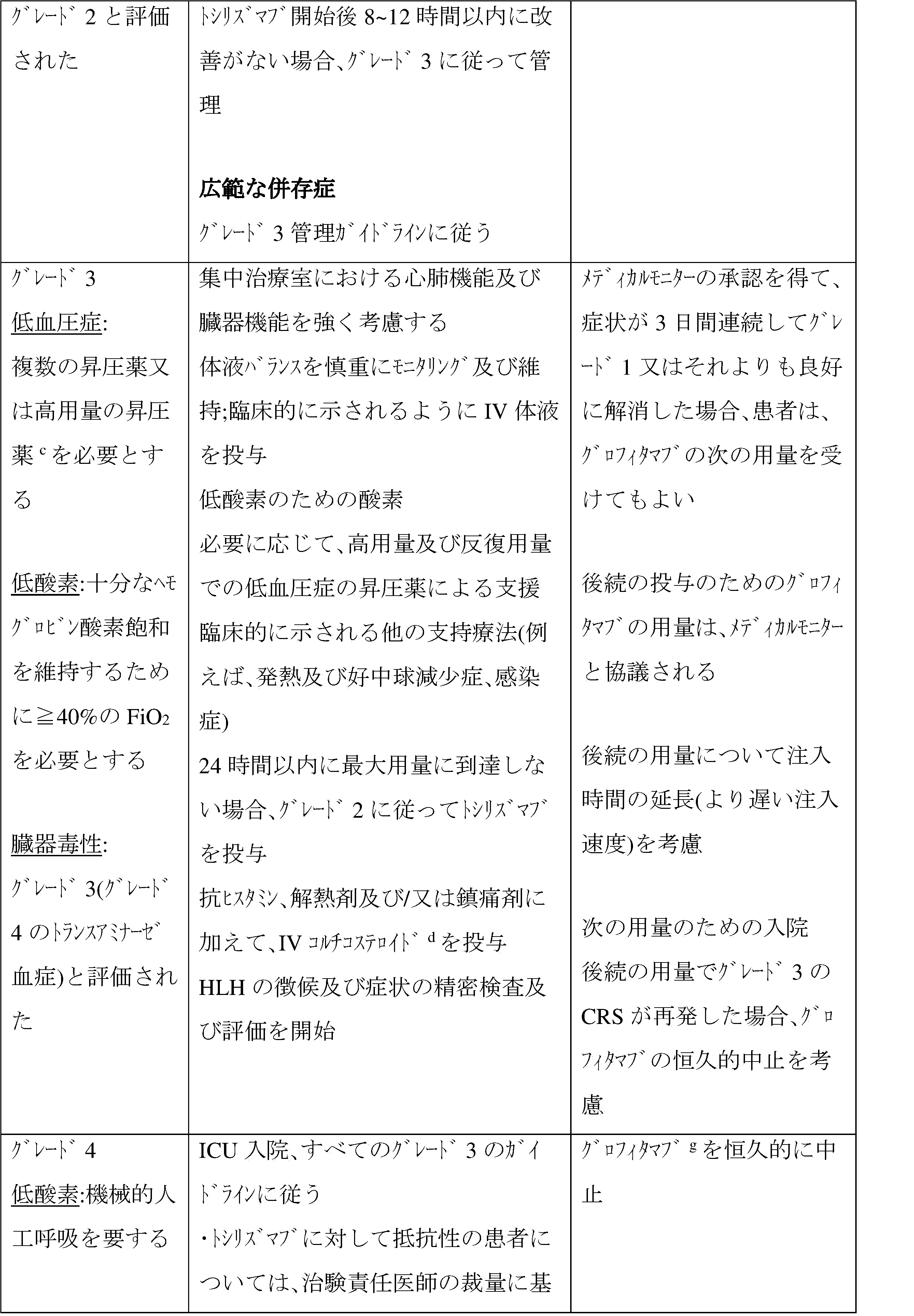

表6の脚注:
HLH:血球貪食性リンパ組織球症;IV:静脈内
a 症状のグレード付けについてはNCI-CTCAE、v4.03スケールを参照。
b CRS管理のガイダンスは、Lee et al.2014(Lee DW、Gardner R、Porter DL、et al.Current concepts in the diagnosis and management of cytokine release syndrome.Blood 2014;124(2):188-95.)及びThompson et al.2019(Thompson JA、Schneider BJ、Brahmer J、Andrews S、Armand P、Bhatia S、Budde LE、Costa L、Davies M、Dunnington D、Ernstoff MS.Management of Immunotherapy-Related Toxicities、Version 1.2019、NCCN Clinical Practice Guidelines in Oncology.J Natl Compr Cancer Netw.2019173)に基づいている。
c 昇圧薬の使用は、以下の場合、低用量に規定される:
・ノルエピネフリン単剤療法が<20μg/minであるか;又は
・ドーパミン単剤療法が<10μg/minであるか;又は
・フェニレフリン単剤療法が<200μg/minであるか;又は
・エピネフリン単剤療法が<10μg/minであるか;又は
・バソプレシン+ノルエピネフリン当量が≦10μg/minであるか;又は
・昇圧薬、<20μg/minのノルエピネフリン当量の組み合わせ。
等価方程式:ノルエピネフリン当量用量=[ノルエピネフリン(μg/min)]+[ドーパミン
(μg/kg/min)]+[フェニレフリン(μg/min)÷10]。
高用量の昇圧薬の使用は、≧3時間に必要とされるすべての用量と規定される:
・ノルエピネフリン単剤療法が≧20μg/minであるか;又は
・ドーパミン単剤療法が≧10μg/minであるか;又は
・フェニレフリン単剤療法が≧200μg/minであるか;又は
・エピネフリン単剤療法が≧10μg/minであるか;又は
・バソプレシン+ノルエピネフリン当量が≧10μg/minであるか;又は
・≧20μg/minの昇圧薬、ノルエピネフリン当量の組み合わせ
等価方程式:ノルエピネフリン当量用量=[ノルエピネフリン(μg/min)]+[ドーパミン
(μg/kg/min)]+[フェニレフリン(μg/min)÷10]。
d IVコルチコステロイド(例えば、メチルプレドニゾロン2mg/kg/日又はデキサメタゾン10mg)。
e トシリズマブIV(体重30kg以上の患者について8mg/kg;体重30kg未満の患者について12mg/kg、800mg/用量を超えない)。
f 参照:Riegler et al.2019(Riegler LL,Jones GP,Lee DW.Current approaches in the grading and management of cytokine release syndrome after chimeric antigen receptor T-cell therapy.Ther Clin Risk Manag.2019;15:323.);Wu et al.2019(Wu BX,Song NJ,Riesenberg BP,et al.Development of molecular and pharmacological switches for chimeric antigen receptor T cells.Experimental hematology & oncology.2019 8:27.)。
g 利益を得ており、有害事象から完全に回復した患者にはグロフィタマブの再開が考慮されてよい。治験責任医師(又は適正な代理人)及びメディカルモニターの両者による文書での承認後にのみ、患者はグロッフィタマブで再治療することができる。
Footnotes to Table 6:
HLH: Hemophagocytic lymphohistiocytosis; IV: Intravenous a See NCI-CTCAE, v4.03 scale for symptom grading.
b Guidance for CRS management is provided by Lee et al. 2014 (Lee DW, Gardner R, Porter DL, et al. Current concepts in the diagnosis and management of cytokine release syndrome.
c The use of vasopressors is prescribed at lower doses if:
- Norepinephrine monotherapy is <20 μg/min; or - Dopamine monotherapy is <10 μg/min; or - Phenylephrine monotherapy is <200 μg/min; or - Epinephrine monotherapy is <10 μg/min; or • Vasopressin + norepinephrine equivalent is ≦10 μg/min; or • A combination of vasopressor, norepinephrine equivalent of <20 μg/min.
Equivalent equation: Norepinephrine equivalent dose = [norepinephrine (μg/min)] + [dopamine (μg/kg/min)] + [phenylephrine (μg/min) ÷ 10].
The use of high-dose vasopressors is defined as all doses required for ≧3 hours:
・Norepinephrine monotherapy is ≧20 μg/min; or ・Dopamine monotherapy is ≧10 μg/min; or ・Phenylephrine monotherapy is ≧200 μg/min; or ・Epinephrine monotherapy is ≧10 μg/min; or Vasopressin + norepinephrine equivalent is ≧10 μg/min; or min)] + [dopamine (μg/kg/min)] + [phenylephrine (μg/min) ÷ 10].
d IV corticosteroids (eg,
e Tocilizumab IV (8 mg/kg for patients weighing 30 kg or more; 12 mg/kg for patients weighing less than 30 kg, not to exceed 800 mg/dose).
f Reference: Riegler et al. 2019 (Riegler LL, Jones GP, Lee DW. Current approaches in the grading and management of cytokine release syndrome after chimeri c antigen receptor T-cell therapy. Ther Clin Risk Manag. 2019; 15:323.); Wu et al. 2019 (Wu BX, Song NJ, Riesenberg BP, et al. Development of molecular and pharmacological switches for chimeric antigen receptor T cells.Experimental hematology & oncology.2019 8:27.).
g Restarting glofitamab may be considered for patients who are receiving benefit and have fully recovered from adverse events. Patients may be re-treated with grofitamab only after written approval by both the investigator (or appropriate representative) and medical monitor.
実施例2:新規の二価CD20標的化T細胞誘導二重特異性抗体であるグロフィタマブは、再発性/難治性B細胞非ホジキンリンパ腫に持続的な完全緩解を誘導する:第I相治験
試験NP30179(ClinicalTrials.gov identifier:NCT03075696)は、ファーストインヒューマンの第I相試験であり、単回用量Gazyva(登録商標)(オビヌツズマブ;Genentech/Roche)による事前治療(Gpt)及び進行中の共投与オビヌツズマブとのグロフィタマブ後の、単剤グロフィタマブの臨床活性を調査する。ここで、本発明者らは、単回用量Gptを用いたグロフィタマブ単剤療法のデータを提供する。
Example 2: Grofitamab, a novel bivalent CD20-targeted T cell-inducing bispecific antibody, induces durable complete remission in relapsed/refractory B-cell non-Hodgkin's lymphoma: Phase I Clinical Trial NP30179 (ClinicalTrials.gov identifier: NCT03075696) is a first-in-human, Phase I study that includes prior treatment (GPT) with single-dose Gazyva® (obinutuzumab; Genentech/Roche) and ongoing co-administration of obinutuzumab. To investigate the clinical activity of single-agent glofitamab after glofitamab. Here, we provide data on glofitamab monotherapy with a single dose of Gpt.
方法
患者
治験は、組織学的に確認されたB-NHLを有する年齢≧18歳の患者を含んでいた。これら患者は、CD20を発現することが予測され;≧1の先行するリンパ腫治療を受けており;利用可能な延命の治療選択肢を有さず、>1.5cmの測定可能な標的病変を≧1個有していた。重要な除外基準は、中枢神経系(CNS)リンパ腫又は他のCNS病理学の既往歴;Gptに先行する4週間又は薬物の5半減期以内の抗がん療法;Gptに先行する100日以内のASCT;又は先行する同種異系幹細胞移植であった。
Methods Patients The trial included patients aged ≧18 years with histologically confirmed B-NHL. These patients are predicted to express CD20; have received ≧1 prior lymphoma therapy; have no survival-prolonging treatment options available and have ≧1 measurable target disease >1.5 cm. It was unique. Important exclusion criteria are: history of central nervous system (CNS) lymphoma or other CNS pathology; anticancer therapy within 4 weeks or 5 half-lives of the drug preceding Gpt; ASCT; or preceding allogeneic stem cell transplant.
試験設計
NP30179は、3つの部分を含む、第I相、多施設、非盲検、用量漸増及び用量拡大試験である。ここでは、本発明者らは、第1部(単患者用量漸増)及び第2部(複数患者用量漸増;図3)について記載し;第3部(用量拡大)は進行中である。
Study Design NP30179 is a three-part, Phase I, multicenter, open-label, dose-escalation and dose-expansion study. Here, we describe Part 1 (single-patient dose escalation) and Part 2 (multi-patient dose escalation; Figure 3); Part 3 (dose expansion) is in progress.
グロフィタマブの第1の用量の7日前、すべての患者は、末梢及び組織に基づくB細胞を枯渇させ、これにより重度のCRSを軽減するために、1,000mgのGptを静脈内投与された。オビヌツズマブは、リツキシマブと比較して、末梢及び組織に基づくB細胞のクリアランスがより深いことにより、事前治療として選択された。グロフィタマブは、最初の4時間の静脈内(IV)注入として投与され、注入時間は、先行する注入が合併症なしで行われたら、2時間に短縮される。用量漸増は、新たな毒性データに基づく過剰投与の制御を用いたベイジアン修正連続再評価法によりガイドされた。第1部では、単患者コホートに患者3名のみを含み、グロフィタマブが0.005~0.045mgの用量で投与された。第2部の用量漸増は、0.015mgから開始された。グロフィタマブは、サイクル1の1日目と8日目に、次いで各14日サイクルの1日目に、最大12サイクルにわたって投与された。グロフィタマブの臨床的半減期がIgG抗体と一致していることを確認する初期薬物動態(PK)データに基づいて、サイクル1の8日目の投薬は、用量≧0.3mgにおいて省略され、サイクル2から21日間サイクルが用量≧10mgで最大12サイクルにわたり採用された。すべての患者は、治療中に現れる毒性をモニタリングするために、グロフィタマブの初回投与後48時間入院させた。
Seven days before the first dose of glofitamab, all patients received 1,000 mg of Gpt intravenously to deplete peripheral and tissue-based B cells, thereby reducing severe CRS. Obinutuzumab was selected as a prior treatment due to its deeper peripheral and tissue-based B cell clearance compared to rituximab. Grofitamab will be administered as an initial 4-hour intravenous (IV) infusion, and the infusion time will be reduced to 2 hours if the preceding infusion is performed without complications. Dose escalation was guided by a Bayesian modified serial reassessment method with overdose control based on new toxicity data. In
主要試験評価項目は、安全性/忍容性、薬物動態、最大耐量(MTD)及び用量制限毒性であった。二次的評価項目には、ルガーノ分類によるCR及び全奏効率(ORR)、応答(DOR)の継続期間、完全寛解(DOCR)の継続期間、PFS、薬力学的(PD)バイオマーカー、及び抗薬物抗体の発生率が含まれた。 Primary study endpoints were safety/tolerability, pharmacokinetics, maximum tolerated dose (MTD), and dose-limiting toxicity. Secondary endpoints included CR and overall response rate (ORR) according to Lugano classification, duration of response (DOR), duration of complete remission (DOCR), PFS, pharmacodynamic (PD) biomarkers, and Incidence of drug antibodies was included.
すべての測定可能な疾患は、フルオロデキシグルコース-ポジトロン放出トモグラフィ及びコンピュータ化されたトモグラフィにより実証された。腫瘍評価は、ベースラインで、2及び5サイクル後に、治療終了時に、及び3カ月毎に、疾患進行まで実行した。有害事象(AE)は、National Cancer Institute-Common Terminology Criteria for Adverse Events(CTCAE)、バージョン4.03.17に従って評価され、治験責任医師は現場の手順にしたがってCRSを管理した。トシリズマブが施設内で利用可能であることが要件であった。ICANSのコンセンサス基準は、試験開始時に利用可能でなかったため、ICANSは、「非感染性脳炎」のMedDRA標準検索式+「頭痛」のCTCAE項を使用して分析された。 All measurable disease was demonstrated by fluorodexyglucose-positron emission tomography and computerized tomography. Tumor assessments were performed at baseline, after 2 and 5 cycles, at the end of treatment, and every 3 months until disease progression. Adverse events (AEs) were evaluated according to the National Cancer Institute-Common Terminology Criteria for Adverse Events (CTCAE), version 4.03.17, and the investigator managed CRS according to site procedures. It was a requirement that tocilizumab be available on site. ICANS consensus criteria were not available at study initiation, so ICANS was analyzed using the MedDRA standard search formula for "non-infectious encephalitis" plus the CTCAE term for "headache."
すべての参加患者は、文書によるインフォームドコンセントを提供した。試験は、各センターの倫理委員会又は治験審査委員会によって承認され、ヘルシンキ宣言、医薬品の臨床試験実施に関する基準のための医薬品規制調和国際会議ガイドライン、及び適正な法律及び規則に準拠して実行された。 All participating patients provided written informed consent. The study was approved by each center's ethics committee or institutional review board and was conducted in accordance with the Declaration of Helsinki, the International Conference on Harmonization Guidelines for Standards for the Conduct of Clinical Trials of Pharmaceutical Products, and applicable laws and regulations. Ta.
統計分析
計画された試料のサイズは、用量漸増停止基準に基づいており、想定される様々な状況の計算機によるシミュレーションを使用して近似値を求めた;160名の患者がMTDに到達すると推定された。用量漸増には、各コホートにつき最低3名の患者が必要とされた;しかしながら、個々のコホートのサイズは柔軟に設計され、臨床的に有効な用量におけるグロフィタマブの有効性と安全性をさらに確立し、初回投与のためのMTDを決定するために、用量に応じて増大させた。
Statistical analysis The planned sample size was based on dose escalation stop criteria and was approximated using computer simulations of various possible situations; 160 patients were estimated to reach the MTD. Ta. A minimum of 3 patients per cohort was required for dose escalation; however, the size of individual cohorts was designed to be flexible to further establish the efficacy and safety of glofitamab at clinically effective doses. , and increased dose-wise to determine the MTD for the first dose.
分析は、Gpt又はグロフィタマブを投与されたすべての患者を含み、用量群ごとに行われ、選択された分析のためにプールされた。いずれの応答評価も完了しなかった患者は、非応答者と考慮され、生存時間(time-to-event)評価項目について1日目で参加を打ち切られた;疾患進行又は死亡が報告された場合、患者は、この時点での一事象と考慮された。Clopper-Pearson法を使用して計算された95%信頼区間(CI)が、応答率として提供される。DOR(第1の応答から疾患進行又は死亡までの時間)、DOCR(第1の完全寛解から疾患進行又は死亡までの時間)、及びPFS(Gptから疾患進行又は死亡までの時間)を、カプラン-マイヤー推定により分析した;疾患進行又は死亡のない患者は、最後の応答評価の時点で参加を打ち切られた。CRまでの時間を、累積発生率を使用して分析し、疾患進行又は死亡を競合リスクと考慮した。予め計画されたサブグループの分析は、先行する治療法の数と種類、最後の先行治療法からの時間、難治性状態、腫瘍負荷、及び国際予後指標2を含んでいた。難治性状態は、先行治療法に対する不応答又は先行治療法から6カ月以内の再発と定義された。
Analyzes included all patients who received Gpt or glofitamab, were performed by dose group, and pooled for selected analyses. Patients who did not complete any response assessment were considered non-responders and were discontinued on
データは、SASバージョン9.4を使用して分析した。臨床的カットオフは、2020年8月3日であった。 Data were analyzed using SAS version 9.4. The clinical cutoff was August 3, 2020.
結果
患者
3名の患者が単患者(第1部)コホートに登録され、0.005mg、0.015mg及び0.045mgで投薬を受けた;応答者は観察されなかった。3名すべての患者は少なくとも1つの重篤有害事象(SAE)を経験し、それには、グロフィタマブに関連すると考慮される1名のグレード4の好中球減少症と、1名のグレード1のウイルス感染が含まれたAEによる治療の中止はなかった;すべての患者は、疾患の進行により治療を中止する。
Results Patients Three patients were enrolled in the single-patient (Part 1) cohort and were dosed at 0.005 mg, 0.015 mg, and 0.045 mg; no responders were observed. All three patients experienced at least one serious adverse event (SAE), including one
治験の第2部は、複数患者用量漸増コホートを有し、第1部におけるグレード2の好中球減少症の発症に続いて開始された。第1の用量レベルは0.015mgであり、合計で171名のR/R B-NHL患者が治験のこの部分に登録された。これら患者のフォローアップの継続期間の中央値(範囲)は、13.5(0~30.4)カ月であった。有意な臨床活性が、0.6mgから開始された用量で観察され、さらなる臨床有効性及び安全性データを提供するために後続のコホートのサイズを増大させた。25mgの1日目用量において、1名のグレード3及び1名のグレード4の事象を含むCRSがすべての患者に報告され、これは、サイクル1の1日目用量の最大耐量と考慮された。臨床的安全性データ及びPK/PDモデル化に基づいて、2つの段階投薬(SUD)コホートはその後、毎週2.5mg(C1D1)、10mg(C1D8)を、及びC1D15に16mg又は30mgを投薬することにより試験された。完全な詳細は、図7、8及び9に見ることができる。
第2部の患者の年齢の中央値は64(範囲:22~85)歳であった。62.0%(106/171)の患者が>60歳であり、48.8%(83/171)が米国東海岸癌臨床試験グループパフォーマンスステータス1~2であった(図7)。大部分の患者は侵襲性のNHLを有し(n=127;74.3%);73名(42.7%)がDLBCLを、29名(17.0%)がFLから生じたDLBCL(形質転換したFL[trFL])を有し、10名(5.8%)が慢性リンパ性白血病由来のリヒター形質転換を有していた。患者が受けた先行する治療ライン数の中央値は3(範囲:1~13)であり;144名の患者(84.2%)が以前の抗CD20治療に対して抵抗性であり、155名(90.6%)が先行するいずれの治療ラインに対しても抵抗性であった(図7)。11名の患者(6.4%)は先行する治療法を1つだけ受けていた。40名の患者(23.4%)が自家造血幹細胞移植(ASCT)を受けたことがあり、5名(2.9%)がCAR-T療法を受けたことがあった。最後の先行する治療法及び最後の先行する抗CD20レジメンからの時間の中央値(範囲)は、それぞれ2.4(0.6~128.8)カ月及び5.8(0.6-146.7)カ月であった。
The median age of patients in
安全性
AEは168/171名の患者(98.2%)に報告され(図8);143名の患者(83.6%)が、グロフィタマブ関連と考慮される少なくとも1つのAEを有していた。最も多いAEはCRSであり(図8)、86/171名の患者(50.3%;グレード1、21.6%;グレード2、25.1%;グレード3、2.3%及びグレード4、1.2%)に発生した。18 最も頻繁に(≧10%)伴われるCRSの症状は、発熱(n=79;46.2%)、低血圧症(n=42;24.6%)、頻脈(n=27;15.8%)、及び悪寒(n=21;12.3%)であった。CRSの間の免疫エフェクター細胞関連神経毒症候群(ICANS)の症状は多くなかった:錯乱状態が6名の患者(3.5%;グレード1~2、n=4[2.3%];グレード3、n=2[1.2%])に、頭痛が8名(4.7%;グレード3、n=1)に、失語症が1名(0.6%、グレード3)に、意識レベルの低下が1名の患者(0.6%、グレード2)に見られたが;すべて3から72時間以内に解消した。発作及び頭蓋内圧の上昇は報告されなかった。最後の先行グロフィタマブ用量に対する第1のCRS事象の発生までの時間及び継続時間は、それぞれ10.8時間(範囲:3.0~47)及び2.2日(範囲:0.0~31.0)であった。CRSの発生率及び重症度は用量とともに上昇したが、初回投与後に顕著に低下した:21/160名の患者(13.1%)が、サイクル2でCRSを経験し、8/132名(6.1%)が、サイクル3以降でCRSを経験した(1名がグレード3、他のすべてがグレード1~2)(図11)。
Safety AEs were reported in 168/171 patients (98.2%) (Figure 8); 143 patients (83.6%) had at least one AE considered to be related to glofitamab. Ta. The most common AE was CRS (Figure 8), occurring in 86/171 patients (50.3%;
10~25mgの固定用量(段階投与なし)において、CRSは、33/46名(71.7%)の患者に(グレード2、43.5%;グレード3及び4、各2.2%;それぞれ10.9%、21.7%及び13.0%において、トシリズマブ、ステロイド又はその両方により管理された);段階投薬コホートでは、33/52名(63.5%)の患者に(グレード2、26.9%;グレード3[2.5mg後]及び4[30mg後]、各1.9%;それぞれ9.6%、11.5%及び7.7%において、トシリズマブ、ステロイド又はその両方により管理された);2.5/10/30mgの選択された推奨第II相用量(RP2D)においては、25/35名(71.4%)の患者に(グレード2、22.9%;グレード3及び4、各2.9%;それぞれ11.4%、11.4%及び8.6%において、トシリズマブ、ステロイド又はその両方により管理された)起こった。図6参照。
At a fixed dose of 10-25 mg (no step dosing), CRS occurred in 33/46 (71.7%) patients (
CTCAEの定義による神経性AEが74名の患者(43.3%)に観察され、ICANS様事象が31名の患者(18.1%)にあった;最も多い事象は頭痛であった(n=22;12.9%)。2つのグレード3事象が1名の患者(顔面神経麻痺及び嚥下障害)に起こったが、それらはともに基礎疾患の局所的影響に関連しており、どちらもグロフィタマブ関連とは考慮されなかった。
Neurogenic AEs by CTCAE definition were observed in 74 patients (43.3%) and ICANS-like events in 31 patients (18.1%); the most common event was headache (n = 22; 12.9%). Two
SAEが、100名の患者(58.5%)に報告され、77名の患者(45.0%)においてグロフィタマブ関連と考慮された;71/167の症例(42.5%)では、それらはサイクル1の間に起こった。61名の患者におけるSAE(127事象)が、CRSに起因していた。グレード5(致死的)のAEが、25mgにおいて1名の患者に(CRS回復後の胃腸出血に起因する血液量減少性ショック)、0.015mgにおいて1名の患者に(先行するCRSのない敗血症性ショック)起こった;それらはともに、治験責任医師により、グロフィタマブに関連していないと考慮された(図5)。
SAEs were reported in 100 patients (58.5%) and were considered glofitamab related in 77 patients (45.0%); in 71/167 cases (42.5%) they were Happened during
グレード≧3の好中球減少症、貧血症、及び血小板減少症が、それぞれ43名(25.1%)、13名(7.6%)、及び14名の患者(8.2%)に起こった(図8)。グレード≧3の好中球減少症を有する43名の患者のうち、好中球減少症は、34名の患者においてグロフィタマブ関連と考慮された。顆粒球コロニー刺激因子の支援が37名の患者(21.6%)に施され、血小板及び赤血輸血がそれぞれ4名(2.3%)及び9名(5.3%)の患者に施された。すべてのグレードの最初の事象の発生までの時間の中央値及びその継続時間は、それぞれ21.5及び7.9日(好中球減少症)、6.0及び7.1日(貧血症)、10.4及び12.8日(血小板減少症)であった。発熱による好中球減少症が、5名の患者(2.9%)に起こった。感染症が、88名の患者(51.5%)に観察され;30名(17.5%)がグレード≧3の事象を有しており、最も多いものは肺炎であった(n=5)。5名の患者(2.9%)が、AEのために治療を中止した;1名は急性心筋梗塞(0.22mgにおいて)、1名はグレード3のサイトメガロウイルス脈絡網膜炎(1mgにおいて)、1名は血液量減少性ショックの致死的事象(25mgにおいて)、1名はグレード4の好中球減少症(2.5/10/30mgにおいて)、1名の患者はグレード3の敗血症とグレード4の大腸炎(2.5/10/30mgにおいて)を有していた。
Grade ≥3 neutropenia, anemia, and thrombocytopenia occurred in 43 (25.1%), 13 (7.6%), and 14 patients (8.2%), respectively. happened (Figure 8). Of the 43 patients with grade ≧3 neutropenia, neutropenia was considered glofitamab related in 34 patients. Granulocyte colony-stimulating factor support was given to 37 patients (21.6%), and platelet and red blood transfusions were given to 4 (2.3%) and 9 (5.3%) patients, respectively. It was done. The median time to occurrence and duration of first event of all grades was 21.5 and 7.9 days (neutropenia), 6.0 and 7.1 days (anemia), respectively. , 10.4 and 12.8 days (thrombocytopenia). Neutropenia due to fever occurred in 5 patients (2.9%). Infections were observed in 88 patients (51.5%); 30 (17.5%) had grade ≥3 events, the most common being pneumonia (n=5 ). Five patients (2.9%) discontinued treatment due to AEs; 1 acute myocardial infarction (at 0.22 mg) and 1
有効性
臨床活性は、すべての用量で観察され、実質的に用量漸増により増大した。
侵襲性のB-NHL(DLBCL、trFL、PMBCL、MCL、リヒター形質転換)を有する患者のうち、ORR及びCRRは、それぞれ48.0%(61/127)及び33.1%(42/127)であり、DLBCLを有する患者ではそれぞれ41.1%(30/73)及び28.8%(21/73)であり、trFLを有する患者ではそれぞれ55.2%(16/29)及び34.5%(10/29)であった(図9)。用量≧10mgでは、侵襲性B-NHLを有する患者のうちのORR及びCRRは、それぞれ60.9%(42/69)及び49.3%(34/69)であり、DLBCLについてそれぞれ55.3%(21/38)及び42.1%(16/38)を、trFLについて64.3%(9/14、すべてのCR)を含んでいた(図9)。RP2Dでは、侵襲性B-NHLを有する患者におけるORR及びCRは、それぞれ71.4%(10/14)及び64.3%(9/14)であった(図9)。
Efficacy Clinical activity was observed at all doses and increased substantially with dose escalation.
Among patients with aggressive B-NHL (DLBCL, trFL, PMBCL, MCL, Richter transformation), ORR and CRR were 48.0% (61/127) and 33.1% (42/127), respectively. and 41.1% (30/73) and 28.8% (21/73), respectively, in patients with DLBCL, and 55.2% (16/29) and 34.5, respectively, in patients with trFL. % (10/29) (Figure 9). At doses ≥10 mg, ORR and CRR among patients with invasive B-NHL were 60.9% (42/69) and 49.3% (34/69), respectively, and 55.3%, respectively, for DLBCL. % (21/38) and 42.1% (16/38), including 64.3% (9/14, all CR) for trFL (Figure 9). In RP2D, ORR and CR in patients with aggressive B-NHL were 71.4% (10/14) and 64.3% (9/14), respectively (Figure 9).
グレード1~3AのFLを有する44名の患者のうち、21名(47.7%)がCRを達成した。用量≧10mgでは、ORR率及びCR率は、それぞれ69.0%(20/29)及び58.6%(17/29)であり、RP2Dでは、それぞれ61.9%(13/21)及び52.4%(11/21)であった。 Of the 44 patients with grade 1-3A FL, 21 (47.7%) achieved CR. At dose ≧10 mg, ORR rate and CR rate were 69.0% (20/29) and 58.6% (17/29), respectively, and for RP2D, 61.9% (13/21) and 52%, respectively. .4% (11/21).
CRまでの時間は短く、大部分がサイクル3までに起こった。応答は、≧4の先行するレジメン及び難治性疾患を有する高リスクの集団を含め、患者のサブグループ全体に観察された。
Time to CR was short, with the majority occurring by
侵襲性NHLを有する患者では、DORの中央値は5.5カ月(95%のCI、4.4~推定不能[NE];範囲:0.8~28.8カ月)であり、DOCRの中央値には到達せず(範囲:0.0~27.4カ月)、患者の48.6%(何らかの応答)及び72.8%(CR)は、12カ月目でも依然応答していた。PFSの中央値は2.9(95%のCI、2.1~3.9)カ月であり、PFSは6カ月目で34.8%、8カ月目以降は(30カ月の最長フォローアップまで).約24%のプラトーになると推定された。グレード1~3AのFLを有する患者では、PFSの中央値は、11.8カ月であった(95%のCI、6.3~24.2)。31名の応答者の、DORの中央値は10.8カ月であった(95%のCI、3.8~NE)。DOCRの中央値には到達せず、19/21名(90.5%)の患者は22.9カ月までCRに留まった。 For patients with aggressive NHL, the median DOR was 5.5 months (95% CI, 4.4 to not estimable [NE]; range: 0.8 to 28.8 months), with a median Values were not reached (range: 0.0-27.4 months), with 48.6% (some response) and 72.8% (CR) of patients still responding at 12 months. Median PFS was 2.9 (95% CI, 2.1-3.9) months; PFS was 34.8% at 6 months and after 8 months (up to longest follow-up of 30 months). ). It was estimated that there would be a plateau of about 24%. For patients with grade 1-3A FL, median PFS was 11.8 months (95% CI, 6.3-24.2). Among the 31 responders, the median DOR was 10.8 months (95% CI, 3.8 to NE). Median DOCR was not reached and 19/21 (90.5%) patients remained in CR until 22.9 months.
薬物動態
IV注入後、グロフィタマブ血清濃度は、注入終了時にピークに達し、その後二相的に下降する。グロフィタマブは、6から11日の見かけの半減期で排除されたように見え、0.005から25mgの範囲にわたって用量線形的薬物動態を示した。複数の治療サイクルにまたがる複数回の投薬による、実質的な蓄積又は時間依存性の証拠はなかった。全体的に、グロフィタマブ薬物動態は、患者間に中程度のばらつきを示した。ベースライン(初回グロフィタマブ投与)におけるオビヌツズマブ血清濃度の中央値は、249(98.4-858)μg/mLであった。抗グロフィタマブ抗体は、いずれの患者にも検出されなかった。
Pharmacokinetics After IV infusion, grofitamab serum concentrations peak at the end of the infusion and then decline biphasically. Grofitamab appeared to be eliminated with an apparent half-life of 6 to 11 days and exhibited dose-linear pharmacokinetics over the range of 0.005 to 25 mg. There was no evidence of substantial accumulation or time dependence due to multiple dosing over multiple treatment cycles. Overall, glofitamab pharmacokinetics showed moderate interpatient variability. Median obinutuzumab serum concentration at baseline (first glofitamab administration) was 249 (98.4-858) μg/mL. Anti-grofitamab antibodies were not detected in any patient.
薬力学
バイオマーカーデータは、グロフィタマブ0.005mgから25mgを投薬された122名の患者から得られた。グロフィタマブ注入は、すべての患者の末梢循環においてT細胞に急速な一過性の減少をもたらし、最下点は注入後6時間目に記録された。このようなT細胞の再分布は、用量レベル及び受容体占有に関連付けられた。グロフィタマブ≧0.6mgの投与に続いて、応答する患者は、サイクル5まで長期のT細胞活性化を示した。これは、T細胞活性化マーカー、例えばKi67、HLA-DR、PD-1、及びTim3の2から4倍の上昇によって示された。臨床活性と一致して、これは、0.6mgを下回る用量では観察されなかった。
Pharmacodynamics Biomarker data were obtained from 122 patients dosed with glofitamab 0.005 mg to 25 mg. Grofitamab infusion resulted in a rapid and transient decrease in T cells in the peripheral circulation of all patients, with the nadir recorded at 6 hours post-infusion. This redistribution of T cells was related to dose level and receptor occupancy. Following administration of glofitamab ≧0.6 mg, responding patients showed prolonged T cell activation up to
考察
この試験は、新規の二重特異性CD20抗体T細胞エンゲージャーであるグロフィタマブが、先行治療法に対して抵抗性であるB-NHLで重度の事前治療を受けた患者において(90.6%)、有意な抗腫瘍活性を提供することを実証した。
CRSは、ステロイド又はトシリズマブの中程度(25%)の使用により管理可能であった。CRS事象は、CRSに起因する治療中止のなかった5名を除くすべての患者で完全に解消された。CRSの発生までの時間は、予測可能であり、大部分が初回投与に限定されていた;患者の13.1%及び6.1%のみが、それぞれサイクル2又はサイクル3以降にCRSを経験した。重度のCRSに関連付けられる因子には、高い疾病負荷(Ann Arborステージ)及び骨髄浸潤が含まれていた(データは示さない)。CRSのリスクを軽減するためのGptの使用は、臨床活性用量までのグロフィタマブの漸増を可能にした。全体のCRS率は、最高固定投薬コホートと段階投薬コホートとの間で類似であり、段階投薬は、グレード2以上のCRSの発生頻度を低下させ、したがってRP2D(グレード≧2;≧10mgの固定投薬において47.8%であるのに対し、2.5/10/30mgの段階投薬コホートにおいて28.6%)として選択された。
Discussion This study demonstrated that glofitamab, a novel bispecific CD20 antibody T-cell engager, was tested in heavily pretreated patients with B-NHL refractory to prior therapy (90.6% ), demonstrated to provide significant antitumor activity.
CRS was manageable with moderate (25%) use of steroids or tocilizumab. CRS events completely resolved in all patients except for 5 patients who had no treatment discontinuation due to CRS. Time to occurrence of CRS was predictable and largely limited to the first dose; only 13.1% and 6.1% of patients experienced CRS after
ICANS様神経性AEが観察された;これらは、大部分が頭痛であり、軽度で自己抑制されるもので、神経毒性が用量限定的である抗CD19CAR-T療法及び二重特異性に見られるものとは質的に異なると考慮された。治療により現れる血球減少は、重度の感染症の率又は輸血の必要性の増加には繋がらなかった。予期されない安全性シグナルは観察されなかった;AEに起因する中断率が2.9%であったことは、好ましいベネフィットリスクプロファイルを示唆している。 ICANS-like neurogenic AEs were observed; these were mostly headaches, mild and self-limited, seen with anti-CD19 CAR-T therapy and bispecific with dose-limiting neurotoxicity. considered to be qualitatively different. Treatment-induced cytopenias did not lead to an increase in the rate of severe infections or the need for blood transfusions. No unexpected safety signals were observed; the discontinuation rate due to AEs was 2.9% suggesting a favorable benefit-risk profile.
高い応答率が観察された。用量≧10mgでは、CR率は、侵襲性B-NHLを有する患者において49.3%であり、DLBCL及びtrFLを有する患者において、それぞれ42.1%及び64.3%であった。CRは、高い腫瘍負荷、巨大腫瘍病変、及びASCTを含む複数の治療法に対する治療抵抗性を有する患者において急速に達成された。有用性評価の継続期間はフォローアップの制限によって損なわれたが、侵襲性の組織型を有する患者における34/42(81.0%)のCRが進行中であり、フォローアップは27.4カ月まで行われる。加えて、SUDは、固定投薬を受けるコホートに観察される高いORR及びCR率を維持した。 A high response rate was observed. At doses ≧10 mg, the CR rate was 49.3% in patients with aggressive B-NHL, and 42.1% and 64.3% in patients with DLBCL and trFL, respectively. CR was rapidly achieved in patients with high tumor burden, bulky tumor lesions, and treatment resistance to multiple therapies, including ASCT. Duration of utility evaluation was compromised by limited follow-up, but 34/42 (81.0%) CR in patients with invasive histology was ongoing with follow-up of 27.4 months will be carried out until In addition, SUD maintained the high ORR and CR rates observed in the fixed dosing cohort.
薬物動態の結果は、グロフィタマブの半減期が7日の範囲であり、投薬(3週間毎)を容易にすることを示している。オビヌツズマブ及びグロフィタマブの両方が同じCD20エピトープに結合するので、観察される濃度プロファイルは、バイオマーカー及び臨床データと共に、CD20受容体の競合にもかかわらず、強力なグロフィタマブ活性をサポートする。残留抗CD20モノクローナル抗体の存在下で又は別の抗CD20モノクローナル抗体との組み合わせでの臨床活性の保存は、グロフィタマブの固有の有用性を表す。グロフィタマブの高い効力は、集団の薬物動態及び曝露-応答分析によってさらにサポートされ、この試験で評価される用量レベルにおいて達成可能な、サイクル3までの<1%のCD20受容体占有において有効性を確認する20。これら分析に基づいて、SUDは、第1のサイクルにおけるCRSの発生率及び重症度を低下させるために導入された。2.5mg(D1)、10mg(D8)、30mg(D15)の週に1回の投薬スケジュールと、それに続く3週毎のレジメンにおける後続のサイクルでの30mgは、安全と考慮され、最大の非分割用量レベルの範囲内で臨床活性を示し、RP2Dとして前倒しされた。
Pharmacokinetic results indicate that the half-life of glofitamab is in the range of 7 days, facilitating dosing (every 3 weeks). Since both obinutuzumab and grofitamab bind to the same CD20 epitope, the observed concentration profile, along with biomarker and clinical data, supports potent glofitamab activity despite competition for the CD20 receptor. Preservation of clinical activity in the presence of residual anti-CD20 monoclonal antibodies or in combination with another anti-CD20 monoclonal antibody represents the unique utility of glofitamab. Grofitamab's high efficacy is further supported by population pharmacokinetic and exposure-response analyzes confirming efficacy at <1% CD20 receptor occupancy by
グロフィタマブは、利用可能かつアクセス可能な「既製(off-the-shelf)」のT細胞誘導療法である。これら特性は、製造を必要とし、ブリッジ療法を要する場合があり、急速に進行する疾患を有する患者において実現可能でない場合がある現行のCAR-T細胞療法の特性とは対照的である。これまでのところ、グロフィタマブの臨床活性は、ブリナツモマブの臨床活性を上回り、より好ましいと思われる安全性プロファイルを有する登録済みのCAR-T療法の範囲内であると思われる。急速に達成されて一定範囲の用量で18カ月を超えて続くCRが観察される場合、臨床的治療選択肢をほとんど持たず、治療が困難な患者群において、グロフィタマブの活性が極めて高いことが示唆される。 Grofitamab is an available and accessible "off-the-shelf" T cell induction therapy. These properties are in contrast to the properties of current CAR-T cell therapies, which require manufacturing, may require bridging therapy, and may not be feasible in patients with rapidly progressing disease. So far, the clinical activity of glofitamab exceeds that of blinatumomab and appears to be within the range of registered CAR-T therapies with a safety profile that appears to be more favorable. The observation of CRs that are achieved rapidly and last for more than 18 months over a range of doses suggests that glofitamab is extremely active in a difficult-to-treat patient population with few clinical treatment options. Ru.
結論として、この新規T細胞誘導二重特異性抗体は、R/R B-NHLにおける単剤活性の高いレベルを示した。グロフィタマブは、頻度の高い持続性のCR、管理可能な忍容性プロファイルを示し、適時の治療法を必要とする難治性B-NHL患者の通常的な(off-the-shelf)治療を可能にする。 In conclusion, this novel T cell-inducing bispecific antibody showed high levels of single agent activity in R/R B-NHL. Grofitamab exhibits frequent and durable CR, manageable tolerability profile, and enables off-the-shelf treatment of patients with refractory B-NHL who require timely therapy. do.
実施例3-CRSを減少させるためのモデル
序論:グロフィタマブ(RG6026;RO7082859;CD20-TCB)は、新規の「2:1」フォーマットのT細胞誘導二重特異性抗体であり、2つのCD20結合ドメインと1つのCD3結合ドメインを有し、B細胞悪性疾患において、腫瘍抗原結合力の増大、急速なT細胞活性化、及び腫瘍細胞殺滅の強化を可能にする。NP30179からの臨床データは、グロフィタマブの固定投薬量(0.6~25mg)が、重度の事前治療を受けたR/R NHL患者に、管理可能な安全性プロファイルで高く持続的な完全緩解を誘導することを示した(pts;Dickinson、et al.EHA 2020)。グロフィタマブの初回投与の7日前のオビヌツズマブによる事前治療(Gpt)は、サイトカイン放出症候群(CRS)のリスクを軽減するうえで有効であり、臨床活性用量までグロフィタマブを急激に増加させることができることを示した(Dickinson、et al.EHA 2020)。本発明者らは、以前にNP30179;NCT03075696(Djebli N、et al.Blood 2019)においてグロフィタマブの集団薬物動態(popPK)及び曝露-応答(ER)関係を調査しており、そこで、モデル化により段階投薬が有効性を最大化しながらCRSをさらに軽減することが示された。本分析は、第1の段階投薬(SUD)患者からの確認データを含む、以前のモデルのアップデートである。
Example 3 - Model for reducing CRS Introduction: Grofitamab (RG6026; RO7082859; CD20-TCB) is a novel "2:1" format T cell-inducing bispecific antibody, consisting of two CD20 binding domains. and one CD3 binding domain, allowing increased tumor antigen avidity, rapid T cell activation, and enhanced tumor cell killing in B cell malignancies. Clinical data from NP30179 show that fixed doses of glofitamab (0.6-25 mg) induce high and durable complete remissions with a manageable safety profile in heavily pretreated R/R NHL patients. (pts; Dickinson, et al. EHA 2020). We showed that pretreatment with obinutuzumab (GPT) 7 days before the first dose of glofitamab is effective in reducing the risk of cytokine release syndrome (CRS) and allows for rapid escalation of glofitamab to clinically active doses. (Dickinson, et al. EHA 2020). We previously investigated the population pharmacokinetics (popPK) and exposure-response (ER) relationships of glofitamab in NP30179; NCT03075696 (Djebli N, et al. Blood 2019), where modeling The medication was shown to further reduce CRS while maximizing efficacy. This analysis is an update of a previous model that includes confirmatory data from first tier dosing (SUD) patients.
方法:無痛性(i)又は侵襲性(a)のR/R NHLを有する患者は、CRSを軽減するために、サイクル(C)1の7日目(D)の単回のGpt 1000mgに続いて、グロフィタマブの固定投薬(2又は3週間毎に0.005~25mg)又はSUD(n=31、2.5/10/16及び2.5/10/30mg)を受けた。シリアル疎グロフィタマブ、及び疎G PKデータを使用して、NONMEM(登録商標)ソフトウェア(v7.4)でpopPKモデルを開発した。2020年4月17日のカットオフ日には、16名(2.5/10/16mg)及び15名(2.5/10/30mg)のSUD患者を含むことが可能であった。生理的に関連する共変数を、グロフィタマブのPK変動性に対するそれらの影響力について調査した。確立されたG popPKモデル(Gibiansky,et al.CPT Pharmacometrics Syst Pharmacol 2014)を使用して、G濃度-時間プロファイルを構築し、経時的にCD20受容体について競合するGの存在下でグロフィタマブ受容体占有(RO%)を推定した。グレード(Gr)≧2のCRS(ASTCT基準[Lee et al.,Biol Blood Marrow Transplant,25(4):625-638,2019]により定義して)に焦点を当てた場合、最初の24時間のグロフィタマブのAvgRO%とCRSとの間の関係を、iNHL及びaNHL患者の組み合わせにおいて調査した。第1の応答評価が行われたC3D1までのグロフィタマブ時間平均RO%(AvgRO%)と、完全寛解率(CRR)との間のER関係を、C3D1に到達したaNHL患者において特徴づけた。 Methods: Patients with indolent (i) or aggressive (a) R/R NHL received a single Gpt 1000 mg on day 7 (D) of cycle (C) 1 followed by a single dose of Gpt 1000 mg to reduce CRS. and received a fixed dose of grofitamab (0.005-25 mg every 2 or 3 weeks) or SUD (n=31, 2.5/10/16 and 2.5/10/30 mg). A popPK model was developed in NONMEM® software (v7.4) using serial sparse glofitamab and sparse G PK data. At the cut-off date of April 17, 2020, it was possible to include 16 (2.5/10/16 mg) and 15 (2.5/10/30 mg) SUD patients. Physiologically relevant covariates were investigated for their influence on grofitamab PK variability. Using the established G popPK model (Gibiansky, et al. CPT Pharmacometrics Syst Pharmacol 2014), we constructed G concentration-time profiles to determine glofitamab receptor occupancy in the presence of competing G for CD20 receptors over time. (RO%) was estimated. When focusing on grade (Gr) ≥2 CRS (as defined by ASTCT criteria [Lee et al., Biol Blood Marrow Transplant, 25(4):625-638, 2019]), the The relationship between grofitamab AvgRO% and CRS was investigated in a combination of iNHL and aNHL patients. The ER relationship between average RO% (AvgRO%) of glofitamab time to C3D1 at which the first response assessment was performed and complete remission rate (CRR) was characterized in aNHL patients who reached C3D1.
結果:PopPKを、≧1のPK試料を有する230名のiNHL及びaNHLにおいて分析した(固定及びSUD)。ER関係は、C3D1におけるPK/有効性データを有する95名のaNHL患者、及びPK/安全性データを有する204名のiNHL及びaNHL患者において分析された。グロフィタマブPKは、線形クリアランスを有する2コンパートメントPKモデルを使用して最もよく説明され、iNHL及びaNHLを有する患者において同等であった。体積及びクリアランスに対する体重の影響は保持された。iNHL及びaNHL患者の両方における、最初の24時間のAvgRO%とGr≧2のCRSとの間に(p=0.002)、及びaNHL患者におけるC3D1までのAvgRO%と有効性との間に(p=0.008)、陽性のER関係が観察された。固定投薬を受けている患者由来のデータの以前のER分析(Djebli,et al.Blood 2019)に基づいて、SUDレジメン(2.5/10/30mg Q3W)が選択され、よりよい臨床応答に関連付けられるより高い用量への漸増を可能にしながら、管理可能なレベルのCRSを有する用量で治療を開始することにより有用性/リスクプロファイルを最適化した。固定(n=199)及びSUD(n=31)患者からのアップデートされたER分析は、最初の24時間のAvgRO%を0.16%(0.10~0.29%)と予測し、これはiNHL及びaNHL患者における予測されるGr≧2のCRS率である23.3%(20.8~26.8%)に対応し、またC3D1までのAvgRO%を0.75%(0.49~1.98%)と予測し、これはaNHL患者におけるサイクル3に予想されるCRRの46.1%(42.7~53.8%)に対応する。比較として、2.5/10/16及び2.5/10/30mg SUDを受けているaNHL及びiNHL患者からの臨床データ(Hutchings,et al.ASH 2020)は、2.5mgのグロフィタマブ用量後のGr≧2のCRS率が21.6%である(n=37)ことと、完全代謝応答率が40.6%であることを示した(n=32)。
Results: PopPK was analyzed in 230 iNHL and aNHL with ≧1 PK sample (fixed and SUD). ER relationships were analyzed in 95 aNHL patients with PK/efficacy data and 204 iNHL and aNHL patients with PK/safety data on C3D1. Grofitamab PK was best described using a two-compartment PK model with linear clearance and was comparable in patients with iNHL and aNHL. The effects of body weight on volume and clearance were preserved. There was a significant difference between first 24-hour AvgRO% and CRS of Gr≧2 in both iNHL and aNHL patients (p=0.002) and between AvgRO% and efficacy up to C3D1 in aNHL patients (p=0.002). p=0.008), a positive ER relationship was observed. The SUD regimen (2.5/10/30mg Q3W) was selected based on previous ER analysis of data from patients receiving fixed dosing (Djebri, et al. Blood 2019) and associated with better clinical response. The utility/risk profile was optimized by starting treatment at a dose with a manageable level of CRS while allowing escalation to higher doses that could be controlled. Updated ER analysis from fixed (n=199) and SUD (n=31) patients predicted first 24-hour AvgRO% of 0.16% (0.10-0.29%), which corresponds to a predicted Gr≧2 CRS rate of 23.3% (20.8-26.8%) in iNHL and aNHL patients, and also AvgRO% to C3D1 of 0.75% (0.49%). ~1.98%), which corresponds to an expected CRR of 46.1% (42.7-53.8%) in
結論:有効性/安全性に関するグロフィタマブのPopPK及びER関係が、SUD患者からのデータを含めてアップデートされた。これらモデルと新たなSUD臨床データは、NHL患者において、SUDレジメンが、30mgまでグロフィタマブを漸増させ、初回投与におけるCRS増加のリスクを最小化しながら有効性を最大化することができることを確認する。これらモデルは、単剤療法として及び他の薬剤との組み合わせのいずれにおいても、グロフィタマブの最適な生理的用量選択をさらにサポートするために開発されている。 Conclusions: PopPK and ER relationships of glofitamab regarding efficacy/safety have been updated to include data from SUD patients. These models and emerging SUD clinical data confirm that in NHL patients, SUD regimens can titrate glofitamab up to 30 mg to maximize efficacy while minimizing the risk of increased CRS on the first dose. These models are being developed to further support optimal physiological dose selection of glofitamab, both as monotherapy and in combination with other agents.
実施例4-グロフィタマブの段階投薬は、治療が困難な難治性又は再発性非ホジキンリンパ腫を有する患者に高い応答率を誘導する
序論:グロフィタマブ(RG6026)は、B細胞上のCD20に対する二価の結合、及びT細胞上のCD3に対する一価の結合を促す2:1の分子形態を有する新規のT細胞誘導二重特異性完全長抗体である。臨床前に、グロフィタマブは、1:1のフォーマットを有する試験された他の二重特異性と比較して、優れた効力を有していた(Bacac,et al.Clin Cancer Res 2018)。NP30179(NCT03075696)は、再発性又は難治性(R/R)非ホジキンリンパ腫(NHL)を有する患者(pts)における安全性、忍容性、薬物動態、バイオマーカー応答、及びグロフィタマブの有効性を評価する、進行中の多施設、第I/Ib相、用量漸増及び用量拡大治験である。NP30179からの臨床データは、グロフィタマブの固定投薬量(0.6~25mg)が、重度の事前治療を受けたR/R NHLを有する患者に、管理可能な安全性プロファイルで高く持続的な完全緩解を誘導することを示した(Dickinson,et al.EHA 2020)。オビヌツズマブによる事前治療(Gpt)は、サイトカイン放出症候群(CRS)のリスクを軽減するうえで有効であり、臨床活性用量までグロフィタマブを急激に増加させることができることを示した(Dickinson,et al.EHA 2020)。グロフィタマブの段階投薬は、Gptに加えて使用され、CRSのリスクをさらに低下させる。本発明者らは、初めて、r/r NHL患者におけるGptを用いたグロフィタマブ段階投薬の臨床データを提示する。
Example 4 - Step dosing of grofitamab induces high response rates in patients with difficult-to-treat refractory or relapsed non-Hodgkin's lymphoma Introduction: Grofitamab (RG6026) exhibits bivalent binding to CD20 on B cells. , and a novel T cell-inducing bispecific full-length antibody with a 2:1 molecular configuration that promotes monovalent binding to CD3 on T cells. Preclinically, grofitamab had superior efficacy compared to other bispecifics tested with a 1:1 format (Bacac, et al. Clin Cancer Res 2018). NP30179 (NCT03075696) evaluates the safety, tolerability, pharmacokinetics, biomarker response, and efficacy of glofitamab in patients (pts) with relapsed or refractory (R/R) non-Hodgkin lymphoma (NHL) This is an ongoing, multicenter, Phase I/Ib, dose-escalation and dose-expansion trial. Clinical data from NP30179 show that fixed doses of glofitamab (0.6-25 mg) produce high and durable complete remissions with a manageable safety profile in patients with heavily pretreated R/R NHL. (Dickinson, et al. EHA 2020). We showed that pretreatment with obinutuzumab (GPT) is effective in reducing the risk of cytokine release syndrome (CRS) and allows for rapid escalation of glofitamab to clinically active doses (Dickinson, et al. EHA 2020 ). Gradual dosing of glofitamab is used in addition to Gpt to further reduce the risk of CRS. We present for the first time clinical data of grofitamab step dosing with Gpt in r/r NHL patients.
方法:患者は、グロフィタマブの初回投与の7日前に1000mgのオビヌツズマブを投与された。グロフィタマブは、サイクル(C)1の1日目と8日目(D)に段階投薬量を静脈内投与され、次いでC2D1から、3週間毎に最大12サイクルにわたり標的用量を投与された(2.5/10/16mg又は2.5/10/30mg)。報告された奏効率は、ルガーノ基準に基づいている(Cheson,et al.J Clin Oncol 2014)。
Methods: Patients received 1000 mg of
結果:2020年4月17日の時点で、38名の患者がグロフィタマブの段階用量を投与され;17名の患者が2.5/10/16mgを、21名の患者が2.5/10/30mgを投与された。28名の患者(73.7%)は、侵襲性NHL(aNHL)組織型を有し、10名の患者が無痛性NHL(iNHL)を有していた。年齢の中央値は68歳(範囲52~85)であり、先行する治療ライン数の中央値は3(範囲1~12)であった。27名(71.1%)の患者は、最後の治療法に対して抵抗性であり、28名(73.7%)の患者は、先行するCD20治療法に対して抵抗性であった。 Results: As of April 17, 2020, 38 patients received graded doses of glofitamab; 17 patients received 2.5/10/16 mg and 21 patients received 2.5/10/16 mg. 30 mg was administered. 28 patients (73.7%) had aggressive NHL (aNHL) histology and 10 patients had indolent NHL (iNHL). Median age was 68 years (range 52-85) and median number of prior treatment lines was 3 (range 1-12). 27 (71.1%) patients were refractory to the last therapy and 28 (73.7%) patients were refractory to the previous CD20 therapy.
中央値で2.8カ月のフォローアップの後、有効性の評価が可能であったすべての患者(n=32)において、全奏効率(ORR)及び完全代謝応答(CMR)率は、それぞれ62.5%及び40.6%であった。aNHL(n=24)を有する患者では、ORRは50.0%であり、CMR率は29.2%であった。データカットオフ日の時点で、aNHLを有する17名の患者(70.8%)は、第1の応答評価にのみ到達し(C3)、治療継続中である;4名の患者(16.7%)は、第2の応答評価(C6)に到達した。iNHLを有する患者(n=8)では、ORRは100.0%であり、患者の75.0%がCMRを達成した。 After a median follow-up of 2.8 months, the overall response rate (ORR) and complete metabolic response (CMR) rate were 62% each in all patients evaluable for efficacy (n=32). .5% and 40.6%. In patients with aNHL (n=24), the ORR was 50.0% and the CMR rate was 29.2%. As of the data cutoff date, 17 patients (70.8%) with aNHL had only reached the first response assessment (C3) and were on ongoing treatment; 4 patients (16.7 %) reached the second response rating (C6). In patients with iNHL (n=8), ORR was 100.0% and 75.0% of patients achieved CMR.
安全性評価可能な集団(n=38)全体で、最も多いAEは、CRS(57.9%)、発熱(31.6%)、好中球減少症、血小板減少症及び低リン酸血症(各28.9%)であった。治療の中止につながるAEはなかった。CRS事象を経験した22名の患者のうち、CRS事象はC1及びC2でのみ起こり;15名が2.5mgの用量後に、12名が10mgの用量後に、5名がC2の間に(16又は30mgの用量;図11)CRSを有した。8名の患者(21.1%)及び13名の患者(34.2%)は、それぞれグレード(Gr)1及び2のCRSを経験し、Gr3のCRSを経験した者はいなかった。1名の患者(2.6%)は、30mgの用量後に、Gr4のCRSを経験した。C2後に起こったCRS事象はなかった。トシリズマブを使用して、6名(15.8%)(2.5/10/16mgコホートについてn=2、及び2.5/10/30mgコホートについてn=4)の患者においてCRSが管理された。CRS事象は管理可能であり、21名の患者(95.4%)ではデータカットオフの時点で解消していた。Gr≧3の神経性有害事象が報告された。
・CRS事象は、C1及びC2に限定されていた。
・第1のグロフィタマブ用量からCRSまでの時間の中央値は14.23時間であり、継続時間の中央値は28.7時間であった。
・FLを有する1名の患者が、2.5mgの用量後にグレード3のCRSを経験し(CRを達成;治療中)、MCLを有する1名の患者が、30mgの用量後にグレード4のCRSを経験した(PDを経験)。
・トシリズマブを使用して、8名(15.4%)の患者のCRSが管理された。
Across the safety-evaluable population (n=38), the most common AEs were CRS (57.9%), fever (31.6%), neutropenia, thrombocytopenia, and hypophosphatemia. (28.9% each). There were no AEs leading to treatment discontinuation. Of the 22 patients who experienced CRS events, CRS events occurred only at C1 and C2; 15 after the 2.5 mg dose, 12 after the 10 mg dose, and 5 between C2 (16 or 30 mg dose; Figure 11) had CRS. Eight patients (21.1%) and 13 patients (34.2%) experienced grade (Gr) 1 and 2 CRS, respectively, and none experienced
-CRS events were limited to C1 and C2.
- Median time from first grofitamab dose to CRS was 14.23 hours and median duration was 28.7 hours.
One patient with FL
- CRS was managed in 8 (15.4%) patients using tocilizumab.
固定用量レジメンからの先行するバイオマーカーデータと一致して、段階投薬で投与されたグロフィタマブは、一過性のT細胞再分布を誘導した。 Consistent with previous biomarker data from fixed-dose regimens, glofitamab administered in stepped doses induced transient T cell redistribution.
結論:グロフィタマブの段階投薬は30mgまでの漸増を可能にし、CRS増加のリスクを最小化しながら有効性を最大化した。複数の治療ラインに失敗しNHLを有する患者において、高いORR及びCMR率が観察された。毒性は管理可能であり、主要な安全シグナルは、初期サイクルで観察された低グレードのCRSであった。 Conclusion: Gradual dosing of grofitamab allowed for titration up to 30 mg and maximized efficacy while minimizing risk of increased CRS. High ORR and CMR rates were observed in patients with NHL who had failed multiple lines of therapy. Toxicity was manageable and the major safety signal was low grade CRS observed in early cycles.
したがって、グロフィタマブの段階投薬は、オビヌツズマブ[Gazyva]事前治療に加えて、有用なCRS軽減方法であり、固定用量レジメンを使用したとき、より低いグレード2以上のCRSリスクで、最大耐量より高い、30mgという高いグロフィタマブ標的用量を可能にする。
Therefore, stepped dosing of glofitamab, in addition to obinutuzumab [Gazyva] prior therapy, is a useful CRS mitigation method, with
図10は、グロフィタマブに対する高い応答が、段階投薬により維持されたことを示している。新しく導入された、グロフィタマブを用いた段階投薬スケジュールは、高いCR率で強い臨床活性を示す。以下の表7は、図10に示されるように、同じコホート(SUD)のアップデートされた応答率を提供し、これには、8の応答欠落と、C6以降の応答評価を受けた追加の患者が含まれている。新しいデータは、図10に示される設定投薬と比較して、SUDレジメンによるより高い応答率を示している。 Figure 10 shows that high response to glofitamab was maintained with step dosing. A newly introduced stepped dosing schedule with grofitamab shows strong clinical activity with high CR rates. Table 7 below provides updated response rates for the same cohort (SUD) as shown in Figure 10, including 8 missing responses and additional patients with response assessment from C6 onwards. It is included. New data shows higher response rates with the SUD regimen compared to the set dosing shown in Figure 10.
表7:試験NP30179におけるSUDコホートのアップデートされた応答率

図11は、一定の設定投薬と段階投薬との対比でCRSの重症度を示している。段階投薬は、高い標的用量のグロフィタマブの投与を可能にする。固定投薬コホートと段階投薬コホートとの間で全体のCRS率は同様であったが、段階投薬は高グレードのCRSの頻度を低下させた(グレード2 ;10mgの固定投薬コホートで36.3%であるのに対し、段階投薬コホートでは30.7%)。
FIG. 11 shows the severity of CRS for constant set dosing versus stepped dosing. Step dosing allows administration of high target doses of glofitamab. Although overall CRS rates were similar between fixed and stepped dosing cohorts, stepped dosing reduced the frequency of high-grade CRS (
実施例5-グロフィタマブ単剤療法は、再発性/難治性(R/R)非ホジキンリンパ腫(NHL)患者(pts)に固定長投薬後に持続的な応答を提供する
ここで、本発明者らは、r/r NHL患者における、試験NP30179のグロフィタマブ単剤療法の固定投薬コホート及びSUDコホートからのアップデートされたデータを提供する。グロフィタマブの段階投薬(SUD)は、Gptに加えて、30mgまでの用量漸増を可能にし、サイトカイン放出症候群(CRS)を軽減しながら有効性を最大化した。
Example 5 - Grofitamab monotherapy provides durable responses after fixed-length dosing in relapsed/refractory (R/R) non-Hodgkin's lymphoma (NHL) patients (pts). Here, we , provides updated data from the fixed dosing and SUD cohorts of glofitamab monotherapy in study NP30179 in r/r NHL patients. Stepwise dosing (SUD) of glofitamab, in addition to Gpt, allowed for dose escalation up to 30 mg, maximizing efficacy while reducing cytokine release syndrome (CRS).
方法:患者は、グロフィタマブの初回投与の7日前に1000mgのオビヌツズマブを投与された。グロフィタマブは、2週間毎に(q2W)若しくは3週間毎に(q3w)固定用量(0.6~25mg)を、又はサイクル(C)1の1及び8日目(D)にSUD(2.5/10/16mg又は2.5/10/30mg)を、次いでC2D1からq3wで最大12サイクルにわたり標的用量を、静脈内投与された。報告された奏効率は、ルガーノ基準に基づいている(Cheson et al.J Clin Oncol.2014,32(27):3059-3067)。
Methods: Patients received 1000 mg of
結果:2021年5月18日の時点で、216名の患者が、以前に特定されたコホートに登録されていた。年齢の中央値は64.0(範囲、22~86)歳であり、63.0%は男性であり、先行する治療法数の中央値は3(範囲、1~12)であった。合計で146名(67.6%)の患者は、侵襲性NHL(aNHL)を、70名(32.4%)が無痛性NHL(iNHL)を有していた。aNHLを有する患者のうち、77名の患者がDLBCLを、26名がマントル細胞リンパ腫を、22名が形質転換した濾胞性リンパ腫(FL)を、8名の患者がリヒター形質転換を有していた。iNHLを有するすべての患者が、グレード1~3AのFLを有していた。奏効率は、調査されたすべての用量で報告される(表8A及びB)。有効性評価可能なaNHLを有する患者(n=138)において、全奏効率(ORR)は57.2%であり、CR率は43.5%であった。臨床的カットオフ日(CCOD)の時点で、フォローアップの継続時間の中央値は13.3(範囲、0~32)カ月であった。CRの継続時間の中央値には到達しなかった(95%の信頼区間[CI]、12.1-推定不能[NE]、n=60)(図13);CRを有する患者の71.7%(43/60)は、分析の時点で依然CRであった。DoRの中央値(CR+部分寛解)にはまだ到達していなかった(95%のCI、6.0-NE;応答者、n=79)。iNHLを有する患者(n=70)では、ORRは81.4%であり、CR率は70.0%であった。CCODにおいて、フォローアップの中央値は6.7(範囲、0~24)カ月であった。CRの継続時間の中央値にはまだ到達していなかった(95%のCI、10.5-NE、n=49)(図);CRを有する患者の81.6%(40/49)は、分析の時点で依然CRであった。DoRの中央値は13.5カ月であった(95%のCI、8.60-NE;応答者、n=57)。グロフィタマブの全体の安全性プロファイルは、その作用機序と一致していた。合計で127/216の患者(58.8%)が、重篤有害事象(AE)を経験した。CRSは、最も多いAEであり、136/216名の患者(63.0%)で起こり、これには:グレード(Gr)1~2、126名(58.3%)の患者;Gr3、8名(3.7%)の患者;Gr4、2名の患者(0.9%);CRS事象の大部分は軽度であった。4名の患者(1.9%)は、試験薬物の中止に繋がるグロフィタマブ関連AEを経験した。75名(34.7%)の患者は、神経性AEを経験した;大部分の事象はGr1(44/216名;20.4%)又はGr2(30/216名;13.9%)であった。1名のptは、グロフィタマブ治療とは無関係と考慮されるGr3の神経性AE(顔面神経麻痺)を経験した。
Results: As of May 18, 2021, 216 patients were enrolled in the previously identified cohort. Median age was 64.0 (range, 22-86) years, 63.0% were male, and median number of prior treatments was 3 (range, 1-12). A total of 146 (67.6%) patients had aggressive NHL (aNHL) and 70 (32.4%) had indolent NHL (iNHL). Among patients with aNHL, 77 patients had DLBCL, 26 had mantle cell lymphoma, 22 had transformed follicular lymphoma (FL), and 8 patients had Richterian transformation. . All patients with iNHL had FL grade 1-3A. Response rates are reported at all doses investigated (Tables 8A and B). In patients with efficacy-evaluable aNHL (n=138), the overall response rate (ORR) was 57.2% and the CR rate was 43.5%. As of the clinical cutoff date (CCOD), the median duration of follow-up was 13.3 (range, 0-32) months. Median duration of CR was not reached (95% confidence interval [CI], 12.1-not estimable [NE], n=60) (Figure 13); 71.7 for patients with CR % (43/60) were still in CR at the time of analysis. Median DoR (CR+partial remission) had not yet been reached (95% CI, 6.0-NE; responders, n=79). In patients with iNHL (n=70), the ORR was 81.4% and the CR rate was 70.0%. In CCOD, median follow-up was 6.7 (range, 0-24) months. Median duration of CR was not yet reached (95% CI, 10.5-NE, n=49) (Figure); 81.6% (40/49) of patients with CR , was still in CR at the time of analysis. Median DoR was 13.5 months (95% CI, 8.60-NE; responders, n=57). The overall safety profile of glofitamab was consistent with its mechanism of action. A total of 127/216 patients (58.8%) experienced serious adverse events (AEs). CRS was the most common AE, occurring in 136/216 patients (63.0%), including: grade (Gr) 1-2, 126 (58.3%) patients;
結論:応答の継続時間に関する現行のデータセットは、CD20-CD3二重特異性抗体に関して、現在までに提示されたもののうち最大である。固定治療期間及び「既存の」アクセス可能性を有するグロフィタマブは、2ライン以上の全身療法を受けたことのある、重度に事前治療されたr/r NHL患者において、高いレベルの単剤療法活性を示した。グロフィタマブは、aNHL及びiNHLの両方について、一定範囲の異なる用量にわたって有望な応答率及び持続的な応答を示した。aNHLを有する患者における応答の継続時間は、初期CAR-Tデータセットからの難治性aNHLを有する患者に観察されたものの範囲内であった(Neelapu,et al.N.Engl.J.Med.2017,377:2531-2544)。 Conclusion: The current dataset on response duration is the largest presented to date for CD20-CD3 bispecific antibodies. With a fixed treatment duration and “off-the-shelf” accessibility, grofitamab has shown high levels of monotherapy activity in heavily pretreated r/r NHL patients who have received two or more lines of systemic therapy. Indicated. Grofitamab has shown promising response rates and durable responses over a range of different doses for both aNHL and iNHL. The duration of response in patients with aNHL was within the range of that observed in patients with refractory aNHL from the initial CAR-T dataset (Neelapu, et al. N. Engl. J. Med. 2017 , 377:2531-2544).
表8A:臨床有効性のまとめ(有効性を評価可能な集団)

表8B:臨床有効性のまとめ(有効性を評価可能な集団)、アップデートされたデータ

実施例6-マントル細胞リンパ腫(MCL)の治療及びGazyva倍加事前治療(DGpt)
この調査の目的は、グロフィタマブの第1の用量に先行する増加させたオビヌツズマブの用量が、CRSの発生の減少及び重症度の低下をさらに助けることができるかどうかを評価することであった。DGptは、グロフィタマブ単剤療法を用いる別個のコホートで試験された。表9は、試験NP30179の、グロフィタマブで治療されたMCL患者を示している。1つのコホートは、単回用量のGazyvaによる事前治療を用いるグロフィタマブの固定用量レジメンを受け(C1D-7に1000mg)、第2のコホートは、単回用量のGazyvaによる事前治療を用いるグロフィタマブの段階投薬レジメンを受け(C1D-7に1000mg)、第3のコホートは、グロフィタマブの第1の用量に先行して、オビヌツズマブによる倍加事前治療(DGpt)を用いるグロフィタマブの段階投薬レジメンを受け、すなわち2用量のGptが、グロフィタマブの第1の用量の7日前に投与された(C1D-7に2×1000mg)。このコホートでは、グロフィタマブは、C1D1、C1D8、C2D1に2.5/10/30mgで投与された。
Example 6 - Mantle Cell Lymphoma (MCL) Treatment and Gazyva Doubling Pre-Treatment (DGpt)
The purpose of this study was to evaluate whether increasing doses of obinutuzumab preceding a first dose of grofitamab could further help reduce the incidence and severity of CRS. DGpt was tested in a separate cohort using glofitamab monotherapy. Table 9 shows MCL patients from study NP30179 treated with glofitamab. One cohort received a fixed-dose regimen of glofitamab (1000 mg on C1D-7) with pretreatment with a single dose of Gazyva, and the second cohort received stepped dosing of glofitamab with pretreatment with a single dose of Gazyva. (1000 mg on C1D-7) and the third cohort received a stepped dosing regimen of glofitamab with doubling prior treatment with obinutuzumab (DGpt), i.e., 2 doses of Gpt was administered 7 days before the first dose of glofitamab (2 x 1000 mg on C1D-7). In this cohort, grofitamab was administered at 2.5/10/30 mg on C1D1, C1D8, C2D1.
表9:試験NP30179においてグロフィタマブで治療されたMCL患者SUD=段階投薬、DGpt=倍加Gazyva事前治療(D-7に2000mg)

表10と11A及びBは、試験NP30179におけるMCL患者のCRSの頻度及び重症度をまとめたものであり、表12は、グロフィタマブ単剤療法と、D-7における1000mgでのGazyva事前治療(Gpt)又は2000mgでの「倍加」Gazyva(DGpt)事前治療を用いて治療されたMCL患者の応答率をまとめたものである。 Tables 10 and 11A and B summarize the frequency and severity of CRS in patients with MCL in Study NP30179, and Table 12 shows the frequency and severity of CRS in patients with MCL in Study NP30179, and Table 12 shows the frequency and severity of CRS in patients with MCL in Study NP30179, and Table 12 shows the frequency and severity of CRS in patients with MCL in Study NP30179, and Table 12 shows the frequency and severity of CRS in patients with MCL in Study NP30179. Summary of response rates for MCL patients treated with "doubled" Gazyva (DGpt) pre-treatment with 2000 mg or 2000 mg.
表10:試験NP30179におけるMCL患者のCRSの頻度及び重症度 SUD=段階投薬、DGpt=倍加Gazyva事前治療(D-7に2000mg)

表11:MCL患者における用量あたりのCRSの頻度及び重症度
A:SUD(2.5/10/16又は2.5/10/30mg)単剤療法

表11(続き)MCL患者における用量あたりのCRSの頻度及び重症度
B:DGpt+2.5/10/30mg単剤療法

表12:グロフィタマブ単剤療法によるMCL患者の奏効率

実施例7-グロフィタマブの段階投薬(SUD)は、治療が困難な再発性又は難治性(R/R)マントル細胞リンパ腫(MCL)を有する患者(pts)に高い応答率を誘導する
MCLは、非ホジキンリンパ腫(NHL)の侵襲性のサブタイプであり、ブルトン型チロシンキナーゼ阻害剤(BTKi)による治療後に進行性疾患を有する患者は、予後が不良である(Martin et al.Blood.2016,127(12):1559-1563)。ここでは、本発明者らは、グロフィタマブ単剤療法に先行してGpt(DGpT)の単回(1000mg)又は倍加(2000mg)用量を投与されたR/R MCL患者における、NP30179の第I/II相治験からの予備的な有効性及び安全性データを報告する。
Example 7 - Step Dosing (SUD) of Grofitamab Induces High Response Rates in Patients (pts) with Difficult to Treat Relapsed or Refractory (R/R) Mantle Cell Lymphoma (MCL) An aggressive subtype of Hodgkin's lymphoma (NHL), patients with progressive disease after treatment with Bruton's tyrosine kinase inhibitors (BTKi) have a poor prognosis (Martin et al. Blood. 2016, 127) 12):1559-1563). Here, we demonstrate that phase I/II of NP30179 in R/R MCL patients who received single (1000 mg) or double (2000 mg) doses of Gpt (DGpT) prior to grofitamab monotherapy. We report preliminary efficacy and safety data from a phase trial.
方法:すべての患者は、第1のグロフィタマブ用量の7日前にGptを投与された。静脈内グロフィタマブのSUDが、サイクル(C)1の1及び8日目(D)に、次いでC2D1から(延長SUDの場合C3D1から、n=1)標的用量で、3週間毎に最大12サイクルにわたり投与された(1000mgのGpt後に2.5/10/16mg若しくは0.5/2.5/10/30mg、又は2000mgのGpt後に2.5/10/30mg)。固定投薬コホートの患者は、1000mgのGpt後にグロフィタマブの固定用量(0.6mg、16mg又は25mg)を、C1から最大12サイクルにわたり投与された。奏効率は、ルガーノ基準に基づいている(Cheson et al.J Clin Oncol.2014、32(27):3059-3067)。
Methods: All patients received
結果:2021年5月18日の時点で、29名のMCL患者が、グロフィタマブを投与されていた:固定投薬(n=3);1000mgのGpt(n=7)後又は2000mgのDGpt(n=19)後、SUD。試験参加の時点で、年齢の中央値は、69歳(範囲、41~84)であり、患者の69%が男性であり、41.4%がECOGパフォーマンスステータス1を有し、83%がAnn ArborステージIII-IVを有し、62.1%がMCL国際予後指標スコア≧6を有していた。大部分の患者(69%;n=20)が、≧3の先行する治療ラインを受けたことがあり、69%(n=20)がBTKi治療法で、14%(n=4)がレナリドミドで以前に治療されたことがあった。先行する治療ラインの中央値は3であった、大部分の患者は、最初の先行治療法に対して抵抗性であり(51.7%;n=15)、それよりも多くが最後の先行治療法に対して抵抗性であった(69.0%;n=20)。最後の治療法からの時間の中央値は、1.7カ月(範囲、0.1~107.5)であった。
Results: As of May 18, 2021, 29 MCL patients were receiving grofitamab: fixed dosing (n=3); 1000 mg Gpt (n=7) followed by 2000 mg DGpt (n= 19) After that, SUD. At the time of study entry, the median age was 69 years (range, 41-84), 69% of patients were male, 41.4% had
有効性の評価が可能な患者(n=21)では、全奏効率(ORR)は、81.0%であり(n=17)、完全代謝応答率(CMR)は、66.7%であった(n=14;表13)。最良の全体応答として進行性の代謝疾患を有している患者はいなかった。先行するBTKi治療法を受けたことのある患者によって階層化したとき、同様の応答率が観察された(ORR、82.4%;CMR、64.7%;表14)。CRフォローアップの継続時間の中央値は、2.4カ月であり;CRを達成した患者の85.7%(12/14)が、データカットオフの時点で寛解を維持していた(応答の継続時間の中央値及びCRの継続時間の中央値には到達しなかった)。 In patients evaluable for efficacy (n=21), the overall response rate (ORR) was 81.0% (n=17), and the complete metabolic response rate (CMR) was 66.7%. (n=14; Table 13). No patient had progressive metabolic disease as the best overall response. Similar response rates were observed when stratified by patients who had received prior BTKi therapy (ORR, 82.4%; CMR, 64.7%; Table 14). Median duration of CR follow-up was 2.4 months; 85.7% (12/14) of patients who achieved CR remained in remission at data cutoff (response Median duration and median duration of CR were not reached).
安全性評価可能な患者(n=29)において、最も多い有害事象(AE)は、CRS(58.6%)及びインフュージョンリアクション(24.1%)であった。1000mgのGpt+SUDコホート(3.4%)において、1名のGr4のCRS(患者は、急速な疾患進行の結果としての心肺機能低下により死亡した;死亡の時点で、CRSは持続していた)を除き、すべてのCRS事象はGr1~2であった(ASTCT基準による)。 Among safety-evaluable patients (n=29), the most common adverse events (AEs) were CRS (58.6%) and infusion reactions (24.1%). In the 1000 mg Gpt+SUD cohort (3.4%), one patient with Gr4 CRS (the patient died of cardiopulmonary dysfunction as a result of rapid disease progression; at the time of death, CRS was persistent). All CRS events were Gr 1-2 (according to ASTCT criteria).
CRS率は、1000mgのGpt+SUD(71.4%)及び1000mgのGpt+固定投薬(100%)コホートに対して、2000mgのDGpt+SUDコホート(47.4%)の方が低かった。全体的に、最初のCRS事象までの時間及びCRS事象の持続時間の中央値は、それぞれ16.8時間及び38.8時間であった。すべてのCRS事象は管理可能であり、大部分がデータカットオフの時点で解消していた。神経性AEは、Nervous System and Psychiatric Disorder SOCにより、6名の患者に観察された(20.7%、すべてGr1[n=5]又は2[n=1])。AEのために治療を中止した患者はいなかった。3名の死亡が報告されたが、試験治療とは無関係と考慮された:進行性疾患(n=2);心停止(n=1)。 CRS rates were lower in the 2000 mg DGpt+SUD cohort (47.4%) versus the 1000 mg Gpt+SUD (71.4%) and 1000 mg Gpt+fixed dosing (100%) cohorts. Overall, the median time to first CRS event and duration of CRS event were 16.8 hours and 38.8 hours, respectively. All CRS events were manageable and most had resolved at the time of data cutoff. Neurogenic AEs were observed in 6 patients by Nervous System and Psychiatric Disorder SOC (20.7%, all Gr1 [n=5] or 2 [n=1]). No patient discontinued treatment due to AEs. Three deaths were reported but were considered unrelated to study treatment: progressive disease (n=2); cardiac arrest (n=1).
結論:Gpt後の、単剤療法としてのグロフィタマブのSUDは、大部分が先行するBTKi治療法に失敗したMCL患者において、高い応答率を誘導した。CRS率は、管理可能であり、ほとんどが低グレードであった。AEによる治療中止は観察されなかった。 Conclusions: SUD of glofitamab as monotherapy after Gpt induced high response rates in MCL patients who had largely failed prior BTKi therapy. CRS rates were manageable and mostly low grade. No treatment discontinuation due to AEs was observed.
表13:MCL患者における、グロフィタマブレジメンにより階層化された奏効率

表14:グロフィタマブを投与されたMCL患者における、先行するBTKi治療法により階層化された奏効率

実施例8-濾胞性リンパ腫1~3Aの患者における延長された段階投薬
FL1~3Aの患者に対する拡大段階(eSUD)投薬においては、初期の低用量グロフィタマブ(0.5mg)がC1D1に投与され、2.5mgのグロフィタマブがC1D8に、続いて中間用量の10mgがサイクル2(C2D1)に投与された。標的治療用量(30mg)の初回投与はサイクル3(C3D1)においてである。データを、C1D1に2.5mg、C1D8に10mg、及びC2D1に16又は30mgを用いる段階投薬(SUD)においてグロフィタマブ単剤療法を受けたFL1~3A患者コホートと、及びC1D1に2.5mg、C1D8に10mg、及びC2D1に30mgとを、C2D1の時点で1000mgのGazyvaと併用するグロフィタマブ段階投薬(SUD)(「G-combo、図12参照)を受けたFL1~3A患者コホートと比較した。すべてのコホートは、1000mgのGazyvaのGazyvaによる事前治療を、第1のサイクル(C1D-7)の開始の7日前に受けた。図12は、FL1~3A患者におけるSUD、G-combo及びe-SUDレジメンの概要を示している。表15は、グロフィタマブ単剤療法のSUD、Gazyvaとの組み合わせでのグロフィタマブのSUD、及びグロフィタマブ単剤療法のeSUDで治療されたFL1~3A患者におけるCRSの頻度及び重症度をまとめたものである。表16は、標的用量として30mgのグロフィタマブを投与されたFL1~3A患者における応答率をまとめたものである。
Example 8 - Extended Phase Dosing in Patients with Follicular Lymphoma 1-3A In expanded phase (eSUD) dosing for patients with FL1-3A, initial low-dose glofitamab (0.5 mg) is administered on C1D1 and 2 .5 mg of grofitamab was administered on C1D8, followed by an intermediate dose of 10 mg on cycle 2 (C2D1). The first administration of the target therapeutic dose (30 mg) is in cycle 3 (C3D1). Data are presented with FL1-3A patient cohorts who received glofitamab monotherapy in stepped dosing (SUD) using 2.5 mg in C1D1, 10 mg in C1D8, and 16 or 30 mg in C2D1, and 2.5 mg in C1D1, 16 or 30 mg in C1D8. 10 mg, and 30 mg at C2D1 were compared with FL1-3A patient cohorts who received grofitamab step dosing (SUD) (“G-combo,” see Figure 12) in combination with 1000 mg of Gazyva at C2D1. All cohorts received pre-treatment with 1000 mg of
表15:FL1~3A患者におけるCRSの頻度及び重症度

表16:標的用量として30mgのグロフィタマブを投与されたFL1~3A患者における応答率

実施例9-オビヌツズマブと組み合わせた単剤療法としてのグロフィタマブは、複数の再発性又は難治性(R/R)濾胞性リンパ腫(FL)を有する患者(患者)に高い完全寛解率を誘導する
FLは、無痛性であるが、繰り返す再発を特徴とする不治の疾患である。R/R FL患者の予後は不良であり、治療選択肢は限られ、特に最前線の治療の24カ月以内に疾患の進行(POD24)を有するか、又は複数の薬剤クラスに対して抵抗性である患者でそうであった。
Example 9 - Grofitamab as monotherapy in combination with obinutuzumab induces high complete response rates in patients with multiple relapsed or refractory (R/R) follicular lymphomas (FL). , is a painless but incurable disease characterized by repeated recurrences. R/R FL patients have a poor prognosis and limited treatment options, especially those who have disease progression (POD24) within 24 months of first-line treatment or are resistant to multiple drug classes. This was the case with patients.
本発明者らは、グロフィタマブ単剤療法(mono)又はオビヌツズマブとの組み合わせ(combo)で治療されたR/R FL患者(SUDコホート)からのアップデートされたデータを提示する。 We present updated data from R/R FL patients (SUD cohort) treated with grofitamab monotherapy or in combination with obinutuzumab (combo).
方法:オビヌツズマブ(1000mg)が、グロフィタマブの初回用量の7日前に患者に投与された。monoコホートでは、静脈内グロフィタマブのSUDが、サイクル(C)1の1及び8日目(D)に投与され;次いでC2に標的用量が、又はC1D1、C1D8、C2D1に延長SUDとして、及びC3D1で標的用量が投与された。comboコホートでは、グロフィタマブのSUDが、D1/8C1に;次いでC2に標的用量で投与され、オビヌツズマブ1000mgが、C2D1に導入された。グロフィタマブとオビヌツズマブは、21日毎に、最大12サイクルにわたって継続された。奏効率は、ルガーノ基準に基づいていた(Cheson et al.J Clin Oncol.2014,32(27):3059-3067)。
Methods: Obinutuzumab (1000 mg) was administered to
結果:2021年5月18日の時点で、53名の患者がグロフィタマブのmono SUDを投与されており(2.5/10/16mg、n=3;2.5/10/30mg、n=21;0.5/2.5/10/30mg、n=29)、19名の患者がグロフィタマブのcombo SUDを投与されていた(2.5/10/30mg)。すべての患者は、FLのグレード1から3Aを有していた(FLIPI Iリスクスコア≧3:mono、28名の[53%]患者;combo、11名の[58%]患者)。年齢の中央値は、monoコホートで64歳(範囲33~83)であり、comboコホートで61歳(範囲41~78)であり;それぞれ先行する治療法の数の中央値は3(範囲1~12)及び2(範囲1~5)であった。monoコホートの28名(53%)の患者及びcomboコホートの8名(42%)の患者が、最後の治療法に対して抵抗性であり;それぞれ16名(30%)及び7名(37%)が、先行するCD20及びアルキル化治療法に対して抵抗性であった。
Results: As of May 18, 2021, 53 patients were receiving grofitamab mono SUD (2.5/10/16 mg, n=3; 2.5/10/30 mg, n=21 ; 0.5/2.5/10/30 mg, n=29), 19 patients were receiving glofitamab combo SUD (2.5/10/30 mg). All patients had
monoコホートでは、全奏効率(ORR)は81%(n=43)であり、完全代謝応答率(CMR)は70%(n=37)であり、CMRは0.5/2.5/10/30mgコホートで最も高かった(72%[n=21];2.5/10/16mg[n=2]及び2.5/10/30mg[n=14]コホートはともに67%)。comboコホートでは、ORR及びCMRは、それぞれ100%及び73.7%であった。monoコホートでは、CMRを達成した患者の87%(32/37)は、データカットオフの時点で寛解を維持していた。フォローアップの中央値は2.5カ月であり、CMRの継続時間の中央値を詳細に評価するためには現在のところフォローアップデータが不十分である。comboコホートでは、CMRを達成した患者の71%(10/14)が、データカットオフの時点で寛解を維持していた(CMRフォローアップの継続時間の中央値:4.2mo;CMRの継続時間の中央値:到達せず)。二重難治性疾患を有する者を含む高リスクの患者に観察されたCMR率は以下の通りであった:(mono 8/16[50%];combo 3/7[43%])、POD24(mono 11/19[58%]、combo(7/10[70%])、ホスホイノシチド 3-キナーゼ阻害剤(PI3Ki)難治性(mono 3/7[43%]、combo(1/2[50%])、及び直径の積の合計が≧3000mm2である者では(mono 15/24[63%]、combo 3/7[43%])。
In the mono cohort, the overall response rate (ORR) was 81% (n=43) and the complete metabolic response rate (CMR) was 70% (n=37), with a CMR of 0.5/2.5/10 /30mg cohort (72% [n=21]; 2.5/10/16mg [n=2] and 2.5/10/30mg [n=14] cohorts both 67%). In the combo cohort, ORR and CMR were 100% and 73.7%, respectively. In the mono cohort, 87% (32/37) of patients who achieved CMR remained in remission at the time of data cutoff. Median follow-up was 2.5 months, and there is currently insufficient follow-up data to evaluate in detail the median duration of CMR. In the combo cohort, 71% (10/14) of patients who achieved CMR remained in remission at the time of data cutoff (median duration of CMR follow-up: 4.2 mo; duration of CMR Median value: not reached). The CMR rates observed in high-risk patients, including those with double refractory disease, were as follows: (
最も多い有害事象(AE)は、CRS(66%)、インフュージョンリアクション及び発熱(ともに28%)であり、monoでは好中球減少症(26%)、comboではCRS(79%)、好中球減少症(58%)、貧血症(37%)及び血小板減少症(32%)であった。CRSを有するmono治療患者のうち、3名(100%)が2.5/10/16mgコホートであり、16名(76%)が2.5/10/30mgコホートであり、16名(55%)が0.5/2.5/10/30mgコホートであった。CRS事象(ASTCT;Lee et al.,Biol Blood Marrow Transplant,25(4):625-638,2019)は、大部分がグレード(Gr)1及び2であった。mono 2.5/10/16mgコホートでは、1名の患者がGr3のCRSを有していた。comboの52.6%及び26.3%の患者が、それぞれGr1及び2のCRSを有していた。Gr3のCRS事象はcomboコホートには存在せず、Gr4/5のCRS事象はいずれのレジメンにも存在しなかった。すべてのCRS事象は、管理可能であり、データカットオフの時点で解消していた。神経性AE(器官別大分類[SOC]神経系障害及びSOC精神障害の基本語)が26名の患者(mono16名、combo10名;36%)に認められ;すべてGr1(n=17)又は2(n=9)であった。異なる高リスク群のCMR率が、表17にまとめられている。 The most common adverse events (AEs) were CRS (66%), infusion reaction and fever (both 28%), neutropenia (26%) for mono and CRS (79%) and neutropenia for combo. They had cytopenias (58%), anemia (37%), and thrombocytopenia (32%). Of the mono-treated patients with CRS, 3 (100%) were in the 2.5/10/16 mg cohort, 16 (76%) were in the 2.5/10/30 mg cohort, and 16 (55%) were in the 2.5/10/30 mg cohort. ) were 0.5/2.5/10/30 mg cohorts. CRS events (ASTCT; Lee et al., Biol Blood Marrow Transplant, 25(4):625-638, 2019) were mostly grade (Gr) 1 and 2. In the mono 2.5/10/16 mg cohort, one patient had Gr3 CRS. 52.6% and 26.3% of combo patients had Gr1 and 2 CRS, respectively. There were no Gr3 CRS events in the combo cohort and no Gr4/5 CRS events in either regimen. All CRS events were manageable and resolved at the time of data cutoff. Neurological AEs (baseline term for Systemic Organ Classification [SOC] nervous system disorders and SOC psychiatric disorders) were observed in 26 patients (16 mono, 10 combo; 36%); all Gr1 (n = 17) or 2 (n=9). The CMR rates for different high-risk groups are summarized in Table 17.
表17:単剤療法として又はオビヌツズマブとの組み合わせでグロフィタマブを用いた場合の、高リスクサブグループによるCMR率

CMR、完全代謝応答;PI3Ki、ホスホイノシチド 3-キナーゼ阻害剤;POD24、最前線の治療の24カ月以内の疾患の進行;SPD、直径の積の合計
Table 17: CMR rates by high-risk subgroups when using glofitamab as monotherapy or in combination with obinutuzumab
結論:単剤療法(mono)又は併用療法(combo)として投与されたグロフィタマブSUDは、高リスクのサブグループを含む重度に事前治療されたR/R FLを有する患者において高い応答率を達成した。奏効率は、R/R FLにおけるCAR-Tに報告されているものと同等であった。mono又はcomboとしてのグロフィタマブの安全性プロファイルは、管理可能であり;CRS事象は、大部分が低グレードで、主にC1及びC2に起こった。 Conclusions: Grofitamab SUD administered as mono or combination therapy achieved high response rates in heavily pretreated patients with R/R FL, including high-risk subgroups. Response rates were comparable to those reported for CAR-T in R/R FL. The safety profile of grofitamab as mono or combo was manageable; CRS events were mostly low grade and occurred primarily in C1 and C2.
実施例10-グロフィタマブ+R-CHOPは、再発性/難治性(R/R)非ホジキンリンパ腫(NHL)及び以前に治療されていない(1L)びまん性大細胞型B細胞リンパ腫(DLBCL)を有する患者に、最低限のサイトカイン放出症候群(CRS)で高い応答率を誘導する:用量漸増及び安全性観察期間(Run-in)第Ib相試験からの予備調査結果
背景:1L DLBCLを有する患者は、リツキシマブ、シクロホスファミド、ドキソルビシン、ビンクリスチン及びプレドニゾンに応答しないか、又はその後に再発する(R-CHOP;[Sarkozy and Sehn.Ann Lymphoma 2019])。最近の進歩にもかかわらず、r/r NHL患者の治癒的選択肢は限られている。グロフィタマブ(Glofit)は、B細胞上のCD20に対する二価の結合、及びT細胞上のCD3に対する一価の結合を可能にする2:1の分子形態を有する新規のT細胞誘導二重特異性抗体である。他のCD20xCD3二重特異性抗体とは異なり、このフォーマットは、リツキシマブを含む抗CD20抗体との組み合わせを独自に可能にする。Glofit単剤療法は、R/R B細胞NHLに高い応答率を誘導する(Hutchings et al.J Clin Oncol 2021)。この実施例では、R/R NHL(用量漸増相)及び1L DLBCL(安全性観察期間)においてGlofit+R-CHOPの実現可能性及び安全性を評価するように設計された、進行中のNP40126試験(NCT03467373)の結果が提示される。図14、15及び16は、試験群の図式的概要を示している。
Example 10 - Grofitamab + R-CHOP for patients with relapsed/refractory (R/R) non-Hodgkin's lymphoma (NHL) and previously untreated (1L) diffuse large B-cell lymphoma (DLBCL) inducing high response rates with minimal cytokine release syndrome (CRS): preliminary findings from a dose escalation and safety observation period (Run-in) phase Ib trial. Background: Patients with 1L DLBCL are treated with rituximab. , does not respond to or relapses after cyclophosphamide, doxorubicin, vincristine and prednisone (R-CHOP; [Sarkozy and Sehn. Ann Lymphoma 2019]). Despite recent advances, curative options for r/r NHL patients are limited. Glofitamab (Glofit) is a novel T cell-inducing bispecific antibody with a 2:1 molecular configuration that allows bivalent binding to CD20 on B cells and monovalent binding to CD3 on T cells. It is. Unlike other CD20xCD3 bispecific antibodies, this format uniquely allows for combination with anti-CD20 antibodies, including rituximab. Glofit monotherapy induces high response rates in R/R B cell NHL (Hutchings et al. J Clin Oncol 2021). This example describes the ongoing NP40126 study (NCT03467373) designed to evaluate the feasibility and safety of Glofit+R-CHOP in R/R NHL (dose escalation phase) and 1L DLBCL (safety observation period). ) results are presented. Figures 14, 15 and 16 show a schematic overview of the test group.
方法:R/R NHL用量漸増:患者(米国東海岸癌臨床試験グループパフォーマンスステータス[ECOG PS]0~2)は、別々のコホートにおいて用量を増加させたGlofit(70μg、1800μg、10mg及び30mg)+標準R-CHOPを、6~8サイクル(各21日間)にわたって投与された。CRSのリスクを軽減するために、腫瘍減量を目的として、R-又はオビヌツズマブ(G)-CHOPをサイクル(C)1で投与した。Glofitは、C2以降に投与された。70μg及び1800μgのコホートに対しては、固定用量のGlofitを、C2の8日目(D)以降に投与した。10mg及び30mgコホートに対しては、CRSリスクをさらに軽減するために、段階投薬を使用した(2.5mgをC2D8に、10mgをC2D15に、標的用量をC3D8以降に)。任意選択的なGlofit維持が許可された(2カ月毎に<2年間;用量漸増期間のみ)。 Methods: R/R NHL Dose Escalation: Patients (US East Coast Cancer Trial Group Performance Status [ECOG PS] 0-2) received increasing doses of Glofit (70 μg, 1800 μg, 10 mg and 30 mg) + in separate cohorts. Standard R-CHOP was administered for 6-8 cycles (21 days each). To reduce the risk of CRS, R- or obinutuzumab (G)-CHOP was administered in cycle (C) 1 for tumor debulking purposes. Glofit was administered from C2 onwards. For the 70 μg and 1800 μg cohorts, fixed doses of Glofit were administered starting on day 8 (D) of C2. For the 10 mg and 30 mg cohorts, step dosing was used to further reduce CRS risk (2.5 mg to C2D8, 10 mg to C2D15, target dose from C3D8 onwards). Optional Glofit maintenance was allowed (every 2 months for <2 years; dose escalation period only).
Rリツキシマブ;375mg/m2;導入の間サイクル1及び/又は後続のサイクルのD1にIV
CHOP:
・シクロホスファミド750mg/m2;D1にIV
・ドキソルビシン 50mg/m2;1日目にIV
・ビンクリスチン1.4mg/m2;1日目に上限2mgで静注(IV push)
・1~5日目に経口でプレドニゾン100mg/日(1日目のプレドニゾンをIV投与し、2~5日目の残りの用量を経口投与してもよい)
R rituximab; 375 mg/m2; IV during induction in
CHOP:
・Cyclophosphamide 750 mg/m2; IV on D1
- Doxorubicin 50mg/m2; IV on
・Vincristine 1.4mg/m2; Intravenous injection (IV push) at a maximum of 2mg on the first day
-
1L DLBCL安全性観察:患者(ECOG PS 0~3)に、Glofit 30mg+標準R-CHOPを6~8サイクル(各21日間)投与した。患者は、C1にR-CHOPを投与され;Glofit段階投薬はC2に開始された(2.5mgをC2D8に、10mgをC2D15に、30mgをC3D8以降に)。 1L DLBCL Safety Observations: Patients (ECOG PS 0-3) received Glofit 30 mg + standard R-CHOP for 6-8 cycles (21 days each). The patient received R-CHOP on C1; Glofit phase dosing was started on C2 (2.5 mg at C2D8, 10 mg at C2D15, 30 mg at C3D8 and beyond).
奏効率を、PET-CT(ルガーノ基準;[Cheson et al.J Clin Oncol 2014])により評価した。CRS事象を、ASTCT基準[Lee et al.Biol Blood Marrow Transplant 2019]によりグレード付けした。 The response rate was evaluated by PET-CT (Lugano criteria; [Cheson et al. J Clin Oncol 2014]). CRS events were classified according to the ASTCT criteria [Lee et al. Biol Blood Marrow Transplant 2019].
結果:
R/R NHL用量漸増:データカットオフ(2021年6月10日)の時点で、31名の患者(23名の濾胞性リンパ腫[FL];6名の形質転換FL;1名の辺縁層リンパ腫;1名のマントル細胞リンパ腫)が、GlofitとR/G-CHOPとを投与されていた。年齢の中央値は62歳であり、先行する治療ラインの中央値は2(範囲:1-5)であった。有効性評価可能な患者(n=31)では、中央値9.0カ月(範囲:0~29)のフォローアップ後、全奏効率(ORR)は90%(n=28)であり、完全寛解率(CRR)は77%(n=24)であった。応答の継続時間の中央値には到達しなかった。グレード(Gr)≧3の有害事象(AE)が28名(90%)の患者に起こり、重度のAEが21名(68%)の患者に、CRSが17(55%)名の患者に起こった(大部分が低グレードであり;大多数が第1の2.5mgのGlofit用量後に起こった;表18)。1名(3%)の患者は、Gr5のAE(試験治療とは無関係のCOVID-19肺炎)を有していた。AEにより、2名(6%)の患者でGlofit用量が変更/中断され、1名(3%)の患者でGlofitが中止された。神経性AE(NAE)が20名(65%)の患者で起こった:Gr1~2(16名の患者、52%);Gr3(4名の患者、13%)。免疫エフェクター細胞関連神経毒症候群(ICANS)様AEは、多くなかった;重度のAEが1名の患者にのみ報告された(維持期間中にGr3のてんかん;3日で解消)。好中球減少症が、24名(77%)の患者で起こった。用量強度の中央値は、すべてのR-CHOP成分について100%であった。
result:
R/R NHL Dose Escalation: As of data cutoff (June 10, 2021), 31 patients (23 follicular lymphoma [FL]; 6 transformed FL; 1 marginal lymphoma; one patient with mantle cell lymphoma) was receiving Glofit and R/G-CHOP. Median age was 62 years and median number of prior lines of treatment was 2 (range: 1-5). In efficacy-evaluable patients (n=31), after a median follow-up of 9.0 months (range: 0-29), the overall response rate (ORR) was 90% (n=28) with complete remission. rate (CRR) was 77% (n=24). Median response duration was not reached. Grade (Gr) ≥3 adverse events (AEs) occurred in 28 (90%) patients, severe AEs in 21 (68%) patients, and CRS in 17 (55%) patients. (mostly low grade; the majority occurred after the first 2.5 mg Glofit dose; Table 18). One patient (3%) had a Gr5 AE (COVID-19 pneumonia unrelated to study treatment). Glofit dose was changed/discontinued in 2 (6%) patients and Glofit was discontinued in 1 (3%) patient due to AEs. Neurogenic AEs (NAEs) occurred in 20 (65%) patients: Gr1-2 (16 patients, 52%); Gr3 (4 patients, 13%). Immune effector cell-associated neurotoxic syndrome (ICANS)-like AEs were not common; severe AEs were reported in only one patient (Gr3 epilepsy during maintenance period; resolved in 3 days). Neutropenia occurred in 24 (77%) patients. Median dose intensity was 100% for all R-CHOP components.
1L DLBCL安全性観察:データカットオフの時点で、13名の患者が登録されていた(安全性集団);これらのうち、4名の患者はGlofit 30mgをR-CHOPと共に投与され、有効性評価可能であった。年齢の中央値は68歳であり、すべての患者がAnn Arborステージ3/4の疾患を有していた。中間評価において(C3)、CRRは100%(4/4)であった。13名の患者のうち、1名(8%)が、第1の2.5mgのGlofit用量後にCRS事象(発熱によるGr1のみ)を有していた;他のCRS事象は観察されなかった。Gr≧3のAEが8名(62%)の患者に起こり、Glofitに関連するGr≧3のAEは1名(8%)の患者にのみ起こった。1名(8%)の患者は重度のAEを有し、1名(8%)の患者がGr5のAE(C1D1のリツキシマブに関連するインフュージョンリアクション)を有していた。AEによるGlofit又はR-CHOPの用量の中断はなかった。NAEは、3名(23%)の患者に起こった(すべてGr1~2であった;いずれもICANS様ではなかった)。好中球減少症が、6名(46%)の患者で起こった。用量強度の中央値は、すべてのR-CHOP成分について100%であった。
1L DLBCL Safety Observations: At the time of data cutoff, 13 patients were enrolled (safety population); of these, 4 patients received Glofit 30 mg with R-CHOP and were evaluated for efficacy. It was possible. Median age was 68 years, and all patients had
結論:初期データは、Glofit+R-CHOPがR/R NHL及び1L DLBCLに許容可能な安全性を有することを示している。R-CHOP用量の強度は、すべての患者において維持された。1L DLBCLにおいてCRS率が極めて低いことと神経毒性がないことにより、Glofitは、入院を必要としない外来患者の環境に特に適しているといえる。
表18:CRSのまとめ

Table 18: Summary of CRS
実施例11-以前に治療されていないびまん性大細胞型B細胞リンパ腫(DLBCL)を有する患者における、シクロホスファミド(C)、ドキソルビシン(H)、ビンクリスチン(O)、及びプレドニゾン(P)(R-CHOP)との併用での、リツキシマブと組み合わせたグロフィタマブの忍容性
少なくとも4の併用サイクルにわたり、提案される2.5/10/30の段階用量(SUD)でR-CHOPとの組み合わせでグロフィタマブを投与された、未治療のDLBCLを有する13名の患者(全員が安全性観察群において治療される)を含む、現在実行中である試験NP40126の第2部からの安全性及び有効性データの概要が提示される。
Example 11 - Cyclophosphamide (C), Doxorubicin (H), Vincristine (O), and Prednisone (P) ( Tolerability of Glofitamab in Combination with Rituximab in Combination with R-CHOP at Suggested Step Dose (SUD) of 2.5/10/30 for at least 4 combination cycles Safety and efficacy data from
2.5/10/30mgの用量レジメンが、試験NP40126の第1部において選択され、ここでは、再発性/難治性(r/r)非ホジキンリンパ腫(NHL)を有する患者において、CHOP(G/R-CHOP)との併用での、標準治療用量のオビヌツズマブ(オビヌツズマブによる事前治療[Gpt])/リツキシマブと組み合わせたグロフィタマブの漸増用量を調査した。
A 2.5/10/30 mg dose regimen was selected in
この用量レジメンは、用量拡大コホートが補充に対して完全に開放される前に、試験NP40126の第2部における安全性観察に利用された。
This dose regimen was utilized for safety observations in
未治療のDLBCLを有する13名の患者は、少なくとも4の併用サイクル(すなわち、30mgの標的グロフィタマブ用量での少なくとも2のサイクル)の間、及びサイクル4、8日目を越えて、グロフィタマブとの組み合わせでR-CHOPを投与されていた。データ分析の時点で、これら患者のうちの4名が、6サイクルの終了に到達しており、これら患者のうちの9名が、2.5/10/30mgのSUDを用いたR-CHOPとの組み合わせでの5サイクルのグロフィタマブを完了していた。この実施例は、用量情報;CRS、SAE、及びグレード4の好中球減少症の観点からの安全性;並びに未治療のDLBCLを有する患者からの予備的有効性データに、試験集団の概要を含む。
Thirteen patients with untreated DLBCL received the combination with glofitamab for at least 4 combination cycles (i.e., at least 2 cycles at the 30 mg target glofitamab dose) and beyond
曝露の観点から、13名すべての患者は、少なくとも4サイクルのR-CHOPと、対応するグロフィタマブ2.5/10mg(サイクル2、8日目/15日目)の段階用量を投与され、続いて、サイクル3、8日目及びサイクル4、8日目にそれぞれ2回の30mgの標的用量を投与された。R-CHOP又はグロフィタマブの用量に投与忘れは報告されなかった。これら患者のうちの4名が、6サイクルの終了に到達し、これら患者のうちの9名が、2.5/10/30mgのSUDによるR-CHOPとの組み合わせでのグロフィタマブの5サイクルを完了した。用量強度の中央値は、R-CHOPの各成分+グロフィタマブレジメンの計画された用量の100%であった。1名の患者が、末梢神経障害のために、サイクル5においてビンクリスチン用量を減少させた。
In terms of exposure, all 13 patients received at least 4 cycles of R-CHOP and the corresponding escalating doses of glofitamab 2.5/10 mg (
グロフィタマブ用量当たりのCRSの率及びグレードの観点から、American Society for Transplantation and Cell Therapy(ASTCT)のグレード1のCRS事象は、これまで1件しか報告されていない。
In terms of CRS rate and grade per glofitamab dose, only one American Society for Transplantation and Cell Therapy (ASTCT)
結論:
CHOP化学療法にリツキシマブを加えたDLBCLを有する患者の治療における進歩にも関わらず、かなり多くの患者、特に診断時に1つ又は複数の疾患リスク因子を有する患者は治癒しない。第1選択治療後に患者に進行があった後、サルベージレジメンにより2回目の寛解を誘導することができるが、自家造血幹細胞移植をしない第2選択レジメンにより無増悪生存(PFS)期間が延長する患者は半数に満たない。患者が高用量の化学療法及び自家造血幹細胞移植を受ける資格がある場合も、治癒するのは半数未満であろう。したがって、第1選択治療により最良の成果を得ることが、DLBCL患者にとって極めて重要である。
Conclusion:
Despite advances in the treatment of patients with DLBCL using CHOP chemotherapy plus rituximab, a significant number of patients are not cured, especially those who have one or more disease risk factors at the time of diagnosis. After a patient progresses after first-line therapy, salvage regimens can induce a second remission, but second-line regimens without autologous hematopoietic stem cell transplantation extend progression-free survival (PFS). is less than half. Even if patients are eligible for high-dose chemotherapy and autologous hematopoietic stem cell transplantation, less than half will be cured. Therefore, obtaining the best outcome with first-line treatment is extremely important for DLBCL patients.
第2部に提案される標的集団からは、良好な予後因子(国際予後指標[IPI]0~1)を有する参加者が排除されるが、標準治療療法で十分に治療されない参加者(IPI 2~5)は含まれる。R-CHOPとの組み合わせで少なくとも4サイクルのグロフィタマブを投与された、未治療のDLBCLを有する13名の患者における、AEの全体的な発生率及び性質は、R-CHOPのみの投与後に予想される安全性プロファイルと一致している。R-CHOPに対するグロフィタマブの追加は、未治療のDLBCLを有する患者にポジティブなベネフィットリスクプロファイルを有すると思われ、これまで、グレード1のCRS事象が1件起こったのみである。入手可能なデータは、治療未経験のDLBCL患者における、R-CHOPと組み合わせたグロフィタマブの2.5/10/30mgでのSUDの調査の継続をサポートするものである。
The target population proposed in
表19:国際予後指標

注:この予後指標スコアはEDG-PETなしで確立されたものであるため、IPIを計算するうえでEDG-PETの結果を考慮しなければならない。
出典:Shipp et al. 1993.
参照:Shipp MA, Harrington DP, Anderson JR, et al. A predictive model for aggressive Non-Hodgkin's Lymphoma. N Engl J Med 1993;3329:987-94.
Table 19: International prognostic index
Note: This prognostic score was established without EDG-PET, so EDG-PET results must be considered in calculating IPI.
Source: Shipp et al. 1993.
Reference: Shipp MA, Harrington DP, Anderson JR, et al. A predictive model for aggressive Non-Hodgkin's Lymphoma. N Engl J Med 1993;3329:987-94.
表20:米国東海岸癌臨床試験グループ(ECOG)パフォーマンスステータス

上記発明は、理解を明瞭にする目的で説明及び例示としてある程度詳細に記載されたが、それら記載及び例示は本発明の範囲を限定するものではない。本明細書に引用したすべての特許文献及び科学文献の開示内容は、参照によりその全体が明示的に援用される。 Although the above invention has been described in some detail by way of illustration and illustration for purposes of clarity of understanding, such description and illustrations are not intended to limit the scope of the invention. The disclosures of all patent and scientific publications cited herein are expressly incorporated by reference in their entirety.
Claims (113)
(a)少なくとも2つの先行する治療法の後に再発したか、又は少なくとも2つの先行する治療法に対して抵抗性である;
(b)ホスホイノシチド 3-キナーゼ(PI3K)阻害剤を用いた治療後に再発したか、又はホスホイノシチド 3-キナーゼ(PI3K)阻害剤を用いた治療に対して抵抗性である;
(c)最前線の治療の24カ月以内に疾患の進行を経験する;及び/又は
(d)病変直径の積の合計が≧3,000mm2である病変を有している、
高リスクの対象である、請求項21から24のいずれか一項に記載の方法。 Target:
(a) has relapsed after at least two prior treatments or is resistant to at least two prior treatments;
(b) relapsed after treatment with a phosphoinositide 3-kinase (PI3K) inhibitor or is resistant to treatment with a phosphoinositide 3-kinase (PI3K) inhibitor;
(c) experience disease progression within 24 months of frontline treatment; and/or (d) have lesions where the sum of the products of lesion diameters is ≥3,000 mm2 .
25. A method according to any one of claims 21 to 24, wherein the method is a high risk subject.
(i)第1の投薬サイクルは、抗CD20/抗CD3二重特異性抗体の第1の用量(C1D1)と第2の用量(C1D2)とを含み、C1D1は0.5mgの、C1D2は2.5mgの、抗CD20/抗CD3二重特異性抗体であり、
(ii)第2の投薬サイクルは、10mgの抗CD20/抗CD3二重特異性抗体の単回用量(C2D1)を含み、
(iii)第3の投薬サイクルは、16又は30mgの抗CD20/抗CD3二重特異性抗体の単回用量(C3D1)を含む、
方法。 has follicular lymphoma (FL), comprising administering to the subject an anti-CD20/anti-CD3 bispecific antibody in a dosing regimen comprising at least a first dosing cycle, a second dosing cycle, and a third dosing cycle. A method of treating a subject, the method comprising:
(i) The first dosing cycle comprises a first dose (C1D1) and a second dose (C1D2) of anti-CD20/anti-CD3 bispecific antibody, where C1D1 is 0.5 mg and C1D2 is 2 mg. .5 mg of anti-CD20/anti-CD3 bispecific antibody;
(ii) the second dosing cycle comprises a single dose of 10 mg of anti-CD20/anti-CD3 bispecific antibody (C2D1);
(iii) the third dosing cycle comprises a single dose of 16 or 30 mg of anti-CD20/anti-CD3 bispecific antibody (C3D1);
Method.
(a)少なくとも2つの先行する治療法の後に再発したか、又は少なくとも2つの先行する治療法に対して抵抗性である;
(b)ホスホイノシチド 3-キナーゼ(PI3K)阻害剤を用いた治療後に再発したか、又はホスホイノシチド 3-キナーゼ(PI3K)阻害剤を用いた治療に対して抵抗性である;
(c)最前線の治療の24カ月以内に疾患の進行を経験する;及び/又は
(d)病変直径の積の合計が≧3,000mm2である病変を有している、
高リスクの対象である、請求項48に記載の方法。 Target:
(a) has relapsed after at least two prior treatments or is resistant to at least two prior treatments;
(b) relapsed after treatment with a phosphoinositide 3-kinase (PI3K) inhibitor or is resistant to treatment with a phosphoinositide 3-kinase (PI3K) inhibitor;
(c) experience disease progression within 24 months of frontline treatment; and/or (d) have lesions where the sum of the products of lesion diameters is ≥3,000 mm2 .
49. The method of claim 48, wherein the method is a high risk subject.
(d)第1の投薬サイクルは、抗CD20抗体、シクロホスファミド、ドキソルビシン及びコルチコステロイドの第1の用量(C1D1)を含み、二重特異性抗体の用量を含まず;
(e)第2の投薬サイクルは、抗CD20抗体、シクロホスファミド、ドキソルビシン及びコルチコステロイドの第2の用量(C2D1)と、二重特異性抗体の第1の用量(C2D8)及び第2の用量(C2D15)とを含み、二重特異性抗体のC2D8は約2.5mgであり、C2D15は約10mgであり;
(f)第3の投薬サイクルは、抗CD20抗体、シクロホスファミド、ドキソルビシン及びコルチコステロイドの第3の用量(C3D1)と、二重特異性抗体の第3の用量(C3D8)とを含み、二重特異性抗体のC3D8は約30mgである、
請求項67から70のいずれか一項に記載の方法。 a dosing regimen comprising at least a first dosing cycle, a second dosing cycle, and a third dosing cycle:
(d) the first dosing cycle includes a first dose (C1D1) of anti-CD20 antibody, cyclophosphamide, doxorubicin and corticosteroid, and does not include a dose of bispecific antibody;
(e) The second dosing cycle includes a second dose of anti-CD20 antibody, cyclophosphamide, doxorubicin and corticosteroid (C2D1) and a first dose of bispecific antibody (C2D8) and a second dose of (C2D15), the C2D8 of the bispecific antibody is about 2.5 mg, and the C2D15 is about 10 mg;
(f) The third dosing cycle includes a third dose of anti-CD20 antibody, cyclophosphamide, doxorubicin and corticosteroid (C3D1) and a third dose of bispecific antibody (C3D8). , C3D8 of the bispecific antibody is approximately 30 mg,
71. A method according to any one of claims 67 to 70.
(d)第1の投薬サイクルは、リツキシマブ、シクロホスファミド、ドキソルビシン、ビンクリスチン及びプレドニゾン(R-CHOP)の第1の用量(C1D1)を含み、二重特異性抗体の用量を含まず;
(e)第2の投薬サイクルは、R-CHOPの第2の用量(C2D1)と、二重特異性抗体の第1の用量(C2D8)及び第2の用量(C2D15)とを含み、二重特異性抗体のC2D8は約2.5mgであり、C2D15は約10mgであり;
(f)第3の投薬サイクルは、R-CHOPの第3の用量(C3D1)と、二重特異性抗体の第3の用量(C3D8)とを含み、二重特異性抗体のC3D8は約30mgである、
請求項78に記載の方法。 a dosing regimen comprising at least a first dosing cycle, a second dosing cycle, and a third dosing cycle:
(d) the first dosing cycle includes a first dose (C1D1) of rituximab, cyclophosphamide, doxorubicin, vincristine and prednisone (R-CHOP) and does not include a dose of bispecific antibody;
(e) the second dosing cycle comprises a second dose of R-CHOP (C2D1) and a first dose (C2D8) and a second dose (C2D15) of bispecific antibody; The specific antibody C2D8 is about 2.5 mg and C2D15 is about 10 mg;
(f) The third dosing cycle includes a third dose of R-CHOP (C3D1) and a third dose of bispecific antibody (C3D8), where the bispecific antibody C3D8 is approximately 30 mg is,
79. The method of claim 78.
(i)配列番号1のアミノ酸配列を含むHVR-H1;
(ii)配列番号2のアミノ酸配列を含むHVR-H2;
(iii)配列番号3のアミノ酸配列を含むHVR-H3
を含む重鎖可変領域と、
(iv)配列番号4のアミノ酸配列を含むHVR-L1;
(v)配列番号5のアミノ酸配列を含むHVR-L2;及び
(v)配列番号6のアミノ酸配列を含むHVR-L3
を含む軽鎖可変領域と
を含む、請求項1から94のいずれか一項に記載の方法。 The anti-CD20/anti-CD3 bispecific antibody comprises at least one antigen-binding domain that specifically binds to CD20, the antigen-binding domain comprising:
(i) HVR-H1 comprising the amino acid sequence of SEQ ID NO: 1;
(ii) HVR-H2 comprising the amino acid sequence of SEQ ID NO: 2;
(iii) HVR-H3 comprising the amino acid sequence of SEQ ID NO: 3
a heavy chain variable region comprising;
(iv) HVR-L1 comprising the amino acid sequence of SEQ ID NO: 4;
(v) HVR-L2 comprising the amino acid sequence of SEQ ID NO: 5; and (v) HVR-L3 comprising the amino acid sequence of SEQ ID NO: 6.
95. The method of any one of claims 1-94, comprising: a light chain variable region comprising:
(iv)配列番号9のアミノ酸配列を含むHVR-H1;
(v)配列番号10のアミノ酸配列を含むHVR-H2;
(vi)配列番号11のアミノ酸配列を含むHVR-H3
を含む重鎖可変領域と、
(iv)配列番号12のアミノ酸配列を含むHVR-L1;
(v)配列番号13のアミノ酸配列を含むHVR-L2;及び
(vi)配列番号14のアミノ酸配列を含むHVR-L3
を含む軽鎖可変領域と
を含む、請求項1から96のいずれか一項に記載の方法。 The anti-CD20/anti-CD3 bispecific antibody comprises at least one antigen-binding domain that specifically binds CD3, the antigen-binding domain comprising:
(iv) HVR-H1 comprising the amino acid sequence of SEQ ID NO: 9;
(v) HVR-H2 comprising the amino acid sequence of SEQ ID NO: 10;
(vi) HVR-H3 comprising the amino acid sequence of SEQ ID NO: 11
a heavy chain variable region comprising;
(iv) HVR-L1 comprising the amino acid sequence of SEQ ID NO: 12;
(v) HVR-L2 comprising the amino acid sequence of SEQ ID NO: 13; and (vi) HVR-L3 comprising the amino acid sequence of SEQ ID NO: 14.
97. The method of any one of claims 1-96, comprising: a light chain variable region comprising:
(i)Fab重鎖のC末端でFcドメインの第1のサブユニットのN末端に融合するCD3に特異的に結合する抗原結合ドメイン、
(ii)Fab重鎖のC末端でCD3に特異的に結合する抗原結合ドメインのFab重鎖のN末端に融合するCD20に特異的に結合する第1の抗原結合ドメイン、
(iii)Fab重鎖のC末端でFcドメインの第2のサブユニットのN末端に融合するCD20に特異的に結合する第2の抗原結合ドメイン
を含む、請求項1から104のいずれか一項に記載の方法。 The anti-CD20/anti-CD3 bispecific antibody is
(i) an antigen-binding domain that specifically binds to CD3 fused to the N-terminus of the first subunit of the Fc domain at the C-terminus of the Fab heavy chain;
(ii) a first antigen-binding domain that specifically binds to CD20 fused to the N-terminus of the Fab heavy chain of an antigen-binding domain that specifically binds to CD3 at the C-terminus of the Fab heavy chain;
(iii) a second antigen-binding domain that specifically binds CD20 fused at the C-terminus of the Fab heavy chain to the N-terminus of the second subunit of the Fc domain. The method described in.
抗CD20/抗CD3二重特異性抗体。 A method of treating a subject with a CD20-positive B-cell proliferative disease comprising administering to the subject an anti-CD20/anti-CD3 bispecific antibody in a dosing regimen comprising at least a first dosing cycle and a second dosing cycle. An anti-CD20/anti-CD3 bispecific antibody for use in: (a) a first dosing cycle comprising a first dose of anti-CD20/anti-CD3 bispecific antibody (C1D1) and a second dose of the anti-CD20/anti-CD3 bispecific antibody (C1D1); (C1D2), where C1D1 is 2.5 mg and C1D2 is 10 mg; (b) the second dosing cycle comprises a single dose of 16 or 30 mg of anti-CD20/anti-CD3 bispecific antibody; including the dose (C2D1);
Anti-CD20/anti-CD3 bispecific antibody.
(i)第1の投薬サイクルは、抗CD20/抗CD3二重特異性抗体の第1の用量(C1D1)と第2の用量(C1D2)とを含み、C1D1は0.5mgの、C1D2は2.5mgの、抗CD20/抗CD3二重特異性抗体であり、
(ii)第2の投薬サイクルは、10mgの抗CD20/抗CD3二重特異性抗体の単回用量(C2D1)を含み、
(iii)第3の投薬サイクルは、16又は30mgの抗CD20/抗CD3二重特異性抗体の単回用量(C3D1)を含む、
抗CD20/抗CD3二重特異性抗体。 has follicular lymphoma (FL), comprising administering to the subject an anti-CD20/anti-CD3 bispecific antibody in a dosing regimen comprising at least a first dosing cycle, a second dosing cycle, and a third dosing cycle. An anti-CD20/anti-CD3 bispecific antibody for use in a method of treating a subject, comprising:
(i) The first dosing cycle comprises a first dose (C1D1) and a second dose (C1D2) of anti-CD20/anti-CD3 bispecific antibody, where C1D1 is 0.5 mg and C1D2 is 2 mg. .5 mg of anti-CD20/anti-CD3 bispecific antibody;
(ii) the second dosing cycle comprises a single dose of 10 mg of anti-CD20/anti-CD3 bispecific antibody (C2D1);
(iii) the third dosing cycle comprises a single dose of 16 or 30 mg of anti-CD20/anti-CD3 bispecific antibody (C3D1);
Anti-CD20/anti-CD3 bispecific antibody.
(i)第1の投薬サイクルは、抗CD20/抗CD3二重特異性抗体の第1の用量(C1D1)と第2の用量(C1D2)とを含み、C1D1は0.5mgの、C1D2は2.5mgの、抗CD20/抗CD3二重特異性抗体であり、
(ii)第2の投薬サイクルは、10mgの抗CD20/抗CD3二重特異性抗体の単回用量(C2D1)を含み、
(iii)第3の投薬サイクルは、16又は30mgの抗CD20/抗CD3二重特異性抗体の単回用量(C3D1)を含む、
使用。 CD20-positive cell proliferative disease in a method comprising administering to a subject an anti-CD20/anti-CD3 bispecific antibody in a dosing regimen comprising at least a first dosing cycle, a second dosing cycle and a third dosing cycle. Use of an anti-CD20/anti-CD3 bispecific antibody in the manufacture of a medicament for the treatment of:
(i) The first dosing cycle comprises a first dose (C1D1) and a second dose (C1D2) of anti-CD20/anti-CD3 bispecific antibody, where C1D1 is 0.5 mg and C1D2 is 2 mg. .5 mg of anti-CD20/anti-CD3 bispecific antibody;
(ii) the second dosing cycle comprises a single dose of 10 mg of anti-CD20/anti-CD3 bispecific antibody (C2D1);
(iii) the third dosing cycle comprises a single dose of 16 or 30 mg of anti-CD20/anti-CD3 bispecific antibody (C3D1);
use.
Invention as described above.
Priority Applications (1)
| Application Number | Priority Date | Filing Date | Title |
|---|---|---|---|
| JP2025112537A JP2025160202A (en) | 2021-04-30 | 2025-07-02 | Dosing for treatment with anti-cd20/anti-cd3 bispecific antibody |
Applications Claiming Priority (5)
| Application Number | Priority Date | Filing Date | Title |
|---|---|---|---|
| US202163182398P | 2021-04-30 | 2021-04-30 | |
| US63/182,398 | 2021-04-30 | ||
| US202163226962P | 2021-07-29 | 2021-07-29 | |
| US63/226,962 | 2021-07-29 | ||
| PCT/EP2021/080300 WO2022228706A1 (en) | 2021-04-30 | 2021-11-02 | Dosing for treatment with anti-cd20/anti-cd3 bispecific antibody |
Related Child Applications (1)
| Application Number | Title | Priority Date | Filing Date |
|---|---|---|---|
| JP2025112537A Division JP2025160202A (en) | 2021-04-30 | 2025-07-02 | Dosing for treatment with anti-cd20/anti-cd3 bispecific antibody |
Publications (2)
| Publication Number | Publication Date |
|---|---|
| JP2024509664A true JP2024509664A (en) | 2024-03-05 |
| JP7707306B2 JP7707306B2 (en) | 2025-07-14 |
Family
ID=78621826
Family Applications (2)
| Application Number | Title | Priority Date | Filing Date |
|---|---|---|---|
| JP2023541607A Active JP7707306B2 (en) | 2021-04-30 | 2021-11-02 | Dosage for Anti-CD20/Anti-CD3 Bispecific Antibody Treatment |
| JP2025112537A Pending JP2025160202A (en) | 2021-04-30 | 2025-07-02 | Dosing for treatment with anti-cd20/anti-cd3 bispecific antibody |
Family Applications After (1)
| Application Number | Title | Priority Date | Filing Date |
|---|---|---|---|
| JP2025112537A Pending JP2025160202A (en) | 2021-04-30 | 2025-07-02 | Dosing for treatment with anti-cd20/anti-cd3 bispecific antibody |
Country Status (10)
| Country | Link |
|---|---|
| US (1) | US20220372156A1 (en) |
| EP (1) | EP4329800A1 (en) |
| JP (2) | JP7707306B2 (en) |
| KR (1) | KR20240005722A (en) |
| AU (1) | AU2021443863A1 (en) |
| CA (1) | CA3217803A1 (en) |
| IL (1) | IL307821A (en) |
| MX (1) | MX2023012699A (en) |
| TW (1) | TW202244059A (en) |
| WO (1) | WO2022228706A1 (en) |
Families Citing this family (6)
| Publication number | Priority date | Publication date | Assignee | Title |
|---|---|---|---|---|
| EP3658172A4 (en) | 2017-07-25 | 2021-05-05 | TrueBinding, Inc. | CANCER TREATMENT BY BLOCKING THE INTERACTION OF TIM-3 AND ITS LIGAND |
| CN120058944A (en) | 2019-01-30 | 2025-05-30 | 真和制药有限公司 | Anti-GAL3 antibodies and uses thereof |
| MX2022014786A (en) | 2020-05-26 | 2023-01-16 | Truebinding Inc | Methods of treating inflammatory diseases by blocking galectin-3. |
| EP4286122A4 (en) | 2021-01-26 | 2024-07-24 | Panasonic Intellectual Property Management Co., Ltd. | PROCESS FOR PRODUCING COLORED WOOD |
| JP2024529339A (en) * | 2021-07-13 | 2024-08-06 | ジェネンテック, インコーポレイテッド | Multivariate model for predicting cytokine release syndrome |
| US20250333530A1 (en) * | 2024-04-12 | 2025-10-30 | Hoffmann-La Roche Inc. | Combination treatment of glofitamab and chemotherapy |
Citations (1)
| Publication number | Priority date | Publication date | Assignee | Title |
|---|---|---|---|---|
| JP2020517640A (en) * | 2017-04-20 | 2020-06-18 | アーデーセー セラピューティクス ソシエテ アノニム | Combination therapy |
Family Cites Families (97)
| Publication number | Priority date | Publication date | Assignee | Title |
|---|---|---|---|---|
| US4816567A (en) | 1983-04-08 | 1989-03-28 | Genentech, Inc. | Recombinant immunoglobin preparations |
| US4676980A (en) | 1985-09-23 | 1987-06-30 | The United States Of America As Represented By The Secretary Of The Department Of Health And Human Services | Target specific cross-linked heteroantibodies |
| US6548640B1 (en) | 1986-03-27 | 2003-04-15 | Btg International Limited | Altered antibodies |
| IL85035A0 (en) | 1987-01-08 | 1988-06-30 | Int Genetic Eng | Polynucleotide molecule,a chimeric antibody with specificity for human b cell surface antigen,a process for the preparation and methods utilizing the same |
| US5770701A (en) | 1987-10-30 | 1998-06-23 | American Cyanamid Company | Process for preparing targeted forms of methyltrithio antitumor agents |
| US5606040A (en) | 1987-10-30 | 1997-02-25 | American Cyanamid Company | Antitumor and antibacterial substituted disulfide derivatives prepared from compounds possessing a methyl-trithio group |
| WO1990005144A1 (en) | 1988-11-11 | 1990-05-17 | Medical Research Council | Single domain ligands, receptors comprising said ligands, methods for their production, and use of said ligands and receptors |
| DE3920358A1 (en) | 1989-06-22 | 1991-01-17 | Behringwerke Ag | BISPECIFIC AND OLIGO-SPECIFIC, MONO- AND OLIGOVALENT ANTI-BODY CONSTRUCTS, THEIR PRODUCTION AND USE |
| CA2026147C (en) | 1989-10-25 | 2006-02-07 | Ravi J. Chari | Cytotoxic agents comprising maytansinoids and their therapeutic use |
| US5208020A (en) | 1989-10-25 | 1993-05-04 | Immunogen Inc. | Cytotoxic agents comprising maytansinoids and their therapeutic use |
| US6150584A (en) | 1990-01-12 | 2000-11-21 | Abgenix, Inc. | Human antibodies derived from immunized xenomice |
| US6075181A (en) | 1990-01-12 | 2000-06-13 | Abgenix, Inc. | Human antibodies derived from immunized xenomice |
| US5770429A (en) | 1990-08-29 | 1998-06-23 | Genpharm International, Inc. | Transgenic non-human animals capable of producing heterologous antibodies |
| DE69129154T2 (en) | 1990-12-03 | 1998-08-20 | Genentech, Inc., South San Francisco, Calif. | METHOD FOR ENRICHING PROTEIN VARIANTS WITH CHANGED BINDING PROPERTIES |
| US5571894A (en) | 1991-02-05 | 1996-11-05 | Ciba-Geigy Corporation | Recombinant antibodies specific for a growth factor receptor |
| US5144088A (en) | 1991-04-26 | 1992-09-01 | Aristech Chemical Corporation | Manufacture of neopentyl glycol (I) |
| WO1994004679A1 (en) | 1991-06-14 | 1994-03-03 | Genentech, Inc. | Method for making humanized antibodies |
| JP4124480B2 (en) | 1991-06-14 | 2008-07-23 | ジェネンテック・インコーポレーテッド | Immunoglobulin variants |
| GB9114948D0 (en) | 1991-07-11 | 1991-08-28 | Pfizer Ltd | Process for preparing sertraline intermediates |
| FI941572L (en) | 1991-10-07 | 1994-05-27 | Oncologix Inc | Combination and method of use of anti-erbB-2 monoclonal antibodies |
| WO1993008829A1 (en) | 1991-11-04 | 1993-05-13 | The Regents Of The University Of California | Compositions that mediate killing of hiv-infected cells |
| ATE503496T1 (en) | 1992-02-06 | 2011-04-15 | Novartis Vaccines & Diagnostic | BIOSYNTHETIC BINDING PROTEIN FOR TUMOR MARKERS |
| ATE139900T1 (en) | 1992-11-13 | 1996-07-15 | Idec Pharma Corp | THERAPEUTIC USE OF CHIMERIC AND LABELED ANTIBODIES AGAINST HUMAN B LYMPHOCYTE RESTRICTED DIFFERENTIATION ANTIGEN FOR THE TREATMENT OF B CELL LYMPHOMA |
| US5635483A (en) | 1992-12-03 | 1997-06-03 | Arizona Board Of Regents Acting On Behalf Of Arizona State University | Tumor inhibiting tetrapeptide bearing modified phenethyl amides |
| US5780588A (en) | 1993-01-26 | 1998-07-14 | Arizona Board Of Regents | Elucidation and synthesis of selected pentapeptides |
| US5773001A (en) | 1994-06-03 | 1998-06-30 | American Cyanamid Company | Conjugates of methyltrithio antitumor agents and intermediates for their synthesis |
| US5731168A (en) | 1995-03-01 | 1998-03-24 | Genentech, Inc. | Method for making heteromultimeric polypeptides |
| US5869046A (en) | 1995-04-14 | 1999-02-09 | Genentech, Inc. | Altered polypeptides with increased half-life |
| US5714586A (en) | 1995-06-07 | 1998-02-03 | American Cyanamid Company | Methods for the preparation of monomeric calicheamicin derivative/carrier conjugates |
| US5712374A (en) | 1995-06-07 | 1998-01-27 | American Cyanamid Company | Method for the preparation of substantiallly monomeric calicheamicin derivative/carrier conjugates |
| IL132560A0 (en) | 1997-05-02 | 2001-03-19 | Genentech Inc | A method for making multispecific antibodies having heteromultimeric and common components |
| US6610833B1 (en) | 1997-11-24 | 2003-08-26 | The Institute For Human Genetics And Biochemistry | Monoclonal human natural antibodies |
| WO1999029888A1 (en) | 1997-12-05 | 1999-06-17 | The Scripps Research Institute | Humanization of murine antibody |
| US6737056B1 (en) | 1999-01-15 | 2004-05-18 | Genentech, Inc. | Polypeptide variants with altered effector function |
| AU784983B2 (en) | 1999-12-15 | 2006-08-17 | Genentech Inc. | Shotgun scanning, a combinatorial method for mapping functional protein epitopes |
| DK1242438T3 (en) | 1999-12-29 | 2007-02-12 | Immunogen Inc | Cytotoxic agents comprising modified doxorubicins and daunorubicins and their therapeutic use |
| DK2857516T3 (en) | 2000-04-11 | 2017-08-07 | Genentech Inc | Multivalent antibodies and uses thereof |
| US6596541B2 (en) | 2000-10-31 | 2003-07-22 | Regeneron Pharmaceuticals, Inc. | Methods of modifying eukaryotic cells |
| EP1916303B1 (en) | 2000-11-30 | 2013-02-27 | Medarex, Inc. | Nucleic acids encoding rearranged human immunoglobulin sequences from transgenic transchromosomal mice |
| CA2488441C (en) | 2002-06-03 | 2015-01-27 | Genentech, Inc. | Synthetic antibody phage libraries |
| NZ568769A (en) | 2002-10-17 | 2010-04-30 | Genmab As | Human monoclonal antibodies against CD20 |
| DK2289936T3 (en) | 2002-12-16 | 2017-07-31 | Genentech Inc | IMMUNGLOBULIN VARIATIONS AND APPLICATIONS THEREOF |
| EP1585767A2 (en) | 2003-01-16 | 2005-10-19 | Genentech, Inc. | Synthetic antibody phage libraries |
| NZ582315A (en) | 2003-01-22 | 2011-01-28 | Glycart Biotechnology Ag | Fusion constructs and use of same to produce antibodies with increased Fc receptor binding affinity and effector function |
| CA2522586C (en) | 2003-05-31 | 2017-02-21 | Micromet Ag | Pharmaceutical compositions comprising bispecific anti-cd3, anti-cd19 antibody constructs for the treatment of b-cell related disorders |
| NZ546173A (en) | 2003-10-16 | 2009-04-30 | Micromet Ag | Multispecific deimmunized CD3-binders |
| DK2380910T3 (en) | 2003-11-05 | 2015-10-19 | Roche Glycart Ag | Antigen binding molecules with increased Fc receptor binding affinity and effector function |
| PT2489364E (en) | 2003-11-06 | 2015-04-16 | Seattle Genetics Inc | Monomethylvaline compounds conjugated to antibodies |
| ATE459374T1 (en) | 2003-11-28 | 2010-03-15 | Micromet Ag | COMPOSITIONS CONTAINING POLYPEPTIDES |
| US7235641B2 (en) | 2003-12-22 | 2007-06-26 | Micromet Ag | Bispecific antibodies |
| MXPA06011199A (en) | 2004-03-31 | 2007-04-16 | Genentech Inc | Humanized anti-tgf-beta antibodies. |
| US7785903B2 (en) | 2004-04-09 | 2010-08-31 | Genentech, Inc. | Variable domain library and uses |
| PL1737891T3 (en) | 2004-04-13 | 2013-08-30 | Hoffmann La Roche | Anti-p-selectin antibodies |
| JP5848861B2 (en) | 2004-04-20 | 2016-01-27 | ジェンマブ エー/エスGenmab A/S | Human monoclonal antibody against CD20 |
| EA010350B1 (en) | 2004-06-03 | 2008-08-29 | Новиммун С.А. | Anti-cd3 antibodies and methods of use thereof |
| TWI380996B (en) | 2004-09-17 | 2013-01-01 | Hoffmann La Roche | Anti-ox40l antibodies |
| WO2006106905A1 (en) | 2005-03-31 | 2006-10-12 | Chugai Seiyaku Kabushiki Kaisha | Process for production of polypeptide by regulation of assembly |
| DK1940881T3 (en) | 2005-10-11 | 2017-02-20 | Amgen Res Munich Gmbh | COMPOSITIONS WITH ARTICLE CROSS-SPECIFIC ANTIBODIES AND APPLICATIONS THEREOF |
| EP1957531B1 (en) | 2005-11-07 | 2016-04-13 | Genentech, Inc. | Binding polypeptides with diversified and consensus vh/vl hypervariable sequences |
| US20070237764A1 (en) | 2005-12-02 | 2007-10-11 | Genentech, Inc. | Binding polypeptides with restricted diversity sequences |
| PT1999154E (en) | 2006-03-24 | 2013-01-24 | Merck Patent Gmbh | Engineered heterodimeric protein domains |
| AR060871A1 (en) | 2006-05-09 | 2008-07-16 | Genentech Inc | UNION OF POLYPEPTIDES WITH OPTIMIZED SUPERCONTIGES |
| US20090182127A1 (en) | 2006-06-22 | 2009-07-16 | Novo Nordisk A/S | Production of Bispecific Antibodies |
| WO2008027236A2 (en) | 2006-08-30 | 2008-03-06 | Genentech, Inc. | Multispecific antibodies |
| CN103694350B (en) | 2007-04-03 | 2018-04-24 | 安进研发(慕尼黑)股份有限公司 | Cross-species-specific cd 3-epsilon binding domain |
| PT2520590T (en) | 2007-04-03 | 2018-11-14 | Amgen Res Munich Gmbh | CROSS-SPECIFIC CONNECTION DOMAIN |
| CN100592373C (en) | 2007-05-25 | 2010-02-24 | 群康科技(深圳)有限公司 | Liquid crystal display panel driving device and driving method thereof |
| US20090162359A1 (en) | 2007-12-21 | 2009-06-25 | Christian Klein | Bivalent, bispecific antibodies |
| US8227577B2 (en) | 2007-12-21 | 2012-07-24 | Hoffman-La Roche Inc. | Bivalent, bispecific antibodies |
| US8242247B2 (en) | 2007-12-21 | 2012-08-14 | Hoffmann-La Roche Inc. | Bivalent, bispecific antibodies |
| US9266967B2 (en) | 2007-12-21 | 2016-02-23 | Hoffmann-La Roche, Inc. | Bivalent, bispecific antibodies |
| SI2235064T1 (en) | 2008-01-07 | 2016-04-29 | Amgen Inc. | Method for making antibody fc-heterodimeric molecules using electrostatic steering effects |
| WO2010129304A2 (en) | 2009-04-27 | 2010-11-11 | Oncomed Pharmaceuticals, Inc. | Method for making heteromultimeric molecules |
| HUE029257T2 (en) | 2009-12-29 | 2017-02-28 | Aptevo Res And Dev Llc | Heterodimer binding proteins and uses thereof |
| US9527926B2 (en) | 2010-05-14 | 2016-12-27 | Rinat Neuroscience Corp. | Heterodimeric proteins and methods for producing and purifying them |
| AU2011325833C1 (en) | 2010-11-05 | 2017-07-13 | Zymeworks Bc Inc. | Stable heterodimeric antibody design with mutations in the Fc domain |
| KR101614195B1 (en) | 2011-03-29 | 2016-04-20 | 로슈 글리카트 아게 | Antibody fc variants |
| ES2732213T3 (en) | 2011-05-21 | 2019-11-21 | Macrogenics Inc | Molecules that bind to CD3 capable of binding to human and non-human CD3 |
| DK2794905T3 (en) | 2011-12-20 | 2020-07-06 | Medimmune Llc | MODIFIED POLYPEPTIDES FOR BISPECIFIC ANTIBODY BASIC STRUCTURES |
| HK1207398A1 (en) | 2012-04-20 | 2016-01-29 | Emergent Product Development Seattle, Llc | Cd3 binding polypeptides |
| CN114163530B (en) | 2012-04-20 | 2025-04-29 | 美勒斯公司 | Methods and means for producing immunoglobulin-like molecules |
| US10000567B2 (en) | 2012-06-14 | 2018-06-19 | Therapix Biosciences Ltd. | Humanized antibodies to cluster of differentiation 3 (CD3) |
| EP2895203A4 (en) | 2012-06-15 | 2016-09-28 | Imaginab Inc | ANTIGEN BINDING CONSTRUCTIONS FOR CD3 |
| JOP20200236A1 (en) | 2012-09-21 | 2017-06-16 | Regeneron Pharma | Anti-cd3 antibodies, bispecific antigen-binding molecules that bind cd3 and cd20, and uses thereof |
| US10738132B2 (en) | 2013-01-14 | 2020-08-11 | Xencor, Inc. | Heterodimeric proteins |
| CN111138543B (en) | 2013-03-15 | 2024-06-11 | Xencor股份有限公司 | Heterodimer protein |
| WO2014191113A1 (en) | 2013-05-28 | 2014-12-04 | Numab Ag | Novel antibodies |
| DK3016681T5 (en) | 2013-07-05 | 2020-05-04 | Genmab As | Humanized or chimeric CD3 antibodies |
| EP3192812B1 (en) | 2013-12-17 | 2020-05-27 | Genentech, Inc. | Anti-cd3 antibodies and methods of use |
| EP3143045A1 (en) | 2014-05-12 | 2017-03-22 | Numab AG | Novel multispecific molecules and novel treatment methods based on such multispecific molecules |
| EP3149041A1 (en) | 2014-05-28 | 2017-04-05 | F. Hoffmann-La Roche AG | Antibodies binding to human and cynomolgus cd3 epsilon |
| US10669337B2 (en) | 2014-07-25 | 2020-06-02 | Cytomx Therapeutics, Inc. | Bispecific anti-CD3 antibodies, bispecific activatable anti-CD3 antibodies, and methods of using the same |
| PE20170263A1 (en) | 2014-08-04 | 2017-03-30 | Hoffmann La Roche | T-CELL ACTIVATING ANTIGEN-BINDING BI-SPECIFIC MOLECULES |
| EP2982693A1 (en) | 2014-08-07 | 2016-02-10 | Affimed Therapeutics AG | CD3 binding domain |
| CA3042435A1 (en) * | 2016-11-15 | 2018-05-24 | Genentech, Inc. | Dosing for treatment with anti-cd20/anti-cd3 bispecific antibodies |
| EP3559034B1 (en) * | 2016-12-20 | 2020-12-02 | H. Hoffnabb-La Roche Ag | Combination therapy of anti-cd20/anti-cd3 bispecific antibodies and 4-1bb (cd137) agonists |
| IL316049A (en) * | 2022-04-13 | 2024-11-01 | Genentech Inc | Pharmaceutical compositions of mosunetuzumab and methods of use |
-
2021
- 2021-11-02 EP EP21806999.5A patent/EP4329800A1/en active Pending
- 2021-11-02 KR KR1020237037651A patent/KR20240005722A/en active Pending
- 2021-11-02 AU AU2021443863A patent/AU2021443863A1/en active Pending
- 2021-11-02 JP JP2023541607A patent/JP7707306B2/en active Active
- 2021-11-02 CA CA3217803A patent/CA3217803A1/en active Pending
- 2021-11-02 MX MX2023012699A patent/MX2023012699A/en unknown
- 2021-11-02 IL IL307821A patent/IL307821A/en unknown
- 2021-11-02 TW TW110140689A patent/TW202244059A/en unknown
- 2021-11-02 WO PCT/EP2021/080300 patent/WO2022228706A1/en not_active Ceased
-
2022
- 2022-04-29 US US17/733,909 patent/US20220372156A1/en active Pending
-
2025
- 2025-07-02 JP JP2025112537A patent/JP2025160202A/en active Pending
Patent Citations (1)
| Publication number | Priority date | Publication date | Assignee | Title |
|---|---|---|---|---|
| JP2020517640A (en) * | 2017-04-20 | 2020-06-18 | アーデーセー セラピューティクス ソシエテ アノニム | Combination therapy |
Non-Patent Citations (2)
| Title |
|---|
| BLOOD, vol. 138, JPN6025024458, 5 November 2021 (2021-11-05), pages 130 - 133, ISSN: 0005619757 * |
| JOURNAL OF CLINICAL ONCOLOGY, vol. 39, no. 18, JPN6024038305, 19 March 2021 (2021-03-19), pages 1959 - 1970, ISSN: 0005428754 * |
Also Published As
| Publication number | Publication date |
|---|---|
| KR20240005722A (en) | 2024-01-12 |
| TW202244059A (en) | 2022-11-16 |
| US20220372156A1 (en) | 2022-11-24 |
| IL307821A (en) | 2023-12-01 |
| AU2021443863A1 (en) | 2023-10-26 |
| JP7707306B2 (en) | 2025-07-14 |
| EP4329800A1 (en) | 2024-03-06 |
| JP2025160202A (en) | 2025-10-22 |
| WO2022228706A1 (en) | 2022-11-03 |
| AU2021443863A9 (en) | 2023-11-02 |
| CA3217803A1 (en) | 2022-11-03 |
| MX2023012699A (en) | 2023-11-21 |
Similar Documents
| Publication | Publication Date | Title |
|---|---|---|
| JP7701197B2 (en) | Type II anti-cd20 antibodies for reducing the formation of anti-drug antibodies - Patents.com | |
| JP7707306B2 (en) | Dosage for Anti-CD20/Anti-CD3 Bispecific Antibody Treatment | |
| JP2023175681A (en) | Type II anti-CD20 antibodies and anti-CD20/CD30 bispecific antibodies for the treatment of cancer | |
| EP3252078A1 (en) | Type ii anti-cd20 antibody and anti-cd20/cd3 bispecific antibody for treatment of cancer | |
| US20230414750A1 (en) | Combination treatment of an anti-cd20/anti-cd3 bispecific antibody and chemotherapy | |
| JP2024517535A (en) | Administration of combination therapy with anti-CD20/anti-CD3 bispecific antibody and anti-CD79B antibody drug conjugate | |
| WO2022256618A1 (en) | Dosing of a bispecific antibody that binds cd20 and cd3 | |
| HK40104673A (en) | Dosing for treatment with anti-cd20/anti-cd3 bispecific antibody | |
| CN117255693A (en) | Administration of treatment with anti-CD20/anti-CD3 bispecific antibodies | |
| HK40117012A (en) | Combination treatment of an anti-cd20/anti-cd3 bispecific antibody and chemotherapy | |
| HK40019848A (en) | Type ii anti-cd20 antibody and anti-cd20/cd3 bispecific antibody for treatment of cancer | |
| HK1258057B (en) | Type ii anti-cd20 antibody for reducing formation of anti-drug antibodies |
Legal Events
| Date | Code | Title | Description |
|---|---|---|---|
| A621 | Written request for application examination |
Free format text: JAPANESE INTERMEDIATE CODE: A621 Effective date: 20230906 |
|
| A131 | Notification of reasons for refusal |
Free format text: JAPANESE INTERMEDIATE CODE: A131 Effective date: 20241001 |
|
| A601 | Written request for extension of time |
Free format text: JAPANESE INTERMEDIATE CODE: A601 Effective date: 20241224 |
|
| A521 | Request for written amendment filed |
Free format text: JAPANESE INTERMEDIATE CODE: A523 Effective date: 20250325 |
|
| TRDD | Decision of grant or rejection written | ||
| A01 | Written decision to grant a patent or to grant a registration (utility model) |
Free format text: JAPANESE INTERMEDIATE CODE: A01 Effective date: 20250617 |
|
| A61 | First payment of annual fees (during grant procedure) |
Free format text: JAPANESE INTERMEDIATE CODE: A61 Effective date: 20250702 |
|
| R150 | Certificate of patent or registration of utility model |
Ref document number: 7707306 Country of ref document: JP Free format text: JAPANESE INTERMEDIATE CODE: R150 |