JP2024507701A - Foam compositions, foam padded materials, and packaging articles - Google Patents
Foam compositions, foam padded materials, and packaging articles Download PDFInfo
- Publication number
- JP2024507701A JP2024507701A JP2023546163A JP2023546163A JP2024507701A JP 2024507701 A JP2024507701 A JP 2024507701A JP 2023546163 A JP2023546163 A JP 2023546163A JP 2023546163 A JP2023546163 A JP 2023546163A JP 2024507701 A JP2024507701 A JP 2024507701A
- Authority
- JP
- Japan
- Prior art keywords
- foam
- composition
- weight
- foamed
- padded material
- Prior art date
- Legal status (The legal status is an assumption and is not a legal conclusion. Google has not performed a legal analysis and makes no representation as to the accuracy of the status listed.)
- Pending
Links
Images


Classifications
-
- C—CHEMISTRY; METALLURGY
- C08—ORGANIC MACROMOLECULAR COMPOUNDS; THEIR PREPARATION OR CHEMICAL WORKING-UP; COMPOSITIONS BASED THEREON
- C08J—WORKING-UP; GENERAL PROCESSES OF COMPOUNDING; AFTER-TREATMENT NOT COVERED BY SUBCLASSES C08B, C08C, C08F, C08G or C08H
- C08J9/00—Working-up of macromolecular substances to porous or cellular articles or materials; After-treatment thereof
- C08J9/32—Working-up of macromolecular substances to porous or cellular articles or materials; After-treatment thereof from compositions containing microballoons, e.g. syntactic foams
-
- B—PERFORMING OPERATIONS; TRANSPORTING
- B65—CONVEYING; PACKING; STORING; HANDLING THIN OR FILAMENTARY MATERIAL
- B65D—CONTAINERS FOR STORAGE OR TRANSPORT OF ARTICLES OR MATERIALS, e.g. BAGS, BARRELS, BOTTLES, BOXES, CANS, CARTONS, CRATES, DRUMS, JARS, TANKS, HOPPERS, FORWARDING CONTAINERS; ACCESSORIES, CLOSURES, OR FITTINGS THEREFOR; PACKAGING ELEMENTS; PACKAGES
- B65D65/00—Wrappers or flexible covers; Packaging materials of special type or form
- B65D65/38—Packaging materials of special type or form
- B65D65/44—Applications of resilient shock-absorbing materials, e.g. foamed plastics material, honeycomb material
-
- B—PERFORMING OPERATIONS; TRANSPORTING
- B65—CONVEYING; PACKING; STORING; HANDLING THIN OR FILAMENTARY MATERIAL
- B65D—CONTAINERS FOR STORAGE OR TRANSPORT OF ARTICLES OR MATERIALS, e.g. BAGS, BARRELS, BOTTLES, BOXES, CANS, CARTONS, CRATES, DRUMS, JARS, TANKS, HOPPERS, FORWARDING CONTAINERS; ACCESSORIES, CLOSURES, OR FITTINGS THEREFOR; PACKAGING ELEMENTS; PACKAGES
- B65D81/00—Containers, packaging elements, or packages, for contents presenting particular transport or storage problems, or adapted to be used for non-packaging purposes after removal of contents
- B65D81/02—Containers, packaging elements, or packages, for contents presenting particular transport or storage problems, or adapted to be used for non-packaging purposes after removal of contents specially adapted to protect contents from mechanical damage
- B65D81/03—Wrappers or envelopes with shock-absorbing properties, e.g. bubble films
-
- C—CHEMISTRY; METALLURGY
- C08—ORGANIC MACROMOLECULAR COMPOUNDS; THEIR PREPARATION OR CHEMICAL WORKING-UP; COMPOSITIONS BASED THEREON
- C08F—MACROMOLECULAR COMPOUNDS OBTAINED BY REACTIONS ONLY INVOLVING CARBON-TO-CARBON UNSATURATED BONDS
- C08F216/00—Copolymers of compounds having one or more unsaturated aliphatic radicals, each having only one carbon-to-carbon double bond, and at least one being terminated by an alcohol, ether, aldehydo, ketonic, acetal or ketal radical
- C08F216/02—Copolymers of compounds having one or more unsaturated aliphatic radicals, each having only one carbon-to-carbon double bond, and at least one being terminated by an alcohol, ether, aldehydo, ketonic, acetal or ketal radical by an alcohol radical
- C08F216/04—Acyclic compounds
- C08F216/06—Polyvinyl alcohol ; Vinyl alcohol
-
- C—CHEMISTRY; METALLURGY
- C08—ORGANIC MACROMOLECULAR COMPOUNDS; THEIR PREPARATION OR CHEMICAL WORKING-UP; COMPOSITIONS BASED THEREON
- C08J—WORKING-UP; GENERAL PROCESSES OF COMPOUNDING; AFTER-TREATMENT NOT COVERED BY SUBCLASSES C08B, C08C, C08F, C08G or C08H
- C08J7/00—Chemical treatment or coating of shaped articles made of macromolecular substances
- C08J7/04—Coating
- C08J7/0427—Coating with only one layer of a composition containing a polymer binder
-
- C—CHEMISTRY; METALLURGY
- C08—ORGANIC MACROMOLECULAR COMPOUNDS; THEIR PREPARATION OR CHEMICAL WORKING-UP; COMPOSITIONS BASED THEREON
- C08J—WORKING-UP; GENERAL PROCESSES OF COMPOUNDING; AFTER-TREATMENT NOT COVERED BY SUBCLASSES C08B, C08C, C08F, C08G or C08H
- C08J9/00—Working-up of macromolecular substances to porous or cellular articles or materials; After-treatment thereof
-
- C—CHEMISTRY; METALLURGY
- C08—ORGANIC MACROMOLECULAR COMPOUNDS; THEIR PREPARATION OR CHEMICAL WORKING-UP; COMPOSITIONS BASED THEREON
- C08J—WORKING-UP; GENERAL PROCESSES OF COMPOUNDING; AFTER-TREATMENT NOT COVERED BY SUBCLASSES C08B, C08C, C08F, C08G or C08H
- C08J9/00—Working-up of macromolecular substances to porous or cellular articles or materials; After-treatment thereof
- C08J9/0061—Working-up of macromolecular substances to porous or cellular articles or materials; After-treatment thereof characterized by the use of several polymeric components
-
- C—CHEMISTRY; METALLURGY
- C09—DYES; PAINTS; POLISHES; NATURAL RESINS; ADHESIVES; COMPOSITIONS NOT OTHERWISE PROVIDED FOR; APPLICATIONS OF MATERIALS NOT OTHERWISE PROVIDED FOR
- C09D—COATING COMPOSITIONS, e.g. PAINTS, VARNISHES OR LACQUERS; FILLING PASTES; CHEMICAL PAINT OR INK REMOVERS; INKS; CORRECTING FLUIDS; WOODSTAINS; PASTES OR SOLIDS FOR COLOURING OR PRINTING; USE OF MATERIALS THEREFOR
- C09D129/00—Coating compositions based on homopolymers or copolymers of compounds having one or more unsaturated aliphatic radicals, each having only one carbon-to-carbon double bond, and at least one being terminated by an alcohol, ether, aldehydo, ketonic, acetal, or ketal radical; Coating compositions based on hydrolysed polymers of esters of unsaturated alcohols with saturated carboxylic acids; Coating compositions based on derivatives of such polymers
- C09D129/02—Homopolymers or copolymers of unsaturated alcohols
- C09D129/04—Polyvinyl alcohol; Partially hydrolysed homopolymers or copolymers of esters of unsaturated alcohols with saturated carboxylic acids
-
- C—CHEMISTRY; METALLURGY
- C09—DYES; PAINTS; POLISHES; NATURAL RESINS; ADHESIVES; COMPOSITIONS NOT OTHERWISE PROVIDED FOR; APPLICATIONS OF MATERIALS NOT OTHERWISE PROVIDED FOR
- C09D—COATING COMPOSITIONS, e.g. PAINTS, VARNISHES OR LACQUERS; FILLING PASTES; CHEMICAL PAINT OR INK REMOVERS; INKS; CORRECTING FLUIDS; WOODSTAINS; PASTES OR SOLIDS FOR COLOURING OR PRINTING; USE OF MATERIALS THEREFOR
- C09D131/00—Coating compositions based on homopolymers or copolymers of compounds having one or more unsaturated aliphatic radicals, each having only one carbon-to-carbon double bond, and at least one being terminated by an acyloxy radical of a saturated carboxylic acid, of carbonic acid, or of a haloformic acid; Coating compositions based on derivatives of such polymers
- C09D131/02—Homopolymers or copolymers of esters of monocarboxylic acids
- C09D131/04—Homopolymers or copolymers of vinyl acetate
-
- C—CHEMISTRY; METALLURGY
- C09—DYES; PAINTS; POLISHES; NATURAL RESINS; ADHESIVES; COMPOSITIONS NOT OTHERWISE PROVIDED FOR; APPLICATIONS OF MATERIALS NOT OTHERWISE PROVIDED FOR
- C09D—COATING COMPOSITIONS, e.g. PAINTS, VARNISHES OR LACQUERS; FILLING PASTES; CHEMICAL PAINT OR INK REMOVERS; INKS; CORRECTING FLUIDS; WOODSTAINS; PASTES OR SOLIDS FOR COLOURING OR PRINTING; USE OF MATERIALS THEREFOR
- C09D7/00—Features of coating compositions, not provided for in group C09D5/00; Processes for incorporating ingredients in coating compositions
- C09D7/40—Additives
-
- C—CHEMISTRY; METALLURGY
- C09—DYES; PAINTS; POLISHES; NATURAL RESINS; ADHESIVES; COMPOSITIONS NOT OTHERWISE PROVIDED FOR; APPLICATIONS OF MATERIALS NOT OTHERWISE PROVIDED FOR
- C09D—COATING COMPOSITIONS, e.g. PAINTS, VARNISHES OR LACQUERS; FILLING PASTES; CHEMICAL PAINT OR INK REMOVERS; INKS; CORRECTING FLUIDS; WOODSTAINS; PASTES OR SOLIDS FOR COLOURING OR PRINTING; USE OF MATERIALS THEREFOR
- C09D7/00—Features of coating compositions, not provided for in group C09D5/00; Processes for incorporating ingredients in coating compositions
- C09D7/40—Additives
- C09D7/66—Additives characterised by particle size
- C09D7/69—Particle size larger than 1000 nm
-
- C—CHEMISTRY; METALLURGY
- C09—DYES; PAINTS; POLISHES; NATURAL RESINS; ADHESIVES; COMPOSITIONS NOT OTHERWISE PROVIDED FOR; APPLICATIONS OF MATERIALS NOT OTHERWISE PROVIDED FOR
- C09D—COATING COMPOSITIONS, e.g. PAINTS, VARNISHES OR LACQUERS; FILLING PASTES; CHEMICAL PAINT OR INK REMOVERS; INKS; CORRECTING FLUIDS; WOODSTAINS; PASTES OR SOLIDS FOR COLOURING OR PRINTING; USE OF MATERIALS THEREFOR
- C09D7/00—Features of coating compositions, not provided for in group C09D5/00; Processes for incorporating ingredients in coating compositions
- C09D7/40—Additives
- C09D7/70—Additives characterised by shape, e.g. fibres, flakes or microspheres
-
- D—TEXTILES; PAPER
- D21—PAPER-MAKING; PRODUCTION OF CELLULOSE
- D21H—PULP COMPOSITIONS; PREPARATION THEREOF NOT COVERED BY SUBCLASSES D21C OR D21D; IMPREGNATING OR COATING OF PAPER; TREATMENT OF FINISHED PAPER NOT COVERED BY CLASS B31 OR SUBCLASS D21G; PAPER NOT OTHERWISE PROVIDED FOR
- D21H19/00—Coated paper; Coating material
-
- D—TEXTILES; PAPER
- D21—PAPER-MAKING; PRODUCTION OF CELLULOSE
- D21H—PULP COMPOSITIONS; PREPARATION THEREOF NOT COVERED BY SUBCLASSES D21C OR D21D; IMPREGNATING OR COATING OF PAPER; TREATMENT OF FINISHED PAPER NOT COVERED BY CLASS B31 OR SUBCLASS D21G; PAPER NOT OTHERWISE PROVIDED FOR
- D21H19/00—Coated paper; Coating material
- D21H19/66—Coatings characterised by a special visual effect, e.g. patterned, textured
- D21H19/70—Coatings characterised by a special visual effect, e.g. patterned, textured with internal voids, e.g. bubble coatings
-
- D—TEXTILES; PAPER
- D21—PAPER-MAKING; PRODUCTION OF CELLULOSE
- D21H—PULP COMPOSITIONS; PREPARATION THEREOF NOT COVERED BY SUBCLASSES D21C OR D21D; IMPREGNATING OR COATING OF PAPER; TREATMENT OF FINISHED PAPER NOT COVERED BY CLASS B31 OR SUBCLASS D21G; PAPER NOT OTHERWISE PROVIDED FOR
- D21H21/00—Non-fibrous material added to the pulp, characterised by its function, form or properties; Paper-impregnating or coating material, characterised by its function, form or properties
- D21H21/50—Non-fibrous material added to the pulp, characterised by its function, form or properties; Paper-impregnating or coating material, characterised by its function, form or properties characterised by form
- D21H21/56—Foam
-
- D—TEXTILES; PAPER
- D21—PAPER-MAKING; PRODUCTION OF CELLULOSE
- D21H—PULP COMPOSITIONS; PREPARATION THEREOF NOT COVERED BY SUBCLASSES D21C OR D21D; IMPREGNATING OR COATING OF PAPER; TREATMENT OF FINISHED PAPER NOT COVERED BY CLASS B31 OR SUBCLASS D21G; PAPER NOT OTHERWISE PROVIDED FOR
- D21H27/00—Special paper not otherwise provided for, e.g. made by multi-step processes
- D21H27/10—Packing paper
-
- B—PERFORMING OPERATIONS; TRANSPORTING
- B65—CONVEYING; PACKING; STORING; HANDLING THIN OR FILAMENTARY MATERIAL
- B65D—CONTAINERS FOR STORAGE OR TRANSPORT OF ARTICLES OR MATERIALS, e.g. BAGS, BARRELS, BOTTLES, BOXES, CANS, CARTONS, CRATES, DRUMS, JARS, TANKS, HOPPERS, FORWARDING CONTAINERS; ACCESSORIES, CLOSURES, OR FITTINGS THEREFOR; PACKAGING ELEMENTS; PACKAGES
- B65D2565/00—Wrappers or flexible covers; Packaging materials of special type or form
- B65D2565/38—Packaging materials of special type or form
- B65D2565/381—Details of packaging materials of special type or form
- B65D2565/385—Details of packaging materials of special type or form especially suited for or with means facilitating recycling
-
- C—CHEMISTRY; METALLURGY
- C08—ORGANIC MACROMOLECULAR COMPOUNDS; THEIR PREPARATION OR CHEMICAL WORKING-UP; COMPOSITIONS BASED THEREON
- C08J—WORKING-UP; GENERAL PROCESSES OF COMPOUNDING; AFTER-TREATMENT NOT COVERED BY SUBCLASSES C08B, C08C, C08F, C08G or C08H
- C08J2203/00—Foams characterized by the expanding agent
- C08J2203/22—Expandable microspheres, e.g. Expancel®
-
- C—CHEMISTRY; METALLURGY
- C08—ORGANIC MACROMOLECULAR COMPOUNDS; THEIR PREPARATION OR CHEMICAL WORKING-UP; COMPOSITIONS BASED THEREON
- C08J—WORKING-UP; GENERAL PROCESSES OF COMPOUNDING; AFTER-TREATMENT NOT COVERED BY SUBCLASSES C08B, C08C, C08F, C08G or C08H
- C08J2300/00—Characterised by the use of unspecified polymers
- C08J2300/14—Water soluble or water swellable polymers, e.g. aqueous gels
-
- C—CHEMISTRY; METALLURGY
- C08—ORGANIC MACROMOLECULAR COMPOUNDS; THEIR PREPARATION OR CHEMICAL WORKING-UP; COMPOSITIONS BASED THEREON
- C08J—WORKING-UP; GENERAL PROCESSES OF COMPOUNDING; AFTER-TREATMENT NOT COVERED BY SUBCLASSES C08B, C08C, C08F, C08G or C08H
- C08J2329/00—Characterised by the use of homopolymers or copolymers of compounds having one or more unsaturated aliphatic radicals, each having only one carbon-to-carbon double bond, and at least one being terminated by an alcohol, ether, aldehydo, ketonic, acetal, or ketal radical; Hydrolysed polymers of esters of unsaturated alcohols with saturated carboxylic acids; Derivatives of such polymer
- C08J2329/02—Homopolymers or copolymers of unsaturated alcohols
- C08J2329/04—Polyvinyl alcohol; Partially hydrolysed homopolymers or copolymers of esters of unsaturated alcohols with saturated carboxylic acids
-
- C—CHEMISTRY; METALLURGY
- C08—ORGANIC MACROMOLECULAR COMPOUNDS; THEIR PREPARATION OR CHEMICAL WORKING-UP; COMPOSITIONS BASED THEREON
- C08J—WORKING-UP; GENERAL PROCESSES OF COMPOUNDING; AFTER-TREATMENT NOT COVERED BY SUBCLASSES C08B, C08C, C08F, C08G or C08H
- C08J2329/00—Characterised by the use of homopolymers or copolymers of compounds having one or more unsaturated aliphatic radicals, each having only one carbon-to-carbon double bond, and at least one being terminated by an alcohol, ether, aldehydo, ketonic, acetal, or ketal radical; Hydrolysed polymers of esters of unsaturated alcohols with saturated carboxylic acids; Derivatives of such polymer
- C08J2329/14—Homopolymers or copolymers of acetals or ketals obtained by polymerisation of unsaturated acetals or ketals or by after-treatment of polymers of unsaturated alcohols
-
- C—CHEMISTRY; METALLURGY
- C08—ORGANIC MACROMOLECULAR COMPOUNDS; THEIR PREPARATION OR CHEMICAL WORKING-UP; COMPOSITIONS BASED THEREON
- C08J—WORKING-UP; GENERAL PROCESSES OF COMPOUNDING; AFTER-TREATMENT NOT COVERED BY SUBCLASSES C08B, C08C, C08F, C08G or C08H
- C08J2429/00—Characterised by the use of homopolymers or copolymers of compounds having one or more unsaturated aliphatic radicals, each having only one carbon-to-carbon double bond, and at least one being terminated by an alcohol, ether, aldehydo, ketonic, acetal, or ketal radical; Hydrolysed polymers of esters of unsaturated alcohols with saturated carboxylic acids; Derivatives of such polymer
- C08J2429/02—Homopolymers or copolymers of unsaturated alcohols
- C08J2429/04—Polyvinyl alcohol; Partially hydrolysed homopolymers or copolymers of esters of unsaturated alcohols with saturated carboxylic acids
-
- C—CHEMISTRY; METALLURGY
- C08—ORGANIC MACROMOLECULAR COMPOUNDS; THEIR PREPARATION OR CHEMICAL WORKING-UP; COMPOSITIONS BASED THEREON
- C08J—WORKING-UP; GENERAL PROCESSES OF COMPOUNDING; AFTER-TREATMENT NOT COVERED BY SUBCLASSES C08B, C08C, C08F, C08G or C08H
- C08J2429/00—Characterised by the use of homopolymers or copolymers of compounds having one or more unsaturated aliphatic radicals, each having only one carbon-to-carbon double bond, and at least one being terminated by an alcohol, ether, aldehydo, ketonic, acetal, or ketal radical; Hydrolysed polymers of esters of unsaturated alcohols with saturated carboxylic acids; Derivatives of such polymer
- C08J2429/14—Homopolymers or copolymers of acetals or ketals obtained by polymerisation of unsaturated acetals or ketals or by after-treatment of polymers of unsaturated alcohols
-
- C—CHEMISTRY; METALLURGY
- C08—ORGANIC MACROMOLECULAR COMPOUNDS; THEIR PREPARATION OR CHEMICAL WORKING-UP; COMPOSITIONS BASED THEREON
- C08K—Use of inorganic or non-macromolecular organic substances as compounding ingredients
- C08K9/00—Use of pretreated ingredients
- C08K9/10—Encapsulated ingredients
-
- C—CHEMISTRY; METALLURGY
- C08—ORGANIC MACROMOLECULAR COMPOUNDS; THEIR PREPARATION OR CHEMICAL WORKING-UP; COMPOSITIONS BASED THEREON
- C08L—COMPOSITIONS OF MACROMOLECULAR COMPOUNDS
- C08L2205/00—Polymer mixtures characterised by other features
- C08L2205/02—Polymer mixtures characterised by other features containing two or more polymers of the same C08L -group
- C08L2205/025—Polymer mixtures characterised by other features containing two or more polymers of the same C08L -group containing two or more polymers of the same hierarchy C08L, and differing only in parameters such as density, comonomer content, molecular weight, structure
-
- C—CHEMISTRY; METALLURGY
- C08—ORGANIC MACROMOLECULAR COMPOUNDS; THEIR PREPARATION OR CHEMICAL WORKING-UP; COMPOSITIONS BASED THEREON
- C08L—COMPOSITIONS OF MACROMOLECULAR COMPOUNDS
- C08L2205/00—Polymer mixtures characterised by other features
- C08L2205/03—Polymer mixtures characterised by other features containing three or more polymers in a blend
-
- C—CHEMISTRY; METALLURGY
- C08—ORGANIC MACROMOLECULAR COMPOUNDS; THEIR PREPARATION OR CHEMICAL WORKING-UP; COMPOSITIONS BASED THEREON
- C08L—COMPOSITIONS OF MACROMOLECULAR COMPOUNDS
- C08L2205/00—Polymer mixtures characterised by other features
- C08L2205/03—Polymer mixtures characterised by other features containing three or more polymers in a blend
- C08L2205/035—Polymer mixtures characterised by other features containing three or more polymers in a blend containing four or more polymers in a blend
Landscapes
- Chemical & Material Sciences (AREA)
- Engineering & Computer Science (AREA)
- Organic Chemistry (AREA)
- Materials Engineering (AREA)
- Polymers & Plastics (AREA)
- Medicinal Chemistry (AREA)
- Chemical Kinetics & Catalysis (AREA)
- Health & Medical Sciences (AREA)
- Life Sciences & Earth Sciences (AREA)
- Wood Science & Technology (AREA)
- Mechanical Engineering (AREA)
- Nanotechnology (AREA)
- Manufacture Of Porous Articles, And Recovery And Treatment Of Waste Products (AREA)
- Buffer Packaging (AREA)
- Laminated Bodies (AREA)
Abstract
ポリマー発泡組成物、そのようなポリマー発泡組成物を含む発泡体パッド付き材料、及びそのような発泡体パッド付き材料を含む包装物品(例えば、封筒)であり、その発泡組成物は、二価ヒドロキシエチレンモノマー単位及び二価ジヒドロキシブチレンモノマー単位を含むコポリマーを含むポリマー成分を含み、その組成物は少なくとも部分的に水溶性の発泡体の形態である。
polymer foam compositions, foam padded materials comprising such polymer foam compositions, and packaging articles (e.g., envelopes) comprising such foam padded materials, the foam compositions comprising The composition includes a polymeric component comprising a copolymer comprising ethylene monomer units and divalent dihydroxybutylene monomer units, the composition being in the form of an at least partially water-soluble foam.
Description
既存の包装(例えば、輸送用封筒)には、緩衝層を有するものと有しないものの2つの一般形態がある。緩衝性は保護包装の重要な要素である。包装における緩衝性成分として、独立気泡押出ポリスチレン発泡体又は気泡ラッピング、例えば、BUBBLE WRAPという商品名で入手可能なものを使用することが知られている。そのような材料は、再生可能又は堆肥化可能であり得ない。したがって、大部分は埋立廃棄物となる。それらが再生可能である場合であっても、プラスチック製品は、紙系製品よりも再生率がはるかに低いことは定説である。包装を作製するためのより環境に優しいアプローチが、セルロース系材料及び水性接着剤に基づいて試みられてきたが、そのような包装材料は、好適な特性(例えば、効果的な断熱、衝撃保護、及び耐圧縮性)を提供するのに十分な耐久性がないことがある。 Existing packaging (eg, shipping envelopes) comes in two general forms: with and without a cushioning layer. Cushioning is an important element of protective packaging. It is known to use closed cell extruded polystyrene foam or bubble wrapping, such as available under the trade name BUBBLE WRAP, as a cushioning component in packaging. Such materials cannot be renewable or compostable. Therefore, most of it ends up as landfill waste. Even when they are renewable, it is well established that plastic products have a much lower recycling rate than paper-based products. Although more environmentally friendly approaches to making packaging have been attempted based on cellulosic materials and water-based adhesives, such packaging materials have favorable properties (e.g. effective thermal insulation, impact protection, and compression resistance).
本開示は、ポリマー発泡組成物、そのようなポリマー発泡組成物を含む発泡体パッド付き材料、及びそのような発泡体パッド付き材料を含む包装物品(例えば、封筒)を提供する。 The present disclosure provides polymeric foam compositions, foam padded materials comprising such polymeric foam compositions, and packaging articles (eg, envelopes) comprising such foam padded materials.
一実施形態では、二価ヒドロキシエチレンモノマー単位及び二価ジヒドロキシブチレンモノマー単位を含むコポリマーを含むポリマー成分を含む発泡組成物であって、その組成物は少なくとも部分的に水溶性の発泡体の形態である、発泡組成物が提供される。 In one embodiment, a foamed composition comprising a polymeric component comprising a copolymer comprising divalent hydroxyethylene monomer units and divalent dihydroxybutylene monomer units, the composition being at least partially in the form of a water-soluble foam. A foamed composition is provided.
別の実施形態では、再生可能及び/又は堆肥化可能な発泡体パッド付き材料であって、第1及び第2の主面を有するシート材料であって、再生可能な材料(例えば、紙)を含む、シート材料と、そのシート材料の第1の主面上に配置された発泡組成物を含み、その発泡組成物は本明細書に記載の通りである、発泡体パッド付き材料が提供される。 In another embodiment, a renewable and/or compostable foam padded material having first and second major surfaces, the sheet material comprises a renewable material (e.g., paper). A foam padded material is provided, comprising a sheet material comprising: a foam composition disposed on a first major surface of the sheet material, the foam composition being as described herein. .
更に別の実施形態では、包装物品であって、第1の内面及び第1の内面の反対側の第1の外面を有する第1の壁と、第2の内面及び第2の内面の反対側の第2の外面を有する第2の壁であって、第1及び第2の内面が包装物品の内部を画定し、第1及び第2の外面が包装物品の外部を画定する、第2の壁と、第1及び第2の内面の各々の少なくとも一部分上に配置された発泡組成物と、第1及び第2の壁の1つ以上の縁部におけるシール接合部であって、発泡組成物を含み、第1の壁を第2の壁に取り付けているシール接合部と、を含み、第1及び第2の壁は再生可能な材料を含み、発泡組成物は本明細書に記載される通りである、包装物品が提供される。 In yet another embodiment, a packaged article comprising: a first wall having a first inner surface and a first outer surface opposite the first inner surface; a second inner surface and an opposite side of the second inner surface; a second wall having a second exterior surface, the first and second interior surfaces defining an interior of the packaged article and the first and second exterior surfaces defining an exterior of the packaged article; a foam composition disposed on at least a portion of each of the walls and the first and second interior surfaces; and a seal joint at one or more edges of the first and second walls, the foam composition comprising: a sealing joint attaching the first wall to the second wall, the first and second walls comprising a renewable material, the foam composition described herein A packaged article is provided.
本開示におけるいくつかの用語が、以下に定義される。他の用語は、当業者によく知られており、それらの用語には当業者がそれらに割り当ててきた意味を与えるものとする。 Some terms in this disclosure are defined below. Other terms will be familiar to those skilled in the art and shall be given the meanings assigned to them by those skilled in the art.
用語「ポリマー」及び「ポリマー材料」としては、有機ホモポリマー、コポリマー、例えば、ブロックコポリマー、グラフトコポリマー、ランダムコポリマー、及びコポリマー、ターポリマーなど、並びにこれらのブレンド及び修飾体が挙げられるがこれらに限定されない。更に、別段の特定の限定がない限り、用語「ポリマー」は、材料の全ての可能な幾何学的配置を包含するものとする。これらの配置としては、アイソタクチック対称、シンジオタクチック対称、及びアタクチック対称が挙げられるがこれらに限定されない。 The terms "polymer" and "polymeric material" include, but are not limited to, organic homopolymers, copolymers, such as block copolymers, graft copolymers, random copolymers, and copolymers, terpolymers, etc., as well as blends and modifications thereof. Not done. Furthermore, unless otherwise specified, the term "polymer" is intended to encompass all possible geometric configurations of the material. These configurations include, but are not limited to, isotactic symmetry, syndiotactic symmetry, and atactic symmetry.
「コポリマー」という用語は、2つ以上の異なったモノマー単位又はセグメントを含有し、ターポリマー、テトラポリマー等を含めたポリマーを指す。 The term "copolymer" refers to a polymer containing two or more different monomer units or segments, including terpolymers, tetrapolymers, and the like.
「堆肥化可能」という用語は、規格ASTM D6400又はASTM D6868を満たす材料、組成物、又は物品を指す。これらの2つの規格は、異なる種類の材料に適用可能であるため、材料、組成物、又は物品は、通常、本明細書で定義されるように「堆肥化可能」であるために、最も適用可能なものである、それらのうちの1つを満たすのみであることに留意されたい。特定の実施形態では、「堆肥化可能」という用語は、好ましくは、規格ASTM D6400を満たす材料、組成物、又は物品を指す。特に、堆肥化可能な材料、組成物、又は物品は、ASTM D5338規格にも適合する。特に、堆肥化可能な材料、組成物、又は物品は、EN 13432、AS 4736、AS 5810、又はISO 17088規格のうちの1つ以上も満たす。より具体的には、堆肥化可能な材料、組成物、又は物品は、ISO 14855規格も満たす。 The term "compostable" refers to materials, compositions, or articles that meet standards ASTM D6400 or ASTM D6868. Because these two standards are applicable to different types of materials, a material, composition, or article will typically be considered "compostable," as defined herein, by the most applicable Note that it is only possible to satisfy one of them. In certain embodiments, the term "compostable" preferably refers to materials, compositions, or articles that meet standard ASTM D6400. In particular, the compostable material, composition, or article also meets ASTM D5338 standards. In particular, the compostable material, composition or article also meets one or more of the EN 13432, AS 4736, AS 5810 or ISO 17088 standards. More specifically, the compostable material, composition or article also meets the ISO 14855 standard.
本明細書で使用する場合、「堆肥化可能」という用語は、「生分解性」という用語と互換ではないことに留意されたい。「堆肥化可能」であるものは、上記の規格と一致する毒性、特に植物毒性を有する材料に、上記の規格によって指定された時間内で劣化するべきである。「生分解性」という用語は、材料が劣化するべき時間を指定するものでもなく、劣化する化合物が、毒性若しくは環境への害の欠如についての任意の規格に合格することを指定するものでもない。例えば、ASTM D6400規格を満たす材料は、「高レベルの規制金属及び他の有害成分の存在」に対処するISO 17088で指定された試験に合格するべきであるが、「生分解性」である材料は、任意のレベルの有害成分を有し得る。 Note that as used herein, the term "compostable" is not interchangeable with the term "biodegradable." What is "compostable" should degrade within the time specified by the above standards to a material with toxicity, especially phytotoxicity, consistent with the above standards. The term "biodegradable" does not specify the amount of time a material should degrade, nor does it specify that the compound that degrades passes any standard for lack of toxicity or environmental harm. . For example, materials that meet the ASTM D6400 standard should pass tests specified in ISO 17088, which addresses the "presence of high levels of regulated metals and other hazardous components," but materials that are "biodegradable" may have any level of harmful ingredients.
「再生可能(リサイクル可能)」という用語は、Fibre Box Association(FBA)part 1(再パルプ化可能性)によって公表されたVoluntary Standard for Repulping and Recycling Corrugated Fiberboard、Fibre Box Association(FBA)part 2(再生可能性)によって公表されたVoluntary Standard for Repulping and Recycling Corrugated Fiberboard、及びISO 18601規格のうちの少なくとも1つを満たす材料、組成物、又は物品を指す。特定の再生可能なアイテムは、Repulping and Recycling Corrugated Fiberboard part 1(リパルピング性)を満たす。特定の再生可能なアイテムは、Voluntary Standard for Repulping and Recycling Corrugated Fiberboard part 2(再生性)を満たす。更に特定の再生可能なアイテムは、Voluntary Standard for Repulping and Recycling Corrugated Fiberboard part 1(再パルプ化可能性)及びpart 2(再生可能性)を満たす。なおより具体的には、再生可能なアイテムは、Voluntary Standard for Repulping and Recycling Corrugated Fiberboard part 1(再パルプ化可能性)及びpart 2(再生可能性)規格、並びにISO 18601規格を満たす。更により具体的には、再生可能なアイテムは、ISO 18604:2013規格を更に満たす。Voluntary Standard for Repulping and Recycling Corrugated Fiberboard規格に対する全ての言及は、part 1、part 2、又はその両方に対するかにかかわらず、規格の2013年版を指している。再生可能な材料は、上記の規格のうちの1つ以上を満たさない接着剤などの材料を含み得ることに留意すべきである。これは、材料、特に、接着剤は、再生プロセス中に紙製品から一般的に除去されるからである。それ自体は再生可能ではないが、再生プロセス中に製品から容易に除去されるそのような材料、特に、接着剤は、本明細書では「再生適合性」と呼ばれる。したがって、「再生可能な」物品は、再生可能である成分に加え再生適合性である成分を含有し得る。 The term "recyclable" is defined in the Voluntary Standard for Repulping and Recycling Corrugated Fiberboard published by the Fiber Box Association (FBA) part 1 (repulpability). , Fiber Box Association (FBA) part 2 (reproduction Refers to a material, composition, or article that meets at least one of the Voluntary Standard for Repulping and Recycling Corrugated Fiberboard, published by the International Standards for Repulsing and Recycling Corrugated Fiberboard, and the ISO 18601 standard. Certain renewable items meet Repulping and Recycling Corrugated Fiberboard part 1 (repulpability). Certain reproducible items meet the Voluntary Standard for Repulping and Recycling Corrugated Fiberboard part 2 (reproducibility). Additionally, certain renewable items meet the Voluntary Standard for Repulping and Recycling Corrugated Fiberboard part 1 (repulpability) and part 2 (renewability). Still more specifically, the recyclable item meets the Voluntary Standard for Repulping and Recycling Corrugated Fiberboard part 1 and part 2 standards, as well as the ISO 18601 standard. Even more specifically, the reproducible item further meets the ISO 18604:2013 standard. All references to the Voluntary Standard for Repulping and Recycling Corrugated Fiberboard standard, whether to part 1, part 2, or both, refer to the 2013 edition of the standard. It should be noted that renewable materials may include materials such as adhesives that do not meet one or more of the above specifications. This is because materials, particularly adhesives, are commonly removed from paper products during the recycling process. Such materials, particularly adhesives, which are not themselves renewable, but are easily removed from the product during the recycling process, are referred to herein as "recycle compatible." Thus, a "renewable" article may contain components that are renewable as well as components that are compatible with recycling.
本開示を通じて、「a」、「an」及び「the」などの単数形は、しばしば便宜上使用されるが、単数のみであることが明示的に指定されている場合又は文脈によって明確に示されている場合を除いて、単数形は複数を含むよう意図される。単数のみに言及する場合、典型的には「1つ、かつ1つのみ」という用語が使用される。 Throughout this disclosure, singular forms such as "a," "an," and "the" are often used for convenience and only when the singular is explicitly specified or clearly indicated by context. Unless otherwise specified, the singular is intended to include the plural. When referring to the singular, the term "one and only one" is typically used.
「共通の/一般的な」、「典型的な」、及び「通常の」、並びに「共通して/一般的に」、「典型的には」、及び「通常は」などの(限定されないが)高頻度を示す用語が、本開示において多くの場合に用いられる特徴を指すために本明細書において使用されており、これらは、先行技術を参照して具体的に使用されない限り、特徴が先行技術に存在することを意味することを意図するものではなく、ましてこれらの特徴が従来技術において一般的である、通常である、又は典型的であることを意味することを意図するものではない。 "common/common," "typical," and "usual," and such terms as (but not limited to) "common/commonly," "typically," and "usually." ) Frequency terms are used herein to refer to features that are often used in this disclosure, and unless specifically used with reference to the prior art, they are They are not intended to imply that they exist in the art, or even that these features are common, usual, or typical in the prior art.
本明細書では、用語「を含む」及びその変形は、これらの用語が明細書及び特許請求の範囲に記載されている場合、限定的な意味を有するものではない。このような用語は、記述される1つの工程若しくは要素、又は複数の工程若しくは要素の群が含まれることを示唆するが、いかなる他の1つの工程若しくは要素、又は複数の工程若しくは要素の群も除外されないことを示唆すると理解される。「からなる」は、この語句「からなる」の前のあらゆるものを含み、これらに限定することを意味する。したがって、語句「からなる」は、列挙された要素が必要又は必須であり、他の要素が存在し得ないことを示す。「から本質的になる」は、この語句の前に列挙されたあらゆる要素、及びこれらの列挙された要素に関して本開示で特定した活性又は作用に干渉も寄与もしない他の要素に限定されるあらゆる要素を含むことを意味する。したがって、語句「から本質的になる」は、列挙された要素が必要又は必須であるが、他の要素は任意であり、列挙された要素の活性又は作用に実質的に影響を及ぼすか否かに応じて存在してもよい、又は、しなくてもよいことを示す。オープンエンド言語(例えば、「を含む」とその派生語)で本明細書に記載される、要素のいずれか又は要素の組み合わせは、クローズドエンド言語(例えば、「からなる」とその派生語)及び部分的クローズドエンド言語(例えば、「から本質的になる」とその派生語)で更に記載されると考えられる。 As used herein, the term "comprising" and variations thereof do not have a limiting meaning when these terms appear in the specification and claims. Such terms imply that the described step or element, or group of steps or elements, is included, but not any other step or element, or group of steps or elements. It is understood to imply that it is not excluded. "Consisting of" is meant to include and be limited to everything preceding the phrase "consisting of." Thus, the phrase "consisting of" indicates that the listed element is necessary or essential and no other elements can be present. "Consisting essentially of" means any element listed before this phrase, as well as any other element that does not interfere with or contribute to the activity or effect identified in this disclosure with respect to those listed elements. means containing elements. Thus, the phrase "consisting essentially of" means that the listed element is necessary or essential, but other elements are optional and do not substantially affect the activity or action of the listed element. Indicates that it may or may not be present depending on the Any element or combination of elements described herein in open-ended language (e.g., "comprising" and its derivatives) may be described in closed-end language (e.g., "consisting of" and its derivatives). It may be further described in partially closed-ended language (e.g., "consisting essentially of" and its derivatives).
「好ましい(preferred)」及び「好ましくは(preferably)」という言葉は、特定の状況下で特定の利益を提供できる、本開示の実施形態を指す。ただし、同一又は他の状況下において、他の請求項もまた好ましい場合がある。更に、1つ以上の好ましい請求項についての記載は、他の請求項が有用でないことを示唆するものではなく、かつ他の請求項を本開示の範囲から除外することを意図するものでもない。 The words "preferred" and "preferably" refer to embodiments of the disclosure that may provide certain benefits under certain circumstances. However, other claims may also be preferred under the same or other circumstances. Furthermore, a statement of one or more preferred claims is not intended to suggest that other claims are not useful or to exclude other claims from the scope of the disclosure.
本明細書で使用される場合、用語「又は」は、内容がそうでない旨を特に明示しない限り、概して「及び/又は」を含む通常の意味で使用される。用語「及び/又は」は、列挙された要素のうちの1つ若しくは全て、又は列挙された要素のうちの任意の2つ以上の組み合わせを意味する。 As used herein, the term "or" is used in its ordinary meaning, generally including "and/or," unless the content clearly dictates otherwise. The term "and/or" means one or all of the listed elements, or a combination of any two or more of the listed elements.
更に本明細書では、全ての数は用語「約」によって修飾されるものとみなされ、特定の実施形態では、好ましくは、用語「正確に」によって修飾されるものとみなされる。本明細書で使用される場合、測定した量との関連において、用語「約」は、測定を行い、測定の目的及び使用される測定機器の精度に見合う水準の注意を払う当業者によって予測されるような測定量の変動を指す。本明細書では、「最大」数字(例えば、最大50)は、その数(例えば、50)を含む。 Additionally, all numbers herein are considered to be modified by the term "about" and, in certain embodiments, preferably by the term "exactly." As used herein, the term "about" in the context of a measured quantity refers to the term "about" as would be expected by a person skilled in the art making the measurement and exercising a level of care commensurate with the purpose of the measurement and the accuracy of the measuring equipment used. This refers to the variation in the measured quantity that occurs. As used herein, a "maximum" number (eg, up to 50) is inclusive of that number (eg, 50).
また、本明細書においては、端点による数値範囲の記載は、その範囲内に包含される全ての数及びその端点を含む(例えば、1~5は、1、1.5、2、2.75、3、3.80、4、5などを含む)。 Additionally, in this specification, the description of numerical ranges by endpoints includes all numbers included within that range and their endpoints (for example, 1 to 5 means 1, 1.5, 2, 2.75 , 3, 3.80, 4, 5, etc.).
用語「の範囲(in the range)」又は「の範囲内(within a range)」(及び類似の記載)は、その記載された範囲の端点を含む。 The terms "in the range" or "within a range" (and similar descriptions) include the endpoints of the stated range.
本明細書に開示の代替要素又は実施形態の群分けは、限定として解釈するべきではない。各群のメンバーは、個々に、又は、その群の他のメンバー若しくはその群の中に見出される他の要素との任意の組み合わせで、言及及び特許請求することができる。便宜上及び/又は特許性の理由から、群の1つ以上のメンバーが群に含まれ得るか、又は、群から削除され得ることが見込まれる。任意のこのような包含又は削除が生じた場合、本明細書は、ここにおいて、改変された群を含むものとみなされ、したがって、添付の特許請求の範囲で用いられた全てのマーカッシュ群の記載内容を実現する。 Groupings of alternative elements or embodiments disclosed herein are not to be construed as limitations. Each group member may be referred to and claimed individually or in any combination with other members of the group or other elements found within the group. It is anticipated that one or more members of a group may be included in or deleted from a group for reasons of convenience and/or patentability. In the event of any such inclusion or deletion, the specification is hereby deemed to include the modified group, and thus all Markush group descriptions used in the appended claims. Realize the content.
本明細書を通しての「一実施形態(one embodiment)」、「ある実施形態(an embodiment)」、「特定の実施形態(certain embodiments)」、又は「いくつかの実施形態(some embodiments)」などへの言及は、実施形態に関して記載された特定の機能、構成、組成、又は特徴が、本発明の少なくとも1つの実施形態に含まれていることを意味する。したがって、本明細書を通して様々な箇所にこのような語句が記載されている場合、必ずしも、本発明の同一の実施形態を指しているわけではない。更に、特定の機能、構成、組成、又は特徴は、1つ以上の実施形態において任意の好適な方法で組み合わせてもよい。 Throughout this specification, "one embodiment", "an embodiment", "certain embodiments", or "some embodiments", etc. Reference to means that a particular feature, structure, composition, or characteristic described in connection with an embodiment is included in at least one embodiment of the invention. Therefore, the appearances of such phrases in various places throughout this specification are not necessarily all referring to the same embodiment of the invention. Furthermore, the particular features, configurations, compositions, or characteristics may be combined in any suitable manner in one or more embodiments.
本開示の上記の「発明の概要」は、本発明の各開示された実施形態又は全ての実施態様の記載を意図するものではない。以下の説明は、例示的な実施形態をより具体的に例示する。本出願にわたり数箇所において、例の列挙を通して指針が提供されており、これらの例は、様々な組み合わせで用いることができる。それぞれの事例において、記載された列挙項目は、代表的な群としての役割のみを果たすものであり、排他的な列挙として解釈されるべきではない。したがって、本開示の範囲は、本明細書に記載の特定の例示的な構造に限定されるべきではなく、少なくとも特許請求の範囲の文言によって説明される構造、及びこれらの構造の同等物にまで拡大する。本明細書において選択肢として明確に記載されている要素はいずれも、所望に応じた任意の組み合わせで、特許請求の範囲に明示的に含めてもよい、又は特許請求の範囲から除外してもよい。様々な理論及び可能な機構が本明細書で検討され得るが、いかなる場合であっても、このような検討は、特許請求可能な主題を限定するものではない。 The above Summary of the Present Disclosure is not intended to describe each disclosed embodiment or every implementation of the present invention. The following description more particularly exemplifies example embodiments. In several places throughout this application, guidance is provided through a list of examples, which can be used in various combinations. In each case, the enumerations provided serve only as representative groups and should not be construed as exclusive enumerations. Therefore, the scope of the present disclosure should not be limited to the particular exemplary structures described herein, but extends to at least the structures described by the language of the claims, and equivalents of these structures. Expanding. Any elements expressly listed as options herein may be expressly included in or excluded from the claims in any desired combination. . Various theories and possible mechanisms may be discussed herein, and in no event should such discussion limit the claimable subject matter.
本開示は、ポリマー発泡組成物を提供する。二価ヒドロキシエチレンモノマー単位及び二価ジヒドロキシブチレンモノマー単位を含むコポリマーを含むポリマー成分を含む発泡組成物であり、その組成物は少なくとも部分的に水溶性の発泡体の形態である。 The present disclosure provides polymeric foam compositions. A foamed composition comprising a polymeric component comprising a copolymer comprising divalent hydroxyethylene monomer units and divalent dihydroxybutylene monomer units, the composition being in the form of an at least partially water-soluble foam.
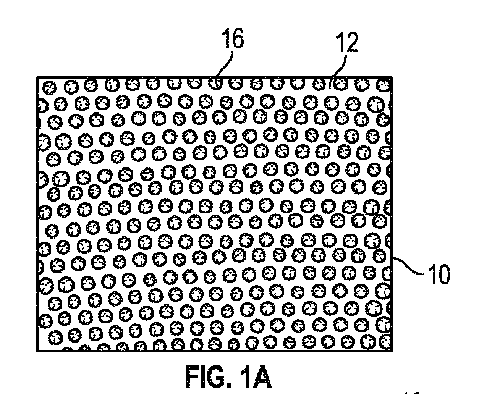
そのようなポリマー発泡組成物は、再生可能及び/又は堆肥化可能な発泡体パッド付き材料及び包装物品(例えば、封筒)において使用することができる。発泡体パッド付き材料は、第1の主面12及び第1の主面に対向している第2の主面14を有するシート材料10を含み、そのシート材料は、再生可能な材料と、シート材料の第1の主面12上に配置された、本明細書に記載の発泡組成物16とを含む。
Such polymeric foam compositions can be used in renewable and/or compostable foam padded materials and packaging articles (eg, envelopes). The foam padded material includes a
簡単に言えば、包装物品は、第1の内面及び第1の内面の反対側に第1の外面を有する第1の壁、並びに第2の内面及び第2の内面の反対側に第2の外面を有する第2の壁を含む。第1及び第2の内面は包装物品の内部を画定し、第1及び第2の外面は包装物品の外部を画定する。包装物品は、第1の壁がシール接合部において第2の壁に取り付けられている1つ以上の縁部を有する。任意選択的に、物品は、第1の壁が第2の壁に取り付けられていない少なくとも1つの開口部を有してもよく、これは、包装物品の内部に配置されている物体の周りに包装物品を形成し、それによって開口部を有する物品の必要性を排除することが可能であるため、要件ではない。本明細書に記載の発泡組成物は第1及び第2の内面の各々の少なくとも一部分上に配置されている。好ましくは、発泡組成物はシール接合部も形成し、それによって包装物品の第1の壁を第2の壁に取り付ける。 Briefly, the packaged article includes a first wall having a first interior surface and a first exterior surface opposite the first interior surface, a second interior surface and a second exterior surface opposite the second interior surface. including a second wall having an outer surface. The first and second inner surfaces define an interior of the packaged article and the first and second outer surfaces define an exterior of the packaged article. The packaging article has one or more edges where the first wall is attached to the second wall at a sealing joint. Optionally, the article may have at least one opening where the first wall is not attached to the second wall, which allows the article to be opened around an object that is placed inside the packaged article. It is not a requirement as it is possible to form a packaged article thereby eliminating the need for an article with an opening. A foamed composition described herein is disposed on at least a portion of each of the first and second interior surfaces. Preferably, the foam composition also forms a sealing joint, thereby attaching the first wall of the packaged article to the second wall.
特定の実施形態では、ポリマー発泡組成物、発泡体パッド付き材料、又は包装物品は、再生可能である。特定の実施形態では、ポリマー発泡組成物、発泡体パッド付き材料、又は包装物品は、堆肥化可能である。特定の実施形態では、ポリマー発泡組成物、発泡体パッド付き材料、又は包装物品は、両方とも再生可能及び堆肥化可能である。 In certain embodiments, the polymeric foam composition, foam padded material, or packaging article is recyclable. In certain embodiments, the polymer foam composition, foam padded material, or packaging article is compostable. In certain embodiments, the polymer foam composition, foam padded material, or packaging article are both renewable and compostable.
発泡組成物
発泡組成物は、有機ポリマー発泡体、すなわち、ポリマーマトリックス(すなわち、ポリマー成分)と、その中に、典型的には気泡又はセル中に分散されたガスとの複合材である。発泡体体積膨張中、気相は最初に連続ポリマー相中に分散される。ポリマー発泡体は、機械的に(例えば、空気分散)、物理的に(例えば、ガス注入、ビーズ発泡、膨張性マイクロスフェアによって)、又は化学的に(例えば、熱分解によって有効なガスを発生させる発泡剤を使用することによって)調製することができる。
Foamed Compositions Foamed compositions are organic polymeric foams, ie, composites of a polymeric matrix (ie, polymeric component) and a gas dispersed therein, typically in bubbles or cells. During foam volume expansion, the gas phase is first dispersed into the continuous polymer phase. Polymer foams can generate active gases mechanically (e.g., air dispersion), physically (e.g., by gas injection, bead foaming, expandable microspheres), or chemically (e.g., by pyrolysis). (by using blowing agents).
そのような発泡組成物は、典型的には、独立気泡発泡体を含むが、連続気泡発泡体も可能である。特定の実施形態では、発泡体は、独立気泡を含み、任意選択的に、連続気泡及び/又は破裂気泡を有する。 Such foam compositions typically include closed cell foams, although open cell foams are also possible. In certain embodiments, the foam includes closed cells, and optionally has open cells and/or burst cells.
本開示の発泡組成物は、典型的には、ASTM D3575-14(ピクノメーター(Mettler-Toledo,LLC,Columbus,OH製のDELTARANGE Model AG204)と、アルキメデスの原理を使用して計算された密度とを使用する「Standard Test Methods for Flexible Cellular Materials Made from Olefin Polymers」)に従って測定すると、少なくとも0.01グラム毎立方センチメートル(g/cc)かつ最大0.5g/ccの密度を有する。 The foamed compositions of the present disclosure typically have a density calculated using ASTM D3575-14 (Pycnometer (DELTARANGE Model AG204, manufactured by Mettler-Toledo, LLC, Columbus, OH) and Archimedes' principle). having a density of at least 0.01 grams per cubic centimeter (g/cc) and at most 0.5 g/cc, as measured according to the "Standard Test Methods for Flexible Cellular Materials Made from Olefin Polymers" using
本開示の発泡組成物は少なくとも部分的に水溶性であり、好ましくは100%水溶性である。発泡体(すなわち、発泡組成物)の文脈では、少なくとも部分的に水溶性の発泡体とは、実施例の項に記載の水溶性試験により、発泡体の少なくとも50%が130°F(54℃)の水に溶解することを意味している。特定の実施形態では、実施例の項に記載される水溶性試験により、発泡体(すなわち、発泡組成物)の少なくとも60%、少なくとも70%、少なくとも80%、少なくとも85%、少なくとも90%、少なくとも95%が、130°F(54℃)の水に溶解する。そのような発泡組成物は、以下でより詳細に説明するように、水溶性成分、例えば、1つ以上のポリマー、及び1つ以上の任意選択の水溶性添加剤を含む。 The foamed compositions of the present disclosure are at least partially water soluble, preferably 100% water soluble. In the context of foams (i.e., foam compositions), an at least partially water-soluble foam is defined as an at least partially water-soluble foam in which at least 50% of the foam has a temperature of 130°F (54°C ) means that it dissolves in water. In certain embodiments, at least 60%, at least 70%, at least 80%, at least 85%, at least 90%, at least 95% is soluble in water at 130°F (54°C). Such foamed compositions include water-soluble components, such as one or more polymers, and one or more optional water-soluble additives, as described in more detail below.
本開示の発泡組成物(すなわち、発泡体)は、好ましくはヒートシール可能である。これは、発泡組成物が十分に熱可塑性であることと、熱エネルギー、機械エネルギー、又はこれらの組み合わせ(例えば、ヒートシール、音波溶着)にさらされると液化及び流動し、冷却すると再凝固し、それによって、間に配置された発泡組成物を有する2つの基材材料の間にシールを提供することと、を意味している。発泡組成物のシール可能性は実施例の項に記載したシーム強度試験を用いて定量化することができる。特定の実施形態では、本開示の発泡組成物は少なくとも1.0lbf/inのシーム強度を有する。 The foamed compositions (i.e., foams) of the present disclosure are preferably heat sealable. This is due to the fact that the foam composition is sufficiently thermoplastic that it liquefies and flows when exposed to thermal energy, mechanical energy, or a combination thereof (e.g., heat sealing, sonic welding), resolidifies when cooled, By that, it is meant to provide a seal between two substrate materials with a foamed composition disposed therebetween. The sealability of foam compositions can be quantified using the seam strength test described in the Examples section. In certain embodiments, foam compositions of the present disclosure have a seam strength of at least 1.0 lbf/in.
本開示の発泡組成物(すなわち、発泡体)は、好ましくは耐久性である。耐久性とは、例えば、発泡体の強度及び内部完全性、発泡体の脱落又は紙への接着によって実証されるような発泡体の基材への接着、発泡体が衝撃を吸収する能力、並びに発泡体が圧縮に耐える能力を含む、多くの要因の組み合わせを指す。発泡組成物の耐久性は、耐摩耗性試験、並びに圧縮強度及びエネルギー吸収損失試験によって定量化することができ、これらは実施例の項に記載されている。 The foamed compositions (i.e., foams) of the present disclosure are preferably durable. Durability includes, for example, the strength and internal integrity of the foam, the adhesion of the foam to the substrate as evidenced by shedding of the foam or adhesion to paper, the ability of the foam to absorb impact, and Refers to a combination of many factors, including the foam's ability to withstand compression. The durability of foamed compositions can be quantified by abrasion resistance tests, as well as compressive strength and energy absorption loss tests, which are described in the Examples section.
特定の実施形態では、本開示の発泡組成物は、耐摩耗性試験に従って、上部から加えられる1100グラムの総重量による30サイクルの摩耗後に、30%以下、20%以下、又は10%以下のテーバー摩耗からの発泡体の脱落質量損失を有する。 In certain embodiments, the foamed compositions of the present disclosure have a Taber of 30% or less, 20% or less, or 10% or less after 30 cycles of abrasion with a total weight of 1100 grams applied from the top according to an abrasion resistance test. Foam shedding from wear has mass loss.
特定の実施形態では、本開示の発泡組成物は、圧縮強度並びにエネルギー吸収損失試験に従って、少なくとも100KJの吸収エネルギー損失を有する。特定の実施形態では、本開示の発泡組成物は、圧縮強度並びにエネルギー吸収損失試験に従って、少なくとも275KJの吸収エネルギー損失を有する。 In certain embodiments, the foamed compositions of the present disclosure have an absorbed energy loss of at least 100 KJ according to compressive strength and energy absorption loss tests. In certain embodiments, the foamed compositions of the present disclosure have an absorbed energy loss of at least 275 KJ according to compressive strength and energy absorption loss tests.
特定の実施形態では、本開示の発泡組成物は、圧縮強度並びにエネルギー吸収損失試験に従って、少なくとも8kPaの50%圧縮歪みにおける圧縮応力を有する。特定の実施形態では、本開示の発泡組成物は、圧縮強度並びにエネルギー吸収損失試験に従って、最大25kPaの50%圧縮歪みにおける圧縮応力を有する。 In certain embodiments, the foamed compositions of the present disclosure have a compressive stress at 50% compressive strain of at least 8 kPa according to compressive strength and energy absorption loss tests. In certain embodiments, the foamed compositions of the present disclosure have a compressive stress at 50% compressive strain of up to 25 kPa according to compressive strength and energy absorption loss tests.
特定の実施形態では、1つ以上のポリマーを含み得る発泡組成物のポリマー成分(すなわち、ポリマーマトリックス)は、発泡組成物(すなわち、残留水を含み得る最終の(乾燥した)発泡体)の総重量に基づいて、少なくとも60重量%、少なくとも65重量%、少なくとも70重量%、少なくとも75重量%、少なくとも80重量%、少なくとも85重量%、又は少なくとも90重量%の量で存在する。特定の実施形態では、1つ以上のポリマーを含み得る発泡組成物のポリマー成分は、(最終)発泡組成物の総重量に基づいて、最大99.5重量%の量で存在する。発泡組成物の残りは、その中に分散されたガス(例えば、空気)を含み、また、1つ以上の発泡剤(例えば、膨張性マイクロスフェア)、組成物が発泡した後のそのような発泡剤の残留物(例えば、膨張マイクロスフェア)、充填剤、及び以下でより詳細に説明される他の任意選択の添加剤も含み得る。特定の好ましい実施形態では、発泡組成物の残りは、以下で考察されるように、ガス及び膨張マイクロスフェア(すなわち、組成物が発泡され、膨張性マイクロスフェアが膨張した後に生じる発泡剤残留物)を含む。 In certain embodiments, the polymeric component of the foamed composition (i.e., the polymer matrix), which may include one or more polymers, makes up the total amount of the foamed composition (i.e., the final (dry) foam, which may contain residual water). Present in an amount of at least 60%, at least 65%, at least 70%, at least 75%, at least 80%, at least 85%, or at least 90% by weight, by weight. In certain embodiments, the polymeric component of the foamed composition, which may include one or more polymers, is present in an amount of up to 99.5% by weight, based on the total weight of the (final) foamed composition. The remainder of the foaming composition includes a gas (e.g., air) dispersed therein, and one or more blowing agents (e.g., expandable microspheres), such as foaming agents after the composition has foamed. Residues of agents (eg, expanded microspheres), fillers, and other optional additives described in more detail below may also be included. In certain preferred embodiments, the remainder of the foamed composition is gas and expanded microspheres (i.e., blowing agent residue that results after the composition is foamed and the expandable microspheres are expanded), as discussed below. including.
発泡組成物のポリマー成分は、発泡性であり、典型的には少なくとも部分的に水溶性であるように選択され、好ましくは、発泡体パッド付き材料又は包装物品に以下の特性:衝撃保護、緩衝性、断熱性、耐圧縮性、耐水性、再生可能性、及び/又は堆肥化可能性のうちの1つ以上を提供する、水性ポリマー又はポリマーの混合物を使用して形成される。 The polymeric component of the foam composition is selected to be foamable, typically at least partially water soluble, and preferably provides the foam padded material or packaging article with the following properties: impact protection, cushioning. The polymer is formed using a water-based polymer or mixture of polymers that provides one or more of the following properties: thermal insulation, compression resistance, water resistance, recyclability, and/or compostability.
発泡性のために、そのようなポリマーは、概して、水によって高度に可塑化される。これは、特に、発泡が加熱時の膨張性マイクロスフェアの膨張によって提供されるときに、効率的な発泡を可能にする。水性ポリマーは、典型的には、合成又は天然起源であってもよい単一グレード、又はエマルジョンポリマーの混合物を使用する乳化重合によって調製される。 Due to their foamability, such polymers are generally highly plasticized by water. This allows efficient foaming, especially when foaming is provided by expansion of expandable microspheres upon heating. Aqueous polymers are typically prepared by emulsion polymerization using a single grade, which may be of synthetic or natural origin, or a mixture of emulsion polymers.
好ましくは、1つ以上の水性ポリマーは水溶性ポリマーである。ポリマーの文脈では、水溶性とは、実施例の項に記載される水溶性試験と類似の手順において、ポリマーの少なくとも90重量%が、130°F(54℃)の水に溶解することを意味している。特定の実施形態では、水溶性ポリマーの少なくとも95重量%又は少なくとも99重量%が、実施例の項に記載される水溶性試験と類似の手順において、130°F(54℃)の水に溶解する。 Preferably, the one or more water-based polymers are water-soluble polymers. In the context of polymers, water soluble means that at least 90% by weight of the polymer is soluble in water at 130°F (54°C) in a procedure similar to the water solubility test described in the Examples section. are doing. In certain embodiments, at least 95% or at least 99% by weight of the water-soluble polymer is soluble in water at 130°F (54°C) in a procedure similar to the water solubility test described in the Examples section. .
特定の実施形態では、ポリマー成分は、二価ヒドロキシエチレンモノマー単位(すなわち、-CH2-CH(OH)-)及び二価ジヒドロキシブチレンモノマー単位(本明細書において「ヒドロキシ-エチレン-ブチレンコポリマー」と称される)を含む、コポリマー、好ましくは水溶性ポリマーを含む。特定の実施形態では、ポリマー成分はそのようなヒドロキシ-エチレン-ブチレンコポリマー(例えば、モノマー組成、分子量、メルトフローインデックスが異なる)のうちの1つ以上を含み得る。好ましい実施形態では、二価ジヒドロキシブチレンモノマー単位は、3,4-ジヒドロキシブタン-1,2-ジイルモノマー単位(すなわち、構造

任意選択的であるが、典型的には、コポリマーは、アセトキシエチレン二価モノマー単位(すなわち、構造

コポリマーは、酢酸ビニル及び3,4-ジヒドロキシ-1-ブテンの共重合、続いてアセトキシ基の部分的又は完全な鹸化でヒドロキシル基を形成することによって得ることができる。あるいは、3,4-ジヒドロキシ-1-ブテンの代わりに、カーボネート、例えば


市販の水溶性コポリマーとしては、Nichigo G-Polymer(日本合成化学工業、大阪)の商品名で入手可能なものである、高度非晶質ポリビニルアルコールを挙げることができ、これは、ヒドロキシエチレン、3,4-ジヒドロキシブタン-1,2-ジイル、及び任意選択的にアセトキシエチレンの二価モノマー単位を有すると考えられる。日本合成化学工業品(Nippon Gosei)は、化学名ブテンジオールビニルアルコール(BVOH)によるNichigo G-Polymerも指す。例示的な材料としては、Nichigo G-PolymerグレードのAZF8035W、OKS-1024、OKS-8041、OKS-8089、OKS-8118、OKS-6026、OKS-1011、OKS-8049、OKS-8074P、OKS-1028、OKS-1027、OKS-1109、OKS-1081、及びOKS-1083が挙げられる。例示的なG-PolymerはSoarus LLC,Arlington Heights,IL,USAから商品名OKS-8074Pで入手可能である。これらのヒドロキシ-エチレン-ブチレンコポリマーは、80~97.9モルパーセントの鹸化度を有し、多価アルコール1モル当たり5~9モルのアルキレンオキシドを含有する多価アルコールのアルキレンオキシド付加物を更に有すると考えられる。 Commercially available water-soluble copolymers include highly amorphous polyvinyl alcohol, available under the trade name Nichigo G-Polymer (Nippon Gosei Kagaku Kogyo, Osaka), which is composed of hydroxyethylene, 3 , 4-dihydroxybutane-1,2-diyl, and optionally acetoxyethylene. Nippon Gosei also refers to Nichigo G-Polymer by the chemical name butenediol vinyl alcohol (BVOH). Exemplary materials include Nichigo G-Polymer grades AZF8035W, OKS-1024, OKS-8041, OKS-8089, OKS-8118, OKS-6026, OKS-1011, OKS-8049, OKS-8074P, OKS-1028. , OKS-1027, OKS-1109, OKS-1081, and OKS-1083. An exemplary G-Polymer is available from Soarus LLC, Arlington Heights, IL, USA under the trade name OKS-8074P. These hydroxy-ethylene-butylene copolymers have a degree of saponification of 80 to 97.9 mole percent and further contain alkylene oxide adducts of polyhydric alcohols containing 5 to 9 moles of alkylene oxide per mole of polyhydric alcohol. It is considered to have.
ヒドロキシ-エチレン-ブチレンコポリマーは、発泡性、少なくとも部分的な水溶性、並びに好ましくは耐久性及び/又はヒートシール性を発泡組成物に提供するように選択される。そのような性能特性に寄与し得るヒドロキシ-エチレン-ブチレンコポリマーの物理的特性としては、メルトフローインデックス、分子量、溶融温度、及び分解温度が挙げられる。 The hydroxy-ethylene-butylene copolymer is selected to provide foaming properties, at least partial water solubility, and preferably durability and/or heat sealability to the foam composition. Physical properties of hydroxy-ethylene-butylene copolymers that can contribute to such performance characteristics include melt flow index, molecular weight, melting temperature, and decomposition temperature.
特定の実施形態では、ポリマー成分中のヒドロキシ-エチレン-ブチレンコポリマーのうちの1つ以上は、10分(min)当たり少なくとも0.1グラム(g)、又は10分当たり少なくとも0.5gのメルトフローインデックスを有する(2.16kgの荷重を用いて210℃で測定して)。特定の実施形態では、ポリマー成分中のヒドロキシ-エチレン-ブチレンコポリマーのうちの1つ以上は、最大60g/10分、最大50g/10分、最大40g/10分、最大30g/10分、最大20g/10分、又は最大10g/10分のメルトフローインデックス(2.16kgの荷重を用いて210℃で測定して)を有する。 In certain embodiments, one or more of the hydroxy-ethylene-butylene copolymers in the polymer component has a melt flow of at least 0.1 grams (g) per 10 minutes (min), or at least 0.5 g per 10 minutes. (measured at 210° C. using a load of 2.16 kg). In certain embodiments, one or more of the hydroxy-ethylene-butylene copolymers in the polymer component can be up to 60 g/10 min, up to 50 g/10 min, up to 40 g/10 min, up to 30 g/10 min, up to 20 g /10 min, or up to 10 g/10 min (measured at 210° C. using a load of 2.16 kg).
特定の実施形態では、ポリマー成分中のヒドロキシ-エチレン-ブチレンコポリマーのうちの1つ以上は、少なくとも90℃、少なくとも140℃、又は少なくとも155℃の溶融温度(示差走査熱量測定(DSC)によって測定して)を有する。特定の実施形態では、ポリマー成分中のヒドロキシ-エチレン-ブチレンコポリマーのうちの1つ以上は、最大220℃、最大200℃、又は最大195℃の溶融温度(DSCによって測定して)を有する。 In certain embodiments, one or more of the hydroxy-ethylene-butylene copolymers in the polymer component has a melting temperature (as measured by differential scanning calorimetry (DSC)) of at least 90°C, at least 140°C, or at least 155°C. ). In certain embodiments, one or more of the hydroxy-ethylene-butylene copolymers in the polymer component has a melting temperature (as measured by DSC) of at most 220°C, at most 200°C, or at most 195°C.
これらのヒドロキシ-エチレン-ブチレンコポリマーは発泡体のポリマー成分として単独で使用してもよく、又は他の(第2の)有機ポリマーと組み合わせて使用してもよい。これらの第2のポリマーは水溶性であってもなくてもよい。 These hydroxy-ethylene-butylene copolymers may be used alone as the polymeric component of the foam or in combination with other (second) organic polymers. These second polymers may or may not be water soluble.
特定の実施形態では、1つ以上のヒドロキシ-エチレン-ブチレンコポリマーは、(最終)発泡組成物のポリマー成分の総重量に基づいて、少なくとも1重量%、少なくとも10重量%、少なくとも15重量%、少なくとも25重量%、少なくとも50重量%、少なくとも60重量%、又は少なくとも70重量%の量でポリマー成分中に存在する。特定の実施形態では、1つ以上のヒドロキシ-エチレン-ブチレンコポリマーは、(最終)発泡組成物のポリマー成分の総重量に基づいて、最大100重量%、最大90重量%、又は最大80重量%の量でポリマー成分中に存在する。これらの値はまた、発泡性組成物の水が含まれていない場合に、発泡前のポリマー成分を特徴付ける。 In certain embodiments, the one or more hydroxy-ethylene-butylene copolymers comprise at least 1%, at least 10%, at least 15%, at least 1% by weight, based on the total weight of the polymer components of the (final) foam composition. Present in the polymer component in an amount of 25%, at least 50%, at least 60%, or at least 70% by weight. In certain embodiments, the one or more hydroxy-ethylene-butylene copolymers comprise up to 100%, up to 90%, or up to 80% by weight, based on the total weight of the polymer components of the (final) foam composition. present in the polymer component in amounts. These values also characterize the polymer component before foaming in the absence of water in the foamable composition.
特定の実施形態では、発泡組成物は、(最終)発泡組成物の総重量に基づいて、少なくとも1重量%、少なくとも10重量%、少なくとも15重量%、少なくとも25重量%、少なくとも50重量%、少なくとも60重量%、又は少なくとも70重量%のヒドロキシ-エチレン-ブチレンコポリマーを含む発泡性含水組成物から形成される。特定の実施形態では、発泡組成物は、(最終)発泡組成物の総重量に基づいて、最大99.5重量%、最大95重量%、最大90重量%、最大80重量%、最大70重量%、又は最大60重量%のヒドロキシ-エチレン-ブチレンコポリマーを含む発泡性含水組成物から形成される。 In certain embodiments, the foamed composition comprises at least 1%, at least 10%, at least 15%, at least 25%, at least 50%, at least 1% by weight, based on the total weight of the (final) foamed composition. Formed from a foamable hydrous composition comprising 60%, or at least 70% by weight hydroxy-ethylene-butylene copolymer. In certain embodiments, the foamed composition comprises up to 99.5%, up to 95%, up to 90%, up to 80%, up to 70% by weight, based on the total weight of the (final) foamed composition. , or from a foamable water-containing composition comprising up to 60% by weight hydroxy-ethylene-butylene copolymer.
使用される場合、1つ以上の第2のポリマーは、(最終)発泡組成物のポリマー成分の総重量に基づいて、最大99%、最大90%、最大80%、最大75重量%、最大60重量%、最大50重量%、最大40重量%、又は最大30重量%の量で、ポリマー成分中に存在する。使用される場合、1つ以上の第2のポリマーは、(最終)発泡組成物のポリマー成分の総重量に基づいて、少なくとも10重量%、少なくとも20重量%、少なくとも30重量%、少なくとも40重量%、又は少なくとも50重量%の量で、ポリマー成分中に存在する。 If used, the one or more second polymers can be up to 99%, up to 90%, up to 80%, up to 75%, up to 60% by weight, based on the total weight of the polymeric components of the (final) foam composition. %, up to 50%, up to 40%, or up to 30% by weight in the polymer component. If used, the one or more second polymers are at least 10%, at least 20%, at least 30%, at least 40% by weight, based on the total weight of the polymeric components of the (final) foam composition. , or present in the polymer component in an amount of at least 50% by weight.
特定の実施形態では、ポリマー成分は、ブタンジオールビニルアルコールポリマー又はコポリマー、デンプン、酢酸ビニル/エチレンコポリマー、ポリ酢酸ビニル、ポリビニルアルコール、デキストリン安定化ポリ酢酸ビニル、ビニルアルコール/酢酸ビニルコポリマー、ビニルアルコール/酢酸ビニル/エチレンコポリマー、安定化ポリビニルアクリレートコポリマー、ビニル(メチル)アクリル、スチレン(メタ)アクリル、(メタ)アクリル、スチレンブチルゴム、天然ゴム、スチレンブロックコポリマー、ポリウレタン、及びこれらの混合物の群から選択される第2のポリマーを含む。そのような市販のポリマーの1つは商品名Dur-O-Set(Celanese,Florence,KY USA)で入手可能なポリビニルアルコール安定化酢酸ビニルエチレン(VAE)エマルジョンである。特定の実施形態では、第2のポリマーは中性であることができ、又は荷電モノマー(アニオン性、カチオン性、両性イオン性)を含有することができる。 In certain embodiments, the polymeric components include butanediol vinyl alcohol polymer or copolymer, starch, vinyl acetate/ethylene copolymer, polyvinyl acetate, polyvinyl alcohol, dextrin stabilized polyvinyl acetate, vinyl alcohol/vinyl acetate copolymer, vinyl alcohol/ selected from the group of vinyl acetate/ethylene copolymers, stabilized polyvinyl acrylate copolymers, vinyl(methyl)acrylics, styrene(meth)acrylics, (meth)acrylics, styrene butyl rubbers, natural rubbers, styrene block copolymers, polyurethanes, and mixtures thereof. a second polymer comprising: One such commercially available polymer is polyvinyl alcohol stabilized vinyl acetate ethylene (VAE) emulsion available under the trade name Dur-O-Set (Celanese, Florence, KY USA). In certain embodiments, the second polymer can be neutral or can contain charged monomers (anionic, cationic, zwitterionic).
発泡組成物を作製するのに好適なポリマーは、典型的には、ペレット又は粉末形態で供給業者から入手され、水に溶解又は分散される。又は、それらは水性分散液又はエマルジョンとして入手することができる。典型的には、そのような分散液又はエマルジョンは、10重量%~70重量%の固形分を有する。したがって、本開示の発泡組成物(すなわち、最終発泡体)は、本明細書において「発泡性」組成物と称される含水配合物から調製される。 Polymers suitable for making foamed compositions are typically obtained from suppliers in pellet or powder form and dissolved or dispersed in water. Alternatively, they can be obtained as aqueous dispersions or emulsions. Typically such dispersions or emulsions have a solids content of 10% to 70% by weight. Accordingly, the foamed compositions (ie, final foams) of the present disclosure are prepared from aqueous formulations, referred to herein as "foamable" compositions.
特定の実施形態では、発泡組成物は、発泡前の発泡性組成物の総重量に基づいて、少なくとも20重量%、少なくとも30重量%、少なくとも40重量%、又は少なくとも50重量%の固形分(すなわち、水以外のもの)を含む発泡性含水組成物から形成される。特定の実施形態では、発泡組成物は、発泡前の発泡性組成物の総重量に基づいて、最大70重量%、又は最大60重量%の固形分を含む含水組成物から形成される。固体は、ポリマー成分、及び任意の固体発泡剤(又は発泡後に残る固体残留物)、充填剤、及び他の任意選択の固体添加剤を含む。 In certain embodiments, the foamed composition has a solids content of at least 20%, at least 30%, at least 40%, or at least 50% by weight, based on the total weight of the foamable composition before foaming (i.e. , other than water). In certain embodiments, the foamed composition is formed from a water-containing composition comprising up to 70% by weight, or up to 60% by weight solids, based on the total weight of the foamable composition before foaming. Solids include the polymeric component and any solid blowing agents (or solid residues left after foaming), fillers, and other optional solid additives.
特定の実施形態では、発泡組成物は、膨張性マイクロスフェアなどの発泡剤を含む発泡性含水組成物から形成される。発泡の他の機構が可能であるため、これらは要件とされないが、以下で考察するように、それらが使用される場合、膨張性マイクロスフェアは、発泡前の組成物の総重量に基づいて、最大20重量%、又は最大15重量%の量で存在する。特定の実施形態では、それらが使用される場合、膨張性マイクロスフェアは、発泡前の組成物の総重量に基づいて、少なくとも0.5重量%の量で存在する。 In certain embodiments, the foamed composition is formed from a foamable aqueous composition that includes a blowing agent such as expandable microspheres. These are not required as other mechanisms of foaming are possible, but as discussed below, when they are used, the expandable microspheres are Present in an amount of up to 20% by weight, or up to 15% by weight. In certain embodiments, the expandable microspheres, if used, are present in an amount of at least 0.5% by weight, based on the total weight of the composition before foaming.
特定の実施形態では、膨張性マイクロスフェアは熱膨張性ポリマーマイクロスフェアである。すなわち、膨張性マイクロスフェアは、熱及び/又は放射エネルギー(例えば、マイクロ波、赤外線、高周波、及び/又は超音波エネルギーを含む)の存在下で、サイズを膨張させることができる。 In certain embodiments, the expandable microspheres are thermally expandable polymer microspheres. That is, expandable microspheres can expand in size in the presence of heat and/or radiant energy (including, for example, microwave, infrared, radio frequency, and/or ultrasound energy).
膨張性マイクロスフェアは、それらが膨張し始める特定の温度(初期膨張温度又はT0)及びそれらが最大膨張に到達した第2の温度(最大膨張温度又はTm)を有する。異なるグレードのマイクロスフェアは異なる膨張開始温度及び最大膨張温度を有する。例えば、1つの特に有用なマイクロスフェアは80℃~150℃のT0を有する。マイクロスフェアが最大膨張に達する温度(T)は、望ましくは100℃~200℃である。特定のマイクロスフェア並びにそれらのそれぞれのT0及びTmに関する選択は重要ではないが、加工温度は、これらの温度に応じて変更され得る。組成物が完全に乾燥する前に、これらのマイクロスフェアは組成物内で移動することができ、膨張することができる。しかしながら、組成物が完全に乾燥すると、マイクロスフェアは実質的に定位置に固定される。膨張した組成物は、典型的には、湿潤した又は部分的に乾燥した組成物から、2000%を超える、好ましくは2500%を超える総体積膨張を有する。 Expandable microspheres have a particular temperature at which they begin to expand (the initial expansion temperature, or T 0 ) and a second temperature at which they reach maximum expansion (the maximum expansion temperature, or T m ). Different grades of microspheres have different onset and maximum expansion temperatures. For example, one particularly useful microsphere has a T 0 of 80°C to 150°C. The temperature (T) at which the microspheres reach maximum expansion is desirably between 100°C and 200°C. Although the choice regarding the particular microspheres and their respective T 0 and T m is not critical, processing temperatures may be varied depending on these temperatures. These microspheres can move within the composition and expand before the composition is completely dry. However, once the composition is completely dry, the microspheres are substantially fixed in place. Swollen compositions typically have a total volume expansion of greater than 2000%, preferably greater than 2500%, from a wet or partially dry composition.
特定の実施形態では、膨張性マイクロスフェアは、ポリマーシェル及び炭化水素コア(例えば、ポリアクリロニトリルシェル)を有する。 In certain embodiments, expandable microspheres have a polymer shell and a hydrocarbon core (eg, a polyacrylonitrile shell).
好適なマイクロスフェアとしては、例えば、炭化水素コア及びポリアクリロニトリルシェルを有するもの(例えば、商品名「DUALITE」で販売されているもの)及び他の同様のマイクロスフェア(例えば、商品名「EXPANCEL」で販売されているもの、例えば、「EXPANCEL 043 DU 80」)を含む熱膨張性ポリマーマイクロスフェアが挙げられる。 Suitable microspheres include, for example, those with a hydrocarbon core and a polyacrylonitrile shell (e.g. those sold under the trade name "DUALITE") and other similar microspheres (e.g. those sold under the trade name "EXPANCEL"). Examples include thermally expandable polymer microspheres, including those sold commercially, such as "EXPANCEL 043 DU 80").
膨張性マイクロスフェアは直径5ミクロン~30ミクロンを含む任意の未膨張サイズを有し得る。熱の存在下で、本発明の膨張性マイクロスフェアは直径を3倍~10倍増加させることが可能であり得る。組成物中のマイクロスフェアが膨張すると、組成物は発泡材料になる。あるいは、膨張性マイクロスフェアは、ポリマー成分と組み合わせる前に予備膨張させ、更なる膨張を受ける必要なく完全に膨張させることができる。 Expandable microspheres can have any unexpanded size, including diameters from 5 microns to 30 microns. In the presence of heat, the expandable microspheres of the present invention may be able to increase in diameter by a factor of 3 to 10. When the microspheres in the composition expand, the composition becomes a foamed material. Alternatively, the expandable microspheres can be pre-expanded prior to combination with the polymeric component and allowed to fully expand without having to undergo further expansion.
膨張性マイクロスフェアが好ましいが、所望であれば、他の発泡機構を使用することができる。例えば、ポリマー発泡体は、機械的に(例えば、空気分散)、物理的に(例えば、ガス注入、ビーズ発泡、膨張性マイクロスフェアによって)、又は化学的に(例えば、熱分解によって有効なガスを発生させる発泡剤を使用することによって)調製することができる。例えば、物理的発泡剤又は化学的発泡剤を含む、膨張性マイクロスフェア以外の発泡剤を使用することができる。それらが使用される場合、1つ以上の発泡剤は、発泡前の組成物の総重量に基づいて、最大20重量%、又は最大15重量%の量で存在する。特定の実施形態では、それらが使用される場合、1つ以上の発泡剤は、発泡前の組成物の総重量に基づいて、少なくとも0.5重量%の量で存在する。 Although expandable microspheres are preferred, other expansion mechanisms can be used if desired. For example, polymer foams can be made with available gases mechanically (e.g., air dispersion), physically (e.g., by gas injection, bead foaming, expandable microspheres), or chemically (e.g., by pyrolysis). can be prepared by using a blowing agent that generates foam. For example, blowing agents other than expandable microspheres can be used, including physical blowing agents or chemical blowing agents. When used, the one or more blowing agents are present in an amount of up to 20% by weight, or up to 15% by weight, based on the total weight of the composition before foaming. In certain embodiments, the one or more blowing agents, if used, are present in an amount of at least 0.5% by weight, based on the total weight of the composition before foaming.
本開示の発泡組成物を形成するのに有用な物理的発泡剤は、発泡体が形成される温度及び圧力で蒸気である多種多様な天然大気物質を含むことができる。物理的発泡剤は、気体、液体、又は超臨界流体として、好ましくは液体として、ポリマー成分に導入され得る。物理的発泡剤は、通常は、発泡プロセス中に存在する条件で、超臨界状態にある。物理的発泡剤が使用される場合、それは使用されるポリマー成分に可溶性であることが好ましい。使用される物理的発泡剤は、得られる発泡体物品において求められる特性によって決まる。発泡剤を選択する際に考慮される他の要因は、その毒性、蒸気圧プロファイル、及び取り扱いの容易さである。ペンタン、ブタンなどの可燃性発泡剤、並びにヒドロフルオロカーボン(hydrofluorocarbon、HFC)及びヒドロクロロフルオロカーボン(hydrochlorofluorocarbon、HCFC)などの他の有機材料を使用することができるが、不燃性、非毒性、非オゾン枯渇性発泡剤は、使用がより容易であり、例えば、環境及び安全性の懸念がより少ないため、好ましい。好適な物理的発泡剤としては、例えば、二酸化炭素、窒素、SF6、亜酸化窒素、ペルフッ素化流体、例えば、C2F6、アルゴン、ヘリウム、希ガス、例えば、キセノン、空気(窒素と酸素とのブレンド)、及びこれらの材料のブレンド、ヒドロフルオロカーボン(HFC)及びヒドロクロロフルオロカーボン(HCFC)が挙げられる。 Physical blowing agents useful in forming the foamed compositions of the present disclosure can include a wide variety of natural atmospheric substances that are vapors at the temperature and pressure at which the foam is formed. The physical blowing agent can be introduced into the polymer component as a gas, liquid, or supercritical fluid, preferably as a liquid. Physical blowing agents are typically in a supercritical state at the conditions present during the foaming process. If a physical blowing agent is used, it is preferably soluble in the polymeric component used. The physical blowing agent used will depend on the properties desired in the resulting foam article. Other factors considered in selecting a blowing agent are its toxicity, vapor pressure profile, and ease of handling. Flammable blowing agents such as pentane, butane, and other organic materials such as hydrofluorocarbons (HFCs) and hydrochlorofluorocarbons (HCFCs) can be used but are non-flammable, non-toxic, and non-ozone depleting. Polymer blowing agents are preferred because they are easier to use and pose fewer environmental and safety concerns, for example. Suitable physical blowing agents include, for example, carbon dioxide, nitrogen, SF 6 , nitrous oxide, perfluorinated fluids such as C 2 F 6 , argon, helium, noble gases such as xenon, air (nitrogen and blends of these materials, hydrofluorocarbons (HFCs) and hydrochlorofluorocarbons (HCFCs).
好適な化学発泡剤としては、例えば、重炭酸ナトリウム及びクエン酸ブレンド、ジニトロソペンタメチレンテトラミン、p-トルエンスルホニルヒドラジド、4-4’-オキシビス(ベンゼンスルホニルヒドラジド、アゾジカルボンアミド(1,1’-アゾビスホルムアミド)、メタ変性アゾジカルボニド、p-トルエンスルホニルセミカルバジド、5フェニルテトラゾール、5-フェニルテトラゾール類似体、ジイソプロピルヒドラゾジカルボキシレート、5-フェニル-4-オキサジアジン-2-オン、及び水素化ホウ素ナトリウムが挙げられる。別の例示的な化学的発泡剤としては、商品名HYDROCEROL 40 CBで、Avient(Avon Lake,OH)から入手可能なものが挙げられる。 Suitable chemical blowing agents include, for example, sodium bicarbonate and citric acid blend, dinitrosopentamethylenetetramine, p-toluenesulfonylhydrazide, 4-4'-oxybis(benzenesulfonylhydrazide, azodicarbonamide(1,1'- azobisformamide), meta-modified azodicarbonide, p-toluenesulfonyl semicarbazide, 5-phenyltetrazole, 5-phenyltetrazole analogs, diisopropylhydrazodicarboxylate, 5-phenyl-4-oxadiazin-2-one, and sodium borohydride Another exemplary chemical blowing agent includes that available from Avient (Avon Lake, OH) under the tradename HYDROCEROL 40 CB.
発泡組成物、及びそれが形成される含水発泡性組成物はまた、1つ以上の追加の任意選択の添加剤も含み得る。好適な任意選択の添加剤の例としては、粘着付与剤(例えば、樹脂エステル、テルペン、フェノール、及び脂肪族、芳香族、又は脂肪族合成炭化水素樹脂と芳香族合成炭化水素樹脂との混合物)、可塑剤(物理的発泡剤以外)、核剤(例えば、タルク、シリコン、又はTiO2)、着色剤(例えば、顔料、染料)、補強剤、固体充填剤(例えば、パールデンプン、物理的変性デンプン、化学的変性デンプン、ガラスマイクロスフェア、粘土、コルク、おがくず、砂、無機粒子(例えば、セラミック又は金属)、有機粒子(例えば、カーボンブラック粒子、木材パルプ、ナノ結晶セルロース、ポリスチレン-ジビニルベンゼンなどの水に不溶性の架橋ポリマー粒子))、レオロジー調整剤、強靱化剤(toughening agent)、増粘剤(例えば、水溶性セルロースエーテル、ヒュームドシリカ、熱可塑性デンプン、直鎖状、分岐状、超分岐状、樹状、又は星型の構造であることができる合成ポリマー又はオリゴマー)、難燃剤、防腐剤(例えば、殺生物剤、1,2-ベンズイソチアゾリン-3-オン、5-クロロ-2-メチル-4-イソチアゾリン-3-オン及び2-メチル-4-イソチアゾリン-3-オン)、酸化防止剤、消泡剤、架橋剤(マイクロスフェアが膨張した後に組成物の構造的完全性を高める)、ワックス(例えば、パラフィンワックス、蜜蝋、合成ポリエチレンワックス)、安定剤(例えば、UV安定剤)、湿潤剤、促進剤、帯電防止剤、スリップ剤、及びこれらの組み合わせが挙げられる。 The foam composition, and the hydrous foamable composition from which it is formed, may also include one or more additional optional additives. Examples of suitable optional additives include tackifiers (e.g., resin esters, terpenes, phenols, and aliphatic, aromatic, or mixtures of aliphatic and aromatic synthetic hydrocarbon resins). , plasticizers (other than physical blowing agents), nucleating agents (e.g. talc, silicone, or TiO2 ), colorants (e.g. pigments, dyes), reinforcing agents, solid fillers (e.g. pearl starch, physical modifications). Starch, chemically modified starch, glass microspheres, clay, cork, sawdust, sand, inorganic particles (e.g. ceramic or metal), organic particles (e.g. carbon black particles, wood pulp, nanocrystalline cellulose, polystyrene-divinylbenzene, etc.) water-insoluble cross-linked polymer particles), rheology modifiers, toughening agents, thickeners (e.g., water-soluble cellulose ethers, fumed silica, thermoplastic starches, linear, branched, super synthetic polymers or oligomers that can be of branched, dendritic, or star-shaped structure), flame retardants, preservatives (e.g. biocides, 1,2-benzisothiazolin-3-one, 5-chloro-2 - methyl-4-isothiazolin-3-one and 2-methyl-4-isothiazolin-3-one), antioxidants, antifoaming agents, crosslinking agents (enhancing the structural integrity of the composition after the microspheres are expanded) ), waxes (eg, paraffin wax, beeswax, synthetic polyethylene wax), stabilizers (eg, UV stabilizers), wetting agents, accelerators, antistatic agents, slip agents, and combinations thereof.
粘着付与剤を使用することができるが、それらは、典型的には、本開示の発泡性/発泡組成物において使用されない。本開示の発泡組成物は、特にシール接合部(すなわち、シーム)を形成する際に、熱可塑性構造用接着剤として機能することができるが、それらは、好ましくは感圧接着剤ではない。 Although tackifiers can be used, they are typically not used in the foamable/foaming compositions of the present disclosure. Although the foamed compositions of the present disclosure can function as thermoplastic structural adhesives, particularly in forming sealed joints (i.e., seams), they are preferably not pressure sensitive adhesives.
任意選択の添加剤は、製造される発泡体にとって所望の特性を得るのに十分な種々の組み合わせ及び量で使用され得る。典型的には、1つ以上のそのような添加剤は、発泡性含水組成物(発泡前)の総重量に基づいて、少なくとも0.05重量%の量で存在する。特定の実施形態では、1つ以上の任意選択の添加剤は、発泡性含水組成物(発泡前)の総重量に基づいて、最大15重量%、最大10重量%、又は最大5重量%の量である。 Optional additives may be used in various combinations and amounts sufficient to obtain the desired properties for the foam produced. Typically, one or more such additives are present in an amount of at least 0.05% by weight, based on the total weight of the foamable aqueous composition (before foaming). In certain embodiments, the one or more optional additives are in an amount of up to 15%, up to 10%, or up to 5% by weight, based on the total weight of the foamable hydrous composition (before foaming). It is.
本開示の発泡性組成物は、望ましくは、基材上に堆積させるために、高速印刷/コーティング/噴霧/塗布/オーバーレイ又は同様のプロセスを可能にする粘度を有する。粘度の有用な範囲としては、実施例の項におけるブルックフィールド粘度試験に従って、0.1~11/秒(Hz)の剪断速度でレオメーターを用いて測定した場合に、25℃で300~100,000cPs、望ましくは25℃で1000cPs~70,000cPsが挙げられる。 The foamable compositions of the present disclosure desirably have a viscosity that allows for high speed printing/coating/spraying/dispensing/overlaying or similar processes for deposition onto a substrate. Useful ranges of viscosities include 300 to 100 at 25°C, as measured using a rheometer at a shear rate of 0.1 to 11/sec (Hz), according to the Brookfield Viscosity Test in the Examples section. 000 cPs, preferably 1000 cPs to 70,000 cPs at 25°C.
本開示の発泡組成物を形成するために、発泡性含水組成物を基材に、印刷、コーティング、噴霧、塗布、オーバーレイ、又は他の方法で適用する様々な方法が使用され得る。特に、スクリーン印刷、輪転グラビア印刷、及びランダム要素印刷法が、実施例の項に記載されるように使用され得る。 Various methods of printing, coating, spraying, painting, overlaying, or otherwise applying a foamable hydrous composition to a substrate may be used to form the foamed compositions of the present disclosure. In particular, screen printing, rotogravure printing, and random element printing methods can be used as described in the Examples section.
本明細書に記載の発泡性含水組成物の基材への適用に続いて、コーティングされた基材は、発泡性組成物の発泡を引き起こす条件にさらされる。これは、好ましくは、コーティングされた基材を、発泡体を形成し、発泡体を基材に接着させるのに有効な時間、高温に曝露することを含む。特定の実施形態では、その温度は発泡性組成物のポリマー成分の溶融温度以上である。1つ以上のヒドロキシ-エチレン-ブチレンコポリマーを含むポリマー成分については、少なくとも170℃の温度で少なくとも1分間が好ましい。この工程の温度が低すぎる及び/又は時間が短すぎると、発泡体が形成され得るが、発泡体は、基材に十分に接着しないか、又は緩衝性若しくは他の所望の機能を提供するのに十分な微細構造を形成しない場合がある。 Following application of the foamable hydrous compositions described herein to a substrate, the coated substrate is exposed to conditions that cause foaming of the foamable composition. This preferably involves exposing the coated substrate to an elevated temperature for a period of time effective to form the foam and adhere the foam to the substrate. In certain embodiments, the temperature is at or above the melting temperature of the polymeric component of the foamable composition. For polymer components containing one or more hydroxy-ethylene-butylene copolymers, a temperature of at least 170° C. for at least 1 minute is preferred. If the temperature of this step is too low and/or the time is too short, foam may form, but the foam may not adhere well to the substrate or provide cushioning or other desired functionality. In some cases, sufficient fine structure may not be formed.
コーティングされた基材
本開示は、本明細書に記載の発泡組成物がその上に配置された表面を有するシート材料を含むコーティングされた基材を提供する。そのようなコーティングされた基材は、包装材料において、パディング(padding)を提供するために、並びに発泡体パッド付き材料又は包装物品に次の特性:すなわち、衝撃保護、緩衝性、断熱性、耐圧縮性、耐水性、再生性、及び/又は堆肥化可能性のうちの1つ以上を付与するために、使用することができる。
Coated Substrates The present disclosure provides coated substrates that include a sheet material having a surface on which a foamed composition described herein is disposed. Such coated substrates are used in packaging materials to provide padding as well as to provide foam padded materials or packaging articles with the following properties: impact protection, cushioning, thermal insulation, resistance. It can be used to impart one or more of compressibility, water resistance, recyclability, and/or compostability.
好ましくは、コーティングされた基材は、包装物品を作製する際に使用するのに好適な、再生可能及び/又は堆肥化可能な発泡体パッド付き材料である。より具体的には、発泡体パッド付き材料は、第1及び第2の主面(12、14)を有するシート材料10であって、そのシート材料は、再生可能な材料を含む、シート材料10と、シート材料の第1の主面12上に配置された発泡組成物16であって、その発泡組成物は、二価ヒドロキシエチレンモノマー単位及び二価ジヒドロキシブチレンモノマー単位を含む水溶性コポリマーを含むポリマー成分を含み、その発泡性組成物は少なくとも部分的に水溶性の発泡体の形態である、発泡組成物16と、を含む。
Preferably, the coated substrate is a renewable and/or compostable foam padded material suitable for use in making packaging articles. More specifically, the foam padded material is a
発泡組成物は、基材(例えば、シート材料)の表面上に連続若しくは不連続コーティング又はこれら2つの組み合わせを形成し得る。特定の実施形態では、発泡組成物は離散要素のアレイを含む不連続パターンで配置されている。そのような離散要素は、多種多様な幾何学的形状の形態、例えば、正方形、矩形、三角形、螺旋、線、円などであることができる。 The foamed composition may form a continuous or discontinuous coating, or a combination of the two, on the surface of a substrate (eg, a sheet material). In certain embodiments, the foam composition is arranged in a discontinuous pattern that includes an array of discrete elements. Such discrete elements can be in the form of a wide variety of geometric shapes, such as squares, rectangles, triangles, spirals, lines, circles, etc.
他の実施形態では、最終発泡組成物16は、図13A及び図13Bに示すように、シート材料10の第1の主面12上に連続又は実質的に連続の全体コーティング18を有し、次いで、連続コーティングの上に配置された離散要素のアレイを含む不連続パターン20を有することができる。後に実施例で示すように、両方のコーティング層を利用することにより、発泡組成物のヒートシール能力を改善することができ、それは、発泡組成物が連続コーティング層を有する一方で、不連続パターンコーティング層による顕著な緩衝能力も有するからである。図12に示すように、適切なセルパターンを有する輪転グラビアロールは、単一の印刷パスで両方のコーティング層を適用することができる。あるいは、異なるコーティング層は異なる輪転グラビアロールを有する2つのコーティングステーションによって適用することができる。
In other embodiments, the final foamed
不連続パターンでは、要素のアレイにおいて、要素間に空間が存在する。パターンは基材表面上への堆積時に膨張性組成物の適切な膨張を可能にするように選択される。任意の選択されたパターンは膨脹のための間隔の1つ以上の変動を含み得る。例えば、組成物の他の離散領域に接続されていないか又は不連続である、組成物の離散領域を使用してもよく、又は膨張性組成物の離散領域を、それらが接続されているが依然として膨張空間を提供するように、離散領域間の接続ブリッジと組み合わせて使用してもよい。離散領域は、膨張時に保護パディングを提供する目的を果たす任意の形状又は構成であり得る。そのようなパターンは、規則的又は不規則的(すなわち、要素のランダムアレイを含む)であり得る。このようなパターンの非限定的な例を図1A~1Gに示す。パターンは、最終製品に適合するように、及び所望のパディングを提供するように、種々の方法で構成され得る。例えば、パターンは、組成物の一連の線形又は非線形の離れた要素であり得る。これらの要素は、1つ以上の場所で接続されてもよく、平行又は非平行構成で配置されてもよく、例えば、認識可能なテキスト、画像、又はロゴを形成してもよい。 In a discrete pattern, in an array of elements there are spaces between the elements. The pattern is selected to allow proper expansion of the expandable composition upon deposition onto the substrate surface. Any selected pattern may include one or more variations in spacing for inflation. For example, discrete regions of the composition may be used that are unconnected or discontinuous to other discrete regions of the composition, or discrete regions of the expandable composition may be used, although they are connected. It may also be used in combination with connecting bridges between discrete regions to still provide expansion space. The discrete regions may be of any shape or configuration that serves the purpose of providing protective padding upon inflation. Such patterns can be regular or irregular (ie, include random arrays of elements). Non-limiting examples of such patterns are shown in FIGS. 1A-1G. The pattern can be configured in a variety of ways to suit the final product and provide the desired padding. For example, a pattern can be a series of linear or non-linear discrete elements of the composition. These elements may be connected in one or more places, may be arranged in parallel or non-parallel configurations, and may form recognizable text, images, or logos, for example.
発泡組成物の離散要素のアレイの各要素は長さ及び幅を有し、典型的には、少なくとも1つの寸法が0.05インチ~2.0インチ(1.27~50.8mm)の範囲であり、少なくとも1つの寸法が0.1インチ~2.5インチ(2.5~63.5mm)の範囲である。 Each element of the array of discrete elements of the foam composition has a length and a width, typically with at least one dimension ranging from 0.05 inch to 2.0 inch (1.27 mm to 50.8 mm). and at least one dimension is in the range of 0.1 inches to 2.5 inches (2.5 to 63.5 mm).
基材表面積は、発泡組成物(すなわち、発泡体)の離散要素によって100%覆われていてもよいが、典型的には100%未満覆われている。特定の実施形態では、発泡組成物は、基材(例えば、シート材料)の表面積の少なくとも10%、少なくとも20%、又は少なくとも30%を覆っている。特定の実施形態では、発泡組成物は、基材(例えば、シート材料)の表面積の最大100%、最大90%、最大80%、最大70%を覆っている。被覆率は、特定の領域では他のエリアよりも高くてもよい。例えば、被覆率は、別の基材とシールを形成する基材上の領域では(例えば、封筒の壁を形成するシート材料の縁部では)より高くてもよい。あるいは、被覆率は、基材上(例えば、封筒のフラップを形成するシート材料部分上)の領域において、より低くてもよく、又は完全になくてもよい。 The substrate surface area may be 100% covered by discrete elements of the foamed composition (ie, foam), but typically is less than 100% covered. In certain embodiments, the foamed composition covers at least 10%, at least 20%, or at least 30% of the surface area of the substrate (eg, sheet material). In certain embodiments, the foamed composition covers up to 100%, up to 90%, up to 80%, up to 70% of the surface area of the substrate (eg, sheet material). The coverage may be higher in certain areas than in other areas. For example, coverage may be higher in areas on a substrate that form a seal with another substrate (eg, at the edges of a sheet of material forming the walls of an envelope). Alternatively, the coverage may be lower or completely absent in areas on the substrate (eg, on the portion of the sheet material forming the flap of the envelope).
特定の実施形態では、発泡組成物は、1平方メートル当たり少なくとも5グラム(gsm)、少なくとも10gsm、少なくとも15gsm、又は少なくとも20gsmの量(すなわち、コーティング重量)で、基材(例えば、シート材料)の表面上に配置される。特定の実施形態では、発泡組成物は、最大120gsm、最大110gsm、最大100gsm、最大90gsm、最大80gsm、最大70gsm、最大60gsm、最大50gsm、又は最大40gsmの量で基材(例えば、シート材料)の表面上に配置される。これは、実施例の項に記載の発泡体重量試験を使用して決定することができる。 In certain embodiments, the foam composition is applied to the surface of a substrate (e.g., sheet material) in an amount (i.e., coating weight) of at least 5 grams per square meter (gsm), at least 10 gsm, at least 15 gsm, or at least 20 gsm. placed on top. In certain embodiments, the foam composition is applied to a substrate (e.g., sheet material) in an amount of up to 120 gsm, up to 110 gsm, up to 100 gsm, up to 90 gsm, up to 80 gsm, up to 70 gsm, up to 60 gsm, up to 50 gsm, or up to 40 gsm. placed on the surface. This can be determined using the foam weight test described in the Examples section.
連続発泡組成物コーティング層及び離散要素の不連続発泡組成物コーティング層の両方が存在する他の実施形態では、連続発泡コーティングのコーティング重量範囲は、0~50gsm、5~30gsm、又は5~20gsmであることができる。不連続な離散発泡要素の重量範囲は、5~100gsm、10~80gsm、又は15~70gsmであることができる。基材上の総コーティング重量は個々の重量範囲の和である。 In other embodiments where both an open foam composition coating layer and a discrete element discontinuous foam composition coating layer are present, the coating weight range of the open foam coating is 0 to 50 gsm, 5 to 30 gsm, or 5 to 20 gsm. Something can happen. The weight range of the discontinuous discrete foam elements can be from 5 to 100 gsm, from 10 to 80 gsm, or from 15 to 70 gsm. The total coating weight on the substrate is the sum of the individual weight ranges.
特定の実施形態では、基材(例えば、シート材料)の表面上に配置された発泡組成物(すなわち、発泡組成物の離散要素のアレイの各要素)は、少なくとも0.25mm、少なくとも0.5mm、少なくとも1.0mm、少なくとも2mm、かつ多くの場合、最大10mm、又は更には最大50mmの高さを有する。 In certain embodiments, the foamed composition (i.e., each element of an array of discrete elements of foamed composition) disposed on the surface of the substrate (e.g., sheet material) is at least 0.25 mm, at least 0.5 mm , at least 1.0 mm, at least 2 mm, and often up to 10 mm, or even up to 50 mm.
発泡組成物は、露出されてもよく、又は1つ以上のシート材料(例えば、紙又は他のカバーシート)によって(少なくとも部分的に)覆われていたり封入されていたりしてもよく、その結果、発泡体パディング材料は、同じであっても異なっていてもよい2つのシート材料の間に挟まれた発泡組成物で「サンドイッチ」を形成する。そのような発泡体パッド付き材料としては、例えば、紙/発泡体/紙又は紙/発泡体/発泡体/紙構造体を挙げることができ、多層パッド付き郵送用物品の作製に使用し得る。 The foamed composition may be exposed or covered or encapsulated (at least in part) by one or more sheet materials (e.g., paper or other cover sheet), so that , the foam padding material forms a "sandwich" with the foam composition sandwiched between two sheet materials that may be the same or different. Such foam padded materials can include, for example, paper/foam/paper or paper/foam/foam/paper structures and can be used to make multilayer padded mailing articles.
再生可能及び/又は堆肥化可能なパディング材料は、任意のサイズ及び形状で提供することができる。典型的には、包装物品、例えば、封筒に形成するために別個の長さに容易に切断することができるロール形態で提供される。 Renewable and/or compostable padding materials can be provided in any size and shape. Typically, it is provided in roll form that can be easily cut into discrete lengths to form packaging articles, such as envelopes.
シート材料
特定の実施形態では、発泡体パッド付き材料のシート材料、及び包装物品の壁は、再生可能な材料を含む。特定の実施形態では、再利用可能な材料は紙などの再パルプ化可能な材料である。好ましくは、発泡体パッド付き材料のシート材料、及び包装物品の壁は、再パルプ化可能な紙のみを含有し、したがって、再パルプ化可能な紙からなると説明される。発泡体パッド付き材料のシート材料、及び包装物品の壁は、1つの材料又は2つ以上の材料であることができ、第1及び第2の壁を構成する材料は、同じであっても異なっていてもよい。
Sheet Materials In certain embodiments, the sheet material of the foam padded material and the walls of the packaging article include renewable materials. In certain embodiments, the recyclable material is a repulpable material such as paper. Preferably, the sheet material of the foam padded material and the walls of the packaging article contain only repulpable paper and are therefore described as consisting of repulpable paper. The sheet material of the foam padded material and the walls of the packaged article can be one material or two or more materials, and the materials making up the first and second walls can be the same or different. You can leave it there.
この文脈で使用される場合、「紙」とは、セルロース(特に、(天然由来又は人工由来のいずれかの)セルロースの繊維)から作製されているか、又はそうではない場合には、木材、トウモロコシ、草、米などの植物源のパルプに由来し得る、織布又は不織布の(折り曲げることが可能であり、様々な厚さのものとすることが可能な)シート形状の製品又は布地を指す。紙には、従来の製紙プロセス及び従来とは異なる製紙プロセスの双方から作製されている製品、並びに、他のタイプの繊維、例えば強化繊維がシート内に埋め込まれている、上述のタイプの材料が含まれる。紙は、シート上に、又は繊維自体の上に、コーティングを有してもよい。 As used in this context, "paper" means made from cellulose (in particular fibers of cellulose (of either natural or artificial origin)) or otherwise made from wood, corn, etc. Refers to products or fabrics in sheet form (which can be folded and of various thicknesses), woven or non-woven, which may be derived from the pulp of plant sources such as grass, rice, etc. Paper includes products made from both conventional and non-conventional papermaking processes, as well as materials of the types mentioned above in which other types of fibers, such as reinforcing fibers, are embedded within the sheet. included. Paper may have a coating on the sheet or on the fibers themselves.
紙の任意の形態を用いることができるが、紙が再パルプ化可能である(すなわち、パルプに変えることができる)ことが好ましい。紙(又はセルロース繊維)は本来パルプ化可能であるが、紙が処理されると、それらの再生性は、再パルプ化プロセス中に分離された繊維の量によって決まり、例えば、米国では最低80%の繊維回収率を指定する自主規格がある。この規格はFibre Box Association and the American Forest&Paper Association(AF&PA)の合同委員会によって作成された。 Although any form of paper can be used, it is preferred that the paper is repulpable (ie, can be turned into pulp). Paper (or cellulose fibers) are inherently pulpable, but once the paper is processed, their recyclability is determined by the amount of fibers separated during the repulping process, e.g. There are voluntary standards specifying the fiber recovery rate. This standard was developed by a joint committee of the Fiber Box Association and the American Forest & Paper Association (AF&PA).
例示的な紙シート材料としては、クラフトライナー紙、ファイバーボード、チップボード、段ボール、紙媒体、段ボール中芯(corrugated medium)、中実漂白ボード(solid bleached board、SBB)、中実漂白サルファイト塩ボード(solid bleached sulphite board、SBS)、中実無漂白ボード(solid unbleached board、SLB)、裏白チップボール(white lined chipboard、WLC)、クラフト紙、クラフトボード、コート紙、内面サイズ紙(internally sized paper)、バインダーボード、又はこれらの混合物が挙げられる。本開示の文脈内における「紙」である、従来とは異なる製品の例としては、PAPTIC(Espoo,Finland)より商品名TRINGAで入手可能な材料、及び、商品名SULAPACで入手可能な材料のシート形態が挙げられる。クラフト紙はこの目的に特に有用であるが、他の紙を使用してもよい。 Exemplary paper sheet materials include kraft liner paper, fiberboard, chipboard, corrugated board, paper media, corrugated medium, solid bleached board (SBB), solid bleached sulfite salt board (solid bleached sulphite board, SBS), solid unbleached board (SLB), white lined chipboard (WLC), kraft paper, kraft board, coated paper, internally sized paper ), binder board, or a mixture thereof. Examples of non-conventional products that are "paper" within the context of this disclosure include the material available under the trade name TRINGA from PAPTIC (Espoo, Finland) and the sheet of material available under the trade name SULAPAC. One example is the form. Kraft paper is particularly useful for this purpose, but other papers may be used.
使用することができる例示的なシート材料は、熱、低温、雨、若しくは雪などの気象条件、及び包装及び出荷プロセス中に遭遇し得る他の条件にそれらが耐えることを可能にし、並びに落下、押し合い(jostling)、他の物質への衝突などの包装及び出荷中に起こり得る取り扱いに耐えることを可能にするのに十分な坪量を有する。使用目的に好適な任意の坪量を用いることができ、ユーザの必要性に応じて様々な坪量が好適であり得る。最も一般的には、坪量(1平方メートル当たりのグラム数(g/m2又はgsm)の単位)は、少なくとも5、少なくとも10、少なくとも15、少なくとも20、少なくとも25、少なくとも30、少なくとも40、少なくとも45、少なくとも50、少なくとも55、少なくとも60、少なくとも65、少なくとも70gsmである。最も一般的には、坪量(g/m2(gsm)の単位で)は、最大200、最大150、最大140、最大130、最大120、最大110、最大100、最大75、最大70、最大65、最大60、最大55、最大50、最大45、最大40、最大35、最大30、又は最大25gsmである。最も一般的には、用いられる坪量(g/m2)の単位で)は、30~200gsmである。 Exemplary sheet materials that can be used allow them to withstand weather conditions such as heat, cold, rain, or snow, and other conditions that may be encountered during the packaging and shipping process, as well as drop, It has a basis weight sufficient to allow it to withstand handling that may occur during packaging and shipping, such as jostling, bumping into other materials, etc. Any basis weight suitable for the intended use may be used, and various basis weights may be suitable depending on the needs of the user. Most commonly, the basis weight (in grams per square meter (g/ m2 or gsm)) is at least 5, at least 10, at least 15, at least 20, at least 25, at least 30, at least 40, at least 45, at least 50, at least 55, at least 60, at least 65, at least 70 gsm. Most commonly, basis weight (in g/m 2 (gsm)) is up to 200, up to 150, up to 140, up to 130, up to 120, up to 110, up to 100, up to 75, up to 70, up to 65, up to 60, up to 55, up to 50, up to 45, up to 40, up to 35, up to 30, or up to 25 gsm. Most commonly, the basis weight (in g/m 2 ) used is between 30 and 200 gsm.
特定の場合には、材料の単一のシートを折り畳んで、同じ材料のシートから第1の壁及び第2の壁の両方を作り出し、それによって、同じ構成要素を有し、また同じ材料から作製されている第1の壁及び第2の壁を提供する。これは、包装物品のアセンブリ又は製造を容易にするために特に有利であることができる。そのような場合、シートの1つの端部又は縁部は、シートの対向する端部又は縁部に重なり、チューブを形成することができる。チューブは重なり合う部分を取り付けることによってシールすることができる。得られたチューブは両端が開いている場合がある。物体が包装物品内に置かれた後に最後の2つの開口部の両方をシールすることが可能であり、又は1つの開口部をシールし、次いで物体を包装物品内に置き、次いで残りの開口部をシールすることが可能である。これは、本明細書中に記載された又は当該分野で既知の方法によって、例えば、バッグシーリング機、インパルスシーラー、ヒートシーラーなどの使用によって、達成することができる。 In certain cases, a single sheet of material may be folded to create both a first wall and a second wall from the same sheet of material, thereby having the same components and being made from the same material. A first wall and a second wall are provided. This can be particularly advantageous for facilitating assembly or manufacture of the packaging article. In such a case, one end or edge of the sheet may overlap the opposite end or edge of the sheet to form a tube. The tube can be sealed by attaching overlapping sections. The resulting tube may be open at both ends. It is possible to seal both of the last two openings after the object has been placed in the packaging article, or to seal one opening, then place the object inside the packaging article, and then seal the remaining openings. It is possible to seal the This can be accomplished by methods described herein or known in the art, such as through the use of bag sealers, impulse sealers, heat sealers, and the like.
第1の壁及び第2の壁が同じ材料シートで作製される必要はない。異なる材料の2枚のシートを取り付けて、異なる材料を有する第1の壁及び第2の壁を有する物品を作製することも可能である。これは、いくつかの意図された使用にとって有利であり得るので、このように組み立てられる実施形態も重要である。1枚のシートを折り畳むのではなく、同じ材料の2枚のシートを取り付けることも可能であり、これはあまり一般的ではないが、包装物品のいくつかの意図された使用のために本開示を実施する重要な様式であり得る。 There is no need for the first wall and the second wall to be made of the same sheet of material. It is also possible to attach two sheets of different materials to create an article having a first wall and a second wall of different materials. Embodiments assembled in this way are also important, as this may be advantageous for some intended uses. It is also possible to attach two sheets of the same material rather than folding one sheet, and although this is less common, it is possible to use the present disclosure for some intended uses of packaging articles. This can be an important mode of implementation.
第1の壁、第2の壁、又はその両方は、材料の単一の層若しくはシート、又は複数のシートから構成され得る。 The first wall, the second wall, or both may be constructed from a single layer or sheet, or multiple sheets of material.
第1の壁、第2の壁、又はその両方のために複数のシート(すなわち、層)が使用されるとき、それらは同じ又は異なる層若しくはシートであることができる。2つ、3つ、4つ、又は更により多くの層若しくはシートを使用することができる。2つの層若しくはシートがある構成では、1つのシートは、適用可能な壁の内部に配置された内層若しくはシートであり、他方の層若しくはシートは、適用可能な壁の外部に配置されたシートの外層である。3つの層若しくはシートが存在する構成では、内層と外層若しくはシートとの間に追加の中間層若しくはシートが存在する。 When multiple sheets (i.e., layers) are used for the first wall, the second wall, or both, they can be the same or different layers or sheets. Two, three, four or even more layers or sheets can be used. In configurations where there are two layers or sheets, one sheet is the inner layer or sheet located inside the applicable wall and the other layer or sheet is the inner layer or sheet located outside the applicable wall. This is the outer layer. In configurations where there are three layers or sheets, there is an additional intermediate layer or sheet between the inner layer and the outer layer or sheet.
層若しくはシートのうちの1つ以上は、フラットな層若しくはシートであり得る。層若しくはシートのうちの1つ以上が、(その上に発泡体を堆積させる前に)エンボス加工され得ることも可能である。エンボス加工された層若しくはシートは、包装物品の内容物にある程度の追加の緩衝性を提供することができ、したがって、特定の用途に有利であり得る。任意のエンボスパターンを使用することができるが、ほとんどの場合、規則的又は繰り返しパターンが用いられる。繰り返しパターンの例は、菱形、正方形、円形、三角形、六角形、並びに異なる形状を有する混合パターンである。複数の層若しくはシートが使用される場合、層若しくはシートのいずれか又は全てがエンボス加工され得る。最も一般的には、2つの層若しくはシートが使用される場合、内層若しくはシートがエンボス加工され、外層若しくはシートはエンボス加工されない。3つの層若しくはシートが使用される場合、典型的には、中間層又は内層若しくはシートのいずれかがエンボス加工され、他の層若しくはシートはエンボス加工されない。しかしながら、他の構成も可能である。例えば、3層構造において、1つのエンボス加工された層若しくはシートのみが提供されるものを超える追加の緩衝を提供するために、内層若しくはシート及び中間層若しくはシートの両方をエンボス加工することが有用であり得る。 One or more of the layers or sheets may be a flat layer or sheet. It is also possible that one or more of the layers or sheets can be embossed (before depositing the foam thereon). Embossed layers or sheets can provide a degree of additional cushioning to the contents of the packaged article and therefore may be advantageous for certain applications. Any embossing pattern can be used, but in most cases regular or repeating patterns are used. Examples of repeating patterns are diamonds, squares, circles, triangles, hexagons, as well as mixed patterns with different shapes. If multiple layers or sheets are used, any or all of the layers or sheets may be embossed. Most commonly, when two layers or sheets are used, the inner layer or sheet is embossed and the outer layer or sheet is not embossed. When three layers or sheets are used, typically either the middle or inner layer or sheet is embossed and the other layers or sheets are not embossed. However, other configurations are also possible. For example, in a three-layer structure, it is useful to emboss both the inner layer or sheet and the intermediate layer or sheet to provide additional cushioning beyond that provided by only one embossed layer or sheet. It can be.
層又はシートのいずれかは、層又はシートの一部であるとみなされるコーティングを含み得る。物品の要件又は最終的な使用目的に応じて選択され得る好適なコーティングとしては、ポリ(ブチレンスクシネート)、ポリ(ブチレンスクシネートアジペート)、シリコーン、フッ素化ポリマー、アクリル、アクリレート、ポリ(エチレンスクシネート)、ポリ(テトラメチレンアジペート-co-テレフタレート)、カスターワックス、又は熱可塑性デンプン、具体的には、ポリ(ブチレンスクシネート)、ポリ(ブチレンスクシネートアジペート)、ポリ(エチレンスクシネート)、カスターワックス、又はポリ(テトラメチレンアジペート-co-テレフタレート)のうちの少なくとも1つ、より具体的には、ポリ(ブチレンスクシネート)、カスターワックス、又はポリ(ブチレンスクシネート)及びカスターワックスの両方、最も具体的には、ポリ(ブチレンスクシネート)を挙げることができる。 Either a layer or sheet may include a coating that is considered part of the layer or sheet. Suitable coatings that may be selected depending on the requirements of the article or the final use include poly(butylene succinate), poly(butylene succinate adipate), silicones, fluorinated polymers, acrylics, acrylates, poly( ethylene succinate), poly(tetramethylene adipate-co-terephthalate), castor wax, or thermoplastic starch, specifically poly(butylene succinate), poly(butylene succinate adipate), poly(ethylene succinate), castor wax, or poly(tetramethylene adipate-co-terephthalate), more specifically poly(butylene succinate), castor wax, or poly(butylene succinate). ) and castor wax, most particularly poly(butylene succinate).
包装物品
包装物品、特に、輸送用に設計されたもの、例えば、郵送用容器、封筒、バッグ、及びパウチが、本明細書に記載される。
Packaging Articles Packaging articles, particularly those designed for transportation, such as mailing containers, envelopes, bags, and pouches, are described herein.
包装物品は様々な形態をとることができる。例えば、物品は、パウチ、バッグ、箱、郵送用容器又は封筒であることができる。更に他の形態も可能である。物品は、その形態にかかわらず、例えば、物品の内部に物体がある状態で完全に閉じることができ、又は開口部を有することができる。物品は、典型的には、2つの壁、すなわち、第1の壁及び第2の壁を有し、各々が物品の内部に面する内面及び物品の外部に面する外面を有する。したがって、第1の壁の内面(「第1の内面」)は、第2の壁の内面(「第2の内面」)に面している。 Packaging articles can take a variety of forms. For example, the article can be a pouch, bag, box, mailing container or envelope. Still other configurations are possible. The article, regardless of its form, can be completely closed, for example with an object inside the article, or it can have an opening. The article typically has two walls, a first wall and a second wall, each having an inner surface facing the interior of the article and an outer surface facing the exterior of the article. Therefore, the inner surface of the first wall (the "first inner surface") faces the inner surface of the second wall (the "second inner surface").
上で考察したように、コーティングされた表面であってもよい壁の内面は、その上に配置された発泡組成物を含むシート材料の表面である。発泡組成物は包装物品の内部に露出させることができ、その場合、更なるシート又は層は、発泡組成物の上に配置されない。あるいは、シート材料の1つ以上の更なる層を、1つ以上のカバーシートの形態で発泡組成物の上に配置することができる。それらの場合、包装物品は、材料の2つのシート又は層の間に挟まれた発泡組成物を有する構造体を有する。カバーシートは、壁を構成する材料と同じ又は異なる材料を含むことができる。そのような壁は、発泡体でコーティングされたシート材料の1つの層にカバーシートを加えたもの、又は発泡体でコーティングされたシート材料の2つの層を含んでいてもよく、それによって、例えば、紙/発泡体/紙又は紙/発泡体/発泡体/紙構造体を形成する。そのような多層パッド付き郵送用物品の例は、例えば、図11A~Cに示されている。そのようなカバーシートは、パッド付き郵送用物品に挿入されるアイテムが受ける摩擦を低減し得る。 As discussed above, the inner surface of the wall, which may be a coated surface, is the surface of the sheet material that includes the foam composition disposed thereon. The foam composition can be exposed inside the packaged article, in which case no additional sheets or layers are disposed over the foam composition. Alternatively, one or more additional layers of sheet material can be disposed over the foam composition in the form of one or more cover sheets. In those cases, the packaging article has a structure with the foam composition sandwiched between two sheets or layers of material. The cover sheet can include the same or different material from which the walls are made. Such a wall may include one layer of foam-coated sheet material plus a cover sheet, or two layers of foam-coated sheet material, thereby providing e.g. , forming a paper/foam/paper or paper/foam/foam/paper structure. Examples of such multilayer padded mailing articles are shown, for example, in FIGS. 11A-C. Such cover sheets can reduce the friction experienced by items inserted into padded mailing articles.
2つの壁は、典型的には材料のシートから製造され、材料の単層又は材料の複数の層であり得る。壁の各々は異なるシートで製造されてもよく、その場合、2つの壁は同じ又は異なる材料から作製され得る。より一般的には、第1及び第2の壁は同じ材料シートから作製されており、それが折り畳まれて2つの別個の壁を生成している。これらの場合、第1及び第2の壁は同じ材料からなり得る。 The two walls are typically manufactured from sheets of material and may be a single layer of material or multiple layers of material. Each of the walls may be manufactured from a different sheet, in which case the two walls may be made from the same or different materials. More commonly, the first and second walls are made from the same sheet of material, which is folded to create two separate walls. In these cases the first and second walls may be made of the same material.
第1の壁及び第2の壁は包装物品の少なくとも1つの縁部に沿って取り付けられている。物品の構成及び形状に応じて、それらは、2つ、3つ、4つ、又は更により多くの縁部に沿って取り付けることができる。第1の壁及び第2の壁は、一緒に封止されるように直接取り付けることができるか、又はガセット、溶着、又は同様のものなどの中間構造によって間接的に取り付けることができる。包装物品は、第1及び第2の壁が取り付けられていない開口部も含むことができる。 The first wall and the second wall are attached along at least one edge of the packaged article. Depending on the configuration and shape of the article, they can be attached along two, three, four or even more edges. The first wall and the second wall can be attached directly so that they are sealed together, or they can be attached indirectly by intermediate structures such as gussets, welds, or the like. The packaged article can also include an opening in which the first and second walls are not attached.
包装物品は、第1及び第2の壁が取り付けられていない開口部を含むことができる。しかしながら、内部に位置する物体の周りに包装物品を形成し、それによって開口部を備えた物品を製造し、続いて開口部を閉鎖する必要性を取り除くことも可能であるため、開口部は要件とされない。 The packaged article can include an opening without the first and second walls attached. However, the opening is not a requirement, since it is also possible to form the packaging article around the object located inside, thereby eliminating the need to manufacture an article with an opening and subsequently closing the opening. Not considered.
包装物品は第1及び第2の内面の各々の少なくとも一部分上に配置された発泡組成物を含む。発泡組成物は、第1及び第2の表面の各々の上に、連続又は不連続コーティング、又はその2つのコーティングの組み合わせを形成し得る。特定の実施形態では、発泡組成物は離散要素のアレイを含む不連続パターンで配置されている。そのような離散要素は、多種多様な幾何学的形状の形態、例えば、正方形、矩形、三角形、螺旋、線、円などであることができる。包装物品の内面上に配置される発泡組成物の間隔、サイズ、密度などは、発泡体パッド付き材料について本明細書に記載されるものと同じであることができる。 The packaged article includes a foam composition disposed on at least a portion of each of the first and second interior surfaces. The foamed composition may form a continuous or discontinuous coating, or a combination of the two coatings, on each of the first and second surfaces. In certain embodiments, the foam composition is arranged in a discontinuous pattern that includes an array of discrete elements. Such discrete elements can be in the form of a wide variety of geometric shapes, such as squares, rectangles, triangles, spirals, lines, circles, etc. The spacing, size, density, etc. of the foam composition disposed on the interior surface of the packaging article can be the same as described herein for foam padded materials.
用いられるとき、発泡構造体の上に配置される1つ以上のカバーシートは、任意の好適なシート材料又は層から作製することができる。最も一般的には、カバーシートは、紙又は不織布シート又は層から作製される。紙が使用されるとき、紙は、クラフト紙、ボンド紙、クレープ紙などの、使用目的に応じた任意のタイプの紙であることができる。不織布が使用されるとき、それは、任意のシート不織布、例えば、乳酸、ラクチド、グリコール酸、グリコリド、カプロラクトンなどのうちの1つ以上のポリマー又はコポリマーから作製されたものであることができる。1つ以上のカバーシートは、例えば、ポリ(ブチレンスクシネート)、ポリ(ブチレンスクシネートアジペート)、シリコーン、フッ素化ポリマー、アクリル、アクリレート、ポリ(エチレンスクシネート)、ポリ(テトラメチレンアジペート-co-テレフタレート)、カスターワックス、又は熱可塑性デンプン、具体的には、ポリ(ブチレンスクシネート)、ポリ(ブチレンスクシネートアジペート)、ポリ(エチレンスクシネート)、カスターワックス、又はポリ(テトラメチレンアジペート-co-テレフタレート)のうちの少なくとも1つ、より具体的には、ポリ(ブチレンスクシネート)、カスターワックス、又はポリ(ブチレンスクシネート)及びカスターワックスの両方、最も具体的にはポリ(ブチレンスクシネート)を含むことができる、例えば、ヒートシール可能なコーティングで、片面又は両面をコーティングすることができる。 When used, the one or more cover sheets disposed over the foam structure can be made from any suitable sheet material or layer. Most commonly, cover sheets are made from paper or nonwoven sheets or layers. When paper is used, the paper can be any type of paper depending on the intended use, such as kraft paper, bond paper, crepe paper, etc. When a nonwoven is used, it can be any sheet nonwoven, such as one made from polymers or copolymers of one or more of lactic acid, lactide, glycolic acid, glycolide, caprolactone, and the like. The one or more cover sheets can be made of, for example, poly(butylene succinate), poly(butylene succinate adipate), silicone, fluorinated polymer, acrylic, acrylate, poly(ethylene succinate), poly(tetramethylene adipate). -co-terephthalate), castor wax, or thermoplastic starch, specifically poly(butylene succinate), poly(butylene succinate adipate), poly(ethylene succinate), castor wax, or poly( tetramethylene adipate-co-terephthalate), more specifically poly(butylene succinate), castor wax, or both poly(butylene succinate) and castor wax, most specifically can be coated on one or both sides with, for example, a heat-sealable coating that can include poly(butylene succinate).
用いられるとき、1つ以上のカバーシートは、発泡組成物の全部又は一部に固定することによって、又は壁の内面の全部が発泡組成物によって覆われていない場合には、発泡組成物に接触しない壁の内面の1つ以上の部分に固定することによって、適所に固定することができる。これは、積層、ヒートシール、接着剤などによって、又はカバーシートが発泡体に固定される場合には、発泡組成物自体を接着剤として使用することによって達成することができ、それは、発泡組成物が完全に硬化していない間にカバーシートを発泡組成物と接触させることによって達成することができる。 When used, one or more cover sheets can be brought into contact with the foam composition by being secured to all or a portion of the foam composition, or if not all of the interior surfaces of the wall are covered by the foam composition. It can be fixed in place by fastening to one or more portions of the inner surface of a wall that does not contain the material. This can be achieved by lamination, heat-sealing, adhesives, etc. or, if the cover sheet is fixed to the foam, by using the foam composition itself as an adhesive; This can be accomplished by contacting the cover sheet with the foam composition while the foam composition is not fully cured.
1つ以上のカバーシートを使用することができる。カバーシートが用いられるとき、最も一般的には、両方の壁の内面はカバーシートによって覆われる。しかしながら、これは必須ではない。カバーシートの使用は任意選択であることを理解すべきである。 More than one cover sheet can be used. When a cover sheet is used, most commonly the inner surfaces of both walls are covered by the cover sheet. However, this is not required. It should be understood that the use of a cover sheet is optional.
本開示の包装物品はまた、第1及び第2の壁の1つ以上の縁部にシール接合部を含む。殆どの場合、シール接合部は第1の壁を第2の壁に取り付ける発泡組成物を含むか、又は発泡組成物から形成される。 The packaging article of the present disclosure also includes a seal joint at one or more edges of the first and second walls. In most cases, the sealing joint includes or is formed from a foamed composition that attaches the first wall to the second wall.
包装物品を作製する際には、シートは、シート材料の1つ以上の縁部(例えば、包装物品の第1及び第2の壁を形成する)においてシール接合部を形成するために、任意の好適な方法で一緒に接合することができる。好ましくは、シール接合部は、第1の壁を第2の壁に取り付けるために発泡組成物を使用して形成することができる。好ましくは、本明細書に記載の発泡組成物はヒートシール可能な組成物であることができ、その場合、シートは、ヒートシールプロセス、誘導溶着、超音波溶着、又はインパルスシールによって一緒に接合させることができる。パターン化されたカレンダーロール又は加圧ロールを使用して、隣接する層を接合することもできる。あるいは、発泡組成物は水密性組成物であることができ、それによって、水の適用時にシール接合部を形成する。 In making the packaged article, the sheet is optionally coated to form a sealed joint at one or more edges of the sheet material (e.g., forming the first and second walls of the packaged article). They can be joined together in any suitable manner. Preferably, the seal joint can be formed using a foam composition to attach the first wall to the second wall. Preferably, the foamed compositions described herein can be heat-sealable compositions, in which case the sheets are joined together by a heat-sealing process, induction welding, ultrasonic welding, or impulse sealing. be able to. Patterned calendar rolls or pressure rolls can also be used to bond adjacent layers. Alternatively, the foam composition can be a watertight composition, thereby forming a sealed joint upon application of water.
図2は、第1の壁及び第2の壁の2つの縁部が取り付けられている例示的な包装物品構造体を示している。図2では、物品100はバッグとして構成されている。第1及び第2の縁部110、112は、直接取り付けられ、第1の壁130を第2の壁140と接合させる。第1の壁130の外面131及び第2の壁140の内面142のみが、この図において見える。開口部150は、第1及び第2の壁130、140が取り付けられていない場合に存在する。この場合、底部120は物品100を構成するシート材料の折り目によって画定される。
FIG. 2 shows an exemplary packaging article structure with two edges attached, a first wall and a second wall. In FIG. 2,
図3は、第1の壁及び第2の壁の1つのみの縁部が取り付けられている別の構造体を示している。ここで、例示的な物品200もバッグとして構成されている。単一の縁部211は、第1及び第2の壁230、240の大部分に取り付き、それらを開口部250で取り付かないままにする。
Figure 3 shows another structure in which only one edge of the first and second walls is attached. Here,
図4は、第1及び第2の壁330、340が取り付けられていない開口部350を残している間に、縁部311、312が第1及び第2の壁330、340に取り付くガセットの形態にある、例示的な包装物品300の構造体を示している。
FIG. 4 shows the configuration of a gusset in which the
図5及び図6は、包装物品400の別の例示的な構造体を示しており、それはフラップ460を含有し、図5に示した開位置と、図6に示した閉位置との間で折り畳み可能である。開位置では、開口部450は覆われていないが、閉位置では、開口部450はフラップ460によって覆われている。
5 and 6 illustrate another exemplary structure for a
接着剤部分
いくつかの実施形態では、1つ以上の接着剤部分を提供することができる。接着剤部分は、壁の一部であるとは見なされない。典型的には、使用される場合、接着剤部分は包装物品の開口部の近くにあり、物品を閉じるために使用され得る。フラップが使用される場合、1つ以上の接着剤部分は、多くの場合フラップ上にあるか、又はフラップが閉位置に折り畳まれるときにフラップによって到達され得る外面の一部分上にあり、これにより、フラップを閉位置に接着させることができる。多くの場合、2つの接着剤部分が提供される。
Adhesive Portions In some embodiments, one or more adhesive portions may be provided. The adhesive part is not considered part of the wall. Typically, when used, the adhesive portion will be near the opening of the packaged article and can be used to close the article. When flaps are used, one or more adhesive portions are often on the flap or on a portion of the outer surface that can be reached by the flap when it is folded into the closed position, thereby The flap can be glued in the closed position. Often two adhesive parts are provided.
1つ以上の接着剤部分は通常、包装物品の開口部にほぼ平行に延びるストリップの形状であるが、これは必須ではない。例えば、1つ以上の壁又はフラップ(フラップが使用される場合)のセクション又は部分などの物品の1つ以上のより大きなセクション又は部分にわたって接着剤部分又は複数の部分をコーティングすることも可能である。 The one or more adhesive portions will typically be in the form of a strip extending generally parallel to the opening of the packaged article, although this is not required. It is also possible to coat the adhesive portion or portions over one or more larger sections or portions of the article, such as, for example, sections or portions of one or more walls or flaps (if flaps are used). .
1つ以上の接着剤部分は、所望の用途に応じて任意の好適な接着剤であることができ、具体的には、再生可能、堆肥化可能、又は再生適合性であり、最も一般的には再生適合性である。これに関連して、「再生適合性」という用語は、それら自体は再生可能ではないが、再生プロセス中、より具体的には、再パルプ化中に、再生可能な材料から容易に分離される材料又は化合物を指す。したがって、包装物品は、それら自体は再生可能ではない接着剤などの成分を有することができ、再生不可能な成分が再生適合性である場合には依然として再生可能である。 The one or more adhesive portions can be any suitable adhesive depending on the desired application, specifically renewable, compostable, or recycled compatible, most commonly is reproduction suitability. In this context, the term "recycle compatible" refers to materials that are not renewable per se, but are easily separated from renewable materials during the reclaim process, more specifically during repulping. Refers to a material or compound. Thus, packaging articles can have components such as adhesives that are not themselves renewable, but are still renewable if the non-renewable components are recycling compatible.
特定の場合には、1つ以上の接着剤部分は、再生可能及び/又は堆肥化可能な接着剤からなる。1つ以上の接着剤部分は、水活性化接着剤、ヒートシール可能な接着剤、ホットメルト接着剤、又は感圧接着剤であることができる。最も具体的には、感圧接着剤が用いられる。好適な接着剤の例としては、2-オクチルアクリレートとアクリル酸とのコポリマー;糖修飾アクリレートのコポリマー;ポリ(乳酸)と、ポリカプロラクトンと、樹脂とのブレンド;ポリ(ヒドロキシアルカノエート)と樹脂とのブレンド;タンパク質接着剤;天然ゴム接着剤;合成ゴム接着剤;及びダイマー酸を含有するポリアミドが挙げられる。 In certain cases, one or more adhesive portions are comprised of renewable and/or compostable adhesives. The one or more adhesive portions can be a water activated adhesive, a heat sealable adhesive, a hot melt adhesive, or a pressure sensitive adhesive. Most specifically, pressure sensitive adhesives are used. Examples of suitable adhesives include copolymers of 2-octyl acrylate and acrylic acid; copolymers of sugar-modified acrylates; blends of poly(lactic acid), polycaprolactone, and resins; poly(hydroxyalkanoates) and resins. blends of; protein adhesives; natural rubber adhesives; synthetic rubber adhesives; and polyamides containing dimer acids.
ヒートシール可能な接着剤が使用されるとき、それは任意のヒートシール可能な接着剤又はホットメルト接着剤であることができる。最も一般的には、ヒートシール可能な接着剤は、インパルスシーラー、又はヒートシーラー、例えば、手持ち式ヒートシーラーの使用によって、中程度又は低い熱でシールすることができるものである。多くの手持ち式ヒートシーラーは、家庭用及び業務用の両方で市販されており、例えば、EEX Co.,Ltd.からのMini Bag Sealer及びiTouchless Handheld Heat Bag Sealer(Amazon,USAから入手可能)が市販されている。使用することができるヒートシール可能な接着剤の例としては、ポリ(ブチレンスクシネート)、ポリ(ブチレンスクシネートアジペート)、シリコーン、フッ素化ポリマー、アクリル、アクリレート、ポリ(エチレンスクシネート)、ポリ(テトラメチレンアジペート-co-テレフタレート)、カスターワックス、又は熱可塑性デンプン、具体的には、ポリ(ブチレンスクシネート)、ポリ(ブチレンスクシネートアジペート)、ポリ(エチレンスクシネート)、カスターワックス、又はポリ(テトラメチレンアジペート-co-テレフタレート)のうちの少なくとも1つ、より具体的には、ポリ(ブチレンスクシネート)、カスターワックス、又はポリ(ブチレンスクシネート)及びカスターワックスの両方が挙げられる。最も具体的には、ポリ(ブチレンスクシネート)(時にはPBSと呼ばれる)が用いられる。 When a heat sealable adhesive is used, it can be any heat sealable adhesive or hot melt adhesive. Most commonly, heat-sealable adhesives are those that can be sealed at moderate or low heat through the use of an impulse sealer or a heat sealer, such as a hand-held heat sealer. Many handheld heat sealers are commercially available for both home and commercial use, such as EEX Co. , Ltd. Mini Bag Sealer and iTouchless Handheld Heat Bag Sealer (available from Amazon, USA) are commercially available. Examples of heat-sealable adhesives that can be used include poly(butylene succinate), poly(butylene succinate adipate), silicones, fluorinated polymers, acrylics, acrylates, poly(ethylene succinate) , poly(tetramethylene adipate-co-terephthalate), castor wax, or thermoplastic starch, specifically poly(butylene succinate), poly(butylene succinate adipate), poly(ethylene succinate), at least one of castor wax, or poly(tetramethylene adipate-co-terephthalate), more specifically poly(butylene succinate), castor wax, or poly(butylene succinate) and castor wax. Both can be mentioned. Most specifically, poly(butylene succinate) (sometimes referred to as PBS) is used.
1つ以上の剥離ライナーを1つ以上の接着剤部分のいずれか又は全ての上に配置させることができる。剥離ライナーは、堆肥化可能及び/又は再生可能であることが有利であるが、剥離ライナーは使用後に包装物品とは別個に廃棄することができ、堆肥化環境及び/又は再生環境において包装物品と一緒に置かれる必要がないため、このことは、必須ではない。したがって、本明細書に記載の包装物品が1つ以上の剥離ライナーを有する場合、剥離ライナーのいずれか又は全てが堆肥化可能及び/又は再生可能でない場合であっても、包装物品は、堆肥化可能及び/又は再生可能であることができる。 One or more release liners can be disposed over any or all of the one or more adhesive portions. Advantageously, the release liner is compostable and/or recyclable; however, the release liner can be disposed of separately from the packaged article after use and can be combined with the packaged article in a composting and/or recycling environment. This is not required, as they do not need to be placed together. Thus, when a packaging article described herein has one or more release liners, the packaging article may be compostable even if any or all of the release liners are not compostable and/or renewable. can be reproducible and/or reproducible.
接着剤部分501を有する例示的な包装物品500を図7Aに示す。この例では、包装物品500はバッグとして形成され、接着剤部分501は、必要に応じて開口部550を閉じるために開口部550の上部近くに配置される。
An
2つの接着剤部分601及び602を有する例示的な包装物品600を図7Bに示す。この例では、包装物品600はパウチとして形成され、接着剤部分501及び602は、開口部650を閉じるためにフラップ660上に配置される。
An
図8A及び8Bは、例示的な包装物品の概略図であり、具体的には、閉鎖位置にあるときにフラップをシールするために上に配置された接着剤ストリップ804を有するコーティングされていないフラップ802(すなわち、発泡組成物16が上に配置されていない封筒のフラップを形成する壁材料の一部分)を有する封筒800の概略図である。
8A and 8B are schematic illustrations of an exemplary packaging article, specifically an uncoated flap having an
物品が1つ以上のカバーシートを有するとき、1つ以上の接着剤部分が、カバーシート上に存在することができる。例えば、ポリ(ブチレンスクシネート)などのヒートシール可能なコーティングが、カバーシートの一部又は全部の上のコーティングとして使用されるとき、ヒートシール可能なコーティングは接着剤部分として機能することができる。 When the article has more than one cover sheet, one or more adhesive portions can be present on the cover sheet. For example, when a heat-sealable coating such as poly(butylene succinate) is used as a coating over a portion or all of the cover sheet, the heat-sealable coating can function as the adhesive portion. .
開封を容易にする機構
機構又は特徴は、封止された後の包装物品の容易な開封を容易にするために存在し得る。例としては、穿孔、スコーリング、ジップトップ、又は埋め込まれた引き紐若しくはワイヤが挙げられる。開口部又はフラップが存在する場合、これらの特徴部のうちの1つ以上は、開口部又はフラップの近くに存在して、開口部又はフラップの近くの包装物品の開封を容易にするか、又は包装物品の異なる部分上に存在し得る。これらの特徴部は、使用される場合、最も一般的には包装物品の少なくとも1つの縁部に平行な直線では、特定の構成が必要ではなく、包装物品の意図される用途に応じて他の形状又はレイアウトを使用することができる。
Mechanism to Facilitate Opening A mechanism or feature may be present to facilitate easy opening of the packaged article after it has been sealed. Examples include perforations, scoring, zip tops, or embedded drawstrings or wires. If an opening or flap is present, one or more of these features are present near the opening or flap to facilitate opening of the packaged article near the opening or flap, or It may be present on different parts of the packaged article. These features, when used, most commonly in a straight line parallel to at least one edge of the packaged article, do not require a particular configuration and can be arranged in other ways depending on the intended use of the packaged article. Shapes or layouts can be used.
作製及び組み立ての方法
本明細書に記載の包装物品の組み立ては任意の好適な方法によって行うことができる。
Methods of Fabrication and Assembly Assembly of the packaging articles described herein can be performed by any suitable method.
包装物品を組み立てる1つの方法は、1つ以上の層又はシートを折り畳むことを伴い、複数の層又はシートが使用されるときに一緒に接合されて、第1の壁及び第2の壁を形成する。包装物品がバックであるとき、それらは半分に折り畳むことができる。包装物品がパウチ又は封筒であるとき、それらは、第2の壁の縁部に張り出す、第1の壁にあるフラップが存在するように折り畳むことができる。次いで、ヒートシール、超音波溶着、又はインパルスシールなどによって縁部を取り付けて、包装物品を形成することができる。1つの壁がその中に配置された発泡組成物を有する限り、第1及び第2の壁が異なる材料から作製されるとき、手順は同様であり、その場合、開口部に加え全ての縁部をシールして最終物品を形成することができる。 One method of assembling a packaging article involves folding one or more layers or sheets so that when multiple layers or sheets are used, they are joined together to form a first wall and a second wall. do. When the packaging items are in the bag, they can be folded in half. When the packaging articles are pouches or envelopes, they can be folded so that there is a flap on the first wall that overhangs the edge of the second wall. The edges can then be attached, such as by heat sealing, ultrasonic welding, or impulse sealing, to form the packaged article. The procedure is similar when the first and second walls are made of different materials, insofar as one wall has the foam composition disposed therein, in which case all edges in addition to the openings are can be sealed to form the final article.
アセンブリは、本明細書に記載の任意の包装物品内に物体を置くことによって形成することができる。次いで、包装物品は、例えば、フラップを閉鎖位置まで折り畳み、1つ以上の接着剤部分のうちの少なくとも1つを用いてフラップを外面に取り付けることによって閉鎖することができる。 The assembly can be formed by placing objects within any of the packaging articles described herein. The packaged article can then be closed, for example, by folding the flap to a closed position and attaching the flap to the outer surface using at least one of the one or more adhesive sections.
アセンブリ及び包装物品は一緒に形成することができる。例えば、物体は、物品又はアセンブリが形成される層又はシート上に置くことができる。次いで、物品又はアセンブリを物体の周りに折り畳むことができ、縁部を物体の周りで完全にシールすることができる。物体が包装物品又はアセンブリの内部に存在する物品又はアセンブリを得ることができ、その縁部をシールすることにより、1つ以上のシールが縁部で破壊されない限り、又は層若しくはシートのうちの1つ以上が、穴が開き、切断され、引き裂かれるなどして、開口部を作製しない限り、物体は落ちることができない。 The assembly and packaging article can be formed together. For example, objects can be placed on a layer or sheet from which an article or assembly is formed. The article or assembly can then be folded around the object and the edges can be completely sealed around the object. It is possible to obtain an article or assembly in which the object is inside the packaged article or assembly and by sealing its edges, unless one or more seals are broken at the edges or one of the layers or sheets Objects cannot fall unless one or more creates an opening, such as by being punctured, cut, torn, etc.
再シール
1つ以上の接着剤部分がフラップ上で使用されるとき、開いた包装物品を再シールすることが可能である。例えば、上で考察したように、アセンブリを形成することができ、次いで、包装物品は、例えば、包装物品のフラップを、有孔シール接着剤部分で引き裂くことによって、又はカバーシートのシールを引き裂くことによって、包装物品は、開くことができる。この時点で、接着剤部分は包装物品を再シールするために利用することができる。例えば、包装物品内で輸送されたアイテムが、同じ包装物品内で送り主に返却されるべき場合に、この手順に従うことができる。
Resealing When one or more adhesive sections are used on the flap, it is possible to reseal the opened packaged article. For example, as discussed above, the assembly can be formed and the packaged article then removed, e.g., by tearing the flap of the packaged article with a perforated sealing adhesive section, or by tearing the seal of the cover sheet. With this, the packaged article can be opened. At this point, the adhesive portion can be utilized to reseal the packaged article. For example, this procedure can be followed when an item that was shipped in a packaged article is to be returned to the sender in the same packaged article.
以下の例示的な実施例は本開示の理解を助け得る。しかしながら、本開示は必ずしもこれらの例に限定されない。詳細に例示されていない実施形態及び概念が、開示されている場合がある。特に注記がない限り、実施例及び明細書の残りの箇所における全ての部、百分率、比などは重量に基づいており、実施例において使用される全ての材料は、例えば、Georgia-Pacific,Atlanta,GA,USなどの総合供給業者から入手したか、若しくは入手可能であったものである。

試験方法
供給業者の文献によれば、OKS-8074P G-polymerの溶融温度は、185℃であり、メルトフローインデックス(MFI)は、メルトインデックス測定装置を用いて、210℃で2160gの荷重で測定すると、2.0~4.0グラム(g)/10分(min)であった。
Test Method According to the supplier's literature, the melting temperature of OKS-8074P G-polymer is 185°C, and the melt flow index (MFI) is measured using a melt index measuring device at 210°C with a load of 2160 g. As a result, it was 2.0 to 4.0 grams (g)/10 minutes (min).
試験方法
ブルックフィールド粘度:水性ポリマー分散液の粘度は、ブルックフィールドDV-E粘度計を使用し、スピンドル#7を使用して毎分6回転(rpm)で操作しながら測定した。
Test Methods Brookfield Viscosity: The viscosity of aqueous polymer dispersions was measured using a Brookfield DV-E viscometer operating at 6 revolutions per minute (rpm) using spindle #7.
発泡体重量:発泡体の重量は、TAPPI T 410 OM-19「紙及び板紙の坪量(単位面積当たりの重量)」を使用して測定した。10センチメートル(10cm)×10cm(4インチ(4in)×4in)の正方形を、各発泡試料から切り取り、秤量し、gsm(グラム/平方メートル)単位の総坪量を計算した。発泡体のみのコーティング重量を決定するために、基材の坪量を総坪量から差し引いた。 Foam weight: The weight of the foam was determined using TAPPI T 410 OM-19 "Paper and Paperboard Basis Weight (Weight per Unit Area)". A 10 cm x 10 cm (4 inch x 4 inch) square was cut from each foam sample and weighed to calculate the total basis weight in gsm (grams per square meter). To determine the foam-only coating weight, the basis weight of the substrate was subtracted from the total basis weight.
耐摩耗性:試験は、平坦で滑らかなステンレス鋼アタッチメントを備えたModel 5750 Linear Abraser(Taber Industries,North Tonawanda,NY,USA)を使用して行った。計測器は、直線運動で前後に動く自由浮動水平アームを有し、垂直スプラインシャフトが水平アームに取り付けられており、シャフトに荷重を加えることができた。各実験について、試料を約3.81cm×10cm(1.5in×4in)のストリップに切り出した。ステンレス鋼アタッチメントが、パターン化された発泡体要素を含有する試料の側面に接触するように、試験片を、スプラインシャフトの底部に固定した。試験は、シャフトに3つの重りディスク(weight disc)が取り付けられた状態で実行され、それは、試験片に上部から加えられる総重量1100gに相当するものであった。各試験片を、水平摩耗試験機のアーム移動に対して1サイクル/秒の速度で、30サイクルの摩耗に供する。新鮮な試料を、各摩耗実験のために使用し、試料の重量、並びにコーティングされていない紙基材片の重量を、摩耗実験の前後に測定して、以下のように損失%を計算した:

圧縮強度並びにエネルギーの吸収及び損失:準静的圧縮試験は、MTS Alliance Load Frame(MTS,Eden Prairie,MN,USAから入手可能)を使用して完了した。発泡試料を、各々、約5.1cm×5.1cm(2in×2in)の5つの試験片に切り出した。元の試料厚さは、試料を10Nに予荷重することによって測定した。試験片を、2つの40ミリメートル(40mm)の平行プレートの間で、1mm/分の速度で、50%の圧縮歪み(元の試料の厚さに基づく)に達するまで軸方向に圧縮し、次いで、プレートを1mm/分の速度で元の位置(0%の圧縮歪み)に戻した。変位及び力を記録し、試験の圧縮段階及び戻り段階の両方について圧縮歪み(%)対圧縮応力曲線を構築するために使用した。吸収されたエネルギーは、第1の応力-歪み曲線下の面積から計算し、エネルギー損失は、第1及び第2の応力-歪み曲線下の面積の差として計算した。圧縮強度は、50%圧縮時の圧縮応力とした。 Compressive Strength and Energy Absorption and Loss: Quasi-static compression tests were completed using an MTS Alliance Load Frame (available from MTS, Eden Prairie, MN, USA). The foam samples were cut into five specimens, each approximately 2 in x 2 in. The original sample thickness was measured by preloading the sample to 10N. The specimen was compressed axially between two forty millimeters (40 mm) parallel plates at a speed of 1 mm/min until a compressive strain of 50% (based on the original sample thickness) was reached, and then , the plate was returned to its original position (0% compressive strain) at a speed of 1 mm/min. Displacements and forces were recorded and used to construct compressive strain (%) versus compressive stress curves for both the compression and return phases of the test. Absorbed energy was calculated from the area under the first stress-strain curve, and energy loss was calculated as the difference between the areas under the first and second stress-strain curves. The compressive strength was defined as the compressive stress at 50% compression.
水溶解度:試料を水溶解試験に供して、回収可能な含有量の百分率を定量化した。試料を、各々約5.1cm×5.1cm(2インチ×2インチ)の2つの試験片に切り出し、各試験片の重量を、測定し記録した。次いで、各試料の試験片を、500gの脱イオン(DI)水を入れた蓋付きガラスジャーに入れ、55.5℃(130°F)及び100ストローク/分で作動する加熱シェーカー水浴(Grant Instruments,Beaver Falls,PA,USA)から入手可能なAqua Pro Linear Shaker Bath)中、加熱及び撹拌した。試料を、最大6時間、監視して、印刷された特徴が紙基材から視覚的に剥がれるまで経過した時間を記録した。加熱浸漬後、ガラスジャーをシェーカーから取り出し、紙基材をピンセットで取り出し、空気乾燥させた。ガラスジャーの内容物を排出し、0.5mm(0.02in)の開口部及び57%の開口面積を有するステンレス鋼ワイヤクロス(McMaster-Carr,Elmhurst,IL,USA)に通して濾過して、過剰な水を除去し、次いで、70℃のオーブン内で30分間(min)乾燥させた。次いで、乾燥した残留している内容物を秤量し、水溶解からの回収可能な内容物%を以下のように計算した:

シーム強度:ASTM F88/F88M,”Standard Test Method for Seal Strength of Flexible Barrier Materials.”に概説されている手順を使用して、シールされた発泡体パッド付き郵送用封筒のシーム強度を測定した。幅2.5cm(1in)の試験片を、シームの両側に材料の長さが少なくとも5.1cm(2in)で、シールした郵送用封筒からシームに対して垂直に切り出した。試験前に、22.8±1.1℃(73.1±2°F)及び相対湿度50±2%にて温度及び湿度が制御された室内で試料を一晩コンディショニングした。試験片を、3.8cm(1.5in)の初期ジョー分離で1000Nロードセルを有する定速伸長引張り試験機(MTS ALLIANCE RT/50 TESTING MACHINE,Eden Prairie,MN,USA)に装填した。25cm/分(10in/分)の伸長速度を使用してシームが分離するまで試料を引張り、試料1つ当たり6つの試験片の平均ピーク荷重及び総エネルギーを記録した。シーム幅を測定し、シーム強度を、ピーク荷重をシーム幅で割ることによって計算した。 Seam Strength: Seam strength of sealed foam padded mailing envelopes was measured using the procedure outlined in ASTM F88/F88M, "Standard Test Method for Seal Strength of Flexible Barrier Materials." A 2.5 cm (1 in) wide specimen was cut perpendicular to the seam from a sealed mailing envelope with at least 5.1 cm (2 in) of length of material on each side of the seam. Prior to testing, samples were conditioned overnight in a temperature and humidity controlled room at 22.8±1.1°C (73.1±2°F) and 50±2% relative humidity. The specimens were loaded into a constant rate extension tensile testing machine (MTS ALLIANCE RT/50 TESTING MACHINE, Eden Prairie, MN, USA) with a 1000 N load cell with an initial jaw separation of 3.8 cm (1.5 in). The samples were pulled until the seam separated using an extension rate of 25 cm/min (10 in/min) and the average peak load and total energy of the six specimens per sample were recorded. Seam width was measured and seam strength was calculated by dividing the peak load by the seam width.
試料調製手順
濃度/発泡温度試験
500グラム(500g)のG-polymerを、機械的撹拌下で、1167gのDI水に溶解して、30重量%の固形分を有する水性分散液を調製した。この分散液のアリコートを、更に希釈して、各々が5重量%、10重量%、15重量%、20重量%、及び25重量%の固形分を有する分散液を得た。5グラム(5g)の膨張性マイクロスフェア(043 DU 80)を、これらのポリマー分散液の各々100グラムに対して添加し、続いて、分散液中の膨張性マイクロスフェアの濃度が2重量%~8重量%の範囲となるように10分(min)間混合した。同様に、METHOCEL K4M増粘剤を各分散液に添加して混合し、分散液中の増粘剤の最終濃度は、1重量%~6重量%の範囲であった。混合後、20重量%、25重量%、及び30重量%のコポリマー分散液は、25℃で1000~70,000センチポアズ(cP)の範囲のブルックフィールド粘度値を有していた。
Sample Preparation Procedures Concentration/Foaming Temperature Test Five hundred grams (500 g) of G-polymer was dissolved in 1167 g of DI water under mechanical stirring to prepare an aqueous dispersion having a solids content of 30% by weight. Aliquots of this dispersion were further diluted to obtain dispersions each having a solids content of 5%, 10%, 15%, 20%, and 25% by weight. Five grams (5 g) of expandable microspheres (043 DU 80) were added to 100 grams of each of these polymer dispersions, followed by an increase in the concentration of expandable microspheres in the dispersion from 2% by weight. Mixing was carried out for 10 minutes (min) to obtain a range of 8% by weight. Similarly, METHOCEL K4M thickener was added to each dispersion and mixed, and the final concentration of thickener in the dispersion ranged from 1% to 6% by weight. After mixing, the 20%, 25%, and 30% by weight copolymer dispersions had Brookfield viscosity values ranging from 1000 to 70,000 centipoise (cP) at 25°C.
図9Aに示したように、30.5cm×30.5cm(12インチ(in)×12in)のハンドステンシルを使用して、分散液の各々を、55ポンドのクラフト紙上に堆積させ、次いで、105℃又は170℃のいずれかのオーブンに入れた。試料を、2つの属性、すなわち、発泡体が得られたかどうか、その得られた発泡体が基材上に残ったか、又は手で擦ったときに脱落若しくは剥離を示したかどうかについて、評価した。結果を表2にまとめる。全ての配合物は105℃で良好に発泡したが、発泡体は手で擦ると容易に脱落した。全ての配合物は170℃で良好に発泡したが、20重量%以上の固形分を有する発泡性組成物は、手による摩耗下で、脱落又は剥離を示さなかった。
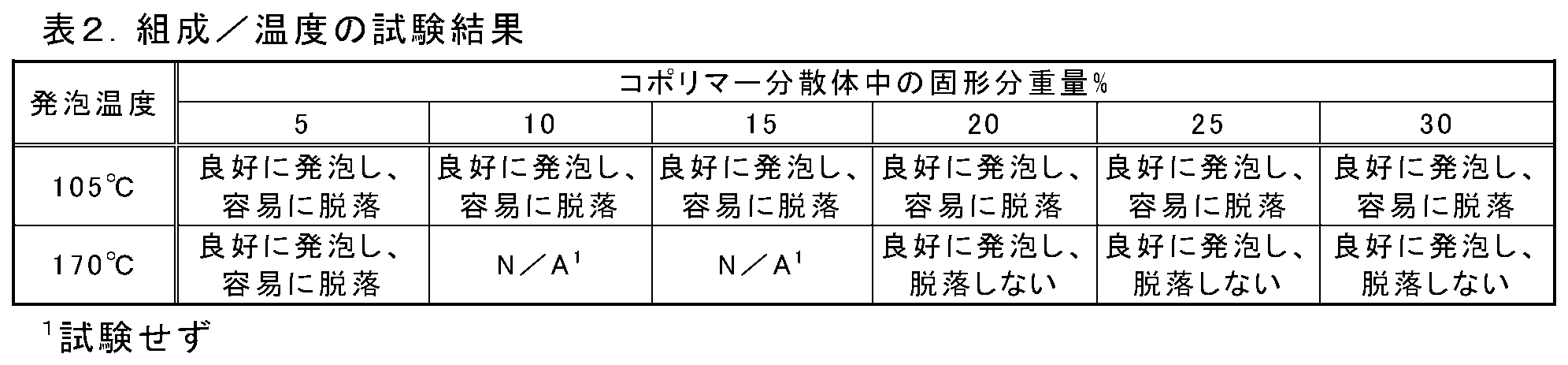
発泡性組成物の調製
発泡性組成物の配合を表3Aに要約する。500グラム(500g)のG-polymerを秤量し、機械的撹拌下で1500gのDI水に溶解して、25重量%の固形分を有する水性分散液を調製した。配合物2及び4については、100gのDUR-O-SET E230エマルジョンを100gの25%G-polymer分散液に添加し、混合した。次いで、適切な量の膨張性マイクロスフェアを200グラムのポリマー分散液に添加し、10分間混合した。増粘剤を適切な量で添加し、更に10分間混合した。比較製剤5を調製するために、膨張性マイクロスフェア及び増粘剤をDUR-O-SET C-335エマルジョンに添加し、10分間混合した。表3Bには、以下の手順を使用して発泡及び乾燥した後の材料の組成を要約している。
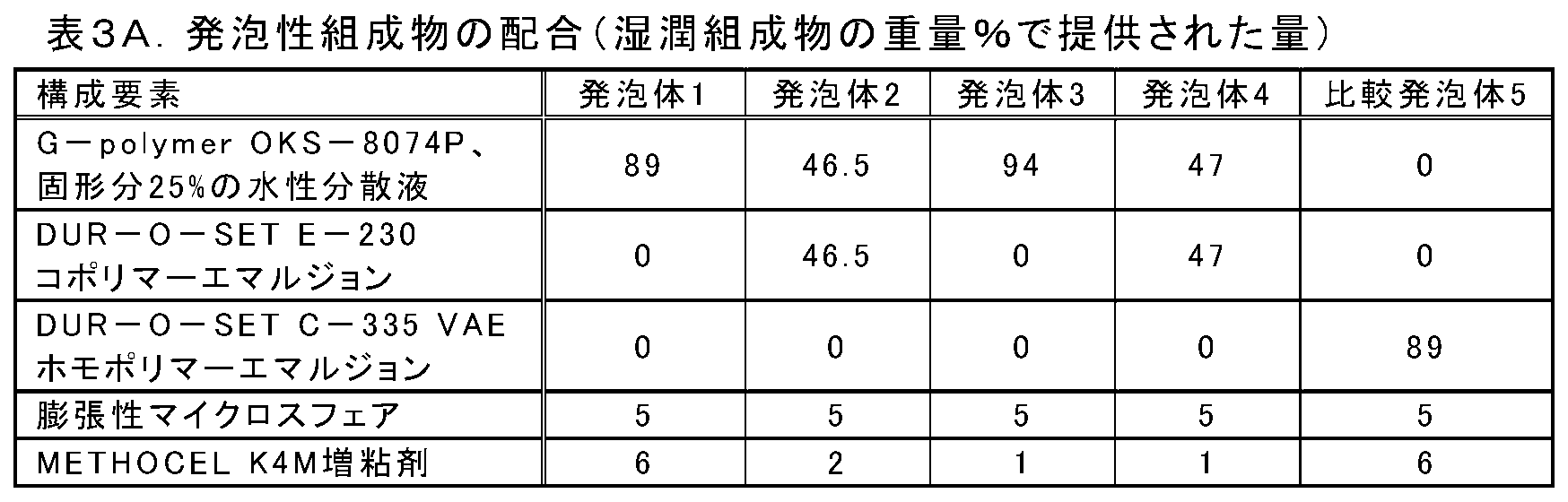

スクリーン印刷及び発泡-実施例1、2、及び比較例CE5
配合物1及び2を使用して、それぞれ実施例1及び2のパッド付き発泡体シートを調製し、比較配合物5を使用して、比較例CE5を調製した。発泡性配合物を、各々、図9Aに示したハンドステンシル90を使用して、55ポンドクラフト紙のシート上にスクリーン印刷した。テンプレートの開口面積百分率は10%であり、バーは、各々、長さ4mm×幅1.5mm×厚さ1mmであり、各セルは15mm間隔であった。混合物をテンプレートの1つの縁部上に注ぎ、次いで、スキージを使用してステンシルを横断して混合物を引張り、空隙を充填し、基材に転写した。次いで、ステンシルを取り出し、コーティングされた紙を170℃の対流式オーブンに4分間入れて、図9Bに示した発泡組成物16を形成した。
Screen printing and foaming - Examples 1, 2 and comparative example CE5
Formulation 1 and 2 were used to prepare the padded foam sheets of Examples 1 and 2, respectively, and Comparative Formulation 5 was used to prepare Comparative Example CE5. The foamable formulations were each screen printed onto a sheet of 55 pound kraft paper using a hand stencil 90 shown in FIG. 9A. The open area percentage of the template was 10%, the bars were each 4 mm long x 1.5 mm wide x 1 mm thick, and each cell was 15 mm apart. The mixture was poured onto one edge of the template and then a squeegee was used to pull the mixture across the stencil, filling the voids and transferring it to the substrate. The stencil was then removed and the coated paper was placed in a convection oven at 170°C for 4 minutes to form the foamed
ランダムパターン印刷及び発泡-実施例3A、3B、4A、及び4B
配合物3を使用してパッド付き発泡シート実施例3A及び3Bを調製し、配合物4を使用してパッド付き発泡シート実施例4A及び4Bを調製した。発泡性配合物を、図10A及び10Bに示したプロセスを使用して、55ポンドクラフト紙のロール上に堆積させた。クラフト紙基材リールを、図10Aに示した巻出しステーション上に配置した。紙を、輪転グラビアステーションに供給し、駆動ニップを閉じた。空気圧モーターを使用して、紙基材がダイコーティングステーションに供給される際の紙基材のウェブ速度を、約2.4メートル/分(m/min、8フィート/分)に調整した。
Random pattern printing and foaming - Examples 3A, 3B, 4A, and 4B
Formulation 3 was used to prepare padded foam sheet Examples 3A and 3B, and Formulation 4 was used to prepare padded foam sheet Examples 4A and 4B. The foamable formulation was deposited onto a roll of 55 pound kraft paper using the process shown in Figures 10A and 10B. A kraft paper substrate reel was placed on the unwinding station shown in FIG. 10A. Paper was fed into the rotogravure station and the drive nip was closed. A pneumatic motor was used to adjust the web speed of the paper substrate as it was fed into the die coating station to approximately 2.4 meters per minute (m/min, 8 ft/min).
実施例3A及び4Aをコーティングするために使用されるダイコーティングステーション100の概略図を、図10Bに示す。PREMIERE固定リップスロットダイ(Nordson Corp.,Westlake,OH,USAから入手可能)に類似した標準的な押出ダイを使用して、クラフト紙基材12がコーティングステーションを通って移動する際に、クラフト紙基材12上に接着剤を周期的に堆積させた。押出ダイスロットの高さは、厚さ0.51mm(0.02in)のシムで制御した。ダイスロットの幅は28cm(11in)であった。上流及び下流のダイリップの両方の長さは0.51mm(0.02in)であった。上流ダイリップは下流ダイリップと同一平面上にある。水性コーティング配合物を0.95リットル(32oz)のプラスチックSEMCO分配カートリッジ(Fishman Corp.(Hopkinton,MA,USAから入手可能)に入れた。その充填されたカートリッジをSEMCOモデル550シーラントガン(Fishman Corp.,Hopkinton,MA,USAから入手可能)と同様の分配システム内に入れた。周期的なコーティングを開始するために、駆動ニップをコーティングライン上で係合させてウェブを移動させた。ダイを、0.13mm(0.005in)のギャップで、移動する基材の近くに位置させた。図10Bに示したように、ダイスロットの中心がバックアップロールの回転軸の中心と同じ高さになるように、ダイを位置合わせした。ダイスロットは、気泡レベルによって示されるように水平に保持された。分配システムを係合させ、20cc/分の接着剤流量を供給するように操作した。接着剤堆積中の下流ダイリップと基材との間のギャップを0.127mm(0.005in)から約0.762mm(0.03in)に増加させて、連続フィルムコーティングから、コーティング17の制御されたランダム堆積に移行させた(乾燥及び膨張の前)。ダイギャップは、接着剤の流量が毎分40立方センチメートル(cc/min)に増加すると、約1.5mm(0.06in)に更に増加した。
A schematic diagram of the
実施例3B及び4Bについては、0.254mm(10ミル)厚のポリエステルシートのシートを、12.7mm(0.5in)間隔の12.7mm(0.5in)幅の歯を有するシムに切り出した。コーティング中にダイスロット内にシムを置いて、各ストライプがランダムに置かれたドットからなっているストライプパターンを生成させた。 For Examples 3B and 4B, a sheet of 0.254 mm (10 mil) thick polyester sheet was cut into shims with 12.7 mm (0.5 in) wide teeth spaced 12.7 mm (0.5 in) apart. . Shims were placed in the die slots during coating to produce a striped pattern with each stripe consisting of randomly placed dots.
そのコーティングされた紙はダイコーティングステーションを出て、182℃(360°F)に設定されたシングルゾーンオーブン(Drying Systems Company,Morton Grove,IL,USAから入手可能)に供給された。コーティングされた基材を、アイドラロール上に支持されたオーブンの長さ2.74m(9ft)に通した。ゴムで覆われた空気圧駆動プルロールが、基材をオーブンから移動させ、それを巻取り機に送り、そこで、乾燥したコーティングされた基材をリールに巻取った。 The coated paper exited the die coating station and was fed into a single zone oven (available from Drying Systems Company, Morton Grove, IL, USA) set at 182°C (360°F). The coated substrate was passed through a 2.74 m (9 ft) length of oven supported on idler rolls. A rubber-covered pneumatically driven pull roll moved the substrate from the oven and sent it to a winder where the dry coated substrate was wound onto a reel.
発泡体パッド付き封筒の構築
表4は、例示的な発泡体パッド付き郵送用容器を調製するために使用される材料及び構築手順を要約している。手順Aでは、発泡体コーティングされたクラフト紙のシートを、幅約30.5cm(12in)×61cm(24in)の寸法に切り出した。各シートを、発泡体コーティングされた側を内側に向けて折り畳み、204℃(400°F)に設定したModel iS2-20-20”Impulse Sealer(IMPAK Corporation,Sebastian,FL,USAから入手可能)を使用して、345キロパスカル(kPa、50psi)の圧力で0.5秒間、縁部に沿ってヒートシールして、一端に開口部を有する幅約30.5cm(12in)×長さ30.5cm(12in)の平坦なシールされた郵送用容器を形成した。
Construction of Foam Padded Envelopes Table 4 summarizes the materials and construction procedures used to prepare exemplary foam padded mailing containers. In Procedure A, sheets of foam-coated kraft paper were cut to dimensions approximately 12 inches wide by 24 inches wide. Each sheet was folded with the foam coated side facing inward and sealed with a Model iS2-20-20" Impulse Sealer (available from IMPAK Corporation, Sebastian, FL, USA) set at 204°C (400°F). Using a pressure of 345 kilopascals (kPa, 50 psi) for 0.5 seconds to heat seal along the edges, approximately 30.5 cm (12 in) wide x 30.5 cm long with an opening at one end. (12 inch) flat sealed shipping containers were formed.
手順Bでは、縁部に沿った幅6.4cm(2.5in)の部分をコーティングしないままにした(すなわち、発泡体パディングを有していなかった)こと以外は、発泡体パッド付きクラフト紙のシートを上記のように調製した。シートを、幅約37cm(14.5in)×長さ61cm(24in)の初期寸法に切り出し、コーティングされていないセクションは長縁部に沿って延びていた。コーティングされていない部分の半分を除去し、発泡体コーティングされた側を内側に向けてシートを折り畳んで、幅約30.5cm(12in)×長さ30.5cm(12in)の重なる領域を形成し、突出しているフラップは、長さ約6.4cm(2.5in)であった。幅約29.2cm(11.5in)×長さ29.2cm(11.5in)のクラフト紙のコーティングされていない(すなわち、受け取ったままの)シートを、折り畳まれた構造の壁の間に挿入して、(図11Aに示したように)パッド付き郵送用物品の1つの壁に沿って滑らかなカバーシートとして機能させた。手順Aについて記載した手順を使用して、物品を側縁部に沿って、またフラップの縁部に沿ってヒートシールした。次いで、9925XLテープのストリップを、縁部に平行に、縁部から約0.95cm(0.38in)でフラップに適用し、剥離ライナーを接着剤ストリップ上に残した。 In Step B, the foam-padded kraft paper was coated with foam-padded kraft paper, except that a 6.4-cm (2.5-in) wide section along the edge was left uncoated (i.e., did not have foam padding). Sheets were prepared as described above. The sheet was cut to initial dimensions of approximately 37 cm (14.5 in) wide by 61 cm (24 in) long, with the uncoated section extending along the long edges. Remove half of the uncoated portion and fold the sheet with the foam coated side facing inward to form an overlapping area approximately 12 in. wide by 12 in. long. , the protruding flap was approximately 6.4 cm (2.5 in) long. Insert an uncoated (i.e., as received) sheet of kraft paper approximately 29.2 cm (11.5 in) wide by 29.2 cm (11.5 in) long between the walls of the folded structure. to act as a smooth cover sheet along one wall of the padded mailing article (as shown in FIG. 11A). The article was heat sealed along the side edges and along the flap edges using the procedure described for Procedure A. A strip of 9925XL tape was then applied to the flap parallel to the edge and about 0.38 inches from the edge, leaving the release liner on the adhesive strip.
手順Cは、(図11Bに示したように)紙カバーシートが郵送用容器の壁全体を覆わない以外は、手順Bと同様であった。ヒートシールの前に、幅約29.2cm(11.5in)×長さ7.6cm(3in)のコーティングされていないシートを壁の間に挿入し、フラップの上縁部と整列させた。手順Aについて記載した手順を使用して、物品を側縁部に沿って、またフラップの縁部に沿ってヒートシールした。次いで、9925XLテープのストリップを、縁部に平行に、縁部から約0.95cm(0.38in)でフラップに適用し、剥離ライナーを接着剤ストリップ上に残した。 Procedure C was similar to Procedure B except that the paper cover sheet did not cover the entire wall of the mailing container (as shown in FIG. 11B). Prior to heat sealing, an uncoated sheet approximately 29.2 cm (11.5 in) wide by 7.6 cm (3 in) long was inserted between the walls and aligned with the top edge of the flap. The article was heat sealed along the side edges and along the flap edges using the procedure described for Procedure A. A strip of 9925XL tape was then applied to the flap parallel to the edge and about 0.38 inches from the edge, leaving the release liner on the adhesive strip.
手順Dについては、発泡体パッド付きクラフト紙のシートを手順Bについて記載したように調製し、(図11Cに示すように)縁部分はコーティングしなかった。シートを、幅約37cm(14.5in)×長さ61cm(24in)の初期寸法に切り出し、コーティングされていない部分は長縁部に沿って延びていた。コーティングされていない部分の半分を除去し、幅約6.4cm(2.5in)×長さ58cm(23in)のクラフト紙のコーティングされていないシートを、上に縦方向に置き、切り取った部分と整列させた。コーティングされていない紙を、(手順Aについて記載した手順を使用して)長縁部に沿って発泡体パッド付き紙にヒートシールし、そのシートを、発泡体コーティング側を内側に向けて折り畳んで、幅約30.5cm(12in)×長さ30.5cm(12in)の重なる領域を形成し、突出しているフラップは、長さ約6.4cm(2.5in)であった。コーティングされていない紙は、郵送用物品の開口部の内側周囲に短いカバーシートを形成した。手順Aについて記載した手順を使用して、物品を縁部に沿ってヒートシールした。次いで、9925XLテープのストリップを、縁部に平行に、縁部から約0.95cm(0.38in)でフラップに適用し、剥離ライナーを接着剤ストリップ上に残した。 For Procedure D, sheets of foam padded kraft paper were prepared as described for Procedure B, with the edges uncoated (as shown in Figure 11C). The sheet was cut to initial dimensions of approximately 37 cm (14.5 in) wide by 61 cm (24 in) long, with the uncoated portion extending along the long edges. Remove half of the uncoated section and place an uncoated sheet of kraft paper, approximately 6.4 cm (2.5 in) wide x 58 cm (23 in) long, lengthwise on top of the cut out section. Lined up. Heat seal the uncoated paper to the foam padded paper along the long edges (using the procedure described for Step A) and fold the sheet with the foam coated side facing inward. , forming an overlapping area approximately 30.5 cm (12 in) wide by 30.5 cm (12 in) long, and the protruding flap was approximately 6.4 cm (2.5 in) long. The uncoated paper formed a short cover sheet around the inside of the opening of the mailing article. The article was heat sealed along the edges using the procedure described for Procedure A. A strip of 9925XL tape was then applied to the flap parallel to the edge and about 0.38 inches from the edge, leaving the release liner on the adhesive strip.
カバーシートが、コーティングされていない紙の代わりに発泡体パッド付き紙の追加のシートであったことを除いて、手順Eは、手順Bと同様であった。ヒートシールの前に、幅約29.2cm(11.5in)×長さ29.2cm(11.5in)の発泡体パッド付き紙の追加のシートを、発泡側が折り畳まれたものの長い側に面し、インサートがフラップの上縁部と整列するように、折り畳まれた構造の壁の間に挿入した。手順Aについて記載した手順を使用して、物品を側縁部に沿って、またフラップの縁部に沿ってヒートシールした。次いで、9925XLテープのストリップを、縁部に平行に、縁部から約0.95cm(0.38in)でフラップに適用し、剥離ライナーを接着剤ストリップ上に残した。

結果
発泡体パッド付き材料のコーティング重量及び試料全体の厚さを表5に提供する。コーティング重量を計算するために、クラフト紙の坪量は81gsmであると仮定した。発泡体及び紙の合計の厚さを、単純なノギスを使用して測定すると、コーティングされていないクラフト紙の厚さは0.14mm(5.5ミル)であった。
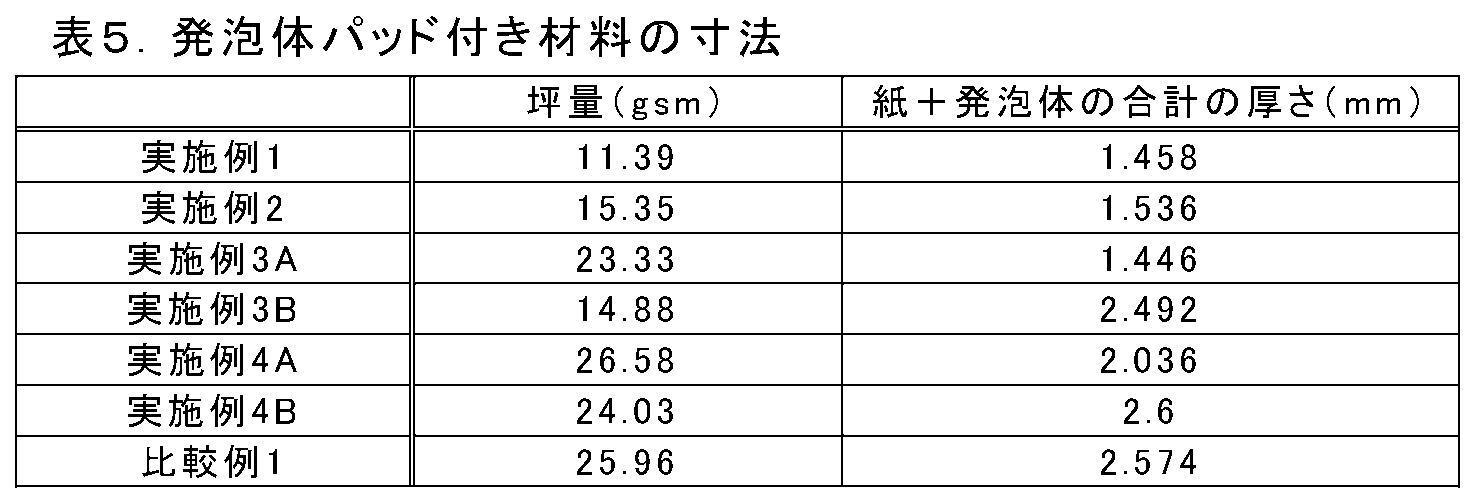
圧縮試験結果(具体的には、圧縮強度、貯蔵エネルギー及びエネルギー損失)を使用して、本発明の発泡パッド付き材料の衝撃及び緩衝性能を評価した。表6は、実施例4のパッド付き発泡体コーティングシートの圧縮試験性能パラメータを、2つの市販のパッド付き郵送用封筒と比較している。比較例CE2は、2層の紙の間に発泡体を有するパッド付き郵送用封筒(Technical Machinery Solutions(TMS),Elk Grove Village,IL USAから入手可能なECO MAILER(商標))であり、比較例CE3は、紙で覆われたプラスチック気泡郵送用容器(SCOTCH 7972-100-CS,3M Company,St.Paul,MN,USA)であった。各々が単一の紙層のみを有する実施例1~4Bは、二重層構造体を含有したCE2に匹敵する圧縮強度を示した。実施例1~4Bは、CE2及びCE3の両方と比較してより高いエネルギー損失を示しており、これは、実施例4が、両方の比較材料よりも衝撃力をより良好に吸収できることを意味していると解釈される。実施例1~4Bはまた、CE2及びCE3の両方よりも、吸収されたエネルギーに対するエネルギー損失の百分率が高いことを示しており、これは、実施例4が、両方の比較材料よりも衝撃力をより良好に散逸できることを意味していると解釈される。

摩耗試験の結果を、表7に要約し、発泡体コーティングされた試料の耐久性を評価するために使用した。実施例1及び4Aは、摩耗後の発泡体の重量損失が顕著に少なかった。加えて、摩耗後、実施例1及び4A上の印刷された特徴部は、顕著に平坦化されたが、特徴部は、主として、紙基材に付着したままであることが観察された。対照的に、CE1上の印刷された特徴部は脆く見え、上層は摩耗により除去された。 The results of the abrasion tests are summarized in Table 7 and used to evaluate the durability of the foam coated samples. Examples 1 and 4A had significantly less foam weight loss after abrasion. Additionally, it was observed that after abrasion, the printed features on Examples 1 and 4A flattened significantly, but the features remained primarily attached to the paper substrate. In contrast, the printed features on CE1 appeared brittle and the top layer was removed by abrasion.
水溶解試験の結果も表7に示す。実施例3A及び4Aは両方とも、CE1よりも高い量の回収含有量を示し、これは、本発明の発泡組成物が、コポリマーではなくホモポリマーを使用して調製されたCE1よりも、水溶性であることを示唆している。

実施例5A、6A、及び7A、並びに比較例CE2及びCE3のパッド付き発泡体包装物品に関するシーム強度試験の結果は、表8に要約してある。実施例5A、6A、及び7Aは、追加の接着剤を使用せずに、ヒートシールされた。発泡体それ自体が接着剤として機能し、シーム接着剤を含んだCE2に匹敵するシーム強度を示した。

発泡性組成物、実施例6G~10Gの輪転グラビア印刷
実施例1Gの配合物を使用して、実施例6Gのパッド付き発泡シートを調製した。クラフト紙基材ロールを、示した巻出し部上に置いた。紙を輪転グラビア印刷ステーションに供給し、駆動ニップを閉じた。空気圧モーターを使用して、紙基材が輪転グラビアステーションに供給される際の紙基材のウェブ速度を毎分約2.4メートル(m/分、8ft/分)に調整した。コーティングされた紙を、360°F(182℃)に設定したオーブンに通した。
Rotogravure Printing of Foamable Compositions, Examples 6G-10G The formulation of Example 1G was used to prepare the padded foam sheet of Example 6G. A roll of kraft paper substrate was placed on the unwind station shown. Paper was fed into the rotogravure printing station and the drive nip was closed. A pneumatic motor was used to adjust the web speed of the paper substrate as it was fed into the rotogravure station to approximately 2.4 meters per minute (m/min, 8 ft/min). The coated paper was passed through an oven set at 360°F (182°C).
層高さ0.007”のABSフィラメントを使用するStratasys F370 FDMプリンターを使用して3Dプリンティングされた、内径7.62cm、外径10.3cm×長さ35.5cmの寸法を有するグラビアロールスリーブを備えた輪転グラビア印刷ステーションを使用するプロセスを使用して、発泡性組成物を、55lbクラフト紙のロール上に堆積させ、7.6cmの金属シャフト上に置いて、図14に示したように直径の周囲に位置合わせした深さ2mmのセルを有するグラビアロール180を形成した。3Dプリンティングされたスリーブのセル間のランド領域(land area)は1.03cmであった。ロールのパターンをグラビアパターン2として表9に記載する。
Gravure roll sleeves with dimensions of 7.62 cm inner diameter, 10.3 cm outer diameter x 35.5 cm length were 3D printed using a Stratasys F370 FDM printer using ABS filament with a layer height of 0.007”. The foamable composition was deposited onto a roll of 55 lb kraft paper using a process using a rotogravure printing station equipped with A
グラビアロールを作製するための3Dプリンティングの予想外の利点は、3Dプリンティングプロセスが、周方向に隆起及び谷を残したことであった。金属で機械加工されたグラビアロールは、通常は、離散要素を形成する大きな円形の穴と穴の間のランド領域では完全に平滑である。したがって、離散発泡要素の発泡性組成物印刷に加えて、基材の表面にはまた、基材上に連続発泡コーティング層を形成し作り出す密な間隔の線でも印刷された。連続発泡層は、郵送用容器及び封筒などのヒートシールされた包装物品のシーム強度を顕著に増加させるものであり、離散発泡要素をよりしっかりと基材に固定することによって離散発泡要素の耐久性を強化すると考えられる。 An unexpected advantage of 3D printing for making gravure rolls was that the 3D printing process left ridges and valleys in the circumferential direction. Gravure rolls machined from metal are usually completely smooth in the large circular holes that form the discrete elements and in the land areas between the holes. Therefore, in addition to the foamable composition printing of discrete foam elements, the surface of the substrate was also printed with closely spaced lines forming and creating a continuous foam coating layer on the substrate. The open foam layer significantly increases the seam strength of heat-sealed packaging articles such as mailing containers and envelopes, and increases the durability of the discrete foam elements by more securely anchoring them to the substrate. It is thought that this will strengthen the
基材上において図14のグラビアロールを使用して得られた発泡コーティングを、図13A及び13Bに示す。図13Bに見られるように、3Dプリンティングされたグラビアロール由来の印刷された線は、離散要素間の連続コーティング層中にかすかな線として現れる。連続コーティング層は、コーティングされていない領域19を残して基材10の縁部付近で終わり、この場合、クラフト紙の表面のみが存在する。この実施形態における発泡性組成物は、より視覚的に魅力的であるよう、クラフト紙の色に一致するように染色された。
The foamed coating obtained using the gravure roll of FIG. 14 on a substrate is shown in FIGS. 13A and 13B. As seen in FIG. 13B, the printed lines from the 3D printed gravure roll appear as faint lines in the continuous coating layer between the discrete elements. The continuous coating layer ends near the edge of the
一実施形態では、添加された総コーティングの重量は38.1gsmであった。離散要素の重量は18gsmであり、連続コーティングの重量は20gsmであった。第2の実施形態では、総コーティング重量は66.1gsmであり、離散要素のコーティング重量は39.4gsmであり、連続コーティング重量面積は26.8gsmであった。連続発泡コーティングの範囲は、0~50gsm、5~30gsm、又は5~20gsmであることができる。不連続な離散発泡要素の範囲は、5~100gsm、10~80gsm、又は15~70gsmであることができる。総コーティング重量は、前の個々の範囲を加算したものである。 In one embodiment, the total coating weight added was 38.1 gsm. The weight of the discrete elements was 18 gsm and the weight of the continuous coating was 20 gsm. In the second embodiment, the total coating weight was 66.1 gsm, the discrete element coating weight was 39.4 gsm, and the continuous coating weight area was 26.8 gsm. The range of open foam coatings can be 0-50 gsm, 5-30 gsm, or 5-20 gsm. The range of discontinuous discrete foam elements can be from 5 to 100 gsm, from 10 to 80 gsm, or from 15 to 70 gsm. The total coating weight is the sum of the previous individual ranges.
図12を参照すると、離散円形要素185及び複数のマイクログルーブ187の両方を有するグラビアロールを用いて、基材上に発泡性組成物を印刷して連続発泡体コーティングを形成する概念を、示している。離散要素は、基材の縁部に対して角度の付いた線の列に発泡した離散要素を置く平行四辺形パターンに配列された大きな円形開口によって形成されている。連続コーティング層は、開口間のロールのランド領域内の周方向の溝によって敷設される。これは、ロール表面上に密な間隔の円周線又はフィラメントを3Dプリンティングすることによって達成することができる。組成物は適用後に発泡するため、発泡性組成物を離散している線に敷設することにより、組成物が発泡すると、基材上に実質的に連続したコーティングが形成される。グラビアロールを3Dプリンティングするのではなく、同様の特徴を有する機械加工されたロールを構成することもできる。
Referring to FIG. 12, the concept of printing a foamable composition onto a substrate to form an open foam coating using a gravure roll having both discrete
グラビアロールコーティング手法は、離散発泡要素間の連続発泡コーティングを可能にする。この連続コーティングは、表面全体にわたって連続ヒートシール可能層を提供する。この連続コーティングは、ヒートシールしているときのシームシール強度を実質的に増加させた。表14のグラビアロールでコーティングされた試料の得られたシームシール強度は、3.5kgf/cm~4.5kgf/cmの範囲である。様々な実施形態について、シームシール強度は、少なくとも0.5kgf/cm、1.0kgf/cm、又は1.5kgf/cmである。 Gravure roll coating techniques allow continuous foam coating between discrete foam elements. This continuous coating provides a continuous heat sealable layer over the entire surface. This continuous coating substantially increased the seam seal strength when heat sealing. The resulting seam seal strengths of the gravure roll coated samples of Table 14 range from 3.5 kgf/cm to 4.5 kgf/cm. For various embodiments, the seam seal strength is at least 0.5 kgf/cm, 1.0 kgf/cm, or 1.5 kgf/cm.
発泡体の色を、それがコーティングされているクラフト紙の色に合わせるために、発泡性組成物に染料を添加した。染色コーティングは、離散要素間に良好な色の一致を作り出し、連続コーティング層及びクラフト紙は、視覚的に魅力的な物品をもたらした。いくつかの実施形態では、染料の濃度は0.01重量%~5.0重量%の範囲である。


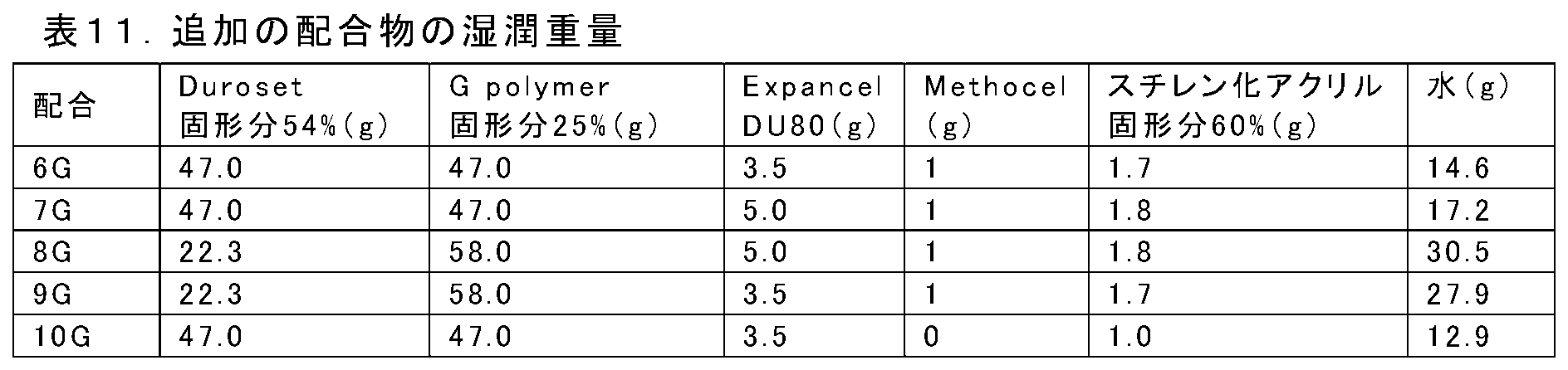


表8の結果を表14と比較すると、離散要素の不連続発泡コーティング層と組み合わされた連続又は実質的に連続の発泡コーティング層の両方を有する基材が、包装物品のヒートシールされたシーム強度を顕著に改善したことが示されている。特に、シーム強度は1.25~1.32lbf/inの範囲から1.66~1.86lbf/inの範囲に増加し、これは、縁部をシールするためにシームにおいて発泡性組成物を利用してヒートシールされたパッド付き郵送用容器を形成する際に顕著に役立つ。パッド付き基材は、先の実施例のように離散要素のために十分なパターンを有していたため、包装に使用される際に良好な緩衝特性も有していた。 Comparing the results in Table 8 with Table 14, it appears that substrates having both a continuous or substantially continuous foamed coating layer in combination with a discontinuous foamed coating layer of discrete elements have improved the heat-sealed seam strength of the packaged article. It has been shown that there has been a marked improvement in Specifically, seam strength increased from a range of 1.25-1.32 lbf/in to a range of 1.66-1.86 lbf/in, which utilizes an intumescent composition at the seam to seal the edges. is particularly useful in forming heat-sealed padded shipping containers. The padded substrate also had good cushioning properties when used in packaging since it had sufficient pattern for the discrete elements as in the previous example.
連続発泡体層及び離散発泡要素を有する発泡体コーティングされた基材は、図2、3、4、5、6、又は7及びそれらを作製する方法に関する前述の議論において示した包装物品のいずれかに形成することができる。それは、ヒートシールされたシームと、封止フラップと、を有する封筒、例えば、内部パウチを形成する3つのヒートシールされたシームと、図11A~11Cに示した封止フラップのクロージャーと、を有する封筒を形成するのに特に適している。これらの包装は、多くの場合、郵送用容器と呼ばれ、オンライン小売業者から顧客に製品を輸送するために使用される。 The foam-coated substrates having an open foam layer and discrete foam elements may be any of the packaging articles shown in Figures 2, 3, 4, 5, 6, or 7 and the preceding discussion of methods of making them. can be formed into It has an envelope with a heat-sealed seam and a sealing flap, such as three heat-sealed seams forming an inner pouch and a closure of the sealing flap shown in FIGS. 11A-11C. Particularly suitable for forming envelopes. These packages are often called shipping containers and are used to transport products from online retailers to customers.
発泡性組成物の輪転グラビア印刷、中空気泡
以下の実施例は、図17に最もよく見られるように、発泡外部シェル171及び空気で満たされた中空内部173を有する複数の発泡体気泡170を形成するための発泡性組成物の輪転グラビア印刷を示している。図17の基材10の上縁部では、発泡体気泡が切り開かれて、中空内部中心173及び中空中心を取り囲む発泡外部シェル171が露出されている。表15及び表16に、試験した輪転グラビアロールパターン、及び発泡性組成物において使用された追加の材料を列挙する。表17~表22に、様々な実施例についての発泡性組成物の湿潤重量及び乾燥重量を示す。





表23~表25は、作製された様々な実施例8G~15Gの結果を提供している。試料について、坪量、シーム強度、摩擦係数及び気泡体積、並びに外側シェル厚、及び中空コア体積パーセントを測定した。実施例の各々は、図17に見られるように、発泡体材料の外部シェルと、空気で満たされた中空内部と、を有する中空気泡発泡体構造を生成した。


表24の試料を、360°Fの実温度(475設定点)で0.8秒間、90psiでシールした。 The samples in Table 24 were sealed at 90 psi for 0.8 seconds at an actual temperature of 360°F (475 set point).
シーム強度が1.0lbf/in以上であった様々な実施例では、縁部をヒートシールすることによって、コーティングされた基材から郵送用容器を形成するのに十分な強度が得られる。概して、シール強度がより高いことがより良好であり、1.5lbf/inを超える値が、より重いアイテムを郵送用容器に入れて輸送するときに特に好ましい。

摩擦係数試験:ASTM D1894-14「Standard Test Method for Static and Kinetic Coefficients of Friction of Plastic Film and Sheeting」に概説されている手順を使用して、紙上にコーティングされた離散発泡気泡の静的摩擦係数及び動的摩擦係数を決定した。試験設定は、Instron摩擦係数試験装置部品番号2810-005(Instron,Norwood MA,USAから入手可能)を使用して、ASTM 1894-14に記載されている設定C(移動スレッド-固定平面)に従い、100Nロードセルを使用して、Instron Universal Testing Load Frame 5564(Instron,Norwood MA,USAから入手可能)で試験した。試験片を、鏡面仕上げ又は艶消し仕上げのいずれかを有する鋼板に対して試験した。試験前に、鋼板を、70/30イソプロピルアルコール/水で拭いた。試験前に、22.8±1.1℃(73.1±2°F)及び相対湿度50±2%にて温度及び湿度が制御された室内で試料を一晩コンディショニングした。試験片を、ASTMに概説されるように、適切な寸法まで切り出し、可動スレッドに接着させた。スレッド重量は、取り付けた試験片を含めて200g±5gであった。6インチ/分のクロスヘッド速度を使用して試験片を試験した。試料は、3回試験した。動的摩擦係数及び静的摩擦係数を記録し、平均値を報告する。 Coefficient of Friction Test: Using the procedure outlined in ASTM D1894-14 “Standard Test Method for Static and Kinetic Coefficients of Friction of Plastic Film and Sheeting” The static friction coefficient of discrete foamed cells coated on paper and The dynamic friction coefficient was determined. The test setup was according to setup C (moving sled - fixed plane) as described in ASTM 1894-14 using an Instron coefficient of friction tester part number 2810-005 (available from Instron, Norwood MA, USA). Tested on an Instron Universal Testing Load Frame 5564 (available from Instron, Norwood MA, USA) using a 100N load cell. Specimens were tested against steel plates having either a mirror finish or a matte finish. Prior to testing, the steel plate was wiped with 70/30 isopropyl alcohol/water. Prior to testing, samples were conditioned overnight in a temperature and humidity controlled room at 22.8±1.1°C (73.1±2°F) and 50±2% relative humidity. Specimens were cut to the appropriate dimensions and glued to moving sleds as outlined by ASTM. The thread weight was 200g±5g including the attached test piece. The specimens were tested using a crosshead speed of 6 inches/minute. Samples were tested in triplicate. Record the dynamic and static friction coefficients and report the average value.
郵送用容器に形成される発泡基材の場合、アイテムを郵送用容器に挿入し、発泡基材を加工ラインに通すために、より低い摩擦係数が望ましい。好ましい実施形態では、動COFは、2.0未満、又は1.5未満、又は1.0未満、及び0.0超であることができる。 For foam substrates formed into mailing containers, a lower coefficient of friction is desirable for inserting the item into the mailing container and passing the foam substrate through the processing line. In preferred embodiments, the dynamic COF can be less than 2.0, or less than 1.5, or less than 1.0, and greater than 0.0.
輪転グラビアコーティングプロセスでは、発泡性組成物を、液体ドットのアレイで、基材上に堆積させる。他の実施形態では、実質的に連続的なコーティングを、最初に、又は液体ドットのアレイと同時に、基材に適用することもできる。一実施形態では、55lb(85gsm)のクラフト紙基材を使用した。ドットの直径及び高さは、パターン内の個々のセル体積を含む、コーティングプロセスパラメータ及び利用される特定の輪転グラビアパターンの関数として変化することができる。一実施形態では、輪転グラビアセルは、直径4mmの球の半分である液体ドットのアレイを形成する。堆積させた液体ドットをオーブン内で乾燥させ、乾燥プロセス中に発泡させて、発泡体材料の外側シェルと、空気で充填された中空中心又は中空コアと、を含む、発泡体気泡を作り出す。乾燥中に、発泡性組成物、オーブン内の外面皮膜、及び組成物中の残留水は、ドット構造の中心に少なくとも部分的に蒸発し、基材を通って出て行き、図17に見られる最終的な中空コア構造を作り出すと考えられる。特に、基材での輪転グラビア印刷プロセス後にオーブンに通すウェブ速度を遅くすることが、発泡体気泡内におけるスキン層及び最大中空コア体積の形成に必要であることが見出された。 In the rotogravure coating process, a foamable composition is deposited onto a substrate in an array of liquid dots. In other embodiments, a substantially continuous coating can be applied to the substrate initially or simultaneously with the array of liquid dots. In one embodiment, a 55 lb (85 gsm) kraft paper substrate was used. The diameter and height of the dots can vary as a function of coating process parameters and the particular rotogravure pattern utilized, including the individual cell volumes within the pattern. In one embodiment, the rotogravure cell forms an array of liquid dots that are half of a 4 mm diameter sphere. The deposited liquid dots are dried in an oven and foamed during the drying process to create foam cells that include an outer shell of foam material and a hollow center or core filled with air. During drying, the foamable composition, the outer skin in the oven, and any residual water in the composition at least partially evaporates into the center of the dot structure and exits through the substrate, as seen in Figure 17. It is believed to create the final hollow core structure. In particular, it has been found that slowing the web speed through the oven after the rotogravure printing process on the substrate is necessary to form a skin layer and maximum hollow core volume within the foam cells.
中空発泡体気泡構造は、非中空コア発泡体構造によって得ることができるものに比べて、堆積された発泡性組成物の所与の量に対してより大きな全体構造を作り出すという利点を有する。それらは空気で満たされた中心を有するので、最終的に乾燥された発泡体材料は、濃縮され、構造の外側シェルにおいてのみ利用される。発泡体でコーティングされた得られた基材全体は、プラスチック(ポリエチレン)気泡ラップの再生可能なバージョンに非常に似ている。それは、まさにプラスチック気泡ラップのような発泡体気泡の中空空気充填コアから得られる心地よい計算された感覚及び良好な緩衝特性を有する。 Hollow foam cell structures have the advantage of creating a larger overall structure for a given amount of foamable composition deposited compared to what can be obtained with non-hollow core foam structures. Since they have an air-filled center, the final dried foam material is concentrated and utilized only in the outer shell of the structure. The resulting entire substrate coated with foam is very similar to a renewable version of plastic (polyethylene) foam wrap. It has a comfortable calculated feel and good cushioning properties derived from the hollow air-filled core of foam cells, just like plastic bubble wrap.
得られた発泡体気泡は、25~500ミクロン、又は50~400ミクロン、又は75~250ミクロンの範囲の厚さを有する外側発泡体シェルを含む構造を有する。様々な実施例8G~15Gでは、外側発泡体シェルの厚さは50~250ミクロンであると測定された。得られた発泡体気泡は、2~5000mm3、又は3~1000mm3、又は5~500mm3、又は6~150mm3の範囲の体積を有する中空コア又は中空中心を有する構造を有することができる。様々な実施例8G~15Gでは、中空コア体積は10~15mm3であると計算された。発泡体気泡体積全体の百分率としての中空コア又は中空中心体積は、総発泡体気泡体積の5~95%、又は5~75%、又は10~50%、又は15~45%の範囲であり得る。様々な実施例8G~15Gでは、中空コア体積パーセントは81%~87%と計算された。 The resulting foam cells have a structure that includes an outer foam shell having a thickness in the range of 25-500 microns, or 50-400 microns, or 75-250 microns. In various Examples 8G-15G, the outer foam shell thickness was measured to be between 50 and 250 microns. The resulting foam cells may have a structure with a hollow core or a hollow core having a volume in the range from 2 to 5000 mm 3 , or from 3 to 1000 mm 3 , or from 5 to 500 mm 3 , or from 6 to 150 mm 3 . For various Examples 8G-15G, the hollow core volume was calculated to be 10-15 mm 3 . The hollow core or hollow center volume as a percentage of the total foam cell volume can range from 5 to 95%, or from 5 to 75%, or from 10 to 50%, or from 15 to 45% of the total foam cell volume. . For various Examples 8G-15G, the hollow core volume percent was calculated to be 81%-87%.
当業者には、本開示の範囲及び趣旨から逸脱することのない、本開示に対する様々な改変及び変更が明らかとなるであろう。本開示は、本明細書に記載した例示的な実施形態及び実施例によって不当に制限されることは意図していないこと、並びにそのような実施例及び実施形態は、以下のような本明細書に記載の特許請求の範囲によってのみ限定されることを意図した本開示の範囲内の例としてのみ提示されることを理解されたい。本開示に引用される全ての参照文献は、その全体が参照により本明細書に組み込まれる。
Various modifications and changes to this disclosure will become apparent to those skilled in the art without departing from the scope and spirit of this disclosure. The present disclosure is not intended to be unduly limited by the exemplary embodiments and examples set forth herein, and such examples and embodiments are not intended to be unduly limited by the exemplary embodiments and examples set forth herein. It is to be understood that these are presented by way of example only, within the scope of this disclosure, which is intended to be limited only by the claims set forth below. All references cited in this disclosure are incorporated by reference in their entirety.
Claims (104)
少なくとも部分的に水溶性の発泡体の形態である、発泡組成物。 A foamed composition comprising a polymer component comprising a hydroxy-ethylene-butylene copolymer comprising divalent hydroxyethylene monomer units and divalent dihydroxybutylene monomer units, the composition comprising:
A foam composition that is at least partially in the form of a water-soluble foam.
10分当たり0.1g~10分当たり60gのメルトフローインデックス(2.16kgの荷重で210℃において測定して)、又は
90℃~220℃の溶融温度(DSCによって測定して)
のうちの少なくとも1つを有する、請求項1又は2に記載の発泡組成物。 The hydroxy-ethylene-butylene copolymer has the following properties:
Melt flow index of 0.1 g per 10 minutes to 60 g per 10 minutes (measured at 210°C with a load of 2.16 kg), or melt temperature of 90°C to 220°C (measured by DSC)
The foam composition according to claim 1 or 2, comprising at least one of the following.
第1及び第2の主面を有するシート材料であって、再生可能な材料を含む、シート材料と、
前記シート材料の前記第1の主面上に配置された発泡組成物を含み、
前記発泡組成物は、二価ヒドロキシエチレンモノマー単位及び二価ジヒドロキシブチレンモノマー単位を含むヒドロキシ-エチレン-ブチレンコポリマーを含むポリマー成分を含み、
前記発泡組成物は少なくとも部分的に水溶性の発泡体の形態である、発泡体パッド付き材料。 A renewable and/or compostable foam padded material comprising:
a sheet material having first and second major surfaces, the sheet material comprising a renewable material;
a foamed composition disposed on the first major surface of the sheet material;
The foamed composition includes a polymer component comprising a hydroxy-ethylene-butylene copolymer comprising divalent hydroxyethylene monomer units and divalent dihydroxybutylene monomer units;
A foam padded material, wherein the foam composition is at least partially in the form of a water-soluble foam.
10分当たり0.1g~10分当たり60gのメルトフローインデックス(2.16kgの荷重で210℃において測定して)、又は
90oC~220℃の溶融温度(DSCによって測定して)
のうちの少なくとも1つを有する、請求項38~51のいずれか一項に記載の発泡体パッド付き材料。 The hydroxy-ethylene-butylene copolymer has the following properties:
Melt flow index of 0.1 g per 10 minutes to 60 g per 10 minutes (measured at 210°C with a load of 2.16 kg), or melt temperature of 90 o C to 220°C (measured by DSC)
52. A foam padded material according to any one of claims 38 to 51, comprising at least one of:
ヒドロキシ-エチレン-ブチレンコポリマーを含むポリマー成分を含む発泡性含水組成物を準備することと、
前記発泡性組成物を、前記シート材料の前記第1の主面の少なくとも一部分に適用して、コーティングされた基材を形成することと、
前記コーティングされた基材を、前記発泡性組成物から発泡体を形成するのに有効な条件にさらすことと、
を含む方法によって調製された、請求項38~66のいずれか一項に記載の発泡体パッド付き材料。 providing a sheet of material having first and second major surfaces, the sheet of material comprising a renewable material;
providing a foamable aqueous composition comprising a polymer component comprising a hydroxy-ethylene-butylene copolymer;
applying the foamable composition to at least a portion of the first major surface of the sheet material to form a coated substrate;
exposing the coated substrate to conditions effective to form a foam from the foamable composition;
67. A foam padded material according to any one of claims 38 to 66, prepared by a method comprising:
第1の内面、及び前記第1の内面の反対側の第1の外面を有する第1の壁と、
第2の内面、及び前記第2の内面の反対側の第2の外面を有する第2の壁であって、前記第1及び第2の内面が前記包装物品の内部を画定し、前記第1及び第2の外面が前記包装物品の外部を画定している、第2の壁と、
前記第1及び第2の内面の各々の少なくとも一部分上に配置された発泡組成物と、
前記第1及び第2の壁の1つ以上の縁部におけるシール接合部であって、前記発泡組成物を含み、前記第1の壁を前記第2の壁に取り付けている、シール接合部と、を含み、
前記第1及び第2の壁は再生可能な材料を含み、
前記発泡組成物は、二価ヒドロキシエチレンモノマー単位及び二価ジヒドロキシブチレンモノマー単位を含むヒドロキシ-エチレン-ブチレンコポリマーを含むポリマー成分を含み、
前記発泡組成物は少なくとも部分的に水溶性の発泡体の形態である、包装物品。 A packaged article,
a first wall having a first inner surface and a first outer surface opposite the first inner surface;
a second wall having a second inner surface and a second outer surface opposite the second inner surface, the first and second inner surfaces defining an interior of the packaged article; and a second wall, the second exterior surface defining an exterior of the packaged article;
a foam composition disposed on at least a portion of each of the first and second inner surfaces;
a sealing joint at one or more edges of the first and second walls, the sealing joint comprising the foam composition and attaching the first wall to the second wall; , including;
the first and second walls include a renewable material;
The foamed composition includes a polymer component comprising a hydroxy-ethylene-butylene copolymer comprising divalent hydroxyethylene monomer units and divalent dihydroxybutylene monomer units;
A packaging article, wherein the foam composition is at least partially in the form of a water-soluble foam.
104. The foam of claim 103, wherein each of the foam cells has a total volume, the hollow core has a volume, and the average volume percent of the hollow cores relative to the total volume is from 5% to 95%. Padded material.
Applications Claiming Priority (9)
| Application Number | Priority Date | Filing Date | Title |
|---|---|---|---|
| US202163144360P | 2021-02-01 | 2021-02-01 | |
| US63/144,360 | 2021-02-01 | ||
| US202163148117P | 2021-02-10 | 2021-02-10 | |
| US63/148,117 | 2021-02-10 | ||
| US202163160168P | 2021-03-12 | 2021-03-12 | |
| US63/160,168 | 2021-03-12 | ||
| US202163214648P | 2021-06-24 | 2021-06-24 | |
| US63/214,648 | 2021-06-24 | ||
| PCT/US2022/014499 WO2022165304A1 (en) | 2021-02-01 | 2022-01-31 | Foamed compositions, foam padded materials, and packaging articles |
Publications (2)
| Publication Number | Publication Date |
|---|---|
| JP2024507701A true JP2024507701A (en) | 2024-02-21 |
| JPWO2022165304A5 JPWO2022165304A5 (en) | 2025-02-07 |
Family
ID=80682369
Family Applications (2)
| Application Number | Title | Priority Date | Filing Date |
|---|---|---|---|
| JP2023546163A Pending JP2024507701A (en) | 2021-02-01 | 2022-01-31 | Foam compositions, foam padded materials, and packaging articles |
| JP2023546164A Pending JP2024508229A (en) | 2021-02-01 | 2022-02-01 | Foam compositions, foam padded materials, and packaging articles |
Family Applications After (1)
| Application Number | Title | Priority Date | Filing Date |
|---|---|---|---|
| JP2023546164A Pending JP2024508229A (en) | 2021-02-01 | 2022-02-01 | Foam compositions, foam padded materials, and packaging articles |
Country Status (4)
| Country | Link |
|---|---|
| US (2) | US20240317955A1 (en) |
| EP (2) | EP4284641A1 (en) |
| JP (2) | JP2024507701A (en) |
| WO (1) | WO2022165401A1 (en) |
Families Citing this family (2)
| Publication number | Priority date | Publication date | Assignee | Title |
|---|---|---|---|---|
| CN115460518B (en) * | 2022-09-14 | 2024-05-14 | 歌尔股份有限公司 | Shell of sound generating device, sound generating device and electronic equipment |
| CN118003728A (en) * | 2024-01-23 | 2024-05-10 | 东莞市泰鸿包装制品有限公司 | Heat-insulating waterproof high-strength packaging bag and preparation process thereof |
Family Cites Families (8)
| Publication number | Priority date | Publication date | Assignee | Title |
|---|---|---|---|---|
| US5032460A (en) | 1989-08-14 | 1991-07-16 | Minnesota Mining And Manufacturing Company | Method of making vinyl-silicone copolymers using mercapto functional silicone chain-transfer agents and release coatings made therewith |
| US5252622A (en) * | 1990-03-08 | 1993-10-12 | Air Products And Chemicals, Inc. | Cellular contact adhesive films having improved bond strength |
| US5225480A (en) | 1990-03-21 | 1993-07-06 | Minnesota Mining And Manufacturing Company | Water-borne low adhesion backsize and release coating compositions, methods of making the compositions, and sheet materials coated therewith |
| US6740373B1 (en) * | 1997-02-26 | 2004-05-25 | Fort James Corporation | Coated paperboards and paperboard containers having improved tactile and bulk insulation properties |
| US9771499B2 (en) * | 2010-09-10 | 2017-09-26 | Henkel IP & Holding GmbH | Adhesive having structural integrity and insulative properties |
| ES2720513T3 (en) * | 2013-11-27 | 2019-07-22 | Henkel IP & Holding GmbH | Adhesive for insulating articles |
| ES2824117T3 (en) * | 2014-07-23 | 2021-05-11 | Henkel IP & Holding GmbH | Expandable coating compositions and their use |
| WO2019018523A1 (en) * | 2017-07-18 | 2019-01-24 | Henkel IP & Holding GmbH | Dielectric heating of foamable compositions |
-
2022
- 2022-01-31 US US18/274,693 patent/US20240317955A1/en active Pending
- 2022-01-31 EP EP22705243.8A patent/EP4284641A1/en active Pending
- 2022-01-31 JP JP2023546163A patent/JP2024507701A/en active Pending
- 2022-02-01 WO PCT/US2022/014672 patent/WO2022165401A1/en not_active Ceased
- 2022-02-01 JP JP2023546164A patent/JP2024508229A/en active Pending
- 2022-02-01 EP EP22708647.7A patent/EP4284642A1/en active Pending
- 2022-02-01 US US18/274,690 patent/US20240117138A1/en active Pending
Also Published As
| Publication number | Publication date |
|---|---|
| EP4284642A1 (en) | 2023-12-06 |
| US20240117138A1 (en) | 2024-04-11 |
| JP2024508229A (en) | 2024-02-26 |
| EP4284641A1 (en) | 2023-12-06 |
| US20240317955A1 (en) | 2024-09-26 |
| WO2022165401A1 (en) | 2022-08-04 |
Similar Documents
| Publication | Publication Date | Title |
|---|---|---|
| ES2909108T3 (en) | Aqueous coagulable polymer dispersion and use thereof as an adhesive | |
| US11993438B2 (en) | User-expandable packaging | |
| AU2015292856B2 (en) | Expandable coating compositions and use thereof | |
| US5830548A (en) | Articles of manufacture and methods for manufacturing laminate structures including inorganically filled sheets | |
| US20220135308A1 (en) | Protective article with expandable polyolefin composite | |
| JP2024507701A (en) | Foam compositions, foam padded materials, and packaging articles | |
| JP2786841B2 (en) | Laminated paper for cushioning material | |
| US4016327A (en) | Laminated structures and methods and compositions for producing same | |
| US11958277B2 (en) | Expandable web with in-situ combination of expansion material components | |
| US20230016932A1 (en) | Articles with cohesive | |
| US20220135309A1 (en) | Protective article with cellulose-based expandable composite | |
| WO2022165304A1 (en) | Foamed compositions, foam padded materials, and packaging articles | |
| CN104520203A (en) | Reusable multi-purpose bag formed of nonwoven fibrous material | |
| US20250135759A1 (en) | Heat-activated multilayer embossment | |
| WO2025217618A1 (en) | Packaging materials with heat-activated bonds between intermittent inter-layer attachment points | |
| JPWO2022165304A5 (en) | ||
| JPH0238037A (en) | Bag and heat sealable sheet protecting article from mechanical damage and electric field |
Legal Events
| Date | Code | Title | Description |
|---|---|---|---|
| A521 | Request for written amendment filed |
Free format text: JAPANESE INTERMEDIATE CODE: A523 Effective date: 20250130 |
|
| A621 | Written request for application examination |
Free format text: JAPANESE INTERMEDIATE CODE: A621 Effective date: 20250130 |