JP2024503560A - A Bayesian Framework for Personalized Model Identification and Prediction of Future Blood Glucose in Type 1 Diabetes Using Easily Accessible Patient Data - Google Patents
A Bayesian Framework for Personalized Model Identification and Prediction of Future Blood Glucose in Type 1 Diabetes Using Easily Accessible Patient Data Download PDFInfo
- Publication number
- JP2024503560A JP2024503560A JP2023515812A JP2023515812A JP2024503560A JP 2024503560 A JP2024503560 A JP 2024503560A JP 2023515812 A JP2023515812 A JP 2023515812A JP 2023515812 A JP2023515812 A JP 2023515812A JP 2024503560 A JP2024503560 A JP 2024503560A
- Authority
- JP
- Japan
- Prior art keywords
- model
- insulin
- model parameters
- prediction
- nonlinear
- Prior art date
- Legal status (The legal status is an assumption and is not a legal conclusion. Google has not performed a legal analysis and makes no representation as to the accuracy of the status listed.)
- Pending
Links
Classifications
-
- A—HUMAN NECESSITIES
- A61—MEDICAL OR VETERINARY SCIENCE; HYGIENE
- A61B—DIAGNOSIS; SURGERY; IDENTIFICATION
- A61B5/00—Measuring for diagnostic purposes; Identification of persons
- A61B5/72—Signal processing specially adapted for physiological signals or for diagnostic purposes
- A61B5/7271—Specific aspects of physiological measurement analysis
- A61B5/7275—Determining trends in physiological measurement data; Predicting development of a medical condition based on physiological measurements, e.g. determining a risk factor
-
- A—HUMAN NECESSITIES
- A61—MEDICAL OR VETERINARY SCIENCE; HYGIENE
- A61B—DIAGNOSIS; SURGERY; IDENTIFICATION
- A61B5/00—Measuring for diagnostic purposes; Identification of persons
- A61B5/145—Measuring characteristics of blood in vivo, e.g. gas concentration or pH-value ; Measuring characteristics of body fluids or tissues, e.g. interstitial fluid or cerebral tissue
- A61B5/14532—Measuring characteristics of blood in vivo, e.g. gas concentration or pH-value ; Measuring characteristics of body fluids or tissues, e.g. interstitial fluid or cerebral tissue for measuring glucose, e.g. by tissue impedance measurement
-
- A—HUMAN NECESSITIES
- A61—MEDICAL OR VETERINARY SCIENCE; HYGIENE
- A61B—DIAGNOSIS; SURGERY; IDENTIFICATION
- A61B5/00—Measuring for diagnostic purposes; Identification of persons
- A61B5/72—Signal processing specially adapted for physiological signals or for diagnostic purposes
- A61B5/7235—Details of waveform analysis
- A61B5/725—Details of waveform analysis using specific filters therefor, e.g. Kalman or adaptive filters
-
- A—HUMAN NECESSITIES
- A61—MEDICAL OR VETERINARY SCIENCE; HYGIENE
- A61B—DIAGNOSIS; SURGERY; IDENTIFICATION
- A61B5/00—Measuring for diagnostic purposes; Identification of persons
- A61B5/72—Signal processing specially adapted for physiological signals or for diagnostic purposes
- A61B5/7235—Details of waveform analysis
- A61B5/7264—Classification of physiological signals or data, e.g. using neural networks, statistical classifiers, expert systems or fuzzy systems
-
- G—PHYSICS
- G16—INFORMATION AND COMMUNICATION TECHNOLOGY [ICT] SPECIALLY ADAPTED FOR SPECIFIC APPLICATION FIELDS
- G16H—HEALTHCARE INFORMATICS, i.e. INFORMATION AND COMMUNICATION TECHNOLOGY [ICT] SPECIALLY ADAPTED FOR THE HANDLING OR PROCESSING OF MEDICAL OR HEALTHCARE DATA
- G16H50/00—ICT specially adapted for medical diagnosis, medical simulation or medical data mining; ICT specially adapted for detecting, monitoring or modelling epidemics or pandemics
- G16H50/20—ICT specially adapted for medical diagnosis, medical simulation or medical data mining; ICT specially adapted for detecting, monitoring or modelling epidemics or pandemics for computer-aided diagnosis, e.g. based on medical expert systems
-
- G—PHYSICS
- G16—INFORMATION AND COMMUNICATION TECHNOLOGY [ICT] SPECIALLY ADAPTED FOR SPECIFIC APPLICATION FIELDS
- G16H—HEALTHCARE INFORMATICS, i.e. INFORMATION AND COMMUNICATION TECHNOLOGY [ICT] SPECIALLY ADAPTED FOR THE HANDLING OR PROCESSING OF MEDICAL OR HEALTHCARE DATA
- G16H50/00—ICT specially adapted for medical diagnosis, medical simulation or medical data mining; ICT specially adapted for detecting, monitoring or modelling epidemics or pandemics
- G16H50/30—ICT specially adapted for medical diagnosis, medical simulation or medical data mining; ICT specially adapted for detecting, monitoring or modelling epidemics or pandemics for calculating health indices; for individual health risk assessment
-
- G—PHYSICS
- G16—INFORMATION AND COMMUNICATION TECHNOLOGY [ICT] SPECIALLY ADAPTED FOR SPECIFIC APPLICATION FIELDS
- G16H—HEALTHCARE INFORMATICS, i.e. INFORMATION AND COMMUNICATION TECHNOLOGY [ICT] SPECIALLY ADAPTED FOR THE HANDLING OR PROCESSING OF MEDICAL OR HEALTHCARE DATA
- G16H50/00—ICT specially adapted for medical diagnosis, medical simulation or medical data mining; ICT specially adapted for detecting, monitoring or modelling epidemics or pandemics
- G16H50/50—ICT specially adapted for medical diagnosis, medical simulation or medical data mining; ICT specially adapted for detecting, monitoring or modelling epidemics or pandemics for simulation or modelling of medical disorders
-
- G—PHYSICS
- G16—INFORMATION AND COMMUNICATION TECHNOLOGY [ICT] SPECIALLY ADAPTED FOR SPECIFIC APPLICATION FIELDS
- G16H—HEALTHCARE INFORMATICS, i.e. INFORMATION AND COMMUNICATION TECHNOLOGY [ICT] SPECIALLY ADAPTED FOR THE HANDLING OR PROCESSING OF MEDICAL OR HEALTHCARE DATA
- G16H20/00—ICT specially adapted for therapies or health-improving plans, e.g. for handling prescriptions, for steering therapy or for monitoring patient compliance
- G16H20/10—ICT specially adapted for therapies or health-improving plans, e.g. for handling prescriptions, for steering therapy or for monitoring patient compliance relating to drugs or medications, e.g. for ensuring correct administration to patients
- G16H20/17—ICT specially adapted for therapies or health-improving plans, e.g. for handling prescriptions, for steering therapy or for monitoring patient compliance relating to drugs or medications, e.g. for ensuring correct administration to patients delivered via infusion or injection
Landscapes
- Health & Medical Sciences (AREA)
- Engineering & Computer Science (AREA)
- Life Sciences & Earth Sciences (AREA)
- Medical Informatics (AREA)
- Public Health (AREA)
- Biomedical Technology (AREA)
- General Health & Medical Sciences (AREA)
- Pathology (AREA)
- Physics & Mathematics (AREA)
- Animal Behavior & Ethology (AREA)
- Surgery (AREA)
- Molecular Biology (AREA)
- Heart & Thoracic Surgery (AREA)
- Biophysics (AREA)
- Veterinary Medicine (AREA)
- Artificial Intelligence (AREA)
- Epidemiology (AREA)
- Signal Processing (AREA)
- Psychiatry (AREA)
- Physiology (AREA)
- Computer Vision & Pattern Recognition (AREA)
- Primary Health Care (AREA)
- Databases & Information Systems (AREA)
- Data Mining & Analysis (AREA)
- Optics & Photonics (AREA)
- Emergency Medicine (AREA)
- Evolutionary Computation (AREA)
- Fuzzy Systems (AREA)
- Mathematical Physics (AREA)
- Measurement Of The Respiration, Hearing Ability, Form, And Blood Characteristics Of Living Organisms (AREA)
- Investigating Or Analysing Biological Materials (AREA)
- Medical Treatment And Welfare Office Work (AREA)
- Management, Administration, Business Operations System, And Electronic Commerce (AREA)
Abstract
個別の患者の将来の血中グルコース濃度を予測する方法は、グルコース-インスリン動態の個別化された非線形生理学的モデルを選択することであって、選択されたモデルが、値が判定される複数のモデルパラメータを有する、選択することと、複数のモデルパラメータにおけるモデルパラメータの各々について値を推定することであって、モデルパラメータの第1のサブセットが、先験的集団データから推定された値を有し、モデルパラメータの第2のサブセットが、パラメータ推定技法を個別の患者についての先験的情報及びデータに適用して事後情報を取得することによって、個別の患者について個人化された値を有する、推定することと、モデルパラメータの各々についての推定値を使用して、選択されたモデルに非線形予測技法を適用して、将来の時間における個別の患者の予測された血中グルコース濃度を取得することと、を含む。
A method for predicting future blood glucose concentrations for an individual patient is to select an individualized non-linear physiological model of glucose-insulin kinetics, the selected model having multiple having and selecting model parameters and estimating values for each of the model parameters in the plurality of model parameters, the first subset of the model parameters having values estimated from a priori population data. and a second subset of model parameters have values personalized for the individual patient by applying parameter estimation techniques to a priori information and data about the individual patient to obtain a posteriori information. estimating and applying nonlinear prediction techniques to the selected model using the estimates for each of the model parameters to obtain a predicted blood glucose concentration for the individual patient at a future time. and, including.
Description
(関連出願への参照による組み込み)
本出願は、2021年1月25日に出願された米国仮特許出願第63/141345号の利益を主張するものである。本出願は、全て2020年12月4日に出願された米国出願第17/112870号、同第17/112828号、及び同第17/112814号に関する。前述の出願は、参照によりその全内容が本明細書に組み込まれ、明示的に本明細書の一部とされる。
(Incorporation by reference into related applications)
This application claims the benefit of U.S. Provisional Patent Application No. 63/141,345, filed on January 25, 2021. This application relates to U.S. Application Nos. 17/112,870, 17/112,828, and 17/112,814, all filed on December 4, 2020. The aforementioned applications are hereby incorporated by reference in their entirety and hereby expressly made a part of this specification.
1型糖尿病(Type 1 diabete、T1D)は、膵臓におけるベータ細胞の進行性破壊によって引き起こされる慢性自己免疫疾患であり、これは、生物による内因性インスリンの産生不能につながる。結果として、血中グルコース(blood glucose、BG)濃度は、高血糖閾値(BG>180mg/dl)を超える傾向があり、このような状況が頻繁に起こり、長期化すると、いくつかの重篤な心血管長期合併症、並びに腎症及び神経障害につながる可能性がある。BGレベルを低減させるために、1日に数回の外因性インスリンの投与が必要である。残念ながら、過剰な外因性インスリン投薬は、患者に低血糖、すなわちBG<70mg/dlにつながる可能性があり、これは、失神、軽度の頭痛、昏睡、更には死を引き起こす可能性があるので、短期間であっても危険である。 Type 1 diabetes (T1D) is a chronic autoimmune disease caused by the progressive destruction of beta cells in the pancreas, which leads to the organism's inability to produce endogenous insulin. As a result, blood glucose (BG) concentrations tend to exceed the hyperglycemic threshold (BG > 180 mg/dl), and when this situation occurs frequently and is prolonged, it can lead to several serious complications. It can lead to long-term cardiovascular complications, as well as nephropathy and neurological disorders. Administration of exogenous insulin several times a day is required to reduce BG levels. Unfortunately, excessive exogenous insulin dosing can lead to hypoglycemia in patients, i.e. BG<70mg/dl, as this can cause syncope, mild headache, coma, and even death. , even for a short period of time is dangerous.
効果的なT1D治療は、古典的なフィンガースティックデバイス又はより近代的な低侵襲連続グルコースモニタリングシステム(continuous glucose monitoring、CGM)センサのいずれかを通して行われるBG頻回監視に依拠し、決して取るに足らないものではない。実際、T1D管理は、患者の観点から、いくつかの毎日の要因(例えば、病気、食事、及び身体活動)がどのようにBGレベルに影響を及ぼすか、及びBGを安全な範囲に保つために介入をどのように(例えば、救済の炭水化物摂取量、及び当然ながらインスリン投与)使用することができるかを理解する生涯学習プロセスを表している。 Effective T1D treatment relies on frequent BG monitoring, performed either through classic fingerstick devices or more modern minimally invasive continuous glucose monitoring (CGM) sensors, and is by no means trivial. It's not something that doesn't exist. In fact, T1D management focuses on how several daily factors (e.g., illness, diet, and physical activity) affect BG levels and how to keep BG within a safe range from the patient's perspective. Understanding how interventions can be used (eg, rescue carbohydrate intake, and of course insulin administration) represents a lifelong learning process.
これに関連して、T1Dを有する患者を助けることができる新しいツールを提供するために、研究団体によって多くの努力がなされてきた。それらの中で、将来のBG濃度をリアルタイムで予測することができるCGMベースのアルゴリズムは、現在のグルコースレベルではなく、予想される将来のグルコースレベルに基づいて予防的治療決定を可能にすることによって、T1D治療有効性を有意に改善する可能性を有する。 In this regard, many efforts have been made by the research community to provide new tools that can help patients with T1D. Among them, CGM-based algorithms that can predict future BG concentrations in real time, by allowing preventive treatment decisions to be made based on expected future glucose levels rather than current glucose levels. , has the potential to significantly improve T1D treatment efficacy.
第1の態様では、個別の患者の将来の血中グルコース濃度を予測する方法であって、グルコース-インスリン動態の個別化された非線形生理学的モデルを選択することであって、選択されたモデルが、値が判定される複数のモデルパラメータを有する、選択することと、複数のモデルパラメータにおけるモデルパラメータの各々について値を推定することであって、モデルパラメータの第1のサブセットが、先験的集団データから推定された値を有し、モデルパラメータの第2のサブセットが、パラメータ推定技法を個別の患者についての先験的情報及びデータに適用して事後情報を取得することによって、個別の患者について個人化された値を有する、推定することと、モデルパラメータの各々についての推定値を使用して選択されたモデルに非線形予測技法を適用して、将来の時間における個別の患者の予測された血中グルコース濃度を取得することと、を含む方法が提供される。 In a first aspect, a method for predicting future blood glucose concentrations in an individual patient, the method comprising: selecting an individualized nonlinear physiological model of glucose-insulin kinetics, the selected model comprising: , having a plurality of model parameters whose values are determined, and estimating a value for each of the model parameters in the plurality of model parameters, wherein the first subset of the model parameters is determined from the a priori population. a second subset of model parameters having values estimated from the data; Estimate and apply non-linear prediction techniques to the selected model using the estimated values for each of the model parameters to predict the predicted blood pressure of an individual patient at a future time. Obtaining an intermediate glucose concentration.
第1の態様の実施形態では、パラメータ推定技法は、マルコフ連鎖モンテカルロ(Markov Chain Monte Carlo、MCMC)ベイズ推定量である。 In an embodiment of the first aspect, the parameter estimation technique is a Markov Chain Monte Carlo (MCMC) Bayesian estimator.
第1の態様の実施形態では、パラメータ推定技法は、最大事後確率技法、最尤技法及び予測誤差最小化技法からなる群から選択される。 In an embodiment of the first aspect, the parameter estimation technique is selected from the group consisting of a maximum a posteriori probability technique, a maximum likelihood technique and a prediction error minimization technique.
第1の態様の実施形態では、非線形予測技法は、粒子フィルタである。 In an embodiment of the first aspect, the non-linear prediction technique is a particle filter.
第1の態様の実施形態では、非線形予測技法は、拡張カルマンフィルタ技法及びアンセンテッドカルマンフィルタ技法からなる群から選択される。 In an embodiment of the first aspect, the non-linear prediction technique is selected from the group consisting of an extended Kalman filter technique and an unscented Kalman filter technique.
第1の態様の実施形態では、選択された個別化された非線形生理学的モデルは、皮下インスリン吸収サブモデル、経口グルコース吸収サブモデル及びグルコース-インスリン動態モデルを含む。 In an embodiment of the first aspect, the selected personalized nonlinear physiological model includes a subcutaneous insulin absorption submodel, an oral glucose absorption submodel, and a glucose-insulin kinetic model.
第1の態様の実施形態では、選択された個別化された非線形生理モデルは、個別の患者の過去の血中グルコース濃度レベル、炭水化物摂取量情報及び外因性インスリンデータを入力として使用する。 In an embodiment of the first aspect, the selected personalized non-linear physiological model uses as input the individual patient's historical blood glucose concentration levels, carbohydrate intake information and exogenous insulin data.
第1の態様の実施形態では、皮下インスリン吸収サブモデルは、インスリン分布の値を指定する第1のモデルパラメータと、第1のコンパートメントにおけるインスリンの出現の遅延を指定する第2のモデルパラメータと、を含み、第1及び第2のモデルパラメータは、先験的集団データから推定された値を有するモデルパラメータの第1のサブセット内にある。 In an embodiment of the first aspect, the subcutaneous insulin absorption submodel includes a first model parameter that specifies a value for insulin distribution, a second model parameter that specifies a delay in the appearance of insulin in the first compartment; , the first and second model parameters being within a first subset of model parameters having values estimated from a priori population data.
第1の態様の実施形態では、皮下インスリン吸収サブモデルは、第1のコンパートメントから第2のコンパートメントへの拡散速度定数を指定する第3のモデルパラメータと、第2のコンパートメントから血漿への皮下インスリン吸収の速度定数を指定する第4のモデルパラメータと、を含み、第3及び第4のモデルパラメータは、個別の患者について個人化された値を有するモデルパラメータの第2のサブセット内にある。 In an embodiment of the first aspect, the subcutaneous insulin absorption submodel includes a third model parameter that specifies a diffusion rate constant from the first compartment to the second compartment, and a subcutaneous insulin absorption submodel from the second compartment to the plasma. a fourth model parameter specifying a rate constant of absorption, the third and fourth model parameters being within the second subset of model parameters having values personalized for individual patients.
第1の態様の実施形態では、選択された個別化された非線形生理学的モデルは、モデルパラメータのうちの選択されたものが無視される最大生理学的モデルである。 In an embodiment of the first aspect, the selected individualized nonlinear physiological model is a maximal physiological model in which selected ones of the model parameters are ignored.
第1の態様の実施形態では、予測血中グルコース濃度は、リアルタイム連続グルコースモニタ(CGM)データ、炭水化物摂取量情報及び外因性インスリンデータを使用して、リアルタイムで更新される。 In an embodiment of the first aspect, the predicted blood glucose concentration is updated in real time using real time continuous glucose monitor (CGM) data, carbohydrate intake information and exogenous insulin data.
第1の態様の実施形態では、方法は、残余モデリング誤差を説明するために、選択された個別化された非線形生理学的モデルを残余誤差モデルで増補することを更に含む。 In an embodiment of the first aspect, the method further includes augmenting the selected individualized nonlinear physiological model with a residual error model to account for residual modeling errors.
第1の態様の実施形態では、残余モデリング誤差は、次数(5,5,1)の自己回帰累積移動平均(Auto regressive Integrated Moving Average、ARIMA)としてモデル化される。 In an embodiment of the first aspect, the residual modeling error is modeled as an Auto regressive Integrated Moving Average (ARIMA) of order (5,5,1).
第1の態様の実施形態では、残余誤差モデルは、予測誤差法(predicted error method、PEM)を使用して推定されたモデルパラメータを有する。 In an embodiment of the first aspect, the residual error model has model parameters estimated using a predicted error method (PEM).
第1の態様の実施形態では、予測された血中グルコース濃度は、複数の異なる時間において予測される。 In an embodiment of the first aspect, the predicted blood glucose concentration is predicted at multiple different times.
I.序論
血中グルコース(BG)リアルタイム予測のためにいくつかの異なる方法論が提案されているにもかかわらず、BGレベルを変化させるいくつかの未知の障害及びグルコース生理学における患者間/患者内の高い変動性に起因して、問題は未解決のままである。既存の予測技法は、入力特徴の特定のセットとBGとの間の関係を説明する数学的モデルに依存する。グルコース-インスリン調節の好適なモデルの選択は重要なステップであり、選択肢は、完全にデータ駆動型の「ブラックボックス」モデルから、代謝生理学の機構的/半機構的非線形記述に基づくモデルに及ぶ。ブラックボックスモデルと比較して、生理学的モデルは、根底にあるグルコース-インスリン代謝機構を正確に捕捉することを保証する明確な利点を有する。T1D文献において利用可能な非線形生理学的モデルの中で、いわゆる最小モデルは、有効なグルコース予測を与えるには柔軟性がなく、かつ単純すぎることが判明している。一方、大規模モデルは、いくつかの方程式及び複数のパラメータを有し、これらは、識別が困難であり、モデルベースの予測よりもコンピュータシミュレーションにより適している。
I. Introduction Although several different methodologies have been proposed for blood glucose (BG) real-time prediction, there are still some unknown disorders that alter BG levels and high inter/intrapatient variability in glucose physiology. Due to gender, the problem remains unresolved. Existing prediction techniques rely on mathematical models that describe the relationship between a particular set of input features and the BG. The selection of a suitable model of glucose-insulin regulation is a critical step, and options range from fully data-driven "black box" models to models based on mechanistic/semi-mechanistic nonlinear descriptions of metabolic physiology. Compared to black box models, physiological models have the distinct advantage of ensuring that the underlying glucose-insulin metabolic mechanisms are accurately captured. Among the nonlinear physiological models available in the T1D literature, so-called minimal models have proven to be inflexible and too simple to provide valid glucose predictions. On the other hand, large-scale models have several equations and multiple parameters that are difficult to identify and are more suitable for computer simulation than model-based predictions.
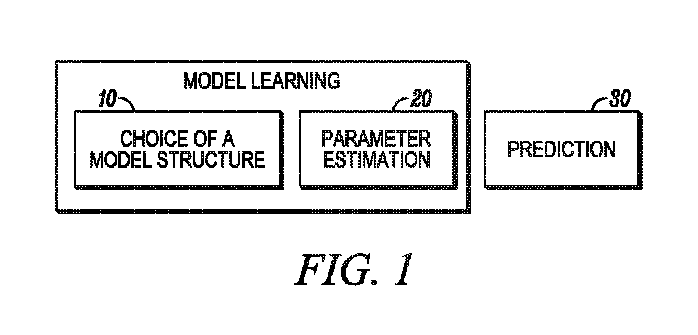
図1は、本明細書で説明される個別化されたモデルベースの予測スキームに伴うステップを高レベルで例解するフローチャートである。図示されるように、スキームの第1のステップ10では、上で説明される様々な利用可能な選択肢の中から好適なモデル構造を選択する。選択されたモデルは、グルコース-インスリン調節の個別化された非線形生理学的モデルである。以下で説明するように、選択されたモデルは、個別の具体的な生理機能を模倣するために、炭水化物摂取量及びインスリン注入データなどの容易にアクセス可能な患者ログから個別化することができるモデルパラメータを有する。 FIG. 1 is a flowchart illustrating at a high level the steps involved in the personalized model-based prediction scheme described herein. As illustrated, the first step 10 of the scheme is to select a suitable model structure from among the various available options described above. The selected model is an individualized non-linear physiological model of glucose-insulin regulation. As explained below, the selected model can be personalized from easily accessible patient logs such as carbohydrate intake and insulin infusion data to mimic the specific physiology of the individual. Has parameters.
図1に示される予測スキームの第2のステップ20では、個別の患者について個人化されるべきモデルパラメータのうちの選択されたものを、パラメータ推定技法を使用して推定する。一実施形態では、使用されるパラメータ推定技法は、複雑な非線形動態の存在下で多数のパラメータを推定するために、マルコフ連鎖モンテカルロ(MCMC)によって実施される、ベイズ手法を採用する。次に、第3のステップ30では、取得された個人化されたモデルは、例えば粒子フィルタ方法論に基づく非線形予測スキーム内で使用される。 In the second step 20 of the prediction scheme shown in FIG. 1, selected ones of the model parameters to be personalized for an individual patient are estimated using parameter estimation techniques. In one embodiment, the parameter estimation technique used employs a Bayesian approach, implemented by Markov Chain Monte Carlo (MCMC), to estimate large numbers of parameters in the presence of complex nonlinear dynamics. Then, in a third step 30, the obtained personalized model is used within a non-linear prediction scheme, for example based on a particle filter methodology.
以下により詳細に更に説明するように、本明細書に説明する予測スキームは、R.Visentin,E.Campos-Nunez,M.Schiavon,D.Lv,M.Vettoretti,M.Breton,B.P.Kovatchev,C.Dalla Man,and C.Cobelli,「The uva/padova type 1 diabetes simulator goes from single meal to single day」J.Diabetes Sci.Technol.,vol.12,no.2,pp.273-281,2018に記載されたシミュレーションモデルによって生成された100人の仮想T1D患者のデータを含むシリコ臨床試験を使用してテストされ、参照によりその全体が本明細書に組み込まれる。比較のために、2つのベースラインブラックボックスモデルを考慮する。評定のために選択される測定基準は、二乗平均平方根誤差、決定係数、及び時間利得である。結果は、提案された手法が、特に時間利得に関して将来のグルコース濃度を予測する際に両方のベースライン方法論よりも優れていることを示している。 As further explained in more detail below, the prediction scheme described herein is based on R. Visentin, E. Campos-Nunez, M. Schiavon, D. Lv,M. Vettoretti, M. Breton, B. P. Kovatchev, C. Dalla Man, and C. Cobelli, “The uva/padova type 1 diabetes simulator goes from single meal to single day,” J. Diabetes Sci. Technol. , vol. 12, no. 2, pp. 273-281, 2018, and is incorporated herein by reference in its entirety. For comparison, we consider two baseline black box models. The metrics selected for evaluation are root mean square error, coefficient of determination, and time gain. Results show that the proposed method outperforms both baseline methodologies in predicting future glucose concentrations, especially with respect to time gain.
II.グルコース-インスリン調節の生理学的モデル
このセクションは、個人化されたグルコース予測のためのグルコース-インスリン動態の非線形生理学的モデルの一例を説明する。この例は、上で引用したVisentinらの参考文献に説明されるUVa/Padova T1D Simulator(T1D Simulator、T1DS)の最新バージョンで実施された最大生理学的モデルから開始し、良好なグルコース予測を達成するその能力を保持しながら、個別化のために推定されるパラメータの数を可能な限り低減するように簡略化する。
II. Physiological Model of Glucose-Insulin Regulation This section describes an example of a nonlinear physiological model of glucose-insulin dynamics for personalized glucose prediction. This example starts with a maximal physiological model implemented in the latest version of the UVa/Padova T1D Simulator (T1D Simulator, T1DS) described in the Visentin et al. reference cited above and achieves good glucose prediction. Simplify to reduce the number of parameters estimated for individualization as much as possible while retaining that ability.
提案されたモデルは、2つの入力である、インスリン注入I(t)、及び炭水化物摂取量CHO(t)、並びに1つの出力である、間質グルコース濃度IG(t)を有する。このモデルは、皮下インスリン吸収、経口グルコース吸収、及びグルコース-インスリン動態を説明する3つのサブシステムから構成される。 The proposed model has two inputs, insulin infusion I(t) and carbohydrate intake CHO(t), and one output, interstitial glucose concentration IG(t). This model consists of three subsystems that account for subcutaneous insulin absorption, oral glucose absorption, and glucose-insulin kinetics.
A.皮下インスリン吸収サブシステム
皮下インスリン吸収モデルは、T1DSモデルにおいて使用されるもののわずかに簡略化されたバージョンであり、M.Schiavon,C.Dalla Man、及びC.Cobelli,「Modeling subcutaneous absorption of fast-acting insulin in type 1 diabetes」IEEE Trans.Biomed.Eng.,vol.65,no.9,pp.2079-2086,2018に説明され、図2に例解されている。モデルは、3つのコンパートメントから構成される。外因性インスリンIは、遅延β後に出現する第1のコンパートメントに注入される。非単量体状態のインスリンを表す第1のコンパートメントでは、インスリンは単量体状態に変換され、次いで血漿に拡散される。モデル方程式は次の通りである。
A. Subcutaneous Insulin Absorption Subsystem The subcutaneous insulin absorption model is a slightly simplified version of that used in the T1DS model, and is a slightly simplified version of the one used in the T1DS model. Schiavon, C. Dalla Man, and C. Cobelli, “Modeling subcutaneous absorption of fast-acting insulin in type 1 diabetes,” IEEE Trans. Biomed. Eng. , vol. 65, no. 9, pp. 2079-2086, 2018 and illustrated in FIG. The model consists of three compartments. Exogenous insulin I is injected into the first compartment, which appears after delay β. In the first compartment, representing the non-monomeric state of insulin, insulin is converted to the monomeric state and then diffused into the plasma. The model equation is as follows.
B.経口グルコース吸収サブシステム
C.Dalla Man,M.Camilleri、及びC.Cobelli,「A system model of oral glucose absorption:Validation on gold standard data」IEEE Trans.Biomed.Eng.,vol.53,no.12,pp.2472-2478,2006から引用した経口グルコース吸収サブシステムモデルは、T1DSで使用されるモデルの簡略化バージョンを表し、図3に例解されている。胃腸管を3つのコンパートメント系として説明しており、最初の2つのコンパートメントは胃の中の食物(固体及びすり潰し状態)、第3のコンパートメントはCHOを吸収する上部小腸をモデル化している。モデル方程式は以下の通りである。
B. Oral glucose absorption subsystem C. Dalla Man, M. Camilleri, and C. Cobelli, “A system model of oral glucose absorption: Validation on gold standard data,” IEEE Trans. Biomed. Eng. , vol. 53, no. 12, pp. The oral glucose absorption subsystem model taken from 2472-2478, 2006 represents a simplified version of the model used in T1DS and is illustrated in FIG. The gastrointestinal tract is described as a three-compartment system, with the first two compartments modeling the food (solid and ground) in the stomach, and the third compartment modeling the upper small intestine, which absorbs CHO. The model equation is as follows.
Ra(t)=f・kabs・Qgut(t) (3)
式中、f(無次元)は、血漿中に吸収された腸内容物の画分である。
Ra(t)=f・k abs・Q gut (t) (3)
where f (dimensionless) is the fraction of intestinal contents absorbed into plasma.
T1DSで使用されたモデルに関して単純化すると、一定の胃内容排出速度を仮定するので、胃内容物への依存性を無視することになる(図3では灰色で描写されている)。 A simplification with respect to the model used in T1DS is to assume a constant gastric emptying rate, thus ignoring the dependence on gastric content (depicted in gray in Figure 3).
モデル(2)に関する先験的情報は、文献から取得されており、表1に詳述されている。特に、fを0.9に等しく設定し、kgri=kemptに制約した。更に、2つの組み合わせが交換可能であるので、kabsはkabs≦kemptに制約されている。したがって、未知のモデルパラメータは、θoral=[kabs,kempt]である。 A priori information regarding model (2) was obtained from the literature and is detailed in Table 1. In particular, we set f equal to 0.9 and constrained k gri =k empty . Furthermore, since the two combinations are commutative, k abs is constrained to k abs ≦k empty . Therefore, the unknown model parameters are θ oral = [k abs , k empty ].
C.グルコース-インスリン動力学サブシステム
T1DSシミュレータにおいて使用されるモデルに関して、グルコース-インスリン動力学サブシステムのより簡潔な記述を使用した。これは、R.N.Bergman,C.R.Bowden、及びC.Cobelli,「Quantitative estimation of insulin sensitivity」Am.J.Physiol.,vol.236,no.6,pp.e667-e677,1979で紹介した血漿グルコース濃度における血漿インスリン作用及びグルコース出現速度の影響を説明する周知の2コンパートメントモデルに基づいている。このモデルは更に、血漿からセンサで測定される間質へのグルコースの輸送を説明する第3のコンパートメントが備えられている。このモデルを図4に例解する。モデル方程式は、以下の通りである。
C. Glucose-Insulin Dynamics Subsystem For the model used in the T1DS simulator, a more concise description of the glucose-insulin kinetics subsystem was used. This is R. N. Bergman, C. R. Bowden, and C. Cobelli, “Quantitative estimation of insulin sensitivity,” Am. J. Physiol. , vol. 236, no. 6, pp. It is based on the well-known two-compartment model that describes the influence of plasma insulin action and glucose appearance rate on plasma glucose concentration, introduced in J.E. 667-E 677, 1979. The model is further equipped with a third compartment that accounts for the transport of glucose from the plasma to the interstitium where it is measured by the sensor. This model is illustrated in FIG. The model equation is as follows.
一定のユニタリρ,ρ(G)≡1∀Gを有する上記のモデルは、おそらくインスリン作用の記載が不十分であることに起因して、低血糖を捕捉するのに苦労することが知られており、これは、グルコースが特定の閾値未満に減少するときに増加することが判明された。この理由のために、C.Dalla Man,F.Micheletto,D.Lv,M.Breton,B.Kovatchev,及びC.Cobelli,「The uva/padova type 1 diabetes simulator:New features」,J.Diabetes Sci.Technol.,vol.8,no.1,pp.26-34,2017で提案されている論理的根拠を受けて、上記モデルに以下の項ρ(G)を導入する。 The above model with constant unitary ρ, ρ(G)≡1∀G is known to struggle to capture hypoglycemia, probably due to poor description of insulin action. It was found that this increases when glucose decreases below a certain threshold. For this reason, C. Dalla Man, F. Micheletto, D. Lv,M. Breton, B. Kovatchev, and C. Cobelli, “The uva/padova type 1 diabetes simulator: New features,” J. Diabetes Sci. Technol. , vol. 8, no. 1, pp. 26-34, 2017, we introduce the following term ρ(G) into the above model.
患者特有の日内インスリン感受性変動を考慮し、いわゆる暁現象をモデル化するために、パラメータSI及びGbは、1日にわたって時間変動すると考えられる。 To account for patient-specific diurnal insulin sensitivity variations and to model the so-called dawn phenomenon, the parameters SI and G b are considered to be time-varying over the course of a day.
表1に詳細に報告されているパラメータ分布に関する先験的情報は、文献から取得されている。詳細には、r1、r2、及びVGは、集団値、すなわち、それぞれ1.44、0.81、及び1.45dl/kgに固定されている。グルコース-インスリンサブシステムの未知のモデルパラメータは、 A priori information regarding the parameter distributions, reported in detail in Table 1, have been obtained from the literature. In particular, r 1 , r 2 , and V G are fixed at population values, namely 1.44, 0.81, and 1.45 dl/kg, respectively. The unknown model parameters of the glucose-insulin subsystem are:
D.全体的な生理学的モデル
要約すると、全体的な生理学的モデルは、これまでに導入された3つのサブモデルを組み合わせて取得される。
D. Overall Physiological Model In summary, the overall physiological model is obtained by combining the three sub-models introduced so far.
fphy(・)は、(1)~(5)を組み合わせて取得される状態更新関数である。
fphy(・)は、未知のパラメータ
θphy:=[θins,θoral,θglu]のセットに依存しており、
その推定については、次のセクションで考察する。
f phy (·) is a state update function obtained by combining (1) to (5).
f phy (·) depends on the set of unknown parameters θ phy :=[θ ins , θ oral , θ glu ],
The estimation will be discussed in the next section.
III.マルコフ連鎖モンテカルロ法による個人化されたモデルパラメータのオフラインベイズ推定
モデルの個人化は、各患者について、未知のモデルパラメータθphyを、訓練データY:={CGM(tk),tk=k・Ts,k=1,...,D}及びU:={uphy(tk),tk=k・Ts,k=1,...,D}を使用して識別することによって行われ、式中、Dは利用可能なデータ点の数である。
III. Offline Bayesian Estimation of Personalized Model Parameters by Markov Chain Monte Carlo Method The personalization of the model is based on the training data Y:={CGM(t k ), t k =k・T s , k=1, . .. .. , D} and U:={u phy (t k ), t k =k·T s , k=1, . .. .. , D}, where D is the number of available data points.
識別は、ベイズ手法を採用することによって実行されており、具体的には、この作業において、θphyは、以下のように定義されるその事後平均によって推定される。 The identification has been performed by adopting a Bayesian approach, specifically in this work θ phy is estimated by its posterior mean defined as:
ベイズの定理は、以下のように、事後密度関数pθ|Y,U(θ|Y,U)を取得することを可能にする。 Bayes' theorem allows to obtain the posterior density function p θ|Y,U (θ|Y,U) as follows.
(9)における積分は分析的に扱いにくいので、MCMCを用いることによって近似されなければならない。特に、定常分布が厳密にこの事後分布(ターゲット分布)であるマルコフ連鎖を創出することによって、事後分布pθ|Y,U(θ|Y,U)からN個のサンプルθi,i=1,...,Nを生成する。次に、これらのサンプルθiを使用してモンテカルロ積分を実行し、θphyの点推定値を取得する。 The integral in (9) is analytically intractable and must be approximated by using MCMC. In particular, by creating a Markov chain whose stationary distribution is strictly this posterior distribution (target distribution), N samples θ i , i=1 from the posterior distribution p θ|Y,U (θ|Y,U) 、. .. .. , N. A Monte Carlo integration is then performed using these samples θ i to obtain a point estimate of θ phy .
このような連鎖を構築するために、単一コンポーネントメトロポリスヘイスティングス(Single Component Metropolis-Hasting、SCMH)アルゴリズムが使用されている。 To build such chains, the Single Component Metropolis-Hasting (SCMH) algorithm is used.
A.実施の詳細
θphyを5つのセットθphy:=[θ1,θ2,θ3,θ4,θ5]、すなわち
A. Implementation Details Let θ phy be the set of 5 θ phy :=[θ 1 , θ 2 , θ 3 , θ 4 , θ 5 ], i.e.
この分割スキームは、MC混合を改善し、文献から重要であることが知られているSIとp2との間の相関を破ることを可能にするため、選択されている。 This partitioning scheme has been chosen because it improves the MC mixing and makes it possible to break the correlation between SI and p2 , which is known to be important from the literature.
アルゴリズムの反復iは、5つのステップp=1,...,5からなり、各ステップは、提案密度関数qp(・|・)から抽出されたサンプルφpの承認/拒絶によって、θphy、θpのp番目のパーティションを更新する。具体的には、SCMH手順によって規定されるように、確率αで承認が行われる。 Iteration i of the algorithm consists of five steps p=1, . .. .. , 5, each step updates the pth partition of θ phy , θ p by accepting/rejecting the sample φ p extracted from the proposal density function q p (·|·). Specifically, authorization is performed with probability α, as defined by the SCMH procedure.
π(θp|θi,-p)=pY|θ,U(Y|θp,θi,-p,U)pθ(θp|θi,-p,U)
θi,-pは、θpを除くθphyの他の全ての成分を含む。正確には、θi,-pは、アルゴリズムの現在の段階で利用可能な各構成要素の最新バージョンθi,-p=[θi,1,...,θi,p-1,θi-1,p+1,θi-1,5]を包含する。p-1までの構成要素は、反復iにおいてp番目の構成要素を処理するときにすでに更新されているが、p+1から5までの他の構成要素はまだ更新されておらず、したがって、前の反復i-1において計算されたそれらの値が使用される。
π (θ p | θ i, -p ) = p Y | θ, U (Y | θ p , θ i, -p , U) p θ (θ p | θ i, -p , U)
θ i,−p includes all other components of θ phy except θ p . Precisely, θ i,-p is the latest version of each component available at the current stage of the algorithm θ i,-p = [θ i,1 , . .. .. , θ i,p-1 , θ i-1,p+1 , θ i-1,5 ]. Components up to p-1 have already been updated when processing the pth component in iteration i, but other components from p+1 to 5 have not yet been updated and therefore the previous Those values calculated in iteration i-1 are used.
提案分布に関しては、以下に示す前の連鎖の反復でθpが想定した値を中心とするガウスを使用した。
qp(・|・)=N(θi-1,p,Σp)
式中、Σpは、連鎖の受容率を調節するチューニングパラメータである。H.Haario、E.Saksman、及びJ.Tamminenによる「Adaptive proposal distribution for random walk metropolis algorithm」、Computational Statistics,vol.14,pp.375-395,1999に提案されているように、Σpを、その成分が分割pの各要素の条件付き標準偏差の推定値
For the proposed distribution, we used a Gaussian centered at the value assumed for θ p in the previous chain iteration shown below.
q p (・|・)=N(θ i-1, p , Σ p )
where Σ p is a tuning parameter that adjusts the acceptability of the chain. H. Haario, E. Saksman, and J. Tamminen, “Adaptive proposed distribution for random walk metropolis algorithm”, Computational Statistics, vol. 14, pp. 375-395, 1999, let Σ p be the estimate of the conditional standard deviation of each element of partition p.
最後に、MCMCの収束は、マルコフ連鎖が標的事後分布を表すことを保証するのに必要な反復回数が提供する、周知のRaftery-Lewis基準を通して検証される。 Finally, the convergence of MCMC is verified through the well-known Raftery-Lewis criterion, provided by the number of iterations necessary to ensure that the Markov chain represents the target posterior distribution.
適応単一コンポーネントメトロポリスヘイスティングは、アルゴリズム(1)に要約される。 Adaptive single component metropolis hasting is summarized in algorithm (1).
IV.残余誤差モデル
最終ステップとして、図5の残余誤差モデルスキームを使用して、生理学的モデルIG(t)の出力を確率誤差e(t)で破損することによって、測定出力CGM(t)が取得される。
IV. Residual Error Model As a final step, the measured output CGM(t) is obtained by corrupting the output of the physiological model IG(t) with a random error e(t) using the residual error model scheme of Figure 5. Ru.
CGM(t)=IG(t)+e(t) (12)
e(t)(mg/dl)は、残余モデリング誤差及びCGMセンサによって導入される測定誤差を説明する。これは、次数(5,5,1)の自己回帰累積移動平均(ARIMA)としてモデル化された色付きのランダムプロセスである。
CGM(t)=IG(t)+e(t) (12)
e(t) (mg/dl) accounts for the residual modeling error and measurement error introduced by the CGM sensor. This is a colored random process modeled as an autoregressive cumulative moving average (ARIMA) of order (5,5,1).
モデルの次数は、できるだけ単純であるが、残余誤差e(t)を十分に説明するように選択されている。モデルパラメータは、標準的な予測誤差法(PEM)を使用して推定される。 The order of the model is chosen to be as simple as possible, yet fully account for the residual error e(t). Model parameters are estimated using the standard prediction error method (PEM).
A.増補モデル
次に、残余誤差モデルの状態空間表現を用いて(8)を増補させることにより、最終モデルが取得される。
A. Augmented Model Next, the final model is obtained by augmenting (8) with the state space representation of the residual error model.
式中、fdは、tk=k・Tsを用いた後退オイラー法を使用して、fphy(xphy,uphy,t,θphy)を離散化することによって取得され、更に、モデル誤差vphy、共分散 where f d is obtained by discretizing f phy (x phy , u phy , t, θ phy ) using the backward Euler method with t k =k·T s , and further, Model error v phy , covariance
最後に、方程式(14a)及び(14b)は、増補状態 Finally, equations (14a) and (14b) represent the augmented state
増補されたモデル更新方程式は、次のようになる。
x(tk+1)=f(x(tk+1),u(tk+1),t,θ)+v(tk) (15)
The augmented model update equation becomes:
x(t k+1 )=f(x(t k+1 ), u(t k+1 ), t, θ)+v(t k ) (15)
V.粒子フィルタを通したリアルタイムグルコース予測
ここまで、患者特有の動態を捕捉するために、T1D対象の生理学的モデルのパラメータを推定することに焦点を当てた。このプロセスは、遡及的患者データから取得された利用可能な情報を使用して、「オフライン」で行うことができる。
V. Real-time glucose prediction through particle filters So far, we have focused on estimating the parameters of a physiological model of T1D subjects in order to capture patient-specific dynamics. This process can be done "off-line" using available information obtained from retrospective patient data.
このセクションでは、将来のグルコース濃度をリアルタイムで予測するためにそのような個人化されたモデルをどのように使用したかを提示する。このタスクは、「オンライン」で実行されなければならず、したがって、各時間ステップtkにおいて、新しい測定値y(tk)=CGM(tk)が利用可能になったときに、モデル状態x(tk)の現在の推定値を更新し、それを使用して将来のグルコース濃度を推測する逐次アルゴリズムを用いた。特に、モデルの非線形構造を扱うことができる逐次ベイズ予測技法である粒子フィルタ(PF)を採用する。 In this section, we present how we used such a personalized model to predict future glucose concentrations in real time. This task has to be performed "online" , so that at each time step t k the model state x A sequential algorithm was used that updated the current estimate of (t k ) and used it to infer future glucose concentrations. In particular, we employ a particle filter (PF), which is a sequential Bayesian prediction technique that can handle the nonlinear structure of the model.
PFは、事後確率関数の再帰的更新p(x(tk)|y(t1:k),u(t1:k))に基づいており、式中、y(t1:k)は、変数y(t1),...,y(tk)の省略表現であり、u(t1:k)は、u(t1),...,u(tk)を示す。 The PF is based on the recursive update of the posterior probability function p(x(t k ) | y(t 1:k ), u(t 1:k )), where y(t 1:k ) is , variable y(t 1 ), . .. .. , y(t k ), and u(t 1:k ) is an abbreviation for u(t 1 ), . .. .. , u(t k ).
p(x(tk-1)|y(t1:k-1),u(t1:k-1))の再帰的更新は、2つの基本ステップ、すなわち、1ステップ先行予測及び測定値更新を通じて実行される。 The recursive update of p(x(t k-1 ) | y(t 1:k-1 ), u(t 1:k-1 )) consists of two basic steps: one-step advance prediction and measured value Performed through updates.
1ステップ先行予測ステップは、事後確率p(x(tk-1)|y(t1:k-1),u(t1:k-1))は、時間tk-1において利用可能であると仮定し、そのような事後確率を使用して、
p(x(tk)|y(t1:k-1),u(t1:k))を推論する。
In the one-step advance prediction step, the posterior probability p(x(t k-1 ) | y(t 1:k-1 ), u(t 1:k-1 )) is available at time t k-1 . Assuming that there is, and using such a posterior probability,
Infer p(x(t k ) | y(t 1:k-1 ), u(t 1:k )).
次いで、時間tkにおいて、新しい測定値y(tk)が利用可能になると、測定値更新ステップにおいて、そのような測定値を使用して、事後確率
p(x(tk)|y(t1:k),u(t1:k))を計算する。
Then, at time t k , when a new measurement y(t k ) becomes available, such a measurement is used in a measurement update step to calculate the posterior probability p(x(t k )|y(t 1:k ), u(t 1:k )).
次いで、2つのステップは、データセット内の利用可能な測定値ごとに繰り返される。PFは、効果を現す確率関数のサンプリングされた近似を使用してこれらのステップを実行する。 The two steps are then repeated for each available measurement in the data set. PF performs these steps using a sampled approximation of the probability function that exhibits the effect.
式中、
During the ceremony,
(15)のような状態空間モデルを扱う場合、PFの1ステップ先行予測ステップが特に便利である。これは、以下のように示すことができる。 When dealing with state-space models such as (15), the one-step advance prediction step of PF is particularly useful. This can be shown as follows.
測定更新ステップに関して、以下の状態のままであることを実証することが可能である。 Regarding the measurement update step, it is possible to demonstrate that the following conditions remain:
これらの量が実際にどのように計算されるかについての詳細は、「実施の詳細」セクションで報告される。 Details on how these quantities are actually calculated are reported in the "Implementation Details" section.
追加の結果として、事後確率p(x(tk)|y(t1:k),u(t1:k))は更に、PFによって使用され、事後確率
p(x(tk+i)|y(t1:k)),u(t1:k+i)),∀i=1,...,PH
を計算し、これはPHステップ先までの時間でiステップ先まで予測された状態分布を説明している(PHは予測範囲)。
As an additional result, the posterior probability p(x(t k )|y(t 1:k ), u(t 1:k )) is further used by the PF to obtain the posterior probability p(x(t k+i )|y (t 1:k )), u(t 1:k+i )), ∀i=1, . .. .. ,PH
This explains the state distribution predicted up to i steps ahead in the time up to PH step ahead (PH is the prediction range).
特に、(15)のような状態空間モデルに対して In particular, for state-space models like (15)
最後に、時間tk+i,i=1,...,PHにおける将来のCGM値の点推定値は、以下の事後確率の予想値を使用して導出することができる。 Finally, at time t k+i , i=1, . .. .. , PH can be derived using the following predicted values of the posterior probabilities:
A.実施の詳細
以下では、1ステップ先行予測、測定更新、及び複数ステップ先行予測を実行するために、PFによって実施される数値スキームを提示する。
A. Implementation Details In the following, we present a numerical scheme implemented by the PF to perform one-step advance prediction, measurement update, and multi-step advance prediction.
1ステップ先行予測ステップ時間tk-1において、px(tk-1)y(t1:k-1),u(t1:k-1))が、関連付けられた重み At one-step advance prediction step time t k-1 , px(t k-1 )y(t 1:k-1 ), u(t 1:k-1 )) is the associated weight
xp(tk)~p(xp(tk)|xp(tk-1)) (16)
x p (t k ) ~ p(x p (t k ) | x p (t k-1 )) (16)
この確率は、以下のように(15)によって指定される。 This probability is specified by (15) as follows.
これを考慮して、新しい粒子のセットを引き出すには、各粒子xp(tk-1)をモデル(15)に従って進化させ、ノイズvの実現で破損させれば十分である。 Considering this, to derive a new set of particles, it is sufficient to evolve each particle x p (t k-1 ) according to model (15) and corrupt it with a realization of noise v.
測定更新ステップ。PFアルゴリズムは、各p番目の粒子xp(tk)の重みw*p(tk)を、xp(tk)上で評価された尤度関数に設定する。
w(*p)(tk)=p(y(tk)|xp(tk),u(t1:k)) (17)
Measurement update step. The PF algorithm sets the weight w *p (t k ) of each p-th particle x p (t k ) to the likelihood function evaluated on x p (t k ).
w( *p )( tk )=p(y( tk )| xp ( tk ),u(t1 :k )) (17)
特に、方程式(14c)及び確率論的モデリング誤差の統計から、e,p(y(tk)|xp(tk),u(t1:k))は次のように定義される。 In particular, from equation (14c) and the stochastic modeling error statistics, e,p(y( tk )| xp ( tk ),u( t1:k )) is defined as follows.
次いで、重みは、
Then the weight is
これにより、以下のような事後密度のサンプリングされた形式表現が提供される。 This provides a sampled formal representation of the posterior density as follows.
再サンプリングステップ。PFの精度を改善するために、測定更新ステップを、粒子のセットを更新することによって完了させる。具体的には、
結果として、全ての新しい粒子 As a result, every new particle
複数ステップ先行予測。複数ステップ先行予測は以下のようにして取得することができる。まず、確率p(x(tk+i)|y(t1:k),u(t1:k+i)),∀,i=1,...,PHは、p(x(tk)|y(t1:k),u(t1:k))から出発して、1ステップ先行予測ステップで行ったように、P粒子 Multi-step advance prediction. Multi-step advance prediction can be obtained as follows. First, probability p(x(t k+i )|y(t 1:k ), u(t 1:k+i )), ∀, i=1, . .. .. , PH starts from p(x(t k ) | y(t 1:k ), u(t 1:k )) and calculates the P particle as done in the one-step advance prediction step.
次に、方程式(14c)を使用して、粒子のセット Then, using equation (14c), the set of particles
最後に、iステップ先のグルコース点推定値y(tk+i)が、p(y(tk+i)|y(t1:k),u(t1:k+i))のサンプリングされた形態にわたって計算された平均、すなわち、以下が取得される。 Finally, the i-step forward glucose point estimate y(t k+i ) is computed over the sampled form of p(y(t k+i )|y(t 1:k ), u(t 1:k+i )). The following are obtained:
実施されたPFは、アルゴリズム(2)において要約される。 The implemented PF is summarized in algorithm (2).
VI.方法論的査定
A.シミュレートされたデータセット
T1DSは、閉ループインスリン送達戦略及び開ループ療法のための前臨床試験の代替として、FDAによって承認されたソフトウェアツールである。これにより、T1D集団の対象間/対象内の変動性を捕捉するための生理学的パラメータの異なるベクトルによって各々特徴付けられる、100人の仮想成人対象の集団が提供される。本明細書に説明されるこの特定の例では、患者間/患者内の変動性(すなわち、患者の生理機能及び患者の挙動の経時的な変化)の主な原因となり得る、シミュレータの最新バージョンを使用した。T1DSを使用して、いわゆるセンサ付きポンプ療法(Sensor Augmented Pump、SAP)をシミュレートして、100人の仮想成人について2週間の合成データを生成した。この治療レジメンでは、インスリンポンプによって、2つの構成要素の合計としてインスリンが患者に投与され、第1の構成要素は、基礎インスリン注入速度であり、臨床医によって患者ごとに調整された1日の固定パターンであり、第2の構成要素は、対応するグルコース増加を相殺するために各食事で投与される複数回のインスリン用量からなる。注入されるインスリンの量は、推定炭水化物摂取量(CHO)及び食前グルコース測定値に比例する。
VI. Methodological Assessment A. Simulated Datasets T1DS is a software tool approved by the FDA as an alternative to preclinical testing for closed-loop insulin delivery strategies and open-loop therapies. This provides a population of 100 virtual adult subjects, each characterized by a different vector of physiological parameters to capture the inter/intra-subject variability of the T1D population. In this particular example described herein, we are using the latest version of the simulator, which can be a major source of inter/intra-patient variability (i.e., changes in patient physiology and patient behavior over time). used. T1DS was used to simulate so-called Sensor Augmented Pump therapy (SAP) to generate two weeks of synthetic data for 100 hypothetical adults. In this treatment regimen, insulin is administered to the patient by the insulin pump as the sum of two components, the first being a basal insulin infusion rate, which is a fixed daily rate adjusted for each patient by the clinician. The second component consists of multiple insulin doses administered with each meal to offset the corresponding glucose increase. The amount of insulin injected is proportional to estimated carbohydrate intake (CHO) and premeal glucose measurements.
本発明者らのシミュレートされたシナリオでは、各対象は、[06:30、08:30](朝食)、[12:00、14:00](昼食)、及び[19:30、21:30](夕食)の間隔で均一な確率で行われる1日3回の食事を食べ、CHO消費は、それぞれ[20、60]、[50、90]、及び[50、90]gに均一に分布している。患者の測定グルコースが70mg/dl未満である間に、15分ごとに15gの速効性CHOを消費することからなる単純な安全性プロトコルを実施して、低血糖症を治療した。最後に、CGMセンサの測定誤差は、A.Facchinetti,S.Del Favero,G.Sparacino、及びC.Cobelli,「Model of glucose sensor error components:Identification and assessment for new dexcom g4 generation devices」Med.Biol.Eng.Comput.,vol.53,no.12,pp.1259-1269,2015で提案されたようにモデル化した。取得されたインシリコデータセットは、第1の週のデータを訓練セットに割り当て、第2の週のデータをテストセットに割り当てることによって、訓練セットとテストセットに分割した。 In our simulated scenario, each subject had three days: [06:30, 08:30] (breakfast), [12:00, 14:00] (lunch), and [19:30, 21:00]. Eating three meals a day with uniform probability at intervals of [30] (dinner), and CHO consumption uniformly at [20, 60], [50, 90], and [50, 90] g, respectively. It is distributed. A simple safety protocol consisting of consuming 15 g of fast-acting CHO every 15 minutes was implemented to treat hypoglycemia while the patient's measured glucose was less than 70 mg/dl. Finally, the measurement error of the CGM sensor is A. Facchinetti, S. Del Favero, G. Sparacino, and C. Cobelli, “Model of glucose sensor error components: Identification and assessment for new dexcom G4 generation devices,” Med. Biol. Eng. Compute. , vol. 53, no. 12, pp. 1259-1269, 2015. The obtained in silico data set was divided into a training set and a test set by assigning the first week's data to the training set and the second week's data to the test set.
B.比較のために使用される予測手法
予測精度のベースラインとして、本発明者らは、2つの最先端のブラックボックスモデルを用いて考察し、同じ訓練データに対して、時数5の外因性入力を用いる自己回帰(ARX)モデルと、次数(5,5,1)の外因性入力を用いる自己回帰累積移動平均(ARIMAX)モデルと、を訓練し、両方とも2つの入力、インスリン注入I(t)及び炭水化物摂取量CHO(t)、並びに1つの出力、グルコース濃度CGM(t)を有する。
B. Prediction Methods Used for Comparison As a baseline for prediction accuracy, we consider two state-of-the-art black-box models, with an exogenous input of time 5 on the same training data. An autoregressive cumulative moving average (ARIMAX) model with exogenous inputs of order (5,5,1) was trained, both with two inputs, insulin injection I(t ) and carbohydrate intake CHO(t), and one output, glucose concentration CGM(t).
C.評定メトリクス
予測精度の評価は、異なるPHを使用して、取得されたグルコース予測を実際のCGM値と比較することによって、テストセットにおいて実行された。この研究では、3つのメトリクス、すなわち、二乗平均平方根誤差(RMSE)、決定係数(COD)、及び時間利得(time gain、TG)が考慮されている。文献で頻繁に使用されるこれらのメトリクスは、以下のように定義される。
C. Evaluation Metrics Evaluation of prediction accuracy was performed on the test set by comparing the obtained glucose predictions with the actual CGM values using different PHs. Three metrics are considered in this study: root mean square error (RMSE), coefficient of determination (COD), and time gain (TG). These metrics frequently used in the literature are defined as follows.
delay(s1(tk),s2(tk))=argmaxτ[xcorr(s1(tk),s2(tk-τ)]
delay(s 1 (t k ), s 2 (t k ))=argmax τ [xcorr(s 1 (t k ), s 2 (t k - τ)]
TGが高いほど、予測はより迅速かつ有用となり、TG=0は、モデル予測が現在のグルコースレベルに注目することに匹敵することを意味する。 The higher the TG, the faster and more useful the prediction; TG=0 means that the model prediction is comparable to looking at the current glucose level.
PFの性能メトリクスは、正規分布の仮説がリリーフォース検定によって拒絶されない限り、対応のあるt検定を使用して、ARX及びARIMAXと比較される(p値>0.05)。この場合、ウィルコクソン符号順位検定を使用した。報告されたp値は両側であり、<0.05の場合に統計的に有意であると考えられる。 Performance metrics of PF are compared to ARX and ARIMAX using a paired t-test, unless the hypothesis of normal distribution is rejected by the Lilliefors test (p-value > 0.05). In this case, the Wilcoxon signed rank test was used. Reported p-values are two-tailed and considered statistically significant if <0.05.
D.結果
図6A及び図6Bは、15分から120分までの、異なるPHについてのARX、ARIMAX、及びPFを用いて取得されたRMSE及びCODを示す。目盛り線は集団全体の中央値を表し、25パーセンタイルと75パーセンタイルとの間の領域には陰影が付けられている。PH=30、60、90及び120分について同じ情報を表IIに報告し、これはp値も含む。
D. Results Figures 6A and 6B show the RMSE and COD obtained using ARX, ARIMAX, and PF for different PHs from 15 to 120 minutes. The scale line represents the median value for the entire population, and the area between the 25th and 75th percentiles is shaded. The same information is reported for PH=30, 60, 90 and 120 minutes in Table II, which also includes p-values.
ARXと比較して、PFは、全ての考慮したメトリクス及びPHについて有意により良好な結果を達成し(p<0.05)、PHが高いほど、改善が大きくなっている。詳細には、平均 Compared to ARX, PF achieved significantly better results for all considered metrics and PH (p<0.05), with the higher the PH, the greater the improvement. In detail, the average
PFをARIMAXと比較すると、前者はPH>30分について有意により良好なRMSE及びCODを達成し、PHが高いほど改善が大きくなる。詳細には、PFは、PH=60、90、及び120分に対して、(p<0.05) Comparing PF to ARIMAX, the former achieves significantly better RMSE and COD for PH > 30 min, with greater improvement at higher PH. In detail, PF was (p<0.05) for PH=60, 90, and 120 minutes.
最後に、PFは、PH=30、60、90、及び120分に対して、(p<0.05) Finally, PF was (p<0.05) for PH=30, 60, 90, and 120 minutes.
VII.代替的な実施形態
図1のフローチャートに関連して本明細書で提示される個別化されたモデルベース予測スキームは、特定の個別化された非線形生理学的モデル(UVa/Padova T1Dシミュレータなどの最大モデル)、特定のパラメータ推定技法(MCMC)、及び特定の非線形予測スキーム(粒子フィルタ方法論)の例示的な例を使用して例解されている。より一般的には、個別化されたモデルベース予測スキームは、様々な代替的なパラメータ推定技法を採用することができ、様々な代替的な非線形予測スキームは、異なる個別化された非線形生理学的モデルと組み合わせて使用することができる。例えば、いくつかの実施形態では、採用されるパラメータ推定技法は、最尤技法又は予測誤差最小化法であり得る。同様に、いくつかの実施形態では、採用される非線形予測スキームは、拡張カルマンフィルタ技法又はアンセンテッドカルマンフィルタ技法であり得る。
VII. Alternative Embodiments The personalized model-based prediction scheme presented herein in connection with the flowchart of FIG. ), a specific parameter estimation technique (MCMC), and a specific nonlinear prediction scheme (particle filter methodology). More generally, individualized model-based prediction schemes can employ various alternative parameter estimation techniques, and various alternative nonlinear prediction schemes can employ different individualized nonlinear physiological models. Can be used in combination with For example, in some embodiments, the parameter estimation technique employed may be a maximum likelihood technique or a prediction error minimization method. Similarly, in some embodiments, the nonlinear prediction scheme employed may be an extended Kalman filter technique or an unscented Kalman filter technique.
VIII.結論
T1Dにおける個人化されたグルコース濃度のリアルタイム予測は、有効な予防的治療を可能にするために重要である。本発明者らは、この目標を達成するために個人化された生理学的モデルを使用する方法論を提示した。いくつかの実施形態では、このグレーボックス非線形モデルは、2つの主な段階を含むベイズフレームワークにおいて扱われる。第1の段階では、MCMCを使用して、例えば、T1D対象の生理学的モデルの患者特有のパラメータを識別する。次に、第2の段階において、個人化されたモデルは、将来のグルコースデータを推測するために粒子フィルタ又は他の非線形予測スキームによって使用される。第1の段階は、オフラインで行われ、患者履歴データを遡及的に処理することができる。第2の段階は、新しい患者データが利用可能になるとオンラインで実行することができる。
VIII. Conclusion Personalized real-time prediction of glucose concentrations in T1D is important to enable effective preventive treatment. We have presented a methodology that uses personalized physiological models to achieve this goal. In some embodiments, this gray-box nonlinear model is treated in a Bayesian framework that includes two main stages. In the first step, MCMC is used to identify, for example, patient-specific parameters of a physiological model of a T1D subject. Then, in a second stage, the personalized model is used by a particle filter or other non-linear prediction scheme to infer future glucose data. The first stage is done offline and allows historical patient data to be processed retrospectively. The second stage can be performed online as new patient data becomes available.
上で説明される方法の様々な動作は、様々なハードウェア及び/又はソフトウェア構成要素、回路、及び/又はモジュールなど、動作を実行することが可能な任意の好適な手段によって実行され得る。概して、図に例解された任意の動作は、動作を実行することが可能な対応する機能的手段によって実行され得る。 The various operations of the methods described above may be performed by any suitable means capable of performing the operations, such as various hardware and/or software components, circuits, and/or modules. In general, any operation illustrated in the figures can be performed by corresponding functional means capable of performing the operation.
本開示に関して説明した様々な例解的な論理ブロック、モジュール及び回路は、汎用プロセッサ、デジタル信号プロセッサ(digital signal processor、DSP)、特定用途向け集積回路(application specific integrated circuit、ASIC)、フィールドプログラマブルゲートアレイ信号(field programmable gate array signal、FPGA)若しくは他のプログラマブル論理デバイス(programmable logic device、PLD)、個別ゲート若しくはトランジスタ論理、個別ハードウェア構成要素、又は本明細書で説明した機能を実行するように設計されたそれらの任意の組み合わせを用いて実装又は実行され得る。汎用プロセッサは、マイクロプロセッサであり得るが、代替として、プロセッサは、任意の市販のプロセッサ、コントローラ、マイクロコントローラ、又は状態機械であり得る。プロセッサはまた、コンピューティングデバイスの組み合わせ、例えば、DSPとマイクロプロセッサとの組み合わせ、複数のマイクロプロセッサ、DSPコアと連携する1つ以上のマイクロプロセッサ、又は任意の他のそのような構成として実装され得る。 Various exemplary logic blocks, modules and circuits described with respect to this disclosure include general purpose processors, digital signal processors (DSPs), application specific integrated circuits (ASICs), field programmable gates, etc. A field programmable gate array signal (FPGA) or other programmable logic device (PLD), discrete gate or transistor logic, discrete hardware components, or other components to perform the functions described herein. It may be implemented or executed using any designed combination thereof. A general purpose processor may be a microprocessor, but in the alternative, the processor may be any commercially available processor, controller, microcontroller, or state machine. A processor may also be implemented as a combination of computing devices, such as a combination DSP and microprocessor, multiple microprocessors, one or more microprocessors in conjunction with a DSP core, or any other such configuration. .
1つ以上の態様では、説明した機能は、ハードウェア、ソフトウェア、ファームウェア、又はそれらの任意の組み合わせで実装され得る。ソフトウェアで実装される場合、機能は、非一時的コンピュータ可読媒体上の1つ以上の命令又はコードとして記憶又は送信され得る。限定ではなく例として、そのような非一時的コンピュータ可読媒体は、RAM、ROM、EEPROM、CD-ROM又は他の光ディスク記憶装置、磁気ディスク記憶装置又は他の磁気記憶デバイスを備えることができる。 In one or more aspects, the described functionality may be implemented in hardware, software, firmware, or any combination thereof. If implemented in software, the functions may be stored on or transmitted over as one or more instructions or code on a non-transitory computer-readable medium. By way of example and not limitation, such non-transitory computer-readable media may include RAM, ROM, EEPROM, CD-ROM, or other optical disk storage, magnetic disk storage, or other magnetic storage devices.
本明細書で開示される方法は、説明した方法を達成するための1つ以上のステップ又はアクションを含む。方法ステップ及び/又はアクションは、特許請求の範囲から逸脱することなく、互いに入れ替えることができる。言い換えれば、ステップ又はアクションの具体的な順序が指定されない限り、具体的なステップ及び/又はアクションの順序及び/又は使用は、特許請求の範囲から逸脱することなく修正することができる。 The methods disclosed herein include one or more steps or actions to accomplish the described method. The method steps and/or actions may be interchanged with each other without departing from the scope of the claims. In other words, unless a specific order of steps or actions is specified, the order and/or use of specific steps and/or actions may be modified without departing from the scope of the claims.
特定の態様は、本明細書で提示される動作を実行するためのコンピュータプログラム製品を備え得る。例えば、そのようなコンピュータプログラム製品は、そこに記憶された(及び/又は符号化された)命令を有するコンピュータ可読媒体を備え得、命令は、本明細書に説明される動作を実行するために1つ以上のプロセッサによって実行可能である。特定の態様では、コンピュータプログラム製品は、パッケージング材料を含み得る。 Certain aspects may comprise a computer program product for performing the operations presented herein. For example, such a computer program product may comprise a computer-readable medium having instructions stored (and/or encoded thereon) for performing the operations described herein. Executable by one or more processors. In certain aspects, the computer program product may include packaging materials.
更に、本明細書に説明される方法及び技法を実行するためのモジュール及び/又は他の適切な手段は、適用可能な場合は、ユーザ端末及び/若しくは基地局によってダウンロードされ、かつ/又は別様で取得され得ることを理解されたい。例えば、そのようなデバイスは、本明細書に説明される方法を実行するための手段の転送を容易にするために、サーバに結合され得る。代替的に、本明細書に説明される様々な方法は、記憶手段(例えば、RAM、ROM、コンパクトディスク(compact disc、CD)又はフロッピーディスクなどの物理的記憶媒体など)を介して提供され、それによって、ユーザ端末及び/又は基地局が、記憶手段をデバイスに結合又は提供する際に様々な方法を取得できるようにすることが可能である。更に、本明細書に説明される方法及び技法をデバイスに提供するための、任意の他の好適な技法を利用することができる。 Furthermore, modules and/or other suitable means for performing the methods and techniques described herein may be downloaded and/or otherwise configured by the user terminal and/or base station, if applicable. It is to be understood that this may be obtained. For example, such a device may be coupled to a server to facilitate transfer of means for performing the methods described herein. Alternatively, the various methods described herein are provided via a storage means (e.g., a physical storage medium such as RAM, ROM, compact disc (CD) or floppy disk, etc.); Thereby, it is possible to allow the user terminal and/or the base station to obtain different ways of coupling or providing storage means to the device. Additionally, any other suitable technique for providing a device with the methods and techniques described herein may be utilized.
特許請求の範囲が、上で例解される正確な構成及び構成要素に限定されないことを理解されたい。特許請求の範囲から逸脱することなく、上で説明される方法及び装置の配置、動作及び詳細において、様々な修正、変更、及び変形がなされ得る。 It is to be understood that the claims are not limited to the precise configuration and components illustrated above. Various modifications, changes, and changes may be made in the arrangement, operation, and details of the methods and apparatus described above without departing from the scope of the claims.
別様で定義されない限り、全ての用語(技術用語及び科学用語を含む)は、当業者にとって通常かつ慣用的な意味を与えられ、本明細書で明示的に定義されない限り、特別又はカスタマイズされた意味に限定されるものではない。本開示の特定の特徴又は態様を説明するときの特定の用語の使用は、その用語が関連付けられる本開示の特徴又は態様の任意の具体的な特性を含むように限定されるように、その用語が本明細書で再定義されていることを暗示するものと解釈されるべきではないことに留意されたい。特に添付の特許請求の範囲において、本出願で使用される用語及び語句、並びにそれらの変形は、特に明記されない限り、限定とは対照的にオープンエンドとして解釈されるべきである。前述の例として、「含む(including)」という用語は、「限定されることなく含む(including, without limitation)」、「含むが限定されない(including but not limited to)」、又は同様のものを意味するように読み取られるべきであり、本明細書で使用される「含む(comprising)」という用語は、「含む(including)」、「含有する(containing)」、又は「によって特徴付けられる(characterized by)」と同義であり、包括的又はオープンエンドであり、追加の列挙されていない要素又は方法ステップを除外せず、「有する(having)」という用語は、「少なくとも有する(having at least)」と解釈されるべきであり、「含む(includes)」という用語は、「含むが、限定されない(includes but is not limited to)」と解釈されるべきであり、「例(example)」という用語は、考察中の項目の例示的な事例を提供するために使用され、その網羅的なリスト又は限定的なリストではなく、「既知の(known)」、「通常の(normal)」、「標準の(standard)」などの形容詞及び同様の意味の用語は、説明される項目を所定の期間又は所定の時点で利用可能な項目に限定するものと解釈されるべきではなく、代わりに、現在又は将来の任意の時点で利用可能又は既知であり得る、既知の、通常の、又は標準の技術を包含すると読み取られるべきであり、「好ましくは(preferably)」、「好ましい(preferred)」、「所望の(desired)」、「望ましい(desirable)」などの用語及び同様の意味の言葉の使用は、特定の特徴が本発明の構造又は機能にとって重要、必須、若しくは重要であることを意味するものとして理解されるべきではなく、代わりに、本発明の特定の実施形態で利用される場合、又はされない場合がある、代替的又は追加的な特徴を強調することを単に意図していると理解されるべきである。同様に、接続詞「及び(and)」で結ばれた項目の群は、それらの項目の各々及び全てが群内に存在することを要求しているものとして読むべきではなく、むしろ、特に明記しない限り、「及び/又は(and/or)」として読まれるべきである。同様に、接続詞「又は(or)」で結ばれた項目の群は、その群の中で相互排他性を要求しているものとして読むべきではなく、むしろ、特に明記しない限り、「及び/又は(and/or)」として読まれるべきである。 Unless otherwise defined, all terms (including technical and scientific terms) shall be given the ordinary and customary meanings to those skilled in the art and, unless expressly defined herein, all terms (including technical and scientific terms) shall be given the meanings that are ordinary and customary to one of ordinary skill in the art and, unless expressly defined herein, It is not limited to meaning. The use of a particular term when describing a particular feature or aspect of the disclosure is limited so that the term includes any specific characteristic of the feature or aspect of the disclosure with which the term is associated. is not to be construed as implying that is redefined herein. The terms and phrases used in this application, and variations thereof, particularly in the appended claims, unless stated otherwise, are to be construed as open-ended as opposed to limiting. As an example of the foregoing, the term "including" may mean "including, without limitation," "including but not limited to," or the like. As used herein, the term "comprising" should be read as "including," "containing," or "characterized by." )” and is inclusive or open-ended and does not exclude additional unlisted elements or method steps, and the term “having” does not mean “having at least.” and the term "includes" shall be construed as "includes but is not limited to" and the term "example" shall be construed as "includes but is not limited to." It is used to provide illustrative examples of the items under consideration, and not as an exhaustive or exclusive list thereof; Adjectives such as "standard" and terms of similar meaning should not be construed to limit the items described to those available for a given time period or at a given time, but instead to "preferably", "preferred", "desired" should be read as encompassing known, conventional, or standard techniques that may be available or known at any time; The use of terms such as "desirable," "desirable," and words of similar meaning should be understood to mean that the particular feature is important, essential, or critical to the structure or function of the invention. should not be used, but instead should be understood to be merely intended to highlight alternative or additional features that may or may not be utilized in particular embodiments of the invention. be. Similarly, a group of items joined by the conjunction "and" should not be read as requiring each and every one of those items to be present in the group, but rather does not specify otherwise. should be read as "and/or". Similarly, a group of items joined by the conjunction "or" should not be read as requiring mutual exclusivity within the group, but rather, unless stated otherwise, "and/or" and/or).
本明細書で使用される成分量、反応条件などの数量を表す全ての数は、全ての場合において「約(about)」という用語で修飾されているものと理解される。したがって、本明細書に明記された数値パラメータは、反対の指示がない限り、取得しようとする所望の特性に応じて変化し得る近似値である。少なくとも、本出願に対する優先権を主張する任意の出願における任意の請求項の範囲に対する均等論の適用を制限する試みとしてではなく、各数値パラメータは、有効数字の数及び通常の丸め手法を考慮して解釈されるべきである。 All numbers expressing quantities, such as amounts of ingredients, reaction conditions, etc., used herein are understood to be modified in all cases by the term "about." Accordingly, the numerical parameters specified herein, unless indicated to the contrary, are approximations that may vary depending on the desired properties sought to be obtained. In the least, and not as an attempt to limit the application of the doctrine of equivalents to the scope of any claims in any application claiming priority to this application, each numeric parameter shall take into account the number of significant figures and normal rounding techniques. should be interpreted accordingly.
本明細書で引用される全ての参考文献は、その全体が参照により本明細書に組み込まれる。参照により組み込まれる刊行物及び特許又は特許出願が本明細書に包含される開示と矛盾する範囲で、本明細書は、いかなるそのような矛盾する材料にも取って代わり、かつ/又は優先することが意図される。 All references cited herein are incorporated by reference in their entirety. To the extent that publications and patents or patent applications incorporated by reference are inconsistent with the disclosure contained herein, this specification supersedes and/or supersedes any such inconsistent material. is intended.
見出しは、参照のため、及び様々なセクションを探し出すのを助けるために本明細書に含まれる。これらの見出しは、それに関して説明される概念の範囲を限定することを意図するものではない。そのような概念は、明細書全体にわたって適用可能性を有し得る。 Headings are included herein for reference and to aid in locating the various sections. These headings are not intended to limit the scope of the concepts described in relation thereto. Such concepts may have applicability throughout the specification.
更に、上記は、明確さ及び理解の目的のために、例解及び例によってある程度詳細に説明しているが、特定の変更及び修正が実施され得ることは、当業者にとって明らかである。したがって、説明及び実施例は、本発明の範囲を本明細書に説明される具体的な実施形態及び例に限定するものと解釈されるべきではなく、むしろ、本発明の真の範囲及び趣旨に付随する全ての修正及び代替案も対象とすると解釈されるべきである。 Furthermore, while the above has been described in some detail by way of illustration and example for purposes of clarity and understanding, it will be obvious to those skilled in the art that certain changes and modifications may be practiced. Therefore, the description and examples should not be construed to limit the scope of the invention to the specific embodiments and examples described herein, but rather to reflect the true scope and spirit of the invention. It should also be construed to cover all accompanying modifications and alternatives.
10 モデル構造の選択
20 パラメータ推定
30 予測
10 Model structure selection 20 Parameter estimation 30 Prediction
Claims (17)
グルコース-インスリン動態の個別化された非線形生理学的モデルを選択することであって、前記選択されたモデルが、値が判定される複数のモデルパラメータを有する、選択することと、
前記複数のモデルパラメータにおける前記モデルパラメータの各々について値を推定することであって、前記モデルパラメータの第1のサブセットが、先験的集団データから推定された値を有し、前記モデルパラメータの第2のサブセットが、パラメータ推定技法を前記個別の患者についての先験的情報及びデータに適用して事後情報を取得することによって、前記個別の患者について個人化された値を有する、推定することと、
前記モデルパラメータの各々についての前記推定値を使用して、前記選択されたモデルに非線形予測技法を適用して、将来の時間における前記個別の患者の予測された血中グルコース濃度を取得することと、
を含む、方法。 A method for predicting future blood glucose concentration of an individual patient, the method comprising:
selecting a personalized nonlinear physiological model of glucose-insulin kinetics, the selected model having a plurality of model parameters whose values are determined;
estimating a value for each of the model parameters in the plurality of model parameters, a first subset of the model parameters having values estimated from a priori population data; estimating that a subset of 2 has personalized values for the individual patient by applying parameter estimation techniques to a priori information and data about the individual patient to obtain a posteriori information; ,
applying a nonlinear prediction technique to the selected model using the estimates for each of the model parameters to obtain a predicted blood glucose concentration for the individual patient at a future time; ,
including methods.
Applications Claiming Priority (3)
| Application Number | Priority Date | Filing Date | Title |
|---|---|---|---|
| US202163141345P | 2021-01-25 | 2021-01-25 | |
| US63/141,345 | 2021-01-25 | ||
| PCT/US2021/059235 WO2022159163A1 (en) | 2021-01-25 | 2021-11-12 | Bayesian framework for personalized model identification and prediction of future blood glucose in type 1 diabetes using easily accessible patient data |
Publications (1)
| Publication Number | Publication Date |
|---|---|
| JP2024503560A true JP2024503560A (en) | 2024-01-26 |
Family
ID=82495107
Family Applications (1)
| Application Number | Title | Priority Date | Filing Date |
|---|---|---|---|
| JP2023515812A Pending JP2024503560A (en) | 2021-01-25 | 2021-11-12 | A Bayesian Framework for Personalized Model Identification and Prediction of Future Blood Glucose in Type 1 Diabetes Using Easily Accessible Patient Data |
Country Status (7)
| Country | Link |
|---|---|
| US (1) | US20220233152A1 (en) |
| EP (1) | EP4280950A4 (en) |
| JP (1) | JP2024503560A (en) |
| CN (1) | CN116635094A (en) |
| AU (1) | AU2021422663A1 (en) |
| CA (1) | CA3191704A1 (en) |
| WO (1) | WO2022159163A1 (en) |
Families Citing this family (2)
| Publication number | Priority date | Publication date | Assignee | Title |
|---|---|---|---|---|
| WO2024010827A1 (en) | 2022-07-05 | 2024-01-11 | Biolinq Incorporated | Sensor assembly of a microneedle array-based continuous analyte monitoring device |
| CN121171617B (en) * | 2025-11-21 | 2026-01-30 | 中国人民解放军海军军医大学 | Multimodal data fusion system for predicting the risk of diabetes after acute pancreatitis |
Citations (6)
| Publication number | Priority date | Publication date | Assignee | Title |
|---|---|---|---|---|
| JP2010531678A (en) * | 2007-06-21 | 2010-09-30 | ユニバーシティ オブ バージニア パテント ファウンデーション | LQG artificial pancreas control system and related method |
| US20110098548A1 (en) * | 2009-10-22 | 2011-04-28 | Abbott Diabetes Care Inc. | Methods for modeling insulin therapy requirements |
| JP2016136989A (en) * | 2015-01-26 | 2016-08-04 | アイシン精機株式会社 | Biological information detection device |
| JP2019513258A (en) * | 2016-03-04 | 2019-05-23 | エフ.ホフマン−ラ ロシュ アーゲーF. Hoffmann−La Roche Aktiengesellschaft | Stochastic controller gain |
| WO2019180341A1 (en) * | 2018-03-20 | 2019-09-26 | Commissariat A L'energie Atomique Et Aux Energies Alternatives | System for predicting a patient's blood glucose level |
| WO2020002848A1 (en) * | 2018-06-29 | 2020-01-02 | Commissariat A L'energie Atomique Et Aux Energies Alternatives | Automated system for controlling the blood sugar of a patient |
Family Cites Families (15)
| Publication number | Priority date | Publication date | Assignee | Title |
|---|---|---|---|---|
| US3438986A (en) * | 1965-05-21 | 1969-04-15 | Olin Mathieson | Oxyalkylated nitrogen compounds |
| US6280381B1 (en) * | 1999-07-22 | 2001-08-28 | Instrumentation Metrics, Inc. | Intelligent system for noninvasive blood analyte prediction |
| US7727147B1 (en) * | 2004-05-14 | 2010-06-01 | Flint Hills Scientific Llc | Method and system for implantable glucose monitoring and control of a glycemic state of a subject |
| GB0500680D0 (en) * | 2005-01-13 | 2005-02-23 | Isis Innovation | Physiological data classification |
| US20100262117A1 (en) * | 2007-11-02 | 2010-10-14 | University Of Virginia Patent Foundation | Predictive control based system and method for control of insulin delivery in diabetes using glucose sensing |
| US8843321B2 (en) * | 2010-01-26 | 2014-09-23 | Roche Diagnostics Operations, Inc. | Methods and systems for processing glucose data measured from a person having diabetes |
| US9089292B2 (en) * | 2010-03-26 | 2015-07-28 | Medtronic Minimed, Inc. | Calibration of glucose monitoring sensor and/or insulin delivery system |
| WO2012108938A1 (en) * | 2011-02-11 | 2012-08-16 | Abbott Diabetes Care Inc. | Software applications residing on handheld analyte determining devices |
| US9439602B2 (en) * | 2011-10-26 | 2016-09-13 | Dexcom, Inc. | Alert system for hypo and hyperglycemia prevention based on clinical risk |
| HK1219631A1 (en) * | 2013-04-16 | 2017-04-13 | Bigfoot Biomedical, Inc. | Discretionary insulin delivery systems and methods |
| CA2957432C (en) * | 2014-08-06 | 2017-07-25 | Regents Of The University Of California | Moving-horizon state-initializer for control applications |
| EP4068297A1 (en) * | 2015-05-18 | 2022-10-05 | Dexcom, Inc. | Simulation model of type 1 diabetic patient decision-making |
| US10646650B2 (en) * | 2015-06-02 | 2020-05-12 | Illinois Institute Of Technology | Multivariable artificial pancreas method and system |
| EP3438986B8 (en) * | 2017-08-02 | 2024-08-21 | Diabeloop | Closed-loop blood glucose control systems and methods |
| AU2018319524B2 (en) * | 2017-08-21 | 2024-06-13 | Dexcom, Inc. | Continuous glucose monitors and related sensors utilizing mixed model and bayesian calibration algorithms |
-
2021
- 2021-11-12 CN CN202180064934.XA patent/CN116635094A/en active Pending
- 2021-11-12 AU AU2021422663A patent/AU2021422663A1/en active Pending
- 2021-11-12 EP EP21921598.5A patent/EP4280950A4/en active Pending
- 2021-11-12 US US17/454,693 patent/US20220233152A1/en active Pending
- 2021-11-12 CA CA3191704A patent/CA3191704A1/en active Pending
- 2021-11-12 WO PCT/US2021/059235 patent/WO2022159163A1/en not_active Ceased
- 2021-11-12 JP JP2023515812A patent/JP2024503560A/en active Pending
Patent Citations (6)
| Publication number | Priority date | Publication date | Assignee | Title |
|---|---|---|---|---|
| JP2010531678A (en) * | 2007-06-21 | 2010-09-30 | ユニバーシティ オブ バージニア パテント ファウンデーション | LQG artificial pancreas control system and related method |
| US20110098548A1 (en) * | 2009-10-22 | 2011-04-28 | Abbott Diabetes Care Inc. | Methods for modeling insulin therapy requirements |
| JP2016136989A (en) * | 2015-01-26 | 2016-08-04 | アイシン精機株式会社 | Biological information detection device |
| JP2019513258A (en) * | 2016-03-04 | 2019-05-23 | エフ.ホフマン−ラ ロシュ アーゲーF. Hoffmann−La Roche Aktiengesellschaft | Stochastic controller gain |
| WO2019180341A1 (en) * | 2018-03-20 | 2019-09-26 | Commissariat A L'energie Atomique Et Aux Energies Alternatives | System for predicting a patient's blood glucose level |
| WO2020002848A1 (en) * | 2018-06-29 | 2020-01-02 | Commissariat A L'energie Atomique Et Aux Energies Alternatives | Automated system for controlling the blood sugar of a patient |
Also Published As
| Publication number | Publication date |
|---|---|
| CN116635094A (en) | 2023-08-22 |
| CA3191704A1 (en) | 2022-07-28 |
| EP4280950A4 (en) | 2024-12-11 |
| AU2021422663A1 (en) | 2023-09-07 |
| US20220233152A1 (en) | 2022-07-28 |
| WO2022159163A1 (en) | 2022-07-28 |
| EP4280950A1 (en) | 2023-11-29 |
Similar Documents
| Publication | Publication Date | Title |
|---|---|---|
| Visentin et al. | One-day Bayesian cloning of type 1 diabetes subjects: toward a single-day UVA/Padova type 1 diabetes simulator | |
| JP2016530905A (en) | Method and control device for controlling administration of insulin to a patient | |
| Zavitsanou et al. | In silico closed-loop control validation studies for optimal insulin delivery in type 1 diabetes | |
| Cappon et al. | Individualized models for glucose prediction in type 1 diabetes: comparing black-box approaches to a physiological white-box one | |
| Catalogna et al. | Artificial neural networks based controller for glucose monitoring during clamp test | |
| EP2223251A1 (en) | Substance monitoring and control in human or animal bodies | |
| Panunzi et al. | A revised Sorensen model: Simulating glycemic and insulinemic response to oral and intra-venous glucose load | |
| Pompa et al. | A comparison among three maximal mathematical models of the glucose-insulin system | |
| Simone et al. | Linear model identification for personalized prediction and control in diabetes | |
| Boiroux et al. | Model identification using continuous glucose monitoring data for type 1 diabetes | |
| JP2024503560A (en) | A Bayesian Framework for Personalized Model Identification and Prediction of Future Blood Glucose in Type 1 Diabetes Using Easily Accessible Patient Data | |
| JP7776421B2 (en) | Integrated state estimation prediction, evaluating the difference between predicted data and corresponding received data | |
| Boiroux et al. | An ensemble nonlinear model predictive control algorithm in an artificial pancreas for people with type 1 diabetes | |
| CN114173644A (en) | Dynamic equivalent body-carried estimator | |
| Halvorsen et al. | Blood glucose level prediction using subcutaneous sensors for in vivo study: Compensation for measurement method slow dynamics using kalman filter approach | |
| EP4268242B1 (en) | Nonparametric glucose predictors | |
| Runvik et al. | Impulsive time series modeling with application to luteinizing hormone data | |
| Al Ahdab et al. | Parameter estimation for a jump diffusion model of type 2 diabetic patients in the presence of unannounced meals | |
| Radomski et al. | Sensitivity analysis of the insulin-glucose mathematical model | |
| US20230076246A1 (en) | Method and system for predicting analyte levels | |
| Lopez-Palau et al. | Reinforcement learning optimization of automated insulin delivery in type 1 and type 2 diabetes mellitus | |
| Al Ahdab et al. | Stochastic modeling and inference for type 2 diabetes | |
| Uyttendaele et al. | Improved 3D Stochastic Modelling of Insulin Sensitivity Variability for Improved Glycaemic Control | |
| Griva et al. | Evaluating clinical accuracy of models for predicting glycemic behavior for diabetes care | |
| Moscardó et al. | Modelling adrenaline secretion during counterregulatory response in Type 1 Diabetes for improved hypoglycaemia prediction |
Legal Events
| Date | Code | Title | Description |
|---|---|---|---|
| A621 | Written request for application examination |
Free format text: JAPANESE INTERMEDIATE CODE: A621 Effective date: 20241108 |
|
| A977 | Report on retrieval |
Free format text: JAPANESE INTERMEDIATE CODE: A971007 Effective date: 20250922 |
|
| A131 | Notification of reasons for refusal |
Free format text: JAPANESE INTERMEDIATE CODE: A131 Effective date: 20251014 |
|
| A521 | Request for written amendment filed |
Free format text: JAPANESE INTERMEDIATE CODE: A523 Effective date: 20260108 |