JP2024502471A - Methods for treating peanut allergy and methods for enhancing peanut allergen-specific immunotherapy by administering an IL-4R antagonist - Google Patents
Methods for treating peanut allergy and methods for enhancing peanut allergen-specific immunotherapy by administering an IL-4R antagonist Download PDFInfo
- Publication number
- JP2024502471A JP2024502471A JP2023541519A JP2023541519A JP2024502471A JP 2024502471 A JP2024502471 A JP 2024502471A JP 2023541519 A JP2023541519 A JP 2023541519A JP 2023541519 A JP2023541519 A JP 2023541519A JP 2024502471 A JP2024502471 A JP 2024502471A
- Authority
- JP
- Japan
- Prior art keywords
- dose
- antagonist
- peanut
- seq
- administered
- Prior art date
- Legal status (The legal status is an assumption and is not a legal conclusion. Google has not performed a legal analysis and makes no representation as to the accuracy of the status listed.)
- Pending
Links
Images


Classifications
-
- A—HUMAN NECESSITIES
- A61—MEDICAL OR VETERINARY SCIENCE; HYGIENE
- A61K—PREPARATIONS FOR MEDICAL, DENTAL OR TOILETRY PURPOSES
- A61K39/00—Medicinal preparations containing antigens or antibodies
- A61K39/395—Antibodies; Immunoglobulins; Immune serum, e.g. antilymphocytic serum
-
- C—CHEMISTRY; METALLURGY
- C07—ORGANIC CHEMISTRY
- C07K—PEPTIDES
- C07K16/00—Immunoglobulins [IGs], e.g. monoclonal or polyclonal antibodies
- C07K16/18—Immunoglobulins [IGs], e.g. monoclonal or polyclonal antibodies against material from animals or humans
- C07K16/28—Immunoglobulins [IGs], e.g. monoclonal or polyclonal antibodies against material from animals or humans against receptors, cell surface antigens or cell surface determinants
- C07K16/2866—Immunoglobulins [IGs], e.g. monoclonal or polyclonal antibodies against material from animals or humans against receptors, cell surface antigens or cell surface determinants against receptors for cytokines, lymphokines, interferons
-
- A—HUMAN NECESSITIES
- A61—MEDICAL OR VETERINARY SCIENCE; HYGIENE
- A61K—PREPARATIONS FOR MEDICAL, DENTAL OR TOILETRY PURPOSES
- A61K39/00—Medicinal preparations containing antigens or antibodies
- A61K39/35—Allergens
-
- A—HUMAN NECESSITIES
- A61—MEDICAL OR VETERINARY SCIENCE; HYGIENE
- A61P—SPECIFIC THERAPEUTIC ACTIVITY OF CHEMICAL COMPOUNDS OR MEDICINAL PREPARATIONS
- A61P37/00—Drugs for immunological or allergic disorders
- A61P37/08—Antiallergic agents
-
- A—HUMAN NECESSITIES
- A61—MEDICAL OR VETERINARY SCIENCE; HYGIENE
- A61K—PREPARATIONS FOR MEDICAL, DENTAL OR TOILETRY PURPOSES
- A61K39/00—Medicinal preparations containing antigens or antibodies
- A61K2039/505—Medicinal preparations containing antigens or antibodies comprising antibodies
-
- A—HUMAN NECESSITIES
- A61—MEDICAL OR VETERINARY SCIENCE; HYGIENE
- A61K—PREPARATIONS FOR MEDICAL, DENTAL OR TOILETRY PURPOSES
- A61K39/00—Medicinal preparations containing antigens or antibodies
- A61K2039/545—Medicinal preparations containing antigens or antibodies characterised by the dose, timing or administration schedule
-
- A—HUMAN NECESSITIES
- A61—MEDICAL OR VETERINARY SCIENCE; HYGIENE
- A61K—PREPARATIONS FOR MEDICAL, DENTAL OR TOILETRY PURPOSES
- A61K39/00—Medicinal preparations containing antigens or antibodies
- A61K2039/57—Medicinal preparations containing antigens or antibodies characterised by the type of response, e.g. Th1, Th2
- A61K2039/577—Medicinal preparations containing antigens or antibodies characterised by the type of response, e.g. Th1, Th2 tolerising response
-
- A—HUMAN NECESSITIES
- A61—MEDICAL OR VETERINARY SCIENCE; HYGIENE
- A61K—PREPARATIONS FOR MEDICAL, DENTAL OR TOILETRY PURPOSES
- A61K2300/00—Mixtures or combinations of active ingredients, wherein at least one active ingredient is fully defined in groups A61K31/00 - A61K41/00
-
- C—CHEMISTRY; METALLURGY
- C07—ORGANIC CHEMISTRY
- C07K—PEPTIDES
- C07K2317/00—Immunoglobulins specific features
- C07K2317/20—Immunoglobulins specific features characterized by taxonomic origin
- C07K2317/21—Immunoglobulins specific features characterized by taxonomic origin from primates, e.g. man
-
- C—CHEMISTRY; METALLURGY
- C07—ORGANIC CHEMISTRY
- C07K—PEPTIDES
- C07K2317/00—Immunoglobulins specific features
- C07K2317/50—Immunoglobulins specific features characterized by immunoglobulin fragments
- C07K2317/56—Immunoglobulins specific features characterized by immunoglobulin fragments variable (Fv) region, i.e. VH and/or VL
- C07K2317/565—Complementarity determining region [CDR]
-
- C—CHEMISTRY; METALLURGY
- C07—ORGANIC CHEMISTRY
- C07K—PEPTIDES
- C07K2317/00—Immunoglobulins specific features
- C07K2317/70—Immunoglobulins specific features characterized by effect upon binding to a cell or to an antigen
- C07K2317/76—Antagonist effect on antigen, e.g. neutralization or inhibition of binding
Landscapes
- Health & Medical Sciences (AREA)
- Chemical & Material Sciences (AREA)
- Life Sciences & Earth Sciences (AREA)
- Immunology (AREA)
- Medicinal Chemistry (AREA)
- General Health & Medical Sciences (AREA)
- Organic Chemistry (AREA)
- Pharmacology & Pharmacy (AREA)
- Public Health (AREA)
- Veterinary Medicine (AREA)
- Animal Behavior & Ethology (AREA)
- Bioinformatics & Cheminformatics (AREA)
- Engineering & Computer Science (AREA)
- Microbiology (AREA)
- Mycology (AREA)
- Epidemiology (AREA)
- Genetics & Genomics (AREA)
- Molecular Biology (AREA)
- Nuclear Medicine, Radiotherapy & Molecular Imaging (AREA)
- Chemical Kinetics & Catalysis (AREA)
- Biochemistry (AREA)
- Biophysics (AREA)
- Pulmonology (AREA)
- General Chemical & Material Sciences (AREA)
- Proteomics, Peptides & Aminoacids (AREA)
- Medicines Containing Antibodies Or Antigens For Use As Internal Diagnostic Agents (AREA)
- Medicines Containing Plant Substances (AREA)
- Coloring Foods And Improving Nutritive Qualities (AREA)
- Medicines That Contain Protein Lipid Enzymes And Other Medicines (AREA)
- Peptides Or Proteins (AREA)
Abstract
ピーナッツアレルギーを有する対象においてピーナッツアレルゲン特異的免疫療法レジメンの効能、安全性、および/または耐容性を増強する方法であって、免疫療法と組み合わせて、抗インターロイキン4受容体(IL-4R)抗体またはその抗原結合性断片などのIL-4Rアンタゴニストを投与する工程を含む方法が提供される。 A method of enhancing the efficacy, safety, and/or tolerability of a peanut allergen-specific immunotherapy regimen in a subject with peanut allergy, the method comprising: administering an anti-interleukin-4 receptor (IL-4R) antibody in combination with immunotherapy. or an antigen-binding fragment thereof, is provided.
Description
関連出願の相互参照
本願は、2022年1月7日にPCT国際特許出願として出願され、2021年1月8日に出願された米国特許仮出願第63/135,238号に対する優先権および利益ならびに2021年11月10日に出願された欧州特許出願第21315241.6号に対する優先権を主張するものであり、当該文献のそれぞれの内容全体は、参照によって本明細書に組み入れられる。
CROSS-REFERENCES TO RELATED APPLICATIONS This application was filed as a PCT International Patent Application on January 7, 2022, and has priority and benefit to U.S. Provisional Patent Application No. 63/135,238, filed on January 8, 2021; Priority is claimed to European Patent Application No. 21315241.6, filed on November 10, 2021, the entire content of each of which is incorporated herein by reference.
配列に関する宣言
本願は、ASCII形式で電子的に提出され、参照によってその全体が本明細書に組み入れられる配列表を含む。2022年1月3日に作成されたこのASCIIコピーは、40848_0110WOU1_SL.txtと命名され、サイズは、235,949バイトである。
SEQUENCE DECLARATION This application contains a sequence listing, filed electronically in ASCII format and incorporated herein by reference in its entirety. This ASCII copy created on January 3, 2022 is 40848_0110WOU1_SL. txt and has a size of 235,949 bytes.
本開示はピーナッツアレルギーの症状を治療または軽減し、ピーナッツアレルゲン特異的免疫療法レジメンの効能および/または耐容性を向上させるための、インターロイキン4受容体(IL-4R)アンタゴニストの使用に関する。 The present disclosure relates to the use of interleukin-4 receptor (IL-4R) antagonists to treat or alleviate the symptoms of peanut allergy and to improve the efficacy and/or tolerability of peanut allergen-specific immunotherapy regimens.
食物アレルギーは、生命を脅かす可能性のある状態であり、最大8%の幼児および合衆国人口全体の3%から5%に影響を与える(非特許文献1;非特許文献2)。他の多くの小児期のアレルギーとは異なり、ピーナッツアレルギーは、典型的には、成人期まで持続し、他の食物アレルギーと比べて、重度のアナフィラキシーのより高い発生に関連する(非特許文献3)。食物アレルギーに対する現在の治療法は、食物忌避と、重度アレルギー性症状に関連する偶発的曝露に対するエピネフリン注射剤などの薬物投与による治療である。 Food allergy is a potentially life-threatening condition, affecting up to 8% of young children and 3% to 5% of the entire United States population. Unlike many other childhood allergies, peanut allergy typically persists into adulthood and is associated with a higher incidence of severe anaphylaxis compared to other food allergies. ). Current treatments for food allergies include food avoidance and treatment of accidental exposures associated with severe allergic symptoms with medications such as epinephrine injections.
最近はアレルゲン特異的経口免疫療法(OIT)による食物アレルギーの治療において進展が見られるが、食物アレルギーにおける新たな療法に対するニーズが依然として存在する。OITの目的は、脱感作を誘導し、アレルゲン(例えば、ピーナッツ)摂取に対する閾を増大し、偶発的摂取後のアレルギー反応のリスクを減少させることである。アレルギー免疫療法の他の形態と同様に、ピーナッツOITは、ピーナッツに対する反応性を脱感作するかまたはその閾を増大するための、時間経過におけるアレルゲン(ピーナッツアレルゲン)への曝露のゆるやかな増量投薬を伴う。ピーナッツタンパク質の目標レベルに達した後、対象は、脱感作を維持するためにピーナッツタンパク質の維持用量を継続する。 Although recent progress has been made in the treatment of food allergies with allergen-specific oral immunotherapy (OIT), there remains a need for new therapies in food allergy. The purpose of OIT is to induce desensitization, increase the threshold for allergen (eg peanut) ingestion, and reduce the risk of allergic reactions after accidental ingestion. Like other forms of allergy immunotherapy, peanut OIT is a slowly escalating dose of exposure to the allergen (peanut allergen) over a time course to desensitize or increase the threshold of reactivity to peanut. accompanied by. After reaching the target level of peanut protein, the subject continues a maintenance dose of peanut protein to maintain desensitization.
ピーナッツタンパク質の維持用量を続ける多くの対象は、ピーナッツに対する脱感作を示したが(すなわち、アレルギー反応を起こさないピーナッツに対する曝露のレベルを他耐容する能力)、最大で80%の対象は、OITの間に関連する有害事象(AE)を示し、42%が全身性反応を経験し、49%が胃腸(GI)の症状を経験し;これらの反応および症状の大部分が、軽症であり、長期治療によって弱まるが、最大20%の対象は、副作用に起因して増量投薬レジメンを完了することができない(非特許文献4)。現在のOITのさらなる問題は、対象が毎日のピーナッツ摂取を止めた時に臨床的耐性を誘導するその限られた能力である(非特許文献5)。ピーナッツOITによる研究の多くにおいて、何年もの免疫療法にもかかわらず、対象は、耐性を達成できず、毎日のピーナッツ摂取を停止した数週間以内に再び過敏になり、OITを止めた3カ月後ですでに、持続した不応答性を維持しているのはわずかな比率(約10%)である。したがって、ピーナッツアレルギーなどの食物アレルギーの治療のための新しい療法が依然として必要とされている。 Although many subjects who continue with maintenance doses of peanut protein showed desensitization to peanut (i.e., the ability to tolerate other levels of exposure to peanut without producing an allergic reaction), up to 80% of subjects continued with OIT. 42% experienced systemic reactions and 49% experienced gastrointestinal (GI) symptoms; the majority of these reactions and symptoms were mild; Although attenuated by long-term treatment, up to 20% of subjects are unable to complete an escalating dosing regimen due to side effects (4). A further problem with current OIT is its limited ability to induce clinical tolerance when subjects stop daily peanut intake (5). In many of the studies with peanut OIT, despite years of immunotherapy, subjects failed to achieve tolerance and became hypersensitive again within weeks of stopping daily peanut intake, and 3 months after stopping OIT. Already, only a small proportion (approximately 10%) maintain sustained unresponsiveness. Therefore, there remains a need for new therapies for the treatment of food allergies, such as peanut allergy.
ピーナッツアレルギーおよび/またはナッツアレルギーを有する対象におけるピーナッツまたはナッツアレルゲン特異的免疫療法レジメンの効能、耐容性、および/または安全性を増強するための方法が、本明細書において提供される。一部の実施形態では、ピーナッツアレルギーを有する対象におけるピーナッツアレルゲン特異的免疫療法レジメンの効能、耐容性、および/または安全性を増強するための方法が提供される。 Provided herein are methods for enhancing the efficacy, tolerability, and/or safety of peanut or nut allergen-specific immunotherapy regimens in subjects with peanut allergy and/or nut allergy. In some embodiments, methods are provided for enhancing the efficacy, tolerability, and/or safety of peanut allergen-specific immunotherapy regimens in subjects with peanut allergies.
一態様では、ピーナッツアレルギーを有する対象におけるピーナッツアレルゲン免疫療法レジメンの効能、安全性、および/または耐容性を増強するための方法が提供される。一部の実施形態では、この方法は、IL-4Rアンタゴニストの少なくとも1つの用量が免疫療法レジメンの開始前に投与される、免疫療法レジメンと組み合わせてインターロイキン4受容体(IL-4R)アンタゴニストの1つまたはそれ以上の用量を対象に投与する工程を含む。一部の実施形態では、IL-4Rアンタゴニストは、配列番号1のアミノ酸配列を含む重鎖可変領域(HCVR)の重鎖相補性決定領域(HCDR)および配列番号2のアミノ酸配列を含む軽鎖可変領域(LCVR)の軽鎖相補性決定領域(LCDR)を含む、抗IL-4R抗体またはその抗原結合性断片である。 In one aspect, a method is provided for enhancing the efficacy, safety, and/or tolerability of a peanut allergen immunotherapy regimen in a subject with a peanut allergy. In some embodiments, the method includes administering an interleukin-4 receptor (IL-4R) antagonist in combination with an immunotherapy regimen, wherein at least one dose of the IL-4R antagonist is administered prior to initiation of the immunotherapy regimen. administering one or more doses to the subject. In some embodiments, the IL-4R antagonist comprises a heavy chain complementarity determining region (HCDR) of a heavy chain variable region (HCVR) comprising the amino acid sequence of SEQ ID NO: 1 and a light chain variable region (HCDR) comprising the amino acid sequence of SEQ ID NO: 2. It is an anti-IL-4R antibody or an antigen-binding fragment thereof, comprising a light chain complementarity determining region (LCDR) of a light chain complementarity determining region (LCDR).
一部の実施形態では、免疫療法レジメンは、経口免疫療法(OIT)レジメンである。 In some embodiments, the immunotherapy regimen is an oral immunotherapy (OIT) regimen.
一部の実施形態では、ピーナッツアレルゲンは、ピーナッツ粉を含む組成物である。 In some embodiments, the peanut allergen is a composition that includes peanut flour.
一部の実施形態では、免疫療法レジメンは、増量投薬フェーズとその後の維持フェーズを含み、この場合、増量投薬フェーズは、少なくとも24週間にわたってピーナッツアレルゲンの漸増用量を投与する工程を含み、維持フェーズは、増量投薬フェーズの間に投与された最も多い用量においてピーナッツアレルゲンの1つまたはそれ以上の維持用量を投与する工程を含む。一部の実施形態では、増量投薬フェーズは、初期用量増加日(IDED)レジメンと、その後の2週毎の漸増用量増加を含む。一部の実施形態では、増量投薬フェーズは、0.5mgのピーナッツタンパク質の初期用量から300mgのピーナッツタンパク質の用量への増量投薬を含み、維持フェーズは、300mgのピーナッツタンパク質において1つまたはそれ以上の維持用量を投与する工程を含む。 In some embodiments, the immunotherapy regimen comprises an escalating dosing phase followed by a maintenance phase, where the escalating dosing phase comprises administering increasing doses of peanut allergen for at least 24 weeks, and the maintenance phase , administering one or more maintenance doses of the peanut allergen at the highest dose administered during the escalation dosing phase. In some embodiments, the escalating dosing phase includes an initial dose escalation day (IDED) regimen followed by escalating dose increases every two weeks. In some embodiments, the escalating dosing phase includes escalating dosing from an initial dose of 0.5 mg peanut protein to a dose of 300 mg peanut protein, and the maintenance phase includes escalating dosing from an initial dose of 0.5 mg peanut protein to a dose of 300 mg peanut protein. and administering a maintenance dose.
一部の実施形態では、対象は、≧6歳~<18歳である。 In some embodiments, the subject is ≧6 years old to <18 years old.
一部の実施形態では、対象は、以下のベースライン特徴:
(a)ピーナッツまたはピーナッツ含有食物に対するアレルギーの病歴;
(b)二重盲検プラセボ対照食物誘発刺激(DBPCFC)における、100mgのピーナッツタンパク質の誘発刺激用量においてまたはその前に、あるいはピーナッツタンパク質の≦144mgの累積用量において、用量制限症状を経験している;
(c)≧10kUA/Lのピーナッツに対する血清IgEを有する;または
(d)≧8mmのピーナッツに対する皮膚プリックテスト(SPT)を有する
のうちの1つまたはそれ以上を有する。
In some embodiments, the subject has the following baseline characteristics:
(a) History of allergy to peanuts or peanut-containing foods;
(b) experiencing dose-limiting symptoms at or before the 100 mg challenge stimulation dose of peanut protein or at cumulative doses of ≦144 mg of peanut protein in double-blind, placebo-controlled food-induced stimulation (DBPCFC); ;
(c) have a serum IgE to peanut of ≧10 kUA/L; or (d) have a skin prick test (SPT) to peanut of ≧8 mm.
一部の実施形態では、対象は、並存するアトピー性皮膚炎、喘息、好酸球性食道炎、および/または多重食物アレルギーを有する。 In some embodiments, the subject has co-existing atopic dermatitis, asthma, eosinophilic esophagitis, and/or multiple food allergies.
一部の実施形態では、IL-4Rアンタゴニストは、約50mg~約600mgの用量において投与される。一部の実施形態では、IL-4Rアンタゴニストは、初期用量、続いて1つまたはそれ以上の二次用量として投与され、この場合、各二次用量は、直前の用量の1~4週間後に投与される。一部の実施形態では、IL-4Rアンタゴニストの各二次用量は、直前の用量の2週間後に投与される。 In some embodiments, the IL-4R antagonist is administered at a dose of about 50 mg to about 600 mg. In some embodiments, the IL-4R antagonist is administered as an initial dose followed by one or more secondary doses, where each secondary dose is administered 1 to 4 weeks after the immediately preceding dose. be done. In some embodiments, each subsequent dose of IL-4R antagonist is administered two weeks after the immediately preceding dose.
一部の実施形態では、IL-4Rアンタゴニストは、皮下または静脈内投与される。 In some embodiments, the IL-4R antagonist is administered subcutaneously or intravenously.
一部の実施形態では、IL-4Rアンタゴニストは、初期用量で、続いて1つまたはそれ以上の二次用量で皮下投与され、各二次用量は、直前の用量の1~4週間後に投与され、
(i)<30kgの体重の対象では、IL-4Rアンタゴニストの初期用量は200mgであり、各二次用量は100mgであるか;または
(ii)≧30kg~<60kgの体重の対象では、IL-4Rアンタゴニストの初期用量は400mgであり、各二次用量は200mgであるか;または
(iii)≧60kgの体重の対象では、IL-4Rアンタゴニストの初期用量は600mgであり、各二次用量は300mgである。
In some embodiments, the IL-4R antagonist is administered subcutaneously in an initial dose followed by one or more secondary doses, each secondary dose being administered 1 to 4 weeks after the immediately preceding dose. ,
(i) For subjects weighing <30 kg, the initial dose of the IL-4R antagonist is 200 mg and each subsequent dose is 100 mg; or (ii) For subjects weighing ≧30 kg to <60 kg, the IL-4R antagonist dose is 200 mg; The initial dose of the 4R antagonist is 400 mg and each sub-dose is 200 mg; or (iii) in subjects weighing ≧60 kg, the initial dose of the IL-4R antagonist is 600 mg and each sub-dose is 300 mg. It is.
一部の実施形態では、対象は、<30kgの体重を有し、IL-4Rアンタゴニストは、200mgの初期用量で、続いて2週毎に(Q2W)1つまたはそれ以上の100mgの二次用量で投与される。一部の実施形態では、対象は、≧30kg~<60kgの体重を有し、IL-4Rアンタゴニストは、400mgの初期用量で、続いて2週毎に(Q2W)1つまたはそれ以上の200mgの二次用量で投与される。一部の実施形態では、対象は、≧60mgの体重を有し、IL-4Rアンタゴニストは、600mgの初期用量で、続いて2週毎に(Q2W)300mgの1つまたはそれ以上の二次用量で投与される。 In some embodiments, the subject has a weight of <30 kg and the IL-4R antagonist is administered at an initial dose of 200 mg, followed by one or more secondary doses of 100 mg every two weeks (Q2W). administered in In some embodiments, the subject has a weight of ≧30 kg to <60 kg and the IL-4R antagonist is administered at an initial dose of 400 mg, followed by one or more 200 mg every two weeks (Q2W). Administered in secondary doses. In some embodiments, the subject has a body weight ≧60 mg and the IL-4R antagonist is administered at an initial dose of 600 mg, followed by one or more secondary doses of 300 mg every two weeks (Q2W). administered in
一部の実施形態では、IL-4Rアンタゴニストの初期用量は、免疫療法レジメンの開始の少なくとも2週間前に投与される。一部の実施形態では、IL-4Rアンタゴニストは、免疫療法レジメンの開始前に少なくとも4週間投与される。 In some embodiments, the initial dose of IL-4R antagonist is administered at least 2 weeks prior to initiation of the immunotherapy regimen. In some embodiments, the IL-4R antagonist is administered for at least 4 weeks before starting the immunotherapy regimen.
一部の実施形態では、IL-4Rアンタゴニストによる治療は、
(i)DBPCFCによって測定した場合のピーナッツタンパク質の累積耐容用量を増加させ;ならびに/または
(ii)ピーナッツアレルギー症状、胃腸症状、および/または痒感症状の頻度および/または重症度を減少させる。
In some embodiments, treatment with an IL-4R antagonist comprises:
(i) increasing the cumulative tolerated dose of peanut protein as measured by DBPCFC; and/or (ii) decreasing the frequency and/or severity of peanut allergy symptoms, gastrointestinal symptoms, and/or pruritus symptoms.
別の態様では、ナッツアレルギーを有する対象におけるナッツアレルゲン免疫療法レジメンの効能、安全性、および/または耐容性を増強するための方法が提供される。一部の実施形態では、ナッツは、アーモンド、ブラジルナッツ、カシューナッツ、ヘーゼルナッツ、ピーカン、ピスタチオ、またはクルミである。一部の実施形態では、当該方法は、IL-4Rアンタゴニストの少なくとも1回の用量が免疫療法レジメンの開始前に投与される、免疫療法レジメンと組み合わせてインターロイキン4受容体(IL-4R)アンタゴニストの1つまたはそれ以上の用量を対象に投与する工程を含む。一部の実施形態では、IL-4Rアンタゴニストは、配列番号1のアミノ酸配列を含む重鎖可変領域(HCVR)の重鎖相補性決定領域(HCDR)と配列番号2のアミノ酸配列を含む軽鎖可変領域(LCVR)の軽鎖相補性決定領域(LCDR)とを含む、抗IL-4R抗体またはその抗原結合性断片である。 In another aspect, a method is provided for enhancing the efficacy, safety, and/or tolerability of a nut allergen immunotherapy regimen in a subject with a nut allergy. In some embodiments, the nuts are almonds, Brazil nuts, cashews, hazelnuts, pecans, pistachios, or walnuts. In some embodiments, the method comprises administering an interleukin-4 receptor (IL-4R) antagonist in combination with an immunotherapy regimen, wherein at least one dose of the IL-4R antagonist is administered prior to initiation of the immunotherapy regimen. administering to the subject one or more doses of. In some embodiments, the IL-4R antagonist comprises a heavy chain complementarity determining region (HCDR) of a heavy chain variable region (HCVR) comprising the amino acid sequence of SEQ ID NO:1 and a light chain variable region (HCDR) comprising the amino acid sequence of SEQ ID NO:2. It is an anti-IL-4R antibody or an antigen-binding fragment thereof, comprising a light chain complementarity determining region (LCDR) and a light chain complementarity determining region (LCDR).
一部の実施形態では、抗IL-4R抗体またはその抗原結合性断片は、3つのHCDR(HCDR1、HCDR2、およびHCDR3)および3つのLCDR(LCDR1、LCDR2、およびLCDR3)を含み、この場合、HCDR1は、配列番号3のアミノ酸配列を含み、HCDR2は、配列番号4のアミノ酸配列を含み、HCDR3は、配列番号5のアミノ酸配列を含み、LCDR1は、配列番号6のアミノ酸配列を含み、LCDR2は、配列番号7のアミノ酸配列を含み、LCDR3は、配列番号8のアミノ酸配列を含む。一部の実施形態では、抗IL-4R抗体またはその抗原結合性断片は、配列番号1のアミノ酸配列を含むHCVRを含み、配列番号2のアミノ酸配列を含むLCVRを含む。一部の実施形態では、抗IL-4R抗体は、配列番号9のアミノ酸配列を含む重鎖および配列番号10のアミノ酸配列を含む軽鎖を含む。一部の実施形態では、IL-4Rアンタゴニストは、デュピルマブである。 In some embodiments, the anti-IL-4R antibody or antigen-binding fragment thereof comprises three HCDRs (HCDR1, HCDR2, and HCDR3) and three LCDRs (LCDR1, LCDR2, and LCDR3), in which case HCDR1 contains the amino acid sequence of SEQ ID NO: 3, HCDR2 contains the amino acid sequence of SEQ ID NO: 4, HCDR3 contains the amino acid sequence of SEQ ID NO: 5, LCDR1 contains the amino acid sequence of SEQ ID NO: 6, and LCDR2 contains the amino acid sequence of SEQ ID NO: 6. LCDR3 contains the amino acid sequence of SEQ ID NO: 7, and LCDR3 contains the amino acid sequence of SEQ ID NO: 8. In some embodiments, the anti-IL-4R antibody or antigen-binding fragment thereof comprises an HCVR comprising the amino acid sequence of SEQ ID NO:1 and comprises an LCVR comprising the amino acid sequence of SEQ ID NO:2. In some embodiments, the anti-IL-4R antibody comprises a heavy chain comprising the amino acid sequence of SEQ ID NO: 9 and a light chain comprising the amino acid sequence of SEQ ID NO: 10. In some embodiments, the IL-4R antagonist is dupilumab.
一部の実施形態では、IL-4Rアンタゴニストは、ガラスバイアル、シリンジ、事前充填シリンジ、ペン型送達デバイス、およびオートインジェクターからなる群から選択される容器に収容される。一部の実施形態では、IL-4Rアンタゴニストは、事前充填シリンジに含まれている。一部の実施形態では、事前充填シリンジは、単一用量事前充填シリンジである。一部の実施形態では、IL-4Rアンタゴニストは、オートインジェクターに含まれている。 In some embodiments, the IL-4R antagonist is contained in a container selected from the group consisting of a glass vial, a syringe, a prefilled syringe, a pen delivery device, and an autoinjector. In some embodiments, the IL-4R antagonist is included in a prefilled syringe. In some embodiments, the prefilled syringe is a single dose prefilled syringe. In some embodiments, the IL-4R antagonist is included in an autoinjector.
他の実施形態は、以下の詳細な説明の概説から明らかになるであろう。 Other embodiments will become apparent from the review of the detailed description below.
本発明を説明する前に、本発明は、記載されている特定の方法および実験条件に限定されないことが理解されるべきである。それは、そのような方法および条件は様々であり得るためである。本発明の範囲は添付の特許請求の範囲によってのみ限定されることになるため、本明細書で使用されている用語は、特定の実施形態を説明するためのものに過ぎず、限定を意図するものではないことも理解されるべきである。 Before describing the invention, it is to be understood that this invention is not limited to the particular methods and experimental conditions described. This is because such methods and conditions may vary. The terminology used herein is for the purpose of describing particular embodiments only and is not intended to be limiting, as the scope of the invention is to be limited only by the appended claims. It should also be understood that it is not a thing.
別様の定義がない限り、本明細書で使用される全ての技術用語および科学用語は、本発明が属する技術分野の当業者により一般的に理解されるものと同じ意味を有する。 Unless otherwise defined, all technical and scientific terms used herein have the same meaning as commonly understood by one of ordinary skill in the art to which this invention belongs.
本明細書で使用される場合、「約」という用語は、特定の記載数値に関して使用される場合、その値が記載値から1%を超えない範囲で変化してもよいことを意味する。例えば、本明細書で使用される場合、「約100」という表現は、99および101、ならびにその間の全ての値(例えば、99.1、99.2、99.3、99.4など)を含む。 As used herein, the term "about" when used in reference to a particular stated numerical value means that the value may vary by no more than 1% from the stated value. For example, as used herein, the expression "about 100" includes 99 and 101, and all values in between (e.g., 99.1, 99.2, 99.3, 99.4, etc.). include.
本明細書で使用される場合、「治療する」または「治療すること」などの用語は、症状を軽減すること、一時的もしくは恒久的のいずれかで症状の原因を排除すること、または指定された障害もしくは状態の症状の出現を防止もしくは遅らせることを意味する。 As used herein, terms such as "treat" or "treating" refer to alleviating symptoms, eliminating, either temporarily or permanently, the cause of symptoms, or means preventing or delaying the onset of symptoms of a disorder or condition.
用語「予防」、「予防すること」、または同様の用語は、アレルギー反応またはアレルギー状態に関して使用される場合、アレルギー、アレルギー反応、またはアレルギー状態の発生を防ぐことを意味する。当該用語は、本明細書で使用される場合、アレルギー反応を予防するためにアレルゲン増感を減少または排除することも包含する。一部の実施形態では、当該用語は、開示の方法によって提供されるようなIL-4Rアンタゴニストの投与において、血清アレルゲン特異的IgEのレベルを、ベースラインと比較して、少なくとも10%、少なくとも20%、少なくとも30%、少なくとも40%、または少なくとも50%減少させることを意味する。 The term "prophylaxis," "preventing," or similar terms when used in reference to an allergic reaction or condition means preventing the occurrence of the allergy, allergic reaction, or allergic condition. The term, as used herein, also encompasses reducing or eliminating allergen sensitization to prevent allergic reactions. In some embodiments, the term includes administration of an IL-4R antagonist as provided by the disclosed method to increase the level of serum allergen-specific IgE by at least 10%, at least 20% compared to baseline. %, at least 30%, at least 40%, or at least 50%.
本明細書で使用される場合、用語「それを必要とする対象」は、(i)アレルギーの1つまたはそれ以上の症状または兆候を示す、(ii)アレルゲンに対してアレルギー性と診断された;および/または(iii)アレルゲンに対してアレルギーまたはアレルギー反応を生じるリスクが増加している、ヒトまたは非ヒト動物を意味する。ある特定の実施形態では、当該用語は、1つまたはそれ以上のアレルゲン(例えば、1つまたはそれ以上のピーナッツアレルゲン成分)に対してアレルゲン増感を示す対象を包含する。ある特定の実施形態では、本開示の方法は、1つまたはそれ以上の血清バイオマーカー、例えば、これらに限定されるわけではないが、総IgE、アレルゲン特異的IgE、胸腺および活性化制御ケモカイン(TARC)、肺および活性化制御ケモカイン(PARC)、乳酸デヒドロゲナーゼ(LDH)、およびペリオスチンなどのレベルの増加を示す対象を治療するために使用される。例えば、一部の実施形態では、本開示の方法は、アレルゲン特異的IgEのレベルが高い患者にIL-4Rアンタゴニストを投与する工程を含む。用語「対象」および「患者」は、本明細書において相互互換的に使用される。 As used herein, the term "subject in need thereof" (i) exhibits one or more symptoms or signs of an allergy; (ii) has been diagnosed as allergic to an allergen; and/or (iii) means a human or non-human animal at increased risk of developing an allergy or allergic reaction to an allergen. In certain embodiments, the term encompasses subjects who exhibit allergen sensitization to one or more allergens (eg, one or more peanut allergen components). In certain embodiments, the methods of the present disclosure utilize one or more serum biomarkers, such as, but not limited to, total IgE, allergen-specific IgE, thymus, and activation-regulated chemokines ( TARC), pulmonary and activation-regulated chemokines (PARC), lactate dehydrogenase (LDH), and periostin. For example, in some embodiments, the methods of the present disclosure include administering an IL-4R antagonist to a patient who has elevated levels of allergen-specific IgE. The terms "subject" and "patient" are used interchangeably herein.
本明細書で使用される場合、用語「アレルギー応答」、「アレルギー反応」、「アレルギー症状」などは、じん麻疹(urticaria)(例えば、じん麻疹(hives))、血管性浮腫、鼻炎、喘息、嘔吐、くしゃみ、鼻水、副鼻腔炎、流涙、喘鳴音、気管支痙攣、最大呼気流量の低下(PEF)、胃腸障害、潮紅、口唇腫脹、舌腫脹、血圧低下、過敏症、および臓器機能不全/臓器不全からなる群から選択される1つまたはそれ以上の兆候または症状を包含する。「アレルギー応答」、「アレルギー反応」、「アレルギー症状」などは、免疫応答および免疫反応、例えば、IgE産生の増加および/またはアレルゲン特異的免疫グロブリン産生の増加なども包含する。 As used herein, the terms "allergic response," "allergic reaction," "allergic symptoms," etc. refer to urticaria (e.g., hives), angioedema, rhinitis, asthma, Vomiting, sneezing, runny nose, sinusitis, lacrimation, wheezing, bronchospasm, decreased peak expiratory flow (PEF), gastrointestinal disturbances, flushing, lip swelling, tongue swelling, decreased blood pressure, hypersensitivity, and organ dysfunction/ One or more signs or symptoms selected from the group consisting of organ failure. "Allergic response", "allergic reaction", "allergic symptoms", etc. also encompass immune responses and immune responses, such as increased IgE production and/or increased allergen-specific immunoglobulin production.
用語「アレルゲン」は、影響を受けやすい個体のアレルギー応答を刺激することができる、物質、化学物質、粒子、または組成物を意味する。アレルゲンは、食品、例えば、乳製品(例えば、牛乳)、卵、セロリ、種子(例えば、ゴマ)、小麦、大豆、魚、貝、糖(例えば、α-ガラクトースなどの肉に存在する糖類)、ピーナッツ、他のマメ科植物(例えば、豆、エンドウ、大豆など)およびナッツ(例えば、アーモンド、ブラジルナッツ、カシューナッツ、ヘーゼルナッツ、ピーカン、ピスタチオ、およびクルミ)内に含まれるかまたはそれらに由来する。あるいは、アレルゲンは、非食品、例えば、粉塵(例えば、塵ダニを含むもの)、花粉、昆虫毒、(例えば、ミツバチ、スズメバチ、蚊、アカヒアリの毒など)、かび、動物の毛皮、動物の鱗屑、羊毛、ラテックス、金属(例えば、ニッケル)、家庭用洗浄剤、界面活性剤、医薬品、化粧料(例えば、香水など)、薬物(例えば、ペニシリン、スルホンアミド、サリチレートなど)、治療用モノクローナル抗体(例えば、セツキシマブ)、ブタ草、草類、および樺の木に含まれるかまたはそれらに由来する。一部の実施形態では、アレルゲンは、ピーナッツに含まれるかまたはそれらに由来する。一部の実施形態では、アレルゲンは、ピーナッツタンパク質アレルゲン成分、例えば、これらに限定されるわけではないが、Ara h 1、Ara h 2、またはAra h 3などである。用語「アレルゲン」および「抗原」は、本開示を通して相互互換的に使用される。
The term "allergen" means a substance, chemical, particle, or composition that is capable of stimulating an allergic response in susceptible individuals. Allergens include foods such as dairy products (e.g. milk), eggs, celery, seeds (e.g. sesame seeds), wheat, soybeans, fish, shellfish, sugars (e.g. sugars present in meat such as alpha-galactose), Contained within or derived from peanuts, other legumes (eg, beans, peas, soybeans, etc.) and nuts (eg, almonds, Brazil nuts, cashews, hazelnuts, pecans, pistachios, and walnuts). Alternatively, allergens can be non-foods, such as dust (e.g., including dust mites), pollen, insect toxins (e.g., bee, wasp, mosquito, red fire ant toxins, etc.), mold, animal fur, animal dander. , wool, latex, metals (e.g. nickel), household cleaning products, surfactants, pharmaceuticals, cosmetics (e.g. perfumes, etc.), drugs (e.g. penicillins, sulfonamides, salicylates, etc.), therapeutic monoclonal antibodies ( cetuximab), ragweed, grasses, and birch trees. In some embodiments, the allergen is contained in or derived from peanuts. In some embodiments, the allergen is a peanut protein allergen component, such as, but not limited to,
本発明の実施には、本明細書に記載のものと類似するかまたは等価である任意の方法および材料を使用することができるが、典型的な方法および材料をこれから記載する。本明細書で言及されている刊行物は全て、参照によってその全体が本明細書に組み入れられる。 Although any methods and materials similar or equivalent to those described herein can be used in the practice of the invention, exemplary methods and materials are now described. All publications mentioned herein are incorporated by reference in their entirety.
序論
アレルギーを有する患者において、アレルゲン特異的免疫療法の前のまたはそれと同時のインターロイキン4受容体(IL-4R)アンタゴニストの1つまたはそれ以上の用量のアレルゲン特異的免疫療法の効能、耐容性、および/または安全性を増強するための方法が、本明細書において提供される。一部の実施形態では、IL-4Rアンタゴニスト(例えば、デュピルマブまたはその生物学的等価物)の使用は、ピーナッツアレルギー免疫療法などのアレルゲン特異的免疫療法の成功を、アレルゲンに対する増量投薬の耐容性を増強すること、免疫療法のプロセスを迅速化すること、より短い期間での偶発的アレルゲン曝露に対するより高い保護を可能にすること、および/またはアレルゲン特異的免疫療法を止めた後の免疫耐性の持続性を向上させることによって、著しく増強することができる。
Introduction Efficacy, tolerability, and efficacy of allergen-specific immunotherapy with one or more doses of an interleukin-4 receptor (IL-4R) antagonist prior to or concurrently with allergen-specific immunotherapy in patients with allergies. and/or methods for enhancing safety are provided herein. In some embodiments, the use of an IL-4R antagonist (e.g., dupilumab or its bioequivalent) improves the success of allergen-specific immunotherapy, such as peanut allergy immunotherapy, and improves the tolerability of increasing dosages for the allergen. enhancing, speeding up the process of immunotherapy, allowing higher protection against accidental allergen exposure in a shorter period of time, and/or sustaining immune tolerance after stopping allergen-specific immunotherapy. It can be significantly enhanced by improving the performance.
治療方法
一態様では、ピーナッツアレルゲン特異的免疫療法レジメンの効能、耐容性、および/または安全性を増強するための方法が提供される。一部の実施形態では、当該方法は、免疫療法レジメンの前またはそれと同時に、インターロイキン4受容体(IL-4R)アンタゴニストの1つまたはそれ以上の用量を、ピーナッツアレルギーを有する対象に投与する工程を含む。
Methods of Treatment In one aspect, methods are provided for enhancing the efficacy, tolerability, and/or safety of peanut allergen-specific immunotherapy regimens. In some embodiments, the method comprises administering one or more doses of an interleukin-4 receptor (IL-4R) antagonist to a subject with a peanut allergy prior to or concurrently with an immunotherapy regimen. including.
別の態様では、ナッツ(例えば、アーモンド、ブラジルナッツ、カシューナッツ、ヘーゼルナッツ、ピーカン、ピスタチオ、またはクルミ)アレルゲン特異的免疫療法レジメンの効能、耐容性、および/または安全性を増強するための方法が提供される。一部の実施形態では、この方法は、免疫療法レジメンの前またはそれと同時に、ナッツアレルギーを有する対象にインターロイキン4受容体(IL-4R)アンタゴニストの1つまたはそれ以上の用量を投与する工程を含む。 In another aspect, a method is provided for enhancing the efficacy, tolerability, and/or safety of a nut (e.g., almond, Brazil nut, cashew, hazelnut, pecan, pistachio, or walnut) allergen-specific immunotherapy regimen. be done. In some embodiments, the method comprises administering to a subject with a nut allergy one or more doses of an interleukin-4 receptor (IL-4R) antagonist prior to or concurrently with the immunotherapy regimen. include.
本明細書で使用される場合、「アレルゲン特異的免疫療法」は、対象においてアレルゲンに対する免疫耐性を誘導するための、対象への時間経過において徐々に増加するアレルゲンの用量の反復投与を意味する。一部の実施形態では、アレルゲン特異的免疫療法は、ピーナッツまたはナッツアレルゲン(例えば、ピーナッツまたはナッツ全体;ピーナッツまたはナッツから分離される、精製される、またはそれに由来するタンパク質、抽出物、または成分;あるいはピーナッツまたはナッツを含む食料品、例えば、ナッツバターまたはナッツ粉など)を投与する工程を含む。一部の実施形態では、アレルゲン特異的免疫療法は、ピーナッツアレルゲン、例えば、ピーナッツタンパク質、またはピーナッツタンパク質を含む組成物、ピーナッツ抽出物、ピーナッツアレルゲン、あるいはピーナッツアレルゲン成分(例えば、Ara h 1、Ara h 2、またはAra h 3)を投与する工程を含む。一部の実施形態では、免疫療法は、ピーナッツ(例えば、ピーナッツ全体またはその一部)、ピーナッツバター、ピーナッツ抽出物、またはピーナッツ粉、あるいはピーナッツ、ピーナッツバター、またはピーナッツ粉を含む組成物を投与する工程を含む。一部の実施形態では、免疫療法(例えば、ピーナッツアレルゲン特異的免疫療法)は、経口免疫療法、皮下免疫療法、経皮免疫療法、または舌下免疫療法である。
As used herein, "allergen-specific immunotherapy" refers to the repeated administration of gradually increasing doses of an allergen to a subject over time to induce immune tolerance to the allergen in the subject. In some embodiments, allergen-specific immunotherapy includes peanut or nut allergens (e.g., whole peanuts or nuts; proteins, extracts, or components isolated, purified, or derived from peanuts or nuts; or peanuts or nut-containing food products, such as nut butters or nut flours. In some embodiments, allergen-specific immunotherapy comprises peanut allergens, e.g., peanut proteins, or compositions comprising peanut proteins, peanut extracts, peanut allergens, or peanut allergen components (e.g.,
免疫療法レジメンは、「従来の」免疫療法レジメンまたは「促進的」免疫療法レジメンであり得る。一部の実施形態では、IL-4Rアンタゴニストは、従来の免疫療法レジメンの前にまたはそれと同時に投与される。典型的には、従来の免疫療法では、患者に対して、しっかりとモニターされた医学的管理下において、数週間から数カ月にわたって(例えば、1、2、3、4、5、6、7、8、9、10、11、または12カ月あるいはそれ以上にわたって)週1回の間隔で、アレルゲンの漸増用量が投与される。 An immunotherapy regimen can be a "conventional" immunotherapy regimen or a "promoting" immunotherapy regimen. In some embodiments, the IL-4R antagonist is administered prior to or concurrently with a conventional immunotherapy regimen. Typically, conventional immunotherapy is administered to patients under closely monitored medical supervision over a period of several weeks to several months (e.g., 1, 2, 3, 4, 5, 6, 7, 8 , 9, 10, 11, or 12 months or more), increasing doses of the allergen are administered at weekly intervals.
一部の実施形態では、本明細書に開示の通りのIL-4Rアンタゴニストは、促進的免疫療法レジメンの前にまたはそれと同時に投与される。促進的免疫療法レジメンは、従来の免疫療法と比べて、免疫療法の増量投薬スケジュールを加速させ、ならびに、その例としては、「急速免疫療法(rush immunotherapy)」および「クラスタ免疫療法(cluster immunotherapy)」が挙げられる。典型的には、急速免疫療法では、最大耐容用量に達するまで、連続した数日間にわたって(例えば、2日間、3日間、4日間、5日間、6日間、または1週間にわたって)、アレルゲンの漸増投薬量が毎日投与される。クラスタ免疫療法では、典型的には、最大耐容用量に達するまで、通常は4~8週間以内において、連続していない数日間にわたって、1日においてアレルゲンのいくつかの(例えば、2~3の)漸増投薬量が投与される。一部の実施形態では、IL-4Rアンタゴニストは、従来の免疫療法レジメンの前におよび/またはそれと同時に投与される。一部の実施形態では、IL-4Rアンタゴニストは、クラスタ免疫療法レジメンの前におよび/またはそれと同時に投与される。一部の実施形態では、IL-4Rアンタゴニストは、急速免疫療法レジメンの前におよび/またはそれと同時に投与される。 In some embodiments, an IL-4R antagonist as disclosed herein is administered prior to or concurrently with the stimulatory immunotherapy regimen. Accelerative immunotherapy regimens accelerate the escalating dosing schedule of immunotherapy compared to conventional immunotherapy, and include, for example, "rush immunotherapy" and "cluster immunotherapy". ” can be mentioned. Typically, rapid immunotherapy involves escalating dosing of the allergen over several consecutive days (e.g., over 2 days, 3 days, 4 days, 5 days, 6 days, or 1 week) until the maximum tolerated dose is reached. amount is administered daily. Cluster immunotherapy typically involves administering several (e.g., 2 to 3) doses of the allergen in one day over several nonconsecutive days, usually within 4 to 8 weeks, until the maximum tolerated dose is reached. Escalating doses are administered. In some embodiments, the IL-4R antagonist is administered prior to and/or concurrently with a conventional immunotherapy regimen. In some embodiments, the IL-4R antagonist is administered prior to and/or concurrently with the cluster immunotherapy regimen. In some embodiments, the IL-4R antagonist is administered prior to and/or concurrently with the rapid immunotherapy regimen.
一部の実施形態では、アレルゲン特異的(例えば、ピーナッツ特異的)免疫療法は、経口免疫療法である。本明細書で使用される場合、「経口免疫療法」または「OIT」は、アレルギーおよびアレルギー反応を治療または予防する手段としての、あるいはアレルギー応答を軽減または排除するための、時間経過における対象へのアレルゲンの反復経口投与を意味する。典型的には、OITは、アレルゲンに対する免疫耐性の誘導において効果的である用量が達成されるまで、徐々に増加する量のアレルゲンを対象に経口投与することを伴う。一部の実施形態では、OITは、ピーナッツまたはナッツアレルゲンを含む組成物(例えば、ピーナッツ(Arachis hypogaea)アレルゲン粉を含む組成物)を投与する工程を含む。一部の実施形態では、OITは、PALFORZIA(Aimmune Therapeutics, Inc.、ブリスベーン、カリフォルニア州)を投与する工程を含む。ピーナッツ特異的免疫療法(例えば、OIT)のための例示的組成物は、米国特許第9,198,869号および米国特許第9,492,535号において開示されており、なお、当該特許は、参照によって本明細書に組み入れられる。 In some embodiments, the allergen-specific (eg, peanut-specific) immunotherapy is oral immunotherapy. As used herein, "oral immunotherapy" or "OIT" refers to the administration of immunotherapy to a subject over time as a means of treating or preventing allergies and allergic reactions, or to reduce or eliminate allergic responses. Refers to repeated oral administration of allergen. Typically, OIT involves orally administering to a subject increasing amounts of an allergen until a dose is achieved that is effective in inducing immune tolerance to the allergen. In some embodiments, the OIT comprises administering a composition comprising a peanut or nut allergen (eg, a composition comprising peanut (Arachis hypogaea) allergen powder). In some embodiments, the OIT comprises administering PALFORZIA (Aimmune Therapeutics, Inc., Brisbane, Calif.). Exemplary compositions for peanut-specific immunotherapy (e.g., OIT) are disclosed in U.S. Patent No. 9,198,869 and U.S. Patent No. 9,492,535, which patents include: Incorporated herein by reference.
一部の実施形態では、免疫療法(例えば、OIT)は、増量投薬レジメンと、その後の維持レジメンを含む。一般的に、増量投薬レジメンは、効果的で安全な用量が達成されるまで、ある期間にわたってアレルゲンの漸増用量を投与する工程を含み、維持レジメンは、増量投薬レジメンの間に投与された最も多い用量において、アレルゲンの1つまたはそれ以上の用量を投与する工程を含む。一部の実施形態では、増量投薬レジメンは、初期用量増加期間(例えば、1日にわたる)と、その後の後続の用量増加期間(例えば、毎週または2週毎に用量を増加させる)を含む。初期用量増加および後続の隔週用量増加を含む例示的増量投薬レジメンは、実施例1および表1~2において開示される。 In some embodiments, immunotherapy (eg, OIT) includes an escalating dosing regimen followed by a maintenance regimen. In general, escalating dosing regimens involve administering increasing doses of the allergen over a period of time until an effective and safe dose is achieved, and maintenance regimens include the most The dosage includes administering one or more doses of allergen. In some embodiments, the escalating dosage regimen includes an initial dose escalation period (eg, over one day) followed by a subsequent dose escalation period (e.g., increasing the dose every week or every two weeks). An exemplary escalating dosing regimen comprising an initial dose escalation and subsequent biweekly dose escalations is disclosed in Example 1 and Tables 1-2.
一部の実施形態では、OITレジメンは、(i)0.5mgのピーナッツアレルゲンから最大6mgのピーナッツタンパク質(例えば、1.5、3、または6mg)の1日での増量投薬、(ii)最大1日用量(例えば、1.5、3、または6mg)から開始して最大で300gmのピーナッツアレルゲンの用量まで(例えば、最大で120mg、160mg、200mg、240mg、または300mgの用量まで)、少なくとも22週間の増量投薬(例えば、少なくとも約24週間または28週間あるいは約22、24、26、28、30、32、または34週間にわたって毎週または隔週において投薬量を増加させる)、ならびに(iii)(ii)からの最も高い耐容用量に等しい維持用量(例えば、120mg、160mg、200mg、240mg、または300mgの用量)での投薬を含む、投薬レジメンにおいてピーナッツアレルゲンを含む組成物を投与する工程を含む。一部の実施形態では、維持用量(例えば、120mg、160mg、200mg、240mg、または300mgの用量)は、少なくとも2週間、少なくとも4週間、少なくとも6週間、少なくとも8週間、少なくとも12週間、または少なくとも16週間、あるいは、少なくとも1カ月、2カ月、3カ月、4カ月、5カ月、6カ月、7カ月、8カ月、9カ月、10カ月、11カ月、12カ月、またはそれ以上において毎日投与される。 In some embodiments, the OIT regimen includes (i) increasing daily dosing from 0.5 mg of peanut allergen up to 6 mg of peanut protein (e.g., 1.5, 3, or 6 mg); (ii) up to 6 mg of peanut protein; Starting from a daily dose (e.g., 1.5, 3, or 6 mg) up to a dose of 300 gm of peanut allergen (e.g., up to a dose of 120 mg, 160 mg, 200 mg, 240 mg, or 300 mg), at least 22 weekly escalation dosing (e.g., increasing the dosage every week or every other week for at least about 24 or 28 weeks or about 22, 24, 26, 28, 30, 32, or 34 weeks); and (iii) (ii) administering a composition comprising a peanut allergen in a dosing regimen that includes dosing at a maintenance dose equal to the highest tolerated dose (e.g., a dose of 120 mg, 160 mg, 200 mg, 240 mg, or 300 mg). In some embodiments, the maintenance dose (e.g., a dose of 120 mg, 160 mg, 200 mg, 240 mg, or 300 mg) is administered for at least 2 weeks, at least 4 weeks, at least 6 weeks, at least 8 weeks, at least 12 weeks, or at least 16 weeks. It is administered weekly or daily for at least 1 month, 2 months, 3 months, 4 months, 5 months, 6 months, 7 months, 8 months, 9 months, 10 months, 11 months, 12 months, or more.
一部の実施形態では、以下の転帰または現象のうちの1つまたはそれ以上が対象において観察または達成される場合、免疫療法レジメンの効能、耐容性、および/または安全性は、「増強される」:(1)増量投薬フェーズの期間が、効能または安全性を犠牲にすることなく減少される;(2)維持加フェーズの期間が、効能または安全性を犠牲にすることなく減少される;(3)増量投薬フェーズまたは維持フェーズの間に投与されるアレルゲンの用量の数が、効能または安全性を犠牲にすることなく減少される;(4)増量投薬フェーズまたは維持フェーズの間のアレルゲン投与の頻度が、効能または安全性を犠牲にすることなく減少される;(5)増量投薬フェーズまたは維持フェーズの間に投与されるアレルゲンの用量が、効能または安全性を犠牲にすることなく増加される;(6)免疫療法レジメンによって引き起こされたアレルギー応答または有害な副作用の頻度が、減少または排除される;(7)従来のアレルギー薬物療法(例えば、ステロイド、抗ヒスタミン薬、うっ血除去薬、抗IgE剤など)の使用または必要性が、増量投薬フェーズおよび/または維持フェーズの間に減少または排除される;(8)総IgE発現のレベルが減少する;(9)アレルゲン特異的IgG4発現のレベルが減少する;(10)血清アレルゲン特異的IgEに対する血清アレルゲン特異的IgG4の比率が増加する;(11)アナフィラキシー反応の頻度が減少または排除される;または(12)救急薬(例えば、エピネフリンまたは経口ステロイド)に対する必要性が減少または排除される。一部の実施形態では、対象が、より少ない回数のおよび/またはより重症度の低いアレルギー反応を経験し、その後に免疫療法レジメン単独ではなくIL-4R遮断と組み合わせて免疫療法レジメンが行われる場合、免疫療法レジメンの効能は「増強される」。一部の実施形態では、IL-4Rアンタゴニストが投与されるときに、免疫療法単独と比較して、対象によって耐容される最大免疫療法用量が増加する場合、免疫療法レジメンの効能は「増強される」。一部の実施形態では、IL-4Rアンタゴニストが投与される場合に、免疫療法単独と比較して、全身性反応を治療するための救急薬(例えば、エピネフリンまたは経口ステロイド)の必要性が減少する場合、免疫療法レジメンの効能は「増強される」。 In some embodiments, the efficacy, tolerability, and/or safety of an immunotherapy regimen is "enhanced" if one or more of the following outcomes or phenomena are observed or achieved in a subject. ”: (1) the duration of the titration phase is reduced without sacrificing efficacy or safety; (2) the duration of the maintenance titration phase is reduced without sacrificing efficacy or safety; (3) the number of allergen doses administered during the escalation dosing phase or maintenance phase is reduced without sacrificing efficacy or safety; (4) allergen administration during the escalation dosing phase or maintenance phase; (5) the dose of allergen administered during the escalation dosing phase or the maintenance phase is increased without sacrificing efficacy or safety; (6) the frequency of allergic responses or adverse side effects caused by immunotherapy regimens is reduced or eliminated; (7) conventional allergy medications (e.g., steroids, antihistamines, decongestants, (8) the level of total IgE expression decreases; (9) the level of allergen-specific IgG4 expression. (10) the ratio of serum allergen-specific IgG4 to serum allergen-specific IgE increases; (11) the frequency of anaphylactic reactions is reduced or eliminated; or (12) rescue medications (e.g., epinephrine or oral The need for steroids) is reduced or eliminated. In some embodiments, if the subject experiences fewer and/or less severe allergic reactions and the immunotherapy regimen is subsequently administered in combination with IL-4R blockade rather than the immunotherapy regimen alone. , the efficacy of the immunotherapy regimen is "enhanced." In some embodiments, the efficacy of an immunotherapy regimen is "enhanced" if, when the IL-4R antagonist is administered, the maximum immunotherapy dose tolerated by the subject is increased compared to immunotherapy alone. ”. In some embodiments, the need for rescue medications (e.g., epinephrine or oral steroids) to treat systemic reactions is reduced when an IL-4R antagonist is administered compared to immunotherapy alone. the efficacy of an immunotherapy regimen is "enhanced".
別の態様では、IL-4Rアンタゴニストを投与することによって、ピーナッツアレルギーまたはナッツアレルギーを有する対象におけるアレルギー反応またはアレルギー症状を治療する、予防する、またはその重症度を減少させるIL-4Rアンタゴニストを投与することによって、方法が提供される。一部の実施形態では、免疫療法レジメン(例えば、OIT)の前にまたはそれと同時に、IL-4Rアンタゴニストの少なくとも1回の用量が投与される。一部の実施形態では、免疫療法レジメン(例えば、OIT)の開始より前の少なくとも1週間、少なくとも2週間、少なくとも3週間、または少なくとも4週間、IL-4Rアンタゴニストが投与される。一部の実施形態では、免疫療法レジメンの開始前の少なくとも4週間、IL-4Rアンタゴニストが投与される。一部の実施形態では、免疫療法レジメンの開始前に、少なくとも1、2、3、4、またはそれ以上の用量が対象に投与される。一部の実施形態では、免疫療法レジメン(例えば、OIT)の開始より前の少なくとも1カ月間、少なくとも2カ月間、少なくとも3カ月間、または少なくとも4カ月間、IL-4Rアンタゴニストが投与される。 In another aspect, administering an IL-4R antagonist treats, prevents, or reduces the severity of an allergic reaction or symptom in a subject with a peanut allergy or tree nut allergy by administering an IL-4R antagonist. A method is provided. In some embodiments, at least one dose of an IL-4R antagonist is administered prior to or concurrently with an immunotherapy regimen (eg, OIT). In some embodiments, the IL-4R antagonist is administered for at least 1 week, at least 2 weeks, at least 3 weeks, or at least 4 weeks prior to the initiation of the immunotherapy regimen (eg, OIT). In some embodiments, the IL-4R antagonist is administered for at least 4 weeks prior to initiation of the immunotherapy regimen. In some embodiments, at least 1, 2, 3, 4, or more doses are administered to the subject prior to initiation of the immunotherapy regimen. In some embodiments, the IL-4R antagonist is administered for at least 1 month, at least 2 months, at least 3 months, or at least 4 months prior to the initiation of the immunotherapy regimen (eg, OIT).
一部の実施形態では、免疫療法レジメンと同時のIL-4Rアンタゴニストによる治療は、アレルゲン(例えば、ピーナッツまたはナッツ)に対する対象の脱感作を向上させる。一部の実施形態では、免疫療法レジメンと同時のIL-4Rアンタゴニストによる治療は、ピーナッツアレルゲンに対する対象の脱感作を向上させる(例えば、ピーナッツタンパク質に対する対象の耐性を増加させる)。本明細書で使用される場合、「脱感作」は、食物アレルゲン(例えば、ピーナッツアレルゲン)に関連して使用される場合、アレルギー反応を生じることなく食物アレルゲンのより高い閾を耐容する能力を意味する。一部の実施形態では、免疫療法レジメン(例えば、ピーナッツOIT)と同時のIL-4Rアンタゴニストによる治療は、ピーナッツアレルゲン(例えば、ピーナッツタンパク質または1つまたはそれ以上のピーナッツタンパク質アレルゲン成分、例えば、Ara h 1、Ara h 2、またはAra h 3など)に対する対象の脱感作を、対象のベースライン値と比較して少なくとも10%、15%、20%、25%、30%、35%、40%、45%、50%、60%、70%、80%、90%、またはそれ以上向上させる(例えば、治療の開始前の二重盲検プラセボ対照食物誘発刺激(DBPCFC)において測定した場合)。一部の実施形態では、免疫療法レジメン(例えば、ピーナッツOIT)と同時のIL-4Rアンタゴニストによる治療は、対象が2044mgの累積ピーナッツタンパク質によるDBPCFCに合格することができるか否か(すなわち、CoFAR採点システムによるいかなる客観的なグレード1(軽症)反応も示さない)によって測定した場合の、ピーナッツアレルゲン(例えば、ピーナッツタンパク質または1つまたはそれ以上のピーナッツタンパク質アレルゲン成分、例えば、Ara h 1,Ara h 2,またはAra h 3など)に対する対象の脱感作を向上させる。一部の実施形態では、IL-4Rアンタゴニストによる治療は、ピーナッツアレルゲンに対する対象の脱感作の維持(例えば、免疫療法レジメンの完了の後の)を向上させる。
In some embodiments, treatment with an IL-4R antagonist concurrent with an immunotherapy regimen improves desensitization of a subject to an allergen (eg, peanuts or tree nuts). In some embodiments, treatment with an IL-4R antagonist concurrent with an immunotherapy regimen improves desensitization of a subject to a peanut allergen (eg, increases the subject's tolerance to peanut proteins). As used herein, "desensitization" when used in relation to a food allergen (e.g., peanut allergen) refers to the ability to tolerate a higher threshold of a food allergen without producing an allergic reaction. means. In some embodiments, treatment with an IL-4R antagonist concurrent with an immunotherapy regimen (e.g., peanut OIT) is directed against a peanut allergen (e.g., peanut protein or one or more peanut protein allergen components, e.g.,
一部の実施形態では、治療は、例えば、二重盲検プラセボ対照食物誘発刺激(DBPCFC)において測定した場合の、対象が耐容できるピーナッツタンパク質の累積用量を、対象のベースライン値と比較して増加させる。一部の実施形態では、ベースライン値は、IL-4R阻害剤および/または免疫療法レジメンによる治療の開始前にDBPCFCにおいて測定した場合の、対象が耐容できるピーナッツタンパク質の累積用量である。一部の実施形態では、治療は、免疫療法レジメンの増量投薬フェーズの完了時にDBPCFCにおいて測定した場合の、対象が耐容できるピーナッツタンパク質の累積用量を増加させる。一部の実施形態では、治療は、免疫療法レジメンの維持フェーズの開始時、その間、または完了時にDBPCFCにおいて測定した場合の、対象が耐容できるピーナッツタンパク質の累積用量を増加させる。一部の実施形態では、治療により、結果として、例えば、免疫療法維持フェーズの完了時またはその後に対象がDBPCFCに合格することができるか否かによって測定した場合に、対象はピーナッツアレルゲンに対する脱感作を維持することができる。 In some embodiments, the treatment determines the cumulative dose of peanut protein that the subject can tolerate, as measured, for example, in a double-blind, placebo-controlled food-induced stimulation (DBPCFC), compared to the subject's baseline value. increase. In some embodiments, the baseline value is the cumulative dose of peanut protein that can be tolerated by the subject, as measured in the DBPCFC prior to initiation of treatment with the IL-4R inhibitor and/or immunotherapy regimen. In some embodiments, the treatment increases the cumulative dose of peanut protein tolerated by the subject as measured in the DBPCFC upon completion of the escalating dosing phase of the immunotherapy regimen. In some embodiments, the treatment increases the cumulative dose of peanut protein tolerated by the subject as measured in the DBPCFC at the beginning, during, or at the completion of the maintenance phase of the immunotherapy regimen. In some embodiments, the treatment results in desensitization to the peanut allergen, e.g., as measured by whether the subject is able to pass the DBPCFC at or after completion of the immunotherapy maintenance phase. can maintain production.
一部の実施形態では、DBPCFCは、対象に漸増用量のピーナッツアレルゲンを投与する工程、ならびに対象がピーナッツアレルゲンに対する反応を示すか否かを特定するために(例えば、CoFAR採点システムによって測定した場合に;例えば、Sampsonら, J Allergy Clin Immunol 2012, 130:1260~1274を参照されたい)、投与された用量の間の対象をモニターする工程を含む。一部の実施形態では、DBPCFCは、下記に開示される表2の投薬のスケジュールに示されるように、少なくとも444mg、少なくとも1044mg、または少なくとも2044mgの累積用量まで漸増用量のピーナッツアレルゲンを投与する工程を含む。一部の実施形態では、IL-4R阻害剤で治療される対象は、免疫療法レジメンの増量投薬フェーズまたは維持フェーズの完了時に444mgの累積用量によるDBPCFCに合格することができる。一部の実施形態では、IL-4R阻害剤で治療される対象は、免疫療法レジメンの増量投薬フェーズまたは維持フェーズの完了時に1044mgの累積用量によるDBPCFCに合格することができる。一部の実施形態では、IL-4R阻害剤で治療される対象は、免疫療法レジメンの増量投薬フェーズまたは維持フェーズの完了時に2044mgの累積用量によるDBPCFCに合格することができる。 In some embodiments, the DBPCFC administers increasing doses of a peanut allergen to a subject and determines whether the subject exhibits a response to the peanut allergen (e.g., as measured by the CoFAR scoring system). ; see, eg, Sampson et al., J Allergy Clin Immunol 2012, 130:1260-1274), including monitoring the subject during the administered dose. In some embodiments, the DBPCFC comprises administering increasing doses of the peanut allergen up to a cumulative dose of at least 444 mg, at least 1044 mg, or at least 2044 mg, as set forth in the schedule of dosing in Table 2 disclosed below. include. In some embodiments, a subject treated with an IL-4R inhibitor can pass DBPCFC with a cumulative dose of 444 mg upon completion of the escalation dosing phase or maintenance phase of the immunotherapy regimen. In some embodiments, a subject treated with an IL-4R inhibitor can pass DBPCFC with a cumulative dose of 1044 mg upon completion of the escalation dosing phase or maintenance phase of the immunotherapy regimen. In some embodiments, a subject treated with an IL-4R inhibitor can pass DBPCFC with a cumulative dose of 2044 mg upon completion of the escalation dosing phase or maintenance phase of the immunotherapy regimen.
一部の実施形態では、免疫療法レジメンと同時のIL-4Rアンタゴニストによる治療は、1つまたはそれ以上のバイオマーカー、例えば、2型免疫活性に関連するバイオマーカーおよび/またはアレルゲン特異的バイオマーカーなどにおける改善によって測定する場合に、免疫療法レジメンの効能、耐容性、および/または安全性を向上させる。一部の実施形態では、バイオマーカーは、血清バイオマーカーである。一部の実施形態では、バイオマーカーは、総IgE、アレルゲン特異的IgG4、あるいは胸腺および活性化制御ケモカイン(TARC)である。
In some embodiments, treatment with an IL-4R antagonist concurrent with an immunotherapy regimen is associated with one or more biomarkers, such as biomarkers associated with
一部の実施形態では、バイオマーカーは、2型免疫活性のバイオマーカー、例えば、これらに限定されるわけではないが、血清TARCまたは血清総IgEなどである。一部の実施形態では、バイオマーカーは、アレルゲン特異的バイオマーカー例えば、ピーナッツ特異的バイオマーカー、例えば、これらに限定されるわけではないが、ピーナッツ特異的IgE(例えば、血清ピーナッツsIgE)、ピーナッツ特異的IgG(例えば、血清ピーナッツIgG)、またはピーナッツ特異的IgG4(例えば、血清ピーナッツsIgG4)などである。一部の実施形態では、本開示の方法は、2型バイオマーカーのレベルを減少させるか、または免疫療法による2型バイオマーカーの誘導を阻害する。一部の実施形態では、IL-4Rアンタゴニストの投与は、免疫療法の間(例えば、増量投薬フェーズおよび/または維持フェーズの間)に誘導されるsIgEの上昇を減少させるかまたは阻害する。
In some embodiments, the biomarker is a biomarker of
一部の実施形態では、バイオマーカーは、ピーナッツ特異的IgG4(例えば、血清ピーナッツ特異的sIgG4)である。特定の理論に束縛されるわけではないが、IgG4は、IgEとの競合し、IgE媒介性エフェクタ細胞活性化を遮断し、ヒスタミン放出を抑制し、樹状細胞およびB細胞によってIgEアレルゲン複合物の抗原提示能を阻害するため、とりわけIgG4アイソタイプのアレルゲン特異的抗体の誘導は、IgE媒介性アレルギー症状に対する保護的効果を有すると仮定される。一部の実施形態では、本開示の方法は、対象のベースラインまたはコントロール値に対して、アレルゲン特異的バイオマーカー(例えば、血清ピーナッツアレルゲン特異的IgG4)のレベルを増加させる。 In some embodiments, the biomarker is peanut-specific IgG4 (eg, serum peanut-specific sIgG4). Without being bound to any particular theory, IgG4 competes with IgE, blocks IgE-mediated effector cell activation, suppresses histamine release, and inhibits IgE allergen complexes by dendritic cells and B cells. It is hypothesized that the induction of allergen-specific antibodies, especially of the IgG4 isotype, has a protective effect against IgE-mediated allergic symptoms due to inhibition of antigen-presenting capacity. In some embodiments, the methods of the present disclosure increase the level of an allergen-specific biomarker (eg, serum peanut allergen-specific IgG4) relative to a subject's baseline or control value.
一部の実施形態では、総IgEおよびアレルゲン特異的IgG(例えば、IgG4)バイオマーカーの両方が測定され、総IgEマーカーに対するアレルゲン特異的IgGまたはIgG4マーカーの比率(例えば、総IgEに対するピーナッツアレルゲン特異的IgGの比率)が計算される。一部の実施形態では、ピーナッツ免疫療法レジメンと同時のIL-4Rアンタゴニストによる治療は、例えば、対象のベースライン値と比較して、またはコントロール値(例えば、ピーナッツ免疫療法単独で治療された対象からの)と比較して、対象からの試料における総IgEに対するアレルゲン特異的IgG4の比率を増加させる。一部の実施形態では、本開示の方法は、対象のベースラインまたはコントロール値に対して、総IgEに対するアレルゲン特異的IgG4の比率を増加させる。 In some embodiments, both total IgE and allergen-specific IgG (e.g., IgG4) biomarkers are measured, and the ratio of allergen-specific IgG or IgG4 markers to total IgE markers (e.g., peanut allergen-specific to total IgE) is measured. IgG ratio) is calculated. In some embodiments, treatment with an IL-4R antagonist concurrently with a peanut immunotherapy regimen is, e.g., compared to a subject's baseline values or compared to control values (e.g., from a subject treated with peanut immunotherapy alone). ) increases the ratio of allergen-specific IgG4 to total IgE in the sample from the subject. In some embodiments, the methods of the present disclosure increase the ratio of allergen-specific IgG4 to total IgE relative to a subject's baseline or control value.
当業者によって理解されるように、血清バイオマーカーの増加または減少は、(i)IL-4Rアンタゴニストの投与後の定められた時点での対象において測定されたバイオマーカーのレベルと、(ii)IL-4Rアンタゴニストによる治療の開始前に患者において測定されたバイオマーカーのレベルとを比較することによって特定することができる。バイオマーカーが測定される定められた時点は、例えば、IL-4Rアンタゴニストによる治療の開始後約4時間、8時間、12時間、1日、2日、3日、4日、5日、6日、7日、8日、9日、10日、15日、20日、35日、40日、50日、55日、60日、65日、70日、75日、80日、85日、100日、150日、またはそれ以上であり得る。 As will be understood by those skilled in the art, an increase or decrease in a serum biomarker is defined as (i) the level of the biomarker measured in the subject at a defined time point after administration of the IL-4R antagonist; and (ii) the increase or decrease in the serum biomarker. - It can be identified by comparing the levels of the biomarker measured in the patient before the initiation of treatment with the 4R antagonist. Defined time points at which biomarkers are measured include, for example, about 4 hours, 8 hours, 12 hours, 1 day, 2 days, 3 days, 4 days, 5 days, 6 days after initiation of treatment with the IL-4R antagonist. , 7th, 8th, 9th, 10th, 15th, 20th, 35th, 40th, 50th, 55th, 60th, 65th, 70th, 75th, 80th, 85th, 100th It can be days, 150 days, or more.
血清バイオマーカー、例えば、アレルゲン特異的IgE、総IgE、またはTARCなどを検出する方法および/または定量する方法は、当技術分野において既知であり;そのような血清バイオマーカーを測定するためのキットは、様々な商業的供給元から入手可能であり;ならびに様々な商業的診断実験室も、そのようなバイオマーカーの測定を提供するサービスを提供している。 Methods for detecting and/or quantifying serum biomarkers, such as allergen-specific IgE, total IgE, or TARC, are known in the art; kits for measuring such serum biomarkers include , are available from a variety of commercial sources; as well as a variety of commercial diagnostic laboratories also offer services that provide measurements of such biomarkers.
例えば、Phadiatop(商標)は、アレルギー感作のスクリーニングのために導入された、血清特異的または抗原特異的IgEアッセイ試験の商業的に利用可能な改良型である(Merrettら 1987, Allergy 17: 409~416)。この試験は、一般的な吸入アレルギーを引き起こす関連アレルゲンの混合物に対して、血清特異的IgEの同時試験を提供する。この試験は、得られた蛍光応答に応じて陽性または陰性のどちらかの定性的な結果をもたらす。患者試料が、レファレンスに等しいかそれより高い蛍光応答を与える場合、陽性の試験結果が示される。より低い蛍光応答の患者試料は、陰性の試験結果を示している。 For example, Phadiatop™ is a commercially available modification of the serum-specific or antigen-specific IgE assay test introduced for the screening of allergic sensitization (Merrett et al. 1987, Allergy 17: 409 ~416). This test provides simultaneous testing of serum-specific IgE against a mixture of related allergens that cause common inhalation allergies. This test yields a qualitative result, either positive or negative, depending on the fluorescent response obtained. A positive test result is indicated if the patient sample gives a fluorescence response equal to or higher than the reference. A patient sample with a lower fluorescence response indicates a negative test result.
別の実施例として、バイオマーカーTARCのレベルを測定するための例示的アッセイシステムは、R&D Systems、ミネアポリス、ミネソタ州によってカタログ番号DDN00として提供されるTARC定量的ELISAキットである。 As another example, an exemplary assay system for measuring levels of the biomarker TARC is the TARC quantitative ELISA kit provided by R&D Systems, Minneapolis, MN as catalog number DDN00.
治療集団
本明細書に開示の方法は、IL-4RアンタゴニストまたはIL-4Rアンタゴニストを含む医薬組成物を、それを必要とする対象に投与する工程を含む。一部の実施形態では、本明細書に開示の方法による治療を必要とする対象は、ピーナッツアレルギー(例えば、ピーナッツに対するアレルギー、ピーナッツを含む食物、ならびに/あるいはピーナッツアレルゲンまたはピーナッツアレルゲン成分、例えば、Ara h1、Ara h2、またはAra h3など)の1つまたはそれ以上の症状または兆候を示す対象であり、(ii)ピーナッツアレルゲンに対するアレルギーと診断され;ならびに/あるいは(iii)ピーナッツアレルゲンに対するピーナッツアレルギーまたはアレルギー応答を生じるリスクの増加した状態にある。一部の実施形態では、本明細書に開示の方法による治療を必要とする対象は、ナッツアレルギー(例えば、ナッツ、例えば、アーモンド、ブラジルナッツ、カシューナッツ、ヘーゼルナッツ、ピーカン、ピスタチオ、またはクルミ、ナッツを含む食物、ならびに/あるいはナッツアレルゲン成分、例えば、Pru du6(アーモンド)、Ber e1、またはBer e2(ブラジルナッツ)、Ano o1、Ano o2、またはAno o3(カシューナッツ)、Cor a1、Cor a9、Cor 11、またはCor a14(ヘーゼルナッツ)、Car l1またはCar l2(ピーカン)、Pis v1、Pis v2、またはPis v3(ピスタチオ)、あるいはJug r1、Jug r2、またはJug r4(クルミ)に対するアレルギー)、(ii)ナッツアレルゲンに対するアレルギーと診断され;ならびに/あるいは(iii)ナッツアレルゲンに対してナッツアレルギーまたはアレルギー応答を生じるリスクが増加している、のうちの1つまたはそれ以上の症状または兆候を示す対象である。一部の実施形態では、対象は、18歳未満の小児対象である。一部の実施形態では、治療される対象は、少なくとも6歳である。一部の実施形態では、対象は、6歳から17歳である(境界値を含む)。一部の実施形態では、治療される対象は、成人である。
Treatment Populations The methods disclosed herein include administering an IL-4R antagonist or a pharmaceutical composition comprising an IL-4R antagonist to a subject in need thereof. In some embodiments, a subject in need of treatment according to the methods disclosed herein has a peanut allergy (e.g., allergy to peanuts, foods containing peanuts, and/or peanut allergens or peanut allergen components, e.g., Ara (ii) has been diagnosed with an allergy to a peanut allergen; and/or (iii) has a peanut allergy or allergy to a peanut allergen. Being at increased risk of developing a response. In some embodiments, a subject in need of treatment according to the methods disclosed herein has a nut allergy (e.g., nuts, e.g., almonds, brazil nuts, cashews, hazelnuts, pecans, pistachios, or walnuts). Foods containing and/or nut allergenic ingredients, such as Pru du6 (almonds), Ber e1, or Ber e2 (Brazil nuts), Ano o1, Ano o2, or Ano o3 (cashew nuts), Cor a1, Cor a9, Cor 11 , or allergy to Cor a14 (hazelnut), Car l1 or Car l2 (pecan), Pis v1, Pis v2, or Pis v3 (pistachio), or Jug r1, Jug r2, or Jug r4 (walnut)), (ii) The subject is diagnosed with an allergy to a nut allergen; and/or exhibits one or more symptoms or signs of (iii) an increased risk of developing a nut allergy or allergic response to a nut allergen. . In some embodiments, the subject is a pediatric subject under the age of 18. In some embodiments, the subject being treated is at least 6 years old. In some embodiments, the subject is between 6 and 17 years old (including borderline). In some embodiments, the subject treated is an adult.
一部の実施形態では、治療される対象は、以下の評価基準のうちの1つまたはそれ以上を満たす:(a)ピーナッツまたはピーナッツを含む食物に対するアレルギーの病歴(例えば、曝露による反応の症状を示す);(b)ピーナッツタンパク質の100mgの誘発刺激用量(≦144mgの累積)(例えば、200mgのピーナッツ粉として測定)においてまたはその前に、DBPCFCにおける用量制限症状を経験しており、プラセボに対する用量制限症状を経験していない;(c)≧10kUA/Lのピーナッツに対する血清IgE;ならびに(d)ネガティブコントロールと比較した、≧8mmのピーナッツに対する皮膚プリックテスト(SPT)。一部の実施形態では、治療される対象は、例えば、DBPCFCにおいて測定した場合の、≦43mgのピーナッツタンパク質を耐容する。一部の実施形態では、治療される対象は、>100kUA/L、>150kUA/L、または>200kUA/Lの、ピーナッツに対するベースラインsIgEを有する。一部の実施形態では、治療される対象は、>0.35kUA/Lから≦100kUA/Lの、ピーナッツに対するベースラインsIgEを有する。一部の実施形態では、治療される対象は、>0.35kUA/Lから≦52.5kUA/Lの、ピーナッツに対するベースラインsIgEを有する。 In some embodiments, the subject being treated meets one or more of the following criteria: (a) a history of allergy to peanuts or peanut-containing foods (e.g., no symptoms of a reaction due to exposure); (b) experienced dose-limiting symptoms in DBPCFC at or before a 100 mg provocation dose (≦144 mg cumulative) of peanut protein (e.g., measured as 200 mg peanut flour) and dose versus placebo; not experiencing limiting symptoms; (c) serum IgE to peanuts ≧10 kUA/L; and (d) skin prick test (SPT) to peanuts ≧8 mm compared to negative control. In some embodiments, the subject being treated tolerates ≦43 mg of peanut protein, eg, as measured in DBPCFC. In some embodiments, the subject being treated has a baseline sIgE to peanut of >100 kUA/L, >150 kUA/L, or >200 kUA/L. In some embodiments, the subject being treated has a baseline sIgE to peanut of >0.35 kUA/L to <100 kUA/L. In some embodiments, the subject being treated has a baseline sIgE to peanut of >0.35 kUA/L to <52.5 kUA/L.
一部の実施形態では、治療される対象は、1つまたはそれ以上の併発した2型炎症性疾患または状態(例えば、アトピー性皮膚炎、喘息、好酸球性食道炎、またはアレルギー性鼻炎)を有する。一部の実施形態では、治療される対象は、併発した喘息および/またはアトピー性皮膚炎を有する。一部の実施形態では、治療される対象は、1つまたはそれ以上の他のアレルギー(例えば、食物アレルギーまたは非食物アレルギー)を有する。一部の実施形態では、治療される対象は、複数の食物アレルギーの病歴を有する。一部の実施形態では、治療される対象は、ピーナッツアナフィラキシーの病歴を有する。
In some embodiments, the subject being treated has one or more
インターロイキン-4受容体アンタゴニスト
一部の実施形態では、本開示の方法は、インターロイキン4受容体(IL-4R)アンタゴニストまたはIL-4Rアンタゴニストを含む医薬組成物を、それを必要とする対象(例えば、ピーナッツアレルギーを有する対象)に投与する工程を含む。本明細書で使用される場合、「IL-4Rアンタゴニスト」(本明細書では「IL-4R阻害剤」、「IL-4R遮断剤」、または「IL-4Rαアンタゴニスト」とも呼ばれる)は、IL-4RαまたはIL-4Rリガンドと結合または相互作用し、1型および/または2型IL-4受容体の正常な生物学的シグナル伝達機能を阻害または減衰させる任意の作用剤である。ヒトIL-4Rαは、配列番号11のアミノ酸配列を有する。1型IL-4受容体は、IL-4Rα鎖およびγc鎖を含む二量体受容体である。2型IL-4受容体は、IL-4Rα鎖およびIL-13Rα1鎖を含む二量体受容体である。1型IL-4受容体は、IL-4と相互作用し、IL-4により刺激されるが、2型IL-4受容体は、IL-4およびIL-13の両方と相互作用し、IL-4およびIL-13の両方により刺激される。したがって、本開示の方法で使用することができるIL-4Rアンタゴニストは、IL-4媒介性シグナル伝達、IL-13媒介性シグナル伝達、またはIL-4媒介性シグナル伝達およびIL-13媒介性シグナル伝達の両方を遮断することにより機能することができる。したがって、本開示のIL-4Rアンタゴニストは、IL-4および/またはIL-13と1型または2型受容体との相互作用を防止することができる。
Interleukin-4 Receptor Antagonists In some embodiments, the methods of the present disclosure provide an interleukin-4 receptor (IL-4R) antagonist or a pharmaceutical composition comprising an IL-4R antagonist to a subject in need thereof ( For example, administering to a subject with peanut allergy). As used herein, an "IL-4R antagonist" (also referred to herein as an "IL-4R inhibitor,""IL-4Rblocker," or "IL-4Rα antagonist") Any agent that binds or interacts with 4Rα or IL-4R ligand and inhibits or attenuates the normal biological signaling function of
IL-4Rアンタゴニストのカテゴリーの非限定的な例としては、小分子IL-4R阻害剤、抗IL-4Rアプタマー、ペプチドベースのIL-4R阻害剤(例えば、「ペプチボディ(peptibody)」分子)、「受容体-ボディ(receptor-body)」(例えば、IL-4R成分のリガンド結合ドメインを含む遺伝子操作分子)、およびヒトIL-4Rαに特異的に結合する抗体または抗体の抗原結合性断片が挙げられる。本明細書で使用される場合、IL-4Rアンタゴニストとしては、IL-4および/またはIL-13に特異的に結合する抗原結合性タンパク質も挙げられる。 Non-limiting examples of categories of IL-4R antagonists include small molecule IL-4R inhibitors, anti-IL-4R aptamers, peptide-based IL-4R inhibitors (e.g., "peptibody" molecules), "receptor-bodies" (e.g., genetically engineered molecules containing the ligand-binding domain of an IL-4R component), and antibodies or antigen-binding fragments of antibodies that specifically bind to human IL-4Rα. . As used herein, IL-4R antagonists also include antigen binding proteins that specifically bind to IL-4 and/or IL-13.
抗IL-4Rα抗体およびそれらの抗原結合性断片
本開示のある特定の例示的な実施形態では、IL-4Rアンタゴニストは、抗IL-4Rα抗体またはその抗原結合性断片である。「抗体」という用語は、本明細書で使用される場合、ジスルフィド結合により相互接続された4つのポリペプチド鎖、2つの重鎖(H)鎖および2つの軽(L)鎖を含む免疫グロブリン分子、ならびにそれらの多量体(例えば、IgM)を含む。典型的な抗体では、各重鎖は、重鎖可変領域(本明細書ではHCVRまたはVHと略される)および重鎖定常領域を含む。重鎖定常領域は、3つのドメイン、CH1、CH2、およびCH3を含む。各軽鎖は、軽鎖可変領域(本明細書ではLCVRまたはVLと略される)および軽鎖定常領域を含む。軽鎖定常領域は、1つのドメイン(CL1)を含む。VHおよびVL領域は、フレームワーク領域(FR)と名付けられているより保存されている領域に散在する相補性決定領域(CDR)と名付けられている超可変性の領域にさらに細分化することができる。各VHおよびVLは、アミノ末端からカルボキシ末端に向かって、以下の順序:FR1、CDR1、FR2、CDR2、FR3、CDR3、FR4に配置されている、3つのCDRおよび4つのFRで構成される。一部の実施形態では、抗IL-4R抗体(またはその抗原結合性部分)のFRは、ヒト生殖系列配列と同一である。一部の実施形態では、抗IL-4R抗体(またはその抗原結合性部分)の1つまたはそれ以上のFRは、天然にまたは人工的に改変されている。
Anti-IL-4Rα Antibodies and Antigen-Binding Fragments Thereof In certain exemplary embodiments of the present disclosure, the IL-4R antagonist is an anti-IL-4Rα antibody or antigen-binding fragment thereof. The term "antibody" as used herein refers to an immunoglobulin molecule comprising four polypeptide chains, two heavy (H) chains and two light (L) chains, interconnected by disulfide bonds. , as well as multimers thereof (eg, IgM). In a typical antibody, each heavy chain includes a heavy chain variable region (abbreviated herein as HCVR or VH ) and a heavy chain constant region. The heavy chain constant region contains three domains,
また、「抗体」という用語は、本明細書で使用される場合、全長抗体分子の抗原結合性断片を含む。抗体の「抗原結合性部分」および抗体の「抗原結合性断片」などの用語は、本明細書で使用される場合、抗原に特異的に結合して複合体を形成するあらゆる天然に存在する、酵素的に得ることが可能な、合成の、または遺伝子操作されたポリペプチドまたは糖タンパク質を含む。抗体の抗原結合性断片は、例えば、タンパク質分解消化、または抗体可変ドメインおよび場合により定常ドメインをコードするDNAの操作および発現を含む組換え遺伝子工学技法などの任意の好適な標準技法を使用して、全長抗体分子から導出することができる。そのようなDNAは、公知であり、および/または例えば、商業的入手先、DNAライブラリー(例えば、ファージ-抗体ライブラリーを含む)から容易に入手可能であるか、または合成することができる。DNAを配列決定し、化学的にまたは分子生物学技法を使用することにより操作して、例えば、1つもしくはそれ以上の可変および/もしくは定常ドメインを好適な構成に配置してもよく、またはコドンを導入してもよく、システイン残基を作出してもよく、アミノ酸を修飾、追加、もしくは欠失させてもよい。 The term "antibody" as used herein also includes antigen-binding fragments of full-length antibody molecules. Terms such as "antigen-binding portion" of an antibody and "antigen-binding fragment" of an antibody, as used herein, refer to any naturally occurring antigen that specifically binds and forms a complex with an antigen. Includes enzymatically obtainable, synthetic or genetically engineered polypeptides or glycoproteins. Antigen-binding fragments of antibodies can be obtained using any suitable standard technique, such as, for example, proteolytic digestion, or recombinant genetic engineering techniques involving the manipulation and expression of DNA encoding antibody variable domains and, optionally, constant domains. , can be derived from full-length antibody molecules. Such DNA is known and/or readily available, eg, from commercial sources, DNA libraries (including, eg, phage-antibody libraries), or can be synthesized. The DNA may be sequenced and manipulated chemically or by using molecular biology techniques, for example, to place one or more variable and/or constant domains in a suitable configuration, or to arrange codons. may be introduced, cysteine residues may be created, and amino acids may be modified, added, or deleted.
抗原結合性断片の非限定的な例としては、以下のものが挙げられる:(i)Fab断片;(ii)F(ab’)2断片;(iii)Fd断片;(iv)Fv断片;(v)単鎖Fv(scFv)分子;(vi)dAb断片;および(vii)抗体の超可変領域を模倣するアミノ酸残基からなる最小認識単位(例えば、CDR3ペプチドなどの、単離された相補性決定領域(CDR))、または拘束性FR3-CDR3-FR4ペプチド。ドメイン特異的抗体、単一ドメイン抗体、ドメイン欠失抗体、キメラ抗体、CDR移植抗体、ダイアボディ、トライアボディ、テトラボディ、ミニボディ、ナノボディ(例えば、一価ナノボディ、二価ナノボディなど)、小型モジュール式免疫医薬品(small modular immunopharmaceuticals)(SMIP)、およびサメ可変IgNARドメインなどの他の遺伝子操作分子も、本明細書で使用される「抗原結合性断片」という用語に包含される。 Non-limiting examples of antigen-binding fragments include: (i) Fab fragments; (ii) F(ab')2 fragments; (iii) Fd fragments; (iv) Fv fragments; v) single-chain Fv (scFv) molecules; (vi) dAb fragments; and (vii) minimal recognition units consisting of amino acid residues that mimic the hypervariable regions of antibodies (e.g., isolated complementary molecules such as CDR3 peptides); determining region (CDR)), or restricted FR3-CDR3-FR4 peptide. Domain-specific antibodies, single-domain antibodies, domain-deleted antibodies, chimeric antibodies, CDR-grafted antibodies, diabodies, triabodies, tetrabodies, minibodies, nanobodies (e.g., monovalent nanobodies, bivalent nanobodies, etc.), small modules Small modular immunopharmaceuticals (SMIPs) and other genetically engineered molecules such as shark variable IgNAR domains are also encompassed by the term "antigen-binding fragment" as used herein.
抗体の抗原結合性断片は、典型的には、少なくとも1つの可変ドメインを含むことになる。可変ドメインは、任意のサイズまたはアミノ酸組成であってもよく、一般に、1つまたはそれ以上のフレームワーク配列に隣接するかまたはインフレームである少なくとも1つのCDRを含む。VHドメインがVLドメインに会合している抗原結合性断片では、VHおよびVLドメインは、任意の好適な配置で互いに対して相対的に位置していてもよい。例えば、可変領域は、二量体であってもよく、VH-VH、VH-VL、またはVL-VL二量体を含んでいてもよい。その代わりに、抗体の抗原結合性断片は、単量体VHまたはVLドメインを含んでいてもよい。 Antigen-binding fragments of antibodies will typically contain at least one variable domain. Variable domains may be of any size or amino acid composition and generally include at least one CDR that is adjacent to or in frame with one or more framework sequences. In antigen-binding fragments in which a V H domain is associated with a V L domain, the V H and V L domains may be positioned relative to each other in any suitable configuration. For example, the variable region may be dimeric and may include V H -V H , V H -V L , or V L -V L dimers. Alternatively, antigen-binding fragments of antibodies may contain monomeric V H or V L domains.
ある特定の実施形態では、抗体の抗原結合性断片は、少なくとも1つの定常ドメインに共有結合で連結されている少なくとも1つの可変ドメインを含んでいてもよい。本開示の抗体の抗原結合性断片内に見出すことができる可変ドメインおよび定常ドメインの非限定的で例示的な構成としては、以下のものが挙げられる:(i)VH-CH1;(ii)VH-CH2;(iii)VH-CH3;(iv)VH-CH1-CH2;(v)VH-CH1-CH2-CH3;(vi)VH-CH2-CH3;(vii)VH-CL;(viii)VL-CH1;(ix)VL-CH2;(x)VL-CH3;(xi)VL-CH1-CH2;(xii)VL-CH1-CH2-CH3;(xiii)VL-CH2-CH3;および(xiv)VL-CL。上記に列挙されている例示的な構成のいずれかを含む、可変ドメインおよび定常ドメインの任意の構成では、可変ドメインおよび定常ドメインは、互いに直接連結されているかまたは完全なもしくは部分的なヒンジもしくはリンカー領域により連結されているかのいずれであってもよい。ヒンジ領域は、単一ポリペプチド分子内の隣接する可変ドメインおよび/または定常ドメイン間の可撓性または半可撓性連結をもたらす少なくとも2つの(例えば、5、10、15、20、40、60個、またはそれよりも多くの)アミノ酸からなっていてもよい。さらに、本開示の抗体の抗原結合性断片は、互いにおよび/または1つもしくはそれ以上の単量体VHもしくはVLドメインと非共有結合で会合している(例えば、ジスルフィド結合により)上記に列挙されている可変および定常ドメイン構成のいずれかのホモ二量体またはヘテロ二量体(または他の多量体)を含んでいてもよい。
In certain embodiments, an antigen-binding fragment of an antibody may include at least one variable domain covalently linked to at least one constant domain. Non-limiting exemplary configurations of variable and constant domains that can be found within antigen-binding fragments of antibodies of the present disclosure include: (i) V H -
抗体の定常領域は、補体を固定し、細胞依存性細胞傷害性を媒介する抗体の能力にとって重要である。したがって、一部の実施形態では、抗体のアイソタイプは、抗体が細胞傷害性を媒介することが望ましいか否かに基づいて選択することができる。 The constant region of antibodies is important for the antibody's ability to fix complement and mediate cell-dependent cytotoxicity. Thus, in some embodiments, the isotype of the antibody can be selected based on whether it is desired that the antibody mediate cytotoxicity.
また、「抗体」という用語は、本明細書で使用される場合、多重特異性(例えば、二重特異性)抗体を含む。多重特異性抗体または抗体の抗原結合性断片は、典型的には、少なくとも2つの異なる可変ドメインを含むことになり、各可変ドメインは、別々の抗原または同じ抗原の異なるエピトープに特異的に結合することが可能である。任意の多重特異性抗体フォーマットを、当技術分野で利用可能な日常的な技法を使用して、本開示の抗体または抗体の抗原結合性断片の状況で使用するために構成することができる。例えば、一部の実施形態では、本開示の方法は、免疫グロブリンの一方のアームがIL-4Rαまたはその断片に特異的であり、免疫グロブリンの他方のアームが第2の療法標的に特異的であるかまたは療法部分にコンジュゲートされている二重特異性抗体の使用を含む。本開示の状況で使用することができる例示的な二重特異性フォーマットとしては、限定ではないが、例えば、scFvベースまたはダイアボディ二重特異性フォーマット、IgG-scFv融合物、二重可変ドメイン(DVD)-Ig、クアドローマ、ノブイントゥホール(knobs-into-holes)、共通軽鎖(例えば、ノブイントゥホールなどと共通の軽鎖)、CrossMab、CrossFab、(SEED)ボディ((SEED)body)、ロイシンジッパー、Duobody、IgG1/IgG2、二重作用性Fab(DAF)-IgG、およびMab2二重特異性フォーマットが挙げられる(上述のフォーマットの総説は、例えば、Kleinら、2012年、mAbs 4巻:6号、1~11頁、およびそこに引用されている参考文献を参照されたい)。二重特異性抗体は、ペプチド/核酸コンジュゲーションを使用して構築することもできる。例えば、直交化学反応性を有する非天然アミノ酸を使用して部位特異的抗体-オリゴヌクレオチドコンジュゲートを生成する。このコンジュゲートは、次いで自己集合して、規定の組成、価数、および形状を有する多量体複合体を形成する。(例えば、Kazaneら、J.Am.Chem.Soc.[Epub:2012年12月4日]を参照)。 The term "antibody" as used herein also includes multispecific (eg, bispecific) antibodies. A multispecific antibody or antigen-binding fragment of an antibody will typically contain at least two different variable domains, each variable domain specifically binding to a separate antigen or a different epitope of the same antigen. Is possible. Any multispecific antibody format can be constructed for use in the context of the antibodies or antigen-binding fragments of antibodies of the present disclosure using routine techniques available in the art. For example, in some embodiments, the methods of the present disclosure provide a method in which one arm of the immunoglobulin is specific for IL-4Rα or a fragment thereof and the other arm of the immunoglobulin is specific for a second therapeutic target. including the use of bispecific antibodies that are or are conjugated to therapeutic moieties. Exemplary bispecific formats that can be used in the context of this disclosure include, but are not limited to, scFv-based or diabody bispecific formats, IgG-scFv fusions, dual variable domains ( DVD)-Ig, quadroma, knobs-into-holes, common light chain (for example, common light chain with knobs-into-holes), CrossMab, CrossFab, (SEED) body, Leucine zipper, Duobody, IgG1/IgG2, dual-acting Fab (DAF)-IgG, and Mab 2 bispecific formats (for a review of the above-mentioned formats, see e.g. Klein et al., 2012, mAbs Volume 4). : No. 6, pp. 1-11, and references cited therein). Bispecific antibodies can also be constructed using peptide/nucleic acid conjugation. For example, unnatural amino acids with orthogonal chemical reactivity are used to generate site-specific antibody-oligonucleotide conjugates. This conjugate then self-assembles to form a multimeric complex with defined composition, valency, and shape. (See, eg, Kazane et al., J. Am. Chem. Soc. [Epub: December 4, 2012]).
一部の実施形態では、本開示の方法に使用される抗体は、ヒト抗体である。「ヒト抗体」という用語は、本明細書で使用される場合、ヒト生殖系列免疫グロブリン配列に由来する可変領域および定常領域を有する抗体を含むことが意図されている。にもかかわらず、本開示のヒト抗体は、例えば、CDRに、特にCDR3に、ヒト生殖系列免疫グロブリン配列によりコードされていないアミノ酸残基(例えば、in vitroでのランダム突然変異誘発もしくは部位特異的突然変異誘発またはin vivoでの体細胞突然変異により導入される突然変異)を含んでいてもよい。しかしながら、「ヒト抗体」という用語は、本明細書で使用される場合、マウスなどの別の哺乳動物種の生殖系列に由来するCDR配列がヒトフレームワーク配列に移植されている抗体を含むことは意図されていない。 In some embodiments, the antibodies used in the methods of this disclosure are human antibodies. The term "human antibody" as used herein is intended to include antibodies that have variable and constant regions derived from human germline immunoglobulin sequences. Nevertheless, the human antibodies of the present disclosure may contain amino acid residues not encoded by human germline immunoglobulin sequences (e.g., in vitro random mutagenesis or site-specific mutations introduced by mutagenesis or in vivo somatic mutation). However, the term "human antibody" as used herein does not include antibodies in which CDR sequences derived from the germline of another mammalian species, such as a mouse, have been grafted onto human framework sequences. Not intended.
本開示の方法で使用される抗体は、組換えヒト抗体であってもよい。「組換えヒト抗体」という用語は、本明細書で使用される場合、宿主細胞にトランスフェクトされた組換え発現ベクター(下記でさらに記載されている)を使用して発現される抗体、組換えコンビナトリアルヒト抗体ライブラリー(下記でさらに記載されている)から単離される抗体、ヒト免疫グロブリン遺伝子が遺伝子導入されている動物(例えば、マウス)から単離される抗体(例えば、Taylorら、(1992年)Nucl.AcidsRes.20巻:6287~6295頁を参照)、またはヒト免疫グロブリン遺伝子配列を他のDNA配列にスプライシングすることを含む任意の他の手段により調製、発現、作出、または単離される抗体など、組換え手段により調製、発現、作出、または単離される全てのヒト抗体を含むことが意図されている。そのような組換えヒト抗体は、ヒト生殖系列免疫グロブリン配列に由来する可変領域および定常領域を有する。しかしながら、ある特定の実施形態では、そのような組換えヒト抗体は、in vitro突然変異誘発(または、ヒトIg配列が遺伝子導入されている動物が使用される場合は、in vivo体細胞突然変異誘発)に供されており、したがって、組換え抗体のVH領域およびVL領域のアミノ酸配列は、ヒト生殖系列VH配列およびVL配列に由来および関係しているが、in vivoでのヒト生殖系列レパートリー内に天然では存在し得ない配列である。 Antibodies used in the methods of this disclosure may be recombinant human antibodies. The term "recombinant human antibody" as used herein refers to an antibody expressed using a recombinant expression vector (described further below) transfected into a host cell, a recombinant Antibodies isolated from combinatorial human antibody libraries (described further below), antibodies isolated from animals (e.g. mice) transgenic with human immunoglobulin genes (e.g. Taylor et al., (1992) ), or by any other means including splicing human immunoglobulin gene sequences into other DNA sequences. It is intended to include all human antibodies that are prepared, expressed, produced, or isolated by recombinant means, such as. Such recombinant human antibodies have variable and constant regions derived from human germline immunoglobulin sequences. However, in certain embodiments, such recombinant human antibodies are prepared by in vitro mutagenesis (or, if animals transgenic with human Ig sequences are used, in vivo somatic mutagenesis). ), and thus the amino acid sequences of the V H and V L regions of the recombinant antibody are derived from and related to human germline V H and V L sequences, but Sequences that cannot occur naturally within the lineage repertoire.
「単離された抗体」は、その自然環境の少なくとも1つの成分から特定、分離、および/または回収されている抗体を指す。例えば、生物の少なくとも1つの成分から、または抗体が天然に存在するかもしくは天然に産生される組織もしくは細胞から分離または取り出されている抗体は、「単離された抗体」である。単離された抗体には、組換え細胞内のin situな抗体も含まれる。単離された抗体は、少なくとも1つの精製または単離工程に供されている抗体である。ある特定の実施形態によると、単離された抗体は、他の細胞性物質および/または化学物質を実質的に含んでいなくともよい。 "Isolated antibody" refers to an antibody that has been identified, separated, and/or recovered from at least one component of its natural environment. For example, an antibody that has been separated or removed from at least one component of an organism or from a tissue or cell in which the antibody naturally exists or is produced is an "isolated antibody." Isolated antibodies also include antibodies in situ within recombinant cells. An isolated antibody is an antibody that has been subjected to at least one purification or isolation step. According to certain embodiments, isolated antibodies may be substantially free of other cellular materials and/or chemicals.
ある特定の実施形態によると、本開示の方法で使用される抗体は、IL-4Rαに特異的に結合する。「特異的に結合する」という用語は、本明細書で使用される場合、抗体またはその抗原結合性断片が、生理学的条件下で比較的安定である、抗原との複合体を形成することを意味する。抗体が抗原に特異的に結合するか否かを決定するための方法は、当技術分野で周知であり、例えば、平衡透析および表面プラズモン共鳴などが挙げられる。一部の実施形態では、IL-4Rαに「特異的に結合する」抗体は、表面プラズモン共鳴アッセイで測定して(例えば、BIAcore(商標)、Cytiva、マールバラ、マサチューセッツ州)、約1000nM未満、約500nM未満、約300nM未満、約200nM未満、約100nM未満、約90nM未満、約80nM未満、約70nM未満、約60nM未満、約50nM未満、約40nM未満、未満約30nM、約20nM未満、約10nM未満、約5nM未満、約1nM未満、約0.5nM未満、約0.25nM未満、約0.1nM未満、または約0.05nM未満の平衡解離定数(KD)でIL-4Rαまたはその部分に結合する。一部の実施形態では、標的抗原(例えば、IL-4Rα)に特異的に結合する抗体は、別の抗原、例えば標的抗原のオルソログに特異的に結合することもできる。例えば、一部の実施形態では、ヒトIL-4Rαに特異的に結合する単離された抗体は、他の(非ヒト)種に由来するIL-4Rα分子などの他の抗原に対して交差反応性を呈する。 According to certain embodiments, the antibodies used in the methods of the present disclosure specifically bind to IL-4Rα. The term "specifically binds" as used herein refers to the fact that the antibody or antigen-binding fragment thereof forms a complex with the antigen that is relatively stable under physiological conditions. means. Methods for determining whether an antibody specifically binds an antigen are well known in the art and include, for example, equilibrium dialysis and surface plasmon resonance. In some embodiments, an antibody that "specifically binds" to IL-4Rα is less than about 1000 nM, about Less than 500 nM, less than about 300 nM, less than about 200 nM, less than about 100 nM, less than about 90 nM, less than about 80 nM, less than about 70 nM, less than about 60 nM, less than about 50 nM, less than about 40 nM, less than about 30 nM, less than about 20 nM, less than about 10 nM , binds to IL-4Rα or a portion thereof with an equilibrium dissociation constant (K D ) of less than about 5 nM, less than about 1 nM, less than about 0.5 nM, less than about 0.25 nM, less than about 0.1 nM, or less than about 0.05 nM. do. In some embodiments, an antibody that specifically binds a target antigen (eg, IL-4Rα) can also specifically bind another antigen, eg, an ortholog of the target antigen. For example, in some embodiments, isolated antibodies that specifically bind human IL-4Rα are cross-reactive with other antigens, such as IL-4Rα molecules derived from other (non-human) species. exhibit gender.
一部の実施形態では、IL-4Rアンタゴニストは、米国特許第7,608,693号明細書に記載の通りの抗IL-4R抗体のアミノ酸配列のいずれかを含む重鎖可変領域(HCVR)、軽鎖可変領域(LCVR)、および/または相補性決定領域(CDR)を含む抗IL-4Rα抗体またはその抗原結合性断片である。一部の実施形態では、IL-4Rアンタゴニストは、配列番号1のアミノ酸配列を含む重鎖可変領域(HCVR)の重鎖相補性決定領域(HCDR)および配列番号2のアミノ酸配列を含む軽鎖可変領域(LCVR)の軽鎖相補性決定領域(LCDR)を含む抗IL-4Rα抗体またはその抗原結合性断片である。一部の実施形態では、IL-4Rアンタゴニストは、3つのHCDR(HCDR1、HCDR2、およびHCDR3)および3つのLDCR(LCDR1、LDCR2、およびLDCR3)を含む抗IL-4Rα抗体またはその抗原結合性断片であり、HCDR1は、配列番号3のアミノ酸配列を含み、HCDR2は配列番号4のアミノ酸配列を含み、HCDR3は、配列番号5のアミノ酸配列を含み、LCDR1は配列番号6のアミノ酸配列を含み、LCDR2は配列番号7のアミノ酸配列を含み、LCDR3は配列番号8のアミノ酸配列を含む。 In some embodiments, the IL-4R antagonist is a heavy chain variable region (HCVR) comprising any of the amino acid sequences of an anti-IL-4R antibody as described in U.S. Patent No. 7,608,693; It is an anti-IL-4Rα antibody or an antigen-binding fragment thereof containing a light chain variable region (LCVR) and/or a complementarity determining region (CDR). In some embodiments, the IL-4R antagonist comprises a heavy chain complementarity determining region (HCDR) of a heavy chain variable region (HCVR) comprising the amino acid sequence of SEQ ID NO: 1 and a light chain variable region (HCDR) comprising the amino acid sequence of SEQ ID NO: 2. It is an anti-IL-4Rα antibody or an antigen-binding fragment thereof containing a light chain complementarity determining region (LCDR) of a light chain complementarity determining region (LCDR). In some embodiments, the IL-4R antagonist is an anti-IL-4Rα antibody or antigen-binding fragment thereof that includes three HCDRs (HCDR1, HCDR2, and HCDR3) and three LDCRs (LCDR1, LDCR2, and LDCR3). HCDR1 contains the amino acid sequence of SEQ ID NO: 3, HCDR2 contains the amino acid sequence of SEQ ID NO: 4, HCDR3 contains the amino acid sequence of SEQ ID NO: 5, LCDR1 contains the amino acid sequence of SEQ ID NO: 6, and LCDR2 contains the amino acid sequence of SEQ ID NO: 6. LCDR3 contains the amino acid sequence of SEQ ID NO: 7, and LCDR3 contains the amino acid sequence of SEQ ID NO: 8.
一部の実施形態では、抗IL-4R抗体またはその抗原結合性断片は、それぞれ、配列番号3、4、5、6、7、および8のHCDR1、HCDR2、HCDR3、LDCR1、LDCR2、およびLDCR3を含み、配列番号1のアミノ酸配列と少なくとも85%配列同一性(例えば、少なくとも90%、91%、92%、93%、94%、95%、96%、97%、98%、または99%配列同一性)を有するHCVR、および配列番号2のアミノ酸配列と少なくとも85%の配列同一性(例えば、少なくとも90%、91%、92%、93%、94%、95%、96%、97%、98%、または99%配列同一性)を有するLCVRをさらに含む。一部の実施形態では、抗IL-4R抗体またはその抗原結合性断片は、配列番号1を含むHCVRおよび配列番号2を含むLCVRを含む。 In some embodiments, the anti-IL-4R antibody or antigen-binding fragment thereof comprises HCDR1, HCDR2, HCDR3, LDCR1, LDCR2, and LDCR3 of SEQ ID NOs: 3, 4, 5, 6, 7, and 8, respectively. at least 85% sequence identity (e.g., at least 90%, 91%, 92%, 93%, 94%, 95%, 96%, 97%, 98%, or 99% sequence and at least 85% sequence identity (e.g., at least 90%, 91%, 92%, 93%, 94%, 95%, 96%, 97%, 98%, or 99% sequence identity). In some embodiments, the anti-IL-4R antibody or antigen-binding fragment thereof comprises an HCVR comprising SEQ ID NO:1 and a LCVR comprising SEQ ID NO:2.
一部の実施形態では、抗IL-4R抗体は、配列番号9のアミノ酸配列を含む重鎖を含む。一部の実施形態では、抗IL-4R抗体は、配列番号10のアミノ酸配列を含む軽鎖を含む。 In some embodiments, the anti-IL-4R antibody comprises a heavy chain comprising the amino acid sequence of SEQ ID NO:9. In some embodiments, the anti-IL-4R antibody comprises a light chain comprising the amino acid sequence of SEQ ID NO:10.
配列番号9のアミノ酸配列を含む重鎖および配列番号10のアミノ酸配列を含む軽鎖を含む例示的な抗体は、デュピルマブとして知られている完全ヒト抗IL-4R抗体である。ある特定の例示的な実施形態によると、本開示の方法は、デュピルマブの使用を含む。本明細書で使用される場合、「デュピルマブ」は、デュピルマブの生物学的等価物も包含する。「生物学的等価物」という用語は、デュピルマブに関して本明細書で使用される場合、吸収の速度および/または程度が、単一用量または複数用量のいずれかにかかわらず、同様の実験条件下で同じモル用量で投与された場合のデュピルマブのものとの有意差を示さない薬学的等価物または薬学的代替物である抗IL-4R抗体またはIL-4R結合性タンパク質またはそれらの断片を指す。一部の実施形態では、この用語は、それらの安全性、純度、および/または効力がデュピルマブと臨床的に意味のある違いを示さない、IL-4Rに結合する抗原結合性タンパク質を指す。 An exemplary antibody comprising a heavy chain comprising the amino acid sequence of SEQ ID NO: 9 and a light chain comprising the amino acid sequence of SEQ ID NO: 10 is the fully human anti-IL-4R antibody known as dupilumab. According to certain exemplary embodiments, the methods of the present disclosure include the use of dupilumab. As used herein, "dupilumab" also encompasses biological equivalents of dupilumab. The term "bioequivalent" as used herein with respect to dupilumab means that the rate and/or extent of absorption, whether in a single dose or in multiple doses, under similar experimental conditions Refers to an anti-IL-4R antibody or IL-4R binding protein or fragment thereof that is a pharmaceutical equivalent or pharmaceutical substitute that does not exhibit significant differences from that of dupilumab when administered at the same molar dose. In some embodiments, the term refers to antigen binding proteins that bind to IL-4R whose safety, purity, and/or efficacy do not show a clinically meaningful difference from dupilumab.
本開示の方法との関連において使用することができる他の抗IL-4Rα抗体としては、例えば、AMG317(Correnら, 2010, Am J Respir Crit Care Med., 181(8):788~796)、またはMEDI 9314と呼ばれる、当技術分野において既知の抗体、あるいは米国特許第7,186,809号、米国特許第7,605,237号、米国特許第7,638,606号、米国特許第8,092,804号、米国特許第8,679,487号、米国特許第8,877,189号、米国特許第10,774,141号、または国際特許公開第2020/096381号において説明される抗IL-4Rα抗体のいずれかが挙げられ、なお、当該文献のそれぞれの内容は、参照によって本明細書に組み入れられる。 Other anti-IL-4Rα antibodies that can be used in connection with the methods of the present disclosure include, for example, AMG317 (Corren et al., 2010, Am J Respir Crit Care Med., 181(8):788-796); or MEDI 9314, as known in the art, or U.S. Pat. No. 7,186,809, U.S. Pat. 092,804, U.S. Patent No. 8,679,487, U.S. Patent No. 8,877,189, U.S. Patent No. 10,774,141, or WO 2020/096381 -4Rα antibodies, the contents of each of which are incorporated herein by reference.
一部の実施形態では、本開示の方法における使用のための抗IL-4R抗体またはその抗原結合性断片は、下記の表13に示される1つまたはそれ以上のCDR、HCVR、および/またはLCVR配列を含む。 In some embodiments, the anti-IL-4R antibody or antigen-binding fragment thereof for use in the methods of the present disclosure has one or more CDRs, HCVRs, and/or LCVRs set forth in Table 13 below. Contains arrays.
一部の実施形態では、抗IL-4Rα抗体は、(i)配列番号32(SCB-VH-59)、配列番号33(SCB-VH-60)、配列番号34(SCB-VH-61)、配列番号35(SCB-VH-62)、配列番号36(SCB-VH-63)、配列番号37(SCB-VH-64)、配列番号38(SCB-VH-65)、配列番号39(SCB-VH-66)、配列番号40(SCB-VH-67)、配列番号41(SCB-VH-68)、配列番号42(SCB-VH-69)、配列番号43(SCB-VH-70)、配列番号44(SCB-VH-71)、配列番号45(SCB-VH-72)、配列番号46(SCB-VH-73)、配列番号47(SCB-VH-74)、配列番号48(SCB-VH-75)、配列番号49(SCB-VH-76)、配列番号50(SCB-VH-77)、配列番号51(SCB-VH-78)、配列番号52(SCB-VH-79)、配列番号53(SCB-VH-80)、配列番号54(SCB-VH-81)、配列番号55(SCB-VH-82)、配列番号56(SCB-VH-83)、配列番号57(SCB-VH-84)、配列番号58(SCB-VH-85)、配列番号59(SCB-VH-86)、配列番号60(SCB-VH-87)、配列番号61(SCB-VH-88)、配列番号62(SCB-VH-89)、配列番号63(SCB-VH-90)、配列番号64(SCB-VH-91)、配列番号65(SCB-VH-92)、または配列番号66(SCB-VH-93)のアミノ酸配列を含むHCVR;および(ii)配列番号12(SCB-VL-39)、配列番号13(SCB-VL-40)、配列番号14(SCB-VL-41)、配列番号15(SCB-VL-42)、配列番号16(SCB-VL-43)、配列番号17(SCB-VL-44)、配列番号18(SCB-VL-45)、配列番号19(SCB-VL-46)、配列番号20(SCB-VL-47)、配列番号21(SCB-VL-48)、配列番号22(SCB-VL-49)、配列番号23(SCB-VL-50)、配列番号24(SCB-VL-51)、配列番号25(SCB-VL-52)、配列番号26(SCB-VL-53)、配列番号27(SCB-VL-54)、配列番号28(SCB-VL-55)、配列番号29(SCB-VL-56)、配列番号30(SCB-VL-57)、または配列番号31(SCB-VL-58)のアミノ酸配列を含むLCVRを含む。一部の実施形態では、抗IL-4Rα抗体は、配列番号64(SCB-VH-91)のアミノ酸配列を含むHCVRならびに配列番号17(SCB-VL-44)、配列番号27(SCB-VL-54)、または配列番号28(SCB-VL-55)のアミノ酸配列を含むLCVRを含む。 In some embodiments, the anti-IL-4Rα antibody comprises (i) SEQ ID NO: 32 (SCB-VH-59), SEQ ID NO: 33 (SCB-VH-60), SEQ ID NO: 34 (SCB-VH-61), SEQ ID NO: 35 (SCB-VH-62), SEQ ID NO: 36 (SCB-VH-63), SEQ ID NO: 37 (SCB-VH-64), SEQ ID NO: 38 (SCB-VH-65), SEQ ID NO: 39 (SCB- VH-66), SEQ ID NO: 40 (SCB-VH-67), SEQ ID NO: 41 (SCB-VH-68), SEQ ID NO: 42 (SCB-VH-69), SEQ ID NO: 43 (SCB-VH-70), Sequence No. 44 (SCB-VH-71), Sequence No. 45 (SCB-VH-72), Sequence No. 46 (SCB-VH-73), Sequence No. 47 (SCB-VH-74), Sequence No. 48 (SCB-VH -75), SEQ ID NO: 49 (SCB-VH-76), SEQ ID NO: 50 (SCB-VH-77), SEQ ID NO: 51 (SCB-VH-78), SEQ ID NO: 52 (SCB-VH-79), SEQ ID NO: 53 (SCB-VH-80), SEQ ID NO: 54 (SCB-VH-81), SEQ ID NO: 55 (SCB-VH-82), SEQ ID NO: 56 (SCB-VH-83), SEQ ID NO: 57 (SCB-VH- 84), SEQ ID NO: 58 (SCB-VH-85), SEQ ID NO: 59 (SCB-VH-86), SEQ ID NO: 60 (SCB-VH-87), SEQ ID NO: 61 (SCB-VH-88), SEQ ID NO: 62 (SCB-VH-89), SEQ ID NO: 63 (SCB-VH-90), SEQ ID NO: 64 (SCB-VH-91), SEQ ID NO: 65 (SCB-VH-92), or SEQ ID NO: 66 (SCB-VH- HCVR comprising the amino acid sequence of SEQ ID NO: 12 (SCB-VL-39), SEQ ID NO: 13 (SCB-VL-40), SEQ ID NO: 14 (SCB-VL-41), SCB-VL-42), SEQ ID NO: 16 (SCB-VL-43), SEQ ID NO: 17 (SCB-VL-44), SEQ ID NO: 18 (SCB-VL-45), SEQ ID NO: 19 (SCB-VL-46) , SEQ ID NO: 20 (SCB-VL-47), SEQ ID NO: 21 (SCB-VL-48), SEQ ID NO: 22 (SCB-VL-49), SEQ ID NO: 23 (SCB-VL-50), SEQ ID NO: 24 (SCB -VL-51), SEQ ID NO: 25 (SCB-VL-52), SEQ ID NO: 26 (SCB-VL-53), SEQ ID NO: 27 (SCB-VL-54), SEQ ID NO: 28 (SCB-VL-55), Includes an LCVR comprising the amino acid sequence of SEQ ID NO: 29 (SCB-VL-56), SEQ ID NO: 30 (SCB-VL-57), or SEQ ID NO: 31 (SCB-VL-58). In some embodiments, the anti-IL-4Rα antibody comprises HCVR comprising the amino acid sequence of SEQ ID NO: 64 (SCB-VH-91) and SEQ ID NO: 17 (SCB-VL-44), SEQ ID NO: 27 (SCB-VL- 54), or LCVR comprising the amino acid sequence of SEQ ID NO: 28 (SCB-VL-55).
一部の実施形態では、抗IL-4Rα抗体は、配列番号67/68(MEDI-1-VH/MEDI-1-VL);配列番号69/70(MEDI-2-VH/MEDI-2-VL);配列番号71/72(MEDI-3-VH/MEDI-3-VL);配列番号73/74(MEDI-4-VH/MEDI-4-VL);配列番号75/76(MEDI-5-VH/MEDI-5-VL);配列番号77/78(MEDI-6-VH/MEDI-6/VL);配列番号79/80(MEDI-7-VH/MEDI-7-VL);配列番号81/82(MEDI-8-VH/MEDI-8-VL);配列番号83/84(MEDI-9-VH/MEDI-9-VL);配列番号85/86(MEDI-10-VH/MEDI-10-VL);配列番号87/88(MEDI-11-VH/MEDI-11/VL);配列番号89/90(MEDI-12-VH/MEDI-12-VL);配列番号91/92(MEDI-13-VH/MEDI-13-VL);配列番号93/94(MEDI-14-VH/MEDI-14-VL);配列番号95/96(MEDI-15-VH/MEDI-15-VL);配列番号97/98(MEDI-16-VH/MEDI-16/VL);配列番号99/100(MEDI-17-VH/MEDI-17-VL);配列番号101/102(MEDI-18-VH/MEDI-18-VL);配列番号103/104(MEDI-19-VH/MEDI-19-VL);配列番号105/106(MEDI-20-VH/MEDI-20-VL);配列番号107/108(MEDI-21-VH/MEDI-21-VL);配列番号109/110(MEDI-22-VH/MEDI-22-VL);配列番号111/112(MEDI-23-VH/MEDI-23-VL);配列番号113/114(MEDI-24-VH/MEDI-24-VL);配列番号115/116(MEDI-25-VH/MEDI-25-VL);配列番号117/118(MEDI-26-VH/MEDI-26-VL);配列番号119/120(MEDI-27-VH/MEDI-27-VL);配列番号121/122(MEDI-28-VH/MEDI-28-VL);配列番号123/124(MEDI-29-VH/MEDI-29-VL);配列番号125/126(MEDI-30-VH/MEDI-30-VL);配列番号127/128(MEDI-31-VH/MEDI-31-VL);配列番号129/130(MEDI-32-VH/MEDI-32-VL);配列番号131/132(MEDI-33-VH/MEDI-33-VL);配列番号133/134(MEDI-34-VH/MEDI-34-VL);配列番号135/136(MEDI-35-VH/MEDI-35-VL);配列番号137/138(MEDI-36-VH/MEDI-36-VL);配列番号139/140(MEDI-37-VH/MEDI-37-VL);配列番号141/142(MEDI-38-VH/MEDI-38-VL);配列番号143/144(MEDI-39-VH/MEDI-39-VL);配列番号145/146(MEDI-40-VH/MEDI-40-VL);配列番号147/148(MEDI-41-VH/MEDI-41-VL);配列番号149/150(MEDI-42-VH/MEDI-42-VL);および配列番号151/152(MEDI-37GL-VH/MEDI-37GL-VL)からなる群から選択されるアミノ酸配列対を含む。 In some embodiments, the anti-IL-4Rα antibody is SEQ ID NO: 67/68 (MEDI-1-VH/MEDI-1-VL); ); SEQ ID NO: 71/72 (MEDI-3-VH/MEDI-3-VL); SEQ ID NO: 73/74 (MEDI-4-VH/MEDI-4-VL); SEQ ID NO: 75/76 (MEDI-5- VH/MEDI-5-VL); SEQ ID NO: 77/78 (MEDI-6-VH/MEDI-6/VL); SEQ ID NO: 79/80 (MEDI-7-VH/MEDI-7-VL); SEQ ID NO: 81 /82 (MEDI-8-VH/MEDI-8-VL); SEQ ID NO: 83/84 (MEDI-9-VH/MEDI-9-VL); SEQ ID NO: 85/86 (MEDI-10-VH/MEDI-10 -VL); SEQ ID NO: 87/88 (MEDI-11-VH/MEDI-11/VL); SEQ ID NO: 89/90 (MEDI-12-VH/MEDI-12-VL); SEQ ID NO: 91/92 (MEDI- 13-VH/MEDI-13-VL); SEQ ID NO: 93/94 (MEDI-14-VH/MEDI-14-VL); SEQ ID NO: 95/96 (MEDI-15-VH/MEDI-15-VL); Sequence No. 97/98 (MEDI-16-VH/MEDI-16/VL); Sequence No. 99/100 (MEDI-17-VH/MEDI-17-VL); Sequence No. 101/102 (MEDI-18-VH/MEDI -18-VL); SEQ ID NO: 103/104 (MEDI-19-VH/MEDI-19-VL); SEQ ID NO: 105/106 (MEDI-20-VH/MEDI-20-VL); SEQ ID NO: 107/108 ( MEDI-21-VH/MEDI-21-VL); SEQ ID NO: 109/110 (MEDI-22-VH/MEDI-22-VL); SEQ ID NO: 111/112 (MEDI-23-VH/MEDI-23-VL) ; SEQ ID NO: 113/114 (MEDI-24-VH/MEDI-24-VL); SEQ ID NO: 115/116 (MEDI-25-VH/MEDI-25-VL); SEQ ID NO: 117/118 (MEDI-26-VH /MEDI-26-VL); SEQ ID NO: 119/120 (MEDI-27-VH/MEDI-27-VL); SEQ ID NO: 121/122 (MEDI-28-VH/MEDI-28-VL); SEQ ID NO: 123/ 124 (MEDI-29-VH/MEDI-29-VL); SEQ ID NO: 125/126 (MEDI-30-VH/MEDI-30-VL); SEQ ID NO: 127/128 (MEDI-31-VH/MEDI-31- VL); SEQ ID NO: 129/130 (MEDI-32-VH/MEDI-32-VL); SEQ ID NO: 131/132 (MEDI-33-VH/MEDI-33-VL); SEQ ID NO: 133/134 (MEDI-34 -VH/MEDI-34-VL); SEQ ID NO: 135/136 (MEDI-35-VH/MEDI-35-VL); SEQ ID NO: 137/138 (MEDI-36-VH/MEDI-36-VL); SEQ ID NO: 139/140 (MEDI-37-VH/MEDI-37-VL); SEQ ID NO: 141/142 (MEDI-38-VH/MEDI-38-VL); SEQ ID NO: 143/144 (MEDI-39-VH/MEDI- SEQ ID NO: 145/146 (MEDI-40-VH/MEDI-40-VL); SEQ ID NO: 147/148 (MEDI-41-VH/MEDI-41-VL); SEQ ID NO: 149/150 (MEDI-41-VL); -42-VH/MEDI-42-VL); and SEQ ID NO: 151/152 (MEDI-37GL-VH/MEDI-37GL-VL).
一部の実施形態では、抗IL-4Rα抗体は、(i)配列番号153(AJOU-1-VH)、配列番号154(AJOU-2-VH)、配列番号155(AJOU-3-VH)、配列番号156(AJOU-4-VH)、配列番号157(AJOU-5-VH)、配列番号158(AJOU-6-VH)、配列番号159(AJOU-7-VH)、配列番号160(AJOU-8-VH)、配列番号161(AJOU-9-VH)、配列番号162(AJOU-10-VH)、配列番号163(AJOU-69-VH)、配列番号164(AJOU-70-VH)、配列番号165(AJOU-71-VH)、配列番号166(AJOU-72-VH)、または配列番号167(AJOU-83-VH)のアミノ酸配列を含むHCVR;ならびに(ii)配列番号168(AJOU-33-VL)、配列番号169(AJOU-34-VL)、配列番号170(AJOU-35-VL)、配列番号171(AJOU-36-VL)、配列番号172(AJOU-37-VL)、配列番号173(AJOU-38-VL)、配列番号174(AJOU-39-VL)、配列番号175(AJOU-40-VL)、配列番号176(AJOU-41-VL)、配列番号177(AJOU-42-VL)、配列番号178(AJOU-77-VL)、配列番号179(AJOU-78-VL)、配列番号180(AJOU-79-VL)、配列番号181(AJOU-80-VL)、配列番号182(AJOU-86-VL)、配列番号183(AJOU-87-VL)、配列番号184(AJOU-88-VL)、配列番号185(AJOU-89-VL)、配列番号186(AJOU-90-VL)、または配列番号187(AJOU-91-VL)のアミノ酸配列を含むLCVRを含む。 In some embodiments, the anti-IL-4Rα antibody comprises (i) SEQ ID NO: 153 (AJOU-1-VH), SEQ ID NO: 154 (AJOU-2-VH), SEQ ID NO: 155 (AJOU-3-VH), SEQ ID NO: 156 (AJOU-4-VH), SEQ ID NO: 157 (AJOU-5-VH), SEQ ID NO: 158 (AJOU-6-VH), SEQ ID NO: 159 (AJOU-7-VH), SEQ ID NO: 160 (AJOU- 8-VH), SEQ ID NO: 161 (AJOU-9-VH), SEQ ID NO: 162 (AJOU-10-VH), SEQ ID NO: 163 (AJOU-69-VH), SEQ ID NO: 164 (AJOU-70-VH), Sequence HCVR comprising the amino acid sequence of SEQ ID NO: 165 (AJOU-71-VH), SEQ ID NO: 166 (AJOU-72-VH), or SEQ ID NO: 167 (AJOU-83-VH); and (ii) SEQ ID NO: 168 (AJOU-33). -VL), SEQ ID NO: 169 (AJOU-34-VL), SEQ ID NO: 170 (AJOU-35-VL), SEQ ID NO: 171 (AJOU-36-VL), SEQ ID NO: 172 (AJOU-37-VL), SEQ ID NO: 173 (AJOU-38-VL), SEQ ID NO: 174 (AJOU-39-VL), SEQ ID NO: 175 (AJOU-40-VL), SEQ ID NO: 176 (AJOU-41-VL), SEQ ID NO: 177 (AJOU-42- VL), SEQ ID NO: 178 (AJOU-77-VL), SEQ ID NO: 179 (AJOU-78-VL), SEQ ID NO: 180 (AJOU-79-VL), SEQ ID NO: 181 (AJOU-80-VL), SEQ ID NO: 182 (AJOU-86-VL), SEQ ID NO: 183 (AJOU-87-VL), SEQ ID NO: 184 (AJOU-88-VL), SEQ ID NO: 185 (AJOU-89-VL), SEQ ID NO: 186 (AJOU-90-VL) ), or LCVR comprising the amino acid sequence of SEQ ID NO: 187 (AJOU-91-VL).
一部の実施形態では、抗IL-4Rα抗体は、(i)配列番号188(REGN-VH-3)、配列番号189(REGN-VH-19)、配列番号190(REGN-VH-35)、配列番号191(REGN-VH-51)、配列番号192(REGN-VH-67)、配列番号193(REGN-VH-83)、配列番号194(REGN-VH-99)、配列番号195(REGN-VH-115)、配列番号196(REGN-VH-147)、または配列番号197(REGN-VH-163)のアミノ酸配列を含むHCVR;ならびに(ii)配列番号198(REGN-VL-11)、配列番号199(REGN-VL-27)、配列番号200(REGN-VL-43)、配列番号201(REGN-VL-59)、配列番号202(REGN-VL-75)、配列番号203(REGN-VL-91)、配列番号204(REGN-VL-107)、配列番号205(REGN-VL-123)、配列番号206(REGN-VL-155)、または配列番号207(REGN-VL-171)のアミノ酸配列を含むLCVRを含む。 In some embodiments, the anti-IL-4Rα antibody comprises (i) SEQ ID NO: 188 (REGN-VH-3), SEQ ID NO: 189 (REGN-VH-19), SEQ ID NO: 190 (REGN-VH-35), SEQ ID NO: 191 (REGN-VH-51), SEQ ID NO: 192 (REGN-VH-67), SEQ ID NO: 193 (REGN-VH-83), SEQ ID NO: 194 (REGN-VH-99), SEQ ID NO: 195 (REGN- HCVR comprising the amino acid sequence of SEQ ID NO: 196 (REGN-VH-115), SEQ ID NO: 196 (REGN-VH-147), or SEQ ID NO: 197 (REGN-VH-163); and (ii) SEQ ID NO: 198 (REGN-VL-11), the sequence No. 199 (REGN-VL-27), SEQ ID NO: 200 (REGN-VL-43), SEQ ID NO: 201 (REGN-VL-59), SEQ ID NO: 202 (REGN-VL-75), SEQ ID NO: 203 (REGN-VL) -91), SEQ ID NO: 204 (REGN-VL-107), SEQ ID NO: 205 (REGN-VL-123), SEQ ID NO: 206 (REGN-VL-155), or SEQ ID NO: 207 (REGN-VL-171). LCVR containing the sequence.
一部の実施形態では、本開示の方法において使用される抗IL-4Rα抗体またはその抗原結合性断片は、pH依存的結合特徴を有し得る。例えば、本明細書で開示の通りに使用するための抗IL-4Rα抗体は、中性pHと比較して酸性pHにおいてIL-4Rαに対する結合の低減を呈してもよい。その代わりに、本明細書で開示の通りに使用するための抗IL-4Rα抗体は、中性pHと比較して酸性pHにおいてその抗原に対する結合の増強を呈してもよい。「酸性pH」という表現は、約6.2未満の、例えば、約6.0、5.95、5.9、5.85、5.8、5.75、5.7、5.65、5.6、5.55、5.5、5.45、5.4、5.35、5.3、5.25、5.2、5.15、5.1、5.05、5.0、またはそれよりも低いpH値を含む。本明細書で使用される場合、「中性pH」という表現は、約7.0~約7.4のpHを意味する。「中性pH」という表現は、約7.0、7.05、7.1、7.15、7.2、7.25、7.3、7.35、および7.4のpH値を含む。 In some embodiments, the anti-IL-4Rα antibody or antigen-binding fragment thereof used in the methods of the present disclosure may have pH-dependent binding characteristics. For example, anti-IL-4Rα antibodies for use as disclosed herein may exhibit reduced binding to IL-4Rα at acidic pH compared to neutral pH. Alternatively, an anti-IL-4Rα antibody for use as disclosed herein may exhibit enhanced binding to its antigen at acidic pH compared to neutral pH. The expression "acidic pH" means less than about 6.2, such as about 6.0, 5.95, 5.9, 5.85, 5.8, 5.75, 5.7, 5.65, 5.6, 5.55, 5.5, 5.45, 5.4, 5.35, 5.3, 5.25, 5.2, 5.15, 5.1, 5.05, 5. 0, or lower. As used herein, the expression "neutral pH" means a pH of about 7.0 to about 7.4. The expression "neutral pH" refers to pH values of approximately 7.0, 7.05, 7.1, 7.15, 7.2, 7.25, 7.3, 7.35, and 7.4. include.
ある特定の場合では、「中性pHと比較して酸性pHにおいてIL-4Rαに対する結合が低減される」は、酸性pHでIL-4Rαに結合する抗体のKD値の、中性pHでIL-4Rαに結合する抗体のKD値に対する比(またはその逆)で表される。例えば、抗体またはその抗原結合性断片が、約3.0またはそれよりも大きな酸性/中性KD比を呈する場合、抗体またはその抗原結合性断片は、「中性pHと比較して酸性pHにおいてIL-4Rαに対する結合の低減」を呈すると見なすことができる。ある特定の例示的な実施形態では、本開示の抗体または抗原結合性断片の酸性/中性KD比は、約3.0、3.5、4.0、4.5、5.0、5.5、6.0、6.5、7.0、7.5、8.0、8.5、9.0、9.5、10.0、10.5、11.0、11.5、12.0、12.5、13.0、13.5、14.0、14.5、15.0、20.0、25.0、30.0、40.0、50.0、60.0、70.0、100.0、またはそれよりも大きくてもよい。 In certain cases, "binding to IL-4Rα is reduced at acidic pH compared to neutral pH" means that the K D value of an antibody that binds IL-4Rα at acidic pH is It is expressed as the ratio of the antibody binding to -4Rα to the K D value (or vice versa). For example, if an antibody or antigen-binding fragment thereof exhibits an acidic/neutral K D ratio of about 3.0 or greater, then the antibody or antigen-binding fragment thereof exhibits an can be considered to exhibit "reduced binding to IL-4Rα". In certain exemplary embodiments, the acidic/neutral K D ratio of an antibody or antigen-binding fragment of the present disclosure is about 3.0, 3.5, 4.0, 4.5, 5.0, 5.5, 6.0, 6.5, 7.0, 7.5, 8.0, 8.5, 9.0, 9.5, 10.0, 10.5, 11.0, 11. 5, 12.0, 12.5, 13.0, 13.5, 14.0, 14.5, 15.0, 20.0, 25.0, 30.0, 40.0, 50.0, It may be 60.0, 70.0, 100.0, or greater.
pH依存的結合特徴を有する抗体は、例えば、中性pHと比較して酸性pHにおいて特定の抗原に対する結合が低減(または増強)されることについて、抗体の集団をスクリーニングすることにより得ることができる。加えて、アミノ酸レベルで抗原結合性ドメインを修飾することにより、pH依存的特徴を有する抗体を産出することができる。例えば、抗原結合性ドメイン(例えば、CDR内)の1つまたはそれ以上のアミノ酸をヒスチジン残基で置換することにより、中性pHと比較して酸性pHにおいて抗原結合性が低減される抗体を得ることができる。 Antibodies with pH-dependent binding characteristics can be obtained, for example, by screening a population of antibodies for reduced (or enhanced) binding to a particular antigen at acidic pH compared to neutral pH. . In addition, antibodies with pH-dependent characteristics can be produced by modifying the antigen-binding domain at the amino acid level. For example, substitution of one or more amino acids in an antigen-binding domain (e.g., within a CDR) with a histidine residue results in an antibody that has reduced antigen binding at acidic pH compared to neutral pH. be able to.
ヒト抗体の調製
ヒト抗体をトランスジェニックマウスで生成するための方法は、当技術分野で公知である。本開示の状況では、そのような公知の方法を使用して、ヒトIL-4Rに特異的に結合するヒト抗体を製作することができる。
Preparation of Human Antibodies Methods for producing human antibodies in transgenic mice are known in the art. In the context of the present disclosure, such known methods can be used to generate human antibodies that specifically bind human IL-4R.
VELOCIMMUNE(商標)技術(例えば、米国特許第6,596,541号明細書、Regeneron Pharmaceuticals社を参照)またはモノクローナル抗体を生成するための任意の他の公知の方法を使用して、ヒト可変領域およびマウス定常領域を有する、IL-4Rに対する高親和性キメラ抗体をまず単離する。VELOCIMMUNE(登録商標)技術は、マウスが、抗原刺激に応答してヒト可変領域およびマウス定常領域を含む抗体を産生するように、内因性マウス定常領域遺伝子座に作動可能に連結した、ヒト重鎖および軽鎖可変領域を含むゲノムを有するトランスジェニックマウスを生成することを含む。抗体の重鎖および軽鎖の可変領域をコードするDNAを単離し、ヒト重鎖および軽鎖定常領域をコードするDNAに作動可能に連結する。次いで、完全ヒト抗体を発現可能な細胞でDNAを発現させる。 Human variable regions and A high affinity chimeric antibody against IL-4R with mouse constant regions is first isolated. VELOCIMMUNE® technology uses human heavy chains operably linked to endogenous mouse constant region loci such that mice produce antibodies containing human variable regions and mouse constant regions in response to antigenic stimulation. and generating a transgenic mouse having a genome comprising a light chain variable region. DNA encoding the antibody heavy and light chain variable regions is isolated and operably linked to DNA encoding human heavy and light chain constant regions. The DNA is then expressed in cells capable of expressing fully human antibodies.
一般に、VELOCIMMUNE(登録商標)マウスを目的の抗原で負荷し、抗体を発現するマウスからリンパ細胞(B細胞など)を回収する。リンパ細胞を骨髄腫細胞株と融合させて不死ハイブリドーマ細胞株を調製し、そのようなハイブリドーマ細胞株をスクリーニングおよび選択して、目的の抗原に特異的な抗体を産生するハイブリドーマ細胞株を特定する。重鎖および軽鎖の可変領域をコードするDNAを単離し、重鎖および軽鎖の望ましいアイソタイプ定常領域に連結してもよい。このような抗体タンパク質は、CHO細胞などの細胞で産生することができる。その代わりに、抗原特異的キメラ抗体または軽鎖および重鎖の可変ドメインをコードするDNAを、抗原特異的リンパ球から直接単離してもよい。 Generally, VELOCIMMUNE® mice are loaded with the antigen of interest and lymphocytes (such as B cells) are collected from the mice that express antibodies. Lymphocytes are fused with myeloma cell lines to prepare immortal hybridoma cell lines, and such hybridoma cell lines are screened and selected to identify hybridoma cell lines that produce antibodies specific for the antigen of interest. DNA encoding the heavy and light chain variable regions may be isolated and ligated to the desired isotype constant regions of the heavy and light chains. Such antibody proteins can be produced in cells such as CHO cells. Alternatively, DNA encoding antigen-specific chimeric antibodies or light and heavy chain variable domains may be isolated directly from antigen-specific lymphocytes.
まず、ヒト可変領域およびマウス定常領域を有する高親和性キメラ抗体を単離する。当業者に公知の標準的手順を使用して、親和性、選択性、エピトープなどを含む望ましい特徴について抗体を特徴付け選択する。マウス定常領域を、所望のヒト定常領域と置き換えて、本開示の完全ヒト抗体、例えば、野生型または改変型IgG1またはIgG4を生成する。選択される定常領域は特定の使用に応じて様々であってもよいが、高親和性抗原結合特徴および標的特異性特徴は可変領域に存在する。 First, high affinity chimeric antibodies with human variable regions and mouse constant regions are isolated. Antibodies are characterized and selected for desirable characteristics including affinity, selectivity, epitope, etc. using standard procedures known to those of skill in the art. The mouse constant regions are replaced with the desired human constant regions to generate fully human antibodies of the present disclosure, eg, wild type or modified IgG1 or IgG4. Although the constant regions chosen may vary depending on the particular use, high affinity antigen binding characteristics and target specificity characteristics are present in the variable regions.
一般に、本開示の方法で使用することができる抗体は、固相に固定化されているかまたは液相にあるかのいずれかの抗原に対する結合を測定すると、上記に記載の通りの高い親和性を有する。マウス定常領域を所望のヒト定常領域と置き換えて、本開示の完全ヒト抗体を生成する。選択される定常領域は特定の使用に応じて様々であってもよいが、高親和性抗原結合性特徴および標的特異性特徴は可変領域に存在する。 Generally, antibodies that can be used in the methods of the present disclosure exhibit high affinity as described above when binding to an antigen, either immobilized on a solid phase or in a liquid phase, is measured. have The mouse constant regions are replaced with the desired human constant regions to generate fully human antibodies of the present disclosure. Although the constant regions chosen may vary depending on the particular use, high affinity antigen binding characteristics and target specificity characteristics are present in the variable regions.
一実施形態では、IL-4Rに特異的に結合し、本明細書に開示の方法で使用することができるヒト抗体またはその抗原結合性断片は、配列番号1のアミノ酸配列を有する重鎖可変領域(HCVR)内に含まれる3つの重鎖CDR(HCDR1、HCDR2、およびHCDR3)、および配列番号2のアミノ酸配列を有する軽鎖可変領域(LCVR)内に含まれる3つの軽鎖CDR(LCVR1、LCVR2、およびLCVR3)を含む。HCVRおよびLCVRアミノ酸配列内のCDRを特定するための方法および技法は、当技術分野で周知であり、本明細書に開示の指定のHCVRおよび/またはLCVRアミノ酸配列内のCDRを特定するために使用することができる。CDRの境界を特定するために使用することができる例示的な慣例としては、例えば、カバット定義、Chothia定義、およびAbM定義が挙げられる。一般に、カバット定義は、配列変動性に基づき、Chothia定義は構造ループ領域の位置に基づき、AbM定義は、カバット手法およびChothia手法の折衷である。例えば、Kabat、「Sequences of Proteins of Immunological Interest」、National Institutes of Health、ベセスダ、メリーランド州(1991年);Al-Lazikaniら、J.Mol.Biol.273巻:927~948頁(1997年);およびMartinら、Proc.Natl.Acad.Sci.USA 86巻:9268~9272頁(1989年)を参照されたい。抗体内のCDR配列を特定するための公開データベースも利用可能である。 In one embodiment, a human antibody or antigen-binding fragment thereof that specifically binds IL-4R and can be used in the methods disclosed herein has a heavy chain variable region having the amino acid sequence of SEQ ID NO: 1. (HCVR) and three light chain CDRs (LCVR1, LCVR2) contained within the light chain variable region (LCVR) having the amino acid sequence of SEQ ID NO: 2. , and LCVR3). Methods and techniques for identifying CDRs within HCVR and LCVR amino acid sequences are well known in the art and can be used to identify CDRs within specified HCVR and/or LCVR amino acid sequences disclosed herein. can do. Exemplary conventions that can be used to identify the boundaries of CDRs include, for example, Kabat definitions, Chothia definitions, and AbM definitions. In general, the Kabat definition is based on sequence variability, the Chothia definition is based on the position of structural loop regions, and the AbM definition is a compromise of the Kabat and Chothia approaches. See, for example, Kabat, Sequences of Proteins of Immunological Interest, National Institutes of Health, Bethesda, MD (1991); Al-Lazikani et al., J. Mol. Biol. 273:927-948 (1997); and Martin et al., Proc. Natl. Acad. Sci. See USA 86:9268-9272 (1989). Public databases are also available for identifying CDR sequences within antibodies.
医薬組成物
一態様では、本開示は、本明細書に開示の方法における使用のための(例えば、ピーナッツアレルゲンを予防または治療するための、あるいはピーナッツアレルゲン特異的免疫療法レジメンの効能、耐容性、および/または安全性を増強するための)、またはピーナッツアレルゲンを予防または治療する医薬品の製造における使用のための、またはピーナッツアレルゲン特異的免疫療法レジメンの効能、耐容性、および/または安全性を増強するための、IL-4Rアンタゴニスト(例えば、抗IL-4Rα抗体)を含む医薬組成物を提供する。別の態様では、本開示は、(例えば、ピーナッツアレルゲンを予防または治療するための、あるいはピーナッツアレルゲン特異的免疫療法レジメンの効能、耐容性、および/または安全性を増強するための)、IL-4Rアンタゴニストを対象に投与する工程を含む治療方法を提供し、この場合、IL-4Rアンタゴニスト(例えば、抗IL-4R抗体)は、1つまたはそれ以上の薬学的に許容されるビヒクル、担体、および/または賦形剤を含む医薬組成物に含まれる。種々の薬学的に許容される担体および賦形剤が当技術分野で周知である。例えば、Remington’s Pharmaceutical Sciences、Mack Publishing Company、イーストン、ペンシルバニア州を参照されたい。一部の実施形態では、担体は、静脈内、筋肉内、経口、腹腔内、髄腔内、経皮、局所、または皮下投与に好適である。
Pharmaceutical Compositions In one aspect, the present disclosure describes the efficacy, tolerability, and efficacy of peanut allergen-specific immunotherapy regimens (e.g., for preventing or treating peanut allergens, or for use in the methods disclosed herein). and/or to enhance the safety), or for use in the manufacture of a medicinal product to prevent or treat peanut allergens, or to enhance the efficacy, tolerability, and/or safety of peanut allergen-specific immunotherapy regimens. A pharmaceutical composition comprising an IL-4R antagonist (eg, an anti-IL-4Rα antibody) is provided for use in the treatment of an IL-4R. In another aspect, the present disclosure provides an IL- Provided are methods of treatment comprising administering a 4R antagonist to a subject, wherein the IL-4R antagonist (e.g., an anti-IL-4R antibody) is present in one or more pharmaceutically acceptable vehicles, carriers, and/or in pharmaceutical compositions containing excipients. A variety of pharmaceutically acceptable carriers and excipients are well known in the art. See, eg, Remington's Pharmaceutical Sciences, Mack Publishing Company, Easton, Pennsylvania. In some embodiments, the carrier is suitable for intravenous, intramuscular, oral, intraperitoneal, intrathecal, transdermal, topical, or subcutaneous administration.
投与方法としては、これらに限定されないが、皮内、筋肉内、腹腔内、静脈内、皮下、鼻腔内、硬膜外、および経口経路が挙げられる。組成物は、任意の便利な経路により、例えば、輸注またはボーラス注射により、上皮または粘膜皮膚内層(例えば、口腔粘膜、直腸および腸粘膜など)を介した吸収により投与することができ、他の生物学的活性作用剤と共に投与することができる。一部の実施形態では、本明細書に開示の通りの医薬組成物は、静脈内投与される。一部の実施形態では、本明細書に開示の通りの医薬組成物は、皮下投与される。 Methods of administration include, but are not limited to, intradermal, intramuscular, intraperitoneal, intravenous, subcutaneous, intranasal, epidural, and oral routes. The compositions can be administered by any convenient route, e.g., by infusion or bolus injection, by absorption through epithelial or mucocutaneous linings (e.g., oral mucosa, rectal and intestinal mucosa, etc.), and by absorption into other organisms. It can be administered with a biologically active agent. In some embodiments, pharmaceutical compositions as disclosed herein are administered intravenously. In some embodiments, pharmaceutical compositions as disclosed herein are administered subcutaneously.
一部の実施形態では、医薬組成物は、静脈内、皮下、皮内、および筋肉内注射、点滴輸注用などの剤形などの注射可能な調製物を含む。こうした注射可能な調製物は、公知の方法により調製することができる。例えば、注射可能な調製物は、例えば、注射に従来使用される無菌の水性媒体または油性媒体に、上記に記載の抗体またはその塩を溶解、懸濁、または乳化することにより調製することができる。注射用水性媒体としては、例えば、生理食塩水、グルコースおよび他の助剤を含む等張溶液などがあり、これらは、アルコール(例えば、エタノール)、ポリアルコール(例えば、プロピレングリコール、ポリエチレングリコール)、非イオン性界面活性剤[例えば、ポリソルベート80、HCO-50(水素化ヒマシ油のポリオキシエチレン(50mol)付加物)]などの適切な可溶化剤と組み合わせて使用することができる。油性媒体としては、例えば、ゴマ油、大豆油などが使用され、これらは、安息香酸ベンジル、ベンジルアルコールなどの可溶化剤と組み合わせて使用することができる。このように調製された注射剤は、適切なアンプルに充填することができる。 In some embodiments, pharmaceutical compositions include injectable preparations, such as dosage forms for intravenous, subcutaneous, intradermal, and intramuscular injection, infusion, and the like. Such injectable preparations can be prepared by known methods. For example, injectable preparations can be prepared by dissolving, suspending, or emulsifying the antibodies or salts thereof described above in, e.g., sterile aqueous or oily vehicles conventionally used for injections. . Aqueous vehicles for injection include, for example, saline, isotonic solutions containing glucose and other adjuvants, such as alcohols (e.g., ethanol), polyalcohols (e.g., propylene glycol, polyethylene glycol), It can be used in combination with suitable solubilizers such as nonionic surfactants [eg polysorbate 80, HCO-50 (polyoxyethylene (50 mol) adduct of hydrogenated castor oil)]. As the oily medium, for example, sesame oil, soybean oil, etc. are used, and these can be used in combination with a solubilizer such as benzyl benzoate and benzyl alcohol. The injection thus prepared can be filled into appropriate ampoules.
本開示の方法に従って対象に投与される抗体の用量は、対象の年齢およびサイズ、症状、状態、および投与経路などに応じて様々であってもよい。用量は、典型的には、体重または体表面積に応じて計算される。状態の重症度に応じて、治療の頻度および期間を調整することができる。抗IL-4R抗体を含む医薬組成物を投与するための効果的な投薬量およびスケジュールは、経験的に決定することができる。例えば、対象進行を、定期的な評価によりモニターすることができ、それに応じて用量を調整することができる。さらに、投薬量の種間スケーリングを、当技術分野で周知の方法を使用して実施することができる(例えば、Mordentiら、1991年、Pharmaceut.Res.8巻:1351頁)。本開示の状況で使用することができる、抗IL-4R抗体の特定の例示的な用量およびそれを含む投与レジメンは、本明細書の他所に開示されている。 The dose of antibody administered to a subject according to the methods of the present disclosure may vary depending on the subject's age and size, symptoms, condition, route of administration, and the like. Doses are typically calculated according to body weight or body surface area. Depending on the severity of the condition, the frequency and duration of treatment can be adjusted. Effective dosages and schedules for administering pharmaceutical compositions containing anti-IL-4R antibodies can be determined empirically. For example, the subject's progress can be monitored by periodic evaluation and the dose can be adjusted accordingly. Additionally, interspecies scaling of dosage can be performed using methods well known in the art (eg, Mordenti et al., 1991, Pharmaceut. Res. 8:1351). Certain exemplary doses of anti-IL-4R antibodies and dosing regimens comprising the same that can be used in the context of this disclosure are disclosed elsewhere herein.
一部の実施形態では、本開示の医薬組成物は、容器内に含まれている。したがって、別の態様では、本明細書に開示の通りの医薬組成物を含む容器が提供される。例えば、一部の実施形態では、IL-4RアンタゴニストまたはIL-4Rアンタゴニストを含む医薬組成物は、ガラスバイアル、シリンジ、ペン型送達デバイス、およびオートインジェクターからなる群から選択される容器内に含まれている。 In some embodiments, a pharmaceutical composition of the present disclosure is contained within a container. Accordingly, in another aspect, there is provided a container containing a pharmaceutical composition as disclosed herein. For example, in some embodiments, an IL-4R antagonist or a pharmaceutical composition comprising an IL-4R antagonist is contained within a container selected from the group consisting of a glass vial, a syringe, a pen delivery device, and an autoinjector. ing.
一部の実施形態では、本開示の医薬組成物は、例えば、標準的な針およびシリンジを用いて皮下または静脈内に送達される。一部の実施形態では、シリンジは、事前充填シリンジである。一部の実施形態では、ペン型送達デバイスまたはオートインジェクターを使用して(例えば、皮下送達の場合)、本開示の医薬組成物を送達する。ペン型送達デバイスは、再利用可能であってもよくまたは使い捨てであってもよい。典型的には、再利用可能なペン型送達デバイスには、医薬組成物を含む交換可能なカートリッジが使用される。カートリッジ内の医薬組成物が投与され、カートリッジが空になると、空のカートリッジを容易に廃棄して、医薬組成物を含む新しいカートリッジと交換することができる。次いで、ペン型送達デバイスを再利用することができます。使い捨てペン型送達デバイスには、交換可能なカートリッジは存在しない。むしろ、使い捨てペン型送達デバイスは、デバイス内のリザーバーに保持されている医薬組成物で事前に充填された状態で提供される。医薬組成物のリザーバーが空になると、デバイス全体が廃棄される。 In some embodiments, the pharmaceutical compositions of the present disclosure are delivered subcutaneously or intravenously using, for example, a standard needle and syringe. In some embodiments, the syringe is a prefilled syringe. In some embodiments, a pen-type delivery device or an autoinjector (eg, for subcutaneous delivery) is used to deliver the pharmaceutical compositions of the present disclosure. Pen delivery devices may be reusable or disposable. Typically, reusable pen delivery devices use a replaceable cartridge containing the pharmaceutical composition. Once the pharmaceutical composition in the cartridge has been administered and the cartridge has been emptied, the empty cartridge can be easily disposed of and replaced with a new cartridge containing the pharmaceutical composition. The pen delivery device can then be reused. There are no replaceable cartridges in disposable pen delivery devices. Rather, the disposable pen delivery device is provided pre-filled with the pharmaceutical composition held in a reservoir within the device. Once the reservoir of pharmaceutical composition is emptied, the entire device is discarded.
好適なペン型送達デバイスおよびオートインジェクター送達デバイスの例としては、これらに限定されないが、AUTOPEN(商標)(Owen Mumford,Inc.社、ウッドストック、英国)、DISETRONIC(商標)ペン(Disetronic Medical Systems社、バーグドーフ、スイス)、HUMALOG MIX 75/25(商標)ペン、HUMALOG(商標)ペン、HUMALIN 70/30(商標)ペン(Eli Lilly and Co.社、インディアナポリス、インディアナ州)、NOVOPEN(商標)I、II、およびIII(Novo Nordisk社、コペンハーゲン、デンマーク)、NOVOPEN JUNIOR(商標)(Novo Nordisk社、コペンハーゲン、デンマーク)、BD(商標)ペン(Becton Dickinson社、フランクリンレイクス、ニュージャージー州)、OPTIPEN(商標)、OPTIPEN PRO(商標)、OPTIPEN STARLET(商標)、およびOPTICLIK(商標)(Sanofi-Aventis社、フランクフルト、ドイツ)が挙げられる。本開示の医薬組成物の皮下送達に応用を有する使い捨てペン型送達デバイスの例としては、これらに限定されないが、SOLOSTAR(商標)ペン(Sanofi-Aventis社)、FLEXPEN(商標)(Novo Nordisk社)、およびKWIKPEN(商標)(Eli Lilly社)、SURECLICK(商標)オートインジェクター(Amgen社、サウザンドオークス、カリフォルニア州)、PENLET(商標)(Haselmeier社、シュトゥットガルト、ドイツ)、EPIPEN(Dey,L.P.社)、およびHUMIRA(商標)ペン(Abbott Labs社、アボットパーク、イリノイ州)が挙げられる。 Examples of suitable pen-type and autoinjector delivery devices include, but are not limited to, the AUTOPEN™ (Owen Mumford, Inc., Woodstock, UK), the DISETRONIC™ pen (Disetronic Medical Systems) , Bergdorf, Switzerland), HUMALOG MIX 75/25(TM) Pen, HUMALOG(TM) Pen, HUMALIN 70/30(TM) Pen (Eli Lilly and Co., Indianapolis, IN), NOVOPEN(TM) I , II, and III (Novo Nordisk, Copenhagen, Denmark), NOVOPEN JUNIOR(TM) (Novo Nordisk, Copenhagen, Denmark), BD(TM) Pen (Becton Dickinson, Franklin Lakes, NJ), OPTIPEN(TM) ), OPTIPEN PRO™, OPTIPEN STARLET™, and OPTICLIK™ (Sanofi-Aventis, Frankfurt, Germany). Examples of disposable pen-type delivery devices that have application for subcutaneous delivery of pharmaceutical compositions of the present disclosure include, but are not limited to, the SOLOSTAR™ Pen (Sanofi-Aventis), FLEXPEN™ (Novo Nordisk) and KWIKPEN(TM) (Eli Lilly), SURECLICK(TM) autoinjector (Amgen, Thousand Oaks, CA), PENLET(TM) (Haselmeier, Stuttgart, Germany), EPIPEN (Dey, L. P. Co.), and the HUMIRA™ pen (Abbott Labs, Abbott Park, IL).
一部の実施形態では、医薬組成物は、制御放出系を使用して送達される。一実施形態では、ポンプを使用してもよい(Langer、前出;Sefton、1987年、CRC Crit.Ref.Biomed.Eng.14巻:201頁を参照)。別の実施形態では、高分子材料を使用してもよい:Medical Applications of Controlled Release、LangerおよびWise(編)、1974年、CRC Pres、ボカラトン、フロリダ州を参照されたい。さらに別の実施形態では、制御放出系は、組成物の標的近傍に配置することができ、したがって、全身用量のほんの一部しか必要としない(例えば、Goodson、1984年、Medical Applications of Controlled Release、前出、2巻、115~138頁を参照)。他の制御放出系は、Langer、1990年、Science 249巻:1527~1533頁による総説で考察されている。他の送達系、例えば、リポソーム、マイクロ粒子、マイクロカプセルへの封入、突然変異ウイルスを発現可能な組換え細胞、受容体媒介性エンドサイトーシスが公知であり、医薬組成物を送達するために使用することができる(例えば、Wuら、1987年、J.Biol.Chem.262巻:4429~4432頁を参照)。 In some embodiments, the pharmaceutical composition is delivered using a controlled release system. In one embodiment, a pump may be used (see Langer, supra; Sefton, 1987, CRC Crit. Ref. Biomed. Eng. 14:201). In another embodiment, polymeric materials may be used: see Medical Applications of Controlled Release, Langer and Wise (eds.), 1974, CRC Pres, Boca Raton, FL. In yet another embodiment, a controlled release system can be placed near the target of the composition, thus requiring only a fraction of the systemic dose (e.g., Goodson, 1984, Medical Applications of Controlled Release; (see supra, vol. 2, pp. 115-138). Other controlled release systems are discussed in a review by Langer, 1990, Science 249:1527-1533. Other delivery systems are known and can be used to deliver pharmaceutical compositions, such as liposomes, microparticles, microencapsulation, recombinant cells capable of expressing mutant viruses, and receptor-mediated endocytosis. (See, eg, Wu et al., 1987, J. Biol. Chem. 262:4429-4432).
一部の実施形態では、医薬組成物は、約0.5mLから約2.5mL、例えば、約0.7mL、0.8mL、0.9mL、1.0mL、1.1mL、1.15mL、1.2mL、1.25mL、1.3mL、1.4mL、1.5mL、1.6mL、1.7mL、1.75mL、1.8mL、1.9mL、2.0mL、2.1mL、2.2mL、2.25mL、2.3mL、2.4mL、または2.5mLの量において、本明細書に開示の通りの容器(例えば、ガラスバイアル、シリンジ、ペン型送達デバイス、またはオートインジェクター)において供給される。一部の実施形態では、医薬組成物は、約0.7mLの量において含まれる。一部の実施形態では、医薬組成物は、約1.15mLの量において含まれる。一部の実施形態では、医薬組成物は、約2.25mLの量において含まれる。 In some embodiments, the pharmaceutical composition is about 0.5 mL to about 2.5 mL, such as about 0.7 mL, 0.8 mL, 0.9 mL, 1.0 mL, 1.1 mL, 1.15 mL, 1 .2mL, 1.25mL, 1.3mL, 1.4mL, 1.5mL, 1.6mL, 1.7mL, 1.75mL, 1.8mL, 1.9mL, 2.0mL, 2.1mL, 2.2mL , 2.25 mL, 2.3 mL, 2.4 mL, or 2.5 mL in a container (e.g., a glass vial, syringe, pen delivery device, or autoinjector) as disclosed herein. Ru. In some embodiments, the pharmaceutical composition is included in an amount of about 0.7 mL. In some embodiments, the pharmaceutical composition is included in an amount of about 1.15 mL. In some embodiments, the pharmaceutical composition is included in an amount of about 2.25 mL.
一部の実施形態では、本明細書に記載の通りに使用するための医薬組成物は、活性成分の用量への適合に好適な単位用量の剤形に調製される。単位用量のそのような剤形としては、例えば、錠剤、丸剤、カプセル剤、注射剤(アンプル剤)、坐剤などが挙げられる。 In some embodiments, pharmaceutical compositions for use as described herein are prepared in unit dosage forms suitable for adaptation to the dosage of the active ingredient. Such unit dosage forms include, for example, tablets, pills, capsules, injections (ampoules), suppositories, and the like.
特定の実施形態では、抗IL-4R抗体は、デュピルマブを含む。特に明記されない限り、用語「デュピルマブ」は、その全てのバイオシミラも包含する。 In certain embodiments, the anti-IL-4R antibody comprises dupilumab. Unless otherwise specified, the term "dupilumab" also includes all biosimilars thereof.
本開示の状況で使用することができる抗IL-4R抗体を含む例示的な医薬組成物は、例えば、米国特許第8,945,559号明細書に開示されている。 Exemplary pharmaceutical compositions containing anti-IL-4R antibodies that can be used in the context of the present disclosure are disclosed, for example, in US Pat. No. 8,945,559.
投薬量および投与レジメン
典型的には、IL-4Rアンタゴニスト(例えば、本明細書に開示の通りの抗IL-4R抗体)は、本開示の方法に従って、治療有効量において対象に投与される。IL-4Rアンタゴニストに関して本明細書で使用される場合、「治療有効量」という語句は、(a)アレルギー反応の治療あるいはその重症度または期間の減少;(b)アレルギー反応の1つまたはそれ以上の症状または兆候の緩和;(c)血清アレルゲン特異的IgEに対する血清アレルゲン特異的IgG4の比率の増加;(d)2型免疫活性の1つまたはそれ以上のマーカー(例えば、血清TARCまたは総IgE)のレベルの減少;(e)アレルゲン特異的免疫療法に対するアレルギー応答の頻度の減少;および(f)ピーナッツタンパク質またはピーナッツアレルゲンに対する脱感作の増加(例えば、二重盲検プラセボ対照食物誘発刺激において測定した場合)のうちの1つまたはそれ以上を結果として生じるIL-4Rアンタゴニストの量を意味する。
Dosage and Administration Regimen Typically, an IL-4R antagonist (eg, an anti-IL-4R antibody as disclosed herein) is administered to a subject in a therapeutically effective amount according to the methods of the present disclosure. As used herein with respect to IL-4R antagonists, the phrase "therapeutically effective amount" means: (a) treating or reducing the severity or duration of an allergic reaction; (b) reducing one or more of an allergic reaction; (c) an increase in the ratio of serum allergen-specific IgG4 to serum allergen-specific IgE; (d) one or more markers of
抗IL-4R抗体の場合、治療有効量は、約0.05mg~約600mgの、例えば、約0.05mg、約0.1mg、約1.0mg、約1.5mg、約2.0mg、約10mg、約20mg、約30mg、約40mg、約50mg、約60mg、約70mg、約80mg、約90mg、約100mg、約110mg、約120mg、約130mg、約140mg、約150mg、約160mg、約170mg、約180mg、約190mg、約200mg、約210mg、約220mg、約230mg、約240mg、約250mg、約260mg、約270mg、約280mg、約290mg、約300mg、約310mg、約320mg、約330mg、約340mg、約350mg、約360mg、約370mg、約380mg、約390mg、約400mg、約410mg、約420mg、約430mg、約440mg、約450mg、約460mg、約470mg、約480mg、約490mg、約500mg、約510mg、約520mg、約530mg、約540mg、約550mg、約560mg、約570mg、約580mg、約590mg、または約600mgの抗IL-4R抗体であってもよい。一部の実施形態では、治療有効量は、約50mg~約600mg、約75mg~約600mgである。ある特定の実施形態では、75mg、100mg、150mg、200mg、または300mgの抗IL-4R抗体が対象に投与される。 For anti-IL-4R antibodies, a therapeutically effective amount is about 0.05 mg to about 600 mg, such as about 0.05 mg, about 0.1 mg, about 1.0 mg, about 1.5 mg, about 2.0 mg, about 10mg, about 20mg, about 30mg, about 40mg, about 50mg, about 60mg, about 70mg, about 80mg, about 90mg, about 100mg, about 110mg, about 120mg, about 130mg, about 140mg, about 150mg, about 160mg, about 170mg, About 180 mg, about 190 mg, about 200 mg, about 210 mg, about 220 mg, about 230 mg, about 240 mg, about 250 mg, about 260 mg, about 270 mg, about 280 mg, about 290 mg, about 300 mg, about 310 mg, about 320 mg, about 330 mg, about 340 mg , about 350 mg, about 360 mg, about 370 mg, about 380 mg, about 390 mg, about 400 mg, about 410 mg, about 420 mg, about 430 mg, about 440 mg, about 450 mg, about 460 mg, about 470 mg, about 480 mg, about 490 mg, about 500 mg, about It may be 510 mg, about 520 mg, about 530 mg, about 540 mg, about 550 mg, about 560 mg, about 570 mg, about 580 mg, about 590 mg, or about 600 mg of anti-IL-4R antibody. In some embodiments, the therapeutically effective amount is about 50 mg to about 600 mg, about 75 mg to about 600 mg. In certain embodiments, 75 mg, 100 mg, 150 mg, 200 mg, or 300 mg of anti-IL-4R antibody is administered to the subject.
個々の用量内に含まれるIL-4Rアンタゴニスト(例えば、抗IL-4R抗体)の量は、対象体重1キログラム当たりの抗体のミリグラム(つまり、mg/kg)換算で表すことができる。例えば、IL-4Rアンタゴニストは、対象体重の約0.0001~約10mg/kgの用量で、例えば、約1mg/kg~約10mg/kgの用量で、または、約1mg/kg、約2mg/kg、約3mg/kg、約4mg/kg、約5mg/kg、約6mg/kg、約7mg/kg、約8mg/kg、約9mg/kg、もしくは約10mg/kgの用量で対象に投与することができる。 The amount of IL-4R antagonist (eg, anti-IL-4R antibody) contained within a particular dose can be expressed in terms of milligrams of antibody per kilogram of subject body weight (ie, mg/kg). For example, the IL-4R antagonist may be administered at a dose of about 0.0001 to about 10 mg/kg of the subject's body weight, such as about 1 mg/kg to about 10 mg/kg, or about 1 mg/kg, about 2 mg/kg. , about 3 mg/kg, about 4 mg/kg, about 5 mg/kg, about 6 mg/kg, about 7 mg/kg, about 8 mg/kg, about 9 mg/kg, or about 10 mg/kg. can.
一部の実施形態では、本明細書に開示の方法は、IL-4Rアンタゴニストを、週に約4回、週2回、週1回、2週毎に1回、3週毎に1回、4週毎に1回、5週毎に1回、6週毎に1回、8週毎に1回、12週毎に1回の投薬頻度で、または療法応答が達成される限りより少ない頻度で、対象に投与する工程を含む。一部の実施形態では、抗IL-4R抗体は、1週間に1回または2週毎に1回投与される。 In some embodiments, the methods disclosed herein include administering the IL-4R antagonist about four times a week, twice a week, once a week, once every two weeks, once every three weeks, Dosing frequency: once every 4 weeks, once every 5 weeks, once every 6 weeks, once every 8 weeks, once every 12 weeks, or less frequently as long as a therapeutic response is achieved. and includes the step of administering it to the subject. In some embodiments, the anti-IL-4R antibody is administered once a week or once every two weeks.
一部の実施形態では、複数用量のIL-4Rアンタゴニストが、規定の時間経過にわたって対象に投与される。一部の実施形態では、本開示の方法は、複数用量のIL-4Rアンタゴニストを対象に順次投与する工程を含む。本明細書で使用される場合、「順次投与」は、IL-4Rアンタゴニストの各用量が、異なる時点で、例えば、所定の間隔(例えば、時間、日、週、または月)で隔てられた異なる日に、対象に投与されることを意味する。一部の実施形態では、本開示の方法は、IL-4Rアンタゴニストの単一初期用量、続いてIL-4Rアンタゴニストの1つまたはそれ以上の二次用量、および場合により続いてIL-4Rアンタゴニストの1つまたはそれ以上の三次用量を患者に順次投与する工程を含む。 In some embodiments, multiple doses of the IL-4R antagonist are administered to the subject over a defined time course. In some embodiments, the methods of the present disclosure include sequentially administering multiple doses of an IL-4R antagonist to a subject. As used herein, "sequential administration" means that each dose of IL-4R antagonist is administered at different time points, e.g., at different doses separated by a predetermined interval (e.g., hours, days, weeks, or months). This means that it is administered to a subject on the same day. In some embodiments, the methods of the present disclosure include a single initial dose of an IL-4R antagonist, followed by one or more secondary doses of an IL-4R antagonist, and optionally followed by a single initial dose of an IL-4R antagonist. sequentially administering one or more tertiary doses to the patient.
「初期用量」、「二次用量」、および「三次用量」という用語は、IL-4Rアンタゴニストの投与の時間的順序を指す。したがって、「初期用量」は、治療レジメンの始めに投与される用量(「負荷用量」とも呼ばれる)であり;「二次用量」は、初期用量の後に投与される用量であり;「三次用量」は、二次用量の後に投与される用量である。初期、二次、および三次用量は全て、同量のIL-4Rアンタゴニストを含んでいてもよいが、一般に投与頻度の点で互いに異なっていてもよい。しかしながら、ある特定の実施形態では、初期、二次、および/または三次用量に含まれるIL-4Rアンタゴニストの量は、治療の経過で互いに異なる(例えば、必要に応じて上方または下方に調整される)。ある特定の実施形態では、1つまたはそれ以上(例えば、1、2、3、4、または5つ)の用量が、「負荷用量」として治療レジメンの始めに投与され、続いてその後の用量(例えば、「維持用量」)はより少ない頻度で投与される。 The terms "initial dose," "secondary dose," and "tertiary dose" refer to the chronological order of administration of the IL-4R antagonist. Thus, an "initial dose" is a dose administered at the beginning of a treatment regimen (also called a "loading dose"); a "secondary dose" is a dose administered after the initial dose; a "tertiary dose" is the dose administered after the second dose. The initial, secondary, and tertiary doses may all contain the same amount of IL-4R antagonist, but may generally differ from each other in frequency of administration. However, in certain embodiments, the amounts of IL-4R antagonist included in the initial, secondary, and/or tertiary doses are different from each other over the course of treatment (e.g., adjusted upward or downward as necessary). ). In certain embodiments, one or more (e.g., 1, 2, 3, 4, or 5) doses are administered at the beginning of a treatment regimen as a "loading dose," followed by subsequent doses ( For example, a "maintenance dose") is administered less frequently.
一部の実施形態では、負荷用量は、別々の日に投与される2つまたはそれ以上の用量(例えば、2、3、4、または5つの用量)として投与される「分割用量」である。一部の実施形態では、負荷用量は、2つまたはそれ以上の用量が少なくとも約1週間の間隔で投与される分割用量として投与される。一部の実施形態では、負荷用量は、2つまたはそれ以上の用量が、約1週間、2週間、3週間、または4週間の間隔で投与される分割用量として投与される。一部の実施形態では、負荷用量は、2つまたはそれ以上の用量に均等に分割される(例えば、負荷用量の半分が第1の部分として投与され、負荷用量の半分が第2の部分として投与される)。一部の実施形態では、負荷用量は、2つまたはそれ以上の用量に不均等に分割される(例えば、負荷用量の半分よりも多くが第1の部分として投与され、負荷用量の半分未満が第2の部分として投与される)。一部の実施形態では、負荷用量は、負荷用量の第1の部分(例えば、最初の半分)が1日目に投与され、負荷用量の第2の部分(例えば、後の半分)が、1週間後(例えば、8日目)、2週間後(例えば、15日目)、3週間後(例えば、22日目)、または4週間後(例えば、29日目)に投与される分割用量として投与され、続いて1つまたはそれ以上の二次または維持用量が投与される。
In some embodiments, the loading dose is a "split dose" administered as two or more doses (eg, 2, 3, 4, or 5 doses) administered on separate days. In some embodiments, the loading dose is administered as divided doses in which two or more doses are administered at least about a week apart. In some embodiments, the loading dose is administered as divided doses in which two or more doses are administered about 1 week, 2 weeks, 3 weeks, or 4 weeks apart. In some embodiments, the loading dose is divided equally into two or more doses (e.g., half of the loading dose is administered as the first part and half of the loading dose is administered as the second part). administered). In some embodiments, the loading dose is unequally divided into two or more doses (e.g., more than half of the loading dose is administered as the first part and less than half of the loading dose is administered as the first part; (administered as the second part). In some embodiments, the loading dose is administered on
例えば、IL-4Rアンタゴニストは、約200mg、約400mg、もしくは約600mgの初期または負荷用量で、続いて約75mg~約300mgの1つまたはそれ以上の二次または維持用量で対象に投与してもよい。一実施形態では、初期用量および1つまたはそれ以上の二次用量は各々、50mg~600mgのIL-4Rアンタゴニスト、例えば、100mg、150mg、200mg、250mg、300mg、400mg、500mg、または600mgのIL-4Rアンタゴニストを含む。一部の実施形態では、初期用量および1つまたはそれ以上の二次用量は各々、同量のIL-4Rアンタゴニストを含む。他の実施形態では、初期用量は、第1の量のIL-4Rアンタゴニストを含み、1つまたはそれ以上の二次用量は各々、第2の量のIL-4Rアンタゴニストを含む。例えば、IL-4Rアンタゴニストの第1の量は、IL-4Rアンタゴニストの第2の量よりも、1.5×、2×、2.5×、3×、3.5×、4×、または5×、またはそれよりも多くてもよい。1つの例示的な実施形態では、IL-4Rアンタゴニストは、約600mgの負荷用量で、続いて約300mgの1つまたはそれ以上の維持用量で対象に投与される。別の例示的実施形態では、IL-4Rアンタゴニストは、約400mgの負荷用量で、続いて約200mgの1回またはそれ以上の維持用量で、対象に投与される。さらなる別の例示的実施形態では、IL-4Rアンタゴニストは、約200mgの負荷用量で、続いて約100mgの1回またはそれ以上の維持用量で、対象に投与される。一部の実施形態では、対象には、IL-4Rアンタゴニスト(例えば、約50mg~約600mgの、例えば、約50mg、約75mg、約100mg、約150mg、約200mg、約250mg、約300mg、約350mg、約400mg、約450mg、約500mg、約550mg、または約600mgの1つまたはそれ以上の用量)が負荷用量なしで投与される。 For example, the IL-4R antagonist may be administered to a subject at an initial or loading dose of about 200 mg, about 400 mg, or about 600 mg, followed by one or more secondary or maintenance doses of about 75 mg to about 300 mg. good. In one embodiment, the initial dose and one or more secondary doses are each 50 mg to 600 mg of IL-4R antagonist, such as 100 mg, 150 mg, 200 mg, 250 mg, 300 mg, 400 mg, 500 mg, or 600 mg of IL-4R antagonist. Contains 4R antagonists. In some embodiments, the initial dose and one or more secondary doses each contain the same amount of IL-4R antagonist. In other embodiments, the initial dose includes a first amount of an IL-4R antagonist and the one or more secondary doses each include a second amount of an IL-4R antagonist. For example, the first amount of IL-4R antagonist is 1.5×, 2×, 2.5×, 3×, 3.5×, 4×, or more than the second amount of IL-4R antagonist. It may be 5× or more. In one exemplary embodiment, the IL-4R antagonist is administered to the subject at a loading dose of about 600 mg, followed by one or more maintenance doses of about 300 mg. In another exemplary embodiment, the IL-4R antagonist is administered to the subject at a loading dose of about 400 mg, followed by one or more maintenance doses of about 200 mg. In yet another exemplary embodiment, the IL-4R antagonist is administered to the subject at a loading dose of about 200 mg, followed by one or more maintenance doses of about 100 mg. In some embodiments, the subject receives an IL-4R antagonist (e.g., about 50 mg to about 600 mg, such as about 50 mg, about 75 mg, about 100 mg, about 150 mg, about 200 mg, about 250 mg, about 300 mg, about 350 mg). , about 400 mg, about 450 mg, about 500 mg, about 550 mg, or about 600 mg) without a loading dose.
一部の実施形態では、各二次および/または三次用量は、直前用量の1~14(例えば、1、1.5、2、2.5、3、3.5、4、4.5、5、5.5、6、6.5、7、7.5、8、8.5、9、9.5、10、10.5、11、11.5、12、12.5、13、13.5、14、14.5、またはそれよりも長期の)週間後に投与される。「直前用量」という語句は、本明細書で使用される場合、複数投与の順序において、順序がすぐ次の用量の投与前に介在用量なしで患者に投与されるIL-4Rアンタゴニストの用量を意味する。 In some embodiments, each secondary and/or tertiary dose is 1 to 14 (e.g., 1, 1.5, 2, 2.5, 3, 3.5, 4, 4.5, 5, 5.5, 6, 6.5, 7, 7.5, 8, 8.5, 9, 9.5, 10, 10.5, 11, 11.5, 12, 12.5, 13, 13.5, 14, 14.5, or longer) weeks later. The phrase "immediately preceding dose," as used herein, means a dose of an IL-4R antagonist that is administered to a patient in a multiple-dose sequence without an intervening dose prior to the administration of the immediately next dose in the sequence. do.
本開示の方法は、IL-4Rアンタゴニストの任意の数の二次および/または三次用量を患者に投与する工程を含んでいてもよい。例えば、ある特定の実施形態では、単一の二次用量のみが患者に投与される。他の実施形態では、2つまたはそれ以上(例えば、2、3、4、5、6、7、8、またはそれよりも多く)の二次用量が患者に投与される。同様に、ある特定の実施形態では、単一の三次用量のみが患者に投与される。他の実施形態では、2つまたはそれ以上(例えば、2、3、4、5、6、7、8、またはそれよりも多く)の三次用量が患者に投与される。 The disclosed methods may include administering to the patient any number of secondary and/or tertiary doses of the IL-4R antagonist. For example, in certain embodiments, only a single secondary dose is administered to the patient. In other embodiments, two or more (eg, 2, 3, 4, 5, 6, 7, 8, or more) secondary doses are administered to the patient. Similarly, in certain embodiments, only a single tertiary dose is administered to the patient. In other embodiments, two or more (eg, 2, 3, 4, 5, 6, 7, 8, or more) tertiary doses are administered to the patient.
複数の二次用量を含む一部の実施形態では、各二次用量は、他の二次用量と同じ頻度で投与される。例えば、各二次用量は、直前用量の1~2週間後に患者に投与してもよい。同様に、複数の三次用量を含む一部の実施形態では、各三次用量は、他の三次用量と同じ頻度で投与される。例えば、各三次用量は、直前用量の2~4週間後に患者に投与してもよい。その代わりに、二次および/または三次用量が患者に投与される頻度は、治療レジメンの経過にわたって変化させることができる。また、投与の頻度は、臨床検査後の個々の患者の必要性に応じて、医師による治療の経過中に調整してもよい。
In some embodiments that include multiple sub-doses, each sub-dose is administered with the same frequency as the other sub-doses. For example, each secondary dose may be administered to a
一部の実施形態では、IL-4Rアンタゴニスト(例えば、抗IL-4R抗体)は、負荷用量(例えば、600mgの負荷用量)を用いてまたは用いずに、毎週(Q2W)300mgの用量で対象(例えば、≧6歳~<18歳の対象)に投与される。一部の実施形態では、IL-4Rアンタゴニスト(例えば、抗IL-4R抗体)は、負荷用量(例えば、400mgの負荷用量)を用いてまたは用いずに、毎週(Q2W)200mgの用量で対象(例えば、≧6歳~<18歳の対象)に投与される。一部の実施形態では、IL-4Rアンタゴニスト(例えば、抗IL-4R抗体)は、負荷用量(例えば、200mgの負荷用量)を用いてまたは用いずに、毎週(Q2W)100mgの用量で対象(例えば、≧6歳~<18歳の対象)に投与される。 In some embodiments, the IL-4R antagonist (e.g., anti-IL-4R antibody) is administered to the subject at a dose of 300 mg weekly (Q2W) with or without a loading dose (e.g., 600 mg loading dose). For example, subjects aged ≧6 to <18 years of age). In some embodiments, the IL-4R antagonist (e.g., anti-IL-4R antibody) is administered to the subject at a dose of 200 mg weekly (Q2W) with or without a loading dose (e.g., 400 mg loading dose). For example, subjects aged ≧6 to <18 years of age). In some embodiments, the IL-4R antagonist (e.g., anti-IL-4R antibody) is administered to the subject at a dose of 100 mg weekly (Q2W) with or without a loading dose (e.g., 200 mg loading dose). For example, subjects aged ≧6 to <18 years of age).
一部の実施形態では、<30kgの体重のピーナッツアレルギーを有する対象(例えば、≧6歳~<18歳の対象)の場合、IL-4Rアンタゴニスト(例えば、抗IL-4R抗体)は、100mg Q2Wの用量で投与される。一部の実施形態では、≧6歳~<18歳であり、<30kgの体重の対象では、IL-4Rアンタゴニストは、負荷用量で、続いて1つまたはそれ以上の維持用量で投与され、この場合、IL-4Rアンタゴニストの初期用量は、200mgを含み、各維持用量は、100mgを含み、Q2Wにおいて投与される。 In some embodiments, for subjects with peanut allergy who weigh <30 kg (e.g., subjects ≥6 years old to <18 years old), the IL-4R antagonist (e.g., anti-IL-4R antibody) is administered at 100 mg Q2W administered at a dose of In some embodiments, in subjects who are ≥6 years old to <18 years old and weigh <30 kg, the IL-4R antagonist is administered at a loading dose followed by one or more maintenance doses; In this case, the initial dose of IL-4R antagonist contains 200 mg and each maintenance dose contains 100 mg and is administered in Q2W.
一部の実施形態では、≧30kg~<60kgの体重の、ピーナッツアレルギーを有する対象(例えば、≧6歳~<18歳の対象)の場合、IL-4Rアンタゴニスト(例えば、抗IL-4R抗体)は、200mg Q2Wの用量で投与される。一部の実施形態では、≧6歳~<18歳であり、≧30kg~<60kgの体重の対象では、IL-4Rアンタゴニストは、負荷用量で、続いて1つまたはそれ以上の維持用量で投与され、この場合、IL-4Rアンタゴニストの初期用量は、400mgを含み、各維持用量は、200mgを含み、Q2Wにおいて投与される。 In some embodiments, for subjects with peanut allergy weighing ≧30 kg to <60 kg (e.g., subjects ≧6 years old to <18 years old), an IL-4R antagonist (e.g., an anti-IL-4R antibody) is administered at a dose of 200 mg Q2W. In some embodiments, in subjects who are ≧6 years old to <18 years old and weigh ≧30 kg to <60 kg, the IL-4R antagonist is administered at a loading dose followed by one or more maintenance doses. and in this case the initial dose of IL-4R antagonist comprises 400 mg and each maintenance dose comprises 200 mg and is administered in Q2W.
一部の実施形態では、≧60kgの体重の、ピーナッツアレルギーを有する対象(例えば、≧6歳~<18歳の対象)の場合、IL-4Rアンタゴニスト(例えば、抗IL-4R抗体)は、300mg Q2Wの用量で投与される。一部の実施形態では、≧6歳~<18歳であり、≧60kgの体重の対象では、IL-4Rアンタゴニストは、負荷用量で、続いて1つまたはそれ以上の維持用量で投与され、この場合、IL-4Rアンタゴニストの初期用量は、600mgを含み、各維持用量は、300mgを含み、Q2Wにおいて投与される。 In some embodiments, for subjects with a peanut allergy (e.g., subjects ≥6 years old to <18 years old) who weigh ≧60 kg, the IL-4R antagonist (e.g., anti-IL-4R antibody) is administered at 300 mg Administered at a dose of Q2W. In some embodiments, in subjects who are ≧6 years old to <18 years old and weigh ≧60 kg, the IL-4R antagonist is administered at a loading dose followed by one or more maintenance doses; In this case, the initial dose of IL-4R antagonist contains 600 mg and each maintenance dose contains 300 mg and is administered in Q2W.
一部の実施形態では、免疫療法は、少なくとも20週間、例えば、少なくとも約24週間、26週間、28週間、30週間、32週間、34週間、または36週間(例えば、20~40週間、24~40週間、または28~40週間)の漸増フェーズと、その後の4、6、8、10、12週間、またはそれ以上の維持フェーズとを含むOITレジメンとして対象に投与される。 In some embodiments, the immunotherapy is administered for at least 20 weeks, such as at least about 24 weeks, 26 weeks, 28 weeks, 30 weeks, 32 weeks, 34 weeks, or 36 weeks (e.g., 20-40 weeks, 24-40 weeks, The OIT regimen is administered to the subject as an OIT regimen comprising an titration phase of 40 weeks, or 28-40 weeks, followed by a maintenance phase of 4, 6, 8, 10, 12, or more weeks.
一部の実施形態では、IL-4Rアンタゴニストの少なくとも1回の用量は、免疫療法レジメンの開始前に、1日またはそれ以上の日数において投与される。一部の実施形態では、IL-4Rアンタゴニストの少なくとも1回の用量が、免疫療法レジメンの開始前に、少なくとも1日、2日、3日、4日、5日、6日、7日、8日、9日、10日、またはそれ以上の日数において投与される。一部の実施形態では、IL-4Rアンタゴニストは、免疫療法レジメンの開始前に、少なくとも2週間、少なくとも3週間、少なくとも4週間、少なくとも5週間、または少なくとも6週間投与される。一部の実施形態では、IL-4Rアンタゴニストの初回(負荷)用量および少なくとも1回の二次(維持)用量が、免疫療法レジメンの開始前に、対象に投与される。一部の実施形態では、IL-4Rアンタゴニストの初回(負荷)用量および少なくとも2回の二次(維持)用量が、免疫療法レジメンの開始前に、対象に投与される。 In some embodiments, at least one dose of the IL-4R antagonist is administered one or more days prior to initiation of the immunotherapy regimen. In some embodiments, the at least one dose of the IL-4R antagonist is administered at least 1, 2, 3, 4, 5, 6, 7, 8 days prior to the start of the immunotherapy regimen. The administration may be administered over 1 day, 9 days, 10 days, or more days. In some embodiments, the IL-4R antagonist is administered for at least 2 weeks, at least 3 weeks, at least 4 weeks, at least 5 weeks, or at least 6 weeks before starting the immunotherapy regimen. In some embodiments, an initial (loading) dose and at least one secondary (maintenance) dose of an IL-4R antagonist are administered to the subject prior to initiation of the immunotherapy regimen. In some embodiments, an initial (loading) dose and at least two secondary (maintenance) doses of an IL-4R antagonist are administered to the subject prior to initiation of the immunotherapy regimen.
一部の実施形態では、IL-4Rアンタゴニストおよび免疫療法は、同じ日に対象に投与されない。一部の実施形態では、IL-4Rアンタゴニストおよび免疫療法は、お互いの24時間以内、18時間以内、12時間以内、または8時間以内に対象に投与されない。 In some embodiments, the IL-4R antagonist and immunotherapy are not administered to the subject on the same day. In some embodiments, the IL-4R antagonist and immunotherapy are not administered to the subject within 24 hours, 18 hours, 12 hours, or 8 hours of each other.
併用療法
一部の実施形態では、本開示の方法は、IL-4RアンタゴニストあるいはIL-4Rアンタゴニストおよび免疫療法を、1つまたは複数の追加の治療薬と組み合わせて対象に投与する工程を含む。本明細書で使用される場合、「と組み合わせて」という表現は、1つまたはそれ以上の追加の治療薬が、IL-4RアンタゴニストあるいはIL-4Rアンタゴニストおよび免疫療法レジメンの前に、それと同時に、またはその後に投与されることを意味する。
Combination Therapy In some embodiments, the methods of the present disclosure include administering to a subject an IL-4R antagonist or an IL-4R antagonist and an immunotherapy in combination with one or more additional therapeutic agents. As used herein, the expression "in combination with" means that one or more additional therapeutic agents are present before or simultaneously with the IL-4R antagonist or the IL-4R antagonist and the immunotherapy regimen; or after administration.
例えば、IL-4Rアンタゴニストを含む医薬組成物の「前」に投与される場合、追加の療法剤は、IL-4Rアンタゴニストを含む医薬組成物を投与する約72時間、約60時間、約48時間、約36時間、約24時間、約12時間、約10時間、約8時間、約6時間、約4時間、約2時間、約1時間、約30分、約15分、または約10分前に投与してもよい。IL-4Rアンタゴニストを含む医薬組成物の「後に」投与される場合、追加の療法剤は、IL-4Rアンタゴニストを含む医薬組成物を投与した約10分、約15分、約30分、約1時間、約2時間、約4時間、約6時間、約8時間、約10時間、約12時間、約24時間、約36時間、約48時間、約60時間、または約72時間後に投与してもよい。IL-4Rアンタゴニストを含む医薬組成物と「同時」の投与は、追加の療法剤が、IL-4Rアンタゴニストを含む医薬組成物の投与の前、その後、またはそれと同時の、約1日以内(例えば、約24時間以内、約12時間以内、約6時間以内、約3時間以内、約2時間以内、約1時間以内、約30分以内、約15分以内、約10分以内、または約5分以内)に、別の剤形で対象に投与されるか、あるいは、追加の療法剤およびIL-4Rアンタゴニストの両方を含む単一の併用投薬製剤として対象に投与されることを意味する。 For example, when administered "before" a pharmaceutical composition comprising an IL-4R antagonist, the additional therapeutic agent may be administered for about 72 hours, about 60 hours, about 48 hours after administering the pharmaceutical composition comprising an IL-4R antagonist. , about 36 hours, about 24 hours, about 12 hours, about 10 hours, about 8 hours, about 6 hours, about 4 hours, about 2 hours, about 1 hour, about 30 minutes, about 15 minutes, or about 10 minutes ago It may be administered to When administered "after" a pharmaceutical composition comprising an IL-4R antagonist, the additional therapeutic agent is administered within about 10 minutes, about 15 minutes, about 30 minutes, about 1 hour after administering the pharmaceutical composition comprising an IL-4R antagonist. about 2 hours, about 4 hours, about 6 hours, about 8 hours, about 10 hours, about 12 hours, about 24 hours, about 36 hours, about 48 hours, about 60 hours, or about 72 hours after administration. Good too. Administration “concurrently” with a pharmaceutical composition comprising an IL-4R antagonist means that the additional therapeutic agent is administered within about 1 day before, after, or simultaneously with the administration of the pharmaceutical composition comprising an IL-4R antagonist (e.g. , within approximately 24 hours, within approximately 12 hours, within approximately 6 hours, within approximately 3 hours, within approximately 2 hours, within approximately 1 hour, within approximately 30 minutes, within approximately 15 minutes, within approximately 10 minutes, or approximately 5 minutes (within 10 days), either in separate dosage forms or as a single combination dosage formulation containing both the additional therapeutic agent and the IL-4R antagonist.
一部の実施形態では、追加の療法剤は、ステロイド、抗ヒスタミン剤、うっ血除去薬、または抗IgE剤である。一部の実施形態では、追加の療法剤は、ステロイド(例えば、コルチコステロイド、例えば、吸入コルチコステロイド(ICS)、経口コルチコステロイド(OCS)、静脈内コルチコステロイド、筋肉内のコルチコステロイド、または皮下コルチコステロイドなど)である。一部の実施形態では、追加の療法剤は、抗ヒスタミン剤(例えば、ロラタジン、フェキソフェナジン、セチリジン、ジフェンヒドラミン、プロメタジン、カルビノキサミン、デスロラタジン、ヒドロキシジン、レボセチリジン、トリプロリジン、ブロムフェニラミン、またはクロルフェニラミン)である。一部の実施形態では、追加の療法剤は、うっ血除去薬(例えば、プソイドエフェドリンまたはフェニレフリン)である。一部の実施形態では、追加の療法剤は、抗IgE剤(例えば、オマリズマブ)である。一部の実施形態では、追加の療法剤は、抗IgE抗体(例えば、オマリズマブまたはリゲリズマブ)、抗IL-5抗体(例えば、メポリズマブまたはレスリズマブ)、または抗IL-5R抗体(例えば、ベンラリズマブ)である。 In some embodiments, the additional therapeutic agent is a steroid, antihistamine, decongestant, or anti-IgE agent. In some embodiments, the additional therapeutic agent is a steroid (e.g., corticosteroids, e.g., inhaled corticosteroids (ICS), oral corticosteroids (OCS), intravenous corticosteroids, intramuscular corticosteroids). steroids, or subcutaneous corticosteroids). In some embodiments, the additional therapeutic agent is an antihistamine (e.g., loratadine, fexofenadine, cetirizine, diphenhydramine, promethazine, carbinoxamine, desloratadine, hydroxyzine, levocetirizine, triprolidine, brompheniramine, or chlorpheniramine). ). In some embodiments, the additional therapeutic agent is a decongestant (eg, pseudoephedrine or phenylephrine). In some embodiments, the additional therapeutic agent is an anti-IgE agent (eg, omalizumab). In some embodiments, the additional therapeutic agent is an anti-IgE antibody (e.g., omalizumab or ligelizumab), an anti-IL-5 antibody (e.g., mepolizumab or reslizumab), or an anti-IL-5R antibody (e.g., benralizumab). .
以下の実施例は、本開示の方法および組成物を製作および使用するための方法に関する完全な開示および説明を当業者に提供するために提示されており、本発明者らが自らの発明であると見なすものの範囲を限定することを意図するものではない。使用される数値(例えば、量、温度など)に関して正確さを保証するための努力がなされているが、一部の実験誤差および偏差を考慮に入れるべきである。別様に示されていない限り、部は重量部であり、分子量は平均分子量であり、温度は摂氏であり、圧力は大気圧またはその付近である。 The following examples are presented to provide those skilled in the art with a complete disclosure and description of how to make and use the methods and compositions of the present disclosure, and are the inventions of the inventors. It is not intended to limit the scope of what is considered to be. Efforts have been made to ensure accuracy with respect to numbers used (e.g. amounts, temperature, etc.) but some experimental errors and deviations should be accounted for. Unless indicated otherwise, parts are parts by weight, molecular weight is average molecular weight, temperature is in degrees Celsius, and pressure is at or near atmospheric.
ピーナッツ経口免疫療法に対する補助剤としてのデュピルマブの効能を調査する臨床試験
研究設計および目的
これは、ピーナッツアレルギーである6歳から17歳の対象における、ピーナッツ経口免疫療法に対する補助剤としてのデュピルマブの第2相多施設無作為二重盲検並行2群間比較研究である。デュピルマブは、配列番号9のアミノ酸配列を含む重鎖および配列番号10のアミノ酸配列を含む軽鎖;配列番号1/2を含むHCVR/LCVRアミノ酸配列対;ならびに配列番号3~8を含む重鎖および軽鎖CDR配列を含む完全ヒト抗IL-4R抗体である。
Clinical Trial Study Design and Objectives to Investigate the Efficacy of Dupilumab as an Adjunct to Peanut Oral Immunotherapy Study design and objectives This is a multicenter, randomized, double-blind, parallel, two-group comparative study. Dupilumab has a heavy chain comprising the amino acid sequence of SEQ ID NO: 9 and a light chain comprising the amino acid sequence of SEQ ID NO: 10; an HCVR/LCVR amino acid sequence pair comprising SEQ ID NO: 1/2; and a heavy chain comprising the amino acid sequence of SEQ ID NO: 3-8; A fully human anti-IL-4R antibody containing light chain CDR sequences.
この研究の主目的は、プラセボと比較したピーナッツ経口免疫療法AR101に対する補助剤としてのデュピルマブが、来院16回目での2044mgの(累積)ピーナッツタンパク質による過去の増量投薬二重盲検プラセボ対照食物誘発刺激(DBPCFC)を合格した対象の割合の増加として定義される、増量投薬期間の完了時の脱感作を向上させるか否かを評価することである。 The primary objective of this study was to demonstrate that dupilumab as an adjunct to peanut oral immunotherapy AR101 compared to placebo was a double-blind, placebo-controlled, food-induced stimulus compared with historical dose escalation with 2044 mg (cumulative) peanut protein at visit 16. (DBPCFC) is to assess whether it improves desensitization at the completion of a dose escalation period, defined as an increase in the proportion of subjects passing the (DBPCFC).
この研究の第二の目的は、(i)プラセボと比較したAR101に対する補助剤としてのデュピルマブがベースラインから来院16回目までの増量投薬後DBPCFCの間の、ピーナッツタンパク質の累積耐容用量(log変換された)における増加として定義される、増量投薬の完了時の脱感作を向上させるか否かを評価すること;(ii)プラセボと比較したAR101に対する補助剤としてのデュピルマブが来院22回目において維持後DBPCFCに合格する対象の割合の増加として定義される脱感作を維持するか否かを評価すること;(iii)来院16回目までに少なくとも2週間で300mg/日の用量のAR101に達するデュピルマブ+AR101対プラセボ+AR101で治療された対象の割合を評価すること;(iv)無作為化から対象が治療フェーズの間(最長で来院16回目まで)に300mg/日の用量のAR101に達する最初の時までの時間を評価すること;(v)プラセボと比較したAR101に対する補助剤としてのデュピルマブの安全性および耐容性を評価すること;(vi)総IgEにおけるベースラインから来院16回目までの変化および変化パーセントにおけるAR101に対する補助剤としてのデュピルマブの効果(プラセボと比較した)を評価すること;(vii)ピーナッツ特異的IgE、IgG、およびIgG4におけるベースラインから来院16回目までの変化および変化パーセントならびにlog変換されたピーナッツ特異的IgG/sIgEおよびIgG4/IgEの比率におけるベースラインから来院16回目までの変化におけるAR101に対する補助剤としてのデュピルマブの効果(プラセボと比較した)を評価すること;(viii)Ara h1 sIgE、Ara h1 sIgG4、Ara h2 sIgE、Ara h2 sIgG4、Ara h3 sIgE、およびAra h3 sIgG4におけるベースラインから来院16回目までの変化および変化パーセントならびにログ変換されたAra h1特異的sIgG4/sIgE比、Ara h2特異的sIgG4/sIgE比、およびAra h3特異的sIgG4/sIgE比におけるベースラインから来院16回目までの変化における、AR101に対する補助剤としてのデュピルマブの効果(プラセボと比較した)を評価すること;(ix)増量投薬フェーズの間に毎日の症状(電子日誌電子[e日誌])によって測定した場合の、デュピルマブがAR101の耐容性を増加させるか否かを評価すること;(x)50%の最大好塩基球活性化を達成するために必要なピーナッツタンパク質の濃度であるEC50によって測定した場合の、ピーナッツアレルゲンに対する好塩基球感度におけるベースラインから来院16回目までの変化および変化パーセントを評価すること;ならびに(xi)ピーナッツ特異的T細胞サブセット(例えば、Th2A細胞)の頻度におけるベースラインから来院16回目までの変化および変化パーセントを測定することを含む。 The secondary objectives of this study were to (i) demonstrate that dupilumab as an adjunct to AR101 compared to placebo was the cumulative tolerable dose of peanut protein (log-transformed (ii) assess whether dupilumab as an adjunct to AR101 compared to placebo improves desensitization, defined as an increase in Assess whether desensitization, defined as an increase in the proportion of subjects passing the DBPCFC, is maintained; (iii) dupilumab + AR101 reaching a dose of 300 mg/day AR101 for at least 2 weeks by Visit 16; Evaluate the proportion of subjects treated with AR101 vs. placebo plus AR101; (iv) from randomization to the first time subjects reach AR101 at a dose of 300 mg/day during the treatment phase (up to Visit 16); (v) evaluate the safety and tolerability of dupilumab as an adjunct to AR101 compared to placebo; (vi) change and percent change from baseline to Visit 16 in total IgE. (vii) change and percent change from baseline to Visit 16 in peanut-specific IgE, IgG, and IgG4 and log-transformed To evaluate the effect of dupilumab as an adjuvant on AR101 (compared to placebo) on changes from baseline to Visit 16 in peanut-specific IgG/sIgE and IgG4/IgE ratios; (viii) Ara h1 sIgE , Ara h1 sIgG4, Ara h2 sIgE, Ara h2 sIgG4, Ara h3 sIgE, and percent change from baseline to visit 16 and log-transformed Ara h1-specific sIgG4/sIgE ratio, Ara h2 To assess the effect of dupilumab as an adjuvant on AR101 (compared to placebo) on changes from baseline to Visit 16 in specific sIgG4/sIgE ratios and Ara h3-specific sIgG4/sIgE ratios; (ix ) To evaluate whether dupilumab increases the tolerability of AR101 as measured by daily symptoms (electronic diary [e-diary]) during the escalating dosing phase; assessing the change and percent change from baseline to Visit 16 in basophil sensitivity to peanut allergen as measured by EC50, the concentration of peanut protein required to achieve basophil activation; and (xi) determining the change and percent change from baseline to Visit 16 in the frequency of peanut-specific T cell subsets (eg, Th2A cells);
この研究は、最長16週間のスクリーニング期間;デュピルマブまたはプラセボによる予備治療の4週間と、その後のAR101のゆるやかな増量投薬を併用したデュピルマブまたはプラセボによる24~36週間の治療とを含む28~40週間の二重盲検治療期間;並存するデュピルマブまたはマッチングプラセボによる300mg/日のAR101の24週間の維持フェーズ(増量投薬期間において少なくとも2週間で300mg/日のAR101を達成する対象の場合)ならびに12週間の治療後追跡観察期間からなる。300mg/日を達成しない対象も、12週間の追跡観察に入る。研究設計の概要は、図1に示される。 The study will include a screening period of up to 16 weeks; 28 to 40 weeks including 4 weeks of pretreatment with dupilumab or placebo, followed by 24 to 36 weeks of treatment with dupilumab or placebo in combination with slowly increasing dosing of AR101. double-blind treatment period; 24-week maintenance phase of 300 mg/day AR101 with concomitant dupilumab or matching placebo (for subjects achieving 300 mg/day AR101 for at least 2 weeks during the escalation dosing period) and 12 weeks The study consisted of a post-treatment follow-up observation period. Subjects who do not achieve 300 mg/day will also enter 12 weeks of follow-up. An overview of the study design is shown in Figure 1.
スクリーニング:対象は、インフォームドコンセントを得たのち、以下のような3つの部分のスクリーニング期間において適格性について評価される。スクリーニング来院1回目の間(-113日目から-17日目)、対象は、病歴、身体的検査、肺活量測定、ピーナッツSPT、および臨床試験(ピーナッツsIgEを含む)を受け、研究適格性基準に対して評価される。対象は、来院1a回目におけるDBPCFCを進める前に、スクリーニング来院1回目において全ての適格性に合格しなければならない。スクリーニング来院1a回目の間(-15日目より前でなければならい)、直接研究調査員によるモニタリング下において、対象は、現在のピーナッツアレルギーを確認するために、スクリーニングDBPCFCを受ける。これは、累積で合計144mgのピーナッツタンパク質まで漸増する量において15~30分毎に与えられる5回のピーナッツタンパク質の用量からなる。バイタルサインが、15~30分毎に評価される。反応が生じているかもしれないと研究チームが推測する場合、彼らは、最大でさらに30分間まで(用量の間は最大で1時間)用量を分離するように、臨床判断を行い得る。マッチングプラセボ誘発刺激は、5回の用量において与えられるプラセボ物質(オート麦タンパク質)からなる。食物誘発刺激は、少なくとも24時間空けて、異なる日において(ランダムに決定された順番において、1日のプラセボオート麦タンパク質、1日のピーナッツタンパク質)実施されるであろう。用量は、1、3、10、30および100mgのピーナッツタンパク質(またはプラセボ)である。両方の食物誘発刺激日(プラセボおよびピーナッツ)は、行われなければならない。スクリーニングDBPCFCのプラセボパートまたは両方のパート(すなわち、オート麦分ならびにピーナッツ粉)に対して用量制限症状を有すると評価された対象は、スクリーニング不適格と見なされ、無作為化されない。調査員/現場人員は、適格性を評価するための誘発刺激の第二パートの完了時に、スクリーニング食物誘発刺激の結果に対してのみ非盲検である。この研究の全ての他の食物誘発刺激は、盲検のままである。
Screening: After obtaining informed consent, subjects will be assessed for eligibility in a three-part screening period as follows. During the first screening visit (days -113 to -17), subjects underwent medical history, physical examination, spirometry, peanut SPT, and clinical tests (including peanut sIgE) to meet study eligibility criteria. be evaluated against. Subjects must pass all eligibility at
二重盲検治療期間(28~40週間):ベースラインにおいて適格性基準を満たし続ける、確認されたピーナッツアレルギー兆候および症状の病歴を有する対象は、1日目/ベースライン評価を受け、2つの治療群のうちの1つへの無作為化においてピーナッツ特異的IgEレベルのスクリーニング(≦100kUA/Lまたは>100kUA/L)および体重(<30kg、≧30kgかつ<60kg、または≧60kg)によって層化された2:1の比率において無作為化される(プラセボに対してn=52およびデュピルマブに対してn=104)。デュピルマブおよびプラセボは、無作為化での体重に基づいて以下のようにSC投薬され、体重増加または減少にかかわらず用量は変わらない:
・<30kgの体重の対象は、1日目の200mgの負荷用量の後にQ2Wで100mgのデュピルマブを受けるか、あるいは、Q2WのマッチングプラセボQ2W(1日目に量を倍にすることを含む)を受ける
・≧30kgかつ<60kgの体重の対象は、1日目の400mgの負荷用量の後にQ2Wで200mgのデュピルマブを受けるか、あるいは、Q2WのマッチングプラセボQ2W(1日目に量を倍にすることを含む)を受ける
・≧60kgの体重の対象は、1日目の600mgの負荷用量の後にQ2Wで300mgのデュピルマブを受けるか、あるいは、Q2WのマッチングプラセボQ2W(1日目に量を倍にすることを含む)を受ける。
Double-blind treatment period (28-40 weeks): Subjects with a history of confirmed peanut allergy signs and symptoms who continue to meet eligibility criteria at baseline will undergo a
Subjects weighing <30 kg will receive a 200 mg loading dose on
予備治療の最初の4週間の後、対象は、研究の次の24~36週間にわたる最大300mg/日までの増量投薬レジメンによるAR101を開始し、合計は28~40週間であり(予備治療を含む)、28週間が理想であり、40週間が最長である(柔軟な増量投薬期間は、用量の減少および再増加ならびにクリニックでの来院のCOVID-19制限に適応するためである。したがって、28~40週間の増量投薬期間は、4週間の予備治療、22~34週間の柔軟な増量投薬、および300mg/日の最大用量での少なくとも2週間からなる)。 After the first 4 weeks of pre-treatment, subjects began AR101 with an escalating dosing regimen up to 300 mg/day over the next 24-36 weeks of the study, for a total of 28-40 weeks (including pre-treatment). ), 28 weeks is ideal and 40 weeks is the maximum (flexible escalation dosing period to accommodate dose reductions and re-escalations and COVID-19 restrictions on clinic visits. Therefore, 28 to 40 weeks is the maximum). The 40-week escalation dosing period consisted of 4 weeks of pretreatment, 22-34 weeks of flexible escalation dosing, and at least 2 weeks at a maximum dose of 300 mg/day).
並存するAR101の間、治験薬は、自宅においてSC投与される(クリニックでのAR101増量投薬の後少なくとも24時間および自宅での毎日のAR101用量とは別に少なくとも8時間)。AR101の摂取の後、対象は、アレルギー反応について2時間モニターされなければならない。全ての対象は、増量投薬期間の最大で来院15回目を完了する。来院15a~f回目は、2週間での300mg/日のAR101を達成するために、必要に応じて行われる。対象は、少なくとも2週間において300mg/日に達する場合(AR101の最後の用量の1日後に)、来院16回目において増量投薬後DBPCFCを受けるであろう。AR101による投薬は、DBPCFCの2つのパートの間において数日間続けられるべきである。 During concurrent AR101, study drug will be administered SC at home (at least 24 hours after AR101 escalation dosing in the clinic and at least 8 hours separate from daily AR101 doses at home). After ingestion of AR101, subjects must be monitored for allergic reactions for 2 hours. All subjects will complete a maximum of Visit 15 of the dose escalation period. Visits 15a-f are performed as needed to achieve an AR101 of 300 mg/day over 2 weeks. Subjects will receive DBPCFC after a dose escalation at Visit 16 if they reach 300 mg/day (1 day after the last dose of AR101) for at least 2 weeks. Dosing with AR101 should continue for several days between the two parts of the DBPCFC.
プラセボ群
1日目:28~40週間でのプラセボ(体重ベースの用量)Q2W SC。
Placebo Group Day 1: Placebo (weight-based dose) Q2W SC at 28-40 weeks.
4週目:クリニックにおいて5時間にわたる0.5mgから最大6mgのピーナッツタンパク質の用量(12mgの累積)の正規化された初期用量増加日(IDED)レジメンを使用するAR101(自宅投薬は、増量投薬までの次の2週間における3mg/日のピーナッツタンパク質である)(表1)と、その後の隔週(2週毎)での最も高い初日耐容用量から追加の22~34週間の自宅での最大300mg/日までのクリニックでの増量投薬(表2)。予定された隔週での増量投薬が可能でない場合、用量の減少および再増加ならびにクリニック来院のCOVID-19制限に適応するために、増量投薬期間は、最長12週間まで延長され得る。したがって、増量投薬期間は、28~40週目に終了するであろう(4週間の予備治療、22~34週間の柔軟な増量投薬、および最大用量での少なくとも2週間を含む)。 Week 4: AR101 using a normalized initial dose escalation day (IDED) regimen of doses of peanut protein from 0.5 mg up to 6 mg over 5 hours (12 mg cumulative) in the clinic (home dosing is up to escalating doses) (Table 1) and up to 300 mg/day at home for an additional 22-34 weeks from the highest daily tolerated dose every two weeks thereafter (Table 1). Dosage escalation in clinic up to date (Table 2). If scheduled biweekly escalation dosing is not possible, the escalation dosing period may be extended up to 12 weeks to accommodate dose reductions and re-escalations and COVID-19 restrictions on clinic visits. Therefore, the escalation dosing period will end at weeks 28-40 (including 4 weeks of pre-treatment, 22-34 weeks of flexible escalation dosing, and at least 2 weeks at maximum dose).
デュピルマブ群
1日目:28~40週間でのデュピルマブ(体重ベースの用量)Q2W SC。
Dupilumab Group Day 1: Dupilumab (weight-based dose) Q2W SC at 28-40 weeks.
4週目:クリニックにおいて5時間にわたる0.5mgから最大6mgのピーナッツタンパク質の用量(12mgの累積)の正規化されたIDEDレジメンを使用するAR101(自宅投薬は、増量投薬までの次の2週間における3mg/日のピーナッツタンパク質である)(表1)と、その後の隔週での最も高い初日耐容用量から追加の22~34週間の自宅での最大300mg/日までのクリニックでの増量投薬(表2)。予定された隔週での増量投薬が可能でない場合、増量投薬期間は、用量の減少および再増加ならびにクリニック来院のCOVID-19制限に適応するために、最長12週間まで延長され得る。したがって、増量投薬期間は、28~40週目に終了する(4週間の予備治療、22~34週間の柔軟な増量投薬、および最大用量での少なくとも2週間を含む)。 Week 4: AR101 using a normalized IDED regimen of doses of peanut protein from 0.5 mg up to 6 mg (12 mg cumulative) over 5 hours in the clinic (home dosing will be administered in the next 2 weeks before increasing doses). 3 mg/day of peanut protein) (Table 1), followed by escalating dosing in the clinic every two weeks from the highest first day tolerated dose up to a maximum of 300 mg/day at home for an additional 22-34 weeks (Table 2). ). If scheduled biweekly escalation dosing is not possible, the escalation dosing period may be extended up to 12 weeks to accommodate dose reductions and re-escalations and COVID-19 restrictions on clinic visits. Thus, the escalation dosing period ends at weeks 28-40 (including 4 weeks of pre-treatment, 22-34 weeks of flexible escalation dosing, and at least 2 weeks at maximum dose).
各AR101投薬増量が、クリニックにおいて投与され、帰宅前に少なくとも2時間、有害なアレルギー事象についてモニターされる。現在の用量が維持され(すなわち、対象は、同じ用量のままであり、クリニック来院時に新たな用量へ増量されない)、次いで、臨床的に安定していると考えられる場合、観察期間は、対象が解放されるまでの1時間に短縮することができる。バイタルサインは、15~30分毎にモニターされる。対象/法的保護者は、自宅において、明確に割り当てられた用量を超えないように指示される。彼らは、いかなる新たな食物も食事に加えないように、ならびに偶発的摂取を避けるようにも指示される。対象/法的保護者には、アレルギー反応の治療のためのエピネフリンオートインジェクターと、24時間アクセス可能な緊急連絡の電話番号が提供される。クリニックでの増量投薬の次の日、クリニックは、クリニックを去った後に対象にAE(アレルギー症状を含む)が生じていないか確認するため、ならびに、日誌でのそのような事象の記録の支援を行うために、対象/対象の親または保護者と電話接触を行う。 Each AR101 dose escalation will be administered in the clinic and monitored for adverse allergic events for at least 2 hours before returning home. If the current dose is maintained (i.e., the subject remains on the same dose and is not increased to a new dose at the clinic visit) and is then considered clinically stable, the observation period This can be shortened to one hour until release. Vital signs will be monitored every 15-30 minutes. Subjects/legal guardians are instructed not to exceed the specifically assigned dose at home. They are also instructed not to add any new food to their diet, as well as to avoid accidental ingestion. Subjects/legal guardians will be provided with an epinephrine autoinjector for treatment of allergic reactions and a 24-hour emergency contact phone number. On the day following the dose increase in the clinic, the clinic will check to see if the subject has developed any AEs (including allergic symptoms) after leaving the clinic, as well as assist in recording such events in the diary. Telephone contact is made with the subject/subject's parent or guardian in order to do so.
中等度の症状を示す対象は、軽度な症状においてまたは症状なしにその用量が耐容されるまで、来院毎に1用量レベルを減少させる(すなわち、新たな増量投薬の前に以前の用量に戻す)ことができる。調査員の裁量での用量減少も、介入性有害事象のために実施される。重度のアレルギー症状を示す対象は、治験薬を中止しなければならない。 Subjects with moderate symptoms will be reduced by one dose level at each visit until the dose is tolerated with mild symptoms or without symptoms (i.e., return to previous dose before new dose increase) be able to. Dose reductions at the investigator's discretion will also be performed for intervening adverse events. Subjects exhibiting severe allergic symptoms must discontinue study drug.


28~40週間のデュピルマブ治療および24~36週間のAR101の後、少なくとも2週間においてAR101の300mg/日を達成する対象は、ピーナッツ感度のレベルを評価するためにDBPCFCを受ける。 After 28-40 weeks of dupilumab treatment and 24-36 weeks of AR101, subjects achieving 300 mg/day of AR101 for at least 2 weeks will undergo DBPCFC to assess the level of peanut sensitivity.
デュピルマブ群における28~40週での再ランダム化:対象が来院16回目において少なくとも2週間で300mg/日のAR101を達成するかまたは中止するかにかかわらず、増量投薬フェーズからのデュピルマブ治療群の対象は、1:1プラセボまたはデュピルマブに再無作為化される。ただし、来院16回目において300mg/日のAR101を達成する対象のみが、維持フェーズに入る資格がある。少なくとも2週間において300mg/日のAR101を達成しなかった対象は、12週間の追跡観察期間に入る。 Re-randomization at weeks 28-40 in the dupilumab group: Subjects in the dupilumab treatment group from the dose escalation phase, regardless of whether the subject achieves an AR101 of 300 mg/day for at least 2 weeks at Visit 16 or discontinues will be rerandomized 1:1 to placebo or dupilumab. However, only subjects achieving an AR101 of 300 mg/day at Visit 16 are eligible to enter the maintenance phase. Subjects who do not achieve an AR101 of 300 mg/day for at least 2 weeks will enter a 12 week follow-up period.
二重盲検維持フェーズ(300mg/日のAR101に達する対象の場合):増量投薬期間に少なくとも2週間において300mg/日のAR101を達成する対象は、24週間の維持フェーズに入る資格があり、そのフェーズにおいて、全ての対象は、自宅でAR101の300mg/日を受けることを継続する。24週間の維持継続期間は、対象が来院16回目において増量投薬後DBPCFCの1日目を有するときから始まる(維持期間の安全性解析は、増量投薬後DBPCFCの来院16回目の2日目以降に始まる)。対象は、クリニックを毎月来院する。オンサイトのクリニック来院が行えない場合、対象のAR101用量への変化がない限り、電話来院を行うことができる。デュピルマブ治療群の対象は、増量投薬期間に投与されたのと同じ用量でデュピルマブを継続するか、またはプラセボを受けるかのどちらかに、ランダムに割り振られる。増量投薬フェーズにプラセボを受けた対象は、維持フェーズにおいてプラセボを受け続ける。AR101による24週間あるいはデュピルマブまたはプラセボによる24週間の後、対象は、維持期間の終了時にピーナッツ感度のレベルを評価するために、維持後DBPCFCを受ける。
Double-blind Maintenance Phase (for subjects achieving an AR101 of 300 mg/day): Subjects who achieve an AR101 of 300 mg/day for at least 2 weeks during the escalation dosing period are eligible to enter the 24-week maintenance phase and During the phase, all subjects will continue to receive 300 mg/day of AR101 at home. The 24-week maintenance duration period begins when the subject has
来院16回目において少なくとも2週間での300mg/日のAR101を達成せずならびに維持フェーズに入ることが許可されない対象は、12週間の追跡観察期間に入る(下記を参照されたい)。クリニックでの投薬後に安全性について対象をモニターする手順は、投薬後観察を必要とする初期期間が30分間に短縮されることを除いて増量投薬来院の場合と同じである。 Subjects who do not achieve an AR101 of 300 mg/day for at least 2 weeks at Visit 16 and are not allowed to enter the maintenance phase will enter a 12-week follow-up period (see below). The procedure for monitoring subjects for safety after dosing in the clinic is the same as for the bulk dosing visit, except that the initial period requiring post-dosing observation is reduced to 30 minutes.
二重盲検プラセボ対照食物誘発刺激:徹底的なモニタリング下での来院16回目(増量投薬の終了)において、少なくとも2週間の増量投薬フェーズの間に300mg/日のAR101を達成する全ての対象は、脱感作を評価するために、最大2044mg(累積)までのピーナッツタンパク質またはプラセボの増量投薬後DBPCFCを受ける。来院22回目(維持期間の終了)において、300mg/日のAR101を維持する全ての対象は、脱感作を評価するために、最大2044mg(累積)までのピーナッツタンパク質またはプラセボの維持後DBPCFCを受ける。AR101による投薬は、DBPCFCの2つのパートの間に数日間続けられるべきである。ピーナッツアレルゲンに対する対象の感度は、対象がアレルギー反応を生じる用量として定義される。全ての症状および兆候は、正規化された経口食物誘発刺激採点システム(CoFAR)に基づいて推定およびランク付けされる。報告された症状、身体所見、または対象が誘発刺激物質に対して経験しているバイタルサインにおける臨床的に重要な変化に基づいて、定義された客観的な(グレード1[軽度])アレルギー反応(CoFAR採点システム)が生じたことを示す症状および/または兆候を盲検評価人が見出した場合、DBPCFCの間の増量投薬は中止される。バイタルサインは、15~30分毎に評価される。さらに、対象は、薬理学的介入を必要とする任意の軽度の主観的反応および/または任意の中等度/重度の反応を経験する場合、彼らは、用量制限反応を有すると見なされる。DBPCFCは、結果として最大2044mg(累積)までのピーナッツタンパク質の合計誘発刺激となる、15~30分毎に与えられる8つの用量(ピーナッツタンパク質またはプラセボ):1mg、3mg、10mg、30mg、100mg、300mg、600mg、1000mgからなる。ピーナッツタンパク質およびオート麦タンパク質の両方が、味をマスクした食物中に隠される。食物誘発刺激は、少なくとも24時間だが7日間を超えない、別々の、ならびに治験薬の用量の24時間以内ではない、異なる日に(ランダムに決定された順序で、1日のプラセボ[オート麦]タンパク質、1日のピーナッツタンパク質)実施されるであろう。対象が、CoFAR採点システムによるいかなる客観的なグレード1(軽度)反応も生じない場合、彼らは、DBPCFCに合格したと見なされる。対象が反応を生じる場合、彼/彼女は、必要な救急薬で治療される。さらに、対象は、薬理学的介入を必要とする任意の軽度の自覚症状ならびに/あるいは中等度または重度の症状も生じない場合、彼らは、DBPCFCに合格したと見なされる。対象は、最終的な投薬用量の後に最低2時間観察され、研究医師によって臨床的に安定していると考えられる場合にのみ、帰宅が許される。症状の重症度は、対象の研究来院行為に関与していない独立した盲検評価人によって判断される。用量が、軽度の自覚症状のみの発現によって特徴付けられる急性反応を引き起こす場合、調査員は、用量が耐容されたか否かを評価することが求められる。耐容性の特定は、臨床判断に基づいてなされなければならない。軽度の自覚症状の発生に関連する用量が耐容されたか否かを特定するためのガイドラインとして、以下が提示される。症状が以下のようなものである場合、軽度の自覚症状のみを引き起こす用量は耐容されると見なされる:
・気道(舌を含む)または呼吸器系を除く単一の器官システム臓器系に分離される;
・薬剤介入なしに、またはH1抗ヒスタミン剤の単回経口投与によって回復する
・エピネフリンの投与を必要としない
・時間経過において強度または分布が悪化しない
・1時間未満で回復するかまたは回復の明確な兆候を示す。
Double-blind, placebo-controlled food-induced stimulation: At Visit 16 (end of escalating dosing) under intensive monitoring, all subjects achieving an AR101 of 300 mg/day during at least a 2-week escalating dosing phase , undergo DBPCFC after increasing doses of peanut protein up to 2044 mg (cumulative) or placebo to assess desensitization. At Visit 22 (end of maintenance period), all subjects maintaining AR101 at 300 mg/day will receive post-maintenance DBPCFC of peanut protein up to 2044 mg (cumulative) or placebo to assess desensitization. . Dosing with AR101 should be continued for several days between the two parts of DBPCFC. A subject's sensitivity to peanut allergen is defined as the dose at which the subject produces an allergic reaction. All symptoms and signs are estimated and ranked based on the normalized oral food-induced irritation scoring system (CoFAR). A defined objective (grade 1 [mild]) allergic reaction ( Dose escalation during DBPCFC will be discontinued if the blinded assessor observes symptoms and/or signs indicating that a CoFAR scoring system has occurred. Vital signs are assessed every 15-30 minutes. Additionally, if a subject experiences any mild subjective reaction and/or any moderate/severe reaction requiring pharmacological intervention, they are considered to have a dose-limiting reaction. DBPCFC was administered in eight doses (peanut protein or placebo) given every 15-30 minutes resulting in a total induced stimulus of up to 2044 mg (cumulative) of peanut protein: 1 mg, 3 mg, 10 mg, 30 mg, 100 mg, 300 mg. , 600mg, and 1000mg. Both peanut protein and oat protein are hidden in taste masked foods. Food-induced stimuli were administered on separate days for at least 24 hours but not more than 7 days, as well as on different days (in a randomly determined order, one day of placebo [oats]) and not within 24 hours of the study drug dose. Protein, peanut protein per day) will be carried out. If subjects do not develop any objective Grade 1 (mild) reaction according to the CoFAR scoring system, they are considered to have passed the DBPCFC. If the subject develops a reaction, he/she is treated with necessary rescue medications. Additionally, if a subject does not develop any mild symptoms and/or moderate or severe symptoms that require pharmacological intervention, they are considered to have passed the DBPCFC. Subjects will be observed for a minimum of 2 hours after the final drug dose and will only be allowed to go home if considered clinically stable by the study physician. Symptom severity will be judged by an independent, blinded rater who is not involved in the subject's study visit. If a dose causes an acute reaction characterized by the development of only mild symptoms, the investigator is required to assess whether the dose was tolerated. Identification of tolerability must be based on clinical judgment. The following guidelines are provided to identify whether doses associated with the occurrence of mild symptoms are tolerated. A dose that causes only mild symptoms is considered tolerable if the symptoms are:
-separated into a single organ system organ system excluding the respiratory tract (including the tongue) or respiratory system;
-Recovers without drug intervention or with a single oral dose of H1 antihistamine -Does not require administration of epinephrine -Does not worsen in intensity or distribution over time -Resolves in less than 1 hour or shows clear signs of recovery show.
DBPCFCの後日に、クリニックは、クリニックを去った後に対象にAE(アレルギー症状を含む)が生じていないか確認するため、およびそのような事象の記録の支援を行うために、対象/対象の親または保護者と電話接触を行う。 At a later date at the DBPCFC, the clinic will contact the subject/subject's parents to ascertain whether the subject has developed any AEs (including allergic symptoms) after leaving the clinic and to assist in documenting such events. or make phone contact with parents.
治療後追跡観察期間(12週間):全ての対象は、治療の終了後に12週間の追跡観察期間を有し、安全性、検査、および臨床評価を受ける。12週間の追跡観察期間は、デュピルマブの最後の用量の後に定量の下限未満に下げるのに薬物レベルについて予想される時間に基づいている。12週間追跡観察期間の終了時に、来院22回目(52~64週間の維持期間の終了時)において444mgの(累積)ピーナッツタンパク質DBPCFCに合格した対象は、持続効果および持続する不応答性の証拠が存在するか否かを特定するために12週間のピーナッツおよびデュピルマブなしの期間の後のピーナッツ感度のレベルを評価するために、来院25回目(64~76週間の研究終了時)で徹底的なモニタリング下において最終的なDBPCFC(最大2044mgの累積)を受ける資格がある。来院16回目(理想的には28週目、最大で40週目まで)で300mg/日のピーナッツタンパク質を達成しない対象は、12週間の追跡観察期間に入る。 Post-Treatment Follow-up Period (12 Weeks): All subjects will have a 12-week follow-up period after the end of treatment to undergo safety, laboratory, and clinical evaluations. The 12-week follow-up period is based on the expected time for drug levels to fall below the lower limit of quantification after the last dose of dupilumab. At the end of the 12-week follow-up period, subjects who passed a (cumulative) peanut protein DBPCFC of 444 mg at Visit 22 (at the end of the 52- to 64-week maintenance period) had evidence of sustained efficacy and continued unresponsiveness. Thorough monitoring at Visit 25 (at the end of the 64- to 76-week study) to assess the level of peanut sensitivity after a 12-week peanut- and dupilumab-free period to determine if present. Eligible to receive final DBPCFC (up to 2044 mg cumulative) below. Subjects who do not achieve 300 mg/day peanut protein at Visit 16 (ideally at Week 28, up to Week 40) will enter a 12 week follow-up period.
AR101の飲み忘れ用量:通常の投薬の時間から6時間以上が経過した場合には、飲み忘れ用量を補うような試みはなすべきではなく、対象は、自宅で行われる次の計画された用量を継続するべきである。2回連続で用量を飲み忘れた場合、対象は、自宅で行われる次の計画された用量を継続するべきである。3~7回連続で用量を飲み忘れた場合、対象は、次の用量のためにクリニックを再訪するべきである。 Missed doses of AR101: If more than 6 hours have passed since the usual dosing time, no attempt should be made to make up the missed dose and the subject should continue with the next scheduled dose administered at home. should. If two consecutive doses are missed, the subject should continue with the next scheduled dose taken at home. If 3 to 7 consecutive doses are missed, the subject should return to the clinic for the next dose.
患者の選択
標的集団は、ピーナッツSPT、ピーナッツ特異的IgEによって、およびピーナッツDPBCFCの間に安全に摂取されたピーナッツタンパク質のレベルによって確認されたピーナッツアレルギーの病歴を有する6歳から17歳の男性および女性の対象を含む。
Patient Selection The target population was males and females aged 6 to 17 years with a history of peanut allergy confirmed by peanut SPT, peanut-specific IgE, and levels of safely ingested peanut protein during peanut DPBCFC. including the subject of
参加基準:対象は、研究への参加の資格を有するためには、以下の基準を満たさなければならない:(1)6歳から17歳(境界値を含む);(2)対象は、ピーナッツまたはピーナッツ含有食物に対するアレルギーの病歴(曝露に起因する反応の症状)を有する;(3)PRACTALL(Practical Issues in Allergology, Joint United States/European Union Initiative)ガイドラインに従って行われたスクリーニングDBPCFCにおいてピーナッツタンパク質の100mg誘発刺激においてまたはその前に(200mgのピーナッツ粉として測定)、用量制限症状を経験し、プラセボに対して用量制限症状を経験しておらず;(4)ネガティブコントロールと比較して、≧10 kUA/Lのピーナッツに対する血清IgEおよび/または≧8 mmのピーナッツに対するSPT;(5)対象/法的保護者は、研究に登録するのが認められるエピネフリンオートインジェクターの正しい使用について訓練を受けなければならない;(6)他の既知の食物アレルギーを有する対象は、研究からの安全性および効能のデータを混乱させないために、食事からこれらの他の食品を排除するのに同意しなければならず;(7)全てのクリニック来院および研究関連の手順に応じる準備があり、応じることが可能である;(8)少数の対象のための親/保護者からの書面によるインフォームドコンセント;(9)適切であれば少数の対象からの書面による同意(例えば、6歳超または地域の規制案件ごとの適切な年齢)。 Participation Criteria: Subjects must meet the following criteria to be eligible to participate in the study: (1) 6 to 17 years of age (inclusive); (2) Subjects must have consumed peanuts or have a history of allergy (symptoms of reaction due to exposure) to peanut-containing foods; (3) Screening performed in accordance with PRACTALL (Practical Issues in Allergology, Joint United States/European Union Initiative) guidelines at DBPCFC; 100mg induction of peanut protein experienced dose-limiting symptoms at or before stimulation (measured as 200 mg peanut flour) and did not experience dose-limiting symptoms versus placebo; (4) ≥10 kUA/ compared to negative control; Serum IgE to L peanuts and/or SPT to peanuts ≥8 mm; (5) Subjects/legal guardians must be trained in the correct use of the epinephrine autoinjector to be allowed to enroll in the study; (6) Subjects with other known food allergies must agree to eliminate these other foods from their diet to avoid confounding safety and efficacy data from the study; (7) ) ready and available for all clinic visits and study-related procedures; (8) written informed consent from parents/guardians for a minority of subjects; (9) as appropriate; Written consent from a small number of subjects (e.g. over 6 years of age or appropriate age per local regulatory case).
除外基準:以下の基準のいずれかを満たす対象は、研究から除外される:(1)市販のデュピルマブまたは臨床試験のデュピルマブに対する以前の任意の曝露;(2)臨床現場の研究チームのメンバまたは対象の肉親;(3)治験責任医師の意見において、この研究における対象の健康または安全性あるいは研究プロトコルに従う対象の能力に対するリスクを示すような、治療を必要とする他の慢性疾患の病歴(喘息、AD、またはアレルギー性鼻炎以外)(例えば、心臓病、糖尿病、高血圧);(4)3回を超える昨年中のアナフィラキシーのエピソードおよび/またはスクリーニングDBPCFCの60日以内のアナフィラキシーのエピソードによって定義されるアナフィラキシーまたはアナフィラキシー性ショックの頻繁なまたは最近の重度の生命に危険を及ぼすエピソードの経歴;(5)好酸球性GI疾患の病歴;(6)現在の参加あるいは以前の任意の他の介入試験から6カ月以内の参加;(7)以下のいずれかによる登録時の喘息:(i)コントローラ薬物療法を用いてまたは用いずに、予測されるFEV1<80%、または予測される努力肺活量に対するFEV1の比率(FEV1/FVC)<75%、あるいは(ii)>500μgの毎日のフルチカゾンの吸入コルチコステロイド(ICS)投薬(または国立心臓・肺臓・血液研究所の投薬チャートに基づく同等なICS);または(iii)喘息に対する昨年の1回の入院;または(iv)スクリーニングの前の6カ月以内の喘息に対する救急外来受診;(8)スクリーニングの前の2カ月以内の全身性コルチコステロイドの使用;(9)スクリーニングの前の6カ月以内のオマリズマブの使用;(10)スクリーニングの前の3カ月以内のアレルゲン免疫療法(例えば、経口、パッチ、舌下)または免疫調節療法(コルチコステロイドを含まない)の、他の形態の使用;(11)スクリーニングの前の5日以内およびSPTの前の5日以内およびDBPCFCの1日の抗ヒスタミン薬の使用;(12)スクリーニングの前の3週間以内での、エピネフリンと相互作用することが知られているかまたは相互作用する可能性の高い任意の薬剤の使用(例えば、β-遮断薬、アンジオテンシン変換酵素阻害剤、三環系抗うつ薬、または他の薬物);(13)オート麦(DBPCFCではプラセボ)に対するアレルギー;(14)エピネフリンおよびエピネフリン製品中の賦形剤のいずれかに対する薬物アレルギー;(15)マスト細胞障害、例えば、肥満細胞症、色素性じんましん(urticarial pigmentosa)、および遺伝性または特発性の血管性浮腫などの病歴;(16).スクリーニングの前の3カ月以内および研究の間における生(弱毒化された)ワクチンによる治療。全ての対象は、研究への登録の少なくとも3カ月前に、麻疹、流行性耳下腺炎、風疹、および水疱瘡に対する予防接種の実施に関する諮問委員会(ACIP)または地域のガイドラインによる全てのワクチン接種を受けなければならない。(17)抗生物質、抗ウイルス剤、駆虫薬、抗原虫薬、または抗菌剤による全身療法を必要とする、ベースライン来院の前の2週間以内の活性な慢性または急性の感染症。注意:対象は、感染症が回復した後に再スクリーニングされる。(18)頚の完全に治療された上皮内癌腫、完全に治療され回復した非転移性の扁平上皮または基底細胞癌腫を除く、ベースライン来院の前の5年以内の悪性腫瘍の病歴;(19)原発性免疫不全症障害(例えば、重症複合免疫不全症、ウィスコット・アルドリッチ症候群、ディジョージ症候群、X連鎖無ガンマグロブリン血症、分類不能型免疫不全症)、または続発性免疫不全症の確立された診断;(20)スクリーニング来院時のヒト免疫不全ウイルス(HIV)感染症またはHIV血清陽性の既知の病歴;(21)スクリーニングの時点でB型肝炎ウイルス感染の確立した診断あるいは、スクリーニングの時点でB型肝炎表面抗原(HBsAg)またはB型肝炎コア抗体(HBcAb)に対して陽性である;(22)≦17kgの体重;(23)研究の間に妊娠または授乳となることを計画している妊娠中または授乳中の女性(24)初期用量/最初の治療の開始の前、研究中、ならびに最後の用量の少なくとも12週間後に、性的に禁欲しておらず、高効率な避妊を行うつもりのない初潮を迎えた少女。 Exclusion Criteria: Subjects who meet any of the following criteria will be excluded from the study: (1) any previous exposure to commercially available dupilumab or clinical trial dupilumab; (2) members of the research team or subjects in a clinical setting. (3) a history of other chronic conditions requiring treatment that, in the opinion of the investigator, present a risk to the subject's health or safety in this study or to the subject's ability to follow the study protocol; (4) anaphylaxis defined by more than 3 episodes of anaphylaxis within the past year and/or episodes of anaphylaxis within 60 days of screening DBPCFC) (e.g., heart disease, diabetes, hypertension); or a history of frequent or recent severe life-threatening episodes of anaphylactic shock; (5) a history of eosinophilic GI disease; (6) from current participation or any other previous intervention trial; Participation within the last month; (7) Asthma at enrollment due to any of the following: (i) predicted FEV1 <80%, or ratio of FEV1 to predicted forced vital capacity, with or without controller medication; (FEV1/FVC) <75%, or (ii) >500 μg daily fluticasone inhaled corticosteroid (ICS) dosing (or equivalent ICS based on the National Heart, Lung, and Blood Institute dosing chart); or ( iii) one hospitalization for asthma in the past year; or (iv) an emergency department visit for asthma within 6 months before screening; (8) use of systemic corticosteroids within 2 months before screening; (9) ) use of omalizumab within 6 months prior to screening; (10) use of allergen immunotherapy (e.g., oral, patch, sublingual) or immunomodulatory therapy (not including corticosteroids) within 3 months prior to screening; , use of other forms; (11) use of antihistamines within 5 days before screening and within 5 days before SPT and 1 day of DBPCFC; (12) within 3 weeks before screening; Use of any drug known or likely to interact with epinephrine (e.g., beta-blockers, angiotensin-converting enzyme inhibitors, tricyclic antidepressants, or other drugs) (13) allergy to oats (placebo in DBPCFC); (14) drug allergy to epinephrine and any of the excipients in epinephrine products; (15) mast cell disorders, e.g., mastocytosis, urticaria pigmentosa ( urtical pigmentosa), and hereditary or idiopathic angioedema; (16). Treatment with live (attenuated) vaccine within 3 months before screening and during the study. All subjects were required to receive all vaccinations per Advisory Committee on Immunization Practices (ACIP) or local guidelines for measles, mumps, rubella, and chickenpox at least 3 months prior to study enrollment. must receive. (17) Active chronic or acute infection within 2 weeks prior to the baseline visit requiring systemic therapy with antibiotics, antivirals, anthelmintics, antiprotozoals, or antimicrobials. Note: Subject will be rescreened after infection has resolved. (18) History of malignancy within 5 years before the baseline visit, excluding completely treated carcinoma in situ of the neck, completely treated and resolved non-metastatic squamous or basal cell carcinoma; (19) ) establishment of a primary immunodeficiency disorder (e.g., severe combined immunodeficiency, Wiskott-Aldrich syndrome, DiGeorge syndrome, X-linked agammaglobulinemia, unclassifiable immunodeficiency), or a secondary immunodeficiency disorder; (20) known history of human immunodeficiency virus (HIV) infection or HIV seropositivity at the time of the screening visit; (21) established diagnosis of hepatitis B virus infection at the time of screening or at the time of screening; positive for hepatitis B surface antigen (HBsAg) or hepatitis B core antibody (HBcAb); (22) weigh ≦17 kg; (23) plan to become pregnant or breast-feed during the study. Pregnant or lactating women (24) who are not sexually abstinent and use highly effective contraception before the initial dose/start of first treatment, during the study, and at least 12 weeks after the last dose. A girl who unexpectedly reached her first period.
研究治療
デュピルマブ150mg/ml:それぞれ2.25mLのスナップオフキャップを備える使い捨てプレフィルド注射筒は、300mgの治験薬(2.0mLの150mg/mL溶液)を提供する。
Study Treatment Dupilumab 150 mg/ml: Each disposable prefilled syringe with a 2.25 mL snap-off cap provides 300 mg of study drug (2.0 mL of 150 mg/mL solution).
デュピルマブ175mg/mL:スナップオフ蓋付きの使い捨て事前充填1.14mLガラスシリンジは各々、200mgの治験薬(1.14mLの175mg/mL溶液)を送達する。 Dupilumab 175 mg/mL: Each disposable prefilled 1.14 mL glass syringe with snap-off lid delivers 200 mg of study drug (1.14 mL of 175 mg/mL solution).
デュピルマブ150mg/mL:スナップオフ蓋付きの使い捨て事前充填0.67mLガラスシリンジは各々、100mgの治験薬(0.67mLの150mg/mL溶液)を送達する。 Dupilumab 150 mg/mL: Each disposable prefilled 0.67 mL glass syringe with snap-off lid delivers 100 mg of study drug (0.67 mL of 150 mg/mL solution).
デュピルマブと一致するプラセボは、タンパク質(つまり、活性物質、抗IL-4Rαモノクローナル抗体)を添加せずに同じ処方で調製する。3つの一致プラセボ製剤を使用する:(1)300mgデュピルマブ製剤と一致する2mLプラセボ;(2)200mgのデュピルマブ製剤と一致する1.14mLプラセボ;(3)100mgデュピルマブ製剤と一致する0.67mLプラセボ。 Placebo matched to dupilumab is prepared in the same formulation without the addition of protein (ie, active substance, anti-IL-4Rα monoclonal antibody). Three matched placebo formulations are used: (1) 2 mL placebo matched to the 300 mg dupilumab formulation; (2) 1.14 mL placebo matched to the 200 mg dupilumab formulation; (3) 0.67 mL placebo matched to the 100 mg dupilumab formulation.
治験薬の皮下注射部位は、同じ部位が2回の連続投与で注射されないように、腹部の異なる四分円部位(へそ領域および腰部領域を回避する)、大腿上部、および上腕の間で交互に変更しなければならない。 Subcutaneous injection sites for the study drug were alternated between different quadrant sites of the abdomen (avoiding the umbilicus and lumbar regions), upper thigh, and upper arm to ensure that the same site was not injected for two consecutive doses. Must be changed.
経口免疫療法のためのAR101およびIDED:AR101(PALFORZIA;Aimmune Therapeutics, Inc.)は、予め測定した段階的用量において、充填剤(bulking agent)(トウモロコシ澱粉、微結晶性セルロース、および凝集するのを防ぐための他の賦形剤)および流動剤と共に製剤化された、ピーナッツ粉の形態の特徴的なピーナッツアレルゲンである。AR101医薬品製剤は、ヒドロキシプロピルメチルセルロース(HPMC)カプセルにおいてカプセル化される。この研究の初回増加期間および増量投薬期間において使用されるカプセルは、現在、以下の強度:それぞれ0.5、1、10、20、および100mgのピーナッツタンパク質を有する。AR101は、安定性およびロット間の一貫性を示すために、高速液体クロマトグラフィによって、および主要なアレルギー誘発性タンパク質に対して特異的な酵素結合免疫吸着検査法によって、特徴付けられる。
AR101 0.5mg:それぞれの乳白色HPMCカプセルは、0.5mgのピーナッツタンパク質を提供する
AR101 1mg:それぞれの乳白色の赤いHPMCカプセル(白いバーがある)は、1mgのピーナッツタンパク質を提供する
AR101 10mg:それぞれの乳白色の青いHPMCカプセルは、10mgのピーナッツタンパク質を提供する
AR101 20mg:それぞれの乳白色の白いHPMCカプセル(灰色のバーがある)は、20mgのピーナッツタンパク質を提供する
AR101 100mg:それぞれの乳白色のスウェディッシュオレンジのHPMCカプセル(灰色および黒いバーがある)は、100mgのピーナッツタンパク質を提供する
AR101 and IDED for Oral Immunotherapy: AR101 (PALFORZIA; Ammune Therapeutics, Inc.) contains bulking agents (corn starch, microcrystalline cellulose, and A characteristic peanut allergen in the form of peanut flour, formulated with other excipients to prevent AR101 pharmaceutical formulations are encapsulated in hydroxypropyl methylcellulose (HPMC) capsules. Capsules used in the initial escalation period and escalation dosing period of this study currently have the following strengths: 0.5, 1, 10, 20, and 100 mg peanut protein, respectively. AR101 is characterized by high performance liquid chromatography and by enzyme-linked immunosorbent assay specific for major allergenic proteins to demonstrate stability and lot-to-lot consistency.
AR101 0.5mg: Each milky white HPMC capsule provides 0.5mg peanut protein AR101 1mg: Each milky red HPMC capsule (with white bar) provides 1mg peanut protein AR101 10mg: each AR101 20mg: Each milky white HPMC capsule (with gray bar) provides 20mg peanut protein AR101 100mg: Each milky Swedish orange HPMC capsule (with gray and black bars) provides 100mg of peanut protein
AR101カプセルは、投薬キット内の各用量へのアクセスを可能にする機能を有する、事前にパッケージされた熱成形ブリスタウォレットカードにおいて提供される。必要なAR101用量を提供するために、カプセルの適切な組合せが使用される(例えば、120mgの用量を提供するための1つの20mgカプセルおよび1つの100mgカプセル)。増加期間において、それぞれの個々のキットは、潜在的来院スケジューリング問題に対応するために2週間の投薬および7日の適用範囲を供給するのに十分である、所定の用量レベルでの21の1日用量を含む。維持期間の投薬のために、密封されたホイルラミネートサシェ(1サシェ/日)において、300mgのAR101用量が提供される。サシェは、35の個々の用量を収容するキットにおいて提供される。AR101は、各研究現場において安全な場所に貯蔵され、2℃から8℃の間で冷蔵維持される。 AR101 capsules are provided in a pre-packaged thermoformed blister wallet card with the ability to provide access to each dose within the dosing kit. An appropriate combination of capsules is used to provide the required AR101 dose (eg, one 20 mg capsule and one 100 mg capsule to provide a 120 mg dose). During the ramp-up period, each individual kit will contain 21 daily doses at a given dose level, sufficient to provide two weeks of dosing and seven days of coverage to accommodate potential visit scheduling issues. Including dosage. For maintenance period dosing, a 300 mg AR101 dose is provided in a sealed foil-laminated sachet (1 sachet/day). Sachets are provided in kits containing 35 individual doses. AR101 will be stored in a secure location at each research site and kept refrigerated between 2°C and 8°C.
完全な4週間のデュピルマブまたはプラセボ治療のどちらかの後に、対象は、およそ5~6時間に及ぶ単一IDED AR101の標準化されたレジメン(0.5mgから最大で6mg、累積12mg)の使用を開始する。対象は、次の14日間において3mg/日の経口用量を開始し、その後に自宅において最大で300mg/日のAR101までの隔週での増量投薬を行う。 After a full 4 weeks of either dupilumab or placebo treatment, subjects began using a standardized regimen of single IDED AR101 (0.5 mg up to 6 mg, cumulative 12 mg) over approximately 5-6 hours. do. Subjects will begin an oral dose of 3 mg/day for the next 14 days, followed by biweekly escalation dosing up to a maximum of 300 mg/day AR101 at home.
食物誘発刺激のためのピーナッツ:DBPCFCの場合、ビヒクル食物に混合されたピーナッツ粉混合物(約50%のピーナッツタンパク質を含有する)またはプラセボ(オート麦)粉混合物が使用される。プラセボ粉混合物は、妥当な程度のピーナッツ/ビヒクル食物混合物に対する最終的なプラセボ/ビヒクル食物混合物の味マッチングを提供するために、予め少量の人工ピーナッツ風味と混合されて供給される。治験部位は、手順の別々のマニュアルにおけるDBPCFCの調製のための標準化されたレシピによって提供される。 Peanuts for food-induced stimulation: For DBPCFC, a peanut flour mixture (containing approximately 50% peanut protein) or a placebo (oat) flour mixture mixed with the vehicle food is used. The placebo flour mixture is supplied pre-mixed with a small amount of artificial peanut flavor to provide a reasonable degree of taste matching of the final placebo/vehicle food mixture to the peanut/vehicle food mixture. The study site is provided by a standardized recipe for the preparation of DBPCFC in a separate manual of procedures.
救済治療
以下の治療が行われた場合、永久的な治験薬の中止を必要とする:(1)治験薬(デュピルマブ以外)による治療;(2)抗IgEおよび抗IL-5などの免疫活性調節生物学的製剤による治療;(3)AR101以外のアレルゲン免疫療法による治療;(4)連続した5日間超、合計で15日間超の継続期間、またはDBPCFCの前の2日以内での、全身性(経口、IV、IM、SC)コルチコステロイドによる治療。
Salvage Treatment Permanent investigational drug discontinuation is required if the following treatments are used: (1) Treatment with investigational drugs (other than dupilumab); (2) Immune activation modulation such as anti-IgE and anti-IL-5. (3) Treatment with non-AR101 allergen immunotherapy; (4) Systemic treatment for more than 5 consecutive days, for a total duration of more than 15 days, or within 2 days before DBPCFC. (Oral, IV, IM, SC) Treatment with corticosteroids.
以下のアレルギー反応の治療が行われた場合、永久的な治験薬の中止を必要としない:(1)エピネフリンのIMまたはSC投与;(2)経口抗ヒスタミン薬;(3)短時間作用性の吸入気管支拡張剤;(4)吸入コルチコステロイド;(5)連続した5日間未満、合計で15日間未満の継続期間、およびDBPCFCの前の少なくとも2日間での、全身性(経口、IV、IM、SC)コルチコステロイド。 Permanent study drug discontinuation is not required if the following allergic reactions are treated: (1) IM or SC administration of epinephrine; (2) oral antihistamines; (3) short-acting inhaled bronchodilators; (4) inhaled corticosteroids; (5) systemic (oral, IV, IM , SC) corticosteroids.
手順および評価
デュピルマブおよびAR101 OITによる治療の効能、安全性、薬物動態、および薬力学を評価するために、研究の間に様々なパラメータが収集される。
Procedures and Evaluations Various parameters will be collected during the study to evaluate the efficacy, safety, pharmacokinetics, and pharmacodynamics of treatment with dupilumab and AR101 OIT.
効能パラメータ
二重盲検プラセボ対照食物誘発刺激:ピーナッツアレルゲンに対する対象の感度は、対象がアレルギー反応を生じる用量として定義される。全ての症状および兆候は、正規化された経口食物誘発刺激採点システムに基づいて推定およびランク付けされる。治験責任医師(または被指名ヒト)が、報告された症状、身体所見、または対象が誘発刺激物質に対して経験しているバイタルサインにおける臨床的に重要な変化に基づいて、定義された客観的なアレルギー反応(CoFAR採点システム[表4を参照されたい])が生じたことを示す症状および/または兆候を見出した場合、DBPCFCの間の増量投薬は中止される。誘発刺激は、15~30分毎に与えられる8つの用量(ピーナッツタンパク質またはプラセボ):1mg、3mg、10mg、30mg、100mg、300mg、600mg、1000mg、最大2044mgのピーナッツタンパク質(累積)からなる。表3を参照されたい。ピーナッツタンパク質およびオート麦タンパク質の両方が、味をマスクした食物中に隠される。食物誘発刺激は、少なくとも24時間だが7日間を超えて間を空けないで、ならびに治験薬の用量の24時間以内ではない、異なる日に(ランダムに決定された順序で、1日のプラセボ[オート麦]タンパク質、1日のピーナッツタンパク質)実施される。DBPCFCの最後の用量の後に、対象は、少なくとも2時間モニターされ、その後、クリニックから帰宅が許される。対象は、任意のCoFAR採点システムによる客観的グレード1(軽度)反応を経験しない場合、DBPCFCに対して耐容性を有すると見なされ、合格する。対象が反応を生じる場合、必要な救急薬で治療される。症状の重症度は、ベースライン食物誘発刺激の実施に関与しない独立した盲検評価人によって判断される。
Efficacy Parameters Double-Blind Placebo Controlled Food-Induced Irritation: Subject sensitivity to peanut allergen is defined as the dose at which the subject produces an allergic response. All symptoms and signs are estimated and ranked based on a normalized oral food-induced irritation scoring system. The investigator (or designee) determines whether the investigator (or designee) has a defined objective test based on reported symptoms, physical findings, or clinically significant changes in vital signs that the subject is experiencing in response to the provoking stimulus. If symptoms and/or signs indicating that a severe allergic reaction (CoFAR scoring system [see Table 4]) has occurred, increasing dosage during DBPCFC will be discontinued. The provocation stimulus consisted of eight doses (peanut protein or placebo) given every 15-30 minutes: 1 mg, 3 mg, 10 mg, 30 mg, 100 mg, 300 mg, 600 mg, 1000 mg, up to 2044 mg peanut protein (cumulative). See Table 3. Both peanut protein and oat protein are hidden in taste masked foods. Food-induced stimuli were administered at least 24 hours but no more than 7 days apart, and on different days (in a randomly determined order, one day's placebo [auto Wheat] protein, peanut protein per day) is carried out. After the last dose of DBPCFC, subjects will be monitored for at least 2 hours before being allowed to go home from the clinic. Subjects are considered tolerable and pass DBPCFC if they do not experience an objective Grade 1 (mild) reaction by any CoFAR scoring system. If the subject develops a reaction, they will be treated with necessary rescue medications. Symptom severity will be judged by an independent blinded rater not involved in performing the baseline food-induced stimulation.


呼気一酸化窒素濃度(FeNO):呼気一酸化窒素濃度は、アレルギー性気道炎症およびIgE増感と相関することが分かっている非侵襲性マーカーである。FeNOの測定は、目立ちました。ピーナッツ経口食物誘発刺激の転帰に対する予測値を示した(Preece、2014)。いかなる製造メーカも7歳未満の小児に対してFeNO装置を有効にしていないが、不十分な呼気力のため、6歳の小児に対するFeNOの使用についての禁忌は全くない。さらに、特定のガイダンスおよび基準範囲も、6歳程度の若い小児における情報収集のために利用可能である(Brody、2013)(Menou、2017)。FeNOは診査的バイオマーカーであるため、調査員が収集することを拒否しない限り、6歳の小児に対して収集されるであろう。呼気一酸化窒素濃度は、肺活量測定の前に実施される。 Exhaled nitric oxide concentration (FeNO): Exhaled nitric oxide concentration is a non-invasive marker that has been found to correlate with allergic airway inflammation and IgE sensitization. The FeNO measurements were outstanding . showed predictive value for the outcome of peanut oral food-induced stimulation (Preece, 2014). Although no manufacturer has validated FeNO devices for children under 7 years of age, there are no contraindications to the use of FeNO in children as young as 6 years of age due to insufficient expiratory force. Additionally, specific guidance and reference ranges are also available for information collection in children as young as 6 years of age (Brody, 2013) (Menou, 2017). Because FeNO is an exploratory biomarker, it will be collected on children as young as 6 years of age unless the investigator declines to collect it. Exhaled nitric oxide concentrations are performed prior to spirometry.
ピーナッツ皮膚プリックテスト(SPT):標準的SPTは、標準的な全体ピーナッツ抽出試薬1:10w/v(ALK-Abello)を使用して、対象の前腕の手掌表面において実施され、スクリーニングにおいてのみ実施される。陽性結果は、ランセットを適用した15分後の最大垂直膨疹径を平均するによって特定される≧3mmである。ポジティブコントロールは、≧3mmの膨疹によって有効な検査であることが示されるヒスタミン基剤6mg/mL(ALK-Abello)である。ネガティブコントロールは、グリセロール塩水である。 Peanut Skin Prick Test (SPT): The standard SPT is performed on the palmar surface of the subject's forearm using standard whole peanut extraction reagent 1:10 w/v (ALK-Abello) and is only performed at screening. Ru. A positive result is ≧3 mm as determined by averaging the maximum vertical wheal diameter 15 minutes after lancet application. The positive control is histamine base 6 mg/mL (ALK-Abello), which is shown to be a valid test by wheals ≧3 mm. Negative control is glycerol saline.
漸増SPTは、ネガティブコントロールとして塩水およびポジティブコントロールとしてヒスタミンを用いる、ピーナッツ抽出物の異なる濃度でのアトピー性応答に対する皮膚試験である。試験は、指定された時点4において実施される。ピーナッツ抽出物の試験は、以下の希釈:純粋、1:20、1:200、1:2000、1:20,000において行われる。最も長い直径および最も長い直交直径が収集される。 Escalating SPT is a skin test for atopic responses at different concentrations of peanut extract using saline as a negative control and histamine as a positive control. The test will be conducted at designated time points 4. The peanut extract is tested at the following dilutions: pure, 1:20, 1:200, 1:2000, 1:20,000. The longest diameter and longest orthogonal diameter are collected.
各濃度においてピーナッツ抽出物、ヒスタミン、および塩水によって誘導される平均膨疹サイズは、最も長い直径を最も長い直交直径に加算して2で除算することによって計算される。正規化されたSPTは、平均ピーナッツ膨疹サイズから平均塩水膨疹サイズを減算することによって計算される。 The average wheal size induced by peanut extract, histamine, and saline at each concentration is calculated by adding the longest diameter to the longest orthogonal diameter and dividing by two. Normalized SPT is calculated by subtracting the average salt wheal size from the average peanut wheal size.
湿疹面積および重症度指数:EASIは、アトピー性皮膚炎(AD)の重症度および程度を評価するために臨床診療および臨床試験において使用される有効な指標である(Hanifin、2001)。EASIは、スコアが0~72の範囲である複合指標である。4つのAD疾患特徴(紅斑、肥厚[硬結、丘疹形成、浮腫]、引っかき傷[表皮剥離]、および苔癬化)が各々、治験責任医師または被指名人により「0」(非存在)~「3」(重度)の尺度で重症度が評価される。加えて、AD関与面積が、頭部、躯幹、上肢、および下肢の体面積によるパーセンテージとして評価され、0~6のスコアに変換される。各身体領域において、面積は、0、1(1%~9%)、2(10%~29%)、3(30%~49%)、4(50%~69%)、5(70%~89%)、または6(90%~100%)として表される。EASIは、スクリーニング時およびその後の指定された時点において、ADを有する対象に対して収集される。 Eczema Area and Severity Index: EASI is a validated index used in clinical practice and clinical trials to assess the severity and extent of atopic dermatitis (AD) (Hanifin, 2001). EASI is a composite index with scores ranging from 0 to 72. Each of the four AD disease features (erythema, thickening [induration, papule formation, edema], scratching [epidermal desquamation], and lichenification) was graded by the investigator or designee as "0" (absent) to " Severity is evaluated on a scale of 3" (severe). In addition, the AD involved area is evaluated as a percentage of the body area of the head, trunk, upper limbs, and lower limbs and converted to a score from 0 to 6. For each body region, the area is 0, 1 (1%-9%), 2 (10%-29%), 3 (30%-49%), 4 (50%-69%), 5 (70%). 89%) or 6 (90% to 100%). The EASI is collected for subjects with AD at screening and at specified time points thereafter.
喘息コントロール質問票:喘息コントロール質問票(ACQ)は、喘息コントロールを評価するための有効な質問票である。質問票は、指定された時点において、喘息の病歴を有し、質問票が提示された言語を流暢に話す(参加国の正しい翻訳の有用性に基づいて)、対象のサブセットに対してのみ行われる。ACQ-5は、11歳以上の対象に対して行われ、ACQ-他記式(interviewer administered)(IA)は、6~10歳の対象に対して行われる。ACQは、自己式(self-administered)成人版が11歳以上の小児によって使用され、他記式版が6~10歳の小児に対して使用される場合、6~17歳の全ての小児に対して完全に有効であった。対象は、次の年齢層への移動にかかわらず、スクリーニングにおいて最初に行われたACQ版を使用し続ける。 Asthma Control Questionnaire: The Asthma Control Questionnaire (ACQ) is a validated questionnaire for assessing asthma control. The questionnaire was administered only to a subset of subjects who, at the specified time, had a history of asthma and were fluent in the language in which the questionnaire was presented (based on the availability of correct translations in the participating countries). be exposed. The ACQ-5 is administered to subjects ages 11 and older, and the ACQ-interviewer administered (IA) is administered to subjects ages 6 to 10. The ACQ is suitable for all children aged 6 to 17 years if the self-administered adult version is used by children aged 11 years and older and the self-administered version is used for children aged 6 to 10 years. It was completely effective against Subjects continue to use the ACQ version originally administered at screening, regardless of movement to the next age group.
毎日のアレルギー症状日誌:毎日のアレルギー症状日誌は、ピーナッツOITの毎日の兆候および症状を捕捉するように設計された質問票である。この測定は、現在または最近ピーナッツOITで治療された患者ならびにピーナッツOITによって患者を治療した経験のある臨床医からの入力によって行われるように開発された。毎日のアレルギー症状日誌は、標的集団内においても認識的に報告されてきた。毎日のアレルギー症状に加えて、e日誌は、デュピルマブ注射、ピーナッツOIT投薬、ピーナッツOITの症状を治療するための薬物療法の使用、および健康状態に関するデータも収集する。 Daily Allergy Symptom Diary: The Daily Allergy Symptom Diary is a questionnaire designed to capture daily signs and symptoms of peanut OIT. This measure was developed to be performed with input from patients currently or recently treated with peanut OIT as well as clinicians who have experience treating patients with peanut OIT. Daily allergy symptom diaries have also been cognitively reported within target populations. In addition to daily allergy symptoms, the e-diary also collects data regarding dupilumab injections, peanut OIT medication, use of medications to treat peanut OIT symptoms, and health status.
食物アレルギークオリティ・オブ・ライフ質問票:食物アレルギークオリティ・オブ・ライフ質問票(FAQLQ)は、有効な食物アレルギー特異的健康関連クオリティ・オブ・ライフ(HRQL)質問票であり、社会的および食事の制限の影響を測り、患者の生活に対するこれらの制限の感情的な影響を評価する。患者は、年齢に応じて異なる形式のFAQLQを使用して、HRQLに対する食物アレルギーの影響を自己報告し;小児用の形式(FAQLQ-CF)は、8~12歳の患者によって使用され、若者用の形式(FAQLQ-TF)は、13~17歳の患者に対して使用される。親用の形式(FAQLQ-PF)は、子供のHRQLの指標であり、親代理人によって小児の観点から報告され、0~12歳の患者に対して使用される。FAQLQは、対象に対して行われ、適切であれば、指定された時点において両親に対して行われる。対象は、次の年齢層への移動にかかわらず、ベースラインにおいて最初に行われたFAQLQ版を使用し続ける。 Food Allergy Quality of Life Questionnaire: The Food Allergy Quality of Life Questionnaire (FAQLQ) is a validated food allergy-specific health-related quality of life (HRQL) questionnaire that Gauge the impact of restrictions and evaluate the emotional impact of these restrictions on the patient's life. Patients self-report the impact of food allergies on HRQL using different forms of the FAQLQ depending on age; the pediatric form (FAQLQ-CF) is used by patients aged 8 to 12 years and The format (FAQLQ-TF) is used for patients aged 13 to 17 years. The Parent Form (FAQLQ-PF) is a measure of children's HRQL, reported from the child's perspective by a parent surrogate, and used for patients aged 0-12 years. The FAQLQ will be administered to the subject and, if appropriate, to the parents at specified times. Subjects will continue to use the version of the FAQLQ originally performed at Baseline, regardless of movement to the next age group.
安全性手順
温度、座位血圧、脈拍、および呼吸速度を含むバイタルサインが、指定された時点において、投薬前に収集される。DBPCFC、IDE、および増量投薬の間、15~30分毎にバイタルサインがモニターされる。投薬後のモニタリングのために、脈拍および血圧のみは、安全性モニタリングの一部として取得する必要がある。
Safety Procedures Vital signs including temperature, sitting blood pressure, pulse, and respiratory rate will be collected at specified time points and prior to dosing. Vital signs will be monitored every 15-30 minutes during DBPCFC, IDE, and dose escalation. For post-dose monitoring, only pulse and blood pressure need to be obtained as part of safety monitoring.
徹底的で完全な身体的検査が、指定された時点において実施される。対象の病歴によって示されるような、存在し得る任意の異常を調査および評価するために注意を払うべきである。 A thorough and complete physical examination will be conducted at designated times. Care should be taken to investigate and evaluate any abnormalities that may be present, as indicated by the subject's medical history.
FEV1および/またはPEFを測定するために、2005年米国胸部学会/欧州呼吸学会推奨を満たすスパイロメトリーが使用される。DBPCFCの間、誘発刺激の前後に、肺活量測定が実施されるべきである。異なる来院において肺活量測定を実施するために同じスパイロメーターおよび較正を含むスパイロメトリー技術が使用されるべきであり、可能である場合にはいつも、同じ人が測定を行うべきである(Pellegrino、2005)。FeNOは、肺活量測定の前に行われるべきである。 Spirometry that meets the 2005 American Thoracic Society/European Respiratory Society recommendations is used to measure FEV1 and/or PEF. During DBPCFC, spirometry should be performed before and after the provoking stimulus. Spirometry techniques, including the same spirometer and calibration, should be used to perform spirometry at different visits, and whenever possible, the same person should perform the measurements (Pellegrino, 2005). FeNO should be performed before spirometry.
血液学、化学、尿分析、および妊娠の試験試料は、中央検査室によって分析される。臨床試験のための試料は、指定された来院のときに収集される。試験は、血液化学、血液学、および尿分析の試験を含む。 Hematology, chemistry, urine analysis, and pregnancy test samples are analyzed by a central laboratory. Samples for clinical trials will be collected at designated clinic visits. Tests include blood chemistry, hematology, and urine analysis tests.
薬物動態およびバイオマーカー手順
バイオマーカー試料は、指定された時点において収集される。関連する生理学および発病過程のバイオマーカーに対する効果を特定するために、血清または血漿においてバイオマーカー測定が実施される。研究されるバイオマーカーは、ピーナッツアレルギーの病理生理学、デュピルマブの作用機序、および可能性のある毒性に関連すると考えられるものである。研究されるバイオマーカーは、これらに限定されるわけではないが、総IgE、胸腺および活性化制御ケモカイン、ピーナッツ抽出物および主なピーナッツアレルゲン成分(これらに限定されるわけではないが、Ara h1、Ara h2、およびAra h3など)に対する特異的IgE、IgG4、およびIgG、TruCultureにおける血液刺激(上澄サイトカインおよびケモカインプロファイリング)、アレルゲン刺激およびピーナッツ特異的T細胞プロファイリングに対する好塩基球の感度を含み得る。
Pharmacokinetics and Biomarker Procedures Biomarker samples are collected at designated time points. Biomarker measurements are performed in serum or plasma to determine the effects of relevant physiology and pathological processes on the biomarkers. The biomarkers studied are those thought to be related to the pathophysiology of peanut allergy, dupilumab's mechanism of action, and possible toxicity. Biomarkers studied include, but are not limited to, total IgE, thymic and activation-regulated chemokines, peanut extract and major peanut allergen components (Ara h1, specific IgE, IgG4, and IgG for Ara h2, and Ara h3, etc.), blood stimulation (supernatant cytokine and chemokine profiling) in TruCulture, basophil sensitivity to allergen stimulation and peanut-specific T cell profiling.
研究試料(血清/血漿/末梢血単核細胞)は、2型/Th2炎症、アレルギー性疾患、IL-4/IL-13、デュピルマブ(作用機序、効能、毒性など)、およびアレルゲン特異的IgEがアレルゲンに結合するのを阻害する循環因子(例えば、IgE遮断因子)に関連する将来の生物医学研究のために遺伝子バンクに預けられる。この研究は、これらに限定されるわけではないが、アレルゲン特異抗体(IgEおよびIgG4の両方)によって認識されるアレルゲン抗原性の多様性の研究、T細胞およびB細胞受容体のレパートリー(DNA/RNA配列決定を必要とする)、および非ピーナッツアレルギーに対するデュピルマブ治療の効果を含み得る。
Research samples (serum/plasma/peripheral blood mononuclear cells) were used for
統計学的方法
連続的変量のために、記述統計学は、以下の情報:計算に反映される対象の数(n)、平均値、中央値、第1四分位数(Q1)、第3四分位数(Q3)、標準偏差、最大値、および最小値を含む。カテゴリーデータまたは順序データに対して、頻度および割合が、各カテゴリーに対して示される。全てのデータは、以下に概説されるように、治療群によってまとめられる:
・AR101の事前投薬および増量投薬による二重盲検治療期間(28~40週間):プラセボ+AR101対デュピルマブ+AR101。
・二重盲検維持フェーズ(24週間):プラセボ+AR101では連続して、デュピルマブ+AR101ではその前に、ならびにプラセボ+AR101に対して再無作為化され、デュピルマブ+AR101では連続して。
Statistical Methods For continuous variables, descriptive statistics calculate the following information: number of subjects reflected in the calculation (n), mean, median, first quartile (Q1), third Includes quartile (Q3), standard deviation, maximum value, and minimum value. For categorical or ordinal data, frequencies and percentages are shown for each category. All data are summarized by treatment group as outlined below:
- Double-blind treatment period (28-40 weeks) with AR101 premedication and dose escalation: Placebo + AR101 vs. Dupilumab + AR101.
Double-blind maintenance phase (24 weeks): consecutively for placebo + AR101, prior to dupilumab + AR101, and re-randomized to placebo + AR101 and consecutively for dupilumab + AR101.
一次エンドポイントは、変更された全分析セット(mFAS)において、応答者(すなわち、来院16回目[-7/+30日間の来院窓の28週目]において2044mg[累積]のピーナッツタンパク質による増量投薬後DBPCFCに「合格」した人)の比率における治療相違点を評価するために無作為化層化因子によって調整されたコクラン-マンテル-ヘンツェル検定を使用して分析される。mFASは、プロトコルにおいて指定されるように隔週でのクリニックにおける増量投薬を受け、28週目(-7/+30日間の窓の来院16回目)での増量投薬後DBPCFCを受けたか、あるいは、28週目(-7/+30日間の窓の来院16回目)の前の研究を中止した、全てのFAS対象を含む。治療相違点、p値、および両側95%信頼区間の推定が提供される。さらに、全ての効能エンドポイントは、支持解析としての全分析セット(FAS)に対して推定される。全分析セット(FAS)は、COVID-19によって影響を受けた部位を含む全ての無作為化された対象を含む。COVID-19部位制限に対応するためになされたプロトコルの修正において、二重盲検治療期間は、28週間から最長で40週間まで延長された。28週目から40週目の間に追加の来院を行ったFAS対象は、AR101およびデュピルマブ/プラセボに対する曝露の期間を増加させた。対象が、来院16回目において利用可能な増量投薬後DBPCFCデータを有さない場合、対象は、欠損データの理由にかかわらず、非応答者と見なされる。 The primary endpoint was post-dose augmentation with 2044 mg [cumulative] peanut protein in responders (i.e., visit 16 [week 28 of -7/+30 day visit window]) in the modified full analysis set (mFAS). will be analyzed using the Cochran-Mantel-Haenszel test adjusted by the randomization stratification factor to assess treatment differences in the proportion of those who "passed" the DBPCFC). mFAS received biweekly in-clinic dose escalation as specified in the protocol and received DBPCFC after dose escalation at week 28 (-7/+30 day window visit 16), or at week 28. All FAS subjects who discontinued the study before the second visit (-7/+30 day window visit 16) will be included. Estimates of treatment differences, p-values, and two-sided 95% confidence intervals are provided. Additionally, all efficacy endpoints are estimated for the full analysis set (FAS) as the supporting analysis. The full analysis set (FAS) includes all randomized subjects with sites affected by COVID-19. In a protocol modification made to accommodate COVID-19 site restrictions, the double-blind treatment period was extended from 28 weeks to a maximum of 40 weeks. FAS subjects with additional visits between Weeks 28 and 40 had increased duration of exposure to AR101 and dupilumab/placebo. If a subject does not have post-dose escalation DBPCFC data available at Visit 16, the subject is considered a non-responder, regardless of the reason for missing data.
増量投薬期間の完了時の中間解析の結果
患者ベースライン特徴
増量投薬期間の完了時に、中間解析を実施した。FASおよびmFAS患者集に対するベースライン人口統計および疾患特徴が、表5に示される。ベースラインバイオマーカーパラメータは、表6に示される。表5に示されるように、患者の高いパーセンテージは、並存するアトピー性疾患(アトピー性皮膚炎、喘息、またはアトピー性皮膚炎と喘息の両方)を有した。大多数の患者は、複数の食物アレルギーの病歴も有した。大多数の患者は、ピーナッツアナフィラキシーの病歴も有した。
Results of Interim Analysis at Completion of Dose Escalation Period Patient Baseline Characteristics At the completion of the escalation dosing period, an interim analysis was conducted. Baseline demographics and disease characteristics for the FAS and mFAS patient series are shown in Table 5. Baseline biomarker parameters are shown in Table 6. As shown in Table 5, a high percentage of patients had coexisting atopic diseases (atopic dermatitis, asthma, or both atopic dermatitis and asthma). The majority of patients also had a history of multiple food allergies. The majority of patients also had a history of peanut anaphylaxis.


表7は、この研究のための解析集団を示している。変更された全分析セット(mFAS)は、全ての効能エンドポイントに対する一次解析設定と見なされた。全分析セット(FAS)は、支持性解析として全ての効能エンドポイントに対して推定された。 Table 7 shows the analysis population for this study. The modified full analysis set (mFAS) was considered the primary analysis setting for all efficacy endpoints. A full analysis set (FAS) was estimated for all efficacy endpoints as a supportive analysis.

効能
主要な効能結果は、表8(mFAS集団)および表9(FAS集団)に示される。一次エンドポイントは、来院16回目において2044mg(累積)ピーナッツタンパク質のDBPCFCに合格することができる対象の割合であった。mFASおよびFAS集団の両方において、AR101のみで治療した患者に対して、デュピルマブ+AR101で治療した患者のより高い割合が、DBPCFCに合格することができた(mFAS:56.0%対35.9%、治療効果対20.2%のプラセボ;FAS:54.1%versus34.0%、治療効果対20.3%のプラセボ)。
Efficacy The primary efficacy results are shown in Table 8 (mFAS population) and Table 9 (FAS population). The primary endpoint was the percentage of subjects able to pass the DBPCFC of 2044 mg (cumulative) peanut protein at Visit 16. In both mFAS and FAS populations, a higher proportion of patients treated with dupilumab + AR101 were able to pass the DBPCFC versus those treated with AR101 alone (mFAS: 56.0% vs. 35.9% , treatment effect vs. 20.2% placebo; FAS: 54.1% vs. 34.0%, treatment effect vs. 20.3% placebo).
デュピルマブ+AR101による治療は、来院16回目までに少なくとも2週間でAR101の300mg/日の用量に達することができた対象の割合を増加させた(mFAS:89.3%対AR101のみの76.9%;FAS:89.7%対AR101のみの81.6%)。デュピルマブ+AR101による治療は、生の用量またはlog変換した用量によって測定した場合に、ベースラインから来院16回目までのDBPCFCの間のピーナッツタンパク質の累積耐容用量の量も増加させた。表8および9を参照されたい。 Treatment with dupilumab + AR101 increased the proportion of subjects who were able to reach a dose of 300 mg/day of AR101 in at least 2 weeks by visit 16 (mFAS: 89.3% vs. 76.9% with AR101 alone) ; FAS: 89.7% vs. 81.6% for AR101 only). Treatment with dupilumab + AR101 also increased the amount of cumulative tolerated dose of peanut protein during DBPCFC from baseline to Visit 16, as measured by raw dose or log-transformed dose. See Tables 8 and 9.

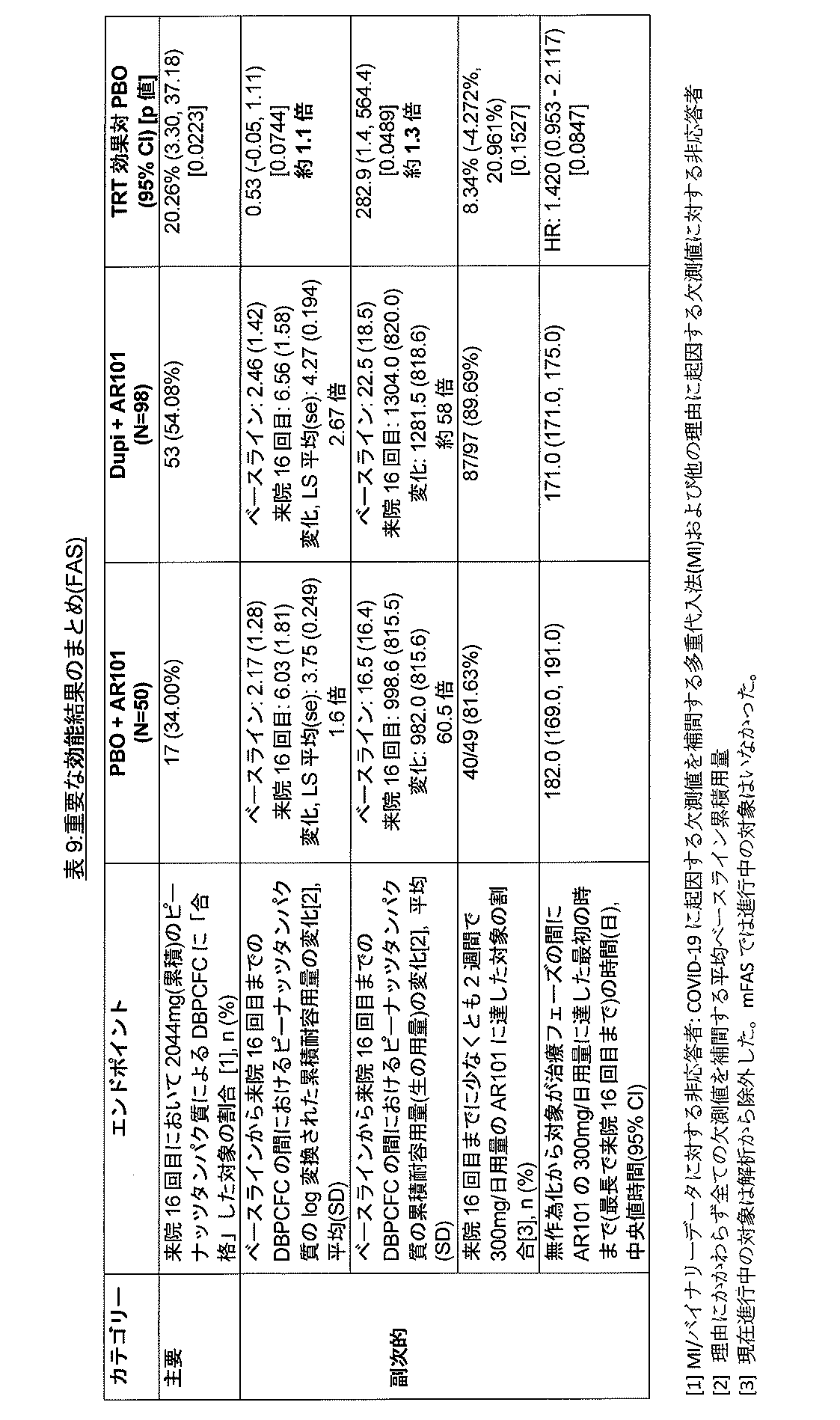
耐容性および安全性
患者は、アレルギーの毎日の兆候および症状を捕捉するためにe日誌を使用するように頼まれた。下記の表10に示されるように、増量投薬の間に報告された毎日のe日誌のアレルギー症状の日数の割合は(DBPCFCを除く)、プラセボ+AR101群と比較した場合、デュピルマブ+AR101群において減少した。さらに、図2に示されるように、来院16回目のDBPCFCの間、アレルギー反応の頻度および重症度は、プラセボ+AR101群と比較した場合、デュピルマブ+AR101群において減少した。
Tolerability and Safety Patients were asked to use an e-diary to capture daily signs and symptoms of allergy. As shown in Table 10 below, the proportion of daily e-diary allergy symptom days reported during dose escalation (excluding DBPCFC) was reduced in the Dupilumab + AR101 group when compared to the Placebo + AR101 group. . Additionally, as shown in Figure 2, during DBPCFC at Visit 16, the frequency and severity of allergic reactions were decreased in the Dupilumab + AR101 group when compared to the Placebo + AR101 group.
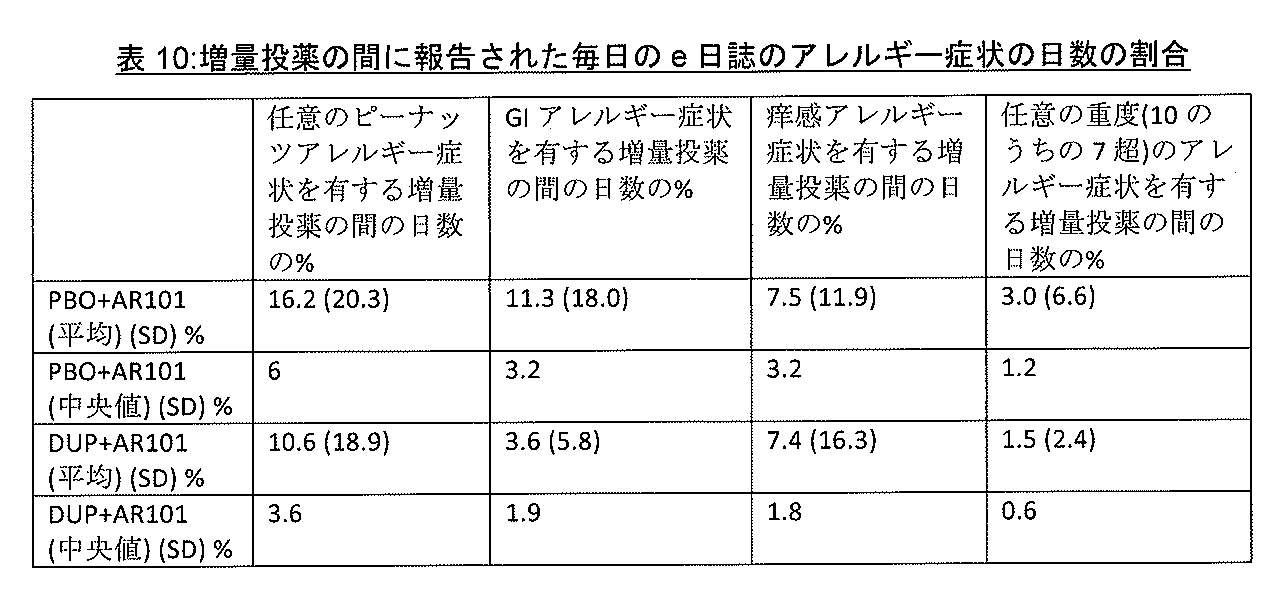
デュピルマブによる治療は、概して、十分に耐容性であり、プラセボ対照ピーナッツタンパク質予備投薬および増量投薬治療期間の間での許容できる安全性プロファイルを実証した。隔週で体重別の投薬を受けたピーナッツアレルギーの小児および若者のこの集団において、いかなる新たな安全性懸念も現れなかった。研究の間、死亡も生じなかった。24週間の増量投薬治療期間において少なくとも1つの治療中に発生した有害事象(TEAE)を有する対象の割合は、プラセボ+AR101群(76.0%)とデュピルマブ+AR101群(62.2%)との間で同様であった(表11を参照されたい)。5人の対象において、TEAEは、増量投薬期間の間に、治験薬の永久的な中止を引き起こした(プラセボ+AR101群において2人およびデュピルマブ+AR101群において3人)。増量投薬期間の間、注射部位反応は、プラセボ+AR101群(6.0%)よりもデュピルマブ+AR101群(5.1%)において、それほど一般的でなく;全ての注射部位反応は、強度において軽度または中等度と評価された。 Treatment with dupilumab was generally well tolerated and demonstrated an acceptable safety profile during the placebo-controlled peanut protein premedication and bulk dosing treatment periods. No new safety concerns emerged in this population of children and adolescents with peanut allergies who received biweekly weight-specific dosing. No deaths occurred during the study. The proportion of subjects with at least one treatment-emergent adverse event (TEAE) during the 24-week dose escalation treatment period was between the placebo + AR101 group (76.0%) and the dupilumab + AR101 group (62.2%). (See Table 11). In 5 subjects, TEAEs caused permanent discontinuation of study drug during the dose escalation period (2 in the Placebo + AR101 group and 3 in the Dupilumab + AR101 group). During the dose escalation period, injection site reactions were less common in the dupilumab + AR101 group (5.1%) than in the placebo + AR101 group (6.0%); all injection site reactions were mild or moderate in intensity. Rated as moderate.
来院16回目のDBPCFCの間を除いて、予備投薬および増量投薬期間の間にアナフィラキシー反応(判定された)のTEAEを報告する対象の割合は、プラセボ+AR101群(4.0%)およびデュピルマブ+AR1010群(5.1%)において同様であった(表11)。研究の間の急性アレルギー反応の治療のためのエピネフリン使用は、表12にまとめられる。 With the exception of the DBPCFC at Visit 16, the proportion of subjects reporting TEAEs of anaphylactic reactions (as determined) during the premedication and titration dosing periods was 4.0% in the Placebo + AR101 and Dupilumab + AR1010 groups. (5.1%) (Table 11). Epinephrine use for the treatment of acute allergic reactions during the study is summarized in Table 12.


研究解析の終了による結果
上記において説明されるように、増量投薬期間に少なくとも2週間においてAR101の300mg/日を達成した患者は、全ての対象がAR101の300mg/日を受けることを継続する24週間の維持フェーズに入る資格がある。デュピルマブ治療群の対象は、増量投薬期間に投与されたのと同じ用量でデュピルマブを受けるかまたはプラセボを受けるように再無作為化された。増量投薬フェーズの間にプラセボを受けた対象は、維持フェーズにおいてもプラセボを受けることを継続する。AR101とデュピルマブまたはプラセボとを受けた24週間の後、対象は、維持期間の終了時のピーナッツ感度のレベルを評価するために、維持後DBPCFCを受け、その後に12週間の安全性経過観察期間が設けられた。図1を参照されたい。
Results from Completion of Study Analysis As explained above, patients who achieved 300 mg/day of AR101 for at least 2 weeks during the escalation dosing period, all subjects continued to receive 300 mg/day of AR101 for 24 weeks. are eligible to enter the maintenance phase. Subjects in the dupilumab treatment group were rerandomized to receive dupilumab at the same dose administered during the dose escalation period or to receive placebo. Subjects who received placebo during the escalation dosing phase will continue to receive placebo during the maintenance phase. After 24 weeks of receiving AR101 and dupilumab or placebo, subjects underwent post-maintenance DBPCFC to assess the level of peanut sensitivity at the end of the maintenance period, followed by a 12-week safety follow-up period. established. Please refer to FIG.
mFAS維持群の場合、合計104人の患者が存在した(プラセボ+AR101を継続した29人の患者;デュピルマブ+AR101を継続した36人の患者;ならびに増量投薬フェーズではデュピルマブ+AR101および維持フェーズではプラセボ+AR101の39人の患者)。人口統計およびベースライン疾患特徴は、概して、継続プラセボ群に対してスクリーニングsIgEがより高いことを除いて、治療群の間でバランスが取られた(データは示されず)。 For the mFAS maintenance group, there were a total of 104 patients (29 patients who continued on placebo + AR101; 36 patients who continued on dupilumab + AR101; and 39 patients on dupilumab + AR101 in the escalating dosing phase and placebo + AR101 in the maintenance phase. patients). Demographics and baseline disease characteristics were generally balanced between treatment groups, with the exception of higher screening sIgE vs. continuous placebo group (data not shown).
追加の6カ月においてAR101の補助剤としてデュピルマブ治療を継続することは、2044mg(累積)のピーナッツタンパク質のDBPCFCを合格することによって測定される、52週間において脱感作を達成した対象の割合をさらに増加させた。デュピルマブ+AR101で継続したmFAS-維持患者の場合、63.9%(23/36)が、52週目においてDBPCFCを合格し表8に示させる増量投薬mFAS患者の56.0%(47/84)と比較する。増量投薬フェーズの後にデュピルマブを中止した患者の場合、52週目でDBPCFCに合格した対象の割合は減少した(デュピルマブ+AR101/プラセボ+AR101群の患者の43.6% (17/39))。連続プラセボ群の場合、患者の48.2%(14/29)が、DBPCFCに合格した。52週目のDBPCFCの間のピーナッツタンパク質の累積耐容用量は、AR101単独と比較して、デュピルマブ+AR101群においてあまり異ならなかった。
Continuing dupilumab treatment as an adjunct to AR101 for an additional 6 months further increased the proportion of subjects achieving desensitization at 52 weeks, as measured by passing the DBPCFC of 2044 mg (cumulative) peanut protein. Increased. For mFAS-maintenance patients continued on dupilumab + AR101, 63.9% (23/36) passed DBPCFC at
より低いスクリーニングpsIgE(<52.5kU/Lまたは<100kU/L)の患者において、プラセボ+AR101群と比較して、患者のより高い割合が、持続デュピルマブ+AR101群において52週目のDBPCFCでのピーナッツタンパク質の2044mg累積耐容用量に合格した(<52.5kU/Lサブグループの場合は79%対30%、<100kU/Lサブグループの場合は76%対36%)。
In patients with lower screening psIgE (<52.5 kU/L or <100 kU/L), a higher proportion of patients had peanut protein at DBPCFC at
mFAS維持群において、デュピルマブは、維持の間の許容できる安全性プロファイルにおいて十分に耐容性であった。TEAEは、プラセボ(42.5%)群と持続デュピルマブ(44.2%)群との間で同様であったが、盲腸の1つSAEを含めて、デュピルマブ+AR101/プラセボ+AR101群においてより高かった(59.5%)。救急薬の使用は、維持期間の間の治療群において匹敵した。 In the mFAS maintenance group, dupilumab was well tolerated with an acceptable safety profile during maintenance. TEAEs were similar between the placebo (42.5%) and continuous dupilumab (44.2%) groups, but were higher in the dupilumab + AR101/placebo + AR101 group, including one SAE in the cecum. (59.5%). Emergency medication use was comparable in the treatment groups during the maintenance period.
結論
まとめると、デュピルマブ補助剤治療は、2044mg累積ピーナッツタンパク質に安全に合格した対象の割合において臨床的に重要で統計的にも重要な20%の向上、ならびに、小児および青年期の対象において、AR101ピーナッツOIT増量投薬後のDBPCFCの間のピーナッツタンパク質の累積耐容用量における統計的に重要な増加を示した。AR101ピーナッツOITに対する補助剤としてのデュピルマブは、概して、ピーナッツアレルギーを有する小児対象において、安全で十分に耐容性であった。
Conclusions In summary, dupilumab adjuvant treatment resulted in a clinically and statistically significant 20% improvement in the proportion of subjects safely passing 2044 mg cumulative peanut protein, as well as an AR101 improvement in pediatric and adolescent subjects. showed a statistically significant increase in the cumulative tolerated dose of peanut protein during DBPCFC after peanut OIT augmentation dosing. Dupilumab as an adjunct to AR101 peanut OIT was generally safe and well-tolerated in pediatric subjects with peanut allergy.
本発明は、本明細書に記載の特定の実施形態により範囲が限定されるべきではない。実際、当業者であれば、上述の説明および添付の図面から、本明細書に記載のものに加えて本発明には種々の改変があることが明らかになるであろう。そのような改変は、添付の特許請求の範囲内に入ることが意図されている。 The invention should not be limited in scope by the particular embodiments described herein. Indeed, from the foregoing description and accompanying drawings, it will become apparent to those skilled in the art that there are various modifications of the invention in addition to those described herein. Such modifications are intended to fall within the scope of the appended claims.
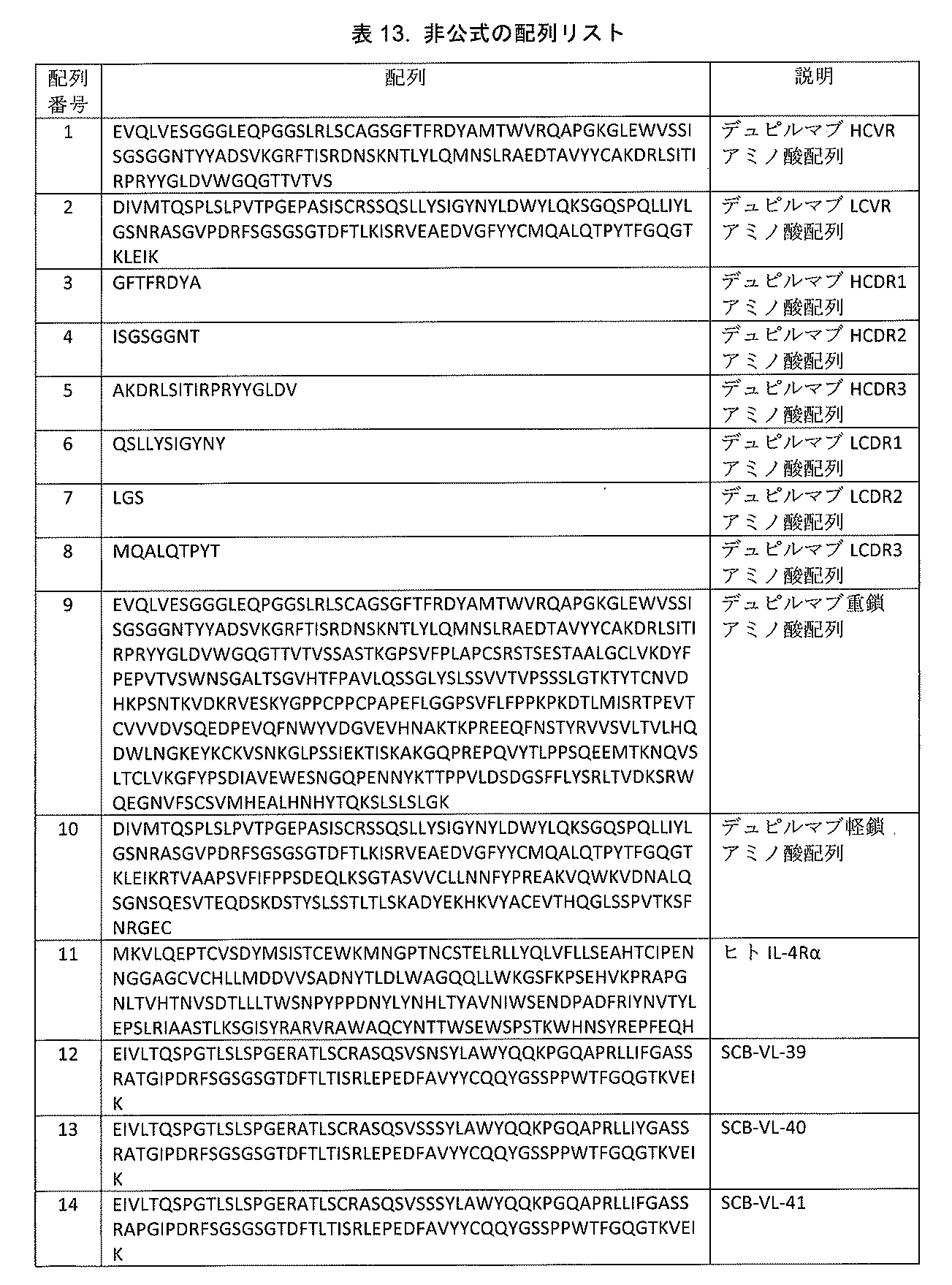


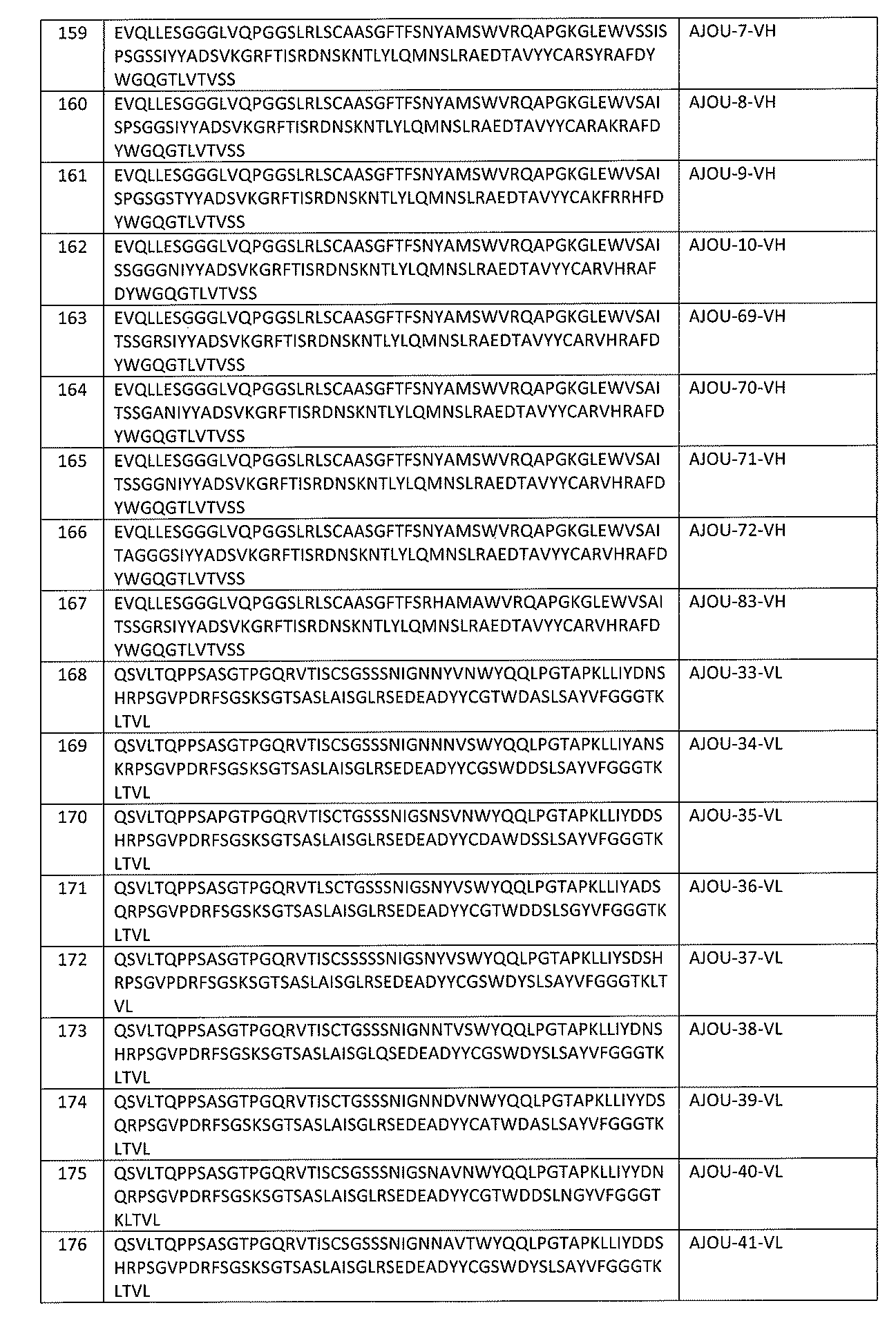


Claims (29)
(a)ピーナッツまたはピーナッツ含有食物に対するアレルギーの病歴;
(b)二重盲検プラセボ対照食物誘発刺激(DBPCFC)における、100mgのピーナッツタンパク質の誘発刺激用量においてまたはその前に、あるいはピーナッツタンパク質の≦144mgの累積用量において、用量制限症状を経験している;
(c)≧10kUA/Lのピーナッツに対する血清IgEを有する;または
(d)≧8mmのピーナッツに対する皮膚プリックテスト(SPT)を有する
のうちの1つまたはそれ以上を有する、請求項1から7のいずれか1項に記載の方法。 Subjects had the following baseline characteristics:
(a) History of allergy to peanuts or peanut-containing foods;
(b) experiencing dose-limiting symptoms at or before the 100 mg challenge stimulation dose of peanut protein or at cumulative doses of ≦144 mg of peanut protein in double-blind, placebo-controlled food-induced stimulation (DBPCFC); ;
(c) having a serum IgE to peanut of ≧10 kUA/L; or (d) having a skin prick test (SPT) to peanut of ≧8 mm. or the method described in paragraph 1.
(i)<30kgの体重の対象では、IL-4Rアンタゴニストの初期用量は200mgであり、各二次用量は100mgであるか;または
(ii)≧30kg~<60kgの体重の対象では、IL-4Rアンタゴニストの初期用量は400mgであり、各二次用量は200mgであるか;または
(iii)≧60kgの体重を有する対象では、IL-4Rアンタゴニストの初期用量は600mgであり、各二次用量は300mgである、請求項1~11のいずれか1項に記載の方法。 The IL-4R antagonist is administered subcutaneously at an initial dose followed by one or more secondary doses, each secondary dose being administered 1 to 4 weeks after the immediately preceding dose;
(i) For subjects weighing <30 kg, the initial dose of the IL-4R antagonist is 200 mg and each subsequent dose is 100 mg; or (ii) For subjects weighing ≧30 kg to <60 kg, the IL-4R antagonist dose is 200 mg; The initial dose of the 4R antagonist is 400 mg and each sub-dose is 200 mg; or (iii) in subjects with a body weight ≧60 kg, the initial dose of the IL-4R antagonist is 600 mg and each sub-dose is The method according to any one of claims 1 to 11, wherein the amount is 300 mg.
(i)DBPCFCによって測定した場合のピーナッツタンパク質の累積耐容用量を増加させ;ならびに/または
(ii)ピーナッツアレルギー症状、胃腸症状、および/もしくは痒感症状の頻度および/もしくは重症度を減少させる、請求項1~19のいずれか1項に記載の方法。 Administration of the IL-4R antagonist is
A claim that: (i) increases the cumulative tolerable dose of peanut protein as measured by DBPCFC; and/or (ii) decreases the frequency and/or severity of peanut allergy symptoms, gastrointestinal symptoms, and/or pruritus symptoms. The method according to any one of Items 1 to 19.
Applications Claiming Priority (5)
| Application Number | Priority Date | Filing Date | Title |
|---|---|---|---|
| US202163135238P | 2021-01-08 | 2021-01-08 | |
| US63/135,238 | 2021-01-08 | ||
| EP21315241.6 | 2021-11-10 | ||
| EP21315241 | 2021-11-10 | ||
| PCT/US2022/011643 WO2022150605A1 (en) | 2021-01-08 | 2022-01-07 | Methods for treating peanut allergy and enhancing peanut allergen-specific immunotherapy by administering an il-4r antagonist |
Publications (2)
| Publication Number | Publication Date |
|---|---|
| JP2024502471A true JP2024502471A (en) | 2024-01-19 |
| JPWO2022150605A5 JPWO2022150605A5 (en) | 2025-01-15 |
Family
ID=80034850
Family Applications (1)
| Application Number | Title | Priority Date | Filing Date |
|---|---|---|---|
| JP2023541519A Pending JP2024502471A (en) | 2021-01-08 | 2022-01-07 | Methods for treating peanut allergy and methods for enhancing peanut allergen-specific immunotherapy by administering an IL-4R antagonist |
Country Status (9)
| Country | Link |
|---|---|
| US (1) | US20220220211A1 (en) |
| EP (1) | EP4274609A1 (en) |
| JP (1) | JP2024502471A (en) |
| KR (1) | KR20230130681A (en) |
| AU (1) | AU2022206434A1 (en) |
| CA (1) | CA3204515A1 (en) |
| IL (1) | IL304240A (en) |
| MX (1) | MX2023007945A (en) |
| WO (1) | WO2022150605A1 (en) |
Families Citing this family (7)
| Publication number | Priority date | Publication date | Assignee | Title |
|---|---|---|---|---|
| US7608693B2 (en) | 2006-10-02 | 2009-10-27 | Regeneron Pharmaceuticals, Inc. | High affinity human antibodies to human IL-4 receptor |
| CN118286430A (en) | 2012-09-07 | 2024-07-05 | 瑞泽恩制药公司 | Methods of treating atopic dermatitis with IL-4R antagonists |
| TWI634900B (en) | 2013-07-11 | 2018-09-11 | 再生元醫藥公司 | Method for treating eosinophilic esophagitis by administering an IL-4R inhibitor |
| JP6526037B2 (en) | 2014-02-28 | 2019-06-05 | リジェネロン・ファーマシューティカルズ・インコーポレイテッドRegeneron Pharmaceuticals, Inc. | Methods for treating skin infections by administering an IL-4R antagonist |
| ES2994774T3 (en) | 2016-09-01 | 2025-01-31 | Regeneron Pharma | Methods for preventing or treating allergy by administering an il-4r antagonist |
| KR20210143246A (en) | 2019-03-21 | 2021-11-26 | 리제너론 파아마슈티컬스, 인크. | Combination of IL-4/IL-13 pathway inhibitor and plasma cell ablation for the treatment of allergy |
| BR112022000377A2 (en) | 2019-08-05 | 2022-05-10 | Regeneron Pharma | Methods for the treatment of atopic dermatitis by administration of an il-4r antagonist |
Family Cites Families (15)
| Publication number | Priority date | Publication date | Assignee | Title |
|---|---|---|---|---|
| ES2614260T3 (en) | 2000-05-26 | 2017-05-30 | Immunex Corporation | Use of antibodies against the interleukin-4 receptor and compositions thereof |
| US6596541B2 (en) | 2000-10-31 | 2003-07-22 | Regeneron Pharmaceuticals, Inc. | Methods of modifying eukaryotic cells |
| CN1886426A (en) | 2003-11-07 | 2006-12-27 | 伊姆尼斯公司 | Antibodies that bind interleukin-4 receptor |
| NZ576040A (en) | 2006-10-02 | 2011-06-30 | Regeneron Pharma | High affinity human antibodies to human il-4 receptor |
| US7608693B2 (en) | 2006-10-02 | 2009-10-27 | Regeneron Pharmaceuticals, Inc. | High affinity human antibodies to human IL-4 receptor |
| US8092804B2 (en) | 2007-12-21 | 2012-01-10 | Medimmune Limited | Binding members for interleukin-4 receptor alpha (IL-4Rα)-173 |
| PT2624865T (en) | 2010-10-06 | 2018-11-05 | Regeneron Pharma | STABILIZED FORMULATIONS CONTAINING INTERLEUCIN-4 (IL-4R) ANTI-RECEIVER ANTIBODIES |
| MX2015010315A (en) | 2013-03-14 | 2016-04-13 | Aimmune Therapeutics Inc | Manufacture of peanut formulations for oral desensitization. |
| WO2014159609A1 (en) | 2013-03-14 | 2014-10-02 | Allergen Research Corporation | Peanut formulations and uses thereof |
| TWI633891B (en) * | 2013-06-04 | 2018-09-01 | 再生元醫藥公司 | Methods for treating allergy and enhancing allergen-specific immunotherapy by administering an il-4r inhibitor |
| CN107474134B (en) | 2016-06-08 | 2021-07-27 | 苏州康乃德生物医药有限公司 | Antibodies for binding to the interleukin-4 receptor |
| ES2994774T3 (en) * | 2016-09-01 | 2025-01-31 | Regeneron Pharma | Methods for preventing or treating allergy by administering an il-4r antagonist |
| WO2019240288A1 (en) * | 2018-06-14 | 2019-12-19 | 味の素株式会社 | Substance having affinity for antibody, and compound or salt thereof having bioorthogonal functional group |
| US12216129B2 (en) | 2018-11-09 | 2025-02-04 | Ajou University Industry-Academic Cooperation Foundation | Human antibody having high affinity to human IL-4 receptor alpha |
| KR20210143246A (en) * | 2019-03-21 | 2021-11-26 | 리제너론 파아마슈티컬스, 인크. | Combination of IL-4/IL-13 pathway inhibitor and plasma cell ablation for the treatment of allergy |
-
2022
- 2022-01-07 JP JP2023541519A patent/JP2024502471A/en active Pending
- 2022-01-07 KR KR1020237026703A patent/KR20230130681A/en active Pending
- 2022-01-07 WO PCT/US2022/011643 patent/WO2022150605A1/en not_active Ceased
- 2022-01-07 US US17/570,547 patent/US20220220211A1/en active Pending
- 2022-01-07 AU AU2022206434A patent/AU2022206434A1/en active Pending
- 2022-01-07 MX MX2023007945A patent/MX2023007945A/en unknown
- 2022-01-07 CA CA3204515A patent/CA3204515A1/en active Pending
- 2022-01-07 EP EP22700862.0A patent/EP4274609A1/en active Pending
-
2023
- 2023-07-04 IL IL304240A patent/IL304240A/en unknown
Also Published As
| Publication number | Publication date |
|---|---|
| AU2022206434A1 (en) | 2023-08-24 |
| CA3204515A1 (en) | 2022-07-14 |
| KR20230130681A (en) | 2023-09-12 |
| US20220220211A1 (en) | 2022-07-14 |
| MX2023007945A (en) | 2023-09-21 |
| IL304240A (en) | 2023-09-01 |
| EP4274609A1 (en) | 2023-11-15 |
| WO2022150605A1 (en) | 2022-07-14 |
Similar Documents
| Publication | Publication Date | Title |
|---|---|---|
| JP7659500B2 (en) | Combination of IL-4/IL-13 pathway inhibitors and plasma cell depletion to treat allergy - Patent Application 20070233333 | |
| AU2019279946B2 (en) | Methods for treating atopic dermatitis by administering an IL-4R antagonist | |
| US11504426B2 (en) | Methods for treating allergy and enhancing allergen-specific immunotherapy by administering an IL-4R antagonist | |
| JP2024502471A (en) | Methods for treating peanut allergy and methods for enhancing peanut allergen-specific immunotherapy by administering an IL-4R antagonist | |
| RU2679920C2 (en) | Methods for treating allergy and enhancing allergen-specific immunotherapy by administering il-4r inhibitor | |
| IL265104B2 (en) | Methods for preventing or treating allergy by administering an il-4r antagonist | |
| US10935554B2 (en) | Diagnostic tests and methods for assessing safety, efficacy or outcome of allergen-specific immunotherapy (SIT) | |
| CN118355034A (en) | Methods of administering IL-4/IL-13 antagonists to attenuate the progression of atopy | |
| JP2024539148A (en) | Methods of treating prurigo nodularis by administering an IL-4R antagonist | |
| KR20230030573A (en) | Methods of Treating Allergies Using Anti-BET V1 Antibodies | |
| AU2021293980B2 (en) | Treatment of food allergy using anti-IgE antibodies | |
| RU2833729C2 (en) | Methods of treating allergy and intensifying allergen-specific immunotherapy by administering il-4r antagonist | |
| CN116887858A (en) | Methods for treating peanut allergy and enhancing peanut allergen-specific immunotherapy by administration of IL-4R antagonists | |
| KR102284244B1 (en) | Methods for treating atopic dermatitis by administering an il-4r antagonist | |
| AU2017321682B2 (en) | Methods for preventing or treating allergy by administering an IL-4R antagonist | |
| RU2789047C2 (en) | Methods for the treatment of allergy and increasing the efficiency of allergen-specific immunotherapy by introducing il-4r inhibitor | |
| WO2025165851A1 (en) | Methods of treating allergy using anti-bet v 1 antibodies | |
| EA049619B1 (en) | ALLERGY TREATMENT METHODS USING BET V 1 ANTIBODIES |
Legal Events
| Date | Code | Title | Description |
|---|---|---|---|
| A521 | Request for written amendment filed |
Free format text: JAPANESE INTERMEDIATE CODE: A523 Effective date: 20250106 |
|
| A621 | Written request for application examination |
Free format text: JAPANESE INTERMEDIATE CODE: A621 Effective date: 20250106 |