JP2024138262A - Mutant pore - Google Patents
Mutant pore Download PDFInfo
- Publication number
- JP2024138262A JP2024138262A JP2024095022A JP2024095022A JP2024138262A JP 2024138262 A JP2024138262 A JP 2024138262A JP 2024095022 A JP2024095022 A JP 2024095022A JP 2024095022 A JP2024095022 A JP 2024095022A JP 2024138262 A JP2024138262 A JP 2024138262A
- Authority
- JP
- Japan
- Prior art keywords
- pore
- mutant
- monomer
- lysenin
- polynucleotide
- Prior art date
- Legal status (The legal status is an assumption and is not a legal conclusion. Google has not performed a legal analysis and makes no representation as to the accuracy of the status listed.)
- Pending
Links
Classifications
-
- C—CHEMISTRY; METALLURGY
- C12—BIOCHEMISTRY; BEER; SPIRITS; WINE; VINEGAR; MICROBIOLOGY; ENZYMOLOGY; MUTATION OR GENETIC ENGINEERING
- C12Q—MEASURING OR TESTING PROCESSES INVOLVING ENZYMES, NUCLEIC ACIDS OR MICROORGANISMS; COMPOSITIONS OR TEST PAPERS THEREFOR; PROCESSES OF PREPARING SUCH COMPOSITIONS; CONDITION-RESPONSIVE CONTROL IN MICROBIOLOGICAL OR ENZYMOLOGICAL PROCESSES
- C12Q1/00—Measuring or testing processes involving enzymes, nucleic acids or microorganisms; Compositions therefor; Processes of preparing such compositions
- C12Q1/68—Measuring or testing processes involving enzymes, nucleic acids or microorganisms; Compositions therefor; Processes of preparing such compositions involving nucleic acids
- C12Q1/6869—Methods for sequencing
-
- C—CHEMISTRY; METALLURGY
- C07—ORGANIC CHEMISTRY
- C07K—PEPTIDES
- C07K14/00—Peptides having more than 20 amino acids; Gastrins; Somatostatins; Melanotropins; Derivatives thereof
- C07K14/435—Peptides having more than 20 amino acids; Gastrins; Somatostatins; Melanotropins; Derivatives thereof from animals; from humans
- C07K14/43504—Peptides having more than 20 amino acids; Gastrins; Somatostatins; Melanotropins; Derivatives thereof from animals; from humans from invertebrates
- C07K14/43536—Peptides having more than 20 amino acids; Gastrins; Somatostatins; Melanotropins; Derivatives thereof from animals; from humans from invertebrates from worms
-
- A—HUMAN NECESSITIES
- A61—MEDICAL OR VETERINARY SCIENCE; HYGIENE
- A61K—PREPARATIONS FOR MEDICAL, DENTAL OR TOILETRY PURPOSES
- A61K35/00—Medicinal preparations containing materials or reaction products thereof with undetermined constitution
- A61K35/56—Materials from animals other than mammals
- A61K35/62—Leeches; Worms, e.g. cestodes, tapeworms, nematodes, roundworms, earth worms, ascarids, filarias, hookworms, trichinella or taenia
-
- C—CHEMISTRY; METALLURGY
- C07—ORGANIC CHEMISTRY
- C07K—PEPTIDES
- C07K14/00—Peptides having more than 20 amino acids; Gastrins; Somatostatins; Melanotropins; Derivatives thereof
- C07K14/435—Peptides having more than 20 amino acids; Gastrins; Somatostatins; Melanotropins; Derivatives thereof from animals; from humans
- C07K14/43504—Peptides having more than 20 amino acids; Gastrins; Somatostatins; Melanotropins; Derivatives thereof from animals; from humans from invertebrates
-
- C—CHEMISTRY; METALLURGY
- C12—BIOCHEMISTRY; BEER; SPIRITS; WINE; VINEGAR; MICROBIOLOGY; ENZYMOLOGY; MUTATION OR GENETIC ENGINEERING
- C12Q—MEASURING OR TESTING PROCESSES INVOLVING ENZYMES, NUCLEIC ACIDS OR MICROORGANISMS; COMPOSITIONS OR TEST PAPERS THEREFOR; PROCESSES OF PREPARING SUCH COMPOSITIONS; CONDITION-RESPONSIVE CONTROL IN MICROBIOLOGICAL OR ENZYMOLOGICAL PROCESSES
- C12Q1/00—Measuring or testing processes involving enzymes, nucleic acids or microorganisms; Compositions therefor; Processes of preparing such compositions
- C12Q1/68—Measuring or testing processes involving enzymes, nucleic acids or microorganisms; Compositions therefor; Processes of preparing such compositions involving nucleic acids
-
- G—PHYSICS
- G01—MEASURING; TESTING
- G01N—INVESTIGATING OR ANALYSING MATERIALS BY DETERMINING THEIR CHEMICAL OR PHYSICAL PROPERTIES
- G01N27/00—Investigating or analysing materials by the use of electric, electrochemical, or magnetic means
- G01N27/26—Investigating or analysing materials by the use of electric, electrochemical, or magnetic means by investigating electrochemical variables; by using electrolysis or electrophoresis
-
- G—PHYSICS
- G01—MEASURING; TESTING
- G01N—INVESTIGATING OR ANALYSING MATERIALS BY DETERMINING THEIR CHEMICAL OR PHYSICAL PROPERTIES
- G01N33/00—Investigating or analysing materials by specific methods not covered by groups G01N1/00 - G01N31/00
- G01N33/48—Biological material, e.g. blood, urine; Haemocytometers
- G01N33/483—Physical analysis of biological material
- G01N33/487—Physical analysis of biological material of liquid biological material
- G01N33/48707—Physical analysis of biological material of liquid biological material by electrical means
- G01N33/48721—Investigating individual macromolecules, e.g. by translocation through nanopores
-
- C—CHEMISTRY; METALLURGY
- C12—BIOCHEMISTRY; BEER; SPIRITS; WINE; VINEGAR; MICROBIOLOGY; ENZYMOLOGY; MUTATION OR GENETIC ENGINEERING
- C12Q—MEASURING OR TESTING PROCESSES INVOLVING ENZYMES, NUCLEIC ACIDS OR MICROORGANISMS; COMPOSITIONS OR TEST PAPERS THEREFOR; PROCESSES OF PREPARING SUCH COMPOSITIONS; CONDITION-RESPONSIVE CONTROL IN MICROBIOLOGICAL OR ENZYMOLOGICAL PROCESSES
- C12Q2563/00—Nucleic acid detection characterized by the use of physical, structural and functional properties
- C12Q2563/116—Nucleic acid detection characterized by the use of physical, structural and functional properties electrical properties of nucleic acids, e.g. impedance, conductivity or resistance
Landscapes
- Health & Medical Sciences (AREA)
- Chemical & Material Sciences (AREA)
- Life Sciences & Earth Sciences (AREA)
- Organic Chemistry (AREA)
- General Health & Medical Sciences (AREA)
- Biochemistry (AREA)
- Molecular Biology (AREA)
- Proteomics, Peptides & Aminoacids (AREA)
- Tropical Medicine & Parasitology (AREA)
- Zoology (AREA)
- Engineering & Computer Science (AREA)
- Biophysics (AREA)
- Medicinal Chemistry (AREA)
- Genetics & Genomics (AREA)
- Physics & Mathematics (AREA)
- Gastroenterology & Hepatology (AREA)
- Toxicology (AREA)
- Analytical Chemistry (AREA)
- Immunology (AREA)
- Wood Science & Technology (AREA)
- Biomedical Technology (AREA)
- Pathology (AREA)
- General Physics & Mathematics (AREA)
- Bioinformatics & Cheminformatics (AREA)
- General Engineering & Computer Science (AREA)
- Biotechnology (AREA)
- Microbiology (AREA)
- Electrochemistry (AREA)
- Chemical Kinetics & Catalysis (AREA)
- Pharmacology & Pharmacy (AREA)
- Epidemiology (AREA)
- Animal Behavior & Ethology (AREA)
- Public Health (AREA)
- Veterinary Medicine (AREA)
- Food Science & Technology (AREA)
- Urology & Nephrology (AREA)
- Hematology (AREA)
- Spectroscopy & Molecular Physics (AREA)
- Nanotechnology (AREA)
- Peptides Or Proteins (AREA)
Abstract
【課題】ライセニンの変異体形態、およびライセニンの変異体形態を使用した標的分析物を特徴付ける方法を提供する。
【解決手段】特定のアミノ酸配列に対して少なくとも90%の同一性を有するバリアントを含む変異体ライセニンモノマーであって、前記バリアントが、ポアを形成することが可能であり、前記特定のアミノ酸配列のS49において修飾を含む、変異体ライセニンモノマーを提供する。
【選択図】なしThe present invention provides mutant forms of lysenin and methods for characterizing target analytes using the mutant forms of lysenin.
[Solution] The present invention provides a mutant lysenin monomer comprising a variant having at least 90% identity to a specific amino acid sequence, wherein the variant is capable of forming a pore and comprises a modification at S49 of the specific amino acid sequence.
[Selection diagram] None
Description
本発明は、ライセニンの変異体形態に関する。本発明はまた、ライセニンの変異体形態
を使用した分析物の特徴付けに関する。
The present invention relates to mutant forms of lysenin. The present invention also relates to the characterization of analytes using mutant forms of lysenin.
ナノポアセンシングは、分析物分子と受容体との間の個々の結合または相互作用の事象
の観察に依拠するセンシングの手法である。ナノポアセンサは、ナノメートル寸法の単一
のポアを絶縁膜内に置き、分析物分子の存在下でポアを通る電圧駆動イオン輸送を測定す
ることによって作製され得る。分析物の同一性は、その固有の電流シグネチャ、とりわけ
電流ブロックの時間及び程度、ならびに電流レベルの変動を通して明らかになる。Oxf
ord Nanopore Technologies Ltdによって販売される、例
えば、電子チップ内に一体となったナノポアのアレイを含むMinION(商標)デバイ
スなどの、かかるナノポアセンサが市販されている。
Nanopore sensing is a sensing approach that relies on the observation of individual binding or interaction events between analyte molecules and receptors. Nanopore sensors can be fabricated by placing a single pore of nanometer dimensions in an insulating membrane and measuring voltage-driven ion transport through the pore in the presence of an analyte molecule. The identity of the analyte is revealed through its unique current signature, particularly the time and extent of current block, as well as fluctuations in the current level. Oxf
Such nanopore sensors are commercially available, such as the MinION™ device sold by Ord Nanopore Technologies Ltd, which comprises an array of nanopores integrated within an electronic chip.
幅広い用途にわたって、迅速かつ安価な核酸(例えば、DNAまたはRNA)シークエ
ンシング技術が現在必要とされている。既存の技術は、主に、大量の核酸を生成するため
に増幅技術に依拠し、シグナル検出のための専門の蛍光薬剤が大量に必要とするため、時
間がかかりかつ高価である。ナノポアセンシングは、必要とされるヌクレオチド及び試薬
の量を減らすことによって迅速かつ安価な核酸シークエンシングを提供する可能性を有す
る。
There is currently a need for fast and inexpensive nucleic acid (e.g., DNA or RNA) sequencing technology across a wide range of applications. Existing technologies are time-consuming and expensive, mainly relying on amplification techniques to generate large amounts of nucleic acid and requiring large amounts of specialized fluorescent agents for signal detection. Nanopore sensing has the potential to provide fast and inexpensive nucleic acid sequencing by reducing the amount of nucleotides and reagents required.
ナノポアセンシングを使用した核酸をシークエンシングする必須成分の1つは、ポアを
通る核酸移動の制御である。別のものは、核酸ポリマーがポアを通って移動する際のヌク
レオチドの識別である。過去に、ヌクレオチドの識別を達成するために、核酸は、溶血毒
の変異体を通されてきた。これは、配列依存性であることが示されてきた電流シグネチャ
を提供した。溶血毒ポアを使用したときに、認められた電流に多数のヌクレオチドが寄与
することも示し、これは、認められた電流とポリヌクレオチドとの間の直接的な関係を困
難にした。
One of the essential components of sequencing nucleic acids using nanopore sensing is the control of nucleic acid translocation through the pore. Another is the discrimination of nucleotides as the nucleic acid polymer translocates through the pore. In the past, to achieve discrimination of nucleotides, nucleic acids have been passed through mutants of hemolytic toxins. This provided current signatures that have been shown to be sequence-dependent. When using hemolytic toxin pores, we also showed that multiple nucleotides contribute to the observed current, making a direct relationship between the observed current and polynucleotides difficult.
ヌクレオチドの識別のための電流範囲は、溶血毒ポアの変異体を通して改善されてきた
ものの、ヌクレオチド間の電流差をさらに改善させることができれば、シークエンシング
システムは、より高い性能を有することができるであろう。さらに、核酸がポアを通って
移動すると、いくつかの電流状態が高い変動性を示すことが認められた。いくつかの変異
体溶血毒ポアが他のものよりも高い変動を提示することも示された。これらの状態の変動
は配列特異情報を含み得る一方、システムを簡略化するために低い変動を有するポアを生
成することが望ましい。また、認められた電流に寄与するヌクレオチドの数を減らすこと
も望ましい。
Although the current range for nucleotide discrimination has been improved through mutants of the hemolytic toxin pore, the sequencing system could have higher performance if the current difference between nucleotides could be further improved. Furthermore, it was observed that some current states exhibit high variability as the nucleic acid moves through the pore. It was also shown that some mutant hemolytic toxin pores present higher variability than others. While the variability of these states may contain sequence-specific information, it is desirable to generate pores with low variability to simplify the system. It is also desirable to reduce the number of nucleotides that contribute to the observed current.
ライセニン(efL1としても既知である)は、ミミズ、エイセニアフェティダ(Ei
senia fetida)の体腔液から精製されたポア形成毒素である。これは、ライ
セニン誘導性溶血を阻害するスフィンゴミエリンに特異的に結合する(Yamaji e
t al.,J.Biol.Chem.1998;273(9):5300-6)。ライ
セニンモノマーの結晶構造は、De Colbis et al.,Structure
,2012;20:1498-1507に開示されている。
Lysenin (also known as efL1) is a protein found in the earthworm, Eisenia fetida (Ei
It is a pore-forming toxin purified from the coelomic fluid of A. seria fetida. It specifically binds to sphingomyelin, inhibiting lysenin-induced hemolysis (Yamaji et al., 2003).
al., J. Biol. Chem. 1998;273(9):5300-6). The crystal structure of lysenin monomer is shown in De Colbis et al., Structure
, 2012;20:1498-1507.
本発明者らは、驚くべきことに、1つ以上の修飾がなされた新規の変異体ライセニンモ
ノマーがポリヌクレオチドと相互作用するモノマーの能力を改善することを同定した。本
発明者らはまた、驚くべきことに、新規の変異体モノマーを含むポアが、ポリヌクレオチ
ドと相互作用する向上した能力を有し、それによって、ポリヌクレオチドの配列などの特
徴を推定する向上した特性を提示することを示した。変異体ポアは、驚くべきことに、改
善されたヌクレオチドの識別を提示する。とりわけ、変異体ポアは、驚くことに、異なる
ヌクレオチド間の識別を容易にする電流範囲の増加、及びシグナル対ノイズ比を増加させ
る状態の変動の低下を提示する。さらに、ポアを通ってポリヌクレオチドが移動する間の
、電流に寄与するヌクレオチドの数は減少する。これは、ポアを通ってポリヌクレオチド
が移動する間に認められた電流と、ポリヌクレオチドとの間の直接的な関係性を特定する
ことを容易にする。
The inventors have surprisingly identified that novel mutant lysenin monomers with one or more modifications improve the ability of the monomer to interact with polynucleotides. The inventors have also surprisingly shown that pores containing the novel mutant monomers have an improved ability to interact with polynucleotides, thereby exhibiting improved properties for predicting characteristics such as the sequence of the polynucleotide. The mutant pores surprisingly exhibit improved nucleotide discrimination. In particular, the mutant pores surprisingly exhibit an increased current range, which facilitates discrimination between different nucleotides, and a reduced fluctuation in conditions, which increases the signal-to-noise ratio. Furthermore, the number of nucleotides contributing to the current during the movement of the polynucleotide through the pore is reduced. This makes it easier to identify a direct relationship between the current observed during the movement of the polynucleotide through the pore and the polynucleotide.
本明細書に開示される全てのアミノ酸置換、欠失、及び/または付加は、別段記載され
ない限り、配列番号2に示される配列のバリアントを含む変異体ライセニンモノマーに関
連する。
All amino acid substitutions, deletions, and/or additions disclosed herein relate to mutant lysenin monomers, including variants of the sequence shown in SEQ ID NO:2, unless otherwise stated.
配列番号2に示される配列のバリアントを含む変異体ライセニンモノマーへの言及は、
配列番号14~16に示される配列のバリアントを含む変異体ライセニンモノマーを包含
する。アミノ酸置換、欠失、及び/または付加は、配列番号2に関連して本明細書に開示
される置換、欠失、及び/または付加と同等である配列番号2に示される配列のバリアン
トを含むライセニンモノマーに行われ得る。
Reference to mutant lysenin monomers comprising variants of the sequence shown in SEQ ID NO:2 is
These include mutant lysenin monomers that include variants of the sequence shown in SEQ ID NOs: 14 to 16. Amino acid substitutions, deletions, and/or additions can be made to lysenin monomers that include variants of the sequence shown in SEQ ID NO: 2 that are equivalent to the substitutions, deletions, and/or additions disclosed herein in relation to SEQ ID NO: 2.
変異体モノマーは、単離されたモノマーとして考えられ得る。 The mutant monomer can be considered as an isolated monomer.
したがって、本発明は、配列番号2に示される配列のバリアントを含む変異体ライセニ
ンモノマーを提供し、モノマーがポアを形成することができ、バリアントが以下の位置、
K37、G43、K45、V47、S49、T51、H83、V88、T91、T93、
V95、Y96、S98、K99、V100、I101、P108、P109、T110
、S111、K112、及びT114のうちの1つ以上における修飾を含む。
Thus, the present invention provides a mutant lysenin monomer comprising a variant of the sequence shown in SEQ ID NO:2, wherein the monomer is capable of forming a pore, the variant comprising:
K37, G43, K45, V47, S49, T51, H83, V88, T91, T93,
V95, Y96, S98, K99, V100, I101, P108, P109, T110
, S111, K112, and T114.
本発明はまた、配列番号2に示される配列のバリアントを含む変異体ライセニンモノマ
ーを提供し、モノマーがポアを形成することができ、バリアントが以下の置換のうちの1
つ以上を含む
D35N/S、
S74K/R、
E76D/N、
S78R/K/N/Q、
S80K/R/N/Q、
S82K/R/N/Q、
E84R/K/N/A、
E85N、
S86K/Q、
S89K、
M90K/I/A、
E92D/S、
E94D/Q/G/A/K/R/S/N、
E102N/Q/D/S、
T104R/K/Q、
T106R/K/Q、
R115S、
Q117S、及び
N119S。
The present invention also provides a mutant lysenin monomer comprising a variant of the sequence shown in SEQ ID NO:2, wherein the monomer is capable of forming a pore, and the variant has one of the following substitutions:
D35N/S including one or more
S74K/R,
E76D/N,
S78R/K/N/Q,
S80K/R/N/Q,
S82K/R/N/Q,
E84R/K/N/A,
E85N,
S86K/Q,
S89K,
M90K/I/A,
E92D/S,
E94D/Q/G/A/K/R/S/N,
E102N/Q/D/S,
T104R/K/Q,
T106R/K/Q,
R115S,
Q117S, and N119S.
本発明はまた、配列番号2に示される配列のバリアントを含む変異体ライセニンモノマ
ーを提供し、モノマーがポアを形成することができ、バリアントが以下のうちの1つ以上
における変異を含む
D35/E94/T106、
K37/E94/E102/T106、
K37/E94/T104/T106、
K37/E94/T106、
K37/E94/E102/T106、
G43/E94/T106、
K45/V47/E92/E94/T106、
K45/V47/E94/T106、
K45/S49/E92/E94/T106、
K45/S49/E94/T106、
K45/E94/T106、
K45/T106、
V47/E94/T106、
V47/V88/E94/T106、
S49/E94/T106、
T51/E94D/T106、
S74/E94、
E76/E94、
S78/E94、
Y79/E94、
S80/E94、
S82/E94、
S82/E94/T106、
H83/E94、
H83/E94/T106、
E85/E94/T106、
S86/E94、
V88/M90/E94/T106、
S89/E94、
M90/E94/T106、
T91/E94/T106、
E92/E94/T106、
T93/E94/T106、
E94/Y96/T106、
E94/S98/K99/T106、
E94/K99/T106、
E94/E102、
E94/T104、
E94/T106、
E94/P108、
E94/P109、
E94/T110、
E94/S111、
E94/T114、
E94/R115、
E94/Q117、及び
E94/E119。
The present invention also provides a mutant lysenin monomer comprising a variant of the sequence shown in SEQ ID NO:2, wherein the monomer is capable of forming a pore, the variant comprising mutations in one or more of the following: D35/E94/T106;
K37/E94/E102/T106,
K37/E94/T104/T106,
K37/E94/T106,
K37/E94/E102/T106,
G43/E94/T106,
K45/V47/E92/E94/T106,
K45/V47/E94/T106,
K45/S49/E92/E94/T106,
K45/S49/E94/T106,
K45/E94/T106,
K45/T106,
V47/E94/T106,
V47/V88/E94/T106,
S49/E94/T106,
T51/E94D/T106,
S74/E94,
E76/E94,
S78/E94,
Y79/E94,
S80/E94,
S82/E94,
S82/E94/T106,
H83/E94,
H83/E94/T106,
E85/E94/T106,
S86/E94,
V88/M90/E94/T106,
S89/E94,
M90/E94/T106,
T91/E94/T106,
E92/E94/T106,
T93/E94/T106,
E94/Y96/T106,
E94/S98/K99/T106,
E94/K99/T106,
E94/E102,
E94/T104,
E94/T106,
E94/P108,
E94/P109,
E94/T110,
E94/S111,
E94/T114,
E94/R115,
E94/Q117 and E94/E119.
本発明はまた、配列番号2に示される配列のバリアントを含む変異体ライセニンモノマ
ーを提供し、モノマーがポアを形成することができ、バリアントが以下の置換のうちの1
つ以上を含む:
E84R/E94D、
E84K/E94D、
E84N/E94D、
E84A/E94Q、
E84K/E94Q、及び
E94Q/D121S。
The present invention also provides a mutant lysenin monomer comprising a variant of the sequence shown in SEQ ID NO:2, wherein the monomer is capable of forming a pore, and the variant has one of the following substitutions:
Contains one or more of:
E84R/E94D,
E84K/E94D,
E84N/E94D,
E84A/E94Q,
E84K/E94Q, and E94Q/D121S.
本発明はまた、配列番号2に示される配列のバリアントを含む変異体ライセニンモノマ
ーを提供し、バリアントが以下の置換の組み合わせのうちの1つを含む:
E84Q/E85K/E92Q/E94D/E97S/D126G;
E84Q/E85K/E92Q/E94Q/E97S/D126G;または
E84Q/E85K/E92Q/E94D/E97S/T106K/D126G。
The present invention also provides mutant lysenin monomers comprising a variant of the sequence shown in SEQ ID NO:2, wherein the variant comprises one of the following combinations of substitutions:
E84Q/E85K/E92Q/E94D/E97S/D126G;
E84Q/E85K/E92Q/E94Q/E97S/D126G; or E84Q/E85K/E92Q/E94D/E97S/T106K/D126G.
本発明はまた、配列番号2に示される配列のバリアントを含む変異体ライセニンモノマ
ーを提供し、バリアント(a)において、配列番号2の34位~70位の、またはそれら
の位置に対応する、2、4、6、8、10、12、14、16、18、もしくは20個の
アミノ酸が欠失されており、(b)配列番号2の71位~107位の、またはそれらの位
置に対応する、2、4、6、8、10、12、14、16、18、もしくは20個のアミ
ノ酸が欠失されている。
The present invention also provides mutant lysenin monomers comprising variants of the sequence shown in SEQ ID NO:2, in which variant (a) 2, 4, 6, 8, 10, 12, 14, 16, 18, or 20 amino acids at or corresponding to positions 34 to 70 of SEQ ID NO:2 have been deleted, and (b) 2, 4, 6, 8, 10, 12, 14, 16, 18, or 20 amino acids at or corresponding to positions 71 to 107 of SEQ ID NO:2 have been deleted.
本発明はまた、以下:
ライセニンに由来する2つ以上の共有結合したモノマーを含む構造体であって、モノマ
ーの少なくとも1つが、本発明の変異体ライセニンモノマーである構造体と、
本発明の変異体モノマーまたは本発明の遺伝子的に融合される構造体をコードするポリ
ヌクレオチドと、
本発明の十分な数の変異体ライセニンモノマーを含むライセニンに由来するホモオリゴ
マーポアと、
本発明の少なくとも1つの変異体ライセニンモノマーを含むライセニンに由来するヘテ
ロオリゴマーポアと、
本発明の少なくとも1つの構造体を含むポアと、
標的分析物を特徴付ける方法であって、(a)標的分析物がポアを通って移動するよう
に、標的分析物を本発明のポアと接触させること及び(b)ポアに対して分析物が移動す
る間に1つ以上の測定値をとり、測定値が標的分析物の1つ以上の特性を示し、それによ
って標的分析物を特徴付けることと、を含む方法と、
標的ポリヌクレオチドを特徴付けるためのセンサを形成する方法であって、本発明のポ
アとポリヌクレオチド結合タンパク質との間で複合体を形成し、それにより標的ポリヌク
レオチドを特徴付けるためのセンサを形成することを含む、方法と、
標的ポリヌクレオチドを特徴付けるためのセンサであって、本発明のポアとポリヌクレ
オチド結合タンパク質との間の複合体を含む、センサと、
標的分析物を特徴付けるための本発明のポアの使用と、
(a)本発明のポアと、(b)膜とを含む、標的ポリヌクレオチドを特徴付けるための
キットと、
(a)本発明の複数のポアと、(b)複数のポリヌクレオチド結合タンパク質とを含む
、試料中のポリヌクレオチドを特徴付けるための装置と、
ポリヌクレオチドを特徴付けるために配列番号2に示される配列を含むライセニンモノ
マーの能力を改善する方法であって、本発明の1つ以上の修飾及び/または置換を行うこ
とを含む、方法と、
ライセニンに由来する1つ以上のモノマーに本発明の少なくとも1つの変異体ライセニ
ンモノマーを共有結合させることを含む、本発明の構造体を生成する方法と、
本発明のポアを形成する方法であって、本発明の少なくとも1つの変異体モノマーまた
は本発明の少なくとも1つの構造体を、十分な数の、本発明のモノマー、本発明の構造体
、またはライセニン由来のモノマーとオリゴマー形成させて、ポアを形成することを含む
方法と、を提供する。
The present invention also relates to the following:
A structure comprising two or more covalently linked monomers derived from lysenin, wherein at least one of the monomers is a mutant lysenin monomer of the present invention;
a polynucleotide encoding a mutant monomer of the invention or a genetically fused construct of the invention;
A homo-oligomeric pore derived from lysenin containing a sufficient number of mutant lysenin monomers of the present invention;
a hetero-oligomeric pore derived from lysenin comprising at least one mutant lysenin monomer of the present invention;
a pore comprising at least one structure of the invention;
A method of characterising a target analyte, the method comprising: (a) contacting the target analyte with a pore of the invention such that the target analyte migrates through the pore; and (b) taking one or more measurements during migration of the analyte relative to the pore, the measurements being indicative of one or more properties of the target analyte, thereby characterising the target analyte;
A method of forming a sensor for characterizing a target polynucleotide, the method comprising forming a complex between a pore of the invention and a polynucleotide binding protein, thereby forming a sensor for characterizing a target polynucleotide;
a sensor for characterizing a target polynucleotide, the sensor comprising a complex between a pore of the invention and a polynucleotide binding protein;
Use of the pore of the invention for characterising a target analyte;
A kit for characterising a target polynucleotide comprising (a) a pore of the invention and (b) a membrane;
A device for characterising polynucleotides in a sample comprising (a) a plurality of pores of the invention; and (b) a plurality of polynucleotide binding proteins;
A method for improving the ability of a lysenin monomer comprising the sequence shown in SEQ ID NO:2 to characterize a polynucleotide, the method comprising making one or more modifications and/or substitutions of the present invention;
A method for producing a structure of the present invention, comprising covalently linking at least one mutant lysenin monomer of the present invention to one or more monomers derived from lysenin;
and a method of forming a pore of the invention, comprising oligomerizing at least one mutant monomer of the invention or at least one structure of the invention with a sufficient number of monomers of the invention, structures of the invention, or monomers derived from lysenin to form a pore.
配列表の説明
配列番号1は、ライセニンモノマーをコードするポリヌクレオチド配列を示す。
Description of sequence listing Sequence number 1 shows the polynucleotide sequence encoding lysenin monomer.
配列番号2は、ライセニンモノマーのアミノ酸配列を示す。 SEQ ID NO:2 shows the amino acid sequence of lysenin monomer.
配列番号3は、Phi29 DNAポリメラーゼをコードするポリヌクレオチド配列を
示す。
SEQ ID NO:3 shows the polynucleotide sequence encoding Phi29 DNA polymerase.
配列番号4は、Phi29 DNAポリメラーゼのアミノ酸配列を示す。 SEQ ID NO:4 shows the amino acid sequence of Phi29 DNA polymerase.
配列番号5は、E.coliからのsbcB遺伝子に由来するコドン最適化ポリヌクレ
オチド配列を示す。これは、E.coliからのエキソヌクレアーゼI酵素(EcoEx
o I)をコードする。
SEQ ID NO:5 shows the codon-optimized polynucleotide sequence derived from the sbcB gene from E. coli, which encodes the exonuclease I enzyme (EcoEx
o I).
配列番号6は、E.coliからのエキソヌクレアーゼI酵素(EcoExo I)の
アミノ酸配列を示す。
SEQ ID NO:6 shows the amino acid sequence of the exonuclease I enzyme (EcoExo I) from E. coli.
配列番号7は、E.coliからのxthA遺伝子に由来するコドン最適化ポリヌクレ
オチド配列を示す。これは、E.coliからのエキソヌクレアーゼIII酵素をコード
する。
SEQ ID NO:7 shows a codon-optimized polynucleotide sequence derived from the xthA gene from E. coli, which encodes the exonuclease III enzyme from E. coli.
配列番号8は、E.coliからのエキソヌクレアーゼIII酵素のアミノ酸配列を示
す。この酵素は、5’モノホスフェートヌクレオシドの分配性消化(distribut
ive digestion)を二本鎖DNA(dsDNA)の一方の鎖から3’-5’
方向で行う。鎖上の酵素開始は、約4個のヌクレオチドの5’オーバーハングを必要とす
る。
SEQ ID NO:8 shows the amino acid sequence of the exonuclease III enzyme from E. coli. This enzyme is involved in the distributive digestion of 5' monophosphate nucleosides.
ive digestion) from one strand of double-stranded DNA (dsDNA) to the 3'-5'
Enzyme initiation on the strand requires a 5' overhang of approximately four nucleotides.
配列番号9は、T.thermophilusからのrecJ遺伝子に由来するコドン
最適化ポリヌクレオチド配列を示す。これは、T.thermophilusからのRe
cJ酵素(TthRecJ-cd)をコードする。
SEQ ID NO:9 shows the codon-optimized polynucleotide sequence derived from the recJ gene from T. thermophilus.
It encodes the cJ enzyme (TthRecJ-cd).
配列番号10は、T.thermophilusからのRecJ酵素(TthRecJ
-cd)のアミノ酸配列を示す。この酵素は、5’モノホスフェートヌクレオシドの加工
性消化(processive digestion)をssDNAから5’-3’方向
で行う。鎖上の酵素開始は、約4個のヌクレオチドを必要とする。
SEQ ID NO:10 is the RecJ enzyme from T. thermophilus (TthRecJ
The amino acid sequence of 5'- ...
配列番号11は、バクテリオファージラムダexo(redX)遺伝子に由来するコド
ン最適化ポリヌクレオチド配列を示す。これは、バクテリオファージラムダエキソヌクレ
アーゼをコードする。
SEQ ID NO: 11 shows a codon-optimized polynucleotide sequence derived from the bacteriophage lambda exo(redX) gene, which encodes bacteriophage lambda exonuclease.
配列番号12は、バクテリオファージラムダエキソヌクレアーゼのアミノ酸配列を示す
。配列は、トリマーを形成する3つの同一のサブユニットのうちの1つである。酵素は、
高度な加工性消化をdsDNAの一方の鎖から5’-3’方向で行う(http://w
ww.neb.com/nebecomm/products/productM026
2.asp)。鎖上の酵素開始は、優先的に、5’ホスフェートを有する約4個のヌクレ
オチドの5’オーバーハングを必要とする。
SEQ ID NO: 12 shows the amino acid sequence of bacteriophage lambda exonuclease. The sequence is one of three identical subunits that form a trimer. The enzyme is
A highly processive digest is performed in the 5'-3' direction from one strand of dsDNA (http://www.
lol. neb. com/nebecomm/products/productM026
2. asp. Enzymatic initiation on the strand preferentially requires a 5' overhang of about four nucleotides with a 5' phosphate.
配列番号13は、Hel308 Mbuのアミノ酸配列を示す。 SEQ ID NO:13 shows the amino acid sequence of Hel308 Mbu.
配列番号14は、ライセニン関連タンパク質(LRP)1のアミノ酸配列を示す。 SEQ ID NO: 14 shows the amino acid sequence of lysenin-related protein (LRP) 1.
配列番号15は、ライセニン関連タンパク質(LRP)2のアミノ酸配列を示す。 SEQ ID NO: 15 shows the amino acid sequence of lysenin-related protein (LRP) 2.
配列番号16は、ライセニン関連タンパク質(LRP)3のアミノ酸配列を示す。 SEQ ID NO: 16 shows the amino acid sequence of lysenin-related protein (LRP) 3.
配列番号17は、パラスポリン-2の活性化バージョンのアミノ酸配列を示す。全長タ
ンパク質は、そのアミノ及びカルボキシ末端で開裂して、ポアを形成することができる活
性化バージョンを形成する。
SEQ ID NO: 17 shows the amino acid sequence of the activated version of parasporin-2. The full-length protein is cleaved at its amino and carboxy termini to form the activated version capable of forming a pore.
配列番号18は、Dda 1993のアミノ酸配列を示す。 SEQ ID NO: 18 shows the amino acid sequence of Dda 1993.
配列番号19~24は、実施例で使用されるポリヌクレオチド配列を示す。 SEQ ID NOs: 19 to 24 show the polynucleotide sequences used in the examples.
開示される生成物及び方法の異なる適用が、当該技術分野における特定の必要性に適合
され得ることを理解されたい。本明細書で使用される専門用語は、本発明の特定の実施形
態のみを説明する目的のためのものであり、限定的であることは意図されないことも理解
されたい。
It is to be understood that different applications of the disclosed products and methods can be adapted to particular needs in the art. It is also to be understood that the terminology used herein is for the purpose of describing particular embodiments of the invention only, and is not intended to be limiting.
さらに、本明細書及び添付の特許請求の範囲に使用される場合、単数形「a」、「an
」、及び「the」は、文脈が別途明確に示さない限り、複数の指示物を含む。したがっ
て、例えば、「変異体モノマー(a mutant monomer)」への言及は「変
異モノマー(mutant monomers)」を含み、「置換」への言及は2つ以上
のそのような置換を含み、「ポア」への言及は2つ以上のそのようなポアが含まれ、ポリ
ヌクレオチドへの言及は2つ以上のそのようなポリヌクレオチド等を含む。
Additionally, as used in this specification and the appended claims, the singular forms "a,""an,""an
" and "the" include plural referents unless the context clearly indicates otherwise. Thus, for example, reference to "a mutant monomer" includes "mutant monomers," reference to "a substitution" includes two or more such substitutions, reference to "a pore" includes two or more such pores, reference to a polynucleotide includes two or more such polynucleotides, etc.
本明細書において、特定の位置における異なるアミノ酸が記号「/」によって分けられ
ている場合、それらの記号「/」は、「または」を意味する。例えば、P108R/Kは
P108RまたはP108Kを意味する。異なる位置または異なる置換が記号「/」によ
って分離されている本明細書では、記号「/」は「及び」を意味する。例えば、E94/
P108はE94及びP108を意味し、E94D/P108KはE94D及びP108
Kを意味する。
Herein, when different amino acids at a particular position are separated by the symbol "/", the symbol "/" means "or". For example, P108R/K means P108R or P108K. Herein, when different positions or different substitutions are separated by the symbol "/", the symbol "/" means "and". For example, E94/
P108 means E94 and P108, E94D/P108K means E94D and P108
It means K.
上記または下記の本明細書に引用される全ての出版物、特許、及び特許出願は、その全
体が参照により本明細書に組み込まれる。
All publications, patents, and patent applications cited herein, whether supra or infra, are hereby incorporated by reference in their entirety.
変異体ライセニンモノマー
一態様において、本発明は変異体ライセニンモノマーを提供する。変異体ライセニンモ
ノマーを使用して、本発明のポアを形成することができる。変異体ライセニンモノマーは
、その配列が野生型ライセニンモノマーの配列(例えば、配列番号2、配列番号14、配
列番号15、または配列番号16)と異なるモノマーである。変異体ライセニンモノマー
は、典型的には、本発明の他のモノマーまたはライセニンからの他のモノマーまたはライ
セニン由来のモノマーの存在下でポアを形成する能力を保持する。したがって、変異体モ
ノマーは、典型的には、ポアを形成することができる。変異体モノマーのポアを形成する
能力を確認するための方法は、当該技術分野で周知であり、実施例で説明される。例えば
、ポアの形成は電気生理学によって決定される。ポアは、典型的には、例えば、脂質膜ま
たはブロックコポリマー膜であり得る膜に挿入される。電気的または光学的測定値は、単
一のライセニンポア、例えば膜に挿入された本発明の1つ以上のモノマーを含むポアから
得ることができる。電位差が膜にわたって印加され、膜を通る電流が検出され得る。電流
の流れは、電気的または光学的手段等の任意の好適な方法によって検出され得る。ポリヌ
クレオチド結合タンパク質、DNA、燃料(例えば、MgCl2、ATP)プレミックス
を付加すること、電位差(例えば、180mV)を印加すること、及びポアを通る電流の
流れを監視することによって、ポリヌクレオチド、好ましくは一本鎖ポリヌクレオチドを
転位させるポアの能力を決定することができ、ポリヌクレオチド結合タンパク質によって
制御されるDNAの動きを検出する。
Mutant Lysenin Monomer In one aspect, the present invention provides a mutant Lysenin monomer. The mutant Lysenin monomer can be used to form the pores of the present invention. The mutant Lysenin monomer is a monomer whose sequence differs from that of the wild-type Lysenin monomer (e.g., SEQ ID NO: 2, SEQ ID NO: 14, SEQ ID NO: 15, or SEQ ID NO: 16). The mutant Lysenin monomer typically retains the ability to form a pore in the presence of other monomers of the present invention or other monomers from Lysenin or monomers derived from Lysenin. Thus, the mutant monomer is typically capable of forming a pore. Methods for confirming the ability of the mutant monomer to form a pore are well known in the art and are described in the Examples. For example, the formation of a pore is determined by electrophysiology. The pore is typically inserted into a membrane, which can be, for example, a lipid membrane or a block copolymer membrane. Electrical or optical measurements can be obtained from a single Lysenin pore, for example a pore containing one or more monomers of the present invention inserted into a membrane. A potential difference can be applied across the membrane and a current through the membrane can be detected. The current flow can be detected by any suitable method, such as electrical or optical means. By adding a premix of polynucleotide binding protein, DNA, fuel (e.g., MgCl, ATP), applying a potential difference (e.g., 180 mV), and monitoring the flow of current through the pore, the ability of the pore to translocate a polynucleotide, preferably a single-stranded polynucleotide, can be determined and DNA movement controlled by the polynucleotide binding protein detected.
変異体モノマーは、ポアに存在する場合、ポリヌクレオチドと相互作用する変化した能
力を有する。したがって、1つ以上の変異体モノマーを含むポアは、改善されたヌクレオ
チド読取り特性、例えば、(1)改善されたポリヌクレオチド捕捉及び(2)改善された
ポリヌクレオチド認識または識別を掲示する。とりわけ、変異体モノマーから構成された
ポアは、野生型よりも容易にヌクレオチド及びポリヌクレオチドを捕捉する。さらに、変
異体モノマーから構成されたポアは、異なるヌクレオチド間の識別を容易にする電流範囲
の増加、及びシグナル対ノイズ比を増加させる状態の変動の低下を提示する。さらに、変
異体から構成されたポアを通ってポリヌクレオチドが移動する間の、電流に寄与するヌク
レオチドの数は減少する。これは、ポアを通ってポリヌクレオチドが移動する間に認めら
れた電流と、ポリヌクレオチドとの間の直接的な関係性を特定することを容易にする。変
異体の改良されたヌクレオチド読取り特性は、5つの主なメカニズム、すなわち:
・立体構造(アミノ酸残基のサイズの増加または減少)、
・電荷(例えば、負電荷の導入または除去、及び/または正電荷の導入または除去)、
・水素結合(例えば、塩基対に水素結合できるアミノ酸を導入する)、
・piスタッキング(例えば、非局在化電子pi系を介して相互作用するアミノ酸を導
入する)、及び/または
・ポアの構造の変化(例えば、バレルまたはチャネルのサイズを増加させるアミノ酸の
導入)における変化を介して達成される。
The mutant monomers have an altered ability to interact with polynucleotides when present in a pore. Thus, pores containing one or more mutant monomers exhibit improved nucleotide reading properties, such as (1) improved polynucleotide capture and (2) improved polynucleotide recognition or discrimination. Notably, pores constructed from mutant monomers capture nucleotides and polynucleotides more readily than wild type. Furthermore, pores constructed from mutant monomers exhibit an increased current range, which facilitates discrimination between different nucleotides, and reduced fluctuations in conditions, which increases the signal-to-noise ratio. Furthermore, the number of nucleotides contributing to the current during polynucleotide translocation through a pore constructed from the mutants is reduced. This makes it easier to identify a direct relationship between the current observed during polynucleotide translocation through the pore and the polynucleotide. The improved nucleotide reading properties of the mutants are attributed to five main mechanisms, namely:
- conformation (increase or decrease in size of amino acid residues),
Charge (e.g., introduction or removal of a negative charge and/or introduction or removal of a positive charge);
Hydrogen bonding (e.g., introducing an amino acid capable of hydrogen bonding into a base pair),
This is achieved through changes in pi-stacking (e.g. introducing amino acids that interact via a delocalised electron pi-system), and/or changes in the structure of the pore (e.g. introducing amino acids that increase the size of the barrel or channel).
これらの5つのメカニズムの任意の1つ以上が、本発明の変異体モノマーから形成され
たポアの改善された特性を担う可能性がある。例えば、本発明の変異体モノマーを含むポ
アは、変化した立体構造、変化した水素結合、及び変化した構造の結果として、改善され
たヌクレオチド読取り特性を掲示し得る。
Any one or more of these five mechanisms may be responsible for the improved properties of pores formed from mutant monomers of the invention. For example, pores comprising mutant monomers of the invention may exhibit improved nucleotide reading properties as a result of altered conformation, altered hydrogen bonding, and altered structure.
本発明の変異体モノマーは、配列番号2に示される配列のバリアントを含む。配列番号
2は、ライセニンモノマーの野生型配列である。配列番号2のバリアントは、配列番号2
のアミノ酸配列と異なるアミノ酸配列を有するポリペプチドである。典型的には、バリア
ントは、ポアを形成するその能力を保持する。
Mutant monomers of the present invention include variants of the sequence shown in SEQ ID NO: 2. SEQ ID NO: 2 is the wild-type sequence of the lysenin monomer. Variants of SEQ ID NO: 2 include
A variant is a polypeptide having an amino acid sequence that differs from the amino acid sequence of. Typically, the variant retains its ability to form a pore.
S80、T106、T104における置換を含む変異体モノマーのうちの1つ以上を含
むポアは、改善されたポリヌクレオチド捕捉を掲示する。そのような置換の特定の例とし
て、S80K/R、T104R/K、及びT106R/Kが挙げられる。これらの位置の
いずれか1つ以上、例えば2、3、4、または5で、アミノ酸側鎖の正電荷を増加させる
これらの位置における他の置換を使用して、変異体モノマーを含むポアの特性を改善し、
ポアまたはE84Q/E85K/E92Q/E97S/D126Gのような他の捕捉増強
変異を含む変異体モノマーを含む野生型ポア、例えばそれらの変異体のみを含む変異体モ
ノマーまたは以下の変異体、E84Q/E85K/E92Q/E94D/E97S/D1
26Gを含む変異体モノマーを含むポアと比較して、すなわちポリヌクレオチドの捕捉を
改善することができる。典型的には、E84Q/E85K/E92Q/E97S/D12
6GまたはE84Q/E85K/E92Q/E94D/E97S/D126Gのような他
の変異を含むポアについて改善が決定される場合、それらの変異体はまた、試験されてい
る変異体モノマー中に存在し、すなわち変異体または変異体の組み合わせの効果(複数可
)が、試験位置(複数可)以外で試験されるモノマー/ポアと同一であるベースラインモ
ノマー/ポアについて決定される。変異体モノマーはまたは対照モノマーを含むポアの特
性は、ヘテロオリゴマーポア、またはより好ましくはホモオリゴマーポアを使用して決定
することができる。変異の好ましい組み合わせの例は、本明細書を通して、例えば表9に
説明されている。
Pores comprising one or more of the mutant monomers comprising substitutions at S80, T106, T104 exhibit improved polynucleotide capture. Particular examples of such substitutions include S80K/R, T104R/K, and T106R/K. Other substitutions at these positions that increase the positive charge of the amino acid side chain at any one or more of these positions, for example 2, 3, 4, or 5, can be used to improve the properties of pores comprising the mutant monomers;
Wild-type pores, including mutant monomers that contain other capture enhancing mutations such as E84Q/E85K/E92Q/E97S/D126G, such as mutant monomers that contain only those mutations, or the following mutants: E84Q/E85K/E92Q/E94D/E97S/D126G
Thus, polynucleotide capture can be improved compared to pores containing mutant monomers containing E84Q/E85K/E92Q/E97S/D12.
Where improvements are determined for pores containing other mutations such as E84Q/E85K/E92Q/E94D/E97S/D126G or E84Q/E85K/E92Q/E94D/E97S/D126G, those mutations are also present in the mutant monomer being tested, i.e. the effect(s) of the mutant or mutant combination are determined for a baseline monomer/pore that is identical to the monomer/pore being tested except at the test position(s). The properties of pores containing mutant or control monomers can be determined using hetero-oligomeric pores, or more preferably homo-oligomeric pores. Examples of preferred combinations of mutations are described throughout this specification, for example in Table 9.
D35、K37、K45、V47、S49、E76、S78、S82、V88、S89
、M90、T91、E92、E94、Y96、S98、V100、T104における置換
を含む変異体モノマーのうちの1つ以上を含むポアは、改善されたポリヌクレオチド認識
または識別を掲示する。そのような置換の具体的な例として、D35N、K37N/S、
K45R/K/D/T/Y/N、V47K/R、S49K/R/L、T51KE76S/
N、S78N、S82N、V88I、S89Q、M90I/A、T91S、E92D/E
、E94D/Q/N、Y96D、S98Q、V100S、及びT104Kが挙げられる。
これらの変異は、それぞれ、表9に説明されるように、ノイズを減少させ、電流範囲を増
大させ、及び/またはチャネル開閉を減少させ得る。これらの例示的な変異体のうちの任
意の1つ以上と同じ様式でアミノ酸側鎖のサイズを増加または減少させる、電荷を増加ま
たは減少させる、同じ水素結合形成をもたらす、及び/またはpiスタッキングに影響を
及ぼす他の変異が、配列番号2において特定された位置または配列番号2のバリアントに
おける対応する位置になされてもよい。変異は、個々にまたは組み合わせて導入され得る
。例えば、これらの位置の2、3、4、5、6、7、8、9、10、11、12、13、
14、15、16、17、または18は変異されて、変異体モノマーを含むポアの特性を
改善、すなわちシグナル対ノイズを改善し得、野生型ポア、変異E84Q/E85K/E
92Q/E94D/E97S/D126G、変異E84Q/E85K/E92Q/E94
Q/E97S/D126G、及び/または変異E84Q/E85K/E92Q/E94D
/E97S/T106K/D126Gのそれらの変異のみを含むモノマーのような、変異
E84Q/E85K/E92QE97S/D126Gを含む変異体モノマーを含むポアと
比較して、ポリヌクレオチド認識または識別が改善されるように、範囲の増加、及び/ま
たはチャネル開閉を減少させる。典型的には、E84Q/E85K/E92Q/E97S
/D126G、E84Q/E85K/E92Q/E94D/E97S/D126G、E8
4Q/E85K/E92Q/E94Q/E97S/D126G、またはE84Q/E85
K/E92Q/E94D/E97S/T106K/D126Gのような他の変異を含むポ
アについて改善が決定される場合、それらの変異体はまた、試験されている変異体モノマ
ー中に存在し、すなわち変異体または変異体の組み合わせの効果(複数可)が、試験位置
(複数可)以外で試験されるモノマー/ポアと同一であるベースラインモノマー/ポアに
ついて決定される。変異体モノマーまたは対照モノマーを含むポアの特性は、ヘテロオリ
ゴマーポアまたはより好ましくはホモオリゴマーポアを使用して決定することができる。
変異の好ましい組み合わせの例は、本明細書を通して、例えば表9に説明されている。
D35, K37, K45, V47, S49, E76, S78, S82, V88, S89
Pores comprising one or more of the mutant monomers comprising substitutions at M90, T91, E92, E94, Y96, S98, V100, T104 exhibit improved polynucleotide recognition or discrimination. Specific examples of the above include D35N, K37N/S,
K45R/K/D/T/Y/N, V47K/R, S49K/R/L, T51KE76S/
N, S78N, S82N, V88I, S89Q, M90I/A, T91S, E92D/E
, E94D/Q/N, Y96D, S98Q, V100S, and T104K.
These mutations may each reduce noise, increase current range, and/or reduce channel gating, as described in Table 9. Any one of these exemplary mutations may be used. Other mutations that increase or decrease the size of the amino acid side chain, increase or decrease the charge, result in the same hydrogen bond formation, and/or affect pi-stacking in the same manner as one or more of the mutations identified in SEQ ID NO:2. Mutations may be made at the positions identified in SEQ ID NO:2 or at corresponding positions in a variant of SEQ ID NO:2. Mutations may be introduced individually or in combination. For example, mutations at 2, 3, 4, 5, 6, 7, 8, 9, 10, 11, 12, 13, 14, 15, 16, 17, 18, 19, 20, 21, 22, 23, 24, 25, 26, 27, 28, 29, 30, 31, 32, 33, 34, 35, 36, 37, 38, 39, 40, 41, 42, 43, 44, 45, 46, 47, 48, 49, 50, 51, 52, 53, 54, 5 , 9, 10, 11, 12, 13,
14, 15, 16, 17, or 18 may be mutated to improve the properties of the pores containing the mutant monomers, i.e., to improve the signal-to-noise, and the wild-type pore, the mutant E84Q/E85K/E
92Q/E94D/E97S/D126G, mutation E84Q/E85K/E92Q/E94
Q/E97S/D126G, and/or mutations E84Q/E85K/E92Q/E94D
so as to improve polynucleotide recognition or discrimination compared to a pore comprising a mutant monomer comprising the mutations E84Q/E85K/E92QE97S/D126G, such as a monomer comprising only those mutations E84Q/E85K/E92QE97S/D126G. , increasing range and/or decreasing channel gating. Typically, E84Q/E85K/E92Q/E97S
/D126G, E84Q/E85K/E92Q/E94D/E97S/D126G, E8
4Q/E85K/E92Q/E94Q/E97S/D126G, or E84Q/E85
If improvements are determined for pores containing other mutations such as K/E92Q/E94D/E97S/T106K/D126G, those mutations are also present in the mutant monomer being tested, i.e., the mutant Or the effect(s) of the mutant combination is determined on a baseline monomer/pore that is identical to the monomer/pore being tested except at the test position(s). The properties of can be determined using a hetero-oligomeric pore or, more preferably, a homo-oligomeric pore.
Examples of preferred combinations of mutations are described throughout the specification, for example in Table 9.
E94及び/またはY96における置換を含む変異体モノマーのうちの1つ以上を含む
ポアは、野生型ポアまたは変異E84Q/E85K/E92QE97S/D126Gを含
む変異体モノマーを含むポアと比較して、ポリヌクレオチドがポアを通って移動する間に
電流に寄与するヌクレオチドの数を減少させ得る。例えば、置換Y96D/Eは、好まし
くはE94Q/Dと組み合わせて、読取りヘッドのサイズを減少させることができる。野
生型ポアまたは変異E84Q/E85K/E92QE97S/D126Gを含む変異体モ
ノマーを含むポアと比較して、ポリヌクレオチドがポアを通って移動する間に電流に寄与
するヌクレオチドの数の減少は、ポアのバレルの一部を形成するモノマーの2つのベータ
ストランドの各々から、すなわち本明細書に説明されるような、配列番号2のアミノ酸3
4~65及び74~107に対応する位置であり、アミノ酸(典型的には、ポアの内腔及
びポアの内腔から離れて面する隣接アミノ酸に存在する)の数さえ欠失させることによっ
て達成し得る。
A pore comprising one or more of the mutant monomers comprising substitutions at E94 and/or Y96 may reduce the number of nucleotides that contribute to the current during translocation of a polynucleotide through the pore, compared to a wild-type pore or a pore comprising a mutant monomer comprising the mutations E84Q/E85K/E92QE97S/D126G. For example, the substitutions Y96D/E, preferably in combination with E94Q/D, may reduce the size of the read head. The reduction in the number of nucleotides that contribute to the current during translocation of a polynucleotide through the pore, compared to a wild-type pore or a pore comprising a mutant monomer comprising the mutations E84Q/E85K/E92QE97S/D126G, may be due to the fact that the number of nucleotides that contribute to the current during translocation of a polynucleotide through the pore is reduced by the substitution of nucleotides from each of the two beta strands of the monomer that form part of the barrel of the pore, i.e., amino acid 3 of SEQ ID NO: 2, as described herein.
These are positions corresponding to 4-65 and 74-107, and may be achieved by deleting even a number of amino acids (typically occurring in the lumen of the pore and adjacent amino acids facing away from the lumen of the pore).
本発明の修飾
本発明は、ライセニンポアにおけるバレルの構造に寄与するベータシートのアミノ酸配
列が野生型ライセニンと比較し、当該技術分野、例えば、WO2013/153359に
開示されているライセニン変異体と比較して改変される、変異体ライセニンモノマーを提
供する。本発明の修飾は、配列番号2のアミノ酸34~107、特に配列番号2のアミノ
酸34~65、及び74~107に対応するライセニンモノマーの領域にある。LR1、
LR2、及びLR3のモノマーの対応する領域は、図8のアラインメントに示される。
Modifications of the Invention The present invention provides mutant lysenin monomers in which the amino acid sequence of the beta sheet that contributes to the structure of the barrel in the lysenin pore is altered compared to wild-type lysenin and compared to lysenin mutants disclosed in the art, e.g., WO 2013/153359. The modifications of the invention are in the regions of the lysenin monomer corresponding to amino acids 34-107 of SEQ ID NO:2, particularly amino acids 34-65 and 74-107 of SEQ ID NO:2. LR1,
The corresponding regions of the LR2 and LR3 monomers are shown in the alignment in FIG.
本発明は、配列番号2に示される配列のバリアントを含む変異体ライセニンモノマーを
提供し、モノマーがポアを形成することができ、バリアントが例えば2~22、3~20
、4~15、5~10、6、7、8、または9等の、以下の位置、K37、G43、K4
5、V47、S49、T51、H83、V88、T91、T93、V95、Y96、S9
8、K99、V100、I101、P108、P109、T110、S111、K112
、及びT114のうちの1つ以上における修飾を含む。バリアントは、任意の数及び位置
の任意の組み合わせにおける修飾を含み得る。一態様において、修飾は、アミノ酸の置換
、欠失、または付加であり得、好ましくは、置換または欠失変異である。好ましい修飾は
、「更なる修飾」という見出しの下で以下に議論される。変異体ライセニンモノマーは、
配列番号2の他の位置における修飾を含み得る。例えば、2~20、3~15、4~10
、または6~8といった本発明の変異体のうちの1つ以上に加えて、変異体ライセニンモ
ノマーは、2~20、3~15、4~10、または6~8といった、当該技術分野、例え
ばWO2013/153359に説明される、配列番号2の配列における1つ以上のアミ
ノ酸置換または欠失を有し得る。
The present invention provides mutant lysenin monomers comprising a variant of the sequence shown in SEQ ID NO:2, wherein the monomer is capable of forming a pore, the variant being, for example, 2-22, 3-20
, 4-15, 5-10, 6, 7, 8, or 9, etc., at the following positions: K37, G43, K4
5, V47, S49, T51, H83, V88, T91, T93, V95, Y96, S9
8, K99, V100, I101, P108, P109, T110, S111, K112
The variants include modifications at one or more of T114, T216, T315, T414, and T115. The variants may include modifications at any number and in any combination of positions. In one aspect, the modifications may be amino acid substitutions, deletions, or additions, and are preferably substitution or deletion mutations. Preferred modifications are discussed below under the heading "Further Modifications". The mutant lysenin monomers include
Modifications at other positions of SEQ ID NO:2 may be included, for example, 2-20, 3-15, 4-10
In addition to one or more of the mutants of the present invention, such as 2 to 20, 3 to 15, 4 to 10, or 6 to 8, the mutant lysenin monomer may have one or more amino acid substitutions or deletions in the sequence of SEQ ID NO: 2 as described in the art, for example in WO 2013/153359, such as 2 to 20, 3 to 15, 4 to 10, or 6 to 8.
バリアントは、好ましくは、以下の位置、T91、V95、Y96、S98、K99、
V100、I101、及びK112のうちの1つ以上における修飾を含む。バリアントは
、位置の任意の数及び任意の組み合わせにおける修飾を有してもよい。修飾は、好ましく
は、セリン(S)またはグルタミン(Q)による置換である。バリアントは、好ましくは
、置換、T91S、V95S、Y96S、S98Q、K99S、V100S、I101S
、及びK112Sのうちの1つ以上を含む。バリアントは、これらの置換の任意の数及び
組み合わせを含んでもよい。
The variants preferably have the following positions: T91, V95, Y96, S98, K99,
The variants include modifications at one or more of V100, I101, and K112. The variants may have modifications at any number and combination of positions. The modifications are preferably substitutions with serine (S) or glutamine (Q). The variants preferably include substitutions T91S, V95S, Y96S, S98Q, K99S, V100S, I101S
, and K112S. Variants may include any number and combination of these substitutions.
バリアントは、好ましくは、以下の位置、K37、G43、K45、V47、S49、
T51、H83、V88、T91、T93、Y96、S98、K99、P108、P10
9、T110、S111、及びT114のうちの1つ以上における修飾を含む。バリアン
トは、任意の数及び位置の任意の組み合わせにおける修飾を含み得る。修飾は、好ましく
は、トリプトファン(W)、セリン(S)、グルタミン(Q)、リジン(K)、アスパラ
ギン酸(D)、アルギニン(R)、スレオニン(T)、チロシン)、ロイシン(L)、ま
たはイソロイシン(I)との置換である。バリアントは、好ましくは、置換、K37N/
W/S/Q、G43K、K45D/R/N/Q/T/Y、V47K/S/N、S49K/
L、T51K、H83S/K、V88I/T、T91K、T93K、Y96D、S98K
、K99Q/L、P108K/R、P109K、T110K/R、S111K、及びT1
14Kのうちの1つ以上を含む。バリアントは、好ましくは、以下の位置のうちの1つ以
上における修飾を含む:
T51, H83, V88, T91, T93, Y96, S98, K99, P108, P10
The variants include modifications at one or more of the following amino acids: T110, T111, T112, T113, T114, T115, T116, T117, T118, T119, T120, T121, T122, T123, T124, T125, T126, T127, T128, T129, T130, T131, T132, T133, T134, T135, T136, T137, T138, T139, T140, T141, T142, T143, T144, T145, T146, T147, T148, T149, T150, T151, T152, T153, T154, T155, T156, T157,
W/S/Q, G43K, K45D/R/N/Q/T/Y, V47K/S/N, S49K/
L, T51K, H83S/K, V88I/T, T91K, T93K, Y96D, S98K
, K99Q/L, P108K/R, P109K, T110K/R, S111K, and T1
14K. Variants preferably contain modifications at one or more of the following positions:
バリアントは、好ましくは、以下の置換のうちの1つ以上を含む:
本発明はまた、配列番号2に示される配列のバリアントを含む変異体ライセニンモノマ
ーを提供し、モノマーがポアを形成することができ、バリアントが以下の置換のうちの1
つ以上を含む:
D35N/S、
S74K/R、
E76D/N、
S78R/K/N/Q、
S80K/R/N/Q、
S82K/R/N/Q、
E84R/K/N/A、
E85N、
S86K/Q、
S89K、
M90K/I/A、
E92D/S、
E94D/Q/G/A/K/R/S/N、
E102N/Q/D/S、
T104R/K/Q、
T106R/K/Q、
R115S、
Q117S、及び
N119S。
The present invention also provides a mutant lysenin monomer comprising a variant of the sequence shown in SEQ ID NO:2, wherein the monomer is capable of forming a pore, and the variant has one of the following substitutions:
Contains one or more of:
D35N/S,
S74K/R,
E76D/N,
S78R/K/N/Q,
S80K/R/N/Q,
S82K/R/N/Q,
E84R/K/N/A,
E85N,
S86K/Q,
S89K,
M90K/I/A,
E92D/S,
E94D/Q/G/A/K/R/S/N,
E102N/Q/D/S,
T104R/K/Q,
T106R/K/Q,
R115S,
Q117S, and N119S.
バリアントは、これらの置換の任意の数及び組み合わせを含んでもよい。バリアントは
、好ましくは、E94D/Q/G/A/K/R/S、S86Q、E92S、E94D/Q
/G/A/K/R/S及びS86Q、E94D/Q/G/A/K/R/S及びE92S、
S86Q及びE92S、またはE94D/Q/G/A/K/R/S、S86Q、及びE9
2S等の、置換E94D/Q/G/A/K/R/S、S86Q、及びE92Sのうちの1
つ以上を含む。
The variant may include any number and combination of these substitutions. The variant preferably has the following substitutions: E94D/Q/G/A/K/R/S, S86Q, E92S, E94D/Q
/G/A/K/R/S and S86Q, E94D/Q/G/A/K/R/S and E92S,
S86Q and E92S, or E94D/Q/G/A/K/R/S, S86Q, and E9
One of the substitutions E94D/Q/G/A/K/R/S, S86Q, and E92S, such as E94D/Q/G/A/K/R/S, S86Q, and E92S.
Contains one or more.
バリアントは、好ましくは、以下の置換のうちの1つ以上を含む
D35N/S、
S74K/R、
E76D/N、
S78R/K/N/Q、
S80K/R/N/Q、
S82K/R/N/Q、
E84R/K/N/A、
E85N、
S86K、
S89K、
M90K/I/A、
E92D、
E94D/Q/K/N、
E102N/Q/D/S、
T104R/K/Q、
T106R/K/Q、
R115S、
Q117S、及び
N119S。
The variant preferably contains one or more of the following substitutions: D35N/S,
S74K/R,
E76D/N,
S78R/K/N/Q,
S80K/R/N/Q,
S82K/R/N/Q,
E84R/K/N/A,
E85N,
S86K,
S89K,
M90K/I/A,
E92D,
E94D/Q/K/N,
E102N/Q/D/S,
T104R/K/Q,
T106R/K/Q,
R115S,
Q117S, and N119S.
バリアントは、これらの置換の任意の数及び組み合わせを含んでもよい。 A variant may include any number and combination of these substitutions.
バリアントは、好ましくは、以下の置換のうちの1つ以上を含む
The variant preferably contains one or more of the following substitutions:
バリアントは、これらの置換の任意の数及び組み合わせを含んでもよい。 A variant may include any number and combination of these substitutions.
本発明はまた、配列番号2に示される配列のバリアントを含む変異体ライセニンモノマ
ーを提供し、モノマーがポアを形成することができ、バリアントが以下のうちの1つ以上
における変異を含む
D35/E94/T106、
K37/E94/E102/T106、
K37/E94/T104/T106、
K37/E94/T106、
K37/E94/E102/T106、
G43/E94/T106、
K45/V47/E92/E94/T106、
K45/V47/E94/T106、
K45/S49/E92/E94/T106、
K45/S49/E94/T106、
K45/E94/T106、
K45/T106、
V47/E94/T106、
V47/V88/E94/T106、
S49/E94/T106、
T51/E94D/T106、
S74/E94、
E76/E94、
S78/E94、
Y79/E94、
S80/E94、
S82/E94、
S82/E94/T106、
H83/E94、
H83/E94/T106、
E85/E94/T106、
S86/E94、
V88/M90/E94/T106、
S89/E94、
M90/E94/T106、
T91/E94/T106、
E92/E94/T106、
T93/E94/T106、
E94/Y96/T106、
E94/S98/K99/T106、
E94/K99/T106、
E94/E102、
E94/T104、
E94/T106、
E94/P108、
E94/P109、
E94/T110、
E94/S111、
E94/T114、
E94/R115、
E94/Q117、及び
E94/E119。
The present invention also provides a mutant lysenin monomer comprising a variant of the sequence shown in SEQ ID NO:2, wherein the monomer is capable of forming a pore, the variant comprising mutations in one or more of the following: D35/E94/T106;
K37/E94/E102/T106,
K37/E94/T104/T106,
K37/E94/T106,
K37/E94/E102/T106,
G43/E94/T106,
K45/V47/E92/E94/T106,
K45/V47/E94/T106,
K45/S49/E92/E94/T106,
K45/S49/E94/T106,
K45/E94/T106,
K45/T106,
V47/E94/T106,
V47/V88/E94/T106,
S49/E94/T106,
T51/E94D/T106,
S74/E94,
E76/E94,
S78/E94,
Y79/E94,
S80/E94,
S82/E94,
S82/E94/T106,
H83/E94,
H83/E94/T106,
E85/E94/T106,
S86/E94,
V88/M90/E94/T106,
S89/E94,
M90/E94/T106,
T91/E94/T106,
E92/E94/T106,
T93/E94/T106,
E94/Y96/T106,
E94/S98/K99/T106,
E94/K99/T106,
E94/E102,
E94/T104,
E94/T106,
E94/P108,
E94/P109,
E94/T110,
E94/S111,
E94/T114,
E94/R115,
E94/Q117 and E94/E119.
バリアントは、好ましくは、以下の置換のうちの1つ以上を含む:
D35N/E94D/T106K、
D35S/E94D/T106K、
K37Q/E94D/E102N/T106K、
K37S/E94D/E102S/T106K、
K37S/E94D/T104K/T106K、
K37N/E94D/T106K、
K37W/E94D/T106K、
K37S/E94D/T106K、
G43K/E94D/T106K、
K45N/V47K/E92D/E94N/T106K、
K45T/V47K/E94D/T106K、
K45N/S49K/E94N/E92D/T106K、
K45Y/S49K/E94D/T106K、
K45D/E94K/T106K、
K45R/E94D/T106K、
K45N/E94N/T106K、
K45Q/E94Q/T106K、
K45R/T106K、
V47S/E94D/T106K、
V47K/E94D/T106K、
V47N/V88T/E94D/T106K、
S49L/E94D/T106K、
T51K/E94D/T106K、
S74K/E94D、
S74R/E94D、
E76D/E94D、
E76N/E94D、
E76S/E94Q、
E76N/E94Q、
S78R/E94D、
S78K/E94D、
S78N/E94D、
S78Q/E94Q、
Y79S/E94Q、
S80K/E94D、
S80R/E94D、
S80N/E94D、
S80Q/E94Q、
S82K/E94D、
S82R/E94D、
S82N/E94D、
S82Q/E94Q、
S82K/E94D/T106K、
H83S/E94Q、
H83K/E94D/T106K、
E85N/E94D/T106K、
S86K/E94D、
V88I/M90A/E94D/T106K、
S89K/E94D、
M90K/E94D/T106K、
M90I/E94D/T106K、
T91K/E94D/T106K、
E92D/E94Q/T106K、
T93K/E94D/T106K、
E94Q/Y96D/T106K、
E94D/S98K/K99L/T106K、
E94D/K99Q/T106K、
E94D/E102N、
E94D/E102Q、
E94D/E102D、
E94D/T104R、
E94D/T104K、
E94Q/T104Q、
E94D/T106R、
E94D/T106K、
E94Q/T106Q、
E94Q/T106K、
E94D/P108K、
E94D/P108R、
E94D/P109K、
E94D/T110K、
E94D/T110R、
E94D/S111K、
E94D/T114K、
E94Q/R115S、
E94Q/Q117S、及び
E94Q/N119S。
The variant preferably contains one or more of the following substitutions:
D35N/E94D/T106K,
D35S/E94D/T106K,
K37Q/E94D/E102N/T106K,
K37S/E94D/E102S/T106K,
K37S/E94D/T104K/T106K,
K37N/E94D/T106K,
K37W/E94D/T106K,
K37S/E94D/T106K,
G43K/E94D/T106K,
K45N/V47K/E92D/E94N/T106K,
K45T/V47K/E94D/T106K,
K45N/S49K/E94N/E92D/T106K,
K45Y/S49K/E94D/T106K,
K45D/E94K/T106K,
K45R/E94D/T106K,
K45N/E94N/T106K,
K45Q/E94Q/T106K,
K45R/T106K,
V47S/E94D/T106K,
V47K/E94D/T106K,
V47N/V88T/E94D/T106K,
S49L/E94D/T106K,
T51K/E94D/T106K,
S74K/E94D,
S74R/E94D,
E76D/E94D,
E76N/E94D,
E76S/E94Q,
E76N/E94Q,
S78R/E94D,
S78K/E94D,
S78N/E94D,
S78Q/E94Q,
Y79S/E94Q,
S80K/E94D,
S80R/E94D,
S80N/E94D,
S80Q/E94Q,
S82K/E94D,
S82R/E94D,
S82N/E94D,
S82Q/E94Q,
S82K/E94D/T106K,
H83S/E94Q,
H83K/E94D/T106K,
E85N/E94D/T106K,
S86K/E94D,
V88I/M90A/E94D/T106K,
S89K/E94D,
M90K/E94D/T106K,
M90I/E94D/T106K,
T91K/E94D/T106K,
E92D/E94Q/T106K,
T93K/E94D/T106K,
E94Q/Y96D/T106K,
E94D/S98K/K99L/T106K,
E94D/K99Q/T106K,
E94D/E102N,
E94D/E102Q,
E94D/E102D,
E94D/T104R,
E94D/T104K,
E94Q/T104Q,
E94D/T106R,
E94D/T106K,
E94Q/T106Q,
E94Q/T106K,
E94D/P108K,
E94D/P108R,
E94D/P109K,
E94D/T110K,
E94D/T110R,
E94D/S111K,
E94D/T114K,
E94Q/R115S,
E94Q/Q117S, and E94Q/N119S.
バリアントは、これらの置換の任意の数及び組み合わせを含んでもよい。 A variant may include any number and combination of these substitutions.
本発明はまた、配列番号2に示される配列のバリアントを含む変異体ライセニンモノマ
ーを提供し、モノマーがポアを形成することができ、バリアントが以下の置換のうちの1
つ以上を含む
E84R/E94D、
E84K/E94D、
E84N/E94D、
E84A/E94Q、
E84K/E94Q、及び
E94Q/D121S。
The present invention also provides a mutant lysenin monomer comprising a variant of the sequence shown in SEQ ID NO:2, wherein the monomer is capable of forming a pore, and the variant has one of the following substitutions:
E84R/E94D, including one or more
E84K/E94D,
E84N/E94D,
E84A/E94Q,
E84K/E94Q, and E94Q/D121S.
バリアントは、これらの置換の任意の数及び組み合わせを含んでもよい。 A variant may include any number and combination of these substitutions.
本発明の変異体モノマーは、好ましくは、上記で定義した修飾及び/または置換の任意
の組み合わせを含む。例示的な組み合わせは、実施例に開示されている。
The mutant monomers of the present invention preferably contain any combination of the modifications and/or substitutions defined above. Exemplary combinations are disclosed in the Examples.
バレル欠失
別の実施形態において、配列番号2に示される配列のバリアントを含む変異体ライセニ
ンモノマーを提供し、バリアント(a)において、配列番号2の34位~70位の、また
はそれらの位置に対応する、2、4、6、8、10、12、14、16、18、または2
0のアミノ酸が欠失されているか、あるいは配列番号2の34位~70位に対応する位置
でアミノ酸残基が欠失されており、(b)配列番号2の71位~107位の、またはそれ
らの位置に対応する、2、4、6、8、10、12、14、16、18、もしくは20の
アミノ酸が欠失されているか、あるいは配列番号2の71位~107位に対応する位置で
アミノ酸残基が欠失されている。
In another embodiment, a mutant lysenin monomer is provided that comprises a variant of the sequence shown in SEQ ID NO:2, wherein in variant (a), there are 2, 4, 6, 8, 10, 12, 14, 16, 18, or 2 deletions at or corresponding to positions 34 to 70 of SEQ ID NO:2.
or (b) 0 amino acid residues are deleted at positions corresponding to positions 34 to 70 of SEQ ID NO:2, or amino acid residues are deleted at positions corresponding to positions 71 to 107 of SEQ ID NO:2, or amino acid residues are deleted at positions corresponding to positions 71 to 107 of SEQ ID NO:2.
34位~70位から欠失したアミノ酸の数は、71位~107位から欠失したアミノ酸
の数と異なっていてもよい。34位~70位から欠失されたアミノ酸の数は、71位~1
07位から欠失されたアミノ酸の数と同じであることが好ましい。
The number of amino acids deleted from positions 34 to 70 may be different from the number of amino acids deleted from positions 71 to 107.
It is preferable that the number of amino acids deleted from position 07 is the same as the number of amino acids deleted.
34位~70位のアミノ酸及び71位~107位のアミノ酸の任意の組み合わせは、欠
失され得る。欠失されたアミノ酸の位置は、好ましくは、表1もしくは2の1行または表
1及び/もしくは2の2行以上に示される。例えば、D35及びV34が34位~70位
から欠失している場合、T104及びI105は71位~107位から欠失され得る。同
様に、D35、V34、K37、及びI38は、34位~70位から欠失され得、E10
2、H103、T104、及びI105は、71位~107位から欠失され得る。これは
、ポアのバレルを覆うベータシート構造の維持を確実にする。
2, H103, T104, and I105 can be deleted from positions 71 to 107. This ensures maintenance of the beta sheet structure lining the barrel of the pore.
34位~70位及び71位~107位から欠失したアミノ酸は、表1または2の行にあ
る必要はない。例えば、D35及びV34が34位~70位から欠失している場合、I7
2及びE71は71位~107位から欠失され得る。
The amino acids deleted from positions 34-70 and 71-107 need not be in the rows of Tables 1 or 2. For example, if D35 and V34 are deleted from positions 34-70, then I7
2 and E71 may be deleted from positions 71-107.
34位~70位から欠失したアミノ酸は、好ましくは連続している。71位~107位
から欠失したアミノ酸は、好ましくは連続している。34位~70位から欠失したアミノ
酸及び71位~107位から欠失したアミノ酸は、好ましくは連続している。
The amino acids deleted from positions 34 to 70 are preferably contiguous. The amino acids deleted from positions 71 to 107 are preferably contiguous. The amino acids deleted from positions 34 to 70 and the amino acids deleted from positions 71 to 107 are preferably contiguous.
本発明は、好ましくは、以下の欠失した変異体モノマーを提供する:
(i)N46/V47/T91/T92、または
(ii)N48/S49/T91/T92。
The present invention preferably provides the following deletion mutant monomers:
(i) N46/V47/T91/T92, or (ii) N48/S49/T91/T92.
当業者は、本発明に従って欠失され得るアミノ酸の他の組み合わせを同定することがで
きる。以下の議論では、配列番号2での残基の番号付けを使用する(すなわち、上記で定
義したように任意のアミノ酸が欠失される前)。
One of skill in the art can identify other combinations of amino acids that can be deleted in accordance with the present invention. In the following discussion, the numbering of the residues in SEQ ID NO:2 is used (i.e., before any amino acids are deleted as defined above).
バレル欠失バリアントはさらに、好ましくは、適切な場合、上記または下記の修飾及び
/または置換のいずれかを含む。「適切な場合」とは、バレル欠失後に、位置が変異体モ
ノマー中に依然として存在するかどうかを意味する。
The barrel deletion variant further preferably comprises, where appropriate, any of the modifications and/or substitutions described above or below, where "where appropriate" means whether or not the position is still present in the mutant monomer after barrel deletion.
化学修飾
別の態様において、本発明は、化学的に修飾された変異体ライセニンモノマーを提供す
る。変異体モノマーは、上記または下記に論じられるもののいずれかであり得る。その結
果として、以下の位置、K37、G43、K45、V47、S49、T51、H83、V
88、T91、T93、V95、Y96、S98、K99、V100、I101、P10
8、P109、T110、S111、K112、及びT114のうちの1つ以上における
修飾を含む配列番号2のバリアントか、または上記に論じられるバレル欠失を含むバリア
ントのような、本発明の変異体モノマーは、下記に論じられるように本発明に従って化学
的に修飾され得る。
In another aspect, the present invention provides a chemically modified mutant lysenin monomer. The mutant monomer can be any of those discussed above or below. As a result, the following positions are modified: K37, G43, K45, V47, S49, T51, H83, V
88, T91, T93, V95, Y96, S98, K99, V100, I101, P10
Mutant monomers of the invention, such as variants of SEQ ID NO:2 containing modifications at one or more of residues 8, P109, T110, S111, K112, and T114, or variants containing the barrel deletions discussed above, may be chemically modified in accordance with the invention as discussed below.
以下に議論される更なる修飾のいずれかを含む変異体モノマーは、すなわちモノマーま
たは好ましくはその領域の能力を変化させる配列番号2の約44位~約126位の領域内
に1つ以上の修飾を含み、ポリヌクレオチドと相互作用し、化学的に修飾され得る。これ
らの化学的に修飾されたモノマーは、本発明の修飾を含む必要はなく、すなわち、以下の
位置、K37、G43、K45、V47、S49、T51、H83、V88、T91、T
93、V95、Y96、S98、K99、V100、I101、P108、P109、T
110、S111、K112、及びT114のうちの1つ以上における修飾を含む必要が
ない。化学的に修飾された変異体モノマーは、好ましくは、配列番号2の以下の位置、(
a)E84、E85、E92、E97、及びD126、(b)E85、E97、及びD1
26、または(c)E84及びE92、のうちの1つ以上における置換を含む、配列番号
2のバリアントを含む。以下に議論される置換の任意の数及び組み合わせを行うことがで
きる。
Mutant monomers containing any of the additional modifications discussed below, i.e., one or more modifications within the region from about position 44 to about position 126 of SEQ ID NO:2 that alter the ability of the monomer or, preferably, that region to interact with a polynucleotide and can be chemically modified. These chemically modified monomers need not contain the modifications of the invention, i.e., modifications at the following positions: K37, G43, K45, V47, S49, T51, H83, V88, T91, T
93, V95, Y96, S98, K99, V100, I101, P108, P109, T
The chemically modified mutant monomers do not necessarily have to include modifications at one or more of the following positions of SEQ ID NO:2: 110, S111, K112, and T114.
a) E84, E85, E92, E97, and D126; (b) E85, E97, and D1
26, or (c) E84 and E92. Any number and combination of the substitutions discussed below can be made.
変異体モノマーは、モノマーから形成されるポアのバレルまたはチャネルの直径が減少
または狭められるような任意の方法で化学的に修飾されることができる。これは、以下に
より詳細に論じられる。
The mutant monomers may be chemically modified in any way such that the diameter of the barrel or channel of the pore formed from the monomer is reduced or narrowed, as discussed in more detail below.
化学修飾は、化学分子が、好ましくは、変異体モノマーに共有結合されるようなもので
ある。化学分子は、当該技術分野で既知の任意の方法を使用して変異体モノマーと共有結
合され得る。化学分子は、典型的には、化学結合を介して結合される。
The chemical modification is such that the chemical molecule is preferably covalently attached to the mutant monomer. The chemical molecule can be covalently attached to the mutant monomer using any method known in the art. The chemical molecule is typically attached via a chemical bond.
変異体モノマーは、好ましくは、1つ以上のシステインへの分子の結合(システイン結
合)、1つ以上のリジンへの分子の結合、1つ以上の非天然型アミノ酸への分子の結合、
またはエピトープの酵素修飾によって化学的に修飾される。化学修飾剤がシステイン結合
を介して結合している場合、1つ以上のシステインは、好ましくは、置換によって変異体
モノマーに導入されている。そのような修飾を実施するための好適な方法は、当該技術分
野で周知である。好適な非天然アミノ酸は、4-アジド-L-フェニルアラニン(Faz
)及びLiu C.C.and Schultz P.G.,Annu.Rev.Bio
chem.,2010,79,413-444の図1中のアミノ酸番号1~71のうちの
いずれか1つを含むが、これらに限定されない。
The mutant monomers preferably include linkages of the molecule to one or more cysteines (cysteine linkages), linkages of the molecule to one or more lysines, linkages of the molecule to one or more non-naturally occurring amino acids,
or chemically by enzymatic modification of the epitope. When the chemical modifying agent is attached via a cysteine bond, one or more cysteines are preferably introduced into the mutant monomer by substitution. Suitable methods for carrying out such modifications are well known in the art. A suitable unnatural amino acid is 4-azido-L-phenylalanine (Faz
) and Liu C. C. and Schultz P. G. , Annu. Rev. Bio
Chem., 2010, 79, 413-444, any one of amino acid numbers 1 to 71 in FIG. 1, but is not limited thereto.
変異体モノマーは、任意の位置または部位におけるモノマーから形成されたポアのバレ
ルの直径を減少または狭める効果を有する、任意の分子の結合によって化学的に修飾され
得る。例えば、変異体モノマーは、(i)4-フェニルアゾマレイナニル、1.N-(2
-ヒドロキシエチル)マレイミド、N-シクロヘキシルマレイミド、1.3-マレイミド
プロピオン酸、1.1-4アミノフェニル-1H-ピロール,2,5,ジオン、N-エチ
ルマレイミド、N-メトキシカルボニルマレイミド、N-tert-ブチルマレイミド、
N-(2-アミノエチル)マレイミド、3-マレイミド-プロキシル、N-(4-クロロ
フェニル)マレイミド、1-[4-(ジメチルアミノ)-3,5-ジニトロフェニル]-
1H-ピロール-2,5-ジオン、N-[4-(2-ベンズイミダゾリル)フェニル]マ
レイミド、N-[4-(2-ベンゾオキサゾリル)フェニル]マレイミド、N-(1-ナ
フチル)-マレイミド、N-(2,4-キシリル)マレイミド、N-(2,4-ジフルオ
ロフェニル)マレイミド、N-(3-クロロ-パラ-トリル)-マレイミド、1-(2-
アミノ-エチル)-ピロール-2,5-ジオンヒドロクロリド、1-シクロペンチル-3
-メチル-2,5-ジヒドロ-1H-ピロール-2,5-ジオン、1-(3-アミノプロ
ピル)-2,5-ジヒドロ-1H-ピロール-2,5-ジオンヒドロクロリド、3-メチ
ル-1-[2-オキソ-2-(ピペラジン-1-イル)エチル]-2,5-ジヒドロ-1
H-ピロール-2,5-ジオンヒドロクロリド、1-ベンジル-2,5-ジヒドロ-1H
-ピロール-2,5-ジオン、3-メチル-1-(3,3,3-トリフルオロプロピル)
-2,5-ジヒドロ-1H-ピロール-2,5-ジオン、1-[4-(メチルアミノ)シ
クロヘキシル]-2,5-ジヒドロ-1H-ピロール-2,5-ジオントリフルオロ酢酸
、SMILES O=C1C=CC(=O)N1CC=2C=CN=CC2、SMILE
S O=C1C=CC(=O)N1CN2CCNCC2、1-ベンジル-3-メチル-2
,5-ジヒドロ-1H-ピロール-2,5-ジオン、1-(2-フルオロフェニル)-3
-メチル-2,5-ジヒドロ1H-ピロール-2,5-ジオン、N-(4-フェノキシフ
ェニル)マレイミド、N-(4-ニトロフェニル)マレイミド等のマレイミド、(ii)
3-(2-ヨードアセトアミド)-プロキシル、N-(シクロプロピルメチル)-2-ヨ
ードアセトアミド、2-ヨード-N-(2-フェニルエチル)アセトアミド、2-ヨード
-N-(2,2,2-トリフルオロエチル)アセトアミド、N-(4-アセチルフェニル
)-2-ヨードアセトアミド、N-(4-(アミノスルホニル)フェニル)-2-ヨード
アセトアミド、N-(1,3-ベンゾチアゾール-2-イル)-2-ヨードアセトアミド
、N-(2,6-ジエチルフェニル)-2-ヨードアセトアミド、N-(2-ベンゾイル
-4-クロロフェニル)-2-ヨードアセトアミド等のヨードセトアミド、(iii)N
-(4-(アセチルアミノ)フェニル)-2-ブロモアセトアミド、N-(2-アセチル
フェニル)-2-ブロモアセトアミド、2-ブロモ-N-(2-シアノフェニル)アセト
アミド、2-ブロモ-N-(3-(トリフルオロメチル)フェニル)アセトアミド、N-
(2-ベンゾイルフェニル)-2-ブロモアセトアミド、2-ブロモ-N-(4-フルオ
ロフェニル)-3-メチルブタンアミド、N-ベンジル-2-ブロモ-N-フェニルプロ
ピオンアミド、N-(2-ブロモ-ブチリル)-4-クロロ-ベンゼンスルホンアミド、
2-ブロモ-N-メチル-N-フェニルアセトアミド、2-ブロモ-N-フェネチル-ア
セトアミド,2-アダマンタン-1-イル-2-ブロモ-N-シクロヘキシル-アセトア
ミド、2-ブロモ-N-(2-メチルフェニル)ブタンアミド、モノブロモアセトアニリ
ド等のブロモアセトアミド、(iv)アルドリチオール-2、アルドリチオール-4、イ
ソプロピルジスルフィ、1-(イソブチルジスルファニル)-2-メチルプロパン、ジベ
ンジルジスルフィド、4-アミノフェニルジスルフィド、3-(2-ピリジルジチオ)プ
ロピオン酸、3-(2-ピリジルジチオ)プロピオン酸ヒドラジド、3-(2-ピリジル
ジチオ)プロピオン酸N-スクシンイミジルエステル、am6amPDP1-βCD等の
ジスルフィド、及び(v)4-フェニルチアゾール-2-チオール、プルパルド、5,6
,7,8-テトラヒドロ-キナゾリン-2-チオール等のチオール、の結合によって化学
的に修飾され得る。
The mutant monomers may be chemically modified by attachment of any molecule that has the effect of reducing or narrowing the diameter of the barrel of the pore formed from the monomer at any position or site. For example, the mutant monomers may be: (i) 4-phenylazomalainanyl, 1. N-(2
-hydroxyethyl)maleimide, N-cyclohexylmaleimide, 1,3-maleimidopropionic acid, 1,1-4 aminophenyl-1H-pyrrole, 2,5, dione, N-ethylmaleimide, N-methoxycarbonylmaleimide, N-tert-butylmaleimide,
N-(2-aminoethyl)maleimide, 3-maleimido-proxyl, N-(4-chlorophenyl)maleimide, 1-[4-(dimethylamino)-3,5-dinitrophenyl]-
1H-pyrrole-2,5-dione, N-[4-(2-benzimidazolyl)phenyl]maleimide, N-[4-(2-benzoxazolyl)phenyl]maleimide, N-(1-naphthyl)-maleimide, N-(2,4-xylyl)maleimide, N-(2,4-difluorophenyl)maleimide, N-(3-chloro-para-tolyl)-maleimide, 1-(2-
Amino-ethyl)-pyrrole-2,5-dione hydrochloride, 1-cyclopentyl-3
-Methyl-2,5-dihydro-1H-pyrrole-2,5-dione, 1-(3-aminopropyl)-2,5-dihydro-1H-pyrrole-2,5-dione hydrochloride, 3-methyl-1-[2-oxo-2-(piperazin-1-yl)ethyl]-2,5-dihydro-1H-pyrrole-2,5-dione hydrochloride
H-Pyrrole-2,5-dione hydrochloride, 1-benzyl-2,5-dihydro-1H
-pyrrole-2,5-dione, 3-methyl-1-(3,3,3-trifluoropropyl)
-2,5-dihydro-1H-pyrrole-2,5-dione, 1-[4-(methylamino)cyclohexyl]-2,5-dihydro-1H-pyrrole-2,5-dione trifluoroacetic acid, SMILES O=C1C=CC(=O)N1CC=2C=CN=CC2, SMILE
S O=C1C=CC(=O)N1CN2CCNCC2, 1-benzyl-3-methyl-2
, 5-dihydro-1H-pyrrole-2,5-dione, 1-(2-fluorophenyl)-3
-methyl-2,5-dihydro-1H-pyrrole-2,5-dione, maleimides such as N-(4-phenoxyphenyl)maleimide and N-(4-nitrophenyl)maleimide, (ii)
(iii) iodoacetamides such as 3-(2-iodoacetamide)-proxyl, N-(cyclopropylmethyl)-2-iodoacetamide, 2-iodo-N-(2-phenylethyl)acetamide, 2-iodo-N-(2,2,2-trifluoroethyl)acetamide, N-(4-acetylphenyl)-2-iodoacetamide, N-(4-(aminosulfonyl)phenyl)-2-iodoacetamide, N-(1,3-benzothiazol-2-yl)-2-iodoacetamide, N-(2,6-diethylphenyl)-2-iodoacetamide, and N-(2-benzoyl-4-chlorophenyl)-2-iodoacetamide;
-(4-(acetylamino)phenyl)-2-bromoacetamide, N-(2-acetylphenyl)-2-bromoacetamide, 2-bromo-N-(2-cyanophenyl)acetamide, 2-bromo-N-(3-(trifluoromethyl)phenyl)acetamide, N-
(2-benzoylphenyl)-2-bromoacetamide, 2-bromo-N-(4-fluorophenyl)-3-methylbutanamide, N-benzyl-2-bromo-N-phenylpropionamide, N-(2-bromo-butyryl)-4-chloro-benzenesulfonamide,
(iv) bromoacetamides such as 2-bromo-N-methyl-N-phenylacetamide, 2-bromo-N-phenethyl-acetamide, 2-adamantan-1-yl-2-bromo-N-cyclohexyl-acetamide, 2-bromo-N-(2-methylphenyl)butanamide, and monobromoacetanilide; (iv) disulfides such as aldrithiol-2, aldrithiol-4, isopropyl disulfide, 1-(isobutyldisulfanyl)-2-methylpropane, dibenzyl disulfide, 4-aminophenyl disulfide, 3-(2-pyridyldithio)propionic acid, 3-(2-pyridyldithio)propionic acid hydrazide, 3-(2-pyridyldithio)propionic acid N-succinimidyl ester, and am6amPDP1-βCD; and (v) 4-phenylthiazole-2-thiol, Purpaldo, 5,6
The quinazoline may be chemically modified by attachment of a thiol, such as 7,8-tetrahydro-quinazoline-2-thiol.
変異体モノマーは、ポリエチレングリコール(PEG)、核酸、例えばDNA、色素、
フルオロフォア、または発色団の結合によって化学的に修飾され得る。いくつかの実施形
態において、変異体モノマーは、モノマーを含むポアと、標的分析物、標的ヌクレオチド
、または標的ポリヌクレオチドとの間の相互作用を容易にする分子アダプターによって化
学的に修飾される。アダプターの存在は、ポア及びヌクレオチドまたはポリヌクレオチド
のホスト-ゲストケミストリーを改善し、それにより変異体モノマーから形成されたポア
のシークエンシング能力を改善する。
Mutant monomers include polyethylene glycol (PEG), nucleic acids, e.g. DNA, dyes,
The mutant monomer may be chemically modified by attachment of a fluorophore or chromophore. In some embodiments, the mutant monomer is chemically modified with a molecular adaptor that facilitates the interaction between a pore containing the monomer and a target analyte, target nucleotide or target polynucleotide. The presence of the adaptor improves the host-guest chemistry of the pore and the nucleotide or polynucleotide, thereby improving the sequencing capacity of the pore formed from the mutant monomer.
化学的に修飾された変異体モノマーは、好ましくは、配列番号2に示される配列のバリ
アントを含む。バリアントは以下に定義される。バリアントは、典型的には、1つ以上の
残基がシステイン、リジン、または非天然アミノ酸で置き換えられている1つ以上の置換
を含む。非天然アミノ酸には、4-アジド-L-フェニルアラニン(Faz)、4-アセ
チル-L-フェニルアラニン、3-アセチル-L-フェニルアラニン、4-アセトアセチ
ル-L-フェニルアラニン、O-アリル-L-チロシン、3-(フェニルセラニル)-L
-アラニン、O-2-プロピン-1-イル-L-チロシン、4-(ジヒドロキシボリル)
-L-フェニルアラニン、4-[(エチルスルファニル)カルボニル]-L-フェニルア
ラニン、(2S)-2-アミノ-3-4-[(プロパン-2-イルスルファニル)カルボ
ニル]フェニル;プロパン酸、(2S)-2-アミノ-3-4-[(2-アミノ-3-ス
ルファニルプロパノイル)アミノ]フェニル;プロパン酸、O-メチル-L-チロシン、
4-アミノ-L-フェニルアラニン、4-シアノ-L-フェニルアラニン、3-シアノ-
L-フェニルアラニン、4-フルオロ-L-フェニルアラニン、4-ヨード-L-フェニ
ルアラニン、4-ブロモ-L-フェニルアラニン、O-(トリフルオロメチル)チロシン
、4-ニトロ-L-フェニルアラニン、3-ヒドロキシ-L-チロシン、3-アミノ-L
-チロシン、3-ヨード-L-チロシン、4-イソプロピル-L-フェニルアラニン、3
-(2-ナフチル)-L-アラニン、4-フェニル-L-フェニルアラニン、(2S)-
2-アミノ-3-(ナフタレン-2-イルアミノ)プロパン酸、6-(メチルスルファニ
ル)ノルロイシン、6-オキソ-L-リジン、D-チロシン、(2R)-2-ヒドロキシ
-3-(4-ヒドロキシフェニル)プロパン酸、(2R)-2-アンモニオオクタノエー
ト3-(2,2’-ビピリジン-5-イル)-D-アラニン、2-アミノ-3-(8-ヒ
ドロキシ-3-キノリル)プロパン酸、4-ベンゾイル-L-フェニルアラニン、S-(
2-ニトロベンジル)システイン、(2R)-2-アミノ-3-[(2-ニトロベンジル
)スルファニル]プロパン酸、(2S)-2-アミノ-3-[(2-ニトロベンジル)オ
キシ]プロパン酸、O-(4,5-ジメトキシ-2-ニトロベンジル)-L-セリン、(
2S)-2-アミノ-6-([(2-ニトロベンジル)オキシ]カルボニル;アミノ)ヘ
キサン酸、O-(2-ニトロベンジル)-L-チロシン、2-ニトロフェニルアラニン、
4-[(E)-フェニルジアゼニル]-L-フェニルアラニン、4-[3-(トリフルオ
ロメチル)-3H-ジアジレン-3-イル]-D-フェニルアラニン、2-アミノ-3-
[[5-(ジメチルアミノ)-1-ハフチル]スルホニルアミノ]プロパン酸、(2S)
-2-アミノ-4-(7-ヒドロキシ-2-オキソ-2H-クロメン-4-イル)ブタン
酸、(2S)-3-[(6-アセチルナフタレン-2-イル)アミノ]-2-アミノプロ
パン酸、4-(カルボキシメチル)フェニルアラニン、3-ニトロ-L-チロシン、O-
スルホ-L-チロシン、(2R)-6-アセトアミド-2-アンモニオヘキサノエート、
1-メチルヒスチジン、2-アミノノナン酸、2-アミノデカン酸、L-ホモシステイン
、5-スルファニルノルバリン、6-スルファニル-L-ノルロイシン、5-(メチルス
ルファニル)-L-ノルバリン、N6-[(2R,3R)-3-メチル-3,4-ジヒド
ロ-2H-ピロール-2-イル]カルボニル;-L-リジン、N6-[(ベンジルオキシ
)カルボニル]リジン、(2S)-2-アミノ-6-[(シクロペンチルカルボニル)ア
ミノ]ヘキサン酸、N6-[(シクロペンチルオキシ)カルボニル]-L-リジン、(2
S)-2-アミノ-6-[(2R)-テトラヒドロフラン-2-イルカルボニル]アミノ
;ヘキサン酸、(2S)-2-アミノ-8-[(2R,3S)-3-エチニルテトラヒド
ロフラン-2-イル]-8-オキソオクタン酸、N6-(tert-ブトキシカルボニル
)-L-リジン、(2S)-2-ヒドロキシ-6-([(2-メチル-2-プロパニル)
オキシ]カルボニル;アミノ)ヘキサン酸、N6-[(アリルオキシ)カルボニル]リジ
ン、(2S)-2-アミノ-6-([(2-アジドベンジル)オキシ]カルボニル;アミ
ノ)ヘキサン酸、N6-L-プロリル-L-リジン、(2S)-2-アミノ-6-[(プ
ロパ-2-イン-1-イルオキシ)カルボニル]アミノ;ヘキサン酸、及びN6-[(2
-アジドエトキシ)カルボニル]-L-リジンが挙げられるが、これらに限定されない。
最も好ましい非天然アミノ酸は、4-アジド-L-フェニルアラニン(Faz)である。
Chemically modified mutant monomers preferably include variants of the sequence shown in SEQ ID NO:2. Variants are defined below. Variants typically include one or more substitutions in which one or more residues are replaced with cysteine, lysine, or unnatural amino acids. Unnatural amino acids include 4-azido-L-phenylalanine (Faz), 4-acetyl-L-phenylalanine, 3-acetyl-L-phenylalanine, 4-acetoacetyl-L-phenylalanine, O-allyl-L-tyrosine, 3-(phenylselanyl)-L
-Alanine, O-2-propyn-1-yl-L-tyrosine, 4-(dihydroxyboryl)
-L-phenylalanine, 4-[(ethylsulfanyl)carbonyl]-L-phenylalanine, (2S)-2-amino-3-4-[(propan-2-ylsulfanyl)carbonyl]phenyl; propanoic acid, (2S)-2-amino-3-4-[(2-amino-3-sulfanylpropanoyl)amino]phenyl; propanoic acid, O-methyl-L-tyrosine,
4-amino-L-phenylalanine, 4-cyano-L-phenylalanine, 3-cyano-
L-phenylalanine, 4-fluoro-L-phenylalanine, 4-iodo-L-phenylalanine, 4-bromo-L-phenylalanine, O-(trifluoromethyl)tyrosine, 4-nitro-L-phenylalanine, 3-hydroxy-L-tyrosine, 3-amino-L
-Tyrosine, 3-iodo-L-tyrosine, 4-isopropyl-L-phenylalanine, 3
-(2-naphthyl)-L-alanine, 4-phenyl-L-phenylalanine, (2S)-
2-Amino-3-(naphthalen-2-ylamino)propanoic acid, 6-(methylsulfanyl)norleucine, 6-oxo-L-lysine, D-tyrosine, (2R)-2-hydroxy-3-(4-hydroxyphenyl)propanoic acid, (2R)-2-ammoniooctanoate 3-(2,2'-bipyridin-5-yl)-D-alanine, 2-amino-3-(8-hydroxy-3-quinolyl)propanoic acid, 4-benzoyl-L-phenylalanine, S-(
2-nitrobenzyl)cysteine, (2R)-2-amino-3-[(2-nitrobenzyl)sulfanyl]propanoic acid, (2S)-2-amino-3-[(2-nitrobenzyl)oxy]propanoic acid, O-(4,5-dimethoxy-2-nitrobenzyl)-L-serine, (
2S)-2-amino-6-([(2-nitrobenzyl)oxy]carbonyl;amino)hexanoic acid, O-(2-nitrobenzyl)-L-tyrosine, 2-nitrophenylalanine,
4-[(E)-phenyldiazenyl]-L-phenylalanine, 4-[3-(trifluoromethyl)-3H-diaziren-3-yl]-D-phenylalanine, 2-amino-3-
[[5-(dimethylamino)-1-haphthyl]sulfonylamino]propanoic acid, (2S)
-2-amino-4-(7-hydroxy-2-oxo-2H-chromen-4-yl)butanoic acid, (2S)-3-[(6-acetylnaphthalen-2-yl)amino]-2-aminopropanoic acid, 4-(carboxymethyl)phenylalanine, 3-nitro-L-tyrosine, O-
Sulfo-L-tyrosine, (2R)-6-acetamido-2-ammoniohexanoate,
1-Methylhistidine, 2-aminononanoic acid, 2-aminodecanoic acid, L-homocysteine, 5-sulfanylnorvaline, 6-sulfanyl-L-norleucine, 5-(methylsulfanyl)-L-norvaline, N 6 -[(2R,3R)-3-methyl-3,4-dihydro-2H-pyrrol-2-yl]carbonyl;-L-lysine, N 6 -[(benzyloxy)carbonyl]lysine, (2S)-2-amino-6-[(cyclopentylcarbonyl)amino]hexanoic acid, N 6 -[(cyclopentyloxy)carbonyl]-L-lysine, (2
S)-2-amino-6-[(2R)-tetrahydrofuran-2-ylcarbonyl]amino; hexanoic acid, (2S)-2-amino-8-[(2R,3S)-3-ethynyltetrahydrofuran-2-yl]-8-oxooctanoic acid, N 6 -(tert-butoxycarbonyl)-L-lysine, (2S)-2-hydroxy-6-([(2-methyl-2-propanyl)
6-[(2-amino-6-[(prop-2-yn-1-yloxy)carbonyl]amino;hexanoic acid, N 6 -[(allyloxy)carbonyl]lysine, (2S)-2-amino-6-[(2-azidobenzyl)oxy]carbonyl;amino)hexanoic acid, N 6 -L-prolyl-L-lysine, (2S)-2-amino-6-[(prop-2-yn-1-yloxy)carbonyl]amino;hexanoic acid, and N 6 -[(2
-azidoethoxy)carbonyl]-L-lysine.
The most preferred unnatural amino acid is 4-azido-L-phenylalanine (Faz).
変異体モノマーは、配列番号2:K37、V47、S49、T55、S86、E92、
及びE94のいずれかの位置での任意の分子の結合によって化学的に修飾され得る。より
好ましくは、変異体モノマーは、位置E92及び/またはE94で、任意の分子の結合に
よって化学的に修飾され得る。一実施形態において、変異体モノマーは、これらの位置に
おける1つ以上のシステイン(システイン結合)、1つ以上のリジン、または1つ以上の
非天然アミノ酸への分子の結合によって化学的に修飾される。変異体モノマーは、好まし
くは、K37C、V47C、S49C、T55C、S86C、E92C、及びE94Cの
うちの1つ以上を含む、配列番号2に示される配列のバリアントを含み、1つ以上の分子
が1つ以上の導入されたシステインに結合している。変異体モノマーは、より好ましくは
、E92C及び/またはE94Cを含む配列番号2に示される配列のバリアントを含み、
1つ以上の分子が導入されたシステイン(複数可)に結合している。これらの2つの好ま
しい実施形態のそれぞれにおいて、1つ以上のシステイン(Cs)は、1つ以上のリジン
または1つ以上のFazのような1つ以上の非天然アミノ酸で置き換えられ得る。
The mutant monomer is SEQ ID NO:2: K37, V47, S49, T55, S86, E92,
and E94. More preferably, the mutant monomer may be chemically modified by the attachment of any molecule at positions E92 and/or E94. In one embodiment, the mutant monomer is chemically modified by the attachment of a molecule to one or more cysteines (cysteine linkages), one or more lysines, or one or more unnatural amino acids at these positions. The mutant monomer preferably comprises a variant of the sequence shown in SEQ ID NO:2 comprising one or more of K37C, V47C, S49C, T55C, S86C, E92C, and E94C, with one or more molecules attached to one or more introduced cysteines. The mutant monomer more preferably comprises a variant of the sequence shown in SEQ ID NO:2 comprising E92C and/or E94C,
One or more molecules are attached to the introduced cysteine(s). In each of these two preferred embodiments, one or more cysteines (Cs) can be replaced with one or more unnatural amino acids, such as one or more lysines or one or more Faz.
システイン残基の反応性は、隣接する残基の修飾によって増強され得る。例えば、側方
のアルギニン、ヒスチジン、またはリジン残基の塩基性基は、システインチオール基のp
Kaを、より反応性のS-基のものに変えることになる。システイン残基の反応性は、d
TNBなどのチオール保護基によって保護され得る。これらは、リンカーが結合する前に
、変異体モノマーの1つ以上のシステイン残基と反応され得る。
The reactivity of cysteine residues can be enhanced by modification of adjacent residues. For example, the basic groups of flanking arginine, histidine, or lysine residues can be modified to enhance the p-terminal end of the cysteine thiol group.
The reactivity of cysteine residues is d
These may be protected by a thiol protecting group such as TNB, which may be reacted with one or more cysteine residues of the mutant monomer before the linker is attached.
分子は、変異体モノマーと直接結合してもよい。分子は、好ましくは、化学架橋剤また
はペプチドリンカーなどのリンカーを使用して変異体モノマーに結合している。好適な化
学架橋剤は、当該技術分野で周知である。好ましい架橋剤には、2,5-ジオキソピロリ
ジン-1-イル3-(ピリジン-2-イルジスルファニル)プロパノエート、2,5-ジ
オキソピロリジン-1-イル4-(ピリジン-2-イルジスルファニル)ブタノエート、
及び2,5-ジオキソピロリジン-1-イル8-(ピリジン-2-イルジスルファニル)
オクタナノエート(octananoate)が含まれる。最も好ましい架橋剤は、スク
シンイミジル3-(2-ピリジルジチオ)プロピオネート(SPDP)である。典型的に
は、分子は、分子/架橋剤複合体が変異体モノマーと共有結合する前に二官能性架橋剤と
共有結合しているが、二官能性架橋剤/モノマー複合体が分子に結合する前に二官能性架
橋剤をモノマーと共有結合させることも可能である。
The molecule may be directly attached to the mutant monomer. The molecule is preferably attached to the mutant monomer using a linker, such as a chemical crosslinker or a peptide linker. Suitable chemical crosslinkers are well known in the art. Preferred crosslinkers include 2,5-dioxopyrrolidin-1-yl 3-(pyridin-2-yldisulfanyl)propanoate, 2,5-dioxopyrrolidin-1-yl 4-(pyridin-2-yldisulfanyl)butanoate,
and 2,5-dioxopyrrolidin-1-yl 8-(pyridin-2-yldisulfanyl)
and octananoate. The most preferred crosslinker is succinimidyl 3-(2-pyridyldithio)propionate (SPDP). Typically, the molecule is covalently attached to the bifunctional crosslinker before the molecule/crosslinker complex is covalently attached to the mutant monomer, although it is also possible for the bifunctional crosslinker to be covalently attached to the monomer before the bifunctional crosslinker/monomer complex is attached to the molecule.
リンカーは、好ましくは、ジチオトレイトール(DTT)に耐性である。好適なリンカ
ーには、ヨードアセトアミド系及びマレイミド系リンカーが挙げられるが、これらに限定
されない。
The linker is preferably resistant to dithiothreitol (DTT). Suitable linkers include, but are not limited to, iodoacetamide- and maleimide-based linkers.
本発明の化学的に修飾された変異体モノマーを含むポアの利点は、以下でより詳細に論
じられる。
The advantages of pores comprising the chemically modified mutant monomers of the invention are discussed in more detail below.
本発明に従って行われ得るさらなる化学修飾は、以下に論じられる。 Further chemical modifications that can be performed in accordance with the present invention are discussed below.
さらなる修飾
上記で論じられる変異体モノマーのいずれかは、適切な場合(すなわち、関連するアミ
ノ位が変異体モノマーに残っているか、または別のアミノ酸で修飾/置換されていない場
合)配列番号2の約44位~約126位の領域内でさらに修飾を有する。この領域の少な
くとも一部は、典型的には、ライセニンの膜貫通領域に寄与する。この領域の少なくとも
一部は、典型的には、ライセニンのバレルまたはチャネルに寄与する。この領域の少なく
とも一部は、典型的には、ライセニンの内壁また内部に寄与する。
Further Modifications Any of the mutant monomers discussed above may have further modifications within the region from about position 44 to about position 126 of SEQ ID NO:2, where appropriate (i.e., the relevant amino position remains in the mutant monomer or is not modified/substituted with another amino acid). At least a portion of this region typically contributes to the transmembrane region of lysenin. At least a portion of this region typically contributes to the barrel or channel of lysenin. At least a portion of this region typically contributes to the inner wall or interior of lysenin.
ライセニンの膜貫通領域は、配列番号2の44位~67位として同定されている(De
Colbis et al.,Structure,2012;20:1498-15
07)。
The transmembrane domain of lysenin has been identified as positions 44 to 67 of SEQ ID NO:2 (De
Colbis et al. ,Structure, 2012;20:1498-15
07).
バリアントは、好ましくは、モノマー、または好ましくは領域の能力を変化させて、ポ
リヌクレオチドと相互作用する配列番号2の約44位~約126位の領域内に1つ以上の
修飾を含む。モノマーとポリヌクレオチドとの間の相互作用は増減してもよい。モノマー
とポリヌクレオチドとの間の増加した相互作用は、例えば、変異体モノマーを含むポアに
よるポリヌクレオチドの捕捉を容易にするであろう。領域とポリヌクレオチドとの間の減
少した相互作用は、例えば、ポリヌクレオチドの認識または識別を改善するであろう。ポ
リヌクレオチドの認識または識別は、変異体モノマーを含むポアの状態の分散(シグナル
対ノイズ比を増加させる)を減少させること及び/または電流に寄与するポリヌクレオチ
ド中のヌクレオチドの数を、ポリヌクレオチドが変異体モノマーを含むポアを通って移動
する間に減少させることによって改善され得る。
The variants preferably contain one or more modifications within the region from about position 44 to about position 126 of SEQ ID NO:2 that alter the ability of the monomer, or preferably the region, to interact with a polynucleotide. The interaction between the monomer and the polynucleotide may be increased or decreased. An increased interaction between the monomer and the polynucleotide would, for example, facilitate capture of the polynucleotide by a pore comprising the mutant monomer. A decreased interaction between the region and the polynucleotide would, for example, improve recognition or discrimination of the polynucleotide. Recognition or discrimination of the polynucleotide may be improved by reducing the variance of the state of the pore comprising the mutant monomer (increasing the signal to noise ratio) and/or reducing the number of nucleotides in the polynucleotide that contribute to the current as the polynucleotide translocates through a pore comprising the mutant monomer.
ポリヌクレオチドと相互作用するモノマーの能力は、当技術分野で周知の方法を用いて
決定することができる。モノマーは、例えば、疎水性相互作用、水素結合、ファンデルワ
ールス力、π(π)-カチオン相互作用、または静電気力等の非共有相互作用によって、
いずれかの方法でポリヌクレオチドと相互作用することができる。例えば、ポリヌクレオ
チドに結合する領域の能力は、従来の結合アッセイを用いて測定することができる。好適
なアッセイには、蛍光ベースの結合アッセイ、核磁気共鳴(NMR)、等温滴定熱量測定
(ITC)、または電子スピン共鳴(ESR)分光法が挙げられるが、これらに限定され
ない。代替的には、ポリヌクレオチドと相互作用する変異体モノマーのうちの1つ以上を
含むポアの能力は、上記または下記で論じられる方法のいずれかを使用して決定すること
ができる。好ましいアッセイは実施例に説明されている。
The ability of a monomer to interact with a polynucleotide can be determined using methods well known in the art. The monomer may be capable of interacting with a polynucleotide through non-covalent interactions, such as, for example, hydrophobic interactions, hydrogen bonding, van der Waals forces, π(π)-cation interactions, or electrostatic forces.
The polynucleotide can be interacted with in any manner. For example, the ability of the region to bind to a polynucleotide can be measured using a conventional binding assay. Suitable assays include, but are not limited to, fluorescence-based binding assays, nuclear magnetic resonance (NMR), isothermal titration calorimetry (ITC), or electron spin resonance (ESR) spectroscopy. Alternatively, the ability of the pore comprising one or more of the mutant monomers to interact with a polynucleotide can be determined using any of the methods discussed above or below. A preferred assay is described in the Examples.
1つ以上の修飾は、配列番号2の約44位~約126位の領域内でさらに行われ得る。
1つ以上の修飾は、好ましくは、以下の領域、約40位~約125位、約50位~約12
0位、約60位~約110位、及び約70位~約100位のうちの任意の1つ以内である
。1つ以上の修飾がポリヌクレオチド捕捉を改善するために行われている場合、それらは
、より好ましくは、以下の領域、約44位~約103位、約68位~約103位、約84
位~約103位、約44位~約97位、約68位~約97位、または約84位~約97位
のうちのいずれか1つ以内で行われる。1つ以上の修飾が、ポリヌクレオチド認識または
識別を改善するために行われている場合、それらは、より好ましくは、約44位~約10
9位、約44位~約97位、または約48位~約88位のうちのいずれか以内で行われる
。領域は、好ましくは、配列番号2の約44位~約67位である。
One or more modifications may further be made within the region from about position 44 to about position 126 of SEQ ID NO:2.
The one or more modifications are preferably in the following regions: from about position 40 to about position 125; from about position 50 to about position 126;
0, about 60 to about 110, and about 70 to about 100. If one or more modifications are made to improve polynucleotide capture, they are more preferably within any one of the following regions: about 44 to about 103, about 68 to about 103, about 84 to about 100, about 86 to about 102, about 88 to about 102, about 90 to about 104, about 92 to about 106, about 108 to about 108, about 106 to about 109, about 110 to about 112, about 114 to about 116, about 118 to about 120, about 122 to about 124, about 126 to about 128, about 128 to about 132, about 136 to about 136, about 138 to about 138, about 138 to about
Preferably, the one or more modifications are made within any one of positions 44 to about 103, 44 to about 97, 68 to about 97, or 84 to about 97. If one or more modifications are made to improve polynucleotide recognition or discrimination, they are more preferably made within any one of positions 44 to about 103, 44 to about 97, 68 to about 97, or 84 to about 97.
It occurs within any of positions 9, about 44 to about 97, or about 48 to about 88. The region is preferably from about position 44 to about position 67 of SEQ ID NO:2.
1つ以上の修飾がポリヌクレオチド認識または識別を改善することを意図される場合、
それらは、好ましくは、ポリヌクレオチドの捕捉を改善するための1つ以上の修飾に加え
て行われる。これにより、変異体モノマーから形成されたポアが効果的にポリヌクレオチ
ドを捕捉し、以下に論じられるようにその配列を推定するなど、ポリヌクレオチドを特徴
付けることを可能にする。
When one or more modifications are intended to improve polynucleotide recognition or discrimination,
These are preferably made in addition to one or more modifications to improve capture of the polynucleotide, thereby enabling pores formed from the mutant monomers to effectively capture the polynucleotide and characterise it, including deducing its sequence, as discussed below.
ポリヌクレオチドと相互作用する能力を変化させる、特にポリヌクレオチドを捕捉する
その能力及び/または認識または識別する能力を改変するタンパク質ナノポアの修飾は、
当技術分野で十分に文書化されている。例えば、そのような修飾は、WO2010/03
4018及びWO2010/055307に開示されている。同様の修飾は、本発明に従
ってライセニンモノマーに行われ得る。
Modifications of a protein nanopore that change its ability to interact with polynucleotides, in particular altering its ability to capture and/or recognize or discriminate between polynucleotides, include:
Such modifications are well documented in the art. For example, such modifications are described in WO 2010/03
4018 and WO2010/055307. Similar modifications can be made to lysenin monomers according to the present invention.
1回、2回、5回、10回、15回、20回、30回、またはそれ以上の修飾といった
任意の数の修飾を行うことができる。ポリヌクレオチドと相互作用するモノマーの能力が
変化される限り、任意の修飾を行うことができる。好適な修飾には、アミノ酸置換、アミ
ノ酸付加及びアミノ酸欠失が挙げられるが、これらに限定されない。1つ以上の修飾は、
好ましくは、1つ以上の置換である。これは、以下により詳細に論じられる。
Any number of modifications can be made, such as 1, 2, 5, 10, 15, 20, 30 or more modifications. Any modification can be made as long as the ability of the monomer to interact with the polynucleotide is altered. Suitable modifications include, but are not limited to, amino acid substitutions, amino acid additions, and amino acid deletions. One or more modifications can be:
Preferably, there are one or more substitutions, which is discussed in more detail below.
1つ以上の修飾は、好ましくは、(a)モノマーの立体効果を変化させるか、または好
ましくは領域の立体効果を変化させる、(b)モノマーの正味電荷を変化させるか、また
は好ましくは領域の正味電荷を変化させる、(c)モノマーの能力を変化させるか、また
は好ましくは領域の能力を変化させて、ポリヌクレオチドと水素結合する、(d)非局在
化電子pi系を介して相互作用する化学基を導入または除去する、及び/または(e)モ
ノマーの構造を変化させるか、または好ましくは領域の構造を変化させる。1つ以上の修
飾は、より好ましくは、(a)及び(b);(a)及び(c);(a)及び(d);(a
)及び(e);(b)及び(c);(b)及び(d);(b)及び(e);(c)及び(
d);(c)及び(e);(d)及び(e)、(a)、(b)、及び(c);(a)、(
b)、及び(d);(a)、(b)、及び(e);(a)、(c)、及び(d);(a)
、(c)、及び(e);(a)、(d)、及び(e);(b)、(c)、及び(d);(
b)、(c)、及び(e);(b)、(d)、及び(e);(c)、(d)、及び(e)
;(a)、(b)、(c)、及び(d);(a)、(b)、(c)、及び(e);(a)
、(b)、(d)、及び(e);(a)、(c)、(d)、及び(e);(b)、(c)
、(d)、及び(e);ならびに(a)、(b)、(c)、及び(d)のような(a)~
(e)の任意の組み合わせをもたらす。
The one or more modifications preferably (a) change the steric effect of the monomer, or preferably change the steric effect of the region, (b) change the net charge of the monomer, or preferably change the net charge of the region, (c) change the ability of the monomer, or preferably change the ability of the region, to hydrogen bond with a polynucleotide, (d) introduce or remove chemical groups that interact via a delocalized electron pi system, and/or (e) change the structure of the monomer, or preferably change the structure of the region. The one or more modifications are more preferably (a) and (b); (a) and (c); (a) and (d); (a
) and (e); (b) and (c); (b) and (d); (b) and (e); (c) and (
d); (c) and (e); (d) and (e), (a), (b), and (c); (a), (
(b), and (d); (a), (b), and (e); (a), (c), and (d); (a)
, (c), and (e); (a), (d), and (e); (b), (c), and (d);
b), (c), and (e); (b), (d), and (e); (c), (d), and (e)
(a), (b), (c), and (d); (a), (b), (c), and (e); (a)
, (b), (d), and (e); (a), (c), (d), and (e); (b), (c)
, (d), and (e); and (a) to (a) such as (a), (b), (c), and (d).
(e) Any combination of
(a)については、モノマーの立体効果を増減させることができる。立体効果を変化さ
せる任意の方法を本発明に従って使用することができる。フェニルアラニン(F)、トリ
プトファン(W)、チロシン(Y)、またはヒスチジン(H)などの嵩高い残基の導入は
、モノマーの立体構造を増加させる。1つ以上の修飾は、好ましくは、F、W、Y、及び
Hのうちの1つ以上の導入である。F、W、Y、及びHの任意の組み合わせは、導入され
てもよい。F、W、Y、及びHのうちの1つ以上は、付加によって導入されてもよい。F
、W、Y、及びHのうちの1つ以上は、好ましくは置換によって導入される。このような
残基の導入のための好適な位置は、以下でより詳細に論じられる。
For (a), the steric effect of the monomer can be increased or decreased. Any method of changing the steric effect can be used according to the present invention. The introduction of bulky residues such as phenylalanine (F), tryptophan (W), tyrosine (Y), or histidine (H) increases the conformation of the monomer. The one or more modifications are preferably the introduction of one or more of F, W, Y, and H. Any combination of F, W, Y, and H may be introduced. One or more of F, W, Y, and H may be introduced by addition. F
One or more of A, W, Y, and H are preferably introduced by substitution. Suitable positions for the introduction of such residues are discussed in more detail below.
フェニルアラニン(F)、トリプトファン(W)、チロシン(Y)、またはヒスチジン
(H)のような嵩高い残基の除去は、逆にモノマーの立体構造を減少させる。1つ以上の
修飾は、好ましくは、F、W、Y、及びHの1つ以上の除去である。F、W、Y、及びH
の任意の組み合わせは、除去されてもよい。F、W、Y、及びHのうちの1つ以上は、欠
失によって除去され得る。セリン(S)、スレオニン(T)、アラニン(A)、及びバリ
ン(V)のような、より小さな側基を有する残基で置換することにより、F、W、Y、及
びHの1つ以上が好ましくは除去される。
Removal of bulky residues such as phenylalanine (F), tryptophan (W), tyrosine (Y), or histidine (H) conversely reduces the conformation of the monomer. The one or more modifications are preferably removal of one or more of F, W, Y, and H. F, W, Y, and H
Any combination of may be removed. One or more of F, W, Y, and H may be removed by deletion. One or more of F, W, Y, and H are preferably removed by substituting with a residue having a smaller side group, such as serine (S), threonine (T), alanine (A), and valine (V).
(b)については、正味の電荷は任意の方法で変化され得る。正味の正電荷は好ましく
は増加または減少される。正味の正電荷は、任意の様式で増加され得る。正味の正電荷は
、好ましくは、1つ以上の正に荷電したアミノ酸を導入することによって、好ましくは置
換によって及び/または1つ以上の負電荷を中和することによって、好ましくは置換によ
って、増加され得る。
Regarding (b), the net charge may be altered in any way. The net positive charge is preferably increased or decreased. The net positive charge may be increased in any manner. The net positive charge may be preferably increased by introducing one or more positively charged amino acids, preferably by substitution, and/or by neutralizing one or more negative charges, preferably by substitution.
正味の正電荷は、好ましくは、1つ以上の正に荷電したアミノ酸を導入することによっ
て増加される。1つ以上の正に荷電したアミノ酸は、付加によって導入され得る。1つ以
上の正に荷電したアミノ酸は、好ましくは、置換によって導入される。正に荷電したアミ
ノ酸は、正味の正電荷を有するアミノ酸である。正に荷電したアミノ酸(複数可)は、天
然型であっても非天然型であってもよい。正に荷電したアミノ酸は、合成であっても修飾
されていてもよい。例えば、正味の正電荷を有する修飾アミノ酸は、本発明における使用
のために特別に設計され得る。アミノ酸へのいくつかの異なる種類の修飾が当該技術分野
で周知である。
The net positive charge is preferably increased by introducing one or more positively charged amino acids. The one or more positively charged amino acids may be introduced by addition. The one or more positively charged amino acids are preferably introduced by substitution. A positively charged amino acid is an amino acid that has a net positive charge. The positively charged amino acid(s) may be natural or non-natural. The positively charged amino acid may be synthetic or modified. For example, modified amino acids with a net positive charge may be specifically designed for use in the present invention. Several different types of modifications to amino acids are well known in the art.
好ましい天然型の正に荷電したアミノ酸には、ヒスチジン(H)、リシン(K)、及び
アルギニン(R)が挙げられるが、これらに限定されない。1つ以上の修飾は、好ましく
は、H、K、及びRのうちの1つ以上の導入である。H、K、及びRの任意の数及び組み
合わせは、導入され得る。H、K、及びRのうちの1つ以上は、付加によって導入されて
もよい。H、K、及びRのうちの1つ以上は、好ましくは、置換によって導入される。こ
のような残基の導入のための好適な位置は、以下でより詳細に論じられる。
Preferred naturally occurring positively charged amino acids include, but are not limited to, histidine (H), lysine (K), and arginine (R). The one or more modifications are preferably the introduction of one or more of H, K, and R. Any number and combination of H, K, and R may be introduced. One or more of H, K, and R may be introduced by addition. One or more of H, K, and R are preferably introduced by substitution. Suitable positions for the introduction of such residues are discussed in more detail below.
天然型アミノ酸を付加または置換するための方法は、当該技術分野で周知である。例え
ば、メチオニン(M)は、モノマーをコードするポリヌクレオチドの関連する位置におい
てメチオニンのコドン(ATG)をアルギニンのコドン(AGA)に置き換えることによ
ってアルギニン(R)で置換され得る。ポリヌクレオチドは、次いで、以下に論じられる
ように発現され得る。
Methods for adding or substituting naturally occurring amino acids are well known in the art. For example, methionine (M) can be substituted with arginine (R) by replacing the codon for methionine (ATG) with the codon for arginine (AGA) at the relevant position of the polynucleotide encoding the monomer. The polynucleotide can then be expressed as discussed below.
非天然型アミノ酸を付加または置換するための方法は、当該技術分野で周知である。例
えば、非天然型アミノ酸は、ポアを発現させるために使用されるIVTTシステム中に合
成アミノアシル-tRNAを含むことによって導入され得る。代替的には、それらは、特
定のアミノ酸について栄養要求性であるE.coli中で、それらの特定のアミノ酸の合
成(すなわち、非天然型)類似体の存在下で、モノマーを発現させることによって導入さ
れ得る。それらはまた、ポアが部分的ペプチド合成を使用して生成される場合、ネイキッ
ドライゲーション(naked ligation)によって生成され得る。
Methods for adding or substituting non-natural amino acids are well known in the art. For example, non-natural amino acids can be introduced by including synthetic aminoacyl-tRNA in the IVTT system used to express the pore. Alternatively, they can be introduced by expressing monomers in E. coli that are auxotrophic for specific amino acids in the presence of synthetic (i.e. non-natural) analogues of those specific amino acids. They can also be generated by naked ligation when the pore is generated using partial peptide synthesis.
いずれのアミノ酸も正に荷電したアミノ酸で置換され得る。1つ以上の荷電していない
アミノ酸、非極性アミノ酸及び/または芳香族アミノ酸は、1つ以上の正に荷電したアミ
ノ酸で置換されていてもよい。荷電していないアミノ酸は正味の電荷を有さない。好適な
荷電していないアミノ酸には、システイン(C)、セリン(S)、トレオニン(T)、メ
チオニン(M)、アスパラギン(N)、及びグルタミン(Q)が挙げられるが、これらに
限定されない。非極性アミノ酸は、非極性側鎖を有する。好適な非極性アミノ酸には、グ
リシン(G)、アラニン(A)、プロリン(P)、イソロイシン(I)、ロイシン(L)
、及びバリン(V)が挙げられるが、これらに限定されない。芳香族アミノ酸は、芳香族
側鎖を有する。好適な芳香族アミノ酸には、ヒスチジン(H)、フェニルアラニン(F)
、トリプトファン(W)及び、チロシン(Y)が挙げられるが、これらに限定されない。
好ましくは、1つ以上の負に荷電したアミノ酸は、1つ以上の正に荷電したアミノ酸で置
換されている。好適な負に荷電したアミノ酸には、アスパラギン酸(D)及びグルタミン
酸(E)が挙げられるが、これらに限定されない。
Any amino acid may be substituted with a positively charged amino acid. One or more uncharged, non-polar and/or aromatic amino acids may be substituted with one or more positively charged amino acids. An uncharged amino acid has no net charge. Suitable uncharged amino acids include, but are not limited to, cysteine (C), serine (S), threonine (T), methionine (M), asparagine (N), and glutamine (Q). A non-polar amino acid has a non-polar side chain. Suitable non-polar amino acids include glycine (G), alanine (A), proline (P), isoleucine (I), leucine (L).
Aromatic amino acids have an aromatic side chain. Suitable aromatic amino acids include, but are not limited to, histidine (H), phenylalanine (F), and valine (V).
Examples of amino acids that can be used include, but are not limited to, tryptophan (W), and tyrosine (Y).
Preferably, one or more negatively charged amino acids are substituted with one or more positively charged amino acids. Suitable negatively charged amino acids include, but are not limited to, aspartic acid (D) and glutamic acid (E).
好ましい導入には、KによるEの置換、RによるMの置換、HによるMの置換、Kによ
るM置換、RによるDの置換、HによるDの置換、KによるDの置換、RによるEの置換
、HによるE置換、RによるNの置換、RによるTの置換、及びRによるGの置換が挙げ
られるが、これらに限定されない。最も好ましくは、EはKで置換されている。
Preferred introductions include, but are not limited to, substitution of E by K, substitution of M by R, substitution of M by H, substitution of M by K, substitution of D by R, substitution of D by H, substitution of D by K, substitution of E by R, substitution of E by H, substitution of N by R, substitution of T by R, and substitution of G by R. Most preferably, E is substituted with K.
任意の数の正に荷電したアミノ酸は、導入または置換され得る。例えば、1、2、5、
10、15、20、25、30、またはそれ以上の正に荷電したアミノ酸は、導入または
置換され得る。
Any number of positively charged amino acids can be introduced or substituted, e.g., 1, 2, 5,
10, 15, 20, 25, 30, or more positively charged amino acids can be introduced or substituted.
正味の正電荷は、より好ましくは、1つ以上の負電荷を中和することによって増加され
る。1つ以上の負電荷は、1つ以上の負に荷電したアミノ酸を1つ以上の非荷電アミノ酸
、非極性アミノ酸、及び/または芳香族アミノ酸で置換することによって中和され得る。
負電荷の除去は、正味の正電荷を増加させる。非荷電アミノ酸、非極性アミノ酸、及び/
または芳香族アミノ酸は、天然型または非天然型アミノ酸であり得る。それらは合成また
は修飾されていてもよい。好適な非荷電アミノ酸、非極性アミノ酸、及び芳香族アミノ酸
は、上記に論じられる。好ましい置換には、QによるEの置換、SによるEの置換、Aに
よるEの置換、QによるDの置換、NによるEの置換、NによるDの置換、GによるDの
置換、及びSによるDの置換が挙げられるが、これらに限定されない。
The net positive charge is more preferably increased by neutralizing one or more negative charges, which may be neutralized by substituting one or more negatively charged amino acids with one or more uncharged, nonpolar, and/or aromatic amino acids.
Removal of a negative charge increases a net positive charge. Uncharged amino acids, nonpolar amino acids, and/or
Or aromatic amino acids can be natural or non-natural amino acids. They may be synthetic or modified. Suitable uncharged, non-polar, and aromatic amino acids are discussed above. Preferred substitutions include, but are not limited to, E by Q, E by S, E by A, D by Q, E by N, D by N, D by G, and D by S.
非荷電アミノ酸、非極性アミノ酸、及び/または芳香族アミノ酸の任意の数及び組み合
わせが置換され得る。例えば、1、2、5、10、15、20、25、または30以上の
非荷電アミノ酸、非極性アミノ酸、及び/または芳香族アミノ酸が置換されていてもよい
。負に荷電したアミノ酸は、(1)非荷電アミノ酸、(2)非極性アミノ酸、(3)芳香
族アミノ酸、(4)非荷電アミノ酸及び非極性アミノ酸、(5)非荷電アミノ酸及び芳香
族アミノ酸、(5)非極性アミノ酸及び芳香族アミノ酸、または(6)非荷電アミノ酸、
非極性アミノ酸、及び芳香族アミノ酸で置換されてもよい。
Any number and combination of uncharged, nonpolar, and/or aromatic amino acids may be substituted. For example, 1, 2, 5, 10, 15, 20, 25, or 30 or more uncharged, nonpolar, and/or aromatic amino acids may be substituted. A negatively charged amino acid may be: (1) an uncharged amino acid; (2) a nonpolar amino acid; (3) an aromatic amino acid; (4) an uncharged and nonpolar amino acid; (5) an uncharged and aromatic amino acid; (5) an unpolar and aromatic amino acid; or (6) an uncharged amino acid;
Non-polar and aromatic amino acids may be substituted.
1個以上の負電荷は、1、2、3、または4個のアミノ酸以内等、1個以上の負に荷電
したアミノ酸に近いまたは隣接する1個以上の正に荷電したアミノ酸を導入することによ
って中和され得る。正及び負に荷電したアミノ酸の例は上記に論じられる。正に荷電した
アミノ酸は、例えば置換によって、上記に論じられる任意の様式で導入され得る。
One or more negative charges can be neutralized by introducing one or more positively charged amino acids close to or adjacent to the one or more negatively charged amino acids, such as within 1, 2, 3, or 4 amino acids. Examples of positively and negatively charged amino acids are discussed above. The positively charged amino acids can be introduced in any manner discussed above, for example by substitution.
正味の正電荷は、好ましくは、1つ以上の負に荷電したアミノ酸を導入及び/または1
つ以上の正電荷を中和することによって減少される。これが行われる可能性のある方法は
、正味の正電荷を増加させることに関して上記の議論から明らかであろう。正味の正電荷
を増加させることに関して上記に論じられる全ての実施形態は、電荷が逆の方法で変化さ
れることを除いて正味の正電荷を減少させることに等しく適用する。特に、1つ以上の正
電荷は、好ましくは、1つ以上の正電荷アミノ酸を1つ以上の非荷電アミノ酸、非極性ア
ミノ酸、及び/または芳香族アミノ酸で置換することによって、あるいは1、2、3、も
しくは4つ以内に近いアミノ酸といった1つ以上の負に荷電したアミノ酸、または1つ以
上の正に荷電したアミノ酸に隣接して導入することによって中和され得る。
The net positive charge is preferably achieved by introducing one or more negatively charged amino acids and/or by isolating one or more
The net positive charge is reduced by neutralizing one or more positive charges. Possible ways in which this can be done will be clear from the discussion above with respect to increasing the net positive charge. All of the embodiments discussed above with respect to increasing the net positive charge apply equally to reducing the net positive charge except that the charge is changed in the opposite manner. In particular, one or more positive charges may be neutralized, preferably by replacing one or more positively charged amino acids with one or more uncharged, nonpolar, and/or aromatic amino acids, or by introducing one or more negatively charged amino acids, such as within 1, 2, 3, or 4 nearby amino acids, or adjacent to one or more positively charged amino acids.
正味の負電荷は、好ましくは増加または減少される。正味の正電荷を増加または減少さ
せることに関して上記に論じられる全ての上記の実施形態は、正味の負電荷をそれぞれ減
少または増加させることに等しく適用する。
The net negative charge is preferably increased or decreased. All of the above embodiments discussed above with respect to increasing or decreasing the net positive charge apply equally to decreasing or increasing, respectively, the net negative charge.
(c)については、水素結合に対するモノマーの能力は、任意の様式で変化され得る。
セリン(S)、スレオニン(T)、アスパラギン(N)、グルタミン(Q)、チロシン(
Y)、またはヒスチジン(H)の導入は、モノマーの水素結合能力を増加させる。1つ以
上の修飾は、好ましくは、S、T、N、Q、Y、及びHのうちの1つ以上の導入である。
S、T、N、Q、Y、及びHの任意の組み合わせは、導入され得る。S、T、N、Q、Y
、及びHのうちの1つ以上は、付加によって導入されてもよい。S、T、N、Q、Y、、
及びHのうちの1つ以上は、好ましくは、置換によって導入される。このような残基の導
入のための好適な位置は、以下でより詳細に論じられる。
With regard to (c), the ability of the monomers to hydrogen bond can be altered in any manner.
Serine (S), threonine (T), asparagine (N), glutamine (Q), tyrosine (
The introduction of a cyclic amine (CNA), a cyclic amine (Y), or a histidine (H) increases the hydrogen bonding ability of the monomer. The one or more modifications are preferably the introduction of one or more of S, T, N, Q, Y, and H.
Any combination of S, T, N, Q, Y, and H may be introduced.
One or more of S, T, N, Q, Y, , and H may be introduced by addition.
and H are preferably introduced by substitution. Suitable positions for the introduction of such residues are discussed in more detail below.
セリン(S)、スレオニン(T)、アスパラギン(N)、グルタミン(Q)、チロシン
(Y)、またはヒスチジン(H)の除去は、モノマーの水素結合能力を減少させる。1つ
以上の修飾は、好ましくは、S、T、N、Q、Y、及びHのうちの1つ以上の除去である
。S、T、N、Q、Y、及びHの任意の組み合わせは、除去され得る。S、T、N、Q、
Y、及びHのうちの1つ以上は、欠失によって除去され得る。アラニン(A)、バリン(
V)、イソロイシン(I)、及びロイシン(L)等の、水素結合があまり良好でない他の
アミノ酸で置換することによって、S、T、N、Q、Y、及びHのうちの1つ以上が好ま
しくは除去される。
Removal of serine (S), threonine (T), asparagine (N), glutamine (Q), tyrosine (Y), or histidine (H) reduces the hydrogen bonding ability of the monomer. The one or more modifications are preferably removal of one or more of S, T, N, Q, Y, and H. Any combination of S, T, N, Q, Y, and H may be removed.
One or more of Y and H may be removed by deletion. Alanine (A), Valine (
One or more of S, T, N, Q, Y, and H are preferably removed by substituting them with other amino acids that are less good hydrogen bonders, such as S, T, N, Q, Y, and H.
(d)については、フェニルアラニン(F)、トリプトファン(W)、チロシン(Y)
、またはヒスチジン(H)等の芳香族残基の導入は、モノマー中のpiスタッキングを増
加させる。フェニルアラニン(F)、トリプトファン(W)、チロシン(Y)、またはヒ
スチジン(H)等の芳香族残基の除去もまた、モノマー中のpiスタッキングを減少させ
る。そのようなアミノ酸は、(a)を参照して上記に論じられるように導入または除去す
ることができる。
For (d), phenylalanine (F), tryptophan (W), tyrosine (Y)
Introduction of aromatic residues such as phenylalanine (F), tryptophan (W), tyrosine (Y), or histidine (H) increases pi-stacking in the monomer. Removal of aromatic residues such as phenylalanine (F), tryptophan (W), tyrosine (Y), or histidine (H) also decreases pi-stacking in the monomer. Such amino acids can be introduced or removed as discussed above with reference to (a).
(e)については、モノマーの構造を変化させる本発明に従って1つ以上の修正が行わ
れ得る。例えば、1つ以上のループ領域を除去、短縮、または拡張することができる。こ
れは、典型的には、ポリヌクレオチドのポアへの出入りを容易にする。1つ以上のループ
領域は、ポアのシス側、ポアのトランス側、またはポアの両側にあってもよい。代替的に
は、ポアのアミノ末端及び/またはカルボキシ末端のうちの1つ以上の領域は、拡張され
ることができるか、または欠失されることができる。これは、典型的には、ポアのサイズ
及び/または電荷を変化させる。
For (e), one or more modifications may be made according to the invention that change the structure of the monomer. For example, one or more loop regions may be removed, shortened or extended. This typically facilitates the entry and exit of the polynucleotide into the pore. The one or more loop regions may be on the cis side of the pore, the trans side of the pore, or on both sides of the pore. Alternatively, one or more regions of the amino and/or carboxy termini of the pore may be extended or deleted. This typically changes the size and/or charge of the pore.
特定のアミノ酸の導入が、2つ以上のメカニズムを介してポリヌクレオチドと相互作用
するモノマーの能力を高めることは、上記の考察から明らかであろう。例えば、EをHで
置換することは、(b)に従って正味の正電荷を(負電荷を中和することによって)増加
させるだけでなく、(c)に従ってモノマーの水素結合に対する能力も増加させるであろ
う。
It will be apparent from the above discussion that the introduction of certain amino acids will increase the ability of a monomer to interact with a polynucleotide via more than one mechanism. For example, substituting E with H will not only increase the net positive charge (by neutralizing the negative charge) according to (b), but will also increase the monomer's ability to hydrogen bond according to (c).
バリアントは、好ましくは、配列番号2の以下の位置、M44、N46、N48、E5
0、R52、H58、D68、F70、E71、S74、E76、S78、Y79、S8
0、H81、S82、E84、E85、S86、Q87、S89、M90、E92、E9
4、E97、E102、H103、T104、T106、R115、Q117、N119
、D121、及びD126のうちの1つ以上における置換を含む。バリアントは、好まし
くは、それらの位置のうちの1、2、3、4、5、6、7、8、9、10、11、12、
13、14、15、16、17、18、19、20、21、22、23、24、25、2
6、27、28、29、30、31、32、33、または34における置換を含む。バリ
アントは、好ましくは、配列番号2の以下の位置、D68、E71、S74、E76、S
78、S80、S82、E84、E85、S86、Q87、S89、E92、E102、
T104、T106、R115、Q117、N119、及びD121のうちの1つ以上に
おける置換を含む。バリアントは、好ましくは、これらの位置のうちの1、2、3、4、
5、6、7、8、9、10、11、12、13、14、15、16、17、18、19、
または20における置換を含む。
The variants preferably include those at the following positions of SEQ ID NO:2: M44, N46, N48, E5
0, R52, H58, D68, F70, E71, S74, E76, S78, Y79, S8
0, H81, S82, E84, E85, S86, Q87, S89, M90, E92, E9
4, E97, E102, H103, T104, T106, R115, Q117, N119
, D121, and D126. The variant preferably comprises a substitution at one or more of these positions: 1, 2, 3, 4, 5, 6, 7, 8, 9, 10, 11, 12,
13, 14, 15, 16, 17, 18, 19, 20, 21, 22, 23, 24, 25, 2
The variants preferably include substitutions at the following positions of SEQ ID NO:2: D68, E71, S74, E76, S
78, S80, S82, E84, E85, S86, Q87, S89, E92, E102,
The variants preferably contain substitutions at one or more of these positions: T104, T106, R115, Q117, N119, and D121.
5, 6, 7, 8, 9, 10, 11, 12, 13, 14, 15, 16, 17, 18, 19,
or containing the substitution at 20.
バリアントは、好ましくは、配列番号2の以下の位置、(a)E84、E85、E92
、E97、及びD126、(b)E85、E97、及びD126、または(c)E84及
びE92のうちの1つ以上における置換を含む。バリアントに置換されたアミノ酸は、天
然に存在するまたは天然に存在しないその誘導体であってもよい。バリアントに置換され
るアミノ酸は、D-アミノ酸であってもよい。上記に列挙される各位置は、アスパラギン
(N)、セリン(S)、グルタミン(Q)、アルギニン(R)、グリシン(G)、チロシ
ン(Y)、アスパラギン酸(D)、ロイシン(L)、リジン(K)、またはアラニン(A
)であり得る。
The variants preferably include those at the following positions in SEQ ID NO:2: (a) E84, E85, E92
The variants include substitutions at one or more of: (a) E85, E97, and D126; (b) E85, E97, and D126; or (c) E84 and E92. The amino acids substituted with variants may be naturally occurring or non-naturally occurring derivatives thereof. The amino acids substituted with variants may be D-amino acids. Each position listed above may be asparagine (N), serine (S), glutamine (Q), arginine (R), glycine (G), tyrosine (Y), aspartic acid (D), leucine (L), lysine (K), or alanine (A).
).
バリアントは、好ましくは、配列番号2の以下の変異のうちの少なくとも1つを含む:
(a)44位のセリン(S)、
(b)46位のセリン(S)、
(c)48位のセリン(S)、
(d)52位のセリン(S)、
(e)58位のセリン(S)、
(f)68位のセリン(S)、
(g)70位のセリン(S)、
(h)71位のセリン(S)、
(i)76位のセリン(S)、
(j)79位のセリン(S)、
(k)81位のセリン(S)、
(l)84位のセリン(S)、アスパラギン酸(D)、またはグルタミン(Q)、
(m)85位のセリン(S)またはリジン(K)、
(n)87位のセリン(S)、
(o)90位のセリン(S)、
(p)92位のアスパラギン(N)またはグルタミン(Q)、
(q)94位のセリン(S)またはアスパラギン(N)、
(r)97位のセリン(S)またはアスパラギン(N)、
(s)102位のセリン(S)、
(t)103位のセリン(S)、
(u)121位のアスパラギン(N)またはセリン(S)、
(v)50位のセリン(S)、
(w)94位のアスパラギン(N)またはセリン(S)、
(x)97位のアスパラギン(N)またはセリン(S)、
(y)121位のセリン(S)またはアスパラギン(N)、
(z)126位のアスパラギン(N)またはグルタミン(Q)またはグリシン(G)、
及び
(aa)128位のセリン(S)またはアスパラギン(N)。
The variant preferably comprises at least one of the following mutations of SEQ ID NO:2:
(a) serine (S) at position 44;
(b) serine (S) at position 46;
(c) serine (S) at position 48;
(d) serine (S) at position 52;
(e) serine (S) at position 58;
(f) serine (S) at position 68;
(g) serine (S) at position 70;
(h) serine (S) at position 71;
(i) serine (S) at position 76;
(j) serine (S) at position 79;
(k) serine (S) at position 81;
(l) serine (S), aspartic acid (D), or glutamine (Q) at position 84;
(m) serine (S) or lysine (K) at position 85;
(n) serine (S) at position 87;
(o) serine (S) at position 90;
(p) asparagine (N) or glutamine (Q) at position 92;
(q) serine (S) or asparagine (N) at position 94;
(r) serine (S) or asparagine (N) at position 97;
(s) serine at position 102 (S);
(t) serine (S) at position 103;
(u) asparagine (N) or serine (S) at position 121;
(v) serine (S) at position 50;
(w) asparagine (N) or serine (S) at position 94;
(x) asparagine (N) or serine (S) at position 97;
(y) serine (S) or asparagine (N) at position 121;
(z) asparagine (N) or glutamine (Q) or glycine (G) at position 126;
and (aa) serine (S) or asparagine (N) at position 128.
バリアントは、1、2、3、4、5、6、7、8、9、10、11、12、13、14
、15、16、17、18、19、20、21、22、23、24、25、26,または
27個等の変異(a)~(aa)の任意の数を含み得る。変異の好ましい組み合わせは、
以下で論じられる。バリアントに導入されるアミノ酸は、天然型または非天然型のその誘
導体であってもよい。バリアントに導入されるアミノ酸は、D-アミノ酸であってもよい
。
Variants are 1, 2, 3, 4, 5, 6, 7, 8, 9, 10, 11, 12, 13, 14
The combination of mutations may include any number of mutations (a)-(aa), such as:
The amino acids introduced into the variant may be naturally occurring or non-naturally occurring derivatives thereof. The amino acids introduced into the variant may be D-amino acids.
バリアントは、好ましくは、配列番号2の以下の変異のうちの少なくとも1つを含む:
(a)68位のセリン(S)、
(b)71位のセリン(S)、
(c)76位のセリン(S)、
(d)84位のアスパラギン酸(D)またはグルタミン(Q)、
(e)85位のリジン(K)、
(f)92位のアスパラギン(N)またはグルタミン(Q)、
(g)102位のセリン(S)、
(h)121位のアスパラギン(N)またはセリン(S)、
(i)50位のセリン(S)、
(j)94位のアスパラギン(N)またはセリン(S)、
(k)97位のアスパラギン(N)またはセリン(S)、及び
(l)126位のアスパラギン(N)またはグルタミン(Q)またはグリシン(G)。
The variant preferably comprises at least one of the following mutations of SEQ ID NO:2:
(a) serine (S) at position 68;
(b) serine (S) at position 71;
(c) serine (S) at position 76;
(d) aspartic acid (D) or glutamine (Q) at position 84;
(e) lysine (K) at position 85;
(f) asparagine (N) or glutamine (Q) at position 92;
(g) serine (S) at position 102,
(h) asparagine (N) or serine (S) at position 121;
(i) serine (S) at position 50;
(j) asparagine (N) or serine (S) at position 94;
(k) asparagine (N) or serine (S) at position 97, and (l) asparagine (N) or glutamine (Q) or glycine (G) at position 126.
バリアントは、1、2、3、4、5、6、7、8、9、10、11、または12の変異
等の任意の数の変異(a)~(l)を含み得る。変異の好ましい組み合わせは、以下で論
じられる。バリアントに導入されるアミノ酸は、天然型または非天然型のその誘導体であ
ってもよい。バリアントに導入されるアミノ酸は、D-アミノ酸であってもよい。
The variant may contain any number of mutations (a)-(l), such as 1, 2, 3, 4, 5, 6, 7, 8, 9, 10, 11, or 12 mutations. Preferred combinations of mutations are discussed below. The amino acids introduced into the variant may be natural or non-natural derivatives thereof. The amino acids introduced into the variant may be D-amino acids.
バリアントは、配列番号2の約44位~約126位の領域外で1つ以上の追加の修飾を
含むことができ、上記に論じられる領域中の修飾と組み合わせてポリヌクレオチドの捕獲
を改善し及び/またはポリヌクレオチドの認識または識別を改善する。好適な修飾は、D
35、E128、E135、E134、及びE167のうちの1つ以上における置換を含
むが、これらに限定されない。特に、位置128、135、134、及び167のうちの
1つ以上でEを置換することによる負電荷の除去は、ポリヌクレオチド捕獲を改善する。
これらの位置の1つ以上でのEは、上記に論じられる方法のいずれかで置換されてもよい
。好ましくは、E128、E135、E134、及びE167の全てが上記に論じられる
ように置換される。Eは好ましくはAで置換されている。換言すれば、バリアントは、好
ましくは、E128A、E135A、E134A、及びE167Aのうちの1つ以上また
は全てを含む。別の好ましい置換はD35Qである。
Variants may contain one or more additional modifications outside the region of about 44 to about 126 of SEQ ID NO:2, in combination with modifications in the region discussed above to improve capture of polynucleotides and/or improve recognition or discrimination of polynucleotides.
Examples of substitutions that may be made include, but are not limited to, substitutions at one or more of positions 128, 135, 134, and 167. In particular, removal of the negative charge by substituting E at one or more of positions 128, 135, 134, and 167 improves polynucleotide capture.
E at one or more of these positions may be substituted in any of the ways discussed above. Preferably, E128, E135, E134, and E167 are all substituted as discussed above. E is preferably substituted with A. In other words, the variant preferably includes one or more or all of E128A, E135A, E134A, and E167A. Another preferred substitution is D35Q.
好ましい実施形態において、バリアントは、配列番号2の以下の置換を含む:
i.E84D及びE85Kのうちの、両方等の、1個以上、
ii.E84Q、E85K、E92Q、E97S、D126G、及びE167Aのうち
の、2、3、4、5、もしくは6個等の、1個以上、
iii.E92N、E94N、E97N、D121N、及びD126Nのうちの、2、
3、4、もしくは5個等の、1個以上、
iv.E92N、E94N、E97N、D121N、D126N、及びE128Nのう
ちの、2、3、4、5、もしくは6個等の、1個以上、
v.E76S、E84Q、E85K、E92Q、E97S、D126G、及びE167
Aのうちの、2、3、4、5、6、もしくは7個等の、1個以上、
vi.E84Q、E85K、E92Q、E97S、D126G、E167A、及びE5
0Sのうちの、2、3、4、5、6、もしくは7個等の、1個以上、
vii.E84Q、E85K、E92Q、E97S、D126G、E167A、及びE
71Sのうちの、2、3、4、5、6、もしくは7個等の、1個以上、
viii.E84Q、E85K、E92Q、E97S、D126G、E167A、及び
E94Sのうちの、2、3、4、5、6、もしくは7個等の、1個以上、
ix.E84Q、E85K、E92Q、E97S、D126G、E167A、及びE1
02Sのうちの、2、3、4、5、6、もしくは7個等の、1個以上、
x.E84Q、E85K、E92Q、E97S、D126G、E167A、及びE12
8Sのうちの、2、3、4、5、6、もしくは7個等の、1個以上、
xi.E84Q、E85K、E92Q、E97S、D126G、E167A、及びE1
35Sのうち2、3、4、5、6、もしくは7個等の、1個以上、
xii.E84Q、E85K、E92Q、E97S、D126G、E167A、及びD
68Sのうちの、2、3、4、5、6、もしくは7個等の、1個以上、
xiii.E84Q、E85K、E92Q、E97S、D126G、E167A、及び
D121Sのうちの、2、3、4、5、6、もしくは7個等の、1個以上、
xiv.E84Q、E85K、E92Q、E97S、D126G、E167A、及びD
134Sのうちの、2、3、4、5、6、もしくは7個等の、1個以上、
xv.E84D、E85K、及びE92Qのうちの、2もしくは3個等の、1個以上、
xvi.E84Q、E85K、E92Q、E97S、D126G、及びE135Sのう
ち1、2、3、4、5、もしくは6個等の、1個以上、
xvii.E85K、E92Q、E94S、E97S、及びD126Gのうちの、1、
2、3、4、もしくは5個等の、1個以上、
xviii.E76S、E85K、E92Q、E97S、及びD126Gのうちの、1
、2、3、4、もしくは5個等の、1個以上、
xix.E71S、E85K、E92Q、E97S、及びD126Gのうちの、1、2
、3、4、もしくは5個等の、1個以上、
xx.D68S、E85K、E92Q、E97S、及びD126Gのうちの、1、2、
3、4、もしくは5個等の、1個以上、
xxi.E85K、E92Q、E97S、及びD126Gのうちの、1、2、3、もし
くは4個等の、1個以上、
xxii.E84Q、E85K、E92Q、E97S、H103S、及びD126Gの
うちの、1、2、3、4、5、もしくは6個等の、1個以上、
xxiii.E84Q、E85K、M90S、E92Q、E97S、及びD126Gの
うちの、1、2、3、4、5、もしくは6個等の、1個以上、
xxiv.E84Q、Q87S、E85K、E92Q、E97S、及びD126Gのう
ちの、1、2、3、4、5、もしくは6個等の、1個以上、
xxv.E84Q、E85S、E92Q、E97S、及びD126Gのうちの、1、2
、3、4、もしくは5個等の、1個以上、
xxvi.E84S、E85K、E92Q、E97S、及びD126Gのうちの、1、
2、3、4、もしくは5個等の、1個以上、
xxvii.H81S、E84Q、E85K、E92Q、E97S、及びD126Gの
うちの、1、2、3、4、5、もしくは6個等の、1個以上、
xxviii.Y79S、E84Q、E85K、E92Q、E97S、及びD126G
のうちの、1、2、3、4、5、もしくは6個等の、1個以上、
xxix.F70S、E84Q、E85K、E92Q、E97S、及びD126Gのう
ちの、1、2、3、4、5、もしくは6個等の、1個以上、
xxx.H58S、E84Q、E85K、E92Q、E97S、及びD126Gのうち
の、1、2、3、4、5、もしくは6個等の、1個以上、
xxxi.R52S、E84Q、E85K、E92Q、E97S、及びD126Gのう
ちの、1、2、3、4、5、もしくは6個等の、1個以上、
xxxii.N48S、E84Q、E85K、E92Q、E97S、及びD126Gの
うちの、1、2、3、4、5、もしくは6個等の、1個以上、
xxxiii.N46S、E84Q、E85K、E92Q、E97S、及びD126G
のうちの、1、2、3、4、5、もしくは6個等の、1個以上、
xxxiv.M44S、E84Q、E85K、E92Q、E97S、及びD126Gの
うちの、1、2、3、4、5、もしくは6個等の、1個以上、
xxxv.E92Q及びE97Sのうちの、両方等の、1個以上、
xxxvi.E84Q、E85K、E92Q、及びE97Sのうちの、1、2、3、も
しくは4個等の、1個以上、
xxxvii.E84Q及びE85Kのうちの、両方等の、1個以上、
xxxviii.E84Q、E85K、及びD126Gのうちの、1、2、もしくは3
個等の、1個以上、
xxxix.E84Q、E85K、D126G、及びE167Aのうちの、1、2、3
、もしくは4個等の、1個以上、
xl.E92Q、E97S、及びD126Gのうちの、1、2、もしくは3個等の、1
個以上、
xli.E84Q、E85K、E92Q、E97S、及びD126Gのうちの、1、2
、3、4、もしくは5個等の、1個以上、
xlii.E84Q、E85K、E92Q、E97S、及びE167Aのうちの、1、
2、3、4、もしくは5個等の、1個以上、
xliii.E84Q、E85K、E92Q、D126G、及びE167Aのうちの、
1、2、3、4、もしくは5個等の、1個以上、
xliv.E84Q、E85K、E97S、D126G、及びE167Aのうちの、1
、2、3、4、もしくは5個等の、1個以上、
xlv.E84Q、E92Q、E97S、D126G、及びE167Aのうちの、1、
2、3、4、もしくは5個等の、1個以上、
xlvi.E85K、E92Q、E97S、D126G、及びE167Aのうちの、1
、2、3、4、もしくは5個等の、1個以上、
xlvii.E84D、E85K、及びE92Qのうちの、1、2、もしくは3個等の
、1個以上、
xlviii.E84Q、E85K、E92Q、E97S、D126G、E167A、
及びD121Sのうちの、1、2、3、4、5、6、もしくは7個等の、1個以上、
xlix.E84Q、E85K、E92Q、E97S、D126G、E167A、及び
D68Sのうちの、1、2、3、4、5、6、もしくは7個等の、1個以上、
l.E84Q、E85K、E92Q、E97S、D126G、E167A、及びE13
5Sのうちの、1、2、3、4、5、6、もしくは7個等の、1個以上、
li.E84Q、E85K、E92Q、E97S、D126G、E167A、及びE1
28Sのうちの、1、2、3、4、5、6、もしくは7個等の、1個以上、
lii.E84Q、E85K、E92Q、E97S、D126G、E167A、及びE
102Sのうちの、1、2、3、4、5、6、もしくは7個等の、1個以上、
liii.E84Q、E85K、E92Q、E97S、D126G、E167A、及び
E94Sのうちの、1、2、3、4、5、6、もしくは7個等の、1個以上、
liv.E84Q、E85K、E92Q、E97S、D126G、E167A、及びE
71Sのうちの、1、2、3、4、5、6、もしくは7個等の、1個以上、
lv.E84Q、E85K、E92Q、E97S、D126G、E167A及びE50
Sのうちの、1、2、3、4、5、6、もしくは7個等の、1個以上、
lvi.E76S、E84Q、E85K、E92Q、E97S、D126G、及びE1
67Aのうちの、1、2、3、4、5、6、もしくは7個等の、1個以上、
lvii.E92N、E94N、E97N、D121N、D126N、及びE128N
のうちの、1、2、3、4、5、もしくは6個等の、1個以上、
lviii.E92N、E94N、E97N、D121N、及びD126Nのうちの、
1、2、3、4、もしくは5個等の、1個以上、または
lix.E84Q、E85K、E92Q、E97S、D126G、及びE167Aのう
ちの、1、2、3、4、5、もしくは6個等の、1個以上
In a preferred embodiment, the variant comprises the following substitutions of SEQ ID NO:2:
i. one or more of E84D and E85K, such as both;
ii. one or more, such as 2, 3, 4, 5, or 6, of E84Q, E85K, E92Q, E97S, D126G, and E167A;
iii. Two of E92N, E94N, E97N, D121N, and D126N;
One or more, such as 3, 4, or 5
iv. one or more, such as 2, 3, 4, 5, or 6, of E92N, E94N, E97N, D121N, D126N, and E128N;
v. E76S, E84Q, E85K, E92Q, E97S, D126G, and E167
One or more of A, such as 2, 3, 4, 5, 6, or 7,
vi. E84Q, E85K, E92Q, E97S, D126G, E167A, and E5
One or more of the 0S, such as 2, 3, 4, 5, 6, or 7,
vii. E84Q, E85K, E92Q, E97S, D126G, E167A, and E
One or more of 71S, such as 2, 3, 4, 5, 6, or 7,
viii. one or more, such as 2, 3, 4, 5, 6, or 7, of E84Q, E85K, E92Q, E97S, D126G, E167A, and E94S;
ix. E84Q, E85K, E92Q, E97S, D126G, E167A, and E1
One or more of 02S, such as 2, 3, 4, 5, 6, or 7,
x. E84Q, E85K, E92Q, E97S, D126G, E167A, and E12
One or more of the 8S's, such as 2, 3, 4, 5, 6, or 7,
xi. E84Q, E85K, E92Q, E97S, D126G, E167A, and E1
One or more of the 35S, such as 2, 3, 4, 5, 6, or 7,
xii. E84Q, E85K, E92Q, E97S, D126G, E167A, and D
One or more of 68S, such as 2, 3, 4, 5, 6, or 7,
xiii. one or more, such as 2, 3, 4, 5, 6, or 7, of E84Q, E85K, E92Q, E97S, D126G, E167A, and D121S;
xiv. E84Q, E85K, E92Q, E97S, D126G, E167A, and D
One or more of 134S, such as 2, 3, 4, 5, 6, or 7,
xv. one or more, such as two or three, of E84D, E85K, and E92Q;
xvi. one or more of E84Q, E85K, E92Q, E97S, D126G, and E135S, such as 1, 2, 3, 4, 5, or 6;
xvii. one of E85K, E92Q, E94S, E97S, and D126G;
One or more, such as 2, 3, 4, or 5
xviii. one of E76S, E85K, E92Q, E97S, and D126G;
, 2, 3, 4, or 5, etc., one or more
xix. 1, 2 of E71S, E85K, E92Q, E97S, and D126G
, 3, 4, or 5, etc., one or more
xx. 1, 2, or 3 of D68S, E85K, E92Q, E97S, and D126G
One or more, such as 3, 4, or 5
xxi. one or more of E85K, E92Q, E97S, and D126G, such as 1, 2, 3, or 4;
xxii. one or more, such as 1, 2, 3, 4, 5, or 6, of E84Q, E85K, E92Q, E97S, H103S, and D126G;
xxiii. one or more, such as 1, 2, 3, 4, 5, or 6, of E84Q, E85K, M90S, E92Q, E97S, and D126G;
xxiv. one or more, such as 1, 2, 3, 4, 5, or 6, of E84Q, Q87S, E85K, E92Q, E97S, and D126G;
xxv. 1, 2 of E84Q, E85S, E92Q, E97S, and D126G
, 3, 4, or 5, etc., one or more
xxvi. 1 of E84S, E85K, E92Q, E97S, and D126G;
One or more, such as 2, 3, 4, or 5
xxvii. one or more, such as 1, 2, 3, 4, 5, or 6, of H81S, E84Q, E85K, E92Q, E97S, and D126G;
xxviii. Y79S, E84Q, E85K, E92Q, E97S, and D126G
One or more of, such as 1, 2, 3, 4, 5, or 6
xxix. one or more of F70S, E84Q, E85K, E92Q, E97S, and D126G, such as 1, 2, 3, 4, 5, or 6;
xxx. one or more of H58S, E84Q, E85K, E92Q, E97S, and D126G, such as 1, 2, 3, 4, 5, or 6;
xxxi. one or more, such as 1, 2, 3, 4, 5, or 6, of R52S, E84Q, E85K, E92Q, E97S, and D126G;
xxxii. one or more, such as 1, 2, 3, 4, 5, or 6, of N48S, E84Q, E85K, E92Q, E97S, and D126G;
xxxiii. N46S, E84Q, E85K, E92Q, E97S, and D126G
One or more of, such as 1, 2, 3, 4, 5, or 6
xxxiv. one or more, such as 1, 2, 3, 4, 5, or 6, of M44S, E84Q, E85K, E92Q, E97S, and D126G;
xxxv. one or more of E92Q and E97S, such as both;
xxxvi. one or more, such as one, two, three, or four, of E84Q, E85K, E92Q, and E97S;
xxxvii. one or more of E84Q and E85K, such as both;
xxxviii. one, two, or three of E84Q, E85K, and D126G
1 or more,
xxxix. 1, 2, 3 of E84Q, E85K, D126G, and E167A
, or 4, etc., one or more,
xl. One, such as one, two, or three of E92Q, E97S, and D126G
pcs or more,
xli. 1, 2 of E84Q, E85K, E92Q, E97S, and D126G
, 3, 4, or 5, etc., one or more
xlii. one of E84Q, E85K, E92Q, E97S, and E167A;
One or more, such as 2, 3, 4, or 5
xliii. Of E84Q, E85K, E92Q, D126G, and E167A,
One or more, such as 1, 2, 3, 4, or 5
xliv. One of E84Q, E85K, E97S, D126G, and E167A
, 2, 3, 4, or 5, etc., one or more
xlv. 1 of E84Q, E92Q, E97S, D126G, and E167A;
One or more, such as 2, 3, 4, or 5
xlvi. One of E85K, E92Q, E97S, D126G, and E167A
, 2, 3, 4, or 5, etc., one or more
xlvii. one or more, such as one, two, or three, of E84D, E85K, and E92Q;
xlviii. E84Q, E85K, E92Q, E97S, D126G, E167A,
and one or more of D121S, such as 1, 2, 3, 4, 5, 6, or 7;
xlix. one or more of E84Q, E85K, E92Q, E97S, D126G, E167A, and D68S, such as 1, 2, 3, 4, 5, 6, or 7;
l. E84Q, E85K, E92Q, E97S, D126G, E167A, and E13
One or more of the 5S's, such as 1, 2, 3, 4, 5, 6, or 7,
E84Q, E85K, E92Q, E97S, D126G, E167A, and E1
One or more of 28S, such as 1, 2, 3, 4, 5, 6, or 7,
lii. E84Q, E85K, E92Q, E97S, D126G, E167A, and E
One or more of 102S, such as 1, 2, 3, 4, 5, 6, or 7,
liii. one or more, such as 1, 2, 3, 4, 5, 6, or 7, of E84Q, E85K, E92Q, E97S, D126G, E167A, and E94S;
liv. E84Q, E85K, E92Q, E97S, D126G, E167A, and E
One or more of 71S, such as 1, 2, 3, 4, 5, 6, or 7,
lv. E84Q, E85K, E92Q, E97S, D126G, E167A and E50
One or more of S, such as 1, 2, 3, 4, 5, 6, or 7,
1. E76S, E84Q, E85K, E92Q, E97S, D126G, and E1
One or more of 67A, such as 1, 2, 3, 4, 5, 6, or 7,
lvii. E92N, E94N, E97N, D121N, D126N, and E128N
One or more of, such as 1, 2, 3, 4, 5, or 6
lviii. Of E92N, E94N, E97N, D121N, and D126N,
one or more, such as 1, 2, 3, 4, or 5, or one or more, such as 1, 2, 3, 4, 5, or 6, of E84Q, E85K, E92Q, E97S, D126G, and E167A.
上記において、最初の文字は配列番号2のアミノ酸が置き換えられていることを示し、
数字は配列番号2の位置であり、2番目の文字は最初のものが置換されるアミノ酸を指す
。したがって、E84Dは、84位のグルタミン酸(E)をアスパラギン酸(D)で置換
することを意味する。
In the above, the first letter indicates the amino acid of SEQ ID NO:2 that is being replaced,
The numbers are positions in SEQ ID NO:2 and the second letter refers to the amino acid that the first is replacing, thus E84D means replacing glutamic acid (E) at position 84 with aspartic acid (D).
バリアントは、例えば1、2、3、4、5、6、または7の、i~lixのうちのいず
れか1つで任意の数の置換を含み得る。バリアントは、好ましくは、上記のi~lixの
うちのいずれか1つに示される全ての置換を含む。
A variant may include any number of substitutions at any one of i-lix, for example 1, 2, 3, 4, 5, 6, or 7. A variant preferably includes all of the substitutions shown at any one of i-lix above.
好ましい実施形態において、バリアントは、上記のi~xvのうちのいずれか1つで置
換を含む。バリアントは、例えば1、2、3、4、5、6、または7の、i~xvのうち
のいずれか1つで任意の数の置換を含み得る。バリアントは、好ましくは、上記のi~x
vのうちのいずれか1つに示される全ての置換を含む。
In preferred embodiments, the variant includes a substitution at any one of i-xv above. The variant may include any number of substitutions at any one of i-xv above, for example 1, 2, 3, 4, 5, 6, or 7. The variant preferably includes any one of i-xv above.
v includes all substitutions shown in any one of
1つ以上の修飾が、ポリヌクレオチドを認識または識別するためのモノマーの能力を改
善することが意図される場合、それらは、好ましくは、E84Q、E85K、E92Q、
E97S、D126G、及びE167A等のポリヌクレオチド捕捉を改善する上記に論じ
られる修飾に加えて行われる。
When one or more modifications are intended to improve the ability of the monomer to recognize or distinguish a polynucleotide, they are preferably selected from the group consisting of E84Q, E85K, E92Q,
This is in addition to the modifications discussed above that improve polynucleotide capture, such as E97S, D126G, and E167A.
同定された領域に対して行われた1つ以上の修飾は、領域中の1つ以上のアミノ酸の、
ライセニンのホモログまたはパラログ中に対応する位置(複数可)に存在するアミノ酸に
よる置換に関係し得る。ライセニンのホモログの4つの例は、配列番号14~17に示さ
れる。そのような置換の利点は、ホモログモノマーもまたポアを形成するため、それらが
ポアを形成する変異体モノマーをもたらす可能性が高いことである。例えば、変異は、配
列番号2と配列番号14~17のうちのいずれか1つとの間で異なる配列番号2の位置の
うちの1つ以上において行われ得る。そのような変異は、配列番号2のアミノ酸の、配列
番号14~17のうちのいずれか1つで対応する位置からのアミノ酸、好ましくは配列番
号14~16のうちのいずれか1つのアミノ酸による置換であってもよい。代替的には、
これらの位置のうちのいずれか1つにおける変異は、任意のアミノ酸による置換であり得
るか、または欠失もしくは挿入変異、例えば2~20、3~10、または4~8のアミノ
酸等の1~30のアミノ酸の置換、欠失、もしくは挿入であり得る。本明細書中に開示さ
れる変異、及び先行技術に開示される変異以外では、例えばWO2013/153359
において、配列番号2と、配列番号14~17の全て、より好ましくは、配列番号14~
16の全てとの間で保存または同一であるアミノ酸は、好ましくは、保存されているか、
または本発明のバリアントに存在する。保存的変異は、配列番号2と配列番号14~17
またはより好ましくは配列番号14~16との間で保存されているかまたは同一であるこ
れらの位置のいずれか1つ以上において行われ得る。
The one or more modifications made to the identified region may include modifications of one or more amino acids in the region,
It may involve substitution with an amino acid present at the corresponding position(s) in a homologue or paralogue of Lysenin. Four examples of homologues of Lysenin are shown in SEQ ID NOs: 14-17. The advantage of such substitutions is that they are more likely to result in mutant monomers that form pores, since homologue monomers also form pores. For example, mutations may be made in one or more of the positions of SEQ ID NO: 2 that differ between SEQ ID NO: 2 and any one of SEQ ID NOs: 14-17. Such mutations may be substitutions of amino acids of SEQ ID NO: 2 with amino acids from the corresponding positions in any one of SEQ ID NOs: 14-17, preferably any one of SEQ ID NOs: 14-16. Alternatively,
The mutation at any one of these positions may be a substitution with any amino acid, or may be a deletion or insertion mutation, for example a substitution, deletion, or insertion of 1 to 30 amino acids, such as 2 to 20, 3 to 10, or 4 to 8 amino acids. Other than the mutations disclosed herein and in the prior art, for example, WO2013/153359
In the above, SEQ ID NO: 2 and all of SEQ ID NOs: 14 to 17, more preferably SEQ ID NOs: 14 to 17,
Amino acids that are conserved or identical among all 16 are preferably conserved or
or variants of the invention. Conservative mutations are present in SEQ ID NO: 2 and SEQ ID NO: 14-17.
Or more preferably, at any one or more of these positions that are conserved or identical between SEQ ID NOs:14-16.
本発明は、配列番号2の特定の位置に対応するライセニンモノマーの構造の位置におい
て、配列番号2の特定の位置に置換されている、本明細書に記載されるアミノ酸のうちの
いずれか1つ以上を含むライセニン変異体モノマーを提供する。対応する位置は、当該技
術分野における標準的な技術によって決定され得る。例えば、上記に述べられているPI
LEUP及びBLASTアルゴリズムを使用して、ライセニンモノマーの配列を配列番号
2と整列させることができ、それによって対応する残基を同定することができる。
The present invention provides lysenin mutant monomers that contain any one or more of the amino acids described herein substituted at a specific position in SEQ ID NO: 2 at a position in the structure of the lysenin monomer that corresponds to the specific position in SEQ ID NO: 2. The corresponding position can be determined by standard techniques in the art. For example, the PI
The LEUP and BLAST algorithms can be used to align the sequence of lysenin monomer with SEQ ID NO:2, thereby identifying corresponding residues.
変異体モノマーは、典型的には、野生型ライセニンモノマーと同じ3D構造、例えば配
列番号2の配列を有するライセニンモノマーと同じ3D構造を形成する能力を保持する。
ライセニンモノマーの3D構造は、当該技術分野で既知であり、例えば、De Colb
is et al.,Structure,2012(20):1498-1507に開
示されている。変異体モノマーは、典型的には、他のライセニンモノマーと共にホモオリ
ゴマー及び/またはヘテロオリゴマーのポアを形成する能力を保持する。変異体モノマー
は、典型的には、ポア中に存在する場合、野生型ライセニンモノマーと同じ3D構造を形
成するようにリフォールディングする能力を保持する。ライセニンポア中のライセニンモ
ノマーの3D構造は、本明細書の図7に示される。本明細書に説明される変異に加えて、
野生型ライセニン配列には、2~100、3~80、4~70、5~60、10~50、
または20~40個等の任意の数の変異が行われ得るが、但し、ライセニン変異体モノマ
ーが、本発明の変異によってそれに付与された改善された特性のうちの1つ以上を保持す
ることを条件とする。
The mutant monomer typically retains the ability to form the same 3D structure as a wild-type lysenin monomer, for example, the same 3D structure as a lysenin monomer having the sequence of SEQ ID NO:2.
The 3D structure of the lysenin monomer is known in the art and is described, for example, in De Colb et al.
is et al., Structure, 2012(20):1498-1507. The mutant monomer typically retains the ability to form homo-oligomeric and/or hetero-oligomeric pores with other lysenin monomers. The mutant monomer typically retains the ability to refold to form the same 3D structure as the wild-type lysenin monomer when present in a pore. The 3D structure of a lysenin monomer in a lysenin pore is shown in Figure 7 herein. In addition to the mutations described herein,
The wild-type lysenin sequence includes 2-100, 3-80, 4-70, 5-60, 10-50,
Or any number of mutations, such as 20-40, may be made, provided that the lysenin mutant monomer retains one or more of the improved properties imparted to it by the mutations of the present invention.
典型的には、ライセニンモノマーは、他の同一の変異体モノマーと、または異なるライ
セニン変異体モノマーと組み合わされてポアを形成する場合、2つのベータシートをライ
セニンポアのバレルに寄与する能力を保持するであろう。
Typically, a lysenin monomer, when combined with another identical mutant monomer or with a different lysenin mutant monomer to form a pore, will retain the ability to contribute two beta sheets to the barrel of the lysenin pore.
バリアントは、さらに好ましくは、E84Q/E85K/E92Q/E97S/D12
6Gのうちの1つ以上、または適切な場合、E84Q/E85K/E92Q/E97S/
D126Gの全てを含む。「適切な場合には」とは、位置が変異体モノマーにまだ存在す
るか、または異なるアミノ酸で修飾されていないかどうかを意味する。
The variant is more preferably E84Q/E85K/E92Q/E97S/D12
6G or, as appropriate, E84Q/E85K/E92Q/E97S/
By "where appropriate" it is meant whether the position is still present in the mutant monomer or has not been modified with a different amino acid.
上記の特定の変異に加えて、バリアントは、他の変異を含んでもよい。これらの変異は
、ポリヌクレオチドと相互作用するモノマーの能力を必ずしも高めない。変異は、例えば
、発現及び/または精製を容易にし得る。配列番号2のアミノ酸配列の全長にわたって、
バリアントは、好ましくは、アミノ酸類似性または同一性に基づき、その配列に対して少
なくとも50%のホモログを有する。より好ましくは、バリアントは、配列全体にわたっ
て、アミノ酸類似性または同一性に基づき、配列番号2のアミノ酸配列に対して少なくと
も55%、少なくとも60%、少なくとも65%、少なくとも70%、少なくとも75%
、少なくとも80%、少なくとも85%、少なくとも90%、より好ましくは少なくとも
95%、97%、または99%のホモログを有し得る。100個以上、例えば125、1
50、175、または200個以上の連続したアミノ酸のストレッチにわたって、少なく
とも80%、例えば、少なくとも85%、90%、または95%のアミノ酸類似性または
同一性があってもよい(「ハードホモロジー(hardhomology)」)。
In addition to the specific mutations described above, the variants may contain other mutations. These mutations do not necessarily enhance the ability of the monomer to interact with polynucleotides. The mutations may, for example, facilitate expression and/or purification. Over the entire length of the amino acid sequence of SEQ ID NO:2:
A variant preferably has at least 50% homology to the sequence based on amino acid similarity or identity. More preferably, a variant has at least 55%, at least 60%, at least 65%, at least 70%, at least 75% homology to the amino acid sequence of SEQ ID NO:2 based on amino acid similarity or identity over the entire sequence.
, at least 80%, at least 85%, at least 90%, more preferably at least 95%, 97%, or 99% homologues.
There may be at least 80%, such as at least 85%, 90%, or 95% amino acid similarity or identity over a stretch of 50, 175, or 200 or more contiguous amino acids ("hard homology").
相同性を判定するために、当該技術分野における標準的な方法が使用され得る。例えば
、UWGCG Packageは、例えばそのデフォルト設定で使用されて、相同性を計
算するために使用され得るBESTFITプログラムを提供する(Devereux e
t al(1984)Nucleic Acids Research 12,p387
-395)。例えば、Altschul S.F.(1993)J Mol Evol
36:290-300、Altschul,S.F et al(1990)J Mol
Biol 215:403-10に記載されるように、PILEUP及びBLASTア
ルゴリズムを使用して、相同性を計算するか、または配列を並べる(同等の残基または対
応する配列を同定する(典型的には、それらのデフォルト設定において))ことができる
。BLAST分析を実施するためのソフトウェアは、National Center
for Biotechnology Information(http://www
.ncbi.nlm.nih.gov/)を通じて一般に利用可能である。類似性は、ペ
アワイズ同一性を用いて、またはBLOSUM62等のスコアリングマトリックスを適用
し、同等の同一性に変換することによって測定することができる。それらは進化した変化
ではなく機能的なものであるため、相同性を判定する際に意図的に変異した位置はマスク
される。類似性は、タンパク質配列の包括的データベース上の例えばPSIBLASTを
使用する位置特異的スコアリングマトリックスの適用によってより敏感に決定され得る。
進化的時間スケール(例えば、電荷)にわたる置換の頻度よりもむしろアミノ酸の化学物
理的特性を反映する異なるスコアリングマトリックスを使用することができる。
Standard methods in the art can be used to determine homology. For example, the UWGCG Package provides the BESTFIT program, which can be used to calculate homology, for example, using its default settings (Devereux et al., 2003).
tal (1984) Nucleic Acids Research 12, p387
See, for example, Altschul S. F. (1993) J Mol Evol.
36:290-300, Altschul, S. F et al (1990) J Mol
The PILEUP and BLAST algorithms can be used to calculate homology or align sequences (identify equivalent residues or corresponding sequences, typically on their default settings) as described in J. Molecular Biology 215:403-10. Software for performing BLAST analyses is available from the National Center for Molecular Biology, Inc.
for Biotechnology Information (http://www
Similarity can be measured using pairwise identity or by applying a scoring matrix such as BLOSUM62 and converting to equivalent identity. Intentionally mutated positions are masked when determining homology because they are functional rather than evolutionary changes. Similarity can be determined more sensitively by application of position-specific scoring matrices using, for example, PSIBLAST on a comprehensive database of protein sequences.
Different scoring matrices can be used that reflect the chemical-physical properties of amino acids rather than the frequency of substitutions over evolutionary time scales (eg, charge).
上記に論じられるものに加えて、配列番号2のアミノ酸配列に対するアミノ酸置換、例
えば最大で1、2、3、4、5、10、20、または30個の置換が行われ得る。保存的
置換は、アミノ酸を、類似の化学構造、類似の化学的特性、または類似の側鎖量の他のア
ミノ酸で置き換える。導入されるアミノ酸は、それらが置き換えるアミノ酸と類似の極性
、親水性、疎水性、塩基性、酸性、中性、または荷電性を有し得る。代替的には、保存的
置換は、既存の芳香族または脂肪族アミノ酸の代わりに、芳香族または脂肪族である別の
アミノ酸を導入してもよい。保存的アミノ酸変化は、当該技術分野で周知であり、以下の
表3に定義されるように、20個のアミノ酸の特性に従って選択され得る。アミノ酸が類
似の極性を有する場合、これはまた、表4におけるアミノ酸側鎖の疎水性スケールを参照
して判定することもできる。
バリアントは、アミノ酸が、ライセニンのホモログ及びパラログ中で対応する位置(複
数可)において置き換えられている、上記で特定された領域外の1つ以上の置換を含み得
る。ライセニンのホモログの4つの例は、配列番号14~17に示される。
Variants may include one or more substitutions outside the above-specified regions, in which an amino acid is replaced at the corresponding position(s) in the homologs and paralogs of Lysenin. Four examples of Lysenin homologs are shown in SEQ ID NOs: 14-17.
配列番号2のアミノ酸配列の1つ以上のアミノ酸残基は、上記に説明されているバリア
ントからさらに欠失され得る。最大で1、2、3、4、5、10、20、または30個以
上の残基が欠失され得る。
One or more amino acid residues of the amino acid sequence of SEQ ID NO: 2 may further be deleted from the variants described above. Up to 1, 2, 3, 4, 5, 10, 20, 30 or more residues may be deleted.
バリアントは、配列番号2の断片を含み得る。そのような断片は、ポア形成活性を保持
する。これは、上記のようにアッセイすることができる。断片は、少なくとも50、10
0、150、200、または250個のアミノ酸の長さであり得る。そのような断片を使
用して、本発明のポアを生成することができる。配列番号2の約44位~約126位の領
域は、本発明に従って1つ以上の欠失によって修飾され得るため、断片は全領域を含む必
要はない。したがって、未修飾領域の長さよりも短い断片が本発明によって想定される。
断片は、好ましくは、配列番号2のポア形成ドメインを含む。断片は、より好ましくは、
本発明に従って修飾されている配列番号2の約44位~約126位の領域を含む。
The variant may comprise a fragment of SEQ ID NO:2. Such a fragment retains pore-forming activity, which can be assayed as described above. The fragment may be at least 50, 100 or more fragments of SEQ ID NO:2.
The fragment may be 0, 150, 200, or 250 amino acids in length. Such fragments may be used to generate pores of the invention. As the region from about position 44 to about position 126 of SEQ ID NO:2 may be modified by one or more deletions in accordance with the invention, fragments need not include the entire region. Thus, fragments shorter than the length of the unmodified region are envisaged by the invention.
The fragment preferably comprises the pore-forming domain of SEQ ID NO: 2. The fragment more preferably comprises
It comprises the region from about position 44 to about position 126 of SEQ ID NO:2 which has been modified in accordance with the present invention.
代替的に、またはさらに、1つ以上のアミノ酸が上記に説明されているバリアントに付
加されてもよい。配列番号2のバリアントのアミノ酸配列のアミノ末端もしくはカルボキ
シ末端において、伸長が提供されてもよく、その断片を含む。伸長は非常に短くてもよく
、例えば、1~10アミノ酸長であってもよい。代替的には、伸長はより長くてもよく、
例えば、最大で50~100個のアミノ酸であってもよい。本発明によるアミノ酸配列に
、担体タンパク質が融合されてもよい。他の融合タンパク質は、以下により詳細に論じら
れる。
Alternatively, or in addition, one or more amino acids may be added to the variants described above. An extension may be provided at the amino or carboxy terminus of the amino acid sequence of the variant of SEQ ID NO:2, including fragments thereof. The extension may be very short, for example 1-10 amino acids in length. Alternatively, the extension may be longer,
For example, it may be up to 50-100 amino acids. A carrier protein may be fused to the amino acid sequence according to the invention. Other fusion proteins are discussed in more detail below.
上記のように、バリアントは、配列番号2とは異なるアミノ酸配列を有し、かつポアを
形成するその能力を保持するポリペプチドである。バリアントは、典型的には、ポア形成
を担う配列番号2の領域、すなわち約44位から約126位までを含み、この領域は上記
に論じられるように本発明に従って修飾されている。上記に論じられるように、この領域
の断片を含み得る。本発明の修飾に加えて、配列番号2のバリアントは、置換、付加、ま
たは欠失等の1つ以上の追加の修飾を含み得る。これらの修飾は、好ましくは、配列番号
2の約1位~約43位及び約127位~約297位(すなわち、本発明に従って修飾され
た領域外)に対応するバリアントのストレッチに位置する。
As stated above, a variant is a polypeptide that has an amino acid sequence that differs from SEQ ID NO:2 and retains its ability to form a pore. A variant typically comprises the region of SEQ ID NO:2 that is responsible for pore formation, i.e. from about position 44 to about position 126, which region has been modified according to the invention as discussed above. It may also comprise fragments of this region, as discussed above. In addition to the modifications of the invention, a variant of SEQ ID NO:2 may comprise one or more additional modifications, such as substitutions, additions or deletions. These modifications are preferably located in the stretches of the variant corresponding to about positions 1 to about 43 and about positions 127 to about 297 of SEQ ID NO:2 (i.e. outside the region modified according to the invention).
変異体モノマーは、例えば、ポリペプチドがそのような配列を天然に含まない細胞から
のそれらの分泌を促進するための、ヒスチジン残基(hisタグ)、アスパラギン酸残基
(aspタグ)、ストレプトアビジンタグもしくはflagタグの付加によって、または
シグナル配列の付加によって修飾され、それらの同定または純化を補助することができる
。遺伝的タグを導入することの代替法は、ポア上の天然のまたは操作された位置上にタグ
を化学反応させることである。これの例は、ゲルシフト試薬を、ポアの外側に操作された
システインに反応させることであろう。これは、溶血毒ヘテロオリゴマーを分離するため
の方法として示されている(Chem Biol.1997 Jul;4(7):497
-505)。
Mutant monomers can be modified, for example, by the addition of histidine residues (his tag), aspartic acid residues (asp tag), streptavidin tag or flag tag to facilitate their secretion from cells in which the polypeptide does not naturally contain such sequences, or by the addition of signal sequences to aid their identification or purification. An alternative to introducing a genetic tag is to chemically react the tag onto a natural or engineered location on the pore. An example of this would be to react a gel shift reagent to an engineered cysteine on the outside of the pore. This has been shown as a method to separate hemolysin hetero-oligomers (Chem Biol. 1997 Jul;4(7):497).
-505).
変異体モノマーは、顕示標識(revealing label)で標識されてもよい
。顕示標識は、ポアが検出されることを可能にする任意の好適な標識であり得る。好適な
標識には、蛍光分子、放射性同位体、例えば、125I、35S、酵素、抗体、抗原、ポ
リヌクレオチド、ポリエチレングリコール(PEG)、ペプチド、及びビオチン等のリガ
ンドが挙げられるが、これらに限定されない。
The mutant monomer may be labeled with a revealing label. The revealing label may be any suitable label that allows the pore to be detected. Suitable labels include, but are not limited to, fluorescent molecules, radioisotopes, e.g., 125I , 35S , enzymes, antibodies, antigens, polynucleotides, polyethylene glycol (PEG), peptides, and ligands such as biotin.
変異体モノマーはまた、D-アミノ酸を使用して生成され得る。例えば、変異体モノマ
ーは、L-アミノ酸及びD-アミノ酸の混合物を含み得る。これは、そのようなタンパク
質またはペプチドを生成するための当該技術分野における従来法である。
Mutant monomers can also be produced using D-amino acids, for example, the mutant monomers can contain a mixture of L- and D-amino acids, which is conventional in the art for producing such proteins or peptides.
変異体モノマーは、ポリヌクレオチドとの相互作用を容易にするための1つ以上の特異
的修飾を含む。モノマーはまた、それらがポア形成に干渉しない限り、他の非特異的修飾
を含んでもよい。いくつかの非特異的側鎖修飾は当該技術分野で既知であり、変異体モノ
マーの側鎖に行われ得る。そのような修飾には、例えば、アルデヒドとの反応に続くNa
BH4での還元によるアミノ酸の還元アルキル化、メチルアセトイミデート(methy
lacetimidate)によるアミジン化、または無水酢酸でのアシル化が含まれる
。
The mutant monomers contain one or more specific modifications to facilitate interaction with the polynucleotide. The monomers may also contain other non-specific modifications, so long as they do not interfere with pore formation. Several non-specific side chain modifications are known in the art and can be made to the side chains of the mutant monomers. Such modifications include, for example, Na 2 O 4 ...
Reductive alkylation of amino acids by reduction with BH4 , methyl acetimidate (methy
lactimidate), or acylation with acetic anhydride.
変異体モノマーは、当該技術分野で既知の標準的な方法を用いて生成されることができ
る。モノマーは、合成的に、または組み換え手段によって作製され得る。例えば、モノマ
ーは、インビトロ翻訳及び転写(IVTT)によって合成され得る。ポアモノマーを生成
するための好適な方法は、国際出願第PCT/GB09/001690号(WO2010
/004273として公開)、第PCT/GB09/001679号(WO2010/0
04265として公開)、または第PCT/GB10/000133号(WO2010/
086603として公開)に記載されている。ポアを膜内に挿入するための方法は、以下
に論じられる。
Mutant monomers can be generated using standard methods known in the art. Monomers can be made synthetically or by recombinant means. For example, monomers can be synthesized by in vitro translation and transcription (IVTT). Suitable methods for generating pore monomers are described in International Application No. PCT/GB09/001690 (WO 2010
No. PCT/GB09/004273 (published as WO 2010/0
No. PCT/GB10/000133 (published as WO2010/
(Publication No. 086603). Methods for inserting pores into membranes are discussed below.
変異体モノマーをコードするポリヌクレオチド配列は、当該技術分野における標準的な
方法を使用して得られ、複製され得る。そのような配列は、以下により詳細に論じられる
。変異体モノマーをコードするポリヌクレオチド配列は、当該技術分野における標準的な
方法を使用して細菌宿主細胞において発現され得る。変異体モノマーは、組み換え発現ベ
クターからのポリペプチドのインサイツ発現によって細胞内で生成され得る。発現ベクタ
ーは、任意に、ポリペプチドの発現を制御するために誘導性プロモーターを担持する。
Polynucleotide sequences encoding mutant monomers can be obtained and replicated using standard methods in the art. Such sequences are discussed in more detail below. Polynucleotide sequences encoding mutant monomers can be expressed in bacterial host cells using standard methods in the art. Mutant monomers can be produced intracellularly by in situ expression of the polypeptide from a recombinant expression vector. The expression vector optionally carries an inducible promoter to control expression of the polypeptide.
変異体モノマーは、ポア生成有機体から、任意のタンパク質液体クロマトグラフィーシ
ステムによる精製に続いて、または以下に論じられるように組み換え発現の後に大規模に
生成され得る。典型的なタンパク質液体クロマトグラフィーシステムには、FPLC、A
KTAシステム、Bio-Cadシステム、Bio-Rad BioLogicシステム
、及びGilson HPLCシステムが含まれる。変異体モノマーは、次いで、本発明
に従って使用するための天然型または人工の膜に挿入され得る。ポアを膜内に挿入するた
めの方法は、以下に論じられる。
Mutant monomers can be produced on a large scale from pore producing organisms following purification by any protein liquid chromatography system, or following recombinant expression as discussed below. Exemplary protein liquid chromatography systems include FPLC, APLC, and APLC.
These include the KTA system, the Bio-Cad system, the Bio-Rad BioLogic system, and the Gilson HPLC system. The mutant monomers can then be inserted into natural or artificial membranes for use in accordance with the present invention. Methods for inserting pores into membranes are discussed below.
いくつかの実施形態では、変異体モノマーは、化学修飾される。変異体モノマーは、任
意の方法で、任意の部位において化学修飾され得る。変異体モノマーは、好ましくは、1
つ以上のシステインへの分子の結合(システイン結合)、1つ以上のリジンへの分子の結
合、1つ以上の非天然型アミノ酸への分子の結合、エピトープの酵素修飾、または末端の
修飾によって化学修飾される。そのような修飾を実施するための好適な方法は、当該技術
分野で周知である。好適な非天然アミノ酸は、4-アジド-L-フェニルアラニン(Fa
z)及びLiu C.C.and Schultz P.G.,Annu.Rev.Bi
ochem.,2010,79,413-444の図1中のアミノ酸番号1~71のうち
のいずれか1つを含むが、これらに限定されない。変異体モノマーは、任意の分子の結合
によって化学的に修飾され得る。例えば、変異体モノマーは、ポリエチレングリコール(
PEG)、核酸、例えばDNA、色素、フルオロフォア、または発色団の結合によって化
学的に修飾され得る。
In some embodiments, the mutant monomer is chemically modified. The mutant monomer may be chemically modified in any manner and at any site. The mutant monomer is preferably
The molecule may be chemically modified by attachment of the molecule to one or more cysteines (cysteine attachment), to one or more lysines, to one or more non-naturally occurring amino acids, enzymatic modification of an epitope, or by terminal modification. Suitable methods for effecting such modifications are well known in the art. A suitable non-naturally occurring amino acid is 4-azido-L-phenylalanine (Fa
z) and Liu C. C. and Schultz P. G. , Annu. Rev. Bi
Mutant monomers include, but are not limited to, any one of amino acid numbers 1 to 71 in FIG. 1 of J. Ochem., 2010, 79, 413-444. The mutant monomers can be chemically modified by the attachment of any molecule. For example, the mutant monomers can be modified by the attachment of polyethylene glycol (
The nucleic acid may be chemically modified by attachment of a PEG, a nucleic acid, such as DNA, a dye, a fluorophore, or a chromophore.
いくつかの実施形態において、変異体モノマーは、モノマーを含むポアと、標的分析物
、標的ヌクレオチド、または標的ポリヌクレオチドとの間の相互作用を容易にする分子ア
ダプターによって化学的に修飾される。アダプターの存在は、ポア及びヌクレオチドまた
はポリヌクレオチドのホスト-ゲストケミストリーを改善し、それにより変異体モノマー
から形成されたポアのシークエンシング能力を改善する。ホスト-ゲストケミストリーの
原理は、当該技術分野で周知である。アダプターは、ヌクレオチドまたはポリヌクレオチ
ドとのその相互作用を改善させるポアの物理的または化学的特性に対する効果を有する。
アダプターは、ポアのバレルまたはチャネルの電荷を改変し得るか、またはヌクレオチド
もしくはポリヌクレオチドと特異的に相互作用するかもしくはそれらに結合し、それによ
りポアとのその相互作用を促進し得る。
In some embodiments, the mutant monomer is chemically modified with a molecular adaptor that facilitates the interaction between a pore comprising the monomer and a target analyte, target nucleotide or target polynucleotide. The presence of the adaptor improves the host-guest chemistry of the pore and the nucleotide or polynucleotide, thereby improving the sequencing capability of the pore formed from the mutant monomer. The principles of host-guest chemistry are well known in the art. The adaptor has an effect on the physical or chemical properties of the pore that improves its interaction with the nucleotide or polynucleotide.
The adaptor may modify the charge of the barrel or channel of the pore, or may specifically interact with or bind to a nucleotide or polynucleotide, thereby facilitating its interaction with the pore.
分子アダプターは、好ましくは、環状分子、例えばシクロデキストリン、ハイブリダイ
ゼーションが可能な種、DNA結合剤もしくは相互キレート剤(interchelat
or)、ペプチドもしくはペプチド類似体、合成ポリマー、芳香族平面分子、正に荷電し
た小分子、または水素結合が可能な小分子である。
The molecular adaptor is preferably a circular molecule, such as a cyclodextrin, a species capable of hybridization, a DNA binding agent or an interchelator.
or), a peptide or peptide analog, a synthetic polymer, an aromatic planar molecule, a positively charged small molecule, or a small molecule capable of hydrogen bonding.
アダプターは、環状であってもよい。環状アダプターは、好ましくは、ポアと同じ対称
性を有する。
The adaptor may be cyclic. The cyclic adaptor preferably has the same symmetry as the pore.
アダプターは、典型的には、ホスト-ゲストケミストリーを介して、分析物、ヌクレオ
チド、またはポリヌクレオチドと相互作用する。アダプターは、典型的には、ヌクレオチ
ドまたはポリヌクレオチドと相互作用することができる。アダプターは、ヌクレオチドま
たはポリヌクレオチドと相互作用することができる1つ以上の化学基を含む。1つ以上の
化学基は、好ましくは、疎水性相互作用、水素結合、ファンデルワールス力、π-カチオ
ン相互作用、及び/または静電力などの非共有結合相互作用によって、ヌクレオチドまた
はポリヌクレオチドと相互作用する。ヌクレオチドまたはポリヌクレオチドと相互作用す
ることができる1つ以上の化学基は、好ましくは、正に荷電している。ヌクレオチドまた
はポリヌクレオチドと相互作用することができる1つ以上の化学基は、より好ましくはア
ミノ基を含む。アミノ基は、第1級、第2級、または第3級炭素原子に結合し得る。アダ
プターは、さらにより好ましくは、アミノ基の環、例えば、6、7、8、または9個のア
ミノ基の環を含む。アダプターは、最も好ましくは、6または9個のアミノ基の環を含む
。プロトン化されたアミノ基の環は、ヌクレオチドまたはポリヌクレオチド中の負に荷電
したリン酸基と相互作用し得る。
The adaptor typically interacts with the analyte, nucleotide, or polynucleotide via host-guest chemistry. The adaptor typically can interact with a nucleotide or polynucleotide. The adaptor comprises one or more chemical groups capable of interacting with a nucleotide or polynucleotide. The one or more chemical groups preferably interact with the nucleotide or polynucleotide by non-covalent interactions such as hydrophobic interactions, hydrogen bonds, van der Waals forces, π-cation interactions, and/or electrostatic forces. The one or more chemical groups capable of interacting with a nucleotide or polynucleotide are preferably positively charged. The one or more chemical groups capable of interacting with a nucleotide or polynucleotide more preferably comprise an amino group. The amino group may be attached to a primary, secondary, or tertiary carbon atom. The adaptor even more preferably comprises a ring of amino groups, for example, a ring of 6, 7, 8, or 9 amino groups. The adaptor most preferably comprises a ring of 6 or 9 amino groups. The protonated amino group ring may interact with a negatively charged phosphate group in a nucleotide or polynucleotide.
ポア内でのアダプターの正しい位置付けは、アダプターと変異体モノマーを含むポアと
の間のホスト-ゲストケミストリーによって促進され得る。アダプターは、好ましくは、
ポア内の1つ以上のアミノ酸と相互作用することができる1つ以上の化学基を含む。アダ
プターは、より好ましくは、疎水性相互作用、水素結合、ファンデルワールス力、π-カ
チオン相互作用、及び/または静電力等の非共有結合相互作用を介して、ポア内の1つ以
上のアミノ酸と相互作用することができる1つ以上の化学基を含む。ポア内の1つ以上の
アミノ酸と相互作用することができる化学基は、典型的には、ヒドロキシルまたはアミン
である。ヒドロキシル基は、第1級、第2級、または第3級炭素原子に結合し得る。ヒド
ロキシル基は、ポア内の荷電していないアミノ酸と水素結合を形成し得る。ポアとヌクレ
オチドまたはポリヌクレオチドとの間の相互作用を容易にする任意のアダプターを使用す
ることができる。
Correct positioning of the adaptor within the pore may be facilitated by host-guest chemistry between the adaptor and the pore containing the mutant monomer. The adaptor preferably comprises:
The adaptor comprises one or more chemical groups capable of interacting with one or more amino acids in the pore. The adaptor more preferably comprises one or more chemical groups capable of interacting with one or more amino acids in the pore via non-covalent interactions such as hydrophobic interactions, hydrogen bonds, van der Waals forces, π-cation interactions, and/or electrostatic forces. The chemical groups capable of interacting with one or more amino acids in the pore are typically hydroxyl or amine. Hydroxyl groups may be attached to primary, secondary, or tertiary carbon atoms. Hydroxyl groups may form hydrogen bonds with uncharged amino acids in the pore. Any adaptor that facilitates interaction between the pore and the nucleotide or polynucleotide may be used.
好適なアダプターには、シクロデキストリン、環状ペプチド、及びククルビツリルが挙
げられるが、これらに限定されない。アダプターは、好ましくは、シクロデキストリンま
たはその誘導体である。シクロデキストリンまたはその誘導体は、Eliseev,A.
V.,and Schneider、HJ.(1994)J.Am.Chem.Soc.
116,6081~6088に開示されているもののうちのいずれかであり得る。アダプ
ターは、より好ましくは、ヘプタキス-6-アミノ-β-シクロデキストリン(am7-
βCD)、6-モノデオキシ-6-モノアミノ-β-シクロデキストリン(am1-βC
D)、またはヘプタキス-(6-デオキシ-6-グアニジノ)-シクロデキストリン(g
u7-βCD)である。gu7-βCDのグアニジノ基は、am7-βCDの第1級アミ
ンよりもはるかに高いpKaを有するため、より正に荷電されている。測定される残留電
流の精度を高めるため、ならびに高温または低いデータ取得率における塩基検出率を高め
るために、このgu7-βCDアダプターを使用して、ポア中のヌクレオチドの滞留時間
を増加させることができる。
Suitable adaptors include, but are not limited to, cyclodextrins, cyclic peptides, and cucurbiturils. The adaptor is preferably a cyclodextrin or a derivative thereof. Cyclodextrin or a derivative thereof can be found in Eliseev, A. et al.
V. , and Schneider, H.J. (1994) J. Am. Chem. Soc.
116, 6081-6088. The adaptor is more preferably heptakis-6-amino-β-cyclodextrin (am 7-
βCD), 6-monodeoxy-6-monoamino-β-cyclodextrin (am 1 -βC
D), or heptakis-(6-deoxy-6-guanidino)-cyclodextrin (g
The gu 7 -βCD adapter is a nucleotide ion exchange pore (gu 7 -βCD). The guanidino group of gu 7 -βCD has a much higher pKa than the primary amine of am 7 -βCD and is therefore more positively charged. This gu 7 -βCD adapter can be used to increase the residence time of the nucleotide in the pore in order to increase the accuracy of the measured residual current as well as to increase the base detection rate at high temperatures or low data acquisition rates.
以下により詳細に論じられるようにスクシンイミジル3-(2-ピリジルジチオ)プロ
ピオネート(SPDP)架橋剤が使用される場合、アダプターは、好ましくは、ヘプタキ
ス(6-デオキシ-6-アミノ)-6-N-モノ(2-ピリジル)ジチオプロパノイル-
β-シクロデキストリン(am6amPDP1-βCD)である。
When succinimidyl 3-(2-pyridyldithio)propionate (SPDP) crosslinker is used as discussed in more detail below, the adapter is preferably heptakis(6-deoxy-6-amino)-6-N-mono(2-pyridyl)dithiopropanoyl-
β-cyclodextrin (am 6 amPDP 1 -βCD).
より好適なアダプターには、8個の糖単位を含む(及びしたがって、8回対称性を有す
る)、γ-シクロデキストリンが含まれる。γ-シクロデキストリンは、リンカー分子を
含み得るか、または上記のβ-シクロデキストリン例において使用された修飾された糖単
位のうちの全て以上を含むように修飾され得る。
More preferred adaptors include γ-cyclodextrin, which contains eight sugar units (and therefore has eight-fold symmetry), which may contain linker molecules or may be modified to contain all or more of the modified sugar units used in the β-cyclodextrin example above.
分子アダプターは、好ましくは、変異体モノマーと共有結合している。アダプターは、
当該技術分野で既知の任意の方法を使用してポアと共有結合され得る。アダプターは、典
型的には、化学結合を介して結合している。分子アダプターがシステイン結合を介して結
合している場合、1つ以上のシステインが、好ましくは、置換によって変異体に導入され
ている。本発明の変異体モノマーは、当然ながら、272位及び283位の一方または両
方でシステイン残基を含むことができる。変異体モノマーは、分子アダプターのこれらシ
ステインの一方または両方への結合によって化学的に修飾され得る。代替的には、変異体
モノマーは、他の位置で導入された1つ以上のシステインまたはFAz等の非天然型アミ
ノ酸への分子結合によって化学的に修飾され得る。
The molecular adaptor is preferably covalently attached to the mutant monomer.
The adaptor may be covalently attached to the pore using any method known in the art. The adaptor is typically attached via a chemical bond. If the molecular adaptor is attached via a cysteine bond, one or more cysteines are preferably introduced into the mutant by substitution. The mutant monomer of the invention may of course comprise a cysteine residue at one or both of positions 272 and 283. The mutant monomer may be chemically modified by binding of a molecular adaptor to one or both of these cysteines. Alternatively, the mutant monomer may be chemically modified by molecular binding to one or more cysteines or non-natural amino acids such as FAz introduced at other positions.
システイン残基の反応性は、隣接する残基の修飾によって増強され得る。例えば、側方
のアルギニン、ヒスチジン、またはリジン残基の塩基性基は、システインチオール基のp
Kaを、より反応性のS-基のものに変えることになる。システイン残基の反応性は、d
TNBなどのチオール保護基によって保護され得る。これらは、リンカーが結合する前に
、変異体モノマーの1つ以上のシステイン残基と反応され得る。分子は、変異体モノマー
と直接結合してもよい。分子は、好ましくは、化学架橋剤またはペプチドリンカーなどの
リンカーを使用して変異体モノマーに結合している。
The reactivity of cysteine residues can be enhanced by modification of adjacent residues. For example, the basic groups of flanking arginine, histidine, or lysine residues can be modified to enhance the p-terminal end of the cysteine thiol group.
The reactivity of cysteine residues is d
The thiol protecting group may be protected by TNB or other thiol protecting groups. These may be reacted with one or more cysteine residues of the mutant monomer before the linker is attached. The molecule may be directly attached to the mutant monomer. The molecule is preferably attached to the mutant monomer using a linker, such as a chemical crosslinker or a peptide linker.
好適な化学架橋剤は、当該技術分野で周知である。好ましい架橋剤には、2,5-ジオ
キソピロリジン-1-イル3-(ピリジン-2-イルジスルファニル)プロパノエート、
2,5-ジオキソピロリジン-1-イル4-(ピリジン-2-イルジスルファニル)ブタ
ノエート、及び2,5-ジオキソピロリジン-1-イル8-(ピリジン-2-イルジスル
ファニル)オクタナノエート(octananoate)が含まれる。最も好ましい架橋
剤は、スクシンイミジル3-(2-ピリジルジチオ)プロピオネート(SPDP)である
。典型的には、分子は、分子/架橋剤複合体が変異体モノマーと共有結合する前に二官能
性架橋剤と共有結合しているが、二官能性架橋剤/モノマー複合体が分子に結合する前に
二官能性架橋剤をモノマーと共有結合させることも可能である。
Suitable chemical cross-linking agents are well known in the art. Preferred cross-linking agents include 2,5-dioxopyrrolidin-1-yl 3-(pyridin-2-yldisulfanyl)propanoate,
Examples of crosslinkers include 2,5-dioxopyrrolidin-1-yl 4-(pyridin-2-yldisulfanyl)butanoate, and 2,5-dioxopyrrolidin-1-yl 8-(pyridin-2-yldisulfanyl)octananoate. The most preferred crosslinker is succinimidyl 3-(2-pyridyldithio)propionate (SPDP). Typically, the molecule is covalently attached to the bifunctional crosslinker before the molecule/crosslinker complex is covalently attached to the mutant monomer, although it is also possible to covalently attach the bifunctional crosslinker to the monomer before the bifunctional crosslinker/monomer complex is attached to the molecule.
リンカーは、好ましくは、ジチオトレイトール(DTT)に耐性である。好適なリンカ
ーには、ヨードアセトアミド系及びマレイミド系リンカーが挙げられるが、これらに限定
されない。
The linker is preferably resistant to dithiothreitol (DTT). Suitable linkers include, but are not limited to, iodoacetamide- and maleimide-based linkers.
他の実施形態では、モノマーは、ポリヌクレオチド結合タンパク質に結合してもよい。
これは、本発明のシークエンシングの方法に使用され得るモジュラーシークエンシング(
modular sequencing)システムを形成する。ポリヌクレオチド結合タ
ンパク質は、以下に論じられる。
In other embodiments, the monomer may be bound to a polynucleotide binding protein.
This is a modular sequencing (
Polynucleotide binding proteins are discussed below.
ポリヌクレオチド結合タンパク質は、変異体モノマーに共有結合され得る。タンパク質
は、当該技術分野で既知の任意の方法を使用してポアに共有結合され得る。モノマー及び
タンパク質は、化学的に融合されるかまたは遺伝的に融合されてもよい。構造体全体が単
一のポリヌクレオチド配列から発現される場合、モノマー及びタンパク質は、遺伝的に融
合される。ポアのポリヌクレオチド結合タンパク質への遺伝的融合は、国際出願第PCT
/GB09/001679号(WO2010/004265として公開)に記載されてい
る。
The polynucleotide binding protein may be covalently attached to the mutant monomer. The protein may be covalently attached to the pore using any method known in the art. The monomer and protein may be chemically fused or genetically fused. The monomer and protein are genetically fused when the entire construct is expressed from a single polynucleotide sequence. Genetic fusion of the pore to a polynucleotide binding protein is described in International Application No. PCT 2003/023996.
/GB09/001679 (published as WO 2010/004265).
ポリヌクレオチド結合タンパク質がシステイン結合を介して結合している場合、1つ以
上のシステインは、好ましくは、置換によって変異体に導入されている。そのような置換
は、典型的には、変異または挿入が許容され得ることを示すホモログ間で低い保存性を有
するループ領域で行われる。したがって、それらはポリヌクレオチド結合タンパク質の結
合に好適である。そのような置換は、典型的には、配列番号2の残基1~43及び127
~297において行われる。システイン残基の反応性は、上記の修飾によって増強され得
る。
If the polynucleotide binding protein is bound via a cysteine bond, one or more cysteines are preferably introduced into the variant by substitution. Such substitutions are typically made in loop regions that have low conservation between homologs indicating that mutations or insertions can be tolerated and are therefore suitable for polynucleotide binding protein binding. Such substitutions are typically made in the loop regions of residues 1-43 and 127 of SEQ ID NO:2.
The reactivity of cysteine residues can be enhanced by the above-mentioned modifications.
ポリヌクレオチド結合タンパク質は、変異体モノマーに直接結合してもよく、または1
つ以上のリンカーを介して結合してもよい。ポリヌクレオチド結合タンパク質は、国際出
願第PCT/GB10/000132号(WO2010/086602として公開)に記
載されるハイブリダイゼーションリンカーを使用して変異体モノマーに結合されてもよい
。代替的には、ペプチドリンカーを使用してもよい。ペプチドリンカーは、アミノ酸配列
である。ペプチドリンカーの長さ、可動性、及び親水性は、典型的には、それがモノマー
及び分子の機能を妨げないように設計される。好ましい可動性ペプチドリンカーは、2~
20個、例えば4、6、8、10、または16個のセリン及び/またはグリシンアミノ酸
のストレッチである。より好ましい可動性リンカーは、(SG)1、(SG)2、(SG
)3、(SG)4、(SG)5、及び(SG)8を含み、式中、Sはセリンであり、Gは
グリシンである。好ましい剛直なリンカーは、2~30個、例えば4、6、8、16、ま
たは24個のプロリンアミノ酸のストレッチである。より好ましい剛直なリンカーは、(
P)12を含み、式中、Pはプロリンである。
The polynucleotide binding protein may bind directly to the mutant monomer or
The polynucleotide binding protein may be attached to the mutant monomer via one or more linkers. The polynucleotide binding protein may be attached to the mutant monomer using a hybridization linker as described in International Application No. PCT/GB10/000132 (published as WO 2010/086602). Alternatively, a peptide linker may be used. A peptide linker is an amino acid sequence. The length, flexibility, and hydrophilicity of the peptide linker are typically designed so that it does not interfere with the function of the monomer and molecule. A preferred flexible peptide linker is a peptide linker having a length of 2 to 100 .mu.m.
A stretch of 20, e.g., 4, 6, 8, 10, or 16 serine and/or glycine amino acids. More preferred flexible linkers are (SG) 1 , (SG) 2 , (SG
Preferred rigid linkers include (SG) 3 , (SG) 4 , (SG) 5 , and (SG) 8 , where S is serine and G is glycine. Preferred rigid linkers are stretches of 2 to 30, for example 4, 6, 8, 16, or 24 proline amino acids. More preferred rigid linkers are (SG) 3 , (SG) 4 , (SG) 5 , and (SG) 8, where S is serine and G is glycine.
P) 12 , where P is proline.
変異体モノマーは、分子アダプター及びポリヌクレオチド結合タンパク質によって化学
修飾され得る。
The mutant monomers can be chemically modified with molecular adaptors and polynucleotide binding proteins.
変異体ライセニンモノマーの作製
本発明はまた、ポリヌクレオチドを特徴付けるために配列番号2に示される配列を含む
ライセニンモノマーの能力を改善する方法を提供する。方法は、配列番号2において本発
明の1つ以上の修飾及び/または置換を行うことを含む。変異体ライセニンモノマーを参
照して上記に論じられる実施形態及びポリヌクレオチドの特徴付けを参照して以下に論じ
られる実施形態のいずれかを、本発明のこの方法に等しく適用する。
Creation of Mutant Lysenin Monomer The present invention also provides a method for improving the ability of a lysenin monomer comprising the sequence shown in SEQ ID NO: 2 to characterize a polynucleotide. The method comprises making one or more modifications and/or substitutions of the present invention in SEQ ID NO: 2. Any of the embodiments discussed above with reference to mutant lysenin monomers and below with reference to characterization of polynucleotides apply equally to this method of the present invention.
構造体
本発明はまた、ライセニンに由来する2つ以上の共有結合したモノマーを含む構造体を
提供し、モノマーの少なくとも1つが、本発明の変異体ライセニンモノマーである。本発
明の構造体は、ポアを形成するその能力を保持する。本発明の1つ以上の構造体を使用し
て、標的分析物を特徴付けるためのポアを形成することができる。本発明の1つ以上の構
造体を使用して、標的ポリヌクレオチドを特徴付け、例えば標的ポリヌクレオチドをシー
クエンシングするためのポアを形成することができる。構造体は、2、3、4、5、6、
7、8、9、または10個以上のモノマーを含み得る。2個以上のモノマーは、同じであ
るか、または異なる。
The present invention also provides a structure comprising two or more covalently linked monomers derived from lysenin, where at least one of the monomers is a mutant lysenin monomer of the present invention. The structure of the present invention retains its ability to form a pore. One or more structures of the present invention can be used to form a pore for characterizing a target analyte. One or more structures of the present invention can be used to form a pore for characterizing a target polynucleotide, for example, for sequencing a target polynucleotide. The structure can be 2, 3, 4, 5, 6,
It may comprise 7, 8, 9, 10 or more monomers. The two or more monomers may be the same or different.
構造体中の少なくともモノマーは、本発明の変異体モノマーである。構造体中の2個以
上、3個以上、4個以上、5個以上、6個以上、7個以上、8個以上、9個以上、または
10個以上のモノマーが、本発明の変異体モノマーであってもよい。構造体中のモノマー
は全て、好ましくは、本発明の変異体モノマーである。変異体モノマーは、同じであるか
、または異なってもよい。好ましい実施形態では、構造体は、2個の本発明の変異体モノ
マーを含む。
At least the monomers in the structure are mutant monomers of the present invention. Two or more, three or more, four or more, five or more, six or more, seven or more, eight or more, nine or more, or ten or more monomers in the structure may be mutant monomers of the present invention. All the monomers in the structure are preferably mutant monomers of the present invention. The mutant monomers may be the same or different. In a preferred embodiment, the structure comprises two mutant monomers of the present invention.
構造体中の本発明の変異体モノマーは、好ましくは、およそ同じ長さであるか、または
同じ長さである。構造体中の本発明の変異体モノマーのバレルは、好ましくは、およそ同
じ長さであるか、または同じ長さである。長さは、アミノ酸の数及び/または長さの単位
で測定され得る。構造体中の本発明の変異体モノマーは、好ましくは、上記に説明されて
いるように34位~70位及び/または71位~107位から欠失した同じ数のアミノ酸
を有する。
The mutant monomers of the invention in a construct are preferably about the same length or are the same length. The barrels of the mutant monomers of the invention in a construct are preferably about the same length or are the same length. Length may be measured in number of amino acids and/or length units. The mutant monomers of the invention in a construct preferably have the same number of amino acids deleted from positions 34-70 and/or 71-107 as explained above.
構造体中の他のモノマーは、本発明の変異体モノマーである必要はない。例えば、少な
くとも1つのモノマーは、配列番号2に示される配列を含み得る。構造体中の少なくとも
1つのモノマーは、配列番号2のパラログまたはホモログであり得る。好適なホモログは
、配列番号14~17に示される。
The other monomers in the construct need not be mutant monomers of the invention. For example, at least one monomer may comprise the sequence shown in SEQ ID NO: 2. At least one monomer in the construct may be a paralog or homolog of SEQ ID NO: 2. Suitable homologs are shown in SEQ ID NOs: 14-17.
代替的には、少なくとも1つのモノマーは、アミノ酸同一性に基づいてその配列全体に
わたって、配列番号2に対して少なくとも50%ホモログである配列番号2のバリアント
を含んでもよいが、本発明の変異体モノマーによって必要とされるかまたはアミノ酸が上
記に説明されるように欠失されていない特定の変異のいずれも含まない。より好ましくは
、バリアントは、配列全体にわたって、アミノ酸同一性に基づき、配列番号2のアミノ酸
配列に対して少なくとも55%、少なくとも60%、少なくとも65%、少なくとも70
%、少なくとも75%、少なくとも80%、少なくとも85%、少なくとも90%、より
好ましくは少なくとも95%、97%、または99%のホモログであり得る。バリアント
は、上記に論じられる断片または任意の他のバリアントであってもよい。本発明の構造体
はまた、アミノ酸同一性に基づきその配列全体にわたって、配列番号14、15、16、
または17に対して、少なくとも50%ホモログまたは上記に述べられている相同性の少
なくともいずれかの他のレベルである、配列番号14、15、16、または17のバリア
ントを含み得る。
Alternatively, at least one monomer may comprise a variant of SEQ ID NO:2 that is at least 50% homologous to SEQ ID NO:2 over its entire sequence based on amino acid identity, but does not contain any of the specific mutations required by the mutant monomers of the invention or where an amino acid has not been deleted as described above. More preferably, the variant is at least 55%, at least 60%, at least 65%, at least 70%, at least 80%, at least 90%, at least 100%, at least 120%, at least 140%, at least 160%, at least 180%, at least 190%, at least 200%, at least 210%, at least 220%, at least 230%, at least 240%, at least 250%, at least 260%, at least 270%, at least 280%, at least 290%, at least 300%, at least 310%, at least 320%, at least 3
%, at least 75%, at least 80%, at least 85%, at least 90%, more preferably at least 95%, 97%, or 99% homologous. Variants may be fragments or any other variants discussed above. The constructs of the invention may also be identical to SEQ ID NOs: 14, 15, 16, 17, 18, 19, 20, 21, 22, 23, 24, 25, 26, 27, 28, 29, 30, 31, 32, 33, 34, 35, 36, 37, 38, 39, 40, 41, 42, 43, 44, 45, 46, 47, 48, 49, 50, 51, 52, 53, 54, 55, 56, 57, 5
or a variant of SEQ ID NO: 14, 15, 16, or 17 that is at least 50% homologous to 17, or at least any other level of homology as set forth above.
構造体中のモノマーは全て、本発明の変異体モノマーであり得る。変異体モノマーは、
同じであるか、または異なってもよい。より好ましい実施形態では、構造体は2つのモノ
マーを含み、モノマーの少なくとも1つは本発明の変異体モノマーである。
Any of the monomers in the structure may be a mutant monomer of the invention.
They may be the same or different. In a more preferred embodiment, the construct comprises two monomers, at least one of which is a mutant monomer of the invention.
モノマーは、遺伝的に融合されてもよい。構造体全体が単一のポリヌクレオチド配列か
ら発現される場合、モノマーは、遺伝的に融合される。モノマーのコード配列は、任意の
方法で組み合わされて、構造体をコードする単一のポリヌクレオチド配列を形成し得る。
遺伝的融合は、国際出願番号PCT/GB09/001679(WO2010/0042
65として公開)に記載されている。
The monomers may be genetically fused. The monomers are genetically fused if the entire construct is expressed from a single polynucleotide sequence. The coding sequences for the monomers may be combined in any way to form a single polynucleotide sequence that encodes the construct.
The genetic fusions are described in International Application No. PCT/GB09/001679 (WO2010/0042
The same is described in the above publication (published as US Pat. No. 65).
モノマーは、任意の構成で遺伝的に融合されてもよい。モノマーは、それらの末端アミ
ノ酸を介して融合されてもよい。例えば、1つのモノマーのアミノ末端は、別のモノマー
のカルボキシ末端に融合され得る。
Monomers may be genetically fused in any configuration. Monomers may be fused via their terminal amino acids. For example, the amino terminus of one monomer may be fused to the carboxy terminus of another monomer.
2つ以上のモノマーは、直接共に遺伝的に融合されてもよい。モノマーは、好ましくは
、リンカーを使用して遺伝的に融合される。リンカーは、モノマーの移動を制約するよう
に設計され得る。好ましいリンカーは、アミノ酸配列(すなわち、ペプチドリンカー)で
ある。上記に論じられるペプチドリンカーのいずれかを使用することができる。
Two or more monomers may be genetically fused directly together. The monomers are preferably genetically fused using a linker. The linker may be designed to constrain the movement of the monomers. A preferred linker is an amino acid sequence (i.e., a peptide linker). Any of the peptide linkers discussed above may be used.
ペプチドリンカーの長さ、可動性、及び親水性は、それぞれ典型的には、それらがモノ
マー及び分子の機能を妨げないように設計される。好ましい可動性ペプチドリンカーは、
2~20個、例えば4、6、8、10、または16個のセリン及び/またはグリシンアミ
ノ酸のストレッチである。より好ましい可動性リンカーは、(SG)1、(SG)2、(
SG)3、(SG)4、(SG)5、及び(SG)8を含み、式中、Sはセリンであり、
Gはグリシンである。好ましい剛直なリンカーは、2~30個、例えば4、6、8、16
、または24個のプロリンアミノ酸のストレッチである。より好ましい剛直なリンカーは
、(P)12を含み、式中、Pはプロリンである。
The length, flexibility, and hydrophilicity of the peptide linkers are typically designed such that they do not interfere with the function of the monomers and molecules, respectively. Preferred flexible peptide linkers are:
A stretch of 2 to 20, for example 4, 6, 8, 10, or 16 serine and/or glycine amino acids. More preferred flexible linkers are (SG) 1 , (SG) 2 , (
(SG) 3 , (SG) 4 , (SG) 5 , and (SG) 8 , where S is serine;
G is glycine. Preferred rigid linkers are those having 2 to 30 amino acids, e.g., 4, 6, 8, 16
or a stretch of 24 proline amino acids. More preferred rigid linkers include (P) 12 , where P is proline.
別の好ましい実施形態において、モノマーは、化学的に融合されている。モノマーが、
例えば化学架橋剤を介して化学的に結合されている場合、モノマーは化学的に融合されて
いる。上記に論じられる化学架橋剤のいずれかを使用することができる。リンカーは、本
発明の変異体モノマー内に導入された1つ以上のシステイン残基またはFaz等の非天然
型アミノ酸に結合されてもよい 代替的には、リンカーは、構造体中のモノマーのうちの
1つの末端に結合されてもよい。モノマーは、典型的には、配列番号2の残基1~43及
び127~297のうちの1つ以上を介して連結される。
In another preferred embodiment, the monomer is chemically fused.
The monomers are chemically fused when they are chemically linked, for example, via a chemical crosslinker. Any of the chemical crosslinkers discussed above can be used. The linker may be attached to one or more cysteine residues or non-natural amino acids such as Faz that have been introduced into the mutant monomers of the invention. Alternatively, the linker may be attached to the terminus of one of the monomers in the construct. The monomers are typically linked via one or more of residues 1-43 and 127-297 of SEQ ID NO:2.
構造体が異なるモノマーを含有する場合、モノマーのそれら自体への架橋は、モノマー
を大幅に超えてリンカーの濃度を維持することによって防止される。代替的には、2つの
リンカーが使用される「ロックアンドキー」配置を使用してもよい。各リンカーの一方の
端部のみが互いに反応してより長いリンカーを形成し、リンカーの他方の端部は各々、異
なるモノマーと反応し得る。そのようなリンカーは、国際出願第PCT/GB10/00
0132号(WO2010/086602として公開)に記載されている。
Where the structures contain different monomers, cross-linking of the monomers to themselves is prevented by maintaining the concentration of linker significantly in excess of the monomers. Alternatively, a "lock and key" arrangement may be used in which two linkers are used. Only one end of each linker reacts with each other to form a longer linker, and the other ends of the linkers can each react with a different monomer. Such linkers are described in International Application No. PCT/GB10/00.
No. 0132 (published as WO 2010/086602).
本発明はまた、本発明の構造体を生成する方法を提供する。方法は、本発明の少なくと
も1つの変異体ライセニンモノマーをライセニンに由来する1つ以上のモノマーに共有結
合させることを含む。本発明の構造体を参照して上記に論じられる実施形態のいずれも、
構造体を生成する方法に等しく適用する。
The present invention also provides a method for producing the structure of the present invention. The method comprises covalently linking at least one mutant lysenin monomer of the present invention to one or more monomers derived from lysenin. Any of the embodiments discussed above with reference to the structure of the present invention may be used.
This applies equally to any method of generating structures.
ポリヌクレオチド
本発明はまた、本発明の変異体モノマーをコードするポリヌクレオチド配列を提供する
。変異体モノマーは、上記に論じられるもののいずれかであり得る。ポリヌクレオチド配
列は、好ましくは、配列全体にわたって、ヌクレオチド同一性に基づき、配列番号1の配
列に対して少なくとも50%、60%、70%、80%、90%、または95%ホモログ
の配列を含む。300個以上、例えば375、450、525、または600個以上の連
続したヌクレオチドのストレッチにわたって、少なくとも80%、例えば、少なくとも8
5%、90%、または95%のヌクレオチド同一性があってもよい(「ハードホモロジー
」)。相同性は、上記に論じられるように計算することができる。ポリヌクレオチド配列
は、遺伝暗号の縮重に基づき、配列番号1と異なる配列を含み得る。
Polynucleotides The present invention also provides polynucleotide sequences encoding mutant monomers of the present invention. The mutant monomers can be any of those discussed above. The polynucleotide sequences preferably contain a sequence that is at least 50%, 60%, 70%, 80%, 90%, or 95% homologous to the sequence of SEQ ID NO:1 based on nucleotide identity over the entire sequence. At least 80%, such as at least 80%, 90%, 100%, 150%, 200%, 250%, 300%, 400%, 500%, 600%, 70%, 80%, 90%, or 95% homologous to the sequence of SEQ ID NO:1 over a stretch of 300 or more, such as 375, 450, 525, or 600 or more contiguous nucleotides.
There may be 5%, 90%, or 95% nucleotide identity ("hard homology"). Homology can be calculated as discussed above. A polynucleotide sequence may contain sequences that differ from SEQ ID NO:1 based on the degeneracy of the genetic code.
本発明はまた、遺伝的に融合された本発明の構造体のいずれかをコードするポリヌクレ
オチド配列を提供する。ポリヌクレオチドは、好ましくは、上記に説明されるように配列
番号1またはそのバリアントに示される2つ以上の配列を含む。
The present invention also provides polynucleotide sequences encoding any of the genetically fused constructs of the present invention, the polynucleotide preferably comprising two or more sequences shown in SEQ ID NO: 1 or variants thereof as described above.
ポリヌクレオチド配列は、当該技術分野における標準的な方法を使用して得られ、複製
され得る。野生型ライセニンをコードする染色体DNAは、ポア生成有機体、例えばエイ
セニアフェティダから抽出され得る。ポアモノマーをコードする遺伝子は、特異的プライ
マーを伴うPCRを使用して増幅され得る。増幅された配列は、次いで、部位特異的変異
誘発を経ることがある。部位特異的変異誘発の好適な方法は、当該技術分野で既知であり
、例えば、化合連鎖反応が含まれる。本発明の構造体をコードするポリヌクレオチドは、
Sambrook,J.and Russell,D.(2001).Molecula
r Cloning:A Laboratory Manual,3rd Editio
n.Cold Spring Harbor Laboratory Press,Co
ld Spring Harbor,NYに記載されるもの等の、周知の技術を使用して
作製され得る。
Polynucleotide sequences can be obtained and replicated using standard methods in the art. Chromosomal DNA encoding wild-type lysenin can be extracted from a pore-generating organism, such as Eisenia foetida. Genes encoding pore monomers can be amplified using PCR with specific primers. The amplified sequences can then undergo site-directed mutagenesis. Suitable methods for site-directed mutagenesis are known in the art and include, for example, the polymerase chain reaction. Polynucleotides encoding the constructs of the invention can be prepared by:
Sambrook, J. and Russell, D. (2001). Molecule
r Cloning: A Laboratory Manual, 3rd Edition
n. Cold Spring Harbor Laboratory Press, Co.
These may be made using well-known techniques, such as those described in the 1990s American Institute of Technology, Spring Harbor, NY.
得られたポリヌクレオチド配列は、次いで、複製可能な組み換えベクター、例えばクロ
ーニングベクターに組み込まれ得る。ベクターを使用して、適合する宿主細胞においてポ
リヌクレオチドを複製することができる。したがって、ポリヌクレオチド配列は、複製可
能なベクター内にポリヌクレオチドを導入し、適合する宿主細胞内にベクターを導入し、
ベクターの複製をもたらす条件下で宿主細胞を増殖させることによって作製され得る。ベ
クターは、宿油脂細胞から回収され得る。ポリヌクレオチドのクローニングのために好適
な宿主細胞は、当該技術分野で既知であり、以下により詳細に記載される。
The resulting polynucleotide sequence can then be incorporated into a replicable recombinant vector, such as a cloning vector. The vector can be used to replicate the polynucleotide in a compatible host cell. Thus, the polynucleotide sequence can be introduced into a replicable vector, the vector can be introduced into a compatible host cell,
The vector may be produced by growing the host cell under conditions that result in replication of the vector. The vector may be recovered from the host cell. Suitable host cells for cloning polynucleotides are known in the art and are described in more detail below.
ポリヌクレオチド配列は、好適な発現ベクターへとクローニングされ得る。発現ベクタ
ーにおいて、ポリヌクレオチド配列は、典型的には、宿主細胞によるコード配列の発現を
提供することができる制御配列に作動可能に結合している。そのような発現ベクターを使
用して、ポアサブユニットを発現させることができる。
The polynucleotide sequence may be cloned into a suitable expression vector. In the expression vector, the polynucleotide sequence is typically operably linked to a control sequence capable of providing for the expression of the coding sequence by the host cell. Such an expression vector may be used to express the pore subunit.
「作動可能に結合している」という用語は、並置を指し、記載される構成要素は、それ
らの意図される様式で機能することを可能にする関係性にある。コード配列に「作動可能
に結合した」制御配列は、コード配列の発現が制御配列に適合した条件下で達成されるよ
うな方法でライゲーションされる。同じまたは異なるポリヌクレオチド配列の複数のコピ
ーが、ベクター内に導入されてもよい。
The term "operably linked" refers to a juxtaposition where the described components are in a relationship permitting them to function in their intended manner. A control sequence "operably linked" to a coding sequence is ligated in such a way that expression of the coding sequence is achieved under conditions compatible with the control sequences. Multiple copies of the same or different polynucleotide sequences may be introduced into the vector.
発現ベクターは、次いで、好適な宿主細胞内に導入され得る。したがって、本発明の変
異体モノマーまたはポアは、発現ベクター内にポリヌクレオチド配列を挿入し、適合する
細菌宿主細胞内にベクターを導入し、ポリヌクレオチド配列の発現をもたらす条件下で宿
主細胞を増殖させることによって生成され得る。組み換え発現されたモノマーまたは構造
体は、宿主細胞膜のポア内に自己組織化し得る。代替的には、この様式で生成された組み
換えポアは、宿主細胞から除去され、別の膜内に挿入されてもよい。少なくとも2つの異
なるサブユニットを含むポアを生成するとき、異なるサブユニットは、上記に論じられる
ように異なる宿主細胞内で別個に発現され、宿主細胞から取り出され、ヒツジ赤血球膜ま
たはスフィンゴミエリンを含有するリポソーム等の別個の膜のポアを形成してもよい。
The expression vector can then be introduced into a suitable host cell. Thus, the mutant monomers or pores of the invention can be produced by inserting a polynucleotide sequence into an expression vector, introducing the vector into a compatible bacterial host cell, and growing the host cell under conditions that result in expression of the polynucleotide sequence. The recombinantly expressed monomers or structures can self-assemble into a pore in the host cell membrane. Alternatively, recombinant pores produced in this manner can be removed from the host cell and inserted into another membrane. When producing pores containing at least two different subunits, the different subunits can be expressed separately in different host cells as discussed above, removed from the host cell, and formed into pores in separate membranes, such as sheep red blood cell membranes or liposomes containing sphingomyelin.
例えば、ライセニンモノマーは、スフィンゴミエリンと以下の脂質、ホスファチジルセ
リン、POPE、コレステロール、及びSoy PCのうちの1つ以上とを含む脂質混合
物を添加し、混合物を例えば30℃で60分間インキュベートすることによってオリゴマ
ー形成され得る。オリゴマー形成されたモノマーは、任意の好適な方法、例えば、WO2
013/153359に記載されているようなSDS-PAGE及びゲル精製によって精
製され得る。
For example, lysenin monomers can be oligomerized by adding a lipid mixture containing sphingomyelin and one or more of the following lipids: phosphatidylserine, POPE, cholesterol, and Soy PC, and incubating the mixture for example for 60 minutes at 30° C. The oligomerized monomers can be oligomerized by any suitable method, for example, WO2
The product may be purified by SDS-PAGE and gel purification as described in US Pat. No. 5,993,339.
ベクターは、例えば、プラスミド、または複製開始点を伴うウイルスまたはファージベ
クター、任意に当該ポリヌクレオチド配列の発現のためのプロモーター及び任意にプロモ
ーターのレギュレーターであり得る。ベクターは、1つ以上の選択的マーカー遺伝子、例
えば、テトラサイクリン抵抗性遺伝子を含み得る。プロモーター及び他の発現調節シグナ
ルは、そのために発現ベクターが設計される宿主細胞に適合するように選択され得る。T
7、trc、lac、ara、またはλLプロモーターが典型的に使用される。
The vector may be, for example, a plasmid, or a virus or phage vector with an origin of replication, optionally a promoter for the expression of the polynucleotide sequence, and optionally a regulator of the promoter. The vector may contain one or more selectable marker genes, for example a tetracycline resistance gene. The promoter and other expression regulation signals may be selected to be compatible with the host cell for which the expression vector is designed.
7, trc, lac, ara, or λL promoters are typically used.
宿主細胞は、典型的には、ポアサブユニットを高レベルで発現する。ポリヌクレオチド
配列によって形質転換された宿主細胞は、細胞を形質転換するために使用された発現ベク
ターと適合するように選択されることになる。宿主細胞は、典型的に細菌であり、好まし
くは、Escherichia coliである。λ DE3溶原菌を有する任意の細胞
、例えば、C41(DE3)、BL21(DE3)、JM109(DE3)、B834(
DE3)、TUNER、Origami、及びOrigami Bは、T7プロモーター
を含むベクターを発現することができる。上記に列挙されている条件に加えて、Proc
Natl Acad Sci USA.2008 Dec 30;105(52):2
0647-52に引用されている方法のいずれかは、ライセニンタンパク質を発現するた
めに使用され得る。
The host cell typically expresses the pore subunit at a high level. The host cell transformed with the polynucleotide sequence will be selected to be compatible with the expression vector used to transform the cell. The host cell is typically a bacterium, preferably Escherichia coli. Any cell with a λ DE3 lysogen, such as C41(DE3), BL21(DE3), JM109(DE3), B834(DE3), or any other ...
DE3), TUNER, Origami, and Origami B can express vectors containing a T7 promoter. In addition to the conditions listed above, Proc
Natl Acad Sci USA. 2008 Dec 30;105(52):2
Any of the methods cited in US Pat. No. 6,477,52 can be used to express the lysenin protein.
ポア
本発明はまた、様々なポアを提供する。本発明のポアは、分析物の特徴付けに理想的で
ある。本発明のポアは、特に、それらが異なるヌクレオチドを高度の感受性で識別するこ
とができるため、ポリヌクレオチドの特徴付け、例えばシークエンシングに理想的である
。ポアは、核酸のシークエンシング及び単一の塩基変化の同定を含む、DNA及びRNA
のような核酸を特徴付けるために使用されることができる。本発明のポアは、さらに、メ
チル化ヌクレオチド及び非メチル化ヌクレオチドを識別することができる。本発明のポア
の塩基分解能は驚くほど高い。ポアは、4つのDNAヌクレオチドの全てのほぼ完全な分
離を示す。ポアはポア中の滞留時間及びポアを通って流れる電流に基づき、デオキシシチ
ジン一リン酸(dCMP)とメチル-dCMPを識別するためにさらに使用されることが
できる。
The present invention also provides various pores. The pores of the present invention are ideal for the characterization of analytes. The pores of the present invention are ideal for the characterization, e.g., sequencing, of polynucleotides, in particular because they can discriminate between different nucleotides with a high degree of sensitivity. The pores are capable of characterizing DNA and RNA sequences, including the sequencing of nucleic acids and the identification of single base changes.
The pores of the invention can be used to characterize nucleic acids such as methylated and unmethylated nucleotides. The base resolution of the pores of the invention is surprisingly high. The pores show near perfect resolution of all four DNA nucleotides. The pores can further be used to distinguish between deoxycytidine monophosphate (dCMP) and methyl-dCMP based on the residence time in the pore and the current flowing through the pore.
本発明のポアはまた、一定範囲の条件下で異なるヌクレオチドを識別することができる
。とりわけ、ポアは、ポリヌクレオチドの特徴付け、例えばシークエンシングに好都合な
条件下でヌクレオチドを識別することになる。本発明のポアが異なるヌクレオチドを識別
することができる程度は、印加される電位、塩濃度、緩衝液、温度、ならびに尿素、ベタ
イン、及びDTTなどの添加剤の存在を変えることによって制御することができる。これ
は、特にシークエンシングの際に、ポアの機能を微調整することを可能にする。これは、
以下により詳細に論じられる。本発明を使用して、ヌクレオチドごとに行うのではなく、
1つ以上のモノマーとの相互作用からポリヌクレオチドポリマーを同定することもできる
。
The pores of the invention are also capable of discriminating between different nucleotides under a range of conditions. In particular, the pores will discriminate between nucleotides under conditions that favor the characterization, e.g., sequencing, of polynucleotides. The degree to which the pores of the invention can discriminate between different nucleotides can be controlled by varying the applied potential, salt concentration, buffer, temperature, and the presence of additives such as urea, betaine, and DTT. This allows the function of the pore to be fine-tuned, particularly during sequencing. This allows
Using the present invention, rather than going nucleotide by nucleotide,
A polynucleotide polymer can also be identified from its interaction with one or more monomers.
本発明のポアは、単離されているか、実質的に単離されているか、精製されているか、
または実質的に精製されていてもよい。本発明のポアは、それが脂質または他のポアなど
の任意の他の構成要素を一切含まない場合、単離または精製されている。ポアは、それが
、その意図される使用に干渉しない担体または希釈剤と混合されている場合、実質的に単
離されている。例えば、ポアは、それが、10%未満、5%未満、2%未満、または1%
未満の他の構成要素、例えば脂質または他のポアを含む形態で存在する場合、実質的に単
離されているか、または実質的に精製されている。代替的には、本発明のポアは、脂質二
分子層内に存在してもよい。
The pores of the invention may be isolated, substantially isolated, purified or
The pore of the present invention may be isolated or purified if it is free of any other components, such as lipids or other pores. A pore is substantially isolated if it is mixed with a carrier or diluent that does not interfere with its intended use. For example, a pore may be substantially isolated if it is mixed with less than 10%, less than 5%, less than 2%, or less than 1% of a carrier or diluent that does not interfere with its intended use.
A pore of the present invention is substantially isolated or substantially purified when it is present in a form comprising less than about 100 parts by weight of other components, such as lipids or other pores. Alternatively, the pore of the present invention may be present within a lipid bilayer.
本発明のポアは、個々のポア、または単一のポアとして存在し得る。代替的には、本発
明のポアは、ホモログまたは異種性集団もしくは複数の2つ以上のポアにおいて存在して
もよい。
The pores of the invention may exist as individual pores, or as a single pore. Alternatively, the pores of the invention may exist in a homologous or heterogeneous population or plurality of two or more pores.
ホモオリゴマーポア
本発明はまた、本発明の同一の変異体モノマーを含むライセニンに由来するホモオリゴ
マーポアを提供する。モノマーは、それらのアミノ酸配列に関して同一である。本発明の
ホモオリゴマーポアは、ポリヌクレオチドの特徴付け、例えばシークエンシングに理想的
である。本発明のホモオリゴマーポアは、上記の利点のいずれかを有し得る。本発明の特
定のホモオリゴマーポアの利点は、実施例に示される。
Homo-oligomeric pores The present invention also provides homo-oligomeric pores derived from lysenin, which contain the same mutant monomers of the present invention. The monomers are identical in terms of their amino acid sequence. The homo-oligomeric pores of the present invention are ideal for characterizing polynucleotides, such as sequencing. The homo-oligomeric pores of the present invention may have any of the advantages described above. The advantages of certain homo-oligomeric pores of the present invention are shown in the examples.
ホモオリゴマーポアは、任意の数の変異体モノマーを含み得る。ポアは、典型的には、
2つ以上の変異体モノマーを含む。ホモオリゴマーポアは、任意の数の変異体モノマーを
含み得る。ポアは、典型的には、少なくとも6、少なくとも7、少なくとも8、少なくと
も9、または少なくとも10個の同一の変異体モノマー、例えば6、7、8、9、または
10個の変異体モノマーを含む。ポアは、好ましくは、8または9個の同一の変異体モノ
マーを含む。ポアは、最も好ましくは、9個の同一の変異体モノマーを含む。このモノマ
ーの数は、本明細書では「十分な数」と呼ばれる。
A homo-oligomeric pore may contain any number of mutant monomers. The pore typically comprises
The homo-oligomeric pore may comprise any number of mutant monomers. The pore typically comprises at least 6, at least 7, at least 8, at least 9, or at least 10 identical mutant monomers, for example 6, 7, 8, 9, or 10 mutant monomers. The pore preferably comprises 8 or 9 identical mutant monomers. The pore most preferably comprises 9 identical mutant monomers. This number of monomers is referred to herein as a "sufficient number".
変異体モノマーのうちの1個以上、例えば2、3、4、5、6、7、8、9、または1
0個は、好ましくは、上記または下記に論じられるように化学的に修飾されている。
One or more of the mutant monomers, e.g., 2, 3, 4, 5, 6, 7, 8, 9, or 1
0 is preferably chemically modified as discussed above or below.
変異体モノマーのうちの1つ以上は、好ましくは、上記または下記に論じられるように
化学的に修飾されている。換言すれば、化学的に修飾されているモノマーの1つ以上(及
び化学的に修飾されていない他のモノマー)は、モノマーの各々のアミノ酸配列が同一で
ある限り、ポアがホモオリゴマーであることを妨げない。
One or more of the mutant monomers are preferably chemically modified as discussed above or below, in other words, one or more of the monomers being chemically modified (and other monomers which are not chemically modified) does not prevent the pore from being a homo-oligomer, so long as the amino acid sequence of each of the monomers is identical.
ライセニンのポアを作製する方法は、実施例及びYamaji et al.,J.B
iol.Chem.1998;273(9):5300-6.に記載されている。
The method for producing lysenin pores is described in the Examples and in Yamaji et al., J.B.
iol. Chem. 1998;273(9):5300-6.
ヘテロオリゴマーポア
本発明はまた、本発明の少なくとも1つの変異体モノマーを含むライセニンに由来する
ヘテロオリゴマーポアを提供し、モノマーの少なくとも1つが、他のものと異なる。モノ
マーは、そのアミノ酸配列に関して他のものと異なる。本発明のヘテロオリゴマーポアは
、ポリヌクレオチドの特徴付け、例えばシークエンシングに理想的である。ヘテロオリゴ
マーポアは、当該技術分野で既知の方法を使用して作製することができる(例えば、Pr
otein Sci.2002 Jul;11(7):1813-24)。
Hetero-oligomeric pores The present invention also provides hetero-oligomeric pores derived from lysenin comprising at least one mutant monomer of the present invention, at least one of the monomers being different from the others. The monomers are different from the others in terms of their amino acid sequence. The hetero-oligomeric pores of the present invention are ideal for characterizing, e.g., sequencing, polynucleotides. Hetero-oligomeric pores can be made using methods known in the art (e.g., Pr
otein Sci. 2002 Jul;11(7):1813-24).
ヘテロオリゴマーポアは、ポアを形成するために十分なモノマーを含有する。モノマー
は、例えば、野生型を含む、任意の種類であり得る。ポアは、典型的には、2つ以上のモ
ノマーを含む。ポアは、典型的には、少なくとも6、少なくとも7、少なくとも8、少な
くとも9、または少なくとも10個のモノマー、例えば6、7、8、9、または10個の
モノマーを含む。ポアは、好ましくは、8または9個のモノマーを含む。ポアは、最も好
ましくは9個のモノマーを含む。このモノマーの数は、本明細書では「十分な数」と呼ば
れる。
A hetero-oligomeric pore contains sufficient monomers to form a pore. The monomers may be of any type, including, for example, wild type. The pore typically comprises two or more monomers. The pore typically comprises at least 6, at least 7, at least 8, at least 9, or at least 10 monomers, for example 6, 7, 8, 9, or 10 monomers. The pore preferably comprises 8 or 9 monomers. The pore most preferably comprises 9 monomers. This number of monomers is referred to herein as a "sufficient number".
ポアは、配列番号2に示される配列、そのパラログ、そのホモログ、または本発明の変
異体モノマーによって必要とされる変異を有さないかもしくは上記に論じられるようにア
ミノ酸が欠失されていないそのバリアントを含む少なくとも1つのモノマーを含み得る。
好適なバリアントは、配列番号2、14、15、16、及び17とそのバリアントを含む
、本発明の構造体を参照して上記に論じられるもののいずれかである。この実施形態にお
いて、残りのモノマーは、好ましくは、本発明の変異体モノマーである。
The pore may comprise at least one monomer comprising the sequence shown in SEQ ID NO:2, a paralog thereof, a homolog thereof, or a variant thereof that does not have the mutations required by the mutant monomers of the invention or have amino acid deletions as discussed above.
Suitable variants are any of those discussed above with reference to the constructs of the invention, including SEQ ID NOs: 2, 14, 15, 16, and 17 and variants thereof. In this embodiment, the remaining monomers are preferably mutant monomers of the invention.
好ましい実施形態において、ポアは、(a)本発明の変異体モノマー及び(b)ポアを
形成するのに十分な数の同一モノマーを含み、(a)における変異体モノマーが(b)に
おける同一モノマーと異なる。(b)における同一モノマーは、好ましくは、配列番号2
に示される配列、そのパラログ、そのホモログ、または本発明の変異体モノマーによって
必要とされる変異を有さないそのバリアント含む。
In a preferred embodiment, the pore comprises (a) a mutant monomer of the invention and (b) a sufficient number of identical monomers to form a pore, wherein the mutant monomer in (a) is different from the identical monomer in (b). The identical monomer in (b) preferably has the sequence set forth in SEQ ID NO:2.
The present invention also includes the sequences shown in the above, paralogs, homologs, or variants thereof that do not have the mutations required by the mutant monomers of the present invention.
本発明のヘテロオリゴマーポアは、好ましくは、本発明の1つの変異体ライセニンモノ
マーのみを含む。
A hetero-oligomeric pore of the present invention preferably comprises only one mutant lysenin monomer of the present invention.
別の好ましい実施形態において、ヘテロオリゴマーポア中の全てのモノマーは、本発明
の変異体モノマーであり、それらのうちの少なくとも1つが他のものと異なる。
In another preferred embodiment, all monomers in the hetero-oligomeric pore are mutant monomers of the invention, with at least one of them differing from the others.
ポア中の本発明の変異体モノマーは、好ましくは、およそ同じ長さであるか、または同
じ長さである。ポア中の本発明の変異体モノマーのバレルは、好ましくは、およそ同じ長
さであるか、または同じ長さである。長さは、アミノ酸の数及び/または長さの単位で測
定され得る。ポア内の本発明の変異体モノマーは、好ましくは、34位~70位及び/ま
たは71位~107位において欠失された同じ数のアミノ酸を有する。
The mutant monomers of the invention in the pore are preferably of approximately the same length or are the same length. The barrels of the mutant monomers of the invention in the pore are preferably of approximately the same length or are the same length. Length may be measured in number of amino acids and/or in length units. The mutant monomers of the invention in the pore preferably have the same number of amino acids deleted at positions 34 to 70 and/or 71 to 107.
上記に論じられる全ての実施形態において、変異体モノマーのうちの1つ以上は、好ま
しくは、上記または下記に論じられるように化学的に修飾される。1つのモノマー上に化
学修飾が存在しても、ポアはヘテロオリゴマーではない。少なくとも1つのモノマーのア
ミノ酸配列は、他のモノマーの配列(複数可)と異なっていなければならない。ポアを作
製するための方法は、以下により詳細に論じられる。
In all embodiments discussed above, one or more of the mutant monomers are preferably chemically modified as discussed above or below. The presence of a chemical modification on one monomer does not result in the pore being a hetero-oligomer. The amino acid sequence of at least one monomer must differ from the sequence(s) of the other monomer. Methods for making the pore are discussed in more detail below.
構造体含有ポア
本発明はまた、少なくとも1つの本発明の構造体を含むポアを提供する。本発明の構造
体は、ライセニンに由来する2つ以上の共有結合したモノマーを含み、モノマーの少なく
とも1つが、本発明の変異体ライセニンモノマーである。換言すれば、構造体は、1つ超
のモノマーを含有しなければならない。ポア中のモノマーのうちの少なくとも2つは、本
発明の構造体の形態にある。モノマーは、任意の種類であり得る。
The present invention also provides a pore comprising at least one structure of the present invention. The structure of the present invention comprises two or more covalently linked monomers derived from lysenin, at least one of the monomers being a mutant lysenin monomer of the present invention. In other words, the structure must contain more than one monomer. At least two of the monomers in the pore are in the form of a structure of the present invention. The monomers can be of any type.
ポアは、典型的には、(a)2つのモノマーを含む1つの構造体及び(b)ポアを形成
するのに十分な数のモノマーを含む。構造体は、上記に論じられるもののいずれかであり
得る。モノマーは、本発明の変異体モノマーを含む、上記に論じられるもののいずれかで
あり得る。
The pore typically comprises (a) a structure comprising two monomers and (b) a sufficient number of monomers to form the pore. The structure may be any of those discussed above. The monomers may be any of those discussed above, including the mutant monomers of the invention.
別の典型的なポアは、1個超の本発明の構造体、例えば2、3、または4個の本発明の
構造体を含む。そのようなポアは、ポアを形成するのに十分な数のモノマーをさらに含む
。モノマーは、上記に論じられるもののいずれかであり得る。本発明のさらなるポアは、
2個のモノマーを含む構造体のみを含む。本発明による特定のポアは、それぞれ2個のモ
ノマーを含むいくつかの構造体を含む。構造体は、各構造体の1個のみのモノマーがポア
に寄与するような構造で、ポア内にオリゴマー形成し得る。典型的には、構造体の他のモ
ノマー(すなわち、ポアを形成しないもの)は、ポアの外側にある。
Another exemplary pore comprises more than one structure of the invention, for example two, three or four structures of the invention. Such a pore further comprises a sufficient number of monomers to form the pore. The monomers may be any of those discussed above. Further pores of the invention include
Only structures containing two monomers are included. A particular pore according to the invention contains several structures each containing two monomers. The structures may oligomerize within the pore in such a way that only one monomer of each structure contributes to the pore. Typically, the other monomers of the structure (i.e. those that do not form the pore) are outside the pore.
変異は、上記に論じられるように構造体内に導入され得る。変異は交互であってもよく
、すなわち、変異は2個のモノマー構造体以内の各モノマーについて異なり、構造体はホ
モオリゴマーとして形成され、交互修飾をもたらす。換言すれば、MutA及びMutB
を含むモノマーは、融合及び組織化されてA-B:A-B:A-B:A-Bポアを形成す
る。代替的には、変異は隣接していてもよく、すなわち、同一の変異が構造体中の2個の
モノマー内に導入され、これは次いで、異なる変異体モノマーとオリゴマー形成される。
換言すれば、MutAを含むモノマーは融合され、続いてMutB含有モノマーとオリゴ
マー形成されて、A-A:B:B:B:B:B:Bを形成する。
Mutations can be introduced into the construct as discussed above. The mutations can be alternating, i.e., the mutations are different for each monomer within a two-monomer construct, and the construct is formed as a homo-oligomer, resulting in alternating modifications. In other words, MutA and MutB
Monomers containing the AB:AB:AB:AB pore are fused and assembled to form an AB:AB:AB:AB pore. Alternatively, the mutations may be adjacent, i.e., the same mutation is introduced into two monomers in the structure, which are then oligomerized with different mutant monomers.
In other words, a MutA-containing monomer is fused and subsequently oligomerized with a MutB-containing monomer to form AA:B:B:B:B:B:B:B.
構造体含有ポア中の本発明のモノマーのうちの1個以上は、上記または下記に論じられ
るように化学修飾されていてもよい。
One or more of the monomers of the invention in the structure-containing pore may be chemically modified as discussed above or below.
本発明の化学修飾されたポア
別の態様において、本発明は、組み立てられたポアのバレル/チャネルの開口径が2、
3、4または5個の部位等の、バレルの長さに沿って1個の部位またはそれ以上において
減少、縮小、または狭窄されるように、化学的に修飾されている1個以上の変異体モノマ
ーを含む化学修飾されたライセニンポアを提供する。ポアは、本発明のホモオリゴマー及
びヘテロオリゴマーのポアを参照して、上記に論じられる任意の数のモノマーを含み得る
。ポアは、好ましくは、9個の化学修飾されたモノマーを含む。化学修飾されたポアは、
上記に論じられるホモオリゴマーであってもよい。換言すれば、化学修飾されたポア内の
全てのモノマーは、同じアミノ酸配列を有してもよく、同様に化学的に修飾されていても
よい。化学修飾されたポアは、上記に論じられるようにヘテロオリゴマーであってもよい
。換言すれば、ポアは、(a)化学的に修飾された1個のモノマーのみ、(b)2、3、
4、5、6、7、または8個等の1個超の化学的に修飾されたモノマーであって、そこで
は3、4、5、6、または7個等の少なくとも2個の化学修飾されたモノマーが互いに異
なるモノマー、または(c)3、4、5、6、7、8、または9個等の少なくとも2個の
化学修飾されたモノマーが互いに異なる、化学修飾されたモノマーのみ(すなわち、モノ
マーの全てが化学的に修飾されている)を含み得る。モノマーは、それらのアミノ酸配列
、それらの化学修飾、それら化学修飾、またはそれらのアミノ酸配列及びそれらの化学修
飾の両方に関して互いに異なっていてもよい。化学修飾されたモノマー(複数可)は、上
記及び/または下記に論じられるもののいずれかであり得る。
In another aspect, the present invention provides a chemically modified pore having an assembled pore barrel/channel opening diameter of 2,
A chemically modified Lysenin pore is provided which comprises one or more mutant monomers which have been chemically modified to be reduced, narrowed or constricted at one or more sites along the length of the barrel, such as at three, four or five sites. The pore may comprise any number of monomers as discussed above with reference to the homo- and hetero-oligomeric pores of the invention. The pore preferably comprises nine chemically modified monomers. The chemically modified pore comprises:
The chemically modified pore may be a homo-oligomer as discussed above. In other words, all monomers in the chemically modified pore may have the same amino acid sequence and may be similarly chemically modified. The chemically modified pore may be a hetero-oligomer as discussed above. In other words, the pore may contain (a) only one monomer that is chemically modified, (b) two, three, four, six or seven monomers.
The monomers may include more than one, such as 4, 5, 6, 7, or 8, chemically modified monomers, where at least two, such as 3, 4, 5, 6, or 7, chemically modified monomers differ from each other, or (c) only chemically modified monomers (i.e., all of the monomers are chemically modified) where at least two, such as 3, 4, 5, 6, 7, 8, or 9, chemically modified monomers differ from each other. The monomers may differ from each other with respect to their amino acid sequence, their chemical modification, their chemical modification, or both their amino acid sequence and their chemical modification. The chemically modified monomer(s) may be any of those discussed above and/or below.
本発明はまた、下記に論じられる方法のいずれかで化学修飾された変異体ライセニンモ
ノマーを提供する。変異体モノマーは、上記または下記に論じられるもののいずれかであ
り得る。その結果として、以下の位置、K37、G43、K45、V47、S49、T5
1、H83、V88、T91、T93、V95、Y96、S98、K99、V100、I
101、P108、P109、T110、S111、K112、及びT114のうちの1
つ以上における修飾を含む配列番号2のバリアントか、または上記に論じられるバレル欠
失を含むバリアントのような、本発明の変異体モノマーは、下記に論じられるように本発
明に従って化学的に修飾され得る。
The present invention also provides mutant lysenin monomers that have been chemically modified in any of the ways discussed below. The mutant monomers can be any of those discussed above or below. As a result, the following positions are modified: K37, G43, K45, V47, S49, T5
1, H83, V88, T91, T93, V95, Y96, S98, K99, V100, I
101, P108, P109, T110, S111, K112, and T114
Mutant monomers of the invention, such as variants of SEQ ID NO:2 containing modifications in one or more of the amino acids, or variants containing the barrel deletions discussed above, may be chemically modified in accordance with the invention as discussed below.
変異体モノマーは、組み立てられたポアのバレルの直径が、ポアを通過する分析物のサ
イズに依存する任意の減少係数によって減少または狭められるように、化学修飾されるこ
とができる。狭窄領域の幅は、典型的には、例えば分析物がポアを通るイオン流を減少さ
せるために、分析物の転位中の測定シグナルの破壊の程度を決定する。シグナルの破壊が
大きいほど、典型的には測定における感度がより高くなる。したがって、狭窄領域は、転
位される分析物よりもわずかに広くなるように選択されてもよい。例えばssDNAの転
位の場合、狭窄領域の幅は、0.8~3.0nmの範囲の値から選択することができる。
The mutant monomers can be chemically modified such that the diameter of the barrel of the assembled pore is reduced or narrowed by any reduction factor that depends on the size of the analyte passing through the pore. The width of the constriction region typically determines the degree of disruption of the measurement signal during translocation of the analyte, for example because the analyte reduces ionic flow through the pore. The greater the disruption of the signal, the more sensitive the measurement typically becomes. Thus, the constriction region may be selected to be slightly wider than the analyte to be translocated. For example, in the case of translocation of ssDNA, the width of the constriction region can be selected from values ranging from 0.8 to 3.0 nm.
化学修飾はまた、狭窄領域の長さを決定し、次に、測定シグナルに寄与するポリマー単
位、例えばヌクレオチドの数を決定する。任意の特定の時点で電流シグナルに寄与するヌ
クレオチドは、k-merとして示され得、ここでkは整数であり、整数または端数であ
り得る。4種類の核酸塩基を有するポリヌクレオチドの測定の場合において、3量体は4
3の潜在的なシグナルレベルを生じさせるであろう。より大きなkの値は、より大きな数
のシグナルレベルを生じさせる。典型的には、これは、測定シグナルデータの分析を簡単
にするため、狭い狭窄領域を提供することが望ましい。
The chemical modification also determines the length of the constriction region, which in turn determines the number of polymer units, e.g., nucleotides, that contribute to the measured signal. The nucleotides that contribute to the current signal at any particular time can be referred to as k-mers, where k is an integer, which can be an integer or fraction. In the case of measuring a polynucleotide having four types of nucleobases, a trimer is 4.
This would give rise to 3 potential signal levels. Larger values of k would give rise to a greater number of signal levels. Typically, it is desirable to provide a narrow constriction region to simplify analysis of the measured signal data.
化学修飾は、化学分子が、好ましくは、変異体モノマーまたは1つ以上の変異体モノマ
ーに共有結合されるようなものである。化学分子は、当技術分野で既知の任意の方法を使
用して、ポア、変異体モノマー、または1つ以上の変異体モノマーに共有結合され得る。
化学分子は、典型的には、化学結合を介して結合される。
The chemical modification is such that the chemical molecule is preferably covalently attached to the mutant monomer or to one or more mutant monomers. The chemical molecule may be covalently attached to the pore, the mutant monomer, or to one or more mutant monomers using any method known in the art.
The chemical molecules are typically joined together via chemical bonds.
変異体モノマーまたは1つ以上の変異体モノマーは、好ましくは、システインへの分子
の結合(システイン結合)、1つ以上のリジンへの分子の結合、1つ以上の非天然型アミ
ノ酸への分子の結合、またはエピトープの酵素修飾によって化学的に修飾される。化学修
飾剤がシステイン結合を介して結合している場合、1つ以上のシステインは、好ましくは
、置換によって変異体に導入されている。そのような修飾を実施するための好適な方法は
、当該技術分野で周知である。好適な非天然アミノ酸は、4-アジド-L-フェニルアラ
ニン(Faz)及びLiu C.C.and Schultz P.G.,Annu.R
ev.Biochem.,2010,79,413-444の図1中のアミノ酸番号1~
71のうちのいずれか1つを含むが、これらに限定されない。
The mutant monomer or one or more mutant monomers are preferably chemically modified by attachment of a molecule to a cysteine (cysteine bond), to one or more lysines, to one or more non-naturally occurring amino acids, or by enzymatic modification of an epitope. If the chemical modifying agent is attached via a cysteine bond, one or more cysteines are preferably introduced into the mutant by substitution. Suitable methods for carrying out such modifications are well known in the art. Suitable non-naturally occurring amino acids include 4-azido-L-phenylalanine (Faz) and 4-phenyl-5-(2-methylphenyl)-2-propanediol (PMA) as described in Liu C. C. and Schultz P. G., Annu. R.
Amino acid numbers 1 to 4 in FIG. 1 of ev. Biochem., 2010, 79, 413-444
71, but is not limited to any one of them.
変異体モノマーまたは1つ以上変異体モノマーは、任意の位置または部位で組み立てら
れたポアのバレルの直径を減少または狭める効果を有する、任意の分子の結合によって化
学的に修飾され得る。例えば、変異体モノマーは、(i)4-フェニルアゾマレイナニル
、1.N-(2-ヒドロキシエチル)マレイミド、N-シクロヘキシルマレイミド、1.
3-マレイミドプロピオン酸、1.1-4アミノフェニル-1H-ピロール,2,5,ジ
オン、N-エチルマレイミド、N-メトキシカルボニルマレイミド、N-tert-ブチ
ルマレイミド、N-(2-アミノエチル)マレイミド、3-マレイミド-プロキシル、N
-(4-クロロフェニル)マレイミド、1-[4-(ジメチルアミノ)-3,5-ジニト
ロフェニル]-1H-ピロール-2,5-ジオン、N-[4-(2-ベンズイミダゾリル
)フェニル]マレイミド、N-[4-(2-ベンゾオキサゾリル)フェニル]マレイミド
、N-(1-ナフチル)-マレイミド、N-(2,4-キシリル)マレイミド、N-(2
,4-ジフルオロフェニル)マレイミド、N-(3-クロロ-パラ-トリル)-マレイミ
ド、1-(2-アミノ-エチル)-ピロール-2,5-ジオンヒドロクロリド、1-シク
ロペンチル-3-メチル-2,5-ジヒドロ-1H-ピロール-2,5-ジオン、1-(
3-アミノプロピル)-2,5-ジヒドロ-1H-ピロール-2,5-ジオンヒドロクロ
リド、3-メチル-1-[2-オキソ-2-(ピペラジン-1-イル)エチル]-2,5
-ジヒドロ-1H-ピロール-2,5-ジオンヒドロクロリド、1-ベンジル-2,5-
ジヒドロ-1H-ピロール-2,5-ジオン、3-メチル-1-(3,3,3-トリフル
オロプロピル)-2,5-ジヒドロ-1H-ピロール-2,5-ジオン、1-[4-(メ
チルアミノ)シクロヘキシル]-2,5-ジヒドロ-1H-ピロール-2,5-ジオント
リフルオロ酢酸、SMILES O=C1C=CC(=O)N1CC=2C=CN=CC
2、SMILES O=C1C=CC(=O)N1CN2CCNCC2、1-ベンジル-
3-メチル-2,5-ジヒドロ-1H-ピロール-2,5-ジオン、1-(2-フルオロ
フェニル)-3-メチル-2,5-ジヒドロ1H-ピロール-2,5-ジオン、N-(4
-フェノキシフェニル)マレイミド、N-(4-ニトロフェニル)マレイミド等のマレイ
ミド、(ii)3-(2-ヨードアセトアミド)-プロキシル、N-(シクロプロピルメ
チル)-2-ヨードアセトアミド、2-ヨード-N-(2-フェニルエチル)アセトアミ
ド、2-ヨード-N-(2,2,2-トリフルオロエチル)アセトアミド、N-(4-ア
セチルフェニル)-2-ヨードアセトアミド、N-(4-(アミノスルホニル)フェニル
)-2-ヨードアセトアミド、N-(1,3-ベンゾチアゾール-2-イル)-2-ヨー
ドアセトアミド、N-(2,6-ジエチルフェニル)-2-ヨードアセトアミド、N-(
2-ベンゾイル-4-クロロフェニル)-2-ヨードアセトアミド等のヨードアセトアミ
ド、(iii)N-(4-(アセチルアミノ)フェニル)-2-ブロモアセトアミド、N
-(2-アセチルフェニル)-2-ブロモアセトアミド、2-ブロモ-N-(2-シアノ
フェニル)アセトアミド、2-ブロモ-N-(3-(トリフルオロメチル)フェニル)ア
セトアミド、N-(2-ベンゾイルフェニル)-2-ブロモアセトアミド、2-ブロモ-
N-(4-フルオロフェニル)-3-メチルブタンアミド、N-ベンジル-2-ブロモ-
N-フェニルプロピオンアミド、N-(2-ブロモ-ブチリル)-4-クロロ-ベンゼン
スルホンアミド、2-ブロモ-N-メチル-N-フェニルアセトアミド、2-ブロモ-N
-フェネチル-アセトアミド,2-アダマンタン-1-イル-2-ブロモ-N-シクロヘ
キシル-アセトアミド、2-ブロモ-N-(2-メチルフェニル)ブタンアミド、モノブ
ロモアセトアニリド等のブロモアセトアミド、(iv)アルドリチオール-2、アルドリ
チオール-4、イソプロピルジスルフィ、1-(イソブチルジスルファニル)-2-メチ
ルプロパン、ジベンジルジスルフィド、4-アミノフェニルジスルフィド、3-(2-ピ
リジルジチオ)プロピオン酸、3-(2-ピリジルジチオ)プロピオン酸ヒドラジド、3
-(2-ピリジルジチオ)プロピオン酸N-スクシンイミジルエステル、am6amPD
P1-βCD等のジスルフィド、及び(v)4-フェニルチアゾール-2-チオール、プ
ルパルド、5,6,7,8-テトラヒドロ-キナゾリン-2-チオール等のチオール、の
結合によって化学的に修飾され得る。
The mutant monomer or one or more mutant monomers may be chemically modified by attachment of any molecule that has the effect of reducing or narrowing the diameter of the barrel of the assembled pore at any position or site. For example, the mutant monomer may be: (i) 4-phenylazomaleinanyl, 1. N-(2-hydroxyethyl)maleimide, N-cyclohexylmaleimide, 1.
3-Maleimidopropionic acid, 1,1-4 aminophenyl-1H-pyrrole, 2,5, dione, N-ethylmaleimide, N-methoxycarbonylmaleimide, N-tert-butylmaleimide, N-(2-aminoethyl)maleimide, 3-maleimido-proxyl, N
-(4-chlorophenyl)maleimide, 1-[4-(dimethylamino)-3,5-dinitrophenyl]-1H-pyrrole-2,5-dione, N-[4-(2-benzimidazolyl)phenyl]maleimide, N-[4-(2-benzoxazolyl)phenyl]maleimide, N-(1-naphthyl)-maleimide, N-(2,4-xylyl)maleimide, N-(2
,4-difluorophenyl)maleimide, N-(3-chloro-para-tolyl)-maleimide, 1-(2-amino-ethyl)-pyrrole-2,5-dione hydrochloride, 1-cyclopentyl-3-methyl-2,5-dihydro-1H-pyrrole-2,5-dione, 1-(
3-aminopropyl)-2,5-dihydro-1H-pyrrole-2,5-dione hydrochloride, 3-methyl-1-[2-oxo-2-(piperazin-1-yl)ethyl]-2,5
-Dihydro-1H-pyrrole-2,5-dione hydrochloride, 1-benzyl-2,5-
Dihydro-1H-pyrrole-2,5-dione, 3-methyl-1-(3,3,3-trifluoropropyl)-2,5-dihydro-1H-pyrrole-2,5-dione, 1-[4-(methylamino)cyclohexyl]-2,5-dihydro-1H-pyrrole-2,5-dione trifluoroacetic acid, SMILES O=C1C=CC(=O)N1CC=2C=CN=CC
2. SMILES O=C1C=CC(=O)N1CN2CCNCC2, 1-benzyl-
3-Methyl-2,5-dihydro-1H-pyrrole-2,5-dione, 1-(2-fluorophenyl)-3-methyl-2,5-dihydro-1H-pyrrole-2,5-dione, N-(4
(ii) maleimides such as N-(4-phenoxyphenyl)maleimide and N-(4-nitrophenyl)maleimide, (ii) 3-(2-iodoacetamido)-proxyl, N-(cyclopropylmethyl)-2-iodoacetamide, 2-iodo-N-(2-phenylethyl)acetamide, 2-iodo-N-(2,2,2-trifluoroethyl)acetamide, N-(4-acetylphenyl)-2-iodoacetamide, N-(4-(aminosulfonyl)phenyl)-2-iodoacetamide, N-(1,3-benzothiazol-2-yl)-2-iodoacetamide, N-(2,6-diethylphenyl)-2-iodoacetamide, N-(
(iii) iodoacetamides such as N-(4-(acetylamino)phenyl)-2-bromoacetamide, N
-(2-acetylphenyl)-2-bromoacetamide, 2-bromo-N-(2-cyanophenyl)acetamide, 2-bromo-N-(3-(trifluoromethyl)phenyl)acetamide, N-(2-benzoylphenyl)-2-bromoacetamide, 2-bromo-
N-(4-fluorophenyl)-3-methylbutanamide, N-benzyl-2-bromo-
N-Phenylpropionamide, N-(2-bromo-butyryl)-4-chloro-benzenesulfonamide, 2-bromo-N-methyl-N-phenylacetamide, 2-bromo-N
-phenethyl-acetamide, 2-adamantan-1-yl-2-bromo-N-cyclohexyl-acetamide, 2-bromo-N-(2-methylphenyl)butanamide, bromoacetamides such as monobromoacetanilide, (iv) aldrithiol-2, aldrithiol-4, isopropyl disulfide, 1-(isobutyldisulfanyl)-2-methylpropane, dibenzyl disulfide, 4-aminophenyl disulfide, 3-(2-pyridyldithio)propionic acid, 3-(2-pyridyldithio)propionic acid hydrazide, 3
-(2-pyridyldithio)propionic acid N-succinimidyl ester, am6amPD
They can be chemically modified by attachment of disulfides, such as P1-βCD, and (v) thiols, such as 4-phenylthiazole-2-thiol, Purpurd, 5,6,7,8-tetrahydro-quinazoline-2-thiol.
変異体モノマーまたは1つ以上の変異体モノマーは、ポリエチレングリコール(PEG
)、核酸、例えばDNA、色素、フルオロフォアまたは発色団の付着によって化学的に修
飾することができる。いくつかの実施形態では、変異体モノマーは、モノマーを含むポア
と標的ヌクレオチドまたは標的ポリヌクレオチド配列との間の相互作用を容易にする分子
アダプターによって化学修飾される。アダプターの存在は、ポア及びヌクレオチドまたは
ポリヌクレオチドのホスト-ゲストケミストリーを改善し、それにより変異体モノマーか
ら形成されたポアのシークエンシング能力を改善する。
The mutant monomer or one or more mutant monomers may be polyethylene glycol (PEG
), nucleic acids, such as DNA, dyes, fluorophores or chromophores. In some embodiments, the mutant monomers are chemically modified with a molecular adaptor that facilitates the interaction between a pore containing the monomer and a target nucleotide or polynucleotide sequence. The presence of the adaptor improves the host-guest chemistry of the pore and the nucleotide or polynucleotide, thereby improving the sequencing capacity of the pore formed from the mutant monomer.
変異体モノマーまたは1つ以上の変異体モノマーは、位置K37、V47、S49、T
55、S86、E92、E94のいずれかで組み立てられたポアのバレルの開口直径を減
少または狭める効果を有する、任意の分子の結合によって化学的に修飾され得る。より好
ましくは、変異体モノマーまたは1つ以上の変異体モノマーは、E92及びE94で組み
立てられたポアのバレルの開口直径を減少または狭める効果を有する、任意の分子の結合
によって化学的に修飾され得る。一実施形態において、変異体モノマーまたは1つ以上の
変異体モノマーは、これらの位置における1つ以上のシステイン(システイン結合)への
分子の結合によって化学的に修飾される。
The mutant monomer or one or more mutant monomers are at positions K37, V47, S49, T
More preferably, the mutant monomer or one or more mutant monomers may be chemically modified by attachment of any molecule that has the effect of reducing or narrowing the opening diameter of the barrel of a pore assembled with E92 and E94. In one embodiment, the mutant monomer or one or more mutant monomers are chemically modified by attachment of a molecule to one or more cysteines (cysteine bond) at these positions.
システイン残基の反応性は、隣接する残基の修飾によって増強され得る。例えば、側方
のアルギニン、ヒスチジン、またはリジン残基の塩基性基は、システインチオール基のp
Kaを、より反応性のS-基のものに変えることになる。システイン残基の反応性は、d
TNB等のチオール保護基によって保護され得る。これらは、リンカーが結合する前に、
変異体モノマーの1つ以上のシステイン残基と反応され得る。
The reactivity of cysteine residues can be enhanced by modification of adjacent residues. For example, the basic groups of flanking arginine, histidine, or lysine residues can be modified to enhance the p-terminal end of the cysteine thiol group.
The reactivity of cysteine residues is d
These can be protected by a thiol protecting group such as TNB before the linker is attached.
It may be reacted with one or more cysteine residues of the mutant monomer.
分子は、変異体モノマーまたは1つ以上の変異体モノマーと直接結合してもよい。分子
は、好ましくは、化学架橋剤またはペプチドリンカーなどのリンカーを使用して変異体モ
ノマーに結合される。好適な化学架橋剤は、当該技術分野で周知である。好ましい架橋剤
には、2,5-ジオキソピロリジン-1-イル3-(ピリジン-2-イルジスルファニル
)プロパノエート、2,5-ジオキソピロリジン-1-イル4-(ピリジン-2-イルジ
スルファニル)ブタノエート、及び2,5-ジオキソピロリジン-1-イル8-(ピリジ
ン-2-イルジスルファニル)オクタナノエート(octananoate)が含まれる
。最も好ましい架橋剤は、スクシンイミジル3-(2-ピリジルジチオ)プロピオネート
(SPDP)である。典型的には、分子は、分子/架橋剤複合体が変異体モノマーと共有
結合する前に二官能性架橋剤と共有結合しているが、二官能性架橋剤/モノマー複合体が
分子に結合する前に二官能性架橋剤をモノマーと共有結合させることも可能である。
The molecule may be directly attached to the mutant monomer or to one or more mutant monomers. The molecule is preferably attached to the mutant monomer using a linker, such as a chemical crosslinker or a peptide linker. Suitable chemical crosslinkers are well known in the art. Preferred crosslinkers include 2,5-dioxopyrrolidin-1-yl 3-(pyridin-2-yldisulfanyl)propanoate, 2,5-dioxopyrrolidin-1-yl 4-(pyridin-2-yldisulfanyl)butanoate, and 2,5-dioxopyrrolidin-1-yl 8-(pyridin-2-yldisulfanyl)octananoate. The most preferred crosslinker is succinimidyl 3-(2-pyridyldithio)propionate (SPDP). Typically, the molecule is covalently attached to the bifunctional crosslinker before the molecule/crosslinker complex is covalently attached to the mutant monomer, although it is also possible for the bifunctional crosslinker to be covalently attached to the monomer before the bifunctional crosslinker/monomer complex is attached to the molecule.
リンカーは、好ましくは、ジチオトレイトール(DTT)に耐性である。好適なリンカ
ーは、ヨードアセトアミド系及びマレイミド系リンカーを含むが、これらに限定されない
。
The linker is preferably resistant to dithiothreitol (DTT). Suitable linkers include, but are not limited to, iodoacetamide-based and maleimide-based linkers.
この方法で化学的に修飾されたポアは、(i)読取りヘッドの鮮鋭さの改善、(ii)
塩基間の改善された識別、及び(iii)改善された範囲、すなわち改善されたシグナル
対ノイズ比の特定の利点を示す。
Pores chemically modified in this manner have the following advantages: (i) improved read head sharpness; (ii)
It exhibits particular advantages of improved discrimination between bases, and (iii) improved range, i.e. improved signal to noise ratio.
バレル内の特定の位置を化学分子で修飾することによって、新しい読取りヘッドを導入
することができるか、または古い読取りヘッドを修飾することができる。修飾された分子
のサイズのために、読取りヘッドの物理的サイズを大幅に変化させることができる。同様
に、修飾された分子の化学的性質のために、読取りヘッドの特性を変化させることができ
る。2つの効果を組み合わせは、改善された分解能及び塩基のより良好な識別性を有する
読取りヘッドが得られることを示した。異なる位置の異なる塩基のシグナルへの相対的な
寄与が変化しただけでなく、極端における読取りヘッドの位置は、シグナルに対するそれ
らの寄与を意味する大幅に少ない識別が大幅に減少されることを示し、それによって、所
定の瞬間にアッセイされているKmerの長さがより短い。このより鮮鋭な読取りヘッド
は、生シグナルからKmersのデコンボリューションのプロセスを簡単にする。
New readheads can be introduced or old readheads can be modified by modifying specific positions in the barrel with chemical molecules. Due to the size of the modified molecules, the physical size of the readhead can be significantly changed. Similarly, due to the chemical nature of the modified molecules, the properties of the readhead can be changed. Combining the two effects has been shown to result in a readhead with improved resolution and better discrimination of bases. Not only has the relative contribution to the signal of different bases at different positions changed, but the position of the readhead at the extremes has been shown to be significantly less discriminatory meaning their contribution to the signal is significantly reduced, thereby allowing for shorter lengths of Kmers being assayed at a given moment. This sharper readhead simplifies the process of deconvolving Kmers from the raw signal.
本発明のポアの生成
本発明はまた、本発明のポアを生成する方法を提供する。方法は、本発明の少なくとも
1つの変異体モノマーまたは本発明の少なくとも1つの構造体を、十分な数の、本発明の
変異体モノマー、本発明の構造体、ライセニンモノマー、またはライセニン由来のモノマ
ーとオリゴマー形成させて、ポアを形成することを含む。方法が本発明のホモオリゴマー
ポアを作製することに関する場合、その方法で使用される全てのモノマーは、同じアミノ
酸配列を有する本発明の変異体ライセニンモノマーである。方法が本発明のヘテロオリゴ
マーポアを作製することに関係する場合、モノマーの少なくとも1つは他のモノマーとは
異なる。
Producing a pore of the invention The invention also provides a method of producing a pore of the invention. The method comprises oligomerizing at least one mutant monomer of the invention or at least one structure of the invention with a sufficient number of mutant monomers of the invention, structures of the invention, lysenin monomers, or monomers derived from lysenin to form a pore. When the method concerns producing a homo-oligomeric pore of the invention, all monomers used in the method are mutant lysenin monomers of the invention having the same amino acid sequence. When the method concerns producing a hetero-oligomeric pore of the invention, at least one of the monomers is different from the other monomers.
典型的には、モノマーは、上記に論じられるように宿主細胞内で発現され、宿主細胞か
ら取り出され、ヒツジ赤血球膜またはスフィンゴミエリンを含有するリポソーム等の別個
の膜のポアを形成してもよい。
Typically, the monomers are expressed in a host cell as discussed above and may be extracted from the host cell to form pores in distinct membranes, such as sheep red blood cell membranes or liposomes containing sphingomyelin.
例えば、ライセニンモノマーは、スフィンゴミエリンと以下の脂質、ホスファチジルセ
リン、POPE、コレステロール、及びSoy PCのうちの1つ以上とを含む脂質混合
物を添加し、混合物を例えば30℃で60分間インキュベートすることによってオリゴマ
ー形成され得る。オリゴマー形成されたモノマーは、任意の好適な方法、例えば、WO2
013/153359に記載されているようなSDS-PAGE及びゲル精製によって精
製され得る。
For example, lysenin monomers can be oligomerized by adding a lipid mixture containing sphingomyelin and one or more of the following lipids: phosphatidylserine, POPE, cholesterol, and Soy PC, and incubating the mixture for example for 60 minutes at 30° C. The oligomerized monomers can be oligomerized by any suitable method, for example, WO2
The product may be purified by SDS-PAGE and gel purification as described in US Pat. No. 5,993,339.
本発明のポアを参照して上記に論じられる実施形態のいずれも、ポアを生成する方法に
等しく適用する。
Any of the embodiments discussed above with reference to the pores of the invention apply equally to the method of producing the pores.
分析物を特徴付ける方法
本発明は、標的分析物を特徴付ける方法を提供する。方法は、(a)標的分析物がポア
を通って移動するように、標的分析物を本発明のポアと接触させることを含む。ポアは、
上記に論じられるもののいずれかであり得る。次に、当該技術分野で既知の標準的な方法
を使用して、分析物がポアに対して移動するにつれて、標的分析物の1つ以上の特性が測
定される。標的分析物の1つ以上の特性は、好ましくは、分析物がポアを通って移動する
につれて測定される。ステップ(a)及び(b)は、好ましくは、ポアにわたって電位が
印加された状態で実施される。以下により詳細に論じられるように、印加される電位は、
典型的には、ポアとポリヌクレオチド結合タンパク質との間で複合体の形成をもたらす。
印加される電位は、電圧電位であり得る。代替的には、印加される電位は、化学的電位で
あり得る。この例は、両親媒性層にわたって塩勾配を使用することである。塩勾配は、H
oldenet al.,J Am Chem Soc.2007 Jul 11;12
9(27):8650-5に開示されている。
Method for characterising an analyte The present invention provides a method for characterising a target analyte. The method comprises (a) contacting the target analyte with a pore of the present invention such that the target analyte migrates through the pore. The pore comprises:
The target analyte may be any of those discussed above. One or more properties of the target analyte are then measured as the analyte migrates relative to the pore, using standard methods known in the art. One or more properties of the target analyte are preferably measured as the analyte migrates through the pore. Steps (a) and (b) are preferably carried out with a potential applied across the pore. As discussed in more detail below, the applied potential may be:
Typically, this results in the formation of a complex between the pore and the polynucleotide binding protein.
The applied potential can be a voltage potential. Alternatively, the applied potential can be a chemical potential. An example of this is the use of a salt gradient across the amphiphilic layer. A salt gradient is a H
oldnet al. , J Am Chem Soc. 2007 Jul 11;12
9(27):8650-5.
本発明の方法は、標的分析物を特徴付けるためのものである。方法は、少なくとも1つ
の分析物を特徴付けるためのものである。方法は、2つ以上の分析物を特徴付けることに
関し得る。方法は、任意の数の分析物、例えば2、5、10、15、20、30、40、
50、100個、またはそれ以上の分析物を特徴付けることを含んでもよい。
The method of the present invention is for characterizing a target analyte. The method is for characterizing at least one analyte. The method may involve characterizing two or more analytes. The method may involve characterizing any number of analytes, e.g., 2, 5, 10, 15, 20, 30, 40,
It may involve characterizing 50, 100 or more analytes.
標的分析物は、好ましくは、金属イオン、無機塩、ポリマー、アミノ酸、ペプチド、ポ
リペプチド、タンパク質、ヌクレオチド、オリゴヌクレオチド、ポリヌクレオチド、染料
、漂白剤、医薬品、診断薬、レクリエーショナルドラッグ、爆発物、または環境汚染物質
である。方法は、2つ以上の同じ種類の分析物、例えば2つ以上のタンパク質、2つ以上
のヌクレオチド、または2つ以上の医薬品を特徴付けることに関し得る。代替的には、方
法は、2つ以上の異なる種類の分析物、例えば1つ以上のタンパク質、1つ以上のヌクレ
オチド、及び1つ以上の医薬品を特徴付けることに関し得る。
The target analyte is preferably a metal ion, an inorganic salt, a polymer, an amino acid, a peptide, a polypeptide, a protein, a nucleotide, an oligonucleotide, a polynucleotide, a dye, a bleaching agent, a pharmaceutical, a diagnostic agent, a recreational drug, an explosive, or an environmental pollutant. The method may involve characterizing two or more analytes of the same type, such as two or more proteins, two or more nucleotides, or two or more pharmaceuticals. Alternatively, the method may involve characterizing two or more different types of analytes, such as one or more proteins, one or more nucleotides, and one or more pharmaceuticals.
標的分析物は、細胞から分泌され得る。代替的には、標的分析物は、細胞の内部に存在
する分析物であり得、その場合、分析物は、本発明が実施され得る前に細胞から抽出され
なければならない。
The target analyte may be secreted from the cell, or alternatively, the target analyte may be an analyte present inside the cell, in which case the analyte must be extracted from the cell before the present invention can be performed.
分析物は、好ましくは、アミノ酸、ペプチド、ポリペプチド、及び/またはタンパク質
である。アミノ酸、ペプチド、ポリペプチド、またはタンパク質は、天然型であっても非
天然型であってもよい。ポリペプチドまたはタンパク質は、それらの中に合成または修飾
アミノ酸を含み得る。アミノ酸へのいくつかの異なる種類の修飾が当該技術分野で既知で
ある。好適なアミノ酸及びその修飾は、上記である。本発明の目的において、標的分析物
は、当該技術分野で利用可能な任意の方法によって修飾され得ることを理解されたい。
The analytes are preferably amino acids, peptides, polypeptides, and/or proteins. The amino acids, peptides, polypeptides, or proteins may be natural or non-natural. Polypeptides or proteins may include synthetic or modified amino acids therein. Several different types of modifications to amino acids are known in the art. Suitable amino acids and their modifications are described above. For the purposes of the present invention, it is understood that the target analytes may be modified by any method available in the art.
タンパク質は、酵素、抗体、ホルモン、成長因子、または成長調節タンパク質、例えば
サイトカインであり得る。サイトカインは、インターロイキン、好ましくは、IFN-1
、IL-1、IL-2、IL-4、IL-5、IL-6、IL-10、IL-12、及び
IL-13、インターフェロン、好ましくは、IL-γ、ならびに他のサイトカイン、例
えばTNF-αから選択され得る。タンパク質は、細菌タンパク質、真菌タンパク質、ウ
イルスタンパク質、または寄生虫由来のタンパク質であり得る。
The protein may be an enzyme, an antibody, a hormone, a growth factor, or a growth regulatory protein, such as a cytokine. The cytokine is an interleukin, preferably IFN-1.
, IL-1, IL-2, IL-4, IL-5, IL-6, IL-10, IL-12, and IL-13, interferons, preferably IL-γ, and other cytokines, such as TNF-α. The protein may be a bacterial protein, a fungal protein, a viral protein, or a protein of parasitic origin.
標的分析物は、好ましくは、ヌクレオチド、オリゴヌクレオチド、またはポリヌクレオ
チドである。ヌクレオチドは、典型的には、核酸塩基、糖、及び少なくとも1つのリン酸
基を含有する。核酸塩基は、典型的には、複素環である。核酸塩基には、プリン及びピリ
ミジン、より具体的にはアデニン、グアニン、チミン、ウラシル、及びシトシンが挙げら
れるが、これらに限定されない。糖は、典型的には、五炭糖である。ヌクレオチド糖は、
リボース及びデオキシリボースを含むが、これらに限定されない。ヌクレオチドは、典型
的には、リボヌクレオチドまたはデオキシリボヌクレオチドである。ヌクレオチドは、典
型的には、一リン酸、二リン酸、または三リン酸を含有する。リン酸は、ヌクレオチドの
5’または3’側に結合され得る。
The target analyte is preferably a nucleotide, oligonucleotide, or polynucleotide. A nucleotide typically contains a nucleobase, a sugar, and at least one phosphate group. The nucleobase is typically a heterocycle. Nucleobases include, but are not limited to, purines and pyrimidines, more specifically adenine, guanine, thymine, uracil, and cytosine. The sugar is typically a pentose. The nucleotide sugar is
Nucleotides include, but are not limited to, ribose and deoxyribose. Nucleotides are typically ribonucleotides or deoxyribonucleotides. Nucleotides typically contain a monophosphate, diphosphate, or triphosphate. The phosphate can be attached to the 5' or 3' side of the nucleotide.
ヌクレオチドには、アデノシン一リン酸(AMP)、アデノシン二リン酸(ADP)、
アデノシン三リン酸(ATP)、グアノシン一リン酸(GMP)、グアノシン二リン酸(
GDP)、グアノシン三リン酸(GTP)、チミジン一リン酸(TMP)、チミジン二リ
ン酸(TDP)、チミジン三リン酸(TTP)、ウリジン一リン酸(UMP)、ウリジン
二リン酸(UDP)、ウリジン三リン酸(UTP)、シチジン一リン酸(CMP)、シチ
ジン二リン酸(CDP)、シチジン三リン酸(CTP)、5-メチルシチジン一リン酸、
5-メチルシチジン二リン酸、5-メチルシチジン三リン酸、5-ヒドロキシメチルシチ
ジン一リン酸、5-ヒドロキシメチルシチジン二リン酸、5-ヒドロキシメチルシチジン
三リン酸、環状アデノシン一リン酸(cAMP)、環状グアノシン一リン酸(cGMP)
、デオキシアデノシン一リン酸(dAMP)、デオキシアデノシン二リン酸(dADP)
、デオキシアデノシン三リン酸(dATP)、デオキシグアノシン一リン酸(dGMP)
、デオキシグアノシン二リン酸(dGDP)、デオキシグアノシン三リン酸(dGTP)
、デオキシチミジン一リン酸(dTMP)、デオキシチミジン二リン酸(dTDP)、デ
オキシチミジン三リン酸(dTTP)、デオキシウリジン一リン酸(dUMP)、デオキ
シウリジン二リン酸(dUDP)、デオキシウリジン三リン酸(dUTP)、デオキシシ
チジン一リン酸(dCMP)、デオキシシチジン二リン酸(dCDP)、デオキシシチジ
ン三リン酸(dCTP)、5-メチル-2’-デオキシシチジン一リン酸、5-メチル-
2’-デオキシシチジン二リン酸、5-メチル-2’-デオキシシチジン三リン酸、5-
ヒドロキシメチル-2’-デオキシシチジン一リン酸、5-ヒドロキシメチル-2’-デ
オキシシチジン二リン酸、及び5-ヒドロキシメチル-2’-デオキシシチジン三リン酸
が挙げられるが、これらに限定されない。ヌクレオチドは、好ましくは、AMP、TMP
、GMP、UMP、dAMP、dTMP、dGMP、またはdCMPから選択される。ヌ
クレオチドは、脱塩基(すなわち、核酸塩基を欠く)であってもよい。ヌクレオチドは、
追加の修飾を含んでもよい。特に、好適な修飾ヌクレオチドには、2’-アミノピリミジ
ン(例えば、2’-アミノシチジン及び2’-アミノウリジン)、2’-ヒドロキシルプ
リン(例えば、2’-フルオロピリミジン(例えば、2’-フルオロシチジン及び2’フ
ルオロウリジン)、ヒロドキシルピリミジン(例えば、5’-α-P-ボラノウリジン)
、2’-O-メチルヌクレオチド(例えば、2’-O-メチルアデノシン、2’-O-メ
チルグアノシン、2’-O-メチルシチジン、及び2’-O-メチルウリジン)、4’-
チオピリミジン(例えば、4’-チオウリジン及び4’-チオシチジン)が含まれ、ヌク
レオチドは、核酸塩基(例えば、5-ペンチニル-2’-デオキシウリジン、5-(3-
アミノプロピル)-ウリジン及び1,6-ジアミノヘキシル-N-5-カルバモイルメチ
ルウリジン)の修飾を有するが、これらに限定されない。
Nucleotides include adenosine monophosphate (AMP), adenosine diphosphate (ADP),
Adenosine triphosphate (ATP), guanosine monophosphate (GMP), guanosine diphosphate (
GDP), guanosine triphosphate (GTP), thymidine monophosphate (TMP), thymidine diphosphate (TDP), thymidine triphosphate (TTP), uridine monophosphate (UMP), uridine diphosphate (UDP), uridine triphosphate (UTP), cytidine monophosphate (CMP), cytidine diphosphate (CDP), cytidine triphosphate (CTP), 5-methylcytidine monophosphate,
5-methylcytidine diphosphate, 5-methylcytidine triphosphate, 5-hydroxymethylcytidine monophosphate, 5-hydroxymethylcytidine diphosphate, 5-hydroxymethylcytidine triphosphate, cyclic adenosine monophosphate (cAMP), cyclic guanosine monophosphate (cGMP)
, deoxyadenosine monophosphate (dAMP), deoxyadenosine diphosphate (dADP)
, deoxyadenosine triphosphate (dATP), deoxyguanosine monophosphate (dGMP)
, deoxyguanosine diphosphate (dGDP), deoxyguanosine triphosphate (dGTP)
, deoxythymidine monophosphate (dTMP), deoxythymidine diphosphate (dTDP), deoxythymidine triphosphate (dTTP), deoxyuridine monophosphate (dUMP), deoxyuridine diphosphate (dUDP), deoxyuridine triphosphate (dUTP), deoxycytidine monophosphate (dCMP), deoxycytidine diphosphate (dCDP), deoxycytidine triphosphate (dCTP), 5-methyl-2'-deoxycytidine monophosphate, 5-methyl-
2'-deoxycytidine diphosphate, 5-methyl-2'-deoxycytidine triphosphate, 5-
Nucleotides include, but are not limited to, hydroxymethyl-2'-deoxycytidine monophosphate, 5-hydroxymethyl-2'-deoxycytidine diphosphate, and 5-hydroxymethyl-2'-deoxycytidine triphosphate. The nucleotides are preferably AMP, TMP,
The nucleotide may be selected from: GMP, UMP, dAMP, dTMP, dGMP, or dCMP. The nucleotide may be abasic (i.e., lacking a nucleobase).
Additional modifications may be included. Particularly preferred modified nucleotides include 2'-aminopyrimidines (e.g., 2'-aminocytidine and 2'-aminouridine), 2'-hydroxyl purines (e.g., 2'-fluoropyrimidines (e.g., 2'-fluorocytidine and 2'-fluorouridine), hydroxylpyrimidines (e.g., 5'-α-P-boranouridine),
, 2'-O-methyl nucleotides (e.g., 2'-O-methyl adenosine, 2'-O-methyl guanosine, 2'-O-methyl cytidine, and 2'-O-methyl uridine), 4'-
Thiopyrimidines (e.g., 4'-thiouridine and 4'-thiocytidine) are included, and nucleotides are nucleobases (e.g., 5-pentynyl-2'-deoxyuridine, 5-(3-
Modifications include, but are not limited to, 1,6-diaminohexyl-N-5-carbamoylmethyluridine and 1,6-diaminohexyl-N-5-carbamoylmethyluridine.
オリゴヌクレオチドは、典型的には50個以下のヌクレオチド、例えば40個以下、3
0個以下、20個以下、10個以下、または5個以下のヌクレオチドを有する短いヌクレ
オチドポリマーである。オリゴヌクレオチドは、脱塩基及び修飾ヌクレオチドを含む、上
記に論じられるヌクレオチドのいずれかを含んでもよい。本発明の方法は、好ましくは、
標的ポリヌクレオチドを特徴付けるためのものである。核酸等のポリヌクレオチドは、2
つ以上のヌクレオチドを含む高分子である。ポリヌクレオチドはまたは核酸は、任意のヌ
クレオチドの任意の組み合わせを含み得る。ヌクレオチドは、天然であっても人工であっ
てもよい。標的ポリヌクレオチド中の1つ以上のヌクレオチドは、酸化またはメチル化さ
れてもよい。標的ポリヌクレオチド中の1つ以上のヌクレオチドは、損傷していてもよい
。例えば、ポリヌクレオチドは、ピリミジンダイマーを含んでもよい。そのようなダイマ
ーは、典型的には、紫外線による損傷に関連付けられ、皮膚メラノーマの主因である。標
的ポリヌクレオチド中の1つ以上のヌクレオチドは、例えば標識またはタグによって修飾
され得る。好適な標識は、上記に説明される。標的ポリヌクレオチドは、1つ以上のスペ
ーサを含み得る。
Oligonucleotides are typically 50 nucleotides or less, e.g., 40 nucleotides or less, 3
Oligonucleotides are short nucleotide polymers having 0 or fewer, 20 or fewer, 10 or fewer, or 5 or fewer nucleotides. Oligonucleotides may contain any of the nucleotides discussed above, including abasic and modified nucleotides. The methods of the invention preferably include:
The purpose is to characterize a target polynucleotide.
A target polynucleotide is a polymer that contains one or more nucleotides. A polynucleotide or nucleic acid may contain any combination of any nucleotides. The nucleotides may be natural or artificial. One or more nucleotides in the target polynucleotide may be oxidized or methylated. One or more nucleotides in the target polynucleotide may be damaged. For example, the polynucleotide may contain pyrimidine dimers. Such dimers are typically associated with UV damage and are a major cause of cutaneous melanoma. One or more nucleotides in the target polynucleotide may be modified, for example, by a label or tag. Suitable labels are described above. The target polynucleotide may contain one or more spacers.
ヌクレオチドは上記に定義されている。ポリヌクレオチド中に存在するヌクレオチドに
は、典型的には、アデノシン一リン酸(AMP)、グアノシン一リン酸(GMP)、チミ
ジン一リン酸(TMP)、ウリジン一リン酸(UMP)、シチジン一リン酸(CMP)、
環状アデノシン一リン酸(cAMP)、環状グアノシン一リン酸(cGMP)、デオキシ
アデノシン一リン酸(dAMP)、デオキシグアノシン一リン酸(dGMP)、デオキシ
チミジン一リン酸(dTMP)、デオキシウリジン一リン酸(dUMP)、及びデオキシ
シチジン一リン酸(dCMP)が含まれるが、これらに限定されない。ヌクレオチドは、
好ましくは、AMP、TMP、GMP、CMP、UMP、dAMP、dTMP、dGMP
、dCMP、及びdUMPから選択される。
Nucleotides are defined above. Nucleotides present in a polynucleotide typically include adenosine monophosphate (AMP), guanosine monophosphate (GMP), thymidine monophosphate (TMP), uridine monophosphate (UMP), cytidine monophosphate (CMP),
Nucleotides include, but are not limited to, cyclic adenosine monophosphate (cAMP), cyclic guanosine monophosphate (cGMP), deoxyadenosine monophosphate (dAMP), deoxyguanosine monophosphate (dGMP), deoxythymidine monophosphate (dTMP), deoxyuridine monophosphate (dUMP), and deoxycytidine monophosphate (dCMP).
Preferably, AMP, TMP, GMP, CMP, UMP, dAMP, dTMP, dGMP
, dCMP, and dUMP.
ヌクレオチドは、脱塩基(すなわち、核酸塩基を欠く)であってもよい。 A nucleotide may be abasic (i.e., lacking a nucleobase).
ポリヌクレオチド中のヌクレオチドは、任意の様式で互いに結合され得る。ヌクレオチ
ドは、典型的には、核酸と同様に、それらの糖及びリン酸基によって結合される。ヌクレ
オチドは、ピリミジンダイマーと同様に、それらの核酸塩基を介して接続され得る。
The nucleotides in a polynucleotide can be linked to each other in any manner. The nucleotides are typically linked by their sugar and phosphate groups, as in nucleic acids. The nucleotides can be connected through their nucleobases, as in pyrimidine dimers.
ポリヌクレオチドは、一本鎖であっても二本鎖であってもよい。ポリヌクレオチドの少
なくとも一部は、好ましくは、二本鎖である。一本鎖ポリヌクレオチドは、そこにハイブ
リダイズした1つ以上のプライマーを有し、それゆえに二本鎖ポリヌクレオチドの1つ以
上の短い領域を含む。プライマーは、標的ポリヌクレオチドと同じ種類のポリヌクレオチ
ドであってもよく、異なる種類のポリヌクレオチドであってもよい。
The polynucleotide may be single-stranded or double-stranded. At least a portion of the polynucleotide is preferably double-stranded. A single-stranded polynucleotide has one or more primers hybridized thereto, and therefore includes one or more short regions of double-stranded polynucleotide. The primer may be the same type of polynucleotide as the target polynucleotide, or may be a different type of polynucleotide.
ポリヌクレオチドは、デオキシリボ核酸(DNA)またはリボ核酸(RNA)などの核
酸であり得る。標的ポリヌクレオチドは、DNAの1本の鎖にハイブリダイズされたRN
Aの1本の鎖を含むことができる。ポリヌクレオチドは、当該技術分野で既知の任意の合
成核酸、例えば、ペプチド核酸(PNA)、グリセロール核酸(GNA)、トレオース核
酸(TNA)、ロックド核酸(LNA)、またはヌクレオチド側鎖を有する他の合成ポリ
マーであり得る。
A polynucleotide can be a nucleic acid, such as deoxyribonucleic acid (DNA) or ribonucleic acid (RNA). A target polynucleotide is an RNA hybridized to one strand of DNA.
A polynucleotide can include one strand of A. A polynucleotide can be any synthetic nucleic acid known in the art, such as a peptide nucleic acid (PNA), a glycerol nucleic acid (GNA), a threose nucleic acid (TNA), a locked nucleic acid (LNA), or other synthetic polymer with nucleotide side chains.
この方法を用いて、標的ポリヌクレオチドの全部または一部のみは、特徴付けられ得る
。標的ポリヌクレオチドは、任意の長さであり得る。例えば、ポリヌクレオチドは、少な
くとも10、少なくとも50、少なくとも100、少なくとも150、少なくとも200
、少なくとも250、少なくとも300、少なくとも400、または少なくとも500ヌ
クレオチド対の長さであり得る。ポリヌクレオチドは、1000以上のヌクレオチド対、
5000以上のヌクレオチド対の長さ、または100000以上のヌクレオチド対の長さ
であり得る。
Using this method, all or only a portion of the target polynucleotide may be characterized. The target polynucleotide may be of any length. For example, the polynucleotide may be at least 10, at least 50, at least 100, at least 150, at least 200,
A polynucleotide may be at least 250, at least 300, at least 400, or at least 500 nucleotide pairs in length. A polynucleotide may be 1000 or more nucleotide pairs in length.
It may be 5000 or more nucleotide pairs in length, or 100,000 or more nucleotide pairs in length.
標的ポリヌクレオチド等の標的分析物は、任意の好適な試料中に存在する。本発明は、
典型的には、標的ポリヌクレオチド等の標的分析物を含むことが既知であるか、それを含
む疑いがある試料上で実施される。代替的には、本発明は、1つ以上の標的ポリヌクレオ
チド等の1つ以上の標的分析物の同一性を確認するために、試料上で実施されてもよく、
試料中のその存在が既知であるかまたは予想される。
The target analyte, such as a target polynucleotide, is present in any suitable sample.
Typically, the method is performed on a sample known to contain or suspected to contain a target analyte, such as a target polynucleotide. Alternatively, the method may be performed on a sample to confirm the identity of one or more target analytes, such as one or more target polynucleotides,
Its presence in the sample is known or suspected.
試料は、生体試料であり得る。本発明は、任意の有機体または微生物から得られたかま
たは抽出された試料上でインビトロで実施され得る。有機体または微生物は、典型的には
、古細菌、原核生物、または真核生物であり、典型的には、植物界、動物界、真菌界、モ
ネラ界、及び原生生物界の5つの界のうちの1つに属する。本発明は、任意のウイルスか
ら得られたかまたは抽出された試料上でインビトロで実施され得る。試料は、好ましくは
、流体試料である。試料は、典型的には、患者の体液を含む。試料は、尿、リンパ液、唾
液、粘液、または羊水であり得るが、好ましくは、血液、血漿、または血清である。典型
的には、試料は、人間起源であるが、代替的には、別の哺乳動物、例えば、ウマ、ウシ、
ヒツジ、またはブタなどの商業用飼育動物であり得るか、または代替的には、ネコまたは
イヌなどの愛玩動物であり得る。代替的には、植物起源の試料は、典型的には、穀物、マ
メ科植物、果物、または野菜等の商業用作物、例えば、小麦、大麦、オート麦、セイヨウ
アブラナ、トウモロコシ、大豆、米、バナナ、リンゴ、トマト、ジャガイモ、ブドウ、タ
バコ、豆、レンズ豆、サトウキビ、ココア、綿から得られる。
The sample may be a biological sample. The invention may be performed in vitro on a sample obtained or extracted from any organism or microorganism. The organism or microorganism is typically an archaea, a prokaryote, or a eukaryote, typically belonging to one of the five kingdoms Plantae, Animalia, Fungi, Monera, and Protista. The invention may be performed in vitro on a sample obtained or extracted from any virus. The sample is preferably a fluid sample. The sample typically comprises a body fluid of a patient. The sample may be urine, lymph, saliva, mucus, or amniotic fluid, but is preferably blood, plasma, or serum. Typically the sample is of human origin, but alternatively may be from another mammal, e.g. horse, cow,
It may be a commercially farmed animal such as a sheep or pig, or alternatively it may be a pet animal such as a cat or dog. Alternatively, samples of plant origin are typically obtained from commercial crops such as cereals, legumes, fruits or vegetables, for example wheat, barley, oats, rapeseed, corn, soybean, rice, banana, apple, tomato, potato, grapes, tobacco, beans, lentils, sugar cane, cocoa, cotton.
試料は、非生体試料であってもよい。非生体試料は、好ましくは、流体試料である。非
生体試料の例としては、外科用流体、水、例えば飲料水、海水、または河川水、及び臨床
検査用の試薬が挙げられる。
The sample may be a non-biological sample. The non-biological sample is preferably a fluid sample. Examples of non-biological samples include surgical fluids, water, such as drinking water, sea water, or river water, and reagents for clinical testing.
試料は、典型的には、アッセイされる前に、例えば、遠心分離によって、または不必要
な分子もしくは細胞を濾過して取り除く膜を通した通過によって、処理される。試料は、
採取された直後に測定されてもよい。試料はまた、典型的には、アッセイの前に、好まし
くは-70℃未満で保管され得る。
The sample is typically processed before being assayed, for example by centrifugation or by passage through a membrane that filters out unwanted molecules or cells.
The measurement may be performed immediately after collection. Samples will also typically be stored, preferably below -70°C, prior to assay.
ポアは、典型的には、膜内に存在する。本発明に従い、任意の膜を使用することができ
る。好適な膜は、当該技術分野で周知である。膜は、好ましくは、スフィンゴミエリンを
含む。膜は、好ましくは、両親媒性層である。両親媒性層は、少なくとも1つの親水性部
分と少なくとも1つの親油性または疎水性部分の両方を有する、リン脂質等の両親媒性分
子から形成された層である。両親媒性分子は、合成または天然であり得る。非天然型両親
媒性物質及び単分子層を形成する両親媒性物質は、当該技術分野で既知であり、例えば、
ブロックコポリマー(Gonzalez-Perez et al.,Langmuir
,2009,25,10447-10450)が含まれる。ブロックコポリマーは、2つ
以上のモノマーサブユニットが共に重合されて単一ポリマー鎖を作製する、ポリマー材料
である。ブロックコポリマーは、典型的には、各モノマーサブユニットによって寄与され
る特性を有する。しかしながら、ブロックコポリマーは、個々のサブユニットから形成さ
れたポリマーが保有しない固有の特性を有し得る。ブロックコポリマーは、モノマーサブ
ユニットのうちの1つが疎水性(すなわち、親油性)である一方、他のサブユニット(複
数可)が水性媒体中で親水性であるように操作することができる。この場合、ブロックコ
ポリマーは、両親媒性特性を保有し得、生体膜を模倣する構造を形成し得る。ブロックコ
ポリマーは、ジブロック(2つのモノマーサブユニットからなる)であり得るが、3つ以
上のモノマーサブユニットから構築されて、両親媒性物質として挙動するより複雑な配置
でもあり得る。コポリマーは、トリブロック、テトラブロック、またはペンタブロックコ
ポリマーであってもよい。
The pores are typically present in the membrane. Any membrane can be used according to the invention. Suitable membranes are well known in the art. The membrane preferably comprises sphingomyelin. The membrane is preferably an amphiphilic layer. An amphiphilic layer is a layer formed from amphiphilic molecules, such as phospholipids, that have both at least one hydrophilic portion and at least one lipophilic or hydrophobic portion. The amphiphilic molecules can be synthetic or natural. Non-natural amphiphiles and amphiphiles that form monolayers are known in the art and are described, for example, in
Block copolymers (Gonzalez-Perez et al., Langmuir
, 2009, 25, 10447-10450). Block copolymers are polymeric materials in which two or more monomer subunits are polymerized together to create a single polymer chain. Block copolymers typically have properties contributed by each monomer subunit. However, block copolymers may have intrinsic properties that polymers formed from individual subunits do not possess. Block copolymers can be engineered such that one of the monomer subunits is hydrophobic (i.e., lipophilic) while the other subunit(s) is hydrophilic in aqueous media. In this case, the block copolymer may possess amphiphilic properties and form structures that mimic biological membranes. Block copolymers can be diblock (composed of two monomer subunits) but can also be more complex arrangements built from three or more monomer subunits to behave as amphiphiles. Copolymers may be triblock, tetrablock, or pentablock copolymers.
両親媒性層は、一分子層または二分子層であり得る。両親媒性層は、典型的には、平面
脂質二分子層または支持二分子層である。
The amphiphilic layer can be a monolayer or a bilayer. The amphiphilic layer is typically a planar lipid bilayer or a supported bilayer.
両親媒性層は、典型的には、脂質二分子層である。脂質二分子層は、細胞膜のモデルで
あり、幅広い実験研究のための優秀な基盤として働く。例えば、脂質二分子層は、シング
ルチャネルレコーディングによる膜タンパク質のインビトロ調査のために使用することが
できる。代替的には、脂質二分子層は、幅広い物質の存在を検出するためのバイオセンサ
として使用することができる。脂質に二分子層は、任意の脂質二分子層であり得る。好適
な脂質二分子層には、平面脂質二分子層、支持二分子層、またはリポソームが挙げられる
が、これらに限定されない。脂質二分子層は、好ましくは、平面脂質二分子層である。好
適な脂質二分子層は、国際出願第PCT/GB08/000563号(WO2008/1
02121として公開)、国際出願第PCT/GB08/004127号(WO2009
/077734として公開)、及び国際出願第PCT/GB2006/001057号(
WO2006/100484として公開)に開示されている。
The amphipathic layer is typically a lipid bilayer. Lipid bilayers are models of cell membranes and serve as an excellent platform for a wide range of experimental studies. For example, lipid bilayers can be used for in vitro investigation of membrane proteins by single channel recording. Alternatively, lipid bilayers can be used as biosensors to detect the presence of a wide range of substances. The lipid bilayer can be any lipid bilayer. Suitable lipid bilayers include, but are not limited to, planar lipid bilayers, supported bilayers, or liposomes. The lipid bilayer is preferably a planar lipid bilayer. Suitable lipid bilayers are described in International Application No. PCT/GB08/000563 (WO 2008/1
No. PCT/GB08/004127 (published as WO2009
/077734), and International Application No. PCT/GB2006/001057 (
This is disclosed in WO 2006/100484.
脂質二分子層を形成するための方法は、当該技術分野で既知である。好適な方法は実施
例に開示されている。脂質二分子層は、Montal and Mueller(Pro
c.Natl.Acad.Sci.USA.,1972;69:3561-3566)の
方法によって一般に形成され、この方法において、脂質一分子層は、水溶液/空気界面上
で、その界面に対して直角な孔の両側を通り過ぎて担持される。
Methods for forming lipid bilayers are known in the art. Suitable methods are disclosed in the Examples. Lipid bilayers can be prepared according to the method of Montal and Mueller (Proc.
c. Natl. Acad. Sci. USA., 1972;69:3561-3566), in which a lipid monolayer is supported on either side of a pore at a normal angle to an aqueous/air interface.
Montal & Muellerの方法は、費用効果があり、かつタンパク質ポア挿
入のために好適である高品質の脂質二分子層を形成する比較的簡単な形成方法であるため
、普及している。二分子層形成の他の一般的な方法には、先端浸漬(tip-dippi
ng)、二分子層の塗装(painting bilayers)、及びリポソーム二分
子層のパッチクランプが含まれる。
The Montal & Mueller method is popular because it is cost-effective and a relatively simple formation method that produces high-quality lipid bilayers that are suitable for protein pore insertion. Other common methods of bilayer formation include tip-dippi
These include patch clamping of liposome bilayers, painting bilayers, and patch clamping of liposome bilayers.
好ましい実施形態では、脂質二分子層は、国際出願第PCT/GB08/004127
号(WO2009/077734として公開)に記載されるように形成される。別の好ま
しい実施形態において、膜は固体層である。固体層は生物起源のものではない。換言すれ
ば、固体層は、有機体または細胞等の生物学的環境、もしくは生物学的に利用可能な構造
の合成的に製造されたバージョンに由来しないか、またはそれらから単離されない。固体
層は、微細電子材料、絶縁材料、例えばSi3N4、A12O3、及びSiO、有機及び
無機ポリマー、例えばポリアミド、プラスチック、例えばTeflon(登録商標)また
はエラストマー、例えば二成分付加硬化シリコンゴム、及びガラスを含むがこれらに限定
されない有機及び無機材料の両方から形成することができる。固体層は、グラフェン等の
単原子層、またはいくつかのみの原子の厚さの層から形成することができる。好適なグラ
フェン層は、国際出願第PCT/US2008/010637号(WO2009/035
647として公開)に開示されている。
In a preferred embodiment, the lipid bilayer is a lipid bilayer as described in International Application No. PCT/GB08/004127
No. 6,399,363 (published as WO 2009/077734). In another preferred embodiment, the membrane is a solid layer. The solid layer is not of biological origin. In other words, the solid layer is not derived from or isolated from a biological environment such as an organism or cell, or a synthetically produced version of a biologically available structure. The solid layer can be formed from both organic and inorganic materials, including but not limited to fine electronic materials, insulating materials such as Si3N4 , Al2O3 , and SiO , organic and inorganic polymers such as polyamides, plastics such as Teflon® or elastomers such as two-component addition cure silicone rubber, and glass. The solid layer can be formed from a monolayer, such as graphene, or a layer only a few atoms thick. A suitable graphene layer is described in International Application No. PCT/US2008/010637 (published as WO 2009/035212).
This is disclosed in US Pat. No. 647,967.
本方法は、典型的には、(i)ポアを含む人工両親媒性層、(ii)ポアを含む単離さ
れた天然型脂質二分子層、または(iii)ポアが内部に挿入された細胞を使用して実施
される。本方法は、典型的には、人工両親媒性層、例えば人工脂質二分子層を使用して実
施される。層は、ポアに加えて、他の膜貫通タンパク質及び/または膜内タンパク質、な
らびに他の分子を含んでもよい。好適な装置及び条件は、以下に論じられる。本発明の方
法は、典型的には、インビトロで実施される。標的ポリヌクレオチド等の分析物は、膜に
結合されてもよい。これは、任意の既知の方法を用いて行われ得る。膜が、脂質二分子層
(上記に詳細に論じられるように)等の両親媒性層である場合、標的ポリヌクレオチド等
の分析物は、好ましくは、膜中に存在するポリペプチドまたは膜中に存在する疎水性アン
カーを介して膜に結合される。疎水性アンカーは、好ましくは、脂質、脂肪酸、ステロー
ル、カーボンナノチューブ、またはアミノ酸である。
The method is typically carried out using (i) an artificial amphiphilic layer comprising a pore, (ii) an isolated naturally occurring lipid bilayer comprising a pore, or (iii) a cell with a pore inserted therein. The method is typically carried out using an artificial amphiphilic layer, such as an artificial lipid bilayer. In addition to the pore, the layer may comprise other transmembrane and/or intramembrane proteins, as well as other molecules. Suitable devices and conditions are discussed below. The method of the invention is typically carried out in vitro. An analyte, such as a target polynucleotide, may be bound to the membrane. This may be done using any known method. When the membrane is an amphiphilic layer, such as a lipid bilayer (as discussed in detail above), the analyte, such as a target polynucleotide, is preferably bound to the membrane via a polypeptide present in the membrane or a hydrophobic anchor present in the membrane. The hydrophobic anchor is preferably a lipid, a fatty acid, a sterol, a carbon nanotube, or an amino acid.
標的ポリヌクレオチド等の分析物は、膜に直接結合されてもよい。標的ポリヌクレオチ
ド等の分析物は、好ましくは、リンカーを介して膜に結合される。好ましいリンカーには
、ポリマー、例えばポリヌクレオチド、ポリエチレングリコール(PEG)、及びポリペ
プチドが挙げられるが、これらに限定されない。ポリヌクレオチドが膜に直接結合されて
いる場合、膜とポアの内部との間の距離に起因して、特徴付けの実行がポリヌクレオチド
の末端まで続けることができないため、いくつかのデータが失われることになる。リンカ
ーが使用される場合、ポリヌクレオチドは完了するまで処理されることができる。リンカ
ーが使用される場合、リンカーは、任意の位置でポリヌクレオチドに結合され得る。リン
カーは、好ましくは、テールポリマーにおいてポリヌクレオチドに結合される。
The analyte, such as the target polynucleotide, may be directly bound to the membrane. The analyte, such as the target polynucleotide, is preferably bound to the membrane via a linker. Preferred linkers include, but are not limited to, polymers, such as polynucleotides, polyethylene glycol (PEG), and polypeptides. If the polynucleotide is directly bound to the membrane, some data will be lost because the characterization run cannot continue to the end of the polynucleotide due to the distance between the membrane and the inside of the pore. If a linker is used, the polynucleotide can be processed to completion. If a linker is used, the linker can be bound to the polynucleotide at any position. The linker is preferably bound to the polynucleotide at the tail polymer.
結合は、安定していても一時的であってもよい。特定の用途の場合、結合の一時的な性
質が好ましい。安定な結合分子がポリヌクレオチドの5’または3’末端のいずれかに直
接結合された場合、二分子層とポアの内部との間の距離に起因して、特徴付けの実行がポ
リヌクレオチドの末端まで続けることができないため、いくつかのデータが失われること
になる。結合が一時的である場合、結合した末端がランダムに二分子層から分離されると
、ポリヌクレオチドは完了するまで処理されることができる。膜と共に安定または過渡的
な関係を形成する化学基は、以下により詳細に論じられる。標的ポリヌクレオチド等の分
析物は、コレステロールまたは脂肪アシル鎖を使用して、脂質二分子層等の両親媒性層に
一時的に結合され得る。ヘキサデカン酸などの6~30個の炭素原子の長さを有する任意
の脂肪アシル鎖を使用することができる。
The binding may be stable or transient. For certain applications, the transient nature of the binding is preferred. If a stable binding molecule is directly attached to either the 5' or 3' end of the polynucleotide, some data will be lost because the characterization run cannot continue to the end of the polynucleotide due to the distance between the bilayer and the interior of the pore. If the binding is transient, the polynucleotide can be processed to completion when the bound end is randomly separated from the bilayer. Chemical groups that form stable or transient associations with the membrane are discussed in more detail below. Analytes such as target polynucleotides can be transiently attached to amphiphilic layers such as lipid bilayers using cholesterol or fatty acyl chains. Any fatty acyl chain with a length of 6 to 30 carbon atoms such as hexadecanoic acid can be used.
好ましい実施形態において、標的ポリヌクレオチド等の分析物は、両親媒性層に結合さ
れる。核酸の合成脂質二分子層への標的ポリヌクレオチド等の分析物の結合は、以前に、
様々な異なるテザリング戦略を用いて実施されてきた。これらは、以下の表5に要約され
る。
A variety of different tethering strategies have been implemented, which are summarized in Table 5 below.
ポリヌクレオチドは、チオール、コレステロール、脂質、及びビオチン基等の反応性基
の付加のために容易に適合可能である、合成反応において修飾ホスホラミダイトを用いて
官能化され得る。これらの異なる結合化学は、ポリヌクレオチドのための一式の結合オプ
ションを与える。欠く異なる修飾基は、わずかに異なる方法でポリヌクレオチドをつなぎ
、結合は、必ずしも永久的ではないため、ポリヌクレオチドについて異なる滞留時間を二
分子層に与える。一時的結合の利点は、上記に論じられる。
Polynucleotides can be functionalized with modified phosphoramidites in synthesis reactions that are easily adaptable for the addition of reactive groups such as thiol, cholesterol, lipid, and biotin groups. These different linking chemistries provide a set of linking options for polynucleotides. The different modification groups link polynucleotides in slightly different ways and provide different residence times for the polynucleotide in the bilayer because the linkage is not necessarily permanent. The advantages of temporary linkages are discussed above.
ポリヌクレオチドの結合はまた、いくつかの他の手段によって達成され得るが、但し、
反応性基がポリヌクレオチドに付加され得ることを条件とする。DNAのいずれかの末端
への反応性基の付加は、以前に報告されている。ポリヌクレオチドキナーゼ及びATPγ
Sを使用して、チオール基をssDNAの5’に付加することができる(Grant,G
.P.and P. Z.Qin(2007).“A facile method f
or attaching nitroxide spin labels at th
e 5’ terminus of nucleic acids.”Nucleic
Acids Res 35(10):e77)。ビオチン、チオール、及びフルオロフォ
アなどの化学基のより多様な選択は、修飾オリゴヌクレオチドをssDNAの3’に組み
込むために、末端トランスフェラーゼを使用して付加することができる(Kumar,A
.,P.Tchen,et al.(1988).“Nonradioactive l
abelling of synthetic oligonucleotide pr
obes with terminal deoxynucleotidyl tran
sferase.”Anal Biochem 169(2):376-82)。
Attachment of polynucleotides can also be accomplished by several other means, provided that:
Provided that a reactive group can be added to a polynucleotide, the addition of reactive groups to either end of DNA has been reported previously. Polynucleotide kinase and ATPγ
S can be used to add a thiol group to the 5' end of ssDNA (Grant,
.. P. and P. Z. Qin (2007). “A facile method f
or attaching nitroxide spin labels at th
e 5' terminus of nuclear acids. “Nucleic
Acids Res 35(10):e77). A wider selection of chemical groups such as biotin, thiols, and fluorophores can be added using terminal transferase to incorporate modified oligonucleotides at the 3' end of ssDNA (Kumar, A.
.. ,P. Tchen, et al. (1988). “Nonradioactive
abelling of synthetic oligonucleotide pr
obes with terminal deoxynucleotidyl tran
sferase. ”Anal Biochem 169(2):376-82).
代替的には、反応基は、二分子層に既に結合されているものに相補的なDNAの短片の
付加であると考えられ、その結果、ハイブリダイゼーションによって結合が達成され得る
。T4 RNAリガーゼIを使用した、ssDNAの短片のライゲーションが報告されて
いる(Troutt,A.B.,M.G.McHeyzer-Williams,et
al.(1992).“Ligation-anchored PCR:a simpl
e amplification technique with single-si
ded specificity.”Proc Natl Acad Sci U S
A 89(20):9823-5)。代替的には、ssDNAまたはdsDNAのいずれ
かは、天然のdsDNAに連結され、その後2本の鎖を熱変性または化学的変性によって
分離することができる。天然のdsDNAには、ssDNAの片を二本鎖の末端の一方ま
たは両方に付加するか、もしくは一方または両方の末端にdsDNAを付加することが可
能である。次いで、二本鎖が融解すると、各一本鎖は、ssDNAがライゲーションに使
用された場合、5’または3’修飾のいずれかを有することになるか、もしくはdsDN
Aがライゲーションに使用された場合、5’末端、3’末端、またはその両方における修
飾を有することになる。ポリヌクレオチドが合成鎖である場合、ポリヌクレオチドの化学
合成中に結合化学が組み込まれ得る。例えば、ポリヌクレオチドは、反応性基が結合した
プライマーを使用して合成することができる。
Alternatively, reactive groups could be considered as additions of short pieces of DNA complementary to those already bound to the bilayer, so that binding can be achieved by hybridization. Ligation of short pieces of ssDNA using T4 RNA ligase I has been reported (Troutt, A.B., M.G. McHeyzer-Williams, et al., J. Am. Soc. 1999, 143:131-132, 1999).
al. (1992). “Ligation-anchored PCR: a simple
e amplification technique with single-si
ded specificity. ”Proc Natl Acad Sci U.S.
A 89(20):9823-5). Alternatively, either ssDNA or dsDNA can be ligated to native dsDNA and the two strands then separated by heat or chemical denaturation. To the native dsDNA, a piece of ssDNA can be added to one or both ends of the duplex, or dsDNA can be added to one or both ends. Then, when the duplex is melted, each single strand will have either a 5' or 3' modification if ssDNA was used for ligation, or dsDNA can be added to one or both ends.
If A is used in ligation, it will have a modification at the 5' end, the 3' end, or both. If the polynucleotide is a synthetic strand, the conjugation chemistry can be incorporated during the chemical synthesis of the polynucleotide. For example, the polynucleotide can be synthesized using a primer with a reactive group attached.
ゲノムDNAの部分の増幅のための一般的な技術は、ポリメラーゼ連鎖反応(PCR)
を使用することである。ここでは、2つの合成オリゴヌクレオチドプライマーを使用して
、DNAの同じ部分のいくつかのコピーを生成することができ、各コピーについて、二本
鎖中の各鎖の5’が、合成ポリヌクレオチドとなる。コレステロール、チオール、ビオチ
ン、または脂質等の反応性基を有するアンチセンスプライマーを使用することによって、
増幅された標的DNAの各コピーが、結合のための反応性基を含むことになる。
A common technique for amplifying portions of genomic DNA is the polymerase chain reaction (PCR).
Here, two synthetic oligonucleotide primers can be used to generate several copies of the same piece of DNA, and for each copy, the 5' of each strand in the duplex is a synthetic polynucleotide. By using an antisense primer with a reactive group such as cholesterol, thiol, biotin, or lipid,
Each copy of the amplified target DNA will contain a reactive group for binding.
本発明の方法で使用されるポアは、本発明のポア(すなわち、本発明の少なくとも1つ
の変異体モノマーまたは本発明の少なくとも1つの構造体を含むポア)である。ポアは、
上記に論じられる方法のいずれかにおいて化学的に修飾され得る。ポアは、好ましくは、
上記に論じられるように標的分析物と相互作用することができる共有結合アダプターで修
飾される。
The pore used in the method of the invention is a pore of the invention (i.e. a pore comprising at least one mutant monomer of the invention or at least one structure of the invention).
The pore may be chemically modified in any of the ways discussed above. The pore preferably comprises
It is modified with a covalent adapter capable of interacting with a target analyte as discussed above.
方法は、好ましくは、標的ポリヌクレオチドを特徴付けるためのものであり、ステップ
(a)が、標的ポリヌクレオチドをポア及びポリヌクレオチド結合タンパク質と接触させ
ることを含み、ポリヌクレオチド結合タンパク質がポアを通って標的ポリヌクレオチドの
移動を制御する。ポリヌクレオチド結合タンパク質は、ポリヌクレオチドに結合すること
ができ、かつポアを通るその移動を制御することができる任意のタンパク質であり得る。
ポリヌクレオチド結合タンパク質がポリヌクレオチドに結合するか否かを判定することは
、当該技術分野において簡単である。ポリヌクレオチド結合タンパク質は、典型的には、
ポリヌクレオチドの少なくとも1つの特性と相互作用するか、またはそれを修飾する。ポ
リヌクレオチド結合タンパク質は、それを開裂して個々のヌクレオチドまたはヌクレオチ
ドのより短い鎖、例えばジヌクレオチドまたはトリヌクレオチドを形成することによって
ポリヌクレオチドを修飾し得る。部分は、特定の位置にそれを配向するか、またはそれを
移動させる、すなわちその移動を制御することによってポリヌクレオチドを修飾し得る。
The method is preferably for characterising a target polynucleotide, wherein step (a) comprises contacting the target polynucleotide with a pore and a polynucleotide binding protein, wherein the polynucleotide binding protein controls movement of the target polynucleotide through the pore. The polynucleotide binding protein may be any protein capable of binding to a polynucleotide and controlling its movement through the pore.
It is straightforward in the art to determine whether a polynucleotide binding protein binds to a polynucleotide. Polynucleotide binding proteins are typically
Interact with or modify at least one property of a polynucleotide. A polynucleotide binding protein can modify a polynucleotide by cleaving it to form individual nucleotides or shorter chains of nucleotides, such as dinucleotides or trinucleotides. A moiety can modify a polynucleotide by orienting it to a specific location or by moving it, i.e., controlling its movement.
ポリヌクレオチド結合タンパク質は、好ましくは、ポリヌクレオチドハンドリング酵素
である。ポリヌクレオチドハンドリング酵素は、ポリヌクレオチドの少なくとも1つの特
性と相互作用しかつそれを修飾することができるポリペプチドである。酵素は、それを開
裂して個々のヌクレオチドまたはヌクレオチドのより短い鎖、例えばジヌクレオチドまた
はトリヌクレオチドを形成することによってポリヌクレオチドを修飾し得る。酵素は、特
定の位置にそれを配向するか、またはそれを移動させることによってポリヌクレオチドを
修飾し得る。ポリヌクレオチド結合タンパク質は、典型的には、ポリヌクレオチド結合ド
メイン及び触媒ドメインを含む。ポリヌクレオチドハンドリング酵素は、それが、標的配
列に結合し、かつポアを通るその移動を制御することができる限り、酵素活性を提示する
必要がない。例えば、酵素は、その酵素活性を除去するように修飾されてもよく、または
酵素として作用することを防ぐ条件下で使用されてもよい。そのような条件は、以下によ
り詳細に論じられる。
The polynucleotide binding protein is preferably a polynucleotide handling enzyme. A polynucleotide handling enzyme is a polypeptide that can interact with and modify at least one property of a polynucleotide. An enzyme can modify a polynucleotide by cleaving it to form individual nucleotides or shorter chains of nucleotides, such as dinucleotides or trinucleotides. An enzyme can modify a polynucleotide by orienting or translocating it to a specific location. A polynucleotide binding protein typically comprises a polynucleotide binding domain and a catalytic domain. A polynucleotide handling enzyme does not need to exhibit enzymatic activity, as long as it can bind to a target sequence and control its translocation through a pore. For example, an enzyme may be modified to remove its enzymatic activity or may be used under conditions that prevent it from acting as an enzyme. Such conditions are discussed in more detail below.
ポリヌクレオチドハンドリング酵素は、好ましくは、核酸分解酵素に由来する。酵素の
構造体に使用されるポリヌクレオチドハンドリング酵素は、より好ましくは、酵素分類(
EC)群3.1.11、3.1.13、3.1.14、3.1.15、3.1.16、3
.1.21、3.1.22、3.1.25、3.1.26、3.1.27、3.1.30
、及び3.1.31のうちのいずれかのメンバーに由来する。酵素は、国際出願第PCT
/GB10/000133号(WO2010/086603として公開)に開示されてい
るもののいずれかであり得る。
The polynucleotide handling enzyme is preferably derived from a nuclease. The polynucleotide handling enzyme used in the construction of the enzyme is more preferably from the enzyme class (
EC) Groups 3.1.11, 3.1.13, 3.1.14, 3.1.15, 3.1.16, 3
.. 1.21, 3.1.22, 3.1.25, 3.1.26, 3.1.27, 3.1.30
The enzyme is derived from any member of International Application No. PCT
/GB10/000133 (published as WO 2010/086603).
好ましい酵素は、ポリメラーゼ、エキソヌクレアーゼ、ヘリカーゼ、及びトポイソメラ
ーゼ、例えばジャイレースである。好適な酵素には、E.coli由来のエキソヌクレア
ーゼI(配列番号6)、E.coli由来のエキソヌクレアーゼIII酵素(配列番号8
)、T.thermophilus由来のRecJ(配列番号10)及びバクテリオファ
ージラムダエキソヌクレアーゼ(配列番号12)、ならびにそれらのバリアントが挙げら
れるが、これらに限定されない。配列番号10に示される配列またはそのバリアントを含
む3つのサブユニットは相互作用して、トリマーエキソヌクレアーゼを形成する。酵素は
、Phi29 DNAポリメラーゼ(配列番号4)またはそのバリアントであり得る。酵
素は、ヘリカーゼであっても、ヘリカーゼ由来であってもよい。典型的なヘリカーゼは、
Hel308、RecD、またはXPD、例えばHel308 Mbu(配列番号13)
またはその変異体である。
Preferred enzymes are polymerases, exonucleases, helicases, and topoisomerases, such as gyrases. Suitable enzymes include exonuclease I from E. coli (SEQ ID NO:6), exonuclease III enzyme from E. coli (SEQ ID NO:8),
Exonucleases that can be used include, but are not limited to, RecJ from T. thermophilus (SEQ ID NO: 10) and bacteriophage lambda exonuclease (SEQ ID NO: 12), and variants thereof. Three subunits comprising the sequence shown in SEQ ID NO: 10 or a variant thereof interact to form a trimeric exonuclease. The enzyme may be Phi29 DNA polymerase (SEQ ID NO: 4) or a variant thereof. The enzyme may be a helicase or derived from a helicase. Exemplary helicases include:
Hel308, RecD, or XPD, e.g., Hel308 Mbu (SEQ ID NO: 13)
or a variant thereof.
酵素は、最も好ましくは、Hel308ヘリカーゼ、RecDヘリカーゼ、例えばTr
aIヘリカーゼまたはTrwCヘリカーゼ、XPDヘリカーゼまたはDdaヘリカーゼに
由来する。ヘリカーゼは、国際出願第PCT/GB2012/052579号(WO20
13/057495として公開)、第PCT/GB2012/053274号(WO20
13/098562として公開)、第PCT/GB2012/053273号(WO20
13098561として公開)、第PCT/GB2013/051925号(WO201
4/013260として公開)、第PCT/GB2013/051924号(WO201
4/013259として公開)、第PCT/GB2013/051928号(WO201
4/013262として公開)、及び第PCT/GB2014/052736号に開示さ
れるヘリカーゼ、修飾ヘリカーゼ、またはヘリカーゼ構造体のいずれかであり得る。
The enzyme is most preferably Hel308 helicase, RecD helicase, e.g., Tr
The helicase is derived from aI helicase, TrwC helicase, XPD helicase or Dda helicase.
No. PCT/GB2013/057495 (published as WO2013/057495),
No. PCT/GB2013/098562 (published as WO2013/098562),
No. PCT/GB2013/051925 (published as WO201
No. PCT/GB2013/051924 (published as WO2014/013260).
No. PCT/GB2013/051928 (published as WO2014/013259).
The helicase may be any of the helicases, modified helicases, or helicase structures disclosed in PCT/GB2014/052736, published as PCT/GB4/013262, and PCT/GB2014/052736.
ヘリカーゼは、好ましくは、配列番号18(Dda)に示される配列またはそのバリア
ントを含む。バリアントは、膜貫通ポアについて以下に論じられる方法のいずれかにおい
て天然配列とは異なり得る。配列番号18の好ましいバリアントは、(a)E94C及び
A360C、または(b)E94C、A360C、C109A、及びC136A、ならび
に任意に(ΔM1)G1G2(すなわち、M1の欠失、及びその後G1及びG2の付加)
を含む。
The helicase preferably comprises the sequence shown in SEQ ID NO: 18 (Dda) or a variant thereof. The variant may differ from the native sequence in any of the ways discussed below for the transmembrane pore. Preferred variants of SEQ ID NO: 18 include (a) E94C and A360C, or (b) E94C, A360C, C109A, and C136A, and optionally (ΔM1)G1G2 (i.e., deletion of M1, followed by addition of G1 and G2).
Includes.
配列番号4、6、8、10、12、13、または18のバリアントは、配列番号4、6
、8、10、12、13、または18のものとは異なるアミノ酸配列を有し、かつポリヌ
クレオチド結合能力を保持する酵素である。バリアントは、高い塩濃度及び/または室温
において、ポリヌクレオチドの結合を促進し、かつ/またはその活性を容易にする修飾を
含んでもよい。
Variants of SEQ ID NO: 4, 6, 8, 10, 12, 13, or 18 are SEQ ID NO: 4, 6
, 8, 10, 12, 13, or 18 amino acid sequences that differ from those of the first nucleotide, 1, 2, 3, 4, 5, 6, 7, 8, 10, 12, 13, or 18, and that retain polynucleotide binding ability. Variants may contain modifications that enhance polynucleotide binding and/or facilitate their activity at high salt concentrations and/or at room temperature.
配列番号4、6、8、10、12、13、または18のアミノ酸配列の全長にわたって
、バリアントは、好ましくは、アミノ酸同一性に基づき、その配列に対して少なくとも5
0%のホモログを有することになる。より好ましくは、バリアントポリペプチドは、配列
全体にわたって、アミノ酸同一性に基づき、配列番号4、6、8、10、12、13、ま
たは18のアミノ酸配列に対して少なくとも55%、少なくとも60%、少なくとも65
%、少なくとも70%、少なくとも75%、少なくとも80%、少なくとも85%、少な
くとも90%、より好ましくは少なくとも95%、97%、または99%のホモログを有
し得る。200個以上、例えば230、250、270、または280個以上の連続した
アミノ酸のストレッチにわたって、少なくとも80%、例えば、少なくとも85%、90
%、または95%のアミノ酸同一性があってもよい(「ハードホモロジー(hardho
mology)」)。相同性は、上記に説明されるように判定される。バリアントは、配
列番号2に関して上記に論じられる方法のいずれかにおいて野生型配列とは異なり得る。
酵素は、下記に論じられるようにポアに共有結合され得る。
Over the entire length of the amino acid sequence of SEQ ID NO: 4, 6, 8, 10, 12, 13, or 18, variants preferably have at least 5 amino acid identities to the sequence.
More preferably, the variant polypeptide will have at least 55%, at least 60%, at least 65%, or at least 70% homology to the amino acid sequence of SEQ ID NO: 4, 6, 8, 10, 12, 13, or 18 based on amino acid identity over the entire sequence.
%, at least 70%, at least 75%, at least 80%, at least 85%, at least 90%, more preferably at least 95%, 97%, or 99% homology over a stretch of 200 or more, such as 230, 250, 270, or 280 or more consecutive amino acids.
There may be 95% or 100% amino acid identity ("hard homology").
Homology is determined as explained above. Variants may differ from the wild-type sequence in any of the ways discussed above with respect to SEQ ID NO:2.
The enzyme may be covalently attached to the pore as discussed below.
ナノポアを使用してポリヌクレオチドのシークエンシングを行うためには、2つの主要
な戦略、すなわち鎖のシークエンシング及びエキソヌクレアーゼのシークエンシングが存
在する。本発明の方法は、鎖のシークエンシングまたはエキソヌクレアーゼのシークエン
シングのいずれかの方法に関し得る。
There are two main strategies for sequencing polynucleotides using nanopores: strand sequencing and exonuclease sequencing. The methods of the present invention can involve either the strand sequencing or exonuclease sequencing methods.
鎖シークエンシングにおいて、DNAは、印加された電位と共にまたはそれに対して、
ナノポアを通って転移される。二本鎖DNA上で進行的または前進的に作用するエキソヌ
クレアーゼをポアのシス側に使用して、印加された電位化で、または逆電位下のトランス
側で、残りの一本鎖を貫通接続することができる。同様に、二本鎖DNAを解くヘリカー
ゼも、類似の様式で使用することができる。ポリメラーゼも使用することができる。印加
された電位に対する鎖転移を必要とするシークエンシングアプリケーションの可能性もあ
るが、DNAはまず、逆電位下または電位のない状態下で酵素によって「捕まら」なけれ
ばならない。その後、結合に続いて電位が戻されると、鎖は、ポアをシスからトランスへ
と通り、電流によって拡張された立体構造で保持されることになる。一本鎖DNAエキソ
ヌクレアーゼまたは一本鎖DNA依存性ポリメラーゼは分子モーターとして作用して、印
加された電位に対して、新たに転移された一本鎖を、制御された様式でポアを通ってトラ
ンスからシスへと引き戻すことができる。
In strand sequencing, the DNA moves with or against an applied potential.
The strand is transferred through the nanopore. Exonucleases that act processively or processively on double-stranded DNA can be used on the cis side of the pore to thread the remaining single strand with an applied potential or on the trans side under a reverse potential. Similarly, helicases that unwind double-stranded DNA can be used in a similar manner. Polymerases can also be used. There are also potential sequencing applications that require strand transfer against an applied potential, but the DNA must first be "caught" by the enzyme under a reverse potential or no potential. Then, when the potential is returned following binding, the strand will pass through the pore from cis to trans and be held in an extended conformation by the current. Single-stranded DNA exonucleases or single-stranded DNA-dependent polymerases can act as molecular motors to pull the newly transferred single strand back through the pore from trans to cis in a controlled manner against the applied potential.
一実施形態では、標的ポリヌクレオチドを特徴付ける方法は、標的配列を、ポア及びヘ
リカーゼ酵素と接触させることを伴う。方法において、任意のヘリカーゼを使用すること
ができる。ヘリカーゼは、ポアに対して2つのモードで働き得る。最初に、本方法は、好
ましくは、それが印加された電位から生じる電界と共にポアを通る標的配列の移動を制御
するように、ヘリカーゼを使用して実施される。このモードにおいて、DNAの5’末端
がまずポア内に捕捉され、酵素は、それが最終的に二分子層のトランス側を通って転移す
るまで、標的配列が電界と共にポアに通されるように、DNAのポア内への移動を制御す
る。代替的には、方法は、好ましくは、ヘリカーゼ酵素が、印加された電位から生じる電
界に対してポアを通る標的配列の移動を制御するように実施される。このモードにおいて
、DNAの3’末端がまずポア内に捕捉され、酵素は、標的配列が、最終的に二分子層の
シス側に戻って排出されるまで、印加された電界に対してポアの外に引き出されるように
、ポアを通るDNAの移動を制御する。
In one embodiment, the method of characterizing a target polynucleotide involves contacting a target sequence with a pore and a helicase enzyme. Any helicase can be used in the method. The helicase can work in two modes with respect to the pore. First, the method is preferably performed using a helicase such that it controls the movement of the target sequence through the pore with the electric field resulting from the applied potential. In this mode, the 5' end of the DNA is first captured in the pore and the enzyme controls the movement of the DNA into the pore such that the target sequence is threaded through the pore with the electric field until it is finally translocated through the trans side of the bilayer. Alternatively, the method is preferably performed such that the helicase enzyme controls the movement of the target sequence through the pore against the electric field resulting from the applied electric potential. In this mode, the 3' end of the DNA is first captured in the pore and the enzyme controls the movement of the DNA through the pore such that the target sequence is pulled out of the pore with the electric field until it is finally ejected back to the cis side of the bilayer.
エキソヌクレアーゼシークエンシングにおいて、エキソヌクレアーゼは、個々のヌクレ
オチドを標的ポリヌクレオチドの一方の末端から放出し、これらの個々のヌクレオチドは
、以下に論じられるように同定される。別の実施形態では、標的ポリヌクレオチドを特徴
付ける方法は、標的配列をポア及びエキソヌクレアーゼ酵素と接触させることを伴う。方
法において、下記論じられるエキソヌクレアーゼのいずれかを使用することができる。酵
素は、下記に論じられるようにポアに共有結合され得る。
In exonuclease sequencing, an exonuclease releases individual nucleotides from one end of a target polynucleotide, and these individual nucleotides are identified as discussed below. In another embodiment, a method of characterizing a target polynucleotide involves contacting a target sequence with a pore and an exonuclease enzyme. Any of the exonucleases discussed below can be used in the method. The enzyme can be covalently attached to the pore as discussed below.
エキソヌクレアーゼは、典型的には、ポリヌクレオチドの一方の末端にラッチされ、そ
の末端から1つずつのヌクレオチドで配列を消化する酵素である。エキソヌクレアーゼは
、5’から3’方向または3’から5’方向でポリヌクレオチドを消化することができる
。エキソヌクレアーゼが結合するポリヌクレオチドの末端は、典型的には、使用される酵
素の選択を介して、かつ/または当該技術分野で既知の方法を使用して判定される。典型
的には、ポリヌクレオチドの両端におけるヒドロキシル基またはキャップ構造を使用して
、ポリヌクレオチドの特定の末端へのエキソヌクレアーゼの結合を防止または容易にする
ことができる。
An exonuclease is typically an enzyme that latches onto one end of a polynucleotide and digests the sequence one nucleotide at a time from that end. An exonuclease can digest a polynucleotide in the 5' to 3' direction or the 3' to 5' direction. The end of a polynucleotide to which an exonuclease binds is typically determined through the selection of the enzyme used and/or using methods known in the art. Typically, hydroxyl groups or cap structures at both ends of a polynucleotide can be used to prevent or facilitate the binding of an exonuclease to a particular end of a polynucleotide.
方法は、上記に論じられるようなヌクレオチドの一部の特徴付けまたは同定を可能にす
る速度でヌクレオチドがポリヌクレオチドの末端から消化されるように、ポリヌクレオチ
ドをエキソ促進するヌクレアーゼと接触させることを伴う。これを行う方法は、当該技術
分野で周知である。例えば、高速液体クロマトグラフィー(HPLC)を使用してそれら
が同定され得るように、ポリペプチドの末端から単一のアミノ酸を連続的に消化するため
にエドマン分解が使用される。本発明において、相同法が使用され得る。
The method involves contacting a polynucleotide with an exopromoting nuclease so that nucleotides are digested from the end of the polynucleotide at a rate that allows for characterization or identification of a portion of the nucleotide as discussed above.Methods for doing this are well known in the art.For example, Edman degradation is used to sequentially digest single amino acids from the end of a polypeptide so that they can be identified using high performance liquid chromatography (HPLC).In the present invention, a homology method can be used.
エキソヌクレアーゼが機能する速度は、典型的には、野生型エキソヌクレアーゼの最適
速度よりも遅い。本発明の方法におけるエキソヌクレアーゼの活性の好適な速度は、毎秒
0.5~1000ヌクレオチド、毎秒0.6~500ヌクレオチド、毎秒0.7~200
ヌクレオチド、毎秒0.8~100ヌクレオチド、毎秒0.9~50ヌクレオチド、毎秒
1~20または10ヌクレオチドの消化を伴う。速度は、好ましくは、毎秒1、10、1
00、500、または1000ヌクレオチドである。エキソヌクレアーゼ活性の好適な速
度は、様々な方法で達成することができる。例えば、活性の低減された最適速度を有する
バリアントエキソヌクレアーゼが本発明に従って使用され得る。
The rate at which an exonuclease functions is typically slower than the optimal rate of a wild-type exonuclease. Suitable rates of activity of an exonuclease in the methods of the invention are between 0.5 and 1000 nucleotides per second, between 0.6 and 500 nucleotides per second, between 0.7 and 200 nucleotides per second, and between 0.8 and 100 nucleotides per second.
The rate is preferably 1, 10, 1
The optimal rate of exonuclease activity can be achieved in a variety of ways. For example, variant exonucleases with a reduced optimal rate of activity can be used in accordance with the present invention.
本発明の方法は、標的ポリヌクレオチド等の標的分析物の1つ以上の特徴を測定するこ
とを含む。方法は、標的ポリヌクレオチド等の標的分析物の2、3、4、または5つ以上
の特徴を測定することを含み得る。標的ポリヌクレオチドについて、1つ以上の特徴は、
好ましくは、(i)標的ポリヌクレオチドの長さ、(ii)標的ポリヌクレオチドの同一
性、(iii)標的ポリヌクレオチドの配列、(iv)標的ポリヌクレオチドの二次構造
、及び(v)標的ポリヌクレオチドが修飾されているか否かから選択される。本発明に従
って、(i)~(v)の任意の組み合わせが測定され得る。
The methods of the invention include measuring one or more characteristics of a target analyte, such as a target polynucleotide. The methods may include measuring two, three, four, five or more characteristics of a target analyte, such as a target polynucleotide. For a target polynucleotide, the one or more characteristics may include:
Preferably, the target polynucleotide is selected from (i) the length of the target polynucleotide, (ii) the identity of the target polynucleotide, (iii) the sequence of the target polynucleotide, (iv) the secondary structure of the target polynucleotide, and (v) whether the target polynucleotide is modified. According to the present invention, any combination of (i) to (v) may be measured.
(i)について、ポリヌクレオチドの長さは、標的ポリヌクレオチドとポアとの間の相
互作用の数を用いて測定され得る。
For (i), the length of the polynucleotide may be measured using the number of interactions between the target polynucleotide and the pore.
(ii)について、ポリヌクレオチドの同一性は、いくつかの方法で測定され得る。ポ
リヌクレオチドの同一性は、標的ポリヌクレオチドの配列の測定と併せて、または標的ポ
リヌクレオチドの配列の測定を伴わずに測定され得る。前者は簡単であり、ポリヌクレオ
チドがシークエンシングされ、それにより同定される。後者は、いくつかの方法で行うこ
とができる。例えば、ポリヌクレオチド中の特定のモチーフの存在が測定され得る(ポリ
ヌクレオチドの残りの配列を測定することなく)。代替的には、本方法における特定の電
気的及び/または光学的シグナルの測定は、特定の供給源から得られるものとして標的ポ
リヌクレオチドを同定することができる。
Regarding (ii), the identity of a polynucleotide can be measured in several ways. The identity of a polynucleotide can be measured in conjunction with or without measuring the sequence of the target polynucleotide. The former is simple, the polynucleotide is sequenced and thereby identified. The latter can be performed in several ways. For example, the presence of a particular motif in the polynucleotide can be measured (without measuring the sequence of the rest of the polynucleotide). Alternatively, the measurement of a particular electrical and/or optical signal in the method can identify the target polynucleotide as being obtained from a particular source.
(iii)について、ポリヌクレオチドの配列は、前述のように判定することができる
。好適なシークエンシング方法、特に電気的測定を使用するものは、Stoddart
D et al.,Proc Natl Acad Sci,12;106(19):7
702-7,Lieberman KR et al,J Am Chem Soc.2
010;132(50):17961-72、及び国際出願第WO2000/28312
号に記載されている。
For (iii), the sequence of the polynucleotide can be determined as described above. Suitable sequencing methods, particularly those using electrical measurements, are described in Stoddart et al.
D et al. , Proc Natl Acad Sci, 12;106(19):7
702-7, Lieberman KR et al, J Am Chem Soc. 2
010;132(50):17961-72, and International Application No. WO2000/28312
It is listed in the number.
(iv)について、二次構造は、様々な方法で測定され得る。例えば、方法が電気的測
定を伴う場合、二次構造は、滞留時間の変化またはポアを通過する電流の変化を使用して
測定され得る。これは、一本鎖及び二本鎖ポリヌクレオチドの領域を識別することを可能
にする。
Regarding (iv), the secondary structure can be measured in a variety of ways. For example, if the method involves electrical measurements, the secondary structure can be measured using changes in residence time or changes in the current passing through the pore. This makes it possible to distinguish between regions of single-stranded and double-stranded polynucleotides.
(v)について、任意の修飾の存在または不在が測定され得る。方法は、好ましくは、
メチル化によって、酸化によって、損傷によって、1つ以上のタンパク質によって、また
は1つ以上の標識、タグ、もしくはスペーサによって標的ポリヌクレオチドが修飾されて
いるか否かを判定することを含む。特異的修飾は、ポアとの特異的相互作用をもたらすこ
とになり、これは下記に説明される方法を使用して測定することができる。例えば、メチ
ルシオチン(methylcyotsine)は、各ヌクレオチドとのその相互作用中に
ポアを通過する電流に基づき、シトシンと区別され得る。
For (v), the presence or absence of any modifications may be determined. The method preferably comprises:
This includes determining whether the target polynucleotide has been modified by methylation, by oxidation, by damage, by one or more proteins, or by one or more labels, tags, or spacers. Specific modifications will result in specific interactions with the pore, which can be measured using the methods described below. For example, methylcyotsine can be distinguished from cytosine based on the current that passes through the pore during its interaction with each nucleotide.
本発明はまた、標的ポリヌクレオチドの配列を推定する方法を提供する。本発明はさら
に、標的ポリヌクレオチドをシークエンシングする方法を提供する。
The present invention also provides a method for deducing the sequence of a target polynucleotide.The present invention further provides a method for sequencing a target polynucleotide.
様々な異なる種類の測定を行うことができる。これは、電気的測定及び光学的測定を含
むが、これらに限定されない。考えられる電気的測定としては、電流測定、インピーダン
ス測定、トンネル効果測定(Ivanov AP et al., Nano Lett
.2011 Jan 12;11(1):279-85)、及びFET測定(国際出願第
WO2005/124888号)が挙げられる。蛍光の測定を含む好適な光学的方法は、
J. Am.Chem.Soc.2009,131 1652-1653によって開示さ
れている。光学的測定は、電気的測定(Soni GV et al.,Rev Sci
Instrum.2010 Jan;81(1):014301)と組み合わせられ得
る。測定は、膜貫通電流測定、例えば、ポアを通過するイオン電流の測定であり得る。
A variety of different types of measurements can be performed, including but not limited to electrical measurements and optical measurements. Possible electrical measurements include current measurements, impedance measurements, tunneling measurements (Ivanov AP et al., Nano Lett.
2011 Jan 12;11(1):279-85), and FET measurements (International Application No. WO 2005/124888). Suitable optical methods include measuring fluorescence:
J. Am. Chem. Soc. 2009, 131 1652-1653. The optical measurement is similar to the electrical measurement (Soni GV et al., Rev Sci.
Instrum. 2010 Jan;81(1):014301. The measurement may be a transmembrane current measurement, for example a measurement of the ionic current passing through the pore.
電気的測定は、Stoddart D et al.,Proc Natl Acad
Sci,12;106(19):7702-7、Lieberman KR et a
l,J Am Chem Soc.2010;132(50):17961-72、及び
国際出願第WO2000/28312号に記載されているような標準的な単一チャネル記
録装置を使用して行われ得る。代替的には、電気的測定は、例えば、国際出願第WO20
09/077734号及び国際出願第WO2011/067559号に記載されているよ
うに、マルチチャネルシステムを使用して行われ得る。
Electrical measurements were performed according to the method described by Stoddart D et al., Proc Natl Acad.
Sci, 12;106(19):7702-7, Lieberman KR et a.
l, J Am Chem Soc. 2010;132(50):17961-72, and International Application No. WO 2000/28312. Alternatively, electrical measurements can be performed using standard single channel recording equipment as described, for example, in International Application No. WO 2000/28312.
This may be done using a multi-channel system, as described in International Application Publication No. 09/077734 and International Application No. WO2011/067559.
好ましい実施形態において、方法は、
(a)標的ポリヌクレオチドがポアを通って移動し、結合タンパク質がポアを通る標的
ポリヌクレオチドの移動を制御するように、標的ポリヌクレオチドを本発明のポア及びポ
リヌクレオチド結合タンパク質と接触させることと、
(b)ポリヌクレオチドがポアに対して移動する間に、ポアを通過する電流であって、
電流が標的ポリヌクレオチドの1つ以上の特徴を示す、電流を測定し、それによって標的
ポリヌクレオチドを特徴付けることと、を含む。
In a preferred embodiment, the method comprises:
(a) contacting a target polynucleotide with a pore and a polynucleotide binding protein of the invention, such that the target polynucleotide translocates through the pore and the binding protein controls the movement of the target polynucleotide through the pore;
(b) a current passing through the pore while the polynucleotide translocates relative to the pore,
measuring the current, where the current is indicative of one or more characteristics of the target polynucleotide, thereby characterizing the target polynucleotide.
方法は、ポアが膜内に挿入される膜/ポアシステムを調査するために好適な任意の装置
を使用して実施することができる。方法は、膜貫通ポアセンシングのために好適な任意の
装置を使用して実施され得る。例えば、装置は、水溶液を含むチャンバと、チャンバを2
つの部分に分ける障壁とを備える。障壁は、ポアを含む膜が形成される孔を有する。
The method can be carried out using any device suitable for investigating a membrane/pore system in which a pore is inserted into a membrane. The method can be carried out using any device suitable for transmembrane pore sensing. For example, the device can include a chamber containing an aqueous solution and a chamber separated by two
and a barrier dividing the barrier into two portions. The barrier has an aperture in which the pore-containing membrane is formed.
方法は、国際出願第PCT/GB08/000562号(WO2008/102120
)に記載される装置を使用して実施され得る。
The method is described in International Application No. PCT/GB08/000562 (WO2008/102120
The method can be carried out using the apparatus described in
方法は、ポアに対して標的ポリヌクレオチド等の分析物が移動する間の、ポアを通過す
る電流を測定することを伴う。したがって、装置はまた、電位を印加し、膜及びポアにわ
たる電気シグナルを測定することができる電気回路を含み得る。方法は、パッチクランプ
または電圧クランプを使用して実施され得る。方法は、好ましくは、電圧クランプの使用
を伴う。
The method involves measuring the current passing through the pore during the translocation of an analyte, such as a target polynucleotide, relative to the pore. Thus, the device may also include an electrical circuit capable of applying a potential and measuring the electrical signal across the membrane and pore. The method may be performed using a patch clamp or a voltage clamp. The method preferably involves the use of a voltage clamp.
本発明の方法は、ポアに対して標的ポリヌクレオチド等の分析物が移動する間の、ポア
を通過する電流の測定を伴う。膜貫通タンパク質ポアを通るイオン電流を測定するために
好適な条件は、当該技術分野で既知であり、実施例において開示される。方法は、典型的
には、膜及びポアにわたって電圧が印加された状態で実施される。使用される電圧は、典
型的には+2V~-2V、典型的には-400mV~+400mVである。使用される電
圧は、好ましくは、-400mV、-300mV、-200mV、-150mV、-10
0mV、-50mV、-20mV、及び0mVから選択される下限と、+10mV、+2
0mV、+50mV、+100mV、+150mV、+200mV、+300mV、及び
+400mVから独立して選択される上限とを有する範囲内である。使用される電圧は、
より好ましくは100mV~240mVの範囲内、最も好ましくは120mV~220m
Vの範囲内である。増加した印加電位を使用することによって、ポアによる異なるヌクレ
オチド間の識別を増加させることが可能である。
The method of the invention involves measuring the current passing through the pore during the translocation of an analyte, such as a target polynucleotide, relative to the pore. Suitable conditions for measuring the ionic current through a transmembrane protein pore are known in the art and are disclosed in the Examples. The method is typically carried out with a voltage applied across the membrane and pore. The voltage used is typically between +2V and -2V, typically between -400mV and +400mV. The voltages used are preferably between -400mV, -300mV, -200mV, -150mV, -100mV, -200mV, -300mV, -400mV, -200mV, -150mV, -100mV, -200mV, -300mV, -200mV, -400mV, -300mV, -400mV, -200mV, -300mV, -4 ...
A lower limit selected from 0 mV, −50 mV, −20 mV, and 0 mV, and a lower limit selected from +10 mV, +2
and an upper limit independently selected from 0 mV, +50 mV, +100 mV, +150 mV, +200 mV, +300 mV, and +400 mV.
More preferably, it is in the range of 100 mV to 240 mV, and most preferably, it is in the range of 120 mV to 220 mV.
V. By using increased applied potential, it is possible to increase the discrimination between different nucleotides by the pore.
方法は、典型的には、金属塩、例えばアルカリ金属塩、ハロゲン塩、例えば塩化物塩、
例えばアルカリ金属塩化物塩などの任意のチャージキャリアの存在下で実施される。チャ
ージキャリアには、イオン性液体または有機塩、例えば、塩化テトラメチルアンモニウム
、塩化トリメチルフェニルアンモニウム、塩化フェニルトリメチルアンモニウム、または
1-エチル-3-メチルイミダゾリウムクロリドが含まれ得る。上記の例示的な装置にお
いて、塩は、チャンバ内の水溶液中に存在する。塩化カリウム(KCl)、塩化ナトリウ
ム(NaCl)、または塩化セシウム(CsCl)が典型的には使用される。KClが好
ましい。塩濃度は、飽和であり得る。塩濃度は、3M以下であり得、典型的には、0.1
~2.5M、0.3~1.9M、0.5~1.8M、0.7~1.7M、0.9~1.6
M、または1M~1.4Mである。塩濃度は、好ましくは、150mM~1Mである。方
法は、好ましくは、少なくとも0.3M、例えば少なくとも0.4M、少なくとも0.5
M、少なくとも0.6M、少なくとも0.8M、少なくとも1.0M、少なくとも1.5
M、少なくとも2.0M、少なくとも2.5M、または少なくとも3.0Mの塩濃度を使
用して実施される。高い塩濃度は、高いシグナル対ノイズ比をもたらし、通常の電流変動
のバックグラウンドに対して、ヌクレオチドの存在を示す電流の同定を可能にする。
The process typically involves the use of a metal salt, such as an alkali metal salt, a halogen salt, such as a chloride salt,
It is carried out in the presence of any charge carrier, such as an alkali metal chloride salt. The charge carrier may include an ionic liquid or an organic salt, such as tetramethylammonium chloride, trimethylphenylammonium chloride, phenyltrimethylammonium chloride, or 1-ethyl-3-methylimidazolium chloride. In the exemplary device above, the salt is present in an aqueous solution in the chamber. Potassium chloride (KCl), sodium chloride (NaCl), or cesium chloride (CsCl) are typically used. KCl is preferred. The salt concentration may be saturation. The salt concentration may be 3M or less, typically 0.1
~2.5M, 0.3~1.9M, 0.5~1.8M, 0.7~1.7M, 0.9~1.6
The salt concentration is preferably from 150 mM to 1 M. The method preferably uses a concentration of at least 0.3 M, such as at least 0.4 M, at least 0.5 M,
M, at least 0.6M, at least 0.8M, at least 1.0M, at least 1.5
The assay is performed using a salt concentration of at least 2.0 M, at least 2.0 M, at least 2.5 M, or at least 3.0 M. High salt concentrations result in a high signal to noise ratio, allowing identification of a current indicative of the presence of a nucleotide against a background of normal current fluctuations.
方法は、典型的には、緩衝液の存在下で実施される。上記に論じられる例示的な装置に
おいて、緩衝液は、チャンバ内の水溶液中に存在する。本発明の方法において、任意の緩
衝液を使用することができる。典型的には、緩衝液はHEPESである。別の好適な緩衝
液は、Tris-HCl緩衝液である。方法は、典型的には、4.0~12.0、4.5
~10.0、5.0~9.0、5.5~8.8、6.0~8.7、または7.0~8.8
、または7.5~8.5のpHで実施される。使用されるpHは、好ましくは、約7.5
である。
The method is typically carried out in the presence of a buffer. In the exemplary device discussed above, the buffer is present in the aqueous solution in the chamber. Any buffer can be used in the method of the invention. Typically, the buffer is HEPES. Another suitable buffer is a Tris-HCl buffer. The method is typically carried out in a pH range of 4.0 to 12.0, 4.5 to 6.0, 7 to 8.
~10.0, 5.0-9.0, 5.5-8.8, 6.0-8.7, or 7.0-8.8
, or 7.5 to 8.5. The pH used is preferably about 7.5
It is.
方法は、0℃~100℃、15℃~95℃、16℃~90℃、17℃~85℃、18℃
~80°C、19℃~70℃、または20℃~60°Cで実施され得る。方法は、典型的
には、室温で実施される。方法は、任意に、酵素機能を支持する温度、例えば約37℃で
実施される。
The methods are 0°C to 100°C, 15°C to 95°C, 16°C to 90°C, 17°C to 85°C, and 18°C.
The method may be carried out at temperatures between 19° C. and 80° C., between 19° C. and 70° C., or between 20° C. and 60° C. The method is typically carried out at room temperature. The method is optionally carried out at a temperature that supports enzyme function, for example, about 37° C.
方法は、典型的には、遊離ヌクレオチドまたは遊離ヌクレオチド類似体、及びヘリカー
ゼまたはエキソヌクレアーゼ等のポリヌクレオチド結合タンパク質の作用を容易にする酵
素補因子の存在下で実施される。遊離ヌクレオチドは、上記に論じられる個々のヌクレオ
チドのいずれかの1つ以上であり得る。遊離ヌクレオチドには、アデノシン一リン酸(A
MP)、アデノシン二リン酸(ADP)、アデノシン三リン酸(ATP)、グアノシン一
リン酸(GMP)、グアノシン二リン酸(GDP)、グアノシン三リン酸(GTP)、チ
ミジン一リン酸(TMP)、チミジン二リン酸(TDP)、チミジン三リン酸(TTP)
、ウリジン一リン酸(UMP)、ウリジン二リン酸(UDP)、ウリジン三リン酸(UT
P)、シチジン一リン酸(CMP)、シチジン二リン酸(CDP)、シチジン三リン酸(
CTP)、環状アデノシン一リン酸(cAMP)、環状グアノシン一リン酸(cGMP)
、デオキシアデノシン一リン酸(dAMP)、デオキシアデノシン二リン酸(dADP)
、デオキシアデノシン三リン酸(dATP)、デオキシグアノシン一リン酸(dGMP)
、デオキシグアノシン二リン酸(dGDP)、デオキシグアノシン三リン酸(dGTP)
、デオキシチミジン一リン酸(dTMP)、デオキシチミジン二リン酸(dTDP)、デ
オキシチミジン三リン酸(dTTP)、デオキシウリジン一リン酸(dUMP)、デオキ
シウリジン二リン酸(dUDP)、デオキシウリジン三リン酸(dUTP)、デオキシシ
チジン一リン酸(dCMP)、デオキシシチジン二リン酸(dCDP)、及びデオキシシ
チジン三リン酸(dCTP)が挙げられるが、これらに限定されない。遊離ヌクレオチド
は、好ましくは、AMP、TMP、GMP、CMP、UMP、dAMP、dTMP、dG
MP、またはdCMPから選択される。遊離ヌクレオチドは、好ましくは、アデノシン三
リン酸(ATP)である。酵素補因子は、ヘリカーゼが機能することを可能にする因子で
ある。酵素補因子は、好ましくは、二価金属カチオンである。二価金属カチオンは、好ま
しくは、Mg2+、Mn2+、Ca2+、またはCo2+である。酵素補因子は、最も好
ましくは、Mg2+である。
The method is typically carried out in the presence of free nucleotides or free nucleotide analogs and enzyme cofactors that facilitate the action of a polynucleotide binding protein, such as a helicase or exonuclease. The free nucleotides can be any one or more of the individual nucleotides discussed above. Free nucleotides include adenosine monophosphate (A
MP), adenosine diphosphate (ADP), adenosine triphosphate (ATP), guanosine monophosphate (GMP), guanosine diphosphate (GDP), guanosine triphosphate (GTP), thymidine monophosphate (TMP), thymidine diphosphate (TDP), thymidine triphosphate (TTP)
, uridine monophosphate (UMP), uridine diphosphate (UDP), uridine triphosphate (UTP)
P), cytidine monophosphate (CMP), cytidine diphosphate (CDP), cytidine triphosphate (
CTP), cyclic adenosine monophosphate (cAMP), cyclic guanosine monophosphate (cGMP)
, deoxyadenosine monophosphate (dAMP), deoxyadenosine diphosphate (dADP)
, deoxyadenosine triphosphate (dATP), deoxyguanosine monophosphate (dGMP)
, deoxyguanosine diphosphate (dGDP), deoxyguanosine triphosphate (dGTP)
, deoxythymidine monophosphate (dTMP), deoxythymidine diphosphate (dTDP), deoxythymidine triphosphate (dTTP), deoxyuridine monophosphate (dUMP), deoxyuridine diphosphate (dUDP), deoxyuridine triphosphate (dUTP), deoxycytidine monophosphate (dCMP), deoxycytidine diphosphate (dCDP), and deoxycytidine triphosphate (dCTP). The free nucleotides are preferably AMP, TMP, GMP, CMP, UMP, dAMP, dTMP, dG
The free nucleotide is preferably selected from adenosine triphosphate (ATP), dCMP, dCMP, or dCMP. The free nucleotide is preferably adenosine triphosphate (ATP). The enzyme cofactor is a factor that allows the helicase to function. The enzyme cofactor is preferably a divalent metal cation. The divalent metal cation is preferably Mg 2+ , Mn 2+ , Ca 2+ , or Co 2+ . The enzyme cofactor is most preferably Mg 2+ .
標的ポリヌクレオチドは、任意の順序でポア及びポリヌクレオチド結合タンパク質と接
触させることができる。標的ポリヌクレオチドが、ポリヌクレオチド結合タンパク質及び
ポアと接触される場合、ポリヌクレオチドはまず、ポリヌクレオチド結合タンパク質と複
合体を形成することが好ましい。ポアにわたって電圧が印加されると、標的ポリヌクレオ
チド/タンパク質複合体は次いで、ポアと複合体を形成し、ポアを通るポリヌクレオチド
の移動を制御する。
The target polynucleotide can be contacted with the pore and the polynucleotide binding protein in any order. When the target polynucleotide is contacted with the polynucleotide binding protein and the pore, it is preferred that the polynucleotide first forms a complex with the polynucleotide binding protein. When a voltage is applied across the pore, the target polynucleotide/protein complex then forms a complex with the pore and controls the movement of the polynucleotide through the pore.
個々のヌクレオチドを同定する方法
本発明はまた、個々のヌクレオチドを特徴付ける方法を提供する。換言すれば、標的分
析物は個々のヌクレオチドである。方法は、ヌクレオチドがポアと相互作用するようにヌ
クレオチドを本発明のポアと接触させることと、相互作用中にポアを通過する電流を測定
することと、それによってヌクレオチドを特徴付けることと、を含む。したがって、本発
明は、個々のヌクレオチドのナノポアセンシングを含む。本発明はまた、相互作用中にポ
アを通過する電流を測定することと、それによってヌクレオチドの同一性を判定すること
と、を含む、個々のヌクレオチドを同定する方法を提供する。上記に論じられる本発明の
ポアのいずれかが使用され得る。ポアは、好ましくは、上記に論じられるように分子アダ
プターを用いて化学的に修飾される。
Methods for identifying individual nucleotides The present invention also provides a method for characterizing individual nucleotides. In other words, the target analyte is an individual nucleotide. The method comprises contacting a nucleotide with a pore of the present invention such that the nucleotide interacts with the pore, measuring the current passing through the pore during the interaction, and thereby characterizing the nucleotide. Thus, the present invention includes nanopore sensing of individual nucleotides. The present invention also provides a method for identifying individual nucleotides, comprising measuring the current passing through the pore during the interaction, and thereby determining the identity of the nucleotide. Any of the pores of the present invention discussed above may be used. The pore is preferably chemically modified with a molecular adaptor as discussed above.
ヌクレオチドについて特異的な様式で電流がポアを通過する場合(すなわち、ヌクレオ
チドに関連付けられる固有の電流がポアを通過することが検出された場合)、ヌクレオチ
ドは存在する。ヌクレオチドについて特異的な様式で電流がポアを通過しない場合、ヌク
レオチドは不在である。
If current passes through the pore in a manner specific for the nucleotide (i.e. if a unique current associated with the nucleotide is detected passing through the pore), the nucleotide is present. If current does not pass through the pore in a manner specific for the nucleotide, the nucleotide is absent.
本発明を使用して、それらがポアを通過する電流にもたらす異なる影響に基づいて、類
似構造のヌクレオチドを区別することができる。個々のヌクレオチドは、それらがポアと
相互作用するときの電流振幅から、単一分子レベルで同定することができる。本発明を使
用して、試料中に特定のヌクレオチドが存在するか否かを判定することもできる。本発明
を使用して、試料中の特定のヌクレオチドの濃度を測定することもできる。
The present invention can be used to distinguish between nucleotides of similar structure based on the different effects they have on the current passing through the pore. Individual nucleotides can be identified at the single molecule level from the current amplitude when they interact with the pore. The present invention can also be used to determine whether a particular nucleotide is present in a sample. The present invention can also be used to measure the concentration of a particular nucleotide in a sample.
ポアは、典型的には、膜内に存在する。方法は、上記に論じられる任意の好適な膜/ポ
ア系を使用して実施され得る。
The pores are typically present in the membrane. The method may be carried out using any suitable membrane/pore system as discussed above.
個々のヌクレオチドは、単一のヌクレオチドである。個々のヌクレオチドは、ヌクレオ
チド結合によって別のヌクレオチドまたはポリヌクレオチドと結合していないものである
。ヌクレオチド結合は、ヌクレオチドのリン酸基のうちの1つが、別のヌクレオチドの糖
基に結合することを伴う。個々のヌクレオチドは、典型的には、ヌクレオチドによって、
少なくとも5、少なくとも10、少なくとも20、少なくとも50、少なくとも100、
少なくとも200、少なくとも500、少なくとも1000、または少なくとも5000
ヌクレオチドの別のポリヌクレオチドに結合していないものである。例えば、個々のヌク
レオチドは、標的ポリヌクレオチド配列、例えばDNAまたはRNA鎖から消化されてい
る。本発明の方法は、任意のヌクレオチドを同定するために使用され得る。ヌクレオチド
は、上記に論じられるもののいずれかであり得る。
An individual nucleotide is a single nucleotide. An individual nucleotide is one that is not bound to another nucleotide or polynucleotide by a nucleotide bond. A nucleotide bond involves the binding of one of the phosphate groups of a nucleotide to the sugar group of another nucleotide. An individual nucleotide is typically
At least 5, at least 10, at least 20, at least 50, at least 100,
At least 200, at least 500, at least 1000, or at least 5000
A nucleotide is one that is not bound to another polynucleotide. For example, individual nucleotides are digested from a target polynucleotide sequence, such as a DNA or RNA strand. The method of the present invention can be used to identify any nucleotide. The nucleotide can be any of those discussed above.
ヌクレオチドは、リボ核酸(RNA)またはデオキシリボ核酸(DNA)等の核酸配列
の消化に由来し得る。核酸配列は、当該技術分野で既知の任意の方法を使用して消化され
得る。好適な方法は、酵素または触媒を使用するものを含むが、これに限定されない。核
酸の触媒消化は、Deck et al.,Inorg.Chem.,2002;41:
669-677に開示されている。
The nucleotides may be derived from the digestion of a nucleic acid sequence, such as ribonucleic acid (RNA) or deoxyribonucleic acid (DNA). The nucleic acid sequence may be digested using any method known in the art. Suitable methods include, but are not limited to, those that use enzymes or catalysts. Catalytic digestion of nucleic acids is described by Deck et al., Inorg. Chem., 2002;41:
669-677.
単一のポリヌクレオチドからの個々のヌクレオチドは、ポリヌクレオチドの全部または
一部をシークエンシングするために、連続した様式でポアと接触され得る。ポリヌクレオ
チドをシークエンシングすることが、上記により詳細に論じられる。
Individual nucleotides from a single polynucleotide may be contacted with the pore in a sequential manner to sequence all or part of the polynucleotide. Sequencing a polynucleotide is discussed in more detail above.
ヌクレオチドは、膜の両側のポアと接触され得る。ヌクレオチドは、膜の両側のポアに
導入され得る。ヌクレオチドは、ヌクレオチドがポアを通って膜の反対側に通過すること
を可能にする膜の側面と接触され得る。例えば、ヌクレオチドはポアの末端と接触されて
おり、その天然環境において、ヌクレオチドがポアを通過し得るようにポアのバレルまた
はチャネルへイオンまたはヌクレオチド等の小分子の侵入を可能にする。そのような場合
において、ヌクレオチドは、ポアのバレルまたはチャネルを通って膜を通過する際に、ポ
ア及び/またはアダプターと相互作用する。代替的には、ヌクレオチドは、ヌクレオチド
がアダプターを介してまたはそれと併せてポアと相互作用し、ポアから解離し、膜の同じ
側に留まることを可能にする、膜の側面と接触され得る。本発明は、アダプターの位置が
固定されているポアを提供する。その結果として、ヌクレオチドは、好ましくは、アダプ
ターがヌクレオチドと相互作用することを可能にするポアの末端と接触される。
The nucleotide may be contacted with a pore on either side of the membrane. The nucleotide may be introduced into a pore on either side of the membrane. The nucleotide may be contacted with a side of the membrane that allows the nucleotide to pass through the pore to the other side of the membrane. For example, the nucleotide is contacted with an end of the pore, allowing the entry of small molecules such as ions or nucleotides into the barrel or channel of the pore so that the nucleotide can pass through the pore in its native environment. In such a case, the nucleotide interacts with the pore and/or the adaptor as it passes through the membrane through the barrel or channel of the pore. Alternatively, the nucleotide may be contacted with a side of the membrane that allows the nucleotide to interact with the pore through or in conjunction with the adaptor, dissociate from the pore, and remain on the same side of the membrane. The present invention provides a pore in which the position of the adaptor is fixed. As a result, the nucleotide is preferably contacted with an end of the pore that allows the adaptor to interact with the nucleotide.
個々のヌクレオチドは、任意の様式及び任意の部位でポアと相互作用し得る。ヌクレオ
チドは、好ましくは、アダプターを介してまたはそれと併せて、ポアに逆向きに結合する
。ヌクレオチドは、最も好ましくは、それが膜にわたってポアを通過する間に、アダプタ
ーを介してまたはそれと併せて、ポアに逆向きに結合する。ヌクレオチドはまた、それが
膜にわたってポアを通過する間に、アダプターを介してまたはそれと併せて、ポアのバレ
ルまたはチャネルに逆向きに結合することができる。
An individual nucleotide may interact with the pore in any manner and at any site. The nucleotide preferably binds to the pore in a reverse orientation, either via or in conjunction with an adaptor. The nucleotide most preferably binds to the pore in a reverse orientation, either via or in conjunction with an adaptor, while it is passing through the pore across the membrane. The nucleotide can also bind to the barrel or channel of the pore in a reverse orientation, either via or in conjunction with an adaptor, while it is passing through the pore across the membrane.
ヌクレオチドとポアとの間の相互作用の間、ヌクレオチドは、そのヌクレオチドについ
て特異的な様式でポアを通って流れている電流に影響を及ぼす。例えば、特定のヌクレオ
チドは、特定の平均時間にわたり、かつ特定の程度まで、ポアを通って流れている電流を
低減させることになる。換言すれば、ポアを通って流れている電流は、特定のヌクレオチ
ドについて固有である。分析物の存在下で対照実験を実施して、ポアを通って流れている
電流に対して特定のヌクレオチドが有する影響を判定することができる。試験試料上で本
発明の方法を実施した結果を、その後、そのような対照実験から得られた結果と比較して
、試料中の特定のヌクレオチドを同定するか、または特定のヌクレオチドが試料中に存在
するかどうかを判定することができる。特定のヌクレオチドを示す様式でポアを通って流
れている電流が影響される周波数を使用して、試料中のそのヌクレオチドの濃度を判定す
ることができる。試料内の異なるヌクレオチドの割合も計算することができる。例えば、
dCMP対メチルdCMPの割合を計算することができる。
During the interaction between the nucleotide and the pore, the nucleotide affects the current flowing through the pore in a manner specific for that nucleotide. For example, a particular nucleotide will reduce the current flowing through the pore for a particular average time and to a particular extent. In other words, the current flowing through the pore is specific for a particular nucleotide. A control experiment can be performed in the presence of an analyte to determine the effect that a particular nucleotide has on the current flowing through the pore. The results of carrying out the method of the invention on a test sample can then be compared to the results obtained from such a control experiment to identify a particular nucleotide in the sample or to determine whether a particular nucleotide is present in the sample. The frequency at which the current flowing through the pore is affected in a manner indicative of a particular nucleotide can be used to determine the concentration of that nucleotide in the sample. The percentage of different nucleotides in the sample can also be calculated. For example,
The ratio of dCMP to methyl-dCMP can be calculated.
方法は、上記に論じられる任意の装置、試料、または条件の使用を含み得る。 The methods may include the use of any of the devices, samples, or conditions discussed above.
センサ形成する方法
本発明はまた、標的ポリヌクレオチドを特徴づけるためのセンサを形成する方法を提供
する。方法は、本発明のポアと、ヘリカーゼまたはエキソヌクレアーゼ等のポリヌクレオ
チド結合タンパク質との間で複合体を形成することを含む。複合体は、ポア及びタンパク
質を標的ポリヌクレオチドの存在下で接触させることと、その後、ポアにわたって電位を
印加することと、によって形成され得る。印加される電位は、上記に論じられるように化
学的電位または電圧電位であり得る。代替的には、複合体は、ポアをタンパク質に共有結
合させることによって形成され得る。共有結合のための方法は、当該技術分野で既知であ
り、例えば、国際出願第PCT/GB09/001679号(WO2010/00426
5として公開)及び第PCT/GB10/000133号(WO2010/086603
として公開)に開示されている。複合体は、標的ポリヌクレオチドを特徴付けるためのセ
ンサである。方法は、好ましくは、本発明のポアとヘリカーゼとの間で複合体を形成する
ことを含む。上記に論じられる実施形態のいずれかを、この方法に等しく適用する。
Methods of forming a sensor The present invention also provides a method of forming a sensor for characterising a target polynucleotide. The method comprises forming a complex between a pore of the invention and a polynucleotide binding protein, such as a helicase or exonuclease. The complex may be formed by contacting the pore and the protein in the presence of a target polynucleotide and then applying a potential across the pore. The applied potential may be a chemical or voltage potential as discussed above. Alternatively, the complex may be formed by covalently linking the pore to the protein. Methods for covalent linking are known in the art and are described, for example, in International Application Nos. PCT/GB09/001679 (WO 2010/00426
5) and PCT/GB10/000133 (published as WO2010/086603
(published as US Pat. No. 6,399,411). The complex is a sensor for characterizing a target polynucleotide. The method preferably comprises forming a complex between a pore of the invention and a helicase. Any of the embodiments discussed above apply equally to this method.
本発明はまた、標識ポリヌクレオチドを特徴づけるためのセンサを提供する。センサは
、本発明のポアとポリヌクレオチド結合タンパク質との間の複合体を含む。上記に論じら
れる実施形態のいずれかを、本発明のセンサに等しく適用する。
The present invention also provides a sensor for characterizing a labeled polynucleotide. The sensor comprises a complex between a pore of the present invention and a polynucleotide binding protein. Any of the embodiments discussed above apply equally to the sensor of the present invention.
キット
本発明はまた、例えばシークエンシングといった、標的ポリヌクレオチドを特徴付ける
ためのキットを提供する。キットは、(a)本発明のポアと、(b)膜の構成要素と、を
含む。キットは、好ましくは、ヘリカーゼまたはエキソヌクレアーゼ等のポリヌクレオチ
ド結合タンパク質をさらに含む。上記に論じられる実施形態のいずれかを、本発明のキッ
トに等しく適用する。
Kits The present invention also provides kits for characterizing target polynucleotides, e.g. sequencing. The kit comprises (a) a pore of the present invention and (b) a membrane component. The kit preferably further comprises a polynucleotide binding protein, such as a helicase or an exonuclease. Any of the embodiments discussed above apply equally to the kits of the present invention.
本発明のキットは、上記に述べられる実施形態のいずれかを実施することを可能にする
1つ以上の他の試薬または器具をさらに含み得る。そのような試薬または器具には、以下
、好適な緩衝液(複数可)(水溶液)、対象から試料を得るための手段(容器もしくは針
を含む器具等)、ポリヌクレオチド配列を増幅及び/もしくは発現させるための手段、上
記に定義されるような膜、または電圧もしくはパッチクランプ装置のうちの1つ以上が含
まれる。試薬は、流体試料が試薬を再懸濁するように、乾燥状態でキット内に存在しても
よい。キットはまた、任意に、キットが本発明の方法で使用されることを可能にするため
の使用説明書、または本方法が使用され得る患者に関する詳細を含んでもよい。キットは
、任意に、ヌクレオチドを含み得る。
The kit of the invention may further comprise one or more other reagents or equipment that allows for carrying out any of the embodiments described above. Such reagents or equipment include one or more of the following: suitable buffer(s) (aqueous solution), means for obtaining a sample from a subject (such as an equipment including a container or needle), means for amplifying and/or expressing a polynucleotide sequence, a membrane as defined above, or a voltage or patch clamp device. The reagents may be present in the kit in a dry state, such that a fluid sample resuspends the reagents. The kit may also optionally comprise instructions for use to enable the kit to be used in the method of the invention, or details regarding patients for whom the method may be used. The kit may optionally comprise nucleotides.
装置
本発明はまた、サンプル中の標的ポリヌクレオチドをシークエンシングするなどの特徴
付けのための装置を提供する。装置は、(a)本発明の複数のポアと、(b)複数のポリ
ヌクレオチド結合タンパク質、例えば、ヘリカーゼまたはエキソヌクレアーゼとを含み得
る。装置は、分析物分析のための任意の従来の装置、例えばアレイまたはチップであり得
る。
Device The present invention also provides a device for characterizing, such as sequencing, a target polynucleotide in a sample. The device may comprise (a) a plurality of pores of the invention, and (b) a plurality of polynucleotide binding proteins, such as helicases or exonucleases. The device may be any conventional device for analyte analysis, such as an array or chip.
アレイまたはチップは、典型的には、それぞれが単一のナノポアが挿入されたブロック
コポリマー膜等の、膜の複数のウェルを含む。アレイは、電子チップ内に統合され得る。
The array or chip typically comprises multiple wells of a membrane, such as a block copolymer membrane, each with a single nanopore inserted. The array can be integrated into an electronic chip.
装置は、好ましくは、
複数のポア及び膜を支持することと、ポア及びタンパク質を使用して分析物の特徴付け
またはシークエンシングを実施するように動作可能であるようにすることと、が可能であ
るセンサデバイスと、
特徴付けまたはシークエンシングを実施するための材料を保持するための少なくとも
1つの貯蔵器と、
材料を少なくとも1つの貯蔵器からセンサデバイスへと制御可能に供給するように構
成された流体工学システムと、
それぞれの試料を受容するための複数の容器であって、流体工学システムが、試料を
容器からセンサデバイスへと選択的に供給するように構成されている、複数の容器と、を
備える。
The apparatus preferably comprises:
a sensor device capable of supporting a plurality of pores and membranes and operable to perform characterization or sequencing of an analyte using the pores and proteins;
at least one reservoir for holding materials for performing characterization or sequencing;
a fluidics system configured to controllably deliver material from at least one reservoir to the sensor device;
A plurality of receptacles for receiving respective samples, the fluidics system being configured to selectively deliver the samples from the receptacles to the sensor device.
装置は、国際出願第PCT/GB10/000789号(WO2010/122293
として公開)、国際出願第PCT/GB10/002206号(WO2011/0675
59として公開)、または国際出願第PCT/US99/25679号(WO2000/
28312として公開)に記載されているもののいずれかであり得る。
The device is described in International Application No. PCT/GB10/000789 (WO2010/122293
, published as PCT/GB10/002206 (WO2011/0675
59), or International Application No. PCT/US99/25679 (WO2000/
The compound may be any of those described in US Pat. No. 5,28312.
以下の実施例は、本発明を説明する。 The following examples illustrate the invention.
実施例1
この実施例は、ヘリカーゼ-T4 Dda-E94C/C109A/C136A/A3
60C(変異E94C/C109A/C136A/A360Cを有する配列番号18)が
どのように使用されて、いくつかの異なる変異体ライセニンナノポアを通したDNAの移
動を制御したかを説明する。試験した全てのナノポアは、DNAがナノポアを通って転位
した際の電流の変化を提示した。試験した変異体ナノポアは、変異体対照ナノポアと比較
した際に、1)増加した範囲、2)ノイズの低減、3)改善されたシグナル:ノイズ、ま
たはベースラインと比較した際に、5)変化した読取りヘッドのサイズを提示した。
Example 1
This example shows the helicase-T4 Dda-E94C/C109A/C136A/A3
This paper describes how lysenin 60C (SEQ ID NO: 18 with mutations E94C/C109A/C136A/A360C) was used to control DNA translocation through several different mutant lysenin nanopores. All nanopores tested exhibited a change in current as DNA translocated through the nanopore. The mutant nanopores tested exhibited 1) increased range, 2) reduced noise, 3) improved signal:noise, or 5) altered readhead size when compared to the mutant control nanopore.
材料及び方法
DNA構造体の調製
●70μLのT4 Dda-E94C/C109A/C136A/A360Cを、2m
MのEDTAと共に70μLの1倍KOAc緩衝液に(Zebaカラムを使用して)緩衝
液交換した。
●70uLのT4 Dda-E94C/C109A/C136A/A360Cの緩衝液
交換混合物を、70uLの2μM DNAアダプターに添加した(シーケンスの詳細につ
いては図5を参照)。次に、試料を混合し、室温で5分間インキュベートした。
●1μLの140mM TMADを添加し、その試料を混合し、室温で60分間インキ
ュベートした。この試料は、試料Aとして既知であった。次に、Agilent分析のた
めに2ulのアリコートを取り除いた。
Materials and Methods Preparation of DNA constructs 70 μL of T4 Dda-E94C/C109A/C136A/A360C was diluted with 2 ml
The mixture was buffer exchanged (using Zeba columns) into 70 μL of 1×KOAc buffer with M EDTA.
70 uL of the buffer exchange mixture of T4 Dda-E94C/C109A/C136A/A360C was added to 70 uL of 2 μM DNA adapter (see Figure 5 for sequence details). The sample was then mixed and incubated at room temperature for 5 minutes.
1 μL of 140 mM TMAD was added and the sample was mixed and incubated at room temperature for 60 minutes. This sample was known as Sample A. A 2 ul aliquot was then removed for Agilent analysis.
HS/ATPステップ
●以下の表の試薬を混合し、室温で25分間インキュベートした。この試料は試料Bと
して既知であった。
SPRI精製
●1.1mLのSPRIビーズを試料Bに添加し、次にその試料を混合し、5分間イン
キュベートした。
●ビーズをペレット化し、上清を除去した。次にビーズを、50mMのTris.HC
l、2.5M NaCl、20%PEG8000で洗浄した。
●試料Cを、70uLの10mM Tris.HCl、20mM NaClで溶出した
。
SPRI Purification: 1.1 mL of SPRI beads was added to sample B, then the sample was mixed and incubated for 5 minutes.
The beads were pelleted and the supernatant was removed. The beads were then resuspended in 50 mM Tris. HC1
1, 2.5 M NaCl, 20% PEG 8000.
Sample C was eluted with 70 uL of 10 mM Tris. HCl, 20 mM NaCl.
酵素を用いたアダプターへの10kbラムダCのライゲーション
●以下の表の試薬をサーモサイクラーで20℃で10分間インキュベートした。
●次に、反応混合物(1倍500ulアリコート)を、200ulの20%SPRIビ
ーズでSPRI精製し、750ulの洗浄緩衝液1で洗浄し、125ulの溶出緩衝液1
で溶出させた。最終DNA配列(配列番号24)を、DNAにハイブリダイズさせた。こ
の試料は、試料Dとして既知であった。
Enzymatic ligation of 10 kb lambda C to adapter: Incubate the reagents in the table below in a thermocycler at 20°C for 10 minutes.
The reaction mixture (1x 500ul aliquot) was then SPRI purified with 200ul of 20% SPRI beads, washed with 750ul of Wash Buffer 1, and eluted with 125ul of Elution Buffer 1.
The final DNA sequence (SEQ ID NO:24) was hybridized to the DNA. This sample was known as Sample D.
電気生理学実験
緩衝液(25mM Kリン酸緩衝液、150mMフェロシアン化カリウム(II)、1
50mMフェリシアン化カリウム(III)、pH8.0)中でブロックコポリマーに挿
入された単一ライセニンナノポアから電気的測定を得た。ブロックコポリマーに挿入され
た単一ポアを達成した後に、次いで、緩衝液(2mL、25mM Kリン酸緩衝液、15
0mMフェロシアン化カリウム(II)、150mMフェリシアン化カリウム(III)
、pH8.0)をシステムに通して流して任意の余剰ライセニンナノポアを除去した。次
いで、150uLの500mMKCl、25mM Kリン酸、pH8.0をシステムに通
して流した。10分後、さらに150μLの500mMKCl、25mM Kリン酸塩、
pH8.0をシステムに通して流し、次いでT4 Dda-E94C/C109A/C1
36A/A360C、DNA、燃料(MgCl2、ATP)プレミックス(合計150μ
L、試料D)を、単一ナノポア実験システムに流した。実験は180mVで行い、ヘリカ
ーゼ制御DNA移動を監視した。
Electrophysiology Experiments Buffer (25 mM K phosphate buffer, 150 mM potassium ferrocyanide (II), 1
Electrical measurements were obtained from a single Lysenin nanopore inserted into the block copolymer in 50 mM potassium ferricyanide (III), pH 8.0. After achieving a single pore inserted into the block copolymer, the nanopore was then resuspended in buffer (2 mL, 25 mM K phosphate buffer, 15
0 mM potassium ferrocyanide (II), 150 mM potassium ferricyanide (III)
, pH 8.0) was flushed through the system to remove any excess lysenin nanopores. Then, 150 uL of 500 mM KCl, 25 mM K phosphate, pH 8.0 was flushed through the system. After 10 minutes, an additional 150 μL of 500 mM KCl, 25 mM K phosphate, pH 8.0 was flushed through the system.
pH 8.0 was run through the system, followed by T4 Dda-E94C/C109A/C1
36A/A360C, DNA, fuel (MgCl2, ATP) premix (total 150μ
L, Sample D) was run in a single nanopore experimental system. The experiment was performed at 180 mV to monitor helicase-controlled DNA translocation.
結果
膜貫通ポアの領域に対する変異の影響を判定するために、いくつかの異なるナノポアを
調査した。調査した変異体ポアを、それらを比較したベースラインナノポアと共に以下に
列挙する(ベースラインポア1-4)。改善されたナノポアの1)改善されたナノポアで
はベースラインより低くなるであろうシグナル(ノイズが全ての鎖にわたって計算された
鎖の全ての事象の標準偏差に等しい)の平均ノイズ、2)シグナル内の電流レベルの広が
りの尺度であり、改善されたナノポアではベースラインよりも高くなるであろう平均電流
範囲、3)全ての鎖中のノイズ(シグナルの平均ノイズによって分割された平均電流範囲
)に対するシグナルであり、改善されたナノポアではベースラインよりも高くなるであろ
う、表中に引用されるノイズに対する平均シグナル、4)改善されたナノポアではベース
ラインより高くなり得るであろうDNAの捕捉率、及び5)改善されたナノポアではベー
スラインの読取りヘッドのサイズに応じて増加または減少し得る読取りヘッドサイズ、を
同定するために、いくつかの異なるパラメータを調べた。
Results Several different nanopores were investigated to determine the effect of mutations on the region of the transmembrane pore. The mutant pores investigated are listed below along with the baseline nanopores to which they were compared (Baseline Pores 1-4). Several different parameters were investigated to identify the improved nanopore's 1) average noise of the signal (noise equal to the standard deviation of all events in a strand calculated across all strands) that the improved nanopore would have below the baseline, 2) average current range, which is a measure of the spread in current levels in the signal, that the improved nanopore would have above the baseline, 3) average signal to noise quoted in the table, which is the signal to noise (average current range of the signal divided by the average noise of the signal) across all strands, that the improved nanopore would have above the baseline, 4) DNA capture rate, which the improved nanopore would have above the baseline, and 5) readhead size, which the improved nanopore would have increased or decreased depending on the baseline readhead size.
以下の各表は、対応するベースラインナノポア、表6=変異体1、表7=変異体2、表
8=変異体3、及び後に変異したポアと比較された表9=変異体10の関連データを含む
。
ライセニン変異体1=ライセニン-(E84Q/E85K/E92Q/E97S/D12
6G)9(変異E84Q/E85K/E92Q/E97S/D126Gを有する配列番号
2)。(ベースライン1)
ライセニン変異体2=ライセニン-(E84Q/E85K/E92Q/E94D/E97
S/D126G)9(変異E84Q/E85K/E92Q/E94D/E97S/D12
6Gを有する配列番号2)。(ベースライン2)
ライセニン変異体3=ライセニン-(E84Q/E85K/E92Q/E94Q/E97
S/D126G)9(変異E84Q/E85K/E92Q/E94Q/E97S/D12
6Gを有する配列番号2)。(ベースライン3)
ライセニン変異体4=ライセニン-(E84Q/E85K/S89Q/E92Q/E97
S/D126G)9(変異E84Q/E85K/S89Q/E92Q/E97S/D12
6Gを有する配列番号2)。
ライセニン変異体5=ライセニン-(E84Q/E85K/T91S/E92Q/E97
S/D126G)9(変異E84Q/E85K/T91S/E92Q/E97S/D12
6Gを有する配列番号2)。
ライセニン変異体6=ライセニン-(E84Q/E85K/E92Q/E97S/S98
Q/D126G)9(変異E84Q/E85K/E92Q/E97S/S98Q/D12
6Gを有する配列番号2)。
ライセニン変異体7=ライセニン-(E84Q/E85K/E92Q/E97S/V10
0S/D126G)9(変異E84Q/E85K/E92Q/E97S/V100S/D
126Gを有する配列番号2)。
ライセニン変異体8=ライセニン-(E84Q/E85K/E92Q/E94D/E97
S/S80K/D126G)9(変異E84Q/E85K/E92Q/E94D/E97
S/S80K/D126Gを有する配列番号2)。
ライセニン変異体9=ライセニン-(E84Q/E85K/E92Q/E94D/E97
S/T106R/D126G)9(変異E84Q/E85K/E92Q/E94D/E9
7S/T106R/D126Gを有する配列番号2)。
ライセニン変異体10=ライセニン-(E84Q/E85K/E92Q/E94D/E9
7S/T106K/D126G)9(変異E84Q/E85K/E92Q/E94D/E
97S/T106K/D126Gを有する配列番号2)。(ベースライン4)
ライセニン変異体11=ライセニン-(E84Q/E85K/E92Q/E94D/E9
7S/T104R/D126G)9(変異E84Q/E85K/E92Q/E94D/E
97S/T104R/D126Gを有する配列番号2)。
ライセニン変異体12=ライセニン-(E84Q/E85K/E92Q/E94D/E9
7S/T104K/D126G)9(変異E84Q/E85K/E92Q/E94D/E
97S/T104K/D126Gを有する配列番号2)。
ライセニン変異体13=ライセニン-(S78N/E84Q/E85K/E92Q/E9
4D/E97S/D126G)9(変異S78N/E84Q/E85K/E92Q/E9
4D/E97S/D126Gを有する配列番号2)。
ライセニン変異体14=ライセニン-(S82N/E84Q/E85K/E92Q/E9
4D/E97S/D126G)9(変異S82N/E84Q/E85K/E92Q/E9
4D/E97S/D126Gを有する配列番号2)。
ライセニン変異体15=ライセニン-(E76N/E84Q/E85K/E92Q/E9
4Q/E97S/D126G)9(変異E76N/E84Q/E85K/E92Q/E9
4Q/E97S/D126Gを有する配列番号2)。
ライセニン変異体16=ライセニン-(E76S/E84Q/E85K/E92Q/E9
4Q/E97S/D126G)9(変異E76S/E84Q/E85K/E92Q/E9
4Q/E97S/D126Gを有する配列番号2)。
ライセニン変異体17=ライセニン-(E84Q/E85K/E92Q/E94Q/Y9
6D/D97S/T106K/D126G)9(変異E84Q/E85K/E92Q/E
94Q/Y96D/D97S/T106K/D126Gを有する配列番号2)。
ライセニン変異体18=ライセニン-(K45D/E84Q/E85K/E92Q/E9
4K/D97S/T106K/D126G)9(変異K45D/E84Q/E85K/E
92Q/E94K/D97S/T106K/D126Gを有する配列番号2)。
ライセニン変異体19=ライセニン-(K45R/E84Q/E85K/E92Q/E9
4D/D97S/T106K/D126G)9(変異K45R/E84Q/E85K/E
92Q/E94D/D97S/T106K/D126Gを有する配列番号2)。
ライセニン変異体20=ライセニン-(D35N/E84Q/E85K/E92Q/E9
4D/D97S/T106K/D126G)9(変異D35N/E84Q/E85K/E
92Q/E94D/D97S/T106K/D126Gを有する配列番号2)。
ライセニン変異体21=ライセニン-(K37N/E84Q/E85K/E92Q/E9
4D/D97S/T106K/D126G)9(変異K37N/E84Q/E85K/E
92Q/E94D/D97S/T106K/D126Gを有する配列番号2)。
ライセニン変異体22=ライセニン-(K37S/E84Q/E85K/E92Q/E9
4D/D97S/T106K/D126G)9(変異K37S/E84Q/E85K/E
92Q/E94D/D97S/T106K/D126Gを有する配列番号2)。
ライセニン変異体23=ライセニン-(E84Q/E85K/E92D/E94Q/D9
7S/T106K/D126G)9(変異E84Q/E85K/E92D/E94Q/D
97S/T106K/D126Gを有する配列番号2)。
ライセニン変異体24=ライセニン-(E84Q/E85K/E92E/E94Q/D9
7S/T106K/D126G)9(変異E84Q/E85K/E92E/E94Q/D
97S/T106K/D126Gを有する配列番号2)。
ライセニン変異体25=ライセニン-(K37S/E84Q/E85K/E92Q/E9
4D/D97S/T104K/T106K/D126G)9(変異K37S/E84Q/
E85K/E92Q/E94D/D97S/T104K/T106K/D126Gを有す
る配列番号2)。
ライセニン変異体26=ライセニン-(E84Q/E85K/M90I/E92Q/E9
4D/E97S/T106K/D126G)9(変異E84Q/E85K/M90I/E
92Q/E94D/E97S/T106K/D126Gを有する配列番号2)。
ライセニン変異体27=ライセニン-(K45T/V47K/E84Q/E85K/E9
2Q/E94D/E97S/T106K/D126G)9(変異K45T/V47K/E
84Q/E85K/E92Q/E94D/E97S/T106K/D126Gを有する配
列番号2)。
ライセニン変異体28=ライセニン-(T51K/E84Q/E85K/E92Q/E9
4D/E97S/T106K/D126G)9(変異T51K/E84Q/E85K/E
92Q/E94D/E97S/T106K/D126Gを有する配列番号2)。
ライセニン変異体29=ライセニン-(K45Y/S49K/E84Q/E85K/E9
2Q/E94D/E97S/T106K/D126G)9(変異K45Y/S49K/E
84Q/E85K/E92Q/E94D/E97S/T106K/D126Gを有する配
列番号2)。
ライセニン変異体30=ライセニン-(S49L/E84Q/E85K/E92Q/E9
4D/E97S/T106K/D126G)9(変異S49L/E84Q/E85K/E
92Q/E94D/E97S/T106K/D126Gを有する配列番号2)。
ライセニン変異体31=ライセニン-(E84Q/E85K/V88I/M90A/E9
2Q/E94D/E97S/T106K/D126G)9(変異E84Q/E85K/V
88I/M90A/E92Q/E94D/E97S/T106K/D126Gを有する配
列番号2)。
ライセニン変異体32=ライセニン-(K45N/S49K/E84Q/E85K/E9
2D/E94N/E97S/T106K/D126G)9(変異K45N/S49K/E
84Q/E85K/E92D/E94N/E97S/T106K/D126Gを有する配
列番号2)。
ライセニン変異体33=ライセニン-(K45N/V47K/E84Q/E85K/E9
2D/E94N/E97S/T106K/D126G)9(変異K45N/V47K/E
84Q/E85K/E92D/E94N/E97S/T106K/D126Gを有する配
列番号2)。
Lysenin mutant 1 = Lysenin-(E84Q/E85K/E92Q/E97S/D12
6G) 9 (SEQ ID NO: 2 with mutations E84Q/E85K/E92Q/E97S/D126G). (Baseline 1)
Lysenin mutant 2 = Lysenin- (E84Q/E85K/E92Q/E94D/E97
S/D126G) 9 (mutations E84Q/E85K/E92Q/E94D/E97S/D12
SEQ ID NO:2 with 6G). (Baseline 2)
Lysenin mutant 3 = Lysenin-(E84Q/E85K/E92Q/E94Q/E97
S/D126G) 9 (mutations E84Q/E85K/E92Q/E94Q/E97S/D12
SEQ ID NO:2 with 6G). (Baseline 3)
Lysenin mutant 4 = Lysenin- (E84Q/E85K/S89Q/E92Q/E97
S/D126G) 9 (mutations E84Q/E85K/S89Q/E92Q/E97S/D12
SEQ ID NO:2 having 6G.
Lysenin mutant 5 = Lysenin- (E84Q/E85K/T91S/E92Q/E97
S/D126G) 9 (mutations E84Q/E85K/T91S/E92Q/E97S/D12
SEQ ID NO:2 having 6G.
Lysenin mutant 6 = Lysenin- (E84Q/E85K/E92Q/E97S/S98
Q/D126G) 9 (mutations E84Q/E85K/E92Q/E97S/S98Q/D12
SEQ ID NO:2 having 6G.
Lysenin mutant 7 = Lysenin- (E84Q/E85K/E92Q/E97S/V10
0S/D126G) 9 (mutations E84Q/E85K/E92Q/E97S/V100S/D
SEQ ID NO:2 having 126G).
Lysenin mutant 8 = Lysenin- (E84Q/E85K/E92Q/E94D/E97
S/S80K/D126G) 9 (mutations E84Q/E85K/E92Q/E94D/E97
SEQ ID NO:2 having S/S80K/D126G).
Lysenin mutant 9 = Lysenin-(E84Q/E85K/E92Q/E94D/E97
S/T106R/D126G) 9 (mutations E84Q/E85K/E92Q/E94D/E9
SEQ ID NO:2 having the sequence 7S/T106R/D126G.
Lysenin mutant 10 = Lysenin-(E84Q/E85K/E92Q/E94D/E9
7S/T106K/D126G) 9 (mutations E84Q/E85K/E92Q/E94D/E
SEQ ID NO:2 with 97S/T106K/D126G). (Baseline 4)
Lysenin mutant 11 = Lysenin-(E84Q/E85K/E92Q/E94D/E9
7S/T104R/D126G) 9 (mutations E84Q/E85K/E92Q/E94D/E
SEQ ID NO:2 having 97S/T104R/D126G).
Lysenin mutant 12 = Lysenin-(E84Q/E85K/E92Q/E94D/E9
7S/T104K/D126G) 9 (mutations E84Q/E85K/E92Q/E94D/E
SEQ ID NO:2 having 97S/T104K/D126G).
Lysenin mutant 13 = Lysenin- (S78N/E84Q/E85K/E92Q/E9
4D/E97S/D126G) 9 (mutations S78N/E84Q/E85K/E92Q/E9
SEQ ID NO:2 having 4D/E97S/D126G).
Lysenin mutant 14 = Lysenin- (S82N/E84Q/E85K/E92Q/E9
4D/E97S/D126G) 9 (mutations S82N/E84Q/E85K/E92Q/E9
SEQ ID NO:2 having 4D/E97S/D126G).
Lysenin mutant 15 = Lysenin-(E76N/E84Q/E85K/E92Q/E9
4Q/E97S/D126G) 9 (mutations E76N/E84Q/E85K/E92Q/E9
SEQ ID NO:2 having 4Q/E97S/D126G).
Lysenin mutant 16 = Lysenin-(E76S/E84Q/E85K/E92Q/E9
4Q/E97S/D126G) 9 (mutations E76S/E84Q/E85K/E92Q/E9
SEQ ID NO:2 having 4Q/E97S/D126G).
Lysenin mutant 17 = Lysenin- (E84Q/E85K/E92Q/E94Q/Y9
6D/D97S/T106K/D126G) 9 (mutations E84Q/E85K/E92Q/E
SEQ ID NO:2 having 94Q/Y96D/D97S/T106K/D126G).
Lysenin mutant 18 = Lysenin- (K45D/E84Q/E85K/E92Q/E9
4K/D97S/T106K/D126G) 9 (mutations K45D/E84Q/E85K/E
SEQ ID NO:2 having 92Q/E94K/D97S/T106K/D126G).
Lysenin mutant 19 = Lysenin- (K45R/E84Q/E85K/E92Q/E9
4D/D97S/T106K/D126G) 9 (mutations K45R/E84Q/E85K/E
SEQ ID NO:2 having 92Q/E94D/D97S/T106K/D126G).
Lysenin mutant 20 = Lysenin- (D35N/E84Q/E85K/E92Q/E9
4D/D97S/T106K/D126G) 9 (mutations D35N/E84Q/E85K/E
SEQ ID NO:2 having 92Q/E94D/D97S/T106K/D126G).
Lysenin mutant 21 = Lysenin-(K37N/E84Q/E85K/E92Q/E9
4D/D97S/T106K/D126G) 9 (mutations K37N/E84Q/E85K/E
SEQ ID NO:2 having 92Q/E94D/D97S/T106K/D126G).
Lysenin mutant 22 = Lysenin-(K37S/E84Q/E85K/E92Q/E9
4D/D97S/T106K/D126G) 9 (mutations K37S/E84Q/E85K/E
SEQ ID NO:2 having 92Q/E94D/D97S/T106K/D126G).
Lysenin mutant 23 = Lysenin- (E84Q/E85K/E92D/E94Q/D9
7S/T106K/D126G) 9 (mutations E84Q/E85K/E92D/E94Q/D
SEQ ID NO:2 having 97S/T106K/D126G).
Lysenin mutant 24 = Lysenin-(E84Q/E85K/E92E/E94Q/D9
7S/T106K/D126G) 9 (mutations E84Q/E85K/E92E/E94Q/D
SEQ ID NO:2 having 97S/T106K/D126G).
Lysenin mutant 25 = Lysenin-(K37S/E84Q/E85K/E92Q/E9
4D/D97S/T104K/T106K/D126G) 9 (mutation K37S/E84Q/
SEQ ID NO:2 having E85K/E92Q/E94D/D97S/T104K/T106K/D126G.
Lysenin mutant 26 = Lysenin-(E84Q/E85K/M90I/E92Q/E9
4D/E97S/T106K/D126G) 9 (mutations E84Q/E85K/M90I/E
SEQ ID NO:2 having the sequence 92Q/E94D/E97S/T106K/D126G.
Lysenin mutant 27 = Lysenin- (K45T/V47K/E84Q/E85K/E9
2Q/E94D/E97S/T106K/D126G) 9 (mutation K45T/V47K/E
SEQ ID NO:2 having the sequence 84Q/E85K/E92Q/E94D/E97S/T106K/D126G.
Lysenin mutant 28 = Lysenin- (T51K/E84Q/E85K/E92Q/E9
4D/E97S/T106K/D126G) 9 (mutations T51K/E84Q/E85K/E
SEQ ID NO:2 having the sequence 92Q/E94D/E97S/T106K/D126G.
Lysenin mutant 29 = Lysenin- (K45Y/S49K/E84Q/E85K/E9
2Q/E94D/E97S/T106K/D126G) 9 (mutation K45Y/S49K/E
SEQ ID NO:2 having the sequence 84Q/E85K/E92Q/E94D/E97S/T106K/D126G.
Lysenin mutant 30 = Lysenin- (S49L/E84Q/E85K/E92Q/E9
4D/E97S/T106K/D126G) 9 (mutations S49L/E84Q/E85K/E
SEQ ID NO:2 having the sequence 92Q/E94D/E97S/T106K/D126G.
Lysenin mutant 31 = Lysenin-(E84Q/E85K/V88I/M90A/E9
2Q/E94D/E97S/T106K/D126G) 9 (mutation E84Q/E85K/V
SEQ ID NO:2 having the sequence 88I/M90A/E92Q/E94D/E97S/T106K/D126G).
Lysenin mutant 32 = Lysenin- (K45N/S49K/E84Q/E85K/E9
2D/E94N/E97S/T106K/D126G) 9 (mutation K45N/S49K/E
SEQ ID NO:2 having the sequence 84Q/E85K/E92D/E94N/E97S/T106K/D126G.
Lysenin mutant 33 = Lysenin- (K45N/V47K/E84Q/E85K/E9
2D/E94N/E97S/T106K/D126G) 9 (mutation K45N/V47K/E
SEQ ID NO:2 having the sequence 84Q/E85K/E92D/E94N/E97S/T106K/D126G.
読取りヘッド分析
ライセニン変異体1及び10について、全ての可能な9merポリヌクレオチドの予想
されるイオン電流分布のモデルを得た。モデルは、各9merの電流分布の平均及び標準
偏差を含み得る。
Readhead Analysis A model of the expected ion current distribution of all possible 9-mer polynucleotides was obtained for Lysenin variants 1 and 10. The model may include the mean and standard deviation of the current distribution of each 9-mer.
ライセニン変異体1及び10について、得られたモデルの構造を調べ、比較した。図(
図1及び図2を参照)は、そのような比較の実施例を提供する。各モデル(すなわち、ラ
イセニン1または10)の場合において、形態A、x_2、x_3、x_4、x_5、x
_6、x_7、x_8、x_9、ここで、x_{i}は{A、C、G、T}から選択され
る任意のポリヌクレオチド)の全ての9merへの分布の平均を組み合わせて、平均に適
用される組み合わせは中央値をとる。この中央値の平均化は、位置1、及び全ての位置に
ついての全てのヌクレオチド{A、C、G、T}について、9merの9個の位置のいず
れかに存在する際、各ヌクレオチドの中央効果をコードする36個の中央値を得るように
繰り返される。
The structures of the obtained models of lysenin mutants 1 and 10 were examined and compared.
Figures 1 and 2 provide examples of such comparisons. In the case of each model (i.e., Lysenin 1 or 10), Form A, x_2, x_3, x_4, x_5, x
x_6, x_7, x_8, x_9, where x_{i} is any polynucleotide selected from {A, C, G, T}) over all 9-mers, and the combination applied to the averages is then median-combined. This median averaging is repeated for position 1, and for all nucleotides {A, C, G, T} for all positions, to obtain 36 medians that code for the median effect of each nucleotide when present at any of the 9 positions of a 9-mer.
図1(ライセニン変異体1)及び2(ライセニン変異体2)は、これらの中央値を2つ
の異なるポアについてプロットする。図1及び図2のプロットは、読取りヘッド内の各位
置における全ての塩基間の識別のレベルを示す。識別が大きいほど、その特定の位置にお
ける電流寄与レベル間の差が大きくなる。位置が読取りヘッドの一部でない場合、その位
置における電流寄与は4つの塩基全てについて同様であるだろう。図2(ライセニン変異
体10)は、読取りヘッドの6位~8位における4つの塩基全てについて同様の電流寄与
を示す。図1(ライセニン変異体1)は、読取りヘッドでの任意の位置における4つの塩
基全てについて同様の電流寄与を示さない。したがって、ライセニン変異体10は、ライ
セニン変異体1よりも短い読取りヘッドを有する。より短い読取りヘッドは、より少ない
塩基が、改善されたベースコール精度をもたらすことができる任意の時間におけるシグナ
ルに寄与するため、有利であり得る。
Figures 1 (lysenin variant 1) and 2 (lysenin variant 2) plot these medians for two different pores. The plots in Figures 1 and 2 show the level of discrimination between all bases at each position in the readhead. The greater the discrimination, the greater the difference between the current contribution levels at that particular position. If a position is not part of the readhead, the current contribution at that position will be similar for all four bases. Figure 2 (lysenin variant 10) shows similar current contributions for all four bases at positions 6-8 of the readhead. Figure 1 (lysenin variant 1) does not show similar current contributions for all four bases at any position in the readhead. Thus, lysenin variant 10 has a shorter readhead than lysenin variant 1. A shorter readhead can be advantageous because fewer bases contribute to the signal at any time, which can result in improved base calling accuracy.
実施例2
この実施例は、バレル/チャネルの減少した直径を有する化学的に修飾された形成され
たポアを生成するために使用されるプロトコルを説明する。
Example 2
This example describes the protocol used to generate chemically modified formed pores with reduced barrel/channel diameters.
モノマーライセニン試料(約10μモル)をまず還元して、システイン残基の最大反応
性を確実にし、したがって、高効率結合反応を確実にした。モノマーライセニン試料(約
10μモル)を、1mMジチオスレイトール(DTT)と共に5~15分間インキュベー
トした。次いで、細胞破片及び懸濁した凝集物を、20,000rpmで10分間の遠心
分離を通してペレット化した。次いで、可溶性画分を回収し、7Kd分子量カットのZe
baスピンカラム(ThermoFisher)を使用して、1mMトリス、1mMED
TA、pH8.0に緩衝液交換した。
Monomeric Lysenin samples (approximately 10 μmol) were first reduced to ensure maximum reactivity of cysteine residues and therefore ensure a highly efficient conjugation reaction. Monomeric Lysenin samples (approximately 10 μmol) were incubated with 1 mM dithiothreitol (DTT) for 5-15 minutes. Cell debris and suspended aggregates were then pelleted via centrifugation at 20,000 rpm for 10 minutes. The soluble fraction was then collected and purified with Zeta-Asp1 with a 7 Kd molecular weight cutoff.
Using a ba spin column (ThermoFisher),
The buffer was exchanged into TA, pH 8.0.
結合されるべき分子(例えば、2-ヨード-N-(2,2,2-トリフルオロエチル)
アセトアミド)を、好適な溶媒、典型的にはDMSO中に100mMの濃度で溶解した。
これを、1mMの最終濃度まで、緩衝液交換したライセニンモノマー試料に添加した。結
果として得られた溶液を30℃で2時間インキュベートした。次いで、修飾された試料(
100uL)を、20μLの、Encapsula Nanosciences(ホスフ
ァチジルセリン(0.325mg/ml):POPE(0.55mg/ml):コレステ
ロール(0.45mg/ml):Soy PC(0.9mg/ml):スフィンゴミエリ
ン(0.275mg/ml))からの5脂質混合物を添加することによって、オリゴマー
形成させた。試料を30℃で60分間インキュベートした。次いで、試料をSDS-PA
GEに供し、国際出願番号PCT/GB2013/050667(WO2013/153
359として公開)に記載されているようにゲルから精製した。
The molecule to be conjugated (e.g., 2-iodo-N-(2,2,2-trifluoroethyl)
acetamide) was dissolved in a suitable solvent, typically DMSO, at a concentration of 100 mM.
This was added to the buffer-exchanged lysenin monomer sample to a final concentration of 1 mM. The resulting solution was incubated at 30° C. for 2 hours. The modified sample (
100 uL) was oligomerized by adding 20 μL of a 5 lipid mixture from Encapsula Nanosciences (Phosphatidylserine (0.325 mg/ml): POPE (0.55 mg/ml): Cholesterol (0.45 mg/ml): Soy PC (0.9 mg/ml): Sphingomyelin (0.275 mg/ml)). Samples were incubated at 30° C. for 60 minutes. Samples were then subjected to SDS-PA.
The present application is filed with GE under International Application No. PCT/GB2013/050667 (WO2013/153
The product was purified from gel as described in (published as 359).
実施例3
この実施例は、化学的に修飾された形成されたライセニンポアを、バレル/チャネルの
減少した直径と比較した(ライセニン-(E84Q/E85K/E92Q/E94D/E
97S/T106K/D126G/C272A/C283A)9(変異E84Q/E85
K/E92Q/E94D/E97S/T106K/D126G/C272A/C283A
を有する配列番号2)と共に、E94C(変異E84Q/E85K/E92Q/E94C
/E97S/T106K/D126G/C272A/C283Aを有する配列番号2)を
介して結合された2-ヨード-N-(2,2,2-トリフルオロエチル)アセトアミドを
有するライセニン-(E84Q/E85K/E92Q/E94C/E97S/T106K
/D126G/C272A/C283A)9。
Example 3
This example compares the formation of chemically modified Lysenin pores with reduced diameter barrels/channels (Lysenin-(E84Q/E85K/E92Q/E94D/E
97S/T106K/D126G/C272A/C283A) 9 (mutation E84Q/E85
K/E92Q/E94D/E97S/T106K/D126G/C272A/C283A
SEQ ID NO: 2) with E94C (mutations E84Q/E85K/E92Q/E94C
Lysenin- (SEQ ID NO: 2 having E84Q/E85K/E92Q/E94C/E97S/T106K/D126G/C272A/C283A) with 2-iodo-N-(2,2,2-trifluoroethyl)acetamide linked via
/D126G/C272A/C283A)9.
材料及び方法
DNA構造体を、実施例1に説明されるように調製した。電気生理学実験を、実施例1
に説明されるように実施した。
Materials and Methods DNA constructs were prepared as described in Example 1. Electrophysiology experiments were performed as described in Example 1.
The experiment was carried out as described in.
結果
電気生理学実験は、化学的に修飾されたポア(E94C(変異E84Q/E85K/E
92Q/E94C/E97S/T106K/D126G/C272A/C283Aを有す
る配列番号2)を介して結合された2-ヨード-N-(2,2,2-トリフルオロエチル
)アセトアミドを有する(ライセニン-(E84Q/E85K/E92Q/E94C/E
97S/T106K/D126G/C272A/C283A)9が、12pAの中央値範
囲を示したライセニン-(E84Q/E85K/E92Q/E94D/E97S/T10
6K/D126G/C272A/C283A)9より大きかった21pAの中央値範囲を
提示したことを示した。この中央値範囲の増加は、kmersの分解能のためのより大き
な電流スペースを提供した。
Results Electrophysiological experiments were performed on the chemically modified pore (E94C (mutations E84Q/E85K/E
SEQ ID NO:2 having 2-iodo-N-(2,2,2-trifluoroethyl)acetamide linked via a lysenin-(E84Q/E85K/E92Q/E94C/E97S/T106K/D126G/C272A/C283A)
97S/T106K/D126G/C272A/C283A) 9 showed a median range of 12 pA, whereas lysenin-(E84Q/E85K/E92Q/E94D/E97S/T10
6K/D126G/C272A/C283A) exhibited a median range of 21 pA, which was larger than that of 9. This increase in median range provided a larger current space for the resolution of kmers.
図3(ライセニン-(E84Q/E85K/E92Q/E94D/E97S/T106
K/D126G/C272A/C283A)9)及び図4(E94C(変異E84Q/E
85K/E92Q/E94C/E97S/T106K/D126G/C272A/C28
3Aを有する配列番号2)を介して結合された2-ヨード-N-(2,2,2-トリフル
オロエチル)アセトアミドを有する、(ライセニン-(E84Q/E85K/E92Q/
E94C/E97S/T106K/D126G/C272A/C283A)9は、実施例
1に説明されるように中央値のプロットを示した。図4を図3と比較すると、異なる位置
における異なる塩基のシグナルに対する相対的な寄与は変化されており、図4の極端(7
位~8位)における読取りヘッド位置は、シグナルに対するそれらの寄与を意味する大幅
に少ない識別が大幅に減少されたことを示し、それによって、所定の瞬間にアッセイされ
ているKmerの長さはより短かった。このより短い読取りヘッドは、より少ない塩基が
、改善されたベースコール精度をもたらすことができる任意の時間におけるシグナルに寄
与するため、有利であり得る。
Fig. 3 (Lysenin-(E84Q/E85K/E92Q/E94D/E97S/T106
K/D126G/C272A/C283A) 9) and FIG. 4 (E94C (mutation E84Q/E
85K/E92Q/E94C/E97S/T106K/D126G/C272A/C28
2-iodo-N-(2,2,2-trifluoroethyl)acetamide linked via a 3A linker (lysenin-(E84Q/E85K/E92Q/E93A)
E94C/E97S/T106K/D126G/C272A/C283A) 9 showed a median plot as explained in Example 1. Comparing FIG. 4 to FIG. 3, the relative contributions to the signal of different bases at different positions are altered, with the extremes (7 in FIG. 4) being significantly different.
Readhead positions at positions 10-8 (positions 10-14) showed significantly less discrimination, meaning their contribution to the signal was significantly reduced when the length of the Kmer being assayed at a given moment was shorter. This shorter readhead can be advantageous because fewer bases contribute to the signal at any given time, which can result in improved base calling accuracy.
実施例3に説明されるものと同様の実験を、E92C(変異E84Q/E85S/E9
2C/E94D/E97S/T106K/D126G/C272A/C283Aを有する
配列番号2を介して結合された2-ヨード-N-(2-フェニルエチル)アセトアミドを
有するライセニン-(E84Q/E85S/E92C/E94D/E97S/T106K
/D126G/C272A/C283A)9及びE92C(変異E84Q/E85S/E
92C/E94D/E97S/T106K/D126G/C272A/C283Aを有す
る配列番号2)を介して結合された1-ベンジル-2,5-ジヒドロ-1H-ピロール-
2,5-ジオンを有するライセニン-(E84Q/E85S/E92C/E94D/E9
7S/T106K/D126G/C272A/C283A)上で実施した。
Experiments similar to those described in Example 3 were carried out with E92C (mutation E84Q/E85S/E9
Lysenin-(E84Q/E85S/E92C/E94D/E97S/T106K/D126G/C272A/C283A) with 2-iodo-N-(2-phenylethyl)acetamide linked via SEQ ID NO:2
/D126G/C272A/C283A)9 and E92C (mutations E84Q/E85S/E
92C/E94D/E97S/T106K/D126G/C272A/C283A) (SEQ ID NO: 2)
Lysenin with 2,5-dione - (E84Q/E85S/E92C/E94D/E9
7S/T106K/D126G/C272A/C283A).
実施例3に説明されるものと同様の実験を、E92C(変異E84Q/E85S/E92C/E94D/E97S/T106K/D126G/C272A/C283Aを有する配列番号2を介して結合された2-ヨード-N-(2-フェニルエチル)アセトアミドを有するライセニン-(E84Q/E85S/E92C/E94D/E97S/T106K/D126G/C272A/C283A)9及びE92C(変異E84Q/E85S/E92C/E94D/E97S/T106K/D126G/C272A/C283Aを有する配列番号2)を介して結合された1-ベンジル-2,5-ジヒドロ-1H-ピロール-2,5-ジオンを有するライセニン-(E84Q/E85S/E92C/E94D/E97S/T106K/D126G/C272A/C283A)上で実施した。
本願明細書に記載の発明は、以下の態様を包含し得る。
[1]
配列番号2に示されるアミノ酸配列のバリアントを含む変異体ライセニンモノマーであって、前記バリアントが、以下の位置、K37、G43、K45、V47、S49、T51、H83、V88、T91、T93、V95、Y96、S98、K99、V100、I101、P108、P109、T110、S111、K112、及びT114のうちの1つ以上における修飾を含む、変異体ライセニンモノマー。
[2]
前記バリアントが、以下の位置、T91、V95、Y96、S98、K99、V100、I101、及びK112のうちの1つ以上における修飾を含む、上記[1]に記載の変異体モノマー。
[3]
前記修飾が、セリン(S)またはグルタミン(Q)による置換である、上記[2]に記載の変異体モノマー。
[4]
前記バリアントが、以下の置換、T91S、V95S、Y96S、S98Q、K99S、V100S、I101S、及びK112Sのうちの1つ以上を含む、上記[2]または[3]に記載の変異体モノマー。
[5]
前記バリアントが、以下の位置、K37、G43、K45、V47、S49、T51、H83、V88、T91、T93、Y96、S98、K99、P108、P109、T110、S111、及びT114のうちの1つ以上における修飾を含む、上記[1]に記載の変異体モノマー。
[6]
前記修飾が、アスパラギン(N)、トリプトファン(W)、セリン(S)、グルタミン(Q)、リジン(K)、アスパラギン酸(D)、アルギニン(R)、トレオニン(T)、チロシン(Y)、ロイシン(L)、またはイソロイシン(I)による置換である、上記[5]に記載の変異体モノマー。
[7]
前記バリアントが、以下の置換、K37N/W/S/Q、G43K、K45D/R/N/Q/T/Y、V47K/S/N、S49K/L、T51K、H83S/K、V88I/T、T91K、T93K、Y96D、S98K、K99Q/L、P108K/R、P109K、T110K/R、S111K、及びT114Kのうちの1つ以上を含む、上記[5]または[6]に記載の変異体モノマー。
[8]
前記バリアントが、以下の位置の組み合わせのうちの1つ以上における修飾を含む、上記[5]~[7]のいずれか1項に記載の変異体モノマー:

[9]
前記バリアントが、以下の置換の組み合わせのうちの1つ以上を含む、上記[8]に記載の変異体モノマー:

[10]
配列番号2に示されるアミノ酸配列のバリアントを含む変異体ライセニンモノマーであって、前記バリアントが、以下の置換のうちの1つ以上を含む、変異体ライセニンモノマー:
D35N/S、
S74K/R、
E76D/N、
S78R/K/N/Q、
S80K/R/N/Q、
S82K/R/N/Q、
E84R/K/N/A、
E85N、
S86K/Q、
S89K、
M90K/I/A、
E92D/S、
E94D/Q/G/A/K/R/S/N、
E102N/Q/D/S、
T104R/K/Q、
T106R/K/Q、
R115S、
Q117S、及び
N119S。
[11]
前記バリアントが、置換E94D/Q/G/A/K/R/S、S86Q、及びE92Sのうちの1つ以上を含む、上記[10]に記載の変異体モノマー。
[12]
前記バリアントが、以下の置換のうちの1つ以上を含む、上記[10]に記載の変異体モノマー:
D35N/S、
S74K/R、
E76D/N、
S78R/K/N/Q、
S80K/R/N/Q、
S82K/R/N/Q、
E84R/K/N/A、
E85N、
S86K、
S89K、
M90K/I/A、
E92D、
E94D/Q/K/N、
E102N/Q/D/S、
T104R/K/Q、
T106R/K/Q、
R115S、
Q117S、及び
N119S。
[13]
前記バリアントが、以下の置換の組み合わせのうちの1つ以上を含む、上記[12]に記載の変異体モノマー:
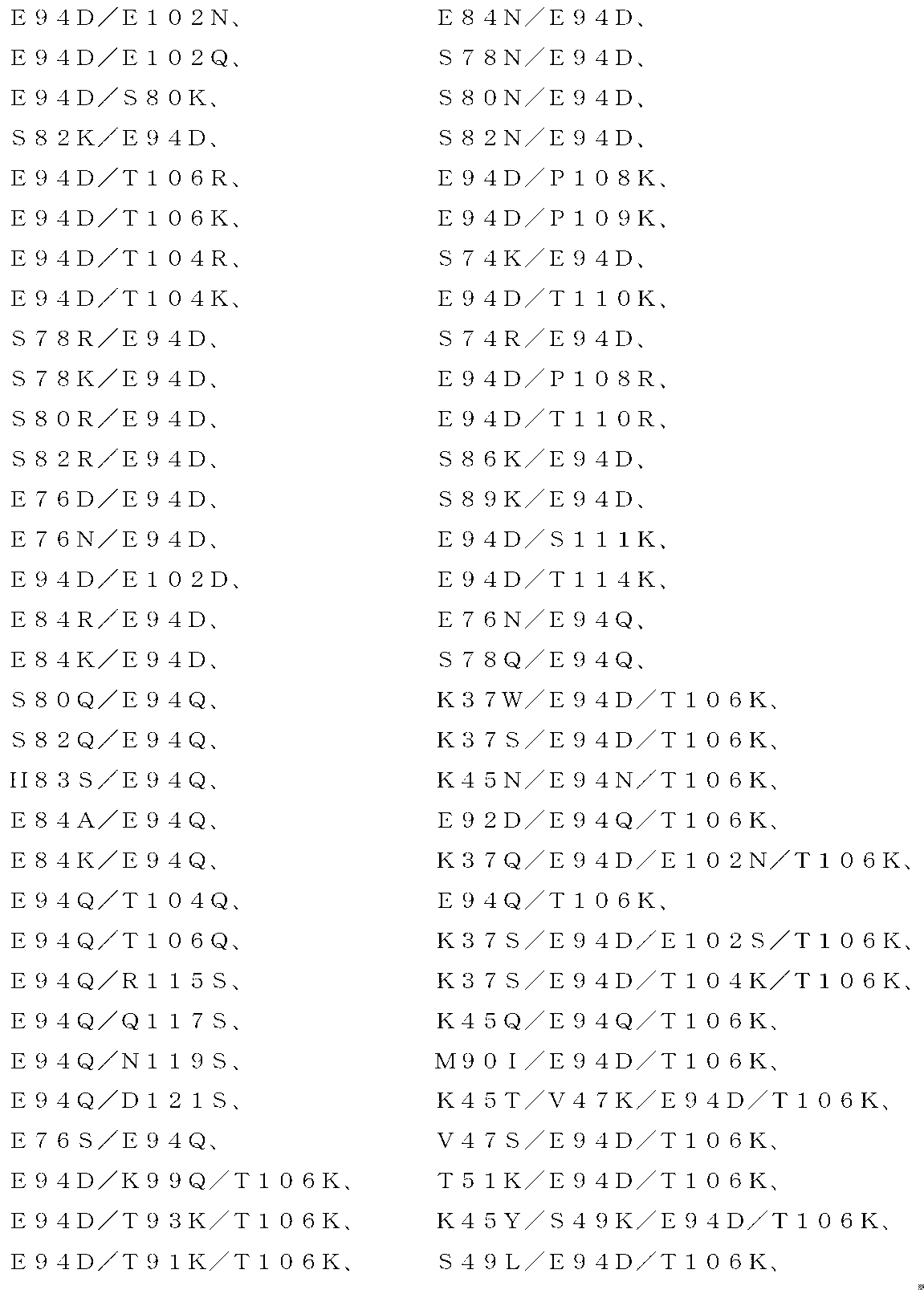

[14]
配列番号2に示されるアミノ酸配列のバリアントを含む変異体ライセニンモノマーであって、前記バリアントが、以下の位置の組み合わせのうちの1つ以上における変異を含む、変異体ライセニンモノマー:

[15]
前記バリアントが、以下の置換の組み合わせのうちの1つ以上を含む、上記[14]に記載の変異体モノマー:


[16]
配列番号2に示されるアミノ酸配列のバリアントを含む変異体ライセニンモノマーであって、前記バリアントが、以下の置換の対のうちの1つ以上を含む、変異体ライセニンモノマー:
E84R/E94D、
E84K/E94D、
E84N/E94D、
E84A/E94Q、
E84K/E94Q、及び
E94Q/D121S。
[17]
前記モノマーが、任意の数及び任意の組み合わせの、上記[1]~[16]のいずれか1項に定義される修飾及び/または置換を含む、上記[1]~[16]のいずれか1項に記載の変異体ライセニンモノマー。
[18]
配列番号2に示される配列のバリアントを含む変異体ライセニンモノマーであって、前記バリアントにおいて、(a)配列番号2の34位~70位のアミノ酸に対応するアミノ酸のうちの2、4、6、8、10、12、14、16、18、または20個が欠失されており、(b)配列番号2の71位~107位のアミノ酸に対応するアミノ酸のうちの2、4、6、8、10、12、14、16、18、または20個が欠失されている、変異体ライセニンモノマー。
[19]
(a)及び(b)において同じ数のアミノ酸が欠失されている、上記[18]に記載の変異体モノマー。
[20]
欠失されている前記アミノ酸の前記位置が、表1もしくは2の1行または表1及び/もしくは2の2行以上に示されている、上記[18]または[19]に記載の変異体。
[21]
配列番号2中の以下のアミノ酸に対応するアミノ酸が欠失されている、上記[18]~[20]のいずれか1項に記載の変異体モノマー:
(i)N46/V47/T91/T92、または
(ii)N48/S49/T91/T92。
[22]
前記バリアントが、適切な場合、上記[1]~[17]のいずれか1項に定義される前記修飾及び/または置換のうちのいずれかをさらに含む、上記[18]~[21]のいずれか1項に記載の変異体モノマー。
[23]
前記バリアントが、
配列番号2の以下の位置、(a)E84、E85、E92、E97、及びD126、(b)E85、E97、及びD126、もしくは(c)E84及びE92のうちの1つ以上における置換、または
E84Q/E85K/E92Q/E97S/D126Gのうちの1つ以上、もしくは、適切な場合、E84Q/E85K/E92Q/E97S/D126Gの全てにおける置換、をさらに含む、上記[1]~[22]のいずれか1項に記載の変異体モノマー。
[24]
前記バリアントが、以下の置換の組み合わせのうちの1つを含む、上記[23]に記載の変異体モノマー:
E84Q/E85K/E92Q/E94D/E97S/D126G、
E84Q/E85K/E92Q/E94Q/E97S/D126G、または
E84Q/E85K/E92Q/E94D/E97S/T106K/D126G。
[25]
ポアを形成することが可能である、上記[1]~[24]のいずれか1項に記載の変異体ライセニンモノマー。
[26]
前記バリアントが、配列番号2に示される配列と少なくとも70%同一であるアミノ酸配列を含む、上記[1]に記載の変異体ライセニンモノマー。
[27]
ライセニンに由来する2つ以上の共有結合したモノマーを含む構造体であって、前記モノマーのうちの少なくとも1つが上記[1]~[26]のいずれか1項に定義される変異体ライセニンモノマーである、構造体。
[28]
前記2つ以上のモノマーが、同じであるか、または異なる、上記[27]に記載の構造体。
[29]
前記2つ以上のモノマーが、遺伝的に融合されている、上記[27]または[28]に記載の構造体。
[30]
上記[1]~[26]のいずれか1項に記載の変異体ライセニンモノマーまたは上記[27]に記載の構造体をコードする、ポリヌクレオチド。
[31]
上記[1]~[26]のいずれか1項に記載の少なくとも1つの変異体ライセニンモノマー及び/または上記[27]~[29]のいずれか1項に記載の少なくとも1つの構造体を含む、ポア。
[32]
上記[1]~[26]のいずれか1項に記載の6~12個の変異体ライセニンモノマーを含むホモオリゴマーポアである、上記[31]に記載のポア。
[33]
上記[1]~[26]のいずれか1項に記載の少なくとも1つの変異体ライセニンモノマーを含むヘテロオリゴマーポアである、上記[31]に記載のポア。
[34]
標的分析物を特徴付ける方法であって、
(a)前記標的分析物を、上記[31]~[33]のいずれか1項に記載のポアと、前記標的分析物が前記ポアを通って移動するように接触させることと、
(b)前記分析物が前記ポアに対して移動する間に、1つ以上の測定値であって、前記標的分析物の1つ以上の特徴を示す、測定値をとり、それによって前記標的分析物を特徴付けることと、を含む、方法。
[35]
(i)前記ポアが、チャンバを2つの区画に分離する膜内に存在し、各区画が水溶液を含み、
(ii)ステップ(a)が、1つの区画に前記分析物を提供することを含み、
(iii)ステップ(b)が、前記膜にわたって電位差を印加することを含み、及び/または
(iv)ステップ(c)が、前記膜にわたる電流を測定することを含む、上記[34]に記載の方法。
[36]
前記標的分析物が、金属イオン、無機塩、ポリマー、アミノ酸、ペプチド、ポリペプチド、タンパク質、ヌクレオチド、オリゴヌクレオチド、ポリヌクレオチド、染料、漂白剤、医薬品、診断薬、レクリエーショナルドラッグ、爆発物、または環境汚染物質である、上記[34]または[35]に記載の方法。
[37]
前記標的分析物が、標的ポリヌクレオチドである、上記[36]に記載の方法。
[38]
ステップ(a)が、前記標的ポリヌクレオチドを前記ポア及びポリヌクレオチド結合タンパク質と接触させることを含み、前記タンパク質が前記ポアを通る前記標的ポリヌクレオチドの移動を制御する、上記[37]に記載の方法。
[39]
前記標的ポリヌクレオチドを特徴付けることが、前記標的ポリヌクレオチドの配列を推定することまたは前記標的ポリヌクレオチドをシークエンシングすることを含む、上記[37]または[38]に記載の方法。
[40]
標的ポリヌクレオチドを特徴付けるためのセンサを形成する方法であって、上記[31]~[33]のいずれか1項に記載のポアとポリヌクレオチド結合タンパク質との間で複合体を形成し、それにより前記標的ポリヌクレオチドを特徴付けるためのセンサを形成することを含む、方法。
[41]
前記複合体が、(a)前記標的ポリヌクレオチドの存在下で前記ポア及び前記ポリヌクレオチド結合タンパク質を接触させることと、(a)前記ポアにわたって電位を印加することと、によって形成される、上記[40]に記載の方法。
[42]
前記電位が、電圧電位または化学的電位である、上記[41]に記載の方法。
[43]
前記複合体が、前記ポアを前記ポリヌクレオチド結合タンパク質に共有結合させることによって形成される、上記[40]に記載の方法。
[44]
標的ポリヌクレオチドを特徴付けるためのセンサであって、上記[31]~[33]のいずれか1項に記載のポアとポリヌクレオチド結合タンパク質との間の複合体を含む、センサ。
[45]
標的分析物を特徴付けるための、上記[31]~[33]のいずれか1項に記載のポアの使用。
[46]
(a)上記[31]~[33]のいずれか1項に記載のポアと、(b)膜とを含む、標的ポリヌクレオチドを特徴付けるためのキット。
[47]
前記キットが、両親媒性層を含むチップをさらに含む、上記[46]に記載のキット。
[48]
(a)上記[31]~[33]のいずれか1項に記載の複数のポアと、(b)複数のポリヌクレオチド結合タンパク質とを含む、試料中の標的ポリヌクレオチドを特徴付けるための装置。
[49]
配列番号2に示される配列を含むライセニンモノマーのポリヌクレオチドを特徴付ける能力を改善する方法であって、上記[1]~[26]のいずれか1項に定義される前記修飾及び/または置換のうちの1つ以上を行うことを含む、方法。
[50]
上記[27]~[30]のいずれか1項に記載の構造体を生成する方法であって、上記[1]~[26]のいずれか1項に記載の少なくとも1つの変異体ライセニンモノマーを、ライセニン由来の1つ以上のモノマーに共有結合させることを含む、方法。
[51]
上記[31]~[33]のいずれか1項に記載のポアを形成する方法であって、上記[1]~[26]のいずれか1項に記載の少なくとも1つの変異体モノマーまたは上記[27]~[30]のいずれか1項に記載の少なくとも1つの構造体を、十分な数の、上記[1]~[26]のいずれか1項に記載のモノマー、上記[27]~[30]のいずれか1項に記載の構造体、及び/またはライセニン由来のモノマーとオリゴマー形成させて、ポアを形成することを含む、方法。
Experiments similar to those described in Example 3 were performed with Lysenin-(E84Q/E85S/E92C/E94D/E97S/T106K/D126G/C272A/C283A) with 2-iodo-N-(2-phenylethyl)acetamide linked via E92C (SEQ ID NO: 2 with mutations E84Q/E85S/E92C/E94D/E97S/T106K/D126G/C272A/C283A). A) was performed on lysenin-(E84Q/E85S/E92C/E94D/E97S/T106K/D126G/C272A/C283A) with 1-benzyl-2,5-dihydro-1H-pyrrole-2,5-dione linked via 9 and E92C (SEQ ID NO: 2 with mutations E84Q/E85S/E92C/E94D/E97S/T106K/D126G/C272A/C283A).
The invention described in this specification may include the following aspects.
[1]
A mutant lysenin monomer comprising a variant of the amino acid sequence shown in SEQ ID NO:2, said variant comprising modifications at one or more of the following positions: K37, G43, K45, V47, S49, T51, H83, V88, T91, T93, V95, Y96, S98, K99, V100, I101, P108, P109, T110, S111, K112, and T114.
[2]
The mutant monomer of claim 1, wherein the variant comprises modifications at one or more of the following positions: T91, V95, Y96, S98, K99, V100, I101, and K112.
[3]
The mutant monomer according to [2] above, wherein the modification is a substitution with serine (S) or glutamine (Q).
[4]
The mutant monomer of claim 2 or 3, wherein the variant comprises one or more of the following substitutions: T91S, V95S, Y96S, S98Q, K99S, V100S, I101S, and K112S.
[5]
The mutant monomer of claim 1, wherein the variant comprises modifications at one or more of the following positions: K37, G43, K45, V47, S49, T51, H83, V88, T91, T93, Y96, S98, K99, P108, P109, T110, S111, and T114.
[6]
The mutant monomer according to [5] above, wherein the modification is a substitution with asparagine (N), tryptophan (W), serine (S), glutamine (Q), lysine (K), aspartic acid (D), arginine (R), threonine (T), tyrosine (Y), leucine (L), or isoleucine (I).
[7]
The mutant monomer of claim 5 or 6, wherein the variant comprises one or more of the following substitutions: K37N/W/S/Q, G43K, K45D/R/N/Q/T/Y, V47K/S/N, S49K/L, T51K, H83S/K, V88I/T, T91K, T93K, Y96D, S98K, K99Q/L, P108K/R, P109K, T110K/R, S111K, and T114K.
[8]
The mutant monomer according to any one of claims 5 to 7, wherein the variant comprises modifications at one or more of the following combinations of positions:
[9]
The mutant monomer according to claim 8, wherein the variant comprises one or more of the following combinations of substitutions:
[10]
A mutant lysenin monomer comprising a variant of the amino acid sequence shown in SEQ ID NO:2, said variant comprising one or more of the following substitutions:
D35N/S,
S74K/R,
E76D/N,
S78R/K/N/Q,
S80K/R/N/Q,
S82K/R/N/Q,
E84R/K/N/A,
E85N,
S86K/Q,
S89K,
M90K/I/A,
E92D/S,
E94D/Q/G/A/K/R/S/N,
E102N/Q/D/S,
T104R/K/Q,
T106R/K/Q,
R115S,
Q117S, and
N119S.
[11]
The mutant monomer of claim 10, wherein the variant comprises one or more of the following substitutions: E94D/Q/G/A/K/R/S, S86Q, and E92S.
[12]
The mutant monomer of claim 10, wherein the variant comprises one or more of the following substitutions:
D35N/S,
S74K/R,
E76D/N,
S78R/K/N/Q,
S80K/R/N/Q,
S82K/R/N/Q,
E84R/K/N/A,
E85N,
S86K,
S89K,
M90K/I/A,
E92D,
E94D/Q/K/N,
E102N/Q/D/S,
T104R/K/Q,
T106R/K/Q,
R115S,
Q117S, and
N119S.
[13]
The mutant monomer of claim 12, wherein the variant comprises one or more of the following combinations of substitutions:
[14]
A mutant lysenin monomer comprising a variant of the amino acid sequence shown in SEQ ID NO:2, said variant comprising mutations at one or more of the following combinations of positions:
[15]
The mutant monomer of claim 14, wherein the variant comprises one or more of the following combinations of substitutions:
[16]
A mutant lysenin monomer comprising a variant of the amino acid sequence shown in SEQ ID NO:2, said variant comprising one or more of the following pairs of substitutions:
E84R/E94D,
E84K/E94D,
E84N/E94D,
E84A/E94Q,
E84K/E94Q, and
E94Q/D121S.
[17]
A mutant lysenin monomer described in any one of [1] to [16] above, wherein the monomer contains any number and any combination of modifications and/or substitutions as defined in any one of [1] to [16] above.
[18]
A mutant lysenin monomer comprising a variant of the sequence shown in SEQ ID NO: 2, wherein in the variant (a) 2, 4, 6, 8, 10, 12, 14, 16, 18, or 20 amino acids corresponding to amino acids at positions 34 to 70 of SEQ ID NO: 2 are deleted, and (b) 2, 4, 6, 8, 10, 12, 14, 16, 18, or 20 amino acids corresponding to amino acids at positions 71 to 107 of SEQ ID NO: 2 are deleted.
[19]
The mutant monomer according to [18] above, wherein the same number of amino acids are deleted in (a) and (b).
[20]
The mutant according to [18] or [19] above, wherein the position of the deleted amino acid is shown in one line of Table 1 or 2 or in two or more lines of Table 1 and/or 2.
[21]
The mutant monomer according to any one of the above [18] to [20], in which amino acids corresponding to the following amino acids in SEQ ID NO:2 are deleted:
(i) N46/V47/T91/T92, or
(ii) N48/S49/T91/T92.
[22]
The mutant monomer of any one of [18] to [21] above, wherein the variant further comprises, where appropriate, any of the modifications and/or substitutions defined in any one of [1] to [17] above.
[23]
The variant is
Substitutions at one or more of the following positions of SEQ ID NO:2: (a) E84, E85, E92, E97, and D126; (b) E85, E97, and D126; or (c) E84 and E92; or
The mutant monomer of any one of the above [1] to [22], further comprising one or more of E84Q/E85K/E92Q/E97S/D126G substitutions, or, if appropriate, all of E84Q/E85K/E92Q/E97S/D126G substitutions.
[24]
The mutant monomer according to [23] above, wherein the variant comprises one of the following combinations of substitutions:
E84Q/E85K/E92Q/E94D/E97S/D126G,
E84Q/E85K/E92Q/E94Q/E97S/D126G, or
E84Q/E85K/E92Q/E94D/E97S/T106K/D126G.
[25]
A mutant lysenin monomer according to any one of the above [1] to [24], which is capable of forming a pore.
[26]
The mutant lysenin monomer described in [1] above, wherein the variant comprises an amino acid sequence that is at least 70% identical to the sequence shown in SEQ ID NO:2.
[27]
A structure comprising two or more covalently bonded monomers derived from lysenin, wherein at least one of the monomers is a mutant lysenin monomer defined in any one of the above items [1] to [26].
[28]
The structure according to claim 27, wherein the two or more monomers are the same or different.
[29]
The structure according to any one of claims 27 to 28, wherein the two or more monomers are genetically fused.
[30]
A polynucleotide encoding the mutant lysenin monomer described in any one of [1] to [26] above or the structure described in [27] above.
[31]
A pore comprising at least one mutant lysenin monomer described in any one of [1] to [26] above and/or at least one structure described in any one of [27] to [29] above.
[32]
The pore according to [31] above, which is a homo-oligomeric pore comprising 6 to 12 mutant lysenin monomers according to any one of [1] to [26] above.
[33]
The pore according to [31] above, which is a hetero-oligomeric pore comprising at least one mutant lysenin monomer according to any one of [1] to [26] above.
[34]
1. A method for characterizing a target analyte, comprising:
(a) contacting the target analyte with a pore according to any one of [31] to [33] above such that the target analyte migrates through the pore;
(b) taking one or more measurements while the analyte moves relative to the pore, the measurements being indicative of one or more characteristics of the target analyte, thereby characterizing the target analyte.
[35]
(i) the pore is in a membrane that separates the chamber into two compartments, each compartment containing an aqueous solution;
(ii) step (a) comprises providing said analyte in one compartment;
(iii) step (b) comprises applying a potential difference across the membrane; and/or
(iv) The method according to claim 34, wherein step (c) comprises measuring a current across the membrane.
[36]
The method according to claim 34 or 35, wherein the target analyte is a metal ion, an inorganic salt, a polymer, an amino acid, a peptide, a polypeptide, a protein, a nucleotide, an oligonucleotide, a polynucleotide, a dye, a bleaching agent, a pharmaceutical, a diagnostic agent, a recreational drug, an explosive, or an environmental pollutant.
[37]
The method according to claim 36, wherein the target analyte is a target polynucleotide.
[38]
38. The method of claim 37, wherein step (a) comprises contacting the target polynucleotide with the pore and a polynucleotide binding protein, wherein the protein controls the movement of the target polynucleotide through the pore.
[39]
The method according to any one of claims 37 to 38, wherein characterizing the target polynucleotide comprises deducing the sequence of the target polynucleotide or sequencing the target polynucleotide.
[40]
34. A method of forming a sensor for characterizing a target polynucleotide, the method comprising forming a complex between a pore according to any one of claims 31 to 33 and a polynucleotide binding protein, thereby forming a sensor for characterizing the target polynucleotide.
[41]
41. The method of claim 40, wherein the complex is formed by (a) contacting the pore and the polynucleotide binding protein in the presence of the target polynucleotide, and (a) applying an electric potential across the pore.
[42]
The method according to claim 41, wherein the potential is a voltage potential or a chemical potential.
[43]
41. The method of claim 40, wherein the complex is formed by covalently binding the pore to the polynucleotide binding protein.
[44]
A sensor for characterizing a target polynucleotide, comprising a complex between a pore according to any one of claims [31] to [33] and a polynucleotide binding protein.
[45]
34. Use of a pore according to any one of claims 31 to 33 for characterising a target analyte.
[46]
A kit for characterizing a target polynucleotide comprising (a) a pore according to any one of [31] to [33] above, and (b) a membrane.
[47]
The kit according to [46] above, further comprising a chip comprising an amphiphilic layer.
[48]
An apparatus for characterizing a target polynucleotide in a sample, comprising: (a) a plurality of pores according to any one of [31] to [33] above; and (b) a plurality of polynucleotide binding proteins.
[49]
A method for improving the ability to characterize a polynucleotide of a lysenin monomer comprising the sequence shown in SEQ ID NO: 2, the method comprising making one or more of the modifications and/or substitutions defined in any one of the above items [1] to [26].
[50]
A method for producing a structure described in any one of [27] to [30] above, comprising covalently bonding at least one mutant lysenin monomer described in any one of [1] to [26] above to one or more monomers derived from lysenin.
[51]
A method for forming a pore described in any one of [31] to [33] above, comprising oligomerizing at least one mutant monomer described in any one of [1] to [26] above or at least one structure described in any one of [27] to [30] above with a sufficient number of monomers described in any one of [1] to [26] above, structures described in any one of [27] to [30] above, and/or monomers derived from lysenin to form a pore.
Claims (51)
って、前記バリアントが、以下の位置、K37、G43、K45、V47、S49、T5
1、H83、V88、T91、T93、V95、Y96、S98、K99、V100、I
101、P108、P109、T110、S111、K112、及びT114のうちの1
つ以上における修飾を含む、変異体ライセニンモノマー。 A mutant lysenin monomer comprising a variant of the amino acid sequence shown in SEQ ID NO:2, wherein the variant comprises the following positions: K37, G43, K45, V47, S49, T5
1, H83, V88, T91, T93, V95, Y96, S98, K99, V100, I
101, P108, P109, T110, S111, K112, and T114
A mutant lysenin monomer comprising one or more modifications.
、I101、及びK112のうちの1つ以上における修飾を含む、請求項1に記載の変異
体モノマー。 The variants are located at the following positions: T91, V95, Y96, S98, K99, V100
2. The mutant monomer of claim 1, comprising modifications at one or more of: I101, I202, and K112.
の変異体モノマー。 The mutant monomer of claim 2 , wherein the modification is a substitution with serine (S) or glutamine (Q).
、V100S、I101S、及びK112Sのうちの1つ以上を含む、請求項2または3
に記載の変異体モノマー。 The variant may comprise the following substitutions: T91S, V95S, Y96S, S98Q, K99S
, V100S, I101S, and K112S.
The mutant monomer according to claim 1.
H83、V88、T91、T93、Y96、S98、K99、P108、P109、T1
10、S111、及びT114のうちの1つ以上における修飾を含む、請求項1に記載の
変異体モノマー。 The variants are located at the following positions: K37, G43, K45, V47, S49, T51,
H83, V88, T91, T93, Y96, S98, K99, P108, P109, T1
2. The mutant monomer of claim 1, comprising modifications at one or more of S10, S111, and T114.
(Q)、リジン(K)、アスパラギン酸(D)、アルギニン(R)、トレオニン(T)、
チロシン(Y)、ロイシン(L)、またはイソロイシン(I)による置換である、請求項
5に記載の変異体モノマー。 The modification is asparagine (N), tryptophan (W), serine (S), glutamine (Q), lysine (K), aspartic acid (D), arginine (R), threonine (T),
6. The mutant monomer of claim 5, wherein the substitution is with tyrosine (Y), leucine (L), or isoleucine (I).
/Q/T/Y、V47K/S/N、S49K/L、T51K、H83S/K、V88I/
T、T91K、T93K、Y96D、S98K、K99Q/L、P108K/R、P10
9K、T110K/R、S111K、及びT114Kのうちの1つ以上を含む、請求項5
または6に記載の変異体モノマー。 The variant has the following substitutions: K37N/W/S/Q, G43K, K45D/R/N
/Q/T/Y, V47K/S/N, S49K/L, T51K, H83S/K, V88I/
T, T91K, T93K, Y96D, S98K, K99Q/L, P108K/R, P10
9K, T110K/R, S111K, and T114K.
Or the mutant monomer according to 6.
求項5~7のいずれか1項に記載の変異体モノマー:
の変異体モノマー:
って、前記バリアントが、以下の置換のうちの1つ以上を含む、変異体ライセニンモノマ
ー:
D35N/S、
S74K/R、
E76D/N、
S78R/K/N/Q、
S80K/R/N/Q、
S82K/R/N/Q、
E84R/K/N/A、
E85N、
S86K/Q、
S89K、
M90K/I/A、
E92D/S、
E94D/Q/G/A/K/R/S/N、
E102N/Q/D/S、
T104R/K/Q、
T106R/K/Q、
R115S、
Q117S、及び
N119S。 A mutant lysenin monomer comprising a variant of the amino acid sequence shown in SEQ ID NO:2, said variant comprising one or more of the following substitutions:
D35N/S,
S74K/R,
E76D/N,
S78R/K/N/Q,
S80K/R/N/Q,
S82K/R/N/Q,
E84R/K/N/A,
E85N,
S86K/Q,
S89K,
M90K/I/A,
E92D/S,
E94D/Q/G/A/K/R/S/N,
E102N/Q/D/S,
T104R/K/Q,
T106R/K/Q,
R115S,
Q117S, and N119S.
のうちの1つ以上を含む、請求項10に記載の変異体モノマー。 The variant comprises the substitutions E94D/Q/G/A/K/R/S, S86Q, and E92S
11. The mutant monomer of claim 10, comprising one or more of:
ノマー:
D35N/S、
S74K/R、
E76D/N、
S78R/K/N/Q、
S80K/R/N/Q、
S82K/R/N/Q、
E84R/K/N/A、
E85N、
S86K、
S89K、
M90K/I/A、
E92D、
E94D/Q/K/N、
E102N/Q/D/S、
T104R/K/Q、
T106R/K/Q、
R115S、
Q117S、及び
N119S。 11. The mutant monomer of claim 10, wherein the variant comprises one or more of the following substitutions:
D35N/S,
S74K/R,
E76D/N,
S78R/K/N/Q,
S80K/R/N/Q,
S82K/R/N/Q,
E84R/K/N/A,
E85N,
S86K,
S89K,
M90K/I/A,
E92D,
E94D/Q/K/N,
E102N/Q/D/S,
T104R/K/Q,
T106R/K/Q,
R115S,
Q117S, and N119S.
載の変異体モノマー:
13. The mutant monomer of claim 12, wherein the variant comprises one or more of the following combinations of substitutions:
って、前記バリアントが、以下の位置の組み合わせのうちの1つ以上における変異を含む
、変異体ライセニンモノマー:
載の変異体モノマー:
15. The mutant monomer of claim 14, wherein the variant comprises one or more of the following combinations of substitutions:
って、前記バリアントが、以下の置換の対のうちの1つ以上を含む、変異体ライセニンモ
ノマー:
E84R/E94D、
E84K/E94D、
E84N/E94D、
E84A/E94Q、
E84K/E94Q、及び
E94Q/D121S。 A mutant lysenin monomer comprising a variant of the amino acid sequence shown in SEQ ID NO:2, said variant comprising one or more of the following pairs of substitutions:
E84R/E94D,
E84K/E94D,
E84N/E94D,
E84A/E94Q,
E84K/E94Q, and E94Q/D121S.
定義される修飾及び/または置換を含む、請求項1~16のいずれか1項に記載の変異体
ライセニンモノマー。 A mutant lysenin monomer according to any one of claims 1 to 16, wherein the monomer comprises any number and any combination of modifications and/or substitutions as defined in any one of claims 1 to 16.
記バリアントにおいて、(a)配列番号2の34位~70位のアミノ酸に対応するアミノ
酸のうちの2、4、6、8、10、12、14、16、18、または20個が欠失されて
おり、(b)配列番号2の71位~107位のアミノ酸に対応するアミノ酸のうちの2、
4、6、8、10、12、14、16、18、または20個が欠失されている、変異体ラ
イセニンモノマー。 A mutant lysenin monomer comprising a variant of the sequence shown in SEQ ID NO:2, wherein the variant has (a) 2, 4, 6, 8, 10, 12, 14, 16, 18, or 20 amino acids deleted from among the amino acids corresponding to positions 34 to 70 of SEQ ID NO:2, and (b) 2, 4, 6, 8, 10, 12, 14, 16, 18, or 20 amino acids deleted from among the amino acids corresponding to positions 71 to 107 of SEQ ID NO:2,
A mutant lysenin monomer having 4, 6, 8, 10, 12, 14, 16, 18, or 20 deleted.
異体モノマー。 20. The mutant monomer of claim 18, wherein the same number of amino acids are deleted in (a) and (b).
しくは2の2行以上に示されている、請求項18または19に記載の変異体。 20. The variant of claim 18 or 19, wherein the position of the deleted amino acid is shown in one line of Table 1 or 2 or in more than one line of Table 1 and/or 2.
0のいずれか1項に記載の変異体モノマー:
(i)N46/V47/T91/T92、または
(ii)N48/S49/T91/T92。 2, wherein the amino acids corresponding to the following amino acids in SEQ ID NO:2 are deleted:
1. A mutant monomer according to any one of claims 1 to 9,
(i) N46/V47/T91/T92, or (ii) N48/S49/T91/T92.
及び/または置換のうちのいずれかをさらに含む、請求項18~21のいずれか1項に記
載の変異体モノマー。 22. The mutant monomer of any one of claims 18 to 21, wherein said variant further comprises, where appropriate, any of the modifications and/or substitutions defined in any one of claims 1 to 17.
配列番号2の以下の位置、(a)E84、E85、E92、E97、及びD126、(
b)E85、E97、及びD126、もしくは(c)E84及びE92のうちの1つ以上
における置換、または
E84Q/E85K/E92Q/E97S/D126Gのうちの1つ以上、もしくは、
適切な場合、E84Q/E85K/E92Q/E97S/D126Gの全てにおける置換
、をさらに含む、請求項1~22のいずれか1項に記載の変異体モノマー。 The variant is
The following positions in SEQ ID NO:2: (a) E84, E85, E92, E97, and D126;
b) substitutions at one or more of E85, E97, and D126, or (c) substitutions at one or more of E84 and E92, or one or more of E84Q/E85K/E92Q/E97S/D126G, or
23. The mutant monomer of any one of claims 1 to 22, further comprising, where appropriate, all of the following substitutions: E84Q/E85K/E92Q/E97S/D126G.
変異体モノマー:
E84Q/E85K/E92Q/E94D/E97S/D126G、
E84Q/E85K/E92Q/E94Q/E97S/D126G、または
E84Q/E85K/E92Q/E94D/E97S/T106K/D126G。 24. The mutant monomer of claim 23, wherein the variant comprises one of the following combinations of substitutions:
E84Q/E85K/E92Q/E94D/E97S/D126G,
E84Q/E85K/E92Q/E94Q/E97S/D126G, or E84Q/E85K/E92Q/E94D/E97S/T106K/D126G.
セニンモノマー。 A mutant lysenin monomer according to any one of claims 1 to 24, which is capable of forming a pore.
配列を含む、請求項1に記載の変異体ライセニンモノマー。 The mutant lysenin monomer of claim 1 , wherein the variant comprises an amino acid sequence that is at least 70% identical to the sequence shown in SEQ ID NO:2.
ノマーのうちの少なくとも1つが請求項1~26のいずれか1項に定義される変異体ライ
セニンモノマーである、構造体。 A structure comprising two or more covalently linked monomers derived from lysenin, wherein at least one of the monomers is a mutant lysenin monomer defined in any one of claims 1 to 26.
。 28. The structure of claim 27, wherein the two or more monomers are the same or different.
構造体。 29. The construct of claim 27 or 28, wherein the two or more monomers are genetically fused.
記載の構造体をコードする、ポリヌクレオチド。 A polynucleotide encoding the mutant lysenin monomer described in any one of claims 1 to 26 or the structure described in claim 27.
び/または請求項27~29のいずれか1項に記載の少なくとも1つの構造体を含む、ポ
ア。 A pore comprising at least one mutant lysenin monomer according to any one of claims 1 to 26 and/or at least one structure according to any one of claims 27 to 29.
ホモオリゴマーポアである、請求項31に記載のポア。 The pore according to claim 31, which is a homo-oligomeric pore comprising 6 to 12 mutant lysenin monomers according to any one of claims 1 to 26.
含むヘテロオリゴマーポアである、請求項31に記載のポア。 The pore according to claim 31, which is a hetero-oligomeric pore comprising at least one mutant lysenin monomer according to any one of claims 1 to 26.
(a)前記標的分析物を、請求項31~33のいずれか1項に記載のポアと、前記標的
分析物が前記ポアを通って移動するように接触させることと、
(b)前記分析物が前記ポアに対して移動する間に、1つ以上の測定値であって、前記
標的分析物の1つ以上の特徴を示す、測定値をとり、それによって前記標的分析物を特徴
付けることと、を含む、方法。 1. A method for characterizing a target analyte, comprising:
(a) contacting the target analyte with a pore according to any one of claims 31 to 33 such that the target analyte migrates through the pore;
(b) taking one or more measurements while the analyte moves relative to the pore, the measurements being indicative of one or more characteristics of the target analyte, thereby characterizing the target analyte.
含み、
(ii)ステップ(a)が、1つの区画に前記分析物を提供することを含み、
(iii)ステップ(b)が、前記膜にわたって電位差を印加することを含み、及び/
または
(iv)ステップ(c)が、前記膜にわたる電流を測定することを含む、請求項34に
記載の方法。 (i) the pore is in a membrane that separates the chamber into two compartments, each compartment containing an aqueous solution;
(ii) step (a) comprises providing said analyte in one compartment;
(iii) step (b) comprises applying a potential difference across the membrane; and/or
or (iv) step (c) comprises measuring a current across the membrane.
ド、タンパク質、ヌクレオチド、オリゴヌクレオチド、ポリヌクレオチド、染料、漂白剤
、医薬品、診断薬、レクリエーショナルドラッグ、爆発物、または環境汚染物質である、
請求項34または35に記載の方法。 the target analyte is a metal ion, an inorganic salt, a polymer, an amino acid, a peptide, a polypeptide, a protein, a nucleotide, an oligonucleotide, a polynucleotide, a dye, a bleach, a pharmaceutical, a diagnostic agent, a recreational drug, an explosive, or an environmental pollutant;
36. The method of claim 34 or 35.
ンパク質と接触させることを含み、前記タンパク質が前記ポアを通る前記標的ポリヌクレ
オチドの移動を制御する、請求項37に記載の方法。 38. The method of claim 37, wherein step (a) comprises contacting the target polynucleotide with the pore and a polynucleotide binding protein, wherein the protein controls the movement of the target polynucleotide through the pore.
定することまたは前記標的ポリヌクレオチドをシークエンシングすることを含む、請求項
37または38に記載の方法。 39. The method of claim 37 or 38, wherein characterizing the target polynucleotide comprises deducing a sequence of the target polynucleotide or sequencing the target polynucleotide.
~33のいずれか1項に記載のポアとポリヌクレオチド結合タンパク質との間で複合体を
形成し、それにより前記標的ポリヌクレオチドを特徴付けるためのセンサを形成すること
を含む、方法。 31. A method for forming a sensor for characterizing a target polynucleotide, comprising:
34. A method according to claim 33, comprising forming a complex between a pore and a polynucleotide binding protein, thereby forming a sensor for characterising said target polynucleotide.
レオチド結合タンパク質を接触させることと、(a)前記ポアにわたって電位を印加する
ことと、によって形成される、請求項40に記載の方法。 41. The method of claim 40, wherein the complex is formed by (a) contacting the pore and the polynucleotide binding protein in the presence of the target polynucleotide and (a) applying an electrical potential across the pore.
によって形成される、請求項40に記載の方法。 41. The method of claim 40, wherein the complex is formed by covalently linking the pore to the polynucleotide binding protein.
か1項に記載のポアとポリヌクレオチド結合タンパク質との間の複合体を含む、センサ。 34. A sensor for characterizing a target polynucleotide, comprising a complex between a pore according to any one of claims 31 to 33 and a polynucleotide binding protein.
。 34. Use of a pore according to any one of claims 31 to 33 for characterising a target analyte.
ヌクレオチドを特徴付けるためのキット。 34. A kit for characterising a target polynucleotide comprising (a) a pore according to any one of claims 31 to 33, and (b) a membrane.
レオチド結合タンパク質とを含む、試料中の標的ポリヌクレオチドを特徴付けるための装
置。 34. A device for characterising target polynucleotides in a sample comprising (a) a plurality of pores according to any one of claims 31 to 33, and (b) a plurality of polynucleotide binding proteins.
能力を改善する方法であって、請求項1~26のいずれか1項に定義される前記修飾及び
/または置換のうちの1つ以上を行うことを含む、方法。 A method for improving the ability to characterize a polynucleotide of a lysenin monomer comprising the sequence shown in SEQ ID NO: 2, the method comprising making one or more of the modifications and/or substitutions defined in any one of claims 1 to 26.
26のいずれか1項に記載の少なくとも1つの変異体ライセニンモノマーを、ライセニン
由来の1つ以上のモノマーに共有結合させることを含む、方法。 A method for producing a structure according to any one of claims 27 to 30, comprising the steps of:
27. A method comprising covalently binding at least one mutant lysenin monomer described in any one of claims 26 to one or more monomers derived from lysenin.
6のいずれか1項に記載の少なくとも1つの変異体モノマーまたは請求項27~30のい
ずれか1項に記載の少なくとも1つの構造体を、十分な数の、請求項1~26のいずれか
1項に記載のモノマー、請求項27~30のいずれか1項に記載の構造体、及び/または
ライセニン由来のモノマーとオリゴマー形成させて、ポアを形成することを含む、方法。
A method for forming a pore according to any one of claims 31 to 33, comprising the steps of:
oligomerizing at least one mutant monomer described in any one of claims 6 or at least one structure described in any one of claims 27 to 30 with a sufficient number of monomers described in any one of claims 1 to 26, structures described in any one of claims 27 to 30, and/or monomers derived from lysenin to form a pore.
Applications Claiming Priority (7)
| Application Number | Priority Date | Filing Date | Title |
|---|---|---|---|
| GB201605899 | 2016-04-06 | ||
| GB1605899.2 | 2016-04-06 | ||
| GB1608274.5 | 2016-05-11 | ||
| GBGB1608274.5A GB201608274D0 (en) | 2016-05-11 | 2016-05-11 | Mutant pore |
| JP2018552853A JP7364333B2 (en) | 2016-04-06 | 2017-04-06 | mutant pore |
| PCT/GB2017/050961 WO2017174990A1 (en) | 2016-04-06 | 2017-04-06 | Mutant pore |
| JP2022041806A JP7555987B2 (en) | 2016-04-06 | 2022-03-16 | Mutant pore |
Related Parent Applications (1)
| Application Number | Title | Priority Date | Filing Date |
|---|---|---|---|
| JP2022041806A Division JP7555987B2 (en) | 2016-04-06 | 2022-03-16 | Mutant pore |
Publications (1)
| Publication Number | Publication Date |
|---|---|
| JP2024138262A true JP2024138262A (en) | 2024-10-08 |
Family
ID=58672620
Family Applications (3)
| Application Number | Title | Priority Date | Filing Date |
|---|---|---|---|
| JP2018552853A Active JP7364333B2 (en) | 2016-04-06 | 2017-04-06 | mutant pore |
| JP2022041806A Active JP7555987B2 (en) | 2016-04-06 | 2022-03-16 | Mutant pore |
| JP2024095022A Pending JP2024138262A (en) | 2016-04-06 | 2024-06-12 | Mutant pore |
Family Applications Before (2)
| Application Number | Title | Priority Date | Filing Date |
|---|---|---|---|
| JP2018552853A Active JP7364333B2 (en) | 2016-04-06 | 2017-04-06 | mutant pore |
| JP2022041806A Active JP7555987B2 (en) | 2016-04-06 | 2022-03-16 | Mutant pore |
Country Status (8)
| Country | Link |
|---|---|
| US (4) | US11104709B2 (en) |
| EP (3) | EP4397970A3 (en) |
| JP (3) | JP7364333B2 (en) |
| KR (1) | KR102472805B1 (en) |
| CN (6) | CN118256605A (en) |
| AU (1) | AU2017246690B2 (en) |
| CA (2) | CA3212147A1 (en) |
| WO (1) | WO2017174990A1 (en) |
Families Citing this family (15)
| Publication number | Priority date | Publication date | Assignee | Title |
|---|---|---|---|---|
| GB0905140D0 (en) | 2009-03-25 | 2009-05-06 | Isis Innovation | Method |
| CN104350067A (en) | 2012-04-10 | 2015-02-11 | 牛津纳米孔技术公司 | mutant lysin pore |
| GB201313477D0 (en) | 2013-07-29 | 2013-09-11 | Univ Leuven Kath | Nanopore biosensors for detection of proteins and nucleic acids |
| AU2015208919B9 (en) | 2014-01-22 | 2021-04-01 | Oxford Nanopore Technologies Limited | Method for attaching one or more polynucleotide binding proteins to a target polynucleotide |
| CN106459159B (en) | 2014-05-02 | 2021-11-30 | 牛津纳米孔技术公司 | Abrupt change hole |
| WO2016034591A2 (en) | 2014-09-01 | 2016-03-10 | Vib Vzw | Mutant pores |
| GB201502810D0 (en) | 2015-02-19 | 2015-04-08 | Oxford Nanopore Tech Ltd | Method |
| EP3283887B1 (en) | 2015-04-14 | 2021-07-21 | Katholieke Universiteit Leuven | Nanopores with internal protein adaptors |
| WO2017149316A1 (en) | 2016-03-02 | 2017-09-08 | Oxford Nanopore Technologies Limited | Mutant pore |
| CA3212147A1 (en) | 2016-04-06 | 2017-10-12 | Oxford Nanopore Technologies Plc | Mutant pore |
| GB201707122D0 (en) | 2017-05-04 | 2017-06-21 | Oxford Nanopore Tech Ltd | Pore |
| CN117106038B (en) | 2017-06-30 | 2025-12-09 | 弗拉芒区生物技术研究所 | Novel protein pores |
| GB202015993D0 (en) * | 2020-10-08 | 2020-11-25 | Oxford Nanopore Tech Ltd | Method |
| CN113896776B (en) * | 2021-10-12 | 2024-02-06 | 成都齐碳科技有限公司 | Mutant of porin monomer, protein hole and application thereof |
| GB202216905D0 (en) | 2022-11-11 | 2022-12-28 | Oxford Nanopore Tech Plc | Novel pore monomers and pores |
Citations (3)
| Publication number | Priority date | Publication date | Assignee | Title |
|---|---|---|---|---|
| JP2002355035A (en) * | 2001-05-08 | 2002-12-10 | Inst Of Physical & Chemical Res | Sphingomyelin detection probe |
| JP2015514128A (en) * | 2012-04-10 | 2015-05-18 | オックスフォード ナノポール テクノロジーズ リミテッド | Mutant lysenin pore |
| JP2019520035A (en) * | 2016-04-06 | 2019-07-18 | オックスフォード ナノポール テクノロジーズ リミテッド | Mutant pore |
Family Cites Families (115)
| Publication number | Priority date | Publication date | Assignee | Title |
|---|---|---|---|---|
| US6362002B1 (en) | 1995-03-17 | 2002-03-26 | President And Fellows Of Harvard College | Characterization of individual polymer molecules based on monomer-interface interactions |
| US5795782A (en) | 1995-03-17 | 1998-08-18 | President & Fellows Of Harvard College | Characterization of individual polymer molecules based on monomer-interface interactions |
| JP3891620B2 (en) | 1996-11-14 | 2007-03-14 | 株式会社アイシン・コスモス研究所 | Nucleic acid probe molecule having a hairpin structure, and nucleic acid detection method using the nucleic acid probe molecule |
| US20020197614A1 (en) | 1997-05-16 | 2002-12-26 | Mosaic Technologies, Inc. | Electrophoretic analysis of target molecules using adapter molecules |
| WO1999005167A1 (en) | 1997-07-25 | 1999-02-04 | University Of Massachusetts | Designed protein pores as components for biosensors |
| US6743605B1 (en) | 1998-06-24 | 2004-06-01 | Enzo Life Sciences, Inc. | Linear amplification of specific nucleic acid sequences |
| US6150112A (en) | 1998-09-18 | 2000-11-21 | Yale University | Methods for identifying DNA sequences for use in comparison of DNA samples by their lack of polymorphism using Y shape adaptors |
| US6267872B1 (en) | 1998-11-06 | 2001-07-31 | The Regents Of The University Of California | Miniature support for thin films containing single channels or nanopores and methods for using same |
| US6426231B1 (en) | 1998-11-18 | 2002-07-30 | The Texas A&M University System | Analyte sensing mediated by adapter/carrier molecules |
| NO986133D0 (en) | 1998-12-23 | 1998-12-23 | Preben Lexow | Method of DNA Sequencing |
| EP1192453B1 (en) | 1999-06-22 | 2012-02-15 | President and Fellows of Harvard College | Molecular and atomic scale evaluation of biopolymers |
| AU7901300A (en) | 1999-08-31 | 2001-03-26 | Stefan Bossmann | Method for producing a channel-forming protein |
| WO2001059453A2 (en) | 2000-02-11 | 2001-08-16 | The Texas A & M University System | Biosensor compositions and methods of use |
| WO2001062943A1 (en) | 2000-02-25 | 2001-08-30 | Invitrogen Corporation | Topoisomerase linker-mediated amplification methods |
| US7001792B2 (en) | 2000-04-24 | 2006-02-21 | Eagle Research & Development, Llc | Ultra-fast nucleic acid sequencing device and a method for making and using the same |
| WO2002042496A2 (en) | 2000-11-27 | 2002-05-30 | The Regents Of The University Of California | Methods and devices for characterizing duplex nucleic acid molecules |
| US6863833B1 (en) | 2001-06-29 | 2005-03-08 | The Board Of Trustees Of The Leland Stanford Junior University | Microfabricated apertures for supporting bilayer lipid membranes |
| WO2003095669A1 (en) | 2002-05-10 | 2003-11-20 | The Texas A & M University System | Stochastic sensing through covalent interactions |
| EP1606417A2 (en) | 2003-03-07 | 2005-12-21 | Rubicon Genomics Inc. | In vitro dna immortalization and whole genome amplification using libraries generated from randomly fragmented dna |
| US7704712B2 (en) | 2003-03-25 | 2010-04-27 | Stratagene California | DNA polymerase fusions and uses thereof |
| US7163658B2 (en) | 2003-04-23 | 2007-01-16 | Rouvain Bension | Rapid sequencing of polymers |
| AU2003904237A0 (en) | 2003-08-08 | 2003-08-21 | Garvan Institute Of Medical Research | Novel translocation assay |
| KR101178776B1 (en) | 2004-02-06 | 2012-09-07 | 카운슬 오브 사이언티픽 앤드 인더스트리얼 리서치 | A computer apparatus for identifying adhesin and adhesin-like proteins of therapeutic potential |
| JP2005253427A (en) | 2004-03-15 | 2005-09-22 | Aisin Seiki Co Ltd | Nucleic acid detection method and nucleic acid isolation method |
| US7238485B2 (en) | 2004-03-23 | 2007-07-03 | President And Fellows Of Harvard College | Methods and apparatus for characterizing polynucleotides |
| WO2005124888A1 (en) | 2004-06-08 | 2005-12-29 | President And Fellows Of Harvard College | Suspended carbon nanotube field effect transistor |
| US20060105461A1 (en) | 2004-10-22 | 2006-05-18 | May Tom-Moy | Nanopore analysis system |
| EP1842061A4 (en) | 2004-12-21 | 2009-05-13 | Texas A & M Univ Sys | CHANNELS AND PORES IONIC AT HIGH TEMPERATURE |
| GB0505971D0 (en) | 2005-03-23 | 2005-04-27 | Isis Innovation | Delivery of molecules to a lipid bilayer |
| KR100730350B1 (en) | 2005-10-17 | 2007-06-19 | 삼성전자주식회사 | DNA detection method and detection device using surface treated nanopores |
| GB0523282D0 (en) | 2005-11-15 | 2005-12-21 | Isis Innovation | Methods using pores |
| WO2007075987A2 (en) | 2005-12-22 | 2007-07-05 | Pacific Biosciences Of California, Inc. | Active surface coupled polymerases |
| WO2007119880A1 (en) | 2006-04-13 | 2007-10-25 | Ajinomoto Co., Inc. | A method for producing an l-amino acid using a bacterium of the enterobacteriaceae family which has been modified to abolish curli formation |
| US7849581B2 (en) | 2006-05-05 | 2010-12-14 | University Of Utah Research Foundation | Nanopore electrode, nanopore membrane, methods of preparation and surface modification, and use thereof |
| US7638034B2 (en) | 2006-09-21 | 2009-12-29 | Los Alamos National Security, Llc | Electrochemical detection of single molecules using abiotic nanopores having electrically tunable dimensions |
| NZ579083A (en) | 2007-02-20 | 2012-07-27 | Oxford Nanopore Tech Ltd | Lipid bilayer sensor system |
| CA2684801C (en) | 2007-04-04 | 2017-10-10 | The Regents Of The University Of California | Compositions, devices, systems, and methods for using a nanopore |
| EP2147015A4 (en) * | 2007-04-13 | 2011-01-26 | Univ Oklahoma State | CHOLESTEROL DEPENDENT CYTOLYSIN MUTANTS AND USES THEREOF |
| EP3543357A1 (en) | 2007-05-08 | 2019-09-25 | Trustees of Boston University | Chemical functionalization of solid-state nanopores and nanopore arrays and applications thereof |
| GB0716264D0 (en) | 2007-08-21 | 2007-09-26 | Isis Innovation | Bilayers |
| EP3540436B1 (en) | 2007-09-12 | 2023-11-01 | President And Fellows Of Harvard College | High-resolution molecular sensor |
| GB2453377A (en) | 2007-10-05 | 2009-04-08 | Isis Innovation | Transmembrane protein pores and molecular adapters therefore. |
| US8951731B2 (en) | 2007-10-15 | 2015-02-10 | Complete Genomics, Inc. | Sequence analysis using decorated nucleic acids |
| GB0724736D0 (en) | 2007-12-19 | 2008-01-30 | Oxford Nanolabs Ltd | Formation of layers of amphiphilic molecules |
| US8231969B2 (en) | 2008-03-26 | 2012-07-31 | University Of Utah Research Foundation | Asymmetrically functionalized nanoparticles |
| WO2009120372A2 (en) | 2008-03-28 | 2009-10-01 | Pacific Biosciences Of California, Inc. | Compositions and methods for nucleic acid sequencing |
| WO2009143425A1 (en) | 2008-05-22 | 2009-11-26 | The Regents Of The University Of California | Membrane precursors and membranes formed therefrom |
| US8652771B2 (en) | 2008-05-28 | 2014-02-18 | University of Souther California | Measurement of succinate in urine samples as a biomarker of kidney damage in diabetic subjects |
| CN103695530B (en) | 2008-07-07 | 2016-05-25 | 牛津纳米孔技术有限公司 | Enzyme-hole construct |
| CN102144037A (en) | 2008-07-07 | 2011-08-03 | 牛津纳米孔技术有限公司 | Base-detecting pore |
| US8481264B2 (en) | 2008-09-19 | 2013-07-09 | Pacific Biosciences Of California, Inc. | Immobilized nucleic acid complexes for sequence analysis |
| ES2576114T3 (en) | 2008-09-22 | 2016-07-05 | University Of Washington | MSP nanopores and related procedures |
| US9080211B2 (en) | 2008-10-24 | 2015-07-14 | Epicentre Technologies Corporation | Transposon end compositions and methods for modifying nucleic acids |
| GB0820927D0 (en) | 2008-11-14 | 2008-12-24 | Isis Innovation | Method |
| WO2010086622A1 (en) | 2009-01-30 | 2010-08-05 | Oxford Nanopore Technologies Limited | Adaptors for nucleic acid constructs in transmembrane sequencing |
| CN102439043A (en) | 2009-01-30 | 2012-05-02 | 牛津纳米孔技术有限公司 | hybrid linker |
| GB0905140D0 (en) | 2009-03-25 | 2009-05-06 | Isis Innovation | Method |
| BRPI1012752B1 (en) | 2009-04-20 | 2019-06-25 | Oxford Nanopore Technologies Limited | METHOD AND APPARATUS FOR DETECTING AN INTERACTION OF A MOLECULAR ENTITY WITH A MEMBRANE PROTEIN IN A LAYER OF ANFIFYLIC MOLECULES |
| US8402071B2 (en) | 2009-06-19 | 2013-03-19 | Aptare, Inc. | Catalog that stores file system metadata in an optimized manner |
| CA2781581C (en) | 2009-12-01 | 2018-03-06 | Oxford Nanopore Technologies Limited | Biochemical analysis instrument |
| ES2978883T3 (en) | 2010-02-23 | 2024-09-23 | Univ Washington | Nanopore analyte sequencing |
| US9073990B2 (en) | 2010-04-05 | 2015-07-07 | Bar-Llan University | Protease-activatable pore-forming polypeptides |
| CN103154729B (en) | 2010-06-08 | 2015-01-07 | 哈佛大学校长及研究员协会 | Nanopore device with graphene supported artificial lipid membrane |
| US9593370B2 (en) | 2010-10-01 | 2017-03-14 | Oxford Nanopore Technologies Ltd. | Biochemical analysis apparatus and rotary valve |
| CN102116783B (en) | 2010-12-31 | 2013-05-29 | 北京普源精电科技有限公司 | A Waveform Display Method |
| CN102174554A (en) | 2011-01-24 | 2011-09-07 | 内蒙古民族大学 | Double-control double-regulation prokaryotic expression vector system and construction method and application thereof |
| WO2012107778A2 (en) | 2011-02-11 | 2012-08-16 | Oxford Nanopore Technologies Limited | Mutant pores |
| KR101963918B1 (en) | 2011-05-27 | 2019-03-29 | 옥스포드 나노포어 테크놀로지즈 리미티드 | Coupling method |
| US9580480B2 (en) | 2011-05-31 | 2017-02-28 | Massachusetts Institute Of Technology | Cell-directed synthesis of multifunctional nanopatterns and nanomaterials |
| BR112014001699A2 (en) | 2011-07-25 | 2017-06-13 | Oxford Nanopore Tech Ltd | method for sequencing a double stranded target polynucleotide, kit, methods for preparing a double stranded target polynucleotide for sequencing and sequencing a double stranded target polynucleotide, and apparatus |
| JP6457811B2 (en) | 2011-09-23 | 2019-01-23 | オックスフォード ナノポール テクノロジーズ リミテッド | Analysis of polymers containing polymer units |
| EP2987870B1 (en) | 2011-10-21 | 2020-02-19 | Oxford Nanopore Technologies Limited | Method of characterizing a target polynucleotide using a transmembrane pore and molecular motor |
| CA2861808C (en) | 2011-12-29 | 2021-02-23 | Oxford Nanopore Technologies Limited | Enzyme method |
| WO2013098561A1 (en) | 2011-12-29 | 2013-07-04 | Oxford Nanopore Technologies Limited | Method for characterising a polynucelotide by using a xpd helicase |
| CA2861457A1 (en) | 2012-01-20 | 2013-07-25 | Genia Technologies, Inc. | Nanopore based molecular detection and sequencing |
| IN2014DN06796A (en) | 2012-02-15 | 2015-05-22 | Oxford Nanopore Tech Ltd | |
| TWI655213B (en) | 2012-07-13 | 2019-04-01 | Menicon Co., Ltd. | Method for producing self-organized peptide derivative |
| WO2014013259A1 (en) | 2012-07-19 | 2014-01-23 | Oxford Nanopore Technologies Limited | Ssb method |
| JP6614972B2 (en) | 2012-07-19 | 2019-12-04 | オックスフォード ナノポール テクノロジーズ リミテッド | Modified helicase |
| WO2014013262A1 (en) | 2012-07-19 | 2014-01-23 | Oxford Nanopore Technologies Limited | Enzyme construct |
| AU2013336430B2 (en) | 2012-10-26 | 2018-02-15 | Oxford Nanopore Technologies Limited | Droplet interfaces |
| GB201313121D0 (en) | 2013-07-23 | 2013-09-04 | Oxford Nanopore Tech Ltd | Array of volumes of polar medium |
| WO2014078489A1 (en) | 2012-11-16 | 2014-05-22 | President And Fellows Of Harvard College | Methods and compositions relating to amyloidogenic polypeptides |
| US9683230B2 (en) | 2013-01-09 | 2017-06-20 | Illumina Cambridge Limited | Sample preparation on a solid support |
| WO2014122654A2 (en) | 2013-02-07 | 2014-08-14 | Yissum Research Development Company Of The Hebrew University Of Jerusalem Ltd. | Hybrid nanopores and uses thereof for detection of analytes |
| GB201314695D0 (en) | 2013-08-16 | 2013-10-02 | Oxford Nanopore Tech Ltd | Method |
| SG11201507138RA (en) | 2013-03-08 | 2015-10-29 | Oxford Nanopore Tech Ltd | Enzyme stalling method |
| EP3553175B1 (en) | 2013-03-13 | 2021-07-14 | Illumina, Inc. | Method of preparing a nucleic acid sequencing library |
| US10613076B2 (en) | 2013-03-14 | 2020-04-07 | The Trustees Of Boston University | Optoelectronic control of solid-state nanopores |
| GB201313477D0 (en) | 2013-07-29 | 2013-09-11 | Univ Leuven Kath | Nanopore biosensors for detection of proteins and nucleic acids |
| PT3004378T (en) | 2013-05-24 | 2018-03-06 | Illumina Cambridge Ltd | Pyrophosphorolytic sequencing using nanopores |
| WO2015051378A1 (en) | 2013-10-04 | 2015-04-09 | University Of Washington Through Its Center For Commercialization | Systems and methods for nanopore-based analysis of nucleic acids |
| CA2927726A1 (en) | 2013-10-18 | 2015-04-23 | Oxford Nanopore Technologies Limited | Modified helicases for use in nucleic acid sequencing |
| GB201406151D0 (en) | 2014-04-04 | 2014-05-21 | Oxford Nanopore Tech Ltd | Method |
| LT3074534T (en) | 2013-11-26 | 2019-08-26 | Illumina, Inc. | METHODS FOR POLINUCLEOTIDE SEQUENCES |
| WO2015097289A1 (en) | 2013-12-24 | 2015-07-02 | Vib Vzw | Secretion and functional display of chimeric polypeptides |
| AU2015208919B9 (en) | 2014-01-22 | 2021-04-01 | Oxford Nanopore Technologies Limited | Method for attaching one or more polynucleotide binding proteins to a target polynucleotide |
| GB201406155D0 (en) * | 2014-04-04 | 2014-05-21 | Oxford Nanopore Tech Ltd | Method |
| GB201403096D0 (en) | 2014-02-21 | 2014-04-09 | Oxford Nanopore Tech Ltd | Sample preparation method |
| US10337060B2 (en) | 2014-04-04 | 2019-07-02 | Oxford Nanopore Technologies Ltd. | Method for characterising a double stranded nucleic acid using a nano-pore and anchor molecules at both ends of said nucleic acid |
| CN106459159B (en) | 2014-05-02 | 2021-11-30 | 牛津纳米孔技术公司 | Abrupt change hole |
| US9925679B2 (en) | 2014-05-19 | 2018-03-27 | I+D+M Creative, Llc | Devices and methods for assisting with slicing items |
| FR3023394B1 (en) | 2014-07-02 | 2017-12-29 | Adn Access Data Networks | DEVICE FOR FACILITATING THE TEACHING OF THE AMBARIC LANGUAGE AND NORMALIZING THE WRITING |
| WO2016034591A2 (en) | 2014-09-01 | 2016-03-10 | Vib Vzw | Mutant pores |
| US10266885B2 (en) | 2014-10-07 | 2019-04-23 | Oxford Nanopore Technologies Ltd. | Mutant pores |
| CN107109489B (en) | 2014-10-17 | 2021-11-30 | 牛津纳米孔技术公司 | Nanopore RNA characterization method |
| GB201502809D0 (en) | 2015-02-19 | 2015-04-08 | Oxford Nanopore Tech Ltd | Mutant pore |
| GB201502810D0 (en) | 2015-02-19 | 2015-04-08 | Oxford Nanopore Tech Ltd | Method |
| EP3283887B1 (en) | 2015-04-14 | 2021-07-21 | Katholieke Universiteit Leuven | Nanopores with internal protein adaptors |
| EP3387432B1 (en) | 2015-12-08 | 2022-09-28 | Katholieke Universiteit Leuven KU Leuven Research & Development | Modified nanopores, compositions comprising the same, and uses thereof |
| WO2017149316A1 (en) | 2016-03-02 | 2017-09-08 | Oxford Nanopore Technologies Limited | Mutant pore |
| CN110267974A (en) | 2017-02-10 | 2019-09-20 | 牛津纳米孔技术公司 | Modified nanopores, compositions containing the same and uses thereof |
| GB201707122D0 (en) | 2017-05-04 | 2017-06-21 | Oxford Nanopore Tech Ltd | Pore |
| CN117106038B (en) | 2017-06-30 | 2025-12-09 | 弗拉芒区生物技术研究所 | Novel protein pores |
| EP3877547A1 (en) | 2018-11-08 | 2021-09-15 | Oxford Nanopore Technologies Limited | Pore |
-
2017
- 2017-04-06 CA CA3212147A patent/CA3212147A1/en active Pending
- 2017-04-06 EP EP24163939.2A patent/EP4397970A3/en active Pending
- 2017-04-06 AU AU2017246690A patent/AU2017246690B2/en active Active
- 2017-04-06 CN CN202410563195.4A patent/CN118256605A/en active Pending
- 2017-04-06 CN CN202410563199.2A patent/CN118326019B/en active Active
- 2017-04-06 CN CN202310422087.0A patent/CN116514944A/en active Pending
- 2017-04-06 CA CA3020203A patent/CA3020203A1/en active Pending
- 2017-04-06 CN CN202410563192.0A patent/CN118272512A/en active Pending
- 2017-04-06 WO PCT/GB2017/050961 patent/WO2017174990A1/en not_active Ceased
- 2017-04-06 US US16/091,746 patent/US11104709B2/en active Active
- 2017-04-06 CN CN201780022553.9A patent/CN109071618A/en active Pending
- 2017-04-06 CN CN202410563197.3A patent/CN118326018B/en active Active
- 2017-04-06 EP EP17722128.0A patent/EP3440098B1/en active Active
- 2017-04-06 EP EP22179411.8A patent/EP4122949B1/en active Active
- 2017-04-06 JP JP2018552853A patent/JP7364333B2/en active Active
- 2017-04-06 KR KR1020187029957A patent/KR102472805B1/en active Active
-
2021
- 2021-07-26 US US17/384,889 patent/US11939359B2/en active Active
-
2022
- 2022-03-16 JP JP2022041806A patent/JP7555987B2/en active Active
-
2024
- 2024-02-13 US US18/440,278 patent/US12371458B2/en active Active
- 2024-06-12 JP JP2024095022A patent/JP2024138262A/en active Pending
-
2025
- 2025-06-27 US US19/252,146 patent/US20260028379A1/en active Pending
Patent Citations (3)
| Publication number | Priority date | Publication date | Assignee | Title |
|---|---|---|---|---|
| JP2002355035A (en) * | 2001-05-08 | 2002-12-10 | Inst Of Physical & Chemical Res | Sphingomyelin detection probe |
| JP2015514128A (en) * | 2012-04-10 | 2015-05-18 | オックスフォード ナノポール テクノロジーズ リミテッド | Mutant lysenin pore |
| JP2019520035A (en) * | 2016-04-06 | 2019-07-18 | オックスフォード ナノポール テクノロジーズ リミテッド | Mutant pore |
Also Published As
| Publication number | Publication date |
|---|---|
| CN118326018B (en) | 2025-11-07 |
| CN118326019A (en) | 2024-07-12 |
| JP7364333B2 (en) | 2023-10-18 |
| JP2022095668A (en) | 2022-06-28 |
| JP2019520035A (en) | 2019-07-18 |
| CN118326019B (en) | 2026-01-06 |
| EP4122949B1 (en) | 2024-06-05 |
| EP3440098B1 (en) | 2022-07-27 |
| US20260028379A1 (en) | 2026-01-29 |
| US20240254172A1 (en) | 2024-08-01 |
| CN109071618A (en) | 2018-12-21 |
| KR20180132081A (en) | 2018-12-11 |
| US11939359B2 (en) | 2024-03-26 |
| KR102472805B1 (en) | 2022-12-01 |
| CA3212147A1 (en) | 2017-10-12 |
| US20220064230A1 (en) | 2022-03-03 |
| US11104709B2 (en) | 2021-08-31 |
| JP7555987B2 (en) | 2024-09-25 |
| AU2017246690A1 (en) | 2018-10-18 |
| EP4397970A2 (en) | 2024-07-10 |
| CN118256605A (en) | 2024-06-28 |
| EP3440098A1 (en) | 2019-02-13 |
| EP4397970A3 (en) | 2024-10-09 |
| AU2017246690B2 (en) | 2022-03-24 |
| US20190202876A1 (en) | 2019-07-04 |
| US12371458B2 (en) | 2025-07-29 |
| CN118272512A (en) | 2024-07-02 |
| CN116514944A (en) | 2023-08-01 |
| CN118326018A (en) | 2024-07-12 |
| WO2017174990A1 (en) | 2017-10-12 |
| EP4122949A1 (en) | 2023-01-25 |
| CA3020203A1 (en) | 2017-10-12 |
Similar Documents
| Publication | Publication Date | Title |
|---|---|---|
| JP7555987B2 (en) | Mutant pore | |
| US12258375B2 (en) | Mutant lysenin pores |
Legal Events
| Date | Code | Title | Description |
|---|---|---|---|
| A521 | Request for written amendment filed |
Free format text: JAPANESE INTERMEDIATE CODE: A523 Effective date: 20240712 |
|
| A621 | Written request for application examination |
Free format text: JAPANESE INTERMEDIATE CODE: A621 Effective date: 20240712 |
|
| A131 | Notification of reasons for refusal |
Free format text: JAPANESE INTERMEDIATE CODE: A131 Effective date: 20250909 |
|
| A601 | Written request for extension of time |
Free format text: JAPANESE INTERMEDIATE CODE: A601 Effective date: 20251205 |