JP2024133623A - Anti-MCT1 antibodies and uses thereof - Google Patents
Anti-MCT1 antibodies and uses thereof Download PDFInfo
- Publication number
- JP2024133623A JP2024133623A JP2024108576A JP2024108576A JP2024133623A JP 2024133623 A JP2024133623 A JP 2024133623A JP 2024108576 A JP2024108576 A JP 2024108576A JP 2024108576 A JP2024108576 A JP 2024108576A JP 2024133623 A JP2024133623 A JP 2024133623A
- Authority
- JP
- Japan
- Prior art keywords
- mct1
- antibody
- antigen
- polypeptide
- binding fragment
- Prior art date
- Legal status (The legal status is an assumption and is not a legal conclusion. Google has not performed a legal analysis and makes no representation as to the accuracy of the status listed.)
- Pending
Links
Images








Classifications
-
- A—HUMAN NECESSITIES
- A61—MEDICAL OR VETERINARY SCIENCE; HYGIENE
- A61K—PREPARATIONS FOR MEDICAL, DENTAL OR TOILETRY PURPOSES
- A61K47/00—Medicinal preparations characterised by the non-active ingredients used, e.g. carriers or inert additives; Targeting or modifying agents chemically bound to the active ingredient
- A61K47/50—Medicinal preparations characterised by the non-active ingredients used, e.g. carriers or inert additives; Targeting or modifying agents chemically bound to the active ingredient the non-active ingredient being chemically bound to the active ingredient, e.g. polymer-drug conjugates
- A61K47/51—Medicinal preparations characterised by the non-active ingredients used, e.g. carriers or inert additives; Targeting or modifying agents chemically bound to the active ingredient the non-active ingredient being chemically bound to the active ingredient, e.g. polymer-drug conjugates the non-active ingredient being a modifying agent
- A61K47/68—Medicinal preparations characterised by the non-active ingredients used, e.g. carriers or inert additives; Targeting or modifying agents chemically bound to the active ingredient the non-active ingredient being chemically bound to the active ingredient, e.g. polymer-drug conjugates the non-active ingredient being a modifying agent the modifying agent being an antibody, an immunoglobulin or a fragment thereof, e.g. an Fc-fragment
-
- A—HUMAN NECESSITIES
- A61—MEDICAL OR VETERINARY SCIENCE; HYGIENE
- A61P—SPECIFIC THERAPEUTIC ACTIVITY OF CHEMICAL COMPOUNDS OR MEDICINAL PREPARATIONS
- A61P3/00—Drugs for disorders of the metabolism
- A61P3/08—Drugs for disorders of the metabolism for glucose homeostasis
- A61P3/10—Drugs for disorders of the metabolism for glucose homeostasis for hyperglycaemia, e.g. antidiabetics
-
- A—HUMAN NECESSITIES
- A61—MEDICAL OR VETERINARY SCIENCE; HYGIENE
- A61P—SPECIFIC THERAPEUTIC ACTIVITY OF CHEMICAL COMPOUNDS OR MEDICINAL PREPARATIONS
- A61P35/00—Antineoplastic agents
-
- A—HUMAN NECESSITIES
- A61—MEDICAL OR VETERINARY SCIENCE; HYGIENE
- A61P—SPECIFIC THERAPEUTIC ACTIVITY OF CHEMICAL COMPOUNDS OR MEDICINAL PREPARATIONS
- A61P37/00—Drugs for immunological or allergic disorders
- A61P37/02—Immunomodulators
-
- A—HUMAN NECESSITIES
- A61—MEDICAL OR VETERINARY SCIENCE; HYGIENE
- A61P—SPECIFIC THERAPEUTIC ACTIVITY OF CHEMICAL COMPOUNDS OR MEDICINAL PREPARATIONS
- A61P37/00—Drugs for immunological or allergic disorders
- A61P37/02—Immunomodulators
- A61P37/06—Immunosuppressants, e.g. drugs for graft rejection
-
- C—CHEMISTRY; METALLURGY
- C07—ORGANIC CHEMISTRY
- C07K—PEPTIDES
- C07K16/00—Immunoglobulins [IGs], e.g. monoclonal or polyclonal antibodies
- C07K16/18—Immunoglobulins [IGs], e.g. monoclonal or polyclonal antibodies against material from animals or humans
- C07K16/28—Immunoglobulins [IGs], e.g. monoclonal or polyclonal antibodies against material from animals or humans against receptors, cell surface antigens or cell surface determinants
-
- C—CHEMISTRY; METALLURGY
- C07—ORGANIC CHEMISTRY
- C07K—PEPTIDES
- C07K16/00—Immunoglobulins [IGs], e.g. monoclonal or polyclonal antibodies
- C07K16/40—Immunoglobulins [IGs], e.g. monoclonal or polyclonal antibodies against enzymes
-
- G—PHYSICS
- G01—MEASURING; TESTING
- G01N—INVESTIGATING OR ANALYSING MATERIALS BY DETERMINING THEIR CHEMICAL OR PHYSICAL PROPERTIES
- G01N33/00—Investigating or analysing materials by specific methods not covered by groups G01N1/00 - G01N31/00
- G01N33/48—Biological material, e.g. blood, urine; Haemocytometers
- G01N33/50—Chemical analysis of biological material, e.g. blood, urine; Testing involving biospecific ligand binding methods; Immunological testing
- G01N33/5005—Chemical analysis of biological material, e.g. blood, urine; Testing involving biospecific ligand binding methods; Immunological testing involving human or animal cells
- G01N33/5008—Chemical analysis of biological material, e.g. blood, urine; Testing involving biospecific ligand binding methods; Immunological testing involving human or animal cells for testing or evaluating the effect of chemical or biological compounds, e.g. drugs, cosmetics
- G01N33/5011—Chemical analysis of biological material, e.g. blood, urine; Testing involving biospecific ligand binding methods; Immunological testing involving human or animal cells for testing or evaluating the effect of chemical or biological compounds, e.g. drugs, cosmetics for testing antineoplastic activity
-
- G01N33/575—
-
- G—PHYSICS
- G01—MEASURING; TESTING
- G01N—INVESTIGATING OR ANALYSING MATERIALS BY DETERMINING THEIR CHEMICAL OR PHYSICAL PROPERTIES
- G01N33/00—Investigating or analysing materials by specific methods not covered by groups G01N1/00 - G01N31/00
- G01N33/48—Biological material, e.g. blood, urine; Haemocytometers
- G01N33/50—Chemical analysis of biological material, e.g. blood, urine; Testing involving biospecific ligand binding methods; Immunological testing
- G01N33/53—Immunoassay; Biospecific binding assay; Materials therefor
- G01N33/577—Immunoassay; Biospecific binding assay; Materials therefor involving monoclonal antibodies binding reaction mechanisms characterised by the use of monoclonal antibodies; monoclonal antibodies per se are classified with their corresponding antigens
-
- A—HUMAN NECESSITIES
- A61—MEDICAL OR VETERINARY SCIENCE; HYGIENE
- A61K—PREPARATIONS FOR MEDICAL, DENTAL OR TOILETRY PURPOSES
- A61K39/00—Medicinal preparations containing antigens or antibodies
- A61K2039/505—Medicinal preparations containing antigens or antibodies comprising antibodies
-
- A—HUMAN NECESSITIES
- A61—MEDICAL OR VETERINARY SCIENCE; HYGIENE
- A61K—PREPARATIONS FOR MEDICAL, DENTAL OR TOILETRY PURPOSES
- A61K45/00—Medicinal preparations containing active ingredients not provided for in groups A61K31/00 - A61K41/00
- A61K45/06—Mixtures of active ingredients without chemical characterisation, e.g. antiphlogistics and cardiaca
-
- C—CHEMISTRY; METALLURGY
- C07—ORGANIC CHEMISTRY
- C07K—PEPTIDES
- C07K2317/00—Immunoglobulins specific features
- C07K2317/20—Immunoglobulins specific features characterized by taxonomic origin
- C07K2317/24—Immunoglobulins specific features characterized by taxonomic origin containing regions, domains or residues from different species, e.g. chimeric, humanized or veneered
-
- C—CHEMISTRY; METALLURGY
- C07—ORGANIC CHEMISTRY
- C07K—PEPTIDES
- C07K2317/00—Immunoglobulins specific features
- C07K2317/30—Immunoglobulins specific features characterized by aspects of specificity or valency
-
- C—CHEMISTRY; METALLURGY
- C07—ORGANIC CHEMISTRY
- C07K—PEPTIDES
- C07K2317/00—Immunoglobulins specific features
- C07K2317/30—Immunoglobulins specific features characterized by aspects of specificity or valency
- C07K2317/33—Crossreactivity, e.g. for species or epitope, or lack of said crossreactivity
-
- C—CHEMISTRY; METALLURGY
- C07—ORGANIC CHEMISTRY
- C07K—PEPTIDES
- C07K2317/00—Immunoglobulins specific features
- C07K2317/50—Immunoglobulins specific features characterized by immunoglobulin fragments
- C07K2317/56—Immunoglobulins specific features characterized by immunoglobulin fragments variable (Fv) region, i.e. VH and/or VL
-
- C—CHEMISTRY; METALLURGY
- C07—ORGANIC CHEMISTRY
- C07K—PEPTIDES
- C07K2317/00—Immunoglobulins specific features
- C07K2317/50—Immunoglobulins specific features characterized by immunoglobulin fragments
- C07K2317/56—Immunoglobulins specific features characterized by immunoglobulin fragments variable (Fv) region, i.e. VH and/or VL
- C07K2317/565—Complementarity determining region [CDR]
-
- C—CHEMISTRY; METALLURGY
- C07—ORGANIC CHEMISTRY
- C07K—PEPTIDES
- C07K2317/00—Immunoglobulins specific features
- C07K2317/50—Immunoglobulins specific features characterized by immunoglobulin fragments
- C07K2317/56—Immunoglobulins specific features characterized by immunoglobulin fragments variable (Fv) region, i.e. VH and/or VL
- C07K2317/569—Single domain, e.g. dAb, sdAb, VHH, VNAR or nanobody®
-
- C—CHEMISTRY; METALLURGY
- C07—ORGANIC CHEMISTRY
- C07K—PEPTIDES
- C07K2317/00—Immunoglobulins specific features
- C07K2317/70—Immunoglobulins specific features characterized by effect upon binding to a cell or to an antigen
- C07K2317/76—Antagonist effect on antigen, e.g. neutralization or inhibition of binding
-
- C—CHEMISTRY; METALLURGY
- C07—ORGANIC CHEMISTRY
- C07K—PEPTIDES
- C07K2317/00—Immunoglobulins specific features
- C07K2317/90—Immunoglobulins specific features characterized by (pharmaco)kinetic aspects or by stability of the immunoglobulin
- C07K2317/92—Affinity (KD), association rate (Ka), dissociation rate (Kd) or EC50 value
Landscapes
- Health & Medical Sciences (AREA)
- Chemical & Material Sciences (AREA)
- Immunology (AREA)
- Life Sciences & Earth Sciences (AREA)
- Engineering & Computer Science (AREA)
- Organic Chemistry (AREA)
- General Health & Medical Sciences (AREA)
- Medicinal Chemistry (AREA)
- Molecular Biology (AREA)
- Bioinformatics & Cheminformatics (AREA)
- Biochemistry (AREA)
- Public Health (AREA)
- Pharmacology & Pharmacy (AREA)
- Animal Behavior & Ethology (AREA)
- Veterinary Medicine (AREA)
- Hematology (AREA)
- Biomedical Technology (AREA)
- Chemical Kinetics & Catalysis (AREA)
- Genetics & Genomics (AREA)
- General Chemical & Material Sciences (AREA)
- Biophysics (AREA)
- Proteomics, Peptides & Aminoacids (AREA)
- Nuclear Medicine, Radiotherapy & Molecular Imaging (AREA)
- Urology & Nephrology (AREA)
- Diabetes (AREA)
- Analytical Chemistry (AREA)
- Food Science & Technology (AREA)
- Physics & Mathematics (AREA)
- General Physics & Mathematics (AREA)
- Microbiology (AREA)
- Cell Biology (AREA)
- Biotechnology (AREA)
- Pathology (AREA)
- Transplantation (AREA)
- Epidemiology (AREA)
- Tropical Medicine & Parasitology (AREA)
- Emergency Medicine (AREA)
- Endocrinology (AREA)
- Obesity (AREA)
- Toxicology (AREA)
Abstract
Description
関連出願
本出願は、2018年1月4日出願の米国仮特許第62/613,447号、2018年6月14日出願の米国仮特許第62/684,870号、および2018年9月25日出願の米国仮特許第62/736,025号、および2018年11月30日出願の米国仮特許第62/773,630号の優先権を主張する。これらの仮出願の各々の内容は、参照によりその全体が本明細書に組み込まれる。
RELATED APPLICATIONS This application claims priority to U.S. Provisional Patent No. 62/613,447, filed January 4, 2018, U.S. Provisional Patent No. 62/684,870, filed June 14, 2018, and U.S. Provisional Patent No. 62/736,025, filed September 25, 2018, and U.S. Provisional Patent No. 62/773,630, filed November 30, 2018. The contents of each of these provisional applications are incorporated herein by reference in their entirety.
配列表
2019年1月4日に作成された、xxxxxxバイトのサイズを有する「43260.4213.txt」という名前のファイル内の配列表は、参照によりその全体が本明細書に組み込まれる。
SEQUENCE LISTING The sequence listing in the file named "43260.4213.txt", created on January 4, 2019, having a size of xxxxxx bytes, is hereby incorporated by reference in its entirety.
本発明は概して、抗MCT1抗体およびその抗原結合フラグメント、例えば、ヒト化、キメラ、およびヒト抗体ならびにその抗原結合フラグメント、例えば、アンタゴニスト抗MCT1抗体およびその抗原結合フラグメント、ならびにそのような抗体およびその抗原結合フラグメントを含有する組成物に関する。そのような抗体および抗原結合フラグメントには、MCT1、例えば、内因性MCT1発現ヒト細胞またはMCT1を発現するように操作された組換え細胞の表面上に発現するMCT1に特異的に結合し、MCT1に関連する1つ以上の機能、例えば、乳酸輸送を促進するその能力に拮抗するものが含まれる。本発明はまた、1つ以上の抗MCT1抗体結合配列を含む融合または多重特異性タンパク質、例えば、多重特異性および二重特異性抗体に関する。本発明はさらに、そのような抗体、抗原結合フラグメント、融合および多重特異性ポリペプチド、ならびにそれらを含有する組成物の治療的および診断的使用に関する。本発明は具体的に、例えば、自己免疫、炎症、アレルギー、移植、GVHD、癌、ならびにMCT1活性の抑制、および/またはTR1細胞数/活性の増加、および/またはエフェクターT細胞の数/活性の減少が治療的に望ましい他の状態の治療のための予防法または治療法としての、これらの抗体およびその抗原結合フラグメントの使用に関する。 The present invention generally relates to anti-MCT1 antibodies and antigen-binding fragments thereof, e.g., humanized, chimeric, and human antibodies and antigen-binding fragments thereof, e.g., antagonist anti-MCT1 antibodies and antigen-binding fragments thereof, and compositions containing such antibodies and antigen-binding fragments thereof. Such antibodies and antigen-binding fragments include those that specifically bind to MCT1, e.g., MCT1 expressed on the surface of endogenous MCT1-expressing human cells or recombinant cells engineered to express MCT1, and antagonize one or more functions associated with MCT1, e.g., its ability to promote lactate transport. The present invention also relates to fusion or multispecific proteins, e.g., multispecific and bispecific antibodies, that contain one or more anti-MCT1 antibody binding sequences. The present invention further relates to therapeutic and diagnostic uses of such antibodies, antigen-binding fragments, fusion and multispecific polypeptides, and compositions containing them. The present invention specifically relates to the use of these antibodies and antigen-binding fragments thereof as prophylactic or therapeutic methods for the treatment of, for example, autoimmunity, inflammation, allergy, transplantation, GVHD, cancer, and other conditions in which inhibition of MCT1 activity and/or increasing TR1 cell number/activity and/or decreasing effector T cell number/activity is therapeutically desirable.
モノカルボン酸栄養素トランスポーターSLC16A1(MCT1)は、解糖の生成物を含む重要な代謝産物の輸送の促進に寄与するマルチパス膜貫通タンパク質である。MCT1は、溶質チャネルタンパク質(SLC)として既知の表面膜タンパク質の最大のファミリーの1つのメンバーであり、その機能は、重要な細胞栄養素、代謝産物、イオン、ホルモン、および脂質の膜にわたる輸送を伴う。MCT1は、トランスポーターのSLC16ファミリーに属し、そのうちの5つは、ピルビン酸、乳酸、およびケトン(参考文献34~36)などのモノカルボン酸を、促進されたpH依存性および両方向性の方式で輸送することが示されている。SLC16A1(MCT1)、SLC16A7(MCT2)、SLC16A8(MCT3)、およびSLC16A3(MCT4)は全て、Kmが1~40mMの範囲のモノカルボン酸塩を輸送することが示されている(参考文献37)。MCT1、MCT3、およびMCT4は、Igドメイン含有表面タンパク質CD147(Basigin)と共発現し、これは多くの細胞で、適切な細胞表面発現に重要である(参考文献38、37)。これらのMCTに加えて、他の乳酸トランスポーターには、最近特徴付けられたSLC16A11(参考文献39)およびナトリウム依存性SLC5A8およびSLC5A12(参考文献40)、AQP9(参考文献41、42)、ならびに赤血球上に発現したSLC4A1(Band 3)が含まれる。したがって、9つの独立したタンパク質は、身体全体の細胞内、細胞間、および細胞外への乳酸の輸送を制御および調節することができる。MCT1は、TおよびB細胞における乳酸の輸送に特に関連している(参考文献43)。
The monocarboxylate nutrient transporter SLC16A1 (MCT1) is a multipass transmembrane protein that contributes to the facilitated transport of important metabolites, including the products of glycolysis. MCT1 is a member of one of the largest families of surface membrane proteins known as solute channel proteins (SLCs), whose function involves the transport of important cellular nutrients, metabolites, ions, hormones, and lipids across membranes. MCT1 belongs to the SLC16 family of transporters, five of which have been shown to transport monocarboxylates, such as pyruvate, lactate, and ketones (Refs. 34-36), in a facilitated, pH-dependent and bidirectional manner. SLC16A1 (MCT1), SLC16A7 (MCT2), SLC16A8 (MCT3), and SLC16A3 (MCT4) have all been shown to transport monocarboxylates with Km in the range of 1-40 mM (Ref. 37). MCT1, MCT3, and MCT4 are co-expressed with the Ig domain-containing surface protein CD147 (Basigin), which is important for proper cell surface expression in many cells (
免疫細胞は、成長全体を通してそれらの代謝要求の変化を受け、それらのエフェクター機能を用いるために特定の代謝状態を必要とする。炎症性疾患モデルにおける解糖の遮断は、有効性を示している(参考文献53)。例えば、リンパ球が活性化の後に解糖経路の使用から遮断された場合、病気にかかりやすいマウスでの狼瘡の発症が予防される(参考文献53)。実際、これらのモデルにおけるIFNγ産生の欠如は、解糖がIFNγの産生に必要であることを示した以前の報告と一致している(参考文献54)。乳酸の輸出の遮断は、解糖経路を通る流束を低減し(参考文献55)、Mycを改変することによって、T細胞をエフェクター機能から離すことができる(参考文献56)。MCT1機能の阻害は、コラーゲン誘発関節炎、同種移植片拒絶、およびGVHDを含む疾患のいくつかの動物モデルでエフェクターT細胞活性を遮断する(参考文献45、47、50、57~59)。 Immune cells undergo changes in their metabolic requirements throughout development and require specific metabolic states to use their effector functions. Blockade of glycolysis in inflammatory disease models has shown efficacy (Ref. 53). For example, when lymphocytes are blocked from using the glycolytic pathway after activation, the development of lupus in disease-susceptible mice is prevented (Ref. 53). Indeed, the lack of IFNγ production in these models is consistent with previous reports showing that glycolysis is required for the production of IFNγ (Ref. 54). Blockade of lactate export reduces flux through the glycolytic pathway (Ref. 55) and can redirect T cells away from effector functions by modifying Myc (Ref. 56). Inhibition of MCT1 function blocks effector T cell activity in several animal models of disease, including collagen-induced arthritis, allograft rejection, and GVHD (Refs. 45, 47, 50, 57-59).
しかしながら、非免疫細胞におけるこれらの経路の遍在性および免疫特異的標的の欠如は、治療的介入を妨げてきた。多くの組織にわたるMCTの幅広い発現を考慮して、複数のMCTに達する小分子アプローチは、組織毒性を含む特定の課題をもたらす。例えば、AZ3965は、MCT1およびMCT2に結合する小分子である(参考文献45、46)。このMCT1/2小分子阻害剤は、自己免疫疾患/移植の治療に潜在的な用途を有したが(参考文献47)、無差別な結合は、前臨床モデルにおいて網膜、心臓、および精巣への毒性をもたらした(参考文献48、85)。 However, the ubiquity of these pathways in non-immune cells and the lack of immune-specific targets have hindered therapeutic intervention. Given the broad expression of MCTs across many tissues, small molecule approaches that reach multiple MCTs pose certain challenges, including tissue toxicity. For example, AZ3965 is a small molecule that binds to MCT1 and MCT2 (Refs. 45, 46). This MCT1/2 small molecule inhibitor had potential applications in the treatment of autoimmune disease/transplantation (Ref. 47), but promiscuous binding led to toxicity to the retina, heart, and testis in preclinical models (Refs. 48, 85).
MCT1が欠損している成人のヒトは、健康である(参考文献49、68)。ホモ接合型MCT1機能喪失(LOF)変異を有する個人は、ケトン利用および代謝の改変によるストレス(感染、飢餓)下でのみ同定された。乳児は、ケトン利用の欠陥、および時には低運動耐容能を示した。これらの様々な症状は、おそらく青年期の骨格筋量の増加により、加齢と共に消えた。ホモ接合型MCT1変異を有する個人のヘテロ接合型ファミリーメンバーは、ケトアシドーシスの病歴がなく、LOF変異が、追加の遺伝的/環境的要因と関連してのみケトアシドーシスを引き起こすことを示唆している(参考文献68)。免疫系の外では、MCT1は、他のMCTと共に骨格筋、腎臓、肝臓、精巣、心臓、および脳を含む複数の臓器に発現する。MCT1変異を有する個人において幅広い毒性がないことは、MCTの膨大な冗長性が原因である可能性がある。例えば、MCT1、MCT2、およびMCT4は全て、網膜に発現し(参考文献69)、MCT1が欠損している個人において網膜の欠陥は観察されず、機能の冗長性を示唆している。現時点では、MCT1が欠損している個人において明らかな免疫不全は観察されていない。加えて、MCT1が欠損しているヒトは、RBC機能不全を示さない。 Adult humans lacking MCT1 are healthy (Refs. 49, 68). Individuals with homozygous MCT1 loss of function (LOF) mutations were identified only under stress (infection, starvation) due to altered ketone utilization and metabolism. Infants showed defective ketone utilization and sometimes low exercise tolerance. These various symptoms disappeared with age, probably due to increased skeletal muscle mass in adolescence. Heterozygous family members of individuals with homozygous MCT1 mutations had no history of ketoacidosis, suggesting that LOF mutations cause ketoacidosis only in association with additional genetic/environmental factors (Ref. 68). Outside the immune system, MCT1 is expressed in multiple organs, including skeletal muscle, kidney, liver, testis, heart, and brain along with other MCTs. The lack of widespread toxicity in individuals with MCT1 mutations may be due to the vast redundancy of MCTs. For example, MCT1, MCT2, and MCT4 are all expressed in the retina (69), and no retinal defects have been observed in individuals with MCT1 deficiency, suggesting functional redundancy. To date, no obvious immune deficiencies have been observed in individuals with MCT1 deficiency. In addition, humans with MCT1 deficiency do not exhibit RBC dysfunction.
癌性細胞と正常細胞との間には代謝の違いがあり、具体的には、腫瘍細胞は、細胞機能の維持のためのエネルギーを産生させるために、酸化的リン酸化ではなく高速の好気的解糖に依存する。実際、癌細胞は、十分な酸素が存在していても、正常細胞と比べて最大60倍の解糖速度の向上がある。この解糖への依存およびその結果は、「ワールブルク効果」と呼ばれる(参考文献94、95)。悪性細胞は、同化性が高く、それらの成長および生存に必要な構成成分を合成するために、非常に高レベルの栄養素、ATP、およびビルディングブロックを必要とする。解糖経路の使用は、ATPを提供するが、乳酸の産生も駆動し、これは解糖経路の終わりにピルビン酸から産生される。腫瘍細胞による大量の乳酸産生は、癌細胞の細胞内酸性化を防止するために、その消費または排除のための効率的な手段を必要とする。 There are metabolic differences between cancerous and normal cells; specifically, tumor cells rely on a high rate of aerobic glycolysis rather than oxidative phosphorylation to generate energy for the maintenance of cellular function. In fact, cancer cells have up to a 60-fold increase in glycolysis rate compared to normal cells, even in the presence of sufficient oxygen. This dependence on glycolysis and its consequences is called the "Warburg effect" (References 94, 95). Malignant cells are highly anabolic and require very high levels of nutrients, ATP, and building blocks to synthesize the components necessary for their growth and survival. The use of the glycolytic pathway provides ATP, but also drives the production of lactate, which is produced from pyruvate at the end of the glycolytic pathway. The large amount of lactate produced by tumor cells requires an efficient means of its consumption or elimination to prevent intracellular acidification of the cancer cells.
乳酸ホメオスタシスが維持される方法の1つは、モノカルボン酸トランスポーターを介するものである。発現プロファイリング研究は、ほとんどの侵攻性腫瘍タイプが著しく上昇したレベルのMCT1、MCT4、または両方を発現することを確立した(参考文献96)。MCT1およびMCT4の発現は、2つの主要な発癌性転写因子であるMYCおよび低酸素誘導因子-l a(HIF-1a)によってそれぞれ調節され(参考文献96、97)、これらは、グルタミンおよびグルコースの異化に関与するアミノ酸トランスポーターおよび酵素を含む、好気的解糖を支持する主要なタンパク質の産生の著しい増加を導く(参考文献98)。MYC関与および低酸素腫瘍を有する悪性腫瘍は概して、現在の最先端の療法に耐性があり、治療の高い失敗率、再発、および高い患者死亡率を伴う(参考文献99、100)。重要なことに、MCT1の阻害は、エクスビボで腫瘍細胞を死滅させ、インビボで腫瘍退縮を引き起こすことができ、それらの効力は、癌細胞に解糖表現型を強制するメトホルミンなどの薬剤によって増大する(参考文献96、100)。 One of the ways in which lactate homeostasis is maintained is through monocarboxylate transporters. Expression profiling studies have established that most aggressive tumor types express significantly elevated levels of MCT1, MCT4, or both (Ref. 96). Expression of MCT1 and MCT4 is regulated by two major oncogenic transcription factors, MYC and hypoxia-inducible factor-la (HIF-1a), respectively (Refs. 96, 97), which lead to a marked increase in the production of key proteins supporting aerobic glycolysis, including amino acid transporters and enzymes involved in glutamine and glucose catabolism (Ref. 98). Malignancies with MYC involvement and hypoxic tumors are generally resistant to current state-of-the-art therapies and are associated with high rates of treatment failure, recurrence, and high patient mortality (Refs. 99, 100). Importantly, inhibition of MCT1 can kill tumor cells ex vivo and cause tumor regression in vivo, and their efficacy is augmented by drugs such as metformin that force cancer cells into a glycolytic phenotype (References 96, 100).
MCT1は通常、膵島、特にベータ細胞において非常に低いレベルで発現する(参考文献101、102)。これはおそらく、これらの細胞による乳酸の取り込みが非常に遅いことを説明する。運動誘発性高インスリン血症(EIHI)の特徴は、激しい身体活動の後の不適切なインスリン分泌であり、これは低血糖症をもたらす(参考文献103)。EIHIは、ベータ細胞におけるMCT1の発現の上昇に関連しており、MCT1を部分的に過剰発現するように操作されたトランスジェニックマウスは、EIHIの特徴の多くを示した(参考文献104)。 MCT1 is normally expressed at very low levels in pancreatic islets, especially in beta cells (Refs. 101, 102). This probably explains the very slow uptake of lactate by these cells. A hallmark of exercise-induced hyperinsulinemia (EIHI) is inappropriate insulin secretion after intense physical activity, which leads to hypoglycemia (Ref. 103). EIHI has been associated with elevated expression of MCT1 in beta cells, and transgenic mice engineered to partially overexpress MCT1 exhibited many of the characteristics of EIHI (Ref. 104).
上記のように、様々な小分子MCT阻害剤が開発されているが、これらの小分子阻害剤の多くは、MCT1に対する特異性を欠いており、それにより標的外毒性を引き起こす。これらの欠点にもかかわらず、小分子MCT1阻害剤は、腫瘍細胞の代謝、増殖、および生存を無効にし、MCT1を高度に発現する腫瘍においてインビボでの腫瘍形成能を損なうことが示されている(参考文献96)。そのような小分子MCT1阻害剤の抗腫瘍効果は、ビグアニドメトホルミンの共投与によって増大し、これは、好気的解糖への腫瘍細胞の依存をさらに増強し、したがって乳酸のMCT1媒介性流出に対する要求を増加させると考えられている。(参考文献96)しかしながら、これまで、表面発現MCT1に結合する抗体、例えば、内因性または操作されたMCT1発現ヒトまたは非ヒト細胞の表面上に発現するMCT1に結合する抗体は報告されていない。さらに、出願者の知る限り、機能的抗体、すなわち、MCT1に結合し、それによりMCT1の作用に拮抗する、それを阻害する、または遮断する抗体は、文献において報告されていない。 As mentioned above, various small molecule MCT inhibitors have been developed, but many of these small molecule inhibitors lack specificity for MCT1, thereby causing off-target toxicity. Despite these drawbacks, small molecule MCT1 inhibitors have been shown to abrogate tumor cell metabolism, proliferation, and survival, impairing tumorigenicity in vivo in tumors that highly express MCT1 (Reference 96). The antitumor effect of such small molecule MCT1 inhibitors is increased by co-administration of the biguanide metformin, which is believed to further enhance tumor cell dependency on aerobic glycolysis and thus increase the demand for MCT1-mediated efflux of lactate. (Reference 96) However, to date, no antibodies have been reported that bind to surface-expressed MCT1, e.g., antibodies that bind to MCT1 expressed on the surface of endogenous or engineered MCT1-expressing human or non-human cells. Furthermore, to the applicant's knowledge, no functional antibodies, i.e., antibodies that bind to MCT1 and thereby antagonize, inhibit, or block the action of MCT1, have been reported in the literature.
本発明は、内因性または組換えMCT1発現細胞、例えば、抗体がさらに機能的である、すなわち、そのような抗体がMCT1関連機能に拮抗するヒト細胞の表面上に発現するヒトMCT1に特異的に結合する、抗体およびその抗原結合フラグメントを初めて提供する。 The present invention provides for the first time antibodies and antigen-binding fragments thereof that specifically bind to human MCT1 expressed on the surface of endogenous or recombinant MCT1-expressing cells, e.g., human cells, where the antibodies are further functional, i.e., such antibodies antagonize MCT1-associated functions.
より具体的には、本発明は、MCT1媒介性乳酸輸送の阻害などのMCT1関連機能に拮抗するヒトMCT1に特異的に結合する、新規の抗体およびその抗原結合フラグメントを提供する。 More specifically, the present invention provides novel antibodies and antigen-binding fragments thereof that specifically bind to human MCT1 and antagonize MCT1-associated functions, such as inhibition of MCT1-mediated lactate transport.
本発明はさらに、1つ以上のMCT1結合抗体可変ドメインおよび任意に他の部分、例えば、別の抗原結合可変ドメイン、サイトカイン、または受容体などの別のポリペプチドを含む、MCT1結合融合タンパク質およびMCT1結合多重特異性ポリペプチドを提供する。 The present invention further provides MCT1-binding fusion proteins and MCT1-binding multispecific polypeptides that include one or more MCT1-binding antibody variable domains and, optionally, other moieties, such as another polypeptide, such as another antigen-binding variable domain, a cytokine, or a receptor.
本発明はさらに、ヒトまたは非ヒトMCT1の細胞外ドメインまたは領域に含まれる1つ以上の残基に結合する、単離された抗体またはその抗原結合フラグメントを提供する。 The present invention further provides an isolated antibody or antigen-binding fragment thereof that binds to one or more residues contained in the extracellular domain or region of human or non-human MCT1.
本発明はさらに、ヒトまたは非ヒトMCT1に結合し、例えば、インビトロおよび/またはインビボで、1つ以上のMCT1関連機能に拮抗する、それを阻害する、または遮断する、単離された抗体またはその抗原結合フラグメントを提供する。 The present invention further provides isolated antibodies or antigen-binding fragments thereof that bind to human or non-human MCT1 and antagonize, inhibit, or block one or more MCT1-associated functions, e.g., in vitro and/or in vivo.
本発明はさらに、非ヒトMCT1、例えば、マウスまたはラットMCT1などのげっ歯類に結合し、任意に例えば、インビトロおよび/またはインビボで、1つ以上のMCT1関連機能に拮抗する、それを阻害する、または遮断する、例えば、任意にヒトMCT1にさらに結合する、単離された抗体または抗原結合フラグメントを提供する。 The invention further provides isolated antibodies or antigen-binding fragments that bind to non-human MCT1, e.g., rodent, such as mouse or rat MCT1, and optionally antagonize, inhibit, or block one or more MCT1-associated functions, e.g., in vitro and/or in vivo, e.g., optionally further bind to human MCT1.
本発明はさらに、抗ヒトMCT1抗体Ab1~Ab95のいずれか1つと、ヒトまたは非ヒトMCT1への結合を競合する、単離された抗MCT1抗体またはその抗原結合フラグメントを提供する。 The present invention further provides an isolated anti-MCT1 antibody or antigen-binding fragment thereof that competes with any one of the anti-human MCT1 antibodies Ab1 to Ab95 for binding to human or non-human MCT1.
本発明はさらに、抗ヒトMCT1抗体Ab1~Ab95のいずれか1つと、同じまたは重複するヒトMCT1上のエピトープに結合する、単離された抗MCT1抗体またはその抗原結合フラグメントを提供する。 The present invention further provides an isolated anti-MCT1 antibody or antigen-binding fragment thereof that binds to the same or overlapping epitope on human MCT1 as any one of anti-human MCT1 antibodies Ab1 to Ab95.
本発明はさらに、以下:
(i)残基T41、E46、S285、S286、Y287、K289、H292、Y293、K297、G417、I47、およびD418の1つ以上を含むもの、
(ii)少なくとも3つの残基を含むものであり、前述の残基の少なくとも1、2、または3つ全てが、T41、E46、S285、S286、Y287、K289、H292、Y293、G417、I47、およびD418から選択される残基を含むもの、
(iii)3つの残基を含むものであり、前述の残基の少なくとも1、2、または3つ全てが、T41、E46、S285、S286、Y287、K289、H292、Y293、G417、I47、およびD418を含むもの、
(iv)3~6つの残基を含むものであり、前述の残基の1、2、3、4、5、または6つが、T41、E46、S285、S286、Y287、K289、H292、Y293、G417、I47、およびD418を含むもの、
(v)残基T41、S285、およびS286の少なくとも1、2、または3つ全てを含むもの、
(vi)T41を含むもの、
(vii)S286を含むもの、
(viii)S285を含むもの、
(ix)H292を含むもの、
(x)残基T41、S285、S286、Y287、G417、およびD418を含むもの、
(xi)残基T41、S285、およびS286を含むもの、
(xii)残基T41、I47、S285、S286、G417、およびD418を含むもの、
(xiii)残基E46、K289、およびH292を含むもの、
(xiv)残基K297、Y293、およびH292を含むもの、
(xv)例えば、げっ歯類(例えば、マウス、ラット、モルモット)、ウサギ、ニワトリ、非ヒト霊長類(例えば、カニクイザル、チンパンジー、オランウータン)、ウシ、ヒツジ、イヌ、およびネコから選択される、非ヒトMCT1の対応する残基の1つ以上を含むもの、から選択されるヒトMCT1上のエピトープに結合する、単離された抗MCT1抗体またはその抗原結合フラグメントを提供し、
任意に、前述のエピトープ中に存在する残基は、アラニンスキャニングの使用によって同定される。
The present invention further comprises the following:
(i) comprising one or more of residues T41, E46, S285, S286, Y287, K289, H292, Y293, K297, G417, I47, and D418;
(ii) comprising at least three residues, wherein at least one, two, or all three of said residues comprise a residue selected from T41, E46, S285, S286, Y287, K289, H292, Y293, G417, I47, and D418;
(iii) comprising three residues, wherein at least one, two, or all three of said residues comprise: T41, E46, S285, S286, Y287, K289, H292, Y293, G417, I47, and D418;
(iv) comprising 3 to 6 residues, wherein one, two, three, four, five, or six of said residues include T41, E46, S285, S286, Y287, K289, H292, Y293, G417, I47, and D418;
(v) comprising at least one, two, or all three of residues T41, S285, and S286;
(vi) containing T41;
(vii) containing S286;
(viii) containing S285;
(ix) containing H292,
(x) comprising residues T41, S285, S286, Y287, G417, and D418;
(xi) comprising residues T41, S285, and S286;
(xii) comprising residues T41, I47, S285, S286, G417, and D418;
(xiii) comprising residues E46, K289, and H292;
(xiv) those comprising residues K297, Y293, and H292;
(xv) providing an isolated anti-MCT1 antibody or antigen-binding fragment thereof that binds to an epitope on human MCT1 selected from, for example, those that include one or more of the corresponding residues of non-human MCT1 selected from rodent (e.g., mouse, rat, guinea pig), rabbit, chicken, non-human primate (e.g., cynomolgus monkey, chimpanzee, orangutan), cow, sheep, dog, and cat;
Optionally, residues present in the aforementioned epitopes are identified by the use of alanine scanning.
本発明はさらに、前述の抗体または抗原結合フラグメントがさらに、以下の残基:
(i)残基P37、I40、K45、E48、およびT55の1つ以上(ループ1)、
(ii)残基Q111(ループ2)、
(iii)残基Q166(ループ3)、
(iv)残基L284、E296、S298の1つ以上(ループ4)、
(v)残基Y353(ループ5)、
(vi)残基Y419、T422の一方もしくは両方(ループ6)、ならびに/または
(vii)上記の任意の組み合わせ、の1つ以上と相互作用する、請求項7に記載の選択されたヒトMCT1上のエピトープに結合する単離された抗MCT1抗体またはその抗原結合フラグメントを提供する。
The present invention further relates to an antibody or antigen-binding fragment as described above, which further comprises the following residues:
(i) one or more of residues P37, I40, K45, E48, and T55 (loop 1);
(ii) residue Q111 (loop 2);
(iii) residue Q166 (loop 3);
(iv) one or more of residues L284, E296, S298 (loop 4);
(v) residue Y353 (loop 5);
The present invention provides an isolated anti-MCT1 antibody or antigen-binding fragment thereof that binds to a selected epitope on human MCT1 according to
本発明はさらに、非ヒトMCT1上のエピトープに結合する、単離された抗MCT1抗体またはその抗原結合フラグメントを提供し、非ヒトMCT1は任意に、げっ歯類(例えば、マウス、ラット、モルモット)、ウサギ、トリ(例えば、ニワトリ、シチメンチョウ、ガチョウ)、非ヒト霊長類(例えば、カニクイザル、チンパンジー、オランウータン)、ウシ、ヒツジ、イヌ、ネコから選択され、任意に、非ヒトMCT1上の前述のエピトープは、ヒトMCT1のT41、S285、S286、Y287、G417、I47、およびD418の1つ以上として非ヒトMCT1中に対応する残基の1つ以上を含み、単離された抗MCT1抗体またはその抗原結合フラグメントは、例えば、インビトロおよび/またはインビボで、例えば、前述の非ヒトMCT1の活性(複数可)の1つ以上に拮抗する、それを阻害する、または遮断する。 The present invention further provides an isolated anti-MCT1 antibody or antigen-binding fragment thereof that binds to an epitope on non-human MCT1, where the non-human MCT1 is optionally selected from rodent (e.g., mouse, rat, guinea pig), rabbit, bird (e.g., chicken, turkey, goose), non-human primate (e.g., cynomolgus monkey, chimpanzee, orangutan), cow, sheep, dog, or cat, and optionally, said epitope on the non-human MCT1 includes one or more of the corresponding residues in the non-human MCT1 as one or more of T41, S285, S286, Y287, G417, I47, and D418 of human MCT1, and the isolated anti-MCT1 antibody or antigen-binding fragment thereof antagonizes, inhibits, or blocks, e.g., one or more of the activity(ies) of the non-human MCT1, e.g., in vitro and/or in vivo.
本発明はさらに、ヒト、ヒト化、非ヒト霊長類、霊長類化、ニワトリ、げっ歯類、またはキメラである、単離された抗MCT1抗体またはその抗原結合フラグメントを提供する。 The present invention further provides an isolated anti-MCT1 antibody or antigen-binding fragment thereof that is human, humanized, non-human primate, primatized, chicken, rodent, or chimeric.
本発明はさらに、例えば、インビトロおよび/またはインビボで、ヒトMCT1媒介性乳酸輸送を阻害する、単離された抗MCT1抗体またはその抗原結合フラグメントを提供する。 The present invention further provides an isolated anti-MCT1 antibody or antigen-binding fragment thereof that inhibits human MCT1-mediated lactate transport, e.g., in vitro and/or in vivo.
本発明はさらに、内因性MCT1発現細胞に結合し、かつ/または組換えもしくは操作されたMCT1発現細胞、例えば、ヒトMCT1発現293細胞に結合する、単離された抗MCT1抗体またはその抗原結合フラグメントを提供する。 The present invention further provides an isolated anti-MCT1 antibody or antigen-binding fragment thereof that binds to endogenous MCT1-expressing cells and/or binds to recombinant or engineered MCT1-expressing cells, e.g., human MCT1-expressing 293 cells.
本発明はさらに、単離された抗MCT1抗体またはその抗原結合フラグメントを提供し、抗体またはその抗原結合フラグメントは、ヒトまたはヒト化モノクローナル抗体;単一特異性抗体;多特異性抗体;多重特異性抗体様ポリペプチド、ヒト化抗体;ヒトまたはヒト化四量体抗体;ヒトまたはヒト化四価抗体;ヒトまたはヒト化多重特異性抗体;一本鎖抗体;ドメイン特異性抗体;単一ドメイン抗体;ドメイン欠失抗体;scFc融合タンパク質;キメラ抗体;合成抗体;組換え抗体;ハイブリッド抗体;多重特異性抗体、二重特異性抗体、ByTE、変異抗体;CDRグラフト化抗体;抗体フラグメント;Fab;F(ab′)2;Fab′フラグメント;Fvフラグメント;一本鎖Fv(scFv)フラグメント;Fdフラグメント;dAbフラグメント;ダイアボディ;ナノボディ;二価ナノボディ;VHH抗体;およびミニボディからなる群から選択される。 The present invention further provides an isolated anti-MCT1 antibody or antigen-binding fragment thereof, wherein the antibody or antigen-binding fragment thereof is selected from the group consisting of: human or humanized monoclonal antibodies; monospecific antibodies; multispecific antibodies; multispecific antibody-like polypeptides, humanized antibodies; human or humanized tetrameric antibodies; human or humanized tetravalent antibodies; human or humanized multispecific antibodies; single-chain antibodies; domain-specific antibodies; single domain antibodies; domain-deleted antibodies; scFc fusion proteins; chimeric antibodies; synthetic antibodies; recombinant antibodies; hybrid antibodies; multispecific antibodies, bispecific antibodies, ByTEs, mutated antibodies; CDR-grafted antibodies; antibody fragments; Fab; F(ab')2; Fab' fragments; Fv fragments; single-chain Fv (scFv) fragments; Fd fragments; dAb fragments; diabodies; nanobodies; bivalent nanobodies; VHH antibodies; and minibodies.
本発明はさらに、ヒト化抗体またはその抗原結合フラグメントを含む、単離された抗MCT1抗体またはその抗原結合フラグメントを提供する。 The present invention further provides an isolated anti-MCT1 antibody or antigen-binding fragment thereof, including a humanized antibody or antigen-binding fragment thereof.
本発明はさらに、抗MCT1抗体Ab1~Ab95のいずれかの少なくとも1、2、3、4、5、または6つ全てのCDRを含み、任意に、前述のCDRが、Kabatに従って、またはChothiaおよびLeskに従って定義される、単離された抗MCT1抗体またはその抗原結合フラグメント、あるいはMCT1との結合を競合するか、または抗MCT1抗体Ab1~Ab95のいずれかもしくは上記のいずれかの親和性成熟変異体と同じエピトープに結合する、単離された抗MCT1抗体またはその抗原結合フラグメントを提供する。 The present invention further provides an isolated anti-MCT1 antibody or antigen-binding fragment thereof comprising at least one, two, three, four, five, or all six CDRs of any of the anti-MCT1 antibodies Ab1-Ab95, optionally wherein said CDRs are defined according to Kabat or according to Chothia and Lesk, or an isolated anti-MCT1 antibody or antigen-binding fragment thereof that competes for binding to MCT1 or binds to the same epitope as any of the anti-MCT1 antibodies Ab1-Ab95 or an affinity matured variant of any of the above.
本発明はさらに、抗MCT1抗体Ab1~Ab95のいずれかの同じCDRを含む、ヒト化された単離された抗MCT1抗体またはその抗原結合フラグメントを提供し、任意に、前述のCDRは、Kabatに従って、またはChothiaおよびLeskに従って定義される。 The present invention further provides a humanized isolated anti-MCT1 antibody or antigen-binding fragment thereof comprising the same CDRs of any of the anti-MCT1 antibodies Ab1-Ab95, optionally wherein said CDRs are defined according to Kabat or according to Chothia and Lesk.
本発明はさらに、Ab1~Ab95から選択される抗MCT1抗体またはそのヒト化変異体に含まれるのと同じVHポリペプチドを含む、単離された抗MCT1抗体またはその抗原結合フラグメントを提供する。 The present invention further provides an isolated anti-MCT1 antibody or antigen-binding fragment thereof, comprising the same VH polypeptide as contained in an anti-MCT1 antibody selected from Ab1 to Ab95, or a humanized variant thereof.
本発明はさらに、Ab1~Ab95から選択される抗MCT1抗体またはそのヒト化変異体に含まれるのと同じVLポリペプチドを含む、単離された抗MCT1抗体またはその抗原結合フラグメントを提供する。 The present invention further provides an isolated anti-MCT1 antibody or antigen-binding fragment thereof, comprising the same VL polypeptide as contained in an anti-MCT1 antibody selected from Ab1 to Ab95, or a humanized variant thereof.
本発明はさらに、Ab1~Ab95から選択される抗MCT1抗体またはそのヒト化変異体に含まれるのと同一であるVHポリペプチドおよびVLポリペプチドを含む、単離された抗MCT1抗体またはその抗原結合フラグメントを提供する。 The present invention further provides an isolated anti-MCT1 antibody or antigen-binding fragment thereof, comprising a VH polypeptide and a VL polypeptide identical to those contained in an anti-MCT1 antibody selected from Ab1 to Ab95, or a humanized variant thereof.
本発明はさらに、抗MCT1抗体Ab1~Ab95のいずれかに含まれる可変重鎖ポリペプチドおよび/または可変軽鎖ポリペプチドに対して少なくとも80、90、95、96、97、98、99、または100%の配列同一性をそれぞれ有する、可変重鎖ポリペプチドおよび/または可変軽鎖ポリペプチドを含む、単離された抗MCT1抗体またはその抗原結合フラグメントを提供する。 The present invention further provides an isolated anti-MCT1 antibody or antigen-binding fragment thereof, comprising a variable heavy chain polypeptide and/or a variable light chain polypeptide having at least 80, 90, 95, 96, 97, 98, 99, or 100% sequence identity, respectively, to a variable heavy chain polypeptide and/or a variable light chain polypeptide contained in any of anti-MCT1 antibodies Ab1-Ab95.
本発明はさらに、配列番号4~6のアミノ酸配列をそれぞれ有するVH CDR1、2、および3ポリペプチド、ならびに配列番号7~9のアミノ酸配列をそれぞれ有するVL CDR1、2、および3ポリペプチドを含む、単離された抗MCT1抗体またはその抗原結合フラグメントを提供する。 The present invention further provides an isolated anti-MCT1 antibody or antigen-binding fragment thereof, comprising VH CDR1, 2, and 3 polypeptides having the amino acid sequences of SEQ ID NOs: 4-6, respectively, and VL CDR1, 2, and 3 polypeptides having the amino acid sequences of SEQ ID NOs: 7-9, respectively.
本発明はさらに、任意に、Ab1~Ab95のいずれかと同じCDRを含み、任意に、前述のCDRが、Kabatに従って、またはChothiaおよびLeskに従って定義される、Ab1~Ab95のいずれかに由来するヒト化抗MCT1抗体または抗原結合フラグメントである、単離された抗MCT1抗体またはその抗原結合フラグメントを提供する。 The present invention further provides an isolated anti-MCT1 antibody or antigen-binding fragment thereof, which is a humanized anti-MCT1 antibody or antigen-binding fragment derived from any of Ab1-Ab95, optionally comprising the same CDRs as any of Ab1-Ab95, and optionally wherein said CDRs are defined according to Kabat or according to Chothia and Lesk.
本発明はさらに、Ab1~Ab95のいずれかに由来する親和性成熟抗MCT1抗体または抗原結合フラグメントを提供し、最大でも1、2、3、4、5、6、7、8、9、10、11、12、または13個のCDR残基は、Ab1~Ab95のいずれか1つの6つのCDRポリペプチドに含まれるCDR残基に対して変異し、任意に、前述の親和性成熟抗MCT1抗体は、それが由来する抗MCT1抗体と少なくとも同じもしくはそれを超える親和性でヒトMCT1に結合し、かつ/または親和性成熟抗体もしくは抗原結合フラグメントは、例えば、インビボおよび/またはインビボで、ヒトMCT1に拮抗し、任意に、前述のCDRは、Kabatに従って、またはChothiaおよびLeskに従って定義され、任意に、最大でも1、2、3、4、5、6、もしくは7つのCDR残基は、Ab1~Ab95のいずれか1つのCDRポリペプチドに対して変異しているか、または最大でも1、2、3、もしくは4つのCDR残基は、Ab1~Ab95のいずれか1つのCDRポリペプチドに対して変異しているか、または最大でも1つもしくは2つのCDR残基は、Ab1~Ab95のいずれか1つのCDRポリペプチドに対して変異している。 The present invention further provides an affinity matured anti-MCT1 antibody or antigen-binding fragment derived from any of Ab1-Ab95, wherein at most 1, 2, 3, 4, 5, 6, 7, 8, 9, 10, 11, 12, or 13 CDR residues are mutated relative to the CDR residues contained in the six CDR polypeptide of any one of Ab1-Ab95, and optionally, said affinity matured anti-MCT1 antibody binds to human MCT1 with at least the same or greater affinity than the anti-MCT1 antibody from which it is derived, and/or the affinity matured antibody or antigen-binding fragment is capable of binding to human MCT1 with at least the same or greater affinity than the anti-MCT1 antibody from which it is derived, e.g., in vivo and/or in vivo. antagonizes human MCT1 in vivo, and optionally the CDRs are defined according to Kabat or according to Chothia and Lesk, and optionally at most 1, 2, 3, 4, 5, 6, or 7 CDR residues are mutated to any one of the CDR polypeptides of Ab1 to Ab95, or at most 1, 2, 3, or 4 CDR residues are mutated to any one of the CDR polypeptides of Ab1 to Ab95, or at most 1 or 2 CDR residues are mutated to any one of the CDR polypeptides of Ab1 to Ab95.
本発明はさらに、非ヒトMCT1、任意にげっ歯類、ウサギ、ニワトリ、または非ヒト霊長類MCT1にさらに結合する、上記のいずれかに記載の抗ヒトMCT1抗体または抗原結合フラグメントを提供する。 The present invention further provides an anti-human MCT1 antibody or antigen-binding fragment as described above, which further binds to non-human MCT1, optionally rodent, rabbit, chicken, or non-human primate MCT1.
本発明はさらに、配列番号2および3、配列番号12および13、配列番号14および15、配列番号16および17のVHおよびVLポリペプチドを含む、抗MCT1抗体、あるいは抗体Ab5~Ab95の1つのいずれかのVLおよび/もしくはVHポリペプチドを含むか、または抗体Ab5~Ab95の1つのいずれかのVLおよび/もしくはVHポリペプチドのヒト化もしくは親和性成熟変異体を含む、抗MCT1抗体を提供する。 The present invention further provides anti-MCT1 antibodies comprising the VH and VL polypeptides of SEQ ID NOs:2 and 3, SEQ ID NOs:12 and 13, SEQ ID NOs:14 and 15, SEQ ID NOs:16 and 17, or comprising any VL and/or VH polypeptide of one of antibodies Ab5 to Ab95, or comprising a humanized or affinity matured variant of any VL and/or VH polypeptide of one of antibodies Ab5 to Ab95.
本発明はさらに、配列番号2、12、14、16、19~32、45、47、49、51、53、55、57、59、61、63、65、67、69、71、73、75、77、79、81、83、85、87、89、91、93、95、97、99、101、103、105、107、109、111、113、115、117、119、121、123、125、127、129、131、133、135、137、139、141、143、145、147、149、151、153、および155から選択されるアミノ酸配列を有する可変重鎖ポリペプチドまたは重鎖ポリペプチド、ならびに配列番号3、13、15、17、33~44、46、48、50、52、54、56、58、60、62、64、66、68、70、72、74、76、78、80、82、84、86、88、90、92、94、96、98、100、102、104、106、108、110、112、114、116、118、120、122、124、126、128、130、132、134、136、138、140、142、144、146、148、150、152、154、および156から選択されるアミノ酸配列を有する可変軽鎖ポリペプチドまたは軽鎖ポリペプチドを含む、抗MCT1抗体または抗原結合フラグメントを提供する。 The present invention further relates to variable heavy chain polypeptides or heavy chain polypeptides having an amino acid sequence selected from SEQ ID NOs: 2, 12, 14, 16, 19-32, 45, 47, 49, 51, 53, 55, 57, 59, 61, 63, 65, 67, 69, 71, 73, 75, 77, 79, 81, 83, 85, 87, 89, 91, 93, 95, 97, 99, 101, 103, 105, 107, 109, 111, 113, 115, 117, 119, 121, 123, 125, 127, 129, 131, 133, 135, 137, 139, 141, 143, 145, 147, 149, 151, 153, and 155, as well as to variable heavy chain polypeptides or heavy chain polypeptides having an amino acid sequence selected from SEQ ID NOs: 3, 13, The present invention provides an anti-MCT1 antibody or antigen-binding fragment comprising a variable light chain polypeptide or a light chain polypeptide having an amino acid sequence selected from 15, 17, 33-44, 46, 48, 50, 52, 54, 56, 58, 60, 62, 64, 66, 68, 70, 72, 74, 76, 78, 80, 82, 84, 86, 88, 90, 92, 94, 96, 98, 100, 102, 104, 106, 108, 110, 112, 114, 116, 118, 120, 122, 124, 126, 128, 130, 132, 134, 136, 138, 140, 142, 144, 146, 148, 150, 152, 154, and 156.
本発明はさらに、以下:配列番号2および3、配列番号12および13、配列番号14および15、配列番号16および17、配列番号45および46、配列番号47および48、配列番号49および50、配列番号51および52、配列番号53および54、配列番号55および56、配列番号57および58、配列番号59および60、配列番号61および62、配列番号63および64、配列番号65および66、配列番号67および68、配列番号69および70、配列番号71および72、配列番号73および74、配列番号75および76、配列番号77および78、配列番号79および80、配列番号81および82、配列番号83および84、配列番号85および86、配列番号87および88、配列番号89および90、配列番号91および92、配列番号93および94、配列番号95および96、配列番号97および98、配列番号99および100、配列番号101および102、配列番号103および104、配列番号105および106、配列番号107および108、配列番号109および110、配列番号111および112、配列番号113および114、配列番号115および116、配列番号117および118、配列番号119および120、配列番号121および122、配列番号123および124、配列番号125および126、配列番号127および128、配列番号129および130、配列番号131および132、配列番号133および134、配列番号135および136、配列番号137および138、配列番号139および140、配列番号141および142、配列番号143および144、配列番号145および146、配列番号147および148、配列番号149および150、配列番号151および152、配列番号153および154、ならびに配列番号155および156からそれぞれ選択されるアミノ酸配列を有する可変重鎖ポリペプチドおよび可変軽鎖ポリペプチドを含む、抗MCT1抗体または抗原結合フラグメントを提供する。 The present invention further relates to the following: SEQ ID NOs: 2 and 3, SEQ ID NOs: 12 and 13, SEQ ID NOs: 14 and 15, SEQ ID NOs: 16 and 17, SEQ ID NOs: 45 and 46, SEQ ID NOs: 47 and 48, SEQ ID NOs: 49 and 50, SEQ ID NOs: 51 and 52, SEQ ID NOs: 53 and 54, SEQ ID NOs: 55 and 56, SEQ ID NOs: 57 and 58, SEQ ID NOs: 59 and 60, SEQ ID NOs: 61 and 62, SEQ ID NOs: 63 and 64, SEQ ID NOs: 65 and 66, SEQ ID NOs: 67 and 68, SEQ ID NOs: 69 and 70, SEQ ID NOs: Nos. 71 and 72, SEQ ID NOs: 73 and 74, 75 and 76, 77 and 78, 79 and 80, 81 and 82, 83 and 84, 85 and 86, 87 and 88, 89 and 90, 91 and 92, 93 and 94, 95 and 96, 97 and 98, 99 and 100, 101 and 102, 103 and 104, 105 and 106, SEQ ID NO:107 and 108, SEQ ID NO:109 and 110, SEQ ID NO:111 and 112, SEQ ID NO:113 and 114, SEQ ID NO:115 and 116, SEQ ID NO:117 and 118, SEQ ID NO:119 and 120, SEQ ID NO:121 and 122, SEQ ID NO:123 and 124, SEQ ID NO:125 and 126, SEQ ID NO:127 and 128, SEQ ID NO:129 and 130, SEQ ID NO:131 and 132, SEQ ID NO:133 and 134, SEQ ID NO:135 and 136, SEQ ID NO:137 and 138, The present invention provides an anti-MCT1 antibody or antigen-binding fragment comprising a variable heavy chain polypeptide and a variable light chain polypeptide having an amino acid sequence selected from SEQ ID NOs: 137 and 138, 139 and 140, 141 and 142, 143 and 144, 145 and 146, 147 and 148, 149 and 150, 151 and 152, 153 and 154, and 155 and 156, respectively.
本発明はさらに、配列番号3、13、15、17、および33~44のもの、または抗体Ab5~Ab60のいずれかのものから選択されるアミノ酸配列を有するVLポリペプチドを含む、上記の実施形態のいずれかに記載のヒト化および/もしくは親和性成熟抗MCT1抗体または抗原結合フラグメントを提供する。 The present invention further provides a humanized and/or affinity matured anti-MCT1 antibody or antigen-binding fragment according to any of the above embodiments, comprising a VL polypeptide having an amino acid sequence selected from those of SEQ ID NOs: 3, 13, 15, 17, and 33-44, or any of antibodies Ab5-Ab60.
本発明はさらに、配列番号2、12、14、16、および19~32のもの、または抗体Ab5~Ab60のいずれかのものから選択されるアミノ酸配列を有するVHポリペプチドを含む、上記の実施形態のいずれかに記載のヒト化抗MCT1抗体または抗原結合フラグメントを提供する。 The invention further provides a humanized anti-MCT1 antibody or antigen-binding fragment according to any of the above embodiments, comprising a VH polypeptide having an amino acid sequence selected from those of SEQ ID NOs: 2, 12, 14, 16, and 19-32, or any of antibodies Ab5-Ab60.
本発明はさらに、配列番号13、15、17、および33~44のものから選択されるアミノ酸配列を有するVLポリペプチド、ならびに配列番号12、14、16、および19~32のもの、または抗体Ab5~Ab60のいずれかのものから選択されるアミノ酸配列を有するVHポリペプチドを含む、上記のいずれかに記載のヒト化抗MCT1抗体または抗原結合フラグメントを提供する。 The present invention further provides a humanized anti-MCT1 antibody or antigen-binding fragment described above, comprising a VL polypeptide having an amino acid sequence selected from those of SEQ ID NOs: 13, 15, 17, and 33-44, and a VH polypeptide having an amino acid sequence selected from those of SEQ ID NOs: 12, 14, 16, and 19-32, or any of antibodies Ab5-Ab60.
本発明はさらに、配列番号3、13、15、17、33~44のいずれかに対して少なくとも80、85、90、95、96、97、98、もしくは99%の配列同一性を有する配列を有するVLポリペプチド、または抗体Ab5~Ab95のいずれかに含まれるVLポリペプチドを含む、上記のいずれかに記載のヒト化抗MCT1抗体または抗原結合フラグメントを提供する。 The present invention further provides a humanized anti-MCT1 antibody or antigen-binding fragment described above, comprising a VL polypeptide having a sequence with at least 80, 85, 90, 95, 96, 97, 98, or 99% sequence identity to any of SEQ ID NOs: 3, 13, 15, 17, 33-44, or a VL polypeptide contained in any of antibodies Ab5-Ab95.
本発明はさらに、配列番号2、12、14、16、19~32のいずれかに対して少なくとも80、85、90、95、96、97、98、99%、もしくは100%の配列同一性を有する配列を有するVHポリペプチド、または抗体Ab5~Ab95のいずれかに含まれるVHポリペプチドを含む、上記のいずれかに記載のヒト化抗MCT1抗体または抗原結合フラグメントを提供する。 The present invention further provides a humanized anti-MCT1 antibody or antigen-binding fragment described above, comprising a VH polypeptide having a sequence with at least 80, 85, 90, 95, 96, 97, 98, 99%, or 100% sequence identity to any of SEQ ID NOs: 2, 12, 14, 16, 19-32, or a VH polypeptide contained in any of antibodies Ab5-Ab95.
本発明はさらに、配列番号3、13、15、17、33~44のいずれかに対して少なくとも80、85、90、95、96、97、98、もしくは99%の配列同一性を有する配列を有するVLポリペプチド、または抗体Ab5~Ab95のいずれかに含まれるVLポリペプチド、および/あるいは配列番号2、12、14、16、19~32のVHポリペプチドに対して少なくとも90、95、96、97、98、99%、もしくは100%の配列同一性を有する配列を有するVHポリペプチド、または抗体Ab5~Ab95のいずれかに含まれるVHポリペプチドを含む、上記のいずれかに記載のヒト化抗MCT1抗体または抗原結合フラグメントを提供する。 The present invention further provides a humanized anti-MCT1 antibody or antigen-binding fragment described above, comprising a VL polypeptide having a sequence with at least 80, 85, 90, 95, 96, 97, 98, or 99% sequence identity to any of SEQ ID NOs: 3, 13, 15, 17, 33-44, or a VL polypeptide contained in any of antibodies Ab5-Ab95, and/or a VH polypeptide having a sequence with at least 90, 95, 96, 97, 98, 99%, or 100% sequence identity to a VH polypeptide of SEQ ID NOs: 2, 12, 14, 16, 19-32, or a VH polypeptide contained in any of antibodies Ab5-Ab95.
本発明はさらに、重鎖CDR3配列が、18、19、20、21、22、23、または24個のアミノ酸残基を含む、上記のいずれかに記載のヒト化抗MCT1抗体または抗原結合フラグメントを提供する。 The present invention further provides a humanized anti-MCT1 antibody or antigen-binding fragment described above, wherein the heavy chain CDR3 sequence comprises 18, 19, 20, 21, 22, 23, or 24 amino acid residues.
本発明はさらに、重鎖CDR3配列が、21、22、23、または24個のアミノ酸残基を含む、上記のいずれかに記載のヒト化抗MCT1抗体または抗原結合フラグメントを提供する。 The present invention further provides a humanized anti-MCT1 antibody or antigen-binding fragment described above, wherein the heavy chain CDR3 sequence comprises 21, 22, 23, or 24 amino acid residues.
本発明はさらに、重鎖CDR3配列が、配列番号6と同一であるか、またはそれから最大でも5、4、3、2、もしくは1つの残基だけ異なり、任意に、前述の差異が、存在する場合、保存的アミノ酸置換を含むか、または同じ長さのCDR3を含むヒトもしくはげっ歯類抗体の重鎖CDR3の同じ位置でよく見られる置換アミノ酸を含む、上記のいずれかに記載の単離された抗MCT1ヒトまたは抗原結合フラグメントを提供する。 The present invention further provides an isolated anti-MCT1 human or antigen-binding fragment according to any of the above, wherein the heavy chain CDR3 sequence is identical to SEQ ID NO:6 or differs therefrom by at most 5, 4, 3, 2, or 1 residue, and optionally, said differences, if present, include conservative amino acid substitutions or include substituted amino acids commonly found at the same positions in the heavy chain CDR3 of human or rodent antibodies that contain a CDR3 of the same length.
本発明はさらに、MCT1への結合を参照抗体と競合し、参照抗体が、Ab1~Ab95から選択される、上記のいずれかに記載の単離された抗MCT1ヒトもしくはヒト化抗体またはその抗原結合フラグメントを提供する。 The present invention further provides an isolated anti-MCT1 human or humanized antibody or antigen-binding fragment thereof described in any of the above, which competes with a reference antibody for binding to MCT1, and the reference antibody is selected from Ab1 to Ab95.
本発明はさらに、Ab1~Ab95から選択される抗ヒトMCT1抗体と同じ可変重および/もしくは可変軽CDRポリペプチドを含む、抗ヒトMCT1抗体またはその抗原結合フラグメントを提供する。 The present invention further provides an anti-human MCT1 antibody or antigen-binding fragment thereof, comprising the same variable heavy and/or variable light CDR polypeptide as an anti-human MCT1 antibody selected from Ab1 to Ab95.
本発明はさらに、Ab1~Ab95から選択される抗体の可変重および/または軽ポリペプチドを含む、抗MCT1抗体を提供する。 The present invention further provides an anti-MCT1 antibody comprising variable heavy and/or light polypeptides of an antibody selected from Ab1 to Ab95.
本発明はさらに、重鎖および/または軽鎖定常領域、任意にヒトIgG1、IgG2、IgG3、またはIgG4の重鎖および/または軽鎖定常領域を含み、その定常領域(複数可)が任意に、変異されて、少なくとも1つのエフェクター機能を損なうかまたは増強する、上記のいずれかに記載の抗MCT1ヒトもしくはヒト化抗体またはその抗原結合フラグメントを提供し、例えば、前述のエフェクター機能には、FcR結合、補体結合、ADCC機能、FcRN結合、およびグリコシル化が含まれる。 The present invention further provides an anti-MCT1 human or humanized antibody or antigen-binding fragment thereof as described above, comprising a heavy and/or light chain constant region, optionally a human IgG1, IgG2, IgG3, or IgG4 heavy and/or light chain constant region, the constant region(s) being optionally mutated to impair or enhance at least one effector function, e.g., the aforementioned effector functions include FcR binding, complement fixation, ADCC function, FcRN binding, and glycosylation.
本発明はさらに、抗体またはその抗原結合フラグメントのCDRが、構造アライメントによって決定したときに2.0Å未満、1.0Å未満、または0.5Å未満の二乗平均偏差(RMSD)だけ異なる対応するCDRのアルファ炭素の位置によって示されるように、Ab1のものと同様のまたは同じ、同様の三次元抗体構造を形成する、上記のいずれかに記載の抗MCT1抗体またはその抗原結合フラグメントを提供する。 The present invention further provides an anti-MCT1 antibody or antigen-binding fragment thereof as described above, wherein the CDRs of the antibody or antigen-binding fragment thereof form a similar three-dimensional antibody structure, similar or the same as that of Ab1, as indicated by the positions of the alpha carbons of the corresponding CDRs differing by less than 2.0 Å, less than 1.0 Å, or less than 0.5 Å root mean square deviation (RMSD) as determined by structural alignment.
本発明はさらに、Ab1の可変重鎖CDR配列(配列番号4、5、6)およびAb1の可変軽鎖CDR配列(配列番号7、8、9)を含む、ヒト化抗体またはその抗原結合フラグメントを提供する。 The present invention further provides a humanized antibody or antigen-binding fragment thereof comprising the variable heavy chain CDR sequence of Ab1 (SEQ ID NOs: 4, 5, 6) and the variable light chain CDR sequence of Ab1 (SEQ ID NOs: 7, 8, 9).
本発明はさらに、MCT1 Ab1のVHドメインのアミノ酸配列(配列番号2)に対して少なくとも80%、少なくとも85%、少なくとも90%、少なくとも95%、少なくとも98%、少なくとも99%、または100%の同一性を有するVHドメインを含み、かつMCT1 Ab1のVLドメインのアミノ酸配列(配列番号3)に対して少なくとも80%、少なくとも85%、少なくとも90%、少なくとも95%、少なくとも98%、少なくとも99%、または100%の同一性を有するVLドメインを含む、抗MCT1抗体またはその抗原結合フラグメントを提供する。 The present invention further provides an anti-MCT1 antibody or antigen-binding fragment thereof comprising a VH domain having at least 80%, at least 85%, at least 90%, at least 95%, at least 98%, at least 99%, or 100% identity to the amino acid sequence of the VH domain of MCT1 Ab1 (SEQ ID NO:2), and a VL domain having at least 80%, at least 85%, at least 90%, at least 95%, at least 98%, at least 99%, or 100% identity to the amino acid sequence of the VL domain of MCT1 Ab1 (SEQ ID NO:3).
本発明はさらに、グリコシル化、FcR結合、FcRN結合、補体結合、およびADCC機能から選択される少なくとも1つのFcエフェクター機能を増強するためにさらに任意に修飾された、ヒト定常ドメイン、任意にIgG1、IgG2、IgG3、またはIgG4を含む、上記の実施形態のいずれかに記載の抗MCT1抗体またはその抗原結合フラグメントを提供する。 The present invention further provides an anti-MCT1 antibody or antigen-binding fragment thereof according to any of the above embodiments, comprising a human constant domain, optionally IgG1, IgG2, IgG3, or IgG4, optionally further modified to enhance at least one Fc effector function selected from glycosylation, FcR binding, FcRN binding, complement binding, and ADCC function.
本発明はさらに、FcR結合および/または補体結合を減少させるように任意に修飾されたヒトIgG1定常領域を含み、E269Rおよび/もしくはK322A変異をさらに任意に含み、かつ/または前述のヒトIgG1定常領域が、配列番号18のアミノ酸配列を含む、上記の実施形態のいずれかに記載の抗MCT1抗体またはその抗原結合フラグメントを提供する。 The present invention further provides an anti-MCT1 antibody or antigen-binding fragment thereof according to any of the above embodiments, comprising a human IgG1 constant region optionally modified to reduce FcR binding and/or complement fixation, and further optionally comprising an E269R and/or a K322A mutation, and/or wherein said human IgG1 constant region comprises the amino acid sequence of SEQ ID NO: 18.
本発明はさらに、上記のいずれかに記載の少なくとも1つの抗MCT1抗体または抗原結合フラグメントを含む、融合ポリペプチド、キメラ抗原受容体(CAR)、多重特異性抗原結合ポリペプチド、または多重特異性もしくは二重特異性抗体ポリペプチドを提供する。 The present invention further provides a fusion polypeptide, a chimeric antigen receptor (CAR), a multispecific antigen-binding polypeptide, or a multispecific or bispecific antibody polypeptide comprising at least one anti-MCT1 antibody or antigen-binding fragment described above.
本発明はさらに、エフェクターT細胞活性および/またはエフェクターT細胞、例えば、CD3+、CD4+、またはCD8+ エフェクターT細胞の数を減少させる、上記の実施形態のいずれかに記載の抗MCT1抗体、または融合ポリペプチド、キメラ抗原受容体(CAR)、多重特異性抗原結合ポリペプチド、または多重特異性もしくは二重特異性抗体ポリペプチドを提供する。 The present invention further provides an anti-MCT1 antibody, or a fusion polypeptide, a chimeric antigen receptor (CAR), a multispecific antigen-binding polypeptide, or a multispecific or bispecific antibody polypeptide according to any of the above embodiments, that reduces effector T cell activity and/or the number of effector T cells, e.g., CD3+, CD4+, or CD8+ effector T cells.
本発明はさらに、Tr1細胞の活性および/または数を増加させる、上記の実施形態のいずれかに記載の抗MCT1抗体、または融合ポリペプチド、キメラ抗原受容体(CAR)、多重特異性抗原結合ポリペプチド、または多重特異性もしくは二重特異性抗体ポリペプチドを提供する。 The present invention further provides an anti-MCT1 antibody, or a fusion polypeptide, a chimeric antigen receptor (CAR), a multispecific antigen-binding polypeptide, or a multispecific or bispecific antibody polypeptide according to any of the above embodiments, which increases the activity and/or number of Tr1 cells.
本発明はさらに、エフェクターT細胞活性および/またはエフェクターT細胞、例えば、CD3+、CD4+、またはCD8+ エフェクターT細胞の数を減少させ、さらに、Tr1細胞の活性および/または数を増加させる、上記の実施形態のいずれかに記載の抗MCT1抗体、または融合ポリペプチド、キメラ抗原受容体(CAR)、多重特異性抗原結合ポリペプチド、または多重特異性もしくは二重特異性抗体ポリペプチドを提供する。 The invention further provides an anti-MCT1 antibody, or a fusion polypeptide, a chimeric antigen receptor (CAR), a multispecific antigen-binding polypeptide, or a multispecific or bispecific antibody polypeptide according to any of the above embodiments, which reduces effector T cell activity and/or the number of effector T cells, e.g., CD3+, CD4+, or CD8+ effector T cells, and further increases the activity and/or number of Tr1 cells.
本発明はさらに、上記のいずれかに記載の少なくとも1つの抗MCT1抗体もしくは抗原結合フラグメント、融合ポリペプチド、キメラ抗原受容体(CAR)、多重特異性抗原結合ポリペプチド、または多重特異性もしくは二重特異性抗体ポリペプチドを発現する細胞、例えば、ヒト、非ヒト哺乳動物、酵母、細菌、両生類、植物、昆虫、もしくは爬虫類の細胞、またはヒト細胞、任意にヒト免疫細胞、例えばT細胞、NK細胞、単球、制御性T細胞、またはマクロファージを提供する。 The invention further provides a cell, e.g., a human, non-human mammalian, yeast, bacterial, amphibian, plant, insect, or reptile cell, or a human cell, optionally a human immune cell, e.g., a T cell, NK cell, monocyte, regulatory T cell, or macrophage, expressing at least one anti-MCT1 antibody or antigen-binding fragment, fusion polypeptide, chimeric antigen receptor (CAR), multispecific antigen-binding polypeptide, or multispecific or bispecific antibody polypeptide described above.
本発明はさらに、任意に、ヒト、ヒト化、および/または親和性成熟である、上記のいずれかに記載の抗MCT1抗体またはその抗原結合フラグメントに対して産生された、抗イディオタイプ抗体を提供する。 The present invention further provides an anti-idiotypic antibody raised against any of the above-described anti-MCT1 antibodies or antigen-binding fragments thereof, which is optionally human, humanized, and/or affinity matured.
本発明はさらに、任意にMCT1に結合し、さらに任意に1つ以上のMCT1活性を遮断する、またはそれに拮抗する、上記の抗イディオタイプ抗体に対して産生された、抗抗イディオタイプ抗体を提供する。 The present invention further provides anti-anti-idiotype antibodies raised against the above anti-idiotype antibodies, which optionally bind to MCT1 and optionally block or antagonize one or more MCT1 activities.
本発明はさらに、上記のいずれかに記載の抗MCT1抗体もしくはその抗原結合フラグメント、または配列番号6のVH CDR3ポリペプチド、あるいはそれと少なくとも80%の配列同一性を有する変異体であって、別のポリペプチド、例えば、抗体ポリペプチドもしくは抗体ドメイン、血清アルブミン、ヒトもしくは他の霊長類血清アルブミン、アドネクチン、アフィボディ、DARPin、アンチカリン、グリコール(PEG)、モノメトキシPEG(mPEG)、XTEN分子、rPEG分子、または上記のいずれかのフラグメントもしくは変異体に直接または間接的に結合した変異体を含む、融合タンパク質を提供し、例えば、抗体ポリペプチドまたはドメインは、Fcポリペプチドまたはそのフラグメント、例えば、ヒトIgG1、IgG2、IgG3、もしくはIgG4のFc領域、またはそのフラグメントを含む。 The present invention further provides a fusion protein comprising any of the above-described anti-MCT1 antibodies or antigen-binding fragments thereof, or a VH CDR3 polypeptide of SEQ ID NO:6, or a variant having at least 80% sequence identity thereto, directly or indirectly linked to another polypeptide, e.g., an antibody polypeptide or antibody domain, serum albumin, human or other primate serum albumin, an adnectin, an affibody, a DARPin, an anticalin, a glycolipid (PEG), a monomethoxy PEG (mPEG), an XTEN molecule, an rPEG molecule, or a fragment or variant of any of the above, e.g., the antibody polypeptide or domain comprises an Fc polypeptide or a fragment thereof, e.g., an Fc region of human IgG1, IgG2, IgG3, or IgG4, or a fragment thereof.
本発明はさらに、細胞、例えば、活性化T細胞またはB細胞、さらに任意にヒト細胞の表面上のMCT1に結合すると、以下の特性:
(i)乳酸の輸送を阻害する、
(ii)ブロモピルビン酸の輸送を阻害する、
(iii)モノカルボン酸、ピルビン酸、ロイシン、バリンおよびイソロイシンに由来する分岐鎖オキソ酸、ケトン体、アセト酢酸、ベータ-ヒドロキシ酪酸、酢酸、乳酸、細胞栄養素、代謝産物、イオン、ホルモン、脂質、およびケトンの1つまたはそれ以上の輸送を阻害する、
(iv)CD3/CD28刺激T細胞の増殖を阻害する、
(v)活性化T細胞もしくはB細胞の増殖を阻害する、
(vi)1つまたはそれ以上の炎症性サイトカインの産生を阻害する、
(vii)エフェクターT細胞、例えば、CD3+、CD4+、および/もしくはCD8+エフェクターT細胞の活性および/もしくは数を減少させる、
(viii)制御性T(Treg)細胞の割合もしくは活性を増加させる、
(ix)混合リンパ球反応における同種異系活性化を阻害する、
(x)または上記のいずれかの組み合わせ
の1つまたはそれ以上を引き起こす、上記のいずれかに記載の抗MCT1抗体もしくはその抗原結合フラグメント、または融合ポリペプチド、キメラ抗原受容体(CAR)、多重特異性抗原結合ポリペプチド、または多重特異性もしくは二重特異性抗体ポリペプチド、あるいは上記のいずれかを発現する細胞を提供する。
The present invention further provides a method for the detection of MCT1 on the surface of a cell, such as an activated T cell or B cell, and optionally a human cell, that exhibits the following properties:
(i) inhibiting lactate transport;
(ii) inhibiting the transport of bromopyruvate;
(iii) inhibiting the transport of one or more of monocarboxylic acids, pyruvate, branched chain oxoacids derived from leucine, valine and isoleucine, ketone bodies, acetoacetate, beta-hydroxybutyrate, acetate, lactate, cellular nutrients, metabolites, ions, hormones, lipids, and ketones;
(iv) inhibiting the proliferation of CD3/CD28 stimulated T cells;
(v) inhibiting the proliferation of activated T cells or B cells;
(vi) inhibiting the production of one or more proinflammatory cytokines;
(vii) decreasing the activity and/or number of effector T cells, e.g., CD3 + , CD4 + , and/or CD8 + effector T cells;
(viii) increasing the proportion or activity of regulatory T (Treg) cells;
(ix) inhibiting allogeneic activation in the mixed lymphocyte reaction;
(x) or any combination of the above, wherein the anti-MCT1 antibody or antigen-binding fragment thereof, or a fusion polypeptide, a chimeric antigen receptor (CAR), a multispecific antigen-binding polypeptide, or a multispecific or bispecific antibody polypeptide, as described above, or a cell expressing any of the above, is provided.
本発明はさらに、MCT1に結合すると1つ以上の炎症性サイトカインの産生を阻害する、上記のいずれかに記載の抗MCT1抗体もしくはその抗原結合フラグメント、または融合ポリペプチド、キメラ抗原受容体(CAR)、多重特異性抗原結合ポリペプチド、または多重特異性もしくは二重特異性抗体ポリペプチド、あるいは例えば、上記の実施形態のいずれかに記載の上記のいずれかを発現する細胞を提供する。 The present invention further provides an anti-MCT1 antibody or antigen-binding fragment thereof, or a fusion polypeptide, a chimeric antigen receptor (CAR), a multispecific antigen-binding polypeptide, or a multispecific or bispecific antibody polypeptide, as described above, which inhibits production of one or more inflammatory cytokines upon binding to MCT1, or a cell expressing any of the above, e.g., as described in any of the above embodiments.
本発明はさらに、1つ以上の炎症性サイトカインの少なくとも1つが、FGF2、FLT-3L、フラクタルカイン(Fractilkine)、G-CSF、GM-CSF、GRO、IFNα2、IFNγ、IL-3、IL-5、IL-9、IL-10、IL-12p40、IL-12p70、IL-13、IL-17a、IP-10、MCP-1、MDC、MIP-1a、MIP-1b、sCD40L、TNFα、およびTNFβから選択される、上記の実施形態のいずれかに記載の抗MCT1抗体もしくはその抗原結合フラグメント、または融合ポリペプチド、キメラ抗原受容体(CAR)、多重特異性抗原結合ポリペプチド、または多重特異性もしくは二重特異性抗体ポリペプチド、あるいは上記のいずれかを発現する細胞を提供する。 The present invention further provides an anti-MCT1 antibody or antigen-binding fragment thereof, or a fusion polypeptide, chimeric antigen receptor (CAR), multispecific antigen-binding polypeptide, or multispecific or bispecific antibody polypeptide, according to any of the above embodiments, wherein at least one of the one or more inflammatory cytokines is selected from FGF2, FLT-3L, fractalkine, G-CSF, GM-CSF, GRO, IFNα2, IFNγ, IL-3, IL-5, IL-9, IL-10, IL-12p40, IL-12p70, IL-13, IL-17a, IP-10, MCP-1, MDC, MIP-1a, MIP-1b, sCD40L, TNFα, and TNFβ, or a cell expressing any of the above.
本発明はさらに、1つ以上の炎症性サイトカインの少なくとも1つが、IFNγ、GM-CSF、TNFα、IL-10、およびIL-6から選択される、上記のいずれかに記載の抗MCT1抗体もしくはその抗原結合フラグメント、または融合ポリペプチド、キメラ抗原受容体(CAR)、多重特異性抗原結合ポリペプチド、または多重特異性もしくは二重特異性抗体ポリペプチド、あるいは上記のいずれかを発現する細胞を提供する。 The present invention further provides an anti-MCT1 antibody or antigen-binding fragment thereof, or a fusion polypeptide, a chimeric antigen receptor (CAR), a multispecific antigen-binding polypeptide, or a multispecific or bispecific antibody polypeptide, as described above, or a cell expressing any of the above, wherein at least one of the one or more inflammatory cytokines is selected from IFNγ, GM-CSF, TNFα, IL-10, and IL-6.
本発明はさらに、乳酸FLIPRアッセイによって測定したときに100nM未満、50nM未満、または10nM未満のKdを有する活性化T細胞におけるMCT1媒介性乳酸輸送を阻害する、上記の実施形態のいずれかに記載の抗MCT1抗体もしくはその抗原結合フラグメント、または融合ポリペプチド、キメラ抗原受容体(CAR)、多重特異性抗原結合ポリペプチド、または多重特異性もしくは二重特異性抗体ポリペプチド、あるいは上記のいずれかを発現する細胞を提供する。 The invention further provides an anti-MCT1 antibody or antigen-binding fragment thereof, or a fusion polypeptide, a chimeric antigen receptor (CAR), a multispecific antigen-binding polypeptide, or a multispecific or bispecific antibody polypeptide, according to any of the above embodiments, that inhibits MCT1-mediated lactate transport in activated T cells with a Kd of less than 100 nM, less than 50 nM, or less than 10 nM as measured by a lactate FLIPR assay, or a cell expressing any of the above.
本発明はさらに、
(i)フローサイトメトリーによって測定したときにMCT2、MCT3、MCT4、および/またはCD147に結合しない、
(ii)MCT2、MCT3、および/またはMCT4輸送を阻害しない、
(iii)IL-2の産生を阻害しない、
(iv)単球における乳酸輸送を阻害しない、
(v)未感作、静止、および/または制御性T細胞の増殖を阻害しない、
(vi)RBCにおける乳酸輸送を阻害しない、
(vii)CD25、CD54、CD69、CD95、CD98、CD147、CD154、CD278、CD279、およびHLA-DR/DP/DQから任意に選択される、1つ以上のT細胞活性化マーカーの発現を改変しない、上記のいずれかに記載の抗MCT1抗体もしくはその抗原結合フラグメント、または融合ポリペプチド、キメラ抗原受容体(CAR)、多重特異性抗原結合ポリペプチド、または多重特異性もしくは二重特異性抗体ポリペプチド、あるいは上記のいずれかを発現する細胞を提供する。
The present invention further comprises:
(i) does not bind to MCT2, MCT3, MCT4, and/or CD147 as measured by flow cytometry;
(ii) does not inhibit MCT2, MCT3, and/or MCT4 transport;
(iii) does not inhibit the production of IL-2;
(iv) does not inhibit lactate transport in monocytes;
(v) does not inhibit the proliferation of naive, resting, and/or regulatory T cells;
(vi) does not inhibit lactate transport in RBCs;
(vii) providing an anti-MCT1 antibody or antigen-binding fragment thereof, or a fusion polypeptide, a chimeric antigen receptor (CAR), a multispecific antigen-binding polypeptide, or a multispecific or bispecific antibody polypeptide, according to any of the above, which does not alter the expression of one or more T cell activation markers, any of which is selected from CD25, CD54, CD69, CD95, CD98, CD147, CD154, CD278, CD279, and HLA-DR/DP/DQ, or a cell expressing any of the above.
本発明はさらに、ヒトIgG1、IgG2、IgG3、またはIgG4のFc領域、任意に、エフェクター機能、半減期、タンパク質分解、またはグリコシル化の少なくとも1つを改変するように修飾されたFc領域を含み、任意に、Fc領域が、N-および/またはO-グリコシル化を改変または排除する1つ以上の変異を含む、上記のいずれかに記載の抗MCT1抗体もしくはその抗原結合フラグメント、または融合ポリペプチド、キメラ抗原受容体(CAR)、多重特異性抗原結合ポリペプチド、または多重特異性もしくは二重特異性抗体ポリペプチド、あるいは上記のいずれかを発現する細胞を提供する。 The present invention further provides an anti-MCT1 antibody or antigen-binding fragment thereof, or a fusion polypeptide, chimeric antigen receptor (CAR), multispecific antigen-binding polypeptide, or multispecific or bispecific antibody polypeptide, as described above, comprising a human IgG1, IgG2, IgG3, or IgG4 Fc region, optionally modified to alter at least one of effector function, half-life, proteolysis, or glycosylation, and optionally wherein the Fc region comprises one or more mutations that alter or eliminate N- and/or O-glycosylation, or a cell expressing any of the above.
本発明はさらに、100nM未満、50nM未満、または10nM未満の親和性(KD)を有するヒトMCT1に結合する、上記のいずれかに記載の抗MCT1抗体もしくはその抗原結合フラグメント、または融合ポリペプチド、キメラ抗原受容体(CAR)、多重特異性抗原結合ポリペプチド、または多重特異性もしくは二重特異性抗体ポリペプチド、あるいは上記のいずれかを発現する細胞を提供する。 The present invention further provides an anti-MCT1 antibody or antigen-binding fragment thereof, or a fusion polypeptide, a chimeric antigen receptor (CAR), a multispecific antigen-binding polypeptide, or a multispecific or bispecific antibody polypeptide, as described above, that binds to human MCT1 with an affinity (KD) of less than 100 nM, less than 50 nM, or less than 10 nM, or a cell expressing any of the above.
本発明はさらに、加えて、以下の修飾:
(i)細胞毒性薬に共役される、
(ii)二重特異性抗体に含まれる、
(iii)多重特異性抗原結合タンパク質に含まれる、
(iv)標識に共役される、および
(v)別の治療薬、任意に、免疫抑制薬または化学療法薬に共役される、の1つ以上を有する、上記のいずれかに記載の抗MCT1抗体もしくはその抗原結合フラグメント、または融合ポリペプチド、キメラ抗原受容体(CAR)、多重特異性抗原結合ポリペプチド、または多重特異性もしくは二重特異性抗体ポリペプチド、あるいは上記の実施形態のいずれかに記載の上記のいずれかを発現する細胞を提供する。
The present invention further includes the following modifications:
(i) conjugated to a cytotoxic drug;
(ii) comprised in a bispecific antibody;
(iii) comprised in a multispecific antigen-binding protein,
(iv) conjugated to a label; and (v) conjugated to another therapeutic agent, optionally an immunosuppressant or a chemotherapeutic agent, an anti-MCT1 antibody or antigen-binding fragment thereof, or a fusion polypeptide, a chimeric antigen receptor (CAR), a multispecific antigen-binding polypeptide, or a multispecific or bispecific antibody polypeptide, as described in any of the above, or a cell expressing any of the above as described in any of the above embodiments, is provided.
本発明はさらに、標識が、化学発光標識、常磁性標識、MRI造影剤、蛍光標識、生物発光標識、もしくは放射性標識であるか、または細胞毒性薬が、DNA、RNA、もしくはタンパク質合成を阻害する部分;放射性核種;またはリボソーム阻害タンパク質である、上記のいずれかに記載の抗MCT1抗体もしくはその抗原結合フラグメント、または融合ポリペプチド、キメラ抗原受容体(CAR)、多重特異性抗原結合ポリペプチド、または多重特異性もしくは二重特異性抗体ポリペプチド、あるいは上記のいずれかを発現する細胞を提供する。 The present invention further provides an anti-MCT1 antibody or antigen-binding fragment thereof, or a fusion polypeptide, a chimeric antigen receptor (CAR), a multispecific antigen-binding polypeptide, or a multispecific or bispecific antibody polypeptide, as described above, or a cell expressing any of the above, wherein the label is a chemiluminescent label, a paramagnetic label, an MRI contrast agent, a fluorescent label, a bioluminescent label, or a radioactive label, or the cytotoxic agent is a moiety that inhibits DNA, RNA, or protein synthesis; a radionuclide; or a ribosome-inhibiting protein.
本発明はさらに、自己免疫、炎症、またはアレルギー状態;代謝障害(例えば、糖尿病)、多嚢胞腎疾患(ADPKD)、癌;移植レシピエントもしくはEIHI、または任意の他の状態を有するヒト対象の治療に適しており、エフェクターT細胞の数および/もしくは活性、例えば、CD3+ T細胞、CD4+ T細胞、および/もしくはCD8+ T細胞の減少、ならびに/またはTr1もしくはサプレッサーT細胞の活性および/もしくは数の増加が、治療的に望ましい、上記のいずれかに記載の抗MCT1抗体もしくはその抗原結合フラグメント、または融合ポリペプチド、キメラ抗原受容体(CAR)、多重特異性抗原結合ポリペプチド、または多重特異性もしくは二重特異性抗体ポリペプチド、あるいは上記のいずれかに記載の上記のいずれかを発現する細胞を提供する。 The present invention further provides an anti-MCT1 antibody or antigen-binding fragment thereof as described above, or a fusion polypeptide, a chimeric antigen receptor (CAR), a multispecific antigen-binding polypeptide, or a multispecific or bispecific antibody polypeptide as described above, or a cell expressing any of the above as described above, suitable for treating a human subject having an autoimmune, inflammatory, or allergic condition; a metabolic disorder (e.g., diabetes), polycystic kidney disease (ADPKD), cancer; a transplant recipient or EIHI, or any other condition, in which a reduction in the number and/or activity of effector T cells, e.g., CD3+ T cells, CD4+ T cells, and/or CD8+ T cells, and/or an increase in the activity and/or number of Tr1 or suppressor T cells, is therapeutically desirable.
本発明はさらに、任意に、それが結合する抗MCT1抗体またはその抗原結合フラグメントの1つ以上の生物学的効果を中和する、上記のいずれかに記載の抗MCT1抗体またはその抗原結合フラグメントに対して産生された、抗イディオタイプ抗体またはその抗原結合フラグメントを提供する。 The present invention further provides an anti-idiotypic antibody or antigen-binding fragment thereof, optionally raised against any of the above-described anti-MCT1 antibodies or antigen-binding fragments thereof, which neutralizes one or more biological effects of the anti-MCT1 antibodies or antigen-binding fragments thereof to which it binds.
本発明はさらに、上記に記載の抗イディオタイプ抗体またはその抗原結合フラグメントに対して産生された、抗抗イディオタイプ抗体またはその抗原結合フラグメントを提供し、任意に、抗抗イディオタイプ抗体またはその抗原結合フラグメントは、それが結合する抗イディオタイプ抗体またはその抗原結合フラグメントを中和する。 The present invention further provides an anti-anti-idiotype antibody or antigen-binding fragment thereof raised against the anti-idiotype antibody or antigen-binding fragment thereof described above, optionally wherein the anti-anti-idiotype antibody or antigen-binding fragment thereof neutralizes the anti-idiotype antibody or antigen-binding fragment thereof to which it binds.
本発明はさらに、対象における前述の抗MCT1抗体もしくはその抗原結合フラグメントのインビボレベルを監視するか、または対象における前述の抗MCT1抗体もしくはその抗原結合フラグメントのインビボ効果を中和するための、上記の抗イディオタイプ抗体を使用する方法を提供する。 The present invention further provides a method of using the above-described anti-idiotypic antibody to monitor the in vivo levels of the above-described anti-MCT1 antibody or antigen-binding fragment thereof in a subject, or to neutralize the in vivo effect of the above-described anti-MCT1 antibody or antigen-binding fragment thereof in a subject.
本発明はさらに、上記のいずれかに記載の抗MCT1抗体もしくはその抗原結合フラグメント、または融合ポリペプチド、キメラ抗原受容体(CAR)、多重特異性抗原結合ポリペプチド、または多重特異性もしくは二重特異性抗体ポリペプチド、あるいは抗抗MCT1抗体もしくは抗原結合フラグメント、または抗抗MCT1抗体もしくは抗原結合フラグメントをコードする、ポリヌクレオチド、それを含有する発現ベクター、ならびに前述のポリヌクレオチドまたは発現ベクター、任意にヒト免疫細胞、例えば、T細胞、B細胞、またはNK細胞を含む宿主細胞を提供する。 The present invention further provides a polynucleotide encoding any of the above-described anti-MCT1 antibodies or antigen-binding fragments thereof, or a fusion polypeptide, a chimeric antigen receptor (CAR), a multispecific antigen-binding polypeptide, or a multispecific or bispecific antibody polypeptide, or an anti-anti-MCT1 antibody or antigen-binding fragment, or an anti-anti-MCT1 antibody or antigen-binding fragment, or an expression vector containing the same, as well as a host cell comprising the aforementioned polynucleotide or expression vector, and optionally a human immune cell, e.g., a T cell, a B cell, or an NK cell.
本発明はさらに、ヒトまたは非ヒト療法または予防法で使用するのに適している、有効量の、上記のいずれか1つに記載の抗MCT1抗体もしくはその抗原結合フラグメント、または融合ポリペプチド、キメラ抗原受容体(CAR)、多重特異性抗原結合ポリペプチド、または多重特異性もしくは二重特異性抗体ポリペプチド、あるいは抗抗MCT1抗体もしくは抗原結合フラグメント、または抗抗MCT1抗体もしくは抗原結合フラグメント、あるいは上記のいずれかを発現する細胞を含む、医薬組成物または診断用組成物を提供する。 The present invention further provides a pharmaceutical or diagnostic composition comprising an effective amount of any one of the above described anti-MCT1 antibodies or antigen-binding fragments thereof, or a fusion polypeptide, a chimeric antigen receptor (CAR), a multispecific antigen-binding polypeptide, or a multispecific or bispecific antibody polypeptide, or an anti-anti-MCT1 antibody or antigen-binding fragment, or an anti-anti-MCT1 antibody or antigen-binding fragment, or a cell expressing any of the above, suitable for use in human or non-human therapeutic or prophylactic methods.
本発明はさらに、単離された抗MCT1抗体またはその抗原結合フラグメントを産生する方法を提供し、抗体またはその抗原結合フラグメントの発現を可能にする条件下で、上記の宿主細胞を培養することと、培養培地または宿主細胞から抗体またはその抗原結合フラグメントを回収することと、を含む。 The present invention further provides a method for producing an isolated anti-MCT1 antibody or antigen-binding fragment thereof, comprising culturing the host cell described above under conditions that allow expression of the antibody or antigen-binding fragment thereof, and recovering the antibody or antigen-binding fragment thereof from the culture medium or the host cell.
本発明はさらに、薬学的有効量の、単離された抗MCT1抗体もしくはその抗原結合フラグメント、抗イディオタイプ抗体、融合ポリペプチド、キメラ抗原受容体(CAR)、多重特異性抗原結合ポリペプチド、または多重特異性もしくは二重特異性抗体ポリペプチド、あるいは上記のいずれかを発現する細胞を含む、医薬組成物、例えば、薬学的希釈剤、担体、または賦形剤をさらに含み、任意に、ミトコンドリア阻害剤、および/またはビグアニド、および/または別のモノカルボン酸輸送体(MCT阻害剤)、例えば、SLC16A1、SLC16A2、SLC16A3、SLC16A4、SLC16A5、SLC16A6、SLC16A7、SLC16A8、SLC16A9、SLC16A10、SLC16A11、SLC16A12、SLC16A13、もしくはSLC16A14阻害剤、またはMCT1、MCT2、MCT3、MCT4、MCT5、MCT6、MCT7、MCT8、MCT9、もしくはMCT10阻害剤を含み得るものを提供し、前述の阻害剤は、上記のトランスポーターの1つ以上を阻害し得、さらに前述の阻害剤は任意に、小分子、RNAi、抗体、抗体フラグメント、もしくは融合タンパク質を含むか、または前述の活性剤は、メトホルミン、フェンホルミン、アレクシジン、ビスビグアニド、ブホルミム、クロロヘキシジン、クロルプログアニル、フェニルビグアニド、ポリアミノプロピルビグアニド、ポリヘキサニド、モロキシジン、グリピジド、グリブリド、レパグリニド、サクサグリプチン、シタグリプチン、パモ酸ピルビニウム(Pyrvinum Pamoate)、プログアニル、ドキシサイクリン、アトバクオン、カナグリフロジン、グリタゾン(例えば、トログリタゾン、ピオグリタゾン、ロシグリタゾン)、チゲサイクリン、チアゾリド(例えば、ニタゾキサニド)、サリチルアニリド(例えば、クロサンテル、オキシクロザニド、ニクロサミド)、ペルヘキシリン、プロプロノロール、フェノフィブラート、ミコナゾール、ネファゾドン、ペンタミジン、ヒドロコルチゾン、メタヨードベンジルグアニジン、ロニダミン、アルファトコフェリルスクシネート(一次形態のビタミンE)、炭酸脱水酵素、ME344(MEI Pharma)、HIF1a阻害剤(例えば、クリシン、ケトミン、ジメチル-ビスフェノールA、BAY84-2243)、SR13800、ジメチルオキサロイルグリシン(DMOG)、カルボニルシアニドp-トリフルオロメトキシフェニルヒドラゾン(FCCP)、カルボニルシアニドm-クロロフェニルヒドラゾン(CCCP)、アンチマイシンA、オリゴマイシン、サリノマイシン、ジニトロフェノール、ロテノン、フェンホルミン、チルホスチン9、アトペニンA5、ベルベリン、アジド、シアン化物、亜酸化窒素、三酸化ヒ素、ピルビニウム、カナグリフロジン、ロシグリタゾン、アモバルビタール、ホノキオール、アルクチゲニン、コーヒー酸フェニルエステル、ペルフェナジン(Perhenazine)、トリフルオペラジン(Triflouroperazine)、メチルグリオキサール、および上記のいずれかを含む組み合わせから選択される。 The present invention further includes a pharmaceutical composition, e.g., a pharmaceutical diluent, carrier, or excipient, comprising a pharma- ceutical effective amount of an isolated anti-MCT1 antibody or antigen-binding fragment thereof, an anti-idiotypic antibody, a fusion polypeptide, a chimeric antigen receptor (CAR), a multispecific antigen-binding polypeptide, or a multispecific or bispecific antibody polypeptide, or a cell expressing any of the above, and optionally a mitochondrial inhibitor, and/or a biguanide, and/or another monocarboxylate transporter (MCT inhibitor), e.g., SLC16A1, SLC16A2, SLC16A3, SLC16A4, SLC16A5, SLC16A6, SLC16A7, SLC16A8, SLC16A9, SLC16A10, SLC16A11, SLC16A1 ...13, SLC16A14, SLC16A15, SLC16A16, SLC16A17, SLC16A18, SLC16A19, SLC16A20, SLC16A21, SLC16A22, SLC16A23, SLC16A24, SLC16A25, SLC16A26, SLC16A27, SLC16A28, SLC16A29, SLC16A30, SLC16A31, SLC16A32, SLC16A33, SLC16A34, SLC16A35, SLC16A36, SLC16A37, SLC16A38, and optionally, the active agent may comprise an LC16A13 or SLC16A14 inhibitor, or an MCT1, MCT2, MCT3, MCT4, MCT5, MCT6, MCT7, MCT8, MCT9, or MCT10 inhibitor, which may inhibit one or more of the above transporters, and further wherein the inhibitor optionally comprises a small molecule, an RNAi, an antibody, an antibody fragment, or a fusion protein, or the active agent may comprise metformin, phenformin, alexidine, bisbiguanide, buformim, chlorhexidine, chlorproguanil, phenyl biguanide, polyaminopropyl biguanide, polyhexanide, moroxydine, glipizide, glyburide, repaglinide, saxagliptin, sitagliptin, pyrvinium pamoate (Pyrvinum Pamoate), proguanil, doxycycline, atovaquone, canagliflozin, glitazones (e.g., troglitazone, pioglitazone, rosiglitazone), tigecycline, thiazolides (e.g., nitazoxanide), salicylanilides (e.g., closantel, oxyclozanide, niclosamide), perhexiline, propranolol, fenofibrate, miconazole, nefazodone, pentamidine, hydrocortisone, metaiodobenzylguanidine, lonidamine, alpha tocopheryl succinate (the primary form of vitamin E), carbonic anhydrase, ME344 (MEI Pharma), HIF1a inhibitors (e.g., chrysin, ketomin, dimethyl-bisphenol A, BAY84-2243), SR13800, dimethyloxaloylglycine (DMOG), carbonyl cyanide p-trifluoromethoxyphenylhydrazone (FCCP), carbonyl cyanide m-chlorophenylhydrazone (CCCP), antimycin A, oligomycin, salinomycin, dinitrophenol, rotenone, phenformin, tyrphostin 9, atopenine A5, berberine, azide, cyanide, nitrous oxide, arsenic trioxide, pyrvinium, canagliflozin, rosiglitazone, amobarbital, honokiol, arctigenin, caffeic acid phenyl ester, perphenazine, trifluoperazine, methylglyoxal, and combinations comprising any of the above.
本発明はさらに、エフェクターT細胞、例えば、CD3+、CD4+、および/またはCD8+ エフェクターT細胞の活性および/または数を阻害することを、それを必要としている対象において行うための方法を提供し、上記のいずれかに記載の、治療または予防有効量の、抗MCT1抗体もしくはその抗原結合フラグメント、または融合ポリペプチド、キメラ抗原受容体(CAR)、多重特異性抗原結合ポリペプチド、または多重特異性もしくは二重特異性抗体ポリペプチド、あるいは上記の少なくとも1つを発現する細胞、あるいは治療または予防有効量の上記のいずれかを含有する医薬組成物を、対象に投与することを含む。 The present invention further provides a method for inhibiting the activity and/or number of effector T cells, e.g., CD3+, CD4+, and/or CD8+ effector T cells, in a subject in need thereof, comprising administering to the subject a therapeutically or prophylactically effective amount of an anti-MCT1 antibody or antigen-binding fragment thereof, or a fusion polypeptide, a chimeric antigen receptor (CAR), a multispecific antigen-binding polypeptide, or a multispecific or bispecific antibody polypeptide, as described above, or a cell expressing at least one of the above, or a pharmaceutical composition containing a therapeutically or prophylactically effective amount of any of the above.
本発明はさらに、サプレッサーTまたはTr1細胞の活性および/または数を増加させることを、それを必要としている対象において行うための方法を提供し、上記のいずれかに記載の、治療または予防有効量の、抗MCT1抗体もしくはその抗原結合フラグメント、または融合ポリペプチド、キメラ抗原受容体(CAR)、多重特異性抗原結合ポリペプチド、または多重特異性もしくは二重特異性抗体ポリペプチド、あるいは上記の少なくとも1つを発現する細胞、あるいは治療または予防有効量の上記のいずれかを含有する医薬組成物を、対象に投与することを含む。 The present invention further provides a method for increasing the activity and/or number of suppressor T or Tr1 cells in a subject in need thereof, comprising administering to the subject a therapeutically or prophylactically effective amount of an anti-MCT1 antibody or antigen-binding fragment thereof, or a fusion polypeptide, a chimeric antigen receptor (CAR), a multispecific antigen-binding polypeptide, or a multispecific or bispecific antibody polypeptide, as described above, or a cell expressing at least one of the above, or a pharmaceutical composition containing a therapeutically or prophylactically effective amount of any of the above.
本発明はさらに、エフェクターT細胞、例えば、CD3+、CD4+、および/またはCD8+ エフェクターT細胞の活性および/または数を阻害し、かつサプレッサーTまたはTr1細胞の活性および/または数を増加させることを、それを必要としている対象において行うための方法を提供し、上記のいずれかに記載の、治療または予防有効量の、抗MCT1抗体もしくはその抗原結合フラグメント、または融合ポリペプチド、キメラ抗原受容体(CAR)、多重特異性抗原結合ポリペプチド、または多重特異性もしくは二重特異性抗体ポリペプチド、あるいは上記の少なくとも1つを発現する細胞、あるいは治療または予防有効量の上記のいずれかを含有する医薬組成物を、対象に投与することを含み、例えば、対象は、エフェクターT細胞、例えば、CD3+、CD4+、もしくはCD8+の活性の増加、および/またはサプレッサーTもしくはTr1活性の減少、および/またはサプレッサーTもしくはTr1細胞数の減少を特徴とする、自己免疫状態、アレルギー状態、炎症状態、代謝障害、癌、移植レシピエント、細胞療法レシピエント、EIHI状態、多嚢胞腎疾患(ADPKD)を有する。 The present invention further relates to effector T cells, e.g., CD3+, CD4+, and/or CD8+ A method is provided for inhibiting the activity and/or number of effector T cells and increasing the activity and/or number of suppressor T or Tr1 cells in a subject in need thereof, comprising administering to the subject a therapeutically or prophylactically effective amount of an anti-MCT1 antibody or antigen-binding fragment thereof, or a fusion polypeptide, a chimeric antigen receptor (CAR), a multispecific antigen-binding polypeptide, or a multispecific or bispecific antibody polypeptide, or a cell expressing at least one of the above, or a pharmaceutical composition containing a therapeutically or prophylactically effective amount of any of the above, for example, the subject has an autoimmune condition, an allergic condition, an inflammatory condition, a metabolic disorder, a cancer, a transplant recipient, a cell therapy recipient, an EIHI condition, a polycystic kidney disease (ADPKD), characterized by increased activity of effector T cells, e.g., CD3+, CD4+, or CD8+, and/or decreased suppressor T or Tr1 activity, and/or decreased number of suppressor T or Tr1 cells.
本発明はさらに、自己免疫状態、アレルギー状態、炎症状態、代謝障害、癌、移植レシピエント、細胞療法レシピエント、EIHI状態、多嚢胞腎疾患(ADPKD)、または前述の状態のいずれかに関連する症状を予防または治療するための方法を提供し、上記のいずれかに記載の、治療または予防有効量の、抗MCT1抗体もしくはその抗原結合フラグメント、または融合ポリペプチド、キメラ抗原受容体(CAR)、多重特異性抗原結合ポリペプチド、または多重特異性もしくは二重特異性抗体ポリペプチド、あるいは上記の少なくとも1つを発現する細胞、あるいは治療または予防有効量の上記のいずれかを含有する医薬組成物を、それを必要としている対象に投与することを含み、例えば、自己免疫状態、アレルギー状態、炎症状態、代謝障害、癌、移植レシピエント、細胞療法レシピエント、EIHI状態、多嚢胞腎疾患(ADPKD)は、エフェクターT細胞、例えば、CD3+、CD4+、もしくはCD8+の活性の増加、および/またはサプレッサーTもしくはTr1活性の減少、および/またはサプレッサーTもしくはTr1細胞数の減少を特徴とするか、あるいは代謝障害は、ダノン病、真性糖尿病、ガラクトース血症異型、MDP症候群、代謝性ミオパシー、メチレンテトラヒドロ葉酸還元酵素欠損症、ウィンチェスター症候群、サリチル酸感受性、X連鎖性低リン血症、アルコール性ケトアシドーシス、アルコール紅潮反応、アルファ-アミノアジピン酸およびアルファ-ケトアジピン酸性尿症、高アニオンギャップ代謝性アシドーシス、痛風、リフィーディング症候群、運動関連低ナトリウム血症、膵炎、黄色脂肪症、およびMetab-Lを含むか、あるいは状態は、活性化T細胞もしくはB細胞および/またはMCT1発現細胞によって少なくとも部分的に媒介される。 The present invention further provides a method for preventing or treating an autoimmune condition, an allergic condition, an inflammatory condition, a metabolic disorder, a cancer, a transplant recipient, a cell therapy recipient, an EIHI condition, polycystic kidney disease (ADPKD), or a symptom associated with any of the aforementioned conditions, comprising administering to a subject in need thereof a therapeutically or prophylactically effective amount of an anti-MCT1 antibody or antigen-binding fragment thereof, or a fusion polypeptide, a chimeric antigen receptor (CAR), a multispecific antigen-binding polypeptide, or a multispecific or bispecific antibody polypeptide, or a cell expressing at least one of the above, or a pharmaceutical composition containing a therapeutically or prophylactically effective amount of any of the above, for example, an autoimmune condition, an allergic condition, an inflammatory condition, a metabolic disorder, a cancer, a transplant recipient, a cell therapy recipient, an EIHI condition, polycystic kidney disease (ADPKD), The disorder is characterized by increased activity of effector T cells, e.g., CD3+, CD4+, or CD8+, and/or decreased suppressor T or Tr1 activity, and/or decreased numbers of suppressor T or Tr1 cells, or the metabolic disorder includes Danon disease, diabetes mellitus, galactosemia variants, MDP syndrome, metabolic myopathy, methylenetetrahydrofolate reductase deficiency, Winchester syndrome, salicylate sensitivity, X-linked hypophosphatemia, alcoholic ketoacidosis, alcohol flushing reaction, alpha-aminoadipic and alpha-ketoadipic aciduria, high anion gap metabolic acidosis, gout, refeeding syndrome, exercise-associated hyponatremia, pancreatitis, yellow steatosis, and Metab-L, or the condition is mediated at least in part by activated T or B cells and/or MCT1-expressing cells.
本発明はさらに、抗体もしくはその抗原結合フラグメントまたは融合タンパク質の投与が、以下の効果:
(i)活性化T細胞またはB細胞における乳酸輸送を阻害する、
(ii)活性化T細胞またはB細胞におけるブロモピルビン酸毒素の輸送を阻害する、
(iii)CD3/CD28刺激T細胞の増殖を阻害する、
(iv)活性化T細胞の増殖を阻害する、
(v)1つ以上の炎症性サイトカインの産生および/または分泌を阻害する、
(vi)IL-2の産生および/または分泌を阻害しない、
(vii)尿中ケトンの産生を増加させる、
(viii)生存期間を延長する、
(ix)移植片拒絶を減少させる、
(x)制御性T(Treg)細胞の割合または活性を増加させる、
(xi)TregであるCD4+ T細胞の割合を増加させる、
(xii)IgG1+ B細胞の割合を減少させる、
(xiii)胚中心B細胞の割合を減少させる、
(xiv)ヒトRBC中の乳酸輸送を阻害しない、
(xv)T細胞活性化を減少させる、ならびに
(xvi)細胞傷害性T細胞活性を減少させる、の1つ以上を有する、上記のいずれかに記載の方法を提供する。
The present invention further relates to a method for treating cancer, comprising administering the antibody or antigen-binding fragment thereof, or a fusion protein to a patient, the method comprising administering the antibody or antigen-binding fragment thereof, or a fusion protein to the patient, the method comprising administering the antibody or antigen-binding fragment thereof, or a fusion protein thereof, the
(i) inhibiting lactate transport in activated T cells or B cells;
(ii) inhibiting the transport of bromopyruvate toxins in activated T cells or B cells;
(iii) inhibiting the proliferation of CD3/CD28 stimulated T cells;
(iv) inhibiting the proliferation of activated T cells;
(v) inhibiting the production and/or secretion of one or more proinflammatory cytokines;
(vi) does not inhibit the production and/or secretion of IL-2;
(vii) increasing the production of urinary ketones;
(viii) prolonging survival;
(ix) reducing graft rejection;
(x) increasing the proportion or activity of regulatory T (Treg) cells;
(xi) increasing the proportion of CD4 + T cells that are Tregs;
(xii) decreasing the percentage of IgG1 + B cells;
(xiii) reducing the proportion of germinal center B cells;
(xiv) does not inhibit lactate transport in human RBCs;
(xv) reducing T cell activation; and (xvi) reducing cytotoxic T cell activity.
本発明はさらに、狼瘡、移植片拒絶、移植片対宿主病(GVHD)、1型もしくは2型糖尿病、または肥満症の少なくとも1つを治療または予防するために使用される、上記のいずれかに記載の方法を提供する。
The present invention further provides a method according to any of the above, used to treat or prevent at least one of lupus, graft rejection, graft-versus-host disease (GVHD),
本発明はさらに、治療有効性が、尿中ケトンの測定、TR1細胞数の増加、炎症性サイトカイン、IFNγ、GM-CSF、TNFα、IL-10、IL-6、IL-2、TIGIT、PD1、グランザイムBから選択されるバイオマーカーの発現の減少もしくは増加、エフェクターT細胞および/もしくはhCD3+細胞数の減少、PMBC増殖の抑制、または上記のいずれかの組み合わせによって監視される、上記のいずれかに記載の方法を提供する。 The invention further provides a method according to any of the above, wherein the therapeutic efficacy is monitored by measuring urinary ketones, increasing TR1 cell counts, decreasing or increasing expression of a biomarker selected from inflammatory cytokines, IFNγ, GM-CSF, TNFα, IL-10, IL-6, IL-2, TIGIT, PD1, granzyme B, decreasing effector T cell and/or hCD3+ cell counts, inhibiting PMBC proliferation, or any combination of the above.
本発明はさらに、抗MCT1アンタゴニスト抗体の治療有効性を評価する方法を提供し、上記:尿中ケトン、TR1細胞数、炎症性サイトカイン、IFNγ、GM-CSF、TNFα、IL-10、IL-6、IL-2、TIGIT、PD1、グランザイムBから選択されるバイオマーカーの発現、エフェクターT細胞および/もしくはhCD3+細胞数の減少、PMBC増殖の抑制、または上記のいずれかの組み合わせ、のいずれかに対するインビトロまたはインビボでのその効果を検出することを含む。 The present invention further provides a method for evaluating the therapeutic efficacy of an anti-MCT1 antagonist antibody, comprising detecting its effect in vitro or in vivo on any of the above: urinary ketones, TR1 cell count, expression of a biomarker selected from inflammatory cytokines, IFNγ, GM-CSF, TNFα, IL-10, IL-6, IL-2, TIGIT, PD1, granzyme B, reduction in effector T cell and/or hCD3+ cell counts, inhibition of PMBC proliferation, or any combination of the above.
本発明はさらに、癌を治療する、またはその再発を予防するための方法を提供し、上記のいずれかに記載の、治療または予防有効量の、抗MCT1抗体もしくはその抗原結合フラグメント、または融合ポリペプチド、キメラ抗原受容体(CAR)、多重特異性抗原結合ポリペプチド、または多重特異性もしくは二重特異性抗体ポリペプチド、あるいは上記の少なくとも1つを発現する細胞、あるいは治療または予防有効量の上記のいずれかを含有する医薬組成物を、それを必要としている対象に投与することを含み、例えば、腫瘍細胞は、MCT1を発現し、または対象は、哺乳動物であり、または対象は、ヒト、非ヒト霊長類、もしくはげっ歯類から選択される哺乳動物である。 The present invention further provides a method for treating or preventing the recurrence of cancer, comprising administering to a subject in need thereof a therapeutically or prophylactically effective amount of an anti-MCT1 antibody or antigen-binding fragment thereof, or a fusion polypeptide, a chimeric antigen receptor (CAR), a multispecific antigen-binding polypeptide, or a multispecific or bispecific antibody polypeptide, as described above, or a cell expressing at least one of the above, or a pharmaceutical composition containing a therapeutically or prophylactically effective amount of any of the above, e.g., the tumor cells express MCT1, or the subject is a mammal, or the subject is a mammal selected from a human, a non-human primate, or a rodent.
本発明はさらに、活性化T細胞またはB細胞を阻害する、またはその活性を低減するための方法を提供し、前述の活性化細胞を、上記のいずれかに記載の抗MCT1抗体もしくはその抗原結合フラグメント、または融合ポリペプチド、キメラ抗原受容体(CAR)、多重特異性抗原結合ポリペプチド、または多重特異性もしくは二重特異性抗体ポリペプチド、あるいは上記の少なくとも1つを発現する細胞と接触させることを含む。 The present invention further provides a method for inhibiting or reducing the activity of activated T cells or B cells, comprising contacting said activated cells with any of the above-described anti-MCT1 antibodies or antigen-binding fragments thereof, or a fusion polypeptide, a chimeric antigen receptor (CAR), a multispecific antigen-binding polypeptide, or a multispecific or bispecific antibody polypeptide, or a cell expressing at least one of the above.
本発明はさらに、上記のいずれかに記載の抗MCT1抗体もしくはその抗原結合フラグメント、または融合ポリペプチド、キメラ抗原受容体(CAR)、多重特異性抗原結合ポリペプチド、または多重特異性もしくは二重特異性抗体ポリペプチド、あるいは上記の少なくとも1つを発現する細胞が、単剤療法として投与される、上記のいずれかに記載の方法を提供する。 The present invention further provides a method according to any of the above, in which an anti-MCT1 antibody or antigen-binding fragment thereof, or a fusion polypeptide, a chimeric antigen receptor (CAR), a multispecific antigen-binding polypeptide, or a multispecific or bispecific antibody polypeptide, or a cell expressing at least one of the above, is administered as a monotherapy.
本発明はさらに、上記のいずれかに記載の抗MCT1抗体もしくはその抗原結合フラグメント、または融合ポリペプチド、キメラ抗原受容体(CAR)、多重特異性抗原結合ポリペプチド、または多重特異性もしくは二重特異性抗体ポリペプチド、あるいは上記の少なくとも1つを発現する細胞が、第2の治療薬と組み合わせて投与される、上記のいずれかに記載の方法を提供し、例えば、治療薬は、免疫抑制薬、化学療法薬、ビグアニド、例えば、メトホルミンもしくは別の抗糖尿病薬、または抗炎症薬から選択されるか、あるいは前述の他の治療薬は、ミトコンドリア阻害剤および/またはビグアニドであるか、あるいは前述の他の治療薬は、メトホルミン、フェンホルミン、アレクシジン、ビスビグアニド、ブホルミム、クロロヘキシジン、クロルプログアニル、フェニルビグアニド、ポリアミノプロピルビグアニド、ポリヘキサニド、モロキシジン、グリピジド、グリブリド、レパグリニド、サクサグリプチン、シタグリプチン、パモ酸ピルビニウム、プログアニル、ドキシサイクリン、アトバクオン、カナグリフロジン、グリタゾン(例えば、トログリタゾン、ピオグリタゾン、ロシグリタゾン)、チゲサイクリン、チアゾリド(例えば、ニタゾキサニド)、サリチルアニリド(例えば、クロサンテル、オキシクロザニド、ニクロサミド)、ペルヘキシリン、プロプロノロール、フェノフィブラート、ミコナゾール、ネファゾドン、ペンタミジン、ヒドロコルチゾン、メタヨードベンジルグアニジン、ロニダミン、アルファトコフェリルスクシネート(一次形態のビタミンE)、炭酸脱水酵素、ME344(MEI Pharma)、HIF1a阻害剤(例えば、クリシン、ケトミン、ジメチル-ビスフェノールA、BAY84-2243)、SR13800、ジメチルオキサロイルグリシン(DMOG)、カルボニルシアニドp-トリフルオロメトキシフェニルヒドラゾン(FCCP)、カルボニルシアニドm-クロロフェニルヒドラゾン(CCCP)、アンチマイシンA、オリゴマイシン、サリノマイシン、ジニトロフェノール、ロテノン、フェンホルミン、チルホスチン9、アトペニンA5、ベルベリン、アジド、シアン化物、亜酸化窒素、三酸化ヒ素、ピルビニウム、カナグリフロジン、ロシグリタゾン、アモバルビタール、ホノキオール、アルクチゲニン、コーヒー酸フェニルエステル、ペルフェナジン、トリフルオペラジン、メチルグリオキサール、および上記のいずれかを含む組み合わせから選択される。
The present invention further provides a method according to any of the above, wherein the anti-MCT1 antibody or antigen-binding fragment thereof, or the fusion polypeptide, chimeric antigen receptor (CAR), multispecific antigen-binding polypeptide, or multispecific or bispecific antibody polypeptide, or a cell expressing at least one of the above, is administered in combination with a second therapeutic agent, e.g., the therapeutic agent is selected from an immunosuppressant, a chemotherapeutic agent, a biguanide, e.g., metformin or another antidiabetic agent, or an anti-inflammatory agent, or the other therapeutic agent is a mitochondrial inhibitor and/or a biguanide, or the other therapeutic agent is metformin, phenformin, alexidine, bisbiguanide, buformim, chlorhexidine, chlorproguam ... nil, phenyl biguanides, polyaminopropyl biguanides, polyhexanide, moroxydine, glipizide, glyburide, repaglinide, saxagliptin, sitagliptin, pyrvinium pamoate, proguanil, doxycycline, atovaquone, canagliflozin, glitazones (e.g., troglitazone, pioglitazone, rosiglitazone), tigecycline, thiazolides (e.g., nitazoxanide), salicylanilides (e.g., closantel, oxyclozanide, niclosamide), perhexiline, propranolol, fenofibrate, miconazole, nefazodone, pentamidine, hydrocortisone, metaiodobenzylguanidine, lonidamine, alpha tocopheryl succinate (the primary form of vitamin E), carbonic anhydrase, ME344 (MEI Pharma), HIF1a inhibitors (e.g., chrysin, ketomin, dimethyl-bisphenol A, BAY84-2243), SR13800, dimethyloxaloylglycine (DMOG), carbonyl cyanide p-trifluoromethoxyphenylhydrazone (FCCP), carbonyl cyanide m-chlorophenylhydrazone (CCCP), antimycin A, oligomycin, salinomycin, dinitrophenol, rotenone, phenformin,
本発明はさらに、抗MCT1抗体、その抗原結合フラグメント、融合タンパク質、または医薬組成物が、経腸的、非経口的、または局所的に投与される、上記のいずれかに記載の方法を提供する。 The present invention further provides any of the above methods, wherein the anti-MCT1 antibody, antigen-binding fragment thereof, fusion protein, or pharmaceutical composition is administered enterally, parenterally, or topically.
本発明はさらに、MCT1に結合し、MCT1媒介性乳酸輸送を低減する抗体もしくはその抗原結合フラグメント、または融合タンパク質による治療の有効性を監視するための方法を提供し、尿中ケトンのレベルを測定することを含む。 The present invention further provides a method for monitoring the effectiveness of treatment with an antibody or antigen-binding fragment thereof, or a fusion protein that binds to MCT1 and reduces MCT1-mediated lactate transport, comprising measuring the level of urinary ketones.
本発明はさらに、自己免疫、炎症、もしくはアレルギー状態;癌;EIHI;多嚢胞腎疾患(ADPKD);糖尿病もしくは他の代謝障害、および/またはMCT1の上方制御に関連する状態から選択される状態を診断するための方法を提供し、前述の方法は、
(i)状態の媒介に関与する細胞を単離することと、
(ii)前述の細胞を、抗MCT1抗体もしくはその抗原結合フラグメント、またはMCT1結合融合タンパク質と接触させることと、
(iii)前述の細胞に結合した抗MCT1抗体もしくはその抗原結合フラグメント、またはMCT1結合融合タンパク質のレベルを検出することと、を含む。
The present invention further provides a method for diagnosing a condition selected from an autoimmune, inflammatory, or allergic condition; cancer; EIHI; polycystic kidney disease (ADPKD); diabetes or other metabolic disorders, and/or a condition associated with upregulation of MCT1, said method comprising:
(i) isolating cells involved in mediating the condition; and
(ii) contacting said cell with an anti-MCT1 antibody or antigen-binding fragment thereof, or an MCT1-binding fusion protein;
(iii) detecting the level of anti-MCT1 antibody or antigen-binding fragment thereof, or MCT1-binding fusion protein bound to said cells.
本発明はさらに、状態が、自己免疫、炎症、移植、GVHD、代謝障害(例えば、糖尿病)、EIHI;多嚢胞腎疾患(ADPKD);またはアレルギー状態である、上記の治療および検出方法を提供し、例えば、状態は、自己免疫、炎症、移植、GVHD、代謝障害(例えば、糖尿病)、多嚢胞腎疾患(ADPKD)、またはアレルギー状態であり、細胞は、活性化T細胞もしくはB細胞であるか、または状態は、癌であり、細胞は、腫瘍細胞であるか、または状態は、EIHIであり、細胞は、ベータ細胞である。 The present invention further provides the above treatment and detection methods, wherein the condition is an autoimmune, inflammatory, transplant, GVHD, metabolic disorder (e.g., diabetes), EIHI; polycystic kidney disease (ADPKD); or allergic condition, e.g., the condition is an autoimmune, inflammatory, transplant, GVHD, metabolic disorder (e.g., diabetes), polycystic kidney disease (ADPKD), or allergic condition, the cell is an activated T cell or B cell, or the condition is cancer, the cell is a tumor cell, or the condition is EIHI and the cell is a beta cell.
本発明はさらに、抗MCT1抗体もしくはその抗原結合フラグメント、またはMCT1結合融合タンパク質が、以下:
(i)Ab1~Ab95のいずれかから選択される抗MCT1抗体、または上記の抗MCT1抗体のいずれかと同じCDRを含む別の抗MCT1抗体と競合する、
(ii)Ab1~Ab95から選択される抗ヒトMCT1抗体と同じCDRを含む、
(iii)Ab1~Ab95から選択される抗ヒトMCT1抗体の親和性成熟またはヒト化変異体を含む、
(iv)MCT1 Ab1(配列番号2)、またはAb1~Ab59のいずれかのVHドメインのアミノ酸配列に対して少なくとも80%、少なくとも85%、少なくとも90%、少なくとも95%、少なくとも98%、少なくとも99%、もしくは100%の同一性を有するVHドメインを含み、かつMCT1 Ab1(配列番号3)、またはAb2~Ab95のいずれかのVLドメインのアミノ酸配列に対して少なくとも80%、少なくとも85%、少なくとも90%、少なくとも95%、少なくとも98%、少なくとも99%、もしくは100%の同一性を有するVLドメインを含む抗体と競合する、
(v)MCT1 Ab1の重鎖CDR配列(配列番号4、5、6)およびMCT1 Ab1の軽鎖CDR配列(配列番号7、8、9)、またはAb2~Ab95のいずれかのものを含む、
(vi)MCT1 Ab1(配列番号2)、またはAb2~Ab60のいずれかのVHドメインのアミノ酸配列に対して少なくとも80%、少なくとも85%、少なくとも90%、少なくとも95%、少なくとも98%、少なくとも99%、もしくは100%の同一性を有するVHドメインを含み、かつMCT1 Ab1(配列番号3)、またはAb2~Ab60のいずれかのVLドメインのアミノ酸配列に対して少なくとも80%、少なくとも85%、少なくとも90%、少なくとも95%、少なくとも98%、少なくとも99%、もしくは100%の同一性を有するVLドメインを含む抗体と競合するか、またはそれ自体がこれらを含む、
(vii)配列番号2、12、14、16、19~32のアミノ酸配列から選択されるか、またはAb5~Ab60のいずれかのVHドメインのアミノ酸配列に対して少なくとも80%、少なくとも85%、少なくとも90%、少なくとも95%、少なくとも98%、少なくとも99%、もしくは100%の同一性を有するVHドメインを含む抗体と競合するか、またはそれ自体がこれらを含む、ならびに/あるいは
(viii)配列番号13、15、17、もしくは33~44のアミノ酸配列から選択されるか、またはAb5~Ab60のいずれかのVHドメインのアミノ酸配列に対して少なくとも80%、少なくとも85%、少なくとも90%、少なくとも95%、少なくとも98%、少なくとも99%、もしくは100%の同一性を有するVLドメインを含む抗体と競合するか、またはそれ自体がこれらを含む、ならびに/あるいは
(ix)配列番号6と同一の配列を含むか、またはそれから最大でも5、4、3、2、もしくは1つの残基だけ異なる配列を含む、少なくとも1つのペプチドを含み、前述のペプチドが、別のポリペプチド、例えば、抗体ポリペプチドもしくは抗体ドメイン、血清アルブミン、ヒトもしくは他の霊長類血清アルブミン、アドネクチン、アフィボディ、DARPin、アンチカリン、グリコール(PEG)、モノメトキシPEG(mPEG)、XTEN分子、rPEG分子、または上記のいずれかのフラグメントもしくは変異体に直接または間接的に結合している、の1つ以上を含む、上記の治療および検出方法を提供する。
The present invention further relates to an anti-MCT1 antibody or antigen-binding fragment thereof, or an MCT1-binding fusion protein comprising:
(i) competes with an anti-MCT1 antibody selected from any of Ab1 to Ab95, or another anti-MCT1 antibody that contains the same CDRs as any of the above anti-MCT1 antibodies;
(ii) comprises the same CDRs as an anti-human MCT1 antibody selected from Ab1 to Ab95;
(iii) comprising affinity matured or humanized variants of an anti-human MCT1 antibody selected from Ab1 to Ab95;
(iv) competes with an antibody comprising a VH domain having at least 80%, at least 85%, at least 90%, at least 95%, at least 98%, at least 99%, or 100% identity to the amino acid sequence of the VH domain of MCT1 Ab1 (SEQ ID NO:2), or any of Ab1-Ab59, and a VL domain having at least 80%, at least 85%, at least 90%, at least 95%, at least 98%, at least 99%, or 100% identity to the amino acid sequence of the VL domain of MCT1 Ab1 (SEQ ID NO:3), or any of Ab2-Ab95;
(v) comprising the heavy chain CDR sequences of MCT1 Ab1 (SEQ ID NOs: 4, 5, 6) and the light chain CDR sequences of MCT1 Ab1 (SEQ ID NOs: 7, 8, 9), or any of Ab2-Ab95;
(vi) competes with or itself comprises an antibody comprising a VH domain having at least 80%, at least 85%, at least 90%, at least 95%, at least 98%, at least 99%, or 100% identity to the amino acid sequence of the VH domain of MCT1 Ab1 (SEQ ID NO:2), or any of Ab2-Ab60, and a VL domain having at least 80%, at least 85%, at least 90%, at least 95%, at least 98%, at least 99%, or 100% identity to the amino acid sequence of the VL domain of MCT1 Ab1 (SEQ ID NO:3), or any of Ab2-Ab60;
(vii) competes with or comprises an antibody comprising a VH domain selected from the amino acid sequences of SEQ ID NOs: 2, 12, 14, 16, 19-32, or having at least 80%, at least 85%, at least 90%, at least 95%, at least 98%, at least 99%, or 100% identity to the amino acid sequence of the VH domain of any of Ab5 to Ab60; and/or (viii) competes with or comprises an antibody comprising a VL domain selected from the amino acid sequences of SEQ ID NOs: 13, 15, 17, or 33-44, or having at least 80%, at least 85%, at least 90%, at least 95%, at least 98%, at least 99%, or 100% identity to the amino acid sequence of the VH domain of any of Ab5 to Ab60; and/or (ix) the above therapeutic and detection methods comprising at least one peptide comprising a sequence identical to SEQ ID NO:6 or a sequence differing therefrom by at most 5, 4, 3, 2, or 1 residue, wherein said peptide is directly or indirectly linked to another polypeptide, e.g., one or more of an antibody polypeptide or antibody domain, serum albumin, human or other primate serum albumin, an adnectin, an affibody, a DARPin, an anticalin, a glycolipid (PEG), a monomethoxy PEG (mPEG), an XTEN molecule, a rPEG molecule, or a fragment or variant of any of the above.
細胞によるMCT1、任意に機能的MCT1の発現を検出する本発明の方法は、上記の実施形態のいずれかに記載の抗MCT1抗体のいずれかが前述の細胞によって発現したMCT1に結合するかどうかを決定することを含み、例えば、細胞は、ヒトまたは非ヒトであり、例えば、細胞は、自己免疫状態、アレルギー状態、炎症状態、代謝障害、癌、移植レシピエント、細胞療法レシピエント、EIHI状態、多嚢胞腎疾患(ADPKD)を有するか、もしくは含むと疑われる患者から得られるか、または検出方法は、異常な(増加した)MCT1発現もしくは活性を含む細胞を特徴とする、自己免疫状態、アレルギー状態、炎症状態、代謝障害、癌、移植レシピエント、細胞療法レシピエント、EIHI状態、多嚢胞腎疾患(ADPKD)を有するか、もしくは含むと疑われる患者から得られた細胞試料を使用して、疾患もしくは疾患予後を診断もしくは監視するために使用される。 The method of the invention for detecting expression of MCT1, optionally functional MCT1, by a cell comprises determining whether any of the anti-MCT1 antibodies according to any of the above embodiments binds to MCT1 expressed by said cell, e.g., the cell is human or non-human, e.g., the cell is obtained from a patient having or suspected of having an autoimmune condition, an allergic condition, an inflammatory condition, a metabolic disorder, cancer, a transplant recipient, a cell therapy recipient, an EIHI condition, polycystic kidney disease (ADPKD), or the detection method is used to diagnose or monitor a disease or disease prognosis using a cell sample obtained from a patient having or suspected of having an autoimmune condition, an allergic condition, an inflammatory condition, a metabolic disorder, cancer, a transplant recipient, a cell therapy recipient, an EIHI condition, polycystic kidney disease (ADPKD), characterized by cells containing abnormal (increased) MCT1 expression or activity.
いくつかの実施形態では、抗体またはその抗原結合フラグメントは、モノクローナル抗体;単一特異性抗体;多特異性抗体;ヒト化抗体;四量体抗体;四価抗体;多重特異性抗体;一本鎖抗体;ドメイン特異性抗体;単一ドメイン抗体;ドメイン欠失抗体;scFc融合タンパク質;キメラ抗体;合成抗体;組換え抗体;ハイブリッド抗体;変異抗体;CDRグラフト化抗体;抗体フラグメント;Fab;F(ab′)2;Fab′フラグメント;Fvフラグメント;一本鎖Fv(scFv)フラグメント;Fdフラグメント;dAbフラグメント;多重特異性抗体、ダイアボディ;ByTE、二価抗体、ナノボディ;二価ナノボディ;サメ可変IgNARドメイン;VHH抗体;ラクダ抗体;およびミニボディからなる群から選択される。 In some embodiments, the antibody or antigen-binding fragment thereof is selected from the group consisting of monoclonal antibodies; monospecific antibodies; multispecific antibodies; humanized antibodies; tetrameric antibodies; tetravalent antibodies; multispecific antibodies; single-chain antibodies; domain-specific antibodies; single domain antibodies; domain-deleted antibodies; scFc fusion proteins; chimeric antibodies; synthetic antibodies; recombinant antibodies; hybrid antibodies; mutated antibodies; CDR-grafted antibodies; antibody fragments; Fab; F(ab')2; Fab' fragments; Fv fragments; single-chain Fv (scFv) fragments; Fd fragments; dAb fragments; multispecific antibodies, diabodies; ByTEs, bivalent antibodies, nanobodies; bivalent nanobodies; shark variable IgNAR domain; VHH antibodies; camelid antibodies; and minibodies.
いくつかの実施形態では、抗体またはその抗原結合フラグメントは、ヒト、ヒト化、もしくはキメラ抗体、またはその抗原結合フラグメントである。 In some embodiments, the antibody or antigen-binding fragment thereof is a human, humanized, or chimeric antibody, or antigen-binding fragment thereof.
いくつかの実施形態では、抗体またはその抗原結合フラグメントは、本明細書においてAb1~Ab95として同定される抗体のいずれかと同じもしくは重複するエピトープと競合するか、またはそれに結合する抗MCT1抗体であり、そのような抗体または抗原結合フラグメントは任意に、1つ以上のMCT1関連機能に拮抗し、例えば、MCT1媒介性乳酸輸送を阻害する。 In some embodiments, the antibody or antigen-binding fragment thereof is an anti-MCT1 antibody that competes with or binds to the same or overlapping epitope as any of the antibodies identified herein as Ab1-Ab95, and such an antibody or antigen-binding fragment optionally antagonizes one or more MCT1-associated functions, e.g., inhibits MCT1-mediated lactate transport.
いくつかの実施形態では、抗体またはその抗原結合フラグメントは、本明細書においてAb1~Ab95として同定される抗MCT1抗体のいずれかとして少なくとも1、2、3、4、5、または6つのCDRを含む抗MCT1抗体であり、そのような抗体または抗原結合フラグメントは任意に、1つ以上のMCT1関連機能に拮抗し、例えば、MCT1媒介性乳酸輸送を阻害する。 In some embodiments, the antibody or antigen-binding fragment thereof is an anti-MCT1 antibody that includes at least one, two, three, four, five, or six CDRs as any of the anti-MCT1 antibodies identified herein as Ab1-Ab95, and such antibodies or antigen-binding fragments optionally antagonize one or more MCT1-associated functions, e.g., inhibit MCT1-mediated lactate transport.
いくつかの実施形態では、抗体またはその抗原結合フラグメントは、本明細書においてAb1~Ab95として同定される抗MCT1抗体のいずれかのヒト化、キメラ、scFv、または親和性成熟誘導体を含む抗MCT1抗体または抗原結合フラグメントであり、そのような抗体または抗原結合フラグメントは任意に、1つ以上のMCT1関連機能に拮抗し、例えば、MCT1媒介性乳酸輸送を阻害する。 In some embodiments, the antibody or antigen-binding fragment thereof is an anti-MCT1 antibody or antigen-binding fragment, including a humanized, chimeric, scFv, or affinity matured derivative of any of the anti-MCT1 antibodies identified herein as Ab1-Ab95, and such an antibody or antigen-binding fragment optionally antagonizes one or more MCT1-associated functions, e.g., inhibits MCT1-mediated lactate transport.
いくつかの実施形態では、抗体またはその抗原結合フラグメントは、本明細書においてAb1~Ab95として同定される抗MCT1抗体のいずれかと同じCDR、または重および/または軽可変領域を含む少なくとも1つの抗MCT1抗原結合ドメインを含む融合ポリペプチドまたは多重特異性ポリペプチドであり、そのような融合ポリペプチドまたは多重特異性ポリペプチドは任意に、1つ以上のMCT1関連機能に拮抗し、例えば、MCT1媒介性乳酸輸送を阻害する。 In some embodiments, the antibody or antigen-binding fragment thereof is a fusion or multispecific polypeptide that includes at least one anti-MCT1 antigen-binding domain that includes the same CDRs or heavy and/or light variable regions as any of the anti-MCT1 antibodies identified herein as Ab1-Ab95, and such fusion or multispecific polypeptides optionally antagonize one or more MCT1-associated functions, e.g., inhibit MCT1-mediated lactate transport.
いくつかの実施形態では、抗MCT1抗体または抗原結合フラグメントは、19、20、21、22、23、または24個のアミノ酸残基を含む重鎖CDR3配列を含む。いくつかの実施形態では、重鎖CDR3配列は、21、22、または23個のアミノ酸残基を含む。いくつかの実施形態では、重鎖CDR3配列は、配列番号6と同一であるか、またはそれから最大で5、4、3、2、もしくは1つの残基だけ異なる。いくつかの実施形態では、前述の置換は、存在する場合、保存的アミノ酸置換を含むか、またはヒトもしくはげっ歯類抗体の重鎖CDR3の同じ位置でよく見られる置換アミノ酸を含む。 In some embodiments, the anti-MCT1 antibody or antigen-binding fragment comprises a heavy chain CDR3 sequence comprising 19, 20, 21, 22, 23, or 24 amino acid residues. In some embodiments, the heavy chain CDR3 sequence comprises 21, 22, or 23 amino acid residues. In some embodiments, the heavy chain CDR3 sequence is identical to SEQ ID NO:6 or differs therefrom by up to 5, 4, 3, 2, or 1 residue. In some embodiments, the aforementioned substitutions, if present, comprise conservative amino acid substitutions or comprise substituted amino acids commonly found at the same positions in the heavy chain CDR3 of human or rodent antibodies.
いくつかの実施形態では、抗体またはその抗原結合フラグメントは、参照抗体とMCT1への結合を競合し、参照抗体は、
i.MCT1 Ab1の重鎖CDR配列(配列番号4、5、6)およびMCT1 Ab1の軽鎖CDR配列(配列番号7、8、9)、または
ii.MCT1 Ab1のVHドメインのアミノ酸配列(配列番号2)に対して少なくとも80%、少なくとも85%、少なくとも90%、少なくとも95%、少なくとも98%、少なくとも99%、もしくは100%の同一性を有するVHドメイン、およびMCT1 Ab1のVLドメインのアミノ酸配列(配列番号3)に対して少なくとも80%、少なくとも85%、少なくとも90%、少なくとも95%、少なくとも98%、少なくとも99%、もしくは100%の同一性を有するVLドメインを含むもの、を含む。
In some embodiments, the antibody or antigen-binding fragment thereof competes for binding to MCT1 with a reference antibody, the reference antibody being
i. the heavy chain CDR sequences of MCT1 AbI (SEQ ID NO:4, 5, 6) and the light chain CDR sequences of MCT1 AbI (SEQ ID NO:7, 8, 9); or ii. comprising a VH domain having at least 80%, at least 85%, at least 90%, at least 95%, at least 98%, at least 99%, or 100% identity to the amino acid sequence of the VH domain of MCT1 AbI (SEQ ID NO:2), and a VL domain having at least 80%, at least 85%, at least 90%, at least 95%, at least 98%, at least 99%, or 100% identity to the amino acid sequence of the VL domain of MCT1 AbI (SEQ ID NO:3).
いくつかの実施形態では、抗体またはその抗原結合フラグメントは、MCT1 Ab1の重鎖CDR配列(配列番号4、5、6)およびMCT1 Ab1の軽鎖CDR配列(配列番号7、8、9)を含む。 In some embodiments, the antibody or antigen-binding fragment thereof comprises the heavy chain CDR sequences of MCT1 Ab1 (SEQ ID NOs: 4, 5, 6) and the light chain CDR sequences of MCT1 Ab1 (SEQ ID NOs: 7, 8, 9).
いくつかの実施形態では、抗体またはその抗原結合フラグメントは、MCT1 Ab1のVHドメインのアミノ酸配列(配列番号2)に対して少なくとも80%、少なくとも85%、少なくとも90%、少なくとも95%、少なくとも98%、少なくとも99%、または100%の同一性を有するVHドメインを含み、かつMCT1 Ab1のVLドメインのアミノ酸配列(配列番号3)に対して少なくとも80%、少なくとも85%、少なくとも90%、少なくとも95%、少なくとも98%、少なくとも99%、または100%の同一性を有するVLドメインを含む。 In some embodiments, the antibody or antigen-binding fragment thereof comprises a VH domain having at least 80%, at least 85%, at least 90%, at least 95%, at least 98%, at least 99%, or 100% identity to the amino acid sequence of the VH domain of MCT1 Ab1 (SEQ ID NO:2), and a VL domain having at least 80%, at least 85%, at least 90%, at least 95%, at least 98%, at least 99%, or 100% identity to the amino acid sequence of the VL domain of MCT1 Ab1 (SEQ ID NO:3).
いくつかの実施形態では、抗体またはその抗原結合フラグメントは、本明細書においてAb1~Ab95として同定される抗MCT1抗体のいずれかのVHドメインに含まれるものと同じCDRを含むVHドメインを含み、かつ/または本明細書においてAb1~Ab83として同定される抗MCT1抗体のいずれかのVHドメインと同じCDRを含むVLドメインを含む。 In some embodiments, the antibody or antigen-binding fragment thereof comprises a VH domain that contains the same CDRs as those contained in the VH domain of any of the anti-MCT1 antibodies identified herein as Ab1-Ab95, and/or comprises a VL domain that contains the same CDRs as the VH domain of any of the anti-MCT1 antibodies identified herein as Ab1-Ab83.
いくつかの実施形態では、抗体またはその抗原結合フラグメントは、本明細書においてAb1~Ab95として同定される抗MCT1抗体のいずれかのVHドメインのアミノ酸配列に対して少なくとも80%、少なくとも85%、少なくとも90%、少なくとも95%、少なくとも98%、少なくとも99%、もしくは100%の同一性を有するVHドメインを含み、かつ/または本明細書においてAb1~Ab83として同定される抗MCT1抗体のいずれかのVHドメインのアミノ酸配列に対して少なくとも80%、少なくとも85%、少なくとも90%、少なくとも95%、少なくとも98%、少なくとも99%、もしくは100%の同一性を有するVLドメインを含む。 In some embodiments, the antibody or antigen-binding fragment thereof comprises a VH domain having at least 80%, at least 85%, at least 90%, at least 95%, at least 98%, at least 99%, or 100% identity to the amino acid sequence of the VH domain of any of the anti-MCT1 antibodies identified herein as Ab1-Ab95, and/or a VL domain having at least 80%, at least 85%, at least 90%, at least 95%, at least 98%, at least 99%, or 100% identity to the amino acid sequence of the VH domain of any of the anti-MCT1 antibodies identified herein as Ab1-Ab83.
いくつかの実施形態では、抗MCT1抗体または抗原結合フラグメントは、本発明による抗MCT1抗体によって結合されるエピトープの以下の残基の1つ以上、すなわち、Ab1~Ab95のいずれかに結合し、任意に、エピトープを構成する残基は、アラニンスキャニングによって同定される。 In some embodiments, the anti-MCT1 antibody or antigen-binding fragment binds to one or more of the following residues of the epitope bound by the anti-MCT1 antibody according to the invention, i.e., any of Ab1-Ab95, and optionally, the residues that make up the epitope are identified by alanine scanning.
いくつかの実施形態では、抗MCT1抗体またはその抗原結合フラグメントのCDRは、図21に示されるように、構造アライメントによって決定したときに2.0Å未満、1.0Å未満、または0.5Å未満の二乗平均偏差(RMSD)だけ異なる対応するCDRのアルファ炭素の位置によって示されるように、MCT1 Ab1のものと同様の三次元抗体構造を有する。 In some embodiments, the CDRs of the anti-MCT1 antibody or antigen-binding fragment thereof have a three-dimensional antibody structure similar to that of MCT1 Ab1, as indicated by the positions of the alpha carbons of the corresponding CDRs differing by less than 2.0 Å, less than 1.0 Å, or less than 0.5 Å root mean square deviation (RMSD) as determined by structural alignment, as shown in FIG. 21.
本発明はさらに、配列番号2、12、14、16、19~32、45、47、49、51、53、55、57、59、61、63、65、67、69、71、73、75、77、79、81、83、85、87、89、91、93、95、97、99、101、103、105、107、109、111、113、115、117、119、121、123、125、127、129、131、133、135、137、139、141、143、145、147、149、151、153、および155から選択されるアミノ酸配列を有する可変重鎖ポリペプチドまたは重鎖ポリペプチド、ならびに配列番号3、13、15、17、33~44、46、48、50、52、54、56、58、60、62、64、66、68、70、72、74、76、78、80、82、84、86、88、90、92、94、96、98、100、102、104、106、108、110、112、114、116、118、120、122、124、126、128、130、132、134、136、138、150、152、144、146、148、150、152、154、および156から選択されるアミノ酸配列を有する可変軽鎖ポリペプチドまたは軽鎖ポリペプチドを含む、単離された抗MCT1抗体またはその抗原結合フラグメントを提供する。 The present invention further relates to variable heavy chain polypeptides or heavy chain polypeptides having an amino acid sequence selected from SEQ ID NOs: 2, 12, 14, 16, 19-32, 45, 47, 49, 51, 53, 55, 57, 59, 61, 63, 65, 67, 69, 71, 73, 75, 77, 79, 81, 83, 85, 87, 89, 91, 93, 95, 97, 99, 101, 103, 105, 107, 109, 111, 113, 115, 117, 119, 121, 123, 125, 127, 129, 131, 133, 135, 137, 139, 141, 143, 145, 147, 149, 151, 153, and 155, as well as to variable heavy chain polypeptides or heavy chain polypeptides having an amino acid sequence selected from SEQ ID NOs: 3, 13, 15, 16, 17, 18, 19, 20, 21, 22, 23, 24, 25, 26, 27, 28, 29, 30, 31, 32, 33, 34, 35, 36, 37, 38, 39, 40, 41, 42, 43, 44, 45, 46, 47, 49, 50, 51, 52, 53, 54, 55, 56, 57, 59, The present invention provides an isolated anti-MCT1 antibody or antigen-binding fragment thereof, comprising a variable light chain polypeptide or light chain polypeptide having an amino acid sequence selected from 7, 33-44, 46, 48, 50, 52, 54, 56, 58, 60, 62, 64, 66, 68, 70, 72, 74, 76, 78, 80, 82, 84, 86, 88, 90, 92, 94, 96, 98, 100, 102, 104, 106, 108, 110, 112, 114, 116, 118, 120, 122, 124, 126, 128, 130, 132, 134, 136, 138, 150, 152, 144, 146, 148, 150, 152, 154, and 156.
本発明は具体的に、以下:配列番号2および3、配列番号12および13、配列番号14および15、配列番号16および17、配列番号45および46、配列番号47および48、配列番号49および50、配列番号51および52、配列番号53および54、配列番号55および56、配列番号57および58、配列番号59および60、配列番号61および62、配列番号63および64、配列番号65および66、配列番号67および68、配列番号69および70、配列番号71および72、配列番号73および74、配列番号75および76、配列番号77および78、配列番号79および80、配列番号81および82、配列番号83および84、配列番号85および86、配列番号87および88、配列番号89および90、配列番号91および92、配列番号93および94、配列番号95および96、配列番号97および98、配列番号99および100、配列番号101および102、配列番号103および104、配列番号105および106、配列番号107および108、配列番号109および110、配列番号111および112、配列番号113および114、配列番号115および116、配列番号117および118、配列番号119および120、配列番号121および122、配列番号123および124、配列番号125および126、配列番号127および128、配列番号129および130、配列番号131および132、配列番号133および134、配列番号135および136、配列番号137および138、配列番号139および140、配列番号141および142、配列番号143および144、配列番号145および146、配列番号147および148、配列番号149および150、配列番号151および152、配列番号153および154、ならびに配列番号155および156からそれぞれ選択されるアミノ酸配列を有する可変重鎖ポリペプチドおよび可変軽鎖ポリペプチドを含む、単離された抗MCT1抗体またはその抗原結合フラグメントを提供する。 Specifically, the present invention relates to the following: SEQ ID NOs: 2 and 3, 12 and 13, 14 and 15, 16 and 17, 45 and 46, 47 and 48, 49 and 50, 51 and 52, 53 and 54, 55 and 56, 57 and 58, 59 and 60, 61 and 62, 63 and 64, 65 and 66, 67 and 68, 69 and 70, 71 and 72, SEQ ID NOs:73 and 74, SEQ ID NOs:75 and 76, SEQ ID NOs:77 and 78, SEQ ID NOs:79 and 80, SEQ ID NOs:81 and 82, SEQ ID NOs:83 and 84, SEQ ID NOs:85 and 86, SEQ ID NOs:87 and 88, SEQ ID NOs:89 and 90, SEQ ID NOs:91 and 92, SEQ ID NOs:93 and 94, SEQ ID NOs:95 and 96, SEQ ID NOs:97 and 98, SEQ ID NOs:99 and 100, SEQ ID NOs:101 and 102, SEQ ID NOs:103 and 104, SEQ ID NOs:105 and 106 , SEQ ID NOs: 107 and 108, SEQ ID NOs: 109 and 110, SEQ ID NOs: 111 and 112, SEQ ID NOs: 113 and 114, SEQ ID NOs: 115 and 116, SEQ ID NOs: 117 and 118, SEQ ID NOs: 119 and 120, SEQ ID NOs: 121 and 122, SEQ ID NOs: 123 and 124, SEQ ID NOs: 125 and 126, SEQ ID NOs: 127 and 128, SEQ ID NOs: 129 and 130, SEQ ID NOs: 131 and 132, SEQ ID NOs: 133 and 134, SEQ ID NOs: 135 and 136, SEQ ID NO: 137 and 138, SEQ ID NOs: 139 and 140, SEQ ID NOs: 141 and 142, SEQ ID NOs: 143 and 144, SEQ ID NOs: 145 and 146, SEQ ID NOs: 147 and 148, SEQ ID NOs: 149 and 150, SEQ ID NOs: 151 and 152, SEQ ID NOs: 153 and 154, and SEQ ID NOs: 155 and 156, respectively.
本発明はさらに、MCT1 Ab1のVHドメインのアミノ酸配列(配列番号2)に対して少なくとも80%、少なくとも85%、少なくとも90%、少なくとも95%、少なくとも98%、少なくとも99%、または100%の同一性を有するVHドメインを含み、かつMCT1 Ab1のVLドメインのアミノ酸配列(配列番号3)に対して少なくとも80%、少なくとも85%、少なくとも90%、少なくとも95%、少なくとも98%、少なくとも99%、または100%の同一性を有するVLドメインを含む、単離された抗体またはその抗原結合フラグメントを提供する。 The present invention further provides an isolated antibody or antigen-binding fragment thereof comprising a VH domain having at least 80%, at least 85%, at least 90%, at least 95%, at least 98%, at least 99%, or 100% identity to the amino acid sequence of the VH domain of MCT1 Ab1 (SEQ ID NO:2), and a VL domain having at least 80%, at least 85%, at least 90%, at least 95%, at least 98%, at least 99%, or 100% identity to the amino acid sequence of the VL domain of MCT1 Ab1 (SEQ ID NO:3).
本発明はまた、配列番号6と同一の配列を含むか、またはそれから最大でも5、4、3、2、もしくは1つの残基だけ異なる配列を含む少なくとも1つのペプチドを含む、融合タンパク質を提供し、前述のペプチドは、別のポリペプチド、例えば、抗体ポリペプチドもしくは抗体ドメイン、血清アルブミン、ヒトもしくは他の霊長類血清アルブミン、アドネクチン、アフィボディ、DARPin、アンチカリン、グリコール(PEG)、モノメトキシPEG(mPEG)、XTEN分子、rPEG分子、または上記のいずれかのフラグメントもしくは変異体に直接または間接的に結合している。いくつかの実施形態では、抗体ポリペプチドまたはドメインは、Fcポリペプチドまたはそのフラグメント、例えば、ヒトIgG1、IgG2、IgG3、もしくはIgG4のFc領域またはそのフラグメントを含む。いくつかの実施形態では、前述の置換は、存在する場合、保存的アミノ酸置換を含むか、またはヒトもしくはげっ歯類抗体の重鎖CDR3の同じ位置でよく見られる置換アミノ酸を含む。 The present invention also provides fusion proteins comprising at least one peptide comprising a sequence identical to SEQ ID NO:6 or differing therefrom by at most 5, 4, 3, 2, or 1 residue, wherein said peptide is directly or indirectly linked to another polypeptide, e.g., an antibody polypeptide or antibody domain, serum albumin, human or other primate serum albumin, an adnectin, an affibody, a DARPin, an anticalin, a glycol (PEG), a monomethoxy PEG (mPEG), an XTEN molecule, an rPEG molecule, or a fragment or variant of any of the above. In some embodiments, the antibody polypeptide or domain comprises an Fc polypeptide or a fragment thereof, e.g., an Fc region of human IgG1, IgG2, IgG3, or IgG4, or a fragment thereof. In some embodiments, said substitutions, if present, comprise conservative amino acid substitutions or comprise substituted amino acids commonly found at the same position in the heavy chain CDR3 of human or rodent antibodies.
いくつかの実施形態では、抗体もしくはその抗原結合フラグメント、または融合タンパク質は、活性化T細胞またはB細胞の表面上のMCT1に結合すると、以下の特性:
i.乳酸の輸送を阻害する、
ii.ブロモピルビン酸の輸送を阻害する、
iii.モノカルボン酸、ピルビン酸、ロイシン、バリンおよびイソロイシンに由来する分岐鎖オキソ酸、ケトン体、アセト酢酸、ベータ-ヒドロキシ酪酸、酢酸、乳酸、細胞栄養素、代謝産物、イオン、ホルモン脂質、およびケトンのうちの1つまたはそれ以上の輸送を阻害する、
iv.CD3/CD28刺激T細胞の増殖を阻害する、
v.活性化T細胞もしくはB細胞の増殖を阻害する、
vi.1つまたはそれ以上の炎症性サイトカインの産生を阻害する、
vii.制御性T(Treg)細胞の割合または活性を増加させる、ならびに
viii.混合リンパ球反応における同種異系活性化を阻害する
のうちの1つ以上を有する。
In some embodiments, the antibody or antigen-binding fragment thereof, or fusion protein, upon binding to MCT1 on the surface of activated T cells or B cells, exhibits the following properties:
i. inhibits lactate transport;
ii. inhibits the transport of bromopyruvate;
iii. inhibiting the transport of one or more of monocarboxylic acids, pyruvate, branched chain oxoacids derived from leucine, valine and isoleucine, ketone bodies, acetoacetate, beta-hydroxybutyrate, acetate, lactate, cellular nutrients, metabolites, ions, hormones lipids, and ketones;
iv. inhibits proliferation of CD3/CD28 stimulated T cells;
v. Inhibiting the proliferation of activated T cells or B cells;
vi. Inhibiting the production of one or more inflammatory cytokines;
vii. increasing the proportion or activity of regulatory T (Treg) cells, and viii. inhibiting allogeneic activation in a mixed lymphocyte reaction.
いくつかの実施形態では、抗体もしくはその抗原結合フラグメント、または融合タンパク質は、MCT1に結合すると、1つ以上の炎症性サイトカインの産生を阻害する。いくつかの実施形態では、1つ以上のサイトカイン、例えば、炎症性サイトカインの少なくとも1つ、そのようなサイトカインは、以下:FGF2、FLT-3L、フラクタルカイン、G-CSF、GM-CSF、GRO、IFNα2、IFNγ、IL-3、IL-5、IL-9、IL-10、IL-12p40、IL-12p70、IL-13、IL-17a、IP-10、MCP-1、MDC、MIP-1a、MIP-1b、sCD40L、TNFα、およびTNFβの1つを含み得る。いくつかの実施形態では、1つ以上の炎症性サイトカインの少なくとも1つは、IFNγ、GM-CSF、TNFα、IL-10、およびIL-6から選択される。 In some embodiments, the antibody or antigen-binding fragment thereof, or fusion protein, upon binding to MCT1, inhibits production of one or more inflammatory cytokines. In some embodiments, the one or more cytokines, e.g., at least one of the inflammatory cytokines, such cytokines may include one of the following: FGF2, FLT-3L, fractalkine, G-CSF, GM-CSF, GRO, IFNα2, IFNγ, IL-3, IL-5, IL-9, IL-10, IL-12p40, IL-12p70, IL-13, IL-17a, IP-10, MCP-1, MDC, MIP-1a, MIP-1b, sCD40L, TNFα, and TNFβ. In some embodiments, at least one of the one or more inflammatory cytokines is selected from IFNγ, GM-CSF, TNFα, IL-10, and IL-6.
いくつかの実施形態では、抗体もしくはその抗原結合フラグメント、または融合タンパク質は、乳酸FLIPRアッセイを介して測定したときに100nM未満、50nM未満、または10nM未満のKdを有する活性化T細胞におけるMCT1媒介性乳酸輸送を阻害する。 In some embodiments, the antibody or antigen-binding fragment thereof, or fusion protein inhibits MCT1-mediated lactate transport in activated T cells with a Kd of less than 100 nM, less than 50 nM, or less than 10 nM as measured via a lactate FLIPR assay.
いくつかの実施形態では、抗体もしくはその抗原結合フラグメント、または融合タンパク質は、
i.フローサイトメトリーによって測定したときにMCT2、MCT3、MCT4、および/またはCD147に結合しない、
ii.MCT2、MCT3、および/またはMCT4輸送を阻害しない、
iii.IL-2の産生を阻害しない、
iv.単球における乳酸輸送を阻害しない、
v.未感作、静止、および/または制御性T細胞の増殖を阻害しない、
vi.RBCにおける乳酸輸送を阻害しない、
vii.CD25、CD54、CD69、CD95、CD98、CD147、CD154、CD278、CD279、およびHLA-DR/DP/DQから任意に選択される、1つ以上のT細胞活性化マーカーの発現を改変しない。
In some embodiments, the antibody or antigen-binding fragment thereof, or fusion protein is
i. does not bind to MCT2, MCT3, MCT4, and/or CD147 as measured by flow cytometry;
ii. does not inhibit MCT2, MCT3, and/or MCT4 transport;
iii. does not inhibit the production of IL-2;
iv. does not inhibit lactate transport in monocytes;
v. does not inhibit the proliferation of naive, resting, and/or regulatory T cells;
vi. Does not inhibit lactate transport in RBCs;
vii. Does not alter the expression of one or more T cell activation markers, optionally selected from CD25, CD54, CD69, CD95, CD98, CD147, CD154, CD278, CD279, and HLA-DR/DP/DQ.
いくつかの実施形態では、抗体もしくはその抗原結合フラグメント、または融合タンパク質は、ヒトIgG1、IgG2、IgG3、またはIgG4のFc領域を含む。 In some embodiments, the antibody or antigen-binding fragment thereof, or fusion protein comprises a human IgG1, IgG2, IgG3, or IgG4 Fc region.
いくつかの実施形態では、抗体もしくはその抗原結合フラグメント、または融合タンパク質は、エフェクター機能、半減期、タンパク質分解、またはグリコシル化の少なくとも1つを改変するように修飾されたFc領域を含み、任意に、Fc領域は、N-および/またはO-グリコシル化を改変または排除する1つ以上の変異を含む。 In some embodiments, the antibody or antigen-binding fragment thereof, or fusion protein comprises an Fc region modified to alter at least one of effector function, half-life, proteolysis, or glycosylation, and optionally, the Fc region comprises one or more mutations that alter or eliminate N- and/or O-glycosylation.
いくつかの実施形態では、抗体もしくはその抗原結合フラグメント、または融合タンパク質は、100nM未満、50nM未満、または10nM未満の親和性(KD)を有するMCT1に結合する。 In some embodiments, the antibody or antigen-binding fragment thereof, or fusion protein binds to MCT1 with an affinity (K D ) of less than 100 nM, less than 50 nM, or less than 10 nM.
いくつかの実施形態では、抗体もしくはその抗原結合フラグメント、または融合タンパク質は、さらに、以下の修飾:
i.細胞毒性薬に共役される、
ii.二重特異性抗体に含まれる、
iii.多重特異性抗原結合タンパク質に含まれる、
iv.標識に共役される、および
v.別の治療薬、任意に、免疫抑制薬または化学療法薬に共役される、の1つ以上を有する。
In some embodiments, the antibody or antigen-binding fragment thereof, or fusion protein further comprises any of the following modifications:
i. conjugated to a cytotoxic drug;
ii. Contained in a bispecific antibody
iii. Included in the multispecific antigen-binding protein,
iv. conjugated to a label, and v. conjugated to another therapeutic agent, optionally an immunosuppressant or a chemotherapeutic agent.
いくつかの実施形態では、標識は、化学発光標識、常磁性標識、MRI造影剤、蛍光標識、生物発光標識、または放射性標識である。 In some embodiments, the label is a chemiluminescent label, a paramagnetic label, an MRI contrast agent, a fluorescent label, a bioluminescent label, or a radioactive label.
いくつかの実施形態では、細胞毒性薬は、DNA、RNA、またはタンパク質合成を阻害する部分;放射性核種;またはリボソーム阻害タンパク質である。 In some embodiments, the cytotoxic agent is a moiety that inhibits DNA, RNA, or protein synthesis; a radionuclide; or a ribosome-inhibiting protein.
いくつかの実施形態では、抗体もしくはその抗原結合フラグメント、または融合タンパク質は、自己免疫、炎症、もしくはアレルギー状態;癌;またはEIHIを有するヒト対象を治療するのに適している。 In some embodiments, the antibody or antigen-binding fragment thereof, or fusion protein is suitable for treating a human subject having an autoimmune, inflammatory, or allergic condition; cancer; or EIHI.
本発明はまた、任意に、それが結合する抗MCT1抗体またはその抗原結合フラグメントの1つ以上の生物学的効果を中和する、前述の実施形態のいずれかに記載の抗MCT1抗体またはその抗原結合フラグメントに対して産生された、抗イディオタイプ抗体またはその抗原結合フラグメントを提供する。本発明はさらに、抗イディオタイプ抗体またはその抗原結合フラグメントに対して産生された、抗抗イディオタイプ抗体またはその抗原結合フラグメントを提供し、任意に、抗抗イディオタイプ抗体またはその抗原結合フラグメントは、それが結合する抗イディオタイプ抗体またはその抗原結合フラグメントを中和する。 The present invention also provides an anti-idiotype antibody or antigen-binding fragment thereof raised against an anti-MCT1 antibody or antigen-binding fragment thereof according to any of the preceding embodiments, which optionally neutralizes one or more biological effects of the anti-MCT1 antibody or antigen-binding fragment thereof to which it binds. The present invention further provides an anti-anti-idiotype antibody or antigen-binding fragment thereof raised against an anti-idiotype antibody or antigen-binding fragment thereof, which optionally neutralizes the anti-idiotype antibody or antigen-binding fragment thereof to which it binds.
さらに、いくつかの実施形態では、本発明は、対象における前述の抗MCT1抗体もしくはその抗原結合フラグメントのインビボレベルを監視するか、または対象における前述の抗MCT1抗体もしくはその抗原結合フラグメントのインビボ効果を中和するための、抗イディオタイプ抗体を使用する方法に関する。 Further, in some embodiments, the present invention relates to methods of using anti-idiotypic antibodies to monitor the in vivo levels of the aforementioned anti-MCT1 antibodies or antigen-binding fragments thereof in a subject, or to neutralize the in vivo effects of the aforementioned anti-MCT1 antibodies or antigen-binding fragments thereof in a subject.
本発明はまた、上記の実施形態のいずれかによる抗MCT1抗体もしくはその抗原結合フラグメント、または融合タンパク質をコードする単離されたポリヌクレオチドを提供する。加えて、そのようなポリヌクレオチドを含む発現ベクターが提供される。本発明はまた、発現ベクターを含む宿主細胞を提供する。本発明はさらに、単離された抗MCT1抗体またはその抗原結合フラグメントを産生する方法に関し、抗体またはその抗原結合フラグメントの発現を可能にする条件下で、宿主細胞を培養することと、培養培地または宿主細胞から抗体またはその抗原結合フラグメントを回収することと、を含む。 The present invention also provides an isolated polynucleotide encoding an anti-MCT1 antibody or antigen-binding fragment thereof, or a fusion protein according to any of the above embodiments. In addition, an expression vector comprising such a polynucleotide is provided. The present invention also provides a host cell comprising the expression vector. The present invention further relates to a method of producing an isolated anti-MCT1 antibody or antigen-binding fragment thereof, comprising culturing a host cell under conditions allowing expression of the antibody or antigen-binding fragment thereof, and recovering the antibody or antigen-binding fragment thereof from the culture medium or the host cell.
本発明はさらに、薬学的有効量の、上記の実施形態のいずれかに記載の、単離された抗MCT1抗体もしくはその抗原結合フラグメント、または融合タンパク質、あるいはそれを発現する細胞を含む医薬組成物を提供し、これはさらに、薬学的希釈剤、担体、または賦形剤を含んでもよい。 The present invention further provides a pharmaceutical composition comprising a pharma- ceutical effective amount of an isolated anti-MCT1 antibody or antigen-binding fragment thereof, or a fusion protein, or a cell expressing the same, according to any of the above embodiments, which may further comprise a pharmaceutical diluent, carrier, or excipient.
自己免疫、アレルギー、または炎症状態を治療または予防するための方法も本明細書において提供され、治療または予防有効量の、上記の実施形態のいずれかに記載の抗MCT1抗体もしくはその抗原結合フラグメント、または融合タンパク質、あるいは上記の医薬組成物を、それを必要としている対象に投与することを含む。 Also provided herein is a method for treating or preventing an autoimmune, allergic, or inflammatory condition, comprising administering to a subject in need thereof a therapeutically or prophylactically effective amount of an anti-MCT1 antibody or antigen-binding fragment thereof, or a fusion protein, as described in any of the above embodiments, or a pharmaceutical composition as described above.
いくつかの実施形態では、状態は、活性化T細胞またはB細胞によって少なくとも部分的に媒介される。 In some embodiments, the condition is mediated at least in part by activated T cells or B cells.
いくつかの実施形態では、抗MCT1抗体もしくはその抗原結合フラグメント、または融合タンパク質の投与は、以下の効果:
i.活性化T細胞またはB細胞における乳酸輸送を阻害する、
ii.活性化T細胞またはB細胞におけるブロモピルビン酸毒素の輸送を阻害する、
iii.CD3/CD28刺激T細胞の増殖を阻害する、
iv.活性化T細胞の増殖を阻害する、
v.1つ以上の炎症性サイトカインの産生および/または分泌を阻害する、
vi.IL-2の産生および/または分泌を阻害しない、
vii.尿中ケトンの産生を増加させる、
viii.生存期間を延長する、
ix.移植片拒絶を減少させる、
x.制御性T(Treg)細胞の割合または活性を増加させる、
xi.TregであるCD4+ T細胞の割合を増加させる、
xii.IgG1+ B細胞の割合を減少させる、
xiii.胚中心B細胞の割合を減少させる、
xiv.ヒトRBC中の乳酸輸送を阻害しない、
xv.T細胞活性化を減少させる、ならびに
xvi.細胞傷害性T細胞活性を減少させる、の1つ以上を有する。
In some embodiments, administration of an anti-MCT1 antibody or antigen-binding fragment thereof, or a fusion protein has the following effects:
i. inhibiting lactate transport in activated T cells or B cells;
ii. inhibiting the transport of bromopyruvate toxins in activated T cells or B cells;
iii. inhibits proliferation of CD3/CD28 stimulated T cells;
iv. inhibiting the proliferation of activated T cells;
v. inhibiting the production and/or secretion of one or more inflammatory cytokines;
vi. does not inhibit the production and/or secretion of IL-2;
vii. Increases the production of urinary ketones;
viii. Prolong survival;
ix. reducing graft rejection;
x. increasing the proportion or activity of regulatory T (Treg) cells;
xi. Increase the proportion of CD4 + T cells that are Tregs;
xii. reduce the percentage of IgG1 + B cells;
xiii. Decreasing the proportion of germinal center B cells;
xiv. does not inhibit lactate transport in human RBCs;
xv. reducing T cell activation; and xvi. reducing cytotoxic T cell activity.
いくつかの実施形態では、方法は、狼瘡を治療または予防するために使用される。 In some embodiments, the method is used to treat or prevent lupus.
いくつかの実施形態では、方法は、移植片拒絶を治療または予防するために使用される。 In some embodiments, the methods are used to treat or prevent transplant rejection.
いくつかの実施形態では、方法は、移植片対宿主病(GVHD)を治療または予防するために使用される。 In some embodiments, the method is used to treat or prevent graft-versus-host disease (GVHD).
いくつかの実施形態では、方法は、糖尿病を治療または予防するために使用される。 In some embodiments, the method is used to treat or prevent diabetes.
いくつかの実施形態では、方法は、肥満症を治療または予防するために使用される。 In some embodiments, the method is used to treat or prevent obesity.
いくつかの実施形態では、治療有効性は、尿中ケトンの測定を介して監視される。 In some embodiments, therapeutic efficacy is monitored via measurement of urinary ketones.
本発明はさらに、癌を治療する、またはその再発を予防するための方法を提供し、治療または予防有効量の、上記の実施形態のいずれか1つに記載の抗MCT1抗体もしくはその抗原結合フラグメント、または融合タンパク質、あるいは上記の実施形態に記載の医薬組成物を、それを必要としている対象に投与することを含む。 The present invention further provides a method for treating or preventing the recurrence of cancer, comprising administering to a subject in need thereof a therapeutically or prophylactically effective amount of an anti-MCT1 antibody or antigen-binding fragment thereof, or a fusion protein, or a pharmaceutical composition, as described in any one of the above embodiments.
いくつかの実施形態では、腫瘍細胞は、MCT1を発現する。 In some embodiments, the tumor cells express MCT1.
いくつかの実施形態では、対象は、哺乳動物である。いくつかの実施形態では、哺乳動物は、ヒトである。いくつかの実施形態では、哺乳動物は、非ヒト霊長類である。いくつかの実施形態では、哺乳動物は、げっ歯類である。 In some embodiments, the subject is a mammal. In some embodiments, the mammal is a human. In some embodiments, the mammal is a non-human primate. In some embodiments, the mammal is a rodent.
本発明はまた、活性化T細胞またはB細胞を阻害する、またはその活性を低減するための方法を提供し、前述の活性化細胞を、上記の実施形態のいずれか1つに記載の抗MCT1抗体もしくはその抗原結合フラグメント、または融合タンパク質と接触させることを含む。 The present invention also provides a method for inhibiting or reducing the activity of activated T cells or B cells, comprising contacting said activated cells with an anti-MCT1 antibody or antigen-binding fragment thereof, or a fusion protein according to any one of the above embodiments.
いくつかの実施形態では、抗MCT1抗体もしくはその抗原結合フラグメント、または融合タンパク質は、単剤療法として投与される。 In some embodiments, the anti-MCT1 antibody or antigen-binding fragment thereof, or fusion protein is administered as a monotherapy.
いくつかの実施形態では、抗MCT1抗体もしくはその抗原結合フラグメント、または融合タンパク質は、第2の治療薬と組み合わせて投与される。 In some embodiments, the anti-MCT1 antibody or antigen-binding fragment thereof, or fusion protein is administered in combination with a second therapeutic agent.
いくつかの実施形態では、治療薬は、免疫抑制薬または化学療法薬から選択される。 In some embodiments, the therapeutic agent is selected from an immunosuppressant or a chemotherapeutic agent.
いくつかの実施形態では、抗MCT1抗体、その抗原結合フラグメント、融合タンパク質、または医薬組成物は、経腸的、非経口的、または局所的に投与される。 In some embodiments, the anti-MCT1 antibody, antigen-binding fragment thereof, fusion protein, or pharmaceutical composition is administered enterally, parenterally, or topically.
本発明はさらに、MCT1に結合し、MCT1媒介性乳酸輸送を低減する抗体もしくはその抗原結合フラグメント、または融合タンパク質による治療の有効性を監視するための方法を提供し、尿中ケトンのレベルを測定することを含む。 The present invention further provides a method for monitoring the effectiveness of treatment with an antibody or antigen-binding fragment thereof, or a fusion protein that binds to MCT1 and reduces MCT1-mediated lactate transport, comprising measuring the level of urinary ketones.
さらなる態様では、本発明は、自己免疫、炎症、またはアレルギー状態;癌;EIHI;およびMCT1の上方制御に関連する状態から選択される状態を診断するための方法を提供し、前述の方法は、
i.状態の媒介に関与する細胞を単離することと、
ii.前述の細胞を、抗MCT1抗体もしくはその抗原結合フラグメント、またはMCT1結合融合タンパク質と接触させることと、
iii.前述の細胞に結合した抗MCT1抗体もしくはその抗原結合フラグメント、またはMCT1結合融合タンパク質のレベルを検出することと、を含む。
In a further aspect, the present invention provides a method for diagnosing a condition selected from an autoimmune, inflammatory, or allergic condition; cancer; EIHI; and a condition associated with upregulation of MCT1, said method comprising:
i. isolating cells involved in mediating the condition;
ii. contacting said cell with an anti-MCT1 antibody or antigen-binding fragment thereof, or an MCT1-binding fusion protein;
iii. detecting the level of anti-MCT1 antibody or antigen-binding fragment thereof, or MCT1-binding fusion protein bound to said cells.
いくつかの実施形態では、状態は、自己免疫、炎症、またはアレルギー状態であり、細胞は、活性化T細胞またはB細胞である。 In some embodiments, the condition is an autoimmune, inflammatory, or allergic condition and the cell is an activated T cell or a B cell.
いくつかの実施形態では、状態は、癌であり、細胞は、腫瘍細胞である。 In some embodiments, the condition is cancer and the cells are tumor cells.
いくつかの実施形態では、状態は、EIHIであり、細胞は、ベータ細胞である。 In some embodiments, the condition is EIHI and the cells are beta cells.
いくつかの実施形態では、抗MCT1抗体もしくはその抗原結合フラグメント、またはMCT1結合融合タンパク質は、
i.MCT1 Ab1の重鎖CDR配列(配列番号4、5、6)およびMCT1 Ab1の軽鎖CDR配列(配列番号7、8、9)を含む抗体、またはAb1~Ab95のいずれかから選択される抗MCT1抗体と競合する、
ii.MCT1 Ab1のVHドメインのアミノ酸配列(配列番号2)、またはAb1~Ab95のいずれかのVHドメインに対して少なくとも80%、少なくとも85%、少なくとも90%、少なくとも95%、少なくとも98%、少なくとも99%、または100%の同一性を有するVHドメインを含み、さらにMCT1 Ab1のVLドメインのアミノ酸配列(配列番号3)、またはAb1~Ab95のいずれかのVLドメインに対して少なくとも80%、少なくとも85%、少なくとも90%、少なくとも95%、少なくとも98%、少なくとも99%、または100%の同一性を有するVLドメインを含む、抗体と競合する、
iii.MCT1 Ab1の重鎖CDR配列(配列番号4、5、6)およびMCT1 Ab1の軽鎖CDR配列(配列番号7、8、9)を含む、
iv.MCT1 Ab1のVHドメインのアミノ酸配列(配列番号2)に対して少なくとも80%、少なくとも85%、少なくとも90%、少なくとも95%、少なくとも98%、少なくとも99%、または100%の同一性を有するVHドメインを含み、かつMCT1 Ab1のVLドメインのアミノ酸配列(配列番号3)に対して少なくとも80%、少なくとも85%、少なくとも90%、少なくとも95%、少なくとも98%、少なくとも99%、または100%の同一性を有するVLドメインを含む、あるいは
v.配列番号6と同一の配列を含むか、またはそれから最大でも5、4、3、2、もしくは1つの残基だけ異なる配列を含む、少なくとも1つのペプチドを含み、前述のペプチドは、別のポリペプチド、例えば、抗体ポリペプチドもしくは抗体ドメイン、血清アルブミン、ヒトもしくは他の霊長類血清アルブミン、アドネクチン、アフィボディ、DARPin、アンチカリン、グリコール(PEG)、モノメトキシPEG(mPEG)、XTEN分子、rPEG分子、または上記のいずれかのフラグメントもしくは変異体に直接または間接的に結合している。
In some embodiments, the anti-MCT1 antibody or antigen-binding fragment thereof, or MCT1-binding fusion protein is
i. competes with an antibody comprising the heavy chain CDR sequence of MCT1 Ab1 (SEQ ID NO: 4, 5, 6) and the light chain CDR sequence of MCT1 Ab1 (SEQ ID NO: 7, 8, 9), or an anti-MCT1 antibody selected from any of Ab1-Ab95;
ii. competes with an antibody comprising a VH domain having at least 80%, at least 85%, at least 90%, at least 95%, at least 98%, at least 99%, or 100% identity to the amino acid sequence of the VH domain of MCT1 Ab1 (SEQ ID NO:2), or to the VH domain of any of Ab1-Ab95, and further comprising a VL domain having at least 80%, at least 85%, at least 90%, at least 95%, at least 98%, at least 99%, or 100% identity to the amino acid sequence of the VL domain of MCT1 Ab1 (SEQ ID NO:3), or to the VL domain of any of Ab1-Ab95;
iii. comprising the heavy chain CDR sequences of MCT1 Ab1 (SEQ ID NOs: 4, 5, 6) and the light chain CDR sequences of MCT1 Ab1 (SEQ ID NOs: 7, 8, 9);
iv. comprises a VH domain having at least 80%, at least 85%, at least 90%, at least 95%, at least 98%, at least 99%, or 100% identity to the amino acid sequence of the VH domain of MCT1 AbI (SEQ ID NO:2) and comprises a VL domain having at least 80%, at least 85%, at least 90%, at least 95%, at least 98%, at least 99%, or 100% identity to the amino acid sequence of the VL domain of MCT1 AbI (SEQ ID NO:3); The peptide comprises at least one peptide comprising a sequence identical to SEQ ID NO:6 or a sequence differing therefrom by at most 5, 4, 3, 2, or 1 residue, wherein the peptide is directly or indirectly linked to another polypeptide, e.g., an antibody polypeptide or antibody domain, serum albumin, human or other primate serum albumin, an adnectin, an affibody, a DARPin, an anticalin, a glycolipid (PEG), a monomethoxy PEG (mPEG), an XTEN molecule, a rPEG molecule, or a fragment or variant of any of the above.
本発明は、モノカルボン酸トランスポーター1(「MCT1」)に結合する抗体およびその抗原結合フラグメント、前述の抗MCT1抗体およびその抗原結合フラグメントをコードする核酸、前述の抗MCT1抗体およびその抗原結合フラグメントを含む組成物、ならびに診断および療法において前述の抗MCT1抗体、抗体フラグメント、および組成物を使用する方法に関する。 The present invention relates to antibodies and antigen-binding fragments thereof that bind to monocarboxylate transporter 1 ("MCT1"), nucleic acids encoding said anti-MCT1 antibodies and antigen-binding fragments thereof, compositions comprising said anti-MCT1 antibodies and antigen-binding fragments thereof, and methods of using said anti-MCT1 antibodies, antibody fragments, and compositions in diagnosis and therapy.
抗体標的:MCT1
MCT1は、解糖の生成物を含む重要な代謝産物の輸送の促進に寄与するマルチパス膜貫通タンパク質である。本出願は、新規の抗MCT1抗体、具体的には、本出願においてAb1-Ab83として同定された抗体のいずれかと同じCDRを含むものを含む、抗ヒトMCT1抗体を提供する。本発明以前に、MCT1の機能を遮断する抗MCT1抗体または抗体フラグメントは報告されていない。
Antibody target: MCT1
MCT1 is a multipass transmembrane protein that helps facilitate the transport of important metabolites, including the products of glycolysis. The present application provides novel anti-MCT1 antibodies, specifically anti-human MCT1 antibodies, including those that contain the same CDRs as any of the antibodies identified in the present application as Ab1-Ab83. Prior to the present invention, no anti-MCT1 antibodies or antibody fragments that block the function of MCT1 have been reported.
本発明による抗MCT1抗体または抗体フラグメントのMCT1への結合は、MCT1の機能の少なくとも1つを低減、抑制、減少、または別様に阻害する。これが免疫に関連するため、MCT1のこの結合および阻害は次いで、自己免疫、例えば、活性化T細胞、B細胞、および/または炎症性サイトカイン発現に対して少なくとも1つの抑制効果を有し得る。重要なことに、MCT1は、T細胞およびB細胞上で発現する唯一の免疫学的に関連した乳酸トランスポーターである。本発明の抗MCT1抗体は、エフェクターT細胞活性化の間の解糖へのシフトにより活性化T細胞を特に標的とし、したがって、自己免疫、炎症、およびアレルギー状態を制御するための革新的かつ強力な機会を提供する。実施例で実証されるように、本発明の抗MCT1抗体は、特にヒトにおけるMCT1欠損に関するデータに照らして、リンパ球代謝の選択的阻害および魅力的な安全性プロファイルを提供する。炎症性疾患モデル、例えば、病気にかかりやすいマウスでの狼瘡のモデルにおけるリンパ球解糖の遮断は、これらのモデルにおけるIFNγ産生を防ぎ、リンパ球解糖を安全かつ効果的な方法で遮断する本発明の抗体が、免疫調節薬として強力な可能性を有することのさらなる証拠を提供する。 Binding of the anti-MCT1 antibody or antibody fragment according to the invention to MCT1 reduces, suppresses, reduces, or otherwise inhibits at least one of the functions of MCT1. As this is immune-related, this binding and inhibition of MCT1 may then have at least one suppressive effect on autoimmunity, e.g., activated T cells, B cells, and/or inflammatory cytokine expression. Importantly, MCT1 is the only immunologically relevant lactate transporter expressed on T cells and B cells. The anti-MCT1 antibodies of the invention specifically target activated T cells with a shift towards glycolysis during effector T cell activation, thus providing an innovative and powerful opportunity to control autoimmune, inflammatory, and allergic conditions. As demonstrated in the examples, the anti-MCT1 antibodies of the invention provide selective inhibition of lymphocyte metabolism and an attractive safety profile, especially in light of data on MCT1 deficiency in humans. Blockade of lymphocyte glycolysis in inflammatory disease models, e.g., a model of lupus in susceptible mice, prevents IFNγ production in these models, providing further evidence that the antibodies of the invention, which block lymphocyte glycolysis in a safe and effective manner, have strong potential as immunomodulatory agents.
MCT1の機能を遮断または阻害する抗MCT1抗体は、自己免疫を低下させるために使用され得る。具体的には、これらの抗体は、自己免疫、アレルギー、狼瘡、GVHD、敗血症、または望ましくない炎症性免疫応答などの望ましくないヒト免疫応答を抑制するために使用され得る。 Anti-MCT1 antibodies that block or inhibit the function of MCT1 can be used to reduce autoimmunity. Specifically, these antibodies can be used to suppress unwanted human immune responses, such as autoimmunity, allergies, lupus, GVHD, sepsis, or unwanted inflammatory immune responses.
MCT1の発現は、特定のエネルギー要件および腫瘍細胞の解糖への依存により、癌にも関係している。したがって、本発明の抗体およびその抗原結合フラグメントは、癌治療に適している。ベータ細胞におけるMCT1の過剰発現はまた、運動誘発性高インスリン症(EIHI)の根本的な原因でもあり、そのため本発明の抗体は、EIHIの治療にも適用され得る。 MCT1 expression is also associated with cancer due to the specific energy requirements and dependence of tumor cells on glycolysis. Thus, the antibody and its antigen-binding fragment of the present invention are suitable for cancer therapy. Overexpression of MCT1 in beta cells is also the underlying cause of exercise-induced hyperinsulinism (EIHI), so the antibody of the present invention may also be applied in the treatment of EIHI.
特に、MCTタンパク質の小分子阻害剤は、前臨床モデルにおける網膜、心臓、および精巣の毒性と関連付けられているが、MCT1が欠損しているヒトは、これらの臓器のいずれにおいても毒性がなく(参考文献49および実施例)、これは、本発明のMCT1特異性抗体の強力な安全性プロファイルを裏付ける。加えて、MCT1が欠損している個人は、健康であることが示されており、これらの結論は、MCT1がヒトRBC乳酸輸送に関与していないことを示す実施例内のデータによって裏付けられている。
In particular, small molecule inhibitors of MCT proteins have been associated with retinal, cardiac, and testicular toxicity in preclinical models, whereas humans lacking MCT1 have no toxicity in any of these organs (
ヒトMCT1は、UniProtデータベースに識別子P53985-1で寄託された以下のアミノ酸配列(配列番号1)を有する。 Human MCT1 has the following amino acid sequence (SEQ ID NO:1), deposited in the UniProt database under the identifier P53985-1:
配列番号1
MPPAVGGPVGYTPPDGGWGWAVVIGAFISIGFSYAFPKSITVFFKEIEGIFHATTSEVSWISSIMLAVMYGGGPISSILVNKYGSRIVMIVGGCLSGCGLIAASFCNTVQQLYVCIGVIGGLGLAFNLNPALTMIGKYFYKRRPLANGLAMAGSPVFLCTLAPLNQVFFGIFGWRGSFLILGGLLLNCCVAGALMRPIGPKPTKAGKDKSKASLEKAGKSGVKKDLHDANTDLIGRHPKQEKRSVFQTINQFLDLTLFTHRGFLLYLSGNVIMFFGLFAPLVFLSSYGKSQHYSSEKSAFLLSILAFVDMVARPSMGLVANTKPIRPRIQYFFAASVVANGVCHMLAPLSTTYVGFCVYAGFFGFAFGWLSSVLFETLMDLVGPQRFSSAVGLVTIVECCPVLLGPPLLGRLNDMYGDYKYTYWACGVVLIISGIYLFIGMGINYRLLAKEQKANEQKKESKEEETSIDVAGKPNEVTKAAESPDQKDTDGGPKEEESPV
SEQ ID NO:1
MPPAV GGPV LGLAFNLNPALTMIGKYFYKRRPLANGLAMAGSPVFLCTLAPLNQVFFGIFGWRGSFLILGGLLLL NCCVAGALMRPIGPKPTKAGKDKSKASLEKAGKSGVKKDLHDANTDLIGRHPKQEKRSVFQTINQFLDLTLFTHRGFLLYLSGNVIMFFGLFAPLVFLSSYGKSQHYSSEKSAFLLSILAF VDMVARPSMGLVANTKPIRPRIQYFFAASVVANGVCHMLAPLSTTYVGFCVYAGFFGFAFGWLSSV L FETLMDLVGPQRFSSAVGLVTIVECCPV LGPPLLGRLNDMYGDYKYTYWACGV GGPKEEESPV
MCT1への結合およびMCT1機能の阻害
本発明の抗MCT1抗体は、MCT1に対して任意の好適な親和性および/または結合力を有することができる。親和性は、抗MCT1抗体または他の抗原結合タンパク質のエピトープまたは抗原決定基への結合の強度を指す。典型的には、親和性は、[Ab]×[Ag]/[Ab-Ag]として定義される解離定数Kdの観点から測定され、式中、[Ab-Ag]は、抗体-抗原複合体のモル濃度であり、[Ab]は、未結合抗体のモル濃度であり、[Ag]は、未結合抗原のモル濃度である。親和定数Kaは、1/Kdによって定義される。競合阻害、平衡透析などによる結合ペプチドの特異性および親和性を決定するための好適な方法は、例えば、Harlow,et al.,Antibodies:A Laboratory Manual,Cold Spring Harbor Laboratory Press,Cold Spring Harbor,N.Y.,1988)、Colligan et al.,eds.,Current Protocols in Immunology,Greene Publishing Assoc.and Wiley Interscience,N.Y.,(1992,1993)、およびMuller,Meth.Enzymol.92:589-601(1983)で見ることができる。
Binding to MCT1 and Inhibition of MCT1 Function The anti-MCT1 antibodies of the present invention can have any suitable affinity and/or avidity for MCT1. Affinity refers to the strength of binding of an anti-MCT1 antibody or other antigen-binding protein to an epitope or antigenic determinant. Typically, affinity is measured in terms of the dissociation constant K d , defined as [Ab]×[Ag]/[Ab-Ag], where [Ab-Ag] is the molar concentration of the antibody-antigen complex, [Ab] is the molar concentration of unbound antibody, and [Ag] is the molar concentration of unbound antigen. The affinity constant K a is defined by 1/K d . Suitable methods for determining the specificity and affinity of binding peptides by competitive inhibition, equilibrium dialysis, and the like, are described, for example, in Harlow, et al. , Antibodies: A Laboratory Manual, Cold Spring Harbor Laboratory Press, Cold Spring Harbor, N.Y., 1988), Colligan et al., eds., Current Protocols in Immunology, Greene Publishing Assoc. and Wiley Interscience, N.Y., (1992, 1993), and Muller, Meth. Enzymol. 92:589-601 (1983).
親和性は、本明細書の他の箇所に記載されている方法または当該技術分野におけるそれらの既知の同等物のいずれかによって決定され得る。親和性を決定するために使用され得る1つの方法の例は、Scatchard analysis of Munson & Pollard,Anal.Biochem.107:220(1980)に提供されている。結合親和性は、KINEXA、平衡法(例えば、酵素結合免疫吸着アッセイ(ELISA)、またはラジオイムノアッセイ(RIA))、または動態分析(例えば、BIAcore(商標)分析)によっても決定され得る。 Affinity may be determined by any of the methods described elsewhere herein or their known equivalents in the art. An example of one method that may be used to determine affinity is provided in Scatchard analysis of Munson & Pollard, Anal. Biochem. 107:220 (1980). Binding affinity may also be determined by KINEXA, equilibrium methods (e.g., enzyme-linked immunosorbent assay (ELISA), or radioimmunoassay (RIA)), or kinetic analysis (e.g., BIAcore™ analysis).
本発明のさらに別の実施形態では、抗MCT1抗体および抗原結合フラグメント、例えば、ヒト、ヒト化、またはキメラ化抗MCT1抗体または抗体フラグメントは、例えば、25℃または37℃で、ELISA、バイオレイヤー干渉法(「BLI」)、KINEXA、または表面プラズモン共鳴によって測定したときに5×10⁻⁵M、10-5M、5×10⁻⁶M、10-6M、5×10⁻⁷M、10-7M、5×10⁻⁸M、10-8M、5×10⁻⁹M、10-9M、5×10⁻¹⁰、10-10、5×10-11、10-11M、5×10-12、10-12M、5×10-13M、または10-13M以下の結合親和性(KD)でMCT1に結合し得る。典型的には、本発明によって提供される抗MCT1抗体は、約10-4~約10-12M(例えば、約10-7~約10-10M)の範囲のMCT1に対する親和性を有する。本明細書における免疫反応という用語は典型的には、約10-4M未満の親和性でのMCT1への抗MCT1抗体の結合を指す。例えば、特定の態様において、本発明は、例えば、KINEXAによって決定したときにMCT1に関して約7×10⁻⁹M以下の結合親和性(KD)を有する抗MCT1抗体を提供する。 In yet another embodiment of the invention, the anti-MCT1 antibodies and antigen-binding fragments, e.g., human, humanized, or chimeric anti-MCT1 antibodies or antibody fragments, have an affinity for, e.g., 5×10 −5 M, 10 −5 M, 5×10 −6 M, 10 −6 M, 5×10 −7 M, 10 −7 M, 5×10 −8 M, 10 −8 M, 5×10 −9 M, 10 −9 M, 5×10 −10 , 10 −10 , 5×10 −11 , 10 −11 M, 5×10 −12 , 10 −12 M, 5×10 −13 M, or 10 −13 M, as measured by ELISA , biolayer interferometry ( "BLI" ) , KINEXA, or surface plasmon resonance, e.g., at 25 ° C. or 37 ° C. Typically, the anti-MCT1 antibodies provided by the present invention have an affinity for MCT1 in the range of about 10 −4 to about 10 −12 M (e.g., about 10 −7 to about 10 −10 M ). The term immune response herein typically refers to binding of the anti-MCT1 antibody to MCT1 with an affinity of less than about 10 −4 M. For example, in certain aspects, the present invention provides anti-MCT1 antibodies that have a binding affinity (K D ) for MCT1 of about 7×10 −9 M or less as determined, for example, by KINEXA.
加えて、本発明の抗MCT1抗体および抗原結合フラグメント、例えば、ヒト、ヒト化、またはキメラ化抗MCT1抗体または抗体フラグメントは、5×10⁻⁴秒-1、10-4秒-1、5×10⁻⁵秒-1、または10-5秒-1以下のオフレート(koff)でMCT1に結合する抗MCT1抗体または抗原結合フラグメントを含み得る。 In addition, the anti-MCT1 antibodies and antigen-binding fragments of the present invention, e.g., human, humanized, or chimerized anti-MCT1 antibodies or antibody fragments, may include anti-MCT1 antibodies or antigen-binding fragments that bind to MCT1 with an off rate (k off ) of 5× 10 −4 s −1 , 10 −4 s −1 , 5×10 −5 s −1 , or 10 −5 s −1 or less.
結合力は、結合タンパク質と抗原との間の全相互作用の全体的な強度(例えば、抗MCT1抗体とMCT1との間の相互作用の全強度)を指す。親和性は、抗体または他の結合ペプチド上の単一の抗原結合部位と単一のエピトープまたは抗原決定基との間の非共有結合性相互作用全体の強度である。結合力は典型的には、3つの主要な要因:結合タンパク質の、それが結合するエピトープ(複数可)もしくは抗原決定基(複数可)への固有の親和性、抗体もしくは結合タンパク質および抗原の価数(例えば、3、4、もしくはそれ以上の価数の抗MCT1は典型的には、二価抗体よりも抗原に対して高いレベルの結合力を示し、二価抗体は、特に抗原において反復エピトープが存在する場合、一価抗体よりも抗原に対して高い結合力を有することができる)、ならびに/または相互作用する構成要素の幾何学的配置、によって決定される。結合力は典型的には、親和性を評価するために使用されるのと同じタイプの技術によって測定される。 Avidity refers to the overall strength of all interactions between a binding protein and an antigen (e.g., the overall strength of interactions between an anti-MCT1 antibody and MCT1). Affinity is the strength of the entire non-covalent interactions between a single antigen-binding site on an antibody or other binding peptide and a single epitope or antigenic determinant. Avidity is typically determined by three major factors: the inherent affinity of the binding protein for the epitope(s) or antigenic determinant(s) it binds, the valency of the antibody or binding protein and the antigen (e.g., trivalent, tetravalent, or higher valent anti-MCT1 typically exhibits a higher level of avidity for antigen than a bivalent antibody, which may have a higher avidity for antigen than a monovalent antibody, especially if there are repeated epitopes in the antigen), and/or the geometric arrangement of the interacting components. Avidity is typically measured by the same types of techniques used to assess affinity.
抗MCT1抗体は、それらがMCT1に結合し、それによりMCT1の1つ以上の機能を阻害する能力に基づいて特徴付けられ得る。そのような抗MCT1抗体は、天然の形態で治療薬として直接使用され得る。阻害性抗MCT1抗体は、モノカルボン酸塩、イオン、および様々な他の分子、例えば、毒素の輸送など、MCT1の様々な機能を部分的または完全に阻害し得る。特定の実施形態では、本発明の抗体は、乳酸のMCT1媒介性輸送を阻害する。阻害は、任意の好適な方法によって測定され得る。一態様では、阻害は、阻害抗MCT1抗体が少なくとも約20%、例えば、少なくとも約30%、少なくとも約40%、少なくとも約50%、少なくとも約60%、少なくとも約75%以上(例えば、約25~100%)のMCT1媒介性乳酸輸送の減少を引き起こすことに反映されている。この態様における減少率は、対照と比較して、例えば、MCT1を発現しない細胞または抗体によって遮断されない細胞からの乳酸輸送アッセイの結果と比較して、乳酸輸送への抗MCT1抗体の効果を考慮すると決定され得る。 Anti-MCT1 antibodies may be characterized based on their ability to bind to MCT1 and thereby inhibit one or more functions of MCT1. Such anti-MCT1 antibodies may be used directly as therapeutics in their native form. Inhibitory anti-MCT1 antibodies may partially or completely inhibit various functions of MCT1, such as transport of monocarboxylates, ions, and various other molecules, e.g., toxins. In certain embodiments, the antibodies of the invention inhibit MCT1-mediated transport of lactate. Inhibition may be measured by any suitable method. In one aspect, inhibition is reflected in the inhibitory anti-MCT1 antibody causing a decrease in MCT1-mediated lactate transport of at least about 20%, e.g., at least about 30%, at least about 40%, at least about 50%, at least about 60%, at least about 75% or more (e.g., about 25-100%). The percentage decrease in this aspect may be determined considering the effect of the anti-MCT1 antibody on lactate transport compared to a control, e.g., compared to the results of a lactate transport assay from cells that do not express MCT1 or cells that are not blocked by the antibody.
抗MCT1抗体の産生
本発明による抗MCT1モノクローナル抗体(mAb)および抗原結合フラグメントは、モノクローナル抗体方法論、例えば、Kohler and Milstein(1975)Nature 256:495の標準的な体細胞ハイブリダイゼーション技術などの異なる方法によって潜在的に産生され得る。また、モノクローナル抗体を産生するための他の技術、例えば、Bリンパ球のウイルス性または発癌性形質転換が、潜在的に使用され得る。
Production of Anti-MCT1 Antibodies Anti-MCT1 monoclonal antibodies (mAbs) and antigen-binding fragments according to the present invention can potentially be produced by different methods, such as monoclonal antibody methodology, e.g., standard somatic cell hybridization techniques of Kohler and Milstein (1975) Nature 256: 495. Also, other techniques for producing monoclonal antibodies, e.g., viral or oncogenic transformation of B lymphocytes, can potentially be used.
ハイブリドーマを調製するための好ましい動物系は、マウス系である。マウスにおけるハイブリドーマ産生は、非常に確立された方法である。融合のための免疫化された脾細胞を単離するための免疫化プロトコルおよび技術は、当該技術分野において既知である。融合パートナー(例えば、マウス骨髄腫細胞)および融合手順も既知である。本発明のキメラまたはヒト化抗体は、上記のように調製されたマウスモノクローナル抗体の配列に基づいて調製され得る。重鎖および軽鎖免疫グロブリンをコードするDNAは、対象となるマウスハイブリドーマから得ることができ、標準的な分子生物学技術を使用して非マウス(例えば、ヒト)免疫グロブリン配列を含むように操作され得る。例えば、キメラ抗体を作製するために、当該技術分野において既知の方法を使用して、マウス可変領域がヒト定常領域に結合され得る(例えば、Cabillyらの米国特許第4,816,567号を参照)。ヒト化抗体を作るために、当該技術分野において既知の方法を使用して、マウスCDR領域がヒトフレームワークに挿入され得る(例えば、Winterの米国特許第5,225,539号および米国特許第5,530,101号、Queenらの同第5,585,089号、同第5,693,762号、および同第6,180,370号を参照)。 The preferred animal system for preparing hybridomas is the murine system. Hybridoma production in mice is a very well-established method. Immunization protocols and techniques for isolating immunized splenocytes for fusion are known in the art. Fusion partners (e.g., murine myeloma cells) and fusion procedures are also known. Chimeric or humanized antibodies of the present invention can be prepared based on the sequences of murine monoclonal antibodies prepared as described above. DNA encoding heavy and light chain immunoglobulins can be obtained from the murine hybridoma of interest and engineered to include non-murine (e.g., human) immunoglobulin sequences using standard molecular biology techniques. For example, to create chimeric antibodies, murine variable regions can be joined to human constant regions using methods known in the art (see, e.g., U.S. Patent No. 4,816,567 to Cabilly et al.). To make a humanized antibody, the murine CDR regions can be inserted into a human framework using methods known in the art (see, e.g., U.S. Patent Nos. 5,225,539 and 5,530,101 to Winter, and U.S. Patent Nos. 5,585,089, 5,693,762, and 6,180,370 to Queen et al.).
本発明の少なくともいくつかの実施形態によると、抗体は、ヒトモノクローナル抗体である。MCT1に対するそのようなヒトモノクローナル抗体は、マウス系よりもヒト免疫系の一部を担持するトランスジェニックまたはトランス染色体マウス、例えば、HuMAb Mouse(商標)、KM Mouse(商標)を使用して生成され得る(例えば、Lonberg,et al.(1994)Nature 368(6474):856-859を参照)。したがって、マウスは、マウスIgMまたはKの発現の低下を示し、免疫化に応答して、導入されたヒト重鎖および軽鎖導入遺伝子は、クラススイッチおよび体細胞突然変異を受けて高親和性ヒトIgG Kモノクローナルを生成する(Lonberg,N.et al.(1994)、上記を参照。Lonberg,N.(1994)Handbook of Experimental Pharmacology 113:49-101、Lonberg,N.and Huszar,D.(1995)Intern.Rev.Immunol.13:65-93、およびHarding,F.and Lonberg,N.(1995)Ann.N.Y.Acad.Sci.764:536-546で考察されている)。別の実施形態では、本発明の少なくともいくつかの実施形態によるヒト抗体は、ヒト重鎖導入遺伝子およびヒト軽鎖導入トランス染色体を担持するマウスなど、導入遺伝子およびトランス染色体上にヒト免疫グロブリン配列を担持するマウスを使用して作られ得る。本明細書において「KMマウス(商標)」と称されるようなマウスは、IshidaらのPCT公開第WO02/43478号に詳細に記載されている。 According to at least some embodiments of the invention, the antibody is a human monoclonal antibody. Such human monoclonal antibodies against MCT1 can be generated using transgenic or transchromosomal mice carrying parts of the human immune system rather than the mouse system, e.g., HuMAb Mouse™, KM Mouse™ (see, e.g., Lonberg, et al. (1994) Nature 368(6474):856-859). Thus, the mice exhibit reduced expression of mouse IgM or K, and in response to immunization, the introduced human heavy and light chain transgenes undergo class switching and somatic mutation to generate high affinity human IgG K monoclonals (Lonberg, N. et al. (1994), supra; reviewed in Lonberg, N. (1994) Handbook of Experimental Pharmacology 113:49-101, Lonberg, N. and Huszar, D. (1995) Intern. Rev. Immunol. 13:65-93, and Harding, F. and Lonberg, N. (1995) Ann. N.Y. Acad. Sci. 764:536-546). In another embodiment, human antibodies according to at least some embodiments of the invention can be made using mice carrying human immunoglobulin sequences on a transgene and a transchromosome, such as mice carrying a human heavy chain transgene and a human light chain transchromosome. Such mice, referred to herein as "KM Mouse™", are described in detail in PCT Publication No. WO 02/43478 to Ishida et al.
さらに、ヒト免疫グロブリン遺伝子を発現する代替のトランスジェニック動物系は、当該技術分野において利用可能であり、本発明の少なくともいくつかの実施形態による抗MCT1抗体を作るために使用され得る。例えば、Xenomouse(Abgenix,Inc.)と称される代替のトランスジェニック系が使用され得、そのようなマウスは、例えば、Kucherlapatiらの米国特許第5,939,598号、同第6,075,181号、同第6,114,598号、同第6,150,584号、および同第6,162,963号に記載されている。 Additionally, alternative transgenic animal systems expressing human immunoglobulin genes are available in the art and may be used to make anti-MCT1 antibodies according to at least some embodiments of the invention. For example, an alternative transgenic system called the Xenomouse (Abgenix, Inc.) may be used, such as described in, for example, U.S. Patent Nos. 5,939,598, 6,075,181, 6,114,598, 6,150,584, and 6,162,963 to Kucherlapati et al.
さらに、ヒト免疫グロブリン遺伝子を発現する代替のトランス染色体動物系は、当該技術分野において利用可能であり、本発明の少なくともいくつかの実施形態による抗MCT1抗体を作るために使用され得る。例えば、「TCマウス」と称される、ヒト重鎖トランス染色体およびヒト軽鎖トランス染色体の両方を担持するマウスが使用され得、そのようなマウスは、Tomizuka et al.(2000)Proc.Natl.Acad Sci.USA 97:722-727′に記載されている。さらに、ヒト重鎖および軽鎖トランス染色体を担持するウシは、当該技術分野において記載されており(Kuroiwa et al.(2002)Nature Biotechnology 20:889-894)、本発明の少なくともいくつかの実施形態による抗MCT1抗体を作るために使用され得る。 Additionally, alternative transchromosomal animal systems expressing human immunoglobulin genes are available in the art and may be used to make anti-MCT1 antibodies according to at least some embodiments of the invention. For example, mice carrying both human heavy and light chain transchromosomes, referred to as "TC mice," may be used, and such mice are described in Tomizuka et al. (2000) Proc. Natl. Acad Sci. USA 97:722-727'. Additionally, cattle carrying human heavy and light chain transchromosomes have been described in the art (Kuroiwa et al. (2002) Nature Biotechnology 20:889-894) and may be used to make anti-MCT1 antibodies according to at least some embodiments of the invention.
本発明の少なくともいくつかの実施形態によるヒトモノクローナル抗体はまた、ヒト免疫グロブリン遺伝子のライブラリをスクリーニングするためのファージディスプレイ法を使用して調製され得る。ヒト抗体を単離するためのそのようなファージディスプレイ法は、当該技術分野において確立されている。例えば、Ladnerらの米国特許第5,223,409号、同第5,403,484号、および同第5,571,698号、Dowerらの米国特許第5,427,908号および同第5,580,717号、McCaffertyらの米国特許第5,969,108号および同第6,172,197号、ならびにGriffithsらの米国特許第5,885,793号、同第6,521,404号、同第6,544,731号、同第6,555,313号、同第6,582,915号、および同第6,593,081号を参照されたい。 Human monoclonal antibodies according to at least some embodiments of the invention can also be prepared using phage display methods for screening libraries of human immunoglobulin genes. Such phage display methods for isolating human antibodies are well established in the art. See, for example, U.S. Patent Nos. 5,223,409, 5,403,484, and 5,571,698 to Ladner et al., 5,427,908 and 5,580,717 to Dower et al., 5,969,108 and 6,172,197 to McCafferty et al., and U.S. Patent Nos. 5,885,793, 6,521,404, 6,544,731, 6,555,313, 6,582,915, and 6,593,081 to Griffiths et al.
本発明の少なくともいくつかの実施形態によるヒトモノクローナル抗体はまた、免疫化によりヒト抗体応答が引き起こされ得るようにヒト免疫細胞が再構成されたSCIDマウスを使用して調製され得る。そのようなマウスは、例えば、Wilsonらの米国特許第5,476,996号および同第5,698,767号に記載されている。 Human monoclonal antibodies according to at least some embodiments of the invention can also be prepared using SCID mice reconstituted with human immune cells such that a human antibody response can be elicited upon immunization. Such mice are described, for example, in U.S. Patent Nos. 5,476,996 and 5,698,767 to Wilson et al.
いくつかの実施形態では、ヒトIgマウスが使用されて、例えば、Lonberg,N.et al.(1994)Nature 368(6474):856-859、Fishwild,D.et al.(1996)Nature Biotechnology 14:845-851、ならびにPCT公開第WO98/24884号および同第WO01/14424号によって記載されるように、MCT1抗原および/もしくは組換えMCT1、またはMCT1融合タンパク質の精製または濃縮調製物でそのようなマウスを免疫化することによって、本発明によるヒト抗MCT1抗体を作る。好ましくは、マウスは、最初の注入時に6~16週齢である。例えば、腹腔内でヒトIgマウスを免疫化するために、MCT1抗原の精製または組換え調製物(5~500μgの用量範囲)が使用され得る。 In some embodiments, human Ig mice are used to make human anti-MCT1 antibodies according to the invention by immunizing such mice with purified or concentrated preparations of MCT1 antigen and/or recombinant MCT1, or MCT1 fusion proteins, as described, for example, by Lonberg, N. et al. (1994) Nature 368(6474):856-859, Fishwild, D. et al. (1996) Nature Biotechnology 14:845-851, and PCT Publication Nos. WO98/24884 and WO01/14424. Preferably, the mice are 6-16 weeks old at the time of the first injection. For example, purified or recombinant preparations of MCT1 antigen (5-500 μg dose range) can be used to immunize human Ig mice intraperitoneally.
一般に、トランスジェニックマウスは、完全フロイントアジュバント中の抗原で腹腔内(IP)に最初に免疫化すると反応し、続いて、不完全フロイントアジュバント中の抗原で1週間おきにIP免疫化を行った(最大合計6回)。しかしながら、フロイント以外のアジュバントも有効であることが分かっている。加えて、アジュバントの非存在下での全細胞は、高度に免疫原性であることが分かっている。免疫応答は、眼窩後方からの採血によって得られる血漿試料を用いて、免疫化プロトコルの間に監視され得る。血漿は、ELISAによってスクリーニングされ得、抗MCT1ヒト免疫グロブリンの十分な力価を有するマウスが融合に使用され得る。屠殺および脾臓の摘出の3日前に、マウスが抗原で静脈内に追加免疫され得る。各免疫化に2~3回の融合が実施される必要があり得ると予想される。典型的には、6~24匹のマウスが各抗原に対して免疫化される。
In general, transgenic mice respond to an initial immunization intraperitoneally (IP) with antigen in complete Freund's adjuvant, followed by IP immunizations with antigen in incomplete Freund's adjuvant at weekly intervals (up to a total of six times). However, adjuvants other than Freund's have also been found to be effective. In addition, whole cells in the absence of adjuvant have been found to be highly immunogenic. The immune response can be monitored during the immunization protocol with plasma samples obtained by retroorbital bleeding. Plasma can be screened by ELISA, and mice with sufficient titers of anti-MCT1 human immunoglobulin can be used for fusions. Mice can be boosted intravenously with
特定の実施形態では、本発明によるヒトモノクローナル抗MCT1抗体を産生するハイブリドーマは、単離され、マウス骨髄腫細胞株などの適切な不死化細胞株に融合された免疫化マウスからの脾細胞および/またはリンパ節細胞を使用して生成され得る。得られたハイブリドーマは、抗原特異性抗体の産生についてスクリーニングされ得る。 In certain embodiments, hybridomas producing human monoclonal anti-MCT1 antibodies according to the invention can be generated using splenocytes and/or lymph node cells from immunized mice that have been isolated and fused to a suitable immortalized cell line, such as a mouse myeloma cell line. The resulting hybridomas can be screened for the production of antigen-specific antibodies.
特定の実施形態では、本発明による抗MCT1抗体は、例えば、当該技術分野において周知であるような組換えDNA技術と遺伝子トランスフェクション法の組み合わせを使用して、宿主細胞トランスフェクトーマ中で産生され得る(例えば、Morrison,S.(1985)Science 229:1202)。例えば、抗体またはその抗体フラグメントを発現するために、部分または完全長の軽鎖および重鎖をコードするDNAは、標準的な分子生物学技術(例えば、対象となる抗体を発現するハイブリドーマを使用するPCR増幅またはcDNAクローニング)によって得ることができ、DNAは、遺伝子が転写および翻訳制御配列に作動可能に結合されるように発現ベクターに挿入され得る。この文脈において、「作動可能に結合された」という用語は、ベクター内の転写および翻訳制御配列が抗体遺伝子の転写および翻訳を調節するそれらの意図された機能を果たすように、抗体遺伝子がベクターにライゲーションされることを意味するよう意図されている。発現ベクターおよび発現制御配列は、使用される発現宿主細胞と適合するように選択される。抗体軽鎖遺伝子および抗体重鎖遺伝子は、別々のベクターに挿入され得るか、またはより典型的には、両方の遺伝子が同じ発現ベクターに挿入される。抗体遺伝子は、標準的な方法(例えば、抗体遺伝子フラグメントおよびベクター上の相補的制限部位のライゲーション、または制限部位が存在しない場合の平滑末端ライゲーション)によって発現ベクターに挿入される。本明細書に記載される抗体の軽鎖および重鎖可変領域が使用されて、それらを、VHセグメントがベクター内のCHセグメントに作動可能に結合され、VLセグメントがベクター内のCLセグメントに作動可能に結合されるように、所望のアイソタイプの重鎖定常領域および軽鎖定常領域をすでにコードしている発現ベクターに挿入することによって、任意の抗体アイソタイプの完全長抗体遺伝子を作製することができる。追加的または代替的に、組換え発現ベクターは、宿主細胞からの抗体鎖の分泌を促進するシグナルペプチドをコードすることができる。抗体鎖遺伝子は、シグナルペプチドがインフレームで抗体鎖遺伝子のアミノ末端に結合されるようにベクターにクローン化され得る。シグナルペプチドは、免疫グロブリンシグナルペプチドまたは異種シグナルペプチド(すなわち、非免疫グロブリンタンパク質からのシグナルペプチド)であってもよい。 In certain embodiments, the anti-MCT1 antibodies according to the invention can be produced in host cell transfectomas, for example, using a combination of recombinant DNA technology and gene transfection methods as are well known in the art (e.g., Morrison, S. (1985) Science 229:1202). For example, to express an antibody or an antibody fragment thereof, DNA encoding partial or full-length light and heavy chains can be obtained by standard molecular biology techniques (e.g., PCR amplification or cDNA cloning using a hybridoma expressing the antibody of interest), and the DNA can be inserted into an expression vector such that the gene is operably linked to transcriptional and translational control sequences. In this context, the term "operably linked" is intended to mean that the antibody gene is ligated into a vector such that the transcriptional and translational control sequences in the vector perform their intended function of regulating the transcription and translation of the antibody gene. The expression vector and expression control sequences are selected to be compatible with the expression host cell used. The antibody light chain gene and the antibody heavy chain gene can be inserted into separate vectors, or more typically, both genes are inserted into the same expression vector. The antibody genes are inserted into an expression vector by standard methods (e.g., ligation of complementary restriction sites on the antibody gene fragment and the vector, or blunt end ligation if no restriction sites are present). The light and heavy chain variable regions of the antibodies described herein can be used to generate full-length antibody genes of any antibody isotype by inserting them into an expression vector already encoding the heavy and light chain constant regions of the desired isotype, such that the VH segment is operably linked to a CH segment in the vector and the VL segment is operably linked to a CL segment in the vector. Additionally or alternatively, the recombinant expression vector can encode a signal peptide that facilitates secretion of the antibody chain from a host cell. The antibody chain gene can be cloned into the vector such that the signal peptide is attached in frame to the amino terminus of the antibody chain gene. The signal peptide can be an immunoglobulin signal peptide or a heterologous signal peptide (i.e., a signal peptide from a non-immunoglobulin protein).
場合によっては、アンタゴニスト抗MCT1抗体は、動物、例えば、非ヒト哺乳動物、非ヒト霊長類、トリ、または両生類、例えば、カニクイザル、げっ歯類、ウサギ、モルモット、ウシ、ウマ、イヌ、ネコ、ニワトリ、カエルを、表面上に無傷MCT1タンパク質、MCT1フラグメント、MCT1融合タンパク質、またはMCT1多量体、および任意に別のアジュバントを発現するウイルス様粒子(VLP)で免疫化することによって得ることができる。VLPの表面上に発現した抗原に対する細胞性または体液性(抗体)免疫応答を引き起こすために、抗原を免疫原として発現するVLPの使用は、当該技術分野において既知である。(例えば、とりわけ、米国特許第10,138,277号、同第10,130,696号、同第10,125,175号、同第10,086,056号、同第10,080,796号、同第10,072,058号、同第10,046,026号、同第10,040,830号、同第9,969,986号、同第9,957,300号、同第9,833,504号、同第9,803,189号、同第9,637,532号、同第9,566,327号、同第9,617,321号、同第9,585,954号、同第9,518,096号、同第9,517,261号、同第9,381,239号、同第9,481,875号、同第9213027号、同第9,296,792号、同第9,216,229号、同第8,980,275号、同第8,889,144号、同第8,852,604号、同第8728985号、同第8,691,209号、同第8,680,244号、同第8,574,590号、同第8,529,906号、同第8,324,149号、同第8,377,691号、同第8,158,130号、同第7,959,928号、同第7,875,450号、同第7,641,896号、同第7,494,656号、同第7,479,280号、同第7,320,793号、同第7,264,810号、同第7229624号、同第7,138,252号、同第6,991,795号、同第6,964,769号、同第6,534,064号、および同第5,667,782号を参照されたく、これらの特許は、参照によりそれらの全体が本明細書に組み込まれる)。 In some cases, antagonist anti-MCT1 antibodies can be obtained by immunizing animals, such as non-human mammals, non-human primates, birds, or amphibians, such as cynomolgus monkeys, rodents, rabbits, guinea pigs, cows, horses, dogs, cats, chickens, frogs, with virus-like particles (VLPs) expressing intact MCT1 protein, MCT1 fragments, MCT1 fusion proteins, or MCT1 multimers on their surface, and optionally another adjuvant. The use of VLPs expressing antigens as immunogens to elicit cellular or humoral (antibody) immune responses against the antigens expressed on the surface of the VLPs is known in the art. (See, for example, U.S. Pat. Nos. 10,138,277, 10,130,696, 10,125,175, 10,086,056, 10,080,796, 10,072,058, 10,046,026, 10,040,830, 9,969,986, 9,957,300, 9,833,504, 9,971,226, 9,982,228, 9,991,230, 9,992,240, 9,993,250, 9,994,260, 9,995,270, 9,996,280, 9,997,290, 9,998,292, 9,999,294, 9,999,296, 9,997,290, 9,998,292, 9,999,292, 9,999,294, 9,999,296 ... , 803,189, 9,637,532, 9,566,327, 9,617,321, 9,585,954, 9,518,096, 9,517,261, 9,381,239, 9,481,875, 92130 No. 27, No. 9,296,792, No. 9,216,229, No. 8,980,275, No. 8, No. 889,144, No. 8,852,604, No. 8728985, No. 8,691,209, No. 8,680,244, No. 8,574,590, No. 8,529,906, No. 8,324,149, No. 8,377,691, No. 8,158,13 No. 0, No. 7,959,928, No. 7,875,450, No. 7,641,896, No. 7, (See US Pat. Nos. 4,494,656, 7,479,280, 7,320,793, 7,264,810, 7,229,624, 7,138,252, 6,991,795, 6,964,769, 6,534,064, and 5,667,782, which are incorporated by reference herein in their entireties).
抗MCT1抗体の発現
好適な宿主細胞は一般に、主題の抗MCT1抗体およびその抗原結合フラグメントが容易に入手可能な技術および材料を使用して組換えにより産生され得る、任意の細胞を含む。例えば、本発明の抗MCT1抗体およびその抗原結合フラグメントは、従来の技術に従って遺伝子操作された宿主細胞において産生され得る。好適な宿主細胞は、外因性DNAで形質転換またはトランスフェクトされ、培養中で成長することができる細胞型であり、細菌、真菌細胞(例えば、酵母)、および培養された高等真核細胞(多細胞生物の培養細胞を含む)、特に培養された哺乳動物細胞、例えば、ヒトまたは非ヒト哺乳動物細胞を含む。例示的な実施形態では、これらの抗体は、CHO細胞またはHEK-293細胞中で発現し得る。クローン化されたDNA分子を操作し、外因性DNAを様々な宿主細胞に導入するための技術は、Sambrook et al.,Molecular Cloning:A Laboratory Manual,2nd ed.,Cold Spring Harbor,N.Y.:Cold Spring Harbor Laboratory Press(1989)、およびCurrent Protocols in Molecular Biology,Ausubel et al,editors,New York,NY:Green and Wiley and Sons(1993)によって開示されている。
Expression of Anti-MCT1 Antibodies Suitable host cells generally include any cell in which the subject anti-MCT1 antibodies and antigen-binding fragments thereof can be recombinantly produced using readily available techniques and materials. For example, the anti-MCT1 antibodies and antigen-binding fragments thereof of the present invention can be produced in genetically engineered host cells according to conventional techniques. Suitable host cells are cell types that can be transformed or transfected with exogenous DNA and grown in culture, including bacteria, fungal cells (e.g., yeast), and cultured higher eukaryotic cells (including cultured cells of multicellular organisms), particularly cultured mammalian cells, e.g., human or non-human mammalian cells. In exemplary embodiments, the antibodies can be expressed in CHO cells or HEK-293 cells. Techniques for manipulating cloned DNA molecules and introducing exogenous DNA into various host cells are described in Sambrook et al., Molecular Cloning: A Laboratory Manual, 2nd ed., 19 ... , Cold Spring Harbor, N.Y.: Cold Spring Harbor Laboratory Press (1989), and Current Protocols in Molecular Biology, Ausubel et al, editors, New York, NY: Green and Wiley and Sons (1993).
いくつかの例示的な実施形態では、抗体は、交配コンピテント酵母、例えば、培養中で成長することができる任意の一倍体、二倍体、または四倍体酵母で発現し得る。発酵発現法に有用な酵母は、一倍体、二倍体、または他の倍数体形態で存在し得る。所与の倍数性の細胞は、適切な条件下で、その形態で無限数の世代にわたって増殖し得る。二倍体細胞はまた、胞子形成して一倍体細胞を形成することができる。順次交配は、二倍体株のさらなる交配または融合を通して、四倍体株をもたらすことができる。本発明は、一倍体酵母、ならびに例えば、交配またはスフェロプラスト融合によって産生された二倍体または他の倍数体酵母細胞の使用を企図する。一例として、そのような酵母は、Saccharomycetaceae科のメンバーを含んでもよく、これには、Arxiozyma、Ascobotryozyma、Citeromyces、Debaryomyces、Dekkera、Eremothecium、Issatchenkia、Kazachstania、Kluyveromyces、Kodamaea、Lodderomyces、Pachysolen、Pichia、Saccharomyces、Saturnispora、Tetrapisispora、Torulaspora、Williopsis、およびZygosaccharomyces属が含まれる。本発明において潜在的に有用な他のタイプの酵母には、Yarrowia、Rhodosporidium、Candida、Hansenula、Filobasium、Sporidiobolus、Bullera、Leucosporidium、およびFilobasidellaが含まれる。 In some exemplary embodiments, antibodies may be expressed in mating competent yeast, e.g., any haploid, diploid, or tetraploid yeast that can grow in culture. Yeast useful for fermentation expression methods may exist in haploid, diploid, or other polyploid forms. Cells of a given ploidy may grow in that form for an infinite number of generations under appropriate conditions. Diploid cells may also sporulate to form haploid cells. Sequential mating can result in tetraploid strains through further mating or fusion of diploid strains. The present invention contemplates the use of haploid yeast, as well as diploid or other polyploid yeast cells produced, for example, by mating or spheroplast fusion. By way of example, such yeasts may include members of the family Saccharomycetaceae, which includes the genera Arxiozyma, Ascobotryozyma, Citeromyces, Debaryomyces, Dekkera, Eremothecium, Issatchenkia, Kazachstania, Kluyveromyces, Kodamaeea, Lodderomyces, Pachysolen, Pichia, Saccharomyces, Saturnispora, Tetrapisispora, Torulaspora, Williopsis, and Zygosaccharomyces. Other types of yeast potentially useful in the present invention include Yarrowia, Rhodosporidium, Candida, Hansenula, Filobasium, Sporidiobolus, Bullera, Leucosporidium, and Filobasidella.
対象となるポリペプチドコード配列は、所望の宿主細胞、例えば、酵母または哺乳動物細胞におけるポリペプチドの発現を提供する転写および翻訳調節配列に作動可能に結合される。これらのベクター構成成分としては、以下:エンハンサー要素、プロモーター、および転写終結配列の1つ以上が挙げられ得るが、これらに限定されない。ポリペプチドの分泌のための配列、例えば、シグナル配列なども含まれ得る。発現ベクターはしばしば宿主細胞ゲノムに組み込まれるため、複製起点、例えば、酵母複製起点は任意である。本発明の一実施形態では、対象となるポリペプチドは、酵母二倍体細胞からのポリペプチドの最適化された分泌を提供する配列に作動可能に結合または融合される。 The polypeptide coding sequence of interest is operably linked to transcriptional and translational regulatory sequences that provide for expression of the polypeptide in a desired host cell, e.g., yeast or mammalian cells. These vector components may include, but are not limited to, one or more of the following: enhancer elements, promoters, and transcription termination sequences. Sequences for secretion of the polypeptide, e.g., signal sequences, etc. may also be included. An origin of replication, e.g., a yeast origin of replication, is optional, since expression vectors often integrate into the host cell genome. In one embodiment of the invention, the polypeptide of interest is operably linked or fused to sequences that provide for optimized secretion of the polypeptide from yeast diploid cells.
プロモーターは、それらが作動可能に結合される特定の核酸配列の転写および翻訳を制御する、構造遺伝子の開始コドンの上流(5′)に位置する非翻訳配列である(一般に約100~1000bp以内)。そのようなプロモーターは、いくつかのクラス:誘導性、構成的、および抑制性プロモーター(リプレッサーの非存在に応じて転写レベルを増加させる)に分類される。誘導性プロモーターは、培養条件のいくつかの変化、例えば、栄養素の存在もしくは非存在、または温度の変化に応じて、それらの制御下でDNAからの転写レベルの増加を開始し得る。プロモーターフラグメントはまた、相同組換えおよび発現ベクターの宿主細胞、例えば、酵母または哺乳動物細胞ゲノムの同じ部位への組込みのための部位として役立ち得る。あるいは、選択可能マーカーが相同組換えの部位として使用され得る。 Promoters are untranslated sequences located upstream (5') of the start codon of a structural gene (generally within about 100-1000 bp) that control the transcription and translation of a particular nucleic acid sequence to which they are operably linked. Such promoters are divided into several classes: inducible, constitutive, and repressible promoters (which increase transcription levels in response to the absence of a repressor). Inducible promoters can initiate increased levels of transcription from DNA under their control in response to some change in culture conditions, e.g., the presence or absence of a nutrient or a change in temperature. Promoter fragments can also serve as sites for homologous recombination and integration of an expression vector into the same site of a host cell, e.g., yeast or mammalian cell genome. Alternatively, a selectable marker can be used as the site of homologous recombination.
対象となる抗MCT1抗体ポリペプチドは、直接だけでなく、異種ポリペプチド、例えば、シグナル配列、または成熟タンパク質もしくはポリペプチドのN末端に特定の開裂部位を有する他のポリペプチドとの融合ポリペプチドとしても、組換えにより産生され得る。一般に、シグナル配列は、ベクターの構成成分であってもよく、またはベクターに挿入されるポリペプチドコード配列の一部であってもよい。例えば、選択された異種シグナル配列は、宿主細胞、例えば、哺乳動物細胞、昆虫細胞、または酵母細胞内で利用可能な標準経路の1つを通して認識および処理されるものである。加えて、これらのシグナルペプチド配列は、発現系における分泌の増強を提供するように操作され得る。対象となる分泌シグナルはまた、分泌されているタンパク質に対して異種であり得るか、または分泌されているタンパク質の天然の配列であり得る、哺乳動物および酵母シグナル配列を含む。シグナル配列は、プレペプチド配列を含み、場合によっては、プロペプチド配列を含み得る。免疫グロブリン鎖上に見られるシグナル配列、例えば、K28プレプロトキシン配列、PHA-E、FACE、ヒトMCP-1、ヒト血清アルブミンシグナル配列、ヒトIg重鎖、ヒトIg軽鎖などを含む、多くのそのようなシグナル配列が当該技術分野において既知である。例えば、Hashimoto et.al,Protein Eng.,11(2):75(1998)、およびKobayashi et.al.,Therapeutic Apheresis,2(4):257(1998)を参照されたい。 The subject anti-MCT1 antibody polypeptides can be produced recombinantly, not only directly, but also as heterologous polypeptides, e.g., fusion polypeptides with other polypeptides having a signal sequence or a specific cleavage site at the N-terminus of the mature protein or polypeptide. In general, the signal sequence may be a component of the vector or may be part of the polypeptide coding sequence that is inserted into the vector. For example, the heterologous signal sequence selected is one that is recognized and processed through one of the standard pathways available in the host cell, e.g., mammalian, insect, or yeast cells. In addition, these signal peptide sequences can be engineered to provide enhanced secretion in the expression system. Secretion signals of interest also include mammalian and yeast signal sequences, which may be heterologous to the protein being secreted or may be the native sequence of the protein being secreted. The signal sequence may include a pre-peptide sequence and, in some cases, a propeptide sequence. Many such signal sequences are known in the art, including signal sequences found on immunoglobulin chains, e.g., K28 preprotoxin sequence, PHA-E, FACE, human MCP-1, human serum albumin signal sequence, human Ig heavy chain, human Ig light chain, etc. See, e.g., Hashimoto et. al, Protein Eng., 11(2):75 (1998), and Kobayashi et. al, Therapeutic Apheresis, 2(4):257 (1998).
ベクターに転写アクチベーター配列を挿入することによって、転写が増加し得る。これらのアクチベーターは、プロモーターに作用してその転写を増加させる、通常約10~300bpのDNAのシス作用エレメントである。転写エンハンサーは、配向および位置に比較的依存せず、イントロン内ならびにコード配列自体内で、転写ユニットに対して5′および3′に見られる。エンハンサーは、コード配列に対して5′または3′位で発現ベクターにスプライシングされ得るが、例えば、プロモーターから5′位に位置している。 Transcription can be increased by inserting a transcriptional activator sequence into the vector. These activators are cis-acting elements of DNA, usually about 10-300 bp, that act on a promoter to increase its transcription. Transcriptional enhancers are relatively orientation and position independent and are found 5' and 3' to the transcription unit, within introns as well as within the coding sequence itself. Enhancers can be spliced into the expression vector at a position 5' or 3' to the coding sequence, but are located, for example, at a position 5' from the promoter.
真核宿主細胞で使用される発現ベクターはまた、転写の終結およびmRNAの安定化に必要な配列を含み得る。そのような配列は、真核細胞またはウイルスDNAまたはcDNAの非翻訳領域において、3′から翻訳終止コドンまで一般的に利用可能である。これらの領域は、mRNAの非翻訳部分にポリアデニル化フラグメントとして転写されたヌクレオチドセグメントを含む。 Expression vectors used in eukaryotic host cells may also contain sequences necessary for the termination of transcription and stabilization of the mRNA. Such sequences are commonly available in the untranslated regions of eukaryotic or viral DNA or cDNA, 3' to the translation stop codon. These regions contain nucleotide segments transcribed as polyadenylated fragments in the untranslated portion of the mRNA.
上記に列挙された構成成分の1つ以上を含む好適なベクターの構築は、標準的なライゲーション技術またはPCR/組換え法を用いる。単離されたプラスミドまたはDNAフラグメントは、必要なプラスミドを生成するために望ましい形態で、または組換え法によって、開裂、調整、または再ライゲーションされる。構築されたプラスミドの正しい配列を確認するための分析のために、宿主細胞を形質転換するためにライゲーション混合物が使用され、適切な場合には、抗生物質耐性(例えば、アンピシリンまたはゼオシン)によって成功した形質転換体が選択される。形質転換体からのプラスミドが調製され、制限エンドヌクレアーゼ消化によって分析され、かつ/または配列決定される。 Construction of suitable vectors containing one or more of the components listed above uses standard ligation techniques or PCR/recombination methods. Isolated plasmids or DNA fragments are cleaved, tailored, or religated in the form desired to generate the required plasmids or by recombinant methods. The ligation mixture is used to transform host cells and successful transformants are selected by antibiotic resistance (e.g., ampicillin or zeocin) where appropriate for analysis to confirm the correct sequence of the constructed plasmids. Plasmids from the transformants are prepared, analyzed by restriction endonuclease digestion, and/or sequenced.
フラグメントの制限およびライゲーションの代替手段として、特定の付着(「att」)部位および組換え酵素に基づく組換え法が使用されて、DNA配列をベクターに挿入することができる。そのような方法は、例えば、Landy,Ann.Rev.Biochem.,58:913-949(1989)に記載され、当業者に既知である。そのような方法は、ラムダおよび大腸菌コードされた組換えタンパク質の混合物によって媒介される分子間DNA組換えを利用する。組換えは、相互作用するDNA分子上のatt部位間で生じる。att部位の説明については、Weisberg and Landy,Site-Specific Recombination in Phage Lambda,in Lambda II,p.21 1-250,Cold Spring Harbor,NY:Cold Spring Harbor Press(1983)を参照されたい。組換え部位に隣接するDNAセグメントは、組換え後に、att部位が各親ベクターによって提供された配列からなるハイブリッド配列であるように切り替えられる。組換えは、いかなるトポロジーのDNA間でも生じ得る。 As an alternative to restriction and ligation of fragments, recombination methods based on specific attachment ("att") sites and recombinases can be used to insert DNA sequences into vectors. Such methods are described, for example, in Landy, Ann. Rev. Biochem., 58:913-949 (1989) and are known to those of skill in the art. Such methods utilize intermolecular DNA recombination mediated by a mixture of lambda and E. coli encoded recombination proteins. Recombination occurs between att sites on interacting DNA molecules. For a description of att sites, see Weisberg and Landy, Site-Specific Recombination in Phage Lambda, in Lambda II, p. 21 1-250, Cold Spring Harbor, NY: Cold Spring Harbor Press (1983). The DNA segments flanking the recombination sites are switched after recombination such that the att sites are hybrid sequences consisting of sequences contributed by each parent vector. Recombination can occur between DNA of any topology.
対象となる配列を適切なベクターにライゲーションすること、特異的プライマーを使用してatt B部位を含むPCR産物を生成すること、att部位を含む適切なベクターにクローン化されたcDNAライブラリを生成することなどによって、Att部位が対象となる配列に導入され得る。 Att sites can be introduced into a sequence of interest by ligating the sequence of interest into a suitable vector, by generating a PCR product containing an att B site using specific primers, by generating a cDNA library cloned into a suitable vector containing att sites, etc.
本明細書で使用される場合、フォールディングは、アミノ酸残基間の相互作用が構造を安定化するように作用する、ポリペプチドおよびタンパク質の三次元構造を指す。非共有結合性相互作用は、構造を決定する上で重要であるが、通常、対象となるタンパク質は、2つのシステイン残基によって形成される分子内および/または分子間の共有ジスルフィド結合を有する。天然に存在するタンパク質およびポリペプチド、またはその誘導体および変異体の場合、適切なフォールディングは典型的には、最適な生物活性をもたらす配置であり、活性、例えば、リガンド結合、酵素活性などについてアッセイによって都合よく監視され得る。 As used herein, folding refers to the three-dimensional structure of polypeptides and proteins in which interactions between amino acid residues act to stabilize the structure. Although non-covalent interactions are important in determining the structure, typically proteins of interest have intra- and/or intermolecular covalent disulfide bonds formed by two cysteine residues. For naturally occurring proteins and polypeptides, or derivatives and variants thereof, proper folding is typically an arrangement that results in optimal biological activity and may be conveniently monitored by assays for activity, e.g., ligand binding, enzymatic activity, etc.
場合によっては、例えば、所望の生成物が合成起源のものである場合、生物活性に基づくアッセイはあまり意味がない。そのような分子の適切なフォールディングは、物理的特性、エネルギーの考慮、モデリング研究などに基づいて決定され得る。 In some cases, for example when the desired product is of synthetic origin, assays based on biological activity are less meaningful. Proper folding of such molecules may be determined based on physical properties, energetic considerations, modeling studies, etc.
発現宿主は、フォールディングおよびジスルフィド結合形成を増強する1つ以上の酵素、すなわち、フォールダーゼ、シャペロニン、タンパク質ジスルフィドイソメラーゼなどをコードする配列の導入によってさらに修飾され得る。そのような配列は、当該技術分野において既知であるように、ベクター、マーカーなどを使用して、酵母宿主細胞において構成的または誘導的に発現し得る。好ましくは、所望の発現パターンに十分な転写調節エレメントを含む配列は、標的化方法論によって宿主細胞ゲノムに安定して組み込まれる。 The expression host may be further modified by the introduction of sequences encoding one or more enzymes that enhance folding and disulfide bond formation, i.e., foldases, chaperonins, protein disulfide isomerases, etc. Such sequences may be constitutively or inducibly expressed in the yeast host cell using vectors, markers, etc., as known in the art. Preferably, sequences containing sufficient transcriptional regulatory elements for the desired expression pattern are stably integrated into the host cell genome by targeting methodologies.
例えば、真核細胞タンパク質ジスルフィドイソメラーゼ(「PDI」)は、タンパク質システイン酸化およびジスルフィド結合異性化の効率的な触媒であるだけでなく、シャペロン活性も示す。PDIの共発現は、複数のジスルフィド結合を有する活性タンパク質の産生を促進することができる。免疫グロブリン重鎖結合タンパク質(「BIP」)、シクロフィリンなどの発現も興味深い。本発明の一実施形態では、一倍体親株の各々は、別個のフォールディング酵素を発現し、例えば、一方の株は、BIPを発現し得、もう一方の株は、PDIを発現し得るか、またはそれらの組み合わせである。 For example, eukaryotic protein disulfide isomerase ("PDI") is not only an efficient catalyst of protein cysteine oxidation and disulfide bond isomerization, but also exhibits chaperone activity. Co-expression of PDI can facilitate the production of active proteins with multiple disulfide bonds. Expression of immunoglobulin heavy-chain binding protein ("BIP"), cyclophilin, etc. is also of interest. In one embodiment of the invention, each of the haploid parent strains expresses a separate folding enzyme, e.g., one strain may express BIP and the other strain may express PDI, or a combination thereof.
培養された哺乳動物細胞もまた、開示された抗MCT1抗体およびその抗原結合フラグメントの産生のための好ましい例示的な宿主である。述べられたように、CHO細胞は、抗体の発現に特に適している。哺乳動物細胞においてモノクローナル抗体を製造するための多くの手順が当該技術分野において既知である。(Galfre,G.and Milstein,C,Methods Enzym.,73:3-46,1981、Basalp et al.,Turk.J.Biol,24:189-196,2000、Wurm,F.M.,Nat.Biotechnol,22:1393-1398,2004、およびLi et al.,mAbs,2(5):466-477,2010を参照)。以下でさらに詳細に述べられるように、哺乳動物モノクローナル抗体製造スキームで用いられる一般的な宿主細胞株としては、ヒト胚性網膜芽細胞株PER.C6(登録商標)(Crucell N.V.,Leiden,The Netherlands)、NSOマウス骨髄腫細胞(Medical Research Council,London,UK)、CV1サル腎臓細胞株、293ヒト胎児由来腎臓株、BHKベビーハムスター腎臓細胞株、VEROアフリカミドリザル腎臓細胞株、ヒト子宮頸癌細胞株HELA、MDCKイヌ腎細胞、BRLバッファローラット肝臓細胞、W138ヒト肺細胞、HepG2ヒト肝臓細胞、MMTマウス乳腺腫瘍細胞、TRI細胞、MRC5細胞、Fs4細胞、骨髄腫もしくはリンパ腫細胞、またはチャイニーズハムスター(Cricetulus griseus)卵巣(CHO)細胞などが挙げられるが、これらに限定されない。DP12(CHO K1 dhfr-)細胞株などの、当該技術分野において既知のCHO細胞の多くの異なるサブクローンまたはサブ細胞株が、組換えモノクローナル抗体の産生に有用であり、かつ最適化されている。NSO細胞は、アザグアニンに耐性があるNS-1細胞の非Ig分泌、非軽鎖合成サブクローンである。CHO-DXB11(CHO-DUKX)、CHO-pro3、CHO-DG44、CHO 1-15、CHO DP-12、Lec2、M1WT3、Lec8、pgsA-745などを含む、他のチャイニーズハムスターおよびCHO細胞が市販されており(ATCCなどから)、これらは全て、遺伝的に改変されて、細胞株を様々なパラメーターのために最適化する。モノクローナル抗体は、通常、バッチ供給法を使用して製造され、モノクローナル抗体鎖は、哺乳動物細胞株で発現し、バイオリアクター内の組織培養培地に分泌される。培地(または供給物)は、バイオリアクターに連続的に供給され、組換えタンパク質の発現を最大化する。次いで、回収した培地から組換えモノクローナル抗体が精製される。場合によっては、ジスルフィド結合の還元などを通して抗体を再構築するために追加の手順が必要である。そのような産生方法は、単一バッチで10,000L以上ほどの大きさまで拡大され得る。現在、そのような細胞株および方法論を使用して20pg/細胞/日ほども取得し、10g/L以上ほど高く、10kL~25kLバイオリアクターから15~100kgに達する力価を提供することが日常的である(Li et al,2010)。抗体をコードするポリヌクレオチドの発現ベクターへのクローニング、これらの発現ベクターによる細胞のトランスフェクション、トランスフェクト細胞の選択、ならびにこれらの細胞からの組換えモノクローナル抗体の発現および精製を含む、この産生方法論の様々な詳細が、以下に提供される。 Cultured mammalian cells are also preferred exemplary hosts for the production of the disclosed anti-MCT1 antibodies and antigen-binding fragments thereof. As mentioned, CHO cells are particularly suitable for the expression of antibodies. Many procedures for producing monoclonal antibodies in mammalian cells are known in the art. (See Galfre, G. and Milstein, C, Methods Enzym., 73:3-46, 1981; Basalp et al., Turk. J. Biol, 24:189-196, 2000; Wurm, F.M., Nat. Biotechnol, 22:1393-1398, 2004; and Li et al., mAbs, 2(5):466-477, 2010). As described in more detail below, common host cell lines used in mammalian monoclonal antibody production schemes include the human embryonic retinoblastoma cell line PER. C6® (Crucell N.V., Leiden, The Netherlands), NSO mouse myeloma cells (Medical Research Council, London, UK), CV1 monkey kidney cell line, 293 human embryonic kidney line, BHK baby hamster kidney cell line, VERO African green monkey kidney cell line, human cervical carcinoma cell line HELA, MDCK canine kidney cells, BRL buffalo rat liver cells, W138 human lung cells, HepG2 human liver cells, MMT mouse mammary tumor cells, TRI cells, MRC5 cells, Fs4 cells, myeloma or lymphoma cells, or Chinese hamster (Cricetulus griseus) ovary (CHO) cells, and the like, but are not limited to these. Many different subclones or sub-cell lines of CHO cells known in the art are useful and optimized for the production of recombinant monoclonal antibodies, such as the DP12 (CHO K1 dhfr-) cell line. NSO cells are a non-Ig secreting, non-light chain synthesizing subclone of NS-1 cells that are resistant to azaguanine. Other Chinese hamster and CHO cells are commercially available (such as from the ATCC), including CHO-DXB11 (CHO-DUKX), CHO-pro3, CHO-DG44, CHO 1-15, CHO DP-12, Lec2, M1WT3, Lec8, pgsA-745, and others, all of which have been genetically modified to optimize the cell line for various parameters. Monoclonal antibodies are typically manufactured using a batch-fed method, where the monoclonal antibody chains are expressed in mammalian cell lines and secreted into tissue culture medium in a bioreactor. Media (or feed) is continuously fed to the bioreactor to maximize recombinant protein expression. Recombinant monoclonal antibodies are then purified from the harvested media. In some cases, additional steps are required to reconstitute the antibody, such as through reduction of disulfide bonds. Such production methods can be scaled up to as large as 10,000 L or more in a single batch. Currently, it is routine to obtain as much as 20 pg/cell/day using such cell lines and methodologies, providing titers as high as 10 g/L or more, reaching 15-100 kg from 10 kL-25 kL bioreactors (Li et al, 2010). Various details of this production methodology are provided below, including cloning of antibody-encoding polynucleotides into expression vectors, transfection of cells with these expression vectors, selection of transfected cells, and expression and purification of recombinant monoclonal antibodies from these cells.
哺乳動物細胞における抗MCT1抗体または抗原結合フラグメントの組換え産生のために、抗体またはそのフラグメントをコードする核酸は一般に、さらなるクローニング(DNAの増幅)または発現のために複製可能なベクターに挿入される。抗体をコードするDNAは、従来の手順を使用して(例えば、抗体の重鎖および軽鎖をコードするDNAに特異的に結合することが可能であるオリゴヌクレオチドプローブを使用することによって)、容易に単離または合成される。ベクター構成成分としては概して、以下:シグナル配列、複製起点、1つ以上のマーカー遺伝子、エンハンサー要素、プロモーター、および転写終結配列、の1つ以上が挙げられるが、これらに限定されない。プロモーター、ターミネーター、選択可能マーカー、ベクター、および他の要素の選択は、当業者のレベルの範囲内の日常的な設計の問題である。そのような要素の多くは、当該技術分野において既知であり、商業的供給元を通して入手可能である。 For recombinant production of anti-MCT1 antibodies or antigen-binding fragments in mammalian cells, the nucleic acid encoding the antibody or fragment is generally inserted into a replicable vector for further cloning (amplification of the DNA) or expression. The DNA encoding the antibody is readily isolated or synthesized using conventional procedures (e.g., by using oligonucleotide probes capable of specifically binding to DNA encoding the heavy and light chains of the antibody). Vector components generally include, but are not limited to, one or more of the following: a signal sequence, an origin of replication, one or more marker genes, an enhancer element, a promoter, and a transcription termination sequence. Selection of promoters, terminators, selectable markers, vectors, and other elements is a matter of routine design within the level of one of ordinary skill in the art. Many such elements are known in the art and available through commercial sources.
本発明の抗体は、直接だけでなく、例えば、シグナル配列、または成熟タンパク質もしくはポリペプチドのN末端に特定の開裂部位を有する他のポリペプチドである、異種ポリペプチドとの融合ポリペプチドとしても、組換えにより産生され得る。選択される同種または異種シグナル配列は、例えば、宿主細胞によって認識および処理される(すなわち、シグナルペプチダーゼによって開裂される)ものである。哺乳動物細胞の発現では、哺乳動物シグナル配列ならびにウイルス分泌リーダー、例えば、単純ヘルペスgDシグナルが利用可能である。 Antibodies of the invention can be recombinantly produced not only directly but also as fusion polypeptides with heterologous polypeptides, e.g., signal sequences or other polypeptides having a specific cleavage site at the N-terminus of the mature protein or polypeptide. The homologous or heterologous signal sequence selected is, for example, one that is recognized and processed (i.e., cleaved by a signal peptidase) by the host cell. For mammalian cell expression, mammalian signal sequences as well as viral secretory leaders, e.g., herpes simplex gD signal, are available.
そのような発現ベクターおよびクローニングベクターは一般に、ベクターが1つ以上の選択された宿主細胞において複製することを可能にする核酸配列を含む。典型的には、クローニングベクターにおいて、この配列は、ベクターが宿主染色体DNAとは独立して複製することを可能にするものであり、複製起点または自律複製配列を含む。そのような配列は、様々な細菌、酵母、およびウイルスでよく知られており、例えば、プラスミドpBR322からの複製起点は、ほとんどのグラム陰性菌に適しており、2muプラスミド起点は、酵母に適しており、様々なウイルス起点(Simian Virus40(「SV40」)、ポリオーマ、アデノウイルス、水疱性口内炎ウイルス(「VSV」)、またはウシパピローマウイルス(「BPV」)は、哺乳動物細胞におけるベクターのクローニングに有用である。概して、複製起点の構成成分は、哺乳動物発現ベクターには必要ではない(SV40起点は典型的には、単にそれが初期プロモーターを含むという理由で使用され得る)。 Such expression and cloning vectors generally contain a nucleic acid sequence that allows the vector to replicate in one or more selected host cells. Typically, in cloning vectors, this sequence is one that allows the vector to replicate independently of the host chromosomal DNA and includes an origin of replication or an autonomously replicating sequence. Such sequences are well known for a variety of bacteria, yeast, and viruses; for example, the origin of replication from the plasmid pBR322 is suitable for most gram-negative bacteria, the 2mu plasmid origin is suitable for yeast, and various viral origins (Simian Virus 40 ("SV40"), polyoma, adenovirus, vesicular stomatitis virus ("VSV"), or bovine papilloma virus ("BPV") are useful for cloning vectors in mammalian cells. Generally, an origin of replication component is not required for mammalian expression vectors (the SV40 origin may typically be used simply because it contains the early promoter).
これらのベクターはまた、典型的には、選択可能マーカーとも呼ばれる選択遺伝子を含む。典型的な選択遺伝子は、(a)抗生物質または他の毒素、例えば、アンピシリン、ネオマイシン、メトトレキサート、もしくはテトラサイクリンに対する耐性を付与する、(b)栄養素要求性欠陥を補完する、または(c)複合培地から入手不可能な重要な栄養素を供給するタンパク質をコードし、例えば、BacilliのD-アラニンラセマーゼをコードする遺伝子である。 These vectors also typically contain a selection gene, also called a selectable marker. Typical selection genes (a) confer resistance to antibiotics or other toxins, such as ampicillin, neomycin, methotrexate, or tetracycline, (b) complement an auxotrophic deficiency, or (c) encode a protein that supplies a vital nutrient unavailable from complex media, e.g., the gene encoding D-alanine racemase in Bacilli.
選択スキームの一例は、薬物を利用して宿主細胞の成長を停止する。薬物選択は概して、外来DNAが挿入された培養哺乳動物細胞を選択するために使用される。そのような細胞は一般に、「トランスフェクタント」と称される。選択剤の存在下で培養され、対象となる遺伝子をそれらの子孫に継代することが可能である細胞は、「安定したトランスフェクタント」と称される。そのような優性選択の例は、ネオマイシン、ミコフェノール酸、およびヒグロマイシンという薬物を使用する。例示的な選択可能マーカーは、抗生物質のネオマイシンに対する耐性をコードする遺伝子である。選択は、G-418などのネオマイシンタイプの薬物の存在下で行われる。異種遺伝子での形質転換に成功した細胞は、薬剤耐性を付与するタンパク質を産生し、したがって選択レジメンを生き延びる。 One example of a selection scheme utilizes drugs to arrest the growth of host cells. Drug selection is typically used to select for cultured mammalian cells into which foreign DNA has been inserted. Such cells are commonly referred to as "transfectants." Cells that are cultured in the presence of a selection agent and are able to pass on the gene of interest to their progeny are referred to as "stable transfectants." Examples of such dominant selection use the drugs neomycin, mycophenolic acid, and hygromycin. An exemplary selectable marker is a gene that codes for resistance to the antibiotic neomycin. Selection is performed in the presence of a neomycin-type drug, such as G-418. Cells that are successfully transformed with a heterologous gene produce a protein that confers drug resistance and therefore survive the selection regimen.
選択システムは、「増幅」と称されるプロセスである、対象となる遺伝子の発現レベルの増加のためにも使用され得る。トランスフェクタントの増幅は典型的には、低レベルの選択剤の存在下で細胞を培養し、次いで選択剤の量を増加させて、導入された遺伝子の産物を高レベルで産生する細胞を選択することによって起こる。哺乳動物細胞の例示的な適切な選択可能マーカーは、ジヒドロ葉酸レダクターゼ(「DHFR」)、チミジンキナーゼ、メタロチオネイン-Iおよび-II、例えば、霊長類メタロチオネイン遺伝子、アデノシンデアミナーゼ、オルニチンデカルボキシラーゼなどの抗体核酸を取り込む能力がある細胞の同定を可能にするものである。 Selection systems can also be used to increase the expression level of the gene of interest, a process called "amplification." Amplification of transfectants typically occurs by culturing the cells in the presence of low levels of a selection agent and then increasing the amount of selection agent to select for cells that produce high levels of the product of the introduced gene. Exemplary suitable selectable markers for mammalian cells are those that allow for the identification of cells competent to take up antibody nucleic acid, such as dihydrofolate reductase ("DHFR"), thymidine kinase, metallothionein-I and -II, e.g., primate metallothionein genes, adenosine deaminase, ornithine decarboxylase, etc.
例えば、哺乳動物細胞の増幅可能な選択可能マーカーは、メトトレキサートに対する耐性を付与するジヒドロ葉酸レダクターゼである。他の薬物耐性遺伝子(例えば、ハイグロマイシン耐性、多剤耐性、ピューロマイシンアセチルトランスフェラーゼ)も使用され得る。DHFR選択遺伝子で形質転換された細胞は、DHFRの競合的アンタゴニストであるメトトレキサート(「MTX」)を含む培養培地中で形質転換体の全てを培養することによって最初に同定される。野生型DHFRが用いられる場合の適切な宿主細胞は、DHFR活性が欠損しているチャイニーズハムスター卵巣(「CHO」)細胞株である。 For example, an amplifiable selectable marker for mammalian cells is dihydrofolate reductase, which confers resistance to methotrexate. Other drug resistance genes (e.g., hygromycin resistance, multidrug resistance, puromycin acetyltransferase) may also be used. Cells transformed with the DHFR selection gene are first identified by culturing all of the transformants in a culture medium containing methotrexate ("MTX"), a competitive antagonist of DHFR. An appropriate host cell when wild-type DHFR is used is the Chinese hamster ovary ("CHO") cell line, which is deficient in DHFR activity.
あるいは、抗体、野生型DHFRタンパク質、およびアミノグリコシド3′-ホスホトランスフェラーゼ(「APH」)などの別の選択可能マーカーをコードするDNA配列で形質転換または同時形質転換された宿主細胞(特に、内因性DHFRを含む野生型宿主)は、アミノグリコシド系抗生物質、例えば、カナマイシン、ネオマイシン、またはG-418などの選択可能マーカーの選択剤を含む培地での細胞成長によって選択され得る。米国特許第4,965,199号を参照されたい。 Alternatively, host cells transformed or cotransformed with DNA sequences encoding an antibody, a wild-type DHFR protein, and another selectable marker, such as an aminoglycoside 3'-phosphotransferase ("APH"), (particularly wild-type hosts containing endogenous DHFR), can be selected by growing the cells in medium containing a selection agent for the selectable marker, such as an aminoglycoside antibiotic, e.g., kanamycin, neomycin, or G-418. See U.S. Pat. No. 4,965,199.
これらのベクターは、抗体をコードするDNAの転写を促進するエンハンサー配列を含み得る。哺乳動物遺伝子から多くのエンハンサー配列が既知である(例えば、グロビン、エラスターゼ、アルブミン、アルファ-フェトプロテイン、およびインスリン)。頻繁に使用されるエンハンサーは、真核細胞ウイルスに由来するものである。その例としては、複製起点の後期側(bp100-270)のSV40エンハンサー、サイトメガロウイルスの初期プロモータエンハンサー、複製起点の後期側のポリオーマエンハンサー、およびアデノウイルスエンハンサーが挙げられる(真核細胞プロモーターの活性化のための増強要素については、Yaniv,Nature,297:17-18,1982も参照)。エンハンサーは、抗体コード配列に対して5′または3′位でベクターにスプライシングされ得るが、例えば、プロモーターから5′位に位置している。 These vectors may contain enhancer sequences that facilitate transcription of the DNA encoding the antibody. Many enhancer sequences are known from mammalian genes (e.g., globin, elastase, albumin, alpha-fetoprotein, and insulin). Frequently used enhancers are from eukaryotic viruses. Examples include the SV40 enhancer on the late side of the replication origin (bp 100-270), the cytomegalovirus early promoter enhancer, the polyoma enhancer on the late side of the replication origin, and adenovirus enhancers (see also Yaniv, Nature, 297:17-18, 1982 for enhancing elements for activation of eukaryotic promoters). The enhancer may be spliced into the vector at a position 5' or 3' to the antibody coding sequence, but is, for example, located at a position 5' from the promoter.
発現およびクローニングベクターはまた、概して、宿主生物によって認識され、抗体核酸に作動可能に結合されているプロモーターを含む。プロモーター配列は、真核生物で既知である。ほぼ全ての真核細胞遺伝子は、転写が開始される部位の約25~30個の塩基上流に位置するATリッチ領域を有する。多くの遺伝子の転写開始から70~80個の塩基上流に見られる別の配列は、CNCAAT領域であり、Nは、任意のヌクレオチドであり得る。ほとんどの真核細胞遺伝子の3′末端には、コード配列の3′末端にポリAテールを付加するためのシグナルであり得るAATAAA配列がある。これらの配列は全て、真核細胞発現ベクターに適切に挿入される。 Expression and cloning vectors also generally contain a promoter that is recognized by the host organism and is operably linked to the antibody nucleic acid. Promoter sequences are known in eukaryotes. Nearly all eukaryotic genes have an AT-rich region located approximately 25-30 bases upstream from the site where transcription begins. Another sequence found 70-80 bases upstream from the start of transcription of many genes is a CNCAAT region, where N can be any nucleotide. At the 3' end of most eukaryotic genes is an AATAAA sequence that may be a signal for addition of a poly A tail to the 3' end of the coding sequence. All of these sequences are appropriately inserted into eukaryotic expression vectors.
哺乳動物宿主細胞におけるベクターからの抗体転写は、例えば、ポリオーマウイルス、鶏痘ウイルス、アデノウイルス(アデノウイルス2など)、BPV、トリ肉腫ウイルス、サイトメガロウイルス、レトロウイルス、B型肝炎ウイルス、およびほとんどの、例えば、SV40などのウイルスのゲノムから、例えば、異種哺乳動物プロモーター、例えば、アクチンプロモーターまたは免疫グロブリンプロモーターから、ヒートショックプロモーターから得られるプロモーターによって制御され、ただしそのようなプロモーターが宿主細胞系と適合性があることを条件とする。 Antibody transcription from the vector in mammalian host cells is controlled by promoters derived from, for example, the genomes of polyomavirus, fowlpox virus, adenovirus (such as adenovirus 2), BPV, avian sarcoma virus, cytomegalovirus, retroviruses, hepatitis B virus, and most viruses, such as SV40, from heterologous mammalian promoters, such as the actin promoter or immunoglobulin promoters, from heat shock promoters, provided that such promoters are compatible with the host cell system.
SV40ウイルスの初期および後期プロモーターは、SV40ウイルス複製起点も含むSV40制限フラグメントとして都合よく得られる。ヒトサイトメガロウイルスの最初期プロモーターは、HindIII E制限フラグメントとして都合よく得られる。ベクターとしてBPVを使用して哺乳動物宿主においてDNAを発現するための系は、米国特許第4,419,446号に開示されている。この系の修飾は、米国特許第4,601,978号に記載されている。単純ヘルペスウイルスからのチミジンキナーゼプロモーターの制御下でのマウス細胞におけるヒトベータ-インターフェロンcDNAの発現については、Reyes et al.,Nature,297:598-601(1982)も参照されたい。あるいは、ラウス肉腫ウイルスの長い末端反復がプロモーターとして使用され得る。 The early and late promoters of the SV40 virus are conveniently obtained as an SV40 restriction fragment which also contains the SV40 viral origin of replication. The immediate early promoter of the human cytomegalovirus is conveniently obtained as a HindIII E restriction fragment. A system for expressing DNA in mammalian hosts using BPV as a vector is disclosed in U.S. Pat. No. 4,419,446. A modification of this system is described in U.S. Pat. No. 4,601,978. See also Reyes et al., Nature, 297:598-601 (1982), for expression of human beta-interferon cDNA in mouse cells under the control of the thymidine kinase promoter from herpes simplex virus. Alternatively, the long terminal repeat of Rous sarcoma virus can be used as the promoter.
SV40、サイトメガロウイルス、または骨髄増殖性肉腫ウイルスなどの強力な転写プロモーターが使用され得る。例えば、米国特許第4,956,288号および米国特許公開第2003/0103986号を参照されたい。他の好適なプロモーターには、メタロチオネイン遺伝子(米国特許第4,579,821号および同第4,601,978号)由来のプロモーターおよびアデノウイルス主要後期プロモーターが含まれる。哺乳動物細胞で使用するための発現ベクターには、それぞれ受託番号98669、98668、およびPTA-5266で、American Type Culture Collection,10801 University Blvd.,Manassas,VA.USAに寄託されているpZP-1、pZP-9、およびpZMP21、ならびにこれらのベクターの誘導体が含まれる。 Strong transcription promoters such as SV40, cytomegalovirus, or myeloproliferative sarcoma virus may be used. See, for example, U.S. Pat. No. 4,956,288 and U.S. Patent Publication No. 2003/0103986. Other suitable promoters include promoters from metallothionein genes (U.S. Pat. Nos. 4,579,821 and 4,601,978) and the adenovirus major late promoter. Expression vectors for use in mammalian cells include pZP-1, pZP-9, and pZMP21, deposited at the American Type Culture Collection, 10801 University Blvd., Manassas, Va. USA under accession numbers 98669, 98668, and PTA-5266, respectively, and derivatives of these vectors.
真核宿主細胞(酵母、真菌、昆虫、植物、動物、ヒト、または他の多細胞生物の有核細胞)で使用される発現ベクターは一般に、転写終結およびmRNAの安定化に必要な配列も含む。そのような配列は、真核細胞またはウイルスDNAまたはcDNAの5′、時には3′の非翻訳領域から一般に入手可能である。これらの領域は、抗体をコードするmRNAの非翻訳部分にポリアデニル化フラグメントとして転写されたヌクレオチドセグメントを含む。1つの有用な転写終結構成成分は、ウシ成長ホルモンのポリアデニル化領域である。WO94/11026およびそこに開示されている発現ベクターを参照されたい。 Expression vectors used in eukaryotic host cells (yeast, fungi, insects, plants, animals, humans, or nucleated cells of other multicellular organisms) also generally contain sequences necessary for transcription termination and stabilization of the mRNA. Such sequences are commonly available from the 5' and, occasionally, 3' untranslated regions of eukaryotic or viral DNA or cDNA. These regions contain nucleotide segments transcribed as polyadenylated fragments in the untranslated portion of the mRNA encoding the antibody. One useful transcription termination component is the bovine growth hormone polyadenylation region. See WO 94/11026 and the expression vectors disclosed therein.
対象の抗体をクローン化または発現するための好適な宿主細胞には、上記の原核生物、酵母、または高等真核生物細胞が含まれる。しかしながら、脊椎動物細胞への関心が最も高く、培養における脊椎動物細胞の増殖は、日常的な手順となっている。有用な哺乳動物宿主細胞株の例は、SV40(COS-1(ATCC番号CRL 1650)によって形質転換されたサル腎臓CV1株;およびCOS-7、ATCC CRL 1651);ヒト胎児由来腎臓株(懸濁培養での成長用にサブクローン化された293または293細胞)(ATCC番号CRL 1573;Graham et al,J.Gen.Virol,36:59-72(1977));ベビーハムスター腎臓細胞(BHK、ATCC CCL 10、ATCC No.CRL 1632;BHK 570、ATCC No.CRL 10314);CHO細胞(CHO-K1、ATCC番号CCL 61;CHO-DG44、Urlaub et al,Proc.Natl.Acad.Sci.USA,77:4216-4220(1980));マウスセルトリ細胞(TM4、Mather,Biol.Reprod.,23:243-251(1980));サル腎臓細胞(CV1 ATCC CCL 70);アフリカミドリザル腎臓細胞(VERO-76、ATCC CRL-1587);ヒト子宮頸癌細胞(HELA、ATCC CCL 2);イヌ腎臓細胞(MDCK、ATCC CCL 34);バッファローラット肝臓細胞(BRL 3A、ATCC CRL 1442);ヒト肺細胞(W138、ATCC CCL 75);ヒト肝臓細胞(Hep G2、HB 8065);マウス乳腺腫瘍(MMT 060562、ATCC CCL51);TRI細胞(Mather et al.,Annals N.Y.Acad.Sci.,383:44-68(1982));MRC 5細胞;FS4細胞;およびヒトヘパトーマ細胞株(Hep G2)である。追加の好適な細胞株は、当該技術分野において既知であり、American Type Culture Collection,Manassas,VAなどの公的な寄託機関から入手可能である。
Suitable host cells for cloning or expressing the subject antibodies include the prokaryotic, yeast, or higher eukaryotic cells mentioned above. However, interest has been greatest in vertebrate cells, and propagation of vertebrate cells in culture has become a routine procedure. Examples of useful mammalian host cell lines include monkey kidney CV1 line transformed by SV40 (COS-1 (ATCC No. CRL 1650); and COS-7, ATCC CRL 1651); human embryonic kidney line (293 or 293 cells subcloned for growth in suspension culture) (ATCC No. CRL 1573; Graham et al, J. Gen. Virol, 36:59-72 (1977)); baby hamster kidney cells (BHK,
宿主細胞は、抗体産生のための上記の発現またはクローニングベクターで形質転換され、上記で考察されるように、プロモーターを誘発する、形質転換体を選択する、または所望の配列をコードする遺伝子を増幅させるために適切に修飾された従来の栄養素培地で培養される。 Host cells are transformed with the above-described expression or cloning vectors for antibody production and cultured in conventional nutrient media modified as appropriate to induce promoters, select transformants, or amplify the genes encoding the desired sequences, as discussed above.
本発明の抗体を産生するために使用される哺乳動物宿主細胞は、様々な培地で培養され得る。ハムF10(Sigma-Aldrich Corporation,St.Louis,MO)、最小必須培地((「MEM」(Sigma-Aldrich Corporation,St.Louis,MO))、ロズウェルパーク記念研究所-1640培地(「RPMI-1640」、Sigma-Aldrich Corporation,St.Louis,MO)、およびダルベッコ改変イーグル培地(「DMEM」Sigma-Aldrich Corporation,St.Louis,MO)は、宿主細胞の培養に適している。加えて、Ham et al.,Meth.Era.,58:44(1979)、Barnes et al.,Anal.Biochem.,102:255(1980)、米国特許第4,767,704号、同第4,657,866号、同第4,927,762号、同第4,560,655号、もしくは同第5,122,469号、WO90/03430、WO87/00195、または米国特許再審査30,985号は、宿主細胞の培養培地として使用され得る。これらの培地はいずれも、必要に応じてホルモン、ならびに/または他の成長因子(インスリン、トランスフェリン、もしくは上皮成長因子など)、塩(塩化ナトリウム、カルシウム、マグネシウム、およびリン酸など)、緩衝液(HEPESなど)、ヌクレオチド(アデノシンおよびチミジンなど)、抗生物質(ゲンタマイシン薬など)、微量元素(通常、マイクロモル範囲の最終濃度で存在する無機化合物として定義される)、およびグルコース、もしくは同等のエネルギー源が補充されてもよい。任意の他の必要な補充剤も、当業者に既知であろう適切な濃度で含まれ得る。温度、pHなどの培養条件は、発現のために選択された宿主細胞で以前に使用されたものであり、当業者には明らかであろう。培地および培養条件の開発および最適化の方法は、当該技術分野において既知である。(Gronemeyer et al,Bioengineering,1(4):188-212,2014を参照)。 The mammalian host cells used to produce the antibodies of the present invention may be cultured in a variety of media. Ham's F10 (Sigma-Aldrich Corporation, St. Louis, MO), Minimum Essential Medium ("MEM" (Sigma-Aldrich Corporation, St. Louis, MO), Roswell Park Memorial Institute-1640 Medium ("RPMI-1640", Sigma-Aldrich Corporation, St. Louis, MO), and Dulbecco's Modified Eagle's Medium ("DMEM" Sigma-Aldrich Corporation, St. Louis, MO) are suitable for culturing the host cells. In addition, the methods described in Ham et al., Meth. Era., 58:44 (1979), Barnes et al., J. Immunol. 1999, 11:131-135 (1982), and the methods described in J. Immunol. 1999, 11:131-135 (1982) ... al., Anal. Biochem., 102:255 (1980), U.S. Patent Nos. 4,767,704, 4,657,866, 4,927,762, 4,560,655, or 5,122,469, WO90/03430, WO87/00195, or U.S. Patent Reexamination 30,985 may be used as a culture medium for host cells. Any of these media may optionally contain hormones and/or other growth factors (such as insulin, transferrin, or epidermal growth factor), salts (such as sodium chloride, calcium, magnesium, and phosphate), buffers, etc. The medium may be supplemented with a suitable medium such as HEPES, nucleotides such as adenosine and thymidine, antibiotics such as gentamicin drug, trace elements (usually defined as inorganic compounds present at final concentrations in the micromolar range), and glucose, or an equivalent energy source. Any other necessary supplements may also be included at appropriate concentrations that would be known to one of skill in the art. Culture conditions such as temperature, pH, etc. will be those previously used with the host cell selected for expression and will be apparent to one of skill in the art. Methods for the development and optimization of media and culture conditions are known in the art. (See Gronemeyer et al, Bioengineering, 1(4):188-212, 2014).
培養条件が最適化され、好ましい細胞株クローンが選択された後、これらの細胞は、この目的のために選び、選択された特定の細胞株に最適化された、培地および供給物を細胞培養に連続的に供給することを伴うバイオリアクター(多くのモデルが市販されている)のバッチ供給プロセスで、最も一般的に培養される(付着細胞または懸濁培養のいずれか)。(Butler,M.,Appl.Microbiol.Biotechnol,68:283-291,2005、およびKelley,B.,mAb,l(5):443-452,2009を参照)。同量の培地がバイオリアクターから回収されている間、培地および供給物が培養に連続的に供給される、灌流システムも利用可能である。(Wurm,2004)。合成培地も市販されており、バッチ供給培養で細胞を成長させるために利用可能であり、ウシ血清アルブミンなどの動物構成成分の使用などによる外部供給源からの汚染の可能性を回避する。しかしながら、細胞密度、培養生存率、および生産性の向上に役立つために、動物構成成分を含まない加水分解物が市販されている。(Li et al.,2010)。ローラーボトルで利用可能なヘッドスペース、成長および発現段階での酸化還元電位、産生中にジスルフィド結合を維持するための還元剤の存在などに対する細心の注意を含む、細胞培養培地を最適化しようとして多くの研究が実施されてきた(例えば、Hutterer et al.,mAbs,5(4):608-613,2013、およびMullan et al,BMC Proceed.,5(Suppl 8):P110,2011を参照)。組換えモノクローナル抗体産生中の有害な酸化の可能性に対処するために、様々な方法論が開発されてきた。(例えば、米国特許第8,574,869号を参照)。培養細胞は、栄養素を連続的に、または別々に投与された量として供給することによって成長し得る。多くの場合、細胞濃度、pH、温度、C02、d02、浸透圧、グルコース、乳酸、グルタミン、およびグルタミン酸などの代謝産物の量などの様々なプロセスパラメータは、較正された分析装置への直接接続によるオンライン、またはオペレーターの介入によるオフラインのいずれかで、細胞成長中のプローブの使用によって監視される。培養ステップはまた、典型的には、培養で成長する細胞が、細胞選択について当該技術分野で既知の任意の手段によって、トランスフェクトされた組換え遺伝子を維持することを確実にすることを伴う。 After the culture conditions have been optimized and a preferred cell line clone has been selected, these cells are most commonly cultured in a batch-fed process in a bioreactor (many models are commercially available) that involves continuously feeding the cell culture with media and feeds chosen for this purpose and optimized for the particular cell line selected (either adherent or suspension culture). (See Butler, M., Appl. Microbiol. Biotechnol, 68:283-291, 2005, and Kelley, B., mAb, 1(5):443-452, 2009). Perfusion systems are also available in which media and feeds are continuously fed to the culture while an equal amount of media is withdrawn from the bioreactor. (Wurm, 2004). Synthetic media are also commercially available and are available for growing cells in batch-fed culture, avoiding the possibility of contamination from external sources, such as by the use of animal components such as bovine serum albumin. However, animal component-free hydrolysates are commercially available to help improve cell density, culture viability, and productivity. (Li et al., 2010). Much work has been carried out in an attempt to optimize cell culture media, including careful attention to the headspace available in roller bottles, redox potential during growth and expression phases, the presence of reducing agents to maintain disulfide bonds during production, etc. (see, e.g., Hutterer et al., mAbs, 5(4):608-613, 2013, and Mullan et al, BMC Proceedings, 5(Suppl 8):P110, 2011). Various methodologies have been developed to address the potential for deleterious oxidation during recombinant monoclonal antibody production. (See, e.g., U.S. Patent No. 8,574,869). Cultured cells can be grown by supplying nutrients continuously or as separately dosed amounts. Often various process parameters such as cell concentration, pH, temperature, CO2 , d02, osmolality, amounts of metabolites such as glucose, lactate, glutamine, and glutamate are monitored by the use of probes during cell growth, either online by direct connection to calibrated analytical equipment, or offline by operator intervention. The culturing step also typically involves ensuring that the cells growing in culture maintain the transfected recombinant gene by any means known in the art for cell selection.
発酵後、すなわち、最大の細胞成長および組換えタンパク質発現に到達すると、培養ステップの後に典型的には採取ステップが続き、それによって細胞は、培地から分離され、それにより採取された細胞培養培地が得られる。(Liu et al,mAbs,2(5):480-499,2010を参照)。典型的には、カラムクロマトグラフィなどを伴う様々な精製ステップが培養に続いて、組換えモノクローナル抗体を細胞構成成分および細胞培養培地構成成分から分離する。組換えモノクローナル抗体の産生のこの段階に必要である正確な精製ステップは、タンパク質の発現部位、すなわち、細胞自体のサイトゾル、または細胞培養培地に排出されるタンパク質のより一般的に好ましい経路に依存する。様々な細胞構成成分は、分画遠心分離技術、重力ベースの細胞沈降、および/またはタンジェント流精密濾過または深層濾過を含み得るサイズ排除クロマトグラフ/濾過技術などの当該技術分野において既知の技術を使用して分離され得る。(Pollock et al,Biotechnol.Bioeng.,110:206-219,2013、およびLiu et al,2010を参照)。細胞構成成分の遠心分離は、連続ディスクスタック遠心分離機を使用して大規模に達成され得、続いて、深層フィルタおよび膜フィルタを使用して浄化される。(Kelley,2009を参照)。ほとんどの場合、浄化後、組換えタンパク質は、抗体のFcドメインに対するプロテインAの高い親和性により、プロテインAクロマトグラフィによってさらに精製され、典型的には、低pH/酸性化溶出ステップを使用して行われる(典型的には、酸性化ステップは、予防的なウイルス不活化ステップと組み合わされる)。懸濁培養中の動物細胞を可溶性タンパク質から分離するために、酸性またはカチオン性高分子電解質を使用する凝集および/または沈殿ステップも用いられる。(Liu et al,mAbs,2(5):480-499,2010)。最後に、アニオンおよびカチオン交換クロマトグラフィ、疎水性相互作用クロマトグラフ(「HIC」)、疎水性電荷誘導クロマトグラフ(HCIC)、セラミックヒドロキシアパタイト(Ca5(PO4)3OH)2を使用したヒドロキシアパタイトクロマトグラフィ、およびこれらの技術の組み合わせは、典型的には、組換えモノクローナル抗体の溶液を洗練させるために使用される。超遠心分離技術を使用することによって、所望のモノクローナル抗体の最終的な製剤および濃縮が達成され得る。精製収率は典型的には、70~80%である。(Kelley,2009)。 After fermentation, i.e., when maximum cell growth and recombinant protein expression is reached, the culturing step is typically followed by a harvesting step, whereby the cells are separated from the medium, thereby obtaining harvested cell culture medium. (See Liu et al, mAbs, 2(5):480-499, 2010). Typically, culturing is followed by various purification steps, such as involving column chromatography, to separate the recombinant monoclonal antibody from cellular and cell culture medium components. The exact purification steps required at this stage of recombinant monoclonal antibody production depend on the site of expression of the protein, i.e., the cytosol of the cells themselves, or the more commonly preferred pathway of the protein to be excreted into the cell culture medium. The various cellular components can be separated using techniques known in the art, such as differential centrifugation techniques, gravity-based cell sedimentation, and/or size-exclusion chromatographic/filtration techniques, which may include tangential flow microfiltration or depth filtration. (See Pollock et al, Biotechnol. Bioeng., 110:206-219, 2013, and Liu et al, 2010). Centrifugation of cellular components can be achieved on a large scale using a continuous disc stack centrifuge, followed by clarification using depth and membrane filters. (See Kelley, 2009). In most cases, after clarification, the recombinant protein is further purified by Protein A chromatography due to the high affinity of Protein A for the Fc domain of antibodies, typically performed using a low pH/acidified elution step (typically the acidification step is combined with a preventative viral inactivation step). Flocculation and/or precipitation steps using acidic or cationic polyelectrolytes are also used to separate animal cells in suspension culture from soluble proteins. (Liu et al, mAbs, 2(5):480-499, 2010). Finally, anion and cation exchange chromatography, hydrophobic interaction chromatography ("HIC"), hydrophobic charge induction chromatography (HCIC), hydroxyapatite chromatography using ceramic hydroxyapatite ( Ca5 ( PO4 ) 3OH ) 2 , and combinations of these techniques are typically used to refine solutions of recombinant monoclonal antibodies. By using ultracentrifugation techniques, the final formulation and concentration of the desired monoclonal antibody can be achieved. The purification yield is typically 70-80%. (Kelley, 2009).
抗イディオタイプ抗体
本発明の別の態様は、抗イディオタイプ抗体および抗抗イディオタイプ抗体に関する。抗イディオタイプ抗体は、別の抗体(標的抗体)の決定基を認識する抗体である。概して、抗イディオタイプ抗体は、標的抗体の抗原結合部位の決定基を認識する。典型的には、標的抗体は、モノクローナル抗体である。抗イディオタイプ抗体は概して、標的モノクローナル抗体の供給源と同じ種および遺伝子型の動物(特にマウス)を、標的モノクローナル抗体で免疫化することによって調製される。免疫化された動物は、標的モノクローナル抗体のイディオタイプ決定基に対する免疫応答を開始し、標的モノクローナル抗体のイディオタイプ決定基に対する抗体を産生する。抗イディオタイプモノクローナル抗体を生成するために、免疫化された動物の脾臓細胞などの抗体産生細胞が使用され得る。さらに、抗イディオタイプ抗体はまた、動物を免疫化して抗抗イディオタイプ抗体を産生するために使用され得る。これらの免疫化された動物は、標準的な技術を使用して抗抗イディオタイプモノクローナル抗体を生成するために使用され得る。抗抗イディオタイプ抗体は、抗イディオタイプ抗体を調製するために使用された元の標的モノクローナル抗体と同じエピトープに結合し得る。抗抗イディオタイプ抗体は、元の標的モノクローナル抗体と同じ抗原特異性を有する他のモノクローナル抗体を表す。
Anti-idiotypic antibodies Another aspect of the present invention relates to anti-idiotypic and anti-anti-idiotypic antibodies. Anti-idiotypic antibodies are antibodies that recognize determinants of another antibody (target antibody). Generally, anti-idiotypic antibodies recognize determinants of the antigen-binding site of the target antibody. Typically, the target antibody is a monoclonal antibody. Anti-idiotypic antibodies are generally prepared by immunizing an animal (particularly a mouse) of the same species and genetic type as the source of the target monoclonal antibody with the target monoclonal antibody. The immunized animal mounts an immune response against the idiotypic determinants of the target monoclonal antibody and produces antibodies against the idiotypic determinants of the target monoclonal antibody. Antibody-producing cells, such as spleen cells of the immunized animal, can be used to generate anti-idiotypic monoclonal antibodies. Furthermore, anti-idiotypic antibodies can also be used to immunize animals to produce anti-anti-idiotypic antibodies. These immunized animals can be used to generate anti-anti-idiotypic monoclonal antibodies using standard techniques. Anti-anti-idiotypic antibodies can bind to the same epitope as the original targeting monoclonal antibody used to prepare the anti-idiotypic antibody. Anti-anti-idiotypic antibodies represent other monoclonal antibodies that have the same antigen specificity as the original targeting monoclonal antibody.
標的抗体との抗イディオタイプ抗体の結合が、標的抗体の関連抗原によって阻害される場合、および抗イディオタイプ抗体が、標的抗体と同じ特異性で抗体応答を誘発する場合、それは、標的抗体の抗原を模倣する。そのような抗イディオタイプ抗体は、「内部イメージ抗イディオタイプ」であり、あたかも元の抗原であるかのように抗体応答を誘発することが可能である。(Bona and Kohler,Anti-Idiotypic Antibodies And Internal Image,in Monoclonal And Anti-Idiotypic Antibodies:Probes For Receptor Structure And Function,VenterJ.C.,Frasser,C.M.,Lindstrom,J.(Eds.),Alan R.Liss,N.Y.,1984.pp 141-149)。内部イメージ抗イディオタイプ抗体を組み込んだワクチンは、ウイルス、細菌、および寄生虫に対する防御反応を誘発することが示されている(Kennedy et al.,(1986)Science,232:220-223、McNamara et al.(1985)Science 226:1325-1326)。内部イメージ抗イディオタイプ抗体は、腫瘍関連抗原に対する免疫を誘発することも示されている(Raychauhuri el al.(1986)J.Immunol.137:1743-1749、Raychauhuri et al.(1987)J.Immunol.139:3902-3910、Bhattacharya-Chatterjee et al.(1987)J.Immunol.139:1354-1360、Bhattacharya-Chatterjee et al.(1988)J.Immunol.141:1398-1403、Herlyn,D.et al.(1989)Intern.Rev.Immunol.4:347-357、Chen,Z.-J et al.(1990)Cell Imm.Immunother.Cancer 351-359、Herlyn,D.et al.(1991)In Vivo 5:615-624、Furuya et al.(1992)Anticancer Res.12:27-32、Mittelman A.et al.(1992)Proc.Natl.Acad.Sci.,USA 89:466-470、Durrant,L.G.et al.(1994)Cancer Res.54:4837-4840、Mittelman,A.et al.(1994)Cancer Res 54:415-421、Schmitt,H.et al.(1994)Hybridoma 13:389-396、Chakrobarty,M.et al.(1995)J.Immunother.18:95-103、Chakrobarty,M.et al.(1995)Cancer Res.55:1525-1530、Foon,K.A.et al.(1995)Clin.Cancer Res.1:1205-1294、Herlyn,D,et al.(1995)Hybridoma 14:159-166、Sclebusch,H.et al.(1995)Hybridoma 14:167-174、Herlyn,D.et al.(1996)Cancer Immunol Immunother.43:65-76)。 If the binding of an anti-idiotypic antibody to a target antibody is inhibited by the target antibody's associated antigen, and if the anti-idiotypic antibody elicits an antibody response with the same specificity as the target antibody, it mimics the target antibody's antigen. Such an anti-idiotypic antibody is an "internal image anti-idiotype" and is capable of eliciting an antibody response as if it were the original antigen. (Bona and Kohler, Anti-Idiotypic Antibodies And Internal Image, in Monoclonal And Anti-Idiotypic Antibodies: Probes For Recept or Structure and Function, C. M., Lindstrom, J., 1984. Vaccines incorporating internal image anti-idiotypic antibodies have been shown to induce protective responses against viruses, bacteria, and parasites (Kennedy et al., (1986) Science, 232:220-223; McNamara et al. (1985) Science 226:1325-1326). Internal image anti-idiotypic antibodies have also been shown to induce immunity against tumor-associated antigens (Raychauhuri et al. (1986) J. Immunol. 137:1743-1749; Raychauhuri et al. (1987) J. Immunol. 139:3902-3910; Bhattacharya-Chatterjee et al. (1987) J. Immunol. 139:1354-1360; Bhattacharya-Chatterjee et al. (1988) J. Immunol. 141:1398-1403; Herlyn, D. et al. (1989) J. Immunol. 142:1397-1399; Herlyn, D. et al. (1990) J. Immunol. 143:1399-1403; Herlyn, D. et al. (1991) J. Immunol. 144:1397-1399; Herlyn, D. et al. (1992) J. Immunol. 145:1397-1399; Herlyn, D. et al. (1993) J. Immunol. 146:1397-1399; Herlyn, D. et al. (1994) J. Immunol. 147:1397-1399; Herlyn, D. et al. (1995) J. Immunol. 148:1397-1399; Herlyn, D. et al. (1996) J. Immunol. 149:1398-1403; Herlyn, D. et al. (1997) J. Immunol. 150:1397-1399; Herlyn, D. et al. (1 al. (1989) Intern. Rev. Immunol. 4:347-357, Chen, Z. -J et al. (1990) Cell Imm. Immunother. Cancer 351-359, Herlyn, D. et al. (1991) In Vivo 5:615-624, Furuya et al. (1992) Anticancer Res. 12:27-32, Mittelman A. et al. (1992) Proc. Natl. Acad. Sci. , USA 89:466-470, Durrant, L. G. et al. (1994) Cancer Res. 54:4837-4840, Mittelman, A. et al. (1994) Cancer Res 54:415-421, Schmitt, H. et al. (1994) Hybridoma 13:389-396, Chakrobarty, M. et al. (1995) J. Immunother. 18:95-103, Chakrobarty, M. et al. (1995) Cancer Res. 55:1525-1530, Foon, K. A. et al. (1995) Clin. Cancer Res. 1:1205-1294, Herlyn, D. et. al. (1995) Hybridoma 14:159-166, Sclebusch, H. et al. (1995) Hybridoma 14:167-174, Herlyn, D. et al. (1996) Cancer Immunol Immunother. 43:65-76).
MCT1の抗イディオタイプ抗体は、例えば、マウスなどの動物を、MCT1、またはMCT1の少なくとも1つの抗原エピトープを含有するその免疫原性部分を含む、免疫原性量の組成物で免疫化することによって調製され得る。組成物はまた、好適なアジュバント、および免疫原性を提供するために必要な任意の担体を含有し得る。MCT1を認識するモノクローナル抗体は、上記のように免疫化された動物の細胞から調製され得る。次いでMCT1のエピトープを認識するモノクローナル抗体が選択され、免疫原性量の抗MCT1モノクローナル抗体を含む組成物を調製するために使用される。典型的には、25~200μgの用量の精製MCT1モノクローナルが、好適なアジュバントにおいて十分であろう。 Anti-idiotypic antibodies to MCT1 can be prepared, for example, by immunizing an animal, such as a mouse, with an immunogenic amount of a composition comprising MCT1, or an immunogenic portion thereof, containing at least one antigenic epitope of MCT1. The composition can also contain a suitable adjuvant, and any carrier necessary to provide immunogenicity. Monoclonal antibodies recognizing MCT1 can be prepared from cells of the immunized animal as described above. Monoclonal antibodies recognizing an epitope of MCT1 are then selected and used to prepare a composition comprising an immunogenic amount of anti-MCT1 monoclonal antibodies. Typically, a dose of 25-200 μg of purified MCT1 monoclonal in a suitable adjuvant will be sufficient.
動物は、投与の間に14~30日の間隔で2~6回免疫化されてもよい。典型的には、動物は、腹腔内、皮下、静脈内、またはこれらの組み合わせなどの任意の適切な投与経路によって免疫化される。抗イディオタイプ抗体の産生は、標準的なイムノアッセイ法を使用して、免疫化期間中に監視され得る。標的モノクローナル抗体と反応する抗体の適切な力価を有する動物は、抗体産生細胞を採取する3日前に免疫原として使用されるモノクローナル抗体で再免疫化され得る。好ましくは、脾臓細胞が使用されるが、他の抗体産生細胞が選択されてもよい。上記のように、抗体産生細胞が採取され、骨髄腫細胞と融合されてハイブリドーマを産生し、好適な抗イディオタイプ抗体産生細胞が選択される。
Animals may be immunized 2-6 times with 14-30 day intervals between doses. Typically, animals are immunized by any suitable route of administration, such as intraperitoneally, subcutaneously, intravenously, or a combination of these. Production of anti-idiotypic antibodies may be monitored during the immunization period using standard immunoassay methods. Animals with suitable titers of antibodies reactive with the target monoclonal antibody may be re-immunized with the monoclonal antibody used as the
抗抗イディオタイプ抗体は、免疫原として抗イディオタイプモノクローナル抗体を使用することによって、別の回の免疫化およびハイブリドーマ産生によって産生される。 Anti-anti-idiotypic antibodies are produced by another round of immunization and hybridoma production by using anti-idiotypic monoclonal antibodies as immunogens.
競合、エピトープマッピング、構造類似性
本明細書に記載されるモノクローナル抗体と実質的または本質的に同じエピトープに結合する1つ以上の抗体の同定は、アラニンスキャニングを使用して容易に決定され得る。加えて、抗体競合が評価され得る様々な免疫学的スクリーニングアッセイのいずれか1つ。多くのそのようなアッセイが日常的に実施されており、当該技術分野において周知である(例えば、参照により本明細書に具体的に組み込まれる、1997年8月26日に発行された米国特許第5,660,827号を参照)。本明細書に記載される抗体が結合するエピトープを実際に決定することは、本明細書に記載されるモノクローナル抗体と同じ、または実質的に同じ、または重複するエピトープに結合する抗体を同定するために決して必要ではないことが理解される。
Competition, epitope mapping, structural similarity Identification of one or more antibodies that bind to substantially or essentially the same epitope as the monoclonal antibodies described herein can be easily determined using alanine scanning. In addition, any one of a variety of immunological screening assays that can evaluate antibody competition. Many such assays are routinely performed and are well known in the art (see, for example, U.S. Patent No. 5,660,827, issued August 26, 1997, which is specifically incorporated herein by reference). It is understood that the actual determination of the epitope that the antibody described herein binds is by no means necessary to identify an antibody that binds to the same, or substantially the same, or overlapping epitope as the monoclonal antibodies described herein.
例えば、検査される試験抗体が異なる供給源動物から得られるか、または異なるIgアイソタイプでさえある場合、対照抗体が試験抗体と混合され、次いでMCT1を含有する試料に適用される単純な競合アッセイが使用され得る。ELISA、ラジオイムノアッセイ、ウエスタンブロッティング、およびBIACORE(登録商標)(GE Healthcare Life Sciences,Marlborough,MA)分析の使用に基づくプロトコルは、そのような単純な競合研究での使用に適している。 For example, if the test antibody being examined is obtained from a different source animal or even is a different Ig isotype, a simple competition assay can be used in which a control antibody is mixed with the test antibody and then applied to the sample containing MCT1. Protocols based on ELISA, radioimmunoassay, Western blotting, and the use of BIACORE® (GE Healthcare Life Sciences, Marlborough, MA) analysis are suitable for use in such simple competition studies.
特定の実施形態では、対照抗MCT1抗体は、MCT1抗原試料に適用する前のある期間にわたって、異なる量の試験抗体と(例えば、約1:1、1:2、1:10、または約1:100の比で)予め混合される。他の実施形態では、対照および様々な量の試験抗体が、MCT1抗原試料への曝露中に単純に別々に添加され、混合され得る。結合抗体を遊離抗体から(例えば、分離または洗浄技術を使用して未結合抗体を排除することによって)、かつ対照抗体を試験抗体から(例えば、種特異的またはアイソタイプ特異的二次抗体を使用するか、もしくは対照抗体を検出可能な標識で特異的に標識することによって)区別され得る限り、試験抗体がMCT1抗原に対する対照抗体の結合を低減するかどうかが決定され得、試験抗体が対照抗MCT1抗体と実質的に同じエピトープを認識することを示す。完全に無関係な抗体(MCT1に結合しない)の存在下での(標識)対照抗体の結合は、対照の高い値として役立ち得る。対照の低い値は、標識対照抗体を、同じであるが標識されていない対照抗体とインキュベートすることによって得ることができ、そこで競合が起こり、標識抗体の結合を低減する。試験アッセイにおいて、試験抗体の存在下での標識抗体反応性の有意な低減は、実質的に同じエピトープを認識する試験抗体、すなわち、標識対照抗体と競合するものを示す。例えば、MCT1への対照抗体の結合を、約1:1または1:10~約1:100の任意の試験抗体比で、少なくとも約50%、例えば、少なくとも約60%、またはそれ以上、例えば、少なくとも約70%(例えば、約65~100%)低減する任意の試験抗体は、対照抗体と実質的に同じまたは重複するエピトープまたは決定基に結合する抗体であると考えられる。 In certain embodiments, the control anti-MCT1 antibody is premixed with different amounts of the test antibody (e.g., in a ratio of about 1:1, 1:2, 1:10, or about 1:100) for a period of time prior to application to the MCT1 antigen sample. In other embodiments, the control and various amounts of the test antibody can simply be added separately and mixed during exposure to the MCT1 antigen sample. As long as the bound antibody can be distinguished from the free antibody (e.g., by eliminating unbound antibody using separation or washing techniques) and the control antibody from the test antibody (e.g., by using a species-specific or isotype-specific secondary antibody or by specifically labeling the control antibody with a detectable label), it can be determined whether the test antibody reduces binding of the control antibody to the MCT1 antigen, indicating that the test antibody recognizes substantially the same epitope as the control anti-MCT1 antibody. Binding of the (labeled) control antibody in the presence of a completely unrelated antibody (that does not bind to MCT1) can serve as a high value for the control. A low control value can be obtained by incubating the labeled control antibody with an identical but unlabeled control antibody, where competition occurs and reduces binding of the labeled antibody. In the test assay, a significant reduction in labeled antibody reactivity in the presence of the test antibody indicates a test antibody that recognizes substantially the same epitope, i.e., competes with the labeled control antibody. For example, any test antibody that reduces binding of the control antibody to MCT1 by at least about 50%, e.g., at least about 60%, or more, e.g., at least about 70% (e.g., about 65-100%), at any test antibody ratio of about 1:1 or 1:10 to about 1:100, is considered to be an antibody that binds to substantially the same or overlapping epitope or determinant as the control antibody.
好ましくは、そのような試験抗体は、試験抗体の非存在下で観察された対照抗体の結合の、例えば、少なくとも約50%、少なくとも約60%、少なくとも約80%、または少なくとも約90%(例えば、約95%)、MCT1抗原への対照抗体の結合を低減する。 Preferably, such a test antibody reduces binding of the control antibody to the MCT1 antigen by, e.g., at least about 50%, at least about 60%, at least about 80%, or at least about 90% (e.g., about 95%) of the binding of the control antibody observed in the absence of the test antibody.
MCT1(またはその一部分)が固定化される表面に試験抗体が飽和濃度で適用される単純な競合アッセイもまた、有利に用いられ得る。単純な競合アッセイにおける表面は、例えば、BIACORE(登録商標)(GE Healthcare Life Sciences,Marlborough,MA)チップ(または表面プラズモン共鳴(「SPR」)分析に適したその他の媒体)である。MCT1をMCT1でコーティングされた表面に結合する対照抗体の結合が測定される。対照抗体のMCT1含有表面のみへのこの結合は、試験抗体の存在下での対照抗体の結合と比較される。試験抗体の存在下での対照抗体によるMCT1含有表面への結合の有意な低減は、試験抗体が対照抗体と「競合する」ように、試験抗体が対照抗体と実質的に同じエピトープを認識することを示す。対照抗体の結合を少なくとも約20%以上、少なくとも約40%、少なくとも約50%、少なくとも約70%以上、またはそれ以上低減する任意の試験抗体は、対照抗体と実質的に同じエピトープまたは決定基に結合する抗体であると考えられ得る。好ましくは、そのような試験抗体は、MCT1への対照抗体の結合を少なくとも約50%(例えば、少なくとも約60%、少なくとも約70%、またはそれ以上)低減する。対照抗体および試験抗体の順序を逆にすることができ、すなわち、競合アッセイにおいて、対照抗体が最初に表面に結合され、次いで、試験抗体がその後に表面と接触させられることが理解されるであろう。代替的に、(抗体が競合していると仮定して)二次抗体について見られる結合の減少がより大きい規模になることが予想されるため、MCT1抗原に対してより高い親和性を有する抗体が最初にMCT1含有表面に結合される。そのようなアッセイのさらなる例は、例えば、Saunal and Regenmortel,J.Immunol.Methods,183:33-41(1995)に提供され、その開示は、参照により本明細書に組み込まれる。 Simple competitive assays, in which a test antibody is applied at saturating concentrations to a surface on which MCT1 (or a portion thereof) is immobilized, may also be used advantageously. The surface in a simple competitive assay is, for example, a BIACORE® (GE Healthcare Life Sciences, Marlborough, Mass.) chip (or other medium suitable for surface plasmon resonance ("SPR") analysis). Binding of a control antibody that binds MCT1 to the MCT1-coated surface is measured. This binding of the control antibody to the MCT1-containing surface alone is compared to the binding of the control antibody in the presence of the test antibody. A significant reduction in binding by the control antibody to the MCT1-containing surface in the presence of the test antibody indicates that the test antibody recognizes substantially the same epitope as the control antibody, such that the test antibody "competes" with the control antibody. Any test antibody that reduces the binding of the control antibody by at least about 20% or more, at least about 40%, at least about 50%, at least about 70% or more, or more, may be considered to be an antibody that binds to substantially the same epitope or determinant as the control antibody. Preferably, such a test antibody reduces the binding of the control antibody to MCT1 by at least about 50% (e.g., at least about 60%, at least about 70%, or more). It will be understood that the order of the control and test antibodies can be reversed, i.e., in a competitive assay, the control antibody is bound to the surface first, and then the test antibody is contacted with the surface thereafter. Alternatively, an antibody with a higher affinity for the MCT1 antigen is bound to the MCT1-containing surface first, since the reduction in binding seen for the second antibody (assuming the antibodies are competing) is expected to be of a larger magnitude. Further examples of such assays can be found, for example, in Saunal and Regemortel, J. Immunol. Methods, 183:33-41 (1995), the disclosure of which is incorporated herein by reference.
加えて、抗体が、別の抗体と同じもしくは重複するMCT1上のエピトープ(複数可)、または試験抗体によって結合されたエピトープに結合するかどうかは、特にウエスタンブロットベースのアッセイを使用して決定され得る。このアッセイでは、典型的には10~25、10~20、または10~15アミノ酸長のタンパク質の重複部分を含む、抗体によって結合された抗原であるMCT1タンパク質に対応するペプチドのライブラリが作られる。MCT1配列を含むこれらの異なる重複するアミノ酸ペプチドは合成され、PEPSPOTS(商標)ニトロセルロース膜(JPT Peptide Technologies,Berlin,Germany)に共有結合される。次いで、製造元の推奨に従ってブロットが調製およびプローブされる。 In addition, whether an antibody binds to the same or overlapping epitope(s) on MCT1 as another antibody or to the epitope bound by a test antibody can be determined using, inter alia, a Western blot-based assay. In this assay, a library of peptides is made that corresponds to the MCT1 protein, the antigen bound by the antibody, containing overlapping portions of the protein, typically 10-25, 10-20, or 10-15 amino acids in length. These different overlapping amino acid peptides containing the MCT1 sequence are synthesized and covalently attached to a PEPSPOTS™ nitrocellulose membrane (JPT Peptide Technologies, Berlin, Germany). Blots are then prepared and probed according to the manufacturer's recommendations.
本質的に、イムノブロットアッセイは、ライブラリ内のどのペプチドが試験抗体に結合するかを蛍光測定手段によって検出し、それにより抗原、すなわちMCT1上のどの残基が試験抗体と相互作用するかを同定することができる。(参照により本明細書に組み込まれる米国特許第7,935,340号を参照)。 Essentially, the immunoblot assay detects by fluorometric means which peptides in the library bind to the test antibody, thereby identifying which residues on the antigen, i.e., MCT1, interact with the test antibody. (See U.S. Patent No. 7,935,340, incorporated herein by reference).
様々なエピトープマッピング技術が当該技術分野において既知である。一例として、抗原および抗体のX線共結晶学;NMR;SPR(例えば、25°または37℃)、アレイベースのオリゴ-ペプチドスキャニング(または「ペプスキャン分析」)、部位特異的突然変異誘発(例えば、アラニンスキャニング)、突然変異誘発マッピング、水素-重水素交換、ファージディスプレイ、および限定タンパク質分解は全て、当該技術分野において周知であるエピトープマッピング技術である(例えば、Epitope Mapping Protocols:Second Edition,Methods in Molecular Biology,editors Mike Schutkowski and Ulrich Reineke,2nd Ed.,New York,NY:Humana Press(2009)、およびEpitope Mapping Protocols,Methods in Molecular Biology,editor Glenn Morris,1st Ed.,New York,NY:Humana Press(1996)を参照されたく、これらの両方が、参照によりその全体が本明細書に組み込まれる)。 Various epitope mapping techniques are known in the art. By way of example, X-ray co-crystallography of antigens and antibodies; NMR; SPR (e.g., at 25° or 37° C.), array-based oligo-peptide scanning (or “pepscan analysis”), site-directed mutagenesis (e.g., alanine scanning), mutagenesis mapping, hydrogen-deuterium exchange, phage display, and limited proteolysis are all epitope mapping techniques that are well known in the art (see, e.g., Epitope Mapping Protocols: Second Edition, Methods in Molecular Biology, editors Mike Schutkowski and Ulrich Reineke, 2nd Ed., New York, NY: Humana Press (2009), and ... See Protocols, Methods in Molecular Biology, editor Glenn Morris, 1st Ed., New York, NY: Humana Press (1996), both of which are incorporated herein by reference in their entireties.
本明細書に記載されるモノクローナル抗体と実質的または本質的に同じエピトープに結合する1つ以上の抗体、例えば、MCT1 Ab1またはその変異体の同定は、抗体の競合が評価され得る様々な免疫学的スクリーニングアッセイのいずれか1つを使用して容易に決定され得る。多くのそのようなアッセイが日常的に実施されており、当該技術分野において周知である(例えば、参照により本明細書に組み込まれる、1997年8月26日に発行された米国特許第5,660,827号を参照)。本明細書に記載される抗体が結合するエピトープを決定することは、本明細書に記載されるモノクローナル抗体と同じまたは実質的に同じエピトープに結合する抗体を同定するために決して必要ではないことが理解される。 Identification of one or more antibodies, e.g., MCT1 Ab1 or variants thereof, that bind substantially or essentially the same epitope as the monoclonal antibodies described herein can be readily determined using any one of a variety of immunological screening assays in which antibody competition can be assessed. Many such assays are routinely performed and are well known in the art (see, e.g., U.S. Patent No. 5,660,827, issued Aug. 26, 1997, which is incorporated herein by reference). It is understood that determining the epitope to which an antibody described herein binds is by no means necessary to identify an antibody that binds to the same or substantially the same epitope as the monoclonal antibodies described herein.
例えば、検査される試験抗体が異なる供給源動物から得られるか、または異なるIgアイソタイプでさえある場合、対照抗体(例えば、MCT1 Ab1、またはAb1~Ab95のいずれか、または例えば、上記の抗体のいずれかのフラグメントもしくは変異体)が試験抗体と混合され、次いでMCT1 Ab1およびAb1~Ab95のいずれかによって結合されることが既知であるMCT1を含有する試料に適用される、単純な競合アッセイが用いられ得る。ELISA、ラジオイムノアッセイ、ウエスタンブロッティング、およびBIACORE(登録商標)(GE Healthcare Life Sciences,Marlborough,MA)分析に基づくプロトコル(本明細書の実施例のセクションに記載される)は、そのような単純な競合研究での使用に適している。 For example, if the test antibodies being examined are obtained from different source animals or even of different Ig isotypes, a simple competition assay can be used in which a control antibody (e.g., MCT1 Ab1, or any of Ab1-Ab95, or, e.g., a fragment or variant of any of the above antibodies) is mixed with the test antibody and then applied to a sample containing MCT1 known to be bound by MCT1 Ab1 and any of Ab1-Ab95. ELISA, radioimmunoassay, Western blotting, and BIACORE® (GE Healthcare Life Sciences, Marlborough, Mass.) analysis-based protocols (described in the Examples section herein) are suitable for use in such simple competition studies.
特定の実施形態では、方法は、対照抗体を、MCT1抗原試料に適用する前のある期間にわたって、異なる量の試験抗体と(例えば、約1:1、1:2、1:10、または約1:100の比で)予め混合することを含む。他の実施形態では、対照および様々な量の試験抗体が、MCT1抗原試料への曝露中に別々に添加され、混合され得る。結合抗体を遊離抗体から(例えば、分離または洗浄技術を使用して未結合抗体を排除することによって)、かつ対照抗体を試験抗体から(例えば、種特異的またはアイソタイプ特異的二次抗体を使用するか、もしくは対照抗体を検出可能な標識で特異的に標識することによって)区別され得る限り、方法は、試験抗体がMCT1抗原に対する対照抗体の結合を低減することを決定するために使用され得、試験抗体が対照抗体(例えば、MCT1 Ab1またはAb1~Ab95のいずれか)と実質的に同じエピトープを認識することを示す。完全に無関係な抗体(MCT1に結合しない)の存在下での(標識)対照抗体の結合は、対照の高い値として役立ち得る。対照の低い値は、標識対照抗体を、同じであるが標識されていない対照抗体とインキュベートすることによって得ることができ、そこで競合が起こり、標識抗体の結合を低減する。試験アッセイにおいて、試験抗体の存在下での標識抗体反応性の有意な低減は、実質的に同じエピトープを認識する試験抗体、すなわち、標識対照抗体と競合するものを示す。例えば、MCT1へのMCT1 Ab1の結合を、約1:1または1:10~約1:100の任意のMCT1 Ab1:試験抗体比で、少なくとも約50%、例えば、少なくとも約60%、またはそれ以上、例えば、少なくとも約70%(例えば、約65~100%)低減する任意の試験抗体は、MCT1 Ab1、またはAb1~Ab95のいずれかと実質的に同じエピトープまたは決定基に結合する抗体であると考えられる。好ましくは、そのような試験抗体は、試験抗体の非存在下で観察されたMCT1 Ab1の結合の、少なくとも約50%、少なくとも約60%、少なくとも約80%、または少なくとも約90%(例えば、約95%)、MCT1へのMCT1 Ab1の結合を低減する。これらの方法は、他の対照抗体と競合する抗体を同定および/または評価するように適合され得る。 In certain embodiments, the method involves premixing the control antibody with different amounts of the test antibody (e.g., in a ratio of about 1:1, 1:2, 1:10, or about 1:100) for a period of time prior to application to the MCT1 antigen sample. In other embodiments, the control and various amounts of the test antibody can be added and mixed separately during exposure to the MCT1 antigen sample. As long as the bound antibody can be distinguished from the free antibody (e.g., by eliminating unbound antibody using separation or washing techniques) and the control antibody from the test antibody (e.g., by using a species-specific or isotype-specific secondary antibody or by specifically labeling the control antibody with a detectable label), the method can be used to determine that the test antibody reduces binding of the control antibody to the MCT1 antigen, indicating that the test antibody recognizes substantially the same epitope as the control antibody (e.g., either MCT1 Ab1 or Ab1-Ab95). Binding of the (labeled) control antibody in the presence of a completely unrelated antibody (that does not bind to MCT1) can serve as a high value for the control. A low control value can be obtained by incubating the labeled control antibody with an identical but unlabeled control antibody, where competition occurs and reduces binding of the labeled antibody. A significant reduction in labeled antibody reactivity in the presence of the test antibody in the test assay is indicative of a test antibody that recognizes substantially the same epitope, i.e., competes with the labeled control antibody. For example, any test antibody that reduces binding of MCT1 Ab1 to MCT1 by at least about 50%, e.g., at least about 60%, or more, e.g., at least about 70% (e.g., about 65-100%), at any MCT1 Ab1:test antibody ratio of about 1:1 or 1:10 to about 1:100, is considered to be an antibody that binds to substantially the same epitope or determinant as MCT1 Ab1, or any of Ab1-Ab95. Preferably, such a test antibody reduces binding of MCT1 Ab1 to MCT1 by at least about 50%, at least about 60%, at least about 80%, or at least about 90% (e.g., about 95%) of the binding of MCT1 Ab1 observed in the absence of the test antibody. These methods can be adapted to identify and/or evaluate antibodies that compete with other control antibodies.
MCT1が固定化される表面に試験抗体が飽和濃度で適用される単純な競合アッセイもまた、有利に用いられ得る。単純な競合アッセイにおける表面は、例えばOCTET(登録商標)および/またはPROTEON(登録商標)に適した媒体である。MCT1でコーティングされた表面への対照抗体(例えば、MCT1 Ab1、またはAb2~Ab95のいずれか)の結合が測定される。対照抗体のMCT1含有表面のみへのこの結合は、試験抗体の存在下での対照抗体の結合と比較される。試験抗体の存在下での対照抗体によるMCT1含有表面への結合の有意な低減は、試験抗体が対照抗体と「競合する」ように、試験抗体が対照抗体と実質的に同じエピトープを認識することを示す。MCT1への対照抗体(MCT1 Ab1など)の結合を少なくとも約20%以上、少なくとも約40%、少なくとも約50%、少なくとも約70%以上、またはそれ以上低減する任意の試験抗体は、対照抗体(例えば、MCT1 Ab1)と実質的に同じエピトープまたは決定基に結合する抗体であると考えられ得る。好ましくは、そのような試験抗体は、MCT1抗原への対照抗体(例えば、MCT1 Ab1)の結合を少なくとも約50%(例えば、少なくとも約60%、少なくとも約70%、またはそれ以上)低減する。対照抗体および試験抗体の順序を逆にすることができ、すなわち、競合アッセイにおいて、対照抗体が最初に表面に結合され、次いで、試験抗体がその後に表面と接触させられることが理解されるであろう。好ましくは、(抗体が競合していると仮定して)二次抗体について見られる結合の減少がより大きい規模になることが予想されるため、MCT1に対してより高い親和性を有する抗体が最初にMCT1含有表面に結合される。そのようなアッセイのさらなる例は、例えば、Saunal and Regenmortel,J.Immunol.Methods,183:33-41(1989)に提供され、その開示は、参照により本明細書に組み込まれる。 Simple competitive assays, in which a test antibody is applied at saturating concentrations to a surface on which MCT1 is immobilized, may also be used advantageously. The surface in a simple competitive assay is a medium suitable for, for example, OCTET® and/or PROTEON®. Binding of a control antibody (e.g., MCT1 Ab1, or any of Ab2-Ab95) to the MCT1-coated surface is measured. This binding of the control antibody to the MCT1-containing surface alone is compared to the binding of the control antibody in the presence of the test antibody. A significant reduction in binding by the control antibody to the MCT1-containing surface in the presence of the test antibody indicates that the test antibody recognizes substantially the same epitope as the control antibody, such that the test antibody "competes" with the control antibody. Any test antibody that reduces the binding of a control antibody (such as MCT1 Ab1) to MCT1 by at least about 20% or more, at least about 40%, at least about 50%, at least about 70% or more, or more, can be considered to be an antibody that binds substantially the same epitope or determinant as the control antibody (e.g., MCT1 Ab1). Preferably, such a test antibody reduces the binding of the control antibody (e.g., MCT1 Ab1) to the MCT1 antigen by at least about 50% (e.g., at least about 60%, at least about 70%, or more). It will be understood that the order of the control and test antibodies can be reversed, i.e., in a competitive assay, the control antibody is bound to the surface first, and then the test antibody is contacted with the surface thereafter. Preferably, the antibody with the higher affinity for MCT1 is bound to the MCT1-containing surface first, since the reduction in binding seen for the second antibody (assuming the antibodies are competing) is expected to be of a larger magnitude. Further examples of such assays are provided, for example, in Saunal and Regenmortel, J. Immunol. Methods, 183:33-41 (1989), the disclosure of which is incorporated herein by reference.
抗体、その抗原結合フラグメント、または抗体誘導体が、上記で定義されたエピトープ領域の1つに結合するかどうかの決定は、当業者に既知の方法で行われ得る。そのようなマッピング/特徴付け方法の別の例では、抗MCT1抗体のエピトープ領域は、MCT1タンパク質中の曝露されたアミン/カルボキシルの化学修飾を使用するエピトープ「フットプリント法」によって決定され得る。そのようなフットプリント技術の1つの特定の例は、質量分析法(「HXMS」)によって検出される水素-重水素交換の使用であり、受容体およびリガンドタンパク質アミドプロトンの水素/重水素交換、結合、および逆交換が生じ、タンパク質結合に関与する主鎖アミド基は、逆交換され、したがって、重水素化されたままになる。関連する領域は、消化性タンパク質分解、高速ミクロボア高性能液体クロマトグラフィ分離、および/またはエレクトロスプレーイオン化質量分析によってこの時点で同定され得る(例えば、Ehring H.,Analytical Biochemistry,267(2):252-259(1999)、およびEngen,J.R.& Smith,D.L.,Anal.Chem.,73:256A-265A(2001)を参照)。好適なエピトープ同定技術の別の例は、核磁気共鳴エピトープマッピング(「NMR」)であり、典型的には、遊離抗原、および抗体などの抗原結合ペプチドと複合体を形成する抗原の二次元NMRスペクトルにおけるシグナルの位置が比較される。抗原は典型的には、抗原に対応するシグナルのみが、NMRスペクトルにおいて見られ、抗原結合ペプチドからのシグナルが見られないように、15Nで選択的に同位体標識されている。抗原結合ペプチドとの相互作用に関与するアミノ酸に由来する抗原シグナルは典型的には、遊離抗原のスペクトルと比較して複合体のスペクトルにおける位置をシフトし、結合に関与するアミノ酸は、そのようにして同定され得る。例えば、Ernst Schering Res.Found.Workshop,(44):149-67(2004)、Huang et al,J.Mol.Biol,281(l):61-67(1998)、およびSaito and Patterson,Methods,9(3):516-24(1996)を参照されたい。エピトープマッピング/特徴付けは、質量分析(「MS」)法を使用して実施され得る(例えば、Downard,J.Mass Spectrom.,35(4):493-503(2000)、およびKiselar and Downard,Anal.Chem.,71(9):1792-801(1999)を参照)。 The determination of whether an antibody, its antigen-binding fragment, or antibody derivative binds to one of the epitope regions defined above can be performed by methods known to those skilled in the art. In another example of such a mapping/characterization method, the epitope region of an anti-MCT1 antibody can be determined by epitope "footprinting" using chemical modification of exposed amines/carboxyls in the MCT1 protein. One specific example of such a footprinting technique is the use of hydrogen-deuterium exchange detected by mass spectrometry ("HXMS"), where hydrogen/deuterium exchange, binding, and back-exchange of receptor and ligand protein amide protons occurs, and the main chain amide groups involved in protein binding are back-exchanged and therefore remain deuterated. Relevant regions may be identified at this point by digestive proteolysis, rapid microbore high performance liquid chromatography separation, and/or electrospray ionization mass spectrometry (see, e.g., Ehring H., Analytical Biochemistry, 267(2):252-259 (1999), and Engen, J.R. & Smith, D.L., Anal. Chem., 73:256A-265A (2001)). Another example of a suitable epitope identification technique is nuclear magnetic resonance epitope mapping ("NMR"), which typically compares the positions of signals in two-dimensional NMR spectra of free antigen and antigen complexed with an antigen-binding peptide, such as an antibody. The antigen is typically selectively isotopically labeled with 15N so that only signals corresponding to the antigen, and not signals from the antigen-binding peptide, are seen in the NMR spectrum. Antigen signals derived from amino acids involved in interactions with the antigen-binding peptide typically shift position in the spectrum of the complex compared to the spectrum of the free antigen, and amino acids involved in binding can thus be identified. See, e.g., Ernst Schering Res. Found. Workshop, (44): 149-67 (2004), Huang et al, J. Mol. Biol, 281(1): 61-67 (1998), and Saito and Patterson, Methods, 9(3): 516-24 (1996). Epitope mapping/characterization can be performed using mass spectrometry ("MS") methods (see, e.g., Downard, J. Mass Spectrom., 35(4):493-503 (2000), and Kiselaar and Downard, Anal. Chem., 71(9):1792-801 (1999)).
プロテアーゼ消化技術はまた、エピトープマッピングおよび同定との関連で有用であり得る。抗原決定基関連の領域/配列は、プロテアーゼ消化によって、例えば、37℃およびpH7~8でMCT1に対して約1:50の比でトリプシンを一晩(「o/n」)使用し、続いてペプチド同定のために質量分析法(「MS」)の分析を行うことによって決定され得る。抗MCT1抗体によってトリプシン開裂から保護されたペプチドは、続いて、トリプシン消化に供された試料と、抗体とインキュベートされ、次いで、例えばトリプシンによる消化に供された試料を比較することによって(それにより、抗体のフットプリントが明らかになる)、同定され得る。キモトリプシンまたはペプシンなどの他の酵素は、同様のエピトープ特徴付け方法で使用され得る。さらに、酵素消化は、潜在的な抗原決定基配列が、MCT1結合ポリペプチドとの関連でMCT1の領域内にあるかどうかを分析するための迅速な方法を提供することができる。ポリペプチドが表面に露出していない場合は、免疫原性/抗原性の点で関連がない可能性が最も高い(例えば、同様の技術の考察についてManca,Ann.1st.Super.Sanita.,27(1):15-9(1991)を参照)。 Protease digestion techniques may also be useful in the context of epitope mapping and identification. Antigenic determinant-associated regions/sequences may be determined by protease digestion, for example, using trypsin at a ratio of about 1:50 to MCT1 overnight ("o/n") at 37°C and pH 7-8, followed by mass spectrometry ("MS") analysis for peptide identification. Peptides protected from trypsin cleavage by anti-MCT1 antibodies may then be identified by comparing samples subjected to trypsin digestion with samples incubated with the antibody and then subjected to digestion, for example, by trypsin, thereby revealing the footprint of the antibody. Other enzymes, such as chymotrypsin or pepsin, may be used in similar epitope characterization methods. Additionally, enzyme digestion may provide a rapid method for analyzing whether potential antigenic determinant sequences are within regions of MCT1 in the context of MCT1-binding polypeptides. If the polypeptide is not surface exposed, it is most likely not relevant in terms of immunogenicity/antigenicity (see, e.g., Manca, Ann. 1st. Super. Sanita., 27(1):15-9 (1991) for a review of similar techniques).
部位特異的突然変異誘発は、結合エピトープの特徴付けに有用な別の技術である。例えば、「アラニンスキャニング」部位特異的突然変異誘発(例えば、アラニンスキャン、アラニンスキャニング突然変異誘発、アラニンスキャニング突然変異、コンビナトリアルアラニンスキャニング、またはアラニン点変異の作成としても既知)では、タンパク質セグメント内の各残基は、例えば、直接ペプチドまたはタンパク質合成、部位特異的突然変異誘発、GENEART(商標)変異誘発サービス(Thermo Fisher Scientific,Waltham,MA U.S.A.)、またはショットガン突然変異誘発などの方法論によって、アラニン残基(またはアラニンが野生型配列中に存在するバリンなどの別の残基)で置き換えられる。それにより、分子の一連の単一点変異体がこの技術を使用して生成され、生成された変異体の数は、分子内の残基の数に等しく、各残基は、一度に1つずつ、単一アラニン残基によって置き換えられる。アラニンは概して、他の多くのアミノ酸が有し得る二次構造の選好を模倣することができる、その嵩高くない、化学的に不活性なメチル官能基のため、天然(野生型)残基を置き換えるために使用される。続いて、天然残基をアラニンで置き換える効果は、アラニンスキャニング変異体の結合親和性にあり、その結合パートナーは、SPR結合実験などであるが、これに限定されない方法を使用して測定され得る。突然変異が結合親和性の大幅な低減につながる場合、変異した残基が結合に関与している可能性が最も高い。構造エピトープに特異的なモノクローナル抗体(すなわち、フォールディングされていないタンパク質に結合しない抗体)が、結合親和性実験の陽性対照として使用されて、アラニン置換がタンパク質の全体的な三次構造に影響しないことを検証することができる(タンパク質の全体的なフォールドの変化が間接的に結合に影響を及ぼし、それにより偽陽性の結果を生じさせる可能性があるため)。例えば、Clackson and Wells,Science,267:383-386(1995)、Weiss et al,Proc.Natl.Acad.Sci.USA,97(16):8950-8954(2000)、およびWells,Proc.Natl.Acad.Sci.USA,93:1-6(1996)を参照されたい。 Site-directed mutagenesis is another technique useful for characterizing binding epitopes. For example, in "alanine scanning" site-directed mutagenesis (also known as, for example, alanine scanning, alanine scanning mutagenesis, alanine scanning mutation, combinatorial alanine scanning, or the creation of alanine point mutations), each residue in a protein segment is replaced with an alanine residue (or another residue, such as valine, where alanine is present in the wild-type sequence) by methodologies such as, for example, direct peptide or protein synthesis, site-directed mutagenesis, GENEART™ Mutagenesis Services (Thermo Fisher Scientific, Waltham, MA U.S.A.), or shotgun mutagenesis. A series of single point mutants of a molecule are thereby generated using this technique, with the number of mutants generated equal to the number of residues in the molecule, with each residue being replaced, one at a time, by a single alanine residue. Alanine is generally used to replace natural (wild type) residues due to its non-bulky, chemically inert methyl functional group, which can mimic secondary structure preferences that many other amino acids may have. The effect of replacing natural residues with alanine is then on the binding affinity of the alanine scanning mutants, whose binding partners can be measured using methods such as, but not limited to, SPR binding experiments. If the mutation leads to a significant reduction in binding affinity, the mutated residue is most likely involved in binding. Monoclonal antibodies specific for structural epitopes (i.e., antibodies that do not bind to unfolded proteins) can be used as positive controls for binding affinity experiments to verify that the alanine substitution does not affect the overall tertiary structure of the protein (as changes in the overall fold of the protein may indirectly affect binding, thereby producing false positive results). See, for example, Clackson and Wells, Science, 267:383-386 (1995), Weiss et al, Proc. See Natl. Acad. Sci. USA, 97(16):8950-8954 (2000), and Wells, Proc. Natl. Acad. Sci. USA, 93:1-6 (1996).
電子顕微鏡は、エピトープ「フットプリント」にも使用され得る。例えば、Wang et al.,Nature,355:275-278(1992)は、低温電子顕微鏡、三次元画像再構成、およびX線結晶学の同時適用を使用して、ネイティブササゲモザイクウイルスのカプシド表面上のFabフラグメントの物理学的フットプリントを決定した。 Electron microscopy can also be used to "footprint" epitopes. For example, Wang et al., Nature, 355:275-278 (1992) used the simultaneous application of cryo-electron microscopy, three-dimensional image reconstruction, and X-ray crystallography to determine the physical footprint of Fab fragments on the capsid surface of native cowpea mosaic virus.
エピトープ評価用の「ラベルフリー」アッセイの他の形式には、SPR(BIACORE(登録商標)システム、GE Healthcare Life Sciences,Marlborough,MAとして商業的に販売されている)および反射型干渉分光法(「RifS」)が含まれる(例えば、Fagerstam et al,Journal of Molecular Recognition,3:208-14(1990)、Nice et al,J.Chromatogr.,646:159-168(1993)、Leipert et al,Angew.Chem.Int.Ed.,37:3308-3311(1998)、Kroger et al,Biosensors and Bioelectronics,17:937-944(2002)を参照)。 Other formats of "label-free" assays for epitope evaluation include SPR (commercially sold as the BIACORE® system, GE Healthcare Life Sciences, Marlborough, MA) and reflectance interferometry ("RifS") (see, e.g., Fagerstam et al, Journal of Molecular Recognition, 3:208-14 (1990); Nice et al, J. Chromatogr., 646:159-168 (1993); Leipert et al, Angew. Chem. Int. Ed., 37:3308-3311 (1998); Kroger et al, Biosensors, 1999). and Bioelectronics, 17:937-944 (2002).
いくつかの実施形態では、本発明の抗MCT1抗体は、別の抗MCT1抗体と同じまたは同様の構造を有し得る。好ましい実施形態では、本発明の抗MCT1抗体は、MCT1 Ab1、またはAb1~Ab95のいずれかの構造と同様の構造を有する。構造類似性は、X線結晶学、NMR、または他の既知の方法によって得られる三次元タンパク質構造の構造アライメントによって評価され得る。同様の構造は、比較される2つのタンパク質のCDRのCアルファ炭素間の位置の違いを分析することで決定され得る。一般に、1つ以上のCDRにおける5Å未満、4Å未満、3Å未満、2Å未満、1Å未満、または0.5Å未満の平均RMSDが、同様のタンパク質構造を示す。したがって、一実施形態では、本発明の抗MCT1抗体は、構造アライメントにおいて0.5Å未満の平均RMSDを有するMCT1 Ab1の構造と同じ構造を採用するCDRを有する。 In some embodiments, the anti-MCT1 antibodies of the invention may have the same or similar structure as another anti-MCT1 antibody. In a preferred embodiment, the anti-MCT1 antibodies of the invention have a structure similar to that of MCT1 Ab1, or any of Ab1-Ab95. Structural similarity may be assessed by structural alignment of three-dimensional protein structures obtained by X-ray crystallography, NMR, or other known methods. Similar structures may be determined by analyzing the differences in the positions between the C alpha carbons of the CDRs of the two proteins being compared. In general, an average RMSD of less than 5 Å, less than 4 Å, less than 3 Å, less than 2 Å, less than 1 Å, or less than 0.5 Å in one or more CDRs indicates a similar protein structure. Thus, in one embodiment, the anti-MCT1 antibodies of the invention have CDRs that adopt the same structure as the structure of MCT1 Ab1 with an average RMSD of less than 0.5 Å in the structural alignment.
別の実施形態では、本発明の抗MCT1抗体は、タンパク質表面の物理化学的特性においてMCT1 Ab1と同様であり得る。特定の実施形態では、抗体は、抗体の結合表面において、MCT1 Ab1、またはAb1~Ab95のいずれかの表面電荷と同じ表面電荷を有する。別の実施形態では、抗体は、同じ静電ポテンシャルおよび/または疎水性を有する。 In another embodiment, the anti-MCT1 antibodies of the present invention may be similar to MCT1 Ab1 in physicochemical properties of the protein surface. In a particular embodiment, the antibody has the same surface charge at the antibody binding surface as MCT1 Ab1, or any of Ab1-Ab95. In another embodiment, the antibody has the same electrostatic potential and/or hydrophobicity.
例示的な抗MCT1抗体、抗体フラグメント、および融合タンパク質
一実施形態では、本発明の抗体は、MCT1 Ab1の重鎖および軽鎖CDRを含む。一実施形態では、本発明の抗体は、配列番号4、5、6の重鎖CDRおよび配列番号7、8、9の軽鎖CDRを含む。
Exemplary Anti-MCT1 Antibodies, Antibody Fragments, and Fusion Proteins In one embodiment, an antibody of the invention comprises the heavy and light chain CDRs of
一実施形態では、本発明の抗体または抗体フラグメントは、MCT1 Ab1、またはAb2~Ab95のいずれかのVHドメインおよびVLドメインを含む。一実施形態では、本発明の抗体または抗体フラグメントは、配列番号2のアミノ酸配列、またはAb2~Ab95のいずれかのVHドメインに対して少なくとも80%、少なくとも85%、少なくとも90%、少なくとも95%、少なくとも98%、少なくとも99%、または100%の同一性を有するVHドメインを含む。一実施形態では、本発明の抗体または抗体フラグメントは、配列番号3のアミノ酸配列、またはAb1~Ab95のいずれかのVLドメインに対して少なくとも80%、少なくとも85%、少なくとも90%、少なくとも95%、少なくとも98%、少なくとも99%、または100%の同一性を有するVLドメインを含む。一実施形態では、本発明の抗体または抗体フラグメントは、配列番号2のアミノ酸配列に対して少なくとも80%、少なくとも85%、少なくとも90%、少なくとも95%、少なくとも98%、少なくとも99%、または100%の同一性を有するVHドメイン、および配列番号3のアミノ酸配列に対して少なくとも80%、少なくとも85%、少なくとも90%、少なくとも95%、少なくとも98%、少なくとも99%、または100%の同一性を有するVLドメインを含む。 In one embodiment, an antibody or antibody fragment of the invention comprises the VH and VL domains of MCT1 Ab1, or any of Ab2-Ab95. In one embodiment, an antibody or antibody fragment of the invention comprises a VH domain having at least 80%, at least 85%, at least 90%, at least 95%, at least 98%, at least 99%, or 100% identity to the amino acid sequence of SEQ ID NO:2, or the VH domain of any of Ab2-Ab95. In one embodiment, an antibody or antibody fragment of the invention comprises a VL domain having at least 80%, at least 85%, at least 90%, at least 95%, at least 98%, at least 99%, or 100% identity to the amino acid sequence of SEQ ID NO:3, or the VL domain of any of Ab1-Ab95. In one embodiment, an antibody or antibody fragment of the invention comprises a VH domain having at least 80%, at least 85%, at least 90%, at least 95%, at least 98%, at least 99%, or 100% identity to the amino acid sequence of SEQ ID NO:2, and a VL domain having at least 80%, at least 85%, at least 90%, at least 95%, at least 98%, at least 99%, or 100% identity to the amino acid sequence of SEQ ID NO:3.
一実施形態では、本発明の抗体または抗体フラグメントは、Ab2~Ab95のいずれかのVHドメインのアミノ酸配列に対して少なくとも80%、少なくとも85%、少なくとも90%、少なくとも95%、少なくとも98%、少なくとも99%、または100%の同一性を有するVHドメイン、およびVLドメインAb1~Ab95のアミノ酸配列に対して少なくとも80%、少なくとも85%、少なくとも90%、少なくとも95%、少なくとも98%、少なくとも99%、または100%の同一性を有するVLドメインを含み、好ましくは、これらの相同VHおよびVLドメインは、同じ抗体、すなわち、Ab2~Ab95の1つのドメインに対応する。 In one embodiment, an antibody or antibody fragment of the invention comprises a VH domain having at least 80%, at least 85%, at least 90%, at least 95%, at least 98%, at least 99%, or 100% identity to the amino acid sequence of the VH domain of any of Ab2-Ab95, and a VL domain having at least 80%, at least 85%, at least 90%, at least 95%, at least 98%, at least 99%, or 100% identity to the amino acid sequence of the VL domains Ab1-Ab95, and preferably these homologous VH and VL domains correspond to domains of the same antibody, i.e., one of Ab2-Ab95.
一実施形態では、本発明の融合タンパク質は、MCT1 Ab1(配列番号6)の重鎖CDR3またはその変異体を含む。一実施形態では、融合タンパク質は、配列番号6のアミノ酸配列に対して少なくとも80%、少なくとも85%、少なくとも90%、少なくとも95%、少なくとも98%、少なくとも99%、または100%の同一性を有するペプチドを含む。特に、MCT1 Ab1の重鎖CDR3は、ほとんどのCDRよりも長く、MCT1 Ab1上の抗原結合表面の平面を超えて明確に延在するため、この配列(配列番号6)を有するペプチドまたはその変異体を含む融合タンパク質は、MCT1 Ab1の1つ以上の機能または結合能力を保持することができる。 In one embodiment, the fusion protein of the invention comprises the heavy chain CDR3 of MCT1 Ab1 (SEQ ID NO: 6) or a variant thereof. In one embodiment, the fusion protein comprises a peptide having at least 80%, at least 85%, at least 90%, at least 95%, at least 98%, at least 99%, or 100% identity to the amino acid sequence of SEQ ID NO: 6. In particular, the heavy chain CDR3 of MCT1 Ab1 is longer than most CDRs and extends clearly beyond the plane of the antigen-binding surface on MCT1 Ab1, so that a fusion protein comprising a peptide having this sequence (SEQ ID NO: 6) or a variant thereof can retain one or more functions or binding capabilities of MCT1 Ab1.
さらなる修飾
抗体複合体
いくつかの実施形態では、本発明は、ペイロード薬物(多くの場合、細胞毒性)に結合された抗体(または一本鎖可変フラグメント(scFv)などの抗体フラグメント)からなる、抗体-薬物複合体(ADC)を特徴とする。抗体は、ADCを標的癌細胞に結合させる。多くの場合、ADCは、細胞によって内在化され、薬物が細胞内に放出される。標的化により、副作用はより低く、より広い治療濃度域をもたらす。親水性リンカー(例えば、PEG4Mal)は、MDR(多剤耐性)トランスポーターを通して耐性癌細胞から薬物が送り出されるのを防ぐのに役立つ。
Further Modified Antibody Conjugates In some embodiments, the invention features antibody-drug conjugates (ADCs) consisting of an antibody (or an antibody fragment such as a single chain variable fragment (scFv)) conjugated to a payload drug (often a cytotoxic agent). The antibody binds the ADC to the target cancer cell. Often, the ADC is internalized by the cell and the drug is released intracellularly. Targeting results in fewer side effects and a broader therapeutic window. Hydrophilic linkers (e.g., PEG4Mal) help prevent the drug from being pumped out of resistant cancer cells through MDR (multidrug resistance) transporters.
別の態様では、本発明は、細胞毒素、薬物(例えば、免疫抑制薬)、または放射性毒素などの治療薬にコンジュゲートされた抗MCT1抗体またはそのフラグメントを含む免疫複合体を特徴とする。そのような複合体は、本明細書において「免疫複合体」と称される。1つ以上の細胞毒素を含む免疫複合体は、「免疫毒素」と称される。細胞毒素または細胞毒性薬は、細胞に有害である(例えば、死滅させる)任意の薬剤を含む。例としては、タキソール、サイトカラシンB、グラミシジンD、臭化エチジウム、エメチン、マイトマイシン、エトポシド、テニポシド、ビンクリスチン、ビンブラスチン、コルヒチン、ドキソルビシン、ダウノルビシン、ジヒドロキシアントラシンジオン(dihydroxy anthracin dione)、ミトキサントロン、ミトラマイシン、アクチノマイシンD、1-ジヒドロテストステロン、グルココルチコイド、プロカイン、テトラカイン、リドカイン、プロプラノロール、およびピューロマイシン、ならびにそれらの類似体または相同体が挙げられる。治療薬としてはまた、例えば、代謝拮抗薬(例えば、メトトレキサート、6-メルカプトプリン、6-チオグアニン、シタラビン、5-フルオロウラシルデカルバジン)、アルキル化剤(例えば、メクロレタミン、チオテパクロラムブシル、メルファラン、カルムスチン(BSNU)およびロムスチン(CCNU)、シクロホスファミド、ブスルファン、ジブロモマンニトール、ストレプトゾトシン、マイトマイシンC、およびシス-ジクロロジアミンプラチナ(II)(DDP)シスプラチン)、アントラサイクリン(例えば、ダウノルビシン(以前はダウノマイシン)およびドキソルビシン)、抗生物質(例えば、ダクチノマイシン(以前はアクチノマイシン)、ブレオマイシン、ミトラマイシン、およびアントラマイシン(AMC))、ならびに抗有糸分裂剤(例えば、ビンクリスチンおよびビンブラスチン)が挙げられる。 In another aspect, the invention features an immunoconjugate that includes an anti-MCT1 antibody or fragment thereof conjugated to a therapeutic agent, such as a cytotoxin, a drug (e.g., an immunosuppressant), or a radiotoxin. Such a conjugate is referred to herein as an "immunoconjugate." An immunoconjugate that includes one or more cytotoxins is referred to as an "immunotoxin." A cytotoxin or cytotoxic drug includes any agent that is detrimental to (e.g., kills) a cell. Examples include taxol, cytochalasin B, gramicidin D, ethidium bromide, emetine, mitomycin, etoposide, teniposide, vincristine, vinblastine, colchicine, doxorubicin, daunorubicin, dihydroxy anthracin dione, mitoxantrone, mithramycin, actinomycin D, 1-dihydrotestosterone, glucocorticoids, procaine, tetracaine, lidocaine, propranolol, and puromycin, and analogs or homologs thereof. Therapeutic agents also include, for example, antimetabolites (e.g., methotrexate, 6-mercaptopurine, 6-thioguanine, cytarabine, 5-fluorouracil decarbazine), alkylating agents (e.g., mechlorethamine, thiotepa chlorambucil, melphalan, carmustine (BSNU) and lomustine (CCNU), cyclophosphamide, busulfan, dibromomannitol, streptozotocin, mitomycin C, and cis-dichlorodiamine platinum (II) (DDP) cisplatin), anthracyclines (e.g., daunorubicin (formerly daunomycin) and doxorubicin), antibiotics (e.g., dactinomycin (formerly actinomycin), bleomycin, mithramycin, and anthramycin (AMC)), and antimitotic agents (e.g., vincristine and vinblastine).
本発明の少なくともいくつかの実施形態による、抗体にコンジュゲートされ得る治療用細胞毒素の他の例としては、デュオカルマイシン、カリケアマイシン、メイタンシン、およびオーリスタチン、ならびにそれらの誘導体が挙げられる。カリケアマイシン抗体複合体の例は、市販されている(Mylotarg(商標)Wyeth)。 Other examples of therapeutic cytotoxins that may be conjugated to antibodies according to at least some embodiments of the present invention include duocarmycins, calicheamicins, maytansines, and auristatins, and their derivatives. An example of a calicheamicin antibody conjugate is commercially available (Mylotarg™ Wyeth).
細胞毒素は、当該技術分野において利用可能なリンカー技術を使用して、本発明の少なくともいくつかの実施形態に従って抗体にコンジュゲートされ得る。細胞毒素を抗体にコンジュゲートするために使用されてきたリンカータイプの例としては、ヒドラゾン、チオエーテル、エステル、ジスルフィド、およびペプチド含有リンカーが挙げられるが、これらに限定されない。例えば、リソソーム区画内の低pHによる開裂を受けやすい、またはカテプシン(例えば、カテプシンB、C、D)などの腫瘍組織で優先的に発現するプロテアーゼなどのプロテアーゼによる開裂を受けやすいリンカーが選択され得る。細胞毒素のタイプ、リンカー、および治療薬を抗体にコンジュゲートするための方法の更なる考察については、Saito,G.et al.(2003)Adv.Drug Deliv.Rev.55:199-215、Trail,P.A.et al.(2003)Cancer Immunol.Immunother.52:328-337、Payne,G.(2003)Cancer Cell 3:207-212、Allen,T.M.(2002)Nat.Rev.Cancer 2:750-763、Pastan,I.and Kreitman,R.J.(2002)Curr.Opin.Investig.Drugs 3:1089-1091、Senter,P.D.and Springer,C.J.(2001)Adv.Drug Deliv.Rev.53:247-264も参照されたい。 Cytotoxins may be conjugated to antibodies in accordance with at least some embodiments of the invention using linker technology available in the art. Examples of linker types that have been used to conjugate cytotoxins to antibodies include, but are not limited to, hydrazones, thioethers, esters, disulfides, and peptide-containing linkers. For example, linkers may be selected that are susceptible to cleavage by low pH in lysosomal compartments or by proteases, such as proteases preferentially expressed in tumor tissues, such as cathepsins (e.g., cathepsins B, C, D). For further discussion of types of cytotoxins, linkers, and methods for conjugating therapeutic agents to antibodies, see Saito, G. et al. (2003) Adv. Drug Deliv. Rev. 55:199-215, Trail, P. A. et al. (2003) Cancer Immunol. See also Immunother. 52:328-337, Payne, G. (2003) Cancer Cell 3:207-212, Allen, T. M. (2002) Nat. Rev. Cancer 2:750-763, Pastan, I. and Kreitman, R. J. (2002) Curr. Opin. Investig. Drugs 3:1089-1091, Senter, P. D. and Springer, C. J. (2001) Adv. Drug Deliv. Rev. 53:247-264.
本発明の抗体はまた、放射性同位元素にコンジュゲートされて、放射性免疫複合体とも称される細胞毒性放射性医薬品を生成することもできる。診断的または治療的に使用するために抗体にコンジュゲートされ得る放射性同位元素の例としては、ヨウ素131、インジウム111、イットリウム90、およびルテチウム177が挙げられるが、これらに限定されない。放射性免疫複合体を調製するための方法は、当該技術分野において確立されている。Zevalin(登録商標)(BiogenlDEC)およびBexxar(登録商標)(Corixa Pharmaceuticals)を含む、放射免疫複合体が市販されており、同様の方法が、本発明の少なくともいくつかの実施形態による抗体を使用して放射性免疫複合体を調製するために使用され得る。 The antibodies of the invention can also be conjugated to radioisotopes to generate cytotoxic radiopharmaceuticals, also referred to as radioimmunoconjugates. Examples of radioisotopes that can be conjugated to antibodies for diagnostic or therapeutic use include, but are not limited to, iodine-131, indium-111, yttrium-90, and lutetium-177. Methods for preparing radioimmunoconjugates are established in the art. Radioimmunoconjugates are commercially available, including Zevalin® (BiogenlDEC) and Bexxar® (Corixa Pharmaceuticals), and similar methods can be used to prepare radioimmunoconjugates using antibodies according to at least some embodiments of the invention.
本発明の少なくともいくつかの実施形態に従って含有する抗ヒトMCT1抗体および複合体は、所与の生物学的応答を修飾するために使用され得、薬物部分は、古典的な化学治療薬に限定されると解釈されるべきではない。例えば、薬物部分は、所望の生物活性を有するタンパク質またはポリペプチドであり得る。そのようなタンパク質としては、例えば、酵素的に活性な毒素、またはその活性フラグメント、例えば、アブリン、リシンA、シュードモナス外毒素、もしくはジフテリア毒素;腫瘍壊死因子もしくはインターフェロンγなどのタンパク質;または生体応答修飾物質、例えば、リンホカイン、インターロイキン-1(「IL-1」)、インターロイキン-2(「IL-2」)、インターロイキン-6(「IL-6」)、顆粒球マクロファージコロニー刺激因子(「GM-CSF」)、顆粒球コロニー刺激因子(「G-CSF」)、もしくは他の成長因子が挙げられ得る。 Anti-human MCT1 antibodies and conjugates containing in accordance with at least some embodiments of the present invention may be used to modify a given biological response, and the drug moiety should not be construed as being limited to classical chemical therapeutic agents. For example, the drug moiety may be a protein or polypeptide having a desired biological activity. Such proteins may include, for example, enzymatically active toxins, or active fragments thereof, such as abrin, ricin A, pseudomonas exotoxin, or diphtheria toxin; proteins such as tumor necrosis factor or interferon gamma; or biological response modifiers, such as lymphokines, interleukin-1 ("IL-1"), interleukin-2 ("IL-2"), interleukin-6 ("IL-6"), granulocyte macrophage colony stimulating factor ("GM-CSF"), granulocyte colony stimulating factor ("G-CSF"), or other growth factors.
そのような治療部分を抗体にコンジュゲートするための技術は周知であり、例えば、Arnon et al.,”Monoclonal Antibodies For Immunotargeting Of Drugs In Cancer Therapy”,in Monoclonal Antibodies And Cancer Therapy,Reisfeld et al.(eds.),pp.243-56(Alan R.Liss,Inc.1985)、Hellstrom et al.,”Antibodies For Drug Delivery”,in Controlled Drug Delivery(2nd Ed.),Robinson et al.(eds.),pp.623-53(Marcel Dekker,Inc.1987)、Thorpe,”Carriers Of Cytotoxic Agents In Cancer Therapy:A Review”,in Monoclonal Antibodies′84:Biological And Clinical Applications,Pinchera et al.(eds.),pp.475-506(1985)、”Analysis,Results,And Future Prospective Of The Therapeutic Use Of Radiolabeled Antibody In Cancer Therapy”,in Monoclonal Antibodies For Cancer Detection And Therapy,Baldwin et al.(eds.),pp.303-16(Academic Press 1985)、およびThorpe et al.,”The Preparation And Cytotoxic Properties Of Antibody-Toxin Conjugates”,Immunol.Rev.,62:119-58(1982)を参照されたい。 Techniques for conjugating such therapeutic moieties to antibodies are well known and are described, for example, in Arnon et al., "Monoclonal Antibodies For Immunotargeting Of Drugs In Cancer Therapy", in Monoclonal Antibodies And Cancer Therapy, Reisfeld et al. (eds.), pp. 243-56 (Alan R. Liss, Inc. 1985), Hellstrom et al. , “Antibodies For Drug Delivery”, in Controlled Drug Delivery (2nd Ed.), Robinson et al. (eds.), pp. 623-53 (Marcel Dekker, Inc. 1987), Thorpe, “Carriers Of Cytotoxic Agents In Cancer Therapy: A Review”, in Monoclonal Antibodies'8 4: Biological and Clinical Applications, Pinchera et al. (eds.), pp. 475-506 (1985), “Analysis, Results, And Future Prospective Of The Therapeutic Use Of Radiolabeled Antibody In Cancer Therapy”, in Monoclonal Antibodies For Cancer Detection And Therapy, Baldwin et al. (eds.), pp. 303-16 (Academic Press 1985), and Thorpe et al. , "The Preparation and Cytotoxic Properties of Antibody-Toxin Conjugates," Immunol. Rev., 62:119-58 (1982).
定常領域、Fcドメイン、および翻訳後修飾の修飾
フレームワークまたはCDR領域内で行われた修飾に加えて、またはその代わりとして、本発明の少なくともいくつかの実施形態による抗体は、典型的には、血清半減期、補体固定、Fc受容体結合、および/または抗原依存性細胞傷害性などの抗体の1つ以上の機能特性を改変するための、Fc領域内の修飾を含むように操作され得る。さらに、本発明の少なくともいくつかの実施形態による抗体は、化学的に修飾され得る(例えば、1つ以上の化学的部分が抗体に付着され得る)か、またはそのグリコシル化を改変し、この場合もやはり、抗体の1つ以上の機能特性を改変するように修飾され得る。そのような実施形態は、以下でさらに説明される。Fc領域の残基の番号付けは、KabatのEUインデックスの番号付けである。
Modifications of the Constant Region, Fc Domain, and Post-Translational Modifications In addition to or as an alternative to modifications made in the framework or CDR regions, antibodies according to at least some embodiments of the invention may be engineered to include modifications in the Fc region, typically to modify one or more functional properties of the antibody, such as serum half-life, complement fixation, Fc receptor binding, and/or antigen-dependent cellular cytotoxicity. Additionally, antibodies according to at least some embodiments of the invention may be chemically modified (e.g., one or more chemical moieties may be attached to the antibody) or modified to modify its glycosylation, again to modify one or more functional properties of the antibody. Such embodiments are further described below. The numbering of the residues in the Fc region is that of the EU index of Kabat.
一実施形態では、CH1のヒンジ領域は、ヒンジ領域中のシステイン残基の数が変えられる、例えば、増加または減少するように修飾される。このアプローチは、Bodmerらによる米国特許第5,677,425号にさらに記載されている。CH1のヒンジ領域のシステイン残基の数は、例えば、軽鎖および重鎖のアセンブリを容易にするように、または抗体の安定性を増加もしくは減少させるように変えられる。 In one embodiment, the hinge region of CH1 is modified such that the number of cysteine residues in the hinge region is altered, e.g., increased or decreased. This approach is further described in U.S. Patent No. 5,677,425 by Bodmer et al. The number of cysteine residues in the hinge region of CH1 is altered, e.g., to facilitate assembly of the light and heavy chains or to increase or decrease the stability of the antibody.
別の実施形態では、抗体のFcヒンジ領域は、抗体の生物学的半減期を減少させるように変異される。より具体的には、抗体が天然のFcヒンジドメインSpA結合と比較してブドウ球菌プロテインA(SpA)結合を損なっているように、1つ以上のアミノ酸変異が、FcヒンジフラグメントのCH2-CH3ドメイン界面領域に導入される。このアプローチは、Wardらによる米国特許第6,165,745号にさらに詳細に記載されている。 In another embodiment, the Fc hinge region of the antibody is mutated to reduce the biological half-life of the antibody. More specifically, one or more amino acid mutations are introduced into the CH2-CH3 domain interface region of the Fc hinge fragment such that the antibody has impaired Staphylococcus protein A (SpA) binding compared to native Fc hinge domain SpA binding. This approach is described in further detail in U.S. Patent No. 6,165,745 by Ward et al.
別の実施形態では、抗体は、その生物学的半減期を増加させるように修飾される。様々なアプローチが可能である。例えば、Wardの米国特許第6,277,375号に記載されるように、以下の突然変異の1つ以上が導入され得る:T252L、T254S、およびT256F。または、Prestaらによる米国特許第5,869,046号および同第6,121,022号に記載されるように、生物学的半減期を延長するために、抗体は、IgGのFc領域のCH2ドメインの2つのループから得られたサルベージ受容体結合エピトープを含有するようにCH1またはCL領域内で改変され得る。 In another embodiment, the antibody is modified to increase its biological half-life. Various approaches are possible. For example, one or more of the following mutations can be introduced: T252L, T254S, and T256F, as described in U.S. Pat. No. 6,277,375 to Ward. Or, to extend biological half-life, the antibody can be modified in the CH1 or CL region to contain a salvage receptor binding epitope derived from two loops of the CH2 domain of the Fc region of IgG, as described in U.S. Pat. Nos. 5,869,046 and 6,121,022 to Presta et al.
さらに他の実施形態では、Fc領域は、抗体のエフェクター機能を改変するように、少なくとも1つのアミノ酸残基を異なるアミノ酸残基で置き換えることにより改変される。例えば、アミノ酸残基234、235、236、237、297、318、320、および322から選択される1つ以上のアミノ酸は、抗体がエフェクターリガンドに対する改変された親和性を有するが、親抗体の抗原結合能力を保持するように、異なるアミノ酸残基で置き換えられ得る。親和性が改変されているエフェクターリガンドは、例えば、Fc受容体または補体のC1構成成分であり得る。このアプローチは、米国特許第5,624,821号および同第5,648,260号(両方ともWinterらによる)にさらに詳細に記載されている。 In yet other embodiments, the Fc region is modified by replacing at least one amino acid residue with a different amino acid residue to modify the effector function of the antibody. For example, one or more amino acids selected from amino acid residues 234, 235, 236, 237, 297, 318, 320, and 322 may be replaced with a different amino acid residue such that the antibody has modified affinity for an effector ligand but retains the antigen-binding ability of the parent antibody. The effector ligand for which affinity is modified may be, for example, an Fc receptor or the C1 component of complement. This approach is described in further detail in U.S. Pat. Nos. 5,624,821 and 5,648,260, both by Winter et al.
いくつかの実施形態では、アミノ酸残基329、331、および322から選択される1つ以上のアミノ酸は、抗体がC1q結合を改変しており、かつ/または補体依存性細胞傷害性(CDC)を低減または無効にしているように、異なるアミノ酸残基で置き換えられ得る。このアプローチは、Idusogieらによる米国特許第6,194,551号にさらに詳細に記載されている。 In some embodiments, one or more amino acids selected from amino acid residues 329, 331, and 322 may be replaced with a different amino acid residue such that the antibody has altered C1q binding and/or reduced or abolished complement dependent cytotoxicity (CDC). This approach is described in further detail in U.S. Patent No. 6,194,551 by Idusogie et al.
別の実施形態では、アミノ酸位置231および239内の1つ以上のアミノ酸残基は、改変されて、それにより、補体を固定する抗体の能力を改変する。このアプローチは、BodmerらによるPCT公開第WO 94/29351号にさらに記載されている。 In another embodiment, one or more amino acid residues within amino acid positions 231 and 239 are altered to thereby alter the ability of the antibody to fix complement. This approach is further described in PCT Publication No. WO 94/29351 by Bodmer et al.
さらに別の実施形態では、Fc領域は、以下の位置で1つ以上のアミノ酸を修飾することによって、Fγ受容体に対する抗体の親和性を高めるように修飾される:238、239、248、249、252、254、255、256、258、265、267、268、269、270、272、276、278、280、283、285、286、289、290、292、293、294、295、296、298、301、303、305、307、309、312、315、320、322、324、326、327、329、330、331、333、334、335、337、338、340、360、373、376、378、382、388、389、398、414、416、419、430、434、435、437、438、または439。このアプローチは、PrestaによるPCT公開第WO00/42072号にさらに記載されている。さらに、FcγRI、FcγRII、FcγRIII、およびFcRnに対するヒトIgG1の結合部位は、マッピングされており、結合が改善された変異体が記載されている(Shields,R.L.et al.2001)J.Biol.Chem.276:6591-6604を参照)。位置256、290、298、333、334、および339での特異的突然変異は、FcγRIIIへの結合を改善することが示されている。加えて、以下の組み合わせ変異体がFcγRIII結合を改善することが示されている:T256A/S298A、S298A/E333A、S298A/K224A、およびS298A/E333A/K334A。さらに、M252Y/S254T/T256EまたはM428L/N434Sなどの突然変異は、FcRnへの結合を改善し、抗体循環半減期を延長する(Chan CA and Carter PJ(2010)Nature Rev Immunol 10:301-316を参照)。 In yet another embodiment, the Fc region is modified to increase the affinity of the antibody for the Fγ receptor by modifying one or more amino acids at the following positions: 238, 239, 248, 249, 252, 254, 255, 256, 258, 265, 267, 268, 269, 270, 272, 276, 278, 280, 283, 285, 286, 289, 290, 292, 293 , 294, 295, 296, 298, 301, 303, 305, 307, 309, 312, 315, 320, 322, 324, 326, 327, 329, 330, 331, 333, 334, 335, 337, 338, 340, 360, 373, 376, 378, 382, 388, 389, 398, 414, 416, 419, 430, 434, 435, 437, 438, or 439. This approach is further described in PCT Publication WO 00/42072 by Presta. Furthermore, the binding sites of human IgG1 for FcγRI, FcγRII, FcγRIII, and FcRn have been mapped and mutants with improved binding have been described (see Shields, R.L. et al. 2001) J. Biol. Chem. 276:6591-6604). Specific mutations at positions 256, 290, 298, 333, 334, and 339 have been shown to improve binding to FcγRIII. In addition, the following combination mutants have been shown to improve FcγRIII binding: T256A/S298A, S298A/E333A, S298A/K224A, and S298A/E333A/K334A. Furthermore, mutations such as M252Y/S254T/T256E or M428L/N434S improve binding to FcRn and extend antibody circulating half-life (see Chan CA and Carter PJ (2010) Nature Rev Immunol 10:301-316).
さらに別の実施形態では、抗体は、インビボでのFabアーム交換を無効にするように修飾され得る。具体的には、このプロセスは、他のIgG4抗体間でのIgG4半分子(1つの重鎖および1つの軽鎖)の交換を伴い、機能的に一価である二重特異性抗体を効果的にもたらす。重鎖のヒンジ領域および定常ドメインへの突然変異は、この交換を無効にすることができる(Aalberse,RC,Schuurman J.,2002,Immunology 105:9-19を参照)。 In yet another embodiment, antibodies can be modified to abolish Fab arm exchange in vivo. Specifically, this process involves the exchange of IgG4 half molecules (one heavy and one light chain) between other IgG4 antibodies, effectively resulting in a bispecific antibody that is functionally monovalent. Mutations to the hinge region and constant domain of the heavy chain can abolish this exchange (see Aalberse, RC, Schuurman J., 2002, Immunology 105:9-19).
さらに別の実施形態では、抗体のグリコシル化が修飾される。例えば、非グリコシル化抗体が作られ得る(すなわち、抗体はグリコシル化を欠いている)。グリコシル化は、例えば、抗原に対する抗体の親和性を高めるように改変され得る。そのような炭水化物修飾は、例えば、抗体配列内のグリコシル化の1つ以上の部位を改変することによって達成され得る。例えば、1つ以上の可変領域フレームワークのグリコシル化部位の排除をもたらし、それによりその部位でのグリコシル化を排除する、1つ以上のアミノ酸置換が行われ得る。そのような非グリコシル化は、抗原に対する抗体の親和性を高め得る。そのようなアプローチは、Coらによる米国特許第5,714,350号および同第6,350,861号にさらに詳細に記載されている。 In yet another embodiment, the glycosylation of the antibody is modified. For example, an aglycosylated antibody can be made (i.e., the antibody lacks glycosylation). The glycosylation can be altered, for example, to increase the affinity of the antibody for the antigen. Such carbohydrate modifications can be accomplished, for example, by altering one or more sites of glycosylation within the antibody sequence. For example, one or more amino acid substitutions can be made that result in the elimination of one or more variable region framework glycosylation sites, thereby eliminating glycosylation at that site. Such aglycosylation can increase the affinity of the antibody for the antigen. Such approaches are described in further detail in U.S. Pat. Nos. 5,714,350 and 6,350,861 by Co et al.
追加的または代替的に、フコシル残基の量が低減した低フコシル化抗体または二分GlcNac構造が増加した抗体など、改変されたタイプのグリコシル化を有する抗体が作られ得る。そのような改変されたグリコシル化パターンは、抗体のADCC能力を高めることが実証されている。そのような炭水化物修飾は、例えば、グリコシル化機構が改変された宿主細胞内に抗体を発現することによって達成され得る。グリコシル化機構が改変された細胞は、当該技術分野において記載されており、本発明の少なくともいくつかの実施形態による組換え抗体を発現して、それによりグリコシル化が改変された抗体を産生する宿主細胞として使用され得る。例えば、細胞株Ms704、Ms705、およびMs709は、フコシルトランスフェラーゼ遺伝子FUT8(a(1,6)フコシルトランスフェラーゼ)を欠いており、これによりMs704、Ms705、およびMs709細胞株において発現した抗体は、それらの炭水化物上でフコースを欠いている。Ms704、Ms705、およびMs709 FUT8細胞株は、2つの置換ベクターを使用してCHO/DG44細胞のFUT8遺伝子を標的破壊することによって作製される(Yamaneらによる米国特許公開第2004/0110704号およびYamane-Ohnuki et al.(2004)Biotechnol Bioeng 87:614-22を参照)。別の例として、HanaiらによるEP1,176,195は、フコシルトランスフェラーゼをコードする機能的に破壊されたFUT8遺伝子を有する細胞株について記載し、そのような細胞株において発現する抗体は、1,6結合関連酵素を低減または排除することによって低フコシル化を示する。Hanaiらはまた、抗体のFc領域に結合するN-アセチルグルコサミンにフコースを付加する酵素活性が低いか、または酵素活性を有しない細胞株、例えば、ラット骨髄腫細胞株YB2/0(ATCC CRL 1662)について記載する。PrestaによるPCT公開第WO03/035835号は、Asn(297)結合炭水化物にフコースを付着させる能力が低下し、その宿主細胞内で発現した抗体の低フコシル化をもたらす、変異体CHO細胞株、Lecl3細胞について記載する(Shields,R.L.et al.(2002)Biol.Chem.277:26733-26740も参照)。UmanaらによるPCT公開第WO99/54342号は、操作された細胞株において発現した抗体が、二分GlcNac構造の増加を示し、これが抗体のADCC活性の増加をもたらすように、糖タンパク質修飾グリコシルトランスフェラーゼ(例えば、P(1,4)-N-アセチルグルコサミニルトランスフェラーゼIII(GnTIII))を発現するよう操作された細胞株について記載する(Umana et al.(1999)Nat.Biotech.17:176-180も参照)。あるいは、抗体のフコース残基は、フコシダーゼ酵素を使用して開裂され得る。例えば、フコシダーゼ-L-フコシダーゼは、フコシル残基を抗体から除去する(Tarentino,A.L.et al.(1975)Biochem.14:5516-23)。 Additionally or alternatively, antibodies can be made with modified types of glycosylation, such as hypofucosylated antibodies with reduced amounts of fucosyl residues or antibodies with increased bisecting GlcNac structures. Such modified glycosylation patterns have been demonstrated to increase the ADCC ability of antibodies. Such carbohydrate modifications can be achieved, for example, by expressing the antibody in a host cell with modified glycosylation machinery. Cells with modified glycosylation machinery have been described in the art and can be used as host cells to express recombinant antibodies according to at least some embodiments of the invention, thereby producing antibodies with modified glycosylation. For example, cell lines Ms704, Ms705, and Ms709 lack the fucosyltransferase gene FUT8 (a(1,6) fucosyltransferase), such that antibodies expressed in the Ms704, Ms705, and Ms709 cell lines lack fucose on their carbohydrates. The Ms704, Ms705, and Ms709 FUT8 cell lines are generated by targeted disruption of the FUT8 gene in CHO/DG44 cells using two replacement vectors (see U.S. Patent Publication No. 2004/0110704 by Yamane et al. and Yamane-Ohnuki et al. (2004) Biotechnol Bioeng 87:614-22). As another example, EP 1,176,195 by Hanai et al. describes cell lines with a functionally disrupted FUT8 gene encoding a fucosyltransferase, and antibodies expressed in such cell lines exhibit hypofucosylation by reducing or eliminating 1,6 bond associated enzymes. also describe cell lines that have low or no enzymatic activity to add fucose to N-acetylglucosamine attached to the Fc region of an antibody, e.g., the rat myeloma cell line YB2/0 (ATCC CRL 1662). PCT Publication No. WO 03/035835 by Presta describes a mutant CHO cell line, Lecl3 cells, that has a reduced ability to attach fucose to the Asn(297)-linked carbohydrate, resulting in hypofucosylation of antibodies expressed in that host cell (see also Shields, R. L. et al. (2002) Biol. Chem. 277:26733-26740). PCT Publication No. WO 99/54342 by Umana et al. describes cell lines engineered to express glycoprotein-modifying glycosyltransferases (e.g., P(1,4)-N-acetylglucosaminyltransferase III (GnTIII)) such that antibodies expressed in the engineered cell lines exhibit an increase in bisecting GlcNac structures, which results in increased ADCC activity of the antibodies (see also Umana et al. (1999) Nat. Biotech. 17:176-180). Alternatively, fucose residues of antibodies can be cleaved using fucosidase enzymes. For example, fucosidase-L-fucosidase removes fucosyl residues from antibodies (Tarentino, A. L. et al. (1975) Biochem. 14:5516-23).
本発明によって企図される本明細書における抗体の別の修飾は、例えば、半減期を増強するための、他の水溶性部分、典型的にはポリマーのペグ化または付加である。抗体は、例えば、抗体の生物学的(例えば、血清)半減期を延長させるようにペグ化され得る。抗体をペグ化するために、抗体またはそのフラグメントは、1つ以上のPEG基が抗体または抗体フラグメントに付着するようになる条件下で、典型的には、PEGの反応性エステルまたはアルデヒド誘導体などのポリエチレングリコール(PEG)と反応させられる。好ましくは、ペグ化は、反応性PEG分子(または類似の反応性水溶性ポリマー)とのアシル化反応またはアルキル化反応を介して行われる。本明細書で使用される場合、「ポリエチレングリコール」という用語は、モノ(Ci-Cio)アルコキシ-もしくはアリールオキシ-ポリエチレングリコールまたはポリエチレングリコール-マレイミドなどの他のタンパク質を誘導体化するために使用されている任意の形態のPEGを包含するよう意図される。特定の実施形態では、ペグ化される抗体は、非グリコシル化抗体である。タンパク質をペグ化するための方法は、当該技術分野において既知であり、本発明の少なくともいくつかの実施形態による抗体に適用され得る。例えば、NishimuraらによるEP0154316およびIshikawaらによるEP0401384を参照されたい。 Another modification of the antibodies herein contemplated by the invention is PEGylation or addition of other water-soluble moieties, typically polymers, for example to enhance half-life. Antibodies can be PEGylated, for example, to extend the biological (e.g., serum) half-life of the antibody. To PEGylate an antibody, the antibody or fragment thereof is reacted with polyethylene glycol (PEG), typically a reactive ester or aldehyde derivative of PEG, under conditions such that one or more PEG groups become attached to the antibody or antibody fragment. Preferably, PEGylation is carried out via an acylation reaction or an alkylation reaction with a reactive PEG molecule (or an analogous reactive water-soluble polymer). As used herein, the term "polyethylene glycol" is intended to encompass any form of PEG that has been used to derivatize other proteins, such as mono(Ci-Cio)alkoxy- or aryloxy-polyethylene glycol or polyethylene glycol-maleimide. In certain embodiments, the antibody to be PEGylated is a non-glycosylated antibody. Methods for pegylating proteins are known in the art and may be applied to antibodies according to at least some embodiments of the invention. See, for example, EP 0154316 by Nishimura et al. and EP 0401384 by Ishikawa et al.
核酸分子
本発明はさらに、本発明による抗MCT1抗体、またはそのフラグメントもしくは複合体をコードする核酸を提供する。核酸は、細胞全体、細胞溶解物、または部分的に精製された形態もしくは実質的に純粋な形態で存在し得る。核酸は、アルカリ/SDS処理、CsClバンド形成、カラムクロマトグラフィ、アガロースゲル電気泳動、および当該技術分野において周知のその他を含む標準技術によって、他の細胞構成成分または他の汚染物質、例えば、他の細胞核酸またはタンパク質から精製されると、「単離されている」または「実質的に純粋な状態にされている」。Ausubel,et al.(2011)Current Protocols in Molecular Biology,John Wiley&Sons,Inc.を参照されたい。本発明の少なくともいくつかの実施形態による核酸は、例えば、DNAまたはRNAであり得、イントロン配列を含んで含まなくてもよい。好ましい態様では、核酸はcDNA分子である。
Nucleic Acid Molecules The present invention further provides a nucleic acid encoding an anti-MCT1 antibody, or a fragment or complex thereof, according to the present invention. The nucleic acid may be present in whole cells, cell lysates, or in a partially purified or substantially pure form. A nucleic acid is "isolated" or "made substantially pure" when it is purified from other cellular components or other contaminants, e.g., other cellular nucleic acids or proteins, by standard techniques, including alkaline/SDS treatment, CsCl banding, column chromatography, agarose gel electrophoresis, and others well known in the art. See Ausubel, et al. (2011) Current Protocols in Molecular Biology, John Wiley & Sons, Inc. The nucleic acid according to at least some embodiments of the present invention may be, for example, DNA or RNA, and may or may not contain intron sequences. In a preferred aspect, the nucleic acid is a cDNA molecule.
本発明の少なくともいくつかの実施形態による核酸は、標準的な分子生物学技術を使用して得ることができる。ハイブリドーマ(例えば、以下でさらに説明される、ヒト免疫グロブリン遺伝子を担持するトランスジェニックマウスから調製されたハイブリドーマ)によって発現した抗体の場合、ハイブリドーマによって作製された抗体の軽鎖および重鎖をコードするcDNAは、標準的なPCR増幅またはcDNAクローン化技術によって得ることができる。免疫グロブリン遺伝子ライブラリから(例えば、ファージディスプレイ技術を使用して)得られた抗体の場合、抗体をコードする核酸は、ライブラリから回収され得る。 Nucleic acids according to at least some embodiments of the invention can be obtained using standard molecular biology techniques. In the case of antibodies expressed by hybridomas (e.g., hybridomas prepared from transgenic mice carrying human immunoglobulin genes, as described further below), cDNAs encoding the light and heavy chains of the antibodies made by the hybridomas can be obtained by standard PCR amplification or cDNA cloning techniques. In the case of antibodies obtained from an immunoglobulin gene library (e.g., using phage display techniques), nucleic acids encoding the antibodies can be recovered from the library.
いったんVHおよびVLセグメントをコードするDNAフラグメントが得られると、これらのDNAフラグメントは、標準的な組換えDNA技術によってさらに操作されて、例えば、可変領域遺伝子を完全長抗体鎖遺伝子、Fabフラグメント遺伝子、またはscFv遺伝子に変換することができる。これらの操作では、VLまたはVHをコードするDNAフラグメントは、抗体定常領域または可動性リンカーなど、別のタンパク質をコードする別のDNAフラグメントに作動可能に結合される。先に定義したように、「作動可能に結合された」とは、2つのDNAフラグメントが結合され、これにより2つのDNAフラグメントによってコードされたアミノ酸配列が、インフレームのままであることを意味する。 Once the DNA fragments encoding the VH and VL segments are obtained, these DNA fragments can be further manipulated by standard recombinant DNA techniques, for example, to convert the variable region genes into full-length antibody chain genes, Fab fragment genes, or scFv genes. In these manipulations, the VL- or VH- encoding DNA fragment is operably linked to another DNA fragment encoding another protein, such as an antibody constant region or a flexible linker. As defined above, "operably linked" means that two DNA fragments are joined such that the amino acid sequences encoded by the two DNA fragments remain in frame.
VH領域をコードする単離されたDNAは、VHをコードするDNAを、重鎖定常領域(CH1、CH2、およびCH3)をコードする別のDNA分子に作動可能に結合することによって、完全長重鎖遺伝子に変換され得る。ヒト重鎖定常領域遺伝子の配列は、当該技術分野において既知であり(例えば、Kabat,E.A.,el al.(1991)Sequences of Proteins of Immunological Interest,Fifth Edition,U.S.Department of Health and Human Services,NIH Publication No.91-3242を参照)、これらの領域を包含するDNAフラグメントは、標準的なPCR増幅によって得ることができる。重鎖定常領域は、IgG1、IgG2、IgG3、IgG4、IgA、IgE、IgM、またはIgD定常領域であり得るが、ほとんどは、例えば、IgG1、IgG2、またはIgG4定常領域である。Fabフラグメント重鎖遺伝子の場合、VHをコードするDNAは、重鎖CH1定常領域のみをコードする別のDNA分子に作動可能に結合され得る。 The isolated DNA encoding the VH region can be converted into a full-length heavy chain gene by operably linking the VH- encoding DNA to another DNA molecule encoding heavy chain constant regions (CH1, CH2, and CH3). Human heavy chain constant region gene sequences are known in the art (see, e.g., Kabat, E.A., et al. (1991) Sequences of Proteins of Immunological Interest, Fifth Edition, U.S. Department of Health and Human Services, NIH Publication No. 91-3242), and DNA fragments encompassing these regions can be obtained by standard PCR amplification. The heavy chain constant region can be an IgG1, IgG2, IgG3, IgG4, IgA, IgE, IgM, or IgD constant region, but most are, for example, an IgG1, IgG2, or IgG4 constant region. In the case of a Fab fragment heavy chain gene, the VH -encoding DNA can be operably linked to another DNA molecule encoding only the heavy chain CH1 constant region.
VL領域をコードする単離されたDNAは、VLをコードするDNAを、軽鎖定常領域、CLをコードする別のDNA分子に作動可能に結合することによって、完全長軽鎖遺伝子(ならびにFab軽鎖遺伝子)に変換され得る。ヒト軽鎖定常領域遺伝子の配列は、当該技術分野において既知であり(例えば、Kabat,E.A.,et al.(1991)Sequences of Proteins of Immunological Interest,Fifth Edition,U.S.Department of Health and Human Services,NIH Publication No.91-3242を参照)、これらの領域を包含するDNAフラグメントは、標準的なPCR増幅によって得ることができる。軽鎖定常領域は、カッパ(κ)またはラムダ(λ)定常領域であり得るが、ほとんどは、例えば、κ定常領域である。 Isolated DNA encoding the VL region can be converted to a full-length light chain gene (as well as a Fab light chain gene) by operably linking the DNA encoding the VL to another DNA molecule encoding the light chain constant region, CL. Human light chain constant region gene sequences are known in the art (see, e.g., Kabat, E.A., et al. (1991) Sequences of Proteins of Immunological Interest, Fifth Edition, U.S. Department of Health and Human Services, NIH Publication No. 91-3242), and DNA fragments encompassing these regions can be obtained by standard PCR amplification. The light chain constant region can be a kappa (κ) or lambda (λ) constant region, but most are, for example, a κ constant region.
scFv遺伝子を作製するために、VHおよびVLをコードするDNAフラグメントは、可動性リンカーをコードする、例えば、アミノ酸配列(Gly4-Ser)3をコードする別のフラグメントに作動可能に結合され、これによりVHおよびVL配列は、VL領域およびVH領域が可動性リンカーで結合された隣接一本鎖タンパク質として発現することができる(例えば、Bird et al.(1988)Science 242:423-426、Huston et al.(1988)Proc.Natl.Acad.Sci.,USA 85:5879-5883、McCafferty et al.,(1990)Nature 348:552-554を参照)。 To generate an scFv gene, the VH and VL encoding DNA fragments are operably linked to another fragment encoding a flexible linker, e.g., encoding the amino acid sequence (Gly4-Ser)3, so that the VH and VL sequences can be expressed as a contiguous single-chain protein with the VL and VH domains joined by a flexible linker (see, e.g., Bird et al. (1988) Science 242:423-426; Huston et al. (1988) Proc. Natl. Acad. Sci., USA 85:5879-5883; McCafferty et al., (1990) Nature 348:552-554).
ベクター
本発明はまた、本発明のDNAが挿入されたベクターを提供する。レトロウイルス由来のベクターは、柔軟なゲノムを有することに加えて、遺伝的安定性および高発現を可能にするため、長期的な遺伝子移入を実現するのに適したツールである。さらに、レトロウイルスベクターを用いた臨床経験は、それらの使用における有効性および安全性を最適化するためのガイダンスを提供する。
Vector The present invention also provides a vector into which the DNA of the present invention is inserted. Retrovirus-derived vectors have flexible genomes and allow genetic stability and high expression, making them suitable tools for achieving long-term gene transfer. Furthermore, clinical experience with retrovirus vectors provides guidance for optimizing efficacy and safety in their use.
要約すると、抗体またはその抗原結合フラグメントをコードする天然または合成核酸の発現は、典型的には、抗体もしくはその抗原結合フラグメントまたはその一部分をコードする核酸を、プロモーターに作動可能に結合結し、発現ベクターに構築することによって達成される。ベクターは、真核生物における複製および組み込みに好適であり得る。典型的なクローニングベクターは、転写および翻訳ターミネーター、開始配列、および所望の核酸配列の発現の調節に有用なプロモーターを含む。 In summary, expression of natural or synthetic nucleic acids encoding an antibody or antigen-binding fragment thereof is typically accomplished by operably linking the nucleic acid encoding the antibody or antigen-binding fragment thereof, or a portion thereof, to a promoter and constructing it into an expression vector. The vector may be suitable for replication and integration in eukaryotes. Typical cloning vectors contain transcription and translation terminators, initiation sequences, and promoters useful for regulating expression of the desired nucleic acid sequence.
核酸は、多くのタイプのベクターにクローン化され得る。例えば、核酸は、プラスミド、ファージミド、ファージ誘導体、動物ウイルス、およびコスミドが挙げられるが、これらに限定されないベクターにクローン化され得る。特に興味深いベクターとしては、発現ベクター、複製ベクター、プローブ生成ベクター、および配列決定ベクターが挙げられる。 The nucleic acid can be cloned into many types of vectors. For example, the nucleic acid can be cloned into vectors including, but not limited to, plasmids, phagemids, phage derivatives, animal viruses, and cosmids. Vectors of particular interest include expression vectors, replication vectors, probe generation vectors, and sequencing vectors.
さらに、発現ベクターは、ウイルスベクターの形態で細胞に提供されてもよい。ウイルスベクター技術は、当該技術分野において周知であり、例えば、Sambrook et al.2001,Molecular Cloning:A Laboratory Manual,Cold Spring Harbor Laboratory,New York)、および他のウイルス学および分子生物学のマニュアルに記載されている。ベクターとして有用であるウイルスとしては、レトロウイルス、ガンマレトロウイルス、アデノウイルス、アデノ随伴ウイルス、ヘルペスウイルス、およびレンチウイルスが挙げられるが、これらに限定されない。概して、好適なベクターは、少なくとも1つの生物において機能する複製起点、プロモーター配列、便利な制限エンドヌクレアーゼ部位、および1つ以上の選択可能マーカーを含む(例えば、WO01/96584、WO01/29058、および米国特許第6,326,193号)。 Additionally, the expression vector may be provided to the cell in the form of a viral vector. Viral vector technology is well known in the art and described, for example, in Sambrook et al. 2001, Molecular Cloning: A Laboratory Manual, Cold Spring Harbor Laboratory, New York), and other virology and molecular biology manuals. Viruses that are useful as vectors include, but are not limited to, retroviruses, gammaretroviruses, adenoviruses, adeno-associated viruses, herpes viruses, and lentiviruses. In general, suitable vectors contain an origin of replication functional in at least one organism, a promoter sequence, convenient restriction endonuclease sites, and one or more selectable markers (e.g., WO01/96584, WO01/29058, and U.S. Patent No. 6,326,193).
哺乳動物細胞への遺伝子移入のために、多くのウイルスベースの系が開発されてきた。例えば、レトロウイルスは、遺伝子送達系に便利なプラットフォームを提供する。選択された遺伝子が、当該技術分野において既知の技術を使用してベクターに挿入され、レトロウイルス粒子にパッケージングされ得る。次いで、組換えウイルスが単離され、インビボまたはエクスビボのいずれかで対象の細胞に送達され得る。多くのレトロウイルス系が、当該技術分野において既知である。いくつかの実施形態では、アデノウイルスベクターが使用される。多くのアデノウイルスベクターが、当該技術分野において既知である。一実施形態では、レトロウイルスベクターが使用される。 Many virus-based systems have been developed for gene transfer into mammalian cells. For example, retroviruses provide a convenient platform for gene delivery systems. A selected gene can be inserted into a vector and packaged into a retroviral particle using techniques known in the art. The recombinant virus can then be isolated and delivered to cells of a subject either in vivo or ex vivo. Many retroviral systems are known in the art. In some embodiments, an adenoviral vector is used. Many adenoviral vectors are known in the art. In one embodiment, a retroviral vector is used.
追加のプロモーター要素、例えばエンハンサーは、転写開始の頻度を調整する。典型的には、これらは、開始部位の30~110bp上流の領域に位置するが、多くのプロモーターは最近、開始部位の下流でも同様に機能的要素を含有することが示されている。多くの場合、プロモーター要素間の間隔は柔軟であり、そのため要素が互いに対して反転または移動した場合に、プロモーター機能は維持される。チミジンキナーゼ(tk)プロモーターでは、活性が低下し始める前に、プロモーター要素間の間隔が50bpまで離れて増加し得る。プロモーターに応じて、個々の要素が協調的にまたは独立してのいずれかで機能して、転写を活性化することができるように思われる。 Additional promoter elements, such as enhancers, modulate the frequency of transcription initiation. Typically, these are located in the region 30-110 bp upstream of the start site, although many promoters have recently been shown to contain functional elements downstream of the start site as well. In many cases, the spacing between promoter elements is flexible, so that promoter function is maintained when elements are inverted or moved relative to one another. In the thymidine kinase (tk) promoter, the spacing between promoter elements can be increased to up to 50 bp apart before activity begins to decline. Depending on the promoter, it appears that individual elements can function either cooperatively or independently to activate transcription.
前初期サイトメガロウイルス(CMV)プロモーター、伸長成長因子-1α(EF-1α)、シミアンウイルス40(SV40)初期プロモーター、マウス乳腺腫瘍ウイルス(MMTV)、ヒト免疫不全ウイルス(HIV)長い末端反復(LTR)プロモーター、MoMuLVプロモーター、トリ白血病ウイルスプロモーター、エプスタイン-バーウイルス前初期プロモーター、ラウス肉腫ウイルスプロモーター、ならびにアクチンプロモーター、ミオシンプロモーター、ヘモグロビンプロモーター、およびクレアチンキナーゼプロモーターなどであるが、これらに限定されないヒト遺伝子プロモーターが挙げられるが、これらに限定されない様々なプロモーター配列が使用され得る。さらに、本発明は、構成的プロモーターの使用に限定されるべきではない。誘導性プロモーターもまた、本発明の一部として企図される。誘導性プロモーターの使用は、そのような発現が望まれる場合に作動可能に結合されるポリヌクレオチド配列の発現をオンにするか、または発現が望まれない場合に発現をオフにすることが可能な分子スイッチを提供する。誘導性プロモーターの例としては、メタロチオネインプロモーター、グルココルチコイドプロモーター、プロゲステロンプロモーター、およびテトラサイクリンプロモーターが挙げられるが、これらに限定されない。 A variety of promoter sequences may be used, including, but not limited to, the immediate early cytomegalovirus (CMV) promoter, elongation growth factor-1α (EF-1α), simian virus 40 (SV40) early promoter, mouse mammary tumor virus (MMTV), human immunodeficiency virus (HIV) long terminal repeat (LTR) promoter, MoMuLV promoter, avian leukosis virus promoter, Epstein-Barr virus immediate early promoter, Rous sarcoma virus promoter, and human gene promoters, such as, but not limited to, actin promoter, myosin promoter, hemoglobin promoter, and creatine kinase promoter. Furthermore, the present invention should not be limited to the use of constitutive promoters. Inducible promoters are also contemplated as part of the present invention. The use of an inducible promoter provides a molecular switch capable of turning on expression of an operably linked polynucleotide sequence when such expression is desired, or turning off expression when expression is not desired. Examples of inducible promoters include, but are not limited to, metallothionein promoters, glucocorticoid promoters, progesterone promoters, and tetracycline promoters.
抗体、抗体の抗原結合フラグメント、またはその一部分の発現を評価するために、細胞に導入される発現ベクターは、選択可能マーカー遺伝子もしくはレポーター遺伝子のいずれか、またはその両方を含んで、ウイルスベクターを通してトランスフェクトまたは感染されることが求められている細胞の集団からの発現細胞の同定および選択を容易にすることができる。他の態様では、選択可能マーカーは、別個のDNA片上で運ばれ、同時トランスフェクション手順において使用され得る。選択可能マーカーおよびレポーター遺伝子の両方には、宿主細胞での発現を可能にするために、適切な調節配列が隣接していてもよい。有用な選択可能マーカーには、例えば、neoなどの抗生物質耐性遺伝子が含まれる。 To assess the expression of an antibody, an antigen-binding fragment of an antibody, or a portion thereof, the expression vector introduced into the cells can contain either a selectable marker gene or a reporter gene, or both, to facilitate identification and selection of expressing cells from a population of cells that are sought to be transfected or infected via a viral vector. In other aspects, the selectable marker can be carried on a separate piece of DNA and used in a co-transfection procedure. Both the selectable marker and the reporter gene can be flanked by appropriate regulatory sequences to allow expression in the host cell. Useful selectable markers include, for example, antibiotic resistance genes such as neo.
レポーター遺伝子は、トランスフェクトされた可能性のある細胞を同定し、調節配列の機能性を評価するために使用される。概して、レポーター遺伝子は、レシピエントの生物または組織中に存在しないか、またはそれによって発現せず、かつその発現がいくつかの容易に検出可能な特性、例えば、酵素活性によって明らかにされるポリペプチドをコードする遺伝子である。レポーター遺伝子の発現は、DNAがレシピエント細胞に導入された後の好適な時点でアッセイされる。好適なレポーター遺伝子は、ルシフェラーゼ、ベータ-ガラクトシダーゼ、クロラムフェニコールアセチルトランスフェラーゼ、分泌型アルカリホスファターゼをコードする遺伝子、または緑色蛍光タンパク質遺伝子を含み得る(例えば、Ui-Tei et al.,2000 FEBS Letters 479:79-82)。好適な発現系は周知であり、既知の技術を使用して調製され得るか、または商業的に入手され得る。概して、レポーター遺伝子の最高レベルの発現を示す最小5′隣接領域を有する構築物が、プロモーターとして同定される。そのようなプロモーター領域は、レポーター遺伝子に結合され、プロモーター駆動転写を調節する能力について薬剤を評価するために使用され得る。 Reporter genes are used to identify potentially transfected cells and to evaluate the functionality of regulatory sequences. Generally, a reporter gene is a gene encoding a polypeptide that is not present in or expressed by the recipient organism or tissue and whose expression is manifested by some easily detectable property, e.g., enzymatic activity. Expression of the reporter gene is assayed at a suitable time after the DNA is introduced into the recipient cells. Suitable reporter genes may include genes encoding luciferase, beta-galactosidase, chloramphenicol acetyltransferase, secreted alkaline phosphatase, or the green fluorescent protein gene (e.g., Ui-Tei et al., 2000 FEBS Letters 479:79-82). Suitable expression systems are well known and may be prepared using known techniques or obtained commercially. Generally, the construct with the minimal 5' flanking region that exhibits the highest level of expression of the reporter gene is identified as the promoter. Such promoter regions can be linked to reporter genes and used to evaluate drugs for their ability to modulate promoter-driven transcription.
形質導入
細胞に遺伝子を導入および発現する方法は、当該技術分野において既知である。発現ベクターとの関連で、ベクターは、当該技術分野における任意の方法によって、宿主細胞、例えば、哺乳動物、細菌、酵母、または昆虫細胞に容易に導入され得る。例えば、発現ベクターは、物理的、化学的、または生物学的手段によって宿主細胞に移入され得る。
Transduction Methods for introducing and expressing genes into cells are known in the art. In relation to expression vectors, the vectors can be easily introduced into host cells, such as mammalian, bacterial, yeast, or insect cells, by any method in the art. For example, the expression vectors can be transferred into host cells by physical, chemical, or biological means.
ポリヌクレオチドを宿主細胞に導入するための物理的方法としては、リン酸カルシウム沈殿、リポフェクション、粒子衝撃、マイクロインジェクション、エレクトロポレーションなどが挙げられる。ベクターおよび/または外因性核酸を含む細胞を産生するための方法は、当該技術分野において周知である。例えば、Sambrook et al.(2001,Molecular Cloning:A Laboratory Manual,Cold Spring Harbor Laboratory,New York)を参照されたい。ポリヌクレオチドを宿主細胞に導入するための好ましい方法は、リン酸カルシウムトランスフェクションである。 Physical methods for introducing polynucleotides into host cells include calcium phosphate precipitation, lipofection, particle bombardment, microinjection, electroporation, etc. Methods for producing cells containing vectors and/or exogenous nucleic acids are well known in the art. See, e.g., Sambrook et al. (2001, Molecular Cloning: A Laboratory Manual, Cold Spring Harbor Laboratory, New York). A preferred method for introducing polynucleotides into host cells is calcium phosphate transfection.
対象となるポリヌクレオチドを宿主細胞に導入するための生物学的方法としては、DNAおよびRNAベクターの使用が挙げられる。ウイルスベクター、特にレトロウイルスベクターは、哺乳動物、例えば、ヒト細胞に遺伝子を挿入するために最も広く使用されている方法になっている。他のウイルスベクターは、レンチウイルス、ポックスウイルス、単純ヘルペスウイルスI、アデノウイルス、およびアデノ随伴ウイルスなどに由来し得る。例えば、米国特許第5,350,674号および同第5,585,362号を参照されたい。 Biological methods for introducing a polynucleotide of interest into a host cell include the use of DNA and RNA vectors. Viral vectors, particularly retroviral vectors, have become the most widely used method for inserting genes into mammalian, e.g., human cells. Other viral vectors can be derived from lentiviruses, poxviruses, herpes simplex virus I, adenoviruses, and adeno-associated viruses, etc. See, e.g., U.S. Patent Nos. 5,350,674 and 5,585,362.
ポリヌクレオチドを宿主細胞に導入するための化学的手段としては、巨大分子複合体、ナノカプセル、ミクロスフェア、ビーズなどのコロイド分散系、ならびに水中油型エマルジョン、ミセル、混合ミセル、およびリポソームなどの脂質ベースの系が挙げられる。インビトロおよびインビボでの送達ビヒクルとして使用するための例示的なコロイド系は、リポソーム(例えば、人工膜小胞)である。 Chemical means for introducing polynucleotides into host cells include colloidal dispersion systems such as macromolecule complexes, nanocapsules, microspheres, beads, and lipid-based systems such as oil-in-water emulsions, micelles, mixed micelles, and liposomes. An exemplary colloidal system for use as a delivery vehicle in vitro and in vivo is a liposome (e.g., an artificial membrane vesicle).
非ウイルス送達系が利用される場合、例示的な送達ビヒクルは、リポソームである。脂質製剤の使用は、(インビトロ、エクスビボ、またはインビボでの)宿主細胞への核酸の導入のために企図される。別の態様では、核酸は、脂質と関連し得る。脂質に関連する核酸は、リポソームの水性内部にカプセル化され得る、リポソームの脂質二重層内に散在し得る、リポソームおよびオリゴヌクレオチドの両方に関連する結合分子を介してリポソームに付着し得る、リポソームに封入され得る、リポソームと複合体化し得る、脂質を含有する溶液中に分散され得る、脂質と混合され得る、脂質と組み合わされ得る、脂質中に懸濁液として含有され得る、ミセルに含有され得るかもしくはミセルと複合体化され得る、または別様に脂質と関連し得る。脂質、脂質/DNA、または脂質/発現ベクター関連組成物は、溶液中の特定の構造に限定されない。例えば、それらは、ミセルとして二重層構造で、または「崩壊した」構造を伴って存在し得る。それらはまた、単に溶液中に散在し、おそらくサイズまたは形状が均一ではない凝集体を形成する可能性がある。脂質は、天然または合成脂質であり得る脂肪物質である。例えば、脂質としては、細胞質で自然に発生する脂肪滴、ならびに長鎖脂肪族炭化水素およびその誘導体、例えば、脂肪酸、アルコール、アミン、アミノアルコール、およびアルデヒドを含有する化合物のクラスが挙げられる。 When a non-viral delivery system is utilized, an exemplary delivery vehicle is a liposome. The use of lipid formulations is contemplated for the introduction of nucleic acids into host cells (in vitro, ex vivo, or in vivo). In another aspect, the nucleic acid may be associated with a lipid. The nucleic acid associated with the lipid may be encapsulated in the aqueous interior of the liposome, may be interspersed within the lipid bilayer of the liposome, may be attached to the liposome via a linking molecule associated with both the liposome and the oligonucleotide, may be entrapped in the liposome, may be complexed with the liposome, may be dispersed in a solution containing lipids, may be mixed with lipids, may be combined with lipids, may be contained as a suspension in lipids, may be contained in or complexed with micelles, or may be otherwise associated with lipids. The lipid, lipid/DNA, or lipid/expression vector associated compositions are not limited to a particular structure in solution. For example, they may exist in a bilayer structure as micelles, or with a "collapsed" structure. They may also simply be interspersed in the solution, forming aggregates that are perhaps not uniform in size or shape. Lipids are fatty substances that can be natural or synthetic. For example, lipids include the lipid droplets that occur naturally in the cytoplasm, as well as the class of compounds that contain long-chain aliphatic hydrocarbons and their derivatives, such as fatty acids, alcohols, amines, aminoalcohols, and aldehydes.
使用に適した脂質は、商業的供給源から入手され得る。例えば、ジミリスチルホスファチジルコリン(「DMPC」)は、Sigma,St.Louis,Mo.から入手され得、リン酸ジセチル(「DCP」)は、K&K Laboratories(Plainview,N.Y.)から入手され得、コレステロール(「Choi」)は、Calbiochem-Behringから入手され得、ジミリスチルホスファチジルグリセロール(「DMPG」)および他の脂質は、Avanti Polar Lipids,Inc.(Birmingham,Ala.)から入手され得る。クロロホルムまたはクロロホルム/メタノール中の脂質の原液は、摂氏約-20度で保存され得る。クロロホルムは、メタノールよりも容易に蒸発するため、唯一の溶媒として使用される。「リポソーム」は、封入された脂質二重層または凝集体の生成によって形成される、様々な単一および多層の脂質ビヒクルを包含する総称である。リポソームは、リン脂質二重層膜および内部水性媒体を伴う小胞構造を有するものとして特徴付けられ得る。多重膜リポソームは、水性媒体によって分離された複数の脂質層を有する。それらは、リン脂質が過剰の水溶液中に懸濁されると自然に形成される。脂質構成成分は、閉鎖構造の形成前に自己再構成を受け、脂質二重層の間に水および溶解溶質を閉じ込める(Ghosh et al.,1991 Glycobiology 5:505-10)。しかしながら、溶液中に通常の小胞構造とは異なる構造を有する組成物も包含される。例えば、脂質はミセル構造をとり得るか、または単に脂質分子の不均一な凝集体として存在してもよい。リポフェクタミン-核酸複合体も企図される。 Lipids suitable for use may be obtained from commercial sources. For example, dimyristyl phosphatidylcholine ("DMPC") may be obtained from Sigma, St. Louis, Mo., dicetyl phosphate ("DCP") may be obtained from K&K Laboratories (Plainview, N.Y.), cholesterol ("Choi") may be obtained from Calbiochem-Behring, and dimyristyl phosphatidylglycerol ("DMPG") and other lipids may be obtained from Avanti Polar Lipids, Inc. (Birmingham, Ala.). Stock solutions of lipids in chloroform or chloroform/methanol may be stored at approximately -20 degrees Celsius. Chloroform is used as the only solvent because it evaporates more easily than methanol. "Liposome" is a generic term that encompasses a variety of mono- and multilamellar lipid vesicles formed by the formation of enclosed lipid bilayers or aggregates. Liposomes can be characterized as having a vesicular structure with a phospholipid bilayer membrane and an internal aqueous medium. Multilamellar liposomes have multiple lipid layers separated by aqueous medium. They form spontaneously when phospholipids are suspended in an excess of aqueous solution. The lipid components undergo self-rearrangement before the formation of a closed structure, trapping water and dissolved solutes between the lipid bilayers (Ghosh et al., 1991 Glycobiology 5:505-10). However, compositions having structures in solution that differ from the usual vesicular structure are also encompassed. For example, lipids may adopt a micellar structure or simply exist as heterogeneous aggregates of lipid molecules. Lipofectamine-nucleic acid complexes are also contemplated.
外因性核酸を宿主細胞に導入するか、または別様に細胞を本発明の阻害剤に曝露するために使用される方法に関係なく、宿主細胞における組換えDNA配列の存在を確認するために、様々なアッセイが実施され得る。そのようなアッセイとしては、例えば、サザンブロッティングおよびノーザンブロッティング、RT-PCRおよびPCR;例えば、免疫学的手段(ELISAおよびウエスタンブロット)による、または本発明の範囲内にある薬剤を同定するための本明細書に記載されるアッセイによる、特定のペプチドの存在または非存在の検出などの、当業者に周知の「分子生物学的」アッセイが挙げられる。 Regardless of the method used to introduce exogenous nucleic acid into a host cell or otherwise expose the cell to an inhibitor of the invention, various assays can be performed to confirm the presence of the recombinant DNA sequence in the host cell. Such assays include, for example, Southern and Northern blotting, RT-PCR and PCR; "molecular biology" assays well known to those of skill in the art, such as detecting the presence or absence of specific peptides, for example, by immunological means (ELISA and Western blot) or by the assays described herein to identify agents within the scope of the invention.
治療用途
上記の方法によって得られた単離された抗MCT1抗体もしくはその抗原結合フラグメント、またはそれを含む組成物は、対象における疾患、障害、または状態の治療での薬剤として使用され得る。いくつかの実施形態では、そのような薬剤は、自己免疫、炎症、またはアレルギー状態を治療するために使用され得る。いくつかの実施形態では、薬剤は、癌の治療に使用され得る。いくつかの実施形態では、薬剤は、EIHIの治療に使用され得る。
Therapeutic Uses The isolated anti-MCT1 antibody or antigen-binding fragment thereof obtained by the above method, or a composition comprising the same, can be used as a medicament in the treatment of a disease, disorder, or condition in a subject. In some embodiments, such a medicament can be used to treat an autoimmune, inflammatory, or allergic condition. In some embodiments, the medicament can be used to treat cancer. In some embodiments, the medicament can be used to treat EIHI.
対象
本明細書で言及される対象は、任意の生存対象であってもよい。好ましい実施形態では、対象は、哺乳動物である。本明細書で言及される哺乳動物は、任意の哺乳動物であり得る。本明細書で使用される場合、「哺乳動物」という用語は、マウスおよびハムスターなどのげっ歯目の哺乳動物、ならびにウサギなどのウサギ目の哺乳動物が挙げられるが、これらに限定されない任意の哺乳動物を指す。哺乳動物は、ネコ(猫)およびイヌ(犬)を含む食肉目からのものであり得る。哺乳動物は、ウシ(牛)およびブタ(豚)を含む偶蹄目からのもの、またはウマ(馬)を含む奇蹄目のものであり得る。哺乳動物は、霊長目、セボイド目、もしくはシモイド(サル)目、または真猿亜目(ヒトおよび類人猿)のものであり得る。
Subject The subject referred to herein may be any living subject. In a preferred embodiment, the subject is a mammal. The mammal referred to herein may be any mammal. As used herein, the term "mammal" refers to any mammal, including, but not limited to, rodent mammals, such as mice and hamsters, and lagomorph mammals, such as rabbits. The mammal may be from the order Carnivora, including felines (cats) and canines (dogs). The mammal may be from the order Artiodactyla, including bovines (cows) and porcines (pigs), or from the order Perissodactyla, including equines (horses). The mammal may be from the order Primates, Ceboids, or Simoids, or from the suborder Anthropoidea (humans and apes).
いくつかの実施形態では、抗体、抗体フラグメント、または組成物が投与される対象は、ヒトなどの霊長類である。いくつかの実施形態では、霊長類は、サルまたは類人猿である。対象は、男性または女性であり得、乳児、若年、青年、成人、および高齢対象を含む、任意の好適な年齢であり得る。いくつかの実施例では、患者または対象は、疾患、抗体療法のための、および/または毒性転帰を評価するための検証された動物モデルである。 In some embodiments, the subject to which the antibody, antibody fragment, or composition is administered is a primate, such as a human. In some embodiments, the primate is a monkey or an ape. The subject may be male or female and of any suitable age, including infants, juveniles, adolescents, adults, and elderly subjects. In some examples, the patient or subject is a validated animal model for disease, antibody therapy, and/or for evaluating toxicity outcomes.
いくつかの実施形態では、対象は、例えば、別の免疫療法、ならびに/または化学療法、放射線、および/もしくは造血幹細胞移植(HSCT)、例えば、同種異系HSCTを含む他の療法による治療後に、持続性または再発性疾患を有する。いくつかの実施形態では、投与は、対象が別の療法に対して耐性になったにもかかわらず、対象を効果的に治療する。いくつかの実施形態では、対象は、再発していないが、再発のリスクが高いなど、再発のリスクがあると判断され、したがって化合物または組成物は、例えば、再発の可能性を低減するか、または再発を予防するために予防的に投与される。 In some embodiments, the subject has persistent or recurrent disease after treatment with another therapy, including, for example, another immunotherapy, and/or chemotherapy, radiation, and/or hematopoietic stem cell transplant (HSCT), e.g., allogeneic HSCT. In some embodiments, administration effectively treats the subject despite the subject having become resistant to another therapy. In some embodiments, the subject is determined to be at risk of recurrence, such as not having relapsed but being at high risk of recurrence, and thus the compound or composition is administered prophylactically, e.g., to reduce the likelihood of recurrence or to prevent recurrence.
いくつかの実施形態では、方法は、対象、組織、または細胞への抗MCT1抗体、抗体フラグメント、または含有する組成物の投与を含む。治療される対象、または組織もしくは細胞が由来する対象は、MCT1の発現に関連する疾患、状態、または障害を有するか、そのリスクがあるか、または有すると疑われる対象であり得る。いくつかの実施形態では、抗体、抗体フラグメント、または組成物は、治療される特定の疾患または状態を有する対象に投与される。いくつかの実施形態では、抗体、抗体フラグメント、または組成物は、疾患または状態を有するか、またはそのリスクがある対象などの対象に投与される。いくつかの態様では、方法はそれにより、自己免疫障害を媒介する活性化T細胞またはB細胞の割合を減少させることなどによって、疾患または状態の1つ以上の症状を治療、例えば、改善する。 In some embodiments, the method includes administration of an anti-MCT1 antibody, antibody fragment, or composition containing an anti-MCT1 antibody to a subject, tissue, or cell. The subject being treated, or the subject from which the tissue or cell is derived, may be a subject having, at risk for, or suspected of having a disease, condition, or disorder associated with expression of MCT1. In some embodiments, the antibody, antibody fragment, or composition is administered to a subject having the particular disease or condition being treated. In some embodiments, the antibody, antibody fragment, or composition is administered to a subject, such as a subject having or at risk for a disease or condition. In some aspects, the method thereby treats, e.g., ameliorates, one or more symptoms of a disease or condition, such as by decreasing the proportion of activated T cells or B cells that mediate an autoimmune disorder.
機能活性および/または評価
MCT1の阻害は、自己免疫応答を下方制御するために使用され得る。下方制御は、すでに進行中の自己免疫応答を阻害もしくは遮断する形態であり得るか、または自己免疫応答の誘発を妨げることを伴い得る。MCT1媒介性乳酸輸送を阻害することによって、活性化免疫細胞の機能が阻害され得る。例えば、MCT1 Ab1は、活性化T細胞およびB細胞上で発現し、免疫学的に関連するMCT1に結合し得、それにより、これらの細胞によって媒介される自己免疫応答を下方調節する。本明細書に開示されるように、他の抗MCT1抗体は、例えば、活性化T細胞活性または増殖を阻害するそれらの能力によって、かつ/あるいはインビトロでの、または炎症、アレルギー、もしくは自己免疫疾患モデルにおけるそれらの免疫抑制効果に基づいて同定され得る。
Functional activity and/or evaluation Inhibition of MCT1 can be used to downregulate autoimmune responses. Downregulation can be in the form of inhibiting or blocking an autoimmune response already in progress, or can involve preventing the induction of an autoimmune response. By inhibiting MCT1-mediated lactate transport, the function of activated immune cells can be inhibited. For example, MCT1 Ab1 can bind to MCT1, which is expressed and immunologically related on activated T cells and B cells, thereby downregulating the autoimmune response mediated by these cells. As disclosed herein, other anti-MCT1 antibodies can be identified, for example, by their ability to inhibit activated T cell activity or proliferation, and/or based on their immunosuppressive effects in vitro or in inflammatory, allergic, or autoimmune disease models.
抗MCT1抗体またはその抗原結合フラグメントの存在下で、例えば、細胞増殖またはエフェクター機能(例えば、抗体産生、サイトカイン産生、食作用)を測定するために、当該技術分野において認識されている多くの細胞活性化の読み出しが用いられ得る。試験抗体がMCT1を阻害する能力は、測定されている増殖またはエフェクター機能の減少をもたらす抗体の能力を測定することによって容易に決定され得る。したがって、免疫抑制性であり、自己免疫活性化を遮断する試験抗体の能力は、異なる濃度の抗原でのサイトカイン産生および/または増殖を測定することによって決定され得る。いくつかの実施形態では、本発明の治療方法の有効性を監視するために炎症性サイトカインの産生または分泌が使用され得る。 Many art-recognized cell activation readouts can be used to measure, for example, cell proliferation or effector function (e.g., antibody production, cytokine production, phagocytosis) in the presence of an anti-MCT1 antibody or antigen-binding fragment thereof. The ability of a test antibody to inhibit MCT1 can be readily determined by measuring the ability of the antibody to cause a decrease in the proliferation or effector function being measured. Thus, the ability of a test antibody to be immunosuppressive and block autoimmune activation can be determined by measuring cytokine production and/or proliferation at different concentrations of antigen. In some embodiments, the production or secretion of inflammatory cytokines can be used to monitor the effectiveness of the therapeutic methods of the invention.
いくつかの実施形態では、本発明の抗体を用いた治療の有効性は、尿中ケトンの検出によって測定され得る。特に、MCT1 Ab1は、げっ歯類MCT1と交差反応しないため、マウス研究におけるインビボ結果は、ケトン尿がヒト白血球から直接誘発され得、それは、これらがNSGマウスにおける唯一の標的細胞であるためであることを示唆し得る。加えて、MCT1阻害の観察された免疫調節効果のいくつかは、研究が、ケトンの血中濃度の増加がインフラマソームを抑制することができることを示しているため、ケトンの生成から間接的に生じ得る(参考文献67)。 In some embodiments, the efficacy of treatment with the antibodies of the invention can be measured by detection of ketones in urine. Notably, MCT1 Ab1 does not cross-react with rodent MCT1, and in vivo results in mouse studies may suggest that ketonuria may be induced directly from human leukocytes, as these are the only target cells in NSG mice. In addition, some of the observed immunomodulatory effects of MCT1 inhibition may result indirectly from the production of ketones, as studies have shown that increasing blood levels of ketones can suppress the inflammasome (Ref. 67).
いくつかの態様では、本発明の抗体を用いた治療の有効性は、臨床転帰を評価することによって測定される。自己免疫、炎症、またはアレルギー状態の治療の場合、治療有効性は、状態の改善によって測定され得る。例えば、狼瘡の症状の減少、GVHDの生存率の改善、移植片拒絶の低減、自己抗体濃度の減少など。癌の治療の場合、これは、腫瘍負荷または腫瘍細胞量の低減、腫瘍の安定化、無増悪生存率、または全生存率を含み得る。EIHIの治療の場合、そのような臨床転帰には、身体活動後の低血糖症の低減が含まれ得る。 In some aspects, the efficacy of treatment with the antibodies of the invention is measured by assessing clinical outcomes. In the case of treatment of an autoimmune, inflammatory, or allergic condition, therapeutic efficacy may be measured by improvement of the condition. For example, reduction in lupus symptoms, improved survival in GVHD, reduced graft rejection, reduced autoantibody concentrations, etc. In the case of treatment of cancer, this may include reduction in tumor burden or tumor cell mass, tumor stabilization, progression-free survival, or overall survival. In the case of treatment of EIHI, such clinical outcomes may include reduction in hypoglycemia following physical activity.
免疫応答の下方制御
MCT1阻害は、免疫応答を下方制御するために使用され得る。下方制御は、すでに進行中の免疫応答を阻害もしくは遮断する形態であり得るか、または免疫応答の誘発を妨げることを伴い得る。活性化免疫細胞の機能は、免疫細胞応答を下方制御することによって、または免疫細胞に特異的アネルギーを誘発することによって、またはその両方によって阻害され得る。例えば、抗MCT1抗体は、活性化T細胞上のMCT1に結合し、それにより免疫応答を下方調節し得る。この抗体は、単一特異性または多重特異性であり得、例えばそれは、BiTEなどの二重特異性抗体を含み得る。例えば、そのような抗体は、例えば、免疫細胞、例えば、活性化T細胞またはB細胞上の細胞表面受容体を標的とする、MCT1抗原結合部分および別の抗原結合部分を含むことができる。そのような抗体は、MCT1抗原結合部位を含むことに加えて、分子を特定の細胞集団に標的化するために、B細胞抗原受容体、T細胞抗原受容体、またはFcもしくは他の受容体に結合する結合部位を含み得る。二重特異性抗体に対するこの第2の抗原の選択は、標的とされる細胞集団の選択に柔軟性を提供する。本明細書に開示されるように、他のヒトMCT1結合抗体は、T細胞活性または増殖を阻害するそれらの能力によって、かつ/あるいはインビトロでの、または炎症、アレルギー、もしくは自己免疫疾患モデルにおけるそれらの免疫抑制効果に基づいて同定され得る。
Downregulation of immune responses MCT1 inhibition can be used to downregulate immune responses. Downregulation can be in the form of inhibiting or blocking an immune response already in progress, or can involve preventing the induction of an immune response. The function of activated immune cells can be inhibited by downregulating immune cell responses, or by inducing specific anergy in immune cells, or both. For example, an anti-MCT1 antibody can bind to MCT1 on activated T cells, thereby downregulating the immune response. The antibody can be monospecific or multispecific, for example it can include a bispecific antibody such as a BiTE. For example, such an antibody can include an MCT1 antigen binding portion and another antigen binding portion that targets, for example, a cell surface receptor on an immune cell, for example an activated T cell or B cell. In addition to including an MCT1 antigen binding portion, such an antibody can include a binding portion that binds to a B cell antigen receptor, a T cell antigen receptor, or an Fc or other receptor to target the molecule to a specific cell population. The selection of this second antigen for the bispecific antibody provides flexibility in the selection of the cell population to be targeted. As disclosed herein, other human MCT1-binding antibodies can be identified by their ability to inhibit T cell activity or proliferation and/or based on their immunosuppressive effects in vitro or in inflammatory, allergic, or autoimmune disease models.
本発明による抗MCT1抗体と抗原を同時投与することによって、特定の抗原に対する耐性が誘発され得る。例えば、特定のポリペプチドに対する耐性が誘発され得る。免疫応答が望ましくないアレルゲンまたは外来ポリペプチドに対する免疫応答が阻害され得る。例えば、第VIII因子を受けた患者は、この凝固因子に対する抗体を頻繁に生成する。本発明による抗MCT1抗体と組換え第VIII因子の共投与は、この望ましくない免疫応答を抑制し得る。 By co-administering an antigen with an anti-MCT1 antibody according to the present invention, tolerance to a particular antigen can be induced. For example, tolerance to a particular polypeptide can be induced. An immune response to an allergen or foreign polypeptide against which an immune response is undesirable can be inhibited. For example, patients who receive factor VIII frequently develop antibodies against this clotting factor. Co-administration of an anti-MCT1 antibody according to the present invention with recombinant factor VIII can suppress this undesirable immune response.
本発明による抗MCT1抗体は、免疫応答を下方調節するために、免疫細胞上の共刺激受容体の活性を遮断するか、または免疫細胞上で発現した免疫抑制受容体もしくはリガンドの活性を刺激する別の薬剤と組み合わせて使用され得る。例示的な分子としては、PD-1、PDL-1アゴニスト、可溶性形態のCTLA-4、抗B7-1抗体、抗B7-2抗体、LAG-3、TIM-3、BTLA、B7-H4、B7H3などの1つ以上を標的とするアンタゴニスト抗体、および/またはCD40、CD137、OX40、GITR、CD27、CD28、ICOS、もしくはVISTAの1つ以上を標的とするアゴニスト抗体、あるいはそれらの組み合わせが挙げられる。これらの部分は、単一の組成物または化合物、例えば、本発明による抗MCT1抗体を含有し、免疫アゴニスト抗体をさらに含む二重特異性抗体に組み合わされ得るか、またはそれは、別の免疫抑制ポリペプチドもしくは他の活性剤に融合している、本発明による抗MCT1抗体を含有する融合ポリペプチドを含み得る。代替的に、これらの部分は、同じまたは異なる組成物中で別々または個別の実体として(同時にまたは順次に)投与されて、対象における免疫細胞媒介性免疫応答を下方制御し得る。 The anti-MCT1 antibodies according to the invention may be used in combination with another agent that blocks the activity of a costimulatory receptor on an immune cell or stimulates the activity of an immunosuppressive receptor or ligand expressed on an immune cell to downregulate the immune response. Exemplary molecules include antagonistic antibodies targeting one or more of PD-1, PDL-1 agonists, soluble forms of CTLA-4, anti-B7-1 antibodies, anti-B7-2 antibodies, LAG-3, TIM-3, BTLA, B7-H4, B7H3, etc., and/or agonistic antibodies targeting one or more of CD40, CD137, OX40, GITR, CD27, CD28, ICOS, or VISTA, or combinations thereof. These moieties may be combined into a single composition or compound, for example a bispecific antibody containing an anti-MCT1 antibody according to the invention and further comprising an immune agonist antibody, or it may comprise a fusion polypeptide containing an anti-MCT1 antibody according to the invention fused to another immunosuppressant polypeptide or other active agent. Alternatively, these moieties may be administered as separate or distinct entities (simultaneously or sequentially) in the same or different compositions to downregulate immune cell-mediated immune responses in a subject.
本発明による抗MCT1抗体と組み合わされ得る特定の免疫抑制分子の例としては、共刺激シグナルを遮断する抗体(例えば、CD28もしくはICOSに対する)、CTLA4を介して阻害シグナルを活性化する抗体、および/または他の免疫細胞マーカーに対する(例えば、CD40、CD40リガンド、もしくはサイトカインに対する)抗体、融合タンパク質(例えば、CTLA4-FcもしくはPD-1-Fc)、および免疫抑制薬(例えば、ラパマイシン、シクロスポリンA、もしくはFK506)が挙げられる。 Examples of specific immunosuppressive molecules that may be combined with anti-MCT1 antibodies according to the invention include antibodies that block costimulatory signals (e.g., against CD28 or ICOS), antibodies that activate inhibitory signals via CTLA4, and/or antibodies against other immune cell markers (e.g., against CD40, CD40 ligand, or cytokines), fusion proteins (e.g., CTLA4-Fc or PD-1-Fc), and immunosuppressants (e.g., rapamycin, cyclosporin A, or FK506).
さらなる実施形態では、本発明による抗MCT1抗体を含有する二重特異性抗体は、例えば、特定のタイプの細胞、例えば活性化T細胞またはBリンパ球上にのみ見られるマーカーを使用して、特定の細胞集団を標的とするのに有用である。MCT1を遮断することによる免疫応答の下方制御は、例えば、組織、皮膚、および臓器移植、移植片対宿主病(GVHD)、もしくはアレルギーの状況において、または全身性エリテマトーデス、IBD、RA、乾癬、および多発性硬化症などの自己免疫および炎症性疾患において、免疫応答を下方調節するのに有用である。例えば、MCT1機能の遮断により、組織移植における組織破壊が低減される。典型的には、組織移植では、移植片の拒絶は、免疫細胞による異物としてのその認識を通して開始され、移植を破壊する免疫反応がその後に続く。移植前または移植時に、免疫細胞上のMCT1を阻害する分子を単独で、または別の下方調節剤と併せて投与すると、共刺激シグナルの生成を阻害することができる。さらに、MCT1を遮断することはまた、免疫細胞をアネルギー化するために十分であり得、それにより対象における耐性を誘発する。 In further embodiments, bispecific antibodies containing anti-MCT1 antibodies according to the invention are useful for targeting specific cell populations, for example, using markers found only on certain types of cells, such as activated T cells or B lymphocytes. Downregulation of immune responses by blocking MCT1 is useful for downregulating immune responses, for example, in tissue, skin, and organ transplants, graft-versus-host disease (GVHD), or allergy situations, or in autoimmune and inflammatory diseases such as systemic lupus erythematosus, IBD, RA, psoriasis, and multiple sclerosis. For example, blocking MCT1 function reduces tissue destruction in tissue transplants. Typically, in tissue transplants, rejection of the graft is initiated through its recognition as foreign by immune cells, followed by an immune response that destroys the transplant. Before or at the time of transplantation, a molecule that inhibits MCT1 on immune cells can be administered alone or in combination with another downregulator to inhibit the generation of costimulatory signals. Moreover, blocking MCT1 may also be sufficient to anergize immune cells, thereby inducing tolerance in a subject.
一部の疾患または一部の対象において十分な免疫抑制または耐性を達成するために、他の分子の共刺激機能を遮断することが必要な場合がある。例えば、移植前または移植時に、これらの抗原の各々の活性を有するか、またはこれらの抗原に対する抗体を遮断するペプチドの組み合わせの可溶性形態を投与することによって(別々に、もしくは一緒に単一組成物中で)、B7-1およびB7-2の機能を遮断することが望ましい場合がある。あるいは、MCT1を遮断し、B7-1および/またはB7-2の共刺激活性をさらに阻害することが望ましい場合がある。 To achieve sufficient immunosuppression or tolerance in some diseases or in some subjects, it may be necessary to block the costimulatory functions of other molecules. For example, it may be desirable to block the function of B7-1 and B7-2 (separately or together in a single composition) by administering soluble forms of combinations of peptides that have the activity of each of these antigens or blocking antibodies to these antigens before or at the time of transplantation. Alternatively, it may be desirable to block MCT1 and further inhibit the costimulatory activity of B7-1 and/or B7-2.
主題の抗MCT1抗体は、自己免疫疾患の治療に特に有用である。多くの自己免疫障害は、自己組織に対して反応性であり、かつ疾患の病理に関与するサイトカインおよび自己抗体の産生を促進する、免疫細胞の不適切な活性化の結果である。自己反応性免疫細胞の活性化を防ぐことで、疾患の症状が低減または解消され得る。主題の抗MCT1抗体の投与は、自己反応性免疫細胞の抗原特異的耐性を誘発し得、これは、疾患からの長期的な緩和をもたらし得る。加えて、B7分子と共刺激受容体の受容体-リガンド相互作用を妨害することによって免疫細胞の共刺激を遮断する薬剤の同時投与は、免疫細胞活性化を阻害して、疾患過程に関与し得る自己抗体またはサイトカインの産生を防ぐのに有用であり得る。 The subject anti-MCT1 antibodies are particularly useful in the treatment of autoimmune diseases. Many autoimmune disorders are the result of inappropriate activation of immune cells, which promote the production of cytokines and autoantibodies that are reactive against self-tissues and contribute to the pathology of the disease. Preventing activation of autoreactive immune cells can reduce or eliminate disease symptoms. Administration of the subject anti-MCT1 antibodies can induce antigen-specific tolerance of autoreactive immune cells, which can result in long-term relief from the disease. In addition, co-administration of B7 molecules with agents that block immune cell costimulation by interfering with receptor-ligand interactions of costimulatory receptors can be useful in inhibiting immune cell activation to prevent the production of autoantibodies or cytokines that may be involved in the disease process.
主題の抗MCT1抗体を介した免疫応答の下方制御はまた、自家組織の自己免疫攻撃を治療するのに有用であり得る。したがって、自己免疫攻撃によって引き起こされるか、または悪化する状態(例えば、心臓病、心筋梗塞、またはアテローム性動脈硬化症)は、MCT1を阻害することによって和らげられ得るか、または改善され得る。したがって、主題の抗ヒトMCT1抗体を使用してMCT1を阻害することによって、自己免疫疾患などの自己免疫攻撃によって悪化した状態(ならびに心臓病、心筋梗塞、およびアテローム性動脈硬化などの状態)を調節することは、本発明の範囲内である。 Downregulation of immune responses via the subject anti-MCT1 antibodies may also be useful in treating autoimmune attack of autologous tissues. Thus, conditions caused or exacerbated by autoimmune attack (e.g., heart disease, myocardial infarction, or atherosclerosis) may be alleviated or ameliorated by inhibiting MCT1. Thus, it is within the scope of the present invention to modulate conditions exacerbated by autoimmune attack, such as autoimmune diseases (as well as conditions such as heart disease, myocardial infarction, and atherosclerosis) by inhibiting MCT1 using the subject anti-human MCT1 antibodies.
前述のように、自己免疫および炎症性障害を予防または緩和するための本発明による抗MCT1抗体の有効性は、ヒト自己免疫および炎症性疾患の十分に特徴付けられた多くの動物モデルを使用して決定され得る。例としては、マウス実験的自己免疫性脳炎、MRL/lpr/lprマウスまたはNZBハイブリッドマウスにおける全身性エリテマトーデス、マウス自己免疫性コラーゲン関節炎、NODマウスおよびBBラットにおける真性糖尿病、ならびにマウス実験的重症筋無力症が挙げられる。Paul ed.,Fundamental Immunology,Raven Press,New York,1989,pages 840-856を参照されたい。 As mentioned above, the efficacy of the anti-MCT1 antibodies according to the invention for preventing or alleviating autoimmune and inflammatory disorders can be determined using a number of well-characterized animal models of human autoimmune and inflammatory diseases. Examples include mouse experimental autoimmune encephalitis, systemic lupus erythematosus in MRL/lpr/lpr mice or NZB hybrid mice, mouse autoimmune collagen arthritis, diabetes mellitus in NOD mice and BB rats, and mouse experimental myasthenia gravis. See Paul ed., Fundamental Immunology, Raven Press, New York, 1989, pages 840-856.
免疫細胞活性化の阻害は、例えば、IgE産生を阻害することによって、アレルギーおよびアレルギー反応の治療において治療的にさらに有用である。主題の抗MCT1抗体は、アレルギー性の対象に投与されて、対象における免疫細胞媒介性アレルギー反応を阻害することができる。MCT1の阻害は、適切なMHC分子と併せたアレルゲンへの曝露を伴い得る。アレルギー反応は、アレルゲンの侵入経路およびマスト細胞または好塩基球へのIgEの沈着のパターンに応じて、本質的に全身性または局所性であり得る。したがって、免疫細胞媒介性アレルギー反応は、主題の抗ヒトMCT1抗体の投与によって局所的または全身的に阻害され得る。 Inhibition of immune cell activation is further therapeutically useful in the treatment of allergies and allergic reactions, for example, by inhibiting IgE production. The subject anti-MCT1 antibodies can be administered to an allergic subject to inhibit immune cell-mediated allergic reactions in the subject. Inhibition of MCT1 can involve exposure to an allergen in conjunction with the appropriate MHC molecules. The allergic reaction can be systemic or local in nature, depending on the route of entry of the allergen and the pattern of IgE deposition on mast cells or basophils. Thus, immune cell-mediated allergic reactions can be inhibited locally or systemically by administration of the subject anti-human MCT1 antibodies.
自己免疫、炎症、またはアレルギー状態の治療
本発明による抗体、抗体フラグメント、および医薬組成物は、活性化T細胞またはB細胞を阻害し、かつ自己免疫、アレルギー、または炎症状態など、これが治療的に望ましい状態を治療するために使用され得る。これらの組成物は、B細胞活性もしくはT細胞活性化もしくは増殖またはサイトカイン発現の抑制を必要としている対象において、それを行うのに有効な量の本発明による抗体または抗体フラグメントを含む。そのような自己免疫、炎症、およびアレルギー状態としては、例えば、関節炎状態、例えば、関節リウマチ(RA)、乾癬性関節炎、乾癬、強皮症、多発性硬化症、狼瘡、IBD、ITP、糖尿病、GvHD、サルコイドーシス、アレルギー性喘息、および肝炎関連肝毒性が挙げられる。これらの抗体はまた、移植された細胞、組織、または臓器、例えば、組織移植片、CAR-T細胞もしくは遺伝子療法構築物、または含有する細胞などに対する望ましくないT細胞免疫応答を阻害するために使用され得る。
Treatment of Autoimmune, Inflammatory, or Allergic Conditions The antibodies, antibody fragments, and pharmaceutical compositions according to the invention can be used to inhibit activated T cells or B cells and treat conditions where this is therapeutically desirable, such as autoimmune, allergic, or inflammatory conditions. These compositions comprise an effective amount of an antibody or antibody fragment according to the invention to inhibit B cell activity or T cell activation or proliferation or cytokine expression in a subject in need thereof. Such autoimmune, inflammatory, and allergic conditions include, for example, arthritic conditions, such as rheumatoid arthritis (RA), psoriatic arthritis, psoriasis, scleroderma, multiple sclerosis, lupus, IBD, ITP, diabetes, GvHD, sarcoidosis, allergic asthma, and hepatitis-related hepatotoxicity. These antibodies can also be used to inhibit unwanted T cell immune responses against transplanted cells, tissues, or organs, such as tissue grafts, CAR-T cell or gene therapy constructs, or cells containing them.
本発明の抗体が単独で、または他の治療薬、特に他の免疫抑制分子と組み合わせて使用され得る特定の状態としては、後天性免疫不全症候群(AIDS)、後天性脾萎縮症、急性前部ブドウ膜炎、急性散在性脳脊髄炎(ADEM)、急性痛風性関節炎、急性壊死性出血性白質脳炎、急性または慢性副鼻腔炎、急性化膿性髄膜炎(もしくは他の中枢神経系炎症性障害)、急性重度炎症、アジソン病、副腎炎、成人発症型糖尿病(II型糖尿病)、成人発症型特発性副甲状腺機能低下症(AOIH)、無ガンマグロブリン血症、無顆粒球症、血管炎(脈管炎、任意に、大型血管炎、任意に、リウマチ性多発性筋痛症、および巨細胞性(高安)関節炎(giant cell(Takayasu′s)arthritis)を含む)、アレルギー状態、アレルギー性接触皮膚炎、アレルギー性皮膚炎、アレルギー性肉芽腫性血管炎、アレルギー性過敏症障害、アレルギー性神経炎、アレルギー反応、円形脱毛症、完全脱毛症、アルポート症候群、肺胞炎、任意にアレルギー性肺胞炎または線維化性肺胞炎、アルツハイマー病、アミロイドーシス、筋萎縮性側索硬化症(ALS;ルーゲーリック病)、好酸球関連障害、任意に好酸球増加症、アナフィラキシー、強直性脊椎炎、血管拡張症、抗体媒介性腎炎、抗GBM/抗TBM腎炎、抗原-抗体複合体媒介性疾患、抗糸球体基底膜疾患、抗リン脂質抗体症候群、抗リン脂質症候群(APS)、アフタ、アフタ性口内炎、再生不良性貧血、不整脈、動脈硬化症、動脈硬化性疾患、関節炎、任意に関節リウマチ、例えば、急性関節炎、もしくは慢性関節リウマチ、慢性進行性関節炎、変形性関節炎、回虫症、アスペルギルス腫、好酸球を含む肉芽腫、アスペルギルス症、アスペルミオジェネース(aspermiogenese)、喘息、任意に気管支喘息(asthma bronchiale)、気管支喘息(bronchial asthma)、もしくは自己免疫性喘息、毛細血管拡張性運動失調症、失調性硬化症、アテローム性動脈硬化症、自閉症、自己免疫性血管性浮腫、自己免疫性再生不良性貧血、自己免疫性萎縮性胃炎、自己免疫性血糖尿病、自己免疫性精巣炎および卵巣炎を含む精巣および卵巣の自己免疫障害、膠原病に関連する自己免疫障害、自己免疫性自律神経障害、自己免疫性耳疾患(AGED)、自己免疫性甲状腺炎などの甲状腺炎を含む自己免疫性内分泌疾患、自己免疫性腸症症候群、自己免疫性性腺機能不全、自己免疫性聴力損失、自己免疫性溶血、自己免疫性肝炎、自己免疫性肝臓障害、自己免疫性高脂血症、自己免疫性免疫不全、自己免疫性内耳疾患(AIED)、自己免疫性心筋炎、自己免疫性好中球減少症、自己免疫性膵炎、自己免疫性多腺性内分泌障害、多腺性自己免疫症候群I型、自己免疫性網膜症、自己免疫性血小板減少性紫斑病(ATP)、自己免疫性甲状腺疾患、自己免疫性蕁麻疹、自己免疫媒介性胃腸疾患、軸索およびニューロン神経障害、バロー病、ベーチェット病、良性家族性および虚血再灌流傷害、良性リンパ球性血管炎、ベルガー病(IgA腎症)、愛鳥家肺、失明、ベック病、閉塞性細気管支炎(非移植)対NSIP、気管支炎、気管支肺炎性アスペルギルス症、ブルトン症候群、水疱性類天疱瘡、カプラン症候群、心筋症、心血管虚血、キャッスルマン症候群、セリアック病(Celiac disease)、セリアックスプルー(グルテン性腸症)、脳変性、脳虚血、および血管新生に伴う疾患、シャーガス病、チャネル病、任意にてんかん、CNSのチャネル病、脈絡網膜炎、脈絡膜炎、自己免疫性血液障害、慢性活動性肝炎もしくは自己免疫性慢性活動性肝炎、慢性接触皮膚炎、慢性好酸球性肺炎、慢性疲労症候群、慢性肝炎、慢性過敏性肺炎、慢性炎症性関節炎、慢性炎症性脱髄性多発神経障害(CIDP)、慢性難治性炎症、慢性粘膜皮膚カンジダ症、慢性神経障害、任意にIgM多発性神経障害もしくはIgM媒介性神経障害、慢性閉塞性気道疾患、慢性肺炎症性疾患、慢性再発性多巣性骨髄炎(CRMO)、慢性甲状腺炎(橋本甲状腺炎)もしくは亜急性甲状腺炎、チャーグ-ストラウス症候群、瘢痕性類天疱瘡/良性粘膜類天疱瘡、CNS炎症性障害、CNS血管炎、セリアック病、コーガン症候群、寒冷凝集素病、ポリープ性大腸炎、大腸炎、例えば、潰瘍性大腸炎(ulcerative colitis)、潰瘍性大腸炎(colitis ulcerosa)、膠原線維性大腸炎、T細胞の浸潤および慢性炎症反応を伴う状態、先天性心ブロック、先天性風疹感染症、クームス陽性貧血、冠動脈疾患、コクサッキー心筋炎、CREST症候群(石灰症、レイノー現象)、クローン病、クリオグロブリン血症、クッシング症候群、毛様体炎、任意に慢性毛様体炎、異時性毛様体炎(heterochronic cyclitis)、虹彩毛様体炎、もしくはフックス毛様体炎、嚢胞性線維症、サイトカイン誘発性毒性、難聴、変性性関節炎、脱髄疾患、任意に自己免疫性脱髄疾患、脱髄性神経障害、デング熱、疱疹状皮膚炎およびアトピー性皮膚炎、接触性皮膚炎を含む皮膚炎、皮膚筋炎、急性炎症成分を伴う皮膚病、デビック病(視神経脊髄炎)、糖尿病性大動脈障害、糖尿病性腎症、糖尿病性網膜症、ダイアモンド・ブラックファン貧血、びまん性間質性肺線維症、拡張型心筋症、円板状狼瘡、白血球漏出を伴う疾患、ドレスラー症候群、デュピュイトラン拘縮、エコーウイルス感染症、アレルギー性またはアトピー性湿疹を含む湿疹、ラスムッセン脳炎ならびに辺縁系脳炎および/もしくは脳幹脳炎などの脳炎、脳脊髄炎、任意にアレルギー性脳脊髄炎(allergic encephalomyelitis)もしくはアレルギー性脳脊髄炎(encephalomyelitis allergica)および実験的アレルギー性脳脊髄炎(EAE)、動脈内過形成、心内膜炎、内分泌性眼症、子宮内膜症、心内膜心筋線維症、眼球陥入水晶体過敏性眼内炎、眼内炎、アレルギー性腸炎、好酸球増加-筋痛症候群、好酸球性筋膜炎、流行性角結膜炎、後天性表皮水疱症(EBA)、上強膜、上強膜炎、エプスタイン-バーウイルス感染症、持久性隆起性紅斑、多形紅斑、らい性結節性紅斑、結節性紅斑、胎児赤芽球症、食道運動障、本態性混合型クリオグロブリン血症、篩骨、エヴァン症候群、実験的アレルギー性脳脊髄炎(EAE)、第VIII因子欠乏症、農夫肺、リウマチ熱(febris rheumatica)、フェルティ症候群、線維筋痛症、線維化性肺胞炎、フィラリア症、巣状分節性糸球体硬化症(FSGS)、食中毒、前面胃萎縮、巨細胞性関節炎(giant cell arthritis)(側頭動脈炎(temporal arthritis))、巨細胞性肝炎、巨細胞性多発筋痛、糸球体腎炎、慢性もしくは急性糸球体腎炎(例えば、原発性GN)などのネフローゼ症候群を伴う、および伴わない糸球体腎炎(GN)、グッドパスチャー症候群、痛風性関節炎、顆粒球輸血関連症候群、リンパ腫様肉芽腫症を含む肉芽腫症、多発血管炎性肉芽腫症(GPA)、肉芽腫性ブドウ膜炎、グレーヴス病、ギラン-バレー症候群、滴状乾癬、血色素尿症発作、ハンマン-リッチ病、橋本病、橋本脳炎、ヘモクロマトーシス、溶血性貧血もしくは自己免疫性溶血性貧血(AIHA)を含む免疫性溶血性貧血、溶血性貧血、血友病A、ヘノッホ-シェーンライン紫斑病、妊娠性疱疹、ヒト免疫不全ウイルス(HIV)感染症、痛覚過敏、低ガンマグロブリン血症、性腺機能低下症、副甲状腺機能低下症、特発性尿崩症、特発性顔面麻痺、特発性甲状腺機能低下症、特発性IgA腎症、突発性膜性GNもしくは突発性膜性腎症、特発性腎炎症候群、特発性肺線維症、特発性スプルー、特発性血小板減少性紫斑病(ITP)、IgA腎症、IgE媒介性疾患、任意にアナフィラキシーおよびアレルギー性もしくはアトピー性鼻炎、lgG4関連硬化性疾患、限局性回腸炎、免疫複合体腎炎、サイトカインおよびTリンパ球によって媒介される急性および遅延型過敏症に関連する免疫応答、免疫媒介性GN、成人もしくは急性呼吸窮迫症候群(ARDS)を含む免疫調節リポタンパク質、封入体筋炎、感染性関節炎、抗精子抗体に起因する不妊症、ブドウ膜の全てもしくは一部の炎症、炎症性腸疾患(IBD)炎症性過剰増殖性皮膚疾患、炎症性ミオパシー、インスリン依存性糖尿病(1型)、膵島炎、間質性膀胱炎、間質性肺疾患、間質性肺線維症、虹彩炎、虚血再灌流障害、関節炎、若年性関節炎、若年性皮膚筋炎、若年性糖尿病、若年発症型(I型)真性糖尿病、小児インスリン依存性真性糖尿病(IDDM)、若年発症関節リウマチ、川崎症候群、乾性角結膜炎、キパノソミアシス(kypanosomiasis)、ランバート-イートン症候群、リーシュマニア症、ハンセン病、白血球減少症(leucopenia)、白血球接着不全症、白血球破砕性血管炎、白血球減少症(leukopenia)、扁平苔癬、硬化性苔癬、木質性結膜炎、線形IgA皮膚症、線状IgA疾患(LAD)、レフラー症候群、ルポイド肝炎、狼瘡(腎炎、脳炎、小児、非腎性、腎外、円板状、脱毛症を含む)、狼瘡(SLE)、播種性紅斑性狼瘡、ライム関節炎、ライム病、リンパ性間質性肺炎、マラリア、男性および女性の自己免疫性不妊症、上顎、中型血管炎(川崎病および結節性多発動脈炎を含む)、I型およびII型を含む膜性(membrano-)または膜性(membranous)増殖性GN(MPGN)、および急速進行性GN、膜性GN(膜性腎症)、メニエール病、髄膜炎、顕微鏡的大腸炎、顕微鏡的多発性血管炎、片頭痛、微小変化腎症、混合性結合組織病(MCTD)、感染性単核球症、モーレン潰瘍、ムッハ-ハーベルマン病、多巣性運動神経障害、多発性内分泌腺不全、多臓器障害症候群(敗血症、外傷、もしく出血に続発するものなど)、多臓器障害症候群、脊髄視覚MSなどの多発性硬化症(MS)、多発性硬化症、おたふく風邪、筋障害、胸腺腫関連重症筋無力症などの重症筋無力症、重症筋無力症、心筋炎、筋炎、ナルコレプシー、壊死性腸炎、および全層性大腸炎、および自己免疫性炎症性腸疾患、壊死性、皮膚、もしくは過敏性血管炎、新生児狼瘡症候群(NLE)、ネフローゼ、ネフローゼ症候群、神経疾患、視神経脊髄炎(デビック病)、視神経脊髄炎、神経ミオトニー、好中球減少症、非癌性リンパ球増加症、非肉芽腫性ブドウ膜炎、非悪性胸腺腫、眼球および眼窩炎症性障害、眼球瘢痕性類天疱瘡、卵巣炎、交感神経眼炎、オプソクローヌスミオクローヌス症候群(OMS)、オプソクローヌスミオクローヌス症候群(OMS)、および感覚神経障害、視神経炎、肉芽腫性精巣炎、変形性関節症、回帰性リウマチ、膵炎、汎血球減少症、PANDAS(Streptococcusに関連する小児自己免疫神経精神障害)、傍腫瘍性小脳変性症、腫瘍随伴症候群、傍腫瘍性神経症候群を含む腫瘍随伴症候群、任意にランバート-イートン筋無力症候群もしくはイートン-ランバート症候群、リーシュマニアなどの寄生虫病、発作性夜間血色素尿症(PNH)、パリー-ロンバーグ症候群、扁平部炎(周辺性ブドウ膜炎)、パーソネージ-ターナー症候群、パルボウイルス感染症、水疱性類天疱瘡および皮膚類天疱瘡などの類天疱瘡、天疱瘡(尋常性天疱瘡を含む)、紅斑性天疱瘡、落葉状天疱瘡、天疱瘡粘膜類天疱瘡、天疱瘡、消化性潰瘍、周期性四肢麻痺、末梢神経障害、静脈周囲性脳脊髄炎、悪性貧血(pernicious anemia)(悪性貧血(anemia perniciosa))、悪性貧血、水晶体抗原性ブドウ膜炎、肺硬変、POEMS症候群、結節性多発動脈炎、I、II、およびIII型、原発性慢性多発性関節炎、多発性軟骨炎(例えば、難治性または再発性多発性軟骨炎)、多内分泌性自己免疫疾患、多内分泌不全、多腺性症候群、任意に自己免疫性多腺性症候群(もしくは多腺性内分泌障害症候群)、リウマチ性多筋痛、多発筋炎、多発筋炎/皮膚筋炎、多発性神経障害、急性多発性神経根炎、心臓切開後症候群、後部ブドウ膜炎、もしくは自己免疫性ブドウ膜炎、心筋梗塞後症候群、心膜切開後症候群、連鎖球菌感染後腎炎、ワクチン接種後症候群、初老期認知症、原発性胆汁性肝硬変、原発性甲状腺機能低下症、原発
性特発性粘液水腫、原発性リンパ球増加症(モノクローナルB細胞リンパ球増加症を含む、任意に、良性の単クローン性ガンマグロブリン血症および意義不明の単クローン性ガンマグロブリン血症、MGUSを含む)、原発性粘液水腫、原発性進行性MS(PPMS)、および再発寛解型MS(RRMS)、原発性硬化性胆管炎、プロゲステロン皮膚炎、進行性全身性硬化症、増殖性関節炎、乾癬、例えば、尋常性乾癬、乾癬、乾癬性関節炎、肺胞蛋白症、肺浸潤性好酸球増加症、真正赤血球性貧血もしくは無形成症(PRCA)、純赤血球無形成症、化膿性もしくは非化膿性副鼻腔炎、膿疱性乾癬および爪の乾癬、腎盂炎、壊疽性膿皮症、ケルヴァン甲状腺炎、レイノー現象、反応性関節炎、反復性流産、血圧応答の低減、反射性交感神経性ジストロフィー、難治性スプルー、ライター病もしくは症候群、再発性多発軟骨炎、心筋組織もしくは他の組織の再灌流傷害、再灌流傷害、呼吸窮迫症候群、むずむず脚症候群、網膜自己免疫、後腹膜線維症、レイノー症候群、リウマチ性疾患、リウマチ熱、リウマチ、関節リウマチ、リウマチ性脊椎炎、風疹ウイルス感染症、サムプター症候群(Sampter′s syndrome)、サルコイドーシス、住血吸虫症、シュミット症候群、SCID、およびエプスタイン-バーウイルス関連疾患、強膜、強膜炎、強指症(sclerodactyl)、強皮症、任意に全身性強皮症、硬化性胆管炎、播種性硬化症、全身性硬化症などの硬化症、感音性難聴、血清反応陰性脊椎関節炎、シーハン症候群、シュルマン症候群、珪肺、シェーグレン症候群、精子および精巣自己免疫、蝶形骨洞炎、スティーブンス-ジョンソン症候群、スティッフマン(もしくはスティッフパーソン)症候群、亜急性細菌性心内膜炎(SBE)、亜急性皮膚エリテマトーデス、突発性難聴、スザック症候群、シデナム舞踏病、交感性眼炎、全身性エリテマトーデス(systemic lupus erythematosus)(SLE)もしくは全身性エリテマトーデス(systemic lupus erythematodes)、皮膚SLE、全身性壊死性血管炎、ANCA関連血管炎、任意にチャーグ-ストラウス血管炎もしくは症候群(CSS)、脊髄ろう、高安動脈炎、毛細血管拡張症、側頭動脈炎/巨細胞動脈炎、閉塞性血栓性血管炎(thromboangiitis ubiterans)、血栓性血小板減少性紫斑病(TTP)および自己免疫もしくは免疫媒介性血小板減少症を含む血小板減少症、例えば、特発性血小板減少性紫斑病(ITP)(慢性もしくは急性ITPを含む)、血小板減少性紫斑病(TTP)、甲状腺中毒症、組織傷害、トロサ-ハント症候群、中毒性表皮壊死症、毒素性ショック症候群、輸血反応、一過性乳児低ガンマグロブリン血症、横断性脊髄炎(transverse myelitis)、横断性脊髄炎(traverse myelitis)、熱帯性肺好酸球増加症、結核、潰瘍性大腸炎、未分化結合組織病(UCTD)、蕁麻疹、任意に慢性アレルギー性蕁麻疹、および慢性自己免疫性蕁麻疹を含む慢性特発性蕁麻疹、ブドウ膜炎、前部ブドウ膜炎、網膜ブドウ膜、弁膜炎、血管機能不全、血管炎、脊椎関節炎、水疱性皮膚病、白斑、ウェゲナー肉芽腫症(多発血管炎性肉芽腫(GPA))、ウィスコット-アルドリッチ症候群、またはX連鎖性高IgM症候群が挙げられる。
Particular conditions for which the antibodies of the invention may be used alone or in combination with other therapeutic agents, particularly other immunosuppressive molecules, include acquired immune deficiency syndrome (AIDS), acquired splenic atrophy, acute anterior uveitis, acute disseminated encephalomyelitis (ADEM), acute gouty arthritis, acute necrotizing hemorrhagic leukoencephalitis, acute or chronic sinusitis, acute purulent meningitis (or other central nervous system inflammatory disorder), acute severe inflammation, Addison's disease, adrenal inflammation, adult-onset diabetes mellitus (type II diabetes), adult-onset idiopathic hypoparathyroidism (AOIH), agammaglobulinemia, agranulocytosis, vasculitis (vasculitis, optionally large vasculitis, optionally polymyalgia rheumatica, and giant cell (Takayasu) arthritis (giant cell ... cell (Takayasu's) arthritis), allergic conditions, allergic contact dermatitis, allergic dermatitis, allergic granulomatous vasculitis, allergic hypersensitivity disorders, allergic neuritis, allergic reactions, alopecia areata, alopecia totalis, Alport syndrome, alveolitis, optionally allergic alveolitis or fibrosing alveolitis, Alzheimer's disease, amyloidosis, amyotrophic lateral sclerosis (ALS; Lou Gehrig's disease), eosinophil-associated disorders, optionally eosinophilia, anaphylaxis, ankylosing spondylitis, vascular ectasia, anti-inflammatory drugs ... body-mediated nephritis, anti-GBM/anti-TBM nephritis, antigen-antibody complex-mediated disease, antiglomerular basement membrane disease, antiphospholipid syndrome, antiphospholipid syndrome (APS), aphtha, aphthous stomatitis, aplastic anemia, arrhythmia, arteriosclerosis, arteriosclerotic disease, arthritis, optionally rheumatoid arthritis, for example acute arthritis or chronic rheumatoid arthritis, chronic progressive arthritis, osteoarthritis, ascariasis, aspergilloma, eosinophilic granuloma, aspergillosis, aspermiogenese, asthma, optionally bronchial asthma, bronchial asthma asthma), or autoimmune asthma, ataxia telangiectasia, ataxic sclerosis, atherosclerosis, autism, autoimmune angioedema, autoimmune aplastic anemia, autoimmune atrophic gastritis, autoimmune hematodiabetes, autoimmune disorders of the testes and ovaries including autoimmune orchitis and oophoritis, autoimmune disorders associated with collagen diseases, autoimmune autonomic neuropathy, autoimmune ear disease (AGED), autoimmune endocrine disorders including thyroiditis such as autoimmune thyroiditis, autoimmune enteropathy syndrome, autoimmune gonadal dysfunction, autoimmune hearing loss, autoimmune hemolysis, autoimmune hepatitis, autoimmune liver disorders, autoimmune hyperlipidemia, autoimmune immunodeficiency, autoimmune inner ear disease (AIE) D), Autoimmune myocarditis, Autoimmune neutropenia, Autoimmune pancreatitis, Autoimmune polyendocrinopathy, Autoimmune polyglandular syndrome type I, Autoimmune retinopathy, Autoimmune thrombocytopenic purpura (ATP), Autoimmune thyroid disease, Autoimmune urticaria, Autoimmune mediated gastrointestinal disease, Axonal and neuronal neuropathy, Baro's disease, Behcet's disease, Benign familial and ischemia-reperfusion injury, Benign lymphocytic vasculitis, Berger's disease (IgA nephropathy), Bird-lover's lung, Blindness, Beck's disease, Bronchiolitis obliterans (non-transplant) vs. NSIP, Bronchitis, Bronchopulmonary aspergillosis, Bruton's syndrome, Bullous pemphigoid, Kaplan's syndrome, Cardiomyopathy, Cardiovascular ischemia, Castleman's syndrome, Celiac disease disease), celiac sprue (gluten enteropathy), cerebral degeneration, cerebral ischemia, and diseases associated with angiogenesis, Chagas disease, channelopathies, any epilepsy, channelopathies of the CNS, chorioretinitis, choroiditis, autoimmune blood disorders, chronic active hepatitis or autoimmune chronic active hepatitis, chronic contact dermatitis, chronic eosinophilic pneumonia, chronic fatigue syndrome, chronic hepatitis, chronic hypersensitivity pneumonitis, chronic inflammatory arthritis, chronic inflammatory demyelinating polyneuropathy (CIDP), chronic intractable inflammation, chronic mucocutaneous Candidiasis, chronic neuropathy, optionally IgM polyneuropathy or IgM mediated neuropathy, chronic obstructive airways disease, chronic pulmonary inflammatory disease, chronic recurrent multifocal osteomyelitis (CRMO), chronic thyroiditis (Hashimoto's thyroiditis) or subacute thyroiditis, Churg-Strauss syndrome, cicatricial pemphigoid/benign mucous membrane pemphigoid, CNS inflammatory disorders, CNS vasculitis, celiac disease, Cogan's syndrome, cold agglutinin disease, polypoid colitis, colitis, e.g. ulcerative colitis colis), ulcerative colitis, collagenous colitis, conditions with T cell infiltration and chronic inflammatory responses, congenital heart block, congenital rubella infection, Coombs positive anemia, coronary artery disease, Coxsackie myocarditis, CREST syndrome (calcinosis, Raynaud's phenomenon), Crohn's disease, cryoglobulinemia, Cushing's syndrome, cyclitis, optionally chronic cyclitis, heterochronic cyclitis cyclitis), iridocyclitis or Fuchs' cyclitis, cystic fibrosis, cytokine-induced toxicity, hearing loss, degenerative arthritis, demyelinating diseases, optionally autoimmune demyelinating diseases, demyelinating neuropathy, dengue fever, dermatitis including dermatitis herpetiformis and atopic dermatitis, contact dermatitis, dermatomyositis, skin diseases with an acute inflammatory component, Devic's disease (neuromyelitis optica), diabetic aortopathy, diabetic nephropathy, diabetic retinopathy, Diamond-Blackfan anemia, diffuse interstitial pulmonary fibrosis, dilated cardiomyopathy, discoid lupus, diseases with leukocyte leakage, Dressler's syndrome, Dupuytren's contracture, echovirus infections, eczema including allergic or atopic eczema, encephalitis such as Rasmussen's encephalitis and limbic encephalitis and/or brainstem encephalitis, encephalomyelitis, optionally allergic encephalomyelitis encephalomyelitis or allergic encephalomyelitis allergica) and experimental allergic encephalomyelitis (EAE), intra-arterial hyperplasia, endocarditis, endocrine ophthalmopathy, endometriosis, endomyocardial fibrosis, enophthalmic hypersensitivity endophthalmitis, endophthalmitis, allergic enterocolitis, eosinophilia-myalgia syndrome, eosinophilic fasciitis, epidemic keratoconjunctivitis, epidermolysis bullosa acquisita (EBA), episcleritis, episcleritis, Epstein-Barr virus infection, erythema elevatum diurna, erythema multiforme, erythema nodosum leprosum, erythema nodosum, erythroblastosis fetalis, esophageal motility disorder, essential mixed cryoglobulinemia, ethmoid, Evan's syndrome, experimental allergic encephalomyelitis (EAE), factor VIII deficiency, farmer's lung, rheumatic fever (Febris rheumatica), Felty syndrome, fibromyalgia, fibrosing alveolitis, filariasis, focal segmental glomerulosclerosis (FSGS), food poisoning, anterior gastric atrophy, giant cell arthritis (temporal arteritis), arthritis), giant cell hepatitis, giant cell polymyalgia, glomerulonephritis (GN) with and without nephrotic syndrome, such as glomerulonephritis, chronic or acute glomerulonephritis (e.g., primary GN), Goodpasture's syndrome, gouty arthritis, granulocyte transfusion associated syndrome, granulomatous diseases including lymphomatoid granulomatosis, granulomatosis with polyangiitis (GPA), granulomatous uveitis, Graves' disease, Guillain-Barre syndrome, guttate psoriasis, hemoglobinuria attacks, Hammann-Rich disease, Hashimoto's disease, Hashimoto's encephalitis, hemochromatosis, hemolytic anemia or autoimmune hemolytic anemia (AIHA). immune hemolytic anemia, hemolytic anemia, hemophilia A, Henoch-Schönlein purpura, herpes gestationis, human immunodeficiency virus (HIV) infection, hyperalgesia, hypogammaglobulinemia, hypogonadism, hypoparathyroidism, idiopathic diabetes insipidus, idiopathic facial paralysis, idiopathic hypothyroidism, idiopathic IgA nephropathy, idiopathic membranous GN or idiopathic membranous nephropathy, idiopathic nephritic syndrome, idiopathic pulmonary fibrosis, idiopathic sprue, idiopathic thrombocytopenic purpura (ITP), IgA nephropathy, IgE-mediated diseases, optionally anaphylaxis and allergic or atopic rhinitis, IgG4-related sclerosis Inflammatory bowel disease, focal ileitis, immune complex nephritis, immune responses associated with acute and delayed hypersensitivity mediated by cytokines and T lymphocytes, immune-mediated GN, immunomodulatory lipoproteins including adult or acute respiratory distress syndrome (ARDS), inclusion body myositis, infectious arthritis, infertility due to antisperm antibodies, inflammation of all or part of the uvea, inflammatory bowel disease (IBD), inflammatory hyperproliferative skin diseases, inflammatory myopathy, insulin-dependent diabetes mellitus (type 1), insulitis, interstitial cystitis, interstitial lung disease, interstitial pulmonary fibrosis, iritis, ischemia-reperfusion injury, arthritis, juvenile arthritis, juvenile pediatric dermatomyositis, juvenile diabetes mellitus, juvenile-onset (type I) diabetes mellitus, childhood insulin-dependent diabetes mellitus (IDDM), juvenile-onset rheumatoid arthritis, Kawasaki syndrome, keratoconjunctivitis sicca, kypanosomiasis, Lambert-Eaton syndrome, leishmaniasis, leprosy, leukopenia, leukocyte adhesion deficiency, leukocytoclastic vasculitis, leukopenia, lichen planus, lichen sclerosus, ligneous conjunctivitis, linear IgA dermatosis, linear IgA disease (LAD), Löffler's syndrome, lupoid hepatitis, lupus (nephritis, encephalitis, pediatric, non-renal, extrarenal, discoid, alopecia), lupus (SLE), disseminated lupus erythematosus, Lyme arthritis, Lyme disease, lymphocytic interstitial pneumonia, malaria, male and female autoimmune infertility, maxillary, medium-sized vasculitis (including Kawasaki disease and polyarteritis nodosa), membranous- or membranous proliferative GN (MPGN) including types I and II, and rapidly progressive GN, membranous GN (membranous nephropathy), Meniere's disease, meningitis, microscopic colitis, microscopic polyangiitis, migraine, minimal change nephropathy, mixed connective tissue disease (MCTD), infectious mononucleosis, Mooren's ulcer, Mucher-Habermann disease, multifocal motor neuropathy, multiple endocrine deficiency, multiple organ dysfunction syndrome (e.g., secondary to sepsis, trauma, or hemorrhage), multiple organ dysfunction syndrome, multiple sclerosis (MS) such as spino-optic MS, multiple sclerosis, mumps, myopathy, myasthenia gravis such as thymoma-associated myasthenia gravis, myasthenia gravis, myocarditis, myositis, narcolepsy, necrotizing enterocolitis, and transmural colitis, and autoimmune inflammatory bowel disease, necrotizing, cutaneous, or hypersensitivity vasculitis, neonatal lupus syndrome (NLE), nephrosis, nephrotic syndrome, neurological disorders, neuromyelitis optica (Devic's disease), neuromyelitis optica, neuromyotonia, neutropenia, non-malignant lymphocytosis, non-granulomatous uveitis, non-malignant thymoma, ocular and orbital inflammatory disorders, ocular cicatricial pemphigoid, oophoritis, sympathetic ophthalmia, opsoclonus myoclonus syndrome (OMS), and sensory neuropathy, optic neuritis, granulomatous orchitis, osteoarthritis, relapsing rheumatism, pancreatitis, pancytopenia, PANDAS (pediatric autoimmune neuropsychiatric disorder associated with Streptococcus), paraneoplastic cerebellar degeneration, paraneoplastic syndromes, paraneoplastic Paraneoplastic syndromes including neurological syndromes, optionally Lambert-Eaton myasthenic syndrome or Eaton-Lambert syndrome, parasitic diseases such as Leishmania, paroxysmal nocturnal hemoglobinuria (PNH), Parry-Romberg syndrome, pars planitis (peripheral uveitis), Parsonage-Turner syndrome, parvovirus infections, pemphigoid such as bullous pemphigoid and cutaneous pemphigoid, pemphigus (including pemphigus vulgaris), erythematous pemphigus, pemphigus foliaceus, pemphigus mucous membrane pemphigoid, pemphigus, peptic ulcer, periodic paralysis, peripheral neuropathy, perivenous encephalomyelitis, pernicious anemia (pernicious anemia perniciosa), pernicious anemia, phaco-antigenic uveitis, pulmonary cirrhosis, POEMS syndrome, polyarteritis nodosa, types I, II, and III, primary chronic polyarthritis, polychondritis (e.g., refractory or relapsing polychondritis), polyendocrine autoimmune disease, polyendocrine deficiency, polyglandular syndrome, optionally autoimmune polyglandular syndrome (or polyendocrine deficiency syndrome), polymyalgia rheumatica, polymyositis, polymyositis/dermatomyositis, polyneuropathy, acute polyneuropathy, radiculitis, postcardiotomy syndrome, posterior uveitis or autoimmune uveitis, post-myocardial infarction syndrome, post-pericardiotomy syndrome, post-streptococcal nephritis, post-vaccination syndrome, presenile dementia, primary biliary cirrhosis, primary hypothyroidism, primary idiopathic myxedema, primary lymphocytosis (including monoclonal B-cell lymphocytosis, optionally including benign monoclonal gammopathy and monoclonal gammopathy of undetermined significance, MGUS) ), primary myxedema, primary progressive MS (PPMS) and relapsing-remitting MS (RRMS), primary sclerosing cholangitis, progesterone dermatitis, progressive systemic sclerosis, proliferative arthritis, psoriasis, e.g. plaque psoriasis, psoriatic arthritis, pulmonary alveolar proteinosis, pulmonary infiltrative eosinophilia, pure red cell anemia or aplasia (PRCA), pure red cell aplasia, suppurative or non-suppurative sinusitis, pustular psoriasis and psoriasis of the nail, pyelitis, pyoderma gangrenosum, Kervain's thyroiditis , Raynaud's phenomenon, reactive arthritis, recurrent miscarriage, reduced blood pressure response, reflex sympathetic dystrophy, refractory sprue, Reiter's disease or syndrome, relapsing polychondritis, reperfusion injury of myocardial or other tissues, reperfusion injury, respiratory distress syndrome, restless legs syndrome, retinal autoimmunity, retroperitoneal fibrosis, Raynaud's syndrome, rheumatic disease, rheumatic fever, rheumatism, rheumatoid arthritis, rheumatoid spondylitis, rubella virus infection, Sumpter's syndrome syndrome), sarcoidosis, schistosomiasis, Schmidt's syndrome, SCID, and Epstein-Barr virus associated diseases, scleritis, sclerodactyl, scleroderma, optionally systemic scleroderma, sclerosing cholangitis, disseminated sclerosis, systemic sclerosis, etc., sensorineural hearing loss, seronegative spondyloarthritis, Sheehan's syndrome, Shulman's syndrome, silicosis, Sjogren's syndrome, sperm and testicular autoimmunity, sphenoid sinusitis, Stevens-Johnson syndrome, stiff-man (or stiff-person) syndrome, subacute bacterial endocarditis (SBE), subacute cutaneous lupus erythematosus, sudden hearing loss, Susac's syndrome, Sydenham's chorea, sympathetic ophthalmia, systemic lupus erythematosus systemic lupus erythematosus (SLE), cutaneous SLE, systemic necrotizing vasculitis, ANCA-associated vasculitis, optionally Churg-Strauss vasculitis or syndrome (CSS), fistula spinalis, Takayasu's arteritis, telangiectasia, temporal arteritis/giant cell arteritis, thromboangiitis obliterans thrombocytopenia, including idiopathic thrombocytopenic purpura (ITP) (including chronic or acute ITP), thrombocytopenic purpura (TTP), thyrotoxicosis, tissue injury, Trosser-Hunt syndrome, toxic epidermal necrolysis, toxic shock syndrome, transfusion reactions, transient infantile hypogammaglobulinemia, transverse myelitis, myelitis), tropical pulmonary eosinophilia, tuberculosis, ulcerative colitis, undifferentiated connective tissue disease (UCTD), urticaria, chronic idiopathic urticaria optionally including chronic allergic urticaria, and chronic autoimmune urticaria, uveitis, anterior uveitis, uveal tract inflammation, valvulitis, vascular insufficiency, vasculitis, spondyloarthritis, bullous dermatoses, vitiligo, Wegener's granulomatosis (granulomatosis with polyangiitis (GPA)), Wiskott-Aldrich syndrome, or X-linked hyper IgM syndrome.
本明細書で特定される疾患状態は、例示的であり、網羅的ではないことが意図されることを理解されたい。 It is understood that the disease conditions identified herein are intended to be illustrative and not exhaustive.
少なくともいくつかの実施形態によると、ラクトースのMCT1媒介性輸送を減少させるように機能する、本明細書に記載の抗MCT1抗体、そのフラグメント、複合体、またはそれを含む医薬組成物は、免疫系関連疾患の治療に使用され得る。 According to at least some embodiments, the anti-MCT1 antibodies, fragments thereof, conjugates thereof, or pharmaceutical compositions containing the same described herein that function to reduce MCT1-mediated transport of lactose may be used to treat immune system-related diseases.
任意に、免疫系関連状態は、免疫関連状態、本明細書に列挙される自己免疫疾患、狼瘡、移植拒絶および移植片対宿主病、ならびに/または活性化T細胞およびB細胞の遮断の場合、本明細書に列挙される免疫関連疾患、ならびに/または免疫療法(免疫刺激の阻害)の場合のものを含む。 Optionally, the immune system related condition includes immune related conditions, autoimmune diseases listed herein, lupus, transplant rejection and graft-versus-host disease, and/or in the case of blockade of activated T cells and B cells, immune related diseases listed herein, and/or immunotherapy (inhibition of immune stimulation).
任意に、免疫状態は、自己免疫疾患、移植拒絶、炎症性疾患、アレルギー状態、または移植片対宿主病から選択される。特定の実施形態では、本発明の抗MCT1抗体は、狼瘡を治療するために使用され得る。一実施形態では、本発明の抗MCT1抗体は、移植片対宿主病(GVHD)を治療するために使用され得る。別の実施形態では、本発明の抗MCT1抗体は、移植片拒絶を治療するために使用され得る。さらに別の実施形態では、本発明の抗MCT1抗体は、I型糖尿病を治療するために使用され得る。一実施形態では、本発明の抗MCT1抗体は、II型糖尿病を治療するために使用され得る。別の実施形態では、本発明の抗MCT1抗体は、肥満症を治療するために使用され得る。 Optionally, the immune condition is selected from an autoimmune disease, transplant rejection, an inflammatory disease, an allergic condition, or graft-versus-host disease. In certain embodiments, the anti-MCT1 antibodies of the present invention may be used to treat lupus. In one embodiment, the anti-MCT1 antibodies of the present invention may be used to treat graft-versus-host disease (GVHD). In another embodiment, the anti-MCT1 antibodies of the present invention may be used to treat graft rejection. In yet another embodiment, the anti-MCT1 antibodies of the present invention may be used to treat type I diabetes. In one embodiment, the anti-MCT1 antibodies of the present invention may be used to treat type II diabetes. In another embodiment, the anti-MCT1 antibodies of the present invention may be used to treat obesity.
特定の実施形態では、MCT1 Ab1が、狼瘡を治療するために使用され得る。一実施形態では、MCT1 Ab1が、移植片対宿主病(GVHD)を治療するために使用され得る。別の実施形態では、MCT1 Ab1が、移植片拒絶を治療するために使用され得る。さらに別の実施形態では、MCT1 Ab1が、I型糖尿病を治療するために使用され得る。一実施形態では、MCT1 Ab1が、II型糖尿病を治療するために使用され得る。別の実施形態では、MCT1 Ab1が、肥満症を治療するために使用され得る。同様に、これらの実施形態の各々では、MCT1 Ab1の1つ以上のCDRを含む変異体または融合タンパク質が使用され得る。 In certain embodiments, MCT1 Ab1 may be used to treat lupus. In one embodiment, MCT1 Ab1 may be used to treat graft-versus-host disease (GVHD). In another embodiment, MCT1 Ab1 may be used to treat graft rejection. In yet another embodiment, MCT1 Ab1 may be used to treat type I diabetes. In one embodiment, MCT1 Ab1 may be used to treat type II diabetes. In another embodiment, MCT1 Ab1 may be used to treat obesity. Similarly, in each of these embodiments, variants or fusion proteins comprising one or more CDRs of MCT1 Ab1 may be used.
任意に、治療は、免疫関連状態の治療に有用な別の部分、例えば、メトホルミンと組み合わされる。 Optionally, the treatment is combined with another moiety useful in treating an immune-related condition, such as metformin.
したがって、主題の抗体を使用した全身性エリテマトーデスの治療は、例えば、任意に本明細書に記載されるような、全身性エリテマトーデスを治療するための任意の既知の治療薬または方法と組み合わされ得る。同様に、主題の抗体を使用したGVHDの治療は、例えば、任意に本明細書に記載されるような、GVHDを治療するための任意の既知の治療薬または方法と組み合わされ得る。本発明の少なくともいくつかの実施形態による薬剤を使用した多発性硬化症の治療は、例えば、任意に本明細書に記載されるような、多発性硬化症を治療するための任意の既知の治療薬または方法と組み合わされ得る。同様に、主題の抗体を使用した関節リウマチまたは他の関節炎状態の治療は、例えば、任意に本明細書に記載されるような、関節リウマチを治療するための任意の既知の治療薬または方法と組み合わされ得る。加えて、主題の抗体を使用した1型糖尿病の治療は、例えば、任意に本明細書に記載されるような、1型糖尿病を治療するための任意の既知の治療薬または方法と組み合わされ得る。主題の抗体を使用した乾癬の治療は、例えば、任意に本明細書に記載されるような、乾癬を治療するための任意の既知の治療薬または方法と組み合わされ得る。
Thus, treatment of systemic lupus erythematosus using a subject antibody may be combined with any known therapeutic agent or method for treating systemic lupus erythematosus, e.g., optionally as described herein. Similarly, treatment of GVHD using a subject antibody may be combined with any known therapeutic agent or method for treating GVHD, e.g., optionally as described herein. Treatment of multiple sclerosis using an agent according to at least some embodiments of the invention may be combined with any known therapeutic agent or method for treating multiple sclerosis, e.g., optionally as described herein. Similarly, treatment of rheumatoid arthritis or other arthritic conditions using a subject antibody may be combined with any known therapeutic agent or method for treating rheumatoid arthritis, e.g., optionally as described herein. In addition, treatment of
上記の療法において、例えば、上記または他の自己免疫もしくは炎症状態の1つを有する対象は、本明細書に開示される抗MCT1抗体または本発明による抗原結合フラグメントが投与され、この抗体は、活性化T細胞および/もしくはB細胞、ならびに/または疾患の病理に関与する炎症誘発性サイトカインの産生を抑制し、それにより疾患の症状を予防または改善し、例えば、T細胞耐性または長期の免疫抑制を誘発するTregの誘発により、長期の疾患寛解をもたらす可能性がある。 In the above therapy, for example, a subject having one of the above or other autoimmune or inflammatory conditions is administered an anti-MCT1 antibody or antigen-binding fragment according to the invention disclosed herein, which suppresses activated T cells and/or B cells and/or the production of proinflammatory cytokines involved in the pathology of the disease, thereby preventing or ameliorating symptoms of the disease and potentially resulting in long-term disease remission, e.g., by induction of Tregs that induce T cell tolerance or long-term immunosuppression.
本発明の少なくともいくつかの実施形態よる、本明細書に列挙される治療薬および/またはそれを含む医薬組成物は、例えば、同種移植もしくは異種移植の急性もしくは慢性拒絶または炎症性もしくは自己免疫傷害の治療または予防、あるいは耐性の誘発のために、唯一の活性成分として、または免疫調節レジメンにおける他の薬物もしくは他の抗炎症薬と一緒に投与され得る。 According to at least some embodiments of the invention, the therapeutic agents listed herein and/or pharmaceutical compositions comprising same may be administered as the sole active ingredient or together with other drugs in an immunomodulatory regimen or other anti-inflammatory drugs, for example, to treat or prevent acute or chronic rejection of allografts or xenografts or inflammatory or autoimmune injuries, or to induce tolerance.
癌の治療
治療され得る癌には、血管が新生されていない、またはまだ実質的に血管が新生されていない腫瘍、ならびに血管が新生された腫瘍が含まれる。癌は、非固形腫瘍(血液腫瘍、例えば、白血病およびリンパ腫など)を含み得るか、または固形腫瘍を含み得る。本発明の抗体で治療される癌のタイプとしては、癌腫、芽細胞腫、および肉腫、ならびに特定の白血病またはリンパ系悪性腫瘍、良性および悪性腫瘍、および悪性腫瘍、例えば、肉腫、癌腫、および黒色腫が挙げられるが、これらに限定されない。成人腫瘍/癌および小児腫瘍/癌も含まれる。
Treatment of Cancer The cancers that can be treated include tumors that are not vascularized or are not yet substantially vascularized, as well as vascularized tumors.Cancers can include non-solid tumors (such as hematological tumors, e.g., leukemias and lymphomas) or solid tumors.Types of cancers that can be treated with the antibody of the present invention include, but are not limited to, carcinomas, blastomas, and sarcomas, as well as certain leukemias or lymphoid malignancies, benign and malignant tumors, and malignant tumors, e.g., sarcomas, carcinomas, and melanomas.Adult tumors/cancers and pediatric tumors/cancers are also included.
血液癌は、血液または骨髄の癌である。血液(または血行性)癌の例としては、急性白血病(急性リンパ性白血病、急性骨髄性白血病(acute myelocytic leukemia)、急性骨髄性白血病(acute myelogenous leukemia)、ならびに骨髄芽球性、前骨髄球性、骨髄単球性、単球性、および赤白血病など)、慢性白血病(慢性骨髄性(顆粒球性)白血病(myelocytic(granulocytic)leukemia)、慢性骨髄性白血病(chronic myelogenous leukemia)、および慢性リンパ性白血病)を含む白血病、真性多血症、リンパ腫、ホジキン病、非ホジキンリンパ腫(無痛性および高悪性度の形態)、多発性骨髄腫、ワルデンシュトレームマクログロブリン血症、重鎖病、骨髄異形成症候群、有毛細胞白血病、および脊髄形成異常が挙げられる。 Hematological cancers are cancers of the blood or bone marrow. Examples of hematological (or hematopoietic) cancers include acute leukemias (acute lymphocytic leukemia, acute myeloid leukemia, acute myelogenous leukemia, myeloblastic, promyelocytic, myelomonocytic, monocytic, and erythroleukemia), chronic leukemias (chronic myelogenous (granulocytic) leukemia, chronic myelogenous ... Leukemias, including chronic lymphocytic leukemia, polycythemia vera, lymphoma, Hodgkin's disease, non-Hodgkin's lymphoma (indolent and aggressive forms), multiple myeloma, Waldenstrom's macroglobulinemia, heavy chain disease, myelodysplastic syndromes, hairy cell leukemia, and myelodysplasia.
固形腫瘍は、通常は嚢胞または液体領域を含まない組織の異常な塊である。固形腫瘍は、良性または悪性の場合がある。様々なタイプの固形腫瘍は、それらを形成する細胞のタイプ(肉腫、癌腫、およびリンパ腫)にちなんで名付けられる。肉腫および癌腫などの固形腫瘍の例としては、線維肉腫、粘液肉腫、脂肪肉腫、軟骨肉腫、骨肉腫、および他の肉腫、滑膜腫、中皮腫、ユーイング腫瘍、平滑筋肉腫、横紋筋肉腫、結腸癌、リンパ系悪性腫瘍、膵臓癌、乳癌、肺癌、卵巣癌、前立腺癌、肝細胞癌、扁平上皮癌、基底細胞癌、腺癌、汗腺癌、甲状腺髄様癌、甲状腺乳頭癌、褐色細胞腫脂腺癌、乳頭癌、乳頭腺癌、髄様癌、気管支原性癌、腎細胞癌、肝細胞癌、胆管癌、絨毛癌、ウィルムス腫瘍、子宮頸癌、精巣腫瘍、精上皮腫、膀胱癌、黒色腫、ならびにCNS腫瘍(神経膠腫(脳幹神経膠腫および混合神経膠腫など)、膠芽腫(多形膠芽腫としても既知))星細細胞腫、CNSリンパ腫、胚腫、髄芽腫、シュワン細胞腫頭蓋咽頭腫、上衣腫、松果体腫、血管芽腫、聴神経腫、乏突起神経膠腫、髄膜腫、神経芽細胞腫、網膜芽細胞腫、および脳転移)が挙げられる。 A solid tumor is an abnormal mass of tissue that usually does not contain cysts or liquid areas. Solid tumors may be benign or malignant. The various types of solid tumors are named for the type of cells that form them: sarcoma, carcinoma, and lymphoma. Examples of solid tumors, such as sarcomas and carcinomas, include fibrosarcoma, myxosarcoma, liposarcoma, chondrosarcoma, osteosarcoma, and other sarcomas, synovium, mesothelioma, Ewing's tumor, leiomyosarcoma, rhabdomyosarcoma, colon cancer, lymphoid malignancies, pancreatic cancer, breast cancer, lung cancer, ovarian cancer, prostate cancer, hepatocellular carcinoma, squamous cell carcinoma, basal cell carcinoma, adenocarcinoma, sweat gland carcinoma, medullary carcinoma of the thyroid gland, papillary carcinoma of the thyroid gland, pheochromocytoma, sebaceous gland carcinoma, papillary carcinoma, papillary adenocarcinoma, medullary carcinoma, bronchogenic carcinoma, renal cell carcinoma, hepatocyte carcinoma, bronchogenic ... These include cystic carcinoma, cholangiocarcinoma, choriocarcinoma, Wilms' tumor, cervical cancer, testicular tumor, seminoma, bladder cancer, melanoma, and CNS tumors (gliomas (such as brain stem glioma and mixed glioma), glioblastoma (also known as glioblastoma multiforme) astrocytoma, CNS lymphoma, germinoma, medulloblastoma, Schwannoma, craniopharyngioma, ependymoma, pinealoma, hemangioblastoma, acoustic neuroma, oligodendroglioma, meningioma, neuroblastoma, retinoblastoma, and brain metastases).
好ましくは、本発明の抗体は、腫瘍細胞がMCT1の発現に対して陽性である癌を治療するために使用される。一般に、MCT1陽性腫瘍細胞は、既知の方法によって同定され得る。例えば、腫瘍細胞上のMCT1発現は、本発明の抗体を使用した免疫蛍光法またはフローサイトメトリーによって同定され得る。代替的に、MCT1発現は、標的細胞に対する本発明の抗体による阻害の観察を通して機能的に測定され得る。 Preferably, the antibodies of the present invention are used to treat cancers in which tumor cells are positive for expression of MCT1. In general, MCT1-positive tumor cells can be identified by known methods. For example, MCT1 expression on tumor cells can be identified by immunofluorescence or flow cytometry using the antibodies of the present invention. Alternatively, MCT1 expression can be measured functionally through observation of inhibition by the antibodies of the present invention on target cells.
生検とは、個体からの組織および/または細胞の切除である。そのような切除は、切除された組織および/または細胞に対して実験を実施するために、個体から組織および/または細胞を採取することであり得る。この実験は、個体が特定の状態または疾患状態を有しているか、および/または罹患しているかを判断するための実験を含み得る。状態または疾患は、例えば、癌であり得る。宿主におけるMCT1発現腫瘍細胞の存在を検出することに関して、宿主の細胞を含む試料は、全細胞、その溶解物、または全細胞溶解物の画分、例えば、核もしくは細胞質画分、全タンパク質画分、または核酸画分を含む試料であり得る。試料が全細胞を含む場合、細胞は、宿主の任意の細胞、例えば、血液細胞または内皮細胞を含む任意の臓器または組織の細胞であり得る。 A biopsy is the removal of tissue and/or cells from an individual. Such removal may be the removal of tissue and/or cells from the individual in order to perform experiments on the removed tissue and/or cells. The experiments may include experiments to determine whether the individual has and/or is suffering from a particular condition or disease state. The condition or disease may be, for example, cancer. With respect to detecting the presence of MCT1-expressing tumor cells in a host, the sample containing the host's cells may be a sample containing whole cells, a lysate thereof, or a fraction of a whole cell lysate, for example, a nuclear or cytoplasmic fraction, a total protein fraction, or a nucleic acid fraction. When the sample contains whole cells, the cells may be any cell of the host, for example, cells of any organ or tissue, including blood cells or endothelial cells.
他のMCT1関連状態、例えば、EIHIの治療
本発明の抗体および抗体フラグメントはまた、正常細胞または罹患細胞におけるMCT1の発現を伴う任意の他の状態、障害、または疾患を治療、予防、または診断するために使用され得る。例えば、本発明はまた、対象におけるEIHIを治療または予防する方法を企図し、その方法は、本発明による抗体または抗体フラグメントを投与することを含む。
Treatment of other MCT1-associated conditions, such as EIHI The antibodies and antibody fragments of the present invention can also be used to treat, prevent, or diagnose any other condition, disorder, or disease that involves expression of MCT1 in normal or diseased cells. For example, the present invention also contemplates a method of treating or preventing EIHI in a subject, which method comprises administering an antibody or antibody fragment according to the present invention.
投与方法
本発明の組成物は、局所治療または全身治療のどちらが望まれるかに応じて、多くの方法で投与され得る。
Methods of Administration The compositions of the present invention can be administered in a number of ways depending on whether local or systemic treatment is desired.
概して、投与は、局所的、非経口的、または経腸的であり得る。 In general, administration can be topical, parenteral, or enteral.
本発明の組成物は典型的には、非経口投与に適している。本明細書で使用される場合、医薬組成物の「非経口投与」は、対象の組織の物理的な裂け目を特徴とする任意の投与経路、および組織の裂け目を通した医薬組成物の投与を含み、したがって概して、血流、筋肉、または内臓への血液への直接投与をもたらす。したがって、非経口投与としては、組成物の注射、外科的切開を通した組成物の適用、組織貫通非外科的創傷を通した組成物の適用などによる医薬組成物の投与が挙げられるが、これらに限定されない。特に、非経口投与は、皮下、腹腔内、筋肉内、胸骨内、静脈内、動脈内、髄腔内、脳室内、尿道内、頭蓋内、腫瘍内、滑液嚢内注射または注入、ならびに腎臓透析注入技術が挙げられるが、これらに限定されないと企図される。好ましい実施形態では、本発明の組成物の非経口投与は、皮下または腹腔内投与を含む。 The compositions of the present invention are typically suitable for parenteral administration. As used herein, "parenteral administration" of a pharmaceutical composition includes any route of administration characterized by a physical break in the tissue of interest, and administration of the pharmaceutical composition through a tissue break, thus generally resulting in direct administration into the bloodstream, muscle, or blood to an internal organ. Thus, parenteral administration includes, but is not limited to, administration of the pharmaceutical composition by injection of the composition, application of the composition through a surgical incision, application of the composition through a tissue-penetrating non-surgical wound, and the like. In particular, parenteral administration is contemplated to include, but is not limited to, subcutaneous, intraperitoneal, intramuscular, intrasternal, intravenous, intraarterial, intrathecal, intraventricular, intraurethral, intracranial, intratumoral, intrasynovial injection or infusion, as well as kidney dialysis infusion techniques. In a preferred embodiment, parenteral administration of the compositions of the present invention includes subcutaneous or intraperitoneal administration.
非経口投与に適した医薬組成物の製剤は典型的には、活性成分を、滅菌水または滅菌等張食塩水などの薬学的に許容される担体と組み合わせて含む。そのような製剤は、ボーラス投与または連続投与に適した形態で調製、包装、または販売され得る。注射可能な製剤は、アンプル、または防腐剤を含む複数回用量の容器などの単位剤形で調製、包装、または販売され得る。非経口投与用の製剤としては、油性または水性ビヒクル中の懸濁液、溶液、エマルジョン、ペーストなどが挙げられるが、これらに限定されない。そのような製剤は、懸濁剤、安定剤、または分散剤が挙げられるが、これらに限定されない1つ以上の追加の成分をさらに含んでもよい。非経口投与用の製剤の一実施形態では、活性成分は、再構成された組成物の非経口投与前に、好適なビヒクル(例えば、滅菌発熱性物質除去蒸留水)で再構成するための乾燥(すなわち、粉末または顆粒)形態で提供される。非経口製剤はまた、塩、炭水化物、および緩衝剤(例えば、3~9のpHまで)などの賦形剤を含有し得る水溶液を含むが、いくつかの用途では、それらは、滅菌非水性溶液として、または滅菌発熱性物質除去蒸留水などの好適なビヒクルと併せて使用される乾燥形態として、より好適に製剤化され得る。例示的な非経口投与形態としては、滅菌水溶液、例えば、水性プロピレングリコールまたはデキストロース溶液中の溶液または懸濁液が挙げられる。そのような剤形は、必要に応じて好適に緩衝化され得る。有用である他の非経口投与可能な製剤としては、微結晶形態でまたはリポソーム調製物中に活性成分を含むものが挙げられる。非経口投与用の製剤は、即時放出および/または調節放出であるように製剤化され得る。調節放出製剤としては、遅延放出、持続放出、パルス放出、制御放出、標的放出、およびプログラム放出が挙げられる。 A formulation of a pharmaceutical composition suitable for parenteral administration typically comprises the active ingredient in combination with a pharma- ceutically acceptable carrier, such as sterile water or sterile isotonic saline. Such formulations may be prepared, packaged, or sold in a form suitable for bolus or continuous administration. Injectable formulations may be prepared, packaged, or sold in unit dosage form, such as in ampoules, or in multi-dose containers containing a preservative. Formulations for parenteral administration include, but are not limited to, suspensions, solutions, emulsions, pastes, and the like in oily or aqueous vehicles. Such formulations may further comprise one or more additional components, including, but not limited to, suspending agents, stabilizing agents, or dispersing agents. In one embodiment of a formulation for parenteral administration, the active ingredient is provided in a dry (i.e., powder or granules) form for reconstitution with a suitable vehicle (e.g., sterile pyrogen-free water) prior to parenteral administration of the reconstituted composition. Parenteral formulations also include aqueous solutions that may contain excipients such as salts, carbohydrates, and buffers (e.g., up to a pH of 3-9), although for some applications they may be more suitably formulated as sterile nonaqueous solutions or as dry forms used in conjunction with a suitable vehicle, such as sterile pyrogen-free water. Exemplary parenteral dosage forms include solutions or suspensions in sterile aqueous solutions, for example, aqueous propylene glycol or dextrose solutions. Such dosage forms may be suitably buffered, if necessary. Other parenterally administrable formulations that are useful include those that contain the active ingredient in microcrystalline form or in a liposomal preparation. Formulations for parenteral administration may be formulated to be immediate and/or modified release. Modified release formulations include delayed, sustained, pulsed, controlled, targeted, and programmed release.
「経口の」、「経腸の」、「経腸的に」、「経口的に」、「非-非経口の」、「非-非経口的に」などの用語は、消化管に沿った経路または方法による個体への化合物または組成物の投与を指す。組成物の「経口」投与経路の例としては、液体または固体形態の組成物の口からの嚥下、経鼻空腸または胃瘻チューブを介した組成物の投与、組成物の十二指腸内投与、および例えば、消化管の下部腸管に坐剤を使用した直腸投与が挙げられるが、これらに限定されない。 The terms "oral," "enteral," "enterally," "orally," "non-parenteral," "non-parenterally," and the like refer to administration of a compound or composition to an individual by a route or method along the digestive tract. Examples of "oral" routes of administration of a composition include, but are not limited to, swallowing a liquid or solid form of the composition through the mouth, administering the composition via a nasojejunal or gastrostomy tube, administering the composition intraduodenal, and rectal administration, e.g., using a suppository into the lower intestinal tract of the digestive tract.
好ましくは、単離された抗MCT1抗体または抗体フラグメントを含む製剤化組成物は、注射による投与に適している。 Preferably, the formulated composition comprising the isolated anti-MCT1 antibody or antibody fragment is suitable for administration by injection.
局所投与用の医薬組成物および製剤としては、経皮パッチ、軟膏、ローション、クリーム、ゲル、ドロップ、坐剤、スプレー、液体、半固体、単相組成物、多相組成物(例えば、水中油型、油中水型)、フォーム、マイクロスポンジ、リポソーム、ナノエマルジョン、エアロゾルフォーム、ポリマー、フラーレン、および粉末が挙げられ得る。従来の薬学的担体、水性、粉末または油性基剤、増粘剤などが必要であるか、または望ましい場合がある。 Pharmaceutical compositions and formulations for topical administration may include transdermal patches, ointments, lotions, creams, gels, drops, suppositories, sprays, liquids, semisolids, single-phase compositions, multi-phase compositions (e.g., oil-in-water, water-in-oil), foams, microsponges, liposomes, nanoemulsions, aerosol foams, polymers, fullerenes, and powders. Conventional pharmaceutical carriers, aqueous, powder or oily bases, thickeners, and the like may be necessary or desirable.
経口投与用の組成物および製剤としては、粉末もしくは顆粒、水もしくは非水性媒体中の懸濁液または溶液、カプセル、サシェット、または錠剤が挙げられる。増粘剤、香味剤、希釈剤、乳化剤、分散助剤、または結合剤が望ましい場合がある。 Compositions and formulations for oral administration include powders or granules, suspensions or solutions in water or non-aqueous media, capsules, sachets, or tablets. Thickeners, flavorings, diluents, emulsifiers, dispersing aids, or binders may be desirable.
非経口、髄腔内、または脳室内投与用の組成物および製剤としては、緩衝液、希釈剤、ならびに浸透促進剤、カーダー化合物(carder compound)、および他の薬学的に許容される担体または賦形剤などであるが、これらに限定されない他の好適な添加剤も含み得る、滅菌水溶液が挙げられ得る。 Compositions and formulations for parenteral, intrathecal, or intraventricular administration may include sterile aqueous solutions that may also contain other suitable additives, such as, but not limited to, buffers, diluents, and penetration enhancers, carder compounds, and other pharma- ceutically acceptable carriers or excipients.
本発明の医薬組成物としては、溶液、エマルジョン、およびリポソーム含有製剤が挙げられるが、これらに限定されない。これらの組成物は、予め形成された液体、自己乳化固体、および自己乳化半固体が挙げられるが、これらに限定されない様々な構成成分から生成され得る。 Pharmaceutical compositions of the present invention include, but are not limited to, solutions, emulsions, and liposome-containing formulations. These compositions may be generated from a variety of components, including, but not limited to, preformed liquids, self-emulsifying solids, and self-emulsifying semisolids.
本発明の医薬組成物は、便利に単位剤形で提供され得、製薬業において周知の従来の技術に従って調製され得る。そのような技術は、活性成分を医薬担体(複数可)または賦形剤(複数可)と組み合わせるステップを含む。概して、製剤は、活性成分を液体担体もしくは微粉化固体担体またはその両方と均一かつ密接に組み合わせ、次いで必要に応じて、生成物を成形することによって調製される。 The pharmaceutical compositions of the present invention may be conveniently presented in unit dosage form and may be prepared according to conventional techniques well known in the pharmaceutical industry. Such techniques include the step of bringing into association the active ingredient with the pharmaceutical carrier(s) or excipient(s). In general, the formulations are prepared by uniformly and intimately bringing into association the active ingredient with liquid carriers or finely divided solid carriers, or both, and then, if necessary, shaping the product.
本発明の組成物は、錠剤、カプセル、液体シロップ、軟質ゲル、坐剤、エアロゾル、および浣腸剤などの多くの可能な剤形のいずれかに製剤化され得る。本発明の組成物はまた、水性、非水性、または混合媒体中の懸濁液として製剤化され得る。水性懸濁液は、例えば、カルボキシメチルセルロースナトリウム、ソルビトール、および/またはデキストランを含む、懸濁液の粘度を増加させる物質をさらに含有し得る。懸濁液はまた、安定剤も含有し得る。 The compositions of the present invention may be formulated into any of many possible dosage forms, such as tablets, capsules, liquid syrups, soft gels, suppositories, aerosols, and enemas. The compositions of the present invention may also be formulated as suspensions in aqueous, non-aqueous, or mixed media. Aqueous suspensions may further contain substances which increase the viscosity of the suspension, including, for example, sodium carboxymethylcellulose, sorbitol, and/or dextran. Suspensions may also contain stabilizers.
本発明の一実施形態では、医薬組成物は、フォームとして製剤化および使用され得る。医薬フォームとしては、エマルジョン、マイクロエマルジョン、クリーム、ゼリー、およびリポソームなどの製剤が挙げられるが、これらに限定されない。基本に性質は似ているが、これらの製剤は、最終生成物の構成成分および一貫性が異なる。細胞レベルでのオリゴヌクレオチドの取り込みを増強する薬剤もまた、本発明の医薬組成物および他の組成物に添加され得る。例えば、リポフェクチン(米国特許第5,705,188号)などのカチオン性脂質、カチオン性グリセロール誘導体、およびポリリジン(WO97/30731)などのポリカチオン性分子も、オリゴヌクレオチドの細胞取り込みを増強する。 In one embodiment of the present invention, the pharmaceutical compositions may be formulated and used as foams. Pharmaceutical foams include, but are not limited to, formulations such as emulsions, microemulsions, creams, jellies, and liposomes. Although similar in nature, these formulations differ in the components and consistency of the final product. Agents that enhance the uptake of oligonucleotides at the cellular level may also be added to the pharmaceutical and other compositions of the present invention. For example, cationic lipids such as lipofectin (U.S. Pat. No. 5,705,188), cationic glycerol derivatives, and polycationic molecules such as polylysine (WO 97/30731) also enhance the cellular uptake of oligonucleotides.
本発明の組成物は、加えて、医薬組成物に従来見られる他の補助構成成分を含有してもよい。したがって、例えば、組成物は、例えば鎮痒薬、収斂薬、局所麻酔薬、もしくは抗炎症薬などの追加の適合性のある薬学的に活性な物質を含有し得るか、または染料、香味剤、防腐剤、抗酸化剤、乳白剤、増粘剤、および安定剤など、本発明の組成物の様々な剤形を物理的に製剤化するのに有用な追加の物質を含有し得る。しかしながら、そのような物質は、添加される場合、本発明の組成物の構成成分の生物活性を過度に妨げてはならない。製剤は、滅菌され、必要に応じて補助剤、例えば、製剤の核酸(複数可)と有害に相互作用しない潤滑剤、防腐剤、安定剤、湿潤剤、乳化剤、浸透圧に影響を与えるための塩、緩衝液、着色剤、香料、および/または芳香族物質などと混合され得る。 The compositions of the present invention may additionally contain other auxiliary components conventionally found in pharmaceutical compositions. Thus, for example, the compositions may contain additional compatible pharma- ceutically active substances, such as, for example, antipruritics, astringents, local anesthetics, or anti-inflammatory agents, or may contain additional substances useful for physically formulating various dosage forms of the compositions of the present invention, such as dyes, flavoring agents, preservatives, antioxidants, opacifiers, thickeners, and stabilizers. However, such substances, when added, should not unduly interfere with the biological activity of the components of the compositions of the present invention. The formulations may be sterilized and mixed with auxiliary substances, as appropriate, such as lubricants, preservatives, stabilizers, wetting agents, emulsifiers, salts for influencing osmolarity, buffers, coloring agents, flavoring agents, and/or aromatic substances that do not adversely interact with the nucleic acid(s) of the formulation.
抗MCT1抗体またはその抗原結合フラグメントを含む製剤は、薬学的に許容される賦形剤(複数可)を含み得る。製剤に含まれる賦形剤は、例えば、抗体および投与方法に応じて異なる目的を有する。一般に使用される賦形剤の例としては、生理食塩水、緩衝生理食塩水、デキストロース、感染に対する水(water-for-infection)、グリセロール、エタノール、およびそれらの組み合わせ、安定剤、可溶化剤および界面活性剤、緩衝液および防腐剤、等張化剤、充填剤、ならびに潤滑剤が挙げられるが、これらに限定されない。抗MCT1抗体を含む製剤は典型的には、動物血清(例えば、ウシ血清アルブミン)などの任意の非ヒト構成成分の非存在下で調製および培養されているであろう。 Formulations containing anti-MCT1 antibodies or antigen-binding fragments thereof may include pharma- ceutically acceptable excipient(s). Excipients included in the formulation have different purposes depending, for example, on the antibody and the method of administration. Examples of commonly used excipients include, but are not limited to, saline, buffered saline, dextrose, water-for-infection, glycerol, ethanol, and combinations thereof, stabilizers, solubilizers and surfactants, buffers and preservatives, isotonicity agents, bulking agents, and lubricants. Formulations containing anti-MCT1 antibodies will typically be prepared and cultured in the absence of any non-human components, such as animal serum (e.g., bovine serum albumin).
製剤または組成物はまた、結合分子または細胞で治療されている特定の兆候、疾患、または状態に有用な2つ以上の活性成分、例えば、それぞれの活性が互いに悪影響を及ぼさない、結合分子または細胞に相補的な活性を有する活性成分を含有し得る。そのような活性成分は、意図された目的に有効である量で組み合わせて好適に存在する。したがって、いくつかの実施形態では、医薬組成物は、化学療法剤などの薬学的に活性な薬剤または薬物、例えば、アスパラギナーゼ、ブスルファン、カルボプラチン、シスプラチン、ダウノルビシン、ドキソルビシン、フルオロウラシル、ゲムシタビン、ヒドロキシ尿素、メトトレキサート、パクリタキセル、リツキシマブ、ビンブラスチン、ビンクリスチンなどをさらに含む。いくつかの実施形態では、薬学的に活性な薬剤または薬物は、免疫チェックポイント阻害剤、例えば、PD-1、PD-L1、PD-L2、LAG3、CTLA4、KIR、CD244、B7-H3、B7-H4、BTLA、HVEM、GAL9、TIM3、および/またはA2aRを標的とする薬物を含み得る。これらの阻害剤の例としては、ピジリズマブ、ニボルマブ、ペンブロリズマブ、アテゾリズマブ、MDX-1105、BMS-936559、MEDI4736、MPDL3280A、MSB0010718C、トレメリムマブ、およびイピリムマブが挙げられるが、これらに限定されず、これらは単独で、または他の薬剤、例えば、GM-CSFと組み合わせて投与され得る。 The formulation or composition may also contain two or more active ingredients useful for the particular indication, disease, or condition being treated with the binding molecule or cells, e.g., active ingredients having complementary activities to the binding molecule or cells, where the respective activities do not adversely affect each other. Such active ingredients are suitably present in combination in amounts that are effective for the intended purpose. Thus, in some embodiments, the pharmaceutical composition further comprises a pharma- ceutical active agent or drug, such as a chemotherapeutic agent, e.g., asparaginase, busulfan, carboplatin, cisplatin, daunorubicin, doxorubicin, fluorouracil, gemcitabine, hydroxyurea, methotrexate, paclitaxel, rituximab, vinblastine, vincristine, and the like. In some embodiments, the pharma- ceutically active agent or drug may include immune checkpoint inhibitors, such as drugs that target PD-1, PD-L1, PD-L2, LAG3, CTLA4, KIR, CD244, B7-H3, B7-H4, BTLA, HVEM, GAL9, TIM3, and/or A2aR. Examples of these inhibitors include, but are not limited to, pidilizumab, nivolumab, pembrolizumab, atezolizumab, MDX-1105, BMS-936559, MEDI4736, MPDL3280A, MSB0010718C, tremelimumab, and ipilimumab, which may be administered alone or in combination with other agents, such as GM-CSF.
抗体は、同じまたは異なる組成物で、同時にまたは異なる時間に、およびいずれかの順序で投与され得る、他の治療薬と組み合わされ得る。例えば、本発明の抗体は、PD-1またはPD-L1アゴニスト、CTLA4-Ig、サイトカイン、サイトカインアゴニストもしくはアンタゴニスト、または別の受容体アゴニストもしくはアンタゴニストの投与を含む治療レジメンで投与され得る。 Antibodies may be combined with other therapeutic agents, which may be administered in the same or different compositions, at the same time or at different times, and in any order. For example, antibodies of the invention may be administered in a treatment regimen that includes administration of a PD-1 or PD-L1 agonist, a CTLA4-Ig, a cytokine, a cytokine agonist or antagonist, or another receptor agonist or antagonist.
いくつかの態様における医薬組成物は、組成物の送達が、治療される部位の感作の前に、かつそれを引き起こすのに十分な時間で起こるように、徐放、遅延放出、および持続放出送達系を用いることができる。多くのタイプの放出送達系が利用可能であり、既知である。そのような系は、組成物の反復投与を回避することができ、それにより、対象および医師の利便性を向上させる。 In some embodiments, the pharmaceutical compositions may employ sustained, delayed, and extended release delivery systems such that delivery of the composition occurs prior to and in sufficient time to cause sensitization of the site to be treated. Many types of release delivery systems are available and known. Such systems may avoid repeated administration of the composition, thereby improving convenience for the subject and the physician.
投与
いくつかの実施形態における医薬組成物は、治療有効量または予防有効量などの、疾患または状態を治療または予防するのに有効な量の抗MCT1抗体または抗体フラグメントを含有する。いくつかの実施形態における治療的または予防的有効性は、治療された対象の周期的な評価によって監視される。数日またはそれ以上の反復投与の場合、状態に応じて、疾患症状の望ましい抑制が起こるまで治療が繰り返される。しかしながら、他の投与レジメンが有用であり得、決定され得る。所望の投与量は、組成物の単回ボーラス投与、組成物の複数回ボーラス投与、または組成物の連続注入投与によって送達され得る。
Administration The pharmaceutical composition in some embodiments contains an anti-MCT1 antibody or antibody fragment in an amount effective for treating or preventing a disease or condition, such as a therapeutically effective amount or a prophylactically effective amount. The therapeutic or prophylactic effectiveness in some embodiments is monitored by periodic evaluation of the treated subject. In the case of repeated administration over several days or more, depending on the condition, treatment is repeated until the desired suppression of disease symptoms occurs. However, other administration regimes may be useful and can be determined. The desired dosage can be delivered by a single bolus administration of the composition, multiple boluses of the composition, or continuous infusion administration of the composition.
抗体または抗体フラグメントは、1回以上の用量で投与され得る。いくつかの実施形態では、前述の有効量の抗体は、単回用量として投与され得る。いくつかの実施形態では、前述の有効量の抗体は、ある期間にわたって2回以上の用量として投与され得る。投与のタイミングは、管理医の判断の範囲内であり、患者の臨床状態に依存する。個々のニーズは異なるが、特定の疾患または状態に対する所与の抗体の有効量の最適範囲の決定は、当該技術分野の範囲内である。有効量は、治療的または予防的利益を提供する量を意味する。投与される投与量は、レシピエントの年齢、健康状態、および体重、もしあれば同時治療の種類、治療の頻度、および所望の効果の性質に依存する。いくつかの実施形態では、有効量の抗体またはそれらの抗体を含む組成物は、非経口的に投与される。いくつかの実施形態では、投与は、静脈内投与であり得る。いくつかの実施形態では、投与は、疾患部位内への注射によって直接行われ得る。 The antibody or antibody fragment may be administered in one or more doses. In some embodiments, the aforementioned effective amount of the antibody may be administered as a single dose. In some embodiments, the aforementioned effective amount of the antibody may be administered as two or more doses over a period of time. The timing of administration is within the judgment of the attending physician and depends on the clinical condition of the patient. While individual needs vary, determination of the optimal range of effective amounts of a given antibody for a particular disease or condition is within the skill of the art. An effective amount means an amount that provides a therapeutic or prophylactic benefit. The dosage administered will depend on the age, health, and weight of the recipient, the type of concurrent treatment, if any, the frequency of treatment, and the nature of the desired effect. In some embodiments, an effective amount of the antibody or a composition comprising those antibodies is administered parenterally. In some embodiments, administration may be intravenous. In some embodiments, administration may be by injection directly into the site of the disease.
本発明の目的のために、投与される本発明の抗体の量または用量は、妥当な時間枠にわたって対象または動物において治療的または予防的応答をもたらすのに十分であるべきである。例えば、本発明の抗体の用量は、投与の時間から約2時間以上、例えば約12~約24時間以上の期間で、抗原に結合するか、または疾患を検出、治療、もしくは予防するのに十分でなければならない。特定の実施形態では、期間は、さらに長くなり得る。用量は、特定の抗体の有効性および動物(例えば、ヒト)の状態、ならびに治療される動物(例えば、ヒト)の体重によって決定される。 For purposes of the present invention, the amount or dose of an antibody of the invention administered should be sufficient to effect a therapeutic or prophylactic response in a subject or animal over a reasonable time frame. For example, a dose of an antibody of the invention should be sufficient to bind to an antigen or detect, treat, or prevent disease for a period of about 2 hours or more, e.g., about 12 to about 24 hours or more, from the time of administration. In certain embodiments, the period may be even longer. The dose is determined by the effectiveness of the particular antibody and the condition of the animal (e.g., human), as well as the body weight of the animal (e.g., human) to be treated.
担体材料と組み合わせて単一剤形を作り出すことができる活性成分の量は、治療されている対象、および特定の投与方法に応じて異なる。担体材料と組み合わせて単一剤形を産生することができる活性成分の量は概して、治療効果をもたらす組成物の量である。概して、100パーセントのうち、この量は、薬学的に許容される担体と組み合わせて、約0.01パーセント~約99パーセントの活性成分、例えば、約0.1パーセント~約70パーセント、ほとんどは、例えば、約1パーセント~約30パーセントの活性成分の範囲である。 The amount of active ingredient that can be combined with a carrier material to produce a single dosage form will vary depending on the subject being treated, and the particular method of administration. The amount of active ingredient that can be combined with a carrier material to produce a single dosage form will generally be that amount of the composition that provides a therapeutic effect. Generally, out of 100 percent, this amount will range from about 0.01 percent to about 99 percent of the active ingredient, e.g., from about 0.1 percent to about 70 percent, most often, e.g., from about 1 percent to about 30 percent of the active ingredient, in combination with a pharma- ceutically acceptable carrier.
投与レジメンは、最適な所望の応答(例えば、治療応答)を提供するように調整される。例えば、単回ボーラスが投与されてもよく、いくつかの分割用量が時間をかけて投与されもよく、または用量は、治療状況の緊急性によって示されるように、比例的に減少または増加してもよい。投与の容易さおよび投与量の均一性のために、非経口組成物を投与単位形態に製剤化することが特に有利である。投与単位形態は、本明細書で使用される場合、治療される対象のための単位投与量として適した物理的に個別の単位を指し、各単位は、必要とされる医薬担体と共に所望の治療効果をもたらすように計算された所定量の活性化合物を含有する。本発明の少なくともいくつかの実施形態による投与単位形態の仕様は、(a)活性化合物の特有の特徴および達成される特定の治療効果、ならびに(b)固体における感受性の治療のためにそのような活性化合物を配合する、当該技術分野に固有の制限によって決定され、かつこれらに直接依存する。 Dosage regimens are adjusted to provide the optimum desired response (e.g., therapeutic response). For example, a single bolus may be administered, several divided doses may be administered over time, or the dose may be proportionally reduced or increased as indicated by the exigencies of the therapeutic situation. For ease of administration and uniformity of dosage, it is particularly advantageous to formulate parenteral compositions in dosage unit form. Dosage unit form, as used herein, refers to physically discrete units suitable as unitary dosages for the subject to be treated, each unit containing a predetermined amount of active compound calculated to produce the desired therapeutic effect together with the required pharmaceutical carrier. The specifications for dosage unit forms according to at least some embodiments of the present invention are determined by and directly depend on (a) the unique characteristics of the active compounds and the particular therapeutic effect to be achieved, and (b) the limitations inherent in the art of formulating such active compounds for the treatment of sensitivities in individuals.
本明細書に開示される抗MCT1抗体またはその抗原結合フラグメントの投与について、投与量は、宿主の体重の約0.0001~100mg/kg、より一般には0.01~5mg/kgの範囲である。例えば、投与量は、0.3mg/kg体重、1mg/kg体重、3mg/kg体重、5mg/kg体重、もしくは10mg/kg体重、または1~10mg/kgの範囲内であり得る。例示的な治療計画は、1週間に1回、2週間に1回、3週間に1回、4週間に1回、1ヶ月に1回、3ヶ月に1回、または3~6ヶ月に1回の投与を伴う。本発明の少なくともいくつかの実施形態による、本明細書に開示される抗体の好ましい投与レジメンは、静脈内投与による1mg/kg体重または3mg/kg体重を含み、本明細書に開示される抗体は、以下の投与スケジュールの1つを使用して与えられる:(i)6回の用量を4週間毎、次いで3か月毎、(ii)3週間毎、(iii)3mg/kg体重を1回、続いて、1mg/kg体重を3週間毎。 For administration of the anti-MCT1 antibodies or antigen-binding fragments thereof disclosed herein, the dosage ranges from about 0.0001 to 100 mg/kg, more typically 0.01 to 5 mg/kg, of the host's body weight. For example, dosages can be 0.3 mg/kg, 1 mg/kg, 3 mg/kg, 5 mg/kg, or 10 mg/kg, or within the range of 1 to 10 mg/kg. Exemplary treatment regimens involve administration once a week, once every two weeks, once every three weeks, once every four weeks, once a month, once every three months, or once every three to six months. Preferred dosing regimens for the antibodies disclosed herein, according to at least some embodiments of the invention, include 1 mg/kg or 3 mg/kg body weight by intravenous administration, with the antibodies disclosed herein being given using one of the following dosing schedules: (i) six doses every four weeks followed by every three months, (ii) every three weeks, (iii) one dose of 3 mg/kg body weight followed by 1 mg/kg body weight every three weeks.
いくつかの方法では、異なる結合特異性を有する2つ以上のモノクローナル抗体が同時に投与され、その場合、本明細書に開示される各抗体の投与量は、示される範囲内に入る。本明細書に開示される抗体は通常、複数の機会に投与される。単回投与間の間隔は、例えば、毎日、毎週、毎月、3ヶ月毎、または毎年であり得る。患者における標的抗原に対する抗体の血中濃度を測定することによって示されるように、間隔は不規則でもあり得る。いくつかの方法では、投与量は、約1~1000μg/ml、いくつかの方法では、約25~300μg/mlの血漿抗体濃度を達成するように調整される。 In some methods, two or more monoclonal antibodies with different binding specificities are administered simultaneously, in which case the dosage of each antibody disclosed herein falls within the ranges indicated. The antibodies disclosed herein are typically administered on multiple occasions. Intervals between single doses can be, for example, daily, weekly, monthly, quarterly, or yearly. Intervals can also be irregular, as indicated by measuring blood levels of antibodies against the target antigen in the patient. In some methods, dosages are adjusted to achieve plasma antibody concentrations of about 1-1000 μg/ml, and in some methods about 25-300 μg/ml.
代替的に、治療薬は、持続放出製剤として投与され得、その場合、より少ない頻度の投与が必要とされる。投与量および頻度は、患者における治療薬の半減期によって異なる。概して、ヒト抗体は、最も長い半減期を示し、ヒト化抗体、キメラ抗体、および非ヒト抗体が続く。融合タンパク質の半減期は、大きく異なり得る。投与量および投与頻度は、治療が予防的であるか治療的であるかによって異なり得る。予防用途では、比較的低い投与量が長期間にわたって比較的低頻度の間隔で投与される。一部の患者は、今後一生治療を受け続ける。治療用途では、疾患の進行が軽減または終了するまで、例えば、患者が疾患の症状の部分的または完全な改善を示すまで、比較的短い間隔で比較的高い投与量が必要になる場合がある。その後、患者は、予防計画を施され得る。 Alternatively, the therapeutic agent may be administered as a sustained release formulation, in which case less frequent administration is required. Dosage and frequency will vary depending on the half-life of the therapeutic agent in the patient. Generally, human antibodies exhibit the longest half-life, followed by humanized antibodies, chimeric antibodies, and non-human antibodies. The half-life of fusion proteins may vary widely. Dosage and frequency may vary depending on whether the treatment is prophylactic or therapeutic. In prophylactic applications, relatively low dosages are administered at relatively infrequent intervals over an extended period of time. Some patients continue to receive treatment for the rest of their lives. In therapeutic applications, relatively high dosages may be required at relatively short intervals until the progression of the disease is reduced or terminated, e.g., until the patient shows partial or complete improvement in the symptoms of the disease. The patient may then be administered a prophylactic regimen.
本発明の医薬組成物中の活性成分の実際の投与量レベルは、患者に有毒であることなく、特定の患者、組成物、および投与方法のための所望の治療応答を達成するのに有効である活性成分の量を得るように変化し得る。選択された投与量レベルは、用いられる本発明の特定の組成物、またはそのエステル、塩、もしくはアミドの活性、投与経路、投与時間、用いられている特定の化合物の排泄速度、治療期間、用いられる特定の組成物と組み合わせて使用される他の薬物、化合物、および/または材料、治療されている患者の年齢、性別、体重、状態、健康全般、および以前の病歴、ならびに医療分野で周知の同様の要因を含む、様々な薬物動態学的因子に依存する。 The actual dosage level of the active ingredient in the pharmaceutical compositions of the present invention may be varied to obtain an amount of the active ingredient that is effective to achieve the desired therapeutic response for a particular patient, composition, and method of administration without being toxic to the patient. The dosage level selected will depend on a variety of pharmacokinetic factors, including the activity of the particular composition of the present invention, or esters, salts, or amides thereof, employed, the route of administration, the time of administration, the rate of excretion of the particular compound employed, the duration of treatment, other drugs, compounds, and/or materials used in combination with the particular composition employed, the age, sex, weight, condition, general health, and prior medical history of the patient being treated, and similar factors well known in the medical arts.
いくつかの実施形態では、抗体は、別の抗体または操作された細胞または受容体または薬剤などの別の治療介入、例えば、細胞毒性薬または治療薬と同時に、または任意の順序で順次になど、併用療法の一部として投与される。いくつかの実施形態における抗体は、1つ以上の追加の治療薬と、または別の治療的介入と関連して、同時にまたは任意の順序で順次にのいずれかで共投与される。いくつかの状況では、抗体は、抗体が1つ以上の追加の治療薬の効果を増強するように、またはその逆になるように、時間的に十分に近い別の療法と同時投与される。いくつかの実施形態では、抗体は、1つ以上の追加の治療薬の前に投与される。いくつかの実施形態では、抗体は、1つ以上の追加の治療薬の後に投与される。 In some embodiments, the antibody is administered as part of a combination therapy, such as simultaneously with another therapeutic intervention, such as another antibody or engineered cell or receptor or drug, e.g., a cytotoxic or therapeutic agent, or sequentially in any order. The antibody in some embodiments is co-administered with one or more additional therapeutic agents or in conjunction with another therapeutic intervention, either simultaneously or sequentially in any order. In some situations, the antibody is co-administered with another therapy close enough in time such that the antibody enhances the effect of the one or more additional therapeutic agents, or vice versa. In some embodiments, the antibody is administered before the one or more additional therapeutic agents. In some embodiments, the antibody is administered after the one or more additional therapeutic agents.
変化形態
本明細書に記載される本発明の抗体の機能的部分は、本発明の範囲に含まれる。抗体に関して使用される場合、「機能的部分」という用語は、本発明の抗体の任意の部分またはフラグメントを指し、この部分またはフラグメントは、それが一部である抗体(親抗体)の生物活性を保持する。機能的部分は、例えば、親抗体と同様の程度、同じ程度、またはより高い程度まで、標的細胞を認識するか、または疾患を検出、治療、もしくは予防する能力を保持する抗体の部分を包含する。親抗体に関して、機能的部分は、例えば、親抗体の約10%、25%、30%、50%、68%、80%、90%、95%、またはそれ以上を構成することができる。
Variations Functional portions of the antibodies of the invention described herein are included within the scope of the invention. When used in reference to an antibody, the term "functional portion" refers to any portion or fragment of an antibody of the invention, which portion or fragment retains the biological activity of the antibody of which it is a part (the parent antibody). A functional portion includes, for example, a portion of an antibody that retains the ability to recognize a target cell or detect, treat, or prevent a disease to a similar extent, the same extent, or to a greater extent than the parent antibody. With respect to a parent antibody, the functional portion can, for example, constitute about 10%, 25%, 30%, 50%, 68%, 80%, 90%, 95%, or more of the parent antibody.
機能的部分は、その部分のアミノ末端もしくはカルボキシ末端、または両方の末端に追加のアミノ酸を含むことができ、これらの追加のアミノ酸は、親抗体のアミノ酸配列には見られない。望ましくは、追加のアミノ酸は、例えば、標的細胞を認識し、癌を検出、治療、または予防するなどの機能的部分の生物学的機能を妨げない。より望ましくは、追加のアミノ酸は、親抗体の生物活性と比較して、生物活性を増強する。 A functional portion can include additional amino acids at the amino or carboxy terminus, or both, of the portion, which are not found in the amino acid sequence of the parent antibody. Desirably, the additional amino acids do not interfere with the biological function of the functional portion, e.g., recognizing a target cell and detecting, treating, or preventing cancer. More desirably, the additional amino acids enhance the biological activity compared to the biological activity of the parent antibody.
本明細書に記載される本発明の抗体の機能的変異体は、本発明の範囲に含まれる。本明細書で使用される場合、「機能的変異体」という用語は、親抗体と実質的または有意な配列同一性または類似性を有する抗体、ポリペプチド、またはタンパク質を指し、この機能的変異体は、それが変異体である抗体の生物活性を保持する。機能的変異体は、例えば、親抗体と同様の程度、同じ程度、またはより高い程度まで、標的細胞を認識する能力を保持する、本明細書に記載される抗体(親抗体)の変異体を包含する。親抗体に関して、機能的変異体は、例えば、親抗体とアミノ酸配列が少なくとも約30%、50%、75%、80%、90%、98%、またはそれ以上同一であり得る。 Functional variants of the antibodies of the invention described herein are included within the scope of the invention. As used herein, the term "functional variant" refers to an antibody, polypeptide, or protein that has substantial or significant sequence identity or similarity with a parent antibody, where the functional variant retains the biological activity of the antibody of which it is a variant. Functional variants include, for example, variants of the antibodies described herein (parent antibodies) that retain the ability to recognize target cells to a similar, equal, or greater extent than the parent antibody. With respect to a parent antibody, a functional variant can be, for example, at least about 30%, 50%, 75%, 80%, 90%, 98%, or more identical in amino acid sequence to the parent antibody.
機能的変異体は、例えば、少なくとも1つの保存的アミノ酸置換を伴う親抗体のアミノ酸配列を含むことができる。代替的または追加的に、機能的変異体は、少なくとも1つの非保存的アミノ酸置換を伴う親抗体のアミノ酸配列を含むことができる。この場合、非保存的アミノ酸置換は、機能的変異体の生物活性を妨害または阻害しないことが好ましい。非保存的アミノ酸置換は、機能的変異体の生物活性を増強し得、これにより機能的変異体の生物活性は、親抗体と比較して増加する。 A functional variant can, for example, comprise the amino acid sequence of a parent antibody with at least one conservative amino acid substitution. Alternatively or additionally, a functional variant can comprise the amino acid sequence of a parent antibody with at least one non-conservative amino acid substitution. In this case, the non-conservative amino acid substitution preferably does not interfere with or inhibit the biological activity of the functional variant. The non-conservative amino acid substitution can enhance the biological activity of the functional variant, such that the biological activity of the functional variant is increased compared to the parent antibody.
本発明の抗体のアミノ酸置換は、例えば、保存的アミノ酸置換である。保存的アミノ酸置換は、当該技術分野において既知であり、特定の物理的および/または化学的特性を有する1つのアミノ酸が、同じまたは同様の化学的または物理的特性を有する別のアミノ酸に交換されるアミノ酸置換を含む。例えば、保存的アミノ酸置換は、別の酸性/負に帯電した極性アミノ酸に置換された酸性/負に帯電した極性アミノ酸(例えば、AspまたはGlu)、非極性側鎖が非極性側鎖を有する別のアミノ酸に置換されたアミノ酸(例えば、Ala、Gly、Val、Ile、Leu、Met、Phe、Pro、Trp、Cys、Valなど)、別の塩基性/正に帯電した極性アミノ酸に置換された塩基性/正に帯電した極性アミノ酸酸(例えば、Lys、His、Argなど)、極性側鎖を有する別の非荷電アミノ酸に置換された極性側鎖を有する非荷電アミノ酸(例えば、Asn、Gln、Ser、Thr、Tyrなど)、ベータ分岐側鎖を有する別のアミノ酸に置換されたベータ分岐側鎖を有するアミノ酸(例えば、Ile、Thr、およびVal)、芳香族側鎖を有する別のアミノ酸に置換された芳香族側鎖を有するアミノ酸、(例えば、His、Phe、Trp、およびTyr)などであり得る。 The amino acid substitutions of the antibodies of the present invention are, for example, conservative amino acid substitutions. Conservative amino acid substitutions are known in the art and include amino acid substitutions in which one amino acid with certain physical and/or chemical properties is replaced with another amino acid with the same or similar chemical or physical properties. For example, conservative amino acid substitutions include an acidic/negatively charged polar amino acid (e.g., Asp or Glu) substituted with another acidic/negatively charged polar amino acid, an amino acid with a non-polar side chain substituted with another amino acid with a non-polar side chain (e.g., Ala, Gly, Val, Ile, Leu, Met, Phe, Pro, Trp, Cys, Val, etc.), a basic/positively charged polar amino acid substituted with another basic/positively charged polar amino acid (e.g., Lys, H, etc.), and a basic/positively charged polar amino acid substituted with another basic/positively charged polar amino acid (e.g., Lys, H, etc.). is, Arg, etc.), an uncharged amino acid with a polar side chain replaced by another uncharged amino acid with a polar side chain (e.g., Asn, Gln, Ser, Thr, Tyr, etc.), an amino acid with a beta-branched side chain replaced by another amino acid with a beta-branched side chain (e.g., Ile, Thr, and Val), an amino acid with an aromatic side chain replaced by another amino acid with an aromatic side chain (e.g., His, Phe, Trp, and Tyr), etc.
また、アミノ酸は、ベクター設計に基づいて配列に付加され得るか、または配列から除去され得る。 Additionally, amino acids can be added or removed from the sequence based on the vector design.
抗体は、他の構成要素、例えば、他のアミノ酸が機能的変異体の生物活性を実質的に変化させないように、本明細書に記載の特定のアミノ酸配列(複数可)から本質的になることができる。 Antibodies can consist essentially of the specific amino acid sequence(s) described herein, such that other components, e.g., other amino acids, do not substantially alter the biological activity of the functional variant.
本発明の実施形態の抗体(機能的部分および機能的変異体を含む)は、抗体(またはその機能的部分もしくは機能的変異体)がそれらの生物活性、例えば、抗原に特異的に結合する能力、哺乳動物における疾患細胞を検出する能力、または哺乳動物における疾患を治療または予防する能力などを保持するという条件で、任意の長さであり得、すなわち、任意の数のアミノ酸を含むことができる。例えば、抗体は、約50~約5000アミノ酸長、例えば、50、70、75、100、125、150、175、200、300、400、500、600、700、800、900、1000アミノ酸長、またはそれ以上であり得る。 The antibodies (including functional portions and functional variants) of the present embodiments can be of any length, i.e., can contain any number of amino acids, provided that the antibodies (or functional portions or variants thereof) retain their biological activity, such as the ability to specifically bind to an antigen, detect disease cells in a mammal, or treat or prevent disease in a mammal. For example, the antibodies can be from about 50 to about 5000 amino acids in length, e.g., 50, 70, 75, 100, 125, 150, 175, 200, 300, 400, 500, 600, 700, 800, 900, 1000 amino acids in length, or more.
本発明の実施形態の抗体(本発明の機能的部分および機能的変異体を含む)は、1つ以上の天然に存在するアミノ酸の代わりに合成アミノ酸を含むことができる。そのような合成アミノ酸は、当該技術分野において既知であり、例えば、アミノシクロヘキサンカルボン酸、ノルロイシン、α-アミノn-デカン酸、ホモセリン、S-アセチルアミノメチル-システイン、トランス-3-およびトランス-4-ヒドロキシプロリン、4-アミノフェニルアラニン、4-ニトロフェニルアラニン、4-クロロフェニルアラニン、4-カルボキシフェニルアラニン、β-フェニルセリンβ-ヒドロキシフェニルアラニン、フェニルグリシン、α-ナフチルアラニン、シクロヘキシルアラニン、シクロヘキシルグリシン、インドリン-2-カルボン酸、1,2,3,4-テトラヒドロイソキノリン-3-カルボン酸、アミノマロン酸、アミノマロン酸モノアミド、N′-ベンジル-N′-メチル-リジン、N′,N′-ジベンジル-リジン、6-ヒドロキシリジン、オルニチン、α-アミノシクロペンタンカルボン酸、α-アミノシクロヘキサンカルボン酸、α-アミノシクロヘプタンカルボン酸、α-(2-アミノ-2-ノルボルナン)-カルボン酸、α,γ-ジアミノ酪酸、α,β-ジアミノプロピオン酸、ホモフェニルアラニン、およびα-tert-ブチルグリシンが挙げられる。 The antibodies of the present invention (including the functional portions and functional variants of the present invention) may contain synthetic amino acids in place of one or more naturally occurring amino acids. Such synthetic amino acids are known in the art and include, for example, aminocyclohexanecarboxylic acid, norleucine, α-amino n-decanoic acid, homoserine, S-acetylaminomethyl-cysteine, trans-3- and trans-4-hydroxyproline, 4-aminophenylalanine, 4-nitrophenylalanine, 4-chlorophenylalanine, 4-carboxyphenylalanine, β-phenylserine β-hydroxyphenylalanine, phenylglycine, α-naphthylalanine, cyclohexylalanine, cyclohexylglycine, indoline, -2-carboxylic acid, 1,2,3,4-tetrahydroisoquinoline-3-carboxylic acid, aminomalonic acid, aminomalonic acid monoamide, N'-benzyl-N'-methyl-lysine, N',N'-dibenzyl-lysine, 6-hydroxylysine, ornithine, α-aminocyclopentanecarboxylic acid, α-aminocyclohexanecarboxylic acid, α-aminocycloheptanecarboxylic acid, α-(2-amino-2-norbornane)-carboxylic acid, α,γ-diaminobutyric acid, α,β-diaminopropionic acid, homophenylalanine, and α-tert-butylglycine.
本発明の実施形態の抗体(機能的部分および機能的変異体を含む)は、グリコシル化、アミド化、カルボキシル化、リン酸化、エステル化、N-アシル化、例えば、ジスルフィド架橋を介して環化、もしくは酸付加塩に変化、および/あるいは任意に、二量体化もしくは重合、またはコンジュゲートされ得る。 The antibodies (including functional portions and functional variants) of the present embodiments may be glycosylated, amidated, carboxylated, phosphorylated, esterified, N-acylated, cyclized, e.g., via disulfide bridges, or converted to acid addition salts, and/or optionally dimerized or polymerized, or conjugated.
本発明の実施形態の抗体(その機能的部分および機能的変異体を含む)は、当該技術分野において既知の方法によって得ることができる。抗体は、ポリペプチドまたはタンパク質を作る任意の好適な方法によって作製され得る。ポリペプチドおよびタンパク質をデノボ合成する好適な方法は、Chan et al.,Fmoc Solid Phase Peptide Synthesis,Oxford University Press,Oxford,United Kingdom,2000、Peptide and Protein Drug Analysis,ed.Reid,R.,Marcel Dekker,Inc.,2000、Epitope Mapping,ed.Westwood et al.,Oxford University Press,Oxford,United Kingdom,2001、および米国特許第5,449,752号などの参考文献に記載されている。また、ポリペプチドおよびタンパク質は、標準的な組換え方法を使用して、本明細書に記載の核酸を使用して組換えにより産生され得る。例えば、Sambrook et al.,Molecular Cloning:A Laboratory Manual,3rd ed.,Cold Spring Harbor Press,Cold Spring Harbor,N.Y.2001、およびAusubel et al.,Current Protocols in Molecular Biology,Greene Publishing Associates and John Wiley&Sons,N Y,1994を参照されたい。さらに、本発明の抗体のいくつか(その機能的部分および機能的変異体を含む)は、植物、細菌、昆虫、哺乳動物、例えば、ラット、ヒトなどの供給源から単離および/または精製され得る。単離および精製の方法は、当該技術分野において周知である。代替的に、本明細書に記載の抗体(その機能的部分およびその機能的変異体を含む)は、企業によって商業的に合成され得る。この点で、本発明の抗体は、合成、組換え、単離、および/または精製であり得る。 The antibodies of the present invention (including functional portions and functional variants thereof) can be obtained by methods known in the art. Antibodies can be made by any suitable method of making a polypeptide or protein. Suitable methods for de novo synthesis of polypeptides and proteins are described in Chan et al., Fmoc Solid Phase Peptide Synthesis, Oxford University Press, Oxford, United Kingdom, 2000; Peptide and Protein Drug Analysis, ed. Reid, R., Marcel Dekker, Inc., 2000; Epitope Mapping, ed. Westwood et al. , Oxford University Press, Oxford, United Kingdom, 2001, and U.S. Patent No. 5,449,752. Polypeptides and proteins can also be produced recombinantly using the nucleic acids described herein using standard recombinant methods. See, for example, Sambrook et al., Molecular Cloning: A Laboratory Manual, 3rd ed., Cold Spring Harbor Press, Cold Spring Harbor, N.Y. 2001, and Ausubel et al. , Current Protocols in Molecular Biology, Greene Publishing Associates and John Wiley & Sons, NY, 1994. Additionally, some of the antibodies of the present invention (including functional portions and functional variants thereof) can be isolated and/or purified from sources such as plants, bacteria, insects, mammals, e.g., rats, humans, etc. Methods of isolation and purification are well known in the art. Alternatively, the antibodies described herein (including functional portions and functional variants thereof) can be commercially synthesized by companies. In this regard, the antibodies of the present invention can be synthetic, recombinant, isolated, and/or purified.
VHおよび/またはVL配列、またはそれに付着している定常領域(複数可)を修飾することによって、新しい変異体抗体を作製するために、本明細書に開示されるVHおよびVL配列を有する抗体が使用され得る。したがって、MCT1への結合など、本発明の抗体の少なくとも1つの機能特性を保持する構造的に関連する変異体抗体を作製するために、本発明の変異体抗体の構造的特徴が使用される。例えば、1つの抗MCT1変異体抗体、例えば、Ab1~Ab95またはその変異の1つの1つ以上のCDR領域が、本明細書で考察されるように、既知のフレームワーク領域および/または他のCDRと組み換えにより組み合わされて、本発明の追加の組み換え操作された抗MCT1抗体(例えば、MCT1に結合する抗体)を作製し得る。操作方法の出発物質は、本明細書に提供されるVHおよび/もしくはVL配列の1つ以上、またはその1つ以上のCDR領域であってもよい。操作された抗体を作製するために、本明細書に提供されるVHおよび/もしくはVL配列の1つ以上、またはその1つ以上のCDR領域を有する抗体を実際に調製する(すなわち、タンパク質として発現する)必要はない。むしろ、配列(複数可)に含まれる情報は、元の配列(複数可)から生じる「第2世代」配列(複数可)を作製するための出発物質として使用され、次いで、「第2世代」配列(複数可)が調製され、タンパク質として発現する。改変した抗体配列を調製および発現するために、標準的な分子生物学技術が使用され得る。 Antibodies having the VH and VL sequences disclosed herein may be used to generate new variant antibodies by modifying the VH and / or VL sequences, or the constant region(s) attached thereto. Thus, the structural features of the variant antibodies of the present invention are used to generate structurally related variant antibodies that retain at least one functional property of the antibodies of the present invention, such as binding to MCT1. For example, one or more CDR regions of one anti-MCT1 variant antibody, e.g., Ab1-Ab95, or one of its variants, may be recombinantly combined with known framework regions and/or other CDRs, as discussed herein, to generate additional recombinant engineered anti-MCT1 antibodies of the present invention, e.g., antibodies that bind to MCT1. The starting material for the engineering method may be one or more of the VH and/or VL sequences provided herein, or one or more CDR regions thereof. It is not necessary to actually prepare (i.e., express as a protein) an antibody having one or more of the VH and/or VL sequences provided herein, or one or more CDR regions thereof, to generate an engineered antibody. Rather, the information contained in the sequence(s) is used as starting material to create "second generation" sequence(s) derived from the original sequence(s), and the "second generation" sequence(s) are then prepared and expressed as proteins. Standard molecular biology techniques can be used to prepare and express the modified antibody sequences.
改変した抗体配列(複数可)によってコードされた抗体は、本明細書に提供される方法によって、かつ配列を用いて産生された抗MCT1抗体の機能特性の1つ、いくつか、または全てを保持し得、その機能特性は、特定のKDレベル以下での変異体MCT1もしくは変異体MCT1複合体への結合、および/または免疫細胞活性の調節、および/または例えば、活性T細胞もしくはB細胞などの所望の標的細胞への選択的結合を含む。改変した抗体の機能特性は、当該技術分野において利用可能な、かつ/または本明細書に記載の標準的なアッセイを使用して評価され得る。 The antibodies encoded by the modified antibody sequence(s) may retain one, some, or all of the functional properties of the anti-MCT1 antibodies produced by the methods and with the sequences provided herein, including binding to mutant MCT1 or mutant MCT1 complexes at or below a particular K D level, and/or modulating immune cell activity, and/or selective binding to desired target cells, such as, for example, activated T cells or B cells. The functional properties of the modified antibodies may be assessed using standard assays available in the art and/or described herein.
突然変異は、抗MCT1抗体コード配列の全てまたは一部に沿ってランダムにまたは選択的に導入され得、得られた修飾抗MCT1抗体は、結合活性および/または他の所望の機能特性についてスクリーニングされ得る。 Mutations can be introduced randomly or selectively along all or part of the anti-MCT1 antibody coding sequence, and the resulting modified anti-MCT1 antibodies can be screened for binding activity and/or other desired functional properties.
定義
別段定義されない限り、本明細書で使用される全ての技術用語および科学用語は、本発明が属する技術分野の当業者によって一般に理解されるものと同じ意味を有する。本明細書に記載のものと同様または同等の方法および材料が、本発明または本発明の試験で使用され得るが、好適な方法および材料は、以下に記載される。材料、方法、および例は、単に例示的なものであり、限定することを意図するものではない。本明細書に記載の分析化学、合成有機化学、ならびに医薬品化学および製薬化学に関連して利用される命名法、ならびにそれらの実験手順および技術は、当該技術分野において周知であり、一般に使用されているものである。標準的な技術は、化学合成、化学分析、医薬品の調製、製剤、および送達、ならびに患者の治療に使用され得る。
Definitions Unless otherwise defined, all technical and scientific terms used herein have the same meaning as commonly understood by those skilled in the art to which this invention belongs. Similar or equivalent methods and materials as described herein can be used in the present invention or testing of the present invention, but suitable methods and materials are described below. Materials, methods, and examples are merely illustrative and are not intended to be limiting. The nomenclature utilized in connection with analytical chemistry, synthetic organic chemistry, and medicinal and pharmaceutical chemistry described herein, as well as the experimental procedures and techniques thereof, are well known and commonly used in the art. Standard techniques can be used for chemical synthesis, chemical analysis, pharmaceutical preparation, formulation, and delivery, and treatment of patients.
本明細書で使用される場合、「5′キャップ」(RNAキャップ、RNA 7-メチルグアノシンキャップ、またはRNA m7Gキャップとも呼ばれる)は、転写開始直後の真核生物メッセンジャーRNAの「前」または5′末端に付加されている修飾グアニンヌクレオチドである。5′キャップは、最初に転写されたヌクレオチドに結合されている末端基からなる。その存在は、リボソームによる認識およびRNaseからの防御にとって重要である。キャップ付加は転写と連結され、各々が互いに影響し合うように共転写的に起こる。転写開始直後に、合成されているmRNAの5′末端は、RNAポリメラーゼに関連するキャップ合成複合体によって結合される。この酵素複合体は、mRNAキャッピングに必要である化学反応を触媒する。合成は、多段階の生化学反応として進行する。キャッピング部分は、その安定性または翻訳の効率などのmRNAの機能性を調節するように修飾され得る。 As used herein, a "5'cap" (also called an RNA cap, an RNA 7-methylguanosine cap, or an RNA m 7 G cap) is a modified guanine nucleotide that is added to the "pre" or 5' end of eukaryotic messenger RNA immediately after the initiation of transcription. The 5' cap consists of a terminal group that is attached to the first transcribed nucleotide. Its presence is important for recognition by the ribosome and protection from RNases. Capping is coupled to transcription and occurs cotranscriptionally, with each affecting the other. Shortly after transcription initiation, the 5' end of the mRNA being synthesized is bound by a cap synthesis complex associated with RNA polymerase. This enzyme complex catalyzes the chemical reactions required for mRNA capping. Synthesis proceeds as a multistep biochemical reaction. The capping moiety can be modified to modulate the functionality of the mRNA, such as its stability or efficiency of translation.
本明細書の説明および以下の特許請求の範囲全体にわたって使用される場合、「a」、「an」、および「the」の意味は、文脈から明らかにそうでないと示されない限り、複数の参照を含む。 As used throughout this description and the claims that follow, the meanings of "a," "an," and "the" include plural references unless the context clearly indicates otherwise.
本明細書で使用される場合、「アレルギー性疾患」は、アレルギー反応を伴う疾患を広く指す。より具体的には、「アレルギー性疾患」は、アレルゲンが特定され、そのアレルゲンへの曝露と病理学的変化の発症との間に強い相関があり、その病理学的変化が免疫学的機構を有することが証明されている疾患として定義される。ここで、免疫学的機構とは、白血球がアレルゲン刺激に対して免疫応答を示すことを意味する。 As used herein, "allergic disease" refers broadly to diseases involving allergic reactions. More specifically, "allergic disease" is defined as a disease in which an allergen has been identified, there is a strong correlation between exposure to the allergen and the development of pathological changes, and the pathological changes have been demonstrated to have an immunological mechanism. Here, immunological mechanism means that white blood cells exhibit an immune response to allergen stimulation.
「同種異系」または「ドナー由来」という用語は、材料が導入される個体と同じ種の異なる動物に由来する任意の材料を指す。1つ以上の遺伝子座の遺伝子が同一でない場合、2人以上の個体は、互いに同種異系であると言われる。いくつかの態様では、同じ種の個体からの同種異系材料は、抗原的に相互作用するために遺伝的に十分に異なり得る。 The terms "allogeneic" or "donor-derived" refer to any material derived from a different animal of the same species as the individual into which the material is introduced. Two or more individuals are said to be allogeneic to one another if the genes at one or more loci are not identical. In some aspects, allogeneic material from individuals of the same species may be sufficiently genetically different to interact antigenically.
本明細書で使用される場合、「アミノ酸」は、しぜんはアミノ酸および合成アミノ酸、ならびに天然に存在するアミノ酸と同様に機能するアミノ酸類似体およびアミノ酸模倣体を広く指す。天然に存在するアミノ酸は、遺伝暗号によってコードされているアミノ酸、ならびに後に修飾されるアミノ酸(例えば、ヒドロキシプロリン、γ-カルボキシグルタミン酸、およびO-ホスホセリン)である。アミノ酸類似体は、天然に存在するアミノ酸(すなわち、水素、カルボキシル基、アミノ基に結合している炭素)、およびR基(例えば、ホモセリン、ノルロイシン、メチオニンスルホキシド、メチオニンメチルスルホニウム)と同じ基本的な化学構造を有する化合物を指す。類似体は、修飾されたR基(例えば、ノルロイシン)または修飾されたペプチド骨格を有し得るが、天然に存在するアミノ酸と同じ基本的な化学構造を保持する。アミノ酸模倣体は、アミノ酸の一般的な化学構造とは異なる構造を有するが、天然に存在するアミノ酸と同様に機能する化合物を指す。 As used herein, "amino acid" refers broadly to natural and synthetic amino acids, as well as amino acid analogs and amino acid mimetics that function similarly to naturally occurring amino acids. Naturally occurring amino acids are those encoded by the genetic code, as well as those that are later modified (e.g., hydroxyproline, γ-carboxyglutamate, and O-phosphoserine). Amino acid analogs refer to compounds that have the same basic chemical structure as a naturally occurring amino acid (i.e., a hydrogen, a carboxyl group, a carbon attached to an amino group), and an R group (e.g., homoserine, norleucine, methionine sulfoxide, methionine methylsulfonium). Analogs may have modified R groups (e.g., norleucine) or modified peptide backbones, but retain the same basic chemical structure as a naturally occurring amino acid. Amino acid mimetics refer to compounds that have a structure that is different from the general chemical structure of an amino acid, but that function similarly to a naturally occurring amino acid.
本明細書で使用される場合、「抗体」という用語は、抗原と特異的に結合する免疫グロブリン分子を指す。一態様では、抗原は、MCT1である。抗体は、天然源または組換え源に由来する無傷の免疫グロブリンであり得、無傷の免疫グロブリンの免疫反応性部分であり得る。この用語は、最も広い意味で使用され、無傷の抗体を含むポリクローナルおよびモノクローナル抗体、ならびにフラグメント抗原結合(Fab)フラグメント、F(ab′)2フラグメント、Fab′フラグメント、Fvフラグメント、組換えIgG(rIgG)フラグメント、一本鎖可変フラグメント(scFv)を含む一本鎖抗体フラグメント、ByTE、多重特異性抗体ポリペプチド、ダイアボディ、および単一ドメイン抗体(例えば、sdAb、sdFv、ナノボディ)フラグメントを含む機能的(抗原結合)抗体フラグメントが含まれる。この用語は、イントラボディ、ペプチボディ、キメラ抗体、完全ヒト抗体、ヒト化抗体、およびヘテロコンジュゲート抗体、多重特異性、例えば、二重特異性抗体、ダイアボディ、トリアボディ、およびテトラボディ、タンデムジ-scFv、およびタンデムトリ-scFvなどの遺伝子操作および/または別様に修飾された形態の免疫グロブリンを包含する。特に明記しない限り、「抗体」という用語は、その機能的抗体フラグメントを包含することがさらに理解されるべきである。この用語はまた、IgGおよびそのサブクラス、IgM、IgE、IgA、およびIgDを含む任意のクラスまたはサブクラスの抗体を含む、無傷または完全長の抗体を包含する。 As used herein, the term "antibody" refers to an immunoglobulin molecule that specifically binds to an antigen. In one aspect, the antigen is MCT1. An antibody can be an intact immunoglobulin from a natural or recombinant source, or an immunoreactive portion of an intact immunoglobulin. The term is used in the broadest sense and includes polyclonal and monoclonal antibodies, including intact antibodies, as well as functional (antigen-binding) antibody fragments, including fragment antigen-binding (Fab) fragments, F(ab') 2 fragments, Fab' fragments, Fv fragments, recombinant IgG (rIgG) fragments, single-chain antibody fragments, including single-chain variable fragments (scFv), ByTEs, multispecific antibody polypeptides, diabodies, and single-domain antibody (e.g., sdAb, sdFv, nanobody) fragments. The term encompasses genetically engineered and/or otherwise modified forms of immunoglobulins, such as intrabodies, peptibodies, chimeric antibodies, fully human antibodies, humanized antibodies, and heteroconjugate antibodies, multispecific, e.g., bispecific antibodies, diabodies, triabodies, and tetrabodies, tandem di-scFvs, and tandem tri-scFvs. Unless otherwise specified, it should be further understood that the term "antibody" encompasses functional antibody fragments thereof. The term also encompasses intact or full-length antibodies, including antibodies of any class or subclass, including IgG and its subclasses, IgM, IgE, IgA, and IgD.
「抗原結合フラグメント」または「抗体フラグメント」という用語は、無傷の抗体の一部分を指し、かつ無傷の抗体の抗原決定可変領域を指す。抗体フラグメントの例としては、フラグメント抗原結合(Fab)フラグメント、F(ab′)2フラグメント、Fab′フラグメント、Fvフラグメント、組換えIgG(rIgG)フラグメント、一本鎖可変フラグメント(scFv)を含む一本鎖抗体フラグメント、単一ドメイン抗体(例えば、sdAb、sdFv、ナノボディ)フラグメント、ダイアボディ、および抗体フラグメントから形成された多重特異性抗体が挙げられるが、これらに限定されない。さらに、Fvフラグメントの2つのドメイン、VLおよびVHは、別々の遺伝子によってコードされるが、それらは、それらが、VLおよびVH領域が対合して一本鎖FV(scFV)として既知の一価の分子を形成する単一タンパク質鎖として作製されることを可能にする剛性リンカーによって、組換え方法を使用して結合され得る。例えば、Bird,et al.(1988)Science 242:423-426、Huston,et al.(1988)Proc Natl.Acad.Sci.USA 85:5879-5883、およびOsbourn,et al.(1998)Nat.Biotechnol.16:778を参照されたい。一本鎖抗体もまた、抗体の「抗原結合部分」という用語に包含されることが意図される。完全なIgG分子または他のアイソタイプをコードする発現ベクターを生成するために、特定のscFvの任意のVHおよびVL配列が、ヒト免疫グロブリン定常領域cDNAまたはゲノム配列に結合され得る。VHおよびVLは、タンパク質化学または組換えDNA技術のいずれかを使用して、免疫グロブリンのFab、Fv、または他のフラグメントの生成にも使用され得る。ダイアボディなどの一本鎖抗体の他の形態も包含される。ダイアボディは、VHおよびVLドメインが単一ポリペプチド鎖上に発現するが、同じ鎖上の2つのドメイン間の対合を可能にするには短すぎるリンカーを使用し、それにより、ドメインを別の鎖の相補的ドメインと対合させて、2つの抗原結合部位を作る、二価の二重特異性抗体である。例えば、Holliger,et al.(1993)Proc Natl.Acad.Sci.USA 90:6444-6448、Poljak,et al.(1994)Structure 2:1121-1123を参照されたい。さらに、抗体またはその抗原結合部分(抗原結合フラグメント、抗体フラグメント、抗体部分)は、抗体または抗体部分と1つ以上の他のタンパク質またはペプチドとの共有結合的または非共有結合的会合によって形成される、より大きい免疫接着分子の一部であり得る。免疫接着分子の例には、四量体scFv分子を作るためのストレプトアビジンコア領域の使用(Kipriyanov,et al.(1995)Hum.Antibodies Hybridomas 6:93-101)、ならびに二価のビオチン化scFv分子を作るためのシステイン残基、マーカーペプチド、およびC-末端ポリヒスチジンタグの使用(Kipriyanov,et al.(1994)Mol.Immunol.31:1047-1058)が含まれる。FabおよびF(ab′)2フラグメントなどの抗体部分は、全抗体のパパインまたはペプシン消化のそれぞれなどの従来の技術を使用して、全抗体から調製され得る。さらに、抗体、抗体部分、および免疫接着分子は、本明細書に記載されるように、標準的な組換えDNA技術を使用して得ることができる。抗体は、ポリクローナル、モノクローナル、異種、同種異系、同系、またはそれらの修飾形態、例えば、ヒト化、キメラ、二重特異性、または多重特異性抗体であり得る。 The term "antigen-binding fragment" or "antibody fragment" refers to a portion of an intact antibody and refers to the antigen-determining variable region of the intact antibody. Examples of antibody fragments include, but are not limited to, fragment antigen-binding (Fab) fragments, F(ab') 2 fragments, Fab' fragments, Fv fragments, recombinant IgG (rIgG) fragments, single-chain antibody fragments including single-chain variable fragments (scFv), single-domain antibody (e.g., sdAb, sdFv, nanobody) fragments, diabodies, and multispecific antibodies formed from antibody fragments. Furthermore, although the two domains of the Fv fragment, VL and VH , are encoded by separate genes, they can be linked using recombinant methods by a rigid linker that allows them to be made as a single protein chain in which the VL and VH regions pair to form a monovalent molecule known as a single-chain FV (scFV). For example, Bird, et al. (1988) Science 242:423-426, Huston, et al. (1988) Proc Natl. Acad. Sci. USA 85:5879-5883, and Osbourn, et al. (1998) Nat. Biotechnol. 16:778. Single chain antibodies are also intended to be encompassed by the term "antigen-binding portion" of an antibody. Any VH and VL sequence of a particular scFv can be joined to a human immunoglobulin constant region cDNA or genomic sequence to generate an expression vector encoding a complete IgG molecule or other isotype. The VH and VL can also be used to generate Fab, Fv, or other fragments of immunoglobulins, using either protein chemistry or recombinant DNA technology. Other forms of single chain antibodies, such as diabodies, are also encompassed. Diabodies are bivalent, bispecific antibodies in which the VH and VL domains are expressed on a single polypeptide chain, but use a linker that is too short to allow pairing between the two domains on the same chain, thereby allowing the domains to pair with complementary domains on another chain, creating two antigen-binding sites. See, e.g., Holliger, et al. (1993) Proc Natl. Acad. Sci. USA 90:6444-6448; Poljak, et al. (1994) Structure 2:1121-1123. Furthermore, an antibody or antigen-binding portion thereof (antigen-binding fragment, antibody fragment, antibody portion) may be part of a larger immunoadhesion molecule formed by covalent or non-covalent association of the antibody or antibody portion with one or more other proteins or peptides. Examples of immunoadhesion molecules include the use of streptavidin core regions to generate tetrameric scFv molecules (Kipryanov, et al. (1995) Hum. Antibodies Hybridomas 6:93-101), and the use of cysteine residues, marker peptides, and C-terminal polyhistidine tags to generate bivalent biotinylated scFv molecules (Kipryanov, et al. (1994) Mol. Immunol. 31:1047-1058). Antibody portions, such as Fab and F(ab')2 fragments, can be prepared from whole antibodies using conventional techniques, such as papain or pepsin digestion, respectively, of whole antibodies. Additionally, antibodies, antibody portions, and immunoadhesion molecules can be obtained using standard recombinant DNA techniques, as described herein. Antibodies can be polyclonal, monoclonal, xenogeneic, allogeneic, syngeneic, or modified forms thereof, such as humanized, chimeric, bispecific, or multispecific antibodies.
本明細書で使用される場合、「抗体重鎖」は、それらの天然に存在する配座で全ての抗体分子中に存在する2つのタイプのポリペプチド鎖のより大きい方を指す。 As used herein, "antibody heavy chain" refers to the larger of the two types of polypeptide chains present in all antibody molecules in their naturally occurring conformations.
本明細書で使用される場合、「抗体軽鎖」は、それらの天然に存在する配座で全ての抗体分子中に存在する2つのタイプのポリペプチド鎖のより小さい方を指す。カッパおよびラムダ軽鎖は、2つの主要な抗体軽鎖アイソタイプを指す。本明細書で使用される場合、「合成抗体」という用語は、例えば、本明細書に記載されるバクテリオファージによって発現する抗体などの、組換えDNA技術を使用して生成される抗体を意味する。この用語はまた、抗体をコードするDNA分子の合成によって生成され、そのDNA分子が抗体タンパク質を発現する抗体、または抗体を特定するアミノ酸配列を意味すると解釈されるべきであり、ここで、DNAまたはアミノ酸配列は、入手可能であり、かつ当該技術分野において周知の合成DNAまたはアミノ酸配列技術を使用して得られている。 As used herein, "antibody light chain" refers to the smaller of the two types of polypeptide chains present in all antibody molecules in their naturally occurring conformation. Kappa and lambda light chains refer to the two major antibody light chain isotypes. As used herein, the term "synthetic antibody" refers to an antibody produced using recombinant DNA technology, such as, for example, the bacteriophage expressed antibodies described herein. This term should also be taken to mean an antibody produced by synthesis of a DNA molecule encoding the antibody, which DNA molecule expresses an antibody protein, or an amino acid sequence specifying the antibody, where the DNA or amino acid sequence is available and has been obtained using synthetic DNA or amino acid sequence technology well known in the art.
「抗原」または「Ag」という用語は、免疫応答を誘発する分子、例えば、(体液性)自己免疫の場合は自己抗原、または移植の場合は同種抗原、またはアレルギー状態の場合はアレルゲンを指す。この免疫応答は、抗体産生、もしくは特定の免疫学的に適格な細胞の活性化、またはその両方を伴い得る。当業者は、実質的に全てのタンパク質またはペプチドを含む任意の巨大分子が抗原として役立ち得ることを理解するであろう。さらに、抗原は、組換えまたはゲノムDNAに由来し得る。当業者は、免疫応答を誘発するタンパク質をコードするヌクレオチド配列または部分ヌクレオチド配列を含む任意のDNAが、したがって、その用語が本明細書で使用される場合の「抗原」をコードすることを理解するであろう。さらに、当業者は、抗原が遺伝子の完全長ヌクレオチド配列によってのみコードされる必要がないことを理解するであろう。本発明が、2つ以上の遺伝子の部分ヌクレオチド配列の使用を含むが、これに限定されないこと、およびこれらのヌクレオチド配列が、所望の免疫応答を誘発するポリペプチドをコードするために様々な組み合わせで配置されることは容易に明らかである。さらに、当業者は、抗原が「遺伝子」によってコードされる必要が全くないことを理解するであろう。抗原が、生成され得る、合成され得る、もしくは生体試料に由来し得るか、またはポリペプチド以外の巨大分子であり得ることは容易に明らかである。そのような生体試料としては、組織試料、腫瘍試料、細胞、または他の生体構成成分を含む流体が挙げられ得るが、これらに限定されない。一態様では、抗原は、MCT1である。 The term "antigen" or "Ag" refers to a molecule that elicits an immune response, e.g., an autoantigen in the case of (humoral) autoimmunity, or an alloantigen in the case of transplantation, or an allergen in the case of an allergic condition. This immune response may involve antibody production, or activation of specific immunologically competent cells, or both. Those skilled in the art will understand that any macromolecule, including virtually any protein or peptide, can serve as an antigen. Furthermore, antigens can be derived from recombinant or genomic DNA. Those skilled in the art will understand that any DNA that includes a nucleotide sequence or partial nucleotide sequence that encodes a protein that elicits an immune response thus encodes an "antigen" as that term is used herein. Furthermore, those skilled in the art will understand that an antigen need not be encoded solely by a full-length nucleotide sequence of a gene. It is readily apparent that the present invention includes, but is not limited to, the use of partial nucleotide sequences of two or more genes, and that these nucleotide sequences are arranged in various combinations to encode a polypeptide that elicits a desired immune response. Furthermore, those skilled in the art will understand that an antigen need not be encoded by a "gene" at all. It is readily apparent that the antigen may be generated, synthesized, or derived from a biological sample, or may be a macromolecule other than a polypeptide. Such biological samples may include, but are not limited to, tissue samples, tumor samples, cells, or fluids containing other biological components. In one aspect, the antigen is MCT1.
本明細書で使用される場合、「自己免疫」または「自己免疫疾患もしくは状態」は、個体自体の組織またはその共分離体もしくは発現から生じ、かつそれらに向けられた疾患または障害、あるいはそれから生じる状態を広く指し、かつそれらを含む。ここで、自己免疫状態には、炎症またはアレルギー状態、例えば、関節リウマチなどの組織破壊に関連する可能性のある自己抗原に対する宿主免疫反応を特徴とする慢性疾患が含まれる。 As used herein, "autoimmunity" or "autoimmune disease or condition" refers broadly to and includes diseases or disorders arising from and directed against an individual's own tissues or their co-isolates or manifestations, or conditions resulting therefrom. Here, autoimmune conditions include chronic diseases characterized by a host immune response to self-antigens that may be associated with tissue destruction, such as inflammatory or allergic conditions, e.g., rheumatoid arthritis.
「自家」という用語は、後に再導入される同じ個体に由来する任意の材料を指す。 The term "autologous" refers to any material derived from the same individual that is later reintroduced.
「AZ3965」は、本明細書において、同じ結合親和性、PK、およびMCT1/2選択性を有するAZ3965およびその類似体を集合的に指すために使用される。(参考文献50) "AZ3965" is used herein to collectively refer to AZ3965 and its analogs that have the same binding affinity, PK, and MCT1/2 selectivity. (Reference 50)
「結合する」という用語は、分子が互いにごく近接している安定した会合をもたらす2つの分子間の魅力的な相互作用を指す。分子結合の結果は時に、分子複合体が形成であり、ここで、構成成分を一緒に保持する引力は概して、非共有結合であり、したがって通常は、共有結合よりもエネルギー的に弱い。 The term "binding" refers to an attractive interaction between two molecules that results in a stable association in which the molecules are in close proximity to one another. The result of molecular binding is sometimes the formation of a molecular complex, in which the attractive forces holding the components together are generally non-covalent and therefore usually energetically weaker than covalent bonds.
本明細書で使用される場合、「癌」は、悪性増殖または腫瘍(例えば、調節されていない細胞成長)を引き起こす異常で制御されていない細胞分裂を特徴とする、任意の腫瘍性疾患(侵襲性か転移性かにかかわらず)を広く指す。本明細書で使用される場合、「癌」または「癌性」という用語は、悪性増殖または腫瘍を引き起こす異常で制御されていない細胞分裂を特徴とする、任意の腫瘍性疾患(侵襲性か、非侵襲性か、転移性かにかかわらず)を包含すると理解されるべきであり、これらの非限定的には例は、本明細書に記載されている。これには、典型的には調整されていない細胞成長を特徴とする、哺乳動物における任意の生理学的状態が含まれる。癌の例としては、癌腫、リンパ腫、芽細胞腫、肉腫、および白血病が挙げられるが、これらに限定されない。そのような癌のより具体的な例としては、扁平上皮癌、肺癌(小細胞肺癌、非小細胞肺癌、肺腺癌、および肺扁平上皮癌を含む)、腹膜癌、肝細胞癌、胃癌(gastric cancer)または胃癌(stomach cancer)(胃腸癌を含む)、膵臓癌、膠芽腫、子宮頸癌、卵巣癌、肝臓癌、膀胱癌、肝癌(hepatoma)、乳癌、結腸癌、結腸直腸癌、子宮内膜または子宮癌、唾液腺癌、腎臓癌または腎癌、肝臓癌、前立腺癌、外陰癌、甲状腺癌、肝癌(hepatic carcinoma)、および様々なタイプの頭頸部癌、ならびにB細胞リンパ腫(低悪性度/濾胞性非ホジキンリンパ腫(NHL);小リンパ球性(SL)NHL;中悪性度/濾胞性NHL;中悪性度びまん性NHL;高悪性度免疫芽球性NHL;高悪性度リンパ芽球性NHL;高悪性度小型非分割細胞NHL;巨大病変NHL;マントル細胞リンパ腫;エイズ関連リンパ腫;およびワルデンシュトレームマクログロブリン血症);慢性リンパ性白血病(CLL);急性リンパ芽球性白血病(ALL);有毛細胞白血病;慢性骨髄芽球性白血病;多発性骨髄腫、および移植後リンパ増殖性障害(PTLD)が挙げられる。本発明による治療に適した他の癌としては、癌腫、リンパ腫、芽細胞腫、肉腫、および白血病またはリンパ系悪性腫瘍が挙げられるが、これらに限定されない。本発明の治療に適した癌性状態には、MCT1を発現する癌が含まれる。 As used herein, "cancer" refers broadly to any neoplastic disease (whether invasive or metastatic) characterized by abnormal and uncontrolled cell division leading to malignant growth or tumors (e.g., unregulated cell growth). As used herein, the term "cancer" or "cancerous" should be understood to encompass any neoplastic disease (whether invasive, non-invasive, or metastatic) characterized by abnormal and unregulated cell division leading to malignant growth or tumors, non-limiting examples of which are described herein. This includes any physiological condition in a mammal that is typically characterized by unregulated cell growth. Examples of cancer include, but are not limited to, carcinoma, lymphoma, blastoma, sarcoma, and leukemia. More specific examples of such cancers include squamous cell carcinoma, lung cancer (including small cell lung cancer, non-small cell lung cancer, lung adenocarcinoma, and lung squamous cell carcinoma), peritoneal cancer, hepatocellular carcinoma, gastric cancer or stomach cancer (including gastrointestinal cancer), pancreatic cancer, glioblastoma, cervical cancer, ovarian cancer, liver cancer, bladder cancer, hepatoma, breast cancer, colon cancer, colorectal cancer, endometrial or uterine cancer, salivary gland cancer, kidney cancer or renal cancer, liver cancer, prostate cancer, vulvar cancer, thyroid cancer, hepatic cancer, carcinoma), and various types of head and neck cancer, as well as B-cell lymphomas (low-grade/follicular non-Hodgkin's lymphoma (NHL); small lymphocytic (SL) NHL; intermediate-grade/follicular NHL; intermediate-grade diffuse NHL; high-grade immunoblastic NHL; high-grade lymphoblastic NHL; high-grade small non-dividing cell NHL; bulky disease NHL; mantle cell lymphoma; AIDS-related lymphoma; and Waldenstrom's macroglobulinemia); chronic lymphocytic leukemia (CLL); acute lymphoblastic leukemia (ALL); hairy cell leukemia; chronic myeloblastic leukemia; multiple myeloma, and post-transplant lymphoproliferative disorders (PTLDs). Other cancers suitable for treatment according to the invention include, but are not limited to, carcinoma, lymphoma, blastoma, sarcoma, and leukemia or lymphoid malignancies. Cancerous conditions suitable for treatment according to the invention include cancers that express MCT1.
本明細書で使用される場合、「相補性決定領域」、「超可変領域」、または「CDR」は、抗体の軽鎖または重鎖の可変領域に見られる超可変領域または相補性決定領域(CDR)の1つ以上を広く指す。Kabat,et al.(1987)Sequences of Proteins of Immunological Interest National Institutes of Health,Bethesda,Md.を参照されたい。これらの表現には、Kabat,et al.(1983)Sequences of Proteins of Immunological Interest,U.S.Dept.of Health and Human Servicesによって定義される超可変領域、または抗体の3次元構造の超可変ループが含まれる。Chothia and Lesk(1987)J.Mol.Biol.196:901-917。各鎖のCDRは、フレームワーク領域によってごく近接して保持され、他の鎖からのCDRと共に、抗原結合部位の形成に寄与する。CDR内には、選択性決定領域(SDR)として説明されている選択されたアミノ酸があり、これは、抗体-抗原相互作用においてCDRによって使用される重要な接触残基を表す。(Kashmiri Methods 36:25-34(2005))。 As used herein, "complementarity determining region," "hypervariable region," or "CDR" refers broadly to one or more of the hypervariable or complementarity determining regions (CDRs) found in the variable regions of the light or heavy chains of an antibody. See Kabat, et al. (1987) Sequences of Proteins of Immunological Interest National Institutes of Health, Bethesda, Md. These terms also include the same meanings as those used in Kabat, et al. (1983) Sequences of Proteins of Immunological Interest, U.S. Dept. These include the hypervariable regions, or hypervariable loops, of the three-dimensional structure of an antibody as defined by the American College of Health and Human Services. Chothia and Lesk (1987) J. Mol. Biol. 196:901-917. The CDRs of each chain are held in close proximity by framework regions and, with the CDRs from the other chain, contribute to the formation of the antigen-binding site. Within the CDRs are selected amino acids described as selectivity determining regions (SDRs), which represent important contact residues used by the CDRs in antibody-antigen interactions. (Kashmiri Methods 36:25-34 (2005)).
抗体に関して本明細書で使用される場合、「競合する」という用語は、第1の抗体またはその抗原結合フラグメント(または部分)が、第2の抗体またはその抗原結合フラグメントの結合に十分類似した方法でエピトープに結合し、これにより第1の抗体のその同族エピトープとの結合の結果が、第2の抗体の非存在下での第1の抗体の結合と比較して、第2の抗体の存在下で検出可能に減少することを意味する。第2の抗体のそのエピトープへの結合も第1の抗体の存在下で検出可能に減少する代替手段が当てはまる可能性があるが、そうである必要はない。つまり、第2の抗体が、第1の抗体のそのそれぞれのエピトープへの結合を阻害することなく、第1の抗体が、第2の抗体のそのエピトープへの結合を阻害することができる。しかしながら、同じ程度か、より大きい程度か、より小さい程度かにかかわらず、各抗体が他の抗体とその同族のエピトープまたはリガンドとの結合を検出可能に阻害する場合、抗体は、それらのそれぞれのエピトープ(複数可)の結合について互いに「交差競合」すると言われている。競合抗体および交差競合抗体の両方が本発明に包含される。そのような競合または交差競合が起こる機構(例えば、立体障害、配座変化、または共通のエピトープもしくはその一部分への結合)にかかわらず、当業者は、本明細書に提供される教示に基づいて、そのような競合および/または交差競合抗体が包含され、本明細書に開示される方法に有用であり得ることを理解するであろう。いくつかの実施形態では、本発明の抗体は、MCT1への結合に関してMCT1 Ab1と競合または交差競合し得る。 As used herein with respect to antibodies, the term "compete" means that a first antibody or antigen-binding fragment (or portion) thereof binds to an epitope in a manner sufficiently similar to the binding of a second antibody or antigen-binding fragment thereof such that the result of binding of the first antibody to its cognate epitope is detectably reduced in the presence of the second antibody compared to the binding of the first antibody in the absence of the second antibody. The alternative may be true, but need not be, that the binding of the second antibody to its epitope is also detectably reduced in the presence of the first antibody. That is, a first antibody can inhibit binding of a second antibody to its epitope without the second antibody inhibiting binding of the first antibody to its respective epitope. However, antibodies are said to "cross-compete" with each other for binding of their respective epitope(s) if each antibody detectably inhibits binding of the other antibody to its cognate epitope or ligand, whether to the same extent, a greater extent, or a lesser extent. Both competing and cross-competing antibodies are encompassed by the present invention. Regardless of the mechanism by which such competition or cross-competition occurs (e.g., steric hindrance, conformational changes, or binding to a common epitope or portion thereof), one of skill in the art will understand, based on the teachings provided herein, that such competing and/or cross-competing antibodies are encompassed and may be useful in the methods disclosed herein. In some embodiments, the antibodies of the present invention may compete or cross-compete with MCT1 Ab1 for binding to MCT1.
「超可変領域」または「HVR」と同義の「相補性決定領域」および「CDR」という用語は、抗原特異性および/または結合親和性を付与する、抗体可変領域内のアミノ酸の非隣接配列を指すことが当該技術分野において既知である。一般に、各重鎖可変領域内に3つのCDR(CDR-H1、CDR-H2、CDR-H3)、および各軽鎖可変領域内に3つのCDR(CDR-L1、CDR-L2、CDR-L3)が存在する。「フレームワーク領域」および「FR」は、重鎖および軽鎖の可変領域の非CDR部分を指すことが当該技術分野において既知である。一般に、各完全長重鎖可変領域内に4つのFR(FR-H1、FR-H2、FR-H3、およびFR-H4)、ならびに各完全長軽鎖可変領域内に4つのFR(FR-L1、FR-L2、FR-L3、およびFR-L4)が存在する。 The terms "complementarity determining region" and "CDR", synonymous with "hypervariable region" or "HVR", are known in the art to refer to non-contiguous sequences of amino acids in an antibody variable region that confer antigen specificity and/or binding affinity. Generally, there are three CDRs in each heavy chain variable region (CDR-H1, CDR-H2, CDR-H3) and three CDRs in each light chain variable region (CDR-L1, CDR-L2, CDR-L3). "Framework region" and "FR" are known in the art to refer to the non-CDR portions of the heavy and light chain variable regions. Generally, there are four FRs (FR-H1, FR-H2, FR-H3, and FR-H4) in each full-length heavy chain variable region and four FRs (FR-L1, FR-L2, FR-L3, and FR-L4) in each full-length light chain variable region.
「サイトカイン」という用語は、細胞シグナル伝達に関与する幅広いカテゴリーの小タンパク質を指す。概して、それらの放出は、それらの周囲の細胞の挙動に何らかの影響を及ぼす。サイトカインは、免疫調節薬として自己分泌シグナル伝達、傍分泌シグナル伝達、および/または内分泌シグナル伝達に関与し得る。サイトカインとしては、ケモカイン、インターフェロン、インターロイキン、リンホカイン、および腫瘍壊死因子が挙げられる。サイトカインは、マクロファージ、Bリンパ球、Tリンパ球、およびマスト細胞を含む免疫細胞、ならびに内皮細胞、線維芽細胞、および様々な間質細胞を含む、幅広い細胞によって産生される。「ケモカイン」は、走化性の媒介に一般に関与するサイトカインのファミリーである。 The term "cytokine" refers to a broad category of small proteins involved in cell signaling. Generally, their release has some effect on the behavior of cells around them. As immunomodulators, cytokines can participate in autocrine, paracrine, and/or endocrine signaling. Cytokines include chemokines, interferons, interleukins, lymphokines, and tumor necrosis factors. Cytokines are produced by a wide range of cells, including immune cells including macrophages, B lymphocytes, T lymphocytes, and mast cells, as well as endothelial cells, fibroblasts, and various stromal cells. "Chemokines" are a family of cytokines commonly involved in mediating chemotaxis.
「MCT1の発現に関連する疾患」という語句には、MCT1の発現に関連する疾患、または例えば、狼瘡などの自己免疫疾患を含むMCT1を発現する細胞に関連する状態、またはMCT1を発現する細胞に関連する癌性もしくは非癌性の兆候が含まれるが、これらに限定されない。 The phrase "disease associated with expression of MCT1" includes, but is not limited to, a disease associated with expression of MCT1 or a condition associated with cells expressing MCT1, including, for example, an autoimmune disease such as lupus, or a cancerous or non-cancerous indication associated with cells expressing MCT1.
本明細書で使用される場合、「EC50」という用語は、アッセイにおいてその最大応答または効果の50%をもたらす、試験化合物、例えば、抗MCT1抗体またはその抗原結合フラグメントの用量を指す。 As used herein, the term "EC 50 " refers to the dose of a test compound, eg, an anti-MCT1 antibody or antigen-binding fragment thereof, that produces 50% of its maximum response or effect in an assay.
「有効量」または「治療に有効な量」は、個体の疾患、状態、または障害を予防または治療するのに十分である用量を指す。治療的または予防的使用に有効な量は、例えば、治療されている疾患または障害の段階および重症度、患者の年齢、体重、および一般的な健康状態、ならびに処方する医師の判断に依存する。用量のサイズはまた、選択された活性物質、投与方法、投与のタイミングおよび頻度、特定の活性物質の投与に付随して起こり得る任意の有害な副作用の存在、性質、および程度、ならびに所望の生理学的効果によって決定される。様々な疾患または障害が、おそらく各投与回または様々な投与回で本発明の抗体を使用して、複数回の投与を伴う長期治療を必要とする可能性があることが、当業者によって理解されるであろう。 An "effective amount" or "therapeutically effective amount" refers to a dose that is sufficient to prevent or treat a disease, condition, or disorder in an individual. Amounts effective for therapeutic or prophylactic use will depend, for example, on the stage and severity of the disease or disorder being treated, the age, weight, and general health of the patient, and the judgment of the prescribing physician. The size of the dose will also be determined by the selected active agent, the method of administration, the timing and frequency of administration, the presence, nature, and extent of any adverse side effects that may accompany the administration of a particular active agent, and the desired physiological effect. It will be understood by those skilled in the art that various diseases or disorders may require chronic treatment with multiple administrations, possibly with the antibodies of the invention at each administration or at various administration times.
「エピトープ」または「結合部位」は、抗原結合ペプチド(抗体など)が特異的に結合する抗原上の範囲または領域である。タンパク質エピトープは、結合に直接関与するアミノ酸残基(エピトープの免疫優性構成成分とも呼ばれる)、および結合に直接関与しない他のアミノ酸残基、例えば、特異的抗原結合ペプチドによって効果的に遮断されるアミノ酸残基(換言すれば、アミノ酸残基は特異的抗原結合ペプチドの「フットプリント」内にある)を含み得る。本明細書におけるエピトープという用語は、抗MCT1抗体に特異的に結合するMCT1の任意の特定の領域における両方のタイプのアミノ酸結合部位を含む。MCT1は、多くの異なるエピトープを含むことができ、これには、(1)線状ペプチド抗原決定基、(2)成熟MCT1配座において互いに近接して位置する1つ以上の非隣接アミノ酸からなる配座抗原決定基、および(3)炭水化物基などの、MCT1タンパク質に共有結合的に付着した分子構造から、全体もしくは一部のいずれかとしてなる翻訳後抗原決定基が含まれ得るが、これらに限定されない。特に、「エピトープ」という用語は、タンパク質またはペプチド、例えば、MCT1中の特定の残基を含み、これらは、アラニンスキャニング技術などの既知の認められた方法によって決定されるように、そのようなタンパク質またはペプチド中の結合に関与する。そのような方法は、本明細書で例示されている。 An "epitope" or "binding site" is an area or region on an antigen to which an antigen-binding peptide (such as an antibody) specifically binds. A protein epitope may include amino acid residues that are directly involved in binding (also called the immunodominant component of the epitope) and other amino acid residues that are not directly involved in binding, e.g., amino acid residues that are effectively blocked by the specific antigen-binding peptide (in other words, the amino acid residues are within the "footprint" of the specific antigen-binding peptide). The term epitope herein includes both types of amino acid binding sites in any particular region of MCT1 that specifically binds to an anti-MCT1 antibody. MCT1 can include many different epitopes, which may include, but are not limited to, (1) linear peptide antigenic determinants, (2) conformational antigenic determinants consisting of one or more non-adjacent amino acids located close to each other in the mature MCT1 conformation, and (3) post-translational antigenic determinants consisting, either in whole or in part, of molecular structures covalently attached to the MCT1 protein, such as carbohydrate groups. In particular, the term "epitope" includes specific residues in a protein or peptide, e.g., MCT1, that are involved in binding in such protein or peptide, as determined by known and accepted methods, such as alanine scanning techniques. Such methods are exemplified herein.
本明細書における「発現ベクター」は、標的宿主細胞、例えば、細菌、昆虫、酵母、植物、両生類、爬虫類、トリ、または哺乳動物細胞、最も典型的には、酵母または哺乳動物細胞、例えば、CHO細胞内での外来タンパク質の発現のための操作を容易にする要素を含むDNAベクターを指す。好都合なことに、形質転換のための配列の操作およびDNAの産生は、最初に細菌宿主、例えば、大腸菌で実施され、通常、ベクターは、細菌の複製起点および適切な細菌選択マーカーを含む、そのような操作を容易にする配列を含む。選択マーカーは、選択培養培地で成長した形質転換宿主細胞の生存または成長に必要なタンパク質をコードする。選択遺伝子を含むベクターで形質転換されていない宿主細胞は、培養培地中で生存しない。典型的な選択遺伝子は、(a)抗生物質または他の毒素に対する耐性を付与する、(b)栄養素要求性欠陥を補完する、または(c)複合培地から入手不可能な重要な栄養素を供給するタンパク質をコードする。酵母の形質転換のための例示的なベクターおよび方法は、例えば、Burke,D.,Dawson,D.,&Stearns,T.,Methods in yeast genetics:a Cold Spring Harbor Laboratory course manual,Plainview,NY:Cold Spring Harbor Laboratory Press(2000)に記載されている。本発明の方法で使用するための発現ベクターは、形質転換された宿主株を同定するための選択可能な栄養要求性マーカーまたは薬物マーカーを含む、酵母または哺乳動物特異的配列を含み得る。酵母宿主細胞におけるベクターのコピー数を増幅するために、薬物マーカーがさらに使用され得る。 An "expression vector" herein refers to a DNA vector that includes elements that facilitate manipulation for the expression of a foreign protein in a target host cell, e.g., a bacterial, insect, yeast, plant, amphibian, reptile, avian, or mammalian cell, most typically a yeast or mammalian cell, e.g., a CHO cell. Conveniently, manipulation of sequences for transformation and production of DNA is first performed in a bacterial host, e.g., E. coli, and the vector usually includes sequences that facilitate such manipulation, including a bacterial origin of replication and an appropriate bacterial selection marker. A selection marker encodes a protein necessary for the survival or growth of transformed host cells grown in a selective culture medium. Host cells that are not transformed with a vector containing a selection gene will not survive in the culture medium. Typical selection genes encode proteins that (a) confer resistance to antibiotics or other toxins, (b) complement an auxotrophic defect, or (c) supply critical nutrients unavailable from complex media. Exemplary vectors and methods for transformation of yeast are described, for example, in Burke, D., Dawson, D., & Stearns, T. , Methods in yeast genetics: a Cold Spring Harbor Laboratory course manual, Plainview, NY: Cold Spring Harbor Laboratory Press (2000). Expression vectors for use in the methods of the invention may contain yeast or mammalian specific sequences, including selectable auxotrophic or drug markers for identifying transformed host strains. Drug markers may further be used to amplify the copy number of the vector in the yeast host cell.
「発現する」および「産生する」という用語は、本明細書では同義語として使用され、遺伝子産物の生合成を指す。これらの用語は、遺伝子のRNAへの転写を包含する。これらの用語はまた、RNAの1つ以上のポリペプチドへの翻訳を包含し、さらに全ての天然に生じる転写後および翻訳後修飾を包含する。抗体または抗原結合フラグメントの発現/産生は、細胞の細胞質内、および/または細胞培養の増殖培地などの細胞外環境内であり得る。 The terms "express" and "produce" are used synonymously herein and refer to the biosynthesis of a gene product. These terms encompass the transcription of a gene into RNA. These terms also encompass the translation of RNA into one or more polypeptides, and further encompass all naturally occurring post-transcriptional and post-translational modifications. Expression/production of an antibody or antigen-binding fragment can be within the cytoplasm of a cell and/or within an extracellular environment, such as the growth medium of a cell culture.
「Fc受容体」および「FcR」という用語は、抗体のFc領域に結合する受容体を表す。好ましいFcRは、天然配列のヒトFcRである。さらに、好ましいFcRは、IgG抗体に結合するもの(ガンマ受容体)であり、これらの受容体の対立遺伝子変異体および選択的スプライス形態を含む、FcγRI、FcγRII、およびFcγRIIIサブクラスの受容体を含む。FcγRII受容体には、主にその細胞質ドメインが異なる類似のアミノ酸配列を有するFcγRIIA(「活性化受容体」)およびFcγRIIB(「阻害受容体」)が含まれる。FcRは、Ravetch and Kinet,Ann.Rev.Immunol.,9:457-92(1991)、Capel et al.,Immunomethods,4:25-34(1994)、およびde Haas et al,J.Lab.Clin.Med.,126:330-41(1995)で考察されている。「FcR」にはまた、母体IgGの胎児への移行に寄与し(Guyer et al,J.Immunol.,117:587(1976)、およびKim et al.,J.Immunol.,24:249(1994))、かつ循環中の抗体の半減期を調節および/または延長するように主に機能する、新生児受容体FcRnも含まれる。開示された抗MCT1抗体が非グリコシル化される限り、発現系および/または配列の結果として、主題の抗体は、FcRn受容体に結合するが、Fcγ受容体には結合しない(または最小限に結合する)ことが予想される。 The terms "Fc receptor" and "FcR" refer to a receptor that binds to the Fc region of an antibody. A preferred FcR is a native sequence human FcR. Additionally, a preferred FcR is one that binds IgG antibodies (gamma receptors), including receptors of the FcγRI, FcγRII, and FcγRIII subclasses, including allelic variants and alternatively spliced forms of these receptors. FcγRII receptors include FcγRIIA (an "activating receptor") and FcγRIIB (an "inhibiting receptor"), which have similar amino acid sequences that differ primarily in their cytoplasmic domains. FcRs are described in Ravetch and Kinet, Ann. Rev. Immunol., 9:457-92 (1991), Capel et al. , Immunomethods, 4:25-34 (1994), and de Haas et al, J. Lab. Clin. Med., 126:330-41 (1995). "FcR" also includes the neonatal receptor FcRn, which contributes to the transfer of maternal IgG to the fetus (Guyer et al, J. Immunol., 117:587 (1976), and Kim et al., J. Immunol., 24:249 (1994)) and functions primarily to regulate and/or extend the half-life of antibodies in circulation. To the extent that the disclosed anti-MCT1 antibodies are non-glycosylated, as a result of the expression system and/or sequence, the subject antibodies are expected to bind to FcRn receptors but not (or minimally bind to) Fcγ receptors.
「Fc領域」という用語は、免疫グロブリン重鎖のC末端領域を定義するために使用される。「Fc領域」は、天然配列Fc領域または変異体Fc領域であり得る。免疫グロブリン重鎖のFc領域の境界は変化し得るが、ヒトIgG重鎖Fc領域は通常、Cys226の位置のアミノ酸残基から、またはPro230からそのカルボキシル末端まで伸びると定義されている。Fc領域の残基の番号付けは、Kabatと同様にEUインデックスの番号付けである。Kabat et al,Sequences of Proteins of Immunological Interest,5th edition,Bethesda,MD:U.S.Dept.of Health and Human Services,Public Health Service,National Institutes of Health(1991)。免疫グロブリンのFc領域は概して、2つの定常ドメイン、CH2およびCH3を含む。 The term "Fc region" is used to define the C-terminal region of an immunoglobulin heavy chain. An "Fc region" may be a native sequence Fc region or a variant Fc region. Although the boundaries of the Fc region of an immunoglobulin heavy chain may vary, the human IgG heavy chain Fc region is usually defined to extend from the amino acid residue at position Cys226, or from Pro230, to its carboxyl terminus. The numbering of the residues in the Fc region is that of the EU index as in Kabat. Kabat et al, Sequences of Proteins of Immunological Interest, 5th edition, Bethesda, MD: U.S. Dept. of Health and Human Services, Public Health Service, National Institutes of Health (1991). The Fc region of an immunoglobulin generally contains two constant domains, CH2 and CH3.
「フレームワーク領域」または「FR」という表現は、抗体の軽鎖および重鎖の可変領域内のフレームワーク領域の1つ以上を指す(Kabat et al,Sequences of Proteins of Immunological Interest,4th edition,Bethesda,MD:U.S.Dept.of Health and Human Services,Public Health Service,National Institutes of Health(1987)を参照)。これらの表現は、抗体の軽鎖および重鎖の可変領域内のCDR間に挿入されたアミノ酸配列領域を含む。 The terms "framework region" or "FR" refer to one or more of the framework regions in the light and heavy chain variable regions of an antibody (see Kabat et al, Sequences of Proteins of Immunological Interest, 4th edition, Bethesda, MD: U.S. Dept. of Health and Human Services, Public Health Service, National Institutes of Health (1987)). These terms include the amino acid sequence regions interposed between the CDRs in the light and heavy chain variable regions of an antibody.
「機能的Fc領域」は、天然配列Fc領域の少なくとも1つのエフェクター機能を有する。例示的な「エフェクター機能」には、C1q結合;補体依存性細胞傷害(「CDC」);Fc受容体結合;抗体依存性細胞介在性細胞傷害(「ADCC」);食作用;細胞表面受容体(例えば、B細胞受容体(「BCR」))の下方制御などが含まれる。そのようなエフェクター機能は概して、Fc領域を結合ドメイン(例えば、抗体可変ドメイン)と組み合わせる必要があり、そのような抗体エフェクター機能を評価するための当該技術分野において既知の様々なアッセイを使用して評価され得る。「天然配列Fc領域」は、自然に見られるFc領域のアミノ酸配列と同一のアミノ酸配列を含む。「変異体Fc領域」は、少なくとも1つのアミノ酸修飾によって天然配列Fc領域のものとは異なるが、それでもなお天然配列Fc領域の少なくとも1つのエフェクター機能を保持するアミノ酸配列を含む。好ましくは、変異体Fc領域は、天然配列Fc領域または親ポリペプチドのFc領域と比較して、天然配列のFc領域または親ポリペプチドのFc領域において、少なくとも1つのアミノ酸置換、例えば、約1~約10のアミノ酸置換、および例えば、約1~約5のアミノ酸置換を有する。本明細書の変異体Fc領域は、例えば、天然配列Fc領域および/または親ポリペプチドのFc領域と少なくとも約80%の配列同一性、ほとんどは、例えば、それと少なくとも約90%の配列同一性、さらには、例えば、それと少なくとも約95%、少なくとも約96%、少なくとも約97%、少なくとも約98%、または少なくとも約99%の配列同一性を有する。 A "functional Fc region" has at least one effector function of a native sequence Fc region. Exemplary "effector functions" include C1q binding; complement dependent cytotoxicity ("CDC"); Fc receptor binding; antibody-dependent cell-mediated cytotoxicity ("ADCC"); phagocytosis; downregulation of cell surface receptors (e.g., B cell receptor ("BCR")); and the like. Such effector functions generally require combination of the Fc region with a binding domain (e.g., an antibody variable domain) and may be assessed using a variety of assays known in the art for assessing such antibody effector functions. A "native sequence Fc region" comprises an amino acid sequence identical to that of an Fc region found in nature. A "variant Fc region" comprises an amino acid sequence that differs from that of a native sequence Fc region by at least one amino acid modification, yet retains at least one effector function of a native sequence Fc region. Preferably, the variant Fc region has at least one amino acid substitution, e.g., about 1 to about 10 amino acid substitutions, and e.g., about 1 to about 5 amino acid substitutions, in the native sequence Fc region or the Fc region of the parent polypeptide, compared to the native sequence Fc region or the Fc region of the parent polypeptide. The variant Fc region herein has, e.g., at least about 80% sequence identity with the native sequence Fc region and/or the Fc region of the parent polypeptide, most, e.g., at least about 90% sequence identity therewith, and even, e.g., at least about 95%, at least about 96%, at least about 97%, at least about 98%, or at least about 99% sequence identity therewith.
本明細書で使用される場合、「移植片対宿主病」(GVHD)は、同種異系骨髄移植または造血幹細胞移植の一般的な合併症を指し、移植された骨髄における機能的免疫細胞は、レシピエントを「外来」として認識し、宿主組織に対する免疫応答をもたらす。1959Billingham Criteriaによると、GVHDが生じるためには、3つの基準を満たす必要がある:1)生存可能で機能的な免疫細胞での免疫適格移植片の投与、2)レシピエントは免疫学的に組織不適合性である、3)レシピエントは免疫不全であり、したがって移植された細胞を破壊または不活性化することができない。臨床的に、移植片対宿主病は、急性型および慢性型に分けられる。急性型または劇症型の疾患(aGVHD)は通常、移植後最初の100日以内に観察され、関連する罹患率および死亡率のため、移植の有効性に対する主要な課題である。慢性型の移植片対宿主病(cGVHD)は通常、100日後に生じる。中等度から重度のcGVHDの出現は、長期生存に悪影響を及ぼす。骨髄移植後、汚染物質として、または意図的に宿主に導入され、移植片中に存在するT細胞は、宿主組織を抗原的に外来として認識した後、移植レシピエントの組織を攻撃する。T細胞は、TNFαおよびインターフェロン-ガンマ(IFNγ)を含む、過剰なサイトカインを産生する。幅広い宿主抗原、特にヒト白血球抗原(HLA)が、移植片対宿主病を引き起こす可能性がある。しかしながら、移植片対宿主病は、HLAと同一の兄弟がドナーである場合でさえ生じる可能性がある。古典的には、急性移植片対宿主病は、肝臓、皮膚、および粘膜、ならびに胃腸管への選択的損傷を特徴とする。追加の研究は、その移植片対宿主病が免疫系(骨髄および胸腺など)自体を含む臓器、ならびに特発性肺炎の形態の肺を標的とすることを示している。慢性移植片対宿主病も上記の臓器を攻撃するが、その長期にわたる経過により、結合組織および外分泌腺への損傷も引き起こす可能性がある。 As used herein, "graft-versus-host disease" (GVHD) refers to a common complication of allogeneic bone marrow transplantation or hematopoietic stem cell transplantation, in which functional immune cells in the transplanted bone marrow recognize the recipient as "foreign" and result in an immune response against the host tissue. According to the 1959 Billingham Criteria, three criteria must be met for GVHD to occur: 1) administration of an immunocompetent graft with viable and functional immune cells, 2) the recipient is immunologically histoincompatible, and 3) the recipient is immunocompromised and therefore unable to destroy or inactivate the transplanted cells. Clinically, graft-versus-host disease is divided into acute and chronic forms. Acute or fulminant forms of the disease (aGVHD) are usually observed within the first 100 days after transplantation and are a major challenge to the efficacy of transplantation due to the associated morbidity and mortality. Chronic graft-versus-host disease (cGVHD) usually occurs after 100 days. The emergence of moderate to severe cGVHD adversely affects long-term survival. After bone marrow transplantation, T cells present in the graft, either introduced as contaminants or intentionally into the host, attack the transplant recipient's tissues after recognizing the host tissues as antigenically foreign. T cells produce an excess of cytokines, including TNFα and interferon-gamma (IFNγ). A wide range of host antigens, especially human leukocyte antigens (HLAs), can cause GVHD. However, GVHD can occur even when the donor is an HLA-identical sibling. Classically, acute GVHD is characterized by selective damage to the liver, skin, and mucous membranes, as well as the gastrointestinal tract. Additional studies have shown that GVHD targets organs, including the immune system itself (such as the bone marrow and thymus), as well as the lungs in the form of idiopathic pneumonia. Chronic graft-versus-host disease also attacks the above organs, but over time it can also cause damage to connective tissues and exocrine glands.
本明細書で使用される場合、「宿主細胞」は、本発明の組換え発現ベクターなどの本発明の核酸分子が導入された細胞を広く指す。宿主細胞は、原核細胞(例えば、大腸菌)、または酵母、昆虫(例えば、SF9)、両生類などの真核細胞、またはCHO、HeLa、HEK-293などの哺乳動物細胞、例えば、培養細胞、外植片、およびインビボの細胞であり得る。「宿主細胞」および「組換え宿主細胞」という用語は、本明細書では互換的に使用される。そのような用語は、特定の対象細胞だけでなく、そのような細胞の子孫または潜在的な子孫も指すことを理解されたい。突然変異または環境の影響により後継世代で特定の改変が生じる可能性があるため、子孫は、実際には親細胞と同一ではない可能性があるが、それでもなお本明細書で使用される用語の範囲内に含まれる。 As used herein, "host cell" refers broadly to a cell into which a nucleic acid molecule of the invention, such as a recombinant expression vector of the invention, has been introduced. Host cells can be prokaryotic cells (e.g., E. coli), or eukaryotic cells, such as yeast, insect (e.g., SF9), amphibian, or mammalian cells, such as CHO, HeLa, HEK-293, e.g., cultured cells, explants, and in vivo cells. The terms "host cell" and "recombinant host cell" are used interchangeably herein. It should be understood that such terms refer not only to the particular subject cell, but also to the progeny or potential progeny of such a cell. Because certain modifications may occur in successive generations due to mutations or environmental influences, the progeny may not actually be identical to the parent cell, but are still within the scope of the term as used herein.
本明細書で使用される場合、「ヒト抗体」は、ヒトによって産生された抗体のアミノ酸配列に対応するアミノ酸配列を有する抗体、および/または当業者に既知の、もしくは本明細書に開示される、ヒト抗体を作るための技術のいずれかを使用して作られた抗体を意味する。ヒト抗体のこの定義には、少なくとも1つのヒト重鎖ポリペプチドまたは少なくとも1つのヒト軽鎖ポリペプチドを含む抗体が含まれる。そのような一例は、マウス軽鎖およびヒト重鎖ポリペプチドを含む抗体である。ヒト抗体は、当該技術分野において既知の様々な技術を使用して産生され得る。一実施形態では、ヒト抗体は、ファージライブラリから選択され、そのファージライブラリは、ヒト抗体を発現する(Vaughan et al.,Nature Biotechnology,14:309-314,1996、Sheets et al.,Proc.Natl.Acad.Sci.(USA)95:6157-6162,1998、Hoogenboom and Winter,J.Mol.Biol.,227:381,1991、Marks et al.,J.Mol.Biol.,222:581,1991)。ヒト抗体はまた、内因性遺伝子座の代わりにヒト免疫グロブリン遺伝子座が遺伝子導入された動物、例えば、内因性免疫グロブリン遺伝子が部分的または完全に不活性化されたマウスの免疫化によって作製され得る。このアプローチは、米国特許第5,545,807号、同第5,545,806号、同第5,569,825号、同第5,625,126号、同第5,633,425号、および同第5,661,016号に記載されている。代替的に、ヒト抗体は、標的抗原に対する抗体を産生するヒトBリンパ球を不死化することによって調製されてもよい(そのようなBリンパ球は、個体から、もしくはcDNAの単一細胞クローニングから回収され得るか、またはインビトロで免疫されていてもよい)。例えば、Cole et al.Monoclonal Antibodies and Cancer Therapy,Alan R.Liss,p.77,1985、Boerner et al.,J.Immunol.,147(1):86-95,1991、および米国特許第5,750,373号を参照されたい。 As used herein, "human antibody" means an antibody having an amino acid sequence that corresponds to the amino acid sequence of an antibody produced by a human and/or an antibody made using any of the techniques for making human antibodies known to those of skill in the art or disclosed herein. This definition of a human antibody includes antibodies that comprise at least one human heavy chain polypeptide or at least one human light chain polypeptide. One such example is an antibody that comprises a mouse light chain and a human heavy chain polypeptide. Human antibodies may be produced using a variety of techniques known in the art. In one embodiment, human antibodies are selected from phage libraries that express human antibodies (Vaughan et al., Nature Biotechnology, 14:309-314, 1996; Sheets et al., Proc. Natl. Acad. Sci. (USA) 95:6157-6162, 1998; Hoogenboom and Winter, J. Mol. Biol., 227:381, 1991; Marks et al., J. Mol. Biol., 222:581, 1991). Human antibodies can also be made by immunization of animals transgenic for human immunoglobulin loci in place of endogenous loci, e.g., mice in which the endogenous immunoglobulin genes have been partially or completely inactivated. This approach is described in U.S. Patent Nos. 5,545,807, 5,545,806, 5,569,825, 5,625,126, 5,633,425, and 5,661,016. Alternatively, human antibodies may be prepared by immortalizing human B-lymphocytes that produce antibodies against target antigens (such B-lymphocytes may be recovered from individuals or from single-cell cloning of cDNA or may be immunized in vitro). For example, see Cole et al. Monoclonal Antibodies and Cancer Therapy, Alan R. Liss, p. 77, 1985; Boerner et al., J. Immunol. , 147(1):86-95, 1991, and U.S. Patent No. 5,750,373.
「ヒトモノクローナル抗体」は、フレームワークおよびCDR領域の両方がヒト生殖系列免疫グロブリン配列に由来する可変領域を有する、単一結合特異性を示す抗体を指す。一実施形態では、ヒトモノクローナル抗体は、不死化細胞に融合したヒト重鎖導入遺伝子および軽鎖導入遺伝子を含むゲノムを有するトランスジェニック非ヒト動物、例えば、トランスジェニックマウスから得られたB細胞を含むハイブリドーマによって産生される。これには、例えば、治療薬または診断薬などのエフェクター剤に結合された、完全ヒトモノクローナル抗体およびその複合体および変異体が含まれる。 "Human monoclonal antibody" refers to an antibody exhibiting a single binding specificity having variable regions in which both the framework and CDR regions are derived from human germline immunoglobulin sequences. In one embodiment, a human monoclonal antibody is produced by a hybridoma comprising B cells obtained from a transgenic non-human animal, e.g., a transgenic mouse, whose genome comprises human heavy chain and light chain transgenes fused to an immortalized cell. This includes fully human monoclonal antibodies and conjugates and variants thereof, conjugated to an effector agent, e.g., a therapeutic or diagnostic agent.
本明細書で使用される場合、「ヒト化抗体」は、ヒト細胞によって作られる抗体により厳密に類似するように改変された可変領域および定常領域を有する非ヒト細胞によって作られる抗体を広く含む。例えば、非ヒト抗体のアミノ酸配列を改変して、ヒト生殖系列免疫グロブリン配列に見られるアミノ酸を組み込むことによる。本発明のヒト化抗体は、例えばCDRにおいて、ヒト生殖系列免疫グロブリン配列によってコードされないアミノ酸残基を含み得る(例えば、インビトロでのランダムもしくは部位特異的突然変異誘発によって、またはインビボでの体細胞突然変異によって導入された変異)。本明細書で使用される場合、「ヒト化抗体」という用語は、マウスなどの別の哺乳動物種の生殖系列に由来するCDR配列がヒトフレームワーク配列にグラフト化された抗体も含む。本明細書で使用される場合、「ヒト化抗体」という用語はまた、例えば、MCT1または別の標的抗原への抗体の結合を増強するために、ヒト化および親和性成熟の両方である親和性成熟抗体も含む。 As used herein, a "humanized antibody" broadly includes antibodies made by non-human cells that have variable and constant regions that have been modified to more closely resemble antibodies made by human cells, e.g., by modifying the amino acid sequence of the non-human antibody to incorporate amino acids found in human germline immunoglobulin sequences. The humanized antibodies of the invention may include amino acid residues, e.g., in the CDRs, that are not encoded by human germline immunoglobulin sequences (e.g., mutations introduced by random or site-specific mutagenesis in vitro or by somatic mutation in vivo). As used herein, the term "humanized antibody" also includes antibodies in which CDR sequences derived from the germline of another mammalian species, such as a mouse, have been grafted onto human framework sequences. As used herein, the term "humanized antibody" also includes affinity matured antibodies that are both humanized and affinity matured, e.g., to enhance binding of the antibody to MCT1 or another target antigen.
本明細書で使用される場合、「IC50」という用語は、生化学的アッセイにおいて50%の阻害をもたらす、試験化合物、例えば、抗MCT1抗体またはその抗原結合フラグメントの用量を指す。 As used herein, the term "IC 50 " refers to the dose of a test compound, such as an anti-MCT1 antibody or antigen-binding fragment thereof, that results in 50% inhibition in a biochemical assay.
本明細書で互換的に使用される「炎症性障害」、「炎症状態」、および/または「炎症」は、慢性または急性の炎症性疾患を広く指し、炎症性自己免疫疾患および炎症性アレルギー状態を明示的に含む。これらの状態には、一例として、病原体、損傷した細胞、または刺激物などの有害な刺激に対する免疫応答の調節不全を特徴とする炎症性異常が含まれる。炎症性疾患は、様々なヒト疾患の根底にある。炎症過程に病因がある非免疫疾患には、癌、アテローム性動脈硬化症、および虚血性心疾患が含まれる。炎症に関連する障害の例としては、慢性前立腺炎、糸球体腎炎、過敏症、骨盤内炎症性疾患、再灌流傷害、サルコイドーシス、血管炎、間質性膀胱炎、正補体血症性蕁麻疹様血管炎、心膜炎、筋炎、抗合成酵素症候群、マクロファージ活性化症候群、ベーチェット症候群(Behget′s Syndrome)、PAPA症候群、ブラウ症候群、痛風、成人および若年スティル病、クリオピリン関連周期熱症候群、マックル-ウェルズ症候群、家族性風邪誘発性自己炎症症候群、新生児期発症多臓器性炎症性疾患、家族性地中海熱、慢性乳児神経、皮膚、および関節症候群、全身型若年性特発性関節炎、高IgD症候群、シュニッツラー症候群、TNF受容体関連周期性症候群(TRAPSP)、歯肉炎、歯周炎、肝炎、肝硬変、膵炎、心筋炎、血管炎、胃炎、痛風、痛風性関節炎、ならびに乾癬、アトピー性皮膚炎、湿疹、酒さ、蕁麻疹、および座瘡から選択される炎症性皮膚障害が挙げられる。 "Inflammatory disorders," "inflammatory conditions," and/or "inflammation," as used interchangeably herein, refer broadly to chronic or acute inflammatory diseases and explicitly include inflammatory autoimmune diseases and inflammatory allergic conditions. These conditions include, by way of example, inflammatory disorders characterized by dysregulated immune responses to harmful stimuli, such as pathogens, damaged cells, or irritants. Inflammatory diseases underlie a variety of human diseases. Nonimmune diseases with an etiology in inflammatory processes include cancer, atherosclerosis, and ischemic heart disease. Examples of disorders associated with inflammation include chronic prostatitis, glomerulonephritis, hypersensitivity, pelvic inflammatory disease, reperfusion injury, sarcoidosis, vasculitis, interstitial cystitis, normocomplementemic urticarial vasculitis, pericarditis, myositis, antisynthetase syndrome, macrophage activation syndrome, Behcet's syndrome, and the like. Syndrome), PAPA syndrome, Blau syndrome, gout, adult and juvenile Still's disease, cryopyrin-associated periodic fever syndrome, Muckle-Wells syndrome, familial cold-induced autoinflammatory syndrome, neonatal-onset multisystem inflammatory disease, familial Mediterranean fever, chronic infantile neurological, cutaneous, and articular syndrome, systemic juvenile idiopathic arthritis, hyper-IgD syndrome, Schnitzler syndrome, TNF receptor-associated periodic syndrome (TRAPSP), gingivitis, periodontitis, hepatitis, liver cirrhosis, pancreatitis, myocarditis, vasculitis, gastritis, gout, gouty arthritis, and inflammatory skin disorders selected from psoriasis, atopic dermatitis, eczema, rosacea, urticaria, and acne.
本明細書で使用される場合、「阻害剤」という用語は、標的に結合し、それを生物学的に不活性にするか、または活性をより低くする化合物を指す。特定の実施形態では、化合物は、抗MCT1抗体またはその抗原結合フラグメントである。いくつかの実施形態では、化合物の阻害効果は、MCT1媒介性乳酸輸送の阻害を介して測定される。 As used herein, the term "inhibitor" refers to a compound that binds to a target and renders it biologically inactive or less active. In certain embodiments, the compound is an anti-MCT1 antibody or an antigen-binding fragment thereof. In some embodiments, the inhibitory effect of the compound is measured via inhibition of MCT1-mediated lactate transport.
「単離された」生物学的構成成分(単離された抗体、または細胞、またはベクター、またはタンパク質、または核酸など)は、その環境から実質的に分離もしくは精製された構成成分、または構成成分が天然に存在する生物の細胞中の他の生物学的構成成分、例えば、他の染色体および染色体外のDNAおよびRNA、タンパク質、ならびにオルガネラなどを指す。「単離された」核酸およびタンパク質には、標準的な精製方法によって精製された核酸およびタンパク質が含まれる。この用語はまた、組換え技術ならびに化学合成によって調製された核酸およびタンパク質も包含する。単離された核酸またはタンパク質は、実質的に精製された形態で存在することができるか、または例えば、宿主細胞などの非天然環境中に存在することができる。 An "isolated" biological component (such as an isolated antibody, or cell, or vector, or protein, or nucleic acid) refers to a component that has been substantially separated or purified from its environment or other biological components in the cells of the organism in which the component naturally occurs, such as other chromosomal and extrachromosomal DNA and RNA, proteins, and organelles. "Isolated" nucleic acids and proteins include nucleic acids and proteins purified by standard purification methods. The term also encompasses nucleic acids and proteins prepared by recombinant techniques and chemical synthesis. An isolated nucleic acid or protein can exist in a substantially purified form or can exist in a non-native environment, such as, for example, a host cell.
本明細書で使用される場合、「単離された抗体」は、異なる抗原特異性を有する他の抗体を実質的に含まない抗体を指すよう意図される(例えば、MCT1に特異的に結合する単離された抗体は、MCT1以外の抗原を特異的に結合する抗体を実質的に含まない)。さらに、単離された抗体は、他の細胞物質および/または化学物質を実質的に含まない可能性がある。 As used herein, an "isolated antibody" is intended to refer to an antibody that is substantially free of other antibodies having different antigen specificities (e.g., an isolated antibody that specifically binds MCT1 is substantially free of antibodies that specifically bind antigens other than MCT1). Additionally, an isolated antibody may be substantially free of other cellular material and/or chemicals.
本明細書で使用される場合、「標識」または「検出可能な部分」は、分光学的、光化学的、生化学的、免疫化学的、化学的、または他の物理的手段によって検出可能な組成物を広く指す。 As used herein, a "label" or a "detectable moiety" refers broadly to a composition detectable by spectroscopic, photochemical, biochemical, immunochemical, chemical, or other physical means.
本明細書で使用される場合、「狼瘡」は、あらゆるタイプの狼瘡を含むよう意図される。以下で考察されるループスには4つのタイプがある。本明細書で使用される場合、「狼瘡様状態」は、腎臓炎、タンパク尿の増加、および脾腫などの狼瘡に類似した症状を伴う炎症状態を含むよう意図される。「全身性エリテマトーデス」または(「SLE」)は、狼瘡の最も一般的な形態であり、軽度または重度であり得、主要な臓器系に影響を及ぼす可能性がある。これは、ほとんどの人が「狼瘡」に関連する状態である。これは、原因不明の自己免疫疾患であり、ループス腎炎と呼ばれる腎臓の炎症を引き起こす可能性があり、これは、血液から老廃物を濾過する身体の能力に影響を及ぼす可能性があるか、または重度の場合、透析もしくは腎臓移植を必要とする腎臓損傷を引き起こす可能性がある。また、SLEは、肺高血圧症と呼ばれる肺の血圧の上昇を引き起こす可能性があり、呼吸困難を引き起こす可能性がある。さらに、SLEは、神経系および脳の炎症を引き起こす可能性があり、これは、記憶障害、混乱、頭痛、および脳卒中を引き起こす可能性がある。さらに、SLEは、脳の血管に炎症を引き起こす可能性があり、これは、高熱、発作、および行動変化を引き起こす可能性がある。また、SLEは、動脈硬化または冠動脈疾患を引き起こす可能性があり、冠動脈壁上の沈着物の蓄積は、心臓発作を引き起こす可能性がある。本明細書における「皮膚狼瘡」は、皮膚にのみ影響を及ぼす狼瘡状態を指す。皮膚の慢性皮膚エリテマトーデス(CCLE)(円板状エリテマトーデス[DLE]とも呼ばれる)、亜急性皮膚エリテマトーデス(SCLE)、および腫脹性狼瘡に影響を及ぼす3つのタイプの狼瘡がある。皮膚エリテマトーデスまたは円板状エリテマトーデスは、多くのタイプの発疹および病変(痛み)を引き起こす可能性があり、最も一般的には円板状発疹と呼ばれ、隆起し、鱗状で赤くなるが、痒くはない。発疹の領域は、円板または円のように見える。皮膚狼瘡の別の一般的な例は、蝶型紅斑として既知の、頬上かつ鼻梁を横切る発疹である。他の発疹または痛みは、顔、首、もしくは頭皮上(日光もしくは蛍光灯に曝露されている皮膚の領域)、または口、鼻、もしくは膣内に現れ得る。脱毛および皮膚の色素もしくは色の変化も、皮膚狼瘡の症状である。皮膚狼瘡を有する人の約10%が全身性狼瘡を発症する。しかしながら、これらの人々はすでに全身性狼瘡を患っており、皮膚の発疹が主な症状である可能性が高い。「薬物誘発性エリテマトーデス」は、SLEを有しない人において狼瘡様症状を引き起こす可能性がある特定の薬物によって引き起こされる状態である。概して、この狼瘡は、一時的なものであり、通常、投薬を中止してから数ヶ月以内に治まる。狼瘡様症状を誘発することが既知の医薬品には、血圧の薬であるヒドララジンおよびメチルドパ、プロカインアミドと呼ばれる心臓の薬、および金属中毒の場合に使用されるD-ペニシラミンと呼ばれる薬物が含まれる。薬物誘発性狼瘡の他の原因には、ミノサイクリン(座瘡の治療に使用)、イソニアジド(結核の治療)、および抗TN F(関節リウマチの治療に使用)が含まれる。薬物誘発性狼瘡の症状は全身性狼瘡の症状に類似しており、しかしながら、SLEとは異なるが、主要な臓器に影響を及ぼすことはほとんどない。新生児狼瘡は、真の形態の狼瘡ではない。これは、狼瘡を有する女性の乳児に影響を及ぼす稀な状態であり、子宮内の胎児に作用する母親からの抗体によって引き起こされる。出生時、乳児は、皮膚の発疹、肝臓の問題、または血球数の低下を有する可能性があるが、これらの症状は概して、数ヶ月後に完全に消え、持続的な影響はない。新生児狼瘡を患っている一部の乳児はまた、深刻な心臓の欠陥を有する可能性がある。 As used herein, "lupus" is intended to include any type of lupus. There are four types of lupus discussed below. As used herein, "lupus-like conditions" is intended to include inflammatory conditions with symptoms similar to lupus, such as nephritis, increased proteinuria, and splenomegaly. "Systemic lupus erythematosus" or ("SLE") is the most common form of lupus and can be mild or severe and affect major organ systems. This is the condition most people associate with "lupus". It is an autoimmune disease of unknown cause that can cause inflammation of the kidneys, called lupus nephritis, which can affect the body's ability to filter waste products from the blood or, in severe cases, can cause kidney damage that requires dialysis or a kidney transplant. SLE can also cause increased blood pressure in the lungs, called pulmonary hypertension, which can cause difficulty breathing. In addition, SLE can cause inflammation of the nervous system and brain, which can cause memory loss, confusion, headaches, and strokes. In addition, SLE can cause inflammation in the blood vessels of the brain, which can lead to high fevers, seizures, and behavioral changes. SLE can also cause arteriosclerosis or coronary artery disease, and the accumulation of deposits on the walls of coronary arteries can lead to heart attacks. "Cutaneous lupus" in this specification refers to lupus conditions that only affect the skin. There are three types of lupus that affect the skin: chronic cutaneous lupus erythematosus (CCLE) (also called discoid lupus [DLE]), subacute cutaneous lupus erythematosus (SCLE), and tumescent lupus. Cutaneous lupus erythematosus or discoid lupus erythematosus can cause many types of rashes and lesions (sores), most commonly called discoid rash, which is raised, scaly, and red, but not itchy. The areas of the rash look like discs or circles. Another common example of cutaneous lupus is a rash on the cheeks and across the bridge of the nose, known as butterfly rash. Other rashes or sores may appear on the face, neck, or scalp (areas of the skin exposed to sunlight or fluorescent light), or in the mouth, nose, or vagina. Hair loss and changes in skin pigment or color are also symptoms of cutaneous lupus. About 10% of people with cutaneous lupus develop systemic lupus. However, these people already have systemic lupus, and it is more likely that the skin rash is the primary symptom. "Drug-induced lupus erythematosus" is a condition caused by certain drugs that can cause lupus-like symptoms in people who do not have SLE. Generally, this lupus is temporary and usually subsides within a few months of stopping the medication. Medications known to induce lupus-like symptoms include the blood pressure medications hydralazine and methyldopa, a heart medication called procainamide, and a drug called D-penicillamine used in cases of metal poisoning. Other causes of drug-induced lupus include minocycline (used to treat acne), isoniazid (used to treat tuberculosis), and anti-TNF (used to treat rheumatoid arthritis). The symptoms of drug-induced lupus are similar to those of systemic lupus, however unlike SLE, it rarely affects major organs. Neonatal lupus is not a true form of lupus. It is a rare condition that affects the infants of women with lupus and is caused by antibodies from the mother acting on the fetus in the womb. At birth, the infant may have a skin rash, liver problems, or low blood counts, but these symptoms generally disappear completely after a few months with no lasting effects. Some infants with neonatal lupus may also have serious heart defects.
「MCT1」は、プロトン結合モノカルボン酸トランスポーターである。MCT1は、解糖の生成物を含む重要な代謝産物の輸送の促進に寄与するマルチパス膜貫通タンパク質である。これは、乳酸、ピルビン酸、ロイシン、バリン、およびイソロイシン由来の分岐鎖オキソ酸、ならびにケトン体アセトアセテート、ベータ-ヒドロキシブチレート、および酢酸など、多くのモノカルボン酸の細胞膜を横切る急速な輸送を触媒する。組織および状況に応じて、MCT1は、乳酸およびケトン体の内外への輸送を媒介する。MCT1は、溶質チャネルタンパク質(SLC)として既知の表面膜タンパク質の最大のファミリーの1つのメンバーであり、その機能は、重要な細胞栄養素、代謝産物、イオン、ホルモン、および脂質の膜にわたる輸送を伴う。MCT1は、トランスポーターのSLC16ファミリーに属し、そのうちの5つは、ピルビン酸、乳酸、およびケトンなどのモノカルボン酸を、促進されたpH依存性および両方向性の方式で輸送することが示されている。MCT1はまた、次の名前のいずれかで呼ばれ得る:モノカルボン酸トランスポーター1、SLC16A1、HHF7、MCT、MCT1、MCT1D、溶質キャリアファミリー16メンバー1。ヒトにおいて、これは、SLC16A1遺伝子によってコードされる。
"MCT1" is a proton-coupled monocarboxylate transporter. MCT1 is a multipass transmembrane protein that contributes to the facilitated transport of important metabolites, including the products of glycolysis. It catalyzes the rapid transport across cell membranes of many monocarboxylates, such as lactate, pyruvate, branched-chain oxoacids derived from leucine, valine, and isoleucine, and the ketone bodies acetoacetate, beta-hydroxybutyrate, and acetate. Depending on the tissue and context, MCT1 mediates the transport of lactate and ketone bodies in and out. MCT1 is a member of one of the largest families of surface membrane proteins known as solute channel proteins (SLCs), whose functions involve the transport of important cellular nutrients, metabolites, ions, hormones, and lipids across membranes. MCT1 belongs to the SLC16 family of transporters, five of which have been shown to transport monocarboxylates, such as pyruvate, lactate, and ketones, in a facilitated pH-dependent and bidirectional manner. MCT1 may also be called any of the following names:
「MCT2」は、プロトン結合モノカルボン酸トランスポーターである。これは、乳酸、ピルビン酸、ロイシン、バリン、およびイソロイシン由来の分岐鎖オキソ酸、ならびにケトン体アセトアセテート、ベータ-ヒドロキシブチレート、および酢酸など、多くのモノカルボン酸の原形質膜を横切る急速な輸送を触媒する。これはまた、高親和性ピルビン酸トランスポーターとしても機能する。MCT2はまた、次の名前のいずれかで呼ばれ得る:モノカルボン酸トランスポーター2、SLC16A7、MCT2、溶質キャリアファミリー16メンバー7。ヒトにおいて、これは、SLC16A7遺伝子によってコードされる。
"MCT2" is a proton-coupled monocarboxylate transporter. It catalyzes the rapid transport across the plasma membrane of many monocarboxylates, such as lactate, pyruvate, branched-chain oxoacids derived from leucine, valine, and isoleucine, and the ketone bodies acetoacetate, beta-hydroxybutyrate, and acetate. It also functions as a high-affinity pyruvate transporter. MCT2 may also be referred to by any of the following names:
「MCT3」は、プロトン結合モノカルボン酸トランスポーターである。これは、乳酸、ピルビン酸、ロイシン、バリン、およびイソロイシン由来の分岐鎖オキソ酸、ならびにケトン体アセトアセテート、ベータ-ヒドロキシブチレート、および酢酸など、多くのモノカルボン酸の原形質膜を横切る急速な輸送を触媒する。これはまた、高親和性ピルビン酸トランスポーターとしても機能する。MCT3の発現は、網膜色素上皮および脈絡叢上皮に限定されており、頂端膜上に見られるMCT1とは対照的に、基底膜に位置している。MCT3はまた、次の名前のいずれかで呼ばれ得る:モノカルボン酸トランスポーター3、SLC16A8、MCT3、REMP、溶質キャリアファミリー16メンバー8。ヒトにおいて、これは、SLC16A8遺伝子によってコードされる。
"MCT3" is a proton-coupled monocarboxylate transporter. It catalyzes the rapid transport across the plasma membrane of many monocarboxylates, such as lactate, pyruvate, branched-chain oxoacids derived from leucine, valine, and isoleucine, and the ketone bodies acetoacetate, beta-hydroxybutyrate, and acetate. It also functions as a high-affinity pyruvate transporter. Expression of MCT3 is restricted to the retinal pigment epithelium and choroid plexus epithelium and is located in the basal membrane, in contrast to MCT1, which is found on the apical membrane. MCT3 may also be referred to by any of the following names:
「MCT4」は、プロトン結合モノカルボン酸トランスポーターである。MCT4はまた、次の名前のいずれかで呼ばれ得る:モノカルボン酸トランスポーター4、SLC16A3、MCT 3、MCT 4、MCT-3、MCT-4、MCT3、MCT4、溶質キャリアファミリー16メンバー3。ヒトにおいて、これは、SLC16A3遺伝子によってコードされる。
"MCT4" is a proton-linked monocarboxylate transporter. MCT4 may also be called any of the following names:
「多重特異性抗体」または「多重特異性抗原結合タンパク質」は、2つ以上の抗原結合領域を有するポリペプチドまたは抗体を指す。これには、二重特異性抗体が含まれる。これらの抗原結合領域は、異なる抗原または同じ抗原の異なるエピトープに結合し得る。 "Multispecific antibody" or "multispecific antigen-binding protein" refers to a polypeptide or antibody having two or more antigen-binding regions. This includes bispecific antibodies. These antigen-binding regions may bind to different antigens or different epitopes of the same antigen.
「核酸」および「ポリヌクレオチド」という用語は、直鎖もしくは分岐鎖、一本鎖もしくは二本鎖、またはそれらのハイブリッドであるRNAまたはDNAを指す。この用語はまた、RNA/DNAハイブリッドも包含する。以下は、ポリヌクレオチドの非限定的な例である:遺伝子または遺伝子フラグメント、エクソン、イントロン、mRNA、tRNA、rRNA、リボザイム、cDNA、組換えポリヌクレオチド、分岐ポリヌクレオチド、プラスミド、ベクター、任意の配列の単離されたDNA、任意の配列の単離されたRNA、核酸プローブ、およびプライマー。ポリヌクレオチドは、メチル化ヌクレオチドおよびヌクレオチド類似体などの修飾ヌクレオチド、ウラシル、他の糖、およびフルオロリボースおよびチオレートなどの連結基、ならびにヌクレオチド分岐を含み得る。ヌクレオチドの配列は、標識化構成成分とのコンジュゲーションなどによって重合後にさらに修飾され得る。この定義に含まれる他のタイプの修飾は、キャップ、天然に存在するヌクレオチドのうちの1つ以上の類似体での置換、およびポリヌクレオチドをタンパク質、金属イオン、標識化構成成分、他のポリヌクレオチド、または固体支持体に付着させるための手段の導入である。ポリヌクレオチドは、化学合成によって得ることができるか、または微生物に由来し得る。「遺伝子」という用語は、生物学的機能に関連するポリヌクレオチドの任意のセグメントを指すために広く使用される。したがって、遺伝子には、ゲノム配列におけるようなイントロンおよびエクソン、またはcDNAにおけるようなコード配列のみ、および/またはそれらの発現に必要な調節配列が含まれる。例えば、遺伝子はまた、mRNAもしくは機能的RNAを発現するか、または特定のタンパク質をコードし、かつ調節配列を含む、核酸フラグメントも指す。 The terms "nucleic acid" and "polynucleotide" refer to RNA or DNA that is linear or branched, single or double stranded, or a hybrid thereof. The terms also encompass RNA/DNA hybrids. The following are non-limiting examples of polynucleotides: genes or gene fragments, exons, introns, mRNA, tRNA, rRNA, ribozymes, cDNA, recombinant polynucleotides, branched polynucleotides, plasmids, vectors, isolated DNA of any sequence, isolated RNA of any sequence, nucleic acid probes, and primers. Polynucleotides may contain modified nucleotides, such as methylated nucleotides and nucleotide analogs, uracil, other sugars, and linking groups, such as fluororibose and thiolate, and nucleotide branches. The sequence of nucleotides may be further modified after polymerization, such as by conjugation with a labeling component. Other types of modifications included in this definition are caps, substitution with one or more analogs of naturally occurring nucleotides, and the introduction of a means for attaching the polynucleotide to a protein, a metal ion, a labeling component, another polynucleotide, or a solid support. Polynucleotides can be obtained by chemical synthesis or can be derived from a microorganism. The term "gene" is used broadly to refer to any segment of a polynucleotide associated with a biological function. Thus, genes include introns and exons, as in a genomic sequence, or only coding sequences, as in a cDNA, and/or regulatory sequences required for their expression. For example, genes also refer to nucleic acid fragments that express mRNA or functional RNA or that code for a specific protein and include regulatory sequences.
核酸は、別の核酸配列と機能的な関係に置かれると「作動可能に結合」される。例えば、シグナル配列のDNAは、それがポリペプチドの分泌に関与するプレタンパク質として発現する場合、ポリペプチドのDNAに作動可能に結合されており、プロモーターまたはエンハンサーは、それが配列の転写に影響を及ぼす場合、コード配列に作動可能に結合されている。概して、「作動可能に結合された」とは、結合されているDNA配列が隣接しており、分泌リーダーの場合は隣接しており、かつリーディングフレーム内にあることを意味する。しかしながら、エンハンサーは、隣接している必要はない。結合は、好都合な制限部位でのライゲーションによって、あるいは当業者によく知られているPCR/組換え法(GATEWAY11 Technology;Invitrogen,Carlsbad California)を介して達成される。そのような部位が存在しない場合、合成オリゴヌクレオチドアダプターまたはリンカーが従来の慣行に従って使用される。 A nucleic acid is "operably linked" when it is placed into a functional relationship with another nucleic acid sequence. For example, DNA for a signal sequence is operably linked to DNA for a polypeptide if it is expressed as a preprotein that participates in the secretion of the polypeptide, and a promoter or enhancer is operably linked to a coding sequence if it affects the transcription of the sequence. Generally, "operably linked" means that the DNA sequences being linked are contiguous, and in the case of a secretory leader, contiguous and in reading frame. Enhancers, however, need not be contiguous. Linking is accomplished by ligation at convenient restriction sites or via PCR/recombination methods (GATEWAY11 Technology; Invitrogen, Carlsbad California) well known to those of skill in the art. If such sites do not exist, synthetic oligonucleotide adaptors or linkers are used in accordance with conventional practice.
「薬学的に許容される担体」または「賦形剤」とは、製剤化中の医薬組成物において、かつ/または貯蔵を可能にするために従来から使用されている化合物または材料を指す。 "Pharmaceutically acceptable carrier" or "excipient" refers to a compound or material conventionally used in pharmaceutical compositions during formulation and/or to enable storage.
「ポリペプチド」、「ペプチド」、および「タンパク質」は、互換的に使用され、修飾(例えば、リン酸化またはグリコシル化)にかかわらず、任意の長さのアミノ酸残基のポリマーを広く指す。この用語は、1つ以上のアミノ酸残基が対応する天然に存在するアミノ酸の類似体または模倣体であるアミノ酸ポリマー、ならびに天然に存在するアミノ酸ポリマーに適用される。この用語は、1つ以上のアミノ酸残基が対応する天然に存在するアミノ酸の人工化学模倣体であるアミノ酸ポリマー、ならびに天然に存在するアミノ酸ポリマーおよび天然に存在しないアミノ酸ポリマーに適用される。ポリペプチドは、例えば、糖タンパク質を形成するための炭水化物残基の付加によって修飾され得る。「ポリペプチド」、「ペプチド」、および「タンパク質」という用語は、糖タンパク質、ならびに非糖タンパク質を明示的に含む。 "Polypeptide," "peptide," and "protein" are used interchangeably and refer broadly to polymers of amino acid residues of any length, regardless of modification (e.g., phosphorylation or glycosylation). The term applies to amino acid polymers in which one or more amino acid residues are analogs or mimetics of a corresponding naturally occurring amino acid, as well as to naturally occurring amino acid polymers. The term applies to amino acid polymers in which one or more amino acid residues are artificial chemical mimetics of a corresponding naturally occurring amino acid, as well as to naturally occurring and non-naturally occurring amino acid polymers. Polypeptides may be modified, for example, by the addition of carbohydrate residues to form glycoproteins. The terms "polypeptide," "peptide," and "protein" explicitly include glycoproteins, as well as non-glycoproteins.
本明細書で使用される場合、「プロモーター」という用語は、ポリヌクレオチド配列の特異的転写を開始するのに必要な、細胞の合成機構、または導入された合成機構によって認識されるDNA配列として定義される。 As used herein, the term "promoter" is defined as a DNA sequence recognized by the synthetic machinery of a cell, or introduced synthetic machinery, necessary to initiate specific transcription of a polynucleotide sequence.
本明細書で使用される場合、「予防有効量」は、疾患の予防または疾患の再発の防止のために患者に投与された場合、疾患または再発のそのような予防をもたらすのに十分である化合物の量を広く指す。予防有効量は、兆候および/または症状の発生を予防するのに有効な量であり得る。「予防有効量」は、疾患およびその重症度、ならびに治療される患者の年齢、体重、病歴、状態に対する素因、既存の状態に応じて異なり得る。 As used herein, a "prophylactically effective amount" refers broadly to an amount of a compound that, when administered to a patient for the prevention of a disease or prevention of recurrence of a disease, is sufficient to effect such prevention of the disease or recurrence. A prophylactically effective amount can be an amount effective to prevent the occurrence of signs and/or symptoms. A "prophylactically effective amount" can vary depending on the disease and its severity, as well as the age, weight, medical history, predisposition to the condition, and pre-existing conditions of the patient being treated.
本明細書で使用される場合、「組換え」は、産物、例えば、細胞、または核酸、タンパク質、もしくはベクターを広く指し、細胞、核酸、タンパク質、またはベクターが、異種核酸の導入、または天然核酸もしくはタンパク質の改変によって修飾されていること、あるいは細胞が、そのように修飾された細胞に由来することを示す。したがって、例えば、組換え細胞は、細胞の天然(非組換え)形態内に見られない遺伝子を発現するか、またはそうでなければ異常発現するか、低発現するか、もしくは全く発現しない天然遺伝子を発現する。 As used herein, "recombinant" refers broadly to a product, e.g., a cell, or a nucleic acid, protein, or vector, and indicates that the cell, nucleic acid, protein, or vector has been modified by the introduction of a heterologous nucleic acid or the modification of a naturally occurring nucleic acid or protein, or that the cell is derived from a cell so modified. Thus, for example, a recombinant cell expresses genes not found in the native (non-recombinant) form of the cell, or expresses naturally occurring genes that are otherwise aberrantly expressed, under-expressed, or not expressed at all.
本明細書で使用される場合、「組換えヒト抗体」という用語は、(a)ヒト免疫グロブリン遺伝子またはそれから調製されたハイブリドーマ(以下にさらに記載)に対してトランスジェニックまたはトランス染色体である動物(例えば、マウス)から単離された抗体、(b)ヒト抗体を発現するように形質転換された宿主細胞から、例えば、トランスフェクトーマから単離された抗体、(c)組換えのコンビナトリアルヒト抗体ライブラリから単離された抗体、および(d)他のDNA配列へのヒト免疫グロブリン遺伝子配列のスプライシングを含む任意の他の手段によって調製、発現、作成、または単離された抗体など、組換え手段によって調製、発現、作成、または単離される全てのヒト抗体を含む。そのような組換えヒト抗体は、フレームワークおよびCDR領域がヒト生殖系列免疫グロブリン配列に由来する可変領域を有する。しかしながら、特定の実施形態では、そのような組換えヒト抗体は、インビトロ突然変異誘発(または、ヒトIg配列にトランスジェニックな動物が使用される場合、インビボ体細胞突然変異誘発)に供され得、したがって、組換え抗体のVHおよびVL領域のアミノ酸配列は、ヒト生殖系列VHおよびVL配列に由来し、かつそれらに関連しているが、インビボでヒト抗体生殖系列レパートリー内に天然に存在しなくてもよい配列である。 As used herein, the term "recombinant human antibody" includes all human antibodies that are prepared, expressed, created, or isolated by recombinant means, such as (a) antibodies isolated from animals (e.g., mice) that are transgenic or transchromosomal for human immunoglobulin genes or hybridomas prepared therefrom (described further below), (b) antibodies isolated from host cells that have been transformed to express human antibodies, e.g., from transfectomas, (c) antibodies isolated from recombinant combinatorial human antibody libraries, and (d) antibodies prepared, expressed, created, or isolated by any other means, including splicing of human immunoglobulin gene sequences to other DNA sequences. Such recombinant human antibodies have variable regions in which the framework and CDR regions are derived from human germline immunoglobulin sequences. However, in certain embodiments, such recombinant human antibodies may be subjected to in vitro mutagenesis (or, when animals transgenic for human Ig sequences are used, in vivo somatic mutagenesis) such that the amino acid sequences of the VH and VL regions of the recombinant antibodies are derived from and related to human germline VH and VL sequences, but are sequences that may not naturally occur within the human antibody germline repertoire in vivo.
本明細書における「選択可能マーカー」は、例えば、形質転換事象を通して、その遺伝子を受容する細胞に成長表現型(物理的成長特性)を付与する遺伝子または遺伝子フラグメントを指す。選択可能マーカーは、その選択可能マーカー遺伝子を受容しない細胞が成長することができない条件下で、選択成長培地においてその細胞が生存および成長することを可能にする。選択可能マーカー遺伝子は概して、いくつかのタイプに分類され、例えば、細胞に抗生物質または他の薬物への耐性、2つの温度感受性(「ts」)変異体が交雑されるとき、またはts変異体が形質転換されるときに温度への耐性を付与する遺伝子などのポジティブ選択可能マーカー遺伝子;生合成遺伝子であって、その生合成遺伝子を有しない全ての細胞に必要とされる特定の栄養素を欠く培地で成長する能力を細胞に付与する生合成遺伝子、または野生型遺伝子を有しない細胞によって、細胞を成長不可能にする突然変異生合成遺伝子などのネガティブ選択マーカー遺伝子などを含む。好適なマーカーとしては、ZEO、G418、LYS3、MET1、MET3a、ADE1、ADE3、URA3などが挙げられるが、これらに限定されない。 A "selectable marker" herein refers to a gene or gene fragment that confers a growth phenotype (physical growth characteristic) to a cell that receives the gene, for example, through a transformation event. A selectable marker allows the cell to survive and grow in a selective growth medium under conditions in which cells that do not receive the selectable marker gene cannot grow. Selectable marker genes are generally classified into several types, including, for example, positive selectable marker genes, such as genes that confer resistance to antibiotics or other drugs to cells, resistance to temperature when two temperature sensitive ("ts") mutants are crossed or when a ts mutant is transformed; negative selectable marker genes, such as biosynthetic genes that confer the ability to grow in a medium lacking a particular nutrient required by all cells that do not have the biosynthetic gene, or mutant biosynthetic genes that render the cell unable to grow by cells that do not have the wild-type gene. Suitable markers include, but are not limited to, ZEO, G418, LYS3, MET1, MET3a, ADE1, ADE3, URA3, etc.
本明細書における療法または診断の文脈における「対象」または「患者」または「個体」は、任意のヒトまたは非ヒト動物を含む。「非ヒト動物」という用語は、全ての脊椎動物、例えば、非ヒト霊長類、ヒツジ、イヌ、ネコ、ウマ、ウシ、ニワトリ、両生類、爬虫類などの哺乳動物および非哺乳動物を含み、すなわち、本発明に従って治療されるのに適したいかなるものとしては、トリおよび哺乳動物対象が挙げられるが、これらに限定されず、例えば、哺乳動物である。本発明に従って治療されることを必要としている任意の哺乳動物対象が、好適である。両方の性別および任意の発達段階(すなわち、新生児、乳児、若年者、青年期、および成人)のヒト対象は、本発明に従って治療され得る。本発明はまた、動物対象、特にマウス、ラット、イヌ、ネコ、ウシ、ヤギ、ヒツジ、およびウマなどの哺乳動物対象に対して、獣医学的目的、ならびに薬物スクリーニングおよび薬物開発目的で実施され得る。「対象」は、「固体」および「患者」と互換的に使用される。 A "subject" or "patient" or "individual" in the context of therapy or diagnosis herein includes any human or non-human animal. The term "non-human animal" includes all vertebrates, e.g., mammals and non-mammals, such as non-human primates, sheep, dogs, cats, horses, cows, chickens, amphibians, reptiles, etc., i.e., any suitable subject to be treated according to the present invention includes, but is not limited to, avian and mammalian subjects, e.g., mammals. Any mammalian subject in need of being treated according to the present invention is suitable. Human subjects of both genders and at any stage of development (i.e., neonate, infant, juvenile, adolescent, and adult) may be treated according to the present invention. The present invention may also be practiced on animal subjects, particularly mammalian subjects such as mice, rats, dogs, cats, cows, goats, sheep, and horses, for veterinary purposes, as well as for drug screening and drug development purposes. "Subject" is used interchangeably with "individual" and "patient."
抗体(例えば、第1の抗体)が別の抗体(例えば、第2の抗体)と同じエピトープに「実質的に」または「少なくとも部分的に」結合するという語句は、第1の抗体のエピトープ結合部位が、第2の次抗体のエピトープ結合部位を構成する抗原上のアミノ酸残基の少なくとも10%、20%、30%、40%、50%、60%、70%、80%、90%、またはそれ以上を含むことを意味する。また、第1の抗体が第2の抗体と実質的にまたは部分的に同じまたは重複するエピトープに結合することは、上記のように、第1および第2の抗体が抗原への結合において競合することを意味する。したがって、モノクローナル抗体「と実質的に同じエピトープまたは決定基に結合する」という用語は、抗体がその抗体と「競合する」ことを意味する。対象となる抗体「と同じまたは重複するエピトープまたは決定基に結合する」という語句は、抗体が対象となる前述の抗体と、対象となる前述の抗体が特異的に結合するMCT1上の少なくとも1つ(例えば、少なくとも2つ、少なくとも3つ、少なくとも4つ、少なくとも5つ、)または全ての残基に関して「競合する」ことを意味する。本明細書に記載されるモノクローナル抗体と実質的または本質的に同じエピトープに結合する1つ以上の抗体の同定は、アラニンスキャニングを使用して容易に決定され得る。加えて、抗体競合が評価され得る様々な免疫学的スクリーニングアッセイのいずれか1つ。多くのそのようなアッセイが日常的に実施されており、当該技術分野において周知である(例えば、参照により本明細書に具体的に組み込まれる、1997年8月26日に発行された米国特許第5,660,827号を参照)。本明細書に記載される抗体が結合するエピトープを実際に決定することは、本明細書に記載されるモノクローナル抗体と同じ、または実質的に同じ、または重複するエピトープに結合する抗体を同定するために決して必要ではないことが理解される。 The phrase "substantially" or "at least partially" binds an antibody (e.g., a first antibody) to the same epitope as another antibody (e.g., a second antibody) means that the epitope-binding site of the first antibody comprises at least 10%, 20%, 30%, 40%, 50%, 60%, 70%, 80%, 90% or more of the amino acid residues on the antigen that make up the epitope-binding site of the second antibody. Also, binding of a first antibody to substantially or partially the same or overlapping epitope as a second antibody means that the first and second antibodies compete for binding to the antigen, as described above. Thus, the term "binds to substantially the same epitope or determinant as" a monoclonal antibody means that the antibody "competes" with that antibody. The phrase "binds to the same or overlapping epitope or determinant as" the subject antibody means that the antibody "competes" with the subject antibody for at least one (e.g., at least two, at least three, at least four, at least five,) or all of the residues on MCT1 to which the subject antibody specifically binds. Identification of one or more antibodies that bind substantially or essentially the same epitope as the monoclonal antibodies described herein can be readily determined using alanine scanning. In addition, any one of a variety of immunological screening assays in which antibody competition can be assessed. Many such assays are routinely performed and are well known in the art (see, for example, U.S. Patent No. 5,660,827, issued August 26, 1997, which is specifically incorporated herein by reference). It is understood that the actual determination of the epitope to which the antibody described herein binds is by no means necessary to identify an antibody that binds to the same, or substantially the same, or overlapping epitope as the monoclonal antibodies described herein.
「トランスフェクトされた」または「形質転換された」または「形質導入された」という用語は、外因性核酸が宿主細胞に移入または導入されるプロセスを指す。「トランスフェクトされた」または「形質転換された」または「形質導入された」細胞は、外因性核酸でトランスフェクト、形質転換、または形質導入された細胞である。細胞は、一次対象細胞およびその子孫を含む。 The terms "transfected" or "transformed" or "transduced" refer to the process by which exogenous nucleic acid is transferred or introduced into a host cell. A "transfected" or "transformed" or "transduced" cell is one that has been transfected, transformed, or transduced with exogenous nucleic acid. The cell includes the primary subject cell and its progeny.
本明細書で使用される場合、「療法」、「治療の」、「治療する」、または「治療」は、疾患を治療すること、疾患もしくはその臨床症状の進行を阻止もしくは低減すること、および/または疾患を緩和して、疾患もしくはその臨床症状の後退を引き起こすことを広く指す。療法は、疾患、兆候、および/または疾患の症状の予防、治療(treatment)、治療(remedy)、低減、緩和、および/またはそれらからの軽減の提供を包含する。療法は、疾患の兆候および/または症状(例えば、炎症、疼痛)が進行している患者における兆候および/または症状の緩和を包含する。療法はまた、「予防」も包含する。療法を目的とした「低減した」という用語は、兆候および/または症状の臨床的に有意な低減を広く指す。療法には、再発、または再発性の兆候および/もしくは症状(例えば、炎症、疼痛)の治療が含まれる。療法は、いつでも兆候および/または症状の発現を妨げること、ならびに既存の兆候および/または症状を低減し、既存の兆候および/または症状を排除することを包含するが、これらに限定されない。療法には、慢性疾患(「維持」)および急性疾患の治療が含まれる。例えば、治療は、兆候および/または症状(例えば、炎症、疼痛)の再発(relapse)または再発(recurrence)の治療または予防を含む。 As used herein, "therapy," "therapeutic," "treat," or "treatment" broadly refers to treating a disease, preventing or reducing the progression of a disease or its clinical symptoms, and/or alleviating a disease to cause regression of a disease or its clinical symptoms. Therapy includes prevention, treatment, remedy, reduction, alleviation, and/or providing relief from a disease, signs, and/or symptoms of a disease. Therapy includes alleviation of signs and/or symptoms of a disease in patients who are developing signs and/or symptoms (e.g., inflammation, pain). Therapy also includes "prevention." The term "reduced" for purposes of therapy broadly refers to a clinically significant reduction in signs and/or symptoms. Therapy includes treatment of recurrence, or recurrent signs and/or symptoms (e.g., inflammation, pain). Therapy includes, but is not limited to, preventing the onset of signs and/or symptoms at any time, as well as reducing existing signs and/or symptoms and eliminating existing signs and/or symptoms. Therapy includes treatment of chronic disease ("maintenance") and acute disease. For example, treatment includes treatment or prevention of relapse or recurrence of signs and/or symptoms (e.g., inflammation, pain).
本明細書で使用される場合、「Treg細胞」(サプレッサーT細胞または誘導性Treg細胞またはiTregとも呼ばれる場合がある)は、免疫系を調節し、自己抗原に対する耐性を維持し、自己免疫疾患を阻止することができるT細胞の亜集団を指す。Foxp3+ CD4+CD25+制御性T細胞(Treg)は、正常な条件下で末梢性耐性を維持する上で重要である。 As used herein, "Treg cells" (sometimes also called suppressor T cells or inducible Treg cells or iTregs) refer to a subpopulation of T cells that can regulate the immune system, maintain tolerance to self-antigens, and prevent autoimmune disease. Foxp3 + CD4 + CD25 + regulatory T cells (Tregs) are important in maintaining peripheral tolerance under normal conditions.
本明細書における「Tr1細胞」という用語は、制御性T細胞の特定のタイプまたは集団、すなわち、一般に、それらのCD49bおよびLAG-3の発現に基づいて科学文献で特徴付けられる、高レベルのIL-10を発現するCD4+ Foxp3-細胞を含む1型制御性T細胞(Tr1)を指す。これらの細胞は、IL-4およびIL-17の非存在下で、IL-10、TGF-β、およびグランザイム(Gz)Bを分泌するそれらの能力によってさらに特徴付けられる。報告によると、Tr1細胞が免疫応答を制御する主な機構は、IL-10およびTGF-βの分泌、ならびにGzBを介した骨髄細胞の死滅を含む。Tr1細胞は、HLA不一致胎児肝臓造血幹細胞移植後に耐性が生じた患者の末梢血で最初に観察され、いくつかの免疫媒介性疾患において炎症性およびエフェクターT細胞応答を調節すると報告されている。これらの細胞は、1型糖尿病および多発性硬化症などの自己免疫状態の患者の治療における細胞療法での潜在的な臨床使用の評価につながったAg特異的な方法において、インビトロで生成および増殖され得る。
The term "Tr1 cells" herein refers to a specific type or population of regulatory T cells, namely
本明細書で使用される場合、「可変領域」または「VR」は、抗体の抗原への結合に直接関与する抗体の軽鎖および重鎖の各対内のドメインを広く指す。各重鎖は、一端に可変ドメイン(VH)を有し、その後に多くの定常ドメインが続く。各軽鎖は、一端に可変ドメイン(VL)、およびそのもう一端に定常ドメインを有する。軽鎖の定常ドメインは、重鎖の第1の定常ドメインと整列し、軽鎖可変ドメインは、重鎖の可変ドメインと整列する。 As used herein, "variable region" or "VR" refers broadly to the domains within each pair of light and heavy chains of an antibody that are directly involved in binding the antibody to an antigen. Each heavy chain has a variable domain at one end ( VH ) followed by a number of constant domains. Each light chain has a variable domain at one end ( VL ) and a constant domain at its other end. The constant domain of the light chain is aligned with the first constant domain of the heavy chain, and the light chain variable domain is aligned with the variable domain of the heavy chain.
「ベクター」は、プラスミド、ファージ、コスミド、またはウイルスなどのレプリコンであり、核酸セグメントは、セグメントの複製または発現をもたらすように作動可能に挿入され得る。ベクターは、調節配列(例えば、プロモーター、エンハンサー)、選択マーカー、およびポリアデニル化シグナルなどであるが、これらに限定されない1つ以上の追加の配列を含み得る。多種多様な宿主細胞を形質転換するためのベクターは、当業者に周知である。それらには、プラスミド、ファージミド、コスミド、バキュロウイルス、バクミド、細菌人工染色体(BAC)、酵母人工染色体(YAC)、ならびに他の細菌、酵母、およびウイルスベクターが含まれるが、これらに限定されない。本明細書に記載のベクターは、宿主ゲノムに組み込まれ得るか、または細胞もしくは核において独立して維持され得る。 A "vector" is a replicon, such as a plasmid, phage, cosmid, or virus, into which a nucleic acid segment may be operably inserted to effect replication or expression of the segment. A vector may include one or more additional sequences, such as, but not limited to, regulatory sequences (e.g., promoters, enhancers), selection markers, and polyadenylation signals. Vectors for transforming a wide variety of host cells are well known to those of skill in the art. These include, but are not limited to, plasmids, phagemids, cosmids, baculoviruses, bacmids, bacterial artificial chromosomes (BACs), yeast artificial chromosomes (YACs), and other bacterial, yeast, and viral vectors. The vectors described herein may be integrated into the host genome or may be maintained independently in the cell or nucleus.
「異種」という用語は、異なる種の動物に由来する移植片を指す。 The term "xenogeneic" refers to a graft derived from an animal of a different species.
本発明を説明してきたが、以下の実施例は、本発明およびその固有の利点をさらに実証するために提供される。以下の実施例は、特許請求された本発明を説明するために提供され、これを限定するものではない。 Having described the invention, the following examples are provided to further demonstrate the invention and its inherent advantages. The following examples are provided to illustrate, but not to limit, the invention as claimed.
実施例1:T細胞上のMCTの差次的発現
材料および方法
市販されているSM化合物AZ3965(MedChem Express,NJ)およびその関連類似体を使用して、免疫細胞におけるMCT1経路の固有の生物学を明らかにすることを促した。明確にするために、同じ結合親和性、PK、およびMCT1/2選択性を有するAZ396およびその類似体を集合的に「AZ3965」と称する。
Example 1: Differential Expression of MCTs on T Cells Materials and Methods The commercially available SM compound AZ3965 (MedChem Express, NJ) and its related analogs were used to facilitate elucidating the unique biology of the MCT1 pathway in immune cells. For clarity, AZ396 and its analogs with the same binding affinity, PK, and MCT1/2 selectivity are collectively referred to as "AZ3965".
MCT1、MCT2、MCT4、およびBSG(CD147)発現を、2つの異なるドナーからの非刺激および刺激白血球で測定した。「刺激」状態では、細胞をCD3/CD28で3日間活性化した。刺激細胞を、AZ3965による増殖の阻害について試験した。 MCT1, MCT2, MCT4, and BSG (CD147) expression was measured in unstimulated and stimulated leukocytes from two different donors. In the "stimulated" condition, cells were activated with CD3/CD28 for 3 days. Stimulated cells were tested for inhibition of proliferation by AZ3965.
結果
MCT1は、解糖の産物を含む代謝産物の移動を促進し、これは、活性化T/B細胞においてより重要である(図1)。2つのドナーのMCT1、MCT2、MCT4、およびBSG(CD147)の発現レベルが図2に示され、活性化T細胞がMCT1(図13Bも)を上方制御するが、MCT2は上方制御せず、静止T細胞も活性化T細胞もMCT2を高レベルで発現せず、固体間で、活性化T細胞におけるMCT4の発現が異なることを実証する。AZ3965阻害アッセイ(結果は図2に示される)は、MCT4発現が高い(0.59nM)対MCT4発現が低い(0.43nM)個体におけるT細胞増殖の抑制のIC50が区別できないことを示す。これらの結果は、MCT4が、活性化T細胞における乳酸輸送に大きく寄与しないこと、およびMCT1特異的標的化が、MCT4の存在下でさえT細胞機能を阻害することを実証する。
Results MCT1 promotes the movement of metabolic products, including the products of glycolysis, which is more important in activated T/B cells (Figure 1). The expression levels of MCT1, MCT2, MCT4, and BSG (CD147) of the two donors are shown in Figure 2, demonstrating that activated T cells upregulate MCT1 (also Figure 13B), but not MCT2, and that neither resting nor activated T cells express high levels of MCT2, demonstrating that the expression of MCT4 in activated T cells differs between individuals. AZ3965 inhibition assays (results shown in Figure 2) show that the IC50 for suppression of T cell proliferation in individuals with high MCT4 expression (0.59 nM) versus low MCT4 expression (0.43 nM) is indistinguishable. These results demonstrate that MCT4 does not contribute significantly to lactate transport in activated T cells, and that MCT1-specific targeting inhibits T cell function even in the presence of MCT4.
追加のデータは、マウスMCT4欠損T細胞が、CD3/CD28による活性化後にWT T細胞と同一であることを示す。 Additional data show that mouse MCT4-deficient T cells are identical to WT T cells after activation with CD3/CD28.
実施例2:AZ3965阻害剤を使用して検証された炎症/自己免疫障害のインビトロおよびインビボでのMCT1標的化の実行可能性
インビトロ
乳酸輸送に対する効果.乳酸FLIPRアッセイを使用して、AZ3965がヒトT細胞(CD4+およびCD8+の両方)、B細胞リンパ腫(Daudi)、およびPBMCにおいて乳酸輸送を阻害するが、単球では阻害しないことを示した(図3)。AZ3965は、影響を受けた細胞において乳酸輸送を最大80%阻害したが、単球では輸送に影響を及ぼさず、これは、処置された固体における自然免疫応答を防御するのに重要である。
Example 2: Feasibility of targeting MCT1 in vitro and in vivo in inflammatory/autoimmune disorders validated using AZ3965 inhibitors Effect on in vitro lactate transport. Using lactate FLIPR assay, we showed that AZ3965 inhibits lactate transport in human T cells (both CD4 + and CD8 + ), B cell lymphoma (Daudi), and PBMCs, but not in monocytes (Figure 3). AZ3965 inhibited lactate transport by up to 80% in affected cells, but did not affect transport in monocytes, which is important for protecting the innate immune response in treated individuals.
ヒトT細胞増殖.ヒトT細胞増殖アッセイにおいて、MCT1阻害剤の投与は、0.54nMのIC50でT細胞増殖を低減した(図4)。 Human T cell proliferation. In a human T cell proliferation assay, administration of an MCT1 inhibitor reduced T cell proliferation with an IC50 of 0.54 nM (Figure 4).
ヒト混合リンパ球反応(MLR).ヒトMLRアッセイにおいて、MCT1阻害剤の投与は、1.34nMのIC50でT細胞増殖を低減した(図5)。 Human Mixed Lymphocyte Reaction (MLR). In a human MLR assay, administration of an MCT1 inhibitor reduced T cell proliferation with an IC50 of 1.34 nM (Figure 5).
T細胞サイトカイン分泌.T細胞を、インビトロで5日間、CD3/CD28で活性化した。後続のAZ3965投与は、次のサイトカイン:IFNγ、GM-CSF、TNFα、IL-10、およびIL-6の分泌を阻害した(図6)。 T cell cytokine secretion. T cells were activated with CD3/CD28 in vitro for 5 days. Subsequent administration of AZ3965 inhibited secretion of the following cytokines: IFNγ, GM-CSF, TNFα, IL-10, and IL-6 (Figure 6).
活性化マーカー.CD3/CD28活性化T細胞を100nMの小分子MCT1阻害剤で4日間処置するか、または4日間未処置にした(未処置対照)。これらの条件を陰性(抗体非染色)対照と比較した。200を超えるCDマーカーを、フローサイトメトリー染色によって評価した。TCR刺激後のフローサイトメトリー染色によって観察されるように、MCT1阻害は、表面PD1およびCTLA4の発現のわずかな増加を除いて、細胞表面マーカー(例えば、CD25、CD44、CD69、CD4、CD8、LFA、クラスI/IIなど、図7A~図7Jを参照)のT細胞発現を妨げない。リンパ球のAZ3965処置も、細胞生存率に影響を与えない。 Activation markers. CD3/CD28-activated T cells were treated with 100 nM of a small molecule MCT1 inhibitor for 4 days or left untreated for 4 days (untreated control). These conditions were compared to a negative (antibody unstained) control. Over 200 CD markers were assessed by flow cytometric staining. As observed by flow cytometric staining after TCR stimulation, MCT1 inhibition does not interfere with T cell expression of cell surface markers (e.g., CD25, CD44, CD69, CD4, CD8, LFA, class I/II, etc., see Figures 7A-J), except for a slight increase in surface PD1 and CTLA4 expression. AZ3965 treatment of lymphocytes also does not affect cell viability.
インビボ
GVHD抑制およびTreg頻度の増加.ヒトPBMCを、GVHDのマウスモデルの免疫不全NSGマウスに移入した。AZ3965投与は、JAK阻害剤CP-690550よりも優れた方法で異種GVHD中のマウス生存を延長し、休薬までGVHD罹患率を低減した(図8)。この異種GVHD実験の20日目に、制御性T(Treg)細胞であるCD4+ T細胞の割合のAZ3965用量依存的な増加が、2mg/kg(2.5% Treg)~50mg/kg(10%)で観察された(図9)。このモデルでは、Tregは典型的には、一部には炎症性微小環境が原因で、リンパ球減少環境への移行後に長く生存しない(参考文献60~62)。別のGVHD実験では、AZ3965は、CFSE標識化T細胞の増殖によって測定したときにマウスGVHDを軽減した(BALB/c->C57BL/6)。
In vivo GVHD suppression and increased Treg frequency. Human PBMCs were transferred into immunodeficient NSG mice in a murine model of GVHD. AZ3965 administration extended mouse survival during xenogeneic GVHD in a manner superior to the JAK inhibitor CP-690550 and reduced GVHD morbidity until drug cessation (Figure 8). On
移植片拒絶.マウス同種移植片アッセイでは、25mg/kgの化合物投与により、移植片拒絶反応が低減した(図10)。 Graft rejection. In a mouse allograft assay, administration of the compound at 25 mg/kg reduced graft rejection (Figure 10).
B細胞IgG1応答の阻害.AZ3965投与(2.5mpk/日)も、ヒツジRBCに対するIgG1応答を介して測定したときにB細胞免疫グロブリン産生を阻害した(図11A)。この投与はまた、胚中心B細胞の割合を約30%低減した(図11B)。 Inhibition of B cell IgG1 responses. AZ3965 treatment (2.5 mpk/day) also inhibited B cell immunoglobulin production as measured via IgG1 responses to sheep RBCs (Figure 11A). This treatment also reduced the proportion of germinal center B cells by approximately 30% (Figure 11B).
尿中ケトンの増加.ヒトにおけるMCT1の喪失と一致して(参考文献49)、AZ3965が投与されたマウスは、関連するケトアシドーシスを伴わない尿中ケトンの測定可能であるが有害ではない増加を示した。 Increased urinary ketones. Consistent with loss of MCT1 in humans (49), mice treated with AZ3965 showed a measurable but non-toxic increase in urinary ketones without associated ketoacidosis.
結論
これらの研究は、狼瘡などの自己免疫疾患の治療標的化の重要な特徴である、T細胞およびB細胞の両方の応答を低減するMCT1阻害の有効性を示す。したがって、MCT1は、炎症を制御するための実行可能な薬物標的であり、阻害は、先天性免疫に対する影響は示さないが、適応免疫/体液性免疫には大きい影響を示す。
Conclusion These studies demonstrate the efficacy of MCT1 inhibition in reducing both T and B cell responses, a key feature of therapeutic targeting of autoimmune diseases such as lupus. Thus, MCT1 is a viable drug target for controlling inflammation, and inhibition shows no effect on innate immunity, but a large effect on adaptive/humoral immunity.
実施例3:抗ヒトMCT1抗体の開発および結合特性化
MCT1 Ab1 mAbの選択.MCT1 Ab1は、MCT1発現およびMCT1ノックアウト(KO)細胞株を使用した、細胞ベースのげっ歯類免疫化および結合スクリーンに従って選択された、ラット抗ヒトMCT1モノクローナル抗体である。
Example 3: Development and binding characterization of anti-human MCT1 antibodies Selection of MCT1 Ab1 mAb. MCT1 Ab1 is a rat anti-human MCT1 monoclonal antibody that was selected following a cell-based rodent immunization and binding screen using MCT1-expressing and MCT1 knockout (KO) cell lines.
結合親和性およびMCT1交差反応性.結合平衡除外アッセイ(KinExA)分析は、MCT1 Ab1が6.3nMのKdでヒトMCT1に結合することを明らかにした。MCT1 Ab1はまた、カニクイザル(cyno)およびウサギMCT1と高度に交差反応性であるが、げっ歯類MCT1とは交差反応性ではない(図12A~図12D)。 Binding affinity and MCT1 cross-reactivity. Equilibrium exclusion assay (KinExA) analysis revealed that MCT1 Ab1 binds to human MCT1 with a Kd of 6.3 nM. MCT1 Ab1 is also highly cross-reactive with cynomolgus monkey (cyno) and rabbit MCT1, but not with rodent MCT1 (Figures 12A-D).
結合特異性.HEK-293 WT細胞は、RT-PCRによって測定したときに、MCT1/CD147のみを発現し、他のMCTは発現しない。本発明の抗体の結合特異性を測定するために、HEK-293 MCT1/CD147ダブルKO細胞株が、陰性対照として使用され得る。さらに、このダブルKO細胞株を、個々のトランスポーター(MCT1、MCT2、MCT3、MCT4、CD147)を発現するように操作した。フローサイトメトリーを使用して、これらの操作された細胞株は、Flagタグ付きタンパク質の検出によって各タンパク質の発現を、かつ表面染色によって抗MCT1抗体の結合について測定され得る。 Binding specificity. HEK-293 WT cells express only MCT1/CD147 and no other MCTs as measured by RT-PCR. To measure the binding specificity of the antibodies of the invention, the HEK-293 MCT1/CD147 double KO cell line can be used as a negative control. Additionally, this double KO cell line was engineered to express individual transporters (MCT1, MCT2, MCT3, MCT4, CD147). Using flow cytometry, these engineered cell lines can be measured for expression of each protein by detection of Flag-tagged proteins and for binding of anti-MCT1 antibodies by surface staining.
活性化T細胞へのMCT1 Ab1の結合.MCT1 Ab1は、MCT1に特異的に結合し、3日目にヒトCD3/CD28活性化T細胞上の細胞表面発現の増加を確認したが(図13B)、静止未感作T細胞上では低い染色を示したか、または全く示さなかった(図13A)。この結合は、図2に示される発現データを確認し、mRNA分析に基づく予測を確認する。 Binding of MCT1 Ab1 to activated T cells. MCT1 Ab1 specifically bound to MCT1, confirming increased cell surface expression on human CD3/CD28 activated T cells at day 3 (Figure 13B), but showed low or no staining on resting naive T cells (Figure 13A). This binding confirms the expression data shown in Figure 2 and confirms predictions based on the mRNA analysis.
結論
MCT1 Ab1は、非常に特異的なラット抗ヒトMCT1抗体である。
Conclusions MCT1 Ab1 is a highly specific rat anti-human MCT1 antibody.
実施例4:抗MCT1抗体によるMCT1阻害のインビトロ特性化
乳酸輸送の阻害.FLIPR Tetra(登録商標)およびpH感受性色素BCECFを使用した細胞ベースの乳酸輸送アッセイ(参考文献63~65)は、MCT1 Ab1が活性化T細胞において用量依存的に乳酸輸送を遮断することができることを証明した(Kd=7.6nM)(図14)。
Example 4: In vitro characterization of MCT1 inhibition by anti-MCT1 antibodies Inhibition of lactate transport. A cell-based lactate transport assay using a FLIPR Tetra® and the pH-sensitive dye BCECF (Refs. 63-65) demonstrated that MCT1 Ab1 was able to block lactate transport in activated T cells in a dose-dependent manner (Kd=7.6 nM) (FIG. 14).
ブロモピルビン酸毒性の阻害.MCT1は、抗癌毒素ブロモピルビン酸のインビトロ有効性に必要な唯一のトランスポーターであるため(参考文献66)、150μMの濃度でこの毒素を使用して、細胞のインビトロ死滅を測定するために第2の細胞ベースの機能アッセイが開発された。このアッセイでは、ATPliteを使用した細胞死からの防御によって測定したように、ブロモピルビン酸毒性の用量依存的阻害が観察された(Kd=1.2nM)(図15)。 Inhibition of bromopyruvate toxicity. Because MCT1 is the only transporter required for the in vitro efficacy of the anticancer toxin bromopyruvate (66), a second cell-based functional assay was developed to measure in vitro cell killing using this toxin at a concentration of 150 μM. In this assay, a dose-dependent inhibition of bromopyruvate toxicity was observed (Kd = 1.2 nM) as measured by protection from cell death using ATPlite (Figure 15).
T細胞増殖、炎症性サイトカイン産生、および同種異系活性化の阻害.MCT1 Ab1は、CD3/CD28刺激培養物において1.3nMのEC50でT細胞増殖を阻害した(図16)。本発明の抗MCT1抗体または抗体フラグメントはまた、刺激後3日目の刺激されたT細胞において、対照と比較して、炎症性サイトカインの産生を阻害するその能力について試験され得る。CD3/CD28活性化を伴うMCT1 Ab1A、MCT1 Ab1Aは、ヒト混合リンパ球反応において同種異系活性化を50~60%阻害した(例えば、図17を参照)。
Inhibition of T cell proliferation, inflammatory cytokine production, and alloactivation. MCT1 Ab1 inhibited T cell proliferation with an EC50 of 1.3 nM in CD3/CD28 stimulated cultures (Figure 16). Anti-MCT1 antibodies or antibody fragments of the invention can also be tested for their ability to inhibit inflammatory cytokine production in stimulated
実施例5:抗MCT1抗体投与のインビボ免疫調節効果
致命的GVHDからの防御.3週間の異種GVHD研究(ヒトPBMC->NSGマウスを使用)は、1週間に1回の薬物または対照投与および群当たりn=8マウスで実施され得る。様々な用量の抗MCT1抗体について、致命的GVHDからの防御が、試験期間MCT1 Ab1全体にわたって毎日観察され得る。絶対リンパ球数(ALC)および炎症性サイトカインによって示されるT細胞集団は、2回の用量のMCT1 Ab1抗MCT1抗体または対照を投与した後、14日目に測定され得る。血中CD4+ T細胞増殖の低減および炎症性サイトカインの低減が観察される。これらのデータが低用量で高い効力を示す場合、いくつかの実施形態では、MCT1 Ab1、抗MCT1抗体、または抗体フラグメントは、自己免疫疾患の治療薬として皮下投与され得る。
Example 5: In vivo immunomodulatory effects of anti-MCT1 antibody administration Protection from fatal GVHD. A 3-week xenogeneic GVHD study (using human PBMC->NSG mice) can be performed with drug or control administration once a week and n=8 mice per group. Protection from fatal GVHD can be observed daily throughout the MCT1 Ab1 study period for various doses of anti-MCT1 antibody. T cell populations as indicated by absolute lymphocyte counts (ALC) and inflammatory cytokines can be measured on
尿中ケトンの増加.ケトン尿症は、3つの実験の異種GVHD研究の4日目に測定され得、用量依存性について分析され得る。MCT1 Ab1そのような薬物誘発性のケトンの増加は、臨床研究で使用するためのオンターゲットMCT1阻害の近位にある薬力学(PD)バイオマーカーを提供し得る。
Increased urinary ketones. Ketonuria can be measured on
さらに、予備的なメタボロミクス研究結果は、MCT1 Ab1で処置されたヒトT細胞における酸化代謝および生存率の増加と共に、ATPおよびNADHの生成の改善を示している。 Furthermore, preliminary metabolomic study results show improved production of ATP and NADH, along with increased oxidative metabolism and viability in human T cells treated with MCT1 Ab1.
実施例6:抗MCT1特異性抗体を用いたヒトMCT1の標的化の安全性
MCT1は、ヒトRBC上では発現しない。MCT1 Ab1を使用して、対照条件および二次抗体のみの条件で、カニクイザルRBCおよびヒトRBC(20ドナー)を染色した。結果は、高レベルでMCT1を発現しないカニクイザルRBCとは全く対照的に、MCT1がヒトRBC上では発現しないことを明確に示している(図18A)。MCT1はまた、ウサギRBC上で発現するが、ラットまたはビーグルRBC上では発現しない(図18B)。
Example 6: Safety of targeting human MCT1 with anti-MCT1 specific antibody MCT1 is not expressed on human RBC. MCT1 Ab1 was used to stain cynomolgus monkey RBC and human RBC (20 donors) under control and secondary antibody only conditions. The results clearly show that MCT1 is not expressed on human RBC (Figure 18A), in stark contrast to cynomolgus monkey RBC, which does not express MCT1 at high levels. MCT1 is also expressed on rabbit RBC, but not on rat or beagle RBC (Figure 18B).
MCT1 Ab1およびAZ3965は、ヒトRBC乳酸輸送に影響を及ぼさない。MCT1 Ab1およびAZ3965を使用して、10mM乳酸の存在下でFLIPRベースの輸送アッセイ(参考文献1、2)を使用して、精製されたヒトRBCにおけるMCT1乳酸輸送を阻害した。乳酸輸送のレベルを、乳酸塩なしの対照条件および乳酸の存在下での阻害剤なしの条件と比較した。結果は、ヒトRBCにおける乳酸輸送がAZ3965またはMCT1 Ab1処置によって影響を受けないことを示し(図19)、MCT1もMCT2もRBCにおける乳酸輸送に必要ではないことを確認している。 MCT1 Ab1 and AZ3965 do not affect human RBC lactate transport. MCT1 Ab1 and AZ3965 were used to inhibit MCT1 lactate transport in purified human RBCs using a FLIPR-based transport assay (refs. 1, 2) in the presence of 10 mM lactate. Levels of lactate transport were compared to control conditions without lactate and to conditions without inhibitors in the presence of lactate. Results show that lactate transport in human RBCs is not affected by AZ3965 or MCT1 Ab1 treatment (Figure 19), confirming that neither MCT1 nor MCT2 are required for lactate transport in RBCs.
条件付きMCT1 KOマウス系統は、MCT1阻害の限られた毒性を確認している。毒性学的懸念を評価するために、条件付きMCT1 KOマウス系統が開発された。これらのマウスを、全ての組織においてタモキシフェンを使用して両方のMCT1対立遺伝子を欠失させるように生後に誘発し、欠失から4ヶ月後に深刻な有害所見は見られなかった。精子形成前に精子細胞変性が観察されたが、精子形成のこの段階は解糖系であり(参考文献82)、実際には新しい種類の可逆性避妊薬の標的である(参考文献83、84)ため、この損失は可逆的であると見なされた。免疫学的に、マウスは、正常な造血を支持する免疫区画細胞性の変化を示さなかった。しかしながら、リンパ球増殖および活性化に対して観察されたSMおよびmAb阻害剤による影響と一致して、全ての組織においてMCT1が条件付きで欠失させたマウスは、OTII(OVA特異的トランスジェニックTCR)T細胞移入研究によって測定したときに抗原特異的免疫応答の有意な低減を示し、T細胞記憶への影響はほとんどなかった。したがって、これらの研究およびMCT1が欠損している個人(参考文献49)で発生した限られた毒性の懸念は、特定の抗MCT1 mAbが毒性を伴わないか、または限られた毒性を伴い、強力な免疫調節活性を有するという証拠を提供する。 A conditional MCT1 KO mouse line confirms the limited toxicity of MCT1 inhibition. To evaluate toxicological concerns, a conditional MCT1 KO mouse line was developed. These mice were induced postnatally to delete both MCT1 alleles using tamoxifen in all tissues, and no serious adverse findings were observed 4 months after deletion. Although spermatid degeneration was observed before spermatogenesis, this loss was considered reversible because this stage of spermatogenesis is glycolytic (ref. 82) and is in fact the target of a new class of reversible contraceptives (refs. 83, 84). Immunologically, the mice did not show changes in immune compartment cellularity that support normal hematopoiesis. However, consistent with the observed effects of SM and mAb inhibitors on lymphocyte proliferation and activation, mice with conditional deletion of MCT1 in all tissues showed a significant reduction in antigen-specific immune responses as measured by OTII (OVA-specific transgenic TCR) T cell transfer studies, with little effect on T cell memory. Thus, these studies and the limited toxicity concerns that have arisen in MCT1-deficient individuals (49) provide evidence that certain anti-MCT1 mAbs have potent immunomodulatory activity with no or limited toxicity.
結論
抗MCT1 mAbを用いたヒトにおけるMCT1の標的化は、安全である。既存のデータは、優れた安全性プロファイルを強く示している。MCT1が欠損している成人ヒトは、健康であり(参考文献49、68)、MCT1が欠損している個人において明らかな免疫不全は観察されておらず、かつ成人のMCT1が欠損しているヒトはさらに、神経学的に障害がなく(参考文献49)、MCT1の喪失後にヒトの脳に影響がないことを示唆している。MCT1変異を有する個人において幅広い毒性がないことは、MCTの膨大な冗長性が原因である可能性が高い。
Conclusion Targeting MCT1 in humans with anti-MCT1 mAbs is safe. Existing data strongly indicate an excellent safety profile. Adult humans lacking MCT1 are healthy (49, 68), no obvious immunodeficiency has been observed in MCT1-deficient individuals, and adult MCT1-deficient humans are also neurologically unimpaired (49), suggesting that the human brain is not affected after loss of MCT1. The lack of widespread toxicity in individuals with MCT1 mutations is likely due to the vast redundancy of MCTs.
加えて、我々のデータは、MCT1がヒト赤血球(RBC)上の主要な乳酸トランスポーターではなく、MCT1が欠損しているヒトがRBC機能不全を示さないことを確認している。 In addition, our data confirm that MCT1 is not the primary lactate transporter on human red blood cells (RBCs) and that humans deficient in MCT1 do not exhibit RBC dysfunction.
実施例7:抗MCT1抗体を用いたB細胞阻害を介した狼瘡の治療
狼瘡患者における形質細胞上のMCT1の発現の大幅な増加.狼瘡患者および健康な患者からの形質細胞をMCT1 Ab1で染色し、フローサイトメトリーで測定した。図20は、健康なB細胞対狼瘡B細胞のMCT1発現の例示的なフローサイトメトリーデータを示し、罹患した細胞のMCT1発現の大幅な増加を明らかにしている。
Example 7: Treatment of lupus via B cell inhibition with anti-MCT1 antibodies Significant increase in expression of MCT1 on plasma cells in lupus patients. Plasma cells from lupus and healthy patients were stained with MCT1 Ab1 and measured by flow cytometry. Figure 20 shows exemplary flow cytometry data of MCT1 expression on healthy versus lupus B cells, revealing a significant increase in MCT1 expression on diseased cells.
結論
狼瘡の病因に関与する主要な適応免疫細胞であるB細胞に関して、結果は、MCT1が狼瘡患者における形質細胞上ではるかに高度に発現することを示している(図20)。したがって、抗MCT1抗体は、エフェクター細胞代謝を標的とするだけでなく、狼瘡患者の全ての病原性リンパ球でそうする可能性がある。
Conclusion With regard to B cells, the main adaptive immune cells involved in the pathogenesis of lupus, the results show that MCT1 is much more highly expressed on plasma cells in lupus patients (Figure 20). Thus, anti-MCT1 antibodies may not only target effector cell metabolism, but also all pathogenic lymphocytes in lupus patients.
実施例8:抗MCT1抗体のヒト化および選択
ヒト化
抗MCT1抗体MCT1 Ab1は、ラット/ヒトキメラである。MCT1 Ab1のヒト化は、免疫原性試験(別名「脱免疫化」)と連携して実施される(参考文献87)。ヒト化および脱免疫化が組み合わされ、それにより機能、親和性、および特異性を維持しながら、低い免疫原性プロファイルをもたらす。T細胞エピトープの除去は、免疫原性のリスクを最小限に抑え、したがって患者が治療の全過程を受けることを可能にする。このアプローチは、結合ドメインの注意深い分析、適切なヒト配列セグメントの選択、およびインシリコツールの適用を組み合わせて、提案されたヒト化抗体配列を生成し、ヒト化抗体のパネルを産生する。3つの抗体を親和性に基づいて選択する。
Example 8: Humanization and Selective Humanization of Anti-MCT1 Antibodies The anti-MCT1 antibody MCT1 Ab1 is a rat/human chimera. Humanization of MCT1 Ab1 is performed in conjunction with immunogenicity testing (also known as "deimmunization") (Ref. 87). Humanization and deimmunization are combined, thereby resulting in a low immunogenicity profile while maintaining function, affinity, and specificity. Removal of T cell epitopes minimizes the risk of immunogenicity, thus allowing patients to undergo a full course of treatment. This approach combines careful analysis of the binding domain, selection of appropriate human sequence segments, and application of in silico tools to generate proposed humanized antibody sequences and produce a panel of humanized antibodies. Three antibodies are selected based on affinity.
3つのmAbの評価には、EpiScreen(商標)テクノロジーを使用した免疫原性評価が含まれ、これは、20名を超える健康なボランティアドナーからの血液試料を使用した経時的な樹状細胞:T細胞共培養アッセイを使用する。陽性レスポンダーの割合として表される免疫原性を、既知の臨床免疫原性を有する様々な臨床グレードの生物製剤のデータベースに対してベンチマークする。目標は、10%未満の陽性レスポンダーである。 Evaluation of the three mAbs includes immunogenicity assessment using EpiScreen™ technology, which uses a time-course dendritic cell:T cell co-culture assay using blood samples from over 20 healthy volunteer donors. Immunogenicity, expressed as percentage of positive responders, is benchmarked against a database of various clinical-grade biologics with known clinical immunogenicity. The goal is less than 10% positive responders.
対照としてのMCT1 Ab1と共に3つのmAbを全IgGフォーマットに変換する。「サイレント」FcドメインをIgG1上で選択する。ala/alaなどの既知の抗体依存性細胞介在性細胞傷害(ADCC)サイレンシング変異をFcドメインに付加することは、MCT1抗炎症効果を維持しながら潜在的な毒性を低減する。これらのmAbを、各々200mgのスケールで発現および精製し、この材料を、単一のリード候補を選択するために使用する。 The three mAbs are converted to full IgG format along with MCT1 Ab1 as a control. A "silent" Fc domain is selected on the IgG1. Adding known antibody-dependent cell-mediated cytotoxicity (ADCC) silencing mutations such as ala/ala to the Fc domain reduces potential toxicity while maintaining the MCT1 anti-inflammatory effect. These mAbs are each expressed and purified at a 200 mg scale and this material is used to select a single lead candidate.
親和性測定
細胞ベースのアッセイを、MCT1(他のMCTはなし)を発現するように操作されたCD147-/-HEK-293細胞と使用し、親和性を、Sapidyneの免疫センサーベースの結合平衡除外分析(KinExa)を使用して測定する。CD147は、MCT1表面発現に影響を及ぼすことが知られているため(参考文献88)、MCT1 cDNAも、CD147の有無にかかわらず、CD147-/-MCT1-/-細胞に導入して、MCT1 Ab1結合親和性に対するこのパートナータンパク質の影響を推定する。
Affinity measurements Cell-based assays are used with CD147-/- HEK-293 cells engineered to express MCT1 (but not other MCTs) and affinity is measured using Sapidyne's immunosensor-based equilibrium exclusion assay (KinExa). Because CD147 is known to affect MCT1 surface expression (ref. 88), MCT1 cDNA is also introduced into CD147-/-MCT1-/- cells, with or without CD147, to estimate the effect of this partner protein on MCT1 Ab1 binding affinity.
インビトロでの機能試験
MAbを、標準的なT細胞活性化アッセイを使用してランク付けする。CD4+ T細胞を、ヒトPBMCからの陰性選択によって単離し、次いで、3つのヒト化MCT1 mAbまたはアイソタイプ対照の各々と氷上で30分間インキュベートする。T細胞および抗体を、抗CD3/CD28コーティング96ウェル平底プレート上に置き、72時間培養し、その後、Luminexによるサイトカイン産生の分析のために上清を回収する。別に、三重水素チミジン(3H)を培養物に8時間添加して、3Hの取り込みによる増殖を測定する。
In vitro functional testing MAbs are ranked using a standard T cell activation assay. CD4 + T cells are isolated by negative selection from human PBMCs and then incubated with each of the three humanized MCT1 mAbs or isotype controls for 30 minutes on ice. T cells and antibodies are plated onto anti-CD3/CD28 coated 96-well flat bottom plates and cultured for 72 hours, after which supernatants are harvested for analysis of cytokine production by Luminex. Separately, tritiated thymidine (3H) is added to the cultures for 8 hours to measure proliferation by 3H incorporation.
mAbを、固有のドナーを使用した3つの独立した実験で試験して、活性を確認する。各抗体を、半対数希釈(0.01→30μg/mL)で試験し、IC50値を計算して、どれが最も強力であるか(最低濃度で最高の有効性)を決定する。 mAbs are tested in three independent experiments using unique donors to confirm activity. Each antibody is tested at half-log dilutions (0.01 -> 30 μg/mL) and IC50 values are calculated to determine which is the most potent (highest efficacy at lowest concentration).
非ヒト霊長類(NHP)交差反応
カニクイザルにおける強力なT細胞増殖を促進する抗CD3クローンSP34およびCD28を使用して、関連する毒性種、カニクイザル(cyno)における機能的活性の保持をスクリーニングするために、ヒトT細胞活性化アッセイと同一のアッセイを使用する。カニクイザルからの全血をWorld Wide Primates(Florida)から得て、T細胞を陰性選択によって単離する。T細胞を抗体とインキュベートし、CD3コーティングプレート上で72時間培養する。サイトカイン産生を、非ヒト霊長類(NHP)特異的Luminexアッセイで分析し、増殖を3Hの取り込みによって測定する。IC50スコアをヒトと比較する。
Non-human primate (NHP) cross-reactivity: Using anti-CD3 clones SP34 and CD28, which promote potent T cell proliferation in cynomolgus monkeys, an assay identical to the human T cell activation assay is used to screen for retention of functional activity in the relevant virulent species, cynomolgus monkeys (cyno). Whole blood from cynomolgus monkeys is obtained from World Wide Primates (Florida) and T cells are isolated by negative selection. T cells are incubated with the antibody and cultured on CD3-coated plates for 72 hours. Cytokine production is analyzed with a non-human primate (NHP) specific Luminex assay and proliferation is measured by 3H incorporation. IC50 scores are compared to humans.
インビボでの機能テスト
異種GVHDは、照射されたマウス宿主への異種ヒトT細胞の養子移入によって媒介される全身性疾患である。MCT1 Ab1を様々な用量で試験して、T細胞増殖の減少を決定し、異種GVHDのNSGモデルにおけるサイトカインレベルを低減する。3つのmAbの各々を、MCT1 Ab1および対照IgG1と共にさらに試験して、インビボ機能性を確認する。群当たり8匹のマウスを2回の反復実験で使用し、10、3、1、または0.3mpkの各抗体を、ヒトPBMC移入時ならびに移入後2日目および4日目に投与する。14日目にマウスから採血し、絶対リンパ球数(ALC)およびサイトカインレベルを、それぞれフローサイトメトリーおよびLuminex分析によって決定する。各マウスの体重を追跡し、その初期体重の20%超を失ったいかなるマウスも屠殺する。カプラン-マイヤー曲線を、各抗MCT1抗体を対照と比較する統計ログランク検定を使用して、各実験に対して生成する。
In vivo functional testing Xenogeneic GVHD is a systemic disease mediated by adoptive transfer of xenogeneic human T cells into irradiated mouse hosts. MCT1 Ab1 is tested at various doses to determine the reduction in T cell proliferation and reduce cytokine levels in the NSG model of xenogeneic GVHD. Each of the three mAbs is further tested with MCT1 Ab1 and control IgG1 to confirm in vivo functionality. Eight mice per group are used in two replicates, and 10, 3, 1, or 0.3 mpk of each antibody is administered at the time of human PBMC transfer and on
さらなる修飾
記載されるヒト化は、免疫原性を増加させることなく、結合、特異性、および効力を維持する場合が多い。これらの機能をさらに改善するために、CDRの周囲の復帰突然変異が導入されて、結合および効力を高めることができる。代替的に、CDRの近くの配列を維持し、突然変異により可変ドメイン内の任意の予測される免疫原性T細胞エピトープを排除することによって、抗体はヒト化され得る。抗体半減期を改善するために、FcRn結合突然変異が導入され得る。
Further modifications The described humanization often maintains binding, specificity, and potency without increasing immunogenicity. To further improve these functions, back mutations around the CDRs can be introduced to enhance binding and potency. Alternatively, antibodies can be humanized by maintaining the sequences near the CDRs and eliminating any predicted immunogenic T cell epitopes in the variable domains by mutation. FcRn binding mutations can be introduced to improve antibody half-life.
ヒト化抗体の特徴
本発明のいくつかのヒト化抗体は以下を有する:
a.MCT1のみを発現するHEK-293細胞への結合によって示されるMCT1特異的結合。
b.インビトロCD3/CD28アッセイにおける、ヒトT細胞と同様に90%超の効力でのカニクイザルとの交差反応性。
c.20名を超える健康なボランティアドナーのうち、10%未満の陽性リスポンダーの免疫原性。
d.異種GVHDモデルにおけるインビボ効力の確認。
Characteristics of Humanized Antibodies Some humanized antibodies of the invention have the following:
a. MCT1 specific binding as demonstrated by binding to HEK-293 cells expressing only MCT1.
b. Cross-reactivity with cynomolgus monkeys as well as human T cells with >90% efficacy in an in vitro CD3/CD28 assay.
c. Immunogenicity with less than 10% positive responders among more than 20 healthy volunteer donors.
d. Confirmation of in vivo efficacy in a xenogeneic GVHD model.
結論
ヒト化mAb抗MCT1 Ab4を、上記の基準を満たすことによって、かつインビトロCD3/CD28アッセイを使用してIC50値をランク付けすることによって選択し、抗MCT1 Ab4は、高い効力および低い変動性を有する(実験内および実験間で)。ヒト化抗MCT1抗体Ab4ならびにAb3およびAb2(全てab1に由来)のヒト化可変重および可変軽配列は、請求項に先行する配列表に含まれている。
Conclusion Humanized mAb anti-MCT1 Ab4 was selected by fulfilling the above criteria and by ranking the IC50 values using the in vitro CD3/CD28 assay, anti-MCT1 Ab4 has high potency and low variability (intra- and inter-experiment). The humanized variable heavy and variable light sequences of humanized anti-MCT1 antibodies Ab4 as well as Ab3 and Ab2 (all derived from ab1) are included in the sequence listing preceding the claims.
実施例9:親和性成熟
ヒト化抗体MCT1 Ab4を、ファージディスプレイ技術を使用して親和性成熟させる。
Example 9: Affinity Maturation Humanized antibody MCT1 Ab4 is affinity matured using phage display technology.
抗体を一本鎖Fv(scFv)フォーマット(可溶性またはM13ファージに結合のいずれか)に変換し、ヒト化中に使用されるMCT1+ HEK-293細胞株への結合について試験して、可変ドメインが選択したフォーマットと互換性があることを確認し、ベースラインを確立する。このscFvフォーマットを達成するために、可変重(VH)および軽(VL)ドメインをコードする遺伝子を、15アミノ酸リンカーを介して結合する(参考文献89)。次いで、出発抗体のCDR内の特定のアミノ酸を同定し、ランダム突然変異誘発の標的とする。加えて、特定のフレームワーク残基は、故意にまたはランダムに突然変異され得る。得られた変異体を使用して、M13ファージの表面上に提示されるscFvファージディスプレイライブラリ(約1×10⁸メンバーを有する)を生成する。MCT1+細胞株を使用した3回の選択を、親和性成熟scFvを同定するために各回の抗原濃度を低減することによって実施する。 Antibodies are converted to single-chain Fv (scFv) format (either soluble or bound to M13 phage) and tested for binding to the MCT1 + HEK-293 cell line used during humanization to ensure that the variable domains are compatible with the chosen format and to establish a baseline. To achieve this scFv format, genes encoding the variable heavy ( VH ) and light ( VL ) domains are linked via a 15 amino acid linker (ref. 89). Specific amino acids within the CDRs of the starting antibody are then identified and targeted for random mutagenesis. In addition, specific framework residues can be mutated either deliberately or randomly. The resulting mutants are used to generate a scFv phage display library (with approximately 1x10⁸ members) that is displayed on the surface of M13 phage. Three rounds of selection using the MCT1 + cell line are performed by reducing the antigen concentration each round to identify affinity-matured scFvs.
親和性成熟scFvを配列決定し、10個未満の固有のscFvを選択し、可溶性発現およびIMAC精製のためにスケールアップする。3つを親和性に基づいて選択し、サイレントIgGフォーマットに変換する。 The affinity matured scFvs are sequenced and <10 unique scFvs are selected and scaled up for soluble expression and IMAC purification. Three are selected based on affinity and converted to silent IgG format.
3つを(a)インビトロT細胞アッセイにおけるIC50効力、および(b)異種GVHDモデルにおけるインビボ機能によってランク付けする。ランク付けは、効力および変動性の両方を組み込み、理想的な候補は、高い効力および低い変動性を有する。最高ランクのmAbをMCT1 Ab5.01、他をMCT1 Ab5.02およびMCT1 Ab5.03として指定する。 The three are ranked by (a) IC50 potency in an in vitro T cell assay, and (b) in vivo function in a xenogeneic GVHD model. The ranking incorporates both potency and variability, with the ideal candidate having high potency and low variability. The highest ranked mAb is designated as MCT1 Ab5.01, the others as MCT1 Ab5.02 and MCT1 Ab5.03.
親和性成熟の追加の回が実施され得る。Ab1の例示的なヒト化親和性成熟変異体の配列、すなわち、Ab5~Ab60は、本明細書の請求項に先行する配列表で見ることができる。 Additional rounds of affinity maturation may be performed. Sequences of exemplary humanized affinity matured variants of Ab1, i.e., Ab5-Ab60, can be found in the Sequence Listing preceding the claims herein.
結論
本発明の親和性成熟ヒト化抗体は、最適化された皮下投与のために、2mg/kg未満の効力を有し得る。低用量での有効性を決定ために、対象となる抗体MCT1 Ab1の異種GVHDデータが使用され得る。
Conclusion The affinity matured humanized antibodies of the present invention may have a potency of less than 2 mg/kg due to optimized subcutaneous dosing. Xenogeneic GVHD data of the subject antibody MCT1 Ab1 may be used to determine efficacy at lower doses.
実施例10:抗MCT1抗体の物理化学的評価
MCT1 Ab5.01を、好適な堅牢性、溶解度、および安定性について評価する。特に、(a)高温での物理化学的安定性、(b)溶解度、ならびに(c)典型的な製造プロセス設定で見られる物理的ストレスおよび低pHストレスについて試験する。
Example 10: Physicochemical evaluation of anti-MCT1 antibodies MCT1 Ab5.01 is evaluated for suitable robustness, solubility, and stability, specifically testing (a) physicochemical stability at elevated temperatures, (b) solubility, and (c) physical and low pH stresses encountered in a typical manufacturing process setting.
物理化学的安定性評価を、異なる緩衝液、pH、および賦形剤の4つの製剤で実施する。製剤の各々に高温(40℃)で最大4週間ストレスを与え、次いで、(a)ダイマーまたは高分子量種に凝集する傾向(SEC-HPLC、cGE、および吸光度による)、ならびに(b)異性化、脱アミド化、および/または酸化による任意の潜在的な分解(iCEによる電荷変異体の変化によって観察されるような)について評価する。 Physicochemical stability evaluations are performed on four formulations in different buffers, pH, and excipients. Each formulation is stressed at elevated temperature (40°C) for up to four weeks and then evaluated for (a) the tendency to aggregate into dimers or higher molecular weight species (by SEC-HPLC, cGE, and absorbance), and (b) any potential degradation by isomerization, deamidation, and/or oxidation (as observed by change in charge variants by iCE).
皮下投与への適合性を評価するために、MCT1 Ab5.01を2つの別々の製剤において150mg/mLで調製する。これらの試料を、4週間の安定性評価に使用したのと同じ試験パネルで分析し、後に上記の分析評価が続く。 To assess suitability for subcutaneous administration, MCT1 Ab5.01 will be prepared at 150 mg/mL in two separate formulations. These samples will be analyzed with the same test panel used for the 4-week stability evaluation, followed by the analytical evaluations described above.
強制分解の物理的および化学的手段を使用したストレス研究は、複数回の凍結融解、撹拌、および低pH条件後のMCT1 Ab5.01の分解に対する感受性を評価する。低pH研究は、潜在的なウイルスの不活性化のために抗体製造中に典型的に使用される条件を模倣する。 Stress studies using physical and chemical means of forced degradation evaluate the susceptibility of MCT1 Ab5.01 to degradation following multiple freeze-thaw cycles, agitation, and low pH conditions. The low pH studies mimic conditions typically used during antibody manufacturing for potential viral inactivation.
さらに、CHO-DG44 DHFRミニプールを使用して2.5グラムの精製抗体を製造する。材料を、SDS-PAGE、SEC-HPLC、LALによる内毒素、およびフローサイトメトリーによる結合によって純度について分析する。 Additionally, CHO-DG44 DHFR minipools are used to produce 2.5 grams of purified antibody. Material is analyzed for purity by SDS-PAGE, SEC-HPLC, endotoxin by LAL, and binding by flow cytometry.
いくつかの実施形態では、本発明の抗体は、以下を有し得る:
a.4週間の安定性試験中の最小(10%未満)の凝集、純度の低下、および電荷変異体の変化
b.強制分解ストレス研究における同じ特徴の最小(5%未満)の変化
c.100mg/mLを超える溶解度
In some embodiments, an antibody of the invention may have:
a. Minimal (<10%) aggregation, loss of purity, and change in charge variants during a 4-week stability study; b. Minimal (<5%) change in the same characteristics in a forced degradation stress study; c. Solubility greater than 100 mg/mL.
実施例11:細胞株の開発
チャイニーズハムスター卵巣(CHO)細胞株を使用したMCT1 Ab5.01のcGMP商業的生産を可能にするために、高発現細胞株を開発する。
Example 11: Cell Line Development To enable cGMP commercial production of MCT1 Ab5.01 using a Chinese Hamster Ovary (CHO) cell line, a high expressing cell line is developed.
コドン最適化、遺伝子合成、および発現ベクターへの挿入のための配列を生成する。合計6つの異なるコドン最適化変異体を調製し、パイロットタンパク質産生(1mg未満)によって確認する。宿主細胞株(CHO-M)を、6つの抗体変異体配列を使用してトランスフェクトし、安定したプールを生成する。安定したプールのうちの1つを選択し、細胞株の生産性を高めるために再トランスフェクトする。2つのクローニングステップの後、10~12の最高力価のクローンを拡大し、リサーチセルバンク(RCB)として凍結保存する。流加培養でクローンのさらなる評価を実施し、力価および生産性に基づいて上位3つのクローンを選択する。クローンの安定性を確認するために、表現型の安定性研究を、最大60世代の細胞株の連続継代によって実施し、抗体産生および生産性を監視する。上記のように、インビトロ効力およびインビボ機能を確認した後、最高力価のクローンを選択する。生成物の品質を確認するために、精製した抗体を、凝集および断片化(SEC-HPLCによる)ならびに電荷の不均一性(icIEFによる)について評価する。RP-UPLC MS/MSを使用したペプチドマッピングを、予想されるアミノ酸配列を確認するために最高の発現体上で実施する。 Generate sequences for codon optimization, gene synthesis, and insertion into an expression vector. A total of six different codon-optimized variants are prepared and confirmed by pilot protein production (less than 1 mg). A host cell line (CHO-M) is transfected with the six antibody variant sequences to generate a stable pool. One of the stable pools is selected and re-transfected to increase the productivity of the cell line. After two cloning steps, the 10-12 highest titer clones are expanded and cryopreserved as a research cell bank (RCB). Further evaluation of the clones is performed in fed-batch culture and the top three clones are selected based on titer and productivity. To confirm the stability of the clones, phenotypic stability studies are performed by serial passaging of the cell line for up to 60 generations to monitor antibody production and productivity. The highest titer clone is selected after confirming in vitro potency and in vivo function as described above. To confirm the quality of the product, the purified antibodies are evaluated for aggregation and fragmentation (by SEC-HPLC) and charge heterogeneity (by icIEF). Peptide mapping using RP-UPLC MS/MS will be performed on the highest expressers to confirm the predicted amino acid sequences.
いくつかの実施形態では、本発明のクローンは、少なくとも1g/Lを産生し得る。mAb遺伝子のコピー数を増やすために、上位のクローンが再トランスフェクトされ得る。 In some embodiments, the clones of the invention can produce at least 1 g/L. Top clones can be retransfected to increase the copy number of the mAb gene.
実施例12:バイオマーカー発見および疾病関連性
薬力学(PD)バイオマーカー発見
ケトンは、PDバイオマーカーとして使用され得る。これらの代謝産物は、(a)尿中または血中で容易に測定され、(b)抗MCT1抗体の投与によって誘発される可能性があり、かつ(c)作用機構(MOA)において妥当な役割を果たし、重要な免疫調節機能を単独で示す(参考文献67)。PDバイオマーカーをさらに詳しく説明するために、MCT1 Ab5.01をインビトロT/B細胞アッセイ(狼瘡に関与する両方の細胞型)およびインビボアッセイでさらに使用する。
Example 12: Biomarker discovery and disease-related pharmacodynamics (PD) biomarker discovery Ketones can be used as PD biomarkers. These metabolites (a) are easily measured in urine or blood, (b) can be induced by administration of anti-MCT1 antibodies, and (c) play a plausible role in the mechanism of action (MOA) and show important immunomodulatory functions alone (Reference 67). To further elaborate PD biomarkers, MCT1 Ab5.01 is further used in in vitro T/B cell assays (both cell types involved in lupus) and in in vivo assays.
代謝産物.メタボロミクス研究を使用して、内因性化合物、生体異物およびその代謝産物を含む、約12,000の小分子実体の相対濃度プロファイル、ならびに1,100を超える脂質種の完全な定量測定を評価する。血漿およびヒト細胞を、インビトロTおよびB細胞アッセイからの細胞と共に、異種GVHDモデル(MCT1 Ab5.01および対照で処置)から単離する。異種GVHDの場合、10名の健康なドナー、1つの投与量、および採血のための様々な時点で実験を行う。インビトロ試験の場合、10名の健康なボランティア(抗CD3/CD28もしくはCD40L/IL4でそれぞれ刺激)または10名の狼瘡患者(さらなる刺激なし)からのヒトTおよびB細胞を、MCT1 Ab5.01または対照で処置する。包括的メタボロミクスおよびリピドミクス技術を使用した質量分析ベースのメタボロミクスで分析を行って、各試料中に存在する分析物を同定および測定する。生化学的変化分析には、各アッセイで追加のMOAを示す代謝経路分析が含まれ、新規の代謝産物は、後続のMS分析を使用してデコンボリューションする。 Metabolites. Metabolomic studies are used to evaluate the relative concentration profiles of approximately 12,000 small molecular entities, including endogenous compounds, xenobiotics and their metabolites, as well as the complete quantitative measurement of over 1,100 lipid species. Plasma and human cells are isolated from the xenogeneic GVHD model (treated with MCT1 Ab5.01 and control), along with cells from in vitro T and B cell assays. For xenogeneic GVHD, experiments are performed with 10 healthy donors, one dose, and various time points for blood collection. For in vitro studies, human T and B cells from 10 healthy volunteers (stimulated with anti-CD3/CD28 or CD40L/IL4, respectively) or 10 lupus patients (without further stimulation) are treated with MCT1 Ab5.01 or control. Analysis is performed with mass spectrometry-based metabolomics using comprehensive metabolomic and lipidomic techniques to identify and measure the analytes present in each sample. Biochemical transformation analysis includes metabolic pathway analysis revealing additional MOAs in each assay, and novel metabolites are deconvoluted using subsequent MS analysis.
サイトカイン.キメラMCT1 Ab1および対照で処置された白血球を比較して、例えば、IFNγおよびIL10を含む推定バイオマーカーとしていくつかのサイトカインを得るために、Luminex研究からのデータが使用され得る。サイトカインバイオマーカーを決定するためにも、MCT1 Ab5.01が使用される。異種GVHDモデルからの、ならびにインビトロTおよびB細胞アッセイにおける、処置済み細胞集団と未処置細胞集団との間の違いを比較する。異種GVHD実験を5名の異なるドナーで行い、動物を少なくとも2つのMCT1 Ab5.01投与量で処置し、4つの異なる時点で血漿を収集する。臨床エンドポイント(移植片受容または拒絶反応の遅延)との相関をスコアリングし、追加のサイトカインバイオマーカーを同定する。 Cytokines. Data from Luminex studies can be used to compare chimeric MCT1 Ab1 and control treated leukocytes to obtain several cytokines as putative biomarkers, including, for example, IFNγ and IL10. MCT1 Ab5.01 will also be used to determine cytokine biomarkers. Differences between treated and untreated cell populations from the xeno-GVHD model and in in vitro T and B cell assays will be compared. Xeno-GVHD experiments will be performed with five different donors, animals will be treated with at least two MCT1 Ab5.01 doses, and plasma will be collected at four different time points. Correlations with clinical endpoints (graft acceptance or delayed rejection) will be scored and additional cytokine biomarkers will be identified.
転写産物.RNA-seqによるトランスクリプトミクスを使用して、異種GVHDモデル(10名の健康なドナー)における細胞のMCT1 Ab5.01処置、ならびに健康なボランティア(抗CD3/CD28もしくはCD40L/IL-4のそれぞれで刺激)または狼瘡患者(さらなる刺激なし)を使用したインビトロTおよびB細胞アッセイに関連付けられた、差次的に発現した遺伝子および経路を同定する。細胞ペレットを、RNA単離、ポリ(A)に富むライブラリ調製、およびIllumina計器上での両末端配列決定に供する。生データをfastq形式で提供し、バイオインフォマティクスを、公的に利用可能な差次的発現のパイプライン(R/BioconductorからのSTARアライナーおよびDESeq2)を使用して実施する。差次的に発現した転写産物を、以下に記載されるように、インビボおよびインビトロ系の両方にわたって検証する。 Transcripts. Transcriptomics by RNA-seq is used to identify differentially expressed genes and pathways associated with MCT1 Ab5.01 treatment of cells in a xenogeneic GVHD model (10 healthy donors) and in vitro T and B cell assays using healthy volunteers (stimulated with anti-CD3/CD28 or CD40L/IL-4, respectively) or lupus patients (no further stimulation). Cell pellets are subjected to RNA isolation, poly(A)-enriched library preparation, and double-end sequencing on an Illumina instrument. Raw data are provided in fastq format and bioinformatics is performed using publicly available differential expression pipelines (STAR aligner and DESeq2 from R/Bioconductor). Differentially expressed transcripts are validated across both in vivo and in vitro systems as described below.
ヒトTおよびT/B細胞アッセイ.上記のT細胞およびPBMCアッセイに加えて、TおよびB細胞への影響を、共培養系で測定する。T細胞を、ヒトPBMCからの陰性選択によって単離し、抗CD3/CD28コーティング96ウェル平底プレート上でCD19精製B細胞と5日間共培養する。上清を回収して、Ig産生(IgMおよび総IgG)ならびにB細胞活性化マーカー(CD80、CD83、CD86、クラスII MHC、および細胞内Ig)を測定する。MCT1 mAbまたはアイソタイプ対照を、培養開始時に濃度範囲(0.1~10μg/mL)で添加する。B細胞活性化に対する直接的な影響を測定するために、CD19精製B細胞を、アゴニストCD40L(100ng/mLのmegaCD40L、Enzo Life Sciences)、IL-2(50U/mL)、およびIL-4(400U/mL)と培養する。B細胞の増殖、活性化、およびIg産生を5日間の期間にわたって評価する。MCT1 Ab5.01または対照を、培養開始時に添加する。 Human T and T/B cell assays. In addition to the T cell and PBMC assays described above, effects on T and B cells are measured in a co-culture system. T cells are isolated by negative selection from human PBMCs and co-cultured with CD19 purified B cells on anti-CD3/CD28 coated 96-well flat-bottom plates for 5 days. Supernatants are collected to measure Ig production (IgM and total IgG) and B cell activation markers (CD80, CD83, CD86, class II MHC, and intracellular Ig). MCT1 mAb or isotype control are added at the start of culture at a range of concentrations (0.1-10 μg/mL). To measure direct effects on B cell activation, CD19 purified B cells are cultured with agonist CD40L (megaCD40L at 100 ng/mL, Enzo Life Sciences), IL-2 (50 U/mL), and IL-4 (400 U/mL). B cell proliferation, activation, and Ig production are assessed over a 5 day period. MCT1 Ab5.01 or control is added at the initiation of culture.
PDバイオマーカーの選択および確認
尿中ケトンは、強力な候補バイオマーカーであり得る。他の検体も検査し(血清/血漿/細胞)、分析して、変化する分子構成成分(例えば、アセトン、アセトアシディック酸(acetoacidic acid)、β-ヒドロキシ酪酸、および/または環状、飽和、もしくは不飽和ケトンなどのより広いクラス)を同定する。これは、RNA-seqおよび/またはフローもしくはPhosFlowサイトメトリーによって発見された、潜在的に対応する(または新しい)遺伝子/タンパク質の変化を伴うメタボロミクスセクションで達成される。PDバイオマーカーを、病理学的エンドポイントとの相関に基づいて選択する。異種GVHDからのデータはまた、NSG-SGM3マウス(再構成されたヒト幹細胞)および/またはヒトMCT1ノックインマウスなどの追加モデルを使用して確認され得る。
PD Biomarker Selection and Validation Urinary ketones may be a strong candidate biomarker. Other specimens are also tested (serum/plasma/cells) and analyzed to identify altered molecular constituents (e.g., acetone, acetoacidic acid, β-hydroxybutyrate, and/or broader classes such as cyclic, saturated, or unsaturated ketones). This is accomplished with a metabolomics section with potentially corresponding (or new) gene/protein changes discovered by RNA-seq and/or flow or PhosFlow cytometry. PD biomarkers are selected based on correlation with pathological endpoints. Data from xenogeneic GVHD may also be validated using additional models such as NSG-SGM3 mice (reconstituted human stem cells) and/or human MCT1 knock-in mice.
SGM3マウス(再構成幹細胞).NOD/scid/IL2受容体ガンマノックアウトマウス(NSG)は、ヒト血液細胞の生着、特にCD34+造血幹細胞を使用した長期生着のための標準的なマウス系統である。この生着は、はるかに少数の骨髄細胞を伴い、血液中に多数のヒトリンパ球を生成する。最近、ヒトサイトカイン遺伝子の群は、このモデルに組み込まれている(スチール因子、GM-CSF、およびIL-3、別名「SGM3」)。SGM3モデルは、高レベルのリンパ球および高レベルのヒト骨髄細胞の両方を支持し、ヒト血液細胞のより完全な生着を提供する。 SGM3 Mice (Reconstituted Stem Cells). The NOD/scid/IL2 receptor gamma knockout mouse (NSG) is the standard mouse strain for human blood cell engraftment, especially long-term engraftment using CD34 + hematopoietic stem cells. This engraftment involves a much smaller number of bone marrow cells, generating a large number of human lymphocytes in the blood. Recently, a group of human cytokine genes has been incorporated into this model (steel factor, GM-CSF, and IL-3, aka "SGM3"). The SGM3 model supports both high levels of lymphocytes and high levels of human bone marrow cells, providing a more complete engraftment of human blood cells.
ヒトMCT1ノックイン(KI)マウス.ヒトSLC16A1(MCT1)cDNAがエクソン1でノックインされたKI/KOマウスモデルを生成し、終了停止は、マウス遺伝子の発現を妨げ、したがってマウスSLC16A1遺伝子のKOを作製する。このモデルは、MCT1 Ab5.01が内因性MCT1標的に結合することを可能にするげっ歯類系統を提供する。このマウス系統を使用して、MCT1 KIマウスから、ヒト狼瘡で観察される表現型(B細胞活性化、抗ds DNA抗体、糸球体腎炎、インターフェロン-α遺伝子サイン)の多くに近似する(B6xDBA)F1マウスへのCD8枯渇脾細胞の移入などの追加の狼瘡関連研究を実施する(参考文献90、91)。いくつかの実施形態では、本発明の抗MCT1 mAbは、これらの狼瘡様表現型の多くを抑制し得る。
Human MCT1 knock-in (KI) mice. A KI/KO mouse model was generated in which human SLC16A1 (MCT1) cDNA was knocked in at
MCT1健康対照および患者試料のヒト狼瘡疾患関連
マウスおよびヒトのデータは、MCT1の発現が慢性炎症の部位で増加していることを示唆する。例えば、狼瘡患者の末梢血におけるヒト形質細胞によるMCT1の細胞表面発現は、健康なドナーと比較して劇的に増加している(図20)。MCT1発現を、MCT1 Ab5.01および系統分析を使用して、狼瘡患者からの細胞で研究する。少なくとも3名の健康なボランティアおよび3名の狼瘡患者に対して研究を実施する。
MCT1 healthy control and patient samples human lupus disease association Mouse and human data suggest that MCT1 expression is increased at sites of chronic inflammation. For example, cell surface expression of MCT1 by human plasma cells in peripheral blood of lupus patients is dramatically increased compared to healthy donors (Figure 20). MCT1 expression is studied in cells from lupus patients using MCT1 Ab5.01 and lineage analysis. Studies are performed on at least three healthy volunteers and three lupus patients.
健康な細胞および狼瘡細胞におけるMCT1発現の決定.健康なドナーおよび狼瘡患者からの血液白血球におけるMCT1の構成的発現を決定するために、T細胞、B細胞、およびNK細胞を含む様々な免疫集団を、MCT1(MCT1 Ab5.01)、CD45、CD16、CD56、CD14、CD138、CD8、CD19、CD4、およびCD3のフロー染色によって特徴付ける。抗Ki67およびCell Trace Violetを、細胞増殖のためにここで、かつ以下で使用する。 Determination of MCT1 expression in healthy and lupus cells. To determine the constitutive expression of MCT1 in blood leukocytes from healthy donors and lupus patients, various immune populations including T cells, B cells, and NK cells are characterized by flow staining for MCT1 (MCT1 Ab5.01), CD45, CD16, CD56, CD14, CD138, CD8, CD19, CD4, and CD3. Anti-Ki67 and Cell Trace Violet are used here and below for cell proliferation.
T/B細胞増殖のMCT1 Ab5.01阻害の測定.MCT1 Ab5.01がTおよびB細胞増殖を阻害するかどうかを決定するために、精製TまたはB細胞を、抗CD3/CD28ビーズ+IL-2、またはmegaCD40L+IL-4+IL-2でそれぞれ刺激する。T細胞にはCD3、CD4、CD8、CCR7、CD45RA、CD127、およびCD25を、B細胞にはCD19、CD20、CD38、CD27、IgD、およびIgGを使用して、様々な細胞亜集団を同定する。MCT1上の細胞内エピトープに結合する市販の抗体を使用してMCT1を検出する(これらの抗体は、MCT1 Ab5.01と競合しない)。 Measuring MCT1 Ab5.01 inhibition of T/B cell proliferation. To determine whether MCT1 Ab5.01 inhibits T and B cell proliferation, purified T or B cells are stimulated with anti-CD3/CD28 beads + IL-2, or megaCD40L + IL-4 + IL-2, respectively. CD3, CD4, CD8, CCR7, CD45RA, CD127, and CD25 for T cells, and CD19, CD20, CD38, CD27, IgD, and IgG for B cells are used to identify the various cell subpopulations. MCT1 is detected using commercially available antibodies that bind to intracellular epitopes on MCT1 (these antibodies do not compete with MCT1 Ab5.01).
狼瘡におけるリンパ球増殖のMCT1 Ab5.01阻害.リンパ球増殖のMCT1 Ab5.01阻害を、狼瘡患者からのPBMCを使用して実施する。MCT1(市販)、CD3、CD4、CD8、CCR7、CD45RA、CD127、CD25、およびCD56、または個別にCD19、CD20、CD38、CD27、およびIgGの染色によって、様々なTおよびB細胞集団を同定する。 MCT1 Ab5.01 inhibition of lymphocyte proliferation in lupus. MCT1 Ab5.01 inhibition of lymphocyte proliferation is performed using PBMCs from lupus patients. Various T and B cell populations are identified by staining for MCT1 (commercially available), CD3, CD4, CD8, CCR7, CD45RA, CD127, CD25, and CD56, or individually CD19, CD20, CD38, CD27, and IgG.
図20に示されるデータを考慮すると、MCT1発現は、疾患の重症度、タイプ、および/または進行段階に相関している可能性がある。追加の患者を評価し、追加の細胞型を研究する。 Given the data presented in FIG. 20, MCT1 expression may correlate with disease severity, type, and/or stage of progression. Additional patients will be evaluated and additional cell types will be studied.
実施例13:カニクイザルにおける非GLP毒性/PK/PD.
試験材料の製造.6グラムのMCT1 Ab5.01を産生し、材料を純度(SDS-PAGE、SEC-HPLC)および内毒素レベル(LAL)について分析する。
Example 13: Non-GLP Toxicity/PK/PD in Cynomolgus Monkeys.
Preparation of test material. Six grams of MCT1 Ab5.01 is produced and the material is analyzed for purity (SDS-PAGE, SEC-HPLC) and endotoxin levels (LAL).
非GLP毒性/PK/PD.表1に要約されるように、用量漸増標的媒介性薬物動態(TMDD)研究、続いて反復投与毒性、単回投与PK、およびPD/TDAR研究を含む、カニクイザルにおける4段階の研究を実施する。精巣および網膜の生体分布および組織分析が実施され得る。

研究1-標的媒介性薬物動態(TMDD)の用量漸増評価.MCT1は、ヒト赤血球(RBC)上には存在しないが、カニクイザルのRBC上には存在する(図18A)。したがって、2匹の動物に対して最初のカニクイザル研究を実施して、RBCシンクを克服するために必要な用量を決定し、ヒト血液ではなくカニクイザルにおける大きいTMDD標的である、RBCの非存在下での正確なPKおよび毒性を推定する。抗体がRBCに結合するNHP研究では、一過性貧血を引き起こすことは珍しくない(参考文献92)。この貧血状態の間に、動物に再投与し、MCT1 Ab5.01の血清レベルを典型的な抗体の予測PKと比較する。カニクイザルには漸増用量のMCT1 Ab5.01を投与し、免疫表現型決定/受容体占有分析は、後続のカニクイザル研究で全てのMCT1結合RBCを除去するための最適な用量を示唆している。この分析の時点を、以前の調査に基づいて選択する(参考文献92)。これにより、ヒトにおける白血球へのMCT1 Ab5.01の結合に近似する用量の評価が可能になる。 Study 1 - Dose Escalation Assessment of Target-Mediated Pharmacokinetics (TMDD). MCT1 is not present on human red blood cells (RBCs) but is present on cynomolgus monkey RBCs (Figure 18A). Therefore, an initial cynomolgus study is performed on two animals to determine the dose required to overcome the RBC sink and estimate accurate PK and toxicity in the absence of RBCs, a large TMDD target in cynomolgus monkeys but not in human blood. In NHP studies where antibodies bind to RBCs, it is not uncommon to cause transient anemia (Ref. 92). During this anemic state, animals are re-dosed and serum levels of MCT1 Ab5.01 are compared to the predicted PK of a typical antibody. Cynomolgus monkeys will be administered increasing doses of MCT1 Ab5.01, and immunophenotyping/receptor occupancy analysis will suggest an optimal dose for eliminating all MCT1-bound RBCs in subsequent cynomolgus monkey studies. The time point for this analysis will be chosen based on previous studies (92). This will allow evaluation of doses that approximate the binding of MCT1 Ab5.01 to leukocytes in humans.
TMDD評価は、追加の研究のためにカニクイザルにおける合理的で達成可能な投薬を可能にする用量を特定する。ヒトRBCではなくカニクイザル上のMCT1の異常な発現により、カニクイザルのRBC区画内の任意のTMDDの評価を、毒性およびPK研究を実施する前に最初に実施する。これを、MCT1 Ab5.01の血清レベルを測定し、貧血を監視しながら、これらの値を典型的な抗体の予測PKと比較することによって達成する。 TMDD assessment will identify doses that allow for reasonable and achievable dosing in cynomolgus monkeys for further studies. Due to the aberrant expression of MCT1 on cynomolgus monkeys but not human RBCs, assessment of any TMDD in the RBC compartment of cynomolgus monkeys will be performed first before toxicity and PK studies are conducted. This will be accomplished by measuring serum levels of MCT1 Ab5.01 and comparing these values to the predicted PK of a typical antibody while monitoring for anemia.
研究2-毒性.毒性試験のために、この薬物の推定最小薬理作用量(MABEL)よりも高い1mpkであると推定される低用量で、3匹の動物に対してパイロット2週間研究を実施する。これに続いて、毒性を測定するために4匹の動物に対して10倍超高い用量を検査する。製剤化が可能にする場合、50mpkなどのより高い用量を選択し得る。出血スケジュール:1日目投与前、投与後10分、1時間、および24時間、次の投与の直前、放出時、または剖検時。臨床測定および健康観察を毎日行い、毎週要約する。血液学、凝固、血清化学、インスリン、バイオマーカー、および受容体占有率を、標準的な時点で評価する。より高い用量で処置した動物を剖検し、組織病理学を使用して組織を分析する。
Study 2 - Toxicity. For toxicity testing, a
カニクイザルにおけるMCT1 Ab5.01についてNOAEL(無毒性量)を決定する。NOAELは、標準的な毒性学的基準に基づいているか、または毒性試験で観察されない場合、最高の処方用量レベルがNOAELとして機能する。いくつかの実施形態では、本発明による抗MCT1抗体は、有意な毒性を引き起こさず、有意な炎症性サイトカイン放出を刺激しない。 Determine the NOAEL (no observed adverse effect level) for MCT1 Ab5.01 in cynomolgus monkeys. The NOAEL is based on standard toxicological criteria or, if not observed in toxicity studies, the highest prescribed dose level serves as the NOAEL. In some embodiments, the anti-MCT1 antibodies according to the invention do not cause significant toxicity or stimulate significant inflammatory cytokine release.
研究3-PK.MCT1 Ab5.01のクリアランスを決定するために、1日目投与前、投与後10分、1時間、24時間、および168時間、ならびに投与後3週間および4週間のPK分析のために、1回の投与後の3匹のカニクイザルから血液試料を採取する。血清PKをELISAによって決定し、データを直線性、Cmax、AUC、CL、Vd、および最終t1/2決定について検査する。抗薬物抗体(ADA)応答も評価する。サンドイッチELISA ADAアッセイに必要な抗MCT1 Ab5.01抗体ツールは、記載されるようにMCT1 Ab5.01を使用して、カニクイザル(CRL)の超免疫化後に生成される(参考文献93)。投与前および投与後4週間からの血清を、適格なADAアッセイを使用して比較する。
Study 3 - PK. To determine clearance of MCT1 Ab5.01, blood samples are collected from three cynomolgus monkeys after a single dose for PK analysis at pre-dose on
本発明の抗体は、約20日のヒトIgGに対する正常なPKを有し得る。PKがより短い場合、既知のFcRn結合突然変異を調査して、mAb半減期を改善する。 Antibodies of the invention may have a normal PK against human IgG of approximately 20 days. If the PK is shorter, explore known FcRn binding mutations to improve mAb half-life.
研究4-PD/TDAR.MCT1 Ab5.01の免疫調節効果を評価するために、T細胞依存性抗体応答(TDAR)を2つの用量レベルで実施する。合計8匹の動物(各用量で雄2匹、雌2匹)に、単回用量のMCT1 Ab5.01を静脈内投与する。追加の4匹の動物(雄2匹、雌2匹)に陰性対照を投与する。0日目に動物をKLHおよびMCT1 Ab5.01で免疫化する。研究開始前、ならびに7、10、14、21、および28日目に血液試料を採取し、ELISAによって抗KLH力価について分析する。いくつかの実施形態では、これらの力価は、本発明の抗MCT1抗体によって25~90%阻害される。
Study 4 - PD/TDAR. To evaluate the immunomodulatory effects of MCT1 Ab5.01, T cell dependent antibody responses (TDAR) are performed at two dose levels. A total of eight animals (two males, two females at each dose) receive a single dose of MCT1 Ab5.01 intravenously. An additional four animals (two males, two females) receive a negative control. On
本発明の抗体は、皮下(SC)投与を支持する効力を有し得る。ヒト白血球を有するNSGモデルは、1mpkで効果を示し、SCの目標は、2mpk以下である。MCT1 Ab1は、異種GVHDにおいて約1mpkのMABELを有した。TDARを使用して、ヒトにおけるMCT1 Ab5.01に対してより正確なMABELを提供する。 The antibodies of the present invention may have efficacy supporting subcutaneous (SC) administration. The NSG model with human leukocytes shows efficacy at 1 mpk, with the goal for SC being 2 mpk or less. MCT1 Ab1 had a MABEL of approximately 1 mpk in xenogeneic GVHD. TDAR is used to provide a more accurate MABEL for MCT1 Ab5.01 in humans.
実施例14:前臨床および臨床プログラム計画
上記の実験は、MOA、有効性、および安全性に関する広範なデータセットを提供する。
Example 14: Preclinical and Clinical Program Design The above studies provide an extensive data set regarding MOA, efficacy, and safety.
狼瘡に対するものを含む抗MCT1抗体を使用する治療薬の開発は、非ヒト霊長類およびヒト組織におけるMCT1 Ab5.01の効果に関するコンパイルされたデータに基づいている。健康なボランティアにおける第1相単回漸増投与試験および狼瘡患者における複数回漸増投与試験を実施する。第2の研究計画には、活動性(非腎臓)の全身性疾患を有する狼瘡患者における治療の臨床効果を評価するための複数回投与のプラセボ対照無作為化構成要素が含まれる。
The development of therapeutics using anti-MCT1 antibodies, including against lupus, is based on compiled data on the effects of MCT1 Ab5.01 in non-human primates and human tissues. A
実施例15:インビトロMCT1機能アッセイ:ブロモピルビン酸感受性
HEK293T細胞を、抗MCT1抗体または小分子MCT1阻害剤で37℃において1時間前処置する。次いで、細胞を細胞毒性試薬3-ブロモピルビン酸(3-BrPy)と共に、25~500μMの濃度で2~6時間インキュベートする。死にかけている細胞からのATPを、96ウェルプレートで市販の生存率キット(ATPlite,PerkinElmer)を使用して定量化し、発光を使用して生存率を測定する。ATP産生の低減は、抗体の機能性を示す。陽性対照抗体は、ヒト化前のマウスまたはキメラ抗体である。陰性対照細胞株は、MCT1/CD147ダブルノックアウト293T細胞である。
Example 15: In vitro MCT1 functional assay: Bromopyruvate sensitivity HEK293T cells are pretreated with anti-MCT1 antibodies or small molecule MCT1 inhibitors for 1 hour at 37°C. Cells are then incubated with the cytotoxicity reagent 3-bromopyruvate (3-BrPy) at concentrations of 25-500 μM for 2-6 hours. ATP from dying cells is quantified using a commercial viability kit (ATPlite, PerkinElmer) in 96-well plates and viability is measured using luminescence. Reduction in ATP production indicates antibody functionality. Positive control antibodies are pre-humanized murine or chimeric antibodies. Negative control cell line is MCT1/CD147
このアッセイを使用して、機能的、すなわち、アンタゴニスト抗MCT1抗体を同定することができる。 This assay can be used to identify functional, i.e., antagonist, anti-MCT1 antibodies.
実施例16:非ヒト霊長類におけるインビボ研究は、抗MCT1抗体の治療有効性および安全性を裏付ける
MCT1(ヌル変異体)を発現しないヒトは、報告によると主要な毒性を示さない。MCT1の発現がないことに関連する唯一の既知の異常には、思春期前の患者でのみ観察され、高齢の対象では観察されない誘発ケトアシドーシスが含まれる。明白な免疫表現型は報告されていない。さらに、免疫に対するMCT1の効果に基づいて、これらの対象が自己免疫疾患または自己免疫の発症からのある程度の防御さえ有し得ることが発明者らによって理論化されている。
Example 16: In vivo studies in non-human primates support the therapeutic efficacy and safety of anti-MCT1 antibodies Humans who do not express MCT1 (null mutants) reportedly do not show major toxicity. The only known abnormalities associated with the absence of MCT1 expression include induced ketoacidosis, which is only observed in prepubertal patients and not in older subjects. No obvious immune phenotype has been reported. Furthermore, based on the effect of MCT1 on immunity, the inventors theorize that these subjects may even have some degree of protection from the development of autoimmune disease or autoimmunity.
ヒト療法のための抗MCT1抗体の安全性および有効性をさらに裏付けるために、50mpkの投与量の抗ヒトMCT1抗体をカニクイザルに投与した。この実施例で開示され、かつ本明細書で参照される図面によって裏付けられるように、30日後に毒性は観察されなかった。 To further support the safety and efficacy of anti-MCT1 antibodies for human therapy, a dose of 50 mpk of anti-human MCT1 antibodies was administered to cynomolgus monkeys. As disclosed in this example and supported by the figures referenced herein, no toxicity was observed after 30 days.
図22に示されるように、MCT1が様々な機能に関与する一方で、リンパ系外の毒性を回避する冗長経路がある。対照的に、MCT1は、リンパ系(B、T細胞)に唯一のトランスポーター経路を有し、これは、リンパ系におけるこのトランスポーター経路およびその関連する活性を遮断するためのアンタゴニスト抗MCT1抗体の有効性を可能にする。 As shown in Figure 22, while MCT1 is involved in various functions, there are redundant pathways that avoid toxicity outside the lymphatic system. In contrast, MCT1 has only one transporter pathway in the lymphatic system (B, T cells), allowing the effectiveness of antagonist anti-MCT1 antibodies to block this transporter pathway and its associated activity in the lymphatic system.
図23に示されるように、カニクイザル赤血球(RBC)は、高レベルのMCT1を発現する。これに基づいて、カニクイザルにおけるアンタゴニスト抗MCT1抗体の効果を試験し、特に抗MCT1抗体投与後のRBCに対するいかなる効果も調べた。また、カニクイザルが抗体の治療有効投与量に耐性を有することができるかどうかを判断した。 As shown in FIG. 23, cynomolgus monkey red blood cells (RBCs) express high levels of MCT1. Based on this, we tested the effect of antagonist anti-MCT1 antibodies in cynomolgus monkeys, specifically examining any effects on RBCs following anti-MCT1 antibody administration. We also determined whether cynomolgus monkeys could tolerate therapeutically effective doses of the antibody.
図24の結果から明らかなように、カニクイザルは、50mpkでのAb1の反復投与に耐性があり、投与後にRBC質量の初期低減があるが、これは短時間で解消する。これらの結果は、アンタゴニスト抗MCT1抗体が霊長類において安全かつ有効であるはずであることを示す。 As can be seen from the results in Figure 24, cynomolgus monkeys tolerate repeated doses of Ab1 at 50 mpk, and there is an initial reduction in RBC mass after dosing that resolves after a short period of time. These results indicate that antagonist anti-MCT1 antibodies should be safe and effective in primates.
図25にさらに示されるように、カニクイザルにおいて観察されたPKデータは、予備的ではあるが、抗MCT1抗体の十分な曝露があったことをさらに示し、結果は、5mpk以上のAb1用量率で、RBCシンクが飽和していることを示す。 As further shown in FIG. 25, the PK data observed in cynomolgus monkeys, although preliminary, further indicates that there was sufficient exposure of the anti-MCT1 antibody, with results indicating that the RBC sink was saturated at Ab1 dose rates of 5 mpk and above.
さらに、抗MCT1抗体の投与の30日後に、特に週4回の用量のアンタゴニスト抗MCT1抗体(Ab1)を50mpkで投与した後に、良好な暴露で有意な生存中毒性は観察されなかったことがさらに観察された。特に、H&Eを使用して評価した臓器の全て(心臓、筋肉、精巣、および眼)に有害な組織学的所見は見られなかった。 Furthermore, it was further observed that after 30 days of administration of anti-MCT1 antibody, no significant survival toxicity was observed with good exposure, especially after administration of a 4x weekly dose of antagonist anti-MCT1 antibody (Ab1) at 50 mpk. Notably, no adverse histological findings were seen in all organs evaluated using H&E (heart, muscle, testes, and eyes).
実施例17:マウスの条件付きKO毒性学的評価
治療薬としてのアンタゴニスト抗MCT1抗体の潜在的な安全性および有効性をさらに評価するために、マウスにおけるMCT1の条件付きノックアウトの効果を研究した。
Example 17: Mouse conditional KO toxicological evaluation To further evaluate the potential safety and efficacy of antagonistic anti-MCT1 antibodies as therapeutics, the effect of conditional knockout of MCT1 in mice was studied.
図26に示されるように、タモキシフェン誘導性MCT1ノックアウトマウスにおける標的組織(筋肉、精巣、および眼)を評価した。研究した臓器の全て(精巣を除く)は、遺伝子型に関連した変化はなく、正常であることが分かった。図27に示されるように、MCT1ノックアウトマウス動物は、より小さい精巣を有することを示し、顕微鏡的所見は、精子細胞変性を示している。 As shown in Figure 26, target tissues (muscle, testis, and eye) were evaluated in tamoxifen-induced MCT1 knockout mice. All of the organs studied (except testis) were found to be normal with no genotype-related changes. As shown in Figure 27, MCT1 knockout mice animals were shown to have smaller testis and microscopic findings indicate sperm cell degeneration.
図28にさらに示されるように、MCT1 KO表現型は、対照のハウスキーパー遺伝子(HPRT)の発現と比べて、アッセイされた様々な標的組織、すなわち、胸腺、脾臓、リンパ節、精巣、および網膜におけるMCT1発現の強固なタモキシフェン誘導性ノックダウンを付与することを示す。図29はさらに、ノックアウトマウスで観察された精巣における表現型の変化を示す。示されているように、全てのMCT1ノックアウトマウスの精巣において精子細胞変性が観察された(後期精子細胞および精母細胞の欠如、尿細管細胞性の低下、空胞化、ならびに細胞残屑)。図30はさらに、WTマウスおよびMCT1 KOマウスにおける精巣の組織構造を比較し、野生型と比べて、ノックアウトマウスにおいて精子細胞変性の増加を示す。 As further shown in FIG. 28, the MCT1 KO phenotype confers robust tamoxifen-induced knockdown of MCT1 expression in various assayed target tissues, i.e., thymus, spleen, lymph nodes, testis, and retina, compared to control housekeeper gene (HPRT) expression. FIG. 29 further shows the phenotypic changes in testis observed in the knockout mice. As shown, spermatid degeneration was observed in the testes of all MCT1 knockout mice (lack of late spermatids and spermatocytes, reduced tubular cellularity, vacuolization, and cellular debris). FIG. 30 further compares the histology of the testis in WT and MCT1 KO mice, showing increased spermatid degeneration in the knockout mice compared to wild type.
実施例18:以前に報告された抗MCT1抗体は、拮抗活性を示さない
MCT1に結合するとされる市販の抗体が多くある。出願者のこれらの抗体のスクリーニングに基づいて、細胞表面に発現したMCT1に結合するものはなく、さらに発明者らの知る限りでは、これらの市販の抗MCT1抗体のいずれも、MCT1の効果を調節または遮断しない。
Example 18: Previously reported anti-MCT1 antibodies do not exhibit antagonistic activity There are many commercially available antibodies that purportedly bind to MCT1. Based on applicant's screening of these antibodies, none bind to cell surface expressed MCT1, and furthermore, to the best of the inventors' knowledge, none of these commercially available anti-MCT1 antibodies modulate or block the effects of MCT1.
図31は、異なる市販の抗MCT1抗体を用いたこれらの結果を要約する。図は、全ての市販のAbcam抗MCT1抗体(Mabおよびポリクローナル)を使用したMFI(上、フローサイトメトリー、生細胞の細胞結合)およびブロモピルビン酸機能アッセイの結果(下、RLU)を含む。(カタログ番号は、図中に列挙されている)。 Figure 31 summarizes these results with different commercially available anti-MCT1 antibodies. The figure includes MFI (top, flow cytometry, live cell binding) and bromopyruvate functional assay results (bottom, RLU) using all commercially available Abcam anti-MCT1 antibodies (Mab and polyclonal). (Catalog numbers are listed in the figure).
これらの結果から分かるように、これらの市販の抗MCT1抗体は、MCT1発現細胞に結合せず、結果として、MCT1関連活性に対する効果を誘発しない。対照的に、これらの同じアッセイにおける本発明の抗MCT1抗体は、MCT1細胞表面発現MCT1(異なる細胞上)に結合し、MCT1のトランスポーター機能(すなわち、ブロモピルビン酸を輸送するその能力)を強力に遮断する。同様の結果(図示せず)は、本発明者らによって現在まで試験されてきた他の全ての市販の抗MCT1抗体について観察されている。 As can be seen from these results, these commercially available anti-MCT1 antibodies do not bind to MCT1-expressing cells and, as a result, do not induce any effect on MCT1-related activity. In contrast, the anti-MCT1 antibodies of the present invention in these same assays bind to cell surface-expressed MCT1 (on different cells) and potently block the transporter function of MCT1 (i.e., its ability to transport bromopyruvate). Similar results (not shown) have been observed for all other commercially available anti-MCT1 antibodies that have been tested by the inventors to date.
実施例19:例示的な抗MCT1抗体(Ab1)のヒト化
上記の実施例で使用したラット抗MCT1抗体の可変重鎖および軽鎖ポリペプチド(Ab1またはINX310)を、ヒト療法用のヒト化抗MCT1抗体を提供するために、既知の方法を使用してヒト化した。例示的なヒト化重鎖および軽鎖は、以下に示される。示された配列では、可変重鎖または軽鎖ポリペプチドには下線が引かれ、それに関連する定常領域(IgG1定常領域)は太字である。例示的な配列は、C1qおよびFcR結合を排除する突然変異(E269R/K322A突然変異)を含むように修飾された、FcサイレントヒトIgG1/カッパ主鎖(ヒトIgG1)(Uniprot P01857)を含む。可変領域には下線が引かれ、定常領域は太字である。シグナル配列は、示された例示的なヒト化軽鎖および重鎖配列には示されていない。
ヒト化重鎖
>aMCT1_Humanized_VH1_hIgG1_INXsilent_HC
QVQLQESGPGLVKPSETLSLTCTVSGFSLTNYHLQWIRQPPGKGLEWIGFIRSSGNTEYN
PSLKSRVTISRDTSKNQVSLKLSSVTAADTAVYYCARNSWYHGTYYSPGYYVMDAWGQGT
MVTVSSASTKGPSVFPLAPSSKSTSGGTAALGCLVKDYFPEPVTVSWNSGALTSGVHTFPAVLQSSGLYSLSSVVTVPSSSLGTQTYICNVNHKPSNTKVDKKVEPKSCDKTHTCPPCPAPELLGGPSVFLFPPKPKDTLMISRTPEVTCVVVDVSHRDPEVKFNWYVDGVEVHNAKTKPREEQYNSTYRVVSVLTVLHQDWLNGKEYKCAVSNKALPAPIEKTISKAKGQPREPQVYTLPPSRDELTKNQVSLTCLVKGFYPSDIAVEWESNGQPENNYKTTPPVLDSDGSFFLYSKLTVDKSRWQQGNVFSCSVMHEALHNHYTQKSLSLSPGK
>aMCT1_Humanized_VH2_hIgG1_INXsilent_HC
QVQLKESGPGLVKPSETLSLTCTVSGFSLTNYHLQWVRQPPGKGLEWIGFIRSSGNTEYN
PSLKSRVTISRDTSKNQVSLKLSSVTAADTAVYYCARNSWYHGTYYSPGYYVMDAWGQGT
MVTVSSASTKGPSVFPLAPSSKSTSGGTAALGCLVKDYFPEPVTVSWNSGALTSGVHTFPAVLQSSGLYSLSSVVTVPSSSLGTQTYICNVNHKPSNTKVDKKVEPKSCDKTHTCPPCPAPELLGGPSVFLFPPKPKDTLMISRTPEVTCVVVDVSHRDPEVKFNWYVDGVEVHNAKTKPREEQYNSTYRVVSVLTVLHQDWLNGKEYKCAVSNKALPAPIEKTISKAKGQPREPQVYTLPPSRDELTKNQVSLTCLVKGFYPSDIAVEWESNGQPENNYKTTPPVLDSDGSFFLYSKLTVDKSRWQQGNVFSCSVMHEALHNHYTQKSLSLSPGK
>aMCT1_Humanized_VH3_hIgG1_INXsilent_HC
QVQLQESGPGLVKPSQTLSLTCTVSGFSLTNYHLQWIRQPPGKGLEWIGFIRSSGNTEYN
PSLKSRVTISRDTSKNQVSLKLSSVTAADTAVYYCARNSWYHGTYYSPGYYVMDAWGQGT
LVTVSSASTKGPSVFPLAPSSKSTSGGTAALGCLVKDYFPEPVTVSWNSGALTSGVHTFP
AVLQSSGLYSLSSVVTVPSSSLGTQTYICNVNHKPSNTKVDKKVEPKSCDKTHTCPPCPA
PELLGGPSVFLFPPKPKDTLMISRTPEVTCVVVDVSHRDPEVKFNWYVDGVEVHNAKTKP
REEQYNSTYRVVSVLTVLHQDWLNGKEYKCAVSNKALPAPIEKTISKAKGQPREPQVYTL
PPSRDELTKNQVSLTCLVKGFYPSDIAVEWESNGQPENNYKTTPPVLDSDGSFFLYSKLT
VDKSRWQQGNVFSCSVMHEALHNHYTQKSLSLSPGK
>aMCT1_Humanized_VH4_hIgG1_INXsilent_HC
QVQLKESGPGLVKPSQTLSLTCTVSGFSLTNYHLQWVRQPPGKGLEWIGFIRSSGNTEYN
PSLKSRVTISRDTSKNQVSLKLSSVTAADTAVYYCARNSWYHGTYYSPGYYVMDAWGQGT
LVTVSSASTKGPSVFPLAPSSKSTSGGTAALGCLVKDYFPEPVTVSWNSGALTSGVHTFP
AVLQSSGLYSLSSVVTVPSSSLGTQTYICNVNHKPSNTKVDKKVEPKSCDKTHTCPPCPA
PELLGGPSVFLFPPKPKDTLMISRTPEVTCVVVDVSHRDPEVKFNWYVDGVEVHNAKTKP
REEQYNSTYRVVSVLTVLHQDWLNGKEYKCAVSNKALPAPIEKTISKAKGQPREPQVYTL
PPSRDELTKNQVSLTCLVKGFYPSDIAVEWESNGQPENNYKTTPPVLDSDGSFFLYSKLT
VDKSRWQQGNVFSCSVMHEALHNHYTQKSLSLSPGK
>aMCT1_Humanized_VH_AmbCons_hIgG1_INXsilent_HC
QVQLQESGPGLVQPTQTLSITCTVSGFSLTNYHLQWVRQTPGKGLEWMGFIRSSGNTEYN
SEFKSRLSISRDTSKNQVFLKMNSLKTEDTGVYYCARNSWYHGTYYSPGYYVMDAWGQGT
TVTVSSASTKGPSVFPLAPSSKSTSGGTAALGCLVKDYFPEPVTVSWNSGALTSGVHTFP
AVLQSSGLYSLSSVVTVPSSSLGTQTYICNVNHKPSNTKVDKKVEPKSCDKTHTCPPCPA
PELLGGPSVFLFPPKPKDTLMISRTPEVTCVVVDVSHRDPEVKFNWYVDGVEVHNAKTKP
REEQYNSTYRVVSVLTVLHQDWLNGKEYKCAVSNKALPAPIEKTISKAKGQPREPQVYTL
PPSRDELTKNQVSLTCLVKGFYPSDIAVEWESNGQPENNYKTTPPVLDSDGSFFLYSKLT
VDKSRWQQGNVFSCSVMHEALHNHYTQKSLSLSPGK
>aMCT1_Humanized_VH_AmbMod_hIgG1_INXsilent_HC
QVQLQESGPGLVKPSQTLSLTCTVSGFSLTNYHLQWVRQPPGKGLEWMGFIRSSGNTEYN
SEFKSRLSISRDTSKNQVYLQMNSLKTEDTAVYYCARNSWYHGTYYSPGYYVMDAWGQGT
TVTVSSASTKGPSVFPLAPSSKSTSGGTAALGCLVKDYFPEPVTVSWNSGALTSGVHTFP
AVLQSSGLYSLSSVVTVPSSSLGTQTYICNVNHKPSNTKVDKKVEPKSCDKTHTCPPCPA
PELLGGPSVFLFPPKPKDTLMISRTPEVTCVVVDVSHRDPEVKFNWYVDGVEVHNAKTKP
REEQYNSTYRVVSVLTVLHQDWLNGKEYKCAVSNKALPAPIEKTISKAKGQPREPQVYTL
PPSRDELTKNQVSLTCLVKGFYPSDIAVEWESNGQPENNYKTTPPVLDSDGSFFLYSKLT
VDKSRWQQGNVFSCSVMHEALHNHYTQKSLSLSPGK
>aMCT1_Humanized_VH_AmbAgg_hIgG1_INXsilent_HC
QVQLQESGPGLVKPSQTLSLTCTVSGFSLTNYHLQWVRQPPGKGLEWMGFIRSSGNTEYN
SEFKSRLTISKDTSKNQVYLQMNSLKTEDTAVYYCARNSWYHGTYYSPGYYVMDAWGQGT
TVTVSSASTKGPSVFPLAPSSKSTSGGTAALGCLVKDYFPEPVTVSWNSGALTSGVHTFP
AVLQSSGLYSLSSVVTVPSSSLGTQTYICNVNHKPSNTKVDKKVEPKSCDKTHTCPPCPA
PELLGGPSVFLFPPKPKDTLMISRTPEVTCVVVDVSHRDPEVKFNWYVDGVEVHNAKTKP
REEQYNSTYRVVSVLTVLHQDWLNGKEYKCAVSNKALPAPIEKTISKAKGQPREPQVYTL
PPSRDELTKNQVSLTCLVKGFYPSDIAVEWESNGQPENNYKTTPPVLDSDGSFFLYSKLT
VDKSRWQQGNVFSCSVMHEALHNHYTQKSLSLSPGK
ヒト化軽鎖
>aMCT1_Humanized_VL1_hKappa_LC
DIQMTQSPSSLSASVGDRVTITCRGSQNINNYLAWFQQKPGKTPKLLIYNRHNLQSGVPSRFSGSGSGTDFTLTISSLQPEDVATYYCYQYSDGYTFGQGTKLEIKRTVAAPSVFIFPPSDEQLKSGTASVVCLLNNFYPREAKVQWKVDNALQSGNSQESVTEQDSKDSTYSLSSTLTLSKADYEKHKVYACEVTHQGLSSPVTKSFNRGEC
>aMCT1_Humanized_VL2_hKappa_LC
DIQMTQSPSSLSASVGDRVTITCRGSQNINNYLAWFQQKPGKTPKLLIYNRHNLQSGVPSRFSGSGSGTDYTLTISSLQPEDVATYYCYQYSDGYTFGQGTKLEIKRTVAAPSVFIFPPSDEQLKSGTASVVCLLNNFYPREAKVQWKVDNALQSGNSQESVTEQDSKDSTYSLSSTLTLSKADYEKHKVYACEVTHQGLSSPVTKSFNRGEC
>aMCT1_Humanized_VL3_hKappa_LC
DIQMTQSPSSLSASVGDKVTITCRGSQNINNYLAWFQQKPGKTPALLIYNRHNLQSGVPSRFRGSGSGTDFTLTISSLQPEDVATYYCYQYSDGYTFGPGTKVDIKRTVAAPSVFIFPPSDEQLKSGTASVVCLLNNFYPREAKVQWKVDNALQSGNSQESVTEQDSKDSTYSLSSTLTLSKADYEKHKVYACEVTHQGLSSPVTKSFNRGEC
>aMCT1_Humanized_VL4_hKappa_LC
DIQMTQSPSSLSASVGDKVTITCRGSQNINNYLAWFQQKPGKTPALLIYNRHNLQSGVPSRFRGSGSGTDYTLTISSLQPEDVATYYCYQYSDGYTFGPGTKVDIKRTVAAPSVFIFPPSDEQLKSGTASVVCLLNNFYPREAKVQWKVDNALQSGNSQESVTEQDSKDSTYSLSSTLTLSKADYEKHKVYACEVTHQGLSSPVTKSFNRGEC
>aMCT1_Humanized_VL_AmbCons_hKappa_LC
NIQMTQSPSLLSASVGDRVTLSCKGSQNINNYLAWFQQKFGETPKLLIYNRHNLQTGIPSRFSGSGSGTDYTLTINSLQPEDVATYFCYQYSDGYTFGGGTKVEIKRTVAAPSVFIFPPSDEQLKSGTASVVCLLNNFYPREAKVQWKVDNALQSGNSQESVTEQDSKDSTYSLSSTLTLSKADYEKHKVYACEVTHQGLSSPVTKSFNRGEC
>aMCT1_Humanized_VL_AmbMod_hKappa_LC
NIQMTQSPSLLSASVGDRVTISCKGSQNINNYLAWFQQKFGETPKLLIYNRHNLQTGIPS
RFSGSGSGTDYTLTISSLQPEDVATYFCYQYSDGYTFGGGTKVEIKRTVAAPSVFIFPPSDEQLKSGTASVVCLLNNFYPREAKVQWKVDNALQSGNSQESVTEQDSKDSTYSLSSTLTLSKADYEKHKVYACEVTHQGLSSPVTKSFNRGEC
>aMCT1_Humanized_VL_AmbAgg_hKappa_LC
NIQMTQSPSLLSASVGDRVTISCKGSQNINNYLAWFQQKFGQPPKLLIYNRHNLQTGIPSRFSGSGSGTDYTLTISSLQPEDVATYYCYQYSDGYTFGGGTKVEIKRTVAAPSVFIFPPSDEQLKSGTASVVCLLNNFYPREAKVQWKVDNALQSGNSQESVTEQDSKDSTYSLSSTLTLSKADYEKHKVYACEVTHQGLSSPVTKSFNRGEC
Example 19: Humanization of an Exemplary Anti-MCT1 Antibody (Ab1) The variable heavy and light chain polypeptides of the rat anti-MCT1 antibody used in the above examples (Ab1 or INX310) were humanized using known methods to provide a humanized anti-MCT1 antibody for human therapy. Exemplary humanized heavy and light chains are shown below. In the sequences shown, the variable heavy or light chain polypeptide is underlined and its associated constant region (IgG1 constant region) is in bold. The exemplary sequence comprises an Fc-silent human IgG1/kappa backbone (human IgG1) (Uniprot P01857) modified to include mutations that eliminate C1q and FcR binding (E269R/K322A mutations). The variable region is underlined and the constant region is in bold. Signal sequences are not shown in the exemplary humanized light and heavy chain sequences shown.
Humanized heavy chain > aMCT1_Humanized_VH1_hIgG1_INXsilent_HC
QVQLQESGPGLVKPSETLSLTCTVSGFSL TNYHLQWIRQPPGKGLEWIGFIRSSGNTEYN
PSLKSRVTISRDTSKNQVSLKLSSVTAADTAVYYCARNSWYHGTYYSPGYYVMDAWGQGT
MVTVSSASTKGPSVFPLAPSSKSTSGGTAALGCLVKDYFPEPVTVSWNSGALTSGVHTFPAVLQSSGLYSLSSSVVTVPSSSLGTQTYICNVNHKPSNTKVDKKVEPKSCDKTHTCPPCPAP ELLGGPSVFLFPPKPKDTLMISRTPEVTCVVDVVSHRDPEVKFNWYV DGVEVHNAKTKPREEQYNSTYRVVSVLTVLHQDWLNGKEYKCAVSNKALPAPIEKTISKAKGQPREPQVYTLPPSRDELTKNQVSLTCLVKGFYPSDIAVEWESNGQPENNYKTTPPVLDS DGSFFLYSKLTVDKSRWQQGNVFSCSVMHEALHNHYTQKSLSLSPGK
>aMCT1_Humanized_VH2_hIgG1_INXsilent_HC
QVQLKESGPGLVKPSETLSLTCTVSGFSL TNYHLQWVRQPPGKGLEWIGFIRSSGNTEYN
PSLKSRVTISRDTSKNQVSLKLSSVTAADTAVYYCARNSWYHGTYYSPGYYVMDAWGQGT
MVTVSS ASTKGPSVFPLAPSSKSTSGGTAALGCLVKDYFPEPVTVSWNSGALTSGVHTFPAVLQSSGLYSLSSSVVTVPSSSLGTQTYICNVNHKPSNTKVDKKVEPKSCDKTHTCPPCP APELLGGPSVFLFPPKPKDTLMISRTPEVTCVVDVSHRDPEVKFNWYVDGV EVHNAKTKPREEQYNSTYRVVSVLTVLHQDWLNGKEYKCAVSNKALPAPIEKTISKAKGQPREPQVYTLPPSRDELTKNQVSLTCLVKGFYPSDIAVEWESNGQPENNYKTTPPVLDSDGS FFLYSKLTVDKSRWQQGNVFSCSVMHEALHNHYTQKSLSLSPGK
>aMCT1_Humanized_VH3_hIgG1_INXsilent_HC
QVQLQESGPGLVKPSQTLSLTCTVSGFSLTNYHLQWIRQPPGKGLEWIGFIRSSGNTEYN
PSLKSRVTISRDTSKNQVSLKLSSVTAADTAVYYCARNSWYHGTYYSPGYYVMDAWGQGT
LVTVSS ASTKGPSVFPLAPSSKSTSGGTAALGCLVKDYFPEPVTVSWNSGALTSGVHTFP
AVLQSSGLYSLSSVVTVPSSSLGTQTYICNVNHKPSNTKVDKKVEPKSCDKTHTCPPCPA
PELLGGPSVFLFPPKPKDTLMISRTPEVTCVVDVSHRDPEVKFNWYVDGVEVHNAKTKP
REEQYNSTYRVVSVLTVLHQDWLNGKEYKCAVSNKALPAPIEKTISKAKGQPREPQVYTL
PPSRDELTKNQVSLTCLVKGFYPSDIAVEWESNGQPENNYKTTPPVLDSDGSFFLYSKLT
VDKSRWQQGNVFSCSVMHEALHNHYTQKSLSLSPGK
>aMCT1_Humanized_VH4_hIgG1_INXsilent_HC
QVQLKESGPGLVKPSQTLSLTCTVSGFSLTNYHLQWVRQPPGKGLEWIGFIRSSGNTEYN
PSLKSRVTISRDTSKNQVSLKLSSVTAADTAVYYCARNSWYHGTYYSPGYYVMDAWGQGT
LVTVSS ASTKGPSVFPLAPSSKSTSGGTAALGCLVKDYFPEPVTVSWNSGALTSGVHTFP
AVLQSSGLYSLSSVVTVPSSSLGTQTYICNVNHKPSNTKVDKKVEPKSCDKTHTCPPCPA
PELLGGPSVFLFPPKPKDTLMISRTPEVTCVVDVSHRDPEVKFNWYVDGVEVHNAKTKP
REEQYNSTYRVVSVLTVLHQDWLNGKEYKCAVSNKALPAPIEKTISKAKGQPREPQVYTL
PPSRDELTKNQVSLTCLVKGFYPSDIAVEWESNGQPENNYKTTPPVLDSDGSFFLYSKLT
VDKSRWQQGNVFSCSVMHEALHNHYTQKSLSLSPGK
>aMCT1_Humanized_VH_AmbCons_hIgG1_INXsilent_HC
QVQLQESGPGLVQPTQTLSITCTVSGFSLTNYHLQWVRQTPGKGLEWMGFIRSSSGNTEYN
SEFKSRLSISRDTSKNQVFLKMNSLKTEDTGVYYCARNSWYHGTYYSPGYYVMDAWGQGT
TVTVSS ASTKGPSVFPLAPSSKSTSGGTAALGCLVKDYFPEPVTVSWNSGALTSGVHTFP
AVLQSSGLYSLSSVVTVPSSSLGTQTYICNVNHKPSNTKVDKKVEPKSCDKTHTCPPCPA
PELLGGPSVFLFPPKPKDTLMISRTPEVTCVVDVSHRDPEVKFNWYVDGVEVHNAKTKP
REEQYNSTYRVVSVLTVLHQDWLNGKEYKCAVSNKALPAPIEKTISKAKGQPREPQVYTL
PPSRDELTKNQVSLTCLVKGFYPSDIAVEWESNGQPENNYKTTPPVLDSDGSFFLYSKLT
VDKSRWQQGNVFSCSVMHEALHNHYTQKSLSLSPGK
>aMCT1_Humanized_VH_AmbMod_hIgG1_INXsilent_HC
QVQLQESGPGLVKPSQTLSLTCTVSGFSLTNYHLQWVRQPPGKGLEWMGFIRSSSGNTEYN
SEFKSRLSISRDTSKNQVYLQMNSLKTEDTAVYYCARNSWYHGTYYSPGYYVMDAWGQGT
TVTVSS ASTKGPSVFPLAPSSKSTSGGTAALGCLVKDYFPEPVTVSWNSGALTSGVHTFP
AVLQSSGLYSLSSVVTVPSSSLGTQTYICNVNHKPSNTKVDKKVEPKSCDKTHTCPPCPA
PELLGGPSVFLFPPKPKDTLMISRTPEVTCVVDVSHRDPEVKFNWYVDGVEVHNAKTKP
REEQYNSTYRVVSVLTVLHQDWLNGKEYKCAVSNKALPAPIEKTISKAKGQPREPQVYTL
PPSRDELTKNQVSLTCLVKGFYPSDIAVEWESNGQPENNYKTTPPVLDSDGSFFLYSKLT
VDKSRWQQGNVFSCSVMHEALHNHYTQKSLSLSPGK
>aMCT1_Humanized_VH_AmbAgg_hIgG1_INXsilent_HC
QVQLQESGPGLVKPSQTLSLTCTVSGFSLTNYHLQWVRQPPGKGLEWMGFIRSSSGNTEYN
SEFKSRLTISKDTSKNQVYLQMNSLKTEDTAVYYCARNSWYHGTYYSPGYYVMDAWGQGT
TVTVSS ASTKGPSVFPLAPSSKSTSGGTAALGCLVKDYFPEPVTVSWNSGALTSGVHTFP
AVLQSSGLYSLSSVVTVPSSSLGTQTYICNVNHKPSNTKVDKKVEPKSCDKTHTCPPCPA
PELLGGPSVFLFPPKPKDTLMISRTPEVTCVVDVSHRDPEVKFNWYVDGVEVHNAKTKP
REEQYNSTYRVVSVLTVLHQDWLNGKEYKCAVSNKALPAPIEKTISKAKGQPREPQVYTL
PPSRDELTKNQVSLTCLVKGFYPSDIAVEWESNGQPENNYKTTPPVLDSDGSFFLYSKLT
VDKSRWQQGNVFSCSVMHEALHNHYTQKSLSLSPGK
Humanized light chain > aMCT1_Humanized_VL1_hKappa_LC
DIQMTQSPSSLSASVGDRVTITCRGSQNINNYLAWFQQKPGKTPKLLIYNRHNLQSGVPSRFSGSGSGTDFTLISSLQPEDVATYYCYQYSDGYTFGQGTKLEIK RTVAAPSVFIFPSD EQLKSGTASVVCLLNNFYPREAKVQWKVDNALQSGNSQESVTEQDSKDSTYSLSSTLTLSKADYEKHKVYACEVTHQGLSSPVTKSFNRGEC
>aMCT1_Humanized_VL2_hKappa_LC
DIQMTQSPSSLSASVGDRVTITCRGSQNINNYLAWFQQKPGKTPKLLIYNRHNLQSGVPSRFSGSGSGTDYTLTISSLQPEDVATYYCYQYSDGYTFGQGTKLEIK RTVAAPSVFIFPSD EQLKSGTASVVCLLNNFYPREAKVQWKVDNALQSGNSQESVTEQDSKDSTYSLSSTLTLSKADYEKHKVYACEVTHQGLSSPVTKSFNRGEC
>aMCT1_Humanized_VL3_hKappa_LC
DIQMTQSPSSLSASVGDKVTITCRGSQNINNYLAWFQQKPGKTPALLIYNRHNLQSGVPSRFRGSGSGTDFTLISSLQPEDVATYYCYQYSDGYTFGPGTKVDIK RTVAAPSVFIFPSD EQLKSGTASVVCLLNNFYPREAKVQWKVDNALQSGNSQESVTEQDSKDSTYSLSSTLTLSKADYEKHKVYACEVTHQGLSSPVTKSFNRGEC
>aMCT1_Humanized_VL4_hKappa_LC
DIQMTQSPSSLSASVGDKVTITCRGSQNINNYLAWFQQKPGKTPALLIYNRHNLQSGVPSRFRGSGSGTDYTLISSLQPEDVATYYCYQYSDGYTFGPGTKVDIK RTVAAPSVFIFPSD EQLKSGTASVVCLLNNFYPREAKVQWKVDNALQSGNSQESVTEQDSKDSTYSLSSTLTLSKADYEKHKVYACEVTHQGLSSPVTKSFNRGEC
>aMCT1_Humanized_VL_AmbCons_hKappa_LC
NIQMTQSPSLSASVGDRVTLSCKGSQNINNYLAWFQQKFGETPKLLIYNRHNLQTGIPSRFSGSGSGTDYTLTINSLQPEDVATYFCYQYSDGYTFGGGTKVEIK RTVAAPSVFIFPSD EQLKSGTASVVCLLNNFYPREAKVQWKVDNALQSGNSQESVTEQDSKDSTYSLSSTLTLSKADYEKHKVYACEVTHQGLSSPVTKSFNRGEC
>aMCT1_Humanized_VL_AmbMod_hKappa_LC
NIQMTQSPSLLSASASVGDRVTISCKGSQNINNYLAWFQQKFGETPKLLIYNRHNLQTGIPS
RFSGSGSGTDYTLTISSLQPEDVATYFCYQYSDGYTFGGGTKVEIK KADYEKHKVYACEVTHQGLSSPVTKSFNRGEC
>aMCT1_Humanized_VL_AmbAgg_hKappa_LC
NIQMTQSPSLSASVGDRVTISCKGSQNINNYLAWFQQKFGQPPKLLIYNRHNLQTGIPSRFSGSGSGTDYTLISSLQPEDVATYYCYQYSDGYTFGGGTKVEIK RTVAAPSVFIFPSD EQLKSGTASVVCLLNNFYPREAKVQWKVDNALQSGNSQESVTEQDSKDSTYSLSSTLTLSKADYEKHKVYACEVTHQGLSSPVTKSFNRGEC
本発明による例示的なヒト化抗MCT1抗体が、以下にさらに記載される。例示的なヒト化抗体は、共通の軽鎖を含む。配列の太字の残基は、予測されたCDRである(IMGT DomainGapAlignを使用して同定)。
ラット抗MCT1抗体(Ab1またはINX310)
> Rat Anti-MCT1 Ab _VH
QVQLKATGPGLVQPTQTLSITCTVSGFSLTNYHLQWVRQTPGKGLEWMGFIRSSGNTEYN
SEFKSRLSISRDTSKNQVFLKMNSLKTDDTGVYYCARNSWYHGTYYSPGYYVMDAWGQGA
SVTVSS
> Rat Anti-MCT1 Ab _VL
NIHLTQSPSLLSASVGDRVTLSCKGSQNINNYLAWFQQKFGETPKLLIYNRHNLQTGIPS
RFSGSGSGTDYTLTINSLQPEDVATYFCYQYSDGYTFGAGTKLELK
ヒト化抗MCT1抗体1(Ab2またはINX352)
> Humanized Anti-MCT1 antibody 1_VH
QVQLKESGPGLVKPSQTLSLTCTVSGFSLTNYHLQWVRQPPGKGLEWIGFIRSSGNTEYN
PSLKSRVTISRDTSKNQVSLKLSSVTAADTAVYYCARNSWYHGTYYSPGYYVMDAWGQGT
LVTVSS
> Humanized Anti-MCT1 antibody 1, 2 and 3 _VL
DIQMTQSPSSLSASVGDKVTITCRGSQNINNYLAWFQQKPGKTPALLIYNRHNLQSGVPS
RFRGSGSGTDYTLTISSLQPEDVATYYCYQYSDGYTFGPGTKVDIK
ヒト化抗MCT1抗体2(Ab3またはINX356)
> Humanized Anti-MCT1 antibody 2_VH
QVQLQESGPGLVKPSETLSLTCTVSGFSLTNYHLQWIRQPPGKGLEWIGFIRSSGNTEYN
PSLKSRVTISRDTSKNQVSLKLSSVTAADTAVYYCARNSWYHGTYYSPGYYVMDAWGQGT
MVTVSS
> Humanized Anti-MCT1 antibody 1, 2 and 3 _VL
DIQMTQSPSSLSASVGDKVTITCRGSQNINNYLAWFQQKPGKTPALLIYNRHNLQSGVPS
RFRGSGSGTDYTLTISSLQPEDVATYYCYQYSDGYTFGPGTKVDIK
ヒト化抗MCT1抗体3(Ab4またはINX364)
> Humanized Anti-MCT1 antibody 3 _VH
QVQLQESGPGLVKPSQTLSLTCTVSGFSLTNYHLQWIRQPPGKGLEWIGFIRSSGNTEYN
PSLKSRVTISRDTSKNQVSLKLSSVTAADTAVYYCARNSWYHGTYYSPGYYVMDAWGQGT
LVTVSS
> Humanized Anti-MCT1 antibody 1, 2 and 3 _VL
DIQMTQSPSSLSASVGDKVTITCRGSQNINNYLAWFQQKPGKTPALLIYNRHNLQSGVPS
RFRGSGSGTDYTLTISSLQPEDVATYYCYQYSDGYTFGPGTKVDIK
サイレントIgG1(定常)
●E269R/K322A
>IgG1_INX_Silent
ASTKGPSVFPLAPSSKSTSGGTAALGCLVKDYFPEPVTVSWNSGALTSGVHTFPAVLQSS
GLYSLSSVVTVPSSSLGTQTYICNVNHKPSNTKVDKKVEPKSCDKTHTCPPCPAPELLGG
PSVFLFPPKPKDTLMISRTPEVTCVVVDVSHRDPEVKFNWYVDGVEVHNAKTKPREEQYN
STYRVVSVLTVLHQDWLNGKEYKCAVSNKALPAPIEKTISKAKGQPREPQVYTLPPSRDE
LTKNQVSLTCLVKGFYPSDIAVEWESNGQPENNYKTTPPVLDSDGSFFLYSKLTVDKSRW
QQGNVFSCSVMHEALHNHYTQKSLSLSPGK
Exemplary humanized anti-MCT1 antibodies according to the invention are further described below. The exemplary humanized antibodies comprise a common light chain. The bolded residues in the sequence are the predicted CDRs (identified using IMGT DomainGapAlign).
Rat anti-MCT1 antibody (Ab1 or INX310)
> Rat Anti-MCT1 Ab _VH
QVQLKATGPGLVQPTQTLSITCTVSGFSLTNYHLQWVRQTPGKGLEWMGFIRSSSGNTEYN
SEFKSRLSISRDTSKNQVFLKMNSLKTDDTGVYYCARNSWYHGTYYSPGYYVMDAWGQGA
SVTVSSS
> Rat Anti-MCT1 Ab _VL
NIHLTQSPSLLSASASVGDRVTLSCKGSQNINNYLAWFQQKFGETPKLLIYNRHNLQTGIPS
RFSGSGSGTDYTLTINSLQPEDVATYFCYQYSDGYTFGAGTKLELK
Humanized anti-MCT1 antibody 1 (Ab2 or INX352)
> Humanized Anti-MCT1 antibody 1_VH
QVQLKESGPGLVKPSQTLSLTCTVSGFSLTNYHLQWVRQPPGKGLEWIGFIRSSGNTEYN
PSLKSRVTISRDTSKNQVSLKLSSVTAADTAVYYCARNSWYHGTYYSPGYYVMDAWGQGT
LVTVSSS
>
DIQMTQSPSSLSASVGDKVTITCRGSQNINNYLAWFQQKPGKTPALLIYNRHNLQSGVPS
RFRGSGSGTDYTLTISSLQPEDVATYYCYQYSDGYTFGPGTKVDIK
Humanized anti-MCT1 antibody 2 (Ab3 or INX356)
> Humanized Anti-MCT1 antibody 2_VH
QVQLQESGPGLVKPSETLSLTCTVSGFSL TNYHLQWIRQPPGKGLEWIGFIRSSGNTEYN
PSLKSRVTISRDTSKNQVSLKLSSVTAADTAVYYCARNSWYHGTYYSPGYYVMDAWGQGT
MVTVSSS
>
DIQMTQSPSSLSASVGDKVTITCRGSQNINNYLAWFQQKPGKTPALLIYNRHNLQSGVPS
RFRGSGSGTDYTLTISSLQPEDVATYYCYQYSDGYTFGPGTKVDIK
Humanized anti-MCT1 antibody 3 (Ab4 or INX364)
>
QVQLQESGPGLVKPSQTLSLTCTVSGFSLTNYHLQWIRQPPGKGLEWIGFIRSSGNTEYN
PSLKSRVTISRDTSKNQVSLKLSSVTAADTAVYYCARNSWYHGTYYSPGYYVMDAWGQGT
LVTVSSS
>
DIQMTQSPSSLSASVGDKVTITCRGSQNINNYLAWFQQKPGKTPALLIYNRHNLQSGVPS
RFRGSGSGTDYTLTISSLQPEDVATYYCYQYSDGYTFGPGTKVDIK
Silent IgG1 (constant)
●E269R/K322A
>IgG1_INX_Silent
ASTKGPSVFPLAPSSKSTSGGTAALGCLVKDYFPEPVTVSWNSGALTSGVHTFPAVLQSS
GLYSLSSSVVTVPSSSLGTQTYICNVNHKPSNTKVDKKVEPKSCDKTHTCPPCPAPELLGG
PSVFLFPPKPKDTLMISRTPEVTCVVVDVSHRDPEVKFNWYVDGVEVHNAKTKPREEQYN
STYRVVSVLTVLHQDWLNGKEYKCAVSNKALPAPIEKTISKAKGQPREPQVYTLPPSRDE
LTKNQVSLTCLVKGFYPSDIAVEWESNGQPENNYKTTPPVLDSDGSFFLYSKLTVDKSRW
QQGNVFSCSVMHEALHNHYTQKSLSLSPGK
実施例20:親和性成熟、ヒト化抗MCT1抗体
上記の実施例で開示されたラット抗MCT1抗体の可変重鎖および軽鎖ポリペプチド(Ab1またはINX310)を、ヒト療法用のヒト化抗MCT1抗体を提供するために、ヒト化し、親和性成熟させた。これらの抗体は、高い親和性でヒトMCT1に結合し、ヒト対象において実質的に非免疫原性であるはずである。これらのヒト化され親和性成熟した抗MCT1抗体(Ab5~Ab60)のVHおよびVL配列は、本出願の請求項の直前にある配列表に含まれている。Ab1(INX310)と同様に、これらの抗体は、インビトロまたはインビボでMCT1の効果に拮抗するために使用され得、それらの親和性の増加に基づいて、それらは、Ab1(INX310)よりも強力であるはずである。図32は、ブロモピルビン酸機能アッセイ、すなわち、INX420、INX356、INX364、INX444、およびINX453における、本発明による異なる抗MCT1抗体の拮抗活性を比較する実験結果を含む。
Example 20: Affinity Maturation, Humanized Anti-MCT1 Antibodies The variable heavy and light chain polypeptides of the rat anti-MCT1 antibodies disclosed in the above examples (Ab1 or INX310) were humanized and affinity matured to provide humanized anti-MCT1 antibodies for human therapy. These antibodies should bind human MCT1 with high affinity and be substantially non-immunogenic in human subjects. The VH and VL sequences of these humanized affinity matured anti-MCT1 antibodies (Ab5-Ab60) are included in the sequence listing immediately preceding the claims of this application. Similar to Ab1 (INX310), these antibodies can be used to antagonize the effects of MCT1 in vitro or in vivo, and based on their increased affinity, they should be more potent than Ab1 (INX310). FIG. 32 contains the results of experiments comparing the antagonistic activity of different anti-MCT1 antibodies according to the invention in the bromopyruvate functional assay, namely INX420, INX356, INX364, INX444 and INX453.
図33および図34は、本明細書に開示される異なる抗MCT1抗体の可変重および可変軽領域の配列を比較するアライメントを含む。特に、これらの図は、Ab1(INX310)、それに由来する3つのヒト化抗体、すなわち、Ab2(INX352)、Ab3(INX356)、およびAb4(INX364)のVHおよびVL配列を、Ab1(Ab23(INX420)、Ab47(INX444)、およびAb56(INX453))由来のヒト化親和性成熟抗MCT1抗体にそれぞれ整列させた。これらのアライメントのボックスで囲まれた領域は、フレームワーク残基の配列の違いを示す。CDRは太字であり、親抗体Ab1およびそのヒト化変異体、すなわち、Ab2(INX352)、Ab3(INX356)、およびAb4(INX364)のCDRと比較した、これらの親和性成熟抗体のCDR変化を示す。 Figures 33 and 34 contain alignments comparing the sequences of the variable heavy and variable light regions of different anti-MCT1 antibodies disclosed herein. In particular, these figures align the VH and VL sequences of Ab1 (INX310) and three humanized antibodies derived therefrom, namely Ab2 (INX352), Ab3 (INX356), and Ab4 (INX364), to the humanized affinity matured anti- MCT1 antibodies derived therefrom, Ab23 (INX420), Ab47 (INX444), and Ab56 (INX453), respectively. Boxed regions in these alignments indicate sequence differences in framework residues. CDRs are in bold and indicate the CDR changes of these affinity matured antibodies compared to the CDRs of the parent antibody Ab1 and its humanized variants, namely Ab2 (INX352), Ab3 (INX356), and Ab4 (INX364).
実施例21:他の高親和性、機能的抗MCT1抗体の単離
追加の抗ヒトMCT1抗体をニワトリにおいて産生した。機能的抗ヒトMCT1結合抗体の産生を潜在的に誘発するために、ニワトリを、それらの表面上にヒトMCT1タンパク質を発現する組換え細胞で免疫化した。これらの動物から血清を得て、抗MCT1結合抗体をスクリーニングした。次いで、前述の抗体をコードする核酸をクローン化し、宿主細胞で発現した。そのような方法は、請求項に先行する配列表に含まれる配列を有する抗ヒトMCT1抗体Ab61~Ab95を含む、100を超える推定ヒトMCT1結合抗体の単離をもたらした。
Example 21: Isolation of other high affinity, functional anti-MCT1 antibodies Additional anti-human MCT1 antibodies were produced in chickens. To potentially induce the production of functional anti-human MCT1 binding antibodies, chickens were immunized with recombinant cells expressing human MCT1 protein on their surface. Serum was obtained from these animals and screened for anti-MCT1 binding antibodies. Nucleic acids encoding the aforementioned antibodies were then cloned and expressed in host cells. Such methods led to the isolation of over 100 putative human MCT1 binding antibodies, including anti-human MCT1 antibodies Ab61-Ab95, having sequences contained in the sequence listing preceding the claims.
これらの抗体をさらにスクリーニングして、MCT1を発現する293細胞に特異的に結合する抗体を同定した。図35Aは、MCT+ 293細胞への抗MCT1抗体の結合を示し、その配列の一部は、請求項に先行する配列表に含まれている。これらの抗体は、配列表において抗MCT1抗体Ab61~Ab95として同定され、かつ代替命名法によって同定され(「LM-XXX」または「MCT」指定)、その一部は、図35Aおよび図35Bで同定される。図35Aの結合結果から、これらの抗体の多くがMCT1を発現する293細胞に、Ab1(INX310)に匹敵する親和性で結合することが分かる。 These antibodies were further screened to identify antibodies that specifically bind to 293 cells expressing MCT1. Figure 35A shows the binding of anti-MCT1 antibodies to MCT + 293 cells, some of whose sequences are included in the sequence listing preceding the claims. These antibodies are identified in the sequence listing as anti-MCT1 antibodies Ab61-Ab95, and by alternative nomenclature ("LM-XXX" or "MCT" designations), some of which are identified in Figures 35A and 35B. The binding results in Figure 35A show that many of these antibodies bind to 293 cells expressing MCT1 with affinity comparable to Ab1 (INX310).
293細胞の表面上に発現したヒトMCT1に特異的に結合することが実証された同じ抗MCT1抗体を、以前に記載されたブロモピルビン酸毒素輸送アッセイにおけるMCT1の効果を遮断するか、またはそれに拮抗するMCT1結合抗体をスクリーニングする機能アッセイでさらにスクリーニングした。図35Bにさらに示されるように、これらの機能スクリーニング方法は、これらの抗ヒトMCT1抗体の多くが、このアッセイで機能的であること、すなわち、それらがATP-liteによって測定されるように細胞死からの防御を提供したことを実証した。これらの追加の抗ヒトMCT1抗体は、Ab1の配列、ならびに本明細書においてAb2~Ab60として同定される、それに由来するヒト化および親和性成熟変異体と比較して配列多様性を有し、すなわち、これらの追加の抗MCT1抗体のいずれも、Ab1~Ab60と同じCDRを含まない。 The same anti-MCT1 antibodies demonstrated to specifically bind human MCT1 expressed on the surface of 293 cells were further screened in a functional assay to screen for MCT1-binding antibodies that block or antagonize the effect of MCT1 in the bromopyruvate toxin transport assay previously described. As further shown in FIG. 35B, these functional screening methods demonstrated that many of these anti-human MCT1 antibodies were functional in this assay, i.e., they provided protection from cell death as measured by ATP-lite. These additional anti-human MCT1 antibodies have sequence diversity compared to the sequence of Ab1, as well as humanized and affinity matured variants derived therefrom, identified herein as Ab2-Ab60, i.e., none of these additional anti-MCT1 antibodies contain the same CDRs as Ab1-Ab60.
Ab61~Ab95と称されるこれらの35個の他の抗ヒトMCT1抗体の配列は、本出願の請求項に先行する配列表で見ることができる。配列表には、重および軽CDR、可変重鎖および軽鎖ポリペプチド、重および軽ポリペプチドのアミノ酸配列が含まれ、さらに、これらの35個の抗ヒトMCT1抗体の各々をコードする核酸の配列が含まれる。ヒトMCT1への、Ab1に匹敵するそれらの結合親和性およびブロモピルビン酸毒素アッセイにおけるそれらの機能的活性に基づいて、これらの抗体の多くが、例えば、ヒト化および/または親和性成熟によって、他の治療的抗MCT1抗体を開発するために使用され得ると予想される。 The sequences of these 35 other anti-human MCT1 antibodies, designated Ab61 through Ab95, can be found in the sequence listing preceding the claims of this application. The sequence listing includes the amino acid sequences of the heavy and light CDRs, the variable heavy and light chain polypeptides, the heavy and light polypeptides, and further includes the sequences of the nucleic acids encoding each of these 35 anti-human MCT1 antibodies. Based on their binding affinity to human MCT1 comparable to Ab1 and their functional activity in the bromopyruvate toxin assay, it is expected that many of these antibodies can be used to develop other therapeutic anti-MCT1 antibodies, e.g., by humanization and/or affinity maturation.
得られた抗体は、高い親和性でヒトMCT1に結合し、さらに、ヒト対象において実質的に非免疫原性であるべきである。Ab1(INX310)およびそれに由来するヒト化または親和性成熟変異体(Ab2~Ab60)と同様に、Ab61~Ab95に由来するヒト化および/または親和性成熟抗MCT1抗体は、潜在的に、インビトロまたはインビボでMCT1の効果に拮抗するために使用され得、潜在的に、炎症、自己免疫、およびアレルギー状態、癌、移植およびGVHD、ならびにTR1細胞の増加および/もしくはエフェクターT細胞の減少、またはMCT1活性の減少が治療上望ましい他の状態などの疾患の治療で使用され得る。 The resulting antibodies should bind human MCT1 with high affinity and, furthermore, be substantially non-immunogenic in human subjects. Similar to Ab1 (INX310) and its derived humanized or affinity matured variants (Ab2-Ab60), humanized and/or affinity matured anti-MCT1 antibodies derived from Ab61-Ab95 can potentially be used to antagonize the effects of MCT1 in vitro or in vivo, potentially in the treatment of diseases such as inflammatory, autoimmune, and allergic conditions, cancer, transplantation and GVHD, and other conditions in which an increase in TR1 cells and/or a decrease in effector T cells, or a decrease in MCT1 activity is therapeutically desirable.
さらに、本明細書に開示されるヒト化またはヒト化親和性成熟重および軽ポリペプチドの異なる組み合わせが組み合わされて、他の機能的(アンタゴニスト)抗MCT1抗体を産生し得ることが企図される。また、本明細書に開示される例示的なヒト化またはヒト化親和性成熟重および軽ポリペプチドのいずれも、さらにヒト化され得るか、または他のヒト化可変重鎖および軽鎖ポリペプチドを含む他のヒト化抗MCT1抗体が、ヒト療法に適した他のヒト化抗MCT1抗体を得るための既知のヒト化方法によって、Ab1(INX310)、またはAb2~Ab95のいずれかに由来し得る。また、これらのヒト化配列は、結合親和性が増加した抗MCT1抗体を得るために、さらに親和性成熟し得る。さらに、これらのヒト化または親和性成熟抗体ポリペプチドは、他の周知の多重特異性抗体フォーマットの中で、二重特異性抗体、BsAbs、二重可変ドメイン-IgG(DVD-Ig)ダイアボディなどの異なるフォーマットであり得る、多重特異性結合ポリペプチドに組み込まれ得る。 Furthermore, it is contemplated that different combinations of the humanized or humanized affinity matured heavy and light polypeptides disclosed herein may be combined to produce other functional (antagonist) anti-MCT1 antibodies. Also, any of the exemplary humanized or humanized affinity matured heavy and light polypeptides disclosed herein may be further humanized, or other humanized anti-MCT1 antibodies comprising other humanized variable heavy and light chain polypeptides may be derived from Ab1 (INX310), or any of Ab2-Ab95, by known humanization methods to obtain other humanized anti-MCT1 antibodies suitable for human therapy. Also, these humanized sequences may be further affinity matured to obtain anti-MCT1 antibodies with increased binding affinity. Furthermore, these humanized or affinity matured antibody polypeptides may be incorporated into multispecific binding polypeptides, which may be in different formats such as bispecific antibodies, BsAbs, dual variable domain-IgG (DVD-Ig) diabodies, among other well-known multispecific antibody formats.
これらのヒト化重および軽ポリペプチドはさらに、異なるヒトIgG定常ドメイン、例えば、ヒトIgG1、IgG2、IgG3、およびIgG4定常ドメインまたはそのドメインもしくはフラグメントと関連している可能性がある。これらの定常領域は、必要に応じて、FcR結合、例えばFcγR(IgG)、FcεRI(IgE)、FcαRI(IgA)、FcμR(IgM)、およびFcδR(IgD)結合、補体結合、ADCC活性、CDC活性、FcRN結合などの少なくとも1つのエフェクター機能を損なうかまたは増強するように修飾され得る。例示的な「エフェクター機能」としては、Clq結合、補体依存性細胞傷害(CDC);Fc受容体結合;抗体依存性細胞介在性細胞傷害(ADCC);食作用;細胞表面受容体(例えば、B細胞受容体;BCR)の下方制御などが挙げられるが、これらに限定されない。そのようなエフェクター機能は概して、Fc領域が結合ドメイン(例えば、抗体可変ドメイン)と組み合わされることを必要とし、そのような抗体エフェクター機能を評価するための当該技術分野において既知の様々なアッセイを使用して評価され得る。 These humanized heavy and light polypeptides may further be associated with different human IgG constant domains, e.g., human IgG1, IgG2, IgG3, and IgG4 constant domains or domains or fragments thereof. These constant regions may be modified, as appropriate, to impair or enhance at least one effector function, such as FcR binding, e.g., FcγR (IgG), FcεRI (IgE), FcαRI (IgA), FcμR (IgM), and FcδR (IgD) binding, complement binding, ADCC activity, CDC activity, FcRN binding, etc. Exemplary "effector functions" include, but are not limited to, Clq binding, complement-dependent cytotoxicity (CDC); Fc receptor binding; antibody-dependent cell-mediated cytotoxicity (ADCC); phagocytosis; downregulation of cell surface receptors (e.g., B cell receptor; BCR), and the like. Such effector functions generally require that the Fc region be combined with a binding domain (e.g., an antibody variable domain) and can be assessed using a variety of assays known in the art for assessing such antibody effector functions.
ヒトまたは動物療法で使用するためのヒト化抗MCT1抗体を産生するために使用され得る、Ab1または本明細書に開示される他の抗MCT1抗体に由来する代替のヒト化重および軽ポリペプチドを得るために、他のヒト化または親和性成熟法が使用され得るため、実証されるヒト化およびヒト化親和性成熟配列は、例示的であることが意図される。本発明は特に、Ab1~Ab95のいずれかと同じCDRを含む任意の抗MCT1抗体を包含する。 The demonstrated humanized and humanized affinity matured sequences are intended to be exemplary, as other humanization or affinity maturation methods may be used to obtain alternative humanized heavy and light polypeptides derived from Ab1 or other anti-MCT1 antibodies disclosed herein that may be used to produce humanized anti-MCT1 antibodies for use in human or animal therapy. The present invention specifically encompasses any anti-MCT1 antibody that contains the same CDRs as any of Ab1-Ab95.
実施例22:本発明による異なる抗MCT1抗体の効力
本発明による2つの抗MCT1抗体、すなわち、INX420およびINX310の効力を、異なる抗体濃度でのCD4+およびCD8+ T細胞の増殖に対するそのような抗体の効果を決定するアッセイで比較した。図36A~図36Dに示されるように、両方の抗体は、CD4+およびCD8+ T細胞の増殖を阻害した。これらの2つの抗体のうち、親和性成熟抗体INX420は、CD4+およびCD8+ T細胞の増殖をより強力に阻害し、これらの機能アッセイで1桁のnM効力を有する。
Example 22: Potency of different anti-MCT1 antibodies according to the invention The potency of two anti-MCT1 antibodies according to the invention, INX420 and INX310, was compared in assays determining the effect of such antibodies on the proliferation of CD4 + and CD8 + T cells at different antibody concentrations. As shown in Figures 36A-D, both antibodies inhibited the proliferation of CD4 + and CD8 + T cells. Of these two antibodies, the affinity matured antibody INX420 more potently inhibited the proliferation of CD4 + and CD8 + T cells, with single-digit nM potency in these functional assays.
これらの結果は、親抗体Ab1と同様に、Ab1の親和性成熟によって得られたこの抗MCT1抗体が、本発明による別の抗MCT1抗体(Ab1)と比較して、CD4+およびCD8+ T細胞の増殖を強力に抑制することを実証する。 These results demonstrate that, similar to the parent antibody Ab1, this anti-MCT1 antibody obtained by affinity maturation of Ab1 potently inhibits the proliferation of CD4+ and CD8 + T cells compared to another anti-MCT1 antibody according to the invention (Ab1).
実施例23:Tr1細胞に対する抗MCT1抗体のインビトロ効果
本発明による抗MCT1抗体を、Tr1細胞に対するそれらの効果を評価するためにインビトロアッセイでさらに評価した。Tr1細胞を生成するために使用される方法およびTr1細胞を使用するアッセイが、以下に記載される。
Example 23: In vitro effect of anti-MCT1 antibodies on Tr1 cells The anti-MCT1 antibodies according to the present invention were further evaluated in an in vitro assay to evaluate their effect on Tr1 cells. The method used to generate Tr1 cells and the assay using Tr1 cells are described below.
Tr1細胞およびTr1機能アッセイのインビトロ生成
Tr1細胞を、新鮮な総hPBMCのCD3/CD28刺激(+INX420)を使用してインビトロで生成し、これらの細胞を、以下に記載の方法および材料を使用して、抗MCT1抗体を用いた機能アッセイにおいてインビトロで試験する。
試薬
1.96ウェル組織培養平底プレート(Falcon、カタログ番号353072)
2.50mL試薬リザーバ(Costar、カタログ番号4870)
3.PBS(Corning、カタログ番号21-040-CV)
4.培地-RPMI1640(HyClone、カタログ番号SH30096.01)。10%ヒト血清、1×ペニシリン/ストレプトマイシン/グルタミン、10mM HEPES
5.Jurkatの培地-RPMI1640(HyClone、カタログ番号SH30096.01)。10%FBS、1×ペニシリン/ストレプトマイシン/グルタイン、10mM Hepes
6.抗CD3-クローンOKT3(Bio X Cell、カタログ番号BE0001-2)
7.抗CD28-クローン15E8(Miltenyi Biotec、カタログ番号130-093-375)
8.アフェレーシスコーン血液
9.Histopaque 1077
10.INX420ロット17069-8129269
11.Versene 1×(Gibco、カタログ番号15040-066)

1.ストックOKT3をPBS中で1ug/mLに希釈する
2.100uLの1ug/mL OKT3を96ウェル平底プレートの各ウェルに添加する
3.4℃で一晩または37Cで1時間インキュベートする
0日目:新鮮なヒトPBMCの刺激
1.コア血液から新鮮なPBMCを調製する
●滅菌状態で50mLファルコンに血液を移し、PBSで30mLに希釈する
●希釈した血液の下に13mLのHistopaque 1077をゆっくりと重ねる
●穏やかな加速(1/5または3/9)で室温において20分間850×gで遠心分離し、ブレーキをオフにする。
●血漿/フィコール界面から単核細胞を回収し、50mLのPBS中に再懸濁し、400×gで5分間遠心分離する。
●細胞を数え(1:10希釈)、200K/100uL(2*106/mL)でhPBMCを調製する
2.RPMI中でOKT3コーティングプレートを2回洗浄する
●プレートからPBSを除去する
●すぐに200uLのRPMIをウェルに添加する
●培地を除去し、200uLのRPMIをウェルに添加する
3.OKT3コーティングプレートを取り、残りのRPMIを除去する。滅菌ガーゼで覆われたペーパータオルでプレートを拭き取ることによって、いかなる残っている培地も除去されることを確実にする
4.RPMIにおいて2倍で全ての試薬およびmAbを調製し、1ウェル当たり100uLを添加する
5.100uL中200kで細胞を添加し、37℃/5%CO2で最大7日間インキュベートする。
細胞を7日より長く培養する場合は、10×のmAb(CD28、INX420)を含む20uLの培地で培養物を補充する
In vitro generation of Tr1 cells and Tr1 functional assay Tr1 cells are generated in vitro using CD3/CD28 stimulation of fresh total hPBMC (+INX420) and these cells are tested in vitro in functional assays with anti-MCT1 antibodies using the methods and materials described below.
2. 50 mL Reagent Reservoir (Costar, Catalog No. 4870)
3. PBS (Corning, Catalog No. 21-040-CV)
4. Culture medium - RPMI 1640 (HyClone, Catalog No. SH30096.01). 10% human serum, 1x penicillin/streptomycin/glutamine, 10 mM HEPES
5. Jurkat's medium - RPMI 1640 (HyClone, Catalog No. SH30096.01). 10% FBS, 1x Penicillin/Streptomycin/Glutaine, 10 mM Hepes
6. Anti-CD3 - Clone OKT3 (Bio X Cell, Catalog No. BE0001-2)
7. Anti-CD28 - Clone 15E8 (Miltenyi Biotec, Catalog No. 130-093-375)
8.
10. INX420 Lot 17069-8129269
11. Versene 1x (Gibco, Catalog No. 15040-066)
- Mononuclear cells are collected from the plasma/Ficoll interface, resuspended in 50 mL PBS and centrifuged at 400 x g for 5 minutes.
● Count cells (1:10 dilution) and prepare hPBMC at 200K/100uL (2 * 106 /mL) 2. Wash OKT3 coated plate 2x in RPMI ● Remove PBS from plate ● Immediately add 200uL RPMI to wells ● Remove media and add 200uL RPMI to
If cells are cultured for more than 7 days, replenish the cultures with 20 uL of medium containing 10x mAb (CD28, INX420).
Tr1表現型決定
本発明による抗MCT1抗体で処置した動物の血清に由来するTr1細胞を、以下のように表現型決定する:
材料および方法:
-全血の100を分析のために使用した
-染色-1洗浄プロトコルを使用して血液を染色して、以下のAbパネルを用いた絶対細胞数を可能にし、続いて溶解緩衝液(BD Bioscience、#349202)を用いた。全血を10×抗体(以下に示す)と共にインキュベートし、30分後、製造元の指示に従って大量の1×溶解緩衝液(少なくとも6回)で血液を溶解した。または、血液を最初にACKで溶解し(10分)、PBSで洗浄し、以下の表に記載されるとおりに抗体ミックスで染色した。
以下のフローパネル(血液ALCについて)

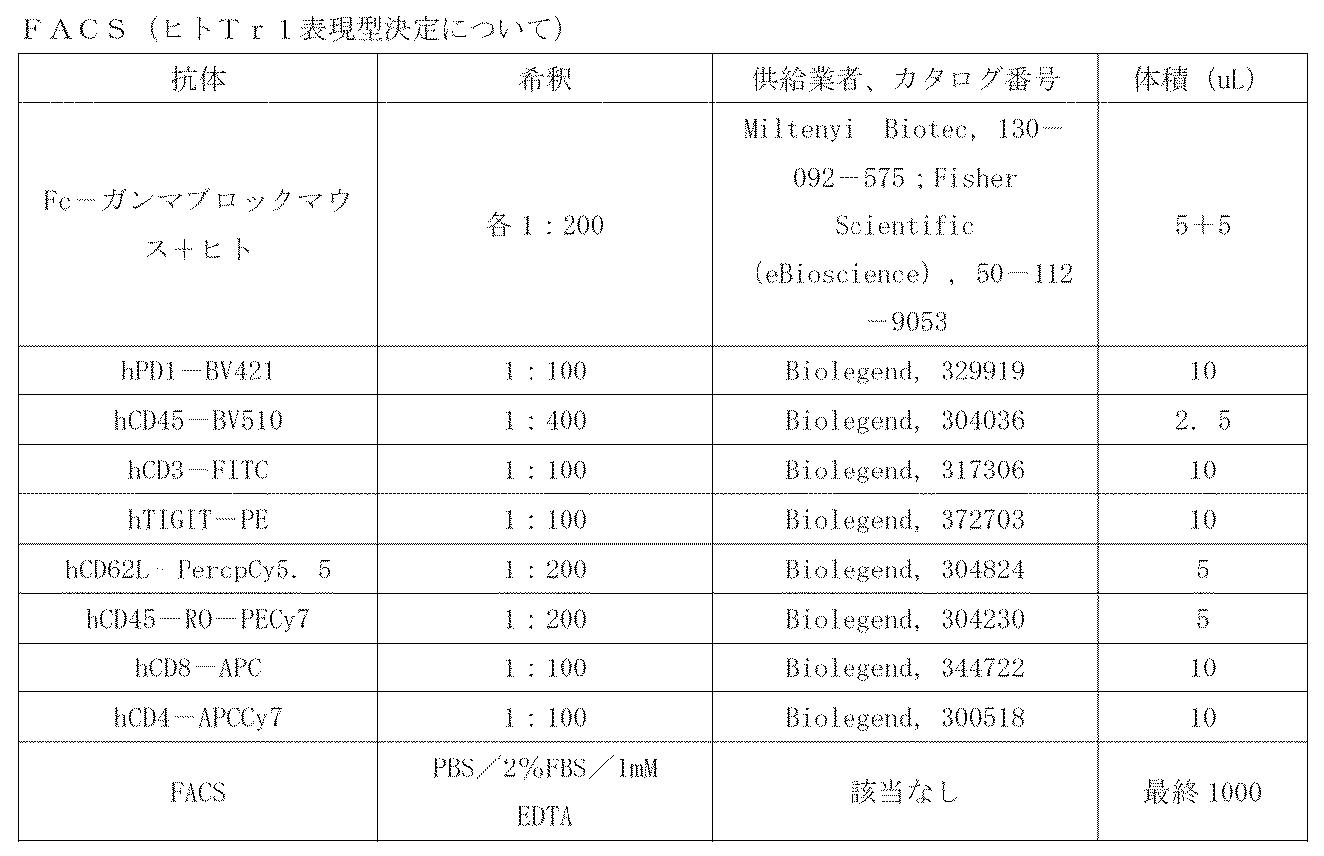
material and method:
-100 of whole blood was used for analysis -Blood was stained using a staining-1 wash protocol to allow absolute cell counts with the following Ab panel, followed by lysis buffer (BD Bioscience, #349202). Whole blood was incubated with 10x antibodies (shown below) and after 30 minutes blood was lysed with a large volume of 1x lysis buffer (at least 6 times) according to the manufacturer's instructions. Alternatively blood was first lysed with ACK (10 minutes), washed with PBS and stained with antibody mix as described in the table below.
The following flow panel (for blood ALC):
以下に記載のフロー抗体を、推定上のTr1細胞の表面上に発現するマーカーの表面特性化にさらに使用した。
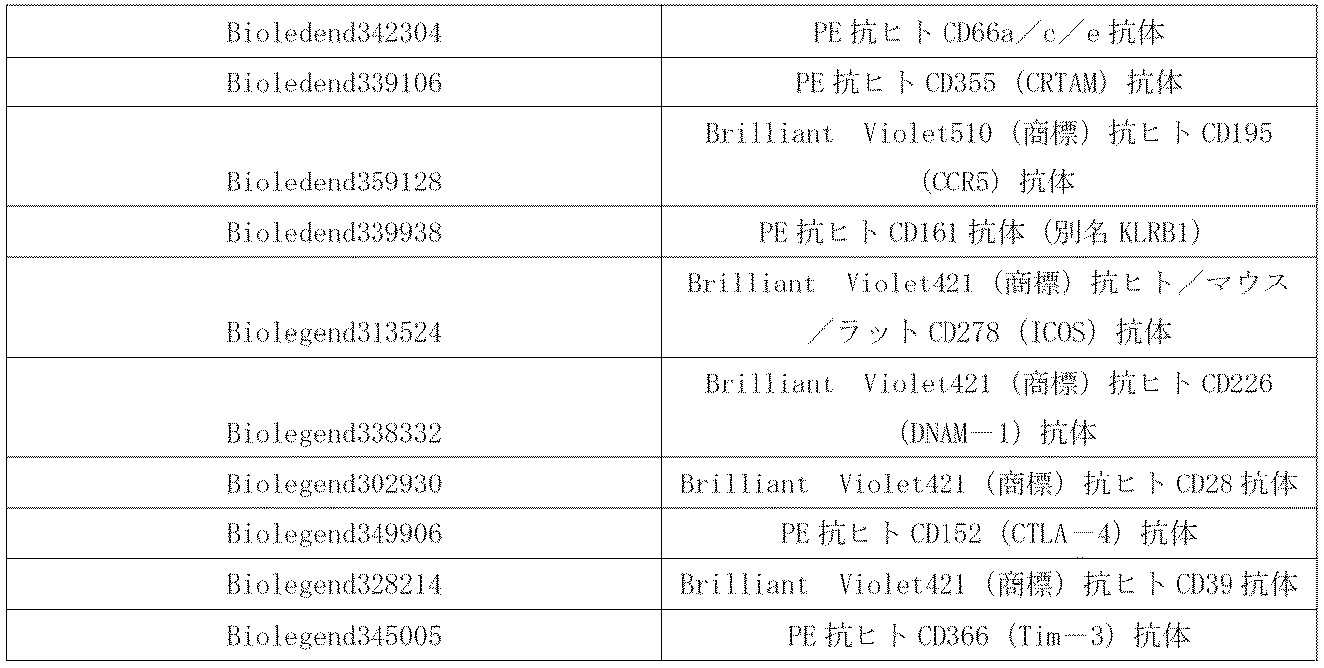
以下に記載のフロー抗体を、推定上のTr1細胞によって細胞内に発現するマーカーの細胞内特性化にさらに使用した。
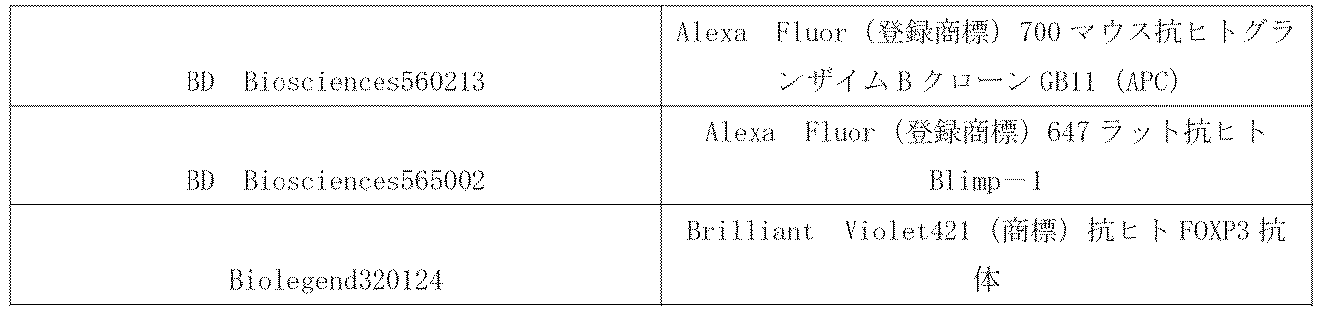
1.200uLの培養培地(プールウェル)から細胞を回収する
2.1ウェル毎に150uLの滅菌Verseneを添加することによって、プレートから残った細胞を分離し、37℃で10分間インキュベートし、以前に回収した培地と組み合わせる
3.細胞を、振とうしながら(400rpm)、50uLの抗体ミックス(Tr1純度チェックのパネル)で室温において30分間染色するか、または抑制アッセイに進む
The flow antibodies described below were further used for intracellular characterization of markers expressed intracellularly by putative Tr1 cells.
生成されたTr1細胞を使用するインビトロアッセイ
本発明による抗MCT1抗体の効果は、アッセイ、例えば、以下に記載のアッセイで上記のように生成されたT1r1細胞を使用するインビトロアッセイで評価され得る。
1.生存率
2.TIGIT+PD1+セルの数および%
3.ヒトCD3+(またはTIGIT+PD1+)細胞を用いた抑制アッセイ
4.6/7日目:新鮮なヒトPBMCまたはT細胞(Jurkatを含む)の増殖の抑制
In Vitro Assays Using Generated Tr1 Cells The effect of anti-MCT1 antibodies according to the invention can be assessed in an assay, for example an in vitro assay using T1r1 cells generated as described above in the assay described below.
1.
3. Suppression assay using human CD3+ (or TIGIT + PD1 + )
前述のアッセイで使用され得る例示的な試薬および材料が以下に記載される。
試薬および材料
●CD3/CD28 Dynabeads(Life Technologies、カタログ番号11131D)
●Cell Trace Violet(Invitrogen#C34557)
●レスポンダー細胞:PBMC、T細胞、Jurkat細胞

Reagents and Materials CD3/CD28 Dynabeads (Life Technologies, Catalog No. 11131D)
●Cell Trace Violet (Invitrogen#C34557)
●Responder cells: PBMC, T cells, Jurkat cells
結果
図37A~図37Dの結果によって示されるように、CD3/CD28刺激後の例示的な抗MCT1抗体、INX420によるPMBCのインビトロ処置は、PD1+TIGIT+細胞の数の実質的な増加をもたらした。また、観察された結果は、同じインビトロアッセイで小分子MCT1阻害剤によって誘発された結果に匹敵した。
Results As shown by the results in Figures 37A-D, in vitro treatment of PMBCs with an exemplary anti-MCT1 antibody, INX420, following CD3/CD28 stimulation resulted in a substantial increase in the number of PD1 + TIGIT + cells, and the observed results were comparable to those induced by a small molecule MCT1 inhibitor in the same in vitro assay.
図38の結果によってさらに示されるように、これらのインビトロ実験は、同じ例示的な抗MCT1抗体、INX420を用いた処置の結果として産生されたPD1+TIGIIT+Tr1細胞が、PMBCの増殖を強力に抑制することをさらに明らかにした。 As further shown by the results in FIG. 38, these in vitro experiments further revealed that PD1 + TIGIIT + Tr1 cells generated as a result of treatment with the same exemplary anti-MCT1 antibody, INX420, potently suppressed the proliferation of PMBCs.
実験が抗MCT1抗体およびIL-10アンタゴニストの存在下でのPMBCの増殖を評価した図39のインビトロ実験結果によってさらに示されるように、IL-10アンタゴニスト(例えば、抗IL10RB)によるIL-10シグナル伝達の遮断が、抗MCT1抗体を用いた処置から生じたPMBC増殖のTr1媒介性抑制を妨害しなかったことが実証された。 As further shown by the in vitro experimental results in FIG. 39, in which experiments evaluated the proliferation of PMBCs in the presence of anti-MCT1 antibodies and IL-10 antagonists, it was demonstrated that blockade of IL-10 signaling by IL-10 antagonists (e.g., anti-IL10RB) did not interfere with the Tr1-mediated inhibition of PMBC proliferation resulting from treatment with anti-MCT1 antibodies.
上記の実験結果は、臨床的に重要であり、これは、Tr1細胞の頻度/機能の欠陥およびその数が、多くの自己免疫および炎症性疾患(前臨床および臨床モデルにおける)で実証されており、IL-10を産生するTr1細胞が疾患の防御に関連すること、ならびにインビボでTr1細胞ブーストをもたらす薬物が、T細胞媒介性疾患、例えば、自己免疫および炎症状態ならびに同種異系移植の治療/予防において潜在的な用途を有することを示すためである。 The above experimental results are clinically important because defects in Tr1 cell frequency/function and numbers have been demonstrated in many autoimmune and inflammatory diseases (in preclinical and clinical models), indicating that IL-10-producing Tr1 cells are associated with disease protection, and that drugs that result in Tr1 cell boost in vivo have potential applications in the treatment/prevention of T cell-mediated diseases, e.g., autoimmune and inflammatory conditions and allogeneic transplantation.
実施例24:異種GvHDアッセイにおける抗MCT1抗体の効果
本発明による例示的な抗MCT1抗体、すなわち、INX420、INX413、およびINX310を、GVHDのインビボモデル、すなわち、異種GvHDモデルでさらに評価した。
Example 24: Effect of anti-MCT1 antibodies in a xenogeneic GvHD assay Exemplary anti-MCT1 antibodies according to the invention, namely INX420, INX413, and INX310, were further evaluated in an in vivo model of GVHD, namely the xenogeneic GvHD model.
異種GvHDモデル:
このGvHD動物モデルでは、雄のNSGマウスを亜致死照射(250rad)で処置し、その後、これらのマウスに2.5×10⁶の新鮮なヒトPBMCを投与した(0日目)。抗ヒトMCT1の最初の用量を細胞と組み合わせ、静脈内注射する。フォローアップ処置スケジュールは、毎週である(7、14、および21日目、腹腔内)。抗MCT1(INX420またはその他)およびヒトIgG1対照の両方に10mg/Kgで(または指定のとおり)投与する。
Heterogeneous GvHD model:
In this GvHD animal model, male NSG mice are treated with sublethal irradiation (250 rad) and then administered 2.5x10⁶ fresh human PBMCs (day 0). The first dose of anti-human MCT1 is combined with the cells and injected intravenously. The follow-up treatment schedule is weekly (
以前に(0、7、14、21日目)抗MCT1で処理された再攻撃接種実験の場合、NSGマウスに、同じドナーの以前に凍結させたヒトPBMCの2.5×10⁶の2回目の投与を投与する(42日目)。これらのマウスの生存率および体重減少を、追加の抗体処置なしで監視し、同じドナーPBMCを投与したNSGマウスの新しいコホートと比較する。
For rechallenge experiments, NSG mice previously treated with anti-MCT1 (
絶対リンパ球数(ALC).
100uLの全血を分析に使用する:染色-1洗浄プロトコルを使用して血液を染色して、以下のAbパネルを用いた絶対細胞数を可能にし、続いて溶解緩衝液(BD Bioscience、#349202)を用いた。全血を10×抗体(以下に示す)と共にインキュベートし、30分後、製造元の指示に従って大量の1×溶解緩衝液(少なくとも6回)で血液を溶解した。または、血液を最初にACKで溶解し(10分)、PBSで洗浄し、以下の表に記載されるとおりに抗体ミックスで染色した。
Absolute lymphocyte count (ALC).
100uL of whole blood is used for analysis: Blood was stained using the stain-1 wash protocol to allow absolute cell counts with the following Ab panel, followed by lysis buffer (BD Bioscience, #349202). Whole blood was incubated with 10x antibodies (shown below) and after 30 minutes blood was lysed with a large volume of 1x lysis buffer (at least 6 times) according to the manufacturer's instructions. Alternatively blood was first lysed with ACK (10 minutes), washed with PBS and stained with antibody mix as described in the table below.
エクスビボ抑制実験
ヒト化NSGマウス(抗MCT1で処置)を67日目または指定された他の日に屠殺し、脾臓から単一細胞懸濁液を調製し、続いて、hCD3+細胞のビーズベースの濃縮を行った。単離した細胞を、古典的な抗CD3/抗CD28刺激(dynabeads,Life Technologies,#11131D)条件下で、異なるドナーの新鮮なヒトPBMCの有無にかかわらず72~96時間播種し、続いて、三重水素チミジンで16時間パルシングして、増殖を評価した。

代替的に、新鮮なPBMC増殖の抑制を、Cell Trace(商標)Violet色素の希釈の減少として測定した。この目的のために、レスポンダーPBMCの細胞標識化を、フローサイトメトリー用のCell Trace(商標)Violet Cell Proliferation Kit(C34557,Thermo Fisher)で行った。次いで、レスポンダーPBMCを様々な量のTr1細胞と96時間共培養した。Tr1細胞をTIGIT+PD1+細胞として定義し、磁気ビーズ技術(Miltenyi Biotech)を使用して単離した。 Alternatively, inhibition of fresh PBMC proliferation was measured as a reduction in dilution of Cell Trace™ Violet dye. For this purpose, cell labeling of responder PBMC was performed with the Cell Trace™ Violet Cell Proliferation Kit for flow cytometry (C34557, Thermo Fisher). Responder PBMC were then co-cultured with various amounts of Tr1 cells for 96 h. Tr1 cells were defined as TIGIT+PD1+ cells and isolated using magnetic bead technology (Miltenyi Biotech).
エクスビボTr1生存率
ヒト化NSGマウス(抗MCT1で処置)を32日目または指定された他の日に屠殺し、脾臓から単一細胞懸濁液を調製し、続いて、hCD3+細胞のビーズベースの濃縮を行った。単離した細胞を、Tr1生存率を得るために検体(上記の表を参照)で播種した。
Ex vivo Tr1 viability Humanized NSG mice (treated with anti-MCT1) were sacrificed on day 32 or other days as indicated, and single cell suspensions were prepared from the spleens, followed by bead-based enrichment of hCD3+ cells. Isolated cells were seeded with specimens (see table above) to obtain Tr1 viability.
結果
図40A~図40Dおよび図41A~図41Cの結果によって示されるように、これらの実験は、本発明による例示的な抗MCT1抗体、すなわち、異種GvHDモデルにおけるINX420、INX413、およびINX310を用いた処置が、対照抗体で処置されたNSGマウスと比較して、CD3+、CD4+、およびCD8+エフェクターT細胞の数の有意な減少をもたらしたことを明らかにした。さらに、これらの抗MCT1抗体は両方とも、Tr1細胞の数の大幅な増加を誘発した。
Results As shown by the results in Figures 40A-D and 41A-C, these experiments revealed that treatment with exemplary anti-MCT1 antibodies according to the present invention, namely INX420, INX413, and INX310 in the xenogeneic GvHD model, resulted in a significant decrease in the number of CD3 + , CD4 + , and CD8 + effector T cells compared to NSG mice treated with a control antibody. Moreover, both of these anti-MCT1 antibodies induced a large increase in the number of Tr1 cells.
さらに、図42A~図42Bの実験結果によって示されるように、これらの同じ例示的な試験済み抗MCT1抗体は、これらの動物が同じドナー由来のドナーPMBCを42日目に再攻撃接種された場合、異種GvHDモデルにおいて長期の防御および耐性をさらに誘発した。
Furthermore, as shown by the experimental results in Figures 42A-B, these same exemplary tested anti-MCT1 antibodies further induced long-term protection and resistance in a xenogeneic GvHD model when these animals were rechallenged on
図43および図44に含まれるバイオマーカーの結合結果によってさらに示されるように、TIGITおよびPD1は、Tr1細胞の推定バイオマーカーであり、これは、これらのバイオマーカーは、異種GvHDモデルにおけるヒトT細胞の75%超で発現するためである。図45の実験結果によってさらに示されるように、Tr1細胞は、高レベルのグランザイムBを発現するが、FOXP3またはBlimp1を発現しない。 As further shown by the biomarker binding results included in Figures 43 and 44, TIGIT and PD1 are putative biomarkers for Tr1 cells, since these biomarkers are expressed in more than 75% of human T cells in the xenogeneic GvHD model. As further shown by the experimental results in Figure 45, Tr1 cells express high levels of granzyme B, but do not express FOXP3 or Blimp1.
図46A~図46Cの実験は、14日目に、これらのNSGマウスが多くのエフェクター細胞を含むことをさらに実証し、hCD3+細胞の増殖が、例示的な抗MCT1抗体(INX420)によって抑制されることをさらに示している。図47A~図47Bの実験結果はまた、Tr1細胞が、hCD3+細胞および総PMBCの増殖を強力に抑制することを示している。
The experiments in Figures 46A-C further demonstrate that these NSG mice contain many effector cells at
図48は、異種GvHDモデルでのTr1細胞生成の動態を概略的に示す。具体的には、図は、抗MCT1抗体がTエフェクター相を低減することを示す。図49A~図49Bは、エクスビボTr1生存因子を示す。図49Bはさらに、標的細胞の死滅が、Tr1細胞がそのような抑制を誘発する機構ではないこと、およびTr1細胞が、標的細胞との共培養で生存するが、個別に培養すると死滅することを示す。図49Aに示される実験結果は、抗TIGITおよびPVRリガンドが、エクスビボTr1生存率を改善しないことを明らかにする。対照的に、図49Aにさらに示されるように、IL-2、IL-7、およびIL-15は、用量依存的な方法でエクスビボTr1生存率を高め、Tr1細胞生存率は、最大約75%増加した。 Figure 48 shows a schematic of the kinetics of Tr1 cell generation in a xenogeneic GvHD model. Specifically, the figure shows that anti-MCT1 antibodies reduce the T effector phase. Figures 49A-B show ex vivo Tr1 survival factors. Figure 49B further shows that target cell killing is not the mechanism by which Tr1 cells induce such suppression, and that Tr1 cells survive in co-culture with target cells but die when cultured separately. The experimental results shown in Figure 49A reveal that anti-TIGIT and PVR ligands do not improve ex vivo Tr1 survival. In contrast, as further shown in Figure 49A, IL-2, IL-7, and IL-15 enhanced ex vivo Tr1 survival in a dose-dependent manner, with Tr1 cell survival increasing by up to about 75%.
実施例25:ケトーシスに対する小分子MCT1アンタゴニストの効果
安全性に対するMCT1阻害剤の効果を、それらのケトーシスに対する効果に基づいて評価するために、さらに実験を実施した。図50A~図50Bの実験結果によって示されるように、小分子MCT1阻害剤(SMI)は、8~24時間の飢餓によって誘発されたケトーシスを増強し、SMiによって引き起こされたケトーシスは、飢餓時に低血糖症を進行させ、かつSMi処置は、飢餓によって引き起こされたケトーシスおよび低血糖症を増強する。
Example 25: Effects of small molecule MCT1 antagonists on ketosis Further experiments were performed to evaluate the effects of MCT1 inhibitors on safety based on their effects on ketosis. As shown by the experimental results in Figures 50A-B, small molecule MCT1 inhibitors (SMI) enhance ketosis induced by 8-24 hours of fasting, SMi-induced ketosis advances hypoglycemia upon fasting, and SMi treatment enhances fasting-induced ketosis and hypoglycemia.
対照的に、図51A~図51Bの実験結果は、SMiの存在下および非存在下での24時間の飢餓が、ケトアシドーシスを誘発しなかったことを示した。むしろ、本発明者らは、高用量のSMiにおいてのみ、わずかな飢餓依存性のpH低減(7.3から7.1)およびわずかな追加の低減(約0.05)を観察しただけであった。 In contrast, the experimental results in Figures 51A-B showed that 24 hours of starvation in the presence and absence of SMi did not induce ketoacidosis. Rather, we observed only a small starvation-dependent pH reduction (from 7.3 to 7.1) and a small additional reduction (approximately 0.05) only at high doses of SMi.
実施例26:アラニンスキャニング実験による機能的抗MCT1抗体のエピトープ特性化
本発明の機能的抗MCT1抗体によって結合されるエピトープ(複数可)を構成するMCT1残基を同定するために、アラニンスキャニング実験をさらに実施した。具体的には、4つの例示的な機能的抗ヒトMCT1抗体(INX444、INX420、LM183、およびLM186)によって結合されるエピトープを、標的タンパク質MCT1のモデル構造で視覚化した。これらの4つの抗体を、本明細書で同定されたものを代表するように選択した。特に、これらの抗体のうちの2つは、マウス抗ヒトMCT1抗体INX310(Ab1)の親和性成熟変異体であり、他の2つは、ニワトリ抗ヒトMCT1抗体である。これらの4つの抗体は全て、機能的であり、すなわち、全てヒトMCT1機能を遮断する。
Example 26: Epitope characterization of functional anti-MCT1 antibodies by alanine scanning experiments Alanine scanning experiments were further carried out to identify the MCT1 residues that constitute the epitope(s) bound by the functional anti-MCT1 antibodies of the present invention. Specifically, the epitopes bound by four exemplary functional anti-human MCT1 antibodies (INX444, INX420, LM183, and LM186) were visualized on a model structure of the target protein MCT1. These four antibodies were selected to be representative of those identified herein. In particular, two of these antibodies are affinity matured variants of the mouse anti-human MCT1 antibody INX310 (Ab1), and the other two are chicken anti-human MCT1 antibodies. All of these four antibodies are functional, i.e., all block human MCT1 function.
構築されたアラニンスキャニングライブラリ内の各変異クローンへの各試験Fabの結合を、ハイスループットフローサイトメトリーによって2連で決定した。各時点について、バックグラウンド蛍光を生データから差し引き、次いで、これをWT標的タンパク質とのFab反応性に正規化した。各変異クローンについて、平均結合値を発現の関数としてプロットした(対照反応性によって表される)。予備的な一次重要クローンを同定するために、対照MAbまたはFabへの70%を超えるWT結合および試験Fabへの15%未満のWT結合の閾値を適用した。二次クローンは、設定した閾値を満たしていないが、その結合活性の減少および重要残基への近接は、変異した残基が抗体の一部である可能性をさらに示唆する。 The binding of each test Fab to each mutant clone in the constructed alanine scanning library was determined in duplicate by high-throughput flow cytometry. For each time point, background fluorescence was subtracted from the raw data, which was then normalized to the Fab reactivity with the WT target protein. For each mutant clone, the average binding value was plotted as a function of expression (represented by the control reactivity). To identify preliminary primary critical clones, a threshold of more than 70% WT binding to the control MAb or Fab and less than 15% WT binding to the test Fab was applied. Secondary clones do not meet the set thresholds, but their reduced binding activity and proximity to critical residues further suggest that the mutated residue may be part of the antibody.
以下の表は、試験した4つ全ての抗ヒトMCT1抗体に由来するFab(複数可)の標的(ヒトMCT1タンパク質)への結合のために同定された重要残基を含む。重要残基は、その突然変異が特定の抗体との最低の反応性をもたらした残基である。検証済みの重要残基は、側鎖が抗体-エピトープ相互作用に最もエネルギー的に寄与するアミノ酸を表す(Bogan,A.A.and Thorn,K.S.(1998).「Anatomy of hot spots in protein interfaces」.J.Mol.Biol.280,1-9、Lo Conte,L.,Chothia,C.,and Janin,J.(1999).The atomic structure of protein-protein recognition sites.J.Mol.Biol.285,2177-2198.,1999)。したがって、これらの残基は、結合エピトープへの主要なエネルギー的寄与因子である可能性が高い。
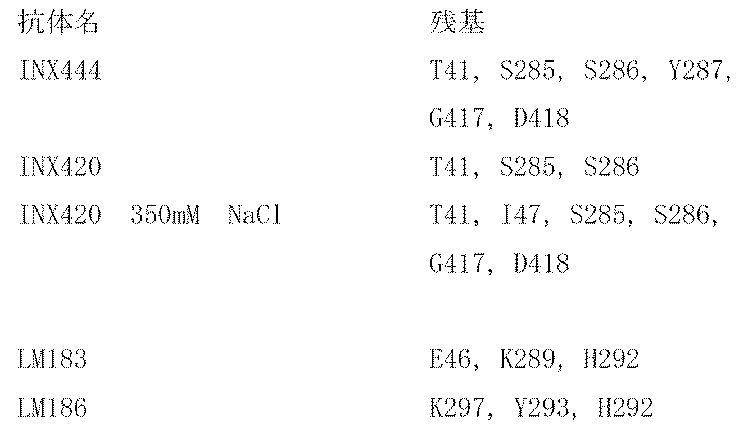
以下の表には、これらの同じ4つの抗体のMCT1エピトープを構成する同定された重要残基の平均結合反応性(および範囲)が含まれる。Fab結合の重要残基(赤枠で囲まれている)は、突然変異が試験Fabへの結合については陰性であったが、対照Fabへの結合については陽性であった残基であった。閾値ガイドラインを満たさなかった追加の二次残基(青枠で囲まれている)を同定したが、その結合活性の減少および重要残基への近接は、それらが抗体エピトープの一部である可能性があることを示唆した。
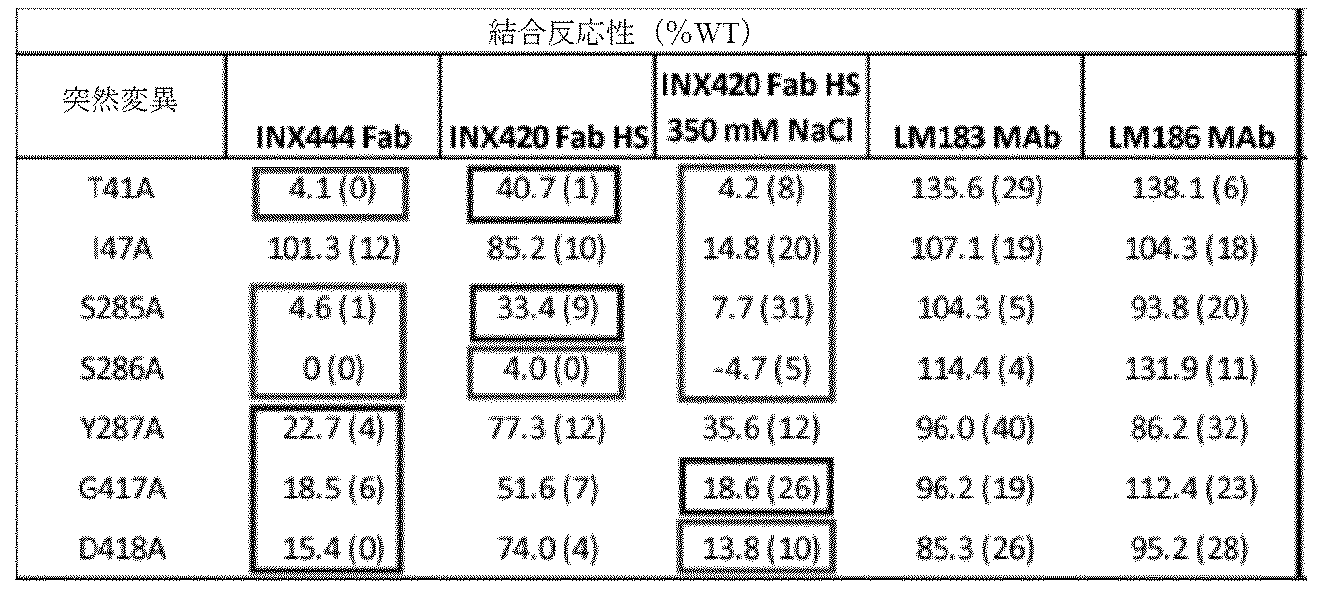
具体的には、これら4つの例示的な機能的抗ヒトMCT1抗体(INX444、INX420、LM183、およびLM186)の結合に関与する重要残基および二次残基を、標的MCT1タンパク質のモデル構造でさらに視覚化した。図52は、アラニンスキャニングによって同定されたこれら4つの異なる抗体の予測された抗MCT1エピトープを含む残基を示す。これらの抗体の4つ全てのエピトープを構成する残基が、ヒトMCT1の同じ細胞外領域に含まれていることが分かり、これは、本明細書に開示される機能的抗ヒトMCT1抗体の多くまたは全てが、ヒトMCT1上の同じまたは重複するエピトープに結合する可能性が高いことを示唆する。図53および図54はさらに、試験した4つの例示的な抗MCT1抗体によって結合された特定のヒトMCT1残基をマッピングする。 Specifically, the key and secondary residues involved in the binding of these four exemplary functional anti-human MCT1 antibodies (INX444, INX420, LM183, and LM186) were further visualized on the model structure of the target MCT1 protein. Figure 52 shows the residues that comprise the predicted anti-MCT1 epitopes of these four different antibodies identified by alanine scanning. The residues that make up the epitopes of all four of these antibodies were found to be contained in the same extracellular region of human MCT1, suggesting that many or all of the functional anti-human MCT1 antibodies disclosed herein likely bind to the same or overlapping epitopes on human MCT1. Figures 53 and 54 further map the specific human MCT1 residues bound by the four exemplary anti-MCT1 antibodies tested.
エピトープ分析に基づいて、本発明は、以下:
(x)残基T41、E46、S285、S286、Y287、K289、H292、Y293、K297、G417、I47、およびD418の1つ以上を含むもの、
(xi)少なくとも3つの残基を含むものであり、前述の残基の少なくとも1、2、または3つ全てが、T41、E46、S285、S286、Y287、K289、H292、Y293、G417、I47、およびD418から選択される残基を含むもの、
(xii)3つの残基を含むものであり、前述の残基の少なくとも1、2、または3つ全てが、T41、E46、S285、S286、Y287、K289、H292、Y293、G417、I47、およびD418を含むもの、
(xiii)3~6個の残基を含むものであり、前述の残基の1、2、3、4、5、または6つが、T41、E46、S285、S286、Y287、K289、H292、Y293、G417、I47、およびD418を含むもの、
(xiv)残基T41、S285、およびS286の少なくとも1、2、または3つ全てを含むもの、
(xv)T41を含むもの、
(xvi)S286を含むもの、
(xvii)S285を含むもの、
(xviii)H292を含むもの、
(xix)残基T41、S285、S286、Y287、G417、およびD418を含むもの、
(xx)残基T41、S285、およびS286を含むもの、
(xxi)残基T41、I47、S285、S286、G417、およびD418を含むもの、
(xxii)残基E46、K289、およびH292を含むもの、
(xxiii)残基K297、Y293、およびH292を含むもの、
(xxiv)げっ歯類(例えば、マウス、ラット、モルモット)、ウサギ、ニワトリ、非ヒト霊長類(例えば、カニクイザル、チンパンジー、オランウータン)、ウシ、ヒツジ、イヌ、ネコから選択される、非ヒトMCT1の対応する残基の1つ以上を含むもの、から選択されるヒトMCT1上のエピトープに結合する、任意の単離された抗体またはその抗原結合フラグメントを少なくとも包含し、
任意に、エピトープ中に存在する残基を、アラニンスキャニングの使用によって同定する。
Based on epitope analysis, the present invention provides:
(x) comprising one or more of residues T41, E46, S285, S286, Y287, K289, H292, Y293, K297, G417, I47, and D418;
(xi) comprising at least three residues, wherein at least one, two, or all three of said residues comprise a residue selected from T41, E46, S285, S286, Y287, K289, H292, Y293, G417, I47, and D418;
(xii) comprising three residues, wherein at least one, two, or all three of said residues comprise: T41, E46, S285, S286, Y287, K289, H292, Y293, G417, I47, and D418;
(xiii) containing 3 to 6 residues, wherein one, two, three, four, five, or six of said residues include T41, E46, S285, S286, Y287, K289, H292, Y293, G417, I47, and D418;
(xiv) comprising at least one, two, or all three of residues T41, S285, and S286;
(xv) T41,
(xvi) containing S286,
(xvii) containing S285;
(xviii) containing H292,
(xix) comprising residues T41, S285, S286, Y287, G417, and D418;
(xx) comprising residues T41, S285, and S286;
(xxi) comprising residues T41, I47, S285, S286, G417, and D418;
(xxii) comprising residues E46, K289, and H292;
(xxiii) comprising residues K297, Y293, and H292;
(xxiv) any isolated antibody or antigen-binding fragment thereof that binds to an epitope on human MCT1 selected from rodent (e.g., mouse, rat, guinea pig), rabbit, chicken, non-human primate (e.g., cynomolgus monkey, chimpanzee, orangutan), cow, sheep, dog, cat, which includes one or more of the corresponding residues of non-human MCT1;
Optionally, residues present in the epitope are identified by using alanine scanning.
同じエピトープ分析に基づいて、本発明は、ヒトMCT1のループ1~6に含まれる以下のヒトMCT1残基、または非ヒトMCT1、例えば、げっ歯類もしくは非ヒト霊長類MCT1のループ1~6領域に含まれる対応する残基のいずれかをさらに含み得る上記のヒトMCT1上のエピトープに結合する、任意の単離された抗体またはその抗原結合フラグメントを少なくともさらに包含する。
(i)残基P37、I40、K45、E48、およびT55の1つ以上(ループ1)、
(ii)残基Q111(ループ2)、
(iii)残基Q166(ループ3)、
(iv)残基L284、E296、S298の1つ以上(ループ4)、
(v)残基Y353(ループ5)、
(vi)残基Y419、T422の一方もしくは両方(ループ6)、ならびに/または
(vii)上記の任意の組み合わせ。
Based on the same epitope analysis, the present invention further encompasses at least any isolated antibody or antigen-binding fragment thereof that binds to the above-mentioned epitopes on human MCT1, which may further comprise any of the following human MCT1 residues contained in loops 1-6 of human MCT1, or the corresponding residues contained in the loops 1-6 region of non-human MCT1, e.g., rodent or non-human primate MCT1.
(i) one or more of residues P37, I40, K45, E48, and T55 (loop 1);
(ii) residue Q111 (loop 2);
(iii) residue Q166 (loop 3);
(iv) one or more of residues L284, E296, S298 (loop 4);
(v) residue Y353 (loop 5);
(vi) one or both of residues Y419, T422 (loop 6), and/or (vii) any combination of the above.
実施例27:マウスMCT1への抗ヒトMCT1抗体(INX444)の結合
本明細書に開示される少なくとも機能的な1つの抗ヒトMCT1抗体(INX444)はまた、マウスMCT1に結合する。これは、主題の抗ヒトMCT1抗体がヒトMCT1タンパク質上で相互作用するヒトMCT1の領域またはエピトープまたは残基が、異なる種、例えば、ヒトおよびマウス、ならびに非ヒト霊長類などの考え得る他の種のMCT1タンパク質で保存される可能性が高いことをさらに示す。
Example 27: Binding of anti-human MCT1 antibody (INX444) to mouse MCT1 At least one functional anti-human MCT1 antibody (INX444) disclosed herein also binds to mouse MCT1. This further indicates that the regions or epitopes or residues of human MCT1 with which the subject anti-human MCT1 antibodies interact on the human MCT1 protein are likely to be conserved in the MCT1 proteins of different species, e.g., humans and mice, as well as potentially other species, such as non-human primates.
さらに、マウスMCT1に結合するこの抗ヒトMCT1抗体は、マウスMCT1を発現するトランスフェクタントをブロモピルビン酸の毒性作用から防御することがさらに実証された。具体的には、図55に示されるように、この同じ抗体は、2つの異なるAb濃度(低10ug/mL、高100ug/mL)で試験した場合、陽性対照、AZ3965(小分子MCT1阻害剤、緑)と同様に、ブロモピルビン酸の毒性作用から、マウスMCT1を発現するトランスフェクタントを防御する。 Furthermore, this anti-human MCT1 antibody, which binds to mouse MCT1, was further demonstrated to protect transfectants expressing mouse MCT1 from the toxic effects of bromopyruvate. Specifically, as shown in Figure 55, this same antibody protects transfectants expressing mouse MCT1 from the toxic effects of bromopyruvate as well as the positive control, AZ3965 (small molecule MCT1 inhibitor, green), when tested at two different Ab concentrations (low 10ug/mL, high 100ug/mL).
対照的に、他の2つの試験済みの機能的抗ヒトMCT1抗体、すなわち、同じ実験のINX420およびINX438は、マウスMCT1機能を遮断しなかった(ベースライン)。(150uMのブロモピルビン酸では、トランスフェクタント細胞がこのブロモピルビン酸濃度で完全に死滅しないため、培地のみの対照はゼロに到達しないことに留意されたい)。 In contrast, the other two tested functional anti-human MCT1 antibodies, INX420 and INX438 in the same experiment, did not block mouse MCT1 function (baseline). (Note that at 150 uM bromopyruvate, the media only control does not reach zero because the transfectant cells are not completely killed at this bromopyruvate concentration.)
この結果は、主題の抗ヒトMCT1抗体がヒトMCT1タンパク質上で相互作用する機能的エピトープまたは残基が、異なる種のMCT1タンパク質で保存される可能性が高いことをさらに裏付け、これは、主題の抗ヒトMCT1抗体が競合結合アッセイで使用されて、他の機能的抗MCT1抗体、すなわち、ヒトMCT1の1つ以上の活性に拮抗する、阻害する、もしくは遮断するもの、またはそのオルソログ、例えば、げっ歯類もしくは非ヒト霊長類MCT1タンパク質の1つ以上の活性に拮抗する、阻害する、もしくは遮断するものをスクリーニングし得ることを示唆する。
参考文献
このリストの参考文献は、参照により組み込まれ、上記の明細書中の参照番号によって言及される。
1.Carpenter L,Halestrap AP.The kinetics,substrate and inhibitor specificity of the lactate transporter of Ehrlich-Lettre tumour cells studied with the intracellular pH indicator BCECF.The Biochemical Journal.1994;304(Pt 3):751-60.Epub 1994/12/15. PubMed PMID:7818477;PMCID:PMC1137398.
2.Jackson VN,Halestrap AP.The kinetics,substrate,and inhibitor specificity of the monocarboxylate(lactate)transporter of rat liver cells determined using the fluorescent intracellular pH indicator, 2′,7′-bis(carboxyethyl)-5(6)-carboxyfluorescein.The Journal of Biological Chemistry.1996;271(2):861-8.Epub 1996/01/12.PubMed PMID:8557697.
3.Araki K,Myers DK.Aerobic Glycolysis of X-Irradiated Thymocytes.Can J Biochem Physiol.1963;41:2157-69.Epub 1963/10/01.PubMed PMID:14083980.
4.Ardawi MS,Newsholme EA.Glutamine metabolism in lymphocytes of the rat.The Biochemical Journal.1983;212(3):835-42.Epub 1983/06/15.PubMed PMID:6882397;PMCID:PMC1153161.
5.Frauwirth KA,Riley JL,Harris MH,Parry RV,Rathmell JC,Plas DR,Elstrom RL,June CH,Thompson CB.The CD28 signaling pathway regulates glucose metabolism.Immunity.2002;16(6):769-77.PubMed PMID:12121659.
6.Pearce EJ,Everts B.Dendritic cell metabolism.Nature Reviews Immunology.2015;15(1):18-29.doi:10.1038/nri3771.PubMed PMID:25534620;PMCID:PMC4495583.
7.Takeshima Y,Iwasaki Y,Okamura T,Fujio K,Yamamoto K.The metabolic regulation in immune cells and pathogenesis of systemic lupus erythematosus approximately toward new therapeutic applications approximately.Nihon Rinsho Meneki Gakkai Kaishi.2017;40(1):12-20.Epub 2017/05/26.doi:10.2177/jsci.40.12.PubMed PMID:28539549.
8.Pucino V,Bombardieri M,Pitzalis C,Mauro C.Lactate at the crossroads of metabolism,inflammation,and autoimmunity.European Journal of Immunology.2017;47(1):14-21.Epub 2016/11/25.doi:10.1002/eji.201646477.PubMed PMID:27883186.
9.Mak TW,Grusdat M,Duncan GS,Dostert C,Nonnenmacher Y,Cox M,Binsfeld C,Hao Z,Brustle A,Itsumi M,Jager C,Chen Y,Pinkenburg O,Camara B,Ollert M,Bindslev-Jensen C,Vasiliou V,Gorrini C,Lang PA,Lohoff M,Harris IS,Hiller K,Brenner D.Glutathione Primes T Cell Metabolism for Inflammation.Immunity.2017;46(4):675-89.Epub 2017/04/20.doi:10.1016/j.immuni.2017.03.019.PubMed PMID:28423341.
10.Ma EH,Bantug G,Griss T,Condotta S,Johnson RM,Samborska B,Mainolfi N,Suri V,Guak H,Balmer ML,Verway MJ,Raissi TC,Tsui H,Boukhaled G,Henriques da Costa S,Frezza C,Krawczyk CM,Friedman A,Manfredi M,Richer MJ,Hess C,Jones RG.Serine Is an Essential Metabolite for Effector T Cell Expansion.Cell Metab.2017;25(2):345-57.Epub 2017/01/24.doi:10.1016/j.cmet.2016.12.011.PubMed PMID:28111214.
11.Jellusova J,Cato MH,Apgar JR,Ramezani-Rad P,Leung CR,Chen C,Richardson AD,Conner EM,Benschop RJ,Woodgett JR,Rickert RC.Gsk3 is a metabolic checkpoint regulator in B cells.Nature Immunology.2017;18(3):303-12.Epub 2017/01/24.doi:10.1038/ni.3664.PubMed PMID:28114292;PMCID:PMC5310963.
12.Gnanaprakasam JNR,Sherman JW,Wang R.MYC and HIF in shaping immune response and immune metabolism.Cytokine Growth Factor Rev.2017;35:63-70.Epub 2017/04/02.doi:10.1016/j.cytogfr.2017.03.004.PubMed PMID:28363691.
13.Mah AY,Cooper MA.Metabolic Regulation of Natural Killer Cell IFN-gamma Production.Critical reviews in immunology.2016;36(2):131-47.Epub 2016/12/03.doi:10.1615/CritRevImmunol.2016017387.PubMed PMID:27910764;PMCID:PMC5335907.
14.Loftus RM,Finlay DK.Immunometabolism:Cellular Metabolism Turns Immune Regulator.The Journal of Biological Chemistry.2016;291(1):1-10.Epub 2015/11/05.doi:10.1074/jbc.R115.693903.PubMed PMID:26534957;PMCID:PMC4697146.
15.Keating SE,Zaiatz-Bittencourt V,Loftus RM,Keane C,Brennan K,Finlay DK,Gardiner CM.Metabolic Reprogramming Supports IFN-gamma Production by CD56bright NK Cells.Journal of Immunology.2016;196(6):2552-60.Epub 2016/02/14.doi:10.4049/jimmunol.1501783.PubMed PMID:26873994.
16.Cretenet G,Clerc I,Matias M,Loisel S,Craveiro M,Oburoglu L,Kinet S,Mongellaz C,Dardalhon V,Taylor N.Cell surface Glut1 levels distinguish human CD4 and CD8 T lymphocyte subsets with distinct effector functions.Sci Rep.2016;6:24129.Epub 2016/04/14.doi:10.1038/srep24129.PubMed PMID:27067254;PMCID:PMC4828702.
17.Adamia N,Jorjoliani L,Khachapuridze D,Katamadze N,Chkuaseli N.Allergic Diseases and Asthma in Adolescents.Georgian Med News.2015(243):58-62.PubMed PMID:26087732.
18.Yang Z,Matteson EL,Goronzy JJ,Weyand CM.T-cell metabolism in autoimmune disease.Arthritis Research & Therapy.2015;17:29.Epub 2015/04/19.doi:10.1186/s13075-015-0542-4.PubMed PMID:25890351;PMCID:PMC4324046.
19.Pollizzi KN,Patel CH,Sun IH,Oh MH,Waickman AT,Wen J,Delgoffe GM,Powell JD.mTORC1 and mTORC2 selectively regulate CD8(+)T cell differentiation.The Journal of Clinical Investigation.2015;125(5):2090-108.Epub 2015/04/22.doi:10.1172/JCI77746.PubMed PMID:25893604;PMCID:PMC4463194.
20.Medzhitov R.Bringing Warburg to lymphocytes.Nature Reviews Immunology.2015;15(10):598.Epub 2015/09/26.doi:10.1038/nri3918.PubMed PMID:26403193.
21.Chen H,Yang T,Zhu L,Zhao Y.Cellular metabolism on T-cell development and function.International Reviews of Immunology.2015;34(1):19-33.Epub 2014/04/09.doi:10.3109/08830185.2014.902452.PubMed PMID:24708060.
22.Matarese G,Colamatteo A,De Rosa V.Metabolic fuelling of proper T cell functions.Immunology Letters.2014;161(2):174-8.Epub 2013/12/25.doi:10.1016/j.imlet.2013.12.012.PubMed PMID:24365064.
23.Kugelberg E.Dendritic cells:TLR agonists trigger rapid metabolic changes.Nature Reviews Immunology.2014;14(4):209.Epub 2014/03/26.doi:10.1038/nri3652.PubMed PMID:24662378.
24.Green DR,RathmellJ.Sweet nothings:sensing of sugar metabolites controls T cell function.Cell Metab.2013;18(1):7-8.Epub 2013/07/05.doi:10.1016/j.cmet.2013.06.009.PubMed PMID:23823473;PMCID:PMC3749232.
25.Wang R,Green DR.Metabolic checkpoints in activated T cells.Nature Immunology.2012;13(10):907-15.Epub 2012/09/20.doi:10.1038/ni.2386.PubMed PMID:22990888.
26.Marko AJ,Miller RA,Kelman A,Frauwirth KA.Induction of glucose metabolism in stimulated T lymphocytes is regulated by mitogen-activated protein kinase signaling.PloS One.2010;5(11):e15425.Epub 2010/11/19.doi:10.1371/journal.pone.0015425.PubMed PMID:21085672;PMCID:PMC2978105.
27.Jacobs SR,Michalek RD,Rathmell JC.IL-7 is essential for homeostatic control of T cell metabolism in vivo.Journal of Immunology.2010;184(7):3461-9.Epub 2010/03/03.doi:10.4049/jimmunol.0902593.PubMed PMID:20194717;PMCID:PMC2980949.
28.Maciver NJ,Jacobs SR,Wieman HL,Wofford JA,Coloff JL,Rathmell JC.Glucose metabolism in lymphocytes is a regulated process with significant effects on immune cell function and survival.Journal of Leukocyte Biology.2008;84(4):949-57.Epub 2008/06/26.doi:10.1189/jlb.0108024.PubMed PMID:18577716;PMCID:PMC2638731.
29.Fox CJ,Hammerman PS,Thompson CB.Fuel feeds function:energy metabolism and the T-cell response.Nature Reviews Immunology.2005;5(11):844-52.Epub 2005/10/22.doi:10.1038/nri1710.PubMed PMID:16239903.
30.Cham CM,Gajewski TF.Glucose availability regulates IFN-gamma production and p70S6 kinase activation in CD8+ effector T cells.Journal of Immunology.2005;174(8):4670-7.Epub 2005/04/09.PubMed PMID:15814691.
31.Rathmell JC,Elstrom RL,Cinalli RM,Thompson CB.Activated Akt promotes increased resting T cell size,CD28-independent T cell growth,and development of autoimmunity and lymphoma.European Journal of Immunology.2003;33(8):2223-32.Epub 2003/07/29.doi:10.1002/eji.200324048.PubMed PMID:12884297.
32.Brand K,Netzker R,Aulwurm U,Hermfisse U,Fabian D,Weigert C,Schaefer D,Hamm-Kuenzelmann B.Control of thymocyte proliferation via redox-regulated expression of glycolytic genes.Redox Rep.2000;5(1):52-4.Epub 2000/07/25.doi:10.1179/rer.2000.5.1.52.PubMed PMID:10905547.
33.Finlay DK.Regulation of glucose metabolism in T cells:new insight into the role of Phosphoinositide 3-kinases.Frontiers in Immunology.2012;3:247.Epub 2012/08/15.doi:10.3389/fimmu.2012.00247.PubMed PMID:22891069;PMCID:PMC3413010.
34.Halestrap AP,Meredith D.The SLC16 gene family-from monocarboxylate transporters(MCTs)to aromatic amino acid transporters and beyond.Pflugers Arch.2004;447(5):619-28.doi:10.1007/s00424-003-1067-2.PubMed PMID:12739169.
35.Halestrap AP.Monocarboxylic acid transport.Compr Physiol.2013;3(4):1611-43.doi:10.1002/cphy.c130008.PubMed PMID:24265240.
36.Halestrap AP.The SLC16 gene family - structure,role and regulation in health and disease.Mol Aspects Med.2013;34(2-3):337-49.doi:10.1016/j.mam.2012.05.003.PubMed PMID:23506875.
37.Halestrap AP.The monocarboxylate transporter family--Structure and functional characterization.IUBMB Life.2012;64(1):1-9.doi:10.1002/iub.573.PubMed PMID:22131303.
38.Halestrap AP,Wilson MC.The monocarboxylate transporter family--role and regulation.IUBMB Life.2012;64(2):109-19.doi:10.1002/iub.572.PubMed PMID:22162139.
39.Rusu V,Hoch E,Mercader JM,Tenen DE,Gymrek M,Hartigan CR,DeRan M,von Grotthuss M,Fontanillas P,Spooner A,Guzman G,Deik AA,Pierce KA,Dennis C,Clish CB,Carr SA,Wagner BK,Schenone M,Ng MCY,Chen BH,Consortium M,Consortium STD,Centeno-Cruz F,Zerrweck C,Orozco L,Altshuler DM,Schreiber SL,Florez JC,Jacobs SBR,Lander ES.Type 2 Diabetes Variants Disrupt Function of SLC16A11 through Two Distinct Mechanisms.Cell.2017;170(1):199-212 e20.Epub 2017/07/01.doi:10.1016/j.cell.2017.06.011.PubMed PMID:28666119.
40.Frank H,Groger N,Diener M,Becker C,Braun T,Boettger T.Lactaturia and loss of sodium-dependent lactate uptake in the colon of SLC5A8-deficient mice.The Journal of Biological Chemistry.2008;283(36):24729-37.doi:10.1074/jbc.M802681200.PubMed PMID:18562324;PMCID:PMC3259809.
41.Lewis IA,Campanella ME,Markley JL,Low PS.Role of band 3 in regulating metabolic flux of red blood cells.Proceedings of the National Academy of Sciences of the United States of America.2009;106(44):18515-20.Epub 2009/10/23.doi:10.1073/pnas.0905999106.PubMed PMID:19846781;PMCID:PMC2773988.
42.Akashi A,Miki A,Kanamori A,Nakamura M.Aquaporin 9 expression is required for l-lactate to maintain retinal neuronal survival.Neuroscience Letters.2015;589:185-90.Epub 2015/02/01.doi:10.1016/j.neulet.2015.01.063.PubMed PMID:25637697.
43.Fischer K,Hoffmann P,Voelkl S,Meidenbauer N,Ammer J,Edinger M,Gottfried E,Schwarz S,Rothe G,Hoves S,Renner K,Timischl B,Mackensen A,Kunz-Schughart L,Andreesen R,Krause SW,Kreutz M.Inhibitory effect of tumor cell-derived lactic acid on human T cells.Blood.2007;109(9):3812-9.Epub 2007/01/27.doi:10.1182/blood-2006-07-035972.PubMed PMID:17255361.
44.Michne WF,Schroeder JD,Guiles JW,Treasurywala AM,Weigelt CA,Stansberry MF,McAvoy E,Shah CR,Baine Y,Sawutz DG,et al.Novel inhibitors of the nuclear factor of activated T cells(NFAT)-mediated transcription of beta-galactosidase:potential immunosuppressive and antiinflammatory agents.J MedChem.1995;38(14):2557-69.Epub 1995/07/07.PubMed PMID:7629796.
45.Pahlman C,Qi Z,Murray CM,Ferguson D,Bundick RV,Donald DK,Ekberg H.Immunosuppressive properties of a series of novel inhibitors of the monocarboxylate transporter MCT-1.Transpl Int.2013;26(1):22-9.doi:10.1111/j.1432-2277.2012.01579.x.PubMed PMID:23137339.
46.Ovens MJ,Davies AJ,Wilson MC,Murray CM,Halestrap AP.AR-C155858 is a potent inhibitor of monocarboxylate transporters MCT1 and MCT2 that binds to an intracellular site involving transmembrane helices 7-10.The Biochemical Journal.2010;425(3):523-30.doi:10.1042/BJ20091515.PubMed PMID:19929853;PMCID:PMC2811425.
47.Bueno V,Binet I,Steger U,Bundick R,Ferguson D,Murray C,Donald D,Wood K.The specific monocarboxylate transporter(MCT1)inhibitor,AR-C117977,a novel immunosuppressant,prolongs allograft survival in the mouse.Transplantation.2007;84(9):1204-7.doi:10.1097/01.tp.0000287543.91765.41.PubMed PMID:17998878.
48.Murray C.Targeting MCT1:Targeting MCT1:Role in immunosuppression.Nat.Chem Biol.,1(7):371-6 2009.
49.van Hasselt PM,Ferdinandusse S,Monroe GR,Ruiter JP,Turkenburg M,Geerlings MJ,Duran K,Harakalova M,van der Zwaag B,Monavari AA,Okur I,Sharrard MJ,Cleary M,O′Connell N,Walker V,Rubio-Gozalbo ME,de Vries MC,Visser G,Houwen RH,van der Smagt JJ,Verhoeven-Duif NM,Wanders RJ,van Haaften G.Monocarboxylate transporter 1 deficiency and ketone utilization.The New England Journal of Medicine.2014;371(20):1900-7.Epub 2014/11/13.doi:10.1056/NEJMoa1407778.PubMed PMID:25390740.
50.Guile SD,Bantick JR,Cheshire DR,Cooper ME,Davis AM,Donald DK,Evans R,Eyssade C,Ferguson DD,Hill S,Hutchinson R,Ingall AH,Kingston LP,Martin I,Martin BP,Mohammed RT,Murray C,Perry MW,Reynolds RH,Thorne PV,Wilkinson DJ,WithnallJ.Potent blockers of the monocarboxylate transporter MCT1:novel immunomodulatory compounds.Bioorg Med Chem Lett.2006;16(8):2260-5.doi:10.1016/j.bmcl.2006.01.024.PubMed PMID:16455256.
51.Kim Y,Choi JW,Lee JH,Kim YS.Expression of lactate/H(+)symporters MCT1 and MCT4 and their chaperone CD147 predicts tumor progression in clear cell renal cell carcinoma:immunohistochemical and The Cancer Genome Atlas data analyses.Human Pathology.2015;46(1):104-12.doi:10.1016/j.humpath.2014.09.013.PubMed PMID:25456395.
52.Hong CS,Graham NA,Gu W,Espindola Camacho C,Mah V,Maresh EL,Alavi M,Bagryanova L,Krotee PA,Gardner BK,Behbahan IS,Horvath S,Chia D,Mellinghoff IK,Hurvitz SA,Dubinett SM,Critchlow SE,Kurdistani SK,Goodglick L,Braas D,Graeber TG,Christofk HR.MCT1 Modulates Cancer Cell Pyruvate Export and Growth of Tumors that Co-express MCT1 and MCT4.Cell Reports.2016;14(7):1590-601.Epub 2016/02/16.doi:10.1016/j.celrep.2016.01.057.PubMed PMID:26876179;PMCID:PMC4816454.
53.Yin Y,Choi SC,Xu Z,Perry DJ,Seay H,Croker BP,Sobel ES,Brusko TM,Morel L.Normalization of CD4+ T cell metabolism reverses lupus.Sci Transl Med.2015;7(274):274ra18.Epub 2015/02/13.doi:10.1126/scitranslmed.aaa0835.PubMed PMID:25673763;PMCID:PMC5292723.
54.Buck MD,O′Sullivan D,Pearce EL.T cell metabolism drives immunity.The Journal of Experimental Medicine.2015;212(9):1345-60.Epub 2015/08/12.doi:10.1084/jem.20151159.PubMed PMID:26261266;PMCID:PMC4548052.
55.Doherty JR,Yang C,Scott KE,Cameron MD,Fallahi M,Li W,Hall MA,Amelio AL,Mishra JK,Li F,Tortosa M,Genau HM,Rounbehler RJ,Lu Y,Dang CV,Kumar KG,Butler AA,Bannister TD,Hooper AT,Unsal-Kacmaz K,Roush WR,Cleveland JL.Blocking lactate export by inhibiting the Myc target MCT1 Disables glycolysis and glutathione synthesis.Cancer Research.2014;74(3):908-20.Epub 2013/11/29.doi:10.1158/0008-5472.CAN-13-2034.PubMed PMID:24285728;PMCID:PMC3946415.
56.Wang R,Dillon CP,Shi LZ,Milasta S,Carter R,Finkelstein D,McCormick LL,Fitzgerald P,Chi H,Munger J,Green DR.The transcription factor Myc controls metabolic reprogramming upon T lymphocyte activation.Immunity.2011;35(6):871-82.Epub 2011/12/27.doi:10.1016/j.immuni.2011.09.021.PubMed PMID:22195744;PMCID:PMC3248798.
57.Cho KS,Yamada T,Wynn C,Behanna HA,Hong IC,Manaves V,Nakanishi T,Hirose J,Abe Y,Jiang H,Tamura K,Saita Y.Mechanism analysis of long-term graft survival by monocarboxylate transporter-1 inhibition.Transplantation.2010;90(12):1299-306.Epub 2010/11/16.doi:10.1097/TP.0b013e3181ff8818.PubMed PMID:21076380.
58.Ekberg H,Qi Z,Pahlman C,Veress B,Bundick RV,Craggs RI,Holness E,Edwards S,Murray CM,Ferguson D,Kerry PJ,Wilson E,Donald DK.The specific monocarboxylate transporter-1(MCT-1)inhibitor,AR-C117977,induces donor-specific suppression,reducing acute and chronic allograft rejection in the rat.Transplantation.2007;84(9):1191-9.doi:10.1097/01.tp.0000287541.53389.be.PubMed PMID:17998876.
59.Durrbach A,Francois H.Intracellular lactate flux:a new regulator of the allogenic immune response.Transpl Int.2013;26(1):20-1.Epub 2012/12/15.doi:10.1111/tri.12035.PubMed PMID:23237578.
60.Rubtsov YP,Niec RE,Josefowicz S,Li L,Darce J,Mathis D,Benoist C,Rudensky AY.Stability of the regulatory T cell lineage in vivo.Science.2010;329(5999):1667-71.Epub 2010/10/12.doi:10.1126/science.1191996.PubMed PMID:20929851;PMCID:PMC4262151.
61.Sakaguchi S,Vignali DA,Rudensky AY,Niec RE,Waldmann H.The plasticity and stability of regulatory T cells.Nature Reviews Immunology.2013;13(6):461-7.Epub 2013/05/18.doi:10.1038/nri3464.PubMed PMID:23681097.
62.Hoeppli RE,Wu D,Cook L,Levings MK.The environment of regulatory T cell biology:cytokines,metabolites,and the microbiome.Frontiers in Immunology.2015;6:61.Epub 2015/03/06.doi:10.3389/fimmu.2015.00061.PubMed PMID:25741338;PMCID:PMC4332351.
63.Vetter I.Development and optimization of FLIPR high throughput calcium assays for ion channels and GPCRs.Advances in Experimental Medicine and Biology.2012;740:45-82.Epub 2012/03/29.doi:10.1007/978-94-007-2888-2_3.PubMed PMID:22453938.
64.Manning Fox JE,Meredith D,Halestrap AP.Characterisation of human monocarboxylate transporter 4 substantiates its role in lactic acid efflux from skeletal muscle.The Journal of Physiology.2000;529 Pt 2:285-93.Epub 2000/12/02.PubMed PMID:11101640;PMCID:PMC2270204.
65.Murray CM,Hutchinson R,Bantick JR,Belfield GP,Benjamin AD,Brazma D,Bundick RV,Cook ID,Craggs RI,Edwards S,Evans LR,Harrison R,Holness E,Jackson AP,Jackson CG,Kingston LP,Perry MW,Ross AR,Rugman PA,Sidhu SS,Sullivan M,Taylor-Fishwick DA,Walker PC,Whitehead YM,Wilkinson DJ,Wright A,Donald DK.Monocarboxylate transporter MCT1 is a target for immunosuppression.Nat Chem Biol.2005;1(7):371-6.PubMed PMID:16370372.
66.Birsoy K,Wang T,Possemato R,Yilmaz OH,Koch CE,Chen WW,Hutchins AW,Gultekin Y,Peterson TR,Carette JE,Brummelkamp TR,Clish CB,Sabatini DM.MCT1-mediated transport of a toxic molecule is an effective strategy for targeting glycolytic tumors.Nature Genetics.2013;45(1):104-8.doi:10.1038/ng.2471.PubMed PMID:23202129;PMCID:3530647.
67.Youm YH,Nguyen KY,Grant RW,Goldberg EL,Bodogai M,Kim D,D′Agostino D,Planavsky N,Lupfer C,Kanneganti TD,Kang S,Horvath TL,Fahmy TM,Crawford PA,Biragyn A,Alnemri E,Dixit VD.The ketone metabolite beta-hydroxybutyrate blocks NLRP3 inflammasome-mediated inflammatory disease.Nature Medicine.2015;21(3):263-9.Epub 2015/02/17.doi:10.1038/nm.3804.PubMed PMID:25686106;PMCID:PMC4352123.
68.Balasubramaniam S,Lewis B,Greed L,Meili D,Flier A,Yamamoto R,Bilic K,Till C,Sass JO.Heterozygous Monocarboxylate Transporter 1(MCT1,SLC16A1)Deficiency as a Cause of Recurrent Ketoacidosis.JIMD Rep.2016;29:33-8.Epub 2015/11/27.doi:10.1007/8904_2015_519.PubMed PMID:26608392;PMCID:PMC5059203.
69.Philp NJ,Ochrietor JD,Rudoy C,Muramatsu T,Linser PJ.Loss of MCT1,MCT3,and MCT4 expression in the retinal pigment epithelium and neural retina of the 5A11/basigin-null mouse.Investigative Ophthalmology&Visual Science.2003;44(3):1305-11.Epub 2003/02/26.PubMed PMID:12601063.
70.Vaihkonen LK,Poso AR.Interindividual variation in total and carrier-mediated lactate influx into red blood cells.The American Journal of Physiology.1998;274(4 Pt 2):R1025-30.Epub 1998/05/12.PubMed PMID:9575965.
71.Merezhinskaya N,Fishbein WN,Davis JI,Foellmer JW.Mutations in MCT1 cDNA in patients with symptomatic deficiency in lactate transport.Muscle & Nerve.2000;23(1):90-7.Epub 1999/12/11.PubMed PMID:10590411.
72.Koho NM,Vaihkonen LK,Poso AR.Lactate transport in red blood cells by monocarboxylate transporters.Equine Veterinary Journal Supplement.2002(34):555-9.Epub 2002/10/31.doi:10.1111/j.2042-3306.2002.tb05482.x.PubMed PMID:12405750.
73.Koho NM,Raekallio M,Kuusela E,Vuolle J,Poso AR.Lactate transport in canine red blood cells.Am J Vet Res.2008;69(8):1091-6.Epub 2008/08/05.doi:10.2460/ajvr.69.8.1091.PubMed PMID:18672976.
74.Koho NM,Hyyppa S,Poso AR.Monocarboxylate transporters(MCT)as lactate carriers in equine muscle and red blood cells.Equine Veterinary Journal Supplement.2006(36):354-8.Epub 2007/04/04.doi:10.1111/j.2042-3306.2006.tb05568.x.PubMed PMID:17402447.
75.Deuticke B.Monocarboxylate transport in red blood cells:kinetics and chemical modification.Methods Enzymol.1989;173:300-29.Epub 1989/01/01.PubMed PMID:2674614.
76.Dubinsky WP,Racker E.The mechanism of lactate transport in human erythrocytes.The Journal of Membrane Biology.1978;44(1):25-36.Epub 1978/12/08.PubMed PMID:32398.
77.Pattillo RE,Gladden LB.Red blood cell lactate transport in sickle disease and sickle cell trait.Journal of Applied Physiology.2005;99(3):822-7.Epub 2005/05/14.doi:10.1152/japplphysiol.00235.2005.PubMed PMID:15890755.
78.Poole RC,Cranmer SL,Holdup DW,Halestrap AP.Inhibition of L-lactate transport and band 3-mediated anion transport in erythrocytes by the novel stilbenedisulphonate N,N,N′,N′-tetrabenzyl-4,4′-diaminostilbene-2,2′-disulpho nat e(TBenzDS).Biochimica et Biophysica Acta.1991;1070(1):69-76.Epub 1991/11/18.PubMed PMID:1751540.
79.Lengacher S,Nehiri-Sitayeb T,Steiner N,Carneiro L,Favrod C,Preitner F,Thorens B,Stehle JC,Dix L,Pralong F,Magistretti PJ,Pellerin L.Resistance to diet-induced obesity and associated metabolic perturbations in haploinsufficient monocarboxylate transporter 1 mice.PloS One.2013;8(12):e82505.Epub 2013/12/25.doi:10.1371/journal.pone.0082505.PubMed PMID:24367518;PMCID:PMC3867350.
80.Lee Y,Morrison BM,Li Y,Lengacher S,Farah MH,Hoffman PN,Liu Y,Tsingalia A,Jin L,Zhang PW,Pellerin L,Magistretti PJ,Rothstein JD.Oligodendroglia metabolically support axons and contribute to neurodegeneration.Nature.2012;487(7408):443-8.Epub 2012/07/18.doi:10.1038/nature11314.PubMed PMID:22801498;PMCID:PMC3408792.
81.Morrison BM,Tsingalia A,Vidensky S,Lee Y,Jin L,Farah MH,Lengacher S,Magistretti PJ,Pellerin L,Rothstein JD.Deficiency in monocarboxylate transporter 1(MCT1)in mice delays regeneration of peripheral nerves following sciatic nerve crush.Experimental Neurology.2015;263:325-38.doi:10.1016/j.expneurol.2014.10.018.PubMed PMID:25447940.
82.Yan W.Male infertility caused by spermiogenic defects:lessons from gene knockouts.Mol Cell Endocrinol.2009;306(1-2):24-32.Epub 2009/06/02.doi:10.1016/j.mce.2009.03.003.PubMed PMID:19481682;PMCID:PMC5438260.
83.Murdoch F,Goldberg E.Male contraception:another Holy Grail.Bioorg Med Chem Lett 2014;24(2):419-24.Epub Epub 2013 Dec 7.doi:doi:10.1016/j.bmcl.2013.12.004.
84.Sexton JZ,Danshina PV,Lamson DR,Hughes M,House AJ,Yeh LA,O′Brien DA,Williams KP.Development and Implementation of a High Throughput Screen for the Human Sperm-Specific Isoform of Glyceraldehyde 3-Phosphate Dehydrogenase(GAPDHS).Curr Chem Genomics.2011;5:30-41.Epub 2011/07/16.doi:10.2174/1875397301105010030.PubMed PMID:21760877;PMCID:PMC3134944.
85.Halford SER,Jones P,Wedge S,Hirschberg S,Katugampola S,Veal G,Payne G,Bacon C,Potter S,Griffin M,Chenard-Poirier M,Petrides G,Holder G,Keun HC,Banerji U,Plummer ER.A first-in-human first-in-class(FIC)trial of the monocarboxylate transporter 1(MCT1)inhibitor AZD3965 in patients with advanced solid tumours.Journal of Clinical Oncology.2017;35(15_suppl):2516-.doi:10.1200/JCO.2017.35.15_suppl.2516.
86.Smith AJ.New horizons in therapeutic antibody discovery:opportunities and challenges versus small-molecule therapeutics.J Biomol Screen.2015;20(4):437-53.Epub 2014/12/17.doi:10.1177/1087057114562544.PubMed PMID:25512329.
87.Jones TD,Crompton LJ,Carr FJ,Baker MP.Deimmunization of Monoclonal Antibodies.In:Dimitrov AS,editor.Therapeutic Antibodies:Methods and Protocols.Totowa,NJ:Humana Press;2009.p.405-23.
88.Kirk P,Wilson MC,Heddle C,Brown MH,Barclay AN,Halestrap AP.CD147 is tightly associated with lactate transporters MCT1 and MCT4 and facilitates their cell surface expression.The EMBO Journal.2000;19(15):3896-904.doi:10.1093/emboj/19.15.3896.PubMed PMID:10921872;PMCID:306613.
89.Toleikis L,Frenzel A.Cloning single-chain antibody fragments(ScFv)from hyrbidoma cells.Methods in Molecular Biology.2012;907:59-71.Epub 2012/08/22.doi:10.1007/978-1-61779-974-7_3.PubMed PMID:22907345.
90.Gleichmann E,Van Elven EH,Van der Veen JP.A systemic lupus erythematosus(SLE)-like disease in mice induced by abnormal T-B cell cooperation.Preferential formation of autoantibodies characteristic of SLE.European journal of Immunology.1982;12(2):152-9.Epub 1982/02/01.doi:10.1002/eji.1830120210.PubMed PMID:6978818.
91.Chu YW,Gress RE.Murine models of chronic graft-versus-host disease:insights and unresolved issues.Biol Blood Marrow Transplant.2008;14(4):365-78.Epub 2008/03/18.doi:10.1016/j.bbmt.2007.12.002.PubMed PMID:18342778;PMCID:PMC2376050.
92.Liu J,Wang L,Zhao F,Tseng S,Narayanan C,Shura L,Willingham S,Howard M,Prohaska S,Volkmer J,Chao M,Weissman IL,Majeti R.Pre-Clinical Development of a Humanized Anti-CD47 Antibody with Anti-Cancer Therapeutic Potential.PloS One.2015;10(9):e0137345.doi:10.1371/journal.pone.0137345.PubMed PMID:26390038;PMCID:PMC4577081.
93.Kelley M,Ahene AB,Gorovits B,Kamerud J,King LE,McIntosh T,YangJ.Theoretical considerations and practical approaches to address the effect of anti-drug antibody(ADA)on quantification of biotherapeutics in circulation.AAPSJ.2013;15(3):646-58.Epub 2013/04/02.doi:10.1208/s12248-013-9468-4.PubMed PMID:23543601;PMCID:PMC3691419.
94.Warburg,O.On the origin of cancer cells.Science 1956,723,309-314.
95.Koppenol,W.H.;Bounds,P.L;Dang,C.V.Otto Warburg′s contributions to current concepts of cancer metabolism.Nature Rev.Cancer 2011,77,325-327.
96.Doherty,J.R.;Yang,C;Scott,K.;Cameron M.D.;Fallahi,M.;Li,W;Hall,M.A.;Amelio,A.L.;Mishra,J.K.;Li,F;Tortosa,M.;Genau,H.M.;Rounbehler,R.J.;Yungi,L.;Dang,C.V.;Kumar,K.G.;Butler,A.A.;Bannister,T.D.;Hooper,A.T.;Unsal-Kacmaz,K.;Roush,W.R.;and Cleveland,J.L.Blocking lactate export by inhibiting the myc target MCT1 disables glycolysis and glutathione synthesis.Cancer Res.2014,74,908-920.
97.Ullah,M.S.;Davies,A.J.;Halestrap,A.P.The plasma membrane lactate transporter MCT4,but not MCT1,is up-regulated by hypoxia through a HIF-1a-dependent mechanism.J.Biol.Chem.2006,287,9030-9037.
98.Dang,C.V.The interplay between MYC and HIF in the Warburg effect.Ernst Schering Found Symp.Proc.2007,35-53.
99.Vaupel,P.;Mayer,A.Hypoxia in cancer:significance and impact on clinical outcome.Cancer Metastasis Rev.2007,26,225-239.
100.Kizaka-Kondoh,S.;Inoue,M.;Harada,H.;Hiraoka,M.Tumor hypoxia:a target for selective cancer therapy.Cancer Sci.2003,94,1021 -1028.
101.Otonkoski,T;Jiao,H;Kaminen-Ahola,N;et al.Physical exercise-induced hypoglycemia caused by failed silencing of monocarboxylate transporter 1 in pancreatic beta cells.Am J Hum Genet 2007;87,467-474.
102.Zhao,C;Wilson,M.C;Schuit,F,;Halestrap,A.P.;Rutter,G.A.Expression and distribution of lactate/monocarboxylate transporter isoforms in pancreatic islets and the exocrine pancreas.Diabetes 2001;50,361-366.
103.Otonkoski,T.;Kaminen,N,;Ustinov,J,;et al.Physical exercise-induced hyperinsulinemic hypoglycemia is an autosomal-dominant trait characterized by abnormal pyruvate-induced insulin release.Diabetes 2003;52,199-204.
104.Pullen T.J,;Sylow,L,;Sun,G.;Halestrap,A.P.;Richter,E.A.;Rutter,G.A.Overexpression of Monocarboxylate Transporter-1(Slc16a1 )in Mouse Pancreatic beta-Cells Leads to Relative Hyperinsulinism During Exercise.Diabetes 2012,61,1719-1725.
105.Roncarolo MG,Yssel H,Touraine JL,Betuel H,De Vries JE,Spits H.Autoreactive T cell clones specific for class I and class II HLA antigens isolated from a human chimera.J Exp Med.1988 May 1;167(5):1523-1534
106.Bacchetta R,Bigler M,Touraine JL,Parkman R,Tovo PA,Abrams J,de Waal Malefyt R,de Vries JE,Roncarolo MG.High levels of interleukin 10 production in vivo are associated with tolerance in SCID patients transplanted with HLA mismatched hematopoietic stem cells.The Journal of Experimental Medicine.1994;179(2):493-502.
107.Winfried Barchet,Jeffrey D.Price,Marina Cella,Marco Colonna,Sandra K.MacMillan,J.Perren Cobb,Paul A.Thompson,Kenneth M.Murphy,John P.Atkinson,and Claudia Kemper.Complement-induced regulatory T cells suppress T-cell responses but allow for dendritic-cell maturation.Blood.2006 Feb 15;107(4):1497-1504.
MCT1および抗MCT1抗体配列
ヒトMCT1アミノ酸配列
配列番号:1
MPPAVGGPVGYTPPDGGWGWAVVIGAFISIGFSYAFPKSITVFFKEIEGIFHATTSEVSWISSIMLAVMYGGGPISSILVNKYGSRIVMIVGGCLSGCGLIAASFCNTVQQLYVCIGVIGGLGLAFNLNPALTMIGKYFYKRRPLANGLAMAGSPVFLCTLAPLNQVFFGIFGWRGSFLILGGLLLNCCVAGALMRPIGPKPTKAGKDKSKASLEKAGKSGVKKDLHDANTDLIGRHPKQEKRSVFQTINQFLDLTLFTHRGFLLYLSGNVIMFFGLFAPLVFLSSYGKSQHYSSEKSAFLLSILAFVDMVARPSMGLVANTKPIRPRIQYFFAASVVANGVCHMLAPLSTTYVGFCVYAGFFGFAFGWLSSVLFETLMDLVGPQRFSSAVGLVTIVECCPVLLGPPLLGRLNDMYGDYKYTYWACGVVLIISGIYLFIGMGINYRLLAKEQKANEQKKESKEEETSIDVAGKPNEVTKAAESPDQKDTDGGPKEEESPV
MCT1 Ab1(INX310)VH
配列番号:2
QVQLKATGPGLVQPTQTLSITCTVSGFSLTNYHLQWVRQTPGKGLEWMGFIRSSGNTEYNSEFKSRLSISRDTSKNQVFLKMNSLKTDDTGVYYCARNSWYHGTYYSPGYYVMDAWGQGASVTVSS
MCT1 Ab1(INX310)VL
配列番号:3
NIHLTQSPSLLSASVGDRVTLSCKGSQNINNYLAWFQQKFGETPKLLIYNRHNLQTGIPSRFSGSGSGTDYTLTINSLQPEDVATYFCYQYSDGYTFGAGTKLELK
MCT1 Ab1(INX310)VH CDR1
配列番号:4
GFSLTNYH
MCT1 Ab1(INX310)VH CDR2
配列番号:5
IRSSGNT
MCT1 Ab1(INX310)VH CDR3
配列番号:6
ARNSWYHGTYYSPGYYVMDAWG
MCT1 Ab1(INX310)VL CDR1
配列番号:7
QNINNY
MCT1 Ab1(INX310)VL CDR2
配列番号:8
NRH
MCT1 Ab1(INX310)VL CDR3
配列番号:9
YQYSDGYT
Ab1(INX310)
>INX310_VH
配列番号:10
QVQLKATGPGLVQPTQTLSITCTVSGFSLTNYHLQWVRQTPGKGLEWMGFIRSSGNTEYN
SEFKSRLSISRDTSKNQVFLKMNSLKTDDTGVYYCARNSWYHGTYYSPGYYVMDAWGQGA
SVTVSS
>INX310_VL
配列番号:11
NIHLTQSPSLLSASVGDRVTLSCKGSQNINNYLAWFQQKFGETPKLLIYNRHNLQTGIPS
RFSGSGSGTDYTLTINSLQPEDVATYFCYQYSDGYTFGAGTKLELK
Ab2(INX352)
>INX352_VH
配列番号:12
QVQLKESGPGLVKPSQTLSLTCTVSGFSLTNYHLQWVRQPPGKGLEWIGFIRSSGNTEYN
PSLKSRVTISRDTSKNQVSLKLSSVTAADTAVYYCARNSWYHGTYYSPGYYVMDAWGQGT
LVTVSS
>INX352|INX356|INX364_VL
配列番号:13
DIQMTQSPSSLSASVGDKVTITCRGSQNINNYLAWFQQKPGKTPALLIYNRHNLQSGVPS
RFRGSGSGTDYTLTISSLQPEDVATYYCYQYSDGYTFGPGTKVDIK
Ab3(INX356)
>INX356_VH
配列番号:14
QVQLQESGPGLVKPSETLSLTCTVSGFSLTNYHLQWIRQPPGKGLEWIGFIRSSGNTEYN
PSLKSRVTISRDTSKNQVSLKLSSVTAADTAVYYCARNSWYHGTYYSPGYYVMDAWGQGT
MVTVSS
>INX352|INX356|INX364_VL
配列番号:15
DIQMTQSPSSLSASVGDKVTITCRGSQNINNYLAWFQQKPGKTPALLIYNRHNLQSGVPS
RFRGSGSGTDYTLTISSLQPEDVATYYCYQYSDGYTFGPGTKVDIK
Ab4(INX364)
>INX364_VH
配列番号:16
QVQLQESGPGLVKPSQTLSLTCTVSGFSLTNYHLQWIRQPPGKGLEWIGFIRSSGNTEYN
PSLKSRVTISRDTSKNQVSLKLSSVTAADTAVYYCARNSWYHGTYYSPGYYVMDAWGQGT
LVTVSS
>INX352|INX356|INX364_VL
配列番号:17
DIQMTQSPSSLSASVGDKVTITCRGSQNINNYLAWFQQKPGKTPALLIYNRHNLQSGVPS
RFRGSGSGTDYTLTISSLQPEDVATYYCYQYSDGYTFGPGTKVDIK
サイレントIgG1(定常)
E269R/K322A
>IgG1_INX_Silent
配列番号:18
ASTKGPSVFPLAPSSKSTSGGTAALGCLVKDYFPEPVTVSWNSGALTSGVHTFPAVLQSS
GLYSLSSVVTVPSSSLGTQTYICNVNHKPSNTKVDKKVEPKSCDKTHTCPPCPAPELLGG
PSVFLFPPKPKDTLMISRTPEVTCVVVDVSHRDPEVKFNWYVDGVEVHNAKTKPREEQYN
STYRVVSVLTVLHQDWLNGKEYKCAVSNKALPAPIEKTISKAKGQPREPQVYTLPPSRDE
LTKNQVSLTCLVKGFYPSDIAVEWESNGQPENNYKTTPPVLDSDGSFFLYSKLTVDKSRW
QQGNVFSCSVMHEALHNHYTQKSLSLSPGK
ヒト化Ab1(INX310)可変重鎖ポリペプチド
配列番号:19
QVQLQESGPGLVKPSETLSLTCTVSGFSLTNYHLQWIRQPPGKGLEWIGFIRSSGNTEYNPSLKSRVTISRDTSKNQVSLKLSSVTAADTAVYYCARNSWYHGTYYSPGYYVMDAWGQGT
ヒト化Ab1(INX310)重鎖ポリペプチド
aMCT1_Humanized_VH1_hIgG1_INXsilent_HC
配列番号:20
QVQLQESGPGLVKPSETLSLTCTVSGFSLTNYHLQWIRQPPGKGLEWIGFIRSSGNTEYNPSLKSRVTISRDTSKNQVSLKLSSVTAADTAVYYCARNSWYHGTYYSPGYYVMDAWGQGTMVTVSSASTKGPSVFPLAPSSKSTSGGTAALGCLVKDYFPEPVTVSWNSGALTSGVHTFPAVLQSSGLYSLSSVVTVPSSSLGTQTYICNVNHKPSNTKVDKKVEPKSCDKTHTCPPCPAPELLGGPSVFLFPPKPKDTLMISRTPEVTCVVVDVSHRDPEVKFNWYVDGVEVHNAKTKPREEQYNSTYRVVSVLTVLHQDWLNGKEYKCAVSNKALPAPIEKTISKAKGQPREPQVYTLPPSRDELTKNQVSLTCLVKGFYPSDIAVEWESNGQPENNYKTTPPVLDSDGSFFLYSKLTVDKSRWQQGNVFSCSVMHEALHNHYTQKSLSLSPGK
ヒト化Ab1(INX310)可変重鎖ポリペプチド
配列番号:21
QVQLKESGPGLVKPSETLSLTCTVSGFSLTNYHLQWVRQPPGKGLEWIGFIRSSGNTEYNPSLKSRVTISRDTSKNQVSLKLSSVTAADTAVYYCARNSWYHGTYYSPGYYVMDAWGQGTMVTVSS
ヒト化Ab1(INX310)重鎖ポリペプチド
aMCT1_Humanized_VH2_hIgG1_INXsilent_HC
配列番号:22
QVQLKESGPGLVKPSETLSLTCTVSGFSLTNYHLQWVRQPPGKGLEWIGFIRSSGNTEYN
PSLKSRVTISRDTSKNQVSLKLSSVTAADTAVYYCARNSWYHGTYYSPGYYVMDAWGQGTMVTVSSASTKGPSVFPLAPSSKSTSGGTAALGCLVKDYFPEPVTVSWNSGALTSGVHTFPAVLQSSGLYSLSSVVTVPSSSLGTQTYICNVNHKPSNTKVDKKVEPKSCDKTHTCPPCPAPELLGGPSVFLFPPKPKDTLMISRTPEVTCVVVDVSHRDPEVKFNWYVDGVEVHNAKTKPREEQYNSTYRVVSVLTVLHQDWLNGKEYKCAVSNKALPAPIEKTISKAKGQPREPQVYTLPPSRDELTKNQVSLTCLVKGFYPSDIAVEWESNGQPENNYKTTPPVLDSDGSFFLYSKLTVDKSRWQQGNVFSCSVMHEALHNHYTQKSLSLSPGK
ヒト化Ab1(INX310)可変重鎖ポリペプチド
配列番号:23
QVQLQESGPGLVKPSQTLSLTCTVSGFSLTNYHLQWIRQPPGKGLEWIGFIRSSGNTEYN
PSLKSRVTISRDTSKNQVSLKLSSVTAADTAVYYCARNSWYHGTYYSPGYYVMDAWGQGTLVTVSS
ヒト化Ab1(INX310)重鎖ポリペプチド
aMCT1_Humanized_VH3_hIgG1_INXsilent_HC
配列番号:24
QVQLQESGPGLVKPSQTLSLTCTVSGFSLTNYHLQWIRQPPGKGLEWIGFIRSSGNTEYN
PSLKSRVTISRDTSKNQVSLKLSSVTAADTAVYYCARNSWYHGTYYSPGYYVMDAWGQGTLVTVSSASTKGPSVFPLAPSSKSTSGGTAALGCLVKDYFPEPVTVSWNSGALTSGVHTFPAVLQSSGLYSLSSVVTVPSSSLGTQTYICNVNHKPSNTKVDKKVEPKSCDKTHTCPPCPAPELLGGPSVFLFPPKPKDTLMISRTPEVTCVVVDVSHRDPEVKFNWYVDGVEVHNAKTKPREEQYNSTYRVVSVLTVLHQDWLNGKEYKCAVSNKALPAPIEKTISKAKGQPREPQVYTL
PPSRDELTKNQVSLTCLVKGFYPSDIAVEWESNGQPENNYKTTPPVLDSDGSFFLYSKLT
VDKSRWQQGNVFSCSVMHEALHNHYTQKSLSLSPGK
ヒト化Ab1(INX310)可変重鎖ポリペプチド
配列番号:25
QVQLKESGPGLVKPSQTLSLTCTVSGFSLTNYHLQWVRQPPGKGLEWIGFIRSSGNTEYNPSLKSRVTISRDTSKNQVSLKLSSVTAADTAVYYCARNSWYHGTYYSPGYYVMDAWGQGTLVTVSS
ヒト化Ab1(INX310)重鎖ポリペプチド
aMCT1_Humanized_VH4_hIgG1_INXsilent_HC
配列番号:26
QVQLKESGPGLVKPSQTLSLTCTVSGFSLTNYHLQWVRQPPGKGLEWIGFIRSSGNTEYNPSLKSRVTISRDTSKNQVSLKLSSVTAADTAVYYCARNSWYHGTYYSPGYYVMDAWGQGTLVTVSSASTKGPSVFPLAPSSKSTSGGTAALGCLVKDYFPEPVTVSWNSGALTSGVHTFPAVLQSSGLYSLSSVVTVPSSSLGTQTYICNVNHKPSNTKVDKKVEPKSCDKTHTCPPCPAPELLGGPSVFLFPPKPKDTLMISRTPEVTCVVVDVSHRDPEVKFNWYVDGVEVHNAKTKPREEQYNSTYRVVSVLTVLHQDWLNGKEYKCAVSNKALPAPIEKTISKAKGQPREPQVYTL
PPSRDELTKNQVSLTCLVKGFYPSDIAVEWESNGQPENNYKTTPPVLDSDGSFFLYSKLT
VDKSRWQQGNVFSCSVMHEALHNHYTQKSLSLSPGK
ヒト化Ab1(INX310)可変重鎖ポリペプチド
配列番号:27
QVQLQESGPGLVQPTQTLSITCTVSGFSLTNYHLQWVRQTPGKGLEWMGFIRSSGNTEYNSEFKSRLSISRDTSKNQVFLKMNSLKTEDTGVYYCARNSWYHGTYYSPGYYVMDAWGQGTTVTVSS
ヒト化Ab1(INX310)重鎖ポリペプチド
>aMCT1_Humanized_VH_AmbCons_hIgG1_INXsilent_HC
配列番号:28
QVQLQESGPGLVQPTQTLSITCTVSGFSLTNYHLQWVRQTPGKGLEWMGFIRSSGNTEYNSEFKSRLSISRDTSKNQVFLKMNSLKTEDTGVYYCARNSWYHGTYYSPGYYVMDAWGQGTTVTVSSASTKGPSVFPLAPSSKSTSGGTAALGCLVKDYFPEPVTVSWNSGALTSGVHTFPAVLQSSGLYSLSSVVTVPSSSLGTQTYICNVNHKPSNTKVDKKVEPKSCDKTHTCPPCPAPELLGGPSVFLFPPKPKDTLMISRTPEVTCVVVDVSHRDPEVKFNWYVDGVEVHNAKTKPREEQYNSTYRVVSVLTVLHQDWLNGKEYKCAVSNKALPAPIEKTISKAKGQPREPQVYTL
PPSRDELTKNQVSLTCLVKGFYPSDIAVEWESNGQPENNYKTTPPVLDSDGSFFLYSKLT
VDKSRWQQGNVFSCSVMHEALHNHYTQKSLSLSPGK
ヒト化Ab1(INX310)可変重鎖ポリペプチド
配列番号:29
QVQLQESGPGLVKPSQTLSLTCTVSGFSLTNYHLQWVRQPPGKGLEWMGFIRSSGNTEYNSEFKSRLSISRDTSKNQVYLQMNSLKTEDTAVYYCARNSWYHGTYYSPGYYVMDAWGQGTTVTVSS
ヒト化Ab1(INX310)重鎖ポリペプチド
aMCT1_Humanized_VH_AmbMod_hIgG1_INXsilent_HC
配列番号:30
QVQLQESGPGLVKPSQTLSLTCTVSGFSLTNYHLQWVRQPPGKGLEWMGFIRSSGNTEYNSEFKSRLSISRDTSKNQVYLQMNSLKTEDTAVYYCARNSWYHGTYYSPGYYVMDAWGQGTTVTVSSASTKGPSVFPLAPSSKSTSGGTAALGCLVKDYFPEPVTVSWNSGALTSGVHTFPAVLQSSGLYSLSSVVTVPSSSLGTQTYICNVNHKPSNTKVDKKVEPKSCDKTHTCPPCPAPELLGGPSVFLFPPKPKDTLMISRTPEVTCVVVDVSHRDPEVKFNWYVDGVEVHNAKTKPREEQYNSTYRVVSVLTVLHQDWLNGKEYKCAVSNKALPAPIEKTISKAKGQPREPQVYTL
PPSRDELTKNQVSLTCLVKGFYPSDIAVEWESNGQPENNYKTTPPVLDSDGSFFLYSKLT
VDKSRWQQGNVFSCSVMHEALHNHYTQKSLSLSPGK
ヒト化Ab1(INX310)可変重鎖ポリペプチド
配列番号:31
QVQLQESGPGLVKPSQTLSLTCTVSGFSLTNYHLQWVRQPPGKGLEWMGFIRSSGNTEYNSEFKSRLTISKDTSKNQVYLQMNSLKTEDTAVYYCARNSWYHGTYYSPGYYVMDAWGQGTTVTVSS
ヒト化Ab1(INX310)重鎖ポリペプチド
aMCT1_Humanized_VH_AmbAgg_hIgG1_INXsilent_HC
配列番号:32
QVQLQESGPGLVKPSQTLSLTCTVSGFSLTNYHLQWVRQPPGKGLEWMGFIRSSGNTEYNSEFKSRLTISKDTSKNQVYLQMNSLKTEDTAVYYCARNSWYHGTYYSPGYYVMDAWGQGTTVTVSSASTKGPSVFPLAPSSKSTSGGTAALGCLVKDYFPEPVTVSWNSGALTSGVHTFPAVLQSSGLYSLSSVVTVPSSSLGTQTYICNVNHKPSNTKVDKKVEPKSCDKTHTCPPCPAPELLGGPSVFLFPPKPKDTLMISRTPEVTCVVVDVSHRDPEVKFNWYVDGVEVHNAKTKPREEQYNSTYRVVSVLTVLHQDWLNGKEYKCAVSNKALPAPIEKTISKAKGQPREPQVYTL
PPSRDELTKNQVSLTCLVKGFYPSDIAVEWESNGQPENNYKTTPPVLDSDGSFFLYSKLT
VDKSRWQQGNVFSCSVMHEALHNHYTQKSLSLSPGK
ヒト化Ab1(INX310)可変軽鎖ポリペプチド
配列番号:33
DIQMTQSPSSLSASVGDRVTITCRGSQNINNYLAWFQQKPGKTPKLLIYNRHNLQSGVPS
RFSGSGSGTDFTLTISSLQPEDVATYYCYQYSDGYTFGQGTKLEIK
ヒト化Ab1(INX310)軽鎖ポリペプチド
aMCT1_Humanized_VL1_hKappa_LC
配列番号:34
DIQMTQSPSSLSASVGDRVTITCRGSQNINNYLAWFQQKPGKTPKLLIYNRHNLQSGVPS
RFSGSGSGTDFTLTISSLQPEDVATYYCYQYSDGYTFGQGTKLEIKRTVAAPSVFIFPPSDEQLKSGTASVVCLLNNFYPREAKVQWKVDNALQSGNSQESVTEQDSKDSTYSLSSTLTLSKADYEKHKVYACEVTHQGLSSPVTKSFNRGEC
ヒト化Ab1(INX310)可変軽鎖ポリペプチド
配列番号:35
DIQMTQSPSSLSASVGDKVTITCRGSQNINNYLAWFQQKPGKTPALLIYNRHNLQSGVPS
RFRGSGSGTDFTLTISSLQPEDVATYYCYQYSDGYTFGPGTKVDIK
ヒト化Ab1(INX310)軽鎖ポリペプチド
aMCT1_Humanized_VL3_hKappa_LC
配列番号:36
DIQMTQSPSSLSASVGDKVTITCRGSQNINNYLAWFQQKPGKTPALLIYNRHNLQSGVPS
RFRGSGSGTDFTLTISSLQPEDVATYYCYQYSDGYTFGPGTKVDIKRTVAAPSVFIFPPSDEQLKSGTASVVCLLNNFYPREAKVQWKVDNALQSGNSQESVTEQDSKDSTYSLSSTLTLSKADYEKHKVYACEVTHQGLSSPVTKSFNRGEC
ヒト化Ab1(INX310)可変軽鎖ポリペプチド
配列番号:37
DIQMTQSPSSLSASVGDKVTITCRGSQNINNYLAWFQQKPGKTPALLIYNRHNLQSGVPS
RFRGSGSGTDYTLTISSLQPEDVATYYCYQYSDGYTFGPGTKVDIK
ヒト化Ab1(INX310)軽鎖ポリペプチド
>aMCT1_Humanized_VL4_hKappa_LC
配列番号:38
DIQMTQSPSSLSASVGDKVTITCRGSQNINNYLAWFQQKPGKTPALLIYNRHNLQSGVPS
RFRGSGSGTDYTLTISSLQPEDVATYYCYQYSDGYTFGPGTKVDIKRTVAAPSVFIFPPS
DEQLKSGTASVVCLLNNFYPREAKVQWKVDNALQSGNSQESVTEQDSKDSTYSLSSTLTL
SKADYEKHKVYACEVTHQGLSSPVTKSFNRGEC
ヒト化Ab1(INX310)可変軽鎖ポリペプチド
配列番号:39
NIQMTQSPSLLSASVGDRVTLSCKGSQNINNYLAWFQQKFGETPKLLIYNRHNLQTGIPS
RFSGSGSGTDYTLTINSLQPEDVATYFCYQYSDGYTFGGGTKVEIK
ヒト化Ab1(INX310)軽鎖ポリペプチド
aMCT1_Humanized_VL_AmbCons_hKappa_LC
配列番号:40
NIQMTQSPSLLSASVGDRVTLSCKGSQNINNYLAWFQQKFGETPKLLIYNRHNLQTGIPS
RFSGSGSGTDYTLTINSLQPEDVATYFCYQYSDGYTFGGGTKVEIKRTVAAPSVFIFPPSDEQLKSGTASVVCLLNNFYPREAKVQWKVDNALQSGNSQESVTEQDSKDSTYSLSSTLTLSKADYEKHKVYACEVTHQGLSSPVTKSFNRGEC
ヒト化Ab1(INX310)可変軽鎖ポリペプチド
配列番号:41
NIQMTQSPSLLSASVGDRVTISCKGSQNINNYLAWFQQKFGETPKLLIYNRHNLQTGIPS
RFSGSGSGTDYTLTISSLQPEDVATYFCYQYSDGYTFGGGTKVEIK
ヒト化Ab1(INX310)軽鎖ポリペプチド
aMCT1_Humanized_VL_AmbMod_hKappa_LC
配列番号:42
NIQMTQSPSLLSASVGDRVTISCKGSQNINNYLAWFQQKFGETPKLLIYNRHNLQTGIPS
RFSGSGSGTDYTLTISSLQPEDVATYFCYQYSDGYTFGGGTKVEIKRTVAAPSVFIFPPSDEQLKSGTASVVCLLNNFYPREAKVQWKVDNALQSGNSQESVTEQDSKDSTYSLSSTLTLSKADYEKHKVYACEVTHQGLSSPVTKSFNRGEC
ヒト化Ab1(INX310)可変軽鎖ポリペプチド
配列番号:43
NIQMTQSPSLLSASVGDRVTISCKGSQNINNYLAWFQQKFGQPPKLLIYNRHNLQTGIPS
RFSGSGSGTDYTLTISSLQPEDVATYYCYQYSDGYTFGGGTKVEIK
ヒト化Ab1(INX310)軽鎖ポリペプチド
aMCT1_Humanized_VL_AmbAgg_hKappa_LC
配列番号:44
NIQMTQSPSLLSASVGDRVTISCKGSQNINNYLAWFQQKFGQPPKLLIYNRHNLQTGIPS
RFSGSGSGTDYTLTISSLQPEDVATYYCYQYSDGYTFGGGTKVEIKRTVAAPSVFIFPPSDEQLKSGTASVVCLLNNFYPREAKVQWKVDNALQSGNSQESVTEQDSKDSTYSLSSTLTLSKADYEKHKVYACEVTHQGLSSPVTKSFNRGEC
Ab5(INX402)
>VH 配列番号:45
QVQLQESGPGLVKPSETLSLTCTVSGFSLTNYHLQWIRQPPGKGLEWIGFIRSSGNTEYNPSLKSRVTISRDTSKNQVSLKLSSVTAADTAVYYCARNSWYHGTYYSPGYYVMDAWGQGTMVTVSS
>LC 配列番号:46
DIQMTQSPSSLSASVGDKVTITCRGSQNINNYLAWFQQKPGKTPALLIYNRHNLQSGVPSRFRGSGSGTDYTLTISSLQPEDVATYYCYQYSDGYTFGPGTKVDIK
Ab6(INX403)
>VH 配列番号:47
QVQLKESGPGLVKPSQTLSLTCTVSGFSLTNYHLQWVRQPPGKGLEWIGFIRSSGNTEYNPSLKSRVTISRDTSKNQVSLKLSSVTAADTAVYYCARNSWYHGTYYSPGYYVMDAWGQGTLVTVSS
>VL 配列番号:48
DIQMTQSPSSLSASVGDKVTITCRGSQNINNYLAWFQQKPGKTPALLIYNRHNLQSGVPSRFRGSGSGTDYTLTISSLQPEDVATYYCYQYSDGYTFGPGTKVDIK
Ab7(INX404)
>VH 配列番号49
QVQLKESGPGLVKPSQTLSLTCTVSGFSLTNYHLQWVRQPPGKGLEWIGFIRSSGNTEYNPSLKSRVTISRDTSKNQVSLKLSSVTAADTAVYYCARNSWRHGTWYSPGYYVMDAWGQGTLVTVSS
>VL 配列番号50
DIQMTQSPSSLSASVGDKVTITCRGSQNINNYLAWFQQKPGKTPALLIYNRHNLQSGVPSRFRGSGSGTDYTLTISSLQPEDVATYYCYQYSDGYTFGPGTKVDIK
Ab8(INX405)
>VH 配列番号:51
QVQLKESGPGLVKPSQTLSLTCTVSGFSLTNYHLQWVRQPPGKGLEWIGFIRSSGNTEYNPSLKSRVTISRDTSKNQVSLKLSSVTAADTAVYYCARNRFVHGTWYSPGYYVMDAWGQGTLVTVSS
>VL 配列番号:52
DIQMTQSPSSLSASVGDKVTITCRGSQNINNYLAWFQQKPGKTPALLIYNRHNLQSGVPSRFRGSGSGTDYTLTISSLQPEDVATYYCYQYSDGYTFGPGTKVDIK
Ab9(INX406)
>VH 配列番号:53
QVQLKESGPGLVKPSQTLSLTCTVSGFSLTNYHLQWVRQPPGKGLEWIGFIRSSGNTEYNPSLKSRVTISRDTSKNQVSLKLSSVTAADTAVYYCARNKWIHGTWYSPGYYVMDAWGQGTLVTVSS
>VL 配列番号:54
DIQMTQSPSSLSASVGDKVTITCRGSQNINNYLAWFQQKPGKTPALLIYNRHNLQSGVPSRFRGSGSGTDYTLTISSLQPEDVATYYCYQYSDGYTFGPGTKVDIK
Ab10(INX407)
>VH 配列番号55
QVQLKESGPGLVKPSQTLSLTCTVSGFSLTNYHLQWVRQPPGKGLEWIGFIRSSGNTEYNPSLKSRVTISRDTSKNQVSLKLSSVTAADTAVYYCARNSWYHGTYYSPGYYMMDAWGQGTLVTVSS
>VL 配列番号:56
DIQMTQSPSSLSASVGDKVTITCRGSQNINNYLAWFQQKPGKTPALLIYNRHNLQSGVPSRFRGSGSGTDYTLTISSLQPEDVATYYCYQYSDGYTFGPGTKVDIK
Ab11(INX408)
>VH 配列番号:57
QVQLKESGPGLVKPSQTLSLTCTVSGFSLTNYHLQWVRQPPGKGLEWIGFIRSSGNTEYNPSLKSRVTISRDTSKNQVSLKLSSVTAADTAVYYCARNSWYHGTYYSPGYYLMDAWGQGTLVTVSS
>VL 配列番号:58
DIQMTQSPSSLSASVGDKVTITCRGSQNINNYLAWFQQKPGKTPALLIYNRHNLQSGVPSRFRGSGSGTDYTLTISSLQPEDVATYYCYQYSDGYTFGPGTKVDIK
Ab12(INX409)
>VH 配列番号:59
QVQLKESGPGLVKPSQTLSLTCTVSGFSLTNYHLQWVRQPPGKGLEWIGFIRSSGNTEYNPSLKSRVTISRDTSKNQVSLKLSSVTAADTAVYYCARNRWIHGTWYSPGYYVMDAWGQGTLVTVSS
>VL 配列番号60
DIQMTQSPSSLSASVGDKVTITCRGSQNINNYLAWFQQKPGKTPALLIYNRHNLQSGVPSRFRGSGSGTDYTLTISSLQPEDVATYYCYQYSDGYTFGPGTKVDIK
Ab13(INX410)
>VH 配列番号:61
QVQLKESGPGLVKPSQTLSLTCTVSGFSLTNYHLQWVRQPPGKGLEWIGFIRSSGNTEYNPSLKSRVTISRDTSKNQVSLKLSSVTAADTAVYYCARNSWYHGTYWSPGYYVMDAWGQGTLVTVSS
>VL 配列番号:62
DIQMTQSPSSLSASVGDKVTITCRGSQNINNYLAWFQQKPGKTPALLIYNRHNLQSGVPSRFRGSGSGTDYTLTISSLQPEDVATYYCYQYSDGYTFGPGTKVDIK
Ab14(INX411)
>VH 配列番号63
QVQLQESGPGLVKPSETLSLTCTVSGFSLTNYHLQWIRQPPGKGLEWIGFIRSSGNTEYNPSLKSRVTISRDTSKNQVSLKLSSVTAADTAVYYCARNRWVHGTWYSPGYYVMDAWGQGTMVTVSS
VL 配列番号:64
DIQMTQSPSSLSASVGDKVTITCRGSQNINNYLAWFQQKPGKTPALLIYNRHNLQSGVPSRFRGSGSGTDYTLTISSLQPEDVATYYCYQYSDGYTFGPGTKVDIK
Ab15(INX412)
>VH 配列番号:65
QVQLQESGPGLVKPSETLSLTCTVSGFSLTNYHLQWIRQPPGKGLEWIGFIRSSGNTEYNPSLKSRVTISRDTSKNQVSLKLSSVTAADTAVYYCARNRWVQGWWYSPGYYVMDAWGQGTMVTVSS
>VL 配列番号:66
DIQMTQSPSSLSASVGDKVTITCRGSQNINNYLAWFQQKPGKTPALLIYNRHNLQSGVPSRFRGSGSGTDYTLTISSLQPEDVATYYCYQYSDGYTFGPGTKVDIK
Ab16(INX413)
>VH 配列番号67
QVQLKESGPGLVKPSQTLSLTCTVSGFSLTNYHLQWVRQPPGKGLEWIGFIRSSGNTEYNPSLKSRVTISRDTSKNQVSLKLSSVTAADTAVYYCARNSWYHGTYFSPGYYLMDAWGQGTLVTVSS
>VL 配列番号:68
DIQMTQSPSSLSASVGDKVTITCRGSQNINNYLAWFQQKPGKTPALLIYNRHNLQSGVPSRFRGSGSGTDYTLTISSLQPEDVATYYCYQYSDGYTFGPGTKVDIK
Ab17(INX414)
>VH 配列番号:69
QVQLKESGPGLVKPSQTLSLTCTVSGFSLTNYHLQWVRQPPGKGLEWIGFIRSSGNTEYNPSLKSRVTISRDTSKNQVSLKLSSVTAADTAVYYCARKRWVHGTWYSPGYYVMDAWGQGTLVTVSS
>VL 配列番号70
DIQMTQSPSSLSASVGDKVTITCRGSQNINNYLAWFQQKPGKTPALLIYNRHNLQSGVPSRFRGSGSGTDYTLTISSLQPEDVATYYCYQYSDGYTFGPGTKVDIK
Ab18(INX415)
>VH 配列番号71
QVQLKESGPGLVKPSQTLSLTCTVSGFSLTNYHLQWVRQPPGKGLEWIGFIRSSGNTEYNPSLKSRVTISRDTSKNQVSLKLSSVTAADTAVYYCARNRWMHGTWYSPGYYVMDAWGQGTLVTVSS
>VL 配列番号72
DIQMTQSPSSLSASVGDKVTITCRGSQNINNYLAWFQQKPGKTPALLIYNRHNLQSGVPSRFRGSGSGTDYTLTISSLQPEDVATYYCYQYSDGYTFGPGTKVDIK
Ab19(INX416)
>VH 配列番号73
QVQLKESGPGLVKPSQTLSLTCTVSGFSLTNYHLQWVRQPPGKGLEWIGFIRSSGNTEYNPSLKSRVTISRDTSKNQVSLKLSSVTAADTAVYYCARERWVHGTYYSPGYYVMDAWGQGTLVTVSS
>VL 配列番号74
DIQMTQSPSSLSASVGDKVTITCRGSQNINNYLAWFQQKPGKTPALLIYNRHNLQSGVPSRFRGSGSGTDYTLTISSLQPEDVATYYCYQYSDGYTFGPGTKVDIK
Ab20(INX417)
>VH 配列番号75
QVQLKESGPGLVKPSQTLSLTCTVSGFSLTNYHLQWVRQPPGKGLEWIGFIRSSGNTEYNPSLKSRVTISRDTSKNQVSLKLSSVTAADTAVYYCARNRWVQGTYYSPGYYVMDAWGQGTLVTVSS
>VL 配列番号:76
DIQMTQSPSSLSASVGDKVTITCRGSQNINNYLAWFQQKPGKTPALLIYNRHNLQSGVPSRFRGSGSGTDYTLTISSLQPEDVATYYCYQYSDGYTFGPGTKVDIK
Ab21(INX418)
>VH 配列番号77
QVQLKESGPGLVKPSQTLSLTCTVSGFSLTNYHLQWVRQPPGKGLEWIGFIRSSGNTEYNPSLKSRVTISRDTSKNQVSLKLSSVTAADTAVYYCARNRWVHGTWYSPGYYVMDAWGQGTLVTVSS
>VL 配列番号:78
DIQMTQSPSSLSASVGDKVTITCRGSQNINNYLAWFQQKPGKTPALLIYNRHNLQSGVPSRFRGSGSGTDYTLTISSLQPEDVATYYCYQYSDGYTFGPGTKVDIK
Ab22(INX419)
>VH 配列番号79
QVQLQESGPGLVKPSETLSLTCTVSGFSLTNYHLQWIRQPPGKGLEWIGFIRSSGNTEYNPSLKSRVTISRDTSKNQVSLKLSSVTAADTAVYYCARNRWVQGSYYSPGYYVMDAWGQGTMVTVSS
>VL 配列番号80
DIQMTQSPSSLSASVGDKVTITCRGSQNINNYLAWFQQKPGKTPALLIYNRHNLQSGVPSRFRGSGSGTDYTLTISSLQPEDVATYYCYQYSDGYTFGPGTKVDIK
Ab23(NX420)
>VH 配列番号81
QVQLKESGPGLVKPSQTLSLTCTVSGFSLTNYHLQWVRQPPGKGLEWIGFIRSSGNTEYNPSLKSRVTISRDTSKNQVSLKLSSVTAADTAVYYCARNRFVHGTWYSPGYYLMDAWGQGTLVTVSS
>VL 配列番号82
DIQMTQSPSSLSASVGDKVTITCRGSQNINNYLAWFQQKPGKTPALLIYNRHNLQSGVPSRFRGSGSGTDYTLTISSLQPEDVATYYCYQYSDGYTFGPGTKVDIK
Ab24(INX421)
>VH 配列番号:83
QVQLKESGPGLVKPSQTLSLTCTVSGFSLTNYHLQWVRQPPGKGLEWIGFIRSSGNTEYNPSLKSRVTISRDTSKNQVSLKLSSVTAADTAVYYCARNRWIHGTWYSPGYYLMDAWGQGTLVTVSS
>VL 配列番号84
DIQMTQSPSSLSASVGDKVTITCRGSQNINNYLAWFQQKPGKTPALLIYNRHNLQSGVPSRFRGSGSGTDYTLTISSLQPEDVATYYCYQYSDGYTFGPGTKVDIK
Ab25(INX422)
>VH 配列番号85
QVQLQESGPGLVKPSETLSLTCTVSGFSLTNYHLQWIRQPPGKGLEWIGFIRSSGNTEYNPSLKSRVTISRDTSKNQVSLKLSSVTAADTAVYYCARNRWVHGTWYSPGYYLMDAWGQGTMVTVSS
>VL 配列番号:86
DIQMTQSPSSLSASVGDKVTITCRGSQNINNYLAWFQQKPGKTPALLIYNRHNLQSGVPSRFRGSGSGTDYTLTISSLQPEDVATYYCYQYSDGYTFGPGTKVDIK
Ab26(INX423)
>VH 配列番号:87
QVQLQESGPGLVKPSETLSLTCTVSGFSLTNYHLQWIRQPPGKGLEWIGFIRSSGNTEYNPSLKSRVTISRDTSKNQVSLKLSSVTAADTAVYYCARNRWVQGWWYSPGYYLMDAWGQGTMVTVSS
>VL 配列番号88
DIQMTQSPSSLSASVGDKVTITCRGSQNINNYLAWFQQKPGKTPALLIYNRHNLQSGVPSRFRGSGSGTDYTLTISSLQPEDVATYYCYQYSDGYTFGPGTKVDIK
Ab27(INX424)
>VH 配列番号:89
QVQLKESGPGLVKPSQTLSLTCTVSGFSLTNYHLQWVRQPPGKGLEWIGFIRSSGNTEYNPSLKSRVTISRDTSKNQVSLKLSSVTAADTAVYYCARNRWMHGTWYSPGYYLMDAWGQGTLVTVSS
>VL 配列番号90
DIQMTQSPSSLSASVGDKVTITCRGSQNINNYLAWFQQKPGKTPALLIYNRHNLQSGVPSRFRGSGSGTDYTLTISSLQPEDVATYYCYQYSDGYTFGPGTKVDIK
Ab28(INX425)
>VH 配列番号:91
QVQLKESGPGLVKPSQTLSLTCTVSGFSLTNYHLQWVRQPPGKGLEWIGFIRSSGNTEYNPSLKSRVTISRDTSKNQVSLKLSSVTAADTAVYYCARERWVHGTYFSPGYYLMDAWGQGTLVTVSS
>VL 配列番号:92
DIQMTQSPSSLSASVGDKVTITCRGSQNINNYLAWFQQKPGKTPALLIYNRHNLQSGVPSRFRGSGSGTDYTLTISSLQPEDVATYYCYQYSDGYTFGPGTKVDIK
Ab29(INX426)
>VH 配列番号:93
QVQLKESGPGLVKPSQTLSLTCTVSGFSLTNYHLQWVRQPPGKGLEWIGFIRSSGNTEYNPSLKSRVTISRDTSKNQVSLKLSSVTAADTAVYYCARNRWVHGTWYSPGYYLMDAWGQGTLVTVSS
>VL 配列番号:94
DIQMTQSPSSLSASVGDKVTITCRGSQNINNYLAWFQQKPGKTPALLIYNRHNLQSGVPSRFRGSGSGTDYTLTISSLQPEDVATYYCYQYSDGYTFGPGTKVDIK
Ab30(INX427)
>VH 配列番号95
QVQLQESGPGLVKPSETLSLTCTVSGFSLTNYHLQWIRQPPGKGLEWIGFIRSSGNTEYNPSLKSRVTISRDTSKNQVSLKLSSVTAADTAVYYCARNRWVQGSYYSPGYYLMDAWGQGTMVTVSS
>VL 配列番号:96
DIQMTQSPSSLSASVGDKVTITCRGSQNINNYLAWFQQKPGKTPALLIYNRHNLQSGVPSRFRGSGSGTDYTLTISSLQPEDVATYYCYQYSDGYTFGPGTKVDIK
Ab31(INX428)
>VH 配列番号:97
QVQLKESGPGLVKPSQTLSLTCTVSGFSLTNYHLQWVRQPPGKGLEWIGFIRSSGNTEYNPSLKSRVTISRDTSKNQVSLKLSSVTAADTAVYYCARNSWYHGTYYSPGYYVMDAWGQGTLVTVSS
>VL 配列番号:98
EIVLTQSPDSLAVSLGERATINCKSSQSVFYNSYNRNYLAWYQQKPGQPPKLLIYWASTRESGVPDRFSGSGSGTDFTLTISSLQAEDVAVYYCQQYYSTPSFTFGPGTKVDIK
Ab32(INX429)
>VH 配列番号:99
QVQLKESGPGLVKPSQTLSLTCTVSGFSLTNYHLQWVRQPPGKGLEWIGFIRSSGNTEYNPSLKSRVTISRDTSKNQVSLKLSSVTAADTAVYYCARNSWYHGTYYSPGYYVMDAWGQGTLVTVSS
>VL 配列番号100
AIQMTQSPSSLSASVGDRVTITCRASQGISNYLAWFQQKPGKAPKSLIYAASSLQSGVPSRFSGSGSGTDFTLTISSLQPEDFATYYCQQSDSPPYTFGLGTKLEIK
Ab33(INX430)
>VH 配列番号:101
QVQLKESGPGLVKPSQTLSLTCTVSGFSLTNYHLQWVRQPPGKGLEWIGFIRSSGNTEYNPSLKSRVTISRDTSKNQVSLKLSSVTAADTAVYYCARNSWYHGTYYSPGYYVMDAWGQGTLVTVSS
>VL 配列番号:102
DIQLTQSPSAMSASVGDRVTITCRASQGISNYLAWYQQKPGKAPKLLIYAASTLQSGVASRFSGRGSGTDFTLTISSLQPEDFATYYCQQSDILPYTFGQGTKVEIK
Ab34(INX431)
>VH 配列番号:103
QVQLKESGPGLVKPSQTLSLTCTVSGFSLTNYHLQWVRQPPGKGLEWIGFIRSSGNTEYNPSLKSRVTISRDTSKNQVSLKLSSVTAADTAVYYCARNSWYHGTYYSPGYYVMDAWGQGTLVTVSS
>VL 配列番号:104
EIVLTQSPSSLSASVGDRVTITCRASQGISNYLAWFQQKPGKAPKSLIYAASSLQSGVPSKFSGSGSGTDFTLTINGLQPEDFATYYCQQTDSLPYTFGQGTKLEIK
Ab35(INX432)
>VH 配列番号:105
QVQLQESGPGLVKPSETLSLTCTVSGFSLTNYHLQWIRQPPGKGLEWIGFIRSSGNTEYNPSLKSRVTISRDTSKNQVSLKLSSVTAADTAVYYCARNSWYHGTYYSPGYYVMDAWGQGTMVTVSS
>VL 配列番号106
NIHLTQSPSLLSASVGDRVTLSCKGSQNINNYLAWFQQKFGETPKLLIYNRHNLQTGIPSRFSGSGSGTDYTLTINSLQPEDVATYFCYQYSDGYTFGAGTKLELK
Ab36(INX433)
>VH 配列番号:107
QVQLKESGPGLVKPSQTLSLTCTVSGFSLTNYHLQWVRQPPGKGLEWIGFIRSSGNTEYNPSLKSRVTISRDTSKNQVSLKLSSVTAADTAVYYCARNSWYHGTYYSPGYYVMDAWGQGTLVTVSS
>VL 配列番号:108
NIHLTQSPSLLSASVGDRVTLSCKGSQNINNYLAWFQQKFGETPKLLIYNRHNLQTGIPSRFSGSGSGTDYTLTINSLQPEDVATYFCYQYSDGYTFGAGTKLELK
Ab37(INX434)
>VH 配列番号:109
QVQLKESGPGLVKPSQTLSLTCTVSGFSLTNYHLQWVRQPPGKGLEWIGFIRSSGNTEYNPSLKSRVTISRDTSKNQVSLKLSSVTAADTAVYYCARNSWRHGTWYSPGYYVMDAWGQGTLVTVSS
>VL 配列番号:110
DIQLTQSPSAMSASVGDRVTITCRASQGISNYLAWYQQKPGKAPKLLIYAASTLQSGVASRFSGRGSGTDFTLTISSLQPEDFATYYCQQSDILPYTFGQGTKVEIK
Ab38(INX435)
>VH 配列番号:111
QVQLKESGPGLVKPSQTLSLTCTVSGFSLTNYHLQWVRQPPGKGLEWIGFIRSSGNTEYNPSLKSRVTISRDTSKNQVSLKLSSVTAADTAVYYCARNRFVHGTWYSPGYYVMDAWGQGTLVTVSS
>VL 配列番号:112
DIQLTQSPSAMSASVGDRVTITCRASQGISNYLAWYQQKPGKAPKLLIYAASTLQSGVASRFSGRGSGTDFTLTISSLQPEDFATYYCQQSDILPYTFGQGTKVEIK
Ab39(INX436)
>VH 配列番号:113
QVQLKESGPGLVKPSQTLSLTCTVSGFSLTNYHLQWVRQPPGKGLEWIGFIRSSGNTEYNPSLKSRVTISRDTSKNQVSLKLSSVTAADTAVYYCARNKWIHGTWYSPGYYVMDAWGQGTLVTVSS
>VL 配列番号:114
DIQLTQSPSAMSASVGDRVTITCRASQGISNYLAWYQQKPGKAPKLLIYAASTLQSGVASRFSGRGSGTDFTLTISSLQPEDFATYYCQQSDILPYTFGQGTKVEIK
Ab40(INX437)
>VH 配列番号:115
QVQLKESGPGLVKPSQTLSLTCTVSGFSLTNYHLQWVRQPPGKGLEWIGFIRSSGNTEYNPSLKSRVTISRDTSKNQVSLKLSSVTAADTAVYYCARNSWYHGTYYSPGYYMMDAWGQGTLVTVSS
>VL 配列番号:116
DIQLTQSPSAMSASVGDRVTITCRASQGISNYLAWYQQKPGKAPKLLIYAASTLQSGVASRFSGRGSGTDFTLTISSLQPEDFATYYCQQSDILPYTFGQGTKVEIK
Ab41(INX438)
>VH 配列番号:117
QVQLKESGPGLVKPSQTLSLTCTVSGFSLTNYHLQWVRQPPGKGLEWIGFIRSSGNTEYNPSLKSRVTISRDTSKNQVSLKLSSVTAADTAVYYCARNSWYHGTYYSPGYYLMDAWGQGTLVTVSS
>VL 配列番号:118
DIQLTQSPSAMSASVGDRVTITCRASQGISNYLAWYQQKPGKAPKLLIYAASTLQSGVASRFSGRGSGTDFTLTISSLQPEDFATYYCQQSDILPYTFGQGTKVEIK
Ab42(INX439)
>VH 配列番号:119
QVQLKESGPGLVKPSQTLSLTCTVSGFSLTNYHLQWVRQPPGKGLEWIGFIRSSGNTEYNPSLKSRVTISRDTSKNQVSLKLSSVTAADTAVYYCARNRWIHGTWYSPGYYVMDAWGQGTLVTVSS
>VL 配列番号:120
DIQLTQSPSAMSASVGDRVTITCRASQGISNYLAWYQQKPGKAPKLLIYAASTLQSGVASRFSGRGSGTDFTLTISSLQPEDFATYYCQQSDILPYTFGQGTKVEIK
Ab43(INX440)
>VH 配列番号:121
QVQLKESGPGLVKPSQTLSLTCTVSGFSLTNYHLQWVRQPPGKGLEWIGFIRSSGNTEYNPSLKSRVTISRDTSKNQVSLKLSSVTAADTAVYYCARNSWYHGTYWSPGYYVMDAWGQGTLVTVSS
>VL 配列番号:122
DIQLTQSPSAMSASVGDRVTITCRASQGISNYLAWYQQKPGKAPKLLIYAASTLQSGVASRFSGRGSGTDFTLTISSLQPEDFATYYCQQSDILPYTFGQGTKVEIK
Ab44(INX441)
>VH 配列番号:123
QVQLQESGPGLVKPSETLSLTCTVSGFSLTNYHLQWIRQPPGKGLEWIGFIRSSGNTEYNPSLKSRVTISRDTSKNQVSLKLSSVTAADTAVYYCARNRWVHGTWYSPGYYVMDAWGQGTMVTVSS
>VL 配列番号:124
DIQLTQSPSAMSASVGDRVTITCRASQGISNYLAWYQQKPGKAPKLLIYAASTLQSGVASRFSGRGSGTDFTLTISSLQPEDFATYYCQQSDILPYTFGQGTKVEIK
Ab45(INX442)
>VH 配列番号:125
QVQLQESGPGLVKPSETLSLTCTVSGFSLTNYHLQWIRQPPGKGLEWIGFIRSSGNTEYNPSLKSRVTISRDTSKNQVSLKLSSVTAADTAVYYCARNRWVQGWWYSPGYYVMDAWGQGTMVTVSS
>VL 配列番号:126
DIQLTQSPSAMSASVGDRVTITCRASQGISNYLAWYQQKPGKAPKLLIYAASTLQSGVASRFSGRGSGTDFTLTISSLQPEDFATYYCQQSDILPYTFGQGTKVEIK
Ab46(INX443)
>VH 配列番号:127
QVQLKESGPGLVKPSQTLSLTCTVSGFSLTNYHLQWVRQPPGKGLEWIGFIRSSGNTEYNPSLKSRVTISRDTSKNQVSLKLSSVTAADTAVYYCARNSWYHGTYFSPGYYLMDAWGQGTLVTVSS
>VL 配列番号:128
DIQLTQSPSAMSASVGDRVTITCRASQGISNYLAWYQQKPGKAPKLLIYAASTLQSGVASRFSGRGSGTDFTLTISSLQPEDFATYYCQQSDILPYTFGQGTKVEIK
Ab47(INX444)
>VH 配列番号:129
QVQLKESGPGLVKPSQTLSLTCTVSGFSLTNYHLQWVRQPPGKGLEWIGFIRSSGNTEYNPSLKSRVTISRDTSKNQVSLKLSSVTAADTAVYYCARKRWVHGTWYSPGYYVMDAWGQGTLVTVSS
>VL 配列番号:130
DIQLTQSPSAMSASVGDRVTITCRASQGISNYLAWYQQKPGKAPKLLIYAASTLQSGVASRFSGRGSGTDFTLTISSLQPEDFATYYCQQSDILPYTFGQGTKVEIK
Ab48(INX445)
>VH 配列番号:131
QVQLKESGPGLVKPSQTLSLTCTVSGFSLTNYHLQWVRQPPGKGLEWIGFIRSSGNTEYNPSLKSRVTISRDTSKNQVSLKLSSVTAADTAVYYCARNRWMHGTWYSPGYYVMDAWGQGTLVTVSS
>VL 配列番号:132
DIQLTQSPSAMSASVGDRVTITCRASQGISNYLAWYQQKPGKAPKLLIYAASTLQSGVASRFSGRGSGTDFTLTISSLQPEDFATYYCQQSDILPYTFGQGTKVEIK
Ab49(INX446)
>VH 配列番号:133
QVQLKESGPGLVKPSQTLSLTCTVSGFSLTNYHLQWVRQPPGKGLEWIGFIRSSGNTEYNPSLKSRVTISRDTSKNQVSLKLSSVTAADTAVYYCARERWVHGTYYSPGYYVMDAWGQGTLVTVSS
>VL 配列番号:134
DIQLTQSPSAMSASVGDRVTITCRASQGISNYLAWYQQKPGKAPKLLIYAASTLQSGVASRFSGRGSGTDFTLTISSLQPEDFATYYCQQSDILPYTFGQGTKVEIK
Ab50(INX447)
>VH 配列番号:135
QVQLKESGPGLVKPSQTLSLTCTVSGFSLTNYHLQWVRQPPGKGLEWIGFIRSSGNTEYNPSLKSRVTISRDTSKNQVSLKLSSVTAADTAVYYCARNRWVQGTYYSPGYYVMDAWGQGTLVTVSS
>VL 配列番号:136
DIQLTQSPSAMSASVGDRVTITCRASQGISNYLAWYQQKPGKAPKLLIYAASTLQSGVASRFSGRGSGTDFTLTISSLQPEDFATYYCQQSDILPYTFGQGTKVEIK
Ab51(INX448)
>VH 配列番号:137
QVQLKESGPGLVKPSQTLSLTCTVSGFSLTNYHLQWVRQPPGKGLEWIGFIRSSGNTEYNPSLKSRVTISRDTSKNQVSLKLSSVTAADTAVYYCARNRWVHGTWYSPGYYVMDAWGQGTLVTVSS
>VL 配列番号:138
DIQLTQSPSAMSASVGDRVTITCRASQGISNYLAWYQQKPGKAPKLLIYAASTLQSGVASRFSGRGSGTDFTLTISSLQPEDFATYYCQQSDILPYTFGQGTKVEIK
Ab52(INX449)
>VH 配列番号:139
QVQLQESGPGLVKPSETLSLTCTVSGFSLTNYHLQWIRQPPGKGLEWIGFIRSSGNTEYNPSLKSRVTISRDTSKNQVSLKLSSVTAADTAVYYCARNRWVQGSYYSPGYYVMDAWGQGTMVTVSS
>VL 配列番号:140
DIQLTQSPSAMSASVGDRVTITCRASQGISNYLAWYQQKPGKAPKLLIYAASTLQSGVASRFSGRGSGTDFTLTISSLQPEDFATYYCQQSDILPYTFGQGTKVEIK
Ab53(INX450)
>VH 配列番号:141
QVQLKESGPGLVKPSQTLSLTCTVSGFSLTNYHLQWVRQPPGKGLEWIGFIRSSGNTEYNPSLKSRVTISRDTSKNQVSLKLSSVTAADTAVYYCARNRFVHGTWYSPGYYLMDAWGQGTLVTVSS
>VL 配列番号:142
DIQLTQSPSAMSASVGDRVTITCRASQGISNYLAWYQQKPGKAPKLLIYAASTLQSGVASRFSGRGSGTDFTLTISSLQPEDFATYYCQQSDILPYTFGQGTKVEIK
Ab54(INX451)
>VH 配列番号:143
QVQLKESGPGLVKPSQTLSLTCTVSGFSLTNYHLQWVRQPPGKGLEWIGFIRSSGNTEYNPSLKSRVTISRDTSKNQVSLKLSSVTAADTAVYYCARNRWIHGTWYSPGYYLMDAWGQGTLVTVSS
>VL 配列番号:144
DIQLTQSPSAMSASVGDRVTITCRASQGISNYLAWYQQKPGKAPKLLIYAASTLQSGVASRFSGRGSGTDFTLTISSLQPEDFATYYCQQSDILPYTFGQGTKVEIK
Ab55(INX452)
>VH 配列番号:145
QVQLQESGPGLVKPSETLSLTCTVSGFSLTNYHLQWIRQPPGKGLEWIGFIRSSGNTEYNPSLKSRVTISRDTSKNQVSLKLSSVTAADTAVYYCARNRWVHGTWYSPGYYLMDAWGQGTMVTVSS
>VL 配列番号:146
DIQLTQSPSAMSASVGDRVTITCRASQGISNYLAWYQQKPGKAPKLLIYAASTLQSGVASRFSGRGSGTDFTLTISSLQPEDFATYYCQQSDILPYTFGQGTKVEIK
Ab56(INX453)
>VH 配列番号:147
QVQLQESGPGLVKPSETLSLTCTVSGFSLTNYHLQWIRQPPGKGLEWIGFIRSSGNTEYNPSLKSRVTISRDTSKNQVSLKLSSVTAADTAVYYCARNRWVQGWWYSPGYYLMDAWGQGTMVTVSS
>VL 配列番号:148
DIQLTQSPSAMSASVGDRVTITCRASQGISNYLAWYQQKPGKAPKLLIYAASTLQSGVASRFSGRGSGTDFTLTISSLQPEDFATYYCQQSDILPYTFGQGTKVEIK
Ab57(INX454)
>VH 配列番号:149
QVQLKESGPGLVKPSQTLSLTCTVSGFSLTNYHLQWVRQPPGKGLEWIGFIRSSGNTEYNPSLKSRVTISRDTSKNQVSLKLSSVTAADTAVYYCARNRWMHGTWYSPGYYLMDAWGQGTLVTVSS
>VL 配列番号:150
DIQLTQSPSAMSASVGDRVTITCRASQGISNYLAWYQQKPGKAPKLLIYAASTLQSGVASRFSGRGSGTDFTLTISSLQPEDFATYYCQQSDILPYTFGQGTKVEIK
Ab58(INX455)
>VH 配列番号:151
QVQLKESGPGLVKPSQTLSLTCTVSGFSLTNYHLQWVRQPPGKGLEWIGFIRSSGNTEYNPSLKSRVTISRDTSKNQVSLKLSSVTAADTAVYYCARERWVHGTYFSPGYYLMDAWGQGTLVTVSS
>VL 配列番号:152
DIQLTQSPSAMSASVGDRVTITCRASQGISNYLAWYQQKPGKAPKLLIYAASTLQSGVASRFSGRGSGTDFTLTISSLQPEDFATYYCQQSDILPYTFGQGTKVEIK
Ab59(INX456)
>VH 配列番号:153
QVQLKESGPGLVKPSQTLSLTCTVSGFSLTNYHLQWVRQPPGKGLEWIGFIRSSGNTEYNPSLKSRVTISRDTSKNQVSLKLSSVTAADTAVYYCARNRWVHGTWYSPGYYLMDAWGQGTLVTVSS
>VL 配列番号:154
DIQLTQSPSAMSASVGDRVTITCRASQGISNYLAWYQQKPGKAPKLLIYAASTLQSGVASRFSGRGSGTDFTLTISSLQPEDFATYYCQQSDILPYTFGQGTKVEIK
Ab60(INX457)
>VH 配列番号:155
QVQLQESGPGLVKPSETLSLTCTVSGFSLTNYHLQWIRQPPGKGLEWIGFIRSSGNTEYNPSLKSRVTISRDTSKNQVSLKLSSVTAADTAVYYCARNRWVQGSYYSPGYYLMDAWGQGTMVTVSS
>VL 配列番号:156
DIQLTQSPSAMSASVGDRVTITCRASQGISNYLAWYQQKPGKAPKLLIYAASTLQSGVASRFSGRGSGTDFTLTISSLQPEDFATYYCQQSDILPYTFGQGTKVEIK
Ab61(MCT1 3303 A07またはLM-183)
CDR1-HC(配列番号:161)
GFDFSNY
CDR2-HC(配列番号:162)
GDSASY
CDR3-HC(配列番号:163)
ASEGSYWYYEAGGIDT
HCタンパク質(配列番号:164)
AVTLDESGGGLQTPGGTLSLVCKASGFDFSNYEMLWVRQAPGKGLEYVAGIGDSASYSAYGVAVKGRATISRDNGQSTLRLQLNGLRAEDTGTYYCTKASEGSYWYYEAGGIDTWGHGTEVIVSS
HC DNA(配列番号:165)
ACGAATTCGGCCGTGACGTTGGACGAGTCCGGGGGCGGCCTCCAGACGCCCGGAGGAACGCTCAGCCTCGTCTGCAAGGCCTCCGGGTTCGACTTCAGCAACTACGAAATGCTCTGGGTGCGACAGGCGCCCGGCAAGGGGCTGGAATACGTCGCTGGTATTGGCGACAGTGCTAGTTACTCAGCATACGGGGTGGCGGTGAAGGGCCGTGCCACCATCTCGAGGGACAACGGGCAGAGCACACTGAGGCTGCAGCTGAACGGCCTCAGGGCTGAGGACACCGGCACCTACTACTGCACCAAAGCTTCCGAGGGTTCCTACTGGTATTATGAAGCTGGTGGTATCGACACATGGGGCCACGGGACCGAAGTCATCGTCTCCTCG
CDR1-LC(配列番号:166)
SGGGGSYG
CDR2-LC(配列番号:167)
DNDKRPS
CDR3-LC(配列番号:168)
GSAGNSGA
LCタンパク質(配列番号:169)
ALTQPSSVSANLGGTVKITCSGGGGSYGWYQQKSPGSAPVTVIYDNDKRPSDIPSRFSGSKSGSTATLTITGVRAEDEAVYYCGSAGNSGAFGAGTTLTVL
LC DNA(配列番号:170)
GCCCTGACTCAGCCGTCCTCGGTGTCAGCAAACCTGGGAGGAACCGTCAAGATCACCTGCTCCGGGGGTGGTGGCAGCTATGGCTGGTATCAGCAGAAGTCACCTGGCAGTGCCCCTGTCACTGTGATCTATGACAACGACAAGAGACCCTCGGACATCCCTTCACGATTCTCCGGTTCCAAGTCCGGCTCCACAGCCACATTAACCATCACTGGGGTTCGAGCCGAGGACGAGGCTGTCTATTACTGTGGCAGTGCAGGCAATAGTGGTGCATTTGGGGCCGGGACAACCCTGACCGTCCTT
Ab62(LM-185またはMCT1 3303 B04-1)
CDR1-HC(配列番号:171)
GFDFSNY
CDR2-HC(配列番号:172)
GDSASY
CDR3-HC(配列番号:173)
ASEGSYWYYEAGGIDT
HCタンパク質(配列番号:174)
AVTLDESGGGLQTPGGTLSLVCKASGFDFSNYEMLWVRQAPGKGLEYVAGIGDSASYSAYGVAVKGRATISRDNGQSTLRLQLNGLRAEDTGTYYCTKASEGSYWYYEAGGIDTWGHGTEVIVSS
HC DNA(配列番号:175)
ACGAATTCGGCCGTGACGTTGGACGAGTCCGGGGGCGGCCTCCAGACGCCCGGAGGAACGCTCAGCCTCGTCTGCAAGGCCTCCGGGTTCGACTTCAGCAACTACGAAATGCTCTGGGTGCGACAGGCGCCCGGCAAGGGGCTGGAATACGTCGCTGGTATTGGCGACAGTGCTAGTTACTCAGCATACGGGGTGGCGGTGAAGGGCCGTGCCACCATCTCGAGGGACAACGGGCAGAGCACACTGAGGCTGCAGCTGAACGGCCTCAGGGCTGAGGACACCGGCACCTACTACTGCACCAAAGCTTCCGAGGGTTCCTACTGGTATTATGAAGCTGGTGGTATCGACACATGGGGCCACGGGACCGAAGTCATCGTCTCCTCG
CDR1-LC(配列番号:176)
SGGSSYG
CDR2-LC(配列番号:177)
YNDKRPS
CDR3-LC(配列番号:178)
GSRDSSGADL
LCタンパク質(配列番号:179)
ALTQPSSVSANLGGTVKITCSGGSSYGWFQQKSPGSALVTLIYYNDKRPSNIPSRFSGSKSGSTGILTISGVQAEDEAVYYCGSRDSSGADLFGAGTTLTVL
LC DNA(配列番号:180)
GCCCTGACTCAGCCGTCCTCGGTGTCAGCAAACCTGGGAGGAACCGTCAAGATCACCTGCTCCGGGGGCAGCAGTTATGGCTGGTTCCAGCAGAAGTCTCCTGGCAGTGCCCTTGTCACTCTGATCTATTACAACGACAAGAGACCCTCGAACATCCCTTCACGATTCTCCGGTTCCAAATCCGGCTCCACGGGCATTTTGACCATCTCTGGGGTCCAAGCCGAGGACGAGGCTGTCTATTACTGTGGGAGCAGGGACAGCAGTGGTGCTGATCTATTTGGGGCCGGGACAACCCTGACCGTCCTT
Ab63(LM-186またはMCT1 3308 B04-2)
CDR1-HC(配列番号:181)
GFSFSSR
CDR2-HC(配列番号:182)
DNDGGYP
CDR3-HC(配列番号:183)
GAYGGGWYAASSIDA
HCタンパク質(配列番号:184)
AVTLDESGGGLQTPGGGLSLVCKASGFSFSSRGMFWVRQAPGKGLEYVAGIDNDGGYPNYGSAVKGRATISRDNRQSTVRLQLNNLRADDTGTYYCAKGAYGGGWYAASSIDAWGHGTEVIVSS
HC DNA(配列番号:185)
GTCACGAATTCGGCCGTGACGTTGGACGAGTCCGGGGGCGGCCTCCAGACGCCCGGAGGAGGGCTCAGCCTCGTCTGCAAGGCCTCCGGGTTCTCCTTCAGCAGCCGGGGCATGTTCTGGGTGCGACAGGCACCTGGCAAGGGGCTGGAATACGTTGCGGGTATTGATAATGATGGTGGTTACCCAAACTACGGGTCGGCGGTGAAGGGCCGTGCCACCATCTCGAGGGACAACAGGCAGAGCACAGTGAGGCTGCAGCTGAACAACCTCAGGGCTGACGACACCGGCACCTACTACTGCGCCAAGGGTGCTTATGGTGGTGGTTGGTATGCCGCTAGTAGCATCGACGCATGGGGCCACGGGACCGAAGTCATCGTCTCCTCG
CDR1-LC(配列番号:186)
SGGVGQWYG
CDR2-LC(配列番号:187)
DNTNRPS
CDR3-LC(配列番号:188)
ANTYSDGNDAP
LCタンパク質(配列番号:189)
ALTQPSSVSANPGEAVKITCSGGVGQWYGWFQQKAPGSAPVTVIHDNTNRPSDIPSRFSGSKSGSTGTLTITGVQAEDEAVYFCANTYSDGNDAPFGAGTTLTVL
LC DNA(配列番号:190)
GCCCTGACTCAGCCGTCCTCGGTGTCAGCAAACCCGGGAGAAGCCGTCAAGATCACCTGCAGTGGAGGTGTCGGCCAGTGGTATGGCTGGTTCCAGCAGAAGGCACCTGGCAGTGCCCCTGTCACTGTGATCCATGACAACACCAACAGACCCTCGGACATCCCTTCACGATTCTCCGGTTCCAAATCCGGCTCCACGGGCACATTAACCATCACTGGGGTCCAAGCCGAGGACGAGGCTGTCTATTTCTGTGCGAATACATACAGCGACGGTAATGATGCTCCATTTGGGGCCGGGACAACCCTGACCGTCCTT
Ab64(LM-188またはMCT1 3308 E08)
CDR1-HC(配列番号:191)
GFTFSSR
CDR2-HC(配列番号:192)
DNDGGYP
CDR3-HC(配列番号:193)
GAYGGGWYAASSIDA
HCタンパク質(配列番号:194)
AVTLDESGGGLQTPGGGLSLVCKASGFTFSSRGMFWVRRAPGKGLEYVAGIDNDGGYPNYGSAVKGRATISRDNRQSTVRLQLNNLRADDTGTYYCAKGAYGGGWYAASSIDAWGHGTEVIVSS
HC DNA(配列番号:195)
GTCACGAATTCGGCCGTGACGTTGGACGAGTCCGGGGGCGGCCTCCAGACGCCCGGAGGAGGGCTCAGCCTCGTCTGCAAGGCCTCCGGGTTCACCTTCAGCAGCCGGGGCATGTTCTGGGTGCGACGGGCACCTGGCAAGGGGCTGGAATACGTTGCGGGTATTGATAATGATGGTGGTTACCCAAACTACGGGTCGGCGGTGAAGGGCCGTGCCACCATCTCGAGGGACAACAGGCAGAGCACAGTGAGGCTGCAGCTGAACAACCTCAGGGCTGACGACACCGGCACCTACTACTGCGCCAAGGGTGCTTATGGTGGTGGTTGGTATGCCGCTAGTAGCATCGACGCATGGGGCCACGGGACCGAAGTCATCGTCTCCTCG
CDR1-LC(配列番号:196)
SGGVGQWYG
CDR2-LC(配列番号:197)
DNTNRPS
CDR3-LC(配列番号:198)
ANTYSDGNDAP
LCタンパク質(配列番号:199)
ALTQPSSVSANPGEAVKITCSGGVGQWYGWFQQKAPGSAPVTVIYDNTNRPSDIPSRFSGSKSGSTGTLTITGVQAEDEAVYFCANTYSDGNDAPFGAGTTLTVL
LC DNA(配列番号:200)
GCCCTGACTCAGCCGTCCTCGGTGTCAGCAAACCCGGGAGAAGCCGTCAAGATCACCTGCAGTGGAGGTGTCGGCCAGTGGTATGGCTGGTTCCAGCAGAAGGCACCTGGCAGTGCCCCTGTCACTGTGATCTATGACAACACCAACAGACCCTCGGACATCCCTTCACGATTCTCCGGTTCCAAATCCGGCTCCACGGGCACATTAACCATCACTGGGGTCCAAGCCGAGGACGAGGCTGTCTATTTCTGTGCGAATACATACAGCGACGGTAATGATGCTCCATTTGGGGCCGGGACAACCCTGACCGTCCTT
Ab65(LM-189またはMCT1 3308 G12)
CDR1-HC(配列番号:201)
GFSFSSR
CDR2-HC(配列番号:202)
DNDGGYP
CDR3-HC(配列番号:203)
GAYGGGWYAASSIDA
HCタンパク質(配列番号:204)
AVTLDESGGGLQTPGGGLSLVCKASGFSFSSRGMFWVRQAPGKGLEYVAGIDNDGGYPNYGSAVKGRATISRDNRQSTVRLQLNNLRADDTGTYYCAKGAYGGGWYAASSIDAWGHGTEVIVSS
HC DNA(配列番号:205)
GTCACGAATTCGGCCGTGACGTTGGACGAGTCCGGGGGCGGCCTCCAGACGCCCGGAGGAGGGCTCAGCCTCGTCTGCAAGGCCTCCGGGTTCTCCTTCAGCAGCCGGGGCATGTTCTGGGTGCGACAGGCACCTGGCAAGGGGCTGGAATACGTTGCGGGTATTGATAATGATGGTGGTTACCCAAACTACGGGTCGGCGGTGAAGGGCCGTGCCACCATCTCGAGGGACAACAGGCAGAGCACAGTGAGGCTGCAGCTGAACAACCTCAGGGCTGACGACACCGGCACCTACTACTGCGCCAAGGGTGCTTATGGTGGTGGTTGGTATGCCGCTAGTAGCATCGACGCATGGGGCCACGGGACCGAAGTCATCGTCTCCTCG
CDR1-LC(配列番号:206)
SGGGGGWYG
CDR2-LC(配列番号:207)
DNTNRPS
CDR3-LC(配列番号:208)
ANTDSDGNDAP
LCタンパク質(配列番号:209)
ALTQPSSVSANPGETVKITCSGGGGGWYGWYQQKSPGSAPVTVIYDNTNRPSDIPSRFSGSKSGSTGTLTITGVQAEDEAVYFCANTDSDGNDAPFGAGTTLTVL
LC DNA(配列番号:210)
GCCCTGACTCAGCCGTCCTCGGTGTCAGCGAACCCGGGAGAAACCGTCAAGATCACCTGCTCCGGGGGTGGTGGCGGCTGGTATGGCTGGTATCAGCAGAAGTCTCCTGGCAGTGCCCCTGTCACTGTGATCTATGACAACACCAACAGACCCTCGGACATCCCTTCACGATTCTCCGGTTCCAAATCCGGCTCCACGGGCACATTAACCATCACTGGGGTCCAAGCCGAGGACGAGGCTGTCTATTTCTGTGCGAATACAGACAGCGACGGTAATGATGCTCCATTTGGGGCCGGGACAACCCTGACCGTCCTT
Ab66(LM-190またはMCT1 3308 H02)
CDR1-HC(配列番号:211)
GFSFSSR
CDR2-HC(配列番号:212)
DNDGGYP
CDR3-HC(配列番号:213)
GAYGGGWYAASSIDA
HCタンパク質(配列番号:214)
AVTLDESGGGLQTPGGGLSLVCKASGFSFSSRGMFWVRQAPGKGLEYVAGIDNDGGYPNYGSAVKGRATISRDNRQSTVRLQLNNLRADDTGTYYCAKGAYGGGWYAASSIDAWGHGTEVIVSS
HC DNA(配列番号:215)
TCCGCCGTGACGTTGGACGAGTCCGGGGGCGGCCTCCAGACGCCCGGAGGAGGGCTCAGCCTCGTCTGCAAGGCCTCCGGGTTCTCCTTCAGCAGCCGGGGCATGTTCTGGGTGCGACAGGCACCTGGCAAGGGGCTGGAATACGTTGCGGGTATTGATAATGATGGTGGTTACCCAAACTACGGGTCGGCGGTGAAGGGCCGTGCCACCATCTCGAGGGACAACAGGCAGAGCACAGTGAGGCTGCAGCTGAACAACCTCAGGGCTGACGACACCGGCACCTACTACTGCGCCAAGGGTGCTTATGGTGGTGGTTGGTATGCCGCTAGTAGCATCGACGCATGGGGCCACGGGACCGAAGTCATCGTCTCCTCG
CDR1-LC(配列番号:216)
SGGVGQWYG
CDR2-LC(配列番号:217)
DNTKRPS
CDR3-LC(配列番号:218)
ANTYSDGNDAP
LCタンパク質(配列番号:219)
ALTQPSSVSANLGEAVKITCSGGVGQWYGWYQQKAPGSAPVTVIYDNTKRPSNIPSRFSGSASGSTATLTITGVRAEDEAVYFCANTYSDGNDAPFGAGTTLTVL
LC DNA(配列番号:220)
GCCCTGACTCAGCCGTCCTCGGTGTCAGCAAACCTGGGAGAAGCCGTCAAGATCACCTGCAGTGGAGGTGTCGGCCAGTGGTATGGCTGGTACCAGCAGAAGGCACCTGGCAGTGCCCCTGTCACTGTGATCTATGACAACACCAAGAGACCCTCAAACATCCCTTCACGATTCTCCGGTTCCGCATCCGGCTCCACAGCCACACTAACCATCACTGGAGTCCGAGCCGAGGACGAGGCTGTCTATTTCTGTGCGAATACATACAGCGACGGTAATGATGCTCCATTTGGGGCCGGGACAACCCTGACCGTCCTT
Ab67(LM-193またはMCT1 3310 A07)
CDR1-HC(配列番号:221)
GFDFSNY
CDR2-HC(配列番号:222)
GDSASY
CDR3-HC(配列番号:223)
ASEGSYWYYEAGGIDT
HCタンパク質(配列番号:224)
AVTLDESGGGLQTPGGTLSLVCKASGFDFSNYEMLWVRQAPGKGLEYVAGIGDSASYSAYGVAVKGRATISRDNGQSTLRLQLNGLRAEDTGTYYCTKASEGSYWYYEAGGIDTWGHGTEVIVSS
HC DNA(配列番号:225)
ACGAATTCGGCCGTGACGTTGGACGAGTCCGGGGGCGGCCTCCAGACGCCCGGAGGAACGCTCAGCCTCGTCTGCAAGGCCTCCGGGTTCGACTTCAGCAACTACGAAATGCTCTGGGTGCGACAGGCGCCCGGCAAGGGGCTGGAATACGTCGCTGGTATTGGCGACAGTGCTAGTTACTCAGCATACGGGGTGGCGGTGAAGGGCCGTGCCACCATCTCGAGGGACAACGGGCAGAGCACACTGAGGCTGCAGCTGAACGGCCTCAGGGCTGAGGACACCGGCACCTACTACTGCACCAAAGCTTCCGAGGGTTCCTACTGGTATTATGAAGCTGGTGGTATCGACACATGGGGCCACGGGACCGAAGTCATCGTCTCCTCG
CDR1-LC(配列番号:226)
SGGSGSYG
CDR2-LC(配列番号:227)
YNDKRPS
CDR3-LC(配列番号:228)
GSAGNSGA
LCタンパク質(配列番号:229)
ALTQPSSVSANLGGTVKITCSGGSGSYGWFRQKSPGSAPVTVIYYNDKRPSDIPSRFSGSKSGSTATLTITGVRAEDEAVYFCGSAGNSGAFGAGTTLTVL
LC DNA(配列番号:230)
GCCCTGACTCAGCCGTCCTCGGTGTCAGCAAACCTGGGAGGAACAGTCAAGATCACCTGCTCCGGGGGTAGTGGCAGCTATGGCTGGTTCCGGCAGAAGTCTCCTGGCAGTGCCCCTGTCACTGTGATCTATTACAACGACAAGAGACCCTCGGACATCCCTTCACGATTCTCCGGTTCCAAATCCGGCTCCACAGCCACATTAACCATCACTGGGGTCCGAGCCGAGGACGAGGCTGTCTATTTCTGTGGGAGTGCAGGCAACAGTGGTGCATTTGGGGCCGGGACAACCCTGACCGTCCTT
Ab68(LM-194またはMCT1 3310 B07-1)
CDR1-HC(配列番号:231)
GFDFSSY
CDR2-HC(配列番号:232)
GDGASY
CDR3-HC(配列番号:233)
ASEGSYWYYETGGIDT
HCタンパク質(配列番号:234)
AVTLDESGGGLQTPGGTLSLVCKASGFDFSSYEMLWVRQAPGKGLAYVAGIGDGASYSAYGVAVKGRATISRDNGQSTVRLQLNNLRAEDTGTYYCAKASEGSYWYYETGGIDTWGHGTEVIVSS
HC DNA(配列番号:235)
ACGAATTCGGCCGTGACGTTGGACGAGTCCGGGGGCGGCCTCCAGACGCCCGGAGGAACGCTCAGCCTCGTCTGCAAGGCCTCCGGGTTCGACTTCAGCAGCTACGAAATGCTCTGGGTGCGACAGGCGCCCGGCAAGGGGCTGGCATACGTCGCTGGTATCGGCGACGGTGCTAGTTACTCAGCATACGGGGTGGCGGTGAAGGGCCGAGCCACCATCTCGAGGGACAACGGGCAGAGCACAGTGAGGCTGCAGCTGAACAACCTCAGGGCTGAGGACACCGGCACCTACTACTGCGCCAAAGCTTCCGAGGGTTCCTACTGGTATTATGAAACTGGTGGTATCGACACATGGGGCCACGGGACCGAAGTCATCGTCTCCTCG
CDR1-LC(配列番号:236)
SGGGGSYG
CDR2-LC(配列番号:237)
YNDKRPS
CDR3-LC(配列番号:238)
GSAGNSGA
LCタンパク質(配列番号:239)
ALTQPSSVSANLGGTVKITCSGGGGSYGWFQQKSPGSAPVTVIYYNDKRPSDIPSRFSGSKSGSTATLTITGVRAEDEAVYFCGSAGNSGAFGAGTTLTVL
LC DNA(配列番号:240)
GCCCTGACTCAGCCGTCCTCGGTGTCAGCAAACCTGGGAGGAACCGTCAAGATCACCTGCTCCGGGGGTGGTGGCAGCTATGGCTGGTTCCAGCAGAAGTCTCCTGGCAGTGCCCCTGTCACTGTGATCTATTACAACGACAAGAGACCCTCGGACATCCCTTCACGATTCTCCGGTTCCAAATCCGGCTCCACAGCCACATTAACCATCACTGGGGTCCGAGCCGAGGACGAGGCTGTCTATTTCTGTGGGAGTGCAGGCAACAGTGGTGCATTTGGGGCCGGGACAACCCTGACCGTCCTT
Ab69(LM-195またはMCT1 3310 B07-2)
CDR1-HC(配列番号:241)
GFDFSSY
CDR2-HC(配列番号:242)
GDGASY
CDR3-HC(配列番号:243)
ASEGSYWYYETGGIDT
HCタンパク質(配列番号:244)
AVTLDESGGGLQTPGGTLSLVCKASGFDFSSYEMLWVRQAPGKGLAYVAGIGDGASYSAYGVAVKGRATISRDNGQSTLRLQLNGLRAEDTGTYYCAKASEGSYWYYETGGIDTWGHGTEVIVSS
HC DNA(配列番号:245)
ACGAATTCGGCCGTGACGTTGGACGAGTCCGGGGGCGGCCTCCAGACGCCCGGAGGAACGCTCAGCCTCGTCTGCAAGGCCTCCGGGTTCGACTTCAGCAGCTACGAAATGCTCTGGGTGCGACAGGCGCCCGGCAAGGGGCTGGCATACGTCGCTGGTATCGGCGACGGTGCTAGTTACTCAGCATACGGGGTGGCGGTGAAGGGCCGTGCCACCATCTCGAGGGACAACGGGCAGAGCACACTGAGGCTGCAGCTGAACGGCCTCAGGGCTGAGGACACCGGCACCTACTACTGCGCCAAAGCTTCCGAGGGTTCCTACTGGTATTATGAAACTGGTGGTATCGACACATGGGGCCACGGGACCGAAGTCATCGTCTCCTCG
CDR1-LC(配列番号:246)
SGGGGSYG
CDR2-LC(配列番号:247)
YNDKRPS
CDR3-LC(配列番号:248)
GSAGNSGA
LCタンパク質(配列番号:249)
ALTQPSSVSANLGGTVKITCSGGGGSYGWFQQKSPGSAPVTVIYYNDKRPSDIPSRFSGSKSGSTATLTITGVRAEDEAVYFCGSAGNSGAFGAGTTLTVL
LC DNA(配列番号:250)
GCCCTGACTCAGCCGTCCTCGGTGTCAGCAAACCTGGGAGGAACCGTCAAGATCACCTGCTCCGGGGGTGGTGGCAGCTATGGCTGGTTCCAGCAGAAGTCTCCTGGCAGTGCCCCTGTCACTGTGATCTATTACAACGACAAGAGACCCTCGGACATCCCTTCACGATTCTCCGGTTCCAAATCCGGCTCCACAGCCACATTAACCATCACTGGGGTCCGAGCCGAGGACGAGGCTGTCTATTTCTGTGGGAGTGCAGGCAACAGTGGTGCATTTGGGGCCGGGACAACCCTGACCGTCCTT
Ab70(LM-197またはMCT1 3310 E01)
CDR1-HC(配列番号:251)
GFDFSSY
CDR2-HC(配列番号:252)
GNSASY
CDR3-HC(配列番号:253)
PSDGSYWYYEAGGIDT
HCタンパク質(配列番号:254)
AVTLDESGGGLQTPGGTLSLVCKASGFDFSSYEMLWVRQAPGKGLEFVAGIGNSASYSAYGVAVKGRATISRDNGQSTVRLKLNNLRAEDTGTYYCAKPSDGSYWYYEAGGIDTWGHGTEVIVSS
HC DNA(配列番号:255)
ACGAATTCGGCCGTGACGTTGGACGAGTCCGGGGGCGGCCTCCAGACGCCCGGAGGAACGCTCAGCCTCGTCTGCAAGGCCTCCGGGTTCGACTTCAGCAGCTACGAAATGCTCTGGGTGCGACAGGCGCCCGGCAAGGGGCTGGAATTCGTCGCTGGTATTGGCAACAGTGCTAGTTACTCAGCATACGGGGTGGCGGTGAAGGGCCGTGCCACCATCTCGAGGGACAACGGGCAGAGCACAGTGAGGCTGAAGCTGAACAACCTCAGGGCTGAGGACACCGGCACCTACTACTGCGCCAAACCTTCCGATGGTTCCTACTGGTATTATGAAGCTGGTGGTATCGACACATGGGGCCACGGGACCGAAGTCATCGTCTCCTCG
CDR1-LC(配列番号:256)
SGGGGSYG
CDR2-LC(配列番号:257)
DNDKRPS
CDR3-LC(配列番号:258)
GSAGNSGA
LCタンパク質(配列番号:259)
ALTQPSSVSANPGGTVKITCSGGGGSYGWYQQKSPGSAPVTVIYDNDKRPSDIPSRFSGSKSGSTATLTITGVRAEDEAVYYCGSAGNSGAFGAGTTLTVL
LC DNA(配列番号:260)
GCCCTGACTCAGCCGTCCTCGGTGTCAGCAAACCCGGGAGGAACCGTCAAGATCACCTGCTCCGGGGGTGGTGGCAGCTATGGCTGGTATCAGCAGAAGTCACCTGGCAGTGCCCCTGTCACTGTGATCTATGACAACGACAAGAGACCCTCGGACATCCCTTCACGATTCTCCGGTTCCAAGTCCGGCTCCACAGCCACATTAACCATCACTGGGGTTCGAGCCGAGGACGAGGCTGTCTATTACTGTGGCAGTGCAGGCAATAGTGGTGCATTTGGGGCCGGGACAACCCTGACCGTCCTT
Ab71(LM-198またはMCT1 3310 E03)
CDR1-HC(配列番号:261)
GFDFSNY
CDR2-HC(配列番号:262)
GDSASY
CDR3-HC(配列番号:263)
ASEGSYWYYEAGGIDT
HCタンパク質(配列番号:264)
AVTLDESGGGLQTPGGTLSLVCKASGFDFSNYEMLWVRQAPGKGLEYVAGIGDSASYSAYGVAVKGRATISRDNGQSALRLQLNGLRAEDTGTYYCTKASEGSYWYYEAGGIDTWGHGTEVIVSS
HC DNA(配列番号:265)
ACGAATTCGGCCGTGACGTTGGACGAGTCCGGGGGCGGCCTCCAGACGCCCGGAGGAACGCTCAGCCTCGTCTGCAAGGCCTCCGGGTTCGACTTCAGCAACTACGAAATGCTCTGGGTGCGACAGGCGCCCGGCAAGGGGCTGGAATACGTCGCTGGTATTGGCGACAGTGCTAGTTACTCAGCATACGGGGTGGCGGTGAAGGGCCGTGCCACCATCTCGAGGGACAACGGGCAGAGCGCACTGAGGCTGCAGCTGAACGGCCTCAGGGCTGAGGACACCGGCACCTACTACTGCACCAAAGCTTCCGAGGGTTCCTACTGGTATTATGAAGCTGGTGGTATCGACACATGGGGCCACGGGACCGAAGTCATCGTCTCCTCG
CDR1-LC(配列番号:266)
SGGGGSYG
CDR2-LC(配列番号:267)
YNDKRPS
CDR3-LC(配列番号:268)
GSGDSSGGI
LCタンパク質(配列番号:269)
ALTQPSSVSANLGGTVKITCSGGGGSYGWFQQKSPGSAPVTVIYYNDKRPSDIPSRFSGSKSGSTATLTITGVQVDDEAVYFCGSGDSSGGIFGAGTTLTVL
LC DNA(配列番号:270)
GCCCTGACTCAGCCGTCCTCGGTGTCAGCAAACCTGGGAGGAACCGTCAAGATCACCTGCTCCGGGGGTGGTGGCAGCTATGGCTGGTTCCAGCAGAAGTCTCCTGGCAGTGCCCCTGTCACTGTGATCTATTACAACGACAAGAGACCCTCGGACATCCCTTCACGATTCTCCGGCTCCAAATCCGGCTCCACGGCCACATTAACCATCACTGGGGTCCAAGTCGACGACGAGGCTGTCTATTTCTGTGGGAGTGGAGACAGCAGTGGTGGTATATTTGGGGCCGGGACAACCCTGACCGTCCTT
Ab72(LM-199またはMCT1 3310 E04)
CDR1-HC(配列番号:271)
GFDFSNY
CDR2-HC(配列番号:272)
GDSASY
CDR3-HC(配列番号:273)
ASEGSYWYYEAGGIDT
HCタンパク質(配列番号:274)
AVTLDESGGGLRTPGGTLSLVCKASGFDFSNYEMLWVRQAPGKGLEYVAGIGDSASYSAYGVAVKGRATISRDNGQSTLRLQLNGLRAEDTGTYYCTKASEGSYWYYEAGGIDTWGHGTEVIVSS
HC DNA(配列番号:275)
ACGAATTCGGCCGTGACGTTGGACGAGTCCGGGGGCGGCCTCCGGACGCCCGGAGGAACGCTCAGCCTCGTCTGCAAGGCCTCCGGGTTCGACTTCAGCAACTACGAAATGCTCTGGGTGCGACAGGCGCCCGGCAAGGGGCTGGAATACGTCGCTGGTATTGGCGACAGTGCTAGTTACTCAGCATACGGGGTGGCGGTGAAGGGCCGTGCCACCATCTCGAGGGACAACGGGCAGAGCACACTGAGGCTGCAGCTGAACGGCCTCAGGGCTGAGGACACCGGCACCTACTACTGCACCAAAGCTTCCGAGGGTTCCTACTGGTATTATGAAGCTGGTGGTATCGACACATGGGGCCACGGGACCGAAGTCATCGTCTCCTCG
CDR1-LC(配列番号:276)
SGGGGSYG
CDR2-LC(配列番号:277)
YNDKRPS
CDR3-LC(配列番号:278)
GSAGNSGA
LCタンパク質(配列番号:279)
ALTQPSSVSANLGGTVKITCSGGGGSYGWFQQKSPGSAPVTVIYYNDKRPSDIPSRFSGSKSGSTGTLTITGVRAEDEAVYFCGSAGNSGAFGAGTTLTVL
LC DNA(配列番号:280)
GCCCTGACTCAGCCGTCCTCGGTGTCAGCAAACCTGGGAGGAACCGTCAAGATCACCTGCTCCGGGGGTGGTGGCAGCTATGGCTGGTTCCAGCAGAAGTCTCCTGGCAGTGCCCCTGTCACTGTGATCTATTACAACGACAAGAGACCCTCAGACATCCCTTCACGATTCTCCGGTTCCAAATCCGGCTCCACGGGCACATTAACCATCACTGGGGTCCGAGCCGAGGACGAGGCTGTCTATTTCTGTGGGAGTGCAGGCAACAGTGGTGCATTTGGGGCCGGGACAACCCTGACCGTCCTT
Ab73(LM-201またはMCT1 3310 H09)
CDR1-HC(配列番号:281)
GFDFSSY
CDR2-HC(配列番号:282)
GDGASY
CDR3-HC(配列番号:283)
ASEGSYWYYETGGIDT
HCタンパク質(配列番号:284)
AVTLDESGGGLQTPGGTLSLVCKASGFDFSSYEMLWVRQAPGKGLAYVAGIGDGASYSAYGVAVKGRATISRDNGQSTVRLQLNNLRAEDTGTYYCAKASEGSYWYYETGGIDTWGHGTEVIVSS
HC DNA(配列番号:285)
ACGAATTCGGCCGTGACGTTGGACGAGTCCGGGGGCGGCCTCCAGACGCCCGGAGGAACGCTCAGCCTCGTCTGCAAGGCCTCCGGGTTCGACTTCAGCAGCTACGAAATGCTCTGGGTGCGACAGGCGCCCGGCAAGGGGCTGGCATACGTCGCTGGTATCGGCGACGGTGCTAGTTACTCAGCATACGGGGTGGCGGTGAAGGGCCGAGCCACCATCTCGAGGGACAACGGGCAGAGCACAGTGAGGCTGCAGCTGAACAACCTCAGGGCTGAGGACACCGGCACCTACTACTGCGCCAAAGCTTCCGAGGGTTCCTACTGGTATTATGAAACTGGTGGTATCGACACATGGGGCCACGGGACCGAAGTCATCGTCTCCTCG
CDR1-LC(配列番号:286)
SGGGGSYG
CDR2-LC(配列番号:287)
YNDKRPS
CDR3-LC(配列番号:288)
GSAGNSGA
LCタンパク質(配列番号:289)
ALTQPSSVSANLGETVKITCSGGGGSYGWFQQKSPGSAPVTVIYYNDKRPSDIPSRFSGSKSGSTATLTITGVRAEDEAVYFCGSAGNSGAFGAGTTLTVL
LC DNA(配列番号:290)
GCCCTGACTCAGCCGTCCTCGGTGTCAGCAAACCTAGGAGAAACCGTCAAGATCACCTGCTCCGGGGGTGGTGGCAGCTATGGCTGGTTCCAGCAGAAGTCTCCTGGCAGTGCCCCTGTCACTGTGATCTATTACAACGACAAGAGACCCTCGGACATCCCTTCACGATTCTCCGGTTCCAAATCCGGCTCCACAGCCACATTAACCATCACTGGGGTCCGAGCCGAGGACGAGGCTGTCTATTTCTGTGGGAGTGCAGGCAACAGTGGTGCATTTGGGGCCGGGACAACCCTGACCGTCCTT
Ab74(LM-202またはMCT1 3310 H12)
CDR1-HC(配列番号:291)
GFDFSSY
CDR2-HC(配列番号:292)
GDGASY
CDR3-HC(配列番号:293)
ASEGSYWYYETGGIDT
HCタンパク質(配列番号:294)
AVTLDESGGGLQTPGGTLSLVCKASGFDFSSYEMLWVRQAPGKGLAYVAGIGDGASYSAYGVAVKGRATISRDNGQSTVRLQLNNLRAEDTGTYYCAKASEGSYWYYETGGIDTWGHGTEVIVSS
HC DNA(配列番号:295)
ACGAATTCGGCCGTGACGTTGGACGAGTCCGGGGGCGGCCTCCAGACGCCCGGAGGAACGCTCAGCCTCGTCTGCAAGGCCTCCGGGTTCGACTTCAGCAGCTACGAAATGCTCTGGGTGCGACAGGCGCCCGGCAAGGGGCTGGCATACGTCGCTGGTATCGGCGACGGTGCTAGTTACTCAGCATACGGGGTGGCGGTGAAGGGCCGAGCCACCATCTCGAGGGACAACGGGCAGAGCACAGTGAGGCTGCAGCTGAACAACCTCAGGGCTGAGGACACCGGCACCTACTACTGCGCCAAAGCTTCCGAGGGTTCCTACTGGTATTATGAAACTGGTGGTATCGACACATGGGGCCACGGGACCGAAGTCATCGTCTCCTCG
CDR1-LC(配列番号:296)
SGGGGSYG
CDR2-LC(配列番号:297)
YNDKRPS
CDR3-LC(配列番号:298)
GSAGNSGA
LCタンパク質(配列番号:299)
ALTQPSSVSANLGGTVKITCSGGGGSYGWFQQKSPGSAPVTVIYYNDKRPSDIPSRFSGSKSGSTATLTITGVRAEDEAVYFCGSAGNSGAFGAGTTLTVL
LC DNA(配列番号:300)
GCCCTGACTCAGCCGTCCTCGGTGTCAGCAAACCTGGGAGGAACCGTCAAGATCACCTGCTCCGGGGGTGGTGGCAGCTATGGCTGGTTCCAGCAGAAGTCTCCTGGCAGTGCCCCTGTCACTGTGATCTATTACAACGACAAGAGACCCTCGGACATCCCTTCACGATTCTCCGGTTCCAAATCCGGCTCCACAGCCACATTAACCATCACTGGGGTCCGAGCCGAGGACGAGGCTGTCTATTTCTGTGGGAGTGCAGGCAACAGTGGTGCATTTGGGGCCGGGACAACCCTGACCGTCCTT
Ab75(LM-203またはMCT1 3311 A07)
CDR1-HC(配列番号:301)
GFDFSNY
CDR2-HC(配列番号:302)
GDSASY
CDR3-HC(配列番号:303)
ASEGSYWYYEAGGIDT
HCタンパク質(配列番号:304)
AVTLDESGGGLQTPGGTLSLVCKASGFDFSNYEMLWVRQAPGKGLEYVAGIGDSASYSAYGVAVKGRATISRDNGQSTLRLQLNGLRAEDTGTYYCTKASEGSYWYYEAGGIDTWGHGTEVIVSS
HC DNA(配列番号:305)
ACGAATTCGGCCGTGACGTTGGACGAGTCCGGGGGCGGCCTCCAGACGCCCGGAGGAACGCTCAGCCTCGTCTGCAAGGCCTCCGGGTTCGACTTCAGCAACTACGAAATGCTCTGGGTGCGACAGGCGCCCGGCAAGGGGCTGGAATACGTCGCTGGTATTGGCGACAGTGCTAGTTACTCAGCATACGGGGTGGCGGTGAAGGGCCGTGCCACCATCTCGAGGGACAACGGGCAGAGCACACTGAGGCTGCAGCTGAACGGCCTCAGGGCTGAGGACACCGGCACCTACTACTGCACCAAAGCTTCCGAGGGTTCCTACTGGTATTATGAAGCTGGTGGTATCGACACATGGGGCCACGGGACCGAAGTCATCGTCTCCTCG
CDR1-LC(配列番号:306)
SGGSGSYG
CDR2-LC(配列番号:307)
ANTNRPS
CDR3-LC(配列番号:308)
GSADSTGAGM
LCタンパク質(配列番号:309)
ALTQPSSVSLNLGGTVKITCSGGSGSYGWFQQKSPGSAPVTLIYANTNRPSDIPSRFSGSKSGSTNTLTITGVQAEDEAIYYCGSADSTGAGMFGAGTTLTVL
LC DNA(配列番号:310)
GCCCTGACTCAGCCGTCCTCGGTGTCACTAAACCTGGGAGGAACCGTCAAGATCACCTGCTCCGGGGGTAGTGGCAGCTACGGCTGGTTCCAGCAGAAGTCACCTGGCAGTGCCCCTGTCACTCTGATCTATGCTAATACCAACAGACCCTCAGACATCCCTTCACGATTCTCCGGTTCCAAATCTGGCTCCACAAACACATTAACCATCACTGGGGTCCAAGCCGAGGACGAGGCTATCTATTACTGTGGGAGTGCAGACAGCACTGGTGCTGGTATGTTTGGGGCCGGGACAACCCTGACCGTCCTT
Ab76(LM-204またはMCT1 3311 B11)
CDR1-HC(配列番号:311)
GFDFSNY
CDR2-HC(配列番号:312)
GDSASY
CDR3-HC(配列番号:313)
ASEGSYWYYEAGGIDT
HCタンパク質(配列番号:314)
AVTLDESGGGLQTPGGTLSLVCKASGFDFSNYEMLWVRQAPGKGLEYVAGIGDSASYSAYGVAVKGRATISRDNGQSTLRLQLNGLRAEDTGTYYCTKASEGSYWYYEAGGIDTWGHGTEVIVSS
HC DNA(配列番号:315)
ACGAATTCGGCCGTGACGTTGGACGAGTCCGGGGGCGGCCTCCAGACGCCCGGAGGAACGCTCAGCCTCGTCTGCAAGGCCTCCGGGTTCGACTTCAGCAACTACGAAATGCTCTGGGTGCGACAGGCGCCCGGCAAGGGGCTGGAATACGTCGCTGGTATTGGCGACAGTGCTAGTTACTCAGCATACGGGGTGGCGGTGAAGGGCCGTGCCACCATCTCGAGGGACAACGGGCAGAGCACACTGAGGCTGCAGCTGAACGGCCTCAGGGCTGAGGACACCGGCACCTACTACTGCACCAAAGCTTCCGAGGGTTCCTACTGGTATTATGAAGCTGGTGGTATCGACACATGGGGCCACGGGACCGAAGTCATCGTCTCCTCG
CDR1-LC(配列番号:316)
SGGGGSYG
CDR2-LC(配列番号:317)
YNDKRPS
CDR3-LC(配列番号:318)
GSAGNSGA
LCタンパク質(配列番号:319)
ALTQPSSVSANLGGTVKITCSGGGGSYGWFQQKSPGSAPVTVIYYNDKRPSDIPSRFSGSKSGSTGTLTITGVRAEDEAVYFCGSAGNSGAFGAGTTLTVL
LC DNA(配列番号:320)
GCCCTGACTCAGCCGTCCTCGGTGTCAGCAAACCTGGGAGGAACCGTCAAGATCACCTGCTCCGGGGGTGGTGGCAGCTATGGCTGGTTCCAGCAGAAGTCTCCTGGCAGTGCCCCTGTCACTGTGATCTATTACAACGACAAGAGACCCTCGGACATCCCTTCACGATTCTCCGGTTCCAAATCCGGCTCCACGGGCACATTAACCATCACTGGGGTCCGAGCCGAGGACGAGGCTGTCTATTTCTGTGGGAGTGCAGGCAACAGTGGTGCATTTGGGGCCGGGACAACCCTGACCGTCCTT
Ab77(LM-205またはMCT1 3311 C05)
CDR1-HC(配列番号:321)
GFDFSNY
CDR2-HC(配列番号:322)
GDSASY
CDR3-HC(配列番号:323)
ASEGSYWYYEAGGIDT
HCタンパク質(配列番号:324)
AVTLDESGGGLRTPGGTLSLVCKASGFDFSNYEMLWVRQAPGKGLEYVAGIGDSASYSAYGVAVKGRATISRDNGQSTLRLQLNGLRAEDTGTYYCTKASEGSYWYYEAGGIDTWGHGTEVIVSS
HC DNA(配列番号:325)
ACGAATTCGGCCGTGACGTTGGACGAGTCCGGGGGCGGCCTCCGGACGCCCGGAGGAACGCTCAGCCTCGTCTGCAAGGCCTCCGGGTTCGACTTCAGCAACTACGAAATGCTCTGGGTGCGACAGGCGCCCGGCAAGGGGCTGGAATACGTCGCTGGTATTGGCGACAGTGCTAGTTACTCAGCATACGGGGTGGCGGTGAAGGGCCGTGCCACCATCTCGAGGGACAACGGGCAGAGCACACTGAGGCTGCAGCTGAACGGCCTCAGGGCTGAGGACACCGGCACCTACTACTGCACCAAAGCTTCCGAGGGTTCCTACTGGTATTATGAAGCTGGTGGTATCGACACATGGGGCCACGGGACCGAAGTCATCGTCTCCTCG
CDR1-LC(配列番号:326)
SGGGGSYG
CDR2-LC(配列番号:327)
YNDKRPS
CDR3-LC(配列番号:328)
GSAGNSGA
LCタンパク質(配列番号:329)
ALTQPSSVSANLGGTVKITCSGGGGSYGWFQQKSPGSAPVTVIYYNDKRPSDIPSRFSGSKSGSTGTLTITGVRAEDEAVYFCGSAGNSGAFGAGTTLTVL
LC DNA(配列番号:330)
GCCCTGACTCAGCCGTCCTCGGTGTCAGCAAACCTGGGAGGAACCGTCAAGATCACCTGCTCCGGGGGTGGTGGCAGCTATGGCTGGTTCCAGCAGAAGTCTCCTGGCAGTGCCCCTGTCACTGTGATCTATTACAACGACAAGAGACCCTCAGACATCCCTTCACGATTCTCCGGTTCCAAATCCGGCTCCACGGGCACATTAACCATCACTGGGGTCCGAGCCGAGGACGAGGCTGTCTATTTCTGTGGGAGTGCAGGCAACAGTGGTGCATTTGGGGCCGGGACAACCCTGACCGTCCTT
Ab78(LM-206またはMCT1 3311 F10)
CDR1-HC(配列番号:331)
GFDFSNY
CDR2-HC(配列番号:332)
GDSASY
CDR3-HC(配列番号:333)
ASEGSYWYYEAGGIDT
HCタンパク質(配列番号:334)
AVTLDESGGGLQTPGGALSLVCKASGFDFSNYEMLWVRQAPGKGLEYVAGIGDSASYSAYGVAVKGRATISRDNGQSTLRLQLNGLRAEDTGTYYCTKASEGSYWYYEAGGIDTWGHGTEVIVSS
HC DNA(配列番号:335)
ACGAATTCGGCCGTGACGTTGGACGAGTCCGGGGGCGGCCTCCAGACGCCCGGAGGAGCGCTCAGCCTCGTCTGCAAGGCCTCCGGGTTCGACTTCAGCAACTACGAAATGCTCTGGGTGCGACAGGCGCCCGGCAAGGGGCTGGAATACGTCGCTGGTATTGGCGACAGTGCTAGTTACTCAGCATACGGGGTGGCGGTGAAGGGCCGTGCCACCATCTCGAGGGACAACGGGCAGAGCACACTGAGGCTGCAGCTGAACGGCCTCAGGGCTGAGGACACCGGCACCTACTACTGCACCAAAGCTTCCGAGGGTTCCTACTGGTATTATGAAGCTGGTGGTATCGACACATGGGGCCACGGGACCGAAGTCATCGTCTCCTCG
CDR1-LC(配列番号:336)
SGGGGSYG
CDR2-LC(配列番号:337)
YNDKRPS
CDR3-LC(配列番号:338)
GSAGNSGA
LCタンパク質(配列番号:339)
ALTQPSSVSANLGGTVKITCSGGGGSYGWFQQKSPGSAPVTVIYYNDKRPSDIPSRFSGSKSGSTGTLTITGVRAEDEAVYFCGSAGNSGAFGAGTTLTVL
LC DNA(配列番号:340)
GCCCTGACTCAGCCGTCCTCGGTGTCAGCAAACCTGGGAGGAACCGTCAAGATCACCTGCTCCGGGGGTGGTGGCAGCTATGGCTGGTTCCAGCAGAAGTCTCCTGGCAGTGCCCCTGTCACTGTGATCTATTACAACGACAAGAGACCCTCGGACATCCCTTCACGATTCTCCGGTTCCAAATCCGGCTCCACGGGCACATTAACCATCACTGGGGTCCGAGCCGAGGACGAGGCTGTCTATTTCTGTGGGAGTGCAGGCAACAGTGGTGCATTTGGGGCCGGGACAACCCTGACCGTCCTT
Ab79(LM-207またはMCT1 3311 G09)
CDR1-HC(配列番号:341)
GFDFSNY
CDR2-HC(配列番号:342)
GDSASY
CDR3-HC(配列番号:343)
ASEGSYWYYEAGGIDT
HCタンパク質(配列番号:344)
AVTLDESGGGLQTPGGTLSLVCKASGFDFSNYEMLWVRQAPGKGLEYVAGIGDSASYSAYGVAVKGRATISRDNGQSTLRLQLNGLRAEDTGTYYCTKASEGSYWYYEAGGIDTWGHGTEVIVSS
HC DNA(配列番号:345)
ACGAATTCGGCCGTGACGTTGGACGAGTCCGGGGGCGGCCTCCAGACGCCCGGAGGAACGCTCAGCCTCGTCTGCAAGGCCTCCGGGTTCGACTTCAGCAACTACGAAATGCTCTGGGTGCGACAGGCGCCCGGCAAGGGGCTGGAATACGTCGCTGGTATTGGCGACAGTGCTAGTTACTCAGCATACGGGGTGGCGGTGAAGGGCCGTGCCACCATCTCGAGGGACAACGGGCAGAGCACACTGAGGCTGCAGCTGAACGGCCTCAGGGCTGAGGACACCGGCACCTACTACTGCACCAAAGCTTCCGAGGGTTCCTACTGGTATTATGAAGCTGGTGGTATCGACACATGGGGCCACGGGACCGAAGTCATCGTCTCCTCG
CDR1-LC(配列番号:346)
SGGGGSYG
CDR2-LC(配列番号:347)
YNDKRPS
CDR3-LC(配列番号:348)
GSAGNSGA
LCタンパク質(配列番号:349)
ALTQPSSVSANLGGTVKITCSGGGGSYGWFQQKSPGSAPVTVIYYNDKRPSDIPSRFSGSKSGSTGTLTITGVRAEDEAVYFCGSAGNSGAFGAGTTLTVL
LC DNA(配列番号:350)
GCCCTGACTCAGCCGTCCTCGGTGTCAGCAAACCTGGGAGGAACCGTCAAGATCACCTGCTCCGGGGGTGGTGGCAGCTATGGCTGGTTCCAGCAGAAGTCTCCTGGCAGTGCCCCTGTCACTGTGATCTATTACAACGACAAGAGACCCTCGGACATCCCTTCACGATTCTCCGGTTCCAAATCCGGCTCCACGGGCACATTAACCATCACTGGGGTCCGAGCCGAGGACGAGGCTGTCTATTTCTGTGGGAGTGCAGGCAACAGTGGTGCATTTGGGGCCGGGACAACCCTGACCGTCCTT
Ab80(LM-208またはMCT1 3312 H10)
CDR1-HC(配列番号:351)
GFSFSSR
CDR2-HC(配列番号:352)
DNDGGY
CDR3-HC(配列番号:353)
GAYGGGWYAASSIDA
HCタンパク質(配列番号:354)
AVTLDESGGGLQTPGGGLSLVCKASGFSFSSRGMFWVRQAPGKGLEYVAGIDNDGGYPNYGSAVKGRATISRDNRQSTVRLQLNNLRADDTGTYYCAKGAYGGGWYAASSIDAWGHGTEVIVSS
HC DNA(配列番号:355)
GTCACGAATTCGGCCGTGACGTTGGACGAGTCCGGGGGCGGCCTCCAGACGCCCGGAGGAGGGCTCAGCCTCGTCTGCAAGGCCTCCGGGTTCTCCTTCAGCAGCCGGGGCATGTTCTGGGTGCGACAGGCACCTGGCAAGGGGCTGGAATACGTTGCGGGTATTGATAATGATGGTGGTTACCCAAACTACGGGTCGGCGGTGAAGGGCCGTGCCACCATCTCGAGGGACAACAGGCAGAGCACAGTGAGGCTGCAGCTGAACAACCTCAGGGCTGACGACACCGGCACCTACTACTGCGCCAAGGGTGCTTATGGTGGTGGTTGGTATGCCGCTAGTAGCATCGACGCATGGGGCCACGGGACCGAAGTCATCGTCTCCTCG
CDR1-LC(配列番号:356)
SGGGSSSYYG
CDR2-LC(配列番号:357)
DNNKRPS
CDR3-LC(配列番号:358)
ANTYSDGNDAP
LCタンパク質(配列番号:359)
ALTQPSSVSAKSGETVKITCSGGGSSSYYGWYQQKSPGSAPVTVIYDNNKRPSNIPSQFSGSKSGSTSTLTITGVQADDEAVYFCANTYSDGNDAPFGAGTTLTVL
LC DNA(配列番号:360)
GCCCTGACTCAGCCGTCCTCGGTGTCAGCAAAGTCAGGAGAAACCGTCAAGATCACCTGCTCCGGGGGTGGTAGCAGCAGCTACTATGGCTGGTATCAGCAGAAGTCACCTGGCAGTGCCCCTGTCACTGTGATCTATGACAACAACAAGAGACCCTCGAACATCCCTTCACAATTCTCCGGTTCCAAATCTGGCTCCACAAGCACATTAACCATCACTGGGGTCCAAGCCGACGACGAGGCTGTCTATTTCTGTGCGAATACATACAGCGACGGTAATGATGCTCCATTTGGGGCCGGGACAACCCTGACCGTCCTT
Ab81(LM-209またはMCT1 3313 A11)
CDR1-HC(配列番号:361)
GFSFSSR
CDR2-HC(配列番号:362)
DNDGGY
CDR3-HC(配列番号:363)
GAYGGGWYAASSIDA
HCタンパク質(配列番号:364)
AVTLDESGGGLQTPGGALSLICKASGFSFSSRGMFWVRQAPGKGLEYVAGIDNDGGYPNYGSAVKGRATISRDNRQSTVRLQLNNLRADDTGTYYCAKGAYGGGWYAASSIDAWGHGTEVIVSS
HC DNA(配列番号:365)
GTCACGAATTCGGCCGTGACGTTGGACGAGTCCGGGGGCGGCCTCCAGACGCCCGGAGGAGCTCTCAGCCTCATCTGCAAGGCCTCCGGGTTCTCCTTCAGCAGCCGGGGCATGTTCTGGGTGCGACAGGCACCTGGCAAGGGGCTGGAATACGTTGCGGGTATTGATAATGATGGTGGTTACCCAAACTACGGGTCGGCGGTGAAGGGCCGTGCCACCATCTCGAGGGACAACAGGCAGAGCACAGTGAGGCTGCAGCTGAACAACCTCAGGGCTGACGACACCGGCACCTACTACTGCGCCAAGGGTGCTTATGGTGGTGGTTGGTATGCCGCTAGTAGCATCGACGCATGGGGCCACGGGACCGAAGTCATCGTCTCCTCG
CDR1-LC(配列番号:366)
SGGVGQWYG
CDR2-LC(配列番号:367)
DNTNRPS
CDR3-LC(配列番号:368)
ANTYSDGNDAP
LCタンパク質(配列番号:369)
ALTQPSSVSANPGEAVKITCSGGVGQWYGWYQQKAPGSAPVTVIYDNTNRPSDIPSRFSGSKSGSTNTLTITGVQAEDEAVYFCANTYSDGNDAPFGAGTTLTVL
LC DNA(配列番号:370)
GCCCTGACTCAGCCGTCCTCGGTGTCAGCAAACCCGGGAGAAGCCGTCAAGATCACCTGCAGTGGAGGTGTCGGCCAGTGGTATGGCTGGTACCAGCAGAAGGCACCTGGCAGTGCCCCTGTCACTGTGATCTATGACAACACCAACAGACCCTCGGACATCCCTTCACGATTCTCCGGTTCCAAATCCGGCTCCACAAACACATTAACCATCACTGGGGTCCAAGCCGAGGACGAGGCTGTCTATTTCTGTGCGAATACATACAGCGACGGTAATGATGCTCCATTTGGGGCCGGGACAACCCTGACCGTCCTT
Ab82(LM-210またはMCT1 3313 B10)
CDR1-HC(配列番号:371)
GFSFSSR
CDR2-HC(配列番号:372)
DNDGGY
CDR3-HC(配列番号:373)
GAYGGGWYAASSIDA
HCタンパク質(配列番号:374)
AVTLDESGGGLQTPGGGLSLVCKASGFSFSSRGMFWVRQAPGKGLEYVAGIDNDGGYPNYGSAVKGRATISRDNRQSTVRLQLNNLRADDTGTYYCAKGAYGGGWYAASSIDAWGHGTEVIVSS
HC DNA(配列番号:375)
GTCACGAATTCGGCCGTGACGTTGGACGAGTCCGGGGGCGGCCTCCAGACGCCCGGAGGAGGGCTCAGCCTCGTCTGCAAGGCCTCCGGGTTCTCCTTCAGCAGCCGGGGCATGTTCTGGGTGCGACAGGCACCTGGCAAGGGGCTGGAATACGTTGCGGGTATTGATAATGATGGTGGTTACCCAAACTACGGGTCGGCGGTGAAGGGCCGTGCCACCATCTCGAGGGACAACAGGCAGAGCACAGTGAGGCTGCAGCTGAATAACCTCAGGGCTGACGACACCGGCACCTACTACTGCGCCAAGGGTGCTTATGGTGGTGGTTGGTATGCCGCTAGTAGCATCGACGCATGGGGCCACGGGACCGAAGTCATCGTCTCCTCG
CDR1-LC(配列番号:376)
SGGVGQWYG
CDR2-LC(配列番号:377)
DNANRPS
CDR3-LC(配列番号:378)
ANTYSDGNDAP
LCタンパク質(配列番号:379)
ALTQPSSVSANPGEAVKITCSGGVGQWYGWYQQKAPGSAPVTVIYDNANRPSDIPSRFSGSKSGSTGTLTITGVQAEDEAVYFCANTYSDGNDAPFGAGTTLTVL
LC DNA(配列番号:380)
GCCCTGACTCAGCCGTCCTCGGTGTCAGCAAACCCGGGAGAAGCCGTCAAGATCACCTGCAGTGGAGGTGTCGGCCAGTGGTATGGCTGGTACCAGCAGAAGGCACCTGGCAGTGCCCCTGTCACTGTGATCTATGACAACGCCAACAGACCCTCGGACATCCCTTCACGATTCTCCGGTTCCAAATCCGGCTCCACGGGCACATTAACCATCACTGGGGTCCAAGCCGAGGACGAGGCTGTCTATTTCTGTGCGAATACATACAGCGACGGTAATGATGCTCCATTTGGGGCCGGGACAACCCTGACCGTCCTT
Ab83(LM-211またはMCT1 3309 B01)
CDR1-HC(配列番号:381)
GFSFSSR
CDR2-HC(配列番号:382)
DNDGGY
CDR3-HC(配列番号:383)
GAYGGGWYAASSIDA
HCタンパク質(配列番号:384)
AVTLDESGGGLQTPGGALSLICKASGFSFSSRGMFWVRQAPGKGLEYVAGIDNDGGYPNYGSAVKGRATISRDNRQSTVRLQLNNLRADDTGTYYCAKGAYGGGWYAASSIDAWGHGTEVIVSS
HC DNA(配列番号:385)
GTCACGAATTCGGCCGTGACGTTGGACGAGTCCGGGGGCGGCCTCCAGACGCCCGGAGGAGCTCTCAGCCTCATCTGCAAGGCCTCCGGGTTCTCCTTCAGCAGCCGGGGCATGTTCTGGGTGCGACAGGCACCTGGCAAGGGGCTGGAATACGTTGCGGGTATTGATAATGATGGTGGTTACCCAAACTACGGGTCGGCGGTGAAGGGCCGTGCCACCATCTCGAGGGACAACAGGCAGAGCACAGTGAGGCTGCAGCTGAACAACCTCAGGGCTGACGACACCGGCACCTACTACTGCGCCAAGGGTGCTTATGGTGGTGGTTGGTATGCCGCTAGTAGCATCGACGCATGGGGCCACGGGACCGAAGTCATCGTCTCCTCG
CDR1-LC(配列番号:386)
SGGVGQWYG
CDR2-LC(配列番号:387)
DNTNRPS
CDR3-LC(配列番号:388)
ANTYSDGNDAP
LCタンパク質(配列番号:389)
ALTQPSSVSANPGEAVKITCSGGVGQWYGWYQQKAPGSAPVTVIYDNTNRPSDIPSRFSGSKSGSTNTLTITGVQAEDEAVYFCANTYSDGNDAPFGAGTTLTVL
LC DNA(配列番号:390)
GCCCTGACTCAGCCGTCCTCGGTGTCAGCAAACCCGGGAGAAGCCGTCAAGATCACCTGCAGTGGAGGTGTCGGCCAGTGGTATGGCTGGTACCAGCAGAAGGCACCTGGCAGTGCCCCTGTCACTGTGATCTATGACAACACCAACAGACCCTCGGACATCCCTTCACGATTCTCCGGTTCCAAATCCGGCTCCACAAACACATTAACCATCACTGGGGTCCAAGCCGAGGACGAGGCTGTCTATTTCTGTGCGAATACATACAGCGACGGTAATGATGCTCCATTTGGGGCCGGGACAACCCTGACCGTCCTT
Ab84(LM-184またはMCT1 3303 C03)
CDR1-HC GFDFSNY(配列番号:391)
CDR2-HC GDSASY(配列番号:392)
CDR3-HC ASEGSYWYYEAGGIDT(配列番号:393)
HCタンパク質(配列番号:394)
AVTLDESGGGLQTPGGTLSLVCKASGFDFSNYEMLWVRQAPGKGLEYVAGIGDSASYSAYGVAVKGRATISRDNGQSTLRLQLNGLRAEDTGTYYCTKASEGSYWYYEAGGIDTWGHGTEVIVSS
HC DNA(配列番号:395)
ACGAATTCGGCCGTGACGTTGGACGAGTCCGGGGGCGGCCTCCAGACGCCCGGAGGAACGCTCAGCCTCGTCTGCAAGGCCTCCGGGTTCGACTTCAGCAACTACGAAATGCTCTGGGTGCGACAGGCGCCCGGCAAGGGGCTGGAATACGTCGCTGGTATTGGCGACAGTGCTAGTTACTCAGCATACGGGGTGGCGGTGAAGGGCCGTGCCACCATCTCGAGGGACAACGGGCAGAGCACACTGAGGCTGCAGCTGAACGGCCTCAGGGCTGAGGACACCGGCACCTACTACTGCACCAAAGCTTCCGAGGGTTCCTACTGGTATTATGAAGCTGGTGGTATCGACACATGGGGCCACGGGACCGAAGTCATCGTCTCCTCG
CDR1-LC SGGTYSYG(配列番号:396)
CDR2-LC QNDKRPS(配列番号:397)
CDR3-LC GSGDTTGGI(配列番号:398)
LCタンパク質(配列番号:399)
ALTQPSSVSANPGETVKITCSGGTYSYGWFQQKSPGSAPVTVIYQNDKRPSDIPSRFSGSKSGSTGTLTITGVQAEDEAVYFCGSGDTTGGIFGAGTTLTVL
LC DNA(配列番号:400)
GCCCTGACTCAGCCGTCCTCGGTGTCAGCAAACCCAGGAGAAACCGTCAAGATCACCTGCTCTGGGGGCACCTATAGTTATGGCTGGTTCCAGCAGAAGTCTCCTGGCAGTGCCCCTGTCACTGTGATCTATCAAAACGACAAGAGACCCTCGGACATCCCTTCACGATTCTCCGGTTCCAAATCCGGCTCCACGGGCACATTAACCATCACTGGGGTCCAAGCCGAGGACGAGGCTGTCTATTTCTGTGGGAGTGGAGACACCACCGGTGGTATATTTGGGGCCGGGACAACCCTGACCGTCCTT
Ab85 (LM-187またはMCT1 3308 B07)
CDR1-HC GFGFTNY(配列番号:401)
CDR2-HC SSGGAY(配列番号:402)
CDR3-HC APCGSWCGWGYTGVDNIDA(配列番号:403)
HCタンパク質(配列番号:404)
AVTLDESGGGLQTPGGLVSLVCKASGFGFTNYEIHWVRQAPGKGLEWVGFVSSGGAYADYAPAVKGRATITRDNGQSTVRLQLVNLRAEDTGTYYCTRAPCGSWCGWGYTGVDNIDAWGHGTEVIVSS
HC DNA(配列番号:405)
GCCGTGACGTTGGACGAGTCCGGGGGCGGCCTCCAGACGCCCGGAGGACTGGTCAGTCTCGTCTGCAAGGCCTCCGGGTTCGGCTTCACCAATTATGAGATCCACTGGGTGCGACAGGCGCCCGGCAAGGGGCTGGAGTGGGTCGGTTTTGTTAGTAGTGGTGGTGCTTACGCAGATTACGCGCCGGCGGTGAAGGGCCGTGCCACCATCACGAGGGACAACGGGCAGAGCACAGTGAGGCTGCAGCTGGTCAACCTCAGGGCGGAGGACACCGGCACCTACTACTGCACCAGAGCTCCTTGTGGTAGTTGGTGTGGTTGGGGTTATACTGGTGTCGATAACATCGACGCGTGGGGCCACGGGACCGAAGTCATCGTCTCCTCG
CDR1-LC SGGGRGSHYG(配列番号:406)
CDR2-LC ANNQRPS(配列番号:407)
CDR3-LC GGYDSGAT(配列番号:408)
LCタンパク質(配列番号:409)
ALTQPSSVSANPGGIVKITCSGGGRGSHYGWYQQKSPGSAPVTLIYANNQRPSDIPSRFSGSESGSTATLTITGVQAEDEAVYFCGGYDSGATFGAGTTLTVL
LC DNA(配列番号:410)
GCCCTGACTCAGCCGTCCTCGGTGTCAGCGAACCCAGGAGGAATCGTCAAGATCACCTGCTCCGGGGGTGGTCGCGGCAGCCACTATGGCTGGTATCAGCAGAAGTCTCCTGGCAGTGCCCCTGTCACTCTGATCTATGCTAACAACCAGAGACCCTCGGACATCCCTTCGCGATTCTCCGGTTCCGAATCCGGCTCCACGGCCACATTAACCATCACTGGGGTCCAAGCCGAGGACGAGGCTGTCTATTTCTGTGGTGGCTACGACAGCGGTGCTACATTTGGGGCCGGGACAACCCTGACCGTCCTT
Ab86(LM-191またはMCT1 3310 A01)
CDR1-HC GFDFSNY(配列番号:411)
CDR2-HC GDSASY(配列番号:412)
CDR3-HC ASEGSYWYYEAGGIDT(配列番号:413)
HCタンパク質(配列番号:414)
AVTLDESGGGLQTPGGTLSLVCKASGFDFSNYEMLWVRQAPGKGLEYVAGIGDSASYSAYGVAVKGRATISRDNGQSTLRLQLNGLRAEDTGTYYCTKASEGSYWYYEAGGIDTWGHGTEVIVSS
HC DNA(配列番号:415)
ACGAATTCGGCCGTGACGTTGGACGAGTCCGGGGGCGGCCTCCAGACGCCCGGAGGAACGCTCAGCCTCGTCTGCAAGGCCTCCGGGTTCGACTTCAGCAACTACGAAATGCTCTGGGTGCGACAGGCGCCCGGCAAGGGGCTGGAATACGTCGCTGGTATTGGCGACAGTGCTAGTTACTCAGCATACGGGGTGGCGGTGAAGGGCCGTGCCACCATCTCGAGGGACAACGGGCAGAGCACACTGAGGCTGCAGCTGAACGGCCTCAGGGCTGAGGACACCGGCACCTACTACTGCACCAAAGCTTCCGAGGGTTCCTACTGGTATTATGAAGCTGGTGGTATCGACACATGGGGCCACGGGACCGAAGTCATCGTCTCCTCG
CDR1-LC SGSSGSYG(配列番号:416)
CDR2-LC YNDKRPS(配列番号:417)
CDR3-LC GSYGSTDAAI(配列番号:418)
LC Protein(配列番号:419)
ALTQPSSVSASPGGTVKITCSGSSGSYGWYQQKSPGSAPVTVIYYNDKRPSDIPSRFSGSKSGSTGTLTITGVQAEDEAVYFCGSYGSTDAAIFGAGTTLTVL
LC DNA(配列番号:420)
GCCCTGACTCAGCCGTCCTCGGTGTCCGCGAGCCCAGGAGGAACCGTCAAGATCACCTGCTCCGGGAGTAGTGGCAGCTATGGCTGGTATCAGCAGAAGTCACCTGGCAGTGCCCCTGTCACTGTGATCTATTACAACGACAAGAGACCCTCGGACATCCCTTCACGATTCTCCGGTTCCAAATCCGGCTCCACGGGCACATTAACCATCACTGGGGTCCAAGCCGAGGACGAGGCTGTCTATTTCTGTGGGAGCTACGGCAGCACTGATGCTGCTATATTTGGGGCCGGGACAACCCTGACCGTCCTT
Ab87(LM-192またはMCT1 3310 A02-1)
CDR1-HC GFDFSNY(配列番号:421)
CDR2-HC GDSASY(配列番号:422)
CDR3-HC ASEGSYWYYEAGGIDT(配列番号:423)
HCタンパク質(配列番号:424)
AVTLDESGGGLQTPGGTLSLVCKASGFDFSNYEMLWVRQAPGKGLEYVAGIGDSASYSAYGVAVKGRATISRDNGQSTLRLQLNGLRAEDTGTYYCTKASEGSYWYYEAGGIDTWGHGTEVIVSS
HC DNA(配列番号:425)
ACGAATTCGGCCGTGACGTTGGACGAGTCCGGGGGCGGCCTCCAGACGCCCGGAGGAACGCTCAGCCTCGTCTGCAAGGCCTCCGGGTTCGACTTCAGCAACTACGAAATGCTCTGGGTGCGACAGGCGCCCGGCAAGGGGCTGGAATACGTCGCTGGTATTGGCGACAGTGCTAGTTACTCAGCATACGGGGTGGCGGTGAAGGGCCGTGCCACCATCTCGAGGGACAACGGGCAGAGCACACTGAGGCTGCAGCTGAACGGCCTCAGGGCTGAGGACACCGGCACCTACTACTGCACCAAAGCTTCCGAGGGTTCCTACTGGTATTATGAAGCTGGTGGTATCGACACATGGGGCCACGGGACCGAAGTCATCGTCTCCTCG
CDR1-LC SGGYSSYG(配列番号:426)
CDR2-LC YNAKRPS(配列番号:427)
CDR3-LC GTADRSSTAL(配列番号:428)
LCタンパク質(配列番号:429)
ALTQPSSVSANLGGTVKITCSGGYSSYGWYQQKSPGSAPVTLIYYNAKRPSNIPSRFSGSKSGSTATLTITGVQAEDEAVYFCGTADRSSTALFGAGTTLTVL
LC DNA(配列番号:430)
GCCCTGACTCAGCCGTCCTCGGTGTCAGCAAACCTGGGAGGAACCGTCAAGATCACCTGCTCCGGGGGTTACAGCAGCTATGGCTGGTATCAGCAGAAGTCTCCTGGCAGTGCTCCTGTCACTCTGATCTATTACAACGCCAAGAGACCCTCGAACATCCCTTCACGATTCTCCGGTTCCAAATCCGGCTCCACAGCCACATTAACCATCACTGGGGTCCAAGCCGAGGACGAGGCTGTCTATTTCTGTGGGACTGCAGACAGGAGCAGTACTGCTTTATTTGGGGCCGGGACAACCCTGACCGTCCTT
Ab88(LM-196またはMCT1 3310 C01)
CDR1-HC GFDFSSY(配列番号:431)
CDR2-HC GDGASY(配列番号:432)
CDR3-HC ASEGSYWYYETGGIDT(配列番号:433)
HCタンパク質(配列番号:434)
AVTLDESGGGLQTPGGTLSLVCKASGFDFSSYEMLWVRQAPGKGLAYVAGIGDGASYSAYGVAVKGRATISRDNGQSTVRLQLNNLRAEDTGTYYCAKASEGSYWYYETGGIDTWGHGTEVIVSS
HC DNA(配列番号:435)
ACGAATTCGGCCGTGACGTTGGACGAGTCCGGGGGCGGCCTCCAGACGCCCGGAGGAACGCTCAGCCTCGTCTGCAAGGCCTCCGGGTTCGACTTCAGCAGCTACGAAATGCTCTGGGTGCGACAGGCGCCCGGCAAGGGGCTGGCATACGTCGCTGGTATCGGCGACGGTGCTAGTTACTCAGCATACGGGGTGGCGGTGAAGGGCCGAGCCACCATCTCGAGGGACAACGGGCAGAGCACAGTGAGGCTGCAGCTGAACAACCTCAGGGCTGAGGACACCGGCACCTACTACTGCGCCAAAGCTTCCGAGGGTTCCTACTGGTATTATGAAACTGGTGGTATCGACACATGGGGCCACGGGACCGAAGTCATCGTCTCCTCG
CDR1-LC SGGSGSYG(配列番号:436)
CDR2-LC YNDKRPS(配列番号:437)
CDR3-LC GSGDRSYDGM(配列番号:438)
LCタンパク質(配列番号:439)
ALTQPSSVSANPGETVEITCSGGSGSYGWYQQKSPGSAPVTVIHYNDKRPSDIPSRFSGSASGSTATLTITGVQVEDEAVYFCGSGDRSYDGMFGAGTTLTVL
LC DNA(配列番号:440)
GCCCTGACTCAGCCGTCCTCGGTGTCAGCAAACCCGGGAGAAACCGTCGAGATCACCTGCTCCGGGGGTAGTGGCAGCTACGGCTGGTACCAGCAGAAGTCTCCTGGCAGTGCCCCTGTCACTGTGATCCATTACAACGACAAGAGACCCTCGGACATCCCTTCACGATTCTCCGGTTCCGCATCCGGCTCCACAGCCACATTAACCATCACTGGGGTCCAAGTCGAGGACGAGGCTGTCTATTTCTGTGGGAGTGGAGACAGGAGTTATGATGGTATGTTCGGGGCCGGGACAACCCTGACCGTCCTT
Ab89(LM-200またはMCT1 3310 F12)
CDR1-HC GFDFSNY(配列番号:441)
CDR2-HC GDSASY(配列番号:442)
CDR3-HC ASEGSYWYYEAGGIDT(配列番号:443)
HCタンパク質(配列番号:444)
AVTLDESGGGLQTPGGTLSLVCKASGFDFSNYEMLWVRQAPGKGLEYVAGIGDSASYSAYGVAVKGRATISRDNGQSTLRLQLNGLRAEDTGTYYCTKASEGSYWYYEAGGIDTWGHGTEVIVSS
HC DNA(配列番号:445)
ACGAATTCGGCCGTGACGTTGGACGAGTCCGGGGGCGGCCTCCAGACGCCCGGAGGAACGCTCAGCCTCGTCTGCAAGGCCTCCGGGTTCGACTTCAGCAACTACGAAATGCTCTGGGTGCGACAGGCGCCCGGCAAGGGGCTGGAATACGTCGCTGGTATTGGCGACAGTGCTAGTTACTCAGCATACGGGGTGGCGGTGAAGGGCCGTGCCACCATCTCGAGGGACAACGGGCAGAGCACACTGAGGCTGCAGCTGAACGGCCTCAGGGCTGAGGACACCGGCACCTACTACTGCACCAAAGCTTCCGAGGGTTCCTACTGGTATTATGAAGCTGGTGGTATCGACACATGGGGCCACGGGACCGAAGTCATCGTCTCCTCG
CDR1-LC SGGSSTYG(配列番号:446)
CDR2-LC RNDNRPS(配列番号:447)
CDR3-LC GSADSSGAI(配列番号:448)
LCタンパク質(配列番号:449)
ALTQPSSVSANLGGTVEITCSGGSSTYGWYQQKSPGSAPVTVIYRNDNRPSNIPSRFSGSKYGSTGTLTITGVQAEDEAVYLCGSADSSGAIFGAGTTLTVL
LC DNA(配列番号:450)
GCCCTGACTCAGCCGTCCTCGGTGTCAGCAAACCTGGGAGGAACCGTCGAGATCACCTGCTCCGGGGGTAGCAGCACCTATGGCTGGTACCAGCAGAAGTCTCCTGGCAGTGCCCCTGTCACTGTGATCTATAGGAACGACAACAGACCCTCAAACATCCCTTCACGATTCTCCGGTTCCAAATACGGCTCCACGGGCACATTAACCATCACTGGGGTCCAAGCCGAGGACGAGGCTGTCTATTTATGTGGGAGTGCAGACAGCAGTGGTGCTATATTTGGGGCCGGGACAACCCTGACCGTCCTT
Ab90 (MCT1 3308 A05)
CDR1-HC GFSFSGF(配列番号:451)
CDR2-HC DDGGSS(配列番号:452)
CDR3-HC DTAACTYPCGSYVHTIDT(配列番号:453)
HCタンパク質(配列番号:454)
AVTLDESGGGLQTPGGALSLVCKASGFSFSGFSMGWVRQTPGKGLEWVAGIDDGGSSTYYGAAVKGRATISRDNGQSTVRLQLSNLRAEDTGIYYCARDTAACTYPCGSYVHTIDTWGHGTEVIVSS
HC DNA(配列番号:455)
TCGGCCGTGACGTTGGACGAGTCCGGGGGCGGCCTCCAGACGCCCGGAGGAGCGCTCAGTCTCGTCTGCAAGGCCTCCGGGTTCTCCTTCAGTGGTTTCAGCATGGGTTGGGTGCGCCAGACGCCCGGCAAAGGGCTGGAATGGGTCGCTGGTATTGATGATGGTGGCAGTAGCACCTACTACGGGGCGGCGGTGAAGGGCCGTGCCACCATCTCGAGGGACAACGGGCAGAGCACAGTGAGGCTGCAGCTGAGCAACCTCAGGGCTGAGGACACCGGCATCTACTACTGCGCCAGAGATACTGCTGCTTGTACTTATCCTTGTGGTTCTTATGTGCATACGATAGACACATGGGGCCACGGGACCGAAGTCATCGTCTCCTCG
CDR1-LC SGGGGDYG(配列番号:456)
CDR2-LC YSDKRPP(配列番号:457)
CDR3-LC GGWDDTNGGI(配列番号:458)
LCタンパク質(配列番号:459)
ALTQPSSVSANLGGTVKITCSGGGGDYGWFQQKSPGSAPVTVIYYSDKRPPNIPSRFSGSLSGSTATLTITGVQAEDEAVYYCGGWDDTNGGIFGAGTTLTVL
LC DNA(配列番号:460)
GCCCTGACTCAGCCGTCCTCGGTGTCAGCAAACCTGGGAGGAACCGTCAAGATCACCTGCTCCGGGGGTGGTGGCGACTATGGCTGGTTCCAGCAGAAGTCTCCTGGCAGTGCCCCTGTCACTGTGATCTATTACAGCGACAAGAGACCCCCGAACATCCCTTCACGATTCTCCGGTTCCCTATCCGGCTCCACAGCCACATTAACCATCACTGGGGTCCAAGCCGAGGACGAGGCTGTCTATTACTGTGGTGGCTGGGACGATACTAATGGTGGTATATTTGGGGCCGGGACAACCCTGACCGTCCTT
Ab91 (MCT1 3309 D07)
CDR1-HC GFSFSSY(配列番号:461)
CDR2-HC RSSGSS(配列番号:462)
CDR3-HC AGCSDCWRSTPGRIDA(配列番号:463)
HCタンパク質(配列番号:464)
AVTLDESGGGLQTPGGGLSLVCKASGFSFSSYGMGWVRQAPGKGLEFIAGIRSSGSSTYYGAAVKGRATITRDNGQSTVRLQLNNLRAEDTATYYCAKAGCSDCWRSTPGRIDAWGHGTEVIVSS
HC DNA(配列番号:465)
ACGAATTCGGCCGTGACGTTGGACGAGTCTGGGGGCGGCCTCCAGACGCCCGGAGGAGGGCTCAGCCTCGTCTGCAAGGCCTCCGGGTTCTCCTTCAGCAGTTATGGCATGGGCTGGGTGCGACAGGCGCCCGGCAAGGGGCTGGAATTCATCGCGGGTATTAGAAGCAGTGGTAGTAGCACATACTACGGGGCGGCGGTGAAGGGCCGTGCCACCATCACGAGGGACAACGGGCAGAGCACAGTGAGGCTGCAGCTGAACAACCTCAGGGCTGAGGACACCGCCACCTACTACTGCGCCAAAGCTGGTTGTAGTGATTGTTGGCGTAGTACTCCTGGTAGGATCGACGCATGGGGCCACGGGACCGAAGTCATCGTCTCCTCG
CDR1-LC SGSSSGYGYG(配列番号:466)
CDR2-LC TNTNRPS(配列番号:467)
CDR3-LC GSYDSNTYLGL(配列番号:468)
LCタンパク質(配列番号:469)
ALTQPSSVSANLGGTVEITCSGSSSGYGYGWYQQKSPGSAPVTLIYTNTNRPSDIPSRFSGSTSGSTNTLTIAGVQAEDEAVYYCGSYDSNTYLGLFGAGTTLTVL
LC DNA(配列番号:470)
GCCCTGACTCAGCCGTCCTCGGTGTCAGCAAACCTGGGAGGAACCGTCGAGATCACCTGCTCCGGGAGTAGCAGTGGCTATGGTTATGGCTGGTATCAGCAGAAGTCACCTGGCAGTGCCCCTGTCACTCTGATCTATACTAACACCAACAGACCCTCGGACATCCCTTCGCGATTCTCCGGTTCCACATCCGGCTCCACAAACACATTAACGATCGCTGGGGTCCAAGCCGAGGACGAGGCTGTCTATTATTGTGGGAGCTACGACAGCAACACTTATCTTGGTCTATTTGGGGCCGGGACAACCCTGACCGTCCTT
Ab92(MCT1 3310 A05)
CDR1-HC GFTFSSY(配列番号:471)
CDR2-HC SKDGGSD(配列番号:472)
CDR3-HC GIGVGNIDA(配列番号:473)
HCタンパク質(配列番号:474)
AVTLDESEGGLHTPGGGLSLVCKASGFTFSSYAMYWIRQAPGKGLEWVAYISKDGGSDTAYETAVKGRATISRDDGQSTVRLQLNNLRAEDTATYYCARGIGVGNIDAWGHGTEVIVSS
HC DNA(配列番号:475)
GCCGTGACGTTGGACGAGTCCGAGGGCGGCCTCCATACACCCGGAGGAGGGCTCAGCCTCGTCTGCAAGGCCTCCGGGTTCACCTTCAGCAGTTATGCCATGTACTGGATCCGACAGGCGCCCGGCAAGGGGCTGGAGTGGGTCGCCTATATTAGCAAGGATGGTGGTAGTGACACAGCATACGAGACAGCGGTGAAGGGCCGTGCCACCATCTCGAGGGACGACGGGCAGAGCACAGTGAGGCTGCAGCTGAACAACCTCAGGGCTGAGGACACCGCCACCTACTACTGCGCCAGAGGTATTGGTGTTGGTAACATCGACGCATGGGGCCACGGGACCGAAGTCATCGTCTCCTCC
CDR1-LC SGSSSGYGYG(配列番号:476)
CDR2-LC TNTNRPS(配列番号:477)
CDR3-LC GSYDSNTYLGL(配列番号:478)
LCタンパク質(配列番号:479)
ALTQPSSVSANLGETVKITCSGTSDNNYFGWYQQKSPGSAPVTVIYGNDKRPSDIPSRFSGSKSGSTATLTITGVQADDEAVYFCGSYDTYVNDDIFGAGTTLTVL
LC DNA(配列番号:480)
GCCCTGAcTCAGCCGTCCTCGGTGTCAGCAAACCTGGGAGAAACCGTCAAGATCACCTGCTCCGGGACTAGTGACAATAACTACTTTGGTTGGTATCAGCAGAAGTCTCCTGGCAGTGCCCCTGTCACGGTGATCTATGGCAACGACAAGAGACCCTCGGACATCCCTTCACGATTCTCCGGTTCCAAATCCGGCTCCACGGCCACATTAACCATCACTGGGGTCCAAGCCGACGACGAGGCTGTCTATTTCTGTGGGAGCTATGACACCTATGTTAATGATGATATATTTGGGGCCGGGACAACCCTGACCGTCCTA
Ab93(MCT1 3310 A12)
CDR1-HC GFDFSSY(配列番号:481)
CDR2-HC YKDGGSD(配列番号:482)
CDR3-HC GIGIGNIDA(配列番号:483)
HCタンパク質(配列番号:484)
AVTLDESGGGLQTPGGGLSLVCKASGFDFSSYAMYWIRQAPGKGLEWVAYIYKDGGSDTAYETAVKGRATISRDDGQSTMRLQLNNLRAEDTATYYCARGIGIGNIDAWGHGTEVIVSS
HC DNA(配列番号:485)
GCCGTGACGTTGGACGAGTCCGGGGGCGGCCTCCAGACGCCCGGAGGAGGGCTCAGCCTCGTCTGCAAGGCCTCCGGGTTTGACTTCAGCAGTTACGCCATGTACTGGATCCGACAGGCGCCCGGCAAGGGGCTGGAGTGGGTCGCCTATATTTACAAGGATGGTGGTAGTGACACAGCATACGAGACAGCGGTGAAGGGCCGTGCCACCATCTCGAGGGACGACGGGCAGAGTACGATGAGGCTGCAGCTGAACAACCTCAGGGCTGAGGACACCGCCACCTACTACTGTGCCAGAGGTATTGGTATTGGTAACATCGACGCATGGGGCCACGGGACCGAAGTCATCGTCTCCTCC
CDR1-LC SGNSDNNYFG(配列番号:486)
CDR2-LC GNDKRPS(配列番号:487)
CDR3-LC GSYDTYVNDDM(配列番号:488)
LCタンパク質(配列番号:489)
ALTQPSSVSANPGGTVEITCSGNSDNNYFGWFQQKSPGSAPVTVIYGNDKRPSDIPSRFSGSKSGSTATLTITGVQADDEAVYFCGSYDTYVNDDMFGAGTTLTVL
LC DNA(配列番号:490)
GCCCTGACTCAGCCGTCCTCGGTGTCAGCAAACCCGGGAGGAACCGTCGAGATCACCTGCTCCGGGAATAGTGACAATAACTACTTTGGCTGGTTCCAGCAGAAGTCTCCTGGCAGTGCCCCAGTCACTGTGATCTATGGCAACGACAAGAGACCCTCGGACATCCCTTCACGATTCTCCGGTTCCAAATCCGGCTCCACGGCCACATTAACCATCACTGGGGTCCAAGCCGACGACGAGGCTGTCTATTTCTGTGGGAGCTACGACACCTATGTCAATGATGACATGTTTGGGGCCGGGACAACCCTGACCGTCCTT
Ab94 (MCT1 3311 B04)
CDR1-HC GFTFSSF(配列番号:491)
CDR2-HC SNDGGG(配列番号:492)
CDR3-HC GGGASSIDA(配列番号:493)
HCタンパク質(配列番号:494)
AVTLDESEGGLQTPGGTLSLVCKGSGFTFSSFNMFWVRQAPGKGLEFVAAVSNDGGGTWYATAVKGRATISKDNGQSTVRLQLNNLRAEDTGTYYCARGGGASSIDAWGHGTEVIVSS
HC DNA(配列番号:495)
GCCGTGACGTTGGACGAGTCCGAGGGCGGCCTCCAGACGCCCGGAGGAACGCTCAGCCTCGTCTGCAAGGGCTCCGGGTTCACCTTCAGCAGCTTCAACATGTTCTGGGTGCGACAGGCGCCCGGCAAGGGGCTGGAATTCGTCGCTGCTGTTAGCAATGATGGTGGTGGCACATGGTACGCGACGGCGGTGAAGGGCCGTGCCACCATCTCGAAGGACAACGGGCAGAGCACAGTGAGGCTGCAGCTGAACAACCTCAGGGCTGAGGACACCGGCACCTACTACTGCGCCAGAGGTGGTGGTGCCAGTAGTATCGACGCATGGGGCCACGGGACCGAAGTCATCGTCTCCTCC
CDR1-LC SGGSGRYG(配列番号:496)
CDR2-LC ANTKRPS(配列番号:497)
CDR3-LC GSIDNNYVGI(配列番号:498)
LCタンパク質(配列番号:499)
ALTQPSSVSANPGETVKITCSGGSGRYGWYQQKSPGSAPVTVIRANTKRPSDIPSRFSGSKSGSTGTLTITGVQVEDEAVYFCGSIDNNYVGIFGAGTTLTVL
LC DNA(配列番号:500)
GCCCTGAcTCAGCCGTCCTCGGTGTCAGCAAACCCAGGAGAAACCGTCAAGATCACCTGCTCCGGGGGTAGTGGCAGGTACGGCTGGTATCAGCAGAAGTCACCTGGCAGTGCCCCTGTCACTGTGATCAGGGCTAACACCAAGAGACCCTCGGACATCCCTTCACGATTCTCCGGTTCCAAATCCGGCTCCACGGGCACATTAACCATCACTGGGGTCCAAGTCGAGGACGAGGCTGTCTATTTCTGTGGGAGCATAGACAACAACTATGTTGGTATATTTGGGGCCGGGACAACCCTGACCGTCCTA
Ab95(MCT1 3311 B07)
CDR1-HC GFTISSY(配列番号:501)
CDR2-HC SGSGRY(配列番号:502)
CDR3-HC DGGGNYWNAAGGIDA(配列番号:503)
HCタンパク質(配列番号:504)
AVTLDESGGGLQTPGGTLSLVCKGSGFTISSYTMQWVRQAPDKGLEYVASISGSGRYTGYGAAVKGRATISRDNGQSTVRLQLNNLRAEDTGTYYCAKDGGGNYWNAAGGIDAWGHGTEVIVSS
HC DNA(配列番号:505)
GCCGTGACGTTGGACGAGTCCGGGGGCGGCCTCCAGACGCCCGGAGGAACGCTCAGCCTCGTCTGCAAGGGCTCCGGGTTCACCATCAGCAGTTACACCATGCAGTGGGTGCGACAGGCGCCCGACAAGGGGTTGGAATATGTCGCCAGTATTAGCGGCAGTGGTAGATACACAGGCTACGGGGCGGCGGTGAAGGGCCGTGCCACCATCTCGAGGGACAACGGGCAGAGCACAGTGAGGCTGCAGCTGAACAACCTCAGGGCTGAGGACACCGGCACCTACTACTGCGCCAAAGATGGTGGTGGTAATTACTGGAATGCTGCTGGTGGTATCGACGCATGGGGCCACGGGACCGAAGTCATCGTCTCCTCC
CDR1-LC SGGSSTYG(配列番号:506)
CDR2-LC NDDERPS(配列番号:507)
CDR3-LC GNEDSSAGKGGI(配列番号:508)
LCタンパク質(配列番号:509)
ALTQPSSVSANLGGTVEITCSGGSSTYGWYQQKSPGSAPVTLIYNDDERPSNIPSRFSGSTSDFTGTLTITGVQADDEAVYFCGNEDSSAGKGGIFGAGTTLTVL
LC DNA(配列番号:510)
GCCCTGACTCAGCCGTCCTCGGTGTCAGCGAACCTGGGAGGAACCGTCGAGATCACCTGCTCCGGGGGTAGCAGCACCTATGGCTGGTACCAGCAGAAGTCTCCTGGCAGTGCCCCTGTCACTCTGATTTATAATGATGATGAGAGACCCTCGAACATCCCTTCACGATTCTCCGGTTCCACATCCGACTTCACGGGCACATTAACCATCACTGGGGTCCAAGCCGACGACGAGGCTGTCTATTTCTGTGGGAATGAAGACAGCAGTGCTGGTAAAGGTGGCATATTTGGGGCCGGGACAACCCTGACCGTCCTA
The results further support that the functional epitopes or residues with which the subject anti-human MCT1 antibodies interact on the human MCT1 protein are likely conserved in the MCT1 proteins of different species, suggesting that the subject anti-human MCT1 antibodies may be used in competitive binding assays to screen for other functional anti-MCT1 antibodies, i.e., those that antagonize, inhibit, or block one or more activities of human MCT1, or its orthologs, e.g., rodent or non-human primate MCT1 proteins.
References
The references in this list are incorporated by reference and are referred to by their reference numbers in the specification above.
1. Carpenter L, Halestrap AP. The kinetics, substrate and inhibitor specificity of the lactate transporter of Ehrlich-Lettre tumor cells studied with th e intracellular pH indicator BCECF. The Biochemical Journal. 1994;304(Pt 3):751-60. Epub 1994/12/15. PubMed PMID: 7818477; PMCID: PMC1137398.
2. Jackson VN, Halestrap AP. The kinetics, substrate, and inhibitor specificity of the monocarboxylate (lactate) transporter of rat liver cells determined Using the fluorescent intracellular pH indicator, 2',7'-bis(carboxyethyl)-5(6)-carboxyfluorescein. The Journal of Biological Chemistry. 1996;271(2):861-8. Epub 1996/01/12. PubMed PMID:8557697.
3. Araki K, Myers DK. Aerobic Glycolysis of X-Irradiated Thymocytes. Can J Biochem Physiol. 1963;41:2157-69. Epub 1963/10/01. PubMed PMID:14083980.
4. Ardawi MS, Newsholme EA. Glutamine metabolism in lymphocytes of the rat. The Biochemical Journal. 1983;212(3):835-42. Epub 1983/06/15. PubMed PMID: 6882397; PMCID: PMC1153161.
5. Frauwirth KA, Riley JL, Harris MH, Parry RV, Rathmell JC, Plas DR, Elstrom RL, June CH, Thompson CB. The CD28 signaling pathway regulates glucose metabolism. Immunity. 2002;16(6):769-77. PubMed PMID:12121659.
6. Pearce EJ, Everts B. Dendritic cell metabolism. Nature Reviews Immunology. 2015;15(1):18-29. doi:10.1038/nri3771. PubMed PMID: 25534620; PMCID: PMC4495583.
7. Takeshima Y, Iwasaki Y, Okamura T, Fujio K, Yamamoto K. The metabolic regulation in immune cells and pathology of systemic lupus erythematosus approximately toward therapy utic applications approximately. Nihon Rinsho Meneki Gakkai Kaishi. 2017;40(1):12-20. Epub 2017/05/26. doi:10.2177/jsci. 40.12. PubMed PMID:28539549.
8. Pucino V, Bombardieri M, Pitzalis C, Mauro C. Lactate at the crossroads of metabolism, inflammation, and autoimmunity. European Journal of Immunology. 2017;47(1):14-21. Epub 2016/11/25. doi:10.1002/eji. 201646477. PubMed PMID:27883186.
9. Mak TW, Grusdat M, Duncan GS, Dostert C, Nonnenmacher Y, Cox M, Binsfeld C, Hao Z, Brustle A, Itsumi M, Jager C, Chen Y, Pinkenburg O, Camara B, Ollert M, Bindslev-Jensen C, Vasiliou V, Gorrini C, Lang PA, Lohoff M, Harris IS, Hiller K, Brenner D. Glutathione Primes T Cell Metabolism for Inflammation. Immunity. 2017;46(4):675-89. Epub 2017/04/20. doi:10.1016/j. immuni. 2017.03.019. PubMed PMID:28423341.
10. Ma EH, Bantug G, Griss T, Condotta S, Johnson RM, Samborska B, Mainolfi N, Suri V, Guak H, Balmer ML, Verway MJ, Raissi TC, Tsui H, Bou Khaled G, Henriques da Costa S, Frezza C, Krawczyk CM, Friedman A, Manfredi M, Richer MJ, Hess C, Jones RG. Serine Is an Essential Metabolite for Effector T Cell Expansion. Cell Metab. 2017;25(2):345-57. Epub 2017/01/24. doi:10.1016/j. cmet. 2016.12.011. PubMed PMID:28111214.
11. Jellusova J, Cato MH, Apgar JR, Ramezani-Rad P, Leung CR, Chen C, Richardson AD, Conner EM, Benschop RJ, Woodgett JR, Rickert RC. Gsk3 is a metabolic checkpoint regulator in B cells. Nature Immunology. 2017;18(3):303-12. Epub 2017/01/24. doi:10.1038/ni. 3664. PubMed PMID: 28114292; PMCID: PMC5310963.
12. Gnanaprakasam JNR, Sherman JW, Wang R. MYC and HIF in shaping immune response and immune metabolism. Cytokine Growth Factor Rev. 2017;35:63-70. Epub 2017/04/02. doi:10.1016/j. cytogfr. 2017.03.004. PubMed PMID:28363691.
13. Mah AY, Cooper MA. Metabolic Regulation of Natural Killer Cell IFN-gamma Production. Critical reviews in immunology. 2016;36(2):131-47. Epub 2016/12/03. doi:10.1615/CritRevImmunol. 2016017387. PubMed PMID: 27910764; PMCID: PMC5335907.
14. Loftus RM, Finlay DK. Immunometabolism: Cellular Metabolism Turns Immune Regulator. The Journal of Biological Chemistry. 2016;291(1):1-10. Epub 2015/11/05. doi:10.1074/jbc. R115.693903. PubMed PMID: 26534957; PMCID: PMC4697146.
15. Keating SE, Zaiatz-Bittencourt V, Loftus RM, Keane C, Brennan K, Finlay DK, Gardiner CM. Metabolic Reprogramming Supports IFN-gamma Production by CD56bright NK Cells. Journal of Immunology. 2016;196(6):2552-60. Epub 2016/02/14. doi:10.4049/jimmunol. 1501783. PubMed PMID:26873994.
16. Cretenet G, Clerc I, Matias M, Loisel S, Craveiro M, Oburoglu L, Kinet S, Mongellaz C, Dardalhon V, Taylor N. Cell surface Glut1 levels distinct human CD4 and CD8 T lymphocyte subsets with distinct effector functions. Sci Rep. 2016;6:24129. Epub 2016/04/14. doi:10.1038/srep24129. PubMed PMID: 27067254; PMCID: PMC4828702.
17. Adamia N, Jorjoliani L, Khachapuridze D, Katamadze N, Chkuaseli N. Allergic Diseases and Asthma in Adolescents. Georgian Med News. 2015(243):58-62. PubMed PMID:26087732.
18. Yang Z, Matteson EL, Goronzy JJ, Weyand CM. T-cell metabolism in autoimmune disease. Arthritis Research & Therapy. 2015;17:29. Epub 2015/04/19. doi:10.1186/s13075-015-0542-4. PubMed PMID: 25890351; PMCID: PMC4324046.
19. Pollizzi KN, Patel CH, Sun IH, Oh MH, Waickman AT, Wen J, Delgoffe GM, Powell JD. mTORC1 and mTORC2 selectively regulate CD8(+)T cell differentiation. The Journal of Clinical Investigation. 2015;125(5):2090-108. Epub 2015/04/22. doi:10.1172/JCI77746. PubMed PMID: 25893604; PMCID: PMC4463194.
20. Medzhitov R. Bringing Warburg to lymphocytes. Nature Reviews Immunology. 2015;15(10):598. Epub 2015/09/26. doi:10.1038/nri3918. PubMed PMID:26403193.
21. Chen H, Yang T, Zhu L, Zhao Y. Cellular metabolism on T-cell development and function. International Reviews of Immunology. 2015;34(1):19-33. Epub 2014/04/09. doi:10.3109/08830185.2014.902452. PubMed PMID:24708060.
22. Matarese G, Colamatteo A, De Rosa V. Metabolic fueling of proper T cell functions. Immunology Letters. 2014;161(2):174-8. Epub 2013/12/25. doi:10.1016/j. imlet. 2013.12.012. PubMed PMID:24365064.
23. Kugelberg E. Dendritic cells: TLR agonists trigger rapid metabolic changes. Nature Reviews Immunology. 2014;14(4):209. Epub 2014/03/26. doi:10.1038/nri3652. PubMed PMID:24662378.
24. Green DR, Rathmell J. Sweet nothings: sensing of sugar metabolites controls T cell function. Cell Metab. 2013;18(1):7-8. Epub 2013/07/05. doi:10.1016/j. cmet. 2013.06.009. PubMed PMID: 23823473; PMCID: PMC3749232.
25. Wang R, Green DR. Metabolic checkpoints in activated T cells. Nature Immunology. 2012;13(10):907-15. Epub 2012/09/20. doi:10.1038/ni. 2386. PubMed PMID:22990888.
26. Marko AJ, Miller RA, Kelman A, Frauwirth KA. Induction of glucose metabolism in stimulated T lymphocytes is regulated by mitogen-activated protein kinase signaling. PloS One. 2010;5(11):e15425. Epub 2010/11/19. doi:10.1371/journal. bone. 0015425. PubMed PMID: 21085672; PMCID: PMC2978105.
27. Jacobs SR, Michaelek RD, Rathmell JC. IL-7 is essential for homeostatic control of T cell metabolism in vivo. Journal of Immunology. 2010;184(7):3461-9. Epub 2010/03/03. doi:10.4049/jimmunol. 0902593. PubMed PMID: 20194717; PMCID: PMC2980949.
28. Maciver NJ, Jacobs SR, Wieman HL, Wofford JA, Coloff JL, Rathmell JC. Glucose metabolism in lymphocytes is a regulated process with significant effects on immune cell function and survival. Journal of Leukocyte Biology. 2008;84(4):949-57. Epub 2008/06/26. doi:10.1189/jlb. 0108024. PubMed PMID: 18577716; PMCID: PMC2638731.
29. Fox CJ, Hammerman PS, Thompson CB. Fuel feeds function: energy metabolism and the T-cell response. Nature Reviews Immunology. 2005;5(11):844-52. Epub 2005/10/22. doi:10.1038/nri1710. PubMed PMID:16239903.
30. Cham CM, Gajewski TF. Glucose availability regulations IFN-gamma production and p70S6 kinase activation in CD8+ effector T cells. Journal of Immunology. 2005;174(8):4670-7. Epub 2005/04/09. PubMed PMID: 15814691.
31. Rathmell JC, Elstrom RL, Cinalli RM, Thompson CB. Activated Akt promotes increased resting T cell size, CD28-independent T cell growth, and development of automation and lymphoma. European Journal of Immunology. 2003;33(8):2223-32.
32. Brand K, Netzker R, Alwurm U, Hermfisse U, Fabian D, Weigert C, Schaefer D, Hamm-Kuenzelmann B. Control of thymocyte proliferation via redox-regulated expression of glycolytic genes. Redox Rep. 2000;5(1):52-4.
33. Finlay DK. Regulation of glucose metabolism in T cells: new insight into the role of phosphoinositide 3-kinases. Frontiers in Immunology. 2012;3:247. Epub 2012/08/15. doi:10.3389/fimmu. 2012.00247. PubMed PMID: 22891069; PMCID: PMC3413010.
34. Halestrap AP, Meredith D. The SLC16 gene family-from monocarboxylate transporters (MCTs) to aromatic amino acid transporters and beyond. Pflugers Arch. 2004;447(5):619-28. doi:10.1007/s00424-003-1067-2. PubMed PMID:12739169.
35. Halestrap AP. Monocarboxylic acid transport. Comp Physiol. 2013;3(4):1611-43. doi:10.1002/cphy. c130008. PubMed PMID:24265240.
36. Halestrap AP. The SLC16 gene family - structure, role and regulation in health and disease. Mol Aspects Med. 2013;34(2-3):337-49. doi:10.1016/j. mam. 2012.05.003. PubMed PMID:23506875.
37. Halestrap AP. The monocarboxylate transporter family--Structure and functional characterization. IUBMB Life. 2012;64(1):1-9. doi:10.1002/iub. 573. PubMed PMID:22131303.
38. Halestrap AP, Wilson MC. The monocarboxylate transporter family--role and regulation. IUBMB Life. 2012;64(2):109-19. doi:10.1002/iub. 572. PubMed PMID:22162139.
39. Rusu V, Hoch E, Mercader JM, Tenen DE, Gymrek M, Hartigan CR, DeRan M, von Grotthuss M, Fontanillas P, Spooner A, Guzman G, Deik AA , Pierce KA, Dennis C, Chris CB, Carr SA, Wagner BK, Schenone M, Ng MCY, Chen BH, Consortium M, Consortium STD, Centeno-Cruz F, Zerrweck C, Orozco L, Altshuler DM, Schreiber SL, Florez JC, Jacobs SBR, Lander ES.
40. Frank H, Groger N, Diener M, Becker C, Braun T, Boettger T. Lactaturia and loss of sodium-dependent lactate uptake in the colon of SLC5A8-deficient mice. The Journal of Biological Chemistry. 2008;283(36):24729-37. doi:10.1074/jbc. M802681200. PubMed PMID: 18562324; PMCID: PMC3259809.
41. Lewis IA, Campanella ME, Markley JL, Low PS. Role of
42. Akashi A, Miki A, Kanamori A,
43. Fischer K, Hoffmann P, Voelkl S, Meidenbauer N, Ammer J, Edinger M, Gottfried E, Schwarz S, Rothe G, Hoves S, Renner K, Timischl B, Mackensen A, Kunz-Schughart L, Andreesen R, Krause SW, Kreutz M. Inhibitory effect of tumor cell-derived lactic acid on human T cells. Blood. 2007;109(9):3812-9. Epub 2007/01/27. doi:10.1182/blood-2006-07-035972. PubMed PMID:17255361.
44. Michne WF, Schroeder JD, Guiles JW, Treasurywala AM, Weigelt CA, Stansberry MF, McAvoy E, Shah CR, Baine Y, Sawutz DG, et al. Novel inhibitors of the nuclear factor of activated T cells (NFAT)-mediated transcription of beta-galactosidase: potential i mmunosuppressive and antiinflammatory agents. J MedChem. 1995;38(14):2557-69. Epub 1995/07/07. PubMed PMID:7629796.
45. Pahlman C, Qi Z, Murray CM, Ferguson D, Bundick RV, Donald DK, Ekberg H. Immunosuppressive properties of a series of novel inhibitors of the monocarboxylate transporter MCT-1. Transpl Int. 2013;26(1):22-9. doi:10.1111/j. 1432-2277.2012.01579. x. PubMed PMID:23137339.
46. Ovens MJ, Davies AJ, Wilson MC, Murray CM, Halestrap AP. AR-C155858 is a potent inhibitor of monocarboxylate transporters MCT1 and MCT2 that binds to an intracellular site involvi ng transmembrane helices 7-10. The Biochemical Journal. 2010;425(3):523-30. doi:10.1042/BJ20091515. PubMed PMID: 19929853; PMCID: PMC2811425.
47. Bueno V, Binet I, Steger U, Bundick R, Ferguson D, Murray C, Donald D, Wood K. The specific monocarboxylate transporter (MCT1) inhibitor, AR-C117977, a novel immunosuppressant, prolongs allograft survival i n the mouse. Transplantation. 2007;84(9):1204-7. doi:10.1097/01. tp. 0000287543.91765.41. PubMed PMID:17998878.
48. Murray C. Targeting MCT1: Targeting MCT1: Role in immunosuppression. Nat. Chem Biol. , 1(7):371-6 2009.
49. van Hasselt PM, Ferdinandusse S, Monroe GR, Ruiter JP, Turkenburg M, Geerlings MJ, Duran K, Harakalova M, van der Zwaag B, Monava ri AA, Okur I, Sharrard MJ, Cleary M, O'Connell N, Walker V, Rubio-Gozalbo ME, de Vries MC, Visser G, Houwen RH, van der Smagt JJ, Ve rheven-Duif NM, Wanders RJ, van Haaften
50. Guile SD, Bantick JR, Cheshire DR, Cooper ME, Davis AM, Donald DK, Evans R, Eyssade C, Ferguson DD, Hill S, Hutchinson R, Ingall AH, K ingston LP, Martin I, Martin BP, Mohammed RT, Murray C , Perry MW, Reynolds RH, Thorne PV, Wilkinson DJ, Withnall J. Potent blockers of the monocarboxylate transporter MCT1: novel immunomodulatory compounds. Bioorg Med Chem Lett. 2006;16(8):2260-5. doi:10.1016/j. bmcl. 2006.01.024. PubMed PMID:16455256.
51. Kim Y, Choi JW, Lee JH, Kim YS. Expression of lactate/H(+) symporters MCT1 and MCT4 and their chaperone CD147 predictors tumor progression in clear cell rena l cell carcinoma: immunohistochemical and The Cancer Genome Atlas data analyses. Human Pathology. 2015;46(1):104-12. doi:10.1016/j. humpath. 2014.09.013. PubMed PMID:25456395.
52. Hong CS, Graham NA, Gu W, Espindola Camacho C, Mah V, Maresh EL, Alavi M, Bagryanova L, Krotee PA, Gardner BK, Behbahan IS, Horvath S , Chia D, Mellinghoff IK, Hurvitz SA, Dubinett SM, Critchlow SE, Kurdistani SK, Goodglick L, Braas D, Graeber TG, Christofk HR. MCT1 Modulates Cancer Cell Pyruvate Export and Growth of Tumors that Co-express MCT1 and MCT4. Cell Reports. 2016;14(7):1590-601. Epub 2016/02/16. doi:10.1016/j. celrep. 2016.01.057. PubMed PMID: 26876179; PMCID: PMC4816454.
53. Yin Y, Choi SC, Xu Z, Perry DJ, Seay H, Croker BP, Sobel ES, Brusko TM, Morel L. Normalization of CD4+ T cell metabolism reverses lupus. Sci Transl Med. 2015;7(274):274ra18. Epub 2015/02/13. doi:10.1126/scitranslmed. aaa0835. PubMed PMID: 25673763; PMCID: PMC5292723.
54. Buck MD, O'Sullivan D, Pearce EL. T cell metabolism drives immunity. The Journal of Experimental Medicine. 2015;212(9):1345-60. Epub 2015/08/12. doi:10.1084/jem. 20151159. PubMed PMID: 26261266; PMCID: PMC4548052.
55. Doherty JR, Yang C, Scott KE, Cameron MD, Fallahi M, Li W, Hall MA, Amelio AL, Mishra JK, Li F, Tortosa M, Genau HM, Rounbehler RJ, Lu Y, Dang CV, Kumar KG, Butler AA , Bannister TD, Hooper AT, Unsal-Kacmaz K, Roush WR, Cleveland JL. Blocking lactate export by inhibiting the Myc target MCT1 Disables glycolysis and glutathione synthesis. Cancer Research. 2014;74(3):908-20. Epub 2013/11/29. doi:10.1158/0008-5472. CAN-13-2034. PubMed PMID: 24285728; PMCID: PMC3946415.
56. Wang R, Dillon CP, Shi LZ, Milasta S, Carter R, Finkelstein D, McCormick LL, Fitzgerald P, Chi H, Munger J, Green DR. The transcription factor Myc controls metabolic reprogramming upon T lymphocyte activation. Immunity. 2011;35(6):871-82. Epub 2011/12/27. doi:10.1016/j. immuni. 2011.09.021. PubMed PMID: 22195744; PMCID: PMC3248798.
57. Cho KS, Yamada T, Wynn C, Behanna HA, Hong IC, Manaves V, Nakanishi T, Hirose J, Abe Y, Jiang H, Tamura K, Saita Y. Mechanism analysis of long-term graft survival by monocarboxylate transporter-1 inhibition. Transplantation. 2010;90(12):1299-306. Epub 2010/11/16. doi:10.1097/TP. 0b013e3181ff8818. PubMed PMID:21076380.
58. Ekberg H, Qi Z, Pahlman C, Veress B, Bundick RV, Craggs RI, Holness E, Edwards S, Murray CM, Ferguson D, Kerry PJ, Wilson E, Donald D.K. The specific monocarboxylate transporter-1 (MCT-1) inhibitor, AR-C117977, induces donor-specific suppression, reducing an d chronic allograft rejection in the rat. Transplantation. 2007;84(9):1191-9. doi:10.1097/01. tp. 0000287541.53389. be. PubMed PMID:17998876.
59. Durrbach A, Francois H. Intracellular lactate flux: a new regulator of the allogenic immune response. Transpl Int. 2013;26(1):20-1. Epub 2012/12/15. doi:10.1111/tri. 12035. PubMed PMID:23237578.
60. Rubtsov YP, Niec RE, Josefowicz S, Li L, Darce J, Mathis D, Benoist C, Rudensky AY. Stability of the regulation T cell lineage in vivo. Science. 2010;329(5999):1667-71. Epub 2010/10/12. doi:10.1126/science. 1191996. PubMed PMID: 20929851; PMCID: PMC4262151.
61. Sakaguchi S, Vignali DA, Rudensky AY, Niec RE, Waldmann H. The plasticity and stability of regulatory T cells. Nature Reviews Immunology. 2013;13(6):461-7. Epub 2013/05/18. doi:10.1038/nri3464. PubMed PMID:23681097.
62. Hoeppli RE, Wu D, Cook L, Levings MK. The environment of regulation T cell biology: cytokines, metabolites, and the microbiome. Frontiers in Immunology. 2015;6:61. Epub 2015/03/06. doi:10.3389/fimmu. 2015.00061. PubMed PMID: 25741338; PMCID: PMC4332351.
63. Vetter I. Development and optimization of FLIPR high throughput calcium assays for ion channels and GPCRs. Advances in Experimental Medicine and Biology. 2012;740:45-82. Epub 2012/03/29. doi:10.1007/978-94-007-2888-2_3. PubMed PMID:22453938.
64. Manning Fox JE, Meredith D, Halestrap AP. Characterisation of
65. Murray CM, Hutchinson R, Bantick JR, Belfield GP, Benjamin AD, Brazma D, Bundick RV, Cook ID, Craggs RI, Edwards S, Evans LR, Har rison R, Holness E, Jackson AP, Jackson CG, Kingston LP, Perry MW, Ross AR, Rugman PA, Sidhu SS, Sullivan M, Taylor-Fishwick DA, Walker PC, Whitehead YM, Wilkinson DJ, Wright A. Donald D.K. Monocarboxylate transporter MCT1 is a target for immunosuppression. Nat Chem Biol. 2005;1(7):371-6. PubMed PMID:16370372.
66. Birsoy K, Wang T, Possmato R, Yilmaz OH, Koch CE, Chen WW, Hutchins AW, Gultekin Y, Peterson TR, Carette JE, Brummelkamp TR, Chris CB, Sabatini DM. MCT1-mediated transport of a toxic molecule is an effective strategy for targeting glycolytic tumors. Nature Genetics. 2013;45(1):104-8. doi:10.1038/ng. 2471. PubMed PMID: 23202129; PMCID: 3530647.
67. Youm YH, Nguyen KY, Grant RW, Goldberg EL, Bodogai M, Kim D, D'Agostino D, Planavsky N, Lupfer C, Kanneganti TD, Kang S, Horvath TL, F ahmy TM, Crawford PA, Biragyn A, Alnemri E, Dixit VD. The ketone metabolite beta-hydroxybutyrate blocks NLRP3 inflammasome-mediated inflammatory disease. Nature Medicine. 2015;21(3):263-9. Epub 2015/02/17. doi:10.1038/nm. 3804. PubMed PMID: 25686106; PMCID: PMC4352123.
68. Balasubramaniam S, Lewis B, Greed L, Meili D, Frier A, Yamamoto R, Bilic K, Till C, Sass JO. Heterozygous Monocarboxylate Transporter 1 (MCT1, SLC16A1) Deficiency as a Cause of Recurrent Ketoacidosis. JIMD Rep. 2016;29:33-8. Epub 2015/11/27. doi:10.1007/8904_2015_519. PubMed PMID: 26608392; PMCID: PMC5059203.
69. Philp NJ, Ochrietor JD, Rudoy C, Muramatsu T, Linser PJ. Loss of MCT1, MCT3, and MCT4 expression in the retinal pigment epithelium and neural retina of the 5A11/basigin-null mouse. Investigative Ophthalmology & Visual Science. 2003;44(3):1305-11.
70. Vaihkonen LK, Poso AR. Interindividual variation in total and carrier-mediated lactate influx into red blood cells. The American Journal of Physiology. 1998; 274(4 Pt 2): R1025-30. Epub 1998/05/12. PubMed PMID:9575965.
71. Merezhinskaya N, Fishbein WN, Davis JI, Foellmer JW. Mutations in MCT1 cDNA in patients with symptomatic deficiency in lactate transport. Muscle & Nerve. 2000;23(1):90-7. Epub 1999/12/11. PubMed PMID:10590411.
72. Koho NM, Vaihkonen LK, Poso AR. Lactate transport in red blood cells by monocarboxylate transporters. Equine Veterinary Journal Supplement. 2002(34):555-9.
73. Koho NM, Raekallio M, Kuusela E, Vuolle J, Poso AR. Lactate transport in canine red blood cells. Am J Vet Res. 2008;69(8):1091-6. Epub 2008/08/05. doi:10.2460/ajvr. 69.8.1091. PubMed PMID:18672976.
74. Koho NM, Hyyppa S, Poso AR. Monocarboxylate transporters (MCT) as lactate carriers in equine muscle and red blood cells. Equine Veterinary Journal Supplement. 2006(36):354-8. Epub 2007/04/04. doi:10.1111/j. 2042-3306.2006. tb05568. x. PubMed PMID:17402447.
75. DeutickeB. Monocarboxylate transport in red blood cells: kinetics and chemical modification. Methods Enzymol. 1989;173:300-29. Epub 1989/01/01. PubMed PMID:2674614.
76. Dubinsky WP, Rucker E. The mechanism of lactate transport in human erythrocytes. The Journal of Membrane Biology. 1978;44(1):25-36. Epub 1978/12/08. PubMed PMID:32398.
77. Pattillo RE, Gladden LB. Red blood cell lactate transport in sickle disease and sickle cell trait. Journal of Applied Physiology. 2005;99(3):822-7. Epub 2005/05/14. doi:10.1152/japplphysiol. 00235.2005. PubMed PMID:15890755.
78. Poole RC, Cranmer SL, Holdup DW, Halestrap AP. Inhibition of L-lactate transport and band 3-mediated anion transport in erythrocytes by the novel stilbenedisulfonate N, N,N',N'-tetrabenzyl-4,4'-diaminostilbene-2,2'-disulfo nat e (TBenzDS). Biochimica et Biophysica Acta. 1991;1070(1):69-76. Epub 1991/11/18. PubMed PMID:1751540.
79. Lengacher S, Nehiri-Sitayeb T, Steiner N, Carneiro L, Favrod C, Preitner F, Thorens B, Stehle JC, Dix L, Pralong F, Magistretti PJ, P ellerin L. Resistance to diet-induced obesity and associated metabolic perturbations in
80. Lee Y, Morrison BM, Li Y, Lengacher S, Farah MH, Hoffman PN, Liu Y, Tsingalia A, Jin L, Zhang PW, Pellerin L, Magistretti PJ, Rothst ein JD. Oligodendroglia metabolically support axons and contribute to neurodegeneration. Nature. 2012;487(7408):443-8. Epub 2012/07/18. doi:10.1038/nature11314. PubMed PMID: 22801498; PMCID: PMC3408792.
81. Morrison BM, Tsingalia A, Vidensky S, Lee Y, Jin L, Farah MH, Lengacher S, Magistretti PJ, Pellerin L, Rothstein JD. Deficiency in monocarboxylate transporter 1 (MCT1) in mice delays regeneration of peripheral nerves following sciatic nerve crush. Experimental Neurology. 2015;263:325-38. doi:10.1016/j. expneurol. 2014.10.018. PubMed PMID:25447940.
82. YanW. Male infertility caused by spermiogenic defects: lessons from gene knockouts. Mol Cell Endocrinol. 2009;306(1-2):24-32. Epub 2009/06/02. doi:10.1016/j. mce. 2009.03.003. PubMed PMID: 19481682; PMCID: PMC5438260.
83. Murdoch F, Goldberg E. Male contraception: another Holy Grail. Bioorg Med Chem Lett 2014;24(2):419-24. Epub Epub 2013
84. Sexton JZ, Danshina PV, Lamson DR, Hughes M, House AJ, Yeh LA, O'Brien DA, Williams KP. Development and Implementation of a High Throughput Screen for the Human Sperm-Specific Isoform of Glyceraldehyde 3-Phosph ate Dehydrogenase (GAPDHS). Curr Chem Genomics. 2011;5:30-41. Epub 2011/07/16. doi:10.2174/1875397301105010030. PubMed PMID: 21760877; PMCID: PMC3134944.
85. Halford SER, Jones P, Wedge S, Hirschberg S, Katugampola S, Veal G, Payne G, Bacon C, Potter S, Griffin M, Chenard-Poirier M, Petride s G, Holder G, Keun HC, Banerji U, Plummer ER. A first-in-human first-in-class (FIC) trial of the monocarboxylate transporter 1 (MCT1) inhibitor AZD3965 in patients with a advanced solid tumors. Journal of Clinical Oncology. 2017;35(15_suppl):2516-. doi:10.1200/JCO. 2017.35.15_suppl. 2516.
86. Smith AJ. New horizons in therapeutic antibody discovery: opportunities and challenges versatile small-molecule therapeutics. J Biomol Screen. 2015;20(4):437-53. Epub 2014/12/17. doi:10.1177/1087057114562544. PubMed PMID:25512329.
87. Jones TD, Crompton LJ, Carr FJ, Baker MP. Deimmunization of Monoclonal Antibodies. In: Dimitrov AS, editor. Therapeutic Antibodies: Methods and Protocols. Totowa, NJ: Humana Press; 2009. p. 405-23.
88. Kirk P, Wilson MC, Heddle C, Brown MH, Barclay AN, Halestrap AP. CD147 is tightly associated with lactate transporters MCT1 and MCT4 and facilitates their cell surface expression. The EMBO Journal. 2000;19(15):3896-904. doi:10.1093/emboj/19.15.3896. PubMed PMID: 10921872; PMCID: 306613.
89. Toleikis L, Frenzel A. Cloning single-chain antibody fragments (ScFv) from hybridoma cells. Methods in Molecular Biology. 2012;907:59-71. Epub 2012/08/22. doi:10.1007/978-1-61779-974-7_3. PubMed PMID:22907345.
90. Gleichmann E, Van Elven EH, Van der Veen JP. A systemic lupus erythematosus (SLE)-like disease in mice induced by abnormal T-B cell cooperation. Preferential formation of autoantibodies characteristic of SLE. European journal of Immunology. 1982;12(2):152-9. Epub 1982/02/01. doi:10.1002/eji. 1830120210. PubMed PMID:6978818.
91. Chu YW, Gress RE. Murine models of chronic graft-versus-host disease: insights and unresolved issues. Biol Blood Marrow Transplant. 2008;14(4):365-78. Epub 2008/03/18. doi:10.1016/j. bbmt. 2007.12.002. PubMed PMID: 18342778; PMCID: PMC2376050.
92. Liu J, Wang L, Zhao F, Tseng S, Narayanan C, Shura L, Willingham S, Howard M, Prohaska S, Volkmer J, Chao M, Weissman IL, Majeti R .. Pre-Clinical Development of a Humanized Anti-CD47 Antibody with Anti-Cancer Therapeutic Potential. PloS One. 2015;10(9):e0137345. doi:10.1371/journal. bone. 0137345. PubMed PMID: 26390038; PMCID: PMC4577081.
93. Kelley M, Ahene AB, Gorovits B, Kamerud J, King LE, McIntosh T, Yang J. Theoretical considerations and practical approaches to address the effect of anti-drug antibody (ADA) on quantification of biotherapeutics in circulation. AAPSJ. 2013;15(3):646-58. Epub 2013/04/02. doi:10.1208/s12248-013-9468-4. PubMed PMID: 23543601; PMCID: PMC3691419.
94. Warburg, O. On the origin of cancer cells. Science 1956, 723, 309-314.
95. Koppenol, W. H. ; Bounds, P.; L; Dang, C. V. Otto Warburg's contributions to current concepts of cancer metabolism. Nature Rev. Cancer 2011, 77, 325-327.
96. Doherty, J. R. ; Yang, C; Scott, K.; ; Cameron M. D. ; Fallahi, M.; ; Li, W; Hall, M.; A. ; Amelio, A.; L. ; Mishra, J. K. ; Li, F; Tortosa, M.; ; Genau, H.; M. ; Rounbehler, R.; J. ;Yungi,L. ; Dang, C.; V. ; Kumar, K.; G. Butler, A.; A. ; Bannister, T.; D. ; Hooper, A.; T. ; Unsal-Kacmaz, K.; ; Roush, W.; R. ; and Cleveland, J.; L. Blocking lactate export by inhibiting the myc target MCT1 disables glycolysis and glutathione synthesis. Cancer Res. 2014, 74, 908-920.
97. Ullah, M. S. ;Davies, A.; J. ; Halestrap, A.; P. The plasma membrane lactate transporter MCT4,but not MCT1,is up-regulated by hypoxia through a HIF-1a-dependent mechanism. J. Biol. Chem. 2006, 287, 9030-9037.
98. Dang, C. V. The interplay between MYC and HIF in the Warburg effect. Ernst Schering Found Symp. Proc. 2007, 35-53.
99. Vaupel, P. ; Mayer, A. Hypoxia in cancer: significance and impact on clinical outcome. Cancer Metastasis Rev. 2007, 26, 225-239.
100. Kizaka-Kondoh, S. ; Inoue, M.; ; Harada, H.; ; Hiraoka, M.; Tumor hypoxia: a target for selective cancer therapy. Cancer Sci. 2003,94,1021-1028.
101. Otonkoski, T; Jiao, H; Kaminen-Ahola, N; et al. Physical exercise-induced hypoglycemia caused by failed silencing of
102. Zhao, C; Wilson, M. C; Schuit, F.; Halestrap, A. P. ; Rutter, G.; A. Expression and distribution of lactate/monocarboxylate transporter isoforms in pancreatic islets and the exocrine pancreas ..
103. Otonkoski, T. ;Kaminen, N,;Ustinov, J,;et al. Physical exercise-induced hyperinsulinemic hypoglycemia is an autosomal-dominant trait characterized by abnormal pyruvat e-induced insulin release.
104. Pullen T. J.; Sylow, L.; Sun, G. ; Halestrap, A.; P. ; Richter, E.; A. ; Rutter, G.; A. Overexpression of Monocarboxylate Transporter-1 (Slc16a1) in Mouse Pancreatic beta-Cells Leads to Relative Hyperinsulinism During Exercise. Diabetes 2012, 61, 1719-1725.
105. Roncarolo MG, Yssel H, Touraine JL, Betuel H, De Vries JE, Spits H. Autoreactive T cell clones specific for class I and class II HLA antigens isolated from a human chimera. J Exp Med. 1988 May 1;167(5):1523-1534
106. Bacchetta R, Bigler M, Touraine JL, Parkman R, Tovo PA, Abrams J, de Waal Malefyt R, de Vries JE, Roncarolo MG. High levels of
107. Winfried Barchet, Jeffrey D. Price, Marina Cella, Marco Colonna, Sandra K. MacMillan, J. Perren Cobb, Paul A. Thompson, Kenneth M. Murphy, John P. Atkinson, and Claudia Kemper. Complement-induced regulation T cells suppress T-cell responses but allow for dendritic-cell maturation. Blood. 2006
MCT1 and anti-MCT1 antibody sequences
Human MCT1 amino acid sequence
Sequence number: 1
MPPAV GGPV LGLAFNLNPALTMIGKYFYKRRPLANGLAMAGSPVFLCTLAPLNQVFFGIFGWRGSFLILGGLLLL NCCVAGALMRPIGPKPTKAGKDKSKASLEKAGKSGVKKDLHDANTDLIGRHPKQEKRSVFQTINQFLDLTLFTHRGFLLYLSGNVIMFFGLFAPLVFLSSYGKSQHYSSEKSAFLLSILAF VDMVARPSMGLVANTKPIRPRIQYFFAASVVANGVCHMLAPLSTTYVGFCVYAGFFGFAFGWLSSVLFETLMDLVGPQRFSSAVGLVTIVECCPVLLGPPLLGRLNDMYGDYKYTYWACGVVLIISGIYLFIGMGINYRLLAKEQKANEQKKEESKEEETSIDVAGKPNEVTKAAESPDQKDTDGGPKEEEESPV
MCT1 Ab1 (INX310) VH
Sequence number: 2
QVQLKATGPGLVQPTQTLSITCTVSGFSL TNYHLQWVRQTPGKGLEWMGFIRSSGNTEYNSEFKSRLSISRDTSKNQVFLKMNSLKTDDDTGVYYCARNSWYHGTYYSPGYYVMDAWGQGAS VTVSS
MCT1 Ab1 (INX310) VL
Sequence number: 3
NIHLTQSPSLLSASVGDRVTLSCKGSQNINNYLAWFQQKFGETPKLLIYNRHNLQTGIPSRFSGSGSGTDYTLTINSLQPEDVATYFCYQYSDGYTFGAGTKLELK
MCT1 Ab1 (INX310) VH CDR1
Sequence number: 4
GFSLTNYH
MCT1 Ab1 (INX310) VH CDR2
Sequence number: 5
IRSSGNT
MCT1 Ab1 (INX310) VH CDR3
Sequence number: 6
ARNSWYHGTYYSPGYYVMDAWG
MCT1 Ab1 (INX310) VL CDR1
Sequence number: 7
QNINNY
MCT1 Ab1 (INX310) VL CDR2
Sequence number: 8
N.R.H.
MCT1 Ab1 (INX310) VL CDR3
Sequence number: 9
YQYSDGYT
Ab1 (INX310)
>INX310_VH
Sequence number: 10
QVQLKATGPGLVQPTQTLSITCTVSGFSLTNYHLQWVRQTPGKGLEWMGFIRSSSGNTEYN
SEFKSRLSISRDTSKNQVFLKMNSLKTDDTGVYYCARNSWYHGTYYSPGYYVMDAWGQGA
SVTVSS
>INX310_VL
Sequence number: 11
NIHLTQSPSLLSASASVGDRVTLSCKGSQNINNYLAWFQQKFGETPKLLIYNRHNLQTGIPS
RFSGSGSGTDYTLTINSLQPEDVATYFCYQYSDGYTFGAGTKLELK
Ab2 (INX352)
>INX352_VH
Sequence number: 12
QVQLKESGPGLVKPSQTLSLTCTVSGFSLTNYHLQWVRQPPGKGLEWIGFIRSSGNTEYN
PSLKSRVTISRDTSKNQVSLKLSSVTAADTAVYYCARNSWYHGTYYSPGYYVMDAWGQGT
LVTVSS
>INX352|INX356|INX364_VL
Sequence number: 13
DIQMTQSPSSLSASVGDKVTITCRGSQNINNYLAWFQQKPGKTPALLIYNRHNLQSGVPS
RFRGSGSGTDYTLTISSLQPEDVATYYCYQYSDGYTFGPGTKVDIK
Ab3 (INX356)
>INX356_VH
Sequence number: 14
QVQLQESGPGLVKPSETLSLTCTVSGFSL TNYHLQWIRQPPGKGLEWIGFIRSSGNTEYN
PSLKSRVTISRDTSKNQVSLKLSSVTAADTAVYYCARNSWYHGTYYSPGYYVMDAWGQGT
MVTVSSS
>INX352|INX356|INX364_VL
Sequence number: 15
DIQMTQSPSSLSASVGDKVTITCRGSQNINNYLAWFQQKPGKTPALLIYNRHNLQSGVPS
RFRGSGSGTDYTLTISSLQPEDVATYYCYQYSDGYTFGPGTKVDIK
Ab4 (INX364)
>INX364_VH
Sequence number: 16
QVQLQESGPGLVKPSQTLSLTCTVSGFSLTNYHLQWIRQPPGKGLEWIGFIRSSGNTEYN
PSLKSRVTISRDTSKNQVSLKLSSVTAADTAVYYCARNSWYHGTYYSPGYYVMDAWGQGT
LVTVSS
>INX352|INX356|INX364_VL
Sequence number: 17
DIQMTQSPSSLSASVGDKVTITCRGSQNINNYLAWFQQKPGKTPALLIYNRHNLQSGVPS
RFRGSGSGTDYTLTISSLQPEDVATYYCYQYSDGYTFGPGTKVDIK
Silent IgG1 (constant)
E269R/K322A
>IgG1_INX_Silent
Sequence number: 18
ASTKGPSVFPLAPSSKSTSGGTAALGCLVKDYFPEPVTVSWNSGALTSGVHTFPAVLQSS
GLYSLSSSVVTVPSSSLGTQTYICNVNHKPSNTKVDKKVEPKSCDKTHTCPPCPAPELLGG
PSVFLFPPKPKDTLMISRTPEVTCVVVDVSHRDPEVKFNWYVDGVEVHNAKTKPREEQYN
STYRVVSVLTVLHQDWLNGKEYKCAVSNKALPAPIEKTISKAKGQPREPQVYTLPPSRDE
LTKNQVSLTCLVKGFYPSDIAVEWESNGQPENNYKTTPPVLDSDGSFFLYSKLTVDKSRW
QQGNVFSCSVMHEALHNHYTQKSLSLSPGK
Humanized Ab1 (INX310) variable heavy chain polypeptide
Sequence number: 19
QVQLQESGPGLVKPSETLSLTCTVSGFSL TNYHLQWIRQPPGKGLEWIGFIRSSGNTEYNPSLKSRVTISRDTSKNQVSLKLSSVTAADTAVYYCARNSWYHGTYYSPGYYVMDAWGQGT
Humanized Ab1 (INX310) heavy chain polypeptide
aMCT1_Humanized_VH1_hIgG1_INXsilent_HC
Sequence number: 20
QVQLQESGPGLVKPSETLSLTCTVSGFSL TNYHLQWIRQPPGKGLEWIGFIRSSGNTEYNPSLKSRVTISRDTSKNQVSLKLSSVTAADTAVYYCARNSWYHGTYYSPGYYVMDAWGQGTMVTVSSASTKGPSVFPLAPSSKSTSGGTAALGCLVKDYFPEPVTVSWNSGALTSGVHTFPAVLQSSGLYSLSSSVVTVPSSSLGTQTYICNVNHKPSNTKVDKKVEPKSCDKTHTCPPCPAP ELLGGPSVFLFPPKPKDTLMISRTPEVTCVVDVVSHRDPEVKFNWYV DGVEVHNAKTKPREEQYNSTYRVVSVLTVLHQDWLNGKEYKCAVSNKALPAPIEKTISKAKGQPREPQVYTLPPSRDELTKNQVSLTCLVKGFYPSDIAVEWESNGQPENNYKTTPPVLDS DGSFFLYSKLTVDKSRWQQGNVFSCSVMHEALHNHYTQKSLSLSPGK
Humanized Ab1 (INX310) variable heavy chain polypeptide
Sequence number: 21
QVQLKESGPGLVKPSETLSLTCTVSGFSL TNYHLQWVRQPPGKGLEWIGFIRSSGNTEYNPSLKSRVTISRDTSKNQVSLKLSSVTAADTAVYYCARNSWYHGTYYSPGYYVMDAWGQGTM VTVSS
Humanized Ab1 (INX310) heavy chain polypeptide
aMCT1_Humanized_VH2_hIgG1_INXsilent_HC
Sequence number: 22
QVQLKESGPGLVKPSETLSLTCTVSGFSL TNYHLQWVRQPPGKGLEWIGFIRSSGNTEYN
PSLKSRVTISRDTSKNQVSLKLSSVTAADTAVYYCARNSWYHGTYYSPGYYVMDAWGQGTMVTVSSASTKGPSVFPLAPSSKSTSGGTAALGCLVKDYFPEPVTVSWNSGALTSGVHTFPAVLQSSGLYSLSSVVTVPSSSLGTQTYICNVNHKPSNTKVDKKVEPKSCDKTHTCPPCPAPELLGGP SVFLFPPKPKDTLMISRTPEVTCVVDVSHRDPEVKFNWYVDGV EVHNAKTKPREEQYNSTYRVVSVLTVLHQDWLNGKEYKCAVSNKALPAPIEKTISKAKGQPREPQVYTLPPSRDELTKNQVSLTCLVKGFYPSDIAVEWESNGQPENNYKTTPPVLDSDGS FFLYSKLTVDKSRWQQGNVFSCSVMHEALHNHYTQKSLSLSPGK
Humanized Ab1 (INX310) variable heavy chain polypeptide
Sequence number: 23
QVQLQESGPGLVKPSQTLSLTCTVSGFSLTNYHLQWIRQPPGKGLEWIGFIRSSGNTEYN
PSLKSRVTISRDTSKNQVSLKLSSVTAADTAVYYCARNSWYHGTYYSPGYYVMDAWGQGTLVTVSS
Humanized Ab1 (INX310) heavy chain polypeptide
aMCT1_Humanized_VH3_hIgG1_INXsilent_HC
Sequence number: 24
QVQLQESGPGLVKPSQTLSLTCTVSGFSLTNYHLQWIRQPPGKGLEWIGFIRSSGNTEYN
PSLKSRVTISRDTSKNQVSLKLSSVTAADTAVYYCARNSWYHGTYYSPGYYVMDAWGQGTLVTVSSASTKGPSVFPLAPSSKSTSGGTAALGCLVKDYFPEPVTVSWNSGALTSGVHTFPAVLQSSGLYSLSSVVTVPSSSLGTQTYICNVNHKPSNTKVDKKVEPKSCDKTHTCPPCPAPELLGGP SVFLFPPKPKDTLMISRTPEVTCVVVDVSHRDPEVKFNWYVDGVEVHNAKTKPREEQYNSTYRVVSVLTVLHQDWLNGKEYKCAVSNKALPAPIEKTISKAKGQPREPQVYTL
PPSRDELTKNQVSLTCLVKGFYPSDIAVEWESNGQPENNYKTTPPVLDSDGSFFLYSKLT
VDKSRWQQGNVFSCSVMHEALHNHYTQKSLSLSPGK
Humanized Ab1 (INX310) variable heavy chain polypeptide
Sequence number: 25
QVQLKESGPGLVKPSQTLSLTCTVSGFSLTNYHLQWVRQPPGKGLEWIGFIRSSGNTEYNPSLKSRVTISRDTSKNQVSLKLSSVTAADTAVYYCARNSWYHGTYYSPGYYVMDAWGQGTL VTVSS
Humanized Ab1 (INX310) heavy chain polypeptide
aMCT1_Humanized_VH4_hIgG1_INXsilent_HC
Sequence number: 26
QVQLKESGPGLVKPSQTLSLTCTVSGFSLTNYHLQWVRQPPGKGLEWIGFIRSSGNTEYNPSLKSRVTISRDTSKNQVSLKLSSVTAADTAVYYCARNSWYHGTYYSPGYYVMDAWGQGTL VTVSSASTKGPSVFPLAPSSKSTSGGTAALGCLVKDYFPEPVTVSWNSGALTSGVHTFPAVLQSSGLYSLSSVVTVPSSSLGTQTYICNVNHKPSNTKVDKKVEPKSCDKTHTCPPCPAPELLGGP SVFLFPPKPKDTLMISRTPEVTCVVVDVSHRDPEVKFNWYVDGVEVHNAKTKPREEQYNSTYRVVSVLTVLHQDWLNGKEYKCAVSNKALPAPIEKTISKAKGQPREPQVYTL
PPSRDELTKNQVSLTCLVKGFYPSDIAVEWESNGQPENNYKTTPPVLDSDGSFFLYSKLT
VDKSRWQQGNVFSCSVMHEALHNHYTQKSLSLSPGK
Humanized Ab1 (INX310) variable heavy chain polypeptide
Sequence number: 27
QVQLQESGPGLVQPTQTLSITCTVSGFSL TNYHLQWVRQTPGKGLEWMGFIRSSGNTEYNSEFKSRLSISRDTSKNQVFLKMNSLKTEDTGVYYCARNSWYHGTYYSPGYYVMDAWGQGTT VTVSS
Humanized Ab1 (INX310) heavy chain polypeptide
>aMCT1_Humanized_VH_AmbCons_hIgG1_INXsilent_HC
Sequence number: 28
QVQLQESGPGLVQPTQTLSITCTVSGFSL TNYHLQWVRQTPGKGLEWMGFIRSSGNTEYNSEFKSRLSISRDTSKNQVFLKMNSLKTEDTGVYYCARNSWYHGTYYSPGYYVMDAWGQGTT VTVSSASTKGPSVFPLAPSSKSTSGGTAALGCLVKDYFPEPVTVSWNSGALTSGVHTFPAVLQSSGLYSLSSVVTVPSSSLGTQTYICNVNHKPSNTKVDKKVEPKSCDKTHTCPPCPAPELLGGP SVFLFPPKPKDTLMISRTPEVTCVVVDVSHRDPEVKFNWYVDGVEVHNAKTKPREEQYNSTYRVVSVLTVLHQDWLNGKEYKCAVSNKALPAPIEKTISKAKGQPREPQVYTL
PPSRDELTKNQVSLTCLVKGFYPSDIAVEWESNGQPENNYKTTPPVLDSDGSFFLYSKLT
VDKSRWQQGNVFSCSVMHEALHNHYTQKSLSLSPGK
Humanized Ab1 (INX310) variable heavy chain polypeptide
Sequence number: 29
QVQLQESGPGLVKPSQTLSLTCTVSGFSL TNYHLQWVRQPPGKGLEWMGFIRSSGNTEYNSEFKSRLSISRDTSKNQVYLQMNSLKTEDTAVYYCARNSWYHGTYYSPGYYVMDAWGQGTT VTVSS
Humanized Ab1 (INX310) heavy chain polypeptide
aMCT1_Humanized_VH_AmbMod_hIgG1_INXsilent_HC
Sequence number: 30
QVQLQESGPGLVKPSQTLSLTCTVSGFSL TNYHLQWVRQPPGKGLEWMGFIRSSGNTEYNSEFKSRLSISRDTSKNQVYLQMNSLKTEDTAVYYCARNSWYHGTYYSPGYYVMDAWGQGTT VTVSSASTKGPSVFPLAPSSKSTSGGTAALGCLVKDYFPEPVTVSWNSGALTSGVHTFPAVLQSSGLYSLSSVVTVPSSSLGTQTYICNVNHKPSNTKVDKKVEPKSCDKTHTCPPCPAPELLGGP SVFLFPPKPKDTLMISRTPEVTCVVVDVSHRDPEVKFNWYVDGVEVHNAKTKPREEQYNSTYRVVSVLTVLHQDWLNGKEYKCAVSNKALPAPIEKTISKAKGQPREPQVYTL
PPSRDELTKNQVSLTCLVKGFYPSDIAVEWESNGQPENNYKTTPPVLDSDGSFFLYSKLT
VDKSRWQQGNVFSCSVMHEALHNHYTQKSLSLSPGK
Humanized Ab1 (INX310) variable heavy chain polypeptide
Sequence number: 31
QVQLQESGPGLVKPSQTLSLTCTVSGFSLTNYHLQWVRQPPGKGLEWMGFIRSSGNTEYNSEFKSRLTISKDTSKNQVYLQMNSLKTEDTAVYYCARNSWYHGTYYSPGYYVMDAWGQGTT VTVSS
Humanized Ab1 (INX310) heavy chain polypeptide
aMCT1_Humanized_VH_AmbAgg_hIgG1_INXsilent_HC
Sequence number: 32
QVQLQESGPGLVKPSQTLSLTCTVSGFSLTNYHLQWVRQPPGKGLEWMGFIRSSGNTEYNSEFKSRLTISKDTSKNQVYLQMNSLKTEDTAVYYCARNSWYHGTYYSPGYYVMDAWGQGTT VTVSSASTKGPSVFPLAPSSKSTSGGTAALGCLVKDYFPEPVTVSWNSGALTSGVHTFPAVLQSSGLYSLSSVVTVPSSSLGTQTYICNVNHKPSNTKVDKKVEPKSCDKTHTCPPCPAPELLGGP SVFLFPPKPKDTLMISRTPEVTCVVVDVSHRDPEVKFNWYVDGVEVHNAKTKPREEQYNSTYRVVSVLTVLHQDWLNGKEYKCAVSNKALPAPIEKTISKAKGQPREPQVYTL
PPSRDELTKNQVSLTCLVKGFYPSDIAVEWESNGQPENNYKTTPPVLDSDGSFFLYSKLT
VDKSRWQQGNVFSCSVMHEALHNHYTQKSLSLSPGK
Humanized Ab1 (INX310) variable light chain polypeptide
Sequence number: 33
DIQMTQSPSSLSASVGDRVTITCRGSQNINNYLAWFQQKPGKTPKLLIYNRHNLQSGVPS
RFSGSGSGTDFTLTISSLQPEDVATYYCYQYSDGYTFGQGTKLEIK
Humanized Ab1 (INX310) light chain polypeptide
aMCT1_Humanized_VL1_hKappa_LC
Sequence number: 34
DIQMTQSPSSLSASVGDRVTITCRGSQNINNYLAWFQQKPGKTPKLLIYNRHNLQSGVPS
RFSGSGSGTDFTLTISSLQPEDVATYYCYQYSDGYTFGQGTKLEIKRTVAAPSVFIFPPSDEQLKSGTASVVCLLNNFYPREAKVQWKVDNALQSGNSQESVTEQDSKDSTYSLSSTLTLSKADYEKHKVYACEVTHQGLSSPVTKSFNRGEC
Humanized Ab1 (INX310) variable light chain polypeptide
Sequence number: 35
DIQMTQSPSSLSASVGDKVTITCRGSQNINNYLAWFQQKPGKTPALLIYNRHNLQSGVPS
RFRGSGSGTDFTLTISSLQPEDVATYYCYQYSDGYTFGPGTKVDIK
Humanized Ab1 (INX310) light chain polypeptide
aMCT1_Humanized_VL3_hKappa_LC
Sequence number: 36
DIQMTQSPSSLSASVGDKVTITCRGSQNINNYLAWFQQKPGKTPALLIYNRHNLQSGVPS
RFRGSGSGTDFTLTISSLQPEDVATYYCYQYSDGYTFGPGTKVDIKRTVAAPSVFIFPPSDEQLKSGTASVVCLLNNFYPREAKVQWKVDNALQSGNSQESVTEQDSKDSTYSLSSTLTLSKADYEKHKVYACEVTHQGLSSPVTKSFNRGEC
Humanized Ab1 (INX310) variable light chain polypeptide
Sequence number: 37
DIQMTQSPSSLSASVGDKVTITCRGSQNINNYLAWFQQKPGKTPALLIYNRHNLQSGVPS
RFRGSGSGTDYTLTISSLQPEDVATYYCYQYSDGYTFGPGTKVDIK
Humanized Ab1 (INX310) light chain polypeptide
>aMCT1_Humanized_VL4_hKappa_LC
Sequence number: 38
DIQMTQSPSSLSASVGDKVTITCRGSQNINNYLAWFQQKPGKTPALLIYNRHNLQSGVPS
RFRGSGSGTDYTLTISSLQPEDVATYYCYQYSDGYTFGPGTKVDIKRTVAAPSVFIFPPS
DEQLKSGTASVVCLLNNFYPREAKVQWKVDNALQSGNSQESVTEQDSKDSTYSLSSTLTL
SKADYEKHKVYACEVTHQGLSSPVTKSFNRGEC
Humanized Ab1 (INX310) variable light chain polypeptide
Sequence number: 39
NIQMTQSPSLLSASASVGDRVTLSCKGSQNINNYLAWFQQKFGETPKLLIYNRHNLQTGIPS
RFSGSGSGTDYTLTINSLQPEDVATYFCYQYSDGYTFGGGTKVEIK
Humanized Ab1 (INX310) light chain polypeptide
aMCT1_Humanized_VL_AmbCons_hKappa_LC
Sequence number: 40
NIQMTQSPSLLSASASVGDRVTLSCKGSQNINNYLAWFQQKFGETPKLLIYNRHNLQTGIPS
RFSGSGSGTDYTLTINSLQPEDVATYFCYQYSDGYTFGGGTKVEIKRTVAAPSVFIFPPSDEQLKSGTASVVCLLNNFYPREAKVQWKVDNALQSGNSQESVTEQDSKDSTYSLSSTLTLSKADYEKHKVYACEVTHQGLSSPVTKSFNRGEC
Humanized Ab1 (INX310) variable light chain polypeptide
Sequence number: 41
NIQMTQSPSLLSASASVGDRVTISCKGSQNINNYLAWFQQKFGETPKLLIYNRHNLQTGIPS
RFSGSGSGTDYTLTISSLQPEDVATYFCYQYSDGYTFGGGTKVEIK
Humanized Ab1 (INX310) light chain polypeptide
aMCT1_Humanized_VL_AmbMod_hKappa_LC
Sequence number: 42
NIQMTQSPSLLSASASVGDRVTISCKGSQNINNYLAWFQQKFGETPKLLIYNRHNLQTGIPS
RFSGSGSGTDYTLTISSLQPEDVATYFCYQYSDGYTFGGGTKVEIKRTVAAPSVFIFPPSDEQLKSGTASVVCLLNNFYPREAKVQWKVDNALQSGNSQESVTEQDSKDSTYSLSSTLTLSKADYEKHKVYACEVTHQGLSSPVTKSFNRGEC
Humanized Ab1 (INX310) variable light chain polypeptide
Sequence number: 43
NIQMTQSPSLLSASASVGDRVTISCKGSQNINNYLAWFQQKFGQPPKLLIYNRHNLQTGIPS
RFSGSGSGTDYTLTISSLQPEDVATYYCYQYSDGYTFGGGTKVEIK
Humanized Ab1 (INX310) light chain polypeptide
aMCT1_Humanized_VL_AmbAgg_hKappa_LC
Sequence number: 44
NIQMTQSPSLLSASASVGDRVTISCKGSQNINNYLAWFQQKFGQPPKLLIYNRHNLQTGIPS
RFSGSGSGTDYTLTISSLQPEDVATYYCYQYSDGYTFGGGTKVEIKRTVAAPSVFIFPPSDEQLKSGTASVVCLLNNFYPREAKVQWKVDNALQSGNSQESVTEQDSKDSTYSLSSTLTLSKADYEKHKVYACEVTHQGLSSPVTKSFNRGEC
Ab5 (INX402)
> VH SEQ ID NO: 45
QVQLQESGPGLVKPSETLSLTCTVSGFSLTNYHLQWIRQPPGKGLEWIGFIRSSGNTEYNPSLKSRVTISRDTSKNQVSLKLSSVTAADTAVYYCARNSWYHGTYYSPGYYVMDAWGQGTM VTVSS
>LC sequence number: 46
DIQMTQSPSSLSASVGDKVTITCRGSQNINNYLAWFQQKPGKTPALLIYNRHNLQSGVPSRFRGSGSGTDYTLTISSLQPEDVATYYCYQYSDGYTFGPGTKVDIK
Ab6 (INX403)
> VH SEQ ID NO: 47
QVQLKESGPGLVKPSQTLSLTCTVSGFSLTNYHLQWVRQPPGKGLEWIGFIRSSGNTEYNPSLKSRVTISRDTSKNQVSLKLSSVTAADTAVYYCARNSWYHGTYYSPGYYVMDAWGQGTL VTVSS
> VL SEQ ID NO: 48
DIQMTQSPSSLSASVGDKVTITCRGSQNINNYLAWFQQKPGKTPALLIYNRHNLQSGVPSRFRGSGSGTDYTLTISSLQPEDVATYYCYQYSDGYTFGPGTKVDIK
Ab7 (INX404)
> VH SEQ ID NO:49
QVQLKESGPGLVKPSQTLSLTCTVSGFSLTNYHLQWVRQPPGKGLEWIGFIRSSGNTEYNPSLKSRVTISRDTSKNQVSLKLSSVTAADTAVYYCARNSWRHGTWYSPGYYVMDAWGQGTL VTVSS
> VL SEQ ID NO:50
DIQMTQSPSSLSASVGDKVTITCRGSQNINNYLAWFQQKPGKTPALLIYNRHNLQSGVPSRFRGSGSGTDYTLTISSLQPEDVATYYCYQYSDGYTFGPGTKVDIK
Ab8 (INX405)
> VH SEQ ID NO: 51
QVQLKESGPGLVKPSQTLSLTCTVSGFSLTNYHLQWVRQPPGKGLEWIGFIRSSGNTEYNPSLKSRVTISRDTSKNQVSLKLSSVTAADTAVYYCARNRFVHGTWYSPGYYVMDAWGQGTL VTVSS
> VL SEQ ID NO: 52
DIQMTQSPSSLSASVGDKVTITCRGSQNINNYLAWFQQKPGKTPALLIYNRHNLQSGVPSRFRGSGSGTDYTLTISSLQPEDVATYYCYQYSDGYTFGPGTKVDIK
Ab9 (INX406)
> VH SEQ ID NO: 53
QVQLKESGPGLVKPSQTLSLTCTVSGFSLTNYHLQWVRQPPGKGLEWIGFIRSSGNTEYNPSLKSRVTISRDTSKNQVSLKLSSVTAADTAVYYCARNKWIHGTWYSPGYYVMDAWGQGTL VTVSS
> VL SEQ ID NO:54
DIQMTQSPSSLSASVGDKVTITCRGSQNINNYLAWFQQKPGKTPALLIYNRHNLQSGVPSRFRGSGSGTDYTLTISSLQPEDVATYYCYQYSDGYTFGPGTKVDIK
Ab10 (INX407)
> VH SEQ ID NO:55
QVQLKESGPGLVKPSQTLSLTCTVSGFSLTNYHLQWVRQPPGKGLEWIGFIRSSGNTEYNPSLKSRVTISRDTSKNQVSLKLSSVTAADTAVYYCARNSWYHGTYYSPGYYMMDAWGQGTL VTVSS
> VL SEQ ID NO:56
DIQMTQSPSSLSASVGDKVTITCRGSQNINNYLAWFQQKPGKTPALLIYNRHNLQSGVPSRFRGSGSGTDYTLTISSLQPEDVATYYCYQYSDGYTFGPGTKVDIK
Ab11 (INX408)
> VH SEQ ID NO:57
QVQLKESGPGLVKPSQTLSLTCTVSGFSLTNYHLQWVRQPPGKGLEWIGFIRSSGNTEYNPSLKSRVTISRDTSKNQVSLKLSSVTAADTAVYYCARNSWYHGTYYSPGYYLMDAWGQGTL VTVSS
> VL SEQ ID NO:58
DIQMTQSPSSLSASVGDKVTITCRGSQNINNYLAWFQQKPGKTPALLIYNRHNLQSGVPSRFRGSGSGTDYTLTISSLQPEDVATYYCYQYSDGYTFGPGTKVDIK
Ab12 (INX409)
> VH SEQ ID NO: 59
QVQLKESGPGLVKPSQTLSLTCTVSGFSLTNYHLQWVRQPPGKGLEWIGFIRSSGNTEYNPSLKSRVTISRDTSKNQVSLKLSSVTAADTAVYYCARNRWIHGTWYSPGYYVMDAWGQGTL VTVSS
> VL SEQ ID NO:60
DIQMTQSPSSLSASVGDKVTITCRGSQNINNYLAWFQQKPGKTPALLIYNRHNLQSGVPSRFRGSGSGTDYTLTISSLQPEDVATYYCYQYSDGYTFGPGTKVDIK
Ab13 (INX410)
> VH SEQ ID NO: 61
QVQLKESGPGLVKPSQTLSLTCTVSGFSLTNYHLQWVRQPPGKGLEWIGFIRSSGNTEYNPSLKSRVTISRDTSKNQVSLKLSSVTAADTAVYYCARNSWYHGTYWSPGYYVMDAWGQGTL VTVSS
> VL SEQ ID NO: 62
DIQMTQSPSSLSASVGDKVTITCRGSQNINNYLAWFQQKPGKTPALLIYNRHNLQSGVPSRFRGSGSGTDYTLTISSLQPEDVATYYCYQYSDGYTFGPGTKVDIK
Ab14 (INX411)
> VH SEQ ID NO:63
QVQLQESGPGLVKPSETLSLTCTVSGFSLTNYHLQWIRQPPGKGLEWIGFIRSSGNTEYNPSLKSRVTISRDTSKNQVSLKLSSVTAADTAVYYCARNRWVHGTWYSPGYYVMDAWGQGTM VTVSS
VL SEQ ID NO:64
DIQMTQSPSSLSASVGDKVTITCRGSQNINNYLAWFQQKPGKTPALLIYNRHNLQSGVPSRFRGSGSGTDYTLTISSLQPEDVATYYCYQYSDGYTFGPGTKVDIK
Ab15 (INX412)
> VH SEQ ID NO: 65
QVQLQESGPGLVKPSETLSLTCTVSGFSLTNYHLQWIRQPPGKGLEWIGFIRSSGNTEYNPSLKSRVTISRDTSKNQVSLKLSSVTAADTAVYYCARNRWVQGWWYSPGYYVMDAWGQGTM VTVSS
> VL SEQ ID NO: 66
DIQMTQSPSSLSASVGDKVTITCRGSQNINNYLAWFQQKPGKTPALLIYNRHNLQSGVPSRFRGSGSGTDYTLTISSLQPEDVATYYCYQYSDGYTFGPGTKVDIK
Ab16 (INX413)
> VH SEQ ID NO:67
QVQLKESGPGLVKPSQTLSLTCTVSGFSLTNYHLQWVRQPPGKGLEWIGFIRSSGNTEYNPSLKSRVTISRDTSKNQVSLKLSSVTAADTAVYYCARNSWYHGTYFSPGYYLMDAWGQGTL VTVSS
> VL SEQ ID NO:68
DIQMTQSPSSLSASVGDKVTITCRGSQNINNYLAWFQQKPGKTPALLIYNRHNLQSGVPSRFRGSGSGTDYTLTISSLQPEDVATYYCYQYSDGYTFGPGTKVDIK
Ab17 (INX414)
> VH SEQ ID NO: 69
QVQLKESGPGLVKPSQTLSLTCTVSGFSLTNYHLQWVRQPPGKGLEWIGFIRSSGNTEYNPSLKSRVTISRDTSKNQVSLKLSSVTAADTAVYYCARKRWVHGTWYSPGYYVMDAWGQGTL VTVSS
> VL SEQ ID NO:70
DIQMTQSPSSLSASVGDKVTITCRGSQNINNYLAWFQQKPGKTPALLIYNRHNLQSGVPSRFRGSGSGTDYTLTISSLQPEDVATYYCYQYSDGYTFGPGTKVDIK
Ab18 (INX415)
> VH SEQ ID NO:71
QVQLKESGPGLVKPSQTLSLTCTVSGFSLTNYHLQWVRQPPGKGLEWIGFIRSSGNTEYNPSLKSRVTISRDTSKNQVSLKLSSVTAADTAVYYCARNRWMHGTWYSPGYYVMDAWGQGTL VTVSS
> VL SEQ ID NO:72
DIQMTQSPSSLSASVGDKVTITCRGSQNINNYLAWFQQKPGKTPALLIYNRHNLQSGVPSRFRGSGSGTDYTLTISSLQPEDVATYYCYQYSDGYTFGPGTKVDIK
Ab19 (INX416)
> VH SEQ ID NO:73
QVQLKESGPGLVKPSQTLSLTCTVSGFSLTNYHLQWVRQPPGKGLEWIGFIRSSGNTEYNPSLKSRVTISRDTSKNQVSLKLSSVTAADTAVYYCARERWVHGTYYSPGYYVMDAWGQGTL VTVSS
> VL SEQ ID NO:74
DIQMTQSPSSLSASVGDKVTITCRGSQNINNYLAWFQQKPGKTPALLIYNRHNLQSGVPSRFRGSGSGTDYTLTISSLQPEDVATYYCYQYSDGYTFGPGTKVDIK
Ab20 (INX417)
> VH SEQ ID NO:75
QVQLKESGPGLVKPSQTLSLTCTVSGFSLTNYHLQWVRQPPGKGLEWIGFIRSSGNTEYNPSLKSRVTISRDTSKNQVSLKLSSVTAADTAVYYCARNRWVQGTYYSPGYYVMDAWGQGTL VTVSS
> VL SEQ ID NO: 76
DIQMTQSPSSLSASVGDKVTITCRGSQNINNYLAWFQQKPGKTPALLIYNRHNLQSGVPSRFRGSGSGTDYTLTISSLQPEDVATYYCYQYSDGYTFGPGTKVDIK
Ab21 (INX418)
> VH SEQ ID NO:77
QVQLKESGPGLVKPSQTLSLTCTVSGFSLTNYHLQWVRQPPGKGLEWIGFIRSSGNTEYNPSLKSRVTISRDTSKNQVSLKLSSVTAADTAVYYCARNRWVHGTWYSPGYYVMDAWGQGTL VTVSS
> VL SEQ ID NO:78
DIQMTQSPSSLSASVGDKVTITCRGSQNINNYLAWFQQKPGKTPALLIYNRHNLQSGVPSRFRGSGSGTDYTLTISSLQPEDVATYYCYQYSDGYTFGPGTKVDIK
Ab22 (INX419)
> VH SEQ ID NO:79
QVQLQESGPGLVKPSETLSLTCTVSGFSLTNYHLQWIRQPPGKGLEWIGFIRSSGNTEYNPSLKSRVTISRDTSKNQVSLKLSSVTAADTAVYYCARNRWVQGSYYSPGYYVMDAWGQGTM VTVSS
> VL SEQ ID NO: 80
DIQMTQSPSSLSASVGDKVTITCRGSQNINNYLAWFQQKPGKTPALLIYNRHNLQSGVPSRFRGSGSGTDYTLTISSLQPEDVATYYCYQYSDGYTFGPGTKVDIK
Ab23 (NX420)
> VH SEQ ID NO:81
QVQLKESGPGLVKPSQTLSLTCTVSGFSLTNYHLQWVRQPPGKGLEWIGFIRSSGNTEYNPSLKSRVTISRDTSKNQVSLKLSSVTAADTAVYYCARNRFVHGTWYSPGYYLMDAWGQGTL VTVSS
> VL SEQ ID NO:82
DIQMTQSPSSLSASVGDKVTITCRGSQNINNYLAWFQQKPGKTPALLIYNRHNLQSGVPSRFRGSGSGTDYTLTISSLQPEDVATYYCYQYSDGYTFGPGTKVDIK
Ab24 (INX421)
> VH SEQ ID NO: 83
QVQLKESGPGLVKPSQTLSLTCTVSGFSLTNYHLQWVRQPPGKGLEWIGFIRSSGNTEYNPSLKSRVTISRDTSKNQVSLKLSSVTAADTAVYYCARNRWIHGTWYSPGYYLMDAWGQGTL VTVSS
> VL SEQ ID NO:84
DIQMTQSPSSLSASVGDKVTITCRGSQNINNYLAWFQQKPGKTPALLIYNRHNLQSGVPSRFRGSGSGTDYTLTISSLQPEDVATYYCYQYSDGYTFGPGTKVDIK
Ab25 (INX422)
> VH SEQ ID NO:85
QVQLQESGPGLVKPSETLSLTCTVSGFSLTNYHLQWIRQPPGKGLEWIGFIRSSGNTEYNPSLKSRVTISRDTSKNQVSLKLSSVTAADTAVYYCARNRWVHGTWYSPGYYLMDAWGQGTM VTVSS
> VL SEQ ID NO: 86
DIQMTQSPSSLSASVGDKVTITCRGSQNINNYLAWFQQKPGKTPALLIYNRHNLQSGVPSRFRGSGSGTDYTLTISSLQPEDVATYYCYQYSDGYTFGPGTKVDIK
Ab26 (INX423)
> VH SEQ ID NO: 87
QVQLQESGPGLVKPSETLSLTCTVSGFSLTNYHLQWIRQPPGKGLEWIGFIRSSGNTEYNPSLKSRVTISRDTSKNQVSLKLSSVTAADTAVYYCARNRWVQGWWYSPGYYLMDAWGQGTM VTVSS
> VL SEQ ID NO:88
DIQMTQSPSSLSASVGDKVTITCRGSQNINNYLAWFQQKPGKTPALLIYNRHNLQSGVPSRFRGSGSGTDYTLTISSLQPEDVATYYCYQYSDGYTFGPGTKVDIK
Ab27 (INX424)
> VH SEQ ID NO: 89
QVQLKESGPGLVKPSQTLSLTCTVSGFSLTNYHLQWVRQPPGKGLEWIGFIRSSGNTEYNPSLKSRVTISRDTSKNQVSLKLSSVTAADTAVYYCARNRWMHGTWYSPGYYLMDAWGQGTL VTVSS
> VL SEQ ID NO: 90
DIQMTQSPSSLSASVGDKVTITCRGSQNINNYLAWFQQKPGKTPALLIYNRHNLQSGVPSRFRGSGSGTDYTLTISSLQPEDVATYYCYQYSDGYTFGPGTKVDIK
Ab28 (INX425)
> VH SEQ ID NO: 91
QVQLKESGPGLVKPSQTLSLTCTVSGFSLTNYHLQWVRQPPGKGLEWIGFIRSSGNTEYNPSLKSRVTISRDTSKNQVSLKLSSVTAADTAVYYCARERWVHGTYFSPGYYLMDAWGQGTL VTVSS
> VL SEQ ID NO: 92
DIQMTQSPSSLSASVGDKVTITCRGSQNINNYLAWFQQKPGKTPALLIYNRHNLQSGVPSRFRGSGSGTDYTLTISSLQPEDVATYYCYQYSDGYTFGPGTKVDIK
Ab29 (INX426)
> VH SEQ ID NO: 93
QVQLKESGPGLVKPSQTLSLTCTVSGFSLTNYHLQWVRQPPGKGLEWIGFIRSSGNTEYNPSLKSRVTISRDTSKNQVSLKLSSVTAADTAVYYCARNRWVHGTWYSPGYYLMDAWGQGTL VTVSS
> VL SEQ ID NO: 94
DIQMTQSPSSLSASVGDKVTITCRGSQNINNYLAWFQQKPGKTPALLIYNRHNLQSGVPSRFRGSGSGTDYTLTISSLQPEDVATYYCYQYSDGYTFGPGTKVDIK
Ab30 (INX427)
> VH SEQ ID NO:95
QVQLQESGPGLVKPSETLSLTCTVSGFSLTNYHLQWIRQPPGKGLEWIGFIRSSGNTEYNPSLKSRVTISRDTSKNQVSLKLSSVTAADTAVYYCARNRWVQGSYYSPGYYLMDAWGQGTM VTVSS
> VL SEQ ID NO: 96
DIQMTQSPSSLSASVGDKVTITCRGSQNINNYLAWFQQKPGKTPALLIYNRHNLQSGVPSRFRGSGSGTDYTLTISSLQPEDVATYYCYQYSDGYTFGPGTKVDIK
Ab31 (INX428)
> VH SEQ ID NO: 97
QVQLKESGPGLVKPSQTLSLTCTVSGFSLTNYHLQWVRQPPGKGLEWIGFIRSSGNTEYNPSLKSRVTISRDTSKNQVSLKLSSVTAADTAVYYCARNSWYHGTYYSPGYYVMDAWGQGTL VTVSS
> VL SEQ ID NO: 98
EIVLTQSPDSLAVSLGERATINCKSSQSVFYNSYNRNYLAWYQQKPGQPPKLLIYWASTRESGVPDRFSGSGSGTDFTLISSLQAEDVAVYYCQQYYSTPSFTFGPGTKVDIK
Ab32 (INX429)
> VH SEQ ID NO: 99
QVQLKESGPGLVKPSQTLSLTCTVSGFSLTNYHLQWVRQPPGKGLEWIGFIRSSGNTEYNPSLKSRVTISRDTSKNQVSLKLSSVTAADTAVYYCARNSWYHGTYYSPGYYVMDAWGQGTL VTVSS
> VL SEQ ID NO: 100
AIQMTQSPSSLSASVGDRVTITCRASQGISNYLAWFQQKPGKAPKSLIYAASSLQSGVPSRFSGSGSGTDFTLTISSLQPEDFATYYCQQSDSPPYTFGLGTKLEIK
Ab33 (INX430)
> VH SEQ ID NO: 101
QVQLKESGPGLVKPSQTLSLTCTVSGFSLTNYHLQWVRQPPGKGLEWIGFIRSSGNTEYNPSLKSRVTISRDTSKNQVSLKLSSVTAADTAVYYCARNSWYHGTYYSPGYYVMDAWGQGTL VTVSS
> VL SEQ ID NO: 102
DIQLTQSPSAMSASVGDRVTITCRASQGISNYLAWYQQKPGKAPKLLIYAASTLQSGVASRFSGRGSGTDFTLTISSLQPEDFATYYCQQSDILPYTFGQGTKVEIK
Ab34 (INX431)
> VH SEQ ID NO: 103
QVQLKESGPGLVKPSQTLSLTCTVSGFSLTNYHLQWVRQPPGKGLEWIGFIRSSGNTEYNPSLKSRVTISRDTSKNQVSLKLSSVTAADTAVYYCARNSWYHGTYYSPGYYVMDAWGQGTL VTVSS
> VL SEQ ID NO: 104
EIVLTQSPSSLSASVGDRVTITCRASQGISNYLAWFQQKPGKAPKSLIYAASSLQSGVPSKFSGSGSGSGTDFTLTINGLQPEDFATYYCQQTDSLPYTFGQGTKLEIK
Ab35 (INX432)
> VH SEQ ID NO: 105
QVQLQESGPGLVKPSETLSLTCTVSGFSLTNYHLQWIRQPPGKGLEWIGFIRSSGNTEYNPSLKSRVTISRDTSKNQVSLKLSSVTAADTAVYYCARNSWYHGTYYSPGYYVMDAWGQGTM VTVSS
> VL SEQ ID NO: 106
NIHLTQSPSLLSASVGDRVTLSCKGSQNINNYLAWFQQKFGETPKLLIYNRHNLQTGIPSRFSGSGSGTDYTLTINSLQPEDVATYFCYQYSDGYTFGAGTKLELK
Ab36 (INX433)
> VH SEQ ID NO: 107
QVQLKESGPGLVKPSQTLSLTCTVSGFSLTNYHLQWVRQPPGKGLEWIGFIRSSGNTEYNPSLKSRVTISRDTSKNQVSLKLSSVTAADTAVYYCARNSWYHGTYYSPGYYVMDAWGQGTL VTVSS
> VL SEQ ID NO: 108
NIHLTQSPSLLSASVGDRVTLSCKGSQNINNYLAWFQQKFGETPKLLIYNRHNLQTGIPSRFSGSGSGTDYTLTINSLQPEDVATYFCYQYSDGYTFGAGTKLELK
Ab37 (INX434)
> VH SEQ ID NO: 109
QVQLKESGPGLVKPSQTLSLTCTVSGFSLTNYHLQWVRQPPGKGLEWIGFIRSSGNTEYNPSLKSRVTISRDTSKNQVSLKLSSVTAADTAVYYCARNSWRHGTWYSPGYYVMDAWGQGTL VTVSS
> VL SEQ ID NO: 110
DIQLTQSPSAMSASVGDRVTITCRASQGISNYLAWYQQKPGKAPKLLIYAASTLQSGVASRFSGRGSGTDFTLTISSLQPEDFATYYCQQSDILPYTFGQGTKVEIK
Ab38 (INX435)
> VH SEQ ID NO: 111
QVQLKESGPGLVKPSQTLSLTCTVSGFSLTNYHLQWVRQPPGKGLEWIGFIRSSGNTEYNPSLKSRVTISRDTSKNQVSLKLSSVTAADTAVYYCARNRFVHGTWYSPGYYVMDAWGQGTL VTVSS
> VL SEQ ID NO: 112
DIQLTQSPSAMSASVGDRVTITCRASQGISNYLAWYQQKPGKAPKLLIYAASTLQSGVASRFSGRGSGTDFTLTISSLQPEDFATYYCQQSDILPYTFGQGTKVEIK
Ab39 (INX436)
> VH SEQ ID NO: 113
QVQLKESGPGLVKPSQTLSLTCTVSGFSLTNYHLQWVRQPPGKGLEWIGFIRSSGNTEYNPSLKSRVTISRDTSKNQVSLKLSSVTAADTAVYYCARNKWIHGTWYSPGYYVMDAWGQGTL VTVSS
> VL SEQ ID NO: 114
DIQLTQSPSAMSASVGDRVTITCRASQGISNYLAWYQQKPGKAPKLLIYAASTLQSGVASRFSGRGSGTDFTLTISSLQPEDFATYYCQQSDILPYTFGQGTKVEIK
Ab40 (INX437)
> VH SEQ ID NO: 115
QVQLKESGPGLVKPSQTLSLTCTVSGFSLTNYHLQWVRQPPGKGLEWIGFIRSSGNTEYNPSLKSRVTISRDTSKNQVSLKLSSVTAADTAVYYCARNSWYHGTYYSPGYYMMDAWGQGTL VTVSS
> VL SEQ ID NO: 116
DIQLTQSPSAMSASVGDRVTITCRASQGISNYLAWYQQKPGKAPKLLIYAASTLQSGVASRFSGRGSGTDFTLTISSLQPEDFATYYCQQSDILPYTFGQGTKVEIK
Ab41 (INX438)
> VH SEQ ID NO: 117
QVQLKESGPGLVKPSQTLSLTCTVSGFSLTNYHLQWVRQPPGKGLEWIGFIRSSGNTEYNPSLKSRVTISRDTSKNQVSLKLSSVTAADTAVYYCARNSWYHGTYYSPGYYLMDAWGQGTL VTVSS
> VL SEQ ID NO: 118
DIQLTQSPSAMSASVGDRVTITCRASQGISNYLAWYQQKPGKAPKLLIYAASTLQSGVASRFSGRGSGTDFTLTISSLQPEDFATYYCQQSDILPYTFGQGTKVEIK
Ab42 (INX439)
> VH SEQ ID NO: 119
QVQLKESGPGLVKPSQTLSLTCTVSGFSLTNYHLQWVRQPPGKGLEWIGFIRSSGNTEYNPSLKSRVTISRDTSKNQVSLKLSSVTAADTAVYYCARNRWIHGTWYSPGYYVMDAWGQGTL VTVSS
> VL SEQ ID NO: 120
DIQLTQSPSAMSASVGDRVTITCRASQGISNYLAWYQQKPGKAPKLLIYAASTLQSGVASRFSGRGSGTDFTLTISSLQPEDFATYYCQQSDILPYTFGQGTKVEIK
Ab43 (INX440)
> VH SEQ ID NO: 121
QVQLKESGPGLVKPSQTLSLTCTVSGFSLTNYHLQWVRQPPGKGLEWIGFIRSSGNTEYNPSLKSRVTISRDTSKNQVSLKLSSVTAADTAVYYCARNSWYHGTYWSPGYYVMDAWGQGTL VTVSS
> VL SEQ ID NO: 122
DIQLTQSPSAMSASVGDRVTITCRASQGISNYLAWYQQKPGKAPKLLIYAASTLQSGVASRFSGRGSGTDFTLTISSLQPEDFATYYCQQSDILPYTFGQGTKVEIK
Ab44 (INX441)
> VH SEQ ID NO: 123
QVQLQESGPGLVKPSETLSLTCTVSGFSLTNYHLQWIRQPPGKGLEWIGFIRSSGNTEYNPSLKSRVTISRDTSKNQVSLKLSSVTAADTAVYYCARNRWVHGTWYSPGYYVMDAWGQGTM VTVSS
> VL SEQ ID NO: 124
DIQLTQSPSAMSASVGDRVTITCRASQGISNYLAWYQQKPGKAPKLLIYAASTLQSGVASRFSGRGSGTDFTLTISSLQPEDFATYYCQQSDILPYTFGQGTKVEIK
Ab45 (INX442)
> VH SEQ ID NO: 125
QVQLQESGPGLVKPSETLSLTCTVSGFSLTNYHLQWIRQPPGKGLEWIGFIRSSGNTEYNPSLKSRVTISRDTSKNQVSLKLSSVTAADTAVYYCARNRWVQGWWYSPGYYVMDAWGQGTM VTVSS
> VL SEQ ID NO: 126
DIQLTQSPSAMSASVGDRVTITCRASQGISNYLAWYQQKPGKAPKLLIYAASTLQSGVASRFSGRGSGTDFTLTISSLQPEDFATYYCQQSDILPYTFGQGTKVEIK
Ab46 (INX443)
> VH SEQ ID NO: 127
QVQLKESGPGLVKPSQTLSLTCTVSGFSLTNYHLQWVRQPPGKGLEWIGFIRSSGNTEYNPSLKSRVTISRDTSKNQVSLKLSSVTAADTAVYYCARNSWYHGTYFSPGYYLMDAWGQGTL VTVSS
> VL SEQ ID NO: 128
DIQLTQSPSAMSASVGDRVTITCRASQGISNYLAWYQQKPGKAPKLLIYAASTLQSGVASRFSGRGSGTDFTLTISSLQPEDFATYYCQQSDILPYTFGQGTKVEIK
Ab47 (INX444)
> VH SEQ ID NO: 129
QVQLKESGPGLVKPSQTLSLTCTVSGFSLTNYHLQWVRQPPGKGLEWIGFIRSSGNTEYNPSLKSRVTISRDTSKNQVSLKLSSVTAADTAVYYCARKRWVHGTWYSPGYYVMDAWGQGTL VTVSS
> VL SEQ ID NO: 130
DIQLTQSPSAMSASVGDRVTITCRASQGISNYLAWYQQKPGKAPKLLIYAASTLQSGVASRFSGRGSGTDFTLTISSLQPEDFATYYCQQSDILPYTFGQGTKVEIK
Ab48 (INX445)
> VH SEQ ID NO: 131
QVQLKESGPGLVKPSQTLSLTCTVSGFSLTNYHLQWVRQPPGKGLEWIGFIRSSGNTEYNPSLKSRVTISRDTSKNQVSLKLSSVTAADTAVYYCARNRWMHGTWYSPGYYVMDAWGQGTL VTVSS
> VL SEQ ID NO: 132
DIQLTQSPSAMSASVGDRVTITCRASQGISNYLAWYQQKPGKAPKLLIYAASTLQSGVASRFSGRGSGTDFTLTISSLQPEDFATYYCQQSDILPYTFGQGTKVEIK
Ab49 (INX446)
> VH SEQ ID NO: 133
QVQLKESGPGLVKPSQTLSLTCTVSGFSLTNYHLQWVRQPPGKGLEWIGFIRSSGNTEYNPSLKSRVTISRDTSKNQVSLKLSSVTAADTAVYYCARERWVHGTYYSPGYYVMDAWGQGTL VTVSS
> VL SEQ ID NO: 134
DIQLTQSPSAMSASVGDRVTITCRASQGISNYLAWYQQKPGKAPKLLIYAASTLQSGVASRFSGRGSGTDFTLTISSLQPEDFATYYCQQSDILPYTFGQGTKVEIK
Ab50 (INX447)
> VH SEQ ID NO: 135
QVQLKESGPGLVKPSQTLSLTCTVSGFSLTNYHLQWVRQPPGKGLEWIGFIRSSGNTEYNPSLKSRVTISRDTSKNQVSLKLSSVTAADTAVYYCARNRWVQGTYYSPGYYVMDAWGQGTL VTVSS
> VL SEQ ID NO: 136
DIQLTQSPSAMSASVGDRVTITCRASQGISNYLAWYQQKPGKAPKLLIYAASTLQSGVASRFSGRGSGTDFTLTISSLQPEDFATYYCQQSDILPYTFGQGTKVEIK
Ab51 (INX448)
> VH SEQ ID NO: 137
QVQLKESGPGLVKPSQTLSLTCTVSGFSLTNYHLQWVRQPPGKGLEWIGFIRSSGNTEYNPSLKSRVTISRDTSKNQVSLKLSSVTAADTAVYYCARNRWVHGTWYSPGYYVMDAWGQGTL VTVSS
> VL SEQ ID NO: 138
DIQLTQSPSAMSASVGDRVTITCRASQGISNYLAWYQQKPGKAPKLLIYAASTLQSGVASRFSGRGSGTDFTLTISSLQPEDFATYYCQQSDILPYTFGQGTKVEIK
Ab52 (INX449)
> VH SEQ ID NO: 139
QVQLQESGPGLVKPSETLSLTCTVSGFSLTNYHLQWIRQPPGKGLEWIGFIRSSGNTEYNPSLKSRVTISRDTSKNQVSLKLSSVTAADTAVYYCARNRWVQGSYYSPGYYVMDAWGQGTM VTVSS
> VL SEQ ID NO: 140
DIQLTQSPSAMSASVGDRVTITCRASQGISNYLAWYQQKPGKAPKLLIYAASTLQSGVASRFSGRGSGTDFTLTISSLQPEDFATYYCQQSDILPYTFGQGTKVEIK
Ab53 (INX450)
> VH SEQ ID NO: 141
QVQLKESGPGLVKPSQTLSLTCTVSGFSLTNYHLQWVRQPPGKGLEWIGFIRSSGNTEYNPSLKSRVTISRDTSKNQVSLKLSSVTAADTAVYYCARNRFVHGTWYSPGYYLMDAWGQGTL VTVSS
> VL SEQ ID NO: 142
DIQLTQSPSAMSASVGDRVTITCRASQGISNYLAWYQQKPGKAPKLLIYAASTLQSGVASRFSGRGSGTDFTLTISSLQPEDFATYYCQQSDILPYTFGQGTKVEIK
Ab54 (INX451)
> VH SEQ ID NO: 143
QVQLKESGPGLVKPSQTLSLTCTVSGFSLTNYHLQWVRQPPGKGLEWIGFIRSSGNTEYNPSLKSRVTISRDTSKNQVSLKLSSVTAADTAVYYCARNRWIHGTWYSPGYYLMDAWGQGTL VTVSS
> VL SEQ ID NO: 144
DIQLTQSPSAMSASVGDRVTITCRASQGISNYLAWYQQKPGKAPKLLIYAASTLQSGVASRFSGRGSGTDFTLTISSLQPEDFATYYCQQSDILPYTFGQGTKVEIK
Ab55 (INX452)
> VH SEQ ID NO: 145
QVQLQESGPGLVKPSETLSLTCTVSGFSLTNYHLQWIRQPPGKGLEWIGFIRSSGNTEYNPSLKSRVTISRDTSKNQVSLKLSSVTAADTAVYYCARNRWVHGTWYSPGYYLMDAWGQGTM VTVSS
> VL SEQ ID NO: 146
DIQLTQSPSAMSASVGDRVTITCRASQGISNYLAWYQQKPGKAPKLLIYAASTLQSGVASRFSGRGSGTDFTLTISSLQPEDFATYYCQQSDILPYTFGQGTKVEIK
Ab56 (INX453)
> VH SEQ ID NO: 147
QVQLQESGPGLVKPSETLSLTCTVSGFSLTNYHLQWIRQPPGKGLEWIGFIRSSGNTEYNPSLKSRVTISRDTSKNQVSLKLSSVTAADTAVYYCARNRWVQGWWYSPGYYLMDAWGQGTM VTVSS
> VL SEQ ID NO: 148
DIQLTQSPSAMSASVGDRVTITCRASQGISNYLAWYQQKPGKAPKLLIYAASTLQSGVASRFSGRGSGTDFTLTISSLQPEDFATYYCQQSDILPYTFGQGTKVEIK
Ab57 (INX454)
> VH SEQ ID NO: 149
QVQLKESGPGLVKPSQTLSLTCTVSGFSLTNYHLQWVRQPPGKGLEWIGFIRSSGNTEYNPSLKSRVTISRDTSKNQVSLKLSSVTAADTAVYYCARNRWMHGTWYSPGYYLMDAWGQGTL VTVSS
> VL SEQ ID NO: 150
DIQLTQSPSAMSASVGDRVTITCRASQGISNYLAWYQQKPGKAPKLLIYAASTLQSGVASRFSGRGSGTDFTLTISSLQPEDFATYYCQQSDILPYTFGQGTKVEIK
Ab58 (INX455)
> VH SEQ ID NO: 151
QVQLKESGPGLVKPSQTLSLTCTVSGFSLTNYHLQWVRQPPGKGLEWIGFIRSSGNTEYNPSLKSRVTISRDTSKNQVSLKLSSVTAADTAVYYCARERWVHGTYFSPGYYLMDAWGQGTL VTVSS
> VL SEQ ID NO: 152
DIQLTQSPSAMSASVGDRVTITCRASQGISNYLAWYQQKPGKAPKLLIYAASTLQSGVASRFSGRGSGTDFTLTISSLQPEDFATYYCQQSDILPYTFGQGTKVEIK
Ab59 (INX456)
> VH SEQ ID NO: 153
QVQLKESGPGLVKPSQTLSLTCTVSGFSLTNYHLQWVRQPPGKGLEWIGFIRSSGNTEYNPSLKSRVTISRDTSKNQVSLKLSSVTAADTAVYYCARNRWVHGTWYSPGYYLMDAWGQGTL VTVSS
> VL SEQ ID NO: 154
DIQLTQSPSAMSASVGDRVTITCRASQGISNYLAWYQQKPGKAPKLLIYAASTLQSGVASRFSGRGSGTDFTLTISSLQPEDFATYYCQQSDILPYTFGQGTKVEIK
Ab60 (INX457)
> VH SEQ ID NO: 155
QVQLQESGPGLVKPSETLSLTCTVSGFSLTNYHLQWIRQPPGKGLEWIGFIRSSGNTEYNPSLKSRVTISRDTSKNQVSLKLSSVTAADTAVYYCARNRWVQGSYYSPGYYLMDAWGQGTM VTVSS
> VL SEQ ID NO: 156
DIQLTQSPSAMSASVGDRVTITCRASQGISNYLAWYQQKPGKAPKLLIYAASTLQSGVASRFSGRGSGTDFTLTISSLQPEDFATYYCQQSDILPYTFGQGTKVEIK
Ab61(MCT1 3303 A07 or LM-183)
CDR1-HC (SEQ ID NO: 161)
GFDF SNY
CDR2-HC (SEQ ID NO: 162)
GDSASY
CDR3-HC (SEQ ID NO: 163)
ASEGSYWYYEAGGIDT
HC protein (SEQ ID NO: 164)
AVTLDESGGGLQTPGGTLSLVCKASGFDFSNYEMLWVRQAPGKGLEYVAGIGDSASYSAYGVAVKGRATISRDNGQSTLRLQLNGLRRAEDTGTYYCTKASEGSYWYYEAGGIDTWGHGTEV IVSS
HC DNA (SEQ ID NO: 165)
ACGAATTCGGCCGTGACGTTGGACGAGTCCGGGGCGGGCCTCCAGACGCCCGGAGGAACGCTCAGCCTCGTCTGCAAGGCCTCCGGGTTCGACTTCAGCAACTACGAAATGCTCTGGGTGC GACAGGCGCCCGGCAAGGGGCTGGAATACGTCGCTGGTATTGGCGACAGTGCTAGTTACTCAGCATACGG GGTGGCGGTGAAGGGCCGTGCCACCATCTCGAGGGACAACGGGCAGAGGCACACTGAGGCTGCAGCTGAACGGCCTCAGGGCTGAGGACACCGGCACCTACTGCACCAAAGCTTCCGAG GGTTCCTACTGGTATTATGAAGCTGGTGGTATCGACACATGGGGCCACGGGACCGAAGTCATCGTCTCCTCG
CDR1-LC (SEQ ID NO: 166)
SGGGGSYG
CDR2-LC (SEQ ID NO: 167)
DNDKRPS
CDR3-LC (SEQ ID NO: 168)
GSAGNSGA
LC protein (SEQ ID NO: 169)
ALTQPSSVSANLGGTVKITCSGGGGSYGWYQQKSPGSAPVTVIYDNDKRPSDIPSRFSGSKSGSTATLTITGVRAEDEAVYYCGSAGNSGAFGAGTTLTVL
LC DNA (SEQ ID NO: 170)
GCCCTGACTCAGCCGTCCTCGGTGTCAGCAAACCTGGGAGGAACCGTCAAGATCACCTGCTCCGGGGGTGGTGGCAGCTATGGCTGGTATCAGCAGAAGTCACCTGGCAGTGCCCCCTGTCA CTGTGATCTATGACAACGACAAGAGACCCT CGGACATCCCTTCACGATTCTCCGGTTCCAAGTCCGGCTCCACAGCCCATTAACCATCACTGGGGTTCGAGCCGAGGACGAGGCTGTCTATTACTGTGGCAGTGCAGGCAATAGTGGTGC ATTTGGGGCCGGGACAACCCTGACCGTCCTT
Ab62 (LM-185 or MCT1 3303 B04-1)
CDR1-HC (SEQ ID NO: 171)
GFDF SNY
CDR2-HC (SEQ ID NO: 172)
GDSASY
CDR3-HC (SEQ ID NO: 173)
ASEGSYWYYEAGGIDT
HC protein (SEQ ID NO: 174)
AVTLDESGGGLQTPGGTLSLVCKASGFDFSNYEMLWVRQAPGKGLEYVAGIGDSASYSAYGVAVKGRATISRDNGQSTLRLQLNGLRRAEDTGTYYCTKASEGSYWYYEAGGIDTWGHGTEV IVSS
HC DNA (SEQ ID NO: 175)
ACGAATTCGGCCGTGACGTTGGACGAGTCCGGGGCGGGCCTCCAGACGCCCGGAGGAACGCTCAGCCTCGTCTGCAAGGCCTCCGGGTTCGACTTCAGCAACTACGAAATGCTCTGGGTGC GACAGGCGCCCGGCAAGGGGCTGGAATACGTCGCTGGTATTGGCGACAGTGCTAGTTACTCAGCATACGG GGTGGCGGTGAAGGGCCGTGCCACCATCTCGAGGGACAACGGGCAGAGGCACACTGAGGCTGCAGCTGAACGGCCTCAGGGCTGAGGACACCGGCACCTACTGCACCAAAGCTTCCGAG GGTTCCTACTGGTATTATGAAGCTGGTGGTATCGACACATGGGGCCACGGGACCGAAGTCATCGTCTCCTCG
CDR1-LC (SEQ ID NO: 176)
SGGSSYG
CDR2-LC (SEQ ID NO: 177)
YNDKRPS
CDR3-LC (SEQ ID NO: 178)
GSRDSSGADL
LC protein (SEQ ID NO: 179)
ALTQPSSVSANLGGTVKITCSGGSSYGWFQQKSPGSALVTLIYYNDKRPSNIPSRFSGSKGSTGILTISGVQAEDEAVYYCGSRDSSGADLFGAGTTLTVL
LC DNA (SEQ ID NO: 180)
GCCCTGACTCAGCCGTCCTCGGTGTCAGCAAACCTGGGAGGAACCGTCAAGATCACCTGCTCCGGGGCAGCAGTTATGGCTGGTTCCAGCAGAAGTCCTGGCAGTGCCCTTGTCACTC TGATCTATTACAACGACAAGAGACCCTCGAA CATCCCTTCACGATTCTCCGGTTCCAAATCCGGCTCCACGGGCATTTTGACCATCTCTGGGGTCCAAGCCGAGGACGAGGCTGTCTATTACTGTGGGAGCAGGGACAGCAGTGGTGCTGAT CTATTTGGGGCCGGGACAACCCTGACCGTCCTT
Ab63(LM-186 or MCT1 3308 B04-2)
CDR1-HC (SEQ ID NO: 181)
GFFSSR
CDR2-HC (SEQ ID NO: 182)
DNDGGYP
CDR3-HC (SEQ ID NO: 183)
GAYGGGWYAASSIDA
HC protein (SEQ ID NO: 184)
AVTLDESGGGLQTPGGGLSLVCKASGFSFSSRGMFWVRQAPGKGLEYVAGIDNDGGYPNYGSAVKGRATISRDNRQSTVRLQLNNLRADDTGTYYCAKGAYGGGWYAASSIDAWGHGTEVI VSS
HC DNA (SEQ ID NO: 185)
GTCACGAATTCGGCCGTGACGTTGGACGAGTCCGGGGGCGGCCTCCAGACGCCCGGAGGAGGGCTCAGCCTCGTCTGCAAGGCCTCCGGGTTCTCCTTCAGCAGCCGGGGCATGTTCTGGG TGCGACAGGCACCTGGCAAGGGGCTGGAATACGTTGCGGGTATTGATAATGATGGTGGTTACCCAAACTA CGGGTCGGCGGTGAAGGGCCGTGCCACCATCTCGAGGGACAACAGGCAGAGCACAGTGAGGCTGCAGCTGAACAACCTCAGGGCTGACGACACCGGCACCTACTGCGCCAAGGGTGCT TATGGTGGTGGTTGGTATGCCGCTAGTAGCATCGACGCATGGGGCCACGGGACCGAAGTCATCGTCTCCTCG
CDR1-LC (SEQ ID NO: 186)
SGGVGQWYG
CDR2-LC (SEQ ID NO: 187)
DNTNRPS
CDR3-LC (SEQ ID NO: 188)
ANTYSDGNDAP
LC protein (SEQ ID NO: 189)
ALTQPSSVSANPGEAVKITCSGGVGQWYGWFQQKAPGSAPVTVIHDNTNRPSDIPSRFSGSKSGSTGTLTITGVQAEDEAVYFCANTYSDGNDAPFGAGTTTLTVL
LC DNA (SEQ ID NO: 190)
GCCCTGACTCAGCCGTCCTCGGTGTCAGCAAACCCGGGAGAAGCCGTCAAGATCACCTGCAGTGGAGGTGTCGGCCAGTGGTATGGCTGGTTCCAGCAGAAGGCACCTGGCAGTGCCCCTG TCACTGTGATCCATGACAACACCAACAGACCCTCGG ACATCCCTTCACGATTCTCCGGTTCCAAATCCGGCTCCACGGGCACATTAACCATCACTGGGGTCCAAGCCGAGGACGAGGCTGTCTATTTCTGTGCGAATACATACAGCGACGGTAATGA TGCTCCATTTGGGGCCGGGACAACCCTGACCGTCCTT
Ab64(LM-188 or MCT1 3308 E08)
CDR1-HC (SEQ ID NO: 191)
GFTFSSSR
CDR2-HC (SEQ ID NO: 192)
DNDGGYP
CDR3-HC (SEQ ID NO: 193)
GAYGGGWYAASSIDA
HC protein (SEQ ID NO: 194)
AVTLDESGGGLQTPGGGLSLVCKASGFTFSSRGMFWVRRAPGKGLEYVAGIDNDGYPNYGSAVKGRATISRDNRQSTVRLQLNNLRADDTGTYYCAKGAYGGGWYAASSIDAWGHGTEVI VSS
HC DNA (SEQ ID NO: 195)
GTCACGAATTCGGCCGTGACGTTGGACGAGTCCGGGGGCGGCCTCCAGACGCCCGGAGGAGGGCTCAGCCTCGTCTGCAAGGCCTCCGGGTTCACCTTCAGCAGCCGGGGCATGTTCTGGG TGCGACGGGCACCTGGCAAGGGGCTGGAATACGTTGCGGGTATTGATAATGATGGTGGTTACCCAAACTA CGGGTCGGCGGTGAAGGGCCGTGCCACCATCTCGAGGGACAACAGGCAGAGCACAGTGAGGCTGCAGCTGAACAACCTCAGGGCTGACGACACCGGCACCTACTGCGCCAAGGGTGCT TATGGTGGTGGTTGGTATGCCGCTAGTAGCATCGACGCATGGGGCCACGGGACCGAAGTCATCGTCTCCTCG
CDR1-LC (SEQ ID NO: 196)
SGGVGQWYG
CDR2-LC (SEQ ID NO: 197)
DNTNRPS
CDR3-LC (SEQ ID NO: 198)
ANTYSDGNDAP
LC protein (SEQ ID NO: 199)
ALTQPSSVSANPGEAVKITCSGGVGQWYGWFQQKAPGSAPVTVIYDNTNRPSDIPSRFSGSKSGSTGTLTITGVQAEDEAVYFCANTYSDGNDAPFGAGTTTLTVL
LC DNA (SEQ ID NO: 200)
GCCCTGACTCAGCCGTCCTCGGTGTCAGCAAACCCGGGAGAAGCCGTCAAGATCACCTGCAGTGGAGGTGTCGGCCAGTGGTATGGCTGGTTCCAGCAGAAGGCACCTGGCAGTGCCCCTG TCACTGTGATCTATGACAACACCAACAGACCCTCGG ACATCCCTTCACGATTCTCCGGTTCCAAATCCGGCTCCACGGGCACATTAACCATCACTGGGGTCCAAGCCGAGGACGAGGCTGTCTATTTCTGTGCGAATACATACAGCGACGGTAATGA TGCTCCATTTGGGGCCGGGACAACCCTGACCGTCCTT
Ab65(LM-189 or MCT1 3308 G12)
CDR1-HC (SEQ ID NO: 201)
GFFSSR
CDR2-HC (SEQ ID NO: 202)
DNDGGYP
CDR3-HC (SEQ ID NO: 203)
GAYGGGWYAASSIDA
HC protein (SEQ ID NO: 204)
AVTLDESGGGLQTPGGGLSLVCKASGFSFSSRGMFWVRQAPGKGLEYVAGIDNDGGYPNYGSAVKGRATISRDNRQSTVRLQLNNLRADDTGTYYCAKGAYGGGWYAASSIDAWGHGTEVI VSS
HC DNA (SEQ ID NO: 205)
GTCACGAATTCGGCCGTGACGTTGGACGAGTCCGGGGGCGGCCTCCAGACGCCCGGAGGAGGGCTCAGCCTCGTCTGCAAGGCCTCCGGGTTCTCCTTCAGCAGCCGGGGCATGTTCTGGG TGCGACAGGCACCTGGCAAGGGGCTGGAATACGTTGCGGGTATTGATAATGATGGTGGTTACCCAAACTA CGGGTCGGCGGTGAAGGGCCGTGCCACCATCTCGAGGGACAACAGGCAGAGCACAGTGAGGCTGCAGCTGAACAACCTCAGGGCTGACGACACCGGCACCTACTGCGCCAAGGGTGCT TATGGTGGTGGTTGGTATGCCGCTAGTAGCATCGACGCATGGGGCCACGGGACCGAAGTCATCGTCTCCTCG
CDR1-LC (SEQ ID NO: 206)
SGGGGGWYG
CDR2-LC (SEQ ID NO: 207)
DNTNRPS
CDR3-LC (SEQ ID NO: 208)
ANTDSDGNDAP
LC protein (SEQ ID NO: 209)
ALTQPSSVSANPGETVKITCSGGGGGWYGWYQQKSPGSAPVTVIYDNTNRPSDIPSRFSGSKSGSTGTLTITGVQAEDEAVYFCANTDSDGNDAPFGAGTTTLTVL
LC DNA (SEQ ID NO: 210)
GCCCTGACTCAGCCGTCCTCGGTGTCAGCGAACCCGGGAGAGAAACCGTCAAGATCACCTGCTCCGGGGGTGGTGGCGGCTGGTATGGCTGGTATCAGCAGAAGTCTCCTGGCAGTGCCCCTG TCACTGTGATCTATGACAACACCAACAGACCCTCGG ACATCCCCTTCACGATTCTCCGGTTCCAAATCCGGCTCCACGGGCACATTAACCATCACTGGGGTCCAAGCCGAGGACGAGGCTGTCTATTTCTGTGCGAATACAGACAGCGACGGTAATGA TGCTCCATTTGGGGCCGGGACAACCCTGACCGTCCTT
Ab66(LM-190 or MCT1 3308 H02)
CDR1-HC (SEQ ID NO: 211)
GFFSSR
CDR2-HC (SEQ ID NO: 212)
DNDGGYP
CDR3-HC (SEQ ID NO: 213)
GAYGGGWYAASSIDA
HC protein (SEQ ID NO: 214)
AVTLDESGGGLQTPGGGLSLVCKASGFSFSSRGMFWVRQAPGKGLEYVAGIDNDGGYPNYGSAVKGRATISRDNRQSTVRLQLNNLRADDTGTYYCAKGAYGGGWYAASSIDAWGHGTEVI VSS
HC DNA (SEQ ID NO: 215)
TCCGCCGTGACGTTGGACGAGTCCGGGGGCGGCCTCCAGACGCCCGGAGGAGGGCTCAGCCTCGTCTGCAAGGCCTCCGGGTTCTCCTTCAGCAGCCGGGGCATGTTCTGGGTGCGACAGG CACCTGGCAAGGGGCTGGAATACGTTGCGGGTATTGATAATGATGGTGGTTACCCAAACTACGGGT CGGCGGTGAAGGGCCGTGCCACCATCTCGAGGGACAACAGGCAGAGCACAGTGAGGCTGCAGCTGAACAACCTCAGGGCTGACGACACCGGCACCTACTGCGCCAAGGGTGCTTATGG TGGTGGTTGGTATGCCGCTAGTAGCATCGACGCATGGGGCCACGGGACCGAAGTCATCGTCTCCTCG
CDR1-LC (SEQ ID NO: 216)
SGGVGQWYG
CDR2-LC (SEQ ID NO: 217)
DNTKRPS
CDR3-LC (SEQ ID NO: 218)
ANTYSDGNDAP
LC protein (SEQ ID NO: 219)
ALTQPSSVSANLGEAVKITCSGGVGQWYGWYQQKAPGSAPVTVIYDNTKRPSNIPSRFSGSASGSTATLTITGVRAEDEAVYFCANTYSDGNDAPFGAGTTTLTVL
LC DNA (SEQ ID NO: 220)
GCCCTGACTCAGCCGTCCTCGGTGTCAGCAAACCTGGGAGAAGCCGTCAAGATCACCTGCAGTGGAGGTGTCGGCCAGTGGTATGGCTGGTACCAGCAGAAGGCACCTGGCAGTGCCCCTG TCACTGTGATCTATGACAACACACCAAGAGACCCTCAA ACATCCCTTCACGATTCTCCGGTTCCGCATCCGGCTCCACAGCCACACTAACCATCACTGGAGTCCGAGCCGAGGACGAGGCTGTCTATTTCTGTGCGAATACATACAGCGACGGTAATGA TGCTCCATTTGGGGCCGGGACAACCCTGACCGTCCTT
Ab67(LM-193 or MCT1 3310 A07)
CDR1-HC (SEQ ID NO: 221)
GFDF SNY
CDR2-HC (SEQ ID NO: 222)
GDSASY
CDR3-HC (SEQ ID NO: 223)
ASEGSYWYYEAGGIDT
HC protein (SEQ ID NO: 224)
AVTLDESGGGLQTPGGTLSLVCKASGFDFSNYEMLWVRQAPGKGLEYVAGIGDSASYSAYGVAVKGRATISRDNGQSTLRLQLNGLRRAEDTGTYYCTKASEGSYWYYEAGGIDTWGHGTEV IVSS
HC DNA (SEQ ID NO: 225)
ACGAATTCGGCCGTGACGTTGGACGAGTCCGGGGCGGGCCTCCAGACGCCCGGAGGAACGCTCAGCCTCGTCTGCAAGGCCTCCGGGTTCGACTTCAGCAACTACGAAATGCTCTGGGTGC GACAGGCGCCCGGCAAGGGGCTGGAATACGTCGCTGGTATTGGCGACAGTGCTAGTTACTCAGCATACGG GGTGGCGGTGAAGGGCCGTGCCACCATCTCGAGGGACAACGGGCAGAGGCACACTGAGGCTGCAGCTGAACGGCCTCAGGGCTGAGGACACCGGCACCTACTGCACCAAAGCTTCCGAG GGTTCCTACTGGTATTATGAAGCTGGTGGTATCGACACATGGGGCCACGGGACCGAAGTCATCGTCTCCTCG
CDR1-LC (SEQ ID NO: 226)
SGSGSYG
CDR2-LC (SEQ ID NO: 227)
YNDKRPS
CDR3-LC (SEQ ID NO: 228)
GSAGNSGA
LC protein (SEQ ID NO: 229)
ALTQPSSVSANLGGTVKITCSGGSGSYGWFRQKSPGSAPVTVIYYNDKRPSDIPSRFSGSKSGSTATLTITGVRAEDEAVYFCGSAGNSGAFGAGGTTLTVL
LC DNA (SEQ ID NO: 230)
GCCCTGACTCAGCCGTCCTCGGTGTCAGCAAAACCTGGGAGGAACAGTCAAGATCACCTGCTCCGGGGGTAGTGGCAGCTATGGCTGGTTCCGGCAGAAGTCTCCTGGCAGTGCCCCTGTCA CTGTGATCTATTACAACGACAAGAGACCCT CGGACATCCCTTCACGATTCTCCGGTTCCAAATCCGGCTCCACAGCCACATTAACCATCACTGGGGTCCGAGCCGAGGACGAGGCTGTCTATTTCTGTGGGAGTGCAGGCAACAGTGGTGC ATTTGGGGCCGGGACAACCCTGACCGTCCTT
Ab68(LM-194 or MCT1 3310 B07-1)
CDR1-HC (SEQ ID NO: 231)
GFDFSSY
CDR2-HC (SEQ ID NO: 232)
GDGASY
CDR3-HC (SEQ ID NO: 233)
ASEGSYWYYETGGIDT
HC protein (SEQ ID NO: 234)
AVTLDESGGGLQTPGGTLSLVCKASGFDFSSYEMLWVRQAPGKGLAYVAGIGDGASYSAYGVAVKGRATISRDNGQSTVRLQLNNLRAEDTGTYYCAKASEGSYWYYETGGIDTWGHGTEV IVSS
HC DNA (SEQ ID NO: 235)
ACGAATTCGGCCGTGACGTTGGACGAGTCCGGGGCGGGCCTCCAGACGCCCGGAGGAACGCTCAGCCTCGTCTGCAAGGCCTCCGGGTTCGACTTCAGCAGCTACGAAATGCTCTGGGTGC GACAGGCGCCCGGCAAGGGGCTGGCATACGTCGCTGGTATCGGCGACGGTGCTAGTTACTCAGCATACGG GGTGGCGGTGAAGGGCCGAGCCACCATCTCGAGGGACAACGGGCAGAGGCACAGTGAGGCTGCAGCTGAACAACCTCAGGGCTGAGGACACCGGCACCTACTGCGCCAAGCTTCCGAG GGTTCCTACTGGTATTATGAAAACTGGTGGTATCGACACATGGGGCCACGGGACCGAAGTCATCGTCTCCTCG
CDR1-LC (SEQ ID NO: 236)
SGGGGSYG
CDR2-LC (SEQ ID NO: 237)
YNDKRPS
CDR3-LC (SEQ ID NO: 238)
GSAGNSGA
LC protein (SEQ ID NO: 239)
ALTQPSSVSANLGGTVKITCSGGGGSYGWFQQKSPGSAPVTVIYYNDKRPSDIPSRFSGSKSGSTATLTITGVRAEDEAVYFCGSAGNSGAFGAGTTLTTVL
LC DNA (SEQ ID NO: 240)
GCCCTGACTCAGCCGTCCTCGGTGTCAGCAAACCTGGGAGGAACCGTCAAGATCACCTGCTCCGGGGGTGGTGGCAGCTATGGCTGGTTCCAGCAGAAGTCTCCTGGCAGTGCCCCTGTCA CTGTGATCTATTACAACGACAAGAGACCCT CGGACATCCCTTCACGATTCTCCGGTTCCAAATCCGGCTCCACAGCCACATTAACCATCACTGGGGTCCGAGCCGAGGACGAGGCTGTCTATTTCTGTGGGAGTGCAGGCAACAGTGGTGC ATTTGGGGCCGGGACAACCCTGACCGTCCTT
Ab69(LM-195 or MCT1 3310 B07-2)
CDR1-HC (SEQ ID NO: 241)
GFDFSSY
CDR2-HC (SEQ ID NO: 242)
GDGASY
CDR3-HC (SEQ ID NO: 243)
ASEGSYWYYETGGIDT
HC protein (SEQ ID NO: 244)
AVTLDESGGGLQTPGGTLSLVCKASGFDFSSYEMLWVRQAPGKGLAYVAGIGDGASYSAYGVAVKGRATISRDNGQSTLRLQLNGLRRAEDTGTYYCAKASEGSYWYYETGGIDTWGHGTEV IVSS
HC DNA (SEQ ID NO: 245)
ACGAATTCGGCCGTGACGTTGGACGAGTCCGGGGCGGGCCTCCAGACGCCCGGAGGAACGCTCAGCCTCGTCTGCAAGGCCTCCGGGTTCGACTTCAGCAGCTACGAAATGCTCTGGGTGC GACAGGCGCCCGGCAAGGGGCTGGCATACGTCGCTGGTATCGGCGACGGTGCTAGTTACTCAGCATACGG GGTGGCGGTGAAGGGCCGTGCCACCATCTCGAGGGACAACGGGCAGAGGCACACTGAGGCTGCAGCTGAACGGCCTCAGGGCTGAGGACACCGGCACCTACTGCGCCAAGCTTCCGAG GGTTCCTACTGGTATTATGAAAACTGGTGGTATCGACACATGGGGCCACGGGACCGAAGTCATCGTCTCCTCG
CDR1-LC (SEQ ID NO: 246)
SGGGGSYG
CDR2-LC (SEQ ID NO: 247)
YNDKRPS
CDR3-LC (SEQ ID NO: 248)
GSAGNSGA
LC protein (SEQ ID NO: 249)
ALTQPSSVSANLGGTVKITCSGGGGSYGWFQQKSPGSAPVTVIYYNDKRPSDIPSRFSGSKSGSTATLTITGVRAEDEAVYFCGSAGNSGAFGAGTTLTTVL
LC DNA (SEQ ID NO: 250)
GCCCTGACTCAGCCGTCCTCGGTGTCAGCAAACCTGGGAGGAACCGTCAAGATCACCTGCTCCGGGGGTGGTGGCAGCTATGGCTGGTTCCAGCAGAAGTCTCCTGGCAGTGCCCCTGTCA CTGTGATCTATTACAACGACAAGAGACCCT CGGACATCCCTTCACGATTCTCCGGTTCCAAATCCGGCTCCACAGCCACATTAACCATCACTGGGGTCCGAGCCGAGGACGAGGCTGTCTATTTCTGTGGGAGTGCAGGCAACAGTGGTGC ATTTGGGGCCGGGACAACCCTGACCGTCCTT
Ab70(LM-197 or MCT1 3310 E01)
CDR1-HC (SEQ ID NO: 251)
GFDFSSY
CDR2-HC (SEQ ID NO: 252)
GNSASY
CDR3-HC (SEQ ID NO: 253)
PSDGSYWYYEAGGIDT
HC protein (SEQ ID NO: 254)
AVTLDESGGGLQTPGGTLSLVCKASGFDFSSYEMLWVRQAPGKGLEFVAGIGNSASYSAYGVAVKGRATISRDNGQSTVRLKLNNLRAEDTGTYYCAKPSDGSYWYYEAGGIDTWGHGTEV IVSS
HC DNA (SEQ ID NO: 255)
ACGAATTCGGCCGTGACGTTGGACGAGTCCGGGGCGGGCCTCCAGACGCCCGGAGGAACGCTCAGCCTCGTCTGCAAGGCCTCCGGGTTCGACTTCAGCAGCTACGAAATGCTCTGGGTGC GACAGGCGCCCGGCAAGGGGCTGGAATTCGTCGCTGGTATTGGCAACAGTGCTAGTTACTCAGCATACGG GGTGGCGGTGAAGGGCCGTGCCACCATCTCGAGGGACAACGGGCAGAGGCACAGTGAGGCTGAAGCTGAACAACCTCAGGGCTGAGGACACCGGCACCTACTGCGCCAAACCTTTCCGAT GGTTCCTACTGGTATTATGAAGCTGGTGGTATCGACACATGGGGCCACGGGACCGAAGTCATCGTCTCCTCG
CDR1-LC (SEQ ID NO: 256)
SGGGGSYG
CDR2-LC (SEQ ID NO: 257)
DNDKRPS
CDR3-LC (SEQ ID NO: 258)
GSAGNSGA
LC protein (SEQ ID NO: 259)
ALTQPSSVSANPGGTVKITCSGGGGSYGWYQQKSPGSAPVTVIYDNDKRPSDIPSRFSGSKSGSTATLTITGVRAEDEAVYYCGSAGNSGAFGAGTTLTVL
LC DNA (SEQ ID NO: 260)
GCCCTGACTCAGCCGTCCTCGGTGTCAGCAAACCCGGGAGGAACCGTCAAGATCACCTGCTCCGGGGGTGGTGGCAGCTATGGCTGGTATCAGCAGAAGTCACCTGGCAGTGCCCCCTGTCA CTGTGATCTATGACAACGACAAGAGACCCT CGGACATCCCTTCACGATTCTCCGGTTCCAAGTCCGGCTCCACAGCCCATTAACCATCACTGGGGTTCGAGCCGAGGACGAGGCTGTCTATTACTGTGGCAGTGCAGGCAATAGTGGTGC ATTTGGGGCCGGGACAACCCTGACCGTCCTT
Ab71(LM-198 or MCT1 3310 E03)
CDR1-HC (SEQ ID NO: 261)
GFDF SNY
CDR2-HC (SEQ ID NO: 262)
GDSASY
CDR3-HC (SEQ ID NO: 263)
ASEGSYWYYEAGGIDT
HC protein (SEQ ID NO: 264)
AVTLDESGGGLQTPGGTLSLVCKASGFDFSNYEMLWVRQAPGKGLEYVAGIGDSASYSAYGVAVKGRATISRDNGQSALRLQLNGLRRAEDTGTYYCTKASEGSYWYYEAGGIDTWGHGTEV IVSS
HC DNA (SEQ ID NO: 265)
ACGAATTCGGCCGTGACGTTGGACGAGTCCGGGGCGGGCCTCCAGACGCCCGGAGGAACGCTCAGCCTCGTCTGCAAGGCCTCCGGGTTCGACTTCAGCAACTACGAAATGCTCTGGGTGC GACAGGCGCCCGGCAAGGGGCTGGAATACGTCGCTGGTATTGGCGACAGTGCTAGTTACTCAGCATACGG GGTGGCGGTGAAGGGCCGTGCCACCATCTCGAGGGACAACGGGCAGAGGCGCACTGAGGCTGCAGCTGAACGGCCTCAGGGCTGAGGACACCGGCACCTACTGCACCAAAGCTTCCGAG GGTTCCTACTGGTATTATGAAGCTGGTGGTATCGACACATGGGGCCACGGGACCGAAGTCATCGTCTCCTCG
CDR1-LC (SEQ ID NO: 266)
SGGGGSYG
CDR2-LC (SEQ ID NO: 267)
YNDKRPS
CDR3-LC (SEQ ID NO: 268)
GSGSSGGI
LC protein (SEQ ID NO: 269)
ALTQPSSVSANLGGTVKITCSGGGGSYGWFQQKSPGSAPVTVIYYNDKRPSDIPSRFSGSKSGSTATLTITGVQVDDEAVYFCGSGDSSGGIFGAGTTLTVL
LC DNA (SEQ ID NO: 270)
GCCCTGACTCAGCCGTCCTCGGTGTCAGCAAACCTGGGAGGAACCGTCAAGATCACCTGCTCCGGGGGTGGTGGCAGCTATGGCTGGTTCCAGCAGAAGTCTCCTGGCAGTGCCCCTGTCA CTGTGATCTATTACAACGACAAGAGACCCTC GGACATCCCTTCACGATTCTCCGGCTCCAAATCCGGCTCCACGGCCACACATTAACCATCACTGGGGTCCAAGTCGACGACGAGGCTGTCTATTTCTGTGGGAGTGGAGACAGCAGTGGTGGT ATATTTGGGGCCGGGACAACCCTGACCGTCCTT
Ab72(LM-199 or MCT1 3310 E04)
CDR1-HC (SEQ ID NO: 271)
GFDF SNY
CDR2-HC (SEQ ID NO: 272)
GDSASY
CDR3-HC (SEQ ID NO: 273)
ASEGSYWYYEAGGIDT
HC protein (SEQ ID NO: 274)
AVTLDESGGGLRTPGGTLSLVCKASGFDFSNYEMLWVRQAPGKGLEYVAGIGDSASYSAYGVAVKGRATISRDNGQSTLRLQLNGLRRAEDTGTYYCTKASEGSYWYYEAGGIDTWGHGTEV IVSS
HC DNA (SEQ ID NO: 275)
ACGAATTCGGCCGTGACGTTGGACGAGTCCGGGGGCGGCCTCCGGACGCCCGGAGGAACGCTCAGCCTCGTCTGCAAGGCCTCCGGGTTCGACTTCAGCAACTACGAAATGCTCTGGGTGC GACAGGCGCCCGGCAAGGGGCTGGAATACGTCGCTGGTATTGGCGACAGTGCTAGTTACTCAGCATACGG GGTGGCGGTGAAGGGCCGTGCCACCATCTCGAGGGACAACGGGCAGAGGCACACTGAGGCTGCAGCTGAACGGCCTCAGGGCTGAGGACACCGGCACCTACTGCACCAAAGCTTCCGAG GGTTCCTACTGGTATTATGAAGCTGGTGGTATCGACACATGGGGCCACGGGACCGAAGTCATCGTCTCCTCG
CDR1-LC (SEQ ID NO: 276)
SGGGGSYG
CDR2-LC (SEQ ID NO: 277)
YNDKRPS
CDR3-LC (SEQ ID NO: 278)
GSAGNSGA
LC protein (SEQ ID NO: 279)
ALTQPSSVSANLGGTVKITCSGGGGSYGWFQQKSPGSAPVTVIYYNDKRPSDIPSRFSGSKSGSTGTLTITGVRAEDEAVYFCGSAGNSGAFGAGGTTLTVL
LC DNA (SEQ ID NO: 280)
GCCCTGACTCAGCCGTCCTCGGTGTCAGCAAACCTGGGAGGAACCGTCAAGATCACCTGCTCCGGGGGTGGTGGCAGCTATGGCTGGTTCCAGCAGAAGTCTCCTGGCAGTGCCCCTGTCA CTGTGATCTATTACAACGACAAGAGACCCT CAGACATCCCTTCACGATTCTCCGGTTCCAAATCCGGCTCCACGGGCACATTAACCATCACTGGGGTCCGAGCCGAGGACGAGGCTGTCTATTTCTGTGGGAGTGCAGGCAACAGTGGTGC ATTTGGGGCCGGGACAACCCTGACCGTCCTT
Ab73(LM-201 or MCT1 3310 H09)
CDR1-HC (SEQ ID NO: 281)
GFDFSSY
CDR2-HC (SEQ ID NO: 282)
GDGASY
CDR3-HC (SEQ ID NO: 283)
ASEGSYWYYETGGIDT
HC protein (SEQ ID NO: 284)
AVTLDESGGGLQTPGGTLSLVCKASGFDFSSYEMLWVRQAPGKGLAYVAGIGDGASYSAYGVAVKGRATISRDNGQSTVRLQLNNLRAEDTGTYYCAKASEGSYWYYETGGIDTWGHGTEV IVSS
HC DNA (SEQ ID NO: 285)
ACGAATTCGGCCGTGACGTTGGACGAGTCCGGGGCGGGCCTCCAGACGCCCGGAGGAACGCTCAGCCTCGTCTGCAAGGCCTCCGGGTTCGACTTCAGCAGCTACGAAATGCTCTGGGTGC GACAGGCGCCCGGCAAGGGGCTGGCATACGTCGCTGGTATCGGCGACGGTGCTAGTTACTCAGCATACGG GGTGGCGGTGAAGGGCCGAGCCACCATCTCGAGGGACAACGGGCAGAGGCACAGTGAGGCTGCAGCTGAACAACCTCAGGGCTGAGGACACCGGCACCTACTGCGCCAAGCTTCCGAG GGTTCCTACTGGTATTATGAAAACTGGTGGTATCGACACATGGGGCCACGGGACCGAAGTCATCGTCTCCTCG
CDR1-LC (SEQ ID NO: 286)
SGGGGSYG
CDR2-LC (SEQ ID NO: 287)
YNDKRPS
CDR3-LC (SEQ ID NO: 288)
GSAGNSGA
LC protein (SEQ ID NO: 289)
ALTQPSSVSANLGETVKITCSGGGGSYGWFQQKSPGSAPVTVIYYNDKRPSDIPSRFSGSKSGSTATLTITGVRAEDEAVYFCGSAGNSGAFGAGTTLTTVL
LC DNA (SEQ ID NO: 290)
GCCCTGACTCAGCCGTCCTCGGTGTCAGCAAACCTAGGAGAAACCGTCAAGATCACCTGCTCCGGGGGTGGTGGCAGCTATGGCTGGTTCCAGCAGAAGTCTCCTGGCAGTGCCCCTGTCA CTGTGATCTATTACAACGACAAGAGACCCT CGGACATCCCTTCACGATTCTCCGGTTCCAAATCCGGCTCCACAGCCACATTAACCATCACTGGGGTCCGAGCCGAGGACGAGGCTGTCTATTTCTGTGGGAGTGCAGGCAACAGTGGTGC ATTTGGGGCCGGGACAACCCTGACCGTCCTT
Ab74(LM-202 or MCT1 3310 H12)
CDR1-HC (SEQ ID NO: 291)
GFDFSSY
CDR2-HC (SEQ ID NO: 292)
GDGASY
CDR3-HC (SEQ ID NO: 293)
ASEGSYWYYETGGIDT
HC protein (SEQ ID NO: 294)
AVTLDESGGGLQTPGGTLSLVCKASGFDFSSYEMLWVRQAPGKGLAYVAGIGDGASYSAYGVAVKGRATISRDNGQSTVRLQLNNLRAEDTGTYYCAKASEGSYWYYETGGIDTWGHGTEV IVSS
HC DNA (SEQ ID NO: 295)
ACGAATTCGGCCGTGACGTTGGACGAGTCCGGGGCGGGCCTCCAGACGCCCGGAGGAACGCTCAGCCTCGTCTGCAAGGCCTCCGGGTTCGACTTCAGCAGCTACGAAATGCTCTGGGTGC GACAGGCGCCCGGCAAGGGGCTGGCATACGTCGCTGGTATCGGCGACGGTGCTAGTTACTCAGCATACGG GGTGGCGGTGAAGGGCCGAGCCACCATCTCGAGGGACAACGGGCAGAGGCACAGTGAGGCTGCAGCTGAACAACCTCAGGGCTGAGGACACCGGCACCTACTGCGCCAAGCTTCCGAG GGTTCCTACTGGTATTATGAAAACTGGTGGTATCGACACATGGGGCCACGGGACCGAAGTCATCGTCTCCTCG
CDR1-LC (SEQ ID NO: 296)
SGGGGSYG
CDR2-LC (SEQ ID NO: 297)
YNDKRPS
CDR3-LC (SEQ ID NO: 298)
GSAGNSGA
LC protein (SEQ ID NO: 299)
ALTQPSSVSANLGGTVKITCSGGGGSYGWFQQKSPGSAPVTVIYYNDKRPSDIPSRFSGSKSGSTATLTITGVRAEDEAVYFCGSAGNSGAFGAGTTLTTVL
LC DNA (SEQ ID NO: 300)
GCCCTGACTCAGCCGTCCTCGGTGTCAGCAAACCTGGGAGGAACCGTCAAGATCACCTGCTCCGGGGGTGGTGGCAGCTATGGCTGGTTCCAGCAGAAGTCTCCTGGCAGTGCCCCTGTCA CTGTGATCTATTACAACGACAAGAGACCCT CGGACATCCCTTCACGATTCTCCGGTTCCAAATCCGGCTCCACAGCCACATTAACCATCACTGGGGTCCGAGCCGAGGACGAGGCTGTCTATTTCTGTGGGAGTGCAGGCAACAGTGGTGC ATTTGGGGCCGGGACAACCCTGACCGTCCTT
Ab75(LM-203 or MCT1 3311 A07)
CDR1-HC (SEQ ID NO: 301)
GFDF SNY
CDR2-HC (SEQ ID NO: 302)
GDSASY
CDR3-HC (SEQ ID NO: 303)
ASEGSYWYYEAGGIDT
HC protein (SEQ ID NO: 304)
AVTLDESGGGLQTPGGTLSLVCKASGFDFSNYEMLWVRQAPGKGLEYVAGIGDSASYSAYGVAVKGRATISRDNGQSTLRLQLNGLRRAEDTGTYYCTKASEGSYWYYEAGGIDTWGHGTEV IVSS
HC DNA (SEQ ID NO: 305)
ACGAATTCGGCCGTGACGTTGGACGAGTCCGGGGCGGGCCTCCAGACGCCCGGAGGAACGCTCAGCCTCGTCTGCAAGGCCTCCGGGTTCGACTTCAGCAACTACGAAATGCTCTGGGTGC GACAGGCGCCCGGCAAGGGGCTGGAATACGTCGCTGGTATTGGCGACAGTGCTAGTTACTCAGCATACGG GGTGGCGGTGAAGGGCCGTGCCACCATCTCGAGGGACAACGGGCAGAGGCACACTGAGGCTGCAGCTGAACGGCCTCAGGGCTGAGGACACCGGCACCTACTGCACCAAAGCTTCCGAG GGTTCCTACTGGTATTATGAAGCTGGTGGTATCGACACATGGGGCCACGGGACCGAAGTCATCGTCTCCTCG
CDR1-LC (SEQ ID NO: 306)
SGSGSYG
CDR2-LC (SEQ ID NO: 307)
ANTNRPS
CDR3-LC (SEQ ID NO: 308)
GSADSTGAGM
LC protein (SEQ ID NO: 309)
ALTQPSSVSLNLGGTVKITCSGGSGSYGWFQQKSPGSAPVTLIYANTNRPSDIPSRFSGSKSGSTNTLTITGVQAEDEAIYYCGSADSTGAGMFGAGTTLTVL
LC DNA (SEQ ID NO: 310)
GCCCTGACTCAGCCGTCCTCGGTGTCACTAAAACCTGGGAGGAACCGTCAAGATCACCTGCTCCGGGGGTAGTGGCAGCTACGGCTGGTTCCAGCAGAAGTCACCTGGCAGTGCCCCCTGTCA CTCTGATCTATGCTAATAACCAACAGACCCCTCAG ACATCCCCTTCACGATTCTCCGGTTCCAAATCTGGCTCCACAAACACATTAACCATCACTGGGGTCCAAGCCGAGGACGAGGCTATCTATTACTGTGGGAGTGCAGACAGCACTGGTGCTGG TATGTTTGGGGCCGGGACAACCCTGACCGTCCTT
Ab76(LM-204 or MCT1 3311 B11)
CDR1-HC (SEQ ID NO: 311)
GFDF SNY
CDR2-HC (SEQ ID NO: 312)
GDSASY
CDR3-HC (SEQ ID NO: 313)
ASEGSYWYYEAGGIDT
HC protein (SEQ ID NO: 314)
AVTLDESGGGLQTPGGTLSLVCKASGFDFSNYEMLWVRQAPGKGLEYVAGIGDSASYSAYGVAVKGRATISRDNGQSTLRLQLNGLRRAEDTGTYYCTKASEGSYWYYEAGGIDTWGHGTEV IVSS
HC DNA (SEQ ID NO: 315)
ACGAATTCGGCCGTGACGTTGGACGAGTCCGGGGCGGGCCTCCAGACGCCCGGAGGAACGCTCAGCCTCGTCTGCAAGGCCTCCGGGTTCGACTTCAGCAACTACGAAATGCTCTGGGTGC GACAGGCGCCCGGCAAGGGGCTGGAATACGTCGCTGGTATTGGCGACAGTGCTAGTTACTCAGCATACGG GGTGGCGGTGAAGGGCCGTGCCACCATCTCGAGGGACAACGGGCAGAGGCACACTGAGGCTGCAGCTGAACGGCCTCAGGGCTGAGGACACCGGCACCTACTGCACCAAAGCTTCCGAG GGTTCCTACTGGTATTATGAAGCTGGTGGTATCGACACATGGGGCCACGGGACCGAAGTCATCGTCTCCTCG
CDR1-LC (SEQ ID NO: 316)
SGGGGSYG
CDR2-LC (SEQ ID NO: 317)
YNDKRPS
CDR3-LC (SEQ ID NO: 318)
GSAGNSGA
LC protein (SEQ ID NO: 319)
ALTQPSSVSANLGGTVKITCSGGGGSYGWFQQKSPGSAPVTVIYYNDKRPSDIPSRFSGSKSGSTGTLTITGVRAEDEAVYFCGSAGNSGAFGAGGTTLTVL
LC DNA (SEQ ID NO: 320)
GCCCTGACTCAGCCGTCCTCGGTGTCAGCAAACCTGGGAGGAACCGTCAAGATCACCTGCTCCGGGGGTGGTGGCAGCTATGGCTGGTTCCAGCAGAAGTCTCCTGGCAGTGCCCCTGTCA CTGTGATCTATTACAACGACAAGAGACCCT CGGACATCCCTTCACGATTCTCCGGTTCCAAATCCGGCTCCACGGGCACATTAACCATCACTGGGGTCCGAGCCGAGGACGAGGCTGTCTATTTCTGTGGGAGTGCAGGCAACAGTGGTGC ATTTGGGGCCGGGACAACCCTGACCGTCCTT
Ab77(LM-205 or MCT1 3311 C05)
CDR1-HC (SEQ ID NO: 321)
GFDF SNY
CDR2-HC (SEQ ID NO: 322)
GDSASY
CDR3-HC (SEQ ID NO: 323)
ASEGSYWYYEAGGIDT
HC protein (SEQ ID NO: 324)
AVTLDESGGGLRTPGGTLSLVCKASGFDFSNYEMLWVRQAPGKGLEYVAGIGDSASYSAYGVAVKGRATISRDNGQSTLRLQLNGLRRAEDTGTYYCTKASEGSYWYYEAGGIDTWGHGTEV IVSS
HC DNA (SEQ ID NO: 325)
ACGAATTCGGCCGTGACGTTGGACGAGTCCGGGGGCGGCCTCCGGACGCCCGGAGGAACGCTCAGCCTCGTCTGCAAGGCCTCCGGGTTCGACTTCAGCAACTACGAAATGCTCTGGGTGC GACAGGCGCCCGGCAAGGGGCTGGAATACGTCGCTGGTATTGGCGACAGTGCTAGTTACTCAGCATACGG GGTGGCGGTGAAGGGCCGTGCCACCATCTCGAGGGACAACGGGCAGAGGCACACTGAGGCTGCAGCTGAACGGCCTCAGGGCTGAGGACACCGGCACCTACTGCACCAAAGCTTCCGAG GGTTCCTACTGGTATTATGAAGCTGGTGGTATCGACACATGGGGCCACGGGACCGAAGTCATCGTCTCCTCG
CDR1-LC (SEQ ID NO: 326)
SGGGGSYG
CDR2-LC (SEQ ID NO: 327)
YNDKRPS
CDR3-LC (SEQ ID NO: 328)
GSAGNSGA
LC protein (SEQ ID NO: 329)
ALTQPSSVSANLGGTVKITCSGGGGSYGWFQQKSPGSAPVTVIYYNDKRPSDIPSRFSGSKSGSTGTLTITGVRAEDEAVYFCGSAGNSGAFGAGGTTLTVL
LC DNA (SEQ ID NO: 330)
GCCCTGACTCAGCCGTCCTCGGTGTCAGCAAACCTGGGAGGAACCGTCAAGATCACCTGCTCCGGGGGTGGTGGCAGCTATGGCTGGTTCCAGCAGAAGTCTCCTGGCAGTGCCCCTGTCA CTGTGATCTATTACAACGACAAGAGACCCT CAGACATCCCTTCACGATTCTCCGGTTCCAAATCCGGCTCCACGGGCACATTAACCATCACTGGGGTCCGAGCCGAGGACGAGGCTGTCTATTTCTGTGGGAGTGCAGGCAACAGTGGTGC ATTTGGGGCCGGGACAACCCTGACCGTCCTT
Ab78(LM-206 or MCT1 3311 F10)
CDR1-HC (SEQ ID NO: 331)
GFDF SNY
CDR2-HC (SEQ ID NO: 332)
GDSASY
CDR3-HC (SEQ ID NO: 333)
ASEGSYWYYEAGGIDT
HC protein (SEQ ID NO: 334)
AVTLDESGGGLQTPGGALSLVCKASGFDFSNYEMLWVRQAPGKGLEYVAGIGDSASYSAYGVAVKGRATISRDNGQSTLRLQLNGLRRAEDTGTYYCTKASEGSYWYYEAGGIDTWGHGTEV IVSS
HC DNA (SEQ ID NO: 335)
ACGAATTCGGCCGTGACGTTGGACGAGTCCGGGGCGGGCCTCCAGACGCCCGGAGGAGCGCTCAGCCTCGTCTGCAAGGCCTCCGGGTTCGACTTCAGCAACTACGAAATGCTCTGGGTGC GACAGGCGCCCGGCAAGGGGCTGGAATACGTCGCTGGTATTGGCGACAGTGCTAGTTACTCAGCATACGG GGTGGCGGTGAAGGGCCGTGCCACCATCTCGAGGGACAACGGGCAGAGGCACACTGAGGCTGCAGCTGAACGGCCTCAGGGCTGAGGACACCGGCACCTACTGCACCAAAGCTTCCGAG GGTTCCTACTGGTATTATGAAGCTGGTGGTATCGACACATGGGGCCACGGGACCGAAGTCATCGTCTCCTCG
CDR1-LC (SEQ ID NO: 336)
SGGGGSYG
CDR2-LC (SEQ ID NO: 337)
YNDKRPS
CDR3-LC (SEQ ID NO: 338)
GSAGNSGA
LC protein (SEQ ID NO: 339)
ALTQPSSVSANLGGTVKITCSGGGGSYGWFQQKSPGSAPVTVIYYNDKRPSDIPSRFSGSKSGSTGTLTITGVRAEDEAVYFCGSAGNSGAFGAGGTTLTVL
LC DNA (SEQ ID NO: 340)
GCCCTGACTCAGCCGTCCTCGGTGTCAGCAAACCTGGGAGGAACCGTCAAGATCACCTGCTCCGGGGGTGGTGGCAGCTATGGCTGGTTCCAGCAGAAGTCTCCTGGCAGTGCCCCTGTCA CTGTGATCTATTACAACGACAAGAGACCCT CGGACATCCCTTCACGATTCTCCGGTTCCAAATCCGGCTCCACGGGCACATTAACCATCACTGGGGTCCGAGCCGAGGACGAGGCTGTCTATTTCTGTGGGAGTGCAGGCAACAGTGGTGC ATTTGGGGCCGGGACAACCCTGACCGTCCTT
Ab79(LM-207 or MCT1 3311 G09)
CDR1-HC (SEQ ID NO: 341)
GFDF SNY
CDR2-HC (SEQ ID NO: 342)
GDSASY
CDR3-HC (SEQ ID NO: 343)
ASEGSYWYYEAGGIDT
HC protein (SEQ ID NO: 344)
AVTLDESGGGLQTPGGTLSLVCKASGFDFSNYEMLWVRQAPGKGLEYVAGIGDSASYSAYGVAVKGRATISRDNGQSTLRLQLNGLRRAEDTGTYYCTKASEGSYWYYEAGGIDTWGHGTEV IVSS
HC DNA (SEQ ID NO: 345)
ACGAATTCGGCCGTGACGTTGGACGAGTCCGGGGCGGGCCTCCAGACGCCCGGAGGAACGCTCAGCCTCGTCTGCAAGGCCTCCGGGTTCGACTTCAGCAACTACGAAATGCTCTGGGTGC GACAGGCGCCCGGCAAGGGGCTGGAATACGTCGCTGGTATTGGCGACAGTGCTAGTTACTCAGCATACGG GGTGGCGGTGAAGGGCCGTGCCACCATCTCGAGGGACAACGGGCAGAGGCACACTGAGGCTGCAGCTGAACGGCCTCAGGGCTGAGGACACCGGCACCTACTGCACCAAAGCTTCCGAG GGTTCCTACTGGTATTATGAAGCTGGTGGTATCGACACATGGGGCCACGGGACCGAAGTCATCGTCTCCTCG
CDR1-LC (SEQ ID NO: 346)
SGGGGSYG
CDR2-LC (SEQ ID NO: 347)
YNDKRPS
CDR3-LC (SEQ ID NO: 348)
GSAGNSGA
LC protein (SEQ ID NO: 349)
ALTQPSSVSANLGGTVKITCSGGGGSYGWFQQKSPGSAPVTVIYYNDKRPSDIPSRFSGSKSGSTGTLTITGVRAEDEAVYFCGSAGNSGAFGAGGTTLTVL
LC DNA (SEQ ID NO: 350)
GCCCTGACTCAGCCGTCCTCGGTGTCAGCAAACCTGGGAGGAACCGTCAAGATCACCTGCTCCGGGGGTGGTGGCAGCTATGGCTGGTTCCAGCAGAAGTCTCCTGGCAGTGCCCCTGTCA CTGTGATCTATTACAACGACAAGAGACCCT CGGACATCCCTTCACGATTCTCCGGTTCCAAATCCGGCTCCACGGGCACATTAACCATCACTGGGGTCCGAGCCGAGGACGAGGCTGTCTATTTCTGTGGGAGTGCAGGCAACAGTGGTGC ATTTGGGGCCGGGACAACCCTGACCGTCCTT
Ab80(LM-208 or MCT1 3312 H10)
CDR1-HC (SEQ ID NO: 351)
GFFSSR
CDR2-HC (SEQ ID NO: 352)
DNDGGY
CDR3-HC (SEQ ID NO: 353)
GAYGGGWYAASSIDA
HC protein (SEQ ID NO: 354)
AVTLDESGGGLQTPGGGLSLVCKASGFSFSSRGMFWVRQAPGKGLEYVAGIDNDGGYPNYGSAVKGRATISRDNRQSTVRLQLNNLRADDTGTYYCAKGAYGGGWYAASSIDAWGHGTEVI VSS
HC DNA (SEQ ID NO: 355)
GTCACGAATTCGGCCGTGACGTTGGACGAGTCCGGGGGCGGCCTCCAGACGCCCGGAGGAGGGCTCAGCCTCGTCTGCAAGGCCTCCGGGTTCTCCTTCAGCAGCCGGGGCATGTTCTGGG TGCGACAGGCACCTGGCAAGGGGCTGGAATACGTTGCGGGTATTGATAATGATGGTGGTTACCCAAACTA CGGGTCGGCGGTGAAGGGCCGTGCCACCATCTCGAGGGACAACAGGCAGAGCACAGTGAGGCTGCAGCTGAACAACCTCAGGGCTGACGACACCGGCACCTACTGCGCCAAGGGTGCT TATGGTGGTGGTTGGTATGCCGCTAGTAGCATCGACGCATGGGGCCACGGGACCGAAGTCATCGTCTCCTCG
CDR1-LC (SEQ ID NO: 356)
SGGGSSSYYG
CDR2-LC (SEQ ID NO: 357)
D.N.K.R.S.
CDR3-LC (SEQ ID NO: 358)
ANTYSDGNDAP
LC protein (SEQ ID NO: 359)
ALTQPSSVSAKSGETVKITCSGGGSSSYYGWYQQKSPGSAPVTVIYDNNKRPSNIPSQFSGSKSGSTSTLTITGVQADDEAVYFCANTYSDGNDAPFGAGTTLTTVL
LC DNA (SEQ ID NO: 360)
GCCCTGACTCAGCCGTCCTCGGTGTCAGCAAGTCAGGAGAAACCGTCAAGATCACCTGCTCCGGGGGTGGTAGCAGCAGCTACTATGGCTGGTATCAGCAGAAGTCACCTGGCAGTGCC CTGTCACTGTGATCTATGACAACAACAAGAGACCCTC GAACATCCCTTCACAATTCTCCGGTTCCAAATCTGGCTCCACAAGCACATTAACCATCACTGGGGTCCAAGCCGACGACGAGGCTGTCTATTTCTGTGCGAATACATACAGCGACGGTAAT GATGCTCCATTTGGGGCCGGGAACAACCCTGACCGTCCTT
Ab81(LM-209 or MCT1 3313 A11)
CDR1-HC (SEQ ID NO: 361)
GFFSSR
CDR2-HC (SEQ ID NO: 362)
DNDGGY
CDR3-HC (SEQ ID NO: 363)
GAYGGGWYAASSIDA
HC protein (SEQ ID NO: 364)
AVTLDESGGGLQTPGGALSLICKASGFSFSSRGMFWVRQAPGKGLEYVAGIDNDGGYPNYGSAVKGRATISRDNRQSTVRLQLNNLRADDTGTYYCAKGAYGGGWYAASSIDAWGHGTEVI VSS
HC DNA (SEQ ID NO: 365)
GTCACGAATTCGGCCGTGACGTTGGACGAGTCCGGGGGCGGCCTCCAGACGCCCGGAGGAGCTCTCAGCCTCATCTGCAAGGCCTCCGGGTTCTCCTTCAGCAGCCGGGGCATGTTCTGGG TGCGACAGGCACCTGGCAAGGGGCTGGAATACGTTGCGGGTATTGATAATGATGGTGGTTACCCAAACTA CGGGTCGGCGGTGAAGGGCCGTGCCACCATCTCGAGGGACAACAGGCAGAGCACAGTGAGGCTGCAGCTGAACAACCTCAGGGCTGACGACACCGGCACCTACTGCGCCAAGGGTGCT TATGGTGGTGGTTGGTATGCCGCTAGTAGCATCGACGCATGGGGCCACGGGACCGAAGTCATCGTCTCCTCG
CDR1-LC (SEQ ID NO: 366)
SGGVGQWYG
CDR2-LC (SEQ ID NO: 367)
DNTNRPS
CDR3-LC (SEQ ID NO: 368)
ANTYSDGNDAP
LC protein (SEQ ID NO: 369)
ALTQPSSVSANPGEAVKITCSGGVGQWYGWYQQKAPGSAPVTVIYDNTNRPSDIPSRFSGSKSGSTNTLTITGVQAEDEAVYFCANTYSDGNDAPFGAGTTTLTVL
LC DNA (SEQ ID NO: 370)
GCCCTGACTCAGCCGTCCTCGGTGTCAGCAAACCCGGGAGAAGCCGTCAAGATCACCTGCAGTGGAGGTGTCGGCCAGTGGTATGGCTGGTACCAGCAGAAGGCACCTGGCAGTGCCCCTG TCACTGTGATCTATGACAACACCAACAGACCCTCGG ACATCCCCTTCACGATTCTCCGGTTCCAAATCCGGCTCCACAAACACATTAACCATCACTGGGGTCCAAGCCGAGGACGAGGCTGTCTATTTCTGTGCGAATACATACAGCGACGGTAATGA TGCTCCATTTGGGGCCGGGACAACCCTGACCGTCCTT
Ab82 (LM-210 or MCT1 3313 B10)
CDR1-HC (SEQ ID NO: 371)
GFFSSR
CDR2-HC (SEQ ID NO: 372)
DNDGGY
CDR3-HC (SEQ ID NO: 373)
GAYGGGWYAASSIDA
HC protein (SEQ ID NO: 374)
AVTLDESGGGLQTPGGGLSLVCKASGFSFSSRGMFWVRQAPGKGLEYVAGIDNDGGYPNYGSAVKGRATISRDNRQSTVRLQLNNLRADDTGTYYCAKGAYGGGWYAASSIDAWGHGTEVI VSS
HC DNA (SEQ ID NO: 375)
GTCACGAATTCGGCCGTGACGTTGGACGAGTCCGGGGGCGGCCTCCAGACGCCCGGAGGAGGGCTCAGCCTCGTCTGCAAGGCCTCCGGGTTCTCCTTCAGCAGCCGGGGCATGTTCTGGG TGCGACAGGCACCTGGCAAGGGGCTGGAATACGTTGCGGGTATTGATAATGATGGTGGTTACCCAAACTA CGGGTCGGCGGTGAAGGGCCGTGCCACCATCTCGAGGGACAACAGGCAGAGCACAGTGAGGCTGCAGCTGAATAACCTCAGGGCTGACGACACCGGCACCTACTGCGCCAAGGGTGCT TATGGTGGTGGTTGGTATGCCGCTAGTAGCATCGACGCATGGGGCCACGGGACCGAAGTCATCGTCTCCTCG
CDR1-LC (SEQ ID NO: 376)
SGGVGQWYG
CDR2-LC (SEQ ID NO: 377)
DNANRPS
CDR3-LC (SEQ ID NO: 378)
ANTYSDGNDAP
LC protein (SEQ ID NO: 379)
ALTQPSSVSANPGEAVKITCSGGVGQWYGWYQQKAPGSAPVTVIYDNANRPSDIPSRFSGSKSGSTGTLTITGVQAEDEAVYFCANTYSDGNDAPFGAGTTTLTVL
LC DNA (SEQ ID NO: 380)
GCCCTGACTCAGCCGTCCTCGGTGTCAGCAAACCCGGGAGAAGCCGTCAAGATCACCTGCAGTGGAGGTGTCGGCCAGTGGTATGGCTGGTACCAGCAGAAGGCACCTGGCAGTGCCCCTG TCACTGTGATCTATGACAACGCCAACAGACCCTCGG ACATCCCTTCACGATTCTCCGGTTCCAAATCCGGCTCCACGGGCACATTAACCATCACTGGGGTCCAAGCCGAGGACGAGGCTGTCTATTTCTGTGCGAATACATACAGCGACGGTAATGA TGCTCCATTTGGGGCCGGGACAACCCTGACCGTCCTT
Ab83(LM-211 or MCT1 3309 B01)
CDR1-HC (SEQ ID NO: 381)
GFFSSR
CDR2-HC (SEQ ID NO: 382)
DNDGGY
CDR3-HC (SEQ ID NO: 383)
GAYGGGWYAASSIDA
HC protein (SEQ ID NO: 384)
AVTLDESGGGLQTPGGALSLICKASGFSFSSRGMFWVRQAPGKGLEYVAGIDNDGGYPNYGSAVKGRATISRDNRQSTVRLQLNNLRADDTGTYYCAKGAYGGGWYAASSIDAWGHGTEVI VSS
HC DNA (SEQ ID NO: 385)
GTCACGAATTCGGCCGTGACGTTGGACGAGTCCGGGGGCGGCCTCCAGACGCCCGGAGGAGCTCTCAGCCTCATCTGCAAGGCCTCCGGGTTCTCCTTCAGCAGCCGGGGCATGTTCTGGG TGCGACAGGCACCTGGCAAGGGGCTGGAATACGTTGCGGGTATTGATAATGATGGTGGTTACCCAAACTA CGGGTCGGCGGTGAAGGGCCGTGCCACCATCTCGAGGGACAACAGGCAGAGCACAGTGAGGCTGCAGCTGAACAACCTCAGGGCTGACGACACCGGCACCTACTGCGCCAAGGGTGCT TATGGTGGTGGTTGGTATGCCGCTAGTAGCATCGACGCATGGGGCCACGGGACCGAAGTCATCGTCTCCTCG
CDR1-LC (SEQ ID NO: 386)
SGGVGQWYG
CDR2-LC (SEQ ID NO: 387)
DNTNRPS
CDR3-LC (SEQ ID NO: 388)
ANTYSDGNDAP
LC protein (SEQ ID NO: 389)
ALTQPSSVSANPGEAVKITCSGGVGQWYGWYQQKAPGSAPVTVIYDNTNRPSDIPSRFSGSKSGSTNTLTITGVQAEDEAVYFCANTYSDGNDAPFGAGTTTLTVL
LC DNA (SEQ ID NO: 390)
GCCCTGACTCAGCCGTCCTCGGTGTCAGCAAACCCGGGAGAAGCCGTCAAGATCACCTGCAGTGGAGGTGTCGGCCAGTGGTATGGCTGGTACCAGCAGAAGGCACCTGGCAGTGCCCCTG TCACTGTGATCTATGACAACACCAACAGACCCTCGG ACATCCCCTTCACGATTCTCCGGTTCCAAATCCGGCTCCACAAACACATTAACCATCACTGGGGTCCAAGCCGAGGACGAGGCTGTCTATTTCTGTGCGAATACATACAGCGACGGTAATGA TGCTCCATTTGGGGCCGGGACAACCCTGACCGTCCTT
Ab84(LM-184 or MCT1 3303 C03)
CDR1-HC GFDFSNY (SEQ ID NO: 391)
CDR2-HC GDSASY (SEQ ID NO: 392)
CDR3-HC ASEGSYWYYEAGGIDT (SEQ ID NO: 393)
HC protein (SEQ ID NO: 394)
AVTLDESGGGLQTPGGTLSLVCKASGFDFSNYEMLWVRQAPGKGLEYVAGIGDSASYSAYGVAVKGRATISRDNGQSTLRLQLNGLRRAEDTGTYYCTKASEGSYWYYEAGGIDTWGHGTEV IVSS
HC DNA (SEQ ID NO: 395)
ACGAATTCGGCCGTGACGTTGGACGAGTCCGGGGCGGGCCTCCAGACGCCCGGAGGAACGCTCAGCCTCGTCTGCAAGGCCTCCGGGTTCGACTTCAGCAACTACGAAATGCTCTGGGTGC GACAGGCGCCCGGCAAGGGGCTGGAATACGTCGCTGGTATTGGCGACAGTGCTAGTTACTCAGCATACGG GGTGGCGGTGAAGGGCCGTGCCACCATCTCGAGGGACAACGGGCAGAGGCACACTGAGGCTGCAGCTGAACGGCCTCAGGGCTGAGGACACCGGCACCTACTGCACCAAAGCTTCCGAG GGTTCCTACTGGTATTATGAAGCTGGTGGTATCGACACATGGGGCCACGGGACCGAAGTCATCGTCTCCTCG
CDR1-LC SGGTYSYG (SEQ ID NO: 396)
CDR2-LC QNDKRPS (SEQ ID NO: 397)
CDR3-LC GSGDTTGGI (SEQ ID NO: 398)
LC protein (SEQ ID NO: 399)
ALTQPSSVSANPGETVKITCSGGTYSYGWFQQKSPGSAPVTVIYQNDKRPSDIPSRFSGSKSGSTGTLTITGVQAEDEAVYFCGSGDTTGGIFGAGTTLTVL
LC DNA (SEQ ID NO: 400)
GCCCTGACTCAGCCGTCCTCGGTGTCAGCAAACCCAGGAGAAACCGTCAAGATCACCTGCTCTGGGGGCACCTATAGTTATGGCTGGTTCCAGCAGAAGTCTCCTGGCAGTGCCCCCTGTCA CTGTGATCTATCAAAACGACAAGAGACCCTC GGACATCCCTTCACGATTCTCCGGTTCCAAATCCGGCTCCACGGGCACATTAACCATCACTGGGGTCCAAGCCGAGGACGAGGCTGTCTATTTCTGTGGGAGTGGAGACACCACCGGTGGT ATATTTGGGGCCGGGACAACCCTGACCGTCCTT
Ab85(LM-187 or MCT1 3308 B07)
CDR1-HC GFGFTNY (SEQ ID NO: 401)
CDR2-HC SSGGAY (SEQ ID NO: 402)
CDR3-HC APCGSWCGWGYTGVDNIDA (SEQ ID NO: 403)
HC protein (SEQ ID NO: 404)
AVTLDESGGGLQTPGGLVSLVCKASGFGFTNYEIHWVRQAPGKGLEWVGFVSSGGAYADYAPAVKGRATITRDNGQSTVRLQLVNLRAEDTGTYYCTRAPCGSWCGWGYTGVDNIDAWGHG TEVIVSS
HC DNA (SEQ ID NO: 405)
GCCGTGACGTTGGACGAGTCCGGGGGCGGCCTCCAGACGCCCGGAGGACTGGTCAGTCCGTCTGCAAGGCCTCCGGGTTCGGCTTCACCAATTATGAGATCCACTGGGTGCGACAGGCGC CCGGCAAGGGGCTGGAGTGGGTCGGTTTTGTTAGTAGTGGTGGTGCTTACGCAGATTACGCGCCGGCGGT GAAGGGCCGTGCCACCATCACGAGGGACAACGGGCAGAGCACAGTGAGGCTGCAGCTGGTCAACCTCAGGGCGGAGGACACCGGCACCTACTGCACCAGAGCTCCTTGTGGTAGTTGG TGTGGTTGGGGTTATACTGGTGTCGATAACATCGACGCGTGGGGCCACGGGACCGAAGTCATCGTCTCCTCG
CDR1-LC SGGGRGSHYG (SEQ ID NO: 406)
CDR2-LC ANNQRPS (SEQ ID NO: 407)
CDR3-LC GGYDSGAT (SEQ ID NO: 408)
LC protein (SEQ ID NO: 409)
ALTQPSSVSANPGGIVKITCSGGGRGSHYGWYQKSPGSAPVTLIYANNQRPSDIPSRFSGSESGSTATLTITGVQAEDEAVYFCGGYDSGATFGAGTTLTVL
LC DNA (SEQ ID NO: 410)
GCCCTGACTCAGCCGTCCTCGGTGTCAGCGAACCCAGGAGGAATCGTCAAGATCACCTGCTCCGGGGTGGTCGCGGCAGCCACTATGGCTGGTATCAGCAGAAGTCTCCTGGCAGTGCCC CTGTCACTCTGATCTATGCTAACAACCAGAGAC CCTCGGACATCCCTTCGCGATTCTCCGGTTCCGAATCCGGCTCCACGGCCACATTAACCATCACTGGGGTCCAAGCCGAGGACGAGGCTGTCTATTTCTGTGGTGGCTACGACAGCGGTGC TACATTTTGGGGCCGGGACAACCCTGACCGTCCTT
Ab86(LM-191 or MCT1 3310 A01)
CDR1-HC GFDFSNY (SEQ ID NO: 411)
CDR2-HC GDSASY (SEQ ID NO: 412)
CDR3-HC ASEGSYWYYEAGGIDT (SEQ ID NO: 413)
HC protein (SEQ ID NO: 414)
AVTLDESGGGLQTPGGTLSLVCKASGFDFSNYEMLWVRQAPGKGLEYVAGIGDSASYSAYGVAVKGRATISRDNGQSTLRLQLNGLRRAEDTGTYYCTKASEGSYWYYEAGGIDTWGHGTEV IVSS
HC DNA (SEQ ID NO: 415)
ACGAATTCGGCCGTGACGTTGGACGAGTCCGGGGCGGGCCTCCAGACGCCCGGAGGAACGCTCAGCCTCGTCTGCAAGGCCTCCGGGTTCGACTTCAGCAACTACGAAATGCTCTGGGTGC GACAGGCGCCCGGCAAGGGGCTGGAATACGTCGCTGGTATTGGCGACAGTGCTAGTTACTCAGCATACGG GGTGGCGGTGAAGGGCCGTGCCACCATCTCGAGGGACAACGGGCAGAGGCACACTGAGGCTGCAGCTGAACGGCCTCAGGGCTGAGGACACCGGCACCTACTGCACCAAAGCTTCCGAG GGTTCCTACTGGTATTATGAAGCTGGTGGTATCGACACATGGGGCCACGGGACCGAAGTCATCGTCTCCTCG
CDR1-LC SGSSGSYG (SEQ ID NO: 416)
CDR2-LC YNDKRPS (SEQ ID NO: 417)
CDR3-LC GSYGSTDAAI (SEQ ID NO: 418)
LC Protein (SEQ ID NO: 419)
ALTQPSSVSASPGGTVKITCSGSSGSYGWYQQKSPGSAPVTVIYYNDKRPSDIPSRFSGSKSGSTGTLTITGVQAEDEAVYFCGSYGSTDAAIFGAGGTTLTVL
LC DNA (SEQ ID NO: 420)
GCCCTGACTCAGCCGTCCTCGGTGTCCGCGAGCCCAGGAGGAACCGTCAAGATCACCTGCTCCGGGAGTAGTGGCAGCTATGGCTGGTATCAGCAGAAGTCACCTGGCAGTGCCCCCTGTCA CTGTGATCTATTACAACGACAAGAGACCCTCGG ACATCCCTTCACGATTCTCCGGTTCCAAATCCGGCTCCACGGGCACATTAACCATCACTGGGGTCCAAGCCGAGGACGAGGCTGTCTATTTCTGTGGGAGCTACGGCAGCACTGATGCTGC TATATTTGGGGCCGGGACAACCCTGACCGTCCTT
Ab87(LM-192 or MCT1 3310 A02-1)
CDR1-HC GFDFSNY (SEQ ID NO: 421)
CDR2-HC GDSASY (SEQ ID NO: 422)
CDR3-HC ASEGSYWYYEAGGIDT (SEQ ID NO: 423)
HC protein (SEQ ID NO: 424)
AVTLDESGGGLQTPGGTLSLVCKASGFDFSNYEMLWVRQAPGKGLEYVAGIGDSASYSAYGVAVKGRATISRDNGQSTLRLQLNGLRRAEDTGTYYCTKASEGSYWYYEAGGIDTWGHGTEV IVSS
HC DNA (SEQ ID NO: 425)
ACGAATTCGGCCGTGACGTTGGACGAGTCCGGGGCGGGCCTCCAGACGCCCGGAGGAACGCTCAGCCTCGTCTGCAAGGCCTCCGGGTTCGACTTCAGCAACTACGAAATGCTCTGGGTGC GACAGGCGCCCGGCAAGGGGCTGGAATACGTCGCTGGTATTGGCGACAGTGCTAGTTACTCAGCATACGG GGTGGCGGTGAAGGGCCGTGCCACCATCTCGAGGGACAACGGGCAGAGGCACACTGAGGCTGCAGCTGAACGGCCTCAGGGCTGAGGACACCGGCACCTACTGCACCAAAGCTTCCGAG GGTTCCTACTGGTATTATGAAGCTGGTGGTATCGACACATGGGGCCACGGGACCGAAGTCATCGTCTCCTCG
CDR1-LC SGGYSSYG (SEQ ID NO: 426)
CDR2-LC YNAKRPS (SEQ ID NO: 427)
CDR3-LC GTADRSSTAL (SEQ ID NO: 428)
LC protein (SEQ ID NO: 429)
ALTQPSSVSANLGGTVKITCSGGYSSYGWYQQKSPGSAPVTLIYYNAKRPSNIPSRFSGSKSGSTATLTITGVQAEDEAVYFCGTADRSSTALFGAGTTTLTVL
LC DNA (SEQ ID NO: 430)
GCCCTGACTCAGCCGTCCTCGGTGTCAGCAAACCTGGGAGGAACCGTCAAGATCACCTGCTCCGGGGTTACAGCAGCTATGGCTGGTATCAGCAGAAGTCTCCTGGCAGTGCTCCTGTCA CTCTGATCTATTACAACGCCAAGAGACCCTCGA ACATCCCTTCACGATTCTCCGGTTCCAAATCCGGCTCCACAGCCACAATTAACCATCACTGGGGTCCAAGCCGAGGACGAGGCTGTCTATTTCTGTGGGACTGCAGACAGGAGCAGTACTGC TTTATTTGGGGCCGGGACAACCCTGACCGTCCTT
Ab88(LM-196 or MCT1 3310 C01)
CDR1-HC GFDFSSY (SEQ ID NO: 431)
CDR2-HC GDGASY (SEQ ID NO: 432)
CDR3-HC ASEGSYWYYETGGIDT (SEQ ID NO: 433)
HC protein (SEQ ID NO: 434)
AVTLDESGGGLQTPGGTLSLVCKASGFDFSSYEMLWVRQAPGKGLAYVAGIGDGASYSAYGVAVKGRATISRDNGQSTVRLQLNNLRAEDTGTYYCAKASEGSYWYYETGGIDTWGHGTEV IVSS
HC DNA (SEQ ID NO: 435)
ACGAATTCGGCCGTGACGTTGGACGAGTCCGGGGCGGGCCTCCAGACGCCCGGAGGAACGCTCAGCCTCGTCTGCAAGGCCTCCGGGTTCGACTTCAGCAGCTACGAAATGCTCTGGGTGC GACAGGCGCCCGGCAAGGGGCTGGCATACGTCGCTGGTATCGGCGACGGTGCTAGTTACTCAGCATACGG GGTGGCGGTGAAGGGCCGAGCCACCATCTCGAGGGACAACGGGCAGAGGCACAGTGAGGCTGCAGCTGAACAACCTCAGGGCTGAGGACACCGGCACCTACTGCGCCAAGCTTCCGAG GGTTCCTACTGGTATTATGAAAACTGGTGGTATCGACACATGGGGCCACGGGACCGAAGTCATCGTCTCCTCG
CDR1-LC SGGSGSYG (SEQ ID NO: 436)
CDR2-LC YNDKRPS (SEQ ID NO: 437)
CDR3-LC GSGDRSYDGM (SEQ ID NO: 438)
LC protein (SEQ ID NO: 439)
ALTQPSSVSANPGETVEITCSGGSGSYGWYQQKSPGSAPVTVIHYNDKRPSDIPSRFSGSASGSTATLTITGVQVEDEAVYFCGSGDRSYDGMFGAGTTLTVL
LC DNA (SEQ ID NO: 440)
GCCCTGACTCAGCCGTCCTCGGTGTCAGCAAACCCGGGAGAAACCGTCGAGATCACCTGCTCCGGGGGTAGTGGCAGCTACGGCTGGTACCAGCAGAAGTCTCCTGGCAGTGCCCCCTGTCA CTGTGATCCATTACAACGACAAGAGACCCCTCGG ACATCCCTTCACGATTCTCCGGTTCCGCATCCGGCTCCACAGCCACAATTAACCATCACTGGGGTCCAAGTCGAGGACGAGGCTGTCTATTTCTGTGGGAGTGGAGACAGGAGTTATGATGG TATGTTCGGGGCCGGGAACAACCCTGACCGTCCTT
Ab89(LM-200 or MCT1 3310 F12)
CDR1-HC GFDFSNY (SEQ ID NO: 441)
CDR2-HC GDSASY (SEQ ID NO: 442)
CDR3-HC ASEGSYWYYEAGGIDT (SEQ ID NO: 443)
HC protein (SEQ ID NO: 444)
AVTLDESGGGLQTPGGTLSLVCKASGFDFSNYEMLWVRQAPGKGLEYVAGIGDSASYSAYGVAVKGRATISRDNGQSTLRLQLNGLRRAEDTGTYYCTKASEGSYWYYEAGGIDTWGHGTEV IVSS
HC DNA (SEQ ID NO: 445)
ACGAATTCGGCCGTGACGTTGGACGAGTCCGGGGCGGGCCTCCAGACGCCCGGAGGAACGCTCAGCCTCGTCTGCAAGGCCTCCGGGTTCGACTTCAGCAACTACGAAATGCTCTGGGTGC GACAGGCGCCCGGCAAGGGGCTGGAATACGTCGCTGGTATTGGCGACAGTGCTAGTTACTCAGCATACGG GGTGGCGGTGAAGGGCCGTGCCACCATCTCGAGGGACAACGGGCAGAGGCACACTGAGGCTGCAGCTGAACGGCCTCAGGGCTGAGGACACCGGCACCTACTGCACCAAAGCTTCCGAG GGTTCCTACTGGTATTATGAAGCTGGTGGTATCGACACATGGGGCCACGGGACCGAAGTCATCGTCTCCTCG
CDR1-LC SGGSSTYG (SEQ ID NO: 446)
CDR2-LC RNDNRPS (SEQ ID NO: 447)
CDR3-LC GSADSSGAI (SEQ ID NO: 448)
LC protein (SEQ ID NO: 449)
ALTQPSSVSANLGGTVEITCSGGSSTYGWYQQKSPGSAPVTVIYRNDNRPSNIPSRFSGSKYGSTGTLTITGVQAEDEAVYLCGSADSSGAIFGAGTTLTVL
LC DNA (SEQ ID NO: 450)
GCCCTGACTCAGCCGTCCTCGGTGTCAGCAAACCTGGGGAGGAACCGTCGAGAGGAACCTGCTCCGGGGGTAGCAGCACCTATGGCTGGTACCAGCAGAAGTCTCCTGGCAGTGCCCCTGTCA CTGTGATCTATAGGAACGACAACAGACCCTC AAACATCCCTTCACGATTCTCCGGTTCCAAATACGGCTCCACGGGCACATTAACCATCACTGGGGTCCAAGCCGAGGACGAGGCTGTCTATTTATGTGGGAGTGCAGACAGCAGTGGTGCT ATATTTGGGGCCGGGACAACCCTGACCGTCCTT
Ab90(MCT1 3308 A05)
CDR1-HC GFSFSGF (SEQ ID NO: 451)
CDR2-HC DDGGSS (SEQ ID NO: 452)
CDR3-HC DTAACTYPCGSYVHTIDT (SEQ ID NO: 453)
HC protein (SEQ ID NO: 454)
AVTLDESGGGLQTPGGALSLVCKASGFSFSGFSMGWVRQTPGKGLEWVAGIDDGGSSTYYGAAVKGRATISRDNGQSTVRLQLSNLRAEDTGIYYCARDTAACTYPCGSYVHTIDTWGHGT EVIVSS
HC DNA (SEQ ID NO: 455)
TCGGCCGTGACGTTGGACGAGTCCGGGGGCGGCCTCCAGACGCCCGGAGGAGCGCTCAGTCTCGTCTGCAAGGCCTCCGGGTTCTCCTTCAGTGGTTTCAGCATGGGTTGGGTGCGCCAGA CGCCCGGCAAAGGGCTGGAATGGGTCGCTGGTATTGATGATGGTGGCAGTAGCACCTACTACGGGGCGGC GGTGAAGGGCCGTGCCACCATCTCGAGGGACAACGGGCAGAGGCACAGTGAGGCTGCAGCTGAGCAACCTCAGGGCTGAGGACACCGGCATCTACTGCGCCAGAGATACTGCTGCTGT ACTTATCCTTGTGGTTCTTATGTGCATACGATAGACACATGGGGCCACGGGACCGAAGTCATCGTCTCCTCG
CDR1-LC SGGGGDYG (SEQ ID NO: 456)
CDR2-LC YSDKRPP (SEQ ID NO: 457)
CDR3-LC GGWDDTNGGI (SEQ ID NO: 458)
LC protein (SEQ ID NO: 459)
ALTQPSSVSANLGGTVKITCSGGGGDYGWFQQKSPGSAPVTVIYYSDKRPPNIPSRFSGSLSGSTATLTITGVQAEDEAVYYCGGWDDTNGGIFGAGTTLTVL
LC DNA (SEQ ID NO: 460)
GCCCTGACTCAGCCGTCCTCGGTGTCAGCAAACCTGGGAGGAACCGTCAAGATCACCTGCTCCGGGGGTGGTGGCGACTATGGCTGGTTCCAGCAGAAGTCTCCTGGCAGTGCCCCTGTCA CTGTGATCTATTACAGCGACAAGAGACCCCCGA ACATCCCCTTCACGATTCTCCGGTTCCCTATCCGGCTCCACAGCCACATTAACCATCACTGGGGTCCAAGCCGAGGACGAGGCTGTCTATTACTGTGGTGGCTGGGACGATAACTAATGGTGG TATATTTGGGGCCGGGACAACCCTGACCGTCCTT
Ab91(MCT1 3309 D07)
CDR1-HC GFSFSSY (SEQ ID NO: 461)
CDR2-HC RSSGSS (SEQ ID NO: 462)
CDR3-HC AGCSDCWRSTPGRIDA (SEQ ID NO: 463)
HC protein (SEQ ID NO: 464)
AVTLDESGGGLQTPGGGLSLVCKASGFSFSSYGMGWVRQAPGKGLEFIAGIRSSGSSTYYGAAVKGRATITRDNGQSTVRLQLNNLRAEDTATYYCAKAGCSDCWRSTPGRIDAWGHGTEV IVSS
HC DNA (SEQ ID NO: 465)
ACGAATTCGGCCGTGACGTTGGACGAGTCTGGGGGCGGCCTCCAGACGCCCGGAGGAGGGCTCAGCCTCGTCTGCAAGGCCTCCGGGTTCTCCTTCAGCAGTTATGGCATGGGCTGGGTGC GACAGGCGCCCGGCAAGGGGCTGGAATTCATCGCGGGTATTAGAAGCAGTGGTAGTAGCACATACTACGG GGCGGCGGTGAAGGGCCGTGCCACCATCACGAGGGACAACGGGCAGAGGCACAGTGAGGCTGCAGCTGAACAACCTCAGGGCTGAGGACACCGCCACCTACTGCGCCAAAGCTGGTTGT AGTGATTGTTGGCGTAGTAGTACTCCTGGTAGGATCGACGCATGGGGCCACGGGACCGAAGTCATCGTCTCCTCG
CDR1-LC SGSSSGYGYG (SEQ ID NO: 466)
CDR2-LC TNTNRPS (SEQ ID NO: 467)
CDR3-LC GSYDSNTYLGL (SEQ ID NO: 468)
LC protein (SEQ ID NO: 469)
ALTQPSSVSANLGGTVEITCSGSSSGYGYGWYQQKSPGSAPVTLIYTNTNRPSDIPSRFSGSTSGSTNTLTIAGVQAEDEAVYYCGSYDSNTYLGLFGAGTTLTVL
LC DNA (SEQ ID NO: 470)
GCCCTGACTCAGCCGTCCTCGGTGTCAGCAAACCTGGGGAGGAACCGTCGAGAGGAACCGTCGCTCCGGGAGTAGCAGTGGCTATGGTTATGGCTGGTATCAGCAGAAGTCACCTGGCAGTGCC CTGTCACTCTGATCTATACTAACACCAACAGACCCTC GGACATCCCTTCGCGATTCTCCGGTTCCACATCCGGCTCCACAAACACATTAACGATCGCTGGGGTCCAAGCCGAGGACGAGGCTGTCTATTATTGTGGGAGCTACGACAGCAACACTTAT CTTGGTCTATTTGGGGCCGGGACAACCCTGACCGTCCTT
Ab92(MCT1 3310 A05)
CDR1-HC GFTFSSY (SEQ ID NO: 471)
CDR2-HC SKDGGSD (SEQ ID NO: 472)
CDR3-HC GIGVGNIDA (SEQ ID NO: 473)
HC protein (SEQ ID NO: 474)
AVTLDESEGGLHTPGGGLSLVCKASGFTFSSYAMYWIRQAPGKGLEWVAYISKDGGSDTAYETAVKGRATISRDDGQSTVRLQLNNLRRAEDTATYYCARGVGNIDAWGHGTEVIVSS
HC DNA (SEQ ID NO: 475)
GCCGTGACGTTGGACGAGTCCGAGGGCGGCCTCCATACACCCGGAGGAGGGCTCAGCCTCGTCTGCAAGGCCTCCGGGTTCACCTTCAGCAGTTATGCCATGTACTGGATCCGACAGGCGC CCGGCAAGGGGCTGGAGTGGGTCGCCTATATATTAGCAAGGATGGTGGTAGTGACACAG CATACGAGACAGCGGTGAAGGGCCGTGCCACCATCTCGAGGGACGACGGGCAGAGCACAGTGAGGCTGCAGCTGAACAACCTCAGGGCTGAGGACACCGCCACCTACTACTGCGCCAGAGG TATTGGTGTTGGTAACATCGACGCATGGGGCCACGGGACCGAAGTCATCGTCTCCTCC
CDR1-LC SGSSSGYGYG (SEQ ID NO: 476)
CDR2-LC TNTNRPS (SEQ ID NO: 477)
CDR3-LC GSYDSNTYLGL (SEQ ID NO: 478)
LC protein (SEQ ID NO: 479)
ALTQPSSVSANLGETVKITCSGTSDNNNYFGWYQQKSPGSAPVTVIYGNDKRPSDIPSRFSGSKSGSTATLTITGVQADDEAVYFCGSYDTYVNDDIFGAGTTTLTVL
LC DNA (SEQ ID NO: 480)
GCCCTGAcTCAGCCGTCCTCGGTGTCAGCAAACCTGGGAGAGAAACCGTCAAGATCACCTGCTCCGGGACTAGTGACAATAACTACTTTGGTTGGTATCAGCAGAAGTCTCCTGGCAGTGCCC CTGTCACGGTGATCTATGGCAACGACAAGAGACCCTC GGACATCCCCTTCACGATTCTCCGGTTCCAAATCCGGCTCCACGGCCACATTAACCATCACTGGGGTCCAAGCCGACGACGAGGCTGTCTATTTCTGTGGGAGCTATGACACCTATGTTAAT GATGATATATTTGGGGCCGGGACAACCCTGACCGTCCTA
Ab93(MCT1 3310 A12)
CDR1-HC GFDFSSY (SEQ ID NO: 481)
CDR2-HC YKDGGSD (SEQ ID NO: 482)
CDR3-HC GIGIGNIDA (SEQ ID NO: 483)
HC protein (SEQ ID NO: 484)
AVTLDESGGGLQTPGGGLSLVCKASGFDFSSYAMYWIRQAPGKGLEWVAYIYKDGGSDTAYETAVKGRATISRDDGQSTMRLQLNNLRRAEDTATYYCARGIGNIDAWGHGTEVIVSS
HC DNA (SEQ ID NO: 485)
GCCGTGACGTTGGACGAGTCCGGGGGCGGCCTCCAGACGCCCGGAGGAGGGCTCAGCCTCGTCTGCAAGGCCTCCGGGTTTGACTTCAGCAGTTACGCCATGTACTGGATCCGACAGGCGC CCGGCAAGGGGCTGGAGTGGGTCGCCTATATTTACAAGGATGGTGGTAGTGACACAG CATACGAGACAGCGGTGAAGGGCCGTGCCACCATCTCGAGGGACGACGGGCAGAGTACGATGAGGCTGCAGCTGAAACAACCTCAGGGCTGAGGACACCGCCACCTACTACTGTGCCAGAGG TATTGGTATTGGTAACATCGACGCATGGGGCCACGGGACCGAAGTCATCGTCTCCTCC
CDR1-LC SGNSDNNYFG (SEQ ID NO: 486)
CDR2-LC GNDKRPS (SEQ ID NO: 487)
CDR3-LC GSYDTYVNDDM (SEQ ID NO: 488)
LC protein (SEQ ID NO: 489)
ALTQPSSVSANPGGTVEITCSGNSDNNYFGWFQQKSPGSAPVTVIYGNDKRPSDIPSRFSGSKSGSTATLTITGVQADDEAVYFCGSYDTYVNDDMFGAGTTLTTVL
LC DNA (SEQ ID NO: 490)
GCCCTGACTCAGCCGTCCTCGGTGTCAGCAAACCCGGGGAGGAACCGTCGAGATCACCTGCTCCGGGAATAGTGACAATAACTACTTTGGCTGGTTCCAGCAGAAGTCTCCTGGCAGTGCCC CAGTCACTGTGATCTATGGCAAACGACAAGAGACCCTC GGACATCCCCTTCACGATTCTCCGGTTCCAAATCCGGCTCCACGGCCACATTAACCATCACTGGGGTCCAAGCCGACGACGAGGCTGTCTATTTCTGTGGGAGCTACGACACCTATGTCAAT GATGACATGTTTGGGGCCGGGACAACCCTGACCGTCCTT
Ab94(MCT1 3311 B04)
CDR1-HC GFTFSSF (SEQ ID NO: 491)
CDR2-HC SNDGGG (SEQ ID NO: 492)
CDR3-HC GGGASSIDA (SEQ ID NO: 493)
HC protein (SEQ ID NO: 494)
AVTLDESEGGLQTPGGTLSLVCKGSGFTFSSSFNMFWVRQAPGKGLEFVAAVSNDGGGTWYATAVKGRATISKDNGQSTVRLQLNNLRRAEDTGTYYCARGGASSIDAWGHGTEVIVSS
HC DNA (SEQ ID NO: 495)
GCCGTGACGTTGGACGAGTCCGAGGGCGGCCTCCAGACGCCCGGAGGAACGCTCAGCCTCGTCTGCAAGGGCTCCGGGTTCACCTTCAGCAGCTTCAAACATGTTCTGGGTGCGACAGGCGC CCGGCAAGGGGCTGGAATTCGTCGCTGCTGTTAGCAATGATGGTGGTGGCACATG GTACGCGACGGCGGTGAAGGGCCGTGCCACCATCTCGAAGGACAACGGGCAGAGCAGTGAGGCTGCAGCTGAACAACCTCAGGGCTGAGGACACCGGCACCTACTGCGCCAGAGGT GGTGGTGCCAGTAGTATCGACGCATGGGGCCACGGGACCGAAGTCATCGTCTCCTCC
CDR1-LC SGGSGRYG (SEQ ID NO: 496)
CDR2-LC ANTKRPS (SEQ ID NO: 497)
CDR3-LC GSIDNNYVGI (SEQ ID NO: 498)
LC protein (SEQ ID NO: 499)
ALTQPSSVSANPGETVKITCSGGSGRYGWYQQKSPGSAPVTVIRANTKRPSDIPSRFSGSKSGSTGTLTITGVQVEDEAVYFCGSIDNNYVGIFGAGTTTLTVL
LC DNA (SEQ ID NO: 500)
GCCCTGAcTCAGCCGTCCTCGGTGTCAGCAAACCCAGGAGAAACCGTCAAGATCACCTGCTCCGGGGGTAGTGGCAGGTACGGCTGGTATCAGCAGAAGTCACCTGGCAGTGCCCCCTGTCA CTGTGATCAGGGCTAACACCAAGAGACCCTCGG ACATCCCTTCACGATTCTCCGGTTCCAAATCCGGCTCCACGGGCACATTAACCATCACTGGGGTCCAAGTCGAGGACGAGGCTGTCTATTTCTGGGGAGCATAGACAACAACTATGTTGG TATATTTGGGGCCGGGACAACCCTGACCGTCCTA
Ab95(MCT1 3311 B07)
CDR1-HC GFTISSY (SEQ ID NO: 501)
CDR2-HC SGSGRY (SEQ ID NO: 502)
CDR3-HC DGGGNYWNAAGGIDA (SEQ ID NO: 503)
HC protein (SEQ ID NO:504)
AVTLDESGGGLQTPGGTLSLVCKGSGFTISSYTMQWVRQAPDKGLEYVASISGSGRYTGYGAAVKGRATISRDNGQSTVRLQLNNLRRAEDTGTYYCAKDGGGNYWNAAGGGIDAWGHGTEVI VSS
HC DNA (SEQ ID NO: 505)
GCCGTGACGTTGGACGAGTCCGGGGGCGGCCTCCAGACGCCCGGAGGAACGCTCAGCCTCGTCTGCAAGGGCTCCGGGTTCACCATCAGCAGTTACACCATGCAGTGGGTGCGACAGGCGC CCGACAAGGGGTTGGAATATGTCGCCAGTATTAGCGGCAGTGGTAGATACACAGGCTACGGGGC GGCGGTGAAGGGCCGTGCACCATCTCGAGGGACAACGGGCAGAGCACAGTGAGGCTGCAGCTGAACAACCTCAGGGCTGAGGACACCGGCACCTACTGCGCCAAGATGGTGGTGGT AATTACTGGAATGCTGCTGGTGGTATCGACGCATGGGGCCACGGGACCGAAGTCATCGTCTCCTCC
CDR1-LC SGGSSTYG (SEQ ID NO: 506)
CDR2-LC NDDERPS (SEQ ID NO: 507)
CDR3-LC GNEDSSAGKGGI (SEQ ID NO: 508)
LC protein (SEQ ID NO:509)
ALTQPSSVSANLGGTVEITCSGGSSTYGWYQQKSPGSAPVTLIYNDDERPSNIPSRFSGSTSDFTGTLTITGVQADDEAVYFCGNEDSSAGKGGIFGAGTTLTVL
LC DNA (SEQ ID NO: 510)
GCCCTGACTCAGCCGTCCTCGGTGTCAGCGAACCTGGGGAGGAACCGTCGAGGATCACCTGCTCCGGGGGTAGCAGCACCTATGGCTGGTACCAGCAGAAGTCTCCTGGCAGTGCCCCTGTCA CTCTGATTTATAATGATGATGAGAGACCCTCGAACA TCCCTTCACGATTCTCCGGTTCCACATCCGACTTCACGGGCACATTAACCATCACTGGGGTCCAAGCCGACGACGAGGCTGTCTATTTCTGTGGGAATGAAGACAGCAGTGCTGGTAAAGG TGGCATATTTGGGGCCGGGACAACCCTGACCGTCCTA
Claims (122)
(i)残基T41、E46、S285、S286、Y287、K289、H292、Y293、K297、G417、I47、およびD418の1つ以上を含むもの、
(ii)少なくとも3つの残基を含むものであり、前記残基の少なくとも1、2、または3つ全てが、T41、E46、S285、S286、Y287、K289、H292、Y293、G417、I47、およびD418から選択される残基を含むもの、
(iii)3つの残基を含むものであり、前記残基の少なくとも1、2、または3つ全てが、T41、E46、S285、S286、Y287、K289、H292、Y293、G417、I47、およびD418を含むもの、
(iv)3~6つの残基を含むものであり、前記残基の1、2、3、4、5、または6つが、T41、E46、S285、S286、Y287、K289、H292、Y293、G417、I47、およびD418を含むもの、
(v)残基T41、S285、およびS286の少なくとも1、2、または3つ全てを含むもの、
(vi)T41を含むもの、
(vii)S286を含むもの、
(viii)S285を含むもの、
(ix)H292を含むもの、
(x)残基T41、S285、S286、Y287、G417、およびD418を含むもの、
(xi)残基T41、S285、およびS286を含むもの、
(xii)残基T41、I47、S285、S286、G417、およびD418を含むもの、
(xiii)残基E46、K289、およびH292を含むもの、
(xiv)残基K297、Y293、およびH292を含むもの、
(xv)例えば、げっ歯類(例えば、マウス、ラット、モルモット)、ウサギ、ニワトリ、非ヒト霊長類(例えば、カニクイザル、チンパンジー、オランウータン)、ウシ、ヒツジ、イヌ、およびネコから選択される、非ヒトMCT1の対応する残基の1つ以上を含むもの、から選択されるヒトMCT1上のエピトープに結合する、単離された抗MCT1抗体またはその抗原結合フラグメントであって、
任意に、前記エピトープ中に存在する前記残基が、アラニンスキャニングの使用によって同定される、単離された抗MCT1抗体またはその抗原結合フラグメント。 below:
(i) comprising one or more of residues T41, E46, S285, S286, Y287, K289, H292, Y293, K297, G417, I47, and D418;
(ii) comprising at least three residues, wherein at least one, two, or all three of said residues comprise a residue selected from T41, E46, S285, S286, Y287, K289, H292, Y293, G417, I47, and D418;
(iii) comprising three residues, wherein at least one, two, or all three of said residues comprise: T41, E46, S285, S286, Y287, K289, H292, Y293, G417, I47, and D418;
(iv) comprising 3 to 6 residues, wherein one, two, three, four, five, or six of the residues include T41, E46, S285, S286, Y287, K289, H292, Y293, G417, I47, and D418;
(v) comprising at least one, two, or all three of residues T41, S285, and S286;
(vi) containing T41;
(vii) containing S286;
(viii) containing S285;
(ix) containing H292,
(x) comprising residues T41, S285, S286, Y287, G417, and D418;
(xi) comprising residues T41, S285, and S286;
(xii) comprising residues T41, I47, S285, S286, G417, and D418;
(xiii) comprising residues E46, K289, and H292;
(xiv) those comprising residues K297, Y293, and H292;
(xv) an isolated anti-MCT1 antibody or antigen-binding fragment thereof that binds to an epitope on human MCT1 selected from, for example, those that include one or more of the corresponding residues of non-human MCT1 selected from rodent (e.g., mouse, rat, guinea pig), rabbit, chicken, non-human primate (e.g., cynomolgus monkey, chimpanzee, orangutan), cow, sheep, dog, and cat,
Optionally, the residues present in the epitope are identified by the use of alanine scanning, or an isolated anti-MCT1 antibody or antigen-binding fragment thereof.
(i)残基P37、I40、K45、E48、およびT55の1つ以上(ループ1)、
(ii)残基Q111(ループ2)、
(iii)残基Q166(ループ3)、
(iv)残基L284、E296、S298の1つ以上(ループ4)、
(v)残基Y353(ループ5)、
(vi)残基Y419、T422の一方もしくは両方(ループ6)、ならびに/または
(vii)上記の任意の組み合わせ、の1つ以上と相互作用する、請求項7に記載の選択されたヒトMCT1上のエピトープに結合する単離された抗MCT1抗体またはその抗原結合フラグメント。 The antibody or antigen-binding fragment may further comprise the following residues:
(i) one or more of residues P37, I40, K45, E48, and T55 (loop 1);
(ii) residue Q111 (loop 2);
(iii) residue Q166 (loop 3);
(iv) one or more of residues L284, E296, S298 (loop 4);
(v) residue Y353 (loop 5);
An isolated anti-MCT1 antibody or antigen-binding fragment thereof that binds to a selected epitope on human MCT1 according to claim 7, which interacts with one or more of: (vi) one or both of residues Y419, T422 (loop 6); and/or (vii) any combination of the above.
(i)乳酸の輸送を阻害する、
(ii)ブロモピルビン酸の輸送を阻害する、
(iii)モノカルボン酸、ピルビン酸、ロイシン、バリンおよびイソロイシンに由来する分岐鎖オキソ酸、ケトン体、アセト酢酸、ベータ-ヒドロキシ酪酸、酢酸、乳酸、細胞栄養素、代謝産物、イオン、ホルモン、脂質、およびケトンのうちの1つまたはそれ以上の輸送を阻害する、
(iv)CD3/CD28刺激T細胞の増殖を阻害する、
(v)前記活性化T細胞もしくはB細胞の増殖を阻害する、
(vi)1つ以上の炎症性サイトカインの産生を阻害する、
(vii)エフェクターT細胞、例えば、CD3+、CD4+、および/もしくはCD8+エフェクターT細胞の活性および/もしくは数を減少させる、
(viii)制御性T(Treg)細胞の割合もしくは活性を増加させる、
(ix)混合リンパ球反応における同種異系活性化を阻害する、
(x)または上記のいずれかの組み合わせ
の1つまたはそれ以上を引き起こす、請求項1~62のいずれかに記載の抗MCT1抗体もしくはその抗原結合フラグメント、または融合ポリペプチド、キメラ抗原受容体(CAR)、多重特異性抗原結合ポリペプチド、または多重特異性もしくは二重特異性抗体ポリペプチド、あるいは請求項1~62のいずれかに記載の上記のいずれかを発現する細胞。 Upon binding to MCT1 on the surface of a cell, for example an activated T cell or B cell, and optionally also a human cell, the following properties are observed:
(i) inhibiting lactate transport;
(ii) inhibiting the transport of bromopyruvate;
(iii) inhibiting the transport of one or more of monocarboxylic acids, pyruvate, branched chain oxoacids derived from leucine, valine and isoleucine, ketone bodies, acetoacetate, beta-hydroxybutyrate, acetate, lactate, cellular nutrients, metabolites, ions, hormones, lipids, and ketones;
(iv) inhibiting the proliferation of CD3/CD28 stimulated T cells;
(v) inhibiting the proliferation of the activated T cells or B cells.
(vi) inhibiting the production of one or more proinflammatory cytokines;
(vii) decreasing the activity and/or number of effector T cells, e.g., CD3 + , CD4 + , and/or CD8 + effector T cells;
(viii) increasing the proportion or activity of regulatory T (Treg) cells;
(ix) inhibiting allogeneic activation in the mixed lymphocyte reaction;
(x) or any combination of the above, an anti-MCT1 antibody or antigen-binding fragment thereof, or a fusion polypeptide, a chimeric antigen receptor (CAR), a multispecific antigen-binding polypeptide, or a multispecific or bispecific antibody polypeptide, according to any of claims 1 to 62, or a cell expressing any of the above according to any of claims 1 to 62,
(ii)MCT2、MCT3、および/またはMCT4輸送を阻害しない、
(iii)IL-2の産生を阻害しない、
(iv)単球における乳酸輸送を阻害しない、
(v)未感作、静止、および/または制御性T細胞の増殖を阻害しない、
(vi)RBCにおける乳酸輸送を阻害しない、
(vii)CD25、CD54、CD69、CD95、CD98、CD147、CD154、CD278、CD279、およびHLA-DR/DP/DQから任意に選択される、1つ以上のT細胞活性化マーカーの発現を改変しない、請求項1~67のいずれかに記載の抗MCT1抗体もしくはその抗原結合フラグメント、または融合ポリペプチド、キメラ抗原受容体(CAR)、多重特異性抗原結合ポリペプチド、または多重特異性もしくは二重特異性抗体ポリペプチド、あるいは上記のいずれかを発現する細胞。 (i) does not bind to MCT2, MCT3, MCT4, and/or CD147 as measured by flow cytometry;
(ii) does not inhibit MCT2, MCT3, and/or MCT4 transport;
(iii) does not inhibit the production of IL-2;
(iv) does not inhibit lactate transport in monocytes;
(v) does not inhibit the proliferation of naive, resting, and/or regulatory T cells;
(vi) does not inhibit lactate transport in RBCs;
(vii) The anti-MCT1 antibody or antigen-binding fragment thereof, or a fusion polypeptide, a chimeric antigen receptor (CAR), a multispecific antigen-binding polypeptide, or a multispecific or bispecific antibody polypeptide, according to any of claims 1 to 67, which does not alter the expression of one or more T cell activation markers, any of which is selected from CD25, CD54, CD69, CD95, CD98, CD147, CD154, CD278, CD279, and HLA-DR/DP/DQ, or a cell expressing any of the above.
(i)細胞毒性薬に共役される、
(ii)二重特異性抗体に含まれる、
(iii)多重特異性抗原結合タンパク質に含まれる、
(iv)標識に共役される、および
(v)別の治療薬、任意に、免疫抑制薬または化学療法薬に共役される、の1つ以上を有する、請求項1~70のいずれかに記載の抗MCT1抗体もしくはその抗原結合フラグメント、または融合ポリペプチド、キメラ抗原受容体(CAR)、多重特異性抗原結合ポリペプチド、または多重特異性もしくは二重特異性抗体ポリペプチド、あるいは上記のいずれかを発現する細胞。 In addition, the following modifications:
(i) conjugated to a cytotoxic drug;
(ii) comprised in a bispecific antibody;
(iii) comprised in a multispecific antigen-binding protein,
(iv) conjugated to a label; and (v) conjugated to another therapeutic agent, optionally an immunosuppressant or a chemotherapeutic agent; the anti-MCT1 antibody or antigen-binding fragment thereof of any of claims 1 to 70, or a fusion polypeptide, a chimeric antigen receptor (CAR), a multispecific antigen-binding polypeptide, or a multispecific or bispecific antibody polypeptide, or a cell expressing any of the above.
(i)活性化T細胞またはB細胞における乳酸輸送を阻害する、
(ii)活性化T細胞またはB細胞におけるブロモピルビン酸毒素の輸送を阻害する、
(iii)CD3/CD28刺激T細胞の増殖を阻害する、
(iv)活性化T細胞の増殖を阻害する、
(v)1つ以上の炎症性サイトカインの産生および/または分泌を阻害する、
(vi)IL-2の産生および/または分泌を阻害しない、
(vii)尿中ケトンの産生を増加させる、
(viii)生存期間を延長する、
(ix)移植片拒絶を減少させる、
(x)制御性T(Treg)細胞の割合または活性を増加させる、
(xi)TregであるCD4+ T細胞の割合を増加させる、
(xii)IgG1+ B細胞の割合を減少させる、
(xiii)胚中心B細胞の割合を減少させる、
(xiv)ヒトRBC中の乳酸輸送を阻害しない、
(xv)T細胞活性化を減少させる、ならびに
(xvi)細胞傷害性T細胞活性を減少させる、の1つ以上を有する、請求項88~95のいずれかに記載の方法。 Administration of the antibody or antigen-binding fragment thereof, or fusion protein has the following effects:
(i) inhibiting lactate transport in activated T cells or B cells;
(ii) inhibiting the transport of bromopyruvate toxins in activated T cells or B cells;
(iii) inhibiting the proliferation of CD3/CD28 stimulated T cells;
(iv) inhibiting the proliferation of activated T cells;
(v) inhibiting the production and/or secretion of one or more proinflammatory cytokines;
(vi) does not inhibit the production and/or secretion of IL-2;
(vii) increasing the production of urinary ketones;
(viii) prolonging survival;
(ix) reducing graft rejection;
(x) increasing the proportion or activity of regulatory T (Treg) cells;
(xi) increasing the proportion of CD4 + T cells that are Tregs;
(xii) decreasing the percentage of IgG1 + B cells;
(xiii) reducing the proportion of germinal center B cells;
(xiv) does not inhibit lactate transport in human RBCs;
(xv) reducing T cell activation; and (xvi) reducing cytotoxic T cell activity.
(i)前記状態の媒介に関与する細胞を単離することと、
(ii)前記細胞を、抗MCT1抗体もしくはその抗原結合フラグメント、またはMCT1結合融合タンパク質と接触させることと、
(iii)前記細胞に結合した抗MCT1抗体もしくはその抗原結合フラグメント、またはMCT1結合融合タンパク質のレベルを検出することと、を含む、方法。 1. A method for diagnosing a condition selected from an autoimmune, inflammatory, or allergic condition; cancer; EIHI; polycystic kidney disease (ADPKD); diabetes or other metabolic disorders, and/or a condition associated with upregulation of MCT1, said method comprising:
(i) isolating cells involved in mediating said condition;
(ii) contacting the cell with an anti-MCT1 antibody or antigen-binding fragment thereof, or an MCT1-binding fusion protein;
(iii) detecting the level of an anti-MCT1 antibody or antigen-binding fragment thereof, or an MCT1-binding fusion protein bound to said cells.
(i)Ab1~Ab95のいずれかから選択される抗MCT1抗体、または上記の抗MCT1抗体のいずれかと同じCDRを含む別の抗MCT1抗体と競合する、
(ii)Ab1~Ab95から選択される抗ヒトMCT1抗体と同じCDRを含む、
(iii)Ab1~Ab95から選択される抗ヒトMCT1抗体の親和性成熟またはヒト化変異体を含む、
(iv)MCT1 Ab1(配列番号2)、またはAb1~Ab59のいずれかのVHドメインのアミノ酸配列に対して少なくとも80%、少なくとも85%、少なくとも90%、少なくとも95%、少なくとも98%、少なくとも99%、もしくは100%の同一性を有するVHドメインを含み、かつMCT1 Ab1(配列番号3)、またはAb2~Ab95のいずれかのVLドメインのアミノ酸配列に対して少なくとも80%、少なくとも85%、少なくとも90%、少なくとも95%、少なくとも98%、少なくとも99%、もしくは100%の同一性を有するVLドメインを含む抗体と競合する、
(v)MCT1 Ab1の重鎖CDR配列(配列番号4、5、6)およびMCT1 Ab1の軽鎖CDR配列(配列番号7、8、9)、またはAb2~Ab95のいずれかのものを含む、
(vi)MCT1 Ab1(配列番号2)、またはAb2~Ab60のいずれかのVHドメインのアミノ酸配列に対して少なくとも80%、少なくとも85%、少なくとも90%、少なくとも95%、少なくとも98%、少なくとも99%、もしくは100%の同一性を有するVHドメインを含み、かつMCT1 Ab1(配列番号3)、またはAb2~Ab60のいずれかのVLドメインのアミノ酸配列に対して少なくとも80%、少なくとも85%、少なくとも90%、少なくとも95%、少なくとも98%、少なくとも99%、もしくは100%の同一性を有するVLドメインを含む抗体と競合するか、またはそれ自体がこれらを含む、
(vii)配列番号2、12、14、16、19~32のアミノ酸配列から選択されるか、またはAb5~Ab60のいずれかのVHドメインのアミノ酸配列に対して少なくとも80%、少なくとも85%、少なくとも90%、少なくとも95%、少なくとも98%、少なくとも99%、もしくは100%の同一性を有するVHドメインを含む抗体と競合するか、またはそれ自体がこれらを含む、ならびに/あるいは
(viii)配列番号13、15、17、もしくは33~44のアミノ酸配列から選択されるか、またはAb5~Ab60のいずれかのVHドメインのアミノ酸配列に対して少なくとも80%、少なくとも85%、少なくとも90%、少なくとも95%、少なくとも98%、少なくとも99%、もしくは100%の同一性を有するVLドメインを含む抗体と競合するか、またはそれ自体がこれらを含む、ならびに/あるいは
(ix)配列番号6と同一の配列を含むか、またはそれから最大でも5、4、3、2、もしくは1つの残基だけ異なる配列を含む、少なくとも1つのペプチドを含み、前記ペプチドが、別のポリペプチド、例えば、抗体ポリペプチドもしくは抗体ドメイン、血清アルブミン、ヒトもしくは他の霊長類血清アルブミン、アドネクチン、アフィボディ、DARPin、アンチカリン、グリコール(PEG)、モノメトキシPEG(mPEG)、XTEN分子、rPEG分子、または上記のいずれかのフラグメントもしくは変異体に直接または間接的に結合している、の1つ以上を含む、請求項88~116のいずれか一項に記載の方法。 The anti-MCT1 antibody or antigen-binding fragment thereof, or the MCT1-binding fusion protein is selected from the group consisting of:
(i) competes with an anti-MCT1 antibody selected from any of Ab1 to Ab95, or another anti-MCT1 antibody that contains the same CDRs as any of the above anti-MCT1 antibodies;
(ii) comprises the same CDRs as an anti-human MCT1 antibody selected from Ab1 to Ab95;
(iii) comprising affinity matured or humanized variants of an anti-human MCT1 antibody selected from Ab1 to Ab95;
(iv) competes with an antibody comprising a VH domain having at least 80%, at least 85%, at least 90%, at least 95%, at least 98%, at least 99%, or 100% identity to the amino acid sequence of the VH domain of MCT1 Ab1 (SEQ ID NO:2), or any of Ab1-Ab59, and a VL domain having at least 80%, at least 85%, at least 90%, at least 95%, at least 98%, at least 99%, or 100% identity to the amino acid sequence of the VL domain of MCT1 Ab1 (SEQ ID NO:3), or any of Ab2-Ab95;
(v) comprising the heavy chain CDR sequences of MCT1 Ab1 (SEQ ID NOs: 4, 5, 6) and the light chain CDR sequences of MCT1 Ab1 (SEQ ID NOs: 7, 8, 9), or any of Ab2-Ab95;
(vi) competes with or itself comprises an antibody comprising a VH domain having at least 80%, at least 85%, at least 90%, at least 95%, at least 98%, at least 99%, or 100% identity to the amino acid sequence of the VH domain of MCT1 Ab1 (SEQ ID NO:2), or any of Ab2-Ab60, and a VL domain having at least 80%, at least 85%, at least 90%, at least 95%, at least 98%, at least 99%, or 100% identity to the amino acid sequence of the VL domain of MCT1 Ab1 (SEQ ID NO:3), or any of Ab2-Ab60;
(vii) competes with or comprises an antibody comprising a VH domain selected from the amino acid sequences of SEQ ID NOs: 2, 12, 14, 16, 19-32, or having at least 80%, at least 85%, at least 90%, at least 95%, at least 98%, at least 99%, or 100% identity to the amino acid sequence of the VH domain of any of Ab5 to Ab60; and/or (viii) competes with or comprises an antibody comprising a VL domain selected from the amino acid sequences of SEQ ID NOs: 13, 15, 17, or 33-44, or having at least 80%, at least 85%, at least 90%, at least 95%, at least 98%, at least 99%, or 100% identity to the amino acid sequence of the VH domain of any of Ab5 to Ab60; and/or (ix) The method of any one of claims 88-116, comprising at least one peptide comprising a sequence identical to SEQ ID NO:6 or a sequence that differs therefrom by at most 5, 4, 3, 2, or 1 residue, wherein said peptide is directly or indirectly linked to another polypeptide, e.g., one or more of an antibody polypeptide or antibody domain, serum albumin, human or other primate serum albumin, an adnectin, an affibody, a DARPin, an anticalin, a glycolipid (PEG), a monomethoxy PEG (mPEG), an XTEN molecule, a rPEG molecule, or a fragment or variant of any of the above.
Applications Claiming Priority (10)
| Application Number | Priority Date | Filing Date | Title |
|---|---|---|---|
| US201862614081P | 2018-01-05 | 2018-01-05 | |
| US62/614,081 | 2018-01-05 | ||
| US201862703223P | 2018-07-25 | 2018-07-25 | |
| US62/703,223 | 2018-07-25 | ||
| US201862717289P | 2018-08-10 | 2018-08-10 | |
| US62/717,289 | 2018-08-10 | ||
| US201862719364P | 2018-08-17 | 2018-08-17 | |
| US62/719,364 | 2018-08-17 | ||
| JP2020557123A JP7545897B2 (en) | 2018-01-05 | 2019-01-04 | Anti-MCT1 antibodies and uses thereof |
| PCT/US2019/012415 WO2019136300A2 (en) | 2018-01-05 | 2019-01-04 | Anti-mct1 antibodies and uses thereof |
Related Parent Applications (1)
| Application Number | Title | Priority Date | Filing Date |
|---|---|---|---|
| JP2020557123A Division JP7545897B2 (en) | 2018-01-05 | 2019-01-04 | Anti-MCT1 antibodies and uses thereof |
Publications (2)
| Publication Number | Publication Date |
|---|---|
| JP2024133623A true JP2024133623A (en) | 2024-10-02 |
| JP2024133623A5 JP2024133623A5 (en) | 2025-03-10 |
Family
ID=67144294
Family Applications (3)
| Application Number | Title | Priority Date | Filing Date |
|---|---|---|---|
| JP2020557123A Active JP7545897B2 (en) | 2018-01-05 | 2019-01-04 | Anti-MCT1 antibodies and uses thereof |
| JP2022127690A Active JP7566827B2 (en) | 2018-01-05 | 2022-08-10 | Anti-MCT1 antibodies and uses thereof |
| JP2024108576A Pending JP2024133623A (en) | 2018-01-05 | 2024-07-05 | Anti-MCT1 antibodies and uses thereof |
Family Applications Before (2)
| Application Number | Title | Priority Date | Filing Date |
|---|---|---|---|
| JP2020557123A Active JP7545897B2 (en) | 2018-01-05 | 2019-01-04 | Anti-MCT1 antibodies and uses thereof |
| JP2022127690A Active JP7566827B2 (en) | 2018-01-05 | 2022-08-10 | Anti-MCT1 antibodies and uses thereof |
Country Status (13)
| Country | Link |
|---|---|
| US (1) | US20190263931A1 (en) |
| EP (1) | EP3735427A4 (en) |
| JP (3) | JP7545897B2 (en) |
| KR (1) | KR102703605B1 (en) |
| CN (1) | CN111757893B (en) |
| AU (3) | AU2019205489A1 (en) |
| BR (1) | BR112020013314A2 (en) |
| CA (1) | CA3087259A1 (en) |
| IL (1) | IL275826A (en) |
| MX (1) | MX2020007033A (en) |
| TW (1) | TWI751398B (en) |
| WO (1) | WO2019136300A2 (en) |
| ZA (1) | ZA202003585B (en) |
Families Citing this family (15)
| Publication number | Priority date | Publication date | Assignee | Title |
|---|---|---|---|---|
| EP3735427A4 (en) * | 2018-01-05 | 2021-09-15 | Immunext Inc. | ANTI-MCT1 ANTIBODIES AND ASSOCIATED USES |
| EP3956465A4 (en) * | 2019-04-16 | 2023-04-05 | Regents of the University of Minnesota | BIOMARKERS OF APOPTOTIC DONOR LEUKCYTE INDUCED TRANSPLANTATION TOLERANCE |
| CA3154522A1 (en) | 2019-10-15 | 2021-04-22 | Christopher Carl Frye | Recombinantly engineered, lipase/esterase-deficient mammalian cell lines |
| TWI745906B (en) * | 2020-03-27 | 2021-11-11 | 國立臺灣大學 | Poly(allylguanidine) and the manufacture method and the use thereof |
| CA3176090A1 (en) * | 2020-03-30 | 2021-10-07 | Crystal Bioscience Inc. | Anti-gipr antibody and methods of use thereof |
| US12059435B2 (en) * | 2020-08-31 | 2024-08-13 | The Johns Hopkins University | Method for accelerating nerve regeneration |
| CN114790241B (en) * | 2021-01-26 | 2024-12-13 | 北京免疫方舟医药科技有限公司 | Anti-TIGIT antibodies and their applications |
| AU2022314616A1 (en) * | 2021-07-19 | 2024-02-08 | University Of Pittsburgh - Of The Commonwealth System Of Higher Education | Cellular therapies for cancer by inhibition of monocarboxylate transporter 11 |
| TWI842088B (en) | 2021-09-14 | 2024-05-11 | 美商伊穆諾米塔博立森發展公司 | Human monocarboxylate transporter 1 antibodies and uses thereof |
| CN114181945B (en) * | 2021-12-17 | 2023-10-31 | 中山大学附属第一医院 | tRNA m 7 G modification, WDR4, METTL1 function and application in organism development |
| CN114324870A (en) * | 2021-12-22 | 2022-04-12 | 中国人民解放军空军军医大学 | Lung cancer biomarkers and detection kits targeting myeloid cell lactate transport signal |
| CN117430697A (en) * | 2022-07-21 | 2024-01-23 | 佰舟生物科技(苏州)有限公司 | Anti-MCT1 antibodies and their uses |
| CN119768424A (en) * | 2022-08-22 | 2025-04-04 | 舒泰神(北京)生物制药股份有限公司 | Antibodies specifically recognizing Nogo-A and uses thereof |
| US12504426B2 (en) | 2023-05-24 | 2025-12-23 | Helios Bioelectronics Inc. | Method of distinguishably detecting biomarkers with cross-reactivity in biological sample |
| WO2025149667A1 (en) | 2024-01-12 | 2025-07-17 | Pheon Therapeutics Ltd | Antibody drug conjugates and uses thereof |
Citations (1)
| Publication number | Priority date | Publication date | Assignee | Title |
|---|---|---|---|---|
| WO2016063037A1 (en) * | 2014-10-20 | 2016-04-28 | Queen Mary University Of London | Inhibitors of lactate transporters for use in the treatment of inflammatory diseases |
Family Cites Families (15)
| Publication number | Priority date | Publication date | Assignee | Title |
|---|---|---|---|---|
| US20040132813A1 (en) * | 2001-05-30 | 2004-07-08 | Brooks George A. | Glycerol-lactate esters for use as an energy supplement during exercise and recovery |
| US20040072746A1 (en) * | 2001-10-16 | 2004-04-15 | Michael Sullivan | Inhibitors of monocarboxylate transport |
| WO2004041156A2 (en) * | 2002-01-23 | 2004-05-21 | The Government Of The United States Of America As Represented By The Secretary Of The Department Of Health Andhuman Services | Method for determining sensitivity to a bacteriophage |
| EP1701979A2 (en) * | 2003-12-03 | 2006-09-20 | Xencor, Inc. | Optimized antibodies that target the epidermal growth factor receptor |
| US7740856B2 (en) * | 2005-12-20 | 2010-06-22 | Isu Abxis Co., Ltd. | Effect of BST2 on inflammation |
| ES2417133T3 (en) * | 2005-02-03 | 2013-08-06 | Antitope Limited | Antibodies and human proteins |
| EP2250199B1 (en) * | 2008-02-07 | 2015-09-02 | Merck Sharp & Dohme Corp. | Engineered anti-tslpr antibodies |
| JP5620918B2 (en) * | 2008-11-25 | 2014-11-05 | ブリストル・マイヤーズ スクイブ カンパニー | IL-6 antagonist for increasing albumin and / or decreasing CRP |
| GB0904214D0 (en) * | 2009-03-11 | 2009-04-22 | Ucb Pharma Sa | Biological products |
| MX2013005796A (en) * | 2010-11-29 | 2013-07-29 | Genentech Inc | Methods for detecting neurodegenerative diseases or disorders. |
| CN103732259A (en) * | 2011-06-24 | 2014-04-16 | 森彻斯有限公司 | Extracellular targeted drug conjugates |
| CA2960466C (en) * | 2014-09-08 | 2023-09-05 | National Cancer Center | Cancer cell-specific antibody, anticancer drug and cancer testing method |
| AU2015357463B2 (en) * | 2014-12-05 | 2021-10-07 | Immunext, Inc. | Identification of VSIG8 as the putative vista receptor and its use thereof to produce vista/VSIG8 modulators |
| NZ739750A (en) * | 2015-09-25 | 2019-11-29 | Genentech Inc | Anti-tigit antibodies and methods of use |
| EP3735427A4 (en) * | 2018-01-05 | 2021-09-15 | Immunext Inc. | ANTI-MCT1 ANTIBODIES AND ASSOCIATED USES |
-
2019
- 2019-01-04 EP EP19735729.6A patent/EP3735427A4/en active Pending
- 2019-01-04 BR BR112020013314-0A patent/BR112020013314A2/en unknown
- 2019-01-04 US US16/240,499 patent/US20190263931A1/en active Pending
- 2019-01-04 CA CA3087259A patent/CA3087259A1/en active Pending
- 2019-01-04 CN CN201980007427.5A patent/CN111757893B/en active Active
- 2019-01-04 MX MX2020007033A patent/MX2020007033A/en unknown
- 2019-01-04 KR KR1020207019338A patent/KR102703605B1/en active Active
- 2019-01-04 WO PCT/US2019/012415 patent/WO2019136300A2/en not_active Ceased
- 2019-01-04 AU AU2019205489A patent/AU2019205489A1/en not_active Abandoned
- 2019-01-04 JP JP2020557123A patent/JP7545897B2/en active Active
- 2019-01-07 TW TW108100587A patent/TWI751398B/en active
-
2020
- 2020-06-15 ZA ZA2020/03585A patent/ZA202003585B/en unknown
- 2020-07-02 IL IL275826A patent/IL275826A/en unknown
-
2022
- 2022-08-10 JP JP2022127690A patent/JP7566827B2/en active Active
- 2022-08-11 AU AU2022215229A patent/AU2022215229B2/en active Active
-
2024
- 2024-07-05 JP JP2024108576A patent/JP2024133623A/en active Pending
-
2025
- 2025-07-31 AU AU2025210818A patent/AU2025210818A1/en active Pending
Patent Citations (1)
| Publication number | Priority date | Publication date | Assignee | Title |
|---|---|---|---|---|
| WO2016063037A1 (en) * | 2014-10-20 | 2016-04-28 | Queen Mary University Of London | Inhibitors of lactate transporters for use in the treatment of inflammatory diseases |
Non-Patent Citations (3)
| Title |
|---|
| BIOCHEMICAL J., vol. 320, JPN6021036114, 1996, pages 817 - 824, ISSN: 0005657860 * |
| EXPERIMENTAL EYE RESEARCH, vol. 153, JPN6021036112, 2016, pages 170 - 177, ISSN: 0005657858 * |
| NATURE CHEMICAL BIOLOGY, vol. 1, no. 7, JPN7021003788, 2005, pages 371 - 376, ISSN: 0005657859 * |
Also Published As
| Publication number | Publication date |
|---|---|
| EP3735427A2 (en) | 2020-11-11 |
| CA3087259A1 (en) | 2019-07-11 |
| CN111757893B (en) | 2024-08-16 |
| JP7545897B2 (en) | 2024-09-05 |
| WO2019136300A3 (en) | 2019-09-26 |
| IL275826A (en) | 2020-08-31 |
| JP2022160650A (en) | 2022-10-19 |
| AU2022215229A1 (en) | 2022-10-06 |
| TWI751398B (en) | 2022-01-01 |
| WO2019136300A2 (en) | 2019-07-11 |
| AU2019205489A1 (en) | 2020-06-25 |
| JP2021509822A (en) | 2021-04-08 |
| EP3735427A4 (en) | 2021-09-15 |
| US20190263931A1 (en) | 2019-08-29 |
| AU2022215229B2 (en) | 2025-09-04 |
| KR20200106498A (en) | 2020-09-14 |
| ZA202003585B (en) | 2024-09-25 |
| MX2020007033A (en) | 2021-02-26 |
| TW201938200A (en) | 2019-10-01 |
| BR112020013314A2 (en) | 2020-12-01 |
| CN111757893A (en) | 2020-10-09 |
| KR102703605B1 (en) | 2024-09-06 |
| JP7566827B2 (en) | 2024-10-15 |
| AU2025210818A1 (en) | 2025-08-21 |
Similar Documents
| Publication | Publication Date | Title |
|---|---|---|
| JP7566827B2 (en) | Anti-MCT1 antibodies and uses thereof | |
| KR102564248B1 (en) | Anti-Human VISTA Antibodies and Uses Thereof | |
| WO2017181109A1 (en) | Anti-human vista antibodies and use thereof | |
| KR20140051272A (en) | Use of anti-cd83 agonist antibodies for treating autoimmune diseases | |
| WO2021092196A1 (en) | Anti-tigit antibodies and uses thereof | |
| EA047714B1 (en) | ANTI-MST1 ANTIBODIES AND THEIR APPLICATIONS | |
| HK40038551A (en) | Anti-mct1 antibodies and uses thereof | |
| HK40038551B (en) | Anti-mct1 antibodies and uses thereof | |
| RU2844688C2 (en) | Antibodies against human vista and use thereof | |
| WO2025064885A1 (en) | Multispecific antibodies that bind cd3 and cd2 and methods of use thereof | |
| BR122025024398A2 (en) | Isolated human anti-visceral antibody or antibody fragment thereof and uses thereof. | |
| BR122025024394A2 (en) | Isolated human anti-Vista antibody or antibody fragment thereof and its uses. |
Legal Events
| Date | Code | Title | Description |
|---|---|---|---|
| A521 | Request for written amendment filed |
Free format text: JAPANESE INTERMEDIATE CODE: A523 Effective date: 20240708 |
|
| A621 | Written request for application examination |
Free format text: JAPANESE INTERMEDIATE CODE: A621 Effective date: 20240708 |
|
| A521 | Request for written amendment filed |
Free format text: JAPANESE INTERMEDIATE CODE: A523 Effective date: 20250225 |
|
| A131 | Notification of reasons for refusal |
Free format text: JAPANESE INTERMEDIATE CODE: A131 Effective date: 20250805 |
|
| A601 | Written request for extension of time |
Free format text: JAPANESE INTERMEDIATE CODE: A601 Effective date: 20251029 |
|
| A521 | Request for written amendment filed |
Free format text: JAPANESE INTERMEDIATE CODE: A523 Effective date: 20260202 |