JP2024075451A - Polyurethane Resin - Google Patents
Polyurethane Resin Download PDFInfo
- Publication number
- JP2024075451A JP2024075451A JP2022202620A JP2022202620A JP2024075451A JP 2024075451 A JP2024075451 A JP 2024075451A JP 2022202620 A JP2022202620 A JP 2022202620A JP 2022202620 A JP2022202620 A JP 2022202620A JP 2024075451 A JP2024075451 A JP 2024075451A
- Authority
- JP
- Japan
- Prior art keywords
- polyurethane resin
- diol
- polytetramethylene ether
- ether glycol
- polycaprolactone
- Prior art date
- Legal status (The legal status is an assumption and is not a legal conclusion. Google has not performed a legal analysis and makes no representation as to the accuracy of the status listed.)
- Pending
Links
Images


Landscapes
- Tires In General (AREA)
- Polyurethanes Or Polyureas (AREA)
Abstract
Description
本開示はポリウレタン系樹脂に関する。より詳細には、本開示は、非空気式タイヤのスポークに好ましく使用されるポリウレタン系樹脂に関する。 The present disclosure relates to polyurethane-based resins. More specifically, the present disclosure relates to polyurethane-based resins that are preferably used in the spokes of non-pneumatic tires.
空気タイヤは荷重を支持する能力、地面との衝撃を吸収する能力、そして力(加速、停止、方向転換)を伝達する能力を有し、それによって多くの車両、特に自転車、オートバイ、自動車、トラックで好んで採用されている。 Pneumatic tires' ability to support load, absorb impact with the ground, and transmit force (accelerating, stopping, and turning) makes them the preferred choice for many vehicles, especially bicycles, motorcycles, cars, and trucks.
近年、空気タイヤの代替物として非空気式タイヤが用いられる場合がある。非空気式タイヤは、従来の空気圧によって支えられているのではなく、構造によって支えられている。 In recent years, non-pneumatic tires have been used as an alternative to pneumatic tires. Non-pneumatic tires are supported by structure rather than by traditional air pressure.
非空気式タイヤに用いられるスポークとしては、例えば、特許文献1~3に開示のものが知られており、エーテル系のポリウレタン材料が主に使用されている。特許文献1のスポークは、特定の構造を有することにより、スポークの歪みが低下しやすく疲労しにくく、亀裂の発生と伝播を低減させることができると記載されている。 Spokes for use in non-pneumatic tires are known, for example, from those disclosed in Patent Documents 1 to 3, and are primarily made of ether-based polyurethane materials. It is described that the spokes in Patent Document 1 have a specific structure that makes it easier to reduce distortion and fatigue in the spokes, and reduces the occurrence and propagation of cracks.
近年、非空気式タイヤの軽量化を目的として、スポークの薄肉化が求められる場合がある。しかしながら、従来のスポークを薄肉化すると、屈曲しやすくなる。このため、より柔軟な樹脂が求められている。 In recent years, there has been a demand for thinner spokes in order to reduce the weight of non-pneumatic tires. However, when conventional spokes are made thinner, they become more prone to bending. For this reason, there is a demand for more flexible resins.
また、非空気式タイヤを備える車両で長距離を移動したり、高速運転を行ったりする場合、タイヤの回転数が増加するため、非空気式タイヤおよびそれを構成する部材を構成する樹脂には、より耐疲労性の高いことが求められる。 In addition, when a vehicle equipped with non-pneumatic tires travels long distances or is driven at high speeds, the tire rotation speed increases, so the resins that make up the non-pneumatic tires and their components are required to have higher fatigue resistance.
柔軟性および耐疲労性を高くする方法としては、ソフトセグメントが長いエーテル系のポリウレタン系樹脂を用いることが考えられる。しかしながら、ソフトセグメントを長くすると、低温領域において樹脂の結晶化が起こり樹脂が硬くなり、また耐疲労性も低下するという問題がある。 One way to increase flexibility and fatigue resistance is to use an ether-based polyurethane resin with long soft segments. However, making the soft segments longer causes the resin to crystallize in the low temperature range, making the resin hard and reducing fatigue resistance.
従って、本開示の目的は、柔軟性および耐疲労性に優れ、低温領域で硬くなりにくい樹脂を提供することにある。また、本開示の目的は、耐屈曲性および耐疲労性に優れるスポーク、および、当該スポークを備える非空気式タイヤを提供することにある。 Therefore, the object of this disclosure is to provide a resin that is excellent in flexibility and fatigue resistance and does not harden easily in low temperature regions. In addition, the object of this disclosure is to provide spokes that are excellent in flex resistance and fatigue resistance, and a non-pneumatic tire that includes such spokes.
本発明者らは上記課題を解決するため鋭意検討した結果、特定のポリウレタン系樹脂によれば、柔軟性および耐疲労性に優れ、低温領域で硬くなりにくい樹脂が得られることを見出した。本開示はこれらの知見に基づいて完成させたものに関する。 As a result of intensive research conducted by the inventors to solve the above problems, they discovered that a specific polyurethane resin can be used to obtain a resin that is excellent in flexibility and fatigue resistance and does not harden easily in low temperature ranges. The present disclosure relates to a product that has been completed based on these findings.
すなわち、本開示は、芳香族ジイソシアネートおよびジオール化合物を構成単位とするウレタンプレポリマーに由来する構成単位、および、硬化剤に由来する構造部を含み、
上記ウレタンプレポリマーのk値は5.00未満であり、
上記ジオール化合物は、ポリテトラメチレンエーテルグリコールおよびポリカプロラクトンジオールを含むか、および/または、ポリテトラメチレンエーテルグリコールおよびカプロラクトンジオールの共重合体を含み、
上記ウレタンプレポリマー中のポリカプロラクトン単位に対するポリテトラメチレンエーテルグリコール単位のモル比[ポリテトラメチレンエーテルグリコール/ポリカプロラクトン]は3/7以上である、ポリウレタン系樹脂を提供する。
That is, the present disclosure relates to a polyurethane elastomer composition comprising a structural unit derived from a urethane prepolymer having an aromatic diisocyanate and a diol compound as structural units, and a structural portion derived from a curing agent,
the urethane prepolymer has a k value of less than 5.00;
The diol compound includes polytetramethylene ether glycol and polycaprolactone diol, and/or a copolymer of polytetramethylene ether glycol and caprolactone diol;
The polyurethane resin has a molar ratio of polytetramethylene ether glycol units to polycaprolactone units in the urethane prepolymer [polytetramethylene ether glycol/polycaprolactone] of 3/7 or more.
上記芳香族ジイソシアネートはジフェニルメタンジイソシアネートを含むことが好ましい。 The aromatic diisocyanate preferably includes diphenylmethane diisocyanate.
上記ジオール化合物の数平均分子量は4000以下であることが好ましい。 The number average molecular weight of the diol compound is preferably 4,000 or less.
上記ポリカプロラクトンジオールはジエチレングリコールを開始剤とするポリカプロラクトンジオールを含むことが好ましい。 The polycaprolactone diol preferably contains polycaprolactone diol using diethylene glycol as an initiator.
上記硬化剤は1,4-ブタンジオールを含むことが好ましい。 The curing agent preferably contains 1,4-butanediol.
ヒドロキシ基に対するイソシアネート基のモル比[NCO/OH]は0.90~1.10であることが好ましい。 The molar ratio of isocyanate groups to hydroxyl groups [NCO/OH] is preferably 0.90 to 1.10.
上記ポリウレタン系樹脂は非空気式タイヤのスポーク用に用いられることが好ましい The polyurethane resin is preferably used for the spokes of non-pneumatic tires.
また、本開示は、上記ポリウレタン系樹脂を含む、非空気式タイヤのスポークを提供する。 The present disclosure also provides a spoke for a non-pneumatic tire that includes the polyurethane-based resin.
また、本開示は、外側の強化された環状バンドと、ハブと、上記環状バンドの半径方向内側および上記ハブの間に延びる上記スポークとを備える、非空気式タイヤを提供する。 The present disclosure also provides a non-pneumatic tire comprising an outer reinforced annular band, a hub, and spokes extending radially inwardly of the annular band and between the hub.
本開示のポリウレタン系樹脂は、柔軟性および耐疲労性に優れ、低温領域で硬くなりにくい。このため、上記ポリウレタン系樹脂を用いて、耐屈曲性および耐疲労性に優れるスポークを製造することができる。 The polyurethane resin of the present disclosure has excellent flexibility and fatigue resistance, and does not harden easily in low temperature ranges. Therefore, the polyurethane resin can be used to manufacture spokes with excellent flex resistance and fatigue resistance.
[ポリウレタン系樹脂]
本開示のポリウレタン系樹脂は、芳香族ジイソシアネートおよびジオール化合物を構成単位とするウレタンプレポリマーに由来する構成単位、および、硬化剤に由来する構造部を少なくとも含む。すなわち、上記ポリウレタン系樹脂は、芳香族ジイソシアネートおよびジオール化合物を構成単位とするウレタンプレポリマーと硬化剤と、必要に応じてその他の成分とを反応させて得られる樹脂である。
[Polyurethane resin]
The polyurethane resin of the present disclosure contains at least a structural unit derived from a urethane prepolymer having an aromatic diisocyanate and a diol compound as structural units, and a structural part derived from a curing agent. That is, the polyurethane resin is a resin obtained by reacting a urethane prepolymer having an aromatic diisocyanate and a diol compound as structural units with a curing agent, and, if necessary, with other components.
(ウレタンプレポリマー)
上記ウレタンプレポリマーは、芳香族ジイソシアネートを含むイソシアネートと、ジオール化合物を含むポリオールと、必要に応じてその他の成分とを反応させて得られるプレポリマーである。
(Urethane prepolymer)
The urethane prepolymer is a prepolymer obtained by reacting an isocyanate containing an aromatic diisocyanate, a polyol containing a diol compound, and, if necessary, other components.
上記ウレタンプレポリマーのk値(すなわち、ウレタンプレポリマーを構成するポリオールに対するポリイソシアネートのモル比[ポリイソシアネート/ポリオール])は、5.00未満であり、好ましくは4.80以下、より好ましくは4.50以下、さらに好ましくは4.30以下である。k値が5.00未満であることにより、高い柔軟性および耐疲労性を有するポリウレタン系樹脂が得られる。永久歪みが小さく、樹脂の温度安定性に優れる。上記k値は、本発明の硬化を損なわない範囲内であれば良く、例えば3.50以上であり、4.00以上であってもよい。 The k value of the urethane prepolymer (i.e., the molar ratio of polyisocyanate to polyol constituting the urethane prepolymer [polyisocyanate/polyol]) is less than 5.00, preferably 4.80 or less, more preferably 4.50 or less, and even more preferably 4.30 or less. When the k value is less than 5.00, a polyurethane resin having high flexibility and fatigue resistance is obtained. The permanent deformation is small, and the temperature stability of the resin is excellent. The k value may be within a range that does not impair the curing of the present invention, and may be, for example, 3.50 or more, or 4.00 or more.
上記芳香族ジイソシアネートとしては、トリレンジイソシアネート(TDI)、ジフェニルメタンジイソシアネート(MDI)、4,4'-ジイソシアナト-3,3'-ジメチルビフェニル(トリジンジイソシアネート(TODI))、4,4'-ジベンジルジイソシアネート、1,5-ナフチレンジイソシアネート(NDI)、キシリレンジイソシアネート、1,3-フェニレンジイソシアネート、1,4-フェニレンジイソシアネート(PPDI)などが挙げられる。中でも、TDI、MDI、TODI、NDI、PPDIが好ましく、より好ましくはMDIである。MDIとしては、2,2'-ジフェニルメタンジイソシアネート、2,4'-ジフェニルメタンジイソシアネート、4,4'-ジフェニルメタンジイソシアネートなどが挙げられる。上記芳香族ジイソシアネートは、一種のみを使用してもよく、二種以上を使用してもよい。 Examples of the aromatic diisocyanate include tolylene diisocyanate (TDI), diphenylmethane diisocyanate (MDI), 4,4'-diisocyanato-3,3'-dimethylbiphenyl (tolidine diisocyanate (TODI)), 4,4'-dibenzyl diisocyanate, 1,5-naphthylene diisocyanate (NDI), xylylene diisocyanate, 1,3-phenylene diisocyanate, and 1,4-phenylene diisocyanate (PPDI). Among these, TDI, MDI, TODI, NDI, and PPDI are preferred, and MDI is more preferred. Examples of MDI include 2,2'-diphenylmethane diisocyanate, 2,4'-diphenylmethane diisocyanate, and 4,4'-diphenylmethane diisocyanate. The aromatic diisocyanates may be used alone or in combination of two or more.
上記ウレタンプレポリマーは、ジイソシアネート構成単位として、上記芳香族ジイソシアネート以外のその他のジイソシアネートを含んでいてもよい。上記その他のジイソシアネートとしては、脂肪族ジイソシアネート、脂環式ジイソシアネートなどが挙げられる。上記その他のジイソシアネートは、一種のみを使用してもよく、二種以上を使用してもよい。 The urethane prepolymer may contain, as a diisocyanate constituent unit, a diisocyanate other than the aromatic diisocyanate. Examples of the other diisocyanates include aliphatic diisocyanates and alicyclic diisocyanates. Only one type of the other diisocyanates may be used, or two or more types may be used.
上記脂肪族ジイソシアネートとしては、例えば、1,4-テトラメチレンジイソシアネート、1,5-ペンタメチレンジイソシアネート、1,6-ヘキサメチレンジイソシアネート、1,7-ヘプタメチレンジイソシアネート、1,8-オクタメチレンジイソシアネート、1,9-ノナメチレンジイソシアネート、2,2,4-トリメチルヘキサメチレンジイソシアネート、2,4,4-トリメチルヘキサメチレンジイソシアネート、1,10-デカメチレンジイソシアネートなどが挙げられる。 Examples of the aliphatic diisocyanates include 1,4-tetramethylene diisocyanate, 1,5-pentamethylene diisocyanate, 1,6-hexamethylene diisocyanate, 1,7-heptamethylene diisocyanate, 1,8-octamethylene diisocyanate, 1,9-nonamethylene diisocyanate, 2,2,4-trimethylhexamethylene diisocyanate, 2,4,4-trimethylhexamethylene diisocyanate, and 1,10-decamethylene diisocyanate.
上記脂環式ジイソシアネートとしては、例えば、1,3-シクロヘキサンジイソシアネート、1,4-シクロヘキサンジイソシアネート、1,3-ビス(イソシアネートメチル)シクロヘキサン、1,4-ビス(イソシアネートメチル)シクロヘキサン、4,4'-ジシクロヘキシルメタンジイソシアネート、イソホロンジイソシアネート、ノルボルネンジイソシアネートなどが挙げられる。 Examples of the alicyclic diisocyanates include 1,3-cyclohexane diisocyanate, 1,4-cyclohexane diisocyanate, 1,3-bis(isocyanatemethyl)cyclohexane, 1,4-bis(isocyanatemethyl)cyclohexane, 4,4'-dicyclohexylmethane diisocyanate, isophorone diisocyanate, and norbornene diisocyanate.
上記ウレタンプレポリマーを構成するイソシアネート中の芳香族ジイソシアネート(特にMDI)の割合は、上記イソシアネートの総量100モル%に対して、60モル%以上が好ましく、より好ましくは80モル%以上、さらに好ましくは90モル%以上、特に好ましくは95モル%以上である。 The proportion of aromatic diisocyanate (particularly MDI) in the isocyanate constituting the urethane prepolymer is preferably 60 mol% or more, more preferably 80 mol% or more, even more preferably 90 mol% or more, and particularly preferably 95 mol% or more, relative to 100 mol% of the total amount of the isocyanate.
上記ジオール化合物は、ポリテトラメチレンエーテルグリコールおよびポリカプロラクトンジオールを含むか、および/または、ポリテトラメチレンエーテルグリコールおよびカプロラクトンジオールの共重合体を含む。すなわち、上記ジオール化合物は、一実施形態において、ポリテトラメチレンエーテルグリコールおよびポリカプロラクトンジオールを含む。また、上記ジオール化合物は、他の実施形態において、ポリテトラメチレンエーテルグリコールおよびカプロラクトンジオールの共重合体を含む。上記ジオール化合物は、ポリテトラメチレンエーテルグリコール、ポリカプロラクトンジオール、並びに、ポリテトラメチレンエーテルグリコールおよびカプロラクトンジオールの共重合体の全てを含んでいてもよい。上記ジオール化合物は、一種のみを使用してもよく、二種以上を使用してもよい。 The diol compound includes polytetramethylene ether glycol and polycaprolactone diol, and/or a copolymer of polytetramethylene ether glycol and caprolactone diol. That is, in one embodiment, the diol compound includes polytetramethylene ether glycol and polycaprolactone diol. In another embodiment, the diol compound includes a copolymer of polytetramethylene ether glycol and caprolactone diol. The diol compound may include all of polytetramethylene ether glycol, polycaprolactone diol, and a copolymer of polytetramethylene ether glycol and caprolactone diol. Only one type of the diol compound may be used, or two or more types may be used.
上記ジオール化合物として上記共重合体を用いた場合、上記ポリテトラメチレンエーテルグリコールおよびポリカプロラクトンジオールを混合した場合に比べて、上記ウレタンプレポリマーおよび後述の硬化剤を含む組成物において低粘度であり作業性に優れ、また継時での増粘が抑制され保存安定性に優れる。また、上記ポリテトラメチレンエーテルグリコールおよびポリカプロラクトンジオールは非相溶である場合があり、この場合プレポリマーにおいてブロック配列がロットごとに異なり、ポリウレタン系樹脂の物性がばらつき、安定した製造が困難となる。これに対し、上記共重合体を用いた場合は相溶性を考慮する必要はなく、ウレタンプレポリマーの透明性に優れ、ジオール化合物のロット間バラツキが起こりにくいため、製造安定性に優れる。 When the copolymer is used as the diol compound, the composition containing the urethane prepolymer and the curing agent described below has a lower viscosity and is excellent in workability, and thickening over time is suppressed, resulting in excellent storage stability, compared to when the polytetramethylene ether glycol and polycaprolactone diol are mixed. In addition, the polytetramethylene ether glycol and polycaprolactone diol may be incompatible, in which case the block arrangement in the prepolymer differs from lot to lot, causing variations in the physical properties of the polyurethane resin and making stable production difficult. In contrast, when the copolymer is used, there is no need to consider compatibility, the transparency of the urethane prepolymer is excellent, and variations in the diol compound between lots are unlikely to occur, resulting in excellent production stability.
ポリテトラメチレンエーテルグリコールの数平均分子量は、4000以下が好ましく、より好ましくは3000以下、さらに好ましくは2500以下である。上記数平均分子量が4000以下であると、ポリウレタン系樹脂は低温領域でより硬くなりにくい。上記数平均分子量は、500以上が好ましく、より好ましくは1000以上、さらに好ましくは1500以上である。上記数平均分子量が500以上であると、ポリウレタン系樹脂の柔軟性がより向上する。 The number average molecular weight of polytetramethylene ether glycol is preferably 4000 or less, more preferably 3000 or less, and even more preferably 2500 or less. If the number average molecular weight is 4000 or less, the polyurethane resin is less likely to harden in the low temperature range. The number average molecular weight is preferably 500 or more, more preferably 1000 or more, and even more preferably 1500 or more. If the number average molecular weight is 500 or more, the flexibility of the polyurethane resin is further improved.
上記ポリカプロラクトンジオールは、2以上のヒドロキシ基を有する化合物を開始剤として、ε-カプロラクトンを開環重合することにより得られる。すなわち、上記ポリカプロラクトンジオールは、開始剤と、当該開始剤の2以上のヒドロキシ基に(ポリ)カプロラクトンが結合した構造を有する。 The polycaprolactone diol is obtained by ring-opening polymerization of ε-caprolactone using a compound having two or more hydroxyl groups as an initiator. In other words, the polycaprolactone diol has a structure in which the initiator and (poly)caprolactone are bonded to two or more hydroxyl groups of the initiator.
上記開始剤としては、エチレングリコール、プロピレングリコール、1,3-プロパンジオール、1,4-ブタンジオール、ネオペンチルグリコール、ジエチレングリコール、ジプロピレングリコール等の繰り返し単位が4以下のジオールが好ましく、より好ましくはジエチレングリコールである。 As the above initiator, diols having four or less repeating units, such as ethylene glycol, propylene glycol, 1,3-propanediol, 1,4-butanediol, neopentyl glycol, diethylene glycol, and dipropylene glycol, are preferred, and diethylene glycol is more preferred.
上記ポリカプロラクトンジオールの数平均分子量は、4000以下が好ましく、より好ましくは3000以下、さらに好ましくは2500以下である。上記数平均分子量が4000以下であると、ポリウレタン系樹脂は低温領域でより硬くなりにくい。上記数平均分子量は、500以上が好ましく、より好ましくは1000以上、さらに好ましくは1500以上である。上記数平均分子量が500以上であると、ポリウレタン系樹脂の柔軟性がより向上する。 The number average molecular weight of the polycaprolactone diol is preferably 4000 or less, more preferably 3000 or less, and even more preferably 2500 or less. If the number average molecular weight is 4000 or less, the polyurethane resin is less likely to harden in the low temperature range. The number average molecular weight is preferably 500 or more, more preferably 1000 or more, and even more preferably 1500 or more. If the number average molecular weight is 500 or more, the flexibility of the polyurethane resin is further improved.
上記ポリテトラメチレンエーテルグリコールおよびカプロラクトンジオールの共重合体としては、公知乃至慣用のものが用いられ、中でも、ポリテトラメチレンエーテルグリコールを開始剤とするポリカプロラクトンジオールが好ましい。当該ポリカプロラクトンジオールは、ポリテトラメチレンエーテルグリコールを開始剤として、ε-カプロラクトンを開環重合することにより得られる。 The copolymer of polytetramethylene ether glycol and caprolactone diol may be any known or conventional copolymer, and among these, polycaprolactone diol using polytetramethylene ether glycol as an initiator is preferred. The polycaprolactone diol is obtained by ring-opening polymerization of ε-caprolactone using polytetramethylene ether glycol as an initiator.
上記共重合体の数平均分子量は、4000以下が好ましく、より好ましくは3000以下、さらに好ましくは2500以下である。上記数平均分子量が4000以下であると、ポリウレタン系樹脂は低温領域でより硬くなりにくい。上記数平均分子量は、500以上が好ましく、より好ましくは1000以上、さらに好ましくは1500以上である。上記数平均分子量が500以上であると、ポリウレタン系樹脂の柔軟性がより向上する。 The number average molecular weight of the copolymer is preferably 4000 or less, more preferably 3000 or less, and even more preferably 2500 or less. If the number average molecular weight is 4000 or less, the polyurethane resin is less likely to harden in the low temperature range. The number average molecular weight is preferably 500 or more, more preferably 1000 or more, and even more preferably 1500 or more. If the number average molecular weight is 500 or more, the flexibility of the polyurethane resin is further improved.
上記ジオール化合物の数平均分子量は、4000以下が好ましく、より好ましくは3000以下、さらに好ましくは2500以下である。上記数平均分子量が4000以下であると、ポリウレタン系樹脂は低温領域でより硬くなりにくい。上記数平均分子量は、500以上が好ましく、より好ましくは1000以上、さらに好ましくは1500以上である。上記数平均分子量が500以上であると、ポリウレタン系樹脂の柔軟性がより向上する。なお、上記ジオール化合物の数平均分子量は、上記プレポリマーを構成する複数のジオール化合物の加重平均として算出される値である。 The number average molecular weight of the diol compound is preferably 4000 or less, more preferably 3000 or less, and even more preferably 2500 or less. If the number average molecular weight is 4000 or less, the polyurethane resin is less likely to harden in the low temperature range. The number average molecular weight is preferably 500 or more, more preferably 1000 or more, and even more preferably 1500 or more. If the number average molecular weight is 500 or more, the flexibility of the polyurethane resin is further improved. The number average molecular weight of the diol compound is a value calculated as a weighted average of the multiple diol compounds that constitute the prepolymer.
上記ウレタンプレポリマーは、ジオール構成単位として、ポリテトラメチレンエーテルグリコール、ポリカプロラクトンジオール、および上記共重合体以外のその他のジオール化合物を含んでいてもよい。上記その他のジオール化合物は、一種のみを使用してもよく、二種以上を使用してもよい。 The urethane prepolymer may contain, as a diol constituent unit, polytetramethylene ether glycol, polycaprolactone diol, and other diol compounds other than the copolymer. Only one type of the other diol compounds may be used, or two or more types may be used.
上記ウレタンプレポリマーを構成するポリオール中のジオール化合物(特にポリテトラメチレンエーテルグリコール、ポリカプロラクトンジオール、および上記共重合体からなる群より選択される一種以上)の割合は、上記ポリオールの総量100モル%に対して、60モル%以上が好ましく、より好ましくは80モル%以上、さらに好ましくは90モル%以上、特に好ましくは95モル%以上である。 The proportion of the diol compound (particularly one or more selected from the group consisting of polytetramethylene ether glycol, polycaprolactone diol, and the above copolymer) in the polyol constituting the above urethane prepolymer is preferably 60 mol% or more, more preferably 80 mol% or more, even more preferably 90 mol% or more, and particularly preferably 95 mol% or more, relative to 100 mol% of the total amount of the above polyol.
上記ウレタンプレポリマー中のポリカプロラクトン単位に対するポリテトラメチレンエーテルグリコール単位のモル比[ポリテトラメチレンエーテルグリコール/ポリカプロラクトン]は3/7以上であり、好ましくは5/5以上、より好ましくは6/4以上である。上記モル比が3/7以上であることにより、ポリウレタン系樹脂の柔軟性および耐疲労性が共に優れる。上記モル比は、9/1以下が好ましい。 The molar ratio of polytetramethylene ether glycol units to polycaprolactone units in the urethane prepolymer [polytetramethylene ether glycol/polycaprolactone] is 3/7 or more, preferably 5/5 or more, and more preferably 6/4 or more. When the molar ratio is 3/7 or more, the polyurethane resin has excellent flexibility and fatigue resistance. The molar ratio is preferably 9/1 or less.
上記ウレタンプレポリマーの残存イソシアネート基の割合(残NCO)は、上記ウレタンプレポリマーを形成するための全イソシアネートにおけるイソシアネート基の総量(100モル%)に対して、5.0~13.0モル%が好ましく、より好ましくは7.0~11.0モル%である。上記残NCOが上記範囲内であると、硬化剤による硬化反応が適度に進行する。 The proportion of residual isocyanate groups in the urethane prepolymer (residual NCO) is preferably 5.0 to 13.0 mol %, more preferably 7.0 to 11.0 mol %, relative to the total amount (100 mol %) of isocyanate groups in all isocyanates used to form the urethane prepolymer. When the residual NCO is within the above range, the curing reaction by the curing agent proceeds appropriately.
上記ウレタンプレポリマーは、上記芳香族ジイソシアネートを含むイソシアネートと、上記ジオール化合物を含むポリオールと、必要に応じてその他の成分とを反応させて得られる。上記反応は、公知乃至慣用の方法により行うことができる。 The urethane prepolymer is obtained by reacting an isocyanate containing the aromatic diisocyanate with a polyol containing the diol compound, and, if necessary, other components. The reaction can be carried out by a known or conventional method.
(硬化剤)
上記硬化剤としては、ポリウレタン系樹脂の鎖延長剤として用いられる公知乃至慣用の鎖延長剤を使用することができる。上記硬化剤は、一種のみを使用してもよいし、二種以上を使用してもよい。
(Hardening agent)
As the curing agent, a known or conventional chain extender used as a chain extender for polyurethane resins can be used. The curing agent may be used alone or in combination of two or more kinds.
上記硬化剤としては、例えば、エチレングリコール、ジエチレングリコール、プロピレングリコール、1,3-プロパンジオール、1,3-ブタンジオール、1,4-ブタンジオール、1,5-ペンタンジオール、1,2-ペンタンジオール、2,3-ペンタンジオール、ネオペンチルグリコール、1,6-ヘキサンジオール、3-メチル-1,5-ペンタンジオール、1,4-シクロヘキサンジオール、1,4-シクロヘキサンジメタノール等のジオール;ヘキサメチレンジアミン、3,3’-ジメチル-4,4’-ジアミノジシクロヘキシルメタン、4,4’-メチレンビス-2-クロロアニリン等のジアミンなどが挙げられる。これらの中でも、ジオールが好ましく、より好ましくはエチレングリコール、1,3-プロパンジオール、1,4-ブタンジオールであり、1,4-ブタンジオールが特に好ましい。 Examples of the curing agent include diols such as ethylene glycol, diethylene glycol, propylene glycol, 1,3-propanediol, 1,3-butanediol, 1,4-butanediol, 1,5-pentanediol, 1,2-pentanediol, 2,3-pentanediol, neopentyl glycol, 1,6-hexanediol, 3-methyl-1,5-pentanediol, 1,4-cyclohexanediol, and 1,4-cyclohexanedimethanol; and diamines such as hexamethylenediamine, 3,3'-dimethyl-4,4'-diaminodicyclohexylmethane, and 4,4'-methylenebis-2-chloroaniline. Among these, diols are preferred, more preferably ethylene glycol, 1,3-propanediol, and 1,4-butanediol, and particularly preferably 1,4-butanediol.
上記硬化剤中の1,4-ブタンジオールの割合は、上記硬化剤の総量100モル%に対して、60モル%以上が好ましく、より好ましくは80モル%以上、さらに好ましくは90モル%以上、特に好ましくは95モル%以上である。 The proportion of 1,4-butanediol in the curing agent is preferably 60 mol% or more, more preferably 80 mol% or more, even more preferably 90 mol% or more, and particularly preferably 95 mol% or more, relative to 100 mol% of the total amount of the curing agent.
上記硬化剤(特に、1,4-ブタンジオール)の含有量は、上記ウレタンプレポリマーの総量100質量部に対して、6~10質量部が好ましく、より好ましくは8~9質量部である。上記含有量が上記範囲内であると、ポリウレタン系樹脂の柔軟性がより優れる。 The content of the curing agent (particularly 1,4-butanediol) is preferably 6 to 10 parts by mass, and more preferably 8 to 9 parts by mass, per 100 parts by mass of the total amount of the urethane prepolymer. If the content is within the above range, the flexibility of the polyurethane resin is superior.
(ポリウレタン系樹脂)
上記ポリウレタン系樹脂中の、ヒドロキシ基に対するイソシアネート基のモル比[NCO/OH]は、0.90~1.10であることが好ましく、より好ましくは0.95~1.05である。上記モル比が上記範囲内であると、柔軟かつ高耐疲労性のポリウレタン系樹脂が得られやすい。なお、上記ヒドロキシ基には、上記ジオール化合物が有するヒドロキシ基および上記硬化剤が有し得るヒドロキシ基が含まれる。
(Polyurethane resin)
The molar ratio of isocyanate groups to hydroxyl groups in the polyurethane resin [NCO/OH] is preferably 0.90 to 1.10, more preferably 0.95 to 1.05. When the molar ratio is within the above range, a polyurethane resin that is flexible and has high fatigue resistance is easily obtained. The hydroxyl groups include the hydroxyl groups contained in the diol compound and the hydroxyl groups that the curing agent may have.
上記ポリウレタン系樹脂は、JIS K7161に準拠した、温度23℃、10%伸長状態で測定される引張弾性率が、45%以下であることが好ましく、より好ましくは40%以下である。上記引張弾性率が45%以下であると、ポリウレタン系樹脂の柔軟性がより優れる。上記引張弾性率は、適度な強度を有する観点から、20%以上が好ましく、より好ましくは25%以上である。 The polyurethane resin preferably has a tensile modulus of 45% or less, more preferably 40% or less, measured at 23°C and 10% elongation in accordance with JIS K7161. If the tensile modulus is 45% or less, the flexibility of the polyurethane resin is superior. From the viewpoint of having adequate strength, the tensile modulus is preferably 20% or more, more preferably 25% or more.
上記ポリウレタン系樹脂は、温度23℃における貯蔵弾性率(「E’(23℃)」と称する場合がある)が、70~130MPaであることが好ましく、より好ましくは80~120MPa、さらに好ましくは90~110MPaである。上記E’(23℃)が70MPa以上であると、硬度が高くなりやすく、車体を支持する機能がより充分となる。上記E’(23℃)が130MPa以下であると、柔軟性がより高くなり、より変形しにくい。 The polyurethane resin preferably has a storage modulus at 23°C (sometimes referred to as "E' (23°C)") of 70 to 130 MPa, more preferably 80 to 120 MPa, and even more preferably 90 to 110 MPa. If the E' (23°C) is 70 MPa or more, the hardness tends to be high and the function of supporting the vehicle body becomes more sufficient. If the E' (23°C) is 130 MPa or less, the flexibility becomes higher and the deformation becomes more difficult.
上記ポリウレタン系樹脂は、温度100℃における貯蔵弾性率(「E’(100℃)」と称する場合がある)が、40~90MPaであることが好ましく、より好ましくは50~80MPaである。タイヤが蓄熱した際にかかる最大温度が100℃付近となる。上記E’(100℃)が上記範囲内であると、室温における貯蔵弾性率との変化率が低く、熱安定性に優れる。 The polyurethane resin preferably has a storage modulus at 100°C (sometimes referred to as "E'(100°C)") of 40 to 90 MPa, more preferably 50 to 80 MPa. The maximum temperature experienced when heat is stored in the tire is around 100°C. When E'(100°C) is within the above range, the rate of change from the storage modulus at room temperature is low, and the thermal stability is excellent.
上記E’(23℃)に対する上記E’(100℃)の低下率(「E’低下率」と称する場合がある)は、45%未満であることが好ましく、より好ましくは43%以下、さらに好ましくは40%以下である。上記E’低下率が45%未満であると、弾性変化の温度安定性がより優れ、上記ポリウレタン系樹脂を非空気式タイヤの構成材料として使用した場合、車両の乗り心地が良くなる。上記E’低下率は、下記式により算出される値である。
E’低下率={E’(23℃)-E’(100℃)}/E’(23℃)×100
The rate of decrease in E'(100°C) relative to E'(23°C) (sometimes referred to as "E' decrease rate") is preferably less than 45%, more preferably 43% or less, and even more preferably 40% or less. When the E' decrease rate is less than 45%, the temperature stability of the elastic change is superior, and when the polyurethane resin is used as a constituent material of a non-pneumatic tire, the ride comfort of the vehicle is improved. The E' decrease rate is a value calculated by the following formula.
E' decrease rate = {E' (23°C) - E' (100°C)} / E' (23°C) x 100
上記ポリウレタン系樹脂の23℃におけるtanδは、0.080以下が好ましく、より好ましくは0.070以下、さらに好ましくは0.064以下である。上記tanδが低いと、外部からエネルギーを受けた際の発熱が少ないため、耐疲労性に優れる傾向がある。また、上記tanδは、例えば0.040以上である。上記tanδは、公知乃至慣用の粘弾性測定装置を用いて測定することができる。 The tan δ of the polyurethane resin at 23°C is preferably 0.080 or less, more preferably 0.070 or less, and even more preferably 0.064 or less. If the tan δ is low, there is a tendency for the resin to have excellent fatigue resistance because less heat is generated when it receives external energy. In addition, the tan δ is, for example, 0.040 or more. The tan δ can be measured using a known or commonly used viscoelasticity measuring device.
上記ポリウレタン系樹脂は、粘弾性測定により得られるDMAチャートにおいて、-40℃~40℃(好ましくは-60℃~40℃)の間にショルダーピークが確認されないことが好ましい。この場合、上記ポリウレタン系樹脂は低温領域で硬くなりにくい。 It is preferable that the polyurethane resin does not show a shoulder peak between -40°C and 40°C (preferably -60°C and 40°C) in the DMA chart obtained by viscoelasticity measurement. In this case, the polyurethane resin does not harden easily in the low temperature range.
上記ポリウレタン系樹脂は、JIS K7312に準拠した、温度23℃、10%伸長状態で測定される引張永久歪は、15%以下が好ましく、より好ましくは14%以下、さらに好ましくは12%以下である。上記引張永久歪が低いほど停車時の車体荷重による耐久性や、走行時の屈曲による耐疲労性に優れる傾向がある。 The polyurethane resin preferably has a permanent tensile set of 15% or less, more preferably 14% or less, and even more preferably 12% or less, measured at 23°C and 10% elongation in accordance with JIS K7312. The lower the permanent tensile set, the better the durability against the load on the vehicle body when stopped and the fatigue resistance against bending while driving.
上記ポリウレタン系樹脂は、JIS K7312に準拠した、デマチャ屈曲疲労試験を用いて、き裂成長試験の方法であらかじめき裂を試験片に入れ、き裂が成長し破断するまでの屈曲回数が、12万回以上であることが好ましく、より好ましくは15万回以上、さらに好ましくは18万回以上、特に好ましくは20万回以上である。上記屈曲回数が高いほど耐疲労性に優れる。 The polyurethane resin is preferably bent 120,000 times or more, more preferably 150,000 times or more, even more preferably 180,000 times or more, and particularly preferably 200,000 times or more, using a DeMatcha flex fatigue test in accordance with JIS K7312, in which a crack is first introduced into a test piece using a crack growth test method, until the crack grows and breaks. The higher the number of flexes, the better the fatigue resistance.
上記ポリウレタン系樹脂は、上述の各成分以外の成分(ポリイソシアネート、ポリオール、および硬化剤以外の成分)に由来する構成単位を実質的に含まないことが好ましい。なお、本明細書において、実質的に含まないとは、原料に含まれる不純物を除き積極的に添加しないことを意味し、例えば1質量%以下であってもよい。 It is preferable that the polyurethane resin does not substantially contain any structural units derived from components other than the above-mentioned components (components other than polyisocyanate, polyol, and curing agent). In this specification, "substantially does not contain" means that no structural units are actively added except for impurities contained in the raw materials, and may be, for example, 1% by mass or less.
上記ポリウレタン系樹脂は、上記ウレタンプレポリマーおよび上記硬化剤を含む組成物を用い、公知乃至慣用の成形方法により製造することができる。例えば、押出成形、射出成形、熱プレス成形等の一般的な熱可塑性樹脂用成形機にて成形加工できる。 The polyurethane resin can be produced by a known or conventional molding method using a composition containing the urethane prepolymer and the curing agent. For example, it can be molded using a general molding machine for thermoplastic resins, such as extrusion molding, injection molding, or heat press molding.
上記組成物の60℃における粘度は、4000mPa・s以下が好ましく、より好ましくは3000mPa・s以下、さらに好ましくは2000mPa・s以下である。上記粘度が低いと、組成物の取り扱い性により優れ、また成形加工時の粘度が低く、得られるポリウレタン系樹脂中の配列を維持することが可能であり、安定した品質を達成できる。上記粘度は例えば500mPa・s以上であり、1000mPa・s以上であってもよい。 The viscosity of the composition at 60°C is preferably 4000 mPa·s or less, more preferably 3000 mPa·s or less, and even more preferably 2000 mPa·s or less. If the viscosity is low, the composition is easier to handle, the viscosity during molding is low, and the arrangement in the resulting polyurethane resin can be maintained, resulting in stable quality. The viscosity is, for example, 500 mPa·s or more, and may be 1000 mPa·s or more.
上記組成物のトルク100%に達するまでの粘度上昇の時間は、150秒以上が好ましく、より好ましくは200秒以上、さらに好ましくは300秒以上である。 The time it takes for the viscosity of the composition to increase to 100% torque is preferably 150 seconds or more, more preferably 200 seconds or more, and even more preferably 300 seconds or more.
上記ポリウレタン系樹脂は、添加剤(離型剤、可塑剤、着色剤、酸化防止剤、UV安定剤、熱安定剤、架橋剤、発泡剤、整泡剤、ウレタン化触媒、フィラー等)を配合して、ポリウレタン樹脂組成物としてもよい。上記添加剤は、上記ウレタンプレポリマーおよび上記硬化剤の反応前に原料成分とともに配合してよいし、反応して得られたポリウレタン系樹脂について溶融混練によって配合してもよい。 The polyurethane resin may be blended with additives (such as release agents, plasticizers, colorants, antioxidants, UV stabilizers, heat stabilizers, crosslinking agents, foaming agents, foam stabilizers, urethane catalysts, and fillers) to form a polyurethane resin composition. The additives may be blended with the raw material components before the reaction of the urethane prepolymer and the curing agent, or may be blended by melt kneading the polyurethane resin obtained by the reaction.
[成形体]
上記ポリウレタン系樹脂は、例えば、反応前の液状成形用材料を賦形してから反応固化させて成形する方法、反応後に加熱により軟化、溶融させて成形する方法、あるいは、反応後に溶解させた溶液を用いて成形する方法により、成形体とすることができる。
[Molded body]
The polyurethane resin can be molded into a molded article, for example, by a method in which a liquid molding material before the reaction is shaped and then reacted and solidified to form a molded article, a method in which the material is softened and melted by heating after the reaction to form a molded article, or a method in which the material is dissolved in a solution after the reaction to form a molded article.
成形方法の具体例としては、特に限定されないが、例えば、塗布、注型成形、真空成形、押出成形、カレンダー成形、ブロー成形、インフレーション成形、回転成形、スラッシュ成形、発泡成形、圧縮成形、スタンピング成形、キャスティング、ディッピング等の公知乃至慣用の成形方法が挙げられる。 Specific examples of molding methods include, but are not limited to, known or commonly used molding methods such as coating, cast molding, vacuum molding, extrusion molding, calendar molding, blow molding, inflation molding, rotational molding, slush molding, foam molding, compression molding, stamping molding, casting, and dipping.
上記成形体の具体例としては、特に限定されないが、例えば、フィルム、シート、ホース、チューブ、パッキング材、防振材、接合材、塗膜、コーティング材、繊維、発泡体、合成皮革、弾性体などが挙げられる。上記成形体は、例えば、衣料・非衣料用品、包装材料、家庭・雑貨用品、家具部品、機械部品、電気・電子部品、自動車その他乗り物の部品、工業製品の部材、土木・建築材料、農業用品、漁業用品、園芸用品、衛生用品、医療・介護用品、スポーツ・レジャー用品等の広範な用途において好ましく用いることができる。 Specific examples of the above molded article include, but are not limited to, films, sheets, hoses, tubes, packing materials, vibration-proofing materials, bonding materials, paint films, coating materials, fibers, foams, synthetic leather, and elastic bodies. The above molded articles can be preferably used in a wide range of applications, such as clothing and non-clothing products, packaging materials, household and miscellaneous goods, furniture parts, machine parts, electrical and electronic parts, automobile and other vehicle parts, industrial product components, civil engineering and construction materials, agricultural products, fishing supplies, gardening supplies, sanitary products, medical and nursing care products, and sports and leisure products.
上記成形体としては、中でも、非空気式タイヤのスポーク用に用いられることが好ましい。すなわち、上記ポリウレタン系樹脂は、柔軟性および耐疲労性に優れ、低温領域で硬くなりにくいため、非空気式タイヤのスポーク用に用いられることが好ましい。この場合、上記非空気式タイヤのスポークは、上記ポリウレタン系樹脂を少なくとも含む。 The molded article is preferably used for the spokes of non-pneumatic tires. That is, the polyurethane resin is preferably used for the spokes of non-pneumatic tires because it has excellent flexibility and fatigue resistance and does not harden easily in low temperature regions. In this case, the spokes of the non-pneumatic tire contain at least the polyurethane resin.
[非空気式タイヤ]
上記非空気式タイヤとしては、例えば、外側の強化された環状バンドと、ハブと、上記環状バンドの半径方向内側および上記ハブの間に延びるスポークとを備える、非空気式タイヤが挙げられる。上記スポークは上記ポリウレタン系樹脂から形成される。
[Non-pneumatic tires]
The non-pneumatic tire may, for example, include a non-pneumatic tire including an outer reinforced annular band, a hub, and spokes extending radially inwardly of the annular band and between the hub, the spokes being formed from the polyurethane-based resin.
上記非空気式タイヤの一実施形態を図1に示す。図1に示す非空気式タイヤ1は、環の外側が強化された環状バンド2と、ハブ3と、環状バンド2の半径方向内側(すなわち環状バンド2の中心側)およびハブ3の間に延びるスポーク4とを備える。環状バンド2の外側はトレッド5により強化されている。ハブ3は環状であり、図示しないホイールにセットされる。スポーク4は、ハブ3と環状バンド2とを繋ぐように、環状バンド2の中心から放射状に複数備えられている。スポーク4は本開示のポリウレタン系樹脂より形成されている。
One embodiment of the non-pneumatic tire is shown in FIG. 1. The non-pneumatic tire 1 shown in FIG. 1 includes an
本開示のポリウレタン系樹脂は、柔軟性および耐疲労性に優れ、低温領域で硬くなりにくい。このため、上記ポリウレタン系樹脂を用いて、耐屈曲性および耐疲労性に優れるスポークを製造することができる。また、非空気式タイヤの回転時は、100℃付近まで蓄熱する場合がある。このため、非空気式タイヤの蓄熱性や弾性率の温度変化は耐疲労性だけでなく乗り心地にも影響する。上記ポリウレタン系樹脂は、歪みが低くtanδが低い場合、弾性変化の温度安定性を向上させることができる。このため、上記ポリウレタン系樹脂を上記スポークに用いた場合、車両の乗り心地も優れ得る。 The polyurethane resin of the present disclosure has excellent flexibility and fatigue resistance, and does not harden easily in the low temperature range. Therefore, the polyurethane resin can be used to manufacture spokes with excellent flex resistance and fatigue resistance. In addition, when a non-pneumatic tire rotates, heat may accumulate up to about 100°C. Therefore, the heat accumulation property and temperature change of the elastic modulus of a non-pneumatic tire affect not only fatigue resistance but also ride comfort. When the polyurethane resin has low distortion and low tan δ, it can improve the temperature stability of elasticity change. Therefore, when the polyurethane resin is used for the spokes, the ride comfort of the vehicle can also be excellent.
本明細書に開示された各々の態様は、本明細書に開示された他のいかなる特徴とも組み合わせることができる。各実施形態における各構成およびそれらの組み合わせ等は、一例であって、本開示の趣旨から逸脱しない範囲内で、適宜、構成の付加、省略、置換、およびその他の変更が可能である。また、本開示に係る各発明は、実施形態や以下の実施例によって限定されることはなく、特許請求の範囲によってのみ限定される。 Each aspect disclosed in this specification may be combined with any other feature disclosed in this specification. Each configuration in each embodiment and their combinations are merely examples, and additions, omissions, substitutions, and other modifications of configurations are possible as appropriate within the scope of the spirit of this disclosure. Furthermore, each invention related to this disclosure is not limited by the embodiments or the following examples, but is limited only by the scope of the claims.
以下、実施例に基づいて本開示の一実施形態をより詳細に説明するが、本開示はこれらの実施例により限定されるものではない。 One embodiment of the present disclosure will be described in more detail below based on examples, but the present disclosure is not limited to these examples.
実施例1
(プレポリマーの調製)
フラスコ内に、ポリオールとして、ポリテトラメチレンエーテルグリコール(PTMG)(商品名「PTMG2000」、理論分子量2000、三菱ケミカル株式会社製)、ポリカプロラクトンジオール(PCL)(商品名「PLACCEL 220UA」、分子量2000、開始剤:ジエチレングリコール、株式会社ダイセル製)を、モル比[PTMG/PCL]が4/6となるように加えた。そして、上記フラスコ内に、k値が4.25となるようにジフェニルメタンジイソシアネート(MDI)(商品名「ミリオネート MT」、東ソー株式会社製)を加え、80℃で、残NCO%が9.0%となるまで反応を行い、プレポリマーを得た。
Example 1
(Preparation of Prepolymer)
Into the flask, polytetramethylene ether glycol (PTMG) (trade name "PTMG2000", theoretical molecular weight 2000, manufactured by Mitsubishi Chemical Corporation) and polycaprolactone diol (PCL) (trade name "PLACCEL 220UA", molecular weight 2000, initiator: diethylene glycol, manufactured by Daicel Corporation) were added as polyols so that the molar ratio [PTMG/PCL] was 4/6. Then, diphenylmethane diisocyanate (MDI) (trade name "Millionate MT", manufactured by Tosoh Corporation) was added to the flask so that the k value was 4.25, and the reaction was carried out at 80°C until the residual NCO% was 9.0%, to obtain a prepolymer.
(ポリウレタン試験片の作製)
カップ容器内に、上記で得られたプレポリマーおよび鎖延長剤としての1,4-ブタンジオール(1,4-BG)(三菱ケミカル株式会社製)をモル比[NCO/OH]=1.03となるように仕込み、自公転式撹拌装置(製品名「あわとり練太郎 AR-250」、株式会社シンキー製)を用いて均一に混合し脱泡して、成形用液状材料を得た。得られた成形用液状材料を金型に注型し、金型ごとオーブンにて120℃で16時間加熱して硬化させ、さらに23℃、50%RHの恒温恒湿環境下で48時間養生することによって、ポリウレタン試験片(矩形状、縦13mm、横20mm、厚さ2mm)を作製した。
(Preparation of polyurethane test pieces)
The prepolymer obtained above and 1,4-butanediol (1,4-BG) (manufactured by Mitsubishi Chemical Corporation) as a chain extender were charged into a cup container so that the molar ratio [NCO/OH] was 1.03, and the mixture was uniformly mixed and degassed using a planetary stirring device (product name "Thinner AR-250", manufactured by Thinky Corporation) to obtain a liquid molding material. The obtained liquid molding material was poured into a mold, and the mold was heated in an oven at 120°C for 16 hours to harden it, and then further aged in a constant temperature and humidity environment of 23°C and 50% RH for 48 hours to produce a polyurethane test piece (rectangular, length 13 mm, width 20 mm,
実施例2~3
[PTMG/PCL]が表1に示す値となるようにPTMGおよびPCLの添加量を変更したこと以外は実施例1と同様にしてプレポリマーおよびポリウレタン試験片を作製した。
Examples 2 to 3
Prepolymer and polyurethane test pieces were prepared in the same manner as in Example 1, except that the amounts of PTMG and PCL added were changed so that [PTMG/PCL] would have the values shown in Table 1.
実施例4
ポリオールとして、ポリテトラメチレンエーテルグリコール(PTMG)およびポリカプロラクトンの共重合体(商品名「PLACCEL T2205T」、分子量2000、株式会社ダイセル製)を用いたこと以外は実施例1と同様にして、プレポリマーおよびポリウレタン試験片を作製した。
Example 4
Prepolymer and polyurethane test pieces were prepared in the same manner as in Example 1, except that a copolymer of polytetramethylene ether glycol (PTMG) and polycaprolactone (product name "PLACCEL T2205T", molecular weight 2000, manufactured by Daicel Corporation) was used as the polyol.
比較例1
プレポリマーとして、PTMG-MDIプレポリマー(商品名「VIBRATHANE B836」、ランクセス社製)を用いたこと以外は実施例1と同様にしてポリウレタン試験片を作製した。
Comparative Example 1
Polyurethane test pieces were prepared in the same manner as in Example 1, except that a PTMG-MDI prepolymer (product name "VIBRATHANE B836", manufactured by LANXESS) was used as the prepolymer.
比較例2
ポリオールとして、ポリテトラメチレンエーテルグリコール(PTMG)(商品名「PTMG2000」、理論分子量2000、三菱ケミカル株式会社製)を用い、k値および残NCO%を表1に示すように変更したこと以外は実施例1と同様にして、プレポリマーおよびポリウレタン試験片を作製した。
Comparative Example 2
Prepolymer and polyurethane test pieces were prepared in the same manner as in Example 1, except that polytetramethylene ether glycol (PTMG) (product name "PTMG2000", theoretical molecular weight 2000, manufactured by Mitsubishi Chemical Corporation) was used as the polyol and the k value and residual NCO % were changed as shown in Table 1.
比較例3
k値および残NCO%を表1に示すように変更したこと以外は実施例1と同様にして、プレポリマーおよびポリウレタン試験片を作製した。
Comparative Example 3
Prepolymer and polyurethane test pieces were prepared in the same manner as in Example 1, except that the k value and the residual NCO % were changed as shown in Table 1.
比較例4
ポリオールとして、ポリテトラメチレンエーテルグリコール(PTMG)(商品名「PTMG2000」、理論分子量2000、三菱ケミカル株式会社製)を用いたこと以外は実施例1と同様にして、プレポリマーおよびポリウレタン試験片を作製した。
Comparative Example 4
Prepolymer and polyurethane test pieces were prepared in the same manner as in Example 1, except that polytetramethylene ether glycol (PTMG) (product name "PTMG2000", theoretical molecular weight 2000, manufactured by Mitsubishi Chemical Corporation) was used as the polyol.
実施例5
[PTMG/PCL]が表1に示す値となるようにPTMGおよびPCLの添加量を変更したこと以外は実施例1と同様にしてプレポリマーおよびポリウレタン試験片を作製した。
Example 5
Prepolymer and polyurethane test pieces were prepared in the same manner as in Example 1, except that the amounts of PTMG and PCL added were changed so that [PTMG/PCL] would have the values shown in Table 1.
<評価>
実施例および比較例で作製した成形用液状材料、プレポリマー、およびポリウレタン試験片について、以下の評価を行った。結果を表2に示した。
<Evaluation>
The liquid molding materials, prepolymers, and polyurethane test pieces prepared in the examples and comparative examples were evaluated as follows. The results are shown in Table 2.
(1)引張弾性率
JIS K7161に従って、温度23℃、10%伸長状態で測定した。
(1) Tensile Modulus of Elasticity: Measured in accordance with JIS K7161 at a temperature of 23° C. and at a 10% elongation.
(2)貯蔵弾性率
粘弾性測定装置(商品名「DMA7100」、株式会社日立ハイテクサイエンス製)を用いて、試験片40mm×10mm×(t)2mmをチャック間20mm、温度-100~200℃、昇温速度2℃/min、周波数10Hz、初期歪み、動歪み0.05、引張りモード状態で測定し、各温度でのE’、tanδを読み取り、E’低下率は計算より算出した。
E’低下率={E’(23℃)-E’(100℃)}/E’(23℃)×100
(2) Storage Modulus Using a viscoelasticity measuring device (product name "DMA7100", manufactured by Hitachi High-Tech Science Corporation), a test piece of 40 mm × 10 mm × (t) 2 mm was measured under the following conditions: chuck distance 20 mm, temperature -100 to 200°C,
E' decrease rate = {E' (23°C) - E' (100°C)} / E' (23°C) x 100
(3)coldhardening
上記貯蔵弾性率の測定により得られたDMAチャートにおいて、-60℃~40℃の間にショルダーピークが確認されたものを「coldhardeningあり」と評価し、ショルダーピークが確認されなかったものを「coldhardeningなし」と評価した。実施例3および比較例4のDMAチャートを図2に示す。なお、実施例1,2,4は、実施例3よりも[PTMG/PCL]が小さいため、ショルダーピークはより確認されにくくなる。
(3) Cold hardening
In the DMA chart obtained by the above-mentioned measurement of storage modulus, those in which a shoulder peak was confirmed between -60°C and 40°C were evaluated as "with cold hardening", and those in which a shoulder peak was not confirmed were evaluated as "without cold hardening". The DMA charts of Example 3 and Comparative Example 4 are shown in Figure 2. It should be noted that, since [PTMG/PCL] is smaller in Examples 1, 2, and 4 than in Example 3, the shoulder peak is less easily confirmed.
(4)引張永久歪
JIS K7312に沿って、温度23℃、10%伸長状態で測定した。
(4) Tensile Set: Measured in accordance with JIS K7312 at a temperature of 23° C. and at a 10% elongation.
(5)耐疲労性
JIS K7312に沿って、デマチャ屈曲疲労試験を用いて、き裂成長試験の方法であらかじめき裂を試験片に入れ、計20万回屈曲を行い、き裂が成長し破断するまでの回数を1万回ごとに確認し算出し、屈曲回数を記録した。
(5) Fatigue resistance In accordance with JIS K7312, a DeMatia flexural fatigue test was used. A crack was first introduced into a test piece using the crack growth test method, and the test piece was flexed a total of 200,000 times. The number of times the crack grew until the test piece broke was counted and calculated every 10,000 times, and the number of flexures was recorded.
(6)粘度
成形用液状材料について、E型粘度計(商品名「VISCOMETER TV-22」、東機産業株式会社製)を用いて、60℃、10rpmで測定した。
(6) Viscosity The viscosity of the liquid molding material was measured at 60° C. and 10 rpm using an E-type viscometer (product name "VISCOMETER TV-22", manufactured by Toki Sangyo Co., Ltd.).
(7)ポットライフ
成形用液状材料について、E型粘度計(商品名「VISCOMETER TV-22」、東機産業株式会社製)を用いて、60℃、10rpmで撹拌を継続し、トルクが100%になるまでの時間を測定してポットライフとした。
(7) Pot Life The liquid molding material was continuously stirred at 60° C. and 10 rpm using an E-type viscometer (product name "VISCOMETER TV-22", manufactured by Toki Sangyo Co., Ltd.), and the time until the torque reached 100% was measured, which was taken as the pot life.
(8)プレポリマー外観
プレポリマーの白濁具合を目視にて評価した。
(8) Appearance of Prepolymer The degree of cloudiness of the prepolymer was evaluated by visual inspection.

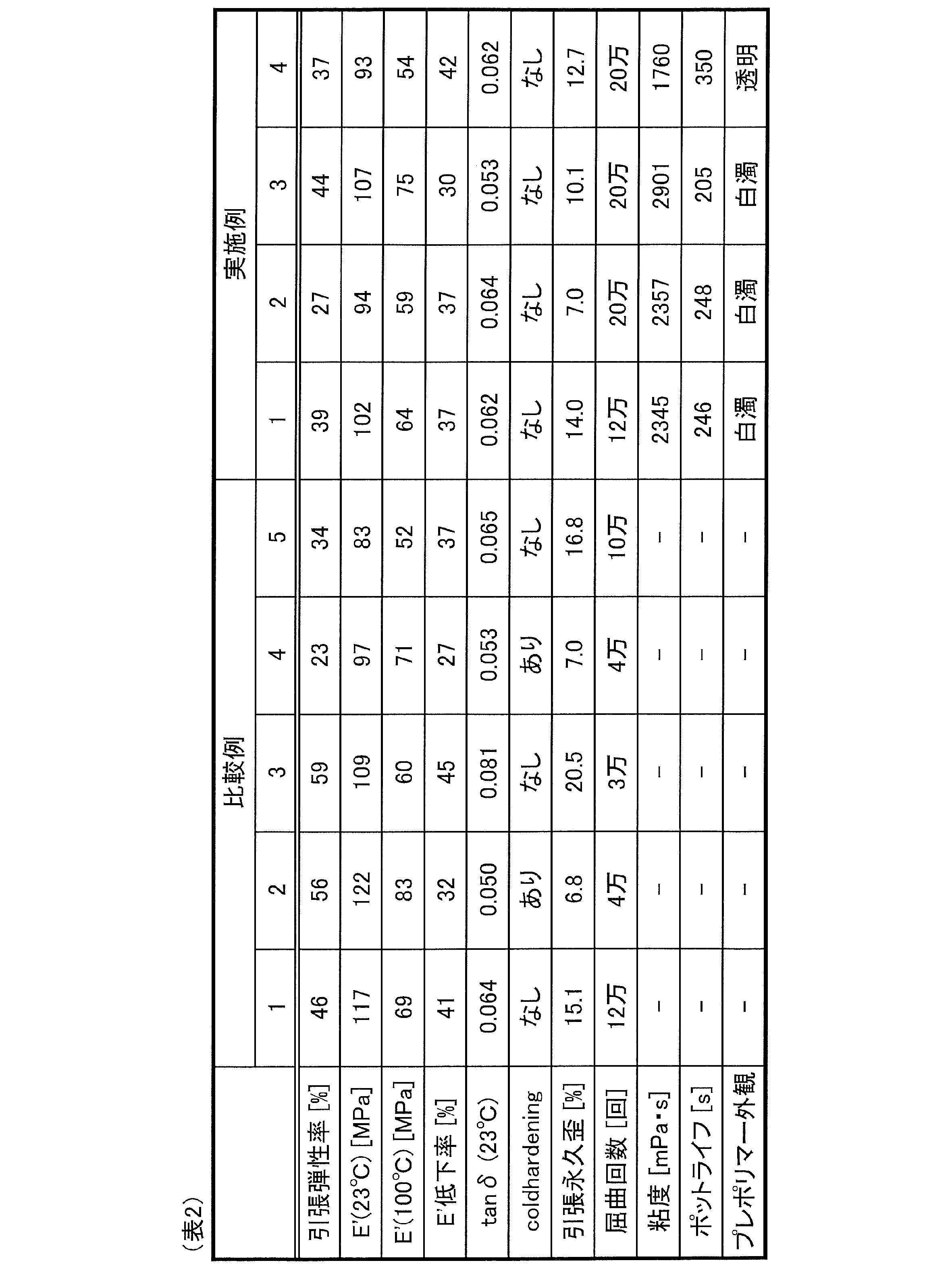
表2に示す通り、実施例のポリウレタン試験片は、引張弾性率が低く、柔軟性に優れていると判断された。また、coldhardeningはなく、低温領域で硬くなりにくいと判断された。また、屈曲回数は12万回以上であり、耐疲労性にも優れると判断された。いずれの実施例においても、公知のプレポリマーを用いた比較例1に対して、引張弾性率が低く柔軟性に優れる、屈曲回数が多く耐疲労性に優れるといった効果が確認された。そして、ポリオールとしてポリカプロラクトンジオールを使用しなかった場合(比較例2,4)、k値が5.00以上である場合(比較例3)、および[PTMG/PCL]が3/7未満である場合(比較例5)、いずれも屈曲回数が少なく、耐疲労性に劣ると判断された。 As shown in Table 2, the polyurethane test pieces of the examples were judged to have a low tensile modulus and excellent flexibility. In addition, it was judged that there was no cold hardening and that it was difficult to harden in the low temperature range. In addition, the number of flexions was more than 120,000, and it was judged to have excellent fatigue resistance. In all of the examples, the effects of a low tensile modulus and excellent flexibility, a large number of flexions, and excellent fatigue resistance were confirmed compared to Comparative Example 1, which used a known prepolymer. And when polycaprolactone diol was not used as the polyol (Comparative Examples 2 and 4), when the k value was 5.00 or more (Comparative Example 3), and when [PTMG/PCL] was less than 3/7 (Comparative Example 5), it was judged that the number of flexions was low and fatigue resistance was poor.
また、ポリオールとしてPTMGおよびポリカプロラクトンの共重合体を使用した実施例4は、他の実施例に対して、粘度が低く、ポットライフが長く、プレポリマーの透明性が高かった。 In addition, Example 4, which used a copolymer of PTMG and polycaprolactone as the polyol, had a lower viscosity, a longer pot life, and a higher prepolymer transparency than the other Examples.
以下、本開示に係る発明のバリエーションを記載する。
[付記1]芳香族ジイソシアネートおよびジオール化合物を構成単位とするウレタンプレポリマーに由来する構成単位、および、硬化剤に由来する構造部を含み、
前記ウレタンプレポリマーのk値は5.00未満であり、
前記ジオール化合物は、ポリテトラメチレンエーテルグリコールおよびポリカプロラクトンジオールを含むか、および/または、ポリテトラメチレンエーテルグリコールおよびカプロラクトンジオールの共重合体を含み、
前記ウレタンプレポリマー中のポリカプロラクトン単位に対するポリテトラメチレンエーテルグリコール単位のモル比[ポリテトラメチレンエーテルグリコール/ポリカプロラクトン]は3/7以上である、ポリウレタン系樹脂。
[付記2]前記芳香族ジイソシアネートはジフェニルメタンジイソシアネートを含む付記1に記載のポリウレタン系樹脂。
[付記3]前記ジオール化合物の数平均分子量は4000以下である付記1または2に記載のポリウレタン系樹脂。
[付記4]前記ポリカプロラクトンジオールはジエチレングリコールを開始剤とするポリカプロラクトンジオールを含む付記1~3のいずれか1つに記載のポリウレタン系樹脂。
[付記5]前記硬化剤は1,4-ブタンジオールを含む付記1~4のいずれか1つに記載のポリウレタン系樹脂。
[付記6]ヒドロキシ基に対するイソシアネート基のモル比[NCO/OH]は0.90~1.10である付記1~5のいずれか1つに記載のポリウレタン系樹脂。
[付記7]非空気式タイヤのスポーク用に用いられる付記1~6のいずれか1つに記載のポリウレタン系樹脂。
[付記8]付記1~6のいずれか1つに記載のポリウレタン系樹脂を含む、非空気式タイヤのスポーク。
[付記9]外側の強化された環状バンドと、ハブと、前記環状バンドの半径方向内側および前記ハブの間に延びる付記8に記載のスポークとを備える、非空気式タイヤ。
Variations of the invention according to the present disclosure are described below.
[Appendix 1] A polyurethane prepolymer having an aromatic diisocyanate and a diol compound as structural units, and a structural part derived from a curing agent,
the urethane prepolymer has a k value of less than 5.00;
the diol compound comprises polytetramethylene ether glycol and polycaprolactone diol, and/or a copolymer of polytetramethylene ether glycol and caprolactone diol;
A polyurethane resin in which the molar ratio of polytetramethylene ether glycol units to polycaprolactone units in the urethane prepolymer [polytetramethylene ether glycol/polycaprolactone] is 3/7 or more.
[Appendix 2] The polyurethane resin according to appendix 1, wherein the aromatic diisocyanate includes diphenylmethane diisocyanate.
[Appendix 3] The polyurethane resin according to
[Appendix 4] The polyurethane-based resin according to any one of Appendices 1 to 3, wherein the polycaprolactone diol contains polycaprolactone diol using diethylene glycol as an initiator.
[Appendix 5] The polyurethane-based resin according to any one of Appendices 1 to 4, wherein the curing agent comprises 1,4-butanediol.
[Appendix 6] The polyurethane-based resin according to any one of Appendices 1 to 5, wherein the molar ratio of isocyanate groups to hydroxyl groups [NCO/OH] is 0.90 to 1.10.
[Appendix 7] The polyurethane-based resin according to any one of Appendices 1 to 6, which is used for spokes of a non-pneumatic tire.
[Appendix 8] A spoke of a non-pneumatic tire comprising the polyurethane resin according to any one of appendices 1 to 6.
[Appendix 9] A non-pneumatic tire comprising an outer reinforced annular band, a hub, and spokes according to appendix 8 extending radially inwardly of the annular band and between the hub.
1 非空気式タイヤ
2 環状バンド
3 ハブ
4 スポーク
5 トレッド
1
Claims (9)
前記ウレタンプレポリマーのk値は5.00未満であり、
前記ジオール化合物は、ポリテトラメチレンエーテルグリコールおよびポリカプロラクトンジオールを含むか、および/または、ポリテトラメチレンエーテルグリコールおよびカプロラクトンジオールの共重合体を含み、
前記ウレタンプレポリマー中のポリカプロラクトン単位に対するポリテトラメチレンエーテルグリコール単位のモル比[ポリテトラメチレンエーテルグリコール/ポリカプロラクトン]は3/7以上である、ポリウレタン系樹脂。 The polyurethane resin composition includes a structural unit derived from a urethane prepolymer having an aromatic diisocyanate and a diol compound as structural units, and a structural part derived from a curing agent,
the urethane prepolymer has a k value of less than 5.00;
the diol compound comprises polytetramethylene ether glycol and polycaprolactone diol, and/or a copolymer of polytetramethylene ether glycol and caprolactone diol;
A polyurethane resin in which the molar ratio of polytetramethylene ether glycol units to polycaprolactone units in the urethane prepolymer [polytetramethylene ether glycol/polycaprolactone] is 3/7 or more.
Priority Applications (3)
| Application Number | Priority Date | Filing Date | Title |
|---|---|---|---|
| CN202380080556.3A CN120225584A (en) | 2022-11-22 | 2023-11-13 | Polyurethane resin |
| EP23894468.0A EP4624504A1 (en) | 2022-11-22 | 2023-11-13 | Polyurethane resin |
| PCT/JP2023/040786 WO2024111459A1 (en) | 2022-11-22 | 2023-11-13 | Polyurethane resin |
Applications Claiming Priority (2)
| Application Number | Priority Date | Filing Date | Title |
|---|---|---|---|
| JP2022186853 | 2022-11-22 | ||
| JP2022186853 | 2022-11-22 |
Publications (1)
| Publication Number | Publication Date |
|---|---|
| JP2024075451A true JP2024075451A (en) | 2024-06-03 |
Family
ID=91321617
Family Applications (1)
| Application Number | Title | Priority Date | Filing Date |
|---|---|---|---|
| JP2022202620A Pending JP2024075451A (en) | 2022-11-22 | 2022-12-19 | Polyurethane Resin |
Country Status (1)
| Country | Link |
|---|---|
| JP (1) | JP2024075451A (en) |
-
2022
- 2022-12-19 JP JP2022202620A patent/JP2024075451A/en active Pending
Similar Documents
| Publication | Publication Date | Title |
|---|---|---|
| JP5684227B2 (en) | Thermoplastic polyurethane with reduced tendency to bloom | |
| CN102741311B (en) | Two-component curable foam polyurethane resin composition, molded body formed from the same, and shoe sole | |
| EP1805239B1 (en) | A polyurethane elastomer of high clarity | |
| CN101868484A (en) | Polyurethane/polyurea elastomers based on 2, 4' -diphenylmethane diisocyanate prepolymers and preparation thereof | |
| TW201307416A (en) | Thermoplastic polyurethane with reduced tendency to bloom from a bio-based glycol | |
| CN101511894A (en) | Preparation method of foamed polyurethane elastomer | |
| KR101682505B1 (en) | Polyurethane elastomer for nonair-type tire and manufacturing method thereof | |
| JP2020512430A (en) | A process for producing polyurethanes exhibiting low blooming effect and good low temperature flexibility based on urethane-containing polymeric hydroxyl compounds. | |
| WO2013179799A1 (en) | Two-pack type curable polyurethane foam composition, polyurethane foam molded body, and shoe sole | |
| TW202104432A (en) | Thermoplastic polyurethane resin composition and molded article | |
| JP5609460B2 (en) | Method for producing thermoplastic polyurethane elastomer | |
| KR20230173182A (en) | Copolymer composition comprising polyamide block, polyether block and thermoplastic polyurethane | |
| JP2024075451A (en) | Polyurethane Resin | |
| WO2024111459A1 (en) | Polyurethane resin | |
| KR101672061B1 (en) | Polyurethane elastomer for nonair-type tire with enhanced nonslip property | |
| KR101027663B1 (en) | Durable polyurethane coating resin composition | |
| JP5294032B2 (en) | Polyester polyol composition for one-shot molding and polyurethane resin composition using the same | |
| WO2021202876A1 (en) | Polyurethane prepolymer composition comprising an alkyl benzoate | |
| TW202206496A (en) | Solvent-free polyurethane material and middle sole prepared thereof | |
| JPWO2020067534A1 (en) | Two-component curable adhesive composition | |
| JP2021528538A (en) | Clear hard thermoplastic polyurethane | |
| TW202515938A (en) | Thermoplastic polyurethane | |
| KR20080045452A (en) | Aliphatic thermoplastic polyurethane resin composition with excellent elastic recovery and method for producing polyurethane resin using same | |
| JP2024043831A (en) | biodegradable polyurethane resin | |
| JPS6114221A (en) | Production of thermoplastic polyurethane of excellent mold resistance |
Legal Events
| Date | Code | Title | Description |
|---|---|---|---|
| A621 | Written request for application examination |
Free format text: JAPANESE INTERMEDIATE CODE: A621 Effective date: 20251023 |